

CleanupBot (talk | contribs) m clean up |
m small expanded details for clarity and updated info to improve readability |
||
| Line 1: | Line 1: | ||
{{Short description|Syrupy dessert popular in South Asia}} | |||
{{Redirect|Rosogolla|the 2018 film|Rosogolla (film)}} | {{Redirect|Rosogolla|the 2018 film|Rosogolla (film)}} | ||
{{ | {{pp-move}} | ||
{{pp-semi-indef}} | |||
{{Use British English|date=May 2025}} | |||
{{Use dmy dates|date= | {{Use dmy dates|date=May 2025}} | ||
{{Infobox food | {{Infobox food | ||
| name | | name = Rasgulla | ||
| image | | image = {{multiple image | ||
| | | border = infobox | ||
| | | total_width = 250 | ||
| alternate_name | | perrow = 1/1 | ||
| region | | image1 = Rasgulla.jpg | ||
| course | | caption1 = Bengali rosogolla, also known as ''rasgulla'' | ||
| type | | alternate_name = Rosogolla, roshogolla, rasbhari or rasbari (Nepali), rasagola, rosgola | ||
| served | | image2 = RasGulla_Jaggery1.jpg | ||
| main_ingredient | | caption2 = Banglar Nolen Gurer roshogolla, also known as jaggery rosogolla}} | ||
| region = [[West Bengal]], [[Odisha]] | |||
| course = [[Dessert]] | |||
| type = Soft sweet soaked in syrup | |||
| served = Hot, cold, or room temperature | |||
| main_ingredient = [[Chhena]], sugar | |||
| minor_ingredient = | | minor_ingredient = | ||
| variations | | variations = Bengali roshogolla, Odia pahala rasa gola, Bengali Nolen Gurer roshogolla, Bengali baked rosogolla | ||
| serving_size | | serving_size = | ||
| calories | | calories = | ||
| protein | | protein = | ||
| fat | | fat = | ||
| carbohydrate | | carbohydrate = | ||
| glycemic_index | | glycemic_index = | ||
| similar_dish | | similar_dish = [[Ras malai]], [[khiramohana]], [[Khondoler misti]] | ||
| other | | other = | ||
| associated_cuisine = [[Indian cuisine|Indian]] | |||
| | | place_of_origin = India | ||
| | | cookbook = Rosogulla | ||
| cookbook | |||
}} | }} | ||
'''Rasgulla''' or | '''Rasgulla''' (literally "syrup-filled ball"){{efn|Also known as rasagola, rosogola, or rosogolla.}} is a syrupy dessert popular in the [[Eastern South Asia|eastern part]] of South Asia. It is made from ball-shaped dumplings of [[chhena]] dough cooked in light sugar syrup until the syrup permeates the dumplings. | ||
While it is nearly universally agreed that the dessert originated in the eastern Indian subcontinent, the exact locus of origin is disputed between locations such as [[West Bengal]]<ref>{{Cite book|last=Subodhchandra Sengupta|url=http://archive.org/details/SamsadBanglaCharitabhidhan|title=Samsad Bangla Charitabhidhan|date=1960}}</ref><ref>{{Cite news|last=Ghosh|first=Bishwanath|date=15 November 2014|title=Kolkata Chromosome: Like KC for 'rossogolla'|url=https://www.livemint.com/Leisure/J5jK255x5F6wpRll00gVFP/Kolkata-Chromosome-Like-KC-for-rossogolla.html|access-date=24 August 2021|work=mint|language=en}}</ref> and [[Odisha]],<ref>{{Cite news|title=Panel seal on rasgulla's Odisha origin|url=http://www.telegraphindia.com/1160714/jsp/frontpage/story_96633.jsp#.V_DfrHV97Qo|archive-url=https://web.archive.org/web/20160715155949/http://www.telegraphindia.com/1160714/jsp/frontpage/story_96633.jsp#.V_DfrHV97Qo|url-status=dead|archive-date=15 July 2016|access-date=2 October 2016}}</ref> where it is offered at the [[Jagannath Temple, Puri|Puri Jagannath Temple]].<ref>{{cite book|author=Sarat Chandra Mahapatra|title=Car Festival of Lord Jagannath, Puri|date=1994|publisher=Sri Jagannath Research Centre|location=Puri|page=149|oclc=967072714}}</ref> | |||
In 2017, when West Bengal received its rosogolla's [[geographical indication]] (GI) status, the Registry Office of India clarified that West Bengal was given GI status for Banglar rosogolla, and Odisha could claim it too if it cited the place of origin of its variant along with colour, texture, taste, juice content, and method of manufacturing.<ref name="NIE_2017" /><ref>{{Cite web|url=http://ipindiaservices.gov.in/GI_DOC/533/533%20-%20Certificate%20of%20Registration%20-%2014-11-2017.pdf|title=GI Certificate by Govt of India}}</ref> In 2019, the Government of Odisha was granted the GI status for "Odisha rasagola" (Odia rasagola).<ref name=":0">{{Cite news|url=https://indianexpress.com/article/lifestyle/food-wine/odisha-receives-gi-tag-for-rasagola-5860795/|title=Sweet success: Odisha's Rasagola gets GI tag|date=29 July 2019|work=The Indian Express|language=en-IN|access-date=29 July 2019}}</ref><ref name=":1">{{Cite news|url=https://www.news18.com/news/india/battle-over-origin-of-rasgulla-contines-after-odisha-files-petition-demanding-change-of-gi-tag-2056055.html|title=Battle Over Origin of 'Rasgulla' Continues, After Odisha Files Petition Demanding Change of GI Tag|work=News18|access-date=29 July 2019}}</ref><ref>{{Cite magazine|url=https://www.outlookindia.com/website/story/india-news-odisha-finally-gets-geographical-indication-tag-for-odishara-rasagola/335106|title=Odisha Finally Gets Geographical Indication Tag For 'Odishara Rasagola'|magazine=Outlook|access-date=29 July 2019}}</ref> | |||
In 2017, when West Bengal | |||
In | |||
== Names == | == Names == | ||
The dessert is | The dessert is {{IPA|bn|rɔʃoɡolːa|pron}} in [[Bengali language|Bengali]], {{IPA|or|ɾɔsɔɡola|pron}} in [[Odia language|Odia]], and {{IPA|sa|rɐsɐɡoːlɐkɐm|pron}} in [[Sanskrit]]. Its [[Hindi]] name ''rasgulla'' is a [[calque]] of its [[Bengali language|Bengali]] name ''roshogolla'', meaning a ball (''gōlla/gullā'') of juice (''rôs/ras'').<ref>{{Citation |title=rasgulla |date=2025-12-16 |work=Wiktionary, the free dictionary |url=https://en.wiktionary.org/w/index.php?title=rasgulla&oldid=88609645 |access-date=2026-03-07 |language=en}}</ref><ref>{{Citation |title=রসগোল্লা |date=2025-10-21 |work=Wiktionary, the free dictionary |url=https://en.wiktionary.org/w/index.php?title=%E0%A6%B0%E0%A6%B8%E0%A6%97%E0%A7%8B%E0%A6%B2%E0%A7%8D%E0%A6%B2%E0%A6%BE&oldid=87497261 |access-date=2026-03-07 |language=en}}</ref><ref>{{Citation |title=रसगुल्ला |date=2025-11-01 |work=Wiktionary, the free dictionary |url=https://en.wiktionary.org/w/index.php?title=%E0%A4%B0%E0%A4%B8%E0%A4%97%E0%A5%81%E0%A4%B2%E0%A5%8D%E0%A4%B2%E0%A4%BE&oldid=87909683 |access-date=2026-03-07 |language=en}}</ref> Other names for the dish include ''rasagulla'',<ref>{{cite news|author=Deepika Sahu|date=2 July 2012|title=Discover Odisha's 'sweet' magic|url=http://timesofindia.indiatimes.com/life-style/Discover-Odishas-sweet-magic/articleshow/14595468.cms|work=The Times of India}}</ref> ''rasagola'',<ref name="ZeeJuly2015">{{cite news|url=http://zeenews.india.com/entertainment/and-more/rasagola-originated-in-odisha-did-you-know_1638800.html|title=Rasagola originated in Odisha- Did you know?|publisher=Zee News|date=30 July 2015}}</ref> ''rasagolla'',<ref>{{cite news|url=http://www.thehindu.com/features/metroplus/Food/how-to-makerasagolla/article4927694.ece|title=How to make...Rasagolla|author=Sonali Pattnaik|newspaper=The Hindu|date=18 July 2013}}</ref> and ''rasbhari'' or ''rasbari'' (Nepali).<ref name="Alan2006"/> | ||
== History == | == History == | ||
=== Claims of invention in Bengal === | |||
==== Claims of invention in West Bengal ==== | |||
According to sweetmeat researcher Haripada Bhowmick, ''dela rasagulla'' was popular in [[Nabadwip]] and [[Phulia]] of [[Nadia district|Nadia]]. [[Sri Chaitanya]] loved this type of rasagulla, and the art of its making spread to other regions during the [[Bhakti movement]].<ref>{{Cite news|title=The rasogolla's journey, from Nadia to Odisha and Kolkata|url=https://timesofindia.indiatimes.com/city/kolkata/the-rasogollas-journey-from-nadia-to-odisha-and-kolkata/articleshow/61651738.cms|work=The Times of India|issn=0971-8257|date=15 November 2017|access-date=9 August 2024}}</ref> The spongy, white rôśôgolla is believed to have been introduced in present-day [[West Bengal]] in 1868 by the [[Kolkata]]-based confectioner [[Nobin Chandra Das]].<ref>{{cite book|date=1976|title=Samsad Bangla Charitabhidhan|edition=1st|url=https://archive.org/stream/SamsadBanglaCharitabhidhan/Samsad-Bangla-Charitabhidhan#page/n237/mode/2up|access-date=23 February 2018|editor-last=Subodh Chandra|editor-first=Sengupta|publisher=Sahitya Samsad|location=Kolkata|page=240}}</ref><ref>{{Cite news|last=Ghosh|first=Bishwanath|date=15 November 2014|title=Kolkata Chromosome: Like KC for 'rossogolla'|url=https://www.livemint.com/Leisure/J5jK255x5F6wpRll00gVFP/Kolkata-Chromosome-Like-KC-for-rossogolla.html|access-date=29 September 2020|work=mint|language=en}}</ref> Das started making rôśôgolla by processing the mixture of [[chhena]] and [[semolina]] in boiling sugar [[syrup]] in contrast to the mixture sans semolina in the original rôśôgolla in his sweet shop in [[Sutanuti]] (present-day [[Bagbazar]]). | |||
Another theory is that rôśôgolla was first prepared by someone else in Bengal, and Das only popularised it. In ''Banglar Khabar'' (1987), food historian Pranab Ray writes that a man named Braja Moira introduced rôśôgolla in his shop near [[Calcutta High Court]] in 1866, two years before Das started selling it.<ref name="Michael_Oxford">{{cite book|author=Ishita Dey|display-editors=etal|year=2015|editor=Michael Krondl|title=The Oxford Companion to Sugar and Sweets|url=https://books.google.com/books?id=R1bCBwAAQBAJ&pg=PA580|publisher=Oxford University Press|pages=580–581|isbn=978-0-19-931361-7}}</ref> In 1906, Panchana Bandopadhyay wrote that rôśôgolla was invented in the 19th century by Haradhan Mondal (Moira),<ref>{{Cite news|script-title=bn:বিশ্বের 'সবথেকে বড়' রসগোল্লার আত্মপ্রকাশ, ফুলিয়ায় মিষ্টিযজ্ঞ|url=https://www.sangbadpratidin.in/bengal/fulia-makes-worlds-biggest-rosogolla/|access-date=1 May 2025|work=Sangbad Pratidin|language=bn}}</ref> a [[Phulia]]-based sweetmaker who worked for the Pal Chowdhurys of [[Ranaghat]].<ref>{{cite news|date=29 September 2014|title=The sweet legacy of Durga Puja|url=http://timesofindia.indiatimes.com/life-style/food/The-sweet-legacy-of-Durga-Puja/articleshow/43790152.cms|newspaper=The Times of India}}</ref> According to ''Mistikatha'', a newspaper published by the West Bengal Sweetmeat Traders Association, many other people prepared similar sweets under different names, such as ''gopalgolla'' (prepared by Gopal Moira of Burdwan district), ''jatingolla'', ''bhabanigolla'', and ''rasugolla''.<ref name="Michael_Oxford"/> Food historian Michael Krondl says that irrespective of its origin, rôśôgolla likely predates Nobin Chandra Das. A sales brochure of the company run by Das's descendants also hints at this: "it is hard to tell whether or not cruder versions of similar sweets existed anywhere at that time. Even if they did, they did not match the quality of Nobin Chandra, and having failed to excite the Bengali palate, they slipped into oblivion."<ref name="Michael_2011"/> | |||
[[Bhagwandas Bagla]], a [[Marwari people|Marwari]] businessman and a customer of Nobin Chandra Das, popularised the Bengali rôśôgolla beyond the shop's locality by ordering huge amounts.<ref>{{cite web|url=http://www.rediff.com/business/slide-show/slide-show-1-how-the-rasogolla-became-a-global-name/20111116.htm?print=true |title=How the rasogolla became a global name!|date=16 November 2011|publisher=[[Rediff.com]]}}</ref> | |||
=== Modern popularity === | |||
In 1930, the introduction of [[vacuum packing]] by Nobin Chandra's son [[Krishna Chandra Das]] led to the availability of canned Rasgullas, which made the dessert popular outside Kolkata and then outside India.<ref name="IE_sticky_2011">{{cite news|author=Piyasree Dasgupta|date=29 October 2011|title=Sticky Sweet Success|url=http://archive.indianexpress.com/news/sticky-sweet-success/867051/0|work=The Indian Express}}</ref> Krishna Chandra's son [[Sarada Charan Das]] established the K. C. Das Pvt Ltd company in 1946.<ref name="GHOSH2014">{{cite book|author=Bishwanath Ghosh|title=Longing, Belonging: An Outsider At Home In Calcutta|url=https://books.google.com/books?id=C4obBQAAQBAJ&pg=PT177|date=29 October 2014|publisher=Westland|isbn=978-93-84030-60-5|page=177}}</ref> Sarada Charan's younger, estranged son Debendra Nath established [[K.C. Das Grandsons]] in 1956. | |||
Today, canned rasgullas are available throughout India, Pakistan, and Bangladesh, as well as in South Asian grocery stores outside the Indian subcontinent. In [[Nepal]], rasgulla became popular under the name ''rasbari''.<ref name="Alan2006">{{cite book|author=Alan Davidson|title=The Oxford Companion to Food|url=https://books.google.com/books?id=pZ-1AQAAQBAJ&pg=PT1880|date=21 September 2006|publisher=OUP Oxford|isbn=978-0-19-101825-1|pages=1880}}</ref> | |||
The Indian space agency, [[ISRO]], is developing dehydrated rasgullas and other dishes for Indian astronauts in its planned crewed missions.<ref>{{cite news|author=Ram Kumar Ramaswamy|date=16 June 2012|title=Isro astronauts to savour idlis, rasgullas in space|url=http://archive.asianage.com/hyderabad/isro-astronauts-savour-idlis-rasgullas-space-187|newspaper=Asian Age|archive-date=14 May 2014|access-date=20 March 2014|archive-url=https://web.archive.org/web/20140514033720/http://archive.asianage.com/hyderabad/isro-astronauts-savour-idlis-rasgullas-space-187|url-status=dead}}</ref> | |||
In 2015, the Odisha government initiated a move to get [[geographical indication]] (GI) status for the rasagulla made in Pahala.<ref name="ToI_citing_2015"/> On 30 July, the people of Odisha celebrated "Rasagola Dibasa" ("Rasgulla Day") to reaffirm Odisha as the dish's origin.<ref name ="HT20July2015">{{cite news|author=Ramani Ranjan Mohapatra|date=30 July 2015|title=#RasagolaDibasa trends as Odias reclaim iconic dish|url=https://www.hindustantimes.com/india/rasagoladibasa-trends-as-odias-reclaim-iconic-dish/story-CoHZUeQ9zpxL4OLW5zSw5L.html|newspaper=Hindustan Times}}</ref> In August, [[West Bengal]] contested Odisha's move to obtain GI status.<ref name="ToI_Jhimli_2015">{{cite news|url=http://timesofindia.indiatimes.com/india/Maharashtra-takes-up-rosogolla-battle-with-Odisha/articleshow/48417745.cms|title=Maharashtra (West Bengal) takes up rosogolla battle with Odisha|work=The Times of India|date=10 August 2015|author=Jhimli Mukherjee Pandey}}</ref> In 2015, the Odisha state government constituted three committees to claim the rasgulla. The committees submitted their interim report to the government. Noted journalist and food researcher [[Bhakta Tripathy]] and a member of the committee had submitted a dossier containing historical evidence of rasgulla origin in [[Odisha]].<ref>{{cite web|url=http://orissadiary.com/ShowOriyaColumn.asp?id=62220|title=Sweet Struggle - Origin of Rasgulla|archive-url=https://web.archive.org/web/20160818041330/http://orissadiary.com/ShowOriyaColumn.asp?id=62220|archive-date=18 August 2016|url-status=dead|date=16 October 2015|author=Sumit Behera|website=rissadiary.com}}</ref> The Science and Technology Department of the West Bengal government also started the process to get its own GI status for the dessert.<ref>{{cite news|url=http://food.ndtv.com/food-drinks/west-bengal-and-odisha-battle-over-the-invention-of-rasgulla-1211128|title=West Bengal and Odisha Battle Over the Invention of 'Rasgulla'|publisher=NDTV|date=26 August 2015}}</ref> | |||
=== | === Alternative claims of Puri temple tradition of Odisha === | ||
According to historians of Odisha, the rasgulla originated in [[Puri]], as ''[[Khiramohana|khira mohana]]'', which later evolved into the Pahala rasgulla.<ref name="ToI_Bishwa_2015">{{cite news|author=Mitra Bishwabijoy|date=6 July 2015|title=Who invented the rasgulla?|newspaper=The Times of India|url=http://timesofindia.indiatimes.com/life-style/food/food-features/Who-invented-the-rasgulla/articleshow/47909754.cms|access-date=2 August 2015}}</ref> It has been traditionally offered as ''[[bhog]],'' a religious offering, to goddess [[Lakshmi]] at [[Jagannath Temple, Puri]].<ref>{{cite news|date=5 July 2009|title=Trinity take 'adhar pana' on raths|newspaper=The New Indian Express|url=http://www.newindianexpress.com/states/odisha/article90964.ece|archive-url=https://web.archive.org/web/20140512225523/http://www.newindianexpress.com/states/odisha/article90964.ece#.UytBYlcqQ0M|url-status=dead|archive-date=12 May 2014}}</ref> According to the local legend, Lakshmi got upset because her husband, [[Jagannath|Lord Jagannath]], went on a 9-day sojourn (the ''ratha yatra'') without her consent, so she locked ''Jai Vijay Dwar'', one of the temple gates, and prevented his convoy from reentering the temple's [[Garbhagriha|Garbhagṛha]] (sanctum sanctorum). Jagannath offered her rasgullas to appease her. This ritual, known as ''Bachanika'', is part of the "Niladri Bije" (or "Arrival of the God") observance, which marks the return of the deities to the temple after the [[Ratha-Yatra (Puri)|Ratha Yatra]].<ref>{{cite news|author=Subhashish Mohanty|date=3 July 2012|title=Lord placates wife with sweet delight|url=http://www.telegraphindia.com/1120703/jsp/odisha/story_15682727.jsp|archive-url=https://web.archive.org/web/20140314143938/http://www.telegraphindia.com/1120703/jsp/odisha/story_15682727.jsp#.UytFEVcqQ0M|url-status=dead|archive-date=14 March 2014}}</ref><ref>{{cite news|date=26 July 2010|title=Sweet and sermon return for deities|newspaper=The Telegraph|location=Calcutta|url=http://www.telegraphindia.com/1100726/jsp/orissa/story_12725909.jsp|archive-url=https://web.archive.org/web/20121025125021/http://www.telegraphindia.com/1100726/jsp/orissa/story_12725909.jsp|url-status=dead|archive-date=25 October 2012}}</ref> | |||
Jagannath Temple scholars, such as Laxmidhar Pujapanda, and researchers like Jagabandhu Padhi say the tradition dates to the 12th century, when the temple was first built.<ref name="ToI_citing_2015">{{cite news|author1=Mohapatra Bhattacharya|author2=Debabrata Kajari|date=31 July 2015|title=Citing Rath ritual, Odisha lays claim to rasagulla, WB historians don't agree|newspaper=The Times of India|url=http://timesofindia.indiatimes.com/city/bhubaneswar/Citing-Rath-ritual-Odisha-lays-claim-to-rasagulla-WB-historians-dont-agree/articleshow/48297818.cms|access-date=1 August 2015}}</ref><ref name="Padhi2000">{{cite book|author=Jagabandhu Padhi|url=https://books.google.com/books?id=QHMeMwEACAAJ|title=Sri Jagannatha at Puri|date=2000|publisher=S.G.N. Publications}}</ref> Pujapanda says the Niladri Bije tradition is mentioned in ''Niladri Mahodaya'', which dates to the 18th century by Sarat Chandra Mahapatra.<ref name="ToI_citing_2015" /><ref>{{cite book|author=Sarat Chandra Mahapatra|title=Car Festival of Lord Jagannath, Puri|date=1994|publisher=Sri Jagannath Research Centre|location=Puri|page=55|oclc=967072714}}</ref> According to Mahapatra, several temple scriptures over 300 years old have evidence of the rasgulla offering ritual in Puri.<ref>{{cite news|author=Debabrata Mohapatra|date=29 July 2007|title=Researchers Claim Rasgullas Were Born In Puri|newspaper=The Times of India}}</ref> | |||
According to folklore, Pahala (a village on the outskirts of Odisha's capital, [[Bhubaneswar]]) had many cows. The village produced excess milk, and the villagers threw it away when it spoiled. When a priest from the Jagannath Temple saw this, he taught them the art of [[curdling]], including the recipe for rasagulla. Pahala thus became the biggest market for chhena-based sweets in the area.<ref>{{cite news|author=Madhulika Dash|date=11 September 2014|title=The Food Story: How India's favourite sweet dish rosugulla was born|newspaper=The Indian Express|url=http://indianexpress.com/article/lifestyle/food-wine/the-food-story-how-indias-favourite-sweet-dish-rosugulla-was-born/}}</ref> | |||
According to Asit Mohanty, an Odia research scholar on the Jagannath cult and traditions, the sweet is mentioned as "Rasagola" in the 15th-century text ''[[Odia Ramayana|Jagamohana Ramayana]]'' of Balaram Das.<ref>{{cite news|date=15 July 2016|title=Hopes for Rasagola Origin in Odisha Revived|newspaper=The Pioneer|url=http://www.dailypioneer.com/state-editions/bhubaneswar/hopes-for-rasagola-origin-in-odisha-revived.html|access-date=20 July 2016}}</ref><ref>{{Cite news|title=Odisha celebrates GI Tag, distributes 50,000 Rasagolas in Bhubaneswar|work=Hindustan Times|date=19 August 2019|url=https://www.hindustantimes.com/india-news/odisha-celebrates-gi-tag-distributes-50-000-rasagolas-in-bhubaneswar/story-TxjS2Z2uuKUM5pOTmo1mzL.html}}</ref><ref>{{Cite news|title=The unkindest cut: 'Rasagolas' are not Bengali after all|date=3 August 2015|url=http://www.firstpost.com/living/unkindest-cut-rasagolas-not-bengali-2375514.html|work=Firstpost|access-date=12 July 2022}}</ref><ref>{{Cite web|title=New evidence on rasagola's Odisha origin found | Sambad English|date=18 May 2016|url=https://sambadenglish.com/new-evidence-found-rasagolas-odisha-origin/}}</ref><ref>{{Cite web|title=Rasagola | PDF|url=https://www.scribd.com/document/472998635/Rasagola}}</ref> | |||
The text mentions rasagola along with other sweets found in Odisha. There is also mention of many other cheese sweets like ''chhenapuri'', ''chhenaladu'', and ''rasabali''.<ref>{{cite book|last=Ramayana|first=Jagamohan|title=Ramayana|publisher=Balaram Das|location=Ajodhya Kanda}}</ref><ref>{{cite book|last1=Typical selections from Oriya Literature|title=Ramayana|publisher=B.C. Mazumdar|page=84}}</ref> Another ancient text, ''Premapanchamruta'' of Bhupati, also mentions cheese (''chhena'').<ref>{{cite book|author=G. C. Praharaj|url=http://dsalsrv02.uchicago.edu/cgi-bin/philologic/contextualize.pl?p.15.praharaj.1121967|title=Purnnacandra Odia Bhashakosha|date=1931–1940|publisher=Utkal Sahitya Press|location=Cuttack|page=2594|access-date=20 July 2016|archive-date=27 October 2020|archive-url=https://web.archive.org/web/20201027000623/http://dsalsrv02.uchicago.edu/cgi-bin/philologic/contextualize.pl?p.15.praharaj.1121967|url-status=dead}}</ref> It is argued that the cheese-making process was well known before the Portuguese came to Odisha. | |||
According to the Bengali culinary historian Pritha Sen, in the mid-18th century, many [[Odia people|Odia]] cooks were employed in Bengali homes who arguably introduced rasgulla along with many other Odia dishes, but there is no proof of that.<ref name="ToI_Bishwa_2015" /> According to another theory, Bengali visitors to Puri carried the recipe for rasgulla back to Bengal in the 19th century, but evidence of that is also lacking.<ref name="gastr">{{cite journal|author=Michael Krondl|date=Summer 2010|title=The Sweetshops of Kolkata|journal=Gastronomica|volume=10|issue=3|pages=58–65|doi=10.1525/gfc.2010.10.3.58|jstor=10.1525/gfc.2010.10.3.58}}</ref> | |||
According to food historians [[K. T. Achaya]] and Chitra Banerji, there are no references to cheese (including chhena) in India before the 17th century. The milk-based sweets were mainly made up of [[khoa]], before the [[Portuguese India|Portuguese]] influence led to the introduction of cheese-based sweets, so it is highly unlikely that a cheese-based dish was offered at Jagannath Temple in the 12th century.<ref>{{cite news|author=Shoaib Daniyal|date=4 August 2015|title=Who Deserves Credit For The Rasgulla? Bengalis, Odiyas...Or The Portuguese?|newspaper=Kashmir Observer|url=http://www.kashmirobserver.net/news/opinion/who-deserves-credit-rasgulla-bengalis-odiyasor-portuguese|archive-url=https://web.archive.org/web/20151009143538/http://www.kashmirobserver.net/news/opinion/who-deserves-credit-rasgulla-bengalis-odiyasor-portuguese|archive-date=9 October 2015}}</ref> According to Nobin Chandra Das's descendant Animikh Roy and historian Haripada Bhowmik, rasgulla is not among the ''chhappan bhog'' ("56 offerings") in the temple's early records; the name was coined in Bengal. They also say it would have been blasphemy to offer something made from spoiled milk (chhena) to a deity.<ref name="ToI_citing_2015" /><ref name="ToI_Jhimli_2015" /> But Michael Krondl argued that Hindu dietary rules vary by region and that this restriction may not have existed in present-day Odisha. Krondl gave no substantial information to uphold this claim.<ref name="Michael_2011">{{cite book|author=Michael Krondl|url=https://books.google.com/books?id=gN6ySQnUnfwC&pg=PA53|title=Sweet Invention: A History of Dessert|publisher=Chicago Review Press|year=2011|isbn=978-1-55652-954-2|pages=55–59}}</ref> | |||
== Niladri Bije == | |||
Niladri Bije is a Hindu ritual that happens after Rath Yatra. When Lord [[Jagannath]] returns to Puri Mandir, Lakshmi feeds him roshogolla. On this point, Odisha also claims roshogolla. Lord Jagannath is highly prayed in both [[Odisha]] and [[West Bengal]]. Sand artist [[Sudarshan Patnaik]] made a sand sculpture in [[Puri Beach]] depicting "Niladri Bije" and Jagannath offering rasgulla to Lakshmi.<ref name="OST">{{Cite news|last=<!--staff byline; no author given-->|date=31 July 2015|title=Odisha celebrates 'Rasagola Dibasa' with great fanfare|url=http://odishasuntimes.com/2015/07/31/odisha-celebrates-rasagola-dibasa-with-great-fanfare/|url-status=usurped|archive-url=https://web.archive.org/web/20150731215142/http://odishasuntimes.com/2015/07/31/odisha-celebrates-rasagola-dibasa-with-great-fanfare/|archive-date=31 July 2015|access-date=2 August 2015|work=Odisha Sun Times}}</ref> | |||
== Rosogolla Utsob == | == Rosogolla Utsob == | ||
To pay tribute to the inventor of rosogolla, [[Nobin Chandra Das]], and to promote the [[Bengali cuisine|Bengali]] claim of authenticity over rosogolla, since 2017 the government of [[West Bengal]] has celebrated "Rosogolla Utsob" every year on 28 December.<ref>{{Cite news|title=All you need to know about the 'Rosogolla Festival'|url=https://timesofindia.indiatimes.com/life-style/food-news/all-you-need-to-know-about-the-rosogolla-festival/articleshow/67284341.cms|access-date=24 August 2021|website=The Times of India|language=en}}</ref> At the 2017 rosogolla festival, Bengali confectioners prepared the world's largest rasgulla, which weighed nine kilograms.<ref>{{Cite news|last=Sengar|first=Resham|title=Now, West Bengal creates world's biggest 'Rasgulla' weighing 9 kg!|url=https://timesofindia.indiatimes.com/travel/destinations/now-west-bengal-creates-worlds-biggest-rasgulla-weighing-9-kg/as61818151.cms|access-date=24 August 2021|newspaper=The Times of India}}</ref><ref>{{Cite web|last=Venkatesh|first=Shruti|date=24 November 2017|title=Sweet Treat: West Bengal Makes World's Biggest Rasgulla to Celebrate GI Tag for 'Banglar Rosogolla'|url=https://www.india.com/viral/west-bengal-makes-worlds-biggest-rasgulla-to-celebrate-gi-for-banglar-rosogolla-2670637/|access-date=24 August 2021|website=India News, Breaking News {{!}} India.com|language=en}}</ref> To celebrate the 150th anniversary of rosogolla's invention, the government of West Bengal organised a three-day 'Rosogolla festival' from 28 to 30 December 2018. | |||
To pay tribute to the inventor of rosogolla, | |||
== Preparation == | == Preparation == | ||
To prepare rasgulla, the cheese (chhena) mixture is formed into small balls. These balls are then simmered in a sugar syrup.<ref>{{cite book |author=Lois Sinaiko Webb |title=Multicultural Cookbook of Life-cycle Celebrations |url=https://books.google.com/books?id=CdLuaG_3LowC&pg=PA309 |date=1 January 2000 |publisher=ABC-CLIO |isbn=978-1-57356-290-4 |pages=309–}}</ref> It can also be prepared using a [[pressure cooker]]<ref>{{cite book |author=Tarla Dalal |title=Desserts Under Ten Minutes |url=https://books.google.com/books?id=BvBzBQAAQBAJ&pg=PT69 |date=17 November 2003 |publisher=Sanjay & Co |isbn=978-81-86469-84-2 |pages=69–}}</ref> or an | To prepare rasgulla, the cheese (chhena) mixture is formed into small balls. These balls are then simmered in a sugar syrup.<ref>{{cite book|author=Lois Sinaiko Webb|title=Multicultural Cookbook of Life-cycle Celebrations|url=https://books.google.com/books?id=CdLuaG_3LowC&pg=PA309|date=1 January 2000|publisher=ABC-CLIO|isbn=978-1-57356-290-4|pages=309–}}</ref> It can also be prepared using a [[pressure cooker]]<ref>{{cite book|author=Tarla Dalal|title=Desserts Under Ten Minutes|url=https://books.google.com/books?id=BvBzBQAAQBAJ&pg=PT69|date=17 November 2003|publisher=Sanjay & Co|isbn=978-81-86469-84-2|pages=69–}}</ref> or an oven.<ref>{{cite book|title=Low Calorie Sweets|url=https://books.google.com/books?id=CfFwnkCqCigC&pg=PA42|author=Tarla Dalal|year=2006|publisher=Sanjay & Co|isbn=978-81-89491-34-5|pages=42–}}</ref> While serving, a drop of rose water (only the organic and edible type of rose water, not rose perfume or synthetic flavours) can be added. | ||
<gallery mode="packed"> | <gallery mode="packed"> | ||
| Line 105: | Line 94: | ||
== Variations == | == Variations == | ||
<gallery mode="packed"> | <gallery mode="packed"> | ||
File:Rasgulla - Kolkata 2011-08-02 4547.JPG| | File:Rasgulla - Kolkata 2011-08-02 4547.JPG|Rajbhog from [[Kolkata]], India | ||
File:Red color rasagola from Pahala, Khurda district, Odisha, India.jpg| Reddish rasgullas from Pahala | File:Red color rasagola from Pahala, Khurda district, Odisha, India.jpg| Reddish rasgullas from Pahala (located between the cities of [[Bhubaneswar]] and [[Cuttack]]), Odisha | ||
File:The famous Indian syrupy dessert Rasgulla, from West Bengal.jpg|Sponge Rasgulla of Kolkata | |||
File: | File:Bengali orange rasgulla.jpg| ''Kamalabhog'', an orange-flavoured Bengali rasgulla | ||
File:Baked Rasgulla.JPG|Kolkata's Baked rosogolla – a Bengali variation | |||
File:Bengali orange rasgulla.jpg| '' | File:Ishwar Rasogola.JPG|Colored Rasagola from Kalahandi, Odisha | ||
File:Baked Rasgulla.JPG|Baked | |||
File:Ishwar Rasogola.JPG|Rasagola from Kalahandi,Odisha | |||
</gallery> | </gallery> | ||
== Nutrition == | == Nutrition == | ||
Typically, a 100-gram serving of rasgulla contains 186 calories, out of which about 153 calories | Typically, a 100-gram serving of rasgulla contains 186 calories, out of which about 153 calories come from carbohydrates. It also contains about 1.85 grams of fat and 4 grams of protein.<ref name = "nutrit">[http://www.livestrong.com/article/49345-nutrition-information-rasgulla/ Nutrition Information For Rasgulla]. Livestrong.Com. Retrieved 6 December 2012.</ref> | ||
== Geographical indication (GI) tag == | == Geographical indication (GI) tag == | ||
In 2015, West Bengal applied for a [[geographical indication]] (GI) status for "Banglar Rasogolla" (Bengali Rasgulla). The Government clarified that there was no conflict with Odisha, and its application was only for a specific variant that was different "in colour, texture, taste, juice content and method of manufacturing" from the variant produced in Odisha.<ref name="NDTV_claim_2016">{{cite news|title=Our Claim Only On A Variety Of Rasogolla, No Dispute With Odisha: West Bengal|url=http://www.ndtv.com/india-news/our-claim-only-on-a-variety-of-rasogolla-no-dispute-with-odisha-bengal-1436883|access-date=24 August 2016|agency=[[Press Trust Of India]]|publisher=[[NDTV]]|date=27 July 2016}}</ref> On 14 November 2017, the [[List of Geographical Indications in India|GI Registry of India]] granted West Bengal the GI status for Banglar Rasogolla.<ref name="NIE_2017">{{cite news|url=https://www.newindianexpress.com/nation/2017/nov/14/sweet-war-this-gi-tag-is-for-banglar-rosogolla-it-is-not-about-the-origin-1700787.html|title=Sweet War: This GI tag is for Banglar Rosogolla, it is not about the origin|date=14 November 2017|newspaper=The New Indian Express}}</ref><ref>{{Cite web|url=http://ipindiaservices.gov.in/GirPublic/ViewApplicationDetails.aspx?AppNo=533&index=0&pIndex=0&status=1|title=Intellectual Property India|website=ipindiaservices.gov.in|language=en|access-date=15 November 2017}}</ref><ref>{{Cite web|url=http://ipindiaservices.gov.in/GI_DOC/533/533%20-%20Certificate%20of%20Registration%20-%2014-11-2017.pdf|title=Certificate of Registration of Geographical Indication under section 16 (1)-or of authorised user under section 17(3)(e)|date=14 November 2017|website=Intellectual Property India|access-date=15 November 2017}}</ref> | |||
In 2015, West Bengal applied for a [[ | |||
The GI Registrar office at [[Chennai]] later specifically clarified that West Bengal was given GI status only for the Bengali version of | The GI Registrar office at [[Chennai]] later specifically clarified that West Bengal was given GI status only for the Bengali version of rasgulla ("Banglar Rasogolla"), not for the sweet's origin. The office also said that Odisha had not by then applied for a GI tag, but could also get Odisha Rasgulla's GI tag by presenting the necessary evidence.<ref name="NIE_2017" /> | ||
In 2018 Odisha | In 2018, Odisha applied for GI status in the Chennai GI Registry.<ref>{{Cite magazine|url=https://www.businesstoday.in/latest/trends/odisha-rasagola-receives-gi-tag-two-years-after-west-bengal/story/368775.html|title=Odisha Rasagola receives geographical indication tag; here's what it means|magazine=Business Today|access-date=29 July 2019}}</ref> On 29 July 2019, the GI Registry of India granted Odisha the GI status for "Odisha Rasagola", the Odia version of Rasgulla.<ref name=":0" /><ref name=":1" /> | ||
== See also == | == See also == | ||
* [[Bangladeshi cuisine]] | * [[Bangladeshi cuisine]] | ||
* [[Bengali cuisine]] | * [[Bengali cuisine]] | ||
* [[Dharwad pedha]] | * [[Dharwad pedha]] | ||
* [[List of Indian sweets and desserts]] | * [[List of Indian sweets and desserts]] | ||
* [[Litti (dish)|Litti]] | |||
* [[Mysore pak]] | |||
* [[Odia cuisine]] | |||
* [[West Bengal cuisine]] | |||
== Notes == | |||
{{Notelist}} | |||
{{clear}} | {{clear}} | ||
== References == | == References == | ||
{{ | {{Reflist}} | ||
{{India topics}} | |||
{{Cuisine of India}} | |||
{{Indian Dishes}} | |||
{{West Bengal}} | |||
{{Culture of West Bengal}} | {{Culture of West Bengal}} | ||
{{ | {{Bengali cuisine}} | ||
{{Cheese dishes}} | {{Cheese dishes}} | ||
{{Geographical indications in West Bengal}} | |||
[[Category:Bangladeshi cuisine]] | |||
[[Category:Bangladeshi desserts]] | [[Category:Bangladeshi desserts]] | ||
[[Category:Bengali cuisine]] | |||
[[Category:Bengali desserts]] | [[Category:Bengali desserts]] | ||
[[Category:Cheese desserts]] | |||
[[Category:Geographical indications in Odisha]] | |||
[[Category:Geographical indications in West Bengal]] | |||
[[Category:Indian cheese dishes]] | [[Category:Indian cheese dishes]] | ||
[[Category:Indian cuisine]] | |||
[[Category:Indian desserts]] | [[Category:Indian desserts]] | ||
[[Category:Indo-Caribbean cuisine]] | |||
[[Category:Mauritian cuisine]] | |||
[[Category:Nepalese cuisine]] | [[Category:Nepalese cuisine]] | ||
[[Category: | [[Category:Cuisine of Odisha]] | ||
[[Category: | [[Category:Semolina desserts]] | ||
[[Category:Sweets of West Bengal]] | |||
[[Category:Vegetarian dishes of India]] | [[Category:Vegetarian dishes of India]] | ||
[[Category: | [[Category:West Bengal cuisine]] | ||
Revision as of 15:39, 8 March 2026
Bengali rosogolla, also known as rasgulla Banglar Nolen Gurer roshogolla, also known as jaggery rosogolla | |
| Type | Soft sweet soaked in syrup |
|---|---|
| Course | Dessert |
| Region or state | West Bengal, Odisha |
| Serving temperature | Hot, cold, or room temperature |
| Main ingredients | Chhena, sugar |
| Variations | Bengali roshogolla, Odia pahala rasa gola, Bengali Nolen Gurer roshogolla, Bengali baked rosogolla |
| Similar dishes | Ras malai, khiramohana, Khondoler misti |


Rasgulla (literally "syrup-filled ball")[lower-alpha 1] is a syrupy dessert popular in the eastern part of South Asia. It is made from ball-shaped dumplings of chhena dough cooked in light sugar syrup until the syrup permeates the dumplings.
While it is nearly universally agreed that the dessert originated in the eastern Indian subcontinent, the exact locus of origin is disputed between locations such as West Bengal[1][2] and Odisha,[3] where it is offered at the Puri Jagannath Temple.[4]
In 2017, when West Bengal received its rosogolla's geographical indication (GI) status, the Registry Office of India clarified that West Bengal was given GI status for Banglar rosogolla, and Odisha could claim it too if it cited the place of origin of its variant along with colour, texture, taste, juice content, and method of manufacturing.[5][6] In 2019, the Government of Odisha was granted the GI status for "Odisha rasagola" (Odia rasagola).[7][8][9]
Names
The dessert is pronounced [rɔʃoɡolːa] in Bengali, pronounced [ɾɔsɔɡola] in Odia, and pronounced [rɐsɐɡoːlɐkɐm] in Sanskrit. Its Hindi name rasgulla is a calque of its Bengali name roshogolla, meaning a ball (gōlla/gullā) of juice (rôs/ras).[10][11][12] Other names for the dish include rasagulla,[13] rasagola,[14] rasagolla,[15] and rasbhari or rasbari (Nepali).[16]
History
Claims of invention in Bengal
Claims of invention in West Bengal
According to sweetmeat researcher Haripada Bhowmick, dela rasagulla was popular in Nabadwip and Phulia of Nadia. Sri Chaitanya loved this type of rasagulla, and the art of its making spread to other regions during the Bhakti movement.[17] The spongy, white rôśôgolla is believed to have been introduced in present-day West Bengal in 1868 by the Kolkata-based confectioner Nobin Chandra Das.[18][19] Das started making rôśôgolla by processing the mixture of chhena and semolina in boiling sugar syrup in contrast to the mixture sans semolina in the original rôśôgolla in his sweet shop in Sutanuti (present-day Bagbazar).
Another theory is that rôśôgolla was first prepared by someone else in Bengal, and Das only popularised it. In Banglar Khabar (1987), food historian Pranab Ray writes that a man named Braja Moira introduced rôśôgolla in his shop near Calcutta High Court in 1866, two years before Das started selling it.[20] In 1906, Panchana Bandopadhyay wrote that rôśôgolla was invented in the 19th century by Haradhan Mondal (Moira),[21] a Phulia-based sweetmaker who worked for the Pal Chowdhurys of Ranaghat.[22] According to Mistikatha, a newspaper published by the West Bengal Sweetmeat Traders Association, many other people prepared similar sweets under different names, such as gopalgolla (prepared by Gopal Moira of Burdwan district), jatingolla, bhabanigolla, and rasugolla.[20] Food historian Michael Krondl says that irrespective of its origin, rôśôgolla likely predates Nobin Chandra Das. A sales brochure of the company run by Das's descendants also hints at this: "it is hard to tell whether or not cruder versions of similar sweets existed anywhere at that time. Even if they did, they did not match the quality of Nobin Chandra, and having failed to excite the Bengali palate, they slipped into oblivion."[23]
Bhagwandas Bagla, a Marwari businessman and a customer of Nobin Chandra Das, popularised the Bengali rôśôgolla beyond the shop's locality by ordering huge amounts.[24]
Modern popularity
In 1930, the introduction of vacuum packing by Nobin Chandra's son Krishna Chandra Das led to the availability of canned Rasgullas, which made the dessert popular outside Kolkata and then outside India.[25] Krishna Chandra's son Sarada Charan Das established the K. C. Das Pvt Ltd company in 1946.[26] Sarada Charan's younger, estranged son Debendra Nath established K.C. Das Grandsons in 1956.
Today, canned rasgullas are available throughout India, Pakistan, and Bangladesh, as well as in South Asian grocery stores outside the Indian subcontinent. In Nepal, rasgulla became popular under the name rasbari.[16]
The Indian space agency, ISRO, is developing dehydrated rasgullas and other dishes for Indian astronauts in its planned crewed missions.[27]
In 2015, the Odisha government initiated a move to get geographical indication (GI) status for the rasagulla made in Pahala.[28] On 30 July, the people of Odisha celebrated "Rasagola Dibasa" ("Rasgulla Day") to reaffirm Odisha as the dish's origin.[29] In August, West Bengal contested Odisha's move to obtain GI status.[30] In 2015, the Odisha state government constituted three committees to claim the rasgulla. The committees submitted their interim report to the government. Noted journalist and food researcher Bhakta Tripathy and a member of the committee had submitted a dossier containing historical evidence of rasgulla origin in Odisha.[31] The Science and Technology Department of the West Bengal government also started the process to get its own GI status for the dessert.[32]
Alternative claims of Puri temple tradition of Odisha
According to historians of Odisha, the rasgulla originated in Puri, as khira mohana, which later evolved into the Pahala rasgulla.[33] It has been traditionally offered as bhog, a religious offering, to goddess Lakshmi at Jagannath Temple, Puri.[34] According to the local legend, Lakshmi got upset because her husband, Lord Jagannath, went on a 9-day sojourn (the ratha yatra) without her consent, so she locked Jai Vijay Dwar, one of the temple gates, and prevented his convoy from reentering the temple's Garbhagṛha (sanctum sanctorum). Jagannath offered her rasgullas to appease her. This ritual, known as Bachanika, is part of the "Niladri Bije" (or "Arrival of the God") observance, which marks the return of the deities to the temple after the Ratha Yatra.[35][36]
Jagannath Temple scholars, such as Laxmidhar Pujapanda, and researchers like Jagabandhu Padhi say the tradition dates to the 12th century, when the temple was first built.[28][37] Pujapanda says the Niladri Bije tradition is mentioned in Niladri Mahodaya, which dates to the 18th century by Sarat Chandra Mahapatra.[28][38] According to Mahapatra, several temple scriptures over 300 years old have evidence of the rasgulla offering ritual in Puri.[39]
According to folklore, Pahala (a village on the outskirts of Odisha's capital, Bhubaneswar) had many cows. The village produced excess milk, and the villagers threw it away when it spoiled. When a priest from the Jagannath Temple saw this, he taught them the art of curdling, including the recipe for rasagulla. Pahala thus became the biggest market for chhena-based sweets in the area.[40]
According to Asit Mohanty, an Odia research scholar on the Jagannath cult and traditions, the sweet is mentioned as "Rasagola" in the 15th-century text Jagamohana Ramayana of Balaram Das.[41][42][43][44][45]
The text mentions rasagola along with other sweets found in Odisha. There is also mention of many other cheese sweets like chhenapuri, chhenaladu, and rasabali.[46][47] Another ancient text, Premapanchamruta of Bhupati, also mentions cheese (chhena).[48] It is argued that the cheese-making process was well known before the Portuguese came to Odisha.
According to the Bengali culinary historian Pritha Sen, in the mid-18th century, many Odia cooks were employed in Bengali homes who arguably introduced rasgulla along with many other Odia dishes, but there is no proof of that.[33] According to another theory, Bengali visitors to Puri carried the recipe for rasgulla back to Bengal in the 19th century, but evidence of that is also lacking.[49]
According to food historians K. T. Achaya and Chitra Banerji, there are no references to cheese (including chhena) in India before the 17th century. The milk-based sweets were mainly made up of khoa, before the Portuguese influence led to the introduction of cheese-based sweets, so it is highly unlikely that a cheese-based dish was offered at Jagannath Temple in the 12th century.[50] According to Nobin Chandra Das's descendant Animikh Roy and historian Haripada Bhowmik, rasgulla is not among the chhappan bhog ("56 offerings") in the temple's early records; the name was coined in Bengal. They also say it would have been blasphemy to offer something made from spoiled milk (chhena) to a deity.[28][30] But Michael Krondl argued that Hindu dietary rules vary by region and that this restriction may not have existed in present-day Odisha. Krondl gave no substantial information to uphold this claim.[23]
Niladri Bije
Niladri Bije is a Hindu ritual that happens after Rath Yatra. When Lord Jagannath returns to Puri Mandir, Lakshmi feeds him roshogolla. On this point, Odisha also claims roshogolla. Lord Jagannath is highly prayed in both Odisha and West Bengal. Sand artist Sudarshan Patnaik made a sand sculpture in Puri Beach depicting "Niladri Bije" and Jagannath offering rasgulla to Lakshmi.[51]
Rosogolla Utsob
To pay tribute to the inventor of rosogolla, Nobin Chandra Das, and to promote the Bengali claim of authenticity over rosogolla, since 2017 the government of West Bengal has celebrated "Rosogolla Utsob" every year on 28 December.[52] At the 2017 rosogolla festival, Bengali confectioners prepared the world's largest rasgulla, which weighed nine kilograms.[53][54] To celebrate the 150th anniversary of rosogolla's invention, the government of West Bengal organised a three-day 'Rosogolla festival' from 28 to 30 December 2018.
Preparation
To prepare rasgulla, the cheese (chhena) mixture is formed into small balls. These balls are then simmered in a sugar syrup.[55] It can also be prepared using a pressure cooker[56] or an oven.[57] While serving, a drop of rose water (only the organic and edible type of rose water, not rose perfume or synthetic flavours) can be added.
-
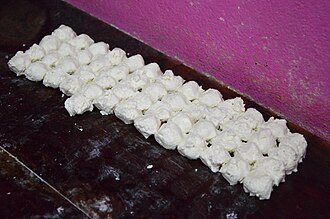 Chhena divided into balls
 -
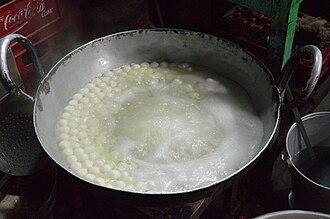 Chenna balls being boiled
 -
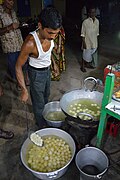 Rasgulla being taken out of the syrup


Variations
-
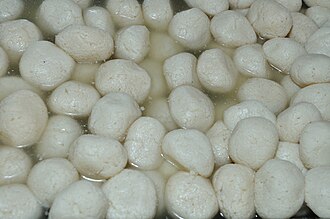 Rajbhog from Kolkata, India
 -
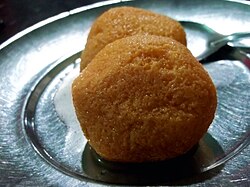 Reddish rasgullas from Pahala (located between the cities of Bhubaneswar and Cuttack), Odisha
 -
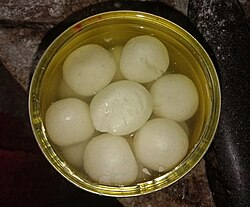 Sponge Rasgulla of Kolkata
 -
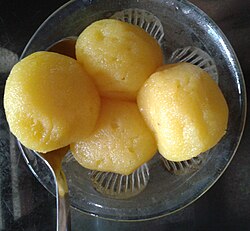 Kamalabhog, an orange-flavoured Bengali rasgulla
 -
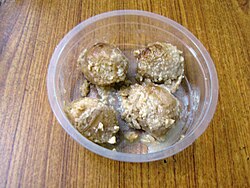 Kolkata's Baked rosogolla – a Bengali variation
 -
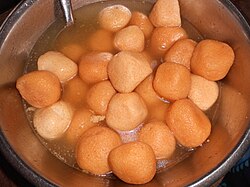 Colored Rasagola from Kalahandi, Odisha


Nutrition
Typically, a 100-gram serving of rasgulla contains 186 calories, out of which about 153 calories come from carbohydrates. It also contains about 1.85 grams of fat and 4 grams of protein.[58]
Geographical indication (GI) tag
In 2015, West Bengal applied for a geographical indication (GI) status for "Banglar Rasogolla" (Bengali Rasgulla). The Government clarified that there was no conflict with Odisha, and its application was only for a specific variant that was different "in colour, texture, taste, juice content and method of manufacturing" from the variant produced in Odisha.[59] On 14 November 2017, the GI Registry of India granted West Bengal the GI status for Banglar Rasogolla.[5][60][61]
The GI Registrar office at Chennai later specifically clarified that West Bengal was given GI status only for the Bengali version of rasgulla ("Banglar Rasogolla"), not for the sweet's origin. The office also said that Odisha had not by then applied for a GI tag, but could also get Odisha Rasgulla's GI tag by presenting the necessary evidence.[5]
In 2018, Odisha applied for GI status in the Chennai GI Registry.[62] On 29 July 2019, the GI Registry of India granted Odisha the GI status for "Odisha Rasagola", the Odia version of Rasgulla.[7][8]
See also
- Bangladeshi cuisine
- Bengali cuisine
- Dharwad pedha
- List of Indian sweets and desserts
- Litti
- Mysore pak
- Odia cuisine
- West Bengal cuisine
Notes
- ↑ Also known as rasagola, rosogola, or rosogolla.
References
- ↑ Subodhchandra Sengupta (1960). Samsad Bangla Charitabhidhan.
- ↑ Ghosh, Bishwanath (15 November 2014). "Kolkata Chromosome: Like KC for 'rossogolla'". mint. Retrieved 24 August 2021.
- ↑ "Panel seal on rasgulla's Odisha origin". Archived from the original on 15 July 2016. Retrieved 2 October 2016.
- ↑ Sarat Chandra Mahapatra (1994). Car Festival of Lord Jagannath, Puri. Puri: Sri Jagannath Research Centre. p. 149. OCLC 967072714.
- ↑ 5.0 5.1 5.2 "Sweet War: This GI tag is for Banglar Rosogolla, it is not about the origin". The New Indian Express. 14 November 2017.
- ↑ "GI Certificate by Govt of India" (PDF).
- ↑ 7.0 7.1 "Sweet success: Odisha's Rasagola gets GI tag". The Indian Express. 29 July 2019. Retrieved 29 July 2019.
- ↑ 8.0 8.1 "Battle Over Origin of 'Rasgulla' Continues, After Odisha Files Petition Demanding Change of GI Tag". News18. Retrieved 29 July 2019.
- ↑ "Odisha Finally Gets Geographical Indication Tag For 'Odishara Rasagola'". Outlook. Retrieved 29 July 2019.
- ↑ "rasgulla", Wiktionary, the free dictionary, 16 December 2025, retrieved 7 March 2026
- ↑ "রসগোল্লা", Wiktionary, the free dictionary, 21 October 2025, retrieved 7 March 2026
- ↑ "रसगुल्ला", Wiktionary, the free dictionary, 1 November 2025, retrieved 7 March 2026
- ↑ Deepika Sahu (2 July 2012). "Discover Odisha's 'sweet' magic". The Times of India.
- ↑ "Rasagola originated in Odisha- Did you know?". Zee News. 30 July 2015.
- ↑ Sonali Pattnaik (18 July 2013). "How to make...Rasagolla". The Hindu.
- ↑ 16.0 16.1 Alan Davidson (21 September 2006). The Oxford Companion to Food. OUP Oxford. p. 1880. ISBN 978-0-19-101825-1.
- ↑ "The rasogolla's journey, from Nadia to Odisha and Kolkata". The Times of India. 15 November 2017. ISSN 0971-8257. Retrieved 9 August 2024.
- ↑ Subodh Chandra, Sengupta, ed. (1976). Samsad Bangla Charitabhidhan (1st ed.). Kolkata: Sahitya Samsad. p. 240. Retrieved 23 February 2018.
- ↑ Ghosh, Bishwanath (15 November 2014). "Kolkata Chromosome: Like KC for 'rossogolla'". mint. Retrieved 29 September 2020.
- ↑ 20.0 20.1 Ishita Dey (2015). Michael Krondl; et al. (eds.). The Oxford Companion to Sugar and Sweets. Oxford University Press. pp. 580–581. ISBN 978-0-19-931361-7.
- ↑ বিশ্বের 'সবথেকে বড়' রসগোল্লার আত্মপ্রকাশ, ফুলিয়ায় মিষ্টিযজ্ঞ. Sangbad Pratidin (in Bengali). Retrieved 1 May 2025.
- ↑ "The sweet legacy of Durga Puja". The Times of India. 29 September 2014.
- ↑ 23.0 23.1 Michael Krondl (2011). Sweet Invention: A History of Dessert. Chicago Review Press. pp. 55–59. ISBN 978-1-55652-954-2.
- ↑ "How the rasogolla became a global name!". Rediff.com. 16 November 2011.
- ↑ Piyasree Dasgupta (29 October 2011). "Sticky Sweet Success". The Indian Express.
- ↑ Bishwanath Ghosh (29 October 2014). Longing, Belonging: An Outsider At Home In Calcutta. Westland. p. 177. ISBN 978-93-84030-60-5.
- ↑ Ram Kumar Ramaswamy (16 June 2012). "Isro astronauts to savour idlis, rasgullas in space". Asian Age. Archived from the original on 14 May 2014. Retrieved 20 March 2014.
- ↑ 28.0 28.1 28.2 28.3 Mohapatra Bhattacharya; Debabrata Kajari (31 July 2015). "Citing Rath ritual, Odisha lays claim to rasagulla, WB historians don't agree". The Times of India. Retrieved 1 August 2015.
- ↑ Ramani Ranjan Mohapatra (30 July 2015). "#RasagolaDibasa trends as Odias reclaim iconic dish". Hindustan Times.
- ↑ 30.0 30.1 Jhimli Mukherjee Pandey (10 August 2015). "Maharashtra (West Bengal) takes up rosogolla battle with Odisha". The Times of India.
- ↑ Sumit Behera (16 October 2015). "Sweet Struggle - Origin of Rasgulla". rissadiary.com. Archived from the original on 18 August 2016.
- ↑ "West Bengal and Odisha Battle Over the Invention of 'Rasgulla'". NDTV. 26 August 2015.
- ↑ 33.0 33.1 Mitra Bishwabijoy (6 July 2015). "Who invented the rasgulla?". The Times of India. Retrieved 2 August 2015.
- ↑ "Trinity take 'adhar pana' on raths". The New Indian Express. 5 July 2009. Archived from the original on 12 May 2014.
- ↑ Subhashish Mohanty (3 July 2012). "Lord placates wife with sweet delight". Archived from the original on 14 March 2014.
- ↑ "Sweet and sermon return for deities". The Telegraph. Calcutta. 26 July 2010. Archived from the original on 25 October 2012.
- ↑ Jagabandhu Padhi (2000). Sri Jagannatha at Puri. S.G.N. Publications.
- ↑ Sarat Chandra Mahapatra (1994). Car Festival of Lord Jagannath, Puri. Puri: Sri Jagannath Research Centre. p. 55. OCLC 967072714.
- ↑ Debabrata Mohapatra (29 July 2007). "Researchers Claim Rasgullas Were Born In Puri". The Times of India.
- ↑ Madhulika Dash (11 September 2014). "The Food Story: How India's favourite sweet dish rosugulla was born". The Indian Express.
- ↑ "Hopes for Rasagola Origin in Odisha Revived". The Pioneer. 15 July 2016. Retrieved 20 July 2016.
- ↑ "Odisha celebrates GI Tag, distributes 50,000 Rasagolas in Bhubaneswar". Hindustan Times. 19 August 2019.
- ↑ "The unkindest cut: 'Rasagolas' are not Bengali after all". Firstpost. 3 August 2015. Retrieved 12 July 2022.
- ↑ "New evidence on rasagola's Odisha origin found | Sambad English". 18 May 2016.
- ↑ "Rasagola | PDF".
- ↑ Ramayana, Jagamohan. Ramayana. Ajodhya Kanda: Balaram Das.
- ↑ Typical selections from Oriya Literature. Ramayana. B.C. Mazumdar. p. 84.
- ↑ G. C. Praharaj (1931–1940). Purnnacandra Odia Bhashakosha. Cuttack: Utkal Sahitya Press. p. 2594. Archived from the original on 27 October 2020. Retrieved 20 July 2016.
- ↑ Michael Krondl (Summer 2010). "The Sweetshops of Kolkata". Gastronomica. 10 (3): 58–65. doi:10.1525/gfc.2010.10.3.58. JSTOR 10.1525/gfc.2010.10.3.58.
- ↑ Shoaib Daniyal (4 August 2015). "Who Deserves Credit For The Rasgulla? Bengalis, Odiyas...Or The Portuguese?". Kashmir Observer. Archived from the original on 9 October 2015.
- ↑ "Odisha celebrates 'Rasagola Dibasa' with great fanfare". Odisha Sun Times. 31 July 2015. Archived from the original on 31 July 2015. Retrieved 2 August 2015.
- ↑ "All you need to know about the 'Rosogolla Festival'". The Times of India. Retrieved 24 August 2021.
- ↑ Sengar, Resham. "Now, West Bengal creates world's biggest 'Rasgulla' weighing 9 kg!". The Times of India. Retrieved 24 August 2021.
- ↑ Venkatesh, Shruti (24 November 2017). "Sweet Treat: West Bengal Makes World's Biggest Rasgulla to Celebrate GI Tag for 'Banglar Rosogolla'". India News, Breaking News | India.com. Retrieved 24 August 2021.
- ↑ Lois Sinaiko Webb (1 January 2000). Multicultural Cookbook of Life-cycle Celebrations. ABC-CLIO. pp. 309–. ISBN 978-1-57356-290-4.
- ↑ Tarla Dalal (17 November 2003). Desserts Under Ten Minutes. Sanjay & Co. pp. 69–. ISBN 978-81-86469-84-2.
- ↑ Tarla Dalal (2006). Low Calorie Sweets. Sanjay & Co. pp. 42–. ISBN 978-81-89491-34-5.
- ↑ Nutrition Information For Rasgulla. Livestrong.Com. Retrieved 6 December 2012.
- ↑ "Our Claim Only On A Variety Of Rasogolla, No Dispute With Odisha: West Bengal". NDTV. Press Trust Of India. 27 July 2016. Retrieved 24 August 2016.
- ↑ "Intellectual Property India". ipindiaservices.gov.in. Retrieved 15 November 2017.
- ↑ "Certificate of Registration of Geographical Indication under section 16 (1)-or of authorised user under section 17(3)(e)" (PDF). Intellectual Property India. 14 November 2017. Retrieved 15 November 2017.
- ↑ "Odisha Rasagola receives geographical indication tag; here's what it means". Business Today. Retrieved 29 July 2019.

| Regional cuisines |
| ||||||||||
|---|---|---|---|---|---|---|---|---|---|---|---|
| Ingredients / types of food | |||||||||||
| Preparation and cooking | |||||||||||
| Related cuisines | |||||||||||
| See also | |||||||||||


| North |
|    | ||||||||
|---|---|---|---|---|---|---|---|---|---|---|
| South |
| |||||||||
| West |
| |||||||||
| East |
| |||||||||
| Miscellaneous | ||||||||||
| Indian diaspora | ||||||||||
| Cuisine |  | ||||
|---|---|---|---|---|---|
| Dance |
| ||||
| Music |
| ||||
| Handlooms and handicrafts |
| ||||
| Observations and festivals | |||||
| Arts | |||||
| Other | |||||

.png)
- Pages using the JsonConfig extension
- Pages using multiple image with unknown parameters
- Pages with Bengali IPA
- Pages with Odia IPA
- Pages with Sanskrit IPA
- Bangladeshi cuisine
- Bangladeshi desserts
- Bengali cuisine
- Bengali desserts
- Cheese desserts
- Geographical indications in Odisha
- Geographical indications in West Bengal
- Indian cheese dishes
- Indian cuisine
- Indian desserts
- Indo-Caribbean cuisine
- Mauritian cuisine
- Nepalese cuisine
- Cuisine of Odisha
- Semolina desserts
- Sweets of West Bengal
- Vegetarian dishes of India
- West Bengal cuisine