


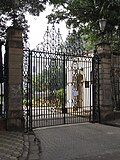

West Bengal Legislative Assembly | |
|---|---|
| 18th West Bengal Assembly | |
 | |
| Type | |
| Type | |
Term limits | 5 years |
| Leadership | |
TBD | |
TBD | |
Chief Minister (Leader of the House) | |
Deputy Leader of the House | TBD |
TBD | |
Deputy Leader of the Opposition | TBD |
| Structure | |
| Seats | 294 |
  | |
Political groups | Government (207)
Official Opposition (80)
Other Opposition (6) Vacant (1)
|
| Elections | |
| First past the post | |
Last election | 23–29 April 2026 |
Next election | 2031 |
| Meeting place | |
 | |
| Vidhan Sabha, Kolkata, West Bengal | |
| Website | |
| assembly | |
| Footnotes | |
| The Assembly was established in 1862 for the Bengal Presidency. The Presidency became the state of West Bengal in the Republic of India in 1950; the state of West Bengal in its current state was formed on 1 May 1960. | |
The West Bengal Legislative Assembly is the unicameral legislature of the Indian state of West Bengal. It is located in the B. B. D. Bagh area of Kolkata, the capital of the state. Members of the Legislative assembly are directly elected by the people. The legislative assembly comprises 294 Members of Legislative Assembly, all directly elected from single-seat constituencies. Its term is five years, unless sooner dissolved.
History[edit | edit source]


The history of the West Bengal Legislature can be traced back to 18 January 1862 when under the Indian Councils Act 1861, a 12 Member Legislative Council for Bengal Presidency was established by the Governor-General of British India with the Lt. Governor of Bengal and some nominated members. The strength of the council was gradually enlarged by subsequent acts. Under the Indian Councils Act 1892, the maximum strength of the council was raised to 20 out of which seven were to be elected. The Indian Councils Act 1909 further raised the number of members of the council to 50. Under the Government of India Act 1919, the number of members of the Legislative Council was once again raised to 125. The Bengal Legislative Council constituted under the Government of India Act 1919 was formally inaugurated on 1 February 1921 by the Duke of Connaught.
A few years later, under the provisions of the Government of India Act 1935, two chambers of the Bengal Provincial Legislature: the Legislative Council and the Legislative Assembly, were created. The life of the assembly, consisting of 250 members, was to be five years unless dissolved sooner; while the council, with a membership of not less than 63 and not more than 65, was made a permanent body and not subject to dissolution with the provision that one-third of the members should retire every three years.
On the eve of Independence in 1947, Bengal Province was partitioned into West Bengal and East Bengal (East Pakistan). The West Bengal Legislative Assembly was constituted with 90 members representing the constituencies that fell within the area of West Bengal and two nominated members from Anglo-Indian community. The Bengal Legislative Council stood abolished. The Legislative Assembly met for the first time after Independence on 21 November 1947.
The Constitution of India again provided for a bicameral Legislature for West Bengal. Accordingly, the West Bengal Legislative Council consisting of 51 members was constituted on 5 June 1952. The number of members in the Legislative Assembly was 240 including two nominated members from the Anglo-Indian Community. After the first General Elections, the new Assembly met for the first time on 18 June 1952.
On 21 March 1969, a resolution was passed by the West Bengal Legislative Assembly for the abolition of the Legislative Council. Subsequently, Indian Parliament passed the West Bengal Legislative Council (Abolition) Act, 1969 abolishing the Legislative Council with effect from 1 August 1969.
Office bearers[edit | edit source]
List of Assemblies[edit | edit source]
Members of Legislative Assembly[edit | edit source]
Vacancies[edit | edit source]
| Date for by-poll | Constituency | Previous MLA | Political Party | Vacant Since | Reason | Elected MLA | Political Party |
|---|---|---|---|---|---|---|---|
| Not declared | Nandigram | Suvendu Adhikari | Bharatiya Janata Party | 13 May 2026 | Resigned | TBA | TBA |
| Rejinagar | Humayun Kabir | AJUP |
Notes[edit | edit source]
See also[edit | edit source]
References[edit | edit source]
- ↑ "Outlook India Magazine Online- Read News India, Latest News Analysis, World, Sports, Entertainment | Best Online Magazine India". outlookindia.com. Archived from the original on 10 April 2022. Retrieved 10 April 2022.
- ↑ "Members of Parliament – Lok Sabha - Profile". Archived from the original on 14 July 2014. Retrieved 10 April 2022.
- ↑ 3.0 3.1 3.2 3.3 3.4 "- West Bengal Legislative Assembly". wbassembly.gov.in. Archived from the original on 20 January 2024. Retrieved 10 April 2022.
- ↑ "Former Leader of Opposition Atish Chanda Sinha dead". news.webindia123.com. Archived from the original on 31 May 2022. Retrieved 10 April 2022.
- ↑ "Former opposition leader and one of the founder of Trinamool Congress Pankaj Banerjee Passes Away. – News18 Bangla". News18 Bengali (in Bengali). 26 October 2018. Archived from the original on 31 May 2022. Retrieved 10 April 2022.
- ↑ "Team Mamata".
{{cite web}}: CS1 maint: deprecated archival service (link) - ↑ "Surjya Kanta Mishra: A profile". The Hindu. 3 April 2016. ISSN 0971-751X. Archived from the original on 10 April 2022. Retrieved 10 April 2022.
- ↑ "Congress Abdul Mannan to be new leader of opposition in Bengal assembly". The Times of India. Archived from the original on 16 August 2016. Retrieved 10 April 2022.
- ↑ "Suvendu Adhikari elected as Leader of Opposition in West Bengal Assembly". Financial Express. Retrieved 10 May 2021.
- West Bengal Lok Sabha Election Results Website Archived 8 November 2020 at the Wayback Machine

.png)