


m Removed empty portal template using script |
m formatting fix |
||
| (2 intermediate revisions by 2 users not shown) | |||
| Line 1: | Line 1: | ||
{{ | {{Short description|none}} <!-- "none" is preferred when the title is sufficiently descriptive; see [[WP:SDNONE]] --> | ||
{{About||the | {{About||the last general election|2024 Indian general election}} | ||
{{Politics of India}} | {{Politics of India}} | ||
{{Elections}} | |||
{{Use dmy dates|date=February 2022}} | {{Use dmy dates|date=February 2022}} | ||
{{ | [[India]] has a [[parliamentary system]] as defined by its [[Constitution of India|constitution]], with power distributed between the [[Government of India|union government]] and the [[States and territories of India|states]]. [[Democracy in India|India's democracy]] is the largest [[democracy]] in the world.<ref name=":0">{{Cite journal |last1=Richetta |first1=Cécile |last2=Harbers |first2=Imke |last3=van Wingerden |first3=Enrike |date=2023 |title=The subnational electoral coercion in India (SECI) data set, 1985–2015 |url=https://researchonline.lse.ac.uk/id/eprint/120358/ |journal=Electoral Studies |volume=85 |article-number=102662 |doi=10.1016/j.electstud.2023.102662 |issn=0261-3794|doi-access=free }}</ref> | ||
[[India]] | The [[President of India]] is the ceremonial head of state of the country and supreme commander-in-chief for all [[Indian Armed Forces|defense forces]] in India. However, it is the [[Prime Minister of India]], who is the leader of the [[political party|party]] or [[political alliance]] having a majority in the national elections to the [[Lok Sabha]] (Lower house of the [[Parliament of India|Parliament]]). The Prime Minister is the leader of the legislative branch of the [[Government of India]]. The Prime Minister is the head of the [[Union Council of Ministers]]. | ||
India is regionally divided into States (and [[Union territory|Union Territories]]) and each State has a [[Governor (India)|Governor]] who is the state's head, but the executive authority rests with the [[Chief Minister (India)|Chief Minister]], who is the leader of the party or political alliance that has won a majority in the regional elections, otherwise known as State Assembly Elections that exercises executive powers in that State. The respective State's Chief Minister has executive powers within the State and works jointly with the Prime Minister of India or their ministers on matters that require both State and Central attention. Some Union Territories also elect an Assembly and have a territorial government, and other (mainly smaller) Union Territories are governed by an administrator/[[Governor (India)|lieutenant governor]] appointed by the President of India. | |||
The President of India monitors the rule of law through their appointed governors in each State and on their recommendation, can take over the executive powers from the Chief Minister of the State temporarily when the elected representatives of the State government have failed to create a peaceful environment and it has deteriorated into chaos. The President of India dissolves the existing State government if necessary, and a new election is conducted. | |||
India | The Republic of India has instituted [[universal suffrage]] since independence from the [[British Raj]], with the adoption of the [[Constitution of India]] in 1949.<ref>{{cite web |title=Lok Sabha polls 2024: What is universal adult franchise? |url=https://www.deccanherald.com/elections/india/lok-sabha-polls-2024-what-is-universal-adult-franchise-2-2956461 |website=Deccan Herald |language=en}}</ref><ref>{{cite web |title=Did the British Empire resist women's suffrage in India? |url=https://www.bbc.co.uk/news/world-asia-india-43081429 |website=BBC News |date=22 February 2018}}</ref><ref>{{cite web |last1=Bhatia |first1=Gautam |title=The 1947 singularity: on India's adoption of universal suffrage |url=https://www.thehindu.com/opinion/lead/the-1947-singularity/article22870618.ece |website=The Hindu |language=en-IN |date=27 February 2018}}</ref> | ||
==Results in history== | |||
== | ===1951–52 Indian general election=== | ||
{{Election results | |||
|image=[[File:1951-1952_Indian_General_Election.svg|300px]] | |||
|party1=Indian National Congress|votes1=47665951|seats1=364 | |||
|party2=Socialist Party (India)|Socialist Party|votes2=11216719|seats2=12 | |||
|party3=Kisan Mazdoor Praja Party|votes3=6135978|seats3=9 | |||
|party4=Communist Party of India|votes4=3487401|seats4=16 | |||
|party5=Bharatiya Jana Sangh|votes5=3246361|seats5=3 | |||
|party6=Scheduled Castes Federation|votes6=2521695|seats6=2 | |||
|party7=Akhil Bharatiya Ram Rajya Parishad|votes7=2091898|seats7=3 | |||
|party8=Krishikar Lok Party|votes8=1489615|seats8=1 | |||
|party9=People's Democratic Front (Hyderabad)|votes9=1367404|seats9=7 | |||
|party10=Shiromani Akali Dal|votes10=1047611|seats10=4 | |||
|party11=Hindu Mahasabha|votes11=1003034|seats11=4 | |||
|party12=Peasants and Workers Party of India|votes12=992187|seats12=2 | |||
|party13=All India Forward Bloc|votes13=963058|seats13=1 | |||
|party14=All India Ganatantra Parishad|votes14=959749|seats14=6 | |||
|party15=Tamil Nadu Toilers' Party|votes15=889292|seats15=4 | |||
|party16=Jharkhand Party|votes16=749702|seats16=3 | |||
|party17=Revolutionary Socialist Party (India)|votes17=468108|seats17=3 | |||
|party18=Commonweal Party|votes18=325398|seats18=3 | |||
|party19=Lok Sewak Sangh|votes19=309940|seats19=2 | |||
|party20=Zamindar Party|votes20=291300|seats20=0 | |||
|party21=Chota Nagpur Santhal Parganas Janata Party|votes21=236094|seats21=1 | |||
|party22=Uttar Pradesh Praja Party|votes22=213656|seats22=0 | |||
|party23=S.K. Paksha|votes23=137343|seats23=0 | |||
|party24=All India Forward Bloc (Ruikar)|votes24=133936|seats24=0 | |||
|party25=Kamgar Kisan Paksha|votes25=132574|seats25=0 | |||
|party26=Tribal Sangha|votes26=116629|seats26=0 | |||
|party27=Travancore Tamil Nadu Congress|votes27=115893|seats27=1 | |||
|party28=Kerala Socialist Party|votes28=102098|seats28=0 | |||
|party29=Indian Union Muslim League|votes29=79470|seats29=1 | |||
|party30=Revolutionary Communist Party of India|votes30=67275|seats30=0 | |||
|party31=Justice Party (India)|votes31=63254|seats31=0 | |||
|party32=All India United Kisan Sabha|votes32=60254|seats32=0 | |||
|party35=All People's Party (Assam)|votes35=36851|seats35=0 | |||
|party36=Tamil Nadu Congress Party|votes36=36158|seats36=0 | |||
|party37=Khasi-Jaintia Durbar|votes37=32987|seats37=0 | |||
|party38=Saurashtra Khedut Sangh|votes38=29766|seats38=0 | |||
|party39=Bolshevik Party of India|votes39=25792|seats39=0 | |||
|party40=All Manipur National Union|votes40=22083|seats40=0 | |||
|party41=Uttar Pradesh Revolutionary Socialist Party|votes41=20665|seats41=0 | |||
|party42=Hill People Party|votes42=17350|seats42=0 | |||
|party43=Krishak Sramik Party|Praja Party|votes43=16955|seats43=0 | |||
|party44=Kuki National Association|votes44=12155|seats44=0 | |||
|party45=Punjab Depressed Class League|votes45=11789|seats45=0 | |||
|party46=Pursharathi Panchayat|votes46=10778|seats46=0 | |||
|party47=Cochin Party|votes47=8947|seats47=0 | |||
|party48=Kisan Mazdoor Mandal|votes48=8808|seats48=0 | |||
|party49=Hyderabad State Praja Party|votes49=7646|seats49=0 | |||
|party50=Gandhi Sebak Seva|votes50=7196|seats50=0 | |||
|party51=Kisan Janta Sanyukta Party|votes51=6390|seats51=0 | |||
|party52=National Party of India|votes52=3232|seats52=0 | |||
|party53=Historical Research|votes53=1468|seats53=0 | |||
|party54=Independents|votes54=16850089|seats54=37 | |||
|row55=Appointed members|votes55=0|seats55=10 | |||
}} | |||
==Latest election== | |||
All election-related disputes are handled by the Election Commission. The Supreme Court of India has held that where the enacted laws are silent or make insufficient provisions to deal with a given situation in the conduct of elections, the Election Commission has the residuary powers under the Constitution to act as appropriate.The first election Commissioner was [[Sukumar Sen (civil servant)|Sukumar Sen]]. | Full entry [[2024 Indian general election]] | ||
{{Election results | |||
|image=[[File:India 18th Lok Sabha November 2024.svg]] | |||
|alliance1=[[National Democratic Alliance]]|aspan1=27 | |||
|party1=[[Bharatiya Janata Party]]|votes1=235974144|seats1=240 | |||
|party2=[[Telugu Desam Party]]|votes2=12775270|seats2=16 | |||
|party3=[[Janata Dal (United)]]|votes3=8039663|seats3=12 | |||
|party4=[[Shiv Sena (2022–present)|Shiv Sena]]|votes4=7401447|seats4=7 | |||
|party5=[[Lok Janshakti Party (Ram Vilas)]]|votes5=2810250|seats5=5 | |||
|party6=[[Janata Dal (Secular)]]|votes6=2173701|seats6=2 | |||
|party7=[[Jana Sena Party]]|votes7=1454138|seats7=2 | |||
|party8=[[Rashtriya Lok Dal]]|votes8=893460|seats8=2 | |||
|party9=[[All Jharkhand Students Union]]|votes9= 458677|seats9=1 | |||
|party10=[[Nationalist Congress Party]]|votes10=2059179|seats10=1 | |||
|party11=[[United People's Party Liberal]] (no longer part of the [[National Democratic Alliance]])|votes11=488995|seats11=1 | |||
|party12=[[Sikkim Krantikari Morcha]]|votes12=164396|seats12=1 | |||
|party13=[[Apna Dal (Soneylal)]]|votes13=808245|seats13=1 | |||
|party14=[[Asom Gana Parishad]]|votes14=1298707|seats14=1 | |||
|party15=[[Hindustani Awam Morcha]]|votes15=494960|seats15=1 | |||
|party16=[[Pattali Makkal Katchi]]|votes16=1879689|seats16=0 | |||
|party17=[[Bharath Dharma Jana Sena]]|votes17=505753|seats17=0 | |||
|party18=[[Tamil Maanila Congress]]|votes18=410401|seats18=0 | |||
|party19=[[Amma Makkal Munnettra Kazhagam]]|votes19=521787|seats19=0 | |||
|party20=[[National People's Party (India)|National People's Party]]|votes20=417930|seats20=0 | |||
|party21=[[Naga People's Front]]|votes21=299536|seats21=0 | |||
|party22=[[Nationalist Democratic Progressive Party]]|votes22=350967|seats22=0 | |||
|party23=[[Rashtriya Lok Morcha]]|votes23=253876|seats23=0 | |||
|party24=[[Rashtriya Samaj Paksha]]|votes24=467282|seats24=0 | |||
|party25=[[Suheldev Bharatiya Samaj Party]]|votes25=340188|seats25=0 | |||
|party26=[[Independent (politician)|Independent]]|votes26=342882|seats26=0 | |||
|atotalnv27=y|avotes27=283085523|aseats27=293 | |||
|alliance28=[[Indian National Developmental Inclusive Alliance]]|aspan28=26 | |||
|party28=[[Indian National Congress]]|votes28=136759064|seats28=99 | |||
|party29=[[Samajwadi Party]]|votes29=29549381|seats29=37 | |||
|party30=[[All India Trinamool Congress]]|votes30=28213393|seats30=29 | |||
|party31=[[Dravida Munnetra Kazhagam]]|votes31=11754710|seats31=22 | |||
|party32=[[Communist Party of India (Marxist)]]|votes32=11342553|seats32=4 | |||
|party33=[[Rashtriya Janata Dal]]|votes33=10107402|seats33=4 | |||
|party34=[[Shiv Sena (Uddhav Balasaheb Thackeray)]]|votes34=9567779|seats34=9 | |||
|party35=[[Aam Aadmi Party]] (no longer part of the [[Indian National Developmental Inclusive Alliance]])|votes35=7147800|seats35=3 | |||
|party36=[[Nationalist Congress Party - Sharadchandra Pawar]]|votes36=5921162|seats36=8 | |||
|party37=[[Communist Party of India]]|votes37=3157184|seats37=2 | |||
|party38=[[Jharkhand Mukti Morcha]]|votes38=2652955|seats38=3 | |||
|party39=[[Communist Party of India (Marxist–Leninist) Liberation]]|votes39=1736771|seats39=2 | |||
|party40=[[Indian Union Muslim League]]|votes40=1716186|seats40=3 | |||
|party41=[[Jammu and Kashmir National Conference]]|votes41=1147041|seats41=2| | |||
|party42=[[Viduthalai Chiruthaigal Katchi]]|votes42=990237|seats42=2 | |||
|party43=[[Bharat Adivasi Party]]|votes43=1257056|seats43=1 | |||
|party44=[[Kerala Congress]]|votes44=364631|seats44=1 | |||
|party45=[[Marumalarchi Dravida Munnetra Kazhagam]]|votes45=542213|seats45=1| | |||
|party46=[[Rashtriya Loktantrik Party]]|votes46=596955|seats46=1 | |||
|party47=[[Revolutionary Socialist Party (India)|Revolutionary Socialist Party]]|votes47=587363|seats47=1 | |||
|party48=[[All India Forward Bloc]]|votes48=289941|seats48=0 | |||
|party49=[[Jammu and Kashmir Peoples Democratic Party]]|votes49=435980|seats49=0 | |||
|party50=[[Vikassheel Insaan Party]]|votes50=1187455|seats50=0 | |||
|party51=[[Assam Jatiya Parishad]]|votes51=414441|seats51=0 | |||
|party52=[[Kerala Congress (Mani)]]|votes52=277365|seats52=0 | |||
|atotalnv54=y|avotes54=275120890|aseats54=234 | |||
|alliance55=[[YSR Congress Party]]|votes55=13316039|seats55=4 | |||
|alliance56=[[Shiromani Akali Dal]]|votes56=1814318|seats56=1 | |||
|alliance57=[[All India Majlis-e-Ittehadul Muslimeen]]|votes57=1400215|seats57=1 | |||
|alliance58=[[Zoram People's Movement]]|votes58=208552|seats58=1 | |||
|alliance59=[[Azad Samaj Party (Kanshi Ram)]]|votes59=691820|seats59=1 | |||
|alliance60=[[Voice of the People Party (Meghalaya)]] (MP died in office) |votes60=571078|seats60=1 | |||
|alliance61=[[All India Anna Dravida Munnetra Kazhagam]]|votes61=8952587|seats61=0 | |||
|alliance62=[[Bahujan Samaj Party]]|votes62=13153818|seats62=0 | |||
|alliance63=[[Karnataka Rashtra Samithi]]|votes63=51529|seats63=0 | |||
|alliance64=[[Biju Janata Dal]]|votes64=9413379|seats64=0 | |||
|alliance65=[[Uttama Prajaakeeya Party]]|votes65=40491|seats65=0 | |||
|alliance66=[[Bharat Rashtra Samithi]]|votes66=3657237|seats66=0 | |||
|alliance67=[[Shiromani Akali Dal (Amritsar)]]|votes67=521749|seats67=0 | |||
|alliance68=[[Indian National Lok Dal]]|votes68=226975|seats68=0 | |||
|alliance69=[[Jannayak Janta Party]]|votes69=113827|seats69=0 | |||
|alliance70=[[Desiya Murpokku Dravida Kazhagam]]|votes70=1128616|seats70=0 | |||
|alliance71=[[Gondwana Ganatantra Party]]|votes71=0|seats71=0 | |||
|alliance72=[[All India United Democratic Front]]|votes72=625954|seats72=0 | |||
|alliance73=[[Revolutionary Goans Party]]|votes73=64578|seats73=0 | |||
|alliance74=[[Sikkim Democratic Front]]|votes74=77171|seats74=0 | |||
|alliance75=[[Bodoland People's Front]]|votes75=777570|seats75=0 | |||
|alliance76=[[Mizo National Front]]|votes76=140264|seats76=0 | |||
|alliance77=[[United Democratic Party (Meghalaya)]]|votes77=44563|seats77=0 | |||
|alliance78=[[Jammu and Kashmir National Panthers Party]]|votes78=23268|seats78=0 | |||
|alliance79=Other|votes79=0|seats79=0| | |||
|alliance80=[[Independent (politician)|Independents]]|votes80=0|seats=7 | |||
|row81=[[None of the above (India)]]|votes81=6372220|seats81=0 | |||
}} | |||
== Election Commission of India == | |||
The [[Election Commission of India]] (ECI) is an autonomous authority of India that is enacted under the provisions of the [[Constitution of India|Constitution]], responsible for monitoring and administering [[Government of India|Union]] and [[State governments of India|State]] election processes in India. This body is responsible for ensuring elections are free and fair, without any bias. It derived its powers from A 324 of the constitution <ref>{{cite web |url=http://www.eci.gov.in/about-eci/the_setup.aspx |title=A Constitutional Body |publisher=Election Commission of India }}{{dead link|date=September 2017 |bot=InternetArchiveBot |fix-attempted=yes }}</ref> | |||
The ECI, established as a permanent Constitutional Body, is entrusted by the Constitution with the superintendence, direction, and control of the entire electoral process for [[Parliament of India|Parliament]], [[State legislature (India)|State Legislatures]], and the offices of the [[President of India|President]] and [[Vice President of India]]. | |||
Elections ensure the conduct of members pre-elections, during elections, and post-elections is as per the statutory legislation. | |||
All election-related disputes are handled by the Election Commission. The Supreme Court of India has held that where the enacted laws are silent or make insufficient provisions to deal with a given situation in the conduct of elections, the Election Commission has the residuary powers under the Constitution to act as appropriate. The first [[Chief Election Commissioner of India|chief election Commissioner]] was [[Sukumar Sen (civil servant)|Sukumar Sen]]. | |||
The elections for the [[President of India|President]] and [[Vice President of India]], the [[Rajya Sabha]] (''council of states'') and [[Lok Sabha]] (''house of the people''), [[State legislative assemblies of India|State Legislative Assemblies]] (including Union territories of [[Jammu and Kashmir (union territory)|Jammu and Kashmir]], [[Delhi]] and [[Puducherry (union territory)|Puducherry]]), and [[State legislative councils of India|State Legislative Councils]] are conducted by the [[Election Commission of India]]. | |||
== State Election Commissions == | |||
The [[State election commission (India)|State Election Commission]] (SEC) is an autonomous constitutional authority responsible for administering elections to the 3rd tier of governance, i.e., the Local Government, which includes the [[Panchayati raj in India|Panchayati Raj Institutions]] and the [[Municipal governance in India|Urban Local Bodies]]. As per the constitutional provision, superintendence, direction, and control of the conduct of Elections to Urban & Rural Local bodies vest in State Election Commission. | |||
State Election Commission consists of a State Election Commissioner, who is appointed by the [[Governor (India)|Governor]] for a fixed tenure of 5 years and cannot be removed from his office except in like manner and on the like grounds as a Judge of a High Court. | |||
The elections to local self-government institutions, such as [[Panchayati raj in India|panchayats]] and [[Municipal governance in India|municipalities]], are conducted by the respective [[State election commission (India)|State Election Commissions]] (SECs).<ref>{{Cite web |title=Role of SEC- State Election Commission, Maharashtra |url=https://mahasec.maharashtra.gov.in/Site/1376/Role-of-SEC?format=print |access-date=2024-04-10 |website=mahasec.maharashtra.gov.in}}</ref> | |||
=== List of State Election Commissions === | |||
* [[Andhra Pradesh State Election Commission]] | |||
* [[Arunachal Pradesh State Election Commission]] | |||
* [[Assam State Election Commission]] | |||
* [[Bihar State Election Commission]] | |||
* [[Chhattisgarh State Election Commission]] | |||
* [[Delhi State Election Commission]] | |||
* [[Goa State Election Commission]] | |||
* [[Gujarat State Election Commission]] | |||
* [[Haryana State Election Commission]] | |||
* [[Himachal Pradesh State Election Commission]] | |||
* [[Jammu and Kashmir State Election Commission]] | |||
* [[Jharkhand State Election Commission]] | |||
* [[Karnataka State Election Commission]] | |||
* [[Kerala State Election Commission]] | |||
* [[Madhya Pradesh State Election Commission]] | |||
* [[Maharashtra State Election Commission]] | |||
* [[Manipur State Election Commission]] | |||
* [[Meghalaya State Election Commission]] | |||
* [[Mizoram State Election Commission]] | |||
* [[Nagaland State Election Commission]] | |||
* [[Odisha State Election Commission]] | |||
* [[Puducherry State Election Commission]] | |||
* [[Punjab State Election Commission]] | |||
* [[Rajasthan State Election Commission]] | |||
* [[Sikkim State Election Commission]] | |||
* [[Tamil Nadu State Election Commission]] | |||
* [[Telangana State Election Commission]] | |||
* [[Tripura State Election Commission]] | |||
* [[Uttar Pradesh State Election Commission]] | |||
* [[Uttarakhand State Election Commission]] | |||
* [[West Bengal State Election Commission]] | |||
==Types of elections== | ==Types of elections== | ||
Elections in the Republic of India include elections for | Elections in the Republic of India include elections for | ||
*[[President of India]], | *[[President of India]], | ||
*[[Vice President of India]], | *[[Vice President of India]], | ||
*Members of the Parliament in [[Rajya Sabha]] (Upper house) | *Members of the Parliament in [[Rajya Sabha]] (Upper house) | ||
*Members of [[State Legislative Council (India)|State Legislative Councils]] | *Members of the Parliament in [[Lok Sabha]] (Lower house), | ||
*Members of [[State Legislative Assembly (India)|State Legislative Assemblies]] ( | *Members of [[State Legislative Council (India)|State Legislative Councils]] (Upper house) | ||
*Members of [[State Legislative Assembly (India)|State Legislative Assemblies]] (Lower house/Unicameral house) | |||
*Members of [[Delhi Legislative Assembly|Legislative Assembly of National Capital Territory of Delhi]] | |||
*Members of [[Jammu and Kashmir Legislative Assembly|Legislative Assembly of Union Territory of Jammu and Kashmir]] | |||
*Members of [[Puducherry Legislative Assembly|Legislative Assembly of Union Territory of Puducherry]] | |||
*Members of [[Local government in India|local governance bodies]] ([[Municipal governance in India|Municipal bodies]] and [[Panchayati raj|Panchayats]]), | *Members of [[Local government in India|local governance bodies]] ([[Municipal governance in India|Municipal bodies]] and [[Panchayati raj|Panchayats]]), | ||
*By-election is held when a seat-holder of a particular | *A [[By-election]] is held when a seat-holder of a particular constituency dies, resigns, or is disqualified. | ||
Parliamentary general elections (Lok Sabha) | === Parliamentary general elections (Lok Sabha) === | ||
Members of Lok Sabha (House of the People) or the lower house of India's Parliament are elected by being voted upon by all adult citizens of India | Members of Lok Sabha (House of the People), or the lower house of India's Parliament, are elected by being voted upon by all adult citizens of India (who crossed 18 years of age) from a set of candidates who contest in their respective constituencies. Every adult citizen of India can vote only in their constituency. Candidates who win the Lok Sabha elections are called 'Members of Parliament' and hold their seats for five years or until the body is dissolved by the President on the advice of the council of ministers. The house meets in the Lok Sabha Chambers of the Sansad Bhavan in New Delhi, on matters relating to the creation of new laws and removing or improving the existing laws that affect all citizens of India. Elections take place once in 5 years to elect 543 members for the Lok Sabha (Lower house).<ref>{{cite web|url=https://eci.gov.in/elections/term-of-houses/|title=Terms of the Houses|publisher=Election Commission of India |access-date=19 February 2020}}</ref> | ||
<div class="overflowbugx" style="overflow-x:auto;"> | |||
{|class="wikitable" | {|class="wikitable" | ||
|+ style="text-align: left;" | General election results ''(Lok Sabha)'' | |||
|- | |- | ||
|[[File:Indian General Election 1951–1952.svg|thumb|[[1st Lok Sabha]] [[1951–52 Indian general election|(1951–52)]]]] | |||
|[[File:Indian General Election 1957.svg|thumb|[[2nd Lok Sabha]][[1957 Indian general election|(1957)]]]] | |||
|[[File: | | | ||
|[[File: | |[[File:Indian General Election 1967.svg|thumb|[[4th Lok Sabha]][[1967 Indian general election|(1967)]]]] | ||
| | |[[File:Indian General Election 1971.svg|thumb|[[5th Lok Sabha]][[1971 Indian general election|(1971)]]]] | ||
|[[File: | |[[File:Indian General Election 1977.svg|thumb|[[6th Lok Sabha]][[1977 Indian general election|(1977)]]]] | ||
|[[File: | |[[File:Indian General Election 1980.svg|thumb|[[7th Lok Sabha]][[1980 Indian general election|(1980)]]]] | ||
|[[File: | |[[File:Indian General Election 1984.svg|thumb|[[8th Lok Sabha]][[1984 Indian general election|(1984)]]]] | ||
|[[File: | |[[File:Indian General Election 1989.svg|thumb|[[9th Lok Sabha]][[1989 Indian general election|(1989)]]]] | ||
|[[File: | |[[File:Indian General Election 1991.svg|thumb|[[10th Lok Sabha]][[1991 Indian general election|(1991)]]]] | ||
|[[File: | |[[File:Indian General Election 1996.svg|thumb|[[11th Lok Sabha]][[1996 Indian general election|(1996)]]]] | ||
|[[File: | |[[File:Indian General Election 1998.svg|thumb|[[12th Lok Sabha]][[1998 Indian general election|(1998)]]]] | ||
|[[File: | |[[File:Indian General Election 1999.svg|thumb|[[13th Lok Sabha]][[1999 Indian general election|(1999)]]]] | ||
|[[File: | |[[File:Indian General Election 2004.svg|thumb|[[14th Lok Sabha]][[2004 Indian general election|(2004)]]]] | ||
|[[File: | |[[File:Indian General Election 2009.svg|thumb|[[15th Lok Sabha]][[2009 Indian general election|(2009)]]]] | ||
|[[File: | |[[File:Indian General Election 2014.svg|thumb|[[16th Lok Sabha]][[2014 Indian general election|(2014)]]]] | ||
|[[File: | |[[File:Indian General Election 2019.svg|thumb|[[17th Lok Sabha]] ([[2019 Indian general election|2019]])]] | ||
|[[File: | |[[File:Indian General Election 2024.svg|thumb|[[18th Lok Sabha]][[2024 Indian general election|(2024)]]]] | ||
|[[File:Indian General Election 2019.svg | |} | ||
</div> | |||
===History of Lok Sabha elections=== | ===History of Lok Sabha elections=== | ||
{|class="wikitable" style="text-align:center;" | {|class="wikitable" style="text-align:center;" | ||
|+[[Lok Sabha]] elections<ref name="LS_Results">{{cite web|url=https://old.eci.gov.in/files/category/99-general-election-archive-1951-2004/|title=Lok Sabha Election Results 1951-2004|publisher=[[Election Commission of India]]|access-date=5 April 2021}}</ref><ref>{{cite web|url=https://old.eci.gov.in/files/category/98-general-election-2009/|title=Lok Sabha Election Results 2009|publisher=[[Election Commission of India]]|access-date=5 April 2021}}</ref><ref>{{cite web|url=https://old.eci.gov.in/files/category/97-general-election-2014/|title=General Election 2014 |publisher=[[Election Commission of India]]|access-date=5 April 2021 |url-status=live |archive-url=https://web.archive.org/web/20210415030717/https://eci.gov.in/files/category/97-general-election-2014/ |archive-date=Apr 15, 2021 }}</ref><ref>{{cite web|url=https://old.eci.gov.in/files/category/1551-general-election-2019-including-vellore-pc/|title=General Election 2019 (Including Vellore PC) |publisher=[[Election Commission of India]]|access-date=5 April 2021 |url-status=live |archive-url=https://web.archive.org/web/20210724131155/https://eci.gov.in/files/category/1551-general-election-2019-including-vellore-pc/ |archive-date=Jul 24, 2021 }}</ref> | |||
|- | |- | ||
!rowspan=2|Lok Sabha<br/>{{small|(Election)}} | !rowspan=2|Lok Sabha<br/>{{small|(Election)}} | ||
| Line 101: | Line 311: | ||
|489 | |489 | ||
|[[Indian National Congress]] | |[[Indian National Congress]] | ||
|rowspan= | |rowspan=4 {{party color cell|Indian National Congress}} | ||
|364 | |364 | ||
|44.99% | |44.99% | ||
|[[Communist Party of India]] | |[[Communist Party of India]] | ||
|rowspan=3 | |rowspan=3 {{party color cell|Communist Party of India}} | ||
|16 | |16 | ||
|3.29% | |3.29% | ||
|[[Socialist Party (India)|Socialist Party]] | |[[Socialist Party (India, 1948)|Socialist Party]] | ||
| | |{{party color cell|Socialist Party (India)}} | ||
|12 | |12 | ||
|10.59% | |10.59% | ||
| Line 115: | Line 325: | ||
|[[2nd Lok Sabha|2nd]]<br/>{{small|([[1957 Indian general election|1957]])}} | |[[2nd Lok Sabha|2nd]]<br/>{{small|([[1957 Indian general election|1957]])}} | ||
|494 | |494 | ||
|[[Indian National Congress]] | |[[Indian National Congress]] | ||
|371 | |371 | ||
|47.78% | |47.78% | ||
| Line 122: | Line 332: | ||
|8.92% | |8.92% | ||
|[[Praja Socialist Party]] | |[[Praja Socialist Party]] | ||
| | |{{party color cell|Praja Socialist Party}} | ||
|19 | |19 | ||
|10.41% | |10.41% | ||
| Line 135: | Line 345: | ||
|9.94% | |9.94% | ||
|[[Swatantra Party]] | |[[Swatantra Party]] | ||
| | |{{party color cell|Swatantra Party}} | ||
|18 | |18 | ||
|7.89% | |7.89% | ||
| Line 145: | Line 355: | ||
|40.78% | |40.78% | ||
|[[Swatantra Party]] | |[[Swatantra Party]] | ||
| | |{{party color cell|Swatantra Party}} | ||
|44 | |44 | ||
|8.67% | |8.67% | ||
|[[Bharatiya Jana Sangh]] | |[[Bharatiya Jana Sangh]] | ||
| | |{{party color cell|Bharatiya Jana Sangh}} | ||
|35 | |35 | ||
|9.31% | |9.31% | ||
| Line 155: | Line 365: | ||
|[[5th Lok Sabha|5th]]<br/>{{small|([[1971 Indian general election|1971]])}} | |[[5th Lok Sabha|5th]]<br/>{{small|([[1971 Indian general election|1971]])}} | ||
|518 | |518 | ||
|[[Indian National Congress]] | |[[Indian National Congress (R)]] | ||
|{{party color cell|Indian National Congress (R)}} | |||
|352 | |352 | ||
|43.68% | |43.68% | ||
|[[Communist Party of India (Marxist)]] | |[[Communist Party of India (Marxist)]] | ||
| | |{{party color cell|Communist Party of India (Marxist)}} | ||
|25 | |25 | ||
|5.12% | |5.12% | ||
|[[Communist Party of India]] | |[[Communist Party of India]] | ||
| | |{{party color cell|Communist Party of India}} | ||
|23 | |23 | ||
|4.73% | |4.73% | ||
| Line 170: | Line 381: | ||
|542 | |542 | ||
|[[Janata Party]] | |[[Janata Party]] | ||
| | |{{party color cell|Janata Party}} | ||
|295 | |295 | ||
|41.32% | |41.32% | ||
|[[Indian National Congress]] | |[[Indian National Congress (R)]] | ||
| | |{{party color cell|Indian National Congress (R)}} | ||
|154 | |154 | ||
|34.52% | |34.52% | ||
|[[Communist Party of India (Marxist)]] | |[[Communist Party of India (Marxist)]] | ||
|rowspan=3 | |rowspan=3 {{party color cell|Communist Party of India (Marxist)}} | ||
|22 | |22 | ||
|4.29% | |4.29% | ||
| Line 185: | Line 396: | ||
|529 | |529 | ||
|[[Indian National Congress (Indira)]] | |[[Indian National Congress (Indira)]] | ||
| | |{{party color cell|Indian National Congress (Indira)}} | ||
|353 | |353 | ||
|42.69% | |42.69% | ||
|[[Janata Party (Secular)]] | |[[Janata Party (Secular)]] | ||
| | |{{party color cell|Janata Party (Secular)}} | ||
|41 | |41 | ||
|9.39% | |9.39% | ||
| Line 197: | Line 408: | ||
|- | |- | ||
|[[8th Lok Sabha|8th]]<br/>{{small|([[1984 Indian general election|1984]])}} | |[[8th Lok Sabha|8th]]<br/>{{small|([[1984 Indian general election|1984]])}} | ||
| | |541 | ||
|[[Indian National Congress]] | |[[Indian National Congress (Indira)]] | ||
|rowspan=3 | |rowspan=3 {{party color cell|Indian National Congress (Indira)}} | ||
|414 | |414 | ||
|48.12% | |48.12% | ||
|[[Telugu Desam Party]] | |[[Telugu Desam Party]] | ||
| | |{{party color cell|Telugu Desam Party}} | ||
|30 | |30 | ||
|4.06% | |4.06% | ||
| Line 212: | Line 423: | ||
|[[9th Lok Sabha|9th]]<br/>{{small|([[1989 Indian general election|1989]])}} | |[[9th Lok Sabha|9th]]<br/>{{small|([[1989 Indian general election|1989]])}} | ||
|529 | |529 | ||
|[[Indian National Congress]] | |[[Indian National Congress (Indira)]] | ||
|197 | |197 | ||
|39.53% | |39.53% | ||
|[[Janata Dal]] | |[[Janata Dal]] | ||
| | |{{party color cell|Janata Dal}} | ||
|143 | |143 | ||
|17.79% | |17.79% | ||
|[[Bharatiya Janata Party]] | |[[Bharatiya Janata Party]] | ||
| | |{{party color cell|Bharatiya Janata Party}} | ||
|85 | |85 | ||
|11.36% | |11.36% | ||
| Line 226: | Line 437: | ||
|[[10th Lok Sabha|10th]]<br/>{{small|([[1991 Indian general election|1991]])}} | |[[10th Lok Sabha|10th]]<br/>{{small|([[1991 Indian general election|1991]])}} | ||
|534 | |534 | ||
|[[Indian National Congress]] | |[[Indian National Congress (Indira)]] | ||
|244 | |244 | ||
|36.40% | |36.40% | ||
|[[Bharatiya Janata Party]] | |[[Bharatiya Janata Party]] | ||
| | |{{party color cell|Bharatiya Janata Party}} | ||
|120 | |120 | ||
|20.07% | |20.07% | ||
|[[Janata Dal]] | |[[Janata Dal]] | ||
|rowspan=2 | |rowspan=2 {{party color cell|Janata Dal}} | ||
|59 | |59 | ||
|11.73% | |11.73% | ||
| Line 241: | Line 452: | ||
|543 | |543 | ||
|[[Bharatiya Janata Party]] | |[[Bharatiya Janata Party]] | ||
|rowspan=3 | |rowspan=3 {{party color cell|Bharatiya Janata Party}} | ||
|161 | |161 | ||
|20.29% | |20.29% | ||
|[[Indian National Congress]] | |[[Indian National Congress (Indira)]] | ||
| | |{{party color cell|Indian National Congress (Indira)}} | ||
|140 | |140 | ||
|28.80% | |28.80% | ||
| Line 258: | Line 469: | ||
|25.59% | |25.59% | ||
|[[Indian National Congress]] | |[[Indian National Congress]] | ||
|rowspan=2 {{party color cell|Indian National Congress}} | |||
|141 | |141 | ||
|25.82% | |25.82% | ||
|[[Communist Party of India (Marxist)]] | |[[Communist Party of India (Marxist)]] | ||
|rowspan=3 | |rowspan=3 {{party color cell|Communist Party of India (Marxist)}} | ||
|32 | |32 | ||
|5.16% | |5.16% | ||
| Line 280: | Line 492: | ||
|543 | |543 | ||
|[[Indian National Congress]] | |[[Indian National Congress]] | ||
|rowspan=2 | |rowspan=2 {{party color cell|Indian National Congress}} | ||
|145 | |145 | ||
|26.53% | |26.53% | ||
|[[Bharatiya Janata Party]] | |[[Bharatiya Janata Party]] | ||
|rowspan=2 | |rowspan=2 {{party color cell|Bharatiya Janata Party}} | ||
|138 | |138 | ||
|22.16% | |22.16% | ||
| Line 300: | Line 512: | ||
|18.80% | |18.80% | ||
|[[Samajwadi Party]] | |[[Samajwadi Party]] | ||
| | |{{party color cell|Samajwadi Party}} | ||
|23 | |23 | ||
|3.23% | |3.23% | ||
| Line 307: | Line 519: | ||
|543 | |543 | ||
|[[Bharatiya Janata Party]] | |[[Bharatiya Janata Party]] | ||
|rowspan= | |rowspan=3 {{party color cell|Bharatiya Janata Party}} | ||
|282 | |282 | ||
|31.34% | |31.34% | ||
|[[Indian National Congress]] | |[[Indian National Congress]] | ||
|rowspan= | |rowspan=3 {{party color cell|Indian National Congress}} | ||
|44 | |44 | ||
|19.52% | |19.52% | ||
|[[All India Anna Dravida Munnetra Kazhagam]] | |[[All India Anna Dravida Munnetra Kazhagam]] | ||
| | |{{party color cell|All India Anna Dravida Munnetra Kazhagam}} | ||
|37 | |37 | ||
|3.31% | |3.31% | ||
| Line 328: | Line 540: | ||
|19.67% | |19.67% | ||
|[[Dravida Munnetra Kazhagam]] | |[[Dravida Munnetra Kazhagam]] | ||
| | |{{party color cell|Dravida Munnetra Kazhagam}} | ||
|24 | |24 | ||
|2.36% | |2.36% | ||
|- | |||
|[[18th Lok Sabha|18th]]<br/>{{small|([[2024 Indian general election|2024]])}} | |||
|543 | |||
|[[Bharatiya Janata Party]] | |||
|240 | |||
|36.56% | |||
|[[Indian National Congress]] | |||
|99 | |||
|21.19% | |||
|[[Samajwadi Party]] | |||
|{{party color cell|Samajwadi Party}} | |||
|37 | |||
|4.58% | |||
|} | |} | ||
=== State Assembly | === State Assembly elections === | ||
Members of [[State Legislative Assembly (India)|State Legislative Assembly]] | Members of the [[State Legislative Assembly (India)|State Legislative Assembly]] are elected directly by voting from a set of candidates who contest in their respective constituencies. Every adult citizen of India can vote only in their constituency. Candidates who win the [[State Legislative Assembly (India)|State Legislative Assemblies]] elections are called 'Members of Legislative Assembly' (MLA) and hold their seats for five years or until the body is dissolved by the Governor. The house meets in the respective state, on matters relating to the creation of new laws, removing, or improving the existing laws that affect all citizens living in that state. | ||
The total strength of each assembly depends on each State, mostly based on size and population. Similar to the Lok Sabha elections, the leader of the majority party/alliance takes oath as Chief Minister of the State. | The total strength of each assembly depends on each State, mostly based on size and population. Similar to the Lok Sabha elections, the leader of the majority party/alliance takes an oath as Chief Minister of the State. | ||
The Election Commission conducts the elections and provides voluntary facility to 80 | The Election Commission conducts the elections and provides a voluntary facility to 80-plus-year-old electors to vote through ballot papers at their homes depending upon polling booth accessibility. Elections are taken up enthusiastically by a major portion of the population, who turn out in high numbers. | ||
For example, An 83-year-old woman, Dolma, cast her vote at Chasak Bhatori polling station in Pangi area of Chamba district after covering 14 kilometers walking on a snowy road during 2022 assembly elections in Himachal Pradesh.<ref>{{cite web | url=https:// | For example, An 83-year-old woman, Dolma, cast her vote at the Chasak Bhatori polling station in the [[Pangi Valley|Pangi]] area of the [[Chamba district]] after covering 14 kilometers walking on a snowy road during the 2022 assembly elections in Himachal Pradesh.<ref>{{cite web | url=https://timesofindia.indiatimes.com/elections/assembly-elections/himachal-pradesh/news/assembly-elections-2022-66-voter-turnout-in-himachal-pradesh-worlds-highest-booth-sees-100-polling/articleshow/95476760.cms | title=Assembly elections 2022: 66% voter turnout in Himachal Pradesh, world's highest booth sees 100% polling | Himachal-Pradesh Election News |date=November 12, 2022 | website=[[The Times of India]] }}</ref> | ||
{| class="wikitable sortable mw-collapsible" | |||
|+ | Prior to the much awaited Lok Sabha elections in 2024, the state assembly elections in Chhattisgarh, Madhya Pradesh, Rajasthan, and Telangana are an important political event. November 7 and November 17 are the scheduled dates for Chhattisgarh's elections, while Madhya Pradesh, Rajasthan, and Telangana will hold their votes on November 17, November 23, and November 30, respectively. The political climate before the national elections is anticipated to be shaped by the outcomes of these elections, which are anticipated to be declared on December 3. Key political players in these states are diverse and competing for domination, such as the Indian National Congress (INC), the Bharatiya Janata Party (BJP), and other regional parties. These states differ in the quantity of assembly seats they have; Chhattisgarh has ninety <ref>{{Cite web |title= Assembly elections in 5 states explained in 4 charts|date=9 October 2023 |url=https://www.hindustantimes.com/india-news/four-pointers-explaining-the-upcoming-assembly-elections-101696838029260.html}}</ref> seats. | ||
! State/UT !! 1950s !! 1960s !! 1970s !! 1980s !! 1990s !! 2000s !! 2010s !! 2020s | {{sticky header}} | ||
{|class="wikitable sortable mw-collapsible sticky-header" style="text-align:center;" | |||
|+Legislative Assembly Elections | |||
!State/UT !! 1950s !! 1960s !! 1970s !! 1980s !! 1990s !! 2000s !! 2010s !! 2020s | |||
|- | |- | ||
![[Elections in Andhra Pradesh|AP]] | ![[Elections in Andhra Pradesh|AP]] | ||
| [[1955 Andhra Pradesh Legislative Assembly election|1955]] <br /> [[1957 Andhra Pradesh Legislative Assembly election|1957]] | | [[1955 Andhra Pradesh Legislative Assembly election|AS 1955]] <br /> [[1957 Andhra Pradesh Legislative Assembly election|1957]] | ||
| [[1962 Andhra Pradesh Legislative Assembly election|1962]] <br /> [[1967 Andhra Pradesh Legislative Assembly election|1967]] | | [[1962 Andhra Pradesh Legislative Assembly election|1962]] <br /> [[1967 Andhra Pradesh Legislative Assembly election|1967]] | ||
| [[1972 Andhra Pradesh Legislative Assembly election|1972]] <br /> [[1978 Andhra Pradesh Legislative Assembly election|1978]] | | [[1972 Andhra Pradesh Legislative Assembly election|1972]] <br /> [[1978 Andhra Pradesh Legislative Assembly election|1978]] | ||
| Line 355: | Line 583: | ||
|- | |- | ||
![[Elections in Arunachal Pradesh|AR]] | ![[Elections in Arunachal Pradesh|AR]] | ||
| | | colspan="2" |{{dash}} | ||
| | |||
| [[1978 Arunachal Pradesh Legislative Assembly election|1978]] | | [[1978 Arunachal Pradesh Legislative Assembly election|1978]] | ||
| [[1980 Arunachal Pradesh Legislative Assembly election|1980]] <br /> [[1984 Arunachal Pradesh Legislative Assembly election|1984]] | | [[1980 Arunachal Pradesh Legislative Assembly election|1980]] <br /> [[1984 Arunachal Pradesh Legislative Assembly election|1984]] | ||
| Line 373: | Line 600: | ||
| [[2011 Assam Legislative Assembly election|2011]] <br /> [[2016 Assam Legislative Assembly election|2016]] | | [[2011 Assam Legislative Assembly election|2011]] <br /> [[2016 Assam Legislative Assembly election|2016]] | ||
| [[2021 Assam Legislative Assembly election|2021]] | | [[2021 Assam Legislative Assembly election|2021]] | ||
[[2026 Assam Legislative Assembly election|2026]] | |||
|- | |- | ||
![[Elections in Bihar|BR]] | ![[Elections in Bihar|BR]] | ||
| Line 382: | Line 610: | ||
| [[2000 Bihar Legislative Assembly election|2000]] <br /> [[February 2005 Bihar Legislative Assembly election|2005 (Feb)]] <br /> [[October 2005 Bihar Legislative Assembly election|2005 (Oct)]] | | [[2000 Bihar Legislative Assembly election|2000]] <br /> [[February 2005 Bihar Legislative Assembly election|2005 (Feb)]] <br /> [[October 2005 Bihar Legislative Assembly election|2005 (Oct)]] | ||
| [[2010 Bihar Legislative Assembly election|2010]] <br /> [[2015 Bihar Legislative Assembly election|2015]] | | [[2010 Bihar Legislative Assembly election|2010]] <br /> [[2015 Bihar Legislative Assembly election|2015]] | ||
|[[2020 Bihar Legislative Assembly election|2020]] | |[[2020 Bihar Legislative Assembly election|2020]] <br /> [[2025 Bihar Legislative Assembly election|2025]] | ||
[[2025 Bihar Legislative Assembly election|2025]] | |||
|- | |- | ||
![[Elections in Chhattisgarh|CG]] | ![[Elections in Chhattisgarh|CG]] | ||
| colspan = 5|State didn't exist. Was part of MP. (Established in 2000) | | colspan="5" | State didn't exist. Was part of MP. (Established in 2000) | ||
| [[2003 Chhattisgarh Legislative Assembly election|2003]] <br /> [[2008 Chhattisgarh Legislative Assembly election|2008]] | |[[2003 Chhattisgarh Legislative Assembly election|2003]]<br/>[[2008 Chhattisgarh Legislative Assembly election|2008]] | ||
| [[2013 Chhattisgarh Legislative Assembly election|2013]] <br /> [[2018 Chhattisgarh Legislative Assembly election|2018]] | |[[2013 Chhattisgarh Legislative Assembly election|2013]]<br/>[[2018 Chhattisgarh Legislative Assembly election|2018]] | ||
|[[2023 Chhattisgarh Legislative Assembly election|2023]] | |[[2023 Chhattisgarh Legislative Assembly election|2023]] | ||
|- | |- | ||
| Line 399: | Line 626: | ||
| [[2003 Delhi Legislative Assembly election|2003]] <br /> [[2008 Delhi Legislative Assembly election|2008]] | | [[2003 Delhi Legislative Assembly election|2003]] <br /> [[2008 Delhi Legislative Assembly election|2008]] | ||
| [[2013 Delhi Legislative Assembly election|2013]] <br /> [[2015 Delhi Legislative Assembly election|2015]] | | [[2013 Delhi Legislative Assembly election|2013]] <br /> [[2015 Delhi Legislative Assembly election|2015]] | ||
| [[2020 Delhi Legislative Assembly election|2020]] | | [[2020 Delhi Legislative Assembly election|2020]] <br /> [[2025 Delhi Legislative Assembly election|2025]] | ||
[[2025 Delhi Legislative Assembly election|2025]] | |||
|- | |- | ||
![[Elections in Goa|GA]] | ![[Elections in Goa|GA]] | ||
| Line 450: | Line 676: | ||
| [[2002 Jammu and Kashmir Legislative Assembly election|2002]] <br /> [[2008 Jammu and Kashmir Legislative Assembly election|2008]] | | [[2002 Jammu and Kashmir Legislative Assembly election|2002]] <br /> [[2008 Jammu and Kashmir Legislative Assembly election|2008]] | ||
| [[2014 Jammu and Kashmir Legislative Assembly election|2014]] | | [[2014 Jammu and Kashmir Legislative Assembly election|2014]] | ||
| | | [[2024 Jammu and Kashmir Legislative Assembly election|2024]] | ||
|- | |- | ||
![[Elections in Jharkhand|JH]] | ![[Elections in Jharkhand|JH]] | ||
| Line 477: | Line 703: | ||
| [[2011 Kerala Legislative Assembly election|2011]] <br /> [[2016 Kerala Legislative Assembly election|2016]] | | [[2011 Kerala Legislative Assembly election|2011]] <br /> [[2016 Kerala Legislative Assembly election|2016]] | ||
| [[2021 Kerala Legislative Assembly election|2021]] | | [[2021 Kerala Legislative Assembly election|2021]] | ||
[[2026 Kerala Legislative Assembly election|2026]] | |||
|- | |- | ||
![[Elections in Madhya Pradesh|MP]] | ![[Elections in Madhya Pradesh|MP]] | ||
| Line 495: | Line 722: | ||
| [[1990 Maharashtra Legislative Assembly election|1990]] <br /> [[1995 Maharashtra Legislative Assembly election|1995]] <br /> [[1999 Maharashtra Legislative Assembly election|1999]] | | [[1990 Maharashtra Legislative Assembly election|1990]] <br /> [[1995 Maharashtra Legislative Assembly election|1995]] <br /> [[1999 Maharashtra Legislative Assembly election|1999]] | ||
| [[2004 Maharashtra Legislative Assembly election|2004]] <br /> [[2009 Maharashtra Legislative Assembly election|2009]] | | [[2004 Maharashtra Legislative Assembly election|2004]] <br /> [[2009 Maharashtra Legislative Assembly election|2009]] | ||
| [[2014 Maharashtra Legislative Assembly election|2014]] <br /> [[2019 Maharashtra Legislative Assembly election|2019]] | | [[2014 Maharashtra Legislative Assembly election|2014]] <br /> [[2019 Maharashtra Legislative Assembly election|2019]] | ||
|[[2024 Maharashtra Legislative Assembly election|2024]] | | [[2024 Maharashtra Legislative Assembly election|2024]] | ||
|- | |- | ||
![[Elections in Manipur|MN]] | ![[Elections in Manipur|MN]] | ||
| Line 516: | Line 743: | ||
| [[2003 Meghalaya Legislative Assembly election|2003]] <br /> [[2008 Meghalaya Legislative Assembly election|2008]] | | [[2003 Meghalaya Legislative Assembly election|2003]] <br /> [[2008 Meghalaya Legislative Assembly election|2008]] | ||
| [[2013 Meghalaya Legislative Assembly election|2013]] <br /> [[2018 Meghalaya Legislative Assembly election|2018]] | | [[2013 Meghalaya Legislative Assembly election|2013]] <br /> [[2018 Meghalaya Legislative Assembly election|2018]] | ||
|[[2023 Meghalaya Legislative Assembly election|2023]] | | [[2023 Meghalaya Legislative Assembly election|2023]] | ||
|- | |- | ||
![[Elections in Mizoram|MZ]] | ![[Elections in Mizoram|MZ]] | ||
| Line 538: | Line 765: | ||
|[[2023 Nagaland Legislative Assembly election|2023]] | |[[2023 Nagaland Legislative Assembly election|2023]] | ||
|- | |- | ||
![[Elections in Odisha| | ![[Elections in Odisha|OD]] | ||
| [[1952 Odisha Legislative Assembly election|1952]] <br /> [[1957 Odisha Legislative Assembly election|1957]] | | [[1952 Odisha Legislative Assembly election|1952]] <br /> [[1957 Odisha Legislative Assembly election|1957]] | ||
| [[1961 Odisha Legislative Assembly election|1961]] <br /> [[1967 Odisha Legislative Assembly election|1967]] | | [[1961 Odisha Legislative Assembly election|1961]] <br /> [[1967 Odisha Legislative Assembly election|1967]] | ||
| Line 559: | Line 786: | ||
|- | |- | ||
![[Elections in Puducherry|PY]] | ![[Elections in Puducherry|PY]] | ||
| {{dash}} | |{{dash}} | ||
| [[1964 Pondicherry Legislative Assembly election|1964]] <br /> [[1969 Pondicherry Legislative Assembly election|1969]] | |[[1964 Pondicherry Legislative Assembly election|1964]]<br/>[[1969 Pondicherry Legislative Assembly election|1969]] | ||
| [[1974 Pondicherry Legislative Assembly election|1974]] <br /> [[1977 Pondicherry Legislative Assembly election|1977]] | |[[1974 Pondicherry Legislative Assembly election|1974]]<br/>[[1977 Pondicherry Legislative Assembly election|1977]] | ||
| [[1980 Pondicherry Legislative Assembly election|1980]] <br /> [[1985 Pondicherry Legislative Assembly election|1985]] | |[[1980 Pondicherry Legislative Assembly election|1980]]<br/>[[1985 Pondicherry Legislative Assembly election|1985]] | ||
| [[1990 Pondicherry Legislative Assembly election|1990]] <br /> [[1991 Pondicherry Legislative Assembly election|1991]] <br /> [[1996 Pondicherry Legislative Assembly election|1996]] | |[[1990 Pondicherry Legislative Assembly election|1990]]<br/>[[1991 Pondicherry Legislative Assembly election|1991]]<br/>[[1996 Pondicherry Legislative Assembly election|1996]] | ||
| [[2001 Pondicherry Legislative Assembly election|2001]] <br /> [[2006 | |[[2001 Pondicherry Legislative Assembly election|2001]]<br/>[[2006 Pondicherry Legislative Assembly election|2006]] | ||
| [[2011 Puducherry Legislative Assembly election|2011]] <br /> [[2016 Puducherry Legislative Assembly election|2016]] | |[[2011 Puducherry Legislative Assembly election|2011]]<br/>[[2016 Puducherry Legislative Assembly election|2016]] | ||
| [[2021 Puducherry Legislative Assembly election|2021]] | |[[2021 Puducherry Legislative Assembly election|2021]]<br/>[[2026 Puducherry Legislative Assembly election|2026]] | ||
|- | |- | ||
![[Elections in Rajasthan|RJ]] | ![[Elections in Rajasthan|RJ]] | ||
| Line 574: | Line 801: | ||
| [[1980 Rajasthan Legislative Assembly election|1980]] <br /> [[1985 Rajasthan Legislative Assembly election|1985]] | | [[1980 Rajasthan Legislative Assembly election|1980]] <br /> [[1985 Rajasthan Legislative Assembly election|1985]] | ||
| [[1990 Rajasthan Legislative Assembly election|1990]] <br /> [[1993 Rajasthan Legislative Assembly election|1993]] <br /> [[1998 Rajasthan Legislative Assembly election|1998]] | | [[1990 Rajasthan Legislative Assembly election|1990]] <br /> [[1993 Rajasthan Legislative Assembly election|1993]] <br /> [[1998 Rajasthan Legislative Assembly election|1998]] | ||
| [[2003 Rajasthan Legislative Assembly election|2003]] | | [[2003 Rajasthan Legislative Assembly election|2003]] <br /> [[2008 Rajasthan Legislative Assembly election|2008]] | ||
[[2008 Rajasthan Legislative Assembly election|2008]] | | [[2013 Rajasthan Legislative Assembly election|2013]] <br /> [[2018 Rajasthan Legislative Assembly election|2018]] | ||
|[[2023 Rajasthan Legislative Assembly election|2023]] | |[[2023 Rajasthan Legislative Assembly election|2023]] | ||
|- | |- | ||
| Line 586: | Line 812: | ||
| [[1994 Sikkim Legislative Assembly election|1994]] <br /> [[1999 Sikkim Legislative Assembly election|1999]] | | [[1994 Sikkim Legislative Assembly election|1994]] <br /> [[1999 Sikkim Legislative Assembly election|1999]] | ||
| [[2004 Sikkim Legislative Assembly election|2004]] <br /> [[2009 Sikkim Legislative Assembly election|2009]] | | [[2004 Sikkim Legislative Assembly election|2004]] <br /> [[2009 Sikkim Legislative Assembly election|2009]] | ||
| [[2014 Sikkim Legislative Assembly election|2014]] | | [[2014 Sikkim Legislative Assembly election|2014]] <br /> [[2019 Sikkim Legislative Assembly election|2019]] | ||
[[2019 Sikkim Legislative Assembly election|2019]] | |||
|[[2024 Sikkim Legislative Assembly election|2024]] | |[[2024 Sikkim Legislative Assembly election|2024]] | ||
|- | |- | ||
![[Elections in Tamil Nadu|TN]] | ![[Elections in Tamil Nadu|TN]] | ||
| [[1952 Madras Legislative Assembly election| | |[[1952 Madras State Legislative Assembly election|Madras 1952]]<br/>[[1957 Madras State Legislative Assembly election|Madras 1957]] | ||
| [[1962 Madras Legislative Assembly election| | |[[1962 Madras State Legislative Assembly election|Madras 1962]]<br/>[[1967 Madras State Legislative Assembly election|Madras 1967]] | ||
| [[1971 Tamil Nadu Legislative Assembly election|1971]] <br /> [[1977 Tamil Nadu Legislative Assembly election|1977]] | |[[1971 Tamil Nadu Legislative Assembly election|1971]]<br/>[[1977 Tamil Nadu Legislative Assembly election|1977]] | ||
| [[1980 Tamil Nadu Legislative Assembly election|1980]] <br /> [[1984 Tamil Nadu Legislative Assembly election|1984]] <br /> [[1989 Tamil Nadu Legislative Assembly election|1989]] | |[[1980 Tamil Nadu Legislative Assembly election|1980]]<br/>[[1984 Tamil Nadu Legislative Assembly election|1984]]<br/>[[1989 Tamil Nadu Legislative Assembly election|1989]] | ||
| [[1991 Tamil Nadu Legislative Assembly election|1991]] <br /> [[1996 Tamil Nadu Legislative Assembly election|1996]] | |[[1991 Tamil Nadu Legislative Assembly election|1991]]<br/>[[1996 Tamil Nadu Legislative Assembly election|1996]] | ||
| [[2001 Tamil Nadu Legislative Assembly election|2001]] <br /> [[2006 Tamil Nadu Legislative Assembly election|2006]] | |[[2001 Tamil Nadu Legislative Assembly election|2001]]<br/>[[2006 Tamil Nadu Legislative Assembly election|2006]] | ||
| [[2011 Tamil Nadu Legislative Assembly election|2011]] <br /> [[2016 Tamil Nadu Legislative Assembly election|2016]] | |[[2011 Tamil Nadu Legislative Assembly election|2011]]<br/>[[2016 Tamil Nadu Legislative Assembly election|2016]] | ||
| [[2021 Tamil Nadu Legislative Assembly election|2021]] | |[[2021 Tamil Nadu Legislative Assembly election|2021]]<br/>[[2026 Tamil Nadu Legislative Assembly election|2026]] | ||
|- | |- | ||
![[Elections in Telangana|TS]] | ![[Elections in Telangana|TS]] | ||
|[[1952 Hyderabad Legislative Assembly election|1952]] | |[[1952 Hyderabad Legislative Assembly election|Hyderabad 1952]] | ||
| colspan= | |colspan=5|State didn't exist. Was part of Andhra Pradesh. (Established in 2014) | ||
| [[2014 Andhra Pradesh Legislative Assembly election|2014]] | |[[2014 Andhra Pradesh Legislative Assembly election|2014]]<br/>[[2018 Telangana Legislative Assembly election|2018]] | ||
[[2018 Telangana Legislative Assembly election|2018]] | |||
|[[2023 Telangana Legislative Assembly election|2023]] | |[[2023 Telangana Legislative Assembly election|2023]] | ||
|- | |- | ||
![[Elections in Tripura|TR]]<ref>{{cite web|url=https://uca.edu/politicalscience/dadm-project/asiapacific-region/indiatripura-1949-present/ |title=43. India/Tripura (1949-present) |publisher= | ![[Elections in Tripura|TR]]<ref>{{cite web|url=https://uca.edu/politicalscience/dadm-project/asiapacific-region/indiatripura-1949-present/ |title=43. India/Tripura (1949-present) |publisher=University of Central Arkansas |date= |accessdate=28 February 2022}}</ref> | ||
| {{dash}} | | {{dash}} | ||
| [[1967 Tripura Legislative Assembly election|1967]] | | [[1967 Tripura Legislative Assembly election|1967]] | ||
| [[1972 Tripura Legislative Assembly election|1972]] | | [[1972 Tripura Legislative Assembly election|1972]] <br /> [[1977 Tripura Legislative Assembly election|1977]] | ||
[[1977 Tripura Legislative Assembly election|1977]] | | [[1983 Tripura Legislative Assembly election|1983]] <br /> [[1988 Tripura Legislative Assembly election|1988]] | ||
| [[1983 Tripura Legislative Assembly election|1983]] | | [[1993 Tripura Legislative Assembly election|1993]] <br /> [[1998 Tripura Legislative Assembly election|1998]] | ||
[[1988 Tripura Legislative Assembly election|1988]] | | [[2003 Tripura Legislative Assembly election|2003]] <br /> [[2008 Tripura Legislative Assembly election|2008]] | ||
| [[1993 Tripura Legislative Assembly election|1993]] | | [[2013 Tripura Legislative Assembly election|2013]] <br /> [[2018 Tripura Legislative Assembly election|2018]] | ||
[[1998 Tripura Legislative Assembly election|1998]] | |||
| [[2003 Tripura Legislative Assembly election|2003]] | |||
[[2008 Tripura Legislative Assembly election|2008]] | |||
|[[2013 Tripura Legislative Assembly election|2013]] | |||
[[2018 Tripura Legislative Assembly election|2018]] | |||
|[[2023 Tripura Legislative Assembly election|2023]] | |[[2023 Tripura Legislative Assembly election|2023]] | ||
|- | |- | ||
| Line 646: | Line 865: | ||
| [[2001 West Bengal Legislative Assembly election|2001]] <br /> [[2006 West Bengal Legislative Assembly election|2006]] | | [[2001 West Bengal Legislative Assembly election|2001]] <br /> [[2006 West Bengal Legislative Assembly election|2006]] | ||
| [[2011 West Bengal Legislative Assembly election|2011]] <br /> [[2016 West Bengal Legislative Assembly election|2016]] | | [[2011 West Bengal Legislative Assembly election|2011]] <br /> [[2016 West Bengal Legislative Assembly election|2016]] | ||
| [[2021 West Bengal Legislative Assembly election|2021]] | | [[2021 West Bengal Legislative Assembly election|2021]] <br /> [[2026 West Bengal Legislative Assembly election|2026]] | ||
|} | |} | ||
=== By-election === | === By-election === | ||
When an elected candidate to either the State Assembly | When an elected candidate to either the State Assembly, Lok Sabha, or Rajya Sabha leaves the office vacant before their term ends, a by-election is conducted to find a suitable replacement to fill the vacant position. It is often referred to in India as bypolls. | ||
Common reasons for by-elections: | Common reasons for by-elections: | ||
| Line 660: | Line 879: | ||
=== Rajya Sabha (Upper House) Elections === | === Rajya Sabha (Upper House) Elections === | ||
{{Main|Rajya Sabha}} | {{Main|Rajya Sabha}} | ||
The [[Rajya Sabha]], also known as the Council of States, is the upper house of India's Parliament. Candidates are not elected directly by the citizens | |||
The [[Rajya Sabha]], also known as the Council of States, is the upper house of India's Parliament. Candidates are not elected directly by the citizens but by the [[State Legislative Assembly (India)|members of legislative assemblies]] and up to 13 can be nominated by the President of India for their contributions to art, literature, science, and social services. Members of the Parliament in Rajya Sabha get a tenure of six years, with one-third of the body facing re-election every two years. Rajya Sabha acts as a second-level review body before a bill becomes an act.<ref>{{cite web|url=https://www.ndtv.com/india-news/rajya-sabha-election-2017-here-is-how-members-are-elected-to-upper-house-1734558|title=Rajya Sabha Election 2017: Here Is How Members Are Elected To Upper House|website=NDTV.com|access-date=29 April 2019}}</ref> | |||
The [[Vice President of India]] is the ''[[ex-officio]]'' Chairman of the Rajya Sabha, who presides over its sessions. | The [[Vice President of India]] is the ''[[ex-officio]]'' Chairman of the Rajya Sabha, who presides over its sessions. | ||
The | The legislative proposals (making new laws, removing, or appending new conditions to the existing law) are brought before either house of the Parliament in the form of a bill. A bill is the draft of a legislative proposal, which, when passed by both houses of Parliament (Lok Sabha and Rajya Sabha) and assented to by the President, becomes an Act of Parliament. | ||
The Constitution of India, however, places some restrictions on the Rajya Sabha which makes the Lok Sabha more powerful in certain areas. For example, it stipulates that Money bills must originate in the Lok Sabha. | The Constitution of India, however, places some restrictions on the Rajya Sabha, which makes the Lok Sabha more powerful in certain areas. For example, it stipulates that [[Money bill|money bills]] must originate in the Lok Sabha. | ||
Members of Rajya Sabha debate bills sent by the Lok Sabha and can approve, reject or send the bill back to the Lok Sabha for further debate and discussion on the matter, as well as to suggest better changes in the drafted bill. Members of the Rajya Sabha can only make recommendations to the Lok Sabha for money bills within 14 days. If the Rajya Sabha fails to return the money bill in 14 days to the Lok Sabha, that bill is deemed to have passed by both the | Members of Rajya Sabha debate bills sent by the Lok Sabha and can approve, reject, or send the bill back to the Lok Sabha for further debate and discussion on the matter, as well as to suggest better changes in the drafted bill. Members of the Rajya Sabha can only make recommendations to the Lok Sabha for money bills within 14 days. If the Rajya Sabha fails to return the money bill in 14 days to the Lok Sabha, that bill is deemed to have passed by both the houses. Also, if the Lok Sabha rejects any (or all) of the amendments proposed by the Rajya Sabha, the bill is deemed to have been passed by both Houses of Parliament of India in the form in which the Lok Sabha finally passes it. | ||
== | ==Election procedure in India== | ||
Candidates are required to file their nomination papers with the Electoral Commission. Then, a list of candidates is published. No party is allowed to use government resources for campaigning. No party is allowed to bribe the candidates before elections. The government cannot start a project during the election period. Campaigning ends by 6:00 pm two days before the polling day. | Candidates are required to file their nomination papers with the Electoral Commission. Then, a list of candidates is published. No party is allowed to use government resources for campaigning. No party is allowed to bribe the candidates before elections. The government cannot start a project during the election period. Campaigning ends by 6:00 pm two days before the polling day. | ||
The polling is held between 7:00 am and 6:00 pm. The Collector of each district is in charge of polling. Government employees are employed as poll officers at the polling stations. Electronic Voting Machines ( | The polling is held between 7:00 am and 6:00 pm. The [[District magistrate|Collector]] of each district is in charge of polling. Government employees are employed as poll officers at the polling stations. [[Electronic voting in India|Electronic Voting Machines]] (EVMs) are being used instead of ballot boxes to prevent election fraud. After the citizen votes, his or her left index finger is marked with indelible ink. This practice was instituted in 1962. | ||
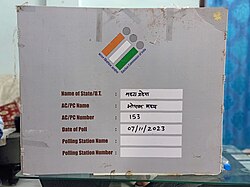
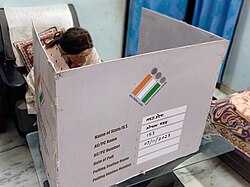
[[File:Privacy Shields - Voting Booth used in India 01.jpg|thumb|Privacy Shields for Voting Booth used in India]] | |||
=== Election machinery === | |||
The [[Chief Electoral Officer (India)|Chief Electoral Officer]] (CEO) is the state-level authority appointed to oversee the conduct of elections under the supervision of the [[Election Commission of India]]. The Chief Electoral Officer (CEO) supervise the election work related to State Assembly and Parliament elections. The Chief Electoral Officer<ref>{{Cite news |date=2024-12-07 |title=Rathan Kelkar is new chief electoral officer |url=https://timesofindia.indiatimes.com/city/thiruvananthapuram/rathan-kelkar-appointed-as-keralas-new-chief-electoral-officer-amidst-election-preparations/articleshow/116055338.cms |access-date=2025-11-21 |work=The Times of India |issn=0971-8257}}</ref> is a senior [[Indian Administrative Service]] officer of the State or Union Territory government, nominated by the Election Commission of India. The CEO oversees voter registration, prepares the electoral rolls, ensures compliance with election laws and the Model Code of Conduct, and ensures the smooth conduct of elections to the [[Parliament of India]] as well as the [[State legislatures of India|State Legislature]].<ref>{{Cite web |last=Officer |first=Chief Electoral |title=Responsibilities and Functions |url=https://ceouttarpradesh.nic.in/_ResponsibilitiesandFunctions_eng.aspx |archive-url=https://web.archive.org/web/20250719171809/https://ceouttarpradesh.nic.in/_ResponsibilitiesandFunctions_eng.aspx |archive-date=2025-07-19 |access-date=2025-11-21 |website=ceouttarpradesh.nic.in}}</ref> | |||
At the [[List of districts in India|district]] level, [[District Collector|District Collectors]] are designated as District Election Officers (DEOs) by both the [[Election Commission of India]] (ECI) and [[State election commission (India)|State Election Commissions]] (SECs). The District Election Officers (DEOs) supervise various elections in the district. The District Collector functions as the Returning Officer (RO) for the [[List of constituencies of the Lok Sabha|Lok Sabha Constituency]] as well. Each Lok Sabha and State Legislative Assembly constituency is assigned a [[Returning officer#India|Returning Officer]] (RO) responsible for conducting the election, assisted by Assistant Returning Oficers (AROs). For voter list management and related duties there are Electoral Registration Officers (EROs) and Assistant Electoral Registration Officers for each legislative constituency, and at the field level there are Booth Level Officers (BLOs). At the polling-booth level, the election is conducted by a Presiding Officer and a team of Polling Officers. The ECI and SECs designate various state government officials to the said roles.<ref>{{Cite web |title=Tamil Nadu State Election Commission |url=https://tnsec.tn.gov.in/tnsec_static/elections/ele_election_machinery_e.php |archive-url=https://web.archive.org/web/20250216155427/https://tnsec.tn.gov.in/tnsec_static/elections/ele_election_machinery_e.php |archive-date=2025-02-16 |access-date=2025-11-21 |website=tnsec.tn.gov.in |language=en}}</ref> | |||
District Election Officers oversee electoral roll preparation and conduct [[Local government in India|local government]] elections in their districts under the direction of the [[State election commission (India)|State Election Commission]].<ref>{{Cite web |url=https://sec.kerala.gov.in/portal/kc/election-officials |access-date=2025-11-21 |website=sec.kerala.gov.in}}</ref> | |||
=== Vote from home=== | |||
The Election Commission of India has granted permission for individuals aged 80 and above and those with physical challenges to cast their votes from the comfort of their homes using ballot papers.<ref name="News On AIR - News Services Division 2023 g445">{{cite web | title=EC provides facility to voters above 80 years of age & Divyanga to vote from home | website=News On AIR - News Services Division | date=13 November 2023 | url=https://newsonair.gov.in/News?title=EC-provides-facility-to-voters-above-80-years-of-age-%26-Divyanga-to-vote-from-home&id=470919 | access-date=13 November 2023}}</ref> To avail of this facility, eligible individuals must register with the designated booth-level officer at least 10 days prior to the election date. The necessary Form 12-D for facilitating the postal ballot has to be submitted well in advance. A dedicated team of five officers, including a polling officer, micro observer, police officer, and photographer, will visit their residences to ensure a smooth and transparent polling process. The entire polling procedure will be documented through photographs and videos. While the option to vote from home is voluntary, the decision cannot be reversed later once an elector chooses this method. Election officials in Bhopal, India, are actively reaching out to the residences of super senior citizens (aged above 80 years) and voters with disabilities to provide assistance in submitting their votes through postal ballots for [[2023 Madhya Pradesh Legislative Assembly election]]s.<ref name="Ayub 2023 d863">{{cite web | last=Ayub | first=Jamal | title=Vote From Home: Madhya Pradesh Polling Stations Come To The Doorstep For Elderly & Disabled | website=The Times of India | date=8 November 2023 | url=https://timesofindia.indiatimes.com/city/bhopal/vote-from-home-polling-stations-come-to-the-doorstep-for-elderly-disabled/articleshow/105054443.cms | access-date=13 November 2023}}</ref> | |||
In the [[2024 Indian general election|2024 lok sabha elections]], [[Election Commission of India|ECI]] extended the "vote-from-home" option to people aged 85 years and above and to [[Disability in India|Persons with Disabilities (PwD)]] for the first time in the history of the Lok Sabha elections. The goal of this move is to improve participation and accessibility in the electoral process.<ref>{{Cite news |last1=Kalia |first1=Saumya |date=23 March 2024 |title=All about the vote-from-home facility in the Lok Sabha elections | Explained |url=https://www.thehindu.com/elections/all-about-the-vote-from-home-facility-in-the-lok-sabha-elections-explained/article67971618.ece |newspaper=The Hindu}}</ref><ref>{{Cite web |title=ECI walks the extra mile to reach at the doorstep of elderly and PwD voters |url=https://pib.gov.in/pib.gov.in/Pressreleaseshare.aspx?PRID=2017764 |access-date=2024-04-19 |website=pib.gov.in}}</ref> | |||
[[File:Vote From Home Option For People Above 80 Or With Disabilities in India.jpg|thumb|A senior citizen (above 80) is casting her vote from home in [[Bhopal]]]] | |||
===Indelible ink=== | ===Indelible ink=== | ||
| Line 679: | Line 913: | ||
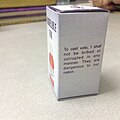
[[File:Ink Bottle used in Indian Elections.jpg|thumb|right|Ink bottle pledge]] | [[File:Ink Bottle used in Indian Elections.jpg|thumb|right|Ink bottle pledge]] | ||
Research into indelible ink was commenced by the [[Council of Scientific and Industrial Research]] (CSIR). In the 1950s, M. L. Goel worked on this research at the Chemical Division of the [[National Physical Laboratory of India]]. The ink used contains [[silver nitrate]], which makes it [[photo-sensitive]]. It is stored in amber-colored plastic or brown-colored glass bottles. On application, the ink remains on the | Research into indelible ink was commenced by the [[Council of Scientific and Industrial Research]] (CSIR). In the 1950s, M. L. Goel worked on this research at the Chemical Division of the [[National Physical Laboratory of India]]. The ink used contains [[silver nitrate]], which makes it [[photo-sensitive]]. It is stored in amber-colored plastic or brown-colored glass bottles. On application, the ink remains on the finger for at least two days. It may last up to a month, depending on the person's body temperature and the environment. | ||
===Electronic voting=== | ===Electronic voting=== | ||
{{main|Electronic voting in India}} | {{main|Electronic voting in India}} | ||
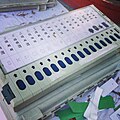
[[File:Voting machine in India.jpg|thumb|right|Voting machine]] | [[File:Voting machine in India.jpg|thumb|right|Voting machine]] | ||
BHAVIK (EVM) were first used in the 1997 election and became the only method of voting in 2004. The EVMs save time in reporting results. A [[voter-verified paper audit trail]] (VVPAT) was introduced on 14 August 2014 in [[Nagaland]].<ref>{{cite press release | title = EC Decides to use VVPAT System at Bye-Election in Nagaland | publisher = Press Information Bureau | date = 17 August 2013 | url = http://pib.nic.in/newsite/erelease.aspx?relid=98322 | access-date = 18 August 2013}}</ref> In the 2014 general election, VVPAT was operational in 8 constituencies ([[Lucknow (Lok Sabha constituency)|Lucknow]], [[Gandhinagar (Lok Sabha constituency)|Gandhinagar]], [[Bangalore South (Lok Sabha constituency)|Bangalore South]], [[Chennai Central (Lok Sabha constituency)|Chennai Central]], [[Jadavpur (Lok Sabha constituency)|Jadavpur]], [[Raipur (Lok Sabha constituency)|Raipur]], [[Patna Sahib (Lok Sabha constituency)|Patna Sahib]] and [[Mizoram (Lok Sabha constituency)|Mizoram]]) as a pilot project.<ref>References: | BHAVIK (EVM) were first used in the 1997 election and became the only method of voting in 2004. The EVMs save time in reporting results. A [[voter-verified paper audit trail]] (VVPAT) was introduced on 14 August 2014 in [[Nagaland]].<ref>{{cite press release | title = EC Decides to use VVPAT System at Bye-Election in Nagaland | publisher = Press Information Bureau | date = 17 August 2013 | url = http://pib.nic.in/newsite/erelease.aspx?relid=98322 | access-date = 18 August 2013}}</ref> In the 2014 general election, VVPAT was operational in 8 constituencies ([[Lucknow (Lok Sabha constituency)|Lucknow]], [[Gandhinagar (Lok Sabha constituency)|Gandhinagar]], [[Bangalore South (Lok Sabha constituency)|Bangalore South]], [[Chennai Central (Lok Sabha constituency)|Chennai Central]], [[Jadavpur (Lok Sabha constituency)|Jadavpur]], [[Raipur (Lok Sabha constituency)|Raipur]], [[Patna Sahib (Lok Sabha constituency)|Patna Sahib]] and [[Mizoram (Lok Sabha constituency)|Mizoram]]) as a pilot project.<ref>References: | ||
*{{cite web|url=http://www.dnaindia.com/mumbai/report-evm-paper-trail-introduced-in-8-of-543-constituencies-1982463|title=EVM-paper trail introduced in 8 of 543 constituencies|work=dna|access-date=23 November 2014|date=27 April 2014}} | *{{cite web|url=http://www.dnaindia.com/mumbai/report-evm-paper-trail-introduced-in-8-of-543-constituencies-1982463|title=EVM-paper trail introduced in 8 of 543 constituencies|work=dna|access-date=23 November 2014|date=27 April 2014}} | ||
*{{cite news|url=http://www.business-standard.com/article/elections-2014/ls-polls-voters-to-get-automated-receipts-at-gandhinagar-114042901134_1.html|title=LS polls: Voters to get 'automated-receipts' at Gandhinagar|author=Press Trust of India|date=29 April 2014|publisher=Business-standard.com|access-date=23 November 2014|newspaper=Business Standard India}} | *{{cite news|url=http://www.business-standard.com/article/elections-2014/ls-polls-voters-to-get-automated-receipts-at-gandhinagar-114042901134_1.html|title=LS polls: Voters to get 'automated-receipts' at Gandhinagar|author=Press Trust of India|date=29 April 2014|publisher=Business-standard.com|access-date=23 November 2014|newspaper=Business Standard India}} | ||
*{{cite news|url= | *{{cite news|url=https://www.thehindu.com/news/national/karnataka/vvpat-machine-to-be-on-demonstration-for-10-days/article5868161.ece|title=VVPAT machine to be on demonstration for 10 days|author=Staff Reporter|newspaper=The Hindu|access-date=23 November 2014|date=4 April 2014}} | ||
*{{cite web|url=http://www.indiatvnews.com/news/india/vvpat-to-be-introduced-in-jadavpur-constituency-35049.html|title=VVPAT to be introduced in Jadavpur constituency|publisher=Indiatvnews.com|access-date=23 November 2014|date=2 April 2014}} | *{{cite web|url=http://www.indiatvnews.com/news/india/vvpat-to-be-introduced-in-jadavpur-constituency-35049.html|title=VVPAT to be introduced in Jadavpur constituency|publisher=Indiatvnews.com|access-date=23 November 2014|date=2 April 2014}} | ||
*[ | *[https://timesofindia.indiatimes.com/home/lok-sabha-elections-2014/news/Patna-Sahib-electorate-can-see-who-they-voted-for/articleshow/33351551.cms Patna Sahib electorate can see who they voted for - The Times of India] | ||
*{{cite web|url= | *{{cite web|url=https://timesofindia.indiatimes.com/home/lok-sabha-elections-2014/news/EVM-slip-will-help-verify-your-vote/articleshow/34304320.cms |title=EVM slip will help verify your vote |publisher=Timesofindia.indiatimes.com |date=28 April 2014 |access-date=28 May 2019}} | ||
*[ | *[https://timesofindia.indiatimes.com/city/patna/400-EVMs-on-standby-for-Patna-Sahib-Pataliputra/articleshow/33836327.cms 400 EVMs on standby for Patna Sahib, Pataliputra] | ||
*{{cite web|url=http://www.newindianexpress.com/states/karnataka/VVPAT-to-Debut-in-B%E2%80%99lore-South/2014/04/04/article2148837.ece|title=VVPAT to Debut in B'lore South|work=The New Indian Express|access-date=23 November 2014}} | *{{cite web|url=http://www.newindianexpress.com/states/karnataka/VVPAT-to-Debut-in-B%E2%80%99lore-South/2014/04/04/article2148837.ece|title=VVPAT to Debut in B'lore South|work=The New Indian Express|access-date=23 November 2014}} | ||
*{{cite news|url= | *{{cite news|url=https://www.thehindu.com/news/national/tamil-nadu/voter-verifiable-paper-audit-trail-system-comes-to-chennai/article5856087.ece|title=Voter Verifiable Paper Audit Trail system comes to Chennai|author=T. Ramakrishnan|newspaper=The Hindu|access-date=23 November 2014|date=April 2014}}</ref><ref name="VVPATIndiaElections2014">{{cite web|url=http://www.dnaindia.com/india/report-vvpat-a-revolutionary-step-in-voting-transparency-1982453|title=VVPAT, a revolutionary step in voting transparency|publisher=DNA |date=27 April 2014 |access-date=27 April 2014}}</ref> A slip generated by the VVPAT tells a voter to which party or candidate their vote has been given, their name, their constituency and their polling booth.<ref>{{cite news|url=https://www.thehindu.com/news/national/karnataka/not-many-were-aware-of-vvpat-but-were-happy-with-verification/article5925449.ece|title=Not many were aware of VVPAT, but were happy with verification|newspaper=The Hindu|access-date=23 November 2014|date=18 April 2014}}</ref><ref>{{cite web|url=http://indianexpress.com/article/india/india-others/safe-distance/|title=Safe distance|work=The Indian Express|access-date=23 November 2014|date=15 April 2014}}</ref><ref>{{cite news|url=https://timesofindia.indiatimes.com/home/lok-sabha-elections-2014/news/As-smooth-as-it-gets-says-city-poll-chief/articleshow/34174348.cms|title=As smooth as it gets, says city poll chief|work=The Times of India|date=25 April 2014 |access-date=23 November 2014}}</ref><ref>{{cite news|url=https://timesofindia.indiatimes.com/news/Ripon-Buildings-turns-nerve-centre-of-electoral-activities-in-Chennai/articleshow/34077158.cms|title=Ripon Buildings turns nerve centre of electoral activities in Chennai |website=The Times of India|date=22 April 2014 |access-date=13 January 2020}}</ref><ref>{{cite web|url=http://timesofindia.indiatimes.com/home/lok-sabha-elections-2014/news/Voters-verifiable-paper-audit-trail-system-to-be-introduced-in-Chennai-Central-constituency/articleshow/33025999.cms|title=Voter's verifiable paper audit trail system to be introduced in Chennai Central constituency|website=The Times of India|access-date=3 May 2014|url-status=dead|archive-url=https://web.archive.org/web/20140401160848/http://timesofindia.indiatimes.com/home/lok-sabha-elections-2014/news/Voters-verifiable-paper-audit-trail-system-to-be-introduced-in-Chennai-Central-constituency/articleshow/33025999.cms|archive-date=1 April 2014}}</ref> | ||
Opposition parties demanded that VVPAT be made mandatory all over India due to allegations against the government of hacking the EVM. Accordingly, [[Voter-verified paper audit trail]] ( | Opposition parties demanded that VVPAT be made mandatory all over India due to allegations against the government of hacking the EVM. Accordingly, [[Voter-verified paper audit trail]]s (VVPATs) and EVMs were used in every assembly and the general election in India since 2019.<ref>{{cite web|url=https://www.firstpost.com/politics/ec-announces-lok-sabha-election-dates-vvpats-to-be-used-in-all-polling-stations-help-bring-more-accuracy-in-voting-6232831.html|title=EC announces Lok Sabha election dates: VVPATs, to be used in all polling stations, help bring more accuracy in voting|website=Firstpost|date=10 March 2019 |access-date=13 January 2020}}</ref><ref>{{cite news |url=https://timesofindia.indiatimes.com/india/what-are-evms-vvpat-and-how-safe-they-are/articleshow/66969640.cms |title=What are EVMs, VVPAT and how safe they are |date=6 December 2018 |newspaper=The Times of India |access-date=10 January 2019}}</ref> On 9 April 2019, [[Supreme Court of India]] gave the judgement, ordering the [[Election Commission of India]] to increase the VVPAT slips vote count to five randomly selected EVMs per assembly constituency, which means the Election Commission of India has to count VVPAT slips of 20,625 EVMs in the 2019 General elections.<ref>{{cite news|url=https://timesofindia.indiatimes.com/india/count-vvpat-slips-of-5-booths-in-each-assembly-seat-sc/articleshow/68786810.cms|title=Supreme Court: Count VVPAT slips of 5 booths in each assembly seat | India News |website=The Times of India|date=9 April 2019 |access-date=13 January 2020}}</ref><ref>{{cite web|url=https://www.livelaw.in/top-stories/vvpat-sc-elections-144122|title=Breaking: SC Directs ECI To Increase VVPAT Verification From One EVM To Five EVMs Per Constituency [Read Order]|first=MEHAL|last=JAIN|date=8 April 2019|website=www.livelaw.in|access-date=13 January 2020}}</ref><ref>{{cite web|url=http://www.moneylife.in/article/when-the-sc-says-no-for-software-audit-review-of-evms-and-vvpat-at-present/56828.html|title=When the SC Says No for Software Audit Review of EVMs & VVPAT at Present|website=Moneylife NEWS & VIEWS|access-date=13 January 2020}}</ref> VVPAT enables voters to cross-check whether the vote they have given goes to their desired candidate, as the VVPAT unit produces a paper slip, additionally called a ballot slip, that contains the name, serial number, and image of the candidate selected by the voter for his vote. Post the [[2019 Indian general elections|2019 general election]], ECI declared that there were no mismatches between EVM and VVPAT.<ref>{{cite news | url=https://economictimes.indiatimes.com/news/elections/lok-sabha/india/evm-vvpat-pass-test-in-lok-sabha-polls/articleshow/69469579.cms?from=mdr | title=EVM-VVPAT pass test in Lok Sabha polls | newspaper=Economic Times | date=23 May 2019 | access-date=5 June 2019}}</ref> During elections in 2025, [[Rahul Gandhi]] made remarks about [[electoral fraud]] and labelled his findings "[[vote chor]]," accusing the election commission and [[BJP]] of stealing votes in national and state elections through the work of EVMs. This vote chor movement is still ongoing as of 2026. | ||
===NOTA=== | ===NOTA=== | ||
{{further|None of the Above in Indian Elections}} | {{further|None of the Above in Indian Elections}} | ||
On 27 September 2013, the Supreme Court of India judged that citizens have the right to cast a negative vote by exercising the "[[None of the above]]" (NOTA) option. This was the result of petitioning by the Electoral Commission and the People's Union for Civil Liberties in 2009. In November 2013, NOTA was introduced in five state elections. | On 27 September 2013, the Supreme Court of India judged that citizens have the right to cast a negative vote by exercising the "[[None of the above]]" (NOTA) option. This was the result of petitioning by the Electoral Commission and the People's Union for Civil Liberties in 2009. In November 2013, NOTA was introduced in five state elections. Even if the number of electors opting for the NOTA option is more than the number of votes polled by any of the candidates, the candidate who secures the largest number of votes has to be declared elected.<ref>{{Cite web |title=ECI Press release - Supreme Court's judgement for "None of the Above" option on EVM– clarification |url=http://eci.nic.in/eci_main1/current/PN_28102013.pdf |url-status=dead |archive-url=https://web.archive.org/web/20170329124733/http://eci.nic.in/eci_main1/current/PN_28102013.pdf |archive-date=29 March 2017 |website=Election Commission of India}}</ref> | ||
===Absentee voting=== | ===Absentee voting=== | ||
India does not provide general [[absentee ballot|absentee voting]].<ref>{{cite web|url=http://articles.economictimes.indiatimes.com/2004-04-05/news/27397034_1_ballot-papers-special-voters-electoral-roll|title=Who can vote by postal ballot?|work=The Economic Times|access-date=23 November 2014}}</ref><ref>{{cite web|url=http://www.dnaindia.com/india/report-election-commission-to-ensure-postal-votes-dont-get-invalid-1914891|title=Election Commission to ensure postal votes don't get invalid|work=dna|access-date=23 November 2014|date=7 November 2013 | India does not provide general [[absentee ballot|absentee voting]].<ref>{{cite web|url=http://articles.economictimes.indiatimes.com/2004-04-05/news/27397034_1_ballot-papers-special-voters-electoral-roll|archive-url=https://web.archive.org/web/20121016005123/http://articles.economictimes.indiatimes.com/2004-04-05/news/27397034_1_ballot-papers-special-voters-electoral-roll|url-status=dead|archive-date=16 October 2012|title=Who can vote by postal ballot?|work=The Economic Times|access-date=23 November 2014}}</ref><ref>{{cite web|url=http://www.dnaindia.com/india/report-election-commission-to-ensure-postal-votes-dont-get-invalid-1914891|title=Election Commission to ensure postal votes don't get invalid|work=dna|access-date=23 November 2014|date=7 November 2013}}</ref> On 24 November 2010, the Representation of the People (Amendment) Bill 2010 was gazetted to give voting rights to non-resident Indians but a physical presence at the voting booth is still required.<ref>{{cite web |url=http://voterswithoutborders.org |title=Petition for Absentee Voting in Indian Elections |publisher=Voterswithoutborders.org |access-date=6 August 2012 |url-status=usurped |archive-url=https://web.archive.org/web/20090416234322/http://voterswithoutborders.org/ |archive-date=16 April 2009 }}</ref><ref>{{cite web |url=http://www.nrivotingrights.info/ |title=People for Lok Satta- NRI voting campaign |publisher=Nrivotingrights.info |date=9 January 2011 |access-date=6 August 2012 |archive-url=https://web.archive.org/web/20110405111303/http://www.nrivotingrights.info/ |archive-date=5 April 2011 |url-status=dead }}</ref> | ||
===''Postal voting''=== | ===''Postal voting''=== | ||
Postal voting in India is done only through the "Electronically Transmitted Postal Ballot Papers (ETPB)" system of [[Election Commission of India]], where ballot papers are distributed to the registered eligible voters and they return the votes by post. When the counting of votes commences, these postal votes are counted before those from the [[Electronic voting in India|Electronic Voting Machines]]. Only certain categories of people are eligible to register as postal voters. People working in the Union armed forces and state police as well as their spouses | [[Postal code|Postal]] voting in India is done only through the "Electronically Transmitted Postal Ballot Papers (ETPB)" system of the [[Election Commission of India]], where ballot papers are distributed to the registered eligible voters, and they return the votes by post. When the counting of votes commences, these postal votes are counted before those from the [[Electronic voting in India|Electronic Voting Machines]]. Only certain categories of people are eligible to register as postal voters. People working in the Union armed forces and state police, as well as their spouses and employees working for the [[Government of India]] who are officially posted abroad, can register for the postal vote; these are also called the "Service voters". Additionally, people in [[preventive detention]], disabled, and those above the age of 80 years old can use postal votes. Prisoners cannot vote at all.<ref name=IndiaPostVote1>[https://www.firstpost.com/india/postal-ballots-who-can-vote-through-etpb-how-to-get-registered-and-how-the-voting-is-done-an-explainer-6372611.html Postal ballots: Who can vote through ETPB, how to get registered and how the voting is done; an explainer], First Post, 2 April 2019.</ref><ref name=IndiaPostVote2>[https://www.huffingtonpost.in/entry/postal-ballots-how-to-vote-if-you-live-away-from-home_in_5c3c3d91e4b0e0baf53ec910 Maharashtra, Haryana Elections 2019: Can You Vote By Postal Ballot If You Aren't Living At Home?], Huffington Post, 26 September 2019.</ref><ref name=IndiaPostVote3>{{cite news|url=https://www.jagranjosh.com/current-affairs/people-over-80-years-of-age-disabled-can-now-vote-through-postal-ballot-1572319857-1|title=People over 80 years of age, disabled can now vote through postal ballot|first=Gorki|last=Bakshi|date=29 October 2019|access-date=22 September 2020}}</ref> | ||
== Elections by statewise == | |||
{{div col|colwidth=22em}} | |||
#[[Elections in Andhra Pradesh]] | |||
#[[Elections in Arunachal Pradesh]] | |||
#[[Elections in Assam]] | |||
#[[Elections in Bihar]] | |||
#[[Elections in Chhattisgarh]] | |||
#[[Elections in Delhi]] | |||
#[[Elections in Goa]] | |||
#[[Elections in Gujarat]] | |||
#[[Elections in Haryana]] | |||
#[[Elections in Himachal Pradesh]] | |||
#[[Elections in Jammu and Kashmir]] | |||
#[[Elections in Jharkhand]] | |||
#[[Elections in Karnataka]] | |||
#[[Elections in Kerala]] | |||
#[[Elections in Madhya Pradesh]] | |||
#[[Elections in Maharashtra]] | |||
#[[Elections in Manipur]] | |||
#[[Elections in Meghalaya]] | |||
#[[Elections in Mizoram]] | |||
#[[Elections in Nagaland]] | |||
#[[Elections in Odisha]] | |||
#[[Elections in Puducherry]] | |||
#[[Elections in Punjab (India)|Elections in Punjab]] | |||
#[[Elections in Rajasthan]] | |||
#[[Elections in Sikkim]] | |||
#[[Elections in Tamil Nadu]] | |||
#[[Elections in Telangana]] | |||
#[[Elections in Tripura]] | |||
#[[Elections in Uttar Pradesh]] | |||
#[[Elections in Uttarakhand]] | |||
#[[Elections in West Bengal]] | |||
{{div col end|3}} | |||
==See also== | ==See also== | ||
{{Portal|India|Politics}} | |||
* [[49-O]] Now replaced with 'NOTA (None of The Above)' | * [[49-O]] Now replaced with 'NOTA (None of The Above)' | ||
* [[Booth capturing]] | * [[Booth capturing]] | ||
* [[Democracy in India]] | |||
* [[History of democracy#Indian subcontinent|History of democracy in the Indian-subcontinent]] | * [[History of democracy#Indian subcontinent|History of democracy in the Indian-subcontinent]] | ||
* [[Gopala I]] | |||
* [[Election Commission of India]] | * [[Election Commission of India]] | ||
* [[Exercise Franchise For Good Governance]] | * [[Exercise Franchise For Good Governance]] | ||
| Line 730: | Line 1,001: | ||
==External links== | ==External links== | ||
{{commons category}} | |||
<!--Please do not add personal or other unofficial websites--> | <!--Please do not add personal or other unofficial websites--> | ||
* [https://web.archive.org/web/20081207201816/http://www.eci.gov.in/ Election Commission of India] | * Jensenius, Francesca R.; Chhibber, Pradeep; Alam, Sanjeer; Gupta, Pranav; Somanathan, Madhavan (2025-07-01). "[https://www.nature.com/articles/s41597-025-05418-6 Indian election data for polling stations and villages: National elections 2009–2019]". ''Scientific Data''. '''12''' (1). | ||
* {{usurped|1=[https://web.archive.org/web/20081207201816/http://www.eci.gov.in/ Election Commission of India]}} | |||
* [http://psephos.adam-carr.net/countries/i/india/ Adam Carr's election archive] | * [http://psephos.adam-carr.net/countries/i/india/ Adam Carr's election archive] | ||
* [https://web.archive.org/web/20160502105938/http://eci.nic.in/archive/handbook/CANDIDATES/cch2/cch2_1.htm Qualification and disqualification] Election Commission of India handbook for candidates | * {{usurped|1=[https://web.archive.org/web/20160502105938/http://eci.nic.in/archive/handbook/CANDIDATES/cch2/cch2_1.htm Qualification and disqualification]}} Election Commission of India handbook for candidates | ||
* [https://elections-india.in/ Elections India] | * [https://elections-india.in/ Elections India] {{Webarchive|url=https://web.archive.org/web/20210826102936/https://elections-india.in/ |date=26 August 2021 }} | ||
{{Indian elections}} | {{Indian elections}} | ||
Latest revision as of 14:19, 27 April 2026
 |
|---|
| This article is part of a series on the politics and government of India |
 India portal India portal |
| Part of the Politics series |
| Elections |
|---|
.svg) |
| Basic types |
| Terminology |
| Subseries |
| Lists |
| Related |
India has a parliamentary system as defined by its constitution, with power distributed between the union government and the states. India's democracy is the largest democracy in the world.[1]
The President of India is the ceremonial head of state of the country and supreme commander-in-chief for all defense forces in India. However, it is the Prime Minister of India, who is the leader of the party or political alliance having a majority in the national elections to the Lok Sabha (Lower house of the Parliament). The Prime Minister is the leader of the legislative branch of the Government of India. The Prime Minister is the head of the Union Council of Ministers.
India is regionally divided into States (and Union Territories) and each State has a Governor who is the state's head, but the executive authority rests with the Chief Minister, who is the leader of the party or political alliance that has won a majority in the regional elections, otherwise known as State Assembly Elections that exercises executive powers in that State. The respective State's Chief Minister has executive powers within the State and works jointly with the Prime Minister of India or their ministers on matters that require both State and Central attention. Some Union Territories also elect an Assembly and have a territorial government, and other (mainly smaller) Union Territories are governed by an administrator/lieutenant governor appointed by the President of India.
The President of India monitors the rule of law through their appointed governors in each State and on their recommendation, can take over the executive powers from the Chief Minister of the State temporarily when the elected representatives of the State government have failed to create a peaceful environment and it has deteriorated into chaos. The President of India dissolves the existing State government if necessary, and a new election is conducted.
The Republic of India has instituted universal suffrage since independence from the British Raj, with the adoption of the Constitution of India in 1949.[2][3][4]
Results in history[edit | edit source]
1951–52 Indian general election[edit | edit source]
 | ||||
| Party | Votes | % | Seats | |
|---|---|---|---|---|
| Indian National Congress | 47,665,951 | 45.03 | 364 | |
| Socialist Party (India) | 11,216,719 | 10.60 | 12 | |
| Kisan Mazdoor Praja Party | 6,135,978 | 5.80 | 9 | |
| Communist Party of India | 3,487,401 | 3.29 | 16 | |
| Bharatiya Jana Sangh | 3,246,361 | 3.07 | 3 | |
| Scheduled Castes Federation | 2,521,695 | 2.38 | 2 | |
| Akhil Bharatiya Ram Rajya Parishad | 2,091,898 | 1.98 | 3 | |
| Krishikar Lok Party | 1,489,615 | 1.41 | 1 | |
| People's Democratic Front (Hyderabad) | 1,367,404 | 1.29 | 7 | |
| Shiromani Akali Dal | 1,047,611 | 0.99 | 4 | |
| Hindu Mahasabha | 1,003,034 | 0.95 | 4 | |
| Peasants and Workers Party of India | 992,187 | 0.94 | 2 | |
| All India Forward Bloc | 963,058 | 0.91 | 1 | |
| All India Ganatantra Parishad | 959,749 | 0.91 | 6 | |
| Tamil Nadu Toilers' Party | 889,292 | 0.84 | 4 | |
| Jharkhand Party | 749,702 | 0.71 | 3 | |
| Revolutionary Socialist Party (India) | 468,108 | 0.44 | 3 | |
| Commonweal Party | 325,398 | 0.31 | 3 | |
| Lok Sewak Sangh | 309,940 | 0.29 | 2 | |
| Zamindar Party | 291,300 | 0.28 | 0 | |
| Chota Nagpur Santhal Parganas Janata Party | 236,094 | 0.22 | 1 | |
| Uttar Pradesh Praja Party | 213,656 | 0.20 | 0 | |
| S.K. Paksha | 137,343 | 0.13 | 0 | |
| All India Forward Bloc (Ruikar) | 133,936 | 0.13 | 0 | |
| Kamgar Kisan Paksha | 132,574 | 0.13 | 0 | |
| Tribal Sangha | 116,629 | 0.11 | 0 | |
| Travancore Tamil Nadu Congress | 115,893 | 0.11 | 1 | |
| Kerala Socialist Party | 102,098 | 0.10 | 0 | |
| Indian Union Muslim League | 79,470 | 0.08 | 1 | |
| Revolutionary Communist Party of India | 67,275 | 0.06 | 0 | |
| Justice Party (India) | 63,254 | 0.06 | 0 | |
| All India United Kisan Sabha | 60,254 | 0.06 | 0 | |
| All People's Party (Assam) | 36,851 | 0.03 | 0 | |
| Tamil Nadu Congress Party | 36,158 | 0.03 | 0 | |
| Khasi-Jaintia Durbar | 32,987 | 0.03 | 0 | |
| Saurashtra Khedut Sangh | 29,766 | 0.03 | 0 | |
| Bolshevik Party of India | 25,792 | 0.02 | 0 | |
| All Manipur National Union | 22,083 | 0.02 | 0 | |
| Uttar Pradesh Revolutionary Socialist Party | 20,665 | 0.02 | 0 | |
| Hill People Party | 17,350 | 0.02 | 0 | |
| Krishak Sramik Party | 16,955 | 0.02 | 0 | |
| Kuki National Association | 12,155 | 0.01 | 0 | |
| Punjab Depressed Class League | 11,789 | 0.01 | 0 | |
| Pursharathi Panchayat | 10,778 | 0.01 | 0 | |
| Cochin Party | 8,947 | 0.01 | 0 | |
| Kisan Mazdoor Mandal | 8,808 | 0.01 | 0 | |
| Hyderabad State Praja Party | 7,646 | 0.01 | 0 | |
| Gandhi Sebak Seva | 7,196 | 0.01 | 0 | |
| Kisan Janta Sanyukta Party | 6,390 | 0.01 | 0 | |
| National Party of India | 3,232 | 0.00 | 0 | |
| Historical Research | 1,468 | 0.00 | 0 | |
| Independents | 16,850,089 | 15.92 | 37 | |
| Appointed members | 0 | 0.00 | 10 | |
| Total | 105,847,982 | 100.00 | 499 | |
Latest election[edit | edit source]
Full entry 2024 Indian general election

Election Commission of India[edit | edit source]
The Election Commission of India (ECI) is an autonomous authority of India that is enacted under the provisions of the Constitution, responsible for monitoring and administering Union and State election processes in India. This body is responsible for ensuring elections are free and fair, without any bias. It derived its powers from A 324 of the constitution [5]
The ECI, established as a permanent Constitutional Body, is entrusted by the Constitution with the superintendence, direction, and control of the entire electoral process for Parliament, State Legislatures, and the offices of the President and Vice President of India.
Elections ensure the conduct of members pre-elections, during elections, and post-elections is as per the statutory legislation.
All election-related disputes are handled by the Election Commission. The Supreme Court of India has held that where the enacted laws are silent or make insufficient provisions to deal with a given situation in the conduct of elections, the Election Commission has the residuary powers under the Constitution to act as appropriate. The first chief election Commissioner was Sukumar Sen.
The elections for the President and Vice President of India, the Rajya Sabha (council of states) and Lok Sabha (house of the people), State Legislative Assemblies (including Union territories of Jammu and Kashmir, Delhi and Puducherry), and State Legislative Councils are conducted by the Election Commission of India.
State Election Commissions[edit | edit source]
The State Election Commission (SEC) is an autonomous constitutional authority responsible for administering elections to the 3rd tier of governance, i.e., the Local Government, which includes the Panchayati Raj Institutions and the Urban Local Bodies. As per the constitutional provision, superintendence, direction, and control of the conduct of Elections to Urban & Rural Local bodies vest in State Election Commission.
State Election Commission consists of a State Election Commissioner, who is appointed by the Governor for a fixed tenure of 5 years and cannot be removed from his office except in like manner and on the like grounds as a Judge of a High Court.
The elections to local self-government institutions, such as panchayats and municipalities, are conducted by the respective State Election Commissions (SECs).[6]
List of State Election Commissions[edit | edit source]
Types of elections[edit | edit source]
Elections in the Republic of India include elections for
- President of India,
- Vice President of India,
- Members of the Parliament in Rajya Sabha (Upper house)
- Members of the Parliament in Lok Sabha (Lower house),
- Members of State Legislative Councils (Upper house)
- Members of State Legislative Assemblies (Lower house/Unicameral house)
- Members of Legislative Assembly of National Capital Territory of Delhi
- Members of Legislative Assembly of Union Territory of Jammu and Kashmir
- Members of Legislative Assembly of Union Territory of Puducherry
- Members of local governance bodies (Municipal bodies and Panchayats),
- A By-election is held when a seat-holder of a particular constituency dies, resigns, or is disqualified.
Parliamentary general elections (Lok Sabha)[edit | edit source]
Members of Lok Sabha (House of the People), or the lower house of India's Parliament, are elected by being voted upon by all adult citizens of India (who crossed 18 years of age) from a set of candidates who contest in their respective constituencies. Every adult citizen of India can vote only in their constituency. Candidates who win the Lok Sabha elections are called 'Members of Parliament' and hold their seats for five years or until the body is dissolved by the President on the advice of the council of ministers. The house meets in the Lok Sabha Chambers of the Sansad Bhavan in New Delhi, on matters relating to the creation of new laws and removing or improving the existing laws that affect all citizens of India. Elections take place once in 5 years to elect 543 members for the Lok Sabha (Lower house).[7]


History of Lok Sabha elections[edit | edit source]
State Assembly elections[edit | edit source]
Members of the State Legislative Assembly are elected directly by voting from a set of candidates who contest in their respective constituencies. Every adult citizen of India can vote only in their constituency. Candidates who win the State Legislative Assemblies elections are called 'Members of Legislative Assembly' (MLA) and hold their seats for five years or until the body is dissolved by the Governor. The house meets in the respective state, on matters relating to the creation of new laws, removing, or improving the existing laws that affect all citizens living in that state.
The total strength of each assembly depends on each State, mostly based on size and population. Similar to the Lok Sabha elections, the leader of the majority party/alliance takes an oath as Chief Minister of the State.
The Election Commission conducts the elections and provides a voluntary facility to 80-plus-year-old electors to vote through ballot papers at their homes depending upon polling booth accessibility. Elections are taken up enthusiastically by a major portion of the population, who turn out in high numbers. For example, An 83-year-old woman, Dolma, cast her vote at the Chasak Bhatori polling station in the Pangi area of the Chamba district after covering 14 kilometers walking on a snowy road during the 2022 assembly elections in Himachal Pradesh.[12]
Prior to the much awaited Lok Sabha elections in 2024, the state assembly elections in Chhattisgarh, Madhya Pradesh, Rajasthan, and Telangana are an important political event. November 7 and November 17 are the scheduled dates for Chhattisgarh's elections, while Madhya Pradesh, Rajasthan, and Telangana will hold their votes on November 17, November 23, and November 30, respectively. The political climate before the national elections is anticipated to be shaped by the outcomes of these elections, which are anticipated to be declared on December 3. Key political players in these states are diverse and competing for domination, such as the Indian National Congress (INC), the Bharatiya Janata Party (BJP), and other regional parties. These states differ in the quantity of assembly seats they have; Chhattisgarh has ninety [13] seats.
By-election[edit | edit source]
When an elected candidate to either the State Assembly, Lok Sabha, or Rajya Sabha leaves the office vacant before their term ends, a by-election is conducted to find a suitable replacement to fill the vacant position. It is often referred to in India as bypolls.
Common reasons for by-elections:
- Resignation by the sitting MP or MLA
- Death of the sitting MP or MLA
But other reasons occur when the incumbent becomes ineligible to continue in office (criminal conviction, failure to maintain a minimum level of attendance in the office, due to election irregularities found later, or when a candidate wins more than one seat and has to vacate one).
Rajya Sabha (Upper House) Elections[edit | edit source]
The Rajya Sabha, also known as the Council of States, is the upper house of India's Parliament. Candidates are not elected directly by the citizens but by the members of legislative assemblies and up to 13 can be nominated by the President of India for their contributions to art, literature, science, and social services. Members of the Parliament in Rajya Sabha get a tenure of six years, with one-third of the body facing re-election every two years. Rajya Sabha acts as a second-level review body before a bill becomes an act.[15]
The Vice President of India is the ex-officio Chairman of the Rajya Sabha, who presides over its sessions.
The legislative proposals (making new laws, removing, or appending new conditions to the existing law) are brought before either house of the Parliament in the form of a bill. A bill is the draft of a legislative proposal, which, when passed by both houses of Parliament (Lok Sabha and Rajya Sabha) and assented to by the President, becomes an Act of Parliament.
The Constitution of India, however, places some restrictions on the Rajya Sabha, which makes the Lok Sabha more powerful in certain areas. For example, it stipulates that money bills must originate in the Lok Sabha.
Members of Rajya Sabha debate bills sent by the Lok Sabha and can approve, reject, or send the bill back to the Lok Sabha for further debate and discussion on the matter, as well as to suggest better changes in the drafted bill. Members of the Rajya Sabha can only make recommendations to the Lok Sabha for money bills within 14 days. If the Rajya Sabha fails to return the money bill in 14 days to the Lok Sabha, that bill is deemed to have passed by both the houses. Also, if the Lok Sabha rejects any (or all) of the amendments proposed by the Rajya Sabha, the bill is deemed to have been passed by both Houses of Parliament of India in the form in which the Lok Sabha finally passes it.
Election procedure in India[edit | edit source]
Candidates are required to file their nomination papers with the Electoral Commission. Then, a list of candidates is published. No party is allowed to use government resources for campaigning. No party is allowed to bribe the candidates before elections. The government cannot start a project during the election period. Campaigning ends by 6:00 pm two days before the polling day.
The polling is held between 7:00 am and 6:00 pm. The Collector of each district is in charge of polling. Government employees are employed as poll officers at the polling stations. Electronic Voting Machines (EVMs) are being used instead of ballot boxes to prevent election fraud. After the citizen votes, his or her left index finger is marked with indelible ink. This practice was instituted in 1962.

Election machinery[edit | edit source]
The Chief Electoral Officer (CEO) is the state-level authority appointed to oversee the conduct of elections under the supervision of the Election Commission of India. The Chief Electoral Officer (CEO) supervise the election work related to State Assembly and Parliament elections. The Chief Electoral Officer[16] is a senior Indian Administrative Service officer of the State or Union Territory government, nominated by the Election Commission of India. The CEO oversees voter registration, prepares the electoral rolls, ensures compliance with election laws and the Model Code of Conduct, and ensures the smooth conduct of elections to the Parliament of India as well as the State Legislature.[17]
At the district level, District Collectors are designated as District Election Officers (DEOs) by both the Election Commission of India (ECI) and State Election Commissions (SECs). The District Election Officers (DEOs) supervise various elections in the district. The District Collector functions as the Returning Officer (RO) for the Lok Sabha Constituency as well. Each Lok Sabha and State Legislative Assembly constituency is assigned a Returning Officer (RO) responsible for conducting the election, assisted by Assistant Returning Oficers (AROs). For voter list management and related duties there are Electoral Registration Officers (EROs) and Assistant Electoral Registration Officers for each legislative constituency, and at the field level there are Booth Level Officers (BLOs). At the polling-booth level, the election is conducted by a Presiding Officer and a team of Polling Officers. The ECI and SECs designate various state government officials to the said roles.[18]
District Election Officers oversee electoral roll preparation and conduct local government elections in their districts under the direction of the State Election Commission.[19]
Vote from home[edit | edit source]
The Election Commission of India has granted permission for individuals aged 80 and above and those with physical challenges to cast their votes from the comfort of their homes using ballot papers.[20] To avail of this facility, eligible individuals must register with the designated booth-level officer at least 10 days prior to the election date. The necessary Form 12-D for facilitating the postal ballot has to be submitted well in advance. A dedicated team of five officers, including a polling officer, micro observer, police officer, and photographer, will visit their residences to ensure a smooth and transparent polling process. The entire polling procedure will be documented through photographs and videos. While the option to vote from home is voluntary, the decision cannot be reversed later once an elector chooses this method. Election officials in Bhopal, India, are actively reaching out to the residences of super senior citizens (aged above 80 years) and voters with disabilities to provide assistance in submitting their votes through postal ballots for 2023 Madhya Pradesh Legislative Assembly elections.[21]
In the 2024 lok sabha elections, ECI extended the "vote-from-home" option to people aged 85 years and above and to Persons with Disabilities (PwD) for the first time in the history of the Lok Sabha elections. The goal of this move is to improve participation and accessibility in the electoral process.[22][23]

Indelible ink[edit | edit source]


Research into indelible ink was commenced by the Council of Scientific and Industrial Research (CSIR). In the 1950s, M. L. Goel worked on this research at the Chemical Division of the National Physical Laboratory of India. The ink used contains silver nitrate, which makes it photo-sensitive. It is stored in amber-colored plastic or brown-colored glass bottles. On application, the ink remains on the finger for at least two days. It may last up to a month, depending on the person's body temperature and the environment.
Electronic voting[edit | edit source]

BHAVIK (EVM) were first used in the 1997 election and became the only method of voting in 2004. The EVMs save time in reporting results. A voter-verified paper audit trail (VVPAT) was introduced on 14 August 2014 in Nagaland.[24] In the 2014 general election, VVPAT was operational in 8 constituencies (Lucknow, Gandhinagar, Bangalore South, Chennai Central, Jadavpur, Raipur, Patna Sahib and Mizoram) as a pilot project.[25][26] A slip generated by the VVPAT tells a voter to which party or candidate their vote has been given, their name, their constituency and their polling booth.[27][28][29][30][31]
Opposition parties demanded that VVPAT be made mandatory all over India due to allegations against the government of hacking the EVM. Accordingly, Voter-verified paper audit trails (VVPATs) and EVMs were used in every assembly and the general election in India since 2019.[32][33] On 9 April 2019, Supreme Court of India gave the judgement, ordering the Election Commission of India to increase the VVPAT slips vote count to five randomly selected EVMs per assembly constituency, which means the Election Commission of India has to count VVPAT slips of 20,625 EVMs in the 2019 General elections.[34][35][36] VVPAT enables voters to cross-check whether the vote they have given goes to their desired candidate, as the VVPAT unit produces a paper slip, additionally called a ballot slip, that contains the name, serial number, and image of the candidate selected by the voter for his vote. Post the 2019 general election, ECI declared that there were no mismatches between EVM and VVPAT.[37] During elections in 2025, Rahul Gandhi made remarks about electoral fraud and labelled his findings "vote chor," accusing the election commission and BJP of stealing votes in national and state elections through the work of EVMs. This vote chor movement is still ongoing as of 2026.
NOTA[edit | edit source]
On 27 September 2013, the Supreme Court of India judged that citizens have the right to cast a negative vote by exercising the "None of the above" (NOTA) option. This was the result of petitioning by the Electoral Commission and the People's Union for Civil Liberties in 2009. In November 2013, NOTA was introduced in five state elections. Even if the number of electors opting for the NOTA option is more than the number of votes polled by any of the candidates, the candidate who secures the largest number of votes has to be declared elected.[38]
Absentee voting[edit | edit source]
India does not provide general absentee voting.[39][40] On 24 November 2010, the Representation of the People (Amendment) Bill 2010 was gazetted to give voting rights to non-resident Indians but a physical presence at the voting booth is still required.[41][42]
Postal voting[edit | edit source]
Postal voting in India is done only through the "Electronically Transmitted Postal Ballot Papers (ETPB)" system of the Election Commission of India, where ballot papers are distributed to the registered eligible voters, and they return the votes by post. When the counting of votes commences, these postal votes are counted before those from the Electronic Voting Machines. Only certain categories of people are eligible to register as postal voters. People working in the Union armed forces and state police, as well as their spouses and employees working for the Government of India who are officially posted abroad, can register for the postal vote; these are also called the "Service voters". Additionally, people in preventive detention, disabled, and those above the age of 80 years old can use postal votes. Prisoners cannot vote at all.[43][44][45]
Elections by statewise[edit | edit source]
- Elections in Andhra Pradesh
- Elections in Arunachal Pradesh
- Elections in Assam
- Elections in Bihar
- Elections in Chhattisgarh
- Elections in Delhi
- Elections in Goa
- Elections in Gujarat
- Elections in Haryana
- Elections in Himachal Pradesh
- Elections in Jammu and Kashmir
- Elections in Jharkhand
- Elections in Karnataka
- Elections in Kerala
- Elections in Madhya Pradesh
- Elections in Maharashtra
- Elections in Manipur
- Elections in Meghalaya
- Elections in Mizoram
- Elections in Nagaland
- Elections in Odisha
- Elections in Puducherry
- Elections in Punjab
- Elections in Rajasthan
- Elections in Sikkim
- Elections in Tamil Nadu
- Elections in Telangana
- Elections in Tripura
- Elections in Uttar Pradesh
- Elections in Uttarakhand
- Elections in West Bengal
See also[edit | edit source]

- 49-O Now replaced with 'NOTA (None of The Above)'
- Booth capturing
- Democracy in India
- History of democracy in the Indian-subcontinent
- Gopala I
- Election Commission of India
- Exercise Franchise For Good Governance
- Legislative Assembly elections in India
- British India - General Elections
- British India - Provincial Elections
References[edit | edit source]
- ↑ Richetta, Cécile; Harbers, Imke; van Wingerden, Enrike (2023). "The subnational electoral coercion in India (SECI) data set, 1985–2015". Electoral Studies. 85 102662. doi:10.1016/j.electstud.2023.102662. ISSN 0261-3794.
- ↑ "Lok Sabha polls 2024: What is universal adult franchise?". Deccan Herald.
- ↑ "Did the British Empire resist women's suffrage in India?". BBC News. 22 February 2018.
- ↑ Bhatia, Gautam (27 February 2018). "The 1947 singularity: on India's adoption of universal suffrage". The Hindu.
- ↑ "A Constitutional Body". Election Commission of India.[permanent dead link]
- ↑ "Role of SEC- State Election Commission, Maharashtra". mahasec.maharashtra.gov.in. Retrieved 10 April 2024.
- ↑ "Terms of the Houses". Election Commission of India. Retrieved 19 February 2020.
- ↑ "Lok Sabha Election Results 1951-2004". Election Commission of India. Retrieved 5 April 2021.
- ↑ "Lok Sabha Election Results 2009". Election Commission of India. Retrieved 5 April 2021.
- ↑ "General Election 2014". Election Commission of India. Archived from the original on 15 April 2021. Retrieved 5 April 2021.
- ↑ "General Election 2019 (Including Vellore PC)". Election Commission of India. Archived from the original on 24 July 2021. Retrieved 5 April 2021.
- ↑ "Assembly elections 2022: 66% voter turnout in Himachal Pradesh, world's highest booth sees 100% polling | Himachal-Pradesh Election News". The Times of India. 12 November 2022.
- ↑ "Assembly elections in 5 states explained in 4 charts". 9 October 2023.
- ↑ "43. India/Tripura (1949-present)". University of Central Arkansas. Retrieved 28 February 2022.
- ↑ "Rajya Sabha Election 2017: Here Is How Members Are Elected To Upper House". NDTV.com. Retrieved 29 April 2019.
- ↑ "Rathan Kelkar is new chief electoral officer". The Times of India. 7 December 2024. ISSN 0971-8257. Retrieved 21 November 2025.
- ↑ Officer, Chief Electoral. "Responsibilities and Functions". ceouttarpradesh.nic.in. Archived from the original on 19 July 2025. Retrieved 21 November 2025.
- ↑ "Tamil Nadu State Election Commission". tnsec.tn.gov.in. Archived from the original on 16 February 2025. Retrieved 21 November 2025.
- ↑ sec.kerala.gov.in https://sec.kerala.gov.in/portal/kc/election-officials. Retrieved 21 November 2025.
{{cite web}}: Missing or empty|title=(help) - ↑ "EC provides facility to voters above 80 years of age & Divyanga to vote from home". News On AIR - News Services Division. 13 November 2023. Retrieved 13 November 2023.
- ↑ Ayub, Jamal (8 November 2023). "Vote From Home: Madhya Pradesh Polling Stations Come To The Doorstep For Elderly & Disabled". The Times of India. Retrieved 13 November 2023.
- ↑ Kalia, Saumya (23 March 2024). "All about the vote-from-home facility in the Lok Sabha elections | Explained". The Hindu.
- ↑ "ECI walks the extra mile to reach at the doorstep of elderly and PwD voters". pib.gov.in. Retrieved 19 April 2024.
- ↑ "EC Decides to use VVPAT System at Bye-Election in Nagaland" (Press release). Press Information Bureau. 17 August 2013. Retrieved 18 August 2013.
- ↑ References:
- "EVM-paper trail introduced in 8 of 543 constituencies". dna. 27 April 2014. Retrieved 23 November 2014.
- Press Trust of India (29 April 2014). "LS polls: Voters to get 'automated-receipts' at Gandhinagar". Business Standard India. Business-standard.com. Retrieved 23 November 2014.
- Staff Reporter (4 April 2014). "VVPAT machine to be on demonstration for 10 days". The Hindu. Retrieved 23 November 2014.
- "VVPAT to be introduced in Jadavpur constituency". Indiatvnews.com. 2 April 2014. Retrieved 23 November 2014.
- Patna Sahib electorate can see who they voted for - The Times of India
- "EVM slip will help verify your vote". Timesofindia.indiatimes.com. 28 April 2014. Retrieved 28 May 2019.
- 400 EVMs on standby for Patna Sahib, Pataliputra
- "VVPAT to Debut in B'lore South". The New Indian Express. Retrieved 23 November 2014.
- T. Ramakrishnan (April 2014). "Voter Verifiable Paper Audit Trail system comes to Chennai". The Hindu. Retrieved 23 November 2014.
- ↑ "VVPAT, a revolutionary step in voting transparency". DNA. 27 April 2014. Retrieved 27 April 2014.
- ↑ "Not many were aware of VVPAT, but were happy with verification". The Hindu. 18 April 2014. Retrieved 23 November 2014.
- ↑ "Safe distance". The Indian Express. 15 April 2014. Retrieved 23 November 2014.
- ↑ "As smooth as it gets, says city poll chief". The Times of India. 25 April 2014. Retrieved 23 November 2014.
- ↑ "Ripon Buildings turns nerve centre of electoral activities in Chennai". The Times of India. 22 April 2014. Retrieved 13 January 2020.
- ↑ "Voter's verifiable paper audit trail system to be introduced in Chennai Central constituency". The Times of India. Archived from the original on 1 April 2014. Retrieved 3 May 2014.
- ↑ "EC announces Lok Sabha election dates: VVPATs, to be used in all polling stations, help bring more accuracy in voting". Firstpost. 10 March 2019. Retrieved 13 January 2020.
- ↑ "What are EVMs, VVPAT and how safe they are". The Times of India. 6 December 2018. Retrieved 10 January 2019.
- ↑ "Supreme Court: Count VVPAT slips of 5 booths in each assembly seat | India News". The Times of India. 9 April 2019. Retrieved 13 January 2020.
- ↑ JAIN, MEHAL (8 April 2019). "Breaking: SC Directs ECI To Increase VVPAT Verification From One EVM To Five EVMs Per Constituency [Read Order]". www.livelaw.in. Retrieved 13 January 2020.
- ↑ "When the SC Says No for Software Audit Review of EVMs & VVPAT at Present". Moneylife NEWS & VIEWS. Retrieved 13 January 2020.
- ↑ "EVM-VVPAT pass test in Lok Sabha polls". Economic Times. 23 May 2019. Retrieved 5 June 2019.
- ↑ "ECI Press release - Supreme Court's judgement for "None of the Above" option on EVM– clarification" (PDF). Election Commission of India. Archived from the original (PDF) on 29 March 2017.
- ↑ "Who can vote by postal ballot?". The Economic Times. Archived from the original on 16 October 2012. Retrieved 23 November 2014.
- ↑ "Election Commission to ensure postal votes don't get invalid". dna. 7 November 2013. Retrieved 23 November 2014.
- ↑ "Petition for Absentee Voting in Indian Elections". Voterswithoutborders.org. Archived from the original on 16 April 2009. Retrieved 6 August 2012.
- ↑ "People for Lok Satta- NRI voting campaign". Nrivotingrights.info. 9 January 2011. Archived from the original on 5 April 2011. Retrieved 6 August 2012.
- ↑ Postal ballots: Who can vote through ETPB, how to get registered and how the voting is done; an explainer, First Post, 2 April 2019.
- ↑ Maharashtra, Haryana Elections 2019: Can You Vote By Postal Ballot If You Aren't Living At Home?, Huffington Post, 26 September 2019.
- ↑ Bakshi, Gorki (29 October 2019). "People over 80 years of age, disabled can now vote through postal ballot". Retrieved 22 September 2020.
External links[edit | edit source]
- Jensenius, Francesca R.; Chhibber, Pradeep; Alam, Sanjeer; Gupta, Pranav; Somanathan, Madhavan (2025-07-01). "Indian election data for polling stations and villages: National elections 2009–2019". Scientific Data. 12 (1).
- Election Commission of India[usurped]
- Adam Carr's election archive
- Qualification and disqualification[usurped] Election Commission of India handbook for candidates
- Elections India Archived 26 August 2021 at the Wayback Machine


