


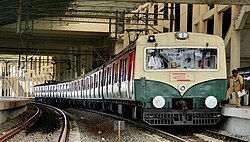
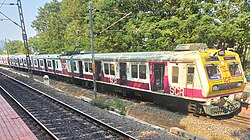
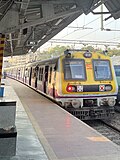
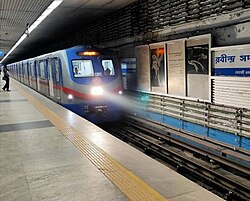





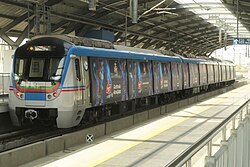
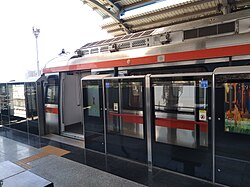
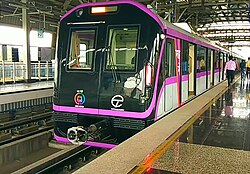
m Removed empty portal template using script |
No edit summary |
||
| Line 1: | Line 1: | ||
{{ | {{Short description|none}} <!-- "none" is a legitimate description when the title is already adequate; see [[WP:SDNONE]] --> | ||
{{Use Indian English}} | {{Use Indian English|date=September 2013}} | ||
{{Use dmy dates}} | {{Use dmy dates|date=September 2023}} | ||
{{Infobox rail network | {{Infobox rail network | ||
| | | image = {{Photomontage | ||
| | | photo1a = Vande Bharat Express at maximum speed.jpg | ||
| | | photo1b = Namo Bharat Train closeup.jpg | ||
| | | photo2a = WAP-7-LOCO.jpg | ||
| photo2b = KCG - AK ICE (23262137244).jpg | |||
| photo3a = Mumbai_Train.JPG | |||
| photo3b = Alstom_Metropolis_train-set_at_Guindy_Metro_station_in_Chennai.jpg | |||
| spacing = 1 | |||
| size = 275 | |||
| position = center | |||
| border = 0 | |||
| color = #000000 | |||
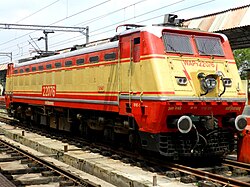
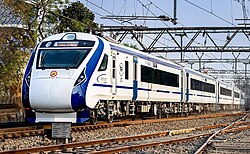
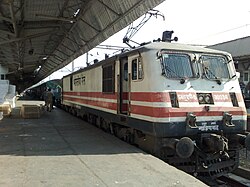
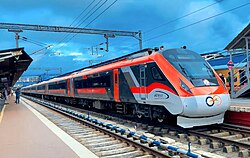
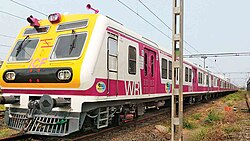
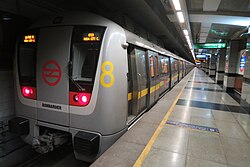
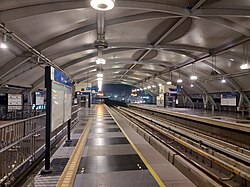
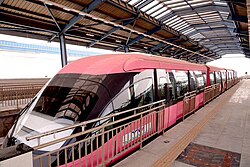
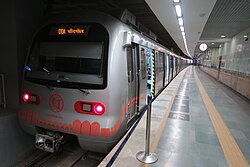
| foot_montage = '''Clockwise from top left''': [[Vande Bharat (trainset)|Vande Bharat]] trainset; [[Namo Bharat]] [[rapid rail]]; [[Express trains in India|Superfast express]] pulled by [[Indian locomotive class WDP-4|WDP-4D]] [[diesel locomotive]]; [[Urban rail transit in India|Metro train]]; [[suburban rail|Suburban train]]; [[Indian locomotive class WAP-7|WAP-7]] [[electric locomotive]] | |||
}} | |||
|nationalrailway = [[Indian Railways]] | |nationalrailway = [[Indian Railways]] | ||
|length = {{unbulleted list | |length = {{unbulleted list | ||
|{{convert|68, | |'''Regular/suburban:''' {{convert|68,584|km|abbr=on}}<ref name="IRYB"/> With {{cvt|29719|km}} of the lines having two or more tracks, total running track length was {{cvt|106493|km}}, while total trackage (including sidings) was {{cvt|132310|km}}.<ref name="IRYB"/> | ||
|'''Metro:''' {{convert|895|km|abbr=on}}<ref name="Metro"/> | |||
|{{convert| | |||
}} | }} | ||
|doublelength = | |doublelength = {{convert|38,415|km|abbr=on}} (2023)<ref name="IRYB"/><ref name="Metro"/> | ||
|ellength = {{cvt|64080|km|abbr=on}}<ref name="RE">{{Cite report |title=Status of Railway Electrification (as on 01.08.2024) |url=https://indianrailways.gov.in/railwayboard/uploads/directorate/ele_engg/RE/2024/Status%20of%20Railway%20Electrification%20(as%20on%2001_08_2024)%20pdf.pdf |access-date=8 August 2024 |publisher=Indian Railways}}</ref><ref name="Metro"/> | |||
|ellength = {{ | |gauge1 = {{Track gauge|1676mm|lk=on}} [[broad gauge]] | ||
| | |gauge1length = {{convert|65,977|km|abbr=on}}<ref name="IRYB"/><ref name="DM"/> | ||
|gauge2 = {{Track gauge|1435mm|lk=on}} [[standard gauge]] | |||
|gauge2length = {{convert|245|km|abbr=on}}<ref name="Metro"/><ref name="DM"/> | |||
|gauge3 = {{Track gauge|1000mm|allk=on}} | |||
|gauge3length = {{convert|1,345|km|abbr=on}}<ref name="IRYB"/> | |||
|gauge4 = {{Track gauge|762mm|lk=on}} and {{Track gauge|610mm|lk=on}} | |||
|gauge4length = {{convert|1,262|km|abbr=on}}<ref name="IRYB"/> | |||
|gauge1 = {{Track gauge| | |||
|gauge1length = {{convert| | |||
|gauge2 = {{Track gauge|1435mm|lk=on}} [[standard gauge]] | |||
|gauge2length = {{convert| | |||
|gauge3 = {{Track gauge| | |||
|gauge3length = {{convert| | |||
|gauge4 = | |||
|gauge4length = {{convert|1, | |||
|tunnellength = | |tunnellength = | ||
| | |longesttunnel = [[Pir Panjal Railway Tunnel]], {{convert|11.215|km|abbr=on}} | ||
|nobridges = | |nobridges = 156,417 (2023)<ref name="IRYB"/> | ||
| | |longestbridge = [[Bogibeel Bridge]], {{convert|4.94|km|abbr=on}}<ref>{{cite news|title=A bridge over Vembanad Lake|url=http://www.thehindu.com/news/cities/Kochi/A-bridge-over-Vembanad-Lake/article16194216.ece|newspaper=[[The Hindu]]|date=12 July 2010|access-date=11 February 2017|language=en|archive-date=11 July 2020|archive-url=https://web.archive.org/web/20200711025812/https://www.thehindu.com/news/cities/Kochi/A-bridge-over-Vembanad-Lake/article16194216.ece|url-status=live}}</ref> | ||
| | |nostations = {{unbulleted list | ||
| | |'''Total:''' 8016 | ||
| | |'''Regular/Suburban:''' 6268<ref name="IRYB"/> | ||
|'''Metro:''' 748 | |||
}} | |||
|highelevation = {{convert|2257|m|ft|0|abbr=on}} | |highelevation = {{convert|2257|m|ft|0|abbr=on}} | ||
|highelat = {{rws|Ghum}} | |highelat = {{rws|Ghum}} | ||
|lowelevation = {{convert| | |lowelevation = {{convert|3|m|ft|0|abbr=on}} | ||
|lowelat = {{rws|Burra Bazar}} and {{rws|Honnavar}} | |lowelat = {{rws|Burra Bazar}} and {{rws|Honnavar}} | ||
|map = | |map = | ||
|mapcaption = | |mapcaption = | ||
|name=Railway Transport In India}} | |name = Railway Transport In India}} | ||
'''Rail transport in India''' consists of primarily of [[passenger train|passenger]] and [[Rail freight transport|freight]] shipments along an integrated rail network. [[Indian Railways]] (IR), a [[statutory body]] under the [[ownership]] of the [[Ministry of Railways (India)|Ministry of Railways]] of the [[Government of India]], operates India's national railway system. It is the primary owner and operator of [[Rail transport|rail operations]] throughout the country, including [[suburban rail|suburban]] rail in major metros. Economic studies indicate positive effects of the Indian railway network on the economy of the country.<ref>{{cite journal |last1=Bogart |first1=Dan |last2=Chaudhary |first2=Latika |last3=Herranz-Loncán |first3=Alfonso |date=2024 |title=The growth contribution of colonial Indian railways in comparative perspective |url=https://www.cbe.anu.edu.au/researchpapers/CEH/WP201503.pdf |journal=The Economic History Review |volume=77 |issue=4 |pages=1509–1534 |doi=10.1111/ehr.13341 |issn=0013-0117}}</ref><ref>{{cite journal |last=Donaldson |first=Dave |date=2018 |title=Railroads of the Raj: Estimating the Impact of Transportation Infrastructure |url=https://www.aeaweb.org/articles?id=10.1257/aer.20101199 |journal=American Economic Review |volume=108 |issue=4–5 |pages=899–934 |doi=10.1257/aer.20101199 |issn=0002-8282|hdl=1721.1/128506 |hdl-access=free }}</ref> | |||
The majority of the metro [[Urban rail transit in India|urban rail]] networks are operated by independent bodies constituted for the respective operations. Privately owned rails exist in few places, mostly used to connect freight to the integrated rail network. Inter-city rail services are operated primarily by Indian Railways, though efforts have been made to introduce privately operated trains as recently as 2022. | |||
The national rail network comprised a total route length of {{convert|68584|km|adj=on|abbr=on}}, with more than {{convert|132310|km|adj=on|abbr=on}} of track and 8,000+ stations and is the [[List of countries by rail transport network size|fourth-largest in the world]]. {{As of|2023}}, it is one of the busiest networks in the world, transporting more than 11 billion passengers and 1.512 billion tonnes of freight annually. {{As of|2024|August|df=my}}, more than {{convert|64080|km|abbr=on}} of all the routes have been [[railway electrification|electrified]] with [[25 kV AC railway electrification|25 KV AC]] [[railway electric traction|electric traction]]. The [[rolling stock]] consisted of 318,196 [[Freight rail transport|freight wagons]], 84,863 [[Passenger car (rail)|passenger coaches]], 14,781 [[locomotive]]s and other [[multiple unit]]s owned by Indian Railways apart from rail-sets operated by metro rail corporations. | |||
==History== | ==History== | ||
=== 1832–1852: Industrial railways === | === 1832–1852: Industrial railways === | ||
In 1832, the proposal to construct the first railway line in India at [[Madras]] was made.<ref>{{cite book|url=https://books.google.com/books?id=sOILAQAAMAAJ|title=Reports, Correspondence and Original Papers on Various Professional Subjects Connected with the Duties of the Corps of Engineers, Madras Presidency|last1=Smith|first1=John Thomas|year=1839|publisher=[[University of Virginia]]}}</ref><ref name="Hist">{{cite report|url=https://indianrailways.gov.in/railwayboard/uploads/directorate/Heritage/2021/PDF/3%20Presentation%20Shradha%20Arora%20IRICEN%202019.pdf|title=Understanding Indian Railway Heritage|publisher=[[Indian Railways]]|page=6|access-date=1 December 2023}}</ref> In 1835, a [[railway track]] was constructed between [[Red Hills, Chennai|Red Hills]] and [[Chintadripet]] in [[Chennai|Madras]] and became operational in 1837. It was hauled by a [[Rotary engine|rotary steam engine]] imported from [[England]] and was used for ferrying [[granite]].<ref>{{cite news|url=https://www.newindianexpress.com/cities/chennai/2018/apr/16/chennai-the-track-record-1801999.html|title=Chennai: The track record|date=16 April 2018|newspaper=[[New Indian Express]]|access-date=9 August 2023}}</ref> | |||
The | The [[Madras Railway]] was established in 1845.<ref name="Hist"/> Temporary railway lines were built such as the Godavari Dam Construction Railway at [[Dowleswaram]] by [[Arthur Cotton]] to supply stone for the construction of a dam over the [[Godavari River]] in 1845 and the Solani aqueduct railway, built by [[Proby Cautley]] in [[Roorkee]] to transport construction materials for an [[aqueduct (bridge)|aqueduct]] over the Solani river in 1851.<ref name="Hist"/> On 1 August 1849, the [[Great Indian Peninsular Railway]] was incorporated with a guarantee system providing free land and guaranteeing five-percent rates of return to private English companies building railways.<ref name="Hist"/> In 1852, a [[steam locomotive]] imported from England was tried at [[Byculla]].<ref name="Locoh">{{cite report|url=https://swr.indianrailways.gov.in/uploads/files/1597914101378-The%20first%20%20running%20of%20%20railway%20locomotive%20%20in%20India.pdf|title=First running of a railway locomotive in India|publisher=[[Indian Railways]]|page=6|access-date=1 December 2023|archive-date=4 December 2023|archive-url=https://web.archive.org/web/20231204222555/https://swr.indianrailways.gov.in/uploads/files/1597914101378-The%20first%20%20running%20of%20%20railway%20locomotive%20%20in%20India.pdf|url-status=dead}}</ref> | ||
=== 1853–1924: Passenger railways and expansion === | === 1853–1924: Passenger railways and expansion === | ||
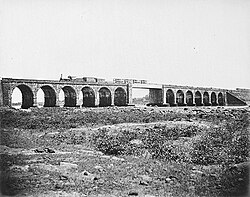
[[File:Tanna Railway Viaduct.jpg|thumb|The railway viaduct near Thane in 1855]] | |||
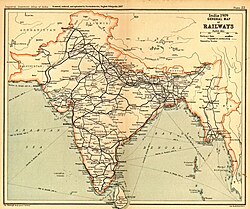
[[File:IndianRailways1871b.jpg|thumb|left|upright=0.8|Railway map of India in 1871]] | |||
On | In 1853, the first passenger train on {{RailGauge|1676mm|lk=on}} broad gauge ran for {{convert|34|km}} between [[Bori Bunder railway station|Bombay]] and [[Thane]] which had 14-carriages carrying 400 people, hauled by three steam locomotives: the Sahib, Sindh and Sultan.<ref>{{cite news|url=https://timesofindia.indiatimes.com/news/indias-1st-train-when-sahib-sindh-sultan-blew-steam/articleshow/19717248.cms?from=mdr|title=When India's first train blew steam|date=25 April 2013|newspaper=[[The Times of India]]|access-date=1 December 2023}}</ref><ref>{{cite news|url=http://www.indiatimes.com/news/india/164-years-ago-on-this-day-india-s-first-train-ran-from-mumbai-to-thane-275748.html|title=164 Years Ago On This Day, India's First Train Ran From Mumbai To Thane|work=India Times|date=16 April 2017|access-date=24 July 2017|archive-url=https://web.archive.org/web/20170729114445/http://www.indiatimes.com/news/india/164-years-ago-on-this-day-india-s-first-train-ran-from-mumbai-to-thane-275748.html|archive-date=29 July 2017|url-status=live}}</ref> The Great Southern of India Railway Company was established with its headquarters in [[England]] in 1853.<ref name="GSR">{{cite journal|journal=Herepath's Railway and Commercial Journal|page=3|title=Indian Tramway Limited|date=1 January 1870|volume=32|issue=1595}}</ref> The Thane viaducts, the first [[railway bridge]]s, were built over the [[Thane creek]] when the Mumbai-Thane line was extended to [[Kalyan]] in May 1854. Eastern India's first passenger train ran {{convert|24|mi|km|order=flip|abbr=on}} from [[Howrah]], near [[Kolkata]], to [[Hugli-Chinsura|Hoogly]] on 15 August 1854.<ref name="Hist"/> The construction of {{convert|60|mi|km|order=flip|abbr=on}} line in the South between [[Royapuram]] in Madras and [[Walajapet|Arcot]] started in 1853, which became operational on 1 July 1856.<ref>{{cite news|url=https://timesofindia.indiatimes.com/city/chennai/on-the-forgotten-track/articleshow/99129882.cms?from=mdr|title=On Forgotten Road|date=31 March 2013|newspaper=[[The Times of India]]|access-date=9 August 2023}}</ref> The first workshops were established by GIPR at Byculla in 1854 and Madras Railway at [[Perambur]] in 1856. The [[Bombay, Baroda and Central India Railway|Bombay, Baroda, and Central India Railway (BB&CI)]] was incorporated in 1855 and the [[Eastern Bengal Railway]] in 1858.<ref>{{cite web|url=http://www.wr.indianrailways.gov.in/view_section.jsp?lang=0&id=0,1,291,477|title=Western Railway, history|publisher=[[Indian Railways]]|access-date=24 July 2017|archive-date=2 April 2019|archive-url=https://web.archive.org/web/20190402033247/https://wr.indianrailways.gov.in/view_section.jsp?lang=0&id=0,1,291,477|url-status=live}}</ref><ref>{{cite report|url=https://discovery.nationalarchives.gov.uk/details/r/7859c7ff-af20-40df-9e88-8f4ab92a70d7|title=Records of the India Office relating to the Eastern Bengal Railway Company|publisher=Government of UK|access-date=1 December 2023}}</ref> The Carnatic Railway was founded in 1869.<ref name="GSR"/> On 24 February 1873, a [[Horsecar|horse-drawn]] {{convert|3.8|km||abbr=on}} [[tram]] opened in [[Calcutta]] between [[Sealdah]] and Armenian Ghat street.<ref name="DBG"/> In 1875, a railway line was opened in between [[Mokama]] and [[Darbhanga]] by the local ruler of [[Raj Darbhanga]] through [[Tirhut Railway]].<ref>{{cite news|url=https://www.etvbharat.com/english/state/bihar/palace-on-wheel-darbhangas-glorious-railway-history-lies-in-ruins/na20191026121137569|title=Darbhanga's once glorious railway history, now lies in ruins|date=26 October 2019|newspaper=[[ETV Baharat]]|access-date=28 October 2019}}</ref><ref>{{cite news|url=https://indianexpress.com/article/explained/explained-culture/150th-anniversary-calcutta-trams-8469537/|title=150th anniversary of Calcutta trams: A brief history of trams in India|date=28 February 2023|newspaper=[[Indian Express]]|access-date=1 December 2023}}</ref> On 9 May 1874, a horse-drawn tramway began operation in Bombay between [[Colaba]] and [[Parel]].<ref>{{cite report|url=http://dighist.fas.harvard.edu/courses/2015/HUM54/exhibits/show/mumbai_development/trams|title=The Evolution of Trams in Mumbai|publisher=[[Harvard University]]|access-date=18 May 2018|archive-url=https://web.archive.org/web/20171011232644/http://dighist.fas.harvard.edu/courses/2015/HUM54/exhibits/show/mumbai_development/trams|archive-date=11 October 2017|url-status=live}}</ref> The Great Southern of India Railway and the Carnatic Railway merged in 1874 to form the [[South Indian Railway Company|South Indian Railway]].<ref>{{cite book|title=Report on the Administration of the Madras Presidency During the Year 1875-76|page=260|publisher=Government Press|year=1877}}</ref> In 1879, the [[Nizam's Guaranteed State Railway]] was established which built railway lines across the then [[Hyderabad State]].<ref>{{cite book|last1=Jaganath|first1=Santosh|title=The History of Nizam's Railways System|publisher=Lulu|isbn=978-1-312-49647-7|url=https://books.google.com/books?id=lH0ACAAAQBAJ&q=Jankampet-Bodhan%20Railway&pg=PA98|page=98}}</ref> In 1877, an [[Ajmer]] built [[Finnish Steam Locomotive Class F1|F-1/734 Steam Locomotive]] became the first indigenously built locomotive in India.<ref>{{cite news|url=https://timesofindia.indiatimes.com/city/jaipur/oldest-locomotive-built-in-ajmer-pride-of-delhi/articleshow/59888386.cms|title=Oldest locomotive: Built in Ajmer, pride of Delhi|date=3 August 2017|newspaper=[[The Times of India]]|access-date=1 December 2023}}</ref> [[East Coast State Railway]] was established in 1890.<ref>{{cite web|url=https://eastcoastrail.indianrailways.gov.in/view_section.jsp?fontColor=black&backgroundColor=LIGHTSTEELBLUE&lang=0&id=0,1,261|title=History of East Coast Railway|publisher=[[Indian Railways]]|access-date=1 December 2023}}</ref> In 1897, lighting in passenger coaches was introduced with the Jodhpur Railway, the first to introduce electric lighting as standard fixtures.<ref name="Hist"/> In 1908, Madras Railway merged with [[Southern Mahratta Railway]] to form the [[Madras and Southern Mahratta Railway]].<ref>{{cite book|url=https://books.google.com/books?id=d-4sgbfdutMC&q=Madras+Railway+merger&pg=PA755|title=The Cambridge Economic History of India|volume=2|page=755|year =2005|publisher=Orient Longmans Private Limited|isbn=978-8-1250-2731-7}}</ref> [[Pamban Bridge|Pamban bridge]], the first sea bridge was opened on 24 February 1914.<ref>{{cite news|last1=Datta|first1=Rangan|title=Rameswaram: A holy island town along India's southern borderland|url=https://www.telegraphindia.com/my-kolkata/places/travel-to-the-edge-of-india-on-a-trip-to-pamban-islands-rameswaram/cid/1913631|access-date=9 February 2023|work=The Telegraph|date=1 February 2023}}</ref> | ||
In 1920, [[Railway signal|electric lighting of signals]] was introduced between [[Dadar railway station|Dadar]] and [[Currey Road railway station|Currey Road]] in Bombay.<ref>{{cite report|url=https://rosap.ntl.bts.gov/view/dot/5107/dot_5107_DS1.pdf|title=Railway signals, signs and markers|publisher=US transportation library|access-date=1 December 2023}}</ref> | |||
=== 1925–1949: Electrification and further expansion === | |||
[[File:India railways1909a.jpg|thumb|Railway map of India in 1909]] | |||
The first [[Railway budget of India|railway budget]] was presented in 1924.<ref name="Hist"/> The [[Oudh and Rohilkhand Railway]] was merged with the [[East Indian Railway Company]] (EIR) in the same year.<ref>{{cite web|url=http://www.indiainfoline.com/article/news/history-of-indian-railway-budget-5963201398_1.html|title=History of Indian Railway Budget|access-date=24 July 2017|archive-date=25 February 2021|archive-url=https://web.archive.org/web/20210225095548/https://www.indiainfoline.com/article/news/history-of-indian-railway-budget-5963201398_1.html|url-status=live}}</ref> On 3 February 1925, the first [[Electric locomotive|electric train]] ran between [[Chhatrapati Shivaji Maharaj Terminus|Victoria Terminus]] (VT) and [[Kurla]], hauled by a [[Swiss Locomotive and Machine Works|SLM]] [[electric locomotive]] on [[1500 V DC]] traction.<ref name="EL">{{cite report|url=https://secr.indianrailways.gov.in/uploads/files/1596785062728-Locomotive_comp.pdf|title=Evolution of Electric Locomotives|publisher=[[Indian Railways]]|access-date=1 December 2023}}</ref> Later, the VT–[[Bandra railway station|Bandra]] section was electrified and the first [[Electric Multiple Units]] (EMU) were introduced in with 1.5KV [[Direct current|DC]] units imported were from [[Cammell Laird]] and [[Duewag|Uerdingenwagonfabrik]].<ref name="EL1">{{cite report|url=https://elocos.railnet.gov.in/Analysis/Elect_Tr_history.htm|title=Electrification history|publisher=[[Indian Railways]]|access-date=1 December 2023|archive-date=9 June 2017|archive-url=https://web.archive.org/web/20170609072045/http://elocos.railnet.gov.in/Analysis/Elect_Tr_history.htm|url-status=dead}}</ref> On 1 April 1929, [[Grand Trunk Express]] commenced operations between [[Peshawar]] in the [[North Western Railway (British India)|North Western Railway]] and [[Mangalore]] with two coaches detached and connected to Madras further.<ref>{{cite book|url=https://dspace.gipe.ac.in/xmlui/handle/10973/18188|title=Report by the Railway board on Indian Railways for 1929-30:Volume I|author=Railway Department, Government of India|publisher=Central Publication Branch, Government of India|year=1930|location=Calcutta|page=38|chapter=Chapter IV-Transportation and Working}}</ref><ref>{{cite book|title=The Railway Magazine:Volume 64|year=1929|publisher=IPC Business Press|page=490}}</ref> The [[Golden Temple Mail|Frontier Mail]] made its inaugural run between Bombay and [[Peshawar]] in 1928.<ref>{{cite news|url=https://www.tribuneindia.com/news/amritsar/golden-temple-mail-completes-92-yrs-of-historic-run-135130|title=Golden Temple Mail completes 92 years|work=Tribune India|date=2 September 2020|access-date=24 July 2023}}</ref> Technical advancements led to automatic colour light signals that become operational between Bombay and Byculla in 1928.<ref>{{cite web|url=https://signalbox.org/overseas/india/india.htm|title=Signalling in India – Past and Present|work=Signalbox|access-date=24 July 2017|archive-date=30 March 2019|archive-url=https://web.archive.org/web/20190330111351/https://signalbox.org/overseas/india/india.htm|url-status=dead}}</ref> In the subsequent years, the route from Bombay to [[Pune|Poona]] was electrified and in June 1930, the first deluxe train, [[Deccan Queen]] began running, hauled by a [[Indian locomotive class WCP-1|WCP-1 locomotive]]s with seven coaches along the route.<ref>{{cite news|url=https://www.businesstoday.in/latest/trends/story/indias-first-deluxe-train-mumbai-pune-deccan-queen-completes-93-years-of-service-all-you-need-to-know-383826-2023-06-01|title=India's first deluxe train: Mumbai-Pune Deccan Queen completes 93 years of service|date=1 June 2023|access-date=1 January 2023|newspaper=Business Today}}</ref> The Grand Trunk express commenced operating as a dedicated daily train between Madras and Delhi from 1 September 1930.<ref>{{cite book|title=Report by the Railway board on Indian Railways for 1930-31:Volume I|year=1932|publisher=Central Publication Branch, Government of India|location=Calcutta|page=36|chapter=IV}}</ref> [[Chennai Suburban Railway|Chennai suburban railway]] started operating in 1931 with a single [[Metre gauge railway|metre gauge]] line from [[Chennai Beach railway station|Chennai Beach]] to [[Tambaram railway station|Tambaram]].<ref name="SR1">{{cite report|url=https://sr.indianrailways.gov.in/uploads/files/1325745996774-about.pdf|title=Chennai Division, SR|publisher=Southern Railway|access-date=1 December 2023|archive-date=15 December 2023|archive-url=https://web.archive.org/web/20231215180509/https://sr.indianrailways.gov.in/uploads/files/1325745996774-about.pdf|url-status=live}}</ref> In 1944, all the railway companies were taken over by the Government.<ref>{{cite report|url=http://www.indianrailways.gov.in/financecode/ADMIN_FINANCE/AdminFinanceCh1_Data.htm|title=Evolution of Indian Railways-Historical Background|publisher=[[Indian Railways]]|access-date=1 December 2023}}</ref> | |||
==== Indian Railway Classification ==== | |||
Beginning in 1926 and for statistical purposes, the Government of [[British Raj]] classified Indian railway systems according to three classes. It was a similar system to the [[Railroad classes]] in North America.<ref name="fibis">{{cite web|url=https://wiki.fibis.org/w/Indian_Railway_Classification |title=Indian Railway Classification |publisher=fibis |access-date=21 March 2023}}</ref><ref>{{Cite book|title=Directory of Railway Officials & Yearbook |year=1947| publisher=Tothill Press |language=English |pages=495}}</ref> | |||
{| class="wikitable" | {| class="wikitable" | ||
|- | |- | ||
|''' | | '''''Class I''''' || Railways with gross annual earnings of over 5,000,000 [[Indian rupee|INR]] | ||
| | |||
| | |||
|- | |- | ||
|''' | | '''''Class II''''' || Railways with gross annual earnings of between 1,000,000 and 5,000,000 INR | ||
| | |||
|- | |- | ||
|''' | | '''''Class III''''' || Railways with gross annual earnings of under 1,000,000 INR | ||
| | |||
| | |||
|} | |} | ||
[[Tram]]s, [[Industrial railway|industrial]] and port railways were recorded separately and independently of turnover. | |||
In terms of net revenue, [[East Indian Railway Company|East Indian Railway]] was the largest company in 1927 with 86,881,000 rupees. Followed by the [[North Western State Railway]] with 57,343,000 rupees and the [[Great Indian Peninsula Railway]] with 56,215,000 rupees.<ref>{{Cite book|title=Commerce Reports, Vol. 2, Nr. 25 |publisher=United States Department of Commerce |date=4 June 1929 |pages=792 |language=en |url=https://books.google.com/books?id=KfzWpgNQNMsC&pg=PA792}}</ref> No further reclassification was carried out after 1942, but the rankings remained in use until the mid-1950s.<ref name="fibis" /><ref>{{Cite book|title=Indian Railways One Hundred Years |publisher=Ministry of Railways (Railway Board) |date=1953 |pages=162 |url=https://archive.org/details/ncd.indianrailwayson0000jnsa/page/162/}}</ref> | |||
=== 1950–1983: Zonal re-organisation and further developments === | |||
The first locomotive manufacturing unit at [[Chittaranjan Locomotive Works|Chittaranjan]] was commissioned in 1950.<ref name="Chit">{{cite report|url=https://clw.indianrailways.gov.in/view_section.jsp?lang=0&id=0,294|title=Chittaranjan Locomotive works|publisher=[[Indian Railways]]|access-date=1 December 2023}}</ref> In December 1950, the Central Advisory Committee for Railways approved the plan for re-organising Indian Railways into six [[Zones and divisions of Indian Railways|regional zones]] with the [[Southern Railway zone|Southern]] (14 April 1951), [[Central Railway zone|Central]] (5 November 1951), and [[Western Railway zone|Western]] (5 November 1951) zones being the first to be created.<ref name="NAIR">{{cite report|url=https://nair.indianrailways.gov.in/uploads/files/1430369298618-general%20overview.pdf|title=Overview of Indian Railways|publisher=National Academy of Indian Railways|access-date=1 January 2024|archive-date=8 January 2024|archive-url=https://web.archive.org/web/20240108180850/https://nair.indianrailways.gov.in/uploads/files/1430369298618-general%20overview.pdf|url-status=dead}}</ref> On 14 April 1952, the [[Northern Railway Zone (India)|Northern Railway]], the [[Eastern Railway (India)|Eastern Railway]] and the [[North Eastern Railway zone|North Eastern Railway]] were created.<ref name="NAIR"/> In 1952, fans and lights were mandated for all compartments in passenger trains, and sleeping accommodations were introduced in coaches.<ref name="Hist"/> In 1953, the Indian Railways completed a hundred years of operation, which was commemorated by multiple events and a commemorative postage stamp.<ref>{{cite report|title=Railway Budget for 1953-54|date=18 February 1953|url=https://indianrailways.gov.in/railwayboard/uploads/directorate/finance_budget/Previous%20Budget%20Speeches/1953-54.pdf|publisher=[[Government of India]]|access-date=1 December 2023}}</ref><ref>{{cite news|last=Singh|first=J.L.|title=Indian Railways' Centenary Celebrations|url=https://artsandculture.google.com/story/indian-railways-centenary-celebrations-rail-enthusiasts-society/EwXhN3mS0qZkIg?hl=en|work=Google Arts & Culture|access-date=1 December 2023}}</ref> The first [[diesel locomotive]] used in India was fabricated by [[North British Locomotive Company]] in 1954.<ref name="Gandhi">{{cite report|url=https://indianrailways.gov.in/railwayboard/uploads/directorate/mec_engg/downloads/DLS/WR/Gandhidham.pdf|title=Gandhidham shed details|publisher=[[Indian Railways]]|access-date=1 December 2023}}</ref> On 1 August 1955 the [[South Eastern Railway Zone (India)|South-Eastern Railway]] was split from the Eastern Railway, and, the following year, divisional systems of administration were set up for the various regional zones. The first rail coaches were manufactured in India from 1956 when the [[Integral Coach Factory]] was established at Madras.<ref name="ICF">{{cite report|url=https://icf.indianrailways.gov.in/works/uploads/File/ICF%20-%20Tracing%20The%20%20Roots.pdf|title=Tracing the roots|publisher=[[Indian Railways]]|access-date=1 December 2023}}</ref> In 1956, the first [[air-conditioned]] train plied between [[Howrah Junction railway station|Howrah]] and [[New Delhi railway station|New Delhi]].<ref>{{cite news|url=http://daily.bhaskar.com/news/NAT-TOP-160-years-of-indian-railways-watch-how-ac-trains-were-kept-cool-4224130-PHO.html|archive-url=https://web.archive.org/web/20150227224211/http://daily.bhaskar.com/news/NAT-TOP-160-years-of-indian-railways-watch-how-ac-trains-were-kept-cool-4224130-PHO.html|url-status=dead|archive-date=27 February 2015|title=160 years of Indian Railways: Here's how AC trains were kept cool|date=2 April 2013|access-date=1 December 2023|newspaper=Dainik Bhaskar}}</ref> In 1958, the North-Eastern Railway split to form a new [[Northeast Frontier Railway]].<ref name="NAIR"/> | |||
= | [[File:WAP1_^22076_Aastha_of_GZB_waiting_for_its_scheduled_departure_with_Agra_bound_ICE_at_LJN_-_Flickr_-_Dr._Santulan_Mahanta.jpg|thumb|[[Indian locomotive class WAP-1|WAP-1]] [[electric locomotive]]s reached a speed of {{cvt|130|kph|abbr=on}} in 1980]] | ||
=== | In 1957, Indian Railways adopted 25 kV AC traction with the first trial runs operating with the [[Indian locomotive class WAM-1|WAM-1]] locomotives in 1959 and commercial services beginning in August 1960.<ref name="EL1"/> In 1960, the [[Ministry of Railways (India)|Railway Board of India]] commissioned a study to increase the speed of passenger trains to {{cvt|160|kph}} with an intermediate stage of {{cvt|120|kph}}.<ref name="HT"/> [[Research Design and Standards Organisation]] (RDSO) started work on the same in 1962 with field trials commencing in 1967 with coaches manufactured by the [[Integral Coach Factory]] at Madras and hauled by [[diesel locomotive]]s.<ref name="HT">{{cite news|url=https://www.hindustantimes.com/india-news/railways-golden-girl-50-years-of-the-rajdhani/story-YycT0iir0GObqjuCUqrhKL.html|title=Railways golden girl: 50 years of the Rajdhani story|newspaper=[[Hindustan Times]]|date=9 March 2019|access-date=1 December 2023}}</ref> The first [[shipping container|containerized]] [[freight rail transport]] began between Bombay and Ahmedabad in 1966.<ref name="Hist"/> In 1966, the electrification of several suburban tracks around Delhi, Madras, and Calcutta were completed with the 25 kV AC system. In 1969, the [[Government of India]] announced the introduction of a new express train capable of reaching speeds of up to {{cvt|120|kph}} in the [[Railway budget of India|railway budget]] and the first Rajdhani Express was flagged off from New Delhi to Howrah in March 1969.<ref name="Raj">{{cite news|url=https://timesofindia.indiatimes.com/city/kolkata/kolkata-loses-last-connect-to-first-rajdhani/articleshow/52386071.cms|title=Kolkata loses last connect to first Rajdhani|date=22 May 2016|newspaper=[[The Times of India]]|access-date=1 December 2023}}</ref><ref>{{cite report|url=https://indianrailways.gov.in/railwayboard/uploads/directorate/finance_budget/Previous%20Budget%20Speeches/1969-70.pdf|title=Railway Budget of 1969–70|publisher=[[Indian Railways]]|access-date=1 December 2023}}</ref> In 1974, Indian Railways endured a 20-day [[1974 railway strike in India|strike]].<ref>{{cite news|url=https://www.nytimes.com/1974/05/08/archives/strike-of-indian-rail-workers-begins-tension-high-with-food.html|title=Strike of Indian Rail Workers Begins|date=8 May 1974|newspaper=[[The New York Times]]|access-date=29 March 2020|language=en-US|issn=0362-4331}}</ref><ref>{{cite news|url=https://economictimes.indiatimes.com/news/politics-and-nation/better-jail-than-rail-fernandes-slogan-that-led-to-asias-biggest-railway-strike/articleshow/67742843.cms|title=Better jail than rail: George Fernandes' slogan that led to Asia's biggest railway strike in 1974|newspaper=[[The Economic Times]]|date=29 January 2019|access-date=29 March 2020}}</ref> In 1979, the Main Line Electrification Project was reconstituted into the [[Central Organisation for Railway Electrification]] (CORE).<ref>{{cite web|url=https://www.core.indianrailways.gov.in/view_section.jsp?lang=0&id=0,294,302|title=About us, History|publisher=[[Central Organisation for Railway Electrification]], [[Indian Railways]]|access-date=1 December 2023}}</ref> In 1980, the [[Indian locomotive class WAP-1|WAP-1]] electric locomotives reached a speed of {{cvt|130|kph|abbr=on}}.<ref>{{cite press release|url=https://secr.indianrailways.gov.in/uploads/files/1596785062728-Locomotive_comp.pdf|title=WAP-1 locomotive|publisher=[[Government of India]]|date=9 October 1989|access-date=1 December 2023}}</ref> | ||
{{Main| | |||
[[File:The Indian | === 1984–present: Rapid transit and later developments === | ||
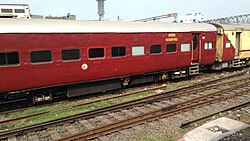
[[File:Red-icf-coach-indian-railways.jpg|thumb|left|A typical red-colored [[ICF coach]] used by the Indian Railways till the late 1990s]] | |||
The first [[Rapid transit|metro rail]] was introduced in [[Calcutta Metro|Calcutta]] on 24 October 1984 with the line between [[Esplanade metro station|Esplanade]] and [[Netaji Bhavan metro station|Bhowanipore]].<ref>{{cite news|url=https://timesofindia.indiatimes.com/city/kolkata/kolkata-metro-maps-evolution-of-its-ticketing-system/articleshow/98976615.cms|title=Kolkata Metro maps evolution of its ticketing system|date=24 March 2023|newspaper=[[The Times of India]]|access-date=1 December 2023}}</ref> In 1986, computerized ticketing and reservations were introduced by Indian Railways.<ref name="IT">{{cite report|title=IT Audit of Indian Railways Passenger reservation System (2007)|url=http://icisa.cag.gov.in/audit_report/2/15db5cf8539e7f66e05214564e6b5d01.pdf|url-status=live|archive-url=https://web.archive.org/web/20170712231120/http://icisa.cag.gov.in/audit_report/2/15db5cf8539e7f66e05214564e6b5d01.pdf|archive-date=12 July 2017|access-date=24 July 2017}}</ref> In 1988, the first [[Shatabdi Express]] was introduced between New Delhi and [[Jhansi Junction railway station|Jhansi]].<ref name="Hist"/> Two years later, the first self-printing ticket machine (SPTM) was introduced in Delhi.<ref name="SF">{{cite news|url=https://www.financialexpress.com/infrastructure/railways/happy-birthday-indian-railways-first-passenger-train-started-165-years-ago-unknown-facts-about-the-network/1134650/|title=Happy Birthday Indian Railways! First passenger train started 165 years ago; unknown facts about the network|date=16 April 2018|access-date=27 May 2018|archive-url=https://web.archive.org/web/20180528051814/https://www.financialexpress.com/infrastructure/railways/happy-birthday-indian-railways-first-passenger-train-started-165-years-ago-unknown-facts-about-the-network/1134650/|archive-date=28 May 2018|url-status=live}}</ref> In 1993, air-conditioned three-tier and [[sleeping car|sleeper]] were introduced.<ref name="Hist"/> In 1995, [[Chennai MRTS]] became the first operational elevated railway line in India.<ref name="SR"/> In 1995, [[Delhi Metro Rail Corporation]], a [[joint venture]] between Government of India and [[Government of Delhi]] was established.<ref>{{cite news|url=https://www.financialexpress.com/business/infrastructure/25-years-of-dmrc-how-delhi-metro-has-become-a-lifeline-for-the-national-capital-from-1995-to-2019/1569685/|title=25 years of DMRC! How Delhi Metro has become a lifeline for the national capital|date=7 May 2019|newspaper=Financial Express|access-date=1 December 2023}}</ref> Centralized computer reservation system was deployed in Delhi, Mumbai and Chennai in September 1996, coupon validating machines (CVMs) were introduced at [[Chhatrapati Shivaji Terminus|Mumbai CSMT]] in 1998 and the nationwide [[concierge]] system began operation on 18 April 1999.<ref name="Hist"/> In 1999, the [[South East Central Railway zone]] was established and on 6 July 2002, the [[East Coast Railway zone|East Coast]], [[South Western Railway zone|South Western]], [[South East Central Railway zone|South East Central]], [[North Central Railway zone|North Central]], and [[West Central Railway zone|West Central]] zones were created.<ref>{{cite web|url=http://www.ncr.indianrailways.gov.in/|title=North Central Railways|publisher=[[Indian Railways]]|access-date=24 July 2017|archive-date=21 January 2016|archive-url=https://web.archive.org/web/20160121180251/http://www.ncr.indianrailways.gov.in/|url-status=live}}</ref><ref name="NAIR"/> | |||
The Indian Railways website went online in February 2000. [[Indian Railway Catering and Tourism Corporation|Indian Railways Catering and Tourism Corporation]] (IRCTC) was incorporated in 1999, and online ticketing was introduced on 3 August 2002 through IRCTC.<ref name="IRCTC">{{cite web|url=https://irctc.com/about.html|title=About IRCTC|publisher=IRCTC|access-date=1 December 2023}}</ref> The [[Red Line (Delhi Metro)|first line]] of the [[Delhi Metro]] was inaugurated on 24 December 2002.<ref>{{cite news|title=Indian PM launches Delhi metro|url=https://news.bbc.co.uk/2/hi/south_asia/2602907.stm|work=BBC News|date=24 December 2002|access-date=22 April 2010|url-status=live|archive-url=https://web.archive.org/web/20120422001958/http://news.bbc.co.uk/2/hi/south_asia/2602907.stm|archive-date=22 April 2012}}</ref> In 2012, Western Railway switched completely to AC traction with Central Railway following it in 2016.<ref>{{cite web|url=http://www.railwaygazette.com/news/passenger/single-view/view/mumbai-switches-from-dc-to-ac.html|title=Mumbai switches from DC to AC|work=Railway Gazette International |access-date=24 July 2017|archive-date=11 July 2020|archive-url=https://web.archive.org/web/20200711030114/https://www.railwaygazette.com/news/passenger/single-view/view/mumbai-switches-from-dc-to-ac.html|url-status=live}}</ref><ref>{{cite news|url=http://indianexpress.com/article/cities/mumbai/end-of-an-era-mumbai-bids-goodbye-to-last-dc-local/|title=End of an era: Mumbai bids goodbye to last DC local|date=11 April 2016|access-date=24 July 2017|archive-date=8 November 2020|archive-url=https://web.archive.org/web/20201108114548/https://indianexpress.com/article/cities/mumbai/end-of-an-era-mumbai-bids-goodbye-to-last-dc-local/|url-status=live}}</ref> On 1 February 2014, [[Mumbai Monorail]] became the first operational [[monorail]] system in India.<ref>{{cite news|url=http://www.mumbaimirror.com/mumbai/others/First-mono-runs-crowded-like-the-good-old-local/articleshow/29729191.cms|title=First mono runs crowded like the good old local|newspaper=[[Mumbai Mirror]]|date=1 February 2014|access-date=2 February 2014}}</ref> In 2015, the first [[Compressed Natural Gas]] (CNG) powered trains were rolled out.<ref name="CNG">{{cite news|url=https://economictimes.indiatimes.com/infrastructure/indias-first-cng-train-for-the-rewari-rohtak-section/indias-first-cng-train/slideshow/45895170.cms|title=India's first CNG train for the Rewari-Rohtak section|date=15 January 2015|newspaper=[[The Economic Times]]|access-date=1 December 2023}}</ref> On 5 April 2016, [[Gatimaan Express]], then India's fastest train with a maximum speed of {{convert|160|km/h|abbr=on}}, made its first run from [[New Delhi railway station|New Delhi]] to [[Agra Cantonment railway station|Agra Cantonment]].<ref>{{cite magazine|url=https://www.indiatoday.in/india/story/gatimaan-express-reaches-agra-within-targeted-100-minutes-316423-2016-04-05|title=Gatimaan Express reaches Agra within targeted 100 minutes|date=5 April 2016|magazine=India Today|access-date=20 June 2020|archive-date=31 May 2020|archive-url=https://web.archive.org/web/20200531224926/https://www.indiatoday.in/india/story/gatimaan-express-reaches-agra-within-targeted-100-minutes-316423-2016-04-05|url-status=live}}</ref> | |||
The [[Government of India|central government]] approved the [[Railway budget of India|merger of the Rail and General budgets]] from 2017.<ref>{{cite news|url=https://www.deccanherald.com/business/union-budget/why-was-railway-budget-merged-with-the-union-budget-1183565.html|title= | |||
Why was Railway Budget merged with the Union Budget?|date=22 January 2023|access-date=1 December 2023|newspaper=[[Deccan Herald]]}}</ref> On 31 March 2017, Indian Railways announced a target of electrifying the entire rail network by 2023.<ref>{{cite news|url=http://indianexpress.com/article/india/48-per-cent-rail-tracks-electrified-aim-to-double-it-in-5-years-govt-4594389/|title=48 per cent rail tracks electrified, aim to double it in 5 years: Govt|date=31 March 2017|newspaper=[[Indian Express]]|access-date=24 July 2017|archive-url=https://web.archive.org/web/20170718224354/http://indianexpress.com/article/india/48-per-cent-rail-tracks-electrified-aim-to-double-it-in-5-years-govt-4594389/|archive-date=18 July 2017|url-status=live}}</ref> In March 2020, Indian Railways announced a [[2020 India coronavirus lockdown|nationwide shutdown]] of passenger service to combat the [[COVID-19 pandemic in India]] with the freight operations continuing to transport essential goods.<ref>{{cite news|url=https://www.cnbc.com/2020/03/26/coronavirus-puts-over-1-billion-people-in-india-on-21-day-lockdown-to-combat-spread.html|title=Coronavirus puts over 1 billion people in India on 21-day lockdown to combat spread|author1=Adam Jeffery|author2=Hannah Miller|date=26 March 2020|work=CNBC|access-date=29 March 2020}}</ref><ref>{{cite news|url=https://www.businesstraveller.com/business-travel/2020/03/23/coronavirus-indian-railways-cancels-passenger-train-services/|title=Indian Railways cancels passenger train services|newspaper=Business Traveller|access-date=1 December 2023|date=29 March 2020}}</ref><ref>{{cite news|url=https://www.livemint.com/news/india/indian-railways-continuing-its-freight-operations-post-22-march-lockdown-11585314775866.html|title=How Indian Railways continuing its freight operations post lockdown|last=Nandi|first=Tamal|date=27 March 2020|work=Livemint|access-date=30 March 2020}}</ref> The railways resumed passenger services in a phased manner in May 2020.<ref>{{cite news|url=https://www.thehindu.com/news/national/coronavirus-lockdown-railways-to-resume-select-passenger-train-services-from-may-12/article31551514.ece|title=Coronavirus lockdown: Railways to restart passenger services in phased manner|date=10 May 2022|access-date=1 December 2023|newspaper=[[The Hindu]]}}</ref> | |||
[[File:Vande_Bharat_Express_around_Mumbai.jpg|thumb|Introduced in 2019, [[Vande Bharat Express]] operating on a [[Vande Bharat (trainset)|train-set]] built by [[Integral Coach Factory|ICF]], is the fastest train in India]] | |||
Starting in the 2010s, various infrastructure modernization projects have been undertaken including [[High-speed rail in India|high-speed rail]],<ref>{{cite news|url=http://indianexpress.com/article/india/india-others/diamond-quadrilateral-of-high-speed-trains/|title=Diamond quadrilateral of high-speed trains|date=10 June 2014|access-date=22 June 2017|newspaper=[[Indian Express]]|archive-url=https://web.archive.org/web/20170813222712/http://indianexpress.com/article/india/india-others/diamond-quadrilateral-of-high-speed-trains/|archive-date=13 August 2017|url-status=live}}</ref><ref>{{cite news|url=http://www.thehindu.com/news/national/india-to-sign-deal-with-japan-to-get-first-bullet-train/article7961724.ece|title=India to sign deal with Japan to get first bullet train|newspaper=[[The Hindu]]|date=8 December 2015|access-date=22 June 2017|archive-url=https://web.archive.org/web/20170802071232/http://www.thehindu.com/news/national/india-to-sign-deal-with-japan-to-get-first-bullet-train/article7961724.ece|archive-date=2 August 2017|url-status=live }}</ref> redevelopment of 400 stations,<ref>{{cite news|url=http://www.livemint.com/Companies/NV9ujsKfuh92SnrxtiC86H/Railways-appoints-IRSDC-as-nodal-agency-for-station-redevelo.htm|title=Railways appoints IRSDC as nodal agency for station redevelopment|date=23 December 2017|work=Livemint|access-date=5 December 2017}}{{Dead link|date=July 2025 |bot=InternetArchiveBot |fix-attempted=yes }}</ref> [[Double-track railway|doubling tracks]] to reduce congestion,<ref>{{cite news|url=http://railengdigest.com/project-news/asia/indian-railways-converts-broad-gauge/|title=Indian Railways orders conversion to Broad Gauge|date=12 April 2017|work=Rail Digest|access-date=12 April 2017|archive-date=23 December 2017|archive-url=https://web.archive.org/web/20171223102927/http://railengdigest.com/project-news/asia/indian-railways-converts-broad-gauge/|url-status=dead}}</ref> refurbishing of coaches,<ref>{{cite news|title=Indian Railways gets first model rake of luxury 'Make in India' coaches|url=http://economictimes.indiatimes.com/slideshows/infrastructure/indian-railways-gets-first-model-rake-of-luxury-make-in-india-coaches/led-reading-lights/slideshow/50527595.cms|access-date=13 January 2016|newspaper=[[The Economic Times]]|date=11 January 2016|archive-url=https://web.archive.org/web/20160114215143/http://economictimes.indiatimes.com/slideshows/infrastructure/indian-railways-gets-first-model-rake-of-luxury-make-in-india-coaches/led-reading-lights/slideshow/50527595.cms|archive-date=14 January 2016|url-status=live}}</ref><ref>{{cite news|title=Indian Railways unveils 'Make in India' train coaches with new look|url=http://www.financialexpress.com/photos/business-gallery/192582/indian-railways-unveils-make-in-india-train-coaches-with-new-look-check-irctc-co-in/2/|access-date=13 January 2016|newspaper=[[The Financial Express (India)|The Financial Express]]|date=13 January 2016|archive-url=https://web.archive.org/web/20160115052117/http://www.financialexpress.com/photos/business-gallery/192582/indian-railways-unveils-make-in-india-train-coaches-with-new-look-check-irctc-co-in/2/|archive-date=15 January 2016|url-status=live}}</ref> [[Global Positioning System]] (GPS)-enabled tracking of trains<ref>{{cite news|url=http://www.dnaindia.com/business/report-just-like-your-cabs-you-can-soon-track-trains-in-real-time-via-gps-2563623|title=Just like your cabs, you can soon track trains in real time via GPS|date=30 November 2017|work=DNA India|access-date=30 November 2017|archive-url=https://web.archive.org/web/20171202071947/http://www.dnaindia.com/business/report-just-like-your-cabs-you-can-soon-track-trains-in-real-time-via-gps-2563623|archive-date=2 December 2017|url-status=live}}</ref> and modernization of locomotives.<ref>{{cite news|title=Locomotive Factories in Bihar: In cold storage for years, two Railway projects to start soon|url=http://indianexpress.com/article/india/india-news-india/locomotive-factories-in-bihar-in-cold-storage-for-years-two-railway-projects-to-start-soon/|work=[[The Indian Express]]|date=30 October 2015|access-date=31 October 2015|archive-url=https://web.archive.org/web/20151031004858/http://indianexpress.com/article/india/india-news-india/locomotive-factories-in-bihar-in-cold-storage-for-years-two-railway-projects-to-start-soon/|archive-date=31 October 2015|url-status=live}}</ref><ref>{{cite news|title=GE Gets $2.6 Billion Indian Railways Contract|url=https://www.wsj.com/articles/ge-to-help-modernize-indias-rail-system-1447080903|work=[[The Wall Street Journal]]|date=9 November 2015|access-date=9 November 2015|archive-url=https://web.archive.org/web/20151109183451/http://www.wsj.com/articles/ge-to-help-modernize-indias-rail-system-1447080903|archive-date=9 November 2015|url-status=live}}</ref> In 2018, a semi-high speed self-propelled [[Vande Bharat (trainset)|train-set]] capable of reaching speeds of over {{cvt|160|kph}} was rolled out from ICF and the [[Vande Bharat Express]] was launched in 2019.<ref name="VB">{{cite news|date=20 February 2017|title=Indian Railways to roll out 'Make in India' 160 kmph self-propelled 'world-class' train sets at half the cost of import!|url=https://www.financialexpress.com/india-news/indian-railways-to-roll-out-make-in-india-160-kmph-self-propelled-world-class-train-sets-at-half-the-cost-of-imports/558791/|access-date=20 May 2023|newspaper=The Financial Express}}</ref><ref name="VB1">{{cite news|date=29 October 2018|title=Train 18: Country's first engine-less train rolled out; Train 20 next|newspaper=[[The Economic Times]]|url=https://economictimes.indiatimes.com/industry/transportation/railways/train-18-countrys-first-engine-less-train-rolled-out-train-20-next/articleshow/66419774.cms|access-date=20 May 2023|issn=0013-0389}}</ref> Indian Railways announced plans to become a net-zero carbon emission railway by 2030 and has implemented [[Rainwater harvesting#India|rainwater harvesting]] at stations,<ref>{{cite press release|url=http://pib.nic.in/newsite/PrintRelease.aspx?relid=155020|title=Rain Water Harvesting System In Indian Railway|date=7 December 2016|access-date=1 December 2023|publisher=[[Indian Railways]]}}</ref> [[reforestation]] along the tracks,<ref>{{cite news|url=https://news.nationalgeographic.com/2016/07/india-plants-50-million-trees-uttar-pradesh-reforestation/|title=India Plants 50 Million Trees in One Day|work=[[National Geographic]]|date=July 2016|access-date=1 December 2023}}</ref> introduction of solar-powered trains,<ref>{{cite news|url=http://www.thehindu.com/news/cities/Delhi/indias-first-solar-powered-demu-train-launched/article19281625.ece|title=India's first solar-powered DEMU train launched|newspaper=[[The Hindu]]|access-date=23 July 2017|archive-url=https://web.archive.org/web/20180726225212/https://www.thehindu.com/news/cities/Delhi/indias-first-solar-powered-demu-train-launched/article19281625.ece|archive-date=26 July 2018|url-status=live}}</ref> installation of [[Solar power|solar]] and [[wind power]] generation facilities,<ref>{{cite news|title=Northern Railways to Install 5 MW Rooftop Solar in Four of Its Stations|url=http://mercomcapital.com/northern-railways-to-install-5-mw-rooftop-solar-in-four-of-its-stations#sthash.5S8zaJPl.dpuf|access-date=3 March 2017|archive-url=https://web.archive.org/web/20170303201130/http://mercomcapital.com/northern-railways-to-install-5-mw-rooftop-solar-in-four-of-its-stations#sthash.5S8zaJPl.dpuf|archive-date=3 March 2017|url-status=dead}}</ref> and [[Sustainable lighting|sustainable]] [[Light-emitting diode|LED]] lighting at all the stations.<ref>{{cite news|url=https://www.business-standard.com/article/economy-policy/target-of-installing-led-lights-at-all-stations-achieved-says-railways-118033100391_1.html|title=Target of installing LED lights at all stations achieved, says Railways|agency=Press Trust of India|date=31 March 2018|work=Business Standard|access-date=1 December 2023}}</ref> Indian railways removed all unstaffed level crossings by 2019 with staffed level crossings being replaced by bridges.<ref>{{cite press release|url=https://pib.gov.in/Pressreleaseshare.aspx?PRID=1575836|title=All unmanned level crossings (UMLCs) on Broad Gauge (BG) have been eliminated on 31st Jan 2019|date=12 May 2016|access-date=1 December 2023|publisher=[[Indian Railways]]}}</ref> Other safety projects include the extension of an automated [[fire alarm system]] to all air-conditioned coaches and GPS-enabled [[Inertial navigation system|Fog Pilot Assistance System]] [[railway signalling]] devices.<ref>{{cite news|title=Indian Railways develops Automatic Fire and Smoke Detection System|url=http://news.biharprabha.com/2013/09/indian-railways-develops-automatic-fire-and-smoke-detection-system/|access-date=5 September 2013|work=Bihar Prabha|archive-url=https://web.archive.org/web/20130908145221/http://news.biharprabha.com/2013/09/indian-railways-develops-automatic-fire-and-smoke-detection-system/|archive-date=8 September 2013|url-status=live}}</ref> In 2020, Indian Railways allowed the operation of private passenger trains for the first time with the first train flagged off from [[Coimbatore]] in June 2022.<ref name="PT">{{cite news|date=3 July 2020|first=Dipak K.|last=Dash|title=Private companies to run trains by April 2023|url=https://timesofindia.indiatimes.com/india/private-companies-to-run-trains-by-april-2023/articleshow/76758683.cms|access-date=3 July 2020|newspaper=[[The Times of India]]}}</ref><ref>{{cite news|url=https://www.indiatoday.in/information/story/first-private-train-in-india-flagged-off-from-coimbatore-check-details-here-1963877-2022-06-18|title=First private train in India flagged off from Coimbatore, check details here|date=18 June 2022|work=[[India Today]]|access-date=1 December 2023}}</ref> | |||
== Freight trains == | |||
=== Rolling stock === | |||
{{multiple image | |||
| total_width=300 | |||
| align=right | |||
| image1=Goods (Wagon) Train.JPG | |||
| image2=WAG-11.jpg | |||
| footer=A [[covered wagon]] (left) and a [[Indian locomotive class WAG-11|WAG-11 electric locomotive]] used to haul freight | |||
}} | |||
Indian Railways hauls a variety of cargo to cater to various requirements and has specialized rolling stock corresponding to the cargo hauled. There are 243 types of [[rolling stock]] used for cargo operations.<ref>{{cite web|url=https://www.fois.indianrail.gov.in/RailSAHAY/Home.jsp|title=Cargo wagons|publisher=[[Indian Railways]]|access-date=1 December 2023}}{{Dead link|date=July 2025 |bot=InternetArchiveBot |fix-attempted=yes }}</ref> These include [[goods wagon|covered wagon]]s, [[boxcar]]s, [[flat wagon]]s, [[flat car|flatbed]]s, [[open wagon]]s, [[hopper car|hopper]]s, [[shipping container|container]]s, automobile carriers, defense vehicle carriers and [[Tank car|tanker]]s.<ref name="Cargo">{{cite report|url=https://secr.indianrailways.gov.in/uploads/files/1596631341023-Freight.pdf|title=Types of freight cars|publisher=[[Indian Railways]]|access-date=1 December 2023}}</ref> The freight cars can often carry loads from 10 to 80 tonnes per car depending on the configuration.<ref name="Cargo"/> A new wagon numbering system was adopted in Indian Railways in 2003.<ref name="wagon">{{cite press release|url=http://www.indianrailways.gov.in/railwayboard/uploads/directorate/mec_engg/downloads/freight/New_Wagon_Numb_Sys.pdf|title=New Wagon Numbering System|publisher=[[Indian Railways]]|date=4 July 2003|access-date=1 December 2023}}</ref> | |||
The requirement of wagons was previously met by [[Bharat Wagon and Engineering|Bharat wagon and engineering]] with the procurement and manufacturing now done by both in the public and private sector.<ref name="IRYB">{{cite web |title=Indian Railways Year Book 2022-23 |url=https://indianrailways.gov.in/railwayboard/uploads/directorate/stat_econ/2024/Year%20Book%202022-23%20English.pdf |access-date=2 August 2024 |website=Ministry of Railways (Railway Board) |publisher=Indian Railways Statistical Publications |location=New Delhi}}</ref> The earliest goods trains in the 1800s were hauled by imported steam locomotives.<ref name="Hist"/> Locomotives are classified by various parameters including function (passenger/goods/mixed).<ref name="Class">{{cite report|url=https://digitalscr.in/bzadiv/circulars/misc_circulars/uploads/Classification%20of%20Locomotives.pdf|title=Locomotive classification|publisher=[[Indian Railways]]|access-date=1 January 2024}}</ref> Indian Railways uses dedicated electric locomotives such as [[Locomotives of India#Electric|WAG series]] ([[Broad gauge|Wide]] [[Alternating Current|AC]] [[Rail freight transport|Goods]]), dedicated diesel locomotives such as [[Locomotives of India#Diesel|WDG series]] and diesel locomotives of mixed usage such as [[Locomotives of India#Diesel|WDM series]] to haul freight trains.<ref name="E1">{{cite report|url=https://elocos.railnet.gov.in/Holding/holding_12_23.pdf|title=Electric locomotive holding|publisher=[[Indian Railways]]|access-date=1 January 2024}}{{Dead link|date=July 2025 |bot=InternetArchiveBot |fix-attempted=yes }}</ref><ref name="D1">{{cite report|url=https://indianrailways.gov.in/railwayboard/uploads/directorate/mec_engg/2023/Diesel%20loco%20availability%20targets%20for%20Dec_2023.pdf|title=Diesel locomotive holding|publisher=[[Indian Railways]]|access-date=1 January 2024}}</ref> | |||
[[File:WAP-7 & WAG-5 pulling an Indian freight train at DDJ.webm|thumbtime=10|thumb|200px|alt=Two Indian locomotives, one WAP-7, generally used for passengers, and one WAG-5, used for freight, is seen pulling a generic freight train at a busy station.|A [[Indian locomotive class WAP-7|WAP-7]] & [[Indian locomotive class WAG-5|WAG-5 electric locomotive]] pulling a freight train at [[Dum Dum Junction railway station|Dum Dum Junction]]. ]] | |||
=== Network and infrastructure === | |||
Indian railways operates a {{convert|68,584|km|abbr=on}} {{RailGauge|1676mm|lk=on}} broad gauge network which is equipped with [[Track (rail transport)#Continuous welded rail|long-welded]], high-tensile [[Rail weight|52kg/60kg 90 UTS]] rails with [[prestressed concrete|pre-stressed concrete (PSC)]] sleepers and elastic fastenings.<ref name="IRYB"/> These tracks are shared by both freight and passenger trains, with passenger trains often prioritized on the network. The Dedicated Freight Corridor Corporation of India (DFCCI) was established in 2006 to construct dedicated freight corridors to reduce congestion, increase speed and reliability and proposed upgradation of existing goods sheds, attracting private capital to build dedicated logistics terminals.<ref>{{cite report|url=http://www.indianrailways.gov.in/Railways%20Presentation.pdf|title=Vision and Plans: Indian Railways|date=25 February 2018|archive-url=https://web.archive.org/web/20171118230400/http://www.indianrailways.gov.in/Railways%20Presentation.pdf|archive-date=18 November 2017|url-status=live}}</ref> | |||
=== | === Services === | ||
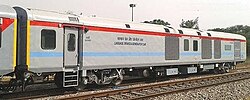
[[File: | [[File:Main-qimg-2eab05e182278bf019c97862578a3706.jpg|thumb|A hybrid coach with provision to carry small cargo and mail, often attached to passenger trains]] | ||
{{ | The first rail operational in Madras in 1837 was used for ferrying granite.<ref name="FR">{{cite news |date=16 April 2018 |title=Chennai: The track record |url=https://www.newindianexpress.com/cities/chennai/2018/apr/16/chennai-the-track-record-1801999.html |access-date=9 August 2023 |newspaper=[[New Indian Express]]}}</ref> The first dedicated commercial freight rail was operated between Bombay and Ahmedabad in 1966.<ref name="Hist"/> Indian Railways ferries various commodities and cargo to cater to various industrial, consumer, and agricultural segments. Apart from dedicated freight trains, [[parcel (consignment)|parcel]]s, [[mail]] and small cargo are carried on specialized carriages attached to passenger trains.<ref name="Mint">{{cite news|url=https://www.livemint.com/news/india/indian-railways-launches-the-first-ever-high-capacity-lhb-parcel-van-can-run-at-130-kmph-11580472862846.html|title=Indian Railways launched the first ever high capacity parcel van|work=Mint|date=31 January 2020|access-date=1 December 2023}}</ref> In 2022–23, Indian Railways operated 8,479 trains on average daily and transported 1418.1 million tonnes of freight.<ref name="IRYB"/> Indian Railways has historically subsidized the passenger segment with income from the freight business, and hence, freight services were unable to compete with their modes of transport on both cost and speed of delivery, leading to continuous erosion of market share till the early 2000s.<ref>{{cite report|url=http://www.indianrailways.gov.in/railwayboard/uploads/directorate/stat_econ/IRSP_2016-17/Annual_Report_Accounts_Eng/2.pdf|title=Indian Railways White Paper 2016|date=25 February 2018|archive-url=https://web.archive.org/web/20180226032211/http://www.indianrailways.gov.in/railwayboard/uploads/directorate/stat_econ/IRSP_2016-17/Annual_Report_Accounts_Eng/2.pdf|archive-date=26 February 2018|url-status=live}}</ref> To counter this, Indian Railways aimed to increase speed and reliability through various means including operating time-tabled freight trains and tweaking with the freight pricing/product mix.<ref>{{cite report|url=http://www.indianrailways.gov.in/Railways%20Presentation.pdf|title=Vision and Plans: Indian Railways|date=25 February 2018|archive-url=https://web.archive.org/web/20171118230400/http://www.indianrailways.gov.in/Railways%20Presentation.pdf|archive-date=18 November 2017|url-status=live}}</ref> End-to-end integrated transport solutions such as [[Konkan Railway Corporation#RORO|roll-on, roll-off]] (RORO) service, a [[Rolling highway|road-rail system]] pioneered by [[Konkan Railway Corporation|Konkan Railway]] in 1999 to carry trucks on [[flatbed truck|flatbed]] trailers has been extended to other routes.<ref>{{cite press release|url=http://pib.nic.in/release/rel_print_page1.asp?relid=949|title=Road-Rail Synergy System|access-date=22 December 2008|publisher=[[Indian Railways]]|archive-url=https://web.archive.org/web/20110605172834/http://pib.nic.in/release/rel_print_page1.asp?relid=949|archive-date=5 June 2011|url-status=live}}</ref> | ||
{| class="wikitable" | |||
|+Freight loads<ref name="IRYB"/> | |||
!Year | |||
!1951 | |||
!1961 | |||
!1971 | |||
!1981 | |||
!1991 | |||
!2001 | |||
!2011 | |||
!2021 | |||
!2023 | |||
|- | |||
|'''Freight loading (million tonnes)''' | |||
|73.2 | |||
|119.8 | |||
|167.9 | |||
|195.9 | |||
|318.4 | |||
|473.5 | |||
|921.73 | |||
|1233 | |||
|1512 | |||
|} | |||
== Express and passenger trains == | |||
=== Rolling stock === | |||
{{Main|Indian Railways coaching stock}} | {{Main|Indian Railways coaching stock}} | ||
{{Multiple images | |||
| total_width = 300 | |||
| caption_align = center | |||
| image1 = 11019_Konark_Express_-_Sleeper_Class_coach.jpg | |||
| caption1 = [[ICF coach]] | |||
| image2 = Shram Shakti Express LHBfied Sleeper Class Rakes.jpg | |||
| caption2 = [[LHB coach]] | |||
}} | |||
The early rail coaches were based on a prototype by a [[Schweizerische Wagons- und Aufzügefabrik AG Schlieren-Zürich|Swiss company]] and were termed as [[ICF coach]]es after Integral Coach Factory (ICF), the first coach manufacturing unit in India.<ref name="ICF"/> | |||
These coaches, manufactured from 1955 to 2018, were largely in use till the early 2010s.<ref>{{cite news|last=Ayyappan|first=V.|date=4 January 2021|title=Leakage Found in ICF Coaches|newspaper=[[The Times of India]]|url=https://timesofindia.indiatimes.com/city/chennai/leakage-found-in-icf-coaches/articleshow/80095746.cms|access-date=6 June 2023}}</ref> From the late 1990s, the ICF coaches were replaced by safer and newer [[LHB coach]]es designed by [[Linke-Hofmann-Busch]] of [[Germany]].<ref>{{Cite journal|date=April 2017|title=Indian Railways Passenger Coaches: Safety Features and Technologies Adopted|url=http://www.ijetsr.com/images/short_pdf/1492945632_nitttr232_Ijetsr_skype.pdf|journal=International Journal of Engineering Technology Science and Research|access-date=27 February 2018|archive-url=https://web.archive.org/web/20180228041703/http://www.ijetsr.com/images/short_pdf/1492945632_nitttr232_Ijetsr_skype.pdf|archive-date=28 February 2018|url-status=live}}</ref><ref>{{cite news|last=Debroy|first=Bibek|date=9 February 2018|title=A 70-Year-Old Vs a 30-Year-Old: LHB Coaches Perform Better than ICF Ones|newspaper=[[Business Standard]]|url=https://www.business-standard.com/article/opinion/a-70-year-old-vs-a-30-year-old-lhb-coaches-perform-better-than-icf-ones-118020801725_1.html|url-access=subscription|access-date=6 June 2023}}</ref> In the late 2010s, Indian railways started upgrading the coaches of select trains from LHB to new [[Tejas-Rajdhani Express|Tejas]] coaches with enhanced features.<ref>{{cite news|url=https://www.deccanherald.com/india/rajdhani-runs-with-new-tejas-rakes-1010439.html|title=Rajdhani runs with new Tejas rakes|newspaper=[[Deccan Herald]]|date=19 July 2021|access-date=1 December 2023}}</ref><ref>{{cite news|last1=Tyagi|first1=Harshita|title=Western Railway runs Mumbai–New Delhi Rajdhani Express with new Tejas-like smart sleeper coaches|work=Times Now|url=https://www.timesnownews.com/business-economy/industry/article/western-railway-runs-mumbai-new-delhi-rajdhani-express-with-new-tejas-like-smart-sleeper-coaches/787342|access-date=1 December 2023|date=19 July 2021}}</ref> {{As of|2023|March|df=my}}, Indian Railways' had 84,863 passenger coaches.<ref name="IRYB"/> Coaches are manufactured by five manufacturing units of the Indian Railways and public sector companies [[BEML Limited|BEML]] and BHEL.<ref name="facility"/> The coaching stock has unique five or six-digit identifiers. Till 2018, the first two digits indicated the year of manufacture and the last three digits indicated the class.<ref name="Class1">{{cite report|url=https://digitalscr.in/bzadiv/circulars/misc_circulars/uploads/Classification%20of%20Locomotives.pdf|title=Coach classification|publisher=[[Indian Railways]]|access-date=1 January 2024}}</ref> In 2018, the numbering system was changed with the first two digits indicating the year of manufacture and the last four digits indicating the sequence number.<ref name="Class3">{{cite press release|url=https://indianrailways.gov.in/railwayboard/uploads/directorate/mec_engg/downloads/Coaching/2018/20_Numbering%20of%20coaching%20stock.pdf|title=Coach numbering|publisher=[[Indian Railways]]|access-date=1 January 2024}}</ref> | |||
[[File: | === Network and infrastructure === | ||
[[File:Project_Unigauge_(India).svg|thumb|Different gauges in use in India]] | |||
;Track | |||
[[ | {{See also|List of railway lines in India}} | ||
[[ | {{As of|2023|March|31|df=dmy}}, the Indian railway network spanned {{convert|68584|km||abbr=on}} in route length.<ref name="IRYB"/> Track sections are rated for speeds ranging from {{convert|80|to|200|km/h|mph|abbr=on}}, though the maximum speed attained by passenger trains is {{cvt|160|kph|abbr=on}}. Spanning {{convert|65,093|km||abbr=on}} {{RailGauge|1676mm|lk=on}} broad gauge is the most used [[track gauge|gauge]] with {{RailGauge|1000mm|allk=on}} and {{RailGauge|762mm|lk=on}} [[narrow gauge]] and {{RailGauge|610mm|lk=on}} [[narrow gauge|narrower gauge]] tracks limited to certain routes.<ref name="IRYB"/> Indian Railways uses a range of signalling technologies and methods to manage its train operations based on traffic density and safety requirements.<ref name="IRYB"/> It primarily uses [[railway signal#Color light signals|coloured signal lights]], which replaced the earlier [[railway signal#Mechanical signals|semaphores and disc-based signalling]].<ref>{{cite web|url=http://www.irfca.org/faq/faq-signal2.html|title=Indian Railways FAQ: Signal Aspects and Indications – Principal Running Signals|publisher=IRFCA|access-date=28 February 2018}}</ref><ref>{{cite web|title=Signalling System|url=http://www.irfca.org/faq/faq-signal.html|access-date=4 June 2007|publisher=IRFCA}}</ref> | ||
;Stations | |||
{{See also|Categorization of Indian Railway stations by commercial importance}} | |||
{{As of|2023|March|df=my}}, Indian Railways manages and operates 7,308 stations.<ref name="IRYB"/> Prior to 2017, the stations were classified into seven categories based on their earnings.<ref name="stac1">{{cite news|url=https://economictimes.indiatimes.com/industry/transportation/railways/railways-revise-station-categories-to-improve-services/articleshow/62280609.cms|title=Railways revise station categories to improve services|access-date=17 March 2018|newspaper=[[The Economic Times|Economic Times]]|date=28 December 2017}}</ref> Since 2017, Indian Railways categorizes the stations by commercial importance into three different categories namely Non Suburban Group (NSG), Suburban Group (SG) and Halt Group (HG). These are further subdivided into subcategories based on their commercial importance (NSG 1–6, SG 1-3 and from HG 1–3).<ref name="Stn">{{cite press release|title=Minister of Railways directs to re-categorize railway stations taking into account earnings, passenger footfall, strategic importance|url=https://pib.gov.in/PressReleasePage.aspx?PRID=1514446|publisher=[[Indian Railways]]|access-date=18 October 2021}}</ref><ref name="stac1"/> The commercial importance of a station is determined by taking into account its passenger footfall, earnings and strategic importance and these categories are used to determine the minimum essential amenities required by each station.<ref>{{cite report|date=18 Jul 2018|title=Question and Answer regarding Grading of Railway Stations in Lok Sabha of India|url=http://164.100.24.220/loksabhaquestions/annex/15/AU116.pdf|access-date=26 Sep 2020|publisher=[[Government of India]]}}</ref><ref name="Stn"/> | |||
;Route length and electrification | |||
[[File:Growth of indian railways.svg|thumb|Growth of Indian railway network and its electrification since 1951]] | |||
{| class="wikitable" | |||
{| class="wikitable" | |+Historical railway route length<ref name="IRYB"/><ref name="Metro">{{cite news|date=27 October 2023|title=One crore passengers riding metro systems per day in India: Hardeep Singh Puri|newspaper=[[The Times of India]]|url=https://timesofindia.indiatimes.com/india/one-crore-passengers-riding-metro-systems-per-day-in-india-hardeep-singh-puri/articleshow/104763045.cms|access-date=3 November 2023|issn=0971-8257}}</ref><ref>{{cite news|url=https://timesofindia.indiatimes.com/city/delhi/how-these-metro-trains-overcame-mid-life-crisis/articleshow/100456181.cms|title=How these Delhi Metro trains overcame mid-life crisis|date=24 May 2023|access-date=1 December 2023|newspaper=[[The Times of India]]}}</ref><ref>{{cite report|title=Status of electrification|url=https://indianrailways.gov.in/railwayboard/uploads/directorate/ele_engg/RE/2024/Status%20of%20Railway%20Electrification%20(as%20on%2001_08_2024)%20pdf.pdf |access-date=27 August 2024|work=[[Indian Railways]]}}</ref> | ||
! Year | |||
! Route (km) | |||
! {{tooltip|±%|Percent change}} | |||
! Electrified route (km) | |||
! % of route electrified | |||
! {{tooltip|±%|Percent change}} | |||
|- | |- | ||
| | | 1951 | ||
| | | 53,596 | ||
|style="text-align:center;" | — | |||
| 388 | |||
| 0.72% | |||
|style="text-align:center;" | — | |||
|- | |- | ||
| | | 1961 | ||
| | | 56,247 | ||
| +4.94% | |||
| 748 | |||
| 1.32% | |||
| +92.78% | |||
|- | |- | ||
| | | 1971 | ||
| | | 59,790 | ||
| +6.29% | |||
| 3,706 | |||
| 6.19% | |||
| +395.45% | |||
|- | |- | ||
| | | 1981 | ||
| | | 61,240 | ||
| +2.42% | |||
| 5,345 | |||
| 8.72% | |||
| +44.22% | |||
|- | |- | ||
| | | 1991 | ||
| | | 62,367 | ||
| +1.84% | |||
| 9,968 | |||
| 15.98% | |||
| +88.49% | |||
|- | |- | ||
| | | 2001 | ||
| | | 63,028 | ||
| +1.05% | |||
| 14,856 | |||
| 23.57% | |||
| +49.03% | |||
|- | |- | ||
| | | 2011 | ||
| | | 64,173 | ||
| +1.81% | |||
| 19,607 | |||
| 30.55% | |||
| +31.98% | |||
|- | |- | ||
| | | 2021 | ||
| | | 68,103 | ||
| +6.12% | |||
| 45,772 | |||
| 67.20% | |||
| +133.44% | |||
|- | |- | ||
| | | 2023 | ||
| | | 68,584 | ||
| +0.70% | |||
| 58,074 | |||
| 84.67% | |||
| +26.87% | |||
|- | |- | ||
| | |2024* | ||
| | |68,584 | ||
|- | | - | ||
| | |64,080 | ||
| | |96.59% | ||
| +10.34% | |||
| | |||
|} | |} | ||
=== Services === | |||
;Travel classes | |||
=== | {{Further|Indian Railways coaching stock}} | ||
{{ | Indian Railways offers various travel classes on its [[passenger car (rail)|coaches]].<ref>{{cite web|url=http://www.indianrail.gov.in/class_Code.html|title=Accommodation Classes in Indian Railways|publisher=[[Indian Railways]]|access-date=26 April 2017|archive-url=https://web.archive.org/web/20170426000003/http://www.indianrail.gov.in/class_Code.html|archive-date=26 April 2017}}</ref> For the purpose of identification in [[passenger train]]s, coaches in a train-set are assigned an [[alpha-numeric]] code. The first letter identifies the coach class and the second letter identifies the coach number.<ref name="Class2">{{cite press release|url=https://digitalscr.in/bzadiv/circulars/misc_circulars/uploads/Abbrevations%20for%20different%20types%20of%20coaches.pdf|title=Abbreviations for Coaches|publisher=[[Indian Railways]]|access-date=1 January 2024}}</ref> The berths and seats are numbered by an alphanumeric code with the letter(s) identifying the berth/seat type and numbers identifying the position. In standard coaches, the berths and seats are classified as follows:<ref name="CC">{{cite report|url=https://st2.indiarailinfo.com/kjfdsuiemjvcya0/0/2/3/6/837236/0/railseatlayout.pdf|title=Rail seat layout|publisher=Indiarailinfo|access-date=1 December 2023}}</ref> | ||
{| class="wikitable | {|class="wikitable"style="text-align:left;"style="font-size: 85%" | ||
|+Coach code (First digit)<ref name="Class2"/> | |||
!Class | |||
!Code | |||
!Image | |||
!Description | |||
| | |||
|- | |- | ||
| | |First AC | ||
| | |H | ||
|[[File:Rajdhani First AC1.jpg|100px]] | |||
|It is the most luxurious and expensive class in most express trains.<ref name="IRFCA">{{cite web|title=Rolling stock|url=https://irfca.org/faq/faq-stock.html|work=IRFCA|access-date=1 December 2023}}</ref><ref name="Coach"/> They have separate air-conditioned compartments with private lockable doors, [[bedding]], dedicated attendants and meals served at seat.<ref name="TM">{{cite web|url=https://www.trainman.in/article/indian-railway-train-classes|title=Indian railway classes|publisher=Trainman|access-date=1 December 2023|archive-date=3 October 2023|archive-url=https://web.archive.org/web/20231003100712/https://www.trainman.in/article/indian-railway-train-classes|url-status=dead}}</ref> | |||
|- | |- | ||
| | |First Class | ||
| | |F | ||
| | |||
|First class is similar to first AC coaches with a combination of cabins and berths but are non air-conditioned and do not have all the facilities of first AC coaches.<ref name="TM"/> They were started to be phased out of normal express trains starting in the 2000s and the last coach being de-commissioned in 2015.<ref>{{cite news|url=https://timesofindia.indiatimes.com/india/first-class-coaches-now-just-the-stuff-of-memories/articleshow/4127807.cms?from=mdr|title=First-class coaches now just the stuff of memories|date=14 February 2009|access-date=1 December 2023|newspaper=[[The Times of India]]}}</ref><ref>{{cite news|url=https://timesofindia.indiatimes.com/city/chennai/end-of-road-for-last-of-the-non-ac-first-class-coaches/articleshow/50250987.cms|title=End of road for the last of the non AC first class coaches|date=20 December 2015|access-date=1 December 2023|newspaper=[[The Times of India]]}}</ref> The First class is still in use in [[Mountain railways of India|toy trains]] where the coaches consist of seats similar to chair cars.<ref>{{cite news|url=https://www.thehindu.com/news/cities/Coimbatore/holiday-special-trains-in-nilgiri-mountain-railway/article67668676.ece|title=Holiday special trains in Nilgiri Mountain Railway|date=23 December 2023|newspaper=[[The Hindu]]|access-date=1 December 2023}}</ref> | |||
|- | |- | ||
| | |Executive Anubhuti | ||
| | |EA | ||
|[[File:Mumbai Central Ahmedabad Shatabdi Express - Anubhuti coach - Interior.jpg|100px]] | |||
|Executive Anubhuti is the premium class of air-conditioned [[chair car]] equipped with retractable, large cushioned seats in 2x2 configuration. The class is equipped with an entertainment system, large luggage compartments, passenger information system, dedicated reading lights, power sockets and call buttons, modular bio toilets with automated taps. Meals often provided as a part of the journey ticket.<ref name="FE">{{cite news|url=https://www.financialexpress.com/photos/business-gallery/967183/anubhuti-coach-shatabdi-express-train-fare-luxury-features-images-indian-railways-new-train/5/|title=Anubhuti coaches with aircraft-like features to replace Shatabdi 1st-AC Executive chair cars; 20 amazing facts|date=9 December 2017|newspaper=[[The Financial Express (India)|Financial Express]]|access-date=1 December 2023}}</ref> The class is available only in select trains.<ref name="FE"/><ref>{{cite news|url=https://indianexpress.com/article/india/anubhuti-coach-shatabdi-trains-indian-railways-4980867/|title=Soon experience flight like luxury in Shatabdi|newspaper=[[Indian Express]]|date=17 December 2017|access-date=1 December 2023}}</ref> | |||
|- | |- | ||
| | |AC Executive Class | ||
| | |E | ||
|[[File:The Interior of the Executive Class or 1A of an LHB Shatabdi Coach..jpg|100px]] | |||
|AC Executive Class is often the top most class of air-conditioned chair car in express trains. It is equipped with large retractable seats in 2x2 configuration.<ref name="IRFCA"/><ref>{{cite news|url=https://indianexpress.com/article/cities/chandigarh/two-extra-coaches-added-to-afternoon-shatabdi-railways-5175696/|title=Two extra coaches added to afternoon Shatabdi: Railways|date=14 May 2018|newspaper=[[Indian Express]]|access-date=1 December 2023}}</ref> The class is equipped with dedicated reading lights and power sockets, modular bio toilets with automated taps. Meals are often provided as a part of the journey ticket.<ref name="TM"/> In [[Vande Bharat Express]] trains, the class is equipped with more features including [[rotating seat]]s, [[CCTV]]s, passenger information system, larger toilets, [[USB port]]s and [[automated door]]s.<ref>{{cite news|url=https://timesofindia.indiatimes.com/city/mumbai/mumbai-goa-vande-bharat-express-video-flag-off-pm-modi-new-indian-railways-train-features-time-table/articleshow/101292467.cms|title=Mumbai-Goa Vande Bharat express flagged off|date=27 June 2023|newspaper=[[The Times of India]]|access-date=1 December 2023}}</ref><ref>{{cite news|url=https://www.thehindu.com/news/cities/Madurai/passengers-from-southern-districts-to-get-a-new-travel-experience-on-vande-bharat-express/article67338091.ece|title=Passengers from south T.N. to get a new travel experience on Vande Bharat Expres|date=23 September 2023|newspaper=[[The Hindu]]|access-date=1 December 2023}}</ref> | |||
|- | |- | ||
| | |Executive Vistadome | ||
| | |EV | ||
|[[File:VistadomeInterior.jpg|100px]] | |||
|AC Tourist cars have [[vistadome]] coaches with glass roofs and extra wide windows. The interiors are similar to AC chair car coaches. Select trains operating mostly on tourist circuits are equipped with such coaches.<ref>{{cite press release|title=Status of Vistadome Trains|url=https://pib.gov.in/pib.gov.in/Pressreleaseshare.aspx?PRID=1797573|date=9 July 2022|publisher=[[Indian Railways]]|access-date=1 December 2023}}</ref> Indian Railways plans to introduce these coaches in all [[Mountain railways of India|mountain railways]].<ref>{{cite news|date=8 March 2019|title=All mountain railways in India to have vistadome coaches: Piyush Goyal|url=https://www.livemint.com/industry/infrastructure/all-mountain-railways-in-india-to-have-vistadome-coaches-piyush-goyal-1552064701958.html|access-date=9 July 2022|work=mint}}</ref> | |||
|- | |- | ||
| | |Second AC or AC 2-tier | ||
| | |A | ||
|[[File:2956coach.JPG|100px]] | |||
|Second AC or AC 2-tier is an air-conditioned [[sleeping car]] with wide sealed windows.<ref name="IRFCA"/> There are four berths arranged in two-tiers facing each other in a single bay with two-tiered berths arranged on the sides lengthwise across the corridor.<ref name="Coach"/> Individual berths are equipped with [[curtains]], simple bedding, reading lights and charging sockets.<ref name="Curt">{{cite news|url=https://economictimes.indiatimes.com/industry/transportation/railways/why-railways-is-removing-curtains-in-ac-coaches/wont-help-if-there-is-fire/slideshow/66221831.cms|title=Why you may not see curtains in AC coaches|date=15 October 2018|newspaper=[[The Economic Times]]|access-date=1 December 2023}}</ref><ref name="Bed">{{cite news|url=https://www.livemint.com/news/india/indian-railways-to-provide-bedrolls-in-ac-3-tier-economy-coach-from-this-week-11663481311905.html|title=Indian Railways to provide bedrolls|date=18 September 2022|work=Mint|access-date=1 December 2023}}</ref> Food is available on order or as a part of the ticket depending on the train.<ref name="TM"/> | |||
|- | |- | ||
| | |Third AC or AC 3-tier | ||
| | |B | ||
|[[File:Inside_AC_3_coach_passage_Indian_railway_002.jpg|100px]] | |||
|Third AC or AC 3-tier is an air-conditioned sleeping car.<ref name="IRFCA"/> There are six berths arranged in three-tiers facing each other in a single bay with foldable middle berths and two-tiered berths arranged on the sides lengthwise across the corridor.<ref name="Coach"/> There are common charging sockets and lights in each compartment with simple bedding provided.<ref name="Bed"/> Food is available on order or as a part of the ticket depending on the train with the same menu shared with AC 2-tier.<ref name="TM"/> | |||
|- | |- | ||
| | |AC 3-tier economy | ||
| | |M or G | ||
| | |||
|AC 3-tier economy coaches are air-conditioned sleeping cars similar to AC 3-tier.<ref name="IRFCA"/> Compared to 3-tier coaches, they have an extra middle berth along the aisle.<ref name="TM"/> The coaches were first introduced in [[Garib Rath Express|Garib Rath]] trains and only a few trains operate with such coaches.<ref name="TN">{{cite news|url=https://www.timesnownews.com/business-economy/industry/article/garib-rath-trains-to-get-new-ac-3-tier-economy-class-coaches-to-have-cheaper-fare-than-ac-3-tier/804617|title=Garib Rath trains to get new AC 3-tier economy class coaches; to have cheaper fare than AC 3-tier|date=27 August 2021|work=Times now|access-date=1 December 2023}}</ref> Bedding is available for rent and the coaches have facilities like charging sockets and lights similar to AC 3-tier coaches.<ref name="TN"/> | |||
|- | |- | ||
| | |AC Chair Car | ||
| | |C | ||
|[[File:Interiors of the 2nd Generation of the Vande Bharat Express trains.jpg|100px]] | |||
|AC chair car are air-conditioned coaches equipped with retractable seats in 3x2 configuration.<ref name="IRFCA"/> The class has cushioned seats with [[tray table]]s and are equipped with LED reading lights, power sockets along the window side. Meals are provided as a part of the journey ticket in select trains.<ref name="TM"/> In Vande Bharat Express trains, the class is equipped with more features including passenger information system, CCTVs, larger toilets and automated doors.<ref>{{cite news|url=https://timesofindia.indiatimes.com/business/india-business/new-vande-bharat-express-train-photos-features-indian-railways-new-train-2022/articleshow/93449662.cms?from=mdr|title=New Vande Bharat Express features|date=9 August 2022|newspaper=[[The Times of India]]|access-date=1 December 2023}}</ref><ref>{{cite news|url=https://economictimes.indiatimes.com/industry/transportation/railways/guwahati-new-jalpaiguri-vande-bharat-express-timing-ticket-prices-and-other-details-you-should-know/articleshow/100581940.cms?from=mdr|title=Vande Bharat Express timing and ticket prices|date=29 May 2023|newspaper=[[The Economic Times]]|access-date=1 December 2023}}</ref> | |||
|- | |- | ||
| | |Sleeper | ||
|S | |||
|[[File:Inside an Indian Railways Train - Sleeper Coach.jpg|100px]] | |||
|Sleeper class is the most common sleeping car coach in Indian Railways.<ref name="IRFCA"/> There are six berths arranged in three-tiers facing each other in a single bay with foldable middle berths and two-tiered berths arranged on the sides lengthwise across the corridor.<ref name="Coach"/> The coaches are not air-conditioned and have open-able windows. There are common charging sockets, [[ceiling fan|ceiling mounted fans]] and lights in each compartment. Food is available on order or can be purchased from vendors.<ref name="TM"/> | |||
|- | |- | ||
| | |Second sitting | ||
|D | |||
| | |[[File:Seats inside Indian train.jpg|100px]] | ||
|Second sitting is the most common chair car coach and the cheapest in the Indian Railways.<ref name="IRFCA"/> It is common in most day-time running trains with six seats arranged in 3x3 configuration. The seats may face each other or towards the same side.<ref name="Coach"/> The coaches are not air-conditioned and have open-able windows. There are common charging sockets, ceiling mounted fans and lights in each compartment. Food is available on order or can be purchased from vendors.<ref name="TM"/> | |||
| | |||
|- | |- | ||
|Unreserved or General | |||
|UR/GS | |||
|[[File:Newly_Developed_Deen_Dayalu_Coach_being_dedicated_by_the_Union_Minister_for_Railways,_Shri_Suresh_Prabhakar_Prabhu_to_the_Nation,_at_New_Delhi_Railway_Station_on_July_19,_2016_(1).jpg|100px]] | |||
|Unreserved or general coaches are second seating coaches which are not available for reservation and seats are taken on available basis.<ref name="IRFCA"/> One or more of these coaches are attached to express trains while dedicated passenger trains might also have all unreserved coaches. Tickets are valid on any train on a route only for within 24 hours of purchase.<ref>{{cite news|url=https://www.india.com/news/india/unreserved-general-railway-train-tickets-valid-for-only-three-hours-after-purchase-rule-applicable-from-march-1-2016-997342/|title=Unreserved, General Railway train tickets valid for only three hours after purchase|date=1 March 2016|work=India.com|access-date=1 December 2023}}</ref> | |||
|} | |} | ||
Saloon coaches are also available for [[Excursion train|chartering]] which are equipped with a bedroom and kitchen and can be attached to normal trains.<ref>{{cite news|url=https://economictimes.indiatimes.com/industry/transportation/railways/ready-to-shell-out-more-now-you-can-travel-in-railways-luxury-saloons/jammu-mail/slideshow/63554248.cms|title=Saloon attached to Jammu Mail|newspaper=[[The Economic Times]]|date=29 March 2018|access-date=1 December 2023}}</ref> | |||
;Trains | |||
{{multiple image | |||
| total_width=300 | |||
| align=right | |||
| header=Express trains of India | |||
| caption_align=center | |||
| image1=12302_Howrah_Rajdhani_Express_-_AC_First_Class.jpg | |||
| caption1=[[Rajdhani Express]] | |||
| image2=Mumbai_Central_Ahmedabad_Shatabdi_Express_-_Anubhuti_coach_-_K1.jpg | |||
| caption2=[[Shatabdi Express]] | |||
}} | |||
{{Further|Express trains in India|Slow and fast passenger trains in India}} | |||
Indian Railways operates various classes of passenger and express trains. The trains are classified basis average speed and facilities with express trains having fewer halts, priority on rail network and faster average speed. The trains are identified by [[Train numbering in India|five digit numbers]] with train-pairs traveling in opposite directions usually labelled with consecutive numbers.<ref>{{cite report|title=Train Numbering|url=https://indianrailways.gov.in/railwayboard/uploads/directorate/coaching/Circulars/2%20five%20Digit%20Train%20no%20scheme%209_9_10.pdf|publisher=[[Indian Railways]]|access-date=1 December 2023}}</ref> Express trains often have specific unique names for easy identification.<ref name="Train">{{cite report|url=https://indianrailways.gov.in/railwayboard/uploads/directorate/coaching/pdf/Train_No-Index.pdf|title=Train Index|publisher=[[Indian Railways]]|access-date=1 December 2023}}</ref> In 2018–19, Indian Railways operated 13,523 passenger trains on average daily and carried 8.44 billion passengers.<ref name="IRYB1">{{cite report|url=https://indianrailways.gov.in/railwayboard/uploads/directorate/stat_econ/Annual-Reports-2019-2020/Year-Book-2019-20-English_Final_Web.pdf|title=Indian Railways Year Book 2019–20|publisher=[[Indian Railways]]|access-date=1 December 2023}}</ref> India Railways operates various categories of express trains including [[Rajdhani Express]], [[Shatabdi Express]], [[Garib Rath Express]], [[Double Decker Express]], [[Tejas Express]], [[Gatimaan Express]], [[Humsafar Express]], [[Duronto Express]], [[Yuva Express]], [[Uday Express]], [[Jan Shatabdi Express]], [[Sampark Kranti Express]], [[Vivek Express]], [[Rajya Rani Express]], [[Mahamana Express]], [[Antyodaya Express]], [[Jan Sadharan Express]], [[Suvidha Express]] and [[Intercity Express (Indian Railways)|Intercity Express]].<ref name="Train"/> | |||
==== Ticketing and fares ==== | |||
[[File:Railway ticket from Bangalore City junction to Pune junction.jpg|thumb|A standard printed Indian Railway ticket]] | |||
In 1986, computerized ticketing and reservations were introduced before which ticketing was done manually.<ref name="IT"/> Self-printing ticket machines (SPTM) were introduced in 1988.<ref name="SF"/> Centralized computer reservation system was deployed in September 1996.<ref name="Hist"/> The ticketing network at stations is computerized with the exception of few stations. The Indian Railways website went online in February 2000 and online ticketing was introduced on 3 August 2002 through IRCTC.<ref name="IRCTC"/> Indian Railways now provides multiple channels for passengers to book tickets through [[website]], [[smartphone app]]s, [[SMS]], rail reservation counters at train stations, or through private ticket booking counters. Reserved tickets may be booked up to 120 days in advance and confirmed reservation tickets will show the passenger and fare details along with berth or seat number(s) allocated to them on the ticket. | |||
In case of no confirmed reservation, a wait-list number is assigned and wait-listed tickets get confirmed if there are cancellations of already reserved tickets. [[Reservation against Cancellation|Reservation against cancellation tickets]] is an intermediate category between the waiting and confirmed lists in sleeper classes which allows a ticket holder to board the train and share a berth.<ref>{{cite news|url=https://www.ndtvprofit.com/business/irctc-indian-railways-ticket-reservation-5-online-rules-to-know-about-waitlisted-tickets-1955796|title=Indian Railways Reservation Rules: 5 Things To Know About Waitlisted Tickets|date=30 May 2018|work=[[NDTV]]|access-date=1 December 2023}}</ref> Reserved tickets can be booked by passengers who want to travel at short notice at higher fares through the [[Tatkal scheme|Tatkal train ticket]], where no refund is applicable on cancellation.<ref>{{cite news|url=https://timesofindia.indiatimes.com/business/india-business/tatkal-ticket-booking-charges-timings-cancellation-and-more/articleshow/63095041.cms|title=Tatkal Ticket Booking: Charges, timings, cancellation and more|newspaper=[[The Times of India]]|access-date=1 December 2023|date=2 March 2018|archive-url=https://web.archive.org/web/20180612105406/https://timesofindia.indiatimes.com/business/india-business/tatkal-ticket-booking-charges-timings-cancellation-and-more/articleshow/63095041.cms|archive-date=12 June 2018|url-status=live}}</ref> A valid proof for the purchase of ticket along with photo identification is required to board the train.<ref>{{cite report|url=https://indianrailways.gov.in/railwayboard/uploads/directorate/traffic_comm/Comm-Cir2K12/ID_Proof_AC_Class_CC_4_2012.pdf|title=Provision for carrying proof|publisher=[[Indian Railways]]|access-date=1 December 2023}}</ref> Unreserved tickets for short distance or unplanned travels may be purchased at stations or through UTS mobile app at any time before departure.<ref>{{cite news|url=https://www.thehindu.com/news/cities/chennai/buy-suburban-train-tickets-via-app/article33712431.ece|title=Buy suburban train tickets via app|date=1 February 2021|access-date=1 December 2023|newspaper=[[The Hindu]]}}</ref> Holders of such tickets may only board the general or unreserved coaches. India has some of the lowest train fares in the world, and lower class passenger fares are subsidised.<ref>{{cite book|chapter-url=https://books.google.com/books?id=r31MYIrISFMC&q=indian+rail&pg=PA184|title=India's Economic Reforms, 1991–2001|last=Joshi|first=V|author2=I. M. D. Little|date=17 October 1996|publisher=Oxford University Press|isbn=978-0-1982-9078-0|location=US|page=184|chapter=Industrial Policy and Factor Markets|access-date=25 June 2007}}</ref> Discounted fares are applicable for railway employees, [[senior citizen]]s (over age 60), the differently-abled, students, athletes, patients and those taking competitive examinations. Seats of lower class of accommodation are reserved for women or senior citizens in some trains.<ref>{{cite web|url=https://indianrailways.gov.in/railwayboard/view_section.jsp?id=0,2,281,877|title=Concession Rules|access-date=25 June 2023|publisher=[[Indian Railways]]}}</ref> | |||
== Higher-speed rail == | |||
{{main|High speed rail in India}} | |||
[[File:Ghaziabad WAP 5.jpg|thumb|A [[Indian locomotive class WAP-5|WAP-5]] [[electric locomotive]] reached a speed of {{cvt|184|kph|abbr=on}} and is the fastest operational locomotive]] | |||
==== | === Rolling stock === | ||
In 1980, the [[Indian locomotive class WAP-1|WAP-1]] electric locomotives reached a speed of {{cvt|130|kph|abbr=on}}.<ref>{{cite press release|url=https://secr.indianrailways.gov.in/uploads/files/1596785062728-Locomotive_comp.pdf|title=WAP-1 locomotive|publisher=[[Government of India]]|date=9 October 1989|access-date=1 December 2023}}</ref> [[Indian locomotive class WAP-5|WAP-5]] class locomotives, initially imported from [[Adtranz|ABB]] in 1995 and later manufactured at Chittaranjan Locomotive Works in India, reached {{cvt|184|kph|abbr=on}} in trials. The locomotive later set an Indian speed record by hauling a train between Delhi and Agra at a speed of {{cvt|160|kph|abbr=on}} in 2014.<ref>{{cite news|title=200 km in 90 mins: Delhi-Agra high speed train sets new speed record|url=http://articles.economictimes.indiatimes.com/2014-07-03/news/51057656_1_speed-record-fastest-train-passenger-train|archive-url=https://web.archive.org/web/20140707064334/http://articles.economictimes.indiatimes.com/2014-07-03/news/51057656_1_speed-record-fastest-train-passenger-train|url-status=dead|archive-date=7 July 2014|access-date=10 July 2014|newspaper=[[The Economic Times]]|date=3 July 2014}}</ref> In 2018, a modified WAP-5A locomotive reached speeds of {{cvt|200|kph|mph|0|abbr=on}} in trials.<ref>{{cite news|url=https://www.financialexpress.com/infrastructure/railways/make-in-india-speed-boost-for-indian-railways-gets-first-200-kmph-capable-aerodynamic-electric-locomotive/1374602/|title= 'Make in India' speed boost for Indian Railways! Gets first 200 kmph capable aerodynamic electric locomotive|access-date=1 December 2023|newspaper=Financial Express|date=6 November 2018}}</ref> In 2018, Integral Coach Factory in Chennai, rolled out a [[Higher-speed rail|semi-high-speed]] [[Electric Multiple Unit|EMU]] [[Vande Bharat (trainset)|train-set]], capable of reaching {{cvt|180|kph|abbr=on}}.<ref name="VB"/><ref name="VB1"/> These trains have eight or sixteen coaches with driver cabins on both ends, which eliminates the time needed for turnaround at the terminal station with faster acceleration and deceleration, enabling the train to travel at a top speed for longer distance.<ref>{{cite news|url=https://www.financialexpress.com/budget/railway-budget-2018-indian-railways-new-trains-train-18-train-20-features-semi-high-speed/1026896/|title=Ahead of Railway Budget 2018, Modi's Make in India gets boost with plans for 'world-class' Indian Railways trains|date=23 January 2018|newspaper=Financial Express|access-date=1 December 2023}}</ref><ref>{{cite news |url=https://timesofindia.indiatimes.com/india/2-new-world-class-trains-to-cut-travel-time-by-20/articleshow/62611180.cms|title=Train 18: 2 new 'world class' trains to cut travel time by 20%|newspaper=[[The Times of India]]|date=23 January 2018|access-date=1 December 2023}}</ref> For high-speed rail, the Indian railways will construct bullet train assembly facilities on a [[Public–private partnerships in India|public-private participation]] (PPP) model with Japanese companies setting up manufacturing facilities in India to build the parts for bullet train sets.<ref name="HT MB">{{cite web|url=https://www.hindustantimes.com/india-news/make-in-india-railways-to-pitch-for-building-bullet-train-coaches/story-cUnqHEk3sy0h2l7xgLXfsN.html|title=Make in India: Railways to pitch for building bullet train coaches locally|work=Hindustan Times|date=4 October 2018}}</ref> | |||
=== Network and infrastructure === | |||
[[File:Map_of_India_high-speed_rail_corridors_according_to_National_Rail_Plan.JPG|thumb|upright=0.7|Proposed high speed rail network]] | |||
In 2009, Indian Railways envisioned a plan to increase the speed of passenger trains to {{cvt|160-200|kph|abbr=on}} on dedicated conventional tracks and improve the existing conventional lines on {{Track gauge|1676mm|lk=on}} Broad gauge to handle speeds of up to {{cvt|160|kph|abbr=on}}.<ref name="HSRC">{{cite press release|url=https://pib.gov.in/newsite/PrintRelease.aspx?relid=100308|title=Railway Minister Launches High Speed Rail Corporation of India Limited (HSRC)|date=29 October 2023|access-date=1 December 2023|publisher=[[Government of India]]}}</ref> On 25 July 2013, Government of India established the [[National High Speed Rail Corporation Limited|High Speed Rail Corporation]] under [[Rail Vikas Nigam Limited|Rail Vikas Nigam]] (RVNL) for the implementation of high-speed rail corridor projects.<ref name="HSRC"/><ref>{{cite news|url=http://articles.economictimes.indiatimes.com/2013-01-27/news/36564456_1_high-speed-rail-high-speed-trains-first-bullet-train|archive-url=https://web.archive.org/web/20130801140940/http://articles.economictimes.indiatimes.com/2013-01-27/news/36564456_1_high-speed-rail-high-speed-trains-first-bullet-train|url-status=dead|archive-date=1 August 2013|title=Indian Railways finally moving on its dream project – high-speed trains|newspaper=[[The Economic Times]]|date=27 January 2013|access-date=1 December 2023}}</ref> In 2014, the Diamond Quadrilateral high-speed rail network project was launched by Government of India and is envisioned to connect the four major metro cities of India namely: Chennai, Delhi, Kolkata and Mumbai.<ref>{{cite news|url=https://www.thehindu.com/opinion/editorial/focus-on-diamond-quadrilateral/article6105076.ece|title=Focus on diamond quadrilateral|newspaper=[[The Hindu]]|date=12 June 2014|access-date=1 December 2023}}</ref><ref>{{cite report|title=Address by The President of India to the Joint sitting of Parliament 2014|url=http://www.pmindia.gov.in/President_Address.pdf|access-date=9 June 2014|publisher=[[Government of India]]|archive-url=https://web.archive.org/web/20140714225448/http://www.pmindia.gov.in/President_Address.pdf|archive-date=14 July 2014 }}</ref> {{As of|2023}}, India does not have any operational high-speed tracks with the {{cvt|174|km|abbr=on}} segment of track in the [[Tughlakabad railway station|Tughlakabad]]{{ndash}} Agra Cantonment section supporting semi-high speeds of up to {{cvt|160|kph|abbr=on}}.<ref name="SH">{{cite news|url=https://www.freepressjournal.in/bhopal/vande-bharat-express-trains-running-at-average-speed-of-83-kmph-against-permissible-limit-of-130-kmph-reveals-rti-reply-filed-in-mp|title=Vande Bharat Express trains running at average speed of 83 kph against permissible limit of 130 kph, reveals RTI reply filed in MP|work=Free Press Journal|date=17 April 2023|access-date=1 December 2023}}</ref> By 2026, Ministry of Railways envisaged to have top speeds of {{cvt|300–350|kph|abbr=on}} with trains running on elevated corridors to isolate high-speed train tracks to prevent trespassing.<ref>{{cite news|date=21 September 2020|title=Wow! Indian Railways eyes 7 more bullet train corridors; all will be open to PPP investments|work=The Financial Express|url= https://www.financialexpress.com/infrastructure/railways/wow-indian-railways-eyes-7-more-bullet-train-corridors-all-will-be-open-to-ppp-investments/2086517/|access-date=21 September 2020}}</ref> Multiple feasibility studies have been done and probable routes have been identified.<ref>{{cite web|url=https://www.nationalturk.com/en/india-japan-sign-mou-for-feasibility-study-of-high-speed-railway-system-in-india-43654/|title=India, Japan sign MoU for feasibility study of high speed railway system in India|date=9 October 2013|access-date=1 December 2023|work=Nationalturk}}</ref><ref>{{cite news|url=https://indianexpress.com/article/cities/mumbai/mumbai-ahmedabad-bullet-train-chinese-team-visits-cst/|title=Mumbai-Ahmedabad bullet train? Chinese team visits CST|newspaper=[[Indian Express]]|date=16 September 2014|access-date=1 December 2023}}</ref> In 2017, a {{cvt|508|km|abbr=on}} standard gauge line between Mumbai and Ahmedabad was approved for construction and is expected to be operational by 2028.<ref name="NHSRC">{{cite report|url=https://nhsrcl.in/sites/default/files/2021-12/Journey.pdf|title=Journey of High speed rail|publisher=[[National High Speed Rail Corporation Limited]]|access-date=1 December 2023}}</ref><ref name="BT">{{cite news|date=13 September 2017|title=Japan Is Selling Bullet Trains to India|work=Bloomberg News|url= https://www.bloomberg.com/news/articles/2017-09-13/japan-s-bullet-train-gives-164-year-old-indian-railway-a-jolt|access-date=15 December 2017}}</ref> [[RapidX]] system operating on {{Track gauge|1435mm|lk=on}} [[Standard-gauge railway|Standard gauge]] tracks with [[Namo Bharat (trainset)|Namo Bharat]] train-sets capable of supporting speeds of up to {{cvt|180|kph|abbr=on}}, became operational with the partial opening of [[Delhi–Meerut Regional Rapid Transit System|Delhi–Meerut line]] in 2023.<ref name="RX">{{cite press release|url=https://pib.gov.in/PressReleaseIframePage.aspx?PRID=1969356|title=PM launches India's first Regional Rapid Transit System (RRTS) in Ghaziabad, Uttar Pradesh|date=20 October 2023|publisher=[[Government of India]]|access-date=1 December 2023}}</ref> | |||
=== | === Services === | ||
[[File: | [[File:Thiruvananthapuram_Kasaragod_Vande_Bharat_Express_(via_Alappuzha)_-_1st_Rake.jpg|thumb|Introduced in 2019, [[Vande Bharat (trainset)|Vande Bharat train-set]] built by [[Integral Coach Factory|ICF]], is the fastest in operation]] | ||
Rajdhani Express, introduced in 1969 with a maximum speed of {{cvt|120|kph|abbr=on}} was the fastest train service in the country in the 1970s.<ref name="Raj"/> [[Shatabdi Express]] introduced in 1988, were capable of running at a maximum speed of {{cvt|130|kph}}.<ref>{{cite news|url=https://timesofindia.indiatimes.com/india/shatabdi-is-the-heart-of-indian-railways/articleshow/20505432.cms?from=mdr|newspaper=[[The Times of India]]|title='Shatabdi is the heart of Indian railways'|access-date=1 December 2023|date=30 May 2014}}</ref><ref>{{cite news|url=https://economictimes.indiatimes.com/industry/transportation/railways/trains-faster-than-rajdhani-shatabdi-on-the-cards/next-gen-trains/slideshow/62615006.cms|title=Trains faster than Rajdhani, Shatabdi on the cards|newspaper=[[The Economic Times]]|date=23 January 2018|access-date=5 November 2022}}</ref> In April 2016, WAP-5 hauled [[Gatimaan Express]] became the fastest commercial train in India, with a maximum operational speed of {{cvt|160|kph|abbr=on}}.<ref>{{cite news|url=http://www.thehindu.com/news/cities/Delhi/delhiagra-semihigh-speed-train-to-be-named-gatimaan-express/article6493500.ece|title=Train to be named Gatimaan Express|newspaper=[[The Hindu]]|access-date=1 December 2023|date=5 April 2016}}</ref> In 2019, the first [[Vande Bharat Express]] entered commercial service with a maximum operational speed of {{cvt|160|kph|abbr=on}}. The actual operating speed was much lower due to track restrictions and congestion with top speeds restricted to {{cvt|130|kph|abbr=on}} for most trains.<ref>{{cite news|agency=Press Trust of India|date=7 February 2019|title=Train 18: PM Modi to flag off Vande Bharat Express on February 15 from New Delhi|newspaper=Business Today|url=https://www.businesstoday.in/current/economy-politics/train-18-pm-modi-to-flag-off-vande-bharat-express-on-february-15-from-new-delhi/story/317978.html|access-date=15 February 2019}}</ref> In October 2023, [[Namo Bharat]], built for [[RapidX]] by Alstom was launched and is capable of reaching speeds of up to {{cvt|180|kph|abbr=on}}.<ref>{{cite news|date=20 October 2023|title=PM Modi flags off 'RapidX', India's first regional rapid rail service; all you need to know|url=https://www.businesstoday.in/latest/story/pm-modi-flags-off-namo-bharat-indias-first-regional-rapid-train-service-402728-2023-10-20|access-date=23 October 2023|work=Business Today}}</ref> In December 2023, two modified WAP-5 locomotives were used to haul the [[Amrit Bharat Express]] in a push-pull configuration, capable of reaching speeds of up to {{cvt|160|kph|abbr=on}}.<ref>{{cite news|last=Nigam|first=Saumya|date=27 December 2023|title=Amrit Bharat Express to launch with Push-Pull technology and other exciting features|url=https://www.indiatvnews.com/explainers/amrit-bharat-express-to-launch-with-push-pull-technology-and-other-exciting-features-details-2023-12-27-909203|access-date=28 December 2023|work=India TV|language=en}}</ref><ref>{{cite news|date=30 October 2023|title=Vande Sadharan train: All you need to know; How it is different from Vande Bharat train?|url=https://www.businesstoday.in/latest/in-focus/story/vande-sadharan-train-all-you-need-to-know-how-it-is-different-from-vande-bharat-train-403792-2023-10-30|access-date=30 December 2023|work=Business Today}}</ref> | |||
== Mountain railways == | |||
{{main|Mountain Railways of India}} | |||
{{multiple image | |||
| total_width=400 | |||
| align=right | |||
| header=[[Mountain Railways of India]] | |||
| caption_align=center | |||
| image1=DarjeelingTrainFruitshopCrop.JPG | |||
| caption1=[[Darjeeling Himalayan Railway|Darjeeling]] | |||
}}</ref> | | image2=KSR_Steam_special_at_Taradevi_05-02-13_56.jpeg | ||
| caption2=[[Kalka-Shimla Railway|Kalka-Shimla]] | |||
| image3=NMR train at Ketti 05-02-26 75.jpeg | |||
| caption3=[[Nilgiri Mountain Railway|Nilgiri]] | |||
}} | |||
[[Mountain Railways of India]] refer to three rail lines operated by Indian Railways in [[hill|hilly terrain]]. [[Darjeeling Himalayan Railway]], a {{RailGauge|610mm|lk=on}} narrow-gauge railway in the [[Lesser Himalayas]] of [[West Bengal]] was opened in 1881. | |||
<ref name="UNESCO">{{cite web|title=Mountain Railways of India|work=World Heritage List|publisher=[[World Heritage Committee]]|year=1999|url=https://whc.unesco.org/en/list/944/|access-date=5 January 2009|archive-url=https://web.archive.org/web/20081219024051/https://whc.unesco.org/en/list/944/|archive-date=19 December 2008|url-status=live|df=dmy-all}}</ref> The mountain railways were designated as [[World Heritage Site]]s in 1999.<ref name="UNESCO"/> The [[Kalka-Shimla Railway]], a {{RailGauge|762mm|lk=on}} narrow-gauge railway in the [[Siwalik Hills]] of [[Himachal Pradesh]] started operating in 1903. The [[Nilgiri Mountain Railway]], a {{RailGauge|1000mm|allk=on}} [[rack railway]] in the [[Nilgiri Hills]] of [[Tamil Nadu]] was opened in 1908 and is the only operational rack railway in India.<ref>{{cite web|title=Nilgiri Mountain railway|url=https://sr.indianrailways.gov.in/view_section.jsp?fontColor=black&backgroundColor=LIGHTSTEELBLUE&lang=0&id=0,1,304,374,492,552|publisher=[[Indian Railways]]|access-date=21 August 2019}}</ref><ref name="UNESCO"/> These railways operate with its own dedicated fleet of locomotives and coaches.<ref>{{cite news|url=https://www.thehindu.com/news/national/tamil-nadu/in-pictures-nilgiri-mountain-railway-as-old-as-the-hills/article28732489.ece|title=he Nilgiri Mountain Railway as old as the hills|date=27 July 2019|access-date=1 March 2023|newspaper=[[The Hindu]]}}</ref> | |||
== Tourist trains == | |||
[[File:Maharaja Express.jpg|thumb|Maharajas' Express]] | |||
Indian Railways operates tourist trains and coach services on popular tourist circuits in different regions of the country. It operates luxury tourist trains such as [[Maharajas' Express]], [[Palace on Wheels]], [[Golden Chariot]] and [[Deccan Odyssey]], deluxe tourist trains such as [[Mahaparinirvan Express]].<ref name="IRYB"/><ref>{{cite web|url=http://www.indianrailways.gov.in/railwayboard/view_section.jsp?lang=0&id=0,2,320,378,1066|title=Ministry of Railways (Railway Board)|publisher=[[Indian Railways]]|access-date=27 April 2014|archive-url=https://web.archive.org/web/20140410173012/http://www.indianrailways.gov.in/railwayboard/view_section.jsp?lang=0&id=0,2,320,378,1066|archive-date=10 April 2014|url-status=live}}</ref> It also operates [[restored train|heritage]] and exhibition trains on special circumstances.<ref>{{cite news|url=https://www.thehindu.com/news/national/other-states/pm-flags-off-gujarats-first-heritage-train-which-will-bring-tourists-to-statue-of-unity/article67479662.ece|title=PM flags off Gujarat's first heritage train, which will bring tourists to Statue of Unity|date=31 October 2023|newspaper=[[The Hindu]]|access-date=1 December 2023}}</ref> | |||
== Cross-border services == | |||
{{Main|Cross-border railway lines in India}} | |||
India shares land border with multiple countries and have rail-links with some of them. [[Bangladesh]] is connected to [[West Bengal]] with a construction of new rail link connecting [[Tripura]] with [[Akhaura]].<ref>{{cite news|date=24 November 2019|title=Bandhan Express makes its first commercial run between Kolkata and Khulna today|newspaper=[[The Indian Express]]|url=http://indianexpress.com/article/india/bandhan-express-makes-its-first-run-between-kolkata-khulna-india-bangladesh-on-thursday-4939545/|url-status=live|access-date=16 November 2017|archive-url=https://web.archive.org/web/20171116063408/http://indianexpress.com/article/india/bandhan-express-makes-its-first-run-between-kolkata-khulna-india-bangladesh-on-thursday-4939545/|archive-date=16 November 2017}}</ref><ref>{{cite news|date=18 June 2014|title=Work on new India-Bangladesh railway link from 2015|url=http://m.ibnlive.com/news/work-on-new-indiabangladesh-railway-link-from-2015/480099-61.html|url-status=live|archive-url=https://web.archive.org/web/20141006081939/http://m.ibnlive.com/news/work-on-new-indiabangladesh-railway-link-from-2015/480099-61.html|archive-date=6 October 2014|work=IBNlive|access-date=1 December 2023}}</ref> Two rail links to [[Nepal]] exist {{as of|2021|lc=y}}, with a third under construction.<ref>{{cite web|title=Nepalese Railway and Economic Development: What Has Gone Wrong?|date=11 June 2020|url=https://www.theindiareview.com/india-and-nepal/nepal-railways-and-economic-development-what-has-gone-wrong-110620-01/|work=India Review|access-date=19 November 2021|archive-date=19 November 2021|archive-url=https://web.archive.org/web/20211119174443/https://www.theindiareview.com/india-and-nepal/nepal-railways-and-economic-development-what-has-gone-wrong-110620-01/|url-status=dead}}</ref> There is an existing railink with [[Pakistan]] through [[Attari]]–[[Wagah]] border.<ref>{{cite news|url=https://www.news18.com/business/do-you-know-this-indian-railway-station-requires-passengers-to-carry-a-pakistani-visa-8364073.html|title=Do You Know This Indian Railway Station Requires Passengers To Carry A Pakistani Visa?|date=18 July 2023|work=News18|access-date=1 December 2023}}</ref> | |||
== Private railways == | |||
The state-owned [[Indian Railways]] has an almost monopoly over rail operations. There are a few private railway lines used exclusively for transporting freight and to connect with the wider network. Private railways are operated by various ports such as [[Mumbai Port Trust|Mumbai]], [[Kolkata Port Trust|Kolkata]], [[Chennai Port Trust|Chennai]], [[Visakhapatnam Port Trust|Visakhapatnam]], [[Port Pipavav|Pipavav]] and the [[Bhilai Steel Plant]]. The [[Tata Group]] operates a few [[funicular railway]]s.<ref>{{cite web|title=Railways other than IR in India|url=http://www.irfca.org/faq/faq-nonir.html|access-date=18 June 2007|work=IRFCA|publisher=Indian Railways Fan Club|archive-date=24 May 2007|archive-url=https://web.archive.org/web/20070524083200/http://www.irfca.org/faq/faq-nonir.html|url-status=live}}</ref> In 2020, Indian Railways allowed the operation of private passenger trains for the first time with the first train flagged off from Coimbatore in June 2022.<ref name="PT"/> | |||
=== | == Suburban == | ||
=== Rolling stock === | |||
In the 1960s, [[Electric multiple unit]]s (EMU) were developed for short-haul and suburban rail transit.<ref>{{cite report|date=15 October 1999|title=Electrical Multiple Units|url=https://st2.indiarailinfo.com/kjfdsuiemjvcya1/0/8/0/2/4684802/1/multipleunits1091923.pdf|work=Indian Rail Info|access-date=1 December 2023}}</ref><ref>{{cite web|title=Historical Background of Railway Electrification|url=https://core.indianrailways.gov.in/view_section.jsp?lang=0&id=0,294,302,530#:~:text=The%20first%20electric%20train%20ran,electrified%20on%201500%20Volt%20DC.|access-date=19 May 2023|publisher=[[Indian Railways]]}}</ref> On short-distance routes, [[MEMU|Mainline electrical multiple unit (MEMU)]] and [[DEMU|Diesel electrical multiple unit (DEMU)]] trains are also run. These train sets run in formation of 6, 9, 12 or 15 coaches and a three-car set is typified by a motor coaches and two passenger coaches.<ref name="EMU1">{{cite report|url=https://eparlib.nic.in/bitstream/123456789/65704/1/16_Public_Accounts_69.pdf|title=Operation of MUs|publisher=[[Indian Railways]]|access-date=15 October 2023}}</ref><ref>{{cite report|url=https://scr.indianrailways.gov.in/cris//uploads/files/1574744335252-JE%20LDCE2.pdf|title=Three phase EMU|page=5|publisher=[[Indian Railways]]|access-date=15 October 2023}}</ref> These train-sets are self-propelled with capability for faster acceleration or deceleration.<ref>{{cite news|url=https://timesofindia.indiatimes.com/city/delhi/Loco-hauled-commuter-trains-to-be-replaced-with-DEMU/MEMU/articleshow/54680592.cms|title=Loco hauled commuter trains to be replaced with DEMU/MEMU|newspaper=[[The Times of India]]|access-date=1 December 2023|date=25 February 2018|archive-url=https://web.archive.org/web/20180226042551/https://timesofindia.indiatimes.com/city/delhi/Loco-hauled-commuter-trains-to-be-replaced-with-DEMU/MEMU/articleshow/54680592.cms|archive-date=26 February 2018|url-status=live}}</ref> | |||
[[ | |||
=== Network === | |||
Suburban lines were built starting with Bombay in 1853, followed by Calcutta and Madras in the later years. The first 1.5kV DC electrified tracks became operational in the late 1920s and early 1930s.<ref name="EMU1"/> In 1957, 25 kV AC traction was adopted for suburban lines.<ref name="EL1"/> | |||
== | {| class="sortable wikitable" style="text-align:left;" style="font-size: 85%" | ||
|- | |- | ||
!System | |||
!City | |||
!State | |||
!Image | |||
!Lines | |||
!Stations | |||
!Length | |||
!Opened | |||
|- | |- | ||
| | | [[Mumbai Suburban Railway|Mumbai Suburban]]<ref>{{cite web|url=https://wr.indianrailways.gov.in/view_section.jsp?lang=0&id=0,6|title=Mumbai Suburban railway|publisher=Western Railway|access-date=31 August 2023}}</ref> | ||
| | | [[Mumbai]] | ||
| | | [[Maharashtra]] | ||
| [[File:Western-Railway-Medha-EMU.jpg|100x100px]] | |||
| 7 | |||
| [[List of Mumbai Suburban Railway stations|150]] | |||
| {{cvt|427.5|km|mi|abbr=on|adj=on}} | |||
| 1853 | |||
|- | |- | ||
| | | [[Kolkata Suburban Railway|Kolkata Suburban]]<ref>{{cite report|title=Survey on Kolkata Suburban Railway|url=http://indiansss.org/pdf/pdfset-8/issueset-9/Art_017.pdf|date=22 December 2018|work=Indiansss.org|access-date=31 August 2023|archive-date=22 December 2018|archive-url=https://web.archive.org/web/20181222211115/http://indiansss.org/pdf/pdfset-8/issueset-9/Art_017.pdf|url-status=dead}}</ref> | ||
| | | [[Kolkata]] | ||
| | | [[West Bengal]] | ||
| [[File:Local_train.png|100x100px]] | |||
| 5 | |||
| [[List of Kolkata Suburban Railway stations|458]] | |||
| {{cvt|1501|km|mi|abbr=on|adj=on}} | |||
| 1854 | |||
|- | |- | ||
| | | [[Chennai Suburban Railway|Chennai Suburban]]<ref>{{cite report|url=https://sr.indianrailways.gov.in/cris//uploads/files/1623903361519-CHENNAI%20DIVISION%20-%20CATEGORY-2021.pdf|title=List of Stations, Chennai|lang=en|publisher=Southern Railway|access-date=23 August 2023}}</ref> | ||
| | | [[Chennai]] | ||
| | | [[Tamil Nadu]] | ||
| [[File:ChennaiEMUNew.JPG|100x100px]] | |||
| 5 | |||
| [[Railway stations in Chennai|53]] | |||
| {{cvt|212|km|mi|abbr=on|adj=on}} | |||
| 1928<ref name="SR"/> | |||
|- | |- | ||
| | | [[Delhi Suburban Railway|Delhi Suburban]]<ref>{{cite web|url=https://www.hindustantimes.com/delhi-news/decongesting-delhi-mega-plan-to-link-capital-s-ring-rail-metro-network/story-Lf0h4yaFYj1jOUQtERYDgI.html|title=Delhi's mega plan to link capital ring rail metro network|date=15 February 2018|newspaper=[[Hindustan Times]]|access-date=1 December 2023}}</ref> | ||
| | | [[Delhi]] | ||
| | | [[National Capital Region (India)|National Capital Region]] | ||
| [[File:Delhi_emu_01.JPG|100x100px]] | |||
| 1 | |||
| [[List of railway stations in Delhi|46]] | |||
| {{cvt|85|km|mi|abbr=on|adj=on}} | |||
| 1975 | |||
|- | |- | ||
| | | [[Chennai Mass Rapid Transit System|Chennai MRTS]]<ref name="MRTS">{{cite web|url=https://www.cmdachennai.gov.in/mrts_phase1.html|title=About MRTS|publisher=Chennai Metropolitan Development Authority|access-date=31 August 2023|language=en|archive-date=12 July 2023|archive-url=https://web.archive.org/web/20230712090557/https://www.cmdachennai.gov.in/mrts_phase1.html|url-status=dead}}</ref><ref name="SR">{{cite report|title=Brief History of the Division|work=Chennai Division|publisher=Indian Railways—Southern Railways|url=http://www.sr.indianrailways.gov.in/uploads/files/1325745996774-about.pdf|access-date=26 October 2012|lang=en}}</ref> | ||
| | | [[Chennai]] | ||
| | | [[Tamil Nadu]] | ||
| [[File:Chennai_local_14003.jpg|100x100px]] | |||
| 1 | |||
| [[Chennai Mass Rapid Transit System|17]] | |||
| {{cvt|19.715|km|mi|abbr=on|adj=on}} | |||
| 1995 | |||
|- | |- | ||
|7 | | [[Hyderabad MMTS]]<ref name="TW">{{cite news|url=https://www.thehansindia.com/news/cities/hyderabad/prime-minister-narendra-modi-to-flag-off-new-mmts-services-tomorrow-791634|title=Prime Minister Narendra Modi to flag off new MMTS services tomorrow|publisher=Hans India|date=7 April 2023|access-date=17 April 2023|language=en}}</ref><ref name="AD">{{Cite news|date=9 August 2003|title=Traffic to be diverted for railway inaugation on Saturday|work=[[Times of India]]|url=https://timesofindia.indiatimes.com/city/hyderabad/traffic-to-be-diverted-for-railway-inaugation-on-saturday/articleshow/122120.cms?from=mdr|access-date=9 April 2023|issn=0971-8257|language=en}}</ref> | ||
|2003- | | [[Hyderabad, India|Hyderabad]] | ||
| | | [[Telangana]] | ||
| [[File:Hyderabad MMTS at Hitech city.jpg|100x100px]] | |||
| 2 | |||
| [[Hyderabad MMTS|44]] | |||
| {{cvt|90|km|mi|abbr=on|adj=on}} | |||
| 2003 | |||
|- | |- | ||
| | | [[Pune Suburban Railway|Pune Suburban]] | ||
| | | [[Pune|Pune & Pimpri-Chinchwad]] | ||
| | | [[Maharashtra]] | ||
| [[File:Siemens EMU on Pune-Lonavala route.jpg|100x200px]] | |||
| 1 | |||
| [[Pune Suburban Railway|17]] | |||
| {{cvt|63|km|mi|abbr=on|adj=on}} | |||
| 1978 | |||
|- | |- | ||
|9 | |} | ||
| | |||
| | === Services === | ||
The first suburban electric trains were introduced in Bombay in 1925.<ref name="EMU1"/> Chennai suburban started operating in 1931 and Kolkata in 1957.<ref>{{cite web|date=5 May 2012|title=Historical perspective – the first journey|url=https://er.indianrailways.gov.in/view_section.jsp?fontColor=black&backgroundColor=LIGHTSTEELBLUE&lang=0&id=0,1,291,354|access-date=18 June 2020|publisher=[[Indian Railways]]}}</ref><ref>{{cite news|title=83 years of electric suburban rail|newspaper=[[The Hindu]]|date=18 April 2014|url=http://www.thehindu.com/news/cities/chennai/83-years-of-electric-suburban-rail/article5923173.ece|access-date = 18 Apr 2014}}</ref> Opened in November 1995, Chennai MRTS became the first operational elevated railway line in India.<ref name="SR1"/> Indian Railways operates suburban railway systems across the cities of Mumbai (suburban), Chennai (suburban and MRTS), Kolkata (suburban) and [[Secunderabad]] (MMTS) covering six railway zones.<ref name="EMU1"/> Suburban networks issue unreserved tickets valid for a limited time or season passes with unlimited travel between two stops for a period of time.<ref>{{cite news|last=Vivek Narayanan|title=Wait for ticket gets painful|url=http://www.thehindu.com/news/cities/chennai/article3394846.ece|access-date=21 August 2012|newspaper=[[The Hindu]]|date=8 May 2012|archive-date=11 May 2012|archive-url=https://web.archive.org/web/20120511203206/http://www.thehindu.com/news/cities/chennai/article3394846.ece|url-status=live}}</ref><ref>{{cite press release|url=https://sr.indianrailways.gov.in/view_detail.jsp?lang=0&id=0,4,268&dcd=8532&did=15771820428170372B05269DDBB2851DEA3EB8F9D77E2|title=Tourist Tickets introduced in Chennai Suburban|date=24 December 2019|access-date=1 December 2023|publisher=[[Southern Railway zone]], [[Indian Railways]]}}</ref> | |||
== Metro == | |||
{{main|Urban rail transit in India}} | |||
=== Rolling stock === | |||
Metro trains use electric multiple unit train-sets manufactured by various state-owned and private companies.<ref name="MC"/><ref name="EMC"/> The trains operate on 25 KV [[alternating current|AC]] through an overhead catenary system with a maximum speed of {{convert|120|km/h}}.<ref>{{Cite press release|url=http://www.alstom.com/press-centre/2010/9/alstom-to-provide-168-cars-for-chennais-metro-for-1-billion-approx-inr-12000-crore/|title=Alstom to provide 168 cars for Chennai's metro for €1 billion (approx. INR 10000 crore)|publisher=Alstom|date=1 September 2010|access-date=6 June 2016}}{{Dead link|date=July 2025 |bot=InternetArchiveBot |fix-attempted=yes }}</ref> | |||
=== Network === | |||
The urban rail transit in India consists of systems such as [[Rapid transit|rapid transit (Metro)]], [[suburban rail]] (operated by [[Indian railways]]), [[Light rail|light rail (Metrolite)]], [[tram]], [[regional rail]] and [[monorail]]. {{As of|2023}}, India has the [[List of metro systems|fourth longest]] length of metro lines with {{Convert|895|km|mi|lk=on|abbr=off}}.<ref>{{cite news|url=https://indianexpress.com/article/cities/ahmedabad/at-810-km-india-overtakes-japan-in-length-of-metro-rail-projects-union-minister-puri-8182940/|title=India overtakes Japan in length of metrorail projects: Union minister|date=30 September 2022|newspaper=[[Indian Express]]|access-date=1 December 2023}}</ref> [[Urban rail transit]] systems in India mostly use [[standard gauge]] tracks except a single line of Kolkata Metro and three lines of Delhi Metro which use the same broad gauge tracks as main-line railways.<ref name="DM">{{cite news|url=https://timesofindia.indiatimes.com/city/delhi/delhi-metro-begins-shift-to-standard-gauge-rails/articleshow/4320372.cms|title=Delhi Metro begins to shift to standard gauge|date=27 March 2009|newspaper=[[The Times of India]]|access-date=1 December 2023}}</ref> These systems are operated by rail corporations independent of Indian Railways.<ref>{{cite news|url=http://www.dnaindia.com/mumbai/report-railways-opts-for-standard-gauge-first-time-in-160-yrs-1843000|title=Railways opts for standard gauge first time in 160 yr|newspaper=Daily News & Analysis|date=3 June 2013|access-date=14 June 2017|archive-date=14 February 2021|archive-url=https://web.archive.org/web/20210214031545/https://www.dnaindia.com/mumbai/report-railways-opts-for-standard-gauge-first-time-in-160-yrs-1843000|url-status=live}}</ref> All metro routes are electrified with DC or 25 kV AC traction with many metro routes employing the [[third rail]] method for electric traction.<ref>{{cite news|url=https://economictimes.indiatimes.com/infrastructure/kochi-metro-coaches-arrive-at-muttom-yard/temporary-arrangement-made/slideshow/50541974.cms|title=Kochi Metro coaches arrive at Muttom Yard|newspaper=[[The Economic Times]]|access-date=1 December 2023}}</ref> | |||
=== Services === | |||
Metro trains operate in [[Kolkata Metro|Kolkata]], [[Delhi Metro|Delhi]], [[Bengaluru Metro|Bengaluru]], [[Chennai Metro|Chennai]], [[Mumbai Metro|Mumbai]], [[Pune Metro|Pune]], [[Hyderabad Metro|Hyderabad]], [[Jaipur Metro|Jaipur]], [[Kochi Metro|Kochi]], [[Nagpur Metro|Nagpur]], [[Ahmedabad Metro|Ahmedabad]] and [[Lucknow Metro|Lucknow]]. [[Rapid Metro Gurgaon|Gurgaon]] has a Metro system operated by a private organisation. Metro tracks are being constructed or planned in all million-plus cities in the country.<ref>{{cite web|url=https://themetrorailguy.com/metro-rail-projects-in-india/|title=Metro rail projects in India|access-date=1 December 2023|work=Metrorailguy}}</ref> | |||
{| class="sortable wikitable" style="text-align:left;" style="font-size: 85%" | |||
|- | |- | ||
!System | |||
!City | |||
!State | |||
!Image | |||
!Lines | |||
!Stations | |||
!Length | |||
!Opened | |||
|- | |- | ||
| | |[[Kolkata Metro]]<ref>{{Cite web |title=Metro Railway Kolkata / Indian Railways Portal |url=https://mtp.indianrailways.gov.in/view_section.jsp?lang=0&id=0,1,285 |access-date=2024-03-08 |website=mtp.indianrailways.gov.in}}</ref> | ||
| | |[[Kolkata]] | ||
| | |[[West Bengal]] | ||
|[[File:Kolkata Metro at Ravindra Sadan station.jpg|frameless|98x98px]] | |||
|6 | |||
|[[List of Kolkata Metro stations|55]] | |||
|{{cvt|73.42|km|mi|abbr=on|adj=on}} | |||
|1984 | |||
|- | |- | ||
| | | [[Delhi Metro]]<ref>{{cite web|url=https://www.delhimetrorail.com/map|title=Delhi metro map|publisher=Delhi Metro Rail Corporation Limited|access-date=31 August 2023}}</ref> | ||
| | | [[Delhi]] | ||
| | | [[National Capital Region]] | ||
| [[File:DelhiMetroYellowLine.JPG|100x100px]] | |||
| 9 | |||
| [[List of Delhi Metro stations|256]] | |||
| {{cvt|348|km|mi|abbr=on|adj=on}} | |||
| 2002 | |||
|- | |- | ||
| | | [[Namma Metro]]<ref>{{cite web|url=https://english.bmrc.co.in/#/metro-network|title=Project status of Namma Metro|publisher=Bangalore Metro Rail Corporation Limited|access-date=31 August 2023}}</ref> | ||
| | | [[Bengaluru]] | ||
| | | [[Karnataka]] | ||
| [[File:Namma Metro Trains of Bangalore.jpg|100x100px]] | |||
| 3 | |||
| [[List of Namma Metro stations|83]] | |||
| {{cvt|96.1|km|mi|abbr=on|adj=on}} | |||
| 2011 | |||
|- | |||
| [[Rapid Metro Gurgaon|Rapid Metro]]<ref>{{cite web|url=https://www.delhimetrorail.com/static/media/Network-Map-English.e17d3ce0.pdf|title=Delhi metro complete network map|publisher=Delhi Metro Rail Corporation Limited|access-date=31 August 2023}}</ref> | |||
| [[Gurgaon]] | |||
| [[Haryana]] | |||
| [[File:Phase_2_Metro_Station.jpg|100x100px]] | |||
| 1 | |||
| [[List of Delhi Metro stations|11]] | |||
| {{cvt|12.85|km|mi|abbr=on|adj=on}} | |||
| 2013 | |||
|- | |- | ||
| | | [[Mumbai Monorail]]<ref name="MM"/> | ||
| | | [[Mumbai]] | ||
| | | [[Maharashtra]] | ||
| [[File:Mumbai_Monorail_train_at_platform.jpg|100x100px]] | |||
| 1 | |||
| [[List of Mumbai Metro stations|27]] | |||
| {{cvt|19.5|km|mi|abbr=on|adj=on}} | |||
| 2014 | |||
|- | |- | ||
| | | [[Mumbai Metro]]<ref name="MM">{{cite web|url=https://imetro.in/wp-content/uploads/2021/05/Maha-Mumbai-Metro-Operation-Corporation-Limited-1.pdf|title=Mumbai metro network map|publisher=Mumbai Metro Rail Corporation Limited|access-date=31 August 2023}}</ref> | ||
| | | [[Mumbai]] | ||
| | | [[Maharashtra]] | ||
| [[File:Mumbai_Metro_at_Gundavali_Station.jpg|100x100px]] | |||
| 3 | |||
| [[List of Mumbai Metro stations|43]] | |||
| {{cvt|46.4|km|mi|abbr=on|adj=on}} | |||
| 2014 | |||
|- | |- | ||
| | | [[Chennai Metro]]<ref>{{cite web|url=https://wcag.chennaimetrorail.org/project-status/|title=Project status of Chennai Metro|publisher=Chennai Metro Rail Limited|access-date=31 August 2023}}</ref> | ||
| | | [[Chennai]] | ||
| | | [[Tamil Nadu]] | ||
| [[File:Alstom Metropolis train-set at Guindy Metro station in Chennai.jpg|100x100px]] | |||
| 2 | |||
| [[List of Chennai Metro stations|41]] | |||
| {{cvt|54.1|km|mi|abbr=on|adj=on}} | |||
| 2015 | |||
|- | |- | ||
| | | [[Jaipur Metro]]<ref>{{cite web|url=https://www.jaipurmetrorail.info/jaipur-metro-rail-route-map|archive-url=https://web.archive.org/web/20160324005200/http://www.jaipurmetrorail.info/jaipur-metro-rail-route-map|url-status=usurped|archive-date=24 March 2016|title=Jaipur Metro map|publisher=Jaipur Metro Rail|access-date=31 August 2023}}</ref> | ||
| | | [[Jaipur]] | ||
| | | [[Rajasthan]] | ||
| [[File:Pinkline4.JPG|100x100px]] | |||
| 1 | |||
| [[List of Jaipur Metro stations|21]] | |||
| {{cvt|12|km|mi|abbr=on|adj=on}} | |||
| 2015 | |||
|- | |- | ||
| | | [[Kochi Metro]]<ref>{{cite web|url=https://kochimetro.org/know-your-kochi-metro-map-with-routes-stops-and-journey-time/|title=Kochi Metro map with routes|publisher=Kochi Metro|access-date=31 August 2023}}</ref> | ||
| | | [[Kochi]] | ||
| | | [[Kerala]] | ||
| [[File:Kochi_Metro_train_at_Palarivattom,_Aug_2017.jpg|100x100px]] | |||
| 1 | |||
| [[List of Kochi Metro stations|22]] | |||
| {{cvt|25.6|km|mi|abbr=on|adj=on}} | |||
| 2017 | |||
|- | |- | ||
| | | [[Lucknow Metro]]<ref>{{cite web|url=https://www.lmrcl.com/passengerinfo/lucknow-metro-route-map/|title=Lucknow Metro map|publisher=Lucknow Metro Rail|access-date=31 August 2023}}</ref> | ||
| | | [[Lucknow]] | ||
| | | [[Uttar Pradesh]] | ||
| [[File:Lucknow_Metro_under_operation.jpg|100x100px]] | |||
| 1 | |||
| [[List of Lucknow Metro stations|21]] | |||
| {{cvt|22.9|km|mi|abbr=on|adj=on}} | |||
| 2017 | |||
|- | |- | ||
| | | [[Hyderabad Metro]]<ref>{{cite web|url=https://www.ltmetro.com/about-hmr/|title=About Hyderabad Metro Rail|publisher=Hyderabad Metrol Rail|access-date=30 August 2023|language=en}}</ref> | ||
| | | [[Hyderabad, India|Hyderabad]] | ||
| | | [[Telangana]] | ||
| [[File:Hyderabad_Metro.jpg|100x100px]] | |||
| 3 | |||
| [[List of Hyderabad Metro stations|57]] | |||
| {{cvt|69.2|km|mi|abbr=on|adj=on}} | |||
| 2017 | |||
|- | |- | ||
| | | [[Ahmedabad Metro]]<ref>{{cite web|url=https://www.gujaratmetrorail.com/route-map-2/|title=Route map of Ahmedabad metro|publisher=Gujarat Metro Rail Corporation Limited|access-date=31 August 2023|archive-date=12 January 2024|archive-url=https://web.archive.org/web/20240112185631/https://www.gujaratmetrorail.com/route-map-2/|url-status=dead}}</ref> | ||
| | | [[Ahmedabad]] | ||
| | | [[Gujarat]] | ||
| [[File:Ahmedabad_Metro_Red_Line_28.jpg|100x100px]] | |||
| 2 | |||
| [[List of Ahmedabad Metro stations|29]] | |||
| {{cvt|38.6|km|mi|abbr=on|adj=on}} | |||
| 2019 | |||
|- | |- | ||
| | | [[Noida Metro]]<ref>{{cite web|url=https://www.nmrcnoida.com/PassengerInformation/RouteMap|title=Route map of Noida metro|publisher=Noida Metro Rail Corporation Limited|access-date=31 August 2023}}</ref> | ||
| | | [[Noida]] | ||
| | | [[Uttar Pradesh]] | ||
| | |||
| 1 | |||
| [[List of Noida Metro stations|21]] | |||
| {{cvt|29.7|km|mi|abbr=on|adj=on}} | |||
| 2019 | |||
|- | |- | ||
| | | [[Kanpur Metro]]<ref>{{cite web|url=https://imetro.in/wp-content/uploads/2021/05/Route-Map-KANPUR.pdf|title=Kanpur Metro map|publisher=Kanpur Metro Rail|access-date=31 August 2023}}</ref> | ||
| | | [[Kanpur]] | ||
| | | [[Uttar Pradesh]] | ||
| [[File:Kanpur MetroTrain at a station.jpg|frameless|137x137px]] | |||
| 1 | |||
| [[List of Kanpur Metro stations|14]] | |||
| {{cvt|12|km|mi|abbr=on|adj=on}} | |||
| 2021 | |||
|- | |- | ||
| | | [[Pune Metro]]<ref>{{cite web|url=https://www.punemetrorail.org/route-map.aspx|title=Pune Metro map|publisher=Pune Metro Rail|access-date=31 August 2023}}</ref> | ||
| | | [[Pune]] | ||
| | | [[Maharashtra]] | ||
| [[File:Titagarh_Wagon_Pune_Metro.jpg|100x100px]] | |||
| 2 | |||
| [[List of Pune Metro stations|27]] | |||
| {{cvt|19.5|km|mi|abbr=on|adj=on}} | |||
| 2022 | |||
|- | |- | ||
| | | [[Navi Mumbai Metro]]<ref name="MM"/> | ||
| | | [[Mumbai]] | ||
| | | [[Maharashtra]] | ||
| | |||
| 1 | |||
| [[List of Mumbai Metro stations|11]] | |||
| {{cvt|11|km|mi|abbr=on|adj=on}} | |||
| 2023 | |||
|} | |} | ||
== | == Others == | ||
{{ | Apart from standard passenger and freight services, the Indian Railways operates other specialized coaches with various functions.<ref name="Coach">{{cite report|url=http://www.aitd.net.in/pdf/8/2.%20TYPES%20OF%20PASSENGER%20COACHES%20FOR%20DIFFERENT%20SERVICES.pdf|title=Types of passenger coaches|publisher=Asian Institute of Transport Development|access-date=1 December 2023}}</ref> These include accident relief medical vans,<ref name="ICF1">{{cite news|url=https://frontline.thehindu.com/other/advertorial/article30216668.ece|title=ICF on a roll|date=25 April 2003|work=Frontline|access-date=1 December 2023}}</ref><ref>{{cite press release|url=https://pib.gov.in/PressReleasePage.aspx?PRID=1598271|title=Self Propelled Accident Relief Medical Vans to improve disaster response of Railways|publisher=[[Indian Railways]]|access-date=1 December 2023}}</ref> military cars,<ref name="ICF1"/> inspection carriages,<ref>{{cite report|url=https://indianrailways.gov.in/railwayboard/rb/tender/1549969239106_TM-1903_1_Document_RIV_3.pdf|title=Specifications of Railway Inspection Car|publisher=[[Indian Railways]]|access-date=1 December 2023}}</ref> and parcel vans.<ref name="Mint"/> Various coaches such as [[pantry car]],<ref>{{cite report|url=https://indianrailways.gov.in/railwayboard/uploads/directorate/eff_res/camtech/ElectricalEngineering/SubjectWise/Revision%20of%20Chapter%2014%20-%20Pantry%20Car%20and%20Mini%20Pantry%20Equipment%20of%20LHB%20Manual%20(Electrical).pdf|title=Pantry car equipment|publisher=[[Indian Railways]]|access-date=1 December 2023}}</ref> generator cars,<ref>{{cite report|url=https://indianrailways.gov.in/railwayboard/uploads/directorate/eff_res/camtech/ElectricalEngineering/SubjectWise/Revision%20of%20Chapter%2013%20-%20LHB%20Power%20Car%20of%20LHB%20Manual%20(Electrical).pdf|title=Power generator car|publisher=[[Indian Railways]]|access-date=1 December 2023}}</ref> and brake vans are attached to train-sets.<ref>{{cite report|url=https://indianrailways.gov.in/railwayboard/uploads/directorate/tele_comm/downloads/TELE/TelephoneCNL/TC-11.pdf|title=Brake van specification|publisher=[[Indian Railways]]|access-date=1 December 2023}}</ref><ref>{{cite news|url=https://www.zeebiz.com/india/photo-gallery-amazing-indian-railways-has-transformed-this-special-coach-how-you-benefit-check-photos-66845|title=Indian Railways has transformed this special coach|work=Zee news|date=11 October 2018|access-date=1 December 2023}}</ref> | ||
=== | |||
=== | == Manufacturing and maintenance == | ||
{{: | Indian Railways operates various manufacturing units. Chittaranjan Locomotive Works (CLW), commissioned in 1950, was the first locomotive manufacturing unit in India.<ref name="Chit"/> The first rail coache manufacturing unit, the Integral Coach Factory (ICF) was established at Madras in 1956.<ref name="ICF"/> [[Banaras Locomotive Works]] (BLW), commissioned in 1961, is the second locomotive manufacturing unit operated by Indian Railways.<ref name="Banaras">{{cite report|url=https://blw.indianrailways.gov.in/view_section.jsp?lang=0&id=0,294,702|title=Banaras Locomotive works|publisher=[[Indian Railways]]|access-date=1 December 2023|archive-date=4 February 2021|archive-url=https://web.archive.org/web/20210204065814/https://blw.indianrailways.gov.in/view_section.jsp?lang=0&id=0,294,702|url-status=dead}}</ref> [[Bharat Heavy Electricals Limited]] (BHEL), [[Patiala Locomotive Works]], [[Diesel Locomotive Factory, Marhowrah]] and [[Electric Locomotive Factory, Madhepura]] also manufacture locomotives in India.<ref name="facility">{{cite web|url=https://indianrailways.gov.in/railwayboard/view_section.jsp?lang=0&id=0,1,304,366,552,694|title=Indian railway facilities|publisher=[[Indian Railways]]|access-date=1 April 2023}}</ref> Railway coaches are also manufactured at coach factories at [[Rail Coach Factory, Kapurthala|Karputhala]], [[Modern Coach Factory, Raebareli|Raebareli]], [[Sonipat]] and [[Latur]].<ref name="facility"/> Indian Railways also operates two [[rail wheel]] manufacturing factories at [[Rail Wheel Factory|Bangalore]] and [[Rail Wheel Plant, Bela|Chhpra]].<ref name="facility"/> The locomotives are operated and maintained by 44 locomotive sheds.<ref name="D1"/><ref name="E1"/> Indian Railways also maintains 37 sheds for the maintenance of multiple unit train-sets. The repair and maintenance of the fleet of other rolling stock is carried out at 212 carriage & wagon repair units and 45 periodic overhaul workshops across various zones of IR.<ref name="IRYB"/> Metro coaches are manufactured by various companies including state-owned ICF, BEML and private companies like [[Alstom]], [[Mitsubishi]], [[Hyundai Rotem]], [[Bombardier Transportation|Bombardier]], [[Siemens]], [[CRRC]], [[Titagarh Firema]] and [[Construcciones y Auxiliar de Ferrocarriles|CAF]] with the respective metro systems maintaining their own maintenance depots.<ref name="MC">{{cite news|url=https://cablecommunity.com/india-an-emerging-hub-for-metro-coach-industry/|title=India, an Emerging Hub for Metro Coach Industry|date=15 July 2019|access-date=1 December 2023|work=Cable community}}</ref><ref name="EMC">{{cite news|url=https://economictimes.indiatimes.com/industry/transportation/railways/90-per-cent-of-delhi-metro-coaches-are-manufactured-in-india/articleshow/46719323.cms|title=India, an emerging hub for metro coach|date=27 March 2015|access-date=1 December 2023|newspaper=[[The Times of India]]}}</ref> | ||
== | ==Accidents and incidents== | ||
{{main|List of railway accidents and incidents in India}} | |||
According to the India's [[National Crime Records Bureau]], in 2021, more than 16,000 people were killed in almost 18,000 railway accidents across India. Almost 68 percent of the railway accidents were due to falls from trains and collisions between trains and people on the track. In the same year, almost 2000 people were killed in around 1500 [[Level crossing|rail-road crossing]] accidents across India.<ref>{{cite report|url=https://ncrb.gov.in/sites/default/files/ADSI-2021/adsi2021_Snapshots.pdf|title=Snapshot, 2021|publisher=[[National Crime Records Bureau]]|access-date=1 December 2023}}</ref> | |||
==See also== | ==See also== | ||
{{Portal|India|Transport|Roads|Railways}} | |||
; Rail transport | ; Rail transport | ||
* [[List of railway lines in India]] | |||
* [[List of railway stations in India]] | * [[List of railway stations in India]] | ||
* [[List of high-speed railway lines in India]] | * [[List of high-speed railway lines in India]] | ||
* [[Dedicated freight corridors in India]] | * [[Dedicated freight corridors in India]] | ||
* [[Urban rail transit in India]] | * [[Urban rail transit in India]] | ||
* [[High-speed rail in India]] | * [[High-speed rail in India]] | ||
* [[Future of rail transport in India]] | |||
* [[List of countries by rail transport network size]] | |||
; Other | ; Other | ||
* [[Transport in India]] | |||
* [[Air transport in India]] | * [[Air transport in India]] | ||
* [[Bharatmala]] | * [[Bharatmala]] | ||
* [[Expressways of India]] | * [[Expressways of India]] | ||
* [[Water transport in India]] | * [[Water transport in India]] | ||
==References== | ==References== | ||
{{Reflist}} | {{Reflist|3}} | ||
== Further reading == | == Further reading == | ||
| Line 728: | Line 692: | ||
* Pradhan, Rudra P., and Tapan P. Bagchi. "Effect of transportation infrastructure on economic growth in India: The VECM approach." ''Research in Transportation economics'' 38.1 (2013): 139–148. | * Pradhan, Rudra P., and Tapan P. Bagchi. "Effect of transportation infrastructure on economic growth in India: The VECM approach." ''Research in Transportation economics'' 38.1 (2013): 139–148. | ||
* Singh, Sanjay K. "Review of urban transportation in India." ''Journal of public transportation'' 8.1 (2005): 5+. [https://digitalcommons.usf.edu/cgi/viewcontent.cgi?article=1313&context=jpt online] | * Singh, Sanjay K. "Review of urban transportation in India." ''Journal of public transportation'' 8.1 (2005): 5+. [https://digitalcommons.usf.edu/cgi/viewcontent.cgi?article=1313&context=jpt online] | ||
{{div col end}} | {{div col end}} | ||
==External links== | ==External links== | ||
* [ | {{Wikivoyage|Rail travel in India}} | ||
{{commons category}} | |||
* [https://www.indianrailways.gov.in/ Indian Railways] – official website | |||
* [http://indianrailways.gov.in/railwayboard/uploads/directorate/stat_econ/Annualreport10-11/Glossary.pdf Glossary] | * [http://indianrailways.gov.in/railwayboard/uploads/directorate/stat_econ/Annualreport10-11/Glossary.pdf Glossary] | ||
<!--ATTENTION! PLEASE DO NOT ADD ANY LINKS RELATED TO CHECKING PNR STATUS ETC, SUCH EDITS WILL BE REMOVED. READ THE EXTERNAL LINKS GUIDELINE--> | <!--ATTENTION! PLEASE DO NOT ADD ANY LINKS RELATED TO CHECKING PNR STATUS ETC, SUCH EDITS WILL BE REMOVED. READ THE EXTERNAL LINKS GUIDELINE--> | ||
{{Indian Railways}} | {{Indian Railways}} | ||
{{Urban rail transit in India}} | {{Urban rail transit in India}} | ||
{{Transport in India}} | {{Transport in India}} | ||
{{India topics}} | |||
{{Asia in topic|Rail transport in}} | |||
{{Portal bar|India}} | |||
{{DEFAULTSORT:Rail Transport In India}} | {{DEFAULTSORT:Rail Transport In India}} | ||
[[Category:Rail transport in India| ]] | [[Category:Rail transport in India| ]] | ||
Revision as of 22:41, 21 March 2026
| Railway Transport In India | |
|---|---|
   .jpg)   Clockwise from top left: Vande Bharat trainset; Namo Bharat rapid rail; Superfast express pulled by WDP-4D diesel locomotive; Metro train; Suburban train; WAP-7 electric locomotive | |
| Operation | |
| National railway | Indian Railways |
| System length | |
| Total | |
| Double track | 38,415 km (23,870 mi) (2023)[1][2] |
| Electrified | 64,080 km (39,820 mi)[3][2] |
| Track gauge | |
| 1,676 mm (5 ft 6 in) broad gauge | 65,977 km (40,996 mi)[1][4] |
| 1,435 mm (4 ft 8+1⁄2 in) standard gauge | 245 km (152 mi)[2][4] |
| 1,000 mm (3 ft 3+3⁄8 in) metre gauge | 1,345 km (836 mi)[1] |
| 762 mm (2 ft 6 in) and 610 mm (2 ft) | 1,262 km (784 mi)[1] |
| Features | |
| Longest tunnel | Pir Panjal Railway Tunnel, 11.215 km (6.969 mi) |
| No. bridges | 156,417 (2023)[1] |
| Longest bridge | Bogibeel Bridge, 4.94 km (3.07 mi)[5] |
| No. stations |
|
| Highest elevation | 2,257 m (7,405 ft) |
| at | Ghum |
| Lowest elevation | 3 m (10 ft) |
| at | Burra Bazar and Honnavar |
Rail transport in India consists of primarily of passenger and freight shipments along an integrated rail network. Indian Railways (IR), a statutory body under the ownership of the Ministry of Railways of the Government of India, operates India's national railway system. It is the primary owner and operator of rail operations throughout the country, including suburban rail in major metros. Economic studies indicate positive effects of the Indian railway network on the economy of the country.[6][7]
The majority of the metro urban rail networks are operated by independent bodies constituted for the respective operations. Privately owned rails exist in few places, mostly used to connect freight to the integrated rail network. Inter-city rail services are operated primarily by Indian Railways, though efforts have been made to introduce privately operated trains as recently as 2022.
The national rail network comprised a total route length of 68,584 km (42,616 mi), with more than 132,310 km (82,210 mi) of track and 8,000+ stations and is the fourth-largest in the world. As of 2023[update], it is one of the busiest networks in the world, transporting more than 11 billion passengers and 1.512 billion tonnes of freight annually. As of August 2024[update], more than 64,080 km (39,820 mi) of all the routes have been electrified with 25 KV AC electric traction. The rolling stock consisted of 318,196 freight wagons, 84,863 passenger coaches, 14,781 locomotives and other multiple units owned by Indian Railways apart from rail-sets operated by metro rail corporations.
History
1832–1852: Industrial railways
In 1832, the proposal to construct the first railway line in India at Madras was made.[8][9] In 1835, a railway track was constructed between Red Hills and Chintadripet in Madras and became operational in 1837. It was hauled by a rotary steam engine imported from England and was used for ferrying granite.[10]
The Madras Railway was established in 1845.[9] Temporary railway lines were built such as the Godavari Dam Construction Railway at Dowleswaram by Arthur Cotton to supply stone for the construction of a dam over the Godavari River in 1845 and the Solani aqueduct railway, built by Proby Cautley in Roorkee to transport construction materials for an aqueduct over the Solani river in 1851.[9] On 1 August 1849, the Great Indian Peninsular Railway was incorporated with a guarantee system providing free land and guaranteeing five-percent rates of return to private English companies building railways.[9] In 1852, a steam locomotive imported from England was tried at Byculla.[11]
1853–1924: Passenger railways and expansion


In 1853, the first passenger train on 1,676 mm (5 ft 6 in) broad gauge ran for 34 kilometres (21 mi) between Bombay and Thane which had 14-carriages carrying 400 people, hauled by three steam locomotives: the Sahib, Sindh and Sultan.[12][13] The Great Southern of India Railway Company was established with its headquarters in England in 1853.[14] The Thane viaducts, the first railway bridges, were built over the Thane creek when the Mumbai-Thane line was extended to Kalyan in May 1854. Eastern India's first passenger train ran 39 km (24 mi) from Howrah, near Kolkata, to Hoogly on 15 August 1854.[9] The construction of 97 km (60 mi) line in the South between Royapuram in Madras and Arcot started in 1853, which became operational on 1 July 1856.[15] The first workshops were established by GIPR at Byculla in 1854 and Madras Railway at Perambur in 1856. The Bombay, Baroda, and Central India Railway (BB&CI) was incorporated in 1855 and the Eastern Bengal Railway in 1858.[16][17] The Carnatic Railway was founded in 1869.[14] On 24 February 1873, a horse-drawn 3.8 km (2.4 mi) tram opened in Calcutta between Sealdah and Armenian Ghat street.[18] In 1875, a railway line was opened in between Mokama and Darbhanga by the local ruler of Raj Darbhanga through Tirhut Railway.[19][20] On 9 May 1874, a horse-drawn tramway began operation in Bombay between Colaba and Parel.[21] The Great Southern of India Railway and the Carnatic Railway merged in 1874 to form the South Indian Railway.[22] In 1879, the Nizam's Guaranteed State Railway was established which built railway lines across the then Hyderabad State.[23] In 1877, an Ajmer built F-1/734 Steam Locomotive became the first indigenously built locomotive in India.[24] East Coast State Railway was established in 1890.[25] In 1897, lighting in passenger coaches was introduced with the Jodhpur Railway, the first to introduce electric lighting as standard fixtures.[9] In 1908, Madras Railway merged with Southern Mahratta Railway to form the Madras and Southern Mahratta Railway.[26] Pamban bridge, the first sea bridge was opened on 24 February 1914.[27] In 1920, electric lighting of signals was introduced between Dadar and Currey Road in Bombay.[28]
1925–1949: Electrification and further expansion

The first railway budget was presented in 1924.[9] The Oudh and Rohilkhand Railway was merged with the East Indian Railway Company (EIR) in the same year.[29] On 3 February 1925, the first electric train ran between Victoria Terminus (VT) and Kurla, hauled by a SLM electric locomotive on 1500 V DC traction.[30] Later, the VT–Bandra section was electrified and the first Electric Multiple Units (EMU) were introduced in with 1.5KV DC units imported were from Cammell Laird and Uerdingenwagonfabrik.[31] On 1 April 1929, Grand Trunk Express commenced operations between Peshawar in the North Western Railway and Mangalore with two coaches detached and connected to Madras further.[32][33] The Frontier Mail made its inaugural run between Bombay and Peshawar in 1928.[34] Technical advancements led to automatic colour light signals that become operational between Bombay and Byculla in 1928.[35] In the subsequent years, the route from Bombay to Poona was electrified and in June 1930, the first deluxe train, Deccan Queen began running, hauled by a WCP-1 locomotives with seven coaches along the route.[36] The Grand Trunk express commenced operating as a dedicated daily train between Madras and Delhi from 1 September 1930.[37] Chennai suburban railway started operating in 1931 with a single metre gauge line from Chennai Beach to Tambaram.[38] In 1944, all the railway companies were taken over by the Government.[39]
Indian Railway Classification
Beginning in 1926 and for statistical purposes, the Government of British Raj classified Indian railway systems according to three classes. It was a similar system to the Railroad classes in North America.[40][41]
| Class I | Railways with gross annual earnings of over 5,000,000 INR |
| Class II | Railways with gross annual earnings of between 1,000,000 and 5,000,000 INR |
| Class III | Railways with gross annual earnings of under 1,000,000 INR |
Trams, industrial and port railways were recorded separately and independently of turnover. In terms of net revenue, East Indian Railway was the largest company in 1927 with 86,881,000 rupees. Followed by the North Western State Railway with 57,343,000 rupees and the Great Indian Peninsula Railway with 56,215,000 rupees.[42] No further reclassification was carried out after 1942, but the rankings remained in use until the mid-1950s.[40][43]
1950–1983: Zonal re-organisation and further developments
The first locomotive manufacturing unit at Chittaranjan was commissioned in 1950.[44] In December 1950, the Central Advisory Committee for Railways approved the plan for re-organising Indian Railways into six regional zones with the Southern (14 April 1951), Central (5 November 1951), and Western (5 November 1951) zones being the first to be created.[45] On 14 April 1952, the Northern Railway, the Eastern Railway and the North Eastern Railway were created.[45] In 1952, fans and lights were mandated for all compartments in passenger trains, and sleeping accommodations were introduced in coaches.[9] In 1953, the Indian Railways completed a hundred years of operation, which was commemorated by multiple events and a commemorative postage stamp.[46][47] The first diesel locomotive used in India was fabricated by North British Locomotive Company in 1954.[48] On 1 August 1955 the South-Eastern Railway was split from the Eastern Railway, and, the following year, divisional systems of administration were set up for the various regional zones. The first rail coaches were manufactured in India from 1956 when the Integral Coach Factory was established at Madras.[49] In 1956, the first air-conditioned train plied between Howrah and New Delhi.[50] In 1958, the North-Eastern Railway split to form a new Northeast Frontier Railway.[45]

In 1957, Indian Railways adopted 25 kV AC traction with the first trial runs operating with the WAM-1 locomotives in 1959 and commercial services beginning in August 1960.[31] In 1960, the Railway Board of India commissioned a study to increase the speed of passenger trains to 160 km/h (99 mph) with an intermediate stage of 120 km/h (75 mph).[51] Research Design and Standards Organisation (RDSO) started work on the same in 1962 with field trials commencing in 1967 with coaches manufactured by the Integral Coach Factory at Madras and hauled by diesel locomotives.[51] The first containerized freight rail transport began between Bombay and Ahmedabad in 1966.[9] In 1966, the electrification of several suburban tracks around Delhi, Madras, and Calcutta were completed with the 25 kV AC system. In 1969, the Government of India announced the introduction of a new express train capable of reaching speeds of up to 120 km/h (75 mph) in the railway budget and the first Rajdhani Express was flagged off from New Delhi to Howrah in March 1969.[52][53] In 1974, Indian Railways endured a 20-day strike.[54][55] In 1979, the Main Line Electrification Project was reconstituted into the Central Organisation for Railway Electrification (CORE).[56] In 1980, the WAP-1 electric locomotives reached a speed of 130 km/h (81 mph).[57]
1984–present: Rapid transit and later developments

The first metro rail was introduced in Calcutta on 24 October 1984 with the line between Esplanade and Bhowanipore.[58] In 1986, computerized ticketing and reservations were introduced by Indian Railways.[59] In 1988, the first Shatabdi Express was introduced between New Delhi and Jhansi.[9] Two years later, the first self-printing ticket machine (SPTM) was introduced in Delhi.[60] In 1993, air-conditioned three-tier and sleeper were introduced.[9] In 1995, Chennai MRTS became the first operational elevated railway line in India.[61] In 1995, Delhi Metro Rail Corporation, a joint venture between Government of India and Government of Delhi was established.[62] Centralized computer reservation system was deployed in Delhi, Mumbai and Chennai in September 1996, coupon validating machines (CVMs) were introduced at Mumbai CSMT in 1998 and the nationwide concierge system began operation on 18 April 1999.[9] In 1999, the South East Central Railway zone was established and on 6 July 2002, the East Coast, South Western, South East Central, North Central, and West Central zones were created.[63][45]
The Indian Railways website went online in February 2000. Indian Railways Catering and Tourism Corporation (IRCTC) was incorporated in 1999, and online ticketing was introduced on 3 August 2002 through IRCTC.[64] The first line of the Delhi Metro was inaugurated on 24 December 2002.[65] In 2012, Western Railway switched completely to AC traction with Central Railway following it in 2016.[66][67] On 1 February 2014, Mumbai Monorail became the first operational monorail system in India.[68] In 2015, the first Compressed Natural Gas (CNG) powered trains were rolled out.[69] On 5 April 2016, Gatimaan Express, then India's fastest train with a maximum speed of 160 km/h (99 mph), made its first run from New Delhi to Agra Cantonment.[70]
The central government approved the merger of the Rail and General budgets from 2017.[71] On 31 March 2017, Indian Railways announced a target of electrifying the entire rail network by 2023.[72] In March 2020, Indian Railways announced a nationwide shutdown of passenger service to combat the COVID-19 pandemic in India with the freight operations continuing to transport essential goods.[73][74][75] The railways resumed passenger services in a phased manner in May 2020.[76]

Starting in the 2010s, various infrastructure modernization projects have been undertaken including high-speed rail,[77][78] redevelopment of 400 stations,[79] doubling tracks to reduce congestion,[80] refurbishing of coaches,[81][82] Global Positioning System (GPS)-enabled tracking of trains[83] and modernization of locomotives.[84][85] In 2018, a semi-high speed self-propelled train-set capable of reaching speeds of over 160 km/h (99 mph) was rolled out from ICF and the Vande Bharat Express was launched in 2019.[86][87] Indian Railways announced plans to become a net-zero carbon emission railway by 2030 and has implemented rainwater harvesting at stations,[88] reforestation along the tracks,[89] introduction of solar-powered trains,[90] installation of solar and wind power generation facilities,[91] and sustainable LED lighting at all the stations.[92] Indian railways removed all unstaffed level crossings by 2019 with staffed level crossings being replaced by bridges.[93] Other safety projects include the extension of an automated fire alarm system to all air-conditioned coaches and GPS-enabled Fog Pilot Assistance System railway signalling devices.[94] In 2020, Indian Railways allowed the operation of private passenger trains for the first time with the first train flagged off from Coimbatore in June 2022.[95][96]
Freight trains
Rolling stock
_Train.JPG)

Indian Railways hauls a variety of cargo to cater to various requirements and has specialized rolling stock corresponding to the cargo hauled. There are 243 types of rolling stock used for cargo operations.[97] These include covered wagons, boxcars, flat wagons, flatbeds, open wagons, hoppers, containers, automobile carriers, defense vehicle carriers and tankers.[98] The freight cars can often carry loads from 10 to 80 tonnes per car depending on the configuration.[98] A new wagon numbering system was adopted in Indian Railways in 2003.[99] The requirement of wagons was previously met by Bharat wagon and engineering with the procurement and manufacturing now done by both in the public and private sector.[1] The earliest goods trains in the 1800s were hauled by imported steam locomotives.[9] Locomotives are classified by various parameters including function (passenger/goods/mixed).[100] Indian Railways uses dedicated electric locomotives such as WAG series (Wide AC Goods), dedicated diesel locomotives such as WDG series and diesel locomotives of mixed usage such as WDM series to haul freight trains.[101][102]
Network and infrastructure
Indian railways operates a 68,584 km (42,616 mi) 1,676 mm (5 ft 6 in) broad gauge network which is equipped with long-welded, high-tensile 52kg/60kg 90 UTS rails with pre-stressed concrete (PSC) sleepers and elastic fastenings.[1] These tracks are shared by both freight and passenger trains, with passenger trains often prioritized on the network. The Dedicated Freight Corridor Corporation of India (DFCCI) was established in 2006 to construct dedicated freight corridors to reduce congestion, increase speed and reliability and proposed upgradation of existing goods sheds, attracting private capital to build dedicated logistics terminals.[103]
Services

The first rail operational in Madras in 1837 was used for ferrying granite.[104] The first dedicated commercial freight rail was operated between Bombay and Ahmedabad in 1966.[9] Indian Railways ferries various commodities and cargo to cater to various industrial, consumer, and agricultural segments. Apart from dedicated freight trains, parcels, mail and small cargo are carried on specialized carriages attached to passenger trains.[105] In 2022–23, Indian Railways operated 8,479 trains on average daily and transported 1418.1 million tonnes of freight.[1] Indian Railways has historically subsidized the passenger segment with income from the freight business, and hence, freight services were unable to compete with their modes of transport on both cost and speed of delivery, leading to continuous erosion of market share till the early 2000s.[106] To counter this, Indian Railways aimed to increase speed and reliability through various means including operating time-tabled freight trains and tweaking with the freight pricing/product mix.[107] End-to-end integrated transport solutions such as roll-on, roll-off (RORO) service, a road-rail system pioneered by Konkan Railway in 1999 to carry trucks on flatbed trailers has been extended to other routes.[108]
| Year | 1951 | 1961 | 1971 | 1981 | 1991 | 2001 | 2011 | 2021 | 2023 |
|---|---|---|---|---|---|---|---|---|---|
| Freight loading (million tonnes) | 73.2 | 119.8 | 167.9 | 195.9 | 318.4 | 473.5 | 921.73 | 1233 | 1512 |
Express and passenger trains
Rolling stock


The early rail coaches were based on a prototype by a Swiss company and were termed as ICF coaches after Integral Coach Factory (ICF), the first coach manufacturing unit in India.[49] These coaches, manufactured from 1955 to 2018, were largely in use till the early 2010s.[109] From the late 1990s, the ICF coaches were replaced by safer and newer LHB coaches designed by Linke-Hofmann-Busch of Germany.[110][111] In the late 2010s, Indian railways started upgrading the coaches of select trains from LHB to new Tejas coaches with enhanced features.[112][113] As of March 2023[update], Indian Railways' had 84,863 passenger coaches.[1] Coaches are manufactured by five manufacturing units of the Indian Railways and public sector companies BEML and BHEL.[114] The coaching stock has unique five or six-digit identifiers. Till 2018, the first two digits indicated the year of manufacture and the last three digits indicated the class.[115] In 2018, the numbering system was changed with the first two digits indicating the year of manufacture and the last four digits indicating the sequence number.[116]
Network and infrastructure
.svg)
- Track
As of 31 March 2023[update], the Indian railway network spanned 68,584 km (42,616 mi) in route length.[1] Track sections are rated for speeds ranging from 80 to 200 km/h (50 to 124 mph), though the maximum speed attained by passenger trains is 160 km/h (99 mph). Spanning 65,093 km (40,447 mi) 1,676 mm (5 ft 6 in) broad gauge is the most used gauge with 1,000 mm (3 ft 3+3⁄8 in) metre gauge and 762 mm (2 ft 6 in) narrow gauge and 610 mm (2 ft) narrower gauge tracks limited to certain routes.[1] Indian Railways uses a range of signalling technologies and methods to manage its train operations based on traffic density and safety requirements.[1] It primarily uses coloured signal lights, which replaced the earlier semaphores and disc-based signalling.[117][118]
- Stations
As of March 2023[update], Indian Railways manages and operates 7,308 stations.[1] Prior to 2017, the stations were classified into seven categories based on their earnings.[119] Since 2017, Indian Railways categorizes the stations by commercial importance into three different categories namely Non Suburban Group (NSG), Suburban Group (SG) and Halt Group (HG). These are further subdivided into subcategories based on their commercial importance (NSG 1–6, SG 1-3 and from HG 1–3).[120][119] The commercial importance of a station is determined by taking into account its passenger footfall, earnings and strategic importance and these categories are used to determine the minimum essential amenities required by each station.[121][120]
- Route length and electrification

| Year | Route (km) | ±% | Electrified route (km) | % of route electrified | ±% |
|---|---|---|---|---|---|
| 1951 | 53,596 | — | 388 | 0.72% | — |
| 1961 | 56,247 | +4.94% | 748 | 1.32% | +92.78% |
| 1971 | 59,790 | +6.29% | 3,706 | 6.19% | +395.45% |
| 1981 | 61,240 | +2.42% | 5,345 | 8.72% | +44.22% |
| 1991 | 62,367 | +1.84% | 9,968 | 15.98% | +88.49% |
| 2001 | 63,028 | +1.05% | 14,856 | 23.57% | +49.03% |
| 2011 | 64,173 | +1.81% | 19,607 | 30.55% | +31.98% |
| 2021 | 68,103 | +6.12% | 45,772 | 67.20% | +133.44% |
| 2023 | 68,584 | +0.70% | 58,074 | 84.67% | +26.87% |
| 2024* | 68,584 | - | 64,080 | 96.59% | +10.34% |
Services
- Travel classes
Indian Railways offers various travel classes on its coaches.[124] For the purpose of identification in passenger trains, coaches in a train-set are assigned an alpha-numeric code. The first letter identifies the coach class and the second letter identifies the coach number.[125] The berths and seats are numbered by an alphanumeric code with the letter(s) identifying the berth/seat type and numbers identifying the position. In standard coaches, the berths and seats are classified as follows:[126]
| Class | Code | Image | Description |
|---|---|---|---|
| First AC | H | 
|
It is the most luxurious and expensive class in most express trains.[127][128] They have separate air-conditioned compartments with private lockable doors, bedding, dedicated attendants and meals served at seat.[129] |
| First Class | F | First class is similar to first AC coaches with a combination of cabins and berths but are non air-conditioned and do not have all the facilities of first AC coaches.[129] They were started to be phased out of normal express trains starting in the 2000s and the last coach being de-commissioned in 2015.[130][131] The First class is still in use in toy trains where the coaches consist of seats similar to chair cars.[132] | |
| Executive Anubhuti | EA | 
|
Executive Anubhuti is the premium class of air-conditioned chair car equipped with retractable, large cushioned seats in 2x2 configuration. The class is equipped with an entertainment system, large luggage compartments, passenger information system, dedicated reading lights, power sockets and call buttons, modular bio toilets with automated taps. Meals often provided as a part of the journey ticket.[133] The class is available only in select trains.[133][134] |
| AC Executive Class | E | 
|
AC Executive Class is often the top most class of air-conditioned chair car in express trains. It is equipped with large retractable seats in 2x2 configuration.[127][135] The class is equipped with dedicated reading lights and power sockets, modular bio toilets with automated taps. Meals are often provided as a part of the journey ticket.[129] In Vande Bharat Express trains, the class is equipped with more features including rotating seats, CCTVs, passenger information system, larger toilets, USB ports and automated doors.[136][137] |
| Executive Vistadome | EV | 
|
AC Tourist cars have vistadome coaches with glass roofs and extra wide windows. The interiors are similar to AC chair car coaches. Select trains operating mostly on tourist circuits are equipped with such coaches.[138] Indian Railways plans to introduce these coaches in all mountain railways.[139] |
| Second AC or AC 2-tier | A | 
|
Second AC or AC 2-tier is an air-conditioned sleeping car with wide sealed windows.[127] There are four berths arranged in two-tiers facing each other in a single bay with two-tiered berths arranged on the sides lengthwise across the corridor.[128] Individual berths are equipped with curtains, simple bedding, reading lights and charging sockets.[140][141] Food is available on order or as a part of the ticket depending on the train.[129] |
| Third AC or AC 3-tier | B | 
|
Third AC or AC 3-tier is an air-conditioned sleeping car.[127] There are six berths arranged in three-tiers facing each other in a single bay with foldable middle berths and two-tiered berths arranged on the sides lengthwise across the corridor.[128] There are common charging sockets and lights in each compartment with simple bedding provided.[141] Food is available on order or as a part of the ticket depending on the train with the same menu shared with AC 2-tier.[129] |
| AC 3-tier economy | M or G | AC 3-tier economy coaches are air-conditioned sleeping cars similar to AC 3-tier.[127] Compared to 3-tier coaches, they have an extra middle berth along the aisle.[129] The coaches were first introduced in Garib Rath trains and only a few trains operate with such coaches.[142] Bedding is available for rent and the coaches have facilities like charging sockets and lights similar to AC 3-tier coaches.[142] | |
| AC Chair Car | C | 
|
AC chair car are air-conditioned coaches equipped with retractable seats in 3x2 configuration.[127] The class has cushioned seats with tray tables and are equipped with LED reading lights, power sockets along the window side. Meals are provided as a part of the journey ticket in select trains.[129] In Vande Bharat Express trains, the class is equipped with more features including passenger information system, CCTVs, larger toilets and automated doors.[143][144] |
| Sleeper | S | 
|
Sleeper class is the most common sleeping car coach in Indian Railways.[127] There are six berths arranged in three-tiers facing each other in a single bay with foldable middle berths and two-tiered berths arranged on the sides lengthwise across the corridor.[128] The coaches are not air-conditioned and have open-able windows. There are common charging sockets, ceiling mounted fans and lights in each compartment. Food is available on order or can be purchased from vendors.[129] |
| Second sitting | D | 
|
Second sitting is the most common chair car coach and the cheapest in the Indian Railways.[127] It is common in most day-time running trains with six seats arranged in 3x3 configuration. The seats may face each other or towards the same side.[128] The coaches are not air-conditioned and have open-able windows. There are common charging sockets, ceiling mounted fans and lights in each compartment. Food is available on order or can be purchased from vendors.[129] |
| Unreserved or General | UR/GS | .jpg)
|
Unreserved or general coaches are second seating coaches which are not available for reservation and seats are taken on available basis.[127] One or more of these coaches are attached to express trains while dedicated passenger trains might also have all unreserved coaches. Tickets are valid on any train on a route only for within 24 hours of purchase.[145] |
Saloon coaches are also available for chartering which are equipped with a bedroom and kitchen and can be attached to normal trains.[146]
- Trains


Indian Railways operates various classes of passenger and express trains. The trains are classified basis average speed and facilities with express trains having fewer halts, priority on rail network and faster average speed. The trains are identified by five digit numbers with train-pairs traveling in opposite directions usually labelled with consecutive numbers.[147] Express trains often have specific unique names for easy identification.[148] In 2018–19, Indian Railways operated 13,523 passenger trains on average daily and carried 8.44 billion passengers.[149] India Railways operates various categories of express trains including Rajdhani Express, Shatabdi Express, Garib Rath Express, Double Decker Express, Tejas Express, Gatimaan Express, Humsafar Express, Duronto Express, Yuva Express, Uday Express, Jan Shatabdi Express, Sampark Kranti Express, Vivek Express, Rajya Rani Express, Mahamana Express, Antyodaya Express, Jan Sadharan Express, Suvidha Express and Intercity Express.[148]
Ticketing and fares

In 1986, computerized ticketing and reservations were introduced before which ticketing was done manually.[59] Self-printing ticket machines (SPTM) were introduced in 1988.[60] Centralized computer reservation system was deployed in September 1996.[9] The ticketing network at stations is computerized with the exception of few stations. The Indian Railways website went online in February 2000 and online ticketing was introduced on 3 August 2002 through IRCTC.[64] Indian Railways now provides multiple channels for passengers to book tickets through website, smartphone apps, SMS, rail reservation counters at train stations, or through private ticket booking counters. Reserved tickets may be booked up to 120 days in advance and confirmed reservation tickets will show the passenger and fare details along with berth or seat number(s) allocated to them on the ticket.
In case of no confirmed reservation, a wait-list number is assigned and wait-listed tickets get confirmed if there are cancellations of already reserved tickets. Reservation against cancellation tickets is an intermediate category between the waiting and confirmed lists in sleeper classes which allows a ticket holder to board the train and share a berth.[150] Reserved tickets can be booked by passengers who want to travel at short notice at higher fares through the Tatkal train ticket, where no refund is applicable on cancellation.[151] A valid proof for the purchase of ticket along with photo identification is required to board the train.[152] Unreserved tickets for short distance or unplanned travels may be purchased at stations or through UTS mobile app at any time before departure.[153] Holders of such tickets may only board the general or unreserved coaches. India has some of the lowest train fares in the world, and lower class passenger fares are subsidised.[154] Discounted fares are applicable for railway employees, senior citizens (over age 60), the differently-abled, students, athletes, patients and those taking competitive examinations. Seats of lower class of accommodation are reserved for women or senior citizens in some trains.[155]
Higher-speed rail

Rolling stock
In 1980, the WAP-1 electric locomotives reached a speed of 130 km/h (81 mph).[156] WAP-5 class locomotives, initially imported from ABB in 1995 and later manufactured at Chittaranjan Locomotive Works in India, reached 184 km/h (114 mph) in trials. The locomotive later set an Indian speed record by hauling a train between Delhi and Agra at a speed of 160 km/h (99 mph) in 2014.[157] In 2018, a modified WAP-5A locomotive reached speeds of 200 km/h (124 mph) in trials.[158] In 2018, Integral Coach Factory in Chennai, rolled out a semi-high-speed EMU train-set, capable of reaching 180 km/h (110 mph).[86][87] These trains have eight or sixteen coaches with driver cabins on both ends, which eliminates the time needed for turnaround at the terminal station with faster acceleration and deceleration, enabling the train to travel at a top speed for longer distance.[159][160] For high-speed rail, the Indian railways will construct bullet train assembly facilities on a public-private participation (PPP) model with Japanese companies setting up manufacturing facilities in India to build the parts for bullet train sets.[161]
Network and infrastructure

In 2009, Indian Railways envisioned a plan to increase the speed of passenger trains to 160–200 km/h (99–124 mph) on dedicated conventional tracks and improve the existing conventional lines on 1,676 mm (5 ft 6 in) Broad gauge to handle speeds of up to 160 km/h (99 mph).[162] On 25 July 2013, Government of India established the High Speed Rail Corporation under Rail Vikas Nigam (RVNL) for the implementation of high-speed rail corridor projects.[162][163] In 2014, the Diamond Quadrilateral high-speed rail network project was launched by Government of India and is envisioned to connect the four major metro cities of India namely: Chennai, Delhi, Kolkata and Mumbai.[164][165] As of 2023[update], India does not have any operational high-speed tracks with the 174 km (108 mi) segment of track in the Tughlakabad– Agra Cantonment section supporting semi-high speeds of up to 160 km/h (99 mph).[166] By 2026, Ministry of Railways envisaged to have top speeds of 300–350 km/h (190–220 mph) with trains running on elevated corridors to isolate high-speed train tracks to prevent trespassing.[167] Multiple feasibility studies have been done and probable routes have been identified.[168][169] In 2017, a 508 km (316 mi) standard gauge line between Mumbai and Ahmedabad was approved for construction and is expected to be operational by 2028.[170][171] RapidX system operating on 1,435 mm (4 ft 8+1⁄2 in) Standard gauge tracks with Namo Bharat train-sets capable of supporting speeds of up to 180 km/h (110 mph), became operational with the partial opening of Delhi–Meerut line in 2023.[172]
Services
_-_1st_Rake.jpg)
Rajdhani Express, introduced in 1969 with a maximum speed of 120 km/h (75 mph) was the fastest train service in the country in the 1970s.[52] Shatabdi Express introduced in 1988, were capable of running at a maximum speed of 130 km/h (81 mph).[173][174] In April 2016, WAP-5 hauled Gatimaan Express became the fastest commercial train in India, with a maximum operational speed of 160 km/h (99 mph).[175] In 2019, the first Vande Bharat Express entered commercial service with a maximum operational speed of 160 km/h (99 mph). The actual operating speed was much lower due to track restrictions and congestion with top speeds restricted to 130 km/h (81 mph) for most trains.[176] In October 2023, Namo Bharat, built for RapidX by Alstom was launched and is capable of reaching speeds of up to 180 km/h (110 mph).[177] In December 2023, two modified WAP-5 locomotives were used to haul the Amrit Bharat Express in a push-pull configuration, capable of reaching speeds of up to 160 km/h (99 mph).[178][179]
Mountain railways


Mountain Railways of India refer to three rail lines operated by Indian Railways in hilly terrain. Darjeeling Himalayan Railway, a 610 mm (2 ft) narrow-gauge railway in the Lesser Himalayas of West Bengal was opened in 1881. [180] The mountain railways were designated as World Heritage Sites in 1999.[180] The Kalka-Shimla Railway, a 762 mm (2 ft 6 in) narrow-gauge railway in the Siwalik Hills of Himachal Pradesh started operating in 1903. The Nilgiri Mountain Railway, a 1,000 mm (3 ft 3+3⁄8 in) metre gauge rack railway in the Nilgiri Hills of Tamil Nadu was opened in 1908 and is the only operational rack railway in India.[181][180] These railways operate with its own dedicated fleet of locomotives and coaches.[182]
Tourist trains

Indian Railways operates tourist trains and coach services on popular tourist circuits in different regions of the country. It operates luxury tourist trains such as Maharajas' Express, Palace on Wheels, Golden Chariot and Deccan Odyssey, deluxe tourist trains such as Mahaparinirvan Express.[1][183] It also operates heritage and exhibition trains on special circumstances.[184]
Cross-border services
India shares land border with multiple countries and have rail-links with some of them. Bangladesh is connected to West Bengal with a construction of new rail link connecting Tripura with Akhaura.[185][186] Two rail links to Nepal exist as of 2021[update], with a third under construction.[187] There is an existing railink with Pakistan through Attari–Wagah border.[188]
Private railways
The state-owned Indian Railways has an almost monopoly over rail operations. There are a few private railway lines used exclusively for transporting freight and to connect with the wider network. Private railways are operated by various ports such as Mumbai, Kolkata, Chennai, Visakhapatnam, Pipavav and the Bhilai Steel Plant. The Tata Group operates a few funicular railways.[189] In 2020, Indian Railways allowed the operation of private passenger trains for the first time with the first train flagged off from Coimbatore in June 2022.[95]
Suburban
Rolling stock
In the 1960s, Electric multiple units (EMU) were developed for short-haul and suburban rail transit.[190][191] On short-distance routes, Mainline electrical multiple unit (MEMU) and Diesel electrical multiple unit (DEMU) trains are also run. These train sets run in formation of 6, 9, 12 or 15 coaches and a three-car set is typified by a motor coaches and two passenger coaches.[192][193] These train-sets are self-propelled with capability for faster acceleration or deceleration.[194]
Network
Suburban lines were built starting with Bombay in 1853, followed by Calcutta and Madras in the later years. The first 1.5kV DC electrified tracks became operational in the late 1920s and early 1930s.[192] In 1957, 25 kV AC traction was adopted for suburban lines.[31]
| System | City | State | Image | Lines | Stations | Length | Opened |
|---|---|---|---|---|---|---|---|
| Mumbai Suburban[195] | Mumbai | Maharashtra | 
|
7 | 150 | 427.5 km (265.6 mi) | 1853 |
| Kolkata Suburban[196] | Kolkata | West Bengal | 
|
5 | 458 | 1,501 km (933 mi) | 1854 |
| Chennai Suburban[197] | Chennai | Tamil Nadu | 
|
5 | 53 | 212 km (132 mi) | 1928[61] |
| Delhi Suburban[198] | Delhi | National Capital Region | 
|
1 | 46 | 85 km (53 mi) | 1975 |
| Chennai MRTS[199][61] | Chennai | Tamil Nadu | 
|
1 | 17 | 19.715 km (12.250 mi) | 1995 |
| Hyderabad MMTS[200][201] | Hyderabad | Telangana | 
|
2 | 44 | 90 km (56 mi) | 2003 |
| Pune Suburban | Pune & Pimpri-Chinchwad | Maharashtra | 
|
1 | 17 | 63 km (39 mi) | 1978 |
Services
The first suburban electric trains were introduced in Bombay in 1925.[192] Chennai suburban started operating in 1931 and Kolkata in 1957.[202][203] Opened in November 1995, Chennai MRTS became the first operational elevated railway line in India.[38] Indian Railways operates suburban railway systems across the cities of Mumbai (suburban), Chennai (suburban and MRTS), Kolkata (suburban) and Secunderabad (MMTS) covering six railway zones.[192] Suburban networks issue unreserved tickets valid for a limited time or season passes with unlimited travel between two stops for a period of time.[204][205]
Metro
Rolling stock
Metro trains use electric multiple unit train-sets manufactured by various state-owned and private companies.[206][207] The trains operate on 25 KV AC through an overhead catenary system with a maximum speed of 120 kilometres per hour (75 mph).[208]
Network
The urban rail transit in India consists of systems such as rapid transit (Metro), suburban rail (operated by Indian railways), light rail (Metrolite), tram, regional rail and monorail. As of 2023[update], India has the fourth longest length of metro lines with 895 kilometres (556 miles).[209] Urban rail transit systems in India mostly use standard gauge tracks except a single line of Kolkata Metro and three lines of Delhi Metro which use the same broad gauge tracks as main-line railways.[4] These systems are operated by rail corporations independent of Indian Railways.[210] All metro routes are electrified with DC or 25 kV AC traction with many metro routes employing the third rail method for electric traction.[211]
Services
Metro trains operate in Kolkata, Delhi, Bengaluru, Chennai, Mumbai, Pune, Hyderabad, Jaipur, Kochi, Nagpur, Ahmedabad and Lucknow. Gurgaon has a Metro system operated by a private organisation. Metro tracks are being constructed or planned in all million-plus cities in the country.[212]


Others
Apart from standard passenger and freight services, the Indian Railways operates other specialized coaches with various functions.[128] These include accident relief medical vans,[227][228] military cars,[227] inspection carriages,[229] and parcel vans.[105] Various coaches such as pantry car,[230] generator cars,[231] and brake vans are attached to train-sets.[232][233]
Manufacturing and maintenance
Indian Railways operates various manufacturing units. Chittaranjan Locomotive Works (CLW), commissioned in 1950, was the first locomotive manufacturing unit in India.[44] The first rail coache manufacturing unit, the Integral Coach Factory (ICF) was established at Madras in 1956.[49] Banaras Locomotive Works (BLW), commissioned in 1961, is the second locomotive manufacturing unit operated by Indian Railways.[234] Bharat Heavy Electricals Limited (BHEL), Patiala Locomotive Works, Diesel Locomotive Factory, Marhowrah and Electric Locomotive Factory, Madhepura also manufacture locomotives in India.[114] Railway coaches are also manufactured at coach factories at Karputhala, Raebareli, Sonipat and Latur.[114] Indian Railways also operates two rail wheel manufacturing factories at Bangalore and Chhpra.[114] The locomotives are operated and maintained by 44 locomotive sheds.[102][101] Indian Railways also maintains 37 sheds for the maintenance of multiple unit train-sets. The repair and maintenance of the fleet of other rolling stock is carried out at 212 carriage & wagon repair units and 45 periodic overhaul workshops across various zones of IR.[1] Metro coaches are manufactured by various companies including state-owned ICF, BEML and private companies like Alstom, Mitsubishi, Hyundai Rotem, Bombardier, Siemens, CRRC, Titagarh Firema and CAF with the respective metro systems maintaining their own maintenance depots.[206][207]
Accidents and incidents
According to the India's National Crime Records Bureau, in 2021, more than 16,000 people were killed in almost 18,000 railway accidents across India. Almost 68 percent of the railway accidents were due to falls from trains and collisions between trains and people on the track. In the same year, almost 2000 people were killed in around 1500 rail-road crossing accidents across India.[235]
See also

- Rail transport
- List of railway lines in India
- List of railway stations in India
- List of high-speed railway lines in India
- Dedicated freight corridors in India
- Urban rail transit in India
- High-speed rail in India
- Future of rail transport in India
- List of countries by rail transport network size
- Other
References
- ↑ 1.00 1.01 1.02 1.03 1.04 1.05 1.06 1.07 1.08 1.09 1.10 1.11 1.12 1.13 1.14 1.15 1.16 1.17 1.18 1.19 "Indian Railways Year Book 2022-23" (PDF). Ministry of Railways (Railway Board). New Delhi: Indian Railways Statistical Publications. Retrieved 2 August 2024.
- ↑ 2.0 2.1 2.2 2.3 2.4 "One crore passengers riding metro systems per day in India: Hardeep Singh Puri". The Times of India. 27 October 2023. ISSN 0971-8257. Retrieved 3 November 2023.
- ↑ Status of Railway Electrification (as on 01.08.2024) (PDF) (Report). Indian Railways. Retrieved 8 August 2024.
- ↑ 4.0 4.1 4.2 "Delhi Metro begins to shift to standard gauge". The Times of India. 27 March 2009. Retrieved 1 December 2023.
- ↑ "A bridge over Vembanad Lake". The Hindu. 12 July 2010. Archived from the original on 11 July 2020. Retrieved 11 February 2017.
- ↑ Bogart, Dan; Chaudhary, Latika; Herranz-Loncán, Alfonso (2024). "The growth contribution of colonial Indian railways in comparative perspective" (PDF). The Economic History Review. 77 (4): 1509–1534. doi:10.1111/ehr.13341. ISSN 0013-0117.
- ↑ Donaldson, Dave (2018). "Railroads of the Raj: Estimating the Impact of Transportation Infrastructure". American Economic Review. 108 (4–5): 899–934. doi:10.1257/aer.20101199. hdl:1721.1/128506. ISSN 0002-8282.
- ↑ Smith, John Thomas (1839). Reports, Correspondence and Original Papers on Various Professional Subjects Connected with the Duties of the Corps of Engineers, Madras Presidency. University of Virginia.
- ↑ 9.00 9.01 9.02 9.03 9.04 9.05 9.06 9.07 9.08 9.09 9.10 9.11 9.12 9.13 9.14 Understanding Indian Railway Heritage (PDF) (Report). Indian Railways. p. 6. Retrieved 1 December 2023.
- ↑ "Chennai: The track record". New Indian Express. 16 April 2018. Retrieved 9 August 2023.
- ↑ First running of a railway locomotive in India (PDF) (Report). Indian Railways. p. 6. Archived from the original (PDF) on 4 December 2023. Retrieved 1 December 2023.
- ↑ "When India's first train blew steam". The Times of India. 25 April 2013. Retrieved 1 December 2023.
- ↑ "164 Years Ago On This Day, India's First Train Ran From Mumbai To Thane". India Times. 16 April 2017. Archived from the original on 29 July 2017. Retrieved 24 July 2017.
- ↑ 14.0 14.1 "Indian Tramway Limited". Herepath's Railway and Commercial Journal. 32 (1595): 3. 1 January 1870.
- ↑ "On Forgotten Road". The Times of India. 31 March 2013. Retrieved 9 August 2023.
- ↑ "Western Railway, history". Indian Railways. Archived from the original on 2 April 2019. Retrieved 24 July 2017.
- ↑ Records of the India Office relating to the Eastern Bengal Railway Company (Report). Government of UK. Retrieved 1 December 2023.
- ↑ Cite error: Invalid
<ref>tag; no text was provided for refs namedDBG - ↑ "Darbhanga's once glorious railway history, now lies in ruins". ETV Baharat. 26 October 2019. Retrieved 28 October 2019.
- ↑ "150th anniversary of Calcutta trams: A brief history of trams in India". Indian Express. 28 February 2023. Retrieved 1 December 2023.
- ↑ The Evolution of Trams in Mumbai (Report). Harvard University. Archived from the original on 11 October 2017. Retrieved 18 May 2018.
- ↑ Report on the Administration of the Madras Presidency During the Year 1875-76. Government Press. 1877. p. 260.
- ↑ Jaganath, Santosh. The History of Nizam's Railways System. Lulu. p. 98. ISBN 978-1-312-49647-7.
- ↑ "Oldest locomotive: Built in Ajmer, pride of Delhi". The Times of India. 3 August 2017. Retrieved 1 December 2023.
- ↑ "History of East Coast Railway". Indian Railways. Retrieved 1 December 2023.
- ↑ The Cambridge Economic History of India. Vol. 2. Orient Longmans Private Limited. 2005. p. 755. ISBN 978-8-1250-2731-7.
- ↑ Datta, Rangan (1 February 2023). "Rameswaram: A holy island town along India's southern borderland". The Telegraph. Retrieved 9 February 2023.
- ↑ Railway signals, signs and markers (PDF) (Report). US transportation library. Retrieved 1 December 2023.
- ↑ "History of Indian Railway Budget". Archived from the original on 25 February 2021. Retrieved 24 July 2017.
- ↑ Evolution of Electric Locomotives (PDF) (Report). Indian Railways. Retrieved 1 December 2023.
- ↑ 31.0 31.1 31.2 Electrification history (Report). Indian Railways. Archived from the original on 9 June 2017. Retrieved 1 December 2023.
- ↑ Railway Department, Government of India (1930). "Chapter IV-Transportation and Working". Report by the Railway board on Indian Railways for 1929-30:Volume I. Calcutta: Central Publication Branch, Government of India. p. 38.
- ↑ The Railway Magazine:Volume 64. IPC Business Press. 1929. p. 490.
- ↑ "Golden Temple Mail completes 92 years". Tribune India. 2 September 2020. Retrieved 24 July 2023.
- ↑ "Signalling in India – Past and Present". Signalbox. Archived from the original on 30 March 2019. Retrieved 24 July 2017.
- ↑ "India's first deluxe train: Mumbai-Pune Deccan Queen completes 93 years of service". Business Today. 1 June 2023. Retrieved 1 January 2023.
- ↑ "IV". Report by the Railway board on Indian Railways for 1930-31:Volume I. Calcutta: Central Publication Branch, Government of India. 1932. p. 36.
- ↑ 38.0 38.1 Chennai Division, SR (PDF) (Report). Southern Railway. Archived (PDF) from the original on 15 December 2023. Retrieved 1 December 2023.
- ↑ Evolution of Indian Railways-Historical Background (Report). Indian Railways. Retrieved 1 December 2023.
- ↑ 40.0 40.1 "Indian Railway Classification". fibis. Retrieved 21 March 2023.
- ↑ Directory of Railway Officials & Yearbook. Tothill Press. 1947. p. 495.
- ↑ Commerce Reports, Vol. 2, Nr. 25. United States Department of Commerce. 4 June 1929. p. 792.
- ↑ Indian Railways One Hundred Years. Ministry of Railways (Railway Board). 1953. p. 162.
- ↑ 44.0 44.1 Chittaranjan Locomotive works (Report). Indian Railways. Retrieved 1 December 2023.
- ↑ 45.0 45.1 45.2 45.3 Overview of Indian Railways (PDF) (Report). National Academy of Indian Railways. Archived from the original (PDF) on 8 January 2024. Retrieved 1 January 2024.
- ↑ Railway Budget for 1953-54 (PDF) (Report). Government of India. 18 February 1953. Retrieved 1 December 2023.
- ↑ Singh, J.L. "Indian Railways' Centenary Celebrations". Google Arts & Culture. Retrieved 1 December 2023.
- ↑ Gandhidham shed details (PDF) (Report). Indian Railways. Retrieved 1 December 2023.
- ↑ 49.0 49.1 49.2 Tracing the roots (PDF) (Report). Indian Railways. Retrieved 1 December 2023.
- ↑ "160 years of Indian Railways: Here's how AC trains were kept cool". Dainik Bhaskar. 2 April 2013. Archived from the original on 27 February 2015. Retrieved 1 December 2023.
- ↑ 51.0 51.1 "Railways golden girl: 50 years of the Rajdhani story". Hindustan Times. 9 March 2019. Retrieved 1 December 2023.
- ↑ 52.0 52.1 "Kolkata loses last connect to first Rajdhani". The Times of India. 22 May 2016. Retrieved 1 December 2023.
- ↑ Railway Budget of 1969–70 (PDF) (Report). Indian Railways. Retrieved 1 December 2023.
- ↑ "Strike of Indian Rail Workers Begins". The New York Times. 8 May 1974. ISSN 0362-4331. Retrieved 29 March 2020.
- ↑ "Better jail than rail: George Fernandes' slogan that led to Asia's biggest railway strike in 1974". The Economic Times. 29 January 2019. Retrieved 29 March 2020.
- ↑ "About us, History". Central Organisation for Railway Electrification, Indian Railways. Retrieved 1 December 2023.
- ↑ "WAP-1 locomotive" (PDF) (Press release). Government of India. 9 October 1989. Retrieved 1 December 2023.
- ↑ "Kolkata Metro maps evolution of its ticketing system". The Times of India. 24 March 2023. Retrieved 1 December 2023.
- ↑ 59.0 59.1 IT Audit of Indian Railways Passenger reservation System (2007) (PDF) (Report). Archived (PDF) from the original on 12 July 2017. Retrieved 24 July 2017.
- ↑ 60.0 60.1 "Happy Birthday Indian Railways! First passenger train started 165 years ago; unknown facts about the network". 16 April 2018. Archived from the original on 28 May 2018. Retrieved 27 May 2018.
- ↑ 61.0 61.1 61.2 Brief History of the Division (PDF). Chennai Division (Report). Indian Railways—Southern Railways. Retrieved 26 October 2012.
- ↑ "25 years of DMRC! How Delhi Metro has become a lifeline for the national capital". Financial Express. 7 May 2019. Retrieved 1 December 2023.
- ↑ "North Central Railways". Indian Railways. Archived from the original on 21 January 2016. Retrieved 24 July 2017.
- ↑ 64.0 64.1 "About IRCTC". IRCTC. Retrieved 1 December 2023.
- ↑ "Indian PM launches Delhi metro". BBC News. 24 December 2002. Archived from the original on 22 April 2012. Retrieved 22 April 2010.
- ↑ "Mumbai switches from DC to AC". Railway Gazette International. Archived from the original on 11 July 2020. Retrieved 24 July 2017.
- ↑ "End of an era: Mumbai bids goodbye to last DC local". 11 April 2016. Archived from the original on 8 November 2020. Retrieved 24 July 2017.
- ↑ "First mono runs crowded like the good old local". Mumbai Mirror. 1 February 2014. Retrieved 2 February 2014.
- ↑ "India's first CNG train for the Rewari-Rohtak section". The Economic Times. 15 January 2015. Retrieved 1 December 2023.
- ↑ "Gatimaan Express reaches Agra within targeted 100 minutes". India Today. 5 April 2016. Archived from the original on 31 May 2020. Retrieved 20 June 2020.
- ↑ "Why was Railway Budget merged with the Union Budget?". Deccan Herald. 22 January 2023. Retrieved 1 December 2023.
- ↑ "48 per cent rail tracks electrified, aim to double it in 5 years: Govt". Indian Express. 31 March 2017. Archived from the original on 18 July 2017. Retrieved 24 July 2017.
- ↑ Adam Jeffery; Hannah Miller (26 March 2020). "Coronavirus puts over 1 billion people in India on 21-day lockdown to combat spread". CNBC. Retrieved 29 March 2020.
- ↑ "Indian Railways cancels passenger train services". Business Traveller. 29 March 2020. Retrieved 1 December 2023.
- ↑ Nandi, Tamal (27 March 2020). "How Indian Railways continuing its freight operations post lockdown". Livemint. Retrieved 30 March 2020.
- ↑ "Coronavirus lockdown: Railways to restart passenger services in phased manner". The Hindu. 10 May 2022. Retrieved 1 December 2023.
- ↑ "Diamond quadrilateral of high-speed trains". Indian Express. 10 June 2014. Archived from the original on 13 August 2017. Retrieved 22 June 2017.
- ↑ "India to sign deal with Japan to get first bullet train". The Hindu. 8 December 2015. Archived from the original on 2 August 2017. Retrieved 22 June 2017.
- ↑ "Railways appoints IRSDC as nodal agency for station redevelopment". Livemint. 23 December 2017. Retrieved 5 December 2017.[permanent dead link]
- ↑ "Indian Railways orders conversion to Broad Gauge". Rail Digest. 12 April 2017. Archived from the original on 23 December 2017. Retrieved 12 April 2017.
- ↑ "Indian Railways gets first model rake of luxury 'Make in India' coaches". The Economic Times. 11 January 2016. Archived from the original on 14 January 2016. Retrieved 13 January 2016.
- ↑ "Indian Railways unveils 'Make in India' train coaches with new look". The Financial Express. 13 January 2016. Archived from the original on 15 January 2016. Retrieved 13 January 2016.
- ↑ "Just like your cabs, you can soon track trains in real time via GPS". DNA India. 30 November 2017. Archived from the original on 2 December 2017. Retrieved 30 November 2017.
- ↑ "Locomotive Factories in Bihar: In cold storage for years, two Railway projects to start soon". The Indian Express. 30 October 2015. Archived from the original on 31 October 2015. Retrieved 31 October 2015.
- ↑ "GE Gets $2.6 Billion Indian Railways Contract". The Wall Street Journal. 9 November 2015. Archived from the original on 9 November 2015. Retrieved 9 November 2015.
- ↑ 86.0 86.1 "Indian Railways to roll out 'Make in India' 160 kmph self-propelled 'world-class' train sets at half the cost of import!". The Financial Express. 20 February 2017. Retrieved 20 May 2023.
- ↑ 87.0 87.1 "Train 18: Country's first engine-less train rolled out; Train 20 next". The Economic Times. 29 October 2018. ISSN 0013-0389. Retrieved 20 May 2023.
- ↑ "Rain Water Harvesting System In Indian Railway" (Press release). Indian Railways. 7 December 2016. Retrieved 1 December 2023.
- ↑ "India Plants 50 Million Trees in One Day". National Geographic. July 2016. Retrieved 1 December 2023.
- ↑ "India's first solar-powered DEMU train launched". The Hindu. Archived from the original on 26 July 2018. Retrieved 23 July 2017.
- ↑ "Northern Railways to Install 5 MW Rooftop Solar in Four of Its Stations". Archived from the original on 3 March 2017. Retrieved 3 March 2017.
- ↑ "Target of installing LED lights at all stations achieved, says Railways". Business Standard. Press Trust of India. 31 March 2018. Retrieved 1 December 2023.
- ↑ "All unmanned level crossings (UMLCs) on Broad Gauge (BG) have been eliminated on 31st Jan 2019" (Press release). Indian Railways. 12 May 2016. Retrieved 1 December 2023.
- ↑ "Indian Railways develops Automatic Fire and Smoke Detection System". Bihar Prabha. Archived from the original on 8 September 2013. Retrieved 5 September 2013.
- ↑ 95.0 95.1 Dash, Dipak K. (3 July 2020). "Private companies to run trains by April 2023". The Times of India. Retrieved 3 July 2020.
- ↑ "First private train in India flagged off from Coimbatore, check details here". India Today. 18 June 2022. Retrieved 1 December 2023.
- ↑ "Cargo wagons". Indian Railways. Retrieved 1 December 2023.[permanent dead link]
- ↑ 98.0 98.1 Types of freight cars (PDF) (Report). Indian Railways. Retrieved 1 December 2023.
- ↑ "New Wagon Numbering System" (PDF) (Press release). Indian Railways. 4 July 2003. Retrieved 1 December 2023.
- ↑ Locomotive classification (PDF) (Report). Indian Railways. Retrieved 1 January 2024.
- ↑ 101.0 101.1 Electric locomotive holding (PDF) (Report). Indian Railways. Retrieved 1 January 2024.[permanent dead link]
- ↑ 102.0 102.1 Diesel locomotive holding (PDF) (Report). Indian Railways. Retrieved 1 January 2024.
- ↑ Vision and Plans: Indian Railways (PDF) (Report). 25 February 2018. Archived (PDF) from the original on 18 November 2017.
- ↑ "Chennai: The track record". New Indian Express. 16 April 2018. Retrieved 9 August 2023.
- ↑ 105.0 105.1 "Indian Railways launched the first ever high capacity parcel van". Mint. 31 January 2020. Retrieved 1 December 2023.
- ↑ Indian Railways White Paper 2016 (PDF) (Report). 25 February 2018. Archived (PDF) from the original on 26 February 2018.
- ↑ Vision and Plans: Indian Railways (PDF) (Report). 25 February 2018. Archived (PDF) from the original on 18 November 2017.
- ↑ "Road-Rail Synergy System" (Press release). Indian Railways. Archived from the original on 5 June 2011. Retrieved 22 December 2008.
- ↑ Ayyappan, V. (4 January 2021). "Leakage Found in ICF Coaches". The Times of India. Retrieved 6 June 2023.
- ↑ "Indian Railways Passenger Coaches: Safety Features and Technologies Adopted" (PDF). International Journal of Engineering Technology Science and Research. April 2017. Archived (PDF) from the original on 28 February 2018. Retrieved 27 February 2018.
- ↑ Debroy, Bibek (9 February 2018). "A 70-Year-Old Vs a 30-Year-Old: LHB Coaches Perform Better than ICF Ones". Business Standard. Retrieved 6 June 2023.
- ↑ "Rajdhani runs with new Tejas rakes". Deccan Herald. 19 July 2021. Retrieved 1 December 2023.
- ↑ Tyagi, Harshita (19 July 2021). "Western Railway runs Mumbai–New Delhi Rajdhani Express with new Tejas-like smart sleeper coaches". Times Now. Retrieved 1 December 2023.
- ↑ 114.0 114.1 114.2 114.3 "Indian railway facilities". Indian Railways. Retrieved 1 April 2023.
- ↑ Coach classification (PDF) (Report). Indian Railways. Retrieved 1 January 2024.
- ↑ "Coach numbering" (PDF) (Press release). Indian Railways. Retrieved 1 January 2024.
- ↑ "Indian Railways FAQ: Signal Aspects and Indications – Principal Running Signals". IRFCA. Retrieved 28 February 2018.
- ↑ "Signalling System". IRFCA. Retrieved 4 June 2007.
- ↑ 119.0 119.1 "Railways revise station categories to improve services". Economic Times. 28 December 2017. Retrieved 17 March 2018.
- ↑ 120.0 120.1 "Minister of Railways directs to re-categorize railway stations taking into account earnings, passenger footfall, strategic importance" (Press release). Indian Railways. Retrieved 18 October 2021.
- ↑ Question and Answer regarding Grading of Railway Stations in Lok Sabha of India (PDF) (Report). Government of India. 18 July 2018. Retrieved 26 September 2020.
- ↑ "How these Delhi Metro trains overcame mid-life crisis". The Times of India. 24 May 2023. Retrieved 1 December 2023.
- ↑ Status of electrification (PDF). Indian Railways (Report). Retrieved 27 August 2024.
- ↑ "Accommodation Classes in Indian Railways". Indian Railways. Archived from the original on 26 April 2017. Retrieved 26 April 2017.
- ↑ 125.0 125.1 "Abbreviations for Coaches" (PDF) (Press release). Indian Railways. Retrieved 1 January 2024.
- ↑ Rail seat layout (PDF) (Report). Indiarailinfo. Retrieved 1 December 2023.
- ↑ 127.0 127.1 127.2 127.3 127.4 127.5 127.6 127.7 127.8 "Rolling stock". IRFCA. Retrieved 1 December 2023.
- ↑ 128.0 128.1 128.2 128.3 128.4 128.5 Types of passenger coaches (PDF) (Report). Asian Institute of Transport Development. Retrieved 1 December 2023.
- ↑ 129.0 129.1 129.2 129.3 129.4 129.5 129.6 129.7 129.8 "Indian railway classes". Trainman. Archived from the original on 3 October 2023. Retrieved 1 December 2023.
- ↑ "First-class coaches now just the stuff of memories". The Times of India. 14 February 2009. Retrieved 1 December 2023.
- ↑ "End of road for the last of the non AC first class coaches". The Times of India. 20 December 2015. Retrieved 1 December 2023.
- ↑ "Holiday special trains in Nilgiri Mountain Railway". The Hindu. 23 December 2023. Retrieved 1 December 2023.
- ↑ 133.0 133.1 "Anubhuti coaches with aircraft-like features to replace Shatabdi 1st-AC Executive chair cars; 20 amazing facts". Financial Express. 9 December 2017. Retrieved 1 December 2023.
- ↑ "Soon experience flight like luxury in Shatabdi". Indian Express. 17 December 2017. Retrieved 1 December 2023.
- ↑ "Two extra coaches added to afternoon Shatabdi: Railways". Indian Express. 14 May 2018. Retrieved 1 December 2023.
- ↑ "Mumbai-Goa Vande Bharat express flagged off". The Times of India. 27 June 2023. Retrieved 1 December 2023.
- ↑ "Passengers from south T.N. to get a new travel experience on Vande Bharat Expres". The Hindu. 23 September 2023. Retrieved 1 December 2023.
- ↑ "Status of Vistadome Trains" (Press release). Indian Railways. 9 July 2022. Retrieved 1 December 2023.
- ↑ "All mountain railways in India to have vistadome coaches: Piyush Goyal". mint. 8 March 2019. Retrieved 9 July 2022.
- ↑ "Why you may not see curtains in AC coaches". The Economic Times. 15 October 2018. Retrieved 1 December 2023.
- ↑ 141.0 141.1 "Indian Railways to provide bedrolls". Mint. 18 September 2022. Retrieved 1 December 2023.
- ↑ 142.0 142.1 "Garib Rath trains to get new AC 3-tier economy class coaches; to have cheaper fare than AC 3-tier". Times now. 27 August 2021. Retrieved 1 December 2023.
- ↑ "New Vande Bharat Express features". The Times of India. 9 August 2022. Retrieved 1 December 2023.
- ↑ "Vande Bharat Express timing and ticket prices". The Economic Times. 29 May 2023. Retrieved 1 December 2023.
- ↑ "Unreserved, General Railway train tickets valid for only three hours after purchase". India.com. 1 March 2016. Retrieved 1 December 2023.
- ↑ "Saloon attached to Jammu Mail". The Economic Times. 29 March 2018. Retrieved 1 December 2023.
- ↑ Train Numbering (PDF) (Report). Indian Railways. Retrieved 1 December 2023.
- ↑ 148.0 148.1 Train Index (PDF) (Report). Indian Railways. Retrieved 1 December 2023.
- ↑ Indian Railways Year Book 2019–20 (PDF) (Report). Indian Railways. Retrieved 1 December 2023.
- ↑ "Indian Railways Reservation Rules: 5 Things To Know About Waitlisted Tickets". NDTV. 30 May 2018. Retrieved 1 December 2023.
- ↑ "Tatkal Ticket Booking: Charges, timings, cancellation and more". The Times of India. 2 March 2018. Archived from the original on 12 June 2018. Retrieved 1 December 2023.
- ↑ Provision for carrying proof (PDF) (Report). Indian Railways. Retrieved 1 December 2023.
- ↑ "Buy suburban train tickets via app". The Hindu. 1 February 2021. Retrieved 1 December 2023.
- ↑ Joshi, V; I. M. D. Little (17 October 1996). "Industrial Policy and Factor Markets". India's Economic Reforms, 1991–2001. US: Oxford University Press. p. 184. ISBN 978-0-1982-9078-0. Retrieved 25 June 2007.
- ↑ "Concession Rules". Indian Railways. Retrieved 25 June 2023.
- ↑ "WAP-1 locomotive" (PDF) (Press release). Government of India. 9 October 1989. Retrieved 1 December 2023.
- ↑ "200 km in 90 mins: Delhi-Agra high speed train sets new speed record". The Economic Times. 3 July 2014. Archived from the original on 7 July 2014. Retrieved 10 July 2014.
- ↑ "'Make in India' speed boost for Indian Railways! Gets first 200 kmph capable aerodynamic electric locomotive". Financial Express. 6 November 2018. Retrieved 1 December 2023.
- ↑ "Ahead of Railway Budget 2018, Modi's Make in India gets boost with plans for 'world-class' Indian Railways trains". Financial Express. 23 January 2018. Retrieved 1 December 2023.
- ↑ "Train 18: 2 new 'world class' trains to cut travel time by 20%". The Times of India. 23 January 2018. Retrieved 1 December 2023.
- ↑ "Make in India: Railways to pitch for building bullet train coaches locally". Hindustan Times. 4 October 2018.
- ↑ 162.0 162.1 "Railway Minister Launches High Speed Rail Corporation of India Limited (HSRC)" (Press release). Government of India. 29 October 2023. Retrieved 1 December 2023.
- ↑ "Indian Railways finally moving on its dream project – high-speed trains". The Economic Times. 27 January 2013. Archived from the original on 1 August 2013. Retrieved 1 December 2023.
- ↑ "Focus on diamond quadrilateral". The Hindu. 12 June 2014. Retrieved 1 December 2023.
- ↑ Address by The President of India to the Joint sitting of Parliament 2014 (PDF) (Report). Government of India. Archived from the original (PDF) on 14 July 2014. Retrieved 9 June 2014.
- ↑ "Vande Bharat Express trains running at average speed of 83 kph against permissible limit of 130 kph, reveals RTI reply filed in MP". Free Press Journal. 17 April 2023. Retrieved 1 December 2023.
- ↑ "Wow! Indian Railways eyes 7 more bullet train corridors; all will be open to PPP investments". The Financial Express. 21 September 2020. Retrieved 21 September 2020.
- ↑ "India, Japan sign MoU for feasibility study of high speed railway system in India". Nationalturk. 9 October 2013. Retrieved 1 December 2023.
- ↑ "Mumbai-Ahmedabad bullet train? Chinese team visits CST". Indian Express. 16 September 2014. Retrieved 1 December 2023.
- ↑ Journey of High speed rail (PDF) (Report). National High Speed Rail Corporation Limited. Retrieved 1 December 2023.
- ↑ "Japan Is Selling Bullet Trains to India". Bloomberg News. 13 September 2017. Retrieved 15 December 2017.
- ↑ "PM launches India's first Regional Rapid Transit System (RRTS) in Ghaziabad, Uttar Pradesh" (Press release). Government of India. 20 October 2023. Retrieved 1 December 2023.
- ↑ "'Shatabdi is the heart of Indian railways'". The Times of India. 30 May 2014. Retrieved 1 December 2023.
- ↑ "Trains faster than Rajdhani, Shatabdi on the cards". The Economic Times. 23 January 2018. Retrieved 5 November 2022.
- ↑ "Train to be named Gatimaan Express". The Hindu. 5 April 2016. Retrieved 1 December 2023.
- ↑ "Train 18: PM Modi to flag off Vande Bharat Express on February 15 from New Delhi". Business Today. Press Trust of India. 7 February 2019. Retrieved 15 February 2019.
- ↑ "PM Modi flags off 'RapidX', India's first regional rapid rail service; all you need to know". Business Today. 20 October 2023. Retrieved 23 October 2023.
- ↑ Nigam, Saumya (27 December 2023). "Amrit Bharat Express to launch with Push-Pull technology and other exciting features". India TV. Retrieved 28 December 2023.
- ↑ "Vande Sadharan train: All you need to know; How it is different from Vande Bharat train?". Business Today. 30 October 2023. Retrieved 30 December 2023.
- ↑ 180.0 180.1 180.2 "Mountain Railways of India". World Heritage List. World Heritage Committee. 1999. Archived from the original on 19 December 2008. Retrieved 5 January 2009.
- ↑ "Nilgiri Mountain railway". Indian Railways. Retrieved 21 August 2019.
- ↑ "he Nilgiri Mountain Railway as old as the hills". The Hindu. 27 July 2019. Retrieved 1 March 2023.
- ↑ "Ministry of Railways (Railway Board)". Indian Railways. Archived from the original on 10 April 2014. Retrieved 27 April 2014.
- ↑ "PM flags off Gujarat's first heritage train, which will bring tourists to Statue of Unity". The Hindu. 31 October 2023. Retrieved 1 December 2023.
- ↑ "Bandhan Express makes its first commercial run between Kolkata and Khulna today". The Indian Express. 24 November 2019. Archived from the original on 16 November 2017. Retrieved 16 November 2017.
- ↑ "Work on new India-Bangladesh railway link from 2015". IBNlive. 18 June 2014. Archived from the original on 6 October 2014. Retrieved 1 December 2023.
- ↑ "Nepalese Railway and Economic Development: What Has Gone Wrong?". India Review. 11 June 2020. Archived from the original on 19 November 2021. Retrieved 19 November 2021.
- ↑ "Do You Know This Indian Railway Station Requires Passengers To Carry A Pakistani Visa?". News18. 18 July 2023. Retrieved 1 December 2023.
- ↑ "Railways other than IR in India". IRFCA. Indian Railways Fan Club. Archived from the original on 24 May 2007. Retrieved 18 June 2007.
- ↑ Electrical Multiple Units (PDF). Indian Rail Info (Report). 15 October 1999. Retrieved 1 December 2023.
- ↑ "Historical Background of Railway Electrification". Indian Railways. Retrieved 19 May 2023.
- ↑ 192.0 192.1 192.2 192.3 Operation of MUs (PDF) (Report). Indian Railways. Retrieved 15 October 2023.
- ↑ Three phase EMU (PDF) (Report). Indian Railways. p. 5. Retrieved 15 October 2023.
- ↑ "Loco hauled commuter trains to be replaced with DEMU/MEMU". The Times of India. 25 February 2018. Archived from the original on 26 February 2018. Retrieved 1 December 2023.
- ↑ "Mumbai Suburban railway". Western Railway. Retrieved 31 August 2023.
- ↑ Survey on Kolkata Suburban Railway (PDF). Indiansss.org (Report). 22 December 2018. Archived from the original (PDF) on 22 December 2018. Retrieved 31 August 2023.
- ↑ List of Stations, Chennai (PDF) (Report). Southern Railway. Retrieved 23 August 2023.
- ↑ "Delhi's mega plan to link capital ring rail metro network". Hindustan Times. 15 February 2018. Retrieved 1 December 2023.
- ↑ "About MRTS". Chennai Metropolitan Development Authority. Archived from the original on 12 July 2023. Retrieved 31 August 2023.
- ↑ "Prime Minister Narendra Modi to flag off new MMTS services tomorrow". Hans India. 7 April 2023. Retrieved 17 April 2023.
- ↑ "Traffic to be diverted for railway inaugation on Saturday". Times of India. 9 August 2003. ISSN 0971-8257. Retrieved 9 April 2023.
- ↑ "Historical perspective – the first journey". Indian Railways. 5 May 2012. Retrieved 18 June 2020.
- ↑ "83 years of electric suburban rail". The Hindu. 18 April 2014. Retrieved 18 April 2014.
- ↑ Vivek Narayanan (8 May 2012). "Wait for ticket gets painful". The Hindu. Archived from the original on 11 May 2012. Retrieved 21 August 2012.
- ↑ "Tourist Tickets introduced in Chennai Suburban" (Press release). Southern Railway zone, Indian Railways. 24 December 2019. Retrieved 1 December 2023.
- ↑ 206.0 206.1 "India, an Emerging Hub for Metro Coach Industry". Cable community. 15 July 2019. Retrieved 1 December 2023.
- ↑ 207.0 207.1 "India, an emerging hub for metro coach". The Times of India. 27 March 2015. Retrieved 1 December 2023.
- ↑ "Alstom to provide 168 cars for Chennai's metro for €1 billion (approx. INR 10000 crore)" (Press release). Alstom. 1 September 2010. Retrieved 6 June 2016.[permanent dead link]
- ↑ "India overtakes Japan in length of metrorail projects: Union minister". Indian Express. 30 September 2022. Retrieved 1 December 2023.
- ↑ "Railways opts for standard gauge first time in 160 yr". Daily News & Analysis. 3 June 2013. Archived from the original on 14 February 2021. Retrieved 14 June 2017.
- ↑ "Kochi Metro coaches arrive at Muttom Yard". The Economic Times. Retrieved 1 December 2023.
- ↑ "Metro rail projects in India". Metrorailguy. Retrieved 1 December 2023.
- ↑ "Metro Railway Kolkata / Indian Railways Portal". mtp.indianrailways.gov.in. Retrieved 8 March 2024.
- ↑ "Delhi metro map". Delhi Metro Rail Corporation Limited. Retrieved 31 August 2023.
- ↑ "Project status of Namma Metro". Bangalore Metro Rail Corporation Limited. Retrieved 31 August 2023.
- ↑ "Delhi metro complete network map" (PDF). Delhi Metro Rail Corporation Limited. Retrieved 31 August 2023.
- ↑ 217.0 217.1 217.2 "Mumbai metro network map" (PDF). Mumbai Metro Rail Corporation Limited. Retrieved 31 August 2023.
- ↑ "Project status of Chennai Metro". Chennai Metro Rail Limited. Retrieved 31 August 2023.
- ↑ "Jaipur Metro map". Jaipur Metro Rail. Archived from the original on 24 March 2016. Retrieved 31 August 2023.
- ↑ "Kochi Metro map with routes". Kochi Metro. Retrieved 31 August 2023.
- ↑ "Lucknow Metro map". Lucknow Metro Rail. Retrieved 31 August 2023.
- ↑ "About Hyderabad Metro Rail". Hyderabad Metrol Rail. Retrieved 30 August 2023.
- ↑ "Route map of Ahmedabad metro". Gujarat Metro Rail Corporation Limited. Archived from the original on 12 January 2024. Retrieved 31 August 2023.
- ↑ "Route map of Noida metro". Noida Metro Rail Corporation Limited. Retrieved 31 August 2023.
- ↑ "Kanpur Metro map" (PDF). Kanpur Metro Rail. Retrieved 31 August 2023.
- ↑ "Pune Metro map". Pune Metro Rail. Retrieved 31 August 2023.
- ↑ 227.0 227.1 "ICF on a roll". Frontline. 25 April 2003. Retrieved 1 December 2023.
- ↑ "Self Propelled Accident Relief Medical Vans to improve disaster response of Railways" (Press release). Indian Railways. Retrieved 1 December 2023.
- ↑ Specifications of Railway Inspection Car (PDF) (Report). Indian Railways. Retrieved 1 December 2023.
- ↑ Pantry car equipment (PDF) (Report). Indian Railways. Retrieved 1 December 2023.
- ↑ Power generator car (PDF) (Report). Indian Railways. Retrieved 1 December 2023.
- ↑ Brake van specification (PDF) (Report). Indian Railways. Retrieved 1 December 2023.
- ↑ "Indian Railways has transformed this special coach". Zee news. 11 October 2018. Retrieved 1 December 2023.
- ↑ Banaras Locomotive works (Report). Indian Railways. Archived from the original on 4 February 2021. Retrieved 1 December 2023.
- ↑ Snapshot, 2021 (PDF) (Report). National Crime Records Bureau. Retrieved 1 December 2023.
Further reading
- Aguiar, Marian. Tracking Modernity: India's Railway and the Culture of Mobility (University of Minnesota Press; 2011) 226 pages; draws on literature, film, and other realms to explore the role of the railway in the Indian imagination. excerpt and text search
- Bear, Linda. Lines of the Nation: Indian Railway Workers, Bureaucracy, and the Intimate Historical Self (2007) excerpt and text search
- Donaldson, Dave. "Railroads of the Raj: Estimating the impact of transportation infrastructure." American Economic Review 108.4–5 (2018): 899–934. online, econometric study
- Kerr, Ian J. Railways in Modern India (2001) excerpt and text search
- Kerr, Ian J. Engines of Change: The Railroads That Made India (2006)
- Kerr, Ian J. Building the Railways of the Raj, 1850–1900. (New Delhi: Oxford University Press, 1995).
- Kumar, Sudhir, and Shagun Mehrotra. Bankruptcy to Billions: How the Indian Railways Transformed Itself (2009)
- "IRFCA : FAQ – Table of Contents". Indian Railways Fan Club. Retrieved 19 June 2005.
- "IRCTC". Indian Railways. Retrieved 19 June 2005.
- "New IRCTC Ticket Booking Guidelines". ixigo. Retrieved 15 June 2020.
- Pradhan, Rudra P., and Tapan P. Bagchi. "Effect of transportation infrastructure on economic growth in India: The VECM approach." Research in Transportation economics 38.1 (2013): 139–148.
- Singh, Sanjay K. "Review of urban transportation in India." Journal of public transportation 8.1 (2005): 5+. online
External links
- Indian Railways – official website
- Glossary

| Suburban rail |
| ||||||||
|---|---|---|---|---|---|---|---|---|---|
| Rapid transit |
| ||||||||
| Monorail |
| ||||||||
| Metrolite |
| ||||||||
| Tram |
| ||||||||
| Road |  | ||||||||||||||||||||
|---|---|---|---|---|---|---|---|---|---|---|---|---|---|---|---|---|---|---|---|---|---|
| Rail |
| ||||||||||||||||||||
| Air | |||||||||||||||||||||
| Water | |||||||||||||||||||||
| Places |
| ||||||||||||||||||||
| Related | |||||||||||||||||||||
 India topics India topics | |||||||||||||||||||||
|---|---|---|---|---|---|---|---|---|---|---|---|---|---|---|---|---|---|---|---|---|---|
| |||||||||||||||||||||
| |||||||||||||||||||||
| |||||||||||||||||||||
| |||||||||||||||||||||
| |||||||||||||||||||||
Rail transport in Asia | |
|---|---|
| Sovereign states |
|
| States with limited recognition | |
| Dependencies and other territories | |


