







Just completed a fresh creation. |
m Removed empty portal template using script |
||
| Line 687: | Line 687: | ||
==See also== | ==See also== | ||
; Rail transport | ; Rail transport | ||
| Line 742: | Line 742: | ||
{{Urban rail transit in India}} | {{Urban rail transit in India}} | ||
{{Transport in India}} | {{Transport in India}} | ||
{{DEFAULTSORT:Rail Transport In India}} | {{DEFAULTSORT:Rail Transport In India}} | ||
[[Category:Rail transport in India| ]] | [[Category:Rail transport in India| ]] | ||
Revision as of 19:50, 14 August 2023
| Railway Transport In India | |
|---|---|
| Operation | |
| National railway | Indian Railways |
| Statistics | |
| Ridership | 8.086 billion (2020)[1] |
| Passenger km | 1.050 trillion (2020)[1] |
| Freight | 1.208 billion tonnes (2020)[1] |
| System length | |
| Total | |
| Double track |
|
| Electrified |
|
| Track gauge | |
| 1,676 mm (5 ft 6 in) broad gauge | 63,950 km (39,740 mi) (2020)[1] |
| 1,435 mm (4 ft 8+1⁄2 in) standard gauge | 710 km (440 mi) |
| 1,000 mm (3 ft 3+3⁄8 in) metre gauge | 2,402 km (1,493 mi) (2020)[1] |
| Two narrow gauges, 762 mm (2 ft 6 in) and 610 mm (2 ft) | 1,604 km (997 mi) (2020)[1] |
| Features | |
| No. bridges | 1,50,390 (2020)[1] |
| No. stations | 7,325 (2020)[1] |
| Highest elevation | 2,257 m (7,405 ft) |
| at | Ghum on the Darjeeling Himalayan Railway |
| Lowest elevation | 4 m (13 ft) |
| at | Burra Bazar and Honnavar |
Rail transport in India is an important mode of conveyance for people and goods in India. Indian Railways (IR) is the primary operator of rail operations throughout the country. IR is a state-owned organisation of the Ministry of Railways, which historically had its own government budget. Between 2019 and 2020, 22.15 million passengers used the Indian Railways network daily. In the same period, 3.32 million metric tons of freight was also shipped daily on the IR network.[1]
Other locally owned public corporations operate various suburban and urban railways throughout the country, such as Chennai Metro and the trams in Kolkata. Private sector operations currently exist only for freight trains and railroads, exclusively for non-passenger usage, but there were renewed efforts in 2020 to encourage private sector involvement in the running of passenger trains.[4]
In March 2020, the national rail network comprised 126,366 km (78,520 mi) of track[1] over a route of 67,368 km (41,861 mi) and 7,325 stations.[1] India's national rail network is the fourth-largest in the world (after those of the United States, Russia, and China).[5] 36.83% of routes are double or multi-tracked.[1] As of April 2023, 58,812 km (36,544 mi) of all the routes have been electrified with 25 KV AC electric traction.[2] It is one of the busiest networks in the world, transporting 8.086 billion passengers and 1.208 billion tonnes of freight annually.[1] IR is the world's eighth largest employer, with more than 1.254 million employees as of March 2020.[1] As of March 2020, IR's rolling stock consisted of 293,077 freight wagons, 76,608 passenger coaches and 12,729 locomotives.[1]
Successive administrations of the Government of India have worked on improving the railways. Projects include the electrification of the entire IR network by 2023,[6] new trains that can operate on existing rail infrastructure at 200 km/h,[7] and new high-speed railways that can operate at speeds in excess of 300 km/h.[8]
India has also played a supporting role in the improvement of rail infrastructure overseas. As of 2018[update], India has invested over $1 billion towards upgrading railways and trains in Sri Lanka using 'Make in India' technology.[9] As of 2020, only three rail connections to foreign countries were functioning, two to Nepal and three to Bangladesh, though an 18 km railway link to Bhutan is also under construction and there have been efforts to reinstate the historic Boat Mail train to Sri Lanka.[10][11]
In 2021, more than 16,000 people were killed in almost 18,000 railway accidents across India. 67.7 percent of the railway accidents were due to falls from trains and collisions between trains and people on the track, according to the India's National Crime Records.[12][13]
History
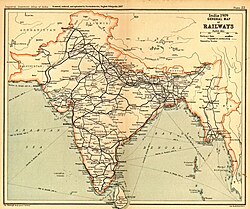
Historical network – map tour


1832–1852: Industrial railways
The first proposals for railways in India were made in Madras in 1832.[14] The first train in India ran from Red Hills to Chintadripet bridge in 1836–1837.[14] It was called the Red Hill Railway and used a rotary steam locomotive manufactured by William Avery. The railway was built by Sir Arthur Cotton and was mainly used for transporting granite stones for road-building work in Madras.[14] In 1845, Cotton built the Godavari Dam Construction Railway at Dowleswaram in Rajahmundry, used to supply stone for construction of a dam on the Godavari River.[14]
On 8 May 1845, the Madras Railway was incorporated, and the East Indian Railway Company (EIR) was incorporated the same year. On 1 August 1849, the Great Indian Peninsula Railway (GIPR) was incorporated by an Act of Parliament. A "guarantee system" providing free land and guaranteeing five-percent rates of return to private English companies building railways was finalised on 17 August 1849. In 1851, the Solani Aqueduct Railway was built in Roorkee; freight was hauled by a steam locomotive called Thomason, after a British officer. It was used for transporting construction materials for an aqueduct over the Solani river.[14] In 1852, the Madras Guaranteed Railway Company was incorporated.
1853–1924: Passenger railways and expansion
.jpg)
.jpg)
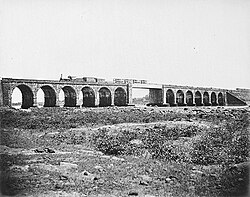
The first passenger train in India ran between Bombay (Bori Bunder) and Thane on 16 April 1853. The 14-carriage train was hauled by three steam locomotives – Sahib, Sindh and Sultan; it carried 400 people and ran on a line of 34 kilometres (21 mi) built and operated by the Great Indian Peninsula Railway.[15][16] This line was built in 1,676 mm (5 ft 6 in) broad gauge, which became the standard for railways in the country. In May 1854, the Bombay–Thane line was extended to Kalyan by India's first railway bridges, the Thane viaducts, over Thane Creek.[17] In Eastern India, the first passenger railway train ran from Howrah (near Calcutta) to Hoogly on 15 August 1854. The 39-kilometre (24 mi) line was built and operated by EIR.[18] In August 1855, the EIR Express and Fairy Queen steam locomotives started hauling trains.[19] The first passenger train in South India ran from Royapuram and Veyasarapady to Wallajah Road on 1 July 1856 on a 97-kilometre (60 mi) line built and operated by Madras Railway.[20]
On 24 February 1873, the first tramway, a 3.8-kilometre (2.4 mi) horse-drawn tramway, opened in Calcutta between Sealdah and Armenian Ghat Street.[21] On 9 May 1874 a horse-drawn tramway began operation in Bombay between Colaba and Parel. In 1880 Calcutta Tramways Company was incorporated.[22]
GIPR started its first workshops in Byculla in 1854 and Madras Railway set up their first workshop at Perambur in 1856. The railway boom continued with the incorporation of the Bombay, Baroda, and Central India Railway (BB&CI) in 1855,[23] Eastern Bengal Railway in 1858,[24] and the East Coast State Railway in 1890. The Great Southern of India Railway (GSIR) and the Carnatic Railway merged in 1874 to form the South Indian Railway.
In 1897, lighting in passenger coaches was introduced by many railway companies. In 1902, the Jodhpur Railway became the first to introduce electric lights as standard fixtures. In 1920, electric lighting of signals was introduced between Dadar and Currey Road in Bombay.
1925–1951: Electrification and further expansion
The first railway budget was presented in 1924. The Oudh and Rohilkhand Railway was merged with the East Indian Railway Company (EIR) in the same year.[25] In 1930, the route of the Grand Trunk Express was changed to Delhi–Madras.
On 3 February 1925, India's first electric passenger train ran between Victoria Terminus (VT) and Kurla on 1500 V DC overhead traction[26] with locomotives provided by the Cammell Laird and Waggonfabrik Uerdingen companies. Later that year the VT–Bandra section was electrified with an elevated platform at Sandhurst Road.[26] Kurla–Kalyan and lines to Poona and Igatpuri were electrified in 1926[26] and the Bandra–Virar section was electrified by January 1928. On 1 June 1930, the Deccan Queen began running, hauled by a WCP-1 (No. 20024, old No. EA/1 4006) with seven coaches, on the GIPR's electrified route from Bombay VT to Poona.[27]
The Frontier Mail made its inaugural run between Bombay VT and Peshawar in 1928.[28] In 1929, the Grand Trunk Express began running between Peshawar and Mangalore[29] and the Punjab Limited Express began running between Bombay and Lahore. Technical advancements led to automatic colour-light signals become operational on GIPR's lines between Bombay VT and Byculla in 1928.[30] This was extended to the Byculla–Kurla section in the following year.
1951–1983: Zonal re-organisation and further developments

India's railways were re-organised into regional zones beginning in 1951[31] with the creation of the Southern Railway on 14 April and the Central Railway and Western Railways on 5 November.[32] The post of Chief Commissioner of Railways was abolished and the Railway Board adopted the practice of making its senior-most member chairman.[32] In the same year, the government of West Bengal entered into an agreement with Calcutta Tramways Co. to take over its administrative functions. On 14 April 1952, the Northern Railway, the Eastern Railway and the North-Eastern Railway were created.[32] On 1 August 1955 the South-Eastern Railway was split from the Eastern Railway, and, the following year, divisional systems of administration were set up for the various regional zones. In 1958, the North-Eastern Railway split to form a new Northeast Frontier Railway.[32]
In 1952, fans and lights were mandated for all compartments in passenger accommodation and sleeping accommodation was introduced in coaches. In 1956 the first fully air-conditioned train was introduced between Howrah and Delhi.[33] In 1966 the first containerised freight services began, between Bombay and Ahmedabad.
In 1957 India Railways decided to adopt 25 kV AC electrification and chose the SNCF (French National Railway) as its technical consultant.[34] The Main Line Electrification Project was established in the same year.[35] Raj Kharswan–Dongoposi became the first section to be electrified with 25 kV AC traction,[34] with the first train running on 11 August 1960.[34] In 1966 electrification of several suburban tracks around Delhi, Madras and Calcutta was completed with the 25 kV AC system. In 1979 the Main Line Electrification Project was reconstituted into the Central Organisation for Railway Electrification (CORE).
1984–present: Rapid transit and later developments


The Calcutta Metro became the first metro in the country[36] with the 24 October 1984 line between Esplanade and Bhowanipore.[37] In 1988 the first Shatabdi Express was introduced between New Delhi and Jhansi (later extended to Bhopal), and was the fastest train in India at the time.[38] In 1993, air-conditioned third-tier coaches were introduced as well as a sleeper class separate from second class. In 1999, the South East Central Railway zone was established. On 6 July 2002, the East Coast, South Western, South East Central, North Central, and West Central zones were created.[39] On 5 April 2016, Gatimaan Express, then India's fastest train with a maximum speed of 160 km/h (99 mph), made its first run from Delhi to Agra.[40]
India's first computerised ticketing and reservation was introduced in New Delhi in 1986.[citation needed] In 1990, the first self-printing ticket machine (SPTM) was introduced. In September 1996, the CONCERT computerised reservation system was fully deployed at New Delhi, Mumbai and Chennai. The project was completed nationwide on 18 April 1999. In 1998, coupon validating machines (CVMs) were introduced at Mumbai CST. Credit cards could be used to book tickets and reservations starting in 1999, and in February 2000, the Indian Railways launched its web site[41] and began taking online train reservations and ticketing on 3 August 2002, which was extended to many cities in December.[42] On 26 September 2013, the Tatkal system of ticketing extended to ordinary trains.
On 16 January 1995, the first regularly scheduled services using the 2 × 25 kV system of traction started on Bina–Katni. On 5 February 2012, Western Railway switched completely to 25 kV AC traction, ending its use of 1.5 kV DC traction.[43] On 11 April 2016, Central Railway completed switching to 25 kV AC traction, ending the use of DC traction on the country's main-line rail network.[44] Indian Railways announced on 31 March 2017 that the entire rail network would be electrified by 2022.[45] Between the financial year 2022 to 2023, Indian Railways recorded a freight loading of 1512 metric tonnes, which was Indian Railways' highest ever recorded freight loading.[46]
Historical railway length
This table shows the length of the railway over time.
| Year | Route km | Running track km | Total track km |
|---|---|---|---|
| 1950–51 | 53,596 | 59,315 | 77,609 |
| 1960–61 | 56,247 | 63,602 | 83,706 |
| 1970–71 | 59,790 | 71,669 | 98,546 |
| 1980–81 | 61,240 | 75,860 | 104,480 |
| 1990–91 | 62,367 | 78,607 | 108,858 |
| 2000–01 | 63,028 | 81,865 | 108,706 |
| 2010–11 | 64,173 | 87,114 | 114,037 |
| 2015–16 | 66,252 | 92,084 | 119,630 |
| 2016–17 | 66,918 | 93,902 | 121,407 |
| 2017–18 | 66,935 | 94,270 | 122,873 |
| 2018–19 | 67,415 | 95,981 | 123,542 |
| 2019–20[47] | 67,956 | 99,235 | 126,366 |
| 2020–21[48] | 68,103 | 100,866 | 126,611 |
| 2021–22[49] | 68,043 | 102,831 | 128,305 |
Route km : The distance between two points on the railway irrespective of the number of lines connecting them, whether single line or multiple line.
Running track km: The length of all running tracks excluding tracks in sidings, yards and crossings.
Total track km: The length of all running tracks and tracks including tracks in sidings, yards and crossings.
Rolling stock
Locomotives

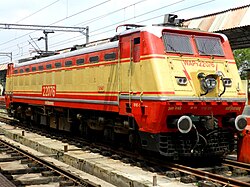
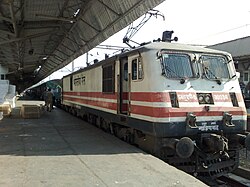
Locomotives in India largely consist of electric and diesel locomotives. The world's first compressed natural gas (CNG) locomotives are also used.[50] Steam locomotives are used only in heritage trains.
In India, locomotives are classified according to their gauge, motive power, the work they are suited for and their power or model number. The class name, composed of four or five letters, encodes this information. The first letter denotes the track gauge; the second denotes their motive power, diesel or alternating current (electric); the third letter denotes the type of traffic for which they are suited (goods, passenger, multi or shunting). The fourth letter used to denote the chronological model number, but from 2002 it denotes the horsepower range for diesel locomotives. Electric locomotives are not covered by this scheme and not all diesels are covered; for these, the fourth letter denotes their chronological model number.
A locomotive may have a fifth letter in its class name which denotes a technical variant, subclass or subtype, indicating a variation in the basic model or series, possibly different motors or a different manufacturer. With the modern scheme for classifying diesel locomotives the fifth letter further refines the horsepower indication in 100 hp (75 kW) increments: 'A' for 100 hp, 'B' for 200 hp, 'C' for 300 hp, etc.
Under this scheme, a 'WDM-3A', for example, refers to a wide-gauge diesel multi-use 3100 hp locomotive, while a 'WDM-3D' would be a 3400 hp locomotive and 'WDM-3F' would be 3600 hp locomotive.[note 1]
Diesel locomotives are fitted with auxiliary power units which save nearly 88% of fuel while idling.[51]
Goods wagons
_Train.JPG)
A new wagon numbering system was adopted by Indian Railways in 2003.[52] Wagons are allocated 11 digits,[53] making identification easier and allowing for computerisation of a wagon's information. The first two digits indicate the type of wagon, the third and fourth digits indicate the owning railway, the fifth and sixth digits indicate the year of manufacture, the seventh through tenth digits indicate the Individual Wagon Number, and the last digit is a check digit.
IR's bulk requirement of wagons is met by wagon manufacturing units both in public and private sectors as well as other public sector units under the administrative control of Ministry of Railways.[1]
Passenger coaches
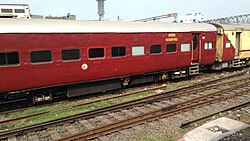
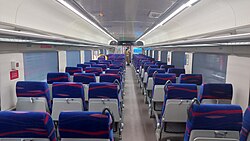
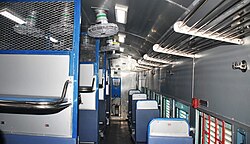
On long-distance routes and also on some shorter routes, IR uses two primary types of coach design types. ICF coach, in production from 1955 until January 2018,[54] constitute the bulk of the current stock. These coaches, considered to have inadequate safety features, are slowly being phased out. As of September 2017[update], around 40,000 coaches are still in operation.[55] These coaches are being replaced with LHB coach. Introduced in mid '90s, these coaches are lighter, safer and are capable of speeds up to 160 km/h (99 mph).[56]
IR has introduced new electric multiple unit (EMU) train sets for long-distance routes. One such, Train-18 is under operation and another, Train-20 is expected to run from 2023. These train sets are expected to replace locomotive-hauled trains on long-distance routes.[57]
On regional short-distance routes, IR runs Mainline electrical multiple unit (MEMU) or Diesel electrical multiple unit (DEMU) trains, depending on the traction available. These train sets are self-propelled with capability for faster acceleration or deceleration and are expected to reduce congestion on dense routes. Passenger locomotive-hauled trains, having frequent stops, are slowly being replaced with train sets across India.[58]
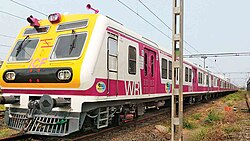
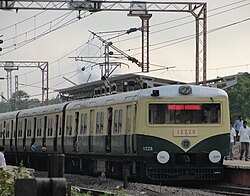
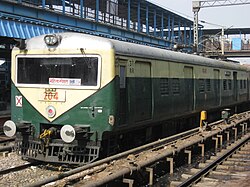
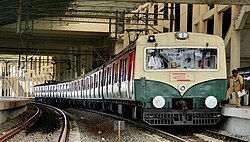
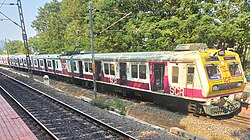
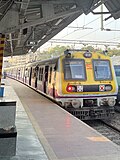
On suburban commuter routes around large urban centers, IR runs trains with normal electric multiple unit (EMU) coaches. These are popularly called "local trains" or simply "locals".[59]
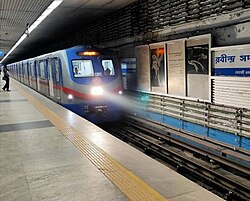
EMUs are also used in metros. All train sets used in metros are air-conditioned.[60] Kolkata trams almost always consist of a single motor coach. A new twin coach tram was introduced in Kolkata in 2019.[61]
Manufacturing
The Chittaranjan Locomotive Works in Chittaranjan, Banaras Locomotive Works in Varanasi and Patiala Locomotive Works in Patiala make electric locomotives. The Integral Coach Factory in Perambur, Chennai, makes integral coaches. These have a monocoque construction, and the floor is an integral unit with the undercarriage. The Rail Coach Factory in Kapurthala and Modern Coach Factory in Raebareli also makes coaches. Companies like SRBWIPL, JWL, Texmaco Rail & Engg, Titagarh Wagons and many more build freight wagons. The Rail Wheel Factory at Yelahanka, Bangalore, and the Rail Wheel Plant, Bela, in Chhapra, Bihar, manufactures cast wheels and axles. Patiala Locomotive Works, Patiala also upgrades the diesel locomotives. Electric Locomotive Factory at Madhepura set up by the India Railways in joint venture with Alstom is used for production of WAG 12B.[62] Indian Railways joined hands with General Electric to set up Diesel Locomotive Factory at Marhaura in Bihar.[63] Some electric locomotives have been supplied by BHEL, Jhansi and Palakkad, and locomotive components are manufactured in several other plants around the country.[64] The consortium of Titagarh Wagons and Ramkrishna Forgings won the contract to manufacture and supply forged wheel for Indian Railways.[65] The demand of forged wheels for the railways is also met by SAIL-Durgapur Plant and RINL Forged Wheel Plant in Raebareli.[66][67]
Network
Tracks
.svg)
As of 31 March 2020, IR network spans 126,366 km (78,520 mi) of track length, while the route length is 67,956 km (42,226 mi).[1] Track sections are rated for speeds ranging from 80 to 200 km/h (50 to 124 mph), though the maximum speed attained by passenger trains is 180 km/h (110 mph) during trial runs. The entire broad-gauge network is equipped with long-welded, high-tensile strength 52 kg/60 kg 90 UTS rails and pre-stressed concrete (PSC) sleepers with elastic fastenings.[1]
1,676 mm (5 ft 6 in) broad gauge is the gauge used by IR and spans almost the entire network, as of March 31, 2023. It is the broadest gauge in use across the world for regular passenger movement.
The 1,000 mm (3 ft 3+3⁄8 in) metre gauge tracks and 762 mm (2 ft 6 in) and 610 mm (2 ft) narrow gauge tracks are present only on the heritage routes as of March 31, 2023.
Urban rail transit systems in India mostly use standard gauge tracks. These systems are operated by metro/tram rail corporations which are independent of Indian Railways. Trams in Kolkata, the only remaining tram service in the country, uses standard gauge tracks. Line 1 of the Kolkata Metro and Delhi Metro use the same broad gauge tracks as main-line railways. All other metro lines – constructed, under construction and future – use standard gauge tracks.[68] Metro trains operate in Kolkata, Delhi, Bengaluru, Chennai, Mumbai, Hyderabad, Jaipur, Kochi, Nagpur, Ahmedabad and Lucknow. Gurgaon has a Metro system operated by a private organisation. Metro tracks are being constructed or planned in all million-plus cities in the country.
Electrification
As of 1 April 2023[update], IR has electrified 58,812 km (36,544 mi) of the total routes. India uses 25 kV 50 Hz AC traction on all its electrified tracks.[1][2]
Railway electrification in India began with the first electric train, between Chhatrapati Shivaji Terminus and Kurla on the Harbour Line, on 3 February 1925 on the Great Indian Peninsula Railway (GIPR) at 1500 V DC. Heavy gradients in the Western Ghats necessitated the introduction of electric traction on the GIPR to Igatpuri on the North East line and Pune on the South East line. On 5 January 1928, 1500 V DC traction was introduced on the suburban section of the Bombay, Baroda and Central India Railway between Colaba and Borivili, and between Madras Beach and Tambaram of the Madras and Southern Mahratta Railway on 11 May 1931, to meet growing traffic needs.[69] The 3000 V DC electrification of the Howrah-Burdwan section of the Eastern Railway was completed in 1958. The first 3000 V DC EMU service began on the Howrah-Sheoraphuli section on 14 December 1957.[69]
Research and trials in Europe, particularly on French Railways (SNCF), indicated that 25 kV AC was an economical electrification system. Indian Railways decided in 1957 to adopt 25 kV AC as its standard, with SNCF their consultant in the early stages. The first 25 kV AC section was Raj Kharswan–Dongoaposi on the South Eastern Railway in 1960. The first 25 kV AC EMUs, for Kolkata suburban service, began service in September 1962. For continuity, the Howrah–Burdwan section of the Eastern Railway and the Madras Beach–Tambaram section of the Southern Railway were converted to 25 kV AC by 1968. Because of limitations in the DC traction system, a decision was made to convert the electric traction system of the Mumbai suburban rail network of WR and CR from 1.5kV DC to 25 kV AC in 1996–97. The conversion from DC to AC traction was completed in 2012 by the Western Railway, and in 2016 by the Central Railway. Since then, the entire electrified mainline rail network in India uses 25 kV AC, and DC traction is used only for metros and trams.[69]
Indian Railways announced on 31 March 2017 that the country's entire rail network would be electrified by 2022.[70][71] Though not a new concept, the electrification in India has now been committed to with an investment of ₹35,000 crore (US$4.9 billion) to electrify the entire network and eliminate the cost of fuel for transportation, which will amount to a savings of ₹10,500 crore (US$1.5 billion) overall. These savings will allow the government channel funds to invest in the modernisation of the railway infrastructure.[72] Close to 30 billion units of electricity will be required for railway electrification on an annual basis by 2022, which will lead to opportunities for IPPs of conventional power.[71]
All metro routes, as well as the Kolkata tram, are electrified with DC traction. Many metro routes employ the third rail method for electric traction.[73]
Signaling and telecommunication

IR uses a range of signalling technologies and methods to manage its train operations based on traffic density and safety requirements.
As of March 2020[update], around 3,309 km (2,056 mi) of the route uses automatic block signalling for train operations – concentrated in high density routes, large cities and junctions.[1] Remaining routes are based on absolute block signalling with trains manually controlled by signalmen from the signal boxes typically located at stations. Few low density routes still use manual block signalling methods with communication on track clearance based on physical exchange of tokens.[74] In a few sections, intermediate block signalling is provided to further enhance line capacity with minimal investment. As of March 2020[update], 602 block sections have intermediate block signals on IR.[1]
IR primarily uses coloured signal lights, which replaced semaphores and disc-based signalling (dependent on position or colour).[75] IR uses two-aspect, three-aspect and four (or multiple) aspect colour signalling across its network.[76]
Signals at most stations are interlocked using panel interlocking, route-relay interlocking or electronic interlocking methods, which eliminate human error. IR uses track circuiting, and block proving axle counters for train detection. As of March 2017[update], 5,886 stations across IR have interlocked stations and multi-aspect signalling. Around 99% of key routes (A, B, C and D) have track circuitry or block proving axle counters for automated train detection. IR has about 59,105 route kilometers of optical fiber cable network across India, that is used for train control, voice and data communication. Around 3,445 km (2,141 mi) of the route is covered by GSM-R based Mobile Train Radio Communication.[1]
In December 2017, IR announced that it will implement ETCS Level 2 system for signalling and control on key routes with an investment of ₹12,000 crore (US$1.7 billion).[77] Currently IR uses Centralised Traffic Control (CTC) on the busy Ghaziabad – Kanpur route and real-time train monitoring systems on Mumbai and Kolkata suburban routes.[1]
International connections
Rail links between India and neighbouring countries are not well developed.
Bangladesh
Bangladesh is connected by the five days a week Maitree Express, which runs from Kolkata railway station to Dhaka Cantonment, the Bandhan Express, which began running commercial trips between Kolkata railway station and Khulna railway station[78][79] and Mitali Express connecting New Jalpaiguri railway station with Dhaka Cantonment railway station which started commercial services from 1 June 2022.[80]
Indian and Bangladeshi governments planned to start work by January 2015 on a new rail link to ease surface transport.[81] India will build a 15-kilometre (9.3 mi) railway linking Tripura's capital Agartala with Bangladesh's southeastern city of Akhaura, an important railway junction connected to Chittagong port, resource-rich Sylhet and Dhaka.[82] An agreement to implement the railway project was signed between India's former Prime Minister Manmohan Singh and Bangladeshi Prime Minister Sheikh Hasina during her visit to India in January 2010.[83] The total cost of the proposed project is estimated at ₹252 crore (₹2.5 billion). The Indian Railway Construction Company (IRCON) would lay the new railway tracks on both sides of the border. Of the 15 kilometres (9.3 mi) rail line, 5 kilometres (3.1 mi) of tracks fall in Indian territory.[84][85] The Northeast Frontier Railways (NFR) is laying tracks to connect Tripura's southernmost border town, Sabroom, 135 km (84 mi) south of here. From Sabroom, the Chittagong international sea port is 72 km (45 mi).[86]
Bhutan
An 18-kilometre (11 mi) railway link with Bhutan is being constructed from Hasimara in West Bengal to Toribari in Bhutan.
Myanmar
No rail link exists with Myanmar but a railway line is to be built from Jiribam (in Manipur) to Tamu through Imphal and Moreh.[87] The construction of this missing link, as per the feasibility study conducted by the Ministry of External Affairs through RITES Ltd, is estimated to cost ₹29.41 billion (US$410 million).[88]
Nepal
Two rail links to Nepal exist: A passenger service between Jainagar and Janakpur which is run and operated by Nepal Railways and freight services between Raxaul and Birganj.[89]
Pakistan
Two trains were operated to Pakistan: the Samjhauta Express between Delhi and Lahore, and the Thar Express between Jodhpur and Karachi. Since 2019, both services have been shut down.[90][91]
Services
Passenger service
Station categories
From December 2017, stations are categorised into the Non-Suburban Group NSG1 to NSG6, the Suburban Group SG1 to SG3, and the Halt Group HG1 to HG3 based on the earnings, passenger footfall and strategic importance.[92]
Before December 2017, stations were classified into A1, A, B, C, D, E and F categories, based only on the passenger earnings from the sales of platform tickets, thus limiting the ability of IR to better focus its investments in passenger amenities.[92]


Travel classes


IR has several classes of travel – with or without air conditioning; a train may include just one or several of these. Slow passenger trains have only unreserved seating class whereas Rajdhani, Duronto, Shatabdi, Garib Rath and Yuva trains only have air-conditioned classes. The fares are different for each class, with unreserved seating class being the cheapest. The fare of Rajdhani, Duronto and Shatabdi trains includes food served in the train, but for other trains food has to be bought separately. In September 2016, the IR introduced dynamic fares for all accommodation classes for Rajdhani, Duronto and Shatabdi trains (except 1AC and EC classes) to shore up revenue.[93] In long-distance trains a pantry car is usually included and the food is served at the berth or seat itself. Luxury trains such as Palace on Wheels have separate dining cars but fares are comparable to a five-star hotel.
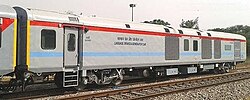
A standard passenger train has four unreserved (also called "general") coaches, two at the front and two at the end, of which one may be exclusively for women. The number of other coaches varies according to the demand and route. A luggage coach may be included at the front or end. In some mail trains, a separate mail coach is attached. Lavatories are communal and feature both the Indian style as well as the Western style.
The following table lists the classes in operation. A train may not include all of these classes.
| Class[94] | Description[95][96] |
|---|---|
| Saloon | IR has started to operate saloon coaches to give hotel ambience on trains. These coaches operate on charter basis i.e. booking is required. They have a master bedroom, a normal bedroom, a kitchen and window trailing. Four to six extra beds are given to accommodate more people.[97] The first of these coach was attached to the Jammu Mail.[98] |
| 1A | AC first class – the most luxurious and expensive class of Indian Railways, with fares almost at a par with airfares. There are eight cabins (including two coupes) in full AC first class coach and three cabins (including one coupe) in the half AC first class coach. The coach has an attendant, and bedding is included in the fare. This air-conditioned coach, present only on popular routes, can carry 18 (full coach) or 10 passengers (half coach). |
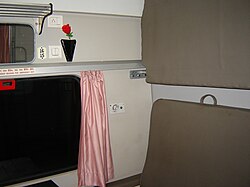
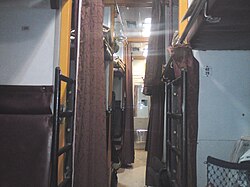
| 2A | AC two tier – these air-conditioned coaches have sleeping berths across eight bays. Berths are usually arranged in two tiers in bays of six: four across the width of the coach and two lengthwise across the corridor, with curtains along the corridor. Bedding is included in the fare. A coach can carry 48 (full coach) or 20 passengers (half coach). |
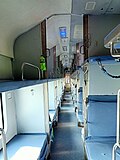
| 3A | AC three tier – air-conditioned coaches with 64 sleeping berths. Berths are similar to 2A, but with three tiers across the width and two lengthwise for eight bays of eight. They are slightly less well-appointed, usually with no reading lights or curtains. Bedding is included in the fare. |
| 3E | AC three tier (economy) – air-conditioned coaches with sleeping berths on the Garib Rath Express. Berths are usually arranged as in 3A, but with three tiers across the width and three lengthwise. Appointments are similar to 3A, and bedding is not included. These coaches are also present in some Duronto Express trains as well. |
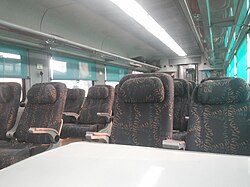
| Vistadome | IR operates Vistadome glass roof coaches on some tourist routes. These include Araku Valley, the Konkan Railway, the Kalka-Shimla Railway, the Kashmir Valley, the Kangra Valley, Bengaluru-Mangaluru, Neral-Matheran, New Jalpaiguri-Alipurduar & Guwahati-Haflong routes. These coaches' fares are equivalent to an AC Executive Chair Car. IR also has plans to start Vistadome on the Nilgiri Mountain Railway.[99] |
| EA | Anubhuthi – air-conditioned top-end class of the Shatabdi Express. These coaches were introduced in January 2018. The first train to get these coaches was the Chennai Central–Mysuru Shatabdi Express |
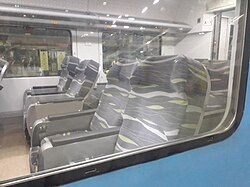
| EC | Executive chair car – an air-conditioned coach with spacious seats and legroom. With four seats in a row, it is used for intercity day travel and is available on the Tejas and the Shatabdi Express. |
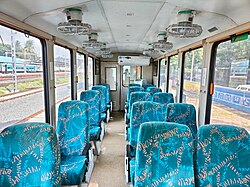
| CC | AC chair car – an air-conditioned coach with five seats in a row, used for intercity day travel. Air-conditioned double-deck coaches are used on the Double Decker Express. |
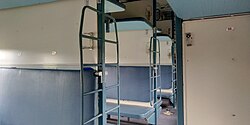
| SL | Sleeper class – the sleeper class is the most common coach on IR, with ten or more SL coaches attached to a train rake. They are sleeping coaches with three berths across the width and two lengthwise, without air-conditioning. They carry 72 passengers per coach. |
| 2S | Second seater – similar to CC, without air-conditioning. Double-deck second seaters are used on the Flying Ranee. |
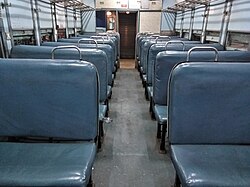
| UR/GEN | Unreserved/General – the least-expensive accommodation, with a seat not guaranteed. Tickets are valid on any train on a route if used within 24 hours of purchase. |
At the rear of the train is a special compartment known as the guard's cabin. It is fitted with a transceiver and is where the guard usually gives the all-clear signal before the train departs.
Train types
Trains are sorted into categories which dictate the number of stops on a route, their priority on the network and their fare structure. Each express train is identified by a five-digit number. If the first digit is one or two, they are long-distance express trains. If the first digit is zero, the train is a special train which will operate for a limited period of time with a different fare structure. A first digit of five denotes a passenger train.
The second digit indicates the zone operating the train. However, for high-speed trains, the second digit is either zero or two (the first remains one or two).[100] The third digit denotes the division within the zone which is responsible for maintenance and cleanliness, and the last two digits are the train's serial number.[100] The train numbering system was changed from four digits from December 2010,[101] to accommodate an increasing number of trains.
Trains traveling in opposite directions along the same route are usually labelled with consecutive numbers.[100] However, there is considerable variation in train numbers; some zones, such as the Central Railway, have a less-systematic method of numbering trains.[100]
Trains are classified by average speed.[102] A faster train has fewer stops (halts) than a slower one, and is usually used for long-distance travel. Most express trains have special names to identify them easily. The names of the trains usually denote the regions they connect; the routes they traverse; a famous person; or a tourist spot connected with the train.[103][104]
| Train types | Description |
|---|---|
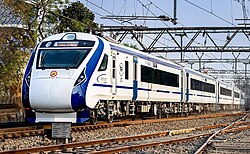
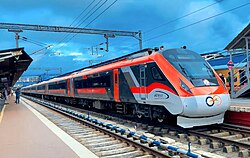
| Vande Bharat Express | A semi-high-speed, air-conditioned day time journey train with facilities such as Wi-Fi, snack tables, CCTV cameras, hydraulic-pressure doors and a fire and smoke detection and extinguishing system. It can run at a speed of 180 km/h (110 mph), but due to speed limit of railway track of routes used by Vande Bharat Express, the actual top operating speed is only 130 km/h.[105] It is the first semi-high speed (EMU) train set made in India. It was flagged off on 15 February 2019 by Prime Minister Narendra Modi. |
| Tejas Express | A semi-high-speed, air-conditioned train which had its inaugural run on 24 May 2017, covering 551.7 kilometres (343 mi) in eight hours, 30 minutes. Coaches have bio-vacuum toilets, water-level indicators, tap sensors, hand dryers, integrated Braille displays, an LED TV for each passenger with a phone jack, local cuisine, Wi-Fi, tea and coffee vending machines, magazines, snack tables, CCTV cameras and a fire and smoke detection and extinguishing system. It can run at a speed of 130 km/h (81 mph). |
| Gatimaan Express | The first semi-high-speed, air-conditioned train running between Delhi and Jhansi with a top speed of 160 km/h (99 mph), it is India's fastest train at present. |
| Shatabdi Express | Air-conditioned, intercity trains for daytime travel. Unlike the Rajdhani or the Duronto Expresses, the Shatabdi Express makes a round trip on the same day. The Bhopal Shatabdi Express (train number 12001/12002) is India's second-fastest train between New Delhi and Agra, with an average speed of 90 km/h (56 mph) and a top speed of 150 kilometres per hour (93 mph). The limited-stop trains have Wi-Fi. |
| Rajdhani Express | Limited-stop, air-conditioned trains linking state capital to national capital, they have a top speed of 130–140 km/h (81–87 mph). The 2014 railway budget proposed increasing the Rajdhani and Shatabdi Expresses to 180 km/h (110 mph). |
| Duronto Express | Non-stop (except for technical halts) service introduced in 2009. In January 2016, it became possible to book tickets from those technical stops. They connect India's metros and major state capitals, and were introduced to equal (or exceed) the speed of the Rajdhani Express. With air-conditioned one-, two- and three-tier seating, some have non-air-conditioned sleeper-class accommodations. |
| Humsafar Express | Air-conditioned, three-tier coach trains with LED screens displaying information about stations and train speed, a PA system, vending machines for tea and coffee, charging ports for electronic devices, bio-toilets, smoke alarms, CCTV cameras, curtains and heating and refrigeration facilities for food. Inaugural run was between Gorakhpur to the Anand Vihar Terminal. |
| AC Express | Air-conditioned, limited-stop trains linking major cities, with a speed of about 130 km/h (81 mph). |
| Double Decker Express | Air-conditioned, limited-stop, two-tier express trains for daytime travel |
| Uday Express | Air-conditioned double decker train for overnight travel. |
| Garib Rath Express | Air-conditioned, economy, three-tier trains with a top speed of 130 km/h (81 mph) |
| Yuva Express | Introduced with the Duronto Express to provide air-conditioned travel to young Indians, 60 percent of its seats were reserved for passengers between 18 and 45 years of age. The trains were unsuccessful, and operate only on the Delhi-Howrah and Delhi-Mumbai routes. |
| Jan Shatabdi Express | A more-economical version of the Shatabdi Express, with air-conditioned and non-air-conditioned classes and a top speed of 110 km/h (68 mph) |
| Sampark Kranti Express | Express service to New Delhi |
| Kavi Guru Express | Introduced in honour of Rabindranath Tagore, four pairs of trains operate on the network. |
| Vivek Express | Introduced to commemorate the 150th birth Anniversary of Swami Vivekananda in 2013, four pairs of Vivek Expresses run in the country. |
| Rajya Rani Express | Introduced to connect state capitals to major cities in that state. |
| Mahamana Express | Superfast train with Indian Railways ModelRake coaches. |
| Intercity Express | Introduced to connect major cities on short routes with high and semi-high speeds. Trains include the Deccan Queen, the Flying Ranee and the Bilaspur Nagpur Intercity Express. |
| Antyodaya Express | Non-reserved, high-speed LHB coach on peak routes to ease congestion. |
| Jan Sadharan Express | Non-reserved express trains on peak routes to ease congestion. |
| Suvidha Express | High priority trains with dynamic pricing on high demand routes. |
| Superfast Express | Trains with a max speed greater than 100–110 km/h (62–68 mph), average speed greater than 55 km/h (34 mph), whose tickets have a super fast surcharge, with stops at very few stations. |
| Express | Trains with a maximum speed greater than 100 km/h (62 mph), average speed greater than 36 km/h (22 mph), with stops at few stations. |
| These trains earlier had separate mail coaches. Nowadays, mail is carried in luggage coaches like all other trains. | |
| Passenger | Slow, economical trains which stop at every (or almost every) station on a route. With generally-unreserved seating. The trains travel at about 40–80 km/h (25–50 mph). |
| Suburban | These trains operate in Mumbai, Delhi, Kolkata, Chennai, Hyderabad, Ahmedabad, Vadodara, Surat, Bengaluru, Pune and between Kanpur and Lucknow, usually stop at every station, and have unreserved seating. |
| Metro | Designed for urban transport, the first metro was the Kolkata Metro. Now the Delhi Metro is becoming largest metro network in the country. |
| Mountain Railways | Three of the lines were declared a World Heritage site as Mountain Railways of India by UNESCO.[106] |
Tourism
There are several train services which run for tourists:
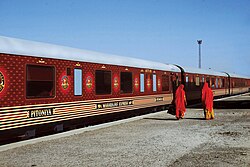
- The Palace on Wheels is a luxury-train service, frequently hauled by a steam locomotive, to promote tourism in Rajasthan.[107] The train has a seven-night, eight-day itinerary on a round trip from New Delhi via Jaipur, Sawai Madhopur and Chittaurgarh, Udaipur, Jaisalmer, Jodhpur, Bharatpur and Agra.
- The Royal Rajasthan on Wheels covers a number of tourist destinations in Rajasthan. The seven-day, eight-night tour is a round trip from New Delhi's Safdarjung station via Jodhpur, Udaipur and Chittaurgarh, Ranthambore National Park and Jaipur, Khajuraho, Varanasi and Sarnath, and Agra.[108]
- The Maharajas' Express, a luxury train operated by the Indian Railway Catering and Tourism Corporation (IRCTC), runs on five routes[109] to about 12 destinations across north-West and central India (centered around Rajasthan) from October to April.
- The Deccan Odyssey covers tourist destinations in Maharashtra and Goa. Its seven-night, eight-day tour begins in Mumbai and stops at Jaigad Fort, Ganapatipule and Ratnagiri, Sindhudurg, Tarkarli and Sawantwadi, Goa, Kolhapur and Pune (Day 5), Aurangabad and Ellora Caves, and Ajanta Caves and Nashik.[110] The Golden Chariot runs on two tours: Pride of the South[111] and Splendor of the South.[112]
- The Golden Chariot is a luxury train service which connects tourist destinations in Karnataka, Goa, Kerala & Tamil Nadu.
- The Mahaparinirvan Express, an air-conditioned service also known as the Buddhist Circuit Train, is run by the IRCTC for Buddhist pilgrims. Its seven-night, eight-day tour begins in New Delhi and visits Bodh Gaya, Rajgir and Nalanda, Varanasi and Sarnath, Kushinagar and Lumbini, Sravasti and the Taj Mahal.[113]
- The Fairy Queen, a tourist attraction as the world's oldest operating steam engine, hauls a luxury train from Delhi to Alwar.
Ticketing

India has some of the lowest train fares in the world. Basic passenger traffic is heavily subsidised by more-expensive higher-class fares.[114] Until the late 1980s, Indian Railways ticket reservations were done manually. In 1987 the Railways started using a computerised ticketing system. The entire ticketing system went online in 1995 to provide up-to-date information on status and availability. The ticketing network is computerised to a large extent, with the exception of some remote places. Computerised tickets can be booked for any two points in the country, through the Internet and via mobile phones, though this method carries an additional surcharge.
Discounted tickets are available for senior citizens (above 60 years) and some other categories of passengers including the disabled, students, athletes, persons affected by serious diseases, or persons appearing for competitive examinations. One compartment of the lowest class of accommodation is reserved for women in every passenger-carrying train. Some berths or seats in sleeper class and second class are also reserved for women.[115] Season tickets permitting unlimited travel on specific sections or specific trains for a specific time period may also be available. Foreign tourists can buy an Indrail Pass,[116] which is modelled on the Eurail Pass, permitting unlimited travel in India for a specific time period.
For long-distance travel, reservation of a berth can be made up to 120 days before departure.[115] Details such as name, age and concession (if eligible) are required and are recorded on the ticket. The ticket price usually includes the base fare, which depends on the classification of the train (example: super-fast surcharge if the train is classified as super-fast), the class in which one wishes to travel and the reservation charge for overnight journeys.
If a seat is not available then the ticket is given a waitlist number; otherwise the ticket is confirmed and a berth number is printed on the ticket. A person receiving a wait-listed ticket may be able to obtain a confirmed ticket if there are sufficient cancellations.[115][116] Some of the tickets are assigned to the Reservation against Cancellation (RAC), which is between the waiting list and the confirmed list.[115][116] These allow the ticket holder to board the train and obtain an allotted seat decided by a ticket collector, after the ticket collector has ascertained that a seat is vacant.
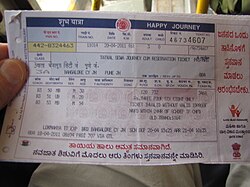
Reserved railway tickets can be booked through the website of Indian Railway Catering and Tourism Corporation (IRCTC)[117] and also through mobile phones via SMS. Tickets booked through this site are categorised into iTickets and eTickets. iTickets are booked by a passenger and then printed and delivered to the passenger. eTickets are printed by the passenger and carried while travelling. While travelling on an eTicket, one must carry an authorised valid photo identity card. Cancellation of eTickets is done online, without the requirement for the passenger to go to any counter. Unreserved tickets are available for purchase on the platform at any time before departure. An unreserved-ticket holder may only board the general-compartment class. All suburban networks issue unreserved tickets valid for a limited time. For frequent commuters, a season pass (monthly or quarterly) guarantees unlimited travel between two stops.
Freight service
 | This section needs to be updated. |

In the freight segment, IR ferries various commodities and fuels in industrial, consumer, and agricultural segments across India. IR has historically subsidised the passenger segment with income from the freight business. As a result, freight services are unable to compete with other modes of transport on both cost and speed of delivery, leading to continuous erosion of market share.[118] To counter this downward trend, IR has started new initiatives in freight segments including the upgrade of existing goods sheds, attracting private capital to build multi-commodity multi-modal logistics terminals, changing container sizes, operating time-tabled freight trains, and tweaking with the freight pricing/product mix.[119] Also, end-to-end integrated transport solutions such as roll-on, roll-off (RORO) service, a road-rail system pioneered by Konkan Railway Corporation in 1999 to carry trucks on flatbed trailers,[120] is now being extended to other routes across India.
A potential game-changer for IR in the freight segment are the new dedicated freight corridors that are expected to be completed by 2020. When fully implemented, the new corridors, spanning around 3,300 km (2,100 mi), could support hauling of trains up to 1.5 km in length with 32.5 ton axle-load at speeds of 100 kilometres per hour (62 mph). They will also free-up capacity on dense passenger routes and allow IR to run more trains at higher speeds. Additional corridors are being planned to augment the freight infrastructure in the country.
Yearwise Frieght Load[121][122][123][124][125]
| Si.No | Year | Actual Frieght loading in the year (in Million tonnes) |
| 1 | 1950-51 | 73.2 |
| 2 | 1960-61 | 119.8 |
| 3 | 1970-71 | 167.9 |
| 4 | 1980-81 | 195.9 |
| 5 | 1990-91 | 318.4 |
| 6 | 2000-01 | 473.5 |
| 7 | 2003-4 | 557 |
| 8 | 2004-5 | 601.89 |
| 9 | 2006-7 | 727.75 |
| 10 | 2007-8 | 793.89 |
| 11 | 2008-9 | 833.39 |
| 12 | 2009-10 | 887.79 |
| 13 | 2010-11 | 921.73 |
| 14 | 2011-12 | 969.05 |
| 15 | 2012-13 | 1008.09 |
| 16 | 2013-14 | 1051.64 |
| 17 | 2014-15 | 1097.58 |
| 18 | 2015-16 | 1104.17 |
| 19 | 2016-17 | 1111 |
| 20 | 2017-18 | 1161 |
| 21 | 2018-19 | 1223 |
| 22 | 2019-20 | 1210 |
| 23 | 2020-21 | 1233 |
| 24 | 2021-22 | 1418 |
| 25 | 2022-23 | 1512 |
Urban rail
The urban rail transit in India consists of systems such as rapid transit (Metro), suburban rail (operated by Indian railways), light rail (Metrolite), tram, regional rail and monorail. India has one of the largest and busiest urban transit systems in the world. As of 2022, the combined length of 822.038 kilometres (510.791 miles) of metro systems in India makes it the fourth longest in operation in the world.[126]
Administration
The administration of Urban rail in India falls under the Ministry of Urban Development's Urban Transport wing which is the nodal division for coordination, appraisal and approval of Urban Transport matters including urban rail Projects at the central level since the National Urban Transport Policy in 2006.[127]
Summary


.jpg)
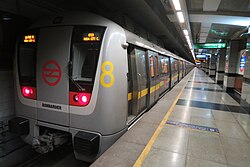
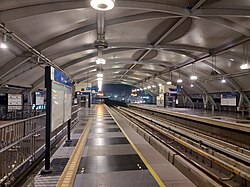
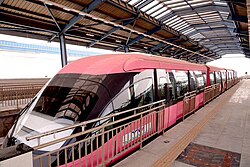
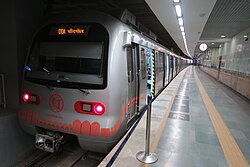
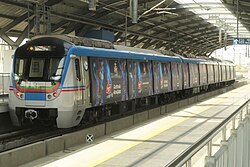
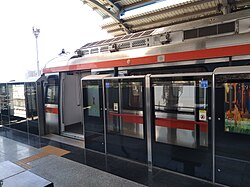
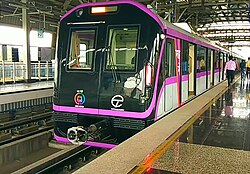
Urban rail transit in India consists of various modes of rail based public transport systems in urban areas of India, such as Metro, Suburban rail, Monorail, Regional rapid rail, Tram and Funiculur railway.
Presence of Metro rail in India began with commissioning of the first system in Kolkata in 1984. They were later introduced gradually in other cities like Delhi and Bengaluru, thus eventually becoming popular in all urban agglomerations.
According to a report published in 2025, a total of 36.5 billion people traveled annually in metro systems across India's fifteen major cities, placing the country as one of the busiest urban rapid transit hubs in the world in terms of commuters. In 2025, the Delhi Metro alone carries an average of 46.3 lakh (4.63 million) passengers daily, and the Delhi-Meerut RRTS has an operational speed of 160 km/h. Across all metro systems in India, daily ridership is expected to be significantly higher, possibly exceeding 10 million. As of 2026, the cumulative length of 1,070.06 kilometres (664.90 miles) of twenty-one metro systems in India makes it the third longest in operation in the world.[128][126]
The Ministry of Urban Development's Urban Transport wing is the nodal division for coordination, appraisal, and approval of Urban Transport matters including Metro Rail Projects at the central level. All the interventions in urban transport by the Ministry of Urban Development are carried out under the provisions of the National Urban Transport Policy, 2006.[129]
Currently, the Delhi-Meerut RRTS is the fastest urban rail transit system in India, featuring an operational speed of 160 km/h and an average speed (including stoppage time) of 100 km/h.
Terminology
Indian cities have various types of urban transit systems operational, under construction and planned. These systems are being implemented based on the population of a city, financial feasibility and demand.
| Urban transit type | Capacity | Speed | Frequency of stations / stops | Locale | Right of way | Rail based | Cost to build and operate |
|---|---|---|---|---|---|---|---|
| Metro | High | Moderate | High | Intracity | Yes | Yes | High |
| Suburban Railway | High | Moderate | Medium | Regional | No † | Yes | Moderate |
| Medium-capacity metro | Medium | Moderate | High | Intracity | Yes | Yes | High |
| Light rail | Medium | Moderate | High | Intracity | Partial ‡ | Yes | Moderate |
| Monorail | Medium | Moderate | High | Intracity | Yes | Yes | High |
| Regional rapid rail | High | High | Low | Regional | Yes | Yes | High |
| Tram | Low | Slow | High | Neighborhood | No | Yes | Low |
| Bus Rapid Transit | Low | Moderate | High | Intracity | Yes | No | Low |
| Metro Neo | Low | Moderate | High | Intracity | Yes | No | Moderate |
| Water Metro | Low | Slow | Medium | Intracity | Yes | No | Low |
| Funicular | Low | Slow | Low | Neighborhood | No | Yes | Low |
† Note: Suburban rail in India utilises the broad gauge network of Indian Railways and mostly shares the network and infrastructure with the rest of Indian Railway services.
‡ Note: Light Rail systems are mostly fenced and can be built with complete right of way if preferred so.
- Metro: The rapid transit or popularly known as metro in India, is an urban high-capacity rail system, commonly operated in metropolitan cities. These systems are segregated from Indian Railways and have their right-of-way.
- Suburban rail: Suburban rail or popularly known as local train system in India, is an urban rail transit system where the suburbs are connected to the city's centre. These systems are linked to and operated by Indian Railways. Example: Mumbai Suburban Railway
- Medium-capacity rail: It is a rapid transit (metro) system which has a capacity higher than light rail but lower than rapid transit system to serve a medium demand. It is built considering the future rise in demand, so that it can be converted into a regular metro. Example: Rapid Metro Gurgaon
- Light rail: Light rail which is also known as Metro Lite is used in cities that have low demand. It is a combination of rapid transit and tram systems. It has a higher capacity and speed compared to tram services and has dedicated tracks that are mostly fenced. Example: Srinagar Metro
- Monorail: This system has trains running on a single rail/beam. It has found its application in medium capacity transport. The system however finds use case in specific scenarios such as the need for a higher capacity system on hilly terrains or in cities with tighter spaces where a surface level light rail or elevated metro would not be possible. However rake procurement and quick emergency evacuation issues remain. Example: Mumbai Monorail
- Regional rapid rail : This system is operated either between two similarly sized cities, which are close to each other or between a larger city and smaller cities lying nearby. Example: Delhi–Meerut RRTS
- Tram: These systems are one of the oldest modes of urban transport in India. They are low capacity, slow-moving trains which run on tracks that are embedded in the urban streets. Example: Kolkata Tram
- Funiculur: It is a type of cable railway system that connects points along a railway track laid on a steep slope. The system is characterized by two counterbalanced carriages (also called cars or trains) permanently attached to opposite ends of a haulage cable, which is looped over a pulley at the upper end of the track. Example: Malanggad funiculur near Thane.
Non-rail based urban transit
- Bus Rapid Transit : The Bus Rapid Transit systems in India use conventional buses or high capacity buses and have their own right-of-way, separated from the rest of the traffic. Example: Ahmedabad Bus Rapid Transit System
- Metro Neo : These are the Bus Rapid Transit systems that use overhead wires with power supply, similar to a trolleybus but with a higher capacity. They also have either a complete or partial right-of-way. Example: Greater Nashik Metro
- Water Metro : A water-based urban transit system usually implemented in cities which are situated on river banks. These systems are basically integrated ferry systems. Example: Kochi Water Metro
- Aerial lift : A ropeway/cableway system which is usually implemented on tourist and hilly regions. However, due its low cost and footprint during construction, it is being considered as a low capacity urban transportation solution where the demand is not high and where the spaces are too tight for an elevated Metro or surface level Light rail. Example: Kashi ropeway
History
Early history

The first-ever mode of the urban rail transit system in India was commuter rail (or suburban rail), built in Mumbai on 16 April 1853. The first passenger train was flagged off from Bori Bunder (present-day Chhatrapati Shivaji Terminus in Mumbai) from where it travelled to Thane, covering a distance of 34 km in an hour and fifteen minutes. This made it the Asia's first suburban railway.[130] At the turn of the 20th century, tram systems began to sprawl across the four major cities of India, viz. Delhi, Kolkata, Chennai and Mumbai, and helped local population to meet their intracity transportation needs. Horse-drawn tram was first introduced in Kolkata in 1873 and the electric trams began to operate in Chennai in 1895, later the cities of Mumbai, Kanpur, and Delhi saw trams being introduced. These services were discontinued in all Indian cities between 1933 and 1964, except for Kolkata where they operate on streets to the present day as heritage.[131]
Metro and mass rapid transit

In September 1919, during a session of the Imperial Legislative Council at Shimla, a committee was set up by W. E. Crum that recommended a metro line for Kolkata.[132] The next proposal for a metro system was mooted by government of West Bengal in 1949-50 and a survey was conducted by French experts. However, the proposal could not be brought into the effect and India had to wait for its first metro service. It was twenty three years later when the foundation stone was laid in Kolkata in 1972 to commence the construction of the ambitious metro system. On 24 October 1984, India saw its first metro system operational in Kolkata. After several struggles and bureaucratic hurdles, a stretch of 3.4 km was opened with five stations on the line.[133] On 1 November 1995, the Chennai MRTS began its operations, becoming the first fully elevated railway line and also the country's longest elevated suburban railway corridor spanning 18 km on the elevated section alone of total 24.3 km.[134][135]
The first concept of an urban rapid transit system in Delhi came out during 1969,[136] when a traffic and travel characteristics study was conducted. The bus systems which catered the public transportation in the city soon began to run out of capacity and the traffic was on the rise, this soon became a growing concern. The concepts for an urban transit system were considered as the need for the country's capital.[136] After planning, a proposal was made in 1984, which revealed plans for constructing three underground corridors and augmentation of the existing suburban rail system. The construction began on 1 October 1998 and the first line was operational on 24 December 2002.[133][137] With 348.12 kilometres (216.31 mi), the Delhi Metro went on to be the longest and by far the busiest metro system in India, which also served as a role model to other Indian cities.[138]
Monorails and their replacement
While the political capital of India was expanding on its success by constructing new metro lines, suburban railways remained as the dominant mode of transport in the financial capital, Mumbai. According to Mumbai Metropolitan Region Development Authority (MMRDA) the city bus services operating in narrow and crowded areas of the city were slow-moving and caused traffic congestion hence a rapid transit system was necessary. Since the city already had planned metro services and since the suburban railways also connected major parts of the city, a feeder system to these services was proposed in the form of Monorail.[139] After the construction was completed, On 1 February 2014, Mumbai Monorail became the first of its kind in India.[140][141]
In the early 2010s, many cities had conceived the plan to build monorails as the major urban transportation solution to their cities. However, Mumbai's monorail soon began to reveal the underlying problems of a monorail system.[142] The issues such as low ridership, inefficient track maintenance (accessibility of the tracks during maintenance as well as the time taken to repair the tracks), train slowing down at the switches and for the fact that the monorail tracks had to be entirely elevated with a dedicated depot and set of rolling stocks, raised the concerns on feasibility, cost of construction and operation of the new lines significantly. For the similar reasons, almost all of the monorail systems around the world are seen in amusement parks or similar theme parks instead as a solution to the urban public transportation.[143] A traditional light rail system soon emerged as the efficient mode but with cheaper cost and greater capacity than what monorail offered. As a result, many Indian cities replaced their proposed monorail projects with either a regular metro or a light rail system.[144]
Rapid transit

There are currently 21 operational rapid transit (Officially and popularly called Metro) systems in seventeen cities across India, with Delhi Metro being the largest.[145] As of July 2024, India has 1,001.13 kilometres (622.07 miles) of operational metro lines in 18 cities.[146][147] India's metro network is the third longest in the world, behind China and USA. A further 779.27 km of lines are under construction.
Apart from the Kolkata Metro (which has its own zone under Indian Railways),[148] these rapid transit metro lines are not operated by Indian Railways, but a separate set of local authorities. In addition to their metro systems, the cities of Chennai and Hyderabad have mass transit systems operated by the Indian Railways, known as the Chennai MRTS and the Hyderabad MMTS, respectively. The first rapid transit system in India is the Kolkata Metro, which started operations in 1984. Kolkata Metro also currently has the only underwater metro line in the country. The Delhi Metro has the largest network in the entire country.[149]
Implementation
In 2006, the National Urban Transport Policy had proposed the construction of a metro rail system in every city with a population of at least 20 lakh (2 million) people.[150][151]
From 2002 to 2014, the Indian metro infrastructure expanded by 248 km.[126]
Later on 11 August 2014, Government of India had announced that it would provide financial assistance for the implementation of a metro rail system to all Indian cities having a population of more than 1 million.[152][153] In May 2015, the Government of India approved the Union Urban Development Ministry's proposal to implement metro rail systems in 50 cities, with the majority of the planned projects were to be implemented through special purpose vehicles, which will be established as 50:50 joint ventures between the Union and respective State Government. The Government of India would invest an estimated ₹5 lakh crore (US$70 billion).[154][155]
In a new draft policy unveiled in March 2017, the Government of India stated that it wanted state governments to consider metro rail as the "last option" and implement it only after considering all other possible mass rapid transit systems. The decision was taken due to the high cost of constructing metro rail systems.[156] In August 2017, the Government of India announced that it would not provide financial assistance to the new metro rail project unless some sort of private partnership is involved.[157][158][159]
List of systems
- As of 23 April 2026
| System | Locale | Lines Operational | Stations | Length | Opened | Annual Ridership (in millions) | |
|---|---|---|---|---|---|---|---|
| Operational | Under Construction | ||||||
Agra Metro 
|
Agra | 1 | 6 | 5.2 km (3.2 mi)[160][161][162] | 24.47 km (15.20 mi)[163] | 6 March 2024 | N/A |
| Ahmedabad MetroLua error in package.lua at line 80: module 'Module:Adjacent stations/Ahmedabad Metro' not found. | Ahmedabad, Gandhinagar, GIFT City | 4 | 54 | 67.56 km (41.98 mi)[164][165] | N/A | 4 March 2019[166][167] | 51.03 (2025*)[168][Nb 1] |
Bhoj Metro 
|
Bhopal | 1 | 8 | 6.22 km (3.86 mi)[169] | 21.68 km (13.47 mi)[163] | 21 December 2025 | N/A |
Chennai Metro 
|
Chennai Metropolitan Area | 2 | 42[170] | 54.1 km (33.6 mi)[171] | 118.9 km (73.9 mi) | 29 June 2015[172] | 111.9 (2025)[173] |
Delhi Metro 
|
Delhi NCR | 10[174] | 271[lower-alpha 1] | 374.47 km (232.68 mi)[Nb 2][175] | 65.20 km (40.51 mi)[176] | 24 December 2002[177] | 2032.30 (2024*)[178][Nb 3] |
| Hyderabad Metro Add→{{rail-interchange}} | Hyderabad Metropolitan Region | 3 | 59 | 67 km (42 mi)[179] | N/A | 29 November 2017[180] | 178.00 (2024)[181][Nb 4] |
| Indore Metro
|
Indore | 1 | 5 | 6 km (3.7 mi) | 31.23 km (19.41 mi) | 31 May 2025[182] | N/A |
Jaipur Metro 
|
Jaipur | 1[183] | 11[183] | 11.98 km (7.44 mi)[184] | 2.85 km (1.77 mi)[185] | 3 June 2015[183] | 20.05 (2024*)[186] |
| Kanpur Metro Lua error in package.lua at line 80: module 'Module:Adjacent stations/Kanpur Metro' not found. | Kanpur | 1 | 14 | 16 km (9.9 mi)[187] | 15.05 km (9.35 mi) | 28 December 2021 | 11.06 (2024) |
| Kochi Metro Lua error in package.lua at line 80: module 'Module:Adjacent stations/Kochi Metro' not found. | Kochi | 1 | 25 | 27.96 km (17.37 mi)[188] | 11.2 km (7.0 mi) | 17 June 2017[189] | 36.52 (2024)[190] |
Kolkata Metro  
|
Greater Kolkata | 5 | 58[lower-alpha 2] | 73.42 km (45.62 mi)[191][192] | 30.8 km (19.1 mi) | 24 October 1984[193] | 225.5 (2025)[194] |
| Lucknow Metro Lua error in package.lua at line 80: module 'Module:Adjacent stations/Lucknow Metro' not found. | Lucknow | 1 | 21 | 22.90 km (14.23 mi)[195] | N/A | 5 September 2017[196] | 31.15 (2024*)[197][198] |
Mumbai Metro File:Mumbai Metro Line 1 logo.png  
|
Mumbai Metropolitan Region | 4 | 79 | 90.48 km (56.22 mi)[199][200][201] | 122.07 km (75.85 mi) | 8 June 2014[202] | 273.75 (2024)[203][204][Nb 5] |
Meerut Metro 
|
Meerut | 1 | 13 | 23.6 km (14.7 mi) | N/A | 22 February 2026 | N/A |
Nagpur Metro 
|
Nagpur | 2 | 37 | 38.22 km (23.75 mi)[205] | 43 km (27 mi)[206] | 8 March 2019[207] | 33.88 (2024*)[208][Nb 6] |
| Namma Metro Add→{{rail-interchange}} | Bengaluru | 3 | 85 | 96.10 km (59.71 mi)[209][210] | 79.44 km (49.36 mi) | 20 October 2011[211] | 278.54 (2024*)[212] |
Navi Mumbai Metro 
|
Navi Mumbai | 1[213] | 11[213] | 11.10 km (6.90 mi)[214] | N/A | 17 November 2023 | 0.94 (2024)[215][Nb 7] |
| Noida Metro Lua error in package.lua at line 80: module 'Module:Adjacent stations/Noida Metro' not found. | Noida & Greater Noida | 1 | 21 | 29.70 km (18.45 mi)[175] | N/A | 25 January 2019[216] | 22.03 (2024) [217] |
| Patna Metro Lua error in package.lua at line 80: module 'Module:Adjacent stations/Patna Metro' not found. | Patna | 1 | 3 | 4.3 km (2.7 mi)[218] | 32.91 km (20.45 mi) | 6 October 2025[219] | N/A |
Pune Metro 
|
Pune Metropolitan Region | 2 | 29 | 31.25 km (19.42 mi)[220][221] | 79.56 km (49.44 mi) | 6 March 2022[222] | 67.1 (2025) [223] |
| Rapid Metro Gurgaon Lua error in package.lua at line 80: module 'Module:Adjacent stations/Rapid Metro Gurgaon' not found. | Gurgaon | 1 | 11 | 12.1 km (7.5 mi)[175] | 28.5 km (17.7 mi)[224] | 14 November 2013[225] | 14.60 (2024*)[226][227] |
| Total | 47 | 863 | 1,070.06 km (664.90 mi) | 717.24 km (445.67 mi) | N/A | 3370.72 millions | |
- Table note
^* Indicates ridership figures based on the fiscal year rather than the calendar year.
Systems in development
- As of 22 February 2026
Under construction
Planned
| System | Locale | Length | Construction began | Planned Opening | |
|---|---|---|---|---|---|
| Under-construction | Planned | ||||
Surat Metro 
|
Surat | 41.93 km (26.05 mi)[228] | 2021 | 2027[229] | |
Thane Metro 
|
Thane | 29.5 km (18.3 mi)[230] | 2025 | 2029[231] | |
| Bhubaneswar Metro | Bhubaneswar | 26.024 km (16.171 mi) | TBD[232] | 2028[233] | |
| Visakhapatnam Metro | Visakhapatnam | 76.9 km (47.8 mi) | 2026 | 2029[234] | |
| Vijayawada Metro | Vijayawada | 75 km (47 mi) | 2026 | 2029[234] | |
| Rajkot Metro | Rajkot | 38 km (24 mi) | TBD | TBD[235] | |
| Vadodara Metro | Vadodara | 40 km (25 mi) | TBD | TBD[235] | |
| Kozhikode Metro | Kozhikode | 44 km (27 mi) | TBD | TBD[236] | |
| Thiruvananthapuram Metro | Thiruvananthapuram | 42.1 km (26.2 mi) | TBD | TBD[237] | |
| Prayagraj Metro | Prayagraj | 44 km (27 mi) | TBD | TBD[238] | |
| Total | 123.03 km (76.45 mi) | 473.924 km (294.483 mi) | |||
List of lines
- As of 22 February 2026
India has a total of 47 lines of metro under operation in 21 cities.
| Urban rapid rail transit lines | |||||||
|---|---|---|---|---|---|---|---|
| Line | System | Length | Stations | Rolling stock | Commencement | Latest extension | |
| Blue Line | Kolkata | 32.13 km (19.96 mi) | 26 | ICF, CRRC Dalian | 24 October 1984 | 22 February 2021 | |
| Green Line | 16.6 km (10.3 mi) | 12 | BEML Limited | 13 February 2020 | 22 August 2025 | ||
| Purple Line | 7.75 km (4.82 mi) | 7 | ICF | 30 December 2022 | 6 March 2024 | ||
| Orange Line | 9.5 km (5.9 mi) | 9 | 6 March 2024 | 22 August 2025 | |||
| Yellow Line | 7.04 km (4.37 mi) | 4 | 22 August 2025 | N/A | |||
| Red Line | Delhi | 34.55 km (21.47 mi) | 29 | Hyundai Rotem and BEML Limited | 25 December 2002 | 8 March 2019 | |
| Yellow Line | 49.02 km (30.46 mi) | 37 | BEML Limited | 20 December 2004 | 10 November 2015 | ||
| Blue Line (Main) | 56.11 km (34.87 mi) | 50 | 31 December 2005 | 9 March 2019 | |||
| Blue Line (Branch) | 8.51 km (5.29 mi) | 8 | 10 May 2009 | 14 July 2011 | |||
| Green Line (Main) | 28.79 km (17.89 mi) | 24 | 3 April 2010 | 24 June 2018 | |||
| Violet Line | 46.34 km (28.79 mi) | 34 | 3 October 2010 | 19 November 2018 | |||
| Airport Express | 22.70 km (14.11 mi) | 6 | CAF | 23 February 2011 | 17 September 2023 | ||
| Magenta Line | 40.26 km (25.02 mi) | 25 | Hyundai Rotem | 25 December 2017 | 5 January 2025 | ||
| Pink Line | 59.24 km (36.81 mi) | 38 | Hyundai Rotem and BEML Limited | 14 March 2018 | 6 August 2021 | ||
| Grey Line | 5.19 km (3.22 mi) | 4 | Hyundai Rotem | 4 October 2019 | 18 September 2021 | ||
| Purple Line | Bengaluru | 43.49 km (27.02 mi) | 37 | BEML Limited | 20 October 2011 | 9 October 2023 | |
| Green Line | 33.46 km (20.79 mi) | 32 | BEML Limited | 1 March 2014 | 7 November 2024 | ||
| Yellow Line | 19.15 km (11.90 mi) | 16 | CRRC Nanjing Puzhen, Titagarh Rail Systems | 10 August 2025 | N/A | ||
| Line 1 | Gurgaon | 12.85 km (7.98 mi) | 11 | Siemens | 14 November 2013 | 31 March 2017 | |
| Blue Line 1 | Mumbai | 11.40 km (7.08 mi) | 12 | CRRC Nanjing Puzhen | 8 June 2014 | N/A | |
| Yellow Line 2 | 18.58 km (11.55 mi) | 17 | BEML | 2 April 2022 | 19 January 2023 | ||
| Red Line 7 | 16.50 km (10.25 mi) | 14 | 2 April 2022 | 19 January 2023 | |||
| Aqua Line 3 | 33.5 km (20.8 mi) | 26 | Alstom Metropolis | 5 October 2024 | 8 October 2025 | ||
| Pink Line | Jaipur | 11.97 km (7.44 mi) | 11 | BEML Limited | 3 June 2015 | 23 September 2020 | |
| Blue Line | Chennai | 32.65 km (20.29 mi) | 25 | Alstom | 21 September 2016 | 13 March 2022 | |
| Green Line | 22.00 km (13.67 mi) | 17 | 29 June 2015 | 25 May 2018 | |||
| Line 1 | Kochi | 28.13 km (17.48 mi) | 22 | Alstom Metropolis | 17 June 2017 | 6 March 2024 | |
| Red Line | Lucknow | 22.87 km (14.21 mi) | 21 | Alstom | 5 September 2017 | 8 March 2019 | |
| Red Line | Hyderabad | 29.21 km (18.15 mi) | 27 | Hyundai Rotem | 29 November 2017 | 24 September 2018 | |
| Blue Line | 27 km (17 mi) | 23 | 29 November 2017 | 29 November 2019 | |||
| Green Line | 11 km (6.8 mi) | 10 | 7 February 2020 | N/A | |||
| Aqua Line | Noida | 29.7 km (18.5 mi) | 21 | CRRC | 25 January 2019 | N/A | |
| Blue Line | Ahmedabad | 21.23 km (13.19 mi) | 18 | Hyundai Rotem | 4 March 2019 | 8 December 2024 | |
| Red Line | 18.87 km (11.73 mi) | 15 | 1 October 2022 | N/A | |||
| Yellow Line | 23.84 km (14.81 mi) | 21 | 16 September 2024 | 11 January 2026 | |||
| Violet Line | 5.42 km (3.37 mi) | 3 | 17 September 2024 | N/A | |||
| Orange Line | Nagpur | 19.658 km (12.215 mi) | 13 | CRRC | 8 March 2019 | 21 August 2021 | |
| Aqua Line | 18.557 km (11.531 mi) | 11 | 28 January 2020 | 6 April 2021 | |||
| Orange Line | Kanpur | 16 km (9.9 mi) | 9 | Alstom | 28 December 2021 | 31 May 2025 | |
| Purple Line | Pune | 16.59 km (10.31 mi) | 5 | Titagarh Firema | 6 March 2022 | 29 September 2024 | |
| Aqua Line | 14.66 km (9.11 mi) | 5 | 6 March 2022 | 21 August 2024 | |||
| Line 1 | Navi Mumbai | 11.10 km (6.90 mi) | 11 | CRRC Zhuzhou Locomotive | 17 November 2023 | N/A | |
| Yellow Line | Agra | 5.2 km (3.2 miles) | 6 | Alstom Movia | 6 March 2024 | N/A | |
| Yellow Line | Indore | 6 km (3.7 miles) | 5 | Alstom Movia | 31 May 2025 | N/A | |
| Blue Line | Patna | 3.45 km (2.14 miles) | 3 | Titagarh Firema | 6 October 2025 | N/A | |
| Orange Line | Bhopal | 6.22 km (3.86 miles) | 8 | Alstom Movia | 21 December 2025 | N/A | |
| Blue Line | Meerut | 23.6 km (14.7 miles) | 12 | Alstom | 22 February 2026 | N/A | |
Note : Only operational lines are listed.
Suburban rail

Suburban rail plays a major role in the public transport system of many major Indian cities. These services are operated by Indian Railways. Suburban rail is a rail service between a central business district and the suburbs, a conurbation or other locations that draw large numbers of people daily. The trains are called suburban trains. These trains are also referred to as "local trains" or "locals". The suburban rail systems in Hyderabad, Pune, Lucknow–Kanpur and Bengaluru do not have dedicated suburban tracks but share tracks with long-distance trains. The suburban rail system of Mumbai, Kolkata and Chennai have both dedicated tracks and tracks shared with long-distance trains.
The first suburban rail system in India is Mumbai Suburban Railway which started operations in 1853. The Kolkata Suburban Railway has the largest network in the entire country. The Chennai Suburban Railway started its operations in 1931.
Suburban trains that handle commuter traffic are all electric multiple units (EMUs). They usually have nine or 12 coaches, though can sometimes include 15 to handle rush hour traffic. One unit of an EMU train consists of one power car and two general coaches. Thus a nine coach EMU is made up of three units having one power car at each end and one at the middle. The rakes in the suburban rails run on 25 kV AC.[239] Ridership on India's suburban railways has risen from 1.2 million in 1970–71 to 4.4 million in 2012–13. The suburban railways of Mumbai, Kolkata and Chennai occupy no more than 7.1% of the Indian Railways network, but account for 53.2% of all railway passengers.[240] In some cities of India, the opening of rapid transit systems has led to a decline in the use of the suburban rail system.[241] [242]
- As of 2 May 2026
| System | Locale | Lines | Stations | Length | Opened | Annual Ridership (in Billions) |
|---|---|---|---|---|---|---|
Chennai Suburban Railway 
|
Chennai metropolitan area | 8 | 300+ | 1,200 km (750 mi) | 1931[243] | 1.01 |
| Chennai Mass Rapid Transit System
|
Chennai | 1 | 21 | 24.2 km (15.0 mi) | 1 November 1995[244] | 0.1 |
Delhi Suburban Railway 
|
National Capital Region | 1 | 46 | 320 km (200 mi) | 1 October 1975[245] | – |
| Hyderabad Multi-Modal Transport System
|
Hyderabad Metropolitan Region | 5 | 44 | 90 km (56 mi) | 9 August 2003[246] | 0.01825
(Daily max 50K as of 2024) |
Kolkata Suburban Railway 
|
Kolkata metropolitan region | 24 | 458 | 1,501 km (933 mi) | 15 August 1854[247] | 1.825 |
Mumbai Suburban Railway 
|
Mumbai Metropolitan Region | 5 | 150 | 450.90 km (280.18 mi) | 16 April 1853[130] | 3.0 |
| Pune Suburban Railway
|
Pune Metropolitan Region | 1 | 17 | 63 km (39 mi) | 11 March 1978[248] | 0.022 |
| Lucknow–Kanpur Suburban Railway
|
Uttar Pradesh | 1 | 16 | 72 km (45 mi) | 23 April 1867 | |
| Barabanki–Lucknow Suburban Railway
|
Uttar Pradesh | 1 | 13 | 65 km (40 mi) | ||
| Pernem–Karwar Suburban Railway
|
Goa / Karnataka | 1 | 12 | 117.2 km (73 mi) | ||
| Total | 10 | 51 | 1058 | 3,574.04 km (2,220.81 mi) | 5.5 |
Systems in development
- As of 24 April 2024
Under construction
| System | Locale | Lines | Stations | Length | Planned Opening |
|---|---|---|---|---|---|
Bengaluru Suburban Railway 
|
Bengaluru | 4 | 69 | 160.0 km (99.4 mi) | 2026[249][250] |
Regional rapid transit
Regional Rapid Transit systems in India are higher-speed passenger rail services that operate beyond the limits of urban areas, and either connect similarly sized cities, or metropolitan cities and surrounding towns/cities, outside at the outer rim of a suburban belt.
The following list excludes passenger train services provided by Indian Railways.
| System | Metro Area | Stations | Operational Length | Planned Stations | Planned Length | Operator(s) | Opened | Latest extension |
|---|---|---|---|---|---|---|---|---|
| Delhi–Meerut RRTS Lua error in package.lua at line 80: module 'Module:Adjacent stations/RapidX' not found. | NCR | 15 | 82.15 km (51.05 mi) | 16 | 82.15 km (51.05 mi) | NCRTC | 20 October 2023 (priority corridor)[251][252] | 22 February 2026[253][254] |
Systems in development
- As of 26 February 2026
Under construction
Planned
| System | Metro Area | Stations | Length | Planned Opening |
|---|---|---|---|---|
| Delhi–Alwar RRTS Lua error in package.lua at line 80: module 'Module:Adjacent stations/RapidX' not found. | NCR | 22 | 199 km (124 mi) | 2031[255] |
| Delhi–Panipat RRTS Lua error in package.lua at line 80: module 'Module:Adjacent stations/RapidX' not found. | NCR | 15 | 103 km (64 mi) | 2030[256] |
Monorail

The Mumbai Monorail, which opened on 2 February 2014, is the first and only operational monorail system used for urban transit in India.[257] Many other Indian cities had planned monorail projects, as a feeder system to the metro, but with issues like fewer options of rake manufacturers, lower capacity but high cost to construct, difficulty in evacuation during an emergency led to them considering a light rail instead.[144][142]
| System | Locale | Lines | Stations | Length | Opened | Annual Ridership (in millions) |
|---|---|---|---|---|---|---|
Mumbai Monorail 
|
Mumbai | 1 | 17 | 19.53 km (12.14 mi) | 2 February 2014[140] | 1.2 |
Systems in development
Planned
| System | Locale | Lines | Stations | Length | Planned opening |
|---|---|---|---|---|---|
| Ahmedabad-Dholera SIR Monorail | 1 | 7 | 40.3 km (25.0 mi)[258] | TBD[lower-alpha 3] |
Abandoned systems
Defunct
| System | Locale | Length | Notes |
|---|---|---|---|
| Skybus Metro | Madgaon | 1.60 km (0.99 mi) | Defunct and Scrapped after the operation. Deemed unsafe by KRC.[260] |
Light rail
Light rail transit (LRT) or popularly known as Metrolite in India, is a form of urban rail transit characterized by a combination of rapid transit and tram systems. It usually operates at a higher capacity than trams, and often on an exclusive right-of-way similar to rapid transit. Several tier-2 cities in India have proposed light rail systems.
Under construction
Planned
| System | Locale | Lines | Stations | Length | Type | Planned opening |
|---|---|---|---|---|---|---|
| Jammu Metro | Jammu | 2 | 40 | 43.50 km (27.03 mi) | 25 kV AC railway electrification | TBD[261] |
| Srinagar Metro | Srinagar | 2 | 24 | 25 km (16 mi) | 25 kV AC railway electrification | TBD[261] |
| Chennai Light Rail Lua error in package.lua at line 80: module 'Module:Adjacent stations/Chennai Metro' not found. | Chennai | 1 | TBD | 15.50 km (9.63 mi) | 25 kV AC railway electrification | TBD[262] |
Gorakhpur Metro 
|
Gorakhpur | 2 | 27 | 27.41 km (17.03 mi) | 25 kV AC railway electrification | TBD[263][264] |
Tram

The Kolkata Tram built in 1873, is the oldest and the only operational Tram in India. Seen as a heritage ride despite being a plausible urban transit that is also in profit. In addition to trains, trams were introduced in many cities in the late 19th century, though almost all of these systems were defunct eventually. Due to construction of Kolkata Metro's Green Line from Salt Lake to Howrah, just 14 kilometres (8.7 mi) of Tramline is operational in Kolkata.
| System | City | Lines | Length | Opened |
|---|---|---|---|---|
| Kolkata Tram | Kolkata | 2 | 14 km (8.7 mi) | 1873[265] |
Abandoned systems

Defunct
| System | City | Length | Opened | Discontinued |
|---|---|---|---|---|
| Bhavnagar Tram | Bhavnagar | 1926 | 1960s | |
| Chennai Tram | Chennai | 1892 | 1953 | |
| Delhi Tram | Delhi | 1908 | 1963 | |
| Kanpur Tram | Kanpur | 6.04 km (3.75 mi) | 1907 | 16 May 1933 |
| Kochi Tram | Kochi | 1907 | 1963 | |
| Mumbai Tram | Mumbai | 1873 | 1964 | |
| Nashik Tram | Nashik | 10 km (6.2 mi) | 1889 | 1931 |
| Patna Tram | Patna | 1903 |
Funicular Railway
India's longest funicular railway — a 1.2 km cable-hauled rail line near Kalyan in Thane district, Maharashtra (outskirts of the Mumbai Metropolitan Region) — has been inaugurated after years of planning and construction, replacing a strenuous multi-hour uphill climb with a 7–10 minute ride and significantly improving access up the slope; the system can carry about 120 passengers per trip and is expected to boost convenience, safety and visitor numbers in the area.[266]
Standardisation
Track gauge
Unlike Broad gauge which form majority of the railway tracks in the sub-continent, metro rail lines in India are of mainly standard gauge. Projects like the Kolkata Metro and Delhi Metro used broad gauge for their earliest lines, but to procure modern foreign rakes and to adopt international standard, India went ahead with standard gauge for all the following lines.[267]
NCMC
Part of the 'One Nation, One Card' policy of the Government of India, the National Common Mobility Card is an inter-operable transport card that enables users to pay for multiple kinds of transport charges like metros and buses, as well as do other things like retail shopping and money withdrawal.[268][269] It is enabled through the RuPay card mechanism. The Ministry of Housing and Urban Affairs have been working on the card since 2006, when it was envisaged as a cashless fare payment system in accordance with the National Urban Transport Policy, 2006 (NUTP-2006). Its aim was to provide seamless connectivity to passengers across transit systems, leading to convenience, higher digital payments penetration, savings on closed loop card lifecycle management cost, and reduced operating cost.[270][271]
Manufacturing
There are multiple metro manufacturers in India. Under the Union Government's Make in India program, about 75% of the rolling stock procured for use on Indian metro systems are required to be manufactured in India.[272]
| Company | Customer | Total coaches |
|---|---|---|
 BEML[273][274] BEML[273][274]
|
Delhi Metro | 1,444 |
| Mumbai Metro | 576 | |
| Namma Metro | 300 | |
| Kolkata Metro | 102 | |
| Jaipur Metro | 40 | |
| BEML Total | 5 | 2,462 |
  Bombardier[275][276][277] Bombardier[275][276][277]
|
Delhi Metro | 816 |
| Agra Metro | 87 | |
| Kanpur Metro | 114 | |
| Meerut Metro | 30 | |
| Bombardier Total | 4 | 1,047 |
 Alstom[278] Alstom[278]
|
Chennai Metro | 286 |
| Kochi Metro | 75 | |
| Lucknow Metro | 80 | |
| Mumbai Metro | 248 | |
| Delhi Metro | 312 | |
| Indore Metro | 75 | |
| Bhopal Metro | 81 | |
| Pune Metro | 66 | |
| Meerut Metro | 4 | |
| Delhi Meerut RRTS | 80 | |
| Alstom Total | 8 | 1,223 |
 Hyundai Rotem[279][280][281][282][283] Hyundai Rotem[279][280][281][282][283]
|
Delhi Metro | 486 |
| Ahmedabad Metro | 96 | |
| Namma Metro | 150 | |
| Hyderabad Metro | 171 | |
| Hyundai Rotem Total | 4 | 903 |
| ICF[citation needed]
|
Kolkata Metro | 1072 |
| ICF Total | 1 | 1072 |
| Titagarh Rail Systems[284][285]
|
Namma Metro | 216 |
| Pune Metro | 102 | |
| Surat Metro | 72 | |
| Titagarh Total | 3 | 390 |
 CRRC[286][287][288][289][290][291] CRRC[286][287][288][289][290][291]
|
Namma Metro | 216 |
| Rapid Metro Gurgaon | 36 | |
| Kolkata Metro | 112 | |
| Mumbai Metro | 48 | |
| Nagpur Metro | 69 | |
| Noida Metro | 76 | |
| Navi Mumbai Metro | 24 | |
| CRRC Total | 7 | 581 |
| 7 | 20 | 7678 |
Summary
<onlyinclude>
Northern Region
Delhi NCR
| System | Information | Currently operational | Currently under construction | Map | Website | |
|---|---|---|---|---|---|---|
Rajasthan
| System | Information | Currently operational | Currently under construction | Map | Website | |
|---|---|---|---|---|---|---|
Central Region
Madhya Pradesh
| System | Information | Currently operational | Currently under construction | Map | Website | |
|---|---|---|---|---|---|---|
Uttar Pradesh
| System | Information | Currently operational | Currently under construction | Map | Website | |
|---|---|---|---|---|---|---|
Western Region
Gujarat
| System | Information | Currently operational | Currently under construction | Map | Website | |
|---|---|---|---|---|---|---|
Maharashtra
| System | Information | Currently operational | Currently under construction | Map | Website | |
|---|---|---|---|---|---|---|
Eastern Region
Bihar
| System | Information | Currently operational | Currently under construction | Map | Website | |
|---|---|---|---|---|---|---|
West Bengal
| System | Information | Currently operational | Currently under construction | Map | Website | |
|---|---|---|---|---|---|---|
Southern Region
Karnataka
| System | Information | Currently operational | Currently under construction | Map | Website | |
|---|---|---|---|---|---|---|
Kerala
| System | Information | Currently operational | Currently under construction | Map | Website | |
|---|---|---|---|---|---|---|
Tamil Nadu
| System | Information | Currently operational | Currently under construction | Map | Website | |
|---|---|---|---|---|---|---|
Telangana
| System | Information | Currently operational | Currently under construction | Map | Website | |
|---|---|---|---|---|---|---|
See also

- Urban rail transit
- List of bus rapid transit systems in India
- Rail transport in India
- List of railway lines in India
- High-speed rail in India
- List of high-speed railway lines in India
- Dedicated freight corridors in India
- Aerial lift in India
- List of metro networks in Uttar Pradesh
- Ministry of Railways
Notes
- ↑ There are a total 271 stations. If transfer stations are counted only once, the number comes down to 245 stations as there are 25 transfer stations serving two lines and one station serving three lines. Stations of Noida Metro and Gurgaon Metro are not counted as well. If stations of Noida Metro and Gurgaon Metro are to be included with the 271 stations, a total of 303 stations exist.[138]
- ↑ There are a total 3 interchange stations counted with the number of lines they serve. If interchange stations are counted only once, the number comes down to 55 station.
- ↑ Approved in January 2021. Set to open three or four years after commencement of construction.[259]
- ↑ Total ridership figures from April 2025 to March 2026
- ↑ The lengths of the Noida Metro and Gurgaon Metro are not counted with the Delhi Metro. If they were counted, the total length of the three systems would be 392.448 km (243.856 mi).
- ↑ From 2019 onwards the DMRC changed the ridership calculation to count every trip taken by a passenger on a line. This means that a passenger that takes 2 connections will count 3 times towards ridership. This is different from the more standard practice of counting entire journeys applied in other metro systems. Therefore, Delhi metro reports approximately 55% higher ridership when compared to similar transit systems worldwide.
- ↑ The figure of 147,984,025 reflects the total monthly ridership for FY 2024–25 (April 2024 – March 2025), compiled using actual data as the report was published post-fiscal year.
- ↑ Figure extrapolated from a sum of average daily ridership figures of lines 1 (3,54,610), 2A & 7 (1,80,726.37) over a year as mentioned in the cited reports
- ↑ Figure extrapolated from 75,000 average daily ridership figures over a year as mentioned in the cited report
- ↑ Total figures from November 2023 to January 2024
References
- ↑ 1.00 1.01 1.02 1.03 1.04 1.05 1.06 1.07 1.08 1.09 1.10 1.11 1.12 1.13 1.14 1.15 1.16 1.17 1.18 1.19 1.20 1.21 1.22 1.23 1.24 1.25 1.26 "INDIAN RAILWAYS YEAR BOOK 2019–20" (PDF). Ministry of Railway. Retrieved 17 March 2021.
- ↑ 2.0 2.1 2.2 "Railway Electrification as on 01_04_23" (PDF). indianrailways.gov.in. Retrieved 22 April 2023.
- ↑ Staff Reporter. "A bridge over Vembanad Lake". The Hindu. Archived from the original on 11 July 2020. Retrieved 11 February 2017.
- ↑ Das, Mamuni. "Private train operators will pay hefty fines for under-reporting revenues". @businessline. Archived from the original on 14 June 2020. Retrieved 13 June 2020.
- ↑ "CIA — The World Factbook – Country Comparison :: Railways". CIA. Archived from the original on 26 December 2018. Retrieved 8 July 2009.
- ↑ "Indian Railways to electrify all broad gauge routes by December 2023, bets on renewable energy; details". The Financial Express. Archived from the original on 14 June 2020. Retrieved 14 June 2020.
- ↑ "You Will Soon Enjoy Train Travel At 200 Kmph, Thanks To This Made-In-India Electric Locomotive". IndiaTimes. Archived from the original on 14 June 2020. Retrieved 14 June 2020.
- ↑ "About NHSRCL | NHSRCL". www.nhsrcl.in. Archived from the original on 3 March 2021. Retrieved 14 June 2020.
- ↑ "Sri Lanka gets India-funded world-class 'Make in India' passenger train; check features of new service". The Financial Express. Archived from the original on 14 June 2020. Retrieved 14 June 2020.
- ↑ John, Ekatha Ann. "Tamil Nadu pushes for ferry service with Sri Lanka". The Times of India. Archived from the original on 13 July 2020. Retrieved 29 June 2020.
- ↑ Saqaf, Syed Muthahar. "'Boat Mail' to run on main line from August 1". The Hindu. ISSN 0971-751X. Archived from the original on 30 June 2020. Retrieved 29 June 2020.
- ↑ Mogul, Rhea; Sidhu, Sandi; Rebane, Teele; Suri, Manveena; Goodwin, Allegra. "Desperate search for survivors as death toll nears 300 in India train crash". CNN.
- ↑ "How Safe Is India's Railway Network? Here's What Experts Say". Time.
- ↑ 14.0 14.1 14.2 14.3 14.4 "[IRFCA] India's First Railways". www.irfca.org. Archived from the original on 21 February 2018. Retrieved 24 July 2017.
- ↑ "164 Years Ago On This Day, India's First Train Ran From Mumbai To Thane". Archived from the original on 29 July 2017. Retrieved 24 July 2017.
- ↑ "India's 1st train: When Sahib, Sindh & Sultan blew steam – Times of India". The Times of India. Archived from the original on 8 August 2017. Retrieved 24 July 2017.
- ↑ "Extracts from the Railway Times". Railway Times. Archived from the original on 23 August 2020. Retrieved 1 January 2019.
- ↑ "[IRFCA] Indian Railways FAQ: IR History: Early Days – 1". www.irfca.org. Archived from the original on 7 March 2005. Retrieved 16 August 2007.
- ↑ "Fairy Queen". www.irctctourism.com. Archived from the original on 21 April 2018. Retrieved 25 January 2019.
- ↑ "Legacy of First Railway Station of South India". RailNews Media India Ltd. Archived from the original on 29 July 2017. Retrieved 24 July 2017.
- ↑ "Kolkata's trams – A ride through history". Archived from the original on 29 July 2017. Retrieved 24 July 2017.
- ↑ "History – The Calcutta Tramways Company [1978] Ltd". calcuttatramways.com. Archived from the original on 4 December 2020. Retrieved 24 July 2017.
- ↑ "Western Railway". www.wr.indianrailways.gov.in. Archived from the original on 2 April 2019. Retrieved 24 July 2017.
- ↑ "Eastern Bengal Railway – Graces Guide". www.gracesguide.co.uk. Archived from the original on 11 July 2020. Retrieved 24 July 2017.
- ↑ "History of Indian Railway Budget". Archived from the original on 25 February 2021. Retrieved 24 July 2017.
- ↑ 26.0 26.1 26.2 "Welcome to Official Website of CORE". www.core.indianrailways.gov.in. Archived from the original on 7 August 2017. Retrieved 24 July 2017.
- ↑ "Deccan Queen Facts – General Knowledge for Kids – Mocomi". Archived from the original on 24 February 2021. Retrieved 24 July 2017.
- ↑ "Frontier Mail". iaslic1955.org. Archived from the original on 24 February 2021. Retrieved 24 July 2017.
- ↑ "The Grand Trunk Express". iaslic1955.org. Archived from the original on 24 February 2021. Retrieved 24 July 2017.
- ↑ "Signalling in India – Past and Present". signalbox.org. Archived from the original on 30 March 2019. Retrieved 24 July 2017.
- ↑ "History of Railways". www.kportal.indianrailways.gov.in. Archived from the original on 21 July 2017. Retrieved 25 January 2019.
- ↑ 32.0 32.1 32.2 32.3 "Zones" (PDF). www.indianrail.gov.in. Archived (PDF) from the original on 19 March 2015. Retrieved 18 July 2020.
- ↑ "160 years of Indian Railways: Here's how AC trains were kept cool". Archived from the original on 8 August 2020. Retrieved 24 July 2017.
- ↑ 34.0 34.1 34.2 "Welcome to Official Website of CORE". www.core.indianrailways.gov.in. Archived from the original on 26 September 2015. Retrieved 1 November 2016.
- ↑ "Welcome to Official Website of CORE". www.core.indianrailways.gov.in. Archived from the original on 31 March 2016.
- ↑ "Metro Railway Kolkata / Indian Railways Portal". www.mtp.indianrailways.gov.in. Archived from the original on 19 August 2013. Retrieved 24 July 2017.
- ↑ "History of Kolkata Metro Rail Corporation – KMRC". Archived from the original on 30 December 2019. Retrieved 24 July 2017.
- ↑ "Shatabdi Express – Shatabdi Express Train, Shatabadi Express Timetable, Shatabadi Express Schedule Booking India". www.iloveindia.com. Archived from the original on 15 July 2017. Retrieved 24 July 2017.
- ↑ "North Central Railways / Indian Railways Portal". www.ncr.indianrailways.gov.in. Archived from the original on 21 January 2016. Retrieved 24 July 2017.
- ↑ "Gatimaan Express reaches Agra within targeted 100 minutes". India Today. Archived from the original on 31 May 2020. Retrieved 20 June 2020.
- ↑ "Indian Railway". www.indianrailways.gov.in. Archived from the original on 24 July 2017. Retrieved 24 July 2017.
- ↑ "IRCTC Next Generation eTicketing System". www.irctc.co.in. Archived from the original on 24 July 2017. Retrieved 24 July 2017.
- ↑ "Mumbai switches from DC to AC". Archived from the original on 11 July 2020. Retrieved 24 July 2017.
- ↑ "End of an era: Mumbai bids goodbye to last DC local". Archived from the original on 8 November 2020. Retrieved 24 July 2017.
- ↑ "48 per cent rail tracks electrified, aim to double it in 5 years: Govt". Archived from the original on 18 July 2017. Retrieved 24 July 2017.
- ↑ ANI. "India Railways records best ever freight business in 2022-23". ANI. Retrieved 23 May 2023.
- ↑ Cite web|url=https://indianrailways.gov.in/railwayboard/uploads/directorate/stat_econ/pdf/2021/AnnualSS_Book.pdf
- ↑ Cite web|url=https://indianrailways.gov.in/railwayboard/uploads/directorate/stat_econ/pdf/2022/Year%20Book%202020-21-English.pdf
- ↑ Cite web|url=https://indianrailways.gov.in/railwayboard/uploads/directorate/stat_econ/2023/PDF%20Year%20Book%202021-22-English.pdf
- ↑ "India's first CNG train flagged off". Rediff. Archived from the original on 31 May 2020. Retrieved 20 June 2020.
- ↑ "New Technology allows Railways to save Rs 20 Lakhs Diesel per Engine". Archived from the original on 8 September 2013. Retrieved 6 September 2013.
- ↑ "Circular by Ministry of Railways" (PDF). Archived (PDF) from the original on 23 December 2018. Retrieved 20 June 2020 – via Railway Board.
- ↑ "Guards Documents". Archived from the original on 21 June 2020. Retrieved 20 June 2020.
- ↑ "End of an Era – The historic last ICF coach was flagged off by Senior Techcnician Shri Bhaskar P in the presence of Railway Board Chairman Shri @AshwaniLohani. The 1st ICF coach had been flagged by Prime Minister Shri Lal Bahadur Shastri on 2 October, 1955.pic.twitter.com/qCfl8tVrQy". @railminindia. Archived from the original on 26 July 2018. Retrieved 27 February 2018.
- ↑ "After spate of accidents, Indian Railways speeds up safety plan; check out the massive task and big numbers involved". The Financial Express. Archived from the original on 28 February 2018. Retrieved 27 February 2018.
- ↑ "Indian Railways Passenger Coaches: Safety Features and Technologies Adopted" (PDF). International Journal of Engineering Technology Science and Research. Archived (PDF) from the original on 28 February 2018. Retrieved 27 February 2018.
- ↑ "At 176 Kmph, These Two Upcoming Trains May Be India's Fastest Ever!". The Better India. Archived from the original on 28 February 2018. Retrieved 27 February 2018.
- ↑ "Loco hauled commuter trains to be replaced with DEMU/MEMU – Times of India". The Times of India. Archived from the original on 26 February 2018. Retrieved 25 February 2018.
- ↑ "Mumbai local passengers cheer! Indian Railways introduces swanky new 'Uttam' rake; know features". Archived from the original on 21 June 2020. Retrieved 20 June 2020.
- ↑ "Navi Mumbai Metro gets two new swanky rakes, nears 2020 deadline". Archived from the original on 21 June 2020. Retrieved 20 June 2020.
- ↑ "Kolkata tram turns into cool, new-age transport | Kolkata News – Times of India". The Times of India. 30 May 2019. Archived from the original on 13 September 2020. Retrieved 20 June 2020.
- ↑ Saluja, Nishtha. "Alstom rolls out 100th e-locomotive from its Madhepura factory in Bihar". The Economic Times. ISSN 0013-0389. Retrieved 7 June 2023.
- ↑ "Marhaura Rail Engine Factory Delivers 300th Diesel Train Engine to Railways". News18. Retrieved 7 June 2023.
- ↑ "Locomotives — General Information – I". IRFCA.org. Indian Railways Fan Club. Archived from the original on 12 November 2020. Retrieved 4 June 2007.
- ↑ "Ramakrishna Forging: Titagarh Wagons emerge lowest bidder in forged wheels project". The Times of India. ISSN 0971-8257. Retrieved 7 June 2023.
- ↑ "RINL aims to make 55,000 wheels in FY24 to meet Railways' demand: CMD Atul Bhatt". The Economic Times. ISSN 0013-0389. Retrieved 7 June 2023.
- ↑ "A Game Changer in Production of Wheels at SAIL, Durgapur Steel Plant". pib.gov.in. Retrieved 7 June 2023.
- ↑ "Railways opts for standard gauge first time in 160 yrs – Latest News & Updates at Daily News & Analysis". Archived from the original on 14 February 2021. Retrieved 14 June 2017.
- ↑ 69.0 69.1 69.2 "Brief on Railway Electrification". Archived from the original on 26 September 2015. Retrieved 1 November 2016.
- ↑ "Uttar Pradesh govt gets DPRs for Meerut, Agra". indianexpress.com. Archived from the original on 6 February 2017. Retrieved 22 June 2017.
- ↑ 71.0 71.1 "Railway Electrification Market in India 2018". Enincon. Archived from the original on 20 March 2018. Retrieved 20 March 2018.
- ↑ "Railway Electrification Market in India 2018" (PDF). Enincon. Archived (PDF) from the original on 20 March 2018. Retrieved 20 March 2018.
- ↑ "Kochi Metro coaches arrive at Muttom Yard". The Economic Times.
- ↑ "Art of the token exchange". Railscapes. Archived from the original on 28 February 2018. Retrieved 28 February 2018.
- ↑ "Signalling System". IRFCA.org. Indian Railways Fan Club. Archived from the original on 8 August 2020. Retrieved 4 June 2007.
- ↑ "[IRFCA] Indian Railways FAQ: Signal Aspects and Indications – Principal Running Signals". www.irfca.org. Archived from the original on 9 August 2020. Retrieved 28 February 2018.
- ↑ "Indian Railways clears proposal to equip electric locomotives with European train protection systems- Technology News, Firstpost". Tech2. Archived from the original on 3 February 2018. Retrieved 28 February 2018.
- ↑ "Bandhan Express, New Train Between Bengal And Bangladesh: 10 Facts". NDTV.com. Archived from the original on 16 November 2017. Retrieved 16 November 2017.
- ↑ "Bandhan Express makes its first commercial run between Kolkata and Khulna today". The Indian Express. Archived from the original on 16 November 2017. Retrieved 16 November 2017.
- ↑ "mitali express: New Jalpaiguri-Dhaka Mitali Express flagged off | India News – Times of India". The Times of India. Retrieved 9 June 2022.
- ↑ Koushik Das. "Construction Work Of New India-Bangladesh Railway Link To Begin In 2015". InSerbia News. Archived from the original on 9 September 2014. Retrieved 14 June 2017.
- ↑ "Work on new India-Bangladesh railway link from 2015-INews – IBNLive Mobile". IBNlive. Archived from the original on 6 October 2014. Retrieved 14 June 2017.
- ↑ "Indian Railway to build a 15-km track linking Agartala with Bangladesh". Archived from the original on 6 October 2014. Retrieved 14 June 2017.
- ↑ "Work on Agartala-Akhaura rail link to commence soon". The Times of India. Archived from the original on 6 October 2014. Retrieved 14 June 2017.
- ↑ "Work on new India-Bangladesh railway link from 2015". The Times of India. Archived from the original on 18 July 2014. Retrieved 14 June 2017.
- ↑ "India, Bangladesh align rail link in Tripura". Meghalaya Times. Archived from the original on 6 October 2014. Retrieved 25 January 2019.
- ↑ "India's rail-building challenge". By Sudha Ramachandran. Asia Times. p. 2. Archived from the original on 3 March 2016. Retrieved 16 April 2009.
- ↑ "India signs trans-Asian railways pact". Indo-Asian News Service. p. 1. Retrieved 16 April 2009.
- ↑ "Brief on the matter relating to Nepal" (PDF). Official webpage of Indian Railways. Retrieved 1 June 2009.[dead link]
- ↑ "India cancels Samjhauta Express after Pakistan's suspension". Mint.
- ↑ "India suspends Thar Link Express amid tensions with Pakistan over Kashmir". The Indian Express.
- ↑ 92.0 92.1 Railways revise station categories to improve services Archived 2018-03-17 at the Wayback Machine, Economic Times, 28 Dec 2017.
- ↑ "Premium railway fares hiked up to 50 per cent in new dynamic pricing model". Archived from the original on 9 September 2016. Retrieved 8 September 2016.
- ↑ "Accommodation Classes in Indian Railways". Indian Railways. Archived from the original on 26 April 2017. Retrieved 15 November 2016.
- ↑ "General Information on travelling by IR". IRFCA.org. Indian Railways Fan Club. Archived from the original on 9 August 2020. Retrieved 3 June 2007.
- ↑ "Class of Travel". indiarail.co.uk. S.D. Enterprises Ltd. Archived from the original on 13 May 2007. Retrieved 3 June 2007.
- ↑ "Home on Wheels – Luxury Train Travel in an Exclusive Railway Saloon". www.indianluxurytrains.com. Archived from the original on 16 February 2021. Retrieved 21 March 2019.
- ↑ "Ready to shell out more! Now you can travel in Railways' luxury saloons – Jammu Mail". The Economic Times. Archived from the original on 21 October 2020. Retrieved 21 March 2019.
- ↑ "Vistadome on Nilgiri Mountain Railway". Archived from the original on 31 May 2020. Retrieved 21 March 2019.
- ↑ 100.0 100.1 100.2 100.3 "The system of train numbers". IRFCA.org. Indian Railways Fan Club. Archived from the original on 9 August 2020. Retrieved 3 June 2007.
- ↑ "New Train Number Enquiry". Indian Railways Passenger Reservation Inquiry. Centre For Railway Information Systems. Archived from the original on 24 November 2010. Retrieved 5 February 2011.
- ↑ "railway operations — I". IRFCA.org. Indian Railways Fan Club. Archived from the original on 19 May 2011. Retrieved 11 June 2007.
- ↑ "Train names". IRFCA.org. Indian Railways Fan Club. Archived from the original on 1 April 2019. Retrieved 3 June 2007.
- ↑ Sekhsaria, Pankaj. "What's in a Train Name?". The Hindu Business Line. Archived from the original on 8 June 2007. Retrieved 4 June 2007.
- ↑ "Vande Bharat Express achieves 130 kmph speed during inaugural run". Business Standard India. Retrieved 1 April 2021.
- ↑ "Toy Trains of India". Our Trips – Royal Train Tours. India Calling Tours (P) Limited. Archived from the original on 8 August 2007. Retrieved 12 May 2007.
- ↑ "NPalace on wheels – Exclusive Indian train was originally used by royalty". Times of India. Archived from the original on 17 October 2012.
- ↑ "Royal Rajasthan on Wheels Itinerary | Tour Program for 2014–15". Royalsrajasthanonwheels.com. Archived from the original on 31 March 2014. Retrieved 27 April 2014.
- ↑ "The Maharajas' Express Train Journeys Season 2014–2015". The-maharajas.com. Archived from the original on 28 February 2014. Retrieved 27 April 2014.
- ↑ "Ministry of Railways (Railway Board)". Archived from the original on 5 November 2013. Retrieved 26 January 2014.
- ↑ "Tour Itinerary – Tour Itinerary of Golden Chariot Train, Itinerary of Golden Chariot Train". Goldenchariottrain.com. Archived from the original on 14 April 2014. Retrieved 27 April 2014.
- ↑ "Southern Splendour Tour – South India Tour and South India Tour Package". Goldenchariottrain.com. Archived from the original on 14 April 2014. Retrieved 27 April 2014.
- ↑ "Ministry of Railways (Railway Board)". Indianrailways.gov.in. Archived from the original on 10 April 2014. Retrieved 27 April 2014.
- ↑ Joshi, V; I. M. D. Little. "Industrial Policy and Factor Markets". India's Economic Reforms, 1991–2001. USA: Oxford University Press. p. 184. ISBN 0-19-829078-0. Retrieved 25 June 2007.
- ↑ 115.0 115.1 115.2 115.3 "Reservation Rules". Indian Railways. Archived from the original on 24 June 2007. Retrieved 25 June 2007.
- ↑ 116.0 116.1 116.2 "General Information on travelling by IR". Travelling by Train in India, IRFCA.org. Indian Railways Fan Club. Archived from the original on 9 August 2020. Retrieved 11 June 2007.
- ↑ "Indian Railway Catering and Tourism Corporation Limited". www.irctc.co.in. Archived from the original on 3 March 2007. Retrieved 3 June 2007.
- ↑ "Indian Railways White Paper 2016" (PDF). Archived (PDF) from the original on 26 February 2018.
- ↑ "INDIAN RAILWAYS 2017–2019 VISION & PLANS" (PDF). Archived (PDF) from the original on 18 November 2017.
- ↑ "Road-Rail Synergy System". Press release, Press Information Bureau, dated 2004-20-05. Archived from the original on 5 June 2011. Retrieved 22 December 2008.
- ↑ https://indianrailways.gov.in/railwayboard/uploads/directorate/planning/downloads/1-c-Foreword%20.pdf [bare URL PDF]
- ↑ https://indianrailways.gov.in/railwayboard/uploads/directorate/finance_budget/Previous%20Budget%20Speeches/2005-06.pdf [bare URL PDF]
- ↑ https://indianrailways.gov.in/railwayboard/uploads/directorate/finance_budget/Previous%20Budget%20Speeches/2006-07.pdf [bare URL PDF]
- ↑ https://indianrailways.gov.in/railwayboard/uploads/directorate/finance_budget/Previous%20Budget%20Speeches/2008-09.pdf [bare URL PDF]
- ↑ https://indianrailways.gov.in/railwayboard/uploads/directorate/stat_econ/Stat_0910/Year%20Book%202009-10-Sml_size_English.pdf [bare URL PDF]
- ↑ 126.0 126.1 126.2 "India overtakes Japan in length of metrorail projects: Union minister". 30 September 2022. Cite error: Invalid
<ref>tag; name "URTreport" defined multiple times with different content - ↑ "Urban Transport". Ministry of Housing and Urban Affairs.
- ↑ "MP at the bottom in operational length of Metro network". The Times of India. 2 August 2025. ISSN 0971-8257. Retrieved 5 October 2025.
- ↑ "Urban Transport". Ministry of Housing and Urban Affairs.
- ↑ 130.0 130.1 "The History of Mumbai's Local Trains in 1 Minute". The Culture Tip. 13 September 2016. Archived from the original on 31 August 2021. Retrieved 31 August 2021.
- ↑ Smith, R.V. (17 February 2013). "When trams plied". The Hindu.
- ↑ "Kolkata's Tube Railway plan nipped in bud a century ago". The Times of India. 5 February 2020.
- ↑ 133.0 133.1 "History of Metro rail in India: Trams to driverless metro". Urban Transport News. 21 May 2021.
- ↑ Year Book 2009. Bright Publications. p. 569.
- ↑ "Country's first elevated railway track gets operational at Rohtak". Tribuneindia News Service. Retrieved 6 July 2021.
- ↑ 136.0 136.1 Siemiatycki, Matti (June 2006). "Message in a Metro: Building Urban Rail Infrastructure and Image in Delhi, India". International Journal of Urban and Regional Research. 30 (2): 277–292. Bibcode:2006IJURR..30..277S. doi:10.1111/j.1468-2427.2006.00664.x.
- ↑ "History of Delhi Metro". DMRC. Archived from the original on 25 September 2010. Retrieved 17 September 2009.
- ↑ 138.0 138.1 "Delhi metro map". delhimetrorail.com. Retrieved 13 November 2021.
- ↑ "Mumbai monorail to run in two years". The Times of India. 27 September 2007. Retrieved 19 March 2009.
- ↑ 140.0 140.1 "First mono runs crowded like the good old local". Mumbai Mirror. 1 February 2014. Retrieved 2 February 2014.
- ↑ Ateeq Shaikh (1 February 2014). "India's first monorail flagged off by Maharashtra's Chief Minister Prithviraj Chavan". DNA. Retrieved 2 February 2014.
- ↑ 142.0 142.1 "Mumbai: Despite govt taking over operations, Monorail continues to be plagued with problems". The Times of India. 22 August 2021.
- ↑ "Why cities rarely build monorails, explained". Greater Greater Washington. 1 May 2018.
- ↑ 144.0 144.1 "Failure of Mumbai's Monorail Holds Lessons for Urban Planners Everywhere". The Wire. 10 January 2019.
- ↑ Sood, Jyotika (26 July 2017). "How metro rail networks are spreading across India". livemint.com.
- ↑ "Metro Rail Projects in India - Quick Snapshot". The Metro Rail Guy. Retrieved 6 March 2024.
- ↑ "Metros in India have less than 50% projected ridership, says IIT-D report". The Business Standard. 2 January 2023.
- ↑ "Organization Structure of Indian Railways" (PDF). Indian Railways. Retrieved 7 March 2023.
- ↑ Tanwar, Sangeeta (13 August 2019). "As India readies an underwater line, here's a look at its various metro networks". Quartz.
- ↑ Bhatt, Himansshu (2 May 2015). "Feasibility report on Surat metro soon". The Times of India. Retrieved 14 September 2017.
- ↑ "Jaipal's push set metro rail projects on track". The Hindu. 28 July 2019.
- ↑ "Centre to aid Metro projects in cities with 10 lakh people". Business Standard. 11 August 2014. Retrieved 14 September 2017.
- ↑ "10 lakh to be new population norm for Metro Rail projects". Smart City. Elets Technomedia Pvt Ltd. 12 August 2014. Retrieved 14 September 2017.
- ↑ "- mydigitalfc". mydigitalfc.com. Archived from the original on 26 August 2017. Retrieved 5 June 2015.
- ↑ "Indian Metro Rail Network".
- ↑ "Metro no more Government's first carrier". The New Indian Express. 19 March 2017. Archived from the original on 20 March 2017. Retrieved 14 September 2017.
- ↑ "Union Cabinet approves new Metro Rail Policy; Focus on compact urban development, cost reduction and multi-modal integration". Press Information Bureau of India. 16 August 2017. Archived from the original on 20 August 2017. Retrieved 14 September 2017.
- ↑ Nair, Sobhana (16 August 2017). "Union Cabinet approves new metro rail policy". The Hindu. Retrieved 14 September 2017.
- ↑ Nair, Shalini (17 August 2017). "For Metro rail, states must bring private players: Govt". The Indian Express. Retrieved 14 September 2017.
- ↑ "Agra Metro Yellow Line: Route & Timings - Plan Your Journey - TimesProperty". timesproperty.com. Retrieved 30 July 2025.
- ↑ "UPMRC Unveils Bidders For Agra Metro's Construction Contract On Line 1 - Metro Rail News". metrorailnews.in. 8 February 2024. Retrieved 30 July 2025.
- ↑ Shah, Narendra (27 February 2024). "CMRS Completes Safety Inspection For Agra Metro's Priority Corridor - Metro Rail News". Retrieved 20 May 2024.
- ↑ 163.0 163.1 "Agra Metro - Information, Route Map, Fares, Tenders & Updates".
- ↑ "Route Information and Time Table". AHMEDABAD METRO RAIL PROJECT. Retrieved 29 May 2025.
- ↑ "Metro Rail Projects in India - Quick Snapshot". The Metro Rail Guy. Retrieved 22 September 2024.
- ↑ "Ahmedabad Metro to open for public on Wednesday". The Times of India. 5 March 2019. Retrieved 10 March 2019.
- ↑ "PM Modi inaugurates Ahmedabad Metro first phase, takes a ride". The Economic Times. 4 March 2019.
- ↑ "AHMEDABAD METRO RAIL PROJECT - PASSENGER JOURNEYS". AHMEDABAD METRO RAIL PROJECT. Retrieved 23 April 2026.
- ↑ "Union Minister Khattar flags-off Bhopal metro along with CM Yadav: Inaugural ride from Subhash Nagar to AIIMS; 30 students onboard first trip - Madhya Pradesh News". Bhaskar English. 20 December 2025. Retrieved 21 December 2025.
- ↑ "Stations in Chennai Metro rails Phase I extension will be renamed". The Hindu. 5 October 2020. Retrieved 6 October 2020.
- ↑ "Now, reach airport from North Chennai in 1 hour". The New Indian Express. Express Publications Ltd. 15 February 2021. Retrieved 16 February 2021.
- ↑ "Chennai's First Metro rail ride begins". The Hindu. 29 June 2015. Retrieved 3 April 2016.
- ↑ ""Metro Rail hits highest annual ridership at 11cr"". chennaimetrorail.org. Retrieved 20 April 2026.
{{cite web}}: CS1 maint: url-status (link) - ↑ "Present Network". Delhi Metro Rail Corporation. 8 March 2019.
- ↑ 175.0 175.1 175.2 "Network map". www.delhimetrorail.com. Retrieved 23 February 2023.
- ↑ "First section of Delhi Metro phase-IV to open by July 2024, says DMRC chief". TimesNow. 5 November 2023. Retrieved 24 November 2023.
- ↑ "Indian PM launches Delhi metro". BBC News. 24 December 2002. Archived from the original on 22 April 2012. Retrieved 22 April 2010.
- ↑ Gandhiok, Jasjeev (18 January 2024). "Delhi Metro logs 2 billion passenger trips for 2023 — highest ever". Hindustan Times. Archived from the original on 18 January 2024. Retrieved 3 March 2024.
- ↑ "Track Work | Hyderabad Metro". www.ltmetro.in. Retrieved 4 May 2024.
- ↑ "Hyderabad Metro rail flagged off today: See fares, timings, routes and other features". The Indian Express. 28 November 2017. Retrieved 28 November 2017.
- ↑ "Ridership - LT". ltmetro.com. Retrieved 31 August 2024.
- ↑ "Indore's Metro dream to come true today". timesofindia.indiatimes.com. 31 May 2025. Retrieved 30 July 2025.
- ↑ 183.0 183.1 183.2 "Jaipur Metro A Brief Note on the Project" (PDF). JMRC. p. 2. Archived from the original (PDF) on 4 March 2016. Retrieved 3 June 2015.
- ↑ "Present Status". www.transport.rajasthan.gov.in. JMRC - Jaipur Metro Rail Corporation Ltd. 28 November 2020. Retrieved 28 November 2020.
- ↑ "Rajasthan govt. to start work on Jaipur Metro Phase 1 extension". Metro Rail News. 28 November 2022.
- ↑ "Passenger Travelled Count". transport.rajasthan.gov.in. Retrieved 20 May 2024.
- ↑ "Kanpur Metro: Project Information, Routes, Fares and other Details". Metro Rail Today. Retrieved 22 May 2024.
- ↑ "Completed Kochi Metro phase 1B inaugurated by PM; makes access to port city easier". The Economic Times. 6 March 2024. ISSN 0013-0389. Retrieved 22 May 2024.
- ↑ "Kochi Metro a 'futuristic infrastructure that will contribute to India's growth': What PM Modi said at inauguration". The Indian Express. 17 June 2017. Retrieved 30 July 2017.
- ↑ Service, Express News (10 January 2024). "Average monthly ridership 25 lakh in 2023, Kochi Metro guns for more". The New Indian Express. Retrieved 4 March 2024.
- ↑ As for the size the system reached by the end of 2019, see "Engineering Department » Existing Features". Centre for Railway Information Systems (CRIS). 15 January 2020. Retrieved 15 February 2020. As for the section opened after the end of 2019, see Roy, Subhajoy (14 February 2020). "First phase of East-West Metro unveiled". The Telegraph. Ananda Bazar Patrika (ABP) Group. Retrieved 15 February 2020.
- ↑ "Kolkata Metro System Map". Metro Railway, Indian Railways. 4 May 2023. Retrieved 4 May 2024.
- ↑ "Kolkata Metro Rail Corporation Ltd". Kmrc.in. Archived from the original on 2 June 2017. Retrieved 27 January 2016.
- ↑ "Yearly Ridership Data of Metro Railway Kolkata". mtp.indianrailways.gov.in. Retrieved 2 April 2025.
{{cite web}}: CS1 maint: url-status (link) - ↑ "Project Status Lucknow Metro". www.lmrcl.com. Retrieved 22 May 2024.
- ↑ Rawat, Virendra Singh (16 November 2015). "Lucknow Metro Rail fastest and most economical project in India". Business Standard. Retrieved 13 September 2017.
- ↑ "Lucknow Metro records historic ridership surge". Hindustan Times. 2 January 2024.
- ↑ Figure extrapolated from 73,476 average daily ridership figures over a year as mentioned in the cited report
- ↑ "Metro Line- 2A | Mumbai Metropolitan Region Development Authority". mmrda.maharashtra.gov.in. Retrieved 22 May 2024.
- ↑ "Metro Line - 7 | Mumbai Metropolitan Region Development Authority". mmrda.maharashtra.gov.in. Retrieved 22 May 2024.
- ↑ "Metro Line - 1 | Mumbai Metropolitan Region Development Authority". mmrda.maharashtra.gov.in. Retrieved 22 May 2024.
- ↑ "Mumbai Metro Blue Line 1 starts for public". India Today. 8 June 2014. Retrieved 19 October 2020.
- ↑ "Metro 1 ridership touches 90cr in 9 yrs of operation". The Times of India. 5 December 2023.
- ↑ "Mumbai: Metro Line 2A & 7 Sees 8 Million Ridership Since Inception". Times Now News. 22 February 2024.
- ↑ "NMRCL - Project Profile". www.metrorailnagpur.com. Retrieved 22 May 2024.
- ↑ "Nagpur metro work begins on 43-km phase 2 connecting satellite cities".
- ↑ ANI (7 March 2019). "Delhi: Prime Minister Narendra Modi flags-off Nagpur Metro via video conferencing.pic.twitter.com/0n6ohgcok3". @ANI (in português). Retrieved 8 March 2019.
- ↑ "33% fare reduced by Nagpur Metro from March 1". The Live Nagpur. 28 February 2024.
- ↑ "Bangalore Metro - Information, Route Maps, Fares, Tenders & Updates". The Metro Rail Guy. Retrieved 6 May 2023.
- ↑ "Namma Metro - Home". english.bmrc.co.in. Retrieved 18 October 2023.
- ↑ "South India's first underground Metro launch on April 29". The Times of India. Retrieved 26 April 2016.
- ↑ S, Lalitha (22 April 2024). "Bengaluru Metro clocks highest ever profit of Rs 130 crore". The New Indian Express. Retrieved 22 April 2024.
- ↑ Newton, Jonathan (28 November 2023). "Navi Mumbai opens first metro line eight years late". International Railway Journal. Retrieved 22 May 2024.
- ↑ "Metro ridership in Navi Mumbai touches one million in 2.5 months, generates ₹2.55-cr in revenues". Hindustan Times. 2 February 2024.
- ↑ "Aqua Line ready for launch, nod awaited from UP". The Times of India. 22 December 2018. Retrieved 22 December 2018.
- ↑ Staff Reporter (27 January 2024). "Noida Metro Celebrates 5th Anniversary with An Average Daily Ridership of Over 45K". Metro Rail News. Retrieved 3 March 2024.
- ↑ "Patna Metro arrives month before Bihar elections, with 4.3-km priority corridor and 3 stations". The Indian Express. 7 October 2025. Retrieved 9 October 2025.
- ↑ "Nitish to inaugurate first phase of Patna metro on Oct 6, to open for public from Oct 7". The Times of India. 5 October 2025. Retrieved 6 October 2025.
- ↑ Jedhe, Eeshwari (31 July 2023). "Extended routes of Pune Metro to open to commuters on Tuesday from 5 pm". Pune Mirror. Retrieved 23 May 2024.
- ↑ "Pune Metro's reach set to expand up to 30 km". Hindustan Times. 6 March 2024. Retrieved 23 May 2024.
- ↑ Sarang Dastane (4 March 2022). "Pune: Metro for people on 2 routes after Sunday flag-off by PM Narendra Modi". The Times of India. Retrieved 5 March 2022.
- ↑ "Pune Metro Generates ₹107.6 Crore In Revenue, Ferries 6.71 Crore Passengers In 2025". Free Press Journal.
- ↑ Kumar, Ashok (5 September 2025). "Haryana CM Saini, Manohar Lal perform Bhoomi Pujan for Gurugram metro corridor". The Hindu. ISSN 0971-751X. Retrieved 2 October 2025.
- ↑ "Rapid MetroRail Gurgaon opens". Railway Gazette. 15 November 2013. Archived from the original on 26 April 2018. Retrieved 28 December 2014.
- ↑ "Rapid Metro witnesses major spurt in ridership in 2023, revenue rises by 53%". The Hindustan Times. 5 December 2023.
- ↑ Figure extrapolated from 40,000 average daily ridership figures over a year as mentioned in the cited report
- ↑ "Surat Metro – Information, Route Maps, Fares, Tenders & Updates".
- ↑ "Surat Metro Project – Routes, Status Updates, Real Estate Impact & Completion Timeline -Times Property". timesproperty.com. Retrieved 30 July 2025.
- ↑ "Thane Metro civil work has officially begun". 5 December 2025.
- ↑ "Maha Metro". www.mahametro.org. Retrieved 5 March 2025.
- ↑ "'Not viable': Bhubaneswar metro project hangs in balance as Odisha govt cancels tender". Indian Express. 28 July 2025.
- ↑ "Bhubaneswar Metro – Information, Route Map, Fares, Tenders & Updates". TheMetrorailguy. 1 January 2023.
- ↑ 234.0 234.1 "Green signal for JVs to bid for Visakhapatnam, Vijayawada metro". The Hindu. 22 September 2025.
- ↑ 235.0 235.1 "DPRs for Rajkot, Vadodara metro rail projects sent for centre's approval". Times of India. 28 April 2025.
- ↑ "Metro rail service in Kozhikode soon to become a reality? Kerala Budget raises hopes". @mathrubhumi. 8 February 2025. Retrieved 24 September 2025.
- ↑ "Thiruvananthapuram metro plan moves ahead as Kerala govt forms new alignment committee". @mathrubhumi. 12 June 2025. Retrieved 24 September 2025.
- ↑ "Metro system likely to replace metrolite project in Prayagraj". The Times of India. 13 October 2025. ISSN 0971-8257. Retrieved 13 October 2025.
- ↑ "[IRFCA] Indian Railways FAQ: Electric Traction — I". [IRFCA] The Indian Railways Fan Club. Retrieved 14 September 2017.
- ↑ Chaturvedi, Sumit (7 September 2015). "Why India's Metro and suburban railways should merge". Newslaundry. Retrieved 14 September 2017.
- ↑ Varma, Vishnu (11 March 2016). "Ring Railway left behind as Delhi swells beyond boundaries". The Indian Express. New Delhi. Retrieved 4 December 2021.
- ↑ "scr clueless about poor patronage to mmts-suburban train services in hyderabad".
- ↑ Menon, Nitya (18 April 2014). "83 years of electric suburban rail". The Hindu. Chennai. Archived from the original on 18 April 2014. Retrieved 18 April 2014.
- ↑ "Development of MRTS in Chennai". CMDA. Archived from the original on 12 July 2023. Retrieved 6 September 2021.
- ↑ "Delhi's mega plan to link capital ring rail metro network". Hindustan Times. 15 February 2018.
- ↑ "Advani flags off Hyderabad MMTS". The Times of India. 9 August 2003. Retrieved 9 December 2025.
- ↑ Railway, Eastern (31 March 2020). "ERSY 2020 FINAL" (PDF).
- ↑ Umbrajkar, Manish (12 March 2013). "Pune-Lonavla EMU train service completes 35 years". The Times of India. Retrieved 23 September 2014.
- ↑ "Union Railway Minister reviews the progress of Bengaluru Suburban Rail Project". Urban Transport News. Retrieved 15 January 2021.
- ↑ "Bangalore Suburban Railway to be safe, eco-friendly & comfortable! Project to be completed by 2026; details". The Financial Express. 12 January 2021. Retrieved 13 January 2021.
- ↑ Anabd, Jatin (20 October 2023). "PM Modi flags off RRTS: What is this mass transport system, how it can benefit NCR". The Indian Express. Retrieved 20 October 2023.
- ↑ "Delhi-Meerut RRTS construction work on schedule, likely to be done June 2025". livemint.com. 4 April 2022. Retrieved 6 April 2022.
- ↑ "PM inaugurates India's fastest metro in Meerut, entire Namo Bharat corridor". India Today. 22 February 2026. Retrieved 22 February 2026.
- ↑ "Delhi–Meerut RRTS now fully operational: Will improved connectivity drive real estate demand along the corridor?". Hindustan Times. 22 February 2026. Retrieved 22 February 2026.
- ↑ "NCRTC begins process to appoint general consultant for Delh-SNB RRTS". Hindustan Times. 1 November 2025. Retrieved 12 December 2025.
- ↑ "Haryana CM reviews progress on three RRTS corridors". Hindustan Times. 7 May 2025. Retrieved 12 December 2025.
- ↑ "Mumbai monorail to run in two years". The Times of India. 29 September 2007. Archived from the original on 11 August 2011. Retrieved 14 September 2017.
- ↑ "Ahmedabad Dholera Mono Rail project approved for connectivity at Dholera Airport: PM Modi". Dholera Prime. 21 January 2021. Archived from the original on 12 May 2022. Retrieved 29 June 2021.
- ↑ "Ahmedabad-Dholera SIR monorail gets green signal". The Times of India. 6 January 2021. Retrieved 10 January 2021.
- ↑ "Its final! Konkan Railway Corporation to scrap skybus project - The Times of India". The Times of India. 11 October 2013. Retrieved 30 May 2015.
- ↑ 261.0 261.1 "Srinagar metro project stuck in administrative limbo". Greater Kashmir. 19 March 2025.
- ↑ "CM launches Rs 2.5 lakh crore Chennai mobility plan, single ticketing app". New Indian Express. 23 September 2025.
- ↑ "Gorakhpur metro rail gets green signal from up cabinet,4672 crores will be spent". Dainik jagran. 10 March 2020. Retrieved 10 March 2021.
- ↑ "UP: Gorakhpur Metro on fast track, gets PIB nod, to be ready by 2024". The Times of India. 2 December 2021.
- ↑ "History – CTC". Retrieved 7 June 2020.
- ↑ "Thane Gets Switzerland-Like Cable Cars: India's Longest Funicular Railway Is Now Open". News18.com. 20 January 2026.
- ↑ Dr. E Sreedharan (30 January 2009). "Broad gauge for Delhi metro: No standard achievement". Economic Times.
- ↑ "NCMC - Tap & Transit, Pan India with RuPay" (PDF). npci.org.in. National Payments Corporation of India (NPCI). 1 September 2023. Retrieved 14 January 2024.
- ↑ "National Common Mobility Card". drishtiias.com. Drishti IAS. 5 March 2019. Retrieved 14 January 2024.
- ↑ "Report of the Committee for Standards and Specifications of National Common Mobility Card (NCMC)" (PDF). mohua.gov.in. Ministry of Housing and Urban Affairs. 25 July 2015. p. 9. Retrieved 14 January 2024.
- ↑ Singh, RK (9 May 2012). "NCMC-'More' - Submission of Minimum Standards & Specification Document for Card and Devices" (PDF). smartnet.niua.org. Ministry of Housing and Urban Affairs. Retrieved 14 January 2024.
- ↑ Rawal, Swapnil (10 May 2017). "Made in India trains to run on Mumbai's Metro-3 route". Hindustan Times. Retrieved 13 September 2017.
- ↑ H S Anand (11 June 2016). "DMRC Rolling Stock: Standardisation & Indigenisation" (PDF). Delhi Metro Rail Corporation.
- ↑ "Delhi Metro's oldest corridors to get eight-coach trains". The Times of India. 15 October 2019.
- ↑ "Bombardier bags Australian deal; to export bogies from Gujarat facility". Business Line. 27 June 2012. Retrieved 13 September 2017.
- ↑ "Bombardier and Alstom Confirm Receipt of All Necessary Regulatory Approvals to Complete Bombardier Transportation Sale to Alstom".
- ↑ "Alstom completes Bombardier rail purchase for 5.5 billion euros". Reuters. 29 January 2021. Retrieved 22 June 2021.
- ↑ Kurup, N.K. (22 July 2012). "Alstom to make Sri City a global sourcing hub". Business Line. Retrieved 13 September 2017.
- ↑ "1st Hyundai Rotem Train Arrives at Delhi Metro's Kalindi Kunj Depot". themetrorailguy.com. The Metro Rail Guy. 19 April 2016. Retrieved 12 January 2024.
Last week on Monday, the Delhi Metro Rail Corporation (DMRC) silently welcomed its first new Hyundai Rotem train at the 38.235 km Magenta line's Kalindi Kunj Depot! This train is part of an 81 train-set (486 coach) order which the DMRC had placed in 2013 under contract RS10 for running services on the new Pink & Magenta lines of the Phase 3 project.
- ↑ Pal Singh, Sudheer (5 June 2015). "Delhi Metro gets its first train from controversial Hyundai contract". business-standard.com. Business Standard. Retrieved 12 January 2024.
DMRC would have to use the Hyundai-supplied 81 train sets (486 coaches) as it was advised by the government and Attorney General Mukul Rohatgi against cancellation of the contract.
- ↑ "Hyundai Rotem Wins Ahmedabad Metro's 96 Coach Contract". themetrorailguy.com. The Metro Rail Guy. 8 November 2017. Retrieved 12 January 2024.
- ↑ "Bangalore Metro Rail Corporation Limited could double number of metro coaches". The Economic Times. 5 May 2016. Retrieved 12 January 2024.
In the first phase of acquisition, BMRCL purchased 50 three-coach trains for a sum of Rs 1,700 crore. While the first five were built by Hyundai Rotem, Korea, the rest were manufactured in India by BRMM -a consortium of BEML, Hyundai Rotem, Mitsubishi Electric and Mitsubishi Corporation.
- ↑ Amirapu, Deepika (11 September 2012). "L&T awards Hyderabad Metro Rail rolling stock contract to Hyundai Rotem". The Economic Times. Retrieved 12 January 2024.
For the Hyderabad Metro Rail Project, a total of 171 cars (57 trains) have been ordered for a total value of Rs 1,800 crore approximately.
- ↑ Dixit, Sameer; Srivastava, Ritesh K (15 August 2019). "Indian multinational Titagarh Firema wins bid for supply of 102 Aluminium bodied metro rail coaches". Zee News. Retrieved 15 August 2019.
- ↑ www.ETInfra.com. "Titagarh Rail Systems bags Rs 857 cr order for Surat Metro Rail - ET Infra". ETInfra.com. Retrieved 28 June 2023.
- ↑ "First train of Namma Metro's Yellow Line rolls out from China". The Hindu. 20 November 2023. Retrieved 13 January 2024.
In 2019, a Chinese company obtained a ₹1,578-crore contract to deliver 216 coaches to BMRCL.
- ↑ "CSR Zhuzhou to supply Gurgaon trains". Railway Gazette International. 30 June 2010. Archived from the original on 9 August 2011. Retrieved 13 January 2024.
- ↑ "Evolution of Kolkata Metro Rakes". mtp.indianrailways.gov.in. Metro Railway Kolkata. 28 March 2023. Retrieved 13 January 2024.
Keeping pace with technological advancement and with the aim of providing more comfort to commuters, one China-made CRRC Dalian rake (MR-500 series) has been inducted in the Metro fleet on 17.03.2023. 13 such rakes will be procured for the Metro fleet in the near future.
- ↑ Jog, Sanjay (15 October 2016). "China Railway Rolling Stock Corp bags Rs 851 cr Nagpur Metro contract". business-standard.com. Business Standard. Retrieved 13 January 2024.
China Railway Rolling Stock Corporation (CRRC) has bagged the contract for the supply of 69 coaches to the Nagpur Metro, by beating BEML and Titagarh Wagon with the lowest bid of Rs 851 crore.
- ↑ "CRRC metro train delivered in a satellite town of Indian capital". crrcgc.cc. CRRC. 5 December 2017. Archived from the original on 12 January 2024. Retrieved 13 January 2024.
The purchase order covers 19 complete vehicles (76 cars in all), the train is made of stainless steel, and comprises 2 motor train units, 2 trailers, and applies 4 marshalling units, and has a total passenger capacity of 1,034 persons. This is the second major purchase order of CRRC Nanjing Puzhen Co., Ltd. in India market after Mumbai Metro Line 1.
- ↑ Newton, Jonathan (28 November 2023). "Navi Mumbai opens first metro line eight years late". railjournal.com. International Rail Journal. Retrieved 13 January 2024.
While only eight three-car CRRC trains are currently being operate, Navi Mumbai's new metro has already become a great success, carrying over 100,000 passengers during its first 10 days in operation.
External links
| Suburban rail |
| ||||||||
|---|---|---|---|---|---|---|---|---|---|
| Rapid transit |
| ||||||||
| Monorail |
| ||||||||
| Metrolite |
| ||||||||
| Tram |
| ||||||||


| Authority | |||||||||||||||||
|---|---|---|---|---|---|---|---|---|---|---|---|---|---|---|---|---|---|
| Related organisations | |||||||||||||||||
| Zones | |||||||||||||||||
| Rolling stock | |||||||||||||||||
| Manufacturing units |
| ||||||||||||||||
| Railway depots |
| ||||||||||||||||
| Main lines and suburban lines | |||||||||||||||||
| Passenger trains |
| ||||||||||||||||
| Training institutes |
| ||||||||||||||||
| Trade unions | |||||||||||||||||
| Related articles | |||||||||||||||||
Private railways
Though state-owned companies like Indian Railways and the various metro companies enjoy a near monopoly in India, a few private railways do exist. These private railway lines are used exclusively for freight.
There are railway lines owned and operated by companies including plantations, sugar mills, collieries and other mines, dams, harbours and ports. Private railways are operated by the Mumbai Port Trust, the Chennai Port Trust,[1] the Kolkata Port Trust, the Visakhapatnam Port Trust and the Bhilai Steel Plant.[1] The Tata Group operate funicular railways at Bhira and at Bhivpuri Road (as well as the Kamshet–Shirawta Dam railway line). The Pipavav Rail Corporation holds a 33-year concession for building and operating a railway line from Pipavav to Surendranagar.[1] The Kutch Railway Company, a joint venture of the Gujarat state government and private parties, is involved (alongside the Kandla Port Trust and the Gujarat Adani Port) to build the Gandhidham–Palanpur line.[1]
UNESCO World Heritage Sites
.jpg)
There are two UNESCO World Heritage Sites on Indian Railways, the Chhatrapati Shivaji Maharaj Terminus[2] and the Mountain Railways of India.[3] The latter consists of three separate railway lines located in different parts of India: the Darjeeling Himalayan Railway, a 610 mm (2 ft) narrow gauge railway in Lesser Himalayas in the state of West Bengal, the Nilgiri Mountain Railway, a 1,000 mm (3 ft 3+3⁄8 in) metre gauge rack railway in the Nilgiri Hills in the state of Tamil Nadu and the Kalka–Shimla Railway, a 762 mm (2 ft 6 in) narrow gauge railway in the Siwalik Hills in the state of Himachal Pradesh.[3]
Future
IR's Research Design and Standards Organisation (RDSO) undertakes research, design and standardisation. The railway has undertaken several initiatives to upgrade its ageing infrastructure and improve its quality of service. The Indian government plans to invest ₹9.05 trillion (US$130 billion) to upgrade IR by 2020.[4]
Infrastructure modernisation projects include high-speed rail, with the first Ahmedabad-Mumbai train in operation for 2022;[5][6][7] the redevelopment of 400 stations by monetizing 2,700 acres (11 km2) of spare railway land under a ₹1,070,000 crore (US$150 billion) plan;[8] doubling tracks to reduce congestion and delays while improving safety;[9] the refurbishing of 12- to 15-year-old coaches at the Carriage Rehabilitation Workshop in Bhopal to enhance passenger amenities and fire safety;[10][11] use of Global Positioning System (GPS)-enabled tracking of trains to improve safety and service;[12] Digital India-driven ₹3,500,000 million (equivalent to ₹4.0 trillion or US$55 billion in 2019) digitalisation of the railway to improve efficiency and reduce cost;[9] rainwater harvesting, with 1885 systems installed by December 2016;[13] and reforestation of railway land and along the tracks.[14]
All routes will be electrified to save on imported-fuel costs.[9] Off-the-grid solar-powered trains are planned with the installation of one gigawatt of solar and 130 megawatts of wind power between 2017 and 2022; India introduced the world's first solar-powered train and 50 coaches with rooftop solar farms in June 2017.[15][16][17] Initial assessments of this experiment have been positive.[18] Rooftop solar electricity is planned at stations to reduce long-term fuel costs and protect the environment.[19] and Sustainable LED lighting at all the stations was completed by March 2018 which saves Rs 500 million per annum in electricity bills.[20] Locomotive factories have been modernised, including two new factories in Bihar: an electric locomotive factory in Madhepura and a diesel locomotive factory in Marhaura, and 2,285 bio-toilets were introduced from April to July 2014.[21][22][23] A ₹200 billion (US$2.8 billion) partnership with Alstom to supply 800 electric locomotives from 2018 to 2028 was announced.[4]
All the unstaffed level crossings were eliminated by January 2019, and staffed level crossings are being progressively replaced by overbridges and underbridges.[24][9] Other safety projects include the extension of an automated fire alarm system, first introduced on Rajdhani Express trains in 2013, to all air-conditioned coaches;[25] and 6,095 GPS-enabled Fog Pilot Assistance System railway signalling devices (replacing the practice of placing firecrackers on tracks to alert train drivers) installed in 2017 in four zones: Northern, North Central, North Eastern and North Western; and replacing ICF coach with LHB coach.
See also
- Rail transport
- List of railway stations in India
- List of high-speed railway lines in India
- Dedicated freight corridors in India
- List of countries by rail transport network size
- Urban rail transit in India
- High-speed rail in India
- Other
- Air transport in India
- Aerial lift in India
- Bharatmala
- Expressways of India
- Indian Human Spaceflight Programme
- Transport in India
- UDAN, national airport transport connectivity scheme
- Water transport in India
Notes
References
- ↑ 1.0 1.1 1.2 1.3 "Railways other than IR in India". IRFCA.org. Indian Railways Fan Club. Archived from the original on 24 May 2007. Retrieved 18 June 2007.
- ↑ "Chhatrapati Shivaji Maharaj Terminus (formerly Victoria Terminus)". World Heritage List. World Heritage Committee. 2004. Archived from the original on 27 November 2018. Retrieved 5 January 2009.
- ↑ 3.0 3.1 "Mountain Railways of India". World Heritage List. World Heritage Committee. 1999. Archived from the original on 19 December 2008. Retrieved 5 January 2009.
- ↑ 4.0 4.1 "GE, Alstom land $5.6-billion deals to supply locomotives for railways". Economic Times. Archived from the original on 12 November 2015. Retrieved 13 November 2015.
- ↑ "Diamond quadrilateral of high-speed trains – A Dastidar, Indian Express, 10 June 2014". Archived from the original on 13 August 2017. Retrieved 22 June 2017.
- ↑ "India to sign deal with Japan to get first bullet train – The Hindu". The Hindu. Archived from the original on 2 August 2017. Retrieved 22 June 2017.
- ↑ "India Said to Pick Japan for High-Speed Rail Project – WSJ". Archived from the original on 18 May 2017. Retrieved 22 June 2017.
- ↑ Railways appoints IRSDC as nodal agency for station redevelopment Archived 2017-12-23 at the Wayback Machine, Livemint, 5 December 2017.
- ↑ 9.0 9.1 9.2 9.3 Indian Railways orders conversion to Broad Gauge Archived 2017-12-23 at the Wayback Machine, Rail Digest, 12 April 2017.
- ↑ "Indian Railways gets first model rake of luxury 'Make in India' coaches". The Economic Times. Bennett, Coleman & Co. Ltd. Archived from the original on 14 January 2016. Retrieved 13 January 2016.
- ↑ "Indian Railways unveils 'Make in India' train coaches with new look". The Financial Express. The Indian Express Group. Archived from the original on 15 January 2016. Retrieved 13 January 2016.
- ↑ "Just like your cabs, you can soon track trains in real time via GPS | Latest News & Updates at Daily News & Analysis". DNA India. 30 November 2017. Archived from the original on 2 December 2017. Retrieved 30 November 2017.
- ↑ Rain Water Harvesting System In Indian Railway Archived 2017-12-23 at the Wayback Machine, 7 December 2016.
- ↑ India Plants 50 Million Trees in One Day, Smashing World Record Archived 2017-12-23 at the Wayback Machine, National Geographic, July 2016.
- ↑ "India's first solar-powered DEMU train launched". The Hindu. Archived from the original on 26 July 2018. Retrieved 23 July 2017.
- ↑ Railways, IIT-Madras tie up to power AC coaches with solar energy. The Times of India (5 August 2013). Retrieved on 17 August 2013.
- ↑ India's new solar-powered train is the first in the world Archived 2017-12-23 at the Wayback Machine, June 2017
- ↑ "Rail coaches with rooftop solar". Archived from the original on 26 July 2018. Retrieved 26 July 2018.
- ↑ "NORTHERN RAILWAYS TO INSTALL 5 MW ROOFTOP SOLAR IN FOUR OF ITS STATIONS". Archived from the original on 3 March 2017. Retrieved 3 March 2017.
- ↑ "Target of installing LED lights at all stations achieved, says Railways". Business Standard India. Press Trust of India. Archived from the original on 22 June 2020. Retrieved 20 June 2020 – via Business Standard.
- ↑ "Locomotive Factories in Bihar: In cold storage for years, two Railway projects to start soon". Indian Express. Archived from the original on 31 October 2015. Retrieved 31 October 2015.
- ↑ "GE Gets $2.6 Billion Indian Railways Contract". Wall Street Journal. Archived from the original on 9 November 2015. Retrieved 9 November 2015.
- ↑ "Rail ministry awards Rs 14,656-cr Marhowra locomotive project to GE". Business Standard. Archived from the original on 12 November 2015. Retrieved 9 November 2015.
- ↑ All unmanned level crossings (UMLCs) on Broad Gauge (BG) have been eliminated on 31st Jan 2019. Archived 2016-06-11 at the Wayback Machine, 12 May 2016.
- ↑ "Indian Railways develops Automatic Fire and Smoke Detection System". Archived from the original on 8 September 2013. Retrieved 5 September 2013.
Further reading
- Aguiar, Marian. Tracking Modernity: India's Railway and the Culture of Mobility (University of Minnesota Press; 2011) 226 pages; draws on literature, film, and other realms to explore the role of the railway in the Indian imagination. excerpt and text search
- Bear, Linda. Lines of the Nation: Indian Railway Workers, Bureaucracy, and the Intimate Historical Self (2007) excerpt and text search
- Donaldson, Dave. "Railroads of the Raj: Estimating the impact of transportation infrastructure." American Economic Review 108.4–5 (2018): 899–934. online, econometric study
- Kerr, Ian J. Railways in Modern India (2001) excerpt and text search
- Kerr, Ian J. Engines of Change: The Railroads That Made India (2006)
- Kerr, Ian J. Building the Railways of the Raj, 1850–1900. (New Delhi: Oxford University Press, 1995).
- Kumar, Sudhir, and Shagun Mehrotra. Bankruptcy to Billions: How the Indian Railways Transformed Itself (2009)
- "IRFCA : FAQ – Table of Contents". Indian Railways Fan Club. Retrieved 19 June 2005.
- "IRCTC". Indian Railways. Retrieved 19 June 2005.
- "New IRCTC Ticket Booking Guidelines". ixigo. Retrieved 15 June 2020.
- Pradhan, Rudra P., and Tapan P. Bagchi. "Effect of transportation infrastructure on economic growth in India: The VECM approach." Research in Transportation economics 38.1 (2013): 139–148.
- Singh, Sanjay K. "Review of urban transportation in India." Journal of public transportation 8.1 (2005): 5+. online
- Saha, Arnab. "আজও স্মৃতিপথে এই ট্রেনের আসা-যাওয়া" [The coming and going of this train is still remembered today]. anandabazar.com (in Bengali). Kolkata: Anandabazar Patrika. Archived from the original on 21 February 2021. Retrieved 1 February 2023.
External links
- Indian Railways – official website
- Glossary
Rail transport in Asia | |
|---|---|
| Sovereign states |
|
| States with limited recognition | |
| Dependencies and other territories | |
| Authority | |||||||||||||||||
|---|---|---|---|---|---|---|---|---|---|---|---|---|---|---|---|---|---|
| Related organisations | |||||||||||||||||
| Zones | |||||||||||||||||
| Rolling stock | |||||||||||||||||
| Manufacturing units |
| ||||||||||||||||
| Railway depots |
| ||||||||||||||||
| Main lines and suburban lines | |||||||||||||||||
| Passenger trains |
| ||||||||||||||||
| Training institutes |
| ||||||||||||||||
| Trade unions | |||||||||||||||||
| Related articles | |||||||||||||||||
| Suburban rail |
| ||||||||
|---|---|---|---|---|---|---|---|---|---|
| Rapid transit |
| ||||||||
| Monorail |
| ||||||||
| Metrolite |
| ||||||||
| Tram |
| ||||||||
| Road |  | ||||||||||||||||||||
|---|---|---|---|---|---|---|---|---|---|---|---|---|---|---|---|---|---|---|---|---|---|
| Rail |
| ||||||||||||||||||||
| Air | |||||||||||||||||||||
| Water | |||||||||||||||||||||
| Places |
| ||||||||||||||||||||
| Related | |||||||||||||||||||||