


WikiDwarfBOT (talk | contribs) Cleanup: Source modification. |
Improved readability and structure |
||
| Line 1: | Line 1: | ||
{{ | {{Short description|none}} | ||
{{ | {{Use dmy dates|date=August 2023}} | ||
{{use Indian English|date=June 2016}} | {{use Indian English|date=June 2016}} | ||
{{Infobox political system | {{Infobox political system | ||
| name | | name = Politics of India | ||
| image = Emblem of India.svg{{!}}class=skin-invert | |||
| image | | image_size = 100 | ||
| image_size | | caption = [[National Emblem of India]] | ||
| caption | | type = [[Federation|Federal]] [[Parliamentary republic|parliamentary republic]] | ||
| type | | constitution = [[Constitution of India]] | ||
| constitution | | legislature = [[Parliament of India|Parliament]] | ||
| legislature | | legislature_type = [[Bicameral]] | ||
| legislature_type | | legislature_place = [[Sansad Bhavan]] | ||
| legislature_place | | legislature_speaker = | ||
| legislature_speaker | | legislature_speaker_title = | ||
| legislature_speaker_title | | upperhouse = [[Rajya Sabha]] | ||
| upperhouse | | upperhouse_speaker = [[C. P. Radhakrishnan|Vice President C. P. Radhakrishnan]] | ||
| upperhouse_speaker | | upperhouse_speaker_title = [[Chairman of the Rajya Sabha]] | ||
| upperhouse_speaker_title | | upperhouse_appointer = [[Electoral College (India)|Electoral College]] | ||
| upperhouse_appointer | | lowerhouse = [[Lok Sabha]] | ||
| lowerhouse | | lowerhouse_speaker = [[Om Birla]] | ||
| lowerhouse_speaker | | lowerhouse_speaker_title = [[Speaker of the Lok Sabha]] | ||
| lowerhouse_speaker_title | | lowerhouse_appointer = | ||
| lowerhouse_appointer | | title_hos = [[President of India|President]] | ||
| title_hos | | current_hos = [[Draupadi Murmu]] | ||
| current_hos | | appointer_hos = Electoral College | ||
| appointer_hos | | title_hog = [[Prime Minister of India|Prime Minister]] | ||
| title_hog | | current_hog = [[Narendra Modi]] | ||
| current_hog | | appointer_hog = President | ||
| appointer_hog | | title_hosag = | ||
| title_hosag | | current_hosag = | ||
| current_hosag | | appointer_hosag = | ||
| appointer_hosag | | cabinet = [[Union Council of Ministers]] | ||
| cabinet | | current_cabinet = [[Third Modi ministry]] | ||
| current_cabinet | | cabinet_leader = Prime Minister | ||
| cabinet_leader | | cabinet_deputyleader = | ||
| cabinet_deputyleader | | cabinet_appointer = President | ||
| cabinet_appointer | | cabinet_hq = | ||
| cabinet_hq | | cabinet_ministries = [[Union Government ministries of India|52]] | ||
| cabinet_ministries | | judiciary = [[Judiciary of India|Judiciary]] | ||
| judiciary | | judiciary_head = [[N.V Ramana]] | ||
| judiciary_head | | courts = | ||
| courts | | court = [[Supreme Court of India|Supreme Court]] | ||
| court | | chief_judge = [[Surya Kant (judge)|Suryakant Sharma]] | ||
| chief_judge | | court_seat = | ||
| court_seat | | court1 = | ||
| court1 | | chief_judge1 = | ||
| chief_judge1 | | court_seat1 = | ||
| court_seat1 | |||
}} | }} | ||
{{Politics of India}} | |||
The politics and government in the [[India|Republic of India]] work in adherence to the [[Constitution of India]], which was adopted on November 26, 1949, by the [[Constituent Assembly of India]], and took effect on on January 26, 1950. India is a [[Parliamentary republic|parliamentary]] [[secular]] [[democratic republic]], described as a “[[sovereign]], socialist, secular democratic republic” in its constitution.<ref>{{cite web|url=http://indiacode.nic.in/coiweb/amend/amend42.htm|title=The Constitution (Amendment)|url-status=dead|archive-url=https://web.archive.org/web/20150328040620/http://indiacode.nic.in/coiweb/amend/amend42.htm|archive-date=28 March 2015}}, "We, The People of India having solemnly resolved to constitute India into a Sovereign Socialist Secular Democratic Republic and to secure to all its..."</ref><ref name="India_777">{{cite constitution|article=Preamble|section=Preamble|country=the Republic of India|language=|ratified=26 November 1949|url=http://lawmin.nic.in/coi/coiason29july08.pdf|access-date=|url-status=dead|archive-url=https://web.archive.org/web/20140909230437/http://lawmin.nic.in/coi/coiason29july08.pdf|archive-date=9 September 2014|df=}}</ref><ref name="India_888">{{cite web|url=http://indiacode.nic.in/coiweb/amend/amend42.htm|title=The Constitution (Forty-second Amendment) Act, 1976|publisher=India Code|access-date=14 April 2014|archive-url=https://web.archive.org/web/20150328040620/http://indiacode.nic.in/coiweb/amend/amend42.htm|archive-date=28 March 2015|url-status=dead}}</ref> | |||
[[Part I of the Constitution of India]] describes India as a "Union of States," and is used interchangeably to refer to the "union government" or [[Government of India]] to denote the federal authority. India is [[Administrative divisions of India|divided]] among [[States and union territories of India|28 states and 8 union territories]] for a total of 36 [[subnational entities]]. Its governance of those entities is described in the constitution as a quasi-federal system that incorporates elements from both [[Federalism|federal]] and [[Unitary state|unitary]] forms of government. The [[List of state and union territory capitals in India|states]] of India are self-governing administrative divisions each having a [[State governments of India|state government]], whereas the [[Union territory|union territories]] are governed directly by the union government, and are administered by a lieutenant governor or administrator appointed by the [[president of India]]. India follows a [[Dual federalism|dual federalist]] system, however the Constitution defines the organizational powers and limitations of both states and union territories of India. Government operations are led by the [[president of India]] who, as the [[Ceremonial Head of state|ceremonial]] head of state, holds formal executive power. In accordance to [[Parliamentary elections of India|parliamentary elections]], the president appoints the [[Prime Minister of India|prime minister]] as the head of government, along with prospective ministers who are [[Member of parliament|members of parliament]]. | |||
There is a provision for a [[Bicameralism|bicameral]] [[legislature]] consisting of an [[upper house]], the [[Rajya Sabha]] (Council of States), which represents the states of the Indian federation, and a [[lower house]], the [[Lok Sabha]] (House of the People), which represents the people of India as a whole. | The legal power to manage affairs in each state is shared or divided between the particular state government and the national [[Government of India|union government]]. The union territories are directly governed by the union government with no state level government existing in these jurisdictions. There is a provision for a [[Bicameralism|bicameral]] [[legislature]] consisting of an [[upper house]], the [[Rajya Sabha]] (Council of States), which represents the states of the Indian federation, and a [[lower house]], the [[Lok Sabha]] (House of the People), which represents the people of India as a whole. [[State legislative assemblies of India|Vidhan Sabha]] (state legislative assemblies) represents the people residing in one of the 28 states. | ||
The Constitution provides for an independent judiciary, which is headed by the [[Supreme Court of India]]. The court's mandate is to protect the Constitution, to settle disputes between the central government and the states, to settle inter-state disputes, to nullify any central or state laws that go against the Constitution and to protect the fundamental rights of citizens, issuing [[writ]]s for their enforcement in cases of violation.{{Sfn|M. Lakshmikanth|2012|pp=389–390}} | |||
There are 543 members in the Lok Sabha, who are elected using [[plurality voting]] (first past the post) system from 543 [[Single-member district]]. There are 245 members in the Rajya Sabha, out of which 233 are elected through indirect elections by single transferable vote by the members of the state legislative assemblies; 12 other members are elected/nominated by decree from the president of India. Union and state governments are formed through [[Elections in India|elections]] held every five years (unless otherwise specified), by parties that secure a majority of members in their respective lower houses. | |||
== Political parties and alliances == | India had [[1951–52 Indian general election|its first general election]] in 1951, which was won by the [[Indian National Congress]], a political party that went on to dominate subsequent elections until [[1977 Indian general election|1977]], when a non-Congress government was formed for the first time in independent India. The 1990s saw the end of [[Dominant-party system|single-party domination]] and the rise of coalition governments. The latest [[18th Lok Sabha]] elections was conducted in seven phases from 19 April 2024 to 1 June 2024 by the Election commission of India. The results bought in the NDA ([[National Democratic Alliance]]) to form in the next government <ref>{{cite web|title=General Election 2014|url=http://eci.nic.in/eci_main1/GE2014/ge.html|work=[[Election Commission of India]]|access-date=21 May 2014|archive-url=https://web.archive.org/web/20140523005228/http://eci.nic.in/eci_main1/GE2014/ge.html|archive-date=23 May 2014|url-status=live}}</ref> | ||
In recent decades, Indian politics has become a dynastic affair.<ref>{{Cite web|url=http://www.dailypioneer.com/columnists/edit/need-for-accountability-in-politics-of-dynasty.html|title=Need for accountability in politics of dynasty|website=dailypioneer.com|access-date=17 January 2017|archive-url=https://web.archive.org/web/20170117002832/http://www.dailypioneer.com/columnists/edit/need-for-accountability-in-politics-of-dynasty.html|archive-date=17 January 2017|url-status=live}}</ref> Possible reasons for this could be the party stability, absence of party organisations, independent civil society associations that mobilise support for the parties and centralised financing of elections.<ref name="ppq.sagepub.com">{{cite journal|last1=Chhibber⇑|first1=Pradeep|title=Dynastic parties Organization, finance and impact|journal=Party Politics|date=March 2013|volume=19|issue=2|pages=277–295|doi=10.1177/1354068811406995|s2cid=144781444}}</ref> According to the [[V-Dem Democracy indices]] India in 2023 was the 19th most electoral [[democracy in Asia|democratic country in Asia]].<ref name="vdem_dataset">{{cite web |last=V-Dem Institute |date=2023 |title=The V-Dem Dataset |url=https://www.v-dem.net/data/the-v-dem-dataset/ |access-date=14 October 2023}}</ref> | |||
== Union government == | |||
{{main|Government of India}} | |||
The Government of India is modelled after the [[Westminster system]].<ref>{{Cite news |date=2014-06-16 |title=A prime ministerial form of government |url=https://www.thehindu.com/opinion/op-ed/a-prime-ministerial-form-of-government/article6120400.ece |access-date=2024-05-25 |work=The Hindu |language=en-IN |issn=0971-751X}}</ref> The Union government (also called as the Central government) is mainly composed of the [[Executive (government)|executive]], the [[legislature]], and the [[judiciary]], and powers are vested by the [[Constitution of India|constitution]] in the [[Prime Minister of India|prime minister]], [[Parliament of India|parliament]], and the [[Supreme Court of India|supreme court]], respectively. The [[president of India]] is the [[head of state]] and the [[commander-in-chief]] of the [[Indian Armed Forces]], while the [[Elections in India|elected]] [[Prime Minister of India|prime minister]] acts as the head of the executive and is responsible for running the Union government.<ref>{{Cite web |title=Government of India, Structure of Government of India |url=https://www.elections.in/government// |access-date=2024-05-25 |website=Elections in India}}</ref> The parliament is [[bicameral]] in nature, with the [[Lok Sabha]] being the [[lower house]], and the [[Rajya Sabha]] the [[upper house]]. The judiciary systematically contains an apex [[Supreme Court of India|supreme court]], 25 [[High Courts of India|high courts]], and 688 [[District Courts of India|district courts]], all inferior to the supreme court.<ref>{{Cite web |date=2019-11-11 |title=Constitution of India {{!}} National Portal of India |url=https://www.india.gov.in/my-government/constitution-india |access-date=2024-05-25 |archive-url=https://web.archive.org/web/20191111125035/https://www.india.gov.in/my-government/constitution-india |archive-date=11 November 2019 }}</ref> | |||
The basic [[Civil law (common law)|civil]] and criminal laws governing the citizens of India are set down in major parliamentary legislation, such as the [[Code of Civil Procedure (India)|civil procedure code]], the [[Indian Penal Code|penal code]], and the [[Code of Criminal Procedure (India)|criminal procedure code]].<ref>{{Cite web |title=Criminal Laws - Evidence Act, Criminal procedure Code, Indian Penal Code, Criminal Lawyer |url=https://www.legalserviceindia.com/Criminallaws/criminal_law.htm |access-date=2024-05-25 |website=www.legalserviceindia.com}}</ref> Similar to the Union government, individual state governments each consist of executive, legislative and judiciary branches. The legal system as applicable to the Union and individual state governments is based on the [[Common Law|English common]] and [[Statute|Statutory law]]. The term ''New Delhi'' is commonly used as a [[metonym]] for the Union government, as the seat of the central government is in [[New Delhi]]. | |||
=== Lok Sabha === | |||
{{main|Lok Sabha}} | |||
The '''Lok Sabha''', constitutionally the '''House of the People''', is the [[lower house]] of [[India]]'s [[Bicameralism|bicameral]] [[Parliament of India|Parliament]]. [[Member of Parliament, Lok Sabha|Members of the Lok Sabha]] are elected by an adult [[universal suffrage]] and a [[first-past-the-post]] system to represent their respective [[List of constituencies of the Lok Sabha|constituencies]], and they hold their seats for five years or until the body is dissolved by the [[President of India|President]] on the advice of the [[Union Council of Ministers|council of ministers]]. The house meets in the Lok Sabha Chambers of the [[New Parliament House, New Delhi|Parliament House]], New Delhi. | |||
The maximum membership of the House allotted by the [[Constitution of India]] is 552 (initially 500 in 1950) Currently, the house has 543 seats which are filed by the election of up to 543 elected members. The new parliament has a seating capacity of 888 for Lok Sabha. A total of 131 seats (24.03%) are reserved for representatives of [[Scheduled Castes and Scheduled Tribes|Scheduled Castes (84) and Scheduled Tribes (47)]]. The quorum for the House is 10% of the total membership. | |||
The Lok Sabha, unless sooner dissolved, continues to operate for five years from the date appointed for its first meeting. However, while a [[State of Emergency in India|proclamation of emergency]] is in operation, this period may be extended by [[Parliament of India|Parliament]] by law or decree. | |||
Members of Lok Sabha (House of the People) or the lower house of India's Parliament are elected by being voted upon by all adult citizens of India, who crossed 18 years from a set of candidates who stand in their respective constituencies. Every adult citizen of India can vote only in their constituency. | |||
==== Office of the Prime Minister ==== | |||
{{main|Prime Minister of India}} | |||
The Prime Minister of India is the [[head of government]] of the [[Republic of India]]. Executive authority is vested in the prime minister and his chosen Council of Ministers, despite the [[president of India]] being the nominal head of the executive. The prime minister has to be a member of one of the houses of bicameral [[Parliament of India]], alongside heading the respective house. The prime minister and their cabinet are at all times responsible to the Lok Sabha. | |||
The prime minister is appointed by the [[president of India]]; however, the prime minister has to enjoy the confidence of the majority of Lok Sabha members, who are directly elected [[Elections in India#Parliamentary general elections (Lok Sabha)|every five years]], lest the prime minister shall resign. The prime minister can be a member of the Lok Sabha or of the [[Rajya Sabha]], the upper house of the parliament. The prime minister controls the selection and dismissal of members of the [[Union Council of Ministers]]; and allocation of posts to members within the government. | |||
==== Office of the Council of Ministers ==== | |||
{{main|Union Council of Ministers}} | |||
The Union Council of Ministers is the [[Cabinet (government)|principal executive organ]] of the [[Government of India]], which functions as the senior decision-making body of the executive branch. It is chaired by the prime minister and consists of the heads of each of the executive government ministries. | |||
A smaller executive body called the '''Union Cabinet''' is the supreme decision-making body in India; it is a subset of the Union Council of Ministers who hold important portfolios and [[Ministry (government department)|ministries]] of the government. | |||
Pursuant to Article 75, a minister who works at the pleasure of the [[President of India|President]], is appointed by the President on the advice of the Prime Minister. | |||
There are five categories of the council of ministers as given below, in descending order of [[Indian order of precedence|rank]]: | |||
* [[Prime Minister of India|Prime Minister]]: Leader of the Union Council of Ministers. | |||
* [[Deputy Prime Minister of India|Deputy Prime Minister]] (if any): Presides as prime minister in his absence or as the senior most cabinet minister. | |||
* Cabinet Minister: A member of the Union cabinet; leads a [[Ministry (government department)|ministry]]. | |||
* Minister of State (Independent charge): Junior minister not reporting to a Cabinet Minister. | |||
* [[Minister of State]] (MoS): Deputy Minister reporting to a Cabinet Minister, usually tasked with a specific responsibility in that ministry. | |||
=== Rajya Sabha === | |||
{{main|Rajya Sabha}} | |||
The '''Rajya Sabha''', constitutionally the '''Council of States''', is the [[upper house]] of the [[bicameral]] [[Parliament of India]]. It has a maximum membership of 250, of which 238 are elected by the [[State legislative assemblies of India|legislatures]] of the states and union territories using [[single transferable vote]]s through open ballots, while the [[President of India|president]] can appoint 12 members for their contributions to art, literature, science, and social service. The total allowed capacity is 250 (238 elected, 12 appointed) according to article 80 of the [[Constitution of India|Indian Constitution]]. The current potential seating capacity of the Rajya Sabha is 245 (233 elected, 12 appointed). | |||
Members sit for [[Staggered elections|staggered terms]] lasting six years, with about a third of the 238 designates up for election every two years, in even-numbered years. Unlike the [[Lok Sabha]], the Rajya Sabha is a continuing chamber and hence not subject to dissolution. However, the Rajya Sabha, like the Lok Sabha, can be [[Prorogation|prorogued]] by the president. | |||
The Rajya Sabha has equal footing in legislation with the Lok Sabha, except in the area of [[Loss of supply|supply]], where the latter has overriding powers. In the case of conflicting legislation, a [[Joint Session of Indian Parliament|joint sitting]] of the two houses can be held, where the Lok Sabha would hold a greater influence because of its larger membership. The [[vice president of India]] is the ''[[ex-officio]]'' chairman of the Rajya Sabha, who presides over its sessions. The [[Deputy Chairman of the Rajya Sabha|deputy chairman]], who is elected from amongst the house's members, takes care of the day-to-day matters of the house in the absence of the chairman. | |||
=== President & Vice-President of India === | |||
==== Office of the President of India ==== | |||
{{main|President of India}} | |||
The President of India is the [[head of state]] of the [[Republic of India]]. The president is the nominal head of the executive, the first citizen of the country, as well as the [[Commander-in-chief|supreme commander]] of the [[Indian Armed Forces]]. | |||
The new president is chosen by an [[Electoral College (India)|electoral college]] consisting of the elected members of both houses of [[Parliament of India|parliament]] ([[Member of Parliament (India)|MPs]]), the elected members of the State Legislative Assemblies ([[Vidhan Sabha]]) of all States and the elected members of the legislative assemblies ([[Member of the Legislative Assembly (India)|MLAs]]) of union territories with legislatures, i.e., [[Delhi|National Capital Territory (NCT) of Delhi]], [[Jammu and Kashmir (union territory)|Jammu and Kashmir]] and [[Puducherry (union territory)|Puducherry]]. | |||
The election process of the president is a more extensive process than of the [[Prime Minister of India|prime minister]] who is also elected indirectly (elected by the members of the majority party (or union) in the [[Lok Sabha]]). Whereas President being the constitutional head with duties to protect, defend and preserve the constitution and [[rule of law]] in a [[constitutional democracy]] with [[Ouster clause|constitutional supremacy]], is elected in an extensive manner by the members of Lok Sabha, [[Rajya Sabha]] and [[Vidhan Sabha|state legislative assemblies]] in a secret ballot procedure. | |||
==== Office of the Vice-President of India ==== | |||
{{main|Vice President of India}} | |||
The Vice President of India is the deputy to the [[head of state]] of the [[Republic of India]], i.e. the [[president of India]]. The office of vice president is the second-highest constitutional office after the president and ranks second in the [[Order of precedence in India|order of precedence]] and first in the line of succession to the [[presidency]]. The vice president is also the ''ex officio'' chairman of the [[Rajya Sabha]]. | |||
Article 66 of the [[Constitution of India]] states the manner of election of the vice president. The vice president is elected indirectly by members of an [[Electoral College (India)|electoral college]] consisting of the members of both Houses of Parliament and not the members of state legislative assembly by the system of [[Proportional Representation|proportional representation]] using [[single transferable vote]]s and the voting is conducted by [[Election Commission of India]] via secret ballot. The vice president also acts as the [[Chancellor (education)|chancellor]] of the Panjab University and Delhi University. | |||
== State governments == | |||
{{main|State governments of India}} | |||
[[State government]]s in India are the governments ruling over [[States and union territories of India|28 states]] and [[Union territory|8 union territories]] of India and the head of the [[Council of Ministers]] in a state is the [[Chief minister (India)|Chief Minister]]. Each state has a [[legislative assembly]]. A state legislature that has one house – the [[State legislative assemblies of India|state legislative assembly]] (Vidhan Sabha) – is a [[unicameral]] legislature. A state legislature that has two houses – the state legislative assembly and [[State legislative councils of India|state legislative council]] (Vidhan Parishad) – is a [[bicameral]] legislature. The Vidhan Sabha is the [[lower house]] and corresponds to the [[Lok Sabha]] while the Vidhan Parishad is the [[upper house]] and corresponds to the [[Rajya Sabha]] of the [[Parliament of India]] | |||
The judicial branch of the state consists of the [[High courts of India|High Court]] at the top, followed by [[District courts of India|District and Subordinate Courts]], along with various special courts and tribunals established for specific purposes.<ref>{{Cite web | title=Jurisdiction {{!}} Supreme Court of India {{!}} India | url=https://www.sci.gov.in/jurisdiction/ | access-date=2025-12-10 | website=www.sci.gov.in}}</ref> | |||
===Executive branch of the State Government=== | |||
The executive branch of a state government comprises the [[Governor (India)|Governor]] and the Council of Ministers, headed by the [[Chief minister (India)|Chief Minister]]. The Governor, appointed by the [[President of India]], serves as the constitutional head, while the Chief Minister is the executive head of the government. Like the [[Government of India|Union Government]], the state government follows a similar structure — the Governor corresponds to the [[President of India|President]], the Chief Minister to the [[Prime Minister of India|Prime Minister]], and the State Council of Ministers to the [[Union Council of Ministers]]. | |||
<br /> | |||
The Council of Ministers, headed by the Chief Minister, exercises the executive powers of the state and includes Cabinet Ministers and Ministers of State, appointed by the Governor on the Chief Minister's advice. The state government functions through various ministries and departments, each headed politically by a [[Minister (government)|Minister]]. The [[bureaucracy]] in the state is a permanent executive responsible for implementing government policies and decisions. The [[Chief secretary (India)|Chief Secretary]], a senior [[Indian Administrative Service|IAS]] officer, is the administrative head of the government, and each department is headed administratively by a Secretary to the Government.<ref>State And District Administration, by [[Ministry of Personnel, Public Grievances and Pensions|Department of Personnel and Administrative Reforms]] | |||
https://darpg.gov.in/sites/default/files/sdadmin15.pdf</ref> | |||
=== State legislative assembly === | |||
{{main|State legislative assemblies of India}} | |||
Vidhan Sabha, also known as state legislative assembly, is a legislative body in each of the states and certain union territories of [[India]]. In [[States and union territories of India|22 states]] and 3 [[Union territory|union territories]], there is a [[Unicameralism|unicameral legislature]] which is the sole legislative body. Vidhan Sabha is present in all the states and 3 union territories. | |||
Each [[Member of the Legislative Assembly (India)|Member of the Legislative Assembly]] (MLA) is directly elected to serve 5-year terms by [[Single-member district|single-member constituencies]]. The [[Constitution of India]] states that a state legislative assembly must have no less than 60 and no more than 500 members however an exception may be granted via an [[List of Acts of the Parliament of India|Act]] of [[Parliament of India|Parliament]] as is the case in the states of [[Goa]], [[Sikkim]], [[Mizoram]] and the union territory of [[Puducherry (union territory)|Puducherry]] which have fewer than 60 members. | |||
A state legislative assembly may be [[Dissolution of parliament|dissolved]] in a [[State of Emergency in India|state of emergency]], by the [[Governor (India)|Governor]] on request of the [[Chief Minister (India)|Chief Minister]], or if a [[motion of no confidence]] is passed against the ruling majority party or coalition. | |||
=== State legislative council === | |||
{{main|State legislative councils of India}} | |||
Vidhan Parishad, also called as the ''state legislative council'', is the [[upper house]] in those states of [[India]] that have a [[Bicameralism|bicameral]] [[State legislature (India)|state legislature]]; the [[lower house]] being the [[State legislative assemblies of India|State Legislative Assembly]]. Its establishment is defined in Article 169 of the [[Constitution of India]]. | |||
Only 6 out of [[States and union territories of India|28 states]] have a legislative council. These are [[Andhra Pradesh Legislative Council|Andhra Pradesh]], [[Karnataka Legislative Council|Karnataka]], [[Telangana Legislative Council|Telangana]], [[Maharashtra Legislative Council|Maharashtra]], [[Bihar Vidhan Parishad|Bihar]], and [[Uttar Pradesh Legislative Council|Uttar Pradesh]]. No [[union territory]] has a legislative council. | |||
The size of the state legislative councils cannot be more than one third of the membership of the state legislative assembly. However, its size cannot be less than 40 members. These members elect the chairman and deputy chairman of the state legislative council. | |||
== Local governments == | |||
{{main|Local government in India}} | |||
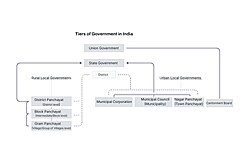
[[File:Tiers of Government in India.jpg|thumb|center|300px|Tiers of Government in India]] | |||
Local government in India is governmental jurisdiction below the level of the [[States and union territories of India|state]]. Local self-government means that residents in towns, villages and rural settlements are the people who elect local councils and their heads authorising them to solve the important issues. The 73rd and 74th constitutional amendments give recognition and protection to local governments and in addition each state has its own local government legislation. | |||
Since 1992, local government in India takes place in two very distinct forms. Urban localities, covered in the 74th amendment to the Constitution, have Municipality but derive their powers from the individual state governments, while the powers of rural localities have been formalized under the ''panchayati raj'' system, under the 73rd amendment to the Constitution. | |||
=== Urban local governing bodies === | |||
{{main|Municipal governance in India}} | |||
The following 3 types of democratically elected urban local bodies are called [[Municipalities of India|municipalities]]. These are classified based on the size of the population, density, revenue, non-agricultural employment, economic importance of the urban settlement. | |||
* [[Municipal corporations in India|Municipal Corporation]], also called the ''"Nagar Nigam"'' or ''"City Corporation"'', of cities with more than 1 million population. | |||
* [[Municipal council (India)|Municipal Council]], also called the ''"Nagar Palika"'' or ''"Nagar Palika Parishad"'', of cities with more than 25,000 and less than 1 million population. | |||
* [[Nagar Panchayat|Town Panchayat]], also called the ''"Town Council"'' or ''"Nagar Panchayat"'' or ''"Town Panchayat"'' or ''"Notified Area Council"'' or ''"Notified Area Committee"'' depending on the state within which they lie, these are in the town with more than 10,000 and less than 25,000 population. | |||
=== Rural local governing bodies === | |||
{{main|Panchayati raj in India}} | |||
The Constitutional (73rd Amendment) Act, 1992 aims to provide a three-tier system of Panchayati Raj for all States having a population of over 2 million, to hold Panchayat elections regularly every five years, to provide reservation of seats for Scheduled Castes, Scheduled Tribes and Women, to appoint State Finance Commission to make recommendations as regards the financial powers of the Panchayats and to constitute District Planning Committee to prepare a draft development plan for the district.<ref name=":0">{{Cite book |last=Laxmikanth |first=M |title=Indian Polity |publisher=McGraw Hill |year=2017 |pages=1145 |language=English}}</ref> | |||
The following 3 hierarchies of PRI panchayats exist in states or Union Territories with more than two million inhabitants: | |||
* [[Gram Panchayat]]s at village level | |||
* Panchayat Samiti or Mandal Parishad or Block Panchayat or Taluk Panchayat at [[Community Development Block]] or [[Mandal]] or Taluk level and | |||
* [[District Panchayat|Zila Parishad]]/District Panchayat at [[List of districts in India|district]] level. | |||
== Elections in India == | |||
{{Main|Elections in India}} | |||
{{Elections}} | |||
Elections in the Republic of India include elections for | |||
* [[President of India]], | |||
* [[Vice President of India]], | |||
* Members of the Parliament in [[Rajya Sabha]] (Upper house) and [[Lok Sabha]] (Lower house), | |||
* Members of [[State Legislative Council (India)|State Legislative Councils]], | |||
* Members of [[State Legislative Assembly (India)|State Legislative Assemblies]] (includes legislative assemblies of three union territories - [[Jammu and Kashmir (union territory)|Jammu and Kashmir]], [[National Capital Territory of Delhi]] and [[Puducherry (union territory)|Puducherry]]) | |||
* Members of [[Local government in India|local governance bodies]] ([[Municipal governance in India|Municipal bodies]] and [[Panchayati raj|Panchayats]]), | |||
* By-election is held when a seat-holder of a particular constituent dies, resigns, or is disqualified. | |||
=== Election Commission of India === | |||
{{Main|Election Commission of India}} | |||
The '''Election Commission of India''' ('''ECI''') is a [[constitutional body]] established by the [[Constitution of India]] empowered to conduct [[Elections in India|free and fair elections in India]]. The Election commission is headed by a [[Chief Election Commissioner of India|Chief Election Commissioner]] and consists of two other [[Election Commissioner of India|Election Commissioners]]. | |||
At the [[States and union territories of India|states and union territories]], the Election Commission is assisted by the Chief Electoral Officer of the state or union territory (CEO), who leads the election machinery in the states and union territories. At the district and constituency levels, the [[District collector|District Magistrates/District Collectors]] (in their capacity as District Election Officers), Electoral Registration Officers and Returning Officers perform election work. | |||
The Election Commission operates under the powers granted by [[Part XV of the Constitution of India|Article 324]] of the Constitution and subsequently enacted [[Representation of the People Act (India)|Representation of the People Act]]. The election commission decides the dates for the filing of nominations, voting, counting and announcement of results. | |||
A law for the registration process for political parties was enacted in 1989. The registration ensures that the political parties are recognized as national, state and regional parties. The election commission has the right to allot symbols to the political parties depending on the status. The same symbol cannot be allocated to two political parties even if they do not contest in the region. | |||
The commission prepares electoral rolls and updates the voter list. To prevent electoral fraud, Electors Photo Identity Cards (EPIC) were introduced in 1993. However certain legal documents such as [[Ration card (India)|ration cards]] have been allowed for voting in certain situations. | |||
=== State Election Commissions (SECs) === | |||
{{Main|State election commission (India)}} | |||
The state election commissions are responsible for conducting local body elections in the respective states. | |||
The '''State Election Commission (SEC)''' is an independent constitutional authority responsible for conducting free and fair elections to [[Local government in India|Local self-government institutions]], such as panchayats and municipalities, within each state. Established under Article 243K and Article 243ZA of the Constitution, it oversees the preparation of electoral rolls, ensures adherence to the Model Code of Conduct, and supervises the entire election process at the state level. The Commission is headed by a State Election Commissioner, who is appointed by the [[Governor (India)|Governor]]. | |||
== Political parties, political families and alliances == | |||
{{elect|List of political parties in India|Elections in India}} | {{elect|List of political parties in India|Elections in India}} | ||
=== Types of political parties === | === Political parties in India === | ||
When compared to other democracies, India has had a large number of political parties during its history under democratic governance. It has been estimated that over 200 parties were formed after India became independent in 1947.As per latest publications dated 23 March 2024 from Election Commission of India, and subsequent notifications, there are 6 national parties, 57 state parties, and 2,764 registered unrecognized parties. All registered parties contesting elections need to choose a symbol from a list of available symbols offered by the EC. | |||
==== Types of political parties ==== | |||
{{Main|List of political parties in India}} | {{Main|List of political parties in India}} | ||
Every political party in India, whether a national or regional/state party, must have a symbol and must be registered with the | Every political party in India, whether a national or regional/state party, must have a symbol and must be registered with the | ||
[[Election Commission of India]]. Symbols are used in the Indian political system to identify political parties in part so that illiterate people can vote by recognizing the party symbols. | [[Election Commission of India]]. Symbols are used in the Indian political system to identify political parties in part so that illiterate people can vote by recognizing the party symbols.<ref>{{cite web|url=https://thediplomat.com/2016/11/the-curioudifaidfefiwuufs-stories-of-indian-party-symbols/|title=The Curious Stories of Indian Party Symbols|work=[[The Diplomat (magazine)|The Diplomat]]|author=Krzysztof Iwanek|date=2 November 2016|access-date=19 April 2017|archive-url=https://web.archive.org/web/20170419193824/https://thediplomat.com/2016/11/the-curious-stories-of-indian-party-symbols/|archive-date=19 April 2017|url-status=live}}</ref> | ||
In the current amendment to the Symbols Order, the commission has asserted the following five principles: | In the current amendment to the Symbols Order, the commission has asserted the following five principles:<ref name=ECI /> | ||
# A party, national or state, must have a legislative presence. | # A party, national or state, must have a legislative presence. | ||
# A national party's legislative presence must be in the Lok Sabha. A state party's legislative presence must be in the State Assembly. | # A national party's legislative presence must be in the Lok Sabha. A state party's legislative presence must be in the State Assembly. | ||
| Line 76: | Line 240: | ||
# Recognition should be given to a party only on the basis of its own performance in elections and not because it is a splinter group of some other recognized party. | # Recognition should be given to a party only on the basis of its own performance in elections and not because it is a splinter group of some other recognized party. | ||
A political party shall be eligible to be recognized as a national party if: | ===== National political party ===== | ||
A political party shall be eligible to be recognized as a national party if:<ref name="ECI">{{cite web|title=Election Commission of India Press Note|url=http://eci.nic.in/archive/press/current/PN05122k.htm|access-date=13 March 2014|archive-url=https://web.archive.org/web/20160305090629/http://eci.nic.in/archive/press/current/PN05122k.htm|archive-date=5 March 2016|url-status=live}}</ref> | |||
# it secures at least six percent (6%) of the valid votes polled in any four or more states, at a general election to the Lok Sabha or, to the State Legislative Assembly; and . | # it secures at least six percent (6%) of the valid votes polled in any four or more states, at a general election to the Lok Sabha or, to the State Legislative Assembly; and . | ||
# in addition, it wins at least four seats in the House of the People from any State or States. | # in addition, it wins at least four seats in the House of the People from any State or States. | ||
# or it wins at least two percent (2%) seats in the House of the People (i.e. 11 seats in the existing House having 543 members), and these members are elected from at least three different states. | # or it wins at least two percent (2%) seats in the House of the People (i.e. 11 seats in the existing House having 543 members), and these members are elected from at least three different states. | ||
Six national political parties are - [[Bharatiya Janata Party|Bharatiya Janata Party (BJP)]], [[Indian National Congress|Indian National Congress (INC)]], [[Bahujan Samaj Party|Bahujan Samaj Party (BSP)]], [[Communist Party of India (Marxist)|Communist Party of India (Marxist) (CPI-M)]], [[Aam Aadmi Party|Aam Aadmi Party (AAP)]] and [[National People's Party (India)|National People's Party (NPP)]].<ref>{{Cite web |last=Election Commission of India |date=26 March 2024 |title=Commission's Main Notification dated 26.03.24 containing list of National Parties, their Symbols and addresses |url=https://www.eci.gov.in/eci-backend/public/api/download?url=LMAhAK6sOPBp%2FNFF0iRfXbEB1EVSLT41NNLRjYNJJP1KivrUxbfqkDatmHy12e%2FzBiU51zPFZI5qMtjV1qgjFva%2BcZe4H5hLgRzEPbXgT4%2BLdDuMCbYQSF1jiuqiCO2KgKdCmUSHqA1uyd%2BQgGswdQ%3D%3D}}</ref> | |||
===== State political party ===== | |||
A political party shall be entitled to be recognized as a state party, if: | |||
# it secures at least six percent (6%) of the valid votes polled in the state at a general election, either to the Lok Sabha or to the Legislative Assembly of the State concerned; and | # it secures at least six percent (6%) of the valid votes polled in the state at a general election, either to the Lok Sabha or to the Legislative Assembly of the State concerned; and | ||
# in addition, it wins at least two seats in the Legislative Assembly of the state concerned. | # in addition, it wins at least two seats in the Legislative Assembly of the state concerned. | ||
# or it wins at least three percent (3%) of the total number of seats in the Legislative Assembly of the state, or at least three seats in the Assembly, whichever is more. | # or it wins at least three percent (3%) of the total number of seats in the Legislative Assembly of the state, or at least three seats in the Assembly, whichever is more. | ||
===Party proliferation=== | ===== Registered unrecognized political party (RUPP) ===== | ||
Registered unrecognized political parties are those parties which are either newly registered or which have not secured enough percentage of votes in the assembly or general elections to become a state party or those which have never contested elections since being registered. Registered but unrecognized political parties don't enjoy all the benefits extended to the recognized parties.<ref>{{Cite web |title=UPSC Notes on Registered Unrecognised Political Parties (RUPP) |url=https://byjus.com/free-ias-prep/registered-unrecognised-political-parties-rupp/ |access-date=2024-05-26 |website=BYJUS |language=en}}</ref> | |||
===== Party proliferation ===== | |||
Although a strict anti-defection law had been passed in 1984, there has been a continued tendency amongst politicians to float their own parties rather than join a broad based party such as the Congress or the BJP. Between the 1984 and 1989 elections, the number of parties contesting elections increased from 33 to 113. In the decades since, this fragmentation has continued.{{Sfn|Hicken|Kuhonta|2014|p=205}} | Although a strict anti-defection law had been passed in 1984, there has been a continued tendency amongst politicians to float their own parties rather than join a broad based party such as the Congress or the BJP. Between the 1984 and 1989 elections, the number of parties contesting elections increased from 33 to 113. In the decades since, this fragmentation has continued.{{Sfn|Hicken|Kuhonta|2014|p=205}} | ||
=== | === Political families === | ||
{{ | {{Main|Political families of India}} | ||
Since the 1980s, Indian politics has become dynastic, possibly due to the absence of a party organization, independent civil society associations that mobilize support for the party, and centralized financing of elections.<ref name="ppq.sagepub.com" /> One example of dynastic politics has been the [[Nehru–Gandhi family]] which produced three Indian prime ministers: Jawaharlal Nehru, Indira Gandhi, Rajiv Gandhi. Family members have also led the Congress party for most of the period since 1978 when Indira Gandhi floated the then Congress(I) faction of the party.{{Sfn|Basu|Chandra|2016|p=136}} The ruling Bharatiya Janata Party also features several senior leaders who are dynasts.<ref>{{Cite web |date=29 March 2019 |title=Is the BJP less dynastic than the Congress? Not so, Lok Sabha data shows |url=https://scroll.in/article/918234/is-the-bjp-less-dynastic-than-the-congress-not-so-lok-sabha-data-shows}}</ref> Dynastic politics is prevalent also in a number of political parties with regional presence such as [[All India Majlis-e-Ittehadul Muslimeen]] (AIMIM), [[Trinamool Congress]] (TMC), [[Bharat Rashtra Samithi]] (BRS), [[Shiv Sena (Uddhav Balasaheb Thackeray)]] (SHS (UBT)), [[Nationalist Congress Party - Sharadchandra Pawar]] (NCP (SP)), [[Dravida Munnetra Kazhagam]] (DMK), [[Indian National Lok Dal]] (INLD), [[Jammu & Kashmir National Conference]] (JKNC), [[Jammu and Kashmir People's Democratic Party]] (JKPDP), [[Janata Dal (Secular)]] (JD(S)), [[Jharkhand Mukti Morcha]] (JMM), [[National People's Party (India)|National People's Party]] (NPP), [[Nationalist Congress Party]] (NCP), [[Pattali Makkal Katchi]] (PMK), [[Rashtriya Janata Dal]] (RJD), [[Rashtriya Lok Dal]] (RLD), [[Samajwadi Party]] (SP), [[Shiromani Akali Dal]] (SAD), [[Shiv Sena (1966–2022)|Shiv Sena]] (SS), [[Telugu Desam Party]] (TDP) and [[YSR Congress Party]] (YSRCP).{{Sfn|Chandra|2016|pp=131,136}} | |||
=== | === Political alliances=== | ||
A coalition government is a form of government in which political parties cooperate to form a government. The usual reason for such an arrangement is that no single party has achieved an absolute majority after an election. Political parties of such a coalition government forms an alliance for contesting election together usually for better prospects. Alliance usually revolves around the BJP and INC, being the two largest political parties in India without whose support, it would be difficult to form a majority government.<ref>{{Cite web |title=Coalition Government in India - Meaning and Features [UPSC Polity Notes] |url=https://byjus.com/free-ias-prep/coalition-government-india/ |access-date=2024-05-26 |website=BYJUS |language=en}}</ref> | |||
[[File:Current ruling alliances in Indian states and union territories 2025.png|thumb|300px|Ruling parties and alliances in various state govts and UT in India. {{legend|#F98C1F|[[National Democratic Alliance|NDA]] (20)/UT(5)}} | |||
{{legend|#00B7EB|[[Indian National Developmental Inclusive Alliance|I.N.D.I.A]] (8)}} | |||
{{legend|#cd3030|Unaligned (2)}} | |||
{{legend|#a35706|[[President's rule]] Manipur (1)}} | |||
{{legend|#515151|[[Union territory|No legislature]] (5)}}]] | |||
=== | ==== National Democratic Alliance (NDA) ==== | ||
{{Main|National Democratic Alliance}} | |||
[[National Democratic Alliance]] (NDA), a centre-right to right-wing coalition led by BJP was formed in 1998 after the [[1998 Indian general election|elections]]. NDA formed a government, although the government did not last long as [[All India Anna Dravida Munnetra Kazhagam|AIADMK]] withdrew support from it resulting in [[1999 Indian general election|1999 general elections]], in which NDA won and resumed power. The coalition government went on to complete the full five-years term, becoming the first non-Congress government to do so.<ref>{{Cite web |last=Agrawal |first=Puroshottam |date=1999-09-01 |title=Identity debate clouds India's elections |url=https://mondediplo.com/1999/09/10india |access-date=2022-09-20 |website=Le Monde diplomatique |language=en}}</ref> | |||
After securing a defeating in 2004 General Election and 2009 General Elections against the United Progressive Alliance (UPA), the NDA once again returned to power in the [[2014 Indian general election|2014 General Elections]], for the second time, with a historic mandate of 336 out of 543 Lok Sabha seats. BJP itself won 282 seats, thereby electing [[Narendra Modi]] as the head of the government. In a historic win, the NDA stormed to power for the third term in [[2019 Indian general election|2019]] with a combined strength of 353 seats, with the BJP itself winning an absolute majority with 303 seats. | |||
[[ | |||
In the [[2024 Indian general election]] the NDA, though lost a couple of seats succeeded to form the government by winning 293 seats with a major support from allies like [[Telugu Desam Party]] (16 seats) and [[Janata Dal (United)]] (12 seats). | |||
==== United Progressive Alliance (UPA) ==== | |||
{{Main|United Progressive Alliance}} | |||
The United Progressive Alliance was a [[Political group|political alliance]] in [[India]] led by the [[Indian National Congress]]. It was formed after the [[2004 Indian general election|2004 general election]] with support from left-leaning political parties when no single party got the majority. | |||
The UPA subsequently governed India from 2004 until 2014 for 2 terms before losing power to their main rivals, the [[Bharatiya Janata Party|BJP]]-led [[National Democratic Alliance]]. With strong corruption history within the alliance and becoming increasingly unpopular among the masses, the UPA was dissolved to form the [[Indian National Developmental Inclusive Alliance]] on 18 July 2023 ahead of the [[Next Indian general election|2024 general election]]. The UPA used to rule 7 [[States and union territories of India]] before it was dissolved. | |||
==== Indian National Developmental Inclusive Alliance (I.N.D.I.A) ==== | |||
{{Main|Indian National Developmental Inclusive Alliance}} | |||
Unable to defeat the NDA in 2014 General Election and 2019 General Election, and with Congress performing its poorest in same, many political leaders understood the need for a grand alliance of almost all major political parties to stand against the BJP led NDA in the 2024 General Elections which resulted in the formation of the [[Indian National Developmental Inclusive Alliance]] (I.N.D.I.A). It was formed by merger of [[United Progressive Alliance]] (UPA), Left Front and other smaller alliances, centre-left to left-wing coalition led by [[Indian National Congress]] (INC). The alliance, comprising 26 opposition parties, include many political parties that are at loggerhead with the INC in their respective states and territories but are in alliance for the 2024 General Elections. | |||
== Political issues == | == Political issues == | ||
{{Main|Socio-economic issues in India}} | {{Main|Socio-economic issues in India|Unemployment in India|Inflation in India}} | ||
{{See also|Corruption in India}} | |||
{{See also|Corruption in India|Indian black money|Illegal immigration to India|Refugees in India}} | |||
[[File:Door-to-door campaigning - Flickr - Al Jazeera English.jpg|thumb|Door-to-door campaigning of [[Nationalist Congress Party]] workers]] | [[File:Door-to-door campaigning - Flickr - Al Jazeera English.jpg|thumb|Door-to-door campaigning of [[Nationalist Congress Party]] workers]] | ||
=== Law and order === | === Law and order === | ||
[[Terrorism in India|Terrorism]], [[Naxalism]], [[Religious violence in India|religious violence]] and [[Caste-related violence in India|caste-related violence]] are important issues that affect the political environment of the Indian nation. Stringent anti-terror legislation such as [[Terrorist and Disruptive Activities (Prevention) Act|TADA]], [[Prevention of Terrorism Act, 2002|POTA]] and [[Maharashtra Control of Organised Crime Act|MCOCA]] have received much political attention, both in favour and against, and some of these laws were disbanded eventually due to human rights violations. | [[Terrorism in India|Terrorism]], [[Naxalite–Maoist insurgency|Naxalism]], [[Religious violence in India|religious violence]] and [[Caste-related violence in India|caste-related violence]] are important issues that affect the political environment of the Indian nation. Stringent anti-terror legislation such as [[Terrorist and Disruptive Activities (Prevention) Act|TADA]], [[Prevention of Terrorism Act, 2002|POTA]] and [[Maharashtra Control of Organised Crime Act|MCOCA]] have received much political attention, both in favour and against, and some of these laws were disbanded eventually due to human rights violations.<ref name="human_rights_violation">{{cite news|url=https://www.hrw.org/legacy/backgrounder/asia/india-bck1121.htm|title=Anti-Terrorism Legislation|work=Human rights watch|date=20 November 2001|access-date=6 August 2019|archive-url=https://web.archive.org/web/20170703041343/https://www.hrw.org/legacy/backgrounder/asia/india-bck1121.htm|archive-date=3 July 2017|url-status=live}}</ref> However, [[Unlawful Activities (Prevention) Act|UAPA]] was amended in 2019 to negative effect vis-á-vis human rights. | ||
Terrorism has affected politics in India since its conception, be it the [[Pakistan and state-sponsored terrorism|terrorism supported from Pakistan]] or the internal guerrilla groups such as [[Naxalites]]. In 1991 the former | Terrorism has affected politics in India since its conception, be it the [[Pakistan and state-sponsored terrorism|terrorism supported from Pakistan]] or the internal guerrilla groups such as [[Naxalite–Maoist insurgency|Naxalites]]. In 1991 the former Prime Minister [[Rajiv Gandhi]] was [[Assassination of Rajiv Gandhi|assassinated]] during an election campaign.{{Sfn|Guha|2008|pp=[https://archive.org/details/indiaaftergandhi00guha_300/page/n347 637]–659}} The suicide bomber was later linked to the Sri Lankan terrorist group [[Liberation Tigers of Tamil Eelam]], as it was later revealed the killing was an act of vengeance for Rajiv Gandhi [[Indian intervention in the Sri Lankan Civil War|sending troops in Sri Lanka]] against them in 1987.{{Sfn|Guha|2008|pp=[https://archive.org/details/indiaaftergandhi00guha_300/page/n347 637]–659}} | ||
[[Babri Masjid demolition]] on 6 December 1992 resulted in nationwide communal riots in two months, with [[Bombay riots|the worst occurring]] in [[Mumbai]] with at least 900 dead.{{Sfn|Guha|2008|pp=[https://archive.org/details/indiaaftergandhi00guha_300/page/n347 637]–659}}<ref>{{cite web|title=Shiv Sainiks will maintain peace post-Ayodhya verdict: Uddhav |url=http://www.hindustantimes.com/india-news/mumbai/shiv-sainiks-will-maintain-peace-post-ayodhya-verdict-uddhav/article1-603031.aspx |work=Hindustan Times |publisher=HT Media Ltd. |access-date=13 March 2014 |url-status=dead |archive-url=https://web.archive.org/web/20140303165635/http://www.hindustantimes.com/india-news/mumbai/shiv-sainiks-will-maintain-peace-post-ayodhya-verdict-uddhav/article1-603031.aspx |archive-date=3 March 2014 }}</ref> The riots were followed by [[1993 Bombay bombings]], which resulted in more deaths. | |||
Law and order issues, such as action against [[Organised crime in India|organised crime]] are issues which do not affect the outcomes of elections. On the other hand, there is a criminal–politician nexus. Many elected legislators have criminal cases against them. In July 2008, | Law and order issues, such as action against [[Organised crime in India|organised crime]] are issues which do not affect the outcomes of elections. On the other hand, there is a criminal–politician nexus. Many elected legislators have criminal cases against them. In July 2008, ''[[The Washington Post]]'' reported that nearly a fourth of the 540 [[Member of Parliament (India)|Indian Parliament members]] faced criminal charges, "including [[human trafficking]], [[Prostitution in India|child prostitution]], immigration rackets, [[embezzlement]], [[rape]] and even [[murder]]".<ref name="wtcorruption">{{cite news|url=https://www.washingtonpost.com/wp-dyn/content/article/2008/07/23/AR2008072303390.html|title=With Indian Politics, the Bad Gets Worse|newspaper=The Washington Post|first=Emily|last=Wax|date=24 July 2008|access-date=22 May 2010|archive-url=https://web.archive.org/web/20121108050648/http://www.washingtonpost.com/wp-dyn/content/article/2008/07/23/AR2008072303390.html|archive-date=8 November 2012|url-status=live}}</ref> | ||
== | === State of democracy === | ||
{{ | {{main|Democracy in India}} | ||
=== | From 2006 to 2023 the situation of [[Indian democracy]] worsened. There was little state presence in tribal areas and tensions between Hindus and minorities. The rebellions are a sign of the governments loss of power. Interreligious riots where observed. Political freedoms are limited since funding of NGOs, such as [[Amnesty International]], got more difficult due to the "Foreign Contribution (Regulation) Act", though the constitution guarantees freedom of association. Hindu-nationalist groups created a climate of intimidation over the country. Freedom of press is impacted through the intimidation of journalists by police, criminals and politicians.<ref>{{Cite web |title=BTI 2022 India Country Report |url=https://bti-project.org/en/reports/country-report?isocode=IND&cHash=4d507ce6e7280fbd996bd0dd58122962 |access-date=2023-08-08 |website=BTI 2022 |language=en}}</ref> | ||
In 2023, according to the [[Freedom in the World]] report by [[Freedom House]], India was classified as a "partly free" country for the third consecutive year.<ref>{{cite news |last1=Krishnankutty |first1=Pia |title=Freedom 'losing ground' — India ranked 'partly free' for 3rd year by US non-profit Freedom House |url=https://theprint.in/india/freedom-losing-ground-india-ranked-partly-free-for-3rd-year-by-us-non-profit-freedom-house/1440560/?amp |work=ThePrint |date=13 March 2023}}</ref><ref>{{cite news |title=India rated 'partially free' in Freedom House report for third straight year |url=https://scroll.in/latest/1045410/india-rated-partially-free-for-third-straight-year-in-freedom-house-report |work=Scroll.in |date=11 March 2023}}</ref> The [[V-Dem Democracy Indices]] by [[V-Dem Institute]] classify India as an '[[electoral autocracy]]'. In 2023, it referred to India as "one of the worst autocratisers in the last 10 years".<ref>{{cite news |title=India Is 'One of the Worst Autocratisers in the Last 10 Years,' Says 2023 V-Dem Report |url=https://thewire.in/rights/india-autocratiser-v-dem-report-2023 |work=The Wire |date=7 March 2023}}</ref> According to the [[The Economist Democracy Index|Democracy Index]] of the [[Economist Intelligence Unit]], India is a [[Defective democracy]].<ref>{{cite news |last1=Dutta |first1=Anisha |title=India secretly works to preserve reputation on global Democracy Index |url=https://www.theguardian.com/world/2023/jun/22/india-democracy-index-flawed-preserve-reputation-narendra-modi |work=The Guardian |date=22 June 2023}}</ref> | |||
== | == See also == | ||
{{ | {{Portal|Politics|India}} | ||
{{div col|colwidth=15em|rules=yes|gap=2em}} | |||
* [[Electronic voting in India]] | |||
**[[Electoral fraud]] | |||
**[[Electoral Bonds]] | |||
**[[Voter suppression]] | |||
**[[Booth capturing]] | |||
**[[Scientific rigging]] | |||
**[[2025 Indian electoral controversy]] | |||
* [[Election Commission of India]] | |||
* [[Political funding in India]] | |||
* [[Blasphemy law#India|Blasphemy law in India]] | |||
* [[Censorship in India]] | |||
* [[Electoral reform]] | |||
* [[Democracy in India]] | |||
* [[Caste politics]] | |||
* [[Caste system in India]] | |||
* [[ | * [[Caste-related violence in India]] | ||
* [[ | * [[Mandal Commission]] | ||
* [[Reservation in India]] | |||
* [[2011 Socio Economic and Caste Census]] | |||
* [[Disqualification of convicted representatives in India]] | * [[Disqualification of convicted representatives in India]] | ||
* [[Operation Kamala]] | |||
* [[Aaya Ram Gaya Ram]] | |||
* [[History of democracy#Indian subcontinent|History of democracy in ancient India]] | |||
* [[List of scandals in India]] | |||
* [[List of communist parties in India]] | |||
* [[Trade unions in India]] | |||
* [[Political families of India]] | * [[Political families of India]] | ||
* [[ | * [[State governments of India]] | ||
* [[Foreign relations of India]] | * [[Foreign relations of India]] | ||
* [[ | * [[Secularism in India]] | ||
* [[ | * [[Anarchism in India]] | ||
* [[ | * [[Conservatism in India]] | ||
* [[ | * [[Liberalism in India]] | ||
* [[Socialism in India]] | |||
* [[Communism in India]] | |||
* [[Communism in Kerala]] | |||
* [[Communist movements in India]] | |||
* [[Revolutionary movement for Indian independence]] | |||
* [[Communist involvement in the Indian independence movement]] | |||
{{div col end}} | |||
== References == | == References == | ||
{{Reflist | {{Reflist}} | ||
=== Bibliography === | === Bibliography === | ||
{{Refbegin|30em}} | {{Refbegin|30em}} | ||
* {{cite book |title=Public Administration |publisher=Tata Mcgraw Hill |isbn=978-0071074827 |author=M. Lakshmikanth |edition=9th |year=2012 |oclc=1039277322 |url=https://books.google.com/books?id=ISBN9780071074827 }} | * {{cite book |title=Public Administration |publisher=Tata Mcgraw Hill |isbn=978-0071074827 |author=M. Lakshmikanth |edition=9th |year=2012 |oclc=1039277322 |url=https://books.google.com/books?id=ISBN9780071074827 }} | ||
* {{cite book |title=Comparative Politics & International Relations |publisher=Cosmos Bookhive |isbn=817729035-5 |pages=129–134 |last=Chander |first=Prakash |chapter=Nature of Party System in India |year=2001 |url=https://books.google.com/books?id=ISBN8177290355 }} | * {{cite book |title=Comparative Politics & International Relations |publisher=Cosmos Bookhive |isbn=817729035-5 |pages=129–134 |last=Chander |first=Prakash |chapter=Nature of Party System in India |year=2001 |url=https://books.google.com/books?id=ISBN8177290355 }} | ||
* {{cite book |last1=Hicken |first1=Allen |last2=Kuhonta |first2=Erik Martinez |title=Party System Institutionalization in Asia: Democracies, Autocracies, and the Shadows of the Past |url=https://books.google.com/books?id=GZmiBQAAQBAJ&pg=PR13 |date=29 December 2014 |publisher=[[Cambridge University Press]] |isbn=978-1-107-04157-8 }} | * {{cite book |last1=Hicken |first1=Allen |last2=Kuhonta |first2=Erik Martinez |title=Party System Institutionalization in Asia: Democracies, Autocracies, and the Shadows of the Past |url=https://books.google.com/books?id=GZmiBQAAQBAJ&pg=PR13 |date=29 December 2014 |publisher=[[Cambridge University Press]] |isbn=978-1-107-04157-8 }} | ||
* {{cite book |last=Guha |first=Ramachandra |title=India after Gandhi : the history of the world's largest democracy |url=https://archive.org/details/indiaaftergandhi00guha_300 |url-access=limited |year=2008 |publisher=Picador |location=India |isbn=9780330505543 |edition=Indian }} | * {{cite book |last=Guha |first=Ramachandra |title=India after Gandhi : the history of the world's largest democracy |url=https://archive.org/details/indiaaftergandhi00guha_300 |url-access=limited |year=2008 |publisher=Picador |location=India |isbn=9780330505543 |edition=Indian }} | ||
* {{cite book |last1=Basu |first1=Amrita |last2=Chandra |first2=Kanchan |title=Democratic Dynasties: State, Party and Family in Contemporary Indian Politics |date=2016 |publisher=[[Cambridge University Press]] |location=Cambridge, UK |isbn=978-1-107-12344-1 |edition=1 |url=https://books.google.com/books?id=tesIDAAAQBAJ&q=sonia&pg=PR10 |access-date=23 May 2016 |archive-url=https://web.archive.org/web/20191110030054/https://books.google.com/books?hl=en&lr=&id=tesIDAAAQBAJ&oi=fnd&pg=PR10&dq=%22political+dynasties%22+india&ots=panvSUPVV9&sig=rBLRMVvTQ2f7mX6q3bm6Gj6eyfw#v=onepage&q=sonia&f=false |archive-date=10 November 2019 |url-status=live }} | * {{cite book |last1=Basu |first1=Amrita |last2=Chandra |first2=Kanchan |title=Democratic Dynasties: State, Party and Family in Contemporary Indian Politics |date=2016 |publisher=[[Cambridge University Press]] |location=Cambridge, UK |isbn=978-1-107-12344-1 |edition=1 |url=https://books.google.com/books?id=tesIDAAAQBAJ&q=sonia&pg=PR10 |access-date=23 May 2016 |archive-url=https://web.archive.org/web/20191110030054/https://books.google.com/books?hl=en&lr=&id=tesIDAAAQBAJ&oi=fnd&pg=PR10&dq=%22political+dynasties%22+india&ots=panvSUPVV9&sig=rBLRMVvTQ2f7mX6q3bm6Gj6eyfw#v=onepage&q=sonia&f=false |archive-date=10 November 2019 |url-status=live }} | ||
* {{cite book |last=Chandra |first=Kanchan |author-link=Kanchan Chandra|title=Democratic Dynasties: State, Party, and Family in Contemporary Indian Politics |url=https://books.google.com/books?id=VwbFDAAAQBAJ&pg=PR10 |date=28 April 2016 |publisher=[[Cambridge University Press]] |isbn=978-1-316-59212-0 }} | * {{cite book |last=Chandra |first=Kanchan |author-link=Kanchan Chandra|title=Democratic Dynasties: State, Party, and Family in Contemporary Indian Politics |url=https://books.google.com/books?id=VwbFDAAAQBAJ&pg=PR10 |date=28 April 2016 |publisher=[[Cambridge University Press]] |isbn=978-1-316-59212-0 }} | ||
{{Refend}} | {{Refend}} | ||
| Line 185: | Line 377: | ||
* {{cite news |last1=Kadalayil |first1=Chitrabhanu |title=India's top political parties need to address power imbalances within |url=https://www.thenationalnews.com/opinion/comment/2023/05/16/indias-top-political-parties-need-to-address-power-imbalances-within/ |access-date=2023-05-18 |work=The National (Abu Dhabi) |date=2023-05-16 |language=en}} | * {{cite news |last1=Kadalayil |first1=Chitrabhanu |title=India's top political parties need to address power imbalances within |url=https://www.thenationalnews.com/opinion/comment/2023/05/16/indias-top-political-parties-need-to-address-power-imbalances-within/ |access-date=2023-05-18 |work=The National (Abu Dhabi) |date=2023-05-16 |language=en}} | ||
* [[Satyabrata Rai Chowdhuri|Chowdhuri, Satyabrata Rai]]. [http://www.palgrave.com/products/title.aspx?PID=278315 ''Leftism in India, 1917-1947''] {{Webarchive|url=https://web.archive.org/web/20120222050231/http://www.palgrave.com/products/title.aspx?PID=278315 |date=22 February 2012 }}. Palgrave, [[U.K.]], 2007. | * [[Satyabrata Rai Chowdhuri|Chowdhuri, Satyabrata Rai]]. [http://www.palgrave.com/products/title.aspx?PID=278315 ''Leftism in India, 1917-1947''] {{Webarchive|url=https://web.archive.org/web/20120222050231/http://www.palgrave.com/products/title.aspx?PID=278315 |date=22 February 2012 }}. Palgrave, [[U.K.]], 2007. | ||
* [[Bharat Karnad|Karnad, Bharat]]. ''Why India is Not a Great Power (Yet).'' Oxford University Press, 2015. {{ISBN|978-0-19-945922-3}} | |||
* Shively, W. Phillips. ''Power and Choice: An Introduction to Political Science—Chapter 14 Example: Parliamentary Government in India.'' McGraw Hill Higher Education, 2005. {{ISBN|978-0-07-340391-5}} | * Shively, W. Phillips. ''Power and Choice: An Introduction to Political Science—Chapter 14 Example: Parliamentary Government in India.'' McGraw Hill Higher Education, 2005. {{ISBN|978-0-07-340391-5}} | ||
* Mitra, Subrata K. and Singh, V.B.. ''Democracy and Social Change in India: A Cross-Sectional Analysis of the National Electorate''. New Delhi: Sage Publications, 1999. {{ISBN|81-7036-809-X}} (India HB) {{ISBN|0-7619-9344-4}} (U.S. HB). | * Mitra, Subrata K. and Singh, V.B.. ''Democracy and Social Change in India: A Cross-Sectional Analysis of the National Electorate''. New Delhi: Sage Publications, 1999. {{ISBN|81-7036-809-X}} (India HB) {{ISBN|0-7619-9344-4}} (U.S. HB). | ||
* Shourie, Arun (2007). The parliamentary system: What we have made of it, what we can make of it. New Delhi: Rupa & Co. | * Shourie, Arun (2007). The parliamentary system: What we have made of it, what we can make of it. New Delhi: Rupa & Co. | ||
* Shourie, Arun (2005). Governance and the sclerosis that has set in. New Delhi: ASA Publications. | * Shourie, Arun (2005). Governance and the sclerosis that has set in. New Delhi: ASA Publications. | ||
* Tawa Lama-Rewal, Stéphanie. [http://samaj.revues.org/index2784.html ''"Studying Elections in India: Scientific and Political Debates"'']. ''South Asia Multidisciplinary Academic Journal'', 3, 2009. | * Tawa Lama-Rewal, Stéphanie. [http://samaj.revues.org/index2784.html ''"Studying Elections in India: Scientific and Political Debates"'']. ''South Asia Multidisciplinary Academic Journal'', 3, 2009. | ||
| Line 194: | Line 387: | ||
== External links == | == External links == | ||
{{Commons category|Politics of India}} | |||
{{Wikiquote}} | |||
* [http://india.gov.in/ Outline of the Indian Government] | * [http://india.gov.in/ Outline of the Indian Government] | ||
{{Navboxes|list= | |||
{{Asia topic|Politics of}} | {{Asia topic|Politics of}} | ||
{{Indian political parties}} | {{Indian political parties}} | ||
{{India topics}} | {{India topics}} | ||
}} | |||
{{Authority control}} | {{Authority control}} | ||
[[Category:Politics of India|Politics of India]] | [[Category:Politics of India| Politics of India]] | ||
Revision as of 15:17, 15 March 2026
 | |
| Polity type | Federal parliamentary republic |
|---|---|
| Constitution | Constitution of India |
| Legislative branch | |
| Name | Parliament |
| Type | Bicameral |
| Meeting place | Sansad Bhavan |
| Upper house | |
| Name | Rajya Sabha |
| Presiding officer | Vice President C. P. Radhakrishnan, Chairman of the Rajya Sabha |
| Appointer | Electoral College |
| Lower house | |
| Name | Lok Sabha |
| Presiding officer | Om Birla, Speaker of the Lok Sabha |
| Executive branch | |
| Head of State | |
| Title | President |
| Currently | Draupadi Murmu |
| Appointer | Electoral College |
| Head of Government | |
| Title | Prime Minister |
| Currently | Narendra Modi |
| Appointer | President |
| Cabinet | |
| Name | Union Council of Ministers |
| Current cabinet | Third Modi ministry |
| Leader | Prime Minister |
| Appointer | President |
| Ministries | 52 |
| Judicial branch | |
| Name | Judiciary |
| Supreme Court | |
| Chief judge | Suryakant Sharma |
|
|---|
| This article is part of a series on the politics and government of India |
 India portal India portal |
The politics and government in the Republic of India work in adherence to the Constitution of India, which was adopted on November 26, 1949, by the Constituent Assembly of India, and took effect on on January 26, 1950. India is a parliamentary secular democratic republic, described as a “sovereign, socialist, secular democratic republic” in its constitution.<ref>"The Constitution (Amendment)". Archived from the original on 28 March 2015., "We, The People of India having solemnly resolved to constitute India into a Sovereign Socialist Secular Democratic Republic and to secure to all its..."</ref><ref name="India_777">Article Preamble, Section Preamble (PDF), Constitution of the Republic of India, 26 November 1949, archived from the original (PDF) on 9 September 2014</ref><ref name="India_888">"The Constitution (Forty-second Amendment) Act, 1976". India Code. Archived from the original on 28 March 2015. Retrieved 14 April 2014.</ref>
Part I of the Constitution of India describes India as a "Union of States," and is used interchangeably to refer to the "union government" or Government of India to denote the federal authority. India is divided among 28 states and 8 union territories for a total of 36 subnational entities. Its governance of those entities is described in the constitution as a quasi-federal system that incorporates elements from both federal and unitary forms of government. The states of India are self-governing administrative divisions each having a state government, whereas the union territories are governed directly by the union government, and are administered by a lieutenant governor or administrator appointed by the president of India. India follows a dual federalist system, however the Constitution defines the organizational powers and limitations of both states and union territories of India. Government operations are led by the president of India who, as the ceremonial head of state, holds formal executive power. In accordance to parliamentary elections, the president appoints the prime minister as the head of government, along with prospective ministers who are members of parliament.
The legal power to manage affairs in each state is shared or divided between the particular state government and the national union government. The union territories are directly governed by the union government with no state level government existing in these jurisdictions. There is a provision for a bicameral legislature consisting of an upper house, the Rajya Sabha (Council of States), which represents the states of the Indian federation, and a lower house, the Lok Sabha (House of the People), which represents the people of India as a whole. Vidhan Sabha (state legislative assemblies) represents the people residing in one of the 28 states.
The Constitution provides for an independent judiciary, which is headed by the Supreme Court of India. The court's mandate is to protect the Constitution, to settle disputes between the central government and the states, to settle inter-state disputes, to nullify any central or state laws that go against the Constitution and to protect the fundamental rights of citizens, issuing writs for their enforcement in cases of violation.[1]
There are 543 members in the Lok Sabha, who are elected using plurality voting (first past the post) system from 543 Single-member district. There are 245 members in the Rajya Sabha, out of which 233 are elected through indirect elections by single transferable vote by the members of the state legislative assemblies; 12 other members are elected/nominated by decree from the president of India. Union and state governments are formed through elections held every five years (unless otherwise specified), by parties that secure a majority of members in their respective lower houses.
India had its first general election in 1951, which was won by the Indian National Congress, a political party that went on to dominate subsequent elections until 1977, when a non-Congress government was formed for the first time in independent India. The 1990s saw the end of single-party domination and the rise of coalition governments. The latest 18th Lok Sabha elections was conducted in seven phases from 19 April 2024 to 1 June 2024 by the Election commission of India. The results bought in the NDA (National Democratic Alliance) to form in the next government <ref>"General Election 2014". Election Commission of India. Archived from the original on 23 May 2014. Retrieved 21 May 2014.</ref>
In recent decades, Indian politics has become a dynastic affair.<ref>"Need for accountability in politics of dynasty". dailypioneer.com. Archived from the original on 17 January 2017. Retrieved 17 January 2017.</ref> Possible reasons for this could be the party stability, absence of party organisations, independent civil society associations that mobilise support for the parties and centralised financing of elections.<ref name="ppq.sagepub.com">Chhibber⇑, Pradeep (March 2013). "Dynastic parties Organization, finance and impact". Party Politics. 19 (2): 277–295. doi:10.1177/1354068811406995. S2CID 144781444.</ref> According to the V-Dem Democracy indices India in 2023 was the 19th most electoral democratic country in Asia.<ref name="vdem_dataset">V-Dem Institute (2023). "The V-Dem Dataset". Retrieved 14 October 2023.</ref>
Union government
The Government of India is modelled after the Westminster system.<ref>"A prime ministerial form of government". The Hindu. 16 June 2014. ISSN 0971-751X. Retrieved 25 May 2024.</ref> The Union government (also called as the Central government) is mainly composed of the executive, the legislature, and the judiciary, and powers are vested by the constitution in the prime minister, parliament, and the supreme court, respectively. The president of India is the head of state and the commander-in-chief of the Indian Armed Forces, while the elected prime minister acts as the head of the executive and is responsible for running the Union government.<ref>"Government of India, Structure of Government of India". Elections in India. Retrieved 25 May 2024.</ref> The parliament is bicameral in nature, with the Lok Sabha being the lower house, and the Rajya Sabha the upper house. The judiciary systematically contains an apex supreme court, 25 high courts, and 688 district courts, all inferior to the supreme court.<ref>"Constitution of India | National Portal of India". 11 November 2019. Archived from the original on 11 November 2019. Retrieved 25 May 2024.</ref>
The basic civil and criminal laws governing the citizens of India are set down in major parliamentary legislation, such as the civil procedure code, the penal code, and the criminal procedure code.<ref>"Criminal Laws - Evidence Act, Criminal procedure Code, Indian Penal Code, Criminal Lawyer". www.legalserviceindia.com. Retrieved 25 May 2024.</ref> Similar to the Union government, individual state governments each consist of executive, legislative and judiciary branches. The legal system as applicable to the Union and individual state governments is based on the English common and Statutory law. The term New Delhi is commonly used as a metonym for the Union government, as the seat of the central government is in New Delhi.
Lok Sabha
The Lok Sabha, constitutionally the House of the People, is the lower house of India's bicameral Parliament. Members of the Lok Sabha are elected by an adult universal suffrage and a first-past-the-post system to represent their respective constituencies, and they hold their seats for five years or until the body is dissolved by the President on the advice of the council of ministers. The house meets in the Lok Sabha Chambers of the Parliament House, New Delhi.
The maximum membership of the House allotted by the Constitution of India is 552 (initially 500 in 1950) Currently, the house has 543 seats which are filed by the election of up to 543 elected members. The new parliament has a seating capacity of 888 for Lok Sabha. A total of 131 seats (24.03%) are reserved for representatives of Scheduled Castes (84) and Scheduled Tribes (47). The quorum for the House is 10% of the total membership.
The Lok Sabha, unless sooner dissolved, continues to operate for five years from the date appointed for its first meeting. However, while a proclamation of emergency is in operation, this period may be extended by Parliament by law or decree.
Members of Lok Sabha (House of the People) or the lower house of India's Parliament are elected by being voted upon by all adult citizens of India, who crossed 18 years from a set of candidates who stand in their respective constituencies. Every adult citizen of India can vote only in their constituency.
Office of the Prime Minister
The Prime Minister of India is the head of government of the Republic of India. Executive authority is vested in the prime minister and his chosen Council of Ministers, despite the president of India being the nominal head of the executive. The prime minister has to be a member of one of the houses of bicameral Parliament of India, alongside heading the respective house. The prime minister and their cabinet are at all times responsible to the Lok Sabha.
The prime minister is appointed by the president of India; however, the prime minister has to enjoy the confidence of the majority of Lok Sabha members, who are directly elected every five years, lest the prime minister shall resign. The prime minister can be a member of the Lok Sabha or of the Rajya Sabha, the upper house of the parliament. The prime minister controls the selection and dismissal of members of the Union Council of Ministers; and allocation of posts to members within the government.
Office of the Council of Ministers
The Union Council of Ministers is the principal executive organ of the Government of India, which functions as the senior decision-making body of the executive branch. It is chaired by the prime minister and consists of the heads of each of the executive government ministries.
A smaller executive body called the Union Cabinet is the supreme decision-making body in India; it is a subset of the Union Council of Ministers who hold important portfolios and ministries of the government.
Pursuant to Article 75, a minister who works at the pleasure of the President, is appointed by the President on the advice of the Prime Minister. There are five categories of the council of ministers as given below, in descending order of rank:
- Prime Minister: Leader of the Union Council of Ministers.
- Deputy Prime Minister (if any): Presides as prime minister in his absence or as the senior most cabinet minister.
- Cabinet Minister: A member of the Union cabinet; leads a ministry.
- Minister of State (Independent charge): Junior minister not reporting to a Cabinet Minister.
- Minister of State (MoS): Deputy Minister reporting to a Cabinet Minister, usually tasked with a specific responsibility in that ministry.
Rajya Sabha
The Rajya Sabha, constitutionally the Council of States, is the upper house of the bicameral Parliament of India. It has a maximum membership of 250, of which 238 are elected by the legislatures of the states and union territories using single transferable votes through open ballots, while the president can appoint 12 members for their contributions to art, literature, science, and social service. The total allowed capacity is 250 (238 elected, 12 appointed) according to article 80 of the Indian Constitution. The current potential seating capacity of the Rajya Sabha is 245 (233 elected, 12 appointed).
Members sit for staggered terms lasting six years, with about a third of the 238 designates up for election every two years, in even-numbered years. Unlike the Lok Sabha, the Rajya Sabha is a continuing chamber and hence not subject to dissolution. However, the Rajya Sabha, like the Lok Sabha, can be prorogued by the president.
The Rajya Sabha has equal footing in legislation with the Lok Sabha, except in the area of supply, where the latter has overriding powers. In the case of conflicting legislation, a joint sitting of the two houses can be held, where the Lok Sabha would hold a greater influence because of its larger membership. The vice president of India is the ex-officio chairman of the Rajya Sabha, who presides over its sessions. The deputy chairman, who is elected from amongst the house's members, takes care of the day-to-day matters of the house in the absence of the chairman.
President & Vice-President of India
Office of the President of India
The President of India is the head of state of the Republic of India. The president is the nominal head of the executive, the first citizen of the country, as well as the supreme commander of the Indian Armed Forces.
The new president is chosen by an electoral college consisting of the elected members of both houses of parliament (MPs), the elected members of the State Legislative Assemblies (Vidhan Sabha) of all States and the elected members of the legislative assemblies (MLAs) of union territories with legislatures, i.e., National Capital Territory (NCT) of Delhi, Jammu and Kashmir and Puducherry.
The election process of the president is a more extensive process than of the prime minister who is also elected indirectly (elected by the members of the majority party (or union) in the Lok Sabha). Whereas President being the constitutional head with duties to protect, defend and preserve the constitution and rule of law in a constitutional democracy with constitutional supremacy, is elected in an extensive manner by the members of Lok Sabha, Rajya Sabha and state legislative assemblies in a secret ballot procedure.
Office of the Vice-President of India
The Vice President of India is the deputy to the head of state of the Republic of India, i.e. the president of India. The office of vice president is the second-highest constitutional office after the president and ranks second in the order of precedence and first in the line of succession to the presidency. The vice president is also the ex officio chairman of the Rajya Sabha.
Article 66 of the Constitution of India states the manner of election of the vice president. The vice president is elected indirectly by members of an electoral college consisting of the members of both Houses of Parliament and not the members of state legislative assembly by the system of proportional representation using single transferable votes and the voting is conducted by Election Commission of India via secret ballot. The vice president also acts as the chancellor of the Panjab University and Delhi University.
State governments
State governments in India are the governments ruling over 28 states and 8 union territories of India and the head of the Council of Ministers in a state is the Chief Minister. Each state has a legislative assembly. A state legislature that has one house – the state legislative assembly (Vidhan Sabha) – is a unicameral legislature. A state legislature that has two houses – the state legislative assembly and state legislative council (Vidhan Parishad) – is a bicameral legislature. The Vidhan Sabha is the lower house and corresponds to the Lok Sabha while the Vidhan Parishad is the upper house and corresponds to the Rajya Sabha of the Parliament of India
The judicial branch of the state consists of the High Court at the top, followed by District and Subordinate Courts, along with various special courts and tribunals established for specific purposes.<ref>"Jurisdiction | Supreme Court of India | India". www.sci.gov.in. Retrieved 10 December 2025.</ref>
Executive branch of the State Government
The executive branch of a state government comprises the Governor and the Council of Ministers, headed by the Chief Minister. The Governor, appointed by the President of India, serves as the constitutional head, while the Chief Minister is the executive head of the government. Like the Union Government, the state government follows a similar structure — the Governor corresponds to the President, the Chief Minister to the Prime Minister, and the State Council of Ministers to the Union Council of Ministers. <br /> The Council of Ministers, headed by the Chief Minister, exercises the executive powers of the state and includes Cabinet Ministers and Ministers of State, appointed by the Governor on the Chief Minister's advice. The state government functions through various ministries and departments, each headed politically by a Minister. The bureaucracy in the state is a permanent executive responsible for implementing government policies and decisions. The Chief Secretary, a senior IAS officer, is the administrative head of the government, and each department is headed administratively by a Secretary to the Government.<ref>State And District Administration, by Department of Personnel and Administrative Reforms
https://darpg.gov.in/sites/default/files/sdadmin15.pdf</ref>
State legislative assembly
Vidhan Sabha, also known as state legislative assembly, is a legislative body in each of the states and certain union territories of India. In 22 states and 3 union territories, there is a unicameral legislature which is the sole legislative body. Vidhan Sabha is present in all the states and 3 union territories.
Each Member of the Legislative Assembly (MLA) is directly elected to serve 5-year terms by single-member constituencies. The Constitution of India states that a state legislative assembly must have no less than 60 and no more than 500 members however an exception may be granted via an Act of Parliament as is the case in the states of Goa, Sikkim, Mizoram and the union territory of Puducherry which have fewer than 60 members.
A state legislative assembly may be dissolved in a state of emergency, by the Governor on request of the Chief Minister, or if a motion of no confidence is passed against the ruling majority party or coalition.
State legislative council
Vidhan Parishad, also called as the state legislative council, is the upper house in those states of India that have a bicameral state legislature; the lower house being the State Legislative Assembly. Its establishment is defined in Article 169 of the Constitution of India.
Only 6 out of 28 states have a legislative council. These are Andhra Pradesh, Karnataka, Telangana, Maharashtra, Bihar, and Uttar Pradesh. No union territory has a legislative council.
The size of the state legislative councils cannot be more than one third of the membership of the state legislative assembly. However, its size cannot be less than 40 members. These members elect the chairman and deputy chairman of the state legislative council.
Local governments

Local government in India is governmental jurisdiction below the level of the state. Local self-government means that residents in towns, villages and rural settlements are the people who elect local councils and their heads authorising them to solve the important issues. The 73rd and 74th constitutional amendments give recognition and protection to local governments and in addition each state has its own local government legislation.
Since 1992, local government in India takes place in two very distinct forms. Urban localities, covered in the 74th amendment to the Constitution, have Municipality but derive their powers from the individual state governments, while the powers of rural localities have been formalized under the panchayati raj system, under the 73rd amendment to the Constitution.
Urban local governing bodies
The following 3 types of democratically elected urban local bodies are called municipalities. These are classified based on the size of the population, density, revenue, non-agricultural employment, economic importance of the urban settlement.
- Municipal Corporation, also called the "Nagar Nigam" or "City Corporation", of cities with more than 1 million population.
- Municipal Council, also called the "Nagar Palika" or "Nagar Palika Parishad", of cities with more than 25,000 and less than 1 million population.
- Town Panchayat, also called the "Town Council" or "Nagar Panchayat" or "Town Panchayat" or "Notified Area Council" or "Notified Area Committee" depending on the state within which they lie, these are in the town with more than 10,000 and less than 25,000 population.
Rural local governing bodies
The Constitutional (73rd Amendment) Act, 1992 aims to provide a three-tier system of Panchayati Raj for all States having a population of over 2 million, to hold Panchayat elections regularly every five years, to provide reservation of seats for Scheduled Castes, Scheduled Tribes and Women, to appoint State Finance Commission to make recommendations as regards the financial powers of the Panchayats and to constitute District Planning Committee to prepare a draft development plan for the district.<ref name=":0">Laxmikanth, M (2017). Indian Polity. McGraw Hill. p. 1145.</ref> The following 3 hierarchies of PRI panchayats exist in states or Union Territories with more than two million inhabitants:
- Gram Panchayats at village level
- Panchayat Samiti or Mandal Parishad or Block Panchayat or Taluk Panchayat at Community Development Block or Mandal or Taluk level and
- Zila Parishad/District Panchayat at district level.
Elections in India
| Part of the Politics series |
| Elections |
|---|
.svg) |
| Basic types |
| Terminology |
| Subseries |
| Lists |
| Related |
Elections in the Republic of India include elections for
- President of India,
- Vice President of India,
- Members of the Parliament in Rajya Sabha (Upper house) and Lok Sabha (Lower house),
- Members of State Legislative Councils,
- Members of State Legislative Assemblies (includes legislative assemblies of three union territories - Jammu and Kashmir, National Capital Territory of Delhi and Puducherry)
- Members of local governance bodies (Municipal bodies and Panchayats),
- By-election is held when a seat-holder of a particular constituent dies, resigns, or is disqualified.
Election Commission of India
The Election Commission of India (ECI) is a constitutional body established by the Constitution of India empowered to conduct free and fair elections in India. The Election commission is headed by a Chief Election Commissioner and consists of two other Election Commissioners.
At the states and union territories, the Election Commission is assisted by the Chief Electoral Officer of the state or union territory (CEO), who leads the election machinery in the states and union territories. At the district and constituency levels, the District Magistrates/District Collectors (in their capacity as District Election Officers), Electoral Registration Officers and Returning Officers perform election work.
The Election Commission operates under the powers granted by Article 324 of the Constitution and subsequently enacted Representation of the People Act. The election commission decides the dates for the filing of nominations, voting, counting and announcement of results.
A law for the registration process for political parties was enacted in 1989. The registration ensures that the political parties are recognized as national, state and regional parties. The election commission has the right to allot symbols to the political parties depending on the status. The same symbol cannot be allocated to two political parties even if they do not contest in the region.
The commission prepares electoral rolls and updates the voter list. To prevent electoral fraud, Electors Photo Identity Cards (EPIC) were introduced in 1993. However certain legal documents such as ration cards have been allowed for voting in certain situations.
State Election Commissions (SECs)
The state election commissions are responsible for conducting local body elections in the respective states.
The State Election Commission (SEC) is an independent constitutional authority responsible for conducting free and fair elections to Local self-government institutions, such as panchayats and municipalities, within each state. Established under Article 243K and Article 243ZA of the Constitution, it oversees the preparation of electoral rolls, ensures adherence to the Model Code of Conduct, and supervises the entire election process at the state level. The Commission is headed by a State Election Commissioner, who is appointed by the Governor.
Political parties, political families and alliances
Political parties in India
When compared to other democracies, India has had a large number of political parties during its history under democratic governance. It has been estimated that over 200 parties were formed after India became independent in 1947.As per latest publications dated 23 March 2024 from Election Commission of India, and subsequent notifications, there are 6 national parties, 57 state parties, and 2,764 registered unrecognized parties. All registered parties contesting elections need to choose a symbol from a list of available symbols offered by the EC.
Types of political parties
Every political party in India, whether a national or regional/state party, must have a symbol and must be registered with the Election Commission of India. Symbols are used in the Indian political system to identify political parties in part so that illiterate people can vote by recognizing the party symbols.<ref>Krzysztof Iwanek (2 November 2016). "The Curious Stories of Indian Party Symbols". The Diplomat. Archived from the original on 19 April 2017. Retrieved 19 April 2017.</ref>
In the current amendment to the Symbols Order, the commission has asserted the following five principles:<ref name=ECI />
- A party, national or state, must have a legislative presence.
- A national party's legislative presence must be in the Lok Sabha. A state party's legislative presence must be in the State Assembly.
- A party can set up a candidate only from amongst its own members.
- A party that loses its recognition shall not lose its symbol immediately but shall be allowed to use that symbol for some time to try and retrieve its status. However, the grant of such facility to the party will not mean the extension of other facilities to it, as are available to recognized parties, such as free time on Doordarshan or AIR, free supply of copies of electoral rolls, etc.
- Recognition should be given to a party only on the basis of its own performance in elections and not because it is a splinter group of some other recognized party.
National political party
A political party shall be eligible to be recognized as a national party if:<ref name="ECI">"Election Commission of India Press Note". Archived from the original on 5 March 2016. Retrieved 13 March 2014.</ref>
- it secures at least six percent (6%) of the valid votes polled in any four or more states, at a general election to the Lok Sabha or, to the State Legislative Assembly; and .
- in addition, it wins at least four seats in the House of the People from any State or States.
- or it wins at least two percent (2%) seats in the House of the People (i.e. 11 seats in the existing House having 543 members), and these members are elected from at least three different states.
Six national political parties are - Bharatiya Janata Party (BJP), Indian National Congress (INC), Bahujan Samaj Party (BSP), Communist Party of India (Marxist) (CPI-M), Aam Aadmi Party (AAP) and National People's Party (NPP).<ref>Election Commission of India (26 March 2024). "Commission's Main Notification dated 26.03.24 containing list of National Parties, their Symbols and addresses".</ref>
State political party
A political party shall be entitled to be recognized as a state party, if:
- it secures at least six percent (6%) of the valid votes polled in the state at a general election, either to the Lok Sabha or to the Legislative Assembly of the State concerned; and
- in addition, it wins at least two seats in the Legislative Assembly of the state concerned.
- or it wins at least three percent (3%) of the total number of seats in the Legislative Assembly of the state, or at least three seats in the Assembly, whichever is more.
Registered unrecognized political party (RUPP)
Registered unrecognized political parties are those parties which are either newly registered or which have not secured enough percentage of votes in the assembly or general elections to become a state party or those which have never contested elections since being registered. Registered but unrecognized political parties don't enjoy all the benefits extended to the recognized parties.<ref>"UPSC Notes on Registered Unrecognised Political Parties (RUPP)". BYJUS. Retrieved 26 May 2024.</ref>
Party proliferation
Although a strict anti-defection law had been passed in 1984, there has been a continued tendency amongst politicians to float their own parties rather than join a broad based party such as the Congress or the BJP. Between the 1984 and 1989 elections, the number of parties contesting elections increased from 33 to 113. In the decades since, this fragmentation has continued.[2]
Political families
Since the 1980s, Indian politics has become dynastic, possibly due to the absence of a party organization, independent civil society associations that mobilize support for the party, and centralized financing of elections.<ref name="ppq.sagepub.com" /> One example of dynastic politics has been the Nehru–Gandhi family which produced three Indian prime ministers: Jawaharlal Nehru, Indira Gandhi, Rajiv Gandhi. Family members have also led the Congress party for most of the period since 1978 when Indira Gandhi floated the then Congress(I) faction of the party.[3] The ruling Bharatiya Janata Party also features several senior leaders who are dynasts.<ref>"Is the BJP less dynastic than the Congress? Not so, Lok Sabha data shows". 29 March 2019.</ref> Dynastic politics is prevalent also in a number of political parties with regional presence such as All India Majlis-e-Ittehadul Muslimeen (AIMIM), Trinamool Congress (TMC), Bharat Rashtra Samithi (BRS), Shiv Sena (Uddhav Balasaheb Thackeray) (SHS (UBT)), Nationalist Congress Party - Sharadchandra Pawar (NCP (SP)), Dravida Munnetra Kazhagam (DMK), Indian National Lok Dal (INLD), Jammu & Kashmir National Conference (JKNC), Jammu and Kashmir People's Democratic Party (JKPDP), Janata Dal (Secular) (JD(S)), Jharkhand Mukti Morcha (JMM), National People's Party (NPP), Nationalist Congress Party (NCP), Pattali Makkal Katchi (PMK), Rashtriya Janata Dal (RJD), Rashtriya Lok Dal (RLD), Samajwadi Party (SP), Shiromani Akali Dal (SAD), Shiv Sena (SS), Telugu Desam Party (TDP) and YSR Congress Party (YSRCP).[4]
Political alliances
A coalition government is a form of government in which political parties cooperate to form a government. The usual reason for such an arrangement is that no single party has achieved an absolute majority after an election. Political parties of such a coalition government forms an alliance for contesting election together usually for better prospects. Alliance usually revolves around the BJP and INC, being the two largest political parties in India without whose support, it would be difficult to form a majority government.<ref>"Coalition Government in India - Meaning and Features [UPSC Polity Notes]". BYJUS. Retrieved 26 May 2024.</ref>
National Democratic Alliance (NDA)
National Democratic Alliance (NDA), a centre-right to right-wing coalition led by BJP was formed in 1998 after the elections. NDA formed a government, although the government did not last long as AIADMK withdrew support from it resulting in 1999 general elections, in which NDA won and resumed power. The coalition government went on to complete the full five-years term, becoming the first non-Congress government to do so.<ref>Agrawal, Puroshottam (1 September 1999). "Identity debate clouds India's elections". Le Monde diplomatique. Retrieved 20 September 2022.</ref>
After securing a defeating in 2004 General Election and 2009 General Elections against the United Progressive Alliance (UPA), the NDA once again returned to power in the 2014 General Elections, for the second time, with a historic mandate of 336 out of 543 Lok Sabha seats. BJP itself won 282 seats, thereby electing Narendra Modi as the head of the government. In a historic win, the NDA stormed to power for the third term in 2019 with a combined strength of 353 seats, with the BJP itself winning an absolute majority with 303 seats.
In the 2024 Indian general election the NDA, though lost a couple of seats succeeded to form the government by winning 293 seats with a major support from allies like Telugu Desam Party (16 seats) and Janata Dal (United) (12 seats).
United Progressive Alliance (UPA)
The United Progressive Alliance was a political alliance in India led by the Indian National Congress. It was formed after the 2004 general election with support from left-leaning political parties when no single party got the majority.
The UPA subsequently governed India from 2004 until 2014 for 2 terms before losing power to their main rivals, the BJP-led National Democratic Alliance. With strong corruption history within the alliance and becoming increasingly unpopular among the masses, the UPA was dissolved to form the Indian National Developmental Inclusive Alliance on 18 July 2023 ahead of the 2024 general election. The UPA used to rule 7 States and union territories of India before it was dissolved.
Indian National Developmental Inclusive Alliance (I.N.D.I.A)
Unable to defeat the NDA in 2014 General Election and 2019 General Election, and with Congress performing its poorest in same, many political leaders understood the need for a grand alliance of almost all major political parties to stand against the BJP led NDA in the 2024 General Elections which resulted in the formation of the Indian National Developmental Inclusive Alliance (I.N.D.I.A). It was formed by merger of United Progressive Alliance (UPA), Left Front and other smaller alliances, centre-left to left-wing coalition led by Indian National Congress (INC). The alliance, comprising 26 opposition parties, include many political parties that are at loggerhead with the INC in their respective states and territories but are in alliance for the 2024 General Elections.
Political issues

Law and order
Terrorism, Naxalism, religious violence and caste-related violence are important issues that affect the political environment of the Indian nation. Stringent anti-terror legislation such as TADA, POTA and MCOCA have received much political attention, both in favour and against, and some of these laws were disbanded eventually due to human rights violations.<ref name="human_rights_violation">"Anti-Terrorism Legislation". Human rights watch. 20 November 2001. Archived from the original on 3 July 2017. Retrieved 6 August 2019.</ref> However, UAPA was amended in 2019 to negative effect vis-á-vis human rights.
Terrorism has affected politics in India since its conception, be it the terrorism supported from Pakistan or the internal guerrilla groups such as Naxalites. In 1991 the former Prime Minister Rajiv Gandhi was assassinated during an election campaign.[5] The suicide bomber was later linked to the Sri Lankan terrorist group Liberation Tigers of Tamil Eelam, as it was later revealed the killing was an act of vengeance for Rajiv Gandhi sending troops in Sri Lanka against them in 1987.[5]
Babri Masjid demolition on 6 December 1992 resulted in nationwide communal riots in two months, with the worst occurring in Mumbai with at least 900 dead.[5]<ref>"Shiv Sainiks will maintain peace post-Ayodhya verdict: Uddhav". Hindustan Times. HT Media Ltd. Archived from the original on 3 March 2014. Retrieved 13 March 2014.</ref> The riots were followed by 1993 Bombay bombings, which resulted in more deaths.
Law and order issues, such as action against organised crime are issues which do not affect the outcomes of elections. On the other hand, there is a criminal–politician nexus. Many elected legislators have criminal cases against them. In July 2008, The Washington Post reported that nearly a fourth of the 540 Indian Parliament members faced criminal charges, "including human trafficking, child prostitution, immigration rackets, embezzlement, rape and even murder".<ref name="wtcorruption">Wax, Emily (24 July 2008). "With Indian Politics, the Bad Gets Worse". The Washington Post. Archived from the original on 8 November 2012. Retrieved 22 May 2010.</ref>
State of democracy
From 2006 to 2023 the situation of Indian democracy worsened. There was little state presence in tribal areas and tensions between Hindus and minorities. The rebellions are a sign of the governments loss of power. Interreligious riots where observed. Political freedoms are limited since funding of NGOs, such as Amnesty International, got more difficult due to the "Foreign Contribution (Regulation) Act", though the constitution guarantees freedom of association. Hindu-nationalist groups created a climate of intimidation over the country. Freedom of press is impacted through the intimidation of journalists by police, criminals and politicians.<ref>"BTI 2022 India Country Report". BTI 2022. Retrieved 8 August 2023.</ref>
In 2023, according to the Freedom in the World report by Freedom House, India was classified as a "partly free" country for the third consecutive year.<ref>Krishnankutty, Pia (13 March 2023). "Freedom 'losing ground' — India ranked 'partly free' for 3rd year by US non-profit Freedom House". ThePrint.</ref><ref>"India rated 'partially free' in Freedom House report for third straight year". Scroll.in. 11 March 2023.</ref> The V-Dem Democracy Indices by V-Dem Institute classify India as an 'electoral autocracy'. In 2023, it referred to India as "one of the worst autocratisers in the last 10 years".<ref>"India Is 'One of the Worst Autocratisers in the Last 10 Years,' Says 2023 V-Dem Report". The Wire. 7 March 2023.</ref> According to the Democracy Index of the Economist Intelligence Unit, India is a Defective democracy.<ref>Dutta, Anisha (22 June 2023). "India secretly works to preserve reputation on global Democracy Index". The Guardian.</ref>
See also

- Electronic voting in India
- Election Commission of India
- Political funding in India
- Blasphemy law in India
- Censorship in India
- Electoral reform
- Democracy in India
- Caste politics
- Caste system in India
- Caste-related violence in India
- Mandal Commission
- Reservation in India
- 2011 Socio Economic and Caste Census
- Disqualification of convicted representatives in India
- Operation Kamala
- Aaya Ram Gaya Ram
- History of democracy in ancient India
- List of scandals in India
- List of communist parties in India
- Trade unions in India
- Political families of India
- State governments of India
- Foreign relations of India
- Secularism in India
- Anarchism in India
- Conservatism in India
- Liberalism in India
- Socialism in India
- Communism in India
- Communism in Kerala
- Communist movements in India
- Revolutionary movement for Indian independence
- Communist involvement in the Indian independence movement
References
- ↑ M. Lakshmikanth 2012, pp. 389–390.
- ↑ Hicken & Kuhonta 2014, p. 205.
- ↑ Basu & Chandra 2016, p. 136.
- ↑ Chandra 2016, pp. 131,136.
- ↑ 5.0 5.1 5.2 Guha 2008, pp. 637–659.
Bibliography
- M. Lakshmikanth (2012). Public Administration (9th ed.). Tata Mcgraw Hill. ISBN 978-0071074827. OCLC 1039277322.
- Chander, Prakash (2001). "Nature of Party System in India". Comparative Politics & International Relations. Cosmos Bookhive. pp. 129–134. ISBN 817729035-5.
- Hicken, Allen; Kuhonta, Erik Martinez (29 December 2014). Party System Institutionalization in Asia: Democracies, Autocracies, and the Shadows of the Past. Cambridge University Press. ISBN 978-1-107-04157-8.
- Guha, Ramachandra (2008). India after Gandhi : the history of the world's largest democracy (Indian ed.). India: Picador. ISBN 9780330505543.
- Basu, Amrita; Chandra, Kanchan (2016). Democratic Dynasties: State, Party and Family in Contemporary Indian Politics (1 ed.). Cambridge, UK: Cambridge University Press. ISBN 978-1-107-12344-1. Archived from the original on 10 November 2019. Retrieved 23 May 2016.
- Chandra, Kanchan (28 April 2016). Democratic Dynasties: State, Party, and Family in Contemporary Indian Politics. Cambridge University Press. ISBN 978-1-316-59212-0.
Further reading
- Chacko, Johann (7 March 2023). "To understand Indian politics, look beyond Modi and New Delhi". The National (Abu Dhabi). Retrieved 12 March 2023.
- Kadalayil, Chitrabhanu (16 May 2023). "India's top political parties need to address power imbalances within". The National (Abu Dhabi). Retrieved 18 May 2023.
- Chowdhuri, Satyabrata Rai. Leftism in India, 1917-1947 Archived 22 February 2012 at the Wayback Machine. Palgrave, U.K., 2007.
- Karnad, Bharat. Why India is Not a Great Power (Yet). Oxford University Press, 2015. ISBN 978-0-19-945922-3
- Shively, W. Phillips. Power and Choice: An Introduction to Political Science—Chapter 14 Example: Parliamentary Government in India. McGraw Hill Higher Education, 2005. ISBN 978-0-07-340391-5
- Mitra, Subrata K. and Singh, V.B.. Democracy and Social Change in India: A Cross-Sectional Analysis of the National Electorate. New Delhi: Sage Publications, 1999. ISBN 81-7036-809-X (India HB) ISBN 0-7619-9344-4 (U.S. HB).
- Shourie, Arun (2007). The parliamentary system: What we have made of it, what we can make of it. New Delhi: Rupa & Co.
- Shourie, Arun (2005). Governance and the sclerosis that has set in. New Delhi: ASA Publications.
- Tawa Lama-Rewal, Stéphanie. "Studying Elections in India: Scientific and Political Debates". South Asia Multidisciplinary Academic Journal, 3, 2009.
- Sen, Ronojoy (2022). House of the People : Parliament and the Making of Indian Democracy. Cambridge, United Kingdom: Cambridge University Press.


