This is a Featured article, which represents some of the best content on English Bharatpedia..
Image 1
Theatrical release poster
Dilwale Dulhania Le Jayenge (transl. "The Big-Hearted Will Take the Bride"), also known by the initialismDDLJ, is a 1995 Indian Hindi-language musicalromance action film written and directed by Aditya Chopra in his directorial debut and produced by his father Yash Chopra. Released on 20 October 1995, the film stars Shah Rukh Khan and Kajol. The plot revolves around Raj and Simran, two young non-resident Indians, who fall in love during a vacation through Europe with their friends. Raj tries to win over Simran's family so the couple can marry, but Simran's father has long since promised her hand to his friend's son. The film was shot in India, London, and Switzerland, from September 1994 to August 1995.
With an estimated total gross of ₹2 billion ($60 million) worldwide, Dilwale Dulhania Le Jayenge was the highest-grossing Indian film of 1995 and one of the most successful Indian films in history. It won 10 Filmfare Awards—the most for a single film at that time—and the National Film Award for Best Popular Film Providing Wholesome Entertainment. Its soundtrack album became one of the most popular of the 1990s. (Full article...)
Born in Pondicherry, India, Koechlin was drawn to theatre from a young age. She studied drama at Goldsmiths, University of London, and worked simultaneously with a local theatre company. After returning to India, she made her lead screen debut as Chanda in the drama Dev.D in 2009, and won the Filmfare Award for Best Supporting Actress. Subsequently, she starred in two of the highest-grossing Hindi films of their respective release years—the romantic comedy-dramas Zindagi Na Milegi Dobara (2011) and Yeh Jawaani Hai Deewani (2013), both of which garnered her nominations for the Filmfare Award for Best Supporting Actress. Koechlin expanded her career into screenwriting with the 2011 crime thriller That Girl in Yellow Boots, in which she also played the lead role. (Full article...)
Image 3
Pinto in 2014
Freida Selena Pinto (born 18 October 1984) is an Indian actress who has appeared mainly in American and British films. Born and raised in Mumbai, Maharashtra, she resolved at a young age to become an actress. As a student at St. Xavier's College, Mumbai, she took part in amateur plays. After graduation, she briefly worked as a model and then as a television presenter.
Kannada literature during this period consisted of writings relating to the socio-religious developments of the Jain and Veerashaiva faiths, and to a lesser extent that of the Vaishnava faith. The earliest well-known brahmin writers in Kannada were from the Hoysala court. While most of the courtly textual production was in Kannada, an important corpus of monasticVaishnava literature relating to Dvaita (dualistic) philosophy was written by the renowned philosopher Madhvacharya in Sanskrit. (Full article...)
Image 5
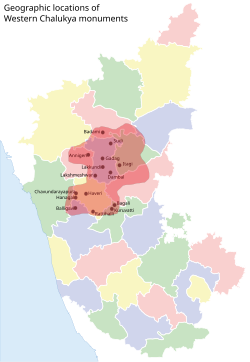
Core area of Western Chalukya architectural activity in modern Karnataka state, India Western Chalukya architecture, also known as Kalyani Chalukya or Later Chalukya architecture and broadly classified under the Vesara Style, is the distinctive style of ornamented architecture that evolved during the rule of the Western Chalukya Empire in the Tungabhadra region of modern central Karnataka, India, during the 11th and 12th centuries. Western Chalukyan political influence was at its peak in the Deccan Plateau during this period. The centre of cultural and temple-building activity lay in the Tungabhadra region, where large medieval workshops built numerous monuments. These monuments, regional variants of pre-existing dravida (South Indian) temples, form a climax to the wider regional temple architecture tradition called Vesara or Karnata dravida. Temples of all sizes built by the Chalukyan architects during this era remain today as examples of the architectural style.
At the height of the Vijayanagara Empire, the Mysore and Coorg region was ruled by diverse chieftains, or rajas ("little kings"). Each raja had the right to govern a small region, but also an obligation to supply soldiers and annual tribute for the empire's needs. After the empire's fall and the subsequent eastward move of the diminished ruling family, many chieftains tried to loosen their imperial bonds and expand their realms. Sensing opportunity amidst the new uncertainty, various powers from the north invaded the region. Among these were the Sultanate of Bijapur to the northwest, the Sultanate of Golconda to the northeast, the newly-formed Maratha Empire farther northwest, and the major contemporary empire of India, the Mughal, which bounded all on the north. For much of the 17th century the tussles between the little kings and the big powers, and amongst the little kings, culminated in shifting sovereignties, loyalties, and borders. By the turn of the 18th century, the political landscape had become better defined: the northwestern hills were being ruled by the Nayaka rulers of Ikkeri, the southwestern—in the Western Ghats—by the Rajas of Coorg, the southern plains by the Wodeyar rulers of Mysore, all of which were Hindu dynasties; and the eastern and northeastern regions by the MuslimNawabs of Arcot and Sira. Of these, Ikkeri and Coorg were independent, Mysore, although much-expanded, was formally a Mughal dependency, and Arcot and Sira, Mughal subahs (or provinces). (Full article...)
Aitraaz tells the story of a man accused of sexual harassment by his female superior, and was released on 12 November 2004 to positive reviews. Chopra received widespread critical acclaim for her performance. Loosely based on the 1994 film Disclosure, the film was moderately successful at the box office, doing a business of ₹26 crores at the box office against a budget of ₹11 crores, and has been noted for its bold subject of male sexual harassment. (Full article...)
Ganesha or Ganesh (Sanskrit: गणेश, IAST: Gaṇeśa, IPA:[ɡɐˈɳeːɕɐ]), also known as Ganapati, Vinayaka and Pillaiyar, is one of the best-known and most revered and worshipped deities in the Hindu pantheon and is the Supreme god in the Ganapatya sect. His depictions are found throughout India. Hindu denominations worship him regardless of affiliations. Ganesha also holds the Title of "Pratham Pujya" (the god to be worshipped initially before the worship of any other Deity). Devotion to Ganesha is widely diffused and extends to Jains and Buddhists and beyond India.
Although Ganesha has many attributes, he is readily identified by his elephant head and four arms. He is widely revered, more specifically, as the remover of obstacles and bringer of good luck; the patron of arts and sciences; and the deva of logic, intellect, and wisdom. As the god of beginnings, he is honoured at the start of rites and ceremonies. Ganesha is also invoked during writing sessions as a patron of letters and learning. Several texts relate anecdotes associated with his birth and exploits. (Full article...)
Image 9
Four-time world champion Mark Selby playing at a practice table during the 2012 Masters tournament
In 1875, army officer Neville Chamberlain, stationed in India, devised a set of rules that combined black pool and pyramids. The word snooker was a well-established derogatory term used to describe inexperienced or first-year military personnel. In the early 20th century, snooker was predominantly played in the United Kingdom, where it was considered a "gentleman's sport" until the early 1960s before growing in popularity as a national pastime and eventually spreading overseas. The standard rules of the game were first established in 1919 when the Billiards Association and Control Club was formed. As a professional sport, snooker is now governed by the World Professional Billiards and Snooker Association. (Full article...)
Robert Montagu Poore, CIE, DSO (20 March 1866 – 14 July 1938) was a cricketer and British army officer who, whilst serving in South Africa in 1896, played in three Tests for the South African cricket team. Much of his cricket was played when he held the rank of major, but he eventually became a brigadier-general. "Of all the people in the history of the game," wrote Leo Cooper in an introduction to A. A. Thomson's Odd Men In, "he seems to stand for the Eccentric Ideal." (Full article...)
The development of Mughal-e-Azam began in 1944, when Asif read a 1922 play called Anarkali, by the playwright Imtiaz Ali Taj, which is set in the reign of Emperor Akbar (1556–1605). Production was plagued by delays and financial uncertainty. Before its principal photography began in the early 1950s, the project had lost a financier and undergone a complete change of cast. Mughal-e-Azam cost more to produce than any previous Indian motion picture; the budget for a single song sequence exceeded that typical for an entire film of the period. The soundtrack, inspired by Indian classical and folk music, comprises 12 songs voiced by playback singer Lata Mangeshkar along with Mohammed Rafi, Shamshad Begum and classical singer Bade Ghulam Ali Khan, and is often cited among the finest in the history of Hindi cinema. (Full article...)
Image 13
Territory of the Western Chalukyas (c. 1100 CE) in India (modern boundaries shown) and the empire's capital, Kalyani, in the modern Bidar district, Karnataka state, India A large body of Western Chalukya literature in the Kannada language was produced during the reign of the Western Chalukya Empire (973–1200 CE) in what is now southern India. This dynasty, which ruled most of the western Deccan in South India, is sometimes called the Kalyani Chalukya dynasty after its royal capital at Kalyani (now Basavakalyan), and sometimes called the Later Chalukya dynasty for its theoretical relationship to the 6th-century Chalukya dynasty of Badami. For a brief period (1162–1183), the Kalachuris of Kalyani, a dynasty of kings who had earlier migrated to the Karnataka region from central India and served as vassals for several generations, exploited the growing weakness of their overlords and annexed the Kalyani. Around 1183, the last Chalukya scion, Someshvara IV, overthrew the Kalachuris to regain control of the royal city. But his efforts were in vain, as other prominent Chalukya vassals in the Deccan, the Hoysalas, the Kakatiyas and the Seunas destroyed the remnants of the Chalukya power.
Kannada literature from this period is usually categorised into the linguistic phase called Old-Kannada. It constituted the bulk of the Chalukya court's textual production and pertained mostly to writings relating to the socio-religious development of the Jain faith. The earliest well-known writers belonging to the Shaiva faith are also from this period. Under the patronage of Kalachuri King Bijjala II, whose prime minister was the well-known Kannada poet and social reformerBasavanna, a native form of poetic literature called Vachana literature (lit "utterance", "saying" or "sentence") proliferated. The beginnings of the Vachana poetic tradition in the Kannada-speaking region trace back to the early 11th century. Kannada literature written in the champumetre, composed of prose and verse, was popularised by the Chalukyan court poets. However, with the advent of the Veerashaiva (lit, "brave devotees of the god Shiva") religious movement in the mid-12th century, poets favoured the native tripadi (three-line verse composed of eleven ganas or prosodic units), hadugabba (song-poem) and free verse metres for their poems. (Full article...)
Image 14
Theatrical release poster
Enthiran (transl. Robot) is a 2010 Indian Tamil-language science fiction action film co-written and directed by Shankar. It is the first instalment in the Enthiran film series. The film stars Rajinikanth in dual lead roles as a scientist and the robot he created. Along with Aishwarya Rai Bachchan, actors like Danny Denzongpa, Santhanam and Karunas play supporting roles. The soundtrack album and background score were composed by A. R. Rahman while the dialogues, cinematography, editing and art direction were handled by Madhan Karky, R. Rathnavelu, Anthony and Sabu Cyril and action sequences was done by Peter Hein respectively. The story revolves around the struggle of a scientist named Vaseegaran to control his sophisticated android robot named Chitti, after Chitti's software is upgraded to give it the ability to comprehend and exhibit human emotions and to commission it to the Indian Army. The project backfires when Chitti falls in love with Vaseegaran's girlfriend Sana, and is manipulated by Vaseegaran's mentor Bohra into becoming homicidal.
Tripura (/ˈtrɪpʊrə,-ərə/) is a state in northeast India. The third-smallest state in the country, it covers 10,491 km2 (4,051 sq mi); and the seventh-least populous state with a population of 3.67 million. It is bordered by Assam and Mizoram to the east, and by Bangladesh to the north, south and west. Tripura is divided into eight districts and 23 sub-divisions, where Agartala is the capital and the largest city in the state. Tripura has 19 different tribal communities with a majority Bengali population. Bengali, Kokborok, and English are the state's official languages.
The area of modern Tripura — ruled for several centuries by the Manikya Dynasty — was part of the Tripuri Kingdom (also known as Hill Tippera). It became a princely state under the British Raj during its tenure, and acceded to independent India in 1947. It merged with India in 1949 and was designated as a 'Part C State' (union territory). It became a full-fledged state of India in 1972. (Full article...)
Kapoor, the daughter of actor Anil Kapoor, began her career as an assistant director on filmmaker Sanjay Leela Bhansali's 2005 film Black. She made her acting debut in Bhansali's romantic drama Saawariya (2007), a box office flop, and had her first commercial success with the romantic comedy I Hate Luv Storys (2010). This was followed by a series of commercial failures and repetitive roles, which garnered her negative reviews. The 2013 box office hit Raanjhanaa marked a turning point in Kapoor's career, garnering her praise and Best Actress nominations at several award ceremonies. (Full article...)
Development began during the early 1940s when, after two successive box-office hits, Vasan announced that his next film would be entitled Chandralekha. However, when he launched an advertising campaign for the film he only had the name of the heroine from a storyline he had rejected. Veppathur Kittoo (one of Vasan's storyboard artists) developed a story based on a chapter of George W. M. Reynolds' novel, Robert Macaire: or, The French bandit in England. Original director T. G. Raghavachari left the film more than halfway through because of disagreements with Vasan, who took over in his directorial debut. (Full article...)
Born into a MarathiKarhade Brahmin family in Benares, Lakshmibai married the Maharaja of Jhansi, Gangadhar Rao, in 1842. When the Maharaja died in 1853, the British East India Company under Governor-General Lord Dalhousie refused to recognize the claim of his adopted heir and annexed Jhansi under the Doctrine of Lapse. The Rani was unwilling to cede control joined the rebellion against the British in 1857. She led the successful defence of Jhansi against Company allies, but in early 1858 Jhansi fell to British forces under the command of Hugh Rose. The Rani managed to escape on horseback and joined the rebels in capturing Gwalior, where they proclaimed Nana Saheb as Peshwa of the revived Maratha Empire. She died in June 1858 after being mortally wounded during the British counterattack at Gwalior. (Full article...)
In the early 19th century, during East India Company rule in India, Darjeeling was identified as a potential summer retreat for British officials, soldiers, and their families. The narrow mountain ridge was leased from the Kingdom of Sikkim, and eventually annexed to British India. Experimentation with growing tea on the slopes below Darjeeling was highly successful. Thousands of labourers were recruited chiefly from Nepal to clear the forests, build European-style cottages and work in the tea plantations. The widespread deforestation displaced the indigenous peoples. Residential schools were established in and around Darjeeling for the education of children of the domiciled British in India. By the late-19th century, a novel narrow-gauge mountain railway, the Darjeeling Himalayan Railway, was bringing summer residents into the town and carrying a freight of tea out for export to the world. After India's independence in 1947, as the British left Darjeeling, its cottages were purchased by wealthy Indians from the plains and its tea plantations by out-of-town Indian business owners and conglomerates. (Full article...)
Image 21
The Kingdom of Mysore was a geopolitical realm in southern India founded in around 1399 in the vicinity of the modern-day city of Mysuru and prevailed until 1950. The territorial boundaries and the form of government transmuted substantially throughout the kingdom's lifetime. While originally a feudal vassal under the Vijayanagara Empire, it became a princely state in British Raj from 1799 to 1947, marked in-between by major political changes.
The kingdom, which was founded and ruled for the most part by the Wadiyars, initially served as a feudal vassal under the Vijayanagara Empire. With the gradual decline of the Empire, the 16th-century Timmaraja Wodeyar II declared independence from it. The 17th century saw a steady expansion of its territory and, during the rules of Narasaraja Wodeyar I and Devaraja Wodeyar II, the kingdom annexed large expanses of what is now southern Karnataka and parts of Tamil Nadu, becoming a formidable power in the Deccan. (Full article...)
Born into a poor family in rural Uttar Pradesh, Devi endured poverty, child marriage and had an abusive marriage before taking to a life of crime. Having developed major differences with her parents and being raped multiple times by her husband, the teenage Devi sought escape by running away and joining a gang of bandits. She was the only woman in that gang, and her relationship with one gang member, coupled with caste difference, caused a gunfight between gang members. Devi's lover, Vikram Mallah, was killed in that gunfight. The victorious rival faction took Devi to their village of Behmai, confined her in a room, and took turns to rape her repeatedly over several weeks. After escaping, Devi rejoined the remnants of her Mallah's faction who were gangs of Mallaah. A few months later, her new gang descended upon the village of Behmai to exact revenge for what she had suffered. As many as twenty-two men belonging to that village were shot dead by Devi's gang. (Full article...)
The film was produced by Kumar and Ramesh Taurani's Tips Industries on a budget of ₹200–250 million (about US$4.2–5.2 million in 2002). The story and dialogue were written by Santoshi and Piyush Mishra respectively, while Anjum Rajabali drafted the screenplay. K. V. Anand, V. N. Mayekar and Nitin Chandrakant Desai were in charge of the cinematography, editing and production design respectively. Principal photography took place in Agra, Manali, Mumbai and Pune from January to May 2002. The soundtrack and film score were composed by A. R. Rahman, with the songs "Mera Rang De Basanti" and "Sarfaroshi Ki Tamanna" being well received in particular. (Full article...)
Image 25
Monier Williams, elected as the second Boden Professor of Sanskrit in 1860; this photograph was taken by Lewis Carroll. The election in 1860 for the position of Boden Professor of Sanskrit at the University of Oxford was a competition between two candidates offering different approaches to Sanskrit scholarship. One was Monier Williams, an Oxford-educated Englishman who had spent 14 years teaching Sanskrit to those preparing to work in British India for the East India Company. The other, Max Müller, was a German-born lecturer at Oxford specialising in comparative philology, the science of language. He had spent many years working on an edition of the Rig Veda (an ancient collection of Vedic Sanskrit hymns) and had gained an international reputation for his scholarship. Williams, in contrast, worked on later material and had little time for the "continental" school of Sanskrit scholarship that Müller exemplified. Williams regarded the study of Sanskrit as a means to an end, namely the conversion of India to Christianity. In Müller's opinion, his own work, while it would assist missionaries, was also valuable as an end in itself.
The election came at a time of public debate about Britain's role in India in the wake of the Indian Rebellion of 1857. Opinions were divided on whether greater efforts should be made to convert India or whether to remain sensitive to local culture and traditions. Both men battled for the votes of the electorate (the Convocation of the university, consisting of over 3,700 graduates) through manifestos and newspaper correspondence. Williams laid great stress in his campaign on the intention of the original founder of the chair, that the holder should assist in converting India through dissemination of the Christian scriptures. Müller's view was that his work on the Rig Veda was of great value for missionary work, and published testimonials accordingly. He also wanted to teach wider subjects such as Indian history and literature to assist missionaries, scholars, and civil servants – a proposal that Williams criticised as not in accordance with the original benefactor's wishes. The rival campaigns took out newspaper advertisements and circulated manifestos, and different newspapers backed each man. Although generally regarded as superior to Williams in scholarship, Müller had the double disadvantage (in the eyes of some) of being German and having liberal Christian views. Some of the newspaper pronouncements in favour of Williams were based on a claimed national interest of having an Englishman as Boden professor to assist with the work of governing and converting India. (Full article...)
Partially inspired by the 2003 German tragicomedy film Good Bye, Lenin!, Dookudu revolves around the life of police officer Ajay Kumar (Mahesh). His father Shankar Narayana (Prakash Raj) awakes from a coma, which he has been in for many years after an accident, but his health remains perilous. To aid his recovery, Kumar masquerades as a Member of the Legislative Assembly fulfilling his father's ambition for him. (Full article...)
The chief minister usually serves as the leader of the house in the respective legislative assembly. Out of the thirty incumbents, except Tamil Nadu's M. K. Stalin, all other chief ministers also act as the leader of the house. (Full article...)
Basu followed this initial success with roles in a series of commercial failures, including the thrillers Aetbaar, Rudraksh, Rakht—all in 2004—and the romance Barsaat (2005). She later featured in Prakash Jha's crime drama Apaharan (2005) and the ensemble comedy No Entry (2005). The latter emerged as a financial success, grossing ₹750 million (US$11 million) at the box office, and Basu's role of an escort earned her a nomination for the Best Supporting Actress at the 51st Filmfare Awards. Basu had seven film releases in 2006. Her role as an executive at a conglomerate in Madhur Bhandarkar's drama Corporate earned her another nomination for the Filmfare Award for Best Actress. She then portrayed a character based on Bianca in Vishal Bhardwaj's Omkara, an adaptation of the Shakespearean tragedyOthello. In Sanjay Gadhvi's action film Dhoom 2—her final release of the year—she played dual roles; it was the top-grossing Bollywood film of the year. In 2008, she collaborated with Abbas–Mustan for the second time for Race. Her performance as a troubled wife in Rituparno Ghosh's 2009 Bengali filmShob Charitro Kalponik was critically acclaimed. She then featured in the third installment of the Raaz series, entitled Raaz 3D (2012). Due to her frequent associations with horror films, she was labelled India's "horror queen" by the media. (Full article...)
Image 4
Zinta at a promotional event for Jaan-E-Mann in 2006
Preity Zinta (born 31 January 1975) is an Indian actress, film producer and entrepreneur. Her career began with Mani Ratnam's acclaimed drama Dil Se.. (1998), and in that same year she appeared in the box office hit Soldier. Both films won her the award for Best Female Debut at the 44th Filmfare Awards. Her performance in Dil Se.. also earned her a Best Supporting Actress nomination at the same ceremony, while Soldier won her three more Best Debut awards at other major ceremonies. Zinta received her first Filmfare nomination for Best Actress for her portrayal of a teenage single mother in Kya Kehna. She followed these films with several critically and commercially successful films, such as Mission Kashmir (2000) and Dil Chahta Hai (2001), and her performances in films like Chori Chori Chupke Chupke (2001), Dil Hai Tumhaara (2002) and Armaan (2003) were praised.
Roshan in 2014 Hrithik Roshan is an Indian actor known for his work in Hindi-language films. As a child, he made uncredited appearances in three films directed by his maternal grandfather, J. Om Prakash, the first of which was in Aasha (1980). In 1986, Roshan played the adopted son of Rajinikanth's character in Prakash's crime drama Bhagwaan Dada. Roshan subsequently worked as an assistant director on four films, including Khudgarz (1987) and Karan Arjun (1995), all of which were directed by his father, Rakesh.
Khurrana in 2012 Ayushmann Khurrana is an Indian actor, playback singer and television host who works in Hindi films. Khurrana first appeared in 2004 teen drama reality show MTV Roadies, winning the second season of the show. He went to star in many other MTV shows, including MTV Fully Faltoo Movies, Cheque De India and Jaadoo Ek Baar, and hosted multiple television shows, including India's Got Talent and Music Ka Maha Muqqabla. In 2012, he made his feature film debut with the romantic comedy Vicky Donor, about sperm donation, which received critical acclaim and performed strongly at the box office. Khurrana won the Filmfare Award for Best Male Playback Singer (for the song "Pani Da Rang"). He then starred in a series of commercially unsuccessful films, including the comedy-drama Nautanki Saala (2013), romantic comedy Bewakoofiyaan (2014), and drama Hawaizaada (2015).
Vishwaroopam is a 2013 Indian spythriller film directed by Kamal Haasan. Besides starring in the lead role with Pooja Kumar, Haasan co-produced the film with S. Chandrahaasan and Prasad V. Potluri, and co-wrote the script with Atul Tiwari. Andrea Jeremiah, Rahul Bose, Shekhar Kapur and Nassar play supporting roles in the film. The film's story revolves around Wisam Ahmed Kashmiri, a spy from India's intelligence agency Research and Analysis Wing, stopping a group of Al-Qaeda terrorists led by Omar (Bose) from triggering a dirty bomb made by scraping caesium from oncological equipment in New York City. A bilingual film, made in Tamil and Hindi (as Vishwaroop), the soundtrack and score were composed by Shankar–Ehsaan–Loy. Sanu Varghese and Mahesh Narayanan were in charge of the film's cinematography and editing respectively. Lalgudi N. Ilaiyaraaja and Boontawee 'Thor' Taweepasas were in charge of art direction while Birju Maharaj handled the choreography.
Vishwaroopam was made on a budget of ₹950 million. The film was released on 25 January 2013 worldwide except Tamil Nadu where it was banned due to protest by Islamic organisations which cited that Muslims were depicted in a negative manner. The ban on the film was lifted and it released on 7 February 2013 after a mutual agreement between Haasan and the organisations; the Hindi version was released on 1 February 2013. Both versions received generally positive reviews and were commercial successes at the box office, collectively grossing ₹2.2 billion overall. (Full article...)
Image 10
Map showing the Indian Princely states during the rebellion of 1857 The Victoria Cross (VC) was introduced in Great Britain on 29 January 1856 by Queen Victoria to reward acts of valour during the Crimean War. For the Indian Mutiny (also known as India's First War of Independence, Revolt of 1857, or the Sepoy Mutiny) the VC was awarded to 182 members of the British Armed Forces, the Honourable East Indies Company (HEIC) and civilians under its command. The VC is the highest British honour and is awarded for valour "in the face of the enemy". Created in 1856 for the British Army and Royal Navy, eligibility was extended in 1857 to members of the HEIC and in 1858 to non-military personnel bearing arms as volunteers.
Queen Victoria created the tradition of the British monarch presenting the VC to the recipient, personally presenting 74 of the 111 awards for the Crimean War. Many VCs for the Indian Mutiny were sent to India for presentation and while there is documentation for 42 presentations, the information on 51 presentations which were likely presented in India is vague and it not known if the medal was personally presented or received by post. There were 18 Indian Mutiny VCs sent to next of kin where the award was posthumous, or the recipient died before presentation. The Queen personally presented 63 Indian Mutiny awards after the recipients returned to the UK. (Full article...)
Mukerji's career prospects improved in 2002 when she starred in Yash Raj Films' Saathiya, a romantic drama that gained her a Filmfare Critics Award for Best Actress. For her roles in the 2004 romantic comedy Hum Tum and the composite drama Yuva, Mukerji became the only actress to win both the Filmfare Award for Best Actress and Best Supporting Actress, respectively, in the same year. Also that year, she starred in Veer-Zaara—the highest-grossing Bollywood film of the year. In 2005, she received praise for portraying a blind, deaf and mute woman in the drama Black, and played a con woman in the crime comedy film Bunty Aur Babli. For her performance in Black, she was awarded the Best Actress and Best Actress (Critics) trophies at Filmfare. The following year, she played an unhappily married woman in the drama Kabhi Alvida Naa Kehna — the top-grossing Bollywood film in overseas at that point. (Full article...)
On 9 December 2011, Chhetri netted twice in a match (also known as a brace) in India's 3–1 semi-final win over the Maldives in the 2011 SAFF Championship to take his tally to 31, thus becoming his country's all-time leading goalscorer surpassing the 29 set by I. M. Vijayan. With his 92 international goals, he is currently the third-highest international goalscorer among active players, behind only Cristiano Ronaldo of Portugal and Lionel Messi of Argentina. He is also the highest active goalscorer from Asia. On 21 June 2023, Chhetri scored a hat-trick for India in a 4–0 win over the Pakistan to take his tally to 90 international goals, thus becoming the second-highest international goalscorer from Asia of all time. His tally of 92 puts him as the fourth-highest goalscorer in the history of international football. (Full article...)
The AIFF Player of the Year Awards are the annual football awards presented to the best footballers in India by the All India Football Federation (AIFF). The AIFF first announced the award for men's player of the year in 1992; I. M. Vijayan was the inaugural winner. Sunil Chhetri has won the award a record six times, more than any other player. No winner was announced in 1998 and 1999. It was re-introduced in 2000.
The AIFF Women’s Player of the Year Award was introduced in 2001. Oinam Bembem Devi was its first recipient. Between 2002 and 2012, no women's award was given out. In 2013, the award was re-introduced and Bembem Devi won it for the second time. Other than Bembem Devi, Bala Devi has also won the award twice, in 2015 and 2016. Along with the men's and women's awards, the AIFF Emerging Player of the Year Award for men was introduced in 2013, and a similar award for women was introduced in 2015. (Full article...)
Image 16
Vijay garnered several awards and nominations for his performance as a father and his two sons in Mersal.
Mersal (transl. Zapped) is a 2017 Indian vigilanteaction film directed by Atlee Kumar, who co-wrote the screenplay with V. Vijayendra Prasad and S. Ramana Girivasan. Produced by N. Ramasamy and Hema Rukmani under the banner of Thenandal Studio Limited, Mersal features Vijay in triple roles for the first time in his career. Nithya Menen, S. J. Surya, Kajal Aggarwal and Samantha Akkineni play the other lead roles while Vadivelu, Kovai Sarala and Sathyaraj feature as supporting characters. A. R. Rahman composed the film's soundtrack, while also handling the background score along with Qutub-E-Kripa. Ruben and G. K. Vishnu were in charge of the editing and cinematography respectively. The film follows two brothers, Vetri (Vijay), a renowned magician, and Maaran (Vijay), a doctor who charges meagre amounts for his patients, who try to expose the corrupt dealings and medical crimes of another doctor, Daniel Arockiaraj (Surya), who also happens to be the same person that killed their parents, Vetrimaaran (Vijay) and Aishwarya (Menen).
Produced on a budget of ₹1.2 billion (about US$17.5 million in 2017), Mersal was released on 18 October 2017 and received positive reviews. It was also a commercial success, grossing ₹2.6 billion (about US$39.3 million in 2017) worldwide. The film won 35 awards from 57 nominations; its direction, screenplay, music and Vijay's performances received the most attention from award groups. (Full article...)
Dixit in 2019 Indian actress Madhuri Dixit made her acting debut in 1984 with Abodh where she portrayed a young bride. Dixit went on to appear in several films over the next three years, including the dramas Awara Baap (1985) and Swati (1986), though none of them garnered her much recognition. The role of Mohini in N. Chandra's action romance drama Tezaab (1988) proved to be a breakthrough for Dixit. The film went on to become the highest-grossing film of that year. For her performance, Dixit received a Best Actress nomination at Filmfare. She achieved further success by featuring as the female lead in several top-grossing action-dramas, including Ram Lakhan (1989) opposite Anil Kapoor, Tridev (1989) opposite Sunny Deol, and Kishen Kanhaiya (1990) opposite Anil Kapoor. The role of a wealthy brat in the 1990 romantic drama Dil earned Dixit her first Filmfare Award for Best Actress. The following year, she starred in another box-office hit Saajan, and won a second Best Actress award at Filmfare for portraying the role of a strong woman who rebels against her manipulative mother-in-law in the 1992 drama Beta.
She featured alongside Jackie Shroff and Sanjay Dutt in the action thriller Khalnayak (1993), one of the highest-grossing films of that year. Subsequently, she played an avenger in the drama Anjaam (1994) to positive reviews. Dixit's subsequent release was Sooraj Barjatya's Hum Aapke Hain Koun..! (1994), a family drama which emerged as the highest-grossing Bollywood film to that point. The following year, she featured in Raja (1995) which was a blockbuster film of that year and Yaraana in which she played a woman who attempts an escape from her abusive husband. Both of her releases in 1996—Rajkumar and Prem Granth—were financial failures. Dixit's portrayal of a headstrong dancer in Yash Chopra's 1997 romance Dil To Pagal Hai was a major success, earning her a fourth Filmfare Award for Best Actress. She garnered critical acclaim for her work in the dramas Mrityudand (1997), Wajood (1998) and Pukar (2000). She portrayed five roles in the experimental filmGaja Gamini (2000). (Full article...)
Image 19
The Pampa Award (or Pampa Prashasti) is a literary award in the Indian state of Karnataka. The award was established in 1987 by the government of Karnataka. It is the highest literary honor conferred by the Department of Kannada and Culture, Government of Karnataka State, and recognises works written in the Kannada language (1 of the 22 official languages of India).
The award is named after the first Kannada poet Adikavi Pampa. The award originally comprised a cash prize of ₹1 lakh (US$1,400), a shawl, a citation and a memento. The cash prize was increased to ₹3 lakh (US$4,200) in 2008. Prior to 1996, the awards were given for a best single work by a Kannada writer. Since then, the award has been given to writers for their lifetime contribution to the Kannada literature. The Pampa Prashasti is presented by the Chief Minister, during the Kadambotsava, a cultural festival held annually in Pampa's hometown of Banavasi in Uttara Kannada district. (Full article...)
Made on an estimated budget of ₹420 million (US$5.9 million), Piku was released on 8 May 2015, and grossed approximately ₹1.41 billion (US$20 million) worldwide. The film garnered awards and nominations in several categories, with particular praise for its writing, music, and the performances of Padukone and Bachchan. As of June 2016, the film has won a minimum of 35 awards. (Full article...)
Since the independence of India, the Scheduled Castes (SC) and Scheduled Tribes (ST) have been given reservation status, guaranteeing political representation, and the Constitution lays down the general principles of positive discrimination for SCs and STs. The 2011 census of India stated that there were no people of any Scheduled Tribes in Punjab, while the Scheduled Castes constitute a significant portion of the population of the state, at 31.9%. The Scheduled Castes have been granted a reservation of 34 seats in the assembly. (Full article...)
Image 22
S. S. Rajamouli received several awards and nominations for directing the film.
The first of two cinematic parts, The Beginning opened worldwide on 10 July 2015 to critical acclaim and record-breaking box-office success, becoming the highest-grossing film in India and the third-highest grossing Indian film worldwide, and the highest-grossing South Indian film. Grossing over ₹6.5 billion worldwide against a budget of ₹1.2 billion, the film became the first South Indian film, and the first non-Hindi film to gross over ₹1 billion in the dubbed Hindi version. The Beginning garnered several awards and nominations with praise for Rajamouli's direction, cinematography, production design, costumes and performances of the cast members. (Full article...)
Image 23
Bhatt in 2019 Alia Bhatt is a British actress of Indian descent who predominantly works in Hindi-language films. As a child, she made her debut in a minor role in her father Mahesh Bhatt's production Sangharsh (1999), as the younger version of star Preity Zinta's character. In 2012, Bhatt had her first lead role in Karan Johar's teen film Student of the Year, but her performance in it was not well-received. Two years later, she gained praise for playing a kidnapping victim in the road drama Highway (2014), winning the Filmfare Critics Award for Best Actress. In the same year, her starring roles in the commercially successful romances 2 States and Humpty Sharma Ki Dulhania, both produced under Johar's studio Dharma Productions, established her as a leading actress. She also sang the single "Samjhawan Unplugged" for the latter film's soundtrack.
Bhatt had three notable releases in 2016, Kapoor & Sons, Dear Zindagi, and Udta Punjab, in which she played young women in troubling circumstances. Her performance in the last of these won her the Filmfare Award for Best Actress. Following another romantic role in Badrinath Ki Dulhania (2017), she played a spy in the thriller Raazi (2018) and the volatile girlfriend of an aspiring rapper in the musical drama Gully Boy (2019). She won two more Best Actress awards at Filmfare for the latter two. This was followed by two poorly received films, Kalank (2019) and Sadak 2 (2020). The year 2022 proved key for Bhatt as she gained further success with a brief role in the Telugu-language period film RRR, and starring roles in the fantasy film Brahmāstra: Part One – Shiva and biopic Gangubai Kathiawadi, in which she starred as the titular prostitute; all three rank among the highest-grossing Indian films of the year. She won the National Film Award for Best Actress and her fourth Best Actress award at Filmfare for the last of these. She also produced and starred in the Netflix black comedy Darlings under her company Eternal Sunshine Productions. (Full article...)
Image 24
Shetty on the set of Nach Baliye 5 as judge in 2018 Shilpa Shetty is an Indian actress, businesswoman and former model. Known primarily for her work in Hindi films, she has also appeared in Telugu, Kannada and Tamil films. Shetty made her acting debut opposite Shah Rukh Khan in the 1993 thriller Baazigar. Shetty's performance earned her two Filmfare Awards nominations for Lux New Face of the Year and Best Supporting Actress. She subsequently earned wide recognition with dual roles in the 1994 action-comedy Main Khiladi Tu Anari. After initial success, Shetty's films fared poorly at the box office for the next five years. Films Shetty starred in including action drama Aag, romantic drama Aao Pyaar Karen, comedy Haathkadi and Chhote Sarkar proved to be financially unsuccessful. However, Shetty received Best Supporting Actress at the Zee Gold Bollywood Awards for romantic drama Pardesi Babu.
The 2000 romantic drama Dhadkan marked a turning point in her career, earning her several nominations in the Best Actress category at various award ceremonies. Shetty rose to prominence by featuring as the lead female in top-grossing films such as family drama Apne, police drama Garv: Pride and Honour and musical drama Life in a... Metro. Her comic performance as an eccentric fisherwoman in 2002 action-drama release Rishtey earned her a nomination for the Filmfare Best Supporting Actress Award. Shetty became a global figure after winning the 2007 British reality television series Celebrity Big Brother, after comments made by other contestants about Shetty fell afoul of Ofcom rules and caused an international controversy over racism. (Full article...)
Image 25
Chandrasekhar's six wickets for 38 runs at the Kennington Oval was influential in setting up India's first ever series victory in England. B. S. Chandrasekhar is a former international cricketer who represented the Indian cricket team between 1964 and 1979. In cricket, a five-wicket haul refers to a bowler taking five or more wickets in a single innings. This is regarded as a notable achievement, and 40 bowlers have taken at least 15 five-wicket hauls at the international level as of October 2026. Chandrasekhar played as a leg spin bowler who formed a part of the Indian spin quartet. Described by West Indies cricketer Viv Richards as the "most difficult" bowler, Chandrasekhar took 16 five-wicket hauls during his international career. He developed an interest in the game when he was a child, watching the playing styles of Australian leg spinner Richie Benaud. Chandrasekhar was affected by polio at the age of five which weakened his right arm. He started as a left-arm bowler but gradually shifted to his withered right arm as it could offer more spin.
Chandrasekhar made his Test debut in 1964 against England at the Brabourne Stadium, claiming four wickets for 67 runs in the first innings. His first five-wicket haul came against West Indies two years later at the same venue. Chandrasekhar's bowling figures of six wickets for 38 runs in 1971 were instrumental in setting up India's first victory in England. It was noted as the Indian "Bowling Performance of the Century" by Wisden in 2002. His bowling performances in the previous English season led to him being named one of the five Wisden Cricketers of the Year in 1972. His career-best figures for an innings were eight wickets for 79 runs against England at the Feroz Shah Kotla Ground in December 1972. Chandrasekhar took a pair of five-wicket hauls for the only time in his career when he took 12 wickets for 104 runs against Australia at the Melbourne Cricket Ground; the performance was effective in ensuring India's first victory in Australia. In Tests, he was most successful against England taking eight fifers. (Full article...)
Mahākāśyapa (Pali: Mahākassapa) was one of the principal disciples of Gautama Buddha. He is regarded in Buddhism as an enlightened disciple, being foremost in ascetic practice. Mahākāśyapa assumed leadership of the monastic community following the parinirvāṇa (death) of the Buddha, presiding over the First Buddhist Council. He was considered to be the first patriarch in a number of Early Buddhist schools and continued to have an important role as patriarch in the Chan/Zen tradition. In Buddhist texts, he assumed many identities, that of a renunciant saint, a lawgiver, an anti-establishment figure, but also a "guarantor of future justice" in the time of Maitreya, the future Buddha—he has been described as "both the anchorite and the friend of mankind, even of the outcast".
In canonical Buddhist texts in several traditions, Mahākāśyapa was born as Pippali in a village and entered an arranged marriage with a woman named Bhadra-Kapilānī. Both of them aspired to lead a celibate life, however, and they decided not to consummate their marriage. Having grown weary of the agricultural profession and the damage it did, they both left the lay life behind to become mendicants. Pippali later met the Buddha, under whom he was ordained as a monk, named Kāśyapa, but later called Mahākāśyapa to distinguish him from other disciples. Mahākāśyapa became an important disciple of the Buddha, to the extent that the Buddha exchanged his robe with him, which was a symbol of the transmittance of the Buddhist teaching. He became foremost in ascetic practices and attained enlightenment shortly after. He often had disputes with Ānanda, the attendant of the Buddha, due to their different dispositions and views. Despite his ascetic, strict and stern reputation, he paid an interest in community matters and teaching, and was known for his compassion for the poor, which sometimes caused him to be depicted as an anti-establishment figure. He had a prominent role in the cremation of the Buddha, acting as a sort of eldest son of the Buddha, as well as being the leader in the subsequent First Council. He is depicted as hesitatingly allowing Ānanda to participate in the council, and chastising him afterwards for a number of offenses the latter was regarded to have committed. (Full article...)
Born between 1720 and 1722, Ahmad Shah accompanied Nader Shah in his campaigns until Nader's assassination in 1747, resulting in the division of the Afsharid Empire. Ahmad Shah took advantage and was crowned near Kandahar, establishing his rule in Afghanistan and founding the Durrani Empire. (Full article...)
Image 4
Salt Sathyagraga Memorial Stupa – a memorial of the historic salt march carried out in Vedaranyam in 1930
Vedaranyam comes under the Vedaranyam assembly constituency which elects a member to the Tamil Nadu Legislative Assembly once every five years and it is a part of the Nagapattinam (Lok Sabha constituency) which elects its Member of Parliament (MP) once in five years. The town is administered by the Vedaranyam municipality, which covers an area of 36.26 km2 (14.00 sq mi). As of 2011, the town had a population of 34,266. Vedaranyam was a part of Thanjavur District till 1991 and Nagapattinam District from then on. The town is a part of the fertile Cauvery delta region, but salt extraction and prawn cultivation are the major occupations. Roadways are the major mode of transportation to Vedaranyam and the nearest Airport is Tiruchirapalli Airport, located 135 km (84 mi) away from the town. On 17 November 2018, Vedaranyam was devastated by Cyclone Gaja. (Full article...)
Dhanush, besides acting, producing and distributing the venture in association with Escape Artists Motion Pictures, also worked as the lyricist and album producer on the film's original soundtrack. The film's album and score were composed by Anirudh Ravichander. The stunts were handled by Hari Dinesh. Principal photography commenced in August 2013 and was completed by May 2014, with the film being shot primarily in Chennai. The film was released on 18 July 2014, and received a positive critical reception. It was remade in Kannada as Brihaspathi (2018). (Full article...)
Image 6
Tanguturi Prakasam Pantulu (23 August 1872 – 20 May 1957) was an Indian politician and freedom fighter, chief minister of the Madras Presidency, and subsequently became the first chief minister of the new Andhra state, created by the partition of Madras State along linguistic lines. He was also known as Andhra Kesari (Lion of Andhra). The Andhra Pradesh government issued G.O RT-2500 on 10 August 2014 declaring his birth anniversary a state festival. Andhra Kesari 9 feet Statue in Parliament houses, Statue was Unveiled by Kocheril Raman Narayanan, Presidents of India on 5 May 2000. Andhra Kesari was the first Biopic movie on a Chief Minister, which was directed by Vijayachander. It was released on 1 November 1983, on the Andhra Pradesh Formation day. (Full article...)
Archaeological evidence indicates that Andhra Pradesh has been continuously inhabited from early archaic hominins to Neolithic settlements. The earliest reference to the Andhras appears in the Aitareya Brahmana (c. 800 BCE) of the Rigveda. Around 300 BCE, the Andhras living in the Godavari and Krishna river deltas were renowned for their formidable military strength—second only to the Maurya Empire in the subcontinent. The first major Andhra polity was the Satavahana dynasty (2nd century BCE–2nd century CE) which ruled over the entire Deccan Plateau and even distant areas of western and central India. They established trade relations with the Roman Empire, and their capital, Dhanyakataka, was the most prosperous city in India during the 2nd century CE. Subsequent major dynasties included the Vishnukundinas, Eastern Chalukyas, Kakatiyas, Vijayanagara Empire, and Qutb Shahis, followed by British rule. After gaining independence, Andhra State was carved out of Madras State in 1953. In 1956, it merged with Telangana, comprising the Telugu-speaking regions of the former Hyderabad State, to form Andhra Pradesh. It reverted to its earlier form in 2014, when the new state of Telangana was bifurcated from it. (Full article...)
Image 8
View of the Kodandarama Swamy Temple in Vontimitta
Rajesh Khanna was Usman's first published work. He was in Mumbai recording a show for his employer, ABP News, when he heard news of Khanna's death. Usman's editor, Shazi Zaman, asked him to research Khanna's life. Usman collected several archives of magazines and interviews, and compiled them in a book that was later published on 5 December 2014 by Penguin Books and received positive critical reviews. (Full article...)
]] (help·info)) is a major deity in Hinduism. He is worshipped as the eighth avatar of Vishnu and also as the Supreme God in his own right. He is the god of protection, compassion, tenderness, and love; and is widely revered among Hindu divinities. Krishna's birthday is celebrated every year by Hindus on Krishna Janmashtami according to the lunisolarHindu calendar, which falls in late August or early September of the Gregorian calendar.
The anecdotes and narratives of Krishna's life are generally titled as Krishna Līlā. He is a central figure in the Mahabharata, the Bhagavata Purana, the Brahma Vaivarta Purana, and the Bhagavad Gita, and is mentioned in many Hindu philosophical, theological, and mythological texts. They portray him in various perspectives: as a god-child, a prankster, a model lover, a divine hero, and the universal supreme being. His iconography reflects these legends and shows him in different stages of his life, such as an infant eating butter, a young boy playing a flute, a handsome youth with Radha or surrounded by female devotees, or a friendly charioteer giving counsel to Arjuna. (Full article...)
Image 12
Cover of the English edition
Cigars of the Pharaoh (French: Les Cigares du Pharaon) is the fourth volume of The Adventures of Tintin, the series of comic albums by Belgian cartoonist Hergé. Commissioned by the conservative Belgian newspaper Le Vingtième Siècle for its children's supplement Le Petit Vingtième, it was serialised weekly from December 1932 to February 1934. The story tells of young Belgian reporter Tintin and his dog Snowy, who are travelling in Egypt when they discover a pharaoh's tomb with dead Egyptologists and boxes of cigars. Pursuing the mystery of the cigars, Tintin and Snowy travel across Southern Arabia and India, and reveal the secrets of an international drug smuggling enterprise.
Kanchipuram (IAST: kāñcipuram; [kaːɲdʑipuɾam]), also known as Kanjeevaram or Kancheepuram, is a City in the Indian state of Tamil Nadu in Chennai Metropolitan Area. region, 72 km (45 mi) from Chennai, the capital of Tamil Nadu. Known as the City of Thousand Temples, Kanchipuram is known for its temple architectures, 1000-pillared halls, huge temple towers, and silksaris. Kanchipuram serves as one of the most important domestic tourist destinations in India. Kanchipuram has become a centre of attraction for foreign tourists as well. The city covers an area of 36.14 km2 (13.95 sq mi) and an estimated population of 232,816 in 2011. It is the administrative capital of Kanchipuram District. Kanchipuram is well-connected by road and rail.
Kanchipuram is a Tamil name formed by combining two words, "kanchi" and "puram," together meaning "the city of kanchi flowers" (due to the abundance of kanchi flowers in those regions). The city is located on the banks of the Vegavathy and Palar Rivers. Kanchipuram has been ruled by the Pallavas, the Medieval Cholas, the Later Cholas, the Later Pandyas, the Vijayanagara Empire, the Carnatic kingdom, and the British, who called the city "Conjeeveram". The city's historical monuments include the Kailasanathar Temple and the Vaikunta Perumal Temple. Historically, Kanchipuram was a centre of education and was known as the ghatikasthanam, or "place of learning". The city was also a religious centre of advanced education for Jainism and Buddhism between the 1st and 5th centuries. (Full article...)
Image 14
A painting of Ardhanarishvara drawn about the 1800's.Ardhanarishvara is a form of the Hindu god Shiva joined together with the Hindu goddess Parvati. Ardhanarishvara in statues and drawings is showed as a half-male and half-female. (Full article...)
Production began on 9 November 2011 and principal photography began on 7 February 2012. The film was extensively shot in Hyderabad and Kolkata, while a couple of the songs were shot in Dubai, Iceland, and Slovenia, making Naayak the first Indian film to be shot in Slovenia. Filming ended on 29 December 2012. (Full article...)
A product of the Newcastle Unitedyouth system, he spent six years at the club without managing to secure a regular first team place, instead spending time on loan at Watford, Nottingham Forest, and Barnsley. He was sold to Cardiff City for £500,000 in June 2006, and won a place on the PFA Team of the Year for his performances in the 2006–07 season. He then made a £5 million move to Premier League side Sunderland in July 2007, before returning to Cardiff on a loan deal that was made permanent in July 2009 for £3 million. He again was included in the PFA Team of the Year for the 2009–10 campaign, before being sold on to Ipswich Town for £1 million in June 2011. He joined Blackpool on a free transfer in July 2013, before moving to the Indian Super League with the Kerala Blasters for the inaugural 2014 season. Chopra signed for Scottish Championship club Alloa Athletic in March 2015, playing for the side for a year before being released in March 2016. He returned to India to play for the Kerala Blasters again before retiring. As of 2022 Michael has since come back out of retirement to play with West Allotment Celtic. (Full article...)
Image 17
A lithograph on Kartikeya with Devasena seated on his lap
Devasena is a Hindu goddess and the consort of the god Kartikeya. She is known as Devayanai, Deivanai or Deivayanai in Tamil texts. Her name is also spelled as Teyvanai or Tevayanai (Teyvāṉai).
Devasena is often described as the daughter of Indra, the king of the gods (devas). She is betrothed to Kartikeya by Indra, when he becomes the commander-in-chief of the gods. In Tamil accounts, Devasena is generally depicted as an antithesis of Valli, her co-wife; together they complete the god. Devasena is generally depicted with Kartikeya and often is also accompanied by Valli. (Full article...)
Image 18
Chirand is an archaeological site in the Saran district of Bihar, India, situated on the northern bank of the Ganga River. Evidences of wheat were found. It has a large pre-historic mound which is known for its continuous archaeological record from the Neolithic age (about 2500–1345 BC) to the reign of the Pal dynasty who ruled during the pre-medieval period. The excavations in Chirand have revealed stratified Neolithic, Chalcolithic, and Iron Age settlements, and transitions in human habitation patterns dating from 2500 BC to 30 AD.
The river Ghaghara joins Ganga a short distance away from the village, near Revelganj. The Sone River also joins Ganga about a few kilometres away from Chirand. About 2.5 kilometres (1.6 mi) to the north of the mound there is a dry river bed which is inferred as one of the meandering dry loops of the Gandaki River. Thus, there are four rivers in the vicinity of Chirand. The village has undergone erosion due to which the mound abutting the Ganga River bank is exposed, revealing brick features and potsherds. On the top of the mound there is a mosque, which was built by Sultan Abul Muzaffar Hussain Shah of Bengal in 1503 AD. This mosque reveals ruins of pilasters of Hindu temples. (Full article...)
Often called "the land of red soil", Birbhum is noted for its topography and its cultural heritage which is somewhat different from the other districts in West Bengal. The western part of Birbhum is a bushy region, a part of the Chota Nagpur Plateau. This region gradually merges with the fertile alluvial farmlands in the east. (Full article...)
Founded in 1932 as Tata Airlines by J. R. D. Tata, Tata himself flew its first single-engine de Havilland Puss Moth, carrying air mail from Karachi to Bombay's Juhu aerodrome and later continuing to Madras (currently Chennai). After World War II, it was nationalised by the Government of India in 1953 and was renamed Air India. On 21 February 1960, it took delivery of its first Boeing 707 named Gauri Shankar and became the first Asian airline to induct a jet aircraft in its fleet. In 2000–01, attempts were made to privatise Air India, and from 2006 onwards, it suffered losses after its merger with Indian Airlines. Another privatisation attempt was launched in 2017, which concluded with ownership of the airline and associated properties returning to the Tata Group after 69 years in 2022. (Full article...)
Motwane wrote the script in 2003, but could not find a producer. He co-wrote Kashyap's Dev.D (2009), and Kashyap produced and co-wrote Udaan. The film was set and shot in the industrial town of Jamshedpur. Mahendra J. Shetty was its director of photography, and Dipika Kalra was the editor; Aditya Kanwar was the production designer. (Full article...)
Opened in 1992, with a total length of 823 metres (2,700 ft), Vidyasagar Setu is the first and longest cable-stayed bridge in India. It was the second bridge to be built across the Hooghly River; the first, the Howrah Bridge (also known as Rabindra Setu) 3.7 kilometres (2.3 mi) to the north, was completed in 1943. Named after the educationist reformer PanditIshwar Chandra Vidyasagar, it cost ₹3.88 billion to build. The project was a joint effort between the public and private sectors, under the control of the Hooghly River Bridge Commissioners (HRBC). (Full article...)
After finishing last in the previous season, the Daredevils added players such as Mahela Jayawardene, Andre Russell, Kevin Pietersen and Ross Taylor to the squad. Eric Simons succeeded Greg Shipperd as the head coach and T. A. Sekhar took the mentorship. The team won 11 of the 16 matches played in the league stage of the IPL and topped the point table. However, it lost both its two matches in the playoffs and finished at the third place. In the CLT20, they won two of its four group stage matches, while the other two were abandoned due to rain. It topped its group and reached the semi-final, where it lost to the Highveld Lions. Morné Morkel was the highest wicket-taker in the IPL, whereas skipper Virender Sehwag became the first batsman to score five consecutive fifties in the league. After the CLT20, the team released fourteen of its players, including Robin Bist, Aaron Finch and Venugopal Rao, signing Jesse Ryder, Johan Botha and Jeevan Mendis. (Full article...)
Image 25
Indian captain Talimeren Ao (right) and French captain Gaby Robert (left) shaking hands before Swedish referee Gunnar Dahlner prior to the commencement of India's first Olympic match on 31 July 1948 against France. Football was first introduced as an Olympic sports at the Summer Olympic Games held in France in 1900. It was played by only three club teams from three nations as an exhibition sport and played again at the 1904 Games. National sides played for the first time at the 1908 Summer Olympics. India did not send a football side to the Olympics until the 1948 Games; it participated in the next three Games. An Indian team last participated in the 1960 Games. India's best appearance was at the 1956 Summer Olympics where its team reached the semi-finals. Beginning with the 1992 Summer Olympics, the rules were changed so that only under-23 national teams are allowed to compete in the Games. India's U-23 national team has yet to qualify for the Olympic football competition. (Full article...)
... that Colonel Hugh Pettigrew observed that troops who thought that the Scottish Highlands resembled Waziristan on India's North West Frontier were "of little use to anyone"?


.svg)

 Featured article –

 listen); born 10 January 1984) is a French actress and writer who works in Hindi films. Known for her unconventional body of work, she is the recipient of such accolades as a National Film Award, a Filmfare Award, and two Screen Awards. Although a French citizen, she has been raised and lived most of her life in India.


.jpg)


.jpg)




.jpg)

.jpg)

.jpg)


.JPG)
 Good article –


.jpg)


