


m Removed empty portal template using script |
No edit summary |
||
| Line 1: | Line 1: | ||
{{Short description|Supreme | {{Short description|Supreme legal document of India since 1950}} | ||
{{protection padlock|small=yes}} | |||
{{Use dmy dates|date=January 2017}} | {{Use dmy dates|date=January 2017}} | ||
{{Use Indian English|date=July 2016}} | {{Use Indian English|date=July 2016}} | ||
| Line 14: | Line 13: | ||
| signers= 284 members of the Constituent Assembly | | signers= 284 members of the Constituent Assembly | ||
| purpose= | | purpose= | ||
| system = [[Federation|Federal]] [[Parliamentary]] [[ | | system = [[Federation|Federal]] [[Parliamentary system|parliamentary]] [[constitutional republic]] | ||
| number_entrenchments = 2 | | number_entrenchments = 2 | ||
| date_last_amended = [[One Hundred and | | date_last_amended = [[One Hundred and Sixth Amendment of the Constitution of India|28 September 2023 (106th)]] | ||
| citation = {{citation |url= | | citation = {{citation |url= https://cdnbbsr.s3waas.gov.in/s380537a945c7aaa788ccfcdf1b99b5d8f/uploads/2024/07/20240716890312078.pdf |title= Constitution of India |date= 2024-05-01}} | ||
| federalism = Federal<ref name=structure /> | | federalism = Federal<ref name=structure /> | ||
| chambers = [[Parliament of India|Two]] ([[ | | chambers = [[Parliament of India|Two]] ([[Lok Sabha]] and [[Rajya Sabha]]) | ||
| branches = Three (Executive, Legislature and Judiciary) | | branches = Three (Executive, Legislature, and Judiciary) | ||
| executive = [[Prime Minister of India | | executive = [[Prime Minister of India]]–led cabinet responsible to the [[Lok Sabha|lower house]] of the [[Parliament of India|parliament]] | ||
| jurisdiction = | | jurisdiction = [[India]] | ||
| courts = [[Supreme Court of India|Supreme court]], [[High courts of India|high courts]] and [[District courts of India|district courts]] | | courts = [[Supreme Court of India|Supreme court]], [[High courts of India|high courts]], and [[District courts of India|district courts]] | ||
| number_amendments = [[List of amendments of the Constitution of India| | | number_amendments = [[List of amendments of the Constitution of India|106]] | ||
| electoral_college = [[Electoral College (India)|Yes]], for presidential and vice | | electoral_college = [[Electoral College (India)|Yes]], for [[List of Indian presidential elections|presidential]] and [[List of Indian vice presidential elections|vice presidential elections]] | ||
| supersedes = [[Government of India Act 1935]]<br />[[Indian Independence Act 1947]] | | supersedes = [[Government of India Act 1935]]<br />[[Indian Independence Act 1947]] | ||
| location_of_document = [[Parliament House | | location_of_document = [[Old Parliament House, New Delhi|Samvidhan Sadan]], [[New Delhi]], [[India]] | ||
|head_of_state=[[President of India]]}} | | head_of_state=[[President of India]] | ||
| wikisource = Constitution of India (2020) | |||
}} | |||
{{Constitution of India}} | {{Constitution of India}} | ||
The '''Constitution of India''' is the supreme [[law of India]].<ref name="original">{{cite book |title=Original edition with original artwork - The Constitution of India |date=26 November 1949 |publisher=Government of India |location=New Delhi |url=https://www.wdl.org/en/item/2672/view/1/1/ |access-date=22 March 2019 |archive-url=https://web.archive.org/web/20190322045811/https://www.wdl.org/en/item/2672/view/1/1/ |archive-date=22 March 2019 |url-status=live }}</ref><ref>{{cite web|title=Preface, The constitution of India|url=http://india.gov.in/sites/upload_files/npi/files/coi_preface.pdf|publisher=Government of India|access-date=5 February 2015|archive-url=https://web.archive.org/web/20150331033925/http://india.gov.in/sites/upload_files/npi/files/coi_preface.pdf|archive-date=31 March 2015|url-status=live}}</ref> The document lays down the framework that demarcates fundamental political code, structure, procedures, powers, and duties of government institutions and sets out [[Fundamental rights in India|fundamental rights]], [[Directive Principles|directive principles]], and the duties of citizens. | The '''Constitution of India''' is the supreme [[law of India|legal document of India]], and the longest written national constitution in the world.<ref name=":2" /><ref name=":0">{{Cite book |last=Pylee |first=Moolamattom Varkey |title=India's Constitution |publisher=R. Chand & Company |year=1994 |isbn=978-8121904032 |edition=5th rev. and enl. |location=[[New Delhi]] |pages=3 |oclc=35022507}}</ref><ref name="original">{{cite book |title=Original edition with original artwork - The Constitution of India |date=26 November 1949 |publisher=Government of India |location=New Delhi |url=https://www.wdl.org/en/item/2672/view/1/1/ |access-date=22 March 2019 |archive-url=https://web.archive.org/web/20190322045811/https://www.wdl.org/en/item/2672/view/1/1/ |archive-date=22 March 2019 |url-status=live }}</ref><ref name=":9">{{cite web|title=Preface, The constitution of India|url=http://india.gov.in/sites/upload_files/npi/files/coi_preface.pdf|publisher=Government of India|access-date=5 February 2015|archive-url=https://web.archive.org/web/20150331033925/http://india.gov.in/sites/upload_files/npi/files/coi_preface.pdf|archive-date=31 March 2015|url-status=live}}</ref> The document lays down the framework that demarcates fundamental political code, structure, procedures, powers, and duties of government institutions and sets out [[Fundamental rights in India|fundamental rights]], [[Directive Principles|directive principles]], and the duties of citizens. | ||
It | It espouses [[constitutional autochthony|constitutional supremacy]] (not [[Parliamentary sovereignty|parliamentary supremacy]] found in the [[United Kingdom]], since it was created by a [[Constituent Assembly of India|constituent assembly]] rather than [[Parliament of India|Parliament]]) and was adopted with a declaration in [[Preamble to the Constitution of India|its preamble]]. The Indian Constitution does not contain a provision to limit the powers of the parliament to amend the constitution. However, the Supreme Court in ''[[Kesavananda Bharati v. State of Kerala]]'' held that there were certain features of the Constitution so integral to its functioning and existence that they could never be cut out of the constitution (known as the [[Basic structure doctrine|'Basic Structure' Doctrine]]). | ||
[[ | The [[Government of India Act 1935]], mainly drafted by [[Samuel Hoare, 1st Viscount Templewood|Samuel Hoare]],<ref name="c000"/> provided the basis for the constitution of India. The [[Constituent Assembly of India]] adopted the constitution on 26 November 1949 and became effective on 26 January 1950.<ref name="law_min_intro">{{cite web |url=http://indiacode.nic.in/coiweb/introd.htm |title=Introduction to Constitution of India |access-date=14 October 2008 |publisher=Ministry of Law and Justice of India |date=29 July 2008 |archive-url=https://web.archive.org/web/20141022161409/http://indiacode.nic.in/coiweb/introd.htm |archive-date=22 October 2014 |url-status=live }}</ref> It became the country's fundamental governing document, and the [[Dominion of India]] became the [[India|Republic of India]]. To ensure [[constitutional autochthony]], its framers repealed prior acts of the [[Parliament of the United Kingdom|British parliament]], in Article 395.<ref>{{cite news|last=Swaminathan|first=Shivprasad|title=India's benign constitutional revolution|journal=The Hindu: Opinion|date=26 January 2013|url=http://www.thehindu.com/opinion/lead/indias-benign-constitutional-revolution/article4345212.ece|access-date=18 February 2013|archive-url=https://web.archive.org/web/20130301174137/http://www.thehindu.com/opinion/lead/indias-benign-constitutional-revolution/article4345212.ece|archive-date=1 March 2013|url-status=live}}</ref> India celebrates its constitution on 26 January as [[Republic Day (India)|Republic Day]].<ref name="Hari Das">{{cite book|title=Political System of India|last=Das|first=Hari|publisher=Anmol Publications|year=2002|isbn=978-8174884961|edition=Reprint|location=[[New Delhi]]|pages=120}}</ref> | ||
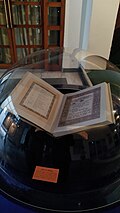
The constitution declares India a [[ | The constitution declares India a [[Sovereign state|sovereign]], [[Socialism in India|socialist]], [[Secularism in India|secular]],<ref>{{cite web|url=http://www.ncert.nic.in/html/pdf/schoolcurriculum/ncfsc/judge51_80.pdf#page=18|title=Aruna Roy & Ors. v. Union of India & Ors.|date=12 September 2002|publisher=Supreme Court of India|page=18/30|access-date=11 November 2015|archive-url=https://web.archive.org/web/20160507005232/http://www.ncert.nic.in/html/pdf/schoolcurriculum/ncfsc/judge51_80.pdf#page=18|archive-date=7 May 2016|url-status=live}}</ref> and [[Democracy in India|democratic republic]], assures its citizens [[justice]], [[equality before the law|equality]], and [[liberty]], and endeavours to promote [[Fraternity (philosophy)|fraternity]].<ref>{{cite web|title=Preamble of the Constitution of India|url=http://lawmin.nic.in/olwing/coi/coi-english/Const.Pock%202Pg.Rom8Fsss%283%29.pdf|publisher=Ministry of Law & Justice|access-date=29 March 2012|archive-url=https://web.archive.org/web/20171009180953/http://lawmin.nic.in/olwing/coi/coi-english/Const.Pock%202Pg.Rom8Fsss%283%29.pdf|archive-date=9 October 2017|url-status=dead}}</ref> The original 1950 constitution is preserved in a [[nitrogen]]-filled case at the Parliament Library Building in [[New Delhi]].<ref>{{Cite book |url=https://www.loc.gov/resource/llscd.57026883/?st=gallery |title=The Constitution of India |date=1950 |publisher=Photolithographed at the Survey of India Offices |language=english}}</ref><ref>{{Cite web |date=25 November 2021 |title=Constitution of India (Interesting Facts) |url=https://pib.gov.in/FactsheetDetails.aspx?Id=148584&lang=1®=3 |url-status=live |archive-url=https://web.archive.org/web/20250228085646/https://pib.gov.in/FactsheetDetails.aspx?Id=148584 |archive-date=28 Feb 2025 |publisher=[[Press Information Bureau]]}}</ref> | ||
==Background== | ==Background== | ||
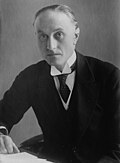
[[File:Sir Samuel Hoare GGBain.jpg|thumb|alt=Samuel Hoare|[[Samuel Hoare, 1st Viscount Templewood|Samuel Hoare]] significantly drafted the [[Government of India Act 1935]] which formed the basis for the Indian constitution.]] | |||
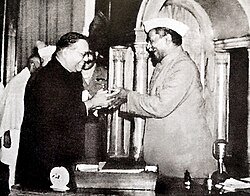
[[File:Dr. Babasaheb Ambedkar, chairman of the Drafting Committee, presenting the final draft of the Indian Constitution to Dr. Rajendra Prasad on 25 November, 1949.jpg|thumb|alt=A smiling Babasaheb Ambedkar and Rajendra Prasad|upright=1.2|[[Babasaheb Ambedkar]], chairman of the drafting committee, presenting the final draft of the Indian constitution to Constituent Assembly president [[Rajendra Prasad]] on 25 November 1949]] | [[File:Dr. Babasaheb Ambedkar, chairman of the Drafting Committee, presenting the final draft of the Indian Constitution to Dr. Rajendra Prasad on 25 November, 1949.jpg|thumb|alt=A smiling Babasaheb Ambedkar and Rajendra Prasad|upright=1.2|[[Babasaheb Ambedkar]], chairman of the drafting committee, presenting the final draft of the Indian constitution to Constituent Assembly president [[Rajendra Prasad]] on 25 November 1949]] | ||
In 1928, the [[All Parties Conference]] convened a committee in [[Lucknow]] to prepare the Constitution of India, which was known as the [[Nehru Report]].<ref name="ElsterGargarellaNareshRasch2018">{{cite book |last1=Elster |first1=Jon |last2=Gargarella |first2=Roberto |last3=Naresh |first3=Vatsal |last4=Rasch |first4=Bjørn Erik |title=Constituent Assemblies |date=2018 |publisher=Cambridge University Press |isbn=978-1-108-42752-4 |page=64 |language=en|quote=Nevertheless, partition increased the dominance of the Congress Party in the constituent assembly, which in turn made it easier for its leadership to incorporate in the constitution elements of its vision of Indian unity. This vision was based on a decades-long period of Congress-led consultation concerning the future independent constitution. More importantly, it rested on a detailed draft constitution adopted in 1928 by the All Parties Conference that met in Lucknow. The draft, known as the "Nehru Report," was written by a seven-member committee, chaired by Motilal Nehru. ... The committee was appointed during the May 1928 meeting of the All Parties Conference, which included representatives of all the major political organizations in India, including the All-India Hindu Mahasabha, the All-India Muslim League, the All-India Liberal Federation, the States' Peoples Conference, The Central Khalifat Committee, the All-India Conference of Indian Christians, and others.}}</ref> | In 1928, the [[All Parties Conference]] convened a committee in [[Lucknow]] to prepare the Constitution of India, which was known as the [[Nehru Report]].<ref name="ElsterGargarellaNareshRasch2018">{{cite book |last1=Elster |first1=Jon |last2=Gargarella |first2=Roberto |last3=Naresh |first3=Vatsal |last4=Rasch |first4=Bjørn Erik |title=Constituent Assemblies |date=2018 |publisher=Cambridge University Press |isbn=978-1-108-42752-4 |page=64 |language=en|quote=Nevertheless, partition increased the dominance of the Congress Party in the constituent assembly, which in turn made it easier for its leadership to incorporate in the constitution elements of its vision of Indian unity. This vision was based on a decades-long period of Congress-led consultation concerning the future independent constitution. More importantly, it rested on a detailed draft constitution adopted in 1928 by the All Parties Conference that met in Lucknow. The draft, known as the "Nehru Report," was written by a seven-member committee, chaired by Motilal Nehru. ... The committee was appointed during the May 1928 meeting of the All Parties Conference, which included representatives of all the major political organizations in India, including the All-India Hindu Mahasabha, the All-India Muslim League, the All-India Liberal Federation, the States' Peoples Conference, The Central Khalifat Committee, the All-India Conference of Indian Christians, and others.}}</ref> | ||
With the exception of scattered [[French India|French]] and [[Portuguese India|Portuguese]] exclaves, [[ | With the exception of scattered [[French India|French]] and [[Portuguese India|Portuguese]] exclaves, [[British Raj|India]] was under the [[British Raj|British rule]] from 1858 to 1947. From 1947 to 1950, the same legislation continued to be implemented as India was a [[Dominion of India|dominion]] of [[United Kingdom]] for these three years, as most of the princely states were convinced by [[Jawaharlal Nehru]], [[Sardar Patel]] and [[Louis Mountbatten]] to sign the [[Political integration of India|articles of integration]] with India, and the British Government continued to be responsible for the external security of the country.<ref name="Sanajaoba 1991 p. 223">{{cite book | last=Sanajaoba | first=N. | title=Law and Society: Strategy for Public Choice, 2001 | publisher=Mittal Publications | year=1991 | isbn=978-81-7099-271-4 | url=https://books.google.com/books?id=9eYC4tjzyi4C&pg=PA223 | quote=The princely states had been wooed by Mountbatten, Patel and Nehru to join the Indian Dominion | page=223 | access-date=15 March 2024 | archive-date=15 March 2024 | archive-url=https://web.archive.org/web/20240315055859/https://books.google.com/books?id=9eYC4tjzyi4C&pg=PA223 | url-status=live }}</ref><ref name="menon">{{cite book |last1=Menon |first1=V.P. |title=The story of the integration of the India states |date=15 September 1955 |publisher=Longman Greens and Co |location=Bangalore }}</ref> Thus, the constitution of India repealed the [[Indian Independence Act 1947]] and [[Government of India Act 1935]] when it became effective on 26 January 1950. India ceased to be a [[dominion]] of the [[The Crown|British Crown]] and became a sovereign, democratic republic with the constitution. Articles 5, 6, 7, 8, 9, 60, 324, 366, 367, 379, 380, 388, 391, 392, 393, and 394 of the constitution came into force on 26 November 1949, and the remaining articles became effective on 26 January 1950 which is celebrated every year in India as [[Republic Day (India)|Republic Day]].<ref name="cameintoforce">{{cite web | url = http://www.constitution.org/cons/india/p22394.html | title = Commencement | access-date = 20 February 2015 | archive-url = https://web.archive.org/web/20150220131327/http://www.constitution.org/cons/india/p22394.html | archive-date = 20 February 2015 | url-status = live }}</ref> | ||
{{anchor|Previous legislation used as sources}} | {{anchor|Previous legislation used as sources}} | ||
===Previous legislation=== | ===Previous legislation=== | ||
The constitution was drawn from a number of sources. Mindful of India's needs and conditions, its framers borrowed features of previous legislation such as the [[Government of India Act 1858]], the [[Indian Councils Act 1861|Indian Councils Acts of 1861]], [[Indian Councils Act 1892|1892]] and [[Indian Councils Act 1909|1909]], the Government of India Acts [[Government of India Act 1919|1919]] and [[Government of India Act 1935|1935]], and the [[Indian Independence Act 1947]]. The latter, which led to the creation of [[Pakistan]], divided the former Constituent Assembly in two. | The Indian constitution was drawn from a number of sources, mainly the [[Government of India Act 1935]] which was significantly drafted by [[Samuel Hoare, 1st Viscount Templewood|Samuel Hoare]].<ref name="c000">{{cite magazine | title=INDIA: Chariot of Freedom | magazine=TIME | date=1938-03-07 | url=https://time.com/archive/6758479/india-chariot-of-freedom/ | access-date=2025-04-14}}</ref> Mindful of India's needs and conditions, its framers borrowed features of previous legislation such as the [[Government of India Act 1858]], the [[Indian Councils Act 1861|Indian Councils Acts of 1861]], [[Indian Councils Act 1892|1892]] and [[Indian Councils Act 1909|1909]], the Government of India Acts [[Government of India Act 1919|1919]] and [[Government of India Act 1935|1935]], and the [[Indian Independence Act 1947]]. The latter, which led to the creation of [[Pakistan]], divided the former Constituent Assembly in two. Each new assembly had sovereign power to draft and enact a new constitution for the separate states.<ref name=":3" /> | ||
{{anchor|Constituent assembly}} | {{anchor|Constituent assembly}} | ||
==Constituent Assembly== | ==Constituent Assembly== | ||
{{Main|Constituent Assembly of India}} | {{Main|Constituent Assembly of India}} | ||
| Line 75: | Line 61: | ||
In the constitution assembly, a member of the drafting committee, [[T. T. Krishnamachari]] said: | In the constitution assembly, a member of the drafting committee, [[T. T. Krishnamachari]] said: | ||
{{ | {{blockquote|text=Mr. President, Sir, I am one of those in the House who have listened to [[Dr. Ambedkar]] very carefully. I am aware of the amount of work and enthusiasm that he has brought to bear on the work of drafting this Constitution. At the same time, I do realise that that amount of attention that was necessary for the purpose of drafting a constitution so important to us at this moment has not been given to it by the Drafting Committee. The House is perhaps aware that of the seven members nominated by you, one had resigned from the House and was replaced. One died and was not replaced. One was away in America and his place was not filled up and another person was engaged in State affairs, and there was a void to that extent. One or two people were far away from Delhi and perhaps reasons of health did not permit them to attend. So it happened ultimately that the burden of drafting this constitution fell on Dr. Ambedkar and I have no doubt that we are grateful to him for having achieved this task in a manner which is undoubtedly commendable.<ref>{{Cite web|url=https://indianexpress.com/article/opinion/columns/ambedkar-constitution-narendra-modi-govt-2851111/|title=Denying Ambedkar his due|first=D. |last=Raja |date=14 June 2016|access-date=6 April 2019|archive-url=https://web.archive.org/web/20190331065443/https://indianexpress.com/article/opinion/columns/ambedkar-constitution-narendra-modi-govt-2851111/|archive-date=31 March 2019|url-status=live}}</ref><ref>{{Cite web|url=http://164.100.47.194/loksabha/writereaddata/cadebatefiles/C05111948.html|title=Constituent Assembly of India Debates|website= |access-date=6 April 2019|archive-url=https://web.archive.org/web/20190107124534/http://164.100.47.194/loksabha/writereaddata/cadebatefiles/C05111948.html|archive-date=7 January 2019|url-status=live}}</ref>|author=|title=|source=}} | ||
[[B. R. Ambedkar]] in his concluding speech in constituent assembly on 25 November 1949 stated that:<ref>{{Cite web|title=Dr B.R. Ambedkar concluding speech in constituent assembly on November 25, 1949|url=http://prasarbharati.gov.in/whatsnew/whatsnew_653363.pdf|access-date=4 January 2020|archive-date=2 August 2020|archive-url=https://web.archive.org/web/20200802033306/http://prasarbharati.gov.in/whatsnew/whatsnew_653363.pdf|url-status=live}}</ref> | |||
{{Blockquote | {{Blockquote | ||
|The credit that is given to me does not really belong to me. It belongs partly to | |The credit that is given to me does not really belong to me. It belongs partly to [[B. N. Rau|Sir B.N. Rau]] the Constitutional Advisor to the Constituent Assembly who prepared a rough draft of the Constitution for the consideration of Drafting Committee. | ||
}}While deliberating the revised draft constitution, the assembly moved, discussed and disposed off 2,473 amendments out of a total of 7,635.<ref name=":3" /><ref>{{cite web|url=http://parliamentofindia.nic.in/ls/debates/facts.htm|title=First Day in the Constituent Assembly|publisher=Parliament of India|archive-url=https://web.archive.org/web/20110511104514/http://parliamentofindia.nic.in/ls/debates/facts.htm|archive-date=11 May 2011|url-status=dead|access-date=12 May 2014|df=dmy}}</ref> | A part of the credit must go to the members of the Drafting Committee who, as I have said, have sat for 141 days and without whose ingenuity to devise new formulae and capacity to tolerate and to accommodate different points of view, the task of framing the Constitution could not have come to so successful a conclusion. Much greater share of the credit must go to Mr. S. N. Mukherjee, the Chief Draftsman of the Constitution. His ability to put the most intricate proposals in the simplest and clearest legal form can rarely be equalled, nor his capacity for hard work. He has been an acquisition to the Assembly. Without his help this Assembly would have taken many more years to finalise the Constitution. I must not omit to mention the members of the staff working under Mr. Mukherjee. For, I known how hard they worked and how long they have toiled sometimes even beyond midnight. I want to thank them all for their effort and their co-operation. }}While deliberating the revised draft constitution, the assembly moved, discussed and disposed off 2,473 amendments out of a total of 7,635.<ref name=":3" /><ref>{{cite web|url=http://parliamentofindia.nic.in/ls/debates/facts.htm|title=First Day in the Constituent Assembly|publisher=Parliament of India|archive-url=https://web.archive.org/web/20110511104514/http://parliamentofindia.nic.in/ls/debates/facts.htm|archive-date=11 May 2011|url-status=dead|access-date=12 May 2014|df=dmy}}</ref> | ||
=== Timeline of formation of the Constitution of India === | === Timeline of formation of the Constitution of India === | ||
* '''6 December 1946:''' Formation of the Constitution Assembly (in accordance with French practice). | * '''6 December 1946:''' Formation of the Constitution Assembly (in accordance with French practice).<ref name=":1000">{{cite web | ||
* '''9 December 1946:''' The first meeting was held in the constitution hall (now the [[Parliament of India|Central Hall of Parliament House]]).<ref name=": | |title=Evolution of the Indian Constitution | ||
* '''11 December 1946:''' The Assembly appointed [[Rajendra Prasad]] as its president,<ref name=":8" /> [[Harendra Coomar Mookerjee|H. C. Mukherjee]] as its vice-president and, [[B. N. Rau]] as constitutional legal adviser. | |url=http://www.surendranatheveningcollege.com/wp-content/uploads/2020/01/Evolution-of-Indian-Constitution.pdf | ||
* '''13 December 1946:''' An "Objective Resolution" was presented by [[Jawaharlal Nehru]], | |website=Surendranath Evening College | ||
* '''22 January 1947:''' Objective resolution unanimously adopted. | |access-date=28 September 2024 | ||
* '''22 July 1947:''' [[Flag of India|National flag]] adopted. | |language=en | ||
* '''15 August 1947:''' Achieved independence. India split into the [[Dominion of India]] and the [[Dominion of Pakistan]]. | }}</ref> | ||
* '''29 August 1947:''' Drafting Committee appointed with [[B. R. Ambedkar]] as its | * '''9 December 1946:''' The first meeting was held in the constitution hall (now the [[Parliament of India|Central Hall of Parliament House]]).<ref name=":1000"/> The 1st person to address was [[J. B. Kripalani]], [[Sachchidananda Sinha]] became temporary president. (Demanding a separate state, the Muslim League boycotted the meeting.)<ref>{{cite web | ||
* '''16 July 1948:''' Along with [[Harendra Coomar Mookerjee]], [[V. T. Krishnamachari]] was also elected as second vice-president of Constituent Assembly. | |title=Civics and Polity: The Making of Indian Constitution | ||
|url=https://leverageedu.com/discover/general-knowledge/civics-and-polity-the-making-of-indian-constitution/ | |||
|website=Leverage Edu | |||
|date=10 April 2024 | |||
|access-date=28 September 2024 | |||
|language=en | |||
}}</ref> | |||
* '''11 December 1946:''' The Assembly appointed [[Rajendra Prasad]] as its president,<ref name=":8">{{Cite news |date=25 January 2020 |title=Making of the Indian Constitution |url=http://employmentnews.gov.in/NewEmp/MoreContentNew.aspx?n=SpecialContent&k=40367 |url-status=live |archive-url=https://web.archive.org/web/20210714201706/http://employmentnews.gov.in/NewEmp/MoreContentNew.aspx?n=SpecialContent&k=40367 |archive-date=14 July 2021 |access-date=14 July 2021 |work=Employment News}}</ref> [[Harendra Coomar Mookerjee|H. C. Mukherjee]] as its vice-president and, [[B. N. Rau]] as constitutional legal adviser. (There were initially 389 members in total, which declined to 299 after [[Partition of India|partition]], out of the 389 members, 292 were from government provinces, four from chief commissioner provinces and 93 from princely states.) | |||
* '''13 December 1946:''' An "Objective Resolution" was presented by [[Jawaharlal Nehru]], laying down the underlying principles of the constitution. This later became the Preamble of the Constitution. | |||
* '''22 January 1947:''' Objective resolution unanimously adopted. | |||
* '''22 July 1947:''' [[Flag of India|National flag]] adopted.<ref>{{cite web|url=https://knowindia.india.gov.in/my-india-my-pride/indian-tricolor.php#:~:text=The%20National%20Flag%20of%20India,British%20on%2015%20August%2C%201947.|title=History Of Indian Tricolor|access-date=10 September 2023|archive-date=7 March 2023|archive-url=https://web.archive.org/web/20230307084402/https://knowindia.india.gov.in/my-india-my-pride/indian-tricolor.php#:~:text=The%20National%20Flag%20of%20India,British%20on%2015%20August%2C%201947.|url-status=live}}</ref> | |||
* '''15 August 1947:''' Achieved independence. India split into the [[Dominion of India]] and the [[Dominion of Pakistan]].<ref name=":1000"/> | |||
* '''29 August 1947:''' Drafting Committee appointed with [[B. R. Ambedkar]] as its chairman. The other six members of committee were [[Kanaiyalal Maneklal Munshi|K.M. Munshi]], [[Muhammed Saadulah|Muhammed Sadulla]], [[Alladi Krishnaswamy Iyer]], [[N. Gopalaswami Ayyangar]], Devi Prasad Khaitan<ref>{{Cite web |title=On Republic Day, Gautam Khaitan remembers great-grandfather, an architect of Indian Constitution |url=https://www.aninews.in/news/business/on-republic-day-gautam-khaitan-remembers-great-grandfather-an-architect-of-indian-constitution20210126104302/ |access-date=2023-04-16 |website=ANI News |language=en |archive-date=16 April 2023 |archive-url=https://web.archive.org/web/20230416152813/https://www.aninews.in/news/business/on-republic-day-gautam-khaitan-remembers-great-grandfather-an-architect-of-indian-constitution20210126104302/ |url-status=live }}</ref> and BL Mitter.<ref>{{Cite web |last=AK |first=Aditya |title=Republic Day: The Lawyers who helped draft the Constitution of India |url=https://www.barandbench.com/columns/republic-day-lawyers-constitution-india |access-date=2023-04-16 |website=Bar and Bench - Indian Legal news |date=26 January 2018 |language=en |archive-date=17 September 2023 |archive-url=https://web.archive.org/web/20230917112501/https://www.barandbench.com/columns/republic-day-lawyers-constitution-india |url-status=live }}</ref> | |||
* '''16 July 1948:''' Along with [[Harendra Coomar Mookerjee]], [[V. T. Krishnamachari]] was also elected as second vice-president of Constituent Assembly.<ref>{{cite web|url=https://nationaldefenceinstitute.in/article/evolution-of-indian-constitution|title=The Making and Evolution of Indian Constitution|access-date=10 September 2023|archive-date=17 September 2023|archive-url=https://web.archive.org/web/20230917112520/https://nationaldefenceinstitute.in/article/evolution-of-indian-constitution|url-status=live}}</ref> | |||
* '''26 November 1949:''' The Constitution of India was passed and adopted by the assembly.<ref name=":8" /> | * '''26 November 1949:''' The Constitution of India was passed and adopted by the assembly.<ref name=":8" /> | ||
* '''24 January 1950:''' Last meeting of Constituent Assembly. The Constitution was signed and accepted (with 395 Articles, 8 Schedules, and 22 Parts). | * '''24 January 1950:''' Last meeting of Constituent Assembly. The Constitution was signed and accepted (with 395 Articles, 8 Schedules, and 22 Parts).<ref>{{cite web|url=https://eoi.gov.in/eoisearch/MyPrint.php?4645%3F000%2F0001|title=CONSTITUTION OF INDIA|access-date=10 September 2023|archive-date=14 April 2023|archive-url=https://web.archive.org/web/20230414105714/https://eoi.gov.in/eoisearch/MyPrint.php?4645%3F000%2F0001|url-status=live}}</ref> | ||
* '''26 January 1950:''' The Constitution came into force. (The process took 2 years, 11 months and 18 | * '''26 January 1950:''' The Constitution came into force. (The process took 2 years, 11 months and 18 days<ref name=":1000"/>—at a total expenditure of ₹6.4 million to finish.)<ref>{{cite web | ||
[[Ganesh Vasudev Mavalankar|G. V. Mavlankar]] was the first [[Speaker of the Lok Sabha]] (the lower house of Parliament) after India turned into a republic. | |title=Interesting Facts About the Indian Constitution | ||
|url=https://bpac.in/interesting-facts-about-indian-constitution/ | |||
|website=BPAC | |||
|date=25 November 2022 | |||
|access-date=28 September 2024 | |||
|publisher=Bangalore Political Action Committee | |||
|language=en | |||
}}</ref> | |||
[[Ganesh Vasudev Mavalankar|G. V. Mavlankar]] was the first [[Speaker of the Lok Sabha]] (the lower house of Parliament) after India turned into a republic.<ref>{{cite web | |||
|title=G. V. Mavalankar | |||
|url=https://www.constitutionofindia.net/members/g-v-mavalankar/ | |||
|website=Constitution of India | |||
|access-date=28 September 2024 | |||
|publisher=Constitution of India Website | |||
|language=en | |||
}}</ref> | |||
{{anchor|Membership and structure}} | {{anchor|Membership and structure}} | ||
===Membership=== | ===Membership=== | ||
[[B. R. Ambedkar]], Sanjay Phakey, [[Jawaharlal Nehru]], [[C. Rajagopalachari]], [[Rajendra Prasad]], [[Vallabhbhai Patel]], [[Kanaiyalal Maneklal Munshi]], [[Ganesh Vasudev Mavalankar]], Sandipkumar Patel, [[Abul Kalam Azad]], [[Syama Prasad Mookerjee|Shyama Prasad Mukherjee]], [[N. R. Ghosh|Nalini Ranjan Ghosh]], and [[Balwantrai Mehta]] were key figures in the assembly,<ref name=":2" /><ref name=":3" /> which had over 30 representatives of the [[Scheduled Castes and Scheduled Tribes|scheduled classes]]. [[Frank Anthony]] represented the [[Anglo-Indian|Anglo-Indian community]],<ref name=":2" /> and the [[Parsi]]s were represented by H. P. Modi.<ref name=":2" /> [[Harendra Coomar Mookerjee]], a Christian assembly vice-president, chaired the minorities committee and represented non-Anglo-Indian Christians.<ref name=":2" /> Ari Bahadur Gurung represented the Gorkha community.<ref name=":2" /> Judges, such as [[Alladi Krishnaswamy Iyer]], [[B. N. Rau|Benegal Narsing Rau]], [[K. M. Munshi]] and [[Ganesh Mavlankar]] were members of the assembly.<ref name=":2" /> Female members included [[Sarojini Naidu]], [[Hansa Jivraj Mehta|Hansa Mehta]], [[Durgabai Deshmukh]], [[Amrit Kaur]] and [[Vijaya Lakshmi Pandit]].<ref name=":2" /> | [[B. R. Ambedkar]], Sanjay Phakey, [[Jawaharlal Nehru]], [[C. Rajagopalachari]], [[Rajendra Prasad]], [[Vallabhbhai Patel]], [[Kanaiyalal Maneklal Munshi]], [[Ganesh Vasudev Mavalankar]], Sandipkumar Patel, [[Abul Kalam Azad]], [[Syama Prasad Mookerjee|Shyama Prasad Mukherjee]], [[N. R. Ghosh|Nalini Ranjan Ghosh]], and [[Balwantrai Mehta]] were key figures in the assembly,<ref name=":2" /><ref name=":3" /> which had over 30 representatives of the [[Scheduled Castes and Scheduled Tribes|scheduled classes]]. [[Frank Anthony]] represented the [[Anglo-Indian|Anglo-Indian community]],<ref name=":2" /> and the [[Parsi]]s were represented by H. P. Modi.<ref name=":2" /> [[Harendra Coomar Mookerjee]], a Christian assembly vice-president, chaired the minorities committee and represented non-Anglo-Indian Christians.<ref name=":2" /> Ari Bahadur Gurung represented the Gorkha community.<ref name=":2" /> Judges, such as [[Alladi Krishnaswamy Iyer]], [[B. N. Rau|Benegal Narsing Rau]], [[K. M. Munshi]] and [[Ganesh Mavlankar]] were members of the assembly.<ref name=":2" /> Female members included [[Sarojini Naidu]], [[Hansa Jivraj Mehta|Hansa Mehta]], [[Durgabai Deshmukh]], [[Amrit Kaur]] and [[Vijaya Lakshmi Pandit]].<ref name=":2" /> | ||
| Line 107: | Line 120: | ||
===Drafting=== | ===Drafting=== | ||
Sir [[B. N. Rau]], a [[Indian Civil Service (British India)|civil servant]] who became the first [[Judges of the International Court of Justice|Indian judge]] in the [[International Court of Justice]] and was [[president of the United Nations Security Council]], was appointed as the assembly's constitutional | Sir [[B. N. Rau]], a [[Indian Civil Service (British India)|civil servant]] who became the first [[Judges of the International Court of Justice|Indian judge]] in the [[International Court of Justice]] and was [[president of the United Nations Security Council]], was appointed as the assembly's constitutional advisor in 1946.<ref name=":4">{{Cite news|url=https://www.dailypioneer.com/state-editions/bhubaneswar/bn-rau-the-forgotten-architect-of-indian-constitution.html|title=BN Rau: The Forgotten Architect of Indian Constitution|last=Patnaik|first=Biswaraj|date=26 January 2017|work=[[The Pioneer (newspaper)|The Pioneer]]|access-date=24 July 2018|publisher=[[Chandan Mitra]]|location=[[Bhubaneswar]]|archive-url=https://web.archive.org/web/20180724032338/https://www.dailypioneer.com/state-editions/bhubaneswar/bn-rau-the-forgotten-architect-of-indian-constitution.html|archive-date=24 July 2018|url-status=live}}</ref> Responsible for the constitution's general structure, Rau prepared its initial draft in February 1948.<ref name=":4" /><ref>{{cite web |url=http://arunshourie.voiceofdharma.com/articles/ambedkar.htm |work=The Arun Shourie Site |title=The Manu of Our Times? |first=Arun |last=Shourie |access-date=2013-06-13 |url-status=dead |archive-url=https://web.archive.org/web/20120220030736/http://arunshourie.voiceofdharma.com/articles/ambedkar.htm |archive-date=20 February 2012 |df=dmy-all}}</ref><ref name=":6">{{cite news|url=https://www.thehindu.com/specials/in-depth/november-26-celebrating-constitution-day/article10229384.ece|title=Celebrating Constitution Day|date=26 November 2015|work=[[The Hindu]]|access-date=26 July 2018|issn=0971-751X|oclc=13119119|archive-url=https://web.archive.org/web/20190627061858/https://www.thehindu.com/specials/in-depth/november-26-celebrating-constitution-day/article10229384.ece|archive-date=27 June 2019|url-status=live}}</ref> The draft of B.N. Rau consisted of 243 articles and 13 schedules which came to 395 articles and 8 schedules after discussions, debates and amendments.<ref>{{Cite web|url=http://164.100.47.194/loksabha/writereaddata/cadebatefiles/C26111949.pdf|title=Constituent Assembly of India Debates|access-date=4 January 2020|archive-date=1 August 2020|archive-url=https://web.archive.org/web/20200801211307/http://164.100.47.194/loksabha/writereaddata/cadebatefiles/C26111949.pdf|url-status=live}}</ref> | ||
At 14 August 1947 meeting of the assembly, committees were proposed.<ref name="Degbate"/> Rau's draft was considered, debated and amended by the | At 14 August 1947 meeting of the assembly, committees were proposed.<ref name="Degbate"/> Rau's draft was considered, debated and amended by the seven-member drafting committee, which was appointed on 29 August 1947 with [[B. R. Ambedkar]] as chair.<ref name=":2" /><ref name=":5" /> A revised draft constitution was prepared by the committee and submitted to the assembly on 4 November 1947.<ref name=":5" /> | ||
Before adopting the constitution, the assembly held eleven sessions in 165 days.<ref name=":2" /><ref name=":3" /> On 26 November 1949, it adopted the constitution,<ref name=":2" /><ref name=":3" /><ref name=":5" /><ref name=":6" /><ref name=":7">{{cite web|url=http://parliamentofindia.nic.in/ls/debates/facts.htm|title=Some Facts of Constituent Assembly|work=Parliament of India|publisher=National Informatics Centre|archive-url=https://web.archive.org/web/20110511104514/http://parliamentofindia.nic.in/ls/debates/facts.htm|archive-date=11 May 2011|url-status=dead|access-date=14 April 2011|quote=On 29 August 1947, the Constituent Assembly set up a Drafting Committee under the Chairmanship of B. R. Ambedkar to prepare a Draft Constitution for India|df=dmy}}</ref> which was signed by 284 members.<ref name=":2" /><ref name=":3" /><ref name=":5" /><ref name=":6" /><ref name=":7" /> The day is celebrated as National Law Day,<ref name=":2" /><ref>{{cite news |url=http://www.firstpost.com/india/on-national-law-day-saluting-two-remarkable-judges-140748.html |title=On National Law Day, saluting two remarkable judges |archive-url=https://web.archive.org/web/20151130023311/http://www.firstpost.com/india/on-national-law-day-saluting-two-remarkable-judges-140748.html |archive-date=30 November 2015 |work=First Post |date=26 November 2011 |first=Raghul |last=Sudheesh}}</ref> or [[Constitution Day (India)|Constitution Day]].<ref name=":2" /><ref>{{cite news |url=http://www.dnaindia.com/india/report-pm-modi-greets-people-on-constitution-day-2149048 |title=PM Modi greets people on Constitution Day |archive-url=https://web.archive.org/web/20151127030239/http://www.dnaindia.com/india/report-pm-modi-greets-people-on-constitution-day-2149048 |archive-date=27 November 2015 |work=DNA India |date=26 November 2015}}</ref> The day was chosen to spread the importance of the constitution and to spread thoughts and ideas of Ambedkar.<ref>{{cite news|title=November 26 to be observed as Constitution Day: Facts on the Constitution of India|url=http://indiatoday.intoday.in/education/story/constitution-of-india/1/496659.html|access-date=20 November 2015|work=India Today|date=12 October 2015|archive-url=https://web.archive.org/web/20151114203645/http://indiatoday.intoday.in/education/story/constitution-of-india/1/496659.html|archive-date=14 November 2015|url-status= | Before adopting the constitution, the assembly held eleven sessions in 165 days.<ref name=":2" /><ref name=":3" /> On 26 November 1949, it adopted the constitution,<ref name=":2" /><ref name=":3" /><ref name=":5" /><ref name=":6" /><ref name=":7">{{cite web|url=http://parliamentofindia.nic.in/ls/debates/facts.htm|title=Some Facts of Constituent Assembly|work=Parliament of India|publisher=National Informatics Centre|archive-url=https://web.archive.org/web/20110511104514/http://parliamentofindia.nic.in/ls/debates/facts.htm|archive-date=11 May 2011|url-status=dead|access-date=14 April 2011|quote=On 29 August 1947, the Constituent Assembly set up a Drafting Committee under the Chairmanship of B. R. Ambedkar to prepare a Draft Constitution for India|df=dmy}}</ref> which was signed by 284 members.<ref name=":2" /><ref name=":3" /><ref name=":5" /><ref name=":6" /><ref name=":7" /> The day is celebrated as National Law Day,<ref name=":2" /><ref>{{cite news |url=http://www.firstpost.com/india/on-national-law-day-saluting-two-remarkable-judges-140748.html |title=On National Law Day, saluting two remarkable judges |archive-url=https://web.archive.org/web/20151130023311/http://www.firstpost.com/india/on-national-law-day-saluting-two-remarkable-judges-140748.html |archive-date=30 November 2015 |work=First Post |date=26 November 2011 |first=Raghul |last=Sudheesh}}</ref> or [[Constitution Day (India)|Constitution Day]].<ref name=":2" /><ref>{{cite news |url=http://www.dnaindia.com/india/report-pm-modi-greets-people-on-constitution-day-2149048 |title=PM Modi greets people on Constitution Day |archive-url=https://web.archive.org/web/20151127030239/http://www.dnaindia.com/india/report-pm-modi-greets-people-on-constitution-day-2149048 |archive-date=27 November 2015 |work=DNA India |date=26 November 2015}}</ref> The day was chosen to spread the importance of the constitution and to spread thoughts and ideas of Ambedkar.<ref>{{cite news|title=November 26 to be observed as Constitution Day: Facts on the Constitution of India|url=http://indiatoday.intoday.in/education/story/constitution-of-india/1/496659.html|access-date=20 November 2015|work=India Today|date=12 October 2015|archive-url=https://web.archive.org/web/20151114203645/http://indiatoday.intoday.in/education/story/constitution-of-india/1/496659.html|archive-date=14 November 2015|url-status=dead}}</ref> | ||
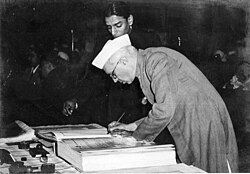
[[File:Jawaharlal Nehru signing Indian Constitution.jpg|thumb|alt=A bespectacled Jawaharlal Nehru bending over a large book|[[Jawaharlal Nehru]] signing the constitution]] | [[File:Jawaharlal Nehru signing Indian Constitution.jpg|thumb|alt=A bespectacled Jawaharlal Nehru bending over a large book|[[Jawaharlal Nehru]] signing the constitution]] | ||
| Line 121: | Line 134: | ||
!Influence | !Influence | ||
|- | |- | ||
|{{flagicon|UK}} [[Constitution of the United Kingdom|United Kingdom]]<ref name=":2" /><ref name="CoI">{{cite news |title=Constitution Day: Borrowed features in the Indian Constitution from other countries |url=https://www.indiatoday.in/education-today/gk-current-affairs/story/constitution-day-borrowed-features-in-the-indian-constitution-1622632-2019-11-26 |access-date=12 July 2021 |work=India Today |language=en}}</ref> | |{{flagicon|UK}} [[Constitution of the United Kingdom|United Kingdom]]<ref name=":2" /><ref name="CoI">{{cite news |title=Constitution Day: Borrowed features in the Indian Constitution from other countries |url=https://www.indiatoday.in/education-today/gk-current-affairs/story/constitution-day-borrowed-features-in-the-indian-constitution-1622632-2019-11-26 |access-date=12 July 2021 |work=India Today |language=en |archive-date=7 March 2021 |archive-url=https://web.archive.org/web/20210307090944/https://www.indiatoday.in/education-today/gk-current-affairs/story/constitution-day-borrowed-features-in-the-indian-constitution-1622632-2019-11-26 |url-status=live }}</ref> | ||
| | | | ||
* [[Westminster system|Parliamentary government]] | * [[Westminster system|Parliamentary government]] | ||
* Nominal [[Head of state|head of the state]]<ref name="CoI"/> | * Nominal [[Head of state|head of the state]]<ref name="CoI"/> | ||
* Post of [[Prime Minister]] | * Post of [[Prime Minister of India|Prime Minister]] | ||
* More powerful [[Lok Sabha|lower house]]<ref name="CoI"/> | * More powerful [[Lok Sabha|lower house]]<ref name="CoI"/> | ||
* Concept of single citizenship | * Concept of single citizenship | ||
| Line 131: | Line 144: | ||
* [[Bicameralism|Bicameral legislature]]<ref name="CoI"/> | * [[Bicameralism|Bicameral legislature]]<ref name="CoI"/> | ||
* [[Rule of law]] | * [[Rule of law]] | ||
* [[ | * [[Union Council of Ministers|Cabinet system]]<ref name="CoI"/> | ||
* The [[Speaker of the Lok Sabha|legislative speaker]] and their role | * The [[Speaker of the Lok Sabha|legislative speaker]] and their role | ||
* [[Prerogative writ]]<ref name="CoI"/> | * [[Prerogative writ]]<ref name="CoI"/> | ||
| Line 142: | Line 155: | ||
* [[Preamble to the Constitution of India|Preamble to the Constitution]] | * [[Preamble to the Constitution of India|Preamble to the Constitution]] | ||
* [[Federation|Federal structure of government]]<ref name=":2" /> | * [[Federation|Federal structure of government]]<ref name=":2" /> | ||
* [[President of India#Impeachment|Impeachment of the | * [[President of India#Impeachment|Impeachment of the president]]<ref name="CoI"/> | ||
* Post of the [[Vice President of India| | * Post of the [[Vice President of India|vice president]] and his functions<ref name="CoI"/> | ||
* The institution of the [[Supreme Court of India|Supreme Court]]<ref name="CoI"/> | * The institution of the [[Supreme Court of India|Supreme Court]]<ref name="CoI"/> | ||
* Removal of | * Removal of Supreme Court and [[High courts of India|High courts]] judges<ref name="CoI"/> | ||
* [[Electoral College]] | * [[Electoral College (India)|Electoral College]] | ||
* Independent judiciary and separation of powers | * Independent judiciary and separation of powers{{citation needed|reason=''The Presidential system of America is based upon the separation of the Executive and the Legislature. So that the President and his Secretaries cannot be members of the Congress. The Draft Constitution does not recognise this doctrine.'' https://www.constitutionofindia.net/debates/04-nov-1948/ #7.48.200|date=March 2025}} | ||
* [[Judicial review]] | * [[Judicial review in India|Judicial review]] | ||
* President as commander-in-chief of the armed forces | * President as [[commander-in-chief]] of the [[Indian Armed Forces|armed forces]] | ||
* [[Equal Protection Clause|Equal protection under law]] | * [[Equal Protection Clause|Equal protection under law]] | ||
|- | |- | ||
| Line 155: | Line 168: | ||
| | | | ||
* [[Fundamental Rights, Directive Principles and Fundamental Duties of India|Directive principles of state policy]]<ref name=":5" /> | * [[Fundamental Rights, Directive Principles and Fundamental Duties of India|Directive principles of state policy]]<ref name=":5" /> | ||
* [[List of nominated members of the Rajya Sabha|Nomination of members]] to the [[Rajya Sabha]] by the | * [[List of nominated members of the Rajya Sabha|Nomination of members]] to the [[Rajya Sabha]] by the president<ref name="CoI"/> | ||
* Method of election of the [[President of India#Election process| | * Method of election of the [[President of India#Election process|president]]<ref name="CoI"/> | ||
|- | |- | ||
|{{flagicon|AUS}} [[Constitution of Australia|Australia]] | |{{flagicon|AUS}} [[Constitution of Australia|Australia]] | ||
| | | | ||
* Freedom of trade between states<ref name=":3" /> | * Freedom of trade between states<ref name=":3" /> | ||
* | * Federal legislative power to implement treaties, even on matters outside normal federal jurisdiction | ||
* [[Concurrent List]]<ref>{{cite web|last1=Sridhar|first1=Madabhushi|title=Evolution and Philosophy behind the Indian Constitution (page 22)|url=http://www.hrdiap.gov.in/87fc/images11/4.pdf#page=22|url-status=dead|archive-url=https://web.archive.org/web/20150616054514/http://www.hrdiap.gov.in/87fc/images11/4.pdf#page=22|archive-date=16 June 2015|access-date=22 October 2015|publisher=Dr.Marri Channa Reddy Human Resource Development Institute (Institute of Administration), Hyderabad.}}</ref> | * [[Concurrent List]]<ref>{{cite web|last1=Sridhar|first1=Madabhushi|title=Evolution and Philosophy behind the Indian Constitution (page 22)|url=http://www.hrdiap.gov.in/87fc/images11/4.pdf#page=22|url-status=dead|archive-url=https://web.archive.org/web/20150616054514/http://www.hrdiap.gov.in/87fc/images11/4.pdf#page=22|archive-date=16 June 2015|access-date=22 October 2015|publisher=Dr.Marri Channa Reddy Human Resource Development Institute (Institute of Administration), Hyderabad.}}</ref> | ||
* Provision of [[Joint Session of the Parliament of India|Joint Session of the Parliament]]<ref name="CoI"/> | * Provision of [[Joint Session of the Parliament of India|Joint Session of the Parliament]]<ref name="CoI"/> | ||
| Line 175: | Line 188: | ||
* Quasi-federal government—a federal system with a strong central government<ref name=":3" /> | * Quasi-federal government—a federal system with a strong central government<ref name=":3" /> | ||
* Distribution of powers between the [[Union List|central]] and [[State List|state]] governments<ref name=":2" /><ref name=":3" /> | * Distribution of powers between the [[Union List|central]] and [[State List|state]] governments<ref name=":2" /><ref name=":3" /> | ||
* [[Reserved powers|Residual powers]], retained by the central government<ref>{{Cite web|last=Bélanger|first=Claude|title=Quebec History|url=http://faculty.marianopolis.edu/c.belanger/QuebecHistory/federal/residual.htm|access-date=2020-06-27|website=faculty.marianopolis.edu}}</ref> | * [[Reserved powers|Residual powers]], retained by the central government<ref>{{Cite web|last=Bélanger|first=Claude|title=Quebec History|url=http://faculty.marianopolis.edu/c.belanger/QuebecHistory/federal/residual.htm|access-date=2020-06-27|website=faculty.marianopolis.edu|archive-date=28 October 2020|archive-url=https://web.archive.org/web/20201028221550/http://faculty.marianopolis.edu/c.belanger/quebechistory/federal/residual.htm|url-status=live}}</ref> | ||
* Appointment of [[Governor (India)|Governor of states]] by Centre<ref name="CoI"/> | * Appointment of [[Governor (India)|Governor of states]] by Centre<ref name="CoI"/> | ||
* Advisory jurisdiction of the Supreme Court<ref name="CoI"/> | * Advisory jurisdiction of the Supreme Court<ref name="CoI"/> | ||
| Line 202: | Line 215: | ||
==Structure== | ==Structure== | ||
{{Constitution of India}} | {{Constitution of India}} | ||
The Indian constitution is the world's longest for a sovereign nation.<ref name=":2" /><ref name=":0" /><ref name=":1" /> At its enactment, it had 395 articles in 22 parts and 8 schedules.{{Efn|Although the last article of the 1974 Constitution of Yugoslavia was Article 406, the Yugoslav constitution contained about 56,000 words in its English translation|name=Yugoslavian constitution}}<ref name=":3" /> At about 145,000 words, it is the second-longest active constitution—after the [[Constitution of Alabama]]—in the world.<ref>{{Cite news|url=https://www.annistonstar.com/is-the-alabama-constitution-the-longest-constitution-in-the-world/article_c928bd51-fbf1-5056-a30c-1bf4b19eb012.html|title=Is the Alabama Constitution the longest constitution in the world?Truth Rating: 4 out of 5|last=Lockette|first=Tim|date=18 November 2012|work=[[The Anniston Star]]|access-date=24 July 2018|publisher=Josephine Ayers|archive-url=https://web.archive.org/web/20190517050147/https://www.annistonstar.com/is-the-alabama-constitution-the-longest-constitution-in-the-world/article_c928bd51-fbf1-5056-a30c-1bf4b19eb012.html|archive-date=17 May 2019|url-status=live}}</ref> | The Indian constitution is the world's longest for a [[Sovereign state|sovereign]] nation.<ref name=":2" /><ref name=":0" /><ref name=":1">{{Cite news |last=Nix |first=Elizabeth |date=9 August 2016 |title=Which country has the world's shortest written constitution? |url=https://www.history.com/news/which-country-has-the-worlds-shortest-written-constitution |url-status=live |archive-url=https://web.archive.org/web/20180724062544/https://www.history.com/news/which-country-has-the-worlds-shortest-written-constitution |archive-date=24 July 2018 |access-date=24 July 2018 |work=[[History (U.S. TV network)|History]] |publisher=[[A&E Networks]]}}</ref> At its enactment, it had 395 articles in 22 parts and 8 schedules.{{Efn|Although the last article of the 1974 Constitution of Yugoslavia was Article 406, the Yugoslav constitution contained about 56,000 words in its English translation|name=Yugoslavian constitution}}<ref name=":3" /> At about 145,000 words, it is the second-longest active constitution—after the [[Constitution of Alabama]]—in the world.<ref>{{Cite news|url=https://www.annistonstar.com/is-the-alabama-constitution-the-longest-constitution-in-the-world/article_c928bd51-fbf1-5056-a30c-1bf4b19eb012.html|title=Is the Alabama Constitution the longest constitution in the world?Truth Rating: 4 out of 5|last=Lockette|first=Tim|date=18 November 2012|work=[[The Anniston Star]]|access-date=24 July 2018|publisher=Josephine Ayers|archive-url=https://web.archive.org/web/20190517050147/https://www.annistonstar.com/is-the-alabama-constitution-the-longest-constitution-in-the-world/article_c928bd51-fbf1-5056-a30c-1bf4b19eb012.html|archive-date=17 May 2019|url-status=live}}</ref> | ||
The constitution has a preamble and 470 articles,{{efn|name="prashant"|Although the last article of the constitution is Article 395, the total number in March 2013 was 465. New articles added through amendments have been inserted in the relevant location of the original constitution. To not disturb the original numbering, new articles are inserted alphanumerically; Article 21A, pertaining to the right to education, was inserted by the 86th Amendment Act.}} which are grouped into 25 parts.{{Efn|name="Parts"|The Constitution was in 22 Parts originally. Part VII & IX (older) was repealed in 1956, whereas newly added Part IVA, IXA, IXB & XIVA by Amendments to the Constitution in different times (lastly added IXB by the 97th Amendment).}}<ref name=":5" /> With 12 schedules{{efn|name="Schedules"|By 73rd | The amended constitution has a preamble and 470 articles,{{efn|name="prashant"|Although the last article of the constitution is Article 395, the total number in March 2013 was 465. New articles added through amendments have been inserted in the relevant location of the original constitution. To not disturb the original numbering, new articles are inserted alphanumerically; Article 21A, pertaining to the right to education, was inserted by the 86th Amendment Act.}} which are grouped into 25 parts.{{Efn|name="Parts"|The Constitution was in 22 Parts originally. Part VII & IX (older) was repealed in 1956, whereas newly added Part IVA, IXA, IXB & XIVA by Amendments to the Constitution in different times (lastly added IXB by the 97th Amendment).}}<ref name=":5" /> With 12 schedules{{efn|name="Schedules"|By the 73rd and 74th Amendments, the lists of administrative subjects of Panchayat raj & Municipality were included in the Constitution as Schedules 11 and 12 respectively in the year 1993.}} and five appendices,<ref name=":5" /><ref>{{cite web|url= http://lawmin.nic.in/coi/contents.htm|title= Constitution of india|publisher= [[Ministry of Law and Justice (India)|Ministry of Law and Justice, Govt. of India]]|access-date= 4 July 2010|archive-url= https://web.archive.org/web/20160325025912/http://lawmin.nic.in/coi/contents.htm|archive-date= 25 March 2016|url-status=dead}}</ref> it has been amended [[List of amendments of the Constitution of India|106 times]]; the [[One Hundred and Sixth Amendment of the Constitution of India|latest amendment]] was given assent on 28 September 2023. | ||
The constitution's articles are grouped into the following parts: | The constitution's articles are grouped into the following parts: | ||
* ''[[Preamble to the Constitution of India|Preamble]]'',<ref>{{cite book|last1=Baruah|first1=Aparijita|title=Preamble of the Constitution of India: An Insight and Comparison with Other Constitutions|date=2007|publisher=Deep & Deep|location=New Delhi|isbn=978-81-7629-996-1|page=177|url=https://books.google.com/books?id=aPujAJ1UVqUC&pg=PA177|access-date=12 November 2015}}</ref> with the words "socialist", "secular" and 'integrity' added in 1976 by the 42nd amendment<ref>{{cite news|last1=Chishti|first1=Seema|last2=Anand|first2=Utkarsh|title=Legal experts say debating Preamble of Constitution pointless, needless|url=http://indianexpress.com/article/india/india-others/legal-experts-say-debating-preamble-pointless-needless|access-date=12 November 2015|work=The Indian Express|date=30 January 2015|archive-url=https://web.archive.org/web/20151027155509/http://indianexpress.com/article/india/india-others/legal-experts-say-debating-preamble-pointless-needless/|archive-date=27 October 2015|url-status=live}}</ref><ref name="42_amend">{{cite web |url=http://indiacode.nic.in/coiweb/amend/amend42.htm |title=Forty-Second Amendment to the Constitution |access-date=14 October 2008 |publisher=Ministry of Law and Justice of India |date=28 August 1976 |archive-url=https://web.archive.org/web/20150328040620/http://indiacode.nic.in/coiweb/amend/amend42.htm |archive-date=28 March 2015 |url-status=live }}</ref> | * ''[[Preamble to the Constitution of India|Preamble]]'',<ref>{{cite book|last1=Baruah|first1=Aparijita|title=Preamble of the Constitution of India: An Insight and Comparison with Other Constitutions|date=2007|publisher=Deep & Deep|location=New Delhi|isbn=978-81-7629-996-1|page=177|url=https://books.google.com/books?id=aPujAJ1UVqUC&pg=PA177|access-date=12 November 2015|archive-date=17 September 2023|archive-url=https://web.archive.org/web/20230917112522/https://books.google.com/books?id=aPujAJ1UVqUC&pg=PA177|url-status=live}}</ref> with the words "socialist", "secular" and 'integrity' added in 1976 by the 42nd amendment<ref>{{cite news|last1=Chishti|first1=Seema|last2=Anand|first2=Utkarsh|title=Legal experts say debating Preamble of Constitution pointless, needless|url=http://indianexpress.com/article/india/india-others/legal-experts-say-debating-preamble-pointless-needless|access-date=12 November 2015|work=The Indian Express|date=30 January 2015|archive-url=https://web.archive.org/web/20151027155509/http://indianexpress.com/article/india/india-others/legal-experts-say-debating-preamble-pointless-needless/|archive-date=27 October 2015|url-status=live}}</ref><ref name="42_amend">{{cite web |url=http://indiacode.nic.in/coiweb/amend/amend42.htm |title=Forty-Second Amendment to the Constitution |access-date=14 October 2008 |publisher=Ministry of Law and Justice of India |date=28 August 1976 |archive-url=https://web.archive.org/web/20150328040620/http://indiacode.nic.in/coiweb/amend/amend42.htm |archive-date=28 March 2015 |url-status=live }}</ref> | ||
* ''[[Part I of the Constitution of India|Part I]]''<ref>[[s:Constitution of India/Part I|Part I]]</ref> – [[States and union territories of India|The Union and its Territory]] – Articles 1 to 4 | * ''[[Part I of the Constitution of India|Part I]]''<ref>[[s:Constitution of India/Part I|Part I]]</ref> – [[States and union territories of India|The Union and its Territory]] – Articles 1 to 4 | ||
* ''[[Citizenship|Part II]]'' | * ''[[Citizenship|Part II]]'' – [[Indian nationality law|Citizenship]] – Articles 5 to 11 | ||
* ''[[Fundamental rights in India|Part III]]'' – [[Fundamental Rights, Directive Principles and Fundamental Duties of India#Fundamental Rights|Fundamental Rights]] – Articles 12 to 35 | * ''[[Fundamental rights in India|Part III]]'' – [[Fundamental Rights, Directive Principles and Fundamental Duties of India#Fundamental Rights|Fundamental Rights]] – Articles 12 to 35 | ||
* ''Part IV'' | * ''Part IV'' – [[Fundamental Rights, Directive Principles and Fundamental Duties of India#Directive Principles of State Policy|Directive Principles of State Policy]] – Articles 36 to 51 | ||
* ''Part IVA'' – [[Fundamental Rights, Directive Principles and Fundamental Duties of India#Fundamental Duties|Fundamental Duties]] – Article 51A | * ''Part IVA'' – [[Fundamental Rights, Directive Principles and Fundamental Duties of India#Fundamental Duties|Fundamental Duties]] – Article 51A | ||
* ''Part V'' | * ''Part V'' – The Union – Articles 52 to 151 | ||
* ''Part VI'' | * ''Part VI'' – The States – Articles 152 to 237 | ||
* ''Part VII'' | * ''Part VII'' – States in the B part of the first schedule ''(repealed)'' – Article 238 | ||
* ''Part VIII'' | * ''Part VIII'' – Union Territories – Articles 239 to 242 | ||
* ''Part IX'' | * ''Part IX'' – Panchayats – Articles 243 to 243(O) | ||
* ''Part IXA'' | * ''Part IXA'' – Municipalities – Articles 243(P) to 243(ZG) | ||
* ''Part IXB'' – Co-operative societies<ref>{{Cite web |url=http://indiacode.nic.in/coiweb/amend/amend97.pdf |title= | * ''Part IXB'' – Co-operative societies<ref>{{Cite web |url=http://indiacode.nic.in/coiweb/amend/amend97.pdf |title=The Constitution (Ninety Seventh Amendment) |access-date=17 November 2013 |archive-url=https://web.archive.org/web/20120522144037/http://indiacode.nic.in/coiweb/amend/amend97.pdf |archive-date=22 May 2012 |url-status=live }}</ref> – Articles 243(ZH) to 243(ZT) | ||
* '' | * ''Part X'' – Scheduled and tribal areas – Articles 244 to 244A | ||
* '' | * ''Part XI'' – Relations between the Union and the States – Articles 245 to 263 | ||
* '' | * ''Part XII'' – Finance, [[property]], contracts and suits – Articles 264 to 300A | ||
* '' | * ''Part XIII'' – Trade and commerce within India – Articles 301 to 307 | ||
* '' | * ''Part XIV'' – Services under the union and states – Articles 308 to 323 | ||
* '' Part XIVA'' – Tribunals – Articles 323A to 323B | * '' Part XIVA'' – Tribunals – Articles 323A to 323B | ||
* '' | * ''Part XV'' – Elections – Articles 324 to 329A | ||
* '' | * ''Part XVI'' – Special provisions relating to certain classes – Articles 330 to 342 | ||
* '' | * ''Part XVII'' – Languages – Articles 343 to 351 | ||
* '' | * ''Part XVIII'' – Emergency provisions – Articles 352 to 360 | ||
* '' | * ''Part XIX'' – Miscellaneous – Articles 361 to 367 | ||
* ''[[Amendment of the Constitution of India|Part XX]]'' – Amendment of the Constitution – Articles 368 | * ''[[Amendment of the Constitution of India|Part XX]]'' – Amendment of the Constitution – Articles 368 | ||
* '' | * ''Part XXI'' – Temporary, transitional and special provisions – Articles 369 to 392 | ||
* '' | * ''Part XXII'' – Short title, date of commencement, authoritative text in [[Hindi]] and repeals – Articles 393 to 395 | ||
===Schedules=== | ===Schedules=== | ||
| Line 258: | Line 271: | ||
|Details the allocation of seats in the [[Rajya Sabha]] (upper house of Parliament) by state or union territory. | |Details the allocation of seats in the [[Rajya Sabha]] (upper house of Parliament) by state or union territory. | ||
|- | |- | ||
|Fifth | |[[Fifth Schedule to the Constitution of India|Fifth]] | ||
|244(1) | |244(1) | ||
|Provides for the administration and control of Scheduled Areas{{efn|name="SA"|Scheduled Areas are autonomous areas within a state, administered federally and usually mainly populated by a Scheduled Tribe.}} and [[List of Scheduled Tribes in India|Scheduled Tribes]]{{Efn|name="ST"|Scheduled Tribes are groups of [[Adivasi|indigenous people]], identified in the Constitution, who are struggling [[Socio-economics|socioeconomically]]}} (areas and tribes requiring special protection). | |Provides for the administration and control of [[Scheduled Areas]]{{efn|name="SA"|Scheduled Areas are autonomous areas within a state, administered federally and usually mainly populated by a Scheduled Tribe.}} and [[List of Scheduled Tribes in India|Scheduled Tribes]]{{Efn|name="ST"|Scheduled Tribes are groups of [[Adivasi|indigenous people]], identified in the Constitution, who are struggling [[Socio-economics|socioeconomically]]}} (areas and tribes requiring special protection). | ||
|- | |- | ||
|Sixth | |[[Sixth Schedule to the Constitution of India|Sixth]] | ||
|244(2) and 275(1) | |244(2) and 275(1) | ||
|Provisions made for the administration of tribal areas in [[Assam]], [[Meghalaya]], [[Tripura]], and [[Mizoram]]. | |Provisions made for the administration of tribal areas in [[Assam]], [[Meghalaya]], [[Tripura]], and [[Mizoram]]. | ||
| Line 272: | Line 285: | ||
|[[Eighth Schedule to the Constitution of India|Eighth]] | |[[Eighth Schedule to the Constitution of India|Eighth]] | ||
|344(1) and 351 | |344(1) and 351 | ||
|Official languages | |[[Scheduled languages of India|Official languages]] | ||
|- | |- | ||
|Ninth | |Ninth | ||
| Line 299: | Line 312: | ||
{{anchor|The constitution and the government|Constitution and government}} | {{anchor|The constitution and the government|Constitution and government}} | ||
== Governmental sources of power == | == Governmental sources of power == | ||
The executive, legislative, and judicial branches of government receive their power from the constitution and are bound by it.<ref name=MadhavaMenon>{{cite news|last1=Menon|first1=N.R. Madhava|title=Parliament and the Judiciary|url=http://www.thehindu.com/2004/09/26/stories/2004092600481600.htm|archive-url=https://archive.today/20161116034308/http://www.thehindu.com/2004/09/26/stories/2004092600481600.htm|url-status=dead|archive-date=16 November 2016|access-date=21 November 2015|work=[[The Hindu]]|date=26 September 2004}}</ref> With the aid of its constitution, India is governed by a [[parliamentary system]] of government with the [[Executive (government)|executive]] directly accountable to the [[legislature]]. | The executive, legislative, and judicial branches of government receive their power from the constitution and are bound by it.<ref name=MadhavaMenon>{{cite news|last1=Menon|first1=N.R. Madhava|title=Parliament and the Judiciary|url=http://www.thehindu.com/2004/09/26/stories/2004092600481600.htm|archive-url=https://archive.today/20161116034308/http://www.thehindu.com/2004/09/26/stories/2004092600481600.htm|url-status=dead|archive-date=16 November 2016|access-date=21 November 2015|work=[[The Hindu]]|date=26 September 2004}}</ref> With the aid of its constitution, India is governed by a [[parliamentary system]] of government with the [[Executive (government)|executive]] directly accountable to the [[legislature]] though the two partially overlap each other. | ||
* Under Articles 52 and 53: the [[president of India]] is head of the executive branch | * Under Articles 52 and 53: the [[president of India]] is head of the executive branch | ||
| Line 308: | Line 320: | ||
* Under Article 75(3): the Council of Ministers is answerable to the [[Lok Sabha|lower house]]. | * Under Article 75(3): the Council of Ministers is answerable to the [[Lok Sabha|lower house]]. | ||
The constitution is considered [[Federalism|federal]] in nature, and [[Unitary state|unitary]] in spirit. It has features of a federation, including a [[codified constitution|codified]], supreme constitution; a three-tier governmental structure (central, state and local); | The constitution is considered [[Federalism|federal]] in nature, and [[Unitary state|unitary]] in spirit. It has features of a federation, including a [[codified constitution|codified]], supreme constitution; a three-tier governmental structure (central, state and local); division of powers between Centre and states;<ref>{{Cite book |title=Constitution of India |at=Article 246}}</ref> [[bicameralism]]; and an independent [[Judiciary of India|judiciary]]. It also possesses unitary features such as a single constitution, single [[Indian nationality law|citizenship]], an integrated judiciary, a flexible constitution, a strong [[Government of India|central government]], appointment of [[Governor (Indian states)|state governors]] by the central government, [[All India Services]] (the [[Indian Administrative Service|IAS]], [[Indian Forest Service|IFS]] and [[Indian Police Service|IPS]]), and [[Emergency provisions of the Constitution of India|emergency provisions]]. This unique combination makes it quasi-federal in form.<ref>{{cite book|first1=M|last1=Laxmikanth|title=Indian Polity|publisher=McGraw Hill Education|isbn=978-1-25-906412-8|page=3.2|edition=4th|chapter=3|year=2013}}</ref> | ||
Each state and [[union territory]] has its own government. Analogous to the president and prime minister, each has a [[Governor (Indian states)|governor]] or (in union territories) a [[Lieutenant Governor (India)|lieutenant governor]] and a [[Chief Minister (India)|chief minister]]. [[s:Constitution of India/Part XVIII|Article 356]] permits the president to dismiss a state government and assume direct authority if a situation arises in which state government cannot be conducted in accordance with constitution. This power, known as [[president's rule]], was abused as state governments came to be dismissed on flimsy grounds for political reasons. After | Each state and [[union territory]] has its own government. Analogous to the president and prime minister, each has a [[Governor (Indian states)|governor]] or (in union territories) a [[Lieutenant Governor (India)|lieutenant governor]] and a [[Chief Minister (India)|chief minister]]. [[s:Constitution of India/Part XVIII|Article 356]] permits the president to dismiss a state government and assume direct authority if a situation arises in which state government cannot be conducted in accordance with constitution. This power, known as [[president's rule]], was abused as state governments came to be dismissed on flimsy grounds for political reasons. After ''[[S. R. Bommai v. Union of India]]'',<ref>{{cite news |last1=Krishnakumar |first1=R. |title=Article 356 should be abolished |url=http://www.frontline.in/static/html/fl1514/15140240.htm |url-status=live |archive-url=https://web.archive.org/web/20160330070338/http://www.frontline.in/static/html/fl1514/15140240.htm |archive-date=30 March 2016 |access-date=9 November 2015 |work=Frontline |volume=15 |issue=14}}</ref><ref>{{cite news |last1=Rajendra Prasad |first1=R.J. |title=Bommai verdict has checked misuse of Article 356 |url=http://www.frontline.in/static/html/fl1514/15140220.htm |url-status=live |archive-url=https://web.archive.org/web/20191220055328/http://www.frontline.in/static/html/fl1514/15140220.htm |archive-date=20 December 2019 |access-date=9 November 2015 |work=Frontline |volume=15 |issue=14}}</ref> such a course of action is more difficult since the courts have asserted their right of review.<ref>{{cite news |last1=Swami |first1=Praveen |title=Protecting secularism and federal fair play |url=http://www.frontline.in/static/html/fl1422/14220170.htm |url-status=live |archive-url=https://web.archive.org/web/20140219010353/http://www.frontline.in/static/html/fl1422/14220170.htm |archive-date=19 February 2014 |access-date=9 November 2015 |work=Frontline |volume=14 |issue=22}}</ref> | ||
The 73rd and 74th Amendment Acts introduced the system of [[panchayati raj]] in rural areas and [[Nagar Palika]]s in urban areas.<ref name=":5" /> [[Article 370 of the Constitution of India|Article 370]] gave special status to the state of [[Jammu and Kashmir (state)|Jammu and Kashmir]]. | The 73rd and 74th Amendment Acts introduced the system of [[panchayati raj]] in rural areas and [[Nagar Palika]]s in urban areas.<ref name=":5" /> [[Article 370 of the Constitution of India|Article 370]] gave special status to the state of [[Jammu and Kashmir (state)|Jammu and Kashmir]]. | ||
{{anchor|The constitution and the legislature}} | {{anchor|The constitution and the legislature}} | ||
=== The legislature and amendments === | |||
=== The | |||
{{Main|Amendment of the Constitution of India|List of amendments of the Constitution of India}} | {{Main|Amendment of the Constitution of India|List of amendments of the Constitution of India}} | ||
| Line 330: | Line 341: | ||
{{anchor|Limitations of the legislature}} | {{anchor|Limitations of the legislature}} | ||
====Limitations==== | ====Limitations==== | ||
{{Main|Basic structure doctrine}} | {{Main|Basic structure doctrine}} | ||
In ''[[Kesavananda Bharati v. State of Kerala]]'', the [[Supreme Court of India|Supreme Court]] ruled that an amendment cannot destroy what it seeks to modify; it cannot tinker with the constitution's basic structure or framework, which are immutable. Such an amendment will be declared invalid, although no part of the constitution is protected from amendment; the basic structure doctrine does not protect any one provision of the constitution. According to the doctrine, the constitution's basic features (when "read as a whole") cannot be abridged or abolished. These "basic features" have not been fully defined,<ref name="MadhavaMenon"/> and whether a particular provision of the constitution is a "basic feature" is decided by the courts.<ref>{{cite book|last1=Dhamija|first1=Ashok|title=Need to Amend a Constitution and Doctrine of Basic Features|date=2007|publisher=Wadhwa and Company|isbn=9788180382536|pages=568|url=https://books.google.com/books?id=YHxUPgAACAAJ&q=ashok+dhamija|access-date=17 June 2014}}</ref> | In ''[[Kesavananda Bharati v. State of Kerala]]'', the [[Supreme Court of India|Supreme Court]] ruled that an amendment cannot destroy what it seeks to modify; it cannot tinker with the constitution's basic structure or framework, which are immutable. Such an amendment will be declared invalid, although no part of the constitution is protected from amendment; the basic structure doctrine does not protect any one provision of the constitution. According to the doctrine, the constitution's basic features (when "read as a whole") cannot be abridged or abolished. These "basic features" have not been fully defined,<ref name="MadhavaMenon"/> and whether a particular provision of the constitution is a "basic feature" is decided by the courts.<ref>{{cite book|last1=Dhamija|first1=Ashok|title=Need to Amend a Constitution and Doctrine of Basic Features|date=2007|publisher=Wadhwa and Company|isbn=9788180382536|pages=568|url=https://books.google.com/books?id=YHxUPgAACAAJ&q=ashok+dhamija|access-date=17 June 2014|archive-date=17 September 2023|archive-url=https://web.archive.org/web/20230917112521/https://books.google.com/books?id=YHxUPgAACAAJ&q=ashok+dhamija|url-status=live}}</ref> | ||
The ''Kesavananda Bharati v. State of Kerala'' decision laid down the constitution's basic structure:<ref name=structure/> | The ''Kesavananda Bharati v. State of Kerala'' decision laid down the constitution's basic structure:<ref name=structure/> | ||
| Line 340: | Line 350: | ||
# Republican, democratic form of government | # Republican, democratic form of government | ||
# Its secular nature | # Its secular nature | ||
# Separation of powers | # Separation of powers{{citation needed|reason=''The Presidential system of America is based upon the separation of the Executive and the Legislature. So that the President and his Secretaries cannot be members of the Congress. The Draft Constitution does not recognise this doctrine.'' https://www.constitutionofindia.net/debates/04-nov-1948/ #7.48.200|date=March 2025}} | ||
# Its federal character<ref name="structure">{{Cite web|title = Doctrine of Basic Structure{{snd}}Constitutional Law|url = http://www.legalserviceindia.com/articles/thyg.htm|website = www.legalserviceindia.com|access-date = 26 January 2016|archive-url = https://web.archive.org/web/20160321214815/http://www.legalserviceindia.com/articles/thyg.htm|archive-date = 21 March 2016|url-status = live}}</ref> | # Its federal character<ref name="structure">{{Cite web|title = Doctrine of Basic Structure{{snd}}Constitutional Law|url = http://www.legalserviceindia.com/articles/thyg.htm|website = www.legalserviceindia.com|access-date = 26 January 2016|archive-url = https://web.archive.org/web/20160321214815/http://www.legalserviceindia.com/articles/thyg.htm|archive-date = 21 March 2016|url-status = live}}</ref> | ||
This implies that Parliament can only amend the constitution to the limit of its basic structure. The Supreme Court or a [[List of high courts in India|high court]] may declare the amendment null and void if this is violated, after a [[Judicial review in India|judicial review]]. This is typical of parliamentary governments, where the judiciary checks parliamentary power. | This implies that Parliament can only amend the constitution to the limit of its basic structure. The Supreme Court or a [[List of high courts in India|high court]] may declare the amendment null and void if this is violated, after a [[Judicial review in India|judicial review]]. This is typical of parliamentary governments, where the judiciary checks parliamentary power. | ||
In its 1967 ''[[I.C. Golaknath and Ors. | In its 1967 ''[[I.C. Golaknath and Ors. v. State of Punjab and Anrs.|Golak Nath v. State of Punjab]]'' decision, the Supreme Court ruled that the state of Punjab could not restrict any fundamental rights protected by the basic structure doctrine.<ref name="Jacobsohn 52">{{cite book|last1=Jacobsohn|first1=Gary J.|title=Constitutional Identity|url=https://archive.org/details/constitutionalid00jaco|url-access=limited|date=2010|publisher=Harvard University Press|location=Cambridge, Massachusetts|isbn=9780674047662|page=[https://archive.org/details/constitutionalid00jaco/page/n72 52]}}</ref> The extent of land ownership and practice of a profession, in this case, were considered fundamental rights.<ref name="lawdigitalcommons.bc.edu">{{cite journal|last1=Dalal|first1=Milan|title=India's New Constitutionalism: Two Cases That Have Reshaped Indian Law|journal=Boston College International Comparative Law Review|date=2008|volume=31|issue=2|pages=258–260|url=http://lawdigitalcommons.bc.edu/iclr/vol31/iss2/4|access-date=5 March 2015|archive-url=https://web.archive.org/web/20151018054027/http://lawdigitalcommons.bc.edu/iclr/vol31/iss2/4/|archive-date=18 October 2015|url-status=live}}</ref> The ruling was overturned with the ratification of the 24th Amendment in 1971.<ref name="lawdigitalcommons.bc.edu"/> | ||
{{anchor|The constitution and the judiciary}} | {{anchor|The constitution and the judiciary}} | ||
===The judiciary=== | ===The judiciary=== | ||
The judiciary is the final arbiter of the constitution.<ref>{{cite book|url=https://books.google.com/books?id=MO3NiIV_4bUC&pg=PA187|title=Article – The Inner Conflict of Constitutionalism: Judicial Review and the 'Basic Structure' (Book{{snd}}India's Kiving Constitution: Ideas, Practices, Controversies)|author1=Mehta, Pratap Bhanu|date=2002|publisher=Permanent Black|isbn=81-7824-087-4|editor1-last=Hasan|editor1-first=Zoya|edition=(2006)Second Impression (2002)First|location=Delhi|page=187|access-date=9 November 2015|editor2-last=Sridharan|editor2-first=E.|editor3-last=Sudarshan|editor3-first=R.}}</ref> Its duty (mandated by the constitution) is to act as a watchdog, preventing any legislative or executive act from overstepping constitutional bounds.<ref>{{cite news|last1=Bhattacharyya |first1=Bishwajit |title=Supreme Court Shows Govt Its LoC |url=http://www.dayafterindia.com/magz_detail_news.php?id=4202 |access-date=10 November 2015 |work=the day after |issue=1–15 Nov 2015 |url-status=dead |archive-url=https://web.archive.org/web/20160505192102/http://www.dayafterindia.com/magz_detail_news.php?id=4202 |archive-date= 5 May 2016 }}</ref> The judiciary protects the fundamental rights of the people (enshrined in the constitution) from infringement by any state body, and balances the conflicting exercise of power between the central government and a state (or states). | The judiciary is the final arbiter of the constitution.<ref>{{cite book|url=https://books.google.com/books?id=MO3NiIV_4bUC&pg=PA187|title=Article – The Inner Conflict of Constitutionalism: Judicial Review and the 'Basic Structure' (Book{{snd}}India's Kiving Constitution: Ideas, Practices, Controversies)|author1=Mehta, Pratap Bhanu|date=2002|publisher=Permanent Black|isbn=81-7824-087-4|editor1-last=Hasan|editor1-first=Zoya|edition=(2006)Second Impression (2002)First|location=Delhi|page=187|access-date=9 November 2015|editor2-last=Sridharan|editor2-first=E.|editor3-last=Sudarshan|editor3-first=R.|archive-date=17 September 2023|archive-url=https://web.archive.org/web/20230917112522/https://books.google.com/books?id=MO3NiIV_4bUC&pg=PA187|url-status=live}}</ref> Its duty (mandated by the constitution) is to act as a watchdog, preventing any legislative or executive act from overstepping constitutional bounds.<ref>{{cite news|last1=Bhattacharyya |first1=Bishwajit |title=Supreme Court Shows Govt Its LoC |url=http://www.dayafterindia.com/magz_detail_news.php?id=4202 |access-date=10 November 2015 |work=the day after |issue=1–15 Nov 2015 |url-status=dead |archive-url=https://web.archive.org/web/20160505192102/http://www.dayafterindia.com/magz_detail_news.php?id=4202 |archive-date= 5 May 2016 }}</ref> The judiciary protects the fundamental rights of the people (enshrined in the constitution) from infringement by any state body, and balances the conflicting exercise of power between the central government and a state (or states). | ||
The courts are expected to remain unaffected by pressure exerted by other branches of the state, citizens or interest groups. An independent judiciary has been held as a basic feature of the constitution,<ref>{{cite web|publisher=National Commission to Review the Working of the Constitution|title=A Consultation Paper on the Financial Autonomy of the Indian Judiciary|url=http://lawmin.nic.in/ncrwc/finalreport/v2b2-1.htm|date=26 September 2001|access-date=5 November 2015|archive-url=https://web.archive.org/web/20160304052816/http://lawmin.nic.in/ncrwc/finalreport/v2b2-1.htm|archive-date=4 March 2016|url-status=dead}}</ref><ref>{{cite book|last1=Chakrabarty|first1=Bidyut|title=Indian Politics and Society Since Independence: Events, Processes and Ideology|date=2008|publisher=Routledge|location=Oxon(UK), New York ( | The courts are expected to remain unaffected by pressure exerted by other branches of the state, citizens or interest groups. An independent judiciary has been held as a basic feature of the constitution,<ref>{{cite web|publisher=National Commission to Review the Working of the Constitution|title=A Consultation Paper on the Financial Autonomy of the Indian Judiciary|url=http://lawmin.nic.in/ncrwc/finalreport/v2b2-1.htm|date=26 September 2001|access-date=5 November 2015|archive-url=https://web.archive.org/web/20160304052816/http://lawmin.nic.in/ncrwc/finalreport/v2b2-1.htm|archive-date=4 March 2016|url-status=dead}}</ref><ref>{{cite book|last1=Chakrabarty|first1=Bidyut|title=Indian Politics and Society Since Independence: Events, Processes and Ideology|date=2008|publisher=Routledge|location=Oxon(UK), New York (US)|isbn=978-0-415-40867-7|page=103|edition=First|url=https://books.google.com/books?id=kOGWI1BOjOUC&pg=PA103|access-date=5 November 2015|archive-date=17 September 2023|archive-url=https://web.archive.org/web/20230917112558/https://books.google.com/books?id=kOGWI1BOjOUC&pg=PA103|url-status=live}}</ref> which cannot be changed by the legislature or the executive.<ref>{{cite news|last1=Sorabjee|first1=Soli J.|title=A step in the Wrong Direction|url=http://www.theweek.in/theweek/current/invalidating-thenjac-act.html|access-date=12 November 2015|work=The Week|date=1 November 2015|archive-url=https://web.archive.org/web/20151113065932/http://www.theweek.in/theweek/current/invalidating-thenjac-act.html|archive-date=13 November 2015|url-status=live}}</ref> Article 50 of the Constitution provides that the state must take measures to separate the judiciary from the executive in the public services. | ||
====Judicial review==== | ====Judicial review==== | ||
{{Main|Judicial review in India}} | |||
[[Judicial review]] was adopted by the constitution of India from [[judicial review in the United States]].<ref>{{Cite magazine|last=Venkatesan|first=V.|date=10-23 March 2012|title=Three doctrines|url=https://www.frontline.in/static/html/fl2905/stories/20120323290507900.htm|magazine=[[Frontline (magazine)|Frontline]]|volume=29|issue=5|issn=0970-1710|access-date=26 July 2018|archive-url=https://web.archive.org/web/20140613062951/http://www.frontline.in/static/html/fl2905/stories/20120323290507900.htm|archive-date=13 June 2014|url-status=live}}</ref> In the Indian constitution, [[Judicial review in India|judicial review]] is dealt with in [[s:Constitution of India/Part III|Article 13]]. The constitution is the supreme power of the nation, and governs all laws. According to '''Article 13''': | [[Judicial review]] was adopted by the constitution of India from [[judicial review in the United States]].<ref>{{Cite magazine|last=Venkatesan|first=V.|date=10-23 March 2012|title=Three doctrines|url=https://www.frontline.in/static/html/fl2905/stories/20120323290507900.htm|magazine=[[Frontline (magazine)|Frontline]]|volume=29|issue=5|issn=0970-1710|access-date=26 July 2018|archive-url=https://web.archive.org/web/20140613062951/http://www.frontline.in/static/html/fl2905/stories/20120323290507900.htm|archive-date=13 June 2014|url-status=live}}</ref> In the Indian constitution, [[Judicial review in India|judicial review]] is dealt with in [[s:Constitution of India/Part III|Article 13]]. The constitution is the supreme power of the nation, and governs all laws. According to '''Article 13''': | ||
| Line 364: | Line 374: | ||
{{anchor|The constitution – a living document}} | {{anchor|The constitution – a living document}} | ||
=== The executive === | |||
=== The | |||
{{Main|President of India|Prime Minister of India}} | {{Main|President of India|Prime Minister of India}} | ||
Chapter 1 of the Constitution of India creates a [[parliamentary system]], with a | Chapter 1 of the Constitution of India creates a [[parliamentary system]], with a prime minister who, in practice, exercises most executive power. The prime minister must have the support of a majority of the members of the [[Lok Sabha]], or lower House of Parliament. If the prime minister does not have the support of a majority, the Lok Sabha can pass a motion of no confidence, removing the prime minister from office. Thus the prime minister is the member of parliament who leads the majority party or a coalition comprising a majority.<ref>{{Cite web|date=2012-06-03|title=The Hindu : Front Page : President appoints Manmohan Prime Minister|url=http://www.hindu.com/2004/05/20/stories/2004052007550100.htm|access-date=2021-10-17|archive-url=https://web.archive.org/web/20120603070838/http://www.hindu.com/2004/05/20/stories/2004052007550100.htm|archive-date=3 June 2012}}</ref> The prime minister governs with the aid of a [[Union Council of Ministers|Council of Ministers]], which the prime minister appoints and whose members head ministries. Importantly, Article 75 establishes that "the Council of Ministers shall be [[Cabinet collective responsibility|collectively responsible]] to the House of the People" or Lok Sabha.<ref name=":22">{{Cite web|title=Part V, Article 75|url=https://en.wikisource.org/wiki/Constitution_of_India/Part_V#Article_75_{Other_provisions_as_to_Ministers}|url-status=live|archive-url=https://web.archive.org/web/20060913000000/http://en.wikisource.org:80/wiki/Constitution_of_India/Part_V |archive-date=13 September 2006 }}</ref> The Lok Sabha interprets this article to mean that the entire Council of Ministers can be subjected to a no confidence motion.<ref>{{Cite web|title=Parliament of India, Lok Sabha|url=http://164.100.47.194/loksabha/rules.aspx|access-date=2021-10-17|website=164.100.47.194|archive-date=21 January 2022|archive-url=https://web.archive.org/web/20220121080129/http://164.100.47.194/loksabha/rules.aspx|url-status=live}}</ref> If a no confidence motion succeeds, the entire Council of Ministers must resign. | ||
Despite the | Despite the prime minister exercising executive power in practice, the constitution bestows all the national government's executive power in the office of the president.<ref>{{Cite web|title=Part V, Article 53|url=https://en.wikisource.org/wiki/Constitution_of_India/Part_V#Article_53_{Executive_power_of_the_Union}|url-status=live|archive-url=https://web.archive.org/web/20060913000000/http://en.wikisource.org:80/wiki/Constitution_of_India/Part_V |archive-date=13 September 2006 }}</ref> This de jure power is not exercised in reality, however. Article 74 requires the president follow the "aid and advice" of the council, headed by the prime minister.<ref name=":02">{{Cite web|title=Part V, Article 74|url=https://en.wikisource.org/wiki/Constitution_of_India/Part_V#Article_74_{Council_of_Ministers_to_aid_and_advise_President}|url-status=live|archive-url=https://web.archive.org/web/20060913000000/http://en.wikisource.org:80/wiki/Constitution_of_India/Part_V |archive-date=13 September 2006 }}</ref> In practice, this means that president's role is mostly ceremonial, with the prime minister exercising executive power because the president is obligated to act on the prime minister's wishes.<ref name=":12">{{Cite news|date=2017-08-02|title=What is India's president actually for?|language=en-GB|work=BBC News|url=https://www.bbc.com/news/world-asia-india-40772945|access-date=2021-10-17|archive-date=2 June 2018|archive-url=https://web.archive.org/web/20180602231458/http://www.bbc.com/news/world-asia-india-40772945|url-status=live}}</ref> The president does retain the power to ask the council to reconsider its advice, however, an action the president may take publicly. The council is not required to make any changes before resubmitting the advice to the president, in which case the president is constitutionally required to adhere to it, overriding the president's discretion.<ref name=":02" /> Previous presidents have used this occasion to make public statements about their reasoning for sending a decision back to the council, in an attempt to sway public opinion.<ref name=":12" /> This system, with an executive who only possesses nominal power and an official "advisor" who possess actual power, is based on the British system and is a result of colonial influences on India before and during the writing of its constitution.<ref>{{Cite web|date=2021-01-25|title=Parts of the Indian Constitution that were 'inspired by' others|url=https://www.deccanherald.com/national/parts-of-the-indian-constitution-that-were-inspired-by-others-943077.html|access-date=2022-01-11|website=Deccan Herald|language=en|archive-date=11 January 2022|archive-url=https://web.archive.org/web/20220111043024/https://www.deccanherald.com/national/parts-of-the-indian-constitution-that-were-inspired-by-others-943077.html|url-status=live}}</ref><ref>{{Cite journal|last=Go|first=Julian|date=March 2002|title=Modeling the State|journal=Southeast Asian Studies|volume=39|issue=4|pages=558–583}}</ref> | ||
The | The president is chosen by an electoral college composed of the members of both the national and state legislatures. Article 55 outlines the specifics of the electoral college. Half of the votes in the electoral college are assigned to state representatives in proportion to the population of each state and the other half are assigned to the national representatives. The voting is conducted using a secret, [[single transferable vote]].<ref>{{Cite web|title=Part V, Article 55|url=https://en.wikisource.org/wiki/Constitution_of_India/Part_V#Article_55_{Manner_of_election_of_President}|url-status=live|archive-url=https://web.archive.org/web/20060913000000/http://en.wikisource.org:80/wiki/Constitution_of_India/Part_V |archive-date=13 September 2006 }}</ref> | ||
While the Constitution gives the legislative powers to the two Houses of Parliament, Article 111 requires the | While the Constitution gives the legislative powers to the two Houses of Parliament, Article 111 requires the president's signature for a bill to become law. Just as with the advice of the council, the president can refuse to sign and send it back to the Parliament, but the Parliament can in turn send it back to the president who must then sign it.<ref>{{Cite web|title=Part V, Article 111|url=https://en.wikisource.org/wiki/Constitution_of_India/Part_V#Article_111_{Assent_to_Bills}|url-status=live|archive-url=https://web.archive.org/web/20060913000000/http://en.wikisource.org:80/wiki/Constitution_of_India/Part_V |archive-date=13 September 2006 }}</ref> | ||
==== Dismissal of the | ==== Dismissal of the prime minister ==== | ||
Despite the | Despite the president's mandate to obey the advice of the prime minister and the council, Article 75 declares that both "shall hold office during the pleasure of the president."<ref name=":22" /> This means the president has the constitutional power to dismiss the prime minister or Council at anytime. If the prime minister still retained a majority vote in the Lok Sabha, however, this could trigger a constitutional crisis because the same article of the Constitution states that the Council of Ministers is responsible to the Lok Sabha and must command a majority in it. In practice the issue has never arisen, though President [[Zail Singh]] threatened to remove Prime Minister Rajiv Gandhi from office in 1987.<ref>{{Cite web|date=May 15, 1987|first1=Surajeet|last1=Das Gupta|first2=Inderjit|last2=Badhwar|title=Under the Constitution, does the President have the right to remove the Prime Minister?|url=https://www.indiatoday.in/magazine/cover-story/story/19870515-under-the-constitution-does-the-president-have-the-right-to-remove-the-prime-minister-798837-1987-05-15|access-date=2021-10-18|website=India Today|language=en|archive-date=6 August 2020|archive-url=https://web.archive.org/web/20200806141528/https://www.indiatoday.in/magazine/cover-story/story/19870515-under-the-constitution-does-the-president-have-the-right-to-remove-the-prime-minister-798837-1987-05-15|url-status=live}}</ref> | ||
==== Presidential | ==== Presidential power to legislate ==== | ||
When either or both Houses of Parliament are not in session, the | When either or both Houses of Parliament are not in session, the prime minister, acting via the president, can unilaterally exercise the legislative power, creating [[Ordinance (India)|ordinances]] that have the force of law. These ordinances expire six weeks after Parliament reconvenes or sooner if both Houses disapprove.<ref>{{Cite web|title=Part V, Article 123|url=https://en.wikisource.org/wiki/Constitution_of_India/Part_V#Article_123_{Power_of_President_to_promulgate_Ordinances_during_recess_of_Parliament}|url-status=live|archive-url=https://web.archive.org/web/20060913000000/http://en.wikisource.org:80/wiki/Constitution_of_India/Part_V |archive-date=13 September 2006 }}</ref> The Constitution declares that ordinances should only be issued when circumstances arise that require "immediate action." Because this term is not defined, governments have begun abusing the ordinance system to enact laws that could not pass both Houses of Parliament, according to some commentators.<ref>{{Cite web|date=2016-09-27|title=Repeated promulgation of ordinances because a bill is held up in the Rajya Sabha is a violation of constitutional principles|url=https://timesofindia.indiatimes.com/blogs/toi-edit-page/repeated-promulgation-of-ordinances-because-a-bill-is-held-up-in-the-rajya-sabha-is-a-violation-of-constitutional-principles/|access-date=2021-10-18|website=Times of India Blog|language=en-US|archive-date=19 February 2022|archive-url=https://web.archive.org/web/20220219083542/https://timesofindia.indiatimes.com/blogs/toi-edit-page/repeated-promulgation-of-ordinances-because-a-bill-is-held-up-in-the-rajya-sabha-is-a-violation-of-constitutional-principles/|url-status=live}}</ref> This appears to be more common with divided government; when the prime minister's party controls the lower house but not the upper house, ordinances can be used to avoid needing the approval of the opposition in the upper house. In recent years, around ten ordinances have been passed annually, though at the peak of their use, over 30 were passed in a single year.<ref name=":72">{{Cite journal|last1=Aney|first1=Madhav S.|last2=Dam|first2=Shubhankar|date=2021-10-01|title=Decree Power in Parliamentary Systems: Theory and Evidence from India|url=https://www.journals.uchicago.edu/doi/10.1086/715060|journal=The Journal of Politics|volume=83|issue=4|pages=1432–1449|doi=10.1086/715060|s2cid=235567253|issn=0022-3816|access-date=11 January 2022|archive-date=11 January 2022|archive-url=https://web.archive.org/web/20220111091938/https://www.journals.uchicago.edu/doi/10.1086/715060|url-status=live|url-access=subscription}}</ref> Ordinances can vary widely on their topic; recent examples of ordinances include items as varied as modifications to land owner rights, emergency responses to the COVID-19 pandemic, and changes to banking regulations.<ref name=":72" /><ref>{{Cite web|date=2020-09-11|title=The ordinance raj of the Bharatiya Janata Party|url=https://www.hindustantimes.com/analysis/the-ordinance-raj-of-the-bharatiya-janata-party/story-NlVvn0pm6updxwYlj0gSvJ.html|access-date=2022-01-11|website=Hindustan Times|language=en|archive-date=11 January 2022|archive-url=https://web.archive.org/web/20220111043023/https://www.hindustantimes.com/analysis/the-ordinance-raj-of-the-bharatiya-janata-party/story-NlVvn0pm6updxwYlj0gSvJ.html|url-status=live}}</ref> | ||
== Federalism == | == Federalism == | ||
{{Main|Federalism in India}} | {{Main|Federalism in India}} | ||
The first article of the Constitution declares that India is a "Union of States".<ref>{{Cite web|title=Part I, Article 1|url=https://en.wikisource.org/wiki/Constitution_of_India/Part_I#Article_1_{India_and_union_of_state}|url-status=live|archive-url=https://web.archive.org/web/20060913000000/http://en.wikisource.org:80/wiki/Constitution_of_India/Part_I |archive-date=13 September 2006 }}</ref> Under the Constitution, the | The first article of the Constitution declares that India is a "Union of States".<ref>{{Cite web|title=Part I, Article 1|url=https://en.wikisource.org/wiki/Constitution_of_India/Part_I#Article_1_{India_and_union_of_state}|url-status=live|archive-url=https://web.archive.org/web/20060913000000/http://en.wikisource.org:80/wiki/Constitution_of_India/Part_I |archive-date=13 September 2006 }}</ref> Under the Constitution, the states retain key powers for themselves and have a strong influence over the national government via the Rajya Sabha. However, the Constitution does provide key limits on their powers and gives final say in many cases to the national government. | ||
=== State | === State powers in the Constitution === | ||
==== Rajya Sabha ==== | ==== Rajya Sabha ==== | ||
{{Main|Rajya Sabha}} | {{Main|Rajya Sabha}} | ||
At the Union level, the | At the Union level, the states are represented in the Rajya Sabha or Council of States. The Fourth Schedule of the Constitution lays out the number of seats that each state controls in the Council of States, and they are based roughly on each state's population.<ref name=":42">{{Cite web|title=Rajya Sabha|url=https://rajyasabha.nic.in/rajya_sabha/council_state.aspx|access-date=2021-10-19|website=rajyasabha.nic.in|archive-date=26 January 2022|archive-url=https://web.archive.org/web/20220126135325/https://rajyasabha.nic.in/rajya_sabha/council_state.aspx|url-status=live}}</ref> The members of each state legislature elect and appoint these representatives in the Council of States.<ref>{{Cite web|title=Part V, Article 80|url=https://en.wikisource.org/wiki/Constitution_of_India/Part_V#Article_80_{Composition_of_the_Council_of_States}|url-status=live|archive-url=https://web.archive.org/web/20060913000000/http://en.wikisource.org:80/wiki/Constitution_of_India/Part_V |archive-date=13 September 2006 }}</ref> On most topics the Rajya Sabha is coequal with the lower house or Lok Sabha, and its consent is required for a bill to become a law.<ref>{{Cite web|title=Part V, Article 107|url=https://en.wikisource.org/wiki/Constitution_of_India/Part_V#Article_107_{Provisions_as_to_introduction_and_passing_of_Bills}|url-status=live|archive-url=https://web.archive.org/web/20060913000000/http://en.wikisource.org:80/wiki/Constitution_of_India/Part_V |archive-date=13 September 2006 }}</ref> Additionally, as one of the Houses of Parliament, any amendment to the Constitution requires a two-thirds majority in the Rajya Sabha to go into effect.<ref name=":52">{{Cite web|title=Part XX, Article 368|url=https://en.wikisource.org/wiki/Constitution_of_India/Part_XX|url-status=live|archive-url=https://web.archive.org/web/20060913000000/http://en.wikisource.org:80/wiki/Constitution_of_India/Part_XX |archive-date=13 September 2006 }}</ref> These provisions allow the states significant impact on national politics through their representation in the "federal chamber".<ref name=":42" /> | ||
==== State List ==== | ==== State List ==== | ||
The Constitution provides the | The Constitution provides the states with a long list of powers exclusive to their jurisdiction.<ref name=":42" /> Generally only state legislatures are capable of passing laws implementing these powers; the Union government is prohibited from doing so. These powers are contained in the second list of the Seventh Schedule of the Constitution, known as the State List. The areas on the State List are wide-ranging and include topics like public health and order and a variety of taxes. The State List grants the states control over the police, healthcare, agriculture, elections, and more.<ref name=":62">{{Cite web|title=Constitution of India|url=https://www.constituteproject.org/constitution/India_2016?lang=en|url-status=live|archive-url=https://web.archive.org/web/20180622123934/https://www.constituteproject.org/constitution/India_2016?lang=en |archive-date=22 June 2018 }}</ref> | ||
Powers can only be permanently removed from the State List via a constitutional amendment approved by a majority of the states. The Rajya Sabha, as the representative of the | Powers can only be permanently removed from the State List via a constitutional amendment approved by a majority of the states. The Rajya Sabha, as the representative of the states, can temporarily remove an item from the State List so the Union parliament can legislate on it. This requires a two-thirds vote and lasts for a renewable one-year period.<ref name=":42" /> | ||
==== Amendments ==== | ==== Amendments ==== | ||
In addition to exerting influence over the amendment process via the Rajya Sabha, the | In addition to exerting influence over the amendment process via the Rajya Sabha, the states are sometimes involved in the amendment process. This special, [[Entrenched clause|entrenched]] process is triggered when an amendment to the Constitution specifically concerns the states by modifying the legislature or the powers reserved to the states in the Seventh Schedule. When this occurs, an amendment must be ratified by a majority of state legislatures for the amendment to go into effect.<ref name=":52" /> | ||
=== Limitations on | === Limitations on state powers === | ||
==== Union and Concurrent Lists ==== | ==== Union and Concurrent Lists ==== | ||
While the State List mentioned above provides powers for the | While the State List mentioned above provides powers for the states, there are two other lists in the Seventh Schedule that generally weaken them. These are the Union and Concurrent lists. The Union List is the counterpart to the State List, containing the areas of exclusive jurisdiction of the Union government, where the states are prohibited from legislating.<ref>{{Cite web|title=Part XI, Article 246|url=https://en.wikisource.org/wiki/Constitution_of_India/Part_XI#Article_246_{Subject-matter_of_laws_made_by_Parliament_and_by_the_Legislatures_of_States}|url-status=live|archive-url=https://web.archive.org/web/20060913000000/http://en.wikisource.org:80/wiki/Constitution_of_India/Part_XI |archive-date=13 September 2006 }}</ref> Items on the Union List include the national defense, international relations, immigration, banking, and interstate commerce.<ref name=":62" /> | ||
The final list is the Concurrent List which contains the topics on which ''both'' the Union and | The final list is the Concurrent List which contains the topics on which ''both'' the Union and state-level governments may legislate on. These topics include courts and criminal law, unions, social security, and education.<ref name=":62" /> In general, when the Union and state laws on a Concurrent List item conflict, the Union-level laws prevail. The only way for the state-level law to override the national one is with the consent of the president, acting on the advice of the prime minister.<ref>{{Cite web|date=2020-09-29|title=Congress mulls using Article 254(2) to bypass farm laws: All you need to know about the rarely-used provision|url=https://www.firstpost.com/politics/congress-mulls-using-article-2542-to-bypass-farm-laws-all-you-need-to-know-about-the-rarely-used-provision-8861611.html|access-date=2021-10-19|website=Firstpost|language=en|archive-date=7 December 2021|archive-url=https://web.archive.org/web/20211207083450/https://www.firstpost.com/politics/congress-mulls-using-article-2542-to-bypass-farm-laws-all-you-need-to-know-about-the-rarely-used-provision-8861611.html|url-status=live}}</ref> | ||
Additionally, any powers not on any of the three lists are reserved for the Union government and not for the states.<ref>{{Cite web|title=Part XI, Article 248|url=https://en.wikisource.org/wiki/Constitution_of_India/Part_XI#Article_248_{Residuary_powers_of_legislation}|url-status=live|archive-url=https://web.archive.org/web/20060913000000/http://en.wikisource.org:80/wiki/Constitution_of_India/Part_XI |archive-date=13 September 2006 }}</ref> | Additionally, any powers not on any of the three lists are reserved for the Union government and not for the states.<ref>{{Cite web|title=Part XI, Article 248|url=https://en.wikisource.org/wiki/Constitution_of_India/Part_XI#Article_248_{Residuary_powers_of_legislation}|url-status=live|archive-url=https://web.archive.org/web/20060913000000/http://en.wikisource.org:80/wiki/Constitution_of_India/Part_XI |archive-date=13 September 2006 }}</ref> | ||
==== Appointment of | ==== Appointment of governors ==== | ||
The | The governor of each state is given the executive power of the respective state by the Constitution.<ref>{{Cite web|title=Part VI, Article 154|url=https://en.wikisource.org/wiki/Constitution_of_India/Part_VI#Article_154_{Executive_power_of_State}|url-status=live|archive-url=https://web.archive.org/web/20060913000000/http://en.wikisource.org:80/wiki/Constitution_of_India/Part_VI |archive-date=13 September 2006 }}</ref> These governors are appointed directly by the president of the central government. Because the prime minister acts via the president, the prime minister is the one who chooses the governors in practice.<ref>{{Cite web|title=Part VI, Article 155|url=https://en.wikisource.org/wiki/Constitution_of_India/Part_VI#Article_155_{Appointment_of_Governor}|url-status=live|archive-url=https://web.archive.org/web/20060913000000/http://en.wikisource.org:80/wiki/Constitution_of_India/Part_VI |archive-date=13 September 2006 }}</ref> Once appointed, a governor serves for a five-year term or can be replaced by the president at any time, if asked to do so by the prime minister.<ref>{{Cite web|title=Part VI, Article 156|url=https://en.wikisource.org/wiki/Constitution_of_India/Part_VI#Article_156_{Term_of_office_of_Governor}|url-status=live|archive-url=https://web.archive.org/web/20060913000000/http://en.wikisource.org:80/wiki/Constitution_of_India/Part_VI |archive-date=13 September 2006 }}</ref> Because the Union government can remove a governor at any time, it is possible that governors may act in a way the Union Government wants, to the detriment of their state, so that they can maintain their office. This has become a larger issue as the state legislatures are often controlled by different parties than that of the Union prime minister, unlike the early years of the constitution.<ref>{{Cite web|first=Jeevan|last=Reddy|date=May 11, 2001|title=The Institution of Governor Under the Constitution|url=https://legalaffairs.gov.in/sites/default/files/The%20Institution%20of%20Governor%20under%20the%20Constitution.pdf|url-status=live|archive-url=https://web.archive.org/web/20181123123638/http://legalaffairs.gov.in:80/sites/default/files/The%20Institution%20of%20Governor%20under%20the%20Constitution.pdf |archive-date=23 November 2018 }}</ref> For example, governors have used stalling tactics to delay giving their assent to legislation that the Union Government disapproves of.<ref>{{Cite web|last=Chatterji|first=Rakhahari|date=6 June 2020|title=Recurring Controversy About Governor's Role in State Politics|url=https://legalaffairs.gov.in/sites/default/files/The%20Institution%20of%20Governor%20under%20the%20Constitution.pdf|url-status=live|archive-url=https://web.archive.org/web/20181123123638/http://legalaffairs.gov.in:80/sites/default/files/The%20Institution%20of%20Governor%20under%20the%20Constitution.pdf |archive-date=23 November 2018 }}</ref> | ||
In general the influence of the Union on | In general the influence of the Union on state politics via the governor is limited, however, by the fact that the governor must listen to the advice of the chief minister of the state who needs to command a majority in the state legislature.<ref>{{Cite web|title=Part VI, Article 163|url=https://en.wikisource.org/wiki/Constitution_of_India/Part_VI#Article_163_{Council_of_Ministers_to_aid_and_advise_Governor}|url-status=live|archive-url=https://web.archive.org/web/20060913000000/http://en.wikisource.org:80/wiki/Constitution_of_India/Part_VI |archive-date=13 September 2006 }}</ref> There are key areas where the governor does not need to heed the advice of the chief minister. For example, the governor can send a bill to president for consideration instead of signing it into law.<ref>{{Cite web|title=Part VI|url=https://en.wikisource.org/wiki/Constitution_of_India/Part_VI#Article_200_{Assent_to_Bills}|url-status=live|archive-url=https://web.archive.org/web/20060913000000/http://en.wikisource.org:80/wiki/Constitution_of_India/Part_VI |archive-date=13 September 2006 }}</ref> | ||
==== Creation of | ==== Creation of states ==== | ||
{{Main|Proposed states and union territories of India}} | {{Main|Proposed states and union territories of India}} | ||
Perhaps the most direct power over the | Perhaps the most direct power over the states is the Union's ability to unilaterally create new states out of territories or existing states and to modify and diminish the boundaries of existing states.<ref>{{Cite web|title=Part I, Article 2|url=https://en.wikisource.org/wiki/Constitution_of_India/Part_I#Article_2_{Admission_or_establishment_of_new_States}|url-status=live|archive-url=https://web.archive.org/web/20060913000000/http://en.wikisource.org:80/wiki/Constitution_of_India/Part_I |archive-date=13 September 2006 }}</ref> To do so, Parliament must pass a simple law with no supermajority requirements. The states involved do not have a say on the outcome but the state legislature must be asked to comment.<ref>{{Cite web|title=Part I, Article 3|url=https://en.wikisource.org/wiki/Constitution_of_India/Part_I#Article_3_{Formation_of_new_States_and_alteration_of_areas,_boundaries_or_names_of_existing_States}|url-status=live|archive-url=https://web.archive.org/web/20060913000000/http://en.wikisource.org:80/wiki/Constitution_of_India/Part_I |archive-date=13 September 2006 }}</ref> The most recent state to be created was [[Telangana]] in 2014.<ref>{{Cite web|url=http://www.egazette.nic.in/WriteReadData/2014/158365.pdf|title=New State Formation|access-date=2022-01-11|archive-url=https://web.archive.org/web/20140327091502/http://www.egazette.nic.in/WriteReadData/2014/158365.pdf|archive-date=27 March 2014}}</ref> More recently, [[Ladakh]] was created as a new Union Territory after being split off from [[Jammu and Kashmir (union territory)|Jammu and Kashmir]] in 2019, and [[Daman and Diu]] and [[Dadra and Nagar Haveli]] were combined into a [[Dadra and Nagar Haveli and Daman and Diu|single Union Territory]] in 2020.<ref>{{Cite web|title=Introduction {{!}} The Administration of Union Territory of Ladakh {{!}} India|url=https://ladakh.nic.in/about-department/introduction/|access-date=2022-01-11|archive-date=18 January 2022|archive-url=https://web.archive.org/web/20220118154821/https://ladakh.nic.in/about-department/introduction/|url-status=live}}</ref><ref>{{Cite web|title=About UT Administration {{!}} UT of Dadra and Nagar Haveli and Daman and Diu {{!}} India|url=https://ddd.gov.in/introduction/|access-date=2022-01-11|archive-date=11 January 2022|archive-url=https://web.archive.org/web/20220111043025/https://ddd.gov.in/introduction/|url-status=live}}</ref> | ||
=== Federalism and the | === Federalism and the courts === | ||
{{Main|Judiciary of India}} | {{Main|Judiciary of India}} | ||
While the states have separate legislative and executive branches, they share the judiciary with the Union government. This is different from other federal court systems, such as the United States, where state courts mainly apply state law and federal courts mainly apply federal law.<ref name=":82">{{Cite journal|last=Dam|first=Sukumar|date=1964|title=Judiciary in India|url=https://www.jstor.org/stable/41854040|journal=The Indian Journal of Political Science|volume=25|issue=3/4|pages=276–281|jstor=41854040|issn=0019-5510}}</ref> Under the Indian constitution, the High Courts of the States are directly constituted by the national constitution. The constitution also allows states to set up lower courts under and controlled by the state's High Court.<ref>{{Cite web|title=Part VI, Article 214|url=https://en.wikisource.org/wiki/Constitution_of_India/Part_VI#Chapter_V_{The_High_Courts_in_the_States}|url-status=live|archive-url=https://web.archive.org/web/20060913000000/http://en.wikisource.org:80/wiki/Constitution_of_India/Part_VI |archive-date=13 September 2006 }}</ref><ref>{{Cite web|title=Part VI, Article 235|url=https://en.wikisource.org/wiki/Constitution_of_India/Part_VI#Article_235_{Control_over_subordinate_courts}|url-status=live|archive-url=https://web.archive.org/web/20060913000000/http://en.wikisource.org:80/wiki/Constitution_of_India/Part_VI |archive-date=13 September 2006 }}</ref> Cases heard at or appealed to the High Courts can be furter appealed to the [[Supreme Court of India]] in some cases.<ref>{{Cite web|title=Part V, Article 133-134|url=https://en.wikisource.org/wiki/Constitution_of_India/Part_V#Article_132_{Appellate_jurisdiction_of_Supreme_Court_in_appeals_from_High_Court_in_certain_cases}|url-status=live|archive-url=https://web.archive.org/web/20060913000000/http://en.wikisource.org:80/wiki/Constitution_of_India/Part_V |archive-date=13 September 2006 }}</ref> All cases, whether dealing with federal or state laws, move up the same judicial hierarchy, creating a system sometimes termed integrated federalism.<ref name=":82" /> | While the states have separate legislative and executive branches, they share the judiciary with the Union government. This is different from other federal court systems, such as the United States, where state courts mainly apply state law and federal courts mainly apply federal law.<ref name=":82">{{Cite journal|last=Dam|first=Sukumar|date=1964|title=Judiciary in India|url=https://www.jstor.org/stable/41854040|journal=The Indian Journal of Political Science|volume=25|issue=3/4|pages=276–281|jstor=41854040|issn=0019-5510|access-date=11 January 2022|archive-date=11 January 2022|archive-url=https://web.archive.org/web/20220111050953/https://www.jstor.org/stable/41854040|url-status=live}}</ref> Under the Indian constitution, the High Courts of the States are directly constituted by the national constitution. The constitution also allows states to set up lower courts under and controlled by the state's High Court.<ref>{{Cite web|title=Part VI, Article 214|url=https://en.wikisource.org/wiki/Constitution_of_India/Part_VI#Chapter_V_{The_High_Courts_in_the_States}|url-status=live|archive-url=https://web.archive.org/web/20060913000000/http://en.wikisource.org:80/wiki/Constitution_of_India/Part_VI |archive-date=13 September 2006 }}</ref><ref>{{Cite web|title=Part VI, Article 235|url=https://en.wikisource.org/wiki/Constitution_of_India/Part_VI#Article_235_{Control_over_subordinate_courts}|url-status=live|archive-url=https://web.archive.org/web/20060913000000/http://en.wikisource.org:80/wiki/Constitution_of_India/Part_VI |archive-date=13 September 2006 }}</ref> Cases heard at or appealed to the High Courts can be furter appealed to the [[Supreme Court of India]] in some cases.<ref>{{Cite web|title=Part V, Article 133-134|url=https://en.wikisource.org/wiki/Constitution_of_India/Part_V#Article_132_{Appellate_jurisdiction_of_Supreme_Court_in_appeals_from_High_Court_in_certain_cases}|url-status=live|archive-url=https://web.archive.org/web/20060913000000/http://en.wikisource.org:80/wiki/Constitution_of_India/Part_V |archive-date=13 September 2006 }}</ref> All cases, whether dealing with federal or state laws, move up the same judicial hierarchy, creating a system sometimes termed integrated federalism.<ref name=":82" /> | ||
== International law == | == International law == | ||
The Constitution includes treaty making as part of the executive power given to the | The Constitution includes treaty making as part of the executive power given to the president.<ref>{{Cite web|title=Part V, Article 73|url=https://en.wikisource.org/wiki/Constitution_of_India/Part_V#Article_73_{Extent_of_executive_power_of_the_Union}|url-status=live|archive-url=https://web.archive.org/web/20060913000000/http://en.wikisource.org:80/wiki/Constitution_of_India/Part_V |archive-date=13 September 2006 }}</ref> Because the president must act in accordance with the advice of the Council of Ministers, the prime minister is the chief party responsible for making international treaties in the Constitution. Because the legislative power rests with Parliament, the president's signature on an international agreement does not bring it into effect domestically or enable courts to enforce its provisions. Article 253 of the Constitution bestows this power on Parliament, enabling it to make laws necessary for implementing international agreements and treaties.<ref>{{Cite web|title=Part XI, Article 253|url=https://en.wikisource.org/wiki/Constitution_of_India/Part_XI#Article_253_{Legislation_for_giving_effect_to_international_agreements}|url-status=live|archive-url=https://web.archive.org/web/20060913000000/http://en.wikisource.org:80/wiki/Constitution_of_India/Part_XI |archive-date=13 September 2006 }}</ref> These provisions indicate that the Constitution of India is [[Dualism (law)|dualist]], that is, treaty law only takes effect when a domestic law passed using the normal processes incorporates it into domestic law.<ref name=":32">{{Cite journal|last=Chandra|first=Aparna|date=2017-06-01|title=India and international law: formal dualism, functional monism|url=https://doi.org/10.1007/s40901-017-0069-0|journal=Indian Journal of International Law|language=en|volume=57|issue=1|pages=25–45|doi=10.1007/s40901-017-0069-0|s2cid=148598173|issn=2199-7411|access-date=11 January 2022|archive-date=17 September 2023|archive-url=https://web.archive.org/web/20230917112527/https://link.springer.com/article/10.1007/s40901-017-0069-0|url-status=live|url-access=subscription}}</ref> | ||
Recent Supreme Court decisions have begun to change this convention, incorporating aspects of international law without enabling legislation from parliament.<ref>{{Cite web|date=2020-03-31|title=Are the Indian Courts Still Following the Constitutional Principle of Dualism? Not Quite So|url=https://rmlnlulawreview.com/2020/04/01/are-the-indian-courts-still-following-the-constitutional-principle-of-dualism-not-quite-so/|access-date=2021-10-18|website=The RMLNLU Law Review Blog|language=en}}</ref> For example in ''Gramophone Company of India Ltd. v Birendra Bahadur Pandey'', the Court held that "the rules of international law are incorporated into national law and considered to be part of the national law, unless they are in conflict with an Act of Parliament."<ref>{{Cite web|title=Gramophone Company of India Ltd. v Birendra Bahadur Pandey|url=https://indiankanoon.org/doc/383397/|url-status=live|archive-url=https://web.archive.org/web/20090318014638/http://indiankanoon.org:80/doc/383397/ |archive-date=18 March 2009 }}</ref> In essence, this implies that international law applies domestically ''unless'' parliament says it does not.<ref name=":32" /> This decision moves the Indian Constitution to a more hybrid regime, but not to a fully [[Monism and dualism in international law|monist]] one. | Recent Supreme Court decisions have begun to change this convention, incorporating aspects of international law without enabling legislation from parliament.<ref>{{Cite web|date=2020-03-31|title=Are the Indian Courts Still Following the Constitutional Principle of Dualism? Not Quite So|url=https://rmlnlulawreview.com/2020/04/01/are-the-indian-courts-still-following-the-constitutional-principle-of-dualism-not-quite-so/|access-date=2021-10-18|website=The RMLNLU Law Review Blog|language=en|archive-date=21 October 2021|archive-url=https://web.archive.org/web/20211021045247/https://rmlnlulawreview.com/2020/04/01/are-the-indian-courts-still-following-the-constitutional-principle-of-dualism-not-quite-so/|url-status=live}}</ref> For example, in ''Gramophone Company of India Ltd. v Birendra Bahadur Pandey'', the Court held that "the rules of international law are incorporated into national law and considered to be part of the national law, unless they are in conflict with an Act of Parliament."<ref>{{Cite web|title=Gramophone Company of India Ltd. v Birendra Bahadur Pandey|url=https://indiankanoon.org/doc/383397/|url-status=live|archive-url=https://web.archive.org/web/20090318014638/http://indiankanoon.org:80/doc/383397/ |archive-date=18 March 2009 }}</ref> In essence, this implies that international law applies domestically ''unless'' parliament says it does not.<ref name=":32" /> This decision moves the Indian Constitution to a more hybrid regime, but not to a fully [[Monism and dualism in international law|monist]] one. | ||
[[File:Indian constitution in Rashtrapati Bhavan Museum.jpg|thumb|The Constitution on display in [[Rashtrapati Bhavan Museum]]]] | |||
==Flexibility== | == Flexibility == | ||
According to [[Granville Austin]], "The Indian constitution is first and foremost a social document, and is aided by its Parts III & IV (Fundamental Rights & Directive Principles of State Policy, respectively) acting together, as its chief instruments and its conscience, in realising the goals set by it for all the people."{{efn|name="Cornerstone"|These lines by [[Granville Austin]] from his book ''The Indian Constitution: Cornerstone of a Nation'' at p. 50, have been authoritatively quoted many times}}<ref>{{cite web|last1=Raghavan|first1=Vikram|year=2010|title=The biographer of the Indian constitution|url=http://www.india-seminar.com/2010/615/615_comment.htm|website=Seminar|access-date=13 November 2015|archive-url=https://web.archive.org/web/20150919234837/http://www.india-seminar.com/2010/615/615_comment.htm|archive-date=19 September 2015|url-status=live}}</ref> The constitution has deliberately been worded in generalities (not in vague terms) to ensure its flexibility.<ref>{{cite journal|last1=Dharmadhikari|first1=D. M.|title=Principle of Constitutional Interpretation: Some Reflections|url=http://www.ebc-india.com/lawyer/articles/2004v4a1.htm|journal=(2004) 4 SCC (Jour) 1|access-date=6 November 2015|archive-url=https://web.archive.org/web/20160128014312/http://www.ebc-india.com/lawyer/articles/2004v4a1.htm|archive-date=28 January 2016|url-status=live}}</ref> [[John Marshall]], the fourth [[Chief Justice of the United States|chief justice of the United States]], said that a constitution's "great outlines should be marked, its important objects designated, and the minor ingredients which compose those objects be deduced from the nature of the objects themselves."<ref>{{Cite court|litigants=[[McCulloch v. Maryland]]|court=[[U.S. Supreme Court]]|pinpoint=17 U.S. (4 Wheaton) 316, 407|date=1819|url=https://supreme.justia.com/cases/federal/us/17/316/}}</ref> A document "intended to endure for ages to come",<ref>{{Cite court|litigants=[[McCulloch v. Maryland]]|court=[[U.S. Supreme Court]]|pinpoint=17 U.S. (4 Wheaton) 316, 415|date=1819|url=https://supreme.justia.com/cases/federal/us/17/316/}}</ref> it must be interpreted not only based on the intention and understanding of its framers, but in the existing social and political context. | According to American historian [[Granville Austin]], "The Indian constitution is first and foremost a social document, and is aided by its Parts III & IV (Fundamental Rights & Directive Principles of State Policy, respectively) acting together, as its chief instruments and its conscience, in realising the goals set by it for all the people."{{efn|name="Cornerstone"|These lines by [[Granville Austin]] from his book ''The Indian Constitution: Cornerstone of a Nation'' at p. 50, have been authoritatively quoted many times}}<ref>{{cite web|last1=Raghavan|first1=Vikram|year=2010|title=The biographer of the Indian constitution|url=http://www.india-seminar.com/2010/615/615_comment.htm|website=Seminar|access-date=13 November 2015|archive-url=https://web.archive.org/web/20150919234837/http://www.india-seminar.com/2010/615/615_comment.htm|archive-date=19 September 2015|url-status=live}}</ref> The constitution has deliberately been worded in generalities (not in vague terms) to ensure its flexibility.<ref>{{cite journal|last1=Dharmadhikari|first1=D. M.|title=Principle of Constitutional Interpretation: Some Reflections|url=http://www.ebc-india.com/lawyer/articles/2004v4a1.htm|journal=(2004) 4 SCC (Jour) 1|access-date=6 November 2015|archive-url=https://web.archive.org/web/20160128014312/http://www.ebc-india.com/lawyer/articles/2004v4a1.htm|archive-date=28 January 2016|url-status=live}}</ref> [[John Marshall]], the fourth [[Chief Justice of the United States|chief justice of the United States]], said that a constitution's "great outlines should be marked, its important objects designated, and the minor ingredients which compose those objects be deduced from the nature of the objects themselves."<ref>{{Cite court|litigants=[[McCulloch v. Maryland]]|court=[[U.S. Supreme Court]]|pinpoint=17 U.S. (4 Wheaton) 316, 407|date=1819|url=https://supreme.justia.com/cases/federal/us/17/316/}}</ref> A document "intended to endure for ages to come",<ref>{{Cite court|litigants=[[McCulloch v. Maryland]]|court=[[U.S. Supreme Court]]|pinpoint=17 U.S. (4 Wheaton) 316, 415|date=1819|url=https://supreme.justia.com/cases/federal/us/17/316/}}</ref> it must be interpreted not only based on the intention and understanding of its framers, but in the existing social and political context. | ||
The "[[Right to Life and Personal Liberty|right to life]]" guaranteed under | The "[[Right to Life and Personal Liberty|right to life]]" guaranteed under [[Article 21 of the Constitution of India|Article 21]]{{Efn|name="Art21"|Art. 21{{snd}}"No person shall be deprived of his life or personal liberty except according to procedure established by law"}} has been expanded to include a number of human rights, including:<ref name=":2" /> | ||
* the right to a speedy trial;<ref>{{cite book|last1=Gaur|first1=K. D.|title=Article – Law and the Poor: Some Recent Developments in India (Book{{snd}}Criminal Law and Criminology)|date=2002|publisher=Deep & Deep|location=New Delhi|isbn=81-7629-410-1|page=564|url=https://books.google.com/books?id=LL4dMTWMpC4C&pg=PA564|access-date=9 November 2015}}</ref> | * the right to a speedy trial;<ref>{{cite book|last1=Gaur|first1=K. D.|title=Article – Law and the Poor: Some Recent Developments in India (Book{{snd}}Criminal Law and Criminology)|date=2002|publisher=Deep & Deep|location=New Delhi|isbn=81-7629-410-1|page=564|url=https://books.google.com/books?id=LL4dMTWMpC4C&pg=PA564|access-date=9 November 2015|archive-date=17 September 2023|archive-url=https://web.archive.org/web/20230917112524/https://books.google.com/books?id=LL4dMTWMpC4C&pg=PA564|url-status=live}}</ref> | ||
* the right to water;<ref>{{cite journal|last1=Narain|first1=Vrinda|title=Water as a Fundamental Right: A Perspective from India|journal=Vermont Law Review|volume=34|issue=917|page=920}}</ref> | * the right to water;<ref>{{cite journal|last1=Narain|first1=Vrinda|title=Water as a Fundamental Right: A Perspective from India|journal=Vermont Law Review|volume=34|issue=917|page=920}}</ref> | ||
* the right to earn a livelihood, | * the right to earn a livelihood, | ||
* the [[right to health]], and | * the [[right to health]], and | ||
* the right to education.<ref>{{cite journal|last1=Khosla|first1=Madhav|year=2011|title=Making social rights conditional: Lessons from India|journal=International Journal of Constitutional Law|volume=8|issue=4|page=761|doi=10.1093/icon/mor005}}</ref> | * the right to education.<ref>{{cite journal|last1=Khosla|first1=Madhav|year=2011|title=Making social rights conditional: Lessons from India|journal=International Journal of Constitutional Law|volume=8|issue=4|page=761|doi=10.1093/icon/mor005|doi-access=free}}</ref> | ||
At the conclusion of his book, ''Making of India's Constitution'', retired Supreme Court Justice [[Hans Raj Khanna]] wrote: | At the conclusion of his book, ''Making of India's Constitution'', retired Supreme Court Justice [[Hans Raj Khanna]] wrote: | ||
{{Blockquote|text=If the Indian constitution is our heritage bequeathed to us by our founding fathers, no less are we, the people of India, the trustees and custodians of the values which pulsate within its provisions! A constitution is not a parchment of paper, it is a way of life and has to be lived up to. Eternal vigilance is the price of liberty and in the final analysis, its only keepers are the people.<ref>{{Cite book|title=Making of India's constitution|last=Khanna|first=Hans Raj|publisher=Eastern Book Co|year=2008|isbn=978-81-7012-108-4|edition=2nd|location=[[Lucknow]]|publication-date=1 January 2008|oclc=294942170|author-link=Hans Raj Khanna}}</ref>|sign=|source=|title=}} | {{Blockquote|text=If the Indian constitution is our heritage bequeathed to us by our founding fathers, no less are we, the people of India, the trustees and custodians of the values which pulsate within its provisions! A constitution is not a parchment of paper, it is a way of life and has to be lived up to. Eternal vigilance is the price of liberty and in the final analysis, its only keepers are the people.<ref>{{Cite book|title=Making of India's constitution|last=Khanna|first=Hans Raj|publisher=Eastern Book Co|year=2008|isbn=978-81-7012-108-4|edition=2nd|location=[[Lucknow]]|publication-date=1 January 2008|oclc=294942170|author-link=Hans Raj Khanna}}</ref>|sign=|source=|title=}}Whereas scholars such as Arghya Sengupta have written about the colonial legacy and transformative potential of the Indian Constitution, most recently in his book ''The Colonial Constitution'' (Juggernaut, 2023).<ref>{{Cite journal |last=Sahgal |first=Kanav Narayan |date=September 2024 |title=The Colonial Constitution By Arghya Sengupta, Juggernaut, 2023. 296 pp. ISBN 978-9353451929 £10.64, (paperback) |url=https://www.cambridge.org/core/product/identifier/S1744552324000065/type/journal_article |journal=International Journal of Law in Context |language=en |volume=20 |issue=3 |pages=419–422 |doi=10.1017/S1744552324000065 |issn=1744-5523|url-access=subscription }}</ref><ref>{{Cite web |title=Book Review {{!}} Why Not to Call the Constitution Colonial |url=https://www.nls.ac.in/blog/why-not-to-call-the-constitution-colonial/ |access-date=2025-09-06 |website=National Law School of India University |language=en-US}}</ref><ref>{{Cite web |date=2024-04-27 |title=Incomplete History and the Triggering Title {{!}} Economic and Political Weekly |url=https://www.epw.in/journal/book-reviews/incomplete-history-and-triggering-title.html |access-date=2025-09-06 |website=www.epw.in |language=en}}</ref><ref>{{Cite AV media |url=https://www.youtube.com/watch?v=97-J5cuAz00 |title=The Colonial Constitution {{!}} Arghya Sengupta, Justice Gautam Patel, Faisal Devji & Rajdeep Sardesai |date=2024-01-20 |last=Jnanapravaha Mumbai |access-date=2025-09-06 |via=YouTube}}</ref> | ||
== | == Translations into Indian languages {{anchor|Translations|Translation}} == | ||
The Constitution of India is translated into only a few of the [[Languages with legal status in India|22 scheduled languages of the Indian Republic]]. | |||
=== Hindi translation {{anchor|In Hindi language|In Hindi}} === | |||
The [[Hindi]] translation of the Indian Constitution is notably the first translation among Indian languages. This task was undertaken by [[Raghu Vira]], a distinguished linguist, scholar, politician, and member of the Constituent Assembly. | |||
In 1948, nearly two years after the formation of the Constituent Assembly, Rajendra Prasad entrusted Raghu Vira and his team to translate the English text of the Constitution into Hindi.<ref>{{Cite web|title=Constituent Assembly Discussions on July 30, 1949|url=https://indiankanoon.org/docfragment/1511157/?formInput=Hindi%20constitution%20%20%20fromdate%3A%201-1-1949%20todate%3A%2031-12-1949|website=indiankanoon.org|language=en}}</ref> Raghu Vira, using Sanskrit as a common base akin to the role of Latin in European languages, applied the rules of ''[[sandhi]]'' (joining), ''[[Sanskrit compound|samasa]]'' (compounding), ''[[upasarga]]'' (prefix), and ''pratyaya'' (suffix) to develop several new terms for scientific and parliamentary use. The terminology was subsequently approved by an All India Committee of Linguistic Experts, representing thirteen languages: Sanskrit, Tamil, Telugu, Malayalam, Odia (then spelled as Oriya), Assamese, Gujarati, Hindi, Kannada, Marathi, Punjabi, Kashmiri, and Urdu. The vocabulary developed for Hindi later served as a base for translating the constitution into several other Indic languages.<ref>{{Cite web|title=A Tragedy That Struck Sanskrit, Hindi, Hinduism, And Cultural Legacy of India|url=http://swargvibha.freevar.com/aalekh/all_aalekh/Dr.%20Raghuvira.htm|website=swargvibha.freevar.com|language=en}}</ref> | |||
=== Bengali translation {{anchor|In Bengali language|In Bengali}} === | |||
The Constitution of India was first translated from English into [[Bengali language]] and published in 1983, as {{Script|Beng|ভারতের সংবিধান}} (romanised: ''"Bharoter Songbidhan"'') in [[Kolkata]], through the collective efforts of the [[Government of West Bengal]] and the [[Union Government of India]]. Its second edition was published in 1987, and third in 2022. It contains up to the One hundred and fifth Amendment of the Constitution.<ref>{{Cite web |title=Constitution of India in Bengali version |url=https://lddashboard.legislative.gov.in/sites/default/files/Constitution%20of%20India%20in%20Bengali%2C%20Version%202022.pdf |website=legislative.gov.in |publisher=Government of India |language=bn}}</ref> | |||
=== Meitei translation {{anchor|Manipuri translation|In Meitei language|In Manipuri language|In Meitei|In Manipuri}} === | |||
{{Distinguish|Manipur State Constitution Act 1947|Constitution in Meitei civilization}} | |||
The Constitution of India was first translated from English into [[Meitei language]] (officially known as [[Manipuri language]]) and published on 3 January 2019, as {{lang|mni|{{Script|Beng|ভারতকী সংবিধান}}}}, in [[Imphal]], through the collective efforts of the [[Government of Manipur]] and the [[Union Government of India]]. It was written in [[Bengali script]]. It contains up to the Ninety-fifth Amendment of the Constitution.<ref>{{Cite web |title=The Constitution of India in Manipuri |url=https://lddashboard.legislative.gov.in/sites/default/files/The%20Constitution%20of%20India%20in%20Manipuri_0.pdf |website=legislative.gov.in |publisher=Government of India |language=mni}}</ref> The translation project was started in 2016 by the Directorate of Printing & Stationery of the [[Government of Manipur]].<ref>{{Cite web |last= |date=2016-07-20 |title=Manipur Govt to Publish Indian Constitution in Manipuri |url=https://www.imphaltimes.com/news/manipur-govt-to-publish-indian-constitution-in-manipuri/ |access-date=2023-11-19 |website= |language=en-US}}</ref> | |||
On 19 November 2023, [[Nongthombam Biren Singh]], the then [[Chief Minister of Manipur|chief minister of Manipur]] declared that it will be transliterated into {{langnf|mni|[[Meetei Mayek]]|[[Meitei script]]}} in digital edition.<ref>—{{Cite web |title='Indian Constitution in Meetei Mayek' |url=https://www.ifp.co.in/manipur/indian-constitution-in-meetei-mayek |access-date=2023-11-19 |website=[[Imphal Free Press]] |language=en}}<br />—{{Cite news |date=2023-11-18 |title=Constitution to be published in Meetei Mayek script: Manipur CM Biren Singh |work=[[The Times of India]] |url=https://timesofindia.indiatimes.com/india/constitution-to-be-published-in-meetei-mayek-script-manipur-cm-biren-singh/articleshow/105318035.cms?from=mdr |access-date=2023-11-19 |issn=0971-8257}}<br />—{{Cite web |title=Digital Edition Of Constitution In Meetei Mayek Script Soon: Manipur Chief Minister |url=https://www.ndtv.com/india-news/digital-edition-of-constitution-in-meetei-mayek-script-soon-manipur-chief-minister-4585973 |access-date=2023-11-19 |website=NDTV.com}}<br />—{{Cite web |date=2023-11-18 |title=Manipur: Constitution of India will be published in Meetei Mayek script, announces CM N Biren Singh |url=https://www.indiatodayne.in/manipur/story/manipur-constitution-of-india-will-be-published-in-meetei-mayek-script-announces-cm-n-biren-singh-713161-2023-11-18 |access-date=2023-11-19 |website=India Today NE |language=en}}<br />—{{Cite web |date=2023-11-18 |title=Constitution Will Be Published In Meetei Mayek Script, Announces Manipur CM Biren Singh |url=https://www.timesnownews.com/india/constitution-will-be-published-in-meetei-mayek-script-announces-manipur-cm-biren-singh-article-105318526 |access-date=2023-11-19 |website=TimesNow |language=en}}<br />—{{Cite web |last= |first= |date=2023-11-19 |title=Manipur: Constitution to be soon published in Meetei-Mayek script |url=https://northeastlivetv.com/around-ne/manipur/manipur-constitution-to-be-soon-published-in-meetei-mayek-script/ |access-date=2023-11-19 |website=Northeast Live |language=en-US}}</ref> | |||
On 26 November 2023, [[Nongthombam Biren Singh]], the then [[Chief Minister of Manipur|chief minister]] of the [[Government of Manipur]], officially released the [[Diglot|diglot edition]] of the Constitution of India, in the {{langnf|mni|[[Meetei Mayek]]|Meitei writing system}} in [[Manipuri language]] and English,<ref name="indiatoday.in">{{Cite web |title=Manipur Chief Minister releases diglot edition of Constitution in Meetei Mayek |url=https://www.indiatoday.in/india/story/manipur-chief-minister-biren-singh-releases-diglot-edition-of-constitution-in-meetei-mayek-script-2467751-2023-11-26 |access-date=2023-11-26 |website=India Today |date=26 November 2023 |language=en}}</ref><ref>{{Citation |title=Biren Singh Launches Digital Edition Of Constitution In Manipuri Language |url=https://www.ndtv.com/video/news/news/biren-singh-launches-digital-edition-of-constitution-in-manipuri-language-741514 |access-date=2023-11-26}}</ref><ref>{{Cite web |date=2023-11-26 |title=Manipur CM N Biren Singh Launches Diglot Edition of Constitution in Meitei Mayek Script |url=https://www.latestly.com/socially/india/news/manipur-cm-n-biren-singh-launches-diglot-edition-of-constitution-in-meitei-mayek-scrip-watch-videos-5587180.html |access-date=2023-11-26 |website= |language=en}}</ref> at the Cabinet hall of the CM Secretariat in [[Imphal]],<ref>{{Cite web |date=2023-11-26 |title=Manipur: Indian Constitution published in Meetei-Mayek script, CM N Biren Singh releases Diglot edition |url=http://www.indiatodayne.in/manipur/video/manipur-indian-constitution-published-in-meetei-mayek-script-cm-n-biren-singh-releases-diglot-edition-716783-2023-11-26 |access-date=2023-11-26 |website=India Today NE |language=en}}</ref> as part of the [[Constitution Day (India)|Constitution Day celebrations (National Law Day)]] of the [[Republic of India]],<ref name=manipur>{{Cite web |title=Constitution Day 2023: Manipur CM Biren Singh Launches Diglot Edition of Indian Constitution In Regional Language |url=https://www.india.com/news/india/constitution-day-2023-manipur-cm-biren-singh-launches-diglot-edition-of-indian-constitution-in-regional-language-6536020/ |access-date=2023-11-26 |website=www.india.com |language=en}}</ref> containing up to the [[One Hundred and Fifth Amendment of the Constitution of India|105th Amendment of the Constitution]],<ref name="english.jagran.com">{{Cite web |date=2023-11-26 |title=Manipur CM Biren Releases Indian Constitution In Manipuri Language In Imphal |url=https://www.thedailyjagran.com/india/manipur-cm-biren-releases-indian-constitution-in-manipuri-language-in-imphal-watch-10116392 |access-date=2023-11-26 |website= |language=en}}</ref><ref name="indiatoday.in"/> for the first time in its history.<ref name="english.jagran.com"/> It was made to be available in all educational institutions, government offices, and public libraries across the [[Manipur state]].<ref name=manipur/> | |||
=== Odia translation {{anchor|In Odia language|In Odia}} === | |||
The Constitution of India was first translated from English into [[Odia language]] and published on 1 April 1981, as {{Script|Orya|ଭାରତର ସମ୍ବିଧାନ}} (romanised: ''"Bharatara Sambidhana"'') in [[Bhubaneswar]], through the collective efforts of the [[Government of Odisha]] and the [[Union Government of India]].<ref>{{Cite web |title=The Constitution of India in Oriya version |url=https://lddashboard.legislative.gov.in/sites/default/files/The%20Constitution%20of%20Indian.pdf |website=legislative.gov.in |publisher=Government of India |language=or}}</ref> | |||
=== Sanskrit translation {{anchor|In Sanskrit language|In Sanskrit}} === | |||
The Constitution of India was first translated from English into [[Sanskrit language]] and published on 1 April 1985, as {{Script|Deva|भारतस्य संविधानम्}} (romanised: ''"Bhartasya Samvidhanam"'') in [[New Delhi]].<ref>{{Cite web |title=The Constitution of India in Sanskrit |url=https://lddashboard.legislative.gov.in/sites/default/files/The%20Constitution%20of%20India%20in%20Sanskrit.pdf |website=legislative.gov.in |publisher=Government of India |language=sa}}</ref> | |||
=== Tamil translation {{anchor|In Tamil language|In Tamil}} === | |||
The 4th edition of Constitution of India in [[Tamil language]] was published in 2021, as {{Script|Taml|இந்திய அரசியலமைப்பு}} (romanised: ''"Intiya araciyalamaippu"'') in [[Chennai]], through the collective efforts of the [[Government of Tamil Nadu]] and the [[Union Government of India]]. It contains up to the One hundred and fifth Amendment of the Constitution.<ref>{{Cite web |title=Constitution of India in Tamil {{!}} Legislative Department {{!}} India |url=https://legislative.gov.in/constitution-of-india-in-tamil/ |access-date=2023-11-19 |language=en-US}}</ref> | |||
=== Maithili translation {{anchor|In Maithili language|In Maithili}} === | |||
In the year 2010, Maithili Sahitya Sansthan secretary Bhairava Lal Das published a Maithili version of the Indian Constitution by his own self.<ref>{{Cite news |date=2023-12-10 |title=Time to sustain Maithili's growth |url=https://timesofindia.indiatimes.com/city/patna/time-to-sustain-maithilis-growth/articleshow/105865909.cms |access-date=2024-11-27 |work=The Times of India |issn=0971-8257}}</ref> Similarly on 26 November 2024 during the occasion of the Constitution Day, the president of India officially launched the [[Maithili version of Indian Constitution|Maithili version of the Indian Constitution]].<ref>{{Cite web |last=PTI |date=2024-11-26 |title=Indian Constitution live, progressive document: Prez Murmu addresses Parliament on Samvidhan Divas |url=https://www.newindianexpress.com/nation/2024/Nov/26/indian-constitution-live-progressive-document-prez-murmu-addresses-parliament-on-samvidhan-divas |access-date=2024-11-27 |website=The New Indian Express |language=en}}</ref> | |||
=== Kashmiri translation {{anchor|In Kashmiri language|In Kashmiri}} === | |||
In November 2025, the [[Constitution of India]] was translated into the [[Kashmiri language]]. The official translation was prepared by a team from the [[University of Kashmir]] under the [[Ministry of Law and Justice (India)|Ministry of Law and Justice]], [[Government of India]], and carried out through the [[Central Institute of Indian Languages]] (CIIL), Mysore.<ref>{{cite news | |||
|title=Constitution of India translated into Kashmiri for first time | |||
|url=https://www.theweek.in/wire-updates/national/2025/11/27/des78-jk-university-constitution.html | |||
|work=The Week | |||
|publisher=The Week | |||
|date=27 November 2025 | |||
|access-date=10 January 2026 | |||
}}</ref> | |||
The project began in September 2023 and was completed in March 2025. It was coordinated by Professor Aejaz Mohammad Sheikh, who served as the lead translator and linguist. The Kashmiri translation was formally released on [[Constitution Day (India)|Constitution Day]] (27 November 2025) by [[Droupadi Murmu]] in [[New Delhi]], along with translations in other Indian languages, including [[Malayalam language|Malayalam]], [[Marathi language|Marathi]], [[Nepali language|Nepali]], [[Punjabi language|Punjabi]], [[Bodo language|Bodo]], [[Telugu language|Telugu]] and [[Assamese language|Assamese]].<ref>{{cite news | |||
|title=Constitution of India translated into Kashmiri for first time | |||
|url=https://www.theweek.in/wire-updates/national/2025/11/27/des78-jk-university-constitution.html | |||
|work=The Week | |||
|publisher=The Week | |||
|date=27 November 2025 | |||
|access-date=10 January 2026 | |||
}}</ref> | |||
According to official sources, the Kashmiri version aims to improve access to constitutional texts for Kashmiri-speaking citizens and is available through the Legislative Department of the Government of India.<ref name="TOIKashmiriConst">{{cite news | |||
|title=In a historic first, Constitution of India translated into Kashmiri | |||
|url=https://timesofindia.indiatimes.com/india/in-a-historic-first-constitution-of-india-translated-in-kashmiri/articleshow/126258698.cms | |||
|work=The Times of India | |||
|publisher=Times Group | |||
|date=27 November 2025 | |||
|access-date=10 January 2026 | |||
}}</ref><ref name="LegDeptConstitution">{{cite web | |||
|title=Constitution of India – Authoritative Texts in Indian Languages | |||
|url=https://legislative.gov.in/constitution-of-india/ | |||
|website=Legislative Department, Government of India | |||
|publisher=Ministry of Law and Justice | |||
|access-date=10 January 2026 | |||
}}</ref> | |||
== See also == | |||
* [[Constitution Day (India)]] | * [[Constitution Day (India)]] | ||
* [[Constitutional economics]] | * [[Constitutional economics]] | ||
* [[Constitutionalism]] | * [[Constitutionalism]] | ||
* [[ | * [[Democracy in India]] | ||
* [[List of national constitutions]] | * [[List of national constitutions]] | ||
* [[Loiyumpa Silyel]] | |||
* [[Magna Carta]] | * [[Magna Carta]] | ||
* [[Rule according to higher law]] | * [[Rule according to higher law]] | ||
* [[Uniform Civil Code]] | * [[Uniform Civil Code]] | ||
== Explanatory notes == | == References == | ||
===Explanatory notes === | |||
{{Notelist}} | {{Notelist}} | ||
=== Citations === | |||
== Citations == | |||
{{Reflist}} | {{Reflist}} | ||
== | === Bibliography === | ||
{{Refbegin|30em}} | |||
* {{Cite book | last = Austin | first = Granville | author-link = Granville Austin | title = The Indian Constitution: Cornerstone of a Nation | publisher=Oxford University Press | edition = 2nd | year = 1999 | isbn = 978-01-9564-959-8 }} | * {{Cite book | last = Austin | first = Granville | author-link = Granville Austin | title = The Indian Constitution: Cornerstone of a Nation | publisher=Oxford University Press | edition = 2nd | year = 1999 | isbn = 978-01-9564-959-8 }} | ||
* {{Cite book|last=Austin|first=Granville|author-mask=2|author-link=Granville Austin|title=Working a Democratic Constitution: A History of the Indian Experience|publisher=Oxford University Press|edition=2nd|year=2003|isbn=978-01-9565-610-7}} | * {{Cite book|last=Austin|first=Granville|author-mask=2|author-link=Granville Austin|title=Working a Democratic Constitution: A History of the Indian Experience|publisher=Oxford University Press|edition=2nd|year=2003|isbn=978-01-9565-610-7}} | ||
* {{Cite book | last = Baruah| first = Aparajita | title = Preamble of the Constitution of India : An Insight & Comparison | publisher=Eastern Book Co | year = 2007 | isbn = 978-81-7629-996-1 }} | * {{Cite book | last = Baruah| first = Aparajita | title = Preamble of the Constitution of India: An Insight & Comparison | publisher=Eastern Book Co | year = 2007 | isbn = 978-81-7629-996-1 }} | ||
* {{Cite book | last = Basu | first = Durga Das | title = Commentary on the constitution of India : (being a comparative treatise on the universal principles of justice and constitutional government with special reference to the organic instrument of India) | publisher=S. C. Sarkar & Sons (Private) Ltd | year = 1965 |volume=1–2}} | * {{Cite book | last = Basu | first = Durga Das | title = Commentary on the constitution of India : (being a comparative treatise on the universal principles of justice and constitutional government with special reference to the organic instrument of India) | publisher=S. C. Sarkar & Sons (Private) Ltd | year = 1965 |volume=1–2}} | ||
* {{Cite book|last=Basu|first=Durga Das|title=Shorter Constitution of India|publisher=Prentice-Hall of India|year=1981|isbn=978-0-87692-200-2|author-mask=2}} | * {{Cite book|last=Basu|first=Durga Das|title=Shorter Constitution of India|publisher=Prentice-Hall of India|year=1981|isbn=978-0-87692-200-2|author-mask=2}} | ||
| Line 481: | Line 556: | ||
* {{cite web | * {{cite web | ||
|url=http://parliamentofindia.nic.in/ls/debates/debates.htm | |url=http://parliamentofindia.nic.in/ls/debates/debates.htm | ||
|title=The Constituent Assembly Debates (Proceedings): | |title=The Constituent Assembly Debates (Proceedings): 9 December 1946 to 24 January 1950 | ||
|publisher=The Parliament of India Archive | |publisher=The Parliament of India Archive | ||
|access-date=22 February 2008 | |access-date=22 February 2008 | ||
| Line 488: | Line 563: | ||
|url-status=dead | |url-status=dead | ||
}} | }} | ||
{{Refend}} | |||
==External links== | ==External links== | ||
{{Sister project links|Constitution of India}} | {{Sister project links|Constitution of India}} | ||
* [https://legislative.gov.in/constitution-of-india The Constitution of India] | * [https://legislative.gov.in/constitution-of-india The Constitution of India] | ||
* [https://egazette. | * [https://egazette.gov.in/WriteReadData/1949/E-2358-1949-0000-109779.pdf Original as published in the Gazette of India] | ||
* [https://www.wdl.org/en/item/2672/ Original Unamended version of the Constitution of India] | * [https://www.wdl.org/en/item/2672/ Original Unamended version of the Constitution of India] | ||
* [https://web.archive.org/web/20140909230437/http://lawmin.nic.in/coi/coiason29july08.pdf Constitution of India as of 29 July 2008] | * [https://web.archive.org/web/20140909230437/http://lawmin.nic.in/coi/coiason29july08.pdf Constitution of India as of 29 July 2008] | ||
* [https://www.india-seminar.com/1999/484/484%20chiriyankandath.htm Constitutional predilections] | * [https://www.india-seminar.com/1999/484/484%20chiriyankandath.htm Constitutional predilections] | ||
* {{cite web |url=http://www.commonlii.org/in/legis/const/2004/index.html |archive-url=https://web.archive.org/web/20081022080607/http://www.commonlii.org/in/legis/const/2004/index.html |url-status=dead |archive-date=2008-10-22 |title=Constitution of India |work=Commonwealth Legal Information Institute}}{{snd}}online copy | * {{cite web |url=http://www.commonlii.org/in/legis/const/2004/index.html |archive-url=https://web.archive.org/web/20081022080607/http://www.commonlii.org/in/legis/const/2004/index.html |url-status=dead |archive-date=2008-10-22 |title=Constitution of India |work=Commonwealth Legal Information Institute}}{{snd}}online copy | ||
{{Navboxes|list= | |||
{{Government of India}} | {{Government of India}} | ||
{{Judiciary of India}} | {{Judiciary of India}} | ||
| Line 504: | Line 580: | ||
{{Constitutions of Asia}} | {{Constitutions of Asia}} | ||
{{Indian Independence Movement}} | {{Indian Independence Movement}} | ||
}} | |||
{{Portal bar|Asia|Book|Government|History|India|Law|Politics|Society}} | |||
{{Authority control}} | {{Authority control}} | ||
[[Category:Constitution of India| ]] | [[Category:Constitution of India| ]] | ||
[[Category:1949 in Indian law]] | [[Category:1949 in Indian law]] | ||
Latest revision as of 13:49, 8 March 2026
| Constitution of India | |
|---|---|
 Original text of the preamble | |
| Overview | |
| Jurisdiction | India |
| Ratified | 26 November 1949 |
| Date effective | 26 January 1950 |
| System | Federal parliamentary constitutional republic |
| Government structure | |
| Branches | Three (Executive, Legislature, and Judiciary) |
| Head of state | President of India |
| Chambers | Two (Lok Sabha and Rajya Sabha) |
| Executive | Prime Minister of India–led cabinet responsible to the lower house of the parliament |
| Judiciary | Supreme court, high courts, and district courts |
| Federalism | Federal[1] |
| Electoral college | Yes, for presidential and vice presidential elections |
| Entrenchments | 2 |
| History | |
| Amendments | 106 |
| Last amended | 28 September 2023 (106th) |
| Citation | Constitution of India (PDF), 1 May 2024 |
| Location | Samvidhan Sadan, New Delhi, India |
| Signatories | 284 members of the Constituent Assembly |
| Supersedes | Government of India Act 1935 Indian Independence Act 1947 |
| Full text | |
 Constitution of India (2020) at Wikisource Constitution of India (2020) at Wikisource | |
| Part of a series on the |
| Constitution of India |
|---|
 |
| Preamble |
The Constitution of India is the supreme legal document of India, and the longest written national constitution in the world.[2][3][4][5] The document lays down the framework that demarcates fundamental political code, structure, procedures, powers, and duties of government institutions and sets out fundamental rights, directive principles, and the duties of citizens.
It espouses constitutional supremacy (not parliamentary supremacy found in the United Kingdom, since it was created by a constituent assembly rather than Parliament) and was adopted with a declaration in its preamble. The Indian Constitution does not contain a provision to limit the powers of the parliament to amend the constitution. However, the Supreme Court in Kesavananda Bharati v. State of Kerala held that there were certain features of the Constitution so integral to its functioning and existence that they could never be cut out of the constitution (known as the 'Basic Structure' Doctrine).
The Government of India Act 1935, mainly drafted by Samuel Hoare,[6] provided the basis for the constitution of India. The Constituent Assembly of India adopted the constitution on 26 November 1949 and became effective on 26 January 1950.[7] It became the country's fundamental governing document, and the Dominion of India became the Republic of India. To ensure constitutional autochthony, its framers repealed prior acts of the British parliament, in Article 395.[8] India celebrates its constitution on 26 January as Republic Day.[9]
The constitution declares India a sovereign, socialist, secular,[10] and democratic republic, assures its citizens justice, equality, and liberty, and endeavours to promote fraternity.[11] The original 1950 constitution is preserved in a nitrogen-filled case at the Parliament Library Building in New Delhi.[12][13]
Background[edit | edit source]


In 1928, the All Parties Conference convened a committee in Lucknow to prepare the Constitution of India, which was known as the Nehru Report.[14]
With the exception of scattered French and Portuguese exclaves, India was under the British rule from 1858 to 1947. From 1947 to 1950, the same legislation continued to be implemented as India was a dominion of United Kingdom for these three years, as most of the princely states were convinced by Jawaharlal Nehru, Sardar Patel and Louis Mountbatten to sign the articles of integration with India, and the British Government continued to be responsible for the external security of the country.[15][16] Thus, the constitution of India repealed the Indian Independence Act 1947 and Government of India Act 1935 when it became effective on 26 January 1950. India ceased to be a dominion of the British Crown and became a sovereign, democratic republic with the constitution. Articles 5, 6, 7, 8, 9, 60, 324, 366, 367, 379, 380, 388, 391, 392, 393, and 394 of the constitution came into force on 26 November 1949, and the remaining articles became effective on 26 January 1950 which is celebrated every year in India as Republic Day.[17]
Previous legislation[edit | edit source]
The Indian constitution was drawn from a number of sources, mainly the Government of India Act 1935 which was significantly drafted by Samuel Hoare.[6] Mindful of India's needs and conditions, its framers borrowed features of previous legislation such as the Government of India Act 1858, the Indian Councils Acts of 1861, 1892 and 1909, the Government of India Acts 1919 and 1935, and the Indian Independence Act 1947. The latter, which led to the creation of Pakistan, divided the former Constituent Assembly in two. Each new assembly had sovereign power to draft and enact a new constitution for the separate states.[18]
Constituent Assembly[edit | edit source]

The constitution was drafted by the Constituent Assembly, which was elected by elected members of the provincial assemblies.[19] The 389-member assembly (reduced to 299 after the partition of India) took almost three years to draft the constitution holding eleven sessions over a 165-day period.[2][18]
In the constitution assembly, a member of the drafting committee, T. T. Krishnamachari said:
Mr. President, Sir, I am one of those in the House who have listened to Dr. Ambedkar very carefully. I am aware of the amount of work and enthusiasm that he has brought to bear on the work of drafting this Constitution. At the same time, I do realise that that amount of attention that was necessary for the purpose of drafting a constitution so important to us at this moment has not been given to it by the Drafting Committee. The House is perhaps aware that of the seven members nominated by you, one had resigned from the House and was replaced. One died and was not replaced. One was away in America and his place was not filled up and another person was engaged in State affairs, and there was a void to that extent. One or two people were far away from Delhi and perhaps reasons of health did not permit them to attend. So it happened ultimately that the burden of drafting this constitution fell on Dr. Ambedkar and I have no doubt that we are grateful to him for having achieved this task in a manner which is undoubtedly commendable.[20][21]
B. R. Ambedkar in his concluding speech in constituent assembly on 25 November 1949 stated that:[22]
The credit that is given to me does not really belong to me. It belongs partly to Sir B.N. Rau the Constitutional Advisor to the Constituent Assembly who prepared a rough draft of the Constitution for the consideration of Drafting Committee. A part of the credit must go to the members of the Drafting Committee who, as I have said, have sat for 141 days and without whose ingenuity to devise new formulae and capacity to tolerate and to accommodate different points of view, the task of framing the Constitution could not have come to so successful a conclusion. Much greater share of the credit must go to Mr. S. N. Mukherjee, the Chief Draftsman of the Constitution. His ability to put the most intricate proposals in the simplest and clearest legal form can rarely be equalled, nor his capacity for hard work. He has been an acquisition to the Assembly. Without his help this Assembly would have taken many more years to finalise the Constitution. I must not omit to mention the members of the staff working under Mr. Mukherjee. For, I known how hard they worked and how long they have toiled sometimes even beyond midnight. I want to thank them all for their effort and their co-operation.
While deliberating the revised draft constitution, the assembly moved, discussed and disposed off 2,473 amendments out of a total of 7,635.[18][23]
Timeline of formation of the Constitution of India[edit | edit source]
- 6 December 1946: Formation of the Constitution Assembly (in accordance with French practice).[24]
- 9 December 1946: The first meeting was held in the constitution hall (now the Central Hall of Parliament House).[24] The 1st person to address was J. B. Kripalani, Sachchidananda Sinha became temporary president. (Demanding a separate state, the Muslim League boycotted the meeting.)[25]
- 11 December 1946: The Assembly appointed Rajendra Prasad as its president,[26] H. C. Mukherjee as its vice-president and, B. N. Rau as constitutional legal adviser. (There were initially 389 members in total, which declined to 299 after partition, out of the 389 members, 292 were from government provinces, four from chief commissioner provinces and 93 from princely states.)
- 13 December 1946: An "Objective Resolution" was presented by Jawaharlal Nehru, laying down the underlying principles of the constitution. This later became the Preamble of the Constitution.
- 22 January 1947: Objective resolution unanimously adopted.
- 22 July 1947: National flag adopted.[27]
- 15 August 1947: Achieved independence. India split into the Dominion of India and the Dominion of Pakistan.[24]
- 29 August 1947: Drafting Committee appointed with B. R. Ambedkar as its chairman. The other six members of committee were K.M. Munshi, Muhammed Sadulla, Alladi Krishnaswamy Iyer, N. Gopalaswami Ayyangar, Devi Prasad Khaitan[28] and BL Mitter.[29]
- 16 July 1948: Along with Harendra Coomar Mookerjee, V. T. Krishnamachari was also elected as second vice-president of Constituent Assembly.[30]
- 26 November 1949: The Constitution of India was passed and adopted by the assembly.[26]
- 24 January 1950: Last meeting of Constituent Assembly. The Constitution was signed and accepted (with 395 Articles, 8 Schedules, and 22 Parts).[31]
- 26 January 1950: The Constitution came into force. (The process took 2 years, 11 months and 18 days[24]—at a total expenditure of ₹6.4 million to finish.)[32]
G. V. Mavlankar was the first Speaker of the Lok Sabha (the lower house of Parliament) after India turned into a republic.[33]
Membership[edit | edit source]
B. R. Ambedkar, Sanjay Phakey, Jawaharlal Nehru, C. Rajagopalachari, Rajendra Prasad, Vallabhbhai Patel, Kanaiyalal Maneklal Munshi, Ganesh Vasudev Mavalankar, Sandipkumar Patel, Abul Kalam Azad, Shyama Prasad Mukherjee, Nalini Ranjan Ghosh, and Balwantrai Mehta were key figures in the assembly,[2][18] which had over 30 representatives of the scheduled classes. Frank Anthony represented the Anglo-Indian community,[2] and the Parsis were represented by H. P. Modi.[2] Harendra Coomar Mookerjee, a Christian assembly vice-president, chaired the minorities committee and represented non-Anglo-Indian Christians.[2] Ari Bahadur Gurung represented the Gorkha community.[2] Judges, such as Alladi Krishnaswamy Iyer, Benegal Narsing Rau, K. M. Munshi and Ganesh Mavlankar were members of the assembly.[2] Female members included Sarojini Naidu, Hansa Mehta, Durgabai Deshmukh, Amrit Kaur and Vijaya Lakshmi Pandit.[2]
The first, two-day president of the assembly was Sachchidananda Sinha; Rajendra Prasad was later elected president.[18][19] It met for the first time on 9 December 1946.[2][19][34]
Drafting[edit | edit source]
Sir B. N. Rau, a civil servant who became the first Indian judge in the International Court of Justice and was president of the United Nations Security Council, was appointed as the assembly's constitutional advisor in 1946.[35] Responsible for the constitution's general structure, Rau prepared its initial draft in February 1948.[35][36][37] The draft of B.N. Rau consisted of 243 articles and 13 schedules which came to 395 articles and 8 schedules after discussions, debates and amendments.[38]
At 14 August 1947 meeting of the assembly, committees were proposed.[19] Rau's draft was considered, debated and amended by the seven-member drafting committee, which was appointed on 29 August 1947 with B. R. Ambedkar as chair.[2][34] A revised draft constitution was prepared by the committee and submitted to the assembly on 4 November 1947.[34]
Before adopting the constitution, the assembly held eleven sessions in 165 days.[2][18] On 26 November 1949, it adopted the constitution,[2][18][34][37][39] which was signed by 284 members.[2][18][34][37][39] The day is celebrated as National Law Day,[2][40] or Constitution Day.[2][41] The day was chosen to spread the importance of the constitution and to spread thoughts and ideas of Ambedkar.[42]

The assembly's final session convened on 24 January 1950. Each member signed two copies of the constitution, one in Hindi and the other in English.[2][18][37] The original constitution is hand-written, with each page decorated by artists from Shantiniketan including Beohar Rammanohar Sinha and Nandalal Bose.[34][37] Its calligrapher was Prem Behari Narain Raizada.[34] The constitution was published in Dehradun and photolithographed by the Survey of India. Production of the original constitution took nearly five years. Two days later, on 26 January 1950, it became the law of India.[34][43] The estimated cost of the Constituent Assembly was ₹6.3 crore.[18] The constitution has had more than 100 amendments since it was enacted.[44]
Influence of other constitutions[edit | edit source]
| Government | Influence |
|---|---|
 United Kingdom[2][45] United Kingdom[2][45]
|
|
 United States[46] United States[46]
|
|
 Ireland Ireland
|
|
 Australia Australia
|
|
 France France
|
|
 Canada Canada
|
|
| Template:Country data SUNScript error: The function "pwarning" does not exist. Soviet Union[2] |
|
 Weimar Republic[34] Weimar Republic[34]
|
|
| South Africa South Africa |
|
 Japan Japan
|
|
Structure[edit | edit source]
| Part of a series on the |
| Constitution of India |
|---|
|
| Preamble |
The Indian constitution is the world's longest for a sovereign nation.[2][3][49] At its enactment, it had 395 articles in 22 parts and 8 schedules.[lower-alpha 1][18] At about 145,000 words, it is the second-longest active constitution—after the Constitution of Alabama—in the world.[50]
The amended constitution has a preamble and 470 articles,[lower-alpha 2] which are grouped into 25 parts.[lower-alpha 3][34] With 12 schedules[lower-alpha 4] and five appendices,[34][51] it has been amended 106 times; the latest amendment was given assent on 28 September 2023.
The constitution's articles are grouped into the following parts:
- Preamble,[52] with the words "socialist", "secular" and 'integrity' added in 1976 by the 42nd amendment[53][54]
- Part I[55] – The Union and its Territory – Articles 1 to 4
- Part II – Citizenship – Articles 5 to 11
- Part III – Fundamental Rights – Articles 12 to 35
- Part IV – Directive Principles of State Policy – Articles 36 to 51
- Part IVA – Fundamental Duties – Article 51A
- Part V – The Union – Articles 52 to 151
- Part VI – The States – Articles 152 to 237
- Part VII – States in the B part of the first schedule (repealed) – Article 238
- Part VIII – Union Territories – Articles 239 to 242
- Part IX – Panchayats – Articles 243 to 243(O)
- Part IXA – Municipalities – Articles 243(P) to 243(ZG)
- Part IXB – Co-operative societies[56] – Articles 243(ZH) to 243(ZT)
- Part X – Scheduled and tribal areas – Articles 244 to 244A
- Part XI – Relations between the Union and the States – Articles 245 to 263
- Part XII – Finance, property, contracts and suits – Articles 264 to 300A
- Part XIII – Trade and commerce within India – Articles 301 to 307
- Part XIV – Services under the union and states – Articles 308 to 323
- Part XIVA – Tribunals – Articles 323A to 323B
- Part XV – Elections – Articles 324 to 329A
- Part XVI – Special provisions relating to certain classes – Articles 330 to 342
- Part XVII – Languages – Articles 343 to 351
- Part XVIII – Emergency provisions – Articles 352 to 360
- Part XIX – Miscellaneous – Articles 361 to 367
- Part XX – Amendment of the Constitution – Articles 368
- Part XXI – Temporary, transitional and special provisions – Articles 369 to 392
- Part XXII – Short title, date of commencement, authoritative text in Hindi and repeals – Articles 393 to 395
Schedules[edit | edit source]
Schedules are lists in the constitution which categorise and tabulate bureaucratic activity and government policy.
| Schedule | Article(s) | Description |
|---|---|---|
| First | 1 and 4 | Lists India's states and territories, changes in their borders and the laws used to make that change. |
| Second | 59(3), 65(3), 75(6), 97, 125, 148(3), 158(3), 164(5), 186 and 221 | Lists the salaries of public officials, judges, and the comptroller and auditor general. |
| Third | 75(4), 99, 124(6), 148(2), 164(3), 188 and 219 | Forms of oaths – Lists the oaths of office for elected officials and judges |
| Fourth | 4(1) and 80(2) | Details the allocation of seats in the Rajya Sabha (upper house of Parliament) by state or union territory. |
| Fifth | 244(1) | Provides for the administration and control of Scheduled Areas[lower-alpha 5] and Scheduled Tribes[lower-alpha 6] (areas and tribes requiring special protection). |
| Sixth | 244(2) and 275(1) | Provisions made for the administration of tribal areas in Assam, Meghalaya, Tripura, and Mizoram. |
| Seventh | 246 | Central government, state, and concurrent lists of responsibilities |
| Eighth | 344(1) and 351 | Official languages |
| Ninth | 31-B | Validation of certain acts and regulations.[lower-alpha 7] |
| Tenth | 102(2) and 191(2) | Anti-defection provisions for members of Parliament and state legislatures. |
| Eleventh | 243-G | Panchayat Raj (rural local government) |
| Twelfth | 243-W | Municipalities (urban local government) |
Appendices[edit | edit source]
- Appendix I – The Constitution (Application to Jammu and Kashmir) Order, 1954
- Appendix II – Re-statement, referring to the constitution's present text, of exceptions and modifications applicable to the state of Jammu and Kashmir
- Appendix III – Extracts from the Constitution (Forty-fourth Amendment) Act, 1978
- Appendix IV – The Constitution (Eighty-sixth Amendment) Act, 2002
- Appendix V – The Constitution (Eighty-eighth Amendment) Act, 2003
Governmental sources of power[edit | edit source]
The executive, legislative, and judicial branches of government receive their power from the constitution and are bound by it.[57] With the aid of its constitution, India is governed by a parliamentary system of government with the executive directly accountable to the legislature though the two partially overlap each other.
- Under Articles 52 and 53: the president of India is head of the executive branch
- Under Article 60: the duty of preserving, protecting, and defending the constitution and the law.
- Under Article 74: the prime minister is the head of the Council of Ministers, which aids and advises the president in the performance of their constitutional duties.
- Under Article 75(3): the Council of Ministers is answerable to the lower house.
The constitution is considered federal in nature, and unitary in spirit. It has features of a federation, including a codified, supreme constitution; a three-tier governmental structure (central, state and local); division of powers between Centre and states;[58] bicameralism; and an independent judiciary. It also possesses unitary features such as a single constitution, single citizenship, an integrated judiciary, a flexible constitution, a strong central government, appointment of state governors by the central government, All India Services (the IAS, IFS and IPS), and emergency provisions. This unique combination makes it quasi-federal in form.[59]
Each state and union territory has its own government. Analogous to the president and prime minister, each has a governor or (in union territories) a lieutenant governor and a chief minister. Article 356 permits the president to dismiss a state government and assume direct authority if a situation arises in which state government cannot be conducted in accordance with constitution. This power, known as president's rule, was abused as state governments came to be dismissed on flimsy grounds for political reasons. After S. R. Bommai v. Union of India,[60][61] such a course of action is more difficult since the courts have asserted their right of review.[62]
The 73rd and 74th Amendment Acts introduced the system of panchayati raj in rural areas and Nagar Palikas in urban areas.[34] Article 370 gave special status to the state of Jammu and Kashmir.
The legislature and amendments[edit | edit source]
Article 368 dictates the procedure for constitutional amendments. Amendments are additions, variations or repeal of any part of the constitution by Parliament.[63] An amendment bill must be passed by each house of Parliament by a two-thirds majority of its total membership when at least two-thirds are present and vote. Certain amendments pertaining to the constitution's federal nature must also be ratified by a majority of state legislatures.
Unlike ordinary bills in accordance with Article 245 (except for money bills), there is no provision for a joint session of the Lok Sabha and Rajya Sabha to pass a constitutional amendment. During a parliamentary recess, the president cannot promulgate ordinances under his legislative powers under Article 123, Chapter III.
Despite the supermajority requirement for amendments to pass, the Indian constitution is the world's most frequently-amended national governing document.[64] The constitution is so specific in spelling out government powers that many amendments address issues dealt with by statute in other democracies.
In 2000, the Justice Manepalli Narayana Rao Venkatachaliah Commission was formed to examine a constitutional update. The commission submitted its report on 31 March 2002. However, the recommendations of this report have not been accepted by the consecutive governments.
The government of India establishes term-based law commissions to recommend legal reforms, facilitating the rule of law.
Limitations[edit | edit source]
In Kesavananda Bharati v. State of Kerala, the Supreme Court ruled that an amendment cannot destroy what it seeks to modify; it cannot tinker with the constitution's basic structure or framework, which are immutable. Such an amendment will be declared invalid, although no part of the constitution is protected from amendment; the basic structure doctrine does not protect any one provision of the constitution. According to the doctrine, the constitution's basic features (when "read as a whole") cannot be abridged or abolished. These "basic features" have not been fully defined,[57] and whether a particular provision of the constitution is a "basic feature" is decided by the courts.[65]
The Kesavananda Bharati v. State of Kerala decision laid down the constitution's basic structure:[1]
- Supremacy of the constitution
- Republican, democratic form of government
- Its secular nature
- Separation of powers[citation needed]
- Its federal character[1]
This implies that Parliament can only amend the constitution to the limit of its basic structure. The Supreme Court or a high court may declare the amendment null and void if this is violated, after a judicial review. This is typical of parliamentary governments, where the judiciary checks parliamentary power.
In its 1967 Golak Nath v. State of Punjab decision, the Supreme Court ruled that the state of Punjab could not restrict any fundamental rights protected by the basic structure doctrine.[66] The extent of land ownership and practice of a profession, in this case, were considered fundamental rights.[67] The ruling was overturned with the ratification of the 24th Amendment in 1971.[67]
The judiciary[edit | edit source]
The judiciary is the final arbiter of the constitution.[68] Its duty (mandated by the constitution) is to act as a watchdog, preventing any legislative or executive act from overstepping constitutional bounds.[69] The judiciary protects the fundamental rights of the people (enshrined in the constitution) from infringement by any state body, and balances the conflicting exercise of power between the central government and a state (or states).
The courts are expected to remain unaffected by pressure exerted by other branches of the state, citizens or interest groups. An independent judiciary has been held as a basic feature of the constitution,[70][71] which cannot be changed by the legislature or the executive.[72] Article 50 of the Constitution provides that the state must take measures to separate the judiciary from the executive in the public services.
Judicial review[edit | edit source]
Judicial review was adopted by the constitution of India from judicial review in the United States.[73] In the Indian constitution, judicial review is dealt with in Article 13. The constitution is the supreme power of the nation, and governs all laws. According to Article 13:
- All pre-constitutional laws, if they conflict wholly or in part with the constitution, shall have all conflicting provisions deemed ineffective until an amendment to the constitution ends the conflict; the law will again come into force if it is compatible with the constitution as amended (the Doctrine of Eclipse).[74]
- Laws made after the adoption of the constitution must be compatible with it, or they will be deemed void ab initio.
- In such situations, the Supreme Court (or a high court) determines if a law is in conformity with the constitution. If such an interpretation is not possible because of inconsistency (and where separation is possible), the provision which is inconsistent with the constitution is considered void. In addition to Article 13, Articles 32, 226 and 227 provide the constitutional basis for judicial review.[75]
Due to the adoption of the Thirty-eighth Amendment, the Supreme Court was not allowed to preside over any laws adopted during a state of emergency which infringe fundamental rights under article 32 (the right to constitutional remedies).[76] The Forty-second Amendment widened Article 31C and added Articles 368(4) and 368(5), stating that any law passed by Parliament could not be challenged in court. The Supreme Court ruled in Minerva Mills v. Union of India that judicial review is a basic characteristic of the constitution, overturning Articles 368(4), 368(5) and 31C.[77]
The executive[edit | edit source]
Chapter 1 of the Constitution of India creates a parliamentary system, with a prime minister who, in practice, exercises most executive power. The prime minister must have the support of a majority of the members of the Lok Sabha, or lower House of Parliament. If the prime minister does not have the support of a majority, the Lok Sabha can pass a motion of no confidence, removing the prime minister from office. Thus the prime minister is the member of parliament who leads the majority party or a coalition comprising a majority.[78] The prime minister governs with the aid of a Council of Ministers, which the prime minister appoints and whose members head ministries. Importantly, Article 75 establishes that "the Council of Ministers shall be collectively responsible to the House of the People" or Lok Sabha.[79] The Lok Sabha interprets this article to mean that the entire Council of Ministers can be subjected to a no confidence motion.[80] If a no confidence motion succeeds, the entire Council of Ministers must resign.
Despite the prime minister exercising executive power in practice, the constitution bestows all the national government's executive power in the office of the president.[81] This de jure power is not exercised in reality, however. Article 74 requires the president follow the "aid and advice" of the council, headed by the prime minister.[82] In practice, this means that president's role is mostly ceremonial, with the prime minister exercising executive power because the president is obligated to act on the prime minister's wishes.[83] The president does retain the power to ask the council to reconsider its advice, however, an action the president may take publicly. The council is not required to make any changes before resubmitting the advice to the president, in which case the president is constitutionally required to adhere to it, overriding the president's discretion.[82] Previous presidents have used this occasion to make public statements about their reasoning for sending a decision back to the council, in an attempt to sway public opinion.[83] This system, with an executive who only possesses nominal power and an official "advisor" who possess actual power, is based on the British system and is a result of colonial influences on India before and during the writing of its constitution.[84][85]
The president is chosen by an electoral college composed of the members of both the national and state legislatures. Article 55 outlines the specifics of the electoral college. Half of the votes in the electoral college are assigned to state representatives in proportion to the population of each state and the other half are assigned to the national representatives. The voting is conducted using a secret, single transferable vote.[86]
While the Constitution gives the legislative powers to the two Houses of Parliament, Article 111 requires the president's signature for a bill to become law. Just as with the advice of the council, the president can refuse to sign and send it back to the Parliament, but the Parliament can in turn send it back to the president who must then sign it.[87]
Dismissal of the prime minister[edit | edit source]
Despite the president's mandate to obey the advice of the prime minister and the council, Article 75 declares that both "shall hold office during the pleasure of the president."[79] This means the president has the constitutional power to dismiss the prime minister or Council at anytime. If the prime minister still retained a majority vote in the Lok Sabha, however, this could trigger a constitutional crisis because the same article of the Constitution states that the Council of Ministers is responsible to the Lok Sabha and must command a majority in it. In practice the issue has never arisen, though President Zail Singh threatened to remove Prime Minister Rajiv Gandhi from office in 1987.[88]
Presidential power to legislate[edit | edit source]
When either or both Houses of Parliament are not in session, the prime minister, acting via the president, can unilaterally exercise the legislative power, creating ordinances that have the force of law. These ordinances expire six weeks after Parliament reconvenes or sooner if both Houses disapprove.[89] The Constitution declares that ordinances should only be issued when circumstances arise that require "immediate action." Because this term is not defined, governments have begun abusing the ordinance system to enact laws that could not pass both Houses of Parliament, according to some commentators.[90] This appears to be more common with divided government; when the prime minister's party controls the lower house but not the upper house, ordinances can be used to avoid needing the approval of the opposition in the upper house. In recent years, around ten ordinances have been passed annually, though at the peak of their use, over 30 were passed in a single year.[91] Ordinances can vary widely on their topic; recent examples of ordinances include items as varied as modifications to land owner rights, emergency responses to the COVID-19 pandemic, and changes to banking regulations.[91][92]
Federalism[edit | edit source]
The first article of the Constitution declares that India is a "Union of States".[93] Under the Constitution, the states retain key powers for themselves and have a strong influence over the national government via the Rajya Sabha. However, the Constitution does provide key limits on their powers and gives final say in many cases to the national government.
State powers in the Constitution[edit | edit source]
Rajya Sabha[edit | edit source]
At the Union level, the states are represented in the Rajya Sabha or Council of States. The Fourth Schedule of the Constitution lays out the number of seats that each state controls in the Council of States, and they are based roughly on each state's population.[94] The members of each state legislature elect and appoint these representatives in the Council of States.[95] On most topics the Rajya Sabha is coequal with the lower house or Lok Sabha, and its consent is required for a bill to become a law.[96] Additionally, as one of the Houses of Parliament, any amendment to the Constitution requires a two-thirds majority in the Rajya Sabha to go into effect.[97] These provisions allow the states significant impact on national politics through their representation in the "federal chamber".[94]
State List[edit | edit source]
The Constitution provides the states with a long list of powers exclusive to their jurisdiction.[94] Generally only state legislatures are capable of passing laws implementing these powers; the Union government is prohibited from doing so. These powers are contained in the second list of the Seventh Schedule of the Constitution, known as the State List. The areas on the State List are wide-ranging and include topics like public health and order and a variety of taxes. The State List grants the states control over the police, healthcare, agriculture, elections, and more.[98]
Powers can only be permanently removed from the State List via a constitutional amendment approved by a majority of the states. The Rajya Sabha, as the representative of the states, can temporarily remove an item from the State List so the Union parliament can legislate on it. This requires a two-thirds vote and lasts for a renewable one-year period.[94]
Amendments[edit | edit source]
In addition to exerting influence over the amendment process via the Rajya Sabha, the states are sometimes involved in the amendment process. This special, entrenched process is triggered when an amendment to the Constitution specifically concerns the states by modifying the legislature or the powers reserved to the states in the Seventh Schedule. When this occurs, an amendment must be ratified by a majority of state legislatures for the amendment to go into effect.[97]
Limitations on state powers[edit | edit source]
Union and Concurrent Lists[edit | edit source]
While the State List mentioned above provides powers for the states, there are two other lists in the Seventh Schedule that generally weaken them. These are the Union and Concurrent lists. The Union List is the counterpart to the State List, containing the areas of exclusive jurisdiction of the Union government, where the states are prohibited from legislating.[99] Items on the Union List include the national defense, international relations, immigration, banking, and interstate commerce.[98]
The final list is the Concurrent List which contains the topics on which both the Union and state-level governments may legislate on. These topics include courts and criminal law, unions, social security, and education.[98] In general, when the Union and state laws on a Concurrent List item conflict, the Union-level laws prevail. The only way for the state-level law to override the national one is with the consent of the president, acting on the advice of the prime minister.[100]
Additionally, any powers not on any of the three lists are reserved for the Union government and not for the states.[101]
Appointment of governors[edit | edit source]
The governor of each state is given the executive power of the respective state by the Constitution.[102] These governors are appointed directly by the president of the central government. Because the prime minister acts via the president, the prime minister is the one who chooses the governors in practice.[103] Once appointed, a governor serves for a five-year term or can be replaced by the president at any time, if asked to do so by the prime minister.[104] Because the Union government can remove a governor at any time, it is possible that governors may act in a way the Union Government wants, to the detriment of their state, so that they can maintain their office. This has become a larger issue as the state legislatures are often controlled by different parties than that of the Union prime minister, unlike the early years of the constitution.[105] For example, governors have used stalling tactics to delay giving their assent to legislation that the Union Government disapproves of.[106]
In general the influence of the Union on state politics via the governor is limited, however, by the fact that the governor must listen to the advice of the chief minister of the state who needs to command a majority in the state legislature.[107] There are key areas where the governor does not need to heed the advice of the chief minister. For example, the governor can send a bill to president for consideration instead of signing it into law.[108]
Creation of states[edit | edit source]
Perhaps the most direct power over the states is the Union's ability to unilaterally create new states out of territories or existing states and to modify and diminish the boundaries of existing states.[109] To do so, Parliament must pass a simple law with no supermajority requirements. The states involved do not have a say on the outcome but the state legislature must be asked to comment.[110] The most recent state to be created was Telangana in 2014.[111] More recently, Ladakh was created as a new Union Territory after being split off from Jammu and Kashmir in 2019, and Daman and Diu and Dadra and Nagar Haveli were combined into a single Union Territory in 2020.[112][113]
Federalism and the courts[edit | edit source]
While the states have separate legislative and executive branches, they share the judiciary with the Union government. This is different from other federal court systems, such as the United States, where state courts mainly apply state law and federal courts mainly apply federal law.[114] Under the Indian constitution, the High Courts of the States are directly constituted by the national constitution. The constitution also allows states to set up lower courts under and controlled by the state's High Court.[115][116] Cases heard at or appealed to the High Courts can be furter appealed to the Supreme Court of India in some cases.[117] All cases, whether dealing with federal or state laws, move up the same judicial hierarchy, creating a system sometimes termed integrated federalism.[114]
International law[edit | edit source]
The Constitution includes treaty making as part of the executive power given to the president.[118] Because the president must act in accordance with the advice of the Council of Ministers, the prime minister is the chief party responsible for making international treaties in the Constitution. Because the legislative power rests with Parliament, the president's signature on an international agreement does not bring it into effect domestically or enable courts to enforce its provisions. Article 253 of the Constitution bestows this power on Parliament, enabling it to make laws necessary for implementing international agreements and treaties.[119] These provisions indicate that the Constitution of India is dualist, that is, treaty law only takes effect when a domestic law passed using the normal processes incorporates it into domestic law.[120]
Recent Supreme Court decisions have begun to change this convention, incorporating aspects of international law without enabling legislation from parliament.[121] For example, in Gramophone Company of India Ltd. v Birendra Bahadur Pandey, the Court held that "the rules of international law are incorporated into national law and considered to be part of the national law, unless they are in conflict with an Act of Parliament."[122] In essence, this implies that international law applies domestically unless parliament says it does not.[120] This decision moves the Indian Constitution to a more hybrid regime, but not to a fully monist one.

Flexibility[edit | edit source]
According to American historian Granville Austin, "The Indian constitution is first and foremost a social document, and is aided by its Parts III & IV (Fundamental Rights & Directive Principles of State Policy, respectively) acting together, as its chief instruments and its conscience, in realising the goals set by it for all the people."[lower-alpha 8][123] The constitution has deliberately been worded in generalities (not in vague terms) to ensure its flexibility.[124] John Marshall, the fourth chief justice of the United States, said that a constitution's "great outlines should be marked, its important objects designated, and the minor ingredients which compose those objects be deduced from the nature of the objects themselves."[125] A document "intended to endure for ages to come",[126] it must be interpreted not only based on the intention and understanding of its framers, but in the existing social and political context.
The "right to life" guaranteed under Article 21[lower-alpha 9] has been expanded to include a number of human rights, including:[2]
- the right to a speedy trial;[127]
- the right to water;[128]
- the right to earn a livelihood,
- the right to health, and
- the right to education.[129]
At the conclusion of his book, Making of India's Constitution, retired Supreme Court Justice Hans Raj Khanna wrote:
If the Indian constitution is our heritage bequeathed to us by our founding fathers, no less are we, the people of India, the trustees and custodians of the values which pulsate within its provisions! A constitution is not a parchment of paper, it is a way of life and has to be lived up to. Eternal vigilance is the price of liberty and in the final analysis, its only keepers are the people.[130]
Whereas scholars such as Arghya Sengupta have written about the colonial legacy and transformative potential of the Indian Constitution, most recently in his book The Colonial Constitution (Juggernaut, 2023).[131][132][133][134]
Translations into Indian languages [edit | edit source]
The Constitution of India is translated into only a few of the 22 scheduled languages of the Indian Republic.
Hindi translation [edit | edit source]
The Hindi translation of the Indian Constitution is notably the first translation among Indian languages. This task was undertaken by Raghu Vira, a distinguished linguist, scholar, politician, and member of the Constituent Assembly.
In 1948, nearly two years after the formation of the Constituent Assembly, Rajendra Prasad entrusted Raghu Vira and his team to translate the English text of the Constitution into Hindi.[135] Raghu Vira, using Sanskrit as a common base akin to the role of Latin in European languages, applied the rules of sandhi (joining), samasa (compounding), upasarga (prefix), and pratyaya (suffix) to develop several new terms for scientific and parliamentary use. The terminology was subsequently approved by an All India Committee of Linguistic Experts, representing thirteen languages: Sanskrit, Tamil, Telugu, Malayalam, Odia (then spelled as Oriya), Assamese, Gujarati, Hindi, Kannada, Marathi, Punjabi, Kashmiri, and Urdu. The vocabulary developed for Hindi later served as a base for translating the constitution into several other Indic languages.[136]
Bengali translation [edit | edit source]
The Constitution of India was first translated from English into Bengali language and published in 1983, as ভারতের সংবিধান (romanised: "Bharoter Songbidhan") in Kolkata, through the collective efforts of the Government of West Bengal and the Union Government of India. Its second edition was published in 1987, and third in 2022. It contains up to the One hundred and fifth Amendment of the Constitution.[137]
Meitei translation [edit | edit source]
The Constitution of India was first translated from English into Meitei language (officially known as Manipuri language) and published on 3 January 2019, as ভারতকী সংবিধান, in Imphal, through the collective efforts of the Government of Manipur and the Union Government of India. It was written in Bengali script. It contains up to the Ninety-fifth Amendment of the Constitution.[138] The translation project was started in 2016 by the Directorate of Printing & Stationery of the Government of Manipur.[139]
On 19 November 2023, Nongthombam Biren Singh, the then chief minister of Manipur declared that it will be transliterated into Meetei Mayek (Meitei for 'Meitei script') in digital edition.[140]
On 26 November 2023, Nongthombam Biren Singh, the then chief minister of the Government of Manipur, officially released the diglot edition of the Constitution of India, in the Meetei Mayek (Meitei for 'Meitei writing system') in Manipuri language and English,[141][142][143] at the Cabinet hall of the CM Secretariat in Imphal,[144] as part of the Constitution Day celebrations (National Law Day) of the Republic of India,[145] containing up to the 105th Amendment of the Constitution,[146][141] for the first time in its history.[146] It was made to be available in all educational institutions, government offices, and public libraries across the Manipur state.[145]
Odia translation [edit | edit source]
The Constitution of India was first translated from English into Odia language and published on 1 April 1981, as ଭାରତର ସମ୍ବିଧାନ (romanised: "Bharatara Sambidhana") in Bhubaneswar, through the collective efforts of the Government of Odisha and the Union Government of India.[147]
Sanskrit translation [edit | edit source]
The Constitution of India was first translated from English into Sanskrit language and published on 1 April 1985, as भारतस्य संविधानम् (romanised: "Bhartasya Samvidhanam") in New Delhi.[148]
Tamil translation [edit | edit source]
The 4th edition of Constitution of India in Tamil language was published in 2021, as இந்திய அரசியலமைப்பு (romanised: "Intiya araciyalamaippu") in Chennai, through the collective efforts of the Government of Tamil Nadu and the Union Government of India. It contains up to the One hundred and fifth Amendment of the Constitution.[149]
Maithili translation [edit | edit source]
In the year 2010, Maithili Sahitya Sansthan secretary Bhairava Lal Das published a Maithili version of the Indian Constitution by his own self.[150] Similarly on 26 November 2024 during the occasion of the Constitution Day, the president of India officially launched the Maithili version of the Indian Constitution.[151]
Kashmiri translation [edit | edit source]
In November 2025, the Constitution of India was translated into the Kashmiri language. The official translation was prepared by a team from the University of Kashmir under the Ministry of Law and Justice, Government of India, and carried out through the Central Institute of Indian Languages (CIIL), Mysore.[152] The project began in September 2023 and was completed in March 2025. It was coordinated by Professor Aejaz Mohammad Sheikh, who served as the lead translator and linguist. The Kashmiri translation was formally released on Constitution Day (27 November 2025) by Droupadi Murmu in New Delhi, along with translations in other Indian languages, including Malayalam, Marathi, Nepali, Punjabi, Bodo, Telugu and Assamese.[153] According to official sources, the Kashmiri version aims to improve access to constitutional texts for Kashmiri-speaking citizens and is available through the Legislative Department of the Government of India.[154][155]
See also[edit | edit source]
- Constitution Day (India)
- Constitutional economics
- Constitutionalism
- Democracy in India
- List of national constitutions
- Loiyumpa Silyel
- Magna Carta
- Rule according to higher law
- Uniform Civil Code
References[edit | edit source]
Explanatory notes[edit | edit source]
- ↑ Although the last article of the 1974 Constitution of Yugoslavia was Article 406, the Yugoslav constitution contained about 56,000 words in its English translation
- ↑ Although the last article of the constitution is Article 395, the total number in March 2013 was 465. New articles added through amendments have been inserted in the relevant location of the original constitution. To not disturb the original numbering, new articles are inserted alphanumerically; Article 21A, pertaining to the right to education, was inserted by the 86th Amendment Act.
- ↑ The Constitution was in 22 Parts originally. Part VII & IX (older) was repealed in 1956, whereas newly added Part IVA, IXA, IXB & XIVA by Amendments to the Constitution in different times (lastly added IXB by the 97th Amendment).
- ↑ By the 73rd and 74th Amendments, the lists of administrative subjects of Panchayat raj & Municipality were included in the Constitution as Schedules 11 and 12 respectively in the year 1993.
- ↑ Scheduled Areas are autonomous areas within a state, administered federally and usually mainly populated by a Scheduled Tribe.
- ↑ Scheduled Tribes are groups of indigenous people, identified in the Constitution, who are struggling socioeconomically
- ↑ Originally Articles mentioned here were immune from judicial review on the ground that they violated fundamental rights, but in a landmark judgement in 2007, the Supreme Court of India held in I.R. Coelho v. State of Tamil Nadu and others that laws included in the 9th schedule can be subject to judicial review if they violated the fundamental rights guaranteed under Article 14, 15, 19, 21 or the basic structure of the Constitution[ambiguous] – I.R. Coelho (dead) by L.Rs. v. State of Tamil Nadu and others(2007) 2 S.C.C. 1
- ↑ These lines by Granville Austin from his book The Indian Constitution: Cornerstone of a Nation at p. 50, have been authoritatively quoted many times
- ↑ Art. 21 – "No person shall be deprived of his life or personal liberty except according to procedure established by law"
Citations[edit | edit source]
- ↑ 1.0 1.1 1.2 "Doctrine of Basic Structure – Constitutional Law". www.legalserviceindia.com. Archived from the original on 21 March 2016. Retrieved 26 January 2016.
- ↑ 2.00 2.01 2.02 2.03 2.04 2.05 2.06 2.07 2.08 2.09 2.10 2.11 2.12 2.13 2.14 2.15 2.16 2.17 2.18 2.19 2.20 2.21 2.22 2.23 2.24 Krithika, R. (21 January 2016). "Celebrate the supreme law". The Hindu. ISSN 0971-751X. OCLC 13119119. Archived from the original on 21 December 2016. Retrieved 24 July 2018.
- ↑ 3.0 3.1 Pylee, Moolamattom Varkey (1994). India's Constitution (5th rev. and enl. ed.). New Delhi: R. Chand & Company. p. 3. ISBN 978-8121904032. OCLC 35022507.
- ↑ Original edition with original artwork - The Constitution of India. New Delhi: Government of India. 26 November 1949. Archived from the original on 22 March 2019. Retrieved 22 March 2019.
- ↑ "Preface, The constitution of India" (PDF). Government of India. Archived (PDF) from the original on 31 March 2015. Retrieved 5 February 2015.
- ↑ 6.0 6.1 "INDIA: Chariot of Freedom". TIME. 7 March 1938. Retrieved 14 April 2025.
- ↑ "Introduction to Constitution of India". Ministry of Law and Justice of India. 29 July 2008. Archived from the original on 22 October 2014. Retrieved 14 October 2008.
- ↑ Swaminathan, Shivprasad (26 January 2013). "India's benign constitutional revolution". The Hindu: Opinion. Archived from the original on 1 March 2013. Retrieved 18 February 2013.
- ↑ Das, Hari (2002). Political System of India (Reprint ed.). New Delhi: Anmol Publications. p. 120. ISBN 978-8174884961.
- ↑ "Aruna Roy & Ors. v. Union of India & Ors" (PDF). Supreme Court of India. 12 September 2002. p. 18/30. Archived (PDF) from the original on 7 May 2016. Retrieved 11 November 2015.
- ↑ "Preamble of the Constitution of India" (PDF). Ministry of Law & Justice. Archived from the original (PDF) on 9 October 2017. Retrieved 29 March 2012.
- ↑ The Constitution of India. Photolithographed at the Survey of India Offices. 1950.
- ↑ "Constitution of India (Interesting Facts)". Press Information Bureau. 25 November 2021. Archived from the original on 28 February 2025.
- ↑ Elster, Jon; Gargarella, Roberto; Naresh, Vatsal; Rasch, Bjørn Erik (2018). Constituent Assemblies. Cambridge University Press. p. 64. ISBN 978-1-108-42752-4.
Nevertheless, partition increased the dominance of the Congress Party in the constituent assembly, which in turn made it easier for its leadership to incorporate in the constitution elements of its vision of Indian unity. This vision was based on a decades-long period of Congress-led consultation concerning the future independent constitution. More importantly, it rested on a detailed draft constitution adopted in 1928 by the All Parties Conference that met in Lucknow. The draft, known as the "Nehru Report," was written by a seven-member committee, chaired by Motilal Nehru. ... The committee was appointed during the May 1928 meeting of the All Parties Conference, which included representatives of all the major political organizations in India, including the All-India Hindu Mahasabha, the All-India Muslim League, the All-India Liberal Federation, the States' Peoples Conference, The Central Khalifat Committee, the All-India Conference of Indian Christians, and others.
- ↑ Sanajaoba, N. (1991). Law and Society: Strategy for Public Choice, 2001. Mittal Publications. p. 223. ISBN 978-81-7099-271-4. Archived from the original on 15 March 2024. Retrieved 15 March 2024.
The princely states had been wooed by Mountbatten, Patel and Nehru to join the Indian Dominion
- ↑ Menon, V.P. (15 September 1955). The story of the integration of the India states. Bangalore: Longman Greens and Co.
- ↑ "Commencement". Archived from the original on 20 February 2015. Retrieved 20 February 2015.
- ↑ 18.00 18.01 18.02 18.03 18.04 18.05 18.06 18.07 18.08 18.09 18.10 18.11 18.12 18.13 Yellosa, Jetling (26 November 2015). "Making of Indian Constitution". The Hans India. Archived from the original on 24 July 2018. Retrieved 24 July 2018.
- ↑ 19.0 19.1 19.2 19.3 "The Constituent Assembly Debates (Proceedings) (9 December 1946 to 24 January 1950)". The Parliament of India Archive. Archived from the original on 29 September 2007. Retrieved 22 February 2008.
- ↑ Raja, D. (14 June 2016). "Denying Ambedkar his due". Archived from the original on 31 March 2019. Retrieved 6 April 2019.
- ↑ "Constituent Assembly of India Debates". Archived from the original on 7 January 2019. Retrieved 6 April 2019.
- ↑ "Dr B.R. Ambedkar concluding speech in constituent assembly on November 25, 1949" (PDF). Archived (PDF) from the original on 2 August 2020. Retrieved 4 January 2020.
- ↑ "First Day in the Constituent Assembly". Parliament of India. Archived from the original on 11 May 2011. Retrieved 12 May 2014.
- ↑ 24.0 24.1 24.2 24.3 "Evolution of the Indian Constitution" (PDF). Surendranath Evening College. Retrieved 28 September 2024.
- ↑ "Civics and Polity: The Making of Indian Constitution". Leverage Edu. 10 April 2024. Retrieved 28 September 2024.
- ↑ 26.0 26.1 "Making of the Indian Constitution". Employment News. 25 January 2020. Archived from the original on 14 July 2021. Retrieved 14 July 2021.
- ↑ "History Of Indian Tricolor". Archived from the original on 7 March 2023. Retrieved 10 September 2023.
- ↑ "On Republic Day, Gautam Khaitan remembers great-grandfather, an architect of Indian Constitution". ANI News. Archived from the original on 16 April 2023. Retrieved 16 April 2023.
- ↑ AK, Aditya (26 January 2018). "Republic Day: The Lawyers who helped draft the Constitution of India". Bar and Bench - Indian Legal news. Archived from the original on 17 September 2023. Retrieved 16 April 2023.
- ↑ "The Making and Evolution of Indian Constitution". Archived from the original on 17 September 2023. Retrieved 10 September 2023.
- ↑ "CONSTITUTION OF INDIA". Archived from the original on 14 April 2023. Retrieved 10 September 2023.
- ↑ "Interesting Facts About the Indian Constitution". BPAC. Bangalore Political Action Committee. 25 November 2022. Retrieved 28 September 2024.
- ↑ "G. V. Mavalankar". Constitution of India. Constitution of India Website. Retrieved 28 September 2024.
- ↑ 34.00 34.01 34.02 34.03 34.04 34.05 34.06 34.07 34.08 34.09 34.10 34.11 34.12 34.13 34.14 Dhavan, Rajeev (26 November 2015). "Document for all ages: Why Constitution is our greatest achievement". Hindustan Times. OCLC 231696742. Archived from the original on 24 July 2018. Retrieved 24 July 2018.
- ↑ 35.0 35.1 Patnaik, Biswaraj (26 January 2017). "BN Rau: The Forgotten Architect of Indian Constitution". The Pioneer. Bhubaneswar: Chandan Mitra. Archived from the original on 24 July 2018. Retrieved 24 July 2018.
- ↑ Shourie, Arun. "The Manu of Our Times?". The Arun Shourie Site. Archived from the original on 20 February 2012. Retrieved 13 June 2013.
- ↑ 37.0 37.1 37.2 37.3 37.4 "Celebrating Constitution Day". The Hindu. 26 November 2015. ISSN 0971-751X. OCLC 13119119. Archived from the original on 27 June 2019. Retrieved 26 July 2018.
- ↑ "Constituent Assembly of India Debates" (PDF). Archived (PDF) from the original on 1 August 2020. Retrieved 4 January 2020.
- ↑ 39.0 39.1 "Some Facts of Constituent Assembly". Parliament of India. National Informatics Centre. Archived from the original on 11 May 2011. Retrieved 14 April 2011.
On 29 August 1947, the Constituent Assembly set up a Drafting Committee under the Chairmanship of B. R. Ambedkar to prepare a Draft Constitution for India
- ↑ Sudheesh, Raghul (26 November 2011). "On National Law Day, saluting two remarkable judges". First Post. Archived from the original on 30 November 2015.
- ↑ "PM Modi greets people on Constitution Day". DNA India. 26 November 2015. Archived from the original on 27 November 2015.
- ↑ "November 26 to be observed as Constitution Day: Facts on the Constitution of India". India Today. 12 October 2015. Archived from the original on 14 November 2015. Retrieved 20 November 2015.
- ↑ "Original unamended constitution of India, January, 1950". Archived from the original on 17 April 2014. Retrieved 17 April 2014.
- ↑ "The Constitution (Amendment) Acts". India Code Information System. Ministry of Law, Government of India. Archived from the original on 27 April 2008. Retrieved 9 December 2013.
- ↑ 45.00 45.01 45.02 45.03 45.04 45.05 45.06 45.07 45.08 45.09 45.10 45.11 45.12 45.13 45.14 45.15 45.16 45.17 45.18 45.19 45.20 45.21 45.22 45.23 "Constitution Day: Borrowed features in the Indian Constitution from other countries". India Today. Archived from the original on 7 March 2021. Retrieved 12 July 2021.
- ↑ Bahl, Raghav (27 November 2015). "How India Borrowed From the US Constitution to Draft its Own". The Quint. Archived from the original on 24 July 2018. Retrieved 24 July 2018.
- ↑ Sridhar, Madabhushi. "Evolution and Philosophy behind the Indian Constitution (page 22)" (PDF). Dr.Marri Channa Reddy Human Resource Development Institute (Institute of Administration), Hyderabad. Archived from the original (PDF) on 16 June 2015. Retrieved 22 October 2015.
- ↑ Bélanger, Claude. "Quebec History". faculty.marianopolis.edu. Archived from the original on 28 October 2020. Retrieved 27 June 2020.
- ↑ Nix, Elizabeth (9 August 2016). "Which country has the world's shortest written constitution?". History. A&E Networks. Archived from the original on 24 July 2018. Retrieved 24 July 2018.
- ↑ Lockette, Tim (18 November 2012). "Is the Alabama Constitution the longest constitution in the world?Truth Rating: 4 out of 5". The Anniston Star. Josephine Ayers. Archived from the original on 17 May 2019. Retrieved 24 July 2018.
- ↑ "Constitution of india". Ministry of Law and Justice, Govt. of India. Archived from the original on 25 March 2016. Retrieved 4 July 2010.
- ↑ Baruah, Aparijita (2007). Preamble of the Constitution of India: An Insight and Comparison with Other Constitutions. New Delhi: Deep & Deep. p. 177. ISBN 978-81-7629-996-1. Archived from the original on 17 September 2023. Retrieved 12 November 2015.
- ↑ Chishti, Seema; Anand, Utkarsh (30 January 2015). "Legal experts say debating Preamble of Constitution pointless, needless". The Indian Express. Archived from the original on 27 October 2015. Retrieved 12 November 2015.
- ↑ "Forty-Second Amendment to the Constitution". Ministry of Law and Justice of India. 28 August 1976. Archived from the original on 28 March 2015. Retrieved 14 October 2008.
- ↑ Part I
- ↑ "The Constitution (Ninety Seventh Amendment)" (PDF). Archived (PDF) from the original on 22 May 2012. Retrieved 17 November 2013.
- ↑ 57.0 57.1 Menon, N.R. Madhava (26 September 2004). "Parliament and the Judiciary". The Hindu. Retrieved 21 November 2015.
{{cite news}}: CS1 maint: deprecated archival service (link) - ↑ Constitution of India. Article 246.
- ↑ Laxmikanth, M (2013). "3". Indian Polity (4th ed.). McGraw Hill Education. p. 3.2. ISBN 978-1-25-906412-8.
- ↑ Krishnakumar, R. "Article 356 should be abolished". Frontline. Vol. 15, no. 14. Archived from the original on 30 March 2016. Retrieved 9 November 2015.
- ↑ Rajendra Prasad, R.J. "Bommai verdict has checked misuse of Article 356". Frontline. Vol. 15, no. 14. Archived from the original on 20 December 2019. Retrieved 9 November 2015.
- ↑ Swami, Praveen. "Protecting secularism and federal fair play". Frontline. Vol. 14, no. 22. Archived from the original on 19 February 2014. Retrieved 9 November 2015.
- ↑ "Pages 311 & 312 of original judgement: A. K. Roy, Etc vs Union Of India And Anr on 28 December, 1981". Archived from the original on 26 August 2014. Retrieved 23 August 2014.
- ↑ Krishnamurthi, Vivek (2009). "Colonial Cousins: Explaining India and Canada's Unwritten Constitutional Principles" (PDF). Yale Journal of International Law. 34 (1): 219. Archived from the original (PDF) on 4 March 2016.
- ↑ Dhamija, Ashok (2007). Need to Amend a Constitution and Doctrine of Basic Features. Wadhwa and Company. p. 568. ISBN 9788180382536. Archived from the original on 17 September 2023. Retrieved 17 June 2014.
- ↑ Jacobsohn, Gary J. (2010). Constitutional Identity. Cambridge, Massachusetts: Harvard University Press. p. 52. ISBN 9780674047662.
- ↑ 67.0 67.1 Dalal, Milan (2008). "India's New Constitutionalism: Two Cases That Have Reshaped Indian Law". Boston College International Comparative Law Review. 31 (2): 258–260. Archived from the original on 18 October 2015. Retrieved 5 March 2015.
- ↑ Mehta, Pratap Bhanu (2002). Hasan, Zoya; Sridharan, E.; Sudarshan, R. (eds.). Article – The Inner Conflict of Constitutionalism: Judicial Review and the 'Basic Structure' (Book – India's Kiving Constitution: Ideas, Practices, Controversies) ((2006)Second Impression (2002)First ed.). Delhi: Permanent Black. p. 187. ISBN 81-7824-087-4. Archived from the original on 17 September 2023. Retrieved 9 November 2015.
- ↑ Bhattacharyya, Bishwajit. "Supreme Court Shows Govt Its LoC". the day after. No. 1–15 Nov 2015. Archived from the original on 5 May 2016. Retrieved 10 November 2015.
- ↑ "A Consultation Paper on the Financial Autonomy of the Indian Judiciary". National Commission to Review the Working of the Constitution. 26 September 2001. Archived from the original on 4 March 2016. Retrieved 5 November 2015.
- ↑ Chakrabarty, Bidyut (2008). Indian Politics and Society Since Independence: Events, Processes and Ideology (First ed.). Oxon(UK), New York (US): Routledge. p. 103. ISBN 978-0-415-40867-7. Archived from the original on 17 September 2023. Retrieved 5 November 2015.
- ↑ Sorabjee, Soli J. (1 November 2015). "A step in the Wrong Direction". The Week. Archived from the original on 13 November 2015. Retrieved 12 November 2015.
- ↑ Venkatesan, V. (10–23 March 2012). "Three doctrines". Frontline. Vol. 29, no. 5. ISSN 0970-1710. Archived from the original on 13 June 2014. Retrieved 26 July 2018.
- ↑ Jain, Mahabir Prashad (2010). Indian Constitutional Law (6th ed.). Gurgaon: LexisNexis Butterworths Wadhwa Nagpur. p. 921. ISBN 978-81-8038-621-3. OCLC 650215045.
- ↑ Lectures By Professor Parmanad Singh, Jindal Global Law School.
- ↑ Jacobsohn, Gary (2010). Constitutional Identity. Cambridge, Massachusetts: Harvard University Press. pp. 57. ISBN 978-0674047662. OCLC 939085793.
- ↑ Chandrachud, Chintan (6 June 2015). "India's deceptive Constitution". The Hindu. ISSN 0971-751X. OCLC 13119119. Archived from the original on 25 June 2018. Retrieved 26 July 2018.
- ↑ "The Hindu : Front Page : President appoints Manmohan Prime Minister". 3 June 2012. Archived from the original on 3 June 2012. Retrieved 17 October 2021.
- ↑ 79.0 79.1 "Part V, Article 75". Archived from the original on 13 September 2006.
- ↑ "Parliament of India, Lok Sabha". 164.100.47.194. Archived from the original on 21 January 2022. Retrieved 17 October 2021.
- ↑ "Part V, Article 53". Archived from the original on 13 September 2006.
- ↑ 82.0 82.1 "Part V, Article 74". Archived from the original on 13 September 2006.
- ↑ 83.0 83.1 "What is India's president actually for?". BBC News. 2 August 2017. Archived from the original on 2 June 2018. Retrieved 17 October 2021.
- ↑ "Parts of the Indian Constitution that were 'inspired by' others". Deccan Herald. 25 January 2021. Archived from the original on 11 January 2022. Retrieved 11 January 2022.
- ↑ Go, Julian (March 2002). "Modeling the State". Southeast Asian Studies. 39 (4): 558–583.
- ↑ "Part V, Article 55". Archived from the original on 13 September 2006.
- ↑ "Part V, Article 111". Archived from the original on 13 September 2006.
- ↑ Das Gupta, Surajeet; Badhwar, Inderjit (15 May 1987). "Under the Constitution, does the President have the right to remove the Prime Minister?". India Today. Archived from the original on 6 August 2020. Retrieved 18 October 2021.
- ↑ "Part V, Article 123". Archived from the original on 13 September 2006.
- ↑ "Repeated promulgation of ordinances because a bill is held up in the Rajya Sabha is a violation of constitutional principles". Times of India Blog. 27 September 2016. Archived from the original on 19 February 2022. Retrieved 18 October 2021.
- ↑ 91.0 91.1 Aney, Madhav S.; Dam, Shubhankar (1 October 2021). "Decree Power in Parliamentary Systems: Theory and Evidence from India". The Journal of Politics. 83 (4): 1432–1449. doi:10.1086/715060. ISSN 0022-3816. S2CID 235567253. Archived from the original on 11 January 2022. Retrieved 11 January 2022.
- ↑ "The ordinance raj of the Bharatiya Janata Party". Hindustan Times. 11 September 2020. Archived from the original on 11 January 2022. Retrieved 11 January 2022.
- ↑ "Part I, Article 1". Archived from the original on 13 September 2006.
- ↑ 94.0 94.1 94.2 94.3 "Rajya Sabha". rajyasabha.nic.in. Archived from the original on 26 January 2022. Retrieved 19 October 2021.
- ↑ "Part V, Article 80". Archived from the original on 13 September 2006.
- ↑ "Part V, Article 107". Archived from the original on 13 September 2006.
- ↑ 97.0 97.1 "Part XX, Article 368". Archived from the original on 13 September 2006.
- ↑ 98.0 98.1 98.2 "Constitution of India". Archived from the original on 22 June 2018.
- ↑ "Part XI, Article 246". Archived from the original on 13 September 2006.
- ↑ "Congress mulls using Article 254(2) to bypass farm laws: All you need to know about the rarely-used provision". Firstpost. 29 September 2020. Archived from the original on 7 December 2021. Retrieved 19 October 2021.
- ↑ "Part XI, Article 248". Archived from the original on 13 September 2006.
- ↑ "Part VI, Article 154". Archived from the original on 13 September 2006.
- ↑ "Part VI, Article 155". Archived from the original on 13 September 2006.
- ↑ "Part VI, Article 156". Archived from the original on 13 September 2006.
- ↑ Reddy, Jeevan (11 May 2001). "The Institution of Governor Under the Constitution" (PDF). Archived (PDF) from the original on 23 November 2018.
- ↑ Chatterji, Rakhahari (6 June 2020). "Recurring Controversy About Governor's Role in State Politics" (PDF). Archived (PDF) from the original on 23 November 2018.
- ↑ "Part VI, Article 163". Archived from the original on 13 September 2006.
- ↑ "Part VI". Archived from the original on 13 September 2006.
- ↑ "Part I, Article 2". Archived from the original on 13 September 2006.
- ↑ "Part I, Article 3". Archived from the original on 13 September 2006.
- ↑ "New State Formation" (PDF). Archived from the original (PDF) on 27 March 2014. Retrieved 11 January 2022.
- ↑ "Introduction | The Administration of Union Territory of Ladakh | India". Archived from the original on 18 January 2022. Retrieved 11 January 2022.
- ↑ "About UT Administration | UT of Dadra and Nagar Haveli and Daman and Diu | India". Archived from the original on 11 January 2022. Retrieved 11 January 2022.
- ↑ 114.0 114.1 Dam, Sukumar (1964). "Judiciary in India". The Indian Journal of Political Science. 25 (3/4): 276–281. ISSN 0019-5510. JSTOR 41854040. Archived from the original on 11 January 2022. Retrieved 11 January 2022.
- ↑ "Part VI, Article 214". Archived from the original on 13 September 2006.
- ↑ "Part VI, Article 235". Archived from the original on 13 September 2006.
- ↑ "Part V, Article 133-134". Archived from the original on 13 September 2006.
- ↑ "Part V, Article 73". Archived from the original on 13 September 2006.
- ↑ "Part XI, Article 253". Archived from the original on 13 September 2006.
- ↑ 120.0 120.1 Chandra, Aparna (1 June 2017). "India and international law: formal dualism, functional monism". Indian Journal of International Law. 57 (1): 25–45. doi:10.1007/s40901-017-0069-0. ISSN 2199-7411. S2CID 148598173. Archived from the original on 17 September 2023. Retrieved 11 January 2022.
- ↑ "Are the Indian Courts Still Following the Constitutional Principle of Dualism? Not Quite So". The RMLNLU Law Review Blog. 31 March 2020. Archived from the original on 21 October 2021. Retrieved 18 October 2021.
- ↑ "Gramophone Company of India Ltd. v Birendra Bahadur Pandey". Archived from the original on 18 March 2009.
- ↑ Raghavan, Vikram (2010). "The biographer of the Indian constitution". Seminar. Archived from the original on 19 September 2015. Retrieved 13 November 2015.
- ↑ Dharmadhikari, D. M. "Principle of Constitutional Interpretation: Some Reflections". (2004) 4 SCC (Jour) 1. Archived from the original on 28 January 2016. Retrieved 6 November 2015.
- ↑ McCulloch v. Maryland, 17 U.S. (4 Wheaton) 316, 407 (U.S. Supreme Court 1819).Text
- ↑ McCulloch v. Maryland, 17 U.S. (4 Wheaton) 316, 415 (U.S. Supreme Court 1819).Text
- ↑ Gaur, K. D. (2002). Article – Law and the Poor: Some Recent Developments in India (Book – Criminal Law and Criminology). New Delhi: Deep & Deep. p. 564. ISBN 81-7629-410-1. Archived from the original on 17 September 2023. Retrieved 9 November 2015.
- ↑ Narain, Vrinda. "Water as a Fundamental Right: A Perspective from India". Vermont Law Review. 34 (917): 920.
- ↑ Khosla, Madhav (2011). "Making social rights conditional: Lessons from India". International Journal of Constitutional Law. 8 (4): 761. doi:10.1093/icon/mor005.
- ↑ Khanna, Hans Raj (2008). Making of India's constitution (2nd ed.). Lucknow: Eastern Book Co (published 1 January 2008). ISBN 978-81-7012-108-4. OCLC 294942170.
- ↑ Sahgal, Kanav Narayan (September 2024). "The Colonial Constitution By Arghya Sengupta, Juggernaut, 2023. 296 pp. ISBN 978-9353451929 £10.64, (paperback)". International Journal of Law in Context. 20 (3): 419–422. doi:10.1017/S1744552324000065. ISSN 1744-5523.
- ↑ "Book Review | Why Not to Call the Constitution Colonial". National Law School of India University. Retrieved 6 September 2025.
- ↑ "Incomplete History and the Triggering Title | Economic and Political Weekly". www.epw.in. 27 April 2024. Retrieved 6 September 2025.
- ↑ Jnanapravaha Mumbai (20 January 2024). The Colonial Constitution | Arghya Sengupta, Justice Gautam Patel, Faisal Devji & Rajdeep Sardesai. Retrieved 6 September 2025 – via YouTube.
- ↑ "Constituent Assembly Discussions on July 30, 1949". indiankanoon.org.
- ↑ "A Tragedy That Struck Sanskrit, Hindi, Hinduism, And Cultural Legacy of India". swargvibha.freevar.com.
- ↑ "Constitution of India in Bengali version" (PDF). legislative.gov.in (in Bengali). Government of India.
- ↑ "The Constitution of India in Manipuri" (PDF). legislative.gov.in (in ꯃꯤꯇꯩ ꯂꯣꯟ). Government of India.
- ↑ "Manipur Govt to Publish Indian Constitution in Manipuri". 20 July 2016. Retrieved 19 November 2023.
- ↑ —"'Indian Constitution in Meetei Mayek'". Imphal Free Press. Retrieved 19 November 2023.
—"Constitution to be published in Meetei Mayek script: Manipur CM Biren Singh". The Times of India. 18 November 2023. ISSN 0971-8257. Retrieved 19 November 2023.
—"Digital Edition Of Constitution In Meetei Mayek Script Soon: Manipur Chief Minister". NDTV.com. Retrieved 19 November 2023.
—"Manipur: Constitution of India will be published in Meetei Mayek script, announces CM N Biren Singh". India Today NE. 18 November 2023. Retrieved 19 November 2023.
—"Constitution Will Be Published In Meetei Mayek Script, Announces Manipur CM Biren Singh". TimesNow. 18 November 2023. Retrieved 19 November 2023.
—"Manipur: Constitution to be soon published in Meetei-Mayek script". Northeast Live. 19 November 2023. Retrieved 19 November 2023. - ↑ 141.0 141.1 "Manipur Chief Minister releases diglot edition of Constitution in Meetei Mayek". India Today. 26 November 2023. Retrieved 26 November 2023.
- ↑ Biren Singh Launches Digital Edition Of Constitution In Manipuri Language, retrieved 26 November 2023
- ↑ "Manipur CM N Biren Singh Launches Diglot Edition of Constitution in Meitei Mayek Script". 26 November 2023. Retrieved 26 November 2023.
- ↑ "Manipur: Indian Constitution published in Meetei-Mayek script, CM N Biren Singh releases Diglot edition". India Today NE. 26 November 2023. Retrieved 26 November 2023.
- ↑ 145.0 145.1 "Constitution Day 2023: Manipur CM Biren Singh Launches Diglot Edition of Indian Constitution In Regional Language". www.india.com. Retrieved 26 November 2023.
- ↑ 146.0 146.1 "Manipur CM Biren Releases Indian Constitution In Manipuri Language In Imphal". 26 November 2023. Retrieved 26 November 2023.
- ↑ "The Constitution of India in Oriya version" (PDF). legislative.gov.in (in ଓଡ଼ିଆ). Government of India.
- ↑ "The Constitution of India in Sanskrit" (PDF). legislative.gov.in (in संस्कृतम्). Government of India.
- ↑ "Constitution of India in Tamil | Legislative Department | India". Retrieved 19 November 2023.
- ↑ "Time to sustain Maithili's growth". The Times of India. 10 December 2023. ISSN 0971-8257. Retrieved 27 November 2024.
- ↑ PTI (26 November 2024). "Indian Constitution live, progressive document: Prez Murmu addresses Parliament on Samvidhan Divas". The New Indian Express. Retrieved 27 November 2024.
- ↑ "Constitution of India translated into Kashmiri for first time". The Week. The Week. 27 November 2025. Retrieved 10 January 2026.
- ↑ "Constitution of India translated into Kashmiri for first time". The Week. The Week. 27 November 2025. Retrieved 10 January 2026.
- ↑ "In a historic first, Constitution of India translated into Kashmiri". The Times of India. Times Group. 27 November 2025. Retrieved 10 January 2026.
- ↑ "Constitution of India – Authoritative Texts in Indian Languages". Legislative Department, Government of India. Ministry of Law and Justice. Retrieved 10 January 2026.
Bibliography[edit | edit source]
- Austin, Granville (1999). The Indian Constitution: Cornerstone of a Nation (2nd ed.). Oxford University Press. ISBN 978-01-9564-959-8.
- —— (2003). Working a Democratic Constitution: A History of the Indian Experience (2nd ed.). Oxford University Press. ISBN 978-01-9565-610-7.
- Baruah, Aparajita (2007). Preamble of the Constitution of India: An Insight & Comparison. Eastern Book Co. ISBN 978-81-7629-996-1.
- Basu, Durga Das (1965). Commentary on the constitution of India : (being a comparative treatise on the universal principles of justice and constitutional government with special reference to the organic instrument of India). Vol. 1–2. S. C. Sarkar & Sons (Private) Ltd.
- —— (1981). Shorter Constitution of India. Prentice-Hall of India. ISBN 978-0-87692-200-2.
- —— (1984). Introduction to the Constitution of India (10th ed.). South Asia Books. ISBN 0-8364-1097-1.
- —— (2002). Political System of India. Anmol Publications. ISBN 81-7488-690-7.
- Dash, Shreeram Chandra (1968). The Constitution of India; a Comparative Study. Chaitanya Pub. House.
- Dhamija, Dr. Ashok (2007). Need to Amend a Constitution and Doctrine of Basic Features. Wadhwa and Company. ISBN 9788180382536.
- Ghosh, Pratap Kumar (1966). The Constitution of India: How it Has Been Framed. World Press.
- Jayapalan, N. (1998). Constitutional History of India. Atlantic Publishers & Distributors. ISBN 81-7156-761-4.
- Khanna, Hans Raj (1981). Making of India's Constitution. Eastern Book Co. ISBN 978-81-7012-108-4.
- Khanna, Justice H. R. (2015) [2008]. Making of India's Constitution (reprint) (2nd ed.). Eastern Book Company. ISBN 978-81-7012-188-6.
- Rahulrai, Durga Das (1984). Introduction to the Constitution of India (10th ed.). South Asia Books. ISBN 0-8364-1097-1.
- Pylee, M.V. (1997). India's Constitution. S. Chand & Co. ISBN 81-219-0403-X.
- —— (2004). Constitutional Government in India. S. Chand & Co. ISBN 81-219-2203-8.
- Sen, Sarbani (2007). The Constitution of India: Popular Sovereignty and Democratic Transformations. Oxford University Press. ISBN 978-0-19-568649-4.
- Sharma, Dinesh; Singh, Jaya; Maganathan, R.; et al. (2002). Indian Constitution at Work. Political Science, Class XI. NCERT.
- "The Constituent Assembly Debates (Proceedings): 9 December 1946 to 24 January 1950". The Parliament of India Archive. Archived from the original on 29 September 2007. Retrieved 22 February 2008.
External links[edit | edit source]
- The Constitution of India
- Original as published in the Gazette of India
- Original Unamended version of the Constitution of India
- Constitution of India as of 29 July 2008
- Constitutional predilections
- "Constitution of India". Commonwealth Legal Information Institute. Archived from the original on 22 October 2008. – online copy


.svg)