This is a Featured article, which represents some of the best content on English Bharatpedia..
Image 1
The frontispiece of the 1920 edition of Tod's Annals and Antiquities of Rajast'han
Lieutenant-Colonel James Tod (20 March 1782 – 18 November 1835) was an officer of the British East India Company and an Oriental scholar. He combined his official role and his amateur interests to create a series of works about the history and geography of India, and in particular the area then known as Rajputana that corresponds to the present day state of Rajasthan, and which Tod referred to as Rajast'han.
Tod was born in London and educated in Scotland. He joined the East India Company as a military officer and travelled to India in 1799 as a cadet in the Bengal Army. He rose quickly in rank, eventually becoming captain of an escort for an envoy in a Sindian royal court. After the Third Anglo-Maratha War, during which Tod was involved in the intelligence department, he was appointed Political Agent for some areas of Rajputana. His task was to help unify the region under the control of the East India Company. During this period Tod conducted most of the research that he would later publish. Tod was initially successful in his official role, but his methods were questioned by other members of the East India Company. Over time, his work was restricted and his areas of oversight were significantly curtailed. In 1823, owing to declining health and reputation, Tod resigned his post as Political Agent and returned to England. (Full article...)
Kannada literature during this period consisted of writings relating to the socio-religious developments of the Jain and Veerashaiva faiths, and to a lesser extent that of the Vaishnava faith. The earliest well-known brahmin writers in Kannada were from the Hoysala court. While most of the courtly textual production was in Kannada, an important corpus of monasticVaishnava literature relating to Dvaita (dualistic) philosophy was written by the renowned philosopher Madhvacharya in Sanskrit. (Full article...)
The red panda (Ailurus fulgens), also known as the lesser panda, is a small mammal native to the eastern Himalayas and southwestern China. It has dense reddish-brown fur with a black belly and legs, white-lined ears, a mostly white muzzle and a ringed tail. Its head-to-body length is 51–63.5 cm (20.1–25.0 in) with a 28–48.5 cm (11.0–19.1 in) tail, and it weighs between 3.2 and 15 kg (7.1 and 33.1 lb). It is well adapted to climbing due to its flexible joints and curved semi-retractile claws.
The red panda was formally described in 1825. The two recognised subspecies, the Himalayan and the Chinese red panda, genetically diverged about 250,000 years ago. The red panda's place on the evolutionary tree has been debated, but modern genetic evidence places it in close affinity with raccoons, weasels, and skunks. It is not closely related to the giant panda, which is a bear, though both possess elongated wrist bones or "false thumbs" used for grasping bamboo. The evolutionary lineage of the red panda (Ailuridae) stretches back around Template:Mya, as indicated by extinct fossil relatives found in Eurasia and North America. (Full article...)
Image 5
Theatrical release poster
Nil Battey Sannata (lit. 'Zero Divided by Zero Equals Nothing'; slang for "Good For Nothing"), released internationally as The New Classmate, is a 2015 Indian Hindi-language comedy-drama film directed by Ashwiny Iyer Tiwari in her feature debut. Produced by Aanand L. Rai, Ajay Rai, and Alan McAlex under the banners of Colour Yellow Productions and JAR Pictures, the film was co-written by Iyer, Neeraj Singh, Pranjal Choudhary, and Nitesh Tiwari. Swara Bhaskar starred as Chanda Sahay, a high-school drop-out household maid and single mother of a sullen young girl named Apeksha, played by Riya Shukla. The film's theme is a person's right to dream and change their lives, irrespective of social status.
Released in India on 22 April 2016, Nil Battey Sannata was distributed by Eros International and garnered critical and audience acclaim. Reviewers praised most aspects of the production, especially its narrative and realism, and the performances of the cast, Bhaskar's in particular. At the 62nd Filmfare Awards, Iyer won the Filmfare Award for Best Debut Director, while Bhaskar and Shukla won the Screen Awards for Best Actress (Critics) and Best Child Artist respectively. The film did well at the box-office, collecting a total of around ₹69 million (US$720,000) during its entire theatrical run. The same year, the film was remade in Tamil as Amma Kanakku, with Iyer returning to direct. The following year, it was remade in Malayalam as Udaharanam Sujatha. (Full article...)
Image 6
Theatrical release poster
Dilwale Dulhania Le Jayenge (transl. "The Big-Hearted Will Take the Bride"), also known by the initialismDDLJ, is a 1995 Indian Hindi-language musicalromance action film written and directed by Aditya Chopra in his directorial debut and produced by his father Yash Chopra. Released on 20 October 1995, the film stars Shah Rukh Khan and Kajol. The plot revolves around Raj and Simran, two young non-resident Indians, who fall in love during a vacation through Europe with their friends. Raj tries to win over Simran's family so the couple can marry, but Simran's father has long since promised her hand to his friend's son. The film was shot in India, London, and Switzerland, from September 1994 to August 1995.
With an estimated total gross of ₹2 billion ($60 million) worldwide, Dilwale Dulhania Le Jayenge was the highest-grossing Indian film of 1995 and one of the most successful Indian films in history. It won 10 Filmfare Awards—the most for a single film at that time—and the National Film Award for Best Popular Film Providing Wholesome Entertainment. Its soundtrack album became one of the most popular of the 1990s. (Full article...)
Image 7
Tripura (/ˈtrɪpʊrə,-ərə/) is a state in northeast India. The third-smallest state in the country, it covers 10,491 km2 (4,051 sq mi); and the seventh-least populous state with a population of 3.67 million. It is bordered by Assam and Mizoram to the east, and by Bangladesh to the north, south and west. Tripura is divided into eight districts and 23 sub-divisions, where Agartala is the capital and the largest city in the state. Tripura has 19 different tribal communities with a majority Bengali population. Bengali, Kokborok, and English are the state's official languages.
The area of modern Tripura — ruled for several centuries by the Manikya Dynasty — was part of the Tripuri Kingdom (also known as Hill Tippera). It became a princely state under the British Raj during its tenure, and acceded to independent India in 1947. It merged with India in 1949 and was designated as a 'Part C State' (union territory). It became a full-fledged state of India in 1972. (Full article...)
Tous Les Cinema du Monde section of the 2007 Cannes Film Festival. The film popularised the term Gandhigiri. Vidhu Vinod Chopra submitted the film as an independent entry for the 2007 Academy Award for Best Foreign Film. It was later remade in Telugu as Shankar Dada Zindabad (2007). (Full article...)
Image 9
Four-time world champion Mark Selby playing at a practice table during the 2012 Masters tournament
In 1875, army officer Neville Chamberlain, stationed in India, devised a set of rules that combined black pool and pyramids. The word snooker was a well-established derogatory term used to describe inexperienced or first-year military personnel. In the early 20th century, snooker was predominantly played in the United Kingdom, where it was considered a "gentleman's sport" until the early 1960s before growing in popularity as a national pastime and eventually spreading overseas. The standard rules of the game were first established in 1919 when the Billiards Association and Control Club was formed. As a professional sport, snooker is now governed by the World Professional Billiards and Snooker Association. (Full article...)
The film was shot mainly on location, had a limited budget, featured mostly amateur actors, and was made by an inexperienced crew. Lack of funds led to frequent interruptions in production, which took nearly three years, but the West Bengal government pulled Ray out of debt by buying the film for the equivalent of $60,000, which it turned into a profit of $700,000 by 1980. The sitar player Ravi Shankar composed the film's soundtrack and score using classical Indian ragas. Subrata Mitra was in charge of the cinematography while editing was handled by Dulal Dutta. Following its premiere on 3 May 1955 during an exhibition at New York's Museum of Modern Art, Pather Panchali was released in Calcutta the same year to an enthusiastic reception. A special screening was attended by the Chief Minister of West Bengal and the Prime Minister of India. (Full article...)
Kapoor, the daughter of actor Anil Kapoor, began her career as an assistant director on filmmaker Sanjay Leela Bhansali's 2005 film Black. She made her acting debut in Bhansali's romantic drama Saawariya (2007), a box office flop, and had her first commercial success with the romantic comedy I Hate Luv Storys (2010). This was followed by a series of commercial failures and repetitive roles, which garnered her negative reviews. The 2013 box office hit Raanjhanaa marked a turning point in Kapoor's career, garnering her praise and Best Actress nominations at several award ceremonies. (Full article...)
Kannada literature during this period consisted of writings relating to the socio-religious developments of the Veerashaiva and Vaishnava faiths, and to a lesser extent to that of Jainism. Writing on secular topics was popular throughout this period. Authorship of these writings was not limited to poets and scholars alone. Significant literary contributions were made by members of the royal family, their ministers, army commanders of rank, nobility and the various subordinate rulers. In addition, a vast body of devotional folk literature was written by musical bards, mystics and saint-poets, influencing society in the empire. Writers of this period popularised use of the native metres: shatpadi (six-line verse), sangatya (compositions meant to be sung to the accompaniment of a musical instrument), and tripadi (three-line verse). (Full article...)
Vithoba (IAST: Viṭhobā), also known as Vitthala (IAST: Viṭṭhala), and Panduranga (IAST: Pāṇḍuraṅga), is a Hindu deity predominantly worshipped in the Indian states of Maharashtra and Karnataka. He is a form of the Hindu deity Vishnu in his avatar: Krishna. Vithoba is often depicted as a dark young boy, standing arms akimbo on a brick, sometimes accompanied by his consort Rakhumai.
Vithoba is the focus of an essentially monotheistic, non-ritualistic bhakti-driven Varkari faith in Maharashtra and the Haridasa sect established in Dvaita Vedanta in Karnataka. Vithoba Temple, Pandharpur is his main temple. Vithoba legends revolve around his devotee Pundalik who is credited for bringing the deity to Pandharpur, and around Vithoba's role as a saviour to the poet-saints of the Varkari faith. The Varkari poet-saints are known for their unique genre of devotional lyric, the abhang, dedicated to Vithoba and composed in Marathi. Other devotional literature dedicated to Vithoba includes the Kannada hymns of the Haridasa and the Marathi versions of the generic aarti songs associated with rituals of offering light to the deity. The most important festivals of Vithoba are held on Shayani Ekadashi in the month of Ashadha, and Prabodhini Ekadashi in the month of Kartika. (Full article...)
In the early 19th century, during East India Company rule in India, Darjeeling was identified as a potential summer retreat for British officials, soldiers, and their families. The narrow mountain ridge was leased from the Kingdom of Sikkim, and eventually annexed to British India. Experimentation with growing tea on the slopes below Darjeeling was highly successful. Thousands of labourers were recruited chiefly from Nepal to clear the forests, build European-style cottages and work in the tea plantations. The widespread deforestation displaced the indigenous peoples. Residential schools were established in and around Darjeeling for the education of children of the domiciled British in India. By the late-19th century, a novel narrow-gauge mountain railway, the Darjeeling Himalayan Railway, was bringing summer residents into the town and carrying a freight of tea out for export to the world. After India's independence in 1947, as the British left Darjeeling, its cottages were purchased by wealthy Indians from the plains and its tea plantations by out-of-town Indian business owners and conglomerates. (Full article...)
Image 15
Theatrical release poster
Taare Zameen Par (lit. 'Stars on the Earth'), also known as Like Stars on Earth in English, is a 2007 Indian Hindi-language psychological drama film produced and directed by Aamir Khan. It stars Khan, with Darsheel Safary, Tanay Chheda, Vipin Sharma and Tisca Chopra. It explores the life and imagination of Ishaan (Safary), an artistically gifted 8-year-old boy whose poor academic performance leads his parents to send him to a boarding school, where a new art teacher Nikumbh (Aamir Khan) suspects that he is dyslexic and helps him to overcome his reading disorder. The film focuses on raising awareness about dyslexia in children.
The Indian roller(Coracias benghalensis), is a member of the roller family of birds. They are found widely across tropical Asia stretching from Iraq eastward across the Indian subcontinent to Indochina and are best known for the aerobatic displays of the male during the breeding season. They are very commonly seen perched along roadside trees and wires and are commonly seen in open grassland and scrub forest habitats. It is not migratory, but undertakes some seasonal movements. It was the state bird of Hyderabad State. (Full article...)
Made on a shoestring budget of ₹80 million (US$830,000), Kahaani was conceived and developed by Ghosh, who co-wrote the film with Advaita Kala. The crew often employed guerrilla-filmmaking techniques on Kolkata's city streets to avoid attracting attention. The film was noted for its deft portrayal of the city and for making use of many local crew and cast members. Kahaani explores themes of feminism and motherhood in male-dominated Indian society. The film also makes several allusions to Satyajit Ray's films such as Charulata (1964), Aranyer Din Ratri (1970) and Joi Baba Felunath (1979). The film's musical score and soundtrack is composed by Clinton Cerejo and Vishal–Shekhar respectively, with cinematography being handled by Setu and editing done by Namrata Rao. (Full article...)
Image 18
Logo of the 44th Chess Olympiad
The 44th Chess Olympiad (28 July – 10 August 2022) was a FIDE-organised international team chess event held in Chennai, the capital of Tamil Nadu, India. It consisted of two main tournaments—an Open event, enabling participation of players from all genders, and a Women's event, enabling participation of female players only—as well as several events to promote chess. The Olympiad was initially supposed to take place in Khanty-Mansiysk, Russia, the host of the Chess World Cup 2019, in August 2020, but it was later moved to Moscow. However, it was postponed due to the COVID-19 pandemic and then relocated to Chennai following Russia's invasion of Ukraine. This was the first Chess Olympiad to take place in India.
The total number of participants was 1,737: 937 in the Open and 800 in the Women's event. The number of registered teams was 188 from 186 nations in the Open section and 162 from 160 nations in the Women's section; being the host nation, India had three teams participating in each section. Both sections set team participation records. The main venue of the Chess Olympiad was the convention centre at the Four Points by Sheraton, while the opening and closing ceremonies were held at the Jawaharlal Nehru Stadium. The Chief Arbiter of the event was France's Laurent Freyd. (Full article...)
Image 19
Theatrical release poster
Enthiran (transl. Robot) is a 2010 Indian Tamil-language science fiction action film co-written and directed by Shankar. It is the first instalment in the Enthiran film series. The film stars Rajinikanth in dual lead roles as a scientist and the robot he created. Along with Aishwarya Rai Bachchan, actors like Danny Denzongpa, Santhanam and Karunas play supporting roles. The soundtrack album and background score were composed by A. R. Rahman while the dialogues, cinematography, editing and art direction were handled by Madhan Karky, R. Rathnavelu, Anthony and Sabu Cyril and action sequences was done by Peter Hein respectively. The story revolves around the struggle of a scientist named Vaseegaran to control his sophisticated android robot named Chitti, after Chitti's software is upgraded to give it the ability to comprehend and exhibit human emotions and to commission it to the Indian Army. The project backfires when Chitti falls in love with Vaseegaran's girlfriend Sana, and is manipulated by Vaseegaran's mentor Bohra into becoming homicidal.
Prince Sadruddin Aga Khan (17 January 1933 – 12 May 2003) was a French-born statesman and activist who served as United Nations High Commissioner for Refugees from 1966 to 1977. During his tenure, the agency expanded its operational focus to include refugee situations outside Europe.
He married twice, but had no children of his own. Sadruddin died of cancer at the age of 70, and was buried in Switzerland. (Full article...)
The lion (Panthera leo) is a large cat of the genus Panthera, currently ranging only in Sub-Saharan Africa and India. It has a muscular, broad-chested body; a short, rounded head; round ears; and a dark, hairy tuft at the tip of its tail. It is sexually dimorphic; adult male lions are larger than females and have a prominent mane that which extends from the head to the shoulders and chest.
The lion inhabits grasslands, savannahs, and shrublands. It is an apex and keystone predator, preying mostly on medium-sized and large ungulates. It is usually more diurnal than other wild cats, but when persecuted, it adapts to being active at night and at twilight. It is a social species, forming groups called prides. A lion pride consists of related females and cubs, and a few or one adult male who is unrelated to the females. Groups of female lions usually hunt together. Adult males often compete to keep or gain their membership in the pride. (Full article...)
Born into a MarathiKarhade Brahmin family in Benares, Lakshmibai married the Maharaja of Jhansi, Gangadhar Rao, in 1842. When the Maharaja died in 1853, the British East India Company under Governor-General Lord Dalhousie refused to recognize the claim of his adopted heir and annexed Jhansi under the Doctrine of Lapse. The Rani was unwilling to cede control joined the rebellion against the British in 1857. She led the successful defence of Jhansi against Company allies, but in early 1858 Jhansi fell to British forces under the command of Hugh Rose. The Rani managed to escape on horseback and joined the rebels in capturing Gwalior, where they proclaimed Nana Saheb as Peshwa of the revived Maratha Empire. She died in June 1858 after being mortally wounded during the British counterattack at Gwalior. (Full article...)
The development of Mughal-e-Azam began in 1944, when Asif read a 1922 play called Anarkali, by the playwright Imtiaz Ali Taj, which is set in the reign of Emperor Akbar (1556–1605). Production was plagued by delays and financial uncertainty. Before its principal photography began in the early 1950s, the project had lost a financier and undergone a complete change of cast. Mughal-e-Azam cost more to produce than any previous Indian motion picture; the budget for a single song sequence exceeded that typical for an entire film of the period. The soundtrack, inspired by Indian classical and folk music, comprises 12 songs voiced by playback singer Lata Mangeshkar along with Mohammed Rafi, Shamshad Begum and classical singer Bade Ghulam Ali Khan, and is often cited among the finest in the history of Hindi cinema. (Full article...)
Image 24
Monier Williams, elected as the second Boden Professor of Sanskrit in 1860; this photograph was taken by Lewis Carroll. The election in 1860 for the position of Boden Professor of Sanskrit at the University of Oxford was a competition between two candidates offering different approaches to Sanskrit scholarship. One was Monier Williams, an Oxford-educated Englishman who had spent 14 years teaching Sanskrit to those preparing to work in British India for the East India Company. The other, Max Müller, was a German-born lecturer at Oxford specialising in comparative philology, the science of language. He had spent many years working on an edition of the Rig Veda (an ancient collection of Vedic Sanskrit hymns) and had gained an international reputation for his scholarship. Williams, in contrast, worked on later material and had little time for the "continental" school of Sanskrit scholarship that Müller exemplified. Williams regarded the study of Sanskrit as a means to an end, namely the conversion of India to Christianity. In Müller's opinion, his own work, while it would assist missionaries, was also valuable as an end in itself.
The election came at a time of public debate about Britain's role in India in the wake of the Indian Rebellion of 1857. Opinions were divided on whether greater efforts should be made to convert India or whether to remain sensitive to local culture and traditions. Both men battled for the votes of the electorate (the Convocation of the university, consisting of over 3,700 graduates) through manifestos and newspaper correspondence. Williams laid great stress in his campaign on the intention of the original founder of the chair, that the holder should assist in converting India through dissemination of the Christian scriptures. Müller's view was that his work on the Rig Veda was of great value for missionary work, and published testimonials accordingly. He also wanted to teach wider subjects such as Indian history and literature to assist missionaries, scholars, and civil servants – a proposal that Williams criticised as not in accordance with the original benefactor's wishes. The rival campaigns took out newspaper advertisements and circulated manifestos, and different newspapers backed each man. Although generally regarded as superior to Williams in scholarship, Müller had the double disadvantage (in the eyes of some) of being German and having liberal Christian views. Some of the newspaper pronouncements in favour of Williams were based on a claimed national interest of having an Englishman as Boden professor to assist with the work of governing and converting India. (Full article...)
Image 25
Core Western Ganga Territory
Western Ganga was an important ruling dynasty of ancient Karnataka in India which lasted from about 350 to 1000 CE. They are known as "Western Gangas" to distinguish them from the Eastern Gangas who in later centuries ruled over Kalinga (modern Odisha and Northern Andhra Pradesh). The general belief is that the Western Gangas began their rule during a time when multiple native clans asserted their freedom due to the weakening of the Pallava empire in South India, a geo-political event sometimes attributed to the southern conquests of Samudra Gupta. The Western Ganga sovereignty lasted from about 350 to 550 CE, initially ruling from Kolar and later, moving their capital to Talakadu on the banks of the Kaveri River in modern Mysore district.
After the rise of the imperial Chalukyas of Badami, the Gangas accepted Chalukya overlordship and fought for the cause of their overlords against the Pallavas of Kanchi. The Chalukyas were replaced by the Rashtrakutas of Manyakheta in 753 CE as the dominant power in the Deccan. After a century of struggle for autonomy, the Western Gangas finally accepted Rashtrakuta overlordship and successfully fought alongside them against their foes, the Chola Dynasty of Tanjavur. In the late 10th century, north of Tungabhadra river, the Rashtrakutas were replaced by the emerging Western Chalukya Empire and the Chola Dynasty saw renewed power south of the Kaveri river. The defeat of the Western Gangas by Cholas around 1000 resulted in the end of the Ganga influence over the region. (Full article...)
This is a Featured list, which the Bharatpedia community considers to be the best lists on English Bharatpedia.
Image 1
Khan in 2015 Irrfan Khan (7 January 1967– 29 April 2020) was an Indian actor who worked in Indian and British-American films. His on-screen debut was a minor role in Mira Nair's Salaam Bombay! in 1988. He followed this with appearances in a variety of television shows in the late 1980s to 1990s including playing ʽAbd al-Qadir Badayuni in Bharat Ek Khoj (1988), Makhdoom Mohiuddin in Kahkashan (1991), Vladimir Lenin in Lal Ghas Per Neele Ghodey (1992), a dual role in Chandrakanta (1994), and Valmiki in Jai Hanuman (1997). Khan found his television work unfulfilling and considered quitting acting.
The Victoria Cross (VC) is a military decoration bestowed on members of the British or Commonwealth armed forces for acts of valour or gallantry performed in the face of the enemy. In the British honours system and those of many Commonwealth nations it is the highest award a soldier can receive for actions in combat. It was established in 1856 and since then has been awarded 1,356 times, including to three recipients who were awarded the VC twice.
The British Army's Brigade of Gurkhas, units composed of Nepalese soldiers—although originally led by British officers—has been a part of the army since 1815. When raised, it originally focused on conflicts in the Far East, but the transfer of Hong Kong from British to Chinese hands necessitated that the brigade move its base to the UK. A battalion is still maintained in Brunei and as at 2016, units serve in Afghanistan. (Full article...)
Image 3
Ashwin has taken a pair of five-wicket hauls in a match on four occasions.
In cricket, a five-wicket haul (also known as a "fifer") refers to a bowler taking five or more wickets in a single innings. This is regarded as a notable achievement, and as of October 2024[update] only 54 bowlers have taken 15 or more five-wicket hauls at international level in their cricketing careers. Ravichandran Ashwin – a right-arm off break bowler – is a Test, One Day International (ODI) and Twenty20 International (T20I) cricketer who represents the India national cricket team. In a 2016 interview, former Sri Lankan cricketer Muttiah Muralitharan described Ashwin as the "best current Test spinner". As of September 2024[update], Ashwin has taken 37 five-wicket hauls in international cricket; he ranks joint-fourth in the all-time list, and joint-first among his countrymen.
Ashwin made his Test debut in November 2011 against the West Indies. He took nine wickets in the match, including a five-wicket haul in the second innings. India won the match and his performance earned him the man of the match honour. His career-best figures of seven wickets for 59 runs came against New Zealand in October 2016; in the process he also became the fifth bowler to take six five-wicket hauls against them. He has picked up ten or more wickets in a match on seven occasions. Ashwin made his ODI and T20I debuts in June 2010 against Sri Lanka and Zimbabwe, respectively, and is yet to take a five-wicket haul in both formats. His four wickets for 25 runs against the United Arab Emirates in the 2015 World Cup remain his best in ODIs, while his figures of four wickets for 8 runs against Sri Lanka are his best in T20Is. (Full article...)
The seat of the Vidhan Sabha is at Bhopal, the capital of the state. It is housed in the Vidhan Bhavan, an imposing building located at the center of the Capital Complex in the Arera Hill locality of Bhopal city. The term of the Vidhan Sabha is five years, unless dissolved earlier. Presently, it comprises 230 members who are directly elected from single-seat constituencies. (Full article...)
Rajinikanth is an Indian actor who has appeared in over 260 films, predominantly in Tamil cinema. He began his film career by playing antagonistic and supporting roles before graduating to a lead actor. After starring in numerous commercially successful films throughout the 1980s and 1990s, he has continued to hold a matinée idol status in the popular culture of Tamil Nadu. Writing for Slate, Grady Hendrix called him the "biggest movie star you've probably never heard of." Rajinikanth has also worked in other Indian film industries such as Hindi, Telugu, Kannada, Malayalam and Bengali.
Vishwaroopam is a 2013 Indian spythriller film directed by Kamal Haasan. Besides starring in the lead role with Pooja Kumar, Haasan co-produced the film with S. Chandrahaasan and Prasad V. Potluri, and co-wrote the script with Atul Tiwari. Andrea Jeremiah, Rahul Bose, Shekhar Kapur and Nassar play supporting roles in the film. The film's story revolves around Wisam Ahmed Kashmiri, a spy from India's intelligence agency Research and Analysis Wing, stopping a group of Al-Qaeda terrorists led by Omar (Bose) from triggering a dirty bomb made by scraping caesium from oncological equipment in New York City. A bilingual film, made in Tamil and Hindi (as Vishwaroop), the soundtrack and score were composed by Shankar–Ehsaan–Loy. Sanu Varghese and Mahesh Narayanan were in charge of the film's cinematography and editing respectively. Lalgudi N. Ilaiyaraaja and Boontawee 'Thor' Taweepasas were in charge of art direction while Birju Maharaj handled the choreography.
Vishwaroopam was made on a budget of ₹950 million. The film was released on 25 January 2013 worldwide except Tamil Nadu where it was banned due to protest by Islamic organisations which cited that Muslims were depicted in a negative manner. The ban on the film was lifted and it released on 7 February 2013 after a mutual agreement between Haasan and the organisations; the Hindi version was released on 1 February 2013. Both versions received generally positive reviews and were commercial successes at the box office, collectively grossing ₹2.2 billion overall. (Full article...)
Image 7
Kumar Sangakkara was the captain of the Deccan Chargers during their last season.
The Hyderabad Deccan Chargers (often abbreviated as DC) was a franchise cricket team based in Hyderabad, Telangana, that competed in the Indian Premier League (IPL) from 2008 to 2012. The team was owned by Deccan Chronicle Holdings Limited who won the bid for the Hyderabad franchise at US$107 million. VVS Laxman and Robin Singh were appointed as the captain and the coach for their first season in 2008. After finishing last in that season, the DC sacked their coach and removed their captain and replaced them with Darren Lehmann and Adam Gilchrist under whom they won their only IPL title in 2009, when they defeated the Royal Challengers Bangalore by six runs in the final. They reached the semi-finals again in 2010 but failed to reach past the group stages before the team was folded in 2012. They qualified for the Champions League Twenty20 only once, for the 2009 season, but failed to advance past the group stage. Lehmann remained as the coach for the DC but they were forced to replace Gilchrist with Kumar Sangakkara in 2011 after they lost former to the Kings XI Punjab in the 2011 auction. Sangakkara remained as the captain until the middle of the 2012 season before he was replaced by Cameron White following the poor performances. Sangakkara later returned as captain as the move did not yield the desired results for the Deccan Chargers.
On 15 September 2012, the Deccan Chargers' IPL contract was terminated by the Board of Control for Cricket in India (BCCI), which was concerned about overdue payments to the players. The Hyderabad franchise was later acquired by the Sun TV Network for ₹85.05 crore (US$8.8 million) per year in a bid which also retained 20 players. (Full article...)
Image 8
Bowlers have taken fifty-three five-wicket hauls in Tests and two five-wicket hauls in One Day International matches played at Chepauk. M. A. Chidambaram Stadium (MAC), also known as the Chepauk Stadium or simply Chepauk due its location in the city's locality of Chepauk, is a sports ground in Chennai, India that has hosted international cricket matches along with provincial games. Named after M. A. Chidambaram, former President of Board of Control for Cricket in India (BCCI), the venue was formerly known as the Madras Cricket Club ground. It has a capacity of 38,000 spectators for international matches. It is the home ground of the Tamil Nadu cricket team and the Indian Premier League team Chennai Super Kings. The first Test at this venue took place in 1934, between India and England. As of February 2021, it has hosted a further 33 Test matches. Chepauk has also staged 22 One Day International (ODI) matches, the first of which was in 1987 when Australia defeated India in a group-match during the 1987 World Cup.
In cricket, a five-wicket haul (also known as a "five-for" or "fifer") refers to a bowler taking five or more wickets in a single innings. This is regarded as a notable achievement. The first bowler to take a five-wicket haul in a Test match at Chepauk was Amar Singh for India against England in 1934; he finished the innings with bowling figures of 7 wickets for 86 runs. Australia's Ashley Mallett became the first to take two five-wicket hauls in the same match at Chepauk, when he took 5 for 91 and 5 for 53 in the second and fourth innings of the fifth Test of Australia's 1969–70 tour of India. Narendra Hirwani is the most recent cricketer and the first Indian to take two five-wicket hauls on debut. He took 8 for 61 and 8 for 75 against the West Indies during the fourth Test of the 1987–88 series between the teams, which was held at this ground, and finished the match with bowling figures of 16 for 136. These are also the best match-figures by any bowler on Test debut. The best figures in Test cricket at Chepauk are 8 for 55, taken by India's Vinoo Mankad against England in 1952. Axar Patel took the most recent five-wicket haul at Chepauk, with figures of 5 for 60 against England in their 2020–21 tour of India. As of September 2024, 33 bowlers have taken 53 Test match five-wicket hauls at this ground. (Full article...)
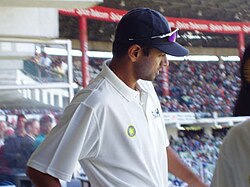
Dravid scored his first Test century in January 1997 against South Africa. In a man-of-the-match performance, he made 148 runs spanning nine hours and took India to their only draw of the series. He made centuries in both innings of a match when he scored 190 and 103 not out in the final Test of the 1998–99 series against New Zealand. He repeated the feat in March 2005 when he scored 110 and 135 against Pakistan in another man-of-the-match performance, leading India to victory in the second of the three-match series. Scoring 180 in a fifth-wicket partnership of 376 with VVS Laxman, in the Second Test of the Border-Gavaskar Trophy in 2001, Dravid helped lead India to victory by 171 runs despite being asked to follow-on by the Australians. His partnership with Laxman was the third-highest for the fifth wicket in Test cricket history. Dravid's highest Test score of 270, achieved in April 2004 in Rawalpindi, helped India to an innings victory against Pakistan. The performance was the fourth-highest score by an Indian batsman in Test cricket. He scored centuries against all Test playing nations and was the first cricketer to score centuries in all 10 Test playing nations. (Full article...)
Made on an estimated budget of ₹420 million (US$4.4 million), Piku was released on 8 May 2015, and grossed approximately ₹1.41 billion (US$15 million) worldwide. The film garnered awards and nominations in several categories, with particular praise for its writing, music, and the performances of Padukone and Bachchan. As of June 2016, the film has won a minimum of 35 awards. (Full article...)
Image 11
Kapoor Khan at an event for Bajrangi Bhaijaan in 2015 Kareena Kapoor is an Indian actress who has appeared in more than 66 Hindi films. She made her acting debut opposite Abhishek Bachchan in the 2000 drama Refugee, for which she won the Filmfare Award for Best Female Debut. The following year, she appeared in five films, including the romance Mujhe Kucch Kehna Hai, the thriller Ajnabee, and the ensemble melodrama Kabhi Khushi Kabhie Gham. The latter emerged as the highest-grossing Bollywood film in overseas to that point, and the success of these films established her in Bollywood. This success was followed by repetitive roles in a series of commercial failures.
Made on a budget of ₹200 million (US$3.1 million), Neerja was released on 19 February 2016, and grossed ₹1.35 billion (US$14 million) worldwide. The film won 31 awards from 45 nominations; its direction and performances of the cast members have received the most attention from award groups. (Full article...)
Shetty had a string of releases in 2010. She portrayed a prostitute in Krish's Vedam, which won her the Filmfare Award for Best Telugu Actress. Despite critical acclaim, the film failed at the box office. None of her other releases in 2010 succeeded commercially, except for her sole Tamil release of the year, the masala Singam. The following year, Anushka had two releases, both in Tamil. She reprised her Vedam role in its remake Vaanam, then appeared as an advocate in the A. L. Vijay-directed Deiva Thirumagal, a loose adaptation of the American film I Am Sam (2001). The following year, she also had two releases: Thaandavam in Tamil, and Damarukam in Telugu. Her first release in 2013 was Suraj's Tamil masala Alex Pandian, a critical and commercial failure. This was followed by Mirchi in Telugu, Singam II (where she reprised her role from Singam), and Selvaraghavan's Tamil romantic fantasyIrandaam Ulagam where she played three distinct roles. Her sole release of 2014 was K. S. Ravikumar's Lingaa. (Full article...)
Image 14
Haasan in 2014
Shruti Haasan is an Indian actress and singer who works in Telugu, Tamil and Hindi films. She started her career as a playback singer at the age of six in the 1992 Tamil film Thevar Magan. She had a brief role in her father, Kamal Haasan's Tamil-Hindi directorial Hey Ram (2000) as a child artist. Haasan's first major appearance was in the Hindi film Luck (2009), in which she played a dual role of a woman avenging her twin sister's death. She played the female lead in the films Anaganaga O Dheerudu and 7 Aum Arivu; both were released in 2011 and together earned her the Best Female Debut – South at the 59th Filmfare Awards South ceremony.
The film tells the story of the Mehras, a dysfunctional Punjabi family who invite their family and friends along on a cruise trip to celebrate the parents' 30th wedding anniversary. Dil Dhadakne Do was released worldwide on 5 June 2015 to positive reviews from critics. The film grossed ₹1.45 billion at global box office on a budget of ₹580 million. The film garnered awards and nominations in a variety of categories with particular praise for Akhtar's direction, the performances, the music and costume design. (Full article...)
Image 16
James Faulkner is one of the only four bowlers to take multiple five-wicket hauls and the only to take multiple five-wicket hauls in the same season. In cricket, a five-wicket haul (also known as a "five-for" or "fifer") refers to a bowler taking five or more wickets in a single innings. This is regarded as a notable achievement, especially in T20 cricket where a bowler can bowl a maximum of only 24 balls (4 overs). The Indian Premier League (IPL) is a professional Twenty20 cricket league in India, which has been held annually since its first season in 2008. So far, 37 five-wicket hauls have been taken by different bowlers, of which only two five-wicket hauls have been taken outside India. Players from twelve of the thirteen teams have taken five-wicket hauls; Kochi Tuskers Kerala is the only franchise for which a player has not taken a five-wicket haul. The first five-wicket haul was taken by Sohail Tanvir of the Rajasthan Royals against the Chennai Super Kings on 4 May 2008. He finished the game with 6 wickets. The most economical five-wicket haul was taken by Akash Madhwal of the Mumbai Indians, who claimed five wickets with an economy rate of 1.43 in the 2023 season. Yuzvendra Chahal of the Rajasthan Royals took the least economical five-wicket haul, 5/40 bowling with an economy rate of 10.00 in 2021. Anil Kumble is the oldest bowler to take a five-wicket haul, achieving the feat at the age of 38, while Jaydev Unadkat is the youngest, he was 21 when he took his first five-for in 2013. (Full article...)
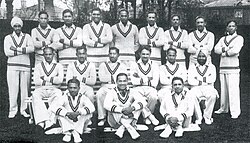
The first Indian to take a five-wicket haul was Mohammad Nissar who took 5 wickets for 93 runs during India's first Test, in June 1932 against England. Vaman Kumar, a leg spinner, was the next to achieve this feat. His figures of 5 wickets for 64 runs took India close to winning a match against Pakistan during the latter's tour of India in 1960–61. In December 1967, Syed Abid Ali took 6 wickets for 55 runs against Australia. The figures remain the best by an Indian fast bowler on debut. Narendra Hirwani's 8 wickets for 61 runs against the West Indies, in January 1988, are the best bowling figures by an Indian on Test debut. His aggregate of 16 wickets for 136 runs in the match are a record for any bowler on debut. As of February 2021, he is the only Indian cricketer to take ten or more wickets in a Test match on debut. (Full article...)
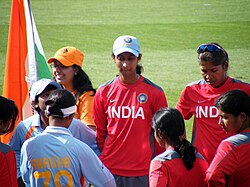
Since the team was formed, 137 women have represented India in ODI cricket. This list includes all players who have played at least one ODI match and is arranged in the order of debut appearance. Where more than one player won their first cap in the same match, those players are listed alphabetically by last name at the time of debut. (Full article...)
The president of the Bharatiya Janata Party is the chief executive authority of the BJP, and fills a number of roles, including chairing meetings of the National Executive of the party and appointing the presidents of party subsidiaries, such its youth wing and farmer's wing. Any candidate for the presidency needs to have been a member of the party for at least 15 years. The president is nominally elected by an electoral college composed of members drawn from the party's National and State councils, but in practice is a consensus choice of senior members of the party. The term of the president is three years long, and individuals may not serve more than two consecutive terms. The president usually does not also hold a post within a government, and party chiefs have resigned the position to assume posts in Cabinet.
After the party's foundation in 1980, Atal Bihari Vajpayee became its first president. He later became the prime minister of India, the only BJP president to serve in that position to date. In 1986, Lal Krishna Advani was sworn in as the party president and has been the longest serving president over three different periods. As of 2022, 11 people have served as the president of the BJP, including Rajnath Singh and Amit Shah who have also served two terms. J. P. Nadda is the most recent president, having been appointed in January 2020. (Full article...)
Image 20
Players from the Royal Challengers Bangalore have recorded fifteen centuries so far, out of which five have been scored by Chris Gayle. In cricket, a batter reaches a century when he scores 100 runs or more in a single innings. A century is regarded as a landmark score for a batter, and his number of centuries is generally recorded in his career statistics. The Indian Premier League (IPL) is a professional league for Twenty20 cricket in India, which has been held annually since its first edition in 2008. In the fifteen seasons played so far, 74 centuries have been scored by 40 different batsmen out of which 20 are Indian players and the rest are overseas players. Players from eleven of the fifteen franchises have scored centuries, with the four franchises that have not had a player score a century for them being Pune Warriors India, Kochi Tuskers Kerala, Gujarat Lions & Gujarat Titans.
Raveena Tandon is an Indian actress known for her work in Hindi films. She made her acting debut in the 1991 action film Patthar Ke Phool, which earned her the Filmfare Award for New Face of the Year. This was followed by a series of unsuccessful films including Ek Hi Raasta and Parampara (both 1993). In 1994, she appeared in eight Hindi films, most of them were commercial successes. Among these were two of the top-grossing films – the romantic musical drama Dilwale and the action drama Mohra. The success of the latter marked a turning point in her career, establishing Tandon as a leading actress in Hindi cinema. The same year, her performance in the drama Laadla, earned her a nomination for the Filmfare Award for Best Supporting Actress. Her other film was the comedy Andaz Apna Apna, which though initially a box office disappointment, attained cult status over the years.
Tandon subsequently played leading roles in the action thrillers Khiladiyon Ka Khiladi (1996) and Ziddi (1997). Both films were among the highest grossing Bollywood films of their respective years. In 1998, she starred opposite Govinda in the commercially successful comedies Dulhe Raja, and Bade Miyan Chote Miyan. Tandon had five film releases in 1999. While the comedy Anari No.1 was a commercial success, her other four releases that year performed poorly at the box office. Nevertheless, she received praise for her performance in the crime drama Shool. (Full article...)
The Padma Bhushan is the third-highest civilian award of the Republic of India. Instituted on 2January 1954, the award is given for "distinguished service of a high order", without distinction of race, occupation, position, or sex. The recipients receive a Sanad, a certificate signed by the President of India and a circular-shaped medallion with no monetary association. The recipients are announced every year on Republic Day (26January) and registered in The Gazette of India—a publication used for official government notices and released weekly by the Department of Publication, under the Ministry of Urban Development. The conferral of the award is not considered official without its publication in the Gazette. The names of recipients whose awards have been revoked or restored, both of which processes require the authority of the president, are archived and they are required to surrender their medal when their name is struck from the register; none of the conferments of Padma Bhushan during 2000–2009 have been revoked or restored. The recommendations are received from all the state and the union territory governments, as well as from Ministries of the Government of India, the Bharat Ratna and the Padma Vibhushan awardees, the Institutes of Excellence, the Ministers, the Chief Ministers and the Governors of State, and the Members of Parliament including private individuals.
When instituted in 1954, the Padma Bhushan was classified as "Dusra Varg" (Class II) under the three-tier Padma Vibhushan awards, which were preceded by the Bharat Ratna in hierarchy. On 15January 1955, the Padma Vibhushan was reclassified into three different awards as the Padma Vibhushan, the Padma Bhushan and the Padma Shri. The criteria included "distinguished service of a high order in any field including service rendered by Government servants", but excluded those working with the public sector undertakings with the exception of doctors and scientists. The 1954 statutes did not allow posthumous awards; this was subsequently modified in the January 1955 statute. The design was also changed to the form that is currently in use; it portrays a circular-shaped toned bronze medallion 1+3⁄4 inches (44 mm) in diameter and 1⁄8 inch (3.2 mm) thick. The centrally placed pattern made of outer lines of a square of 1+3⁄16 inches (30 mm) side is embossed with a knob carved within each of the outer angles of the pattern. A raised circular space of diameter 1+1⁄16 inches (27 mm) is placed at the centre of the decoration. A centrally located lotus flower is embossed on the obverse side of the medal and the text "Padma" is placed above and the text "Bhushan" is placed below the lotus written in Devanagari script. The State Emblem of India is displayed in the centre of the reverse side, together with the national motto of India, "Satyameva Jayate" (Truth alone triumphs) in Devanagari script, which is inscribed on the lower edge. The rim, the edges and all embossing on either side is of standard gold with the text "Padma Bhushan" of gold gilt. The medal is suspended by a pink riband 1+1⁄4 inches (32 mm) in width with a broad white stripe in the middle. It is ranked fifth in the order of precedence of wearing of medals and decorations of the Indian civilian and military awards. (Full article...)
Image 24
Chandrasekhar's six wickets for 38 runs at the Kennington Oval was influential in setting up India's first ever series victory in England. B. S. Chandrasekhar is a former international cricketer who represented the Indian cricket team between 1964 and 1979. In cricket, a five-wicket haul refers to a bowler taking five or more wickets in a single innings. This is regarded as a notable achievement, and 40 bowlers have taken at least 15 five-wicket hauls at the international level as of November 2026. Chandrasekhar played as a leg spin bowler who formed a part of the Indian spin quartet. Described by West Indies cricketer Viv Richards as the "most difficult" bowler, Chandrasekhar took 16 five-wicket hauls during his international career. He developed an interest in the game when he was a child, watching the playing styles of Australian leg spinner Richie Benaud. Chandrasekhar was affected by polio at the age of five which weakened his right arm. He started as a left-arm bowler but gradually shifted to his withered right arm as it could offer more spin.
Chandrasekhar made his Test debut in 1964 against England at the Brabourne Stadium, claiming four wickets for 67 runs in the first innings. His first five-wicket haul came against West Indies two years later at the same venue. Chandrasekhar's bowling figures of six wickets for 38 runs in 1971 were instrumental in setting up India's first victory in England. It was noted as the Indian "Bowling Performance of the Century" by Wisden in 2002. His bowling performances in the previous English season led to him being named one of the five Wisden Cricketers of the Year in 1972. His career-best figures for an innings were eight wickets for 79 runs against England at the Feroz Shah Kotla Ground in December 1972. Chandrasekhar took a pair of five-wicket hauls for the only time in his career when he took 12 wickets for 104 runs against Australia at the Melbourne Cricket Ground; the performance was effective in ensuring India's first victory in Australia. In Tests, he was most successful against England taking eight fifers. (Full article...)
Produced on a budget of ₹700 million, Kaththi was released on 22 October 2014 to critical acclaim. It was commercially successful, grossing ₹1.3 billion worldwide. The film won 14 awards from 33 nominations; its direction, story, screenplay, performances of the cast members, music, choreography and stunt direction have received the most attention from award groups. (Full article...)
Until Bhanumathi was replaced by Savitri as the female lead, she was planned to provide vocals for her character in the film. After Bhanumathi left, P. Leela was chosen as Savitri's playback singer. Unlike their previous films, Vijaya Productions preferred A. M. Rajah over Ghantasala to sing for Rama Rao in the Telugu version. Chakrapani chose P. Susheela to sing the remaining two songs featuring Jamuna, and Venkata Ramaiah sang two uncredited songs. (Full article...)
Rudraveena focuses on the ideological conflicts between 'Bilahari' Ganapathi Sastry, a reputed carnatic musician and his younger son Suryanarayana "Suryam" Sastry. Sastry's discrimination towards the people belonging to lower castes is criticised by his son, Suryam, who believes in society's welfare and walks out for good later. The events that led to the change in Sastry's views form the remaining part of the story. Ganesh Patro wrote the film's dialogue and worked on the script with Balachander for two months, though it was tweaked many times during the shoot. Ilaiyaraaja composed the soundtrack and background score. R. Raghunadha Reddy was the director of photography. Ganesh Kumar edited the film and Mohanam was the art director. (Full article...)
Image 4
Cover page of a 1931 edition of The Indian Antiquary
The Indian Antiquary: A journal of oriental research in archaeology, history, literature, language, philosophy, religion, folklore, &c, &c (subtitle varies) was a journal of original research relating to India, published between 1872 and 1933. It was founded by the archaeologist James Burgess to enable the sharing of knowledge between scholars based in Europe and in India and was notable for the high quality of its epigraphic illustrations which enabled scholars to make accurate translations of texts that in many cases remain the definitive versions to this day. It was also pioneering in its recording of Indian folklore. It was succeeded by The New Indian Antiquary (1938–47) and the Indian Antiquary (1964–71). (Full article...)
Image 5
The stages of one form of Surya Namaskar, Salute to the Sun, demonstrated by a class of yoga teachers in training in Goa, India Sun Salutation, also called Surya Namaskar or Salute to the Sun (Sanskrit: सूर्यनमस्कार, IAST: Sūryanamaskāra), is a practice in yoga as exercise incorporating a flow sequence of some twelve linked asanas. The asana sequence was first recorded as yoga in the early 20th century, though similar exercises were in use in India before that, for example among wrestlers. The basic sequence involves moving from a standing position into Downward and Upward Dog poses and then back to the standing position, but many variations are possible. The set of 12 asanas is dedicated to the Hindu solar deity, Surya. In some Indian traditions, the positions are each associated with a different mantra, and with seed sounds or bīja.
The synagogue was established by Jacob Elias Sassoon and the building is maintained by the Jacob Sassoon Trust. The building's significance is attributed to its Jewish traditions as well as Indian and English colonial influences. It was designed by the British architectural firm Gostling & Morris of Bombay. The basement part of the edifice is built in stone masonry and the superstructure is built in brick masonry. The exterior facade of the synagogue was painted turquoise, was returned to its original colour of white, with bright indigo boarders during a restoration process in 2018–2019. The sanctuary within the interior of the building is in western direction, towards Jerusalem. (Full article...)
Image 7
The Bombay sandwich is a sandwich made of white bread covered in butter and chutney with a filling of potatoes and raw vegetables, often as a toasted sandwich. It may be toasted over a flame or using an electric toaster. Its ingredients may include cucumbers, onions, beetroot, and chaat masala, and it may be topped with cheese or sev. Many variations of ingredients exist. The origin of the Bombay sandwich is uncertain, but it may have been invented by migrant textile workers in the 1960s. The sandwich is popular as street food across Mumbai, but it is not as popular elsewhere. (Full article...)
Linois was engaged in an extended raiding campaign, which had already involved operations in the South China Sea, in the Mozambique Channel, off Ceylon and along the Indian coast of the Bay of Bengal. The French squadron had fought one notable engagement, at the Battle of Pulo Aura on 15 February 1804, in which Linois had attacked the Honourable East India Company's (HEIC) China Fleet, a large convoy of well-armed merchant ships carrying cargo worth £8 million. Linois failed to press the attack and withdrew with the convoy at his mercy, invoking the anger of Napoleon when the news reached France. (Full article...)
The first planned collaboration between Khan and Shetty was a remake of Angoor (1982). The script of Chennai Express, which was initially written as a backup project for Khan, was chosen instead. Conceived as a "commercial romance", the film was originally titled Ready Steady Po. Filming began in Mehboob Studio in October 2012 and was completed by May 2013. A large part of the film was set in Ooty, for which sets were constructed in Wai and also in Ramoji Film City. The soundtrack for Chennai Express was composed by Vishal–Shekhar, with the background score being composed by Amar Mohile. UTV Motion Pictures came on board as producer and distributor, marking its first active project with Khan after Swades (2004). (Full article...)
Image 10
Eden Gardens, home ground of Kolkata Knight Riders
Kolkata Knight Riders were the fourth team to be eliminated from the 2025 IPL and finished the season in eighth place with five wins from 14 matches. Captain Rahane scored the most runs (390) while Varun Chakravarthy and Vaibhav Arora took the most wickets (17 each) for Kolkata in the 2025 season. (Full article...)
Image 11
The Mumbai Mirror is an Indian English-language newspaper published in Mumbai, Maharashtra. Launched in 2005 as a compactdaily newspaper, its coverage focused on city specific local news and civic issues concerning education, healthcare and municipal administration. The founding editor of the paper was Meenal Baghel who is credited for developing an aggressive public service oriented editorial outlook for the paper that it had till its downsizing in 2020. In 2017, it had a readership of over 1.8 million which made it the fifth most widely read English language newspaper in the country.
The film focuses on Gautham Nanda, a business heir who acts as a driver in his estranged aunt Sunanda's house to mend her strained relationship with his grandfather Raghunandan who expelled her for marrying against his wishes years before. Principal photography began in January 2013 and ended in July 2013, with the film being primarily shot in and around Hyderabad. Significant portions were shot in Pollachi and Europe. (Full article...)
Image 13
India competed at the 2011 Commonwealth Youth Games (officially known as the IV Commonwealth Youth Games) held in the Isle of Man from 7 to 13 September 2011. India has participated in all the editions of the Commonwealth Youth Games. The nation was represented by the Indian Olympic Association, which is responsible for the Commonwealth Games and Commonwealth Youth Games in India.
The delegation of India consisted of 20 competitors, participating in four—athletics, badminton, boxing and cycling—out of the seven sports of the programme, and 11 officials. Durgesh Kumar, Navjetdeep Singh and Pusarla Sindhu won gold medals for India in 400 m hurdles, shot put, and women's singles event of badminton, respectively. Badminton player Srikanth Kidambi became the only Indian athlete to win multiple medals, including a silver in mixed doubles (paired with Maneesha Kukkapalli) and a bronze in men's doubles (paired with Hema Thandarang). India devolved from the top position in the previous Games to the ninth position with total of nine medals (equally distributed in all medal categories). (Full article...)
Image 14
Bust of Mesrop Taghiadian in the village of Karbi in Armenia
Mesrop Davtian Taghiadian or Taghiadiants (Armenian: Մեսրոպ Դաւթեան Թաղիադեան; 2 January 1803 – 10 June 1858) was a nineteenth-century Armenian writer, educator and journalist. He wrote prolifically in Classical Armenian and is regarded as one of the first Armenian authors of the Romantic movement, as well as one of the earliest modern Armenian fiction writers.
Taghiadian was born in Iranian-ruled Armenia, but lived most of his life away from his homeland. He was educated at the seminary of Etchmiadzin and traveled throughout Armenia with his teacher collecting folk songs and oral traditions. He attained the rank of deacon in the Armenian Church. Taghiadian emigrated to India to pursue further education. He graduated from Bishop's College in Calcutta (then ruled by the British East India Company, now modern Kolkata) in 1830 and published his first literary works during his time there. In 1831, Taghiadian left India and unsuccessfully attempted to establish a school of his own, first in New Julfa, Iran, then in Armenia. He worked as a teacher in Iran and married Tangkhatun Setian, the daughter of an Armenian merchant, who died in 1837. Taghiadian then lived briefly in Constantinople, where he narrowly escaped a plot against him by the Armenian Patriarch and again settled in Calcutta. In the 1840s and 1850s, he published an Armenian periodical, Azgaser, and ran an Armenian school for boys and girls. Having closed his periodical and school and frequently clashing with other members of the Armenian community of Calcutta, Taghiadian decided to return to Armenia. He fell ill and died on the way to Armenia in Shiraz, Iran in 1858. (Full article...)
Image 15
Mahākāśyapa (Pali: Mahākassapa) was one of the principal disciples of Gautama Buddha. He is regarded in Buddhism as an enlightened disciple, being foremost in ascetic practice. Mahākāśyapa assumed leadership of the monastic community following the parinirvāṇa (death) of the Buddha, presiding over the First Buddhist Council. He was considered to be the first patriarch in a number of Early Buddhist schools and continued to have an important role as patriarch in the Chan/Zen tradition. In Buddhist texts, he assumed many identities, that of a renunciant saint, a lawgiver, an anti-establishment figure, but also a "guarantor of future justice" in the time of Maitreya, the future Buddha—he has been described as "both the anchorite and the friend of mankind, even of the outcast".
In canonical Buddhist texts in several traditions, Mahākāśyapa was born as Pippali in a village and entered an arranged marriage with a woman named Bhadra-Kapilānī. Both of them aspired to lead a celibate life, however, and they decided not to consummate their marriage. Having grown weary of the agricultural profession and the damage it did, they both left the lay life behind to become mendicants. Pippali later met the Buddha, under whom he was ordained as a monk, named Kāśyapa, but later called Mahākāśyapa to distinguish him from other disciples. Mahākāśyapa became an important disciple of the Buddha, to the extent that the Buddha exchanged his robe with him, which was a symbol of the transmittance of the Buddhist teaching. He became foremost in ascetic practices and attained enlightenment shortly after. He often had disputes with Ānanda, the attendant of the Buddha, due to their different dispositions and views. Despite his ascetic, strict and stern reputation, he paid an interest in community matters and teaching, and was known for his compassion for the poor, which sometimes caused him to be depicted as an anti-establishment figure. He had a prominent role in the cremation of the Buddha, acting as a sort of eldest son of the Buddha, as well as being the leader in the subsequent First Council. He is depicted as hesitatingly allowing Ānanda to participate in the council, and chastising him afterwards for a number of offenses the latter was regarded to have committed. (Full article...)
Development of the film began in 2015, when Shinde signed Bhatt and Khan for a film to be made under her banner. Principal photography took place in Goa and Mumbai, in the period from 21 January to 20 May 2016. The film features a score composed by Amit Trivedi and lyrics written mostly by Kausar Munir. (Full article...)
In 2022, her personal wealth became the topic of British media discussion in the context of her claim of non-domiciled status, an arrangement seen as benefiting the "super rich". Murty later voluntarily renounced the fiscal benefits from her non-domiciled status. (Full article...)
The party's origins lie in the Bharatiya Jana Sangh, which was founded in 1951 by Indian politician Shyama Prasad Mukherjee, after he left the Hindu Mahasabha to form a party as the political wing of the RSS. After the Emergency of 1975–1977, the Jana Sangh merged with several other political parties to form the Janata Party; it defeated the then-incumbent Indian National Congress in the 1977 general election. After three years in power, the Janata Party dissolved in 1980, with the members of the erstwhile Jana Sangh reconvening to form the modern-day BJP. Although initially unsuccessful—winning only two seats in the 1984 general election, it grew in strength on the back of the Ram Rath Yatra in Uttar Pradesh. Following victories in several state elections and better performances in national elections, the BJP became the largest political party in the Parliament in 1996; however, it lacked a majority in the lower house of Parliament, and its government, under its then-leader Atal Bihari Vajpayee, lasted for only 13 days. (Full article...)
Central Studios initially planned on creating a film based on the Parasakthi play and T. S. Natarajan's play En Thangai; however, the idea was dropped after Natarajan objected. The film rights of Parasakthi were later bought by P. A. Perumal of National Pictures, with the patronage of A. V. Meiyappan. The soundtrack was composed by R. Sudarsanam, cinematography was handled by S. Maruti Rao, and Panju edited the film under the alias "Panjabi". Filming began in mid-1950, but took over two years to complete. (Full article...)
Sharma had long contemplated making a spy film but felt this was not economically viable for the Indian market because Indian films did not have sufficient budgets. He first planned a film about India's spy network set in the early 2000s but made the 2001 film Gadar: Ek Prem Katha, which became one of the highest-grossing Indian films of all time. Following the record-breaking success of that film, Sharma decided to make The Hero: Love Story of a Spy. The Shah Brothers were engaged to produce the film, which was touted to have a huge budget and scale, unlike previous Bollywood films. Aiming for high production values, a sizeable amount of money was spent on the film. Several large sets were created to give the film a feeling of grandeur, and international stunt experts were hired to coordinate action sequences new to Indian cinema. Principal photography was done at Indian locations, including Kullu and Manali, and in locations in Canada and Switzerland. Uttam Singh composed the soundtrack with lyrics written by Anand Bakshi and Javed Akhtar. (Full article...)
Hampi was the capital of the Vijayanagara Empire from 1336 to 1565 (as Vijayanagara), when it was abandoned. It was a fortified city. Chronicles left by Persian and European travellers, particularly the Portuguese, say that Hampi was a prosperous, wealthy and grand city near the Tungabhadra River, with numerous temples, farms and trading markets. Hampi-Vijayanagara is estimated to be the world's second-largest city by 1500, after Beijing, and probably India's richest at that time, attracting traders from Persia and Portugal. The Vijayanagara Empire was defeated by a coalition of Muslim sultanates; its capital was conquered, pillaged and destroyed by Muslim armies in 1565, after which Hampi remained in ruins. (Full article...)
Image 22
Mokashi in 2009
Paresh Mokashi (born 6 February 1969) is an Indian filmmaker, producer, actor and Theatre director-producer; working predominantly in Marathi cinema and Marathi theatre. He started working as a backstage worker for theatre and did few minor roles for plays as well as films. Mokashi made his directorial debut for theatre with the Marathi play, Sangeet Debuchya Mulee in 1999. He continued to work for theatre and made his directorial debut for cinema with the 2009 Marathi feature film, Harishchandrachi Factory. The film depicts the making of India's first full-length feature film, Raja Harishchandra (1913), made by Dadasaheb Phalke. The film was acclaimed critically and won several awards. It was also selected as India's official entry to 82nd Academy Awards in the Best Foreign Language Film category. (Full article...)
Image 23
The fatal blow
The Tarakeswar affair (also known as the Tarakeswar scandal) refers to a public scandal in 19th-century Bengal during the British Raj. It resulted from a forceful sexual relation between Elokeshi, the teenage wife of a government employee Nobin Chandra, and Maharaj Madhab Chandra Giri, the scandalous Brahmin head priest (or mahant) of the TarakeswarShiva temple. Nobin subsequently decapitated his wife Elokeshi because he was not able to save her from the salacious mahant. A highly publicised trial followed, dubbed the Tarakeswar murder case of 1873, in which both the husband and the mahant were found guilty to varying degrees.
Bengali society considered the mahant's actions as punishable and criminal, while justifying Nobin's action of killing an unchaste wife. The resulting public outrage forced authorities to release Nobin after two years. The scandal became the subject of Kalighat paintings and several popular Bengali plays, which often portrayed Nobin as a devoted husband. The mahant was generally presented as a womaniser, who took advantage of young women. The murder victim Elokeshi was sometimes blamed as a seductress and the root cause of the affair. In other plays, she was absolved of all guilt and was portrayed to have been tricked and raped by the mahant. (Full article...)
Motwane wrote the script in 2003, but could not find a producer. He co-wrote Kashyap's Dev.D (2009), and Kashyap produced and co-wrote Udaan. The film was set and shot in the industrial town of Jamshedpur. Mahendra J. Shetty was its director of photography, and Dipika Kalra was the editor; Aditya Kanwar was the production designer. (Full article...)
... that Colonel Hugh Pettigrew observed that troops who thought that the Scottish Highlands resembled Waziristan on India's North West Frontier were "of little use to anyone"?


 Featured article –








 Good article –


 listen)) is a 2013 Indian Hindi-language action comedy film directed by Rohit Shetty and produced by UTV Motion Pictures and Red Chillies Entertainment. It stars Shah Rukh Khan and Deepika Padukone with Nikitin Dheer, Sathyaraj, Kamini Kaushal and Lekh Tandon in supporting roles. The film revolves around Rahul Mithaiwala, a man who accidentally boards the eponymous train and journeys from Mumbai to Rameswaram with the daughter of a local don.


