


 |
|---|
| This article is part of a series on the politics and government of India |
 India portal India portal |
The president of India is the head of state of India and the Supreme Commander of the Indian Armed Forces. The president is referred to as the first citizen of India.[1][2] Although vested with these powers by the Constitution of India, the position is largely a ceremonial one and executive powers are de facto exercised by the prime minister.[3]
The president is elected by the Electoral College composed of elected members of the parliament houses, the Lok Sabha and the Rajya Sabha, and also members of the Vidhan Sabha, the state legislative assemblies.[2] Presidents may remain in office for a tenure of five years, as stated by article 56, part V, of the Constitution of India. In the case where a president's term of office is terminated early or during the absence of the president, the vice president assumes office. By article 70 of part V, the parliament may decide how to discharge the functions of the president where this is not possible, or in any other unexpected contingency.
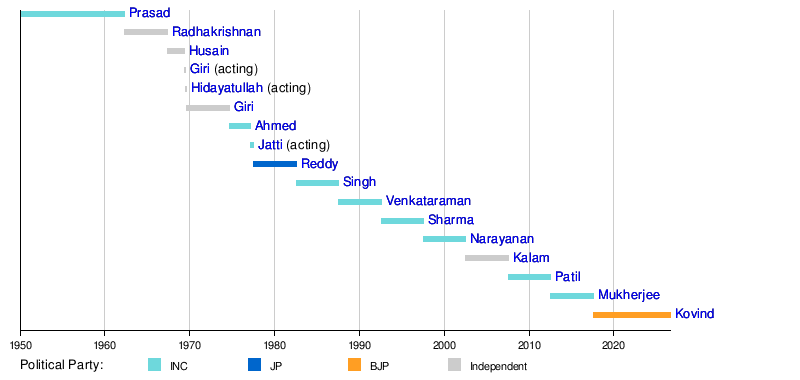
There have been 14 presidents of India since the post was established when India was declared as a republic with the adoption of the Indian constitution in 1950.[4] Apart from these fourteen, three acting presidents have also been in office for short periods of time. Varahagiri Venkata Giri became the acting president in 1969 after Zakir Husain, died in office. Giri was elected president a few months later. He remains the only person to have held office both as a president and acting president. Rajendra Prasad, the first president of India, is the only person to have held office for two terms.[5]
Seven presidents have been members of a political party before being elected. Six of these were active party members of the Indian National Congress. The Janata Party has had one member, Neelam Sanjiva Reddy, who later became president. Two presidents, Zakir Husain and Fakhruddin Ali Ahmed, have died in office. Their vice presidents served as acting presidents until a new president was elected. Following Zakir Husain's death, two acting presidents held office until the new president, V. V. Giri, was elected. When Giri resigned to take part in the presidential elections, he was succeeded by Mohammad Hidayatullah as acting president.[6] The 12th president, Pratibha Patil, is the first woman to hold the office, elected in 2007.
On 25 July 2017, Ram Nath Kovind took office as the 14th president of India.[7][8]
List
- Key
 -Died in office
Error creating thumbnail: File missing-Resigned
- Legend
_V.V_GIRI_AUTOGRAPHED_PENCIL_SKETCH.jpg)


Acting presidents of India
This list is numbered based on vice presidents elected after winning an Indian Acting Presidential election. The Acting President of India does not represent any political party.
| No. | Name
(birth–death) |
Portrait | Took office | Left office | Party |
|---|---|---|---|---|---|
| — | Gopal Swarup Pathak
(1896–1982) |
31 August 1969 | 31 August 1969 | Independent | |
| — | Mohammad Hidayatullah
(1905–1992) |
Error creating thumbnail: File missing | 31 August 1979 | 30 August 1984 | Independent |
| — | Krishan Kant(1927–2002)
|
Error creating thumbnail: File missing | 21 July 2001 | 25 July 2001 | Janata Dal |
| — | Bhairon Singh Shekhawat
(1924–2010) |
Error creating thumbnail: File missing | 1 July 2007 | 21 July 2007 | Bharatiya Janata Party |
| — | Mohammad Hamid Ansari
(1937–) |
Error creating thumbnail: File missing | 11 August 2007 | 11 August 2007 | Indian National Congress |
| 11 August 2012 | 11 August 2012 | ||||
| — | Venkaiah Naidu
(1949–) |
Error creating thumbnail: File missing | 11 August 2017 | 11 August 2017 | Bharatiya Janata Party |
Statistics
Representation of presidents by party of candidacy
- Timeline
See also
- President of India
- Vice President of India
- Prime Minister of India
- List of vice presidents of India
- List of prime ministers of India
- List of heads of state and government of Indian origin
Citations
- ↑ "President Ram Nath Kovind is Indias first citizen. Your chances begin only at Number 27". indiatoday.com. Times of India. Archived from the original on 30 July 2017. Retrieved 19 November 2017.
- ↑ 2.0 2.1 "The Constitution of India". Ministry of Law and Justice of India. Archived from the original (.doc) on 5 February 2009. Retrieved 4 January 2009.
- ↑ "India gets first woman president since independence". BBC News. 25 July 2007. Archived from the original on 15 February 2009. Retrieved 30 November 2008.
- ↑ "1950: India becomes a republic". BBC News. 26 January 1950. Archived from the original on 17 January 2008. Retrieved 6 January 2009.
- ↑ Harish Khare (6 December 2006). "Selecting the next Rashtrapati". The Hindu. India. Archived from the original on 19 July 2011. Retrieved 30 November 2008.
- ↑ Shekhar Iyer (25 June 2007). "Shekhawat will not resign to contest poll". Hindustan Times. India. Archived from the original on 11 January 2009. Retrieved 4 January 2009.
- ↑ Hebbar, Nistula (20 July 2017). "Ram Nath Kovind enters Rashtrapati Bhavan with big win". The Hindu. Archived from the original on 20 July 2017. Retrieved 25 October 2017.
- ↑ The Hindu Net Desk (27 July 2017). "Ram Nath Kovind takes oath as President, Rajya Sabha discusses farmers' crisis – top stories for today". The Hindu. ISSN 0971-751X. Retrieved 20 December 2017.
References
External links



,_signed_image_for_Walter_Nash_(NZ_Prime_Minister),_1958_(16017609534).jpg)


.JPG)


