


WikiDwarfBOT (talk | contribs) m →External links: Replace {{Source}} tag |
->Bingobro Reverted 1 edit by 2402:3A80:1EE0:E10C:1E7D:AFE5:AE99:7A54 (talk) |
||
| Line 1: | Line 1: | ||
{{short description|Political system of India}} | {{short description|Political system of India}} | ||
{{ | {{more footnotes|date=February 2016}} | ||
{{ | {{use dmy dates|date=November 2019}} | ||
{{ | {{use Indian English|date=June 2016}} | ||
{{Infobox political system | {{Infobox political system | ||
| name = Politics of India | | name = Politics of India | ||
| Line 9: | Line 9: | ||
| image_size = 100 | | image_size = 100 | ||
| caption = [[National Emblem of India]] | | caption = [[National Emblem of India]] | ||
| type = [[Federation|Federal]] [[ | | type = [[Federation|Federal]] [[Parliamentary]] [[Republic]] | ||
| constitution = [[Constitution of India]] | | constitution = [[Constitution of India]] | ||
| legislature = [[Parliament of India|Parliament]] | | legislature = [[Parliament of India|Parliament]] | ||
| legislature_type = [[ | | legislature_type = [[Bicameral]] | ||
| legislature_place = [[ | | legislature_place = [[Sansad Bhavan]] | ||
| legislature_speaker = | | legislature_speaker = | ||
| legislature_speaker_title = | | legislature_speaker_title = | ||
| upperhouse = [[Rajya Sabha | | upperhouse = [[Rajya Sabha]] | ||
| upperhouse_speaker = [[Venkaiah Naidu]] | | upperhouse_speaker = [[Venkaiah Naidu|Vice President Venkaiah Naidu]] | ||
| upperhouse_speaker_title = [[Chairman of the Rajya Sabha | | upperhouse_speaker_title = [[Chairman of the Rajya Sabha]] | ||
| upperhouse_appointer = [[Electoral College (India)|Electoral College]] | | upperhouse_appointer = [[Electoral College (India)|Electoral College]] | ||
| lowerhouse = [[Lok Sabha | | lowerhouse = [[Lok Sabha]] | ||
| lowerhouse_speaker = [[Om Birla]] | | lowerhouse_speaker = [[Om Birla]] | ||
| lowerhouse_speaker_title = [[Speaker of the Lok Sabha | | lowerhouse_speaker_title = [[Speaker of the Lok Sabha]] | ||
| lowerhouse_appointer = | | lowerhouse_appointer = | ||
| title_hos = [[President of India|President]] | | title_hos = [[President of India|President]] | ||
| Line 41: | Line 41: | ||
| cabinet_ministries = [[Union Government ministries of India|52]] | | cabinet_ministries = [[Union Government ministries of India|52]] | ||
| judiciary = [[Judiciary of India|Judiciary]] | | judiciary = [[Judiciary of India|Judiciary]] | ||
| judiciary_head = [[ | | judiciary_head = [[N.V Ramana]] | ||
| courts = | | courts = | ||
| court = [[Supreme Court of India|Supreme Court]] | | court = [[Supreme Court of India|Supreme Court]] | ||
| chief_judge = [[ | | chief_judge = [[N. V. Ramana]] | ||
| court_seat = | | court_seat = | ||
| court1 = | | court1 = | ||
| Line 50: | Line 50: | ||
| court_seat1 = | | court_seat1 = | ||
}} | }} | ||
{{ | {{politics of India}} | ||
'''Politics of India''' works within the framework of the country's [[Constitution of India|Constitution]]. India is a [[Parliamentary republic|parliamentary]] [[democratic republic]] in which the [[president of India]] is the [[head of state]] and the [[prime minister of India]] is the [[head of government]]. It is based on the federal structure of government, although the word is not used in the Constitution itself. India follows the dual polity system, i.e. federal in nature, that consists of the central authority at the centre and [[States and union territories of India|states]] at the periphery. The Constitution defines the organisational powers and limitations of both central and state governments; it is well recognised, fluid (Preamble of the Constitution being rigid and to dictate further amendments to the Constitution) and considered supreme, i.e. the [[Law of India|laws]] of the nation must conform to it. | |||
There is a provision for a [[Bicameralism|bicameral]] [[legislature]] consisting of an | There is a provision for a [[Bicameralism|bicameral]] [[legislature]] consisting of an [[upper house]], the [[Rajya Sabha]] (Council of States), which represents the states of the Indian federation, and a [[lower house]], the [[Lok Sabha]] (House of the People), which represents the people of India as a whole. The Constitution provides for an [[Judicial independence|independent]] [[judiciary]], which is headed by the [[Supreme Court of India|Supreme Court]]. The court's mandate is to protect the Constitution, to settle disputes between the central government and the states, to settle inter-state disputes, to nullify any central or state laws that go against the Constitution and to protect the fundamental rights of citizens, issuing [[writs]] for their enforcement in cases of violation.{{Sfn|M. Lakshmikanth|2012|pp=389–390}} | ||
In recent decades, Indian politics has become a dynastic affair.<ref>{{Cite web|url=http://www.dailypioneer.com/columnists/edit/need-for-accountability-in-politics-of-dynasty.html|title=Need for accountability in politics of dynasty|website=www.dailypioneer.com|access-date=17 January 2017|archive-url=https://web.archive.org/web/20170117002832/http://www.dailypioneer.com/columnists/edit/need-for-accountability-in-politics-of-dynasty.html|archive-date=17 January 2017|url-status=live}}</ref> Possible reasons for this could be the party stability, absence of party organisations, independent civil society associations that mobilise support for the parties and centralised financing of elections.<ref name="ppq.sagepub.com">{{cite journal|last1=Chhibber⇑|first1=Pradeep|title=Dynastic parties Organization, finance and impact|journal=Party Politics|date=March 2013|volume=19|issue=2|pages=277–295|doi=10.1177/1354068811406995|s2cid=144781444}}</ref> | There are 543 members in the Lok Sabha, who are elected using [[plurality voting]] (first past the post) system from 543 [[single-member constituencies]]. There are 245 members in the Rajya Sabha, out of which 233 are elected through indirect elections by single transferable vote by the members of the state legislative assemblies; 12 other members are elected/nominated by the President of India. Governments are formed through [[Elections in India|elections]] held every five years (unless otherwise specified), by parties that secure a majority of members in their respective lower houses (Lok Sabha in the central government and [[Vidhan Sabha]] in states). India had [[1951–52 Indian general election|its first general election]] in 1951, which was won by the [[Indian National Congress]], a political party that went on to dominate subsequent elections until [[1977 Indian general election|1977]], when a non-Congress government was formed for the first time in independent India. The 1990s saw the end of [[Dominant-party system|single-party domination]] and the rise of coalition governments. The [[2014 Indian general election|elections]] for the [[16th Lok Sabha]], held from April 2014 to May 2014, once again brought back single-party rule in the country, with the [[Bharatiya Janata Party]] (BJP) being able to claim a majority in the Lok Sabha.<ref>{{cite web|title=General Election 2014|url=http://eci.nic.in/eci_main1/GE2014/ge.html|work=[[Election Commission of India]]|access-date=21 May 2014|archive-url=https://web.archive.org/web/20140523005228/http://eci.nic.in/eci_main1/GE2014/ge.html|archive-date=23 May 2014|url-status=live}}</ref> | ||
In recent decades, Indian politics has become a dynastic affair.<ref>{{Cite web|url=http://www.dailypioneer.com/columnists/edit/need-for-accountability-in-politics-of-dynasty.html|title=Need for accountability in politics of dynasty|website=www.dailypioneer.com|access-date=17 January 2017|archive-url=https://web.archive.org/web/20170117002832/http://www.dailypioneer.com/columnists/edit/need-for-accountability-in-politics-of-dynasty.html|archive-date=17 January 2017|url-status=live}}</ref> Possible reasons for this could be the party stability, absence of party organisations, independent civil society associations that mobilise support for the parties and centralised financing of elections.<ref name="ppq.sagepub.com">{{cite journal|last1=Chhibber⇑|first1=Pradeep|title=Dynastic parties Organization, finance and impact|journal=Party Politics|date=March 2013|volume=19|issue=2|pages=277–295|doi=10.1177/1354068811406995|s2cid=144781444}}</ref> | |||
== Political parties and alliances == | == Political parties and alliances == | ||
{{elect|List of political parties in India|Elections in India}} | {{elect|List of political parties in India|Elections in India}} | ||
{{Main|2019 Indian general election}} | {{Main|2019 Indian general election}} | ||
[[File:Sansad Bhavan-1.jpg|thumb|A view of the [[Parliament of India]]]] | |||
When compared to other democracies, India has had a large number of political parties during its history under democratic governance. It has been estimated that over 200 parties were formed after India became independent in 1947. | When compared to other democracies, India has had a large number of political parties during its history under democratic governance. It has been estimated that over 200 parties were formed after India became independent in 1947.{{Sfn|Chander|2001|pp=389–390}} Leadership of political parties in India is commonly interwoven with well-known families whose dynastic leaders actively play the dominant role in a party. Further, party leadership roles are often transferred to subsequent generations in the same families. The two main parties in India are the Bharatiya Janata Party, commonly known as the BJP, which is the leading right-wing nationalist party, and the [[Indian National Congress]], commonly called the INC or Congress, which is the leading centre-left party. These two parties currently dominate national politics, both adhering their policies loosely to their places on the [[left–right political spectrum]]. At present, there are eight national parties and many more state parties. | ||
=== Types of political parties === | === Types of political parties === | ||
{{Main|List of political parties in India}} | {{Main|List of political parties in India}} | ||
Every political party in India | Every political party in India, whether a national or regional/state party, must have a symbol and must be registered with the [[Election Commission of India]]. Symbols are used in the Indian political system to identify political parties in part so that illiterate people can vote by recognizing the party symbols.<ref>{{cite web|url=https://thediplomat.com/2016/11/the-curioudifaidfefiwuufs-stories-of-indian-party-symbols/|title=The Curious Stories of Indian Party Symbols|work=[[The Diplomat]]|author=Krzysztof Iwanek|date=2 November 2016|access-date=19 April 2017|archive-url=https://web.archive.org/web/20170419193824/https://thediplomat.com/2016/11/the-curious-stories-of-indian-party-symbols/|archive-date=19 April 2017|url-status=live}}</ref> | ||
In the current amendment to the Symbols Order, the commission has asserted the following five principles:<ref name=ECI /> | In the current amendment to the Symbols Order, the commission has asserted the following five principles:<ref name=ECI /> | ||
# A party, | # A party, national or state, must have a legislative presence. | ||
# A | # A national party's legislative presence must be in the Lok Sabha. A state party's legislative presence must be in the State Assembly. | ||
# A party can set up a candidate only from amongst its own members. | # A party can set up a candidate only from amongst its own members. | ||
# A party that loses its recognition shall not lose its symbol immediately but shall be allowed to use that symbol for some time to try and retrieve its status. | # A party that loses its recognition shall not lose its symbol immediately but shall be allowed to use that symbol for some time to try and retrieve its status. However, the grant of such facility to the party will not mean the extension of other facilities to it, as are available to recognized parties, such as free time on [[Doordarshan]] or [[All India Radio|AIR]], free supply of copies of electoral rolls, etc. | ||
# Recognition should be given to a party only on the basis of its own performance in elections and not because it is a splinter group of some other recognized party. | # Recognition should be given to a party only on the basis of its own performance in elections and not because it is a splinter group of some other recognized party. | ||
A political party shall be eligible to be recognized as a national party if:<ref name="ECI">{{cite web|title=Election Commission Of India Press Note|url=http://eci.nic.in/archive/press/current/PN05122k.htm|access-date=13 March 2014|archive-url=https://web.archive.org/web/20160305090629/http://eci.nic.in/archive/press/current/PN05122k.htm|archive-date=5 March 2016|url-status=live}}</ref> | |||
# it secures at least six percent (6%) of the valid votes polled in any four or more states, at a general election to the Lok Sabha or, to the State Legislative Assembly; and . | |||
# in addition, it wins at least four seats in the House of the People from any State or States. | |||
# or it wins at least two percent (2%) seats in the House of the People (i.e. 11 seats in the existing House having 543 members), and these members are elected from at least three different states. | |||
# it secures at least | Likewise, a political party shall be entitled to be recognized as a state party, if: | ||
# in addition, it wins at least | # it secures at least six percent (6%) of the valid votes polled in the state at a general election, either to the Lok Sabha or to the Legislative Assembly of the State concerned; and | ||
# in addition, it wins at least two seats in the Legislative Assembly of the state concerned. | |||
it wins at least | # or it wins at least three percent (3%) of the total number of seats in the Legislative Assembly of the state, or at least three seats in the Assembly, whichever is more. | ||
===Party proliferation=== | |||
Although a strict anti-defection law had been passed in 1984, there has been a continued tendency amongst politicians to float their own parties rather than join a broad based party such as the Congress or the BJP. Between the 1984 and 1989 elections, the number of parties contesting elections increased from 33 to 113. In the decades since, this fragmentation has continued.{{Sfn|Hicken|Kuhonta|2014|p=205}} | |||
=== | === Alliances=== | ||
{{Unreferenced section|date=March 2021}} | |||
India has a history of party alliances and breakdown of alliances. However, there are three party alliances regularly aligning on a national level in competing for Government positions. The member parties work in harmony for gratifying national interests, although parties can jump ships. | |||
* [[National Democratic Alliance]] (NDA) - Right-wing coalition led by BJP was formed in 1998 after the [[1998 Indian general election|elections]]. NDA formed a government, although the government didn't last long as [[All India Anna Dravida Munnetra Kazhagam|AIADMK]] withdrew support from it resulting in [[1999 Indian general election|1999 general elections]], in which NDA won and resumed power. The coalition government went on to complete the full five-years term, becoming the first non-Congress government to do so. In the [[2014 Indian general election|2014 General Elections]], NDA once again returned to powers for the second time, with a historic mandate of 336 out of 543 Lok Sabha seats. BJP itself won 282 seats, thereby electing [[Narendra Modi]] as the head of the government. In a historic win, the NDA stormed to power for the third term in [[2019 Indian general election|2019]] with a combined strength of 353 seats, with the BJP itself winning an absolute majority with 303 seats | |||
* [[United Progressive Alliance]] (UPA) - Centre-left coalition led by [[Indian National Congress]]; this alliance was created after the [[2004 Indian general election|2004 general elections]], with the alliance forming the Government. The alliance even after losing some of its members, was re-elected in [[2009 Indian general election|2009 General Elections]] with [[Manmohan Singh]] as head of the government. The alliance has been in the opposition since the 2014 elections, with the INC being the principal opposition party, but without the official status of the Leader of Opposition since they failed to win the minimum required seats. | |||
* [[National Democratic Alliance]] (NDA) - Right-wing coalition led by | |||
* [[United Progressive Alliance]] (UPA) - | |||
===Corruption=== | ===Corruption=== | ||
[[Corruption in India|India has seen political corruption]] for decades | [[Corruption in India|India has seen political corruption]] for decades. Democratic institutions soon became federally owned, dissent was eliminated and a majority of citizens paid the price. The political corruption in India is weakening its democracy and has led to the erosion of trust by the general public in the political system. A good amount of money is required in elections which is source of political-capitalist nexus.<ref>{{Cite web|url=https://www.indianmirror.com/corruption/political-corruption.html|title = INDIANMIRROR- Political Corruption in India}}</ref> | ||
===Candidate selection=== | ===Candidate selection=== | ||
Pre-election alliances are common in India with parties deciding to share seats. This is seen mainly on a state by state basis rather than on the national level. Candidate selection starts after seat sharing has been agreed by alliance fellows. | Pre-election alliances are common in India with parties deciding to share seats. This is seen mainly on a state by state basis rather than on the national level. Candidate selection starts after seat sharing has been agreed by alliance fellows.{{Citation needed|date=March 2021}} | ||
Indian political parties have low level of internal party democracy and therefore, in Indian elections, both at the state or national level, party candidates are typically selected by the party elites, more commonly called the party high command. The party elites use a number of criteria for selecting candidates. These include the ability of the candidates to finance their own election, their educational attainment, and the level of organization the candidates have in their respective constituencies.<ref>{{cite news |title=How political parties choose their candidates to win elections |url=https://www.hindustantimes.com/opinion/how-political-parties-choose-their-candidates-to-win-elections/story-26nqJKdMEQfYm8Uq29tbwJ.html |access-date=22 April 2019 |issue=26 March 2018 |newspaper=Hindustan Times |archive-url=https://web.archive.org/web/20190422184718/https://www.hindustantimes.com/opinion/how-political-parties-choose-their-candidates-to-win-elections/story-26nqJKdMEQfYm8Uq29tbwJ.html |archive-date=22 April 2019 |url-status=live }}</ref> Quite often the last criterion is associated with candidate criminality.<ref>{{Cite document|title=Caste Politics, Credibility and Criminality: Political Selection in India|first=Milan|last=Vaishnav|date=10 December 2011|ssrn = 1899847}}</ref> | Indian political parties have low level of internal party democracy and therefore, in Indian elections, both at the state or national level, party candidates are typically selected by the party elites, more commonly called the party high command. The party elites use a number of criteria for selecting candidates. These include the ability of the candidates to finance their own election, their educational attainment, and the level of organization the candidates have in their respective constituencies.<ref>{{cite news |title=How political parties choose their candidates to win elections |url=https://www.hindustantimes.com/opinion/how-political-parties-choose-their-candidates-to-win-elections/story-26nqJKdMEQfYm8Uq29tbwJ.html |access-date=22 April 2019 |issue=26 March 2018 |newspaper=Hindustan Times |archive-url=https://web.archive.org/web/20190422184718/https://www.hindustantimes.com/opinion/how-political-parties-choose-their-candidates-to-win-elections/story-26nqJKdMEQfYm8Uq29tbwJ.html |archive-date=22 April 2019 |url-status=live }}</ref> Quite often the last criterion is associated with candidate criminality.<ref>{{Cite document|title=Caste Politics, Credibility and Criminality: Political Selection in India|first=Milan|last=Vaishnav|date=10 December 2011|ssrn = 1899847}}</ref> | ||
== Local governance == | == Local governance == | ||
{{Main|Municipal governance in India|Panchayati raj in India|Local | {{Unreferenced section|date=March 2021}}{{Main|Municipal governance in India|Panchayati raj in India|Local government in India}} | ||
Panchayati Raj Institutions or Local self-government bodies play a crucial role in Indian politics, as it focuses on grassroot-level administration in India. | Panchayati Raj Institutions or Local self-government bodies play a crucial role in Indian politics, as it focuses on grassroot-level administration in India. | ||
On 24 April 1993, the Constitutional (73rd Amendment) Act, 1992 came into force to provide constitutional status to the Panchayati Raj institutions. This Act was extended to Panchayats in the tribal areas of eight States, namely Andhra Pradesh, Bihar, Gujarat, Himachal Pradesh, Maharashtra, Madhya Pradesh, Odisha and Rajasthan from 24 December 1996. | On 24 April 1993, the Constitutional (73rd Amendment) Act, 1992 came into force to provide constitutional status to the Panchayati Raj institutions. This Act was extended to Panchayats in the tribal areas of eight States, namely Andhra Pradesh, Bihar, Gujarat, Himachal Pradesh, Maharashtra, Madhya Pradesh, Odisha and Rajasthan from 24 December 1996. | ||
The Act aims to provide 3-tier system of Panchayati Raj for all States having population of over 2 million, to hold Panchayat elections regularly every 5 years, to provide reservation of seats for Scheduled Castes, Scheduled Tribes and Women, to appoint State Finance Commission to make recommendations as regards the financial powers of the Panchayats and to constitute District Planning Committee to prepare draft development plan for the district. | The Act aims to provide a 3-tier system of Panchayati Raj for all States having a population of over 2 million, to hold Panchayat elections regularly every 5 years, to provide reservation of seats for Scheduled Castes, Scheduled Tribes and Women, to appoint State Finance Commission to make recommendations as regards the financial powers of the Panchayats and to constitute District Planning Committee to prepare a draft development plan for the district. | ||
== Role of political parties == | == Role of political parties == | ||
{{Party politics}} | {{More citations needed section|date=March 2021}}{{Party politics}} | ||
{{elect|List of political parties in India|Elections in India}} | {{elect|List of political parties in India|Elections in India}} | ||
As with any other democracy, political parties represent different sections among the Indian society and regions, and their core values play a major role in the politics of India. Both the executive branch and the legislative branch of the government are run by the representatives of the political parties who have been elected through the elections. Through the electoral process, the people of India choose which representative and which political party should run the government. Through | As with any other democracy, political parties represent different sections among the Indian society and regions, and their core values play a major role in the politics of India. Both the executive branch and the legislative branch of the government are run by the representatives of the political parties who have been elected through the elections. Through the electoral process, the people of India choose which representative and which political party should run the government. Through elections, any party may gain simple majority in the lower house. Coalitions are formed by the political parties in case no single party gains a simple majority in the lower house. Unless a party or a coalition have a majority in the lower house, a government cannot be formed by that party or the coalition. | ||
[[File:State- and union territory-level parties.svg|thumb|344x344px|Current ruling parties in the states and union territories of India | [[File:State- and union territory-level parties.svg|thumb|344x344px|Current ruling parties in the states and union territories of India | ||
| Line 128: | Line 126: | ||
{{legend|#808080|[[Union territory|No legislature]] (5)}}]] | {{legend|#808080|[[Union territory|No legislature]] (5)}}]] | ||
India has a [[multi-party system]], where there are a number of national as well as regional parties. A regional party may gain a majority and rule a particular state. If a party is represented in more than 4 states, it would be labelled a national party. | India has a [[multi-party system]], where there are a number of national as well as regional parties. A regional party may gain a majority and rule a particular state. If a party is represented in more than 4 states, it would be labelled a national party (subject to other criteria above). Out of the 72 years of India's independence, India has been ruled by the Congress party for 53 years as of January 2020. | ||
The party enjoyed a parliamentary majority save for two brief periods during the 1970s and late 1980s. | The party enjoyed a parliamentary majority save for two brief periods during the 1970s and late 1980s. This rule was interrupted between 1977 and 1980, when the [[Janata Party]] coalition won the election owing to public discontent with the [[The Emergency (India)|controversial state of emergency]] declared by the then Prime Minister [[Indira Gandhi]]. The [[Janata Dal]] won elections in 1989, but its government managed to hold on to power for only two years. | ||
Between 1996 and 1998, there was a period of political flux with the government being formed first by the nationalist | Between 1996 and 1998, there was a period of political flux with the government being formed first by the nationalist BJP followed by a left-leaning [[United Front (India)|United Front]] coalition. In 1998, the BJP formed the National Democratic Alliance with smaller regional parties, and became the first non-INC and coalition government to complete a full five-year term. The [[2004 Indian general election|2004 elections]] saw the INC winning the largest number of seats to form a government leading the [[United Progressive Alliance]], and supported by left-parties and those opposed to the BJP. | ||
On 22 May 2004, [[Manmohan Singh]]<ref>{{Cite web|url=https://www.indianembassy.org/|archive-url=https://web.archive.org/web/20120126154402/https://www.indianembassy.org/India_Review/2009/June%202009.pdf|url-status=dead|title=Welcome to Embassy of India, Washington D C, USA|archive-date=26 January 2012|website=www.indianembassy.org}}</ref> was appointed the [[ | On 22 May 2004, [[Manmohan Singh]]<ref>{{Cite web|url=https://www.indianembassy.org/|archive-url=https://web.archive.org/web/20120126154402/https://www.indianembassy.org/India_Review/2009/June%202009.pdf|url-status=dead|title=Welcome to Embassy of India, Washington D C, USA|archive-date=26 January 2012|website=www.indianembassy.org}}</ref> was appointed the [[prime minister of India]] following the victory of the INC and the left front in the [[2004 Indian general election|2004 Lok Sabha election]]. The UPA ruled India without the support of the left front. Previously, [[Atal Bihari Vajpayee]]<ref name=" Priyanka Shah">{{cite news|title=13 Amazing Facts about Atal Ji, the Bhishma Pitamah of Indian Politics|url=http://topyaps.com/n-amazing-facts-about-atalji-the-bhishma-pitamah-of-indian-politics|access-date=16 May 2014|newspaper=Topyaps|date=1 November 2014|author=Priyanka Shah|archive-url=https://web.archive.org/web/20140911030525/http://topyaps.com/n-amazing-facts-about-atalji-the-bhishma-pitamah-of-indian-politics|archive-date=11 September 2014|url-status=live}}</ref> had taken office in October 1999 after a general election in which a BJP-led coalition of 13 parties called the National Democratic Alliance emerged with a majority. In May 2014, Narendra Modi of BJP was elected as the prime minister. | ||
Formation of coalition governments reflects the transition in Indian politics away from the national parties toward smaller, more narrowly based [[regional party|regional parties]]. Some regional parties, especially in South India, are deeply aligned to the ideologies of the region unlike the national parties and thus the relationship between the central government and the state government in various states has not always been free of | Formation of coalition governments reflects the transition in Indian politics away from the national parties toward smaller, more narrowly based [[regional party|regional parties]]. Some regional parties, especially in South India, are deeply aligned to the ideologies of the region unlike the national parties and thus the relationship between the central government and the state government in various states has not always been free of rancour. Disparity between the ideologies of the political parties ruling the centre and the state leads to severely skewed allocation of resources between the states. | ||
== Political issues == | == Political issues == | ||
| Line 143: | Line 141: | ||
=== Social issues === | === Social issues === | ||
The [[Demographics of India|lack of homogeneity]] in the Indian population causes division | {{Unreferenced section|date=March 2021}} | ||
The [[Demographics of India|lack of homogeneity]] in the Indian population causes division among different sections of the people based on [[Communalism (South Asia)|religion]], [[Regionalism (politics)|region]], [[Language politics|language]], [[Caste politics|caste]] and [[Dravidian politics|ethnicity]]. This has led to the rise of political parties with agendas catering to one or a mix of these groups. Parties in India also target people who are not in favour of other parties and use them as an asset. | |||
Some parties openly profess their focus on a particular group | Some parties openly profess their focus on a particular group. For example, the [[Dravida Munnetra Kazhagam]]'s and the [[All India Anna Dravida Munnetra Kazhagam]]'s focus on the [[Dravidian peoples|Dravidian]] population and [[Tamil people|Tamil]] identity; [[Biju Janata Dal]]'s championing of [[Odia culture]]; the [[Shiv Sena]]'s pro-[[Marathi people|Marathi]] agenda; [[Naga People's Front]]'s demand for protection of [[Naga people|Naga]] tribal identity; [[Jammu and Kashmir Peoples Democratic Party|People's Democratic Party]]; [[Jammu & Kashmir National Conference|National Conference]]'s calling for [[Kashmiri Muslim]] identity and [[Telugu Desam Party]]'s formation in the [[Andhra Pradesh (1956–2014)|erstwhile Andhra Pradesh]] by [[N. T. Rama Rao]] demanding for rights and needs of people of the state only. Some other parties claim to be universal in nature, but tend to draw support from particular sections of the population. For example, the [[Rashtriya Janata Dal]] (translated as National People's Party) has a [[votebank]] among the [[Yadav]] and [[Muslim]] population of [[Bihar]] and the [[All India Trinamool Congress]] does not have any significant support outside [[West Bengal]]. | ||
The narrow focus and | The narrow focus and votebank politics of most parties, even in the central government and state legislature, supplements national issues such as economic welfare and national security. Moreover, internal security is also threatened as incidences of political parties instigating and leading violence between two opposing groups of people is a frequent occurrence. | ||
=== Economic problems === | === Economic problems === | ||
[[File:Door-to-door campaigning - Flickr - Al Jazeera English.jpg|thumb|Door-to-door campaigning of | {{Unreferenced section|date=March 2021}}[[File:Door-to-door campaigning - Flickr - Al Jazeera English.jpg|thumb|Door-to-door campaigning of political party workers]] | ||
Economic issues like [[Poverty in India|poverty]], [[Unemployment in India|unemployment]] | Economic issues like [[Poverty in India|poverty]], [[Unemployment in India|unemployment]] and [[Economic development|development]] are the main issues that influence politics. ''Garibi Hatao'' (eradicate poverty) has been a slogan of the Congress for a long time. BJP encourages a [[free market]] economy. The more popular slogan in this field is ''Sabka Saath, Sabka Vikas'' (Cooperation with all, progress of all). The [[Communist Party of India (Marxist)]] vehemently supports [[left-wing politics]] like [[Land reform|land-for-all]], [[right to work]] and strongly opposes neoliberal policies such as [[globalisation]], [[capitalism]] and [[privatisation]]. | ||
=== Law and order === | === Law and order === | ||
[[Terrorism in India|Terrorism]], [[Naxalism]], [[Religious violence in India|religious violence]] and [[Caste-related violence in India|caste-related violence]] are important issues that affect the political environment of the Indian nation. Stringent anti-terror legislation such as [[Terrorist and Disruptive Activities (Prevention) Act|TADA]], [[Prevention of Terrorism Act, 2002|POTA]] and [[Maharashtra Control of Organised Crime Act|MCOCA]] have received much political attention, both in favour and | [[Terrorism in India|Terrorism]], [[Naxalism]], [[Religious violence in India|religious violence]] and [[Caste-related violence in India|caste-related violence]] are important issues that affect the political environment of the Indian nation. Stringent anti-terror legislation such as [[Terrorist and Disruptive Activities (Prevention) Act|TADA]], [[Prevention of Terrorism Act, 2002|POTA]] and [[Maharashtra Control of Organised Crime Act|MCOCA]] have received much political attention, both in favour and against, and some of these laws were disbanded eventually due to human rights violations.<ref name="human_rights_violation">{{cite news|url=https://www.hrw.org/legacy/backgrounder/asia/india-bck1121.htm|title=Anti-Terrorism Legislation|work=Human rights watch|date=20 November 2001|access-date=6 August 2019|archive-url=https://web.archive.org/web/20170703041343/https://www.hrw.org/legacy/backgrounder/asia/india-bck1121.htm|archive-date=3 July 2017|url-status=live}}</ref> However, [[UAPA]] was amended in 2019 to negative effect vis-á-vis human rights. | ||
Terrorism has affected politics India since its conception, be it the [[Pakistan and state sponsored terrorism|terrorism supported from Pakistan]] or the internal guerrilla groups such as [[Naxalites]]. In 1991 the former prime minister [[Rajiv Gandhi]] was [[Assassination of Rajiv Gandhi|assassinated]] during an election campaign. | Terrorism has affected politics India since its conception, be it the [[Pakistan and state-sponsored terrorism|terrorism supported from Pakistan]] or the internal guerrilla groups such as [[Naxalites]]. In 1991 the former prime minister [[Rajiv Gandhi]] was [[Assassination of Rajiv Gandhi|assassinated]] during an election campaign.{{Sfn|Guha|2008|pp=[https://archive.org/details/indiaaftergandhi00guha_300/page/n347 637]–659}} The suicide bomber was later linked to the Sri Lankan terrorist group [[Liberation Tigers of Tamil Eelam]], as it was later revealed the killing was an act of vengeance for Rajiv Gandhi [[Indian intervention in the Sri Lankan Civil War|sending troops in Sri Lanka]] against them in 1987.{{Sfn|Guha|2008|pp=[https://archive.org/details/indiaaftergandhi00guha_300/page/n347 637]–659}} | ||
The Godhra | The [[Godhra train burning|Godhra train killings]] and the [[Babri Masjid demolition]] on 6 December 1992 resulted in nationwide communal riots in two months, with worst occurring in [[Mumbai]] with at least 900 dead.{{Sfn|Guha|2008|pp=[https://archive.org/details/indiaaftergandhi00guha_300/page/n347 637]–659}}<ref>{{cite web|title=Shiv Sainiks will maintain peace post-Ayodhya verdict: Uddhav |url=http://www.hindustantimes.com/india-news/mumbai/shiv-sainiks-will-maintain-peace-post-ayodhya-verdict-uddhav/article1-603031.aspx |work=Hindustan Times |publisher=HT Media Ltd. |access-date=13 March 2014 |url-status=dead |archive-url=https://web.archive.org/web/20140303165635/http://www.hindustantimes.com/india-news/mumbai/shiv-sainiks-will-maintain-peace-post-ayodhya-verdict-uddhav/article1-603031.aspx |archive-date=3 March 2014 }}</ref> The riots were followed by [[1993 Bombay bombings]], which resulted in more deaths. | ||
Law and order issues, such as action against [[Organised crime in India|organised crime]] are issues which do not affect the outcomes of elections. On the other hand, there is a criminal–politician nexus. Many elected legislators have criminal cases against them. In July 2008, the ''[[Washington Post]]'' reported that nearly a fourth of the 540 [[Indian Parliament]] | Law and order issues, such as action against [[Organised crime in India|organised crime]] are issues which do not affect the outcomes of elections. On the other hand, there is a criminal–politician nexus. Many elected legislators have criminal cases against them. In July 2008, the ''[[Washington Post]]'' reported that nearly a fourth of the 540 [[Member of Parliament (India)|Indian Parliament members]] faced criminal charges, "including [[human trafficking]], [[Prostitution in India|child prostitution]] immigration rackets, [[embezzlement]], [[rape]] and even [[murder]]".<ref name="wtcorruption">{{cite news|url=https://www.washingtonpost.com/wp-dyn/content/article/2008/07/23/AR2008072303390.html|title=With Indian Politics, the Bad Gets Worse|work=The Washington Post|first=Emily|last=Wax|date=24 July 2008|access-date=22 May 2010|archive-url=https://web.archive.org/web/20121108050648/http://www.washingtonpost.com/wp-dyn/content/article/2008/07/23/AR2008072303390.html|archive-date=8 November 2012|url-status=live}}</ref> | ||
== High Political Offices in India == | == High Political Offices in India == | ||
{{Unreferenced section|date=March 2021}} | |||
=== President of India === | === President of India === | ||
{{ | {{Main|President of India}} | ||
The Constitution of India lays down that the Head of State and Union Executive is the | The Constitution of India lays down that the Head of State and Union Executive is the president of India. They are elected for a five-year term by an electoral college consisting of members of both Houses of Parliament and members of legislative assemblies of the states. The president is eligible for re-elections; however, in India's independent history, only one president has been re-elected – [[Rajendra Prasad]]. | ||
The | The president appoints the prime minister of India from the party or coalition which commands maximum support of the Lok Sabha, on whose recommendation he/she nominates the other members of the [[Union Council of Ministers]]. The president also appoints judges of the Supreme Court and High Courts. It is on the president's recommendation that the Houses of Parliament meet, and only the president has the power to dissolve the Lok Sabha. Furthermore, no bill passed by Parliament can become law without the president's assent. | ||
However, the role of the president of India is | However, the role of the president of India is largely ceremonial. All the powers of the president mentioned above are exercised on recommendation of the Union Council of Ministers, and the president does not have much discretion in any of these matters. The president also does not have discretion in the exercise of his executive powers, as the real executive authority lies in the Cabinet. The current president is [[Ram Nath Kovind]]. | ||
=== Vice President of India === | === Vice President of India === | ||
{{ | {{Main|Vice President of India}} | ||
The | The office of the vice-president of India is constitutionally the second most senior office in the country, after the president. The vice-president is also elected by an electoral college, consisting of members of both houses of Parliament. | ||
Like the president, the role of the | Like the president, the role of the vice-president is also ceremonial, with no real authority vested in him/her. The vice-president fills in a vacancy in the office of president (till the election of a new president). The only regular function is that the vice-president functions as the ''ex officio'' Chairman of the [[Rajya Sabha]]. No other duties/powers are vested in the office. The current vice-president is [[Venkaiah Naidu]]. | ||
=== The Prime Minister and the Union Council of Ministers === | === The Prime Minister and the Union Council of Ministers === | ||
{{ | {{Further|Prime Minister of India|Union Council of Ministers|Second Modi ministry}} | ||
The Union Council of Ministers, headed by the | The Union Council of Ministers, headed by the prime minister, is the body with which the real executive power resides. The prime minister is the recognized head of the government. | ||
The Union Council of Ministers is the body of ministers with which the | The Union Council of Ministers is the body of ministers with which the prime minister works with on a day-to-day basis. Work is divided between various ministers into various departments and ministries. The Union Cabinet is a smaller body of senior ministers which lies within the Union Council of Ministers, and is the most powerful set of people in the country, playing an instrumental role in legislation and execution alike. | ||
All members of the Union Council of | All members of the Union Council of Ministers must be members of either House of Parliament at the time of appointment or must get elected/nominated to either House within six months of their appointment. | ||
It is the Union Cabinet that co-ordinates all foreign and domestic policy of the Union. It exercises immense control over administration, finance, legislation, military, etc. The Head of the Union Cabinet is the | It is the Union Cabinet that co-ordinates all foreign and domestic policy of the Union. It exercises immense control over administration, finance, legislation, military, etc. The Head of the Union Cabinet is the prime minister. The current prime minister of India is [[Narendra Modi]]. | ||
== State Governments == | == State Governments == | ||
{{main|State governments of India}} | {{Unreferenced section|date=March 2021}}{{main|State governments of India}} | ||
India has a [[Federalism in India|federal form]] of government, and hence each state also has its own government. The executive of each state is the | India has a [[Federalism in India|federal form]] of government, and hence each state also has its own government. The executive of each state is the governor (equivalent to the president of India), whose role is ceremonial. The real power resides with the chief minister (equivalent to the prime minister) and the State Council of Ministers. States may either have a unicameral or bicameral legislature, varying from state to state. The chief minister and other state ministers are also members of the legislature. | ||
== Nepotism in Indian Politics == | == Nepotism in Indian Politics == | ||
{{ | {{Main|Political families of India}} | ||
Since the 1980s, Indian politics has become dynastic, possibly due to the absence of a party organization, independent civil society associations that mobilize support for the party, and centralized financing of elections.<ref name="ppq.sagepub.com"/> This phenomenon is seen from national level down to district level. One example of dynastic politics has been the [[Nehru–Gandhi family]] which produced [[List of prime ministers of India|three]] | Since the 1980s, Indian politics has become dynastic, possibly due to the absence of a party organization, independent civil society associations that mobilize support for the party, and centralized financing of elections.<ref name="ppq.sagepub.com"/> This phenomenon is seen from national level down to district level. One example of dynastic politics has been the [[Nehru–Gandhi family]] which produced [[List of prime ministers of India|three]] Indian prime ministers. Family members have also led the Congress party for most of the period since 1978 when Indira Gandhi floated the then Congress(I) faction of the party.{{Sfn|Basu|Chandra|2016|p=136}} The ruling Bharatiya Janata Party also features several senior leaders who are dynasts.<ref>{{Cite web|url=https://scroll.in/article/918234/is-the-bjp-less-dynastic-than-the-congress-not-so-lok-sabha-data-shows|title = Is the BJP less dynastic than the Congress? Not so, Lok Sabha data shows}}</ref> Dynastic politics is prevalent also in a number of political parties with regional presence such as [[All India Majlis-e-Ittehadul Muslimeen]] (AIMIM), [[Desiya Murpokku Dravida Kazhagam]] (DMDK), [[Dravida Munnetra Kazhagam]] (DMK), [[Indian National Congress]] (INC), [[Indian National Lok Dal]] (INLD), [[Jammu & Kashmir National Conference]] (JKNC), [[Jammu and Kashmir Peoples Democratic Party]] (JKPDP), [[Janata Dal (Secular)]] (JD(s)), [[Jharkhand Mukti Morcha]] (JMM), [[National People's Party (India)|National People's Party]] (NPP), [[Nationalist Congress Party]] (NCP), [[Pattali Makkal Katchi]] (PMK), [[Rashtriya Janata Dal]] (RJD), [[Rashtriya Lok Dal]] (RLD), [[Samajwadi Party]] (SP), [[Shiromani Akali Dal]] (SKD), [[Shiv Sena]] (SS), [[Telangana Rashtra Samithi]] (TRS) and [[Telugu Desam Party]] (TDP).{{Sfn|Chandra|2016|pp=131,136}} | ||
== See also == | == See also == | ||
| Line 207: | Line 207: | ||
* [[List of think tanks in India]] | * [[List of think tanks in India]] | ||
* [[History of democracy#Indian subcontinent|History of democracy in ancient India]] | * [[History of democracy#Indian subcontinent|History of democracy in ancient India]] | ||
*[[High command culture]] | |||
== References == | == References == | ||
{{Reflist}} | {{Reflist}} | ||
=== Bibliography === | |||
{{Refbegin}} | |||
* {{cite book |title=Public Administration |publisher=Tata Mcgraw Hill |isbn=978-0071074827 |author=M. Lakshmikanth |edition=9th |year=2012 |oclc=1039277322 |url=https://books.google.com/books?vid=ISBN9780071074827 }} | |||
* {{cite book |title=Comparative Politics & International Relations |publisher=Cosmos Bookhive |isbn=817729035-5 |pages=129–134 |last=Chander |first=Prakash |chapter=Nature of Party System in India |year=2001 |url=https://books.google.com/books?vid=ISBN8177290355 }} | |||
* {{cite book |last1=Hicken |first1=Allen |last2=Kuhonta |first2=Erik Martinez |title=Party System Institutionalization in Asia: Democracies, Autocracies, and the Shadows of the Past |url=https://books.google.com/books?id=GZmiBQAAQBAJ&pg=PR13 |date=29 December 2014 |publisher=[[Cambridge University Press]] |isbn=978-1-107-04157-8 }} | |||
* {{cite book |last=Guha |first=Ramachandra |title=India after Gandhi : the history of the world's largest democracy |url=https://archive.org/details/indiaaftergandhi00guha_300 |url-access=limited |year=2008 |publisher=Picador |location=India |isbn=9780330505543 |edition=Indian }} | |||
* {{cite book |last1=Basu |first1=Amrita |last2=Chandra |first2=Kanchan |title=Democratic Dynasties: State, Party and Family in Contemporary Indian Politics |date=2016 |publisher=[[Cambridge University Press]] |location=Cambridge, UK |isbn=978-1-107-12344-1 |edition=1 |url=https://books.google.com/books?id=tesIDAAAQBAJ&q=sonia&pg=PR10 |access-date=23 May 2016 |archive-url=https://web.archive.org/web/20191110030054/https://books.google.com/books?hl=en&lr=&id=tesIDAAAQBAJ&oi=fnd&pg=PR10&dq=%22political+dynasties%22+india&ots=panvSUPVV9&sig=rBLRMVvTQ2f7mX6q3bm6Gj6eyfw#v=onepage&q=sonia&f=false |archive-date=10 November 2019 |url-status=live }} | |||
* {{cite book |last=Chandra |first=Kanchan |title=Democratic Dynasties: State, Party, and Family in Contemporary Indian Politics |url=https://books.google.com/books?id=VwbFDAAAQBAJ&pg=PR10 |date=28 April 2016 |publisher=[[Cambridge University Press]] |isbn=978-1-316-59212-0 }} | |||
{{Refend}} | |||
== Further reading == | == Further reading == | ||
{{Refbegin}} | {{Refbegin}} | ||
* [[Satyabrata Rai Chowdhuri|Chowdhuri, Satyabrata Rai]]. [http://www.palgrave.com/products/title.aspx?PID=278315 ''Leftism in India, 1917-1947'']. | * [[Satyabrata Rai Chowdhuri|Chowdhuri, Satyabrata Rai]]. [http://www.palgrave.com/products/title.aspx?PID=278315 ''Leftism in India, 1917-1947'']. Palgrave, [[U.K.]], 2007. | ||
* Shively, W. Phillips. ''Power and Choice: An Introduction to Political Science—Chapter 14 Example: Parliamentary Government in India.'' McGraw Hill Higher Education, 2008. {{ISBN|978-0-07-340391-5}} | * Shively, W. Phillips. ''Power and Choice: An Introduction to Political Science—Chapter 14 Example: Parliamentary Government in India.'' McGraw Hill Higher Education, 2008. {{ISBN|978-0-07-340391-5}} | ||
* Mitra, Subrata K. and Singh, V.B.. ''Democracy and Social Change in India: A Cross-Sectional Analysis of the National Electorate''. New Delhi: Sage Publications, 1999. {{ISBN|81-7036-809-X}} (India HB) {{ISBN|0-7619-9344-4}} (U.S. HB). | * Mitra, Subrata K. and Singh, V.B.. ''Democracy and Social Change in India: A Cross-Sectional Analysis of the National Electorate''. New Delhi: Sage Publications, 1999. {{ISBN|81-7036-809-X}} (India HB) {{ISBN|0-7619-9344-4}} (U.S. HB). | ||
| Line 222: | Line 233: | ||
== External links == | == External links == | ||
{{Commons category|Politics of India}} | {{Commons category|Politics of India}} | ||
{{Wikiquote}} | {{Wikiquote}} | ||
* [http://india.gov.in/ Outline of the Indian Government] | * [http://india.gov.in/ Outline of the Indian Government] | ||
{{Asia topic|Politics of}} | {{Asia topic|Politics of}} | ||
{{India topics}} | {{India topics}} | ||
{{Authority control}} | |||
[[Category:Politics of India| ]] | [[Category:Politics of India|Politics of India]] | ||
Revision as of 15:25, 27 December 2021
 | This article includes a list of general references, but it remains largely unverified because it lacks sufficient corresponding inline citations. (February 2016) |
 | |
| Polity type | Federal Parliamentary Republic |
|---|---|
| Constitution | Constitution of India |
| Legislative branch | |
| Name | Parliament |
| Type | Bicameral |
| Meeting place | Sansad Bhavan |
| Upper house | |
| Name | Rajya Sabha |
| Presiding officer | Vice President Venkaiah Naidu, Chairman of the Rajya Sabha |
| Appointer | Electoral College |
| Lower house | |
| Name | Lok Sabha |
| Presiding officer | Om Birla, Speaker of the Lok Sabha |
| Executive branch | |
| Head of State | |
| Title | President |
| Currently | Ram Nath Kovind |
| Appointer | Electoral College |
| Head of Government | |
| Title | Prime Minister |
| Currently | Narendra Modi |
| Appointer | President |
| Cabinet | |
| Name | Union Council of Ministers |
| Current cabinet | Second Modi ministry |
| Leader | Prime Minister |
| Appointer | President |
| Ministries | 52 |
| Judicial branch | |
| Name | Judiciary |
| Supreme Court | |
| Chief judge | N. V. Ramana |
|
|---|
| This article is part of a series on the politics and government of India |
 India portal India portal |
Politics of India works within the framework of the country's Constitution. India is a parliamentary democratic republic in which the president of India is the head of state and the prime minister of India is the head of government. It is based on the federal structure of government, although the word is not used in the Constitution itself. India follows the dual polity system, i.e. federal in nature, that consists of the central authority at the centre and states at the periphery. The Constitution defines the organisational powers and limitations of both central and state governments; it is well recognised, fluid (Preamble of the Constitution being rigid and to dictate further amendments to the Constitution) and considered supreme, i.e. the laws of the nation must conform to it.
There is a provision for a bicameral legislature consisting of an upper house, the Rajya Sabha (Council of States), which represents the states of the Indian federation, and a lower house, the Lok Sabha (House of the People), which represents the people of India as a whole. The Constitution provides for an independent judiciary, which is headed by the Supreme Court. The court's mandate is to protect the Constitution, to settle disputes between the central government and the states, to settle inter-state disputes, to nullify any central or state laws that go against the Constitution and to protect the fundamental rights of citizens, issuing writs for their enforcement in cases of violation.[1]
There are 543 members in the Lok Sabha, who are elected using plurality voting (first past the post) system from 543 single-member constituencies. There are 245 members in the Rajya Sabha, out of which 233 are elected through indirect elections by single transferable vote by the members of the state legislative assemblies; 12 other members are elected/nominated by the President of India. Governments are formed through elections held every five years (unless otherwise specified), by parties that secure a majority of members in their respective lower houses (Lok Sabha in the central government and Vidhan Sabha in states). India had its first general election in 1951, which was won by the Indian National Congress, a political party that went on to dominate subsequent elections until 1977, when a non-Congress government was formed for the first time in independent India. The 1990s saw the end of single-party domination and the rise of coalition governments. The elections for the 16th Lok Sabha, held from April 2014 to May 2014, once again brought back single-party rule in the country, with the Bharatiya Janata Party (BJP) being able to claim a majority in the Lok Sabha.[2]
In recent decades, Indian politics has become a dynastic affair.[3] Possible reasons for this could be the party stability, absence of party organisations, independent civil society associations that mobilise support for the parties and centralised financing of elections.[4]
Political parties and alliances

When compared to other democracies, India has had a large number of political parties during its history under democratic governance. It has been estimated that over 200 parties were formed after India became independent in 1947.[5] Leadership of political parties in India is commonly interwoven with well-known families whose dynastic leaders actively play the dominant role in a party. Further, party leadership roles are often transferred to subsequent generations in the same families. The two main parties in India are the Bharatiya Janata Party, commonly known as the BJP, which is the leading right-wing nationalist party, and the Indian National Congress, commonly called the INC or Congress, which is the leading centre-left party. These two parties currently dominate national politics, both adhering their policies loosely to their places on the left–right political spectrum. At present, there are eight national parties and many more state parties.
Types of political parties
Every political party in India, whether a national or regional/state party, must have a symbol and must be registered with the Election Commission of India. Symbols are used in the Indian political system to identify political parties in part so that illiterate people can vote by recognizing the party symbols.[6]
In the current amendment to the Symbols Order, the commission has asserted the following five principles:[7]
- A party, national or state, must have a legislative presence.
- A national party's legislative presence must be in the Lok Sabha. A state party's legislative presence must be in the State Assembly.
- A party can set up a candidate only from amongst its own members.
- A party that loses its recognition shall not lose its symbol immediately but shall be allowed to use that symbol for some time to try and retrieve its status. However, the grant of such facility to the party will not mean the extension of other facilities to it, as are available to recognized parties, such as free time on Doordarshan or AIR, free supply of copies of electoral rolls, etc.
- Recognition should be given to a party only on the basis of its own performance in elections and not because it is a splinter group of some other recognized party.
A political party shall be eligible to be recognized as a national party if:[7]
- it secures at least six percent (6%) of the valid votes polled in any four or more states, at a general election to the Lok Sabha or, to the State Legislative Assembly; and .
- in addition, it wins at least four seats in the House of the People from any State or States.
- or it wins at least two percent (2%) seats in the House of the People (i.e. 11 seats in the existing House having 543 members), and these members are elected from at least three different states.
Likewise, a political party shall be entitled to be recognized as a state party, if:
- it secures at least six percent (6%) of the valid votes polled in the state at a general election, either to the Lok Sabha or to the Legislative Assembly of the State concerned; and
- in addition, it wins at least two seats in the Legislative Assembly of the state concerned.
- or it wins at least three percent (3%) of the total number of seats in the Legislative Assembly of the state, or at least three seats in the Assembly, whichever is more.
Party proliferation
Although a strict anti-defection law had been passed in 1984, there has been a continued tendency amongst politicians to float their own parties rather than join a broad based party such as the Congress or the BJP. Between the 1984 and 1989 elections, the number of parties contesting elections increased from 33 to 113. In the decades since, this fragmentation has continued.[8]
Alliances
 |
India has a history of party alliances and breakdown of alliances. However, there are three party alliances regularly aligning on a national level in competing for Government positions. The member parties work in harmony for gratifying national interests, although parties can jump ships.
- National Democratic Alliance (NDA) - Right-wing coalition led by BJP was formed in 1998 after the elections. NDA formed a government, although the government didn't last long as AIADMK withdrew support from it resulting in 1999 general elections, in which NDA won and resumed power. The coalition government went on to complete the full five-years term, becoming the first non-Congress government to do so. In the 2014 General Elections, NDA once again returned to powers for the second time, with a historic mandate of 336 out of 543 Lok Sabha seats. BJP itself won 282 seats, thereby electing Narendra Modi as the head of the government. In a historic win, the NDA stormed to power for the third term in 2019 with a combined strength of 353 seats, with the BJP itself winning an absolute majority with 303 seats
- United Progressive Alliance (UPA) - Centre-left coalition led by Indian National Congress; this alliance was created after the 2004 general elections, with the alliance forming the Government. The alliance even after losing some of its members, was re-elected in 2009 General Elections with Manmohan Singh as head of the government. The alliance has been in the opposition since the 2014 elections, with the INC being the principal opposition party, but without the official status of the Leader of Opposition since they failed to win the minimum required seats.
Corruption
India has seen political corruption for decades. Democratic institutions soon became federally owned, dissent was eliminated and a majority of citizens paid the price. The political corruption in India is weakening its democracy and has led to the erosion of trust by the general public in the political system. A good amount of money is required in elections which is source of political-capitalist nexus.[9]
Candidate selection
Pre-election alliances are common in India with parties deciding to share seats. This is seen mainly on a state by state basis rather than on the national level. Candidate selection starts after seat sharing has been agreed by alliance fellows.[citation needed]
Indian political parties have low level of internal party democracy and therefore, in Indian elections, both at the state or national level, party candidates are typically selected by the party elites, more commonly called the party high command. The party elites use a number of criteria for selecting candidates. These include the ability of the candidates to finance their own election, their educational attainment, and the level of organization the candidates have in their respective constituencies.[10] Quite often the last criterion is associated with candidate criminality.[11]
Local governance
|
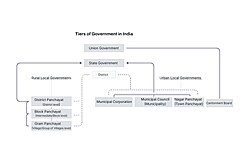
Panchayati Raj Institutions or Local self-government bodies play a crucial role in Indian politics, as it focuses on grassroot-level administration in India.
On 24 April 1993, the Constitutional (73rd Amendment) Act, 1992 came into force to provide constitutional status to the Panchayati Raj institutions. This Act was extended to Panchayats in the tribal areas of eight States, namely Andhra Pradesh, Bihar, Gujarat, Himachal Pradesh, Maharashtra, Madhya Pradesh, Odisha and Rajasthan from 24 December 1996.
The Act aims to provide a 3-tier system of Panchayati Raj for all States having a population of over 2 million, to hold Panchayat elections regularly every 5 years, to provide reservation of seats for Scheduled Castes, Scheduled Tribes and Women, to appoint State Finance Commission to make recommendations as regards the financial powers of the Panchayats and to constitute District Planning Committee to prepare a draft development plan for the district.
Role of political parties
| This section needs more citations. (March 2021) |
| Part of the Politics series | ||||||
| Party politics | ||||||
|---|---|---|---|---|---|---|
.svg) | ||||||
| Political spectrum | ||||||
|
||||||
| Party platform | ||||||
| Party organization | ||||||
| Party Leadership | ||||||
| Party system | ||||||
|
|
||||||
| Coalition | ||||||
|
|
||||||
| Lists | ||||||
As with any other democracy, political parties represent different sections among the Indian society and regions, and their core values play a major role in the politics of India. Both the executive branch and the legislative branch of the government are run by the representatives of the political parties who have been elected through the elections. Through the electoral process, the people of India choose which representative and which political party should run the government. Through elections, any party may gain simple majority in the lower house. Coalitions are formed by the political parties in case no single party gains a simple majority in the lower house. Unless a party or a coalition have a majority in the lower house, a government cannot be formed by that party or the coalition.

India has a multi-party system, where there are a number of national as well as regional parties. A regional party may gain a majority and rule a particular state. If a party is represented in more than 4 states, it would be labelled a national party (subject to other criteria above). Out of the 72 years of India's independence, India has been ruled by the Congress party for 53 years as of January 2020.
The party enjoyed a parliamentary majority save for two brief periods during the 1970s and late 1980s. This rule was interrupted between 1977 and 1980, when the Janata Party coalition won the election owing to public discontent with the controversial state of emergency declared by the then Prime Minister Indira Gandhi. The Janata Dal won elections in 1989, but its government managed to hold on to power for only two years.
Between 1996 and 1998, there was a period of political flux with the government being formed first by the nationalist BJP followed by a left-leaning United Front coalition. In 1998, the BJP formed the National Democratic Alliance with smaller regional parties, and became the first non-INC and coalition government to complete a full five-year term. The 2004 elections saw the INC winning the largest number of seats to form a government leading the United Progressive Alliance, and supported by left-parties and those opposed to the BJP.
On 22 May 2004, Manmohan Singh[12] was appointed the prime minister of India following the victory of the INC and the left front in the 2004 Lok Sabha election. The UPA ruled India without the support of the left front. Previously, Atal Bihari Vajpayee[13] had taken office in October 1999 after a general election in which a BJP-led coalition of 13 parties called the National Democratic Alliance emerged with a majority. In May 2014, Narendra Modi of BJP was elected as the prime minister.
Formation of coalition governments reflects the transition in Indian politics away from the national parties toward smaller, more narrowly based regional parties. Some regional parties, especially in South India, are deeply aligned to the ideologies of the region unlike the national parties and thus the relationship between the central government and the state government in various states has not always been free of rancour. Disparity between the ideologies of the political parties ruling the centre and the state leads to severely skewed allocation of resources between the states.
Political issues
Social issues
|
The lack of homogeneity in the Indian population causes division among different sections of the people based on religion, region, language, caste and ethnicity. This has led to the rise of political parties with agendas catering to one or a mix of these groups. Parties in India also target people who are not in favour of other parties and use them as an asset.
Some parties openly profess their focus on a particular group. For example, the Dravida Munnetra Kazhagam's and the All India Anna Dravida Munnetra Kazhagam's focus on the Dravidian population and Tamil identity; Biju Janata Dal's championing of Odia culture; the Shiv Sena's pro-Marathi agenda; Naga People's Front's demand for protection of Naga tribal identity; People's Democratic Party; National Conference's calling for Kashmiri Muslim identity and Telugu Desam Party's formation in the erstwhile Andhra Pradesh by N. T. Rama Rao demanding for rights and needs of people of the state only. Some other parties claim to be universal in nature, but tend to draw support from particular sections of the population. For example, the Rashtriya Janata Dal (translated as National People's Party) has a votebank among the Yadav and Muslim population of Bihar and the All India Trinamool Congress does not have any significant support outside West Bengal.
The narrow focus and votebank politics of most parties, even in the central government and state legislature, supplements national issues such as economic welfare and national security. Moreover, internal security is also threatened as incidences of political parties instigating and leading violence between two opposing groups of people is a frequent occurrence.
Economic problems
|

Economic issues like poverty, unemployment and development are the main issues that influence politics. Garibi Hatao (eradicate poverty) has been a slogan of the Congress for a long time. BJP encourages a free market economy. The more popular slogan in this field is Sabka Saath, Sabka Vikas (Cooperation with all, progress of all). The Communist Party of India (Marxist) vehemently supports left-wing politics like land-for-all, right to work and strongly opposes neoliberal policies such as globalisation, capitalism and privatisation.
Law and order
Terrorism, Naxalism, religious violence and caste-related violence are important issues that affect the political environment of the Indian nation. Stringent anti-terror legislation such as TADA, POTA and MCOCA have received much political attention, both in favour and against, and some of these laws were disbanded eventually due to human rights violations.[14] However, UAPA was amended in 2019 to negative effect vis-á-vis human rights.
Terrorism has affected politics India since its conception, be it the terrorism supported from Pakistan or the internal guerrilla groups such as Naxalites. In 1991 the former prime minister Rajiv Gandhi was assassinated during an election campaign.[15] The suicide bomber was later linked to the Sri Lankan terrorist group Liberation Tigers of Tamil Eelam, as it was later revealed the killing was an act of vengeance for Rajiv Gandhi sending troops in Sri Lanka against them in 1987.[15]
The Godhra train killings and the Babri Masjid demolition on 6 December 1992 resulted in nationwide communal riots in two months, with worst occurring in Mumbai with at least 900 dead.[15][16] The riots were followed by 1993 Bombay bombings, which resulted in more deaths.
Law and order issues, such as action against organised crime are issues which do not affect the outcomes of elections. On the other hand, there is a criminal–politician nexus. Many elected legislators have criminal cases against them. In July 2008, the Washington Post reported that nearly a fourth of the 540 Indian Parliament members faced criminal charges, "including human trafficking, child prostitution immigration rackets, embezzlement, rape and even murder".[17]
High Political Offices in India
|
President of India
The Constitution of India lays down that the Head of State and Union Executive is the president of India. They are elected for a five-year term by an electoral college consisting of members of both Houses of Parliament and members of legislative assemblies of the states. The president is eligible for re-elections; however, in India's independent history, only one president has been re-elected – Rajendra Prasad.
The president appoints the prime minister of India from the party or coalition which commands maximum support of the Lok Sabha, on whose recommendation he/she nominates the other members of the Union Council of Ministers. The president also appoints judges of the Supreme Court and High Courts. It is on the president's recommendation that the Houses of Parliament meet, and only the president has the power to dissolve the Lok Sabha. Furthermore, no bill passed by Parliament can become law without the president's assent.
However, the role of the president of India is largely ceremonial. All the powers of the president mentioned above are exercised on recommendation of the Union Council of Ministers, and the president does not have much discretion in any of these matters. The president also does not have discretion in the exercise of his executive powers, as the real executive authority lies in the Cabinet. The current president is Ram Nath Kovind.
Vice President of India
The office of the vice-president of India is constitutionally the second most senior office in the country, after the president. The vice-president is also elected by an electoral college, consisting of members of both houses of Parliament.
Like the president, the role of the vice-president is also ceremonial, with no real authority vested in him/her. The vice-president fills in a vacancy in the office of president (till the election of a new president). The only regular function is that the vice-president functions as the ex officio Chairman of the Rajya Sabha. No other duties/powers are vested in the office. The current vice-president is Venkaiah Naidu.
The Prime Minister and the Union Council of Ministers
The Union Council of Ministers, headed by the prime minister, is the body with which the real executive power resides. The prime minister is the recognized head of the government.
The Union Council of Ministers is the body of ministers with which the prime minister works with on a day-to-day basis. Work is divided between various ministers into various departments and ministries. The Union Cabinet is a smaller body of senior ministers which lies within the Union Council of Ministers, and is the most powerful set of people in the country, playing an instrumental role in legislation and execution alike.
All members of the Union Council of Ministers must be members of either House of Parliament at the time of appointment or must get elected/nominated to either House within six months of their appointment.
It is the Union Cabinet that co-ordinates all foreign and domestic policy of the Union. It exercises immense control over administration, finance, legislation, military, etc. The Head of the Union Cabinet is the prime minister. The current prime minister of India is Narendra Modi.
State Governments
|
India has a federal form of government, and hence each state also has its own government. The executive of each state is the governor (equivalent to the president of India), whose role is ceremonial. The real power resides with the chief minister (equivalent to the prime minister) and the State Council of Ministers. States may either have a unicameral or bicameral legislature, varying from state to state. The chief minister and other state ministers are also members of the legislature.
Nepotism in Indian Politics
Since the 1980s, Indian politics has become dynastic, possibly due to the absence of a party organization, independent civil society associations that mobilize support for the party, and centralized financing of elections.[4] This phenomenon is seen from national level down to district level. One example of dynastic politics has been the Nehru–Gandhi family which produced three Indian prime ministers. Family members have also led the Congress party for most of the period since 1978 when Indira Gandhi floated the then Congress(I) faction of the party.[18] The ruling Bharatiya Janata Party also features several senior leaders who are dynasts.[19] Dynastic politics is prevalent also in a number of political parties with regional presence such as All India Majlis-e-Ittehadul Muslimeen (AIMIM), Desiya Murpokku Dravida Kazhagam (DMDK), Dravida Munnetra Kazhagam (DMK), Indian National Congress (INC), Indian National Lok Dal (INLD), Jammu & Kashmir National Conference (JKNC), Jammu and Kashmir Peoples Democratic Party (JKPDP), Janata Dal (Secular) (JD(s)), Jharkhand Mukti Morcha (JMM), National People's Party (NPP), Nationalist Congress Party (NCP), Pattali Makkal Katchi (PMK), Rashtriya Janata Dal (RJD), Rashtriya Lok Dal (RLD), Samajwadi Party (SP), Shiromani Akali Dal (SKD), Shiv Sena (SS), Telangana Rashtra Samithi (TRS) and Telugu Desam Party (TDP).[20]
See also
- Government of India
- State governments of India
- Law of India
- Indian political scandals
- Disqualification of convicted representatives in India
- Political families of India
- List of think tanks in India
- History of democracy in ancient India
- High command culture
References
- ↑ M. Lakshmikanth 2012, pp. 389–390.
- ↑ "General Election 2014". Election Commission of India. Archived from the original on 23 May 2014. Retrieved 21 May 2014.
- ↑ "Need for accountability in politics of dynasty". www.dailypioneer.com. Archived from the original on 17 January 2017. Retrieved 17 January 2017.
- ↑ 4.0 4.1 Chhibber⇑, Pradeep (March 2013). "Dynastic parties Organization, finance and impact". Party Politics. 19 (2): 277–295. doi:10.1177/1354068811406995. S2CID 144781444.
- ↑ Chander 2001, pp. 389–390.
- ↑ Krzysztof Iwanek (2 November 2016). "The Curious Stories of Indian Party Symbols". The Diplomat. Archived from the original on 19 April 2017. Retrieved 19 April 2017.
- ↑ 7.0 7.1 "Election Commission Of India Press Note". Archived from the original on 5 March 2016. Retrieved 13 March 2014.
- ↑ Hicken & Kuhonta 2014, p. 205.
- ↑ "INDIANMIRROR- Political Corruption in India".
- ↑ "How political parties choose their candidates to win elections". Hindustan Times. No. 26 March 2018. Archived from the original on 22 April 2019. Retrieved 22 April 2019.
- ↑ Vaishnav, Milan (10 December 2011). "Caste Politics, Credibility and Criminality: Political Selection in India". SSRN 1899847.
{{cite journal}}: Cite journal requires|journal=(help) - ↑ "Welcome to Embassy of India, Washington D C, USA" (PDF). www.indianembassy.org. Archived from the original on 26 January 2012.
- ↑ Priyanka Shah (1 November 2014). "13 Amazing Facts about Atal Ji, the Bhishma Pitamah of Indian Politics". Topyaps. Archived from the original on 11 September 2014. Retrieved 16 May 2014.
- ↑ "Anti-Terrorism Legislation". Human rights watch. 20 November 2001. Archived from the original on 3 July 2017. Retrieved 6 August 2019.
- ↑ 15.0 15.1 15.2 Guha 2008, pp. 637–659.
- ↑ "Shiv Sainiks will maintain peace post-Ayodhya verdict: Uddhav". Hindustan Times. HT Media Ltd. Archived from the original on 3 March 2014. Retrieved 13 March 2014.
- ↑ Wax, Emily (24 July 2008). "With Indian Politics, the Bad Gets Worse". The Washington Post. Archived from the original on 8 November 2012. Retrieved 22 May 2010.
- ↑ Basu & Chandra 2016, p. 136.
- ↑ "Is the BJP less dynastic than the Congress? Not so, Lok Sabha data shows".
- ↑ Chandra 2016, pp. 131,136.
Bibliography
- M. Lakshmikanth (2012). Public Administration (9th ed.). Tata Mcgraw Hill. ISBN 978-0071074827. OCLC 1039277322.
- Chander, Prakash (2001). "Nature of Party System in India". Comparative Politics & International Relations. Cosmos Bookhive. pp. 129–134. ISBN 817729035-5.
- Hicken, Allen; Kuhonta, Erik Martinez (29 December 2014). Party System Institutionalization in Asia: Democracies, Autocracies, and the Shadows of the Past. Cambridge University Press. ISBN 978-1-107-04157-8.
- Guha, Ramachandra (2008). India after Gandhi : the history of the world's largest democracy (Indian ed.). India: Picador. ISBN 9780330505543.
- Basu, Amrita; Chandra, Kanchan (2016). Democratic Dynasties: State, Party and Family in Contemporary Indian Politics (1 ed.). Cambridge, UK: Cambridge University Press. ISBN 978-1-107-12344-1. Archived from the original on 10 November 2019. Retrieved 23 May 2016.
- Chandra, Kanchan (28 April 2016). Democratic Dynasties: State, Party, and Family in Contemporary Indian Politics. Cambridge University Press. ISBN 978-1-316-59212-0.
Further reading
- Chowdhuri, Satyabrata Rai. Leftism in India, 1917-1947. Palgrave, U.K., 2007.
- Shively, W. Phillips. Power and Choice: An Introduction to Political Science—Chapter 14 Example: Parliamentary Government in India. McGraw Hill Higher Education, 2008. ISBN 978-0-07-340391-5
- Mitra, Subrata K. and Singh, V.B.. Democracy and Social Change in India: A Cross-Sectional Analysis of the National Electorate. New Delhi: Sage Publications, 1999. ISBN 81-7036-809-X (India HB) ISBN 0-7619-9344-4 (U.S. HB).
- Shourie, Arun (2007). The parliamentary system: What we have made of it, what we can make of it. New Delhi: Rupa & Co.
- Shourie, Arun (2005). Governance and the sclerosis that has set in. New Delhi: ASA Publications.
- Tawa Lama-Rewal, Stéphanie. "Studying Elections in India: Scientific and Political Debates". South Asia Multidisciplinary Academic Journal, 3, 2009.


