

>InternetArchiveBot Bluelink 1 book for Wikipedia:Verifiability (20210125)) #IABot (v2.0.8) (GreenC bot |
No edit summary |
||
| Line 1: | Line 1: | ||
{{Short description|Indo-Aryan language spoken in India and Pakistan}} | |||
{{EngvarB|date=October 2019}} | |||
{{Use dmy dates|date=September 2020}} | |||
{{Infobox language | {{Infobox language | ||
| name = Punjabi | | name = Punjabi | ||
| nativename = {{lang|pa|ਪੰਜਾਬੀ}} {{lang|pnb|{{ | | nativename = {{lang|pa|ਪੰਜਾਬੀ}}, {{lang|pnb|{{nq|پن٘جابی}}}}|पंजाबी| | ||
| pronunciation = {{IPAc-en|p|ʌ|n|ˈ|dʒ|ɑː|b|i}} | | pronunciation = {{plainlist| | ||
| states = [[Punjab | *{{IPA-pa|pənˈdʒaːbːi|lang}} | ||
| ethnicity = [[Punjabis]] | *{{IPAc-en|lang|p|ʌ|n|ˈ|dʒ|ɑː|b|i}}}} | ||
| speakers = | | states = [[India]], [[Pakistan]] | ||
| region = [[Punjab]] | |||
| ethnicity = [[Punjabis]] | |||
| familycolor = Indo-European | | speakers = 113 million | ||
| fam2 = [[Indo-Iranian languages|Indo-Iranian]] | | date = 2011–2017 | ||
| fam3 = [[Indo-Aryan languages|Indo-Aryan]] | | ref = <ref>80.5 million in Pakistan (2017), 31.1 in India (2011), 0.5 in Canada (2016), 0.3 in the UK (2011), 0.3 in the US (2017), 0.1 in Australia (2016). See {{slink||Geographic distribution}} below.</ref> | ||
| fam4 = Northwestern | | familycolor = Indo-European | ||
| | | fam2 = [[Indo-Iranian languages|Indo-Iranian]] | ||
| | | fam3 = [[Indo-Aryan languages|Indo-Aryan]] | ||
| fam4 = [[Northwestern Indo-Aryan languages|Northwestern Indo-Aryan]] | |||
| nation = {{flag| | | script = {{plainlist| | ||
| iso1 = pa | *[[Gurmukhi|Gurmukhī]] | ||
| iso2 = pan | *[[Perso-Arabic]] <small>([[Shahmukhi alphabet|Shāhmukhī]])</small> | ||
*[[Punjabi Braille]] | |||
*[[Laṇḍā scripts|Laṇḍā]] {{small|(historical)}} | |||
| lc1 = pan | *[[Mahajani]] {{small|(historical)}}}} | ||
| | | agency = Department of Languages, Punjab, [[India]]<ref>{{cite web | last=India | first=Tribune | title=Punjabi matric exam on Aug 26 | website=The Tribune | date=19 August 2020 | url=https://www.tribuneindia.com/news/patiala/punjabi-matric-exam-on-aug-26-128241 | access-date=18 September 2020}}</ref><br/> | ||
| | Punjab Institute of Language, Art, and Culture - [[Pakistan]] | ||
| ld2 = Western | | nation = {{flag|India}} <br/> {{bulleted_list|[[Punjab, India|Punjab]] (official<ref>{{cite web |title=NCLM 52nd Report |url=http://nclm.nic.in/shared/linkimages/NCLM52ndReport.pdf |publisher=NCLM |access-date=13 January 2020 |archive-url=https://web.archive.org/web/20161115133948/http://nclm.nic.in/shared/linkimages/NCLM52ndReport.pdf |archive-date=15 November 2016 |date=15 November 2016 |url-status=dead}}</ref><ref>{{cite web | title=Punjab mandates all signage in Punjabi, in Gurmukhi script | website=The Hindu | date=21 February 2020 | url=https://www.thehindu.com/news/national/other-states/punjab-mandates-all-signage-in-punjabi-in-gurmukhi-script/article30881840.ece | access-date=9 September 2020}}0</ref>)|[[Haryana]] (additional<ref>{{cite news | title=All milestones, signboards in Haryana to bear info in English, Hindi and Punjabi: Education Minister | work=The Indian Express | date=3 March 2020 | url=https://indianexpress.com/article/cities/chandigarh/all-milestones-signboards-in-haryana-to-bear-info-in-english-hindi-and-punjabi-education-minister-6297747/ | access-date=9 September 2020}}</ref>)|[[Delhi]] (additional<ref>{{cite news | title=Punjabi, Urdu made official languages in Delhi | work=The Times of India | date=25 June 2003 | url=https://timesofindia.indiatimes.com/city/delhi/Punjabi-Urdu-made-official-languages-in-Delhi/articleshow/43388.cms | access-date=10 September 2020}}</ref>)|[[West Bengal]] (additional, in blocks and divisions with more than 10% of the population<ref name=Telegraph:1>{{cite news |url=https://www.telegraphindia.com/1121211/jsp/bengal/story_16301872.jsp |title=Multi-lingual Bengal |date=11 December 2012 |newspaper=[[The Telegraph (Calcutta)|The Telegraph]] |access-date=25 March 2018 |archive-url=https://web.archive.org/web/20180325232340/https://www.telegraphindia.com/1121211/jsp/bengal/story_16301872.jsp |archive-date=25 March 2018 |url-status=live}}</ref>)}} | ||
| lingua = 59-AAF-e | | minority = | ||
| image = File:Punjabi gurmukhi shahmukhi.png | | iso1 = pa | ||
| imagesize = 150px | | iso2 = pan | ||
| imagecaption = 'Punjabi' written in Shahmukhi (top) and Gurmukhi (bottom) scripts | | lc1 = pan | ||
| map = Punjabispeakers.png | | lc2 = pnb | ||
| mapcaption = Areas of the Indian Subcontinent where Punjabi is natively spoken | | ld1 = Panjabi | ||
| caption = | | ld2 = Western Panjabi | ||
| notice = IPA | | lingua = 59-AAF-e | ||
| glotto = panj1256 | | image = File:Punjabi gurmukhi shahmukhi.png | ||
| glottoname = | | imagesize = 150px | ||
| glottorefname = Punjabi | | imagecaption = 'Punjabi' written in [[Shahmukhi alphabet|Shahmukhi]] used in [[Punjab, Pakistan]] (top) and [[Gurmukhi alphabet|Gurmukhi]] used in [[Punjab, India]] (bottom) scripts | ||
| map = Punjabispeakers.png | |||
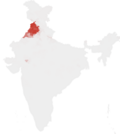
| mapcaption = Areas of the Indian Subcontinent where Punjabi is natively spoken | |||
| caption = | |||
| notice = IPA | |||
| glotto = panj1256 | |||
| glottoname = Eastern Panjabi | |||
| glottorefname = Eastern Panjabi | |||
| glotto2 = west2386 | |||
| glottoname2 = Western Panjabi<!--name as listed at Glottolog--> | |||
| glottorefname2 = Western Panjabi<!--name as listed at Glottolog--> | |||
| dia1 = See [[Punjabi dialects]] | |||
}} | }} | ||
{{ | {{Punjabis}} | ||
Punjabi | '''Punjabi''' ([[Gurmukhi]]: {{lang|pa|ਪੰਜਾਬੀ}}, [[Shahmukhi]]: {{lang|pa|{{Nastaliq|پن٘جابی}}}} {{IPAc-en|p|ʌ|n|ˈ|dʒ|ɑː|b|i}};<ref>Laurie Bauer, 2007, ''The Linguistics Student's Handbook'', Edinburgh</ref> {{IPA-pa|pənˈdʒaːbːi}}; sometimes spelled '''Panjabi''') is an [[Indo-Aryan languages|Indo-Aryan language]] spoken by the [[Punjabi people]] and native to the [[Punjab]] region of [[India]] and [[Pakistan]]. | ||
It has approximately 113 million [[native speakers]]. The larger part – 80.5 million as of 2017 – are in Pakistan, where Punjabi has more speakers than any other language but no official recognition at the national or provincial level. In India, Punjabi is spoken by 31.1 million people (as of 2011) and has official status in the state of Punjab. The language is spoken among a significant [[Punjabi diaspora|overseas diaspora]], particularly in Canada, the United States and the United Kingdom. | |||
In India, Punjabi is written using the [[Gurmukhi]] script, while [[Shahmukhi]] is used in Pakistan. Punjabi is unusual among Indo-Aryan languages in its use of [[Tone (linguistics)|lexical tone]]. | |||
[[ | |||
== History == | |||
=== Etymology === | |||
The word ''Punjabi'' (sometimes spelled ''Panjabi'') has been derived from the word ''Panj-āb'', [[Persian language|Persian]] for 'Five Waters', referring to the five major eastern [[Tributary|tributaries]] of the [[Indus River]]. The name of the region was introduced by the [[Turko-Persian]] conquerors<ref>{{cite book|last=Canfield|first=Robert L.|title=Persia in Historical Perspective|year=1991|page=1 ("Origins")|publisher=Cambridge University Press|location=[[Cambridge]], United Kingdom<!--|isbn=0-521-39094-X-->|isbn=978-0-521-52291-5}}</ref> of [[South Asia]] and was a translation of the [[Sanskrit]] name for the [[region]], ''Panchanada'', which means 'Land of the Five Rivers'.<ref>{{cite web|url=http://dsalsrv02.uchicago.edu/cgi-bin/philologic/getobject.pl?p.1:375.hobson|title=Hobson-Jobson: A glossary of Colloquial Anglo-Indian Words and Phrases, and of Kindred Terms, Etymological, Historical, Geographical and Discursive|first=Yule, Henry|last=Sir|date=13 August 2018|website=dsalsrv02.uchicago.edu}}</ref><ref>{{cite web|url=http://dsalsrv02.uchicago.edu/cgi-bin/app/macdonell_query.py?qs=%E0%A4%AA%E0%A4%9E%E0%A5%8D%E0%A4%9A%E0%A4%A8%E0%A4%96&searchhws=yes|title=A Practical Sanskrit Dictionary with Transliteration, Accentuation, and Etymological Analysis Throughout|first=Arthur Anthony|last=Macdonell|date=13 August 2018}}</ref> | |||
''Panj'' is [[cognate]] with [[Sanskrit]] ''{{IAST|pañca}}'' ({{Lang-sa|पञ्च|label=none}}), [[Greek language|Greek]] ''pénte'' ({{lang|grc|πέντε}}), and [[Baltic languages|Lithuanian]] ''Penki'', all of which meaning 'five'; ''āb'' is cognate with Sanskrit ''áp'' ({{Lang-sa|अप्|label=none}}) and with the {{IAST|Av-}} of {{IAST|Avon}}. The historical [[Punjab region]], now divided between India and Pakistan, is defined [[Physical geography|physiographically]] by the [[Indus River]] and these five [[tributaries]]. One of the five, the [[Beas River]], is a tributary of another, the [[Sutlej]]. | |||
== | ===Origin=== | ||
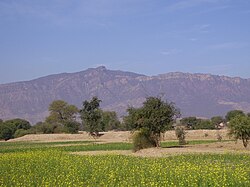
[[File:Tilla Jogian.jpg|thumb|[[Tilla Jogian]], district Jehlum, Punjab, Pakistan a hilltop associated with many Nath jogis (considered among compilers of earlier Punjabi works)]] | |||
Punjabi developed from [[Prakrit]] languages and later {{IAST|Apabhraṃśa}} ({{Lang-sa|अपभ्रंश}}, 'corruption' or 'corrupted speech')<ref>.https://books.google.com/books?id=gqIbJz7vMn0C&pg=PA166&dq=punjabi+prakrit+language&hl=en&sa=X&ved=0ahUKEwie9PGZnrzQAhXMtI8KHay-AfwQ6AEIKTAD#v=onepage&q=punjabi%20prakrit%20language&f=false {{webarchive|url=https://web.archive.org/web/20170121195057/https://books.google.com/books?id=gqIbJz7vMn0C |date=21 January 2017 }}</ref> From 600 BC, Sanskrit was advocated as official language and Prakrit gave birth to many regional languages in different parts of India. All these languages are called Prakrit (Sanskrit: {{Lang-sa|प्राकृत|translit=prākṛta|label=none}}) collectively. [[Paishachi]] Prakrit was one of these Prakrit languages, which was spoken in north and north-western India and Punjabi developed from this Prakrit. Later in northern India Paishachi Prakrit gave rise to Paishachi Aparbhsha, a descendant of Prakrit.<ref>{{Cite book|last=G S Sidhu|url=http://archive.org/details/panjabandpanjabi_202003|title=Panjab And Panjabi|date=2004}}</ref> Punjabi emerged as an Apabhramsha, a degenerated form of Prakrit, in the 7th century A.D. and became stable by the 10th century. The earliest writings in Punjabi belong to [[Nath|Nath Yogi]] era from 9th to 14th century A.D.<ref name="Hoiberg 2000">{{Cite book|last=Hoiberg|first=Dale|url=https://books.google.com/books?id=ISFBJarYX7YC&q=Punjabi+language+Nath+Saints&pg=PA214|title=Students' Britannica India|date=2000|publisher=Popular Prakashan|isbn=978-0-85229-760-5|language=en}}</ref> The language of these compositions is morphologically closer to [[Shauraseni Prakrit|Shauraseni Apbhramsa]], though vocabulary and rhythm is surcharged with extreme colloquialism and folklore.<ref name="Hoiberg 2000"/> | |||
{| | ===Arabic and Persian influence on Punjabi=== | ||
The Arabic and modern-Persian influence in the historical Punjab region began with the late first millennium [[Muslim conquests on the Indian subcontinent]].<ref name="google">{{cite book|title=East of Indus: My Memories of Old Punjab|author=Brard, G.S.S.|date=2007|publisher=Hemkunt Publishers|isbn=9788170103608|url=https://books.google.com/books?id=UUdYFH9skIkC&pg=PA81|page=81|access-date=13 January 2017|url-status=live|archive-url=https://web.archive.org/web/20180209045039/https://books.google.com/books?id=UUdYFH9skIkC&pg=PA81|archive-date=9 February 2018}}</ref> Many [[Persian language|Persian]] and [[Arabic]] words were incorporated in Punjabi.<ref name="google2">{{cite book|title=The Social Space of Language: Vernacular Culture in British Colonial Punjab|author=Mir, F.|date=2010|publisher=University of California Press|isbn=9780520262690|url=https://books.google.com/books?id=EUPc5pDWKikC&pg=PA35|page=35|access-date=13 January 2017|url-status=live|archive-url=https://web.archive.org/web/20180209045039/https://books.google.com/books?id=EUPc5pDWKikC&pg=PA35|archive-date=9 February 2018}}</ref><ref name="google3">{{cite book|title=Language Policy and Language Conflict in Afghanistan and Its Neighbors: The Changing Politics of Language Choice|author=Schiffman, H.|date=2011|publisher=Brill|isbn=9789004201453|url=https://books.google.com/books?id=52aicl9l7rwC&pg=PA314|page=314|access-date=13 January 2017|url-status=live|archive-url=https://web.archive.org/web/20180209045040/https://books.google.com/books?id=52aicl9l7rwC&pg=PA314|archive-date=9 February 2018}}</ref> So Punjabi relies heavily on Persian and Arabic words which are used with a liberal approach to language. Most important words in Punjabi, like {{Lang-pa|ਅਰਦਾਸ|label=none|link=no}} and {{Lang-pa|ਰਹਿਰਾਸ|label=none|link=no}}, and common words, like {{Lang-pa|ਨਹਿਰ, ਜ਼ਮੀਨ, ਗਜ਼ਲ|label=none|link=no}}, etc., have all come out of Persian. After the fall of the Sikh empire, Urdu was made the official language of Punjab (in Pakistani Punjab, it is still the primary official language), and influenced the language as well.<ref>{{Cite book|last=Schiffman|first=Harold|url=https://books.google.com/books?id=52aicl9l7rwC&q=urdu+words+in+punjabi&pg=PA314|title=Language Policy and Language Conflict in Afghanistan and Its Neighbors: The Changing Politics of Language Choice|date=2011-12-09|publisher=BRILL|isbn=978-90-04-20145-3|language=en}}</ref> | |||
In fact, the sounds of {{Lang-pa|ਜ਼, ਖ਼, ਸ਼|link=no|label=none}}, and {{Lang-pa|ਫ਼|link=no|label=none}} have been borrowed from Persian. Later, it was [[Lexical semantics|lexically]] influenced by [[Portuguese language|Portuguese]] (words like {{Lang-pa|ਅਲਮਾਰੀ/الماری|link=no|label=none}}), [[Greek language|Greek]] (words like {{Lang-pa|ਦਾਮ/دام|link=no|label=none}}), [[Chagatai language|Chagatai]] (words like {{Lang-pa|ਕ਼ੈੰਚੀ, ਸੁਗ਼ਾਤ/قینچی،سوغات|link=no|label=none}}), [[Japanese language|Japanese]] (words like {{Lang-pa|ਰਿਕਸ਼ਾ/رکشا|link=no|label=none}}), Chinese (words like {{Lang-pa|ਚਾਹ, ਲੀਚੀ, ਲੁਕਾਠ/چاہ، لیچی، لکاٹھ|link=no|label=none}}) and [[English language|English]] (words like {{Lang-pa|ਜੱਜ, ਅਪੀਲ, ਮਾਸਟਰ/جج، اپیل، ماسٹر|link=no|label=none}}), though these influences have been minor in comparison to Persian and Arabic.<ref name="google4">{{cite book|title=A Panorama of Indian Culture: Professor A. Sreedhara Menon Felicitation Volume|author1=Menon, A.S.|author2=Kusuman, K.K.|date=1990|publisher=Mittal Publications|isbn=9788170992141|url=https://books.google.com/books?id=z4JqgSUSXDsC&pg=PA87|page=87|access-date=13 January 2017|url-status=live|archive-url=https://web.archive.org/web/20180209045039/https://books.google.com/books?id=z4JqgSUSXDsC&pg=PA87|archive-date=9 February 2018}}</ref> | |||
{| class="wikitable" | |||
|- | |||
! English | |||
! [[Gurmukhi]]-based ([[Punjab, India]]) | |||
! [[Shahmukhi alphabet|Shahmukhi]]-based ([[Punjab, Pakistan]]) | |||
|- | |||
| President | |||
|{{lang|pa|ਰਾਸ਼ਟਰਪਤੀ}} ({{transl|pa|''rāshtarpatī''}}) | |||
|{{lang|pnb|{{Nastaliq|صدرمملکت}}}} ({{transl|pa|ALA-LC|''sadar-e mumlikat''}}) | |||
|- | |||
| Article | |||
|{{lang|pa|ਲੇਖ}} ({{transl|pa|''lēkh''}}) | |||
|{{lang|pnb|{{Nastaliq|مضمون}}}} ({{transl|pa|ALA-LC|''mazmūn''}}) | |||
|- | |||
| Prime Minister | |||
|{{lang|pa|ਪਰਧਾਨ ਮੰਤਰੀ}} ({{transl|pa|''pardhān mantarī''}})* | |||
|{{lang|pnb|{{Nastaliq|وزیراعظم}}}} ({{transl|pa|ALA-LC|''wazīr-e aʿzam''}}) | |||
|- | |||
| Family | |||
|{{lang|pa|ਪਰਿਵਾਰ }} ({{transl|pa|''parivār''}})* <br/> {{lang|pa|ਟੱਬਰ}} ({{transl|pa|''ṭabbar''}}) <br/> {{lang|pa|ਲਾਣਾ}} ({{transl|pa|''lāṇā''}}) | |||
|{{lang|pnb|{{Nastaliq|خاندان}}}} ({{transl|pa|ALA-LC|''kḥāndān''}}) <br/> {{lang|pnb|{{Nastaliq|ٹبّر}}}} ({{transl|pa|ALA-LC|''ṭabbar''}}) | |||
|- | |||
| Philosophy | |||
|{{lang|pa|ਫ਼ਲਸਫ਼ਾ}} ({{transl|pa|''falsafā''}}) <br/> {{lang|pa|ਦਰਸ਼ਨ}} ({{transl|pa|''darshan''}}) | |||
|{{lang|pnb|{{Nastaliq|فلسفہ}}}} ({{transl|pa|ALA-LC|''falsafā''}}) | |||
|- | |||
| Capital city | |||
|{{lang|pa|ਰਾਜਧਾਨੀ}} ({{transl|pa|''rājdhānī''}}) | |||
|{{lang|pnb|{{Nastaliq|دارالحکومت}}}} ({{transl|pa|ALA-LC|''dārul hakūmat''}}) | |||
|- | |- | ||
| | | Viewer | ||
|{{lang|pa|ਦਰਸ਼ਕ}} ({{transl|pa|''darshak''}}) | |||
|{{lang|pnb|{{Nastaliq|ناظرین}}}} ({{transl|pa|ALA-LC|''nāzarīn''}}) | |||
|- | |||
| Listener | |||
|{{lang|pa|ਸਰੋਤਾ}} ({{transl|pa|''sarotā''}}) | |||
|{{lang|pnb|{{Nastaliq|سامع}}}} ({{transl|pa|ALA-LC|''sāma''}}) | |||
|} | |||
<small>Note: In more formal contexts, [[hypercorrect]] [[Sanskritized]] versions of these words (ਪ੍ਰਧਾਨ ''pradhān'' for ਪਰਧਾਨ ''pardhān'' and ਪਰਿਵਾਰ ''parivār'' for ਪਰਵਾਰ ''parvār'') may be used.</small> | |||
=== Modern times === | |||
Punjabi is spoken in many dialects in an area from [[Delhi]] to [[Islamabad]]. The [[Majhi dialect]] has been adopted as standard Punjabi in [[India]] and Pakistan for education, media etc. The Majhi dialect originated in the [[Majha]] region of the Punjab. The Majha region consists of several eastern districts of [[Pakistani Punjab]] and in India around [[Amritsar]], [[Gurdaspur]], [[Pathankot]] and [[Tarn Taran district|Tarn Taran]] districts. The two most important cities in this area are Lahore and Amritsar. | |||
In India, Punjabi is written in the [[Gurmukhī]] script in offices, schools, and media. Gurmukhi is the official standard script for Punjabi, though it is often unofficially written in the Latin scripts due to influence from [[Indian English|English]], India's two primary official languages at the [[Government of India|Union]]-level. | |||
In Pakistan, Punjabi is generally written using the [[Shahmukhi alphabet|Shahmukhī]] script, created from a modification of the Persian [[Nastaʿlīq script]]. In Pakistan, Punjabi loans technical words from [[Persian language|Persian]] and [[Arabic]] languages, just like [[Urdu]] does. | |||
== Geographic distribution == | |||
Punjabi is the most widely spoken language in Pakistan, the eleventh-most widely spoken in India and, and also present in the Punjabi diaspora in various countries. | |||
=== Pakistan === | |||
Punjabi is the most widely spoken language [[Languages of Pakistan|in Pakistan]], being the native language of 80.5 million people, or nearly 39% of the country's population. | |||
{| class="wikitable" | {| class="wikitable" | ||
|+'''Census history of Punjabi speakers in Pakistan''' | |+'''Census history of Punjabi speakers in Pakistan'''<ref>{{cite web|url=http://www.statpak.gov.pk/depts/pco/index.html |title=Archived copy |access-date=17 September 2009 |url-status=dead |archive-url=https://web.archive.org/web/20090926230905/http://www.statpak.gov.pk/depts/pco/index.html |archive-date=26 September 2009 }}</ref><ref name="PakistanCensus2017">{{Cite news| title = CCI defers approval of census results until elections | url = https://www.dawn.com/news/1410447|date = 21 March 2021| website = Dawn| access-date = 10 March 2021}} The figure of 80.54 million is calculated from the reported 38.78% for the speakers of Punjabi and the 207.685 million total population of Pakistan.</ref> | ||
< | |||
|- | |- | ||
! '''Year''' || '''Population of Pakistan''' || '''Percentage''' || '''Punjabi speakers''' | ! '''Year''' || '''Population of Pakistan''' || '''Percentage''' || '''Punjabi speakers''' | ||
| Line 81: | Line 140: | ||
|- | |- | ||
| 1998 || 132,352,279 || 44.15% || 58,433,431 | | 1998 || 132,352,279 || 44.15% || 58,433,431 | ||
|- | |||
| 2017 || 207,685,000 || 38.78% || 80,540,000 | |||
|} | |} | ||
| | |||
Beginning with the 1981 census, speakers of [[Saraiki language|Saraiki]] and [[Hindko]] were no longer included in the total numbers for Punjabi, which explains the apparent decrease. | |||
=== India === | |||
{{See also|States of India by Punjabi speakers}} | |||
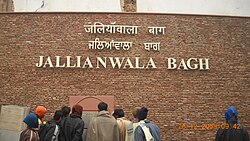
[[File:Jalianwalabag.JPG|thumb|"[[Jallianwala Bagh]]" written in Hindi, Punjabi, and English in [[Amritsar]], [[India]].]] | |||
Punjabi is the official language of the Indian state of [[Punjab]]. It is additional official in [[Haryana]] and [[Delhi]]. Some of its major urban centres in northern India are [[Amritsar]], [[Ludhiana]], [[Chandigarh]], [[Jalandhar]], [[Ambala]], [[Patiala]], [[Bathinda]], [[Hoshiarpur]] and [[Delhi]]. | |||
In the 2011 census of India, {{sigfig|31.144095|4}} million reported their language as Punjabi. The census publications group this with speakers of related "mother tongues" like [[Bagri language|Bagri]] and [[Bhateali language|Bhateali]] to arrive at the figure of {{sigfig|33.124726|4}} million.<ref name="IndiaCensus2011">{{cite web|url = https://www.censusindia.gov.in/2011Census/Language-2011/Statement-1.pdf| title = Statement 1 : Abstract of speakers' strength of languages and mother tongues – 2011| access-date = 21 March 2021}}</ref> | |||
{| class="wikitable" | {| class="wikitable" | ||
|+'''Census history of Punjabi speakers in India''' | |+'''Census history of Punjabi speakers in India'''<ref name="India-census">{{cite web |title=Growth of Scheduled Languages-1971, 1981, 1991 and 2001 |url=http://www.censusindia.gov.in/Census_Data_2001/Census_Data_Online/Language/Statement7.aspx |website=Census of India |publisher=Ministry of Home Affairs, Government of India |access-date=22 February 2015 |url-status=live |archive-url=https://web.archive.org/web/20150220040137/http://www.censusindia.gov.in/Census_Data_2001/Census_Data_Online/Language/Statement7.aspx |archive-date=20 February 2015 }}</ref> | ||
< | |||
|- | |- | ||
! '''Year''' || '''Population of India''' || '''Punjabi speakers in India''' || Percentage | ! '''Year''' || '''Population of India''' || '''Punjabi speakers in India''' || Percentage | ||
| Line 97: | Line 167: | ||
| 2001 || 1,028,610,328 || 29,102,477 || 2.83% | | 2001 || 1,028,610,328 || 29,102,477 || 2.83% | ||
|- | |- | ||
| 2011 || 1,210,193,422 || 33, | | 2011 || 1,210,193,422 || 33,124,726 || 2.74% | ||
|} | |} | ||
Punjabi is also spoken as a [[minority]] | === Punjabi diaspora === | ||
{{See also|Punjabi diaspora}} | |||
[[File:BCNDP SIGNS.jpg|thumb|Signs in Punjabi (along with English and Chinese) of [[New Democratic Party]] of [[British Columbia]], [[Canada]] during 2009 elections]] | |||
Punjabi is also spoken as a [[minority language]] in several other countries where [[Punjabi people]] have emigrated in large numbers, such as the United States, Australia, the United Kingdom, and Canada.<ref>{{cite news |url=http://timesofindia.indiatimes.com/Punjabi_is_Canadas_2nd_most_top_language/articleshow/2782138.cms |work=The Times of India |title=Punjabi is 4th most spoken language in Canada |date=14 February 2008 |url-status=live |archive-url=https://web.archive.org/web/20161114140743/http://timesofindia.indiatimes.com/Punjabi_is_Canadas_2nd_most_top_language/articleshow/2782138.cms |archive-date=14 November 2016 }}</ref> | |||
There were 0.5 million Punjabi speakers in Canada in 2016,<ref>{{cite web|title=Census Profile, 2016 Census, Canada|url=https://www12.statcan.gc.ca/census-recensement/2016/dp-pd/prof/details/page.cfm?Lang=E&Geo1=PR&Code1=01&Geo2=PR&Code2=01&Data=Count&SearchText=Canada&SearchType=Begins&SearchPR=01&B1=Language&TABID=1|website=Government of Canada, Statistics Canada|access-date=11 August 2020|date=8 February 2017}}</ref> 0.3 million [[Languages of the United Kingdom|in the United Kingdom]] in 2011,<ref>273,000 in England and Wales, and 23,000 in Scotland: | |||
*{{Cite web|title = 2011 Census: Quick Statistics for England and Wales, March 2011| url = https://www.ons.gov.uk/peoplepopulationandcommunity/populationandmigration/populationestimates/bulletins/2011censusquickstatisticsforenglandandwales/2013-01-30#tab-Main-language|access-date=24 March 2021}} | |||
*{{cite web|title = Table AT_002_2011 - Language used at home other than English (detailed), Scotland | url = https://www.scotlandscensus.gov.uk/documents/additional_tables/AT_002_2011.xls| access-date = 24 March 2021}}</ref> 0.28 million in the United States<ref>{{cite news|title=US survey puts Punjabi speakers in US at 2.8 lakh|url=https://timesofindia.indiatimes.com/city/chandigarh/us-survey-puts-punjabi-speakers-in-us-at-2-8-lakh/articleshow/62121520.cms|work=Times of India|access-date=11 August 2020|date=18 December 2017}}</ref> and smaller numbers in other countries. | |||
==Major dialects== | |||
{{Main article|Punjabi dialects and languages}} | |||
===Standard Punjabi=== | |||
''Standard Punjabi'' sometimes referred to as Majhi in India or simply Punjabi, is the most widespread and largest dialect of Punjabi. It first developed in the 12th century and gained prominence when Sufi poets such as [[Shah Hussain]], [[Bulleh Shah]] among others began to use the Lahore/Amritsar spoken dialect with infused Persian vocabulary in their works in the Shahmukhi script.<ref>{{cite book |last1=Lal |first1=Mohan |title=Encyclopaedia of Indian Literature |date=1992 |publisher=Sahitya Academy |page=4208}}</ref> Later the Gurmukhi script was developed based on Standard Punjabi by the Sikh Gurus.<ref>{{Cite book|last=Bhatt|first=Shankarlal|title=Punjab|publisher=Kalpaz publ|others=Bhargava, Gopal K.|year=2006|isbn=81-7835-378-4|location=Delhi|pages=141|oclc=255107273}}</ref> | |||
Standard Punjabi is spoken by the majority of the people in [[Faisalabad]], [[Lahore]], [[Gujranwala District|Gujranwala]], [[Sheikhupura District|Sheikhupura]], [[Kasur District|Kasur]], [[Sialkot District|Sialkot]], [[Narowal District|Narowal]], [[Gujrat District|Gujrat]], [[Okara, Pakistan|Okara]], [[Pakpattan District|Pakpattan]], [[Sahiwal District|Sahiwal]], [[Hafizabad District|Hafizabad]], [[Nankana Sahib District|Nankana Sahib]] and [[Mandi Bahauddin District|Mandi Bahauddin]] districts of Pakistan's Punjab Province. It also has a large presence in every district in the rest of Pakistani Punjab, and in all large cities in Pakistan's other provinces. | |||
In India it is spoken in [[Amritsar]], [[Tarn Taran Sahib]], [[Pathankot]] and [[Gurdaspur]] Districts of the State of Punjab and sizable population also in major cities of the States of Punjab, Haryana, Uttar Pradesh, Delhi and Mumbai India. | |||
In Pakistan Standard Punjabi dialect is not called Majhi which is Indian terminology, in Pakistan it is simply called Standard Punjabi. This dialect is used for both Punjabi Films, TV and Theater industry to make Punjabi language content in Lahore. | |||
== Phonology == | |||
While a [[vowel length]] distinction between short and long vowels exists, reflected in modern [[Gurmukhi]] orthographical conventions, it is secondary to the vowel quality contrast between [[central vowel|centralised vowel]]s {{IPA|/ɪ ə ʊ/}} and peripheral vowels {{IPA|/iː eː ɛː aː ɔː oː uː/}} in terms of phonetic significance.{{sfn|Shackle|2003|p=587}} | |||
{|class="wikitable" style="text-align:center;" | {|class="wikitable" style="text-align:center;" | ||
|+'''[[Vowel]]s''' | |+'''[[Vowel]]s''' | ||
! ||[[Front vowel|Front]]|| | ! ||[[Front vowel|Front]]||Near-front||[[Central vowel|Central]]||Near-back||[[Back vowel|Back]] | ||
|- | |- | ||
![[Close vowel|Close]] | ![[Close vowel|Close]] | ||
|{{IPA|iː}} ਈ|| || || ||{{IPA|uː}} ਊ | |{{IPA|iː}} {{lang|pa|ਈ}} {{Nastaliq|اِی}} || || || ||{{IPA|uː}} {{lang|pa|ਊ}} {{Nastaliq|اُو}} | ||
|- | |||
![[Near-close vowel|Near-close]] | |||
| ||{{IPA|ɪ}} {{lang|pa|ਇ}} {{Nastaliq|اِ}} || || {{IPA|ʊ}} {{lang|pa|ਉ}} {{Nastaliq|اُ}} || | |||
|- | |- | ||
![[Close-mid vowel|Close-mid]] | ![[Close-mid vowel|Close-mid]] | ||
|{{IPA|eː}} | |{{IPA|eː}} {{lang|pa|ਏ}} {{Nastaliq|اے}} || || || ||{{IPA|oː}} {{lang|pa|ਓ}} {{Nastaliq|او}} | ||
|- | |- | ||
![[Mid vowel|Mid]] | ![[Mid vowel|Mid]] | ||
| || || {{IPA|ə}} ਅ || || | | || || {{IPA|ə}} {{lang|pa|ਅ}} {{Nastaliq|اَ}} || || | ||
|- | |- | ||
![[Open-mid vowel|Open-mid]] | ![[Open-mid vowel|Open-mid]] | ||
|{{IPA|ɛː}} ਐ || || || || {{IPA|ɔː}} ਔ | |{{IPA|ɛː}} {{lang|pa|ਐ}} {{Nastaliq|اَے}} || || || || {{IPA|ɔː}} {{lang|pa|ਔ}} {{Nastaliq|اَو}} | ||
|- | |- | ||
![[Open vowel|Open]] | ![[Open vowel|Open]] | ||
||| || {{IPA|aː}} ਆ || || | | || || {{IPA|aː}} {{lang|pa|ਆ}} {{Nastaliq|آ}} || || | ||
|} | |} | ||
| | The peripheral vowels have [[nasal vowel|nasal analogues]].{{sfn|Shackle|2003|p=588}} | ||
{| class="wikitable" | {| class="wikitable" | ||
|+'''[[Consonant]]s''' | |+'''[[Consonant]]s''' | ||
! colspan="2"| | ! colspan="2"| | ||
! [[ | ! [[Labial consonant|Labial]] | ||
! [[Dental consonant|Dental]]/<br/>[[Alveolar consonant|Alveolar]] | |||
! [[Dental consonant|Dental]]/<br>[[Alveolar consonant|Alveolar]] | |||
! [[Retroflex]] | ! [[Retroflex]] | ||
! [[Palatal consonant|Palatal]] | ! [[Postalveolar consonant|Post-alv.]]/<br/>[[Palatal consonant|Palatal]] | ||
! [[Velar consonant|Velar]] | ! [[Velar consonant|Velar]] | ||
! [[Glottal consonant|Glottal]] | ! [[Glottal consonant|Glottal]] | ||
|- align=center | |- align=center | ||
! colspan="2"| [[Nasal stop|Nasal]] | ! colspan="2"| [[Nasal stop|Nasal]] | ||
|{{IPA|m}} ਮ | | {{IPA link|m}} {{lang|pa|ਮ}} {{Nastaliq|م}} | ||
| {{IPA link|n̪|n}} {{lang|pa|ਨ}} {{Nastaliq|ن}} | |||
| {{IPA link|ɳ}} {{lang|pa|ਣ}} {{Nastaliq|ݨ}} | |||
| {{IPA link|ɲ}} {{lang|pa|ਞ}} {{Nastaliq|ن}} | |||
| {{IPA link|ŋ}} {{lang|pa|ਙ}} {{Nastaliq|ن٘}} | |||
| | | | ||
|{{IPA| | |- align=center | ||
|{{IPA| | ! rowspan="3"| [[Stop consonant|Stop]]/<br/>[[Affricate consonant|Affricate]] | ||
|{{IPA| | ! {{small|tenuis}} | ||
|{{IPA| | | {{IPA link|p}} {{lang|pa|ਪ}} {{Nastaliq|پ}} | ||
| {{IPA link|t̪|t}} {{lang|pa|ਤ}} {{Nastaliq|ت}} | |||
| {{IPA link|ʈ}} {{lang|pa|ਟ}} {{Nastaliq|ٹ}} | |||
| {{IPA link|t͡ʃ}} {{lang|pa|ਚ}} {{Nastaliq|چ}} | |||
| {{IPA link|k}} {{lang|pa|ਕ}} {{Nastaliq|ک}} | |||
| | | | ||
|- align=center | |- align=center | ||
! | ! {{small|aspirated}} | ||
| {{IPA link|pʰ}} {{lang|pa|ਫ}} {{Nastaliq|پھ}} | |||
| {{IPA| | | {{IPA link|tʰ}} {{lang|pa|ਥ}} {{Nastaliq|تھ}} | ||
| | | {{IPA link|ʈʰ}} {{lang|pa|ਠ}} {{Nastaliq|ٹھ}} | ||
| {{IPA| | | {{IPA link|t͡ʃʰ}} {{lang|pa|ਛ}} {{Nastaliq|چھ}} | ||
| {{IPA| | | {{IPA link|kʰ}} {{lang|pa|ਖ}} {{Nastaliq|کھ}} | ||
| {{IPA| | |||
| {{ | |||
| | | | ||
|- align=center | |- align=center | ||
! | ! {{small|voiced}} | ||
| {{IPA| | | {{IPA link|b}} {{lang|pa|ਬ}} {{Nastaliq|ب}} | ||
| | | {{IPA link|d̪|d}} {{lang|pa|ਦ}} {{Nastaliq|د}} | ||
| {{IPA| | | {{IPA link|ɖ}} {{lang|pa|ਡ}} {{Nastaliq|ڈ}} | ||
| {{IPA| | | {{IPA link|d͡ʒ}} {{lang|pa|ਜ}} {{Nastaliq|ج}} | ||
| {{IPA| | | {{IPA link|ɡ}} {{lang|pa|ਗ}} {{Nastaliq|گ}} | ||
| {{IPA| | |||
| | | | ||
|- align=center | |- align=center | ||
! | ! rowspan="2" |[[Fricative consonant|Fricative]] | ||
| {{IPA| | ! {{small|voiceless}} | ||
| ({{IPA link|f}} {{lang|pa|ਫ਼}} {{Nastaliq|ف}}) | |||
| {{IPA link|s}} {{lang|pa|ਸ}} {{Nastaliq|س}} | |||
| | | | ||
| {{IPA| | | {{IPA link|ʃ}} {{lang|pa|ਸ਼}} {{Nastaliq|ش}} | ||
| {{ | | ({{IPA link|x}} {{lang|pa|ਖ਼}} {{Nastaliq|خ}}) | ||
| {{IPA| | |||
| {{ | |||
| | | | ||
|- align=center | |- align=center | ||
! | ! {{small|voiced}} | ||
| | | | ||
|{{IPA| | | ({{IPA link|z}} {{lang|pa|ਜ਼}} {{Nastaliq|ز}}) | ||
| | | | ||
| | | | ||
| {{IPA|ɦ}} ਹ | | ({{IPA link|ɣ}} {{lang|pa|ਗ਼}} {{Nastaliq|غ}}) | ||
| {{IPA link|ɦ}} {{lang|pa|ਹ}} {{Nastaliq|ہ}} | |||
|- align=center | |- align=center | ||
! colspan="2"|[[ | ! colspan="2"|[[Rhotic consonant|Rhotic]] | ||
| | | | ||
| {{IPA|ɾ}} ਰ | | {{IPA link|ɾ}}~{{IPA link|r}} {{lang|pa|ਰ}} {{Nastaliq|ر}} | ||
| {{IPA|ɽ}} ੜ | | {{IPA link|ɽ}} {{lang|pa|ੜ}} {{Nastaliq|ڑ}} | ||
| | | | ||
| | | | ||
| Line 194: | Line 288: | ||
|- align=center | |- align=center | ||
! colspan="2"|[[Approximant consonant|Approximant]] | ! colspan="2"|[[Approximant consonant|Approximant]] | ||
| {{IPA link|ʋ}} {{lang|pa|ਵ}} {{Nastaliq|و}} | |||
|{{IPA|ʋ}} ਵ | | {{IPA link|l}} {{lang|pa|ਲ}} {{Nastaliq|ل}} | ||
| {{IPA|l}} ਲ | | {{IPA link|ɭ}} {{lang|pa|ਲ਼}} {{Nastaliq|[[ࣇ]]}}<ref>ArLaam (similar to ArNoon) has been added to Unicode since Unicode 13.0.0, which can be found in [https://www.unicode.org/charts/PDF/U08A0.pdf Unicode] [[Arabic Extended-A]] 08C7, PDF Pg 73 under "Arabic Letter for Punjabi” | ||
| {{IPA|ɭ}} ਲ਼ | |||
| {{IPA|j}} ਯ | 08C7 : ࣇ ARABIC LETTER LAM WITH SMALL ARABIC LETTER TAH ABOVE</ref> | ||
| {{IPA link|j}} {{lang|pa|ਯ}} {{Nastaliq|ی}} | |||
| | | | ||
| | | | ||
|} | |} | ||
The three retroflex consonants {{IPA|/ɳ ɽ ɭ/}} do not occur initially, and the nasals {{IPA|/ŋ ɲ/}} occur only as allophones of {{IPA|/n/}} in clusters with velars and palatals. The well-established phoneme {{IPA|/ʃ/}} may be realised allophonically as the [[voiceless retroflex fricative]] {{IPA|/ʂ/}} in learned clusters with retroflexes. The phonemic status of the fricatives {{IPA|/f z x ɣ/}} varies with familiarity with [[Hindustani language|Hindustani]] norms, more so with the Gurmukhi script, with the pairs {{IPA|/f pʰ/}}, {{IPA|/z d͡ʒ/}}, {{IPA|/x kʰ/}}, and {{IPA|/ɣ g/}} systematically distinguished in educated speech.{{sfn|Shackle|2003|p=589}} The [[retroflex lateral]] is most commonly analysed as an [[Retroflex lateral approximant|approximant]] as opposed to a [[Retroflex lateral flap|flap]].{{sfn|Masica|1991|p=97}}<ref>{{cite journal |last1=Arora |first1=K. K. |last2=Arora |first2=S. |last3=Singla |first3=S. R. |last4=Agrawal |first4=S. S. |title=SAMPA for Hindi and Punjabi based on their Acoustic and Phonetic Characteristics |journal=Proceedings Oriental COCOSDA |date=2007 |pages=4–6}}</ref><ref>{{cite book |last1=Ladefoged |first1=Peter |last2=Maddieson |first2=Ian |title=The Sounds of the World's Languages |date=1996 |publisher=Blackwell |location=Oxford |isbn=978-0631198154 |pages=190–191}}</ref> | |||
=== Tone === | |||
Unusually for an Indo-Aryan language, Punjabi distinguishes [[Tone (linguistics)|lexical tones]].<ref>{{cite book|author-last = Bhatia|author-first = Tej| date = 1999| editor1-last = Lust| editor1-first = Barbara| editor2-last = Gair| editor2-first = James| title = Lexical Anaphors and Pronouns in Selected South Asian Languages| chapter = Lexican Anaphors and Pronouns in Punjabi| page = 637| publisher = Walter de Gruyter| isbn = 978-3-11-014388-1}} Other tonal Indo-Aryan languages include [[Hindko]], [[Dogri]], [[Western Pahari]], [[Sylheti language|Sylheti]] and some [[Dardic languages]].</ref> In many words there is a choice of up to three tones, high-falling, low-rising, and level (neutral):<ref name="Bailey">Bailey, T.Grahame (1919), ''English-Punjabi Dictionary'', introduction.</ref><ref>Singh, Sukhvindar, "Tone Rules and Tone Sandhi in Punjabi".</ref><ref name="Bowden">Bowden, A.L. (2012). [https://scholarsarchive.byu.edu/cgi/viewcontent.cgi?article=3982&context=etd "Punjabi Tonemics and the Gurmukhi Script: A Preliminary Study"].</ref> | |||
{| class="wikitable" style="text-align:center;" | |||
|- | |||
! Gurmukhi | |||
!Shahmukhi | |||
! Transliteration | |||
! Tone | |||
! Meaning | |||
|- | |||
| {{lang|pa|ਘਰ}} | |||
| {{lang|pnb|{{Nastaliq|گھر}}}} | |||
| kàr | |||
| high-falling | |||
| ''house'' | |||
|- | |||
| {{lang|pa|ਕਰ੍ਹ}} | |||
| {{lang|pnb|{{Nastaliq|کرھ}}}} | |||
| kár | |||
| low-rising | |||
| ''dandruff'' | |||
|- | |||
| {{lang|pa|ਕਰ}} | |||
| {{lang|pnb|{{Nastaliq|کر}}}} | |||
| kar | |||
| level | |||
| ''do'' | |||
|- | |||
| {{lang|pa|ਘੋੜਾ}} | |||
| {{lang|pnb|{{Nastaliq|گھوڑا}}}} | |||
| kòṛā | |||
| high-falling | |||
| ''horse'' | |||
|- | |||
| {{lang|pa|ਕੋੜ੍ਹਾ}} | |||
| {{lang|pnb|{{Nastaliq|کوڑھا}}}} | |||
| kóṛā | |||
| low-rising | |||
| ''leper'' | |||
|- | |||
| {{lang|pa|ਕੋੜਾ}} | |||
| {{lang|pnb|{{Nastaliq|کوڑا}}}} | |||
| kōṛā | |||
| level | |||
| ''whip'' | |||
|} | |} | ||
== | Level tone is found in about 75% of words and is described by some as absence of tone.<ref name=Bailey /> There are also some words which are said to have rising tone in the first syllable and falling in the second. (Some writers describe this as a fourth tone.)<ref name=Bailey /> However, a recent acoustic study of six Punjabi speakers in the United States found no evidence of a separate falling tone following a medial consonant.<ref>Kanwal, J.; Ritchart, A.V (2015) [https://www.internationalphoneticassociation.org/icphs-proceedings/ICPhS2015/Papers/ICPHS0929.pdf "An experimental investigation of tonogenesis in Punjabi".] Proceedings of the 18th International of Phonetic Sciences, 2015</ref> | ||
[[File:Punjabi Alphabet.jpg|thumb|Gurmukhi | *{{lang|pa|ਮੋਢਾ}} / {{lang|pnb|{{Nastaliq|موڈھا}}}}, ''móḍà'' (rising-falling), "shoulder" | ||
There | |||
[[File:Punjabi specific sounds.ogg|thumb|Some Punjabi distinct tones for gh, jh, ḍh, dh, bh]] | |||
It is considered that these tones arose when voiced aspirated consonants ({{IAST|gh, jh, ḍh, dh, bh}}) lost their aspiration. At the beginning of a word they became voiceless unaspirated consonants ({{IAST|k, c, ṭ, t, p}}) followed by a high-falling tone; medially or finally they became voiced unaspirated consonants ({{IAST|g, j, ḍ, d, b}}), preceded by a low-rising tone. (The development of a high-falling tone apparently did not take place in every word, but only in those which historically had a long vowel.)<ref name=Bowden /> | |||
The presence of an [h] (although the [h] is now silent or very weakly pronounced except word-initially) word-finally (and sometimes medially) also often causes a rising tone before it, for example ''{{IAST|cá(h)}}'' "tea".<ref>Lata, Swaran; Arora, Swati (2013) [http://www.tdil.meity.gov.in/WSI/papers/updated-ICHCI_SL%20SA.pdf "Laryngeal Tonal characteristics of Punjabi: An Experimental Study"]</ref> | |||
The [[Gurmukhi script]] which was developed in the 16th century has separate letters for voiced aspirated sounds, so it is thought that the change in pronunciation of the consonants and development of tones may have taken place since that time.<ref name=Bowden /> | |||
Some other languages in Pakistan have also been found to have tonal distinctions, including [[Burushaski]], [[Gujari language|Gujari]], [[Hindko]], [[Kalami language|Kalami]], [[Shina language|Shina]], and [[Torwali language|Torwali]].<ref>Baart, J.L.G. [http://www.geocities.ws/kcs_kalam/tonefeat.pdf "Tonal features in languages of northern Pakistan"]</ref> | |||
== Grammar == | |||
[[File:Punjabi Alphabet.jpg|thumb|The 35 traditional characters of the [[Gurmukhi]] script]] | |||
{{Main|Punjabi grammar}} | |||
Punjabi has a canonical word order of [[subject–object–verb|SOV]] (subject–object–verb).<ref>Gill, Harjeet Singh and Gleason Jr, Henry A. (1969). ''A Reference Grammar of Panjabi''. Patiala: Department of Linguistics, Punjabi University</ref> It has [[postposition]]s rather than prepositions.<ref>{{Cite web|url=https://wals.info/languoid/lect/wals_code_pan|title=WALS Online - Language Panjabi|website=wals.info}}</ref> | |||
Punjabi distinguishes two [[grammatical gender|genders]], two [[grammatical number|numbers]], and five [[grammatical case|case]]s of [[direct case|direct]], [[oblique case|oblique]], [[vocative case|vocative]], [[ablative case|ablative]], and [[locative case|locative]]/[[instrumental case|instrumental]]. The ablative occurs only in the singular, in free variation with oblique case plus ablative [[postposition]], and the locative/instrumental is usually confined to set [[adverb]]ial expressions.<ref>{{Harvcoltxt|Shackle|2003|p=599}}</ref> | |||
[[Adjective]]s, when declinable, are marked for the gender, number, and case of the nouns they qualify.<ref name="Shackle2003p601">{{Harvcoltxt|Shackle|2003|p=601}}</ref> There is also a [[T-V distinction]]. | |||
Upon the [[inflection]]al [[grammatical case|case]] is built a system of [[Grammatical particle|particle]]s known as [[postposition]]s, which parallel [[English language|English]]'s [[preposition]]s. It is their use with a noun or verb that is what necessitates the noun or verb taking the [[oblique case]], and it is with them that the locus of grammatical function or "case-marking" then lies. | |||
The Punjabi [[verb]]al system is largely structured around a combination of [[Grammatical aspect|aspect]] and [[Grammatical tense|tense]]/[[Grammatical mood|mood]]. Like the nominal system, the Punjabi verb takes a single inflectional suffix, and is often followed by successive layers of elements like auxiliary verbs and postpositions to the right of the [[Root (linguistics)|lexical base]].<ref>{{Harvcoltxt|Masica|1991|p=257}}</ref> | |||
== Vocabulary == | |||
Being an [[Indo-Aryan language]], the core vocabulary of Punjabi consists of [[tadbhava|tadbhav]] words inherited from [[Sanskrit]].<ref name="Frawley2003">{{cite book |last1=Frawley |first1=William |title=International Encyclopedia of Linguistics: 4-Volume Set |date=2003 |publisher=[[Oxford University Press]] |isbn=978-0-19-513977-8 |page=423 |language=en |quote=Hindus and Sikhs generally use the Gurmukhi script; but Hindus have also begun to write Punjabi in the Devanagari script, as employed for Hindi. Muslims tend to write Punjabi in the Perso-Arabic script, which is also employed for Urdu. Muslim speakers borrow a large number of words from Persian and Arabic; however, the basic Punjabi vocabulary is mainly composed of ''tadbhava'' words, i.e. those descended from Sanskrit.}}</ref><ref name="Bhatia1993">{{cite book |last1=Bhatia |first1=Tej K. |title=Punjabi: A Conginitive-descriptive Grammar |date=1993 |publisher=Psychology Press |isbn=978-0-415-00320-9 |page=xxxii |language=en |quote=Punjabi vocabulary is mainly composed of ''tadbhav'' words, i.e., words derived from Sanskrit.}}</ref> It contains many loanwords from [[Persian language|Persian]] and [[Arabic language|Arabic]].<ref name="Frawley2003"/> | |||
== Writing systems == | |||
{{Arabic-script sidebar|Punjabi}} | |||
[[File:Wiki Loves Women South Asia Logo-pa.png|thumb|Gurmukhi writing system on a sample logo]] | |||
The Punjabi language is written in multiple scripts (a phenomenon known as [[synchronic digraphia]]). Each of the major scripts currently in use is typically associated with a particular religious group,{{sfn|Bhatia|2008|p=128}}{{sfn|Bhardwaj|2016|pp=12–13}} although the association is not absolute or exclusive.{{sfn|Jain|2003|pp=53, 57–8}} | |||
In India, Punjabi [[Sikhs]] use [[Gurmukhi]], a script of the [[Brahmic scripts|Brahmic]] family, which has official status in the state of Punjab. In Pakistan, Punjabi Muslims use [[Shahmukhi]], a variant of the [[Perso-Arabic]] script and closely related to the [[Urdu alphabet]]. The [[Punjabi Hindus]] in India had a preference for [[Devanagari]], another Brahmic script also used for Hindi, and in the first decades since independence raised objections to the uniform adoption of Gurmukhi in the state of Punjab,{{sfn|Nayar|1966|pp= 46 ff}} but most have now switched to Gurmukhi{{sfn|Bhardwaj|2016|p=12}} and so the use of Devanagari is rare.{{sfn|Shackle|2003|p=594}} | |||
Historically, various local Brahmic scripts including [[Laṇḍā]] and its descendants were also in use.{{snf|Shackle|2003|p=594}}{{sfn|Bhardwaj|2016|p=15}} | |||
The [[Punjabi Braille]] is used by the visually impaired. | |||
== Sample text == | |||
This sample text was taken from the Punjabi Wikipedia article on [[Lahore]]. | |||
'''[[Gurmukhi]]''' | |||
ਲਹੌਰ ਪਾਕਿਸਤਾਨੀ ਪੰਜਾਬ ਦੀ ਰਾਜਧਾਨੀ ਹੈ। ਲੋਕ ਗਿਣਤੀ ਦੇ ਨਾਲ ਕਰਾਚੀ ਤੋਂ ਬਾਅਦ ਲਹੌਰ ਦੂਜਾ ਸਭ ਤੋਂ ਵੱਡਾ ਸ਼ਹਿਰ ਹੈ। ਲਹੌਰ ਪਾਕਿਸਤਾਨ ਦਾ ਸਿਆਸੀ, ਰਹਤਲੀ ਅਤੇ ਪੜ੍ਹਾਈ ਦਾ ਗੜ੍ਹ ਹੈ ਅਤੇ ਇਸੇ ਲਈ ਇਹਨੂੰ ਪਾਕਿਸਤਾਨ ਦਾ ਦਿਲ ਵੀ ਕਿਹਾ ਜਾਂਦਾ ਹੈ। ਲਹੌਰ ਰਾਵੀ ਦਰਿਆ ਦੇ ਕੰਢੇ 'ਤੇ ਵਸਦਾ ਹੈ। ਇਸਦੀ ਲੋਕ ਗਿਣਤੀ ਇੱਕ ਕਰੋੜ ਦੇ ਨੇੜੇ ਹੈ| | |||
{{Spaces|1}} | |||
'''[[Shahmukhi alphabet|Shahmukhi]]''' | |||
{{Nastaliq|لہور پاکستانی پن٘جاب دا دارالحکومت ہے۔ لوک گݨتی دے نالؕ کراچی توں بعد لہور دوجا سبھ توں وڈا شہر ہے۔ لہور پاکستان دا سیاسی، رہتلی اتے پڑھائی دا گڑھ ہے اتے، اسے لئی ایہ نوں پاکستان دا دل وی کیہا جاندا اے۔ لہور راوی دریا دے کنڈھے تے وسدا اے۔ اسدی لوک گݨتی اک کروڑ دے نیڑے اے۔}} | |||
{{Spaces|1}} | |||
'''[[Transliteration]]''' | |||
''lahaur pākistānī panjāb dī rājtā̀ni/dā dārul hakūmat ài. lok giṇtī de nāḷ karācī tõ bāad lahaur dūjā sáb tõ vaḍḍā šáir ài. lahaur pākistān dā siāsī, rátalī ate paṛā̀ī dā gáṛ ài te ise laī ínū̃ pākistān dā dil vī kihā jāndā ài. lahaur rāvī dariā de káṇḍè te vasdā ài. isdī lok giṇtī ikk karoṛ de neṛe ài''. | |||
{{Spaces|1}} | |||
'''[[International Phonetic Alphabet|IPA]]''' | |||
{{IPA|[ləɔːɾᵊ paːkɪstaːniː pənd͡ʒaːbᵊ diː ɾaːd͡ʒᵊtàːni: /daː daːɾəl hʊkuːmət ɦɛ̀ː ‖ lo:kᵊ ɡɪɳᵊtiː de naːlᵊ kəɾaːt͡ʃiː tõ: baːədᵊ ləɦɔːɾᵊ duːd͡ʒaː sə́bᵊ tõ: ʋəɖːaː ʃəɦɪɾ ɦɛ̀ː ‖ ləɔːɾᵊ paːkɪstaːnᵊ daː sɪaːsiː {{!}} ɾə́ɦtəliː əte: pəɽàːiː daː ɡə́ɽ ɦɛ̀ː əte: ɪse: ləiː ɪ́ɦnū̃ paːkɪstaːnᵊ daː dɪlᵊ ʋiː kɪɦaː d͡ʒa:ndaː ɛ̀ː ‖ ləɔːɾᵊ ɾaːʋiː dəɾɪa: de: kə́ɳɖe: te: ʋəsᵊdaː ɛ̀ː ‖ ɪsᵊdiː lo:kᵊ ɡɪɳᵊtiː ɪkːᵊ kəɾo:ɽᵊ de: ne:ɽe: ɛ̀ː ‖]}} | |||
{{Spaces|1}} | |||
'''[[Translation]]''' | |||
Lahore is the capital city of Pakistani Punjab. After [[Karachi]], Lahore is the second largest city. Lahore is Pakistan's political, cultural, and educational hub, and so it is also said to be the heart of [[Pakistan]]. Lahore lies on the bank of the [[Ravi River]]. Its population is close to ten million people. | |||
==Literature development== | |||
{{main|Punjabi literature}} | |||
===Medieval era, Mughal and Sikh period=== | |||
*The earliest Punjabi literature is found in the fragments of writings of the 11th century Nath yogis Gorakshanath and Charpatnah which is primarily spiritual and mystical in tone.{{citation needed|date=May 2019}} | |||
*[[Fariduddin Ganjshakar]] (1179-1266) is generally recognised as the first major poet of the Punjabi language.<ref name="sikh">[http://www.sikh-heritage.co.uk/arts/shiv%20batalvi/Shiv%20batalvi.htm Shiv Kumar Batalvi] {{webarchive|url=https://web.archive.org/web/20030410071639/http://www.sikh-heritage.co.uk/arts/shiv%20batalvi/Shiv%20batalvi.htm |date=10 April 2003 }} sikh-heritage.co.uk.</ref> Roughly from the 12th century to the 19th century, many great Sufi saints and poets preached in the Punjabi language, the most prominent being [[Bulleh Shah]]. Punjabi Sufi poetry also developed under [[Shah Hussain]] (1538–1599), [[Sultan Bahu]] (1630–1691), [[Shah Sharaf]] (1640–1724), Ali Haider (1690–1785), [[Waris Shah]] (1722–1798), [[Saleh Muhammad Safoori]] (1747-1826), [[Mian Muhammad Bakhsh|Mian Muhammad Baksh]] (1830-1907) and [[Khwaja Ghulam Farid]] (1845-1901). | |||
*The [[Sikh]] religion originated in the 15th century in the Punjab region and Punjabi is the predominant language spoken by Sikhs.<ref>{{Cite book |editor1=Melvin Ember |editor2=Carol R. Ember |editor3=Ian A. Skoggard |title=Encyclopedia of Diasporas: Immigrant and Refugee Cultures Around the World |url=https://archive.org/details/encyclopediadias00embe |url-access=limited |publisher=Springer |year=2005 |isbn=978-0-306-48321-9 |page=[https://archive.org/details/encyclopediadias00embe/page/n1100 1077]}}</ref> Most portions of the [[Guru Granth Sahib]] use the Punjabi language written in [[Gurmukhī alphabet|Gurmukhi]], though Punjabi is not the only language used in [[Sikh scriptures]]. | |||
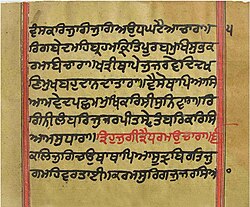
[[File:Varan Gyan Ratnavali.jpg|thumb|right|[[Varan Bhai Gurdas|Varan Gyan Ratnavali]] by 16th-century historian [[Bhai Gurdas]].]] | |||
The ''[[Janamsakhis]]'', stories on the life and legend of [[Guru Nanak]] (1469–1539), are early examples of Punjabi prose literature. | |||
*The Punjabi language is famous for its rich literature of [[Punjabi Qisse|''qisse'']], most of which are about love, passion, betrayal, sacrifice, social values and a common man's revolt against a larger system. The qissa of [[Heer Ranjha]] by [[Waris Shah]] (1706–1798) is among the most popular of Punjabi qissas. Other popular stories include ''[[Sohni Mahiwal]]'' by Fazal Shah, ''[[Mirza Sahiban]]'' by Hafiz Barkhudar (1658–1707), ''[[Sassui Punnhun]]'' by Hashim Shah (c. 1735–c. 1843), and ''Qissa Puran Bhagat'' by [[Qadaryar]] (1802–1892).{{citation needed|date=November 2016}} | |||
*Heroic ballads known as ''[[Vaar]]'' enjoy a rich oral tradition in Punjabi. Famous ''Vaars'' are ''Chandi di Var'' (1666–1708), ''Nadir Shah Di Vaar'' by Najabat and the ''Jangnama'' of [[Shah Mohammad]] (1780–1862).<ref>The Encyclopaedia of [[Indian Literature]] (Volume One - A to Devo). Volume 1. Amaresh Datta, ed. Sahitya Akademi: 2006, 352.</ref> | |||
=== British Raj era and post-independence period === | |||
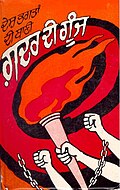
[[File:Ghadar di gunj.jpg|thumb|upright=0.68|''[[Ghadar di Gunj]]'' 1913, newspaper in Punjabi of [[Ghadar Party]], US-based Indian revolutionary party.]] | |||
The Victorian novel, Elizabethan drama, free verse and [[Modernism]] entered Punjabi literature through the introduction of British education during the Raj. [[Nanak Singh]] (1897–1971), Vir Singh, Ishwar Nanda, [[Amrita Pritam]] (1919–2005), [[Puran Singh]] (1881–1931), [[Dhani Ram Chatrik]] (1876–1957), [[Diwan Singh]] (1897–1944) and [[Ustad Daman]] (1911–1984), [[Mohan Singh (poet)|Mohan Singh]] (1905–78) and [[Shareef Kunjahi]] are some legendary Punjabi writers of this period. | |||
After independence of Pakistan and India Najm Hossein Syed, Fakhar Zaman and Afzal Ahsan Randhawa, [[Shafqat Tanvir Mirza]], [[Ahmad Salim]], and [[Najm Hosain Syed]], [[Munir Niazi]], [[Ali Arshad Mir]], Pir Hadi Abdul Mannan enriched Punjabi literature in Pakistan, whereas [[Jaswant Singh Kanwal]] (1919–2020), [[Amrita Pritam]] (1919–2005), [[Jaswant Singh Rahi]] (1930–1996), [[Shiv Kumar Batalvi]] (1936–1973), [[Surjit Patar]] (1944–) and [[Pash]] (1950–1988) are some of the more prominent poets and writers from India. | |||
==Status== | |||
Despite Punjabi's rich literary history, it was not until 1947 that it would be recognised as an official language. Previous governments in the area of the Punjab had favoured Persian, Hindustani, or even earlier standardised versions of local registers as the language of the court or government. After the annexation of the [[Sikh Empire]] by the [[East India Company|British East India Company]] following the [[Second Anglo-Sikh War]] in 1849, the British policy of establishing a uniform language for administration was expanded into the Punjab. The British Empire employed Urdu in its administration of North-Central and Northwestern India, while in the North-East of India, [[Bengali language]] was used as the language of administration. Despite its lack of official sanction, the Punjabi language continued to flourish as an instrument of cultural production, with rich literary traditions continuing until modern times. The Sikh religion, with its [[Gurmukhi alphabet|Gurmukhi]] script, played a special role in standardising and providing education in the language via [[Gurdwara]]s, while writers of all religions continued to produce poetry, prose, and literature in the language. | |||
In India, Punjabi is one of the 22 [[scheduled languages of India]]. It is the first official language of the [[Punjab, India|Indian State of Punjab]]. Punjabi also has second language official status in [[Delhi]] along with [[Urdu]], and in [[Haryana]]. <!-- [[WP:NFCC]] violation: [[File:2000 INR Rev 2016.jpg|thumb|right|upright=0.68|Punjabi on Indian currency, see in language box on eleventh place]] --> | |||
In Pakistan, no [[Languages of Pakistan|regional ethnic language]] has been granted official status at the national level, and as such Punjabi is not an official language at the national level, even though it is the most spoken language in Pakistan after Urdu, the national language of Pakistan. It is, however, the official provincial language of [[Punjab, Pakistan]], the second largest and the most populous province of Pakistan as well as in [[Islamabad]] Capital Territory. The only two official languages in Pakistan are [[Urdu]] and [[Pakistani English|English]].{{citation needed|date=December 2020}} | |||
===In Pakistan=== | |||
When [[Pakistan]] was created in 1947, although Punjabi was the majority language in [[West Pakistan]] and [[Bengali language|Bengali]] the majority in [[East Pakistan]] and [[Pakistan]] as whole, [[English language|English]] and [[Urdu]] were chosen as the national languages. The selection of Urdu was due to its association with [[South Asia]]n Muslim nationalism and because the leaders of the new nation wanted a unifying national language instead of promoting one ethnic group's language over another. Broadcasting in Punjabi language by [[Pakistan Broadcasting Corporation]] decreased on TV and radio after 1947. Article 251 of the [[Constitution of Pakistan]] declares that these two languages would be the only official languages at the national level, while provincial governments would be allowed to make provisions for the use of other languages.<ref>{{cite web|url=http://pakistani.org/pakistan/constitution/part12.ch4.html|title=Chapter 4: "General." of Part XII: "Miscellaneous"|website=pakistani.org|access-date=30 December 2016|url-status=dead|archive-url=https://archive.is/20140603233302/http://pakistani.org/pakistan/constitution/part12.ch4.html|archive-date=3 June 2014}}</ref> However, in the 1950s the constitution was amended to include the [[Bengali language]]. Eventually, Punjabi was granted status as a provincial language in Punjab Province, while the [[Sindhi language]] was given official status in 1972 after [[1972 Language violence in Sindh]]. | |||
Despite gaining official recognition at the provincial level, Punjabi is not a language of instruction for primary or secondary school students in Punjab Province (unlike Sindhi and Pashto in other provinces).<ref name="Zaidi">{{cite web|last1=Zaidi|first1=Abbas|title=Linguistic cleansing: the sad fate of Punjabi in Pakistan|url=http://www.gowanusbooks.com/punjabi.htm|url-status=live|archive-url=https://web.archive.org/web/20161029194115/http://www.gowanusbooks.com/punjabi.htm|archive-date=29 October 2016}}</ref> Pupils in secondary schools can choose the language as an elective, while Punjabi instruction or study remains rare in higher education. One notable example is the teaching of Punjabi language and literature by the [[University of the Punjab]] in Lahore which began in 1970 with the establishment of its Punjabi Department.<ref>University of the Punjab (2015), "B.A. Two-Year (Pass Course) Examinations" | |||
*{{cite web|url=http://pu.edu.pk/page/show/ba_gen_pattern.html|publisher=pu.edu.pk|title=University of the Punjab - Examinations|access-date=13 January 2017|url-status=live|archive-url=https://web.archive.org/web/20170208022145/http://pu.edu.pk/page/show/ba_gen_pattern.html|archive-date=8 February 2017}} | |||
</ref><ref>{{cite web|url=http://pu.edu.pk/home/department/32/Department-of-Punjabi|title=Department of Punjabi|last=University of the Punjab|date=2015|url-status=live|archive-url=https://web.archive.org/web/20161127220237/http://pu.edu.pk/home/department/32/Department-of-Punjabi|archive-date=27 November 2016}}</ref> | |||
In the cultural sphere, there are many books, plays, and songs being written or produced in the Punjabi-language in Pakistan. Until the 1970s, there were a large number of Punjabi-language films being produced by the Lollywood film industry, however since then Urdu has become a much more dominant language in film production. Additionally, television channels in Punjab Province (centred on the Lahore area) are broadcast in Urdu. The preeminence of Urdu in both broadcasting and the [[Lollywood]] film industry is seen by critics as being detrimental to the health of the language.<ref name="Masood 2015">{{cite web | last=Masood | first=Tariq | title=The colonisation of language | website=The Express Tribune | date=21 February 2015 | url=http://tribune.com.pk/story/841584/the-colonisation-of-language/ | access-date=19 September 2015 | url-status=live | archive-url=https://web.archive.org/web/20150912044311/http://tribune.com.pk/story/841584/the-colonisation-of-language/ | archive-date=12 September 2015 | df=dmy-all }}</ref><ref name="Warraich Ali 2015">{{cite web|last1=Warraich |first1=Faizan |last2=Ali |first2=Haider |title=Intelligentsia urges govt to promote Punjabi language |website=DailyTimes |date=15 September 2015 |url=http://www.dailytimes.com.pk/punjab/07-Feb-2015/intelligentsia-urges-govt-to-promote-punjabi-language |access-date=15 September 2015 |url-status=dead |archive-url=https://web.archive.org/web/20150630230024/http://www.dailytimes.com.pk/punjab/07-Feb-2015/intelligentsia-urges-govt-to-promote-punjabi-language |archive-date=30 June 2015 }}</ref> | |||
The use of Urdu and English as the near exclusive languages of broadcasting, the public sector, and formal education have led some to fear that Punjabi in Pakistan is being relegated to a low-status language and that it is being denied an environment where it can flourish. Several prominent educational leaders, researchers, and social commentators have echoed the opinion that the intentional promotion of Urdu and the continued denial of any official sanction or recognition of the Punjabi language amounts to a process of "Urdu-isation" that is detrimental to the health of the Punjabi language<ref name="apnaorg">{{cite web|url=http://apnaorg.com/articles/ishtiaq8/|publisher=apnaorg.com|title=Punjabis Without Punjabi|access-date=13 January 2017|url-status=live|archive-url=https://web.archive.org/web/20170525144848/http://apnaorg.com/articles/ishtiaq8/|archive-date=25 May 2017}}</ref><ref>"Inferiority complex declining Punjabi language: Punjab University Vice-Chancellor". PPI News Agency | |||
*{{cite web|url=http://ppinewsagency.com/inferiority-complex-declining-punjabi-language-punjab-university-vice-chancellor/|publisher=ppinewsagency.com|title=Inferiority complex declining Punjabi language: Punjab University Vice-Chancellor | Pakistan Press International|access-date=13 January 2017|url-status=live|archive-url=https://web.archive.org/web/20161127220151/http://ppinewsagency.com/inferiority-complex-declining-punjabi-language-punjab-university-vice-chancellor/|archive-date=27 November 2016}} | |||
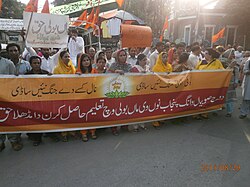
</ref><ref>{{Cite news|url=http://tribune.com.pk/story/880483/urdu-isation-of-punjab/|title=Urdu-isation of Punjab - The Express Tribune|date=4 May 2015|newspaper=The Express Tribune|language=en-US|access-date=30 December 2016|url-status=live|archive-url=https://web.archive.org/web/20161127215535/http://tribune.com.pk/story/880483/urdu-isation-of-punjab/|archive-date=27 November 2016}}</ref> In August 2015, the Pakistan Academy of Letters, International Writer's Council (IWC) and World Punjabi Congress (WPC) organised the ''Khawaja Farid Conference'' and demanded that a Punjabi-language university should be established in [[Lahore]] and that Punjabi language should be declared as the medium of instruction at the primary level.<ref name="The Nation 2011">{{cite web|url=http://nation.com.pk/lahore/21-Feb-2011/Rally-for-ending-150yearold-ban-on-education-in-Punjabi|title=Rally for ending 150-year-old 'ban on education in Punjabi|date=21 February 2011|website=The Nation|access-date=15 September 2015|url-status=live|archive-url=https://web.archive.org/web/20160307142807/http://nation.com.pk/lahore/21-Feb-2011/Rally-for-ending-150yearold-ban-on-education-in-Punjabi|archive-date=7 March 2016}}</ref><ref>{{cite magazine|url=http://nation.com.pk/lahore/26-Aug-2015/sufi-poets-can-guarantee-unity|title=Sufi poets can guarantee unity|date=26 August 2015|magazine=The Nation|url-status=live|archive-url=https://web.archive.org/web/20151030021751/http://nation.com.pk/lahore/26-Aug-2015/sufi-poets-can-guarantee-unity|archive-date=30 October 2015}}</ref> In September 2015, a case was filed in [[Supreme Court of Pakistan]] against [[Government of Punjab, Pakistan]] as it did not take any step to implement the Punjabi language in the province.<ref name="The Nation 2015">{{cite web|url=http://nation.com.pk/blogs/15-Sep-2015/supreme-court-s-urdu-verdict-no-language-can-be-imposed-from-above|title=Supreme Court's Urdu verdict: No language can be imposed from above|date=15 September 2015|website=The Nation|access-date=15 September 2015|url-status=live|archive-url=https://web.archive.org/web/20150916165410/http://nation.com.pk/blogs/15-Sep-2015/supreme-court-s-urdu-verdict-no-language-can-be-imposed-from-above|archive-date=16 September 2015}}</ref><ref name="Business Recorder 2015">{{cite web|url=http://www.brecorder.com/top-news/109-world-top-news/254518-two-member-sc-bench-refers-punjabi-language-case-to-cjp.html|title=Two-member SC bench refers Punjabi language case to CJP|date=14 September 2015|website=Business Recorder|access-date=15 September 2015|url-status=live|archive-url=https://web.archive.org/web/20151021133224/http://www.brecorder.com/top-news/109-world-top-news/254518-two-member-sc-bench-refers-punjabi-language-case-to-cjp.html|archive-date=21 October 2015}}</ref> Additionally, several thousand Punjabis gather in [[Lahore]] every year on [[International Mother Language Day]]. Thinktanks, political organisations, cultural projects, and individuals also demand authorities at the national and provincial level to promote the use of the language in the public and official spheres.<ref>"Mind your language—The movement for the preservation of Punjabi". ''The Herald''. 2 September 2106. | |||
*{{cite web|url=http://herald.dawn.com/news/1153482|publisher=herald.dawn.com|title=Mind your language—The movement for the preservation of Punjabi - People & Society - Herald|access-date=13 January 2017|url-status=dead|archive-url=https://web.archive.org/web/20161223065731/http://herald.dawn.com/news/1153482|archive-date=23 December 2016|date=4 August 2016}}</ref><ref>"Punjabi in schools: Pro-Punjabi outfits in Pakistan threaten hunger strike". ''The Times of India''. 4 October 2015. | |||
*{{cite news|url=http://timesofindia.indiatimes.com/city/chandigarh/Punjabi-in-schools-Pro-Punjabi-outfits-in-Pakistan-threaten-hunger-strike/articleshow/49214265.cms|work=The Times of India|title=Punjabi in schools: Pro-Punjabi outfits in Pakistan threaten hunger strike|access-date=13 January 2017|url-status=live|archive-url=https://web.archive.org/web/20160927231834/http://timesofindia.indiatimes.com/city/chandigarh/Punjabi-in-schools-Pro-Punjabi-outfits-in-Pakistan-threaten-hunger-strike/articleshow/49214265.cms|archive-date=27 September 2016}} | |||
</ref><ref>"Rally for Ending the 150-year-old Ban on Education in Punjabi" ''The Nation.'' 21 February 2011. | |||
*{{cite web|url=http://nation.com.pk/lahore/21-Feb-2011/Rally-for-ending-150yearold-ban-on-education-in-Punjabi|publisher=nation.com.pk|title=Rally for ending 150-year-old 'ban on education in Punjabi|access-date=13 January 2017|url-status=live|archive-url=https://web.archive.org/web/20160307142807/http://nation.com.pk/lahore/21-Feb-2011/Rally-for-ending-150yearold-ban-on-education-in-Punjabi|archive-date=7 March 2016|date=21 February 2011}} | |||
</ref> | |||
===In India=== | |||
At the federal level, Punjabi has official status via the [[Eighth Schedule to the Indian Constitution]],<ref name="Khokhlova">{{cite journal|last1= Khokhlova|first1= Liudmila|date= January 2014|title= Majority Language Death|url= https://scholarspace.manoa.hawaii.edu/bitstream/10125/4600/1/02Khokhlova.pdf|journal= Language Endangerment and Preservation in South Asia|access-date= 29 April 2017|quote= Punjabi was nonetheless included in the Eighth Schedule of the Constitution of India and came to be recognized as one of the fifteen official languages of the country.|url-status= live|archive-url= https://web.archive.org/web/20170525141614/https://scholarspace.manoa.hawaii.edu/bitstream/10125/4600/1/02Khokhlova.pdf|archive-date= 25 May 2017|df= dmy-all}}</ref> earned after the [[Punjabi Suba movement]] of the 1950s.<ref>{{Cite web|url=http://www.panjabdigilib.org/webuser/searches/displayPageContent.jsp?ID=2123&page=1&CategoryID=1&Searched=W3GX|title= Fifty Years of Punjab Politics (1920-70)|website=[[Panjab Digital Library]]|access-date=6 January 2019}}</ref> At the state level, Punjabi is the sole official language of the state of Punjab, while it has secondary official status in the states of Haryana and Delhi.<ref>{{cite journal|last1= Ayres|first1= Alyssa|date= 2008|title= Language, the Nation, and Symbolic Capital: The Case of Punjab|url= https://alyssaayres.com/pdf/Ayres-JAS-Language-Nation.pdf|journal= The Journal of Asian Studies|volume= 67|issue= 3|pages= 917–946|doi= 10.1017/S0021911808001204|s2cid= 56127067|access-date= 28 April 2017|quote= in India, Punjabi is an official language as well as the first language of the state of Punjab (with secondary status in Delhi and widespread use in Haryana).|url-status= live|archive-url= https://web.archive.org/web/20170525141617/https://alyssaayres.com/pdf/Ayres-JAS-Language-Nation.pdf|archive-date= 25 May 2017|df= dmy-all}}</ref> In 2012, it was also made additional official language of [[West Bengal]] in areas where the population exceeds 10% of a particular block, sub-division or district.<ref name=Telegraph:1 /> | |||
Both federal and state laws specify the use of Punjabi in the field of education. The state of Punjab uses the Three Language Formula, and Punjabi is required to be either the medium of instruction, or one of the three languages learnt in all schools in Punjab.<ref>{{cite journal|last1= Kumar|first1= Ashutosh|date= 2004|title= Electoral Politics in Punjab: Study of Akali Dal|journal= Economic & Political Weekly|volume= 39|issue= 14/15|pages= 1515–1520|quote= Punjabi was made the first compulsory language and medium of instruction in all the government schools whereas Hindi and English as second and third language were to be implemented from the class 4 and 6 respectively|jstor= 4414869}}</ref> Punjabi is also a compulsory language in Haryana,<ref>{{cite report|url= http://nclm.nic.in/shared/linkimages/NCLM52ndReport.pdf|title= 52nd Report of the Commissioner for Linguistic Minorities in India|date= 2015|page= 25|publisher= National Commission on Linguistic Minorities|access-date= 28 April 2017|quote= "Languages taught in the State under the Three Language Formula: First Language : Hindi Second Language : Punjabi Third language : English"|url-status= dead|archive-url= https://web.archive.org/web/20170525141614/http://nclm.nic.in/shared/linkimages/NCLM52ndReport.pdf|archive-date= 25 May 2017|df= dmy-all}}</ref> and other states with a significant Punjabi speaking minority are required to offer Punjabi medium education.{{dubious|date=October 2017}} | |||
There are vibrant Punjabi language movie and news industries in India, however Punjabi serials have had a much smaller presence within the last few decades in television due to market forces.<ref name="Singh 2015">{{cite web | last=Singh | first=Jasmine | title=Serial killer | website=The Tribune | date=13 September 2015 | url=http://www.tribuneindia.com/news/spectrum/serial-killer/130865.html | access-date=15 September 2015 | url-status=live | archive-url=https://web.archive.org/web/20150916044000/http://www.tribuneindia.com/news/spectrum/serial-killer/130865.html | archive-date=16 September 2015 | df=dmy-all }}</ref> Despite Punjabi having far greater official recognition in India, where the Punjabi language is officially admitted in all necessary social functions, while in Pakistan it is used only in a few radio and TV programs, attitudes of the English-educated elite towards the language are ambivalent as they are in neighbouring Pakistan.<ref name="Khokhlova" />{{rp|37}} There are also claims of state apathy towards the language in non-Punjabi majority areas like Haryana and Delhi.<ref name="http://www.hindustantimes.com/ 2015">{{cite web | title=SGPC claims Haryana govt ignoring Punjabi language | website=Hindustan Times | date=30 July 2015 | url=http://www.hindustantimes.com/amritsar/sgpc-claims-haryana-govt-ignoring-punjabi-language/article1-1374818.aspx | access-date=15 September 2015}}</ref><ref name="Aujla 2015">{{cite web | last=Aujla | first=Harjap Singh | title=Punjabi's of Delhi couldn't get justice for Punjabi language | website=Punjab News Express | date=15 June 2015 | url=http://punjabnewsexpress.com/news/mainpage.aspx?name=news%5C41059-punjabi-s-of-delhi-couldn-t-get-justice-for-punjabi-language | access-date=19 September 2015 }}{{dead link|date=July 2017 |bot=InternetArchiveBot |fix-attempted=yes }}</ref><ref name="Singh 2013">{{cite web|last=Singh |first=Perneet |title=Sikh bodies oppose DU's 'anti-Punjabi' move |website=Tribune India |date=9 July 2013 |url=http://www.tribuneindia.com/2013/20130710/punjab.htm#1 |access-date=21 February 2018 }}</ref> | |||
==Advocacy== | |||
*[[Punjabi University]] was established on 30 April 1962, and is only the second university in the world to be named after a language, after [[Hebrew University of Jerusalem]]. The Research Centre for Punjabi Language Technology, Punjabi University, Patiala<ref name="punjabiuniversity">{{cite web|url=http://punjabiuniversity.ac.in/pbiuniweb/pages/departments/newresearchdepartment.html|publisher=punjabiuniversity.ac.in|title=final|access-date=13 January 2017|url-status=dead|archive-url=https://web.archive.org/web/20161124024441/http://punjabiuniversity.ac.in/pbiuniweb/pages/departments/newresearchdepartment.html|archive-date=24 November 2016}}</ref> is working for development of core technologies for Punjabi, Digitisation of basic materials, online Punjabi teaching, developing software for office use in Punjabi, providing common platform to Punjabi cyber community.<ref name="learnpunjabi2">{{cite web|url=http://www.learnpunjabi.org/about.aspx|publisher=learnpunjabi.org|title=ACTDPL, Punjabi University, Patiala|access-date=13 January 2017|url-status=live|archive-url=https://web.archive.org/web/20161210232833/http://learnpunjabi.org/about.aspx|archive-date=10 December 2016}}</ref> [[Punjabipedia]], an online encyclopaedia was also launched by Patiala university in 2014.<ref name="punjabipedia">{{cite web|url=http://punjabipedia.org/aboutus.aspx|publisher=punjabipedia.org|title=ਪੰਜਾਬੀ ਪੀਡੀਆ|access-date=13 January 2017|url-status=dead|archive-url=https://web.archive.org/web/20161221005250/http://punjabipedia.org/aboutus.aspx|archive-date=21 December 2016}}</ref><ref name="hindustantimes">{{cite web|url=http://www.hindustantimes.com/punjab/pbi-university-launches-punjabipedia/story-4nxtGZT4ajuIY02MbjwouN.html|publisher=Hindustan Times|title=Pbi University launches Punjabipedia | punjab | Hindustan Times|access-date=13 January 2017|url-status=live|archive-url=https://web.archive.org/web/20161123201247/http://www.hindustantimes.com/punjab/pbi-university-launches-punjabipedia/story-4nxtGZT4ajuIY02MbjwouN.html|archive-date=23 November 2016|date=26 February 2014}}</ref> | |||
*[[The Dhahan Prize]] was created award literary works produced in Punjabi around the world. The Prize encourages new writing by awarding $25,000 CDN annually to one "best book of fiction" published in either of the two Punjabi scripts, Gurmukhi or Shahmukhi. Two second prizes of $5,000 CDN are also awarded, with the provision that both scripts are represented among the three winners. The Dhahan Prize is awarded by Canada India Education Society (CIES).<ref name="dhahanprise">{{cite web|url=http://dhahanprize.com/|publisher=dhahanprize.com|title=The Dhahan Prize | The Dhahan Prize for Punjabi Literature|access-date=13 January 2017|url-status=live|archive-url=https://web.archive.org/web/20170227040500/http://www.dhahanprize.com/|archive-date=27 February 2017}}</ref> | |||
===Governmental academies and institutes=== | |||
The Punjabi Sahit academy, [[Ludhiana]], established in 1954<ref>{{cite web |url=http://www.quamiekta.com/2017/05/03/36257/ |title=ਪੰਜਾਬੀ ਲੇਖਕਾਂ ਦਾ ਮੱਕਾ : ਪੰਜਾਬੀ ਭਵਨ, ਲੁਧਿਆਣਾ |access-date=16 October 2017 |url-status=live |archive-url=https://web.archive.org/web/20170503114809/http://www.quamiekta.com/2017/05/03/36257/ |archive-date=3 May 2017 |date=3 May 2017 }}</ref><ref>{{cite web|url=http://www.tribuneindia.com/mobi/news/ludhiana/community/sirsa-again-elected-punjabi-sahit-akademi-president/223834.html |title=Sirsa again elected Punjabi Sahit Akademi president |publisher=Tribuneindia.com |date=18 April 2016 |access-date=13 August 2018}}</ref> is supported by the [[Punjab state]] government and works exclusively for promotion of the Punjabi language, as does the Punjabi academy in [[Delhi]].<ref>{{Cite web|url=http://www.punjabiacademy.com/|archive-url=https://web.archive.org/web/20170718101904/http://punjabiacademy.com/|url-status=dead|title=Punjabi Academy|archive-date=18 July 2017|website=www.punjabiacademy.com}}</ref> The Jammu and Kashmir academy of art, culture and literature<ref>http://jkculture.nic.in/seminars.htm# {{webarchive|url=https://web.archive.org/web/20161123081031/http://jkculture.nic.in/seminars.htm |date=23 November 2016 }}</ref> in [[Jammu and Kashmir (union territory)|Jammu and Kashmir UT]], India works for Punjabi and other regional languages like Urdu, Dogri, Gojri etc. Institutions in neighbouring states<ref>{{cite web|url=http://m.livehindustan.com/news/lucknow/article1-punjabi-academy-581875.amp.html |title=पंजाबी सीखने वाले छात्रों को अगले माह बटेगा एकल प्रोत्साहन राशि |publisher=M.livehindustan.com |date=24 October 2016 |access-date=13 August 2018}}</ref> as well as in [[Lahore, Pakistan]]<ref>{{Cite web|url=https://pilac.punjab.gov.pk/|archive-url=https://web.archive.org/web/20170711180642/http://www.pilac.punjab.gov.pk/|url-status=dead|title=Welcome to Punjab Institute of Language, Art & Culture | Punjab Institute of Language, Art & Culture|archive-date=11 July 2017|website=pilac.punjab.gov.pk}}</ref> also advocate for the language. | |||
<gallery> | |||
File:Punjabi academy ludhiana.jpeg|Punjabi Sahit academy, Ludhiana,1954 | |||
File:Punjabi academy delhi.jpg|Punjabi academy, Delhi,1981-1982 | |||
File:Jammu and Kashmir academy of art culture and literature.jpg|Jammu and Kashmir academy of art, culture and literature | |||
File:Punjab institute of language art and culture.jpeg|Pilac(Punjab Institute of Language, Art and Culture, Lahore,2004 | |||
</gallery> | |||
===Software=== | |||
*Software are available for Punjabi language for almost all platforms. These software are mainly in [[Gurmukhi]] script. Nowadays, nearly all Punjabi newspapers, magazines, journals, and periodicals are composed on computers via various Punjabi software programmes, the most widespread of which is [[InPage]] Desktop Publishing package. [[Microsoft]] has included Punjabi language support in all new versions of Windows and both [[Windows Vista]], [[Microsoft Office 2007|Mircrsoft Office 2007]], 2010 and 2013, are available in Punjabi through the [[Language Interface Pack]]<ref name="microsoft">{{cite web|url=https://www.microsoft.com/pa-in/download|publisher=microsoft.com|title=Microsoft Download Center|access-date=13 January 2017|url-status=live|archive-url=https://web.archive.org/web/20161123205551/https://www.microsoft.com/pa-in/download|archive-date=23 November 2016}}</ref> support. Most [[Linux]] Desktop distributions allow the easy installation of Punjabi support and translations as well.<ref name="sourceforge">{{cite web|url=https://sourceforge.net/projects/punlinux/|publisher=sourceforge.net|title=Punjabi Linux (punlinux) download | SourceForge.net|access-date=13 January 2017|url-status=live|archive-url=https://web.archive.org/web/20161123203353/https://sourceforge.net/projects/punlinux/|archive-date=23 November 2016}}</ref> [[Apple Inc.|Apple]] implemented the Punjabi language keyboard across [[Mobile device]]s.<ref name="apple">{{cite web|url=https://itunes.apple.com/in/app/punjabi-keyboard/id428805745?mt=8|publisher=itunes.apple.com|title=Connecting to the iTunes Store.|access-date=13 January 2017|url-status=live|archive-url=https://web.archive.org/web/20161123203742/https://itunes.apple.com/in/app/punjabi-keyboard/id428805745?mt=8|archive-date=23 November 2016}}</ref> [[Google]] also provides many applications in Punjabi, like Google Search,<ref name="google6">{{cite web|url=https://www.google.co.in/?gfe_rd=cr&ei=DYs1WMq5FvGK8QebkZzoBQ|title=Google|access-date=13 January 2017}}</ref> Google Translate<ref name="google7">{{cite web|url=https://translate.google.co.in/?hl=pa&tab=wT|title=Google ਅਨੁਵਾਦ|access-date=13 January 2017|url-status=live|archive-url=https://web.archive.org/web/20161229033335/https://translate.google.co.in/?hl=pa|archive-date=29 December 2016}}</ref> and Google Punjabi Input Tools.<ref name="google8">{{cite web|url=https://www.google.com/intl/pa/inputtools/try/|title=Cloud ਇਨਪੁਟ ਔਜ਼ਾਰ ਔਨਲਾਈਨ ਅਜਮਾਓ – Google ਇਨਪੁਟ ਔਜ਼ਾਰ|access-date=13 January 2017|url-status=live|archive-url=https://web.archive.org/web/20170112124745/https://www.google.com/intl/pa/inputtools/try/|archive-date=12 January 2017}}</ref> | |||
== Gallery == | |||
<gallery> | |||
File:Guru Granth Sahib By Bhai Pratap Singh Giani.jpg|Guru Granth Sahib in Gurmukhi | |||
File:Punjabi Alphabet.jpg| Punjabi Gurmukhi script | |||
File:Shahmukhi1.JPG|Punjabi Shahmukhi script | |||
File:Bhulay Shah.jpg|Bhulay Shah poetry in Punjabi (Shahmukhi script) | |||
File:Munir niazi.gif|Munir Niazi poetry in Punjabi (Shahmukhi script) | |||
File:Das Buch der Schrift (Faulmann) 138.jpg|Gurmukhi alphabet | |||
File:Punjabi language sign board at hanumangarh rajasthan india.jpeg|A sign board in Punjabi language along with Hindi at [[Hanumangarh]], [[Rajasthan]], [[India]] | |||
</gallery> | |||
== See also == | |||
{{Portal|Punjab|Languages}} | |||
* [[Punjabi Wikipedia (Eastern)]] | |||
* [[Punjabi Wikipedia (Western)]] | |||
* [[Languages of Pakistan]] | |||
* [[Languages of India]] | |||
* [[List of Indian languages by total speakers]] | |||
* [[List of Punjabi-language newspapers]] | |||
* [[Hindi-to-Punjabi Machine Translation System]] | |||
* [[Punjabi cinema]] | |||
== References == | |||
=== Citations === | |||
{{Reflist}} | |||
=== Sources === | |||
{{refbegin}} | |||
* {{citation |last = Bhardwaj | first = Mangat Rai | date = 2016 | title = Panjabi: A Comprehensive Grammar | doi = 10.4324/9781315760803| isbn = 9781138793859 | publisher = Routledge }}. | |||
* {{citation |last = Bhatia | first = Tej K. | year = 2008 | chapter = Major regional languages | doi= 10.1017/CBO9780511619069.008 | title = Language in South Asia | publisher = Cambridge University Press |editor1 = Braj B. Kachru |editor2=Yamuna Kachru |editor3 = S.N. Sridhar |pages=121–131 |isbn = 9780511619069 }}. | |||
* {{Cite LSI|9|1}} | |||
* {{Citation | |||
|last=Jain | |||
|first=Dhanesh | |||
|year=2003 | |||
|chapter=Sociolinguistics of the Indo-Aryan Languages | |||
|editor1-last= Cardona | |||
|editor1-first= George | |||
|editor2-last= Jain | |||
|editor2-first= Dhanesh | |||
|title=The Indo-Aryan Languages | |||
|publisher=Routledge | |||
|isbn=978-0-415-77294-5 | |||
|pages=46–66 | |||
}}. | |||
*{{Citation | |||
|last=Masica | |||
|first=Colin | |||
|author-link=Colin Masica | |||
|year=1991 | |||
|title=The Indo-Aryan Languages | |||
|place= Cambridge | |||
|publisher=Cambridge University Press | |||
|isbn=978-0-521-29944-2 | |||
|url = https://books.google.com/books?id=J3RSHWePhXwC&q=indo-aryan+languages | |||
}}. | |||
*{{citation| last = Nayar| first = Baldev Raj | year = 1966 | title = Minority Politics in the Punjab| publisher = Princeton University Press | url = https://books.google.com/books?id=WBrWCgAAQBAJ&pg=PA46 | isbn = 9781400875948 }}. | |||
*{{Citation | |||
|last=Shackle | |||
|first=Christopher | |||
|year=2003 | |||
|chapter=Panjabi | |||
|chapter-url=https://books.google.com/books?id=jPR2OlbTbdkC&q=indo-aryan+languages&pg=PA581 | |||
|editor1-last= Cardona | |||
|editor1-first= George | |||
|editor2-last= Jain | |||
|editor2-first= Dhanesh | |||
|title=The Indo-Aryan Languages | |||
|publisher=Routledge | |||
|isbn=978-0-415-77294-5 | |||
|pages=581–621 | |||
}}. | |||
{{refend}} | |||
== Further reading == | |||
* Bhatia, Tej. 1993 and 2010. ''Punjabi : a cognitive-descriptive grammar''. London: Routledge. Series: Descriptive grammars. | |||
* Gill H.S. [Harjit Singh] and Gleason, H.A. 1969. A reference grammar of Punjabi. Revised edition. Patiala, Punjab, India: Languages Department, Punjab University. | |||
* Chopra, R. M., Perso-Arabic Words in Punjabi, in: Indo-Iranica Vol.53 (1–4). | |||
* Chopra, R. M.., The Legacy of The Punjab, 1997, Punjabee Bradree, Calcutta. | |||
* Singh, Chander Shekhar (2004). Punjabi Prosody: The Old Tradition and The New Paradigm. Sri Lanka: Polgasowita: Sikuru Prakasakayo. | |||
* Singh, Chander Shekhar (2014). Punjabi Intonation: An Experimental Study. Muenchen: LINCOM EUROPA. | |||
== External links == | |||
{{Wikibooks|Punjabi}} | |||
{{commons category|Punjabi language}} | |||
{{Wikivoyage|Punjabi phrasebook|Punjabi|a phrasebook}} | |||
{{InterWiki|Eastern Punjabi|code=pa}} | |||
{{InterWiki|Western Punjabi|code=pnb}} | |||
* {{Curlie|Science/Social_Sciences/Linguistics/Languages/Natural/Indo-European/Indo-Iranian/Indo-Aryan/Panjabi/}} | |||
* {{Britannica|483596}} | |||
* [http://www.shabdkosh.com/pa/ English to Punjabi Dictionary] {{Webarchive|url=https://web.archive.org/web/20100310134224/http://www.shabdkosh.com/pa/ |date=10 March 2010 }} | |||
{{Punjabi language topics}} | |||
{{ | {{Sikhism}} | ||
{{Languages of India}} | |||
{{Languages of Pakistan}} | |||
{{Indo-Aryan languages}} | |||
{{LangSA}} | |||
{{Authority control}} | |||
{{ | |||
[[Category:Punjabi language| ]] | [[Category:Punjabi language| ]] | ||
[[Category:Languages of | [[Category:Fusional languages]] | ||
[[Category:Languages of Punjab | [[Category:Official languages of India]] | ||
[[Category:Languages of Pakistan]] | |||
[[Category:Languages of Punjab, Pakistan| ]] | |||
[[Category:Punjabi culture]] | |||
[[Category:Subject–object–verb languages]] | |||
[[Category:Tonal languages in non-tonal families]] | |||
[[Category:Indo-Aryan languages]] | |||
Revision as of 05:48, 20 April 2021
| Punjabi | |
|---|---|
| ਪੰਜਾਬੀ, پن٘جابی | |
| File:Punjabi gurmukhi shahmukhi.png 'Punjabi' written in Shahmukhi used in Punjab, Pakistan (top) and Gurmukhi used in Punjab, India (bottom) scripts | |
| Pronunciation |
|
| Native to | India, Pakistan |
| Region | Punjab |
| Ethnicity | Punjabis |
Native speakers | 113 million (2011–2017)[1] |
| Dialects |
|
| Official status | |
Official language in |  India India |
| Regulated by | Department of Languages, Punjab, India[7] Punjab Institute of Language, Art, and Culture - Pakistan |
| Language codes | |
| ISO 639-1 | pa |
| ISO 639-2 | pan |
| ISO 639-3 | Either:pan – Panjabipnb – Western Panjabi |
| Glottolog | panj1256 Eastern Panjabiwest2386 Western Panjabi |
| Linguasphere | 59-AAF-e |
 Areas of the Indian Subcontinent where Punjabi is natively spoken | |
| Part of a series on |
| Punjabis |
|---|
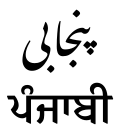 |
 Punjab portal |
Punjabi (Gurmukhi: ਪੰਜਾਬੀ, Shahmukhi: پن٘جابی /pʌnˈdʒɑːbi/;[8] Punjabi pronunciation: [pənˈdʒaːbːi]; sometimes spelled Panjabi) is an Indo-Aryan language spoken by the Punjabi people and native to the Punjab region of India and Pakistan.
It has approximately 113 million native speakers. The larger part – 80.5 million as of 2017 – are in Pakistan, where Punjabi has more speakers than any other language but no official recognition at the national or provincial level. In India, Punjabi is spoken by 31.1 million people (as of 2011) and has official status in the state of Punjab. The language is spoken among a significant overseas diaspora, particularly in Canada, the United States and the United Kingdom.
In India, Punjabi is written using the Gurmukhi script, while Shahmukhi is used in Pakistan. Punjabi is unusual among Indo-Aryan languages in its use of lexical tone.
History
Etymology
The word Punjabi (sometimes spelled Panjabi) has been derived from the word Panj-āb, Persian for 'Five Waters', referring to the five major eastern tributaries of the Indus River. The name of the region was introduced by the Turko-Persian conquerors[9] of South Asia and was a translation of the Sanskrit name for the region, Panchanada, which means 'Land of the Five Rivers'.[10][11]
Panj is cognate with Sanskrit pañca (पञ्च), Greek pénte (πέντε), and Lithuanian Penki, all of which meaning 'five'; āb is cognate with Sanskrit áp (अप्) and with the Av- of Avon. The historical Punjab region, now divided between India and Pakistan, is defined physiographically by the Indus River and these five tributaries. One of the five, the Beas River, is a tributary of another, the Sutlej.
Origin

Punjabi developed from Prakrit languages and later Apabhraṃśa (Sanskrit: अपभ्रंश, 'corruption' or 'corrupted speech')[12] From 600 BC, Sanskrit was advocated as official language and Prakrit gave birth to many regional languages in different parts of India. All these languages are called Prakrit (Sanskrit: प्राकृत, prākṛta) collectively. Paishachi Prakrit was one of these Prakrit languages, which was spoken in north and north-western India and Punjabi developed from this Prakrit. Later in northern India Paishachi Prakrit gave rise to Paishachi Aparbhsha, a descendant of Prakrit.[13] Punjabi emerged as an Apabhramsha, a degenerated form of Prakrit, in the 7th century A.D. and became stable by the 10th century. The earliest writings in Punjabi belong to Nath Yogi era from 9th to 14th century A.D.[14] The language of these compositions is morphologically closer to Shauraseni Apbhramsa, though vocabulary and rhythm is surcharged with extreme colloquialism and folklore.[14]
Arabic and Persian influence on Punjabi
The Arabic and modern-Persian influence in the historical Punjab region began with the late first millennium Muslim conquests on the Indian subcontinent.[15] Many Persian and Arabic words were incorporated in Punjabi.[16][17] So Punjabi relies heavily on Persian and Arabic words which are used with a liberal approach to language. Most important words in Punjabi, like ਅਰਦਾਸ and ਰਹਿਰਾਸ, and common words, like ਨਹਿਰ, ਜ਼ਮੀਨ, ਗਜ਼ਲ, etc., have all come out of Persian. After the fall of the Sikh empire, Urdu was made the official language of Punjab (in Pakistani Punjab, it is still the primary official language), and influenced the language as well.[18]
In fact, the sounds of ਜ਼, ਖ਼, ਸ਼, and ਫ਼ have been borrowed from Persian. Later, it was lexically influenced by Portuguese (words like ਅਲਮਾਰੀ/الماری), Greek (words like ਦਾਮ/دام), Chagatai (words like ਕ਼ੈੰਚੀ, ਸੁਗ਼ਾਤ/قینچی،سوغات), Japanese (words like ਰਿਕਸ਼ਾ/رکشا), Chinese (words like ਚਾਹ, ਲੀਚੀ, ਲੁਕਾਠ/چاہ، لیچی، لکاٹھ) and English (words like ਜੱਜ, ਅਪੀਲ, ਮਾਸਟਰ/جج، اپیل، ماسٹر), though these influences have been minor in comparison to Persian and Arabic.[19]
| English | Gurmukhi-based (Punjab, India) | Shahmukhi-based (Punjab, Pakistan) |
|---|---|---|
| President | ਰਾਸ਼ਟਰਪਤੀ (rāshtarpatī) | صدرمملکت (sadar-e mumlikat) |
| Article | ਲੇਖ (lēkh) | مضمون (mazmūn) |
| Prime Minister | ਪਰਧਾਨ ਮੰਤਰੀ (pardhān mantarī)* | وزیراعظم (wazīr-e aʿzam) |
| Family | ਪਰਿਵਾਰ (parivār)* ਟੱਬਰ (ṭabbar) ਲਾਣਾ (lāṇā) |
خاندان (kḥāndān) ٹبّر (ṭabbar) |
| Philosophy | ਫ਼ਲਸਫ਼ਾ (falsafā) ਦਰਸ਼ਨ (darshan) |
فلسفہ (falsafā) |
| Capital city | ਰਾਜਧਾਨੀ (rājdhānī) | دارالحکومت (dārul hakūmat) |
| Viewer | ਦਰਸ਼ਕ (darshak) | ناظرین (nāzarīn) |
| Listener | ਸਰੋਤਾ (sarotā) | سامع (sāma) |
Note: In more formal contexts, hypercorrect Sanskritized versions of these words (ਪ੍ਰਧਾਨ pradhān for ਪਰਧਾਨ pardhān and ਪਰਿਵਾਰ parivār for ਪਰਵਾਰ parvār) may be used.
Modern times
Punjabi is spoken in many dialects in an area from Delhi to Islamabad. The Majhi dialect has been adopted as standard Punjabi in India and Pakistan for education, media etc. The Majhi dialect originated in the Majha region of the Punjab. The Majha region consists of several eastern districts of Pakistani Punjab and in India around Amritsar, Gurdaspur, Pathankot and Tarn Taran districts. The two most important cities in this area are Lahore and Amritsar.
In India, Punjabi is written in the Gurmukhī script in offices, schools, and media. Gurmukhi is the official standard script for Punjabi, though it is often unofficially written in the Latin scripts due to influence from English, India's two primary official languages at the Union-level.
In Pakistan, Punjabi is generally written using the Shahmukhī script, created from a modification of the Persian Nastaʿlīq script. In Pakistan, Punjabi loans technical words from Persian and Arabic languages, just like Urdu does.
Geographic distribution
Punjabi is the most widely spoken language in Pakistan, the eleventh-most widely spoken in India and, and also present in the Punjabi diaspora in various countries.
Pakistan
Punjabi is the most widely spoken language in Pakistan, being the native language of 80.5 million people, or nearly 39% of the country's population.
| Year | Population of Pakistan | Percentage | Punjabi speakers |
|---|---|---|---|
| 1951 | 33,740,167 | 57.08% | 22,632,905 |
| 1961 | 42,880,378 | 56.39% | 28,468,282 |
| 1972 | 65,309,340 | 56.11% | 43,176,004 |
| 1981 | 84,253,644 | 48.17% | 40,584,980 |
| 1998 | 132,352,279 | 44.15% | 58,433,431 |
| 2017 | 207,685,000 | 38.78% | 80,540,000 |
Beginning with the 1981 census, speakers of Saraiki and Hindko were no longer included in the total numbers for Punjabi, which explains the apparent decrease.
India

Punjabi is the official language of the Indian state of Punjab. It is additional official in Haryana and Delhi. Some of its major urban centres in northern India are Amritsar, Ludhiana, Chandigarh, Jalandhar, Ambala, Patiala, Bathinda, Hoshiarpur and Delhi.
In the 2011 census of India, 31.14 million reported their language as Punjabi. The census publications group this with speakers of related "mother tongues" like Bagri and Bhateali to arrive at the figure of 33.12 million.[22]
| Year | Population of India | Punjabi speakers in India | Percentage |
|---|---|---|---|
| 1971 | 548,159,652 | 14,108,443 | 2.57% |
| 1981 | 665,287,849 | 19,611,199 | 2.95% |
| 1991 | 838,583,988 | 23,378,744 | 2.79% |
| 2001 | 1,028,610,328 | 29,102,477 | 2.83% |
| 2011 | 1,210,193,422 | 33,124,726 | 2.74% |
Punjabi diaspora
Punjabi is also spoken as a minority language in several other countries where Punjabi people have emigrated in large numbers, such as the United States, Australia, the United Kingdom, and Canada.[24]
There were 0.5 million Punjabi speakers in Canada in 2016,[25] 0.3 million in the United Kingdom in 2011,[26] 0.28 million in the United States[27] and smaller numbers in other countries.
Major dialects
Standard Punjabi
Standard Punjabi sometimes referred to as Majhi in India or simply Punjabi, is the most widespread and largest dialect of Punjabi. It first developed in the 12th century and gained prominence when Sufi poets such as Shah Hussain, Bulleh Shah among others began to use the Lahore/Amritsar spoken dialect with infused Persian vocabulary in their works in the Shahmukhi script.[28] Later the Gurmukhi script was developed based on Standard Punjabi by the Sikh Gurus.[29]
Standard Punjabi is spoken by the majority of the people in Faisalabad, Lahore, Gujranwala, Sheikhupura, Kasur, Sialkot, Narowal, Gujrat, Okara, Pakpattan, Sahiwal, Hafizabad, Nankana Sahib and Mandi Bahauddin districts of Pakistan's Punjab Province. It also has a large presence in every district in the rest of Pakistani Punjab, and in all large cities in Pakistan's other provinces.
In India it is spoken in Amritsar, Tarn Taran Sahib, Pathankot and Gurdaspur Districts of the State of Punjab and sizable population also in major cities of the States of Punjab, Haryana, Uttar Pradesh, Delhi and Mumbai India.
In Pakistan Standard Punjabi dialect is not called Majhi which is Indian terminology, in Pakistan it is simply called Standard Punjabi. This dialect is used for both Punjabi Films, TV and Theater industry to make Punjabi language content in Lahore.
Phonology
While a vowel length distinction between short and long vowels exists, reflected in modern Gurmukhi orthographical conventions, it is secondary to the vowel quality contrast between centralised vowels /ɪ ə ʊ/ and peripheral vowels /iː eː ɛː aː ɔː oː uː/ in terms of phonetic significance.[30]
| Front | Near-front | Central | Near-back | Back | |
|---|---|---|---|---|---|
| Close | iː ਈ اِی | uː ਊ اُو | |||
| Near-close | ɪ ਇ اِ | ʊ ਉ اُ | |||
| Close-mid | eː ਏ اے | oː ਓ او | |||
| Mid | ə ਅ اَ | ||||
| Open-mid | ɛː ਐ اَے | ɔː ਔ اَو | |||
| Open | aː ਆ آ |
The peripheral vowels have nasal analogues.[31]
| Labial | Dental/ Alveolar |
Retroflex | Post-alv./ Palatal |
Velar | Glottal | ||
|---|---|---|---|---|---|---|---|
| Nasal | m ਮ م | n ਨ ن | ɳ ਣ ݨ | ɲ ਞ ن | ŋ ਙ ن٘ | ||
| Stop/ Affricate |
tenuis |
p ਪ پ | t ਤ ت | ʈ ਟ ٹ | t͡ʃ ਚ چ | k ਕ ک | |
|
aspirated |
pʰ ਫ پھ | tʰ ਥ تھ | ʈʰ ਠ ٹھ | t͡ʃʰ ਛ چھ | kʰ ਖ کھ | ||
|
voiced |
b ਬ ب | d ਦ د | ɖ ਡ ڈ | d͡ʒ ਜ ج | ɡ ਗ گ | ||
| Fricative |
voiceless |
(f ਫ਼ ف) | s ਸ س | ʃ ਸ਼ ش | (x ਖ਼ خ) | ||
|
voiced |
(z ਜ਼ ز) | (ɣ ਗ਼ غ) | ɦ ਹ ہ | ||||
| Rhotic | ɾ~r ਰ ر | ɽ ੜ ڑ | |||||
| Approximant | ʋ ਵ و | l ਲ ل | ɭ ਲ਼ ࣇ[32] | j ਯ ی | |||
The three retroflex consonants /ɳ ɽ ɭ/ do not occur initially, and the nasals /ŋ ɲ/ occur only as allophones of /n/ in clusters with velars and palatals. The well-established phoneme /ʃ/ may be realised allophonically as the voiceless retroflex fricative /ʂ/ in learned clusters with retroflexes. The phonemic status of the fricatives /f z x ɣ/ varies with familiarity with Hindustani norms, more so with the Gurmukhi script, with the pairs /f pʰ/, /z d͡ʒ/, /x kʰ/, and /ɣ g/ systematically distinguished in educated speech.[33] The retroflex lateral is most commonly analysed as an approximant as opposed to a flap.[34][35][36]
Tone
Unusually for an Indo-Aryan language, Punjabi distinguishes lexical tones.[37] In many words there is a choice of up to three tones, high-falling, low-rising, and level (neutral):[38][39][40]
| Gurmukhi | Shahmukhi | Transliteration | Tone | Meaning |
|---|---|---|---|---|
| ਘਰ | گھر | kàr | high-falling | house |
| ਕਰ੍ਹ | کرھ | kár | low-rising | dandruff |
| ਕਰ | کر | kar | level | do |
| ਘੋੜਾ | گھوڑا | kòṛā | high-falling | horse |
| ਕੋੜ੍ਹਾ | کوڑھا | kóṛā | low-rising | leper |
| ਕੋੜਾ | کوڑا | kōṛā | level | whip |
Level tone is found in about 75% of words and is described by some as absence of tone.[38] There are also some words which are said to have rising tone in the first syllable and falling in the second. (Some writers describe this as a fourth tone.)[38] However, a recent acoustic study of six Punjabi speakers in the United States found no evidence of a separate falling tone following a medial consonant.[41]
- ਮੋਢਾ / موڈھا, móḍà (rising-falling), "shoulder"
It is considered that these tones arose when voiced aspirated consonants (gh, jh, ḍh, dh, bh) lost their aspiration. At the beginning of a word they became voiceless unaspirated consonants (k, c, ṭ, t, p) followed by a high-falling tone; medially or finally they became voiced unaspirated consonants (g, j, ḍ, d, b), preceded by a low-rising tone. (The development of a high-falling tone apparently did not take place in every word, but only in those which historically had a long vowel.)[40]
The presence of an [h] (although the [h] is now silent or very weakly pronounced except word-initially) word-finally (and sometimes medially) also often causes a rising tone before it, for example cá(h) "tea".[42]
The Gurmukhi script which was developed in the 16th century has separate letters for voiced aspirated sounds, so it is thought that the change in pronunciation of the consonants and development of tones may have taken place since that time.[40]
Some other languages in Pakistan have also been found to have tonal distinctions, including Burushaski, Gujari, Hindko, Kalami, Shina, and Torwali.[43]
Grammar

Punjabi has a canonical word order of SOV (subject–object–verb).[44] It has postpositions rather than prepositions.[45]
Punjabi distinguishes two genders, two numbers, and five cases of direct, oblique, vocative, ablative, and locative/instrumental. The ablative occurs only in the singular, in free variation with oblique case plus ablative postposition, and the locative/instrumental is usually confined to set adverbial expressions.[46]
Adjectives, when declinable, are marked for the gender, number, and case of the nouns they qualify.[47] There is also a T-V distinction. Upon the inflectional case is built a system of particles known as postpositions, which parallel English's prepositions. It is their use with a noun or verb that is what necessitates the noun or verb taking the oblique case, and it is with them that the locus of grammatical function or "case-marking" then lies. The Punjabi verbal system is largely structured around a combination of aspect and tense/mood. Like the nominal system, the Punjabi verb takes a single inflectional suffix, and is often followed by successive layers of elements like auxiliary verbs and postpositions to the right of the lexical base.[48]
Vocabulary
Being an Indo-Aryan language, the core vocabulary of Punjabi consists of tadbhav words inherited from Sanskrit.[49][50] It contains many loanwords from Persian and Arabic.[49]
Writing systems
| Shahmukhi alphabet |
|---|
|
Extended Perso-Arabic script |

The Punjabi language is written in multiple scripts (a phenomenon known as synchronic digraphia). Each of the major scripts currently in use is typically associated with a particular religious group,[51][52] although the association is not absolute or exclusive.[53] In India, Punjabi Sikhs use Gurmukhi, a script of the Brahmic family, which has official status in the state of Punjab. In Pakistan, Punjabi Muslims use Shahmukhi, a variant of the Perso-Arabic script and closely related to the Urdu alphabet. The Punjabi Hindus in India had a preference for Devanagari, another Brahmic script also used for Hindi, and in the first decades since independence raised objections to the uniform adoption of Gurmukhi in the state of Punjab,[54] but most have now switched to Gurmukhi[55] and so the use of Devanagari is rare.[56]
Historically, various local Brahmic scripts including Laṇḍā and its descendants were also in use.[56][57]
The Punjabi Braille is used by the visually impaired.
Sample text
This sample text was taken from the Punjabi Wikipedia article on Lahore.
ਲਹੌਰ ਪਾਕਿਸਤਾਨੀ ਪੰਜਾਬ ਦੀ ਰਾਜਧਾਨੀ ਹੈ। ਲੋਕ ਗਿਣਤੀ ਦੇ ਨਾਲ ਕਰਾਚੀ ਤੋਂ ਬਾਅਦ ਲਹੌਰ ਦੂਜਾ ਸਭ ਤੋਂ ਵੱਡਾ ਸ਼ਹਿਰ ਹੈ। ਲਹੌਰ ਪਾਕਿਸਤਾਨ ਦਾ ਸਿਆਸੀ, ਰਹਤਲੀ ਅਤੇ ਪੜ੍ਹਾਈ ਦਾ ਗੜ੍ਹ ਹੈ ਅਤੇ ਇਸੇ ਲਈ ਇਹਨੂੰ ਪਾਕਿਸਤਾਨ ਦਾ ਦਿਲ ਵੀ ਕਿਹਾ ਜਾਂਦਾ ਹੈ। ਲਹੌਰ ਰਾਵੀ ਦਰਿਆ ਦੇ ਕੰਢੇ 'ਤੇ ਵਸਦਾ ਹੈ। ਇਸਦੀ ਲੋਕ ਗਿਣਤੀ ਇੱਕ ਕਰੋੜ ਦੇ ਨੇੜੇ ਹੈ|
لہور پاکستانی پن٘جاب دا دارالحکومت ہے۔ لوک گݨتی دے نالؕ کراچی توں بعد لہور دوجا سبھ توں وڈا شہر ہے۔ لہور پاکستان دا سیاسی، رہتلی اتے پڑھائی دا گڑھ ہے اتے، اسے لئی ایہ نوں پاکستان دا دل وی کیہا جاندا اے۔ لہور راوی دریا دے کنڈھے تے وسدا اے۔ اسدی لوک گݨتی اک کروڑ دے نیڑے اے۔
lahaur pākistānī panjāb dī rājtā̀ni/dā dārul hakūmat ài. lok giṇtī de nāḷ karācī tõ bāad lahaur dūjā sáb tõ vaḍḍā šáir ài. lahaur pākistān dā siāsī, rátalī ate paṛā̀ī dā gáṛ ài te ise laī ínū̃ pākistān dā dil vī kihā jāndā ài. lahaur rāvī dariā de káṇḍè te vasdā ài. isdī lok giṇtī ikk karoṛ de neṛe ài.
[ləɔːɾᵊ paːkɪstaːniː pənd͡ʒaːbᵊ diː ɾaːd͡ʒᵊtàːni: /daː daːɾəl hʊkuːmət ɦɛ̀ː ‖ lo:kᵊ ɡɪɳᵊtiː de naːlᵊ kəɾaːt͡ʃiː tõ: baːədᵊ ləɦɔːɾᵊ duːd͡ʒaː sə́bᵊ tõ: ʋəɖːaː ʃəɦɪɾ ɦɛ̀ː ‖ ləɔːɾᵊ paːkɪstaːnᵊ daː sɪaːsiː | ɾə́ɦtəliː əte: pəɽàːiː daː ɡə́ɽ ɦɛ̀ː əte: ɪse: ləiː ɪ́ɦnū̃ paːkɪstaːnᵊ daː dɪlᵊ ʋiː kɪɦaː d͡ʒa:ndaː ɛ̀ː ‖ ləɔːɾᵊ ɾaːʋiː dəɾɪa: de: kə́ɳɖe: te: ʋəsᵊdaː ɛ̀ː ‖ ɪsᵊdiː lo:kᵊ ɡɪɳᵊtiː ɪkːᵊ kəɾo:ɽᵊ de: ne:ɽe: ɛ̀ː ‖]
Lahore is the capital city of Pakistani Punjab. After Karachi, Lahore is the second largest city. Lahore is Pakistan's political, cultural, and educational hub, and so it is also said to be the heart of Pakistan. Lahore lies on the bank of the Ravi River. Its population is close to ten million people.
Literature development
Medieval era, Mughal and Sikh period
- The earliest Punjabi literature is found in the fragments of writings of the 11th century Nath yogis Gorakshanath and Charpatnah which is primarily spiritual and mystical in tone.[citation needed]
- Fariduddin Ganjshakar (1179-1266) is generally recognised as the first major poet of the Punjabi language.[58] Roughly from the 12th century to the 19th century, many great Sufi saints and poets preached in the Punjabi language, the most prominent being Bulleh Shah. Punjabi Sufi poetry also developed under Shah Hussain (1538–1599), Sultan Bahu (1630–1691), Shah Sharaf (1640–1724), Ali Haider (1690–1785), Waris Shah (1722–1798), Saleh Muhammad Safoori (1747-1826), Mian Muhammad Baksh (1830-1907) and Khwaja Ghulam Farid (1845-1901).
- The Sikh religion originated in the 15th century in the Punjab region and Punjabi is the predominant language spoken by Sikhs.[59] Most portions of the Guru Granth Sahib use the Punjabi language written in Gurmukhi, though Punjabi is not the only language used in Sikh scriptures.

The Janamsakhis, stories on the life and legend of Guru Nanak (1469–1539), are early examples of Punjabi prose literature.
- The Punjabi language is famous for its rich literature of qisse, most of which are about love, passion, betrayal, sacrifice, social values and a common man's revolt against a larger system. The qissa of Heer Ranjha by Waris Shah (1706–1798) is among the most popular of Punjabi qissas. Other popular stories include Sohni Mahiwal by Fazal Shah, Mirza Sahiban by Hafiz Barkhudar (1658–1707), Sassui Punnhun by Hashim Shah (c. 1735–c. 1843), and Qissa Puran Bhagat by Qadaryar (1802–1892).[citation needed]
- Heroic ballads known as Vaar enjoy a rich oral tradition in Punjabi. Famous Vaars are Chandi di Var (1666–1708), Nadir Shah Di Vaar by Najabat and the Jangnama of Shah Mohammad (1780–1862).[60]
British Raj era and post-independence period

The Victorian novel, Elizabethan drama, free verse and Modernism entered Punjabi literature through the introduction of British education during the Raj. Nanak Singh (1897–1971), Vir Singh, Ishwar Nanda, Amrita Pritam (1919–2005), Puran Singh (1881–1931), Dhani Ram Chatrik (1876–1957), Diwan Singh (1897–1944) and Ustad Daman (1911–1984), Mohan Singh (1905–78) and Shareef Kunjahi are some legendary Punjabi writers of this period. After independence of Pakistan and India Najm Hossein Syed, Fakhar Zaman and Afzal Ahsan Randhawa, Shafqat Tanvir Mirza, Ahmad Salim, and Najm Hosain Syed, Munir Niazi, Ali Arshad Mir, Pir Hadi Abdul Mannan enriched Punjabi literature in Pakistan, whereas Jaswant Singh Kanwal (1919–2020), Amrita Pritam (1919–2005), Jaswant Singh Rahi (1930–1996), Shiv Kumar Batalvi (1936–1973), Surjit Patar (1944–) and Pash (1950–1988) are some of the more prominent poets and writers from India.
Status
Despite Punjabi's rich literary history, it was not until 1947 that it would be recognised as an official language. Previous governments in the area of the Punjab had favoured Persian, Hindustani, or even earlier standardised versions of local registers as the language of the court or government. After the annexation of the Sikh Empire by the British East India Company following the Second Anglo-Sikh War in 1849, the British policy of establishing a uniform language for administration was expanded into the Punjab. The British Empire employed Urdu in its administration of North-Central and Northwestern India, while in the North-East of India, Bengali language was used as the language of administration. Despite its lack of official sanction, the Punjabi language continued to flourish as an instrument of cultural production, with rich literary traditions continuing until modern times. The Sikh religion, with its Gurmukhi script, played a special role in standardising and providing education in the language via Gurdwaras, while writers of all religions continued to produce poetry, prose, and literature in the language.
In India, Punjabi is one of the 22 scheduled languages of India. It is the first official language of the Indian State of Punjab. Punjabi also has second language official status in Delhi along with Urdu, and in Haryana. In Pakistan, no regional ethnic language has been granted official status at the national level, and as such Punjabi is not an official language at the national level, even though it is the most spoken language in Pakistan after Urdu, the national language of Pakistan. It is, however, the official provincial language of Punjab, Pakistan, the second largest and the most populous province of Pakistan as well as in Islamabad Capital Territory. The only two official languages in Pakistan are Urdu and English.[citation needed]
In Pakistan
When Pakistan was created in 1947, although Punjabi was the majority language in West Pakistan and Bengali the majority in East Pakistan and Pakistan as whole, English and Urdu were chosen as the national languages. The selection of Urdu was due to its association with South Asian Muslim nationalism and because the leaders of the new nation wanted a unifying national language instead of promoting one ethnic group's language over another. Broadcasting in Punjabi language by Pakistan Broadcasting Corporation decreased on TV and radio after 1947. Article 251 of the Constitution of Pakistan declares that these two languages would be the only official languages at the national level, while provincial governments would be allowed to make provisions for the use of other languages.[61] However, in the 1950s the constitution was amended to include the Bengali language. Eventually, Punjabi was granted status as a provincial language in Punjab Province, while the Sindhi language was given official status in 1972 after 1972 Language violence in Sindh.
Despite gaining official recognition at the provincial level, Punjabi is not a language of instruction for primary or secondary school students in Punjab Province (unlike Sindhi and Pashto in other provinces).[62] Pupils in secondary schools can choose the language as an elective, while Punjabi instruction or study remains rare in higher education. One notable example is the teaching of Punjabi language and literature by the University of the Punjab in Lahore which began in 1970 with the establishment of its Punjabi Department.[63][64]
In the cultural sphere, there are many books, plays, and songs being written or produced in the Punjabi-language in Pakistan. Until the 1970s, there were a large number of Punjabi-language films being produced by the Lollywood film industry, however since then Urdu has become a much more dominant language in film production. Additionally, television channels in Punjab Province (centred on the Lahore area) are broadcast in Urdu. The preeminence of Urdu in both broadcasting and the Lollywood film industry is seen by critics as being detrimental to the health of the language.[65][66]
The use of Urdu and English as the near exclusive languages of broadcasting, the public sector, and formal education have led some to fear that Punjabi in Pakistan is being relegated to a low-status language and that it is being denied an environment where it can flourish. Several prominent educational leaders, researchers, and social commentators have echoed the opinion that the intentional promotion of Urdu and the continued denial of any official sanction or recognition of the Punjabi language amounts to a process of "Urdu-isation" that is detrimental to the health of the Punjabi language[67][68][69] In August 2015, the Pakistan Academy of Letters, International Writer's Council (IWC) and World Punjabi Congress (WPC) organised the Khawaja Farid Conference and demanded that a Punjabi-language university should be established in Lahore and that Punjabi language should be declared as the medium of instruction at the primary level.[70][71] In September 2015, a case was filed in Supreme Court of Pakistan against Government of Punjab, Pakistan as it did not take any step to implement the Punjabi language in the province.[72][73] Additionally, several thousand Punjabis gather in Lahore every year on International Mother Language Day. Thinktanks, political organisations, cultural projects, and individuals also demand authorities at the national and provincial level to promote the use of the language in the public and official spheres.[74][75][76]
In India
At the federal level, Punjabi has official status via the Eighth Schedule to the Indian Constitution,[77] earned after the Punjabi Suba movement of the 1950s.[78] At the state level, Punjabi is the sole official language of the state of Punjab, while it has secondary official status in the states of Haryana and Delhi.[79] In 2012, it was also made additional official language of West Bengal in areas where the population exceeds 10% of a particular block, sub-division or district.[6]
Both federal and state laws specify the use of Punjabi in the field of education. The state of Punjab uses the Three Language Formula, and Punjabi is required to be either the medium of instruction, or one of the three languages learnt in all schools in Punjab.[80] Punjabi is also a compulsory language in Haryana,[81] and other states with a significant Punjabi speaking minority are required to offer Punjabi medium education.[dubious ]
There are vibrant Punjabi language movie and news industries in India, however Punjabi serials have had a much smaller presence within the last few decades in television due to market forces.[82] Despite Punjabi having far greater official recognition in India, where the Punjabi language is officially admitted in all necessary social functions, while in Pakistan it is used only in a few radio and TV programs, attitudes of the English-educated elite towards the language are ambivalent as they are in neighbouring Pakistan.[77]:37 There are also claims of state apathy towards the language in non-Punjabi majority areas like Haryana and Delhi.[83][84][85]
Advocacy
- Punjabi University was established on 30 April 1962, and is only the second university in the world to be named after a language, after Hebrew University of Jerusalem. The Research Centre for Punjabi Language Technology, Punjabi University, Patiala[86] is working for development of core technologies for Punjabi, Digitisation of basic materials, online Punjabi teaching, developing software for office use in Punjabi, providing common platform to Punjabi cyber community.[87] Punjabipedia, an online encyclopaedia was also launched by Patiala university in 2014.[88][89]
- The Dhahan Prize was created award literary works produced in Punjabi around the world. The Prize encourages new writing by awarding $25,000 CDN annually to one "best book of fiction" published in either of the two Punjabi scripts, Gurmukhi or Shahmukhi. Two second prizes of $5,000 CDN are also awarded, with the provision that both scripts are represented among the three winners. The Dhahan Prize is awarded by Canada India Education Society (CIES).[90]
Governmental academies and institutes
The Punjabi Sahit academy, Ludhiana, established in 1954[91][92] is supported by the Punjab state government and works exclusively for promotion of the Punjabi language, as does the Punjabi academy in Delhi.[93] The Jammu and Kashmir academy of art, culture and literature[94] in Jammu and Kashmir UT, India works for Punjabi and other regional languages like Urdu, Dogri, Gojri etc. Institutions in neighbouring states[95] as well as in Lahore, Pakistan[96] also advocate for the language.
-
 Punjabi Sahit academy, Ludhiana,1954
 -
 Punjabi academy, Delhi,1981-1982
 -
 Jammu and Kashmir academy of art, culture and literature
 -
 Pilac(Punjab Institute of Language, Art and Culture, Lahore,2004


Software
- Software are available for Punjabi language for almost all platforms. These software are mainly in Gurmukhi script. Nowadays, nearly all Punjabi newspapers, magazines, journals, and periodicals are composed on computers via various Punjabi software programmes, the most widespread of which is InPage Desktop Publishing package. Microsoft has included Punjabi language support in all new versions of Windows and both Windows Vista, Mircrsoft Office 2007, 2010 and 2013, are available in Punjabi through the Language Interface Pack[97] support. Most Linux Desktop distributions allow the easy installation of Punjabi support and translations as well.[98] Apple implemented the Punjabi language keyboard across Mobile devices.[99] Google also provides many applications in Punjabi, like Google Search,[100] Google Translate[101] and Google Punjabi Input Tools.[102]
Gallery
-
Guru Granth Sahib in Gurmukhi
-
 Punjabi Gurmukhi script
 -
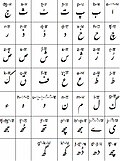 Punjabi Shahmukhi script
 -
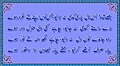 Bhulay Shah poetry in Punjabi (Shahmukhi script)
 -
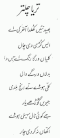 Munir Niazi poetry in Punjabi (Shahmukhi script)
 -
 Gurmukhi alphabet
 -


_138.jpg)


See also
- Punjabi Wikipedia (Eastern)
- Punjabi Wikipedia (Western)
- Languages of Pakistan
- Languages of India
- List of Indian languages by total speakers
- List of Punjabi-language newspapers
- Hindi-to-Punjabi Machine Translation System
- Punjabi cinema
References
Citations
- ↑ 80.5 million in Pakistan (2017), 31.1 in India (2011), 0.5 in Canada (2016), 0.3 in the UK (2011), 0.3 in the US (2017), 0.1 in Australia (2016). See § Geographic distribution below.
- ↑ "NCLM 52nd Report" (PDF). NCLM. 15 November 2016. Archived from the original (PDF) on 15 November 2016. Retrieved 13 January 2020.
- ↑ "Punjab mandates all signage in Punjabi, in Gurmukhi script". The Hindu. 21 February 2020. Retrieved 9 September 2020.0
- ↑ "All milestones, signboards in Haryana to bear info in English, Hindi and Punjabi: Education Minister". The Indian Express. 3 March 2020. Retrieved 9 September 2020.
- ↑ "Punjabi, Urdu made official languages in Delhi". The Times of India. 25 June 2003. Retrieved 10 September 2020.
- ↑ 6.0 6.1 "Multi-lingual Bengal". The Telegraph. 11 December 2012. Archived from the original on 25 March 2018. Retrieved 25 March 2018.
- ↑ India, Tribune (19 August 2020). "Punjabi matric exam on Aug 26". The Tribune. Retrieved 18 September 2020.
- ↑ Laurie Bauer, 2007, The Linguistics Student's Handbook, Edinburgh
- ↑ Canfield, Robert L. (1991). Persia in Historical Perspective. Cambridge, United Kingdom: Cambridge University Press. p. 1 ("Origins"). ISBN 978-0-521-52291-5.
- ↑ Sir, Yule, Henry (13 August 2018). "Hobson-Jobson: A glossary of Colloquial Anglo-Indian Words and Phrases, and of Kindred Terms, Etymological, Historical, Geographical and Discursive". dsalsrv02.uchicago.edu.
{{cite web}}: CS1 maint: multiple names: authors list (link) - ↑ Macdonell, Arthur Anthony (13 August 2018). "A Practical Sanskrit Dictionary with Transliteration, Accentuation, and Etymological Analysis Throughout".
- ↑ .https://books.google.com/books?id=gqIbJz7vMn0C&pg=PA166&dq=punjabi+prakrit+language&hl=en&sa=X&ved=0ahUKEwie9PGZnrzQAhXMtI8KHay-AfwQ6AEIKTAD#v=onepage&q=punjabi%20prakrit%20language&f=false Archived 21 January 2017 at the Wayback Machine
- ↑ G S Sidhu (2004). Panjab And Panjabi.
- ↑ 14.0 14.1 Hoiberg, Dale (2000). Students' Britannica India. Popular Prakashan. ISBN 978-0-85229-760-5.
- ↑ Brard, G.S.S. (2007). East of Indus: My Memories of Old Punjab. Hemkunt Publishers. p. 81. ISBN 9788170103608. Archived from the original on 9 February 2018. Retrieved 13 January 2017.
- ↑ Mir, F. (2010). The Social Space of Language: Vernacular Culture in British Colonial Punjab. University of California Press. p. 35. ISBN 9780520262690. Archived from the original on 9 February 2018. Retrieved 13 January 2017.
- ↑ Schiffman, H. (2011). Language Policy and Language Conflict in Afghanistan and Its Neighbors: The Changing Politics of Language Choice. Brill. p. 314. ISBN 9789004201453. Archived from the original on 9 February 2018. Retrieved 13 January 2017.
- ↑ Schiffman, Harold (9 December 2011). Language Policy and Language Conflict in Afghanistan and Its Neighbors: The Changing Politics of Language Choice. BRILL. ISBN 978-90-04-20145-3.
- ↑ Menon, A.S.; Kusuman, K.K. (1990). A Panorama of Indian Culture: Professor A. Sreedhara Menon Felicitation Volume. Mittal Publications. p. 87. ISBN 9788170992141. Archived from the original on 9 February 2018. Retrieved 13 January 2017.
- ↑ "Archived copy". Archived from the original on 26 September 2009. Retrieved 17 September 2009.
{{cite web}}: CS1 maint: archived copy as title (link) - ↑ "CCI defers approval of census results until elections". Dawn. 21 March 2021. Retrieved 10 March 2021. The figure of 80.54 million is calculated from the reported 38.78% for the speakers of Punjabi and the 207.685 million total population of Pakistan.
- ↑ "Statement 1 : Abstract of speakers' strength of languages and mother tongues – 2011" (PDF). Retrieved 21 March 2021.
- ↑ "Growth of Scheduled Languages-1971, 1981, 1991 and 2001". Census of India. Ministry of Home Affairs, Government of India. Archived from the original on 20 February 2015. Retrieved 22 February 2015.
- ↑ "Punjabi is 4th most spoken language in Canada". The Times of India. 14 February 2008. Archived from the original on 14 November 2016.
- ↑ "Census Profile, 2016 Census, Canada". Government of Canada, Statistics Canada. 8 February 2017. Retrieved 11 August 2020.
- ↑ 273,000 in England and Wales, and 23,000 in Scotland:
- "2011 Census: Quick Statistics for England and Wales, March 2011". Retrieved 24 March 2021.
- "Table AT_002_2011 - Language used at home other than English (detailed), Scotland". Retrieved 24 March 2021.
- ↑ "US survey puts Punjabi speakers in US at 2.8 lakh". Times of India. 18 December 2017. Retrieved 11 August 2020.
- ↑ Lal, Mohan (1992). Encyclopaedia of Indian Literature. Sahitya Academy. p. 4208.
- ↑ Bhatt, Shankarlal (2006). Punjab. Bhargava, Gopal K. Delhi: Kalpaz publ. p. 141. ISBN 81-7835-378-4. OCLC 255107273.
- ↑ Shackle 2003, p. 587.
- ↑ Shackle 2003, p. 588.
- ↑ ArLaam (similar to ArNoon) has been added to Unicode since Unicode 13.0.0, which can be found in Unicode Arabic Extended-A 08C7, PDF Pg 73 under "Arabic Letter for Punjabi” 08C7 : ࣇ ARABIC LETTER LAM WITH SMALL ARABIC LETTER TAH ABOVE
- ↑ Shackle 2003, p. 589.
- ↑ Masica 1991, p. 97.
- ↑ Arora, K. K.; Arora, S.; Singla, S. R.; Agrawal, S. S. (2007). "SAMPA for Hindi and Punjabi based on their Acoustic and Phonetic Characteristics". Proceedings Oriental COCOSDA: 4–6.
- ↑ Ladefoged, Peter; Maddieson, Ian (1996). The Sounds of the World's Languages. Oxford: Blackwell. pp. 190–191. ISBN 978-0631198154.
- ↑ Bhatia, Tej (1999). "Lexican Anaphors and Pronouns in Punjabi". In Lust, Barbara; Gair, James (eds.). Lexical Anaphors and Pronouns in Selected South Asian Languages. Walter de Gruyter. p. 637. ISBN 978-3-11-014388-1. Other tonal Indo-Aryan languages include Hindko, Dogri, Western Pahari, Sylheti and some Dardic languages.
- ↑ 38.0 38.1 38.2 Bailey, T.Grahame (1919), English-Punjabi Dictionary, introduction.
- ↑ Singh, Sukhvindar, "Tone Rules and Tone Sandhi in Punjabi".
- ↑ 40.0 40.1 40.2 Bowden, A.L. (2012). "Punjabi Tonemics and the Gurmukhi Script: A Preliminary Study".
- ↑ Kanwal, J.; Ritchart, A.V (2015) "An experimental investigation of tonogenesis in Punjabi". Proceedings of the 18th International of Phonetic Sciences, 2015
- ↑ Lata, Swaran; Arora, Swati (2013) "Laryngeal Tonal characteristics of Punjabi: An Experimental Study"
- ↑ Baart, J.L.G. "Tonal features in languages of northern Pakistan"
- ↑ Gill, Harjeet Singh and Gleason Jr, Henry A. (1969). A Reference Grammar of Panjabi. Patiala: Department of Linguistics, Punjabi University
- ↑ "WALS Online - Language Panjabi". wals.info.
- ↑ Shackle (2003:599)
- ↑ Shackle (2003:601)
- ↑ Masica (1991:257)
- ↑ 49.0 49.1 Frawley, William (2003). International Encyclopedia of Linguistics: 4-Volume Set. Oxford University Press. p. 423. ISBN 978-0-19-513977-8.
Hindus and Sikhs generally use the Gurmukhi script; but Hindus have also begun to write Punjabi in the Devanagari script, as employed for Hindi. Muslims tend to write Punjabi in the Perso-Arabic script, which is also employed for Urdu. Muslim speakers borrow a large number of words from Persian and Arabic; however, the basic Punjabi vocabulary is mainly composed of tadbhava words, i.e. those descended from Sanskrit.
- ↑ Bhatia, Tej K. (1993). Punjabi: A Conginitive-descriptive Grammar. Psychology Press. p. xxxii. ISBN 978-0-415-00320-9.
Punjabi vocabulary is mainly composed of tadbhav words, i.e., words derived from Sanskrit.
- ↑ Bhatia 2008, p. 128.
- ↑ Bhardwaj 2016, pp. 12–13.
- ↑ Jain 2003, pp. 53, 57–8.
- ↑ Nayar 1966, pp. 46 ff.
- ↑ Bhardwaj 2016, p. 12.
- ↑ 56.0 56.1 Shackle 2003, p. 594.
- ↑ Bhardwaj 2016, p. 15.
- ↑ Shiv Kumar Batalvi Archived 10 April 2003 at the Wayback Machine sikh-heritage.co.uk.
- ↑ Melvin Ember; Carol R. Ember; Ian A. Skoggard, eds. (2005). Encyclopedia of Diasporas: Immigrant and Refugee Cultures Around the World. Springer. p. 1077. ISBN 978-0-306-48321-9.
- ↑ The Encyclopaedia of Indian Literature (Volume One - A to Devo). Volume 1. Amaresh Datta, ed. Sahitya Akademi: 2006, 352.
- ↑ "Chapter 4: "General." of Part XII: "Miscellaneous"". pakistani.org. Retrieved 30 December 2016.
{{cite web}}: CS1 maint: deprecated archival service (link) - ↑ Zaidi, Abbas. "Linguistic cleansing: the sad fate of Punjabi in Pakistan". Archived from the original on 29 October 2016.
- ↑ University of the Punjab (2015), "B.A. Two-Year (Pass Course) Examinations"
- "University of the Punjab - Examinations". pu.edu.pk. Archived from the original on 8 February 2017. Retrieved 13 January 2017.
- ↑ University of the Punjab (2015). "Department of Punjabi". Archived from the original on 27 November 2016.
- ↑ Masood, Tariq (21 February 2015). "The colonisation of language". The Express Tribune. Archived from the original on 12 September 2015. Retrieved 19 September 2015.
- ↑ Warraich, Faizan; Ali, Haider (15 September 2015). "Intelligentsia urges govt to promote Punjabi language". DailyTimes. Archived from the original on 30 June 2015. Retrieved 15 September 2015.
- ↑ "Punjabis Without Punjabi". apnaorg.com. Archived from the original on 25 May 2017. Retrieved 13 January 2017.
- ↑ "Inferiority complex declining Punjabi language: Punjab University Vice-Chancellor". PPI News Agency
- "Inferiority complex declining Punjabi language: Punjab University Vice-Chancellor | Pakistan Press International". ppinewsagency.com. Archived from the original on 27 November 2016. Retrieved 13 January 2017.
- ↑ "Urdu-isation of Punjab - The Express Tribune". The Express Tribune. 4 May 2015. Archived from the original on 27 November 2016. Retrieved 30 December 2016.
- ↑ "Rally for ending 150-year-old 'ban on education in Punjabi". The Nation. 21 February 2011. Archived from the original on 7 March 2016. Retrieved 15 September 2015.
- ↑ "Sufi poets can guarantee unity". The Nation. 26 August 2015. Archived from the original on 30 October 2015.
- ↑ "Supreme Court's Urdu verdict: No language can be imposed from above". The Nation. 15 September 2015. Archived from the original on 16 September 2015. Retrieved 15 September 2015.
- ↑ "Two-member SC bench refers Punjabi language case to CJP". Business Recorder. 14 September 2015. Archived from the original on 21 October 2015. Retrieved 15 September 2015.
- ↑ "Mind your language—The movement for the preservation of Punjabi". The Herald. 2 September 2106.
- "Mind your language—The movement for the preservation of Punjabi - People & Society - Herald". herald.dawn.com. 4 August 2016. Archived from the original on 23 December 2016. Retrieved 13 January 2017.
- ↑ "Punjabi in schools: Pro-Punjabi outfits in Pakistan threaten hunger strike". The Times of India. 4 October 2015.
- "Punjabi in schools: Pro-Punjabi outfits in Pakistan threaten hunger strike". The Times of India. Archived from the original on 27 September 2016. Retrieved 13 January 2017.
- ↑ "Rally for Ending the 150-year-old Ban on Education in Punjabi" The Nation. 21 February 2011.
- "Rally for ending 150-year-old 'ban on education in Punjabi". nation.com.pk. 21 February 2011. Archived from the original on 7 March 2016. Retrieved 13 January 2017.
- ↑ 77.0 77.1 Khokhlova, Liudmila (January 2014). "Majority Language Death" (PDF). Language Endangerment and Preservation in South Asia. Archived (PDF) from the original on 25 May 2017. Retrieved 29 April 2017.
Punjabi was nonetheless included in the Eighth Schedule of the Constitution of India and came to be recognized as one of the fifteen official languages of the country.
- ↑ "Fifty Years of Punjab Politics (1920-70)". Panjab Digital Library. Retrieved 6 January 2019.
- ↑ Ayres, Alyssa (2008). "Language, the Nation, and Symbolic Capital: The Case of Punjab" (PDF). The Journal of Asian Studies. 67 (3): 917–946. doi:10.1017/S0021911808001204. S2CID 56127067. Archived (PDF) from the original on 25 May 2017. Retrieved 28 April 2017.
in India, Punjabi is an official language as well as the first language of the state of Punjab (with secondary status in Delhi and widespread use in Haryana).
- ↑ Kumar, Ashutosh (2004). "Electoral Politics in Punjab: Study of Akali Dal". Economic & Political Weekly. 39 (14/15): 1515–1520. JSTOR 4414869.
Punjabi was made the first compulsory language and medium of instruction in all the government schools whereas Hindi and English as second and third language were to be implemented from the class 4 and 6 respectively
- ↑ 52nd Report of the Commissioner for Linguistic Minorities in India (PDF) (Report). National Commission on Linguistic Minorities. 2015. p. 25. Archived from the original (PDF) on 25 May 2017. Retrieved 28 April 2017.
Languages taught in the State under the Three Language Formula: First Language : Hindi Second Language : Punjabi Third language : English
- ↑ Singh, Jasmine (13 September 2015). "Serial killer". The Tribune. Archived from the original on 16 September 2015. Retrieved 15 September 2015.
- ↑ "SGPC claims Haryana govt ignoring Punjabi language". Hindustan Times. 30 July 2015. Retrieved 15 September 2015.
- ↑ Aujla, Harjap Singh (15 June 2015). "Punjabi's of Delhi couldn't get justice for Punjabi language". Punjab News Express. Retrieved 19 September 2015.[permanent dead link]
- ↑ Singh, Perneet (9 July 2013). "Sikh bodies oppose DU's 'anti-Punjabi' move". Tribune India. Retrieved 21 February 2018.
- ↑ "final". punjabiuniversity.ac.in. Archived from the original on 24 November 2016. Retrieved 13 January 2017.
- ↑ "ACTDPL, Punjabi University, Patiala". learnpunjabi.org. Archived from the original on 10 December 2016. Retrieved 13 January 2017.
- ↑ "ਪੰਜਾਬੀ ਪੀਡੀਆ". punjabipedia.org. Archived from the original on 21 December 2016. Retrieved 13 January 2017.
- ↑ "Pbi University launches Punjabipedia | punjab | Hindustan Times". Hindustan Times. 26 February 2014. Archived from the original on 23 November 2016. Retrieved 13 January 2017.
- ↑ "The Dhahan Prize | The Dhahan Prize for Punjabi Literature". dhahanprize.com. Archived from the original on 27 February 2017. Retrieved 13 January 2017.
- ↑ "ਪੰਜਾਬੀ ਲੇਖਕਾਂ ਦਾ ਮੱਕਾ : ਪੰਜਾਬੀ ਭਵਨ, ਲੁਧਿਆਣਾ". 3 May 2017. Archived from the original on 3 May 2017. Retrieved 16 October 2017.
- ↑ "Sirsa again elected Punjabi Sahit Akademi president". Tribuneindia.com. 18 April 2016. Retrieved 13 August 2018.
- ↑ "Punjabi Academy". www.punjabiacademy.com. Archived from the original on 18 July 2017.
- ↑ http://jkculture.nic.in/seminars.htm# Archived 23 November 2016 at the Wayback Machine
- ↑ "पंजाबी सीखने वाले छात्रों को अगले माह बटेगा एकल प्रोत्साहन राशि". M.livehindustan.com. 24 October 2016. Retrieved 13 August 2018.
- ↑ "Welcome to Punjab Institute of Language, Art & Culture | Punjab Institute of Language, Art & Culture". pilac.punjab.gov.pk. Archived from the original on 11 July 2017.
- ↑ "Microsoft Download Center". microsoft.com. Archived from the original on 23 November 2016. Retrieved 13 January 2017.
- ↑ "Punjabi Linux (punlinux) download | SourceForge.net". sourceforge.net. Archived from the original on 23 November 2016. Retrieved 13 January 2017.
- ↑ "Connecting to the iTunes Store". itunes.apple.com. Archived from the original on 23 November 2016. Retrieved 13 January 2017.
- ↑ "Google". Retrieved 13 January 2017.
- ↑ "Google ਅਨੁਵਾਦ". Archived from the original on 29 December 2016. Retrieved 13 January 2017.
- ↑ "Cloud ਇਨਪੁਟ ਔਜ਼ਾਰ ਔਨਲਾਈਨ ਅਜਮਾਓ – Google ਇਨਪੁਟ ਔਜ਼ਾਰ". Archived from the original on 12 January 2017. Retrieved 13 January 2017.
Sources
- Bhardwaj, Mangat Rai (2016), Panjabi: A Comprehensive Grammar, Routledge, doi:10.4324/9781315760803, ISBN 9781138793859.
- Bhatia, Tej K. (2008), "Major regional languages", in Braj B. Kachru; Yamuna Kachru; S.N. Sridhar (eds.), Language in South Asia, Cambridge University Press, pp. 121–131, doi:10.1017/CBO9780511619069.008, ISBN 9780511619069.
- Grierson, George A. (1916). Linguistic Survey of India. Vol. Volume IX: Indo-Aryan family. Central group, Part 1, Specimens of western Hindi and Pañjābī. Calcutta: Office of the Superintendent of Government Printing, India.
{{cite book}}:|volume=has extra text (help); External link in|volume= - Jain, Dhanesh (2003), "Sociolinguistics of the Indo-Aryan Languages", in Cardona, George; Jain, Dhanesh (eds.), The Indo-Aryan Languages, Routledge, pp. 46–66, ISBN 978-0-415-77294-5.
- Masica, Colin (1991), The Indo-Aryan Languages, Cambridge: Cambridge University Press, ISBN 978-0-521-29944-2.
- Nayar, Baldev Raj (1966), Minority Politics in the Punjab, Princeton University Press, ISBN 9781400875948.
- Shackle, Christopher (2003), "Panjabi", in Cardona, George; Jain, Dhanesh (eds.), The Indo-Aryan Languages, Routledge, pp. 581–621, ISBN 978-0-415-77294-5.
Further reading
- Bhatia, Tej. 1993 and 2010. Punjabi : a cognitive-descriptive grammar. London: Routledge. Series: Descriptive grammars.
- Gill H.S. [Harjit Singh] and Gleason, H.A. 1969. A reference grammar of Punjabi. Revised edition. Patiala, Punjab, India: Languages Department, Punjab University.
- Chopra, R. M., Perso-Arabic Words in Punjabi, in: Indo-Iranica Vol.53 (1–4).
- Chopra, R. M.., The Legacy of The Punjab, 1997, Punjabee Bradree, Calcutta.
- Singh, Chander Shekhar (2004). Punjabi Prosody: The Old Tradition and The New Paradigm. Sri Lanka: Polgasowita: Sikuru Prakasakayo.
- Singh, Chander Shekhar (2014). Punjabi Intonation: An Experimental Study. Muenchen: LINCOM EUROPA.
External links
- Punjabi language at Curlie
- Punjabi language at the Encyclopædia Britannica
- English to Punjabi Dictionary Archived 10 March 2010 at the Wayback Machine
- Pages using the JsonConfig extension
- Pages with plain IPA
- ISO language articles citing sources other than Ethnologue
- Language articles with unsupported infobox fields
- Pages using Lang-xx templates
- Articles containing Ancient Greek (to 1453)-language text
- Punjabi language
- Fusional languages
- Official languages of India
- Languages of Pakistan
- Languages of Punjab, Pakistan
- Punjabi culture
- Subject–object–verb languages
- Tonal languages in non-tonal families
- Indo-Aryan languages