


| Sindhi | |
|---|---|
span>
| |
  Sindhi written in the Naskh (left) and Devanagari (right) scripts | |
| Pronunciation | [sɪndʱiː] |
| Native to | |
| Region | Sindh and parts of Balochistan, Kutch and Barmer |
Native speakers | 37 million (2011–2023)[lower-alpha 1] |
Early forms | |
Standard forms | |
| |
| Signed Sindhi | |
| Official status | |
Official language in | |
| Regulated by |
|
| Development body | Sindhi Language Authority |
| Language codes | |
| ISO 639-1 | sd |
| ISO 639-2 | snd |
| ISO 639-3 | snd |
| Glottolog | sind1272 |
| Linguasphere | 59-AAF-f |
 The proportion of people with Sindhi as their mother tongue in each Pakistani District as of the 2017 Pakistan Census | |

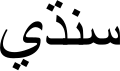
Sindhi ({{safesubst:ifsubst|1=|2= }سِنڌِي</ span> , Sindhī, [sɪndʱiː])[lower-alpha 4] is an Indo-Aryan language belonging to the Indo-Iranian branch of the Indo-European language family. It is primarily spoken by the Sindhi people native to the Pakistani province of Sindh, where the language has official status.[2] It constitutes the mother tongue of over 34 million people in Pakistan, primarily concentrated in Sindh; with historic communities in neighbouring Balochistan as well. It is also spoken by 1.7 million people in India, mostly by the descendants of partition-era migrants; with it having the status of a scheduled language in the country without any state-level official status.[1] Sindhi is written in the Sindhi alphabet of the Perso-Arabic script, the sole official script for the language in Pakistan; while in India, both the Perso-Arabic and Devanagari scripts are used.
With over 37 million native speakers, Sindhi is a major South Asian language, being the most-widely spoken language in southern Pakistan[lower-alpha 5] and third most-widely spoken in the entirety of Pakistan (after Punjabi and Pashto). The language is also geographically spread out of South Asia as it is spoken by the Sindhi diaspora, present around the world, primarily in the Gulf states, the Western world and the Far East.[4]
Being classified under the Northwestern branch of the Indo-Aryan languages, Sindhi, apart from other Sindhic languages, is most closely related to the Punjabi language varieties. It is descended from Shauraseni Prakrit, which gradually developed into Apabhraṃśa and then into Early Sindhi. Sindhi further developed during the Islamic Golden Age and the Islamic period in South Asia, expanding its vocabulary under the influence of Arabic and Persian; with the earliest written evidence of Sindhi as a language being a translation of the Quran, dated back to 883 AD.[5] Middle Sindhi produced the language's greatest pieces of literature, including recorded forms of orally-transmitted folk tales; as well as Sufi literature, including Shah Jo Risalo, the single greatest piece of Sindhi literature, by Shah Abdul Latif Bhittai. Modern Sindhi developed and was officially standardised and promoted during the British colonial era, replacing Persian as the primary official language of Sindh in 1848.[6]
Sindhi is an inflected language, with five cases for noun, three for personal pronoun, four for third-person pronoun; eleven case markers; two genders (masculine, feminine); and two numbers (singular, plural). The base of its vocabulary is derived from Sanskrit in the form of Prakrit and Apabhraṃśa, while a significant portion of its high-register speech is derived from Persian and Arabic, along with a number of recent loanwords borrowed from English; and to a lesser extent from Portuguese and French. It has also had minor influence from and on neighbouring languages such as Saraiki, Punjabi, Balochi, Brahui, Gujarati, and Marwari.[7]
Sindhi has a number of dialects and an established standard form, referred to as Standard Sindhi, which is based on the dialect of Hyderabad and the surrounding areas of central Sindh. The primary regulatory agency for the development and promotion of the language is the Sindhi Language Authority, an autonomous institution of the government of Sindh.[8]
History[edit | edit source]

| Part of a series on |
| Sindhis |
|---|
 |
 Sindh portal |
Origins[edit | edit source]
The name "Sindhi" is derived from the Sanskrit síndhu, the original name of the Indus River, along whose delta Sindhi is spoken.[9] In the Bronze Age (c. 3300 – c. 1200 BCE), the primary language of this region was likely the Harappan language, but no records exist indicating when or how that language was replaced by the Indo-Aryan languages.[10]
Like other languages of the Indo-Aryan family, Sindhi is descended from Old Indo-Aryan (Sanskrit) via Middle Indo-Aryan (Pali, secondary Prakrits, and Apabhramsha). 20th century Western scholars such as George Abraham Grierson believed that Sindhi descended specifically from the Vrācaḍa dialect of Apabhramsha (described by Markandeya as being spoken in Sindhu-deśa, corresponding to modern Sindh)[11][12] but later work has shown this to be unclear.[13]
The sound changes that characterise the development of Sindhi from Middle Indo-Aryan are:
- Development of implosives from geminate and initial stops (e.g. g-, -gg > ɠ); this is a highly distinctive sound change in NIA[14]
- Shortening of geminates (e.g. MIA akkhi > Sindhi akhi "eye")[15]
- Voicing of post-nasal consonants (e.g. MIA danta > Sindhi ɗ̣andu "tooth")[15][16]
- Debuccalization of intervocalic -s- > -h- (shared with some Punjabi varieties, primarily Saraiki)[17]
- Intervocalic -l- > -r- (likely via intermediate retroflex -ḷ-), -ll- > -l-,[18] -ḍ- > -ṛ-
- Fronting of r from medial clusters to initial (e.g. OIA dīrgha > Sindhi ḍrigho "long")[14]
Additionally, the following retentions distinguish Sindhi from other New Indo-Aryan languages:
- Retention of MIA -ṇ-[18]
- Retention of final short vowels -a, -i, -u,[19] but also insertion of these into loanwords[20]
- Retention of long vowels before geminates (more archaic than e.g. Prakrit)[15]
- Retention of stop + r clusters but with retroflexion, e.g. tr- > ṭr-[21][22]
- Retention of v-[23]
Early Sindhi (–16th century)[edit | edit source]
Literary attestation of early Sindhi is sparse. The earliest written evidence of Sindhi as a language can be found in a translation of the Qur’an into Sindhi dating back to 883 A.D.[5] Historically, Isma'ili religious literature and poetry in India, as old as the 11th century CE, used a language that was closely related to Sindhi and Gujarati; at this point, Sindhi was not clearly established as an independent literary language. Much of this work is in the form of ginans (a kind of devotional hymn).[24][25]
Sindhi was the first Indo-Aryan language to be in close contact with Arabic and Persian following the Umayyad conquest of Sindh in 712 CE. Arabic sources thus do mention the language of Sindh in various instances. The following excerpts are translated from The History of India, as Told by Its Own Historians by Henry Miers Elliot.[26]
The language of Sind is different from that of India. Sind is the country which is nearer to the domains of the Muslims; India is farther from them.
The language of Mansúra, Multán, and those parts is Arabic and Sindian. In Makrán, they use Persian and Makranic.
— Ibn Hawqal, Surat Al-Ard (977 CE)
Additionally, the Korean Buddhist monk Hyech'o mentions the unique language of Sindh in his travelogue:
From Takka, I walked towards the West for another month and arrived at the country of Sindhukula. The dress, customs, climate, and temperature are similar to north India, although the language is slightly different.
Medieval Sindhi (16th–19th centuries)[edit | edit source]
Medieval Sindhi literature is of a primarily religious genre, comprising a syncretic Sufi and Advaita Vedanta poetry, the latter in the devotional bhakti tradition. The format of this poetry is the bayt, indicating significant influence from Arabic and Persian. The earliest known Sindhi poet of the Sufi tradition is Qazi Qadan (1493–1551). Other early poets were Shah Inat Rizvi (c. 1613–1701) and Shah Abdul Karim Bulri (1538–1623). These poets had a mystical bent that profoundly influenced Sindhi poetry for much of this period.[24]
Another famous part of Medieval Sindhi literature is a wealth of folktales, adapted and readapted into verse by many bards at various times and possibly much older than their earliest literary attestations. These include romantic epics such as Sassui Punnhun, Sohni Mahiwal, Momal Rano, Noori Jam Tamachi, Lilan Chanesar, and others.[28]
The greatest poet of Sindhi was Shah Abdul Latif Bhittai (1689/1690–1752), whose verses were compiled into the Shah Jo Risalo by his followers. While primarily Sufi, his verses also recount traditional Sindhi folktales and aspects of the cultural history of Sindh.[24]
The first attested Sindhi translation of the Quran was done by Akhund Azaz Allah Muttalawi (1747–1824) and published in Gujarat in 1870. The first to appear in print was by Muhammad Siddiq in 1867.[29]
British India (1843–1947)[edit | edit source]
In 1843, the British conquest of Sindh led the region to become part of the Bombay Presidency. Soon after, in 1848, Governor George Clerk established Sindhi as the official language in the province, removing the literary dominance of Persian. Sir Bartle Frere, the then commissioner of Sindh, issued orders on August 29, 1857, advising civil servants in Sindh to pass an examination in Sindhi. He also ordered the use of Sindhi in official documents.[30] In 1868, the Bombay Presidency assigned Narayan Jagannath Vaidya to replace the Abjad used in Sindhi with the Khudabadi script. The script was decreed a standard script by the Bombay Presidency, thus inciting anarchy in the Muslim majority region. A powerful unrest followed, after which Twelve Martial Laws were imposed by the British authorities. The granting of official status of Sindhi along with script reforms ushered in the development of modern Sindhi literature.
The first printed works in Sindhi were produced at the Muhammadi Press in Bombay beginning in 1867. These included Islamic stories set in verse by Muhammad Hashim Thattvi, one of the renowned religious scholars of Sindh.[28]
Independent Pakistan and India (1947–)[edit | edit source]
The Partition of India in 1947 resulted in most Sindhi speakers ending up in the new state of Pakistan, commencing a push to establish a strong sub-national linguistic identity for Sindhi. This manifested in resistance to the imposition of Urdu and eventually Sindhi nationalism in the 1980s.[31]
The language and literary style of contemporary Sindhi writings in Pakistan and India were noticeably diverging by the late 20th century; authors from the former country were borrowing extensively from Urdu, while those from the latter were highly influenced by Hindi.[32]
Geographical distribution[edit | edit source]
Sindhi is the official language of the Pakistani province of Sindh[33][2] and one of the scheduled languages of India, where it does not have any state-level status.[34] Before the inception of Pakistan, Sindhi was the national language of Sindh.[35][36][37][38]
Sindhi is additionally spoken by many members of the Sindhi diaspora, particularly in Malaysia, Oman, Singapore, UAE, USA and UK.
Pakistan[edit | edit source]

In Pakistan, Sindhi is the first language of 34.40 million people, or 14.6% of the country's population as of the 2023 census. 33.46 million of these are found in Sindh, where they account for 60% of the total population of the province.[39] There are 0.55 million speakers in the province of Balochistan, especially in the Kacchi Plain.
| State | Population |
|---|---|
| Template:Flag+link | 34,401,564 |
| Template:Flag+link | 33,462,299 |
| Template:Flag+link | 555,198 |
| Template:Flag+link | 352,686 |
| Template:Flag+link | 21,362 |
| Template:Flag+link | 10,019 |
The Pakistan Sindh Assembly has ordered compulsory teaching of the Sindhi language in all private schools in Sindh.[40] According to the Sindh Private Educational Institutions Form B (Regulations and Control) 2005 Rules, "All educational institutions are required to teach children the Sindhi language.[41] Sindh Education and Literacy Minister, Syed Sardar Ali Shah, and Secretary of School Education, Qazi Shahid Pervaiz, have ordered the employment of Sindhi teachers in all private schools in Sindh so that this language can be easily and widely taught.[42] Sindhi is taught in all provincial private schools that follow the Matric system and not the ones that follow the Cambridge system.[43]
At the occasion of 'Mother Language Day' in 2023, the Sindh Assembly under Culture minister Sardar Ali Shah, passed a unanimous resolution to extend the use of language to primary level[44] and increase the status of Sindhi as a national language[45][46][47] of Pakistan.
Many Sindhi-language television channels are broadcasting in Pakistan, such as Time News, KTN, Sindh TV, Awaz Television Network, Mehran TV, and Dharti TV.
India[edit | edit source]
The Indian Government has legislated Sindhi as a scheduled language in India, making it an option for education. Despite lacking any state-level status, Sindhi is still a prominent minority language in the Indian states of Gujarat, Rajasthan and Maharashtra.[48] In India, Sindhi mother tongue speakers were distributed in the following states:
| State | Population |
|---|---|
| Template:Flag+link | 2,772,264 |
| Gujarat | 1,184,024 |
| Maharashtra | 723,748 |
| Rajasthan | 386,569 |
| Madhya Pradesh | 245,161 |
| Chhattisgarh | 93,424 |
| Delhi (NCT) | 31,177 |
| Uttar Pradesh | 28,952 |
| Assam | 19,646 |
| Karnataka | 16,954 |
| Andhra Pradesh | 11,299 |
| Tamil Nadu | 8,448 |
| West Bengal | 7,828 |
| Uttarakhand | 2,863 |
| Odisha | 2,338 |
| Bihar | 2,227 |
| Jharkhand | 1,701 |
| Haryana | 1,658 |
| Kerala | 1,251 |
| Punjab | 754 |
| Goa | 656 |
| Dadra and Nagar Haveli and Daman and Diu | 894 |
| Meghalaya | 236 |
| Chandigarh | 134 |
| Puducherry | 94 |
| Nagaland | 82 |
| Himachal Pradesh | 62 |
| Tripura | 30 |
| Jammu and Kashmir | 19 |
| Andaman and Nicobar Islands | 14 |
| Arunachal Pradesh | 12 |
| Lakshadweep | 7 |
| Sikkim | 2 |
Sindhi diaspora[edit | edit source]
In Malaysia, Indonesia, and Singapore (where Sindhi has no official status), ethnic Sindhis are largely shifting to English as their first language, excepting some monolingual first-generation immigrants and second-generation speakers who use Sindhi at home. Codeswitching of varying degrees is observed in some speakers, usually with English but also with Malay and Indonesian.[50][51][52][53] Similar shift to English is found in the smaller Hong Kong Sindhi community.[54]
Sindhi speakers by country[edit | edit source]
| Country | Population |
|---|---|
| Template:Flag+link[39] | 34,401,564 |
| Template:Flag+link[49] | 2,772,264 |
| Template:Flag+link[55] | 102,000 |
| Template:Flag+link[56] | 6,299 |
| Template:Flag+link[57] | 5,315 |
| Template:Flag+link[58] | 3,971 |
Dialects[edit | edit source]

Sindhi has many dialects, and forms a dialect continuum at some places with neighboring languages such as Punjabi to the north and Gujarati to the south, but not with Marwari to the east.[7] Some of the documented dialects of Sindhi are:[59][60][61][7][62]
- Vicholi: The prestige dialect spoken around Hyderabad and central Sindh (the Vicholo region), on which the literary standard is based.
- Uttaradi: The dialect of northern Sindh (Uttaru, meaning "north"), with minor differences in Larkana, Shikarpur and in parts of Sukkur and Kandiaro.[63]
- Lari: The dialect of southern Sindh (Lāṛu) spoken around areas like Karachi, Thatta, Sujawal, Tando Muhammad Khan and Badin districts.
- Siroli (also Siraiki, Ubheji): The dialect of northernmost Sindh (Siro, meaning "head"). [64] Spoken in smaller number all over Sindh but mainly in Jacobabad and Kashmore districts, it may be transitional with the Saraiki language variety of southern Punjab[65] and has variously been treated either as a dialect of Saraiki or as a dialect of Sindhi.[66]
- Lasi: The dialect of Lasbela, Hub and Gwadar districts in Balochistan, closely related to Lari and Vicholi, and in contact with Balochi.
- Firaqi: The dialect of the Kachhi plains the north eastern districts of Balochistan, where it is referred to as Firaqi Sindhi or commonly just Sindhi.[67][68]
- Thareli (also Tharechi): Spoken in the northeastern Thar desert of Sindh, but mainly spoken in the western part of Jaisalmer district of Rajasthan, India by many Sindhi Muslims.[69][70]
- Sindhi Bhili: Spoken in Sindh by the Sindhi Meghwars and Bhils.[71][72][73]
Furthermore, Kutchi and Jadgali are sometimes classified as dialects of Sindhi rather than independent languages.
| English | Vicholi | Lari | Uttaradi | Lasi | Kutchi[75] | Dhatki |
|---|---|---|---|---|---|---|
| I | Aao(n) | Aao(n) | Mā(n) | Ã | Aau(n) | Hu(n) |
| My | Muhnjo | Mujo | Mānjo/Māhjo | Mojo/Mājo | Mujo | Mānjo/Māhyo |
| You "Sin, plu" (formal) | Awha(n)/Awhee(n)
Tawha(n)/Tawhee(n) |
Aa(n)/Aei(n) | Taha(n)/Taa(n)/
Tahee(n)/Taee(n) |
Awa(n)/Ai(n) | Aa(n)/Ai(n) | Awha/Ahee(n)/ Aween |
| To me | Mukhe | Muke | Mānkhe | Mukh | Muke | Mina |
| We | Asee(n) | Asee(n), Pān | Asā(n) | Asee(n) | Asee(n), Pān | Asee(n), Asā(n) |
| What | Chha/Kahirō | Kujjāro/Kujja | Chha/Shha | Chho | Kuro | Kee |
| Why | Chho | Ko | Chho/Shho | Chhela | Kolāi/Kurelāe | Kayla |
| How | Kiya(n) | Kei(n) | Kiya(n) | Kee(n) | Kiya(n) | |
| No | Na, Kōna, Kōn | Nā(n), Kīna | Na, Kōna, Kāna, Kon, Kān | Nā(n), Ma | Nā | Nā, Ni, Ko, Kon, Ma |
| Legs (plural, fem) | Tangu(n), Jjanghu(n) | Tangu(n), Jjangu(n) | Tangā(n), Jjanghā(n) | |||
| Foot | Pair | Pair/Pagg/Pagulo | Pair | Pair | Pag | Pagg, Pair |
| Far | Pare | Ddoor | Pare/Parte | Ddor | Chhete | Ddor |
| Near | Vejhō | Vejo/Ōdō/Ōdirō/Ore | Vejhō/Vejhe/Orte | Ōddō | Wat, bājūme | Nerro |
| Good/Excellent | Sutho, Chaṅō | Khāso/Sutho/Thhāuko | Sutho, Bhalo, Chango | Khāsho | Khāso, Laat | Sutho, Phutro, Thhāuko |
| High | Utāho | Ucho | Mathe | Ucho | Ucho | Uncho |
| Silver | Rupo | Chādi/Rupo | Chāndi | Rupo | Rupo | |
| Father | Piu | Pay/Abo/Aba/Ada | Pee/Babo/Pirhe(n) | Pe | Pe, Bapa, Ada | |
| Wife | Joe/Gharwāri | Joe/Wani/Kuwār | Zaal/Gharwāri | Zaal | Vahu/Vau | Ddosi, Luggai |
| Man | Mardu | Māņu/Mārū/Mard
/Murs/Musālu |
Mānhu/Musālo/Bhāi
/Kāko/Hamra |
Mānhu | Māḍū/Mārū | Mārū |
| Woman | Aurat | Zāla/ōrat/ōlath | Māi/Ran | Zāla | Bāeḍi/Bāyaḍī | |
| Child/Baby | Bbār/Ningar/Bbālak | Bbār/Ningar/Gabhur/
Bacho/Kako |
Bbār/Bacho/Adro/
Phar (animal) |
Gabhar | Bār/Gabhar/Chokro | |
| Daughter | Dhiu/Niyāni | Dia/Niyāni/Kañā | Dhee/Adri | Dhia | Dhi/Dhikri | Dikri |
| Sun | Siju | Sij, Sūrij | Sijhu | Siju | Sūraj | Sūraj |
| Sunlight | Kārro | Oosa | Tarko | |||
| Cat | Billi | Bili/Pusani | Billi | Phushini | Minni | |
| Rain | Barsāt/Mee(n)h
/Bārish |
Varsāt/Mee(n)/Mai(n) | Barsāt/Mee(n)hu | Varsāt | Meh, Maiwla | |
| And | Aēi(n) | Ãū(n)/Ãē(n)/Nē | Aēi(n)/Aū(n)/Aen | Ãē/Or | Nē/Anē | A'e(n)/Ān |
| Also | Pin/Bhi | Pin, Bee | Bu/Pun | Pin/Pan | ||
| Is | Āhe | Āye | Aa/Āhe/Hai | Āhe/Āye | Āye | Āhe/Āh/Āye/Hai |
| Fire | Bāhe | Bāē/āgg/jjērō | Bāhe/Bāh | Jjērō | Jirō/lagāņō/āg | |
| Water | Pāņī | Pāņī/Jal | Pāņī | Pāņī | Pāņī/Jal | Pāņī |
| Where | Kithē | Kithē | Kithē, Kāthe, Kehda, Kāday, Kādah, Kidah, Kithrē | Kith | Kidhē/Kidhā | Kith |
| Sleep | Nindr(a) | Nind(a) | Nindr(a) | Nind | Ninder | Oongh |
| Slap | Thaparr/Chammāt | Tārr | Chamātu/Chapātu/
Lapātu/Thapu |
Thapaat | ||
| To Wash | Dhoain(u) | Dhun(u) | Dhoain(u)/Dhuan(u)/
Dhowan(u) |
Dhowan | Dhuwan(u)/
Dhoon(u) | |
| Will write (Masc) | Likhandum, Likhandus | Likhados | Likhdum, Likhdus | Likhdosī | likhdos (m) / likhdis (f) | Likhsā(n) |
| I Went | Aao(n) Vius | Aao(n) Vēs | Ma(n) Vayus (m)/ Vayas (f) | Ã viosī | Aau vyos (m) / veyis (f) | Hu Gios |
Phonology[edit | edit source]
Sindhi has a relatively large inventory of both consonants and vowels compared to other Indo-Aryan languages.[76] Sindhi has 46 consonant phonemes and 10 vowels.[77] The consonant to vowel ratio is around average for the world's languages at 2.8.[78] All plosives, affricates, nasals, the retroflex flap, and the lateral approximant /l/ have aspirated or breathy voiced counterparts. The language also features four implosives.
Consonants[edit | edit source]
| Labial | Dental/ alveolar |
Retroflex | (Alveolo-) Palatal |
Velar | Glottal | ||||||||
|---|---|---|---|---|---|---|---|---|---|---|---|---|---|
| Nasal | plain | m {{safesubst:ifsubst|1=|2= }م</
span> Template:Script/Devanagari 𑋗 |
n {{safesubst:ifsubst|1=|2= }ن</
span> Template:Script/Devanagari 𑋑 |
ɳ {{safesubst:ifsubst|1=|2= }ڻ</
span> Template:Script/Devanagari 𑋌 |
ɲ {{safesubst:ifsubst|1=|2= }ڃ</
span> Template:Script/Devanagari 𑋅 |
ŋ {{safesubst:ifsubst|1=|2= }ڱ</
span> Template:Script/Devanagari 𑊿 |
|||||||
| breathy | mʱ {{safesubst:ifsubst|1=|2= }مهہ</
span> Template:Script/Devanagari |
nʱ {{safesubst:ifsubst|1=|2= }نهہ</
span> Template:Script/Devanagari |
ɳʱ {{safesubst:ifsubst|1=|2= }ڻهہ</
span> Template:Script/Devanagari |
||||||||||
| Stop/ Affricate |
plain | p {{safesubst:ifsubst|1=|2= }پ</
span> Template:Script/Devanagari|| style="border-left:none;" |b {{safesubst:ifsubst|1=|2= }ب</ span> Template:Script/Devanagari |
t̪ {{safesubst:ifsubst|1=|2= }ت</
span>Template:Script/Devanagari|| style="border-left:none;" |d̪ {{safesubst:ifsubst|1=|2= }د</ span>Template:Script/Devanagari |
ʈ {{safesubst:ifsubst|1=|2= }ٽ</
span> Template:Script/Devanagari|| style="border-left:none;" |ɖ {{safesubst:ifsubst|1=|2= }ڊ</ span>Template:Script/Devanagari |
tɕ {{safesubst:ifsubst|1=|2= }چ</
span>Template:Script/Devanagari Template:Script/Khudawadi|| style="border-left:none;" |dʑ {{safesubst:ifsubst|1=|2= }ج</ span>Template:Script/Devanagari |
k {{safesubst:ifsubst|1=|2= }ڪ</
span>Template:Script/Devanagari Template:Script/Khudawadi|| style="border-left:none;" |ɡ {{safesubst:ifsubst|1=|2= }گ</ span>Template:Script/Devanagari Template:Script/Khudawadi |
|||||||
| breathy | pʰ {{safesubst:ifsubst|1=|2= }ڦ</
span>Template:Script/Devanagari|| style="border-left:none;" |bʱ {{safesubst:ifsubst|1=|2= }ڀ</ span>Template:Script/Devanagari |
t̪ʰ {{safesubst:ifsubst|1=|2= }ٿ</
span>Template:Script/Devanagari|| style="border-left:none;" |d̪ʱ {{safesubst:ifsubst|1=|2= }ڌ</ span>Template:Script/Devanagari |
ʈʰ {{safesubst:ifsubst|1=|2= }ٺ</
span>Template:Script/Devanagari|| style="border-left:none;" |ɖʱ {{safesubst:ifsubst|1=|2= }ڍ</ span>Template:Script/Devanagari |
tɕʰ {{safesubst:ifsubst|1=|2= }ڇ</
span>Template:Script/Devanagari Template:Script/Khudawadi|| style="border-left:none;" |dʑʱ {{safesubst:ifsubst|1=|2= }جهہ</ span>Template:Script/Devanagari |
kʰ {{safesubst:ifsubst|1=|2= }ک</
span>Template:Script/Devanagari Template:Script/Khudawadi|| style="border-left:none;" |ɡʱ {{safesubst:ifsubst|1=|2= }گهہ</ span>Template:Script/Devanagari Template:Script/Khudawadi |
||||||||
| Implosive | ɓ {{safesubst:ifsubst|1=|2= }ٻ</ | ɗ {{safesubst:ifsubst|1=|2= }ڏ</ | ʄ {{safesubst:ifsubst|1=|2= }ڄ</ | ɠ {{safesubst:ifsubst|1=|2= }ڳ</ | |||||||||
| Fricative | f {{safesubst:ifsubst|1=|2= }ف</
span>Template:Script/Devanagari|| style="border-left:none;" | |
s {{safesubst:ifsubst|1=|2= }س</
span>Template:Script/Devanagari|| style="border-left:none;" |z {{safesubst:ifsubst|1=|2= }ز</ span>Template:Script/Devanagari |
ʂ {{safesubst:ifsubst|1=|2= }ش</
span>Template:Script/Devanagari|| style="border-left:none;" | |
x {{safesubst:ifsubst|1=|2= }خ</
span>Template:Script/Devanagari Template:Script/Khudawadi|| style="border-left:none;" |ɣ {{safesubst:ifsubst|1=|2= }غ</ span>Template:Script/Devanagari Template:Script/Khudawadi |
h {{safesubst:ifsubst|1=|2= }ھ ه</
span>Template:Script/Devanagari|| style="border-left:none;" | | ||||||||
| Approximant | plain | ʋ {{safesubst:ifsubst|1=|2= }و</ | l {{safesubst:ifsubst|1=|2= }ل</ | j {{safesubst:ifsubst|1=|2= }ي</ | |||||||||
| breathy | lʱ {{safesubst:ifsubst|1=|2= }لهہ</ | ||||||||||||
| Rhotic | plain | r {{safesubst:ifsubst|1=|2= }ر</ | ɽ {{safesubst:ifsubst|1=|2= }ڙ</ | ||||||||||
| breathy | ɽʱ {{safesubst:ifsubst|1=|2= }ڙهہ</ | ||||||||||||
The retroflex consonants are apical postalveolar and do not involve curling back of the tip of the tongue,[80], so they could be transcribed [t̠, t̠ʰ, d̠, d̠ʱ n̠ n̠ʱ ɾ̠ ɾ̠ʱ] in phonetic transcription. The affricates /tɕ, tɕʰ, dʑ, dʑʱ/ are laminal post-alveolars with a relatively short release. It is not clear if /ɲ/ is similar, or truly palatal.[81] /ʋ/ is realised as labiovelar [w] or labiodental [ʋ] in free variation, but is not common, except before a stop.

Vowels[edit | edit source]
| Front | Central | Back | |
|---|---|---|---|
| Close | i | u | |
| Near-close | ɪ | ʊ | |
| Close-mid | e | o | |
| Mid | ə | ||
| Open-mid | æ | ɔ | |
| Open | ɑ |
The vowels are modal length /i e æ ɑ ɔ o u/ and short /ɪ ʊ ə/. Consonants following short vowels are lengthened: /pət̪o/ [pət̪ˑoː] 'leaf' vs. /pɑt̪o/ [pɑːt̪oː] 'worn'.
Grammar[edit | edit source]
Nouns[edit | edit source]
Sindhi nouns distinguish two genders (masculine and feminine), two numbers (singular and plural), and five cases (nominative, vocative, oblique, ablative, and locative). This is a similar paradigm to Punjabi. Almost all Sindhi noun stems end in a vowel, except for some recent loanwords. The declension of a noun in Sindhi is largely determined by its grammatical gender and the final vowel (or if there is no final vowel). Generally, -o stems are masculine and -a stems are feminine, but the other final vowels can belong to either gender.
The different paradigms are listed below with examples.[82] The ablative and locative cases are used with only some lexemes in the singular number and hence not listed, but predictably take the suffixes -ā̃ / -aū̃ / -ū̃ (Template:Gcl) and -i (Template:Gcl).
| Template:Gcl | Template:Gcl | Gloss | ||||||
|---|---|---|---|---|---|---|---|---|
| Template:Gcl | Template:Gcl | Template:Gcl | Template:Gcl | Template:Gcl | Template:Gcl | |||
| Template:Gcl | I | 1=|2= }ڇوڪِرو</
span>
|
1=|2= }ڇوڪِرا</
span>
|
1=|2= }ڇوڪِري</
span>
|
1=|2= }ڇوڪِرا</
span>
|
1=|2= }ڇوڪِرا / ڇوڪِرَ</
span>
Template:Script/Devanagari |
1=|2= }ڇوڪِرَنِ</
span>
Template:Script/Devanagari |
boy |
| II | 1=|2= }ٻارُ</
span>
|
{{safesubst:ifsubst|1=|2= }ٻارَ</
span>
|
1=|2= }ٻارو / ٻارَ</
span>
|
1=|2= }ٻارَنِ</
span>
|
child | |||
| III | {{safesubst:ifsubst|1=|2= }ساٿِي</
span>
|
1=|2= }ساٿِيءَ</
span>
|
1=|2= }ساٿِي</
span>
|
1=|2= }ساٿيئَرو</
span>
|
1=|2= }ساٿيَنِ</
span>
|
companion | ||
| {{safesubst:ifsubst|1=|2= }رَھاڪُو</
span>
|
1=|2= }رَھاڪُوءَ</
span>
|
1=|2= }رَھاڪُو</
span>
|
1=|2= }رَھاڪُئو</
span>
|
1=|2= }رَھاڪُنِ</
span>
|
inhabitant | |||
| IV | {{safesubst:ifsubst|1=|2= }راجا</
span>
|
{{safesubst:ifsubst|1=|2= }راجا / راجائتو </
span>
|
1=|2= }راجائُنِ </
span>
|
king | ||||
| {{safesubst:ifsubst|1=|2= }سيٺُ</
span>
|
{{safesubst:ifsubst|1=|2= }سيٺَ </
span>
|
1=|2= }سيٺَنِ </
span>
|
merchant | |||||
| Template:Gcl | I | {{safesubst:ifsubst|1=|2= }زالَ</
span>
|
{{safesubst:ifsubst|1=|2= }زالُون</
span>
|
1=|2= }زالُنِ</
span>
|
woman, wife | |||
| {{safesubst:ifsubst|1=|2= }سَسُ</
span>
|
{{safesubst:ifsubst|1=|2= }سَسُون</
span>
|
1=|2= }سَسُنِ</
span>
|
mother-in-law | |||||
| II | {{safesubst:ifsubst|1=|2= }دَوا</
span>
|
{{safesubst:ifsubst|1=|2= }دَوائُون</
span>
|
1=|2= }دَوائُنِ</
span>
|
medicine | ||||
| {{safesubst:ifsubst|1=|2= }راتِ</
span>
|
{{safesubst:ifsubst|1=|2= }راتيُون</
span>
|
1=|2= }راتيُنِ</
span>
|
night | |||||
| {{safesubst:ifsubst|1=|2= }هوٽَل</
span>
|
{{safesubst:ifsubst|1=|2= }هوٽَلُون</
span>
|
1=|2= }هوٽَلُنِ</
span>
|
hotel | |||||
| III | {{safesubst:ifsubst|1=|2= }ڳَئُون</
span>
|
1=|2= }ڳَئُونَ</
span>
|
{{safesubst:ifsubst|1=|2= }ڳَئُون</
span>
|
1=|2= }ڳَئُونِ</
span>
|
cow | |||
| IV | {{safesubst:ifsubst|1=|2= }نَدِي</
span>
|
1=|2= }نَدِيءَ</
span>
|
{{safesubst:ifsubst|1=|2= }نَديُون</
span>
|
1=|2= }نَديُنِ</
span>
|
river | |||
A few nouns representing familial relations take irregular declensions with an extension in -r- in the plural. These are the masculine nouns {{safesubst:ifsubst|1=|2= }ڀاءُ</ span>
Template:Script/Devanagari bhāu "brother", {{safesubst:ifsubst|1=|2= }پِيءُ</
span>
Template:Script/Devanagari pīu "father", and the feminine nouns {{safesubst:ifsubst|1=|2= }ڌِيءَ</
span>
Template:Script/Devanagari dhīa "daughter", {{safesubst:ifsubst|1=|2= }نُونھَن</
span>
Template:Script/Devanagari nū̃hã "daughter-in-law", {{safesubst:ifsubst|1=|2= }ڀيڻَ</
span>
Template:Script/Devanagari bheṇa "sister", {{safesubst:ifsubst|1=|2= }ماءُ</
span>
Template:Script/Devanagari māu "mother", and {{safesubst:ifsubst|1=|2= }جوءِ</
span>
Template:Script/Devanagari joi "wife".[82]
| Template:Gcl | Template:Gcl | Gloss | |||||
|---|---|---|---|---|---|---|---|
| Template:Gcl | Template:Gcl | Template:Gcl | Template:Gcl | Template:Gcl | Template:Gcl | ||
| Template:Gcl | {{safesubst:ifsubst|1=|2= }ڀاءُ</
span>
|
1=|2= }ڀائُرُ / ڀائُرَ</
span>
|
1=|2= }ڀائُرَ / ڀائُرو</
span>
|
1=|2= }ڀائُرَنِ / ڀائُنِ</
span>
|
brother | ||
| Template:Gcl | {{safesubst:ifsubst|1=|2= }ڌِيءَ / ڌِيءُ</
span>
|
{{safesubst:ifsubst|1=|2= }ڌِيئَرُ / ڌِيئَرُون / ڌِيئُون</
span>
|
1=|2= }ڌِيئَرُنِ / ڌِيئُنِ</
span>
|
daughter | |||
Pronouns[edit | edit source]
Personal pronouns[edit | edit source]
| Template:Gcl | Template:Gcl | |||||
|---|---|---|---|---|---|---|
| Template:Gcl | Template:Gcl | Template:Gcl | Template:Gcl | |||
| Template:Gcl | 1=|2= }مَان</
span> / {{safesubst:ifsubst|1=|2= }آئُون</
span>
|
1=|2= }تُون</
span>
|
1=|2= }اَسِين</
span>
|
1=|2= }تَوِھِين</
span>
| ||
| Template:Gcl | 1=|2= }مُون</
span>
|
1=|2= }تو</
span>
|
1=|2= }اَسَان</
span>
|
1=|2= }تَوِھَان</
span>
| ||
| Template:Gcl | 1=|2= }مُنھِنجو</
span>
|
1=|2= }تُنھِنجو</
span>
|
N/A | |||
Like other Indo-Aryan languages, Sindhi has first and second-person personal pronouns as well as several types of third-person proximal and distal demonstratives. These declines in the nominative and oblique cases. The genitive is a special form for the first and second-person singular, but formed as usual with the oblique and case marker جو Template:Script/Devanagari jo for the rest. The personal pronouns are listed to the right.[83][84]
The third-person pronouns are listed below. Besides the unmarked demonstratives, there are also "specific" and "present" demonstratives. In the nominative singular, the demonstratives are marked for gender. Some other pronouns which decline identically to {{safesubst:ifsubst|1=|2= }ڪو</ span>
Template:Script/Devanagari ko "someone" are {{safesubst:ifsubst|1=|2= }ھَرڪو</
span>
Template:Script/Devanagari har-ko "everyone", {{safesubst:ifsubst|1=|2= }سَڀڪو</
span>
Template:Script/Devanagari sabh-ko "all of them", {{safesubst:ifsubst|1=|2= }جيڪو</
span>
Template:Script/Devanagari je-ko "whoever" (relative), and {{safesubst:ifsubst|1=|2= }تيڪو</
span>
Template:Script/Devanagari te-ko "that one" (correlative).[83]
Pronominal suffixes[edit | edit source]
Unlike other Indo-Aryan languages, Sindhi has pronoun suffixes which can be used as an alternative way to express possession instead of possessive pronouns.[85]:225
| Template:Gcl | Template:Gcl | ||||
|---|---|---|---|---|---|
| Template:Gcl | Template:Gcl | Template:Gcl | Template:Gcl | Template:Gcl | Template:Gcl |
| 1=|2= }-مِ</
span>
|
1=|2= }-ِ</
span>
|
1=|2= }-سِ</
span>
|
1=|2= }-ُون</
span>
|
1=|2= }-وَ</
span>
|
1=|2= }-نِ</
span>
|
Numerals[edit | edit source]
|
| ||||||||||||||||||||||||||||||||||||||||||||||||
Postpositions[edit | edit source]
Most nominal relations (e.g. the semantic role of a nominal as an argument to a verb) are indicated using postpositions, which follow a noun in the oblique case. The subject of the verb takes the bare oblique case, while the object may be in nominative case or in oblique case and followed by the accusative case marker {{safesubst:ifsubst|1=|2= }کي</ span> [[[:Template:Script/Devanagari]]] Error: {{Lang}}: Latn text/non-Latn script subtag mismatch (help) khe.[85]
The postpositions are divided into case markers, which directly follow the noun, and complex postpositions, which combine with a case marker (usually the genitive {{safesubst:ifsubst|1=|2= }جو</ span> [[[:Template:Script/Devanagari]]] Error: {{Lang}}: Latn text/non-Latn script subtag mismatch (help) jo).
Case markers[edit | edit source]
The case markers are listed below.[85]:399
The postpositions with the suffix -o decline in gender and number to agree with their governor, e.g. {{safesubst:ifsubst|1=|2= }ڇوڪِرو جو پِيءُ</ span>
[[[:Template:Script/Devanagari]]] Error: {{Lang}}: Latn text/non-Latn script subtag mismatch (help) chokiro j-o pīu "the boy's father" but {{safesubst:ifsubst|1=|2= }ڇوڪِر جِي مَاءُ</
span>
[[[:Template:Script/Devanagari]]] Error: {{Lang}}: Latn text/non-Latn script subtag mismatch (help) chokiro j-ī māu "the boy's mother".
| Case | Marker | Example | English |
|---|---|---|---|
| Nominative | — | 1=|2= }ڇوڪِرو</
span>
| |
| Accusative Dative |
1=|2= }کي</
span>
|
1=|2= }ڇوڪِري کي</
span>
|
the boy to the boy |
| Genitive | 1=|2= }جو</
span>
|
of the boy | |
| 1=|2= }سَندو</
span>
| |||
| Sociative | 1=|2= }سُڌو</
span>
| ||
| Comitative Instrumental |
1=|2= }سَان</
span>
|
with the boy | |
| 1=|2= }سَاڻُ</
span>
| |||
| Locative | 1=|2= }۾</
span>
|
in the boy | |
| 1=|2= }مَنجِهہ</
span>
| |||
| Adessive | 1=|2= }تي</
span>
| ||
| 1=|2= }وَٽِ</
span>
| |||
| Orientative | 1=|2= }ڏَانھَن</
span>
| ||
| Terminative | 1=|2= }تَائيِن</
span>
| ||
| Benefactive | 1=|2= }لاءِ</
span>
| ||
| Semblative | 1=|2= }وَانگُرُ</
span>
|
like the boy | |
| 1=|2= }جَھْڙو</
span>
|
There are several ablative case markers formed from the spatial postpositions and the ablative ending -ā̃. These indicate complex motion such as "from inside of".[85]:400
| Marker | Example | English |
|---|---|---|
| 1=|2= }کَان</
span>
| ||
| 1=|2= }مَان</
span>
| ||
| 1=|2= }تَان</
span>
| ||
| 1=|2= }ڏَانھَان</
span>
|
Finally, some case markers are found in medieval Sindhi literature and/or modern poetic Sindhi, and otherwise not used in standard speech.
| Case | Marker | Example | English |
|---|---|---|---|
| Accusative Adessive |
1=|2= }ڪَني</
span>
|
Complex postpositions[edit | edit source]
The complex postpositions are formed with a case marker, usually the genitive but sometimes the ablative. Many are listed below.[85]:405
| 1=|2= }سِنڌِي</
span> |
! Template:Script/Devanagari | Transliteration | Explanation |
|---|---|---|---|
| 1=|2= }جي اَڳيَان</
span> |
Template:Script/Devanagari | je aɠyā̃ | "ahead of, before"; apudessive |
| 1=|2= }جي اَندَرِ</
span> |
Template:Script/Devanagari | je andari | "inside of"; inessive |
| 1=|2= }جي بَدِرَان</
span> |
Template:Script/Devanagari | je badirā̃ | "instead of, in place of" |
| 1=|2= }جي بَرَابَر</
span> |
Template:Script/Devanagari | je barābar | "equal to" |
| 1=|2= }جي ٻَاھَرَان</
span> |
Template:Script/Devanagari | je ɓāharā̃ | "outside of" |
| 1=|2= }کَان ٻَاھَرِ</
span> |
Template:Script/Devanagari | khā̃ ɓāhari | |
| 1=|2= }جي باري ۾</
span> |
Template:Script/Devanagari | je bāre mẽ | "about, concerning" |
| 1=|2= }جي چَوڌَارِي</
span> |
Template:Script/Devanagari | je caudhārī | "around" |
| 1=|2= }جي ھيٺَان</
span> |
Template:Script/Devanagari | je heṭhā̃ | "below, under" |
| 1=|2= }جي ڪَري</
span> |
Template:Script/Devanagari | je kare | "for, on account of" |
| 1=|2= }جي لَاءِ</
span> |
Template:Script/Devanagari | je lāi | "for" |
| 1=|2= }جي مَٿَان</
span> |
Template:Script/Devanagari | je mathā̃ | "above, on top of, upon" |
| 1=|2= }کَان پَري</
span> |
Template:Script/Devanagari | khā̃ pare | "far from" |
| 1=|2= }جي پَارِ</
span> |
Template:Script/Devanagari | je pāri | "across, on the other side of" |
| 1=|2= }جي پَاسي</
span> |
Template:Script/Devanagari | je pāse | "on the side of, near" |
| 1=|2= }کَان پوءِ</
span> |
Template:Script/Devanagari | khā̃ poi | "after" |
| 1=|2= }جي پُٺيَان</
span> |
Template:Script/Devanagari | je puṭhyā̃ | "behind" |
| 1=|2= }جي سَامهون</
span> |
Template:Script/Devanagari | je sāmhõ | "in front of, facing" |
| 1=|2= }کَان سِوَاءِ</
span> |
Template:Script/Devanagari | khā̃ sivāi | "besides, apart from" |
| 1=|2= }جي وَاسطي</
span> |
Template:Script/Devanagari | je vāste | "for the sake of, on account of" |
| 1=|2= }جي ويجهو</
span> |
Template:Script/Devanagari | je vejho | "near"; adessive |
| 1=|2= }جي وِچِ ۾</
span> |
Template:Script/Devanagari | je vici mẽ | "between, among" |
| 1=|2= }جي خَاطِرِ</
span> |
Template:Script/Devanagari | je xātiri | "for the sake of" |
| 1=|2= }جي خِلَافِ</
span> |
Template:Script/Devanagari | je xilāfi | "against" |
| 1=|2= }جي ذَرِيعي</
span> |
Template:Script/Devanagari | je zarī'e | "via, through"; perlative |
Vocabulary[edit | edit source]
According to historian Nabi Bux Baloch, most Sindhi vocabulary is from ancient Sanskrit. However, owing to the influence of the Persian language over the subcontinent, Sindhi has adapted many words from Persian and Arabic. It has also borrowed from English and Hindustani. Today, Sindhi in Pakistan is slightly influenced by Urdu[citation needed], with more borrowed Perso-Arabic elements, while Sindhi in India is influenced by Hindi[citation needed], with more borrowed tatsam Sanskrit elements.[86]
Writing systems[edit | edit source]
Sindhis in Pakistan use a version of the Perso-Arabic script with new letters adapted to Sindhi phonology, while in India a greater variety of scripts is in use, including Devanagari, Khudabadi, Khojki, and Gurmukhi.[87] Perso-Arabic for Sindhi was also made digitally accessible relatively earlier.[88]
The earliest attested records in Sindhi are from the 15th century.[32] Before the standardisation of Sindhi orthography, numerous forms of Devanagari and Laṇḍā scripts were used for trading. For literary and religious purposes, a Perso-Arabic script developed by Abul-Hasan as-Sindi and Gurmukhi (a subset of Laṇḍā) were used. Another two scripts, Khudabadi and Shikarpuri, were reforms of the Landa script.[89][90] During British rule in the late 19th century, the Perso-Arabic script was decreed standard over Devanagari.[91]
Perso-Arabic script[edit | edit source]
| Sindhi alphabet |
|---|
|
Extended Perso-Arabic script |
During the British Raj, a variant of the Persian alphabet was adopted for Sindhi in the 19th century. The script is used in Pakistan and India today. It has a total of 52 letters, augmenting the Persian with digraphs and eighteen new letters ({{safesubst:ifsubst|1=|2= }ڄ ٺ ٽ ٿ ڀ ٻ ڙ ڍ ڊ ڏ ڌ ڇ ڃ ڦ ڻ ڱ ڳ ڪ</ span>) for sounds particular to Sindhi and other Indo-Aryan languages. Some letters that are distinguished in Arabic or Persian are homophones in Sindhi.
The table presents the Sindhi Perso-Arabic alphabet. Letters shaded in yellow are solely used in writing of loanwords, and the phonemes they represent are also represented by other letters in the alphabet. Letters and digraphs shaded in green aren't usually considered part of the base alphabet. They are either commonly used digraphs representing aspirated consonants, or are ligatures serving a grammatical function. These ligatures include the {{safesubst:ifsubst|1=|2= }۽</ span> , which is pronounced as [ãĩ̯] and represents and, and the {{safesubst:ifsubst|1=|2= }۾</ span> , which is pronounced as [mẽ] and creates a locative relationship between words.
| Perso-Arabic [IPA] |
{{safesubst:ifsubst|1=|2= }ا</ | {{safesubst:ifsubst|1=|2= }ب</ | {{safesubst:ifsubst|1=|2= }ٻ</ | {{safesubst:ifsubst|1=|2= }ڀ</
span>
|
{{safesubst:ifsubst|1=|2= }ت</ | {{safesubst:ifsubst|1=|2= }ٿ</
span>
|
|---|---|---|---|---|---|---|
| Perso-Arabic [IPA] |
{{safesubst:ifsubst|1=|2= }ٽ</ | {{safesubst:ifsubst|1=|2= }ٺ</
span>
|
{{safesubst:ifsubst|1=|2= }ث</ | {{safesubst:ifsubst|1=|2= }پ</ | {{safesubst:ifsubst|1=|2= }ج</ | {{safesubst:ifsubst|1=|2= }ڄ</ |
| Perso-Arabic [IPA] |
{{safesubst:ifsubst|1=|2= }جهہ</
span>
|
{{safesubst:ifsubst|1=|2= }ڃ</ | {{safesubst:ifsubst|1=|2= }چ</ | {{safesubst:ifsubst|1=|2= }ڇ</
span>
|
{{safesubst:ifsubst|1=|2= }ح</ | {{safesubst:ifsubst|1=|2= }خ</ |
| Perso-Arabic [IPA] |
{{safesubst:ifsubst|1=|2= }د</ | {{safesubst:ifsubst|1=|2= }ڌ</
span>
|
{{safesubst:ifsubst|1=|2= }ڏ</ | {{safesubst:ifsubst|1=|2= }ڊ</ | {{safesubst:ifsubst|1=|2= }ڍ</
span>
|
{{safesubst:ifsubst|1=|2= }ذ</ |
| Perso-Arabic [IPA] |
{{safesubst:ifsubst|1=|2= }ر</ | {{safesubst:ifsubst|1=|2= }ڙ</ | {{safesubst:ifsubst|1=|2= }ڙهہ</
span>
|
{{safesubst:ifsubst|1=|2= }ز</ | {{safesubst:ifsubst|1=|2= }ژ</ | {{safesubst:ifsubst|1=|2= }س</ |
| Perso-Arabic [IPA] |
{{safesubst:ifsubst|1=|2= }ش</ | {{safesubst:ifsubst|1=|2= }ص</ | {{safesubst:ifsubst|1=|2= }ض</ | {{safesubst:ifsubst|1=|2= }ط</ | {{safesubst:ifsubst|1=|2= }ظ</ | {{safesubst:ifsubst|1=|2= }ع</
span>
|
| Perso-Arabic [IPA] |
{{safesubst:ifsubst|1=|2= }غ</ | {{safesubst:ifsubst|1=|2= }ف</ | {{safesubst:ifsubst|1=|2= }ڦ</
span>
|
{{safesubst:ifsubst|1=|2= }ق</ | {{safesubst:ifsubst|1=|2= }ڪ</ | {{safesubst:ifsubst|1=|2= }ک</
span>
|
| Perso-Arabic [IPA] |
{{safesubst:ifsubst|1=|2= }گ</ | {{safesubst:ifsubst|1=|2= }ڳ</ | {{safesubst:ifsubst|1=|2= }گهہ</
span>
|
{{safesubst:ifsubst|1=|2= }ڱ</ | {{safesubst:ifsubst|1=|2= }ل</ | {{safesubst:ifsubst|1=|2= }لهہ</
span>
|
| Perso-Arabic [IPA] |
{{safesubst:ifsubst|1=|2= }مـ</ | {{safesubst:ifsubst|1=|2= }مهہ</
span>
|
{{safesubst:ifsubst|1=|2= }ن</ | {{safesubst:ifsubst|1=|2= }نهہ</
span>
|
{{safesubst:ifsubst|1=|2= }ڻ</ | {{safesubst:ifsubst|1=|2= }ڻهہ</
span>
|
| Perso-Arabic [IPA] |
{{safesubst:ifsubst|1=|2= }و</
span>
|
{{safesubst:ifsubst|1=|2= }ھ</ | {{safesubst:ifsubst|1=|2= }هـ ه</ | {{safesubst:ifsubst|1=|2= }ـہ ہ</
span>
|
{{safesubst:ifsubst|1=|2= }ء</ | {{safesubst:ifsubst|1=|2= }ي</ |
| Perso-Arabic [IPA] |
{{safesubst:ifsubst|1=|2= }۽</
span>
|
{{safesubst:ifsubst|1=|2= }۾</
span>
|

The orthography of the letter hāʾ in Sindhi, especially as it comes to typing as opposed to handwriting, has been a source of confusion for many. Especially because whereas in Arabic and Persian, there exists one single letter for hāʾ, in Urdu, the letter has diverged into two distinct variants: gol he ("round he") and do-cašmi he ("two-eyed he"). The former is written is written round and zigzagged as "ہـ ـہـ ـہ ہ", and can impart the "h" (/ɦ/) sound anywhere in a word, or the long "a" or the "e" vowels (/ɑː/ or /eː/) at the end of a word. The latter is written in Arabic Naskh style (as a loop) (ھ), in order to be used in digraphs and to create the aspirate consonants.
For most aspirated consonants, Sindhi relies on unique letters as opposed to the Urdu practice of digraphs. However, this doesn't apply to all aspirated consonants. Some are still written as digraphs. The letter hāʾ is also used in Sindhi to represent the sound [h] in native Sindhi words, in Arabic and Persian loanwords, and to represent vowels (/ə/ or /əʰ/) at the end of the word. The notations and conventions in Sindhi are different from those of either Persian or Arabic and from those of Urdu. Given the variety of types of hāʾ across these languages for which Unicode characters have been designed, for the letters to be displayed correctly when typing, a correct and consistent convention needs to be followed. The following table will present these in detail.[92][93]
| Unicode | Letter or Digraphs | IPA | Note | Examples | |||
|---|---|---|---|---|---|---|---|
| Final | Medial | Initial | Isolated | ||||
| U+06BE | {{safesubst:ifsubst|1=|2= }ـھ</
span> |
{{safesubst:ifsubst|1=|2= }ـھـ</
span> |
{{safesubst:ifsubst|1=|2= }ھـ</
span> |
{{safesubst:ifsubst|1=|2= }ھ</
span> |
[h] | {{safesubst:ifsubst|1=|2= }دوھَ⹁ ھُو⹁ مھينن⹁ ويھُ</
span> | |
| U+0647 | {{safesubst:ifsubst|1=|2= }ـه</
span> |
[h] | Used for borrowed words | {{safesubst:ifsubst|1=|2= }وحدهُ لا⹁ والله</
span> | |||
| U+062C + U+0647 |
{{safesubst:ifsubst|1=|2= }ـجهہ</
span> |
{{safesubst:ifsubst|1=|2= }ـجهـ</
span> |
{{safesubst:ifsubst|1=|2= }جهـ</
span> |
{{safesubst:ifsubst|1=|2= }جهہ</
span> |
[d͡ʑʰ] | In isolated and final positions, an extra hāʾ {{safesubst:ifsubst|1=|2= }ـہ</
span> (U+06C1) is added |
{{safesubst:ifsubst|1=|2= }ٻاجَهہ⹁ اُجِهي⹁ منجهان⹁ ڪُجهہ</
span> |
| U+06AF + U+0647 |
{{safesubst:ifsubst|1=|2= }ـگهہ</
span> |
{{safesubst:ifsubst|1=|2= }ـگهـ</
span> |
{{safesubst:ifsubst|1=|2= }گهـ</
span> |
{{safesubst:ifsubst|1=|2= }گهہ</
span> |
[ɡʱ] | {{safesubst:ifsubst|1=|2= }گهہ⹁ گهوٽُ⹁ گهڻگُهرون⹁ سگهہ</
span> | |
| U+0647 | {{safesubst:ifsubst|1=|2= }ـهہ</
span> |
{{safesubst:ifsubst|1=|2= }ـهـ</
span> |
- | [◌ʰ] | 1=|2= }ـہ</
span> (U+06C1) is added |
{{safesubst:ifsubst|1=|2= }ٻنهي⹁ ٿالهہ</
span> | |
| U+06C1 | {{safesubst:ifsubst|1=|2= }ـہ</
span> |
- | {{safesubst:ifsubst|1=|2= }ہ</
span> |
[ə] / [əʰ] / [∅] | {{safesubst:ifsubst|1=|2= }نہ</
span> | ||
The punctuation of Sindhi Perso-Arabic script differs slightly from that of Urdu, Persian, and Arabic. Namely, instead of using the typical inverted comma ({{safesubst:ifsubst|1=|2= }،</ span>
[U+060C]) common in these mentioned alphabet, a reversed comma ({{safesubst:ifsubst|1=|2= }⹁</
span>
[U+2E41]) is used, although many documents do indeed incorrectly use Urdu punctuations.[94]
| Full Stop | Comma | Semicolon | |
|---|---|---|---|
| Sindhi | {{safesubst:ifsubst|1=|2= }.</
span> |
{{safesubst:ifsubst|1=|2= }⹁</
span> |
{{safesubst:ifsubst|1=|2= }⁏</
span> |
| Urdu | {{safesubst:ifsubst|1=|2= }۔</
span> |
{{safesubst:ifsubst|1=|2= }،</
span> |
{{safesubst:ifsubst|1=|2= }؛</
span> |
| Persian/Arabic | {{safesubst:ifsubst|1=|2= }.</
span> |

Devanagari script[edit | edit source]
In India, the Devanagari script is also used to write Sindhi.[95] A modern version was introduced by the government of India in 1948; however, it did not gain full acceptance, so both the Sindhi-Arabic and Devanagari scripts are used. In India, a person may write a Sindhi language paper for a Civil Services Examination in either script.[96] Devanagari was seen as the most practical option for the Sindhi language in India.[1] Diacritical bars below the letter are used to mark implosive consonants, and dots called nukta are used to form other additional consonants.
Laṇḍā scripts[edit | edit source]
Laṇḍā-based scripts, such as Gurmukhi, Khojki, and the Khudabadi script, were used historically to write Sindhi.
Khudabadi[edit | edit source]
| Khudabadi or Sindhi | |
|---|---|
| ISO 15924 | |
| ISO 15924 | Sind, , Khudawadi, Sindhi |
| Unicode | |
Unicode alias | Khudawadi |
| U+112B0–U+112FF | |
The Khudabadi alphabet was invented in 1550 CE, and was used alongside other scripts by the Hindu community until the colonial era, where the sole usage of the Arabic script for official purposes was legislated.
The script continued to be used on a smaller scale by the trader community until the Partition of India in 1947.[97]

|

|

|

|

|

|

|

|

|

|
|---|---|---|---|---|---|---|---|---|---|
| ə | a | ɪ | i | ʊ | uː | e | ɛ | o | ɔ |

|

|

|

|

|

| ||||
| k | kʰ | ɡ | ɠ | ɡʱ | ŋ | ||||

|

|

|

|

|

| ||||
| c | cʰ | ɟ | ʄ | ɟʱ | ɲ | ||||

|

|

|

|

|

|

| |||
| ʈ | ʈʰ | ɖ | ɗ | ɽ | ṛ | ɳ | |||

|

|

|

|

| |||||
| t | tʰ | d | dʱ | n | |||||

|

|

|

|

|

| ||||
| p | pʰ | f | b | ɓ | bʱ | m | |||

|

|

|

|
||||||
| j | r | l | ʋ | ||||||

|

|

|
|||||||
| ʂ | s | h | |||||||
Khojki[edit | edit source]
Khojki was employed primarily to record Muslim Shia Ismaili religious literature, as well as literature for a few secret Shia Muslim sects.[95][98]
Gurmukhi[edit | edit source]
The Gurmukhi script was also used to write Sindhi, mainly in India by Hindus.[97][95]
Roman Sindhi[edit | edit source]
The Sindhi-Roman script or Roman-Sindhi script is the contemporary Sindhi script usually used by the Sindhis when texting messages on their mobile phones.[99][100]
Sample text[edit | edit source]
 | This section has multiple issues. Please help improve it or discuss these issues on the talk page. (Learn how and when to remove these template messages)
Source only has Perso-Arabic form. Devanagari, Khudabadi, and IPA forms have some errors. |
Below is Artice 1 of the Universal Declaration of Human rights in the various sripts used to write Sindhi:[101]
Perso-Arabic Script[edit | edit source]
span>
Khudabadi[edit | edit source]
𑋏𑋓𑋩𑊰 𑋱: 𑋝𑋗𑋤𑋙𑋠 𑊲𑋟𑋝𑋠𑋑 𑊱𑋂𑋩𑋠𑋏 𑊷𑋟 𑊲𑋂𑋩𑋪𑋂𑋩𑋍 𑊷𑋟 𑋞𑊺𑋩𑋑 𑋂𑋢 𑋞𑋛𑋠𑋚𑋥 𑊻𑋠𑋟 𑋔𑋙𑋠𑋔𑋙 𑋒𑋦𑋏𑋠 𑋎𑋡𑋘𑋠 𑊱𑋞𑋡𑋑. 𑊲𑋑𑋪𑋞𑋑 𑊻𑋥 𑊰𑊺𑋩𑋪𑋚 𑊷𑋟 𑋂𑋩𑋗𑋢𑋙 𑋞𑋠𑋝𑋡𑋚 𑋎𑋡𑋘𑋧 𑊱𑋞𑋥, 𑊲𑋑 𑊺𑋙𑋥 𑊲𑋑𑋪𑋞𑋑 𑊻𑋥 𑋞𑋡𑊺 𑋕𑋡𑊶 𑋝𑋠𑋟 𑋖𑋠𑊳𑋀𑋠𑋙𑋥 𑋛𑋠𑋙𑋧 𑋝𑋣𑋚𑋤𑊺 𑊲𑊻𑋩𑋪𑋍𑋡𑋘𑋠𑋙 𑊺𑋙𑋌 𑊾𑋣𑋙𑋂𑋥।
Devanagari[edit | edit source]
दफ़अ १: समूरा इंसान आज़ाद ऐं इज़्ज़त ऐं हक़न जी हवाले खां बराबर पैदा थिया आहिन। इन्हन खे अक़्ल ऐं ज़मीर हासिल थियो आहे, इन करे इन्हन खे हिक ॿिए सां भाईचारे वारो सुलूक इख़्तियार करण घुरजे॥
Khojki[edit | edit source]
𑈛𑈠𑈶𑈀 ૧: 𑈩𑈤𑈯𑈦𑈬 𑉀𑈴𑈩𑈬𑈞 𑈁𑈐𑈶𑈬𑈛 𑈅𑈴 𑉀𑈐𑈶𑈷𑈙 𑈅𑈴 𑈪𑈿𑈞 𑈐𑈮 𑈪𑈨𑈬𑈧𑈰 𑈉𑈬𑈴 𑈡𑈦𑈬𑈡𑈦 𑈟𑈱𑈛𑈬 𑈚𑈭𑈥𑈬 𑈁𑈪𑈭𑈞𑈻 𑉀𑈞𑈵𑈪𑈞 𑈉𑈰 𑈀𑈿𑈵𑈧 𑈅𑈴 𑈐𑈶𑈤𑈮𑈦 𑈪𑈬𑈩𑈭𑈧 𑈚𑈭𑈥𑈲 𑈁𑈪𑈰, 𑉀𑈞 𑈈𑈦𑈰 𑉀𑈞𑈵𑈪𑈞 𑈉𑈰 𑈪𑈭𑈈 𑈢𑈭𑈄 𑈩𑈬𑈴 𑈣𑈬𑈂𑈎𑈬𑈦𑈰 𑈨𑈬𑈦𑈲 𑈩𑈯𑈧𑈯𑈈 𑉀𑈉𑈶𑈵𑈙𑈭𑈥𑈬𑈦 𑈈𑈦𑈘 𑈌𑈯𑈦𑈐𑈰𑈸𑈼
Romanisation[edit | edit source]
Dafa 1. Samūrā insān āzād aĩ 'izzat aĩ haqan jī havālē khā̃ barābar paidā thiyā āhin. Inhan khē aqul aĩ zamīr hāsil thiyō āhē, in karē inhan khē hik ɓiē sā̃ bhāīchārē vārō sulūk ikhtiyār karaṇ ghurjē.
IPA Transliteration[edit | edit source]
d̪əfə eːk. səmuːɾaː ɪnsaːn aːzaːd̪ ɛ̃ ɪzːət̪ ɛ̃ həqən d͡ʒiː həʋaːleː kʰãː bəɾaːbəɾ pɛːd̪aː tʰɪjaː aːhɪn. ɪnʱən kʰeː əqʊl ɛ̃ zəmiːɾ haːsɪl tʰɪjoː aːheː, ɪn kəɾeː ɪnʱən kʰeː hɪk ɓɪ.eː sãː bʱaːiːt͡ʃaːɾeː ʋaːɾoː sʊluːk ɪxt̪ɪjaːɾ kəɾəɳ gʱʊɾd͡ʒeː
Translation[edit | edit source]
Article 1: All human beings are born free and equal in dignity and rights. They are endowed with reason and conscience and should act towards one another in a spirit of brotherhood.
Advocacy[edit | edit source]
In 1972, a bill was passed by the provincial assembly of Sindh, which saw Sindhi given official status, thus becoming the first provincial language in Pakistan to have its own official status.
- Sindhi language was made the official language of Sindh according to Language Bill.
- All Educational institutes in Sindh are mandated to teach Sindhi as per the bill.
Software[edit | edit source]
By 2001, Abdul-Majid Bhurgri[failed verification] had coordinated with Microsoft to develop Unicode-based Software in the form of the Perso-Arabic Sindhi script, which afterwards became the basis for the communicated use by Sindhi speakers around the world.[102] In 2016, Google introduced the first automated translator for the Sindhi language.[103][104] Later on in 2023 an offline support was introduced by Google Translate.[105][106] Which was followed by Microsoft Translator strengthening support in May of same year.[107][108]
In June 2014, the Khudabadi script of the Sindhi language was added to Unicode, However as of now the script currently has no proper rendering support to view it in unsupported devices.
See also[edit | edit source]
- 1972 Sindhi Language Bill
- Institute of Sindhology
- Sindhi Transliteration
- Languages of India
- Languages of Pakistan
- Languages with official status in India
- List of Sindhi-language films
- Provincial languages of Pakistan
- Sindhi literature
- Sindhi poetry
- Kholusi Language
Notes[edit | edit source]
- ↑ 2011 Indian Census, 2023 Pakistani Census.
- ↑ See origins
- ↑ In Pakistan, only the Perso-Arabic form of Sindhi is used. On the other hand, in India, both Perso-Arabic and Devanagari scripts are used.
- ↑ /ˈsɪndi/ SIN-dee;[3]
In some instances, the diasporic Sindhi population in India uses the Devanagari script to write the language in which 'Sindhi' is written as: सिन्धी
In less commonly used scripts: ਸਿੰਧੀ (Gurmukhi), 𑈩𑈭𑈴𑈝𑈮 (Khojki), 𑋝𑋡𑋟𑋐𑋢 (Khudabadi) - ↑ Southern Pakistan constitutes the southern provinces, i.e. Sindh and Balochistan.
- ↑ This is the number of people who identified their mother-tongue as "Sindhi"; it does not include speakers of related languages, like Kutchi.
References[edit | edit source]
- ↑ 1.0 1.1 1.2 1.3 Iyengar, Arvind; Parchani, Sundri (2021). "Like Community, Like Language: Seventy-Five Years of Sindhi in Post-Partition India". Journal of Sindhi Studies. 1: 1–32. doi:10.1163/26670925-bja10002. ISSN 2667-0925. S2CID 246551773.
- ↑ 2.0 2.1 2.2 "Sindhi Language". Encyclopædia Britannica. Retrieved December 29, 2013.
- ↑ Laurie Bauer, 2007, The Linguistics Student’s Handbook, Edinburgh
- ↑ "The Sindh diaspora: India and the United Kingdom". UK Research and Innovation. Archived from the original on 19 January 2023. Retrieved 19 January 2023.
- ↑ 5.0 5.1 Cole, J. (2006). "Sindhi". In Brown, Keith (ed.). Encyclopedia of Language & Linguistics (Second ed.). Elsevier. pp. 384–387. doi:10.1016/B0-08-044854-2/02241-0. ISBN 978-0-08-044854-1.
- ↑ Memon, Naseer (April 13, 2014). "The language link". The News on Sunday. Archived from the original on April 13, 2014. Retrieved April 13, 2014.
- ↑ 7.0 7.1 7.2 Grierson, George A. (1919). "Sindhi". Linguistic Survey of India. Vol. Volume VIII Indo-Aryan family. North-western group. Calcutta: Office of the Superintendent of Government Printing, India.
{{cite book}}:|volume=has extra text (help); External link in|volume= - ↑ Official site, Official Site (26 December 2018). "Present Chairman of Sindhi Language Authority". Archived from the original on 17 April 2019.
- ↑ "Sindhi". The Languages Gulper. Retrieved January 29, 2013.
- ↑ Cole, Jennifer. "The Sindhi language" (PDF). Archived from the original (PDF) on January 6, 2007. Retrieved 2025-06-02.
- ↑ Grierson, G. A. (1913). "Apabhramsa According to Markandeya and "Dhakki" Prakrit". The Journal of the Royal Asiatic Society of Great Britain and Ireland: 875–883. doi:10.1017/S0035869X00045627. JSTOR 25189069. Retrieved 3 June 2025.
- ↑ Grierson, G. A. (1902). "Vrācaḍa and Sindhī". The Journal of the Royal Asiatic Society of Great Britain and Ireland: 47–48. doi:10.1017/S0035869X00157077. JSTOR 25208372. Retrieved 6 June 2025.
- ↑ Wadhwani, Y. K. (1981). "The Origin of the Sindhi Language" (PDF). Bulletin of the Deccan College Post-Graduate and Research Institute. 40: 192–201. JSTOR 42931119. Retrieved 9 April 2021.
- ↑ 14.0 14.1 Masica (1999), p. 209.
- ↑ 15.0 15.1 15.2 Masica (1999), p. 198.
- ↑ Masica (1999), p. 203.
- ↑ Masica (1999), p. 194.
- ↑ 18.0 18.1 Masica (1999), p. 193.
- ↑ Masica (1999), p. 196.
- ↑ Masica (1999), p. 197.
- ↑ Masica (1999), p. 201.
- ↑ Masica (1999), p. 210.
- ↑ Masica (1999), p. 202.
- ↑ 24.0 24.1 24.2 Christopher Shackle, Sindhi literature at the Encyclopædia Britannica
- ↑ "Sacred Literature-Ginans". Ismaili.NET. Heritage Society. Retrieved 2 August 2022.
- ↑ Elliot, Henry Miers (1867–1877). Dawson, John (ed.). The History Of India As Told By Its Own Historians. London.
{{cite book}}: CS1 maint: location missing publisher (link) - ↑ Ch'o, Hye; Ch'ao, Hui; Yang, Han-sŭng (1984). The Hye Ch'o Diary: Memoir of the Pilgrimage to the Five Regions of India. Jain Publishing Company. p. 45. ISBN 978-0-89581-024-3. Also published by the Asian Humanities Press, 1986, Issue 2 of Religions of Asia series Unesco collection of representative works.
- ↑ 28.0 28.1 Schimmel, Annemarie (1971). "Sindhi Literature". Mahfil. 7 (1/2): 71–80. JSTOR 40874414.
- ↑ "The Holy Qur'an and its Translators – Imam Reza (A.S.) Network". Imamreza.net. Archived from the original on 15 January 2016. Retrieved 29 March 2015.
- ↑ Memon, Naseer (April 13, 2014). "The language link". The News on Sunday. Archived from the original on April 13, 2014. Retrieved April 13, 2014.
- ↑ Levesque, Julien (2021). "Beyond Success or Failure: Sindhi Nationalism and the Social Construction of the "Idea of Sindh"". Journal of Sindhi Studies. 1 (1): 1–33. doi:10.1163/26670925-bja10001. S2CID 246560343.
- ↑ 32.0 32.1 "Sindhi language | Britannica". Encyclopedia Britannica. Retrieved 6 October 2022.
- ↑ Majeed, Gulshan. "Ethnicity and Ethnic Conflict in Pakistan" (PDF). Journal of Political Studies. Retrieved December 27, 2013.
- ↑ "Languages Included in the Eighth Schedule of the Indian Constution". Department of Official Language, Ministry of Home Affairs. Retrieved 2018-04-09.
- ↑ Language and Politics in Pakistan. "The Sindhi Language Movement". academia.edu. Retrieved 12 September 2015.
- ↑ "The Imposition Of Urdu". NAWAIWAQT GROUP OF NEWSPAPERS. September 10, 2015. Archived from the original on 11 September 2015. Retrieved 12 September 2015.
- ↑ "Microsoft Word - Teaching of Sindhi & Sindhi ethnicity.doc" (PDF). Apnaorg.com. Retrieved 2018-08-13.
- ↑ "The Sindhi Language Movement" (PDF). Archived from the original (PDF) on 2014-09-05. Retrieved 2015-09-12.
- ↑ 39.0 39.1 39.2 "Population by Mother Tongue, Sex and Rural/Urban, Census–2023" (PDF). pbs.gov.pk. Pakistan Bureau Statistics. Archived from the original (PDF) on 20 December 2024.
- ↑ Samar, Azeem (13 March 2019). "PA resolution calls for teaching Sindhi as compulsory subject in private schools". The News International. Retrieved 2022-10-06.
- ↑ PakistanToday (25 September 2018). "Sindhi to be made compulsory in all private schools across province | Pakistan Today". Pakistan Today. Retrieved 2022-10-06.
- ↑ "Private schools directed to make Sindhi compulsory subject". Dawn. 2018-09-25. Retrieved 2022-10-06.
- ↑ "Sindh private schools told to teach Sindhi as compulsory subject". Samaa TV. 2018-09-24. Retrieved 2022-10-06.
- ↑ "Call for using local languages at primary level". The Express Tribune. 2023-02-20. Retrieved 2023-02-28.
- ↑ "Members decry delay in declaring Sindhi a national language". The Express Tribune. 2023-02-21. Retrieved 2023-02-23.
- ↑ Siddiqui, Tahir (2023-02-22). "Govt, opposition demand national language status for Sindhi". DAWN.COM. Retrieved 2023-02-23.
- ↑ "Pakistan: Members of Sindh Assembly demand national language status for Sindhi". ANI News. Retrieved 2023-02-23.
- ↑ "National Committee for Linguistic Minorities" (PDF). Archived from the original (PDF) on 2012-05-13. Retrieved 2018-08-13.
- ↑ 49.0 49.1 Office of the Registrar General & Census Commissioner, India. "C-16: Population by mother tongue, India - 2011". Retrieved 29 October 2022.
- ↑ Khemlani-David, Maya (1998). "Language shift, cultural maintenance, and ethnic identity; a study of a minority Community: the Sindhis of Malaysia". International Journal of the Sociology of Language (130). doi:10.1515/ijsl.1998.130.67. Retrieved 6 June 2025.
- ↑ Khemlani-David, Maya (1999). "Language shift amongst the Sindhis of Malaysia". South Pacific Journal of Psychology. 10 (1).
- ↑ Khemlani-David, Maya (2000). "The Sindhis of Singapore–Language Maintenance or Language Shift?". Migracijske i etničke teme. 16 (3). Retrieved 6 June 2025.
- ↑ Cook, Matthew A.; Khemlani-David, Maya (2020). "Language Shift and Identity Reproduction among Diaspora Sindhis in India and Southeast Asia". Modern Asian Studies. 55 (3): 734–763. doi:10.1017/S0026749X20000013. Retrieved 6 June 2025.
- ↑ Lock, Graham; Detaramani, Champa (2006). "Being Indian in post-colonial Hong Kong: Models of ethnicity, culture and language among Sindhis and Sikhs in Hong Kong". Asian Ethnicity. 7 (3): 267–284. doi:10.1080/14631360600926972. Retrieved 6 June 2025.
- ↑ Template:Ethnologue25
- ↑ "Detailed Languages Spoken at Home by English-Speaking Ability for the Population 5 Years and Over: 2017-2021". Census.gov. Retrieved 2025-06-05.
- ↑ Heritage, Canadian (2024-02-07). "Statistics on official languages in Canada". www.canada.ca. Retrieved 2025-05-09.
- ↑ Singapore Department of Statistics (2011). Census of Population 2010 Statistical Release 1: Demographic Characteristics, Education, Language and Religion (PDF). Singapore Department of Statistics. ISBN 978-981-08-7808-5. Archived from the original (PDF) on 2020-02-13. Retrieved 2018-09-28.
- ↑ Template:E19
- ↑ Austin, Peter; Austin, Marit Rausing Chair in Field Linguistics Peter K. (2008). One Thousand Languages: Living, Endangered, and Lost. University of California Press. ISBN 9780520255609.
- ↑ Paniker, K. Ayyappa (1997). Medieval Indian Literature: Surveys and selections. Sahitya Akademi. ISBN 9788126003655.
- ↑ Gazetteer of the Province of Sind. Government at the "Mercantile" Steam Press. 1907. pp. 188–519.
- ↑ "Uttaradi". 1919.
- ↑ Shackle (2007), p. 114.
- ↑ Masica (1991), p. 443.
- ↑ Rahman, Tariq (1995). "The Siraiki Movement in Pakistan". Language Problems & Language Planning. 19 (1): 3. doi:10.1075/lplp.19.1.01rah.
- ↑ "Fraki Sindhi".
Sindhi spoken at Sibi is known as Fraki.
- ↑ "Firaqi Sindhi". Indus Asia Online Journal. 2016-11-30.
- ↑ "Linguistic Survey of India". dsal.uchicago.edu. Retrieved 2024-01-24.
- ↑ One thousand languages: living, endangered, and lost. Berkeley: University of California Press. 2008. ISBN 978-0-520-25560-9.
- ↑ "Sindhi bhil language". LotsOfEssays.com.
- ↑ "Sindhi Bhil". Global Recordings Network.
- ↑ "Sindhi bhil". Ethnologue.
- ↑ "Linguistic Survey of India". dsal.uchicago.edu. p. 214. Retrieved 2024-02-11.
- ↑ "The Sweet Language of Kutch". Memeraki Retail and Tech Pvt Ltd. 2022-11-13. Retrieved 2024-02-11.
- ↑ "Sindhi Language - Structure, Writing & Alphabet - MustGo".
- ↑ Raza, Sarfraz; Zahid, Agha Furrukh; Raza, Usman. "Phonemic Inventory of Sindhi and Acoustic Analysis of Voiced Implosives" (PDF). uogenglish.files.wordpress.com. Retrieved 29 October 2023.
- ↑ Nihalani, Paroo. (1999). Handbook of the International Phonetic Association (Sindhi). Cambridge: Cambridge University Press.
- ↑ Nihalani, Paroo (December 1, 1995). "Illustration of the IPA – Sindhi". Journal of the International Phonetic Association. 25 (2): 95–98. doi:10.1017/S0025100300005235. S2CID 249410954.
- ↑ Nihalani (1974), p. 207.
- ↑ The IPA Handbook uses the symbols c, cʰ, ɟ, ɟʱ, but makes it clear this is simply tradition and that these are neither palatal nor stops, but "laminal post-alveolars with a relatively short release". Ladefoged & Maddieson (1996:83) confirm a transcription of [t̠ɕ, t̠ɕʰ, d̠ʑ, d̠ʑʱ] and further remark that "/ʄ/ is often a slightly creaky voiced palatal approximant" (caption of table 3.19).
- ↑ 82.0 82.1 Jetley, Murlidhar Kishinchand (1964). Morphology of Sindhi: A descriptive analysis of Vicholi, the standard Sindhi dialect (Thesis). Deccan College Post Graduate and Research Institute Pune. hdl:10603/145755.
- ↑ 83.0 83.1 Khubchandani (2003).
- ↑ "Structure of Sindhi Language". Central Institute of Indian Languages. India Mysore. April 21, 2024.
{{cite web}}: CS1 maint: deprecated archival service (link) - ↑ 85.0 85.1 85.2 85.3 85.4 85.5 Trumpp, Ernest (1872). Grammar of the Sindhi language. London: Trübner and Co.
- ↑ Cole (2001), pp. 652–653; Khubchandani (2003), pp. 624–625.
- ↑ Nair, Manoj R. (2018-07-30). "The dispute over script still endures among Sindhis". Hindustan Times. Retrieved 2022-10-06.
- ↑ "Sindhi becomes the first language from Pakistan to be selected for digitisation". Geo News. Dec 7, 2020.
- ↑ Khubchandani (2003), p. 633.
- ↑ "Archived copy". Archived from the original on 2016-03-07. Retrieved 2016-05-07.
{{cite web}}: CS1 maint: archived copy as title (link) - ↑ Cole (2001), p. 648.
- ↑ Kamal Mansour (2023), Handling of the Heh in Sindhi Text, L2-23/17 https://www.unicode.org/L2/L2023/23117-sindhi-heh.pdf (Archive)
- ↑ Lorna Priest Evans (2021), Regarding the Sindhi Heh, L2-22/052 https://www.unicode.org/L2/L2022/22052-regarding-sindhi-heh.pdf (Archive)
- ↑ "Sindhi Arabic orthography notes".
- ↑ 95.0 95.1 95.2 "Proposal to Encode the Sindhi Script in ISO/IEC 10646" (PDF). ISO/IEC JTC1/SC2/WG2. 2010-09-10. Retrieved 2024-06-25.
- ↑ "UCLA Language Materials Project: Language Profile". Archived from the original on 2014-10-22. Retrieved 2007-10-06.
- ↑ 97.0 97.1 "Sindhi Language: Script". Sindhilanguage.com. Archived from the original on 19 April 2012. Retrieved 15 May 2012.
- ↑ "Final Proposal to Encode the Khojki Script in ISO/IEC 10646" (PDF). ISO/IEC JTC1/SC2/WG2. 2011-01-28. Retrieved 2024-06-25.
- ↑ "Romanized Sindhi is teaching reading, speaking, writing Sindhi language globally under alliance of Sindhi Association of Americas Inc". Romanizedsindhi.org. Retrieved 1 March 2022.
- ↑ "CHOICE OF SCRIPT FOR OUR SINDHI LANGUAGE". Chandiramani.com. Retrieved 7 May 2016.
- ↑ "Universal Declaration of Human Rights: Sindhi" [انساني حقن جو عالمي پڌرنامو] (PDF). OHCHR.org (in سنڌي). Office of the United Nations High Commissioner for Human Rights. p. 2. Archived (PDF) from the original on 10 December 2024. Retrieved 15 January 2026.
- ↑ Ismaili, Imdad Ali (2011). "Design & Development of the Graphical User Interface for Sindhi Language". Mehran University Research Journal of Engineering and Technology.
The idea is to provide a software platform to the people of Sindh as well as Sindhi diasporas living across the globe to make use of computing for basic tasks such as editing, composition, formatting, and printing of documents in Sindhi by using GUISL. The implementation of the GUISL has been done in Java technology to make the system platform independent.
- ↑ "Google Translate now speaks Sindhi, Pashto". Official Google India Blog. Retrieved 2023-03-19.
- ↑ ANI (2016-02-18). "Google adds Sindhi to its translate language options". Business Standard India. Retrieved 2023-03-19.
- ↑ "Google Translate brings offline support for Oriya, Sindhi and 31 other languages". The Times of India. 2023-01-16. ISSN 0971-8257. Retrieved 2023-03-23.
- ↑ Ghazi, Zain (2023-01-18). "Google Translate Sindhi Offline". Pakistani Journal. Retrieved 2023-03-23.
- ↑ Stories, Microsoft (2023-05-19). "Microsoft Translator adds four new languages – Konkani, Maithili, Sindhi, and Sinhala". Microsoft Stories India. Retrieved 2023-05-19.
- ↑ Team, C. R. N. (2023-05-18). "Microsoft Translator adds 4 new languages – Konkani, Maithili, Sindhi, and Sinhala". CRN - India. Retrieved 2023-05-19.
Sources[edit | edit source]
- Nihalani, Paroo (1974). "Lingual Articulation of Stops in Sindhi". Phonetica. 30 (4): 197–212. doi:10.1159/000259489. ISSN 1423-0321. PMID 4424983. S2CID 3325314.
- Addleton and Brown (2010). Sindhi: An Introductory Course for English Speakers. South Hadley: Doorlight Publications. Archived from the original on 2010-08-28. Retrieved 2010-03-18.
- Bughio, M. Qasim (January–June 2006). Maniscalco, Fabio Maniscalco (ed.). "The Diachronic Sociolinguistic Situation in Sindh". Web Journal on Cultural Patrimony. 1.
- Cole, Jennifer S (2001). "Sindhi". In Garry, Jane; Rubino, Carl (eds.). Facts About the World's Languages. H W Wilson. pp. 647–653. ISBN 0-8242-0970-2.
- International Phonetic Association. Cambridge University Press. 1999. ISBN 0-521-63751-1.
- Khubchandani, Lachman M (2003). "Sindhi". In Cardona, George; Jain, Dhanesh (eds.). The Indo-Aryan Languages. Routledge. pp. 622–658. ISBN 978-0-415-77294-5.
- Template:SOWL
- Masica, Colin P. (1991). The Indo-Aryan languages. Cambridge language surveys. Cambridge University Press. p. 443. ISBN 978-0-521-23420-7.
- Shackle, Christopher (2007). "Pakistan". In Simpson, Andrew (ed.). Language and national identity in Asia. Oxford linguistics Y. Oxford University Press. ISBN 978-0-19-922648-1.
- Trumpp, Ernest (1872). Grammar of the Sindhi Language. London: Trübner and Co. ISBN 81-206-0100-9.
- Chopra, R. M (2013). "Persian in Sindh". The rise, growth, and decline of Indo-Persian literature (2nd ed.). New Delhi: Iran Culture House. OCLC 909254259.
External links[edit | edit source]
- Sindhi Language Authority
- Sindhi Dictionary
- All about Sindhi language and culture at the Wayback Machine (archived August 31, 2015)
- Mewaram's 1910 Sindhi-English dictionary
- Pages using the JsonConfig extension
- Pages with plain IPA
- Pages with Sindhi IPA
- ISO language articles citing sources other than Ethnologue
- Language articles with unsupported infobox fields
- Pages using contains special characters for widely supported languages
- Lang and lang-xx template errors
- Scripts with ISO 15924 four-letter codes
- Sindhi language
- Northwestern Indo-Aryan languages
- Languages of Pakistan
- Languages of Sindh
- Languages of Balochistan, Pakistan
- Official languages of India
- Subject–object–verb languages
- Languages of Gujarat
- Languages of Rajasthan
- Languages of Maharashtra
- Languages written in Brahmic scripts
- Languages written in Devanagari