[[File:Shri Narendra Modi sworn in as Prime Minister.jpg|thumb|Narendra Modi takes the oath of office as the [[Prime Minister of India]], with President [[Pranab Mukherjee]] administering the oath.]]
[[File:The President, Shri Ram Nath Kovind administering the oath of office of the Prime Minister to Shri Narendra Modi, at a Swearing-in Ceremony, at Rashtrapati Bhavan, in New Delhi on May 30, 2019 (3).jpg|thumb|Narendra Modi takes the oath of office as the [[Prime Minister of India]] for the second time, with President [[Ram Nath Kovind]] administering the oath.]]
After the [[Bharatiya Janata Party]] led [[National Democratic Alliance]] won a landslide in the [[2014 Indian general election|2014 Lok Sabha election]], Narendra Modi was [[First swearing-in ceremony of Narendra Modi|sworn in as the Prime Minister of India]] on 26 May 2014. He became the first Prime Minister born after India's [[Indian Independence Act 1947|independence]] from the [[British Empire]].<ref name="TOI-20140520">{{cite news|url=http://timesofindia.indiatimes.com/Home/Lok-Sabha-Elections-2014/News/Narendra-Modi-appointed-Prime-Minister-swearing-in-on-May-26/articleshow/35388297.cms|title=Narendra Modi appointed Prime Minister, swearing in on May 26|date=20 May 2014|work=The Times of India|access-date=21 May 2014|url-status=live|archive-url=https://web.archive.org/web/20140520183449/http://timesofindia.indiatimes.com/home/lok-sabha-elections-2014/news/Narendra-Modi-appointed-Prime-Minister-swearing-in-on-May-26/articleshow/35388297.cms|archive-date=20 May 2014}}</ref> Modi started his second term after the [[Bharatiya Janata Party]] led [[National Democratic Alliance]] won again in the [[2019 Indian general election|2019 Lok Sabha election]]. Modi became the 4th longest serving Prime Minister of India and the longest serving Non-[[Indian National Congress|Congress]] Prime Minister in 2020.<ref>{{cite news |url =https://www.ndtv.com/people/pm-narendra-modi-becomes-longest-serving-non-congress-prime-minister-2279112|title =PM Modi Becomes Longest Serving Non-Congress Prime Minister|publisher=NDTV|date =13 August 2020|author1 =Akhilesh Sharma|author2 =Divyanshu Dutta Roy|access-date =24 August 2020}}</ref>
{{For timeline|Timeline of the premiership of Narendra Modi}}
=== Governance and other initiatives ===
[[File:The Prime Minister, Shri Narendra Modi taking charge of the office of the Prime Minister of India, at South Block, in New Delhi on May 27, 2014.jpg|thumb|Prime Minister Narendra Modi taking charge of the office of the Prime Minister of India, at [[South Block]], in [[New Delhi]] on 27 May 2014.]]
[[File:The Prime Minister, Shri Narendra Modi addressing the Nation on the occasion of 74th Independence Day from the ramparts of Red Fort, in Delhi on August 15, 2020 (2).jpg|thumb|Prime Minister Narendra Modi addressing the nation on India's 74th [[Independence Day (India)|Independence Day]]]]
Modi's first year as prime minister saw significant centralisation of power relative to previous administrations.<ref name="Manor" /><ref name="Wyatt">{{cite journal|last1=Wyatt|first1=Andrew|title=India in 2014|journal=Asian Survey|year=2015|volume=55|issue=1|pages=33–47|doi=10.1525/AS.2015.55.1.33|hdl=1983/e5eeb791-2072-45b8-94b5-fc003dbb5a24|url=http://research-information.bristol.ac.uk/files/34843877/FINAL_PDF_offprint_AS5501_04_Wyatt_India.pdf}}</ref> His efforts at centralisation have been linked to an increase in the number of senior administration officials resigning their positions.<ref name="Manor" /> Initially lacking a majority in the [[Rajya Sabha]], or upper house of Indian Parliament, Modi passed a number of ordinances to enact his policies, leading to further centralisation of power.<ref name="Ronojoy">{{cite journal|last1=Sen|first1=Ronojoy|s2cid=147683722|title=House Matters: The BJP, Modi and Parliament|journal=Journal of South Asian Studies|year=2015|volume=38|issue=4|pages=776–790|doi=10.1080/00856401.2015.1091200}}</ref> The government also passed a bill increasing the control that it had over the appointment of judges, and reducing that of the [[Judiciary of India|judiciary]].<ref name=Stepan />
In December 2014 Modi abolished the [[Planning Commission (India)|Planning Commission]], replacing it with the National Institution for Transforming India, or [[NITI Aayog]].<ref name="Reuters 2015">{{cite news | url=http://in.reuters.com/article/2015/01/01/india-planningcommission-modi-idINKBN0KA1NA20150101 | work=Reuters | title=Modi replaces Planning Commission, aiming to boost growth | date=1 January 2015 | access-date=17 February 2017 | url-status=live | archive-url=https://web.archive.org/web/20151023124648/http://in.reuters.com/article/2015/01/01/india-planningcommission-modi-idINKBN0KA1NA20150101 | archive-date=23 October 2015 | df=dmy-all }}</ref><ref name="Sengupta">{{cite journal|last1=Sengupta|first1=Mitu|s2cid=156027018|title=Modi Planning: What the NITI Aayog Suggests about the Aspirations and Practices of the Modi Government|journal=Journal of South Asian Studies|year=2015|volume=38|issue=4|pages=791–806|doi=10.1080/00856401.2015.1088609}}</ref> The move had the effect of greatly centralising the power previously with the planning commission in the person of the prime minister.<ref name="Ruparelia">{{cite journal|last1=Ruparelia|first1=Sanjay|date=12 January 2016|title='Minimum Government, Maximum Governance': The Restructuring of Power in Modi's India|url=https://www.tandfonline.com/doi/abs/10.1080/00856401.2015.1089974|journal=Journal of South Asian Studies|volume=38|issue=4|pages=755–775|doi=10.1080/00856401.2015.1089974|issn=0085-6401|url-access=limited|via=Project MUSE|doi-access=free|s2cid=155182560}}</ref><ref name="Ronojoy" /><ref name="Reuters 2015" /><ref name="Sengupta" /><ref name="Patnaik">{{cite journal|last1=Patnaik|first1=Prabhat|title=From the Planning Commission to the NITI Aayog|journal=Economic & Political Weekly|date=24 January 2015|volume=50|issue=4}}</ref> The planning commission had received heavy criticism in previous years for creating inefficiency in the government, and of not filling its role of improving social welfare: however, since the economic liberalisation of the 1990s, it had been the major government body responsible for measures related to social justice.<ref name="Sengupta" />
The Modi government launched investigations by the [[Intelligence Bureau (India)|Intelligence Bureau]] against numerous civil society organisations and foreign non-governmental organisations in the first year of the administration. The investigations, on the grounds that these organisations were slowing economic growth, was criticised as a [[witch-hunt]]. International [[humanitarian aid]] organisation [[Medecins Sans Frontieres]] was among the groups that were put under pressure.<ref name="Manor" /> Other organisations affected included the [[Sierra Club]] and [[Avaaz]].<ref name="Ruparelia" /> Cases of sedition were filed against individuals criticising the government.<ref name="Manor" /> This led to discontent within the BJP regarding Modi's style of functioning and drew comparisons to the governing style of Indira Gandhi.<ref name="Manor" /><ref name="Ronojoy" />
Modi repealed 1,200 obsolete laws in first three years as prime minister; a total of 1,301 such laws had been repealed by previous governments over a span of 64 years.<ref>{{citation |title=Goodbye, old laws: Modi government scraps 1,200 redundant Acts, 1,824 more identified for repeal |url=http://m.indiatoday.in/story/narendra-modi-law-ministry-ravi-shankar-prasad/1/984539.html |work=[[India Today]] |date=22 June 2017 |url-status=live |archive-url=https://web.archive.org/web/20170628215103/http://m.indiatoday.in/story/narendra-modi-law-ministry-ravi-shankar-prasad/1/984539.html |archive-date=28 June 2017 }}</ref><ref>{{citation |title=1,159 obsolete laws scrapped by Modi govt; 1,301 junked in previous 64 years |url=http://timesofindia.com/india/1159-obsolete-laws-scrapped-by-Modi-govt-1301-junked-in-previous-64-years/articleshow/52333875.cms |work=[[The Times of India]] |date=8 June 2016|access-date=17 February 2017 }}</ref><ref>{{citation |title=Report card: Two years later, here's how much Modi has delivered on his promises |url=http://www.dnaindia.com/india/report-two-years-of-modi-sarkar-what-was-promised-and-what-delivered-2216613 |work=[[Daily News and Analysis]] |date=26 May 2016 |access-date=17 February 2017 |url-status=live |archive-url=https://web.archive.org/web/20161124121024/http://www.dnaindia.com/india/report-two-years-of-modi-sarkar-what-was-promised-and-what-delivered-2216613 |archive-date=24 November 2016 }}</ref> He started a monthly radio programme titled "[[Mann Ki Baat]]" on 3 October 2014.<ref>{{citation |title=PM Modi thanks nation on 'Mann Ki Baat' anniversary, AIR plans survey |url=http://indianexpress.com/article/india/india-news-india/pm-modi-thanks-nation-on-mann-ki-baat-anniversary-air-plans-survey |work=[[The Indian Express]] |date=3 October 2015 |access-date=17 February 2017 |url-status=live |archive-url=https://web.archive.org/web/20170208201835/http://indianexpress.com/article/india/india-news-india/pm-modi-thanks-nation-on-mann-ki-baat-anniversary-air-plans-survey/ |archive-date=8 February 2017 }}</ref> Modi also launched the [[Digital India]] programme, with the goal of ensuring that government services are available electronically, building infrastructure to provide high-speed Internet access to rural areas, boosting manufacturing of electronic goods in the country, and promoting [[digital literacy]].<ref>{{citation |title=Govt launches 22 new schemes under Digital India programme |url=http://www.livemint.com/Home-Page/QgFspv8UzykQP99AukcSjI/Govt-launches-22-new-schemes-under-Digital-India-programme.html |work=[[Live Mint]] |date=29 December 2015 |access-date=17 February 2017 |url-status=live |archive-url=https://web.archive.org/web/20170208074749/http://www.livemint.com/Home-Page/QgFspv8UzykQP99AukcSjI/Govt-launches-22-new-schemes-under-Digital-India-programme.html |archive-date=8 February 2017 }}</ref><ref>{{citation |url=http://www.livemint.com/Politics/dzh7hnHafnvVI8hoIlNqPI/GST-to-take-care-of-many-of-ecommerce-firms-tax-issues-IT.html |title=GST to take care of many of e-commerce firms' tax issues: IT minister |work=[[Live Mint]] |date=21 November 2014 |access-date=17 February 2017 |url-status=live |archive-url=https://web.archive.org/web/20170309213915/http://www.livemint.com/Politics/dzh7hnHafnvVI8hoIlNqPI/GST-to-take-care-of-many-of-ecommerce-firms-tax-issues-IT.html |archive-date=9 March 2017 }}</ref>
Modi launched [[Ujjwala scheme]] to provide free LPG connection to rural households. The scheme led to an increase in LPG consumption by 56% in 2019 as compared to 2014.<ref>{{citation |title=Ujjwala scheme boosts India's LPG consumption to a record high in FY19 |url=https://wap.business-standard.com/article/economy-policy/ujjwala-scheme-boosts-india-s-lpg-consumption-to-a-record-high-in-fy19-119050300261_1.html |work=[[Business Standard]] |date=3 May 2019 }}</ref> In 2019, a law was passed to provide 10% reservation to Economically weaker sections.<ref>{{citation |title=Bill on 10% reservation for upper caste poor passes Parliament test: 10 things to know |url=https://m.businesstoday.in/story/bill-on-10pc-reservation-for-upper-caste-poor-passes-parliament-test-10-things-to-know/1/308641.html |work=[[Business Today (India)|Business Today]] |date=10 January 2019 }}</ref>
He was again [[Second swearing-in ceremony of Narendra Modi|sworn in as Prime minister]] on 30 May 2019. On 30 July 2019, [[Parliament of India]] declared the practice of [[Triple talaq in India|Triple Talaq]] as illegal, unconstitutional and made it punishable act from 1 August 2019 which is deemed to be in effect from 19 September 2018.<ref>{{Cite news|url=https://economictimes.indiatimes.com/news/politics-and-nation/lok-sabha-passes-triple-talaq-bill-over-to-rajya-sabha-now/articleshow/70381627.cms|title=Lok Sabha passes instant triple talaq bill|website=The Economic Times|access-date=26 July 2019|date=26 July 2019}}</ref><ref>{{Cite web|url=https://www.indiatoday.in/india/story/triple-talaq-bill-passed-in-rajya-sabha-1575309-2019-07-30|title= Triple talaq bill passed in Rajya Sabha |website=India Today|access-date=30 July 2019|date=30 July 2019}}</ref><ref>{{Cite news|url=https://economictimes.indiatimes.com/news/politics-and-nation/fresh-triple-talaq-bill-introduced-in-lok-sabha-oppositon-members-protest/articleshow/69891244.cms|title=Fresh triple talaq Bill introduced in Lok Sabha|website=Indian Express Website|access-date=31 July 2019|date=21 June 2019}}</ref> On 5 August 2019, the government moved resolution to scrap Article 370 in the Rajya Sabha,<ref>{{Cite news|url=https://www.indiatoday.in/india/story/kashmir-unrest-amit-shah-parliament-reservation-bill-amendment-artcle-370-1577275-2019-08-05|title=No Article 370 for Jammu & Kashmir, historic move by Modi govt|newspaper=India Today|language=en|access-date=5 August 2019|agency=Ist}}</ref> and also reorganise the state with [[Jammu and Kashmir (union territory)|Jammu and Kashmir]] serving as one of the union territory and [[Ladakh]] region separated out as a separate union territory.<ref>{{Cite web|url=https://www.livemint.com/news/india/jammu-and-kashmir-crisis-live-updates-1564981600854.html|title=Jammu and Kashmir Live News: Article 370 to be revoked, J&K to be reorganised|last=DelhiAugust5|date=5 August 2019}}</ref>
Under Modi's tenure, India has experienced [[democratic backsliding]].{{Efn|Sources describing that [[India]] has experienced a [[Democratic backsliding|backslide in democracy]]:<ref>{{Cite journal|last1=Brunkert|first1=Lennart|last2=Kruse|first2=Stefan|last3=Welzel|first3=Christian|date=3 April 2019|title=A tale of culture-bound regime evolution: the centennial democratic trend and its recent reversal|url=http://fox.leuphana.de/portal/de/publications/a-tale-of-culturebound-regime-evolution-the-centennial-democratic-trend-and-its-recent-reversal(2b6baaf4-3942-4491-92ca-55782d455a62).html|journal=Democratization|volume=26|issue=3|pages=422–443|doi=10.1080/13510347.2018.1542430|s2cid=148625260|issn=1351-0347}}</ref><ref>{{Cite web|title=An Illiberal India?|url=https://www.journalofdemocracy.org/articles/an-illiberal-india/|access-date=15 March 2020|website=Journal of Democracy|language=en-US}}</ref><ref>{{Cite news|date=28 November 2020|title=Narendra Modi threatens to turn India into a one-party state|work=The Economist|url=https://www.economist.com/briefing/2020/11/28/narendra-modi-threatens-to-turn-india-into-a-one-party-state|access-date=27 November 2020|issn=0013-0613}}</ref><ref name=":2">{{Cite journal|last=Khaitan|first=Tarunabh|date=26 May 2020|title=Killing a Constitution with a Thousand Cuts: Executive Aggrandizement and Party-state Fusion in India|url=https://www.degruyter.com/view/journals/lehr/14/1/article-p49.xml|journal=Law & Ethics of Human Rights|language=en|volume=14|issue=1|pages=49–95|doi=10.1515/lehr-2020-2009|s2cid=221083830|issn=2194-6531}}</ref><ref name=":4">{{Cite web|last=Ganguly|first=Sumit|title=India's Democracy Is Under Threat|url=https://foreignpolicy.com/2020/09/18/indias-democracy-is-under-threat/|access-date=27 November 2020|website=Foreign Policy|language=en-US}}</ref><ref>{{Cite journal|last=|first=|date=2021|title=Freedom in the World 2021:India|url=https://freedomhouse.org/country/india/freedom-world/2021|journal=Freedom House|volume=|pages=|via=|quote=While India is a multiparty democracy, the government led by Prime Minister Narendra Modi and his Hindu nationalist Bharatiya Janata Party (BJP) has presided over discriminatory policies and increased violence affecting the Muslim population. The constitution guarantees civil liberties including freedom of expression and freedom of religion, but harassment of journalists, nongovernmental organizations (NGOs), and other government critics has increased significantly under Modi.}}</ref><ref>{{Cite news|date=2 April 2020|title=Under Modi, India's Press Is Not So Free Anymore|language=en-US|work=The New York Times|url=https://www.nytimes.com/2020/04/02/world/asia/modi-india-press-media.html|access-date=9 March 2021|issn=0362-4331}}</ref>|name="lo9"|group=lower-alpha}} According to one study, "The BJP government incrementally but systemically attacked nearly all existing mechanisms that are in place to hold the political executive to account, either by ensuring that these mechanisms became subservient to the political executive or were captured by party loyalists."<ref name=":12" /> Scholars also point to how he Modi government has used state power to intimidate and stifle critics in the media and academia, thus undermining freedom of expression and alternative sources of information.<ref name=":32">{{Cite web|title=Democratic Backsliding in India, the World's Largest Democracy {{!}} V-Dem|url=https://www.v-dem.net/en/news/democratic-backsliding-india-worlds-largest-democracy/|access-date=27 November 2020|website=www.v-dem.net}}</ref><ref name=":4" />
=== Economic policy ===
[[File:Informal meeting of the BRICS during the 2019 G20 Osaka summit.jpg|thumb|Modi with other BRICS leaders in 2019. Left to right: [[Xi Jinping|Xi]], [[Vladimir Putin|Putin]], [[Jair Bolsonaro|Bolsonaro]], Modi and [[Cyril Ramaphosa|Ramaphosa]].|left]]
[[File:Narendra Modi launching the APIX (Application Programming Interface Exchange) a global Fintech Platform with the Deputy Prime Minister of Singapore, Mr. T. Shanmugaratnam, at the Singapore Fintech Festival, in Singapore.JPG|thumb|right|
Modi and [[Tharman Shanmugaratnam]], Deputy Prime Minister of Singapore officially launched APIX ([[Application Programming Interface Exchange]]) a global Fintech Platform at the [[Singapore FinTech Festival]] in 2018.|236x236px]]
The economic policies of Modi's government focused on privatisation and liberalisation of the economy, based on a [[neoliberal]] framework.<ref name="Ruparelia" /><ref name="Shah & Lerche">{{cite journal|last1=Shah|first1=Alpa|last2=Lerche|first2=Jens|title=India's Democracy: Illusion of Inclusion|journal=Economic & Political Weekly|date=10 October 2015|volume=50|issue=41|pages=33–36}}</ref> Modi liberalised India's [[foreign direct investment]] policies, allowing more foreign investment in several industries, including in defence and the railways.<ref name="Ruparelia" /><ref>{{cite news | url=http://articles.economictimes.indiatimes.com/2014-08-07/news/52555932_1_defence-sector-cent-fdi-railways-sector | work=The Times of India | title=Cabinet approves raising FDI cap in defence to 49 percent, opens up railways | date=7 August 2014 | access-date=27 July 2015 | archive-url=https://web.archive.org/web/20150807044440/http://articles.economictimes.indiatimes.com/2014-08-07/news/52555932_1_defence-sector-cent-fdi-railways-sector | archive-date=7 August 2015 | url-status=live | df=dmy-all }}</ref><ref>{{cite news | url=https://www.wsj.com/articles/modi-presses-reform-for-india-but-is-it-enough-1416466742 | work=The Wall Street Journal | first=Raymond | last=Zhong | title=Modi Presses Reform for India—But Is it Enough? | date=20 November 2014 | url-status=live | archive-url=https://web.archive.org/web/20160329123224/http://www.wsj.com/articles/modi-presses-reform-for-india-but-is-it-enough-1416466742 | archive-date=29 March 2016 | df=dmy-all }}</ref> Other proposed reforms included making it harder for workers to form unions and easier for employers to hire and fire them;<ref name="Shah & Lerche" /> some of these proposals were dropped after protests.<ref name="ET March 2018">{{cite news |title=Modi renews labour reforms push as jobs regain focus before polls|url=https://economictimes.indiatimes.com/news/economy/policy/modi-renews-labour-reforms-push-as-jobs-regain-focus-before-polls/articleshow/63297358.cms |access-date=6 February 2019 |work=The Economic Times |date=14 March 2018}}</ref> The reforms drew strong opposition from unions: on 2 September 2015, eleven of the country's largest unions went on strike, including one affiliated with the BJP.<ref name="Shah & Lerche" /> The [[Bharatiya Mazdoor Sangh]], a constituent of the Sangh Parivar, stated that the underlying motivation of labour reforms favoured corporations over labourers.<ref name="Ruparelia" />
The funds dedicated to poverty reduction programmes and social welfare measures were greatly decreased by the Modi administration.<ref name="Manor">{{cite journal|last1=Manor|first1=James|s2cid=155472230|title=A Precarious Enterprise? Multiple Antagonisms during Year One of the Modi Government|journal=South Asia: Journal of South Asian Studies|year=2015|volume=38|issue=4|pages=736–754|doi=10.1080/00856401.2015.1083644}}</ref> The money spent on social programmes declined from 14.6% of GDP during the Congress government to 12.6% during Modi's first year in office.<ref name="Ruparelia" /> Spending on health and family welfare declined by 15%, and on primary and secondary education by 16%.<ref name="Ruparelia" /> The budgetary allocation for the [[Sarva Shiksha Abhiyan]], or the "education for all" programme, declined by 22%.<ref name="Ruparelia" /> The government also lowered corporate taxes, abolished the wealth tax, increased sales taxes, and reduced customs duties on gold, and jewellery.<ref name="Ruparelia" /> In October 2014, the Modi government deregulated diesel prices.<ref>{{cite web|url=http://www.ndtv.com/india-news/narendra-modi-government-deregulates-diesel-prices-681104|title=Narendra Modi Government Deregulates Diesel Prices|author=Rahul Shrivastava|date=18 October 2014|publisher=NDTV|access-date=17 February 2017|url-status=live|archive-url=https://web.archive.org/web/20161129152524/http://www.ndtv.com/india-news/narendra-modi-government-deregulates-diesel-prices-681104|archive-date=29 November 2016}}</ref>
In September 2014, Modi introduced the [[Make in India]] initiative to encourage foreign companies to manufacture products in India, with the goal of turning the country into a global manufacturing hub.<ref name="Ruparelia" /><ref>{{cite web|url=http://www.hindustantimes.com/business-news/live-coverage-launch-of-modi-s-make-in-india-campaign/article1-1268119.aspx|title=Look East, Link West, says PM Modi at Make in India launch|website=Hindustan Times|date=25 September 2014|access-date=17 February 2017|url-status=live|archive-url=https://web.archive.org/web/20150817060606/http://www.hindustantimes.com/business-news/live-coverage-launch-of-modi-s-make-in-india-campaign/article1-1268119.aspx|archive-date=17 August 2015}}</ref> Supporters of economic liberalisation supported the initiative, while critics argued it would allow foreign corporations to capture a greater share of the Indian market.<ref name="Ruparelia" /> Modi's administration passed a land-reform bill that allowed it to acquire private agricultural land without conducting a social impact assessment, and without the consent of the farmers who owned it.<ref>{{cite journal|last1=Guha|first1=Abhijit|title=Dangers of Indian Reform of the Colonial Land Acquisition Law|journal=Global Journal of Human-Social Science|year=2015|volume=15|issue=1}}</ref> The bill was passed via an executive order after it faced opposition in parliament, but was eventually allowed to lapse.<ref name="Ronojoy" /> Modi's government put in place the [[Goods and Services Tax (India)|Goods and Services Tax]], the biggest tax reform in the country since independence. It subsumed around 17 different taxes and became effective from 1 July 2017.<ref>{{citation |title=3 years of Modi govt: 6 economic policies that have made BJP stronger, harder to defeat |url=http://m.businesstoday.in/story/from-demonetisation-to-gst-heres-what-pm-modi-did-on-economic-reforms-in-last-3-years-in-office/1/252249.html |work=[[Business Standard]] |date=16 May 2017 |url-status=live |archive-url=https://web.archive.org/web/20171030062641/http://m.businesstoday.in/story/from-demonetisation-to-gst-heres-what-pm-modi-did-on-economic-reforms-in-last-3-years-in-office/1/252249.html |archive-date=30 October 2017 }}</ref>
[[File:Narendra Modi launches Make in India.jpg|thumb|right|Modi at the launch of the ''[[Make in India]]'' programme|236x236px]]
In his first cabinet decision, Modi set up a team to investigate [[black money]].<ref>{{citation |title=SIT formed to unearth black money – Narendra Modi Cabinet's first decision |url=http://timesofindia.indiatimes.com/india/SIT-formed-to-unearth-black-money-Narendra-Modi-Cabinets-first-decision/articleshow/35636667.cms |work=[[The Times of India]] |date=27 May 2014 |access-date=17 February 2017 |url-status=live |archive-url=https://web.archive.org/web/20161222203013/http://timesofindia.indiatimes.com/india/SIT-formed-to-unearth-black-money-Narendra-Modi-Cabinets-first-decision/articleshow/35636667.cms |archive-date=22 December 2016 }}</ref> On 9 November 2016, the government [[2016 Indian banknote demonetisation|demonetised ₹500 and ₹1000 banknotes]], with the stated intention of curbing corruption, black money, the use of counterfeit currency, and terrorism.<ref>{{cite news |title=Rs 500, Rs 1000 currency notes stand abolished from midnight: PM Modi |url=http://indianexpress.com/article/india/india-news-india/narendra-modi-prime-minister-address-to-the-nation4364609 |work=[[The Indian Express]] |date=9 November 2016 |access-date=17 February 2017 |url-status=live |archive-url=https://web.archive.org/web/20170215004810/http://indianexpress.com/article/india/india-news-india/narendra-modi-prime-minister-address-to-the-nation4364609/ |archive-date=15 February 2017 }}</ref> The move led to severe cash shortages,<ref>{{cite web|url=http://indianexpress.com/article/india/india-news-india/demonetisation-chaos-grows-queues-get-longer-at-banks-atms-on-weekend-4371373/|title=Demonetisation: Chaos grows, queues get longer at banks, ATMs on weekend|date=12 November 2016|access-date=17 February 2017|url-status=live|archive-url=https://web.archive.org/web/20170204213631/http://indianexpress.com/article/india/india-news-india/demonetisation-chaos-grows-queues-get-longer-at-banks-atms-on-weekend-4371373/|archive-date=4 February 2017}}</ref><ref>{{cite web|url=http://www.aljazeera.com/news/2016/11/india-demonetisation-chaos-atms-run-dry-161109061403011.html|title=India demonetisation: Chaos as ATMs run dry|publisher=[[Al Jazeera]]|access-date=9 November 2016|url-status=live|archive-url=https://web.archive.org/web/20161110164223/http://www.aljazeera.com/news/2016/11/india-demonetisation-chaos-atms-run-dry-161109061403011.html|archive-date=10 November 2016}}</ref><ref>{{Cite news|url=http://www.thehindu.com/news/national/demonetisation-move-chaos-grows-queues-get-longer-at-banks-atms-on-weekend/article9337803.ece|title=Queues get longer at banks, ATMs on weekend|date=12 November 2016|newspaper=The Hindu|access-date=17 February 2017}}</ref> a steep decline in the Indian stock indices [[BSE SENSEX]] and [[NIFTY 50]],<ref>{{Cite news|url=http://www.thehindu.com/business/markets/stock-market-news-november-9-2016/article9322930.ece|title=Sensex crashes 1,689 points on black money crackdown, U.S. election|newspaper=[[The Hindu]]|access-date=9 November 2016|url-status=live|archive-url=https://web.archive.org/web/20161109070820/http://www.thehindu.com/business/markets/stock-market-news-november-9-2016/article9322930.ece|archive-date=9 November 2016|date=9 November 2016|last1=Rukhaiyar|first1=Ashish}}</ref> and sparked widespread protests throughout the country.<ref>{{cite news|url=https://www.nytimes.com/aponline/2016/11/28/world/asia/ap-as-india-currency-protest.html|title=Thousands Protest Across India Against Currency Policy|work=The New York Times|date=28 November 2016|access-date=4 December 2016|url-status=live|archive-url=https://web.archive.org/web/20161201114411/http://www.nytimes.com/aponline/2016/11/28/world/asia/ap-as-india-currency-protest.html?_r=0|archive-date=1 December 2016}}</ref> Several deaths were linked to the rush to exchange cash.<ref name="Aljazeera-1">{{cite web|url=http://www.aljazeera.com/news/2016/11/india-demonetisation-takes-toll-poor-161116172745225.html|title=India: Demonetisation takes its toll on the poor|date=16 November 2016|publisher=[[Al Jazeera]]|access-date=17 November 2016|url-status=live|archive-url=https://web.archive.org/web/20161117012410/http://www.aljazeera.com/news/2016/11/india-demonetisation-takes-toll-poor-161116172745225.html|archive-date=17 November 2016}}</ref><ref>{{cite web|url=http://www.huffingtonpost.in/2016/11/15/demonetisation-death-toll-rises-to-25-and-its-only-been-6-days/|title=Demonetisation Death Toll Rises To 25 And It's Only Been 6 Days|website=HuffPost|access-date=15 November 2016|url-status=live|archive-url=https://web.archive.org/web/20161116020908/http://www.huffingtonpost.in/2016/11/15/demonetisation-death-toll-rises-to-25-and-its-only-been-6-days/|archive-date=16 November 2016}}</ref> In the subsequent year, the number of income tax returns filed for individuals rose by 25%, and the number of digital transactions increased steeply.<ref>{{citation |title=PM Narendra Modi's demonetisation move pays off as income tax net widens |url=http://www.businesstoday.in/current/policy/narendra-modi-demonetisation-income-tax-returns-arun-jaitley/story/257957.html |work=[[Business Today (India)|Business Today]] |date=8 August 2017 |url-status=live |archive-url=https://web.archive.org/web/20170815102938/http://www.businesstoday.in/current/policy/narendra-modi-demonetisation-income-tax-returns-arun-jaitley/story/257957.html |archive-date=15 August 2017 }}</ref><ref>{{citation |title=Demonetisation effect: Digital payments India's new currency; debit card transactions surge to over 1 billion |url=http://economictimes.indiatimes.com/industry/banking/finance/banking/digital-payments-indias-new-currency-debit-card-transactions-surge-to-over-1-billion/articleshow/58863652.cms |newspaper=[[The Economic Times]] |date=27 May 2017 |url-status=live |archive-url=https://web.archive.org/web/20170607055853/http://economictimes.indiatimes.com/industry/banking/finance/banking/digital-payments-indias-new-currency-debit-card-transactions-surge-to-over-1-billion/articleshow/58863652.cms |archive-date=7 June 2017 |last1=Bhakta |first1=Pratik }}</ref>
Over the first four years of [[Premiership of Narendra Modi|Modi's premiership]], India's GDP grew at an average rate of 7.23%, higher than the rate of 6.39% under the previous government.<ref name="BT Feb 2019">{{cite news |title=Budget 2019: Who gave India a higher GDP – Modi or Manmohan? |url=https://www.businesstoday.in/budget-2019/news/budget-2019-indian-economy-gdp-growth-rate-under-narendra-modi-manmohan-singh/story/315848.html |access-date=6 February 2019 |work=Business Times |date=1 February 2019}}</ref> The level of income inequality increased,<ref name="CNBC Nov 2018">{{cite news |last1=V. |first1=Harini |title=India's economy is booming. Now comes the hard part |url=https://www.cnbc.com/2018/11/15/india-economy-modi-faces-inequality-black-money-and-taxes.html |access-date=6 February 2019 |publisher=CNBC |date=14 November 2018}}</ref> while an internal government report said that in 2017, unemployment had increased to its highest level in 45 years. The loss of jobs was attributed to the [[2016 Indian banknote demonetisation|2016 demonetisation]], and to the effects of the [[Goods and Services Tax (India)|Goods and Services Tax]].<ref name="NYT Jan 2019">{{cite news |last1=Gettleman |first1=Jeffrey |last2=Kumar |first2=Hari |title=India's Leader Is Accused of Hiding Unemployment Data Before Vote |url=https://www.nytimes.com/2019/01/31/world/asia/india-unemployment-rate.html |access-date=7 February 2019 |work=The New York Times |date=31 January 2019}}</ref><ref name="Reuters Jan 2019">{{cite news |last1=Kumar |first1=Manoj |last2=Ghoshal |first2=Devjyot |title=Indian jobless rate at multi-decade high, report says, in blow to Modi |url=https://in.reuters.com/article/us-india-economy-jobs/indian-jobless-rate-at-multi-decade-high-report-says-in-blow-to-modi-idINKCN1PP0FX |access-date=7 February 2019 |work=Reuters}}</ref>
In the next year, after 2018, [[Indian economy]] started a gradual recovery with a [[Gross domestic product|GDP]] growth of 6.12% in 2018-19 [[Financial Year|FY]], with an inflation rate of 3.4%.<ref>{{Cite web|title=Report for Selected Countries and Subjects|url=https://www.imf.org/en/Publications/WEO/weo-database/2020/October/weo-report|access-date=2021-04-08|website=[[International Monetary Fund|IMF]]|language=en}}</ref> Same year, India was successful in making a good economy in trade and manufacturing sector.{{Sfnm|1a1=Chatterjee|1y=2020|1pp=78-79|2a1=Rao|2y=2020|2pp=156-159}} While in the [[Financial Year|FY]] of 2019–20, due to the [[2019 Indian general election|general election]], Modi government focused more on their [[2019 Bharatiya Janata Party campaign for Indian general election|election campaign]]. In the year 2019–20, the [[GDP]] growth rate was 4.18% and inflation rate also increased to 4.7% from 3.4% in the previous year. Though being high unemployment, increase in inflation rate and budget deficiency, Modi's leadership won in [[2019 elections in India|2019 elections]].<ref>{{Cite news|last=Beniwal|first=Vrishti|date=20 May 2019|title=Lok sabha election: 2019 general elections: The winner gets an economy riddled with problems|work=[[The Economic Times]]|url=https://economictimes.indiatimes.com/news/economy/indicators/2019-general-elections-the-winner-gets-an-economy-riddled-with-problems/articleshow/69406323.cms?from=mdr|access-date=2021-04-08}}</ref>
Due to the [[COVID-19 pandemic in India|COVID-19 pandemic]], numerous [[rating agencies]] downgraded India's GDP predictions for FY21 to negative figures,<ref>{{Cite news|last=Noronha|first=Gaurav|title=India's GDP to see 5% contraction in FY21, says Icra|work=The Economic Times|url=https://economictimes.indiatimes.com/news/economy/indicators/indias-gdp-to-see-5-contraction-in-fy21-says-icra/articleshow/75847028.cms|access-date=2021-04-08}}</ref> signalling a recession in India, the most severe since 1979.<ref>{{Cite web|title=Goldman Sachs: India's economy will shrink 45% this quarter and suffer a brutal recession this year|url=https://www.businessinsider.in/stock-market/news/goldman-sachs-indias-economy-will-shrink-45-this-quarter-and-suffer-a-brutal-recession-this-year/articleshow/75807045.cms|access-date=2021-04-08|website=[[Business Insider]]}}</ref> According to a [[Dun & Bradstreet]] report, the country is likely to suffer a recession in the third quarter of FY2020 as a result of the over 2-month long [[COVID-19 lockdown in India|nation-wide lockdown]] imposed to curb the spread of [[Coronavirus disease 2019|COVID-19]].<ref>{{Cite news|title=India may register recession in third quarter of this fiscal, shows report|work=[[The Economic Times]]|url=https://economictimes.indiatimes.com/news/economy/indicators/india-may-register-recession-in-third-quarter-of-this-fiscal-shows-report/articleshow/75937359.cms|access-date=2021-04-08}}</ref> This was also accompanied by the [[Indian migrant workers during the COVID-19 pandemic|mass migration of migrant workers]].<ref>{{Cite web|title=Coronavirus Exposes India's Official Callousness|url=https://www.bloombergquint.com/global-economics/india-s-government-should-have-expected-coronavirus-migration|access-date=2021-04-08|website=BloombergQuint|language=en}}</ref>
=== Health and sanitation ===
{{See also|Swachh Bharat Mission}}
In his first year as prime minister, Modi reduced the amount of money spent by the central government on healthcare.<ref name="Economist 2015" /> The Modi government launched New Health Policy (NHP) in January 2015. The policy did not increase the government's spending on healthcare, instead emphasising the role of private healthcare organisations. This represented a shift away from the policy of the previous Congress government, which had supported programmes to assist public health goals, including reducing child and maternal mortality rates.<ref name="Lancet">{{cite journal|last1=Sharma|first1=Dinesh C|s2cid=10544022|title=India's BJP Government and health: 1 year on|journal=The Lancet|date=May 2015|volume=385|issue=9982|pages=2031–2032|doi=10.1016/S0140-6736(15)60977-1|pmid=26009217|url=https://www.semanticscholar.org/paper/3d2981afad36ae6e339b4772f9ce508652d053af}}</ref> The [[National Health Mission]], which included public health programmes targeted at these indices received nearly 20%<ref><br />
* {{cite journal|last1=Bagcchi|first1=Sanjeet|s2cid=206906898|title=India cuts health budget by 20%|journal=BMJ|date=2 January 2015|volume=350|pages=h4|issn=1756-1833|pmid=25556025|doi=10.1136/bmj.h4}}
* {{cite news|last1=Karla|first1=Aditya|title=Govt to cut health budget by nearly 20 per cent for 2014-15|url=https://www.businesstoday.in/current/policy/govt-cuts-health-budget-spending-near-20-percent-for-fy15/story/213819.html|work=businesstoday.in|agency=Reuters|publisher=Business Today|date=23 December 2014|access-date=27 April 2018|archive-url=https://web.archive.org/web/20180428011803/https://www.businesstoday.in/current/policy/govt-cuts-health-budget-spending-near-20-percent-for-fy15/story/213819.html|archive-date=28 April 2018|url-status=live}}</ref> less funds in 2015 than in the previous year. 15 national health programmes, including those aimed at controlling tobacco use and supporting healthcare for the elderly, were merged with the National Health Mission. In its budget for the second year after it took office, the Modi government reduced healthcare spending by 15%.<ref>{{cite news|title=Budget 2015 disappointed healthcare sector|url=https://economictimes.indiatimes.com/industry/healthcare/biotech/healthcare/budget-2015-disappointed-healthcare-sector/articleshow/46572657.cms|access-date=21 April 2018|work=The Economic Times|date=15 March 2015|archive-url=https://web.archive.org/web/20180421232430/https://economictimes.indiatimes.com/industry/healthcare/biotech/healthcare/budget-2015-disappointed-healthcare-sector/articleshow/46572657.cms|archive-date=21 April 2018|url-status=live}}</ref> The healthcare budget for the following year rose by 19%. The budget was viewed positively by private insurance providers. Public health experts criticised its emphasis on the role of private healthcare providers, and suggested that it represented a shift away from public health facilities.<ref>{{cite journal|last1=Mudur|first1=Ganapati|s2cid=40551136|title=Rise in India's health budget is "disappointing," say experts|journal= BMJ|year=2016|volume=352|pages=i1338|url=https://search.proquest.com/openview/edba3e082ac91d49f9cbddd3f4964099/1?pq-origsite=gscholar&cbl=2043523|access-date=24 April 2018|doi=10.1136/bmj.i1338|pmid=26944481}}</ref> The healthcare budget rose by 11.5% in 2018; the change included an allocation of 2000 crore for a government-funded health insurance program, and a decrease in the budget of the National Health Mission.<ref>{{cite web|title=Budget 2018 boost for healthcare: Lessons for 'Modicare' from Obamacare|url=https://timesofindia.indiatimes.com/india/budget-2018-boost-for-healthcare-lessons-for-modicare-from-obamacare/articleshow/62753639.cms|website=The Times of India|access-date=21 April 2018|archive-url=https://web.archive.org/web/20180409064654/https://timesofindia.indiatimes.com/india/budget-2018-boost-for-healthcare-lessons-for-modicare-from-obamacare/articleshow/62753639.cms|archive-date=9 April 2018|url-status=live}}</ref> The government introduced stricter packaging laws for tobacco which requires 85% of the packet size to be covered by pictorial warnings.<ref>{{cite news|title=85 pc pictorial warning on tobacco products in force from today|url=http://www.hindustantimes.com/india/85-pc-pictorial-warning-on-tobacco-products-in-force-from-friday/story-0na5yJhXcRwhcEFVa8iaVP.html|access-date=27 January 2017|work=Hindustan Times|date=1 April 2016|url-status=live|archive-url=https://web.archive.org/web/20170202052710/http://www.hindustantimes.com/india/85-pc-pictorial-warning-on-tobacco-products-in-force-from-friday/story-0na5yJhXcRwhcEFVa8iaVP.html|archive-date=2 February 2017}}</ref> An article in the medical journal ''[[The Lancet|Lancet]]'' stated that the country "might have taken a few steps back in public health" under Modi.<ref name="Lancet" /> In 2018 Modi launched the [[Ayushman Bharat Yojana]], a government health insurance scheme intended to insure 500 million people. 100,000 people had signed up by October 2018.<ref>{{citation |title=Ayushman Bharat off to flying start; 1 lakh beneficiaries join Modi's insurance scheme in just 1 month |url=https://www.financialexpress.com/economy/ayushman-bharat-off-to-flying-start-1-lakh-subscribers-join-modis-insurance-scheme-in-just-1-month/1356710/ |work=[[The Financial Express (India)|The Financial Express]] |date=22 October 2018 }}</ref>
[[File:The Prime Minister, Shri Narendra Modi interacting with the Chief Ministers via video conferencing to discuss the situation emerging post Unlock 1.0 and plan ahead for tackling the COVID-19 pandemic, in New Delhi on June 16, 2020.jpg|thumb|Modi discussing the COVID-19 pandemic with Chief Ministers via videoconferencing in June 2020]]
Modi emphasised his government's efforts at sanitation as a means of ensuring good health.<ref name="Lancet" /> On 2 October 2014, Modi launched the [[Swachh Bharat Mission]] ("Clean India") campaign. The stated goals of the campaign included eliminating [[open defecation]] and [[manual scavenging]] within five years.<ref>{{cite journal|last1=Schmidt|first1=Charles W.|title=Beyond Malnutrition|journal=Environmental Health Perspectives|date=November 2014|volume=122|issue=11|pages=A298–303|doi=10.1289/ehp.122-a298|pmid=25360801|pmc=4216152}}</ref><ref name="Clean India">{{cite journal|last1=Jeffrey|first1=Robin|s2cid=147169571|title=Clean India! Symbols, Policies and Tensions|journal=South Asia: Journal of South Asian Studies|year=2015|volume=38|issue=4|pages=807–819|doi=10.1080/00856401.2015.1088504}}</ref> As part of the programme, the Indian government began constructing millions of toilets in rural areas and encouraging people to use them.<ref name=Lakshmi>{{cite web |last=Lakshmi |first=Rama |url=https://www.washingtonpost.com/world/asia_pacific/india-is-building-millions-of-toilets-but-toilet-training-could-be-a-bigger-task/2015/06/03/09d1aa9e-095a-11e5-a7ad-b430fc1d3f5c_story.html |title=India is building millions of toilets, but that's the easy part |work=The Washington Post|date=14 December 2012 |access-date=3 October 2015 |url-status=live |archive-url=https://web.archive.org/web/20151004140239/https://www.washingtonpost.com/world/asia_pacific/india-is-building-millions-of-toilets-but-toilet-training-could-be-a-bigger-task/2015/06/03/09d1aa9e-095a-11e5-a7ad-b430fc1d3f5c_story.html |archive-date=4 October 2015 }}</ref><ref name=Gahlot>{{cite news | url=https://www.usatoday.com/story/news/world/2015/04/03/globalpost-india-toilet/25236383/ | work=USA Today | first1=Mandakini | last1=Gahlot | title=India steps up efforts to encourage use of toilets | date=3 April 2015 | access-date=17 February 2017 | url-status=live | archive-url=https://web.archive.org/web/20170816194615/https://www.usatoday.com/story/news/world/2015/04/03/globalpost-india-toilet/25236383/ | archive-date=16 August 2017 | df=dmy-all }}</ref><ref>{{cite news | url=https://www.economist.com/news/asia/21607837-fixing-dreadful-sanitation-india-requires-not-just-building-lavatories-also-changing | work=The Economist | title=The Final Frontier | date=19 July 2014 | access-date=17 February 2017 | url-status=live | archive-url=https://web.archive.org/web/20170206112403/http://www.economist.com/news/asia/21607837-fixing-dreadful-sanitation-india-requires-not-just-building-lavatories-also-changing | archive-date=6 February 2017 | df=dmy-all }}</ref> The government also announced plans to build new sewage treatment plants.<ref>{{cite news | url=https://www.bloomberg.com/news/articles/2015-05-18/india-plans-1-3-billion-sewage-plants-in-towns-along-the-ganges | work=Bloomberg | first=Archana | last=Chaudhary | title=India Plans .3-Billion Sewage Plants in Towns Along the Ganges | date=18 May 2015 | url-status=live | archive-url=https://web.archive.org/web/20160729185058/http://www.bloomberg.com/news/articles/2015-05-18/india-plans-1-3-billion-sewage-plants-in-towns-along-the-ganges | archive-date=29 July 2016 | df=dmy-all }}</ref> The administration plans to construct 60 million toilets by 2019. The construction projects have faced allegations of corruption, and have faced severe difficulty in getting people to use the toilets constructed for them.<ref name="Clean India" /><ref name=Lakshmi /><ref name=Gahlot /> Sanitation cover in the country increased from 38.7% in October 2014 to 84.1% in May 2018; however, usage of the new sanitary facilities lagged behind the government's targets.<ref>{{citation |title=Swachh Bharat full marks for access, usage not upto the mark |url=https://m.timesofindia.com/india/swachh-bharat-full-marks-for-access-usage-not-up-to-the-mark/articleshow/66027457.cms |work=[[The Times of India]] |date=2 October 2018 |access-date=2 October 2018 |archive-url=https://web.archive.org/web/20181002195927/https://m.timesofindia.com/india/swachh-bharat-full-marks-for-access-usage-not-up-to-the-mark/articleshow/66027457.cms |archive-date=2 October 2018 |url-status=live }}</ref> In 2018, the [[World Health Organization]] stated that at least 180,000 diarrhoeal deaths were averted in rural India after the launch of the sanitation effort.<ref><br />
* {{citation |title=How Swachh Bharat transformed the way public hospitals function |url=https://m.hindustantimes.com/india-news/how-swachh-bharat-transformed-the-way-public-hospitals-function/story-fPgFK331o3JLIPHGcc0GQN.html |work=[[Hindustan Times]] |date=29 September 2018 }}
* {{citation |title=How the Swachh Bharat mission has saved India's kids |url=https://m.hindustantimes.com/india-news/how-the-swachh-bharat-mission-has-saved-india-s-kids/story-G1AjRvhTTTBrv6OUMYq2fO.html |work=[[Hindustan Times]] |date=21 September 2018 }}</ref>
=== Hindutva ===
{{Further|Hindutva}}
[[File:The Prime Minister, Shri Narendra Modi pays obeisance at Tirumala Temple, in Tirupati, Andhra Pradesh.jpg|thumb|Modi pays obeisance at [[Tirumala Temple]] in Andhra Pradesh|left]]
During the 2014 election campaign, the BJP sought to identify itself with political leaders known to have opposed [[Hindu nationalism]], including [[B. R. Ambedkar]], [[Subhas Chandra Bose]], and [[Ram Manohar Lohia]].<ref name="Manor" /> The campaign also saw the use of rhetoric based on Hindutva by BJP leaders in certain states.<ref name="Palshikar">{{cite journal|last1=Palshikar|first1=Suhas|s2cid=147143160|title=The BJP and Hindu Nationalism: Centrist Politics and Majoritarian Impulses|journal=Journal of South Asian Studies|year=2015|volume=38|issue=4|pages=719–735|doi=10.1080/00856401.2015.1089460}}</ref> Communal tensions were played upon especially in Uttar Pradesh and the states of Northeast India.<ref name="Palshikar" /> A proposal for the controversial [[Uniform Civil Code]] was a part of the BJP's election manifesto.<ref name="Ganguly 2014" />
The activities of a number of Hindu nationalist organisations increased in scope after Modi's election as Prime Minister, sometimes with the support of the government.<ref name="Palshikar" /> These activities included a Hindu [[Ghar Wapsi|religious conversion]] programme, a campaign against the alleged Islamic practice of "[[Love Jihad]]", and attempts to celebrate [[Nathuram Godse]], the assassin of [[Mahatma Gandhi]], by members of the right wing [[Hindu Mahasabha]].<ref>{{Cite news|last=George|first=Varghese K.|date=9 May 2020|title=Comment {{!}} Hindutva's extremist Twitterati now target Modi for Muslim appeasement|language=en-IN|work=[[The Hindu]]|url=https://www.thehindu.com/opinion/op-ed/comment-hindutvas-extremist-twitterati-now-target-modi-for-muslim-appeasement/article31545353.ece|access-date=15 January 2021|issn=0971-751X}}</ref> Officials in the government, including the Home Minister, defended the conversion programmes.<ref name="Palshikar" />
[[File:The Prime Minister, Shri Narendra Modi at the Centenary Year Convocation of the Banaras Hindu University (BHU), in Varanasi.jpg|thumb|Modi at the [[Banaras Hindu University]] in Varanasi]]
Links between the [[Bharatiya Janata Party|BJP]] and the RSS grew stronger under Modi. The RSS provided organisational support to the BJP's electoral campaigns, while the Modi administration appointed a number of individuals affiliated with the RSS to prominent government positions.<ref name="Orange Evolution">{{cite news|date=2 March 2019|title=Narendra Modi and the struggle for India's soul|work=The Economist|url=https://www.economist.com/briefing/2019/03/02/narendra-modi-and-the-struggle-for-indias-soul|access-date=27 March 2019}}</ref> In 2014, [[Yellapragada Sudershan Rao]], who had previously been associated with the RSS, became the chairperson of the [[Indian Council of Historical Research]] (ICHR).<ref name="Ganguly 2014" /> Historians and former members of the ICHR, including those sympathetic to the BJP, questioned his credentials as a historian, and stated that the appointment was part of an agenda of cultural nationalism.<ref name="Ganguly 2014" /><ref name=saffronisation>{{cite news |title=Choice of ICHR chief reignites saffronisation debate |newspaper=[[The Hindu]] |date=16 July 2014 |access-date=20 August 2014 |url=http://www.thehindu.com/news/national/choice-of-ichr-chief-reignites-saffronisation-debate/article6214483.ece |url-status=live |archive-url=https://web.archive.org/web/20141202181112/http://www.thehindu.com/news/national/choice-of-ichr-chief-reignites-saffronisation-debate/article6214483.ece |archive-date=2 December 2014 }}</ref><ref name=right_wing>{{cite news |title=Right-wingers question ICHR chief selection |newspaper=[[The Times of India]] |date=18 July 2014 |access-date=20 August 2014 |url=http://timesofindia.indiatimes.com/india/Right-wingers-question-ICHR-chief-selection/articleshow/38581467.cms |archive-url=https://web.archive.org/web/20140721002055/http://timesofindia.indiatimes.com/india/Right-wingers-question-ICHR-chief-selection/articleshow/38581467.cms |archive-date=21 July 2014 |url-status=live}}</ref>
The [[North East Delhi riots]], which left more than 40 dead and hundreds injured, were triggered by protests against a [[Citizenship (Amendment) Act, 2019|citizenship law]] seen by many critics as [[Persecution of Muslims|anti-Muslim]] and part of Modi's Hindu nationalist agenda.<ref>{{Spaces|10}}
* {{cite news|date=28 February 2020|title=Narendra Modi Looks the Other Way as New Delhi Burns|work=Time|url=https://time.com/5791759/narendra-modi-india-delhi-riots-violence-muslim/|url-status=live|access-date=14 January 2021|archive-url=https://web.archive.org/web/20201210064204/https://time.com/5791759/narendra-modi-india-delhi-riots-violence-muslim/|archive-date=10 December 2020}}
* {{cite news|last=Keshavan|first=Mukul|date=26 February 2020|title=Anti-Muslim violence in Delhi serves Modi well|work=[[The Guardian]]|url=https://www.theguardian.com/commentisfree/2020/feb/26/violence-delhi-modi-project-bjp-citizenship-law|url-status=live|access-date=12 October 2020|archive-url=https://web.archive.org/web/20210112094732/https://www.theguardian.com/commentisfree/2020/feb/26/violence-delhi-modi-project-bjp-citizenship-law|archive-date=11 October 2020}}
* {{cite news|date=26 February 2020|title=Modi slammed as death toll in New Delhi violence rises|publisher=[[Al Jazeera]]|url=https://www.aljazeera.com/news/2020/02/modi-slammed-death-toll-delhi-violence-rises-200226192504695.html|access-date=30 November 2020}}
* {{cite news|last=Varadarajan|first=Siddharth|date=27 February 2020|title=Narendra Modi's Reckless Politics Brings Mob Rule to New Delhi|work=[[The Wire (India)|The Wire]]|url=https://thewire.in/communalism/narendra-modi-delhi-riots-mob-violence-bjp|url-status=live|access-date=19 September 2020|archive-url=https://web.archive.org/web/20210112145040/https://thewire.in/communalism/narendra-modi-delhi-riots-mob-violence-bjp|archive-date=12 January 2021}}</ref> On 5 August 2020, Modi visited [[Ayodhya]] after the [[2019 Supreme Court verdict on Ayodhya dispute|Supreme Court in 2019]] ordered a [[Ayodhya dispute|contested land in Ayodhya]] to be handed over to a trust to build the Hindu temple and ordered the government to give alternate 5 acre land to Sunni Waqf Board for the purpose of building a mosque.<ref>{{Cite web|date=10 November 2019|title=Ayodhya verdict live updates: Supreme Court delivers judgement on Ram Mandir-Babri Masjid case|url=https://timesofindia.indiatimes.com/india/ayodhya-verdict-live-updates-supreme-court-verdict-on-ram-mandir-babri-masjid-dispute/liveblog/71978224.cms|url-status=live|archive-url=https://web.archive.org/web/20201125010541/https://timesofindia.indiatimes.com/india/ayodhya-verdict-live-updates-supreme-court-verdict-on-ram-mandir-babri-masjid-dispute/liveblog/71978224.cms|archive-date=25 November 2020|access-date=9 November 2019|website=[[The Times of India]]|language=en}}</ref> He became the first prime minister to visit [[Ram Janmabhoomi]] and [[Hanuman Garhi]].<ref>{{cite news |last1=PTI |title=Modi becomes first PM to visit Ram Janmabhoomi, Hanumangarhi temple in Ayodhya |url=https://www.financialexpress.com/lifestyle/travel-tourism/modi-becomes-first-pm-to-visit-ram-janmabhoomi-hanumangarhi-temple-in-ayodhya/2046074/ |access-date=19 November 2020 |work=The Financial Express |date=5 August 2020}}</ref>
=== Foreign policy ===
{{Further|Foreign policy of Narendra Modi|List of prime ministerial trips made by Narendra Modi|label2=trips as prime minister}}
[[File:TrumpModi.jpg|thumb|Modi with U.S. President [[Donald Trump]] at [[Namaste Trump]] rally in [[Ahmedabad]], India]]
Foreign policy played a relatively small role in Modi's election campaign, and did not feature prominently in the BJP's election manifesto.<ref name="Hall 2015">{{cite journal|last1=Hall|first1=Ian|s2cid=154260676|title=Is a 'Modi doctrine' emerging in Indian foreign policy?|journal=Australian Journal of International Affairs|year=2015|doi=10.1080/10357718.2014.1000263|volume=69|issue=3|pages=247–252}}</ref> Modi invited all the other leaders of [[South Asian Association for Regional Cooperation|SAARC]] countries to his swearing in ceremony as prime minister.<ref name="Grare">{{cite journal|last1=Grare|first1=Frederic|s2cid=153923833|title=India–Pakistan Relations: Does Modi Matter?|journal=The Washington Quarterly|date=Winter 2015|volume=37|issue=4|pages=101–114|doi=10.1080/0163660X.2014.1002158}}</ref><ref name="Pant 2014">{{cite journal|last1=Pant|first1=Harsh V.|s2cid=154940836|title=Modi's Unexpected Boost to India-U.S. Relations|journal=The Washington Quarterly|date=Fall 2014|volume=37|issue=3|pages=97–112|doi=10.1080/0163660X.2014.978438}}</ref> He was the first Indian prime minister to do so.<ref>{{cite news | url=http://www.thehindu.com/news/national/in-a-first-modi-invites-saarc-leaders-for-his-swearingin/article6033710.ece | title=In a first, Modi invites SAARC leaders for his swearing-in | work=The Hindu | date=22 May 2014 | access-date=24 May 2014 | author=Swami, Praveen | location=Chennai, India | url-status=live | archive-url=https://web.archive.org/web/20140525000959/http://www.thehindu.com/news/national/in-a-first-modi-invites-saarc-leaders-for-his-swearingin/article6033710.ece | archive-date=25 May 2014 | df=dmy-all }}</ref>
[[File:The Vice President, Shri M. Venkaiah Naidu and the Prime Minister, Shri Narendra Modi meeting the State Counsellor of Myanmar, Aung San Suu Kyi, at the Ceremonial Reception, at Rashtrapati Bhavan, in New Delhi.jpg|thumb|Modi meeting [[Myanmar]]'s leader [[Aung San Suu Kyi]] in New Delhi in January 2018]]
Modi's foreign policy, similarly to that of the preceding INC government, focused on improving economic ties, security, and regional relations.<ref name="Hall 2015" /> Modi continued Manmohan Singh's policy of "multi-alignment."<ref name="Hall 2015" /> The Modi administration tried to attract foreign investment in the Indian economy from several sources, especially in East Asia, with the use of slogans such as "[[Make in India]]" and "[[Digital India]]". The government also tried to improve relations with [[Middle Eastern foreign policy of the Narendra Modi government|Islamic nations in the Middle East]], such as [[Bahrain–India relations|Bahrain]], [[India–Iran relations|Iran]], [[India–Saudi Arabia relations|Saudi Arabia]], and the [[United Arab Emirates India relations|United Arab Emirates]], as well as with [[India–Israel relations|Israel]].{{Efn|The Narendra Modi led government completed two years in power in May 2016 and the prime minister has made his mark on both the domestic and foreign policy fronts. It is important to assess how successful his initiatives have been in the arena of foreign affairs in comparison to his predecessors. In this regard, this paper identifies and examines the key trends and issues in foreign policy under the Modi led administration and the measures needed to translate speeches and policies into action. Modi government has also took a serious node of relations with middle-east nations, as well as Iran and Israel.{{Sfn|Hall|2016|pp=278-281}}|name=|group=}}
The [[foreign relations of India]] with the USA also mended after Narendra Modi became the Prime Minister.{{Sfnm|1a1=Hall|1y=2020|1pp=283-285|2a1=Gupta|2y=2019|2pp=3-9|3a1=Madan|3y=2020|3pp=65}} During the run-up to the general election there was wide-ranging scepticism regarding future of the [[India-USA relations|strategic bilateral relation]] under Modi's premiership as in 2005 he was, while [[Chief Minister of Gujarat]], denied a U.S. visa during the [[Presidency of George W. Bush|Bush administration]] for his alleged [[2002 Gujarat riots|poor]] human rights records.<ref>{{Cite web|date=18 March 2005|title=No entry for Modi into US: visa denied|url=https://timesofindia.indiatimes.com/india/No-entry-for-Modi-into-US-visa-denied/articleshow/1055543.cms|url-status=live|archive-url=https://web.archive.org/web/20210111161506/http://timesofindia.indiatimes.com/india/No-entry-for-Modi-into-US-visa-denied/articleshow/1055543.cms|archive-date=11 January 2021|access-date=24 January 2021|website=[[The Times of India]]|language=en}}</ref><ref>{{Cite news|last=Mann|first=James|date=2 May 2014|title=Why Narendra Modi Was Banned From the U.S.|language=en-US|work=Wall Street Journal|url=https://online.wsj.com/article/SB10001424052702303380004579520041301275638.html|access-date=24 January 2021|issn=0099-9660}}</ref> However sensing Modi's inevitable victory well before the election, the [[United States Ambassador to India|US Ambassador]] [[Nancy Powell]] had reached out to him as part of greater [[rapprochement]] from the west. Moreover, following his 2014 election as the Prime Minister of India [[Presidency of Barack Obama|President Obama]] congratulated him over the telephone and invited him to visit the US.<ref>{{Cite web|last=|first=|date=16 May 2014|title=Readout of the President's Call with Prime Ministerial Candidate Narendra Modi of India|url=https://obamawhitehouse.archives.gov/the-press-office/2014/05/16/readout-president-s-call-prime-ministerial-candidate-narendra-modi-india|url-status=live|archive-url=https://web.archive.org/web/20201201002320/https://obamawhitehouse.archives.gov/the-press-office/2014/05/16/readout-president-s-call-prime-ministerial-candidate-narendra-modi-india|archive-date=1 December 2020|access-date=24 January 2021|via=[[NARA|National Archives]]|work=[[whitehouse.gov]]|language=en}}</ref> Modi government has been successful in making good foreign relations with the [[USA-India relations|USA]] in the presidency of both [[Foreign policy of the Barack Obama administration|Barack Obama]] and [[Foreign policy of the Donald Trump administration|Donald Trump]].<ref>{{Cite web|last=Sammon|first=Alexander|date=23 January 2020|title=Barack Obama's Legacy Is Narendra Modi|url=https://prospect.org/api/content/85a58d7c-3d60-11ea-b621-1244d5f7c7c6/|url-status=live|archive-url=https://web.archive.org/web/20201107210952/https://prospect.org/world/barack-obamas-legacy-is-narendra-modi/|archive-date=7 November 2020|access-date=24 January 2021|website=[[The American Prospect]]|language=en-us}}</ref><ref>{{Cite news|date=1 December 2017|title=Obama, in reply to question on friendship with Modi, ends up praising Manmohan|url=https://www.indiatoday.in/india/story/barack-obama-pm-modi-manmohan-singh-indian-economy-1098222-2017-12-01|url-status=live|archive-url=https://web.archive.org/web/20201109093240/https://www.indiatoday.in/india/story/barack-obama-pm-modi-manmohan-singh-indian-economy-1098222-2017-12-01|archive-date=9 November 2020|access-date=24 January 2021|website=[[India Today]]|language=en}}</ref>
During the first few months after the election, Modi made trips to a number of different countries to further the goals of his policy, and attended the [[BRICS]], [[ASEAN]], and [[G20]] summits.<ref name="Hall 2015" /> One of Modi's first visits as prime minister was to Nepal, during which he promised a billion USD in aid.<ref name="Mocko">{{cite journal|last1=Mocko|first1=Anne|last2=Penjore|first2=Dorji|title=Nepal and Bhutan in 2014|journal=Asian Survey|year=2015|volume=55|issue=1|pages=75–81|doi=10.1525/AS.2015.55.1.75|hdl=1885/13357}}</ref> Modi also made several overtures to the United States, including multiple visits to that country.<ref name="Pant 2014" /> While this was described as an unexpected development, due to the US having previously denied Modi a travel visa over his role during the 2002 Gujarat riots, it was also expected to strengthen diplomatic and trade relations between the two countries.<ref name="Pant 2014" />
In 2015, the Indian parliament ratified a land exchange deal with Bangladesh about the [[India–Bangladesh enclaves]], which had been initiated by the government of Manmohan Singh.<ref name="Ronojoy" /> Modi's administration gave renewed attention to India's "Look East Policy", instituted in 1991. The policy was renamed the "Act East Policy", and involved directing Indian foreign policy towards [[East Asia]] and [[Southeast Asia]].<ref name="Hall 2016">{{cite journal|last1=Hall|first1=Ian|year=2016|title=Multialignment and Indian Foreign Policy under Narendra Modi|journal=The Round Table|volume=105|issue=3|pages=271–286|doi=10.1080/00358533.2016.1180760|s2cid=156737878}}</ref><ref name="Downie">{{cite journal|last1=Downie|first1=Edmund|title=Manipur and India's 'Act East' Policy|journal=The Diplomat|date=25 February 2015}}</ref> The government signed agreements to improve land connectivity with [[Myanmar]], through the state of [[Manipur]]. This represented a break with India's historic engagement with Myanmar, which prioritised border security over trade.<ref name="Downie" /> [[China–India relations]] have deteriorated rapidly following the [[2020 China–India skirmishes]].<ref>{{cite news |title=Modi takes veiled dig at China on visit to disputed border area |url=https://www.aljazeera.com/news/2020/7/3/modi-takes-veiled-dig-at-china-on-visit-to-disputed-border-area |work=Al-Jazeera |date=3 July 2020}}</ref> Modi has pledged aid of $900 million to Afghanistan, visited the nation twice and been honoured with the nation's highest civilian honour in 2016.<ref>{{Cite web|date=2019-08-15|title=President Ashraf Ghani's Congratulatory Message on the Occasion of India's 73rd Independence Day|url=https://president.gov.af/en/message/1049|access-date=2021-04-08|website=English|language=en}}</ref><ref name="Order of Amanullah Khan" />
=== Defence policy ===
[[File:The Prime Minister, Shri Narendra Modi and the Prime Minister of Israel, Mr. Benjamin Netanyahu visiting the Technology Exhibition, at Tel Aviv, Israel on July 06, 2017 (2).jpg|thumb| The [[Prime Minister of Israel]], [[Benjamin Netanyahu]] and Modi visiting the Technology Exhibition, at Tel Aviv, Israel in 2017.]]
[[File:The Prime Minister, Shri Narendra Modi celebrating Diwali with the jawans of the Indian Army at Longewala in Jaisalmer, Rajasthan on November 14, 2020 (2).jpg|thumb|Prime Minister Modi celebrating [[Diwali]] with the Indian Army force in [[Jaisalmer]], [[Rajasthan]] on 14 November 2020.]]
India's nominal military spending increased steadily under Modi.<ref name="Manghat 2019">{{cite news |last1=Manghat |first1=Sajeet |title=Budget 2019: A 10 Percent Hike in Defence Capital Outlay |url=https://www.bloombergquint.com/union-budget-2019/budget-2019-a-10-percent-hike-in-defence-capital-outlay |access-date=8 April 2019 |work=Bloomberg Quint |date=1 February 2019}}</ref> The military budget declined over Modi's tenure both as a fraction of GDP and when adjusted for inflation.<ref name="Diplomat 2019">{{cite news |last1=Rajagopalan |first1=Rajeswari Pillai |title=Why India's New Defense Budget Falls Short |url=https://thediplomat.com/2019/02/why-indias-new-defense-budget-falls-short/ |access-date=8 April 2019 |work=The Diplomat |date=9 February 2019}}</ref><ref name="Paper elephant">{{cite news |title=India spends a fortune on defence and gets poor value for money |url=https://www.economist.com/asia/2018/03/28/india-spends-a-fortune-on-defence-and-gets-poor-value-for-money |access-date=8 April 2019 |work=The Economist |date=28 March 2018}}</ref> A substantial portion of the military budget was devoted to personnel costs, leading commentators to write that the budget was constraining Indian military modernisation.<ref name="Diplomat 2019"/><ref name="Nikkei 2019">{{cite news |last1=Sharma |first1=Kiran |title=India's arms modernization hampered by populist budget |url=https://asia.nikkei.com/Politics/India-s-arms-modernization-hampered-by-populist-budget |access-date=8 April 2019 |work=Nikkei Asian Review |date=17 February 2019}}</ref><ref name="Paper elephant"/>
The BJP election manifesto had also promised to deal with illegal immigration into India in the Northeast, as well as to be more firm in its handling of insurgent groups. The Modi government issued a notification allowing Hindu, Sikh, and Buddhist illegal immigrants from Pakistan and Bangladesh to legalise their residency in India. The government described the measure as being taken for humanitarian reasons but it drew criticism from several Assamese organisations.<ref name="Northeast" />
The Modi administration negotiated a peace agreement with the largest faction of the [[National Socialist Council of Nagaland]] (NSCM), which was announced in August 2015. The [[Naga people|Naga]] insurgency in northeast India had begun in the 1950s.<ref name="Northeast">{{cite journal|last1=Singh|first1=Amarjeet|s2cid=155231943|title=Narendra Modi and Northeast India: development, insurgency and illegal migration|journal=Journal of Asian Public Policy|year=2016|volume=9|issue=2|pages=112–127|doi=10.1080/17516234.2016.1165313}}</ref><ref name=Sinha>{{cite web|last1=Sinha|first1=Amitabh|last2=Swami|first2=Praveen|url=http://indianexpress.com/article/explained/simply-put-towards-accord-step-by-step/|title=Towards the Govt-Naga peace accord: Everything you need to know|work=The Indian Express|date=4 August 2015|access-date=30 November 2016|url-status=live|archive-url=https://web.archive.org/web/20161128123558/http://indianexpress.com/article/explained/simply-put-towards-accord-step-by-step/|archive-date=28 November 2016}}</ref> The NSCM and the government had agreed to a ceasefire in 1997, but a peace accord had not previously been signed.<ref name=Sinha /> In 2015 the government abrogated a 15-year ceasefire with the Khaplang faction of the NSCM (NSCM-K). The NSCM-K responded with a series of attacks, which killed 18 people.<ref name="Northeast" /> The Modi government carried out a raid across the border with Myanmar as a result, and labelled the NSCM-K a terrorist organisation.<ref name="Northeast" />
Modi promised to be "tough on Pakistan" during his election campaign, and repeatedly stated that Pakistan was an [[Pakistan and state-sponsored terrorism|exporter of terrorism]].<ref name="Reversing roles">{{cite news |title=Reversing roles |url=https://www.economist.com/asia/2016/10/06/reversing-roles?zid=306&ah=1b164dbd43b0cb27ba0d4c3b12a5e227 |access-date=8 April 2019 |work=The Economist |date=6 October 2016}}</ref><ref name=tie0916>{{cite news |title=PM slams Pakistan on terror: 10 quotes from Narendra Modi's speech in Kozhikode |url=http://indianexpress.com/article/india/india-news-india/pm-narendra-modi-kozhikode-kerala-speech-bjp-pakistan-uri-attack-3048273 |work=[[The Indian Express]] |date=24 September 2016 |access-date=17 February 2017 |url-status=live |archive-url=https://web.archive.org/web/20161119141653/http://indianexpress.com/article/india/india-news-india/pm-narendra-modi-kozhikode-kerala-speech-bjp-pakistan-uri-attack-3048273/ |archive-date=19 November 2016 }}</ref><ref>{{cite news |url=http://m.timesofindia.com/india/Pakistan-terrorism-PM-Narendra-Modi-G20-Summit-China/articleshow/54016423.cms |title=One nation in South Asia spreading terrorism: PM Modi at G20 Summit |work=[[The Times of India]] |date=5 September 2016 |access-date=17 February 2017 |url-status=live |archive-url=https://web.archive.org/web/20170310205635/http://m.timesofindia.com/india/Pakistan-terrorism-PM-Narendra-Modi-G20-Summit-China/articleshow/54016423.cms |archive-date=10 March 2017 }}</ref> On 29 September 2016, the Indian Army stated that it had conducted a [[surgical strike]] on terror [[launch pad]]s in [[Azad Kashmir]]. The Indian media claimed that up to 50 terrorists and Pakistani soldiers had been killed in the strike.<ref name="DGMO">{{cite news|url=http://www.hindustantimes.com/india-news/india-s-surgical-strikes-across-loc-full-statement-by-dgmo-lt-gen-ranbir-singh/story-Q5yrp0gjvxKPGazDzAnVsM.html|title=India's surgical strikes across LoC: Full statement by DGMO Lt Gen Ranbir Singh|work=Hindustan Times|date=29 September 2016|access-date=2 October 2016|url-status=live|archive-url=https://web.archive.org/web/20161002024056/http://www.hindustantimes.com/india-news/india-s-surgical-strikes-across-loc-full-statement-by-dgmo-lt-gen-ranbir-singh/story-Q5yrp0gjvxKPGazDzAnVsM.html|archive-date=2 October 2016}}</ref><ref name="FE">{{cite web|url=http://www.financialexpress.com/india-news/uri-avenged-35-40-terrorists-9-pakistani-soldiers-killed-in-indian-surgical-strikes-say-tv-reports/397625/|date=29 September 2016|title=Uri avenged: 35–40 terrorists, 9 Pakistani soldiers killed in Indian surgical strikes|url-status=live|archive-url=https://web.archive.org/web/20161002035024/http://www.financialexpress.com/india-news/uri-avenged-35-40-terrorists-9-pakistani-soldiers-killed-in-indian-surgical-strikes-say-tv-reports/397625/|archive-date=2 October 2016}}</ref><ref name="para_commandos">{{cite web | url=http://indiatoday.intoday.in/story/uri-avenged-inside-story-indian-army-surgical-strikes-pok/1/776433.html | title=Surgical strikes in PoK: How Indian para commandos killed 50 terrorists, hit 7 camps | work=India Today | date=29 September 2016 | access-date=1 October 2016 | url-status=live | archive-url=https://web.archive.org/web/20161001032146/http://indiatoday.intoday.in/story/uri-avenged-inside-story-indian-army-surgical-strikes-pok/1/776433.html | archive-date=1 October 2016 | df=dmy-all }}</ref> Pakistan initially denied that any strikes had taken place.<ref>{{cite news |author1=Ellen Barry |author2=Salman Masood |url=https://www.nytimes.com/2016/09/30/world/asia/kashmir-india-pakistan.html|title=India Claims 'Surgical Strikes' in Pakistani-Controlled Kashmir |newspaper=The New York Times |date=29 September 2016 |access-date=1 October 2016 |url-status=live |archive-url=https://web.archive.org/web/20161002083642/http://www.nytimes.com/2016/09/30/world/asia/kashmir-india-pakistan.html?_r=0 |archive-date=2 October 2016 }}</ref> Subsequent reports suggested that Indian claim about the scope of the strike and the number of casualties had been exaggerated, although cross-border strikes had been carried out.<ref name="Reversing roles"/><ref name="truth">{{citation |author=M. Ilyas Khan |title=India's 'surgical strikes' in Kashmir: Truth or illusion? |url=https://www.bbc.co.uk/news/world-asia-india-37702790 |newspaper=BBC News |date=23 October 2016 |access-date=23 October 2016 |url-status=live |archive-url=https://web.archive.org/web/20161025175100/http://www.bbc.co.uk/news/world-asia-india-37702790 |archive-date=25 October 2016 }}</ref><ref>{{cite news |title=Balakot: Pakistan vows to respond after Indian 'air strikes' |url=https://www.bbc.com/news/world-asia-47375920 |access-date=8 April 2019 |publisher=BBC |date=26 February 2019}}</ref> In February 2019 India carried out [[2019 Balakot airstrike|airstrikes]] in Pakistan against a supposed terrorist camp. [[India–Pakistan border skirmishes (2019)|Further military skirmishes]] followed, including cross-border shelling and the loss of an Indian aircraft.<ref>{{Cite news|last1=Slater|first1=Joanna|last2=Constable|first2=Pamela|title=Pakistan captures Indian pilot after shooting down aircraft, escalating hostilities|language=en-US|work=Washington Post|url=https://www.washingtonpost.com/world/asia_pacific/pakistan-says-it-has-shot-down-two-indian-jets-in-its-airspace/2019/02/27/054461a2-3a5b-11e9-a2cd-307b06d0257b_story.html|access-date=3 March 2021|issn=0190-8286}}</ref><ref>{{Cite news|date=28 February 2019|title=Skirmishing between India and Pakistan could escalate|work=The Economist|url=https://www.economist.com/briefing/2019/02/28/skirmishing-between-india-and-pakistan-could-escalate|access-date=3 March 2021|issn=0013-0613}}</ref><ref>{{Cite news|last1=Gettleman|first1=Jeffrey|last2=Kumar|first2=Hari|last3=Yasir|first3=Sameer|date=2 March 2019|title=Deadly Shelling Erupts in Kashmir Between India and Pakistan After Pilot Is Freed (Published 2019)|language=en-US|work=The New York Times|url=https://www.nytimes.com/2019/03/02/world/asia/kashmir-shelling-india-pakistan.html|access-date=3 March 2021|issn=0362-4331}}</ref>
Following his victory in [[2019 Indian general election|2019 Lok Sabha elections]], he focused more on Defence policies of India, especially against [[China]] and [[Pakistan]].<ref>{{Cite web|last=Sharma|first=Ravi|title=Modi government's decision to drop offset clause in defence deals with foreign governments makes no strategic sense|url=https://frontline.thehindu.com/the-nation/modi-governments-decision-to-drop-offset-clause-in-defence-deals-with-foreign-governments-makes-no-strategic-sense/article33182384.ece|access-date=3 March 2021|website=Frontline|language=en}}</ref> On 5 May 2020, Chinese and Indian troops engaged in aggressive [[melee]], face-offs and [[skirmish]]es at locations along the [[Sino-Indian border]], including near the disputed [[Pangong Lake]] in [[Ladakh]] and the [[Tibet Autonomous Region]], and near the border between [[Sikkim]] and the Tibet Autonomous Region. Additional clashes also took place at locations in eastern Ladakh along the [[Line of Actual Control]] (LAC).<ref>{{Cite book|last=Deepak|first=B. R.|url=https://books.google.com/books?id=_fsOEAAAQBAJ|title=India and China: Beyond the Binary of Friendship and Enmity|date=2020|publisher=Springer Nature|isbn=978-981-15-9500-4|pages=11–14|language=en|author-link=B. R. Deepak}}</ref> After which there was start of [[2020 India-China skirmishes|skirmishes]] between the nations leading to many border clashes, responses and reactions from both sides.<ref>{{Cite journal|last=Karackattu|first=Joe Thomas|date=26 May 2020|title=The Corrosive Compromise of the Sino-Indian Border Management Framework: From Doklam to Galwan|url=https://doi.org/10.1080/03068374.2020.1804726|journal=[[Asian Affairs]]|volume=51|issue=3|pages=590–604|doi=10.1080/03068374.2020.1804726|issn=0306-8374|s2cid=222093756}}</ref> A series of talks were also held between the two by both military and diplomatic means for peace.<ref>{{Cite web|date=9 September 2020|title=Border clash fails to dampen India-China trade|url=https://www.financialexpress.com/economy/border-clash-fails-to-dampen-india-china-trade/2078240/|access-date=3 March 2021|website=The Financial Express|language=en-US}}</ref> The first border clash reported in 2021 was on 20 January, referred to as a minor border clash in [[Sikkim]].<ref>{{Cite web|date=26 January 2021|title=India, China troops clash in Sikkim; resolved, says Army|url=https://indianexpress.com/article/india/india-china-troops-clash-in-sikkim-resolved-says-army-7161620/|access-date=3 March 2021|website=The Indian Express|language=en}}</ref>
=== Environmental policy ===
[[File:Prime Minister Narendra Modi at India Pavilion in Paris during COP21 (23193999974).jpg|thumb|Modi (right) at [[CoP21 Climate Conference]], in Paris, announcing the founding of an International [[Solar Alliance]] (ISA). November 2015.]]
In naming his cabinet, Modi renamed the "Ministry of Environment and Forests" the "Ministry of Environment, Forests, and Climate Change." In the first budget of the government, the money allotted to this ministry was reduced by more than 50%. The new ministry also removed or diluted a number of laws related to environmental protection. These included no longer requiring clearance from the [[National Board for Wildlife]] for projects close to protected areas, and allowing certain projects to proceed before environmental clearance was received.<ref name="Ruparelia" /> The government also tried to reconstitute the Wildlife board such that it no longer had representatives from non-governmental organisations: however, this move was prevented by the [[Supreme Court of India|Supreme Court]].<ref name="Kothari">{{cite journal|last1=Kothari|first1=Ashish|date=27 September 2014|title=A Hundred Days Closer to Ecological and Social Suicide|url=https://www.epw.in/journal/2014/39/commentary/hundred-days-closer-ecological-and-social-suicide.html|journal=Economic & Political Weekly|volume=49|issue=39|pages=|jstor=i24478692|via=}}</ref>
During his premiership various government initiatives were taken to protect endangered wildlife species like tigers, elephants and dolphins.<ref>{{Cite web|last=Basu|first=Mohana|date=15 August 2020|title=After Project Tiger and Project Elephant, India to have Project Dolphin, says PM Modi|url=https://theprint.in/environment/after-project-tiger-and-project-elephant-india-to-have-project-dolphin-says-pm-modi/482450/|access-date=23 November 2020|website=ThePrint|language=en-US}}</ref><ref name=":1">{{Cite book|last=Bhattacharjee|first=Buddhadeb|url=https://www.google.co.in/books/edition/Narendra_Modi_s_Human_Development_Missio/U1jwDwAAQBAJ?hl=en&gbpv=0|title=Narendra Modi's Human Development Mission|publisher=Sankalp Publication|year=|isbn=9788194650669|location=|pages=90–93|author-link=Buddhadeb Bhattacharjee}}</ref> Modi in November 2015 launched the [[International Solar Alliance]] in [[India–Africa Forum Summit]] for better solar power utilization.<ref>{{Cite news|author=Reuters Staff|date=29 November 2015|title=France, India to launch global solar alliance|language=en|work=Reuters|url=https://www.reuters.com/article/climatechange-summit-solar-idINKBN0TI0QR20151129|access-date=23 November 2020}}</ref><ref name=":1" />
Modi also relaxed or abolished a number of other environmental regulations, particularly those related to industrial activity. A government committee stated that the existing system only served to create corruption, and that the government should instead rely on the owners of industries to voluntarily inform the government about the pollution they were creating.<ref name="Ruparelia" /> Other changes included reducing ministry oversight on small mining projects, and no longer requiring approval from tribal councils for projects inside forested areas. In addition, Modi lifted a moratorium on new industrial activity in the most polluted areas in the countries.<ref name="Kothari" /> The changes were welcomed by businesspeople, but criticised by [[environmentalists]].<ref>{{cite news|last1=Barry|first1=Ellen|author-link=Ellen Barry (journalist)|last2=Bagri|first2=Neha Thirani|date=5 December 2014|title=Narendra Modi, Favoring Growth in India, Pares Back Environmental Rules (Published 2014)|language=en-US|work=[[The New York Times]]|url=https://www.nytimes.com/2014/12/05/world/indian-leader-favoring-growth-sweeps-away-environmental-rules.html|access-date=4 February 2021|issn=0362-4331}}</ref>
Under the UPA government that preceded Modi's administration, field trials of [[Genetically modified food|Genetically Modified (GM) crops]] had essentially been put on hold, after protests from farmers fearing for their livelihoods. Under the Modi government these restrictions were gradually lifted. The government received some criticism for freezing the bank accounts of environmental group [[Greenpeace]], citing financial irregularities, although a leaked government report said that the freeze had to do with Greenpeace's opposition to GM crops.<ref name="GM crops">{{cite journal|last1=Kumar|first1=Sanjay|date=14 May 2015|title=India eases stance on GM crop trials|journal=Nature|volume=521|issue=7551|pages=138–139|bibcode=2015Natur.521..138K|doi=10.1038/521138a|pmid=25971488|s2cid=4459603}}</ref>
=== Democratic backsliding ===
Under Modi's tenure, India has experienced [[democratic backsliding]].<ref>{{cite journal|last1=Brunkert|first1=Lennart|last2=Kruse|first2=Stefan|last3=Welzel|first3=Christian|date=3 April 2019|title=A tale of culture-bound regime evolution: the centennial democratic trend and its recent reversal|url=http://fox.leuphana.de/portal/de/publications/a-tale-of-culturebound-regime-evolution-the-centennial-democratic-trend-and-its-recent-reversal(2b6baaf4-3942-4491-92ca-55782d455a62).html|journal=Democratization|volume=26|issue=3|pages=422–443|doi=10.1080/13510347.2018.1542430|issn=1351-0347}}</ref><ref>{{cite web|title=An Illiberal India?|url=https://www.journalofdemocracy.org/articles/an-illiberal-india/|access-date=15 March 2020|website=Journal of Democracy|language=en-US}}</ref><ref>{{cite news|date=2020-11-28|title=Narendra Modi threatens to turn India into a one-party state|work=The Economist|url=https://www.economist.com/briefing/2020/11/28/narendra-modi-threatens-to-turn-india-into-a-one-party-state|access-date=2020-11-27|issn=0013-0613}}</ref><ref name=":12">{{cite journal|last=Khaitan|first=Tarunabh|date=2020-05-26|title=Killing a Constitution with a Thousand Cuts: Executive Aggrandizement and Party-state Fusion in India|url=https://www.degruyter.com/view/journals/lehr/14/1/article-p49.xml|journal=Law & Ethics of Human Rights|language=en|volume=14|issue=1|pages=49–95|doi=10.1515/lehr-2020-2009|issn=2194-6531}}</ref><ref>{{cite journal|last1=Ding|first1=Iza|last2=Slater|first2=Dan|date=2020-11-23|title=Democratic decoupling|url=https://www.tandfonline.com/doi/abs/10.1080/13510347.2020.1842361|journal=Democratization|volume=28|pages=63–80|language=en|doi=10.1080/13510347.2020.1842361|issn=1351-0347}}</ref> According to one study, "The BJP government incrementally but systemically attacked nearly all existing mechanisms that are in place to hold the political executive to account, either by ensuring that these mechanisms became subservient to the political executive or were captured by party loyalists."<ref name=":2" /> Scholars also point to how the Modi government has used state power to intimidate and stifle critics in the media and academia, thus undermining freedom of expression and alternative sources of information.<ref name=":3">{{cite web|title=Democratic Backsliding in India, the World's Largest Democracy {{!}} V-Dem|url=https://www.v-dem.net/en/news/democratic-backsliding-india-worlds-largest-democracy/|access-date=2020-11-27|website=www.v-dem.net}}</ref><ref name=":14">{{cite web|last=Ganguly|first=Sumit|title=India's Democracy Is Under Threat|url=https://foreignpolicy.com/2020/09/18/indias-democracy-is-under-threat/|access-date=2020-11-27|website=Foreign Policy|language=en-US}}</ref>
Born and raised in Vadnagar, a small town in northeastern Gujarat, Modi completed his secondary education there, and is said to have helped his father sell tea at the local railway station. He was introduced to the RSS at age eight.[4] Modi left home after finishing high-school in part due to child marriage to Jashodaben Chimanlal Modi, which he publicly acknowledged only many decades later. Modi travelled around India for two years and visited a number of religious centres before returning to Gujarat. In 1971 he became a full-time worker for the RSS. During the state of emergency imposed across the country in 1975, Modi was forced to go into hiding. The RSS assigned him to the BJP in 1985 and he held several positions within the party hierarchy until 2001, rising to the rank of general secretary.[lower-alpha 2]
Modi was appointed Chief Minister of Gujarat in 2001 due to Keshubhai Patel's failing health and poor public image following the earthquake in Bhuj. Modi was elected to the legislative assembly soon after. His administration has been considered complicit in the 2002 Gujarat riots,[lower-alpha 3] or otherwise criticised for its handling of it. A Supreme Court-appointed Special Investigation Team found no evidence to initiate prosecution proceedings against Modi personally.[lower-alpha 4] His policies as chief minister, credited with encouraging economic growth, have received praise.[15] His administration has been criticised for failing to significantly improve health, poverty and education indices in the state.[lower-alpha 5]
Modi led the BJP in the 2014 general election which gave the party a majority in the Indian lower house of parliament, the Lok Sabha, the first time for any single party since 1984. Modi's administration has tried to raise foreign direct investment in the Indian economy and reduced spending on healthcare and social welfare programmes. Modi has attempted to improve efficiency in the bureaucracy; he has centralised power by abolishing the Planning Commission. He began a high-profile sanitation campaign, initiated a controversial demonetisation of high-denomination banknotes and weakened or abolished environmental and labour laws.
As a child, Modi is said to have helped his father sell tea at the Vadnagar railway station, and said that he later ran a tea stall with his brother near a bus terminus.[31] Modi completed his higher secondary education in Vadnagar in 1967, where a teacher described him as an average student and a keen debater, with interest in theatre.[32] Modi had an early gift for rhetoric in debates, and his teachers and students noted this.[33] Modi preferred playing larger-than-life characters in theatrical productions, which has influenced his political image.[34][35]
When eight years old, Modi discovered the Rashtriya Swayamsevak Sangh (RSS) and began attending its local shakhas (training sessions). There, Modi met Lakshmanrao Inamdar, popularly known as Vakil Saheb, who inducted him as a balswayamsevak (junior cadet) in the RSS and became his political mentor.[36] While Modi was training with the RSS, he also met Vasant Gajendragadkar and Nathalal Jaghda, Bharatiya Jana Sangh leaders who were founding members of the BJP's Gujarat unit in 1980.[37]
Also in Narendra Modi's childhood, in a custom traditional to his caste, his family arranged a betrothal to a girl, Jashodaben Chimanlal Modi, leading to their marriage when they were teenagers.[38][39] Sometime thereafter, he abandoned the further marital obligations implicit in the custom,[40] and left home, the couple going on to lead separate lives, neither marrying again, and the marriage itself remaining unmentioned in Modi's public pronouncements for many decades.[41] In April 2014, shortly before the national elections that swept him to power, Modi publicly affirmed that he was married and his spouse was Jashodaben; the couple has remained married, but estranged.[42]
Modi spent the ensuing two years travelling across Northern and North-eastern India, though few details of where he went have emerged.[43] In interviews, Modi has described visiting Hindu ashrams founded by Swami Vivekananda: the Belur Math near Kolkata, followed by the Advaita Ashrama in Almora and the Ramakrishna Mission in Rajkot. Modi remained only a short time at each, since he lacked the required college education.[44] Vivekananda has been described as a large influence in Modi's life.[45]
In Ahmedabad, Modi renewed his acquaintance with Inamdar, who was based at the Hedgewar Bhavan (RSS headquarters) in the city.[49][50][51] Modi's first known political activity as an adult was in 1971 when he joined a Jana Sangh satyagraha in Delhi led by Atal Bihari Vajpayee to enlist for the battlefield.[52][53] But the Indira Gandhi led Central government disallowed open support to Mukti Bahini and Modi was put in Tihar Jail for a short period.[54][55][56] After the Indo-Pakistani War of 1971, he stopped working for his uncle and became a full-time pracharak (campaigner) for the RSS,[57] working under Inamdar.[58] Shortly before the war, Modi took part in a non-violent protest against the Indian government in New Delhi, for which he was arrested; this has been cited as a reason for Inamdar electing to mentor him.[58] Many years later Modi would co-author a biography of Inamdar, published in 2001.[59]
In June 1975, Prime Minister Indira Gandhi declared a state of emergency in India which lasted until 1977. During this period, known as "The Emergency", many of her political opponents were jailed and opposition groups were banned.[66][67] Modi was appointed general secretary of the "Gujarat Lok Sangharsh Samiti", an RSS committee co-ordinating opposition to the Emergency in Gujarat. Shortly afterwards, the RSS was banned.[68] Modi was forced to go underground in Gujarat and frequently travelled in disguise to avoid arrest. He became involved in printing pamphlets opposing the government, sending them to Delhi and organising demonstrations.[69][70] Modi was also involved with creating a network of safe houses for individuals wanted by the government, and in raising funds for political refugees and activists.[71] During this period, Modi wrote a book in Gujarati, Sangharsh Ma Gujarat (In The Struggles of Gujarat), describing events during the Emergency.[72][73] Among the people he met in this role was trade unionist and socialist activist George Fernandes, as well as several other national political figures.[74] In his travels during the Emergency, Modi was often forced to move in disguise, once dressing as a monk, and once as a Sikh.[75]
Modi became an RSS sambhag pracharak (regional organiser) in 1978, overseeing RSS activities in the areas of Surat and Vadodara, and in 1979 he went to work for the RSS in Delhi, where he was put to work researching and writing the RSS's version of the history of the Emergency. He returned to Gujarat a short while later, and was assigned by the RSS to the BJP in 1985. In 1987 Modi helped organise the BJP's campaign in the Ahmedabad municipal election, which the BJP won comfortably; Modi's planning has been described as the reason for that result by biographers.[76][77] After L. K. Advani became president of the BJP in 1986, the RSS decided to place its members in important positions within the BJP; Modi's work during the Ahmedabad election led to his selection for this role, and Modi was elected organising secretary of the BJP's Gujarat unit later in 1987.[78]
Modi rose within the party and was named a member of the BJP's National Election Committee in 1990, helping organise L. K. Advani's 1990 Ram Rath Yatra in 1990 and Murli Manohar Joshi's 1991–92 Ekta Yatra (Journey for Unity).[32][79][80] However, he took a brief break from politics in 1992, instead establishing a school in Ahmedabad; friction with Shankersinh Vaghela, a BJP MP from Gujarat at the time, also played a part in this decision.[80] Modi returned to electoral politics in 1994, partly at the insistence of Advani, and as party secretary, Modi's electoral strategy was considered central to the BJP victory in the 1995 state assembly elections.[81][82] In November of that year Modi was elected BJP national secretary and transferred to New Delhi, where he assumed responsibility for party activities in Haryana and Himachal Pradesh.[83] The following year, Shankersinh Vaghela, a prominent BJP leader from Gujarat, defected to the Indian National Congress (Congress, INC) after losing his parliamentary seat in the Lok Sabha elections.[32] Modi, on the selection committee for the 1998 Assembly elections in Gujarat, favoured supporters of BJP leader Keshubhai Patel over those supporting Vaghela to end factional division in the party. His strategy was credited as key to the BJP winning an overall majority in the 1998 elections,[84] and Modi was promoted to BJP general secretary (organisation) in May of that year.[85]
In September 2013 Modi was named the BJP's candidate for prime minister ahead of the 2014 Lok Sabha election.[86][87] Several BJP leaders expressed opposition to Modi's candidature,[88] including BJP founding member L. K. Advani, who cited concern with leaders who were "concerned with their personal agendas".[89] Modi played a dominant role in the BJP's election campaign.[90][91] Several people who voted for the BJP stated that if Modi had not been the prime-ministerial candidate, they would have voted for another party.[86][92][93] The focus on Modi as an individual was unusual for a BJP election campaign.[88][94] The election was described as a referendum on Narendra Modi.[95]
Modi meets his mother after winning the 2014 elections
During the campaign, Modi focused on the corruption scandals under the previous INC government, and played on his image as a politician who had created a high rate of GDP growth in Gujarat.[88] Modi projected himself as a person who could bring about "development," without focus on any specific policies.[88] His message found support among young Indians and among middle-class citizens. The BJP under Modi was able to downplay concerns about the protection of religious minorities and Modi's commitment to secularism, areas in which he had previously received criticism.[95] Prior to the election Modi's image in the media had centered around his role in the 2002 Gujarat riots, but during the campaign the BJP was able to shift this to a focus on Modi's neoliberal ideology and the Gujarat model of development,[91] although Hindutva remained a significant part of its campaign.[88][92][19] The BJP's campaign was assisted by its wide influence in the media.[96] Modi's campaign blitz cost approximately ₹50 billion (US$700 million),[95] and received extensive financial support from corporate donors.[96] In addition to more conventional campaign methods, Modi made extensive use of social media,[95][88] and addressed more than 1000 rallies via hologram appearances.[19]
The BJP won 31% of the vote,[18] and more than doubled its tally in the Lok Sabha to 282, becoming the first party to win a majority of seats on its own since 1984.[91][92] Voter dissatisfaction with the INC, as well as with regional parties in North India, was another reason for the success of the BJP,[92] as was the support from the RSS.[88] In states such as Uttar Pradesh in which the BJP performed well, it drew exceptionally high support from upper-caste Hindus, although the 10 percent of Muslim votes won was more than it had won before. It performed particularly well in parts of the country that had recently experienced violence between Hindus and Muslims.[92] The magnitude of the BJP's victory led many commentators to say that the election constituted a political realignment away from progressive parties and towards the right-wing.[95][92][97][98] Modi's tweet announcing his victory was described as being emblematic of the political realignment away from a secular, socialist state towards capitalism and Hindu cultural nationalism.[99]
Modi himself was a candidate for the Lok Sabha in two constituencies: Varanasi and Vadodara.[100] He won in both constituencies, defeating Aam Aadmi Party leader Arvind Kejriwal in Varanasi and Madhusudan Mistry of the INC in Vadodara by 570,128 votes.[101] Modi, who was unanimously elected leader of the BJP, was appointed prime minister by India's president.[102][103] To comply with the law that an MP cannot represent more than one constituency, he vacated the Vadodara seat.[104]
Modi contested the Lok Sabha elections as a candidate from Varanasi. He won the seat by defeating Shalini Yadav of the Samajwadi Party, who fought on SP-BSP alliance by a margin of 479,505 votes.[112][113] Modi was unanimously appointed the prime minister for a second time by the National Democratic Alliance,[114] after the alliance won the election for the second time by securing 353 seats in the Lok Sabha with the BJP alone won 303 seats.[115][116]
In accordance with Ghanchi tradition, Modi's marriage was arranged by his parents when he was a child. He was engaged at age 13 to Jashodaben Modi, marrying her when he was 18. They spent little time together and grew apart when Modi began two years of travel, including visits to Hindu ashrams.[32][124] Reportedly, their marriage was never consummated, and he kept it a secret because otherwise he could not have become a 'pracharak' in the puritan Rashtriya Swayamsevak Sangh.[61][125] Modi kept his marriage secret for most of his career. He acknowledged his wife for the first time when he filed his nomination for the 2014 general elections.[126][127] Modi maintains a close relationship with his mother, Hiraben.[128]
Modi at Yoga Day celebrations in New Delhi, 21 June 2015
A vegetarian and teetotaler,[129][130] Modi has a frugal lifestyle and is a workaholic and introvert.[131] Modi's 31 August 2012 post on Google Hangouts made him the first Indian politician to interact with citizens on a live chat.[132][133] Modi has also been called a fashion-icon for his signature crisply ironed, half-sleeved kurta, as well as for a suit with his name embroidered repeatedly in the pinstripes that he wore during a state visit by US President Barack Obama, which drew public and media attention and criticism.[134][135][136] Modi's personality has been variously described by scholars and biographers as energetic, arrogant, and charismatic.[18][137]
He had published a Gujarati book titled Jyotipunj in 2008, containing profiles of various RSS leaders. The longest was of M. S. Golwalkar, under whose leadership the RSS expanded and whom Modi refers to as Pujniya Shri Guruji ("Guru worthy of worship").[138] According to The Economic Times, his intention was to explain the workings of the RSS to his readers and to reassure RSS members that he remained ideologically aligned with them. Modi authored eight other books, mostly containing short stories for children.[139]
The nomination of Modi for the prime ministership drew attention to his reputation as "one of contemporary India's most controversial and divisive politicians."[95][140][141][142] During the 2014 election campaign the BJP projected an image of Modi as a strong, masculine leader, who would be able to take difficult decisions.[95][86][88][92][93] Campaigns in which he has participated have focused on Modi as an individual, in a manner unusual for the BJP and RSS.[88] Modi has relied upon his reputation as a politician able to bring about economic growth and "development".[143] Nonetheless, his role in the 2002 Gujarat riots continues to attract criticism and controversy.[11] Modi's hardline Hindutva philosophy and the policies adopted by his government continue to draw criticism, and have been seen as evidence of a majoritarian and exclusionary social agenda.[11][18][144][88]
In March 2021, Modi received his first COVID-19 vaccine dose at the All India Institute of Medical Sciences, New Delhi.[145]
Modi interacting with the school children after delivering his address on Independence Day in New Delhi, 15 August 2017
As a Prime Minister, Modi has received consistently high approval ratings; at the end of his first year in office, he received an overall approval rating of 87% in a Pew Research poll, with 68% of people rating him "very favorably" and 93% approving of his government.[146] His approval rating remained largely consistent at around 74% through his second year in office, according to a nationwide poll conducted by instaVaani.[147] At the end of his second year in office, an updated Pew Research poll showed Modi continued to receive high overall approval ratings of 81%, with 57% of those polled rating him "very favorably."[148][149] At the end of his third year in office, a further Pew Research poll showed Modi with an overall approval rating of 88%, his highest yet, with 69% of people polled rating him "very favorably."[150] A poll conducted by The Times of India in May 2017 showed 77% of the respondents rated Modi as "very good" and "good".[151] In early 2017, a survey from Pew Research Center showed Modi to be the most popular figure in Indian politics.[152] In a weekly analysis by Morning Consult called the Global Leader Approval Rating Tracker, Modi had the highest net approval rating as of 22 December 2020 of all government leaders in the 13 countries being tracked.[153][154]
In 2015 he was named one of Time's "30 Most Influential People on the Internet" as the second-most-followed politician on Twitter and Facebook.[175] In 2018 he was the third most followed world leader on Twitter,[176] and the most followed world leader on Facebook and Instagram.[177][178] In October 2018, Modi received United Nations's highest environmental award, the 'Champions of the Earth', for policy leadership by "pioneering work in championing" the International Solar Alliance and "new areas of levels of cooperation on environmental action".[179][180] He was conferred the 2018 Seoul Peace Prize in recognition of "his dedication to improving international co-operation, raising global economic growth, accelerating the Human Development of the people of India by fostering economic growth and furthering the development of democracy through anti-corruption and social integration efforts". He is the first Indian to win the award.[181][182]
Following his second swearing-in ceremony as Prime Minister of India, a picture of Modi was displayed on the facade of the ADNOC building in Abu Dhabi, United Arab Emirates.[183] Premiered on 12 August 2019, Modi appeared in a special episode of Discovery Channel's show Man vs Wild with the host Bear Grylls,[184] becoming the second world leader after Barack Obama to appear in the adventure/survival show.[185] In the show he trekked the jungles and talked about nature and wildlife conservation with Grylls.[186] The episode was shot in Jim Corbett National Park, Uttarakhand and was broadcast in 180 countries along India.[187] The Texas India Forum hosted a community event in honour of Modi on 22 September 2019 at the NRG Stadium in Houston, Texas. The event was attended by over 50,000 people and several American politicians including President Donald Trump, making it the largest gathering for an invited foreign leader visiting the United States other than the Pope.[188][189] At the same event, Modi was presented with the Key to the City of Houston by Mayor Sylvester Turner.[190] He was awarded the Global Goalkeeper Award on 24 September 2019 in New York City by the Bill & Melinda Gates Foundation in recognition for the Swachh Bharat Mission and "the progress India has made in providing safe sanitation under his leadership".[191][192]
In 2020, Modi was among eight world leaders awarded the parodic Ig Nobel Prize in Medical Education "for using the COVID-19 viral pandemic to teach the world that politicians can have a more immediate effect on life and death than scientists and doctors can".[193] On 21 December 2020, President Donald Trump awarded Modi with the Legion of Merit for elevating the India–United States relations.[194][195] The Legion of Merit was awarded to Modi along with Prime Minister of Australia Scott Morrison and former Prime Minister of Japan Shinzo Abe, the "original architects" of the QUAD.[196][197][198]
——————— (2018) [2017]. President Pranab Mukherjee: A statesman. Translated by Joshi, Varun. ISBN978-8192925554.
Notes
↑ 1.01.1Narendra Modi was born Narendrabhai Damodardas Modi on 17 September 1950. (Dasgupta 2012, p. 1) He used Damodardas, his middle name - Gujaratis have a tradition of using the names of their fathers as their middle names - but he is widely known as Narendra Modi. (Marino 2014, pp. 4–5)
↑Sources stating that RSS had a deep impact on the political heriarchy of the BJP, specially in the case of Narendra Modi.[5][6][7]
↑Sources describing Modi's administration as complicit in the 2002 violence.[8][9][10][11][12]
↑In 2012, a court stated that investigations had found no evidence against Modi.[13][14]
↑Sources stating that Modi has failed to improve human development indices in Gujarat.[11][12]
↑Cite error: Invalid <ref> tag; no text was provided for refs named lo9
↑Pathak, Anil (2 October 2001). "Modi's meteoric rise". The Times of India. Retrieved 11 April 2013.
↑Annie Gowen (25 January 2015), "Abandoned as a child bride, wife of Narendra Modi hopes he calls", The Washington Post Quote: "The wife, Jashodaben Chimanlal Modi, is a retired teacher who lives in a small town in Modi’s home state of Gujarat ... Narendra Modi, the son of a man who sold tea in a railway station, comes from a lower caste called Ghanchi. He and his wife were promised to each other as young adolescents in keeping with the traditions of their community. They were then married in a small ceremony when she was 17 and he was 18. "
↑Annie Gowen (25 January 2015), "Abandoned as a child bride, wife of Narendra Modi hopes he calls", The Washington Post Quote: " Narendra Modi left shortly thereafter to wander in the Himalayas with little more than a change of clothing in his rucksack, ... Modi never returned to his wife but never divorced her, even as he became the high-profile chief minister of Gujarat and, last year, India’s premier. He never publicly spoke of his wife"
↑Kai Shultz; Hari Kumar (7 February 2018), "Narendra Modi's Estranged Wife Escapes Unhurt From Car Crash in India", The New York Times Quote: "For most of his political career, Mr. Modi did not publicly acknowledge that he was married. He left his marital status blank on several election registration forms when he was chief minister of the state of Gujarat."
↑CNN Library (12 September 2018), Narendra Modi: Fast Facts, CNN {{citation}}: |author= has generic name (help) Quote: "Marriage: Jashodaben (Chimanlal) Modi (1968–present, separated); Entered into an arranged marriage as a teenager to Jashodaben. When he filed his nomination for prime minister, he was forced to acknowledge the marriage after almost 50 years of claiming to be single."
↑Palshikar, S.; Suri, K. C. (2014). "India's 2014 Lok Sabha elections: Critical shifts in the long term, caution in the short term". Economic and Political Weekly. 49: 39–76.


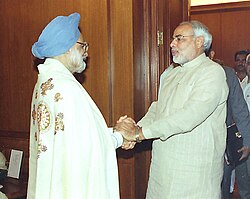
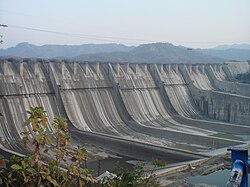
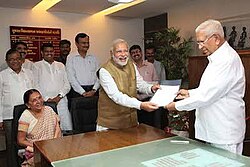
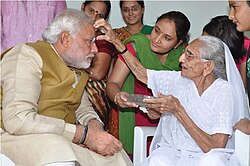


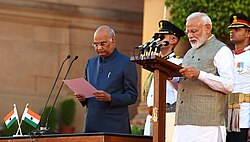

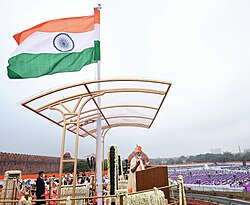
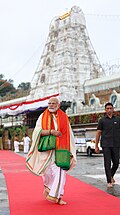


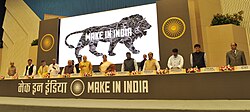
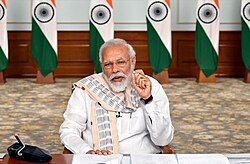
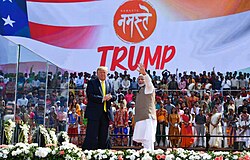
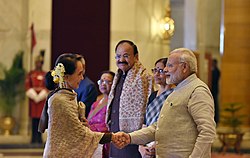
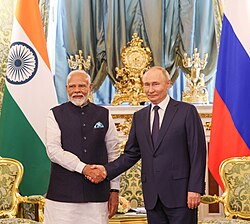

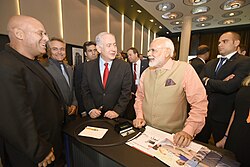
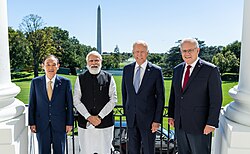
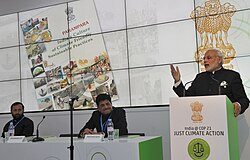
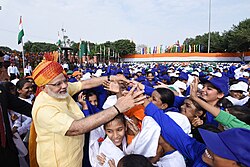
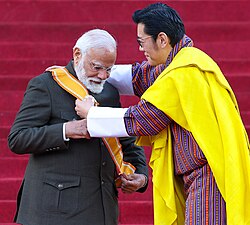
.svg)
 listen); born 17 September 1950)[lower-alpha 1] is an Indian politician serving as the 14th and current prime minister of India since 2014. He was the chief minister of Gujarat from 2001 to 2014 and is the Member of Parliament for Varanasi. Modi is a member of the Bharatiya Janata Party (BJP) and its National Democratic Alliance (NDA). He is also a member of the Rashtriya Swayamsevak Sangh (RSS), a Hindu nationalist volunteer organisation. He is the first prime minister born after India's independence, the second non-Congress one to win two consecutive terms after Atal Bihari Vajpayee and the first from outside the Congress to win both terms with a majority in the Lok Sabha.[3]
 BJP announces Shri Narendra Modi as its Prime Ministerial candidate for Loksabha Elections. Bharatiya Janata Party on YouTube, 13 September 2013
.svg)


 Saudi Arabia
_-_ribbon_bar.png)

 Palestine

 United Arab Emirates

 Russia
_-_ribbon_bar_v._1996.png)
 Maldives

 Bahrain

 United States
 United Nations
 South Korea
 Xi Jinping
 Shavkat Mirziyoyev
.jpg)


