

Update |
Enhanced article with new information |
||
| Line 1: | Line 1: | ||
{{Short description|Prime Minister of India from 2004 to 2014}} | {{Short description|Prime Minister of India from 2004 to 2014<!-- Do NOT add counts or ordinals, as per [[WP:CONSENSUS]] -->}} | ||
{{ | {{Other people}} | ||
{{Use dmy dates|date= | {{Pp-extended|small=yes}} | ||
{{Use Indian English|date= | {{Pp|small=yes}} | ||
{{Pp-blp|small=yes}} | |||
{{Use dmy dates|date=March 2025}} | |||
{{Use Indian English|date=March 2025}} | |||
{{Infobox officeholder | {{Infobox officeholder | ||
| name = Manmohan Singh | | name = Manmohan Singh | ||
| image = Dr. Manmohan Singh.jpg | | image = Official Portrait of the Prime Minister Dr. Manmohan Singh (3x4 cropped).jpg <!--Do NOT alter or remove this image. It was chosen through a discussion among editors. If you wish to propose a change, please start a new discussion to establish consensus.--> | ||
| alt = | | alt = A portrait photograph of a bespectacled Indian man with a dark grey beard, a blue turban, and a white button-down suit with blurred background. <!--Do NOT alter or remove this image. It was chosen through a discussion among editors. If you wish to propose a change, please start a new discussion to establish consensus.--> | ||
| caption = Official portrait, | | caption = Official portrait, 2004 <!--Do NOT alter or remove this image. It was chosen through a discussion among editors. If you wish to propose a change, please start a new discussion to establish consensus.--> | ||
| office = | | office = <!-- Do NOT add counts or ordinals, as per [[WP:CONSENSUS]] -->[[Prime Minister of India]] | ||
| president = [[A. P. J. Abdul Kalam]] | | president = {{ubl|[[A. P. J. Abdul Kalam]]|[[Pratibha Patil]]|[[Pranab Mukherjee]]}} | ||
| vicepresident = [[Bhairon Singh Shekhawat]] | | vicepresident = {{ubl|[[Bhairon Singh Shekhawat]]|[[Mohammad Hamid Ansari]]}} | ||
| subterm = '''Cabinet''' | |||
| suboffice = {{hlist|[[First Manmohan Singh ministry|Manmohan I]]|[[Second Manmohan Singh ministry|Manmohan II]]}} | |||
| term_start = 22 May 2004 | | term_start = 22 May 2004 | ||
| term_end = 26 May 2014 | | term_end = 26 May 2014 | ||
| predecessor = [[Atal Bihari Vajpayee]] | | predecessor = [[Atal Bihari Vajpayee]] | ||
| successor = [[Narendra Modi]] | | successor = [[Narendra Modi]] | ||
| | {{Collapsed infobox section begin|Additional ministries}} | ||
| | | 1blankname1 = Ministry and Departments | ||
| | | 1namedata1 = {{unbulleted list| | ||
| term_start1 = | | [[Ministry of Personnel, Public Grievances and Pensions|Personnel, Public Grievances and Pensions]] | ||
| [[Department of Atomic Energy]] | |||
| [[Department of Space]] | |||
| [[Planning Commission (India)|Planning Commission]]}} | |||
| term_start1 = 22 May 2004 | |||
| term_end1 = 26 May 2014 | | term_end1 = 26 May 2014 | ||
| predecessor1 = [[ | | predecessor1 = {{ubl|[[L. K. Advani]]|Atal Bihari Vajpayee}} | ||
| successor1 = | | successor1 = Narendra Modi | ||
| office3 = | {{Collapsed infobox section end}} | ||
| | | office3 = <!-- Do NOT add counts or ordinals, as per [[WP:CONSENSUS]] -->[[Leader of the Opposition in Rajya Sabha]] | ||
| term_start3 = 21 | | 1blankname3 = Chairman | ||
| term_end3 = | | 1namedata3 = {{ubl|[[Krishan Kant]]|Bhairon Singh Shekhawat}} | ||
| predecessor3 = [[ | | primeminister3 = Atal Bihari Vajpayee | ||
| successor3 = | | term_start3 = 21 March 1998 | ||
| office2 = [[ | | term_end3 = 21 May 2004 | ||
| primeminister2 = [[ | | predecessor3 = [[Sikander Bakht]] | ||
| term_start2 = 21 | | successor3 = Jaswant Singh | ||
| term_end2 = | | office2 = <!-- Do NOT add counts or ordinals, as per [[WP:CONSENSUS]] -->[[Minister of Finance (India)|Union Minister of Finance]] | ||
| predecessor2 = [[ | | primeminister2 = [[P. V. Narasimha Rao]] | ||
| term_start2 = 21 June 1991 | |||
| term_end2 = 16 May 1996 | |||
| predecessor2 = [[Yashwant Sinha]] | |||
| successor2 = [[Jaswant Singh]] | | successor2 = [[Jaswant Singh]] | ||
| birth_date = {{birth date | | birth_date = {{birth date|1932|09|26|df=y}} | ||
| birth_place = [[Gah, Pakistan|Gah]], [[Punjab Province (British India)|Punjab]], [[British | | birth_place = [[Gah, Pakistan|Gah]], [[Punjab Province (British India)|Punjab Province]], [[Presidencies and provinces of British India|British India]] | ||
| death_date = {{death date and age|2024|12|26|1932|09|26|df=y}} | |||
| death_place = [[New Delhi]], [[Delhi]], India | |||
| party = [[Indian National Congress]] | | party = [[Indian National Congress]] | ||
| nationality = Indian | | nationality = Indian | ||
| spouse = {{marriage|[[Gursharan Kaur]]|1958}} | | spouse = {{marriage|[[Gursharan Kaur]]|1958}} | ||
| children = 3 | | children = 3 (including [[Upinder Singh|Upinder]] and [[Daman Singh|Daman]]) | ||
| alma_mater = {{ | | alma_mater = {{ubil|[[Panjab University]] ([[Bachelor of Arts|BA]], [[Master of Arts|MA]])|[[St John's College, Cambridge]] ([[Bachelor of Arts|BA]])|[[Nuffield College, Oxford]] ([[DPhil]])}} | ||
| profession = {{hlist | | | profession = {{hlist|Economist|academician|bureaucrat|statesman}} | ||
| | | awards = [[List of awards and honours received by Manmohan Singh|List of awards and honours]] | ||
| awards | |||
| signature = Manmohan Singh Signatures.svg | | signature = Manmohan Singh Signatures.svg | ||
| signature_alt = Manmohan Singh | | signature_alt = Manmohan Singh | ||
| office4 = [[Member of Parliament, Rajya Sabha]] | | office4 = <!-- Do NOT add counts or ordinals, as per [[WP:CONSENSUS]] -->[[Member of Parliament, Rajya Sabha]] | ||
| term_start4 = 19 August 2019 | | term_start4 = 19 August 2019 | ||
| constituency4 = [[Rajasthan]] | | termend4 = 3 April 2024 | ||
| constituency4 = [[List of Rajya Sabha members from Rajasthan|Rajasthan]] | |||
| predecessor4 = [[Madan Lal Saini]] | | predecessor4 = [[Madan Lal Saini]] | ||
| successor4 = [[Sonia Gandhi]] | |||
| term_start5 = 1 October 1991 | | term_start5 = 1 October 1991 | ||
| term_end5 = 14 June 2019 | | term_end5 = 14 June 2019 | ||
| constituency5 = [[Assam]] | | constituency5 = [[List of Rajya Sabha members from Assam|Assam]] | ||
| predecessor5 = Amritlal Basumatary | |||
| successor5 = [[Kamakhya Prasad Tasa]] | | successor5 = [[Kamakhya Prasad Tasa]] | ||
| office6 = | | office6 = <!-- Do NOT add counts or ordinals, as per [[WP:CONSENSUS]] -->[[Governor of the Reserve Bank of India]] | ||
| term_start6 = 16 September 1982 | | term_start6 = 16 September 1982 | ||
| termend6 = 14 January 1985 | | termend6 = 14 January 1985 | ||
| successor6 = [[Amitav Ghosh (banker)|Amitav Ghosh]] | | successor6 = [[Amitav Ghosh (banker)|Amitav Ghosh]] | ||
| predecessor6 = [[I. G. Patel]] | | predecessor6 = [[I. G. Patel]] | ||
| module = {{Listen|pos=center|embed=yes|filename=Manmohan Singh voice.ogg|title=Manmohan Singh's voice|type=speech|description=Singh delivering a [[joint session of the United States Congress|joint address to the United States Congress]]<br />Recorded 19 July 2005}} | |||
| order = <!-- Do NOT add counts or ordinals, as per [[WP:CONSENSUS]] --> | |||
| order2 = <!-- Do NOT add counts or ordinals, as per [[WP:CONSENSUS]] --> | |||
| order1 = <!-- Do NOT add counts or ordinals, as per [[WP:CONSENSUS]] --> | |||
}} | }} | ||
'''Manmohan Singh'''{{efn|{{Indic Transl|pa|Manamohana Singha|mənˈmoːɦənᵊ ˈsɪ́ŋɣʰ}}{{audio|Hi-ManmohanSingh.ogg|}}}} (26 September 1932 – 26 December 2024) was an Indian economist, bureaucrat, academician and statesman<ref>{{cite web |last1=Bhattacherjee |first1=Kallol |title=Manmohan an outstanding statesman, says Putin; Anwar terms him 'my mitra, my bhai' |url=https://www.thehindu.com/news/national/manmohan-an-outstanding-statesman-says-putin-anwar-terms-him-my-mitra-my-bhai/article69034567.ece |website=[[The Hindu]] |access-date=31 January 2025 |date=27 December 2024 |archive-date=27 December 2024 |archive-url=https://web.archive.org/web/20241227185722/https://www.thehindu.com/news/national/manmohan-an-outstanding-statesman-says-putin-anwar-terms-him-my-mitra-my-bhai/article69034567.ece |url-status=live }}</ref> who served as the <!-- Do NOT add counts or ordinals, as per [[WP:CONSENSUS]] -->[[prime minister of India]] from 2004 to 2014. He was the fourth longest-serving prime minister after [[Jawaharlal Nehru]], [[Indira Gandhi]], and [[Narendra Modi]].<ref>{{cite news |title='I have nothing to be ashamed of about my prime ministership': Dr Manmohan Singh on being called 'accidental PM' |url=https://www.businesstoday.in/india/story/dr-manmohan-singh-death-accidental-pm-sonia-gandhi-pv-narsimha-rao-458628-2024-12-26 |work=Business Today |date=26 December 2024 |access-date=26 December 2024 |archive-date=26 December 2024 |archive-url=https://web.archive.org/web/20241226200729/https://www.businesstoday.in/india/story/dr-manmohan-singh-death-accidental-pm-sonia-gandhi-pv-narsimha-rao-458628-2024-12-26 |url-status=live }}</ref> A member of the [[Indian National Congress]], Singh was the first and remains the only [[Sikh]] prime minister of India.<ref>{{cite web|url=https://www.nytimes.com/2024/12/26/world/asia/manmohan-singh-dead.html|title=Manmohan Singh, Indian Premier Who Spurred Economic Boom, Dies at 92|work=[[The New York Times]]|date=26 December 2024|accessdate=26 December 2024}}</ref> He was also the first prime minister since Nehru to be re-appointed after completing a full five-year term.<ref name=":2">{{Cite news |last=Santos |first=Sofia Ferreira |date=28 December 2024 |title=Manmohan Singh: Former India PM mourned in state funeral |url=https://www.bbc.com/news/articles/c878w5175n4o |work=BBC |access-date=31 December 2024 |archive-date=28 December 2024 |archive-url=https://web.archive.org/web/20241228094401/https://www.bbc.com/news/articles/c878w5175n4o |url-status=live }}</ref><ref name=":3">{{Cite news |last=Prabhu |first=Nagesh |date=27 December 2024 |title=Manmohan Singh - a hero of Indian middle class |url=https://www.thehindu.com/business/manmohan-singh-a-hero-of-indian-middle-class/article69032762.ece |url-status=live |archive-url=https://archive.today/20241227201413/https://www.thehindu.com/business/manmohan-singh-a-hero-of-indian-middle-class/article69032762.ece |archive-date=27 December 2024 |work=The Hindu |issn=0971-751X |access-date=31 December 2024}}</ref> | |||
Born in [[Gah, Pakistan|Gah]] in what is today [[Pakistan]], Singh's family migrated to India during [[Partition of India|its partition]] in 1947. After obtaining his doctorate in economics from [[Nuffield College, Oxford|the University of Oxford]], Singh worked for the [[United Nations]] during 1966–1969. He subsequently began his bureaucratic career when [[Lalit Narayan Mishra]] hired him as an advisor in the [[Ministry of Commerce and Industry (India)|Ministry of Commerce and Industry]]. During the 1970s and 1980s, Singh held several key posts in the [[Government of India]], such as [[Chief Economic Advisor to the Government of India|Chief Economic Advisor]] (1972–1976), governor of the [[Reserve Bank of India|Reserve Bank]] (1982–1985) and head of the [[NITI Aayog]] (erstwhile, [[Planning Commission (India)|Planning Commission]]) (1985-1987) | |||
In 1991, | In 1991, under prime minister, [[P. V. Narasimha Rao]], Singh was appointed as [[Minister of Finance (India)|finance minister]]. Over the next few years, despite strong opposition, he carried out several structural reforms that [[Economic liberalisation in India|liberalised India's economy]]. It enhanced Singh's reputation globally as a leading reform-minded economist. Subsequently, Singh was [[Leader of the Opposition (India)|leader of the opposition]] in the [[Rajya Sabha]] (the upper house of the [[Parliament of India]]) during the [[Atal Bihari Vajpayee]] government of 1998–2004. | ||
In 2004, when the Congress-led [[United Progressive Alliance]] came to power, its chairperson [[Sonia Gandhi]] unexpectedly relinquished the prime ministership to Singh. His [[first Manmohan Singh ministry|first ministry]] executed several key legislations and projects, including the [[National Rural Health Mission]], [[Unique Identification Authority of India|Unique Identification Authority]], [[Mahatma Gandhi National Rural Employment Guarantee Act|Rural Employment Guarantee]] scheme and [[Right to Information Act]]. In 2008, opposition to a historic [[U.S.–India Civil Nuclear Agreement|civil nuclear agreement with the United States]] nearly caused Singh's government to fall after [[Left Front (West Bengal)|Left Front]] parties withdrew their support. India's | In 2004, when the Congress-led [[United Progressive Alliance]] (UPA) came to power, its chairperson [[Sonia Gandhi]] unexpectedly relinquished the prime ministership to Singh. His [[first Manmohan Singh ministry|first ministry]] executed several key legislations and projects, including the [[National Rural Health Mission]], [[Unique Identification Authority of India|Unique Identification Authority]], [[Mahatma Gandhi National Rural Employment Guarantee Act|Rural Employment Guarantee]] scheme and [[Right to Information Act]]. In 2008, [[2008 vote of confidence in the Manmohan Singh ministry|opposition]] to a historic [[U.S.–India Civil Nuclear Agreement|civil nuclear agreement with the United States]] nearly caused Singh's government to fall after [[Left Front (West Bengal)|Left Front]] parties withdrew their support.<ref>{{cite news |last1=Dasgupta |first1=Debarshi |date=15 November 2024 |title=Former PM and nonagenarian leader Manmohan Singh emerges as flashpoint in Indian politics |url=https://www.straitstimes.com/asia/south-asia/former-pm-and-nonagenarian-leader-manmohan-singh-emerges-as-flashpoint-in-indian-politics |work=The Straits Times |access-date=26 December 2024}}</ref> The [[2009 Indian general election|2009 general election]] saw the UPA return with an increased mandate, with Singh retaining the office of prime minister. In 2009, [[BRICS]] was established with India as one of the founding members. His coalition's second term was marked by political scandals.<ref name="i727"/> | ||
Singh opted out of the race for the office of prime minister during the [[2014 Indian general election]].<ref>{{cite news|title=India's Manmohan Singh to step down as PM|url=https://www.theguardian.com/world/2014/jan/03/india-manmohan-singh-rahul-gandhi-narendra-modi|last=Burke|first=Jason|access-date=20 April 2015|work=The Guardian|date=3 January 2014|archive-date=11 June 2024|archive-url=https://web.archive.org/web/20240611102934/https://www.theguardian.com/world/2014/jan/03/india-manmohan-singh-rahul-gandhi-narendra-modi|url-status=live}}</ref> Singh served as a member of the [[Rajya Sabha]], representing the state of [[Assam]] from 1991 to 2019 and [[Rajasthan]] from 2019 to 2024.<ref>{{Cite news |date=15 May 2019 |title=Congress to move Manmohan Singh from Assam |work=The Hindu |url=https://www.thehindu.com/news/national/congress-to-move-manmohan-singh-from-assam/article27141531.ece |access-date=5 March 2023 |issn=0971-751X |archive-date=27 March 2023 |archive-url=https://web.archive.org/web/20230327132725/https://www.thehindu.com/news/national/congress-to-move-manmohan-singh-from-assam/article27141531.ece |url-status=live }}</ref><ref>{{cite news |title=Sonia Gandhi secures Rajya Sabha seat from Rajasthan unopposed |url=https://www.livemint.com/politics/congress-leader-sonia-gandhi-elected-unopposed-to-rajya-sabha-from-rajasthan-11708426337108.html |work=[[Mint (newspaper)|Mint]] |date=20 February 2024 |access-date=1 March 2024 |archive-date=29 February 2024 |archive-url=https://web.archive.org/web/20240229205545/https://www.livemint.com/politics/congress-leader-sonia-gandhi-elected-unopposed-to-rajya-sabha-from-rajasthan-11708426337108.html |url-status=live }}</ref> | |||
== Early life and education == | == Early life and education == | ||
Singh was born to Gurmukh Singh and Amrit Kaur on 26 September 1932, in [[Gah, Pakistan|Gah]], [[Punjab (British India)|Punjab]], [[British Raj|British India]], into a [[Sikh]] family. | Singh was born to Gurmukh Singh Kohli and Amrit Kaur on 26 September 1932, in [[Gah, Pakistan|Gah]], [[Punjab (British India)|Punjab]], [[British Raj|British India]], into a family of [[Punjabi Sikh]] dried fruit traders of [[Khatri]] background.<ref name="Caravan_2011">{{cite magazine |last1=Jose |first1=Vinod K. |date=1 October 2011 |title=Manmohan Singh at the centre of the storm |url=https://caravanmagazine.in/reportage/falling-man |magazine=[[The Caravan]] |access-date=26 December 2024 |quote=Singh was born in 1932 in a village called Gah, about 60 km south of what is now Islamabad; his family were Punjabi traders of the Khatri caste. His father, Gurmukh Singh Kohli, was a small-time dry fruits trader who bought wholesale stock from Afghanistan and resold it in smaller towns in the Punjab. Singh's mother, Amrit Kaur, died when he was only five months old, and he was raised largely by his paternal grandmother, Jamna Devi.}}</ref><ref name="dr mms">{{cite web|title=Detailed Profile: Dr. Manmohan Singh |url=http://india.gov.in/govt/rajyasabhampbiodata.php?mpcode=2 |access-date=18 December 2011 |url-status=dead |archive-url=https://web.archive.org/web/20111207031001/http://india.gov.in/govt/rajyasabhampbiodata.php?mpcode=2 |archive-date=7 December 2011}}</ref> His mother died when he was very young.<ref name=":1" /><ref name=":0">{{Cite news |title=PM Manmohan Singh celebrates 77th birthday on board Aircraft |url=https://economictimes.indiatimes.com/pm-manmohan-singh-celebrates-77th-birthday-on-board-aircraft/articleshow/5060201.cms |work=The Economic Times |issn=0013-0389 |date=26 September 2009 |access-date=7 June 2024 |archive-date=7 June 2024 |archive-url=https://web.archive.org/web/20240607064015/https://economictimes.indiatimes.com/pm-manmohan-singh-celebrates-77th-birthday-on-board-aircraft/articleshow/5060201.cms |url-status=live }}</ref> He was raised by his paternal grandmother Jamna Devi, with whom he was very close.<ref name="Caravan_2011"/><ref name=":0" /> | ||
Singh was initially educated at a local [[gurdwara]], where he began studying [[Urdu]] and [[Punjabi language|Punjabi]].<ref name="from_600">{{cite news |last=Goyal |first=Divya |date=28 December 2024 |title=From a village 600 km away in Pakistan, a last dua for 'Mohna', the boy who left during Partition |url=https://indianexpress.com/article/cities/chandigarh/last-dua-mohna-village-pakistan-9747681/?ref=hometop_hp |work=Indian Express |access-date=27 December 2024 |archive-url=https://web.archive.org/web/20241227144724/https://indianexpress.com/article/cities/chandigarh/last-dua-mohna-village-pakistan-9747681/ |archive-date=27 December 2024}}</ref> On 17 April 1937, he was enrolled in the local Government Primary School, where he continued his Urdu-medium education until the age of 10 (Class 4), after which he and his family moved to [[Peshawar]].<ref name="Caravan_2011"/><ref name="from_600"/><ref>{{cite news |last1=Chowdhury |first1=Neerja |date=26 December 2024 |title=Manmohan Singh: The 'accidental PM' who proved, time and again, that he was no accident |url=https://indianexpress.com/article/political-pulse/manmohan-singh-accidental-pm-proved-9745984/ |work=The Indian Express |access-date=26 December 2024 |archive-date=26 December 2024 |archive-url=https://web.archive.org/web/20241226172027/https://indianexpress.com/article/political-pulse/manmohan-singh-accidental-pm-proved-9745984/ |url-status=live }}</ref> There, Singh was enrolled in the upper-primary Khalsa School.<ref name="from_600"/> He sat for his matriculation examination in the summer of 1947.<ref name="Caravan_2011"/> Even as prime minister years later, Singh wrote his apparently [[Hindi]] speeches in the [[Urdu script]], although sometimes he would also use [[Gurmukhi]], a script used to write Punjabi, his mother tongue.<ref>{{cite news |last1=Rawat |first1=Sudeep Singh |date=26 September 2024 |title=Happy Birthday Dr Manmohan Singh; PM Modi, Rahul Gandhi extend best wishes |url=https://www.business-standard.com/india-news/happy-birthday-dr-manmohan-singh-pm-modi-rahul-gandhi-extend-best-wishes-124092600271_1.html |work=Business Standard |access-date=26 December 2024 |archive-date=27 December 2024 |archive-url=https://web.archive.org/web/20241227065802/https://www.business-standard.com/india-news/happy-birthday-dr-manmohan-singh-pm-modi-rahul-gandhi-extend-best-wishes-124092600271_1.html |url-status=live }}</ref> | |||
After the [[Partition of India]], his family migrated to [[ | After the [[Partition of India]], his family migrated to [[Haldwani]], India.<ref name=":1">{{Cite news |last=Swamya |first=M.R. Narayan |date=2 July 2022 |title=Rajeev Shukla Does an Autopsy on What Politics Can Do When Injected With Religion |url=https://thewire.in/books/book-review-scars-of-1947-partition-politics-religion |work=The Wire |access-date=7 June 2024 |archive-date=7 June 2024 |archive-url=https://web.archive.org/web/20240607064011/https://thewire.in/books/book-review-scars-of-1947-partition-politics-religion |url-status=live}}</ref> In 1948 they relocated to [[Amritsar]], where he studied at Hindu College, Amritsar.<ref name=":1" /><ref>{{Cite news |title=Manmohan Singh Visits Alma Mater In Amritsar, Remembers College Days |url=https://www.ndtv.com/india-news/70-years-after-graduation-manmohan-singh-remembers-college-days-1828252 |work=NDTV |agency=PTI |date=25 March 2018 |access-date=7 June 2024 |archive-date=7 June 2024 |archive-url=https://web.archive.org/web/20240607065750/https://www.ndtv.com/india-news/70-years-after-graduation-manmohan-singh-remembers-college-days-1828252 |url-status=live }}</ref> He attended [[Panjab University]], then in [[Hoshiarpur]],<ref>{{cite web |url=http://www.punjabcolleges.com/522-indiacolleges-Government-College-Hoshiarpur/ |title=Government College, Hoshiarpur &#124; Colleges in Hoshiarpur Punjab |publisher=Punjabcolleges.com |access-date=26 September 2011 |archive-date=22 December 2021 |archive-url=https://web.archive.org/web/20211222065933/https://www.punjabcolleges.com/522-indiacolleges-Government-College-Hoshiarpur/ |url-status=live }}</ref><ref>{{cite web|url=http://portal.bsnl.in/bsnl/asp/content%20mgmt/html%20content/hotnews/hotnews35448.html |title=Three sardars and their Hoshiarpur connection |publisher=Portal.bsnl.in |date=23 March 1932 |access-date=26 September 2011 |url-status=dead |archive-url=https://web.archive.org/web/20111128174157/http://portal.bsnl.in/bsnl/asp/content%20mgmt/html%20content/hotnews/hotnews35448.html |archive-date=28 November 2011 }}</ref><ref>{{cite news| url=http://articles.timesofindia.indiatimes.com/keyword/hoshiarpur/recent/4 | archive-url=https://archive.today/20120712035246/http://articles.timesofindia.indiatimes.com/keyword/hoshiarpur/recent/4 | url-status=dead | archive-date=12 July 2012 | work=[[The Times of India]] | title=Hoshiarpur}}</ref> Punjab, studying Economics and got his bachelor's and master's degrees in 1952 and 1954, respectively, standing first throughout his academic career. He completed his Economics Tripos at [[University of Cambridge]] in 1957. He was a member of [[St John's College, Cambridge|St John's College]].<ref name=CSIR>{{cite web|title=Curriculum Vitae of Prime Minister of India |url=http://www.csir.res.in/external/heads/aboutcsir/leaders/president/CV-manmohan.HTM |work=CSIR |access-date=13 June 2013 |url-status=dead |archive-url=https://web.archive.org/web/20120124024215/http://www.csir.res.in/external/heads/aboutcsir/leaders/president/CV-manmohan.HTM |archive-date=24 January 2012 }}</ref> | ||
In a 2005 interview with the British journalist [[Mark Tully]], Singh said about his Cambridge days: | In a 2005 interview with the British journalist [[Mark Tully]], Singh said about his Cambridge days: | ||
{{blockquote|I first became conscious of the creative role of politics in shaping human affairs, and I owe that mostly to my teachers [[Joan Robinson]] and [[Nicholas Kaldor]]. Joan Robinson was a brilliant teacher, but she also sought to awaken the inner conscience of her students in a manner that very few others were able to achieve. She questioned me a great deal and made me think the unthinkable. She propounded the left wing interpretation of Keynes, maintaining that the state has to play more of a role if you really want to combine development with social equity. Kaldor influenced me even more; I found him pragmatic, scintillating, stimulating. Joan Robinson was a great admirer of what was going on in China, but Kaldor used the Keynesian analysis to demonstrate that capitalism could be made to work. | {{blockquote|I first became conscious of the creative role of politics in shaping human affairs, and I owe that mostly to my teachers [[Joan Robinson]] and [[Nicholas Kaldor]]. Joan Robinson was a brilliant teacher, but she also sought to awaken the inner conscience of her students in a manner that very few others were able to achieve. She questioned me a great deal and made me think the unthinkable. She propounded the left wing interpretation of Keynes, maintaining that the state has to play more of a role if you really want to combine development with social equity. Kaldor influenced me even more; I found him pragmatic, scintillating, stimulating. Joan Robinson was a great admirer of what was going on in China, but Kaldor used the Keynesian analysis to demonstrate that capitalism could be made to work.<ref>{{cite web|url=https://pib.gov.in/newsite/erelease.aspx?relid=13290|title=Manmohan Singh – PIB|website=Press Information Bureau|access-date=24 September 2019|archive-date=24 September 2019|archive-url=https://web.archive.org/web/20190924103941/https://pib.gov.in/newsite/erelease.aspx%3Frelid%3D13290|url-status=live}}</ref>}} | ||
After Cambridge, Singh returned to India and served as a teacher at [[Panjab University]]. | After Cambridge, Singh returned to India and served as a teacher at [[Panjab University]].<ref name="TULLY">[[Mark Tully]]. "[http://www.alumni.cam.ac.uk/uploads/File/CAMArticles/Michalemas2005/cam_2005_46_profile1.pdf Architect of the New India]". ''Cambridge Alumni Magazine''. Michaelmas 2005. Retrieved on 28 February 2013. {{webarchive |url=https://web.archive.org/web/20130701144359/http://www.alumni.cam.ac.uk/uploads/File/CAMArticles/Michalemas2005/cam_2005_46_profile1.pdf |date=1 July 2013 }}</ref> In 1960, he went to the [[University of Oxford]] for his [[DPhil]], where he was a member of [[Nuffield College, Oxford|Nuffield College]]. His 1962 doctoral thesis under the supervision of [[Ian Little (economist)|Ian Little]] was titled "India's export performance, 1951–1960, export prospects and policy implications", and was later the basis for his book "India's Export Trends and Prospects for Self-Sustained Growth".<ref>{{cite web|url=http://pmindia.nic.in/cv.pdf |title=Curriculum Vitae |access-date=11 December 2008 |publisher=[[Prime Minister of India|Prime Minister's Office]] |url-status=dead |archive-url=https://web.archive.org/web/20070221094735/http://pmindia.nic.in/cv.pdf |archive-date=21 February 2007 }}</ref> | ||
== Early career == | == Early career == | ||
After completing his D.Phil., Singh returned to India. He was a senior lecturer of economics at [[Panjab University]] from 1957 to 1959. During 1959 and 1963, he served as a [[Reader (academic rank)|reader]] in economics at Panjab University, and from 1963 to 1965, he was an economics professor there. | {{Manmohan Singh series}} | ||
After completing his D. Phil., Singh returned to India. He was a senior lecturer of economics at [[Panjab University]] from 1957 to 1959. During 1959 and 1963, he served as a [[Reader (academic rank)|reader]] in economics at Panjab University, and from 1963 to 1965, he was an economics professor there.<ref name="Bhushan">{{cite book |last1=Bhushan |first1=K. |last2=Katyal |first2=G. |title=Manmohan Singh: Visionary to Certainty |date=2004 |publisher=APH Publishing Corporation |isbn=978-8176486941 |page=2 |url=https://books.google.com/books?id=QEaDKgzcs3gC&pg=PA2 |access-date=25 November 2019 |archive-date=11 June 2024 |archive-url=https://web.archive.org/web/20240611102935/https://books.google.com/books?id=QEaDKgzcs3gC&pg=PA2#v=onepage&q&f=false |url-status=live }}</ref> Then he went to work for the [[United Nations Conference on Trade and Development]] (UNCTAD) from 1966 to 1969.<ref name="CSIR" /> Later, he was appointed as an advisor to the Ministry of Foreign Trade by [[Lalit Narayan Mishra]], in recognition of Singh's talent as an economist.<ref name="Advisor">{{cite news |title=Manmohan Singh |url=https://www.indiatoday.in/manmohan-singh |work=India Today |agency=Living Media India Limited |access-date=13 July 2020 |archive-date=13 July 2020 |archive-url=https://web.archive.org/web/20200713140220/https://www.indiatoday.in/manmohan-singh |url-status=live }}</ref> | |||
From 1969 to 1971, Singh was a professor of international trade at the [[Delhi School of Economics]], [[University of Delhi]]. | From 1969 to 1971, Singh was a professor of international trade at the [[Delhi School of Economics]], [[University of Delhi]].<ref name="CSIR" /><ref>{{cite web|title=Detailed Profile: Dr. Manmohan Singh|url=http://www.archive.india.gov.in/govt/rajyasabhampbiodata.php?mpcode=2|website=india.gov.in|access-date=23 July 2015|archive-date=23 September 2015|archive-url=https://web.archive.org/web/20150923173358/http://www.archive.india.gov.in/govt/rajyasabhampbiodata.php?mpcode=2|url-status=dead}}</ref> | ||
In 1972, Singh was chief economic adviser in the Ministry of Finance, and in 1976 he was secretary in the Finance Ministry. | In 1972, Singh was chief economic adviser in the Ministry of Finance, and in 1976 he was secretary in the Finance Ministry.<ref name="CSIR" /> In 1980–1982 he was at the Planning Commission, and in 1982, he was appointed governor of the [[Reserve Bank of India]] under then finance minister [[Pranab Mukherjee]] and held the post until 1985.<ref name="CSIR" /> He went on to become the deputy chairman of the [[Planning Commission (India)]] from 1985 to 1987.<ref name="dr mms" /> Following his tenure at the Planning Commission, he was secretary general of the [[South Centre (organization)|South Commission]], an independent economic policy think tank headquartered in [[Geneva]], Switzerland from 1987 to November 1990.<ref name="India – Head of Government">{{cite web|url=http://www.thecommonwealth.org/YearbookInternal/172024/head_of_government |title=India – Head of Government |url-status=dead |archive-url=https://web.archive.org/web/20081201163629/http://www.thecommonwealth.org/YearbookInternal/172024/head_of_government/ |archive-date=1 December 2008 }}</ref> | ||
Singh | Singh returned to India from Geneva in November 1990 and held the post as the advisor to Prime Minister of India on economic affairs during the tenure of [[Chandra Shekhar|Chandra Shekar]].<ref name="CSIR" /> In March 1991, he became chairman of the [[University Grants Commission (India)|University Grants Commission]].<ref name="CSIR" /> | ||
== Political career == | == Political career == | ||
In June 1991, India's prime minister at the time, [[P. V. Narasimha Rao]], chose Singh to be his finance minister. Singh told Mark Tully | In June 1991, India's prime minister at the time, [[P. V. Narasimha Rao]], chose Singh to be his finance minister. Singh told [[Mark Tully]], a British journalist, in 2005: | ||
<blockquote>On the day (Rao) was formulating his cabinet, he sent his Principal Secretary to me saying, "The PM would like you to become the Minister of Finance". I didn't take it seriously. He eventually tracked me down the next morning, rather angry, and demanded that I get dressed up and come to [[Rashtrapati Bhavan, New Delhi|Rashtrapati Bhavan]] for the swearing in. So that's how I started in politics[.]<ref name="TULLY" /> </blockquote> | |||
=== Minister of Finance (1991–1996) === | |||
In 1991, India's fiscal deficit was close to 8.5 per cent of the gross domestic product, the [[balance of payments]] deficit was huge and the [[current account deficit]] was close to 3.5 per cent of India's GDP.<ref name="rediff Business Desk">{{cite web |url=http://www.rediff.com/money/2005/sep/26pm.htm |title=Manmohan Singh: Father of Indian Reform |date=26 September 2005 |work=Rediff.com |access-date=3 January 2010 |archive-date=9 April 2010 |archive-url=https://web.archive.org/web/20100409004118/http://www.rediff.com/money/2005/sep/26pm.htm |url-status=live }}</ref> India's foreign reserves barely amounted to US$1{{nbs}}billion, enough to pay for 2 weeks of imports,<ref name="autogenerated1">{{cite web |url=https://www.pbs.org/wgbh/commandingheights/shared/minitext/tr_show02.html |title=Commanding Heights: Episode 2 &#124; on PBS |publisher=Pbs.org |access-date=3 November 2015 |archive-date=22 October 2015 |archive-url=https://web.archive.org/web/20151022094123/http://www.pbs.org/wgbh/commandingheights/shared/minitext/tr_show02.html |url-status=live }}</ref> in comparison to US$600 billion in 2009.<ref>{{cite web|url=http://in.biz.yahoo.com/100101/50/bauua1.html |title=Forex reserves swell 11% in 2009 |author=Mahalakshmi Hariharan |date=2 January 2010 |publisher=Yahoo Finance India |access-date=3 January 2010 |url-status=dead |archive-url=https://web.archive.org/web/20100103094134/http://in.biz.yahoo.com/100101/50/bauua1.html |archive-date=3 January 2010 }}</ref> | |||
Singh explained to the PM and the party that India is facing an unprecedented crisis.<ref name="autogenerated1" /> However the rank and file of the party resisted deregulation.<ref name="autogenerated1" /> So [[P. Chidambaram]] and Singh explained to the party that the economy would collapse if it was not deregulated.<ref name="autogenerated1" /> To the dismay of the party, Rao allowed Singh to deregulate the [[Economy of India|Indian economy]].<ref name="autogenerated1" /> | |||
Rao and Singh thus implemented policies to open up the economy and change India's socialist economy to a more [[capitalism|capitalistic]] one | Subsequently, Singh, who had thus far been one of the most influential architects of India's socialist economy, eliminated the [[license raj]] (which inhibited the prosperity of private businesses),<ref name="autogenerated1" /> reduced state control of the economy, and reduced [[Tariff|import taxes.]]<ref name="rediff Business Desk" /><ref>{{cite book|title= The World is Flat – A brief history of the twenty-first century|last= Friedman|first= Thomas L.|year= 2008|publisher= Picador|isbn= 978-0-374-29288-1|page= [https://archive.org/details/worldisflatbri00frie/page/130 130<!--|page= 488-->]|url= https://archive.org/details/worldisflatbri00frie/page/130}}</ref> Rao and Singh thus implemented policies to open up the economy and change India's socialist economy to a more [[capitalism|capitalistic]] one. They removed many obstacles standing in the way of [[Foreign Direct Investment]] (FDI) and initiated the process of the privatisation of [[public sector]] companies. However, in spite of these reforms, Rao's government was voted out in 1996 due to non-performance of government in other areas. In praise of Singh's work that pushed India towards a market economy, long-time cabinet minister [[P. Chidambaram]] has compared Singh's role in India's reforms to [[Deng Xiaoping]]'s in China.<ref>{{cite web |url=https://www.oneindia.com/2008/05/02/manmohan-is-deng-xiaoping-of-india-p-chidambaram-1209740775.html |title=Manmohan is Deng Xiaoping of India: P Chidambaram – Oneindia News |publisher=Oneindia |date=2 May 2008 |access-date=15 February 2011 |archive-date=26 April 2011 |archive-url=https://web.archive.org/web/20110426190736/http://news.oneindia.in/2008/05/02/manmohan-is-deng-xiaoping-of-india-p-chidambaram-1209740775.html |url-status=live }}</ref> | ||
In 1993, Singh offered his resignation from the post of Finance Minister after a parliamentary investigation report criticised his ministry for not being able to anticipate a US$1.8 | In 1993, Singh offered his resignation from the post of Finance Minister after a parliamentary investigation report criticised his ministry for not being able to anticipate a US$1.8{{nbs}}billion [[1992 Indian stock market scam|1992 securities scandal]]. Prime Minister Rao refused Singh's resignation, instead promising to punish the individuals directly accused in the scandal.<ref name="nytimes">{{cite news |url=https://www.nytimes.com/1994/01/01/world/indian-leader-bars-key-aide-from-quitting-in-stock-scam.html?pagewanted=1 |title=Indian Leader Bars Key Aide From Quitting in Stock Scam |work=The New York Times |date=1 January 1994 |access-date=7 April 2010 |archive-date=29 April 2011 |archive-url=https://web.archive.org/web/20110429200649/http://www.nytimes.com/1994/01/01/world/indian-leader-bars-key-aide-from-quitting-in-stock-scam.html?pagewanted=1 |url-status=live }}</ref> | ||
=== Leader of Opposition in Rajya Sabha === | === Leader of Opposition in Rajya Sabha (1998–2004) === | ||
Singh was first elected to the upper house of Parliament, the [[Rajya Sabha]], in 1991 | Singh was first elected to the upper house of Parliament, the [[Rajya Sabha]], in 1991<ref name="MSRj01">{{cite web|url=http://india.gov.in/govt/primeminister.php |title=Profile: Prime Minister India |publisher=Indian gov. |access-date=23 May 2009 |url-status=dead |archive-url=https://web.archive.org/web/20090422203715/http://india.gov.in/govt/primeminister.php |archive-date=22 April 2009 }}</ref> [[Rajya Sabha#Membership|by the legislature]] of the state of Assam, and was re-elected in 1995, 2001, 2007<ref name="dr mms" /> and 2013.<ref>{{cite web|url=http://zeenews.india.com/news/nation/pm-manmohan-singh-elected-to-rajya-sabha_851741.html|title=PM Manmohan Singh elected to Rajya Sabha|publisher=Zee News Limited|access-date=11 June 2013|date=30 May 2013|archive-date=1 June 2013|archive-url=https://web.archive.org/web/20130601110645/http://zeenews.india.com/news/nation/pm-manmohan-singh-elected-to-rajya-sabha_851741.html|url-status=live}}</ref> From 1998 to 2004, while the [[Bharatiya Janata Party]] was in power, Singh was the Leader of the Opposition in the Rajya Sabha. In 1999, he contested for the [[Lok Sabha]] from [[South Delhi (Lok Sabha constituency)|South Delhi]] but was unable to win the seat.<ref>{{cite web|url=http://ibnlive.in.com/politics/electionstats/candidate/MANMOHAN%20SINGH.html |title=Candidate Statistics Manmohan Singh |publisher=IBN Live |access-date=30 November 2009 |url-status=dead |archive-url=https://web.archive.org/web/20090419075333/http://ibnlive.in.com/politics/electionstats/candidate/Manmohan%20Singh.html |archive-date=19 April 2009 }}</ref> | ||
== Prime Minister == | == Prime Minister (2004–2014) == | ||
{{Wikinews|Manmohan Singh becomes the third longest serving Prime Minister of India}} | {{Wikinews|Manmohan Singh becomes the third longest serving Prime Minister of India}} | ||
=== First term | === First term (2004–2009) === | ||
{{See also|First Manmohan Singh ministry}} | {{See also|First Manmohan Singh ministry}} | ||
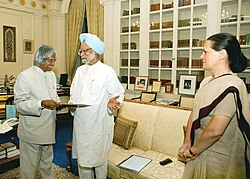
[[File:The President Dr. A.P.J Abdul Kalam authorizing the Prime Minister designate Dr. Manmohan Singh to form the next Government in New Delhi on May 19, 2004.jpg|thumb|250px|right| | [[File:The President Dr. A.P.J Abdul Kalam authorizing the Prime Minister designate Dr. Manmohan Singh to form the next Government in New Delhi on May 19, 2004.jpg|thumb|250px|right|[[President of India]] [[A. P. J. Abdul Kalam]] authorising the Prime Minister designate Manmohan Singh to form the next Government in New Delhi on 19 May 2004]] | ||
After the [[2004 Indian general election|2004 general elections]], the Indian National Congress ended the incumbent [[National Democratic Alliance (India)|National Democratic Alliance]] (NDA) tenure by becoming the political party with the single largest number of seats in the [[Lok Sabha]]. It formed [[United Progressive Alliance]] (UPA) with allies and staked claim to form government. In a surprise move, Chairperson [[Sonia Gandhi]] declared Manmohan Singh, a [[Technocracy|technocrat]], as the UPA candidate for the | After the [[2004 Indian general election|2004 general elections]], the Indian National Congress ended the incumbent [[National Democratic Alliance (India)|National Democratic Alliance]] (NDA) tenure by becoming the political party with the single largest number of seats in the [[Lok Sabha]]. It formed [[United Progressive Alliance]] (UPA) with allies and staked claim to form government. In a surprise move, Chairperson [[Sonia Gandhi]] declared Manmohan Singh, a [[Technocracy|technocrat]], as the UPA candidate for the prime ministership. Despite the fact that Singh had never won a direct popular election, according to the [[BBC]], he "enjoyed massive popular support, not least because he was seen by many as a clean politician untouched by the taint of corruption that has run through many Indian administrations."<ref name="bbcprofile">{{cite news|url=http://news.bbc.co.uk/1/hi/world/south_asia/3725357.stm|title=Profile: Manmohan Singh|work=BBC News|date=30 March 2009|access-date=7 April 2010|archive-date=30 April 2009|archive-url=https://web.archive.org/web/20090430013006/http://news.bbc.co.uk/1/hi/world/south_asia/3725357.stm|url-status=live}}</ref> He took the oath as the prime minister of India on 22 May 2004.<ref>{{cite news|title=Manmohan to Advani: Change your astrologers, stop abuse against me|work=Thaindian News|date=22 July 2008|url=http://www.thaindian.com/newsportal/south-asia/manmohan-to-advani-change-your-astrologers-stop-abuse-against-me_10074778.html|access-date=23 July 2008|archive-date=13 April 2009|archive-url=https://web.archive.org/web/20090413065737/http://www.thaindian.com/newsportal/south-asia/manmohan-to-advani-change-your-astrologers-stop-abuse-against-me_10074778.html|url-status=dead}}</ref><ref>{{cite news|title=Manmohan takes on Advani: Babri destruction his only contribution|work=Southasia Times|date=25 March 2009}}</ref>Singh was the fourth PM to be from the [[Rajya Sabha]], following [[Indira Gandhi]] (January 1966 - March 1967)<ref>{{cite web|url=https://www.indiatoday.in/india/north/story/inder-kumar-gujral-pm-who-governed-from-rajya-sabha-122945-2012-11-29|title=Inder Kumar Gujral: PM who governed from the Rajya Sabha|date=30 November 2012 |publisher=India Today|access-date=10 December 2012}}</ref>,[[H. D. Deve Gowda]] (June 1996 - April 1997) and [[Inder Kumar Gujral]] (April 1997- March 1998).<ref>{{cite web|url=http://www.pmindia.gov.in/en/former_pm/dr-manmohan-singh-2/|title=Dr. Manmohan Singh {{!}} Prime Minister of India|website=www.pmindia.gov.in|language=en|access-date=7 June 2018}}</ref> | ||
==== Economic policy ==== | ==== Economic policy ==== | ||
In 1991, Singh, as | In 1991, Singh, as finance minister, abolished the [[Licence Raj]], source of slow economic growth and [[Corruption in India|corruption in the Indian economy]] for decades. He liberalised the Indian economy, allowing it to speed up development dramatically. During his term as prime minister, Singh continued to encourage growth in the Indian market, enjoying widespread success in these matters. Singh, along with his finance minister, [[P. Chidambaram]], presided over a period where the Indian economy grew with an 8–9% economic growth rate. In 2007, India achieved its highest GDP growth rate of 9% and became the second [[List of countries by real GDP growth rate|fastest growing major economy]] in the world.<ref>{{cite web |url=https://www.cia.gov/the-world-factbook/countries/india/ |title=CIA – The World Factbook |publisher=Cia.gov |access-date=15 February 2011 |archive-date=18 March 2021 |archive-url=https://web.archive.org/web/20210318202107/https://www.cia.gov/the-world-factbook/countries/india |url-status=dead }}</ref><ref name="astaire">{{cite web|url=http://www.ukibc.com/ukindia2/files/India60.pdf |title=The India Report |publisher=Astaire Research |url-status=dead |archive-url=https://web.archive.org/web/20090114195859/http://www.ukibc.com/ukindia2/files/India60.pdf |archive-date=14 January 2009 }}</ref> Singh's ministry enacted a [[National Rural Employment Guarantee Act, 2005|National Employment Guarantee Act]] (MGNREGA) in 2005.<ref>{{cite web|url=https://haryanarural.gov.in/mahatma-gandhi-national-rural-employment-guarantee-scheme-mgnregs/#:~:text=The%20Government%20of%20India%20passed,to%20do%20unskilled%20manual%20work.|title=MAHATMA GANDHI NATIONAL RURAL EMPLOYMENT GUARANTEE SCHEME (MGNREGS)|publisher=HaryanaRural.gov|accessdate=26 December 2024|archive-date=26 December 2024|archive-url=https://web.archive.org/web/20241226214300/https://haryanarural.gov.in/mahatma-gandhi-national-rural-employment-guarantee-scheme-mgnregs/#:~:text=The%20Government%20of%20India%20passed,to%20do%20unskilled%20manual%20work.|url-status=live}}</ref> | ||
Singh's government continued the [[Golden Quadrilateral]] and the highway modernisation program that was initiated by [[Atal Bihari Vajpayee|Vajpayee]]'s government. | Singh's government continued the [[Golden Quadrilateral]] and the highway modernisation program that was initiated by [[Atal Bihari Vajpayee|Vajpayee]]'s government.<ref>{{cite web|title=Economic benefits of golden Quadilateral|date=4 May 2013|url=http://businesstoday.intoday.in/story/economic-benefits-of-the-golden-quadrilateral-project/1/194321.html|publisher=Business today|access-date=14 June 2013|archive-date=7 June 2013|archive-url=https://web.archive.org/web/20130607070517/http://businesstoday.intoday.in/story/economic-benefits-of-the-golden-quadrilateral-project/1/194321.html|url-status=live}}</ref> Singh also worked on reforming the banking and financial sectors, as well as public sector companies.<ref>{{cite news|title=Banking on reform|url=http://www.indianexpress.com/news/banking-on-reform/1059372/|access-date=14 June 2013|newspaper=Indian Express|archive-date=27 July 2013|archive-url=https://web.archive.org/web/20130727111620/http://www.indianexpress.com/news/banking-on-reform/1059372|url-status=live}}</ref> The Finance ministry worked towards relieving farmers of their debt and worked towards pro-industry policies.<ref>{{cite web|title=Farmer Waiver Scheme- PM statement|url=http://pib.nic.in/newsite/erelease.aspx?relid=39122|publisher=PIB|access-date=14 June 2013|archive-date=7 January 2016|archive-url=https://web.archive.org/web/20160107072045/http://pib.nic.in/newsite/erelease.aspx?relid=39122|url-status=live}}</ref> In 2005, Singh's government introduced the [[value added tax]], replacing [[sales tax]]. In 2007 and early 2008, the [[Great Recession]] impacted India.<ref>{{Cite web |date=17 November 2008 |title=JPMorgan cuts India growth forecast, sees rate cuts |url=http://in.reuters.com/article/businessNews/idINIndia-36541420081117 |archive-url=https://web.archive.org/web/20081216072137/http://in.reuters.com/article/businessNews/idINIndia-36541420081117 |archive-date=16 December 2008 |website=[[Reuters]]}}</ref><ref>{{cite news|title=Global inflation climbs to historic levels|url=https://www.nytimes.com/2008/02/12/business/worldbusiness/12iht-inflate.1.9963291.html|newspaper=The New York Times|author=Kevin Plumberg|author2=Steven C. Johnson|access-date=17 June 2011|date=2 November 2008|archive-date=1 May 2011|archive-url=https://web.archive.org/web/20110501111029/http://www.nytimes.com/2008/02/12/business/worldbusiness/12iht-inflate.1.9963291.html|url-status=live}}</ref> | ||
==== Healthcare and education ==== | ==== Healthcare and education ==== | ||
In 2005, Prime Minister Singh and his government's health ministry started the [[National Rural Health Mission]] (NHRM), which mobilised half a million community health workers. This rural health initiative was praised by the American economist [[Jeffrey Sachs]]. | In 2005, Prime Minister Singh and his government's health ministry started the [[National Rural Health Mission]] (NHRM), which mobilised half a million community health workers. This rural health initiative was praised by the American economist [[Jeffrey Sachs]].<ref name="timepoverty">{{cite magazine|title=The End of Poverty|url=http://www.time.com/time/magazine/article/0,9171,1034738,00.html|archive-url=https://web.archive.org/web/20050317031951/http://www.time.com/time/magazine/article/0,9171,1034738,00.html|url-status=dead|archive-date=17 March 2005|first=Jeffrey D.|last=Sachs|date=6 March 2005|magazine=Time}}</ref> In 2006, his Government implemented the proposal to reserve 27% of seats in All India Institute of Medical Studies (AIIMS), Indian Institutes of Technology (IITs), the Indian Institutes of Management (IIMs) and other central institutions of higher education for Other Backward Classes which led to [[2006 Indian anti-reservation protests]].<ref>{{Cite web|url=https://www.freepressjournal.in/india/from-mandal-commission-to-emergency-5-student-movements-that-shook-governments|title = From Mandal Commission to Emergency: 5 student movements that shook governments}}</ref><ref>{{Cite news|first = S.L.|last = Rao|url =http://www.telegraphindia.com/1060605/asp/opinion/story_6293323.asp|title = TOO MANY BOSSES – The UPA has a cabinet with many insubordinate ministers|work =The Telegraph|date = 5 June 2006|access-date = 5 June 2006| archive-url= https://web.archive.org/web/20060626080730/http://www.telegraphindia.com/1060605/asp/opinion/story_6293323.asp| archive-date= 26 June 2006 | url-status= dead | location=Calcutta, India}}</ref><ref>{{Cite web |url=https://nvdatabase.swarthmore.edu/content/students-and-doctors-protest-reservationaffirmative-action-system-india-2006-2008|title=Students and doctors protest reservation/affirmative-action system in India, 2006–2008|access-date=27 August 2012|work=Global Nonviolent Action Database}}</ref> | ||
On 2 July 2009, Singh ministry introduced | On 2 July 2009, Singh ministry introduced the [[Right of Children to Free and Compulsory Education Act, 2009|Right to Education Act]] (RTE) act. Eight [[Indian Institutes of Technology|IITs]] were opened in the states of [[Andhra Pradesh]], Bihar, [[Gujarat]], Orissa, [[Punjab, India|Punjab]], Madhya Pradesh, [[Rajasthan]] and [[Himachal Pradesh]].<ref>{{cite web|title=LS passes bill to provide IIT for eight states.|url=http://www.deccanherald.com/content/148456/ls-passes-bill-provide-iit.html|work=Deccan Herald|date=24 March 2011 |access-date=14 June 2013|archive-date=24 March 2013|archive-url=https://web.archive.org/web/20130324032628/http://www.deccanherald.com/content/148456/ls-passes-bill-provide-iit.html|url-status=live}}</ref> The Singh government also continued the [[Sarva Shiksha Abhiyan]] program. The program includes the introduction and improvement of mid-day meals and the opening of schools all over India, especially in rural areas, to fight [[illiteracy]].<ref>{{cite news|title=Direct SSA funds for school panels|url=http://www.deccanherald.com/content/338571/direct-ssa-funds-school-panels.html|access-date=14 June 2013|newspaper=Deccan Herald|archive-date=17 May 2014|archive-url=https://web.archive.org/web/20140517212319/http://www.deccanherald.com/content/338571/direct-ssa-funds-school-panels.html|url-status=live}}</ref> | ||
==== | ==== Home affairs ==== | ||
{{multiple image|perrow=1|total_width=220|caption_align=center|image_style = border:none;|background color = #F5F5DC| align = right |image1=|caption1={{font|size=110%|font=|text=National Investigation Agency, a state agency established by Singh ministry to combat terror in India.}}}} | {{multiple image|perrow=1|total_width=220 | caption_align=center | image_style = border:none;|background color = #F5F5DC| align = right |image1=|caption1={{font|size=110%|font=|text=National Investigation Agency, a state agency established by Singh ministry to combat terror in India.}}}} | ||
Singh's government strengthened anti-terror laws with amendments to [[Unlawful Activities (Prevention) Act]] (UAPA). [[National Investigation Agency (India)|National Investigation Agency]] (NIA) was also created soon after the [[2008 Mumbai attacks| | Singh's government strengthened anti-terror laws with amendments to [[Unlawful Activities (Prevention) Act]] (UAPA). [[National Investigation Agency (India)|National Investigation Agency]] (NIA) was also created soon after the [[2008 Mumbai attacks|2008 Mumbai terror attacks]], as need for a central agency to combat terrorism was realised.<ref>{{cite web|url=https://www.hrw.org/report/2010/07/27/back-future/indias-2008-counterterrorism-laws|title=Back to the Future: India's 2008 Counterterrorism Laws|work=Human Rights Watch|date=27 July 2010|publisher=HRW.org|accessdate=26 December 2024|archive-date=20 December 2024|archive-url=https://web.archive.org/web/20241220091723/https://www.hrw.org/report/2010/07/27/back-future/indias-2008-counterterrorism-laws|url-status=live}}</ref> Also, [[Unique Identification Authority of India]] was established in February 2009, an agency responsible for implementing the envisioned [[Multipurpose National Identity Card]] with the objective of increasing national security and facilitating e-governance.<ref>{{cite web|url=https://indianexpress.com/article/explained/multi-purpose-national-id-card-india-aadhaar-passport-6022113/|title=Explained: Is India likely to have a multipurpose national ID card?|publisher=Indian Express|accessdate=26 December 2024|date=24 September 2019|archive-date=8 February 2023|archive-url=https://web.archive.org/web/20230208051547/https://indianexpress.com/article/explained/multi-purpose-national-id-card-india-aadhaar-passport-6022113/|url-status=live}}</ref> | ||
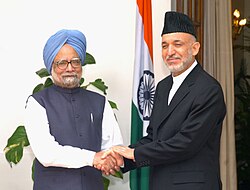
[[File:The President of Afghanistan, Mr. Hamid Karzai meeting with the Prime Minister, Dr. Manmohan Singh, in New Delhi on August 04, 2008.jpg|thumb|right|Singh with Afghan President [[Hamid Karzai]] in August 2008]] | |||
Singh's administration initiated a massive reconstruction effort in [[Kashmir]] to stabilise the region but after some period of success, insurgent infiltration and terrorism in Kashmir has increased since 2009.<ref name=Buzz7 /> The Singh administration was, however, successful in reducing terrorism in Northeast India.<ref name=Buzz7>[http://buzz7.com/news/infiltration-has-not-reduced-in-kashmir-insurgency-down-in-north-east-chidambaram.html Infiltration has not reduced in Kashmir, insurgency down in North East: Chidambaram] {{webarchive |url=https://web.archive.org/web/20160107072045/http://buzz7.com/news/infiltration-has-not-reduced-in-kashmir-insurgency-down-in-north-east-chidambaram.html |date=7 January 2016 }}</ref> | |||
In 2005, he controversially apologised on behalf of the [[Indian National Congress]] for the bloodshed during the [[1984 anti-Sikh riots]] in a speech to Parliament.<ref>{{Cite news |date=21 April 2011 |title=Manmohan Singh's apology for anti-Sikh riots a 'Gandhian moment of moral clarity,' says 2005 cable |url=https://www.thehindu.com/news/the-india-cables/Manmohan-Singhs-apology-for-anti-Sikh-riots-a-lsquoGandhian-moment-of-moral-clarity-says-2005-cable/article14692805.ece |access-date=3 November 2024 |work=The Hindu |language=en-IN |issn=0971-751X |archive-date=9 November 2024 |archive-url=https://web.archive.org/web/20241109142054/https://www.thehindu.com/news/the-india-cables/Manmohan-Singhs-apology-for-anti-Sikh-riots-a-lsquoGandhian-moment-of-moral-clarity-says-2005-cable/article14692805.ece |url-status=live }}</ref> | |||
==== Notable legislation ==== | ==== Notable legislation ==== | ||
The important [[National Rural Employment Guarantee Act]] (NREGA) and the [[Right to Information Act]] were passed by the [[Parliament of India|Parliament]] in 2005 during his tenure. While the effectiveness of the NREGA has been successful at various degrees, in various regions, the RTI act has proved crucial in India's fight against corruption. | The important [[National Rural Employment Guarantee Act]] (NREGA) and the [[Right to Information Act]] were passed by the [[Parliament of India|Parliament]] in 2005 during his tenure. While the effectiveness of the NREGA has been successful at various degrees, in various regions, the RTI act has proved crucial in India's fight against corruption.<ref>{{cite web|url=http://www.merinews.com/article/rti-act-a-strong-tool-to-cleanse-corruption-in-india/15787433.shtml|title=RTI Act: A strong tool to cleanse corruption in India|access-date=16 November 2016|archive-date=21 October 2016|archive-url=https://web.archive.org/web/20161021000554/http://www.merinews.com/article/rti-act-a-strong-tool-to-cleanse-corruption-in-india/15787433.shtml|url-status=live}}</ref> New cash benefits were also introduced for widows, pregnant women, and landless persons.<ref>[http://www.ilo.org/wcmsp5/groups/public/---dgreports/---gender/documents/publication/wcms_233599.pdf Gender Report] {{Webarchive|url=https://web.archive.org/web/20221113142937/http://www.ilo.org/wcmsp5/groups/public/---dgreports/---gender/documents/publication/wcms_233599.pdf |date=13 November 2022 }}. ''[[ilo.org]]''.</ref><ref>{{cite book|url=https://books.google.com/books?id=JKrQOAKQX60C&q=Indira%20UPA%20government%20social%20security&pg=PA360|title=India Business Yearbook 2009|date=1 November 2009|publisher=Vikas Publishing House Pvt Limited|access-date=16 November 2016|via=Google Books|isbn=9788125930860|archive-date=11 June 2024|archive-url=https://web.archive.org/web/20240611102936/https://books.google.com/books?id=JKrQOAKQX60C&q=Indira%20UPA%20government%20social%20security&pg=PA360|url-status=live}}</ref> | ||
[[The Right to Fair Compensation and Transparency in Land Acquisition, Rehabilitation and Resettlement Act, 2013]] was passed on 29 August 2013 in the [[Lok Sabha]] (lower house of the Indian parliament) and on 4 September 2013 in [[Rajya Sabha]] (upper house of the Indian parliament). The bill received the assent of the [[ | [[The Right to Fair Compensation and Transparency in Land Acquisition, Rehabilitation and Resettlement Act, 2013]] was passed on 29 August 2013 in the [[Lok Sabha]] (lower house of the Indian parliament) and on 4 September 2013 in [[Rajya Sabha]] (upper house of the Indian parliament). The bill received the assent of the [[president of India]], [[Pranab Mukherjee]] on 27 September 2013.<ref name=ndtv1>{{cite news|title=President Pranab Mukherjee gives nod to Land Acquisition Bill|url=http://www.ndtv.com/article/india/president-pranab-mukherjee-gives-nod-to-land-acquisition-bill-424675|access-date=10 October 2013|newspaper=NDTV|date=27 September 2013|archive-date=7 October 2013|archive-url=https://web.archive.org/web/20131007015123/http://www.ndtv.com/article/india/president-pranab-mukherjee-gives-nod-to-land-acquisition-bill-424675|url-status=live}}</ref> The Act came into force from 1 January 2014.<ref>{{cite web|title=Gazette Notification of coming into force of the Act |url=http://dolr.nic.in/dolr/downloads/pdfs/Right%20to%20FC%26T%20in%20LAR%26RA%202013%20Gazette%20Notification%20.pdf |publisher=Government of India |access-date=4 January 2014 |url-status=dead |archive-url=https://web.archive.org/web/20140104205638/http://dolr.nic.in/dolr/downloads/pdfs/Right%20to%20FC%26T%20in%20LAR%26RA%202013%20Gazette%20Notification%20.pdf |archive-date=4 January 2014 }}</ref><ref>{{cite news|title=The New Land Acquisition Act to come into effect from 2014|url=http://articles.economictimes.indiatimes.com/2013-10-16/news/43107324_1_monsoon-session-jairam-ramesh-new-land-acquisition-act|access-date=1 November 2013|newspaper=Economic Times|date=16 October 2013|archive-date=3 November 2013|archive-url=https://web.archive.org/web/20131103185318/http://articles.economictimes.indiatimes.com/2013-10-16/news/43107324_1_monsoon-session-jairam-ramesh-new-land-acquisition-act|url-status=dead}}</ref><ref>{{cite news|title=Land Acquisition bill to be notified early next year: Jairam Ramesh|url=http://articles.economictimes.indiatimes.com/2013-09-15/news/42083755_1_land-acquisition-bills-land-rights-land-deeds|access-date=10 October 2013|newspaper=Economic Times|date=15 September 2013|archive-date=16 October 2013|archive-url=https://web.archive.org/web/20131016085444/http://articles.economictimes.indiatimes.com/2013-09-15/news/42083755_1_land-acquisition-bills-land-rights-land-deeds|url-status=dead}}</ref> | ||
[[Right of Children to Free and Compulsory Education Act]] was enacted on 4 August 2009, which describes the modalities of the importance of free and compulsory education for children between 6 and 14 in India under Article 21A of the [[Indian Constitution]]. | [[Right of Children to Free and Compulsory Education Act]] was enacted on 4 August 2009, which describes the modalities of the importance of free and compulsory education for children between 6 and 14 in India under Article 21A of the [[Indian Constitution]].<ref>{{cite web|url=http://www.education.nic.in/constitutional.asp |title=Provisions of the Constitution of India having a bearing on Education |publisher=Department of Higher Education |access-date=1 April 2010 |url-status=dead |archive-url=https://web.archive.org/web/20100201181216/http://www.education.nic.in/constitutional.asp |archive-date=1 February 2010 }}</ref> India became one of 135 countries to make [[Right to education|education a fundamental right]] of every child when the act came into force on 1 April 2010.<ref>{{cite news|url=http://www.thehindu.com/news/national/article337111.ece|title=Education is a fundamental right now|author=Aarti Dhar|date=1 April 2010|newspaper=The Hindu|access-date=24 February 2015|archive-date=7 January 2016|archive-url=https://web.archive.org/web/20160107072045/http://www.thehindu.com/news/national/article337111.ece|url-status=live}}</ref><ref>{{cite news|url=http://news.bbc.co.uk/2/hi/8598167.stm|title=India launches children's right to education|date=1 April 2010|work=BBC News|access-date=24 February 2015|archive-date=15 December 2014|archive-url=https://web.archive.org/web/20141215022947/http://news.bbc.co.uk/2/hi/8598167.stm|url-status=live}}</ref><ref>{{cite news|url=http://www.thehindu.com/news/national/article365232.ece|title=India joins list of 135 countries in making education a right|date=2 April 2010|publisher=The Hindu News|newspaper=The Hindu|access-date=24 February 2015|archive-date=7 January 2016|archive-url=https://web.archive.org/web/20160107072045/http://www.thehindu.com/news/national/article365232.ece|url-status=live}}</ref> | ||
==== Foreign policy ==== | ==== Foreign policy ==== | ||
{{See also|List of international prime ministerial trips made by Manmohan Singh}} | |||
{{multiple image | {{multiple image | ||
| align | | align = right | ||
| direction | | direction = vertical | ||
| image1 | | image1 = President Barack Obama with Prime Minister Manmohan Singh 2009-11-24(2).jpg | ||
| alt1 | | alt1 = Manmohan Singh with American President Barack Obama at the White House | ||
| alt2 | | alt2 = The Prime Minister, Dr. Manmohan Singh with the American President, Mr. George W. Bush interacting with media at oval office, in Washington DC | ||
| caption2 | | caption2 = Singh with American presidents, [[Barack Obama]] and [[George W. Bush]], at the [[White House]] | ||
| image2 | | image2 = The Prime Minister, Dr. Manmohan Singh with the American President, Mr. George W. Bush interacting with media at oval office, in Washington DC, during his visit to the United States, on September 25, 2008.jpg | ||
}} | }} | ||
Manmohan Singh continued the [[Foreign relations of India|pragmatic foreign policy]] that was started by [[P.V. Narasimha Rao]] and continued by [[Bharatiya Janata Party]]'s [[Atal Bihari Vajpayee]]. Singh continued the [[India-Pakistan relations|peace process with Pakistan]] initiated by his predecessor, Atal Bihari Vajpayee. Exchange of high-level visits by top leaders from both countries have highlighted his tenure. Efforts have been made during Singh's tenure to end the border dispute with People's Republic of China. In November 2006, Chinese | Manmohan Singh continued the [[Foreign relations of India|pragmatic foreign policy]] that was started by [[P.V. Narasimha Rao]] and continued by [[Bharatiya Janata Party]]'s [[Atal Bihari Vajpayee]]. Singh continued the [[India-Pakistan relations|peace process with Pakistan]] initiated by his predecessor, Atal Bihari Vajpayee. Exchange of high-level visits by top leaders from both countries have highlighted his tenure. Efforts have been made during Singh's tenure to end the border dispute with [[China|People's Republic of China]]. In November 2006, Chinese president [[Hu Jintao]] visited India which was followed by Singh's visit to Beijing in January 2008. A major development in [[Sino-Indian relations]] was the reopening of the [[Nathula Pass]] in 2006 after being closed for more than four decades.<ref name="state visit">{{cite web |title=Visits of Heads of States/Heads of Governments |url=https://www.mea.gov.in/Portal/ForeignRelation/China_Jan_2016.pdf |publisher=Ministry of External Affairs (India) |access-date=28 April 2020 |archive-date=3 August 2020 |archive-url=https://web.archive.org/web/20200803163632/https://www.mea.gov.in/Portal/ForeignRelation/China_Jan_2016.pdf |url-status=live }}</ref> [[Premier of the People's Republic of China|Premier of the State Council]] of the People's Republic of China, [[Li Keqiang]] paid a state visit to India ([[Delhi]]-[[Mumbai]]) from 19 to 21 May 2013.<ref name="state visit" /> Singh paid an official visit to China from 22 to 24 October 2013.<ref name="state visit" /> Three agreements were signed establishing [[Sister Cities International|sister-city partnership]] between Delhi-Beijing, Kolkata-[[Kunming]] and Bangalore-[[Chengdu]]. As of 2010, the People's Republic of China was the second biggest trade partner of India.<ref>{{Cite web|url=http://english.peopledaily.com.cn/90001/90778/90861/6873167.html|title=China becomes India's 2nd largest trade partner – People's Daily Online|access-date=19 December 2019|archive-date=7 September 2013|archive-url=https://web.archive.org/web/20130907233342/http://english.peopledaily.com.cn/90001/90778/90861/6873167.html|url-status=live}}</ref> | ||
[[India-Afghanistan relations|Relations with Afghanistan]] have improved considerably, with India now becoming the largest regional donor to Afghanistan.<ref>{{cite web|url=http://www.cfr.org/publication/17474/indiaafghanistan_relations.html|title=India-Afghanistan Relations|access-date=11 December 2008|last=Bajoria|first=Jayshree|date=23 October 2008|publisher=[[Council on Foreign Relations]]|url-status=dead|archive-url=https://web.archive.org/web/20081129231738/http://www.cfr.org/publication/17474/indiaafghanistan_relations.html|archive-date=29 November 2008}}</ref> During Afghan President [[Hamid Karzai]]'s visit to New Delhi in August 2008, Manmohan Singh increased the aid package to Afghanistan for the development of more schools, health clinics, infrastructure, and defence.<ref name=BBC2>{{cite news|url=http://news.bbc.co.uk/2/hi/7540204.stm|title=BBC NEWS – South Asia – India announces more Afghan aid|access-date=16 November 2016|archive-date=26 December 2018|archive-url=https://web.archive.org/web/20181226123533/http://news.bbc.co.uk/2/hi/7540204.stm|url-status=live}}</ref> Under the leadership of Singh, India emerged as one of the single largest aid donors to Afghanistan.<ref name=BBC2 /> | |||
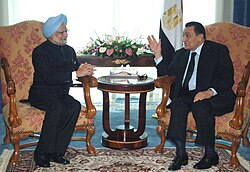
[[File:The_Prime_Minister,_Dr._Manmohan_Singh_meeting_the_President_of_Egypt,_Mr._Hosni_Mubarak_on_the_sideline_of_the_15th_NAM_Summit,_at_Sharm_El_Sheikh,_Egypt,_on_July_16,_2009.jpg|alt=The_Prime_Minister,_Dr._Manmohan_Singh_meeting_the_President_of_Egypt,_Mr._Hosni_Mubarak_on_the_sideline_of_the_15th_NAM_Summit,_at_Sharm_El_Sheikh,_Egypt,_on_July_16,_2009|thumb|Singh with Egyptian president [[Hosni Mubarak]] on the sideline of the [[Non-Aligned Movement|15th NAM Summit]], at [[Sharm El Sheikh]], Egypt, July 2009]] | |||
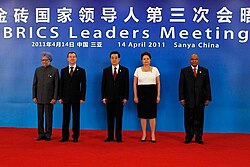
[[File:Dmitry Medvedev in China 14 April 2011-2.jpeg|thumb|Prime Minister Manmohan Singh with [[Dmitry Medvedev]], [[Hu Jintao]], [[Dilma Rousseff]] and [[Jacob Zuma]] at the [[2011 BRICS summit]] in [[Sanya]], China]] | |||
Singh's government worked towards stronger [[India-US relations|ties with the United States]]. He visited the United States in July 2005 initiating negotiations over the [[Indo-US civilian nuclear agreement]]. This was followed by [[George W. Bush]]'s successful visit to India in March 2006, during which the declaration over the nuclear agreement was made, giving India access to American nuclear fuel and technology while India will have to allow [[IAEA]] inspection of its civil [[nuclear reactor]]s. After more than two years for more negotiations, followed by approval from the IAEA, [[Nuclear Suppliers Group]] and the [[US Congress]], India and the US signed the agreement on 10 October 2008 with [[Pranab Mukherjee]] representing India.<ref>{{cite web|url=http://english.peopledaily.com.cn/90001/90777/90852/6513319.html|title=U.S., India ink historic civilian nuclear deal|access-date=11 December 2008|date=11 October 2008|work=People's Daily|archive-date=13 April 2009|archive-url=https://web.archive.org/web/20090413053230/http://english.peopledaily.com.cn/90001/90777/90852/6513319.html|url-status=live}}</ref> Singh had the first official state visit to the White House during the administration of US president [[Barack Obama]]. The visit took place in November 2009, and several discussions took place, including on trade and nuclear power.<ref name="CSIS">{{cite web |title=Manmohan Singh's U.S. Visit |url=https://www.csis.org/analysis/manmohan-singh%E2%80%99s-us-visit |publisher=Centre for Strategic and International Studies |access-date=28 April 2020 |archive-date=11 June 2024 |archive-url=https://web.archive.org/web/20240611102936/https://www.csis.org/analysis/manmohan-singhs-us-visit |url-status=live }}</ref> | |||
Relations improved with Japan and [[European Union]] countries, like the United Kingdom, France, and Germany. Relations with Iran continued and negotiations over the [[Iran-Pakistan-India gas pipeline]] have taken place. New Delhi hosted an India–Africa Summit in April 2006 which was attended by the leaders of 15 African states.<ref>{{cite web|url=http://africanpress.wordpress.com/2008/03/28/several-african-leaders-to-attend-africa-india-summit-au-says/|title=Several African leaders to attend Africa-India summit, AU says|access-date=11 December 2008|date=28 March 2008|publisher=African Press International|archive-date=1 October 2011|archive-url=https://web.archive.org/web/20111001071620/http://africanpress.wordpress.com/2008/03/28/several-african-leaders-to-attend-africa-india-summit-au-says/|url-status=live}}</ref> Relations have improved with other developing countries, particularly Brazil and South Africa. Singh carried forward the momentum which was established after the "Brasilia Declaration" in 2003 and the [[IBSA Dialogue Forum]] was formed.<ref>{{cite web|url=http://www.africanexecutive.com/modules/magazine/articles.php?article=3708 |title=IBSA Dialogue Forum: A Strategic Partnership |access-date=11 December 2008 |last=Beri |first=Ruchita |date=10 December 2008 |work=The African Executive |url-status=dead |archive-url=https://web.archive.org/web/20090411204949/http://www.africanexecutive.com/modules/magazine/articles.php?article=3708 |archive-date=11 April 2009 }}</ref> | |||
Singh's government was especially keen on [[India-Israel relations|expanding ties with Israel]]. From 2003, the two countries made significant investments in each other,<ref>{{cite web|url=http://www.hindustantimes.com/StoryPage/StoryPage.aspx?id=ea163747-b106-4e32-b231-7eb64de62985 |title=India and Israel: The great seduction |access-date=11 December 2008 |last=Halarnkar |first=Samar |date=23 October 2007 |work=Hindustan Times |url-status=dead |archive-url=https://web.archive.org/web/20090107062435/http://www.hindustantimes.com/StoryPage/StoryPage.aspx?id=ea163747-b106-4e32-b231-7eb64de62985 |archive-date=7 January 2009 }}</ref> making Israel a rival to Russia to become India's largest defence partner.<ref>{{cite news|url=https://query.nytimes.com/gst/fullpage.html?res=9B0DE3DD163BF934A3575AC0A9659C8B63|title=The Bond Between India and Israel Grows|access-date=11 December 2008|last=Waldman|first=Amy|date=7 September 2003|newspaper=[[The New York Times]]|archive-date=11 June 2024|archive-url=https://web.archive.org/web/20240611102954/https://www.nytimes.com/2003/09/07/world/the-bond-between-india-and-israel-grows.html|url-status=live}}</ref> Though there have been a few diplomatic glitches between India and Russia, especially over the delay and price hike of several Russian weapons to be delivered to India,<ref>{{cite news|url=http://www.hindu.com/2008/04/17/stories/2008041761781200.htm|archive-url=https://web.archive.org/web/20080421021724/http://www.hindu.com/2008/04/17/stories/2008041761781200.htm|url-status=dead|archive-date=21 April 2008|title=Centre admits to problems in naval deals|access-date=11 December 2008|last=Dikshit|first=Sandeep|date=17 April 2008|work=[[The Hindu]]|location=Chennai, India}}</ref> relations between the two remained strong with India and Russia signing various agreements to increase defence, nuclear energy and space co-operation.<ref>{{cite web|url=http://www.outlookindia.com/pti_news.asp?id=339943 |title=India, Russia sign agreements to further strengthen ties |access-date=11 December 2008 |last=Roychowdhury |first=Amitabh |date=6 December 2006 |work=[[Outlook (Indian magazine)|Outlook]] |url-status=dead |archive-url=https://web.archive.org/web/20090411192950/http://www.outlookindia.com/pti_news.asp?id=339943 |archive-date=11 April 2009 }}</ref> | |||
During the [[2011 Libyan Civil War|Libyan Civil War]], India abstained from voting on the [[UN Security Council Resolution 1973|UN Security Council's Resolutions 1970 and 1973]] that authorised [[NATO]] action in Libya.<ref>{{cite news|title=India and China had similar considerations on Libya|url=http://www.thehindu.com/news/national/article1571829.ece|access-date=30 December 2012|newspaper=The Hindu|date=26 March 2011|archive-date=8 September 2011|archive-url=https://web.archive.org/web/20110908001259/http://www.thehindu.com/news/national/article1571829.ece|url-status=live}}</ref> In Lok Sabha, resolution was unanimously adopted to condemn [[Military intervention in Libya|NATO's military intervention in Libya]].<ref>{{cite news|url=https://timesofindia.indiatimes.com/india/parties-unite-to-slam-strikes-on-libya/articleshow/7766649.cms|title=Parties unite to slam strikes on Libya|date=23 March 2011|publisher=Times of India|archive-date=29 March 2023|access-date=27 December 2024|archive-url=https://web.archive.org/web/20230329054016/https://timesofindia.indiatimes.com/india/parties-unite-to-slam-strikes-on-libya/articleshow/7766649.cms|url-status=live}}</ref> | |||
In 2009, Singh was among the leaders who laid the foundation of the [[BRICS]]. The establishment of the group is often described as a display of emergent economic power.<ref name="i727">{{cite web | last=Cowell | first=Alan | title=Manmohan Singh, Indian Prime Minister, Dies at 92 | website=The New York Times | date=26 December 2024 | url=https://www.nytimes.com/2024/12/26/world/asia/manmohan-singh-dead.html | access-date=27 December 2024}}</ref> | |||
Singh criticised the West for the use of force to enforce regime change in Syria and Libya during his speech at the UN in September 2011.<ref>{{cite news |last=Diwakar |date=25 September 2011 |title=Manmohan slams West for using force to change regimes |url=https://timesofindia.indiatimes.com/india/manmohan-slams-west-for-using-force-to-change-regimes/articleshow/10108923.cms |work=[[The Times of India]] |access-date=14 June 2012 |archive-url=https://web.archive.org/web/20121025012351/http://articles.timesofindia.indiatimes.com/2011-09-25/india/30200524_1_libya-sovereignty-countries |archive-date=25 October 2012}}</ref> India was silent over the killing of Gaddafi.<ref name="thediplomat">{{cite news|title=Why India Admired Gaddafi|url=https://thediplomat.com/indian-decade/2011/10/28/why-india-admired-gaddafi/|access-date=30 December 2012|newspaper=The Diplomat|date=28 October 2011|archive-date=10 May 2013|archive-url=https://web.archive.org/web/20130510062719/http://thediplomat.com/indian-decade/2011/10/28/why-india-admired-gaddafi/|url-status=live}}</ref><ref>{{cite news|title=India Quiet on Gaddafi Killing|url=https://thediplomat.com/indian-decade/2011/10/23/india-quiet-on-gaddafi-killing/|access-date=30 December 2012|newspaper=The Diplomat|date=23 October 2011|archive-date=10 May 2013|archive-url=https://web.archive.org/web/20130510042400/http://thediplomat.com/indian-decade/2011/10/23/india-quiet-on-gaddafi-killing/|url-status=live}}</ref> Although India was among the last few countries to recognise the Libyan National Transitional Council, it agreed to work with the Council to help rebuild Libya.<ref>{{cite news|title=India offers all help to Libya|url=https://timesofindia.indiatimes.com/world/middle-east/India-offers-all-help-to-Libya/articleshow/10434464.cms|archive-url=https://web.archive.org/web/20130510142536/http://articles.timesofindia.indiatimes.com/2011-10-21/middle-east/30305924_1_muammar-gaddafi-libyan-people-unsc-resolution|url-status=live|archive-date=10 May 2013|access-date=30 December 2012|newspaper=[[The Times of India]]|date=21 October 2011}}</ref> India resent an ambassador to Tripoli in July 2012 having shut its mission in Tripoli in 2011.<ref>{{cite news|title=India and Ivory Coast Send Ambassadors to Libya|url=http://libyaninvestment.com/libya-business-news/65278-india-and-ivory-coast-send-ambassadors-to-libya.html|access-date=30 December 2012|date=3 July 2012|archive-url=https://web.archive.org/web/20141107032952/http://libyaninvestment.com/libya-business-news/65278-india-and-ivory-coast-send-ambassadors-to-libya.html|archive-date=7 November 2014|url-status=dead}}</ref> | |||
=== Second term (2009–2014) === | |||
{{See also|Second Manmohan Singh ministry}} | |||
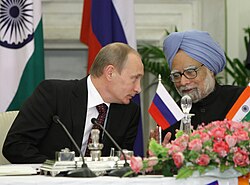
[[File:Singh and Putin press-conference 2010 03.jpg|thumb|right|Singh with Russian prime minister [[Vladimir Putin]] in March 2010]] | |||
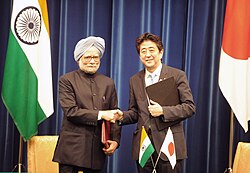
[[File:Manmohan Singh and the Prime Minister of Japan, Mr. Shinzo Abe signed the documents on Joint statement strengthening strategic and global partnership between Japan and India beyond the 60th Anniversary of Diplomatic.jpg|thumb|right|Singh with Japanese prime minister [[Shinzo Abe]] in May 2013]] | |||
India held general [[2009 Indian general election|elections to the 15th Lok Sabha]] in five phases between 16 April 2009 and 13 May 2009. The results of the election were announced on 16 May 2009.<ref>{{cite news|url=https://www.google.com/hostednews/ap/article/ALeqM5gf53l7BbUSc4DUHCgzjLF4YfW9CgD987BC100|archive-url=https://archive.today/20121206033206/http://www.google.com/hostednews/ap/article/ALeqM5gf53l7BbUSc4DUHCgzjLF4YfW9CgD987BC100|url-status=dead|archive-date=6 December 2012|title=India's ruling party wins resounding victory|agency=Associated Press|date=16 May 2009|access-date=16 May 2009}}</ref> Strong showing in [[Andhra Pradesh]], [[Rajasthan]], [[Maharashtra]], [[Tamil Nadu]], [[Kerala]], [[West Bengal]] and [[Uttar Pradesh]] helped the [[United Progressive Alliance]] (UPA) form the new government under the incumbent Singh, who became the first prime minister since [[Jawaharlal Nehru]] in [[1962 Indian general election|1962]] to win re-election after completing a full five-year term.<ref name=":2" /><ref name=":3" /> The Congress and its allies were able to put together a comfortable majority with support from 322 members out of 543 members of the House. These included those of the UPA and the external support from the [[Bahujan Samaj Party]] (BSP), [[Samajwadi Party]] (SP), [[Janata Dal (Secular)]] (JD(S)), [[Rashtriya Janata Dal]] (RJD) and other minor parties.<ref>{{cite news|url=http://ibnlive.in.com/news/smooth-sailing-for-upa-parties-scramble-to-support/92967-37.html|archive-url=https://web.archive.org/web/20090521022032/http://ibnlive.in.com/news/smooth-sailing-for-upa-parties-scramble-to-support/92967-37.html|url-status=dead|archive-date=21 May 2009|title=Smooth sailing for UPA, parties scramble to support|date=19 May 2009|publisher=[[CNN-IBN]]|access-date=13 June 2009}}</ref> | |||
On 22 May 2009, Manmohan Singh was sworn in as the prime minister during a ceremony held at [[Rashtrapati Bhavan, New Delhi|Rashtrapati Bhavan]].<ref>{{cite news|url=http://www.timesnow.tv/Team-manmohan-set-to-form-govt-today/articleshow/4317510.cms|title=Team Manmohan set to form govt today|date=22 May 2009|publisher=[[Times Now]]|access-date=13 June 2009|archive-url=https://web.archive.org/web/20090527164431/http://www.timesnow.tv/Team-manmohan-set-to-form-govt-today/articleshow/4317510.cms|archive-date=27 May 2009|url-status=dead}}</ref><ref>{{cite news|url=https://www.reuters.com/article/marketsNews/idUSDEL00004820090522|title=India PM Singh takes oath for second term|date=22 May 2009|work=Reuters|access-date=13 June 2009|archive-date=25 May 2009|archive-url=https://web.archive.org/web/20090525123414/http://www.reuters.com/article/marketsNews/idUSDEL00004820090522|url-status=live}}</ref> | |||
In his second term, Singh's government was involved in political scandals such as the [[2G spectrum case]] and the [[Concerns and controversies at the 2010 Commonwealth Games|Commonwealth Games scandal]].<ref>{{Cite news|agency=PTI|date=12 December 2011|title=2G case: A chronology of events|language=en-IN|work=The Hindu|url=https://www.thehindu.com/news/national/2g-case-a-chronology-of-events/article12151968.ece|access-date=18 September 2021|issn=0971-751X|archive-date=18 September 2021|archive-url=https://web.archive.org/web/20210918163056/https://www.thehindu.com/news/national/2g-case-a-chronology-of-events/article12151968.ece|url-status=live}}</ref><ref>{{cite news |title=India's 2G scandal |publisher=BBC World News |date=11 November 2011}}</ref><ref>{{Cite web|title=2G Scam Explained|url=https://www.news18.com/news/immersive/2g-scam-explained.html|access-date=18 September 2021|website=News18.com|language=en|archive-date=18 September 2021|archive-url=https://web.archive.org/web/20210918163057/https://www.news18.com/news/immersive/2g-scam-explained.html|url-status=live}}</ref><ref>{{cite web|url=http://www.timesnow.tv/Tained-Kalmadi-sacked-as-IOA-chief/articleshow/4371548.cms|title=Tained Kalmadi sacked as IOA chief|date=26 April 2011|work=The Times of India|access-date=26 April 2011|archive-date=4 March 2016|archive-url=https://web.archive.org/web/20160304204104/http://www.timesnow.tv/Tained-Kalmadi-sacked-as-IOA-chief/articleshow/4371548.cms|url-status=dead}}</ref><ref name="bloomberg.com">{{Cite news|url=https://www.bloomberg.com/news/2011-06-21/indians-divide-over-policing-a-watchdog-world-view.html|title=Indians Divide Over Policing a Watchdog: World View|publisher=bloomberg.com|date=22 June 2011|access-date=25 August 2011|first=Chandrahas|last=Choudhury|archive-date=25 June 2011|archive-url=https://web.archive.org/web/20110625135458/http://www.bloomberg.com/news/2011-06-21/indians-divide-over-policing-a-watchdog-world-view.html|url-status=live}}</ref> Singh declined to appear before a [[Joint parliamentary committee|Joint Parliamentary Committee]] (JPC) in April 2013 when called upon by one of the members of JPC [[Yashwant Sinha]] for his alleged involvement in the 2G case.<ref>{{cite news | url=http://www.dnaindia.com/india/1820446/report-2g-scam-disappointed-over-manmohan-singh-s-refusal-to-appear-before-jpc-says-yashwant-sinha | title=2G scam: Disappointed over Manmohan Singh's refusal to appear before JPC, says Yashwant Sinha | work=DNA India | date=9 April 2013 | agency=ANI | access-date=13 April 2013 | archive-date=14 April 2013 | archive-url=https://web.archive.org/web/20130414233119/http://www.dnaindia.com/india/1820446/report-2g-scam-disappointed-over-manmohan-singh-s-refusal-to-appear-before-jpc-says-yashwant-sinha | url-status=live }}</ref> In 2017, all of the accused were acquitted in the 2G case.<ref name="s851">{{cite web | title=Live Updates: A Raja, Kanimozhi acquitted in 2G Scam case | website=The Economic Times | date=21 December 2017 | url=https://economictimes.indiatimes.com/news/politics-and-nation/a-raja-kanimozhi-acquitted-in-2g-scam-case/articleshow/62189376.cms?from=mdr | access-date=30 December 2024 | archive-date=4 January 2025 | archive-url=https://web.archive.org/web/20250104172549/https://economictimes.indiatimes.com/news/politics-and-nation/a-raja-kanimozhi-acquitted-in-2g-scam-case/articleshow/62189376.cms?from=mdr | url-status=live }}</ref> Following this verdict, the Congress stated the "BJP has been exposed for its untruth and propaganda against Congress," and urged [[Narendra Modi]] and [[Arun Jaitley]] "to apologise to the nation".<ref name="t249">{{cite web | last=India | first=Press Trust of | title="Prime Minister Should Apologise To Nation": Congress After 2G Case Verdict | website=www.ndtv.com | date=21 December 2017 | url=https://www.ndtv.com/india-news/prime-minister-should-apologise-to-nation-congress-after-2g-case-verdict-1790585 | access-date=30 December 2024 | archive-date=4 January 2025 | archive-url=https://web.archive.org/web/20250104182538/https://www.ndtv.com/india-news/prime-minister-should-apologise-to-nation-congress-after-2g-case-verdict-1790585 | url-status=live }}</ref> | |||
Following the [[2012 Delhi gang rape and murder]], Singh appealed for calm, stressing that "violence will serve no purpose".<ref name="emirates">{{cite web|url=http://www.emirates247.com/news/delhi-gang-rape-indian-pm-manmohan-singh-s-theek-hai-goes-viral-as-capital-burns-2012-12-24-1.488541|title=Delhi gang-rape: Indian PM Manmohan Singh's 'Theek Hai' gaffe sets Twitter on fire|publisher=[[Emirates 24/7]]|date=24 December 2012|access-date=24 December 2012|archive-date=31 March 2023|archive-url=https://web.archive.org/web/20230331135833/https://www.emirates247.com/news/delhi-gang-rape-indian-pm-manmohan-singh-s-theek-hai-goes-viral-as-capital-burns-2012-12-24-1.488541|url-status=live}}</ref> In a televised address, he assured that all possible efforts would be made to ensure the safety of women in India. Singh expressed empathy, saying: "As a father of three daughters I feel as strongly about the incident as each one of you".<ref name="emirates" /> As a tribute to the victim, the prime minister cancelled all his official events to celebrate the new year.<ref>{{cite news |first=Rama |last=Lakshmi |url=https://www.washingtonpost.com/world/muted-new-year-celebrations-in-india-after-gang-rape-victims-death/2012/12/31/6e372eac-5370-11e2-abc4-3d33329b6128_story.html |title=Muted New Year's celebrations in India after gang-rape victim's death |newspaper=The Washington Post |date=31 December 2012 |access-date=23 August 2017 |archive-url=https://web.archive.org/web/20180915084002/https://www.washingtonpost.com/world/muted-new-year-celebrations-in-india-after-gang-rape-victims-death/2012/12/31/6e372eac-5370-11e2-abc4-3d33329b6128_story.html |archive-date=15 September 2018 |url-status=live }}</ref> | |||
The 2012 report filed by the CAG in Parliament of India states that due to the allocation of coal blocks to certain private companies without bidding process the nation suffered an estimated loss of Rs 1.85{{nbs}}trillion ([[Long and short scales|short scale]]) between 2005 and 2009 in which Manmohan Singh was the coal minister of India.<ref>{{cite news | url=https://www.mykhel.com/more-sports/coalgate-scam-pm-manmohan-singh-asked-to-resign-bjp-064701.html | title=Coalgate scam: PM Manmohan Singh asked to resign | date=18 August 2012 | access-date=11 April 2013 | author=Nairita | archive-date=10 May 2013 | archive-url=https://web.archive.org/web/20130510215320/http://news.oneindia.in/2012/08/17/coalgate-scam-pm-manmohan-singh-asked-to-resign-bjp-1055354.html | url-status=live }}</ref><ref>{{cite news | url=http://articles.economictimes.indiatimes.com/2012-08-19/news/33272942_1_coal-scam-2g-telecom-minister | title=Prime Minister Manmohan Singh directly responsible for coal scam: Arun Jaitley | work=The Economic Times | date=19 August 2012 | agency=PTI | access-date=13 April 2013 | archive-date=8 May 2013 | archive-url=https://web.archive.org/web/20130508021848/http://articles.economictimes.indiatimes.com/2012-08-19/news/33272942_1_coal-scam-2g-telecom-minister | url-status=dead }}</ref> | |||
Singh's government had an approval rating of 30% by 2013.<ref>{{Cite web|url = http://www.gallup.com/poll/181973/india-new-leadership-faces-high-expectations.aspx|title = India's New Leadership Faces High Expectations|date = 13 March 2015|access-date = 27 December 2024|archive-date = 1 August 2017|archive-url = https://web.archive.org/web/20170801195752/http://www.gallup.com/poll/181973/india-new-leadership-faces-high-expectations.aspx|url-status = live}}</ref> | |||
== Post-premiership (2014–2024) == | |||
Singh's premiership officially ended at noon on 17 May 2014. He did not contest the [[2014 Indian general election|2014 general election]] for the 16th Lok Sabha as the prime ministerial candidate. He resigned his post as prime minister after the [[Bharatiya Janata Party]]-led [[National Democratic Alliance]] won the election. He served as the acting prime minister till 26 May 2014, when [[Narendra Modi]] was sworn in as the new prime minister.<ref>{{cite news |last1=Ghosh |first1=Deepshikha |title=Prime Minister Manmohan Singh Resigns After 10 Years in Office |url=https://www.ndtv.com/elections-news/prime-minister-manmohan-singh-resigns-after-10-years-in-office-562442 |access-date=18 June 2023 |work=NDTV |date=17 May 2014 |archive-date=26 December 2018 |archive-url=https://web.archive.org/web/20181226123531/https://www.ndtv.com/elections-news/prime-minister-manmohan-singh-resigns-after-10-years-in-office-562442 |url-status=live }}</ref><ref>{{cite magazine |title=Manmohan Singh to continue as PM till Modi assumes office |url=https://www.indiatoday.in/elections/highlights/story/manmohan-singh-resigns-as-prime-minister-193309-2014-05-17 |access-date=18 June 2023 |magazine=India Today |date=17 May 2014 |archive-date=26 December 2018 |archive-url=https://web.archive.org/web/20181226123726/https://www.indiatoday.in/elections/highlights/story/manmohan-singh-resigns-as-prime-minister-193309-2014-05-17 |url-status=live }}</ref> Singh, along with Congress president [[Sonia Gandhi]], former presidents [[A. P. J. Abdul Kalam]] and [[Pratibha Patil]], and Vice-President [[Hamid Ansari]] attended Modi's [[First swearing-in ceremony of Narendra Modi|swearing-in ceremony]].<ref>{{cite web|url=https://www.bbc.com/news/world-asia-india-27572807|title=At the scene: Sanjoy Majumder, BBC News, Delhi|publisher=BBC News|accessdate=26 December 2024|date=26 May 2014|archive-date=17 October 2024|archive-url=https://web.archive.org/web/20241017210809/https://www.bbc.com/news/world-asia-india-27572807|url-status=live}}</ref> | |||
[[File:The former Prime Minister of India, Dr. Manmohan Singh addressing at the release of Book “MOVING ON… MOVING FORWARD A YEAR IN OFFICE”, published on the completion of One Year in the Office of the Vice President (cropped).JPG|thumb|In September 2018, Singh delivered a book speech.]] | |||
In 2016, it was announced that Singh was to take up a position at [[Panjab University]] as the Jawaharlal Nehru Chair, which he eventually did not.<ref>{{cite web |url=https://www.asian-voice.com/News/India/North/Former-PM-Manmohan-Singh-returns-to-teaching |title=Former PM Manmohan Singh returns to teaching |publisher=Asian Voice |date=13 April 2016 |access-date=15 August 2016 |archive-date=22 August 2016 |archive-url=https://web.archive.org/web/20160822142930/https://www.asian-voice.com/News/India/North/Former-PM-Manmohan-Singh-returns-to-teaching |url-status=live }}</ref> He was [[2019 Rajya Sabha elections|elected]] as the Rajya Sabha MP for [[Rajasthan]] in 2019, succeeding BJP MP [[Madan Lal Saini]]. Singh retired from the Rajya Sabha in April 2024 and was succeeded by [[Sonia Gandhi]].<ref>{{cite news |title=Manmohan Singh to end 33 years stint in RS on Apr 3; Sonia Gandhi to begin first |url=https://timesofindia.indiatimes.com/india/manmohan-singh-to-end-33-years-stint-in-rs-on-apr-3-sonia-gandhi-to-begin-first/articleshow/107698236.cms |work=The Times of India |date=14 February 2024 |access-date=1 March 2024 |archive-date=17 February 2024 |archive-url=https://web.archive.org/web/20240217051627/https://timesofindia.indiatimes.com/india/manmohan-singh-to-end-33-years-stint-in-rs-on-apr-3-sonia-gandhi-to-begin-first/articleshow/107698236.cms |url-status=live }}</ref> | |||
[[India- | == Public image and legacy == | ||
''[[The Independent]]'' described Singh as "one of the world's most revered leaders" and "a man of uncommon decency and grace", noting that he drives a [[Maruti 800]], one of the humblest cars in the Indian market. [[Khushwant Singh]] lauded Singh as the best prime minister India has had, even rating him higher than [[Jawaharlal Nehru]]. He mentions an incident in his book ''Absolute Khushwant: The Low-Down on Life, Death and Most things In-between'' where after losing the 1999 Lok Sabha elections, Singh immediately returned the {{INRConvert|2|l}} he had borrowed from the writer for hiring taxis. Terming him as the best example of integrity, Khushwant Singh stated, "When people talk of integrity, I say the best example is the man who occupies the country's highest office."<ref>{{Cite news |url=https://timesofindia.indiatimes.com/india/PM-Manmohan-Singh-is-the-best-example-of-integrity-Khushwant-Singh/articleshow/6325672.cms |title=PM Manmohan Singh: PM Manmohan Singh is the best example of integrity: Khushwant Singh |work=The Times of India |date=17 August 2010 |access-date=19 December 2019 |archive-date=11 June 2024 |archive-url=https://web.archive.org/web/20240611102937/https://timesofindia.indiatimes.com/india/PM-Manmohan-Singh-is-the-best-example-of-integrity-Khushwant-Singh/articleshow/6325672.cms |url-status=live }}</ref> | |||
[[ | In 2010, [[Newsweek|''Newsweek'' magazine]] recognised him as a world leader who is respected by other heads of state, describing him as "the leader other leaders love." The article quoted [[Mohamed ElBaradei]], who remarked that Singh is "the model of what a political leader should be."<ref>{{cite web |author=Christopher Dickey |url=http://www.newsweek.com/content/newsweek/2010/08/16/go-to-the-head-of-the-class.html |title=Go to the Head of the Class |work=Newsweek |date=16 August 2010 |access-date=15 February 2011 |archive-date=29 April 2011 |archive-url=https://web.archive.org/web/20110429213828/http://www.newsweek.com/content/newsweek/2010/08/16/go-to-the-head-of-the-class.html |url-status=live }}</ref> Singh also received the World Statesman Award in 2010. [[Henry Kissinger]] described Singh as "a statesman with vision, persistence and integrity", and praised him for his "leadership, which has been instrumental in the economic transformation underway in India."<ref name=worldstatesmanaward>{{cite news |title=Manmohan Singh honoured with 2010 World Statesman Award |url=http://www.hindustantimes.com/world-news/Americas/Manmohan-Singh-honoured-with-2010-World-Statesman-Award/Article1-603591.aspx |newspaper=Hindustan Times |agency=PTI |date=23 September 2010 |access-date=27 March 2012 |url-status=dead |archive-url=https://web.archive.org/web/20130509014458/http://www.hindustantimes.com/world-news/Americas/Manmohan-Singh-honoured-with-2010-World-Statesman-Award/Article1-603591.aspx |archive-date=9 May 2013 }}</ref> | ||
Singh | Singh was ranked 18 on the 2010 [[Forbes list of the World's Most Powerful People]].<ref>{{cite news | url=https://www.forbes.com/profile/manmohan-singh | work=Forbes | title=The World's Most Powerful People: Manmohan Singh | date=3 November 2010 | access-date=4 September 2017 | archive-date=16 September 2017 | archive-url=https://web.archive.org/web/20170916231114/https://www.forbes.com/profile/manmohan-singh/ | url-status=live }}</ref> ''[[Forbes]]'' magazine described Singh as being "universally praised as India's best prime minister since Nehru".<ref>{{cite news | url=https://www.forbes.com/profile/sonia-gandhi | work=Forbes | title=The World's Most Powerful People: Sonia Gandhi | date=3 November 2010 | access-date=4 September 2017 | archive-date=6 November 2010 | archive-url=https://web.archive.org/web/20101106203529/http://www.forbes.com/profile/sonia-gandhi | url-status=live }}</ref> Australian journalist [[Greg Sheridan]] praised Singh "as one of the greatest statesmen in Asian history."<ref name="TA">{{cite web|url=http://www.theaustralian.news.com.au/story/0,25197,25513283-7583,00.html|title=Strengthen Team India|work=The Australian|date=21 May 2009|access-date=17 March 2011|archive-date=23 May 2009|archive-url=https://web.archive.org/web/20090523170731/http://www.theaustralian.news.com.au/story/0,25197,25513283-7583,00.html|url-status=dead}}</ref> Singh was later ranked 19 and 28 in 2012 and 2013 in the Forbes list.<ref>{{cite web|url=https://www.forbes.com/profile/manmohan-singh/|title=Manmohan Singh|website=[[Forbes]]|access-date=16 November 2016|archive-date=7 December 2016|archive-url=https://web.archive.org/web/20161207155347/https://www.forbes.com/profile/manmohan-singh/|url-status=live}}</ref><ref>{{cite web|url=http://blogs.reuters.com/india/2013/10/31/sonia-gandhi-manmohan-singh-slip-in-forbes-most-powerful-list/|archive-url=https://web.archive.org/web/20131103061614/http://blogs.reuters.com/india/2013/10/31/sonia-gandhi-manmohan-singh-slip-in-forbes-most-powerful-list/|url-status=dead|archive-date=3 November 2013|title=Sonia Gandhi, Manmohan Singh slip in Forbes' most powerful list|first=Tony|last=Tharakan|access-date=16 November 2016|date=31 October 2013}}</ref><ref>{{cite web|url=http://www.ndtv.com/photos/news/these-are-the-worlds-most-powerful-people-14299#photo-185869|title=These are the world's most powerful people, Photo Gallery|access-date=16 November 2016|archive-date=3 December 2016|archive-url=https://web.archive.org/web/20161203193229/http://www.ndtv.com/photos/news/these-are-the-worlds-most-powerful-people-14299#photo-185869|url-status=live}}</ref> [[Time (magazine)|''Time'' magazine]] described Singh as "guiding India into the ranks of the great powers".<ref>{{Cite magazine |last=Singh |first=Manmohan |date=29 April 2010 |title=The 2010 TIME 100 |url=https://content.time.com/time/specials/packages/article/0,28804,1984685_1984864_1984890,00.html |magazine=Time (Magazine) |access-date=6 October 2024 |archive-date=7 October 2024 |archive-url=https://web.archive.org/web/20241007100216/https://content.time.com/time/specials/packages/article/0,28804,1984685_1984864_1984890,00.html |url-status=live }}</ref> | ||
Conversely, ''[[Time (magazine)|Time]]'' magazine's Asia edition for 10–17 July 2012, on its cover remarked that Singh was an "underachiever".<ref>{{cite news| url= http://articles.timesofindia.indiatimes.com/2012-07-08/india/32588303_1_growth-path-magazine-scandals| archive-url= https://web.archive.org/web/20130512022340/http://articles.timesofindia.indiatimes.com/2012-07-08/india/32588303_1_growth-path-magazine-scandals| url-status= dead| archive-date= 12 May 2013| work= [[The Times of India]]| title= Time magazine dubs Manmohan Singh as 'underachiever'. | |||
| date=8 July 2012 }}</ref> It stated that Singh appears "unwilling to stick his neck out" on reforms that will put the country back onto a growth path. Congress spokesperson [[Manish Tewari]] rebutted the charges. UPA ally [[Lalu Prasad Yadav]] took issue with the magazine's statements. Praising the government, Prasad said UPA projects [were] doing well and asked, "What will America say as their own economy is shattered?".<ref>{{cite news| url= http://www.indianexpress.com/news/cong-counters-time-magazines-underachiever-remark-against-pm/971792/| title= Cong counters Time magazine's 'underachiever' remark against PM| date= 8 July 2012| access-date= 8 July 2012| archive-date= 11 June 2024| archive-url= https://web.archive.org/web/20240611102956/https://indianexpress.com/article/political-pulse/cong-counters-time-magazines-underachiever-remark-against-pm/| url-status= live}}</ref> Additionally, Singh faced negative reception following the [[2008 Mumbai attacks]] for falling short on enhancing national security.<ref name="Demarche_to_Pakistan">{{cite news |author=[[Press Trust of India]] |title=No military action against Pakistan: India |work=Times of India |location=India |date=2 December 2008 |url=http://timesofindia.indiatimes.com/No_military_action_against_Pakistan_India/articleshow/3783853.cms |accessdate=9 December 2008 |archive-date=5 December 2008 |archive-url=https://web.archive.org/web/20081205122918/http://timesofindia.indiatimes.com/No_military_action_against_Pakistan_India/articleshow/3783853.cms |url-status=live }}</ref> | |||
In his 2020 memoir ''[[A Promised Land]]'', former U.S. president [[Barack Obama]] called Singh "Wise, thoughtful, and scrupulously honest".<ref>{{cite web|url=https://www.npr.org/2024/12/26/1045646076/manmohan-singh-dies-india|title=Manmohan Singh, India's prime minister from 2004 to 2014, has died|publisher=NPR|date=26 December 2024|accessdate=26 December 2024}}</ref> | |||
=== | Political opponents, including BJP co-founder [[L. K. Advani]], have claimed that Singh is a "weak" prime minister. Advani declared "He is weak. What do I call a person who can't take his decisions until [[10 Janpath]] gives instruction."<ref>{{cite news |url=https://www.indiatoday.in/india/east/story/manmohan-singh-lk-advani-jan-chetna-yatra-143884-2011-10-20 |title=Manmohan Singh is a weak PM, reiterates Advani: East News – India Today |access-date=17 May 2012 |archive-date=22 October 2011 |archive-url=https://web.archive.org/web/20111022161250/http://indiatoday.intoday.in/story/manmohan-singh-lk-advani-jan-chetna-yatra/1/157000.html |url-status=live }}. Indiatoday.intoday.in (21 October 2011). Retrieved 17 May 2012.</ref><ref>{{cite news |url=http://www.dnaindia.com/india/report_manmohan-singh-weak-pm-unbecoming-of-the-coveted-post-bjp_1640518 |title=Manmohan Singh weak PM, unbecoming of the coveted post: BJP – India – DNA |access-date=17 May 2012 |archive-date=4 March 2012 |archive-url=https://web.archive.org/web/20120304035221/http://www.dnaindia.com/india/report_manmohan-singh-weak-pm-unbecoming-of-the-coveted-post-bjp_1640518 |url-status=live }}. Dnaindia.com (21 January 2012). Retrieved 17 May 2012.</ref><ref>{{cite news |url=http://zeenews.india.com/news/nation/dangerous-to-have-a-weak-pm-anna_746121.html |title=Dangerous to have a weak PM: Anna |access-date=17 May 2012 |archive-date=16 March 2012 |archive-url=https://web.archive.org/web/20120316060001/http://zeenews.india.com/news/nation/dangerous-to-have-a-weak-pm-anna_746121.html |url-status=live }}. Zeenews.India.com (9 December 2011). Retrieved 17 May 2012.</ref> [[Arvind Kejriwal]] in 2018 said the people are "missing an educated PM like Dr Manmohan Singh".<ref name="NDTV.com2">{{cite news |last1=Sethi |first1=Nidhi |title="Missing 'Educated Prime Minister' Like Manmohan Singh": Arvind Kejriwal |url=https://www.ndtv.com/india-news/missing-educated-prime-minister-like-manmohan-singh-arvind-kejriwal-1860549 |access-date=16 August 2023 |work=NDTV |date=31 May 2018}}</ref> In 2022, Union Transport Minister of [[Modi Government]], [[Nitin Gadkari]] said the "country is indebted to Manmohan Singh for the liberalisation that gave a new direction".<ref name="NDTV.com3">{{cite news |title="Country Is Indebted To Him": Nitin Gadkari's Praise For Manmohan Singh |url=https://www.ndtv.com/india-news/nitin-gadkaris-praise-for-manmohan-singh-country-is-indebted-to-him-3502152 |access-date=16 August 2023 |work=NDTV |agency=PTI |date=8 November 2022 |archive-date=16 August 2023 |archive-url=https://web.archive.org/web/20230816114605/https://www.ndtv.com/india-news/nitin-gadkaris-praise-for-manmohan-singh-country-is-indebted-to-him-3502152 |url-status=live }}</ref> | ||
In 2013, BJP leader [[Narendra Modi]] had termed Singh as "night watchman" and a "puppet of the Gandhi family".<ref name="NDTV.com">{{cite news |last=Das |first=Mala |date=22 February 2019 |title=Narendra Modi targets Gandhis, calls Manmohan Singh 'night watchman' |url=https://www.ndtv.com/india-news/narendra-modi-targets-gandhis-calls-manmohan-singh-night-watchman-514997 |work=NDTV |access-date=16 August 2023 |archive-date=16 August 2023 |archive-url=https://web.archive.org/web/20230816062413/https://www.ndtv.com/india-news/narendra-modi-targets-gandhis-calls-manmohan-singh-night-watchman-514997 |url-status=live }}</ref> On 8 February 2024, Modi praised Manmohan Singh stating,<ref name=modipraise/> | |||
<blockquote>Ideological differences are short lived, but the way Manmohan Singh has guided this House and the country for such a long period, he will be remembered for his contributions during every discussion on our democracy.</blockquote> | |||
Modi also recalled when Singh arrived at the Parliament in a wheelchair to cast his vote over a key legislation.<ref name=modipraise>{{cite news |last1=Mitra |first1=Chandrajit |date=8 February 2024 |title=PM Modi's Big Praise For Manmohan Singh: "Ideological Differences, But..." |url=https://www.ndtv.com/india-news/example-of-being-alert-of-duties-pm-narendra-modis-big-praise-for-manmohan-singh-5016993 |work=NDTV |access-date=29 July 2024 |archive-date=29 July 2024 |archive-url=https://web.archive.org/web/20240729141008/https://www.ndtv.com/india-news/example-of-being-alert-of-duties-pm-narendra-modis-big-praise-for-manmohan-singh-5016993 |url-status=live }}</ref> | |||
Following his death, Prime Minister [[Narendra Modi]] called Singh one of "India's most distinguished leaders" and declared national mourning.<ref name="bloomberg" /> President [[Droupadi Murmu]], Vice-President [[Jagdeep Dhankhar]], Opposition Leader [[Rahul Gandhi]], Home Affairs Minister [[Amit Shah]], Defence Minister [[Rajnath Singh]] and former prime minister [[H. D. Deve Gowda]] issued statements praising Singh and his leadership after his death.<ref>{{cite web |date=26 December 2024 |title=Former PM Manmohan Singh death reactions LIVE: PM Modi, leaders pay tribute |url=https://www.thehindu.com/news/national/former-prime-minsiter-manmohan-singh-passes-away-reactions-live-updates/article69030751.ece |accessdate=26 December 2024 |work=The Hindu}}</ref> [[Mauritius]]<ref name="n045">{{cite web | author=The Hindu Bureau | title=As mark of respect for Manmohan Singh, Mauritius flag to be flown half-mast till sunset on December 28 | website=The Hindu | date=28 December 2024 | url=https://www.thehindu.com/news/international/as-mark-of-respect-for-manmohan-singh-mauritius-flag-to-be-flown-half-mast-till-sunset-on-december-28/article69036428.ece | access-date=29 December 2024 | archive-date=28 December 2024 | archive-url=https://web.archive.org/web/20241228092953/https://www.thehindu.com/news/international/as-mark-of-respect-for-manmohan-singh-mauritius-flag-to-be-flown-half-mast-till-sunset-on-december-28/article69036428.ece | url-status=live }}</ref> and [[Bhutan]]<ref name="j193">{{cite web | title=Special prayers for Manmohan Singh held across Bhutan, King attends funeral | website=Business Standard | date=28 December 2024 | url=https://www.business-standard.com/external-affairs-defence-security/news/special-prayers-for-manmohan-singh-held-across-bhutan-king-attends-funeral-124122800414_1.html | access-date=29 December 2024}}</ref> flew their flags at half-mast to mourn the death of Singh. | |||
Singh's | |||
== | == Family and personal life == | ||
[[ | Singh married [[Gursharan Kaur]] in 1958. They had three daughters, [[Upinder Singh]], [[Daman Singh]] and Amrit Singh.<ref name="personal profile">{{cite web |title=Dr. Manmohan Singh: Personal Profile |url=http://www.pmindia.nic.in/meet.htm |url-status=dead |archive-url=https://web.archive.org/web/20090303150424/http://pmindia.nic.in/meet.htm |archive-date=3 March 2009 |access-date=4 April 2009 |publisher=Prime Minister's Office, Government of India}}</ref> Upinder Singh is a professor of history at [[Ashoka University]].<ref>{{cite web |last1=University |first1=Ashoka |title=Faculty/Staff |url=https://ashoka.edu.in/faculty#!/upinder-singh-1055 |url-status=live |archive-url=https://web.archive.org/web/20201128081411/https://ashoka.edu.in/faculty#!/upinder-singh-1055 |archive-date=28 November 2020 |access-date=11 December 2020 |website=Ashoka University |language=en}}</ref> Daman Singh is a graduate of [[St. Stephen's College, Delhi]] and [[Institute of Rural Management, Anand|Institute of Rural Management]], Anand, Gujarat, and author of ''The Last Frontier: People and Forests in Mizoram'' and a novel, ''Nine by Nine'',<ref>{{cite web |date=28 January 2009 |title=Meet Dr. Singh's daughter |url=http://specials.rediff.com/news/2009/jan/28slid1-dr-manmohan-singhs-daughter-daman-singh-turns-author.htm |url-status=live |archive-url=https://web.archive.org/web/20090331160626/http://specials.rediff.com/news/2009/jan/28slid1-dr-manmohan-singhs-daughter-daman-singh-turns-author.htm |archive-date=31 March 2009 |access-date=4 April 2009 |work=Rediff.com}}</ref> Amrit Singh is a staff attorney at the [[American Civil Liberties Union]].<ref>{{cite news |last=Rajghatta |first=Chidanand |date=21 December 2007 |title=PM's daughter puts White House in the dock |url=https://timesofindia.indiatimes.com/india/PMs-daughter-puts-White-House-in-the-dock/articleshow/2639327.cms |url-status=live |archive-url=https://web.archive.org/web/20121024115733/http://articles.timesofindia.indiatimes.com/2007-12-21/india/27983907_1_aclu-statement-cia-tapes |archive-date=24 October 2012 |access-date=13 October 2008 |work=[[The Times of India]]}}</ref> Singh's son-in-law, Ashok Pattnaik, a 1983 batch [[Indian Police Service]] officer, was appointed CEO of National Intelligence Grid ([[NATGRID]]) in 2016.<ref>{{cite news |date=31 August 2016 |title=An NDA boost for NATGRID, Home Minister reviews progress |url=https://www.indiatoday.in/india/story/natgrid-nda-home-minister-p-chidambaram-26-11-338373-2016-08-31 |url-status=live |archive-url=https://web.archive.org/web/20160901035542/http://indiatoday.intoday.in/story/natgrid-nda-home-minister-p-chidambaram-26-11/1/753750.html |archive-date=1 September 2016 |access-date=1 September 2016 |work=India Today |location=New Delhi, India}}</ref> | ||
' | |||
Singh was attacked during the [[1984 anti-Sikh riots|1984 Anti-Sikh riots]] and provided financial assistance to the Citizens' Relief Committee.<ref>{{Cite web |date=4 December 2019 |title=1984 riots could have been avoided, if Narasimha Rao had listened to IK Gujaral: Manmohan Singh |url=https://www.indiatoday.in/india/story/1984-sikh-riots-could-have-been-avoided-if-narasimha-rao-listened-to-ik-gujaral-manmohan-singh-1625242-2019-12-04 |access-date=3 November 2024 |website=India Today |language=en |archive-date=24 August 2024 |archive-url=https://web.archive.org/web/20240824181330/https://www.indiatoday.in/india/story/1984-sikh-riots-could-have-been-avoided-if-narasimha-rao-listened-to-ik-gujaral-manmohan-singh-1625242-2019-12-04 |url-status=live }}</ref> | |||
Singh was a [[vegetarian]].<ref>{{cite news |title="We Must Make Intelligent Choices": Manmohan Singh On His Vegetarian Diet |url=https://www.ndtv.com/india-news/when-manmohan-singh-revealed-why-he-preferred-a-vegetarian-diet-7341397 |work=NDTV |date=27 December 2024 |access-date=30 December 2024 |archive-date=29 December 2024 |archive-url=https://web.archive.org/web/20241229172634/https://www.ndtv.com/india-news/when-manmohan-singh-revealed-why-he-preferred-a-vegetarian-diet-7341397 |url-status=live }}</ref> | |||
Until his death, Singh resided at 3, Motilal Nehru Marg in New Delhi.<ref>{{Cite web| url=https://www.firstpost.com/india/former-pm-manmohan-singh-moves-to-3-motilal-nehru-marg-1543989.html| title=Former PM Manmohan Singh moves to 3, Motilal Nehru Marg| date=27 May 2014| access-date=21 May 2018| archive-date=6 July 2018| archive-url=https://web.archive.org/web/20180706165243/https://www.firstpost.com/india/former-pm-manmohan-singh-moves-to-3-motilal-nehru-marg-1543989.html| url-status=live}}</ref> | |||
== Illness and death == | |||
{{main|Death and state funeral of Manmohan Singh}} | |||
Singh underwent multiple [[cardiac bypass surgery|cardiac bypass surgeries]], the last of which took place in January 2009.<ref>{{cite news |date=24 January 2009 |title=One graft successfully performed on Manmohan Singh |url=http://www.hindu.com/thehindu/holnus/000200901241640.htm |url-status=dead |archive-url=https://web.archive.org/web/20090414041423/http://www.hindu.com/thehindu/holnus/000200901241640.htm |archive-date=14 April 2009 |access-date=24 January 2009 |work=The Hindu |location=Chennai, India}}</ref> In May 2020, Singh was hospitalised at the [[All India Institute of Medical Sciences, New Delhi|All India Institute of Medical Sciences]] (AIIMS) due to a negative reaction from his medication.<ref>{{cite web|url=https://indianexpress.com/article/india/manmohan-singh-hospitalised-health-update-6404101/|title=Manmohan Singh stable, developed reaction to medication: Hospital sources|publisher=Indian Express|date=11 May 2020|accessdate=26 December 2024|archive-date=26 December 2024|archive-url=https://web.archive.org/web/20241226221538/https://indianexpress.com/article/india/manmohan-singh-hospitalised-health-update-6404101/|url-status=live}}</ref> In April 2021, Singh was hospitalised after testing positive for [[COVID-19]].<ref>{{cite web|url=https://www.theguardian.com/world/2021/apr/21/ex-indian-pm-manmohan-singh-admitted-hospital-covid |title=Ex-Indian PM Manmohan Singh admitted to hospital with Covid |work=The Guardian |accessdate=27 December 2024|date=21 April 2021}}</ref> In October 2021, Singh was hospitalised again at the AIIMS after experiencing weakness and fever.<ref>{{cite web|url=https://www.hindustantimes.com/india-news/former-pm-manmohan-singh-s-health-condition-improving-101634323634814.html|title=Former PM Manmohan Singh's health condition improving|publisher=The Hindustan Times|accessdate=26 December 2024|date=16 October 2021}}</ref> | |||
On 26 December 2024, Singh collapsed at his home in New Delhi and was admitted to the emergency department of AIIMS Delhi.<ref>{{cite news |last1=Phabhu |first1=Sunil |title=Former PM Manmohan Singh, 92, Admitted To AIIMS In Delhi |url=https://www.ndtv.com/india-news/ex-pm-manmohan-singh-admitted-to-aiims-in-delhi-7337980 |work=www.ndtv.com |publisher=NDTV |date=26 December 2024 |language=en |archive-date=26 December 2024 |access-date=26 December 2024 |archive-url=https://web.archive.org/web/20241226164701/https://www.ndtv.com/india-news/ex-pm-manmohan-singh-admitted-to-aiims-in-delhi-7337980 |url-status=live }}</ref><ref>{{cite web|url=https://www.cnbc.com/2024/12/26/indias-former-pm-manmohan-singh-dies-aged-92.html|title=Manmohan Singh, India's 'reluctant' prime minister, dies aged 92|publisher=CNBC|accessdate=26 December 2024|date=26 December 2024}}</ref> Singh died a few hours after his hospitalisation at the age of 92.<ref>{{cite news |last1=Achom |first1=Debanish |date=26 December 2024 |title=Manmohan Singh, 2-Time PM And Architect Of India's Economic Reforms, Dies At 92 |url=https://www.ndtv.com/india-news/manmohan-singh-2-time-pm-and-architect-of-indias-economic-reforms-dies-at-92-7338451 |work=NDTV |access-date=26 December 2024 |archive-date=26 December 2024 |archive-url=https://web.archive.org/web/20241226171144/https://www.ndtv.com/india-news/manmohan-singh-2-time-pm-and-architect-of-indias-economic-reforms-dies-at-92-7338451 |url-status=live }}</ref><ref name="bloomberg">{{cite web |date=26 December 2024 |title=Manmohan Singh, Premier Who Unleashed Indian Economy, Dies at 92 |url=https://www.bloomberg.com/news/articles/2024-12-26/manmohan-singh-premier-who-unleashed-indian-economy-dies-at-92?embedded-checkout=true |accessdate=26 December 2024 |publisher=Bloomberg}}</ref><ref>{{cite news |title=India's former PM Manmohan Singh dies aged 92 |url=https://www.reuters.com/world/india/indias-former-pm-manmohan-singh-dies-aged-92-2024-12-26/ |access-date=26 December 2024 |work=Reuters |date=26 December 2024}}</ref> The government subsequently announced a period of national mourning until 1 January 2025<ref>{{cite news |title=India announces state funeral for ex-PM Manmohan Singh |url=https://www.france24.com/en/live-news/20241227-india-announces-state-funeral-for-ex-pm-manmohan-singh |access-date=27 December 2024 |work=France 24 |date=27 December 2024}}</ref><ref>{{cite web |url=https://pib.gov.in/PressReleasePage.aspx?PRID=2088262 |title=Press Release |publisher=Press Information Bureau, Government of India |date=28 December 2024 |accessdate=28 December 2024}}</ref> and accorded Singh a [[state funeral]] at his cremation at Nigam Bodh Ghat, New Delhi on 28 December.<ref name=":2"/> | |||
== | == Awards and honours == | ||
{{Main|List of awards and honours received by Manmohan Singh}} | |||
== Electoral history == | |||
===Lok Sabha=== | |||
{| class="wikitable" | |||
|- | |||
! Year | |||
! Election | |||
! colspan="2" | Party | |||
! Constituency Name | |||
! Result | |||
! Votes | |||
! Vote share% | |||
|- | |||
| [[1999 Indian general election|1999]] | |||
| [[13th Lok Sabha]] | |||
| style="background-color: {{party color|Indian National Congress}}" | | |||
| [[Indian National Congress|INC]] | |||
| [[South Delhi Lok Sabha constituency|South Delhi]] | |||
| {{Lost}} | |||
| 2,31,231 | |||
| 46.25 | |||
|} | |||
===Rajya Sabha=== | |||
{| class="wikitable sortable" | |||
! Position | |||
! colspan="2" |Party | |||
! <small>Constituency</small> | |||
! From | |||
! To | |||
! Tenure | |||
|- | |||
| [[Member of Parliament, Rajya Sabha]]<br/><small>(1st Term)</small> | |||
| {{Party name with color|Indian National Congress|rowspan=6}} | |||
| rowspan="5"|[[Assam]] | |||
| <small>1 October</small><br/>1991 | |||
| <small>14 June</small><br/>1995 | |||
| '''{{ayd|1991|10|1|1995|6|14}}''' | |||
|- | |||
| [[Member of Parliament, Rajya Sabha]]<br/><small>(2nd Term)</small> | |||
| <small>15 June</small><br/>1995 | |||
| <small>14 June</small><br/>2001 | |||
| '''{{ayd|1995|6|15|2001|6|14}}''' | |||
|- | |||
| [[Member of Parliament, Rajya Sabha]]<br/><small>(3rd Term)</small> | |||
| <small>15 June</small><br/>2001 | |||
| <small>14 June</small><br/>2007 | |||
| '''{{ayd|2001|6|15|2007|6|14}}''' | |||
|- | |||
| [[Member of Parliament, Rajya Sabha]]<br/><small>(4th Term)</small> | |||
| <small>15 June</small><br/>2007 | |||
| <small>14 June</small><br/>2013 | |||
| '''{{ayd|2007|6|15|2013|6|14}}''' | |||
|- | |||
| [[Member of Parliament, Rajya Sabha]]<br/><small>(5th Term)</small> | |||
| <small>15 June</small><br/>2013 | |||
| <small>14 June</small><br/>2019 | |||
| '''{{ayd|2013|6|15|2019|6|14}}''' | |||
|- | |||
| [[Member of Parliament, Rajya Sabha]]<br/><small>(6th Term)</small> | |||
| [[Rajasthan]] | |||
| <small>20 August</small><br/>2019 | |||
| <small>3 April</small><br/>2024 | |||
| '''{{ayd|2019|8|20|2024|4|3}}''' | |||
|} | |||
== In popular culture == | == In popular culture == | ||
A Bollywood film was made in 2019 based on Singh's life, titled ''[[The Accidental Prime Minister (film)|The Accidental Prime Minister]]'' directed by [[Vijay Gutte]] and written by Mayank Tewari with [[Anupam Kher]] in the titular role.<ref>{{Cite news|date=8 June 2017|title=The Accidental Prime Minister first look: Anupam Kher 'overwhelmed' with response, writes personal thanks|url=https://indianexpress.com/article/entertainment/bollywood/anupam-kher-the-accidental-prime-minister-twitter-reaction-on-first-look-4694874/|access-date=19 March 2021|work=The Indian Express|language=en|archive-date=16 April 2021|archive-url=https://web.archive.org/web/20210416222747/https://indianexpress.com/article/entertainment/bollywood/anupam-kher-the-accidental-prime-minister-twitter-reaction-on-first-look-4694874/|url-status=live}}</ref> The film was based on the 2014 memoir of the [[The Accidental Prime Minister|same name]] by [[Sanjaya Baru]].<ref>{{Cite news|last=Ghosh|first=Stutee|date=11 January 2019|title='The Accidental Prime Minister' Has More Than One Accidental Hero|url=https://www.thequint.com/entertainment/movie-reviews/the-accidental-prime-minister-review|access-date=19 March 2021|work=The Quint|language=en}}</ref><ref>{{Cite news|last=Thakur|first=Tanul|date=11 January 2019|title=Movie Review: The Accidental Prime Minister Is Made to Confirm Your Bias|url=https://thewire.in/film/the-accidental-prime-minister-movie-review|access-date=19 March 2021|work=The Wire}}</ref> | |||
A Bollywood film was made in 2019 based on Singh's life, | |||
{{Lang|hi-latn|[[Pradhanmantri]]}} ({{Literal translation|Prime Minister}}), a 2013 Indian documentary television series which aired on [[ABP News]] and covers the various policies and political tenures of Indian PMs, includes the | {{Lang|hi-latn|[[Pradhanmantri]]}} ({{Literal translation|Prime Minister}}), a 2013 Indian documentary television series which aired on [[ABP News]] and covers the various policies and political tenures of Indian PMs, includes the tenure of Manmohan Singh in the episodes "Story of Sonia Gandhi and UPA-I Government", and "Scams in UPA government and anti-corruption movement".<ref>{{Cite web|date=22 December 2013|title=Pradhanmantri: Even after winning polls, Sonia did not become PM in 2004|url=https://www.youtube.com/watch?v=_IOGp0bvwuQ| archive-url=https://ghostarchive.org/varchive/youtube/20211027/_IOGp0bvwuQ| archive-date=27 October 2021|publisher=ABP News}}{{cbignore}}</ref> | ||
== See also == | == See also == | ||
{{portal|Biography|India|Politics}} | {{portal|Biography|India|Politics}} | ||
* [[P. V. Narasimha Rao#Economic reforms|Economic reforms under Manmohan Singh]] | * [[P. V. Narasimha Rao#Economic reforms|Economic reforms under Manmohan Singh]] | ||
==Notes== | |||
{{notelist}} | |||
== References == | == References == | ||
{{Reflist | {{Reflist}} | ||
== External links == | == External links == | ||
* [http://archivepmo.nic.in/drmanmohansingh/ Prime Minister Manmohan Singh] | {{Commons|Manmohan Singh}} | ||
* [http://archivepmo.nic.in/drmanmohansingh/pmsprofile.php Profile and CV of Prime Minister Manmohan Singh] | {{Wikiquote}} | ||
* [http://archivepmo.nic.in/drmanmohansingh/pmsteam.php Cabinet of Prime Minister Manmohan Singh] | * [http://archivepmo.nic.in/drmanmohansingh/ Prime Minister Manmohan Singh]—Prime Ministers Office, archived | ||
* [http://archivepmo.nic.in/drmanmohansingh/pmsprofile.php Profile and CV of Prime Minister Manmohan Singh]—Prime Ministers Office, archived | |||
* [http://archivepmo.nic.in/drmanmohansingh/pmsteam.php Cabinet of Prime Minister Manmohan Singh]—Prime Ministers Office, archived | |||
* {{OL author}} | * {{OL author}} | ||
*{{C-SPAN|1011784}} | * {{C-SPAN|1011784}} | ||
*{{IMDb name|id=5377693}} | * {{IMDb name|id=5377693}} | ||
{{s-start}} | {{s-start}} | ||
| Line 260: | Line 352: | ||
{{s-aft|after=[[Narendra Modi]]}} | {{s-aft|after=[[Narendra Modi]]}} | ||
{{s-end}} | {{s-end}} | ||
{{Navboxes | {{Navboxes | ||
|title=Offices and distinctions | | title=Offices and distinctions | ||
|list1= | | list1= | ||
{{s-start}} | {{s-start}} | ||
{{s-off}} | {{s-off}} | ||
| Line 304: | Line 393: | ||
}} | }} | ||
{{Navboxes | {{Navboxes | ||
|list = | | list = | ||
{{Second Manmohan Singh Cabinet}} | {{Second Manmohan Singh Cabinet}} | ||
{{Prime Ministers of India}} | {{Prime Ministers of India}} | ||
| Line 323: | Line 412: | ||
[[Category:Manmohan Singh| ]] | [[Category:Manmohan Singh| ]] | ||
[[Category:1932 births]] | [[Category:1932 births]] | ||
[[Category:2024 deaths]] | |||
[[Category:20th-century Indian economists]] | |||
[[Category:21st-century Indian economists]] | |||
[[Category:21st-century prime ministers of India]] | |||
[[Category:Academic staff of Delhi University]] | |||
[[Category:Academic staff of Panjab University]] | |||
[[Category:Alumni of Nuffield College, Oxford]] | [[Category:Alumni of Nuffield College, Oxford]] | ||
[[Category:Alumni of St John's College, Cambridge]] | [[Category:Alumni of St John's College, Cambridge]] | ||
[[Category:Chief Economic Advisers to the Government of India]] | |||
[[Category:Culture ministers of India]] | |||
[[Category:Fellows of Nuffield College, Oxford]] | |||
[[Category:Fellows of St John's College, Cambridge]] | [[Category:Fellows of St John's College, Cambridge]] | ||
[[Category: | [[Category:Ministers of finance of India]] | ||
[[Category:Governors of the Reserve Bank of India]] | [[Category:Governors of the Reserve Bank of India]] | ||
[[Category:Indian civil servants]] | [[Category:Indian civil servants]] | ||
[[Category:Indian National Congress politicians from Punjab, India]] | |||
[[Category:Leaders of the opposition in the Rajya Sabha]] | |||
[[Category:Indian National Congress politicians]] | |||
[[Category: | |||
[[Category:Members of the Planning Commission of India]] | [[Category:Members of the Planning Commission of India]] | ||
[[Category:Ministers for corporate affairs]] | |||
[[Category:Ministers for external affairs of India]] | |||
[[Category:Ministers of power of India]] | |||
[[Category:Panjab University alumni]] | [[Category:Panjab University alumni]] | ||
[[Category:People from Amritsar]] | |||
[[Category:People from Chakwal District]] | [[Category:People from Chakwal District]] | ||
[[Category:People from Chandigarh]] | [[Category:People from Chandigarh]] | ||
[[Category:Punjab | [[Category:People from Punjab Province (British India)]] | ||
[[Category: | [[Category:Politicians from Amritsar]] | ||
[[Category: | [[Category:Prime ministers of India]] | ||
[[Category: | [[Category:Politicians from Punjab, India]] | ||
[[Category: | [[Category:Punjabi Sikhs]] | ||
[[Category: | [[Category:Recipients of the Order of the Paulownia Flowers]] | ||
[[Category: | [[Category:Recipients of the Padma Vibhushan in civil service]] | ||
[[Category: | [[Category:Scholars from Punjab, India]] | ||
[[Category:Scientists from Punjab, India]] | [[Category:Scientists from Punjab, India]] | ||
[[Category: | [[Category:Trade economists]] | ||
[[Category:Winners of the Nikkei Asia Prize]] | [[Category:Winners of the Nikkei Asia Prize]] | ||
Revision as of 09:16, 28 February 2026
Manmohan Singh | |||||||||||||||
|---|---|---|---|---|---|---|---|---|---|---|---|---|---|---|---|
| [[File:Official Portrait of the Prime Minister Dr. Manmohan Singh (3x4 cropped).jpg <!--Do NOT alter or remove this image. It was chosen through a discussion among editors. If you wish to propose a change, please start a new discussion to establish consensus.-->|frameless|alt=A portrait photograph of a bespectacled Indian man with a dark grey beard, a blue turban, and a white button-down suit with blurred background. <!--Do NOT alter or remove this image. It was chosen through a discussion among editors. If you wish to propose a change, please start a new discussion to establish consensus.-->|upright=1]] Official portrait, 2004 <!--Do NOT alter or remove this image. It was chosen through a discussion among editors. If you wish to propose a change, please start a new discussion to establish consensus.--> | |||||||||||||||
| <!-- Do NOT add counts or ordinals, as per WP:CONSENSUS --> [[<!-- Do NOT add counts or ordinals, as per WP:CONSENSUS -->Prime Minister of India]] | |||||||||||||||
| In office 22 May 2004 – 26 May 2014 | |||||||||||||||
| President | |||||||||||||||
| Vice President | |||||||||||||||
| Cabinet | |||||||||||||||
| Preceded by | Atal Bihari Vajpayee | ||||||||||||||
| Succeeded by | Narendra Modi | ||||||||||||||
| |||||||||||||||
| <!-- Do NOT add counts or ordinals, as per WP:CONSENSUS --> [[<!-- Do NOT add counts or ordinals, as per WP:CONSENSUS -->Union Minister of Finance]] | |||||||||||||||
| In office 21 June 1991 – 16 May 1996 | |||||||||||||||
| Prime Minister | P. V. Narasimha Rao | ||||||||||||||
| Preceded by | Yashwant Sinha | ||||||||||||||
| Succeeded by | Jaswant Singh | ||||||||||||||
| <!-- Do NOT add counts or ordinals, as per WP:CONSENSUS -->Leader of the Opposition in Rajya Sabha | |||||||||||||||
| In office 21 March 1998 – 21 May 2004 | |||||||||||||||
| Prime Minister | Atal Bihari Vajpayee | ||||||||||||||
| Chairman |
| ||||||||||||||
| Preceded by | Sikander Bakht | ||||||||||||||
| Succeeded by | Jaswant Singh | ||||||||||||||
| <!-- Do NOT add counts or ordinals, as per WP:CONSENSUS -->Member of Parliament, Rajya Sabha | |||||||||||||||
| In office 19 August 2019 – 3 April 2024 | |||||||||||||||
| Preceded by | Madan Lal Saini | ||||||||||||||
| Succeeded by | Sonia Gandhi | ||||||||||||||
| Constituency | Rajasthan | ||||||||||||||
| In office 1 October 1991 – 14 June 2019 | |||||||||||||||
| Preceded by | Amritlal Basumatary | ||||||||||||||
| Succeeded by | Kamakhya Prasad Tasa | ||||||||||||||
| Constituency | Assam | ||||||||||||||
| <!-- Do NOT add counts or ordinals, as per WP:CONSENSUS -->Governor of the Reserve Bank of India | |||||||||||||||
| In office 16 September 1982 – 14 January 1985 | |||||||||||||||
| Preceded by | I. G. Patel | ||||||||||||||
| Succeeded by | Amitav Ghosh | ||||||||||||||
| Personal details | |||||||||||||||
| Born | 26 September 1932 Gah, Punjab Province, British India | ||||||||||||||
| Died | 26 December 2024 (aged 92) New Delhi, Delhi, India | ||||||||||||||
| Nationality | Indian | ||||||||||||||
| Political party | Indian National Congress | ||||||||||||||
| Spouse(s) | ( m. 1958) | ||||||||||||||
| Children | 3 (including Upinder and Daman) | ||||||||||||||
| Alma mater | |||||||||||||||
| Profession |
| ||||||||||||||
| Awards | List of awards and honours | ||||||||||||||
| Signature |  | ||||||||||||||
Manmohan Singh[lower-alpha 1] (26 September 1932 – 26 December 2024) was an Indian economist, bureaucrat, academician and statesman<ref>Bhattacherjee, Kallol (27 December 2024). "Manmohan an outstanding statesman, says Putin; Anwar terms him 'my mitra, my bhai'". The Hindu. Archived from the original on 27 December 2024. Retrieved 31 January 2025.</ref> who served as the <!-- Do NOT add counts or ordinals, as per WP:CONSENSUS -->prime minister of India from 2004 to 2014. He was the fourth longest-serving prime minister after Jawaharlal Nehru, Indira Gandhi, and Narendra Modi.<ref>"'I have nothing to be ashamed of about my prime ministership': Dr Manmohan Singh on being called 'accidental PM'". Business Today. 26 December 2024. Archived from the original on 26 December 2024. Retrieved 26 December 2024.</ref> A member of the Indian National Congress, Singh was the first and remains the only Sikh prime minister of India.<ref>"Manmohan Singh, Indian Premier Who Spurred Economic Boom, Dies at 92". The New York Times. 26 December 2024. Retrieved 26 December 2024.</ref> He was also the first prime minister since Nehru to be re-appointed after completing a full five-year term.<ref name=":2">Santos, Sofia Ferreira (28 December 2024). "Manmohan Singh: Former India PM mourned in state funeral". BBC. Archived from the original on 28 December 2024. Retrieved 31 December 2024.</ref><ref name=":3">Prabhu, Nagesh (27 December 2024). "Manmohan Singh - a hero of Indian middle class". The Hindu. ISSN 0971-751X. Retrieved 31 December 2024.{{cite news}}: CS1 maint: deprecated archival service (link)</ref>
Born in Gah in what is today Pakistan, Singh's family migrated to India during its partition in 1947. After obtaining his doctorate in economics from the University of Oxford, Singh worked for the United Nations during 1966–1969. He subsequently began his bureaucratic career when Lalit Narayan Mishra hired him as an advisor in the Ministry of Commerce and Industry. During the 1970s and 1980s, Singh held several key posts in the Government of India, such as Chief Economic Advisor (1972–1976), governor of the Reserve Bank (1982–1985) and head of the NITI Aayog (erstwhile, Planning Commission) (1985-1987)
In 1991, under prime minister, P. V. Narasimha Rao, Singh was appointed as finance minister. Over the next few years, despite strong opposition, he carried out several structural reforms that liberalised India's economy. It enhanced Singh's reputation globally as a leading reform-minded economist. Subsequently, Singh was leader of the opposition in the Rajya Sabha (the upper house of the Parliament of India) during the Atal Bihari Vajpayee government of 1998–2004.
In 2004, when the Congress-led United Progressive Alliance (UPA) came to power, its chairperson Sonia Gandhi unexpectedly relinquished the prime ministership to Singh. His first ministry executed several key legislations and projects, including the National Rural Health Mission, Unique Identification Authority, Rural Employment Guarantee scheme and Right to Information Act. In 2008, opposition to a historic civil nuclear agreement with the United States nearly caused Singh's government to fall after Left Front parties withdrew their support.<ref>Dasgupta, Debarshi (15 November 2024). "Former PM and nonagenarian leader Manmohan Singh emerges as flashpoint in Indian politics". The Straits Times. Retrieved 26 December 2024.</ref> The 2009 general election saw the UPA return with an increased mandate, with Singh retaining the office of prime minister. In 2009, BRICS was established with India as one of the founding members. His coalition's second term was marked by political scandals.<ref name="i727"/>
Singh opted out of the race for the office of prime minister during the 2014 Indian general election.<ref>Burke, Jason (3 January 2014). "India's Manmohan Singh to step down as PM". The Guardian. Archived from the original on 11 June 2024. Retrieved 20 April 2015.</ref> Singh served as a member of the Rajya Sabha, representing the state of Assam from 1991 to 2019 and Rajasthan from 2019 to 2024.<ref>"Congress to move Manmohan Singh from Assam". The Hindu. 15 May 2019. ISSN 0971-751X. Archived from the original on 27 March 2023. Retrieved 5 March 2023.</ref><ref>"Sonia Gandhi secures Rajya Sabha seat from Rajasthan unopposed". Mint. 20 February 2024. Archived from the original on 29 February 2024. Retrieved 1 March 2024.</ref>
Early life and education
Singh was born to Gurmukh Singh Kohli and Amrit Kaur on 26 September 1932, in Gah, Punjab, British India, into a family of Punjabi Sikh dried fruit traders of Khatri background.<ref name="Caravan_2011">Jose, Vinod K. (1 October 2011). "Manmohan Singh at the centre of the storm". The Caravan. Retrieved 26 December 2024. Singh was born in 1932 in a village called Gah, about 60 km south of what is now Islamabad; his family were Punjabi traders of the Khatri caste. His father, Gurmukh Singh Kohli, was a small-time dry fruits trader who bought wholesale stock from Afghanistan and resold it in smaller towns in the Punjab. Singh's mother, Amrit Kaur, died when he was only five months old, and he was raised largely by his paternal grandmother, Jamna Devi.
</ref><ref name="dr mms">"Detailed Profile: Dr. Manmohan Singh". Archived from the original on 7 December 2011. Retrieved 18 December 2011.</ref> His mother died when he was very young.<ref name=":1" /><ref name=":0">"PM Manmohan Singh celebrates 77th birthday on board Aircraft". The Economic Times. 26 September 2009. ISSN 0013-0389. Archived from the original on 7 June 2024. Retrieved 7 June 2024.</ref> He was raised by his paternal grandmother Jamna Devi, with whom he was very close.<ref name="Caravan_2011"/><ref name=":0" />
Singh was initially educated at a local gurdwara, where he began studying Urdu and Punjabi.<ref name="from_600">Goyal, Divya (28 December 2024). "From a village 600 km away in Pakistan, a last dua for 'Mohna', the boy who left during Partition". Indian Express. Archived from the original on 27 December 2024. Retrieved 27 December 2024.</ref> On 17 April 1937, he was enrolled in the local Government Primary School, where he continued his Urdu-medium education until the age of 10 (Class 4), after which he and his family moved to Peshawar.<ref name="Caravan_2011"/><ref name="from_600"/><ref>Chowdhury, Neerja (26 December 2024). "Manmohan Singh: The 'accidental PM' who proved, time and again, that he was no accident". The Indian Express. Archived from the original on 26 December 2024. Retrieved 26 December 2024.</ref> There, Singh was enrolled in the upper-primary Khalsa School.<ref name="from_600"/> He sat for his matriculation examination in the summer of 1947.<ref name="Caravan_2011"/> Even as prime minister years later, Singh wrote his apparently Hindi speeches in the Urdu script, although sometimes he would also use Gurmukhi, a script used to write Punjabi, his mother tongue.<ref>Rawat, Sudeep Singh (26 September 2024). "Happy Birthday Dr Manmohan Singh; PM Modi, Rahul Gandhi extend best wishes". Business Standard. Archived from the original on 27 December 2024. Retrieved 26 December 2024.</ref>
After the Partition of India, his family migrated to Haldwani, India.<ref name=":1">Swamya, M.R. Narayan (2 July 2022). "Rajeev Shukla Does an Autopsy on What Politics Can Do When Injected With Religion". The Wire. Archived from the original on 7 June 2024. Retrieved 7 June 2024.</ref> In 1948 they relocated to Amritsar, where he studied at Hindu College, Amritsar.<ref name=":1" /><ref>"Manmohan Singh Visits Alma Mater In Amritsar, Remembers College Days". NDTV. PTI. 25 March 2018. Archived from the original on 7 June 2024. Retrieved 7 June 2024.</ref> He attended Panjab University, then in Hoshiarpur,<ref>"Government College, Hoshiarpur | Colleges in Hoshiarpur Punjab". Punjabcolleges.com. Archived from the original on 22 December 2021. Retrieved 26 September 2011.</ref><ref>"Three sardars and their Hoshiarpur connection". Portal.bsnl.in. 23 March 1932. Archived from the original on 28 November 2011. Retrieved 26 September 2011.</ref><ref>"Hoshiarpur". The Times of India.{{cite news}}: CS1 maint: deprecated archival service (link)</ref> Punjab, studying Economics and got his bachelor's and master's degrees in 1952 and 1954, respectively, standing first throughout his academic career. He completed his Economics Tripos at University of Cambridge in 1957. He was a member of St John's College.<ref name=CSIR>"Curriculum Vitae of Prime Minister of India". CSIR. Archived from the original on 24 January 2012. Retrieved 13 June 2013.</ref>
In a 2005 interview with the British journalist Mark Tully, Singh said about his Cambridge days:
I first became conscious of the creative role of politics in shaping human affairs, and I owe that mostly to my teachers Joan Robinson and Nicholas Kaldor. Joan Robinson was a brilliant teacher, but she also sought to awaken the inner conscience of her students in a manner that very few others were able to achieve. She questioned me a great deal and made me think the unthinkable. She propounded the left wing interpretation of Keynes, maintaining that the state has to play more of a role if you really want to combine development with social equity. Kaldor influenced me even more; I found him pragmatic, scintillating, stimulating. Joan Robinson was a great admirer of what was going on in China, but Kaldor used the Keynesian analysis to demonstrate that capitalism could be made to work.<ref>"Manmohan Singh – PIB". Press Information Bureau. Archived from the original on 24 September 2019. Retrieved 24 September 2019.</ref>
After Cambridge, Singh returned to India and served as a teacher at Panjab University.<ref name="TULLY">Mark Tully. "Architect of the New India". Cambridge Alumni Magazine. Michaelmas 2005. Retrieved on 28 February 2013. Archived 1 July 2013 at the Wayback Machine</ref> In 1960, he went to the University of Oxford for his DPhil, where he was a member of Nuffield College. His 1962 doctoral thesis under the supervision of Ian Little was titled "India's export performance, 1951–1960, export prospects and policy implications", and was later the basis for his book "India's Export Trends and Prospects for Self-Sustained Growth".<ref>"Curriculum Vitae" (PDF). Prime Minister's Office. Archived from the original (PDF) on 21 February 2007. Retrieved 11 December 2008.</ref>
Early career
| ||
|---|---|---|
|
(2004–2014)
Budgets Legislations
Treaties and accords
Missions and agencies
Controversies
|
||
.JPG)

After completing his D. Phil., Singh returned to India. He was a senior lecturer of economics at Panjab University from 1957 to 1959. During 1959 and 1963, he served as a reader in economics at Panjab University, and from 1963 to 1965, he was an economics professor there.<ref name="Bhushan">Bhushan, K.; Katyal, G. (2004). Manmohan Singh: Visionary to Certainty. APH Publishing Corporation. p. 2. ISBN 978-8176486941. Archived from the original on 11 June 2024. Retrieved 25 November 2019.</ref> Then he went to work for the United Nations Conference on Trade and Development (UNCTAD) from 1966 to 1969.<ref name="CSIR" /> Later, he was appointed as an advisor to the Ministry of Foreign Trade by Lalit Narayan Mishra, in recognition of Singh's talent as an economist.<ref name="Advisor">"Manmohan Singh". India Today. Living Media India Limited. Archived from the original on 13 July 2020. Retrieved 13 July 2020.</ref>
From 1969 to 1971, Singh was a professor of international trade at the Delhi School of Economics, University of Delhi.<ref name="CSIR" /><ref>"Detailed Profile: Dr. Manmohan Singh". india.gov.in. Archived from the original on 23 September 2015. Retrieved 23 July 2015.</ref>
In 1972, Singh was chief economic adviser in the Ministry of Finance, and in 1976 he was secretary in the Finance Ministry.<ref name="CSIR" /> In 1980–1982 he was at the Planning Commission, and in 1982, he was appointed governor of the Reserve Bank of India under then finance minister Pranab Mukherjee and held the post until 1985.<ref name="CSIR" /> He went on to become the deputy chairman of the Planning Commission (India) from 1985 to 1987.<ref name="dr mms" /> Following his tenure at the Planning Commission, he was secretary general of the South Commission, an independent economic policy think tank headquartered in Geneva, Switzerland from 1987 to November 1990.<ref name="India – Head of Government">"India – Head of Government". Archived from the original on 1 December 2008.</ref>
Singh returned to India from Geneva in November 1990 and held the post as the advisor to Prime Minister of India on economic affairs during the tenure of Chandra Shekar.<ref name="CSIR" /> In March 1991, he became chairman of the University Grants Commission.<ref name="CSIR" />
Political career
In June 1991, India's prime minister at the time, P. V. Narasimha Rao, chose Singh to be his finance minister. Singh told Mark Tully, a British journalist, in 2005:
<blockquote>On the day (Rao) was formulating his cabinet, he sent his Principal Secretary to me saying, "The PM would like you to become the Minister of Finance". I didn't take it seriously. He eventually tracked me down the next morning, rather angry, and demanded that I get dressed up and come to Rashtrapati Bhavan for the swearing in. So that's how I started in politics[.]<ref name="TULLY" /> </blockquote>
Minister of Finance (1991–1996)
In 1991, India's fiscal deficit was close to 8.5 per cent of the gross domestic product, the balance of payments deficit was huge and the current account deficit was close to 3.5 per cent of India's GDP.<ref name="rediff Business Desk">"Manmohan Singh: Father of Indian Reform". Rediff.com. 26 September 2005. Archived from the original on 9 April 2010. Retrieved 3 January 2010.</ref> India's foreign reserves barely amounted to US$1Template:Nbsbillion, enough to pay for 2 weeks of imports,<ref name="autogenerated1">"Commanding Heights: Episode 2 | on PBS". Pbs.org. Archived from the original on 22 October 2015. Retrieved 3 November 2015.</ref> in comparison to US$600 billion in 2009.<ref>Mahalakshmi Hariharan (2 January 2010). "Forex reserves swell 11% in 2009". Yahoo Finance India. Archived from the original on 3 January 2010. Retrieved 3 January 2010.</ref>
Singh explained to the PM and the party that India is facing an unprecedented crisis.<ref name="autogenerated1" /> However the rank and file of the party resisted deregulation.<ref name="autogenerated1" /> So P. Chidambaram and Singh explained to the party that the economy would collapse if it was not deregulated.<ref name="autogenerated1" /> To the dismay of the party, Rao allowed Singh to deregulate the Indian economy.<ref name="autogenerated1" />
Subsequently, Singh, who had thus far been one of the most influential architects of India's socialist economy, eliminated the license raj (which inhibited the prosperity of private businesses),<ref name="autogenerated1" /> reduced state control of the economy, and reduced import taxes.<ref name="rediff Business Desk" /><ref>Friedman, Thomas L. (2008). The World is Flat – A brief history of the twenty-first century. Picador. p. 488-->]. ISBN 978-0-374-29288-1.</ref> Rao and Singh thus implemented policies to open up the economy and change India's socialist economy to a more capitalistic one. They removed many obstacles standing in the way of Foreign Direct Investment (FDI) and initiated the process of the privatisation of public sector companies. However, in spite of these reforms, Rao's government was voted out in 1996 due to non-performance of government in other areas. In praise of Singh's work that pushed India towards a market economy, long-time cabinet minister P. Chidambaram has compared Singh's role in India's reforms to Deng Xiaoping's in China.<ref>"Manmohan is Deng Xiaoping of India: P Chidambaram – Oneindia News". Oneindia. 2 May 2008. Archived from the original on 26 April 2011. Retrieved 15 February 2011.</ref>
In 1993, Singh offered his resignation from the post of Finance Minister after a parliamentary investigation report criticised his ministry for not being able to anticipate a US$1.8Template:Nbsbillion 1992 securities scandal. Prime Minister Rao refused Singh's resignation, instead promising to punish the individuals directly accused in the scandal.<ref name="nytimes">"Indian Leader Bars Key Aide From Quitting in Stock Scam". The New York Times. 1 January 1994. Archived from the original on 29 April 2011. Retrieved 7 April 2010.</ref>
Leader of Opposition in Rajya Sabha (1998–2004)
Singh was first elected to the upper house of Parliament, the Rajya Sabha, in 1991<ref name="MSRj01">"Profile: Prime Minister India". Indian gov. Archived from the original on 22 April 2009. Retrieved 23 May 2009.</ref> by the legislature of the state of Assam, and was re-elected in 1995, 2001, 2007<ref name="dr mms" /> and 2013.<ref>"PM Manmohan Singh elected to Rajya Sabha". Zee News Limited. 30 May 2013. Archived from the original on 1 June 2013. Retrieved 11 June 2013.</ref> From 1998 to 2004, while the Bharatiya Janata Party was in power, Singh was the Leader of the Opposition in the Rajya Sabha. In 1999, he contested for the Lok Sabha from South Delhi but was unable to win the seat.<ref>"Candidate Statistics Manmohan Singh". IBN Live. Archived from the original on 19 April 2009. Retrieved 30 November 2009.</ref>
Prime Minister (2004–2014)
First term (2004–2009)

After the 2004 general elections, the Indian National Congress ended the incumbent National Democratic Alliance (NDA) tenure by becoming the political party with the single largest number of seats in the Lok Sabha. It formed United Progressive Alliance (UPA) with allies and staked claim to form government. In a surprise move, Chairperson Sonia Gandhi declared Manmohan Singh, a technocrat, as the UPA candidate for the prime ministership. Despite the fact that Singh had never won a direct popular election, according to the BBC, he "enjoyed massive popular support, not least because he was seen by many as a clean politician untouched by the taint of corruption that has run through many Indian administrations."<ref name="bbcprofile">"Profile: Manmohan Singh". BBC News. 30 March 2009. Archived from the original on 30 April 2009. Retrieved 7 April 2010.</ref> He took the oath as the prime minister of India on 22 May 2004.<ref>"Manmohan to Advani: Change your astrologers, stop abuse against me". Thaindian News. 22 July 2008. Archived from the original on 13 April 2009. Retrieved 23 July 2008.</ref><ref>"Manmohan takes on Advani: Babri destruction his only contribution". Southasia Times. 25 March 2009.</ref>Singh was the fourth PM to be from the Rajya Sabha, following Indira Gandhi (January 1966 - March 1967)<ref>"Inder Kumar Gujral: PM who governed from the Rajya Sabha". India Today. 30 November 2012. Retrieved 10 December 2012.</ref>,H. D. Deve Gowda (June 1996 - April 1997) and Inder Kumar Gujral (April 1997- March 1998).<ref>"Dr. Manmohan Singh | Prime Minister of India". www.pmindia.gov.in. Retrieved 7 June 2018.</ref>
Economic policy
In 1991, Singh, as finance minister, abolished the Licence Raj, source of slow economic growth and corruption in the Indian economy for decades. He liberalised the Indian economy, allowing it to speed up development dramatically. During his term as prime minister, Singh continued to encourage growth in the Indian market, enjoying widespread success in these matters. Singh, along with his finance minister, P. Chidambaram, presided over a period where the Indian economy grew with an 8–9% economic growth rate. In 2007, India achieved its highest GDP growth rate of 9% and became the second fastest growing major economy in the world.<ref>"CIA – The World Factbook". Cia.gov. Archived from the original on 18 March 2021. Retrieved 15 February 2011.</ref><ref name="astaire">"The India Report" (PDF). Astaire Research. Archived from the original (PDF) on 14 January 2009.</ref> Singh's ministry enacted a National Employment Guarantee Act (MGNREGA) in 2005.<ref>"MAHATMA GANDHI NATIONAL RURAL EMPLOYMENT GUARANTEE SCHEME (MGNREGS)". HaryanaRural.gov. Archived from the original on 26 December 2024. Retrieved 26 December 2024.</ref>
Singh's government continued the Golden Quadrilateral and the highway modernisation program that was initiated by Vajpayee's government.<ref>"Economic benefits of golden Quadilateral". Business today. 4 May 2013. Archived from the original on 7 June 2013. Retrieved 14 June 2013.</ref> Singh also worked on reforming the banking and financial sectors, as well as public sector companies.<ref>"Banking on reform". Indian Express. Archived from the original on 27 July 2013. Retrieved 14 June 2013.</ref> The Finance ministry worked towards relieving farmers of their debt and worked towards pro-industry policies.<ref>"Farmer Waiver Scheme- PM statement". PIB. Archived from the original on 7 January 2016. Retrieved 14 June 2013.</ref> In 2005, Singh's government introduced the value added tax, replacing sales tax. In 2007 and early 2008, the Great Recession impacted India.<ref>"JPMorgan cuts India growth forecast, sees rate cuts". Reuters. 17 November 2008. Archived from the original on 16 December 2008.</ref><ref>Kevin Plumberg; Steven C. Johnson (2 November 2008). "Global inflation climbs to historic levels". The New York Times. Archived from the original on 1 May 2011. Retrieved 17 June 2011.</ref>
Healthcare and education
In 2005, Prime Minister Singh and his government's health ministry started the National Rural Health Mission (NHRM), which mobilised half a million community health workers. This rural health initiative was praised by the American economist Jeffrey Sachs.<ref name="timepoverty">Sachs, Jeffrey D. (6 March 2005). "The End of Poverty". Time. Archived from the original on 17 March 2005.</ref> In 2006, his Government implemented the proposal to reserve 27% of seats in All India Institute of Medical Studies (AIIMS), Indian Institutes of Technology (IITs), the Indian Institutes of Management (IIMs) and other central institutions of higher education for Other Backward Classes which led to 2006 Indian anti-reservation protests.<ref>"From Mandal Commission to Emergency: 5 student movements that shook governments".</ref><ref>Rao, S.L. (5 June 2006). "TOO MANY BOSSES – The UPA has a cabinet with many insubordinate ministers". The Telegraph. Calcutta, India. Archived from the original on 26 June 2006. Retrieved 5 June 2006.</ref><ref>"Students and doctors protest reservation/affirmative-action system in India, 2006–2008". Global Nonviolent Action Database. Retrieved 27 August 2012.</ref>
On 2 July 2009, Singh ministry introduced the Right to Education Act (RTE) act. Eight IITs were opened in the states of Andhra Pradesh, Bihar, Gujarat, Orissa, Punjab, Madhya Pradesh, Rajasthan and Himachal Pradesh.<ref>"LS passes bill to provide IIT for eight states". Deccan Herald. 24 March 2011. Archived from the original on 24 March 2013. Retrieved 14 June 2013.</ref> The Singh government also continued the Sarva Shiksha Abhiyan program. The program includes the introduction and improvement of mid-day meals and the opening of schools all over India, especially in rural areas, to fight illiteracy.<ref>"Direct SSA funds for school panels". Deccan Herald. Archived from the original on 17 May 2014. Retrieved 14 June 2013.</ref>
Home affairs
Singh's government strengthened anti-terror laws with amendments to Unlawful Activities (Prevention) Act (UAPA). National Investigation Agency (NIA) was also created soon after the 2008 Mumbai terror attacks, as need for a central agency to combat terrorism was realised.<ref>"Back to the Future: India's 2008 Counterterrorism Laws". Human Rights Watch. HRW.org. 27 July 2010. Archived from the original on 20 December 2024. Retrieved 26 December 2024.</ref> Also, Unique Identification Authority of India was established in February 2009, an agency responsible for implementing the envisioned Multipurpose National Identity Card with the objective of increasing national security and facilitating e-governance.<ref>"Explained: Is India likely to have a multipurpose national ID card?". Indian Express. 24 September 2019. Archived from the original on 8 February 2023. Retrieved 26 December 2024.</ref>

Singh's administration initiated a massive reconstruction effort in Kashmir to stabilise the region but after some period of success, insurgent infiltration and terrorism in Kashmir has increased since 2009.<ref name=Buzz7 /> The Singh administration was, however, successful in reducing terrorism in Northeast India.<ref name=Buzz7>Infiltration has not reduced in Kashmir, insurgency down in North East: Chidambaram Archived 7 January 2016 at the Wayback Machine</ref>
In 2005, he controversially apologised on behalf of the Indian National Congress for the bloodshed during the 1984 anti-Sikh riots in a speech to Parliament.<ref>"Manmohan Singh's apology for anti-Sikh riots a 'Gandhian moment of moral clarity,' says 2005 cable". The Hindu. 21 April 2011. ISSN 0971-751X. Archived from the original on 9 November 2024. Retrieved 3 November 2024.</ref>
Notable legislation
The important National Rural Employment Guarantee Act (NREGA) and the Right to Information Act were passed by the Parliament in 2005 during his tenure. While the effectiveness of the NREGA has been successful at various degrees, in various regions, the RTI act has proved crucial in India's fight against corruption.<ref>"RTI Act: A strong tool to cleanse corruption in India". Archived from the original on 21 October 2016. Retrieved 16 November 2016.</ref> New cash benefits were also introduced for widows, pregnant women, and landless persons.<ref>Gender Report Archived 13 November 2022 at the Wayback Machine. ilo.org.</ref><ref>India Business Yearbook 2009. Vikas Publishing House Pvt Limited. 1 November 2009. ISBN 9788125930860. Archived from the original on 11 June 2024. Retrieved 16 November 2016 – via Google Books.</ref>
The Right to Fair Compensation and Transparency in Land Acquisition, Rehabilitation and Resettlement Act, 2013 was passed on 29 August 2013 in the Lok Sabha (lower house of the Indian parliament) and on 4 September 2013 in Rajya Sabha (upper house of the Indian parliament). The bill received the assent of the president of India, Pranab Mukherjee on 27 September 2013.<ref name=ndtv1>"President Pranab Mukherjee gives nod to Land Acquisition Bill". NDTV. 27 September 2013. Archived from the original on 7 October 2013. Retrieved 10 October 2013.</ref> The Act came into force from 1 January 2014.<ref>"Gazette Notification of coming into force of the Act" (PDF). Government of India. Archived from the original (PDF) on 4 January 2014. Retrieved 4 January 2014.</ref><ref>"The New Land Acquisition Act to come into effect from 2014". Economic Times. 16 October 2013. Archived from the original on 3 November 2013. Retrieved 1 November 2013.</ref><ref>"Land Acquisition bill to be notified early next year: Jairam Ramesh". Economic Times. 15 September 2013. Archived from the original on 16 October 2013. Retrieved 10 October 2013.</ref>
Right of Children to Free and Compulsory Education Act was enacted on 4 August 2009, which describes the modalities of the importance of free and compulsory education for children between 6 and 14 in India under Article 21A of the Indian Constitution.<ref>"Provisions of the Constitution of India having a bearing on Education". Department of Higher Education. Archived from the original on 1 February 2010. Retrieved 1 April 2010.</ref> India became one of 135 countries to make education a fundamental right of every child when the act came into force on 1 April 2010.<ref>Aarti Dhar (1 April 2010). "Education is a fundamental right now". The Hindu. Archived from the original on 7 January 2016. Retrieved 24 February 2015.</ref><ref>"India launches children's right to education". BBC News. 1 April 2010. Archived from the original on 15 December 2014. Retrieved 24 February 2015.</ref><ref>"India joins list of 135 countries in making education a right". The Hindu. The Hindu News. 2 April 2010. Archived from the original on 7 January 2016. Retrieved 24 February 2015.</ref>
Foreign policy
.jpg)

Manmohan Singh continued the pragmatic foreign policy that was started by P.V. Narasimha Rao and continued by Bharatiya Janata Party's Atal Bihari Vajpayee. Singh continued the peace process with Pakistan initiated by his predecessor, Atal Bihari Vajpayee. Exchange of high-level visits by top leaders from both countries have highlighted his tenure. Efforts have been made during Singh's tenure to end the border dispute with People's Republic of China. In November 2006, Chinese president Hu Jintao visited India which was followed by Singh's visit to Beijing in January 2008. A major development in Sino-Indian relations was the reopening of the Nathula Pass in 2006 after being closed for more than four decades.<ref name="state visit">"Visits of Heads of States/Heads of Governments" (PDF). Ministry of External Affairs (India). Archived (PDF) from the original on 3 August 2020. Retrieved 28 April 2020.</ref> Premier of the State Council of the People's Republic of China, Li Keqiang paid a state visit to India (Delhi-Mumbai) from 19 to 21 May 2013.<ref name="state visit" /> Singh paid an official visit to China from 22 to 24 October 2013.<ref name="state visit" /> Three agreements were signed establishing sister-city partnership between Delhi-Beijing, Kolkata-Kunming and Bangalore-Chengdu. As of 2010, the People's Republic of China was the second biggest trade partner of India.<ref>"China becomes India's 2nd largest trade partner – People's Daily Online". Archived from the original on 7 September 2013. Retrieved 19 December 2019.</ref>
Relations with Afghanistan have improved considerably, with India now becoming the largest regional donor to Afghanistan.<ref>Bajoria, Jayshree (23 October 2008). "India-Afghanistan Relations". Council on Foreign Relations. Archived from the original on 29 November 2008. Retrieved 11 December 2008.</ref> During Afghan President Hamid Karzai's visit to New Delhi in August 2008, Manmohan Singh increased the aid package to Afghanistan for the development of more schools, health clinics, infrastructure, and defence.<ref name=BBC2>"BBC NEWS – South Asia – India announces more Afghan aid". Archived from the original on 26 December 2018. Retrieved 16 November 2016.</ref> Under the leadership of Singh, India emerged as one of the single largest aid donors to Afghanistan.<ref name=BBC2 />


Singh's government worked towards stronger ties with the United States. He visited the United States in July 2005 initiating negotiations over the Indo-US civilian nuclear agreement. This was followed by George W. Bush's successful visit to India in March 2006, during which the declaration over the nuclear agreement was made, giving India access to American nuclear fuel and technology while India will have to allow IAEA inspection of its civil nuclear reactors. After more than two years for more negotiations, followed by approval from the IAEA, Nuclear Suppliers Group and the US Congress, India and the US signed the agreement on 10 October 2008 with Pranab Mukherjee representing India.<ref>"U.S., India ink historic civilian nuclear deal". People's Daily. 11 October 2008. Archived from the original on 13 April 2009. Retrieved 11 December 2008.</ref> Singh had the first official state visit to the White House during the administration of US president Barack Obama. The visit took place in November 2009, and several discussions took place, including on trade and nuclear power.<ref name="CSIS">"Manmohan Singh's U.S. Visit". Centre for Strategic and International Studies. Archived from the original on 11 June 2024. Retrieved 28 April 2020.</ref>
Relations improved with Japan and European Union countries, like the United Kingdom, France, and Germany. Relations with Iran continued and negotiations over the Iran-Pakistan-India gas pipeline have taken place. New Delhi hosted an India–Africa Summit in April 2006 which was attended by the leaders of 15 African states.<ref>"Several African leaders to attend Africa-India summit, AU says". African Press International. 28 March 2008. Archived from the original on 1 October 2011. Retrieved 11 December 2008.</ref> Relations have improved with other developing countries, particularly Brazil and South Africa. Singh carried forward the momentum which was established after the "Brasilia Declaration" in 2003 and the IBSA Dialogue Forum was formed.<ref>Beri, Ruchita (10 December 2008). "IBSA Dialogue Forum: A Strategic Partnership". The African Executive. Archived from the original on 11 April 2009. Retrieved 11 December 2008.</ref>
Singh's government was especially keen on expanding ties with Israel. From 2003, the two countries made significant investments in each other,<ref>Halarnkar, Samar (23 October 2007). "India and Israel: The great seduction". Hindustan Times. Archived from the original on 7 January 2009. Retrieved 11 December 2008.</ref> making Israel a rival to Russia to become India's largest defence partner.<ref>Waldman, Amy (7 September 2003). "The Bond Between India and Israel Grows". The New York Times. Archived from the original on 11 June 2024. Retrieved 11 December 2008.</ref> Though there have been a few diplomatic glitches between India and Russia, especially over the delay and price hike of several Russian weapons to be delivered to India,<ref>Dikshit, Sandeep (17 April 2008). "Centre admits to problems in naval deals". The Hindu. Chennai, India. Archived from the original on 21 April 2008. Retrieved 11 December 2008.</ref> relations between the two remained strong with India and Russia signing various agreements to increase defence, nuclear energy and space co-operation.<ref>Roychowdhury, Amitabh (6 December 2006). "India, Russia sign agreements to further strengthen ties". Outlook. Archived from the original on 11 April 2009. Retrieved 11 December 2008.</ref>
During the Libyan Civil War, India abstained from voting on the UN Security Council's Resolutions 1970 and 1973 that authorised NATO action in Libya.<ref>"India and China had similar considerations on Libya". The Hindu. 26 March 2011. Archived from the original on 8 September 2011. Retrieved 30 December 2012.</ref> In Lok Sabha, resolution was unanimously adopted to condemn NATO's military intervention in Libya.<ref>"Parties unite to slam strikes on Libya". Times of India. 23 March 2011. Archived from the original on 29 March 2023. Retrieved 27 December 2024.</ref>
In 2009, Singh was among the leaders who laid the foundation of the BRICS. The establishment of the group is often described as a display of emergent economic power.<ref name="i727">Cowell, Alan (26 December 2024). "Manmohan Singh, Indian Prime Minister, Dies at 92". The New York Times. Retrieved 27 December 2024.</ref>
Singh criticised the West for the use of force to enforce regime change in Syria and Libya during his speech at the UN in September 2011.<ref>Diwakar (25 September 2011). "Manmohan slams West for using force to change regimes". The Times of India. Archived from the original on 25 October 2012. Retrieved 14 June 2012.</ref> India was silent over the killing of Gaddafi.<ref name="thediplomat">"Why India Admired Gaddafi". The Diplomat. 28 October 2011. Archived from the original on 10 May 2013. Retrieved 30 December 2012.</ref><ref>"India Quiet on Gaddafi Killing". The Diplomat. 23 October 2011. Archived from the original on 10 May 2013. Retrieved 30 December 2012.</ref> Although India was among the last few countries to recognise the Libyan National Transitional Council, it agreed to work with the Council to help rebuild Libya.<ref>"India offers all help to Libya". The Times of India. 21 October 2011. Archived from the original on 10 May 2013. Retrieved 30 December 2012.</ref> India resent an ambassador to Tripoli in July 2012 having shut its mission in Tripoli in 2011.<ref>"India and Ivory Coast Send Ambassadors to Libya". 3 July 2012. Archived from the original on 7 November 2014. Retrieved 30 December 2012.</ref>
Second term (2009–2014)


India held general elections to the 15th Lok Sabha in five phases between 16 April 2009 and 13 May 2009. The results of the election were announced on 16 May 2009.<ref>"India's ruling party wins resounding victory". Associated Press. 16 May 2009. Retrieved 16 May 2009.{{cite news}}: CS1 maint: deprecated archival service (link)</ref> Strong showing in Andhra Pradesh, Rajasthan, Maharashtra, Tamil Nadu, Kerala, West Bengal and Uttar Pradesh helped the United Progressive Alliance (UPA) form the new government under the incumbent Singh, who became the first prime minister since Jawaharlal Nehru in 1962 to win re-election after completing a full five-year term.<ref name=":2" /><ref name=":3" /> The Congress and its allies were able to put together a comfortable majority with support from 322 members out of 543 members of the House. These included those of the UPA and the external support from the Bahujan Samaj Party (BSP), Samajwadi Party (SP), Janata Dal (Secular) (JD(S)), Rashtriya Janata Dal (RJD) and other minor parties.<ref>"Smooth sailing for UPA, parties scramble to support". CNN-IBN. 19 May 2009. Archived from the original on 21 May 2009. Retrieved 13 June 2009.</ref>
On 22 May 2009, Manmohan Singh was sworn in as the prime minister during a ceremony held at Rashtrapati Bhavan.<ref>"Team Manmohan set to form govt today". Times Now. 22 May 2009. Archived from the original on 27 May 2009. Retrieved 13 June 2009.</ref><ref>"India PM Singh takes oath for second term". Reuters. 22 May 2009. Archived from the original on 25 May 2009. Retrieved 13 June 2009.</ref>
In his second term, Singh's government was involved in political scandals such as the 2G spectrum case and the Commonwealth Games scandal.<ref>"2G case: A chronology of events". The Hindu. PTI. 12 December 2011. ISSN 0971-751X. Archived from the original on 18 September 2021. Retrieved 18 September 2021.</ref><ref>"India's 2G scandal". BBC World News. 11 November 2011.</ref><ref>"2G Scam Explained". News18.com. Archived from the original on 18 September 2021. Retrieved 18 September 2021.</ref><ref>"Tained Kalmadi sacked as IOA chief". The Times of India. 26 April 2011. Archived from the original on 4 March 2016. Retrieved 26 April 2011.</ref><ref name="bloomberg.com">Choudhury, Chandrahas (22 June 2011). "Indians Divide Over Policing a Watchdog: World View". bloomberg.com. Archived from the original on 25 June 2011. Retrieved 25 August 2011.</ref> Singh declined to appear before a Joint Parliamentary Committee (JPC) in April 2013 when called upon by one of the members of JPC Yashwant Sinha for his alleged involvement in the 2G case.<ref>"2G scam: Disappointed over Manmohan Singh's refusal to appear before JPC, says Yashwant Sinha". DNA India. ANI. 9 April 2013. Archived from the original on 14 April 2013. Retrieved 13 April 2013.</ref> In 2017, all of the accused were acquitted in the 2G case.<ref name="s851">"Live Updates: A Raja, Kanimozhi acquitted in 2G Scam case". The Economic Times. 21 December 2017. Archived from the original on 4 January 2025. Retrieved 30 December 2024.</ref> Following this verdict, the Congress stated the "BJP has been exposed for its untruth and propaganda against Congress," and urged Narendra Modi and Arun Jaitley "to apologise to the nation".<ref name="t249">India, Press Trust of (21 December 2017). ""Prime Minister Should Apologise To Nation": Congress After 2G Case Verdict". www.ndtv.com. Archived from the original on 4 January 2025. Retrieved 30 December 2024.</ref>
Following the 2012 Delhi gang rape and murder, Singh appealed for calm, stressing that "violence will serve no purpose".<ref name="emirates">"Delhi gang-rape: Indian PM Manmohan Singh's 'Theek Hai' gaffe sets Twitter on fire". Emirates 24/7. 24 December 2012. Archived from the original on 31 March 2023. Retrieved 24 December 2012.</ref> In a televised address, he assured that all possible efforts would be made to ensure the safety of women in India. Singh expressed empathy, saying: "As a father of three daughters I feel as strongly about the incident as each one of you".<ref name="emirates" /> As a tribute to the victim, the prime minister cancelled all his official events to celebrate the new year.<ref>Lakshmi, Rama (31 December 2012). "Muted New Year's celebrations in India after gang-rape victim's death". The Washington Post. Archived from the original on 15 September 2018. Retrieved 23 August 2017.</ref>
The 2012 report filed by the CAG in Parliament of India states that due to the allocation of coal blocks to certain private companies without bidding process the nation suffered an estimated loss of Rs 1.85Template:Nbstrillion (short scale) between 2005 and 2009 in which Manmohan Singh was the coal minister of India.<ref>Nairita (18 August 2012). "Coalgate scam: PM Manmohan Singh asked to resign". Archived from the original on 10 May 2013. Retrieved 11 April 2013.</ref><ref>"Prime Minister Manmohan Singh directly responsible for coal scam: Arun Jaitley". The Economic Times. PTI. 19 August 2012. Archived from the original on 8 May 2013. Retrieved 13 April 2013.</ref>
Singh's government had an approval rating of 30% by 2013.<ref>"India's New Leadership Faces High Expectations". 13 March 2015. Archived from the original on 1 August 2017. Retrieved 27 December 2024.</ref>
Post-premiership (2014–2024)
Singh's premiership officially ended at noon on 17 May 2014. He did not contest the 2014 general election for the 16th Lok Sabha as the prime ministerial candidate. He resigned his post as prime minister after the Bharatiya Janata Party-led National Democratic Alliance won the election. He served as the acting prime minister till 26 May 2014, when Narendra Modi was sworn in as the new prime minister.<ref>Ghosh, Deepshikha (17 May 2014). "Prime Minister Manmohan Singh Resigns After 10 Years in Office". NDTV. Archived from the original on 26 December 2018. Retrieved 18 June 2023.</ref><ref>"Manmohan Singh to continue as PM till Modi assumes office". India Today. 17 May 2014. Archived from the original on 26 December 2018. Retrieved 18 June 2023.</ref> Singh, along with Congress president Sonia Gandhi, former presidents A. P. J. Abdul Kalam and Pratibha Patil, and Vice-President Hamid Ansari attended Modi's swearing-in ceremony.<ref>"At the scene: Sanjoy Majumder, BBC News, Delhi". BBC News. 26 May 2014. Archived from the original on 17 October 2024. Retrieved 26 December 2024.</ref>
.JPG)
In 2016, it was announced that Singh was to take up a position at Panjab University as the Jawaharlal Nehru Chair, which he eventually did not.<ref>"Former PM Manmohan Singh returns to teaching". Asian Voice. 13 April 2016. Archived from the original on 22 August 2016. Retrieved 15 August 2016.</ref> He was elected as the Rajya Sabha MP for Rajasthan in 2019, succeeding BJP MP Madan Lal Saini. Singh retired from the Rajya Sabha in April 2024 and was succeeded by Sonia Gandhi.<ref>"Manmohan Singh to end 33 years stint in RS on Apr 3; Sonia Gandhi to begin first". The Times of India. 14 February 2024. Archived from the original on 17 February 2024. Retrieved 1 March 2024.</ref>
Public image and legacy
The Independent described Singh as "one of the world's most revered leaders" and "a man of uncommon decency and grace", noting that he drives a Maruti 800, one of the humblest cars in the Indian market. Khushwant Singh lauded Singh as the best prime minister India has had, even rating him higher than Jawaharlal Nehru. He mentions an incident in his book Absolute Khushwant: The Low-Down on Life, Death and Most things In-between where after losing the 1999 Lok Sabha elections, Singh immediately returned the ₹2 lakh (US$2,800) he had borrowed from the writer for hiring taxis. Terming him as the best example of integrity, Khushwant Singh stated, "When people talk of integrity, I say the best example is the man who occupies the country's highest office."<ref>"PM Manmohan Singh: PM Manmohan Singh is the best example of integrity: Khushwant Singh". The Times of India. 17 August 2010. Archived from the original on 11 June 2024. Retrieved 19 December 2019.</ref>
In 2010, Newsweek magazine recognised him as a world leader who is respected by other heads of state, describing him as "the leader other leaders love." The article quoted Mohamed ElBaradei, who remarked that Singh is "the model of what a political leader should be."<ref>Christopher Dickey (16 August 2010). "Go to the Head of the Class". Newsweek. Archived from the original on 29 April 2011. Retrieved 15 February 2011.</ref> Singh also received the World Statesman Award in 2010. Henry Kissinger described Singh as "a statesman with vision, persistence and integrity", and praised him for his "leadership, which has been instrumental in the economic transformation underway in India."<ref name=worldstatesmanaward>"Manmohan Singh honoured with 2010 World Statesman Award". Hindustan Times. PTI. 23 September 2010. Archived from the original on 9 May 2013. Retrieved 27 March 2012.</ref>
Singh was ranked 18 on the 2010 Forbes list of the World's Most Powerful People.<ref>"The World's Most Powerful People: Manmohan Singh". Forbes. 3 November 2010. Archived from the original on 16 September 2017. Retrieved 4 September 2017.</ref> Forbes magazine described Singh as being "universally praised as India's best prime minister since Nehru".<ref>"The World's Most Powerful People: Sonia Gandhi". Forbes. 3 November 2010. Archived from the original on 6 November 2010. Retrieved 4 September 2017.</ref> Australian journalist Greg Sheridan praised Singh "as one of the greatest statesmen in Asian history."<ref name="TA">"Strengthen Team India". The Australian. 21 May 2009. Archived from the original on 23 May 2009. Retrieved 17 March 2011.</ref> Singh was later ranked 19 and 28 in 2012 and 2013 in the Forbes list.<ref>"Manmohan Singh". Forbes. Archived from the original on 7 December 2016. Retrieved 16 November 2016.</ref><ref>Tharakan, Tony (31 October 2013). "Sonia Gandhi, Manmohan Singh slip in Forbes' most powerful list". Archived from the original on 3 November 2013. Retrieved 16 November 2016.</ref><ref>"These are the world's most powerful people, Photo Gallery". Archived from the original on 3 December 2016. Retrieved 16 November 2016.</ref> Time magazine described Singh as "guiding India into the ranks of the great powers".<ref>Singh, Manmohan (29 April 2010). "The 2010 TIME 100". Time (Magazine). Archived from the original on 7 October 2024. Retrieved 6 October 2024.</ref>
Conversely, Time magazine's Asia edition for 10–17 July 2012, on its cover remarked that Singh was an "underachiever".<ref>"Time magazine dubs Manmohan Singh as 'underachiever'". The Times of India. 8 July 2012. Archived from the original on 12 May 2013.</ref> It stated that Singh appears "unwilling to stick his neck out" on reforms that will put the country back onto a growth path. Congress spokesperson Manish Tewari rebutted the charges. UPA ally Lalu Prasad Yadav took issue with the magazine's statements. Praising the government, Prasad said UPA projects [were] doing well and asked, "What will America say as their own economy is shattered?".<ref>"Cong counters Time magazine's 'underachiever' remark against PM". 8 July 2012. Archived from the original on 11 June 2024. Retrieved 8 July 2012.</ref> Additionally, Singh faced negative reception following the 2008 Mumbai attacks for falling short on enhancing national security.<ref name="Demarche_to_Pakistan">Press Trust of India (2 December 2008). "No military action against Pakistan: India". Times of India. India. Archived from the original on 5 December 2008. Retrieved 9 December 2008.</ref>
In his 2020 memoir A Promised Land, former U.S. president Barack Obama called Singh "Wise, thoughtful, and scrupulously honest".<ref>"Manmohan Singh, India's prime minister from 2004 to 2014, has died". NPR. 26 December 2024. Retrieved 26 December 2024.</ref>
Political opponents, including BJP co-founder L. K. Advani, have claimed that Singh is a "weak" prime minister. Advani declared "He is weak. What do I call a person who can't take his decisions until 10 Janpath gives instruction."<ref>"Manmohan Singh is a weak PM, reiterates Advani: East News – India Today". Archived from the original on 22 October 2011. Retrieved 17 May 2012.. Indiatoday.intoday.in (21 October 2011). Retrieved 17 May 2012.</ref><ref>"Manmohan Singh weak PM, unbecoming of the coveted post: BJP – India – DNA". Archived from the original on 4 March 2012. Retrieved 17 May 2012.. Dnaindia.com (21 January 2012). Retrieved 17 May 2012.</ref><ref>"Dangerous to have a weak PM: Anna". Archived from the original on 16 March 2012. Retrieved 17 May 2012.. Zeenews.India.com (9 December 2011). Retrieved 17 May 2012.</ref> Arvind Kejriwal in 2018 said the people are "missing an educated PM like Dr Manmohan Singh".<ref name="NDTV.com2">Sethi, Nidhi (31 May 2018). ""Missing 'Educated Prime Minister' Like Manmohan Singh": Arvind Kejriwal". NDTV. Retrieved 16 August 2023.</ref> In 2022, Union Transport Minister of Modi Government, Nitin Gadkari said the "country is indebted to Manmohan Singh for the liberalisation that gave a new direction".<ref name="NDTV.com3">""Country Is Indebted To Him": Nitin Gadkari's Praise For Manmohan Singh". NDTV. PTI. 8 November 2022. Archived from the original on 16 August 2023. Retrieved 16 August 2023.</ref>
In 2013, BJP leader Narendra Modi had termed Singh as "night watchman" and a "puppet of the Gandhi family".<ref name="NDTV.com">Das, Mala (22 February 2019). "Narendra Modi targets Gandhis, calls Manmohan Singh 'night watchman'". NDTV. Archived from the original on 16 August 2023. Retrieved 16 August 2023.</ref> On 8 February 2024, Modi praised Manmohan Singh stating,<ref name=modipraise/>
<blockquote>Ideological differences are short lived, but the way Manmohan Singh has guided this House and the country for such a long period, he will be remembered for his contributions during every discussion on our democracy.</blockquote>
Modi also recalled when Singh arrived at the Parliament in a wheelchair to cast his vote over a key legislation.<ref name=modipraise>Mitra, Chandrajit (8 February 2024). "PM Modi's Big Praise For Manmohan Singh: "Ideological Differences, But..."". NDTV. Archived from the original on 29 July 2024. Retrieved 29 July 2024.</ref>
Following his death, Prime Minister Narendra Modi called Singh one of "India's most distinguished leaders" and declared national mourning.<ref name="bloomberg" /> President Droupadi Murmu, Vice-President Jagdeep Dhankhar, Opposition Leader Rahul Gandhi, Home Affairs Minister Amit Shah, Defence Minister Rajnath Singh and former prime minister H. D. Deve Gowda issued statements praising Singh and his leadership after his death.<ref>"Former PM Manmohan Singh death reactions LIVE: PM Modi, leaders pay tribute". The Hindu. 26 December 2024. Retrieved 26 December 2024.</ref> Mauritius<ref name="n045">The Hindu Bureau (28 December 2024). "As mark of respect for Manmohan Singh, Mauritius flag to be flown half-mast till sunset on December 28". The Hindu. Archived from the original on 28 December 2024. Retrieved 29 December 2024.</ref> and Bhutan<ref name="j193">"Special prayers for Manmohan Singh held across Bhutan, King attends funeral". Business Standard. 28 December 2024. Retrieved 29 December 2024.</ref> flew their flags at half-mast to mourn the death of Singh.
Family and personal life
Singh married Gursharan Kaur in 1958. They had three daughters, Upinder Singh, Daman Singh and Amrit Singh.<ref name="personal profile">"Dr. Manmohan Singh: Personal Profile". Prime Minister's Office, Government of India. Archived from the original on 3 March 2009. Retrieved 4 April 2009.</ref> Upinder Singh is a professor of history at Ashoka University.<ref>University, Ashoka. "Faculty/Staff". Ashoka University. Archived from the original on 28 November 2020. Retrieved 11 December 2020.</ref> Daman Singh is a graduate of St. Stephen's College, Delhi and Institute of Rural Management, Anand, Gujarat, and author of The Last Frontier: People and Forests in Mizoram and a novel, Nine by Nine,<ref>"Meet Dr. Singh's daughter". Rediff.com. 28 January 2009. Archived from the original on 31 March 2009. Retrieved 4 April 2009.</ref> Amrit Singh is a staff attorney at the American Civil Liberties Union.<ref>Rajghatta, Chidanand (21 December 2007). "PM's daughter puts White House in the dock". The Times of India. Archived from the original on 24 October 2012. Retrieved 13 October 2008.</ref> Singh's son-in-law, Ashok Pattnaik, a 1983 batch Indian Police Service officer, was appointed CEO of National Intelligence Grid (NATGRID) in 2016.<ref>"An NDA boost for NATGRID, Home Minister reviews progress". India Today. New Delhi, India. 31 August 2016. Archived from the original on 1 September 2016. Retrieved 1 September 2016.</ref>
Singh was attacked during the 1984 Anti-Sikh riots and provided financial assistance to the Citizens' Relief Committee.<ref>"1984 riots could have been avoided, if Narasimha Rao had listened to IK Gujaral: Manmohan Singh". India Today. 4 December 2019. Archived from the original on 24 August 2024. Retrieved 3 November 2024.</ref>
Singh was a vegetarian.<ref>""We Must Make Intelligent Choices": Manmohan Singh On His Vegetarian Diet". NDTV. 27 December 2024. Archived from the original on 29 December 2024. Retrieved 30 December 2024.</ref>
Until his death, Singh resided at 3, Motilal Nehru Marg in New Delhi.<ref>"Former PM Manmohan Singh moves to 3, Motilal Nehru Marg". 27 May 2014. Archived from the original on 6 July 2018. Retrieved 21 May 2018.</ref>
Illness and death
Singh underwent multiple cardiac bypass surgeries, the last of which took place in January 2009.<ref>"One graft successfully performed on Manmohan Singh". The Hindu. Chennai, India. 24 January 2009. Archived from the original on 14 April 2009. Retrieved 24 January 2009.</ref> In May 2020, Singh was hospitalised at the All India Institute of Medical Sciences (AIIMS) due to a negative reaction from his medication.<ref>"Manmohan Singh stable, developed reaction to medication: Hospital sources". Indian Express. 11 May 2020. Archived from the original on 26 December 2024. Retrieved 26 December 2024.</ref> In April 2021, Singh was hospitalised after testing positive for COVID-19.<ref>"Ex-Indian PM Manmohan Singh admitted to hospital with Covid". The Guardian. 21 April 2021. Retrieved 27 December 2024.</ref> In October 2021, Singh was hospitalised again at the AIIMS after experiencing weakness and fever.<ref>"Former PM Manmohan Singh's health condition improving". The Hindustan Times. 16 October 2021. Retrieved 26 December 2024.</ref>
On 26 December 2024, Singh collapsed at his home in New Delhi and was admitted to the emergency department of AIIMS Delhi.<ref>Phabhu, Sunil (26 December 2024). "Former PM Manmohan Singh, 92, Admitted To AIIMS In Delhi". www.ndtv.com. NDTV. Archived from the original on 26 December 2024. Retrieved 26 December 2024.</ref><ref>"Manmohan Singh, India's 'reluctant' prime minister, dies aged 92". CNBC. 26 December 2024. Retrieved 26 December 2024.</ref> Singh died a few hours after his hospitalisation at the age of 92.<ref>Achom, Debanish (26 December 2024). "Manmohan Singh, 2-Time PM And Architect Of India's Economic Reforms, Dies At 92". NDTV. Archived from the original on 26 December 2024. Retrieved 26 December 2024.</ref><ref name="bloomberg">"Manmohan Singh, Premier Who Unleashed Indian Economy, Dies at 92". Bloomberg. 26 December 2024. Retrieved 26 December 2024.</ref><ref>"India's former PM Manmohan Singh dies aged 92". Reuters. 26 December 2024. Retrieved 26 December 2024.</ref> The government subsequently announced a period of national mourning until 1 January 2025<ref>"India announces state funeral for ex-PM Manmohan Singh". France 24. 27 December 2024. Retrieved 27 December 2024.</ref><ref>"Press Release". Press Information Bureau, Government of India. 28 December 2024. Retrieved 28 December 2024.</ref> and accorded Singh a state funeral at his cremation at Nigam Bodh Ghat, New Delhi on 28 December.<ref name=":2"/>
Awards and honours
Electoral history
Lok Sabha
| Year | Election | Party | Constituency Name | Result | Votes | Vote share% | |
|---|---|---|---|---|---|---|---|
| 1999 | 13th Lok Sabha | INC | South Delhi | Lost | 2,31,231 | 46.25 | |
Rajya Sabha
| Position | Party | <small>Constituency</small> | From | To | Tenure | |
|---|---|---|---|---|---|---|
| Member of Parliament, Rajya Sabha<br/><small>(1st Term)</small> | INC | Assam | <small>1 October</small><br/>1991 | <small>14 June</small><br/>1995 | 3 years, 256 days | |
| Member of Parliament, Rajya Sabha<br/><small>(2nd Term)</small> | <small>15 June</small><br/>1995 | <small>14 June</small><br/>2001 | 5 years, 364 days | |||
| Member of Parliament, Rajya Sabha<br/><small>(3rd Term)</small> | <small>15 June</small><br/>2001 | <small>14 June</small><br/>2007 | 5 years, 364 days | |||
| Member of Parliament, Rajya Sabha<br/><small>(4th Term)</small> | <small>15 June</small><br/>2007 | <small>14 June</small><br/>2013 | 5 years, 364 days | |||
| Member of Parliament, Rajya Sabha<br/><small>(5th Term)</small> | <small>15 June</small><br/>2013 | <small>14 June</small><br/>2019 | 5 years, 364 days | |||
| Member of Parliament, Rajya Sabha<br/><small>(6th Term)</small> | Rajasthan | <small>20 August</small><br/>2019 | <small>3 April</small><br/>2024 | 4 years, 227 days | ||
In popular culture
A Bollywood film was made in 2019 based on Singh's life, titled The Accidental Prime Minister directed by Vijay Gutte and written by Mayank Tewari with Anupam Kher in the titular role.<ref>"The Accidental Prime Minister first look: Anupam Kher 'overwhelmed' with response, writes personal thanks". The Indian Express. 8 June 2017. Archived from the original on 16 April 2021. Retrieved 19 March 2021.</ref> The film was based on the 2014 memoir of the same name by Sanjaya Baru.<ref>Ghosh, Stutee (11 January 2019). "'The Accidental Prime Minister' Has More Than One Accidental Hero". The Quint. Retrieved 19 March 2021.</ref><ref>Thakur, Tanul (11 January 2019). "Movie Review: The Accidental Prime Minister Is Made to Confirm Your Bias". The Wire. Retrieved 19 March 2021.</ref>
Pradhanmantri (lit. 'Prime Minister'), a 2013 Indian documentary television series which aired on ABP News and covers the various policies and political tenures of Indian PMs, includes the tenure of Manmohan Singh in the episodes "Story of Sonia Gandhi and UPA-I Government", and "Scams in UPA government and anti-corruption movement".<ref>"Pradhanmantri: Even after winning polls, Sonia did not become PM in 2004". ABP News. 22 December 2013. Archived from the original on 27 October 2021.</ref>
See also

Notes
- ↑ Template:Indic Transl
 [[:Media:Hi-ManmohanSingh.ogg|]] (help·info)
References
External links
- Prime Minister Manmohan Singh—Prime Ministers Office, archived
- Profile and CV of Prime Minister Manmohan Singh—Prime Ministers Office, archived
- Cabinet of Prime Minister Manmohan Singh—Prime Ministers Office, archived
- Works by Manmohan Singh at Open Library
- Appearances on C-SPAN
- Manmohan Singh on IMDb
| Political offices | ||
|---|---|---|
| Preceded by Atal Bihari Vajpayee |
Prime Minister of India 22 May 2004 – 26 May 2014 |
Succeeded by Narendra Modi |


- Pages using the JsonConfig extension
- Article with long short description
- Manmohan Singh
- 1932 births
- 2024 deaths
- 20th-century Indian economists
- 21st-century Indian economists
- 21st-century prime ministers of India
- Academic staff of Delhi University
- Academic staff of Panjab University
- Alumni of Nuffield College, Oxford
- Alumni of St John's College, Cambridge
- Chief Economic Advisers to the Government of India
- Culture ministers of India
- Fellows of Nuffield College, Oxford
- Fellows of St John's College, Cambridge
- Ministers of finance of India
- Governors of the Reserve Bank of India
- Indian civil servants
- Indian National Congress politicians from Punjab, India
- Leaders of the opposition in the Rajya Sabha
- Members of the Planning Commission of India
- Ministers for corporate affairs
- Ministers for external affairs of India
- Ministers of power of India
- Panjab University alumni
- People from Amritsar
- People from Chakwal District
- People from Chandigarh
- People from Punjab Province (British India)
- Politicians from Amritsar
- Prime ministers of India
- Politicians from Punjab, India
- Punjabi Sikhs
- Recipients of the Order of the Paulownia Flowers
- Recipients of the Padma Vibhushan in civil service
- Scholars from Punjab, India
- Scientists from Punjab, India
- Trade economists
- Winners of the Nikkei Asia Prize