






WikiDwarfBOT (talk | contribs) Cleanup: Grammar fix. Source modification. Information added. |
fixed content for consistency for clarity |
||
| (One intermediate revision by one other user not shown) | |||
| Line 1: | Line 1: | ||
{{Short description|State in India}} | {{Short description|State in southwestern India}} | ||
{{About|the Indian state}} | {{About|the Indian state}} | ||
{{Good article}} | |||
{{ | {{pp-extended|small=yes}} | ||
{{ | {{Use dmy dates|date=September 2023}} | ||
{{Use dmy dates|date=September | {{Use Indian English|date=September 2023}} | ||
{{Use Indian English|date= | |||
{{Infobox Indian state or territory | {{Infobox Indian state or territory | ||
| name = Kerala | | name = Kerala | ||
| official_name = | |||
| type = State | | type = State | ||
| image_seal = Government of Kerala Logo.svg | | image_seal = Government of Kerala Logo.svg{{!}}class=skin-invert | ||
| image_skyline = <!-- Do not add additional pictures here without discussion, per consensus [[Talk:Kerala/Archive_6#Infobox montage]]--> Boathouse (7063399547).jpg | |||
| image_caption = A [[houseboat]] in the [[Kerala backwaters]] | |||
| nickname = "[[God's Own Country#Kerala|God's Own Country]]" | |||
| | |||
| image_map = IN-KL.svg | | image_map = IN-KL.svg | ||
| coordinates = {{coord|10.0|N|76.3|E|region:IN-KL|display=inline,title}} | | coordinates = {{coord|10.0|N|76.3|E|region:IN-KL|display=inline,title}} | ||
| region = South India | | region = South India | ||
| before_was = [[Travancore–Cochin]] <br | | before_was = [[Travancore–Cochin]]<br>[[Malabar district]]<br>[[South Canara]] | ||
| formation_date4 = 1 November 1956 | | formation_date4 = 1 November 1956 | ||
| capital = Thiruvananthapuram | | capital = Thiruvananthapuram | ||
| districts = [[List of districts of Kerala|14]] | | districts = [[List of districts of Kerala|14]] | ||
| Governor = [[ | | Governor = [[Rajendra Arlekar]] | ||
| Chief_Minister = | | Chief_Minister = Vacant (To be elected) | ||
| party = | | party = | ||
| judiciary = [[Kerala High Court]] | | judiciary = [[Kerala High Court]] | ||
| Chief_secretary = A. Jayathilak | |||
| legislature_type = Unicameral | | legislature_type = Unicameral | ||
| assembly = [[Kerala Legislative Assembly]] | | assembly = [[Kerala Legislative Assembly]] | ||
| Line 47: | Line 31: | ||
| lok_sabha_seats = 20 seats | | lok_sabha_seats = 20 seats | ||
| area_total_km2 = 38863 | | area_total_km2 = 38863 | ||
| area_footnotes = <ref>{{Cite web |title=About Kerala | |||
|url=https://kerala.gov.in/subdetail/NTM1ODMxNzQuNDg=/MjA0ODc2ODQuMzY= |access-date=10 March 2025 |language=en-US }}</ref> | |||
| area_rank = 21st | | area_rank = 21st | ||
| length_km = 560 | | length_km = 560 | ||
| width_km = 70 | | width_km = 70 | ||
| elevation_footnotes = <ref>{{Cite web |title=Kerala Physiography {{!}} Geographical location {{!}} Kerala {{!}} Kerala |url=https://kerala.me/geography |access-date=2023- | | elevation_footnotes = <ref>{{Cite web |title=Kerala Physiography {{!}} Geographical location {{!}} Kerala {{!}} Kerala |url=https://kerala.me/geography |access-date=24 March 2023 |language=en-US |archive-date=24 March 2023 |archive-url=https://web.archive.org/web/20230324220056/https://kerala.me/geography |url-status=live }}</ref> | ||
| elevation_m = 900 | | elevation_m = 900 | ||
| elevation_max_m = 2,695 | | elevation_max_m = 2,695 | ||
| elevation_max_point = [[Anamudi]]<ref>{{Cite web |title=Anamudi | | elevation_max_point = [[Anamudi]]<ref>{{Cite web |title=Anamudi – Peakbagger.com |url=https://www.peakbagger.com/peak.aspx?pid=10664 |access-date=24 March 2023 |website=www.peakbagger.com |archive-date=24 March 2023 |archive-url=https://web.archive.org/web/20230324210042/https://www.peakbagger.com/peak.aspx?pid=10664 |url-status=live }}</ref> | ||
| elevation_min_m = −2.7 | | elevation_min_m = −2.7 | ||
| elevation_min_point = [[Kuttanad]]<ref>{{Cite web |title=Kuttanadan.com : Explore the Rice Bowl of Kerala |url=https://kuttanadan.com/ |access-date=2023 | | elevation_min_point = [[Kuttanad]]<ref>{{Cite web |title=Kuttanadan.com : Explore the Rice Bowl of Kerala |url=https://kuttanadan.com/ |access-date=24 March 2023 |website=Kuttanadan Website |language=en-US |archive-date=24 March 2023 |archive-url=https://web.archive.org/web/20230324210043/https://kuttanadan.com/ |url-status=live }}</ref> | ||
| population_footnotes = <ref>{{ | | population_footnotes = <ref>{{cite book | url=https://ruralindiaonline.org/en/library/resource/population-projections-for-india-and-states-2011-2036/ | title=Population Projections for India and States, 2011–2036 | date=July 2020 | access-date=25 March 2023 | archive-date=13 March 2023 | archive-url=https://web.archive.org/web/20230313055356/https://ruralindiaonline.org/en/library/resource/population-projections-for-india-and-states-2011-2036/ | url-status=live }}</ref> | ||
| population_total = | | population_total = 36,111,000 | ||
| population_as_of = | | population_as_of = 2025 | ||
| population_rank = 13th | | population_rank = 13th | ||
| population_urban = | | population_urban = 79.42% | ||
| population_rural = | | population_rural = 20.58% | ||
| population_density = 890 | | population_density = 890 | ||
| population_demonym | | population_demonym = [[Keralite]],<ref>{{Cite web|url=https://www.theguardian.com/world/2026/feb/25/india-state-kerala-to-be-renamed-keralam-malayalam-language|title=Indian state of Kerala to be renamed Keralam to reflect local pronunciation|first=Penelope|last=MacRae|date=25 February 2026|via=The Guardian}}</ref> [[Malayalis|Malayali]] | ||
| 0fficial_Langs = [[Malayalam]]<ref name="OfficialLang">{{cite web |url=https://prsindia.org/files/bills_acts/acts_states/kerala/2026/Act3of2026KL.pdf |title=The Malayalam Language Act, 2025 |publisher=prsindia.org |date=5 March 2026 |access-date=22 April 2026 }}</ref> | |||
| | | GDP_footnotes = <ref name="MOSPI">{{cite web|url=http://mospi.nic.in/sites/default/files/press_releases_statements/State_wise_SDP_15_03_2021.xls|title=MOSPI State Domestic Product, Ministry of Statistics and Programme Implementation, Government of India|date=15 March 2021|accessdate=28 March 2021}}</ref> | ||
| | | GDP_total = {{Increase}} $167.90 billion (nominal)<br/>{{Increase}} $707.26 billion (PPP) | ||
| GDP_year = 2025-26 | |||
| GDP_year = | |||
| GDP_rank = 11th | | GDP_rank = 11th | ||
| GDP_per_capita = {{ | | GDP_per_capita = {{Increase}} {{INRConvert|317723|lk=r}} (nominal)<br/>{{Increase}} $19,586 (PPP) | ||
| GDP_per_capita_rank = 11th | | GDP_per_capita_rank = 11th | ||
| HDI = {{ | | HDI = {{Increase}} 0.758 {{colour|#090|High}}<ref>{{cite web |title=India: Subnational HDI |url=https://globaldatalab.org/shdi/table/shdi/IND/ |website=Global Data Labs |access-date=8 June 2025}}</ref> | ||
| HDI_year = | | HDI_year = 2022 | ||
| HDI_rank = | | HDI_rank = 2nd | ||
| literacy = | | literacy = 95.3%<ref>{{Cite book |url=https://www.mospi.gov.in/sites/default/files/publication_reports/AnnualReport_PLFS2023-24L2.pdf |title=Annual Report, Periodic Labour Force Survey (PLFS) (July 2023 – June 2024) |date=23 September 2024 |publisher=National Sample Survey Office, Ministry of Statistics and Programme Implementation, Government of India |pages=A-10 |chapter=Appendix-A: Detailed tables, Table (7): Literacy rate (in per cent) of persons of different age groups for each State/UT (persons, age-group (years): 7 & above, rural+urban (column 6))}}</ref> | ||
| literacy_year = | | literacy_year = 2024 | ||
| literacy_rank = | | literacy_rank = 4th | ||
| sex_ratio = 1084[[female|♀]]/1000 [[male|♂]]<ref name="pc-census2011" | | sex_ratio = 1084[[female|♀]]/1000 [[male|♂]]<ref name="pc-census2011" /> | ||
| sexratio_year = | | sexratio_year = 2025 | ||
| sexratio_rank = | | sexratio_rank = 17th | ||
| iso_code = IN-KL | | iso_code = IN-KL | ||
| registration_plate = KL | | registration_plate = KL | ||
| website = kerala.gov.in | | website = kerala.gov.in | ||
| mammal = [[Indian elephant]]<ref name=ENVIS>{{ | | foundation_day = 1 November | ||
| bird = [[Great hornbill]]<ref name=ENVIS/> | | mammal = [[Indian elephant]]<ref name="ENVIS">{{Cite web |date=1 December 2017 |title=State Symbols of India |url=http://wiienvis.nic.in/KidsCentre/state_symbols_india_8411.aspx |archive-url=https://web.archive.org/web/20210415100206/http://wiienvis.nic.in/KidsCentre/state_symbols_india_8411.aspx |archive-date=15 April 2021 |access-date=3 June 2022 |publisher=ENVIS Centre on Wildlife & Protected Areas}}</ref> | ||
| bird = [[Great hornbill]]<ref name="ENVIS" /> | |||
| fish = [[Green chromide]] | | fish = [[Green chromide]] | ||
| butterfly = [[Papilio buddha]]<ref>{{ | | butterfly = [[Papilio buddha]]<ref>{{Cite news |last=Jacob |first=Aneesh |title='Budha Mayoori' to be named Kerala's state butterfly |language=en |work=Mathrubhumi |url=https://english.mathrubhumi.com/technology/science/budha-mayoori-to-be-named-kerala-s-state-butterfly-1.3305480 |url-status=dead |access-date=30 March 2019 |archive-url=https://web.archive.org/web/20190330094056/https://english.mathrubhumi.com/technology/science/budha-mayoori-to-be-named-kerala-s-state-butterfly-1.3305480 |archive-date=30 March 2019}}</ref> | ||
| flower = [[Cassia fistula|Golden shower tree]]<ref name=ENVIS/> | | flower = [[Cassia fistula|Golden shower tree]]<ref name="ENVIS" /> | ||
| tree = [[Coconut | | tree = [[Coconut]] Tree<ref name="ENVIS" /> | ||
| fruit = [[Jackfruit]]<ref>{{ | | fruit = [[Jackfruit]]<ref>{{Cite news |date=17 March 2018 |title=Jackfruit to be Kerala's state fruit; declaration on March 21 |work=[[The Indian Express]] |agency=[[Press Trust of India|PTI]] |url=https://indianexpress.com/article/india/jackfruit-to-be-keralas-state-fruit-declaration-on-march-21-5101170/ |access-date=22 March 2018 |archive-date=22 March 2018 |archive-url=https://web.archive.org/web/20180322144926/http://indianexpress.com/article/india/jackfruit-to-be-keralas-state-fruit-declaration-on-march-21-5101170/ |url-status=live }}</ref> | ||
| image_highway = SH IN-KL.png | | image_highway = SH IN-KL.png | ||
| SH_numbers = [[List of state highways in Kerala|SH KL1 | | SH_numbers = [[List of state highways in Kerala|SH KL1 – SH KL79]] | ||
}} | }} | ||
'''Kerala''' | '''Kerala'''{{efn|{{IPAc-en|lang|ˈ|k|ɛr|ə|l|ə|audio=Kerala (English Pronunciation).ogg}} {{respell|KERR|ə|lə}}, {{IPA|ml|ˈkeːɾɐɭɐm|lang|Ml-Keralam.ogg}} ''[[ISO 15919|Kēraḷam]]''}} is an [[States and union territories of India|state]] on the [[Malabar Coast]] of [[South India|southern India]]. It was formed on 1 November 1956 under the [[States Reorganisation Act]], which unified the country's [[Malayalam]]-speaking regions into a single state. Covering {{cvt|38863|km2|sqmi|0}}, it is bordered by [[Karnataka]] to the north and northeast, [[Tamil Nadu]] to the east and south, and the [[Laccadive Sea]] to the west. With 33 million inhabitants according to the [[2011 Census of India|2011 census]], Kerala is the [[List of states of India by population|13th-most populous state in India]]. It is divided into [[List of districts of Kerala|14 districts]], with [[Thiruvananthapuram]] as the capital. Malayalam is the most widely spoken language and, along with English, serves as an official language of the state. | ||
Kerala has been a prominent exporter of spices since 3000 [[Common Era|BCE]]. The [[Chera dynasty]], the first major kingdom in the region, rose to prominence through maritime commerce but often faced invasions from the neighbouring [[Chola]] and [[Pandya]] dynasties. In the 15th century, the [[spice trade]] attracted Portuguese traders to Kerala, initiating [[Colonial India|European colonisation]] in India. | |||
After [[Indian independence movement|Indian independence]] in 1947, [[Travancore]] and [[Kingdom of Cochin|Cochin]] acceded to the newly formed republic and were merged in 1949 to form the state of [[Travancore-Cochin]]. In 1956, the modern state of Kerala was formed by merging the [[Malabar district]], Travancore-Cochin (excluding four southern [[taluk]]s), and the [[Kasargod]] taluk of [[South Kanara]]. | |||
Kerala has the highest [[Human Development Index]], at 0.784 in 2018; the highest literacy rate, 96.2% in 2018; the highest life expectancy, at 77.3 years; and the highest [[sex ratio]], with 1,084 women per 1,000 men and the lowest positive population growth rate in India (3.44%). It is the [[List of Indian states and union territories by poverty rate|least impoverished]] and the [[Urbanisation in India|second-most urbanised]] state in the country. The state has witnessed significant emigration, particularly to the [[Arab states of the Persian Gulf]] during the [[Kerala Gulf diaspora#The Gulf Boom|Gulf Boom]] of the 1970s and early 1980s, and its economy relies heavily on remittances from a large [[Malayali]] expatriate population. Hinduism is practised by more than [[Religion in Kerala|54% of the population]], followed by Islam and Christianity. The culture is a synthesis of [[Aryan]] and [[Dravidian peoples|Dravidian]] traditions, shaped over millennia by influences from across India and abroad. | |||
The production of [[black pepper]] and [[natural rubber]] contributes significantly to the national output. In the agricultural sector, coconut, tea, coffee, cashew, and spices are important crops. The state has a coastline of {{convert|595|km|mi}}, and 1.1 million people depend on the fishing industry, which accounts for around 3% of the state's income. The economy is largely service sector oriented, while the primary sector contributes a comparatively smaller share. Kerala has the [[Indian states ranking by media exposure|highest media exposure in India]], with newspapers published in nine languages, primarily Malayalam and English. | |||
The | |||
Named as one of the ten paradises of the world by [[National Geographic Traveler]], Kerala is one of the prominent [[Tourism in Kerala|tourist destinations]] of India, with [[Beaches in Kerala|coconut-lined sandy beaches]], [[Kerala Backwaters|backwaters]], [[hill station]]s, [[Ayurveda|Ayurvedic tourism]] and [[tropical]] greenery as its major attractions. The state has been repeatedly recognised in international travel rankings for its natural landscape and cultural heritage. | |||
The | == Name == | ||
=== Etymology === | |||
The word ''Kerala'' is first recorded as ''Keralaputo'' ('son of [[Chera dynasty|Chera]] [s]') in a 3rd-century-BCE rock inscription left by the [[Maurya Empire|Maurya emperor]] [[Ashoka]] (274–237 BCE), one of [[Edicts of Ashoka|his edicts]] pertaining to welfare.<ref>{{Cite book |last=P. C. Alexander |title=Buddhism in Kerala |pages=23}}</ref> At that time, one of three states in the region was called [[Chera Dynasty|{{transliteration|ta|ISO|Cheralam}}]] in Classical Tamil: {{transliteration|ta|ISO|Chera}} and {{transliteration|ta|ISO|Kera}} are variants of the same word.<ref name="Sainz1972">{{Cite book |last=Nicasio Silverio Sainz |url=https://books.google.com/books?id=AOEBAAAAMAAJ |title=Cuba y la Casa de Austria |publisher=Ediciones Universal |year=1972 |page=120 |access-date=6 January 2013}}</ref> The word {{transliteration|ta|ISO|Cheral}} refers to the oldest known dynasty of Kerala kings and is derived from the [[Old Tamil]] word for 'lake'.<ref name="Marr1985">{{Cite book |last=John R. Marr |url=https://books.google.com/books?id=x3gOAAAAYAAJ |title=The Eight Anthologies: A Study in Early Tamil Literature |publisher=Institute of Asian Studies |year=1985 |page=263}}</ref> {{transliteration|ta|ISO|Keralam}} may stem from the Classical [[Tamil language|Tamil]] {{transliteration|ta|ISO|cherive-alam}} 'declivity of a hill or a mountain slope'<ref name="AlexDeborah2014">{{Cite book |last1=Rayson K. Alex |url=https://books.google.com/books?id=1swxBwAAQBAJ&pg=PA226 |title=Culture and Media: Ecocritical Explorations |last2=S. Susan Deborah |last3=Sachindev P.S. |publisher=Cambridge Scholars Publishing |year=2014 |isbn=978-1-4438-6190-8 |page=226}}</ref> or {{transliteration|ta|ISO|chera alam}} 'land of the Cheras'. One [[folk etymology]] derives ''Kerala'' from the [[Malayalam]] word {{transliteration|ml|ISO|kera}} 'coconut tree' and {{transliteration|ml|ISO|alam}} 'land'; thus, 'land of coconuts',<ref name="Sadasivan2000">{{Cite book |last=S. N. Sadasivan |url=https://books.google.com/books?id=Be3PCvzf-BYC&pg=PA101 |title=A Social History of India |publisher=APH Publishing |year=2000 |isbn=978-8176481700 |page=101}}</ref> which is a nickname for the state used by locals due to the abundance of coconut trees.<ref name="PreedyWatson2011">{{Cite book |last1=Victor R. Preedy |url=https://books.google.com/books?id=C6lYoH8rwywC&pg=PT400 |title=Nuts and Seeds in Health and Disease Prevention |last2=Ronald Ross Watson |last3=Vinood B. Patel |publisher=Academic Press |year=2011 |isbn=978-0-12-375689-3 |page=400}}</ref> Kerala was alternatively called ''[[Malabar Coast|Malabar]]'' in the [[Indian Ocean trade|foreign trade circles]]. From the time of [[Cosmas Indicopleustes]] (6th century CE) itself, the [[Arabs|Arab]] sailors used to call Kerala ''Male''.{{citation needed|date=October 2025}} | |||
=== Renaming to Keralam === | |||
There have been long-standing demands for changing the name to Keralam, the [[Malayalam]] name of the state. Officially, the state's name in Malayalam is 'Keralam' (കേരളം), while its English name is 'Kerala'.<ref>{{Cite web |last=Vineeth |first=T. K. |date=2026-03-07 |title=KERALA-M: What's in a name? |url=https://www.newindianexpress.com/explainers/2026/Mar/07/kerala-m-whats-in-a-name |access-date=2026-03-13 |website=The New Indian Express |language=en}}</ref><ref>{{Cite web |title=Renaming Kerala: Modi Hails Kerala's New Name Keralam |url=https://www.deccanherald.com/india/kerala/rightful-name-as-per-malayali-culture-pm-modi-praises-renaming-of-kerala-to-keralam-3927718 |access-date=2026-03-13 |website=Deccan Herald |language=en}}</ref> The [[Kerala Legislative Assembly]] passed a unanimous resolution in June 2024 to change the state's name from 'Kerala' to 'Keralam', following an earlier unanimous resolution in August 2023. [[Chief Minister of Kerala|Chief Minister]] [[Pinarayi Vijayan]] had moved both resolutions, which sought to amend the state's name under Article 3 of the Constitution to reflect its [[Malayali]] identity.<ref name="auto1">{{cite web | last=TNIE online desk | first=Agencies | title=Ahead of polls, Union Cabinet approves Kerala's renaming to 'Keralam' | website=The New Indian Express | date=2026-02-24 | url=https://www.newindianexpress.com/states/kerala/2026/Feb/24/union-cabinet-approves-keralas-renaming-to-keralam-ahead-of-polls | access-date=2026-02-24}}</ref> | |||
The [[Third Modi ministry|Union Cabinet]] approved this proposal on February 24, 2026. Following Cabinet approval, the [[President of India]] will refer the Kerala (Alteration of Name) Bill, 2026 to the [[Kerala Legislative Assembly|State Legislative Assembly]] for expressing its views under the proviso to Article 3 of the Constitution of India.<ref name="auto">{{cite web | title=Kerala will now be called Keralam | website=India Today | date=2026-02-24 | url=https://www.indiatoday.in/india/story/union-cabinet-approves-proposal-renaming-kerala-to-keralam-2873528-2026-02-24 | access-date=2026-02-24}}</ref> | |||
[[ | |||
After the [[Kerala Legislative Assembly]]'s approval, this bill will be introduced in the [[Parliament of India]] and if passed, the state's name will officially become Keralam. | |||
== History == | |||
{{Main|History of Kerala}} | {{Main|History of Kerala}} | ||
=== | === Legend === | ||
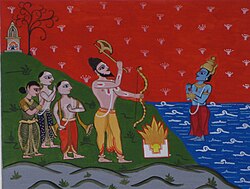
[[File:Parshuramsaraswats.jpg|thumb|A painting depicting [[Parashurama]], surrounded by settlers, commanding [[Varuna]] (the [[Hindu]] god of water) to part the seas]] | |||
In stories of the [[Dashavatara]] from [[Hindu]] mythology, the lands of Kerala were recovered from the sea by the axe-wielding warrior sage [[Parashurama]], the sixth [[avatar]] (incarnation) of [[Vishnu]]. As a result, Kerala is traditionally referred to as ''Parashurama Kshetram'' ("The Land of Parashurama").<ref>S. C. Bhatt, Gopal K. Bhargava (2006) "Land and People of Indian States and Union Territories: Volume 14.", p.18</ref> According to legend, Parashurama threw his axe across the sea, and the water receded to the point where it landed. This land that emerged extended from [[Gokarna, Karnataka|Gokarna]] to [[Kanyakumari]].<ref>{{cite book |author=Aiya VN |title=The Travancore State Manual|publisher=Travancore Government Press |pages=210–212 |year=1906 |accessdate=12 November 2007 |url=https://books.google.com/books?id=RdzaPW-kEvQC}}</ref> The land that emerged was saline and uninhabitable, so Parashurama invoked the snake king [[Vasuki]], who spat holy poison to purify the soil, transforming it into fertile land. Out of respect, Vasuki and all snakes were appointed as guardians of the land. The legend was expanded and codified in the 17th or 18th century text ''[[Keralolpathi]]''. It links the origin of early Kerala institutions{{mdash}}such as land tenure and administration{{mdash}}to Parashurama's story.<ref>{{cite book|author=M. T. Narayanan|title=Agrarian Relations in Late Medieval Malabar|url=https://books.google.com/books?id=kHtbkuXruzwC&pg=PA17|accessdate=28 July 2012|date=1 January 2003|publisher=Northern Book Centre|isbn=978-81-7211-135-9|pages=16–18}}</ref> In medieval times, the [[Chera]] king [[Chenkuttuvan]] may have emulated the Parashurama tradition by throwing his spear into the sea to symbolise his lordship over it.<ref>{{Cite book |last=Srinivisa Iyengar |first=P. T. |title=History of the Tamils: From the Earliest Times to 600 A.D. |publisher=Asian Educational Services |year=1929 |isbn=978-8120601451 |location=Madras |page=515}}</ref> | |||
A prominent [[Puranic]] figure associated with Kerala is [[Mahabali]], an [[asura]] and archetypal just king who is said to have ruled the earth from Kerala. He defeated the [[deva (Hinduism)|deva]]s in battle, driving them into exile. In response, the devas appealed to Vishnu, who assumed his fifth avatar as [[Vamana]] and, to restore order, pushed Mahabali down to [[Patala]] (the netherworld). According to popular belief, Mahabali returns to Kerala once a year, which is commemorated as the [[Onam]] festival.<ref name="Rinehart2004">{{cite book|author=Robin Rinehart|title=Contemporary Hinduism: Ritual, Culture, and Practice|url=https://books.google.com/books?id=hMPYnfS_R90C&pg=PA146|accessdate=28 July 2012|year=2004|publisher=ABC-CLIO|isbn=978-1-57607-905-8|page=146}}</ref> The ''[[Matsya Purana]]'', one of the oldest among the 18 [[Puranas]],<ref>{{cite book|last=Goldberg|first=Ellen|title=The Lord who is Half Woman: Ardhanārīśvara in Indian and Feminist Perspective|url=https://books.google.com/books?id=xUhlxBozntoC&pg=PA20|year=2002|publisher=SUNY Press|isbn=978-0-7914-5325-4|page=20|accessdate=30 May 2015}}</ref><ref>{{cite book|last=Kemmerer|first=Lisa|title=Animals and World Religions|url=https://books.google.com/books?id=iFEL2yjkbAAC&pg=PA78|year=2011|publisher=Oxford University Press|isbn=978-0-19-991255-1|page=78|accessdate=30 May 2015}}</ref> situates the story of [[Matsya]]{{mdash}}the first avatar of Vishnu{{mdash}}and king [[Manu (Hinduism)|Manu]], the first man and ruler of the region{{mdash}}in the [[Malaya Mountains]] of Kerala and [[Tamil Nadu]].<ref>{{cite book|last=Dalal|first=Roshen|title=Hinduism: An Alphabetical Guide|url=https://books.google.com/books?id=DH0vmD8ghdMC&pg=PA250|year=2011|publisher=Penguin Books India|isbn=978-0-14-341421-6|page=250|accessdate=30 May 2015}}</ref><ref>{{cite book|last=Ragozin|first=Zenaide A.|title=Vedic India As Embodied Principally in the Rig-veda|url=https://books.google.com/books?id=T16d-eRG5VkC&pg=PA341|year=2005|publisher=Kessinger Publishing|isbn=978-1-4179-4463-7|page=341|accessdate=21 March 2013}}</ref> | |||
=== | === Pre-history === | ||
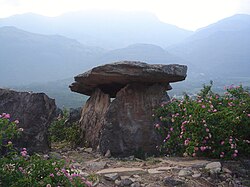
[[File:MarayoorDolmen.JPG|thumb|A [[dolmen]] erected by Neolithic people in [[Marayur]]]] | |||
[[File: | |||
A substantial portion of present-day Kerala is believed to have been submerged under the sea in ancient times. The discovery of marine fossils near Changanassery supports this hypothesis.<ref name="Menon2007">{{cite book|author=A. Sreedhara Menon|title=A Survey of Kerala History|url=https://books.google.com/books?id=FVsw35oEBv4C&pg=PA20|accessdate=27 July 2012|date=1 January 2007|publisher=DC Books|isbn=978-81-264-1578-6|pages=20–21}}</ref> Prehistoric archaeological discoveries in Kerala include [[Neolithic]]-era [[dolmen]]s in the [[Marayur]] region of the Idukki district, locally known as ''muniyara''{{mdash}}from ''muni'' (hermit or sage) and ''ara'' (dolmen).<ref name="Unlocking the secrets of history">{{cite news|url=http://www.hindu.com/2004/12/06/stories/2004120604900300.htm | location=Chennai, India | work=The Hindu | title=Unlocking the secrets of history | date=6 December 2004 | accessdate= 12 November 2015}}</ref> Rock engravings in the [[Edakkal caves]] in [[Wayanad]] date back to the Neolithic period, around 6000 BCE.<ref name="Kapoor2002">{{cite book|author=Subodh Kapoor|title=The Indian Encyclopaedia|url=https://books.google.com/books?id=gxIpYtnyzu4C&pg=PA2184|accessdate=1 August 2012|date=1 July 2002|publisher=Cosmo Publications|isbn=978-81-7755-257-7|page=2184}}</ref><ref>{{cite web|title=Travel and Tourism|url=http://www.kerala.gov.in/index.php?option=com_content&view=article&id=3792:travel-and-tourism&catid=271:about-kerala&Itemid=2267|website=kerala.gov.in|publisher=Government of Kerala|accessdate=12 November 2015}}</ref> Archaeological studies have identified [[Mesolithic]], Neolithic and [[Megalithic]] sites throughout the region.<ref name="AroraSingh116">{{cite book|author1=Udai Prakash Arora|author2=A. K. Singh|title=Currents in Indian History, Art, and Archaeology|url=https://books.google.com/books?id=ZFROamyZS7IC&pg=PA122|accessdate=6 October 2012|date=1 January 1999|publisher=Anamika Publishers & Distributors|isbn=978-81-86565-44-5|page=116}}</ref> These findings indicate that the development of early Kerala society and culture began in the [[Paleolithic|Paleolithic Age]] and progressed through the Mesolithic, Neolithic and Megalithic periods.<ref name="google">{{cite book|author1=Udai Prakash Arora|author2=A. K. Singh|title=Currents in Indian History, Art, and Archaeology|url=https://books.google.com/books?id=ZFROamyZS7IC&pg=PA122|accessdate=6 October 2012|date=1 January 1999|publisher=Anamika Publishers & Distributors|isbn=978-81-86565-44-5|pages=118, 123}}</ref> Foreign cultural interactions also played a role in shaping this development;<ref name="AroraSingh1999">{{cite book|author1=Udai Prakash Arora|author2=A. K. Singh|title=Currents in Indian History, Art, and Archaeology|url=https://books.google.com/books?id=ZFROamyZS7IC&pg=PA122|accessdate=6 October 2012|date=1 January 1999|publisher=Anamika Publishers & Distributors|isbn=978-81-86565-44-5|page=123}}</ref> some historians suggest possible connections with the [[Indus Valley Civilisation]] during the late [[Bronze Age]] and early [[Iron Age]].<ref>{{cite news|url=http://www.thehindu.com/news/states/article26324.ece | work=The Hindu | title=Symbols akin to Indus valley culture discovered in Kerala | date=29 September 2009 |accessdate= 12 November 2015}}</ref> | |||
=== Ancient history === | |||
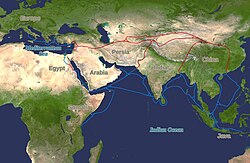
[[File:Silk route copy.jpg|thumb|225px|[[Silk Road]] map. The spice trade was along the water routes (blue).]] | |||
=== | Kerala has been a major spice exporter since at least 3000 BCE, according to [[Sumer|Sumerian records]], and it is continues to be referred to as the "Garden of Spices" or as the "Spice Garden of India".<ref>{{cite news|url=http://www.thehindu.com/todays-paper/tp-national/tp-kerala/of-kerala-egypt-and-the-spice-link/article5625620.ece | first = Kaavya | last = Pradeep Kumar | work=The Hindu | title=Of Kerala, Egypt, and the Spice link | date=28 January 2014 | accessdate=12 November 2015}}</ref><ref>[https://books.google.com/books?id=gOrvghLklKoC ''Striving for sustainability, environmental stress and democratic initiatives in Kerala''], p. 79; ISBN 81-8069-294-9, Srikumar Chattopadhyay, Richard W. Franke; Year: 2006.</ref><ref name="spiceHindu">{{Cite news |title=Route it through the seas |newspaper=The Hindu |date=December 2016 |url=https://www.thehindu.com/children/ROUTE-it-through-the-seas/article16735515.ece |access-date=2024-01-08 |archive-date=5 March 2022 |archive-url=https://web.archive.org/web/20220305035957/https://www.thehindu.com/children/ROUTE-it-through-the-seas/article16735515.ece |url-status=live |last1=Subramanian |first1=Archana }}</ref> The region's spices attracted ancient [[Babylonians]], [[Assyrians]], and [[Egyptians]] to the Malabar Coast during the 3rd and 2nd millennia BCE. [[Arabs]] and [[Phoenicians]] also established trade links with Kerala during this period.<ref name="Menon57">{{cite book|author=A Sreedhara Menon|title=A Survey Of Kerala History|url=https://books.google.com/books?id=FVsw35oEBv4C&pg=PA57|accessdate=10 October 2012|date=1 January 2007|publisher=DC Books|isbn=978-81-264-1578-6|pages=57–58}}</ref> The land of Keralaputra was one of four independent kingdoms in southern India during the time of Emperor Ashoka, alongside the [[Chola Empire|Chola]], [[Pandya Empire|Pandya]], and [[Satiyaputras|Satiyaputra]] kingdoms.<ref name="SmithJackson2008">{{cite book|author1=Vincent A. Smith|author2=A. V. Williams Jackson|title=History of India, in Nine Volumes: Vol. II – From the Sixth Century BCE to the Mohammedan Conquest, Including the Invasion of Alexander the Great|url=https://books.google.com/books?id=bP7DzXQBoM4C&pg=PA166|accessdate=1 August 2012|date=30 November 2008|publisher=Cosimo, Inc.|isbn=978-1-60520-492-5|page=166}}</ref> Scholars generally identify Keralaputra as another name for the [[Chera dynasty|Cheras]], the earliest major dynasty based in Kerala.<ref name="The Cambridge Shorter History of India">{{cite book|title=The Cambridge Shorter History of India|url=https://books.google.com/books?id=9_48AAAAIAAJ&pg=PA193|accessdate=10 October 2012|publisher=CUP Archive|page=193|id=GGKEY:2W0QHXZ7K40}}</ref><ref name="Dwivedi1994">{{cite book|author=Bhanwar Lal Dwivedi|title=Evolution of Education Thought in India|url=https://books.google.com/books?id=idERT6Tg4MMC&pg=PA164|accessdate=10 October 2012|date=1 January 1994|publisher=Northern Book Centre|isbn=978-81-7211-059-8|page=164}}</ref> These southern territories once shared a common language and cultural framework, within a region historically known as [[Tamilakam]].<ref>{{Cite book | ||
| last=Kanakasabhai | first=V. | |||
{{ | | title=The Tamils Eighteen Hundred Years Ago | ||
| | | url=https://books.google.com/books?id=VuvshP5_hg8C | ||
| year=1997 | |||
| publisher=Asian Educational Services | |||
| isbn=978-81-206-0150-5 | |||
| accessdate=16 June 2009}}</ref> While the Cheras governed most of what is now Kerala, the southern tip of the region fell under the control of the [[Pandyas]],<ref name="Singh2008">{{cite book|author=Upinder Singh|title=A History of Ancient and Early Medieval India: From the Stone Age to the 12th Century|url=https://books.google.com/books?id=GW5Gx0HSXKUC&pg=PA385|accessdate=10 October 2012|year=2008|publisher=Pearson Education India|isbn=978-81-317-1677-9|page=385}}</ref> whose trading port is sometimes identified in ancient Western sources as [[Nelcynda]] (or Neacyndi).<ref name="Books.google.co.in">{{Cite book|url=https://books.google.com/books?id=rQipbjusDyQC&dq=nelcynda&pg=PA301 |title=History of ancient geography – Google Books |author=James Oliver Thomson|publisher=Biblo & Tannen Publishers, 1948|accessdate=30 July 2009|isbn=978-0-8196-0143-8|year=1948}}</ref> Later, control of the region alternated among the Pandyas, Cheras, and Cholas. The [[Ay kingdom|Ays]] and [[Ezhimala kingdom|Mushikas]] were two other dynasties of ancient Kerala, located to the south and north of the Chera territory, respectively.<ref name="Shashi1996">{{cite book|author=S. S. Shashi|title=Encyclopaedia Indica: India, Pakistan, Bangladesh|url=https://books.google.com/books?id=lwswAQAAIAAJ|accessdate=10 October 2012|year=1996|publisher=Anmol Publications|isbn=978-81-7041-859-7|page=1207}}</ref><ref name="Ramunny1993">{{cite book|author=Murkot Ramunny|title=Ezhimala: The Abode of the Naval Academy|url=https://books.google.com/books?id=7Hue54bWk6IC&pg=PA3|accessdate=10 October 2012|date=1 January 1993|publisher=Northern Book Centre|isbn=978-81-7211-052-9|page=3}}</ref> | |||
By the last centuries BCE, the coast had become an important hub for Greek and Roman trade, particularly in [[black pepper]]. The Cheras maintained commercial links with [[Ancient China]], [[West Asia]], Egypt, Greece, and the [[Roman Empire]]. In foreign trade records, the region was referred to as Male or [[Malabar Coast|Malabar]].<ref>{{cite web | url=http://www.siamese-heritage.org/jsspdf/1961/JSS_054_1c_Minattur_MalayaWhatsInAName.pdf | title=Malaya: What's in the name | publisher=siamese-heritage.org | accessdate=7 August 2012 | author=Joseph Minattur | page=1}}</ref> Principal ports of the time included [[Muziris]], Berkarai, and Nelcynda.<ref name="Kusuman">{{cite book |author=K. K. Kusuman |title=A History of Trade & Commerce in Travancore |publisher=Mittal Publications |year=1987 |isbn=978-81-7099-026-0 |url=https://books.google.com/books?id=qbNuyHswr1cC |pages=1–2 |accessdate=30 May 2015}}</ref> The value of Rome's annual trade with Kerala has been estimated at around 50 million [[sesterces]].<ref>According to [[Pliny the Elder]], goods from India were sold in the Empire at 100 times their original purchase price. See [https://web.archive.org/web/20131106031753/http://www.cartage.org.lb/en/themes/BookLibrary/books/bibliographie/P/Plinyelder/elder/pliny-india.html]</ref> Contemporary [[Sangam literature]] describes Roman ships arriving at Muziris, laden with gold in exchange for pepper. One of the earliest Western traders to navigate the monsoon winds to reach Kerala was [[Eudoxus of Cyzicus]], who made the voyage around 118 or 166 BCE under the patronage of [[Ptolemy VIII Physcon|Ptolemy VIII]], king of the [[Hellenistic civilisation|Hellenistic]] [[Ptolemaic dynasty]] in Egypt. Roman establishments in the region's port cities{{mdash}}including a temple of [[Augustus]] and barracks for garrisoned Roman soldiers{{mdash}}are recorded in the ''[[Tabula Peutingeriana]]'', the only surviving map of the Roman ''[[cursus publicus]]''.<ref>{{cite book|author=Abraham Eraly|title=The First Spring: The Golden Age of India|url=https://books.google.com/books?id=te1sqTzTxD8C&pg=PA246|accessdate=7 August 2012|date=1 December 2011|publisher=Penguin Books India|isbn=978-0-670-08478-4|pages=246–}}</ref><ref name="Iyengar_2001">{{cite book |author=Iyengar PTS |year=2001 |title=History Of The Tamils: From the Earliest Times to 600 A.D. |publisher=Asian Educational Services |isbn=81-206-0145-9 |url=https://books.google.com/books?id=ERq-OCn2cloC |accessdate=29 December 2008}}</ref> | |||
Merchants from West Asia and Southern Europe established coastal posts and settlements in Kerala.<ref name="google2">{{cite book |author=Iyengar PTS |year=2001 |title=History Of The Tamils: From the Earliest Times to 600 A.D. |publisher=Asian Educational Services |isbn=81-206-0145-9 |url=https://books.google.com/books?id=ERq-OCn2cloC |pages=192–195 |accessdate=29 December 2008}}</ref> The Jewish connection with Kerala is believed to date back to 573 BCE.<ref name="Orpa Slapak">[https://books.google.co.in/books?id=qhKGPprbQaYC&printsec=frontcover&dq=isbn:9652781797&hl=en&sa=X&ei=UNa1VM-AFc_kuQSLiYLIAQ&ved=0CB8Q6wEwAA#v=onepage&q=two%20millennia&f=true ''The Jews of India: A Story of Three Communities''] by Orpa Slapak. The Israel Museum, Jerusalem. 2003. p. 27. ISBN 965-278-179-7.</ref><ref name="Hillel1832">{{cite book|author=David D'Beth Hillel|title=The Travels of Rabbi David D'Beth Hillel: From Jerusalem, Through Arabia, Koordistan, Part of Persia, and India to Madras|url=https://books.google.com/books?id=j5NeAAAAcAAJ&pg=PR9|year=1832|publisher=author|page=135}}</ref><ref>{{cite book|title=The Jews in India and the Far East|url=https://books.google.com/books?id=w_v-nQEACAAJ|year=1976|publisher=Greenwood Press|pages=24–26 | isbn=978-0-8371-2615-9 }}</ref> Arab traders had links with Kerala from at least the 4th century BCE; [[Herodotus]] (484–413 BCE) noted that goods brought by Arabs from Kerala were sold to Jews in Eden.<ref name="Kusuman"/> These Arab traders intermarried with local communities, leading to the formation of the Muslim [[Malabar Muslims|Mappila]] community.<ref name="Dialogue">{{cite book |author=Rolland E. Miller |title=Hindu-Christian Dialogue: Perspectives and Encounters |publisher=Motilal Banarsidass Publications |year=1993 |isbn=978-81-208-1158-4 |url=https://books.google.com/books?id=6eHgNyNimoAC |page=50}}</ref> In the 4th century CE, some Christians migrated from [[Persia]] and joined the early [[Saint Thomas Christians|Syrian Christian]] community, which traces its origins to the evangelistic activities of [[Thomas the Apostle]] in the 1st century CE.<ref name="Erwin Fahlbusch">[https://books.google.co.in/books?id=lZUBZlth2qgC&printsec=frontcover&dq=isbn:9780802824172&hl=en&sa=X&ei=i5ncVJiVJ4u4uATrlIGoAg&ved=0CB8Q6wEwAA#v=onepage&q=Muziris&f=true ''The Encyclopedia of Christianity, Volume 5''] by Erwin Fahlbusch. Wm. B. Eerdmans Publishing - 2008. p. 285. ISBN 978-0-8028-2417-2.</ref><ref>{{cite book |author=Geoffrey Wainwright |title=The Oxford History Of Christian Worship |publisher=Oxford University Press |year=2006 |isbn=978-0-19-513886-3 |url=https://books.google.com/books?id=h5VQUdZhx1gC |page=666 |accessdate=30 May 2015}}</ref> The term Mappila{{mdash}}originally an honorific applied to esteemed foreign visitors{{mdash}}later became associated with the descendants of Jewish, Syrian Christian, and Muslim immigrants, leading to the terms [[Juda Mappila]]s, [[Saint Thomas Christians|Nasrani Mappila]]s, and [[Malabar Muslims|Muslim Mappila]]s, respectively.<ref name="BMalieckal">* Bindu Malieckal (2005) Muslims, Matriliny, and A Midsummer Night's Dream: European Encounters with the Mappilas of Malabar, India; The Muslim World Volume 95 Issue 2</ref><ref>{{cite book |author=Milton J, Skeat WW, Pollard AW, Brown L |title=The Indian Christians of St Thomas |publisher=Cambridge University Press |date=31 August 1982 |isbn=0-521-21258-8 |page=171}}</ref> According to the traditions of these communities, some of the earliest religious establishments in India were built in Kerala.<ref name="Dialogue"/> These include the [[Saint Thomas Christian churches]],<ref>{{cite book |author=Susan Bayly |title=Saints, Goddesses and Kings |publisher=Cambridge University Press |year=2004 |isbn=978-0-521-89103-5 |url=https://books.google.com/books?id=Fxqtx8SflEsC |page=40 |accessdate=30 May 2015}}</ref> the [[Cheraman Juma Masjid]] (established in 629 CE), India's first mosque,<ref>{{cite book |author=Jonathan Goldstein |title=The Jews of China |publisher=M.E. Sharpe |year=1999 |isbn=978-0-7656-0104-9 |url=https://books.google.com/books?id=8Z6DlzyT2vwC |page=123 |accessdate=30 May 2015}}</ref> and the [[Paradesi Synagogue]] (built in 1568 CE), the oldest active synagogue in the [[Commonwealth of Nations]].<ref>{{cite book |author=Nathan Katz |title=Who Are the Jews of India? |publisher=University of California Press |year=2000 |isbn=978-0-520-21323-4 |url=https://books.google.com/books?id=ZWX6pF2PTJwC |page=245 |accessdate=30 May 2015}}</ref> | |||
=== Medieval period === | |||
[[File:3rd Tiruvalla Copper Plate.jpg|thumb|[[Tharisapalli plates]] granted to [[Saint Thomas Christians]] testify that merchant guilds and trade corporations played a very significant role in the economy and social life during the Kulasekhara period.]] | |||
A [[Later Chera Dynasty|second Chera kingdom]] (c. 800–1102), also known as the Kulasekhara dynasty of [[Mahodayapuram]], was founded by [[Kulashekhara Alwar|Kulasekhara Varman]] and governed over a territory comprising most of present-day Kerala and parts of modern Tamil Nadu. During the early phase of the Kulasekara period, the southern region{{mdash}}from [[Nagerkovil]] to [[Thiruvalla]]{{mdash}}was controlled by the [[Ays (Kerala)|Ay dynasty]]. By the 10th century, however, the Ays had lost their power, and the region was incorporated into the Kulashekara realm.<ref name="Balachand">{{cite book|author=K. Balachandran Nayar|title=In quest of Kerala|url=https://books.google.com/books?id=EXIeAAAAMAAJ|accessdate=8 August 2012|year=1974|publisher=Accent Publications|page=86}}</ref><ref>{{cite book|author=A Sreedhara Menon|title=A Survey Of Kerala History|url=https://books.google.com/books?id=FVsw35oEBv4C&pg=PA166|accessdate=8 August 2012|date=1 January 2007|publisher=DC Books|isbn=978-81-264-1578-6|page=97}}</ref> Under Kulashekhara rule, Kerala experienced a flourishing period marked by developments in art, literature, trade, and the [[Bhakti movement]] within Hinduism.<ref name="Sreedhar123">{{cite book|author=A Sreedhara Menon|title=A Survey Of Kerala History|url=https://books.google.com/books?id=FVsw35oEBv4C&pg=PA166|accessdate=8 August 2012|date=1 January 2007|publisher=DC Books|isbn=978-81-264-1578-6|pages=123–131}}</ref> It was during this time that a distinct Keralite identity began to emerge, separate from Tamil culture, particularly through linguistic differentiation.<ref name="AsherKumari1997">{{cite book|author1=R. E. Asher|author2=T. C. Kumari|title=Malayalam|url=https://books.google.com/books?id=uFQG2DCaIsIC|year=1997|publisher=Psychology Press|isbn=978-0-415-02242-2|pages=24–27}}</ref> For administrative purposes, the kingdom was divided into provinces governed by local chieftains called [[Naduvazhi]]s. Each province was further subdivided into ''desams'', which were overseen by Desavazhis.<ref name="Sreedhar123"/> | |||
A series of Chera–Chola conflicts in the 11th century disrupted foreign trade through Kerala's ports. During this period, [[Buddhism]] and [[Jainism]], which had previously coexisted with Hinduism, declined and eventually disappeared from the region.<ref>{{cite web |url=http://www.kerala.cc/keralahistory/index34.htm |title=The Buddhist History of Kerala |publisher=Kerala.cc |accessdate=25 September 2013 |archive-date=4 March 2016 |archive-url=https://web.archive.org/web/20160304215933/http://www.kerala.cc/keralahistory/index34.htm |url-status=dead }}</ref> Social structures became increasingly rigid, and [[Caste system in Kerala|caste divisions]] deepened.<ref>{{cite book|author=A Sreedhara Menon|title=A Survey Of Kerala History|url=https://books.google.com/books?id=FVsw35oEBv4C&pg=PA166|accessdate=9 August 2012|date=1 January 2007|publisher=DC Books|isbn=978-81-264-1578-6|page=138}}</ref> The Kulashekhara dynasty ultimately fell in 1102 CE following a combined assault by the [[Later Pandyas]] and [[Later Cholas]].<ref name="Balachand"/> In the 14th century, Ravi Varma Kulashekhara (r. 1299–1314) of the southern [[Venad|Venad kingdom]] briefly established a short-lived supremacy over much of southern India. Following his death, and in the absence of a strong central authority, the region fragmented into thirty small, frequently warring principalities. Among the most powerful were the kingdom of [[Samuthiri]] (Zamorin) in the north, Venad in the south and Kochi in the central region. In the 18th century, King [[Anizham Thirunal Marthanda Varma]] of Travancore launched a series of military campaigns and annexed territories up to northern Kerala, establishing Travancore as the dominant power in the region. The Kochi ruler sued for peace, and the Malabar region eventually came under direct [[British Raj|British rule]] until [[Independence of India|Indian independence]] in 1947.<ref>{{cite book|author=Educational Britannica Educational|title=The Geography of India: Sacred and Historic Places|url=https://books.google.com/books?id=xPUvqtdfjyAC&pg=PA311|accessdate=15 September 2012|date=15 August 2010|publisher=The Rosen Publishing Group|isbn=978-1-61530-202-4|page=311}}</ref><ref>{{cite book |last1=Boland-Crewe |first1=Tara |last2=Lea |first2=David |title=The Territories and States of India |date=2003 |doi=10.4324/9780203402900 |isbn=978-1-135-35625-5 |pages=144–146 }}</ref> | |||
=== | === Colonial rule === | ||
[[File: | [[File:Caminho maritimo para a India.png|thumb|The route taken by [[Vasco da Gama]] to reach Kerala (indicated in black)]] | ||
[[ | During the [[High Middle Ages|High]] and [[Late Middle Ages]], Arab traders held a maritime monopoly over the spice trade in the [[Indian Ocean]]. This dominance was challenged during the European [[Age of Discovery]] when the spice trade{{mdash}}particularly in black pepper{{mdash}}became a major focus of European commercial activity.<ref>{{cite book | last = Corn | first = Charles |author2=Glasserman, Debbie | title = The Scents of Eden: A History of the Spice Trade | publisher = Kodansha America |date=March 1999 | isbn = 1-56836-249-8}}</ref> By the 15th century, the Portuguese had begun asserting control over eastern maritime routes, culminating in [[Vasco Da Gama]]'s arrival at [[Kappad]], near [[Kozhikode]] (Calicut), in 1498.<ref>{{Cite book |author=Ravindran PN |title=Black Pepper: Piper Nigrum |publisher=CRC Press |year=2000 |accessdate=11 November 2007 |url=https://books.google.com/books?id=VaGCgSLrdr4C |page=3 |isbn=978-90-5702-453-5}}</ref><ref name="Curtin1984">{{cite book|author=Philip D. Curtin|title=Cross-Cultural Trade in World History|url=https://books.google.com/books?id=R4IiYFhliv4C|date=25 May 1984|publisher=Cambridge University Press|isbn=978-0-521-26931-5|page=144}}</ref> The [[Zamorin]] of Kozhikode granted the Portuguese permission to trade with his subjects, leading to the establishment of a prosperous Portuguese [[factory (trading post)|factory]] and fort.<ref name="Mehta2005" /> | ||
[[ | However, tensions arose when the Portuguese attacked Arab traders operating under the Zamorin's protection, causing a breakdown in relations. Seizing the opportunity presented by rivalry between the Zamorin and the King of Kochi, the Portuguese allied with Kochi. When [[Francisco de Almeida]] was appointed Viceroy of Portuguese India in 1505, he established his headquarters at [[Fort Kochi]] ([[Fort Emmanuel]]), rather than in Kozhikode. Under his administration, the Portuguese consolidated their influence by building several fortifications along the Malabar Coast.<ref name="Mehta2005">{{cite book|author=J. L. Mehta|title=Advanced Study in the History of Modern India: Volume One: 1707–1813|url=https://books.google.com/books?id=d1wUgKKzawoC&pg=PA324|accessdate=9 August 2012|date=1 January 2005|publisher=Sterling Publishers Pvt. Ltd|isbn=978-1-932705-54-6|pages=324–327}}</ref> Despite these advances, the Portuguese faced significant resistance from the Zamorin's naval forces, particularly under the command of the [[Kunjali Marakkar]]s{{mdash}}admirals of Kozhikode{{mdash}}who launched effective maritime campaigns. This resistance eventually forced the Portuguese to seek a treaty. In 1571, the Zamorin's forces defeated the Portuguese in the [[Kingdom of Tanur#Battles at Chaliyam Fort|Battle of Chaliyam Fort]], marking a major setback for Portuguese ambitions in the region.<ref>{{cite book|author=K. K. N. Kurup|title=India's Naval Traditions: The Role of Kunhali Marakkars|url=https://books.google.com/books?id=HKmXcBCKEcAC&pg=PA51|accessdate=9 August 2012|date=1 January 1997|publisher=Northern Book Centre|isbn=978-81-7211-083-3|pages=37–38}}</ref> | ||
The | The Portuguese were eventually supplanted by the [[Dutch East India Company]], which capitalised on ongoing conflicts between the Kozhikode and Kochi to gain control over trade in the region.<ref name="South Asia 2006">{{cite book|title=South Asia 2006|url=https://books.google.com/books?id=YG8bAQAAMAAJ|accessdate=18 November 2012|date=1 December 2005|publisher=Taylor & Francis|page=289}}</ref> However, the Dutch too faced military resistance, most notably from [[Marthanda Varma]] of the [[Travancore royal family]]. After a decisive Dutch defeat at the [[Battle of Colachel]] in 1741,<ref name="google3">{{cite book|author=Murkot Ramunny|title=Ezhimala: The Abode of the Naval Academy|url=https://books.google.com/books?id=7Hue54bWk6IC&pg=PA57|accessdate=18 November 2012|date=1 January 1993|publisher=Northern Book Centre|isbn=978-81-7211-052-9|pages=57–70}}</ref> the Treaty of Mavelikkara was signed in 1753, forcing the Dutch to withdraw from regional political affairs and confining their role to trade.<ref name="Singh2010">{{cite book|author=Anjana Singh|title=Fort Kochi in Kerala, 1750–1830: The Social Condition of a Dutch Community in an Indian Milieu|url=https://books.google.com/books?id=LFy4pWUlnfwC&pg=PA22|accessdate=18 November 2012|date=30 April 2010|publisher=BRILL|isbn=978-90-04-16816-9|pages=22–52}}</ref><ref name="Iyer1995">{{cite book|author=S. Krishna Iyer|title=Travancore Dutch relations, 1729–1741|url=https://books.google.com/books?id=rUtuAAAAMAAJ|accessdate=18 November 2012|year=1995|publisher=CBH Publications|isbn=978-81-85381-42-8|page=49}}</ref><ref name="Lannoy1997">{{cite book|author=Mark de Lannoy|title=The Kulasekhara Perumals of Travancore: history and state formation in Travancore from 1671 to 1758|url=https://books.google.com/books?id=pKjZAAAAMAAJ|accessdate=18 November 2012|year=1997|publisher=Leiden University|isbn=978-90-73782-92-1|page=190}}</ref> Marthanda Varma continued his military campaigns, establishing Travancore as the preeminent power in Kerala.<ref>{{cite book|author=A. Sreedhara Menon|title=Political History of Modern Kerala|url=https://books.google.com/books?id=wnAjqjhc1VcC&pg=PA140|accessdate=10 August 2012|year=1987|publisher=D C Books|isbn=978-81-264-2156-5|page=140}}</ref> | ||
In 1766, [[Hyder Ali]], ruler of [[Kingdom of Mysore|Mysore]], [[Mysorean invasion of Kerala#Invasion by Hyder Ali|invaded northern Kerala]],<ref name="Rai">{{cite book|author=Raghunath Rai|title=History|url=https://books.google.com/books?id=Z4-8Z0gqBkoC&pg=PA14|accessdate=18 November 2012|publisher=FK Publications|isbn=978-81-87139-69-0|pages=14–}}</ref> and his son and successor, [[Tipu Sultan]], [[Mysorean invasion of Kerala#Invasions by Tipu Sultan|launched military campaigns]] against the expanding [[British East India Company]]. These confrontations contributed to two of the four [[Anglo-Mysore Wars]].<ref name="MuseumDallapiccola2010">{{cite book|author1=British Museum|author2=Anna Libera Dallapiccola|title=South Indian Paintings: A Catalogue of the British Museum Collection|url=https://books.google.com/books?id=FIzWapiacQcC&pg=PA12|accessdate=18 November 2012|date=22 June 2010|publisher=Mapin Publishing Pvt Ltd|isbn=978-0-7141-2424-7|pages=12–}}</ref><ref name="ThorpeEdgar">{{cite book|author1=Edgar Thorpe, Showick Thorpe|author2=Thorpe Edgar|title=The Pearson CSAT Manual 2011|url=https://books.google.com/books?id=WuBFs6yFRwcC&pg=RA1-PA99|accessdate=18 November 2012|publisher=Pearson Education India|isbn=978-81-317-5830-4|page=99}}</ref> By the early 1790s, Tipu Sultan was forced to cede the [[Malabar district]] and [[South Kanara]] to the British, and these regions were annexed into the [[Madras Presidency]] of [[British India]] in 1792.<ref name="The Edinburgh Gazetteer: Or, Geographical Dictionary: Containing a Description of the Various Countries, Kingdoms, States, Cities, Towns, Mountains, &c. of the World; an Account of the Government, Customs, and Religion of the Inhabitants; the Boundaries and Natural Productions of Each Country, &c. &c. Forming a Complete Body of Geography, Physical, Political, Statistical, and Commercial with Addenda, Containing the Present State of the New Governments in South America...">{{cite book|title=The Edinburgh Gazetteer|url=https://books.google.com/books?id=xRIyAQAAMAAJ&pg=PA63|accessdate=18 November 2012|year=1827|publisher=Longman, Rees, Orme, Brown, and Green|pages=63–}}</ref><ref name="Kumar1965">{{cite book|author=Dharma Kumar|title=Land and Caste in South India: Agricultural Labor in the Madras Presidency During the Nineteenth Century|url=https://books.google.com/books?id=psw5AAAAIAAJ&pg=PA87|accessdate=18 November 2012|year=1965|publisher=CUP Archive|pages=87–|id=GGKEY:T72DPF9AZDK}}</ref><ref name="Ittaman2003">{{cite book|author=K.P. Ittaman|title=History of Mughal Architecture Volume Ii|url=https://books.google.com/books?id=ZQ5lFywZAqYC&pg=PA30|accessdate=18 November 2012|date=1 June 2003|publisher=Abhinav Publications|isbn=978-81-7017-034-1|pages=30–}}</ref> The British East India Company also secured tributary alliances with Kochi in 1791 and Travancore in 1795.<ref>{{Cite book |author=Superintendent of Government Printing |title=Imperial Gazetteer of India (Provincial Series): Madras |publisher=Government of India |location=Calcutta |year=1908 |accessdate=11 November 2007 |url=https://books.google.com/books?id=xXglUxeS_WkC |page=22}}</ref> By the end of 18th century, the entirety of Kerala was either directly administered by the British or under their [[suzerainty]].<ref name="RajTharakan1981">{{cite book|author1=Kakkadan Nandanath Raj|author2=Michael Tharakan|title=Agrarian reform in Kerala and its impact on the rural economy: a preliminary assessment|url=https://books.google.com/books?id=JF6FAAAAIAAJ|accessdate=18 November 2012|year=1981|publisher=International Labour Office|pages=2–3}}</ref> | |||
In the 20th century, Kerala was the site of several major uprisings during the Indian independence movement. Among the most notable was the 1921 [[Malabar Rebellion]], in which Mappila Muslims of the Malabar region rioted against Hindu [[zamindars]] (landlords) and British colonial authorities.<ref name="Qureshi1999">{{cite book|author=M. Naeem Qureshi|title=Pan-Islam in British Indian Politics: A Study of the Khilafat Movement, 1918–1924|url=https://books.google.com/books?id=czKYZPyoyx0C|year=1999|publisher=BRILL|isbn=90-04-11371-1|pages=445–447}}</ref> Social reform moments also gained momentum during this period, particularly those challenging caste-based discrimination. A major milestone was the [[Temple Entry Proclamation]] of 1936 in Travancore, which granted lower-caste Hindus the right to enter temples previously restricted to upper castes.<ref name="Smith1976">{{cite book|author=Bardwell L. Smith|title=Religion and Social Conflict in South Asia|url=https://books.google.com/books?id=07Y3AAAAIAAJ&pg=PA42|accessdate=31 July 2012|year=1976|publisher=BRILL|isbn=978-90-04-04510-1|pages=35–42}}</ref> | |||
=== | === State of India === | ||
[[ | After the [[Partition of India]] in 1947 into the independent dominions of India and Pakistan, the princely states of Travancore and Kochi acceded to the [[Dominion of India|Union of India]]. On 1 July 1949, the two states were merged to form [[Travancore-Cochin]].<ref name="Sabharwal2007">{{cite book|author=Gopa Sabharwal|title=India Since 1947: The Independent Years|url=https://books.google.com/books?id=LKySGJAGVEQC&pg=PA23|accessdate=18 November 2012|year=2007|publisher=Penguin Books India|isbn=978-0-14-310274-8|pages=23–}}</ref> On 1 November 1956, the [[taluk]] of [[Kasaragod district|Kasargod]] from the South Kanara district of Madras, the [[Malabar district]] of [[Madras State]] (excluding [[Gudalur taluk]] of [[Nilgiris district]], [[Lakshadweep]], [[Topslip]], and the [[Attappadi]] forest east of Anakatti), and the state of Travancore-Cochin{{mdash}}excluding four southern taluks ([[Kanyakumari district]] and Shenkottai taluks), which were transferred to Tamil Nadu{{mdash}}were merged to form the state of Kerala under the [[States Reorganisation Act]].<ref name="Tmh">{{cite book|author=Tmh|title=General Knowledge Digest 2010|url=https://books.google.com/books?id=RyLmXWTKHXgC&pg=SA3-PA106|accessdate=18 November 2012|publisher=Tata McGraw-Hill Education|isbn=978-0-07-069939-7|page=3}}</ref><ref name="SinghKarafin2009">{{cite book|author1=Sarina Singh|author2=Amy Karafin|author3=Anirban Mahapatra|title=South India|url=https://books.google.com/books?id=8KnLFpjEHpUC|accessdate=6 January 2013|date=1 September 2009|publisher=Lonely Planet|isbn=978-1-74179-155-6}}</ref><ref name="Kerala">{{Cite web |title=The States Reorganisation Act, 1956 |url=https://legislative.gov.in/sites/default/files/A1956-37.pdf |url-status=live |archive-url=https://web.archive.org/web/20211117014954/https://legislative.gov.in/sites/default/files/A1956-37.pdf |archive-date=17 November 2021 |access-date=11 May 2021 |website=legislative.gov.in |publisher=Government of India}}</ref> A [[Communist]]-led government under [[E. M. S. Namboodiripad]] was formed following the first elections for the new Kerala Legislative Assembly in 1957.<ref name="SinghKarafin2009"/> It was among the earliest democratically elected Communist governments in the world, following Communist electoral success in the [[Republic of San Marino]] in 1945.<ref name=Hindu>{{cite news|title=50 years of development|url=http://www.thehindubusinessline.com/todays-paper/tp-others/tp-states/50-years-of-development/article1655056.ece?ref=archive|accessdate=30 August 2013|newspaper=The Hindu|date=12 April 2007|author=K.G. Kumar}}</ref><ref name="Desai2006">{{cite book|author=Manali Desai|title=State Formation and Radical Democracy in India|url=https://books.google.com/books?id=60m9znJQmmkC&pg=PA142|accessdate=31 August 2013|date=27 November 2006|publisher=Taylor & Francis|isbn=978-0-203-96774-4|page=142}}</ref><ref name="ChitkaraŚarmā1997">{{cite book|author1=Madan Gopal Chitkara|author2=Baṃśī Rāma Śarmā|title=Indian Republic: Issues and Perspective|url=https://books.google.com/books?id=7YrmNURVoroC&pg=PA134|accessdate=18 November 2012|date=1 January 1997|publisher=APH Publishing|isbn=978-81-7024-836-1|pages=134–}}</ref> | ||
== Geography == | |||
{{Main|Geography of Kerala}} | |||
| | |||
{{Multiple image | |||
| | | align = right | ||
| direction = vertical | |||
| width = 220 | |||
| | | header_align = left/right/center | ||
| | | footer_align = left/right/center | ||
| header_background = | |||
| footer_background = | |||
| image1 = AnaimudiPeak DSC 4834.jpg | |||
| caption1 = [[Anamudi]], the highest peak in [[South India]]. | |||
| image2 = DR0071DSC 9245.jpg | |||
| caption2 = [[Tea]] and [[Coffee]] are produced in the hilly terrains of [[Wayanad]]. | |||
| image3 = Kumarkom.jpg | |||
| caption3 = [[Vembanad]], a portion of [[Kerala backwaters]], is the longest lake in India. | |||
| image4 = Light house in Ponnani.jpg | |||
| caption4 = [[Ponnani Lighthouse]] beach | |||
}} | }} | ||
The | The state is wedged between the [[Laccadive Sea]] and the [[Western Ghats]].<ref>{{Cite web |year=1953 |title=Limits of Oceans and Seas, 3rd edition |url=https://iho.int/uploads/user/pubs/standards/s-23/S-23_Ed3_1953_EN.pdf |archive-url=https://web.archive.org/web/20181005131902/https://www.iho.int/iho_pubs/standard/S-23/S-23_Ed3_1953_EN.pdf |archive-date=5 October 2018 |access-date=28 December 2020 |publisher=International Hydrographic Organization}}</ref> Lying between northern latitudes 8°18' and 12°48' and eastern longitudes 74°52' and 77°22',<ref>{{cite web |title=Physical and Anatomical Characteristic of Wood of Some Less-Known Tree Species of Kerala |url=https://docs.kfri.res.in/KFRI-RR/KFRI-RR096.pdf |work=Kerala Forest Research Institute |publisher=Government of Kerala |access-date=18 November 2012 |archive-date=9 July 2013 |archive-url=https://web.archive.org/web/20130709150101/http://docs.kfri.res.in/KFRI-RR/KFRI-RR096.pdf |url-status=live }}</ref> Kerala experiences humid [[tropical rainforest climate]] with some cyclones. The state has a coast of {{cvt|590|km|mi}}<ref>{{cite web |title=Marine Fisheries |url=https://www.fisheries.kerala.gov.in/index.php?option=com_content&view=article&id=76&Itemid=44 |website=fisheries.kerala.gov.in |publisher=Department of Fisheries, Government of Kerala |access-date=13 November 2015 |archive-date=17 November 2015 |archive-url=https://web.archive.org/web/20151117021802/http://www.fisheries.kerala.gov.in/index.php?option=com_content&view=article&id=76&Itemid=44 |url-status=live }}</ref> and the width of the state varies between {{convert|11|and|121|km|mi|0}}.<ref name="Nair1994">{{cite book |author=V. Balakrishnan Nair |title=Social Development and Demographic Changes in South India: Focus on Kerala |url=https://books.google.com/books?id=sTS4OO9lcdgC&pg=PA15 |access-date=18 November 2012 |year=1994 |publisher=M.D. Publications Pvt. Ltd. |isbn=978-8185880501 |page=15}}</ref> Geographically, Kerala can be divided into three climatically distinct regions: the eastern highlands; rugged and cool mountainous terrain, the central mid-lands; rolling hills, and the western lowlands; coastal plains.<ref name="ChattopadhyayFranke2006">{{cite book |author1=Srikumar Chattopadhyay |author2=Richard W. Franke |title=Striving for Sustainability: Environmental Stress and Democratic Initiatives in Kerala |url=https://books.google.com/books?id=gOrvghLklKoC&pg=PA110 |access-date=19 March 2019 |year=2006 |publisher=Concept Publishing Company |isbn=978-8180692949}}</ref>{{rp|110}} [[Pre-Cambrian]] and [[Pleistocene]] geological formations compose the bulk of Kerala's terrain.<ref name="Geological Survey Water-supply Paper">{{cite book |title=Geological Survey Water-supply Paper |url=https://books.google.com/books?id=0qUYAQAAIAAJ&pg=SL4-PA6 |access-date=19 March 2019 |year=1961 |publisher=U.S. Government Printing Office |page=4}}</ref><ref name="SharmaKumari2008">{{cite book |author1=Pradeep Sharma |author2=Y. Dharnai Kumari |author3=Tirunagaram Lakshmamma |title=Status Of Women And Family Planning |url=https://books.google.com/books?id=2b6Ok2EcnBIC&pg=PA217 |access-date=18 November 2012 |year=2008 |publisher=Discovery Publishing House |isbn=978-8183563260 |page=217}}</ref> A catastrophic flood in Kerala in 1341 CE drastically modified its terrain and consequently affected its history; it also created a natural harbour for spice transport.<ref name="LimitedKitchen2010">{{cite book |author1=Murdoch Books Pty Limited |author2=Murdoch Books Test Kitchen |title=India |url=https://books.google.com/books?id=d_cHBuYD3CQC&pg=PA100 |access-date=18 November 2012 |year=2010 |publisher=Murdoch Books |isbn=978-1-74196-438-7 |page=100}}</ref> | ||
The eastern region of Kerala consists of high mountains, gorges and deep-cut valleys immediately west of the Western Ghats' [[rain shadow]].<ref name=ChattopadhyayFranke2006 />{{rp|110}} 41 of Kerala's west-flowing rivers,<ref name="Sadasivan2003">{{cite book |author=S. N. Sadasivan |title=River Disputes in India: Kerala Rivers Under Siege |url=https://books.google.com/books?id=hhrRboi5kOcC&pg=PA223 |access-date=18 November 2012 |year=2003 |publisher=Mittal Publications |isbn=978-8170999133 |page=223}}</ref> and 3 of its east-flowing ones originate in this region.<ref name="Darpan2006">{{cite book |author=Pratiyogita Darpan |title=Pratiyogita Darpan |url=https://books.google.com/books?id=QegDAAAAMBAJ&pg=PT72 |access-date=18 November 2012 |date=September 2006 |publisher=Pratiyogita Darpan |page=72}}</ref><ref name="India2008">{{cite book |author=Motilal (UK) Books of India |title=Tourist Guide Kerala |url=https://books.google.com/books?id=ZYfRBcLdTNYC&pg=PA11 |access-date=18 November 2012 |year=2008 |publisher=Sura Books |isbn=978-8174781642 |page=11}}</ref> The Western Ghats form a wall of mountains interrupted only near [[Palakkad]]; hence also known Pal''ghat'', where the [[Palakkad Gap]] breaks.<ref>{{cite web |last1=Chandran Nair |first1=Dr.S.Sathis |title=India – Silent Valley Rainforest Under Threat Once More |url=https://www.rainforestinfo.org.au/wrr2004/silentvalley.htm |website=rainforestinfo.org.au |access-date=12 November 2015 |archive-date=24 September 2015 |archive-url=https://web.archive.org/web/20150924084520/http://www.rainforestinfo.org.au/wrr2004/silentvalley.htm |url-status=live }}</ref> The Western Ghats rise on average to {{convert|1500|m|ft|lk=out|abbr=off}} [[above sea level]],<ref name="Biju2006">{{cite book |author=M.R. Biju |title=Sustainable Dimensions Of Tourism Management |url=https://books.google.com/books?id=AkAdvTbg0dEC&pg=PA63 |access-date=18 November 2012 |year=2006 |publisher=Mittal Publications |isbn=978-8183241298 |page=63}}</ref> while the highest peaks reach around {{convert|2500|m|ft|abbr=off}}.<ref name="Hussain">{{cite book |author=Hussain |title=Geography Of India For Civil Ser Exam |url=https://books.google.com/books?id=wUzKCZxvNQoC&pg=SA2-PA9 |access-date=18 November 2012 |publisher=Tata McGraw-Hill Education |isbn=978-0-07-066772-3 |page=2}}</ref> [[Anamudi]] in the [[Idukki]] district is the highest peak in south India, is at an elevation of {{cvt|2,695|m}}.<ref name="gazetteer">{{cite book |last1=Frowde |first1=Henry |url=https://dsal.uchicago.edu/reference/gazetteer/ |title=Imperial Gazetteer of India |date=1908–1909 |publisher=Clarendon Press |edition=New |location=Oxford |access-date=2 December 2020 |archive-url=https://web.archive.org/web/20081216124143/http://dsal.uchicago.edu/reference/gazetteer/ |archive-date=16 December 2008 |url-status=live}}</ref> The Western Ghats mountain chain is recognised as one of the world's eight "hottest hotspots" of biological diversity and is listed among [[UNESCO]] [[World Heritage Site]]s.<ref name="UNESCO">{{cite news |url=https://timesofindia.indiatimes.com/home/environment/flora-fauna/UN-designates-Western-Ghats-as-world-heritage-site/articleshow/14595602.cms |archive-url=https://web.archive.org/web/20130131192257/https://articles.timesofindia.indiatimes.com/2012-07-02/flora-fauna/32507340_1_world-heritage-list-western-ghats-border-town |url-status=live |archive-date=31 January 2013 |title=UN designates Western Ghats as world heritage site |date=2 July 2012 |newspaper=[[The Times of India]] |access-date=27 November 2018}}</ref> The chain's forests are considered to be older than the Himalaya mountains.<ref name="UNESCO" /> The [[Athirappilly Falls]], which is situated on the background of Western Ghat mountain ranges, is also known as ''The [[Niagara Falls|Niagara]] of India''.<ref name="Athirappilly">{{cite news |url=https://articles.timesofindia.indiatimes.com/2013-05-30/travel/33064279_1_palm-trees-trek-coconut-trees |title=The Times of India: Latest News India, World & Business News, Cricket & Sports, Bollywood |access-date=2 July 2013 |archive-url=https://web.archive.org/web/20130621233624/https://articles.timesofindia.indiatimes.com/2013-05-30/travel/33064279_1_palm-trees-trek-coconut-trees |archive-date=21 June 2013 |work=[[The Times of India]] |url-status=dead}}</ref> It is located in the [[Chalakudy River]] and is the largest waterfall in the state.<ref name="Athirappilly" /> [[Wayanad]] is the sole [[Plateau]] in Kerala.<ref>{{cite book |author=William Logan |year=1887 |title=Malabar Manual (Volume-II) |publisher=Madras Government Press |url=https://archive.org/details/malabar_manual_volume2/mode/2up}}</ref> The eastern regions in the districts of [[Wayanad district|Wayanad]], [[Malappuram district|Malappuram]] ([[Chaliyar]] valley at [[Nilambur]]), and [[Palakkad district|Palakkad]] ([[Attappadi]] Valley), which together form parts of the [[Nilgiri Biosphere Reserve]] and a continuation of the [[Mysore Plateau]], are known for natural [[Gold]] fields, along with the adjoining districts of [[Karnataka]].<ref>{{Cite web |url=https://dmg.kerala.gov.in/mineral-resources/ |title=Mineral Resources |website=Department of Mining and Geology – Government of Kerala |access-date=4 April 2022 |archive-date=13 May 2022 |archive-url=https://web.archive.org/web/20220513124121/https://dmg.kerala.gov.in/mineral-resources/ |url-status=live }}</ref> Minerals including [[Ilmenite]], [[Monazite]], [[Thorium]], and [[Titanium]], are found in the coastal belt of Kerala.{{sfn|Chandran|2018|p=343}} Kerala's coastal belt of [[Karunagappally]] is known for high background radiation from [[thorium]]-containing [[monazite]] sand. In some coastal panchayats, median outdoor radiation levels are more than 4 [[Gray (unit)#Effect on the body|mGy/yr]] and, in certain locations on the coast, it is as high as 70 mGy/yr.<ref>{{Cite news |vauthors=Nair RR, Rajan B, Akiba S, Jayalekshmi P, Nair MK, Gangadharan P, Koga T, Morishima H, Nakamura S, Sugahara T |title=Background radiation and cancer incidence in Kerala, India-Karanagappally cohort study. |publisher=Health Physics |date=January 2009 |pmid=19066487}}</ref> | |||
Kerala's western coastal belt is relatively flat compared to the eastern region,<ref name="ChattopadhyayFranke2006" />{{rp|33}} and is criss-crossed by a network of interconnected [[brackish]] canals, lakes, [[estuaries]],<ref name="Moss2010">{{cite book |author=Danny Moss |title=Public Relations Cases: International Perspectives |url=https://books.google.com/books?id=s0-CJ3djEdEC&pg=PA41 |access-date=18 November 2012 |year=2010 |publisher=Taylor & Francis |isbn=978-0-415-77336-2 |page=41}}</ref> and rivers known as the [[Kerala Backwaters]].<ref name="Thorpe2012">{{cite book |author=Edgar Thorpe |title=The Pearson CSAT Manual 2012 |url=https://books.google.com/books?id=1cruroSVFoUC&pg=RA3-PA38 |access-date=18 November 2012 |year=2012 |publisher=Pearson Education India |isbn=978-8131767344 |page=3}}</ref> [[Kuttanad]], also known as ''The Rice Bowl of Kerala'', has the [[List of extreme points of India#Altitudes|lowest altitude in India]], and is also one of the few places in world where cultivation takes place below sea level.<ref>{{Cite news |title=Kerala Boat Ferries Lone Passenger To Help Her Take Exam |url=https://www.ndtv.com/kerala-news/coronavirus-lockdown4-kerala-government-boat-ferries-lone-passenger-sandra-babu-to-help-her-take-exam-2238752 |last=Press Trust of India |date=1 June 2020 |access-date=17 November 2020 |work=NDTV |archive-date=16 November 2021 |archive-url=https://web.archive.org/web/20211116093316/https://www.ndtv.com/kerala-news/coronavirus-lockdown4-kerala-government-boat-ferries-lone-passenger-sandra-babu-to-help-her-take-exam-2238752 |url-status=live }}</ref><ref>{{Cite web |url=https://www.hindu.com/mag/2003/07/13/stories/2003071300600200.htm |title=Thirst below sea level |last=Suchitra |first=M |date=13 August 2003 |work=[[The Hindu]] |access-date=17 November 2020 |archive-url=https://web.archive.org/web/20190922101804/https://www.thehindu.com/todays-paper/tp-features/tp-sundaymagazine/thirst-below-sea-level/article28523147.ece |archive-date=22 September 2019}}</ref> The country's longest lake [[Vembanad Lake|Vembanad]], dominates the backwaters; it lies between [[Alappuzha]] and [[Kochi]] and is about {{cvt|200|km2|sqmi}} in area.<ref name="Husain">{{cite book |author=Majid Husain |title=Understanding: Geographical: Map Entries: for Civil Services Examinations: Second Edition |url=https://books.google.com/books?id=_9VGKfQ-sQsC&pg=RA9-PT18 |access-date=18 November 2012 |publisher=Tata McGraw-Hill Education |isbn=978-0-07-070288-2 |page=9 |year=2011}}</ref> Around eight percent of India's waterways are found in Kerala.<ref name="IWAI_2005">{{Cite journal |author=Inland Waterways Authority of India (IWAI—Ministry of Shipping) |year=2005 |title=Introduction to Inland Water Transport |journal=IWAI (Ministry of Shipping) |url=https://iwai.nic.in/Introduction.html |archive-url=https://archive.today/20050204175110/http://iwai.nic.in/Introduction.html |url-status=dead |archive-date=4 February 2005 |access-date=19 January 2006}}</ref> Kerala's [[List of rivers in Kerala|44 rivers]] include the [[Periyar River|Periyar]]; {{convert|244|km|mi|0}}, [[Bharathapuzha]]; {{convert|209|km|mi|0}}, [[Pamba River|Pamba]]; {{convert|176|km|mi|0}}, [[Chaliyar River|Chaliyar]]; {{convert|169|km|mi|0}}, [[Kadalundipuzha River|Kadalundipuzha]]; {{convert|130|km|mi|0}}, [[Chalakudy River|Chalakudipuzha]]; {{convert|130|km|mi|0}}, [[Valapattanam River|Valapattanam]]; {{convert|129|km|mi|0}} and the [[Achankovil River]]; {{convert|128|km|mi|0}}. The average length of the rivers is {{convert|64|km|mi|0}}. Many of the rivers are small and entirely fed by monsoon rain.<ref name=riverreport>{{cite book |last=India. |first=Planning Commission |title=Kerala Development Report |year=2008 |publisher=Academic Foundation |isbn=978-8171885947 |page=224 |url=https://books.google.com/books?isbn=8171885942}}</ref> As Kerala's rivers are small and lacking in [[river delta|delta]], they are more prone to environmental effects. The rivers face problems such as sand mining and pollution.<ref name="Padmalal">{{cite journal | url=https://doi.org/10.1007/s00254-007-0870-z | doi=10.1007/s00254-007-0870-z | title=Environmental effects of river sand mining: A case from the river catchments of Vembanad lake, Southwest coast of India | year=2008 | last1=Padmalal | first1=D. | last2=Maya | first2=K. | last3=Sreebha | first3=S. | last4=Sreeja | first4=R. | journal=Environmental Geology | volume=54 | issue=4 | pages=879–889 | bibcode=2008EnGeo..54..879P | s2cid=129312081 | access-date=12 February 2020 | archive-date=25 November 2023 | archive-url=https://web.archive.org/web/20231125191757/https://link.springer.com/article/10.1007/s00254-007-0870-z | url-status=live | issn = 0943-0105 | url-access=subscription }}</ref> The state experiences several natural hazards like landslides, floods and droughts. The state was also affected by the [[2004 Indian Ocean tsunami]],<ref name="Jha2010">{{cite book |author=M.K. Jha |title=Natural and Anthropogenic Disasters: Vulnerability, Preparedness and Mitigation |url=https://books.google.com/books?id=fICXQSPJwx8C&pg=PA81 |access-date=18 November 2012 |year=2010 |publisher=Springer |isbn=978-9048124978 |page=81}}</ref> and in 2018 received [[2018 Kerala floods|the worst flooding]] in nearly a century.<ref>{{Cite news |url=https://www.independent.co.uk/news/world/asia/india-worst-floods-flooding-death-monsoon-rain-dead-kerala-kochi-a8493011.html |title=Worst floods in nearly a century kill 44 in India's Kerala state amid torrential monsoon rains |last=Baynes |first=Chris |date=15 August 2018 |work=The Independent |access-date=16 August 2018 |archive-date=23 May 2019 |archive-url=https://web.archive.org/web/20190523232643/https://www.independent.co.uk/news/world/asia/india-worst-floods-flooding-death-monsoon-rain-dead-kerala-kochi-a8493011.html |url-status=live }}</ref> In 2024, Kerala experienced its worst [[2024 Wayanad landslides|landslides]] in history.<ref>{{Cite news |url=https://www.onmanorama.com/news/kerala/2024/07/30/wayand-landslide-kerala-rain-live.html |title=Wayanad landslides: 133 dead, 481 saved, at least 98 missing |date=30 July 2024 |work=[[Onmanorama]] |access-date=31 July 2024 |archive-date=30 July 2024|archive-url=https://web.archive.org/web/20240730073647/https://www.onmanorama.com/news/kerala/2024/07/30/wayand-landslide-kerala-rain-live.html |url-status=live }}</ref> | |||
[[ | |||
=== Climate === | |||
With around 120–140 rainy days per year,<ref name="Chacko_2002">{{Cite journal |last1=Chacko |first1=T. |last2=Renuka |first2=G. |year=2002 |title=Temperature mapping, thermal diffusivity and subsoil heat flux at Kariavattom, Kerala |journal=Proc Indian Acad Sci (Earth Planet Sci) |volume=111 |issue=1 |pages=79 |title-link=Kariavattom |bibcode=2002InEPS.111...79T |doi=10.1007/BF02702224 |doi-access=free}}</ref>{{rp|80}} Kerala has a wet and maritime tropical climate influenced by the seasonal heavy rains of the [[Southwest monsoon|southwest summer monsoon]] and [[Northeast monsoon|northeast winter monsoon]].<ref name="Devrep">{{Cite book |author=Planning Commission, India |title=Kerala Development Report |url=https://books.google.com/books?id=Ul-OkF5gUJQC |publisher=Academic Foundation |year=2007 |isbn=978-8171885947 |page=223 |access-date=30 May 2015}}</ref> Around 65% of the rainfall occurs from June to August corresponding to the Southwest monsoon, and the rest from September to December corresponding to Northeast monsoon.<ref name="Devrep" /> The moisture-laden winds of the Southwest monsoon, on reaching the southernmost point of the [[Indian Peninsula]], because of its topography, divides into two branches; the "Arabian Sea Branch" and the "Bay of Bengal Branch".<ref name="Jain">{{cite book |author=RK Jain |title=Geography 10 |url=https://books.google.com/books?id=7hOybWJeZN0C&pg=PA110 |access-date=18 November 2012 |publisher=Ratna Sagar |isbn=978-8183320818 |page=110}}</ref> The "Arabian Sea Branch" of the Southwest monsoon first hits the Western Ghats,<ref name="Together with Social Science Term II">{{cite book |title=Together with Social Science Term II |url=https://books.google.com/books?id=oOA1nsSU8JYC&pg=PA112 |access-date=18 November 2012 |publisher=Rachna Sagar |isbn=978-8181373991 |page=112}}</ref> making Kerala the first state in India to receive rain from the Southwest monsoon.<ref name="google6">{{cite book |author1=Edgar Thorpe, Showick Thorpe |author2=Thorpe Edgar |title=The Pearson CSAT Manual 2011 |url=https://books.google.com/books?id=WuBFs6yFRwcC&pg=SL7-PA168 |access-date=18 November 2012 |publisher=Pearson Education India |isbn=978-8131758304 |page=7}}</ref><ref name="Aggarwal">{{cite book |author1=N.N. Kher |author2=Jaideep Aggarwal |title=A Text Book of Social Sciences |url=https://books.google.com/books?id=jV6k0FvIC4sC&pg=RA5-PA16 |access-date=18 November 2012 |publisher=Pitambar Publishing |isbn=978-8120914667 |page=5}}</ref> The distribution of pressure patterns is reversed in the Northeast monsoon, during this season the cold winds from North India pick up moisture from the Bay of Bengal and precipitate it on the east coast of peninsular India.<ref name="google7">{{cite book |author1=Sarina Singh |author2=Amy Karafin |author3=Anirban Mahapatra |title=South India |url=https://books.google.com/books?id=8KnLFpjEHpUC&pg=PA15 |access-date=18 November 2012 |year=2009 |publisher=Lonely Planet |isbn=978-1-74179-155-6 |page=15}}</ref><ref name="Reddy">{{cite book |author=S.V. Jeevananda Reddy |title=Climate Change: Myths and Realities |url=https://books.google.com/books?id=y_GMTXRtxJ8C&pg=PA71 |access-date=18 November 2012 |publisher=Jeevananda Reddy |page=71 |id=GGKEY:WDFHBL1XHK3}}</ref> In Kerala, the influence of the Northeast monsoon is seen in southern districts only.<ref>{{Cite book |author=Rao |title=Agricultural Meteorology |url=https://books.google.com/books?id=Kd-3lt-yAtAC&pg=PA173 |publisher=PHI Learning |year=2008 |isbn=978-8120333383 |pages=173–74 |access-date=30 May 2015}}</ref> Kerala's rainfall averages 2,923 mm (115 in) annually.<ref name="IMD">{{cite web |url=https://www.imd.gov.in/section/hydro/dynamic/rfmaps/updated.html |title=Hydromet Division Updated/Real Time Maps |publisher=[[India Meteorological Department]] |access-date=21 October 2014 |archive-url=https://web.archive.org/web/20160305062728/https://www.imd.gov.in/section/hydro/dynamic/rfmaps/updated.html |archive-date=5 March 2016 |url-status=dead}}</ref> Some of Kerala's drier lowland regions average only 1,250 mm (49 in); the mountains of the eastern [[Idukki district]] receive more than 5,000 mm (197 in) of [[Precipitation (meteorology)#Orographic precipitation|orographic precipitation]]: the highest in the state. In eastern Kerala, a drier tropical wet and dry climate prevails. During the summer, the state is prone to gale-force winds, storm surges, cyclone-related torrential downpours, occasional droughts, and rises in sea level.<ref name="Brenkert_Malone_2003">{{Cite journal |last1=Brenkert |first1=A. |last2=Malone |first2=E. |year=2003 |title=Vulnerability and resilience of India and Indian states to climate change: a first-order approximation |journal=Joint Global Change Research Institute}}</ref>{{rp|26, 46, 52}} The mean daily temperature ranges from 19.8 °C to 36.7 °C.<ref name="moef">{{cite web |last=Sudha |first=T. M. |title=Opportunities in participatory planning to Evolve a Landuse Policy for Western Ghats Region in Kerala |url=https://moef.nic.in/downloads/public-information/tenth/Annexure%203.pdf |publisher=Department of Town and Country Planning, Kerala |page=14 |access-date=18 January 2015 |archive-url=https://web.archive.org/web/20160325095604/https://www.moef.nic.in/downloads/public-information/tenth/Annexure%203.pdf |archive-date=25 March 2016 |url-status=dead}}</ref> Mean annual temperatures range from 25.0 to 27.5 °C in the coastal lowlands to 20.0–22.5 °C in the eastern highlands.<ref name="Brenkert_Malone_2003" />{{rp|65}} | |||
=== Flora and fauna === | |||
{{Main|Flora and fauna of Kerala}} | |||
{{Multiple image | |||
| align = right | |||
| direction = vertical | |||
| width = 220 | |||
| header_align = left/right/center | |||
| footer_align = left/right/center | |||
| header_background = | |||
| footer_background = | |||
| image1 = Ichthyaetus ichthyaetus Kadalundi.jpg | |||
| caption1 = A migratory ''[[Ichthyaetus]]'' in [[Kadalundi Bird Sanctuary]] | |||
| image2 = Highland Grassland Shola of Silent Valley National Park.jpg | |||
| caption2 = [[Silent Valley National Park]] | |||
| image3 = Munnarhills.jpg | |||
| caption3 = The [[Cardamom Hills]] are notable for [[biodiversity]] | |||
}} | |||
Most of the [[biodiversity]] is concentrated and protected in the [[Western Ghats]]. Three-quarters of the land area of Kerala was under thick forest up to the 18th century.<ref name="History">{{cite web |url=https://www.forest.kerala.gov.in/index.php?option=com_content&view=article&id=46&Itemid=2 |title=History |access-date=12 August 2015 |publisher=Kerala forests and wildlife department |archive-date=12 September 2015 |archive-url=https://web.archive.org/web/20150912231001/http://www.forest.kerala.gov.in/index.php?option=com_content&view=article&id=46&Itemid=2 |url-status=dead }}</ref> {{As of|2004}}, over 25% of India's 15,000 plant species are in Kerala. Out of the 4,000 [[flowering plant]] species; 1,272 of which are [[endemic (ecology)|endemic]] to Kerala, 900 are [[Herbalism|medicinal]], and 159 are [[Threatened species|threatened]].<ref name="Sreedharan_2004">{{Cite journal |author=Sreedharan TP |year=2004 |title=Biological Diversity of Kerala: A survey of Kalliasseri panchayat, Kannur district |journal=Centre for Development Studies |url=https://krpcds.org/publication/downloads/62.pdf |archive-url=https://web.archive.org/web/20090326054155/https://krpcds.org/publication/downloads/62.pdf |archive-date=26 March 2009 |access-date=28 December 2008}}</ref>{{rp|11}} Its 9,400 km<sup>2</sup> of forests include tropical wet evergreen and semi-evergreen forests (lower and middle elevations—3,470 km<sup>2</sup>), tropical moist and dry deciduous forests (mid-elevations—4,100 km<sup>2</sup> and 100 km<sup>2</sup>, respectively), and montane subtropical and [[temperate]] (''shola'') forests (highest elevations—100 km<sup>2</sup>). Altogether, 24% of Kerala is forested.<ref name="Sreedharan_2004" />{{rp|12}} Four of the world's [[Ramsar Convention]] listed [[wetland]]s—[[Sasthamkotta Lake|Lake Sasthamkotta]], [[Ashtamudi Lake]], [[Thrissur-Ponnani Kole Wetlands]], and the Vembanad-Kol wetlands—are in Kerala,{{sfn|Chandran|2018|p=342}} as well as 1455.4 km<sup>2</sup> of the vast [[Nilgiri Biosphere Reserve]] and 1828 km<sup>2</sup> of the [[Agasthyamala Biosphere Reserve]].{{sfn|Chandran|2018|p=347}} Subjected to extensive clearing for cultivation in the 20th century,<ref name="Jayarajan_2004">{{Cite journal |author=Jayarajan M |year=2004 |title=Sacred Groves of North Malabar |journal=Centre for Development Studies |url=https://krpcds.org/publication/downloads/92.pdf |archive-url=https://web.archive.org/web/20090326054142/https://krpcds.org/publication/downloads/92.pdf |archive-date=26 March 2009 |access-date=28 December 2008}}</ref>{{rp|6–7}} much of the remaining forest cover is now protected from [[clearfelling]].<ref name="Evans2008">{{cite book |author=Julian Evans |title=The Forests Handbook, Applying Forest Science for Sustainable Management |url=https://books.google.com/books?id=Ol_CCkYQNKIC&pg=PA235 |access-date=18 November 2012 |year=2008 |publisher=John Wiley & Sons |isbn=978-0-470-75683-6 |page=235}}</ref> Eastern Kerala's windward mountains shelter [[Tropical and subtropical moist broadleaf forests|tropical moist forests]] and [[Tropical and subtropical dry broadleaf forests|tropical dry forests]], which are common in the Western Ghats.<ref name="google8">{{cite book |author1=R. P. Singh |author2=Zubairul Islam |title=Environmental Studies |url=https://books.google.com/books?id=gaQptMlw3X8C&pg=PA172 |access-date=18 November 2012 |publisher=Concept Publishing Company |isbn=978-8180697746 |page=172 |year=2012 |archive-date=25 November 2023 |archive-url=https://web.archive.org/web/20231125191749/https://books.google.com/books?id=gaQptMlw3X8C&pg=PA172#v=onepage&q&f=false |url-status=live }}</ref><ref name="Geer2008">{{cite book |author=Alexandra Anna Enrica van der Geer |title=Animals in Stone: Indian Mammals Sculptured Through Time |url=https://books.google.com/books?id=oQ3quxh9gsgC&pg=PA7 |access-date=18 November 2012 |year=2008 |publisher=Brill |isbn=978-9004168190 |page=7}}</ref> The world's oldest teak plantation 'Conolly's Plot' is in [[Nilambur]].<ref>{{Cite web |url=https://www.dnaindia.com/india/report-world-s-oldest-teak-trees-dying-in-kerala-1255723 |title=World's oldest teak trees dying in Kerala |date=13 May 2009 |website=DNA India |access-date=25 November 2020 |archive-date=15 April 2021 |archive-url=https://web.archive.org/web/20210415102931/https://www.dnaindia.com/india/report-world-s-oldest-teak-trees-dying-in-kerala-1255723 |url-status=live }}</ref> | |||
Kerala's fauna are notable for their diversity and high rates of endemism: it includes 118 species of [[mammal]]s (1 endemic), [[List of birds of Kerala|500 species of birds]], 189 species of freshwater fish, 173 species of reptiles (10 of them endemic), and 151 species of [[amphibian]]s (36 endemic).<ref>{{Cite web |url=https://threatenedtaxa.org/index.php/JoTT/article/view/1999/3443 |archive-url=https://web.archive.org/web/20161007224232/https://threatenedtaxa.org/index.php/JoTT/article/view/1999/3443 |url-status=dead |title=View of A checklist of the vertebrates of Kerala State, India | Journal of Threatened Taxa |archive-date=7 October 2016 |website=threatenedtaxa.org}}</ref> These are threatened by extensive habitat destruction, including soil erosion, landslides, [[Soil salinity|salinisation]], and resource extraction. In the forests, ''sonokeling'', ''[[Dalbergia]] latifolia'', ''anjili'', ''mullumurikku'', ''[[Erythrina]]'', and ''[[Cinnamomum cassia|Cassia]]'' number among the more than 1,000 species of trees in Kerala. Other plants include [[bamboo]], wild black pepper, wild [[cardamom]], the [[calamus (palm)|calamus]] [[rattan]] palm, and aromatic vetiver grass, ''Vetiveria zizanioides''.<ref name="Sreedharan_2004" />{{rp|12}} [[Indian elephant]], [[Bengal tiger]], [[Indian leopard]], [[Nilgiri tahr]], [[common palm civet]], and [[grizzled giant squirrel]]s are also found in the forests.<ref name="Sreedharan_2004" />{{rp|12, 174–75}} Reptiles include the [[king cobra]], [[Viperidae|viper]], [[Pythonidae|python]], and [[mugger crocodile]]. Kerala's birds include the [[Malabar trogon]], the [[great hornbill]], [[Kerala laughingthrush]], [[darter]] and [[southern hill myna]]. In the lakes, wetlands, and waterways, fish such as [[Heteropneustes fossilis|Kadu]], [[Red Line Torpedo Barb]] and ''choottachi''; [[orange chromide]]—''Etroplus maculatus'' are found.<ref>{{cite book |last1=Institute |first1=Kerala Forest Research |title=Biodiversity Documentation for Kerala: Freshwater fishes |year=2003 |publisher=Kerala Forest Research Institute |isbn=978-8185041544 |url=https://books.google.com/books?id=SYcPAQAAMAAJ&q=fishes+in+kerala |language=en |access-date=18 October 2020 |archive-date=25 November 2023 |archive-url=https://web.archive.org/web/20231125192259/https://books.google.com/books?id=SYcPAQAAMAAJ&q=fishes+in+kerala |url-status=live }}</ref><ref name="Sreedharan_2004" />{{rp|163–65}} Recently, a newly described tardigrade (water bears) species collected from Vadakara coast of Kerala named after Kerala State; ''[[Stygarctus keralensis]]''.<ref>{{cite journal |last1=Vishnudattan |first1=N. K. |display-authors=etal |title=A new Tardigrade species, Stygarctus keralensis sp. nov. (Arthrotardigrada: Stygarctidae) from the intertidal zone of Southwest coast of India |url=https://www.mapress.com/zt/article/view/42726 |date=15 June 2021 |journal=[[Zootaxa]] |volume=4985 |issue=3 |page=381391 |doi=10.11646/zootaxa.4985.3.5 |pmid=34186802 |s2cid=235688035 |access-date=22 June 2021 |archive-date=27 November 2021 |archive-url=https://web.archive.org/web/20211127214807/https://www.mapress.com/zt/article/view/zootaxa.4985.3.5 |url-status=live |url-access=subscription }}</ref> | |||
[[ | |||
== | == Regions, districts and cities == | ||
{{Main|Administrative divisions of Kerala|Districts of Kerala|List of revenue divisions of Kerala|List of taluks of Kerala|List of cities and towns in Kerala}} | |||
{{See also|Local government in Kerala}} | |||
The state's [[List of districts of Kerala|14 districts]] are distributed among six regions: [[North Malabar]] (far-north Kerala), [[South Malabar]] (north-central Kerala), [[Kochi]] (central Kerala), [[Northern Travancore]] (south-central Kerala), [[Central Travancore]] (southern Kerala) and [[Southern Travancore]] (far-south Kerala). The districts that serve as administrative regions for taxation and land revenue purposes are further subdivided into [[Revenue Divisions of Kerala|27 revenue divisions]] and [[List of talukas of Kerala|77 taluks]], which have fiscal and administrative powers over settlements within their borders, including maintenance of local land records. Kerala's taluks are further subdivided into 1,674 [[Revenue Village|revenue villages]].<ref>{{cite web |url=https://ildm.kerala.gov.in/wp-content/uploads/2018/01/Revenue-Guide-2018.pdf |title=Revenue Guide 2018 |date= |website=[[Government of Kerala]] |access-date=28 September 2020 |archive-date=20 September 2020 |archive-url=https://web.archive.org/web/20200920133932/https://ildm.kerala.gov.in/wp-content/uploads/2018/01/Revenue-Guide-2018.pdf |url-status=live }}</ref><ref>{{Cite web |url=https://kerala.gov.in/revenue-department |title=Revenue department, government of Kerala |access-date=28 September 2020 |archive-date=17 August 2021 |archive-url=https://web.archive.org/web/20210817225825/https://kerala.gov.in/revenue-department |url-status=dead}}</ref> | |||
Since the [[List of amendments of the Constitution of India|73rd]] and [[Seventy-fourth Amendment of the Constitution of India|74th]] Constitutional Amendments, local self-government institutions in Kerala function as the third tier of government, comprising 14 [[District council (India)|District Panchayats]], 152 [[Panchayat samiti|Block Panchayats]], and 941 [[Gram panchayat|Grama Panchayats]] for rural governance, and 87 [[List of urban local bodies in Kerala|Municipalities]], six [[List of municipal corporations in Kerala|Municipal Corporations]] for urban governance.<ref>{{cite web |title=Local Self Governance in Kerala |url=https://kerala.gov.in/local-self-governance#:~:text=Local%20Self-Governance%20Page&text=At%20present,%20there%20are%201200,Municipalities%20and%206%20Municipal%20Corporations |publisher=Government of Kerala |access-date=28 September 2020 |archive-date=28 September 2021 |archive-url=https://web.archive.org/web/20210928223404/https://kerala.gov.in/local-self-governance#:~:text=Local%20Self-Governance%20Page&text=At%20present,%20there%20are%201200,Municipalities%20and%206%20Municipal%20Corporations |url-status=dead}}</ref> | |||
[[Mahé, India|Mahé]], a part of the Indian [[union territory]] of [[Puducherry (union territory)|Puducherry]],<ref>{{cite web |url=https://www.censusindia.net/results/town.php?stad=A&state5=999 |archive-url=https://web.archive.org/web/20040616075334/https://www.censusindia.net/results/town.php?stad=A&state5=999 |archive-date=16 June 2004 |title=Census of India 2001: Data from the 2001 Census, including cities, villages and towns (Provisional) |access-date=1 November 2008 |publisher=Census Commission of India}}</ref> though {{convert|647|km}} away from it,<ref name="ShiraAssociates.2012">{{cite book |author1=Dezan Shira |author2=Associates. |title=Doing Business in India |url=https://books.google.com/books?id=9YjXW41yMwQC&pg=PT313 |access-date=18 November 2012 |year=2012 |publisher=Springer |isbn=978-3-642-27618-7 |pages=313–}}</ref> is a coastal exclave surrounded by Kerala on all of its landward approaches. The [[Kannur district|Kannur District]] surrounds Mahé on three sides with the [[Kozhikode district|Kozhikode District]] on the fourth.<ref name="Menon2002">{{cite book |author1=D Banerjea |author2=N. R. Madhava Menon |title=Criminal Justice India Series, Vol. 20 |url=https://books.google.com/books?id=Axfuc5A8mxMC&pg=PA9 |access-date=18 November 2012 |year=2002 |publisher=Allied Publishers |isbn=978-8177648713 |pages=9–}}</ref> | |||
[[ | |||
|- | |||
|- | |||
| | |||
|- | |||
| | |||
| | |||
| | |||
| | |||
| | |||
|- | |||
| | |||
|- | |||
|} | |||
In 1664, the municipality of [[Fort Kochi]] was established by [[Dutch Malabar]], making it the first municipality in the [[Indian subcontinent]], which was dissolved when the Dutch authority got weaker in the 18th century.<ref name="d_1664">{{Cite news |title=50 years on, Kochi still has a long way to go |url=https://timesofindia.indiatimes.com/city/kochi/50-years-on-kochi-still-has-a-long-way-to-go/articleshow/60835311.cms |last=M K Sunil Kumar |date=26 September 2017 |access-date=1 June 2021 |work=The Times of India |archive-date=2 June 2021 |archive-url=https://web.archive.org/web/20210602230954/https://timesofindia.indiatimes.com/city/kochi/50-years-on-kochi-still-has-a-long-way-to-go/articleshow/60835311.cms |url-status=live }}</ref> The municipalities of [[Kozhikode]], [[Palakkad]], [[Fort Kochi]], [[Kannur]], and [[Thalassery]], were founded on 1 November 1866<ref name="Ref1">{{cite web |title=Chronological List of Central Acts (Updated up to 17-10-2014) |url=https://www.lawmin.nic.in/chronology.doc |url-status=dead |archive-url=https://web.archive.org/web/20180107091128/http://lawmin.nic.in/chronology.doc |archive-date=7 January 2018 |access-date=7 August 2016 |website=Lawmin.nic.in}}</ref><ref name="c1881">{{cite book |last1=Lewis McIver |first1=G. Stokes |url=https://books.google.com/books?id=b_YIAAAAQAAJ |title=Imperial Census of 1881 Operations and Results in the Presidency of Madras |publisher=E.Keys at the Government Press |year=1883 |edition=(Vol II) |location=Madras |page=444 |access-date=5 December 2020 |archive-url=https://web.archive.org/web/20230327063433/https://books.google.com/books?id=b_YIAAAAQAAJ |archive-date=27 March 2023 |url-status=live}}</ref><ref name="google.co.in">{{cite book |last1=Presidency |first1=Madras (India |url=https://books.google.com/books?id=aUEwnQEACAAJ |title=Madras District Gazetteers, Statistical Appendix For Malabar District. |publisher=The Superintendent, Government Press |year=1915 |edition=Vol.2 |location=Madras |page=20 |language=en |access-date=2 December 2020 |archive-url=https://web.archive.org/web/20230327063433/https://books.google.com/books?id=aUEwnQEACAAJ |archive-date=27 March 2023 |url-status=live}}</ref><ref name="gazetteer" /> of the [[British Indian Empire]], making them the first modern municipalities in the state of Kerala. The Municipality of [[Thiruvananthapuram]] came into existence in 1920. After two decades, during the reign of [[Sree Chithira Thirunal]], Thiruvananthapuram Municipality was converted into Corporation on 30 October 1940, making it the oldest Municipal Corporation of Kerala.<ref>{{cite web |title=Thiruvananthapuram |url=https://www.corporationoftrivandrum.org/index.php?option=com_content&view=article&id=158&Itemid=11 |date=2010 |url-status=usurped |archive-url=https://web.archive.org/web/20100918085703/https://www.corporationoftrivandrum.org/index.php?option=com_content&view=article&id=158&Itemid=11 |archive-date=18 September 2010 |access-date=4 April 2022}} Year of becoming a corporation</ref> The first Municipal Corporation founded after the independence of [[India]] as well as the second-oldest Municipal Corporation of the state is at [[Kozhikode Municipal Corporation|Kozhikode]] in the year 1962.<ref>[https://web.archive.org/web/20080209134539/https://www.hindu.com/2008/02/05/stories/2008020561140500.htm Kozhikode Lok Sabha constituency redrawn Delimitation impact], ''The Hindu'' 5 February 2008</ref> There are six [[Municipal Corporations in India|Municipal corporations]] in Kerala that govern [[Thiruvananthapuram Municipal Corporation|Thiruvananthapuram]], [[Kozhikode Municipal Corporation|Kozhikode]], [[Kochi Municipal Corporation|Kochi]], [[Kollam Municipal Corporation|Kollam]], [[Thrissur Municipal Corporation|Thrissur]], and [[Kannur Municipal Corporation|Kannur]].<ref>{{cite web |title=Kerala Sustainable Urban Development Project |url=https://www.ksudp.org/ |publisher=Local Self Government Department |access-date=7 February 2022 |archive-date=20 September 2020 |archive-url=https://web.archive.org/web/20200920051936/http://ksudp.org/ |url-status=dead }}</ref> The [[Thiruvananthapuram Municipal Corporation]] is the largest corporation in Kerala while Kochi metropolitan area named [[Kochi UA]] is the largest urban agglomeration.<ref>{{cite web |title=City Information |url=https://cial.aero/contents/viewcontent.aspx?linkIdLvl2=32&linkid=32 |work=Cochin International Airport |publisher=Government of Kerala |access-date=18 November 2012 |archive-date=10 December 2012 |archive-url=https://web.archive.org/web/20121210070804/http://cial.aero/contents/viewcontent.aspx?linkIdLvl2=32&linkid=32 |url-status=live }}</ref> According to a survey by economics research firm Indicus Analytics in 2007, [[Thiruvananthapuram]], [[Kozhikode]], [[Kochi]], [[Kollam]], [[Thrissur]] are among the "best cities in India to live"; the survey used parameters such as health, education, environment, safety, public facilities and entertainment to rank the cities.<ref>{{cite news |title=Cities best to earn a living are not the best to live: Survey |url=https://articles.economictimes.indiatimes.com/2007-11-26/news/27682663_1_cities-entertainment-indicus-analytics |work=The Times of India |date=26 November 2007 |access-date=7 February 2022 |archive-date=5 March 2016 |archive-url=https://web.archive.org/web/20160305021646/http://articles.economictimes.indiatimes.com/2007-11-26/news/27682663_1_cities-entertainment-indicus-analytics |url-status=dead }}</ref> | |||
[[ | |||
== Government and administration == | |||
{{Main|Government of Kerala|Kerala Legislative Assembly|Local government in Kerala|List of departments and agencies of the Government of Kerala|Administrative divisions of Kerala|l4 = List of Departments of the Government of Kerala}} | |||
{{See also|Politics of Kerala|Political parties in Kerala|Elections in Kerala}} | |||
{{See also|Politics of Kerala|Political parties in Kerala | |||
{{Multiple image | {{Multiple image | ||
| align = right | |||
| direction = vertical | |||
| width = 220 | |||
| header_align = center | |||
| footer_align = center | |||
| image1 = Kerala Legislative Assembly, Thiruvananthapuram.jpg | |||
| caption1 = The [[Kerala Legislative Assembly]] Building in [[Thiruvananthapuram]] | |||
| image2 = Kerala Government Secretariat.jpg | |||
| caption2 = The [[Kerala Government Secretariat|Government Secretariat]] in [[Thiruvananthapuram]] – the seat of executive administration of Kerala | |||
| image3 = High Court of Kerala Building.jpg | |||
| caption3 = The [[Kerala High Court]] complex in [[Kochi]] | |||
}} | }} | ||
The state is governed by a [[parliamentary system]] of [[representative democracy]]. Kerala has a [[unicameralism|unicameral]] legislature. The [[Kerala Legislative Assembly]] also known as Niyamasabha, consists of 140 members who are elected for five-year terms.<ref>{{cite web |title=History of Kerala Legislature |url=https://kerala.gov.in/index.php?option=com_content&view=article&id=3776&Itemid=3022 |publisher=Government of Kerala |access-date=17 November 2012 |archive-url=https://web.archive.org/web/20120619040353/https://www.kerala.gov.in/index.php?option=com_content&view=article&id=3776&Itemid=3022 |archive-date=19 June 2012 |url-status=dead}}</ref> The state elects 20 members to the [[Lok Sabha]], the lower house of the [[Parliament of India|Indian Parliament]], and 9 members to the [[Rajya Sabha]], the upper house.<ref>{{cite web |url=https://www.parliamentofindia.nic.in/ls/intro/p1.htm |title=Our Parliament |publisher=Parliamentofindia.nic.in |access-date=25 February 2010 |archive-date=10 February 2010 |archive-url=https://web.archive.org/web/20100210043333/http://www.parliamentofindia.nic.in/ls/intro/p1.htm |url-status=live }}</ref> | |||
The [[Government of Kerala]] is a [[Democracy|democratically]] elected body in India with the [[Governors of Kerala|governor]] as its constitutional head and is appointed by the [[president of India]] for a five-year term.<ref name="govern">{{cite web |url=https://www.rajbhavan.kerala.gov.in/index.php?option=com_content&view=article&id=44&Itemid=2 |archive-url=https://web.archive.org/web/20090731095433/https://rajbhavan.kerala.gov.in/index.php?option=com_content&view=article&id=44&Itemid=2 |url-status=dead |archive-date=31 July 2009 |title=Responsibilities |access-date=13 November 2015 |publisher=Kerala Rajbhavan}}</ref> The leader of the party or coalition with a majority in the [[Kerala Legislative Assembly|legislative assembly]] is appointed as the [[List of chief ministers of Kerala|chief minister]] by the governor, and the [[Kerala Council of Ministers|council of ministers]] is appointed by the governor on the advice of the chief minister.<ref name=govern /> The governor remains a ceremonial head of the state, while the chief minister and his council are responsible for day-to-day government functions. The council of ministers consists of cabinet ministers and ministers of state (MoS). The [[Kerala Government Secretariat|secretariat]] headed by the [[Chief secretary (India)|chief secretary]] assists the council of ministers in formulation and implementation of government policies. The chief secretary is the senior-most [[Civil service|civil servant]] and the administrative head of the state government. The administration of the state government functions through 47 secretariat departments.<ref name=":0" /> Each government department is headed politically by a Minister and administratively by a Secretary to Government, in the rank of [[Additional Chief Secretary|additional chief secretary]], [[Principal secretary (India)|principal secretary]], or [[secretary]], who is typically an officer of the [[Indian Administrative Service]] (IAS). The additional chief secretaries/principal secretaries serve as the administrative heads of the department to which they are assigned. Each department also has officers of the rank of special secretary, additional secretary, joint secretary, deputy secretary, under secretary and other supporting officials. These secretariat departments are responsible for policy formulation and administrative supervision, while line departments and other executive agencies are implementing government policies and programmes at the field level. | |||
Each Secretariat department exercises administrative control over one or more line departments, directorates, commissionerates, boards, or similar executive agencies. These agencies are responsible for implementing government policies, regulatory administration, enforcement, delivering public services and carrying out functions at the field level. They are generally headed by a Director, Commissioner, or similar authority, who functions as the Head of Department, depending on the nature of the organisation. Each of these departments/agencies has its own administrative subdivisions.<ref>Rules of Business of [[Government of Kerala]] | |||
PART II | |||
FIRST SCHEDULE | |||
https://gad.kerala.gov.in/sites/default/files/general_attachment/Rules%20of%20Business%20-%20Part%20II.pdf</ref> | |||
The state is divided into fourteen districts, each having a collectorate as the headquarters of the district administration. The [[District magistrate|District Collector]] is the head of district administration and is responsible for land revenue administration, disaster management, elections, maintenance of law and order, and coordination of various government departments within the district.<ref>{{Cite web |title=Collectorate {{!}} District Thiruvananthapuram, Government of Kerala {{!}} India |url=https://trivandrum.nic.in/en/collectrate/ |access-date=2026-04-04 |language=en-US}}</ref> For administrative convenience, each district is further divided into [[List of revenue divisions of Kerala|revenue divisions]], [[Tehsil|taluks]], and [[Revenue Village|revenue villages]], primarily for the purpose of land revenue administration.<ref>{{Cite web |last=Admin |date=2025-01-22 |title=Land revenue administration, Government of Kerala |url=https://clr.kerala.gov.in/eng/index.php/department/organisation-structure |access-date=2026-01-01 |website=Department of Land Revenue |language=en-gb}}</ref> | |||
Law enforcement in Kerala is primarily carried out by the [[Kerala Police]], which functions under the administrative control of the [[Department of Home (Kerala)|Home Department]] of the Government of Kerala. Kerala Police is structured into two police zones (North and South), which are further divided into ranges, police districts, subdivisions, and police stations. There are 484 local police stations, which are responsible for primary law enforcement.<ref>{{Cite web |title=Official Website of Kerala Police |url=https://keralapolice.gov.in/ |access-date=2026-04-24 |website=keralapolice.gov.in |language=en}}</ref> | |||
[[ | |||
The [[ | The [[judiciary]] consists of the [[Kerala High Court]] and a system of lower courts.<ref>{{cite web |title=History of Judiciary |url=https://www.allindiajudges.org/Judgment/FNJPC2.htm |publisher=All-India Judges Association |access-date=29 April 2015 |archive-date=1 October 2015 |archive-url=https://web.archive.org/web/20151001072113/http://www.allindiajudges.org/Judgment/FNJPC2.htm |url-status=dead }}</ref> The High Court, located in [[Kochi]],<ref name="Congress (US)2010">{{cite book |author1=U S Congress |author2=Congress (U.S.) |title=Congressional Record, V. 153, Pt. 1, January 4, 2007 to January 17, 2007 |url=https://books.google.com/books?id=M3bLOwbeOZYC&pg=PA1198 |access-date=18 November 2012 |year=2010 |publisher=Government Printing Office |isbn=978-0-16-086824-5 |page=1198}}</ref> has a Chief Justice along with 35 permanent and twelve additional ''[[pro tempore]]'' justices {{As of|2021|lc=y}}.<ref>{{cite web |title=High Court of Kerala Profile |url=https://highcourtofkerala.nic.in/profile.html |publisher=High Court of Kerala |access-date=18 November 2012 |archive-date=31 October 2012 |archive-url=https://web.archive.org/web/20121031233641/http://highcourtofkerala.nic.in/profile.html |url-status=live }}</ref> The high court also hears cases from the Union Territory of [[Lakshadweep]].<ref name="Banerjea2002">{{cite book |author=D. Banerjea |title=Criminal Justice India Series, Vol. 21 |url=https://books.google.com/books?id=L6NWL-a14mkC&pg=PA80 |access-date=18 November 2012 |year=2002 |publisher=Allied Publishers |isbn=978-8177648720 |page=80}}</ref><ref name="SharmaB.k.2007">{{cite book |author1=Sharma |author2=Sharma B.k. |title=Intro. to the Constitution of India, 4/e |url=https://books.google.com/books?id=srDytmFE3KMC&pg=PA261 |access-date=18 November 2012 |year=2007 |publisher=PHI Learning Pvt. Ltd. |isbn=978-8120332461 |page=261}}</ref> The state's subordinate judiciary consists of District and Sessions Courts in each of the 14 districts, headed by District Judges, along with civil courts (''Munsiff and Senior Civil Judges'') and criminal courts (''Judicial Magistrates, Chief Judicial Magistrates, and Sessions Courts'') handling cases according to their jurisdiction. | ||
=== Local government === | |||
{{Main|Local government in Kerala}} | |||
In Kerala, local government bodies such as Panchayats, Municipalities, and Corporations have existed since 1959. However, a significant decentralization initiative began in 1993, aligning with constitutional amendments by the [[Government of India|union government]].<ref name="Capdeck">{{cite web |url=https://www.lenobl.ru/Document/1412700121.pdf |title=An Introduction to local self governments in Kerala |publisher=SDC CAPDECK |access-date=17 November 2012 |author=Mariamma Sanu George |pages=17–20 |archive-date=30 May 2015 |archive-url=https://web.archive.org/web/20150530224012/http://www.lenobl.ru/Document/1412700121.pdf |url-status=live }}</ref><ref name="KILA">{{cite web |url=https://www.kilaonline.org/site_docu/pub200904a.pdf |archive-url=https://web.archive.org/web/20130513015050/https://www.kilaonline.org/site_docu/pub200904a.pdf |archive-date=13 May 2013 |title=Kerala – A Case Study of Classical Democratic Decentralisation |publisher=Kerala Institute of Local Administration |date=April 2009 |access-date=17 November 2012 |author=S M Vijayanand }}</ref>{{rp|page=12}} The Kerala Panchayati Raj Act and the Kerala Municipality Act were enacted in 1994, establishing a three-tier system for rural governance and a single-tier system for urban governance.<ref>{{cite act | |||
| title = Kerala Panchayat Raj Act, 1994 | |||
| year = 1994 | |||
| jurisdiction = Government of Kerala | |||
| url = https://www.indiacode.nic.in | |||
| access-date = 31 December 2025 | |||
}}</ref><ref>{{cite act | |||
| title = Kerala Municipality Act, 1994 | |||
| year = 1994 | |||
| jurisdiction = Government of Kerala | |||
| url = https://www.indiacode.nic.in | |||
| access-date = 31 December 2025 | |||
}}</ref> | |||
The rural governance three-tier structure consists of [[Gram panchayat|Gram Panchayats]], [[Panchayat samiti|Block Panchayats]], and [[District council (India)|District Panchayats]].<ref name="TandonMohanty2006">{{cite book |author1=Rajesh Tandon |author2=Ranjita Mohanty |title=Participatory Citizenship: Identity, Exclusion, Inclusion |url=https://books.google.com/books?id=oPByu7CWoUEC&pg=PA199 |access-date=17 November 2012 |year=2006 |publisher=Sage |isbn=978-0-7619-3467-7 |page=199}}</ref> The Kerala Panchayati Raj Act, 1994 define clear powers for these institutions.<ref name="Capdeck" /> For urban areas, the Kerala Municipality Act provides a single-tier system, comprising [[List of urban local bodies in Kerala|Municipalities]] and [[List of municipal corporations in Kerala|Municipal Corporations]], which are responsible for local governance and civic administration. These bodies are regularly constituted through [[Elections in Kerala|local body elections]].<ref name="Chaudhary2009">{{cite book |author=Shyam Nandan Chaudhary |title=Tribal Development Since Independence |url=https://books.google.com/books?id=KBX1EJVhjGEC&pg=PA235 |access-date=18 November 2012 |year=2009 |publisher=Concept Publishing Company |isbn=978-8180696220 |page=235}}</ref> These bodies receive substantial administrative, legal, and financial powers to ensure effective decentralization.<ref name="KILA" />{{rp|page=13}} Currently, the state government allocates around 40% of the state plan outlay to local governments.<ref name="IsaacFranke2002">{{cite book |author1=T. M. Thomas Isaac |author2=Richard W. Franke |title=Local Democracy and Development: The Kerala People's Campaign for Decentralized Planning |url=https://books.google.com/books?id=x6v6F2a3Gs0C&pg=PR13 |year=2002 |publisher=Rowman & Littlefield |isbn=978-0-7425-1607-6 |page=13}}</ref> Kerala has 1,200 local bodies, including 941 Gram Panchayats, 152 Block Panchayats, 14 District Panchayats, 87 Municipalities, and 6 Municipal Corporations.<ref>{{Cite web |title=Local Bodies {{!}} Local Self Government Department |url=https://lsgkerala.gov.in/en/lsgd/localbody-list |access-date=2025-07-08 |website=lsgkerala.gov.in |archive-date=2 June 2023 |archive-url=https://web.archive.org/web/20230602134126/https://lsgkerala.gov.in/en/lsgd/localbody-list |url-status=dead }}</ref> | |||
Kerala was declared the first digital state of India in 2016 and, according to the India Corruption Survey 2019 by [[Transparency International]], is considered the least corrupt state in India.<ref>{{Cite book |title=India Corruption Survey 2019 – Report |last= |publisher=Transparency International India |year=2019 |location= |pages=22 |url=https://transparencyindia.org/wp-content/uploads/2019/11/India-Corruption-Survey-2019.pdf |access-date=18 June 2021 |archive-date=10 July 2021 |archive-url=https://web.archive.org/web/20210710100154/https://transparencyindia.org/wp-content/uploads/2019/11/India-Corruption-Survey-2019.pdf |url-status=live }}</ref><ref>{{Cite news |title=Kerala the first digital State |url=https://www.thehindu.com/news/cities/kozhikode/kerala-the-first-digital-state/article8291466.ece |last=Special currespondent |date=28 February 2016 |access-date=17 November 2020 |work=The Hindu |archive-date=15 April 2021 |archive-url=https://web.archive.org/web/20210415102347/https://www.thehindu.com/news/cities/kozhikode/kerala-the-first-digital-state/article8291466.ece |url-status=live }}</ref> The Public Affairs Index-2020 designated Kerala as the best-governed state in India.<ref>{{Cite news |title=Kerala, Tamil Nadu and Goa best governed States: report |url=https://www.thehindu.com/news/national/kerala-goa-and-chandigarh-best-governed-states-ut-report/article32985716.ece |last=PTI |date=30 October 2020 |access-date=20 June 2021 |work=The Hindu |archive-date=7 October 2021 |archive-url=https://web.archive.org/web/20211007210542/https://www.thehindu.com/news/national/kerala-goa-and-chandigarh-best-governed-states-ut-report/article32985716.ece |url-status=live }}</ref> | |||
[[ | |||
=== Politics === | |||
{{multiple image | |||
| align = right | |||
| direction = horizontal | |||
| caption_align = center | |||
| total_width = 260 | |||
| image1 = Pinarayi Vijayan 1.jpg | |||
| caption1 = [[Pinarayi Vijayan]],<br /><small> 12th [[Chief Minister of Kerala]]<br /></small> | |||
| image2 = | |||
| caption2 = [[V. D. Satheesan]],<br /><small>[[List of leaders of the opposition in the Kerala Legislative Assembly|Leader of opposition]]</small> | |||
}} | |||
Kerala hosts two major political alliances: the [[United Democratic Front (Kerala)|United Democratic Front]] (UDF), led by the [[Indian National Congress]]; and the [[Left Democratic Front (Kerala)|Left Democratic Front]] (LDF), led by the [[Communist Party of India (Marxist)]] (CPI(M)). {{As of|2021|alt=As of}} [[2026 Kerala Legislative Assembly election]], the UDF is the ruling coalition;. According to the [[Constitution of India]], Kerala has a [[parliamentary system]] of [[representative democracy]]; [[universal suffrage]] is granted to residents.<ref name=":0">{{cite web |url=https://niyamasabha.org/codes/govt_2.htm |title=Kerala Government – Legislature |publisher=Government of Kerala |access-date=19 November 2012 |archive-date=8 December 2012 |archive-url=https://web.archive.org/web/20121208011357/http://www.niyamasabha.org/codes/govt_2.htm |url-status=dead }}</ref> | |||
=== | == Economy == | ||
{{Main|Economy of Kerala}} | |||
== | After independence, the state was managed as a [[Social democracy|social democratic]] [[welfare economy]].<ref>{{Cite news |title=A virus, social democracy, and dividends for Kerala |url=https://www.thehindu.com/opinion/lead/a-virus-social-democracy-and-dividends-for-kerala/article31370554.ece |last=Heller |first=Patrick |date=18 April 2020 |access-date=2 February 2021 |work=The Hindu |archive-date=19 November 2021 |archive-url=https://web.archive.org/web/20211119130557/https://www.thehindu.com/opinion/lead/a-virus-social-democracy-and-dividends-for-kerala/article31370554.ece |url-status=live }}</ref> The "Kerala phenomenon" or "[[Kerala model]] of development" of very high human development and in comparison low economic development has resulted from a strong service sector.<ref name="Brenkert_Malone_2003" />{{rp|48}}<ref name="Tharamangalam_2005">{{Cite journal |author=Tharamangalam J |year=2005 |title=The Perils of Social Development without Economic Growth: The Development Debacle of Kerala, India |journal=Political Economy for Environmental Planners |url=https://www.infra.kth.se/courses/1H1142/Kerala_Paper_4.pdf |archive-url=https://web.archive.org/web/20131115072025/https://www.infra.kth.se/courses/1H1142/Kerala_Paper_4.pdf |archive-date=15 November 2013 |access-date=28 December 2008}}</ref>{{rp|1}} In 2019–20, the economy of Kerala was the [[List of Indian states and union territories by GDP|8th-largest]] in India with {{INRConvert|8.55|t}} in gross state domestic product (GSDP) and a per capita net state domestic product of {{INRConvert|222|k}}.<ref>{{Cite web |date=15 March 2021 |title=MOSPI State Domestic Product, Ministry of Statistics and Programme Implementation, Government of India |url=https://mospi.nic.in/sites/default/files/press_releases_statements/State_wise_SDP_15_03_2021.xls |access-date=23 June 2021 |archive-date=17 June 2021 |archive-url=https://web.archive.org/web/20210617193238/http://mospi.nic.in/sites/default/files/press_releases_statements/State_wise_SDP_15_03_2021.xls |url-status=live }}</ref> In 2019–20, the [[Tertiary sector of the economy|tertiary sector]] contributed around 63% of the state's [[Gross value added|GSVA]], compared to 28% by [[Secondary sector of the economy|secondary sector]], and 8% by [[Primary sector of the economy|primary sector]].<ref name="eco">{{Cite book |last=Government of Kerala |url=https://spb.kerala.gov.in/sites/default/files/2021-01/English-Vol-1_0.pdf |title=Economic Review 2020 – Volume I |publisher=Kerala State Planning Board |year=2021 |location=Thiruvananthapuram |access-date=18 June 2021 |archive-date=2 May 2021 |archive-url=https://web.archive.org/web/20210502171017/https://spb.kerala.gov.in/sites/default/files/2021-01/English-Vol-1_0.pdf |url-status=live }}</ref> In the period between 1960 and 2020, Kerala's economy was gradually shifting from an agrarian economy into a service-based one.<ref name="eco" /> | ||
=== | |||
{{ | |||
{{multiple image | {{multiple image | ||
<!-- Layout parameters --> | <!-- Layout parameters -->| align = right | ||
| align = | | direction = vertical | ||
| direction = vertical | | width = 220 | ||
| width = | | header_align = left/right/center | ||
| image1 = | <!--image 1-->| image1 = Technopark Trivandum Ganga and Yamuna Buildings.jpg | ||
| caption1 = [[ | | caption1 = [[Technopark, Trivandrum|Technopark]] at [[Thiruvananthapuram]], the first and largest [[information technology]] (IT) park in India | ||
<!--image 2--> | <!--image 2-->| image2 = Container terminal.JPG | ||
| image2 = | | caption2 = [[International Container Transshipment Terminal, Kochi|Vallarpadam Terminal]] at [[Kochi]], the first [[container terminal|transshipment terminal]] in India | ||
| caption2 = [[ | <!--image 3-->| image4 = Mappila bay.JPG | ||
| caption4 = [[Mappila Bay]] harbour at [[Kannur]] | |||
}} | }} | ||
The state's [[Tertiary sector of the economy|service sector]] which accounts for around 63% of its revenue is mainly based upon [[hospitality industry]], [[Tourism in Kerala|tourism]], [[Ayurveda]] and medical services, pilgrimage, [[information technology]], [[Roads in Kerala|transportation]], financial sector, and [[Education in Kerala|education]].<ref name=":15">{{Cite web |url=https://slbckerala.com/Economy.aspx |title=Economy of Kerala – 2016 |website=slbckerala.com |access-date=7 February 2022 |archive-date=28 March 2022 |archive-url=https://web.archive.org/web/20220328191455/http://slbckerala.com/Economy.aspx |url-status=dead }}</ref> Major initiatives under the industrial sector include [[Cochin Shipyard]], shipbuilding, oil refinery, software industry, coastal mineral industries,{{sfn|Chandran|2018|p=343}} food processing, marine products processing, and Rubber based products. The primary sector of the state is mainly based upon [[cash crop]]s.{{sfn|Chandran|2018|p=409}} Kerala produces a significant amount of the national output of cash crops such as [[coconut]], [[tea]], [[coffee]], [[Malabar pepper|pepper]], [[natural rubber]], [[cardamom]], and [[cashew]] in India.{{sfn|Chandran|2018|p=409}} The cultivation of food crops began to reduce since the 1950s.{{sfn|Chandran|2018|p=409}} | |||
Kerala's economy depends significantly on [[Kerala Gulf diaspora|emigrants working in foreign countries]], mainly in the [[Arab states of the Persian Gulf]], and the [[remittance]]s annually contribute more than a fifth of GSDP.<ref name="rem1">{{cite report |author1=K.P. Kannan |author2=K.S. Hari |title=Kerala's Gulf connection: Emigration, remittances and their macroeconomic impact, 1972–2000 |url=https://ideas.repec.org/p/ind/cdswpp/328.html |year=2002 |website=[[Research Papers in Economics]] |access-date=4 April 2022 |archive-date=28 June 2021 |archive-url=https://web.archive.org/web/20210628135450/https://ideas.repec.org/p/ind/cdswpp/328.html |url-status=live }}</ref> The state witnessed significant emigration during the [[Kerala Gulf diaspora#The Gulf Boom|Gulf Boom]] of the 1970s and early 1980s. In 2012, Kerala still received the highest remittances of all states: US$11.3 billion, which was nearly 16% of the US$71 billion remittances to the country.<ref>{{cite news |url=https://in.finance.yahoo.com/news/remittances--kerala-drives-dollar-flows-to-india-053414379.html |title=Remittances: Kerala drives dollar flows to India |work=[[Yahoo! Finance]] |date=5 November 2013 |access-date=8 November 2013 |archive-date=7 November 2013 |archive-url=https://web.archive.org/web/20131107053009/http://in.finance.yahoo.com/news/remittances--kerala-drives-dollar-flows-to-india-053414379.html |url-status=live }}</ref> In 2015, NRI deposits in Kerala have soared to over {{INRConvert|1|lc}}, amounting to one-sixth of all the money deposited in NRI accounts, which comes to about {{INRConvert|7|lc}}.<ref>{{cite news |url=https://timesofindia.indiatimes.com/nri/other-news/NRI-deposits-in-Kerala-banks-cross-Rs-1-lakh-crore/articleshow/47769012.cms |title=NRI deposits in Kerala banks cross Rs 1 lakh crore |date=22 June 2015 |access-date=13 November 2015 |work=[[The Times of India]] |archive-date=25 June 2015 |archive-url=https://web.archive.org/web/20150625121200/http://timesofindia.indiatimes.com/nri/other-news/NRI-deposits-in-Kerala-banks-cross-Rs-1-lakh-crore/articleshow/47769012.cms |url-status=live }}</ref> [[Malappuram district]] has the highest proportion of emigrant households in state.<ref name="eco" /> A study commissioned by the [[Kerala State Planning Board]], suggested that the state look for other reliable sources of income, instead of relying on remittances to finance its expenditure.<ref name="Commission2008b">{{cite book |author=India. Planning Commission |title=Kerala Development Report |url=https://books.google.com/books?id=Ul-OkF5gUJQC&pg=PA457 |year=2008 |publisher=Academic Foundation |isbn=978-8171885947 |page=396}}</ref> | |||
As of March 2002, Kerala's banking sector comprised 3341 local branches: each branch served 10,000 people, lower than the national average of 16,000; the state has the third-highest bank penetration among Indian states.<ref name="RBI_2002">{{cite web |url=https://rbidocs.rbi.org.in/rdocs/Publications/PDFs/35585.pdf |title=State/Union Territory-Wise Number of Branches of Scheduled Commercial Banks and Average Population Per Bank Branch |date=March 2002 |work=Reserve Bank of India |access-date=28 December 2008 |url-status=dead |archive-url=https://web.archive.org/web/20070810094850/https://rbidocs.rbi.org.in/rdocs/Publications/PDFs/35585.pdf |archive-date=10 August 2007}}</ref> On 1 October 2011, Kerala became the first state in the country to have at least one banking facility in every village.<ref>{{cite news |url=https://timesofindia.indiatimes.com/city/kochi/Now-you-can-bank-on-every-village-in-Kerala/articleshow/10194261.cms |work=The Times of India |title=Now, you can bank on every village in Kerala |date=1 October 2011 |access-date=13 November 2015 |archive-date=4 January 2017 |archive-url=https://web.archive.org/web/20170104180910/http://timesofindia.indiatimes.com/city/kochi/Now-you-can-bank-on-every-village-in-Kerala/articleshow/10194261.cms |url-status=live }}</ref> [[Unemployment in Kerala|Unemployment in 2007]] was estimated at 9.4%;<ref>{{cite news |author=Kumar KG |title=Jobless no more? |newspaper=Business Line |date=8 October 2007 |url=https://www.thehindubusinessline.com/todays-paper/tp-economy/article1671367.ece |quote=A study by K.C. Zacharia and S. Irudaya Rajan, two economists at the Centre for Development Studies (CDS), unemployment in Kerala has dropped from 19.1[%] in 2003 to 9.4[%] in 2007. |access-date=16 November 2012 |archive-date=6 November 2013 |archive-url=https://web.archive.org/web/20131106032604/http://www.thehindubusinessline.com/todays-paper/tp-economy/article1671367.ece |url-status=live }}</ref> chronic issues are [[underemployment]], low employability of youth, and a low female [[labour force|labour participation rate]] of only 13.5%,<ref name="Nair_2004">{{Cite book |author=Nair NG |veditors=Nair PR, Shaji H |title=Measurement of Employment, Unemployment, and Underemployment |series=Kerala Research Programme on Local Level Development |publisher=Centre for Development Studies |location=Thiruvananthapuram |isbn=978-8187621751 |url=https://www.cds.ac.in/krpcds/publication/downloads/72.pdf |access-date=31 December 2008 |archive-date=30 May 2015 |archive-url=https://web.archive.org/web/20150530210334/http://www.cds.ac.in/krpcds/publication/downloads/72.pdf |url-status=live }}</ref>{{rp|5, 13}} as was the practice of ''[[Nokku kooli]]'', "wages for looking on".<ref name="Outlook-2008">{{cite news |url=https://www.outlookindia.com/article.aspx?237419 |first=John |last=Mary |title=Men (Not) At Work |work=[[Outlook (Indian magazine)|Outlook]] |date=12 May 2008 |access-date=13 November 2015 |archive-date=6 November 2013 |archive-url=https://web.archive.org/web/20131106032651/http://www.outlookindia.com/article.aspx?237419 |url-status=live }}</ref> By 1999–2000, the rural and urban poverty rates dropped to 10.0% and 9.6%, respectively.<ref name="princeton6">{{Cite report |last=Deaton |first=Angus |title=Regional poverty estimates for India, 1999–2000 |url=https://www.princeton.edu/rpds/papers/pdfs/deaton_regionalpovertyindia.pdf |date=22 August 2003 |archive-url=https://web.archive.org/web/20110628193845/https://www.princeton.edu/rpds/papers/pdfs/deaton_regionalpovertyindia.pdf |archive-date=28 June 2011 |url-status=dead |page=10 |access-date=4 April 2022}}</ref> | |||
====Kerala | The state's budget of 2020–2021 was {{INRConvert|1.15|lc}}.<ref name="Budget">{{cite web |url=https://www.finance.kerala.gov.in/bdgtDcs.jsp |title=Budget In Brief |format=PDF |website=finance.kerala.gov.in |publisher=Government of Kerala |access-date=4 December 2020 |archive-date=25 November 2020 |archive-url=https://web.archive.org/web/20201125214731/http://www.finance.kerala.gov.in/bdgtDcs.jsp |url-status=live }}</ref> The state government's tax revenues (excluding the shares from Union tax pool) amounted to {{INRConvert|674|b}} in 2020–21; up from {{INRConvert|557|b}} in 2019–20. Its [[non-tax revenue]]s (excluding the shares from Union tax pool) of the Government of Kerala reached {{INRConvert|146|b}} in 2020–2021.<ref name="Budget" /> However, Kerala's high ratio of taxation to GSDP has not alleviated chronic budget deficits and unsustainable levels of government debt, which have impacted social services.<ref>{{cite web |url=https://fincomindia.nic.in/pubsugg/memo_ker.pdf |archive-url=https://web.archive.org/web/20080626195846/https://fincomindia.nic.in/pubsugg/memo_ker.pdf |archive-date=26 June 2008 |title=Memoranda from States: Kerala |website=fincomindia.nic.in |access-date=25 September 2013}}</ref> A record total of 223 [[hartal]]s were observed in 2006, resulting in a revenue loss of over {{INRConvert|20|b}}.<ref>[https://www.rediff.com/news/2008/jul/06kerala.htm Kerala: Hartals Own Country?] {{webarchive |url=https://web.archive.org/web/20160304043808/https://www.rediff.com/news/2008/jul/06kerala.htm |date=4 March 2016 }} 6 July 2008</ref> Kerala's 10% rise in GDP is 3% more than the national GDP. In 2013, capital expenditure rose 30% compared to the national average of 5%, owners of two-wheelers rose by 35% compared to the national rate of 15%, and the teacher-pupil ratio rose 50% from 2:100 to 4:100.<ref>{{cite web |url=https://www.keralacm.gov.in/index.php/news2catleist/2443-23-12-2013-india-today |archive-url=https://web.archive.org/web/20131224091613/https://www.keralacm.gov.in/index.php/news2catleist/2443-23-12-2013-india-today |url-status=dead |archive-date=24 December 2013 |title=India Today On Cm |publisher=Keralacm.gov.in |access-date=11 January 2014}}</ref> | ||
{{ | |||
Kerala | |||
The | The [[Kerala Infrastructure Investment Fund Board]] is a government-owned [[financial institution]] in the state to mobilise funds for infrastructure development from outside the state revenue, aiming at overall infrastructure development of the state.<ref>{{Cite news |url=https://www.thehindu.com/news/national/kerala/big-push-for-infrastructure-in-budget/article17403255.ece |title=Big push for infrastructure in Budget |newspaper=The Hindu |date=3 March 2017 |via=www.thehindu.com |access-date=25 November 2020 |archive-date=29 January 2021 |archive-url=https://web.archive.org/web/20210129210933/https://www.thehindu.com/news/national/kerala/big-push-for-infrastructure-in-budget/article17403255.ece |url-status=live }}</ref><ref>{{Cite web |url=https://www.newindianexpress.com/states/kerala/2017/mar/04/kerala-budget-infrastructure-projects-get-a-major-fillip-1577360.html |title=Kerala Budget: Infrastructure projects get a major fillip |website=The New Indian Express |date=4 March 2017 |access-date=25 November 2020 |archive-date=30 January 2021 |archive-url=https://web.archive.org/web/20210130030958/https://www.newindianexpress.com/states/kerala/2017/mar/04/kerala-budget-infrastructure-projects-get-a-major-fillip-1577360.html |url-status=live }}</ref> | ||
In November 2015, the [[Ministry of Housing and Urban Affairs|Ministry of Urban Development]] selected seven cities of Kerala for a [[List of government schemes in India|comprehensive development program]] known as the [[Atal Mission for Rejuvenation and Urban Transformation]] (AMRUT).<ref>{{cite news |title=Modi to address heads of civic bodies on urban revamp |url=https://www.thehindu.com/news/national/modi-to-address-heads-of-civic-bodies-on-urban-revamp/article7336851.ece |date=20 June 2015 |newspaper=[[The Hindu]] |access-date=25 June 2015 |archive-date=2 February 2021 |archive-url=https://web.archive.org/web/20210202155935/https://www.thehindu.com/news/national/modi-to-address-heads-of-civic-bodies-on-urban-revamp/article7336851.ece |url-status=live }}</ref> A package of {{INRConvert|2.5|m}} was declared for each of the cities to develop service level improvement plan (SLIP), a plan for better functioning of the local urban bodies in the cities of Thiruvananthapuram, Kollam, Alappuzha, Kochi, Thrissur, Kozhikode, and Palakkad.<ref>{{cite news |last=R. Ramabhadran |first=Pillai |title=AMRUT to roll out on a smaller scale |url=https://www.thehindu.com/todays-paper/tp-national/tp-kerala/amrut-to-roll-out-on-a-smaller-scale/article7868199.ece |access-date=12 November 2015 |work=The Hindu |issue=12 November 2015 |archive-date=7 February 2021 |archive-url=https://web.archive.org/web/20210207052652/https://www.thehindu.com/todays-paper/tp-national/tp-kerala/amrut-to-roll-out-on-a-smaller-scale/article7868199.ece |url-status=live }}</ref> The [[Grand Kerala Shopping Festival]] (GKSF) was started in 2007, covering more than 3000 outlets across the nine cities of Kerala with huge tax discounts, VAT refunds and huge array of prizes.<ref name="GKSF begins">{{cite news |title=Shopping festival begins |url=https://www.thehindu.com/todays-paper/tp-national/tp-kerala/shopping-festival-begins/article1959420.ece |work=The Hindu |date=2 December 2007 |access-date=24 January 2013 |archive-date=27 September 2013 |archive-url=https://web.archive.org/web/20130927054507/http://www.thehindu.com/todays-paper/tp-national/tp-kerala/shopping-festival-begins/article1959420.ece |url-status=live }}</ref> [[Lulu Mall, Thiruvananthapuram|Lulu International Mall]] at [[Thiruvananthapuram]] is the largest [[Shopping Mall|shopping mall]] in India.<ref>{{cite news |title=LuLu Group: Going places |url=https://www.khaleejtimes.com/business/local/lulu-group-going-places |work=[[Khaleej Times]] |access-date=13 November 2020 |archive-date=26 April 2021 |archive-url=https://web.archive.org/web/20210426172244/https://www.khaleejtimes.com/business/local/lulu-group-going-places |url-status=live }}</ref> | |||
Despite many achievements, Kerala faces many challenges like high levels of unemployment that disproportionately impact educated women, a high degree of global exposure and a very fragile environment.<ref name="Hindu2021">{{cite journal |title=Making sense of Kerala |journal=The Hindu |date=13 December 2021 |last1=Heller |first1=Patrick |last2=Törnquist |first2=Olle |url=https://www.thehindu.com/news/national/kerala/making-sense-of-kerala/article37942860.ece |archive-url=https://web.archive.org/web/20211214151547/https://www.thehindu.com/news/national/kerala/making-sense-of-kerala/article37942860.ece |accessdate=5 March 2022 |archive-date=14 December 2021 |quote=Kerala has specific challenges: persistently high levels of unemployment that disproportionately impact educated women, a high degree of global exposure and a very fragile environment. More broadly, as the 21st century unfolds, it becomes increasingly clearer that the role of the State in supporting development must fundamentally change. First, in highly educated societies like Kerala, industrialisation is no longer the path to economic prosperity.}}</ref> | |||
=== | === Industries === | ||
{{ | Traditional industries manufacturing items; [[coir]], [[handloom]]s, and [[handicraft]]s employ around one million people.<ref name="KumarKerala2007">{{cite book |author1=S. Rajitha Kumar |author2=University of Kerala |title=Traditional Industries of India in the Globalised World |url=https://books.google.com/books?id=aBvtAAAAMAAJ |year=2007 |publisher=University of Kerala |isbn=978-8177081435 |page=223}}</ref> Kerala supplies 60% of the total global produce of white coir fibre. India's first coir factory was set up in [[Alleppey]] in 1859–60.<ref>{{cite web |title=Indian Coir Industry |url=https://www.indianmirror.com/indian-industries/coir.html |work=Indian Mirror |access-date=29 April 2014 |archive-date=2 May 2014 |archive-url=https://web.archive.org/web/20140502033302/http://www.indianmirror.com/indian-industries/coir.html |url-status=live }}</ref> The Central Coir Research Institute was established there in 1959. As per the 2006–2007 census by [[SIDBI]], there are {{formatnum:1468104}} [[Small and medium enterprises#India|micro, small and medium enterprises]] in Kerala employing {{formatnum:3031272}} people.<ref name="SIDBI Report 2010">{{cite book |title=SIDBI Report on Micro, Small and Medium Enterprises Sector, 2010 |publisher=Small Industries Development Bank of India |year=2010}}</ref><ref>{{cite journal |title=A Study on the Position of Small and Medium Enterprises in Kerala vis a vis the National Scenario |author=N. Rajeevan |journal=International Journal of Research in Commerce, Economics and Management |date=March 2012 |volume=2 |issue=3}}</ref> The [[KSIDC]] has promoted more than 650 medium and large manufacturing firms in Kerala, creating employment for 72,500 people.<ref>{{cite web |url=https://www.ksidc.org/about-functions.php |archive-url=https://web.archive.org/web/20140709062837/https://www.ksidc.org/about-functions.php |archive-date=9 July 2014 |title=Functions, KSIDC, Thiruvananthapuram |publisher=Kerala State Industrial Development Corporation |access-date=6 December 2013}}</ref> A mining sector of 0.3% of GSDP involves extraction of [[ilmenite]], [[kaolin]], [[bauxite]], [[silica]], [[quartz]], [[rutile]], [[zircon]], and [[sillimanite]].<ref name="GOK_2005c">{{Cite journal |author=Government of Kerala |year=2005 |title=Kerala at a Glance |journal=Government of Kerala |url=https://www.kerala.gov.in/ |access-date=22 January 2006 |url-status=dead |archive-url=https://web.archive.org/web/20060118031516/https://www.kerala.gov.in/ |archive-date=18 January 2006}}</ref> Other major sectors are [[tourism in Kerala|tourism]], medical sector, [[Education in Kerala|educational sector]], banking, [[Cochin shipyard|ship building]], [[Kochi Refineries|oil refinery]], infrastructure, manufacturing, [[Residential garden|home gardens]], animal husbandry and [[business process outsourcing]].{{citation needed|date=October 2025}} | ||
=== Agriculture === | |||
[[File:Tea plantations in Munnar, Kerala.jpg|thumb|Tea plantations at [[Munnar]], Kerala]] | |||
[[File:Nemmara-paddy.jpg|alt=A field|thumb|A paddy field at [[Palakkad district|Palakkad]], also known as ''The Granary of Kerala'']] | |||
The major change in agriculture in Kerala occurred in the 1970s when production of rice fell due to increased availability of rice all over India and decreased availability of labour.<ref name="Sinha2003">{{cite book |author=B.R. Sinha |title=Encyclopaedia Of Professional Education (10 Vol.) |url=https://books.google.com/books?id=mdjGoXN3y1AC&pg=PA205 |access-date=18 November 2012 |year=2003 |publisher=Sarup & Sons |isbn=978-8176254106 |pages=204–05}}</ref> Consequently, investment in rice production decreased and a major portion of the land shifted to the cultivation of perennial tree crops and seasonal crops.<ref name="Remesh2010">{{cite book |author=Babu P. Remesh |title=Dynamics of Rural Labour: A Study of Small Holding Rubber Tappers in Kerala |url=https://books.google.com/books?id=uOyNsKXSa0gC&pg=PA52 |access-date=18 November 2012 |year=2010 |publisher=Concept Publishing Company |isbn=978-8180696602 |pages=52–}}</ref><ref name="Commission2008">{{cite book |author=Government of India Planning Commission |title=Kerala Development Report |url=https://books.google.com/books?id=Ul-OkF5gUJQC&pg=PA66 |access-date=18 November 2012 |year=2008 |publisher=Academic Foundation |isbn=978-8171885947 |pages=66–}}</ref> Profitability of crops fell due to a shortage of farm labour, the high price of land, and the uneconomic size of operational holdings.<ref name="google9">{{Cite book |author=Planning Commission, India |title=Kerala Development Report |url=https://books.google.com/books?id=Ul-OkF5gUJQC |publisher=Academic Foundation |year=2007 |isbn=978-8171885947 |page=66 |access-date=30 May 2015}}</ref> Only 27.3% of the families in Kerala depend upon agriculture for their livelihood, which is also the least corresponding rate in India.{{sfn|Chandran|2018|p=406}} | |||
Kerala produces 97% of the national output of black pepper<ref name="Limca Book of Records">{{cite book |title=Limca Book of Records |url=https://books.google.com/books?id=Y-JtAAAAMAAJ |access-date=18 November 2012 |year=2001 |publisher=Bisleri Beverages Limited |page=97}}</ref> and accounts for 85% of the [[natural rubber]] in the country.<ref name="google10">{{cite book |title=South Asia 2006 |url=https://books.google.com/books?id=YG8bAQAAMAAJ |access-date=18 November 2012 |year=2005 |publisher=Taylor & Francis |page=291 |isbn=978-1-85743-318-0}}</ref><ref name="Economic Affairs">{{cite book |title=Economic Affairs |url=https://books.google.com/books?id=StHsAAAAMAAJ |access-date=18 November 2012 |year=1998 |publisher=H. Roy |page=47}}</ref> [[Coconut]], [[tea]], [[coffee]], [[cashew]], and spices—including cardamom, [[vanilla]], [[cinnamon]], and [[nutmeg]] are the main agricultural products.<ref name="ChattopadhyayFranke2006" />{{rp|74}}<ref name="Newton">{{cite book |author=James Newton |title=Jay Rai's Kitchen – Keralan Cuisine |date=2012 |url=https://books.google.com/books?id=5zDWhOU-I04C&pg=PT3 |access-date=18 November 2012 |publisher=Springwood emedia |isbn=978-1-4761-2308-0 |pages=3–}}</ref><ref name="B.L.MarkoseMarkose2007">{{cite book |author1=Rajan, S. & B.L.Markose |author2=Baby Lissy Markose |title=Propagation of Horticultural Crops: Vol.06. Horticulture Science Series |url=https://books.google.com/books?id=19zgbxw-YhYC&pg=PA212 |access-date=18 November 2012 |year=2007 |publisher=New India Publishing |isbn=978-8189422486 |pages=212–}}</ref><ref name="Pradhan2009">{{cite book |author=Pradhan |title=Retailing Management 3E |url=https://books.google.com/books?id=8y7Zb_D-_oYC&pg=PA256 |access-date=18 November 2012 |year=2009 |publisher=Tata McGraw-Hill Education |isbn=978-0-07-015256-4 |pages=256–}}</ref><ref name="PradeepkumarPradeep2008">{{cite book |author1=T. Pradeepkumar |author2=Kumar, Pradeep |title=Management of Horticultural Crops: Vol.11 Horticulture Science Series: In 2 Parts |url=https://books.google.com/books?id=VHmokNZXbHUC&pg=PA509 |access-date=18 November 2012 |year=2008 |publisher=New India Publishing |isbn=978-8189422493 |pages=509–}}</ref><ref name="OsellaOsella2000">{{cite book |author1=Filippo Osella |author2=Caroline Osella |title=Social Mobility In Kerala: Modernity and Identity in Conflict |url=https://books.google.com/books?id=rMRw0gTZSJwC&pg=PA235 |access-date=18 November 2012 |year=2000 |publisher=Pluto Press |isbn=978-0-7453-1693-2 |pages=235–}}</ref> Around 80% of [[India]]'s export quality cashew kernels are prepared in [[Kollam]].<ref>{{cite news |url=https://www.thehindu.com/news/national/kerala/cashew-sector-in-a-tailspin/article8767346.ece |title=Cashew sector in a tailspin |newspaper=The Hindu |access-date=24 June 2016 |archive-date=24 June 2016 |archive-url=https://web.archive.org/web/20160624004205/http://www.thehindu.com/news/national/kerala/cashew-sector-in-a-tailspin/article8767346.ece |url-status=live }}</ref> The key cash crop is [[coconut]] and Kerala ranks first in the area of coconut cultivation in India.{{sfn|Chandran|2018|p=407}} Around 90% of the total [[Cardamom]] produced in India is from Kerala.<ref name="eco" /> India is the second-largest producer of Cardamom in world.<ref name="eco" /> About 20% of the total [[Coffee]] produced in India are from Kerala.{{sfn|Chandran|2018|p=409}} The key agricultural staple is rice, with varieties grown in extensive paddy fields.<ref name="VarshneyRzóska1976">{{cite book |author1=C.K. Varshney |author2=J. Rzóska |title=Aquatic Weeds in South East Asia |url=https://books.google.com/books?id=lW3fHiDjHNcC&pg=PA100 |access-date=18 November 2012 |year=1976 |publisher=Springer |isbn=978-9061935568 |pages=100–}}</ref> Home gardens made up a significant portion of the agricultural sector.<ref name="Dobbie2006">{{cite book |author=Aline Dobbie |title=India the Elephants Blessing |url=https://books.google.com/books?id=ckpEd4emnCkC&pg=PA123 |access-date=18 November 2012 |year=2006 |publisher=Melrose Press |isbn=978-1-905226-85-6 |pages=123–}}</ref> | |||
=== Fisheries === | |||
With {{convert|590|km|mi|lk=out|abbr=off}} of coastal belt,<ref>{{cite web |title=Kerala: Natural Resources |url=https://india.gov.in/knowindia/state_uts.php?id=70 |archive-url=https://web.archive.org/web/20111218084509/https://india.gov.in/knowindia/state_uts.php?id=70 |archive-date=18 December 2011 |publisher=Government of India |access-date=18 November 2012}}</ref> 400,000 hectares of inland water resources<ref>{{cite web |title=Kerala: April 2012 |url=https://www.ibef.org/download/Kerala_060710.pdf |publisher=Indian Brand Equity Fund |access-date=18 November 2012 |archive-date=10 May 2013 |archive-url=https://web.archive.org/web/20130510151146/http://www.ibef.org/download/Kerala_060710.pdf |url-status=live }}</ref> and approximately 220,000 active fishermen,<ref name="Commission1961">{{cite book |author=India. Planning Commission |title=Third five year plan |url=https://books.google.com/books?id=5_G5AAAAIAAJ |access-date=18 November 2012 |year=1961 |publisher=Manager of Publications |page=359}}</ref> Kerala is one of the leading producers of fish in India.<ref name="google13">{{cite book |author=Government of India Planning Commission |title=Kerala Development Report |url=https://books.google.com/books?id=Ul-OkF5gUJQC&pg=PA51 |access-date=18 November 2012 |year=2008 |publisher=Academic Foundation |isbn=978-8171885947 |page=51}}</ref> According to 2003–04 reports, about 11 lakh(1.1 million) people earn their livelihood from fishing and allied activities such as drying, processing, packaging, exporting and transporting fisheries. The annual yield of the sector was estimated as 6,08,000 tons in 2003–04.<ref>{{Cite book |author=Planning Commission, India |title=Kerala Development Report |url=https://books.google.com/books?id=Ul-OkF5gUJQC |publisher=Academic Foundation |year=2007 |isbn=978-8171885947 |page=51 |access-date=30 May 2015}}</ref> This contributes to about 3% of the total economy of the state. In 2006, around 22% of the total Indian marine fishery yield was from Kerala.<ref name="Handbook" /> During the southwest monsoon, a suspended mud bank develops along the shore, which in turn leads to calm ocean water, peaking the output of the fishing industry. This phenomenon is locally called ''[[chakara]]''.<ref name="Gulati1984">{{cite book |author=Leela Gulati |title=Fisherwomen on the Kerala Coast: Demographic and Socio-Economic Impact of a Fisheries Development Project |url=https://archive.org/details/fisherwomenonker0000gula |url-access=registration |access-date=18 November 2012 |year=1984 |publisher=International Labour Organization |isbn=978-9221036265 |page=[https://archive.org/details/fisherwomenonker0000gula/page/103 103]}}</ref><ref name="Journal of Kerala Studies">{{cite book |title=Journal of Kerala Studies |url=https://books.google.com/books?id=EgSSAAAAIAAJ |access-date=18 November 2012 |year=1987 |publisher=University of Kerala. |page=201}}</ref> The waters provide a large variety of fish: [[Pelagic fish|pelagic species]]; 59%, [[Demersal fish|demersal species]]; 23%, [[crustacean]]s, [[Mollusca|molluscs]] and others for 18%.<ref name="Handbook">{{cite book |title=Handbook of Marine Fisheries Conservation and Management |url=https://archive.org/details/handbookmarinefi00graf |url-access=limited |publisher=Oxford University Press |author1=R. Quentin Grafton |author2=Ray Hilborn |author3=Dale Squires |year=2009 |pages=[https://archive.org/details/handbookmarinefi00graf/page/n24 10]–12 |isbn=978-0-19-537028-7}}</ref> Around 1050,000 (1.050 million) fishermen haul an annual catch of 668,000 tonnes as of a 1999–2000 estimate; 222 fishing villages are strung along the {{convert|590|km|adj=on|abbr=off}} coast. Another 113 fishing villages dot the hinterland.{{citation needed|date=October 2025}} | |||
== Transportation == | |||
=== Roads === | |||
{{Main|Roads in Kerala}} | |||
{{See also|Kerala State Road Transport Corporation}}{{multiple image | |||
<!-- Layout parameters -->| align = <!-- right (default), left, centre, none --> | |||
| direction = vertical | |||
| width = 240 | |||
| image1 = Thrissur sixlane.jpg | |||
| caption1 = [[National Highway 544 (India)|NH 544]] Six lane [[Thrissur]] – [[Vadakkencherry]] | |||
<!--image 2-->}} | |||
Kerala has {{convert|331904|km|mi}} of roads, which accounts for 5.6% of India's total.<ref name="eco" /><ref name="road">{{Cite book |title=Ministry Annual Report (2019–20) |publisher=Ministry of Road Transport & Highways Transport Research Wing, Government of India |year=2020 |location=New Delhi |url=https://morth.nic.in/sites/default/files/Ministry%20Annual%20Report_2019-20.pdf |archive-date=28 October 2021 |access-date=20 June 2021 |archive-url=https://web.archive.org/web/20211028140933/https://morth.nic.in/sites/default/files/Ministry%20Annual%20Report_2019-20.pdf |url-status=live }}</ref> This translates to about {{convert|9.94|km|mi|2}} of road per thousand people, compared to an average of {{convert|4.87|km|mi|2}} in the country.<ref name="eco" /><ref name="road" /> Roads in Kerala include {{convert|1812|km|mi}} of national highway; 1.6% of the nation's total, {{convert|4342|km|mi}} of state highway; 2.5% of the nation's total, {{convert|27470|km|mi}} of district roads; 4.7% of the nation's total, {{convert|33201|km|mi}} of urban (municipal) roads; 6.3% of the nation's total, and {{convert|158775|km|mi}} of rural roads; 3.8% of the nation's total.<ref name=":16-17">{{Cite book |title=Basic Road Statistics of India (2016–17) |publisher=Ministry of Road Transport & Highways Transport Research Wing, Government of India |year=2019 |location=New Delhi |pages=7–18 |url=https://morth.nic.in/sites/default/files/Basic%20_Road_Statics_of_India.pdf |archive-date=28 August 2021 |access-date=25 November 2020 |archive-url=https://web.archive.org/web/20210828082929/https://www.morth.nic.in/sites/default/files/Basic%20_Road_Statics_of_India.pdf |url-status=live }}</ref> [[Kottayam district|Kottayam]] has the maximum length of roads among the [[List of districts of Kerala|districts of Kerala]], while [[Wayanad]] accounts for minimum.{{sfn|Chandran|2018|p=422}} Most of Kerala's west coast is accessible through the [[National Highway 66 (India)|NH 66]] (previously NH 17 and 47); and the eastern side is accessible through state highways.<ref name="Kerala PWD">{{cite web |title=National Highways in Kerala |url=https://www.keralapwd.gov.in/getPage.php%3Fpage%3DNH%2520in%2520Kerala%26pageId%3D301&ved=2ahUKEwjRh7jHod7YAhWFmZQKHWSeAeoQFjAOegQIBxAB&usg=AOvVaw15WM6wG3ueKFD1qj28WEps |work=Kerala Public Works Department |publisher=Government of Kerala}} {{dead link|date=September 2019 |bot=InternetArchiveBot |fix-attempted=yes }}</ref> New projects for hill and coastal highways were recently announced under [[Kerala Infrastructure Investment Fund Board|KIIFB]].<ref>{{cite news |title=Coastal, Hill Highways to become a reality |url=https://www.thehindu.com/news/national/kerala/coastal-hill-highways-to-become-a-reality/article19262450.ece |date=12 July 2017 |newspaper=The Hindu |access-date=12 February 2019 |archive-date=15 April 2021 |archive-url=https://web.archive.org/web/20210415092848/https://www.thehindu.com/news/national/kerala/coastal-hill-highways-to-become-a-reality/article19262450.ece |url-status=live }}</ref> National Highway 66, with the longest stretch of road ({{convert|1622|km|mi}}) connects [[Kanyakumari]] to [[Mumbai]]; it enters Kerala via [[Talapady]] in [[Kasargod]] and passes through [[Kannur]], [[Kozhikode]], [[Malappuram]], [[Guruvayur]], [[Kochi]], [[Alappuzha]], [[Kollam]], [[Thiruvananthapuram]] before entering [[Tamil Nadu]].<ref name="Kerala PWD" /> [[Palakkad district]] is generally referred to as the Gateway of Kerala, due to the presence of the Palakkad Gap in the Western Ghats, through which the northern ([[Malabar region|Malabar]]) and southern (Travancore) parts of Kerala are connected to the rest of India via road and rail. The state's largest checkpoint, [[Walayar]], is on [[National Highway 544 (India)|NH 544]], in the border town between Kerala and [[Tamil Nadu]], through which a large amount of public and commercial transportation reaches the northern and central districts of Kerala.<ref>{{cite web |url=https://www.keralatourism.org/districts/palakkad/ |title=District of Palakkad – the granary of Kerala, Silent Valley National Park, Nelliyampathy |publisher=keralatourism.org |access-date=30 May 2015 |archive-date=15 April 2021 |archive-url=https://web.archive.org/web/20210415114106/https://www.keralatourism.org/districts/palakkad/ |url-status=live }}</ref> | |||
The [[Department of Public Works (Kerala)|Department of Public Works]] is responsible for maintaining and expanding the [[List of State Highways in Kerala|state highways system]] and major district roads.<ref>{{cite web |title=About us |url=https://www.keralapwd.gov.in/getPage.php?page=About%20Us&pageId=256&link=About%20PWD |archive-url=https://web.archive.org/web/20101201055142/https://www.keralapwd.gov.in/getPage.php?page=About%20Us&pageId=256&link=About%20PWD |url-status=dead |archive-date=1 December 2010 |work=Kerala Public Works Department |publisher=Government of Kerala |access-date=18 November 2012}}</ref> The Kerala State Transport Project (KSTP), which includes the [[GIS]]-based Road Information and Management Project (RIMS), is responsible for maintaining and expanding the state highways in Kerala. It also oversees a few major district roads.<ref>{{Cite news |author=Kumar VS |title=Kerala State transport project second phase to be launched next month |work=The Hindu |date=20 January 2006 |access-date=11 November 2007 |url=https://www.thehindubusinessline.com/2006/01/20/stories/2006012002272100.htm |archive-url=https://web.archive.org/web/20070304181402/https://www.thehindubusinessline.com/2006/01/20/stories/2006012002272100.htm |archive-date=4 March 2007}}</ref><ref>{{cite web |author=Kumar VS |title=Institutional Strengthening Action Plan (ISAP) |work=Kerala Public Works Department |publisher=Government of Kerala |year=2003 |access-date=11 November 2007 |url=https://www.keralapwd.gov.in/pwd/public/isap.jsp |archive-url=https://web.archive.org/web/20080512054304/https://www.keralapwd.gov.in/pwd/public/isap.jsp |archive-date=12 May 2008}}</ref> Traffic in Kerala has been growing at a rate of 10–11% every year, resulting in high traffic and pressure on the roads. Traffic density is nearly four times the national average, reflecting the state's high population. Kerala's annual total of road accidents is among the nation's highest. The accidents are mainly the result of the narrow roads and irresponsible driving.<ref>{{Cite news |author=Kumar KG |title=Accidentally notorious |work=The Hindu |date=22 September 2003 |access-date=11 November 2007 |url=https://www.thehindubusinessline.in/2003/09/22/stories/2003092201111300.htm |archive-date=10 August 2011 |archive-url=https://web.archive.org/web/20110810210809/http://www.thehindubusinessline.in/2003/09/22/stories/2003092201111300.htm |url-status=live }}</ref> National Highways in Kerala are among the narrowest in the country and will remain so for the foreseeable future, as the state government has received an exemption that allows narrow national highways. In Kerala, highways are {{convert|45|m|abbr=off}} wide. In other states, national highways are grade separated, {{convert|60|m|abbr=off}} wide with a minimum of four lanes, as well as 6 or 8-lane access-controlled expressways.<ref>{{cite web |url=https://www.indianexpress.com/news/kerala-parties-finally-toe-nhai-line-of-45m-wide-highways/661729/ |title=Kerala parties finally toe NHAI line of 45-m wide highways |work=Indian Express |date=18 August 2010 |access-date=25 September 2013}}</ref><ref>{{cite web |url=https://www.rediff.com/business/slide-show/slide-show-1-indias-13-super-highways/20110705.htm |title=Check out India's 13 super expressways |work=Rediff.com |date=5 July 2011 |access-date=25 September 2013 |archive-date=28 September 2013 |archive-url=https://web.archive.org/web/20130928024436/http://www.rediff.com/business/slide-show/slide-show-1-indias-13-super-highways/20110705.htm |url-status=live }}</ref> The National Highways Authority of India (NHAI) has threatened the Kerala state government that it will give higher priority to other states in highway development since political commitment to better highways in Kerala has been lacking.<ref>{{Cite news |title=Kerala against development of five NHs |url=https://www.thehindu.com/news/national/kerala/kerala-against-development-of-five-nhs/article4555024.ece |url-access=subscription |newspaper=[[The Hindu]] |date=28 March 2013 |access-date=29 September 2024 |archive-date=4 December 2024 |archive-url=https://web.archive.org/web/20241204153945/https://www.thehindu.com/news/national/kerala/kerala-against-development-of-five-nhs/article4555024.ece |url-status=live }}</ref> {{As of|2013}}, Kerala had the highest road accident rate in the country, with most fatal accidents taking place along the state's national highways.<ref>{{Cite news |url=https://www.thehindu.com/todays-paper/tp-national/tp-kerala/states-troubled-highways-a-shocking-revelation-for-centre/article4865464.ece |title=State's troubled highways a shocking revelation for Centre |journal=The Hindu |date=30 June 2013 |access-date=25 September 2013 |author=Staff Reporter}}</ref> | |||
=== Railways === | |||
{{Main|List of Railway Stations in Kerala}} | |||
{{See also|Kochi Metro}} | |||
[[Southern Railway (India)|Southern Railway]] zone of [[Indian Railways]] operates all railway lines in the state connecting most major towns and cities except those in the highland districts of [[Idukki district|Idukki]] and [[Wayanad district|Wayanad]].<ref>{{cite web |title=Introduction |url=https://khsrcl.com/downloads/ch-1.pdf |publisher=Delhi Metro Rail Corporation |access-date=18 November 2012 |url-status=dead |archive-url=https://web.archive.org/web/20120906213234/https://khsrcl.com/downloads/ch-1.pdf |archive-date=6 September 2012}}</ref> The railway network in the state is controlled by two out of six divisions of the [[Southern Railway zone|Southern Railway]]; [[Thiruvananthapuram Railway division]] headquartered at [[Thiruvananthapuram]] and [[Palakkad Railway Division]] headquartered at [[Palakkad]].<ref>{{cite web |title=The Zonal Dream Of Railway Kerala |url=https://www.yentha.com/news/view/features/the-zonal-dream-of-railway-kerala |work=yentha.com |access-date=18 November 2012 |archive-url=https://web.archive.org/web/20121025033001/https://www.yentha.com/news/view/features/the-zonal-dream-of-railway-kerala |archive-date=25 October 2012 |url-status=dead}}</ref> [[Thiruvananthapuram Central]] (TVC) is the busiest railway station in the state.<ref>{{Cite news |url=https://www.thehindu.com/todays-paper/tp-national/tp-kerala/article1807051.ece |title=Thiruvananthapuram Central to be made a world-class station |date=7 March 2007 |newspaper=The Hindu |language=en-IN |issn=0971-751X |access-date=8 May 2016}}</ref> Kerala's major railway stations are: | [[Southern Railway (India)|Southern Railway]] zone of [[Indian Railways]] operates all railway lines in the state connecting most major towns and cities except those in the highland districts of [[Idukki district|Idukki]] and [[Wayanad district|Wayanad]].<ref>{{cite web |title=Introduction |url=https://khsrcl.com/downloads/ch-1.pdf |publisher=Delhi Metro Rail Corporation |access-date=18 November 2012 |url-status=dead |archive-url=https://web.archive.org/web/20120906213234/https://khsrcl.com/downloads/ch-1.pdf |archive-date=6 September 2012}}</ref> The railway network in the state is controlled by two out of six divisions of the [[Southern Railway zone|Southern Railway]]; [[Thiruvananthapuram Railway division]] headquartered at [[Thiruvananthapuram]] and [[Palakkad Railway Division]] headquartered at [[Palakkad]].<ref>{{cite web |title=The Zonal Dream Of Railway Kerala |url=https://www.yentha.com/news/view/features/the-zonal-dream-of-railway-kerala |work=yentha.com |access-date=18 November 2012 |archive-url=https://web.archive.org/web/20121025033001/https://www.yentha.com/news/view/features/the-zonal-dream-of-railway-kerala |archive-date=25 October 2012 |url-status=dead}}</ref> [[Thiruvananthapuram Central]] (TVC) is the busiest railway station in the state.<ref>{{Cite news |url=https://www.thehindu.com/todays-paper/tp-national/tp-kerala/article1807051.ece |title=Thiruvananthapuram Central to be made a world-class station |date=7 March 2007 |newspaper=The Hindu |language=en-IN |issn=0971-751X |access-date=8 May 2016}}</ref> Kerala's major railway stations are: | ||
{{columns-list|colwidth=19em| | {{columns-list|colwidth=19em| | ||
*[[Thiruvananthapuram Central]] (TVC) | * [[Thiruvananthapuram Central]] (TVC) | ||
*[[Ernakulam Junction railway station|Ernakulam Junction (South)]] (ERS) | * [[Ernakulam Junction railway station|Ernakulam Junction (South)]] (ERS) | ||
*[[Kozhikode]] (CLT) | * [[Kozhikode railway station|Kozhikode]] (CLT) | ||
*[[Kollam Junction railway station|Kollam Junction]] (QLN) | * [[Kollam Junction railway station|Kollam Junction]] (QLN) | ||
*[[Thrissur railway station|Thrissur]] (TCR) | * [[Thrissur railway station|Thrissur]] (TCR) | ||
*[[Palakkad Junction]] (PGT) | * [[Palakkad Junction]] (PGT) | ||
*[[Kannur]] (CAN) | * [[Kannur railway station|Kannur]] (CAN) | ||
*[[Shornur Junction|Shoranur Junction]] (SRR) | * [[Shornur Junction|Shoranur Junction]] (SRR) | ||
*[[Ernakulam Town | * [[Ernakulam Town]] (North) (ERN) | ||
*[[Kottayam]] (KTYM) | * [[Kottayam railway station|Kottayam]] (KTYM) | ||
*[[Chengannur railway station|Chengannur]] (CNGR) | * [[Chengannur railway station|Chengannur]] (CNGR) | ||
*[[Alappuzha railway station|Alappuzha]] (ALLP) | * [[Alappuzha railway station|Alappuzha]] (ALLP) | ||
*[[ | * [[Thiruvananthapuram North Railway station|Thiruvananthapuram North]] (TVCN) | ||
*[[Kayamkulam | * [[Kayamkulam]] Junction (KYJ) | ||
*[[Tirur railway station|Tirur]] (TIR) | * [[Tirur railway station|Tirur]] (TIR) | ||
*[[Kasaragod railway station|Kasaragod]] (KGQ) | * [[Kasaragod railway station|Kasaragod]] (KGQ) | ||
*[[Aluva railway station|Aluva]] (AWY) | * [[Aluva railway station|Aluva]] (AWY) | ||
*[[Thalassery]] (TLY)}} | * [[Thalassery]] (TLY)}} | ||
=== | === Airports === | ||
{{ | {{Main|List of airports in Kerala state}} | ||
[[File:Cochin International Airport Limited.jpg|right|thumb|[[Cochin International Airport]], the busiest airport in the state is also the first airport in the world to be fully powered by solar energy]] | |||
[[File:Cochin International Airport Limited.jpg|right|thumb|[[Cochin International Airport]], the first airport in the world to be fully powered by solar energy]] | |||
Kerala has four international airports: {{Cast listing| | Kerala has four international airports: {{Cast listing| | ||
*[[Thiruvananthapuram International Airport]] | * [[Thiruvananthapuram International Airport]] | ||
*[[Cochin International Airport]] | * [[Cochin International Airport]] | ||
*[[Calicut International Airport]] | * [[Calicut International Airport]] | ||
*[[Kannur International Airport]] | * [[Kannur International Airport]] | ||
}} | }} | ||
[[Kollam Airport]], established under the Madras Presidency, but since closed, was the first airport in Kerala.<ref>{{Cite news |url=https://www.thehindu.com/todays-paper/tp-national/tp-kerala/article252269.ece |title=Aviation school proposal evokes mixed response |journal=The Hindu |date=8 June 2009 |access-date=21 July 2015}}</ref> [[Kannur]] had an airstrip used for commercial aviation as early as 1935 when [[Tata Group|Tata]] airlines operated weekly flights between [[Mumbai]] and Thiruvananthapuram – stopping at [[Goa]] and Kannur.<ref>{{cite | [[Kollam Airport]], established under the Madras Presidency, but since closed, was the first airport in Kerala.<ref>{{Cite news |url=https://www.thehindu.com/todays-paper/tp-national/tp-kerala/article252269.ece |title=Aviation school proposal evokes mixed response |journal=The Hindu |date=8 June 2009 |access-date=21 July 2015 |archive-date=20 December 2016 |archive-url=https://web.archive.org/web/20161220075251/http://www.thehindu.com/todays-paper/tp-national/tp-kerala/article252269.ece |url-status=live }}</ref> [[Kannur]] had an airstrip used for commercial aviation as early as 1935 when [[Tata Group|Tata]] airlines operated weekly flights between [[Mumbai]] and Thiruvananthapuram – stopping at [[Goa]] and Kannur.<ref>{{cite news |author=Sudhakaran, P |url=https://timesofindia.indiatimes.com/city/kozhikode/Kannur-flew-way-before-its-first-airport/articleshow/48951701.cms |title=Kannur flew, way before its first airport |newspaper=The Times of India |date=14 September 2015 |publisher=Timesofindia.indiatimes.com |access-date=13 November 2020 |url-status=live |archive-url=https://web.archive.org/web/20170518022943/https://timesofindia.indiatimes.com/city/kozhikode/Kannur-flew-way-before-its-first-airport/articleshow/48951701.cms |archive-date=18 May 2017}}</ref> Trivandrum International Airport, managed by the [[Airport Authority of India]], is among the oldest existing airports in South India. [[Calicut International Airport]], which was opened in 1988, is the second-oldest existing airport in Kerala and the oldest in the [[Malabar District|Malabar region]].<ref>{{cite news |url=https://timesofindia.indiatimes.com/city/kozhikode/Silver-jubilee-does-not-bring-cheer-to-Karipur-airport-users/articleshow/12498757.cms |work=The Times of India |title=Silver jubilee does not bring cheer to Karipur airport users |date=2 April 2012 |archive-date=4 June 2021 |access-date=7 February 2022 |archive-url=https://web.archive.org/web/20210604110846/https://timesofindia.indiatimes.com/city/kozhikode/Silver-jubilee-does-not-bring-cheer-to-Karipur-airport-users/articleshow/12498757.cms |url-status=live }}</ref> Cochin International Airport is the busiest in the state and the [[List of the busiest airports in India|seventh busiest]] in the country. It is also the first airport in the world to be fully powered by [[CIAL Solar Power Project|solar energy]]<ref name="BBC">{{cite news |last=Menon |first=Supriya |url=https://www.bbc.com/news/world-asia-india-34421419 |title=How is the world's first solar-powered airport faring? – BBC News |publisher=Bbc.com |date=9 October 2015 |access-date=21 December 2018 |work=BBC News |archive-date=25 May 2023 |archive-url=https://web.archive.org/web/20230525214353/https://www.bbc.com/news/world-asia-india-34421419 |url-status=live }}</ref> and has won the coveted [[Champions of the Earth|Champion of the Earth]] award, the highest environmental honour instituted by the [[United Nations]].<ref name="UN">{{cite news |url=https://www.newindianexpress.com/cities/kochi/2018/jul/26/cial-chosen-for-un-environmental-honour-1848990.html |title=CIAL chosen for UN environmental honour |newspaper=[[The New Indian Express]] |date=26 July 2018 |archive-date=7 April 2023 |access-date=7 February 2022 |archive-url=https://web.archive.org/web/20230407102227/https://www.newindianexpress.com/cities/kochi/2018/jul/26/cial-chosen-for-un-environmental-honour-1848990.html |url-status=live }}</ref> Cochin International Airport is also the first Indian airport to be incorporated as a [[public limited company]]; it was funded by nearly 10,000 [[Non-resident Indian and person of Indian origin|non-resident Indians]] from 30 countries.<ref>{{Cite news |title=The three airports in Kerala can be in business without affecting each other |publisher=[[Rediff.com|Rediff]] |date=6 December 1999 |access-date=11 November 2007 |url=https://www.rediff.com/business/1999/dec/06inter.htm |archive-date=20 January 2008 |archive-url=https://web.archive.org/web/20080120015042/http://www.rediff.com/business/1999/dec/06inter.htm |url-status=live }}</ref> | ||
Other than civilian airports, [[Kochi]] has a naval airport named [[INS Garuda]]. Thiruvananthapuram | Other than civilian airports, [[Kochi]] has a naval airport named [[INS Garuda]]. Thiruvananthapuram International Airport shares civilian facilities with the Southern Air Command of the [[Indian Air Force]]. These facilities are used mostly by central government VIPs visiting Kerala.{{citation needed|date=October 2025}} | ||
===Water transport=== | === Water transport === | ||
{{ | {{Main|Ports in Kerala}} | ||
{{See also|Kochi Water Metro}}[[File:Cochin Ship Yard Cranes.JPG|alt=|thumb|230px|Cranes at the [[Cochin Shipyard]]]] | |||
Kerala has [[Ports in Kerala|two major ports, four intermediate ports, and 13 minor ports]], 4 of which have immigration checkpoint facilities.<ref>{{cite web |url=https://www.thehindu.com/news/national/kerala/kollam-port-gets-icp-clearance/article68293607.ece |date=15 Jun 2024 |title=Kollam port gets ICP clearance |work=The Hindu |access-date=16 Jun 2024 |archive-date=16 June 2024 |archive-url=https://web.archive.org/web/20240616013704/https://www.thehindu.com/news/national/kerala/kollam-port-gets-icp-clearance/article68293607.ece |url-status=live }}</ref><ref>{{cite web |url=https://www.mha.gov.in/sites/default/files/2024-03/ICPList_05032024..pdf |date= |title=LIST OF IMMIGRATION CHECK POSTs |publisher=Ministry of Home Affairs - Govt. of India |access-date=16 Jun 2024 |archive-date=31 July 2024 |archive-url=https://web.archive.org/web/20240731204706/https://www.mha.gov.in/sites/default/files/2024-03/ICPList_05032024..pdf |url-status=live }}</ref> The major port in the state is at [[Cochin Port|Kochi]], which has an area of 8.27 km<sup>2</sup>.{{sfn|Chandran|2018|p=424}} The [[Vizhinjam International Seaport Thiruvananthapuram]], which is currently classified as a major port, only completed Phase I as others are under construction.{{sfn|Chandran|2018|p=424}} Other intermediate ports include [[Beypore]], [[Kollam]], and [[Azhikode and Azhikkal|Azheekal]].{{sfn|Chandran|2018|p=424}} The remaining ports are classified as minor which include [[Manjeshwaram]], [[Kasaragod]], [[Nileshwaram]], [[Kannur]], [[Thalassery]], [[Vadakara]], [[Ponnani]], [[Munambam]], Manakodam, [[Alappuzha]], [[Kayamkulam]], [[Neendakara]], and [[Valiyathura]].{{sfn|Chandran|2018|p=424}} The [[Kerala Maritime Institute]] is headquartered at [[Neendakara]], which has an additional subcentre at [[Kodungallur]] too.{{sfn|Chandran|2018|p=424}} The state has numerous [[Kerala backwaters|backwaters]], which are used for commercial [[inland navigation]]. Transport services are mainly provided by country craft and passenger vessels. There are 67 navigable rivers in the state while the total length of inland waterways is {{convert|1687|km}}.<ref name="google14">{{cite book |author=Government of India Planning Commission |title=Kerala Development Report |url=https://books.google.com/books?id=Ul-OkF5gUJQC&pg=PA207 |access-date=18 November 2012 |year=2008 |publisher=Academic Foundation |isbn=978-8171885947 |page=207}}</ref> The main constraints to the expansion of inland navigation are; lack of depth in waterways caused by silting, lack of maintenance of navigation systems and bank protection, accelerated growth of the [[water hyacinth]], lack of modern inland craft terminals, and lack of a cargo handling system.{{citation needed|date=October 2025}} | |||
==Demographics== | Kerala also have India's first water metro , called 'Kochi water metro'.<ref>{{Cite web |last=Prabhakaran |first=Aishwarya |date=2024-04-28 |title='Sustainable, scenic': Kochi Water Metro carves niche & new paths |url=https://www.newindianexpress.com/states/kerala/2024/Apr/28/sustainable-scenic-kochi-water-metro-carves-niche-new-paths |access-date=2025-03-08 |website=The New Indian Express |language=en}}</ref> The Kochi water metro project identified 15 routes, connecting 10 islands along a network of routes that span 78 km with a fleet of 78 fast, and fully electrically propelled hybrid ferries .<ref>{{Cite web |title=Kochi Water Metro {{!}} About Us |url=https://watermetro.co.in/about |access-date=2025-03-08 |website=Kochi Water Metro |language=en}}</ref> | ||
The {{convert|616|km}} long West-Coast Canal is the longest waterway in state connecting [[Kasaragod]] to [[Poovar]].{{sfn|Chandran|2018|p=423}} It is divided into five sections: {{convert|41|km}} long [[Kasaragod]]-[[Nileshwaram]] reach, {{convert|188|km}} long [[Nileshwaram]]-[[Kozhikode]] reach, {{convert|160|km}} [[Kozhikode]]-[[Kottappuram, Thrissur|Kottapuram]] reach, {{convert|168|km}} long [[National Waterway 3]] ([[Kottappuram, Thrissur|Kottapuram]]-[[Kollam]] reach), and {{convert|74|km}} long [[Kollam]]-[[Vizhinjam]] reach.<ref name="eco" /> The [[Conolly Canal]], which is a part of the West-Coast Canal, connects the city of [[Kozhikode]] with [[Kochi]] through [[Ponnani]], passing through the districts of [[Malappuram district|Malappuram]] and [[Thrissur district|Thrissur]]. It begins at [[Vadakara]].<ref name="hindu_jan08" /> It was constructed in the year 1848 under the orders of then [[District collector]] of [[Malabar District|Malabar]], H. V. Conolly, initially to facilitate movement of goods to [[Kallayi]] Port from the hinterlands of Malabar through [[Kuttiady]] and [[Korapuzha]] river systems.<ref name="hindu_jan08">{{cite news |url=https://www.hindu.com/pp/2008/01/05/stories/2008010550730300.htm |archive-url=https://web.archive.org/web/20100923092718/https://www.hindu.com/pp/2008/01/05/stories/2008010550730300.htm |url-status=dead |archive-date=23 September 2010 |title=Reviving the historic Canoly Canal |date=5 January 2005 |work=[[The Hindu]] |access-date=16 August 2009}}</ref> It was the main waterway for the cargo movement between Kozhikode and Kochi through [[Ponnani]], for more than a century.<ref name="hindu_jan08" /> Other important waterways in Kerala include the [[Alappuzha]]-[[Changanassery]] Canal, [[Alappuzha]]-[[Kottayam]]-[[Athirampuzha]] Canal, and [[Kottayam]]-[[Vaikom]] Canal.{{sfn|Chandran|2018|p=424}} | |||
== Demographics == | |||
{{Main|Demographics of Kerala}} | {{Main|Demographics of Kerala}} | ||
{{See also|Ethnic groups in Kerala|List of people from Kerala}} | {{See also|Ethnic groups in Kerala|List of people from Kerala}} | ||
[[File:Kerala Population Pyramid in 5-year age groups (2011 census).png|thumbnail|The [[Population pyramid]] of Kerala]] | |||
Kerala is home to 2.8% of India's population; with a density of 859 persons per km<sup>2</sup>, its land is nearly three times as densely settled as the national average of 370 persons per km<sup>2</sup>.<ref name="Census 2011">{{cite web |title=Size, Growth Rate and Distribution of Population |url=https://www.censusindia.gov.in/2011-prov-results/data_files/india/Final_PPT_2011_chapter3.pdf |website=Census 2011 |publisher=Government of India |access-date=13 November 2015 |archive-date=23 September 2015 |archive-url=https://web.archive.org/web/20150923224858/http://www.censusindia.gov.in/2011-prov-results/data_files/india/Final_PPT_2011_chapter3.pdf |url-status=live }}</ref> {{As of|2011}}, Thiruvananthapuram is the most populous city in Kerala.<ref name="Census2011cities">{{cite web|title=Provisional Population Totals, Census of India 2011|url=http://urbanaffairskerala.org/images/downloads/ulb_population2011.pdf|work=Population of the urban local bodies in Kerala (2011)|publisher=Government of Kerala|accessdate=4 December 2020|archive-date=24 September 2020|archive-url=https://web.archive.org/web/20200924173424/http://urbanaffairskerala.org/images/downloads/ulb_population2011.pdf|url-status=dead}}</ref> In the state, the rate of population growth is India's lowest, and the decadal growth of 4.9% in 2011 is less than one-third of the all-India average of 17.6%.<ref name="Census 2011" /> Kerala's population more than doubled between 1951 and 1991 by adding 15.6 million people to reach 29.1 million residents in 1991; the population stood at 33.3 million by 2011.<ref name="Census 2011" /> Kerala's coastal regions are the most densely settled with population of 2022 persons per km<sup>2</sup>, 2.5 times the overall population density of the state, 859 persons per km<sup>2</sup>, leaving the eastern hills and mountains comparatively sparsely populated.<ref name="kerala_fact_sheet">{{cite book |url=https://www.ncscm.org/cms/geo/pdf/research/kerala_fact_sheet.pdf |title=Shoreline change assessment for Kerala coast |publisher=National Centre for Sustainable Coastal Management, Ministry of Environment and Forests |author1=R Ramesh |author2=R Purvaja |author3=A Senthil Vel |access-date=30 May 2015 |archive-date=30 May 2015 |archive-url=https://web.archive.org/web/20150530204904/http://www.ncscm.org/cms/geo/pdf/research/kerala_fact_sheet.pdf |url-status=dead }}</ref> Kerala is the [[Urbanisation in India|second-most urbanised major state]] in the country with [[List of cities in Kerala by urban area growth|47.7% urban population]] according to the [[2011 Census of India]].<ref name="ubn">{{Cite web |url=https://mohua.gov.in/cms/level-of-urbanisation.php |title=Level of Urbanisation in Indian States |date= |website=mohua.gov.in |publisher=Ministry of Housing and Urban Affairs, Government of India |access-date=7 February 2022 |archive-date=7 February 2022 |archive-url=https://web.archive.org/web/20220207105118/https://mohua.gov.in/cms/level-of-urbanisation.php |url-status=live }}</ref> Around 31.8 million Keralites are predominantly Malayali.<ref name="Census 2011" /> The state's 321,000 indigenous tribal ''[[Adivasi]]s'', 1.1% of the population, are concentrated in the east.<ref name="Kalathil_2004">{{Cite book |author=Kalathil MJ |year=2004 |veditors=Nair PR, Shaji H |title=Withering Valli: Alienation, Degradation, and Enslavement of Tribal Women in Attappady |series=Kerala Research Programme on Local Level Development |publisher=Centre for Development Studies |location=Thiruvananthapuram |isbn=978-8187621690 |url=https://www.cds.ac.in/krpcds/publication/downloads/66.pdf |access-date=29 December 2008 |archive-date=30 May 2015 |archive-url=https://web.archive.org/web/20150530205641/http://www.cds.ac.in/krpcds/publication/downloads/66.pdf |url-status=live }}</ref>{{rp|10–12}} | |||
[[File:Kerala Population Pyramid in 5-year age groups (2011 census).png | |||
Kerala is home to 2.8% of India's population; with a density of 859 persons per km<sup>2</sup>, its land is nearly three times as densely settled as the national average of 370 persons per km<sup>2</sup>.<ref name="Census 2011">{{cite web |title=Size, Growth Rate and Distribution of Population |url=https://www.censusindia.gov.in/2011-prov-results/data_files/india/Final_PPT_2011_chapter3.pdf |website=Census 2011 |publisher=Government of India |access-date=13 November 2015}}</ref> {{As of|2011}}, Thiruvananthapuram is the most populous city in Kerala.<ref name="Census2011cities"/> In the state, the rate of population growth is India's lowest, and the decadal growth of 4.9% in 2011 is less than one third of the all-India average of 17.6%.<ref name="Census 2011"/> Kerala's population more than doubled between 1951 and 1991 by adding 15.6 million people to reach 29.1 million residents in 1991; the population stood at 33.3 million by 2011.<ref name="Census 2011"/> Kerala's coastal regions are the most densely settled with population of 2022 persons per km<sup>2</sup>, 2.5 times the overall population density of the state, 859 persons per km<sup>2</sup>, leaving the eastern hills and mountains comparatively sparsely populated.<ref>{{cite book |url=https://www.ncscm.org/cms/geo/pdf/research/kerala_fact_sheet.pdf |title=Shoreline change assessment for Kerala coast |publisher=National Centre for Sustainable Coastal Management, Ministry of Environment and Forests |author1=R Ramesh |author2=R Purvaja |author3=A Senthil Vel |access-date=30 May 2015}}</ref> Kerala is the [[Urbanisation in India|second-most urbanised major state]] in the country with [[List of cities in Kerala by urban area growth|47.7% urban population]] according to the [[2011 Census of India]].<ref name="ubn">{{Cite web |url=https://mohua.gov.in/cms/level-of-urbanisation.php |title=Level of Urbanisation in Indian States |date= |website=mohua.gov.in |publisher=Ministry of Housing and Urban Affairs, Government of India}}</ref> Around 31.8 million Keralites are predominantly Malayali.<ref name="Census 2011"/> The state's 321,000 indigenous tribal ''[[Adivasi]]s'', 1.1% of the population, are concentrated in the east.<ref name="Kalathil_2004">{{Cite book |author=Kalathil MJ |year=2004 |veditors=Nair PR, Shaji H |title=Withering Valli: Alienation, Degradation, and Enslavement of Tribal Women in Attappady |series=Kerala Research Programme on Local Level Development |publisher=Centre for Development Studies |location=Thiruvananthapuram |isbn=978-8187621690 |url=https://www.cds.ac.in/krpcds/publication/downloads/66.pdf |access-date=29 December 2008}}</ref>{{rp|10–12 | |||
===Gender=== | === Gender === | ||
There is a tradition of matrilineal inheritance in Kerala, where the mother is the head of the household.<ref>{{Cite web |date=2017 | There is a tradition of matrilineal inheritance in Kerala, where the mother is the head of the household.<ref>{{Cite web |date=5 March 2017 |title=International Women's Day 2017: Kerala and the myth of matriarchy |url=https://www.firstpost.com/living/kerala-and-the-myth-of-matriarchy-misogyny-is-as-much-part-of-the-state-as-matrilineal-communities-3315458.html |access-date=16 July 2021 |website=Firstpost |archive-date=16 July 2021 |archive-url=https://web.archive.org/web/20210716051101/https://www.firstpost.com/living/kerala-and-the-myth-of-matriarchy-misogyny-is-as-much-part-of-the-state-as-matrilineal-communities-3315458.html |url-status=live }}</ref> As a result, women in Kerala have had a much higher standing and influence in the society. This was common among certain influential castes and is a factor in the value placed on daughters. Christian missionaries also influenced Malayali women in that they started schools for girls from poor families.<ref>{{cite journal |author1-link=Tomila Lankina|author1=Lankina |author2=Tomila V. |author3=Getachew, Lullit |year=2013 |url=https://researchonline.lse.ac.uk/id/eprint/44929/ |title=Competitive religious entrepreneurs: Christian missionaries and female education in colonial and post-colonial India |journal=British Journal of Political Science |volume=43 |pages=103–31 |doi=10.1017/s0007123412000178 |s2cid=145185494 |archive-date=25 February 2021 |access-date=2 February 2016 |archive-url=https://web.archive.org/web/20210225144811/https://researchonline.lse.ac.uk/id/eprint/44929/ |url-status=live }}</ref> Opportunities for women such as education and gainful employment often translate into a lower birth rate,<ref>{{Cite web |last=ലേഖകൻ |first=മാധ്യമം |date=10 July 2021 |title=ജനസംഖ്യാദിനം; അറിയാം 21 കാര്യങ്ങൾ|url=https://www.madhyamam.com/velicham/special-stories/july-11-world-population-day-821671 |access-date=16 July 2021 |website=Madhyamam |language=en |archive-date=16 July 2021 |archive-url=https://web.archive.org/web/20210716051106/https://www.madhyamam.com/velicham/special-stories/july-11-world-population-day-821671 |url-status=live }}</ref> which in turn, make education and employment more likely to be accessible and more beneficial for women. This creates an upward spiral for both the women and children of the community that is passed on to future generations. According to the Human Development Report of 1996, Kerala's [[Gender Development Index]] was 597; higher than any other state of India. Factors, such as high rates of female literacy, education, work participation and life expectancy, along with favourable [[human sex ratio|sex ratio]], contributed to it.<ref name="Joseph">{{cite book |author=Ammu Joseph |editor=Oommen M.A. |year=1999 |title=Rethinking Development: Kerala's Development Experience |publisher=Concept Publishing Company |isbn=978-8170227656 |url=https://books.google.com/books?id=lzV3bQh-L94C |pages=479–86 |access-date=30 May 2015}}</ref> | ||
Kerala's sex ratio of 1.084 (females to males) is higher than that of the rest of India | Kerala's sex ratio of 1.084 (females to males) is higher than that of the rest of India; it is the only state where women outnumber men.<ref name="Tharamangalam_2005" />{{rp|2}} While having the opportunities that education affords them, such as political participation, keeping up to date with current events, reading religious texts, etc., these tools have still not translated into full, [[Women's rights|equal rights]] for the women of Kerala. There is a general attitude that women must be restricted for their own benefit. In the state, despite the social progress, gender still influences [[social mobility]].<ref>Brenda Maddox mentions in: Maddox, Brenda. "A Marxist Paradise For Women?" New Statesman. (London, England: 1996) 128 no4440 30 January 14, 1999.</ref><ref>Antherjanam, Lalithambika. Cast Me Out If You Will. New York: The Feminist Press, 1997.</ref><ref>{{cite journal |last1=Jeffrey |first1=Robin |year=1987 |title=Governments and Culture: How Women Made Kerala Literate |journal=Pacific Affairs |volume=60 |issue=3 |pages=447–72 |doi=10.2307/2758883 |jstor=2758883}}</ref> | ||
====LGBT rights==== | ==== LGBT rights ==== | ||
{{Main|LGBT rights in Kerala}} | {{Main|LGBT rights in Kerala}} | ||
Kerala has been at the forefront of LGBT issues in [[India]].<ref>{{Cite web |url=https://www.huffingtonpost.in/2015/11/12/kerala-government-transge_n_8543410.html |title=Kerala Government Has Unveiled A Policy To Enforce Constitutional Rights Of Transgenders |website=The Huffington Post |date=12 November 2015 |access-date=28 June 2016}}</ref> Kerala is one of the first [[States and union territories of India|states in India]] to form a welfare policy for the transgender community. In 2016, the Kerala government introduced free [[sex reassignment surgery]] through government hospitals.<ref>{{Cite web |url=https://scroll.in/article/804496/why-keralas-free-sex-change-surgeries-will-offer-a-new-lifeline-for-the-transgender-community |title=Why Kerala's free sex-change surgeries will offer a new lifeline for the transgender community |last=Devasia |first=T. K. |website=Scroll.in |language=en-US |access-date=5 July 2019}}</ref><ref>{{cite news |url=https://timesofindia.indiatimes.com/india/After-She-Taxi-Kerala-to-launch-G-Taxi-for-transgenders/articleshow/50792517.cms |title=After She-Taxi, Kerala to launch G-Taxi for transgenders |work=Times of India |date=31 January 2016 |agency=PTI |access-date=25 March 2016 |location=Thiruvananthapuram}}</ref><ref>{{Cite web |url=https://www.dnaindia.com/india/report-how-kerala-left-the-country-behind-on-transgender-rights-2145017 |title=How Kerala left the country behind on transgender rights |website=dna |language=en-US |access-date=19 March 2016 |date=14 November 2015}}</ref> [[Queerala]] is one of the major LGBT organisations in Kerala. It campaigns for increased awareness of LGBT people and sensitisation concerning healthcare services, workplace policies and educational curriculum.<ref>{{Cite news |title=Affirming their right, they march with pride |url=https://www.thehindu.com/todays-paper/tp-national/tp-kerala/affirming-their-right-they-march-with-pride/article19484625.ece |date=13 August 2017 |work=The Hindu |language=en-IN |issn=0971-751X |access-date=4 April 2022}}</ref> Since 2010, Kerala Queer Pride has been held annually across various cities in Kerala.<ref>{{cite web |url=https://timesofindia.indiatimes.com/india/Kerala-to-host-its-first-gay-parade/articleshow/6112610.cms |title=Kerala to host its first gay parade |website=The Times of India |date=30 June 2010}}</ref> | Kerala has been at the forefront of LGBT issues in [[India]].<ref>{{Cite web |url=https://www.huffingtonpost.in/2015/11/12/kerala-government-transge_n_8543410.html |title=Kerala Government Has Unveiled A Policy To Enforce Constitutional Rights Of Transgenders |website=The Huffington Post |date=12 November 2015 |access-date=28 June 2016 |archive-date=10 May 2017 |archive-url=https://web.archive.org/web/20170510075414/http://www.huffingtonpost.in/2015/11/12/kerala-government-transge_n_8543410.html |url-status=live }}</ref> Kerala is one of the first [[States and union territories of India|states in India]] to form a welfare policy for the transgender community. In 2016, the Kerala government introduced free [[sex reassignment surgery]] through government hospitals.<ref>{{Cite web |url=https://scroll.in/article/804496/why-keralas-free-sex-change-surgeries-will-offer-a-new-lifeline-for-the-transgender-community |title=Why Kerala's free sex-change surgeries will offer a new lifeline for the transgender community |last=Devasia |first=T. K. |website=Scroll.in |date=19 March 2016 |language=en-US |access-date=5 July 2019 |archive-date=29 June 2019 |archive-url=https://web.archive.org/web/20190629061452/https://scroll.in/article/804496/why-keralas-free-sex-change-surgeries-will-offer-a-new-lifeline-for-the-transgender-community |url-status=live }}</ref><ref>{{cite news |url=https://timesofindia.indiatimes.com/india/After-She-Taxi-Kerala-to-launch-G-Taxi-for-transgenders/articleshow/50792517.cms |title=After She-Taxi, Kerala to launch G-Taxi for transgenders |work=[[The Times of India]] |date=31 January 2016 |agency=PTI |access-date=25 March 2016 |location=Thiruvananthapuram |archive-date=29 October 2019 |archive-url=https://web.archive.org/web/20191029184249/https://timesofindia.indiatimes.com/india/After-She-Taxi-Kerala-to-launch-G-Taxi-for-transgenders/articleshow/50792517.cms |url-status=live }}</ref><ref>{{Cite web |url=https://www.dnaindia.com/india/report-how-kerala-left-the-country-behind-on-transgender-rights-2145017 |title=How Kerala left the country behind on transgender rights |website=dna |language=en-US |access-date=19 March 2016 |date=14 November 2015 |archive-date=29 June 2019 |archive-url=https://web.archive.org/web/20190629021111/https://www.dnaindia.com/india/report-how-kerala-left-the-country-behind-on-transgender-rights-2145017 |url-status=live }}</ref> [[Queerala]] is one of the major LGBT organisations in Kerala. It campaigns for increased awareness of LGBT people and sensitisation concerning healthcare services, workplace policies and educational curriculum.<ref>{{Cite news |title=Affirming their right, they march with pride |url=https://www.thehindu.com/todays-paper/tp-national/tp-kerala/affirming-their-right-they-march-with-pride/article19484625.ece |date=13 August 2017 |work=The Hindu |language=en-IN |issn=0971-751X |access-date=4 April 2022 |archive-date=28 December 2019 |archive-url=https://web.archive.org/web/20191228100119/https://www.thehindu.com/todays-paper/tp-national/tp-kerala/affirming-their-right-they-march-with-pride/article19484625.ece |url-status=live }}</ref> Since 2010, [[Kerala Queer Pride]] has been held annually across various cities in Kerala.<ref>{{cite web |url=https://timesofindia.indiatimes.com/india/Kerala-to-host-its-first-gay-parade/articleshow/6112610.cms |title=Kerala to host its first gay parade |website=The Times of India |date=30 June 2010}}</ref> | ||
In June 2019, the Kerala government passed a new order that members of the transgender community should not be referred to as the "[[third gender]]" or "other gender" in government communications. Instead, the term "transgender" should be used. Previously, the gender preferences provided in government forms and documents included male, female, and other/third gender.<ref>{{Cite web |url=https://www.thenewsminute.com/article/kerala-govt-passes-order-use-transgender-instead-thirdother-gender-104584 |website=www.thenewsminute.com |access-date=8 July 2019 |title=Kerala govt passes order to use 'transgender' instead of 'third/other gender' |date=30 June 2019}}</ref><ref>{{Cite news |url=https://www.thehindu.com/news/national/kerala/only-transgender-in-official-communication/article28235748.ece |title=Only 'transgender' in official communication |last=Roshni |first=R. k |date=30 June 2019 |work=The Hindu |access-date=8 July 2019 |language=en-IN |issn=0971-751X}}</ref> | In June 2019, the Kerala government passed a new order that members of the transgender community should not be referred to as the "[[third gender]]" or "other gender" in government communications. Instead, the term "transgender" should be used. Previously, the gender preferences provided in government forms and documents included male, female, and other/third gender.<ref>{{Cite web |url=https://www.thenewsminute.com/article/kerala-govt-passes-order-use-transgender-instead-thirdother-gender-104584 |website=www.thenewsminute.com |access-date=8 July 2019 |title=Kerala govt passes order to use 'transgender' instead of 'third/other gender' |date=30 June 2019}}</ref><ref>{{Cite news |url=https://www.thehindu.com/news/national/kerala/only-transgender-in-official-communication/article28235748.ece |title=Only 'transgender' in official communication |last=Roshni |first=R. k |date=30 June 2019 |work=The Hindu |access-date=8 July 2019 |language=en-IN |issn=0971-751X}}</ref> | ||
=== Human Development Index === | |||
===Human Development Index=== | |||
{{See also|Kerala Model}} | {{See also|Kerala Model}} | ||
[[File:2006 Human Development Index for India map by states, HDI data by GoI and UNDP India.svg|thumb|[[Human Development Index]] map for Indian states in 2006, as calculated by [[Government of India]] and [[United Nations Development Programme]].<ref>{{cite web |url=https://www.in.undp.org/content/dam/india/docs/gendering_human_development_indices_summary_report.pdf |title=Gendering Human Development Indices |date=March 2009 |publisher=Ministry of Women and Child Development, Government of India with UNDP India}}</ref>]] | [[File:2006 Human Development Index for India map by states, HDI data by GoI and UNDP India.svg|thumb|[[Human Development Index]] map for Indian states in 2006, as calculated by [[Government of India]] and [[United Nations Development Programme]].<ref>{{cite web |url=https://www.in.undp.org/content/dam/india/docs/gendering_human_development_indices_summary_report.pdf |title=Gendering Human Development Indices |date=March 2009 |publisher=Ministry of Women and Child Development, Government of India with UNDP India}}</ref>]] | ||
Under a democratic communist local government, Kerala has achieved a record of social development much more advanced than the Indian average.<ref>{{Cite book |last=Lin |first=Chun | Under a democratic communist local government, Kerala has achieved a record of social development much more advanced than the Indian average.<ref>{{Cite book |last=Lin |first=Chun |title=The transformation of Chinese socialism |date=2006 |publisher=[[Duke University Press]] |isbn=978-0-8223-3785-0 |location=Durham [N.C.] |pages=298 |oclc=63178961}}</ref> {{As of|2015}}, Kerala has a [[Human Development Index]] (HDI) of 0.770, which is in the "high" category, ranking it first in the country.<ref name="snhdi-gdl">{{cite web |title=Sub-national HDI – Area Database |url=https://hdi.globaldatalab.org/areadata/shdi/ |website=Global Data Lab |publisher=Institute for Management Research, Radboud University |access-date=25 September 2018 |language=en}}</ref> It was 0.790 in 2007–08<ref name="IDHR 2011">{{cite web |title=India Human Development Report 2011: Towards Social Inclusion |url=https://www.im4change.org/docs/340IHDR_Summary.pdf |publisher=Institute of Applied Manpower Research, [[Planning Commission (India)|Planning Commission]], [[Government of India]] |access-date=24 October 2014 |archive-date=21 October 2013 |archive-url=https://web.archive.org/web/20131021081939/http://www.im4change.org/docs/340IHDR_Summary.pdf |url-status=dead }}</ref> and it had a consumption-based HDI of 0.920, which is better than that of many developed countries.<ref name="IDHR 2011" /> Comparatively higher spending by the government on [[primary education|primary level education]], [[health care]] and the elimination of [[poverty in India|poverty]] from the 19th century onwards has helped the state maintain an exceptionally high HDI;<ref name="UNDP2005">{{cite web |title=Kerala HDR 2005 |url=https://hdr.undp.org/en/reports/nationalreports/asiathepacific/india/name,3397,en.html |work=Human Development Report |publisher=United Nations |location=Asia and the Pacific |access-date=30 May 2015}}</ref><ref name="UNDP20054">{{cite web |title=Human Development Report 2005 |url=https://hdr.undp.org/en/media/HDR05_complete.pdf |work=Human Development Report |publisher=United Nations |location=Asia and the Pacific |access-date=14 November 2015 |archive-url=https://web.archive.org/web/20110310193948/https://hdr.undp.org/en/media/HDR05_complete.pdf |archive-date=10 March 2011 |url-status=dead}}</ref> the report was prepared by the central government's [[Institute of Applied Manpower Research]].<ref name="hdi kerala chart">{{cite web |url=https://www.moneycontrol.com/news/wire-news/human-development-index-rose-21-per-cent-kerala-tops-chart_603650.html |title=Human Development Index rose 21 per cent; Kerala tops chart |date=21 October 2011 |work=[[CNBC]] |access-date=14 November 2015}}</ref><ref name="hdi kerala">{{Cite news |url=https://economictimes.indiatimes.com/news/economy/finance/growth-reforms-lift-living-standards-in-india-human-development-index/articleshow/10447495.cms |title=Growth, reforms lift living standards in India: Human development Index |date=22 October 2011 |access-date=14 November 2015 |work=Economic Times}}</ref> However, the Human Development Report 2005, prepared by Centre for Development Studies envisages a virtuous phase of inclusive development for the state since the advancement in human development had already started aiding the economic development of the state.<ref name="UNDP2005" /> Kerala is also widely regarded as the [[public hygiene|cleanest]] and healthiest state in India.<ref>{{cite book |author1=Sunil Mani |author2=Anjini Kochar |title=Kerala's Economy: Crouching Tiger, Sacred Cows |url=https://books.google.com/books?id=wKeRAtvXl8oC&pg=PA121 |access-date=24 September 2012 |year=2006 |publisher=D.C. Books |isbn=978-8126413591 |page=121}}</ref> | ||
According to the 2011 census, Kerala has the highest [[literacy rate]] (94%) among Indian states. In 2018, the literacy rate was calculated to be 96%. In the [[Kottayam district]], the literacy rate was 97%.<ref>{{Cite web |url=https://www.pincodeindia.net/literacy-rate-of-kerala.php |title=Literacy Rate in Kerala – 2018}}</ref><ref name="pc-census2011"/><ref name="IBNLiteracy2013"/> The [[life expectancy]] in Kerala is 74 years, among the highest in India {{As of|2011|lc=y}}.<ref>{{cite news |url=https://thehindu.com/news/national/kerala/kerala-tops-in-literacy-rate-health-services/article2562589.ece |location=Chennai, India |work=The Hindu |title=Kerala tops in literacy rate, health services |date=22 October 2011 |first=J. |last=Balaji |access-date=30 May 2015}}</ref> Kerala's rural poverty rate fell from 59% (1973–1974) to 12% (1999–2010); the overall (urban and rural) rate fell 47% between the 1970s and 2000s against the 29% fall in overall poverty rate in India.<ref>{{cite book |title=Human Development Report 2005 Kerala |publisher=State Planning Board |author=Centre for Development Studies Thiruvananthapuram |year=2006 |location=Thiruvananthapuram, Kerala}}</ref> By 1999–2000, the rural and urban poverty rates dropped to 10.0% and 9.6%, respectively.<ref name="princeton6"/> The 2013 Tendulkar Committee Report on poverty estimated that the percentages of the population living below the poverty line in rural and urban Kerala are 9.1% and 5.0%, respectively.<ref>{{cite web |title=Press Note on Poverty Estimates, 2011–12 |url=https://planningcommission.nic.in/news/pre_pov2307.pdf |website=planningcommission.gov.in |publisher=Planning Commission, Government of India |access-date=27 November 2018 |archive-url=https://web.archive.org/web/20140628120737/https://planningcommission.nic.in/news/pre_pov2307.pdf |archive-date=28 June 2014 |url-status=dead}}</ref> These changes stem largely from efforts begun in the late 19th century by the kingdoms of Cochin and Travancore to boost social welfare.<ref>{{Cite report |title=EFA [Education for All] Global Monitoring Report |url=https://www.unesco.org/education/efa_report/chapter4.pdf |year=2003 |archive-url=https://web.archive.org/web/20040923014605/https://www.unesco.org/education/efa_report/chapter4.pdf |archive-date=23 September 2004 |page=156 |publisher=[[UNESCO]] |access-date=4 April 2022}}</ref><ref>{{Cite journal |author=Kutty VR |year=2000 |title=Historical analysis of the development of health care facilities in Kerala State, India |journal=Health Policy and Planning |volume=15 |issue=1 |pages=103–09 |doi=10.1093/heapol/15.1.103 |pmid=10731241 |s2cid=7634887 | | According to the 2011 census, Kerala has the highest [[literacy rate]] (94%) among Indian states. In 2018, the literacy rate was calculated to be 96.2% in the 2018 literacy survey conducted by the National Statistical Office, India.<ref name="Literacy survey_2018">{{Cite web |date=8 September 2020 |title=Literacy Survey, India (2017–18) |url=https://www.firstpost.com/india/at-96-2-kerala-tops-indias-literacy-rate-chart-again-andhra-pradesh-ranks-lowest-with-66-4-8796401.html |access-date=9 September 2020 |publisher=Firstpost |archive-date=2 November 2021 |archive-url=https://web.archive.org/web/20211102214441/https://www.firstpost.com/india/at-96-2-kerala-tops-indias-literacy-rate-chart-again-andhra-pradesh-ranks-lowest-with-66-4-8796401.html |url-status=live }}</ref> In the [[Kottayam district]], the literacy rate was 97%.<ref>{{Cite web |url=https://www.pincodeindia.net/literacy-rate-of-kerala.php |title=Literacy Rate in Kerala – 2018 |access-date=7 February 2022 |archive-date=7 February 2022 |archive-url=https://web.archive.org/web/20220207105113/https://www.pincodeindia.net/literacy-rate-of-kerala.php |url-status=dead }}</ref><ref name="pc-census2011">{{Cite web |title=Census 2011 (Final Data) – Demographic details, Literate Population (Total, Rural & Urban) |url=https://planningcommission.gov.in/data/datatable/data_2312/DatabookDec2014%20307.pdf |url-status=dead |archive-url=https://web.archive.org/web/20180127163347/https://planningcommission.gov.in/data/datatable/data_2312/DatabookDec2014%20307.pdf |archive-date=27 January 2018 |access-date=3 October 2018 |website=planningcommission.gov.in |publisher=Planning Commission, Government of India}}</ref><ref name="IBNLiteracy2013" /> The [[life expectancy]] in Kerala is 74 years, among the highest in India {{As of|2011|lc=y}}.<ref>{{cite news |url=https://thehindu.com/news/national/kerala/kerala-tops-in-literacy-rate-health-services/article2562589.ece |location=Chennai, India |work=The Hindu |title=Kerala tops in literacy rate, health services |date=22 October 2011 |first=J. |last=Balaji |access-date=30 May 2015}}</ref> Kerala's rural poverty rate fell from 59% (1973–1974) to 12% (1999–2010); the overall (urban and rural) rate fell 47% between the 1970s and 2000s against the 29% fall in overall poverty rate in India.<ref>{{cite book |title=Human Development Report 2005 Kerala |publisher=State Planning Board |author=Centre for Development Studies Thiruvananthapuram |year=2006 |location=Thiruvananthapuram, Kerala}}</ref> By 1999–2000, the rural and urban poverty rates dropped to 10.0% and 9.6%, respectively.<ref name="princeton6" /> The 2013 Tendulkar Committee Report on poverty estimated that the percentages of the population living below the poverty line in rural and urban Kerala are 9.1% and 5.0%, respectively.<ref>{{cite web |title=Press Note on Poverty Estimates, 2011–12 |url=https://planningcommission.nic.in/news/pre_pov2307.pdf |website=planningcommission.gov.in |publisher=Planning Commission, Government of India |access-date=27 November 2018 |archive-url=https://web.archive.org/web/20140628120737/https://planningcommission.nic.in/news/pre_pov2307.pdf |archive-date=28 June 2014 |url-status=dead}}</ref> These changes stem largely from efforts begun in the late 19th century by the kingdoms of Cochin and Travancore to boost social welfare.<ref>{{Cite report |title=EFA [Education for All] Global Monitoring Report |url=https://www.unesco.org/education/efa_report/chapter4.pdf |year=2003 |archive-url=https://web.archive.org/web/20040923014605/https://www.unesco.org/education/efa_report/chapter4.pdf |archive-date=23 September 2004 |page=156 |publisher=[[UNESCO]] |access-date=4 April 2022}}</ref><ref>{{Cite journal |author=Kutty VR |year=2000 |title=Historical analysis of the development of health care facilities in Kerala State, India |journal=Health Policy and Planning |volume=15 |issue=1 |pages=103–09 |doi=10.1093/heapol/15.1.103 |pmid=10731241 |s2cid=7634887 |doi-access=free }}</ref> This focus was maintained by Kerala's post-independence government.<ref name="Brenkert_Malone_2003" /><ref name="Varma_2005">{{Cite news |author=Varma MS |title=Nap on HDI scores may land Kerala in an equilibrium trap |work=The Financial Express |date=4 April 2005 |access-date=12 November 2007 |url=https://www.financialexpress.com/old/print.php?content_id=86925 |archive-url=https://web.archive.org/web/20080617134031/https://www.financialexpress.com/old/print.php?content_id=86925 |archive-date=17 June 2008}}</ref>{{rp|48}} Kerala is the [[List of Indian states and union territories by poverty rate|least impoverished state]] in India according to [[NITI Aayog]]'s Sustainable Development Goals dashboard and [[Reserve Bank of India]]'s ''Handbook of Statistics on Indian Economy''.<ref>{{Cite web |title=SDG India – Index 2021–22 – Partnerships in the Decade of Action |url=https://sdgindiaindex.niti.gov.in/#/ranking |date=2021 |url-status=dead |archive-url=https://web.archive.org/web/20210613021943/https://niti.gov.in/writereaddata/files/SDG_3.0_Final_04.03.2021_Web_Spreads.pdf |archive-date=13 June 2021 |website=[[NITI Aayog]] |access-date=29 September 2024}}</ref><ref>{{Cite web |title=Handbook of Statistics on Indian Economy. Table 154 : Number and Percentage of Population Below Poverty Line. (2011-12) |url=https://www.rbi.org.in/scripts/PublicationsView.aspx?id=19887 |access-date=13 September 2021 |website=Reserve Bank of India |archive-date=13 September 2021 |archive-url=https://web.archive.org/web/20210913133540/https://www.rbi.org.in/scripts/PublicationsView.aspx?id=19887 |url-status=live }}</ref> | ||
Kerala has undergone a "[[demographic transition]]" characteristic of such [[developed nation]]s as [[Canada]], [[Japan]], and [[Norway]].<ref name="Tharamangalam_2005"/>{{rp|1}} In 2005, 11.2% of people were over the age of 60.<ref name="Varma_2005"/> In 2023, the BBC reported on the problems and benefits which have arisen from migration away from Kerala, focussing on the village of Kumbanad. <ref>{{cite web |url=https://www.bbc.co.uk/news/world-asia-india-64936519 |title=Kerala: A ghost town in the world's most populated country |last= |first= |date=26 March 2023 |website=www.bbc.co.uk |publisher=BBC News |access-date=26 March 2023}}</ref> | Kerala has undergone a "[[demographic transition]]" characteristic of such [[developed nation]]s as [[Canada]], [[Japan]], and [[Norway]].<ref name="Tharamangalam_2005" />{{rp|1}} In 2005, 11.2% of people were over the age of 60.<ref name="Varma_2005" /> In 2023, the BBC reported on the problems and benefits which have arisen from migration away from Kerala, focussing on the village of Kumbanad.<ref>{{cite web |url=https://www.bbc.co.uk/news/world-asia-india-64936519 |title=Kerala: A ghost town in the world's most populated country |last= |first= |date=26 March 2023 |website=www.bbc.co.uk |publisher=BBC News |access-date=26 March 2023}}</ref> | ||
In 2004, the birthrate was low at 18 per 1,000.<ref name="Kutty_2004_6">{{Cite book |author=Kutty VR |veditors=Nair PR, Shaji H |year=2004 |title=Why low birth weight (LBW) is still a problem in Kerala: A preliminary exploration |series=Kerala Research Programme on Local Level Development |publisher=Centre for Development Studies |location=Thiruvananthapuram |isbn=978-8187621607 |access-date=12 November 2007 |url=https://www.cds.ac.in/krpcds/publication/downloads/57.pdf |page=6}}</ref> According to the 2011 census, Kerala had a total fertility rate (TFR) of 1.6. All | In 2004, the birthrate was low at 18 per 1,000.<ref name="Kutty_2004_6">{{Cite book |author=Kutty VR |veditors=Nair PR, Shaji H |year=2004 |title=Why low birth weight (LBW) is still a problem in Kerala: A preliminary exploration |series=Kerala Research Programme on Local Level Development |publisher=Centre for Development Studies |location=Thiruvananthapuram |isbn=978-8187621607 |access-date=12 November 2007 |url=https://www.cds.ac.in/krpcds/publication/downloads/57.pdf |page=6}}</ref> According to the 2011 census, Kerala had a total fertility rate (TFR) of 1.6. All districts except Malappuram district had fertility rates below 2. Fertility rate is highest in [[Malappuram district]] (2.2) and lowest in [[Pathanamthitta district]] (1.3).<ref>{{cite web |title=Fertility at District Level in India:Lessons from the 2011 Census |url=https://www.ceped.org/IMG/pdf/ceped_wp30.pdf&ved=2ahUKEwio7YjXv9nsAhVJzjgGHUy2BTE4FBAWMAR6BAgJEAE&usg=AOvVaw2PL5xTsjiaBMS96pAhMEX1 |author=Christophe Z Guilmoto and Irudaya Rajan |page=31 |format=PDF |access-date=29 October 2020}}</ref> In 2001, Muslims had the TFR of 2.6 as against 1.5 for Hindus and 1.7 for Christians.<ref>{{Cite news |url=https://www.deccanchronicle.com/nation/current-affairs/170316/fertility-rate-to-even-out-in-20-years-in-kerala.html |title=Fertility rate to even out in 20 years in Kerala |website=Deccan Chronicle |access-date=29 October 2020}}</ref> The state also is regarded as the "least corrupt Indian state" according to the surveys conducted by CMS Indian Corruption Study (CMS-ICS)<ref>{{Cite web |url=https://www.onmanorama.com/news/nation/2017/04/28/kerala-least-corrupt-states-india-karnatak-highest-petty-corruptionkerala-least-corrupt-states-india-karnatak-highest-petty-corruption.html |title=Kerala among the least corrupt states in India, Karnataka tops the list: study |website=OnManorama}}</ref> Transparency International (2005)<ref>{{cite web |title=India Corruption Study – 2005 |publisher=[[Transparency International]] |date=June 2005 |access-date=11 November 2007 |url=https://archive.transparency.org/regional_pages/asia_pacific/newsroom/news_archive2/india_corruption_study_2005 |archive-url=https://web.archive.org/web/20130413044112/https://archive.transparency.org/regional_pages/asia_pacific/newsroom/news_archive2/india_corruption_study_2005 |url-status=dead |archive-date=13 April 2013}}</ref> and ''India Today'' (1997).<ref>{{cite book |author1=Jean Dreze |author2=Amartya Sen |title=India: Development and Participation |url=https://books.google.com/books?id=UpOl35r8UHQC&pg=PA368 |access-date=24 September 2012 |year=2002 |publisher=Oxford University Press |isbn=978-0-19-925749-2 |page=368}}</ref> Kerala has the lowest [[homicide]] rate among Indian states, with 1.1 per 100,000 in 2011.<ref name="ncrb">{{cite web |url=https://ncrb.nic.in/CD-CII2011/cii-2011/Table%203.1.pdf |archive-url=https://web.archive.org/web/20130928024506/https://ncrb.nic.in/CD-CII2011/cii-2011/Table%203.1.pdf |url-status=dead |archive-date=28 September 2013 |date=21 June 2012 |title=Table–3.1 Incidence And Rate Of Violent Crimes During 2011 |access-date=24 September 2014}}</ref> In respect of female empowerment, some negative factors such as higher [[suicide rate]], lower share of [[earned income]], [[child marriage]],<ref>{{Cite news |title=Child marriages remain Kerala's secret shame |url=https://www.thehindu.com/news/national/kerala/child-marriages-remain-keralas-secret-shame/article7613216.ece |newspaper=The Hindu |date=4 September 2015 |access-date=4 September 2015 |issn=0971-751X}}</ref> complaints of [[sexual harassment]] and limited freedom are reported.<ref name="Joseph" /> The child marriage is lower in Kerala. The Malappuram district has the highest number of child marriages and the number of such cases is increasing in Malappuram. Child marriages are particularly [[Child marriage among Muslims in Kerala|higher among the Muslim community]].<ref>{{cite news |last=Naha |first=Abdul Latheef |title=Child marriage cases go up in Malappuram |url=https://www.thehindu.com/news/national/kerala/child-marriage-cases-go-up-in-malappuram/article22751598.ece |date=18 February 2018 |newspaper=The Hindu |access-date=31 December 2019}}</ref><ref>{{Cite web |url=https://www.onmanorama.com/news/kerala/2018/10/26/child-marriages-shoot-up-in-the-most-unlikely-places-in-kerala.html |title=Child marriages shoot up in the most unlikely places in Kerala |website=OnManorama}}</ref> In 2019, Kerala recorded the highest child sex abuse complaints in India.<ref>{{cite news |last=Natu |first=Nitasha |title=Kerala No. 1 in child sex abuse complaints; Tamil Nadu, Maharashtra follow |url=https://timesofindia.indiatimes.com/india/kerala-no-1-in-child-sex-abuse-complaints-tamil-nadu-maharashtra-follow/articleshow/72972619.cms |date=25 December 2019 |newspaper=The Time of India |access-date=31 December 2019}}</ref> | ||
In 2015, Kerala had the highest conviction rate of any state, over 77%.<ref>{{cite news |url=https://timesofindia.indiatimes.com/india/Conviction-rate-up-Kerala-tops-with-over-77/articleshow/48408220.cms |location=New Delhi, India |work=The Times of India |title=Conviction rate up, Kerala tops with over 77% link |date=9 August 2015 |access-date=14 November 2015}}</ref> Kerala has the lowest proportion of homeless people in rural India, <0.1%,<ref>{{cite news |url=https://timesofindia.indiatimes.com/india/Population-of-homeless-in-rural-India-dips/articleshow/26981896.cms |location=India |work=The Times of India |title=Population of homeless in rural India dips |date=7 December 2013 |access-date=14 November 2015}}</ref> and the state is attempting to reach the goal of becoming the first "Zero Homeless State", in addition to its acclaimed "Zero landless project", with private organisations and the expatriate Malayali community funding projects for building homes for the homeless.<ref>{{cite news |url=https://www.thehindu.com/news/national/kerala/cm-told-to-pursue-zero-homeless-kerala-project/article5309749.ece |location=Pathanamthitta, India |work=The Hindu |title=CM told to pursue Zero Homeless Kerala project link |date=3 November 2013}}</ref> The state was also among the lowest in the [[India State Hunger Index]] next only to [[Punjab, India|Punjab]]. In 2015 Kerala became the first "complete digital state" by implementing e-governance initiatives.<ref>{{cite news |url=https://timesofindia.indiatimes.com/india/Kerala-becomes-Indias-first-complete-digital-state/articleshow/48494982.cms |location=New Delhi, India |work=The Times of India |title=Kerala-becomes-Indias-first-complete-digital-state link |date=15 August 2015}}</ref> | In 2015, Kerala had the highest conviction rate of any state, over 77%.<ref>{{cite news |url=https://timesofindia.indiatimes.com/india/Conviction-rate-up-Kerala-tops-with-over-77/articleshow/48408220.cms |location=New Delhi, India |work=The Times of India |title=Conviction rate up, Kerala tops with over 77% link |date=9 August 2015 |access-date=14 November 2015}}</ref> Kerala has the lowest proportion of homeless people in rural India, <0.1%,<ref>{{cite news |url=https://timesofindia.indiatimes.com/india/Population-of-homeless-in-rural-India-dips/articleshow/26981896.cms |location=India |work=The Times of India |title=Population of homeless in rural India dips |date=7 December 2013 |access-date=14 November 2015}}</ref> and the state is attempting to reach the goal of becoming the first "Zero Homeless State", in addition to its acclaimed "Zero landless project", with private organisations and the expatriate Malayali community funding projects for building homes for the homeless.<ref>{{cite news |url=https://www.thehindu.com/news/national/kerala/cm-told-to-pursue-zero-homeless-kerala-project/article5309749.ece |location=Pathanamthitta, India |work=The Hindu |title=CM told to pursue Zero Homeless Kerala project link |date=3 November 2013}}</ref> The state was also among the lowest in the [[India State Hunger Index]] next only to [[Punjab, India|Punjab]]. In 2015 Kerala became the first "complete digital state" by implementing e-governance initiatives.<ref>{{cite news |url=https://timesofindia.indiatimes.com/india/Kerala-becomes-Indias-first-complete-digital-state/articleshow/48494982.cms |location=New Delhi, India |work=The Times of India |title=Kerala-becomes-Indias-first-complete-digital-state link |date=15 August 2015}}</ref> | ||
===Healthcare=== | === Healthcare === | ||
{{Multiple image | {{Multiple image | ||
| align = right | |||
| direction = vertical | |||
| width = 220 | |||
| header_align = left/right/center | |||
| footer_align = left/right/center | |||
| header_background = | |||
| footer_background = | |||
| image1 = Regional Cancer Centre, Trivandrum.jpg | |||
| caption1 = [[Regional Cancer Centre, Trivandrum]] | |||
}} | }} | ||
The [[United Nations Children's Fund]] (UNICEF) and the [[World Health Organization]] designated Kerala the world's first "[[Baby Friendly Hospital Initiative|baby-friendly]] state" because of its effective promotion of | {{See also|List of government hospitals in Kerala}} | ||
Kerala is a pioneer in implementing the [[universal health care]] program.<ref>{{cite news |last1=Maya |first1=C |title=The road to universal health care in State |url=https://www.thehindu.com/todays-paper/tp-national/tp-kerala/the-road-to-universal-health-care-in-state/article5450319.ece |access-date=14 November 2015 |work=The Hindu |date=12 December 2013}}</ref> The [[sub-replacement fertility]] level and [[infant mortality rate]] are lower compared to those of other states, estimated from 12<ref name="Brenkert_Malone_2003" /><ref name="Kutty_2004_6" />{{rp|49}} to 14<ref name="Krishnaswami_2004">{{Cite book |author=Krishnaswami P |veditors=Neelakantan S, Nair PR, Shaji H |year=2004 |title=Morbidity Study: Incidence, Prevalence, Consequences, and Associates |series=Kerala Research Programme on Local Level Development |publisher=Centre for Development Studies |location=Thiruvananthapuram |isbn=978-8187621669 |url=https://www.cds.ac.in/krpcds/publication/downloads/63.pdf |access-date=31 December 2008}}</ref>{{rp|5}} deaths per 1,000 live births; as per the National Family Health Survey 2015–16, it has dropped to 6.<ref>{{Cite news |url=https://timesofindia.indiatimes.com/india/kerala-as-good-as-us-oecd-in-saving-newborn-children/articleshow/57438366.cms |title=Kerala as good as US, OECD in saving newborn children |work=The Times of India |access-date=9 March 2017}}</ref> According to a study commissioned by [[Lien Ying Chow|Lien]] Foundation, a [[Singapore]]-based philanthropic organisation, Kerala is considered to be the best place to die in India based on the state's provision of palliative care for patients with serious illnesses.<ref>{{cite news |last1=Patel |first1=Atish |title=Why Kerala is the best place in India to die |url=https://www.bbc.com/news/world-asia-india-36137285 |date=4 May 2016}}</ref> However, Kerala's [[morbidity rate]] is higher than that of any other Indian state—118 (rural) and 88 (urban) per 1,000 people. The corresponding figures for all India were 55 and 54 per 1,000, respectively {{As of|2005|lc=y}}.<ref name="Krishnaswami_2004" />{{rp|5}} Kerala's 13.3% [[prevalence]] of [[low birth weight]] is higher than that of many [[first world]] nations.<ref name="Kutty_2004_6" /> Outbreaks of [[water-borne disease]]s such as [[diarrhoea]], [[dysentery]], [[hepatitis]], and [[typhoid]] among the more than 50% of people who rely on 3 million [[water well]]s is an issue worsened by the lack of [[sanitary sewer|sewers]].<ref name="Roy_2004">{{Cite journal |author=Roy MKP |year=2004 |title=Water quality and health status in Kollam Municipality |journal=Centre for Development Studies |url=https://services.iriskf.org/data/articles/Document1168200520.8355524.pdf |access-date=28 December 2008 |archive-date=21 December 2016 |archive-url=https://web.archive.org/web/20161221084934/http://services.iriskf.org/data/articles/Document1168200520.8355524.pdf |url-status=dead }}</ref>{{rp|5–7}} As of 2017, the state has the highest number of diabetes patients and also the highest prevalence rate of the disease in India.<ref>{{Cite web |url=https://timesofindia.indiatimes.com/city/kochi/diabetic-patients-kerala-tops-list-of-indian-states/articleshow/61974164.cms |title=Diabetic patients: Kerala tops list of Indian states |date=8 December 2017 |website=The Times of India |language=en |access-date=28 October 2019}}</ref> | |||
The [[United Nations Children's Fund]] (UNICEF) and the [[World Health Organization]] designated Kerala the world's first "[[Baby Friendly Hospital Initiative|baby-friendly]] state" because of its effective promotion of breastfeeding over formulas.<ref>{{cite web |date=August 2002 |title=Kerala Named World's First WHO-UNICEF "Baby-Friendly State" |work=United Nations Foundation |url=https://www.unwire.org/unwire/20020801/28062_story.asp |archive-url=https://web.archive.org/web/20100306205352/https://www.unwire.org/unwire/20020801/28062_story.asp |archive-date=6 March 2010 |access-date=14 March 2009}}</ref><ref>{{cite news |url=https://news.bbc.co.uk/2/hi/south_asia/2166677.stm |location=Kochi, India |work=BBC News |title=Indian state wins 'baby-friendly' award |date=1 August 2002}}</ref> Over 95% of Keralite births are hospital-delivered and the state also has the lowest infant mortality rate in the country. The third National Family Health Survey ranks Kerala first in "Institutional Delivery" with 100% of births being in medical facilities.<ref name="kerala_fact_sheet"/> [[Ayurveda]],<ref name="Unnikrishnan_2004">{{Cite journal |last=Unnikrishnan |first=E |year=2004 |title=''Materia Medica'' of the Local Health Traditions of Payyannur |journal=Centre for Development Studies |url=https://www.cds.ac.in/krpcds/publication/downloads/80.pdf |access-date=22 January 2006}}</ref>{{rp|13}} ''[[siddha]]'', and endangered and endemic modes of [[traditional medicine]], including ''kalari'', ''marmachikitsa'' and ''vishavaidyam'', are practised. Some occupational communities such as [[Kaniyar]] were known as native medicine men in relation to the practice of such streams of medical systems, apart from their traditional vocation.<ref>Angus Stewart, woodburn The Religious attitude: A psychological study of its differentiation, 1927</ref> These propagate via ''[[gurukula]]'' discipleship,<ref name="Unnikrishnan_2004" />{{rp|5–6}} and comprise a fusion of both medicinal and alternative treatments.<ref name="Unnikrishnan_2004" />{{rp|15}} The ''[[Arya Vaidya Sala]]'' established by [[Vaidyaratnam P. S. Warrier]] at [[Kottakkal]] (about 10 km from [[Malappuram]]) in 1902, is the largest Ayurvedic medicinal network and health centre in the state.<ref name="Warrier">{{cite news |url=https://www.thehindu.com/todays-paper/tp-national/pk-warrier-turns-90/article2080601.ece |title=PK Warrier turns 90 |work=The Hindu |date=6 June 2011}}</ref><ref name="Arya Vaidya Sala Kottakkal – Part 1">{{cite AV media |url=https://www.youtube.com/watch?v=nj6YqhsUo0c |archive-url=https://ghostarchive.org/varchive/youtube/20211222/nj6YqhsUo0c |archive-date=22 December 2021 |url-status=live |title=Arya Vaidya Sala Kottakkal – Part 1 |publisher=BBC World – India Business Report |date=30 May 2013 |medium=Documentary}}{{cbignore}}</ref><ref name="mal">{{Cite news |title=അമ്പതിന്റെ നിറവില് മലപ്പുറം; മലപ്പുറത്തിന്റെ മാനവിക മഹാപൈതൃകം |url=https://www.mathrubhumi.com/malappuram/specials/50-years-of-malappuram/alamkode-leelakrishnan-writes-about-malappuram-1.3880292 |last=Leelakrishnan |first=Alamkode |date=17 June 2019 |work=Mathrubhumi |access-date=24 April 2021 |archive-date=7 May 2021 |archive-url=https://web.archive.org/web/20210507091729/https://www.mathrubhumi.com/malappuram/specials/50-years-of-malappuram/alamkode-leelakrishnan-writes-about-malappuram-1.3880292 |url-status=dead}}</ref> It is also one of the largest Ayurvedic medicinal brands in the world.<ref name="Warrier" /><ref name="Arya Vaidya Sala Kottakkal – Part 1" /><ref name="mal" /> | |||
In 2014, Kerala became the first state in India to offer free cancer treatment to the poor, via a program called Sukrutham.<ref>{{cite web |url=https://www.freepressjournal.in/kerala-becomes-first-state-to-provide-free-cancer-treatment/457976 |title=Kerala becomes first state to provide free cancer treatment – Free Press Journal |website=www.freepressjournal.in |access-date=18 May 2016 |date=11 October 2014}}</ref> People in Kerala experience elevated incidence of [[cancer]]s, [[Liver disease|liver]] and [[Kidney disease|kidney]] diseases.<ref>{{Cite web |url=https://www.indushealthplus.com/kerala-health-statistics.html |title=Health Statistics and Public Health issues in Kerala |website=Indus Health Plus |language=en |access-date=28 October 2019}}</ref> In April 2016, the ''Economic Times'' reported that 250,000 residents undergo treatment for cancer. It also reported that approximately 150 to 200 liver transplants are conducted in the region's hospitals annually. Approximately 42,000 cancer cases are reported in the region annually. This is believed to be an underestimate as private hospitals may not be reporting their figures. Long waiting lists for kidney donations | In 2014, Kerala became the first state in India to offer free cancer treatment to the poor, via a program called Sukrutham.<ref>{{cite web |url=https://www.freepressjournal.in/kerala-becomes-first-state-to-provide-free-cancer-treatment/457976 |title=Kerala becomes first state to provide free cancer treatment – Free Press Journal |website=www.freepressjournal.in |access-date=18 May 2016 |date=11 October 2014}}</ref> People in Kerala experience elevated incidence of [[cancer]]s, [[Liver disease|liver]] and [[Kidney disease|kidney]] diseases.<ref>{{Cite web |url=https://www.indushealthplus.com/kerala-health-statistics.html |title=Health Statistics and Public Health issues in Kerala |website=[[Indus Health Plus]] |language=en |access-date=28 October 2019}}</ref> In April 2016, the ''Economic Times'' reported that 250,000 residents undergo treatment for cancer. It also reported that approximately 150 to 200 liver transplants are conducted in the region's hospitals annually. Approximately 42,000 cancer cases are reported in the region annually. This is believed to be an underestimate as private hospitals may not be reporting their figures. Long waiting lists for kidney donations have stimulated illegal trade in human kidneys, and prompted the establishment of the Kidney Federation of India which aims to support financially disadvantaged patients.<ref>{{Cite news |url=https://economictimes.indiatimes.com/industry/healthcare/biotech/healthcare/health-crisis-in-kerala-the-increase-in-cancer-kidney-and-liver-diseases/articleshow/51950836.cms?intenttarget=no |title=Health crisis in Kerala: The increase in cancer, kidney and liver diseases – The Economic Times |journal=The Economic Times |access-date=18 May 2016 |date=23 April 2016 |last1=Krishnakumar |first1=P. K. |last2=Sanandakumar |first2=S.}}</ref> As of 2017–18, there are 6,691 modern medicine institutions under the [[Department of Health and Family Welfare (Kerala)|Department of Health Services]], of which the total bed strength is 37,843; 15,780 in rural areas and 22,063 in urban.<ref name="dhs">{{Cite book |title=List of modern medicine institutions (2017–18) |last=Statistics Wing |first=Health Information Cell |publisher=Directorate of Health Services, Government of Kerala |year=2019 |location=Thiruvananthapuram |pages=1, 7 |url=https://dhs.kerala.gov.in/wp-content/uploads/2020/03/list_10052019.pdf}}</ref> | ||
===Language=== | === Language === | ||
[[File:Language Map of Kerala (2011 Census).svg|thumb|200px|Languages spoken by district:<br> {{col-begin}} | |||
{{col-2}} | |||
'''Malayalam''' | |||
| | {{legend|#009deb|80–90%}} | ||
| | {{legend|#0088cc|90–100%}} | ||
}} | {{col-end}} | ||
]] | |||
[[Malayalam]] is the official language of Kerala | [[Malayalam]] is the official language of Kerala and one of the [[Languages of India|Classical languages of India]].<ref name="thehindu20130524">{{cite news |url=https://www.thehindu.com/todays-paper/tp-national/classical-status-for-malayalam/article4744630.ece |title='Classical' status for Malayalam |work=[[The Hindu]] |date=24 May 2013 |access-date=25 May 2013 |location=Thiruvananthapuram, India}}</ref><ref>{{Cite web |title=Kerala – Principal Language |url=https://archive.india.gov.in/knowindia/state_uts.php?id=73 |url-status=dead |archive-url=https://web.archive.org/web/20200610111356/https://archive.india.gov.in/knowindia/state_uts.php?id=73 |archive-date=10 June 2020 |access-date=27 November 2018 |website=Government of India}}</ref> There is a significant [[Tamil language|Tamil]] population throughout Kerala mainly in [[Idukki district]] and [[Palakkad district]] in which it accounts for 17.48% and 4.8% respectively of the two districts' populations.<ref name="lg">{{cite web |title=Census of India – Language |url=https://censusindia.gov.in/2011census/C-16.html |website=censusindia.gov.in}}</ref> [[Tulu language|Tulu]] and [[Kannada]] are spoken mainly in the northern parts of [[Kasaragod district]], each of which account for 8.77% and 4.23% of total population in the district, respectively.<ref name="lg" /><ref>{{cite news |title=Kerala government to appoint officer to study issues of linguistic minorities |url=https://timesofindia.indiatimes.com/city/thiruvananthapuram/government-to-appoint-officer-to-study-issues-of-linguistic-minorities/articleshow/59892625.cms |date=2 August 2017 |newspaper=The Times of India |department=City: Thiruvananthapuram |agency=TNN |access-date=29 December 2019}}</ref> | ||
===Religion=== | === Religion === | ||
{{Main|Religion in Kerala}} | {{Main|Religion in Kerala}} | ||
{{multiple image|direction = vertical|total_width= | |||
| image1 = Jain temple, Wayanad IMG 3494 by Joseph Lazer.jpg|caption1=[[Jain Temple, Kidanganad|Jain Temple]] at [[Sultan Bathery | {{multiple image | ||
| direction = vertical | |||
| image3 = Cheraman juma masjid Old.jpg|caption3=Model of original [[Cheraman Juma Mosque]]. | | total_width = 200 | ||
| image4 = Palayoor St. Thomas Syro-Malabar Church.jpg|caption4=[[St. Thomas Syro-Malabar Church, Palayoor | | caption_align = left | ||
| align = right | |||
| image1 = Jain temple, Wayanad IMG 3494 by Joseph Lazer.jpg | |||
| caption1 = [[Jain Temple, Kidanganad|Jain Temple]] at [[Sultan Bathery]]. | |||
| image3 = Cheraman juma masjid Old.jpg | |||
| caption3 = Model of original [[Cheraman Juma Mosque]]. | |||
| image4 = Palayoor St. Thomas Syro-Malabar Church.jpg | |||
| caption4 = [[St. Thomas Syro-Malabar Church, Palayoor]]. | |||
}} | }} | ||
{{Pie chart | {{Pie chart | ||
|thumb = right | |thumb = right | ||
| Line 635: | Line 492: | ||
|label3 = [[Christianity in Kerala|Christianity]] | |label3 = [[Christianity in Kerala|Christianity]] | ||
|value3 = 18.38 | |value3 = 18.38 | ||
|color3 = | |color3 = dodgerblue | ||
|label4 = Other or none | |label4 = Other or none | ||
|value4 = 0.32 | |value4 = 0.32 | ||
|color4 = | |color4 = grey | ||
}} | }} | ||
[[File:Kerala religions 2011.png|thumb|Percentage of the most popular religion in each Taluk of Kerala]] | |||
Kerala is very religiously diverse with [[Hindus]], [[Muslims]] and [[Christians]] having a significant population throughout the state | Kerala is very religiously diverse with [[Hindus]], [[Muslims]] and [[Christians]] having a significant population throughout the state. Kerala is often regarded as one of the most diverse states in all of India.<ref>{{cite web |url=https://thegroundtruthproject.org/paradox-indias-religiously-diverse-state/ |title=The paradox of India's most religiously diverse state |date=7 April 2019 |publisher=The Ground Truth Project |access-date=7 April 2019}}</ref><ref>{{cite web |url=https://www.huffpost.com/entry/kerala-religion-gender_b_9577234 |title=There's a Place in India Where Religions Coexist Beautifully and Gender Equality Is Unmatched |date=6 April 2016 |publisher=Huffpost |access-date=6 April 2016}}</ref> [[Hinduism]] is the most widely professed faith in Kerala, with significant numbers of adherents to [[Islam]] and [[Christianity]]. In comparison with the rest of India, Kerala experiences relatively little [[sectarianism]].<ref>{{Cite journal |last=Heller |first=Patrick |title=Social capital as a product of class mobilization and state intervention: Industrial workers in Kerala, India |journal=[[World Development (journal)|World Development]] |volume=24 |issue=6 |pages=1055–1071 |date=June 1996 |doi=10.1016/0305-750X(96)00015-0 <!-- |access-date=4 April 2022 --> |doi-access=free}}</ref> According to [[2011 Census of India]] figures, 54.7% of Kerala's residents are Hindus, 26.6% are Muslims, 18.4% are Christians, and the remaining 0.3% follow another religion or have no religious affiliation.<ref name="censusindia2011religion">{{cite web |title=Population by religious communities |work=Census of India |url=https://www.censusindia.gov.in/2011census/C-01.html |publisher=Government of India |access-date=26 August 2015}}</ref> Hindus represent the biggest religious group in all districts except [[Malappuram district|Malappuram]], where they are outnumbered by Muslims.<ref name="thehindu1">{{cite news |url=https://www.hindu.com/2004/09/23/stories/2004092306010500.htm |archive-url=https://web.archive.org/web/20041128124211/https://www.hindu.com/2004/09/23/stories/2004092306010500.htm |url-status=dead |archive-date=28 November 2004 |location=Chennai, India |title=Increase in Muslim population in the State |date=23 September 2004 |work=[[The Hindu]] |access-date=13 November 2015}}</ref> Kerala has the largest population of Christians in India.<ref>{{cite news |url=https://timesofindia.indiatimes.com/india/Kerala-not-Goa-has-maximum-no-of-Christians/articleshow/2649158.cms |title=Kerala, not Goa, has maximum no. of Christians |work=The Times of India |date=25 December 2007 |publisher=The Times Group}}</ref> As of 2016, Hindus, Muslims, Christians and others account for 41.9%, 42.6%, 15.4% and 0.2% of the total childbirths in the state, respectively.<ref>{{Cite web |url=https://www.ecostat.kerala.gov.in/images/pdf/publications/Vital_Statistics/data/vital_statistics_2016.pdf |title=Vital Statistics 2016 |website=Ecostat, Kerala Government. |access-date=7 June 2019 |archive-date=11 July 2019 |archive-url=https://web.archive.org/web/20190711011809/http://www.ecostat.kerala.gov.in/images/pdf/publications/Vital_Statistics/data/vital_statistics_2016.pdf |url-status=dead}}</ref> | ||
Islam arrived in Kerala, a part of the larger [[Indian Ocean]] rim, via spice and silk traders from the [[Middle East]]. Historians do not rule out the possibility of Islam being introduced to Kerala as early as the seventh century CE.<ref name="indiatimes3">{{cite web |url=https://timesofindia.indiatimes.com/india/Trade-not-invasion-brought-Islam-to-India/articleshow/2144414.cms |title=Trade, not invasion brought Islam to India |last=Sethi |first=Atul |date=24 June 2007 |work=[[The Times of India]] |access-date=24 September 2014}}</ref><ref name="autogenerated20002">Katz 2000; Koder 1973; Thomas Puthiakunnel 1973; David de Beth Hillel, 1832; Lord, James Henry 1977.</ref> Notable has been the occurrence of [[Legend of Cheraman Perumals|Cheraman Perumal Tajuddin]], the mythical Hindu king who moved to [[Arabia]] to meet [[Muhammad]] and converted to Islam.<ref>{{cite book |last1=Varghese |first1=Theresa |title=Stark World Kerala |year=2006 |publisher=Stark World Pub. |isbn=978-8190250511 |url=https://books.google.com/books?id=lDhuAAAAMAAJ&q=cheraman+perumal+tajuddin |language=en}}</ref><ref>{{cite book |last1=Kumar |first1=Satish |title=India's National Security: Annual Review 2009 |year=2012 |url=https://books.google.com/books?id=x-esAgAAQBAJ&q=cheraman+perumal+tajuddin&pg=PA346 |publisher=Routledge |language=en |isbn=978-1-136-70491-8}}</ref><ref>Minu Ittyipe; [[Solomon]] to Cheraman; Outlook Indian Magazine; 2012</ref> Kerala Muslims are generally referred to as the [[Malabar Muslims|Mappila]]s. Mappilas are but one among the many communities that form the Muslim population of Kerala.<ref name="KunhaliV2">Kunhali, V. "Muslim Communities in Kerala to 1798" PhD Dissertation Aligarh Muslim University (1986) [https://ir.amu.ac.in/2736/1/T%205242.pdf]</ref><ref name="Divakaruni20112">{{cite book |url=https://books.google.com/books?id=W0wLgfQyvFAC |title=The Palace of Illusions |author=Chitra Divakaruni |year=2011 |publisher=Pan Macmillan |isbn=978-0-330-47865-6 |access-date=18 November 2012}}</ref> According to the [[Legend of Cheraman Perumals]], the first Indian mosque was built in {{CE|624}} at [[Kodungallur]] with the mandate of the last the ruler (the Cheraman Perumal) of [[Chera dynasty]], who converted to Islam during the lifetime of [[Muhammad]] ({{Circa|570}}–632).<ref>{{cite book |author=Jonathan Goldstein |title=The Jews of China |publisher=M. E. Sharpe |year=1999 |isbn=978-0-7656-0104-9 |url=https://books.google.com/books?id=8Z6DlzyT2vwC |page=123}}</ref><ref name="SimpsonKresse2008">{{cite book |author1=Edward Simpson |author2=Kai Kresse |title=Struggling with History: Islam and Cosmopolitanism in the Western Indian Ocean |url=https://books.google.com/books?id=w0qHKA7zEaEC&pg=PA333 |access-date=24 July 2012 |year=2008 |publisher=Columbia University Press |isbn=978-0-231-70024-5 |pages=333}}</ref><ref name="Kupferschmidt1987">{{cite book |author=Uri M. Kupferschmidt |url=https://books.google.com/books?id=ChEVAAAAIAAJ&pg=PA458 |title=The Supreme Muslim Council: Islam Under the British Mandate for Palestine |publisher=Brill |year=1987 |isbn=978-9004079298 |pages=458–59 |access-date=25 July 2012 |archive-url=https://web.archive.org/web/20231125191234/https://books.google.com/books?id=ChEVAAAAIAAJ&pg=PA458 |archive-date=25 November 2023 |url-status=live}}</ref><ref name="Raṇṭattāṇi2007">{{cite book |author=Husain Raṇṭattāṇi |title=Mappila Muslims: A Study on Society and Anti Colonial Struggles |url=https://books.google.com/books?id=xlb5BrabQd8C&pg=PA179 |access-date=25 July 2012 |year=2007 |publisher=Other Books |isbn=978-8190388788 |pages=179–}}</ref> | |||
Ancient Christian tradition says that Christianity reached the shores of Kerala in 52 CE with the arrival of [[Thomas the Apostle]], one of the [[Twelve Apostles]] of [[Jesus]] Christ.<ref>[https://books.google.com/books?id=lZUBZlth2qgC&q=Muziris ''The Encyclopedia of Christianity, Volume 5''] {{webarchive|url=https://web.archive.org/web/20161226115908/https://books.google.com/books?id=lZUBZlth2qgC&printsec=frontcover&dq=isbn%3A9780802824172&hl=en&sa=X&ei=i5ncVJiVJ4u4uATrlIGoAg&ved=0CB8Q6wEwAA|date=26 December 2016}} by Erwin Fahlbusch. Wm. B. Eerdmans Publishing – 2008. p. 285. {{ISBN|978-0802824172}}.</ref><ref>{{cite book |chapter-url=https://books.google.com/books?id=qhKGPprbQaYC&pg=PA27 |title=The Jews of India: A Story of Three Communities |editor-first=Orpa |editor-last=Slapak |publisher=The Israel Museum |location=Jerusalem |year=2003 |page=27 |isbn=9652781797 |chapter=The Cochin Jews Of Kerala |first=Barbara C. |last=Johnson}}</ref><ref name="Encyclopædia Britannica">{{cite web |url=https://www.britannica.com/EBchecked/topic/592851/Saint-Thomas |title=Saint Thomas |website=Encyclopædia Britannica |date=1 January 2019}}</ref><ref name="Menachery">Menachery G; 1973, 1998; Mundalan, A. M; 1984; Podipara, Placid J. 1970; Leslie Brown, 1956</ref> [[Saint Thomas Christians]] include [[Syro-Malabar Church|Syro-Malabar Catholic]],<ref name="Ponnumuthan1996">{{cite book |author=Selvister Ponnumuthan |title=Authentic Interpretation in Canon Law: Reflections on a Distinctively Canonical Institution |url=https://books.google.com/books?id=zcedqS4jOusC&pg=PA103 |access-date=18 November 2012 |year=1996 |publisher=Gregorian&Biblical BookShop |isbn=978-8876527210 |pages=103–}}</ref> [[Syro-Malankara Catholic Church|Syro-Malankara Catholic]],<ref name="Williams1996">{{cite book |author=Raymond Brady Williams |title=Christian Pluralism in the United States: The Indian Immigrant Experience |url=https://books.google.com/books?id=w1uk6zZQKzAC&pg=PA144 |access-date=18 November 2012 |year=1996 |publisher=Cambridge University Press |isbn=978-0-521-57016-9 |pages=144–}}</ref> [[Jacobite Syrian Christian Church]],<ref name="AndersonTang2005">{{cite book |author1=Allan Anderson |author2=Edmond Tang |title=Asian and Pentecostal: The Charismatic Face of Christianity in Asia |url=https://books.google.com/books?id=LDZgKELq7AoC&pg=PA248 |access-date=18 November 2012 |year=2005 |publisher=OCMS |isbn=978-1-870345-43-9 |pages=248–}}</ref> [[Mar Thoma Syrian Church]],<ref>{{Cite book |title=John Anthony McGuckin (15 December 2010). The Encyclopedia of Eastern Orthodox Christianity. pp. 377–. Retrieved 18 November 2012. |publisher=John Wiley & Sons. |isbn=978-1-4443-9254-8 |year=2010}}</ref> [[Malankara Orthodox Syrian Church]],<ref name="Russell2010">{{cite book |author=Thomas Arthur Russell |title=Comparative Christianity: A Student's Guide to a Religion and Its Diverse Traditions |url=https://books.google.com/books?id=FmMarHDbglgC&pg=PT40 |access-date=18 November 2012 |year=2010 |publisher=Universal-Publishers |isbn=978-1-59942-877-2 |pages=40–}}</ref> the [[Saint Thomas Anglicans|Syrian Anglicans]] of the [[Church of South India|CSI]]<ref>{{cite book |author=Stephen Neill |title=A History of Christianity in India: 1707–1858 |url=https://books.google.com/books?id=Xi-tvrYbYxMC&pg=PA240 |access-date=31 August 2012 |year=2002 |publisher=Cambridge University Press |isbn=978-0-521-89332-9 |pages=247–251}}</ref> and [[Pentecostal Saint Thomas Christians]].<ref>{{cite book |last1=Bergunder |first1=Michael |title=The South Indian Pentecostal Movement in the Twentieth Century |year=2008 |publisher=Wm. B. Eerdmans Publishing |isbn=978-0-8028-2734-0 |pages=15–16, 26–30, 37–57 |url=https://books.google.com/books?id=XGiv3riaunQC&q=Pentecostal+evangelical+saint+thomas+syrian+christian |language=en}}</ref> The origin of the [[Latin Church|Latin Catholic]] Christians in Kerala is the result of the missionary endeavours of the Portuguese [[Padroado]] in the 16th century.<ref name="autogenerated1">{{cite book |author=A Sreedhara Menon |title=A Survey Of Kerala History |url=https://books.google.com/books?id=FVsw35oEBv4C&pg=PA192 |access-date=18 November 2012 |year=2007 |publisher=DC Books |isbn=978-8126415786 |pages=192–}}</ref><ref name="RakRaj2008">{{cite book |author1=Knut A. Jacobsen, Selva J. Rak |author2=Selva J. Raj |title=South Asian Christian Diaspora: Invisible Diaspora in Europe and North America |url=https://books.google.com/books?id=6L5MxlMIcG0C&pg=PA172 |access-date=18 November 2012 |year=2008 |publisher=Ashgate Publishing, Ltd. |isbn=978-0-7546-6261-7 |pages=172–}}</ref><ref name="Subramanian2009">{{cite book |author=Ajantha Subramanian |title=Shorelines: Space and Rights in South India |url=https://books.google.com/books?id=lsd55y4KbeYC&pg=PA95 |access-date=18 November 2012 |year=2009 |publisher=Stanford University Press |isbn=978-0-8047-8685-0 |pages=95–}}</ref> As a consequence of centuries of mixing with colonial immigrants, beginning with the Portuguese, Dutch, French, British and other Europeans, there is a community of [[Anglo-Indians]] in Kerala of mixed European and Indian parentage or ancestry. Kerala has the highest population of Christians among all the states of India.<ref>Singh, Anjana. "Fort Cochin in Kerala 1750–1830 The Social Condition of a Dutch Community in an Indian Milieu." Brill, Leiden Boston: 2010, 3: 92.</ref> | |||
[[Judaism]] reached Kerala in the 10th century BCE during the time of [[Solomon|King Solomon]].<ref>Weil, Shalva. "Jews in India." in M.Avrum Erlich (ed.) ''Encyclopedia of the Jewish Diaspora'', Santa Barbara, CA: ABC CLIO. 2008, 3: 1204–12.</ref> They are called [[Cochin Jews]] or Malabar Jews and are the oldest group of [[History of the Jews in India|Jews in India]].<ref>[https://books.google.com/books?id=qhKGPprbQaYC&q=two+millennia ''The Israelis (Jews) of India: A Story of Three Communities''] {{webarchive|url=https://web.archive.org/web/20161226115854/https://books.google.com/books?id=qhKGPprbQaYC&printsec=frontcover&dq=isbn%3A9652781797&hl=en&sa=X&ei=UNa1VM-AFc_kuQSLiYLIAQ&ved=0CB8Q6wEwAA|date=26 December 2016}} by Orpa Slapak. The Israel Museum, Jerusalem. 2003. p. 27. {{ISBN|978-9652781796}}.</ref><ref>Weil, Shalva. India's Jewish Heritage: Ritual, Art and Life-Cycle, Mumbai: Marg Publications, 2009. [first published in 2002; 3rd edn.]. Katz 200/*Religion */ 0; Koder 1973; Menachery 1998</ref> There was a significant Jewish community which existed in Kerala until the 20th century, when most of them [[Aliyah|migrated to Israel]].<ref name="Roland1998">{{cite book |author=Joan G. Roland |title=The Jewish Communities of India: Identity in a Colonial Era |url=https://books.google.com/books?id=kHJccZ92IecC&pg=PA283 |access-date=18 November 2012 |year=1998 |publisher=Transaction Publishers |isbn=978-0-7658-0439-6 |pages=283–}}</ref> The [[Cochin Synagogue|Paradesi Synagogue]] at [[Kochi]] is the oldest synagogue in the [[Commonwealth Nations|Commonwealth]].<ref>{{cite web |title=Paradesi Synagogue – tourist attractions at Mattancherry, Ernakulam Kerala Tourism |url=https://www.keralatourism.org/kochi/paradeso-synagogue-mattancherry.php |website=www.keralatourism.org}}</ref> [[Jainism in Kerala|Jainism]] has a considerable following in the [[Wayanad district]].<ref name="LockieCarpenter2012">{{cite book |author1=Stewart Lockie |author2=David Carpenter |title=Agriculture, Biodiversity and Markets: Livelihoods and Agroecology in Comparative Perspective |url=https://books.google.com/books?id=cZvlmpwviuMC&pg=PT258 |access-date=18 November 2012 |year=2012 |publisher=Routledge |isbn=978-1-136-54649-5 |page=258}}</ref><ref name="MathewBaviskar2009">{{cite book |author1=George Mathew |author2=B S Baviskar |title=Inclusion and Exclusion in Local Governance: Field Studies from Rural India |url=https://books.google.com/books?id=DsDOrvROzPEC&pg=PA204 |access-date=18 November 2012 |year=2009 |publisher=Sage Publications |isbn=978-8178298603 |page=204}}</ref> | |||
== Education == | |||
{{Main|Education in Kerala}} | |||
{{multiple image | {{multiple image | ||
<!-- Layout parameters --> | <!-- Layout parameters -->| align = <!-- right (default), left, centre, none --> | ||
| align = <!-- right (default), left, | | direction = vertical | ||
| direction = vertical | | width = 225 | ||
| width = 225 | <!--image1-->| image1 = University of Kerala.jpg | ||
<!--image1--> | | caption1 = [[University of Kerala]] at Thiruvananthapuram | ||
| image1 = University of Kerala.jpg | <!--image 2-->}} | ||
| caption1 = [[University of Kerala]] at Thiruvananthapuram | |||
<!--image 2--> | |||
}} | |||
The [[Kerala school of astronomy and mathematics]] flourished between the 14th and 16th centuries. In attempting to solve astronomical problems, the Kerala school independently created a number of important mathematics concepts, including [[series expansion]] for trigonometric functions.<ref name="roy">{{cite journal |last=Roy |first=Ranjan |year=1990 |title=Discovery of the Series Formula for π by Leibniz, Gregory, and Nilakantha |journal=Mathematics Magazine |volume=63 |issue=5 |pages=291–306 |doi=10.2307/2690896 |jstor=2690896}}</ref><ref>{{Citation |last=Pingree |first=David |author-link=David Pingree |title=Hellenophilia versus the History of Science |year=1992 |journal=Isis |volume=83 |issue=4 |pages=554–63 |jstor=234257 |doi=10.1086/356288 |quote=One example I can give you relates to the Indian Mādhava's demonstration, in about 1400 A.D., of the infinite power series of trigonometrical functions using geometrical and algebraic arguments. When this was first described in English by Charles Whish, in the 1830s, it was heralded as the Indians' discovery of the calculus. This claim and Mādhava's achievements were ignored by Western historians, presumably at first because they could not admit that an Indian discovered the calculus, but later because no one read anymore the ''Transactions of the Royal Asiatic Society'', in which Whish's article was published. The matter resurfaced in the 1950s, and now we have the Sanskrit texts properly edited, and we understand the clever way that Mādhava derived the series ''without'' the calculus, but many historians still find it impossible to conceive of the problem and its solution in terms of anything other than the calculus and proclaim that the calculus is what Mādhava found. In this case, the elegance and brilliance of Mādhava's mathematics are being distorted as they are buried under the current mathematical solution to a problem to which he discovered an alternate and powerful solution. |bibcode=1992Isis...83..554P |s2cid=68570164}}</ref | The [[Kerala school of astronomy and mathematics]] flourished between the 14th and 16th centuries. In attempting to solve astronomical problems, the Kerala school independently created a number of important mathematics concepts, including [[series expansion]] for trigonometric functions.<ref name="roy">{{cite journal |last=Roy |first=Ranjan |year=1990 |title=Discovery of the Series Formula for π by Leibniz, Gregory, and Nilakantha |journal=Mathematics Magazine |volume=63 |issue=5 |pages=291–306 |doi=10.2307/2690896 |jstor=2690896}}</ref><ref>{{Citation |last=Pingree |first=David |author-link=David Pingree |title=Hellenophilia versus the History of Science |year=1992 |journal=Isis |volume=83 |issue=4 |pages=554–63 |jstor=234257 |doi=10.1086/356288 |quote=One example I can give you relates to the Indian Mādhava's demonstration, in about 1400 A.D., of the infinite power series of trigonometrical functions using geometrical and algebraic arguments. When this was first described in English by Charles Whish, in the 1830s, it was heralded as the Indians' discovery of the calculus. This claim and Mādhava's achievements were ignored by Western historians, presumably at first because they could not admit that an Indian discovered the calculus, but later because no one read anymore the ''Transactions of the Royal Asiatic Society'', in which Whish's article was published. The matter resurfaced in the 1950s, and now we have the Sanskrit texts properly edited, and we understand the clever way that Mādhava derived the series ''without'' the calculus, but many historians still find it impossible to conceive of the problem and its solution in terms of anything other than the calculus and proclaim that the calculus is what Mādhava found. In this case, the elegance and brilliance of Mādhava's mathematics are being distorted as they are buried under the current mathematical solution to a problem to which he discovered an alternate and powerful solution. |bibcode=1992Isis...83..554P |s2cid=68570164}}</ref> In the early decades of the 19th century, the modern educational transformation of Kerala was triggered by the efforts of the [[Church Mission Society]] missionaries to promote mass education.<ref>{{cite news |title=Missionaries led State to renaissance: Pinarayi |newspaper=The Hindu |date=13 November 2016 |url=https://www.thehindu.com/news/national/kerala/Missionaries-led-State-to-renaissance-Pinarayi/article16444369.ece |quote=Inaugurating on Saturday the valedictory of the bicentenary celebration of the arrival of Church Mission Society (CMS) missionaries to the shores of Kerala, Mr. Vijayan said it was their pioneering work in the fields of education, literature, printing, publishing, women's education, education of the differently-abled and, in general, a new social approach through the inclusion of marginalised sections into the mainstream which brought the idea of 'equality' into the realm of public consciousness. This had raised the standard of public consciousness and paved the way for the emergence of the renaissance movements in the State.}}</ref><ref>{{cite web |title=Kerala to celebrate CMS mission |url=https://churchmissionsociety.org/our-stories/kerala-celebrate-cms-mission |date=9 November 2016 |website=Church Mission Society |access-date=4 April 2022 |quote=Indian President Pranab Mukherjee, visited CMS College in Kerala, the oldest college in India, and laid the foundation stone of the bicentenary block. He said, 'CMS college is a pioneer of modern education in Kerala. It has been the source of strong currents of knowledge and critical inquiry that have moulded the scholastic and socio-cultural landscape of Kerala and propelled the State to the forefront of social development.'{{hsp}} }}</ref><ref>{{Cite journal |url=https://www.epw.in/journal/1999/39/special-articles/growth-literacy-kerala.html |title=Growth of Literacy in Kerala |date=5 June 2015 |journal=Economic and Political Weekly |pages=7–8 |via=www.epw.in}}</ref><ref>{{cite book |title=District Handbooks of Kerala |url=https://www.kerala.gov.in/district_handbook/Kottayam.pdf |date=March 2003 |archive-url=https://web.archive.org/web/20090319183020/https://www.kerala.gov.in/district_handbook/Kottayam.pdf |archive-date=19 March 2009 |url-status=dead |pages=19–20 |publisher=Department of Information & Public Relations Government of Kerala |access-date=4 April 2022}}</ref><ref>{{cite book |last=Menon |first=Sreedhara |title=A survey of Kerala History |year=1996 |publisher=S.Viswanathan Printers and Publishers |location=Madras |pages=339, 348–49 |isbn=978-8126415786 |url=https://onlinestore.dcbooks.com/books/a-survey-of-kerala-history |access-date=20 March 2019 |archive-date=24 August 2019 |archive-url=https://web.archive.org/web/20190824143707/https://onlinestore.dcbooks.com/books/a-survey-of-kerala-history |url-status=dead}}</ref> Following the recommendations of the [[Wood's despatch]] of 1854, the princely states of Travancore and Cochin launched mass education drives mainly based on castes and communities, and introduced a system of [[grant-in-aid]] to attract more private initiatives.<ref name="Devrep53-58" /> Catholic institutions such as [[St. Thomas College, Thrissur|St Thomas College Thrissur]] and [[St. Berchmans College|SB College Changanasserry]] were established under the leadership of the Catholic Church. The efforts by leaders such as [[Kuriakose Elias Chavara|Fr. Kuriakose Elias Chavara]], [[Charles Lavigne|Mar Charles Lavigne SJ]], [[Ayya Vaikundar|Vaikunda Swami]], [[Narayana Guru]] and [[Ayyankali]] in aiding the socially discriminated castes in the state—with the help of community-based organisations like [[Nair Service Society]], [[Sree Narayana Trust|SNDP]], [[Muslim Educational Society]], Muslim Mahajana Sabha, Yoga Kshema Sabha (of Nambudiris) and congregations of Christian churches—led to the further development of mass education in Kerala.<ref name="Devrep53-58">{{Cite book |author=Planning Commission, India |title=Kerala Development Report |url=https://books.google.com/books?id=Ul-OkF5gUJQC |publisher=Academic Foundation |year=2007 |isbn=978-8171885947 |pages=53–58 |access-date=30 May 2015}}</ref> | ||
In 1991, Kerala became the first state in India to be recognised as completely literate, although the effective literacy rate at that time was only 90%.<ref name="Soundarapandian2000">{{cite book |author=Mookkiah Soundarapandian |title=Literacy Campaign in India |url=https://books.google.com/books?id=KVhHEC449yoC&pg=PA21 |year=2000 |publisher=Discovery Publishing House |isbn=978-8171415533 |page=21}}</ref> In 2006–2007, the state topped the Education Development Index (EDI) of the 21 major states in India.<ref>{{Cite news |author=D Suresh Kumar |url=https://timesofindia.indiatimes.com/india/Kerala-tops-primary-education-index/articleshow/3587924.cms |title=Kerala tops primary education index |work=The Times of India |date=13 October 2008 |access-date=30 July 2009}}</ref> {{As of|2007}}, enrolment in elementary education was almost 100%; and, unlike other states in India, educational opportunity was almost equally distributed among sexes, social groups, and regions.<ref name="Devrep255-258">{{Cite book |author=Planning Commission, India |title=Kerala Development Report |url=https://books.google.com/books?id=Ul-OkF5gUJQC |publisher=Academic Foundation |year=2007 |isbn=978-8171885947 |pages=255–58 |access-date=30 May 2015}}</ref> According to the 2011 census, Kerala has a 93.9% literacy, compared to the national literacy rate of 74.0%.<ref name="IBNLiteracy2013">{{cite news |title=Tripura tops literacy rate with 94.65 per cent, leaves behind Kerala |url=https://ibnlive.in.com/news/tripura-tops-literacy-rate-with-with-9465-per-cent-leaves-behind-kerala/420560-3-224.html |archive-url=https://web.archive.org/web/20130913005546/https://ibnlive.in.com/news/tripura-tops-literacy-rate-with-with-9465-per-cent-leaves-behind-kerala/420560-3-224.html |url-status=dead |archive-date=13 September 2013 |access-date=12 February 2015 |work=IBNLive |date=9 September 2013}}</ref> In January 2016, Kerala became the first Indian state to achieve 100% primary education through its ''Athulyam'' literacy programme.<ref>{{cite news |url=https://www.ibtimes.co.in/kerala-becomes-1st-indian-state-achieve-100-primary-education-662878 |title=Kerala becomes 1st Indian state to achieve 100% primary education |date=12 January 2016 |access-date=14 January 2016 |work=International Business Times}}</ref> | |||
The educational system prevailing in the state's schools specifies an initial 10-year course of study, which is divided into three stages: lower primary, upper primary, and secondary school—known as ''4+3+3'', which signifies the number of years for each stage.<ref name="Devrep255-258"/> After the first 10 years of schooling, students typically enroll in [[Junior college|Higher Secondary Schooling]] in one of the three major streams—[[liberal arts]], commerce, or science.<ref name="Edu_Ker"/> | The educational system prevailing in the state's schools specifies an initial 10-year course of study, which is divided into three stages: lower primary, upper primary, and secondary school—known as ''4+3+3'', which signifies the number of years for each stage.<ref name="Devrep255-258" /> After the first 10 years of schooling, students typically enroll in [[Junior college|Higher Secondary Schooling]] in one of the three major streams—[[liberal arts]], commerce, or science.<ref name="Edu_Ker" /> The majority of public schools are affiliated with the [[Kerala Board of Public Examination]].<ref>{{Cite web |url=https://sametham.kite.kerala.gov.in/ |title=Kerala School Data Bank |access-date=5 December 2020 |website=sametham.kite.kerala.gov.in |publisher=Government of Kerala}}</ref> Other educational boards are the [[Indian Certificate of Secondary Education]] (ICSE), the [[Central Board for Secondary Education]] (CBSE), and the [[National Institute of Open Schooling]] (NIOS).<ref name="Edu_Ker">{{cite web |title=Education in Kerala |url=https://india.gov.in/knowindia/state_uts.php?id=54 |archive-url=https://web.archive.org/web/20111218082340/https://india.gov.in/knowindia/state_uts.php?id=54 |archive-date=18 December 2011 |publisher=Government of India |access-date=30 May 2015}}</ref> | ||
== Culture == | |||
{{Main|Culture of Kerala}} | |||
{{Multiple image | {{Multiple image | ||
| align = right | | align = right | ||
| direction = vertical | | direction = vertical | ||
| width = 220 | | width = 220 | ||
| header_align = left/right/center | | header_align = left/right/center | ||
| image1 | | image1 = Kathakali BNC.jpg | ||
| alt1 = Kathakali Performance | |||
| caption1 = A [[Kathakali]] artist | |||
| image4 = 5 image collage of floral arrangement during the Hindu festival of Onam Kerala.jpg | |||
| | | alt4 = Pookkalam | ||
| | | caption4 = During [[Onam]], Kerala's biggest celebration, Keralites create ''pookkalam'' (floral carpet) designs in front of their houses. | ||
| image5 = ThrissurPooram-Kuda.jpg|thumb | |||
| alt5 = Thrissur Pooram festival | |||
| caption5 = [[Thrissur Pooram]] festival | |||
| image4 = 5 image collage of floral arrangement during the Hindu festival of Onam Kerala.jpg | | image6 = Mohiniyattam at Kerala School Kalolsavam 2019 02.jpg|thumb | ||
| alt4 = Pookkalam | | alt6 = Mohiniattam | ||
| caption4 = During [[Onam]], Kerala's biggest celebration, Keralites create ''pookkalam'' (floral carpet) designs in front of their houses. | | caption6 = A ''[[mohiniattam]]'' performance|thumb | ||
| image5 = ThrissurPooram-Kuda.jpg|thumb | | image8 = sadhya DSW.jpg|thumb | ||
| alt5 = Thrissur Pooram festival | | caption8 = Onam [[Sadya]]|thumb | ||
| caption5 = [[Thrissur Pooram]] festival | | total_width = | ||
| image6 = Mohiniyattam at Kerala School Kalolsavam 2019 02.jpg|thumb | |||
| alt6 = Mohiniattam | |||
| caption6 = A ''[[mohiniattam]]'' performance | |||
| image8 = sadhya DSW.jpg|thumb | |||
| caption8 = Onam [[Sadya]] | |||
| total_width = | |||
}} | }} | ||
The culture of Kerala is composite and cosmopolitan in nature and it is an integral part of [[Indian culture]].<ref name="Menon3">{{cite book |title=Cultural Heritage of Kerala |author=A. Sreedhara Menon |publisher=D C Books |year=2008 |isbn=978-8126419036 |pages=13–15 |url=https://books.google.com/books?id=S9RMxjdjUVAC |access-date=30 May 2015}}</ref> It is a synthesis of [[Indo-Aryan peoples|Aryan]], [[South Indian culture|Dravidian]], [[Arab culture|Arab]], and [[Culture of Europe|European]] cultures,<ref>{{Cite book |url=https://books.google.com/books?id=FVsw35oEBv4C |title=A Survey Of Kerala History |last=Menon |first=A. Sreedhara |year=2007 |publisher=DC Books |isbn=978-8126415786 |page=55 |language=en}}</ref> developed over millennia, under influences from other parts of India and abroad.<ref name="Menon1978a">{{cite book |author=A. Sreedhara Menon |title=Cultural Heritage of Kerala: An Introduction |url=https://books.google.com/books?id=px5BAAAAMAAJ |year=1978 |publisher=East-West Publications |page=10}}</ref> It is defined by its antiquity and the organic continuity sustained by the [[Malayali people]].<ref>{{cite book |title=Contribution of Travancore to Karnatic Music |url=https://books.google.com/books?id=VVftZwEACAAJ |year=2004 |publisher=Information & Public Relations Department, Government of Kerala |pages=7–37}}</ref> It was elaborated through centuries of contact with neighbouring and overseas cultures.<ref name="Bhagyalekshmy_2004d_29">{{cite book |author=S. Bhagyalekshmy |title=Contribution of Travancore to Karnatic Music |url=https://books.google.com/books?id=VVftZwEACAAJ |access-date=6 January 2013 |year=2004 |publisher=Information & Public Relations Department, Government of Kerala}}</ref> However, the geographical insularity of Kerala from the rest of the country has resulted in the development of a distinctive lifestyle, art, architecture, language, literature and social institutions.<ref name="Menon3"/> Over 10,000 festivals are celebrated in the state every year.<ref name="1000hrs"/> The [[Malayalam calendar]], a solar sidereal calendar started from 825 CE in Kerala,<ref name="Devika2005">{{cite book |author=J. Devika |title=Her-self: Early Writings on Gender by Malayalee Women, 1898–1938 |url=https://books.google.com/books?id=Xyr6gXmva-gC&pg=PA5 |access-date=17 November 2012 |year=2005 |publisher=Popular Prakashan |isbn=978-8185604749 |page=5}}</ref> finds common usage in planning agricultural and religious activities.<ref name="Singh2004">{{cite book |author=Kumar Suresh Singh |title=People of India: Maharashtra |url=https://books.google.com/books?id=4bfmnmsBfQ4C&pg=PA1524 |access-date=17 November 2012 |year=2004 |publisher=Popular Prakashan |isbn=978-8179911020 |page=1524}}</ref> [[Malayalam]], one of the classical languages in India, is Kerala's [[official language]].<ref name="Benedikter2009">{{cite book |author=Thomas Benedikter |title=Language Policy and Linguistic Minorities in India: An Appraisal of the Linguistic Rights of Minorities in India |url=https://books.google.com/books?id=vpZv2GHM7VQC&pg=PA90 |access-date=18 November 2012 |year=2009 |publisher=LIT Verlag Münster |isbn=978- | The culture of Kerala is composite and cosmopolitan in nature and it is an integral part of [[Indian culture]].<ref name="Menon3">{{cite book |title=Cultural Heritage of Kerala |author=A. Sreedhara Menon |publisher=D C Books |year=2008 |isbn=978-8126419036 |pages=13–15 |url=https://books.google.com/books?id=S9RMxjdjUVAC |access-date=30 May 2015}}</ref> It is a synthesis of [[Indo-Aryan peoples|Aryan]], [[South Indian culture|Dravidian]], [[Arab culture|Arab]], and [[Culture of Europe|European]] cultures,<ref>{{Cite book |url=https://books.google.com/books?id=FVsw35oEBv4C |title=A Survey Of Kerala History |last=Menon |first=A. Sreedhara |year=2007 |publisher=DC Books |isbn=978-8126415786 |page=55 |language=en}}</ref> developed over millennia, under influences from other parts of India and abroad.<ref name="Menon1978a">{{cite book |author=A. Sreedhara Menon |title=Cultural Heritage of Kerala: An Introduction |url=https://books.google.com/books?id=px5BAAAAMAAJ |year=1978 |publisher=East-West Publications |page=10}}</ref> It is defined by its antiquity and the organic continuity sustained by the [[Malayali people]].<ref>{{cite book |title=Contribution of Travancore to Karnatic Music |url=https://books.google.com/books?id=VVftZwEACAAJ |year=2004 |publisher=Information & Public Relations Department, Government of Kerala |pages=7–37}}</ref> It was elaborated through centuries of contact with neighbouring and overseas cultures.<ref name="Bhagyalekshmy_2004d_29">{{cite book |author=S. Bhagyalekshmy |title=Contribution of Travancore to Karnatic Music |url=https://books.google.com/books?id=VVftZwEACAAJ |access-date=6 January 2013 |year=2004 |publisher=Information & Public Relations Department, Government of Kerala}}</ref> However, the geographical insularity of Kerala from the rest of the country has resulted in the development of a distinctive lifestyle, art, architecture, language, literature and social institutions.<ref name="Menon3" /> Over 10,000 festivals are celebrated in the state every year.<ref name="1000hrs">{{cite news |date=4 March 2010 |title=India's overworked elephants |url=https://news.bbc.co.uk/2/hi/south_asia/8533776.stm |access-date=30 May 2015 |work=BBC}}</ref> The [[Malayalam calendar]], a solar sidereal calendar started from 825 CE in Kerala,<ref name="Devika2005">{{cite book |author=J. Devika |title=Her-self: Early Writings on Gender by Malayalee Women, 1898–1938 |url=https://books.google.com/books?id=Xyr6gXmva-gC&pg=PA5 |access-date=17 November 2012 |year=2005 |publisher=Popular Prakashan |isbn=978-8185604749 |page=5}}</ref> finds common usage in planning agricultural and religious activities.<ref name="Singh2004">{{cite book |author=Kumar Suresh Singh |title=People of India: Maharashtra |url=https://books.google.com/books?id=4bfmnmsBfQ4C&pg=PA1524 |access-date=17 November 2012 |year=2004 |publisher=Popular Prakashan |isbn=978-8179911020 |page=1524}}</ref> [[Malayalam]], one of the classical languages in India, is Kerala's [[official language]].<ref name="Benedikter2009">{{cite book |author=Thomas Benedikter |title=Language Policy and Linguistic Minorities in India: An Appraisal of the Linguistic Rights of Minorities in India |url=https://books.google.com/books?id=vpZv2GHM7VQC&pg=PA90 |access-date=18 November 2012 |year=2009 |publisher=LIT Verlag Münster |isbn=978-3-643-10231-7 |page=90}}</ref> Over a dozen other [[Languages with official status in India|scheduled and unscheduled languages]] are also spoken.<ref name="census2011-langreport">{{cite web |title=Language – India, States and Union Territories |url=https://www.censusindia.gov.in/2011Census/C-16_25062018_NEW.pdf |work=Census of India 2011 |publisher=Office of the Registrar General |pages=13–14}}</ref> Kerala has the greatest consumption of alcohol in India.<ref>{{Cite news |url=https://www.bbc.co.uk/news/world-asia-india-51372583 |title=Shock after alcohol flows from kitchen taps in Kerala |work=BBC News |date=6 February 2020}}</ref> | ||
===Festivals=== | === Festivals === | ||
{{Main|Temple Festivals of Kerala | {{Main|Temple Festivals of Kerala|Onam}} | ||
==== | Many of the temples in Kerala hold festivals on specific days of the year.<ref>{{cite book |title=Cultural Heritage of Kerala |url=https://books.google.com/books?id=R7QNGkZKc5wC&pg=PA76 |year=2008 |publisher=D.C. Books |isbn=978-8126419036 |page=76}}</ref> A common characteristic of these festivals is the hoisting of a holy flag which is brought down on the final day of the festival after immersing the deity.<ref>{{cite book |title=The Legacy of Kerala |url=https://books.google.com/books?id=S9RMxjdjUVAC&pg=PA34 |year=1982 |publisher=Department of Public Relations, Government of Kerala |isbn=978-8126437986 |page=34}}</ref> Some festivals include Poorams, the best known of these being the [[Thrissur Pooram]].<ref>{{cite book |title=World Encyclopaedia of Interfaith Studies: World religions |url=https://books.google.com/books?id=fFwi7qRRgosC |year=2009 |publisher=Jnanada Prakashan |isbn=978-8171392803 |pages=704–10}}</ref> "Elephants, firework displays and huge crowds" are the major attractions of Thrissur Pooram.<ref>{{Cite news |title=The stars of Pooram show are jumbos |date=26 May 2006 |access-date=11 November 2007 |url=https://www.hindu.com/2006/05/26/stories/2006052610410500.htm |archive-url=https://web.archive.org/web/20071118212644/https://www.hindu.com/2006/05/26/stories/2006052610410500.htm |url-status=dead |archive-date=18 November 2007 |work=[[The Hindu]] |location=Chennai, India}}</ref> Other known festivals are [[Makaravilakku]],<ref name="Ltd.2013b">{{cite book |author=Infokerala Communications Pvt. Ltd. |title=Pilgrimage to Temple Heritage |url=https://books.google.com/books?id=nAt8AgAAQBAJ&pg=PA433 |year=2013 |publisher=Biju Mathew |isbn=978-8192128443 |page=433}}</ref> [[Chinakkathoor Pooram]], [[Attukal Pongala]] and [[Nenmara Vallangi Vela]]<ref name="Stott2014">{{cite book |author=David Stott |title=Kerala Footprint Focus Guide: Includes Kochi, Alappuzha, Thrissur, Periyar, River Nila |url=https://books.google.com/books?id=-Jx8AwAAQBAJ&pg=PA94 |year=2014 |publisher=Footprint Travel Guides |isbn=978-1-909268-79-1 |page=94}}</ref> Other than these, festivals locally known as [[utsavam]]s are conducted by many temples mostly on annual basis. Temples that can afford it will usually involve at least one richly caparisoned elephant as part of the festivities. The idol in the temple is taken out on a procession around the countryside atop this elephant. When the procession visits homes around the temple, people will usually present rice, coconuts, and other offerings to it.<ref name="NarayananKurup1976">{{cite book |author1=M. G. S. Narayanan |author2=K. K. N. Kurup |title=Historical Studies in Kerala |url=https://books.google.com/books?id=mvELAAAAIAAJ |year=1976 |publisher=Department of History, University of Calicut |pages=68–81}}</ref> Processions often include traditional music such as [[Panchari melam]] or [[Panchavadyam]].<ref name="Killius2006">{{cite book |author=Rolf Killius |title=Ritual Music and Hindu Rituals of Kerala |url=https://books.google.com/books?id=c_fZAAAAMAAJ |year=2006 |publisher=B.R. Rhythms |isbn=978-8188827077 |page=61}}</ref> [[Eid al-Fitr]] and [[Eid al-Adha]] are celebrated by the Muslim community of the state while the festivals like [[Christmas]] and [[Easter]] are observed by the Christians.<ref name="Malabar">{{Cite book |last=Sreedhara Menon |first=A. |url=https://books.google.com/books?id=FAlXPgAACAAJ&q=%E0%B4%95%E0%B5%87%E0%B4%B0%E0%B4%B3+%E0%B4%9A%E0%B4%B0%E0%B4%BF%E0%B4%A4%E0%B5%8D%E0%B4%B0%E0%B4%82 |title=''Kerala Charitram'' |publisher=DC Books |year=2007 |isbn=978-8126415885 |edition=2007 |location=Kottayam |access-date=19 July 2020 |archive-url=https://web.archive.org/web/20211113141403/https://books.google.com/books?id=FAlXPgAACAAJ&q=%E0%B4%95%E0%B5%87%E0%B4%B0%E0%B4%B3+%E0%B4%9A%E0%B4%B0%E0%B4%BF%E0%B4%A4%E0%B5%8D%E0%B4%B0%E0%B4%82 |archive-date=13 November 2021 |url-status=live}}</ref> Onam is a harvest festival celebrated by the people of Kerala and is reminiscent of the state's agrarian past.<ref name="Choondal1980">{{cite book |author=Chummar Choondal |title=Kerala Folk Literature |year=1980 |url=https://books.google.com/books?id=EnQOAAAAYAAJ |publisher=Kerala Folklore Academy}}</ref><ref name="Menon2007b">{{cite book |author=A Sreedhara Menon |title=A Survey Of Kerala History |url=https://books.google.com/books?id=FVsw35oEBv4C&pg=PA80 |year=2007 |publisher=DC Books |isbn=978-8126415786 |pages=80–}}</ref> It is a local festival of Kerala<ref name="Darpan2006b">{{cite book |author=Pratiyogita Darpan |title=Pratiyogita Darpan |url=https://books.google.com/books?id=lugDAAAAMBAJ&pg=PT83 |year=2006 |publisher=Pratiyogita Darpan |page=624}}</ref> consisting of a four-day public holidays; from Onam Eve (Uthradam) to the fourth Onam Day.<ref>{{cite book |title=Purāṇam |url=https://books.google.com/books?id=sfxjAAAAMAAJ |year=2004 |publisher=All-India Kasiraja Trust. |page=17}}</ref> Onam falls in the Malayalam month of Chingam (August–September)<ref>{{cite book |title=Cultural Heritage of Kerala |url=https://books.google.com/books?id=R7QNGkZKc5wC&pg=PA66 |year=2008 |publisher=D.C. Books |isbn=978-8126419036 |page=66}}</ref> and marks the commemoration of the homecoming of King [[Mahabali]].<ref name="MythOnam">{{cite news |last1=Praveen |first1=M. P. |title=Myth, mystique, and traditions of Onam |url=https://www.thehindu.com/todays-paper/tp-features/tp-editorialfeatures/myth-mystique-and-traditions-of-onam/article2433921.ece |access-date=12 November 2015 |work=The Hindu |date=8 September 2011}}</ref> The total duration of Onam is 10 days and it is celebrated all across Kerala. It is one of the festivals celebrated with cultural elements such as [[Vallam Kali]],<ref>{{Cite web |title=Vallamkali – Resplendent Water Regattas of Kerala {{!}} Kerala Boat Races{{!}} Onam{{!}} Kerala Backwaters {{!}} Kerala |url=https://www.keralatourism.org/kerala-article/2020/vallamkali-resplendent-water-regattas-of-kerala/1017 |access-date=9 June 2021|website=Kerala Tourism |language=en}}</ref> [[Pulikali]],<ref name="Ltd.2013">{{cite book |author=Infokerala Communications Pvt. Ltd. |title=Pilgrimage to Temple Heritage |url=https://books.google.com/books?id=nAt8AgAAQBAJ&pg=PA535 |year=2013 |publisher=Biju Mathew |isbn=978-8192128443 |page=535}}</ref> Pookkalam,<ref>{{cite book |title=A Biblical Approach to Indian Traditions and Beliefs |url=https://books.google.com/books?id=f35VH7LrZ1IC&pg=PA90 |year=2008 |publisher=Armour Publishing Pte Ltd |isbn=978-9814222396 |page=90}}</ref> Thumbi Thullal<ref name="Mohapatra2013">{{cite book |author=J Mohapatra |title=Wellness In Indian Festivals & Rituals |url=https://books.google.com/books?id=UdpzAgAAQBAJ&pg=PA142 |year=2013 |publisher=Partridge Pub |isbn=978-1-4828-1690-7 |page=142}}</ref> and [[Onavillu]].<ref name="(Princess.)1998">{{cite book |author=Gouri Lakshmi Bayi (Princess.) |title=Thulasi garland |url=https://books.google.com/books?id=5lcvAAAAYAAJ |year=1998 |publisher=Bharatiya Vidya Bhavan |isbn=978-8172761103}}</ref> | ||
{{ | |||
Onam is a harvest festival celebrated by the people of Kerala and is reminiscent of the state's agrarian past.<ref name="Choondal1980">{{cite book |author=Chummar Choondal |title=Kerala Folk Literature |year=1980 |url=https://books.google.com/books?id=EnQOAAAAYAAJ |publisher=Kerala Folklore Academy}}</ref><ref name="Menon2007b">{{cite book |author=A Sreedhara Menon |title=A Survey Of Kerala History |url=https://books.google.com/books?id=FVsw35oEBv4C&pg=PA80 |year=2007 |publisher=DC Books |isbn=978-8126415786 |pages=80–}}</ref> It is a local festival of Kerala<ref name="Darpan2006b">{{cite book |author=Pratiyogita Darpan |title=Pratiyogita Darpan |url=https://books.google.com/books?id=lugDAAAAMBAJ&pg=PT83 |year=2006 |publisher=Pratiyogita Darpan |page=624}}</ref> consisting of a four-day public holidays; from Onam Eve (Uthradam) to the fourth Onam Day.<ref>{{cite book |title=Purāṇam |url=https://books.google.com/books?id=sfxjAAAAMAAJ |year=2004 |publisher=All-India Kasiraja Trust. |page=17}}</ref> Onam falls in the Malayalam month of Chingam (August–September)<ref>{{cite book |title=Cultural Heritage of Kerala |url=https://books.google.com/books?id=R7QNGkZKc5wC&pg=PA66 |year=2008 |publisher=D.C. Books |isbn=978-8126419036 |page=66}}</ref> and marks the commemoration of the homecoming of King [[Mahabali]].<ref name="MythOnam">{{cite news |last1=Praveen |first1=M. P. |title=Myth, mystique, and traditions of Onam |url=https://www.thehindu.com/todays-paper/tp-features/tp-editorialfeatures/myth-mystique-and-traditions-of-onam/article2433921.ece |access-date=12 November 2015 |work=The Hindu |date=8 September 2011}}</ref> The total duration of Onam is 10 days and it is celebrated all across Kerala. It is one of the festivals celebrated with cultural elements such as [[Vallam Kali]],<ref>{{Cite web |title=Vallamkali – Resplendent Water Regattas of Kerala {{!}} Kerala Boat Races{{!}} Onam{{!}} Kerala Backwaters {{!}} Kerala |url=https://www.keralatourism.org/kerala-article/2020/vallamkali-resplendent-water-regattas-of-kerala/1017 |access-date=2021 | |||
=== | === Music and dance === | ||
{{Main|Arts of Kerala | {{Main|Arts of Kerala|Music of Kerala}} | ||
=== | Kerala is home to a number of [[performance art]]s. These include five classical dance forms: [[Kathakali]], [[Mohiniyattam]], [[Koodiyattom]], [[Ottan thullal|Thullal]] and [[Krishnanattam]], which originated and developed in the temple theatres during the classical period under the patronage of royal houses.<ref>{{cite journal |url=https://www.sruti.org/library/sruti%20ranjani/2004/sruti_ranjani_2004.pdf |title=Classical Dance Art Forms of Kerala |author=Kala Menon |journal=Sruti Ranjini |date=November 2004 |volume=14 |issue=1 |page=11 |access-date=7 February 2022 |archive-date=4 March 2016 |archive-url=https://web.archive.org/web/20160304091717/http://www.sruti.org/library/sruti%20ranjani/2004/sruti_ranjani_2004.pdf |url-status=dead }}</ref> [[Kerala natanam]], [[Thirayattam]],<ref>"Thirayattam" (Folklore Text-Malayalam), State Institute of language, Kerala {{ISBN|978-8120042940}}</ref> [[Kaliyattam]], [[Theyyam]], [[Koothu]] and [[Padayani]] are other dance forms associated with the temple culture of the region.<ref name="Menon2008">{{cite book |author=A Sreedhara Menon |title=Cultural heritage of Kerala |url=https://books.google.com/books?id=R7QNGkZKc5wC&pg=PA106 |access-date=17 November 2012 |year=2008 |publisher=D C Books |isbn=978-8126419036 |page=106}}</ref> Some traditional dance forms such as [[Oppana]] and [[Duffmuttu]] were popular among the Muslims of the state,<ref name="google19">{{cite book |author=Motilal (UK) Books of India |title=Tourist Guide Kerala |url=https://books.google.com/books?id=ZYfRBcLdTNYC&pg=PA8 |access-date=17 November 2012 |year=2008 |publisher=Sura Books |isbn=978-8174781642 |page=8}}</ref> while [[Margamkali]] and [[Parichamuttukali]] are popular among the Syrian Christians and [[Chavittu nadakom]] is popular among the Latin Christians.<ref name="Nārāyaṇappaṇikkar1991">{{cite book |author=Kāvālaṃ Nārāyaṇappaṇikkar |title=Folklore of Kerala |url=https://books.google.com/books?id=xH6BAAAAMAAJ |access-date=17 November 2012 |year=1991 |publisher=National Book Trust, India |page=146 |isbn=978-8123725932}}</ref><ref name="Kasbekar2006">{{cite book |author=Asha Kasbekar |title=Pop Culture India!: Media, Arts, And Lifestyle |url=https://books.google.com/books?id=Sv7Uk0UcdM8C&pg=PA43 |access-date=17 November 2012 |year=2006 |publisher=ABC-CLIO |isbn=978-1-85109-636-7 |pages=43–44}}</ref> The development of classical music in Kerala is attributed to the contributions it received from the traditional performance arts associated with the temple culture of Kerala.<ref name="Menon2">{{cite book |title=The Legacy of Kerala |author=A. Sreedhara Menon |publisher=D C Books |year=1982 |isbn=978-8126421572 |pages=48–51 |url=https://books.google.com/books?id=S9RMxjdjUVAC |access-date=30 May 2015}}</ref> The development of the indigenous classical music form, [[Sopana Sangeetham]], illustrates the rich contribution that temple culture has made to the arts of Kerala.<ref name="Menon2" /> [[Carnatic music]] dominates Keralite traditional music. This was the result of [[Swathi Thirunal Rama Varma]]'s popularisation of the genre in the 19th century.<ref name="Bhagyalekshmy_2004d_29" /> Raga-based renditions known as ''sopanam'' accompany ''kathakali'' performances.<ref name="SchechnerAppel1990">{{cite book |author1=Richard Schechner |author2=Willa Appel |title=By Means of Performance: Intercultural Studies of Theatre and Ritual |url=https://books.google.com/books?id=K5ZuV_nn7KkC&pg=PA145 |access-date=18 November 2012 |year=1990 |publisher=Cambridge University Press |isbn=978-0-521-33915-5 |page=145}}</ref> ''Melam'', including the ''paandi'' and ''panchari'' variants, is a more percussive style of music;<ref name="BroughtonEllingham2000">{{cite book |author1=Simon Broughton |author2=Mark Ellingham |author3=Richard Trillo |title=World Music Volume 2 Latin and North America, Caribbean, India, Asia and Pacific: The Rough Guide |url=https://books.google.com/books?id=QzX8THIgRjUC&pg=PA97 |access-date=18 November 2012 |year=2000 |publisher=Rough Guides |isbn=978-1-85828-636-5 |page=97}}</ref> it is performed at ''[[Hindu temple|Kshetram]]''-centered festivals using the ''[[chenda]]''. ''Panchavadyam'' is a form of percussion ensemble, in which artists use five types of percussion instruments.<ref name="BroughtonEllingham2000" /> Kerala's visual arts range from [[Murals of Kerala|traditional murals]] to the works of [[Raja Ravi Varma]], the state's most renowned painter.<ref name="Menon2" /> Most of the castes and communities in Kerala have rich collections of folk songs and ballads associated with a variety of themes; ''[[Vadakkan Pattukal]]'' (Northern Ballads), ''Thekkan pattukal'' (Southern Ballads), ''Vanchi pattukal'' (Boat Songs), ''[[Mappila Pattukal]]'' (Muslim songs) and ''Pallipattukal'' (Church songs) are a few of them.<ref>{{cite book |title=The Legacy of Kerala |author=A. Sreedhara Menon |publisher=D C Books |year=1982 |isbn=978-8126421572 |page=41 |url=https://books.google.com/books?id=S9RMxjdjUVAC |access-date=30 May 2015}}</ref> | ||
{{ | |||
The development of classical music in Kerala is attributed to the contributions it received from the traditional performance arts associated with the temple culture of Kerala.<ref name="Menon2">{{cite book |title=The Legacy of Kerala |author=A. Sreedhara Menon |publisher=D C Books |year=1982 |isbn=978-8126421572 |pages=48–51 |url=https://books.google.com/books?id=S9RMxjdjUVAC |access-date=30 May 2015}}</ref> The development of the indigenous classical music form, [[Sopana Sangeetham]], illustrates the rich contribution that temple culture has made to the arts of Kerala.<ref name="Menon2"/> [[Carnatic music]] dominates Keralite traditional music. This was the result of [[Swathi Thirunal Rama Varma]]'s popularisation of the genre in the 19th century.<ref name="Bhagyalekshmy_2004d_29"/> Raga-based renditions known as ''sopanam'' accompany ''kathakali'' performances.<ref name="SchechnerAppel1990">{{cite book |author1=Richard Schechner |author2=Willa Appel |title=By Means of Performance: Intercultural Studies of Theatre and Ritual |url=https://books.google.com/books?id=K5ZuV_nn7KkC&pg=PA145 |access-date=18 November 2012 |year=1990 |publisher=Cambridge University Press |isbn=978- | |||
===Cinema=== | === Cinema === | ||
{{Main|Malayalam cinema}} | {{Main|Malayalam cinema}} | ||
===Literature=== | [[Malayalam Cinema|Malayalam films]] carved a niche for themselves in the Indian film industry with the presentation of social themes.<ref name="Menon">{{cite book |title=Cultural Heritage of Kerala |first=Sreedhara |last=Menon |publisher=D C Books |year=2008 |url=https://books.google.com/books?id=R7QNGkZKc5wC |isbn=978-8126419036 |pages=128–29 |access-date=30 May 2015}}</ref><ref>{{cite book |title=Encyclopaedia of Indian Literature |first=Amaresh |last=Datta |publisher=Sahitya Akademi |year=1987 |url=https://books.google.com/books?id=ObFCT5_taSgC |isbn=978-8126018031 |pages=751–53}}</ref> Directors from Kerala, like [[Adoor Gopalakrishnan]], [[Mankada Ravi Varma]], [[G. Aravindan]], [[Bharathan]], [[P. Padmarajan]], [[M.T.Vasudevan Nair|M.T. Vasudevan Nair]], [[K.G. George]], [[Priyadarshan]], [[John Abraham (director)|John Abraham]], [[Ramu Karyat]], [[K S Sethumadhavan]], [[A. Vincent]] and [[Shaji N Karun]] have made a considerable contribution to the Indian [[parallel cinema]]. Kerala has also given birth to numerous actors, such as [[Mohanlal]], [[Mammootty]], [[Satyan]], [[Prem Nazir]], [[Madhu (actor)|Madhu]], [[Sheela]], [[Sharada (actress)|Sharada]], [[Miss Kumari]], [[Jayan]], [[Adoor Bhasi]], [[Seema (actress)|Seema]], [[Bharath Gopi]], [[Thilakan]], [[Vijaya Raghavan]], [[Kalabhavan Mani]], [[Indrans]], [[Shobana]], [[Nivin Pauly]], [[Sreenivasan]], [[Urvashi (actress)|Urvashi]], [[Manju Warrier]], [[Suresh Gopi]], [[Jayaram]], [[Murali (Malayalam actor)|Murali]], [[Shankaradi]], [[Kavya Madhavan]], [[Bhavana Menon]], [[Prithviraj Sukumaran|Prithviraj]], [[Parvathy Thiruvothu|Parvathy]], [[Jayasurya]], [[Dulquer Salmaan]], [[Oduvil Unnikrishnan]], [[Jagathy Sreekumar]], [[Nedumudi Venu]], [[KPAC Lalitha]], [[Innocent (actor)|Innocent]] and [[Fahadh Faasil]]. Late Malayalam actor Prem Nazir holds the world record for having acted as the protagonist of over 720 movies.<ref>{{Cite news |last=Gangadhar |first=V. |title=Magic of Sophia Loren |url=https://www.hindu.com/mag/2003/11/02/stories/2003110200250500.htm |archive-url=https://web.archive.org/web/20031130011344/https://www.hindu.com/mag/2003/11/02/stories/2003110200250500.htm |url-status=dead |archive-date=30 November 2003 |date=2 October 2003 |department=Sunday Magazine |newspaper=[[The Hindu]] |location=Chennai, India |access-date=18 January 2015}}</ref> Since the 1980s, actors [[Mohanlal]] and [[Mammootty]] have dominated the movie industry; Mohanlal has won five National Film Awards (four for acting), while Mammootty has three National Film Awards for acting.<ref>{{cite book |title=Sura's Year Book 2006 |author=Subburaj V.V.K |page=620 |isbn=978-8172541248 |url=https://books.google.com/books?id=Fz2WDD8sB0MC |publisher=Sura Books |access-date=30 May 2015}}</ref> Malayalam Cinema has produced a few more notable personalities such as [[K. J. Yesudas]], [[K.S. Chitra]], [[M. G. Sreekumar|M.G. Sreekumar]], [[Vayalar Rama Varma]], [[V. Madhusoodanan Nair]], [[M.T. Vasudevan Nair]] and [[O.N.V. Kurup]],<ref name="indiatimes2">{{cite news |url=https://timesofindia.indiatimes.com/india/Jnanpith-Awards-for-ONV-Kurup-Akhlaq-Khan-Shahryar/articleshow/6621243.cms |date=24 September 2014 |title=Jnanpith Awards for ONV Kurup, Akhlaq Khan Shahryar |work=The Times of India |access-date=24 September 2014}}</ref> the last two mentioned being recipients of [[Jnanpith award]], the highest literary award in India.<ref name="upscguide">{{cite web |url=https://upscguide.com/content/jnanpith-award-winners |archive-url=https://web.archive.org/web/20121219193030/https://upscguide.com/content/jnanpith-award-winners |url-status=dead |archive-date=19 December 2012 |title=Jnanpith Award Winners | UPSC Guide |publisher=upscguide.com |access-date=24 September 2014}}</ref> [[Resul Pookutty]], who is from Kerala, is the only Indian to win an [[Academy Award for Best Sound|Academy Award for Best Sound Mixing]], for the breakthrough film ''[[Slumdog Millionaire]]''. As of 2018, [[Malayalam cinema]] has got 14 awards for the best actor, 6 for the best actress, 11 for the best film, and 13 for the best film director in the [[National Film Awards]], [[India]].{{sfn|Chandran|2018|p=358-361}} | ||
=== Literature === | |||
{{Main|Malayalam Literature}} | {{Main|Malayalam Literature}} | ||
[[ | The [[Sangam literature]] can be considered as the ancient predecessor of [[Malayalam]].{{sfn|Chandran|2018|p=450}} [[Malayalam literature]] starts from the [[Old Malayalam]] period (9th–13th century CE) and includes such notable writers as the 14th-century [[Niranam poets]] (Madhava Panikkar, Sankara Panikkar and Rama Panikkar),<ref name="Nair1967">{{cite book |author=P. K. Parameswaran Nair |title=History of Malayalam literature |url=https://books.google.com/books?id=cHNkAAAAMAAJ |access-date=18 November 2012 |year=1967 |publisher=Sahitya Akademi |page=296}}</ref><ref name="Laet1994">{{cite book |author=Sigfried J. de Laet |title=History of Humanity: From the seventh to the sixteenth century |url=https://books.google.com/books?id=ixCyd2lByggC&pg=PA407 |access-date=18 November 2012 |year=1994 |publisher=UNESCO |isbn=978-9231028137 |page=407}}</ref> and the 16th-century poet [[Ezhuthachan|Thunchaththu Ezhuthachan]], whose works mark the dawn of both the modern Malayalam language and its poetry.<ref name="George1998">{{cite book |author=K. M. George |title=Eng when Poetry Comes |url=https://books.google.com/books?id=MZqqyxVkufQC&pg=PA58 |access-date=18 November 2012 |year=1998 |publisher=Sahitya Akademi |isbn=978-8126004133 |page=58}}</ref> For the first 600 years of [[Kollam Era|Malayalam calendar]], the literature mainly consisted of the oral [[Ballad]]s such as ''[[Vadakkan Pattukal]]'' in [[North Malabar]] and ''Thekkan Pattukal'' in [[Southern Division (Travancore)|Southern Travancore]].{{sfn|Chandran|2018|p=453}} Designated a "[[Classical Language in India]]" in 2013,<ref name="thehindu20130524"/> it developed into the current form mainly by the influence of the poets [[Cherusseri Namboothiri]],<ref name="Cherussery (Krishnagadha) Malayalam author books">{{Cite web |url=https://keralaliterature.com/old/author.php?authid=1473 |title=Cherussery (Krishnagadha) Malayalam author books |website=keralaliterature.com |archive-url=https://web.archive.org/web/20190407052549/https://keralaliterature.com/old/author.php%3Fauthid%3D1473 |archive-date=7 April 2019 |url-status=dead}}</ref><ref name="mlm" /> [[Thunchaththu Ezhuthachan]],<ref name="mlm" /> and [[Poonthanam Nambudiri]],<ref name="mlm" /><ref>{{cite news |url=https://www.thehindu.com/society/history-and-culture/the-charms-of-poonthanam-illam/article25308319.ece/ |title=The Charms of Poonthanam Illam |last=Arun Narayanan |date=25 October 2018 |work=The Hindu}}</ref> in the 15th and the 16th centuries of [[Common Era]].<ref name="mlm">{{cite book |title=A Short History of Malayalam Literature |author=Dr. K. Ayyappa Panicker |url=https://archive.org/details/ASHORTHISTORYOFMALAYALAMLITERATURE |year=2006 |location=Thiruvananthapuram |publisher=Department of Information and Public Relations, Kerala}}</ref><ref>Freeman, Rich (2003). "Genre and Society: The Literary Culture of Premodern Kerala". In Literary Cultures in History: Reconstructions from South Asia</ref> [[Unnayi Variyar]],<ref name="Attakatha sahithyam">{{Cite book |last=Krishna Kaimal |first=Aymanam |title=Attakatha sahithyam |url=https://mgucat.mgu.ac.in/cgi-bin/koha/opac-detail.pl?biblionumber=133514&shelfbrowse_itemnumber=132435 |date=1989 |publisher=Trivandrum State Institute of Language}}</ref> a probable poet of the 17th/18th century CE, and [[Kunchan Nambiar]], a poet of the 18th century CE, have also influenced a lot in the growth of modern Malayalam literature in its pre-mature form.<ref name="mlm" /> The [[Bharathappuzha]] river, also known as [[Ponnani|River Ponnani]], and its tributaries, have played a major role in the development of modern Malayalam Literature.<ref>{{Cite news |title=The river sutra |url=https://www.thehindu.com/society/rivers-have-nurtured-malayalam-literature-and-poetry-since-time-immemorial/article25058214.ece |last=Binoy |first=Rasmi |date=27 September 2018 |access-date=24 January 2021 |work=The Hindu}}</ref> | ||
===Cuisine=== | [[Paremmakkal Thoma Kathanar]] and [[Kerala Varma Valiakoi Thampuran]] are noted for their contribution to Malayalam prose.<ref name="google24">{{cite book |author=P. K. Parameswaran Nair |title=History of Malayalam literature |url=https://books.google.com/books?id=cHNkAAAAMAAJ |access-date=18 November 2012 |year=1967 |publisher=Sahitya Akademi |pages=118–21}}</ref><ref name="Sinhā2009">{{cite book |author=Madhubālā Sinhā |title=Encyclopaedia of South Indian literature |url=https://books.google.com/books?id=8qQpAQAAIAAJ |access-date=18 November 2012 |year=2009 |publisher=Anmol Publ. |isbn=978-8126137404 |page=97}}</ref><ref name="Vilanilam1987">{{cite book |author=John V. Vilanilam |title=Religious communication in India |url=https://books.google.com/books?id=a0UeAAAAMAAJ |access-date=18 November 2012 |year=1987 |publisher=Kairali Books International |page=66}}</ref> The "[[triumvirate poets of modern malayalam|triumvirate of poets]]" (''Kavithrayam''): [[Kumaran Asan]], [[Vallathol Narayana Menon]], and [[Ulloor S. Parameswara Iyer]], are recognised for moving Keralite poetry away from archaic sophistry and metaphysics, and towards a more [[lyrics|lyrical]] mode.<ref name="Al̲ikkōṭȧ1979">{{cite book |author=Sukumār Al̲ikkōṭȧ |title=Mahakavi Ulloor |url=https://books.google.com/books?id=1VkOAAAAYAAJ |access-date=18 November 2012 |year=1979 |publisher=Sahitya Akademi |page=52}}</ref><ref name="Indian and Foreign Review">{{cite book |title=Indian and Foreign Review |url=https://books.google.com/books?id=XaRnAAAAMAAJ |access-date=18 November 2012 |year=1983 |publisher=Publications Division of the Ministry of Information and Broadcasting, Government of India |page=25}}</ref><ref name="Tarakan1990">{{cite book |author=Ke. Eṃ Tarakan |title=A brief survey of Malayalam literature: history of literature |url=https://books.google.com/books?id=3nhkAAAAMAAJ |access-date=18 November 2012 |year=1990 |publisher=K.M. Tharakan |pages=41–52}}</ref> The poets like [[Moyinkutty Vaidyar]] and [[Pulikkottil Hyder]] have made notable contributions to the [[Mappila songs]], which is a genre of the [[Arabi Malayalam]] literature.<ref>{{cite news |url=https://www.hindu.com/2007/03/31/stories/2007033110250500.htm |archive-url=https://web.archive.org/web/20121108104937/https://www.hindu.com/2007/03/31/stories/2007033110250500.htm |url-status=dead |archive-date=8 November 2012 |title=Mappila songs cultural fountains of a bygone age, says MT |date=31 March 2007 |access-date=15 August 2009 |work=[[The Hindu]] |location=Chennai, India}}</ref><ref>Pg 167, Mappila Muslims: a study on society and anti colonial struggles By Husain Raṇdathaṇi, Other Books, Kozhikode 2007</ref> The first travelogue in any Indian language is the Malayalam ''[[Varthamanappusthakam]]'', written by [[Paremmakkal Thoma Kathanar]] in 1785.<ref name="legacy">{{cite book |last=Menon |first=A. Sreedhara |title=The legacy of Kerala |year=2008 |publisher=D C Books |location=Kottayam, Kerala |isbn=978-81-264-2157-2 |edition=1st DCB}}</ref><ref>{{cite web |url=https://nasrani.net/2010/08/23/the-varthamanappusthakam-cathanar-paremmakkal/ |title=August 23, 2010 Archives |url-status=dead |archive-url=https://web.archive.org/web/20130427073541/https://nasrani.net/2010/08/23/the-varthamanappusthakam-cathanar-paremmakkal/ |archive-date=27 April 2013}}</ref> The prose literature, [[Malayalam journalism]], and criticism began after the latter-half of the 18th century.<ref name="legacy" /> Contemporary Malayalam literature deals with social, political, and economic life context. The tendency of the modern literature is often towards [[political radicalism]].<ref>{{cite web |url=https://www.britannica.com/EBchecked/topic/556016/South-Asian-arts/65212/Tamil#toc65213 |title=South Asian arts |access-date=15 September 2017}}</ref> [[Malayalam literature]] has been presented with 6 [[Jnanpith Award|Jnanapith awards]], the second-most for any Dravidian language and the third-highest for any Indian language.<ref>{{Cite news |title=Jnanpith given to Akkitham |url=https://www.thehindu.com/news/national/kerala/jnanpith-given-to-akkitham/article32685581.ece |last=Naha |first=Abdul Latheef |date=24 September 2020 |access-date=12 June 2021 |work=The Hindu}}</ref><ref>{{Cite news |title=Celebrated Malayalam poet Akkitham wins 2019 Jnanpith Award |url=https://www.business-standard.com/article/news-ani/celebrated-malayalam-poet-akkitham-wins-2019-jnanpith-award-119112900926_1.html |last=ANI |date=29 November 2019 |access-date=12 June 2021 |publisher=Business Standard}}</ref> In the second half of the 20th century, [[Jnanpith]] winning poets and writers like [[G. Sankara Kurup]], [[S. K. Pottekkatt]], [[Thakazhi Sivasankara Pillai]], [[M. T. Vasudevan Nair]], [[O. N. V. Kurup]], and [[Akkitham Achuthan Namboothiri]], had made valuable contributions to the modern Malayalam literature.<ref name="google25">{{cite book |author=Subodh Kapoor |title=The Indian Encyclopaedia: Biographical, Historical, Religious, Administrative, Ethnological, Commercial and Scientific. Mahi-Mewat |url=https://books.google.com/books?id=mc6C5dVHbGAC&pg=PA4542 |access-date=18 November 2012 |year=2002 |publisher=Cosmo |isbn=978-8177552720 |page=4542}}</ref><ref name="Accessions List, South Asia">{{cite book |title=Accessions List, South Asia |url=https://books.google.com/books?id=lPcoAQAAIAAJ |access-date=18 November 2012 |year=1994 |publisher=E.G. Smith for the U.S. Library of Congress Office, New Delhi |page=21}}</ref><ref name="Indian Writing Today">{{cite book |title=Indian Writing Today |url=https://books.google.com/books?id=1wUtAQAAIAAJ |access-date=18 November 2012 |year=1967 |publisher=Nirmala Sadanand Publishers |page=21}}</ref><ref name="DattaAkademi1987">{{cite book |author1=Amaresh Datta |author2=Sahitya Akademi |title=Encyclopaedia of Indian Literature: K to Navalram |url=https://books.google.com/books?id=QaIRAQAAMAAJ |access-date=18 November 2012 |year=1987 |publisher=Sahitya Akademi |page=2394 |isbn=978-0-8364-2423-2}}</ref><ref name="Malayalam Literary Survey">{{cite book |title=Malayalam Literary Survey |url=https://books.google.com/books?id=k5JkAAAAMAAJ |access-date=18 November 2012 |year=1993 |publisher=Kerala Sahitya Akademi |page=19}}</ref> Later, writers like [[O. V. Vijayan]], [[Kamaladas]], [[M. Mukundan]], [[Arundhati Roy]], [[Vaikom Muhammed Basheer]], have gained international recognition.<ref name="MukundanPillai2004">{{cite book |author1=Eṃ Mukundan |author2=C. Gopinathan Pillai |title=Eng Adityan Radha And Others |url=https://books.google.com/books?id=1N5QcHakKdoC&pg=PP3 |access-date=18 November 2012 |year=2004 |publisher=Sahitya Akademi |isbn=978-8126018833 |page=3}}</ref><ref name="Maheshwari2002">{{cite book |author=Ed. Vinod Kumar Maheshwari |title=Perspectives On Indian English Literature |url=https://books.google.com/books?id=JcY2-ldWIKsC&pg=PA126 |access-date=18 November 2012 |year=2002 |publisher=Atlantic Publishers & Dist |isbn=978-8126900930 |page=126}}</ref><ref name="Chaudhuri2008">{{cite book |author=Amit Chaudhuri |title=Clearing a Space: Reflections On India, Literature, and Culture |url=https://books.google.com/books?id=AQeN2PoAx2IC&pg=PA44 |access-date=18 November 2012 |year=2008 |publisher=Peter Lang |isbn=978-1-906165-01-7 |pages=44–45}}</ref><ref>{{Cite news |title=Indian's First Novel Wins Booker Prize in Britain |work=[[The New York Times]] |date=15 October 1997 |access-date=11 November 2007 |url=https://query.nytimes.com/gst/fullpage.html?res=9A01E6DD173FF936A25753C1A961958260 |first=Sarah |last=Lyall}}</ref> | ||
=== Cuisine === | |||
{{Main|Cuisine of Kerala}} | {{Main|Cuisine of Kerala}} | ||
[[Thalassery Cuisine]] is varied and is a blend of many influences. | Kerala cuisine includes a wide variety of vegetarian and non-vegetarian dishes prepared using fish, poultry, and meat. Culinary spices have been cultivated in Kerala for millennia and they are characteristic of its cuisine.<ref name="google26">{{cite book |author1=Murdoch Books Pty Limited |author2=Murdoch Books Test Kitchen |title=India |url=https://books.google.com/books?id=d_cHBuYD3CQC&pg=PA10 |access-date=17 November 2012 |year=2010 |publisher=Murdoch Books |isbn=978-1-74196-438-7 |page=10}}</ref> Rice is a dominant staple that is eaten at all times of day.<ref name="Majumdar2010">{{cite book |author=Majumdar |title=Consumer Behaviour: Insights From Indian Market |url=https://books.google.com/books?id=KF57x1Nrn2UC&pg=RA1-PA79 |access-date=17 November 2012 |year=2010 |publisher=PHI Learning Pvt. Ltd. |isbn=978-8120339637 |page=181}}</ref> A majority of the breakfast foods in Kerala are made out of rice, in one form or the other (''[[idli]]'', ''[[Dosa (food)|dosa]]'', ''[[puttu]]'', ''[[pathiri]]'', ''[[appam]]'', or ''[[idiyappam]]''), [[tapioca]] preparations, or pulse-based [[Vada (food)|vada]].<ref name="Muthachen1970">{{cite book |author=Rachel Muthachen |title=Regional Indian Recipes |url=https://books.google.com/books?id=h5xXz_UFV7QC&pg=PA1 |access-date=17 November 2012 |year=1970 |publisher=Jaico Publishing House |isbn=978-8172240356 |page=1}}</ref> These may be accompanied by [[chutney]], ''[[Chickpea|kadala]]'', ''[[payasam]]'', ''[[Mung bean|payar]] [[pappadam]]'', ''[[appam]]'', chicken curry, beef fry, egg masala and fish curry.<ref name="Newton" /> [[Porotta]] and [[Biryani]] are also often found in restaurants in Kerala. Thalassery biryani is popular as an ethnic brand. Lunch dishes include [[rice and curry]] along with ''[[Rasam (dish)|rasam]]'', ''pulisherry'' and ''[[Sambar (dish)|sambar]]''.<ref name="google27">{{cite book |author=James Newton |title=Jay Rai's Kitchen – Keralan Cuisine |date=2012 |url=https://books.google.com/books?id=5zDWhOU-I04C&pg=PT4 |access-date=17 November 2012 |publisher=Springwood emedia |isbn=978-1-4761-2308-0 |pages=4–}}</ref> ''[[Sadhya]]'' is a vegetarian meal, which is served on a banana leaf and followed with a cup of payasam.<ref name="Kannampilly2003">{{cite book |author=Vijayan Kannampilly |title=Essential Kerala Cook Book |url=https://books.google.com/books?id=pYfOCaAPb3sC&pg=PA11 |access-date=17 November 2012 |year=2003 |publisher=Penguin Books India |isbn=978-0-14-302950-2 |pages=10–11}}</ref> Popular snacks include [[banana chip]]s, yam crisps, [[tapioca chip]]s, [[Achappam]], [[Unni appam]] and ''kuzhalappam''.<ref name="Kerala with Lakshadweep">{{cite book |title=Kerala with Lakshadweep |url=https://books.google.com/books?id=yJJuAAAAMAAJ |access-date=17 November 2012 |year=2005 |publisher=Outlook Publishing |page=27 |isbn=978-8189449018}}</ref><ref name="Koilparampil1982">{{cite book |author=George Koilparampil |title=Caste in the Catholic community in Kerala: a study of caste elements in the inter rite relationships of Syrians and Latins |url=https://books.google.com/books?id=nXnaAAAAMAAJ |access-date=17 November 2012 |year=1982 |publisher=Dept. of Sociology, St. Teresa's College |page=233}}</ref><ref name="(Swami.)2000">{{cite book |author=Paramatmananda (Swami.) |title=Talks |url=https://books.google.com/books?id=p77mUECpIjgC |access-date=17 November 2012 |year=2000 |publisher=Mata Amritanandamayi Center |isbn=978-1-879410-79-4 |page=24}}</ref> Seafood specialties include [[karimeen]], prawns, shrimp and other crustacean dishes.<ref>{{cite web |title=Kerala Cuisine |url=https://www.ecotours.in/kerala-cuisine.htm |publisher=Ecotours |access-date=30 May 2015 |archive-date=13 August 2015 |archive-url=https://web.archive.org/web/20150813003443/http://ecotours.in/kerala-cuisine.htm |url-status=dead }}</ref> [[Thalassery Cuisine]] is varied and is a blend of many influences. | ||
== | == Media == | ||
{{Main|Media in Kerala}} | |||
The media, telecommunications, broadcasting and cable services are regulated by the [[Telecom Regulatory Authority of India]] (TRAI).<ref>{{cite book |title=The Telecom Regulatory Authority of India Act, 1997 |url=https://books.google.com/books?id=0gfeQc1ZBqIC&pg=PA112 |publisher=Georg Thieme Verlag |page=112 |id=GGKEY:BJ6HEPE0NRE}}</ref> The National Family Health Survey – 4, conducted in 2015–16, ranked Kerala as the state with the [[Indian states ranking by media exposure|highest media exposure in India]].<ref>{{cite web |title=National Family Health Survey (NFHS-4) |url=https://rchiips.org/nfhs/NFHS-4Reports/Kerala.pdf |website=International Institute for Population SciencesDeonar |access-date=7 February 2022 |archive-date=23 February 2022 |archive-url=https://web.archive.org/web/20220223120050/http://rchiips.org/nfhs/NFHS-4Reports/Kerala.pdf |url-status=dead }}</ref> Dozens of newspapers are published in Kerala, in nine major languages,<ref name=rniindia>{{cite web |url=https://rni.nic.in/pii.htm |archive-url=https://web.archive.org/web/20070927070139/https://rni.nic.in/pii.htm |archive-date=27 September 2007 |url-status=dead |title=General Review |access-date=1 September 2006 |publisher=Registrar of Newspapers for India}}</ref> but principally Malayalam and English.<ref name="google28">{{cite book |author=K. M. George |title=Eng when Poetry Comes |url=https://books.google.com/books?id=MZqqyxVkufQC&pg=PA186 |access-date=17 November 2012 |year=1998 |publisher=Sahitya Akademi |isbn=978-8126004133 |page=186}}</ref> Kerala has the [[Indian states ranking by media exposure|highest media exposure in India]].<ref>{{cite web |title=The DHS Program – India: Standard DHS, 2015–16 |url=https://dhsprogram.com/what-we-do/survey/survey-display-355.cfm |website=dhsprogram.com}}</ref><ref>{{cite web |title=National Family Health Survey |url=https://rchiips.org/nfhs/NFHS-4Report.shtml |website=rchiips.org |access-date=7 February 2022 |archive-date=7 March 2022 |archive-url=https://web.archive.org/web/20220307101917/http://rchiips.org/nfhs/NFHS-4Report.shtml |url-status=dead}}</ref> The most widely circulated [[List of Malayalam language newspapers|Malayalam-language newspapers]] are ''[[Malayala Manorama]], [[Mathrubhumi]], [[Deshabhimani]], [[Madhyamam]], [[Kerala Kaumudi]], [[Mangalam Publications|Mangalam]], [[Chandrika (Malayalam newspaper)|Chandrika]], [[Deepika (newspaper)|Deepika]], [[Janayugam]], [[Janmabhumi]], [[Siraj Daily]]'' and ''[[Suprabhaatham Daily|Suprabhaatham]]''. [[List of Malayalam-language periodicals|Major Malayalam periodicals]] include ''[[Mathrubhumi Azhchappathippu]], [[Vanitha]], [[India Today]] Malayalam, [[Madhyamam Weekly]], [[Grihalakshmi (magazine)|Grihalakshmi]], [[Dhanam (business magazine)|Dhanam]], [[Chithrabhumi]]'' and ''[[Bhashaposhini]]''. | |||
The media, telecommunications, broadcasting and cable services are regulated by the [[Telecom Regulatory Authority of India]] (TRAI).<ref>{{cite book |title=The Telecom Regulatory Authority of India Act, 1997 |url=https://books.google.com/books?id=0gfeQc1ZBqIC&pg=PA112 |publisher=Georg Thieme Verlag |page=112 |id=GGKEY:BJ6HEPE0NRE}}</ref> The National Family Health Survey – 4, conducted in 2015–16, ranked Kerala as the state with the [[Indian states ranking by media exposure|highest media exposure in India]].<ref>{{cite web |title=National Family Health Survey (NFHS-4) |url=https://rchiips.org/nfhs/NFHS-4Reports/Kerala.pdf |website=International Institute for Population SciencesDeonar}}</ref> Dozens of newspapers are published in Kerala, in nine major languages,<ref name=rniindia>{{cite web |url=https://rni.nic.in/pii.htm |archive-url=https://web.archive.org/web/20070927070139/https://rni.nic.in/pii.htm |archive-date=27 September 2007 |url-status=dead |title=General Review |access-date=1 September 2006 |publisher=Registrar of Newspapers for India}}</ref> but principally Malayalam and English.<ref name="google28">{{cite book |author=K. M. George |title=Eng when Poetry Comes |url=https://books.google.com/books?id=MZqqyxVkufQC&pg=PA186 |access-date=17 November 2012 |year=1998 |publisher=Sahitya Akademi |isbn=978-8126004133 |page=186}}</ref> Kerala has the [[Indian states ranking by media exposure|highest media exposure in India]].<ref>{{cite web |title=The DHS Program | |||
[[File:Malayala Manorama New Press in Kollam-3, Apr 2016.jpg|right|thumb|[[Malayala Manorama]] office in [[Kottiyam]], [[Kollam]]]] | [[File:Malayala Manorama New Press in Kollam-3, Apr 2016.jpg|right|thumb|[[Malayala Manorama]] office in [[Kottiyam]], [[Kollam]]]] | ||
[[DD Malayalam]] is | [[DD Malayalam]] is a state-owned television broadcaster. [[List of multiple-system operators|Multiple-system operators]] provide a mix of Malayalam, English, other Indian languages, and international channels. Some of the popular Malayalam television channels are [[Asianet (TV channel)|Asianet]], [[Asianet News]], [[Asianet Plus]], [[Asianet Movies]], [[Surya TV]], [[Surya Movies]], [[Mazhavil Manorama]], [[Manorama News]], [[Kairali TV]], [[Kairali TV|Kairali News]], [[Flowers (TV channel)|Flowers]], [[Media One TV]], [[Mathrubhumi News]], [[Kappa TV]], [[Amrita TV]], [[Reporter TV]], [[Jaihind]], [[Janam TV]], [[Jeevan TV]], [[Kaumudy TV]] and [[Shalom (TV channel)|Shalom TV]]. With the second-highest internet penetration rate in India,<ref>{{Cite web |title=Delhi ranks top in Internet penetration, Kerala comes second |url=https://www.thehindubusinessline.com/info-tech/delhi-ranks-top-in-internet-penetration-kerala-comes-second/article31516751.ece/ |date=6 May 2020 |access-date=27 June 2021 |website=The Hindu Business Line}}</ref> [[Digital media]] including [[social media]] and [[Over-the-top media services in India|OTT services]] are a main source of information and entertainment in the state. A sizeable [[people's science movement]] has taken root in the state, and activities like writer's cooperatives are becoming increasingly common.<ref name="Tharamangalam_2005" /><ref name="Ranjith_2004">{{Cite book |author=Ranjith KS |veditors=Nair PR, Shaji H |year=2004 |title=Rural Libraries of Kerala |series=Kerala Research Programme on Local Level Development |publisher=Centre for Development Studies |location=Thiruvananthapuram |isbn=978-8187621812 |pages=20–21 |url=https://www.cds.ac.in/krpcds/publication/downloads/78.pdf |access-date=28 December 2008}}</ref> [[BSNL]], [[Bharti Airtel|Airtel]], [[Vodafone Idea Limited]], [[Jio]] are the major cell phone service providers.<ref>{{cite web |title=Highlights ofTelecom Subscription Data as on 28thFebruary, 2019 |url=https://main.trai.gov.in/sites/default/files/PR_No.27of2019_0.pdf |access-date=16 May 2019 |archive-date=18 April 2019 |archive-url=https://web.archive.org/web/20190418140404/https://main.trai.gov.in/sites/default/files/PR_No.27of2019_0.pdf |url-status=dead }}</ref> Broadband Internet services are widely available throughout the state; some of the major [[Internet service provider]]s are [[BSNL]], [[Asianet Satellite Communications]], [[Bharti Airtel|Airtel]], [[Vodafone Idea Limited]], [[RailTel|RailWire]], and [[Tata Communications]]. | ||
==Sports== | == Sports == | ||
{{Main|Sports in Kerala}} | {{Main|Sports in Kerala}} | ||
By the 21st century, almost all of the native sports and games from Kerala | [[File:Kerala boatrace.jpg|thumb|The annual [[Vallam Kali|snake boat race]] is performed during [[Onam]] on the [[Pamba River]]]]By the 21st century, almost all of the native sports and games from Kerala had either disappeared or become just an art form performed during local festivals; including [[Poorakkali]], Padayani, Thalappandukali, Onathallu, Parichamuttukali, Velakali, and Kilithattukali.<ref name="PRD-sports">{{cite web |url=https://www.prd.kerala.gov.in/sportsmain.htm |title=Sports and Games in Kerala |publisher=Public Relations Dept, Kerala |year=2002 |access-date=9 June 2012 |url-status=dead |archive-url=https://web.archive.org/web/20060428081830/https://www.prd.kerala.gov.in/sportsmain.htm |archive-date=28 April 2006}}</ref> However, ''[[Kalaripayattu]]'', regarded as "the mother of all martial arts in the world", is an exception and is practised as the indigenous martial sport.<ref>{{cite book |title=Muay Thai |publisher=Meyer & Meyer Verlag |author=Arnaud Van Der Veere |year=2012 |page=8 |isbn=978-1-84126-328-1}}</ref> Another traditional sport of Kerala is the boat race, especially the race of [[Snake boat]]s.<ref name="PRD-sports" /> | ||
[[Cricket]] and [[association football|football]] became popular in the state; both were introduced in Malabar during the British colonial period in the 19th century. Cricketers, like [[Tinu Yohannan]], [[Abey Kuruvilla]], [[Chundangapoyil Rizwan]], [[Sreesanth]], [[Sanju Samson]] and [[Basil Thampi]] found places in the national cricket team. A cricket franchise from Kerala, the [[Kochi Tuskers Kerala|Kochi Tuskers]], played in the [[Indian Premier League]]'s [[2011 Indian Premier League|fourth season]]. However, this team was disbanded after the season because of conflicts of interest among its franchises.<ref name="India Wins World Twenty20 Thriller">{{Cite news |title=India Wins World Twenty20 Thriller |date=25 September 2007 |access-date=11 November 2007 |url=https://www.hindu.com/2007/09/25/stories/2007092559400100.htm |archive-url=https://archive. | [[Cricket]] and [[association football|football]] became popular in the state; both were introduced in Malabar during the British colonial period in the 19th century. Cricketers, like [[Tinu Yohannan]], [[Abey Kuruvilla]], [[Chundangapoyil Rizwan]], [[Sreesanth]], [[Sanju Samson]] and [[Basil Thampi]] found places in the national cricket team. A cricket franchise from Kerala, the [[Kochi Tuskers Kerala|Kochi Tuskers]], played in the [[Indian Premier League]]'s [[2011 Indian Premier League|fourth season]]. However, this team was disbanded after the season because of conflicts of interest among its franchises.<ref name="India Wins World Twenty20 Thriller">{{Cite news |title=India Wins World Twenty20 Thriller |date=25 September 2007 |access-date=11 November 2007 |url=https://www.hindu.com/2007/09/25/stories/2007092559400100.htm |archive-url=https://web.archive.org/web/20131106033222/http://www.hindu.com/2007/09/25/stories/2007092559400100.htm |url-status=dead |archive-date=6 November 2013 |work=[[The Hindu]] |location=Chennai, India }}</ref><ref name="hindu_jul09">{{cite news |url=https://www.hindu.com/2009/07/04/stories/2009070456811800.htm |archive-url=https://web.archive.org/web/20090707015857/https://www.hindu.com/2009/07/04/stories/2009070456811800.htm |url-status=dead |archive-date=7 July 2009 |work=[[The Hindu]] |title=Minister convenes high-level meet |date=4 July 2009}}</ref> Kerala has only performed well recently in the [[Ranji Trophy]] cricket competition, in 2017–18 reaching the quarterfinals for the first time in history.<ref name="PRD-sports" /><ref>{{cite news |title=Ranji Trophy: In historic first, Kerala join defending champions Gujarat in quarter-finals |url=https://timesofindia.indiatimes.com/sports/cricket/india-domestic/ranji-trophy/ranji-trophy-in-historic-first-kerala-join-defending-champions-gujarat-in-quarter-finals/articleshow/61836301.cms |date=28 November 2017 |newspaper=The Times of India |access-date=19 December 2017}}</ref> Football is one of the most widely played and watched sports with huge in this state support for club and district level matches. Kochi hosts [[Kerala Blasters FC]] in the [[Indian Super League]]. The Blasters are one of the most widely supported clubs in the country as well as the fifth most-followed football club from [[Asia]] in social media.<ref>{{Cite web |last=Salikha |first=Adelaida |title=Top FIVE Asian Clubs With Highest Social Media Followers, Up to October 2018 {{!}} Seasia.co |url=https://seasia.co/2018/10/31/top-five-asian-clubs-with-highest-social-media-followers-up-to-october-2018 |access-date=17 September 2020|website=Good News from Southeast Asia |language=en}}</ref><ref>{{Cite web |date=18 June 2020 |title=Indian Football: Five most-followed clubs on social media |url=https://khelnow.com/football/indian-football-clubs-social-media-followers/ |access-date=10 September 2020 |website=Khel Now |language=en-US |archive-date=13 November 2021 |archive-url=https://web.archive.org/web/20211113014231/https://khelnow.com/football/indian-football-clubs-social-media-followers |url-status=dead }}</ref><ref>{{Cite web |title=Malayalam News – kerala blasters become fifth Asian club with the biggest social media following {{!}} News18 Kerala, Sports Latest Malayalam News {{!}} ലേറ്റസ്റ്റ് മലയാളം വാർത്ത |url=https://malayalam.news18.com/news/sports/kerala-blasters-become-fifth-asian-club-with-the-biggest-social-media-following-50113.html |access-date=5 December 2020|website=malayalam.news18.com|date=25 October 2018 }}</ref> Also, Kozhikode hosts [[Gokulam Kerala FC]] in the [[I-League]] as well as the [[Sait Nagjee Football Tournament]]. Kerala is one of the major footballing states in India along with West Bengal and Goa and has produced national players like [[I. M. Vijayan]], C. V. Pappachan, [[V. P. Sathyan]], [[U. Sharaf Ali]], [[Jo Paul Ancheri]], [[Ashique Kuruniyan]], [[Mohammed Rafi (footballer)|Muhammad Rafi]], [[Jiju Jacob]], [[Mashoor Shereef]], [[Pappachen Pradeep]], [[C.K. Vineeth]], [[Anas Edathodika]], [[Sahal Abdul Samad]], and [[Rino Anto]].<ref>{{cite web |url=https://www.the-aiff.com/awards.php |archive-url=https://web.archive.org/web/20090217141248/https://the-aiff.com/awards.php |archive-date=17 February 2009 |title=AIFF Award Player of the Year |publisher=All India Football Federation |access-date=15 November 2015 |url-status=dead}}</ref><ref>{{cite web |author1=James Wray |author2=Ulf Stabe |url=https://twocircles.net/2007sep14/viva_marks_resurgence_kerala_football.html |title=Viva marks the resurgence of Kerala football |publisher=Monstersandcritics.com |date=15 September 2007 |access-date=30 July 2009}}</ref><ref name="india">{{cite web |url=https://zeenews.india.com/news/sports/indian-football-team-suffer-humiliating-1-9-defeat-to-kuwait_668128.html |publisher=zeenews.india.com |title=Indian football team suffer humiliating 1–9 defeat to Kuwait |date=14 November 2010 |access-date=13 November 2016}}</ref><ref>{{Cite web |last=Sportstar |first=Team |title=Sahal recalls journey from university football to senior national team |url=https://sportstar.thehindu.com/football/intercontinental-cup-indian-football-sahal-abdul-samad-kerala-blasters-college-university-system/article28436294.ece |access-date=6 June 2020 |website=Sportstar |date=15 July 2019 |language=en}}</ref><ref>{{cite web |url=https://scroll.in/field/988334/india-football-stimac-names-10-new-players-in-35-man-probables-list-for-oman-uae-friendlies |title=Bipin Singh, Ishan Pandita in 35-man probables list for Oman, UAE friendlies |website=thescroll.in |date=2 March 2021}}</ref> The Kerala state football team has won the [[Santhosh Trophy]] seven times; in 1973, 1992, 1993, 2001, 2004, 2018, and 2022. They were also the runners-up eight times.<ref>{{cite web |url=https://www.the-aiff.com/pages/tournament/tournament-history.php?tournamentdetail=22 |archive-url=https://web.archive.org/web/20120524035900/https://www.the-aiff.com/pages/tournament/tournament-history.php?tournamentdetail=22 |archive-date=24 May 2012 |title=Past Winners |publisher=All India Football Federation |access-date=9 June 2012}}</ref> | ||
Among the prominent athletes hailing from the state are [[P. T. Usha]], [[Shiny Wilson]] and [[M.D. Valsamma]], all three of whom are recipients of the [[Padma Shri]] as well as [[Arjuna Award]], while [[K. M. Beenamol]] and [[Anju Bobby George]] are [[Rajiv Gandhi Khel Ratna]] and Arjuna Award winners. [[T. C. Yohannan]], [[Suresh Babu]], [[Sinimol Paulose]], Angel Mary Joseph, [[Mercy Kuttan]], K. Saramma, [[Rosa Kutty|K. C. Rosakutty]], Padmini Selvan and Tintu Luka are the other Arjuna Award winners from Kerala.<ref name="PRD-sports"/><ref>{{cite web |url=https://keralaathletics.org/history.html |title=Kerala State Athletics Association: History |publisher=Kerala State Athletics Association |access-date=12 June 2012}}</ref> Volleyball is another popular sport and is often played on makeshift courts on sandy beaches along the coast.<ref>{{cite book |title=The Rough Guide to South India |author1=David Abram |author2=Nick Edwards |publisher=Rough Guides |year=2004 |isbn=978- | Among the prominent athletes hailing from the state are [[P. T. Usha]], [[Shiny Wilson]] and [[M.D. Valsamma]], all three of whom are recipients of the [[Padma Shri]] as well as [[Arjuna Award]], while [[K. M. Beenamol]] and [[Anju Bobby George]] are [[Rajiv Gandhi Khel Ratna]] and Arjuna Award winners. [[T. C. Yohannan]], [[Suresh Babu (long jumper)|Suresh Babu]], [[Sinimol Paulose]], Angel Mary Joseph, [[Mercy Kuttan]], K. Saramma, [[Rosa Kutty|K. C. Rosakutty]], Padmini Selvan and Tintu Luka are the other Arjuna Award winners from Kerala.<ref name="PRD-sports" /><ref>{{cite web |url=https://keralaathletics.org/history.html |title=Kerala State Athletics Association: History |publisher=Kerala State Athletics Association |access-date=12 June 2012 |archive-date=24 June 2012 |archive-url=https://web.archive.org/web/20120624082221/http://keralaathletics.org/history.html |url-status=dead }}</ref> Volleyball is another popular sport and is often played on makeshift courts on sandy beaches along the coast.<ref>{{cite book |title=The Rough Guide to South India |author1=David Abram |author2=Nick Edwards |publisher=Rough Guides |year=2004 |isbn=978-1-84353-103-6 |page=64}}</ref> [[Jimmy George]] was a notable Indian volleyball player, rated in his prime as among the world's ten best players.<ref>{{cite web |title=Jimmy George |work=Sports Portal |publisher=Ministry of Youth Affairs and Sports |access-date=11 November 2007 |url=https://sportal.nic.in/legenddetails.asp?sno=667&moduleid=&maincatid=59&subid=0&comid=55 |archive-url=https://web.archive.org/web/20080514040141/https://sportal.nic.in/legenddetails.asp?sno=667&moduleid=&maincatid=59&subid=0&comid=55 |archive-date=14 May 2008 |url-status=dead}}</ref> Other popular sports include [[badminton]], [[basketball]] and [[kabaddi]].<ref name="Reddy2005">{{cite book |author=P.A. Reddy |title=Sports Promotion In India |url=https://books.google.com/books?id=T37m8eRAEX0C&pg=PA119 |access-date=17 November 2012 |year=2005 |publisher=Discovery Publishing House |isbn=978-8171419272 |pages=31–42}}</ref> The Indian Hockey team captain [[P. R. Shreejesh]], ace goalkeeper hails from Kerala. International Walkers from the state include [[K. T. Irfan]].<ref>{{cite news |last=Irfan |first=KT |title=KT Irfan, World Athletics Championships, Moscow |url=https://sports.ndtv.com/othersports/athletics/212223-indians-disappoint-in-mens-20km-race-walk-in-athletics-worlds |newspaper=NDTV Sports |archive-url=https://web.archive.org/web/20130814035243/https://sports.ndtv.com/othersports/athletics/212223-indians-disappoint-in-mens-20km-race-walk-in-athletics-worlds |archive-date=14 August 2013 |url-status=dead}}</ref> | ||
For the [[2017 FIFA U-17 World Cup]] in [[India]], the [[Jawaharlal Nehru Stadium (Kochi)]], was chosen as one of the six venues where the game would be hosted in [[India]].<ref>{{cite web |url=https://www.newindianexpress.com/cities/kochi/FIFA-Event-at-Kochi-Time-is-Ticking-Away/2016/03/07/article3313714.ece |title=FIFA Event at Kochi: Time is Ticking Away |website=The New Indian Express |access-date=3 April 2016}}</ref> [[Greenfield International Stadium]] at located at Kariavattom in Thiruvananthapuram city, is India's first DBOT (design, build, operate and transfer) model outdoor stadium and it has hosted international cricket matches and international football matches including [[2015 SAFF Championship]].<ref name="SAFF Cup Dates">{{cite news |last1=Chaudhuri |first1=Arunava |title=Trivandrum will host upcoming SAFF Cup in December 2015/January 2016 |url=http://www.sportskeeda.com/football/trivandrum-will-host-upcoming-saff-cup-in-december-2015january-2016 |access-date=22 December 2015 |work=SportsKeeda |date=2 July 2015}}</ref> | For the [[2017 FIFA U-17 World Cup]] in [[India]], the [[Jawaharlal Nehru Stadium (Kochi)]], was chosen as one of the six venues where the game would be hosted in [[India]].<ref>{{cite web |url=https://www.newindianexpress.com/cities/kochi/FIFA-Event-at-Kochi-Time-is-Ticking-Away/2016/03/07/article3313714.ece |archive-url=https://web.archive.org/web/20160308104258/http://www.newindianexpress.com/cities/kochi/FIFA-Event-at-Kochi-Time-is-Ticking-Away/2016/03/07/article3313714.ece |url-status=dead |archive-date=8 March 2016 |title=FIFA Event at Kochi: Time is Ticking Away |website=The New Indian Express |access-date=3 April 2016}}</ref> [[Greenfield International Stadium]] at located at Kariavattom in Thiruvananthapuram city, is India's first DBOT (design, build, operate and transfer) model outdoor stadium and it has hosted international cricket matches and international football matches including [[2015 SAFF Championship]].<ref name="SAFF Cup Dates">{{cite news |last1=Chaudhuri |first1=Arunava |title=Trivandrum will host upcoming SAFF Cup in December 2015/January 2016 |url=http://www.sportskeeda.com/football/trivandrum-will-host-upcoming-saff-cup-in-december-2015january-2016 |access-date=22 December 2015 |work=SportsKeeda |date=2 July 2015}}</ref> | ||
==Tourism== | == Tourism == | ||
{{Main|Tourism in Kerala}} | {{Main|Tourism in Kerala}} | ||
Kerala's culture and traditions, coupled with its varied [[demographics of Kerala|demographics]], have made the state one of the most popular tourist destinations in India. In 2012, [[National Geographic Society|National Geographic]]'s [[National Geographic Traveler|Traveller]] magazine named Kerala as one of the "ten paradises of the world"<ref name="Kerala Tourism">{{cite web |title=Kerala Tourism: Paradises in the world |url=https://www.hindu.com/edu/2004/05/11/stories/2004051100040100.htm |archive-url=https://web.archive.org/web/20040904094648/https://www.hindu.com/edu/2004/05/11/stories/2004051100040100.htm |url-status=dead |archive-date=4 September 2004 |work=[[The Hindu]] |access-date=20 February 2012}}</ref><ref>{{cite web |url=https://www.pravasikairali.com/Homepage.aspx?p=articles&news=447 |archive-url=https://web.archive.org/web/20141108151228/https://www.pravasikairali.com/Homepage.aspx?p=articles&news=447 |archive-date=8 November 2014 |title=Pravasi KairaLi Home |publisher=Pravasikairali.com |access-date=11 January 2014}}</ref> and "50 must see destinations of a lifetime".<ref name="Kerala India">{{cite web |title=Kerala – The Gateway of India |url=https://forbesindia.com/printcontent/26162 |work=[[Forbes]] |access-date=3 January 2012}}</ref> [[Travel and Leisure]] also described Kerala as "One of the 100 great trips for the 21st century".<ref name="Kerala Tourism"/><ref>{{Cite news |title=Kerala : National Geographic Traveler selects Kerala as 'one of the 50 must-see destinations of a lifetime' |publisher=Travel Portal of India |date=27 January 2009 |access-date=11 June 2011 |url=https://www.travelportalofindia.com/2009/07/kerala-national-geographic-traveler-selects-kerala-as-one-of-the-50-must-see-destinations-of-a-lifetime/ |url-status=dead |archive-url=https://web.archive.org/web/20110904030433/https://www.travelportalofindia.com/2009/07/kerala-national-geographic-traveler-selects-kerala-as-one-of-the-50-must-see-destinations-of-a-lifetime/ |archive-date=4 September 2011}}</ref> In 2012, it overtook the [[Taj Mahal]] to be the number one travel destination in Google's search trends for India.<ref>{{Cite news |title=Kerala beats Taj in Google Search Trends for 2012 |work=Indian Express |date=28 December 2012 |access-date=11 January 2012 |url=https://www.indianexpress.com/news/tourism-kerala-beats-taj-in-google-search-trends-for-2012/1051412}}</ref> [[CNN Travel]] listed Kerala | Kerala's culture and traditions, coupled with its varied [[demographics of Kerala|demographics]], have made the state one of the most popular tourist destinations in India. In 2012, [[National Geographic Society|National Geographic]]'s [[National Geographic Traveler|Traveller]] magazine named Kerala as one of the "ten paradises of the world"<ref name="Kerala Tourism">{{cite web |title=Kerala Tourism: Paradises in the world |url=https://www.hindu.com/edu/2004/05/11/stories/2004051100040100.htm |archive-url=https://web.archive.org/web/20040904094648/https://www.hindu.com/edu/2004/05/11/stories/2004051100040100.htm |url-status=dead |archive-date=4 September 2004 |work=[[The Hindu]] |access-date=20 February 2012}}</ref><ref>{{cite web |url=https://www.pravasikairali.com/Homepage.aspx?p=articles&news=447 |archive-url=https://web.archive.org/web/20141108151228/https://www.pravasikairali.com/Homepage.aspx?p=articles&news=447 |archive-date=8 November 2014 |title=Pravasi KairaLi Home |publisher=Pravasikairali.com |url-status=usurped |access-date=11 January 2014}}</ref><ref>{{Cite news |date=7 February 2014 |title=Kerala: A vacation in paradise |work=[[The Times of India]] |url=https://timesofindia.indiatimes.com/kerala-a-vacation-in-paradise/articleshow/26251595.cms |access-date=17 January 2023 |archive-date=25 November 2023 |archive-url=https://web.archive.org/web/20231125190237/https://timesofindia.indiatimes.com/kerala-a-vacation-in-paradise/articleshow/26251595.cms |url-status=live }}</ref> and "50 must see destinations of a lifetime".<ref name="Kerala India">{{cite web |title=Kerala – The Gateway of India |url=https://forbesindia.com/printcontent/26162 |work=[[Forbes]] |access-date=3 January 2012}}</ref> [[Travel and Leisure]] also described Kerala as "One of the 100 great trips for the 21st century".<ref name="Kerala Tourism" /><ref>{{Cite news |title=Kerala : National Geographic Traveler selects Kerala as 'one of the 50 must-see destinations of a lifetime' |publisher=Travel Portal of India |date=27 January 2009 |access-date=11 June 2011 |url=https://www.travelportalofindia.com/2009/07/kerala-national-geographic-traveler-selects-kerala-as-one-of-the-50-must-see-destinations-of-a-lifetime/ |url-status=dead |archive-url=https://web.archive.org/web/20110904030433/https://www.travelportalofindia.com/2009/07/kerala-national-geographic-traveler-selects-kerala-as-one-of-the-50-must-see-destinations-of-a-lifetime/ |archive-date=4 September 2011}}</ref> In 2012, it overtook the [[Taj Mahal]] to be the number one travel destination in Google's search trends for India.<ref>{{Cite news |title=Kerala beats Taj in Google Search Trends for 2012 |work=Indian Express |date=28 December 2012 |access-date=11 January 2012 |url=https://www.indianexpress.com/news/tourism-kerala-beats-taj-in-google-search-trends-for-2012/1051412}}</ref> [[CNN Travel]] listed Kerala among its '19 best places to visit in 2019'.<ref>{{Cite web |title=CNN Travel's 19 places to visit in 2019 |url=https://www.cnn.com/travel/article/places-to-visit-2019/index.html |website=CNN Travel |date=22 May 2019 |language=en |access-date=4 April 2022}}</ref> Kerala was named by [[Time (magazine)|TIME magazine]] in 2022 among the 50 extraordinary destinations to explore in its list of the World's Greatest Places.<ref>{{Cite web |url=https://www.indiatoday.in/lifestyle/travel/story/ahmedabad-and-kerala-on-time-magazine-s-list-of-world-s-greatest-places-of-2022-1975386-2022-07-14 |title=Ahmedabad and Kerala on TIME magazine's list of World's Greatest Places of 2022 |website=India Today|date=14 July 2022 }}</ref> In 2025, Kerala was ranked 16th in the [[Rough Guides]]' list of the “World’s Top 26 Destinations for 2026”, making it the only Indian state to be included in the international travel guide’s annual global destinations ranking.<ref>{{Cite news |date=2025-12-27 |title=This is the only Indian state to make it to the list of ‘World's Top 26 Destinations For 2026’ |url=https://timesofindia.indiatimes.com/life-style/travel/destinations/this-is-the-only-indian-state-to-make-it-to-the-list-of-worlds-top-26-destinations-for-2026/articleshow/126194678.cms |access-date=2025-12-30 |work=The Times of India |issn=0971-8257}}</ref> | ||
Kerala's beaches, backwaters, lakes, mountain ranges, waterfalls, ancient ports, palaces, religious institutions<ref name="Ltd.2012">{{cite book |author=Infokerala Communications Pvt. Ltd. |title=Kerala Tradition & Fascinating Destinations |url=https://books.google.com/books?id=vTunBAAAQBAJ&pg=PA314 |year=2012 |publisher=Biju Mathew {{!}} Info Kerala Communications Pvt Ltd |isbn=978-8192128481 |page=314}}</ref> and wildlife sanctuaries are major attractions for both domestic and international tourists.<ref name="Tripays">{{cite web |url=https://www.tripays.com/kerala-family-tour-packages/ |date=6 August 2011 |title=Kerala Family Tour Packages |author=Admin |access-date=2 July 2019 |archive-date=21 November 2021 |archive-url=https://web.archive.org/web/20211121233843/https://www.tripays.com/kerala-family-tour-packages/ |url-status=dead }}</ref> The city of Kochi ranks first in the total number of international and domestic tourists in Kerala.<ref name="keralatourism">{{cite web |url=https://www.keralatourism.org/destination-wise-foreign-2010.pdf |date=6 August 2011 |title=Destination Wise Number of Foreign Tourists Visited Kerala During 2010 |author=Saju |access-date=24 September 2014}}</ref><ref name="Tourism Statistics">{{cite web |publisher=Government of Kerala, Tourism Department |url=https://www.keralatourism.org/tourismstatistics/Tourist-Statistics2008.pdf |title=Tourist statistics – 2008 |access-date=22 October 2010}}</ref> Until the early 1980s, Kerala was a relatively unknown destination compared to other states in the country.<ref name="HinduTourism">{{Cite news |author=Santhanam K |title=An ideal getaway |date=27 January 2002 |access-date=11 November 2007 |url=https://www.hindu.com/thehindu/mag/2002/01/27/stories/2002012700400800.htm |archive-url=https://web.archive.org/web/20030623124553/https://www.hindu.com/thehindu/mag/2002/01/27/stories/2002012700400800.htm |url-status=dead |archive-date=23 June 2003 |work=[[The Hindu]] |location=Chennai, India}}</ref> In 1986 the government of Kerala declared tourism an important industry and it was the first state in India to do so.<ref name="Kerala Tourism"/> Marketing campaigns launched by the [[Kerala Tourism Development Corporation]], the government agency that oversees the tourism prospects of the state, resulted in the growth of the tourism industry.<ref name="Tourism">{{cite book |title=Tourism Marketing |author=Dasgupta Devashish |publisher=Pearson Education India |year=2011 |isbn=978-8131731826 |page=203 |url=https://books.google.com/books?id=oXWAEjcG-FsC |access-date=30 May 2015}}</ref> Many advertisements branded Kerala with the tagline ''[[God's Own Country|Kerala, God's Own Country]]''.<ref name="Tourism" /> Kerala tourism is a global brand and regarded as one of the destinations with highest recall.<ref name="Tourism" /> In 2006, Kerala attracted 8.5 million tourists, an increase of 23.7% over the previous year, making the state one of the fastest-growing popular destinations in the world.<ref>{{cite web |title=Tourist Statistics – 2006 |work=Department of Tourism |publisher=Government of Kerala |year=2006 |access-date=11 November 2007 |url=https://www.keralatourism.org/php/media/data/tourismstatistics/TS2006.pdf |archive-url=https://web.archive.org/web/20080626195845/https://www.keralatourism.org/php/media/data/tourismstatistics/TS2006.pdf |archive-date=26 June 2008}}</ref> In 2011, tourist inflow to Kerala crossed the 10-million mark.<ref name="bizstd">{{Cite news |title=Tourist inflow to Kerala crosses 10 million mark |work=Business-Standard |access-date=15 November 2015 |url=https://www.business-standard.com/india/news/tourist-inflow-to-kerala-crosses-10-million-mark/474524/ |date=16 May 2012 |last1=Joseph |first1=George}}</ref> | |||
Ayurvedic tourism has become very popular since the 1990s, and private agencies have played a notable role in tandem with the initiatives of the Tourism Department.<ref name="HinduTourism" /> Kerala is known for its [[ecotourism]] initiatives which include mountaineering, trekking and bird-watching programmes in the Western Ghats as the major activities.<ref name="Devrep47">{{Cite book |author=Planning Commission, India |title=Kerala Development Report |url=https://books.google.com/books?id=Ul-OkF5gUJQC |publisher=Academic Foundation |year=2007 |isbn=978-8171885947 |page=47 |access-date=30 May 2015}}</ref> The state's tourism industry is a major contributor to the [[economy of Kerala|state's economy]], growing at the rate of 13.3%.<ref>{{cite web |title=Tourist Statistics – 2005 (Provisional) |work=Department of Tourism |publisher=Government of Kerala |year=2005 |access-date=11 November 2007 |url=https://www.keralatourism.org/php/media/data/tourismstatistics/TOURISTSTATISTICS2005.pdf |archive-url=https://web.archive.org/web/20080626195846/https://www.keralatourism.org/php/media/data/tourismstatistics/TOURISTSTATISTICS2005.pdf |archive-date=26 June 2008}}</ref> The revenue from tourism increased five-fold between 2001 and 2011 and crossed the {{INR}} 190 billion mark in 2011. According to the Economic Times<ref>{{Cite news |url=https://economictimes.indiatimes.com/industry/services/travel/kerala-records-6-rise-in-tourist-arrivals-despite-floods-and-nipah-virus-scare/articleshow/67995390.cms |title=Kerala records 6% rise in tourist arrivals despite floods and Nipah virus scare |date=14 February 2019 |work=The Economic Times |access-date=14 August 2019}}</ref> Kerala netted a record revenue of INR 365280.1 million from the tourism sector in 2018, clocking an increase of Rs 28743.3 million from the previous year. Over 16.7 million tourists visited Kerala in 2018 as against 15.76 million the previous year, recording an increase of 5.9%. The industry provides employment to approximately 1.2 million people.<ref name="bizstd" /> | |||
The state's only drive-in beach, [[Muzhappilangad Beach]] in Kannur, which stretches across {{convert|5|km}} of sand, was chosen by the BBC as one of the top six drive-in beaches in the world in 2016.<ref>{{cite web |url=https://www.bbc.com/autos/story/20160617-the-worlds-best-beaches-for-driving |title=The best beaches for driving |first=David K. |last=Gibson |work=BBC Autos |date=11 June 2021}}</ref> [[Idukki Dam]], the world's second arch dam, and Asia's first is at [[Idukki]]. The major beaches are at [[Kovalam]], [[Varkala]], [[Kozhikode]], [[Fort Kochi]], [[Cherai]], [[Alappuzha]], [[Ponnani]], [[Kadalundi]], [[Tanur, Malappuram|Tanur]], [[Chaliyam]], [[Payyambalam]], Kappad, [[Muzhappilangad Beach|Muzhappilangad]] and [[Bekal]]. Popular [[hill station]]s are at [[Ponmudi]], [[Wayanad]], [[Vagamon]], [[Munnar]], [[Peermade]], [[Ramakkalmedu]], [[Arimbra Hills, Malappuram|Arimbra]], [[Paithalmala]] of [[Idukki|Kannur]] district, [[Kodikuthimala]], and [[Nelliampathi]].<ref>{{cite book |author=Tapan K Panda |title=Tourism Marketing |publisher=ICFAI Books |year=2007 |isbn=978-8131404690 |url=https://books.google.com/books?id=4A0j6ZlJQfkC |pages=173–77 |access-date=30 May 2015}}</ref> Munnar is 4,500 feet above sea level and is known for tea plantations, and a variety of flora and fauna.<ref name="FPJ">{{cite news |title=Kerala: Spellbound by this natural beauty |newspaper=The Free Press Journal |url=https://www.freepressjournal.in/travel/kerala-spellbound-by-this-natural-beauty/636904 |date=2 August 2015 |access-date=27 November 2015}}</ref> Kerala's ecotourism destinations include 12 wildlife sanctuaries and two national parks: [[Periyar Tiger Reserve]], [[Parambikulam Wildlife Sanctuary]], [[Chinnar Wildlife Sanctuary]], [[Thattekad Bird Sanctuary]], [[Wayanad Wildlife Sanctuary]], [[Kadalundi Bird Sanctuary]], [[Karimpuzha Wildlife Sanctuary]], [[Muthanga]] Wildlife Sanctuary, [[Aralam Wildlife Sanctuary]], [[Eravikulam National Park]], and [[Silent Valley National Park]] are the most popular among them.<ref>{{cite book |author=M.R. Biju |title=Sustainable Dimensions Of Tourism Management |publisher=Mittal Publications |year=2006 |isbn=978-8183241298 |url=https://books.google.com/books?id=AkAdvTbg0dEC |pages=151–65 |access-date=30 May 2015}}</ref> The Kerala backwaters are an extensive network of interlocking rivers (41 west-flowing rivers), lakes, and canals that centre around Alleppey, [[Kumarakom]], [[Ponnani]], [[Nileshwaram]], and [[Punnamada]] (where the annual Nehru Trophy Boat Race is held in August), [[Pathiramanal]] a small island in [[Muhamma]]. [[Padmanabhapuram Palace]] and the [[Mattancherry Palace]] are two nearby heritage sites.<ref>{{cite web |url=https://www.keralatourism.org/destination/padmanabhapuram-palace/244 |title=Padmanabhapuram Palace |publisher=Kerala Tourism |access-date=2 December 2016}}</ref><ref>{{cite web |url=https://www.keralatourism.org/destination/mattancherry-palace-kochi/178 |title=Mattancherry Palace |publisher=Kerala Tourism |access-date=2 December 2016}}</ref> | |||
The state's only drive-in beach, [[Muzhappilangad Beach | |||
{{clear}} | {{clear}} | ||
==See also== | == See also == | ||
{{Portal|India}} | {{Portal|India}} | ||
*[[Outline of Kerala]] | * [[Outline of Kerala]] | ||
*[[South India]] | * [[South India]] | ||
*[[Dravidian | * [[Dravidian peoples]] | ||
* [[List of municipal corporations in Kerala]] | |||
* [[List of taluks of Kerala]] | |||
* [[List of urban local bodies in Kerala]] | |||
* [[List of districts of Kerala]] | |||
* [[List of revenue divisions of Kerala]] | |||
* [[Kerala school of astronomy and mathematics]] | |||
== References == | == References == | ||
{{Reflist}} | {{Reflist}} | ||
==Notes== | |||
{{notelist}} | |||
=== Sources === | === Sources === | ||
{{refbegin}} | {{refbegin}} | ||
*{{cite book |title=Mathrubhumi Yearbook Plus – 2019 |publisher=Mathrubhumi Printing & Publishing Company Limited |year=2018 |location=[[Kozhikode]] |editor-last=Chandran |editor-first=V. P. |id={{ASIN|8182676444 |country=in}} |language=Malayalam }} | * {{cite book |title=Mathrubhumi Yearbook Plus – 2019 |publisher=Mathrubhumi Printing & Publishing Company Limited |year=2018 |location=[[Kozhikode]] |editor-last=Chandran |editor-first=V. P. |id={{ASIN|8182676444 |country=in}} |language=Malayalam }} | ||
{{refend}} | {{refend}} | ||
==Further reading== | == Further reading == | ||
{{Further|History of Kerala#Further reading}} | {{Further|History of Kerala#Further reading}} | ||
*Bose, Satheese Chandra and Varughese, Shiju Sam (eds.) 2015. ''[https://web.archive.org/web/20150102071757/https://www.orientblackswan.com/display.asp?categoryID=0&isbn=978-8125057222 Kerala Modernity: Ideas, Spaces and Practices in Transition]''. Hyderabad: Orient Blackswan. | * Bose, Satheese Chandra and Varughese, Shiju Sam (eds.) 2015. ''[https://web.archive.org/web/20150102071757/https://www.orientblackswan.com/display.asp?categoryID=0&isbn=978-8125057222 Kerala Modernity: Ideas, Spaces and Practices in Transition]''. Hyderabad: Orient Blackswan. | ||
*{{cite journal |pmc=7510531 |year=2021 |last1=Chathukulam |first1=Jos |last2=Tharamangalam |first2=Joseph |title=The Kerala model in the time of COVID19: Rethinking state, society and democracy |journal=World Development |volume=137 | | * {{cite journal |pmc=7510531 |year=2021 |last1=Chathukulam |first1=Jos |last2=Tharamangalam |first2=Joseph |title=The Kerala model in the time of COVID19: Rethinking state, society and democracy |journal=World Development |volume=137 |article-number=105207 |doi=10.1016/j.worlddev.2020.105207 |pmid=32989341}} | ||
*{{cite journal |url=https://journals.sagepub.com/doi/abs/10.1177/0971521516656077 |doi=10.1177/0971521516656077 |title=The 'Kudumbashree Woman' and the Kerala Model Woman: Women and Politics in Contemporary Kerala |year=2016 |last1=Devika |first1=J. |journal=Indian Journal of Gender Studies |volume=23 |issue=3 |pages=393–414 |s2cid=151752480}} | * {{cite journal |url=https://journals.sagepub.com/doi/abs/10.1177/0971521516656077 |doi=10.1177/0971521516656077 |title=The 'Kudumbashree Woman' and the Kerala Model Woman: Women and Politics in Contemporary Kerala |year=2016 |last1=Devika |first1=J. |journal=Indian Journal of Gender Studies |volume=23 |issue=3 |pages=393–414 |s2cid=151752480|url-access=subscription }} | ||
*{{cite journal |url=https://openresearch-repository.anu.edu.au/bitstream/1885/19062/2/01_Jeffrey_Legacies_of_Matriliny%3A__the_2005.pdf |jstor=40023536 |title=Legacies of Matriliny: The Place of Women and the "Kerala Model" |last1=Jeffrey |first1=Robin |journal=Pacific Affairs |year=2004 |volume=77 |issue=4 |pages=647–664}} | * {{cite journal |url=https://openresearch-repository.anu.edu.au/bitstream/1885/19062/2/01_Jeffrey_Legacies_of_Matriliny%3A__the_2005.pdf |jstor=40023536 |title=Legacies of Matriliny: The Place of Women and the "Kerala Model" |last1=Jeffrey |first1=Robin |journal=Pacific Affairs |year=2004 |volume=77 |issue=4 |pages=647–664}} | ||
*{{cite journal |url=http://keralamediaacademy.org/wp-content/uploads/2015/02/Robin-Jeffery.pdf |doi=10.1017/S0021911809000679 |s2cid=146795894 |title=Testing Concepts about Print, Newspapers, and Politics: Kerala, India, 1800–2009 |year=2009 |last1=Jeffrey |first1=Robin |journal=The Journal of Asian Studies |volume=68 |issue=2 |page=465}} | * {{cite journal |url=http://keralamediaacademy.org/wp-content/uploads/2015/02/Robin-Jeffery.pdf |doi=10.1017/S0021911809000679 |s2cid=146795894 |title=Testing Concepts about Print, Newspapers, and Politics: Kerala, India, 1800–2009 |year=2009 |last1=Jeffrey |first1=Robin |journal=The Journal of Asian Studies |volume=68 |issue=2 |page=465}} | ||
*{{cite book |title=Politics, Women and Well-Being: How Kerala became 'a Model' |isbn= | * {{cite book |title=Politics, Women and Well-Being: How Kerala became 'a Model' |isbn=978-1-349-12252-3 |last1=Jeffrey |first1=Robin |date=27 July 2016 |publisher=Springer}} | ||
*{{cite book |last1=Ramanathaiyer |first1=Sundar |first2=Stewart |last2=MacPherson |title=Social Development in Kerala: Illusion or Reality? |edition=2nd |publisher=Routledge |year=2018}} | * {{cite book |last1=Ramanathaiyer |first1=Sundar |first2=Stewart |last2=MacPherson |title=Social Development in Kerala: Illusion or Reality? |edition=2nd |publisher=Routledge |year=2018}} | ||
== External links == | == External links == | ||
| Line 835: | Line 645: | ||
; Government | ; Government | ||
*[https://www.kerala.gov.in/ | * [https://www.kerala.gov.in/ Official website] {{Webarchive|url=https://web.archive.org/web/20060118031516/https://www.kerala.gov.in/ |date=18 January 2006 }} of the Government of Kerala | ||
*[https://www.keralatourism.org/ | * [https://www.keralatourism.org/ Official website] of Kerala Tourism | ||
; General information | ; General information | ||
*{{ | * {{OSM relation|2018151}} | ||
{{ | {{Clear}} | ||
{{Kerala |show=show }} | {{Kerala |show=show }} | ||
{{Topics related to Kerala}} | {{Topics related to Kerala}} | ||
{{States and union territories of India}} | {{States and union territories of India}} | ||
{{Navboxes|list = | |||
{{State agencies of Kerala}} | |||
{{Public Sector Undertakings in Kerala}} | |||
}} | |||
{{Authority control}} | {{Authority control}} | ||
Latest revision as of 12:02, 8 May 2026
Kerala | |
|---|---|
.jpg) A houseboat in the Kerala backwaters | |
| Nickname: | |
 Location of Kerala in India | |
| Coordinates: 10°00′N 76°18′E / 10.0°N 76.3°E | |
| Country |  India India |
| Region | South India |
| Before was | Travancore–Cochin Malabar district South Canara |
| Formation | 1 November 1956 |
| Capital | Thiruvananthapuram |
| Districts | 14 |
| Government | |
| • Body | Government of Kerala |
| • Governor | Rajendra Arlekar |
| • Chief minister | Vacant (To be elected) |
| • Chief secretary | A. Jayathilak |
| State Legislature | Unicameral |
| • Assembly | Kerala Legislative Assembly (140 seats) |
| National Parliament | Parliament of India |
| • Rajya Sabha | 9 seats |
| • Lok Sabha | 20 seats |
| High Court | Kerala High Court |
| Area | |
| • Total | 38,863 km2 (15,005 sq mi) |
| • Rank | 21st |
| Dimensions | |
| • Length | 560 km (350 mi) |
| • Width | 70 km (40 mi) |
| Elevation | 900 m (3,000 ft) |
| Highest elevation | 2,695 m (8,842 ft) |
| Lowest elevation | −2.7 m (−8.9 ft) |
| Population (2025)[5] | |
| • Total | 36,111,000 |
| • Rank | 13th |
| • Density | 890/km2 (2,300/sq mi) |
| • Urban | 79.42% |
| • Rural | 20.58% |
| Demonym(s) | Keralite,[6] Malayali |
| Language | |
| • Official | Malayalam[7] |
| GDP | |
| • Total (2025-26) |  $167.90 billion (nominal) $707.26 billion (PPP) $167.90 billion (nominal) $707.26 billion (PPP) |
| • Rank | 11th |
| • Per capita | ₹317,723 (US$4,500) (nominal) $19,586 (PPP) (11th) |
| Time zone | UTC+05:30 (IST) |
| ISO 3166 code | IN-KL |
| Vehicle registration | KL |
| HDI (2022) | 0.758 Template:Colour[9] (2nd) |
| Literacy (2024) | 95.3%[10] (4th) |
| Sex ratio (2025) | 1084♀/1000 ♂[11] (17th) |
| Website | kerala |
| Symbols of Kerala | |
| Foundation day | 1 November |
| Mammal | Indian elephant[12] |
| Bird | Great hornbill[12] |
| Fish | Green chromide |
| Butterfly | Papilio buddha[13] |
| Flower | Golden shower tree[12] |
| Fruit | Jackfruit[14] |
| Tree | Coconut Tree[12] |
| State highway mark | |
 | |
| State highway of Kerala SH KL1 – SH KL79 | |
| List of Indian state symbols | |

Kerala[lower-alpha 1] is an state on the Malabar Coast of southern India. It was formed on 1 November 1956 under the States Reorganisation Act, which unified the country's Malayalam-speaking regions into a single state. Covering 38,863 km2 (15,005 sq mi), it is bordered by Karnataka to the north and northeast, Tamil Nadu to the east and south, and the Laccadive Sea to the west. With 33 million inhabitants according to the 2011 census, Kerala is the 13th-most populous state in India. It is divided into 14 districts, with Thiruvananthapuram as the capital. Malayalam is the most widely spoken language and, along with English, serves as an official language of the state.
Kerala has been a prominent exporter of spices since 3000 BCE. The Chera dynasty, the first major kingdom in the region, rose to prominence through maritime commerce but often faced invasions from the neighbouring Chola and Pandya dynasties. In the 15th century, the spice trade attracted Portuguese traders to Kerala, initiating European colonisation in India.
After Indian independence in 1947, Travancore and Cochin acceded to the newly formed republic and were merged in 1949 to form the state of Travancore-Cochin. In 1956, the modern state of Kerala was formed by merging the Malabar district, Travancore-Cochin (excluding four southern taluks), and the Kasargod taluk of South Kanara.
Kerala has the highest Human Development Index, at 0.784 in 2018; the highest literacy rate, 96.2% in 2018; the highest life expectancy, at 77.3 years; and the highest sex ratio, with 1,084 women per 1,000 men and the lowest positive population growth rate in India (3.44%). It is the least impoverished and the second-most urbanised state in the country. The state has witnessed significant emigration, particularly to the Arab states of the Persian Gulf during the Gulf Boom of the 1970s and early 1980s, and its economy relies heavily on remittances from a large Malayali expatriate population. Hinduism is practised by more than 54% of the population, followed by Islam and Christianity. The culture is a synthesis of Aryan and Dravidian traditions, shaped over millennia by influences from across India and abroad.
The production of black pepper and natural rubber contributes significantly to the national output. In the agricultural sector, coconut, tea, coffee, cashew, and spices are important crops. The state has a coastline of 595 kilometres (370 mi), and 1.1 million people depend on the fishing industry, which accounts for around 3% of the state's income. The economy is largely service sector oriented, while the primary sector contributes a comparatively smaller share. Kerala has the highest media exposure in India, with newspapers published in nine languages, primarily Malayalam and English.
Named as one of the ten paradises of the world by National Geographic Traveler, Kerala is one of the prominent tourist destinations of India, with coconut-lined sandy beaches, backwaters, hill stations, Ayurvedic tourism and tropical greenery as its major attractions. The state has been repeatedly recognised in international travel rankings for its natural landscape and cultural heritage.
Name[edit | edit source]
Etymology[edit | edit source]
The word Kerala is first recorded as Keralaputo ('son of Chera [s]') in a 3rd-century-BCE rock inscription left by the Maurya emperor Ashoka (274–237 BCE), one of his edicts pertaining to welfare.[15] At that time, one of three states in the region was called Cheralam in Classical Tamil: Chera and Kera are variants of the same word.[16] The word Cheral refers to the oldest known dynasty of Kerala kings and is derived from the Old Tamil word for 'lake'.[17] Keralam may stem from the Classical Tamil cherive-alam 'declivity of a hill or a mountain slope'[18] or chera alam 'land of the Cheras'. One folk etymology derives Kerala from the Malayalam word kera 'coconut tree' and alam 'land'; thus, 'land of coconuts',[19] which is a nickname for the state used by locals due to the abundance of coconut trees.[20] Kerala was alternatively called Malabar in the foreign trade circles. From the time of Cosmas Indicopleustes (6th century CE) itself, the Arab sailors used to call Kerala Male.[citation needed]
Renaming to Keralam[edit | edit source]
There have been long-standing demands for changing the name to Keralam, the Malayalam name of the state. Officially, the state's name in Malayalam is 'Keralam' (കേരളം), while its English name is 'Kerala'.[21][22] The Kerala Legislative Assembly passed a unanimous resolution in June 2024 to change the state's name from 'Kerala' to 'Keralam', following an earlier unanimous resolution in August 2023. Chief Minister Pinarayi Vijayan had moved both resolutions, which sought to amend the state's name under Article 3 of the Constitution to reflect its Malayali identity.[23]
The Union Cabinet approved this proposal on February 24, 2026. Following Cabinet approval, the President of India will refer the Kerala (Alteration of Name) Bill, 2026 to the State Legislative Assembly for expressing its views under the proviso to Article 3 of the Constitution of India.[24]
After the Kerala Legislative Assembly's approval, this bill will be introduced in the Parliament of India and if passed, the state's name will officially become Keralam.
History[edit | edit source]
Legend[edit | edit source]

In stories of the Dashavatara from Hindu mythology, the lands of Kerala were recovered from the sea by the axe-wielding warrior sage Parashurama, the sixth avatar (incarnation) of Vishnu. As a result, Kerala is traditionally referred to as Parashurama Kshetram ("The Land of Parashurama").[25] According to legend, Parashurama threw his axe across the sea, and the water receded to the point where it landed. This land that emerged extended from Gokarna to Kanyakumari.[26] The land that emerged was saline and uninhabitable, so Parashurama invoked the snake king Vasuki, who spat holy poison to purify the soil, transforming it into fertile land. Out of respect, Vasuki and all snakes were appointed as guardians of the land. The legend was expanded and codified in the 17th or 18th century text Keralolpathi. It links the origin of early Kerala institutions—such as land tenure and administration—to Parashurama's story.[27] In medieval times, the Chera king Chenkuttuvan may have emulated the Parashurama tradition by throwing his spear into the sea to symbolise his lordship over it.[28]
A prominent Puranic figure associated with Kerala is Mahabali, an asura and archetypal just king who is said to have ruled the earth from Kerala. He defeated the devas in battle, driving them into exile. In response, the devas appealed to Vishnu, who assumed his fifth avatar as Vamana and, to restore order, pushed Mahabali down to Patala (the netherworld). According to popular belief, Mahabali returns to Kerala once a year, which is commemorated as the Onam festival.[29] The Matsya Purana, one of the oldest among the 18 Puranas,[30][31] situates the story of Matsya—the first avatar of Vishnu—and king Manu, the first man and ruler of the region—in the Malaya Mountains of Kerala and Tamil Nadu.[32][33]
Pre-history[edit | edit source]

A substantial portion of present-day Kerala is believed to have been submerged under the sea in ancient times. The discovery of marine fossils near Changanassery supports this hypothesis.[34] Prehistoric archaeological discoveries in Kerala include Neolithic-era dolmens in the Marayur region of the Idukki district, locally known as muniyara—from muni (hermit or sage) and ara (dolmen).[35] Rock engravings in the Edakkal caves in Wayanad date back to the Neolithic period, around 6000 BCE.[36][37] Archaeological studies have identified Mesolithic, Neolithic and Megalithic sites throughout the region.[38] These findings indicate that the development of early Kerala society and culture began in the Paleolithic Age and progressed through the Mesolithic, Neolithic and Megalithic periods.[39] Foreign cultural interactions also played a role in shaping this development;[40] some historians suggest possible connections with the Indus Valley Civilisation during the late Bronze Age and early Iron Age.[41]
Ancient history[edit | edit source]

Kerala has been a major spice exporter since at least 3000 BCE, according to Sumerian records, and it is continues to be referred to as the "Garden of Spices" or as the "Spice Garden of India".[42][43][44] The region's spices attracted ancient Babylonians, Assyrians, and Egyptians to the Malabar Coast during the 3rd and 2nd millennia BCE. Arabs and Phoenicians also established trade links with Kerala during this period.[45] The land of Keralaputra was one of four independent kingdoms in southern India during the time of Emperor Ashoka, alongside the Chola, Pandya, and Satiyaputra kingdoms.[46] Scholars generally identify Keralaputra as another name for the Cheras, the earliest major dynasty based in Kerala.[47][48] These southern territories once shared a common language and cultural framework, within a region historically known as Tamilakam.[49] While the Cheras governed most of what is now Kerala, the southern tip of the region fell under the control of the Pandyas,[50] whose trading port is sometimes identified in ancient Western sources as Nelcynda (or Neacyndi).[51] Later, control of the region alternated among the Pandyas, Cheras, and Cholas. The Ays and Mushikas were two other dynasties of ancient Kerala, located to the south and north of the Chera territory, respectively.[52][53]
By the last centuries BCE, the coast had become an important hub for Greek and Roman trade, particularly in black pepper. The Cheras maintained commercial links with Ancient China, West Asia, Egypt, Greece, and the Roman Empire. In foreign trade records, the region was referred to as Male or Malabar.[54] Principal ports of the time included Muziris, Berkarai, and Nelcynda.[55] The value of Rome's annual trade with Kerala has been estimated at around 50 million sesterces.[56] Contemporary Sangam literature describes Roman ships arriving at Muziris, laden with gold in exchange for pepper. One of the earliest Western traders to navigate the monsoon winds to reach Kerala was Eudoxus of Cyzicus, who made the voyage around 118 or 166 BCE under the patronage of Ptolemy VIII, king of the Hellenistic Ptolemaic dynasty in Egypt. Roman establishments in the region's port cities—including a temple of Augustus and barracks for garrisoned Roman soldiers—are recorded in the Tabula Peutingeriana, the only surviving map of the Roman cursus publicus.[57][58]
Merchants from West Asia and Southern Europe established coastal posts and settlements in Kerala.[59] The Jewish connection with Kerala is believed to date back to 573 BCE.[60][61][62] Arab traders had links with Kerala from at least the 4th century BCE; Herodotus (484–413 BCE) noted that goods brought by Arabs from Kerala were sold to Jews in Eden.[55] These Arab traders intermarried with local communities, leading to the formation of the Muslim Mappila community.[63] In the 4th century CE, some Christians migrated from Persia and joined the early Syrian Christian community, which traces its origins to the evangelistic activities of Thomas the Apostle in the 1st century CE.[64][65] The term Mappila—originally an honorific applied to esteemed foreign visitors—later became associated with the descendants of Jewish, Syrian Christian, and Muslim immigrants, leading to the terms Juda Mappilas, Nasrani Mappilas, and Muslim Mappilas, respectively.[66][67] According to the traditions of these communities, some of the earliest religious establishments in India were built in Kerala.[63] These include the Saint Thomas Christian churches,[68] the Cheraman Juma Masjid (established in 629 CE), India's first mosque,[69] and the Paradesi Synagogue (built in 1568 CE), the oldest active synagogue in the Commonwealth of Nations.[70]
Medieval period[edit | edit source]

A second Chera kingdom (c. 800–1102), also known as the Kulasekhara dynasty of Mahodayapuram, was founded by Kulasekhara Varman and governed over a territory comprising most of present-day Kerala and parts of modern Tamil Nadu. During the early phase of the Kulasekara period, the southern region—from Nagerkovil to Thiruvalla—was controlled by the Ay dynasty. By the 10th century, however, the Ays had lost their power, and the region was incorporated into the Kulashekara realm.[71][72] Under Kulashekhara rule, Kerala experienced a flourishing period marked by developments in art, literature, trade, and the Bhakti movement within Hinduism.[73] It was during this time that a distinct Keralite identity began to emerge, separate from Tamil culture, particularly through linguistic differentiation.[74] For administrative purposes, the kingdom was divided into provinces governed by local chieftains called Naduvazhis. Each province was further subdivided into desams, which were overseen by Desavazhis.[73]
A series of Chera–Chola conflicts in the 11th century disrupted foreign trade through Kerala's ports. During this period, Buddhism and Jainism, which had previously coexisted with Hinduism, declined and eventually disappeared from the region.[75] Social structures became increasingly rigid, and caste divisions deepened.[76] The Kulashekhara dynasty ultimately fell in 1102 CE following a combined assault by the Later Pandyas and Later Cholas.[71] In the 14th century, Ravi Varma Kulashekhara (r. 1299–1314) of the southern Venad kingdom briefly established a short-lived supremacy over much of southern India. Following his death, and in the absence of a strong central authority, the region fragmented into thirty small, frequently warring principalities. Among the most powerful were the kingdom of Samuthiri (Zamorin) in the north, Venad in the south and Kochi in the central region. In the 18th century, King Anizham Thirunal Marthanda Varma of Travancore launched a series of military campaigns and annexed territories up to northern Kerala, establishing Travancore as the dominant power in the region. The Kochi ruler sued for peace, and the Malabar region eventually came under direct British rule until Indian independence in 1947.[77][78]
Colonial rule[edit | edit source]

During the High and Late Middle Ages, Arab traders held a maritime monopoly over the spice trade in the Indian Ocean. This dominance was challenged during the European Age of Discovery when the spice trade—particularly in black pepper—became a major focus of European commercial activity.[79] By the 15th century, the Portuguese had begun asserting control over eastern maritime routes, culminating in Vasco Da Gama's arrival at Kappad, near Kozhikode (Calicut), in 1498.[80][81] The Zamorin of Kozhikode granted the Portuguese permission to trade with his subjects, leading to the establishment of a prosperous Portuguese factory and fort.[82]
However, tensions arose when the Portuguese attacked Arab traders operating under the Zamorin's protection, causing a breakdown in relations. Seizing the opportunity presented by rivalry between the Zamorin and the King of Kochi, the Portuguese allied with Kochi. When Francisco de Almeida was appointed Viceroy of Portuguese India in 1505, he established his headquarters at Fort Kochi (Fort Emmanuel), rather than in Kozhikode. Under his administration, the Portuguese consolidated their influence by building several fortifications along the Malabar Coast.[82] Despite these advances, the Portuguese faced significant resistance from the Zamorin's naval forces, particularly under the command of the Kunjali Marakkars—admirals of Kozhikode—who launched effective maritime campaigns. This resistance eventually forced the Portuguese to seek a treaty. In 1571, the Zamorin's forces defeated the Portuguese in the Battle of Chaliyam Fort, marking a major setback for Portuguese ambitions in the region.[83]
The Portuguese were eventually supplanted by the Dutch East India Company, which capitalised on ongoing conflicts between the Kozhikode and Kochi to gain control over trade in the region.[84] However, the Dutch too faced military resistance, most notably from Marthanda Varma of the Travancore royal family. After a decisive Dutch defeat at the Battle of Colachel in 1741,[85] the Treaty of Mavelikkara was signed in 1753, forcing the Dutch to withdraw from regional political affairs and confining their role to trade.[86][87][88] Marthanda Varma continued his military campaigns, establishing Travancore as the preeminent power in Kerala.[89]
In 1766, Hyder Ali, ruler of Mysore, invaded northern Kerala,[90] and his son and successor, Tipu Sultan, launched military campaigns against the expanding British East India Company. These confrontations contributed to two of the four Anglo-Mysore Wars.[91][92] By the early 1790s, Tipu Sultan was forced to cede the Malabar district and South Kanara to the British, and these regions were annexed into the Madras Presidency of British India in 1792.[93][94][95] The British East India Company also secured tributary alliances with Kochi in 1791 and Travancore in 1795.[96] By the end of 18th century, the entirety of Kerala was either directly administered by the British or under their suzerainty.[97]
In the 20th century, Kerala was the site of several major uprisings during the Indian independence movement. Among the most notable was the 1921 Malabar Rebellion, in which Mappila Muslims of the Malabar region rioted against Hindu zamindars (landlords) and British colonial authorities.[98] Social reform moments also gained momentum during this period, particularly those challenging caste-based discrimination. A major milestone was the Temple Entry Proclamation of 1936 in Travancore, which granted lower-caste Hindus the right to enter temples previously restricted to upper castes.[99]
State of India[edit | edit source]
After the Partition of India in 1947 into the independent dominions of India and Pakistan, the princely states of Travancore and Kochi acceded to the Union of India. On 1 July 1949, the two states were merged to form Travancore-Cochin.[100] On 1 November 1956, the taluk of Kasargod from the South Kanara district of Madras, the Malabar district of Madras State (excluding Gudalur taluk of Nilgiris district, Lakshadweep, Topslip, and the Attappadi forest east of Anakatti), and the state of Travancore-Cochin—excluding four southern taluks (Kanyakumari district and Shenkottai taluks), which were transferred to Tamil Nadu—were merged to form the state of Kerala under the States Reorganisation Act.[101][102][103] A Communist-led government under E. M. S. Namboodiripad was formed following the first elections for the new Kerala Legislative Assembly in 1957.[102] It was among the earliest democratically elected Communist governments in the world, following Communist electoral success in the Republic of San Marino in 1945.[104][105][106]
Geography[edit | edit source]


The state is wedged between the Laccadive Sea and the Western Ghats.[107] Lying between northern latitudes 8°18' and 12°48' and eastern longitudes 74°52' and 77°22',[108] Kerala experiences humid tropical rainforest climate with some cyclones. The state has a coast of 590 km (370 mi)[109] and the width of the state varies between 11 and 121 kilometres (7 and 75 mi).[110] Geographically, Kerala can be divided into three climatically distinct regions: the eastern highlands; rugged and cool mountainous terrain, the central mid-lands; rolling hills, and the western lowlands; coastal plains.[111]:110 Pre-Cambrian and Pleistocene geological formations compose the bulk of Kerala's terrain.[112][113] A catastrophic flood in Kerala in 1341 CE drastically modified its terrain and consequently affected its history; it also created a natural harbour for spice transport.[114] The eastern region of Kerala consists of high mountains, gorges and deep-cut valleys immediately west of the Western Ghats' rain shadow.[111]:110 41 of Kerala's west-flowing rivers,[115] and 3 of its east-flowing ones originate in this region.[116][117] The Western Ghats form a wall of mountains interrupted only near Palakkad; hence also known Palghat, where the Palakkad Gap breaks.[118] The Western Ghats rise on average to 1,500 metres (4,900 feet) above sea level,[119] while the highest peaks reach around 2,500 metres (8,200 feet).[120] Anamudi in the Idukki district is the highest peak in south India, is at an elevation of 2,695 m (8,842 ft).[121] The Western Ghats mountain chain is recognised as one of the world's eight "hottest hotspots" of biological diversity and is listed among UNESCO World Heritage Sites.[122] The chain's forests are considered to be older than the Himalaya mountains.[122] The Athirappilly Falls, which is situated on the background of Western Ghat mountain ranges, is also known as The Niagara of India.[123] It is located in the Chalakudy River and is the largest waterfall in the state.[123] Wayanad is the sole Plateau in Kerala.[124] The eastern regions in the districts of Wayanad, Malappuram (Chaliyar valley at Nilambur), and Palakkad (Attappadi Valley), which together form parts of the Nilgiri Biosphere Reserve and a continuation of the Mysore Plateau, are known for natural Gold fields, along with the adjoining districts of Karnataka.[125] Minerals including Ilmenite, Monazite, Thorium, and Titanium, are found in the coastal belt of Kerala.[126] Kerala's coastal belt of Karunagappally is known for high background radiation from thorium-containing monazite sand. In some coastal panchayats, median outdoor radiation levels are more than 4 mGy/yr and, in certain locations on the coast, it is as high as 70 mGy/yr.[127]
Kerala's western coastal belt is relatively flat compared to the eastern region,[111]:33 and is criss-crossed by a network of interconnected brackish canals, lakes, estuaries,[128] and rivers known as the Kerala Backwaters.[129] Kuttanad, also known as The Rice Bowl of Kerala, has the lowest altitude in India, and is also one of the few places in world where cultivation takes place below sea level.[130][131] The country's longest lake Vembanad, dominates the backwaters; it lies between Alappuzha and Kochi and is about 200 km2 (77 sq mi) in area.[132] Around eight percent of India's waterways are found in Kerala.[133] Kerala's 44 rivers include the Periyar; 244 kilometres (152 mi), Bharathapuzha; 209 kilometres (130 mi), Pamba; 176 kilometres (109 mi), Chaliyar; 169 kilometres (105 mi), Kadalundipuzha; 130 kilometres (81 mi), Chalakudipuzha; 130 kilometres (81 mi), Valapattanam; 129 kilometres (80 mi) and the Achankovil River; 128 kilometres (80 mi). The average length of the rivers is 64 kilometres (40 mi). Many of the rivers are small and entirely fed by monsoon rain.[134] As Kerala's rivers are small and lacking in delta, they are more prone to environmental effects. The rivers face problems such as sand mining and pollution.[135] The state experiences several natural hazards like landslides, floods and droughts. The state was also affected by the 2004 Indian Ocean tsunami,[136] and in 2018 received the worst flooding in nearly a century.[137] In 2024, Kerala experienced its worst landslides in history.[138]
Climate[edit | edit source]
With around 120–140 rainy days per year,[139]:80 Kerala has a wet and maritime tropical climate influenced by the seasonal heavy rains of the southwest summer monsoon and northeast winter monsoon.[140] Around 65% of the rainfall occurs from June to August corresponding to the Southwest monsoon, and the rest from September to December corresponding to Northeast monsoon.[140] The moisture-laden winds of the Southwest monsoon, on reaching the southernmost point of the Indian Peninsula, because of its topography, divides into two branches; the "Arabian Sea Branch" and the "Bay of Bengal Branch".[141] The "Arabian Sea Branch" of the Southwest monsoon first hits the Western Ghats,[142] making Kerala the first state in India to receive rain from the Southwest monsoon.[143][144] The distribution of pressure patterns is reversed in the Northeast monsoon, during this season the cold winds from North India pick up moisture from the Bay of Bengal and precipitate it on the east coast of peninsular India.[145][146] In Kerala, the influence of the Northeast monsoon is seen in southern districts only.[147] Kerala's rainfall averages 2,923 mm (115 in) annually.[148] Some of Kerala's drier lowland regions average only 1,250 mm (49 in); the mountains of the eastern Idukki district receive more than 5,000 mm (197 in) of orographic precipitation: the highest in the state. In eastern Kerala, a drier tropical wet and dry climate prevails. During the summer, the state is prone to gale-force winds, storm surges, cyclone-related torrential downpours, occasional droughts, and rises in sea level.[149]:26, 46, 52 The mean daily temperature ranges from 19.8 °C to 36.7 °C.[150] Mean annual temperatures range from 25.0 to 27.5 °C in the coastal lowlands to 20.0–22.5 °C in the eastern highlands.[149]:65
Flora and fauna[edit | edit source]


Most of the biodiversity is concentrated and protected in the Western Ghats. Three-quarters of the land area of Kerala was under thick forest up to the 18th century.[151] As of 2004[update], over 25% of India's 15,000 plant species are in Kerala. Out of the 4,000 flowering plant species; 1,272 of which are endemic to Kerala, 900 are medicinal, and 159 are threatened.[152]:11 Its 9,400 km2 of forests include tropical wet evergreen and semi-evergreen forests (lower and middle elevations—3,470 km2), tropical moist and dry deciduous forests (mid-elevations—4,100 km2 and 100 km2, respectively), and montane subtropical and temperate (shola) forests (highest elevations—100 km2). Altogether, 24% of Kerala is forested.[152]:12 Four of the world's Ramsar Convention listed wetlands—Lake Sasthamkotta, Ashtamudi Lake, Thrissur-Ponnani Kole Wetlands, and the Vembanad-Kol wetlands—are in Kerala,[153] as well as 1455.4 km2 of the vast Nilgiri Biosphere Reserve and 1828 km2 of the Agasthyamala Biosphere Reserve.[154] Subjected to extensive clearing for cultivation in the 20th century,[155]:6–7 much of the remaining forest cover is now protected from clearfelling.[156] Eastern Kerala's windward mountains shelter tropical moist forests and tropical dry forests, which are common in the Western Ghats.[157][158] The world's oldest teak plantation 'Conolly's Plot' is in Nilambur.[159]
Kerala's fauna are notable for their diversity and high rates of endemism: it includes 118 species of mammals (1 endemic), 500 species of birds, 189 species of freshwater fish, 173 species of reptiles (10 of them endemic), and 151 species of amphibians (36 endemic).[160] These are threatened by extensive habitat destruction, including soil erosion, landslides, salinisation, and resource extraction. In the forests, sonokeling, Dalbergia latifolia, anjili, mullumurikku, Erythrina, and Cassia number among the more than 1,000 species of trees in Kerala. Other plants include bamboo, wild black pepper, wild cardamom, the calamus rattan palm, and aromatic vetiver grass, Vetiveria zizanioides.[152]:12 Indian elephant, Bengal tiger, Indian leopard, Nilgiri tahr, common palm civet, and grizzled giant squirrels are also found in the forests.[152]:12, 174–75 Reptiles include the king cobra, viper, python, and mugger crocodile. Kerala's birds include the Malabar trogon, the great hornbill, Kerala laughingthrush, darter and southern hill myna. In the lakes, wetlands, and waterways, fish such as Kadu, Red Line Torpedo Barb and choottachi; orange chromide—Etroplus maculatus are found.[161][152]:163–65 Recently, a newly described tardigrade (water bears) species collected from Vadakara coast of Kerala named after Kerala State; Stygarctus keralensis.[162]
Regions, districts and cities[edit | edit source]
The state's 14 districts are distributed among six regions: North Malabar (far-north Kerala), South Malabar (north-central Kerala), Kochi (central Kerala), Northern Travancore (south-central Kerala), Central Travancore (southern Kerala) and Southern Travancore (far-south Kerala). The districts that serve as administrative regions for taxation and land revenue purposes are further subdivided into 27 revenue divisions and 77 taluks, which have fiscal and administrative powers over settlements within their borders, including maintenance of local land records. Kerala's taluks are further subdivided into 1,674 revenue villages.[163][164]
Since the 73rd and 74th Constitutional Amendments, local self-government institutions in Kerala function as the third tier of government, comprising 14 District Panchayats, 152 Block Panchayats, and 941 Grama Panchayats for rural governance, and 87 Municipalities, six Municipal Corporations for urban governance.[165]
Mahé, a part of the Indian union territory of Puducherry,[166] though 647 kilometres (402 mi) away from it,[167] is a coastal exclave surrounded by Kerala on all of its landward approaches. The Kannur District surrounds Mahé on three sides with the Kozhikode District on the fourth.[168]
In 1664, the municipality of Fort Kochi was established by Dutch Malabar, making it the first municipality in the Indian subcontinent, which was dissolved when the Dutch authority got weaker in the 18th century.[169] The municipalities of Kozhikode, Palakkad, Fort Kochi, Kannur, and Thalassery, were founded on 1 November 1866[170][171][172][121] of the British Indian Empire, making them the first modern municipalities in the state of Kerala. The Municipality of Thiruvananthapuram came into existence in 1920. After two decades, during the reign of Sree Chithira Thirunal, Thiruvananthapuram Municipality was converted into Corporation on 30 October 1940, making it the oldest Municipal Corporation of Kerala.[173] The first Municipal Corporation founded after the independence of India as well as the second-oldest Municipal Corporation of the state is at Kozhikode in the year 1962.[174] There are six Municipal corporations in Kerala that govern Thiruvananthapuram, Kozhikode, Kochi, Kollam, Thrissur, and Kannur.[175] The Thiruvananthapuram Municipal Corporation is the largest corporation in Kerala while Kochi metropolitan area named Kochi UA is the largest urban agglomeration.[176] According to a survey by economics research firm Indicus Analytics in 2007, Thiruvananthapuram, Kozhikode, Kochi, Kollam, Thrissur are among the "best cities in India to live"; the survey used parameters such as health, education, environment, safety, public facilities and entertainment to rank the cities.[177]
Government and administration[edit | edit source]


The state is governed by a parliamentary system of representative democracy. Kerala has a unicameral legislature. The Kerala Legislative Assembly also known as Niyamasabha, consists of 140 members who are elected for five-year terms.[178] The state elects 20 members to the Lok Sabha, the lower house of the Indian Parliament, and 9 members to the Rajya Sabha, the upper house.[179]
The Government of Kerala is a democratically elected body in India with the governor as its constitutional head and is appointed by the president of India for a five-year term.[180] The leader of the party or coalition with a majority in the legislative assembly is appointed as the chief minister by the governor, and the council of ministers is appointed by the governor on the advice of the chief minister.[180] The governor remains a ceremonial head of the state, while the chief minister and his council are responsible for day-to-day government functions. The council of ministers consists of cabinet ministers and ministers of state (MoS). The secretariat headed by the chief secretary assists the council of ministers in formulation and implementation of government policies. The chief secretary is the senior-most civil servant and the administrative head of the state government. The administration of the state government functions through 47 secretariat departments.[181] Each government department is headed politically by a Minister and administratively by a Secretary to Government, in the rank of additional chief secretary, principal secretary, or secretary, who is typically an officer of the Indian Administrative Service (IAS). The additional chief secretaries/principal secretaries serve as the administrative heads of the department to which they are assigned. Each department also has officers of the rank of special secretary, additional secretary, joint secretary, deputy secretary, under secretary and other supporting officials. These secretariat departments are responsible for policy formulation and administrative supervision, while line departments and other executive agencies are implementing government policies and programmes at the field level.
Each Secretariat department exercises administrative control over one or more line departments, directorates, commissionerates, boards, or similar executive agencies. These agencies are responsible for implementing government policies, regulatory administration, enforcement, delivering public services and carrying out functions at the field level. They are generally headed by a Director, Commissioner, or similar authority, who functions as the Head of Department, depending on the nature of the organisation. Each of these departments/agencies has its own administrative subdivisions.[182]
The state is divided into fourteen districts, each having a collectorate as the headquarters of the district administration. The District Collector is the head of district administration and is responsible for land revenue administration, disaster management, elections, maintenance of law and order, and coordination of various government departments within the district.[183] For administrative convenience, each district is further divided into revenue divisions, taluks, and revenue villages, primarily for the purpose of land revenue administration.[184]
Law enforcement in Kerala is primarily carried out by the Kerala Police, which functions under the administrative control of the Home Department of the Government of Kerala. Kerala Police is structured into two police zones (North and South), which are further divided into ranges, police districts, subdivisions, and police stations. There are 484 local police stations, which are responsible for primary law enforcement.[185]
The judiciary consists of the Kerala High Court and a system of lower courts.[186] The High Court, located in Kochi,[187] has a Chief Justice along with 35 permanent and twelve additional pro tempore justices as of 2021[update].[188] The high court also hears cases from the Union Territory of Lakshadweep.[189][190] The state's subordinate judiciary consists of District and Sessions Courts in each of the 14 districts, headed by District Judges, along with civil courts (Munsiff and Senior Civil Judges) and criminal courts (Judicial Magistrates, Chief Judicial Magistrates, and Sessions Courts) handling cases according to their jurisdiction.
Local government[edit | edit source]
In Kerala, local government bodies such as Panchayats, Municipalities, and Corporations have existed since 1959. However, a significant decentralization initiative began in 1993, aligning with constitutional amendments by the union government.[191][192](p12) The Kerala Panchayati Raj Act and the Kerala Municipality Act were enacted in 1994, establishing a three-tier system for rural governance and a single-tier system for urban governance.[193][194]
The rural governance three-tier structure consists of Gram Panchayats, Block Panchayats, and District Panchayats.[195] The Kerala Panchayati Raj Act, 1994 define clear powers for these institutions.[191] For urban areas, the Kerala Municipality Act provides a single-tier system, comprising Municipalities and Municipal Corporations, which are responsible for local governance and civic administration. These bodies are regularly constituted through local body elections.[196] These bodies receive substantial administrative, legal, and financial powers to ensure effective decentralization.[192](p13) Currently, the state government allocates around 40% of the state plan outlay to local governments.[197] Kerala has 1,200 local bodies, including 941 Gram Panchayats, 152 Block Panchayats, 14 District Panchayats, 87 Municipalities, and 6 Municipal Corporations.[198]
Kerala was declared the first digital state of India in 2016 and, according to the India Corruption Survey 2019 by Transparency International, is considered the least corrupt state in India.[199][200] The Public Affairs Index-2020 designated Kerala as the best-governed state in India.[201]
Politics[edit | edit source]

Kerala hosts two major political alliances: the United Democratic Front (UDF), led by the Indian National Congress; and the Left Democratic Front (LDF), led by the Communist Party of India (Marxist) (CPI(M)). As of[update] 2026 Kerala Legislative Assembly election, the UDF is the ruling coalition;. According to the Constitution of India, Kerala has a parliamentary system of representative democracy; universal suffrage is granted to residents.[181]
Economy[edit | edit source]
After independence, the state was managed as a social democratic welfare economy.[202] The "Kerala phenomenon" or "Kerala model of development" of very high human development and in comparison low economic development has resulted from a strong service sector.[149]:48[203]:1 In 2019–20, the economy of Kerala was the 8th-largest in India with ₹8.55 trillion (US$120 billion) in gross state domestic product (GSDP) and a per capita net state domestic product of ₹222,000 (US$3,100).[204] In 2019–20, the tertiary sector contributed around 63% of the state's GSVA, compared to 28% by secondary sector, and 8% by primary sector.[205] In the period between 1960 and 2020, Kerala's economy was gradually shifting from an agrarian economy into a service-based one.[205]


The state's service sector which accounts for around 63% of its revenue is mainly based upon hospitality industry, tourism, Ayurveda and medical services, pilgrimage, information technology, transportation, financial sector, and education.[206] Major initiatives under the industrial sector include Cochin Shipyard, shipbuilding, oil refinery, software industry, coastal mineral industries,[126] food processing, marine products processing, and Rubber based products. The primary sector of the state is mainly based upon cash crops.[207] Kerala produces a significant amount of the national output of cash crops such as coconut, tea, coffee, pepper, natural rubber, cardamom, and cashew in India.[207] The cultivation of food crops began to reduce since the 1950s.[207]
Kerala's economy depends significantly on emigrants working in foreign countries, mainly in the Arab states of the Persian Gulf, and the remittances annually contribute more than a fifth of GSDP.[208] The state witnessed significant emigration during the Gulf Boom of the 1970s and early 1980s. In 2012, Kerala still received the highest remittances of all states: US$11.3 billion, which was nearly 16% of the US$71 billion remittances to the country.[209] In 2015, NRI deposits in Kerala have soared to over ₹1 lakh crore (US$14 billion), amounting to one-sixth of all the money deposited in NRI accounts, which comes to about ₹7 lakh crore (US$98 billion).[210] Malappuram district has the highest proportion of emigrant households in state.[205] A study commissioned by the Kerala State Planning Board, suggested that the state look for other reliable sources of income, instead of relying on remittances to finance its expenditure.[211]
As of March 2002, Kerala's banking sector comprised 3341 local branches: each branch served 10,000 people, lower than the national average of 16,000; the state has the third-highest bank penetration among Indian states.[212] On 1 October 2011, Kerala became the first state in the country to have at least one banking facility in every village.[213] Unemployment in 2007 was estimated at 9.4%;[214] chronic issues are underemployment, low employability of youth, and a low female labour participation rate of only 13.5%,[215]:5, 13 as was the practice of Nokku kooli, "wages for looking on".[216] By 1999–2000, the rural and urban poverty rates dropped to 10.0% and 9.6%, respectively.[217]
The state's budget of 2020–2021 was ₹1.15 lakh crore (US$16 billion).[218] The state government's tax revenues (excluding the shares from Union tax pool) amounted to ₹674 billion (US$9.4 billion) in 2020–21; up from ₹557 billion (US$7.8 billion) in 2019–20. Its non-tax revenues (excluding the shares from Union tax pool) of the Government of Kerala reached ₹146 billion (US$2.0 billion) in 2020–2021.[218] However, Kerala's high ratio of taxation to GSDP has not alleviated chronic budget deficits and unsustainable levels of government debt, which have impacted social services.[219] A record total of 223 hartals were observed in 2006, resulting in a revenue loss of over ₹20 billion (US$280 million).[220] Kerala's 10% rise in GDP is 3% more than the national GDP. In 2013, capital expenditure rose 30% compared to the national average of 5%, owners of two-wheelers rose by 35% compared to the national rate of 15%, and the teacher-pupil ratio rose 50% from 2:100 to 4:100.[221]
The Kerala Infrastructure Investment Fund Board is a government-owned financial institution in the state to mobilise funds for infrastructure development from outside the state revenue, aiming at overall infrastructure development of the state.[222][223] In November 2015, the Ministry of Urban Development selected seven cities of Kerala for a comprehensive development program known as the Atal Mission for Rejuvenation and Urban Transformation (AMRUT).[224] A package of ₹2.5 million (US$35,000) was declared for each of the cities to develop service level improvement plan (SLIP), a plan for better functioning of the local urban bodies in the cities of Thiruvananthapuram, Kollam, Alappuzha, Kochi, Thrissur, Kozhikode, and Palakkad.[225] The Grand Kerala Shopping Festival (GKSF) was started in 2007, covering more than 3000 outlets across the nine cities of Kerala with huge tax discounts, VAT refunds and huge array of prizes.[226] Lulu International Mall at Thiruvananthapuram is the largest shopping mall in India.[227]
Despite many achievements, Kerala faces many challenges like high levels of unemployment that disproportionately impact educated women, a high degree of global exposure and a very fragile environment.[228]
Industries[edit | edit source]
Traditional industries manufacturing items; coir, handlooms, and handicrafts employ around one million people.[229] Kerala supplies 60% of the total global produce of white coir fibre. India's first coir factory was set up in Alleppey in 1859–60.[230] The Central Coir Research Institute was established there in 1959. As per the 2006–2007 census by SIDBI, there are 1,468,104 micro, small and medium enterprises in Kerala employing 3,031,272 people.[231][232] The KSIDC has promoted more than 650 medium and large manufacturing firms in Kerala, creating employment for 72,500 people.[233] A mining sector of 0.3% of GSDP involves extraction of ilmenite, kaolin, bauxite, silica, quartz, rutile, zircon, and sillimanite.[234] Other major sectors are tourism, medical sector, educational sector, banking, ship building, oil refinery, infrastructure, manufacturing, home gardens, animal husbandry and business process outsourcing.[citation needed]
Agriculture[edit | edit source]


The major change in agriculture in Kerala occurred in the 1970s when production of rice fell due to increased availability of rice all over India and decreased availability of labour.[235] Consequently, investment in rice production decreased and a major portion of the land shifted to the cultivation of perennial tree crops and seasonal crops.[236][237] Profitability of crops fell due to a shortage of farm labour, the high price of land, and the uneconomic size of operational holdings.[238] Only 27.3% of the families in Kerala depend upon agriculture for their livelihood, which is also the least corresponding rate in India.[239]
Kerala produces 97% of the national output of black pepper[240] and accounts for 85% of the natural rubber in the country.[241][242] Coconut, tea, coffee, cashew, and spices—including cardamom, vanilla, cinnamon, and nutmeg are the main agricultural products.[111]:74[243][244][245][246][247] Around 80% of India's export quality cashew kernels are prepared in Kollam.[248] The key cash crop is coconut and Kerala ranks first in the area of coconut cultivation in India.[249] Around 90% of the total Cardamom produced in India is from Kerala.[205] India is the second-largest producer of Cardamom in world.[205] About 20% of the total Coffee produced in India are from Kerala.[207] The key agricultural staple is rice, with varieties grown in extensive paddy fields.[250] Home gardens made up a significant portion of the agricultural sector.[251]
Fisheries[edit | edit source]
With 590 kilometres (370 miles) of coastal belt,[252] 400,000 hectares of inland water resources[253] and approximately 220,000 active fishermen,[254] Kerala is one of the leading producers of fish in India.[255] According to 2003–04 reports, about 11 lakh(1.1 million) people earn their livelihood from fishing and allied activities such as drying, processing, packaging, exporting and transporting fisheries. The annual yield of the sector was estimated as 6,08,000 tons in 2003–04.[256] This contributes to about 3% of the total economy of the state. In 2006, around 22% of the total Indian marine fishery yield was from Kerala.[257] During the southwest monsoon, a suspended mud bank develops along the shore, which in turn leads to calm ocean water, peaking the output of the fishing industry. This phenomenon is locally called chakara.[258][259] The waters provide a large variety of fish: pelagic species; 59%, demersal species; 23%, crustaceans, molluscs and others for 18%.[257] Around 1050,000 (1.050 million) fishermen haul an annual catch of 668,000 tonnes as of a 1999–2000 estimate; 222 fishing villages are strung along the 590-kilometre (370-mile) coast. Another 113 fishing villages dot the hinterland.[citation needed]
Transportation[edit | edit source]
Roads[edit | edit source]

Kerala has 331,904 kilometres (206,236 mi) of roads, which accounts for 5.6% of India's total.[205][260] This translates to about 9.94 kilometres (6.18 mi) of road per thousand people, compared to an average of 4.87 kilometres (3.03 mi) in the country.[205][260] Roads in Kerala include 1,812 kilometres (1,126 mi) of national highway; 1.6% of the nation's total, 4,342 kilometres (2,698 mi) of state highway; 2.5% of the nation's total, 27,470 kilometres (17,070 mi) of district roads; 4.7% of the nation's total, 33,201 kilometres (20,630 mi) of urban (municipal) roads; 6.3% of the nation's total, and 158,775 kilometres (98,658 mi) of rural roads; 3.8% of the nation's total.[261] Kottayam has the maximum length of roads among the districts of Kerala, while Wayanad accounts for minimum.[262] Most of Kerala's west coast is accessible through the NH 66 (previously NH 17 and 47); and the eastern side is accessible through state highways.[263] New projects for hill and coastal highways were recently announced under KIIFB.[264] National Highway 66, with the longest stretch of road (1,622 kilometres (1,008 mi)) connects Kanyakumari to Mumbai; it enters Kerala via Talapady in Kasargod and passes through Kannur, Kozhikode, Malappuram, Guruvayur, Kochi, Alappuzha, Kollam, Thiruvananthapuram before entering Tamil Nadu.[263] Palakkad district is generally referred to as the Gateway of Kerala, due to the presence of the Palakkad Gap in the Western Ghats, through which the northern (Malabar) and southern (Travancore) parts of Kerala are connected to the rest of India via road and rail. The state's largest checkpoint, Walayar, is on NH 544, in the border town between Kerala and Tamil Nadu, through which a large amount of public and commercial transportation reaches the northern and central districts of Kerala.[265]
The Department of Public Works is responsible for maintaining and expanding the state highways system and major district roads.[266] The Kerala State Transport Project (KSTP), which includes the GIS-based Road Information and Management Project (RIMS), is responsible for maintaining and expanding the state highways in Kerala. It also oversees a few major district roads.[267][268] Traffic in Kerala has been growing at a rate of 10–11% every year, resulting in high traffic and pressure on the roads. Traffic density is nearly four times the national average, reflecting the state's high population. Kerala's annual total of road accidents is among the nation's highest. The accidents are mainly the result of the narrow roads and irresponsible driving.[269] National Highways in Kerala are among the narrowest in the country and will remain so for the foreseeable future, as the state government has received an exemption that allows narrow national highways. In Kerala, highways are 45 metres (148 feet) wide. In other states, national highways are grade separated, 60 metres (200 feet) wide with a minimum of four lanes, as well as 6 or 8-lane access-controlled expressways.[270][271] The National Highways Authority of India (NHAI) has threatened the Kerala state government that it will give higher priority to other states in highway development since political commitment to better highways in Kerala has been lacking.[272] As of 2013[update], Kerala had the highest road accident rate in the country, with most fatal accidents taking place along the state's national highways.[273]
Railways[edit | edit source]
Southern Railway zone of Indian Railways operates all railway lines in the state connecting most major towns and cities except those in the highland districts of Idukki and Wayanad.[274] The railway network in the state is controlled by two out of six divisions of the Southern Railway; Thiruvananthapuram Railway division headquartered at Thiruvananthapuram and Palakkad Railway Division headquartered at Palakkad.[275] Thiruvananthapuram Central (TVC) is the busiest railway station in the state.[276] Kerala's major railway stations are:
- Thiruvananthapuram Central (TVC)
- Ernakulam Junction (South) (ERS)
- Kozhikode (CLT)
- Kollam Junction (QLN)
- Thrissur (TCR)
- Palakkad Junction (PGT)
- Kannur (CAN)
- Shoranur Junction (SRR)
- Ernakulam Town (North) (ERN)
- Kottayam (KTYM)
- Chengannur (CNGR)
- Alappuzha (ALLP)
- Thiruvananthapuram North (TVCN)
- Kayamkulam Junction (KYJ)
- Tirur (TIR)
- Kasaragod (KGQ)
- Aluva (AWY)
- Thalassery (TLY)
Airports[edit | edit source]

Kerala has four international airports:
Kollam Airport, established under the Madras Presidency, but since closed, was the first airport in Kerala.[277] Kannur had an airstrip used for commercial aviation as early as 1935 when Tata airlines operated weekly flights between Mumbai and Thiruvananthapuram – stopping at Goa and Kannur.[278] Trivandrum International Airport, managed by the Airport Authority of India, is among the oldest existing airports in South India. Calicut International Airport, which was opened in 1988, is the second-oldest existing airport in Kerala and the oldest in the Malabar region.[279] Cochin International Airport is the busiest in the state and the seventh busiest in the country. It is also the first airport in the world to be fully powered by solar energy[280] and has won the coveted Champion of the Earth award, the highest environmental honour instituted by the United Nations.[281] Cochin International Airport is also the first Indian airport to be incorporated as a public limited company; it was funded by nearly 10,000 non-resident Indians from 30 countries.[282] Other than civilian airports, Kochi has a naval airport named INS Garuda. Thiruvananthapuram International Airport shares civilian facilities with the Southern Air Command of the Indian Air Force. These facilities are used mostly by central government VIPs visiting Kerala.[citation needed]
Water transport[edit | edit source]

Kerala has two major ports, four intermediate ports, and 13 minor ports, 4 of which have immigration checkpoint facilities.[283][284] The major port in the state is at Kochi, which has an area of 8.27 km2.[285] The Vizhinjam International Seaport Thiruvananthapuram, which is currently classified as a major port, only completed Phase I as others are under construction.[285] Other intermediate ports include Beypore, Kollam, and Azheekal.[285] The remaining ports are classified as minor which include Manjeshwaram, Kasaragod, Nileshwaram, Kannur, Thalassery, Vadakara, Ponnani, Munambam, Manakodam, Alappuzha, Kayamkulam, Neendakara, and Valiyathura.[285] The Kerala Maritime Institute is headquartered at Neendakara, which has an additional subcentre at Kodungallur too.[285] The state has numerous backwaters, which are used for commercial inland navigation. Transport services are mainly provided by country craft and passenger vessels. There are 67 navigable rivers in the state while the total length of inland waterways is 1,687 kilometres (1,048 mi).[286] The main constraints to the expansion of inland navigation are; lack of depth in waterways caused by silting, lack of maintenance of navigation systems and bank protection, accelerated growth of the water hyacinth, lack of modern inland craft terminals, and lack of a cargo handling system.[citation needed]
Kerala also have India's first water metro , called 'Kochi water metro'.[287] The Kochi water metro project identified 15 routes, connecting 10 islands along a network of routes that span 78 km with a fleet of 78 fast, and fully electrically propelled hybrid ferries .[288]
The 616 kilometres (383 mi) long West-Coast Canal is the longest waterway in state connecting Kasaragod to Poovar.[289] It is divided into five sections: 41 kilometres (25 mi) long Kasaragod-Nileshwaram reach, 188 kilometres (117 mi) long Nileshwaram-Kozhikode reach, 160 kilometres (99 mi) Kozhikode-Kottapuram reach, 168 kilometres (104 mi) long National Waterway 3 (Kottapuram-Kollam reach), and 74 kilometres (46 mi) long Kollam-Vizhinjam reach.[205] The Conolly Canal, which is a part of the West-Coast Canal, connects the city of Kozhikode with Kochi through Ponnani, passing through the districts of Malappuram and Thrissur. It begins at Vadakara.[290] It was constructed in the year 1848 under the orders of then District collector of Malabar, H. V. Conolly, initially to facilitate movement of goods to Kallayi Port from the hinterlands of Malabar through Kuttiady and Korapuzha river systems.[290] It was the main waterway for the cargo movement between Kozhikode and Kochi through Ponnani, for more than a century.[290] Other important waterways in Kerala include the Alappuzha-Changanassery Canal, Alappuzha-Kottayam-Athirampuzha Canal, and Kottayam-Vaikom Canal.[285]
Demographics[edit | edit source]
.png)
Kerala is home to 2.8% of India's population; with a density of 859 persons per km2, its land is nearly three times as densely settled as the national average of 370 persons per km2.[291] As of 2011[update], Thiruvananthapuram is the most populous city in Kerala.[292] In the state, the rate of population growth is India's lowest, and the decadal growth of 4.9% in 2011 is less than one-third of the all-India average of 17.6%.[291] Kerala's population more than doubled between 1951 and 1991 by adding 15.6 million people to reach 29.1 million residents in 1991; the population stood at 33.3 million by 2011.[291] Kerala's coastal regions are the most densely settled with population of 2022 persons per km2, 2.5 times the overall population density of the state, 859 persons per km2, leaving the eastern hills and mountains comparatively sparsely populated.[293] Kerala is the second-most urbanised major state in the country with 47.7% urban population according to the 2011 Census of India.[294] Around 31.8 million Keralites are predominantly Malayali.[291] The state's 321,000 indigenous tribal Adivasis, 1.1% of the population, are concentrated in the east.[295]:10–12
Gender[edit | edit source]
There is a tradition of matrilineal inheritance in Kerala, where the mother is the head of the household.[296] As a result, women in Kerala have had a much higher standing and influence in the society. This was common among certain influential castes and is a factor in the value placed on daughters. Christian missionaries also influenced Malayali women in that they started schools for girls from poor families.[297] Opportunities for women such as education and gainful employment often translate into a lower birth rate,[298] which in turn, make education and employment more likely to be accessible and more beneficial for women. This creates an upward spiral for both the women and children of the community that is passed on to future generations. According to the Human Development Report of 1996, Kerala's Gender Development Index was 597; higher than any other state of India. Factors, such as high rates of female literacy, education, work participation and life expectancy, along with favourable sex ratio, contributed to it.[299]
Kerala's sex ratio of 1.084 (females to males) is higher than that of the rest of India; it is the only state where women outnumber men.[203]:2 While having the opportunities that education affords them, such as political participation, keeping up to date with current events, reading religious texts, etc., these tools have still not translated into full, equal rights for the women of Kerala. There is a general attitude that women must be restricted for their own benefit. In the state, despite the social progress, gender still influences social mobility.[300][301][302]
LGBT rights[edit | edit source]
Kerala has been at the forefront of LGBT issues in India.[303] Kerala is one of the first states in India to form a welfare policy for the transgender community. In 2016, the Kerala government introduced free sex reassignment surgery through government hospitals.[304][305][306] Queerala is one of the major LGBT organisations in Kerala. It campaigns for increased awareness of LGBT people and sensitisation concerning healthcare services, workplace policies and educational curriculum.[307] Since 2010, Kerala Queer Pride has been held annually across various cities in Kerala.[308]
In June 2019, the Kerala government passed a new order that members of the transgender community should not be referred to as the "third gender" or "other gender" in government communications. Instead, the term "transgender" should be used. Previously, the gender preferences provided in government forms and documents included male, female, and other/third gender.[309][310]
Human Development Index[edit | edit source]

Under a democratic communist local government, Kerala has achieved a record of social development much more advanced than the Indian average.[312] As of 2015[update], Kerala has a Human Development Index (HDI) of 0.770, which is in the "high" category, ranking it first in the country.[313] It was 0.790 in 2007–08[314] and it had a consumption-based HDI of 0.920, which is better than that of many developed countries.[314] Comparatively higher spending by the government on primary level education, health care and the elimination of poverty from the 19th century onwards has helped the state maintain an exceptionally high HDI;[315][316] the report was prepared by the central government's Institute of Applied Manpower Research.[317][318] However, the Human Development Report 2005, prepared by Centre for Development Studies envisages a virtuous phase of inclusive development for the state since the advancement in human development had already started aiding the economic development of the state.[315] Kerala is also widely regarded as the cleanest and healthiest state in India.[319]
According to the 2011 census, Kerala has the highest literacy rate (94%) among Indian states. In 2018, the literacy rate was calculated to be 96.2% in the 2018 literacy survey conducted by the National Statistical Office, India.[320] In the Kottayam district, the literacy rate was 97%.[321][11][322] The life expectancy in Kerala is 74 years, among the highest in India as of 2011[update].[323] Kerala's rural poverty rate fell from 59% (1973–1974) to 12% (1999–2010); the overall (urban and rural) rate fell 47% between the 1970s and 2000s against the 29% fall in overall poverty rate in India.[324] By 1999–2000, the rural and urban poverty rates dropped to 10.0% and 9.6%, respectively.[217] The 2013 Tendulkar Committee Report on poverty estimated that the percentages of the population living below the poverty line in rural and urban Kerala are 9.1% and 5.0%, respectively.[325] These changes stem largely from efforts begun in the late 19th century by the kingdoms of Cochin and Travancore to boost social welfare.[326][327] This focus was maintained by Kerala's post-independence government.[149][328]:48 Kerala is the least impoverished state in India according to NITI Aayog's Sustainable Development Goals dashboard and Reserve Bank of India's Handbook of Statistics on Indian Economy.[329][330]
Kerala has undergone a "demographic transition" characteristic of such developed nations as Canada, Japan, and Norway.[203]:1 In 2005, 11.2% of people were over the age of 60.[328] In 2023, the BBC reported on the problems and benefits which have arisen from migration away from Kerala, focussing on the village of Kumbanad.[331]
In 2004, the birthrate was low at 18 per 1,000.[332] According to the 2011 census, Kerala had a total fertility rate (TFR) of 1.6. All districts except Malappuram district had fertility rates below 2. Fertility rate is highest in Malappuram district (2.2) and lowest in Pathanamthitta district (1.3).[333] In 2001, Muslims had the TFR of 2.6 as against 1.5 for Hindus and 1.7 for Christians.[334] The state also is regarded as the "least corrupt Indian state" according to the surveys conducted by CMS Indian Corruption Study (CMS-ICS)[335] Transparency International (2005)[336] and India Today (1997).[337] Kerala has the lowest homicide rate among Indian states, with 1.1 per 100,000 in 2011.[338] In respect of female empowerment, some negative factors such as higher suicide rate, lower share of earned income, child marriage,[339] complaints of sexual harassment and limited freedom are reported.[299] The child marriage is lower in Kerala. The Malappuram district has the highest number of child marriages and the number of such cases is increasing in Malappuram. Child marriages are particularly higher among the Muslim community.[340][341] In 2019, Kerala recorded the highest child sex abuse complaints in India.[342]
In 2015, Kerala had the highest conviction rate of any state, over 77%.[343] Kerala has the lowest proportion of homeless people in rural India, <0.1%,[344] and the state is attempting to reach the goal of becoming the first "Zero Homeless State", in addition to its acclaimed "Zero landless project", with private organisations and the expatriate Malayali community funding projects for building homes for the homeless.[345] The state was also among the lowest in the India State Hunger Index next only to Punjab. In 2015 Kerala became the first "complete digital state" by implementing e-governance initiatives.[346]
Healthcare[edit | edit source]

Kerala is a pioneer in implementing the universal health care program.[347] The sub-replacement fertility level and infant mortality rate are lower compared to those of other states, estimated from 12[149][332]:49 to 14[348]:5 deaths per 1,000 live births; as per the National Family Health Survey 2015–16, it has dropped to 6.[349] According to a study commissioned by Lien Foundation, a Singapore-based philanthropic organisation, Kerala is considered to be the best place to die in India based on the state's provision of palliative care for patients with serious illnesses.[350] However, Kerala's morbidity rate is higher than that of any other Indian state—118 (rural) and 88 (urban) per 1,000 people. The corresponding figures for all India were 55 and 54 per 1,000, respectively as of 2005[update].[348]:5 Kerala's 13.3% prevalence of low birth weight is higher than that of many first world nations.[332] Outbreaks of water-borne diseases such as diarrhoea, dysentery, hepatitis, and typhoid among the more than 50% of people who rely on 3 million water wells is an issue worsened by the lack of sewers.[351]:5–7 As of 2017, the state has the highest number of diabetes patients and also the highest prevalence rate of the disease in India.[352]
The United Nations Children's Fund (UNICEF) and the World Health Organization designated Kerala the world's first "baby-friendly state" because of its effective promotion of breastfeeding over formulas.[353][354] Over 95% of Keralite births are hospital-delivered and the state also has the lowest infant mortality rate in the country. The third National Family Health Survey ranks Kerala first in "Institutional Delivery" with 100% of births being in medical facilities.[293] Ayurveda,[355]:13 siddha, and endangered and endemic modes of traditional medicine, including kalari, marmachikitsa and vishavaidyam, are practised. Some occupational communities such as Kaniyar were known as native medicine men in relation to the practice of such streams of medical systems, apart from their traditional vocation.[356] These propagate via gurukula discipleship,[355]:5–6 and comprise a fusion of both medicinal and alternative treatments.[355]:15 The Arya Vaidya Sala established by Vaidyaratnam P. S. Warrier at Kottakkal (about 10 km from Malappuram) in 1902, is the largest Ayurvedic medicinal network and health centre in the state.[357][358][359] It is also one of the largest Ayurvedic medicinal brands in the world.[357][358][359]
In 2014, Kerala became the first state in India to offer free cancer treatment to the poor, via a program called Sukrutham.[360] People in Kerala experience elevated incidence of cancers, liver and kidney diseases.[361] In April 2016, the Economic Times reported that 250,000 residents undergo treatment for cancer. It also reported that approximately 150 to 200 liver transplants are conducted in the region's hospitals annually. Approximately 42,000 cancer cases are reported in the region annually. This is believed to be an underestimate as private hospitals may not be reporting their figures. Long waiting lists for kidney donations have stimulated illegal trade in human kidneys, and prompted the establishment of the Kidney Federation of India which aims to support financially disadvantaged patients.[362] As of 2017–18, there are 6,691 modern medicine institutions under the Department of Health Services, of which the total bed strength is 37,843; 15,780 in rural areas and 22,063 in urban.[363]
Language[edit | edit source]
.svg)
| Malayalam 80–90% 90–100% |
Malayalam is the official language of Kerala and one of the Classical languages of India.[364][365] There is a significant Tamil population throughout Kerala mainly in Idukki district and Palakkad district in which it accounts for 17.48% and 4.8% respectively of the two districts' populations.[366] Tulu and Kannada are spoken mainly in the northern parts of Kasaragod district, each of which account for 8.77% and 4.23% of total population in the district, respectively.[366][367]
Religion[edit | edit source]


- Hinduism (54.7%)
- Islam (26.6%)
- Christianity (18.4%)
- Other or none (0.32%)

Kerala is very religiously diverse with Hindus, Muslims and Christians having a significant population throughout the state. Kerala is often regarded as one of the most diverse states in all of India.[369][370] Hinduism is the most widely professed faith in Kerala, with significant numbers of adherents to Islam and Christianity. In comparison with the rest of India, Kerala experiences relatively little sectarianism.[371] According to 2011 Census of India figures, 54.7% of Kerala's residents are Hindus, 26.6% are Muslims, 18.4% are Christians, and the remaining 0.3% follow another religion or have no religious affiliation.[372] Hindus represent the biggest religious group in all districts except Malappuram, where they are outnumbered by Muslims.[373] Kerala has the largest population of Christians in India.[374] As of 2016, Hindus, Muslims, Christians and others account for 41.9%, 42.6%, 15.4% and 0.2% of the total childbirths in the state, respectively.[375]
Islam arrived in Kerala, a part of the larger Indian Ocean rim, via spice and silk traders from the Middle East. Historians do not rule out the possibility of Islam being introduced to Kerala as early as the seventh century CE.[376][377] Notable has been the occurrence of Cheraman Perumal Tajuddin, the mythical Hindu king who moved to Arabia to meet Muhammad and converted to Islam.[378][379][380] Kerala Muslims are generally referred to as the Mappilas. Mappilas are but one among the many communities that form the Muslim population of Kerala.[381][382] According to the Legend of Cheraman Perumals, the first Indian mosque was built in 624 CE at Kodungallur with the mandate of the last the ruler (the Cheraman Perumal) of Chera dynasty, who converted to Islam during the lifetime of Muhammad (c. 570–632).[383][384][385][386]
Ancient Christian tradition says that Christianity reached the shores of Kerala in 52 CE with the arrival of Thomas the Apostle, one of the Twelve Apostles of Jesus Christ.[387][388][389][390] Saint Thomas Christians include Syro-Malabar Catholic,[391] Syro-Malankara Catholic,[392] Jacobite Syrian Christian Church,[393] Mar Thoma Syrian Church,[394] Malankara Orthodox Syrian Church,[395] the Syrian Anglicans of the CSI[396] and Pentecostal Saint Thomas Christians.[397] The origin of the Latin Catholic Christians in Kerala is the result of the missionary endeavours of the Portuguese Padroado in the 16th century.[398][399][400] As a consequence of centuries of mixing with colonial immigrants, beginning with the Portuguese, Dutch, French, British and other Europeans, there is a community of Anglo-Indians in Kerala of mixed European and Indian parentage or ancestry. Kerala has the highest population of Christians among all the states of India.[401]
Judaism reached Kerala in the 10th century BCE during the time of King Solomon.[402] They are called Cochin Jews or Malabar Jews and are the oldest group of Jews in India.[403][404] There was a significant Jewish community which existed in Kerala until the 20th century, when most of them migrated to Israel.[405] The Paradesi Synagogue at Kochi is the oldest synagogue in the Commonwealth.[406] Jainism has a considerable following in the Wayanad district.[407][408]
Education[edit | edit source]

The Kerala school of astronomy and mathematics flourished between the 14th and 16th centuries. In attempting to solve astronomical problems, the Kerala school independently created a number of important mathematics concepts, including series expansion for trigonometric functions.[409][410] In the early decades of the 19th century, the modern educational transformation of Kerala was triggered by the efforts of the Church Mission Society missionaries to promote mass education.[411][412][413][414][415] Following the recommendations of the Wood's despatch of 1854, the princely states of Travancore and Cochin launched mass education drives mainly based on castes and communities, and introduced a system of grant-in-aid to attract more private initiatives.[416] Catholic institutions such as St Thomas College Thrissur and SB College Changanasserry were established under the leadership of the Catholic Church. The efforts by leaders such as Fr. Kuriakose Elias Chavara, Mar Charles Lavigne SJ, Vaikunda Swami, Narayana Guru and Ayyankali in aiding the socially discriminated castes in the state—with the help of community-based organisations like Nair Service Society, SNDP, Muslim Educational Society, Muslim Mahajana Sabha, Yoga Kshema Sabha (of Nambudiris) and congregations of Christian churches—led to the further development of mass education in Kerala.[416]
In 1991, Kerala became the first state in India to be recognised as completely literate, although the effective literacy rate at that time was only 90%.[417] In 2006–2007, the state topped the Education Development Index (EDI) of the 21 major states in India.[418] As of 2007[update], enrolment in elementary education was almost 100%; and, unlike other states in India, educational opportunity was almost equally distributed among sexes, social groups, and regions.[419] According to the 2011 census, Kerala has a 93.9% literacy, compared to the national literacy rate of 74.0%.[322] In January 2016, Kerala became the first Indian state to achieve 100% primary education through its Athulyam literacy programme.[420]
The educational system prevailing in the state's schools specifies an initial 10-year course of study, which is divided into three stages: lower primary, upper primary, and secondary school—known as 4+3+3, which signifies the number of years for each stage.[419] After the first 10 years of schooling, students typically enroll in Higher Secondary Schooling in one of the three major streams—liberal arts, commerce, or science.[421] The majority of public schools are affiliated with the Kerala Board of Public Examination.[422] Other educational boards are the Indian Certificate of Secondary Education (ICSE), the Central Board for Secondary Education (CBSE), and the National Institute of Open Schooling (NIOS).[421]
Culture[edit | edit source]


The culture of Kerala is composite and cosmopolitan in nature and it is an integral part of Indian culture.[423] It is a synthesis of Aryan, Dravidian, Arab, and European cultures,[424] developed over millennia, under influences from other parts of India and abroad.[425] It is defined by its antiquity and the organic continuity sustained by the Malayali people.[426] It was elaborated through centuries of contact with neighbouring and overseas cultures.[427] However, the geographical insularity of Kerala from the rest of the country has resulted in the development of a distinctive lifestyle, art, architecture, language, literature and social institutions.[423] Over 10,000 festivals are celebrated in the state every year.[428] The Malayalam calendar, a solar sidereal calendar started from 825 CE in Kerala,[429] finds common usage in planning agricultural and religious activities.[430] Malayalam, one of the classical languages in India, is Kerala's official language.[431] Over a dozen other scheduled and unscheduled languages are also spoken.[432] Kerala has the greatest consumption of alcohol in India.[433]
Festivals[edit | edit source]
Many of the temples in Kerala hold festivals on specific days of the year.[434] A common characteristic of these festivals is the hoisting of a holy flag which is brought down on the final day of the festival after immersing the deity.[435] Some festivals include Poorams, the best known of these being the Thrissur Pooram.[436] "Elephants, firework displays and huge crowds" are the major attractions of Thrissur Pooram.[437] Other known festivals are Makaravilakku,[438] Chinakkathoor Pooram, Attukal Pongala and Nenmara Vallangi Vela[439] Other than these, festivals locally known as utsavams are conducted by many temples mostly on annual basis. Temples that can afford it will usually involve at least one richly caparisoned elephant as part of the festivities. The idol in the temple is taken out on a procession around the countryside atop this elephant. When the procession visits homes around the temple, people will usually present rice, coconuts, and other offerings to it.[440] Processions often include traditional music such as Panchari melam or Panchavadyam.[441] Eid al-Fitr and Eid al-Adha are celebrated by the Muslim community of the state while the festivals like Christmas and Easter are observed by the Christians.[442] Onam is a harvest festival celebrated by the people of Kerala and is reminiscent of the state's agrarian past.[443][444] It is a local festival of Kerala[445] consisting of a four-day public holidays; from Onam Eve (Uthradam) to the fourth Onam Day.[446] Onam falls in the Malayalam month of Chingam (August–September)[447] and marks the commemoration of the homecoming of King Mahabali.[448] The total duration of Onam is 10 days and it is celebrated all across Kerala. It is one of the festivals celebrated with cultural elements such as Vallam Kali,[449] Pulikali,[450] Pookkalam,[451] Thumbi Thullal[452] and Onavillu.[453]
Music and dance[edit | edit source]
Kerala is home to a number of performance arts. These include five classical dance forms: Kathakali, Mohiniyattam, Koodiyattom, Thullal and Krishnanattam, which originated and developed in the temple theatres during the classical period under the patronage of royal houses.[454] Kerala natanam, Thirayattam,[455] Kaliyattam, Theyyam, Koothu and Padayani are other dance forms associated with the temple culture of the region.[456] Some traditional dance forms such as Oppana and Duffmuttu were popular among the Muslims of the state,[457] while Margamkali and Parichamuttukali are popular among the Syrian Christians and Chavittu nadakom is popular among the Latin Christians.[458][459] The development of classical music in Kerala is attributed to the contributions it received from the traditional performance arts associated with the temple culture of Kerala.[460] The development of the indigenous classical music form, Sopana Sangeetham, illustrates the rich contribution that temple culture has made to the arts of Kerala.[460] Carnatic music dominates Keralite traditional music. This was the result of Swathi Thirunal Rama Varma's popularisation of the genre in the 19th century.[427] Raga-based renditions known as sopanam accompany kathakali performances.[461] Melam, including the paandi and panchari variants, is a more percussive style of music;[462] it is performed at Kshetram-centered festivals using the chenda. Panchavadyam is a form of percussion ensemble, in which artists use five types of percussion instruments.[462] Kerala's visual arts range from traditional murals to the works of Raja Ravi Varma, the state's most renowned painter.[460] Most of the castes and communities in Kerala have rich collections of folk songs and ballads associated with a variety of themes; Vadakkan Pattukal (Northern Ballads), Thekkan pattukal (Southern Ballads), Vanchi pattukal (Boat Songs), Mappila Pattukal (Muslim songs) and Pallipattukal (Church songs) are a few of them.[463]
Cinema[edit | edit source]
Malayalam films carved a niche for themselves in the Indian film industry with the presentation of social themes.[464][465] Directors from Kerala, like Adoor Gopalakrishnan, Mankada Ravi Varma, G. Aravindan, Bharathan, P. Padmarajan, M.T. Vasudevan Nair, K.G. George, Priyadarshan, John Abraham, Ramu Karyat, K S Sethumadhavan, A. Vincent and Shaji N Karun have made a considerable contribution to the Indian parallel cinema. Kerala has also given birth to numerous actors, such as Mohanlal, Mammootty, Satyan, Prem Nazir, Madhu, Sheela, Sharada, Miss Kumari, Jayan, Adoor Bhasi, Seema, Bharath Gopi, Thilakan, Vijaya Raghavan, Kalabhavan Mani, Indrans, Shobana, Nivin Pauly, Sreenivasan, Urvashi, Manju Warrier, Suresh Gopi, Jayaram, Murali, Shankaradi, Kavya Madhavan, Bhavana Menon, Prithviraj, Parvathy, Jayasurya, Dulquer Salmaan, Oduvil Unnikrishnan, Jagathy Sreekumar, Nedumudi Venu, KPAC Lalitha, Innocent and Fahadh Faasil. Late Malayalam actor Prem Nazir holds the world record for having acted as the protagonist of over 720 movies.[466] Since the 1980s, actors Mohanlal and Mammootty have dominated the movie industry; Mohanlal has won five National Film Awards (four for acting), while Mammootty has three National Film Awards for acting.[467] Malayalam Cinema has produced a few more notable personalities such as K. J. Yesudas, K.S. Chitra, M.G. Sreekumar, Vayalar Rama Varma, V. Madhusoodanan Nair, M.T. Vasudevan Nair and O.N.V. Kurup,[468] the last two mentioned being recipients of Jnanpith award, the highest literary award in India.[469] Resul Pookutty, who is from Kerala, is the only Indian to win an Academy Award for Best Sound Mixing, for the breakthrough film Slumdog Millionaire. As of 2018, Malayalam cinema has got 14 awards for the best actor, 6 for the best actress, 11 for the best film, and 13 for the best film director in the National Film Awards, India.[470]
Literature[edit | edit source]
The Sangam literature can be considered as the ancient predecessor of Malayalam.[471] Malayalam literature starts from the Old Malayalam period (9th–13th century CE) and includes such notable writers as the 14th-century Niranam poets (Madhava Panikkar, Sankara Panikkar and Rama Panikkar),[472][473] and the 16th-century poet Thunchaththu Ezhuthachan, whose works mark the dawn of both the modern Malayalam language and its poetry.[474] For the first 600 years of Malayalam calendar, the literature mainly consisted of the oral Ballads such as Vadakkan Pattukal in North Malabar and Thekkan Pattukal in Southern Travancore.[475] Designated a "Classical Language in India" in 2013,[364] it developed into the current form mainly by the influence of the poets Cherusseri Namboothiri,[476][477] Thunchaththu Ezhuthachan,[477] and Poonthanam Nambudiri,[477][478] in the 15th and the 16th centuries of Common Era.[477][479] Unnayi Variyar,[480] a probable poet of the 17th/18th century CE, and Kunchan Nambiar, a poet of the 18th century CE, have also influenced a lot in the growth of modern Malayalam literature in its pre-mature form.[477] The Bharathappuzha river, also known as River Ponnani, and its tributaries, have played a major role in the development of modern Malayalam Literature.[481]
Paremmakkal Thoma Kathanar and Kerala Varma Valiakoi Thampuran are noted for their contribution to Malayalam prose.[482][483][484] The "triumvirate of poets" (Kavithrayam): Kumaran Asan, Vallathol Narayana Menon, and Ulloor S. Parameswara Iyer, are recognised for moving Keralite poetry away from archaic sophistry and metaphysics, and towards a more lyrical mode.[485][486][487] The poets like Moyinkutty Vaidyar and Pulikkottil Hyder have made notable contributions to the Mappila songs, which is a genre of the Arabi Malayalam literature.[488][489] The first travelogue in any Indian language is the Malayalam Varthamanappusthakam, written by Paremmakkal Thoma Kathanar in 1785.[490][491] The prose literature, Malayalam journalism, and criticism began after the latter-half of the 18th century.[490] Contemporary Malayalam literature deals with social, political, and economic life context. The tendency of the modern literature is often towards political radicalism.[492] Malayalam literature has been presented with 6 Jnanapith awards, the second-most for any Dravidian language and the third-highest for any Indian language.[493][494] In the second half of the 20th century, Jnanpith winning poets and writers like G. Sankara Kurup, S. K. Pottekkatt, Thakazhi Sivasankara Pillai, M. T. Vasudevan Nair, O. N. V. Kurup, and Akkitham Achuthan Namboothiri, had made valuable contributions to the modern Malayalam literature.[495][496][497][498][499] Later, writers like O. V. Vijayan, Kamaladas, M. Mukundan, Arundhati Roy, Vaikom Muhammed Basheer, have gained international recognition.[500][501][502][503]
Cuisine[edit | edit source]
Kerala cuisine includes a wide variety of vegetarian and non-vegetarian dishes prepared using fish, poultry, and meat. Culinary spices have been cultivated in Kerala for millennia and they are characteristic of its cuisine.[504] Rice is a dominant staple that is eaten at all times of day.[505] A majority of the breakfast foods in Kerala are made out of rice, in one form or the other (idli, dosa, puttu, pathiri, appam, or idiyappam), tapioca preparations, or pulse-based vada.[506] These may be accompanied by chutney, kadala, payasam, payar pappadam, appam, chicken curry, beef fry, egg masala and fish curry.[243] Porotta and Biryani are also often found in restaurants in Kerala. Thalassery biryani is popular as an ethnic brand. Lunch dishes include rice and curry along with rasam, pulisherry and sambar.[507] Sadhya is a vegetarian meal, which is served on a banana leaf and followed with a cup of payasam.[508] Popular snacks include banana chips, yam crisps, tapioca chips, Achappam, Unni appam and kuzhalappam.[509][510][511] Seafood specialties include karimeen, prawns, shrimp and other crustacean dishes.[512] Thalassery Cuisine is varied and is a blend of many influences.
Media[edit | edit source]
The media, telecommunications, broadcasting and cable services are regulated by the Telecom Regulatory Authority of India (TRAI).[513] The National Family Health Survey – 4, conducted in 2015–16, ranked Kerala as the state with the highest media exposure in India.[514] Dozens of newspapers are published in Kerala, in nine major languages,[515] but principally Malayalam and English.[516] Kerala has the highest media exposure in India.[517][518] The most widely circulated Malayalam-language newspapers are Malayala Manorama, Mathrubhumi, Deshabhimani, Madhyamam, Kerala Kaumudi, Mangalam, Chandrika, Deepika, Janayugam, Janmabhumi, Siraj Daily and Suprabhaatham. Major Malayalam periodicals include Mathrubhumi Azhchappathippu, Vanitha, India Today Malayalam, Madhyamam Weekly, Grihalakshmi, Dhanam, Chithrabhumi and Bhashaposhini.

DD Malayalam is a state-owned television broadcaster. Multiple-system operators provide a mix of Malayalam, English, other Indian languages, and international channels. Some of the popular Malayalam television channels are Asianet, Asianet News, Asianet Plus, Asianet Movies, Surya TV, Surya Movies, Mazhavil Manorama, Manorama News, Kairali TV, Kairali News, Flowers, Media One TV, Mathrubhumi News, Kappa TV, Amrita TV, Reporter TV, Jaihind, Janam TV, Jeevan TV, Kaumudy TV and Shalom TV. With the second-highest internet penetration rate in India,[519] Digital media including social media and OTT services are a main source of information and entertainment in the state. A sizeable people's science movement has taken root in the state, and activities like writer's cooperatives are becoming increasingly common.[203][520] BSNL, Airtel, Vodafone Idea Limited, Jio are the major cell phone service providers.[521] Broadband Internet services are widely available throughout the state; some of the major Internet service providers are BSNL, Asianet Satellite Communications, Airtel, Vodafone Idea Limited, RailWire, and Tata Communications.
Sports[edit | edit source]

By the 21st century, almost all of the native sports and games from Kerala had either disappeared or become just an art form performed during local festivals; including Poorakkali, Padayani, Thalappandukali, Onathallu, Parichamuttukali, Velakali, and Kilithattukali.[522] However, Kalaripayattu, regarded as "the mother of all martial arts in the world", is an exception and is practised as the indigenous martial sport.[523] Another traditional sport of Kerala is the boat race, especially the race of Snake boats.[522]
Cricket and football became popular in the state; both were introduced in Malabar during the British colonial period in the 19th century. Cricketers, like Tinu Yohannan, Abey Kuruvilla, Chundangapoyil Rizwan, Sreesanth, Sanju Samson and Basil Thampi found places in the national cricket team. A cricket franchise from Kerala, the Kochi Tuskers, played in the Indian Premier League's fourth season. However, this team was disbanded after the season because of conflicts of interest among its franchises.[524][525] Kerala has only performed well recently in the Ranji Trophy cricket competition, in 2017–18 reaching the quarterfinals for the first time in history.[522][526] Football is one of the most widely played and watched sports with huge in this state support for club and district level matches. Kochi hosts Kerala Blasters FC in the Indian Super League. The Blasters are one of the most widely supported clubs in the country as well as the fifth most-followed football club from Asia in social media.[527][528][529] Also, Kozhikode hosts Gokulam Kerala FC in the I-League as well as the Sait Nagjee Football Tournament. Kerala is one of the major footballing states in India along with West Bengal and Goa and has produced national players like I. M. Vijayan, C. V. Pappachan, V. P. Sathyan, U. Sharaf Ali, Jo Paul Ancheri, Ashique Kuruniyan, Muhammad Rafi, Jiju Jacob, Mashoor Shereef, Pappachen Pradeep, C.K. Vineeth, Anas Edathodika, Sahal Abdul Samad, and Rino Anto.[530][531][532][533][534] The Kerala state football team has won the Santhosh Trophy seven times; in 1973, 1992, 1993, 2001, 2004, 2018, and 2022. They were also the runners-up eight times.[535]
Among the prominent athletes hailing from the state are P. T. Usha, Shiny Wilson and M.D. Valsamma, all three of whom are recipients of the Padma Shri as well as Arjuna Award, while K. M. Beenamol and Anju Bobby George are Rajiv Gandhi Khel Ratna and Arjuna Award winners. T. C. Yohannan, Suresh Babu, Sinimol Paulose, Angel Mary Joseph, Mercy Kuttan, K. Saramma, K. C. Rosakutty, Padmini Selvan and Tintu Luka are the other Arjuna Award winners from Kerala.[522][536] Volleyball is another popular sport and is often played on makeshift courts on sandy beaches along the coast.[537] Jimmy George was a notable Indian volleyball player, rated in his prime as among the world's ten best players.[538] Other popular sports include badminton, basketball and kabaddi.[539] The Indian Hockey team captain P. R. Shreejesh, ace goalkeeper hails from Kerala. International Walkers from the state include K. T. Irfan.[540]
For the 2017 FIFA U-17 World Cup in India, the Jawaharlal Nehru Stadium (Kochi), was chosen as one of the six venues where the game would be hosted in India.[541] Greenfield International Stadium at located at Kariavattom in Thiruvananthapuram city, is India's first DBOT (design, build, operate and transfer) model outdoor stadium and it has hosted international cricket matches and international football matches including 2015 SAFF Championship.[542]
Tourism[edit | edit source]
Kerala's culture and traditions, coupled with its varied demographics, have made the state one of the most popular tourist destinations in India. In 2012, National Geographic's Traveller magazine named Kerala as one of the "ten paradises of the world"[543][544][545] and "50 must see destinations of a lifetime".[546] Travel and Leisure also described Kerala as "One of the 100 great trips for the 21st century".[543][547] In 2012, it overtook the Taj Mahal to be the number one travel destination in Google's search trends for India.[548] CNN Travel listed Kerala among its '19 best places to visit in 2019'.[549] Kerala was named by TIME magazine in 2022 among the 50 extraordinary destinations to explore in its list of the World's Greatest Places.[550] In 2025, Kerala was ranked 16th in the Rough Guides' list of the “World’s Top 26 Destinations for 2026”, making it the only Indian state to be included in the international travel guide’s annual global destinations ranking.[551]
Kerala's beaches, backwaters, lakes, mountain ranges, waterfalls, ancient ports, palaces, religious institutions[552] and wildlife sanctuaries are major attractions for both domestic and international tourists.[553] The city of Kochi ranks first in the total number of international and domestic tourists in Kerala.[554][555] Until the early 1980s, Kerala was a relatively unknown destination compared to other states in the country.[556] In 1986 the government of Kerala declared tourism an important industry and it was the first state in India to do so.[543] Marketing campaigns launched by the Kerala Tourism Development Corporation, the government agency that oversees the tourism prospects of the state, resulted in the growth of the tourism industry.[557] Many advertisements branded Kerala with the tagline Kerala, God's Own Country.[557] Kerala tourism is a global brand and regarded as one of the destinations with highest recall.[557] In 2006, Kerala attracted 8.5 million tourists, an increase of 23.7% over the previous year, making the state one of the fastest-growing popular destinations in the world.[558] In 2011, tourist inflow to Kerala crossed the 10-million mark.[559]
Ayurvedic tourism has become very popular since the 1990s, and private agencies have played a notable role in tandem with the initiatives of the Tourism Department.[556] Kerala is known for its ecotourism initiatives which include mountaineering, trekking and bird-watching programmes in the Western Ghats as the major activities.[560] The state's tourism industry is a major contributor to the state's economy, growing at the rate of 13.3%.[561] The revenue from tourism increased five-fold between 2001 and 2011 and crossed the ₹ 190 billion mark in 2011. According to the Economic Times[562] Kerala netted a record revenue of INR 365280.1 million from the tourism sector in 2018, clocking an increase of Rs 28743.3 million from the previous year. Over 16.7 million tourists visited Kerala in 2018 as against 15.76 million the previous year, recording an increase of 5.9%. The industry provides employment to approximately 1.2 million people.[559]
The state's only drive-in beach, Muzhappilangad Beach in Kannur, which stretches across 5 kilometres (3.1 mi) of sand, was chosen by the BBC as one of the top six drive-in beaches in the world in 2016.[563] Idukki Dam, the world's second arch dam, and Asia's first is at Idukki. The major beaches are at Kovalam, Varkala, Kozhikode, Fort Kochi, Cherai, Alappuzha, Ponnani, Kadalundi, Tanur, Chaliyam, Payyambalam, Kappad, Muzhappilangad and Bekal. Popular hill stations are at Ponmudi, Wayanad, Vagamon, Munnar, Peermade, Ramakkalmedu, Arimbra, Paithalmala of Kannur district, Kodikuthimala, and Nelliampathi.[564] Munnar is 4,500 feet above sea level and is known for tea plantations, and a variety of flora and fauna.[565] Kerala's ecotourism destinations include 12 wildlife sanctuaries and two national parks: Periyar Tiger Reserve, Parambikulam Wildlife Sanctuary, Chinnar Wildlife Sanctuary, Thattekad Bird Sanctuary, Wayanad Wildlife Sanctuary, Kadalundi Bird Sanctuary, Karimpuzha Wildlife Sanctuary, Muthanga Wildlife Sanctuary, Aralam Wildlife Sanctuary, Eravikulam National Park, and Silent Valley National Park are the most popular among them.[566] The Kerala backwaters are an extensive network of interlocking rivers (41 west-flowing rivers), lakes, and canals that centre around Alleppey, Kumarakom, Ponnani, Nileshwaram, and Punnamada (where the annual Nehru Trophy Boat Race is held in August), Pathiramanal a small island in Muhamma. Padmanabhapuram Palace and the Mattancherry Palace are two nearby heritage sites.[567][568]
See also[edit | edit source]

- Outline of Kerala
- South India
- Dravidian peoples
- List of municipal corporations in Kerala
- List of taluks of Kerala
- List of urban local bodies in Kerala
- List of districts of Kerala
- List of revenue divisions of Kerala
- Kerala school of astronomy and mathematics
References[edit | edit source]
- ↑ "About Kerala". Retrieved 10 March 2025.
- ↑ "Kerala Physiography | Geographical location | Kerala | Kerala". Archived from the original on 24 March 2023. Retrieved 24 March 2023.
- ↑ "Anamudi – Peakbagger.com". www.peakbagger.com. Archived from the original on 24 March 2023. Retrieved 24 March 2023.
- ↑ "Kuttanadan.com : Explore the Rice Bowl of Kerala". Kuttanadan Website. Archived from the original on 24 March 2023. Retrieved 24 March 2023.
- ↑ Population Projections for India and States, 2011–2036. July 2020. Archived from the original on 13 March 2023. Retrieved 25 March 2023.
- ↑ MacRae, Penelope (25 February 2026). "Indian state of Kerala to be renamed Keralam to reflect local pronunciation" – via The Guardian.
- ↑ "The Malayalam Language Act, 2025" (PDF). prsindia.org. 5 March 2026. Retrieved 22 April 2026.
- ↑ "MOSPI State Domestic Product, Ministry of Statistics and Programme Implementation, Government of India". 15 March 2021. Retrieved 28 March 2021.
- ↑ "India: Subnational HDI". Global Data Labs. Retrieved 8 June 2025.
- ↑ "Appendix-A: Detailed tables, Table (7): Literacy rate (in per cent) of persons of different age groups for each State/UT (persons, age-group (years): 7 & above, rural+urban (column 6))". Annual Report, Periodic Labour Force Survey (PLFS) (July 2023 – June 2024) (PDF). National Sample Survey Office, Ministry of Statistics and Programme Implementation, Government of India. 23 September 2024. pp. A-10.
- ↑ 11.0 11.1 "Census 2011 (Final Data) – Demographic details, Literate Population (Total, Rural & Urban)" (PDF). planningcommission.gov.in. Planning Commission, Government of India. Archived from the original (PDF) on 27 January 2018. Retrieved 3 October 2018.
- ↑ 12.0 12.1 12.2 12.3 "State Symbols of India". ENVIS Centre on Wildlife & Protected Areas. 1 December 2017. Archived from the original on 15 April 2021. Retrieved 3 June 2022.
- ↑ Jacob, Aneesh. "'Budha Mayoori' to be named Kerala's state butterfly". Mathrubhumi. Archived from the original on 30 March 2019. Retrieved 30 March 2019.
- ↑ "Jackfruit to be Kerala's state fruit; declaration on March 21". The Indian Express. PTI. 17 March 2018. Archived from the original on 22 March 2018. Retrieved 22 March 2018.
- ↑ P. C. Alexander. Buddhism in Kerala. p. 23.
- ↑ Nicasio Silverio Sainz (1972). Cuba y la Casa de Austria. Ediciones Universal. p. 120. Retrieved 6 January 2013.
- ↑ John R. Marr (1985). The Eight Anthologies: A Study in Early Tamil Literature. Institute of Asian Studies. p. 263.
- ↑ Rayson K. Alex; S. Susan Deborah; Sachindev P.S. (2014). Culture and Media: Ecocritical Explorations. Cambridge Scholars Publishing. p. 226. ISBN 978-1-4438-6190-8.
- ↑ S. N. Sadasivan (2000). A Social History of India. APH Publishing. p. 101. ISBN 978-8176481700.
- ↑ Victor R. Preedy; Ronald Ross Watson; Vinood B. Patel (2011). Nuts and Seeds in Health and Disease Prevention. Academic Press. p. 400. ISBN 978-0-12-375689-3.
- ↑ Vineeth, T. K. (7 March 2026). "KERALA-M: What's in a name?". The New Indian Express. Retrieved 13 March 2026.
- ↑ "Renaming Kerala: Modi Hails Kerala's New Name Keralam". Deccan Herald. Retrieved 13 March 2026.
- ↑ TNIE online desk, Agencies (24 February 2026). "Ahead of polls, Union Cabinet approves Kerala's renaming to 'Keralam'". The New Indian Express. Retrieved 24 February 2026.
- ↑ "Kerala will now be called Keralam". India Today. 24 February 2026. Retrieved 24 February 2026.
- ↑ S. C. Bhatt, Gopal K. Bhargava (2006) "Land and People of Indian States and Union Territories: Volume 14.", p.18
- ↑ Aiya VN (1906). The Travancore State Manual. Travancore Government Press. pp. 210–212. Retrieved 12 November 2007.
- ↑ M. T. Narayanan (1 January 2003). Agrarian Relations in Late Medieval Malabar. Northern Book Centre. pp. 16–18. ISBN 978-81-7211-135-9. Retrieved 28 July 2012.
- ↑ Srinivisa Iyengar, P. T. (1929). History of the Tamils: From the Earliest Times to 600 A.D. Madras: Asian Educational Services. p. 515. ISBN 978-8120601451.
- ↑ Robin Rinehart (2004). Contemporary Hinduism: Ritual, Culture, and Practice. ABC-CLIO. p. 146. ISBN 978-1-57607-905-8. Retrieved 28 July 2012.
- ↑ Goldberg, Ellen (2002). The Lord who is Half Woman: Ardhanārīśvara in Indian and Feminist Perspective. SUNY Press. p. 20. ISBN 978-0-7914-5325-4. Retrieved 30 May 2015.
- ↑ Kemmerer, Lisa (2011). Animals and World Religions. Oxford University Press. p. 78. ISBN 978-0-19-991255-1. Retrieved 30 May 2015.
- ↑ Dalal, Roshen (2011). Hinduism: An Alphabetical Guide. Penguin Books India. p. 250. ISBN 978-0-14-341421-6. Retrieved 30 May 2015.
- ↑ Ragozin, Zenaide A. (2005). Vedic India As Embodied Principally in the Rig-veda. Kessinger Publishing. p. 341. ISBN 978-1-4179-4463-7. Retrieved 21 March 2013.
- ↑ A. Sreedhara Menon (1 January 2007). A Survey of Kerala History. DC Books. pp. 20–21. ISBN 978-81-264-1578-6. Retrieved 27 July 2012.
- ↑ "Unlocking the secrets of history". The Hindu. Chennai, India. 6 December 2004. Retrieved 12 November 2015.
- ↑ Subodh Kapoor (1 July 2002). The Indian Encyclopaedia. Cosmo Publications. p. 2184. ISBN 978-81-7755-257-7. Retrieved 1 August 2012.
- ↑ "Travel and Tourism". kerala.gov.in. Government of Kerala. Retrieved 12 November 2015.
- ↑ Udai Prakash Arora; A. K. Singh (1 January 1999). Currents in Indian History, Art, and Archaeology. Anamika Publishers & Distributors. p. 116. ISBN 978-81-86565-44-5. Retrieved 6 October 2012.
- ↑ Udai Prakash Arora; A. K. Singh (1 January 1999). Currents in Indian History, Art, and Archaeology. Anamika Publishers & Distributors. pp. 118, 123. ISBN 978-81-86565-44-5. Retrieved 6 October 2012.
- ↑ Udai Prakash Arora; A. K. Singh (1 January 1999). Currents in Indian History, Art, and Archaeology. Anamika Publishers & Distributors. p. 123. ISBN 978-81-86565-44-5. Retrieved 6 October 2012.
- ↑ "Symbols akin to Indus valley culture discovered in Kerala". The Hindu. 29 September 2009. Retrieved 12 November 2015.
- ↑ Pradeep Kumar, Kaavya (28 January 2014). "Of Kerala, Egypt, and the Spice link". The Hindu. Retrieved 12 November 2015.
- ↑ Striving for sustainability, environmental stress and democratic initiatives in Kerala, p. 79; ISBN 81-8069-294-9, Srikumar Chattopadhyay, Richard W. Franke; Year: 2006.
- ↑ Subramanian, Archana (December 2016). "Route it through the seas". The Hindu. Archived from the original on 5 March 2022. Retrieved 8 January 2024.
- ↑ A Sreedhara Menon (1 January 2007). A Survey Of Kerala History. DC Books. pp. 57–58. ISBN 978-81-264-1578-6. Retrieved 10 October 2012.
- ↑ Vincent A. Smith; A. V. Williams Jackson (30 November 2008). History of India, in Nine Volumes: Vol. II – From the Sixth Century BCE to the Mohammedan Conquest, Including the Invasion of Alexander the Great. Cosimo, Inc. p. 166. ISBN 978-1-60520-492-5. Retrieved 1 August 2012.
- ↑ The Cambridge Shorter History of India. CUP Archive. p. 193. GGKEY:2W0QHXZ7K40. Retrieved 10 October 2012.
- ↑ Bhanwar Lal Dwivedi (1 January 1994). Evolution of Education Thought in India. Northern Book Centre. p. 164. ISBN 978-81-7211-059-8. Retrieved 10 October 2012.
- ↑ Kanakasabhai, V. (1997). The Tamils Eighteen Hundred Years Ago. Asian Educational Services. ISBN 978-81-206-0150-5. Retrieved 16 June 2009.
- ↑ Upinder Singh (2008). A History of Ancient and Early Medieval India: From the Stone Age to the 12th Century. Pearson Education India. p. 385. ISBN 978-81-317-1677-9. Retrieved 10 October 2012.
- ↑ James Oliver Thomson (1948). History of ancient geography – Google Books. Biblo & Tannen Publishers, 1948. ISBN 978-0-8196-0143-8. Retrieved 30 July 2009.
- ↑ S. S. Shashi (1996). Encyclopaedia Indica: India, Pakistan, Bangladesh. Anmol Publications. p. 1207. ISBN 978-81-7041-859-7. Retrieved 10 October 2012.
- ↑ Murkot Ramunny (1 January 1993). Ezhimala: The Abode of the Naval Academy. Northern Book Centre. p. 3. ISBN 978-81-7211-052-9. Retrieved 10 October 2012.
- ↑ Joseph Minattur. "Malaya: What's in the name" (PDF). siamese-heritage.org. p. 1. Retrieved 7 August 2012.
- ↑ 55.0 55.1 K. K. Kusuman (1987). A History of Trade & Commerce in Travancore. Mittal Publications. pp. 1–2. ISBN 978-81-7099-026-0. Retrieved 30 May 2015.
- ↑ According to Pliny the Elder, goods from India were sold in the Empire at 100 times their original purchase price. See [1]
- ↑ Abraham Eraly (1 December 2011). The First Spring: The Golden Age of India. Penguin Books India. pp. 246–. ISBN 978-0-670-08478-4. Retrieved 7 August 2012.
- ↑ Iyengar PTS (2001). History Of The Tamils: From the Earliest Times to 600 A.D. Asian Educational Services. ISBN 81-206-0145-9. Retrieved 29 December 2008.
- ↑ Iyengar PTS (2001). History Of The Tamils: From the Earliest Times to 600 A.D. Asian Educational Services. pp. 192–195. ISBN 81-206-0145-9. Retrieved 29 December 2008.
- ↑ The Jews of India: A Story of Three Communities by Orpa Slapak. The Israel Museum, Jerusalem. 2003. p. 27. ISBN 965-278-179-7.
- ↑ David D'Beth Hillel (1832). The Travels of Rabbi David D'Beth Hillel: From Jerusalem, Through Arabia, Koordistan, Part of Persia, and India to Madras. author. p. 135.
- ↑ The Jews in India and the Far East. Greenwood Press. 1976. pp. 24–26. ISBN 978-0-8371-2615-9.
- ↑ 63.0 63.1 Rolland E. Miller (1993). Hindu-Christian Dialogue: Perspectives and Encounters. Motilal Banarsidass Publications. p. 50. ISBN 978-81-208-1158-4.
- ↑ The Encyclopedia of Christianity, Volume 5 by Erwin Fahlbusch. Wm. B. Eerdmans Publishing - 2008. p. 285. ISBN 978-0-8028-2417-2.
- ↑ Geoffrey Wainwright (2006). The Oxford History Of Christian Worship. Oxford University Press. p. 666. ISBN 978-0-19-513886-3. Retrieved 30 May 2015.
- ↑ * Bindu Malieckal (2005) Muslims, Matriliny, and A Midsummer Night's Dream: European Encounters with the Mappilas of Malabar, India; The Muslim World Volume 95 Issue 2
- ↑ Milton J, Skeat WW, Pollard AW, Brown L (31 August 1982). The Indian Christians of St Thomas. Cambridge University Press. p. 171. ISBN 0-521-21258-8.
{{cite book}}: CS1 maint: multiple names: authors list (link) - ↑ Susan Bayly (2004). Saints, Goddesses and Kings. Cambridge University Press. p. 40. ISBN 978-0-521-89103-5. Retrieved 30 May 2015.
- ↑ Jonathan Goldstein (1999). The Jews of China. M.E. Sharpe. p. 123. ISBN 978-0-7656-0104-9. Retrieved 30 May 2015.
- ↑ Nathan Katz (2000). Who Are the Jews of India?. University of California Press. p. 245. ISBN 978-0-520-21323-4. Retrieved 30 May 2015.
- ↑ 71.0 71.1 K. Balachandran Nayar (1974). In quest of Kerala. Accent Publications. p. 86. Retrieved 8 August 2012.
- ↑ A Sreedhara Menon (1 January 2007). A Survey Of Kerala History. DC Books. p. 97. ISBN 978-81-264-1578-6. Retrieved 8 August 2012.
- ↑ 73.0 73.1 A Sreedhara Menon (1 January 2007). A Survey Of Kerala History. DC Books. pp. 123–131. ISBN 978-81-264-1578-6. Retrieved 8 August 2012.
- ↑ R. E. Asher; T. C. Kumari (1997). Malayalam. Psychology Press. pp. 24–27. ISBN 978-0-415-02242-2.
- ↑ "The Buddhist History of Kerala". Kerala.cc. Archived from the original on 4 March 2016. Retrieved 25 September 2013.
- ↑ A Sreedhara Menon (1 January 2007). A Survey Of Kerala History. DC Books. p. 138. ISBN 978-81-264-1578-6. Retrieved 9 August 2012.
- ↑ Educational Britannica Educational (15 August 2010). The Geography of India: Sacred and Historic Places. The Rosen Publishing Group. p. 311. ISBN 978-1-61530-202-4. Retrieved 15 September 2012.
- ↑ Boland-Crewe, Tara; Lea, David (2003). The Territories and States of India. pp. 144–146. doi:10.4324/9780203402900. ISBN 978-1-135-35625-5.
- ↑ Corn, Charles; Glasserman, Debbie (March 1999). The Scents of Eden: A History of the Spice Trade. Kodansha America. ISBN 1-56836-249-8.
- ↑ Ravindran PN (2000). Black Pepper: Piper Nigrum. CRC Press. p. 3. ISBN 978-90-5702-453-5. Retrieved 11 November 2007.
- ↑ Philip D. Curtin (25 May 1984). Cross-Cultural Trade in World History. Cambridge University Press. p. 144. ISBN 978-0-521-26931-5.
- ↑ 82.0 82.1 J. L. Mehta (1 January 2005). Advanced Study in the History of Modern India: Volume One: 1707–1813. Sterling Publishers Pvt. Ltd. pp. 324–327. ISBN 978-1-932705-54-6. Retrieved 9 August 2012.
- ↑ K. K. N. Kurup (1 January 1997). India's Naval Traditions: The Role of Kunhali Marakkars. Northern Book Centre. pp. 37–38. ISBN 978-81-7211-083-3. Retrieved 9 August 2012.
- ↑ South Asia 2006. Taylor & Francis. 1 December 2005. p. 289. Retrieved 18 November 2012.
- ↑ Murkot Ramunny (1 January 1993). Ezhimala: The Abode of the Naval Academy. Northern Book Centre. pp. 57–70. ISBN 978-81-7211-052-9. Retrieved 18 November 2012.
- ↑ Anjana Singh (30 April 2010). Fort Kochi in Kerala, 1750–1830: The Social Condition of a Dutch Community in an Indian Milieu. BRILL. pp. 22–52. ISBN 978-90-04-16816-9. Retrieved 18 November 2012.
- ↑ S. Krishna Iyer (1995). Travancore Dutch relations, 1729–1741. CBH Publications. p. 49. ISBN 978-81-85381-42-8. Retrieved 18 November 2012.
- ↑ Mark de Lannoy (1997). The Kulasekhara Perumals of Travancore: history and state formation in Travancore from 1671 to 1758. Leiden University. p. 190. ISBN 978-90-73782-92-1. Retrieved 18 November 2012.
- ↑ A. Sreedhara Menon (1987). Political History of Modern Kerala. D C Books. p. 140. ISBN 978-81-264-2156-5. Retrieved 10 August 2012.
- ↑ Raghunath Rai. History. FK Publications. pp. 14–. ISBN 978-81-87139-69-0. Retrieved 18 November 2012.
- ↑ British Museum; Anna Libera Dallapiccola (22 June 2010). South Indian Paintings: A Catalogue of the British Museum Collection. Mapin Publishing Pvt Ltd. pp. 12–. ISBN 978-0-7141-2424-7. Retrieved 18 November 2012.
- ↑ Edgar Thorpe, Showick Thorpe; Thorpe Edgar. The Pearson CSAT Manual 2011. Pearson Education India. p. 99. ISBN 978-81-317-5830-4. Retrieved 18 November 2012.
- ↑ The Edinburgh Gazetteer. Longman, Rees, Orme, Brown, and Green. 1827. pp. 63–. Retrieved 18 November 2012.
- ↑ Dharma Kumar (1965). Land and Caste in South India: Agricultural Labor in the Madras Presidency During the Nineteenth Century. CUP Archive. pp. 87–. GGKEY:T72DPF9AZDK. Retrieved 18 November 2012.
- ↑ K.P. Ittaman (1 June 2003). History of Mughal Architecture Volume Ii. Abhinav Publications. pp. 30–. ISBN 978-81-7017-034-1. Retrieved 18 November 2012.
- ↑ Superintendent of Government Printing (1908). Imperial Gazetteer of India (Provincial Series): Madras. Calcutta: Government of India. p. 22. Retrieved 11 November 2007.
- ↑ Kakkadan Nandanath Raj; Michael Tharakan (1981). Agrarian reform in Kerala and its impact on the rural economy: a preliminary assessment. International Labour Office. pp. 2–3. Retrieved 18 November 2012.
- ↑ M. Naeem Qureshi (1999). Pan-Islam in British Indian Politics: A Study of the Khilafat Movement, 1918–1924. BRILL. pp. 445–447. ISBN 90-04-11371-1.
- ↑ Bardwell L. Smith (1976). Religion and Social Conflict in South Asia. BRILL. pp. 35–42. ISBN 978-90-04-04510-1. Retrieved 31 July 2012.
- ↑ Gopa Sabharwal (2007). India Since 1947: The Independent Years. Penguin Books India. pp. 23–. ISBN 978-0-14-310274-8. Retrieved 18 November 2012.
- ↑ Tmh. General Knowledge Digest 2010. Tata McGraw-Hill Education. p. 3. ISBN 978-0-07-069939-7. Retrieved 18 November 2012.
- ↑ 102.0 102.1 Sarina Singh; Amy Karafin; Anirban Mahapatra (1 September 2009). South India. Lonely Planet. ISBN 978-1-74179-155-6. Retrieved 6 January 2013.
- ↑ "The States Reorganisation Act, 1956" (PDF). legislative.gov.in. Government of India. Archived (PDF) from the original on 17 November 2021. Retrieved 11 May 2021.
- ↑ K.G. Kumar (12 April 2007). "50 years of development". The Hindu. Retrieved 30 August 2013.
- ↑ Manali Desai (27 November 2006). State Formation and Radical Democracy in India. Taylor & Francis. p. 142. ISBN 978-0-203-96774-4. Retrieved 31 August 2013.
- ↑ Madan Gopal Chitkara; Baṃśī Rāma Śarmā (1 January 1997). Indian Republic: Issues and Perspective. APH Publishing. pp. 134–. ISBN 978-81-7024-836-1. Retrieved 18 November 2012.
- ↑ "Limits of Oceans and Seas, 3rd edition" (PDF). International Hydrographic Organization. 1953. Archived from the original (PDF) on 5 October 2018. Retrieved 28 December 2020.
- ↑ "Physical and Anatomical Characteristic of Wood of Some Less-Known Tree Species of Kerala" (PDF). Kerala Forest Research Institute. Government of Kerala. Archived (PDF) from the original on 9 July 2013. Retrieved 18 November 2012.
- ↑ "Marine Fisheries". fisheries.kerala.gov.in. Department of Fisheries, Government of Kerala. Archived from the original on 17 November 2015. Retrieved 13 November 2015.
- ↑ V. Balakrishnan Nair (1994). Social Development and Demographic Changes in South India: Focus on Kerala. M.D. Publications Pvt. Ltd. p. 15. ISBN 978-8185880501. Retrieved 18 November 2012.
- ↑ 111.0 111.1 111.2 111.3 Srikumar Chattopadhyay; Richard W. Franke (2006). Striving for Sustainability: Environmental Stress and Democratic Initiatives in Kerala. Concept Publishing Company. ISBN 978-8180692949. Retrieved 19 March 2019.
- ↑ Geological Survey Water-supply Paper. U.S. Government Printing Office. 1961. p. 4. Retrieved 19 March 2019.
- ↑ Pradeep Sharma; Y. Dharnai Kumari; Tirunagaram Lakshmamma (2008). Status Of Women And Family Planning. Discovery Publishing House. p. 217. ISBN 978-8183563260. Retrieved 18 November 2012.
- ↑ Murdoch Books Pty Limited; Murdoch Books Test Kitchen (2010). India. Murdoch Books. p. 100. ISBN 978-1-74196-438-7. Retrieved 18 November 2012.
- ↑ S. N. Sadasivan (2003). River Disputes in India: Kerala Rivers Under Siege. Mittal Publications. p. 223. ISBN 978-8170999133. Retrieved 18 November 2012.
- ↑ Pratiyogita Darpan (September 2006). Pratiyogita Darpan. Pratiyogita Darpan. p. 72. Retrieved 18 November 2012.
- ↑ Motilal (UK) Books of India (2008). Tourist Guide Kerala. Sura Books. p. 11. ISBN 978-8174781642. Retrieved 18 November 2012.
- ↑ Chandran Nair, Dr.S.Sathis. "India – Silent Valley Rainforest Under Threat Once More". rainforestinfo.org.au. Archived from the original on 24 September 2015. Retrieved 12 November 2015.
- ↑ M.R. Biju (2006). Sustainable Dimensions Of Tourism Management. Mittal Publications. p. 63. ISBN 978-8183241298. Retrieved 18 November 2012.
- ↑ Hussain. Geography Of India For Civil Ser Exam. Tata McGraw-Hill Education. p. 2. ISBN 978-0-07-066772-3. Retrieved 18 November 2012.
- ↑ 121.0 121.1 Frowde, Henry (1908–1909). Imperial Gazetteer of India (New ed.). Oxford: Clarendon Press. Archived from the original on 16 December 2008. Retrieved 2 December 2020.
- ↑ 122.0 122.1 "UN designates Western Ghats as world heritage site". The Times of India. 2 July 2012. Archived from the original on 31 January 2013. Retrieved 27 November 2018.
- ↑ 123.0 123.1 "The Times of India: Latest News India, World & Business News, Cricket & Sports, Bollywood". The Times of India. Archived from the original on 21 June 2013. Retrieved 2 July 2013.
- ↑ William Logan (1887). Malabar Manual (Volume-II). Madras Government Press.
- ↑ "Mineral Resources". Department of Mining and Geology – Government of Kerala. Archived from the original on 13 May 2022. Retrieved 4 April 2022.
- ↑ 126.0 126.1 Chandran 2018, p. 343.
- ↑ Nair RR, Rajan B, Akiba S, Jayalekshmi P, Nair MK, Gangadharan P, Koga T, Morishima H, Nakamura S, Sugahara T (January 2009). "Background radiation and cancer incidence in Kerala, India-Karanagappally cohort study". Health Physics. PMID 19066487.
- ↑ Danny Moss (2010). Public Relations Cases: International Perspectives. Taylor & Francis. p. 41. ISBN 978-0-415-77336-2. Retrieved 18 November 2012.
- ↑ Edgar Thorpe (2012). The Pearson CSAT Manual 2012. Pearson Education India. p. 3. ISBN 978-8131767344. Retrieved 18 November 2012.
- ↑ Press Trust of India (1 June 2020). "Kerala Boat Ferries Lone Passenger To Help Her Take Exam". NDTV. Archived from the original on 16 November 2021. Retrieved 17 November 2020.
- ↑ Suchitra, M (13 August 2003). "Thirst below sea level". The Hindu. Archived from the original on 22 September 2019. Retrieved 17 November 2020.
- ↑ Majid Husain (2011). Understanding: Geographical: Map Entries: for Civil Services Examinations: Second Edition. Tata McGraw-Hill Education. p. 9. ISBN 978-0-07-070288-2. Retrieved 18 November 2012.
- ↑ Inland Waterways Authority of India (IWAI—Ministry of Shipping) (2005). "Introduction to Inland Water Transport". IWAI (Ministry of Shipping). Retrieved 19 January 2006.
{{cite journal}}: CS1 maint: deprecated archival service (link) - ↑ India., Planning Commission (2008). Kerala Development Report. Academic Foundation. p. 224. ISBN 978-8171885947.
- ↑ Padmalal, D.; Maya, K.; Sreebha, S.; Sreeja, R. (2008). "Environmental effects of river sand mining: A case from the river catchments of Vembanad lake, Southwest coast of India". Environmental Geology. 54 (4): 879–889. Bibcode:2008EnGeo..54..879P. doi:10.1007/s00254-007-0870-z. ISSN 0943-0105. S2CID 129312081. Archived from the original on 25 November 2023. Retrieved 12 February 2020.
- ↑ M.K. Jha (2010). Natural and Anthropogenic Disasters: Vulnerability, Preparedness and Mitigation. Springer. p. 81. ISBN 978-9048124978. Retrieved 18 November 2012.
- ↑ Baynes, Chris (15 August 2018). "Worst floods in nearly a century kill 44 in India's Kerala state amid torrential monsoon rains". The Independent. Archived from the original on 23 May 2019. Retrieved 16 August 2018.
- ↑ "Wayanad landslides: 133 dead, 481 saved, at least 98 missing". Onmanorama. 30 July 2024. Archived from the original on 30 July 2024. Retrieved 31 July 2024.
- ↑ Chacko, T.; Renuka, G. (2002). "Temperature mapping, thermal diffusivity and subsoil heat flux at Kariavattom, Kerala". Proc Indian Acad Sci (Earth Planet Sci). 111 (1): 79. Bibcode:2002InEPS.111...79T. doi:10.1007/BF02702224.
- ↑ 140.0 140.1 Planning Commission, India (2007). Kerala Development Report. Academic Foundation. p. 223. ISBN 978-8171885947. Retrieved 30 May 2015.
- ↑ RK Jain. Geography 10. Ratna Sagar. p. 110. ISBN 978-8183320818. Retrieved 18 November 2012.
- ↑ Together with Social Science Term II. Rachna Sagar. p. 112. ISBN 978-8181373991. Retrieved 18 November 2012.
- ↑ Edgar Thorpe, Showick Thorpe; Thorpe Edgar. The Pearson CSAT Manual 2011. Pearson Education India. p. 7. ISBN 978-8131758304. Retrieved 18 November 2012.
- ↑ N.N. Kher; Jaideep Aggarwal. A Text Book of Social Sciences. Pitambar Publishing. p. 5. ISBN 978-8120914667. Retrieved 18 November 2012.
- ↑ Sarina Singh; Amy Karafin; Anirban Mahapatra (2009). South India. Lonely Planet. p. 15. ISBN 978-1-74179-155-6. Retrieved 18 November 2012.
- ↑ S.V. Jeevananda Reddy. Climate Change: Myths and Realities. Jeevananda Reddy. p. 71. GGKEY:WDFHBL1XHK3. Retrieved 18 November 2012.
- ↑ Rao (2008). Agricultural Meteorology. PHI Learning. pp. 173–74. ISBN 978-8120333383. Retrieved 30 May 2015.
- ↑ "Hydromet Division Updated/Real Time Maps". India Meteorological Department. Archived from the original on 5 March 2016. Retrieved 21 October 2014.
- ↑ 149.0 149.1 149.2 149.3 149.4 Brenkert, A.; Malone, E. (2003). "Vulnerability and resilience of India and Indian states to climate change: a first-order approximation". Joint Global Change Research Institute.
- ↑ Sudha, T. M. "Opportunities in participatory planning to Evolve a Landuse Policy for Western Ghats Region in Kerala" (PDF). Department of Town and Country Planning, Kerala. p. 14. Archived from the original (PDF) on 25 March 2016. Retrieved 18 January 2015.
- ↑ "History". Kerala forests and wildlife department. Archived from the original on 12 September 2015. Retrieved 12 August 2015.
- ↑ 152.0 152.1 152.2 152.3 152.4 Sreedharan TP (2004). "Biological Diversity of Kerala: A survey of Kalliasseri panchayat, Kannur district" (PDF). Centre for Development Studies. Archived from the original (PDF) on 26 March 2009. Retrieved 28 December 2008.
- ↑ Chandran 2018, p. 342.
- ↑ Chandran 2018, p. 347.
- ↑ Jayarajan M (2004). "Sacred Groves of North Malabar" (PDF). Centre for Development Studies. Archived from the original (PDF) on 26 March 2009. Retrieved 28 December 2008.
- ↑ Julian Evans (2008). The Forests Handbook, Applying Forest Science for Sustainable Management. John Wiley & Sons. p. 235. ISBN 978-0-470-75683-6. Retrieved 18 November 2012.
- ↑ R. P. Singh; Zubairul Islam (2012). Environmental Studies. Concept Publishing Company. p. 172. ISBN 978-8180697746. Archived from the original on 25 November 2023. Retrieved 18 November 2012.
- ↑ Alexandra Anna Enrica van der Geer (2008). Animals in Stone: Indian Mammals Sculptured Through Time. Brill. p. 7. ISBN 978-9004168190. Retrieved 18 November 2012.
- ↑ "World's oldest teak trees dying in Kerala". DNA India. 13 May 2009. Archived from the original on 15 April 2021. Retrieved 25 November 2020.
- ↑ "View of A checklist of the vertebrates of Kerala State, India | Journal of Threatened Taxa". threatenedtaxa.org. Archived from the original on 7 October 2016.
- ↑ Institute, Kerala Forest Research (2003). Biodiversity Documentation for Kerala: Freshwater fishes. Kerala Forest Research Institute. ISBN 978-8185041544. Archived from the original on 25 November 2023. Retrieved 18 October 2020.
- ↑ Vishnudattan, N. K.; et al. (15 June 2021). "A new Tardigrade species, Stygarctus keralensis sp. nov. (Arthrotardigrada: Stygarctidae) from the intertidal zone of Southwest coast of India". Zootaxa. 4985 (3): 381391. doi:10.11646/zootaxa.4985.3.5. PMID 34186802. S2CID 235688035. Archived from the original on 27 November 2021. Retrieved 22 June 2021.
- ↑ "Revenue Guide 2018" (PDF). Government of Kerala. Archived (PDF) from the original on 20 September 2020. Retrieved 28 September 2020.
- ↑ "Revenue department, government of Kerala". Archived from the original on 17 August 2021. Retrieved 28 September 2020.
- ↑ "Local Self Governance in Kerala". Government of Kerala. Archived from the original on 28 September 2021. Retrieved 28 September 2020.
- ↑ "Census of India 2001: Data from the 2001 Census, including cities, villages and towns (Provisional)". Census Commission of India. Archived from the original on 16 June 2004. Retrieved 1 November 2008.
- ↑ Dezan Shira; Associates. (2012). Doing Business in India. Springer. pp. 313–. ISBN 978-3-642-27618-7. Retrieved 18 November 2012.
- ↑ D Banerjea; N. R. Madhava Menon (2002). Criminal Justice India Series, Vol. 20. Allied Publishers. pp. 9–. ISBN 978-8177648713. Retrieved 18 November 2012.
- ↑ M K Sunil Kumar (26 September 2017). "50 years on, Kochi still has a long way to go". The Times of India. Archived from the original on 2 June 2021. Retrieved 1 June 2021.
- ↑ "Chronological List of Central Acts (Updated up to 17-10-2014)". Lawmin.nic.in. Archived from the original on 7 January 2018. Retrieved 7 August 2016.
- ↑ Lewis McIver, G. Stokes (1883). Imperial Census of 1881 Operations and Results in the Presidency of Madras ((Vol II) ed.). Madras: E.Keys at the Government Press. p. 444. Archived from the original on 27 March 2023. Retrieved 5 December 2020.
- ↑ Presidency, Madras (India (1915). Madras District Gazetteers, Statistical Appendix For Malabar District (Vol.2 ed.). Madras: The Superintendent, Government Press. p. 20. Archived from the original on 27 March 2023. Retrieved 2 December 2020.
- ↑ "Thiruvananthapuram". 2010. Archived from the original on 18 September 2010. Retrieved 4 April 2022. Year of becoming a corporation
- ↑ Kozhikode Lok Sabha constituency redrawn Delimitation impact, The Hindu 5 February 2008
- ↑ "Kerala Sustainable Urban Development Project". Local Self Government Department. Archived from the original on 20 September 2020. Retrieved 7 February 2022.
- ↑ "City Information". Cochin International Airport. Government of Kerala. Archived from the original on 10 December 2012. Retrieved 18 November 2012.
- ↑ "Cities best to earn a living are not the best to live: Survey". The Times of India. 26 November 2007. Archived from the original on 5 March 2016. Retrieved 7 February 2022.
- ↑ "History of Kerala Legislature". Government of Kerala. Archived from the original on 19 June 2012. Retrieved 17 November 2012.
- ↑ "Our Parliament". Parliamentofindia.nic.in. Archived from the original on 10 February 2010. Retrieved 25 February 2010.
- ↑ 180.0 180.1 "Responsibilities". Kerala Rajbhavan. Archived from the original on 31 July 2009. Retrieved 13 November 2015.
- ↑ 181.0 181.1 "Kerala Government – Legislature". Government of Kerala. Archived from the original on 8 December 2012. Retrieved 19 November 2012.
- ↑ Rules of Business of Government of Kerala PART II FIRST SCHEDULE https://gad.kerala.gov.in/sites/default/files/general_attachment/Rules%20of%20Business%20-%20Part%20II.pdf
- ↑ "Collectorate | District Thiruvananthapuram, Government of Kerala | India". Retrieved 4 April 2026.
- ↑ Admin (22 January 2025). "Land revenue administration, Government of Kerala". Department of Land Revenue. Retrieved 1 January 2026.
- ↑ "Official Website of Kerala Police". keralapolice.gov.in. Retrieved 24 April 2026.
- ↑ "History of Judiciary". All-India Judges Association. Archived from the original on 1 October 2015. Retrieved 29 April 2015.
- ↑ U S Congress; Congress (U.S.) (2010). Congressional Record, V. 153, Pt. 1, January 4, 2007 to January 17, 2007. Government Printing Office. p. 1198. ISBN 978-0-16-086824-5. Retrieved 18 November 2012.
- ↑ "High Court of Kerala Profile". High Court of Kerala. Archived from the original on 31 October 2012. Retrieved 18 November 2012.
- ↑ D. Banerjea (2002). Criminal Justice India Series, Vol. 21. Allied Publishers. p. 80. ISBN 978-8177648720. Retrieved 18 November 2012.
- ↑ Sharma; Sharma B.k. (2007). Intro. to the Constitution of India, 4/e. PHI Learning Pvt. Ltd. p. 261. ISBN 978-8120332461. Retrieved 18 November 2012.
- ↑ 191.0 191.1 Mariamma Sanu George. "An Introduction to local self governments in Kerala" (PDF). SDC CAPDECK. pp. 17–20. Archived (PDF) from the original on 30 May 2015. Retrieved 17 November 2012.
- ↑ 192.0 192.1 S M Vijayanand (April 2009). "Kerala – A Case Study of Classical Democratic Decentralisation" (PDF). Kerala Institute of Local Administration. Archived from the original (PDF) on 13 May 2013. Retrieved 17 November 2012.
- ↑ "Kerala Panchayat Raj Act, 1994". Act of 1994. Retrieved 31 December 2025.
{{cite book}}: Unknown parameter|jurisdiction=ignored (help) - ↑ "Kerala Municipality Act, 1994". Act of 1994. Retrieved 31 December 2025.
{{cite book}}: Unknown parameter|jurisdiction=ignored (help) - ↑ Rajesh Tandon; Ranjita Mohanty (2006). Participatory Citizenship: Identity, Exclusion, Inclusion. Sage. p. 199. ISBN 978-0-7619-3467-7. Retrieved 17 November 2012.
- ↑ Shyam Nandan Chaudhary (2009). Tribal Development Since Independence. Concept Publishing Company. p. 235. ISBN 978-8180696220. Retrieved 18 November 2012.
- ↑ T. M. Thomas Isaac; Richard W. Franke (2002). Local Democracy and Development: The Kerala People's Campaign for Decentralized Planning. Rowman & Littlefield. p. 13. ISBN 978-0-7425-1607-6.
- ↑ "Local Bodies | Local Self Government Department". lsgkerala.gov.in. Archived from the original on 2 June 2023. Retrieved 8 July 2025.
- ↑ India Corruption Survey 2019 – Report (PDF). Transparency International India. 2019. p. 22. Archived (PDF) from the original on 10 July 2021. Retrieved 18 June 2021.
- ↑ Special currespondent (28 February 2016). "Kerala the first digital State". The Hindu. Archived from the original on 15 April 2021. Retrieved 17 November 2020.
- ↑ PTI (30 October 2020). "Kerala, Tamil Nadu and Goa best governed States: report". The Hindu. Archived from the original on 7 October 2021. Retrieved 20 June 2021.
- ↑ Heller, Patrick (18 April 2020). "A virus, social democracy, and dividends for Kerala". The Hindu. Archived from the original on 19 November 2021. Retrieved 2 February 2021.
- ↑ 203.0 203.1 203.2 203.3 Tharamangalam J (2005). "The Perils of Social Development without Economic Growth: The Development Debacle of Kerala, India" (PDF). Political Economy for Environmental Planners. Archived from the original (PDF) on 15 November 2013. Retrieved 28 December 2008.
- ↑ "MOSPI State Domestic Product, Ministry of Statistics and Programme Implementation, Government of India". 15 March 2021. Archived from the original on 17 June 2021. Retrieved 23 June 2021.
- ↑ 205.0 205.1 205.2 205.3 205.4 205.5 205.6 205.7 Government of Kerala (2021). Economic Review 2020 – Volume I (PDF). Thiruvananthapuram: Kerala State Planning Board. Archived (PDF) from the original on 2 May 2021. Retrieved 18 June 2021.
- ↑ "Economy of Kerala – 2016". slbckerala.com. Archived from the original on 28 March 2022. Retrieved 7 February 2022.
- ↑ 207.0 207.1 207.2 207.3 Chandran 2018, p. 409.
- ↑ K.P. Kannan; K.S. Hari (2002). Kerala's Gulf connection: Emigration, remittances and their macroeconomic impact, 1972–2000. Research Papers in Economics (Report). Archived from the original on 28 June 2021. Retrieved 4 April 2022.
- ↑ "Remittances: Kerala drives dollar flows to India". Yahoo! Finance. 5 November 2013. Archived from the original on 7 November 2013. Retrieved 8 November 2013.
- ↑ "NRI deposits in Kerala banks cross Rs 1 lakh crore". The Times of India. 22 June 2015. Archived from the original on 25 June 2015. Retrieved 13 November 2015.
- ↑ India. Planning Commission (2008). Kerala Development Report. Academic Foundation. p. 396. ISBN 978-8171885947.
- ↑ "State/Union Territory-Wise Number of Branches of Scheduled Commercial Banks and Average Population Per Bank Branch" (PDF). Reserve Bank of India. March 2002. Archived from the original (PDF) on 10 August 2007. Retrieved 28 December 2008.
- ↑ "Now, you can bank on every village in Kerala". The Times of India. 1 October 2011. Archived from the original on 4 January 2017. Retrieved 13 November 2015.
- ↑ Kumar KG (8 October 2007). "Jobless no more?". Business Line. Archived from the original on 6 November 2013. Retrieved 16 November 2012.
A study by K.C. Zacharia and S. Irudaya Rajan, two economists at the Centre for Development Studies (CDS), unemployment in Kerala has dropped from 19.1[%] in 2003 to 9.4[%] in 2007.
- ↑ Nair NG. Nair PR, Shaji H (eds.). Measurement of Employment, Unemployment, and Underemployment (PDF). Kerala Research Programme on Local Level Development. Thiruvananthapuram: Centre for Development Studies. ISBN 978-8187621751. Archived (PDF) from the original on 30 May 2015. Retrieved 31 December 2008.
- ↑ Mary, John (12 May 2008). "Men (Not) At Work". Outlook. Archived from the original on 6 November 2013. Retrieved 13 November 2015.
- ↑ 217.0 217.1 Deaton, Angus (22 August 2003). Regional poverty estimates for India, 1999–2000 (PDF) (Report). p. 10. Archived from the original (PDF) on 28 June 2011. Retrieved 4 April 2022.
- ↑ 218.0 218.1 "Budget In Brief" (PDF). finance.kerala.gov.in. Government of Kerala. Archived from the original on 25 November 2020. Retrieved 4 December 2020.
- ↑ "Memoranda from States: Kerala" (PDF). fincomindia.nic.in. Archived from the original (PDF) on 26 June 2008. Retrieved 25 September 2013.
- ↑ Kerala: Hartals Own Country? Archived 4 March 2016 at the Wayback Machine 6 July 2008
- ↑ "India Today On Cm". Keralacm.gov.in. Archived from the original on 24 December 2013. Retrieved 11 January 2014.
- ↑ "Big push for infrastructure in Budget". The Hindu. 3 March 2017. Archived from the original on 29 January 2021. Retrieved 25 November 2020 – via www.thehindu.com.
- ↑ "Kerala Budget: Infrastructure projects get a major fillip". The New Indian Express. 4 March 2017. Archived from the original on 30 January 2021. Retrieved 25 November 2020.
- ↑ "Modi to address heads of civic bodies on urban revamp". The Hindu. 20 June 2015. Archived from the original on 2 February 2021. Retrieved 25 June 2015.
- ↑ R. Ramabhadran, Pillai. "AMRUT to roll out on a smaller scale". The Hindu. No. 12 November 2015. Archived from the original on 7 February 2021. Retrieved 12 November 2015.
- ↑ "Shopping festival begins". The Hindu. 2 December 2007. Archived from the original on 27 September 2013. Retrieved 24 January 2013.
- ↑ "LuLu Group: Going places". Khaleej Times. Archived from the original on 26 April 2021. Retrieved 13 November 2020.
- ↑ Heller, Patrick; Törnquist, Olle (13 December 2021). "Making sense of Kerala". The Hindu. Archived from the original on 14 December 2021. Retrieved 5 March 2022.
Kerala has specific challenges: persistently high levels of unemployment that disproportionately impact educated women, a high degree of global exposure and a very fragile environment. More broadly, as the 21st century unfolds, it becomes increasingly clearer that the role of the State in supporting development must fundamentally change. First, in highly educated societies like Kerala, industrialisation is no longer the path to economic prosperity.
- ↑ S. Rajitha Kumar; University of Kerala (2007). Traditional Industries of India in the Globalised World. University of Kerala. p. 223. ISBN 978-8177081435.
- ↑ "Indian Coir Industry". Indian Mirror. Archived from the original on 2 May 2014. Retrieved 29 April 2014.
- ↑ SIDBI Report on Micro, Small and Medium Enterprises Sector, 2010. Small Industries Development Bank of India. 2010.
- ↑ N. Rajeevan (March 2012). "A Study on the Position of Small and Medium Enterprises in Kerala vis a vis the National Scenario". International Journal of Research in Commerce, Economics and Management. 2 (3).
- ↑ "Functions, KSIDC, Thiruvananthapuram". Kerala State Industrial Development Corporation. Archived from the original on 9 July 2014. Retrieved 6 December 2013.
- ↑ Government of Kerala (2005). "Kerala at a Glance". Government of Kerala. Archived from the original on 18 January 2006. Retrieved 22 January 2006.
- ↑ B.R. Sinha (2003). Encyclopaedia Of Professional Education (10 Vol.). Sarup & Sons. pp. 204–05. ISBN 978-8176254106. Retrieved 18 November 2012.
- ↑ Babu P. Remesh (2010). Dynamics of Rural Labour: A Study of Small Holding Rubber Tappers in Kerala. Concept Publishing Company. pp. 52–. ISBN 978-8180696602. Retrieved 18 November 2012.
- ↑ Government of India Planning Commission (2008). Kerala Development Report. Academic Foundation. pp. 66–. ISBN 978-8171885947. Retrieved 18 November 2012.
- ↑ Planning Commission, India (2007). Kerala Development Report. Academic Foundation. p. 66. ISBN 978-8171885947. Retrieved 30 May 2015.
- ↑ Chandran 2018, p. 406.
- ↑ Limca Book of Records. Bisleri Beverages Limited. 2001. p. 97. Retrieved 18 November 2012.
- ↑ South Asia 2006. Taylor & Francis. 2005. p. 291. ISBN 978-1-85743-318-0. Retrieved 18 November 2012.
- ↑ Economic Affairs. H. Roy. 1998. p. 47. Retrieved 18 November 2012.
- ↑ 243.0 243.1 James Newton (2012). Jay Rai's Kitchen – Keralan Cuisine. Springwood emedia. pp. 3–. ISBN 978-1-4761-2308-0. Retrieved 18 November 2012.
- ↑ Rajan, S. & B.L.Markose; Baby Lissy Markose (2007). Propagation of Horticultural Crops: Vol.06. Horticulture Science Series. New India Publishing. pp. 212–. ISBN 978-8189422486. Retrieved 18 November 2012.
- ↑ Pradhan (2009). Retailing Management 3E. Tata McGraw-Hill Education. pp. 256–. ISBN 978-0-07-015256-4. Retrieved 18 November 2012.
- ↑ T. Pradeepkumar; Kumar, Pradeep (2008). Management of Horticultural Crops: Vol.11 Horticulture Science Series: In 2 Parts. New India Publishing. pp. 509–. ISBN 978-8189422493. Retrieved 18 November 2012.
- ↑ Filippo Osella; Caroline Osella (2000). Social Mobility In Kerala: Modernity and Identity in Conflict. Pluto Press. pp. 235–. ISBN 978-0-7453-1693-2. Retrieved 18 November 2012.
- ↑ "Cashew sector in a tailspin". The Hindu. Archived from the original on 24 June 2016. Retrieved 24 June 2016.
- ↑ Chandran 2018, p. 407.
- ↑ C.K. Varshney; J. Rzóska (1976). Aquatic Weeds in South East Asia. Springer. pp. 100–. ISBN 978-9061935568. Retrieved 18 November 2012.
- ↑ Aline Dobbie (2006). India the Elephants Blessing. Melrose Press. pp. 123–. ISBN 978-1-905226-85-6. Retrieved 18 November 2012.
- ↑ "Kerala: Natural Resources". Government of India. Archived from the original on 18 December 2011. Retrieved 18 November 2012.
- ↑ "Kerala: April 2012" (PDF). Indian Brand Equity Fund. Archived (PDF) from the original on 10 May 2013. Retrieved 18 November 2012.
- ↑ India. Planning Commission (1961). Third five year plan. Manager of Publications. p. 359. Retrieved 18 November 2012.
- ↑ Government of India Planning Commission (2008). Kerala Development Report. Academic Foundation. p. 51. ISBN 978-8171885947. Retrieved 18 November 2012.
- ↑ Planning Commission, India (2007). Kerala Development Report. Academic Foundation. p. 51. ISBN 978-8171885947. Retrieved 30 May 2015.
- ↑ 257.0 257.1 R. Quentin Grafton; Ray Hilborn; Dale Squires (2009). Handbook of Marine Fisheries Conservation and Management. Oxford University Press. pp. 10–12. ISBN 978-0-19-537028-7.
- ↑ Leela Gulati (1984). Fisherwomen on the Kerala Coast: Demographic and Socio-Economic Impact of a Fisheries Development Project. International Labour Organization. p. 103. ISBN 978-9221036265. Retrieved 18 November 2012.
- ↑ Journal of Kerala Studies. University of Kerala. 1987. p. 201. Retrieved 18 November 2012.
- ↑ 260.0 260.1 Ministry Annual Report (2019–20) (PDF). New Delhi: Ministry of Road Transport & Highways Transport Research Wing, Government of India. 2020. Archived (PDF) from the original on 28 October 2021. Retrieved 20 June 2021.
- ↑ Basic Road Statistics of India (2016–17) (PDF). New Delhi: Ministry of Road Transport & Highways Transport Research Wing, Government of India. 2019. pp. 7–18. Archived (PDF) from the original on 28 August 2021. Retrieved 25 November 2020.
- ↑ Chandran 2018, p. 422.
- ↑ 263.0 263.1 "National Highways in Kerala". Kerala Public Works Department. Government of Kerala. [permanent dead link]
- ↑ "Coastal, Hill Highways to become a reality". The Hindu. 12 July 2017. Archived from the original on 15 April 2021. Retrieved 12 February 2019.
- ↑ "District of Palakkad – the granary of Kerala, Silent Valley National Park, Nelliyampathy". keralatourism.org. Archived from the original on 15 April 2021. Retrieved 30 May 2015.
- ↑ "About us". Kerala Public Works Department. Government of Kerala. Archived from the original on 1 December 2010. Retrieved 18 November 2012.
- ↑ Kumar VS (20 January 2006). "Kerala State transport project second phase to be launched next month". The Hindu. Archived from the original on 4 March 2007. Retrieved 11 November 2007.
- ↑ Kumar VS (2003). "Institutional Strengthening Action Plan (ISAP)". Kerala Public Works Department. Government of Kerala. Archived from the original on 12 May 2008. Retrieved 11 November 2007.
- ↑ Kumar KG (22 September 2003). "Accidentally notorious". The Hindu. Archived from the original on 10 August 2011. Retrieved 11 November 2007.
- ↑ "Kerala parties finally toe NHAI line of 45-m wide highways". Indian Express. 18 August 2010. Retrieved 25 September 2013.
- ↑ "Check out India's 13 super expressways". Rediff.com. 5 July 2011. Archived from the original on 28 September 2013. Retrieved 25 September 2013.
- ↑ "Kerala against development of five NHs". The Hindu. 28 March 2013. Archived from the original on 4 December 2024. Retrieved 29 September 2024.
- ↑ Staff Reporter (30 June 2013). "State's troubled highways a shocking revelation for Centre". The Hindu. Retrieved 25 September 2013.
- ↑ "Introduction" (PDF). Delhi Metro Rail Corporation. Archived from the original (PDF) on 6 September 2012. Retrieved 18 November 2012.
- ↑ "The Zonal Dream Of Railway Kerala". yentha.com. Archived from the original on 25 October 2012. Retrieved 18 November 2012.
- ↑ "Thiruvananthapuram Central to be made a world-class station". The Hindu. 7 March 2007. ISSN 0971-751X. Retrieved 8 May 2016.
- ↑ "Aviation school proposal evokes mixed response". The Hindu. 8 June 2009. Archived from the original on 20 December 2016. Retrieved 21 July 2015.
- ↑ Sudhakaran, P (14 September 2015). "Kannur flew, way before its first airport". The Times of India. Timesofindia.indiatimes.com. Archived from the original on 18 May 2017. Retrieved 13 November 2020.
- ↑ "Silver jubilee does not bring cheer to Karipur airport users". The Times of India. 2 April 2012. Archived from the original on 4 June 2021. Retrieved 7 February 2022.
- ↑ Menon, Supriya (9 October 2015). "How is the world's first solar-powered airport faring? – BBC News". BBC News. Bbc.com. Archived from the original on 25 May 2023. Retrieved 21 December 2018.
- ↑ "CIAL chosen for UN environmental honour". The New Indian Express. 26 July 2018. Archived from the original on 7 April 2023. Retrieved 7 February 2022.
- ↑ "The three airports in Kerala can be in business without affecting each other". Rediff. 6 December 1999. Archived from the original on 20 January 2008. Retrieved 11 November 2007.
- ↑ "Kollam port gets ICP clearance". The Hindu. 15 June 2024. Archived from the original on 16 June 2024. Retrieved 16 June 2024.
- ↑ "LIST OF IMMIGRATION CHECK POSTs" (PDF). Ministry of Home Affairs - Govt. of India. Archived (PDF) from the original on 31 July 2024. Retrieved 16 June 2024.
- ↑ 285.0 285.1 285.2 285.3 285.4 285.5 Chandran 2018, p. 424.
- ↑ Government of India Planning Commission (2008). Kerala Development Report. Academic Foundation. p. 207. ISBN 978-8171885947. Retrieved 18 November 2012.
- ↑ Prabhakaran, Aishwarya (28 April 2024). "'Sustainable, scenic': Kochi Water Metro carves niche & new paths". The New Indian Express. Retrieved 8 March 2025.
- ↑ "Kochi Water Metro | About Us". Kochi Water Metro. Retrieved 8 March 2025.
- ↑ Chandran 2018, p. 423.
- ↑ 290.0 290.1 290.2 "Reviving the historic Canoly Canal". The Hindu. 5 January 2005. Archived from the original on 23 September 2010. Retrieved 16 August 2009.
- ↑ 291.0 291.1 291.2 291.3 "Size, Growth Rate and Distribution of Population" (PDF). Census 2011. Government of India. Archived (PDF) from the original on 23 September 2015. Retrieved 13 November 2015.
- ↑ "Provisional Population Totals, Census of India 2011" (PDF). Population of the urban local bodies in Kerala (2011). Government of Kerala. Archived from the original (PDF) on 24 September 2020. Retrieved 4 December 2020.
- ↑ 293.0 293.1 R Ramesh; R Purvaja; A Senthil Vel. Shoreline change assessment for Kerala coast (PDF). National Centre for Sustainable Coastal Management, Ministry of Environment and Forests. Archived from the original (PDF) on 30 May 2015. Retrieved 30 May 2015.
- ↑ "Level of Urbanisation in Indian States". mohua.gov.in. Ministry of Housing and Urban Affairs, Government of India. Archived from the original on 7 February 2022. Retrieved 7 February 2022.
- ↑ Kalathil MJ (2004). Nair PR, Shaji H (eds.). Withering Valli: Alienation, Degradation, and Enslavement of Tribal Women in Attappady (PDF). Kerala Research Programme on Local Level Development. Thiruvananthapuram: Centre for Development Studies. ISBN 978-8187621690. Archived (PDF) from the original on 30 May 2015. Retrieved 29 December 2008.
- ↑ "International Women's Day 2017: Kerala and the myth of matriarchy". Firstpost. 5 March 2017. Archived from the original on 16 July 2021. Retrieved 16 July 2021.
- ↑ Lankina; Tomila V.; Getachew, Lullit (2013). "Competitive religious entrepreneurs: Christian missionaries and female education in colonial and post-colonial India". British Journal of Political Science. 43: 103–31. doi:10.1017/s0007123412000178. S2CID 145185494. Archived from the original on 25 February 2021. Retrieved 2 February 2016.
- ↑ ലേഖകൻ, മാധ്യമം (10 July 2021). "ജനസംഖ്യാദിനം; അറിയാം 21 കാര്യങ്ങൾ". Madhyamam. Archived from the original on 16 July 2021. Retrieved 16 July 2021.
- ↑ 299.0 299.1 Ammu Joseph (1999). Oommen M.A. (ed.). Rethinking Development: Kerala's Development Experience. Concept Publishing Company. pp. 479–86. ISBN 978-8170227656. Retrieved 30 May 2015.
- ↑ Brenda Maddox mentions in: Maddox, Brenda. "A Marxist Paradise For Women?" New Statesman. (London, England: 1996) 128 no4440 30 January 14, 1999.
- ↑ Antherjanam, Lalithambika. Cast Me Out If You Will. New York: The Feminist Press, 1997.
- ↑ Jeffrey, Robin (1987). "Governments and Culture: How Women Made Kerala Literate". Pacific Affairs. 60 (3): 447–72. doi:10.2307/2758883. JSTOR 2758883.
- ↑ "Kerala Government Has Unveiled A Policy To Enforce Constitutional Rights Of Transgenders". The Huffington Post. 12 November 2015. Archived from the original on 10 May 2017. Retrieved 28 June 2016.
- ↑ Devasia, T. K. (19 March 2016). "Why Kerala's free sex-change surgeries will offer a new lifeline for the transgender community". Scroll.in. Archived from the original on 29 June 2019. Retrieved 5 July 2019.
- ↑ "After She-Taxi, Kerala to launch G-Taxi for transgenders". The Times of India. Thiruvananthapuram. PTI. 31 January 2016. Archived from the original on 29 October 2019. Retrieved 25 March 2016.
- ↑ "How Kerala left the country behind on transgender rights". dna. 14 November 2015. Archived from the original on 29 June 2019. Retrieved 19 March 2016.
- ↑ "Affirming their right, they march with pride". The Hindu. 13 August 2017. ISSN 0971-751X. Archived from the original on 28 December 2019. Retrieved 4 April 2022.
- ↑ "Kerala to host its first gay parade". The Times of India. 30 June 2010.
- ↑ "Kerala govt passes order to use 'transgender' instead of 'third/other gender'". www.thenewsminute.com. 30 June 2019. Retrieved 8 July 2019.
- ↑ Roshni, R. k (30 June 2019). "Only 'transgender' in official communication". The Hindu. ISSN 0971-751X. Retrieved 8 July 2019.
- ↑ "Gendering Human Development Indices" (PDF). Ministry of Women and Child Development, Government of India with UNDP India. March 2009.
- ↑ Lin, Chun (2006). The transformation of Chinese socialism. Durham [N.C.]: Duke University Press. p. 298. ISBN 978-0-8223-3785-0. OCLC 63178961.
- ↑ "Sub-national HDI – Area Database". Global Data Lab. Institute for Management Research, Radboud University. Retrieved 25 September 2018.
- ↑ 314.0 314.1 "India Human Development Report 2011: Towards Social Inclusion" (PDF). Institute of Applied Manpower Research, Planning Commission, Government of India. Archived from the original (PDF) on 21 October 2013. Retrieved 24 October 2014.
- ↑ 315.0 315.1 "Kerala HDR 2005". Human Development Report. Asia and the Pacific: United Nations. Retrieved 30 May 2015.
- ↑ "Human Development Report 2005" (PDF). Human Development Report. Asia and the Pacific: United Nations. Archived from the original (PDF) on 10 March 2011. Retrieved 14 November 2015.
- ↑ "Human Development Index rose 21 per cent; Kerala tops chart". CNBC. 21 October 2011. Retrieved 14 November 2015.
- ↑ "Growth, reforms lift living standards in India: Human development Index". Economic Times. 22 October 2011. Retrieved 14 November 2015.
- ↑ Sunil Mani; Anjini Kochar (2006). Kerala's Economy: Crouching Tiger, Sacred Cows. D.C. Books. p. 121. ISBN 978-8126413591. Retrieved 24 September 2012.
- ↑ "Literacy Survey, India (2017–18)". Firstpost. 8 September 2020. Archived from the original on 2 November 2021. Retrieved 9 September 2020.
- ↑ "Literacy Rate in Kerala – 2018". Archived from the original on 7 February 2022. Retrieved 7 February 2022.
- ↑ 322.0 322.1 "Tripura tops literacy rate with 94.65 per cent, leaves behind Kerala". IBNLive. 9 September 2013. Archived from the original on 13 September 2013. Retrieved 12 February 2015.
- ↑ Balaji, J. (22 October 2011). "Kerala tops in literacy rate, health services". The Hindu. Chennai, India. Retrieved 30 May 2015.
- ↑ Centre for Development Studies Thiruvananthapuram (2006). Human Development Report 2005 Kerala. Thiruvananthapuram, Kerala: State Planning Board.
- ↑ "Press Note on Poverty Estimates, 2011–12" (PDF). planningcommission.gov.in. Planning Commission, Government of India. Archived from the original (PDF) on 28 June 2014. Retrieved 27 November 2018.
- ↑ EFA [Education for All] Global Monitoring Report (PDF) (Report). UNESCO. 2003. p. 156. Archived from the original (PDF) on 23 September 2004. Retrieved 4 April 2022.
- ↑ Kutty VR (2000). "Historical analysis of the development of health care facilities in Kerala State, India". Health Policy and Planning. 15 (1): 103–09. doi:10.1093/heapol/15.1.103. PMID 10731241. S2CID 7634887.
- ↑ 328.0 328.1 Varma MS (4 April 2005). "Nap on HDI scores may land Kerala in an equilibrium trap". The Financial Express. Archived from the original on 17 June 2008. Retrieved 12 November 2007.
- ↑ "SDG India – Index 2021–22 – Partnerships in the Decade of Action" (PDF). NITI Aayog. 2021. Archived from the original on 13 June 2021. Retrieved 29 September 2024.
- ↑ "Handbook of Statistics on Indian Economy. Table 154 : Number and Percentage of Population Below Poverty Line. (2011-12)". Reserve Bank of India. Archived from the original on 13 September 2021. Retrieved 13 September 2021.
- ↑ "Kerala: A ghost town in the world's most populated country". www.bbc.co.uk. BBC News. 26 March 2023. Retrieved 26 March 2023.
- ↑ 332.0 332.1 332.2 Kutty VR (2004). Nair PR, Shaji H (eds.). Why low birth weight (LBW) is still a problem in Kerala: A preliminary exploration (PDF). Kerala Research Programme on Local Level Development. Thiruvananthapuram: Centre for Development Studies. p. 6. ISBN 978-8187621607. Retrieved 12 November 2007.
- ↑ Christophe Z Guilmoto and Irudaya Rajan. "Fertility at District Level in India:Lessons from the 2011 Census" (PDF). p. 31. Retrieved 29 October 2020.
- ↑ "Fertility rate to even out in 20 years in Kerala". Deccan Chronicle. Retrieved 29 October 2020.
- ↑ "Kerala among the least corrupt states in India, Karnataka tops the list: study". OnManorama.
- ↑ "India Corruption Study – 2005". Transparency International. June 2005. Archived from the original on 13 April 2013. Retrieved 11 November 2007.
- ↑ Jean Dreze; Amartya Sen (2002). India: Development and Participation. Oxford University Press. p. 368. ISBN 978-0-19-925749-2. Retrieved 24 September 2012.
- ↑ "Table–3.1 Incidence And Rate Of Violent Crimes During 2011" (PDF). 21 June 2012. Archived from the original (PDF) on 28 September 2013. Retrieved 24 September 2014.
- ↑ "Child marriages remain Kerala's secret shame". The Hindu. 4 September 2015. ISSN 0971-751X. Retrieved 4 September 2015.
- ↑ Naha, Abdul Latheef (18 February 2018). "Child marriage cases go up in Malappuram". The Hindu. Retrieved 31 December 2019.
- ↑ "Child marriages shoot up in the most unlikely places in Kerala". OnManorama.
- ↑ Natu, Nitasha (25 December 2019). "Kerala No. 1 in child sex abuse complaints; Tamil Nadu, Maharashtra follow". The Time of India. Retrieved 31 December 2019.
- ↑ "Conviction rate up, Kerala tops with over 77% link". The Times of India. New Delhi, India. 9 August 2015. Retrieved 14 November 2015.
- ↑ "Population of homeless in rural India dips". The Times of India. India. 7 December 2013. Retrieved 14 November 2015.
- ↑ "CM told to pursue Zero Homeless Kerala project link". The Hindu. Pathanamthitta, India. 3 November 2013.
- ↑ "Kerala-becomes-Indias-first-complete-digital-state link". The Times of India. New Delhi, India. 15 August 2015.
- ↑ Maya, C (12 December 2013). "The road to universal health care in State". The Hindu. Retrieved 14 November 2015.
- ↑ 348.0 348.1 Krishnaswami P (2004). Neelakantan S, Nair PR, Shaji H (eds.). Morbidity Study: Incidence, Prevalence, Consequences, and Associates (PDF). Kerala Research Programme on Local Level Development. Thiruvananthapuram: Centre for Development Studies. ISBN 978-8187621669. Retrieved 31 December 2008.
- ↑ "Kerala as good as US, OECD in saving newborn children". The Times of India. Retrieved 9 March 2017.
- ↑ Patel, Atish (4 May 2016). "Why Kerala is the best place in India to die".
- ↑ Roy MKP (2004). "Water quality and health status in Kollam Municipality" (PDF). Centre for Development Studies. Archived from the original (PDF) on 21 December 2016. Retrieved 28 December 2008.
- ↑ "Diabetic patients: Kerala tops list of Indian states". The Times of India. 8 December 2017. Retrieved 28 October 2019.
- ↑ "Kerala Named World's First WHO-UNICEF "Baby-Friendly State"". United Nations Foundation. August 2002. Archived from the original on 6 March 2010. Retrieved 14 March 2009.
- ↑ "Indian state wins 'baby-friendly' award". BBC News. Kochi, India. 1 August 2002.
- ↑ 355.0 355.1 355.2 Unnikrishnan, E (2004). "Materia Medica of the Local Health Traditions of Payyannur" (PDF). Centre for Development Studies. Retrieved 22 January 2006.
- ↑ Angus Stewart, woodburn The Religious attitude: A psychological study of its differentiation, 1927
- ↑ 357.0 357.1 "PK Warrier turns 90". The Hindu. 6 June 2011.
- ↑ 358.0 358.1 Arya Vaidya Sala Kottakkal – Part 1 (Documentary). BBC World – India Business Report. 30 May 2013. Archived from the original on 22 December 2021.
- ↑ 359.0 359.1 Leelakrishnan, Alamkode (17 June 2019). "അമ്പതിന്റെ നിറവില് മലപ്പുറം; മലപ്പുറത്തിന്റെ മാനവിക മഹാപൈതൃകം". Mathrubhumi. Archived from the original on 7 May 2021. Retrieved 24 April 2021.
- ↑ "Kerala becomes first state to provide free cancer treatment – Free Press Journal". www.freepressjournal.in. 11 October 2014. Retrieved 18 May 2016.
- ↑ "Health Statistics and Public Health issues in Kerala". Indus Health Plus. Retrieved 28 October 2019.
- ↑ Krishnakumar, P. K.; Sanandakumar, S. (23 April 2016). "Health crisis in Kerala: The increase in cancer, kidney and liver diseases – The Economic Times". The Economic Times. Retrieved 18 May 2016.
- ↑ Statistics Wing, Health Information Cell (2019). List of modern medicine institutions (2017–18) (PDF). Thiruvananthapuram: Directorate of Health Services, Government of Kerala. pp. 1, 7.
- ↑ 364.0 364.1 "'Classical' status for Malayalam". The Hindu. Thiruvananthapuram, India. 24 May 2013. Retrieved 25 May 2013.
- ↑ "Kerala – Principal Language". Government of India. Archived from the original on 10 June 2020. Retrieved 27 November 2018.
- ↑ 366.0 366.1 "Census of India – Language". censusindia.gov.in.
- ↑ "Kerala government to appoint officer to study issues of linguistic minorities". City: Thiruvananthapuram. The Times of India. TNN. 2 August 2017. Retrieved 29 December 2019.
- ↑ "Population by religious community – 2011". 2011 Census of India. Office of the Registrar General & Census Commissioner. Archived from the original on 25 August 2015. Retrieved 25 August 2015.
- ↑ "The paradox of India's most religiously diverse state". The Ground Truth Project. 7 April 2019. Retrieved 7 April 2019.
- ↑ "There's a Place in India Where Religions Coexist Beautifully and Gender Equality Is Unmatched". Huffpost. 6 April 2016. Retrieved 6 April 2016.
- ↑ Heller, Patrick (June 1996). "Social capital as a product of class mobilization and state intervention: Industrial workers in Kerala, India". World Development. 24 (6): 1055–1071. doi:10.1016/0305-750X(96)00015-0.
- ↑ "Population by religious communities". Census of India. Government of India. Retrieved 26 August 2015.
- ↑ "Increase in Muslim population in the State". The Hindu. Chennai, India. 23 September 2004. Archived from the original on 28 November 2004. Retrieved 13 November 2015.
- ↑ "Kerala, not Goa, has maximum no. of Christians". The Times of India. The Times Group. 25 December 2007.
- ↑ "Vital Statistics 2016" (PDF). Ecostat, Kerala Government. Archived from the original (PDF) on 11 July 2019. Retrieved 7 June 2019.
- ↑ Sethi, Atul (24 June 2007). "Trade, not invasion brought Islam to India". The Times of India. Retrieved 24 September 2014.
- ↑ Katz 2000; Koder 1973; Thomas Puthiakunnel 1973; David de Beth Hillel, 1832; Lord, James Henry 1977.
- ↑ Varghese, Theresa (2006). Stark World Kerala. Stark World Pub. ISBN 978-8190250511.
- ↑ Kumar, Satish (2012). India's National Security: Annual Review 2009. Routledge. ISBN 978-1-136-70491-8.
- ↑ Minu Ittyipe; Solomon to Cheraman; Outlook Indian Magazine; 2012
- ↑ Kunhali, V. "Muslim Communities in Kerala to 1798" PhD Dissertation Aligarh Muslim University (1986) [2]
- ↑ Chitra Divakaruni (2011). The Palace of Illusions. Pan Macmillan. ISBN 978-0-330-47865-6. Retrieved 18 November 2012.
- ↑ Jonathan Goldstein (1999). The Jews of China. M. E. Sharpe. p. 123. ISBN 978-0-7656-0104-9.
- ↑ Edward Simpson; Kai Kresse (2008). Struggling with History: Islam and Cosmopolitanism in the Western Indian Ocean. Columbia University Press. p. 333. ISBN 978-0-231-70024-5. Retrieved 24 July 2012.
- ↑ Uri M. Kupferschmidt (1987). The Supreme Muslim Council: Islam Under the British Mandate for Palestine. Brill. pp. 458–59. ISBN 978-9004079298. Archived from the original on 25 November 2023. Retrieved 25 July 2012.
- ↑ Husain Raṇṭattāṇi (2007). Mappila Muslims: A Study on Society and Anti Colonial Struggles. Other Books. pp. 179–. ISBN 978-8190388788. Retrieved 25 July 2012.
- ↑ The Encyclopedia of Christianity, Volume 5 Archived 26 December 2016 at the Wayback Machine by Erwin Fahlbusch. Wm. B. Eerdmans Publishing – 2008. p. 285. ISBN 978-0802824172.
- ↑ Johnson, Barbara C. (2003). "The Cochin Jews Of Kerala". In Slapak, Orpa (ed.). The Jews of India: A Story of Three Communities. Jerusalem: The Israel Museum. p. 27. ISBN 9652781797.
- ↑ "Saint Thomas". Encyclopædia Britannica. 1 January 2019.
- ↑ Menachery G; 1973, 1998; Mundalan, A. M; 1984; Podipara, Placid J. 1970; Leslie Brown, 1956
- ↑ Selvister Ponnumuthan (1996). Authentic Interpretation in Canon Law: Reflections on a Distinctively Canonical Institution. Gregorian&Biblical BookShop. pp. 103–. ISBN 978-8876527210. Retrieved 18 November 2012.
- ↑ Raymond Brady Williams (1996). Christian Pluralism in the United States: The Indian Immigrant Experience. Cambridge University Press. pp. 144–. ISBN 978-0-521-57016-9. Retrieved 18 November 2012.
- ↑ Allan Anderson; Edmond Tang (2005). Asian and Pentecostal: The Charismatic Face of Christianity in Asia. OCMS. pp. 248–. ISBN 978-1-870345-43-9. Retrieved 18 November 2012.
- ↑ John Anthony McGuckin (15 December 2010). The Encyclopedia of Eastern Orthodox Christianity. pp. 377–. Retrieved 18 November 2012. John Wiley & Sons. 2010. ISBN 978-1-4443-9254-8.
- ↑ Thomas Arthur Russell (2010). Comparative Christianity: A Student's Guide to a Religion and Its Diverse Traditions. Universal-Publishers. pp. 40–. ISBN 978-1-59942-877-2. Retrieved 18 November 2012.
- ↑ Stephen Neill (2002). A History of Christianity in India: 1707–1858. Cambridge University Press. pp. 247–251. ISBN 978-0-521-89332-9. Retrieved 31 August 2012.
- ↑ Bergunder, Michael (2008). The South Indian Pentecostal Movement in the Twentieth Century. Wm. B. Eerdmans Publishing. pp. 15–16, 26–30, 37–57. ISBN 978-0-8028-2734-0.
- ↑ A Sreedhara Menon (2007). A Survey Of Kerala History. DC Books. pp. 192–. ISBN 978-8126415786. Retrieved 18 November 2012.
- ↑ Knut A. Jacobsen, Selva J. Rak; Selva J. Raj (2008). South Asian Christian Diaspora: Invisible Diaspora in Europe and North America. Ashgate Publishing, Ltd. pp. 172–. ISBN 978-0-7546-6261-7. Retrieved 18 November 2012.
- ↑ Ajantha Subramanian (2009). Shorelines: Space and Rights in South India. Stanford University Press. pp. 95–. ISBN 978-0-8047-8685-0. Retrieved 18 November 2012.
- ↑ Singh, Anjana. "Fort Cochin in Kerala 1750–1830 The Social Condition of a Dutch Community in an Indian Milieu." Brill, Leiden Boston: 2010, 3: 92.
- ↑ Weil, Shalva. "Jews in India." in M.Avrum Erlich (ed.) Encyclopedia of the Jewish Diaspora, Santa Barbara, CA: ABC CLIO. 2008, 3: 1204–12.
- ↑ The Israelis (Jews) of India: A Story of Three Communities Archived 26 December 2016 at the Wayback Machine by Orpa Slapak. The Israel Museum, Jerusalem. 2003. p. 27. ISBN 978-9652781796.
- ↑ Weil, Shalva. India's Jewish Heritage: Ritual, Art and Life-Cycle, Mumbai: Marg Publications, 2009. [first published in 2002; 3rd edn.]. Katz 200/*Religion */ 0; Koder 1973; Menachery 1998
- ↑ Joan G. Roland (1998). The Jewish Communities of India: Identity in a Colonial Era. Transaction Publishers. pp. 283–. ISBN 978-0-7658-0439-6. Retrieved 18 November 2012.
- ↑ "Paradesi Synagogue – tourist attractions at Mattancherry, Ernakulam Kerala Tourism". www.keralatourism.org.
- ↑ Stewart Lockie; David Carpenter (2012). Agriculture, Biodiversity and Markets: Livelihoods and Agroecology in Comparative Perspective. Routledge. p. 258. ISBN 978-1-136-54649-5. Retrieved 18 November 2012.
- ↑ George Mathew; B S Baviskar (2009). Inclusion and Exclusion in Local Governance: Field Studies from Rural India. Sage Publications. p. 204. ISBN 978-8178298603. Retrieved 18 November 2012.
- ↑ Roy, Ranjan (1990). "Discovery of the Series Formula for π by Leibniz, Gregory, and Nilakantha". Mathematics Magazine. 63 (5): 291–306. doi:10.2307/2690896. JSTOR 2690896.
- ↑ Pingree, David (1992), "Hellenophilia versus the History of Science", Isis, 83 (4): 554–63, Bibcode:1992Isis...83..554P, doi:10.1086/356288, JSTOR 234257, S2CID 68570164,
One example I can give you relates to the Indian Mādhava's demonstration, in about 1400 A.D., of the infinite power series of trigonometrical functions using geometrical and algebraic arguments. When this was first described in English by Charles Whish, in the 1830s, it was heralded as the Indians' discovery of the calculus. This claim and Mādhava's achievements were ignored by Western historians, presumably at first because they could not admit that an Indian discovered the calculus, but later because no one read anymore the Transactions of the Royal Asiatic Society, in which Whish's article was published. The matter resurfaced in the 1950s, and now we have the Sanskrit texts properly edited, and we understand the clever way that Mādhava derived the series without the calculus, but many historians still find it impossible to conceive of the problem and its solution in terms of anything other than the calculus and proclaim that the calculus is what Mādhava found. In this case, the elegance and brilliance of Mādhava's mathematics are being distorted as they are buried under the current mathematical solution to a problem to which he discovered an alternate and powerful solution.
- ↑ "Missionaries led State to renaissance: Pinarayi". The Hindu. 13 November 2016.
Inaugurating on Saturday the valedictory of the bicentenary celebration of the arrival of Church Mission Society (CMS) missionaries to the shores of Kerala, Mr. Vijayan said it was their pioneering work in the fields of education, literature, printing, publishing, women's education, education of the differently-abled and, in general, a new social approach through the inclusion of marginalised sections into the mainstream which brought the idea of 'equality' into the realm of public consciousness. This had raised the standard of public consciousness and paved the way for the emergence of the renaissance movements in the State.
- ↑ "Kerala to celebrate CMS mission". Church Mission Society. 9 November 2016. Retrieved 4 April 2022.
Indian President Pranab Mukherjee, visited CMS College in Kerala, the oldest college in India, and laid the foundation stone of the bicentenary block. He said, 'CMS college is a pioneer of modern education in Kerala. It has been the source of strong currents of knowledge and critical inquiry that have moulded the scholastic and socio-cultural landscape of Kerala and propelled the State to the forefront of social development.'Template:Hsp
- ↑ "Growth of Literacy in Kerala". Economic and Political Weekly: 7–8. 5 June 2015 – via www.epw.in.
- ↑ District Handbooks of Kerala (PDF). Department of Information & Public Relations Government of Kerala. March 2003. pp. 19–20. Archived from the original (PDF) on 19 March 2009. Retrieved 4 April 2022.
- ↑ Menon, Sreedhara (1996). A survey of Kerala History. Madras: S.Viswanathan Printers and Publishers. pp. 339, 348–49. ISBN 978-8126415786. Archived from the original on 24 August 2019. Retrieved 20 March 2019.
- ↑ 416.0 416.1 Planning Commission, India (2007). Kerala Development Report. Academic Foundation. pp. 53–58. ISBN 978-8171885947. Retrieved 30 May 2015.
- ↑ Mookkiah Soundarapandian (2000). Literacy Campaign in India. Discovery Publishing House. p. 21. ISBN 978-8171415533.
- ↑ D Suresh Kumar (13 October 2008). "Kerala tops primary education index". The Times of India. Retrieved 30 July 2009.
- ↑ 419.0 419.1 Planning Commission, India (2007). Kerala Development Report. Academic Foundation. pp. 255–58. ISBN 978-8171885947. Retrieved 30 May 2015.
- ↑ "Kerala becomes 1st Indian state to achieve 100% primary education". International Business Times. 12 January 2016. Retrieved 14 January 2016.
- ↑ 421.0 421.1 "Education in Kerala". Government of India. Archived from the original on 18 December 2011. Retrieved 30 May 2015.
- ↑ "Kerala School Data Bank". sametham.kite.kerala.gov.in. Government of Kerala. Retrieved 5 December 2020.
- ↑ 423.0 423.1 A. Sreedhara Menon (2008). Cultural Heritage of Kerala. D C Books. pp. 13–15. ISBN 978-8126419036. Retrieved 30 May 2015.
- ↑ Menon, A. Sreedhara (2007). A Survey Of Kerala History. DC Books. p. 55. ISBN 978-8126415786.
- ↑ A. Sreedhara Menon (1978). Cultural Heritage of Kerala: An Introduction. East-West Publications. p. 10.
- ↑ Contribution of Travancore to Karnatic Music. Information & Public Relations Department, Government of Kerala. 2004. pp. 7–37.
- ↑ 427.0 427.1 S. Bhagyalekshmy (2004). Contribution of Travancore to Karnatic Music. Information & Public Relations Department, Government of Kerala. Retrieved 6 January 2013.
- ↑ "India's overworked elephants". BBC. 4 March 2010. Retrieved 30 May 2015.
- ↑ J. Devika (2005). Her-self: Early Writings on Gender by Malayalee Women, 1898–1938. Popular Prakashan. p. 5. ISBN 978-8185604749. Retrieved 17 November 2012.
- ↑ Kumar Suresh Singh (2004). People of India: Maharashtra. Popular Prakashan. p. 1524. ISBN 978-8179911020. Retrieved 17 November 2012.
- ↑ Thomas Benedikter (2009). Language Policy and Linguistic Minorities in India: An Appraisal of the Linguistic Rights of Minorities in India. LIT Verlag Münster. p. 90. ISBN 978-3-643-10231-7. Retrieved 18 November 2012.
- ↑ "Language – India, States and Union Territories" (PDF). Census of India 2011. Office of the Registrar General. pp. 13–14.
- ↑ "Shock after alcohol flows from kitchen taps in Kerala". BBC News. 6 February 2020.
- ↑ Cultural Heritage of Kerala. D.C. Books. 2008. p. 76. ISBN 978-8126419036.
- ↑ The Legacy of Kerala. Department of Public Relations, Government of Kerala. 1982. p. 34. ISBN 978-8126437986.
- ↑ World Encyclopaedia of Interfaith Studies: World religions. Jnanada Prakashan. 2009. pp. 704–10. ISBN 978-8171392803.
- ↑ "The stars of Pooram show are jumbos". The Hindu. Chennai, India. 26 May 2006. Archived from the original on 18 November 2007. Retrieved 11 November 2007.
- ↑ Infokerala Communications Pvt. Ltd. (2013). Pilgrimage to Temple Heritage. Biju Mathew. p. 433. ISBN 978-8192128443.
- ↑ David Stott (2014). Kerala Footprint Focus Guide: Includes Kochi, Alappuzha, Thrissur, Periyar, River Nila. Footprint Travel Guides. p. 94. ISBN 978-1-909268-79-1.
- ↑ M. G. S. Narayanan; K. K. N. Kurup (1976). Historical Studies in Kerala. Department of History, University of Calicut. pp. 68–81.
- ↑ Rolf Killius (2006). Ritual Music and Hindu Rituals of Kerala. B.R. Rhythms. p. 61. ISBN 978-8188827077.
- ↑ Sreedhara Menon, A. (2007). Kerala Charitram (2007 ed.). Kottayam: DC Books. ISBN 978-8126415885. Archived from the original on 13 November 2021. Retrieved 19 July 2020.
- ↑ Chummar Choondal (1980). Kerala Folk Literature. Kerala Folklore Academy.
- ↑ A Sreedhara Menon (2007). A Survey Of Kerala History. DC Books. pp. 80–. ISBN 978-8126415786.
- ↑ Pratiyogita Darpan (2006). Pratiyogita Darpan. Pratiyogita Darpan. p. 624.
- ↑ Purāṇam. All-India Kasiraja Trust. 2004. p. 17.
- ↑ Cultural Heritage of Kerala. D.C. Books. 2008. p. 66. ISBN 978-8126419036.
- ↑ Praveen, M. P. (8 September 2011). "Myth, mystique, and traditions of Onam". The Hindu. Retrieved 12 November 2015.
- ↑ "Vallamkali – Resplendent Water Regattas of Kerala | Kerala Boat Races| Onam| Kerala Backwaters | Kerala". Kerala Tourism. Retrieved 9 June 2021.
- ↑ Infokerala Communications Pvt. Ltd. (2013). Pilgrimage to Temple Heritage. Biju Mathew. p. 535. ISBN 978-8192128443.
- ↑ A Biblical Approach to Indian Traditions and Beliefs. Armour Publishing Pte Ltd. 2008. p. 90. ISBN 978-9814222396.
- ↑ J Mohapatra (2013). Wellness In Indian Festivals & Rituals. Partridge Pub. p. 142. ISBN 978-1-4828-1690-7.
- ↑ Gouri Lakshmi Bayi (Princess.) (1998). Thulasi garland. Bharatiya Vidya Bhavan. ISBN 978-8172761103.
- ↑ Kala Menon (November 2004). "Classical Dance Art Forms of Kerala" (PDF). Sruti Ranjini. 14 (1): 11. Archived from the original (PDF) on 4 March 2016. Retrieved 7 February 2022.
- ↑ "Thirayattam" (Folklore Text-Malayalam), State Institute of language, Kerala ISBN 978-8120042940
- ↑ A Sreedhara Menon (2008). Cultural heritage of Kerala. D C Books. p. 106. ISBN 978-8126419036. Retrieved 17 November 2012.
- ↑ Motilal (UK) Books of India (2008). Tourist Guide Kerala. Sura Books. p. 8. ISBN 978-8174781642. Retrieved 17 November 2012.
- ↑ Kāvālaṃ Nārāyaṇappaṇikkar (1991). Folklore of Kerala. National Book Trust, India. p. 146. ISBN 978-8123725932. Retrieved 17 November 2012.
- ↑ Asha Kasbekar (2006). Pop Culture India!: Media, Arts, And Lifestyle. ABC-CLIO. pp. 43–44. ISBN 978-1-85109-636-7. Retrieved 17 November 2012.
- ↑ 460.0 460.1 460.2 A. Sreedhara Menon (1982). The Legacy of Kerala. D C Books. pp. 48–51. ISBN 978-8126421572. Retrieved 30 May 2015.
- ↑ Richard Schechner; Willa Appel (1990). By Means of Performance: Intercultural Studies of Theatre and Ritual. Cambridge University Press. p. 145. ISBN 978-0-521-33915-5. Retrieved 18 November 2012.
- ↑ 462.0 462.1 Simon Broughton; Mark Ellingham; Richard Trillo (2000). World Music Volume 2 Latin and North America, Caribbean, India, Asia and Pacific: The Rough Guide. Rough Guides. p. 97. ISBN 978-1-85828-636-5. Retrieved 18 November 2012.
- ↑ A. Sreedhara Menon (1982). The Legacy of Kerala. D C Books. p. 41. ISBN 978-8126421572. Retrieved 30 May 2015.
- ↑ Menon, Sreedhara (2008). Cultural Heritage of Kerala. D C Books. pp. 128–29. ISBN 978-8126419036. Retrieved 30 May 2015.
- ↑ Datta, Amaresh (1987). Encyclopaedia of Indian Literature. Sahitya Akademi. pp. 751–53. ISBN 978-8126018031.
- ↑ Gangadhar, V. (2 October 2003). "Magic of Sophia Loren". Sunday Magazine. The Hindu. Chennai, India. Archived from the original on 30 November 2003. Retrieved 18 January 2015.
- ↑ Subburaj V.V.K. Sura's Year Book 2006. Sura Books. p. 620. ISBN 978-8172541248. Retrieved 30 May 2015.
- ↑ "Jnanpith Awards for ONV Kurup, Akhlaq Khan Shahryar". The Times of India. 24 September 2014. Retrieved 24 September 2014.
- ↑ "Jnanpith Award Winners | UPSC Guide". upscguide.com. Archived from the original on 19 December 2012. Retrieved 24 September 2014.
- ↑ Chandran 2018, p. 358-361.
- ↑ Chandran 2018, p. 450.
- ↑ P. K. Parameswaran Nair (1967). History of Malayalam literature. Sahitya Akademi. p. 296. Retrieved 18 November 2012.
- ↑ Sigfried J. de Laet (1994). History of Humanity: From the seventh to the sixteenth century. UNESCO. p. 407. ISBN 978-9231028137. Retrieved 18 November 2012.
- ↑ K. M. George (1998). Eng when Poetry Comes. Sahitya Akademi. p. 58. ISBN 978-8126004133. Retrieved 18 November 2012.
- ↑ Chandran 2018, p. 453.
- ↑ 477.0 477.1 477.2 477.3 477.4 Dr. K. Ayyappa Panicker (2006). A Short History of Malayalam Literature. Thiruvananthapuram: Department of Information and Public Relations, Kerala.
- ↑ Arun Narayanan (25 October 2018). "The Charms of Poonthanam Illam". The Hindu.
- ↑ Freeman, Rich (2003). "Genre and Society: The Literary Culture of Premodern Kerala". In Literary Cultures in History: Reconstructions from South Asia
- ↑ Krishna Kaimal, Aymanam (1989). Attakatha sahithyam. Trivandrum State Institute of Language.
- ↑ Binoy, Rasmi (27 September 2018). "The river sutra". The Hindu. Retrieved 24 January 2021.
- ↑ P. K. Parameswaran Nair (1967). History of Malayalam literature. Sahitya Akademi. pp. 118–21. Retrieved 18 November 2012.
- ↑ Madhubālā Sinhā (2009). Encyclopaedia of South Indian literature. Anmol Publ. p. 97. ISBN 978-8126137404. Retrieved 18 November 2012.
- ↑ John V. Vilanilam (1987). Religious communication in India. Kairali Books International. p. 66. Retrieved 18 November 2012.
- ↑ Sukumār Al̲ikkōṭȧ (1979). Mahakavi Ulloor. Sahitya Akademi. p. 52. Retrieved 18 November 2012.
- ↑ Indian and Foreign Review. Publications Division of the Ministry of Information and Broadcasting, Government of India. 1983. p. 25. Retrieved 18 November 2012.
- ↑ Ke. Eṃ Tarakan (1990). A brief survey of Malayalam literature: history of literature. K.M. Tharakan. pp. 41–52. Retrieved 18 November 2012.
- ↑ "Mappila songs cultural fountains of a bygone age, says MT". The Hindu. Chennai, India. 31 March 2007. Archived from the original on 8 November 2012. Retrieved 15 August 2009.
- ↑ Pg 167, Mappila Muslims: a study on society and anti colonial struggles By Husain Raṇdathaṇi, Other Books, Kozhikode 2007
- ↑ 490.0 490.1 Menon, A. Sreedhara (2008). The legacy of Kerala (1st DCB ed.). Kottayam, Kerala: D C Books. ISBN 978-81-264-2157-2.
- ↑ "August 23, 2010 Archives". Archived from the original on 27 April 2013.
- ↑ "South Asian arts". Retrieved 15 September 2017.
- ↑ Naha, Abdul Latheef (24 September 2020). "Jnanpith given to Akkitham". The Hindu. Retrieved 12 June 2021.
- ↑ ANI (29 November 2019). "Celebrated Malayalam poet Akkitham wins 2019 Jnanpith Award". Business Standard. Retrieved 12 June 2021.
- ↑ Subodh Kapoor (2002). The Indian Encyclopaedia: Biographical, Historical, Religious, Administrative, Ethnological, Commercial and Scientific. Mahi-Mewat. Cosmo. p. 4542. ISBN 978-8177552720. Retrieved 18 November 2012.
- ↑ Accessions List, South Asia. E.G. Smith for the U.S. Library of Congress Office, New Delhi. 1994. p. 21. Retrieved 18 November 2012.
- ↑ Indian Writing Today. Nirmala Sadanand Publishers. 1967. p. 21. Retrieved 18 November 2012.
- ↑ Amaresh Datta; Sahitya Akademi (1987). Encyclopaedia of Indian Literature: K to Navalram. Sahitya Akademi. p. 2394. ISBN 978-0-8364-2423-2. Retrieved 18 November 2012.
- ↑ Malayalam Literary Survey. Kerala Sahitya Akademi. 1993. p. 19. Retrieved 18 November 2012.
- ↑ Eṃ Mukundan; C. Gopinathan Pillai (2004). Eng Adityan Radha And Others. Sahitya Akademi. p. 3. ISBN 978-8126018833. Retrieved 18 November 2012.
- ↑ Ed. Vinod Kumar Maheshwari (2002). Perspectives On Indian English Literature. Atlantic Publishers & Dist. p. 126. ISBN 978-8126900930. Retrieved 18 November 2012.
- ↑ Amit Chaudhuri (2008). Clearing a Space: Reflections On India, Literature, and Culture. Peter Lang. pp. 44–45. ISBN 978-1-906165-01-7. Retrieved 18 November 2012.
- ↑ Lyall, Sarah (15 October 1997). "Indian's First Novel Wins Booker Prize in Britain". The New York Times. Retrieved 11 November 2007.
- ↑ Murdoch Books Pty Limited; Murdoch Books Test Kitchen (2010). India. Murdoch Books. p. 10. ISBN 978-1-74196-438-7. Retrieved 17 November 2012.
- ↑ Majumdar (2010). Consumer Behaviour: Insights From Indian Market. PHI Learning Pvt. Ltd. p. 181. ISBN 978-8120339637. Retrieved 17 November 2012.
- ↑ Rachel Muthachen (1970). Regional Indian Recipes. Jaico Publishing House. p. 1. ISBN 978-8172240356. Retrieved 17 November 2012.
- ↑ James Newton (2012). Jay Rai's Kitchen – Keralan Cuisine. Springwood emedia. pp. 4–. ISBN 978-1-4761-2308-0. Retrieved 17 November 2012.
- ↑ Vijayan Kannampilly (2003). Essential Kerala Cook Book. Penguin Books India. pp. 10–11. ISBN 978-0-14-302950-2. Retrieved 17 November 2012.
- ↑ Kerala with Lakshadweep. Outlook Publishing. 2005. p. 27. ISBN 978-8189449018. Retrieved 17 November 2012.
- ↑ George Koilparampil (1982). Caste in the Catholic community in Kerala: a study of caste elements in the inter rite relationships of Syrians and Latins. Dept. of Sociology, St. Teresa's College. p. 233. Retrieved 17 November 2012.
- ↑ Paramatmananda (Swami.) (2000). Talks. Mata Amritanandamayi Center. p. 24. ISBN 978-1-879410-79-4. Retrieved 17 November 2012.
- ↑ "Kerala Cuisine". Ecotours. Archived from the original on 13 August 2015. Retrieved 30 May 2015.
- ↑ The Telecom Regulatory Authority of India Act, 1997. Georg Thieme Verlag. p. 112. GGKEY:BJ6HEPE0NRE.
- ↑ "National Family Health Survey (NFHS-4)" (PDF). International Institute for Population SciencesDeonar. Archived from the original (PDF) on 23 February 2022. Retrieved 7 February 2022.
- ↑ "General Review". Registrar of Newspapers for India. Archived from the original on 27 September 2007. Retrieved 1 September 2006.
- ↑ K. M. George (1998). Eng when Poetry Comes. Sahitya Akademi. p. 186. ISBN 978-8126004133. Retrieved 17 November 2012.
- ↑ "The DHS Program – India: Standard DHS, 2015–16". dhsprogram.com.
- ↑ "National Family Health Survey". rchiips.org. Archived from the original on 7 March 2022. Retrieved 7 February 2022.
- ↑ "Delhi ranks top in Internet penetration, Kerala comes second". The Hindu Business Line. 6 May 2020. Retrieved 27 June 2021.
- ↑ Ranjith KS (2004). Nair PR, Shaji H (eds.). Rural Libraries of Kerala (PDF). Kerala Research Programme on Local Level Development. Thiruvananthapuram: Centre for Development Studies. pp. 20–21. ISBN 978-8187621812. Retrieved 28 December 2008.
- ↑ "Highlights ofTelecom Subscription Data as on 28thFebruary, 2019" (PDF). Archived from the original (PDF) on 18 April 2019. Retrieved 16 May 2019.
- ↑ 522.0 522.1 522.2 522.3 "Sports and Games in Kerala". Public Relations Dept, Kerala. 2002. Archived from the original on 28 April 2006. Retrieved 9 June 2012.
- ↑ Arnaud Van Der Veere (2012). Muay Thai. Meyer & Meyer Verlag. p. 8. ISBN 978-1-84126-328-1.
- ↑ "India Wins World Twenty20 Thriller". The Hindu. Chennai, India. 25 September 2007. Archived from the original on 6 November 2013. Retrieved 11 November 2007.
- ↑ "Minister convenes high-level meet". The Hindu. 4 July 2009. Archived from the original on 7 July 2009.
- ↑ "Ranji Trophy: In historic first, Kerala join defending champions Gujarat in quarter-finals". The Times of India. 28 November 2017. Retrieved 19 December 2017.
- ↑ Salikha, Adelaida. "Top FIVE Asian Clubs With Highest Social Media Followers, Up to October 2018 | Seasia.co". Good News from Southeast Asia. Retrieved 17 September 2020.
- ↑ "Indian Football: Five most-followed clubs on social media". Khel Now. 18 June 2020. Archived from the original on 13 November 2021. Retrieved 10 September 2020.
- ↑ "Malayalam News – kerala blasters become fifth Asian club with the biggest social media following | News18 Kerala, Sports Latest Malayalam News | ലേറ്റസ്റ്റ് മലയാളം വാർത്ത". malayalam.news18.com. 25 October 2018. Retrieved 5 December 2020.
- ↑ "AIFF Award Player of the Year". All India Football Federation. Archived from the original on 17 February 2009. Retrieved 15 November 2015.
- ↑ James Wray; Ulf Stabe (15 September 2007). "Viva marks the resurgence of Kerala football". Monstersandcritics.com. Retrieved 30 July 2009.
- ↑ "Indian football team suffer humiliating 1–9 defeat to Kuwait". zeenews.india.com. 14 November 2010. Retrieved 13 November 2016.
- ↑ Sportstar, Team (15 July 2019). "Sahal recalls journey from university football to senior national team". Sportstar. Retrieved 6 June 2020.
- ↑ "Bipin Singh, Ishan Pandita in 35-man probables list for Oman, UAE friendlies". thescroll.in. 2 March 2021.
- ↑ "Past Winners". All India Football Federation. Archived from the original on 24 May 2012. Retrieved 9 June 2012.
- ↑ "Kerala State Athletics Association: History". Kerala State Athletics Association. Archived from the original on 24 June 2012. Retrieved 12 June 2012.
- ↑ David Abram; Nick Edwards (2004). The Rough Guide to South India. Rough Guides. p. 64. ISBN 978-1-84353-103-6.
- ↑ "Jimmy George". Sports Portal. Ministry of Youth Affairs and Sports. Archived from the original on 14 May 2008. Retrieved 11 November 2007.
- ↑ P.A. Reddy (2005). Sports Promotion In India. Discovery Publishing House. pp. 31–42. ISBN 978-8171419272. Retrieved 17 November 2012.
- ↑ Irfan, KT. "KT Irfan, World Athletics Championships, Moscow". NDTV Sports. Archived from the original on 14 August 2013.
- ↑ "FIFA Event at Kochi: Time is Ticking Away". The New Indian Express. Archived from the original on 8 March 2016. Retrieved 3 April 2016.
- ↑ Chaudhuri, Arunava (2 July 2015). "Trivandrum will host upcoming SAFF Cup in December 2015/January 2016". SportsKeeda. Retrieved 22 December 2015.
- ↑ 543.0 543.1 543.2 "Kerala Tourism: Paradises in the world". The Hindu. Archived from the original on 4 September 2004. Retrieved 20 February 2012.
- ↑ "Pravasi KairaLi Home". Pravasikairali.com. Archived from the original on 8 November 2014. Retrieved 11 January 2014.
- ↑ "Kerala: A vacation in paradise". The Times of India. 7 February 2014. Archived from the original on 25 November 2023. Retrieved 17 January 2023.
- ↑ "Kerala – The Gateway of India". Forbes. Retrieved 3 January 2012.
- ↑ "Kerala : National Geographic Traveler selects Kerala as 'one of the 50 must-see destinations of a lifetime'". Travel Portal of India. 27 January 2009. Archived from the original on 4 September 2011. Retrieved 11 June 2011.
- ↑ "Kerala beats Taj in Google Search Trends for 2012". Indian Express. 28 December 2012. Retrieved 11 January 2012.
- ↑ "CNN Travel's 19 places to visit in 2019". CNN Travel. 22 May 2019. Retrieved 4 April 2022.
- ↑ "Ahmedabad and Kerala on TIME magazine's list of World's Greatest Places of 2022". India Today. 14 July 2022.
- ↑ "This is the only Indian state to make it to the list of 'World's Top 26 Destinations For 2026'". The Times of India. 27 December 2025. ISSN 0971-8257. Retrieved 30 December 2025.
- ↑ Infokerala Communications Pvt. Ltd. (2012). Kerala Tradition & Fascinating Destinations. Biju Mathew | Info Kerala Communications Pvt Ltd. p. 314. ISBN 978-8192128481.
- ↑ Admin (6 August 2011). "Kerala Family Tour Packages". Archived from the original on 21 November 2021. Retrieved 2 July 2019.
- ↑ Saju (6 August 2011). "Destination Wise Number of Foreign Tourists Visited Kerala During 2010" (PDF). Retrieved 24 September 2014.
- ↑ "Tourist statistics – 2008" (PDF). Government of Kerala, Tourism Department. Retrieved 22 October 2010.
- ↑ 556.0 556.1 Santhanam K (27 January 2002). "An ideal getaway". The Hindu. Chennai, India. Archived from the original on 23 June 2003. Retrieved 11 November 2007.
- ↑ 557.0 557.1 557.2 Dasgupta Devashish (2011). Tourism Marketing. Pearson Education India. p. 203. ISBN 978-8131731826. Retrieved 30 May 2015.
- ↑ "Tourist Statistics – 2006" (PDF). Department of Tourism. Government of Kerala. 2006. Archived from the original (PDF) on 26 June 2008. Retrieved 11 November 2007.
- ↑ 559.0 559.1 Joseph, George (16 May 2012). "Tourist inflow to Kerala crosses 10 million mark". Business-Standard. Retrieved 15 November 2015.
- ↑ Planning Commission, India (2007). Kerala Development Report. Academic Foundation. p. 47. ISBN 978-8171885947. Retrieved 30 May 2015.
- ↑ "Tourist Statistics – 2005 (Provisional)" (PDF). Department of Tourism. Government of Kerala. 2005. Archived from the original (PDF) on 26 June 2008. Retrieved 11 November 2007.
- ↑ "Kerala records 6% rise in tourist arrivals despite floods and Nipah virus scare". The Economic Times. 14 February 2019. Retrieved 14 August 2019.
- ↑ Gibson, David K. (11 June 2021). "The best beaches for driving". BBC Autos.
- ↑ Tapan K Panda (2007). Tourism Marketing. ICFAI Books. pp. 173–77. ISBN 978-8131404690. Retrieved 30 May 2015.
- ↑ "Kerala: Spellbound by this natural beauty". The Free Press Journal. 2 August 2015. Retrieved 27 November 2015.
- ↑ M.R. Biju (2006). Sustainable Dimensions Of Tourism Management. Mittal Publications. pp. 151–65. ISBN 978-8183241298. Retrieved 30 May 2015.
- ↑ "Padmanabhapuram Palace". Kerala Tourism. Retrieved 2 December 2016.
- ↑ "Mattancherry Palace". Kerala Tourism. Retrieved 2 December 2016.
Notes[edit | edit source]

Sources[edit | edit source]
- Chandran, V. P., ed. (2018). Mathrubhumi Yearbook Plus – 2019 (in Malayalam). Kozhikode: Mathrubhumi Printing & Publishing Company Limited. ASIN 8182676444 .
{{cite book}}: CS1 maint: unrecognized language (link)
Further reading[edit | edit source]
- Bose, Satheese Chandra and Varughese, Shiju Sam (eds.) 2015. Kerala Modernity: Ideas, Spaces and Practices in Transition. Hyderabad: Orient Blackswan.
- Chathukulam, Jos; Tharamangalam, Joseph (2021). "The Kerala model in the time of COVID19: Rethinking state, society and democracy". World Development. 137 105207. doi:10.1016/j.worlddev.2020.105207. PMC 7510531. PMID 32989341.
- Devika, J. (2016). "The 'Kudumbashree Woman' and the Kerala Model Woman: Women and Politics in Contemporary Kerala". Indian Journal of Gender Studies. 23 (3): 393–414. doi:10.1177/0971521516656077. S2CID 151752480.
- Jeffrey, Robin (2004). "Legacies of Matriliny: The Place of Women and the "Kerala Model"" (PDF). Pacific Affairs. 77 (4): 647–664. JSTOR 40023536.
- Jeffrey, Robin (2009). "Testing Concepts about Print, Newspapers, and Politics: Kerala, India, 1800–2009" (PDF). The Journal of Asian Studies. 68 (2): 465. doi:10.1017/S0021911809000679. S2CID 146795894.
- Jeffrey, Robin (27 July 2016). Politics, Women and Well-Being: How Kerala became 'a Model'. Springer. ISBN 978-1-349-12252-3.
- Ramanathaiyer, Sundar; MacPherson, Stewart (2018). Social Development in Kerala: Illusion or Reality? (2nd ed.). Routledge.
External links[edit | edit source]
- Government
- Official website Archived 18 January 2006 at the Wayback Machine of the Government of Kerala
- Official website of Kerala Tourism
- General information
 Geographic data related to Kerala at OpenStreetMap

.png)