
→See also: expanded |
Adding intentionally blank description, overriding Wikidata description "Musical haryana" |
||
| (One intermediate revision by one other user not shown) | |||
| Line 1: | Line 1: | ||
{{Short description|none}} | |||
{{Use Indian English|date=February 2018}} | {{Use Indian English|date=February 2018}} | ||
{{Use dmy dates|date=February 2018}} | {{Use dmy dates|date=February 2018}} | ||
{{ | {{more citations needed|date=August 2018}} | ||
{{Indian music|expanded=Territory}} | {{Indian music|expanded=Territory}} | ||
[[File:Indian_Been_Music_at_Surajkund_Craft_Fair.webm|thumb|400px|Video of [[Dhol]], string instrument (Ektara) and [[Pungi|Been]] musicians at [[Surajkund#Surajkund International Crafts Mela|Surajkund International Crafts Mela]] (c. 12 Feb 2012).]] | [[File:Indian_Been_Music_at_Surajkund_Craft_Fair.webm|thumb|400px|Video of [[Dhol]], string instrument (Ektara) and [[Pungi|Been]] musicians at [[Surajkund#Surajkund International Crafts Mela|Surajkund International Crafts Mela]] (c. 12 Feb 2012).]] | ||
'''Folk music of Haryana''' has two main forms: classical folk music of Haryana and desi folk music of Haryana (country music of Haryana).<ref>{{cite web |url=http://artandculturalaffairshry.gov.in/en/music/folk-music |title=Folk Music of Haryana |author=Art & Cultural Affairs Department of Haryana |publisher=Art & Cultural Affairs Department of Haryana |access-date=2020-10-01 }}</ref><ref>{{cite book |last1=Gajrani |first1= Shiv|title=History, Religion and Culture of India |volume=1 |publisher= Isha Book |date=2004-09-09 |page=96 |isbn=978-8182050600}}</ref> They take the form of ballads and pangs of parting of lovers, valor and bravery, harvest and happiness.<ref name=harmu3/> | '''Folk music of Haryana''' has two main forms: classical folk music of Haryana and desi folk music of Haryana (country music of Haryana).<ref>{{cite web |url=http://artandculturalaffairshry.gov.in/en/music/folk-music |title=Folk Music of Haryana |author=Art & Cultural Affairs Department of Haryana |publisher=Art & Cultural Affairs Department of Haryana |access-date=2020-10-01 }}</ref><ref name="Isha Book">{{cite book |last1=Gajrani |first1= Shiv|title=History, Religion and Culture of India |volume=1 |publisher= Isha Book |date=2004-09-09 |page=96 |isbn=978-8182050600}}</ref> They take the form of ballads and pangs of parting of lovers, valor and bravery, harvest and happiness.<ref name=harmu3/> | ||
==History== | ==History== | ||
Haryana is rich in musical tradition and even places have been named after [[raga]]s, for example [[Charkhi Dadri district]] has many villages named as Nandyam, Sarangpur, Bilawala, Brindabana, Todi, Asaveri, Jaisri, Malakoshna, Hindola, Bhairvi and Gopi Kalyana.<ref | Haryana is rich in musical tradition and even places have been named after [[raga]]s, for example [[Charkhi Dadri district]] has many villages named as Nandyam, Sarangpur, Bilawala, Brindabana, Todi, Asaveri, Jaisri, Malakoshna, Hindola, Bhairvi and Gopi Kalyana.<ref name="Isha Book"/> | ||
== Folk music== | == Folk music== | ||
| Line 14: | Line 15: | ||
=== {{anchor | Classical Folk Music of Haryana | Classical Haryanvi Folk Music }} Classical Folk Music of Haryana === | === {{anchor | Classical Folk Music of Haryana | Classical Haryanvi Folk Music }} Classical Folk Music of Haryana === | ||
The classical form of Haryana music is closely associated with and based on [[Indian classical music]]. The [[states and territories of India|Indian state]] of [[Haryana]] has produced a number of kinds of [[folk music]], and has also produced innovations in [[Indian classical music]]. [[ | The classical form of Haryana music is closely associated with and based on [[Indian classical music]]. The [[states and territories of India|Indian state]] of [[Haryana]] has produced a number of kinds of [[folk music]], and has also produced innovations in [[Indian classical music]]. [[Hindustani classical raga]]s are used to sing [[Alha-Khand]] (1663-1202 CE) about bravery of [[Alha|Alha and Udal]], [[Udai Singh II|Jaimal Fatta of Maharana Udai Singh II]] of [[Chittor]] (Maharana Udai Singh was the son of [[Rana Sanga]] and the father of famous braveheart [[Maharana Pratap]]), [[Brahma]]s, [[Teej]] festive songs, [[Phalguna|Phaag songs of Phalgun month of Holi]] and [[Holi]] songs.<ref>{{cite web |last1=Ramyead |first1=Lutchmee Parsad |title=THE ESTABLISHMENT AND CULTIVATION OF MODERN STANDARD HINDI IN MAURITIUS |url=https://core.ac.uk/download/pdf/161528273.pdf |page=93 }}</ref> | ||
==== Variations ==== | ==== Variations ==== | ||
[[Mewati gharana]]<ref>http://www.ipaac.org/Abhyankar.htm</ref><ref>http://www.ipaac.org/Sanjeev2015.htm</ref> is a [[Gharana|musical apprenticeship tribe]] of [[Hindustani classical music]] in [[Mewat]] region. Known for being [[Jasraj|Pandit Jasraj's]] musical lineage, the gharana was founded by brothers [[Mewati gharana#Utd. Ghagge Nazir Khan|Utd. Ghagge Nazir Khan]] and [[Mewati gharana#Utd. Wahid Khan (beenkar)|Utd. Wahid Khan ({{ | [[Mewati gharana]]<ref>{{Cite web|url=http://www.ipaac.org/Abhyankar.htm|title = IPAAC Home}}</ref><ref>{{Cite web|url=http://www.ipaac.org/Sanjeev2015.htm|title=IPAAC Home}}</ref> is a [[Gharana|musical apprenticeship tribe]] of [[Hindustani classical music]] in [[Mewat]] region. Known for being [[Jasraj|Pandit Jasraj's]] musical lineage, the gharana was founded by brothers [[Mewati gharana#Utd. Ghagge Nazir Khan|Utd. Ghagge Nazir Khan]] and [[Mewati gharana#Utd. Wahid Khan (beenkar)|Utd. Wahid Khan ({{transliteration|bgc|beenkar}})]] of [[Rewa (princely state)|Bhopal]]<ref>{{cite web | url=http://mewatheritage.khamayati.org/about/ | title=About Us }}</ref> in the late 19th century at the [[Jodhpur State|Jodhpur court]].{{citation needed|date=July 2020}} Consequently, it is also known (though less commonly) as the Jodhpur Gharana.{{citation needed|date=July 2020}} With its own distinct aesthetics, stylings, practices, and repertoire, the gharana emerged as an offshoot of the [[Gwalior gharana|Gwalior]] and [[Qawwal Bacchon ka Gharana|Qawwal Bacchon (Delhi)]] musical traditions.<ref>{{cite web |url=http://thecompass.in/evolution-of-hindustani-music-patron-and-patronage-1181 |title=Evolution of Hindustani music; Patron and Patronage - The Compass |website=thecompass.in |url-status=dead |archive-url=https://web.archive.org/web/20190125183251/http://thecompass.in/evolution-of-hindustani-music-patron-and-patronage-1181 |archive-date=2019-01-25}}</ref> The gharana gained visibility in the late-20th century after [[Jasraj|Pt. Jasraj]] popularized the [[gayaki]].<ref>{{cite book |last1=Nagarkar |first1=Samarth |title=Raga Sangeet: Understanding Hindustani Classical Vocal Music |date=2013 |publisher=Chhandayan, Inc. |location=New York}}</ref> | ||
=== Desi/country music of Haryana === | === Desi/country music of Haryana === | ||
{{anchor | Country Music of Haryana | Haryanvi Country Music | Desi Music of Haryana }} | {{anchor | Country Music of Haryana | Haryanvi Country Music | Desi Music of Haryana }} | ||
The country-side or [[desi]] (native) form of Haryanvi music is based on [[Bhairavi (Hindustani)|Raag Bhairvi]], [[Bhairav (raga)|Raag Bhairav]], [[Kafi (raga)|Raag Kafi]], [[Jaijaivanti|Raag Jaijaivanti]], [[Jhinjhoti|Raag Jhinjhoti]] and [[Raag Pahadi]] and used for celebrating community bonhomie to sing seasonal songs, [[ballad]]s, [[Religious music|ceremonial songs]] (wedding, etc.) and related religious legendary tales such as [[Puran Bhagat]]. [[Ahir]]s also use melodic [[Pilu|Raag Pilu]] on a scale using seven semi-tones.{{ | The country-side or [[desi]] (native) form of Haryanvi music is based on [[Bhairavi (Hindustani)|Raag Bhairvi]], [[Bhairav (raga)|Raag Bhairav]], [[Kafi (raga)|Raag Kafi]], [[Jaijaivanti|Raag Jaijaivanti]], [[Jhinjhoti|Raag Jhinjhoti]] and [[Raag Pahadi]] and used for celebrating community bonhomie to sing seasonal songs, [[ballad]]s, [[Religious music|ceremonial songs]] (wedding, etc.) and related religious legendary tales such as [[Puran Bhagat]]. [[Ahir]]s also use melodic [[Pilu (raga)|Raag Pilu]] on a scale using seven semi-tones.{{citation needed|date=July 2020}} | ||
[[Punjabi Qisse|Kissa]] folklores of bravery and love such as Nihalde Sultan, Sati Manorama, Jai Singh ki Mrityu, Saran de, etc. are some of the most popular folklores. [[Rasa lila]] and "Ragini" are folk theatrical performance Haryana. The Ragini form of theater was popularised by [[Lakhmi Chand]].<ref name=harmu3>Manorma Sharma, 2007, [https://books.google.com/books?isbn=8131300463 Musical Heritage of India], Page 65.</ref> Singing is a great way of demolishing societal differences as folk singers are highly esteemed and they are sought after and invited for events, ceremonies and special occasions regardless of the caste or status.<ref name=harmu3/> Songs are based on day to day themes and injecting earthy humor enlivens the feel of the songs. Haryanvi dances have fast energetic movements, and popular dance forms are Khoriya, Chaupaiya, Loor, Been, Ghoomar, Dhamal, [[Phalguna|Phaag]], [[Shraavana|Sawan]] and [[Gugga]].<ref name=harmu3/> Loor, which means girl in [[Khadir and Bangar|bangar area]] of Haryana, is performed in the form of questions and answers format by the girls in traditional haryanvi attire in the month of [[phalguna]] (spring) during the [[Holi]] festival to marks the arrival of pleasant spring season and sowing of the [[rabi crop]]s.<ref name=loor1>[http://www.dance.anantagroup.com/loor-dance/ loor dance]</ref> | [[Punjabi Qisse|Kissa]] folklores of bravery and love such as Nihalde Sultan, Sati Manorama, Jai Singh ki Mrityu, Saran de, etc. are some of the most popular folklores. [[Rasa lila]] and "Ragini" are folk theatrical performance Haryana. The Ragini form of theater was popularised by [[Lakhmi Chand]].<ref name=harmu3>Manorma Sharma, 2007, [https://books.google.com/books?isbn=8131300463 Musical Heritage of India], Page 65.</ref> Singing is a great way of demolishing societal differences as folk singers are highly esteemed and they are sought after and invited for events, ceremonies and special occasions regardless of the caste or status.<ref name=harmu3/> Songs are based on day to day themes and injecting earthy humor enlivens the feel of the songs. Haryanvi dances have fast energetic movements, and popular dance forms are Khoriya, Chaupaiya, Loor, Been, Ghoomar, Dhamal, [[Phalguna|Phaag]], [[Shraavana|Sawan]] and [[Gugga]].<ref name=harmu3/> Loor, which means girl in [[Khadir and Bangar|bangar area]] of Haryana, is performed in the form of questions and answers format by the girls in traditional haryanvi attire in the month of [[phalguna]] (spring) during the [[Holi]] festival to marks the arrival of pleasant spring season and sowing of the [[rabi crop]]s.<ref name=loor1>[http://www.dance.anantagroup.com/loor-dance/ loor dance]</ref> | ||
Young girls and women usually sing entertaining and fast seasonal, love, relationship and friendship related songs such as [[Phalguna|Phagan]] (song for eponymous season/month), [[Kartik (month)|Katak]] (songs for the eponymous season/month), [[Shraavana|Samman]] (songs for the eponymous season/month), bande-bandi (male-female duet songs), {{ | Young girls and women usually sing entertaining and fast seasonal, love, relationship and friendship related songs such as [[Phalguna|Phagan]] (song for eponymous season/month), [[Kartik (month)|Katak]] (songs for the eponymous season/month), [[Shraavana|Samman]] (songs for the eponymous season/month), bande-bandi (male-female duet songs), {{transliteration|bgc|italic=no|sathne}} (songs of sharing heartfelt feelings among female friends).<ref name=harmu3/> Older women usually sing devotional Mangal Geet (auspicious songs) and ceremonial songs such as [[Bhajan]], Bhat (wedding gift to the mother of bride or groom by her brother), [[Punjabi wedding traditions#Sagai|Sagai]], [[Hindu wedding|Ban]] (Hindu wedding ritual where pre-wedding festivities starts), [[Childbirth in India|Kuan-Poojan]] (a custom that is performed to welcome the birth of male child by worshiping the well or source of drinking water), [[Sanjhi]] and Holi festival.<ref name=harmu3/> | ||
All these are inter-caste songs, which are fluid in nature, are never personalized for specific caste. These are sung collectively by women from different strata, castes, dialects so these songs do change fluidly in dialect, style, words, etc. This adoptive style can be seen from adoption of tunes of Bollywood movie songs into Haryanvi songs.<ref name=harmu3/> Despite this fluid nature, haryanvi songs have a distinct style of their own.<ref name=harmu3/> | All these are inter-caste songs, which are fluid in nature, are never personalized for specific caste. These are sung collectively by women from different strata, castes, dialects so these songs do change fluidly in dialect, style, words, etc. This adoptive style can be seen from adoption of tunes of Bollywood movie songs into Haryanvi songs.<ref name=harmu3/> Despite this fluid nature, haryanvi songs have a distinct style of their own.<ref name=harmu3/> | ||
===Traditional musicians and artists=== | ===Traditional musicians and artists=== | ||
The folk music of Haryana has been spread by the Bhats, Saangis and Jogis.{{ | The folk music of Haryana has been spread by the Bhats, Saangis and Jogis.{{citation needed|date=July 2020}} [[Baje Bhagat]], Bharatchandra kaushik, [[Dayachand Mayna]], and [[Lakhmi Chand]] are some popular early era Haryana artists. | ||
===Music Instruments=== | ===Music Instruments=== | ||
Music is made using many traditional instruments [[Sarangi]], Harmonium, [[Chimta]], [[Dhadd]], [[Dholak]], [[Manjeera]], [[Khartal]], [[Damaru]], [[Duggi (drum)|Duggi]], [[Daf]], [[Bansuri]], [[Pungi|Been]], [[Ghungroo]], [[Dhak (instrument)|Dhak]], [[Gharha]] (by adding rubber cover on top of the pitcher), [[Thali (percussion)|Thali]] (beaten with a stick to make music) and | Music is made using many traditional instruments [[Sarangi]], Harmonium, [[Chimta]], [[Dhadd]], [[Dholak]], [[Manjeera]], [[Khartal]], [[Damaru]], [[Duggi (drum)|Duggi]], [[Daf]], [[Bansuri]], [[Pungi|Been]], [[Ghungroo]], [[Dhak (instrument)|Dhak]], [[Gharha]] (by adding rubber cover on top of the pitcher), [[Thali (percussion)|Thali]] (beaten with a stick to make music) and | ||
[[Shankha]].{{ | [[Shankha]].{{citation needed|date=July 2020}} | ||
Other instruments are:{{ | Other instruments are:{{citation needed|date=July 2020}} | ||
*[[Bansuri]]: [[wind instrument]] with an ancient history | *[[Bansuri]]: [[wind instrument]] with an ancient history | ||
*[[Pungi|Been]] - two bamboo pipes fixed in a gourd, associated with [[snake charmer]]s | *[[Pungi|Been]] - two bamboo pipes fixed in a gourd, associated with [[snake charmer]]s | ||
| Line 44: | Line 45: | ||
*[[Shankh]] - a sacred wind instrument, associated with [[Vishnu]] | *[[Shankh]] - a sacred wind instrument, associated with [[Vishnu]] | ||
*[[Shehnai]] - wind instrument | *[[Shehnai]] - wind instrument | ||
== Modern music== | |||
=== {{anchor | Cassette tape period | Haryanvi Music during Cassette tape period }} Cassette tape period === | |||
=== {{anchor | CD/DVD period | Haryanvi Music during CD/DVD period }} CD/DVD period === | |||
=== {{anchor | Post Internet Era | Haryanvi Music After Internet }} Post Internet Era === | |||
==Gallery== | ==Gallery== | ||
| Line 77: | Line 86: | ||
* [[Haryanvi cinema]] | * [[Haryanvi cinema]] | ||
* [[Haryana#Culture|Haryanvi culture]] | * [[Haryana#Culture|Haryanvi culture]] | ||
* [[Haryana Tourism |Haryanvi cultural tourism]] | * [[Haryana Tourism|Haryanvi cultural tourism]] | ||
* [[List of Indian folk dances#Haryana|Haryanvi folk dances]] | * [[List of Indian folk dances#Haryana|Haryanvi folk dances]] | ||
* [[Haryanvi language]] | * [[Haryanvi language]] | ||
| Line 85: | Line 94: | ||
* [[Indian musical instruments]] | * [[Indian musical instruments]] | ||
* [[List of Haryanvi-language films]] | * [[List of Haryanvi-language films]] | ||
* [[List of people from Haryana]] | |||
==References== | ==References== | ||
| Line 92: | Line 102: | ||
{{cite book |last1=Jain |first1=Shikha |last2=Bhawna |first2=Dandona |title=Haryana (Culture Heritage Guide) |publisher=Aryan Books International |year=2012 |isbn=9788173054396}} | {{cite book |last1=Jain |first1=Shikha |last2=Bhawna |first2=Dandona |title=Haryana (Culture Heritage Guide) |publisher=Aryan Books International |year=2012 |isbn=9788173054396}} | ||
{{Indian Music}} | {{Indian Music}} | ||
{{Rāgas as per Performance Time}} | {{Rāgas as per Performance Time}} | ||
{{India topics}} | {{India topics}} | ||
{{Music of Asia}} | {{Music of Asia}} | ||
[[Category:Haryanavi culture]] | [[Category:Haryanavi culture]] | ||
[[Category:Indian music]] | |||
[[Category:Indian music | |||
Latest revision as of 04:50, 13 July 2023
 | This article needs additional citations for verification. (August 2018) |
| Music of India | |
|---|---|
 A lady playing the Tanpura, c. 1735 (Rajasthan) | |
| Genres | |
Traditional
Modern | |
| Media and performance | |
| Music awards | |
| Music festivals | |
| Music media | |
| Nationalistic and patriotic songs | |
| National anthem | Jana Gana Mana |
| Regional music | |
| |
Folk music of Haryana has two main forms: classical folk music of Haryana and desi folk music of Haryana (country music of Haryana).[1][2] They take the form of ballads and pangs of parting of lovers, valor and bravery, harvest and happiness.[3]
History[edit | edit source]
Haryana is rich in musical tradition and even places have been named after ragas, for example Charkhi Dadri district has many villages named as Nandyam, Sarangpur, Bilawala, Brindabana, Todi, Asaveri, Jaisri, Malakoshna, Hindola, Bhairvi and Gopi Kalyana.[2]
Folk music[edit | edit source]
Classical Folk Music of Haryana[edit | edit source]
The classical form of Haryana music is closely associated with and based on Indian classical music. The Indian state of Haryana has produced a number of kinds of folk music, and has also produced innovations in Indian classical music. Hindustani classical ragas are used to sing Alha-Khand (1663-1202 CE) about bravery of Alha and Udal, Jaimal Fatta of Maharana Udai Singh II of Chittor (Maharana Udai Singh was the son of Rana Sanga and the father of famous braveheart Maharana Pratap), Brahmas, Teej festive songs, Phaag songs of Phalgun month of Holi and Holi songs.[4]
Variations[edit | edit source]
Mewati gharana[5][6] is a musical apprenticeship tribe of Hindustani classical music in Mewat region. Known for being Pandit Jasraj's musical lineage, the gharana was founded by brothers Utd. Ghagge Nazir Khan and Utd. Wahid Khan (beenkar) of Bhopal[7] in the late 19th century at the Jodhpur court.[citation needed] Consequently, it is also known (though less commonly) as the Jodhpur Gharana.[citation needed] With its own distinct aesthetics, stylings, practices, and repertoire, the gharana emerged as an offshoot of the Gwalior and Qawwal Bacchon (Delhi) musical traditions.[8] The gharana gained visibility in the late-20th century after Pt. Jasraj popularized the gayaki.[9]
Desi/country music of Haryana[edit | edit source]
The country-side or desi (native) form of Haryanvi music is based on Raag Bhairvi, Raag Bhairav, Raag Kafi, Raag Jaijaivanti, Raag Jhinjhoti and Raag Pahadi and used for celebrating community bonhomie to sing seasonal songs, ballads, ceremonial songs (wedding, etc.) and related religious legendary tales such as Puran Bhagat. Ahirs also use melodic Raag Pilu on a scale using seven semi-tones.[citation needed]
Kissa folklores of bravery and love such as Nihalde Sultan, Sati Manorama, Jai Singh ki Mrityu, Saran de, etc. are some of the most popular folklores. Rasa lila and "Ragini" are folk theatrical performance Haryana. The Ragini form of theater was popularised by Lakhmi Chand.[3] Singing is a great way of demolishing societal differences as folk singers are highly esteemed and they are sought after and invited for events, ceremonies and special occasions regardless of the caste or status.[3] Songs are based on day to day themes and injecting earthy humor enlivens the feel of the songs. Haryanvi dances have fast energetic movements, and popular dance forms are Khoriya, Chaupaiya, Loor, Been, Ghoomar, Dhamal, Phaag, Sawan and Gugga.[3] Loor, which means girl in bangar area of Haryana, is performed in the form of questions and answers format by the girls in traditional haryanvi attire in the month of phalguna (spring) during the Holi festival to marks the arrival of pleasant spring season and sowing of the rabi crops.[10]
Young girls and women usually sing entertaining and fast seasonal, love, relationship and friendship related songs such as Phagan (song for eponymous season/month), Katak (songs for the eponymous season/month), Samman (songs for the eponymous season/month), bande-bandi (male-female duet songs), sathne (songs of sharing heartfelt feelings among female friends).[3] Older women usually sing devotional Mangal Geet (auspicious songs) and ceremonial songs such as Bhajan, Bhat (wedding gift to the mother of bride or groom by her brother), Sagai, Ban (Hindu wedding ritual where pre-wedding festivities starts), Kuan-Poojan (a custom that is performed to welcome the birth of male child by worshiping the well or source of drinking water), Sanjhi and Holi festival.[3]
All these are inter-caste songs, which are fluid in nature, are never personalized for specific caste. These are sung collectively by women from different strata, castes, dialects so these songs do change fluidly in dialect, style, words, etc. This adoptive style can be seen from adoption of tunes of Bollywood movie songs into Haryanvi songs.[3] Despite this fluid nature, haryanvi songs have a distinct style of their own.[3]
Traditional musicians and artists[edit | edit source]
The folk music of Haryana has been spread by the Bhats, Saangis and Jogis.[citation needed] Baje Bhagat, Bharatchandra kaushik, Dayachand Mayna, and Lakhmi Chand are some popular early era Haryana artists.
Music Instruments[edit | edit source]
Music is made using many traditional instruments Sarangi, Harmonium, Chimta, Dhadd, Dholak, Manjeera, Khartal, Damaru, Duggi, Daf, Bansuri, Been, Ghungroo, Dhak, Gharha (by adding rubber cover on top of the pitcher), Thali (beaten with a stick to make music) and Shankha.[citation needed]
Other instruments are:[citation needed]
- Bansuri: wind instrument with an ancient history
- Been - two bamboo pipes fixed in a gourd, associated with snake charmers
- Iktara - a stringed instrument with one string, made from a piece of bamboo with a gourd at one end. Associated with the Jogis. The iktara's two-stringed relative is the dotara.
- Sarangi - a bow instrument, used both in Haryana's folk and classical music
- Shankh - a sacred wind instrument, associated with Vishnu
- Shehnai - wind instrument
Modern music[edit | edit source]
Cassette tape period[edit | edit source]
CD/DVD period[edit | edit source]
Post Internet Era[edit | edit source]
Gallery[edit | edit source]
-
 Harmonium
 -

-

-

-
A pair of Khartal blocks
-

-

-
A woman playing a Daf
-
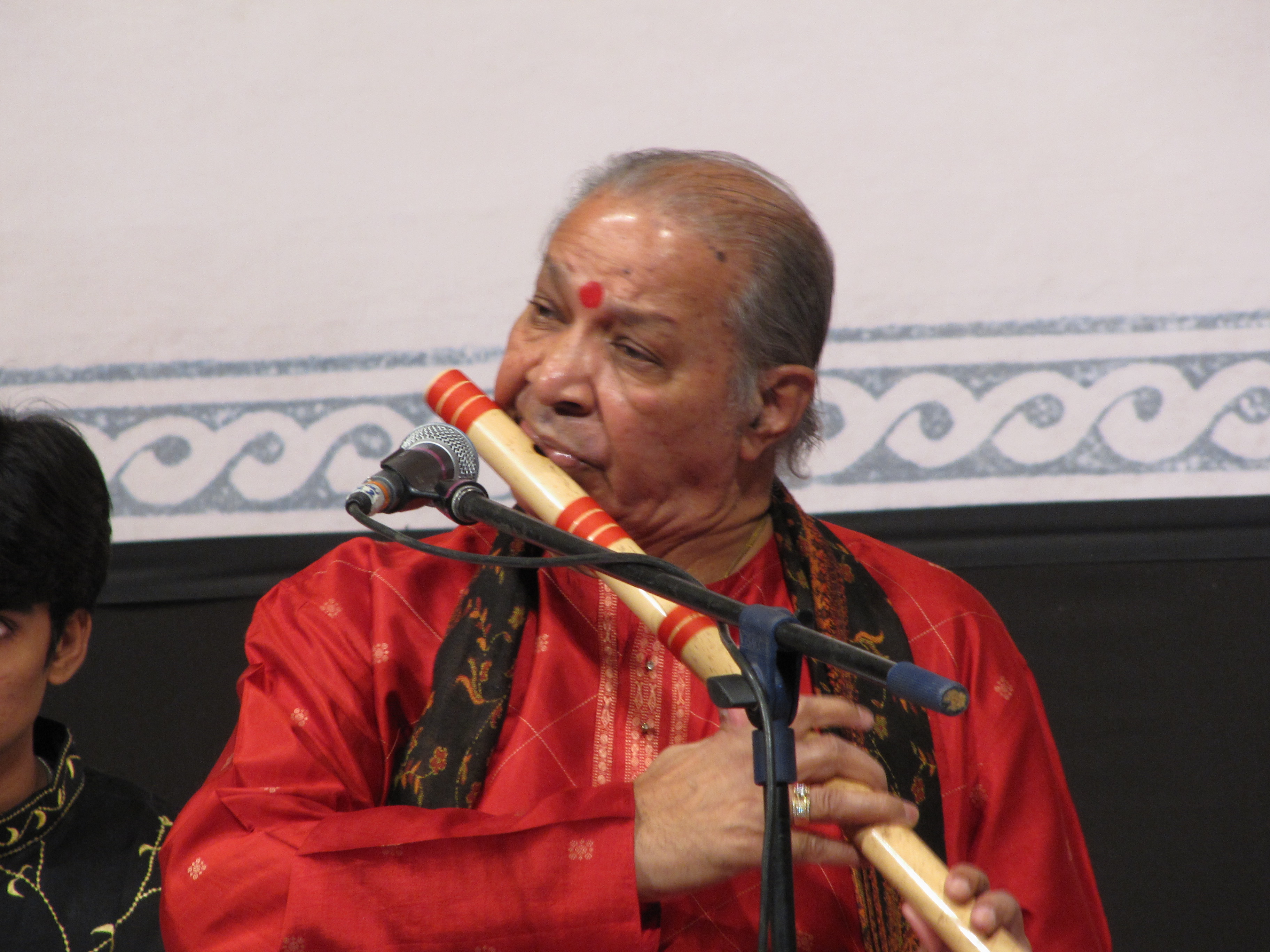 Hariprasad Chaurasia playing the Bansuri
 -
 A Snake Charmer playing Been
 -
A pair of Ghungroos
-
Danseuse with 400 Ghungroos
-

-
 Gharha is made by adding rubber cover on top of the pitcher
 -
Thali is used to serve food and beaten with a stick to make music
-
Carved Vamavarta Shankhas, circa 11-12th century, Pala period

.jpg)


_(8697430998).jpg)


See also[edit | edit source]
- Administrative divisions of Haryana
- Haryanvi cinema
- Haryanvi culture
- Haryanvi cultural tourism
- Haryanvi folk dances
- Haryanvi language
- Haryanvi people
- Haryanvi Raagni
- Haryanvi saang
- Indian musical instruments
- List of Haryanvi-language films
- List of people from Haryana
References[edit | edit source]
- ↑ Art & Cultural Affairs Department of Haryana. "Folk Music of Haryana". Art & Cultural Affairs Department of Haryana. Retrieved 1 October 2020.
- ↑ 2.0 2.1 Gajrani, Shiv (9 September 2004). History, Religion and Culture of India. Vol. 1. Isha Book. p. 96. ISBN 978-8182050600.
- ↑ 3.0 3.1 3.2 3.3 3.4 3.5 3.6 3.7 Manorma Sharma, 2007, Musical Heritage of India, Page 65.
- ↑ Ramyead, Lutchmee Parsad. "THE ESTABLISHMENT AND CULTIVATION OF MODERN STANDARD HINDI IN MAURITIUS" (PDF). p. 93.
- ↑ "IPAAC Home".
- ↑ "IPAAC Home".
- ↑ "About Us".
- ↑ "Evolution of Hindustani music; Patron and Patronage - The Compass". thecompass.in. Archived from the original on 25 January 2019.
- ↑ Nagarkar, Samarth (2013). Raga Sangeet: Understanding Hindustani Classical Vocal Music. New York: Chhandayan, Inc.
- ↑ loor dance
Further reading[edit | edit source]
Jain, Shikha; Bhawna, Dandona (2012). Haryana (Culture Heritage Guide). Aryan Books International. ISBN 9788173054396.

_Indian_string_instruments,_Sarod,_Sitar,_Iktara_-_Soinuenea.jpg)


 India topics India topics | |||||||||||||||||||||
|---|---|---|---|---|---|---|---|---|---|---|---|---|---|---|---|---|---|---|---|---|---|
| |||||||||||||||||||||
| |||||||||||||||||||||
| |||||||||||||||||||||
| |||||||||||||||||||||
| |||||||||||||||||||||