




| Ahir/Aheer | |
|---|---|
 An Aheer from Shahabad, Bihar | |
| Religions | Hinduism[citation needed] |
| Languages | Varies depending on region[citation needed] |
| Populated states | India and Nepal |
| Subdivisions | Yaduvanshi Ahir Nandvanshi Ahir Gwalvanshi Ahir |
Ahir or Aheer is a community of traditionally non-elite pastoralists in India, most of whom now use the Yadav surname, as they consider the two terms synonymous.[1] The Ahirs are variously described as a caste, a clan, a race, and/or a tribe.
The traditional occupations of Ahirs are cattle-herding and agriculture. Since late 19th century to early 20th century, Ahirs have adopted Yadav word for their community and have claimed descent from the mythological king Yadu. This is a part of a movement of social and political resurgence (sanskritisation) under the influence of Arya Samaj.[2]
Ahirs are found throughout India but are particularly concentrated in the northern area. Apart from India, Ahirs have significant population in Nepal, Mauritius, Fiji, South Africa and the Caribbean especially Guyana, Trinidad and Tobago, and Suriname. In Mauritius and Caribbean they are mostly the descendants of indentured servants who arrived in the 19th and 20th centuries from the former pre-partitioned sub-continent of India during the British Raj.[3]
Etymology[edit | edit source]
Ahir is believed to be a derivation of the Sanskrit word, "abhira", and the present term in the Bengali and Marathi languages is abhir.[4][5][6]
History[edit | edit source]

Early history[edit | edit source]
Theories regarding the origins of the ancient Abhira – the putative ancestors of the Ahirs – are varied for the same reasons as are the theories regarding their location; that is, there is a reliance on interpretation of linguistic and factual analysis of old texts that are known to be unreliable and ambiguous.[7]
Some, such as A. P. Karmakar, consider the Abhira to be a Proto-Dravidian tribe who migrated to India and point to the Puranas as evidence. Others, such as Sunil Kumar Bhattacharya, say that the Abhira are recorded as being in India in the 1st-century CE work, the Periplus of the Erythraean Sea. Bhattacharya considers the Abhira of old to be a race rather than a tribe.[7] The sociologist M. S. A. Rao and historians such as P. M. Chandorkar and T. Padmaja say that epigraphical and historical evidence exists for equating the Ahirs with the ancient Yadava tribe.[8][9][10]
Whether they were a race or a tribe, nomadic in tendency or displaced or part of a conquering wave, with origins in Indo-Scythia or Central Asia, Aryan or Dravidian – there is no academic consensus, and much in the differences of opinion relate to fundamental aspects of historiography, such as controversies regarding dating the writing of the Mahabharata and acceptance or otherwise of the Indo-Aryan migration (which is universally accepted in mainstream scholarship).[15] Similarly, there is no certainty regarding the occupational status of the Abhira, with ancient texts sometimes referring to them as pastoral and cowherders but at other times as robber tribes.[16]
Kingdoms[edit | edit source]
![[icon]](/wiki/File:Wiki_letter_w_cropped.svg) | This section needs expansion. You can help by adding to it. (November 2024) |
- Ahir dynasty in pre-12th century areas in present-day Nepal[17]
- Ahir-Rajas of Sagar[18]
- Ahir Rajas of Gawror fort, Patna.[19]
Military involvements[edit | edit source]
,_1st_Battalion,_The_5th_Light_Infantry.jpg)
,_1st_Battalion,_5th_Light_Infantry.jpg)
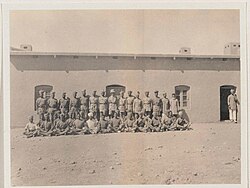
The British rulers of India classified the Ahirs of Punjab as an "agricultural tribe" in the 1920s, which was at that time synonymous with being a "martial race".[22] This was a designation created by administrators that classified each ethnic group as either "martial" or "non-martial": a "martial race" was typically considered brave and well built for fighting,[23] whilst the remainder were those whom the British believed to be unfit for battle because of their sedentary lifestyles.[24] However, the martial races were also considered politically subservient, intellectually inferior, lacking the initiative or leadership qualities to command large military formations. The British had a policy of recruiting the martial Indians from those who has less access to education as they were easier to control.[25][26] According to modern historian Jeffrey Greenhunt on military history, "The Martial Race theory had an elegant symmetry. Indians who were intelligent and educated were defined as cowards, while those defined as brave were uneducated and backward". According to Amiya Samanta, the marital race was chosen from people of mercenary spirit (a soldier who fights for any group or country that will pay him/her), as these groups lacked nationalism as a trait.[27] Ahirs had been recruited into the army from 1898.[28] In that year, the British raised four Ahir companies, two of which were in the 95th Russell's Infantry.[29][page needed] In post-independence India, some Ahir units have been involved in celebrated military actions, such as at Rezang La in the 1962 Sino-Indian War that saw the last stand of Charlie company, consisting of 114 Ahirs of 13 Kumaon, and in the 1965 India-Pakistan War.[30][31][32][33]
Sanskritisation[edit | edit source]
Recreating the past for new identity[edit | edit source]
It was from the 1920s that some Ahirs began to adopt the name of Yadav and created the Yadav Mahasabha, founded by ideologues such as Rajit Singh. Several caste histories and periodicals to trace a Kshatriya origin were written at the time, notably by Mannanlal Abhimanyu. These were part of the jostling among various castes for socio-economic status and ritual under the Raj and they invoked support for a zealous, martial Hindu ethos.[34] Arya Samaj, a Hindu reformist organization also played an important role in ritual purification of Ahir/Yadavs and many low castes in order to incorporate them into Vedic Hinduism.[35] In U.P, it was through shastrarth debates and with the help of reform movements like Arya Samaj and Vaishnava Ramanandi order in public debates that the Ahirs defended their claims to a higher social status.[36] At the same time Ahir/Yadav intelligentsia also emphasized the socio-economic backwardness faced by their community and in 1927, a petition was sent to the Simon Commission describing how the Ahirs suffers from the same social disabilities and discrimination as the Chamars.[37] Despite explicitly expressing their commitment against untouchability, it has been observed that these movements by Yadav caste associations have not been egalitarian enough to include communities who are under Scheduled Castes and have claimed connection with Krishna.[38] Yadavs of Braj-Ahirwal attempted to "endlessly portray themselves" as inheritors of the heritage of local dynasties such as the Jats of Bharatpur and Alwar, Jadon Rajputs of Jaleshar and Karauli and fellow Ahir dynasties of Rewari and Mahabhan who were considered to be of Yaduvanshi descent.[38]:43
Participation in reactionary communal conflicts[edit | edit source]
The Ahirs in Benaras, UP had been one of the more militant Hindu groups during pre-independent India. In one of the instances before independence, Hindu shudra caste groups as the Ahirs actively participated in a counter-reactionary communal conflict orchestrated by Arya Samaj.[39] Some writers are also of the opinion that many low-castes (including Ahirs) took to cow protection for asserting higher status since cow already had symbolic importance in Hinduism. This view of cow protection was different from the UP's urban elites.[40]
Distribution[edit | edit source]

Ahirs in India are known by numerous other names, including Gauli[41] and Ghosi or Gop in North India.[42] In Gujarat and South India as Ayar, Golla and Konar.[43] Some in the Bundelkhand region of Uttar Pradesh are known as Dauwa.[44] The Ahirs have more than 20 sub-castes.[45][better source needed]
North India[edit | edit source]
They have a significant population in the region around Behror, Alwar, Rewari, Narnaul, Mahendragarh, Gurgaon[46] and Jhajjar[47][page needed][48] – the region is therefore known as Ahirwal or the abode of Ahirs.[49]
Maharashtra[edit | edit source]
Ahirani dialect continues to be spoken today in the region and is widespread across Jalgaon, Dhule and Nashik. It is an admixture of Marathi, Gujarati, Hindi, ancient Magadhi, Saurashtri, Sauraseni, Lati, Maharashtri, Prakrit and Paishachi.[50][51]
Culture[edit | edit source]

Ahir culture is rooted in pastoralism and closely associated to the worship of Krishna and Shiva.[52][53] Through Sanskritization,[2] the Ahirs adopted the modern-day ‘Yadav’ surname and linked themselves to the Yadu tribe by claiming descent from Yaduvanshi, Nandavanshi, and Goallavanshi, elevating their status within the caste hierarchy.[lower-alpha 1][54][55][56]
Diet[edit | edit source]
In 1992, Noor Mohammad noted that most Ahirs in Uttar Pradesh were vegetarian, with some exceptions who were engaged in fishing and raising poultry.[57]
Language and tradition[edit | edit source]
Ahirs of Benares speak a Hindi dialect which is different from one used normally.[58][59] Ahirs usually speak the language of the region in which they live. Some languages/dialects named after Ahirs are Ahirani, also known as Khandeshi, spoken in Khandesh region of Maharashtra, Ahirwati spoken in Ahirwal region of Haryana and Rajasthan.
Folklore[edit | edit source]
The oral epic of Veer Lorik, a mythical Ahir hero, has been sung by folk singers in North India for generations.[60] Mulla Daud, a Sufi Muslim, retold the romantic story in writing in the 14th century.[61] Other Ahir folk traditions include those related to Kajri and Biraha.[62]
See also[edit | edit source]
Notes[edit | edit source]
- ↑ Through Sanskritization,[2] the Ahirs restructured its identity into three broad caste divisions for upliftment:
- Nandavanshi : Claim descent from Nanda, Krishna foster father, linking to Vrindavan pastoral traditions.[54]
- Yaduvanshi: Trace lineage to King Yadu, the legendary founder of the Yadava dynasty.[54]
- Goallavanshi: Originating from the Goala (cowherd) community, they associate with the Gopas and Gopis of Krishna childhood.[54]
References[edit | edit source]
- ↑ People of India: Uttar Pradesh. Anthropological Survey of India. 2005. p. 1551. ISBN 978-81-7304-114-3.
These Ahir of past, now identify themselves as Yadav or Yadubansi and to support this claim use the surname, Yadav, and thus try to distinguish themselves from other constituent groups forming the large Ahir caste.
- ↑ 2.0 2.1 2.2 Sanskritisation of Ahir:
- Jaffrelot, Christophe (2003). India's silent revolution: the rise of the lower castes in North India. London: C. Hurst & Co. p. 189. ISBN 978-1-85065-670-8. Retrieved 16 August 2011.
Ahirs willingly subjected themselves to Sanskritisation because of their special relation to sacred cow but alas because the Arya Samaj exerted significant Sanskritising influence over the Yadav movement. As early as 1895, the ruler of Rewari, Rao Yudhishter Singh ( the father of Rao Bahadur Balbir Singh), invited Swami Dayananda to his state. Branches of the Arya Samaj flourished soon after and Rewari provided a base from which Arya Samaj updeshaks (itinerant preachers) operated in neighbouring areas.
- Jassal, Smita Tewari; École pratique des hautes études (France). Section des sciences économiques et sociales; University of Oxford. Institute of Social Anthropology (2001). "Caste in the Colonial State: Mallahs in the census". Contributions to Indian sociology. Mouton. pp. 319–351. Quote: "The movement, which had a wide interregional spread, attempted to submerge regional names such as Goala, Ahir, Ahar, Gopa, etc., in favour of the generic term Yadava (Rao 1979). Hence a number of pastoralist castes were subsumed under Yadava, in accordance with decisions taken by the regional and national level caste sabhas. The Yadavas became the first among the shudras to gain the right to wear the janeu, a case of successful sanskritisation which continues till date. As a prominent agriculturist caste in the region, despite belonging to the shudra varna, the Yadavas claimed Kshatriya status tracing descent from the Yadu dynasty. The caste's efforts matched those of census officials, for whom standardisation of overlapping names was a matter of policy. The success of the Yadava movement also lies in the fact that, among the jaati sabhas, the Yadava sabha was probably the strongest, its journal, Ahir Samachar, having an all-India spread. These factors strengthened local efforts, such as in Bhojpur, where the Yadavas, locally known as Ahirs, refused to do begar, or forced labour, for the landlords and simultaneously prohibited liquor consumption, child marriages, and so on."
- Berti, Daniela; Kanungo, Pralay; Jaoul, Nicolas (2011). Cultural Entrenchment of Hindutva Local Mediations and Forms of Convergence (1st ed.). Routledge. p. 246. ISBN 978-1-138-65995-7.
Marginalised groups, often considered as Shudras, like the Ahirs (Yadavs), Kurmis and the Gujars, began to redefine their emerging political and economic role in society by fighting on the same 'religious' grounds. In so doing, they refashioned their status as warriors and kings who had played a special role in history as guardians of Hinduism (Gooptu 2001 : 195; see also Pinch 1996 : 118–38). Gyanendra Pandey (1990: 66–108) describes how, since the end of the 19th century, such processes of Sanskritisation (adoption of 'higher' forms of Hinduism) among lower castes have joined up with Hindu nationalist movements, such as the cow protection movement, and how these interrelations have been central to the formation of a Hindu and a Muslim community in northern India.
- Adcock, C. S. (2014). Limits of Tolerance: Indian Secularism and the Politics of Religious Freedom. OUP USA. p. 46. ISBN 978-0-19-999544-8.
In U.P., the Ahir/Yadav castes, whom elites deemed Shudras, also used shästrärth debates to defend their claims to elevated, Kshatriya status from at least the 1890s. In the eastern districts of U.P., monks of the Vaishnava Ramanandi order defended the Ahirs' claims in public debate; in western U.P., their champions in debate were often members of the Arya Samaj.
- Jaffrelot, Christophe (2003). India's silent revolution: the rise of the lower castes in North India. London: C. Hurst & Co. p. 189. ISBN 978-1-85065-670-8. Retrieved 16 August 2011.
- ↑ *Claveyrolas, Mathieu (2015). "The 'Land of the Vaish'? Caste Structure and Ideology in Mauritius". South Asia Multidisciplinary Academic Journal. doi:10.4000/samaj.3886. ISSN 1960-6060. S2CID 143034648.
- Moore, Brian L. (1977). "The Retention of Caste Notions among the Indian Immigrants in British Guiana during the Nineteenth Century". Comparative Studies in Society and History. 19 (1): 96–107. doi:10.1017/S0010417500008513. JSTOR 177986. S2CID 143278239.
- Jha, J. C. (1973). "Indian Heritage in Trinidad, West Indies". Caribbean Quarterly. 19 (2): 28–50. doi:10.1080/00086495.1973.11829152. JSTOR 23050197.
- Pradhan, Rajendra; Shrestha, Ava (June 2005). "Ethnic and Caste Diversity: Implications for Development" (PDF). Think Asia. Asian Development Bank. hdl:11540/3290. NRM Working Paper No. 4. Archived from the original (PDF) on 11 November 2022. Retrieved 7 June 2022.
- "Indian Labour in British Guiana | History Today".
- "The legacy of Indian migration to European colonies". The Economist. 2 September 2017.
- ↑ Garg, Gaṅga Ram, ed. (1992). Encyclopaedia of the Hindu world. Vol. 1. Concept Publishing Company. pp. 113–114. ISBN 978-81-7022-374-0.
- ↑ "People of Maharashtra" (PDF).
- ↑ Shashi, Shyam Singh (1994). Encyclopaedia of Indian Tribes: The tribal world in transition. Anmol Publications. ISBN 978-81-7041-836-8.
- ↑ 7.0 7.1 Bhattacharya, Sunil Kumar (1996). Krishna – Cult in Indian Art. M.D. Publications. p. 126. ISBN 978-81-7533-001-6.
- ↑ Guha, Sumit (2006). Environment and Ethnicity in India, 1200–1991. University of Cambridge. p. 47. ISBN 978-0-521-02870-7.
- ↑ Rao, M. S. A. (1978). Social Movements in India. Vol. 1. Manohar. pp. 124, 197, 210.
- ↑ T., Padmaja (2001). Temples of Kr̥ṣṇa in South India: History, Art, and Traditions in Tamilnāḍu. Archaeology Dept., University of Mysore. pp. 25, 34. ISBN 978-8-170-17398-4.
- ↑ Thapar, Romila (2006). India: Historical Beginnings and the Concept of the Aryan. National Book Trust. ISBN 978-81-237-4779-8.
- ↑ Wendy Doniger (2017), "Another Great Story"", review of Asko Parpola's The Roots of Hinduism; in: Inference, International Review of Science, Volume 3, Issue 2
- ↑ Girish Shahane (September 14, 2019), Why Hindutva supporters love to hate the discredited Aryan Invasion Theory, Scroll.in
- ↑ Koenraad Elst (May 10, 2016), Koenraad Elst: "I am not aware of any governmental interest in correcting distorted history", Swarajya Magazine
- ↑ Out of India aka Indigenous Aryans has no support:
- Romila Thapar (2006): "there is no scholar at this time seriously arguing for the indigenous origin of Aryans".[11]
- Wendy Doniger (2017): "The opposing argument, that speakers of Indo-European languages were indigenous to the Indian subcontinent, is not supported by any reliable scholarship. It is now championed primarily by Hindu nationalists, whose religious sentiments have led them to regard the theory of Aryan migration with some asperity."[12]
- Girish Shahane (September 14, 2019), in response to Narasimhan et al. (2019): "Hindutva activists, however, have kept the Aryan Invasion Theory alive, because it offers them the perfect strawman, 'an intentionally misrepresented proposition that is set up because it is easier to defeat than an opponent's real argument' ... The Out of India hypothesis is a desperate attempt to reconcile linguistic, archaeological and genetic evidence with Hindutva sentiment and nationalistic pride, but it cannot reverse time's arrow ... The evidence keeps crushing Hindutva ideas of history."[13]
- Koenraad Elst (May 10, 2016): "Of course it is a fringe theory, at least internationally, where the Aryan Invasion Theory (AIT) is still the official paradigm. In India, though, it has the support of most archaeologists, who fail to find a trace of this Aryan influx and instead find cultural continuity."[14]
- ↑ Malik, Aditya (1990). "The Puskara Mahatmya: A Short Report". In Bakker, Hans (ed.). The History of Sacred Places in India As Reflected in Traditional Literature. Leiden: BRILL and the International Association of Sanskrit Studies. p. 200. ISBN 978-90-04-09318-8.
- ↑ Yadav, Punam (2016). Social Transformation in Post-conflict Nepal: A Gender Perspective. Taylor & Francis. p. 57. ISBN 978-1-317-35389-8.
- ↑ Sharma, A N (2006). The Beria (Rai Dancers)A Socio-demographic, Reproductive, and Child Health Care Practices Profile. Sarup & Sons. p. 13. ISBN 81-7625-714-1.
- ↑ Historical Researches Series. 1963.
- ↑ "Indian officers and non-commissioned officers from 'B' Company (Ahir), 1st Battalion, The 5th Light Infantry, Quetta, 1918 | Online Collection | National Army Museum, London". collection.nam.ac.uk. Retrieved 3 November 2023.
- ↑ "Online Collection | National Army Museum, London". collection.nam.ac.uk. Retrieved 3 November 2023.
- ↑ Mazumder, Rajit K. (2003). The Indian army and the making of Punjab. Orient Blackswan. p. 105. ISBN 978-81-7824-059-6.
- ↑ Rand, Gavin (March 2006). "Martial Races and Imperial Subjects: Violence and Governance in Colonial India 1857–1914". European Review of History. 13 (1): 1–20. doi:10.1080/13507480600586726. S2CID 144987021.
- ↑ Streets, Heather (2004). Martial Races: The military, race and masculinity in British Imperial Culture, 1857–1914. Manchester University Press. p. 241. ISBN 978-0-7190-6962-8. Retrieved 20 October 2010.
- ↑ Omar Khalidi (2003). Khaki and the Ethnic Violence in India: Army, Police, and Paramilitary Forces During Communal Riots. Three Essays Collective. p. 5. ISBN 978-81-88789-09-2.
Apart from their physique, the martial races were regarded as politically subservient or docile to authority
- ↑ Philippa Levine (2003). Prostitution, Race, and Politics: Policing Venereal Disease in the British Empire. Psychology Press. pp. 284–285. ISBN 978-0-415-94447-2.
The Saturday review had made much the same argument a few years earlier in relation to the armies raised by Indian rulers in princely states. They lacked competent leadership and were uneven in quality. Commander in chief Roberts, one of the most enthusiastic proponents of the martial race theory, though poorly of the native troops as a body. Many regarded such troops as childish and simple. The British, claims, David Omissi, believe martial Indians to be stupid. Certainly, the policy of recruiting among those without access to much education gave the British more semblance of control over their recruits.
- ↑ Amiya K. Samanta (2000). Gorkhaland Movement: A Study in Ethnic Separatism. APH Publishing. pp. 26–. ISBN 978-81-7648-166-3.
Dr . Jeffrey Greenhunt has observed that " The Martial Race Theory had an elegant symmetry. Indians who were intelligent and educated were defined as cowards, while those defined as brave were uneducated and backward. Besides their mercenary spirit was primarily due to their lack of nationalism.
- ↑ Pinch, William R. (1996). Peasants and monks in British India. University of California Press. p. 90. ISBN 978-0-520-20061-6.
- ↑ Rao, M. S. A. (1979). Social movements and social transformation: a study of two backward classes movements in India. Macmillan. ISBN 978-0-333-90255-4.
- ↑ Press Information Bureau, Government of India (7 January 2007). "Remembering Rezang La heroes". Sainik samachar.
- ↑ Col Dilbag Dabas (Retd) (15 December 2018). "Heroes of Rezang La 1962". The Tribune.
- ↑ Guruswamy, Mohan (20 November 2012). "Don't forget the heroes of Rezang La". The Hindu. Retrieved 13 July 2014.
- ↑ Singh, Jasbir (2010). Combat Diary: An illustrated history of operations conducted by 4th Kumaon. Lancer Books. p. 212. ISBN 978-1-935501-18-3.
- ↑ Gooptu, Nandini (2001). The Politics of the Urban Poor in Early Twentieth-Century India. Cambridge University Press. pp. 205–210. ISBN 978-0-521-44366-1.
One of the most politically active and vocal among the shudra castes was the ahirs or yadavs. In 1922, an ahir conference was held in Lucknow, followed by another ahir mahotsav (festival) in Allahabad in 1923, where a provincial Mahasabha was inaugurated, with the new name of Yadav Mahasabha. The term yadav, to denote the ahirs, gained currency from this period. Rajit Singh, a yadav born in the Deoria district in 1897, and educated at Gorakhpur and Shikohabad, was instrumental in the formation of the Yadav Mahasabha. He had briefly worked in the Excise Department in Kanpur, but had resigned from his job to devote himself to organising yadav associations from 1921. In 1925, Rajit Singh settled in Benares and inaugurated the Benares Yadav Mahasabha, which soon emerged as the centre of the yadav caste movement in UP. From Benares, Rajit Singh edited the journal Yadav, and also published a history of the yadav castes, entitled Yaduvamsa Prakash. Several other yadav histories were published in rapid succession in the 1920s, written by another younger yadav leader of Benares, Mannalal Abhimanyu, a lawyer who was the son of a school teacher. He wrote Ahir Vamsa Pradip (1925) and Yadukul Sarvasya (1928), in which he attempted to demonstrate the kshatriya origin of the yadavs, with extensive references from both religious texts and British ethnographic tracts.
- ↑ Michuletti, Lucia (2008). The Vernacularisation of Democracy: Politics, Caste, and Religion in India. Routledge. p. 140. ISBN 978-0-415-46732-2.
Hindu reformist organisations like the Arya Samaj which aimed to reform Hinduism and incorporate lower-caste groups within the fold of vedic Aryan Hinduism (see Rao 1979: 132-35), have a pivotal role in 'purifying' the customs of the Ahir/Yadavs and other lower castes through the adoption of Brahmanical Hindu practices. Brahmanical Hinduism emphasises vegetarianism, non-violence and ascetism (Fuller 1992: 88).
- ↑ Adcock, C.S. (2014). The Limits of Tolerance:Indian Secularism and the Politics of Religious Freedom. Oxford University Press. p. 46. ISBN 978-0-19-999543-1.
In U.P., the Ahir/Yadav castes, whom elites deemed Shudras, also used shastrarth debates to defend their claims to elevated, Kshatriya status from at least the 1890s. In the eastern districts of U.P., monks of the Vaishnava Ramanandi order defended the Ahirs' claims in public debate; in western U.P., their champions in debate were often members of the Arya Samaj.
- ↑ Michuletti, Lucia (2008). The Vernacularisation of Democracy: Politics, Caste, and Religion in India. Routledge. p. 83. ISBN 978-0-415-46732-2.
This emphasis on number and on Yadavness versus 'status' is also evident in colonial petitions which portray the Ahirs as a 'backward/ depressed category' in an attempt to get benefits from the reservation provisions. It looks as if the Yadav intelligentsia not only learnt that Yadav social and economic progress or backwardness could be determined by measuring their share in the number of graduates, official appointments and parliamentary seats (Chakrabarty 1994: 150), but also that economic and social disabilities were not 'enough' and that 'ritual' disabilities had also to be proved. The political leaders invoked arguments about the historical deprivation of their communities' (see Gooptu 2001: 11). The following is an extract from a petition sent in 1927 to the Simon Commission, in which a member of the Ahir community illustrates how the community suffers from the same disabilities and discriminations as the Chamars (an untouchable caste).
- ↑ 38.0 38.1 Michuletti, Lucia (2008). The Vernacularisation of Democracy: Politics, Caste, and Religion in India. Routledge. p. 149. ISBN 978-0-415-46732-2.
Although Yadav caste associations organise Other Backward Classes meetings and explicitly express their commitment against untouchability, I never met an SC member attending or delivering a speech at such events. A recent controversy showed how, in practice, Yadav caste associations are not willing to encompass in their social category members of SC communities who claim to descend from Krishna. At the AIYM meeting held in Gurgaon in 1998, a member of the committee raised the issue that Jatavs in Agra and Rajasthan had begun to adopt the Yadav title. A member of the audience pointed out that he had already written to the Mahasabha secretary to inform him that in Bharatpur (Rajasthan) the local Jatavs were calling themselves Yadavs. Another pointed out that in Udaipur, Jatavs who worked as builders and did casual labour were also calling themselves Yadavs and had adopted the Kadamb Yadav clan.
- ↑ Gooptu, Nandini (2001). The Politics of the Urban Poor in Early Twentieth-Century India. Cambridge University Press. p. 307. ISBN 978-0-521-44366-1.
The spread of the tanzeem movement in Benares further fuelled the religious expansion of Hindu organisations, and contributed to an escalation in local competition and communal conflict. Khalil Das' movement elicited a counter-reaction from the Arya Samaj and from such Hindu shudra caste groups as the ahirs, who were active participants in volunteer corps and akharas, and who, in Benares, were involved in an especially active yadav caste movement.... The Ahirs in particular who played an important role in militant Hinduism, retaliated strongly against the Tanzeem movement. In July,1930, about 200 Ahirs marched in procession to Trilochan, a sacred Hindu site and performed a religious ceremony in response to Tanzeem processions.
- ↑ Gould, William (2012). Religion and Conflict in Modern South Asia. Cambridge University Press. p. 70. ISBN 978-0-521-87949-1.
Gyan Pandey's detailed research on the cow protection riots in eastern UP and Bihar in 1893 and 1917 relates the conflict to specific registers of caste difference and status assertion, in a context where the popular view of cow protection from the point of view of low-caste Ahirs, Koeris and Kurmis was quite different to that of UP's urban elites. For both Freitag and Pandey, cow protection became a means for relatively low-status communities to assert higher status via association with something of symbolic importance to Hinduism as a whole: in this case, the cow.
- ↑ Mehta, B. H. (1994). Gonds of the Central Indian Highlands. Vol. II. New Delhi: Concept Publishing Company. pp. 568–569.
- ↑ Michelutti, Lucia (2002). "Sons of Krishna: the politics of Yadav community formation in a North Indian town" (PDF). PhD Thesis Social Anthropology. London School of Economics and Political Science. pp. 94–95.
- ↑ * Singh, Rajbir (1994). India's Unequal Citizens: A Study of Other Backward Classes. Manohar, 1994. pp. 34, 356, 390. ISBN 978-81-7304-069-6.
- Sharma, Shish Ram (2002). Protective Discrimination: Other Backward Classes in India. Raj Publications, 2002. pp. 153, 312, 410. ISBN 978-81-86208-23-6.
- ↑ Jain, Ravindra K. (2002). Between History and Legend: Status and Power in Bundelkhand. Orient Blackswan. p. 30. ISBN 978-8-12502-194-0.
- ↑ Patel, Mahendra Lal (1997). Awareness in Weaker Section: Perspective Development and Prospects. M. D. Publications Pvt. Ltd. p. 33. ISBN 978-8-17533-029-0.
- ↑ Guru Nanak Dev University, Sociology Dept (2003). Guru Nanak Journal of Sociology. Sociology Department, Guru Nanak Dev University. pp. 5, 6.
- ↑ Verma, Dip Chand (1975). Haryana. National Book Trust, India.
- ↑ Sharma, Suresh K. (2006). Haryana: Past and Present. Mittal Publications. p. 40. ISBN 978-81-8324-046-8.
- ↑ Michuletti, Lucia (2008). The Vernacularisation of Democracy: Politics, Caste, and Religion in India. Routledge. pp. 41, 42. ISBN 978-0-415-46732-2.
- ↑ Pathak, A. S. (2009). "Maharashtra: Land and its people" (PDF). Maharashtra State Gazetteer. Government of Maharashtra.
- ↑ Guha, Sumit (2006). Environment and Ethnicity in India, 1200–1991. University of Cambridge. p. 47. ISBN 978-0-521-02870-7.
- ↑ .danielou, Alain (2005). The Beria (Rai Dancers)A Socio-demographic, Reproductive, and Child Health Care Practices Profile. Inner Traditions / Bear & Co. p. 56. ISBN 978-1-59477-048-7.
- ↑ Kirshna, Nanditha (2009). Book of Vishnu. Penguin UK. p. 56. ISBN 978-81-8475-865-8.
- ↑ 54.0 54.1 54.2 54.3 Michelutti, Lucia (2002). Sons of Krishna: The Politics of Yadav Community Formation in a North Indian Town. London School of Economics and Political Science (Thesis). p. 89.
In Elliot's description, 'clan,' 'subcaste,' 'caste,' 'tribe,' and 'race' are used interchangeably, indicating difficulty in isolating the social nature and functions of the different Ahir subdivisions. Following locality, Elliot categorizes the Ahir agricultural-pastoral 'tribe' into three main subdivisions ..... These subdivisions are based on mythological-ancestral claims and locality (see Chapter 3). The Yaduvanshi-Ahirs are said to descend from Yadu, one of Krishna's ancestors; the Nandavanshi-Ahirs are descendants of Nanda, Krishna's foster father; and the Goallavanshi-Ahirs descend from the Gopi and Gopas amongst whom Krishna spent his childhood on the banks of the Yamuna near Mathura. Elliot further lists the major clans (got) of the Nandavanshi in Central Doab and the Ahirwal region.
- ↑ Ahirs division through Sanskritization :
- Gupta, Dipankar (8 November 2004). Caste in Question: Identity Or Hierarchy?. SAGE Publications. p. 58. ISBN 978-81-321-0345-5.
Contemporary Ahir/Yadavs define themselves as "Krishnavanshi-Yadavs." Younger generations are often unaware that their original caste title was Ahir. The concept of a unique Krishnavanshi kinship category, which merges traditional subdivisions (Yaduvanshi, Nandavanshi, and Goallavanshi) into a single endogamous unit, is rapidly gaining acceptance. Intermarriage between these previously distinct endogamous units is increasingly popular.
- Michelutti, Lucia (2008). The Vernacularisation of Democracy: Politics, Caste, and Religion in India. Routledge. p. 11. ISBN 9780415467322.
More specifically, it shows how Krishna has progressively become the main god as well as the main ancestor of the local Yadavs and how his cult is substituting the cults of local lineage deities. Such a process is accompanied by the adoption of conservative forms of Hinduism which has transformed the different Ahir/Yadav subdivisions (Nandavanshi, Goallavanshi, and Yaduvanshi) into superior 'Krishnavanshi' Yadavs.
- Singh, Bhrigupati (2015). Poverty and the Quest for Life: Spiritual and Material Striving in Rural India. University of Chicago Press. p. 146. ISBN 978-0-226-19468-4.
Perhaps the most famous love affair in classical Hinduism is between Krishna and Radha. In songs, Radha is often identified as the Gujari (pastoralist) from the village of Barsana, while Krishna belongs to the Yaduvanshi-Ahir caste. Their love affair is not only cross-caste but also pre- or extramarital (though it is never explicitly described as such), as Krishna is married to Rukmini. In temples across India, Krishna is often depicted standing beside Radha, who is described as his divine consort. Such divine affairs may offer human beings some moral respite.
- Gupta, Dipankar (8 November 2004). Caste in Question: Identity Or Hierarchy?. SAGE Publications. p. 58. ISBN 978-81-321-0345-5.
- ↑ Kashyap, Anirban (1996). The Scheduled Castes in India. Gyan Publishing House. ISBN 978-81-212-0511-5.
For example, appealed to the Census Commissioner that their caste names of Golla, Gowli, Gollawar and Ahir be changed to Yadava.
- ↑ Mohammad, Noor (1992). New Dimensions in Agricultural ... Concept Publishing Company. p. 60. ISBN 978-81-7022-403-7.
- ↑ .danielou, Alain (2005). The Beria (Rai Dancers)A Socio-demographic, Reproductive, and Child Health Care Practices Profile. Inner Traditions / Bear & Co. p. 56. ISBN 978-1-59477-048-7.
- ↑ Kirshna, Nanditha (2009). Book of Vishnu. Penguin UK. p. 56. ISBN 978-81-8475-865-8.
- ↑ Verma, Sheela (2008). Magahi Folklore and Folk Tales. Manohar. p. 88. ISBN 9788173048043.
Another story of a local hero Lorik is also very famous [in the Magahi region]. ... The whole story of Lorik and Chanaini has been put in ballad form by different bards. This ballad is sung not only in Magadh but also in entire north India in all auspicious occasions by Ahirs (milkmen) with great devotion and love.
- ↑ "Spectrum". The Sunday Tribune. 1 August 2010. Retrieved 13 July 2014.
- ↑ Koskoff, Ellen, ed. (2008). The Concise Garland Encyclopedia of World Music: The Middle East, South Asia, East Asia, Southeast Asia. Routledge. p. 1026. ISBN 978-0-415-97293-2.