


Introduction


India, officially the Republic of India, is a country in South Asia. It is the seventh-largest country by area; the most populous country since 2023; and, since its independence in 1947, the world's most populous democracy. Bounded by the Indian Ocean on the south, the Arabian Sea on the southwest, and the Bay of Bengal on the southeast, it shares land borders with Pakistan to the west; China, Nepal, and Bhutan to the north; and Bangladesh and Myanmar to the east. In the Indian Ocean, India is near Sri Lanka and the Maldives. Its Andaman and Nicobar Islands share a maritime border with Myanmar, Thailand, and Indonesia. (Full article...)

 Featured article –

-

The 44th Chess Olympiad (28 July – 10 August 2022) was a FIDE-organised international team chess event held in Chennai, the capital of Tamil Nadu, India. It consisted of two main tournaments—an Open event, enabling participation of players from all genders, and a Women's event, enabling participation of female players only—as well as several events to promote chess. The Olympiad was initially supposed to take place in Khanty-Mansiysk, Russia, the host of the Chess World Cup 2019, in August 2020, but it was later moved to Moscow. However, it was postponed due to the COVID-19 pandemic and then relocated to Chennai following Russia's invasion of Ukraine. This was the first Chess Olympiad to take place in India.
The total number of participants was 1,737: 937 in the Open and 800 in the Women's event. The number of registered teams was 188 from 186 nations in the Open section and 162 from 160 nations in the Women's section; being the host nation, India had three teams participating in each section. Both sections set team participation records. The main venue of the Chess Olympiad was the convention centre at the Four Points by Sheraton, while the opening and closing ceremonies were held at the Jawaharlal Nehru Stadium. The Chief Arbiter of the event was France's Laurent Freyd. (Full article...) -
Rani Mukerji (Hindustani pronunciation: [raːni mʊkʰərdʒi]; born 21 March 1978) is an Indian actress who works in Hindi films. She is the recipient of multiple accolades, including a National Film Award and eight Filmfare Awards. Mukerji has featured in listings of the highest-paid actresses of the 2000s.
Born into the Mukherjee-Samarth family, Mukerji began acting as a teenager by starring in her father Ram Mukherjee's Bengali-language film Biyer Phool and in the social drama Raja Ki Aayegi Baaraat (both 1996). Mukerji had her first commercial success with the action film Ghulam and breakthrough with the romance Kuch Kuch Hota Hai (both 1998). Following a brief setback, the year 2002 marked a turning point for her when she was cast by Yash Raj Films as the star of the drama Saathiya. (Full article...) -
Margarita with a Straw is a 2014 Indian Hindi-language drama film directed by Shonali Bose. It stars Kalki Koechlin as an Indian teenager with cerebral palsy who relocates to America for her undergraduate education and comes of age following her complex relationship with a blind girl, played by Sayani Gupta. Revathi, Kuljeet Singh, and William Moseley play supporting roles. Produced by Bose in partnership with Viacom18 Motion Pictures, Margarita with a Straw was co-written by Bose and Nilesh Maniyar. The film deals with the challenging concepts of sexuality, inclusion, self-love, and self-acceptance.
Bose conceived the idea for the film in January 2011 during a conversation with Malini Chib, her cousin and a disability rights activist, about the latter's desire to have a normal sex life. Inspired by Chib's story, Bose wrote the first draft of the film's script. After winning a Sundance Mahindra Global Filmmaker Award for the draft, she modified the script to reflect her own perspective, incorporating several personal experiences into the narrative. Bose completed the screenplay with co-writer Maniyar and the advisory council of the Sundance Institute. (Full article...) -
Anbe Sivam (transl. Love Is God) is a 2003 Indian Tamil-language slice-of-life drama film directed by Sundar C and produced by Lakshmi Movie Makers. The film was written by Kamal Haasan, and Madhan provided the dialogues. Anbe Sivam stars Haasan, Madhavan and Kiran Rathod, with Nassar, Santhana Bharathi, Seema and Uma Riyaz Khan playing supporting characters. It tells the story of Nallasivam and Anbarasu, two men of contrasting personalities who undertake an unexpected journey from Bhubaneswar to Chennai.
Produced on a budget of ₹120 million, Anbe Sivam takes on themes such as communism, atheism, and altruism and depicts Haasan's humanist views. The music was composed by Vidyasagar. Arthur A. Wilson served as the cinematographer and M. Prabhaharan served as the art director. (Full article...) -
Ganesha or Ganesh (Sanskrit: गणेश, IAST: Gaṇeśa, IPA: [ɡɐˈɳeːɕɐ]), also known as Ganapati, Vinayaka and Pillaiyar, is one of the best-known and most revered and worshipped deities in the Hindu pantheon and is the Supreme god in the Ganapatya sect. His depictions are found throughout India. Hindu denominations worship him regardless of affiliations. Ganesha also holds the Title of "Pratham Pujya" (the god to be worshipped initially before the worship of any other Deity). Devotion to Ganesha is widely diffused and extends to Jains and Buddhists and beyond India.
Although Ganesha has many attributes, he is readily identified by his elephant head and four arms. He is widely revered, more specifically, as the remover of obstacles and bringer of good luck; the patron of arts and sciences; and the deva of logic, intellect, and wisdom. As the god of beginnings, he is honoured at the start of rites and ceremonies. Ganesha is also invoked during writing sessions as a patron of letters and learning. Several texts relate anecdotes associated with his birth and exploits. (Full article...) -
Alia Bhatt (/ˈɑːliə ˈbʌt/; born 15 March 1993) is a British actress of Indian descent who predominantly works in Hindi films. Known for her portrayals of women in challenging circumstances, she has received several accolades, including a National Film Award and seven Filmfare Awards. She is one of India's highest-paid actresses. Time awarded her with the Time100 Impact Award in 2022 and named her one of the 100 most influential people in the world in 2024.
Born into the Bhatt family, she is a daughter of filmmaker Mahesh Bhatt and actress Soni Razdan. After making her acting debut as a child in the 1999 thriller film Sangharsh, she played her first leading role in Karan Johar's teen film Student of the Year (2012). She won the Filmfare Critics Award for Best Actress for playing a kidnapping victim in the road drama Highway (2014) and went on to establish herself with starring roles in several romantic films produced by Johar's studio Dharma Productions. (Full article...) -
Mayabazar (transl. Market of Illusions) is a 1957 Indian epic Hindu mythological film directed by K. V. Reddy. It was produced by Nagi Reddi and Chakrapani under their banner, Vijaya Productions. The film was shot simultaneously in Telugu and Tamil, with a few differences in the cast. The story is an adaptation of the folk tale Sasirekha Parinayam, which is based on the characters of the epic Mahabharata. It revolves around the roles of Krishna (N. T. Rama Rao) and Ghatotkacha (S. V. Ranga Rao), as they try to reunite Arjuna's son Abhimanyu (Telugu: Akkineni Nageswara Rao, Tamil: Gemini Ganesan) with his love, Balarama's daughter Sasirekha (Savitri). The Telugu version features Gummadi, Mukkamala, Ramana Reddy, and Relangi in supporting roles, with D. Balasubramaniam, R. Balasubramaniam, V. M. Ezhumalai, and K. A. Thangavelu playing those parts in the Tamil version.
The first mythological film produced by their studio, Mayabazar marked a milestone for Nagi Reddi and Chakrapani. In addition to the technical crew, 400 studio workers – including light men, carpenters, and painters – participated in the development of the film. Director Reddy was meticulous with the pre-production and casting phases, which took nearly a year to complete. Though Rama Rao was initially reluctant to play the lead role, his portrayal of Krishna received acclaim and yielded more offers to reprise the same role in several unrelated films. The soundtrack features twelve songs, with most of the musical score composed by Ghantasala. Telugu lyrics were written by Pingali Nagendrarao and Tamil lyrics were written by Thanjai N. Ramaiah Dass. One of those songs, Lahiri Lahiri, was accompanied by the first illusion of moonlight in Indian cinema, shot by cinematographer Marcus Bartley. (Full article...) -
The lion (Panthera leo) is a large cat of the genus Panthera, currently ranging only in Sub-Saharan Africa and India. It has a muscular, broad-chested body; a short, rounded head; round ears; and a dark, hairy tuft at the tip of its tail. It is sexually dimorphic; adult male lions are larger than females and have a prominent mane that which extends from the head to the shoulders and chest.
The lion inhabits grasslands, savannahs, and shrublands. It is an apex and keystone predator, preying mostly on medium-sized and large ungulates. It is usually more diurnal than other wild cats, but when persecuted, it adapts to being active at night and at twilight. It is a social species, forming groups called prides. A lion pride consists of related females and cubs, and a few or one adult male who is unrelated to the females. Groups of female lions usually hunt together. Adult males often compete to keep or gain their membership in the pride. (Full article...) -
Margaret Alice Murray (13 July 1863 – 13 November 1963) was a British Egyptologist, archaeologist, anthropologist, historian, and folklorist. The first woman to be appointed as a lecturer in archaeology in the United Kingdom, she worked at University College London (UCL) from 1898 to 1935. She was president of the Folklore Society from 1953 to 1955, and published widely.
Born to a wealthy middle-class English family in Calcutta, British India, Murray divided her youth between India, Britain, and Germany, training as both a nurse and a social worker. Moving to London, in 1894 she began studying Egyptology at UCL, developing a friendship with department head Flinders Petrie, who encouraged her early academic publications and appointed her junior lecturer in 1898. In 1902–1903, she took part in Petrie's excavations at Abydos, Egypt, there discovering the Osireion temple, and the following season investigated the Saqqara cemetery, both of which established her reputation in Egyptology. Supplementing her UCL wage by giving public classes and lectures at the British Museum and Manchester Museum, it was at the latter in 1908 that she led the unwrapping of Khnum-nakht, one of the mummies recovered from the Tomb of two Brothers – the first time that a woman had publicly unwrapped a mummy. Recognising that British Egyptomania reflected the existence of widespread public interest in Ancient Egypt, Murray wrote several books on Egyptology targeted at a general audience. (Full article...) -

Robert Montagu Poore, CIE, DSO (20 March 1866 – 14 July 1938) was a cricketer and British army officer who, whilst serving in South Africa in 1896, played in three Tests for the South African cricket team. Much of his cricket was played when he held the rank of major, but he eventually became a brigadier-general. "Of all the people in the history of the game," wrote Leo Cooper in an introduction to A. A. Thomson's Odd Men In, "he seems to stand for the Eccentric Ideal." (Full article...) -

Reginald Heber (21 April 1783 – 3 April 1826) was an English Anglican bishop, a man of letters, and hymn-writer. After 16 years as a country parson, he served as Bishop of Calcutta until his death at the age of 42. The son of a rich landowner and cleric, Heber gained fame at the University of Oxford as a poet. After graduation he made an extended tour of Scandinavia, Russia and Central Europe. Ordained in 1807, he took over his father's old parish, Hodnet, Shropshire. He also wrote hymns and general literature, including a study of the works of the 17th-century cleric Jeremy Taylor.
He was consecrated Bishop of Calcutta in October 1823. He travelled widely and worked to improve the spiritual and general living conditions of his flock. Arduous duties, a hostile climate and poor health led to his collapse and death after less than three years in India. Memorials were erected there and in St Paul's Cathedral, London. A collection of his hymns appeared soon after his death. "Holy, Holy, Holy! Lord God Almighty" remains popular for Trinity Sunday, while "Brightest and Best" is frequently sung during Epiphany. (Full article...) -

Territory of the Western Chalukyas (c. 1100 CE) in India (modern boundaries shown) and the empire's capital, Kalyani, in the modern Bidar district, Karnataka state, India
A large body of Western Chalukya literature in the Kannada language was produced during the reign of the Western Chalukya Empire (973–1200 CE) in what is now southern India. This dynasty, which ruled most of the western Deccan in South India, is sometimes called the Kalyani Chalukya dynasty after its royal capital at Kalyani (now Basavakalyan), and sometimes called the Later Chalukya dynasty for its theoretical relationship to the 6th-century Chalukya dynasty of Badami. For a brief period (1162–1183), the Kalachuris of Kalyani, a dynasty of kings who had earlier migrated to the Karnataka region from central India and served as vassals for several generations, exploited the growing weakness of their overlords and annexed the Kalyani. Around 1183, the last Chalukya scion, Someshvara IV, overthrew the Kalachuris to regain control of the royal city. But his efforts were in vain, as other prominent Chalukya vassals in the Deccan, the Hoysalas, the Kakatiyas and the Seunas destroyed the remnants of the Chalukya power.
Kannada literature from this period is usually categorised into the linguistic phase called Old-Kannada. It constituted the bulk of the Chalukya court's textual production and pertained mostly to writings relating to the socio-religious development of the Jain faith. The earliest well-known writers belonging to the Shaiva faith are also from this period. Under the patronage of Kalachuri King Bijjala II, whose prime minister was the well-known Kannada poet and social reformer Basavanna, a native form of poetic literature called Vachana literature (lit "utterance", "saying" or "sentence") proliferated. The beginnings of the Vachana poetic tradition in the Kannada-speaking region trace back to the early 11th century. Kannada literature written in the champu metre, composed of prose and verse, was popularised by the Chalukyan court poets. However, with the advent of the Veerashaiva (lit, "brave devotees of the god Shiva") religious movement in the mid-12th century, poets favoured the native tripadi (three-line verse composed of eleven ganas or prosodic units), hadugabba (song-poem) and free verse metres for their poems. (Full article...) -

India, officially the Republic of India, is a country in South Asia. It is the seventh-largest country by area; the most populous country since 2023; and, since its independence in 1947, the world's most populous democracy. Bounded by the Indian Ocean on the south, the Arabian Sea on the southwest, and the Bay of Bengal on the southeast, it shares land borders with Pakistan to the west; China, Nepal, and Bhutan to the north; and Bangladesh and Myanmar to the east. In the Indian Ocean, India is near Sri Lanka and the Maldives. Its Andaman and Nicobar Islands share a maritime border with Myanmar, Thailand, and Indonesia.
Modern humans arrived on the Indian subcontinent from Africa no later than 55,000 years ago. Their long occupation, predominantly in isolation as hunter-gatherers, has made the region highly diverse. Settled life emerged on the subcontinent in the western margins of the Indus river basin 9,000 years ago, evolving gradually into the Indus Valley Civilisation of the third millennium BCE. By 1200 BCE, an archaic form of Sanskrit, an Indo-European language, had diffused into India from the northwest. Its hymns recorded the early dawnings of Hinduism in India. India's pre-existing Dravidian languages were supplanted in the northern regions. By 400 BCE, caste had emerged within Hinduism, and Buddhism and Jainism had arisen, proclaiming social orders unlinked to heredity. Early political consolidations gave rise to the loose-knit Maurya and Gupta Empires. During this era, there was a flourishing of creativity in art, architecture, and writing, the status of women declined, and untouchability became an organised belief. In South India, the Middle kingdoms exported Dravidian language scripts and religious cultures to the kingdoms of Southeast Asia. (Full article...) -
Kahaani (IPA: [kəˈɦaːni]; transl. Story) is a 2012 Indian Hindi-language thriller film co-written, co-produced and directed by Sujoy Ghosh. It stars Vidya Balan as Vidya Bagchi, a pregnant woman searching for her missing husband in Kolkata during the festival of Durga Puja, assisted by Assist Sub-Inspector Satyoki "Rana" Sinha (Parambrata Chatterjee) and Inspector General A. Khan (Nawazuddin Siddiqui).
Made on a shoestring budget of ₹80 million (US$1.1 million), Kahaani was conceived and developed by Ghosh, who co-wrote the film with Advaita Kala. The crew often employed guerrilla-filmmaking techniques on Kolkata's city streets to avoid attracting attention. The film was noted for its deft portrayal of the city and for making use of many local crew and cast members. Kahaani explores themes of feminism and motherhood in male-dominated Indian society. The film also makes several allusions to Satyajit Ray's films such as Charulata (1964), Aranyer Din Ratri (1970) and Joi Baba Felunath (1979). The film's musical score and soundtrack is composed by Clinton Cerejo and Vishal–Shekhar respectively, with cinematography being handled by Setu and editing done by Namrata Rao. (Full article...) -
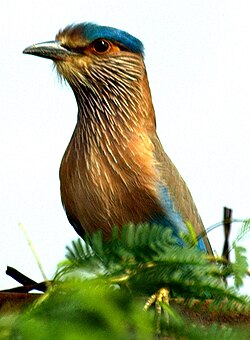
The Indian roller (Coracias benghalensis), is a member of the roller family of birds. They are found widely across tropical Asia stretching from Iraq eastward across the Indian subcontinent to Indochina and are best known for the aerobatic displays of the male during the breeding season. They are very commonly seen perched along roadside trees and wires and are commonly seen in open grassland and scrub forest habitats. It is not migratory, but undertakes some seasonal movements. It was the state bird of Hyderabad State. (Full article...) -
Kareena Kapoor Khan (pronounced [kəˈriːna kəˈpuːr]; née Kapoor; born 21 September 1980) is an Indian actress who appears in Hindi films. She is the daughter of actors Randhir Kapoor and Babita, and the younger sister of actress Karisma Kapoor. Noted for playing a variety of characters in a range of film genres—from romantic comedies to crime dramas—Kapoor is the recipient of several awards, including six Filmfare Awards, and is one of Bollywood's highest-paid actresses.
After making her acting debut in 2000 in Refugee, Kapoor established herself with roles in the dramas Aśoka and Kabhi Khushi Kabhie Gham... (both 2001). This was followed by a series of commercial failures and negative reviews for her repetitive roles. An against-type performance as a sex worker in the drama Chameli marked a turning point in her career. She earned critical recognition for her portrayal of a riot victim in the 2004 drama Dev and a character based on William Shakespeare's heroine Desdemona in the 2006 crime film Omkara. Further praise came for her performances in the romantic comedies Jab We Met (2007) and Ek Main Aur Ekk Tu (2012), the thrillers Kurbaan (2009) and Talaash: The Answer Lies Within (2012), and the dramas We Are Family (2010), Heroine (2012) and Udta Punjab (2016). Her highest-grossing releases include the dramas 3 Idiots (2009), Bodyguard (2011) and Bajrangi Bhaijaan (2015), the action film Singham Returns (2014), and the comedies Veere Di Wedding (2018) and Good Newwz (2019). (Full article...) -
Parinda (transl. Bird) is a 1989 Indian Hindi-language crime thriller film directed, produced and distributed by Vidhu Vinod Chopra. The film stars Jackie Shroff, Anil Kapoor, Nana Patekar and Madhuri Dixit. The story and scenario were written by Chopra, while Shiv Kumar Subramaniam and Imtiyaz Husain wrote the screenplay and dialogues, respectively. R. D. Burman composed the music and Khurshid Hallauri wrote the lyrics. Binod Pradhan served as the film's cinematographer and Renu Saluja was its editor.
Parinda's story is loosely inspired by Marlon Brando starrer On the Waterfront. Parinda follows Kishan (Shroff), who works for the underworld chieftain Anna (Patekar). Kishan's brother Karan (Kapoor) returns home after completing his studies in the United States. The two brothers are caught on different sides of a gang war after Karan decides to avenge his friend's death by Anna. (Full article...) -
Preity G Zinta (pronounced [ˈpriːt̪i ˈzɪɳʈa]; born 31 January 1975) is an Indian actress and entrepreneur primarily known for her work in Hindi films. After graduating with degrees in English honours and criminal psychology, Zinta made her acting debut in Dil Se.. in 1998, followed by a role in Soldier in the same year. These performances earned her the Filmfare Award for Best Female Debut, and she was later recognised for her role as a teenage single mother in Kya Kehna (2000). She subsequently established a career as a leading actress of Hindi cinema with a variety of character types. Her roles, often deemed culturally defiant, along with her unconventional screen persona have been credited with contributing to a change in the concept of Indian film heroines, and won her several accolades.
Following critically appreciated roles in Chori Chori Chupke Chupke (2001), Dil Chahta Hai (2001), Dil Hai Tumhaara (2002), and Armaan (2003), Zinta received the Filmfare Award for Best Actress for her performance in Kal Ho Naa Ho (2003). She starred in two consecutive annual top-grossing films in India, Koi... Mil Gaya (2003) and Veer-Zaara (2004), and was noted for her portrayal of independent, modern Indian women in Salaam Namaste (2005) and Kabhi Alvida Naa Kehna (2006), top-grossing productions in overseas markets. For her first international role in the Canadian drama Heaven on Earth (2008) she was awarded the Silver Hugo Award for Best Actress and nominated for the Genie Award for Best Actress. She followed this with a hiatus from acting work for several years, with the exception of her self-produced comeback film, Ishkq in Paris (2013), which failed to leave a mark. (Full article...) -
Hritik Rakesh Nagrath (born 10 January 1974), known professionally as Hrithik Roshan (Hindi: [ˈɾɪt̪ɪk ɾoːʃən]), is an Indian actor and producer who works in Hindi cinema. Referred as the millenial superstar, he has portrayed a variety of characters and is known for his dancing skills. One of the highest-paid actors in India, he has won many awards, including six Filmfare Awards, of which four were for Best Actor. Starting from 2012, he has appeared in Forbes India's Celebrity 100 several times based on his income and popularity.
Roshan has frequently collaborated with his father, Rakesh Roshan. He made brief appearances as a child actor in several films in the 1980s and later worked as an assistant director on four of his father's films. His first leading role was in the box-office success Kaho Naa... Pyaar Hai (2000), for which he received several awards. Performances in the 2000 terrorism drama Fiza and the 2001 ensemble family drama Kabhi Khushi Kabhie Gham consolidated his reputation but were followed by several poorly received films. (Full article...) -
The 2000 Sri Lanka cyclone (IMD designation: BOB 06 JTWC designation: 04B) was the strongest tropical cyclone to strike Sri Lanka since 1978. The fourth tropical storm and the second severe cyclonic storm of the 2000 North Indian Ocean cyclone season, it developed from an area of disturbed weather on December 25, 2000. It moved westward, and quickly strengthened under favorable conditions to reach top wind speeds of 75 mph (121 km/h). The cyclone hit eastern Sri Lanka at peak strength, then weakened slightly while crossing the island before making landfall over southern India on December 28. The storm degenerated into a remnant low later that day, before merging with another trough on the next day.
The storm was the first cyclone over Sri Lanka with winds of at least hurricane strength since a cyclone of 1978 hit the island in the 1978 season, as well as the first tropical storm to hit the island since 1992. The storm was also the first December tropical cyclone of hurricane intensity in the Bay of Bengal since 1996. It produced heavy rainfall and strong winds, damaging or destroying tens of thousands of houses and leaving up to 500,000 homeless. At least nine people died as a result of the cyclone. (Full article...) -
In Hindu mythology, Ahalya (Sanskrit: अहल्या, IAST: Ahalyā) also spelt as Ahilya, is the wife of the sage Gautama Maharishi. Many Hindu scriptures describe her legend of seduction by the king of the gods Indra, her husband's curse for her infidelity, and her liberation from the curse by the god Rama.
Created by the god Brahma as the most beautiful woman, Ahalya was married to the much older Gautama. In the earliest full narrative, when Indra comes disguised as her husband, Ahalya sees through his disguise but nevertheless accepts his advances. Later sources often absolve her of all guilt, describing how she falls prey to Indra's trickery. In all narratives, Ahalya and Indra are cursed by Gautama. The curse varies from text to text, but almost all versions describe Rama as the eventual agent of her liberation and redemption. Although early texts describe how Ahalya must atone by undergoing severe penance while remaining invisible to the world and how she is purified by offering Rama hospitality, in the popular retelling developed over time, Ahalya is cursed to become a stone and regains her human form after she is brushed by Rama's foot. (Full article...) -
Deepika Prakash Padukone (pronounced [d̪iːpɪkaː pəɖʊkoːɳeː]; born 5 January 1986) is an Indian actress who works predominantly in Hindi films. Her accolades include three Filmfare Awards. Time named her one of the 100 most influential people in the world in 2018 and awarded her the Time100 Impact Award in 2022.
Padukone, the daughter of the badminton player Prakash Padukone, was born in Copenhagen and raised in Bangalore. As a teenager, she played badminton in national level championships but left her career in the sport to become a fashion model. She soon received offers for film roles and made her acting debut in 2006 as the title character of the Kannada film Aishwarya. Padukone then played a dual role opposite Shah Rukh Khan in her first Bollywood release, the romance Om Shanti Om (2007), which won her the Filmfare Award for Best Female Debut. Padukone received praise for her starring role in the romance Love Aaj Kal (2009), but this was followed by a brief setback. (Full article...) -
Taare Zameen Par (lit. 'Stars on the Earth'), also known as Like Stars on Earth in English, is a 2007 Indian Hindi-language psychological drama film produced and directed by Aamir Khan. It stars Khan, with Darsheel Safary, Tanay Chheda, Vipin Sharma and Tisca Chopra. It explores the life and imagination of Ishaan (Safary), an artistically gifted 8-year-old boy whose poor academic performance leads his parents to send him to a boarding school, where a new art teacher Nikumbh (Aamir Khan) suspects that he is dyslexic and helps him to overcome his reading disorder. The film focuses on raising awareness about dyslexia in children.
Creative director and writer Amole Gupte developed the idea with his wife Deepa Bhatia, who was the film's editor. Shankar–Ehsaan–Loy composed the score, and Prasoon Joshi wrote the lyrics for many of the songs. Principal photography took place in Mumbai, and in Panchgani's New Era High School, where some of the school's students participated in the filming. (Full article...) -
Katrina Kaif (pronounced [kəˈʈriːna kɛːf]; born Katrina Rosemary Turcotte, 16 July 1983) is a British actress and businesswoman who works in Hindi-language films. One of India's highest-paid actresses, her accolades include four Screen Awards and four Zee Cine Awards, alongside three Filmfare Awards nominations. Although critical reception to her acting has varied, she is noted for her roles in action films and her dancing ability.
Born in British Hong Kong, Kaif lived in several countries before moving to London, where she spent three years. She received her first modelling assignment as a teenager and later pursued a career in fashion modelling. At a fashion show in London, Indian filmmaker Kaizad Gustad cast her in Boom (2003), which was a critical and commercial failure. While Kaif established a successful modelling career in India, she initially faced difficulty securing film roles due to her limited command of Hindi. After appearing in the Telugu film Malliswari (2004), Kaif achieved commercial success in Bollywood with the romantic comedies Maine Pyaar Kyun Kiya? (2005) and Namastey London (2007). Further success followed with a series of box-office hits, though she was criticised for her acting, repetitive roles, and preference for male-dominated films. (Full article...) -
Aitraaz (transl. Objection) is a 2004 Indian Hindi-language romantic psychological thriller film directed by Abbas–Mustan and produced by Subhash Ghai. It stars Akshay Kumar, Priyanka Chopra and Kareena Kapoor.
Aitraaz tells the story of a man accused of sexual harassment by his female superior, and was released on 12 November 2004 to positive reviews. Chopra received widespread critical acclaim for her performance. Loosely based on the 1994 film Disclosure, the film was moderately successful at the box office, doing a business of ₹26 crores at the box office against a budget of ₹11 crores, and has been noted for its bold subject of male sexual harassment. (Full article...)


Selected pictures
Lua error: expandTemplate: template "POTD/2020-06-01" does not exist.
Featured list –
-

The Padma Bhushan is the third-highest civilian award of the Republic of India. Instituted on 2 January 1954, the award is given for "distinguished service of a high order", without distinction of race, occupation, position, or sex. The recipients receive a Sanad, a certificate signed by the President of India and a circular-shaped medallion with no monetary association. The recipients are announced every year on Republic Day (26 January) and registered in The Gazette of India—a publication used for official government notices and released weekly by the Department of Publication, under the Ministry of Urban Development. The conferral of the award is not considered official without its publication in the Gazette. The name of recipient, whose award have been revoked or restored, both of which require the authority of the President, is archived and they are required to surrender their medal when their name is struck from the register; none of the conferments of Padma Bhushan during 1970–1979 have been revoked or restored. The recommendations are received from all the state and the union territory governments, as well as from Ministries of the Government of India, the Bharat Ratna and the Padma Vibhushan awardees, the Institutes of Excellence, the Ministers, the Chief Ministers and the Governors of State, and the Members of Parliament including private individuals.
When instituted in 1954, the Padma Bhushan was classified as "Dusra Varg" (Class II) under the three-tier Padma Vibhushan awards, which were preceded by the Bharat Ratna in hierarchy. On 15 January 1955, the Padma Vibhushan was reclassified into three different awards as the Padma Vibhushan, the Padma Bhushan and the Padma Shri. The criteria included "distinguished service of a high order in any field including service rendered by Government servants", but excluded those working with the public sector undertakings with the exception of doctors and scientists. The 1954 statutes did not allow posthumous awards; this was subsequently modified in the January 1955 statute. The design was also changed to the form that is currently in use; it portrays a circular-shaped toned bronze medallion 1+3⁄4 inches (44 mm) in diameter and 1⁄8 inch (3.2 mm) thick. The centrally placed pattern made of outer lines of a square of 1+3⁄16-inch (30 mm) side is embossed with a knob carved within each of the outer angles of the pattern. A raised circular space of diameter 1+1⁄16 inches (27 mm) is placed at the centre of the decoration. A centrally located lotus flower is embossed on the obverse side of the medal and the text "Padma" is placed above and the text "Bhushan" is placed below the lotus written in Devanagari script. The State Emblem of India is displayed in the centre of the reverse side, together with the national motto of India, "Satyameva Jayate" (Truth alone triumphs) in Devanagari script, which is inscribed on the lower edge. The rim, the edges and all embossing on either side is of standard gold with the text "Padma Bhushan" of gold gilt. The medal is suspended by a pink riband 1+1⁄4 inches (32 mm) in width with a broad white stripe in the middle. It is ranked fifth in the order of precedence of wearing of medals and decorations of the Indian civilian and military awards. (Full article...) -

Kaif at the 2006 IIFA Awards
Katrina Kaif (born 16 July 1983) is a British actress who predominantly appears in Hindi films. She made her film debut in 2003 with the drama Boom, a box office bomb. She then played the titular princess in the Telugu film Malliswari (2004). Kaif had her first success in Bollywood when she appeared opposite Salman Khan in David Dhawan's romantic comedy Maine Pyaar Kyun Kiya? (2005). Her another film that year—Ram Gopal Varma's political thriller Sarkar—was also financially successful at the box office. The musical romance Humko Deewana Kar Gaye (2006) saw Kaif pair opposite Akshay Kumar for the first of many films, though the film was a financial failure.
Beginning with Namastey London, the year 2007 marked a turning point in her career when all four releases proved to be successful at the box-office. Among these were two of the highest grossing productions of the year — the comedies Partner and Welcome. In 2008, Kaif's first two releases of that year—the action thriller Race and the action comedy Singh Is Kinng—emerged as hugely successful and among the highest-grossing Bollywood films of the year. However, her final release of the year—the musical comedy Yuvvraaj—was a major box-office failure. In 2009, Kaif received a nomination for the Filmfare Award for Best Actress for her performance in Kabir Khan's terrorism drama New York. Later that year, she starred opposite Ranbir Kapoor in the comedy Ajab Prem Ki Ghazab Kahani. In 2010, Kaif portrayed the role of a politician in Prakash Jha's political thriller Raajneeti and an aspiring actress in Tees Maar Khan. While the former was a box-office hit, the latter was a critical and commercial failure. (Full article...) -

Kumar Sangakkara was the captain of the Deccan Chargers during their last season.
The Hyderabad Deccan Chargers (often abbreviated as DC) was a franchise cricket team based in Hyderabad, Telangana, that competed in the Indian Premier League (IPL) from 2008 to 2012. The team was owned by Deccan Chronicle Holdings Limited who won the bid for the Hyderabad franchise at US$107 million. VVS Laxman and Robin Singh were appointed as the captain and the coach for their first season in 2008. After finishing last in that season, the DC sacked their coach and removed their captain and replaced them with Darren Lehmann and Adam Gilchrist under whom they won their only IPL title in 2009, when they defeated the Royal Challengers Bangalore by six runs in the final. They reached the semi-finals again in 2010 but failed to reach past the group stages before the team was folded in 2012. They qualified for the Champions League Twenty20 only once, for the 2009 season, but failed to advance past the group stage. Lehmann remained as the coach for the DC but they were forced to replace Gilchrist with Kumar Sangakkara in 2011 after they lost former to the Kings XI Punjab in the 2011 auction. Sangakkara remained as the captain until the middle of the 2012 season before he was replaced by Cameron White following the poor performances. Sangakkara later returned as captain as the move did not yield the desired results for the Deccan Chargers.
On 15 September 2012, the Deccan Chargers' IPL contract was terminated by the Board of Control for Cricket in India (BCCI), which was concerned about overdue payments to the players. The Hyderabad franchise was later acquired by the Sun TV Network for ₹85.05 crore (US$12 million) per year in a bid which also retained 20 players. (Full article...) -
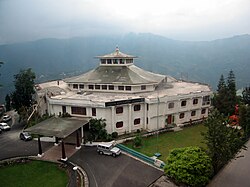
The Sikkim Legislative Assembly is the unicameral legislature of the state of Sikkim, in Northeast India. The seat of the Legislative Assembly is at Gangtok, the capital of the state. The assembly sits for a term of five years, unless it is dissolved earlier. Sikkim is the second-smallest state in India, covering 7,096 km2 (2,740 sq mi); which accounts for 0.2 per cent of the total area of India. The current population of Sikkim is 6.32 lakhs (630,000), making it the least populous state in India. Established in 1975, the Sikkim Legislative Assembly consists of 32 members elected directly from single-seat constituencies using the first-past-the-post system.
Since the independence of India, the Scheduled Tribes (ST) and the Scheduled Castes (SC) and have been given reservation status, guaranteeing political representation, and the Constitution lays down the general principles of positive discrimination for SCs and STs. In Sikkim, the Scheduled Tribes primarily include the Bhutia, Lepcha, Limboo and Tamang communities. Twelve constituencies are reserved for the Scheduled Tribes. Among these, reservations are granted only to members of the Bhutia-Lepcha (BL) community. Despite being recognized as Scheduled Tribes in 2002, no seats have been reserved for the Limboo and Tamang communities in the Sikkim Legislative Assembly. Two constituencies (West Pendam and Salghari–Zoom) are reserved for people of the Scheduled Castes (SC). One constituency (Sangha) is reserved for registered Buddhist monks and nuns from the state's monasteries. (Full article...) -
The AIFF Player of the Year Awards are the annual football awards presented to the best footballers in India by the All India Football Federation (AIFF). The AIFF first announced the award for men's player of the year in 1992; I. M. Vijayan was the inaugural winner. Sunil Chhetri has won the award a record six times, more than any other player. No winner was announced in 1998 and 1999. It was re-introduced in 2000.
The AIFF Women’s Player of the Year Award was introduced in 2001. Oinam Bembem Devi was its first recipient. Between 2002 and 2012, no women's award was given out. In 2013, the award was re-introduced and Bembem Devi won it for the second time. Other than Bembem Devi, Bala Devi has also won the award twice, in 2015 and 2016. Along with the men's and women's awards, the AIFF Emerging Player of the Year Award for men was introduced in 2013, and a similar award for women was introduced in 2015. (Full article...) -

Tandon in 2020
Raveena Tandon is an Indian actress known for her work in Hindi films. She made her acting debut in the 1991 action film Patthar Ke Phool, which earned her the Filmfare Award for New Face of the Year. This was followed by a series of unsuccessful films including Ek Hi Raasta and Parampara (both 1993). In 1994, she appeared in eight Hindi films, most of them were commercial successes. Among these were two of the top-grossing films – the romantic musical drama Dilwale and the action drama Mohra. The success of the latter marked a turning point in her career, establishing Tandon as a leading actress in Hindi cinema. The same year, her performance in the drama Laadla, earned her a nomination for the Filmfare Award for Best Supporting Actress. Her other film was the comedy Andaz Apna Apna, which though initially a box office disappointment, attained cult status over the years.
Tandon subsequently played leading roles in the action thrillers Khiladiyon Ka Khiladi (1996) and Ziddi (1997). Both films were among the highest grossing Bollywood films of their respective years. In 1998, she starred opposite Govinda in the commercially successful comedies Dulhe Raja, and Bade Miyan Chote Miyan. Tandon had five film releases in 1999. While the comedy Anari No.1 was a commercial success, her other four releases that year performed poorly at the box office. Nevertheless, she received praise for her performance in the crime drama Shool. (Full article...) -

The Chief Minister of Jharkhand is the chief executive of the Indian state of Jharkhand. In accordance with the Constitution of India, the governor is a state's de jure head, but de facto executive authority rests with the chief minister. Following elections to the legislative assembly, the state's governor usually invites the party (or coalition) with a majority of seats to form the government. The governor appoints the chief minister, whose council of ministers are collectively responsible to the assembly. Given the confidence of the assembly, the chief minister's term is for five years and is subject to no term limits.
Six people have served as the state's chief minister since Jharkhand's formation on 15 November 2000. Half of them, including the inaugural officeholder Babulal Marandi, represented the Bharatiya Janata Party (BJP). His successor Arjun Munda, also from the BJP, is the longest-serving chief minister; he served for over five years, across three terms but never completed a full term. Two chief ministers, Shibu Soren and his son Hemant Soren, represented the Jharkhand Mukti Morcha (JMM). Shibu Soren's first term ended in just ten days, as he could not prove that he had the support of a majority of the house and was forced to resign. The state has also been governed by Madhu Koda, one of the few independents to become the chief minister of any state. In between their reigns, the state has also been under President's rule three times. Raghubar Das, of the BJP, was the first chief minister to complete a full term in the state. Hemant Soren of the Jharkhand Mukti Morcha is the incumbent chief minister. (Full article...) -

Kapoor Khan at an event for Bajrangi Bhaijaan in 2015
Kareena Kapoor is an Indian actress who has appeared in more than 66 Hindi films. She made her acting debut opposite Abhishek Bachchan in the 2000 drama Refugee, for which she won the Filmfare Award for Best Female Debut. The following year, she appeared in five films, including the romance Mujhe Kucch Kehna Hai, the thriller Ajnabee, and the ensemble melodrama Kabhi Khushi Kabhie Gham. The latter emerged as the highest-grossing Bollywood film in overseas to that point, and the success of these films established her in Bollywood. This success was followed by repetitive roles in a series of commercial failures.
In 2004, Kapoor portrayed a prostitute in the drama Chameli, which proved to be a turning point in her career, earning her a Filmfare Special Award. That same year, she played a Muslim woman affected by the 2002 Gujarat riots in Govind Nihalani's political drama Dev, and two years later, she played the Desdemona character in Omkara (2006), an adaptation of William Shakespeare's tragedy Othello from director Vishal Bhardwaj. She won two Filmfare Critics Award for Best Actress for these films. In 2007, Kapoor played a loquacious Sikh girl in Jab We Met, a commercially successful romantic comedy co-starring Shahid Kapoor, for which she won the Filmfare Award for Best Actress. (Full article...) -

Bajirao Mastani won a total of seven National Film Awards at the 63rd National Film Awards including the National Film Award for Best Direction for Sanjay Leela Bhansali.
Bajirao Mastani is a 2015 Indian epic historical romance film directed and scored by Sanjay Leela Bhansali. It was a co-production between Bhansali Productions and Eros International. The film stars Ranveer Singh as Bajirao I, Deepika Padukone as Mastani, and Priyanka Chopra as Kashibai. Tanvi Azmi, Aditya Pancholi, Vaibbhav Tatwawdi and Milind Soman playing supporting roles. The screenplay was written by Prakash R. Kapadia, and the cinematography provided by Sudeep Chatterjee. Based on the Marathi novel Raau by Nagnath S. Inamdar, the film narrates the story of the Maratha Peshwa Bajirao and his second wife Mastani.
Made on a budget of ₹1.25 billion (US$18 million), the film was released on 18 December 2015 to positive reviews from critics. As of May 2016, Bajirao Mastani has grossed over ₹3.6 billion (US$50 million) at the box-office, becoming one of the highest-grossing Indian films of all time. The film garnered awards and nominations in a variety of categories with particular praise for Bhansali's direction and music, the performances of Chopra and Singh, its cinematography, art direction, and costume design. (Full article...) -
My Name Is Khan is a 2010 drama film directed by Karan Johar. The film features Shah Rukh Khan and Kajol in the lead roles with Jimmy Sheirgill, Zarina Wahab, Sonya Jehan, Vinay Pathak and Parvin Dabas playing supporting roles. Set in the United States, the film's story focuses on Rizwan Khan (Khan), a non-resident Indian with Asperger syndrome whose wife, Mandira (Kajol), has a child, Sameer, from a previous relationship. During the aftermath of the September 11 attacks, Sameer dies as a result of a racist assault by school bullies. Mandira blames Sameer's death on Rizwan due to his religion, and tells him not to come back until he can convince the President of the United States that he is not a terrorist. Rizwan takes Mandira's words literally and tries to meet the President so as to win her back. My Name Is Khan was co-produced by Johar's brother, Hiroo Yash Johar, and Khan's wife, Gauri Khan, under the Dharma Productions and Red Chillies Entertainment banners respectively. Shankar–Ehsaan–Loy composed the soundtrack while Niranjan Iyengar and Javed Akhtar wrote the lyrics for its songs. Ravi K. Chandran, Deepa Bhatia and Sharmishta Roy handled the cinematography, editing and production design respectively.
Produced on a budget of ₹850 million (about US$19 million in 2010), My Name Is Khan was released on 12 February 2010 and received positive reviews. It was commercially successful, grossing ₹2.048 billion (about US$45 million in 2010) worldwide. The film won 25 awards from 84 nominations; its direction, story, screenplay, performances of the cast members and music have received the most attention from award groups. (Full article...) -

Map of Rajasthan assembly constituencies
The Rajasthan Legislative Assembly is the unicameral state legislature of Rajasthan state in India.
The seat of the Legislative Assembly is at Jaipur, the capital of the state. The term of the Legislative Assembly is five years, unless dissolved earlier. Presently, it comprises 200 members who are directly elected from single-seat constituencies. (Full article...) -

Bachchan in 2013
Abhishek Bachchan is an Indian actor and film producer known for his work in Hindi films. He made his acting debut opposite Kareena Kapoor in J. P. Dutta's war drama Refugee (2000), where his portrayal of the titular unnamed refugee earned a nomination for the Filmfare Best Male Debut Award. However, his subsequent films failed at the box office°, including Bas Itna Sa Khwaab Hai (2001), and Shararat (2002). His career prospects improved in 2004, when he played a gangster in Mani Ratnam's political drama Yuva and a police officer in Sanjay Gadhvi's action thriller Dhoom. The former won him his first Filmfare Award for Best Supporting Actor, and the latter became one of the highest-grossing films of the year and his first commercial success.
In 2005, Bachchan teamed up with his father twice in Ram Gopal Varma's thriller Sarkar and the crime comedy Bunty Aur Babli. The latter was the second highest-grossing film of the year, and his performance in Sarkar earned him a second Filmfare Award for Best Supporting Actor. That same year, he appeared in the Bengali film Antarmahal (2005). 2006 proved to be key for Bachchan, as he received his third consecutive Filmfare Award for Best Supporting Actor for his performance in Karan Johar's musical romantic drama Kabhi Alvida Naa Kehna (2006), and reprised his role in the action sequel Dhoom 2 (2006), which became the highest-grossing Bollywood film to that point. Bachchan next starred alongside Aishwarya Rai in Ratnam's critically and commercially successful drama Guru (2007), a biopic inspired by the life of businessman Dhirubhai Ambani. His title role in the film was positively received. (Full article...) -

Haider is a 2014 Indian crime-drama film directed by Vishal Bhardwaj, and produced by Bhardwaj and Siddharth Roy Kapur. The film stars Shahid Kapoor as the eponymous protagonist, and co-stars Tabu, Kay Kay Menon, Shraddha Kapoor, and Irrfan Khan. Bhardwaj wrote the dialogues for the film, and co-wrote the screenplay with Basharat Peer. Bhardwaj also composed the music and Gulzar wrote the lyrics. The film is a modern-day adaptation of William Shakespeare's tragedy Hamlet, and tells the story of Haider who searches for his missing father during the Kashmir conflict of 1995.
Produced on a budget of ₹240 million (US$3.4 million), Haider was released on 2 October 2014, and grossed ₹690 million (US$9.7 million) worldwide. The film garnered awards and nominations in several categories, with particular praise for its direction, performances of Shahid Kapoor and Tabu, music and production design. As of June 2015, the film has won 36 awards. (Full article...) -
Devdas is a 2002 Indian Hindi-language epic romantic drama film directed by Sanjay Leela Bhansali. It stars Shah Rukh Khan, Aishwarya Rai and Madhuri Dixit, while Kirron Kher, Smita Jaykar and Vijayendra Ghatge play supporting roles. The film's story focuses on Devdas (Khan), a Bachelor of Law student who later becomes an alcoholic after his family rejects his relationship with Paro (Rai Bachchan), Devdas' childhood friend. The film was produced by Bharat Shah for his company Mega Bollywood, and its screenplay was written by Bhansali and Prakash Ranjit Kapadia, who also wrote the dialogue. The soundtrack for Devdas was composed by Ismail Darbar and Birju Maharaj, who co-wrote the lyrics with Nusrat Badr and Sameer Anjaan. Binod Pradhan and Bela Sehgal completed the cinematography and editing, respectively, while Nitin Chandrakant Desai handled the production design.
Made on a budget of ₹500 million (US$7.0 million), Devdas premiered at the 2002 Cannes Film Festival on 23 May 2002 and was released worldwide on 12 July that year. It received mixed reviews from critics, but emerged as the highest-grossing Indian film of the year, earning ₹998.8 million (US$14 million). The film won 61 awards from 91 nominations; its direction, music, performances of the cast members, screenplay, cinematography, choreography, costumes and production design have received the most attention from award groups. (Full article...) -

The Victoria Cross
The Victoria Cross (VC) was awarded to 153 members of the British Indian Army and civilians under its command, from 1857 until independence in 1947. The Victoria Cross is a military decoration awarded for valour "in the face of the enemy" to members of armed forces of some Commonwealth countries and previous British Empire territories. It takes precedence over all other Orders, decorations and medals. It may be awarded to a person of any rank in any service and to civilians under military command. The VC is traditionally presented to the recipient by the British monarch during an investiture at Buckingham Palace, though in a large number of cases this was not possible and it was presented in the field by a prominent civil or military official. The VC was introduced in Great Britain on 29 January 1856 by Queen Victoria to reward acts of valour during the Crimean War.
Indian troops were not originally eligible for the VC, because since 1837 they had been eligible for the Indian Order of Merit—the oldest British gallantry award for general issue. When the VC was created, Indian troops were still controlled by the British East India Company, and did not come under Crown control until 1860. European officers and men serving with the East India Company were not eligible for the Indian Order of Merit; the VC was extended to cover them in October 1857. It was only at the end of the 19th century that calls for Indian troops to be awarded the VC intensified. Indian troops became eligible for the award in 1911. The first awards to Indian troops appeared in The London Gazette on 7 December 1914 to Darwan Singh Negi and Khudadad Khan, whose gallantry on 31 October 1914 was nearly a month earlier than Negi's gallantry on 24/25 November. Negi was presented with the VC by King George V two days earlier, on 5 December 1914, during a visit to troops in France. He is one of a small number of soldiers presented with his award before it appeared in the London Gazette. (Full article...) -

Kumar in 2019
Ajith Kumar is an Indian actor who works mainly in Tamil cinema. Apart from a small role in the 1990 Tamil film En Veedu En Kanavar, his professional career began three years later with his debut as a lead actor in Tamil cinema with Amaravathi (1993). Despite being a moderate success, the film helped him obtain more modelling assignments. He followed it up the same year with Prema Pusthakam, his only Telugu film till date. After Amaravathi's release, Ajith opted against acting, and instead tried pursuing a career in auto racing. While training for an amateur race, he injured his back and underwent three major surgeries, leaving him bed-ridden for a year and a half. After recovering from the injury, he played supporting roles in Paasamalargal (1994) and Pavithra (1994). After this, he co-starred with Vijay in Rajavin Parvaiyile (1995). That same year, he had his breakthrough with the romantic thriller Aasai. His performance earned him critical acclaim and established him as an up-and-coming actor in Tamil cinema.
He was next seen as the main lead in Agathiyan's epistolary Kadhal Kottai (1996), a critical and commercial success. In 1997, he had five releases, all of which were commercial failures. Ajith's dual portrayal of twin brothers—where one is deaf-mute—in S. J. Suryah's Vaalee (1999) won him his first Filmfare Award for Best Tamil Actor. Impressed with his performance in that film, Rajiv Menon cast Ajith in the ensemble drama Kandukondain Kandukondain (2000) which was also commercial and critical success. The following year, he collaborated with debutant director AR Murugadoss on the action film Dheena. The film was successful in establishing his reputation as an action hero and earning him the nickname "Thala" ("head"). He earned critical acclaim for his dual role performance in the vigilante film Citizen (2001), and the film was commercial success. and a Best Actor nomination at Filmfare for the drama Poovellam Un Vasam (2001). His last release of the year was Santosh Sivan's Hindi film Aśoka, where he played a brief antagonistic role opposite Shah Rukh Khan. His dual-role performance as twin brothers in K. S. Ravikumar's film Villain (2002) won him a second Filmfare Award for Best Tamil Actor. (Full article...) -
India is a union consisting of 28 states and 8 union territories. As of 2024, with an estimated population of 1.484 billion, India is the world's most populous country. India occupies 2.4% of the world's area and is home to 17.5% of the world's population. The Indo-Gangetic Plain has one of the world's biggest stretches of fertile not-deep alluvium and are among the most densely populated areas of the world. The eastern and western coastal regions of Deccan Plateau are also densely populated regions of India. The Thar Desert in western Rajasthan is one of the most densely populated deserts in the world. The northern and north-eastern states along the Himalayas contain cold arid deserts with fertile valleys. These states have relatively low population density due to indomitable physical barriers. (Full article...)
-

Kajol in 2020
Kajol is an Indian actress known for her work in Hindi films. As of 2021, she has received 28 awards, including six Filmfare Awards, five Screen Awards, four Zee Cine Awards, and one Stardust Awards.
After made her debut in 1992 with Bekhudi, Kajol received critical acclaim and the Bengal Film Journalists' Association Award for Best Actress for Udhaar Ki Zindagi (1994). She won her first Filmfare Award for Best Actress for her portrayal of an Indian non-resident in the romance Dilwale Dulhania Le Jayenge (1995), and Best Performance in a Negative Role for her performance as a femme fatale in the thriller Gupt: The Hidden Truth (1997). In 1998, she was nominated for Best Actress at Filmfare for Pyaar To Hona Hi Tha, Dushman and Kuch Kuch Hota Hai, winning the award for the lattermost. Kajol won three awards more from the same category for her roles as a Punjabi girl in Kabhi Khushi Kabhie Gham... (2001), a blind Kashmiri in Fanaa (2006), and a career woman in My Name Is Khan (2010). Her latest nomination in the Filmfare Award for Best Actress was for the 2015 film Dilwale, which was mixed-to-negatively reviewed. (Full article...) -
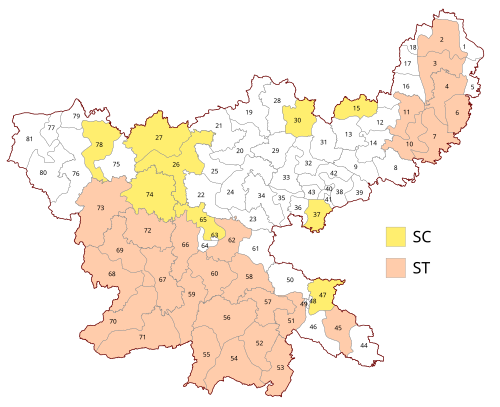
Map of Jharkhand Assembly Constituencies
The Jharkhand Legislative Assembly is the unicameral state legislature of Jharkhand state in India.
The seat of the Legislative Assembly is at Ranchi, the capital of the state. The term of the Legislative Assembly is five years, unless dissolved earlier. Presently, it comprises 81 members who are directly elected from single-seat constituencies. (Full article...) -

Shetty on the set of Nach Baliye 5 as judge in 2018
Shilpa Shetty is an Indian actress, businesswoman and former model. Known primarily for her work in Hindi films, she has also appeared in Telugu, Kannada and Tamil films. Shetty made her acting debut opposite Shah Rukh Khan in the 1993 thriller Baazigar. Shetty's performance earned her two Filmfare Awards nominations for Lux New Face of the Year and Best Supporting Actress. She subsequently earned wide recognition with dual roles in the 1994 action-comedy Main Khiladi Tu Anari. After initial success, Shetty's films fared poorly at the box office for the next five years. Films Shetty starred in including action drama Aag, romantic drama Aao Pyaar Karen, comedy Haathkadi and Chhote Sarkar proved to be financially unsuccessful. However, Shetty received Best Supporting Actress at the Zee Gold Bollywood Awards for romantic drama Pardesi Babu.
The 2000 romantic drama Dhadkan marked a turning point in her career, earning her several nominations in the Best Actress category at various award ceremonies. Shetty rose to prominence by featuring as the lead female in top-grossing films such as family drama Apne, police drama Garv: Pride and Honour and musical drama Life in a... Metro. Her comic performance as an eccentric fisherwoman in 2002 action-drama release Rishtey earned her a nomination for the Filmfare Best Supporting Actress Award. Shetty became a global figure after winning the 2007 British reality television series Celebrity Big Brother, after comments made by other contestants about Shetty fell afoul of Ofcom rules and caused an international controversy over racism. (Full article...) -

Bowlers have taken fifty-three five-wicket hauls in Tests and two five-wicket hauls in One Day International matches played at Chepauk.
M. A. Chidambaram Stadium (MAC), also known as the Chepauk Stadium or simply Chepauk due its location in the city's locality of Chepauk, is a sports ground in Chennai, India that has hosted international cricket matches along with provincial games. Named after M. A. Chidambaram, former President of Board of Control for Cricket in India (BCCI), the venue was formerly known as the Madras Cricket Club ground. It has a capacity of 38,000 spectators for international matches. It is the home ground of the Tamil Nadu cricket team and the Indian Premier League team Chennai Super Kings. The first Test at this venue took place in 1934, between India and England. As of February 2021, it has hosted a further 33 Test matches. Chepauk has also staged 22 One Day International (ODI) matches, the first of which was in 1987 when Australia defeated India in a group-match during the 1987 World Cup.
In cricket, a five-wicket haul (also known as a "five-for" or "fifer") refers to a bowler taking five or more wickets in a single innings. This is regarded as a notable achievement. The first bowler to take a five-wicket haul in a Test match at Chepauk was Amar Singh for India against England in 1934; he finished the innings with bowling figures of 7 wickets for 86 runs. Australia's Ashley Mallett became the first to take two five-wicket hauls in the same match at Chepauk, when he took 5 for 91 and 5 for 53 in the second and fourth innings of the fifth Test of Australia's 1969–70 tour of India. Narendra Hirwani is the most recent cricketer and the first Indian to take two five-wicket hauls on debut. He took 8 for 61 and 8 for 75 against the West Indies during the fourth Test of the 1987–88 series between the teams, which was held at this ground, and finished the match with bowling figures of 16 for 136. These are also the best match-figures by any bowler on Test debut. The best figures in Test cricket at Chepauk are 8 for 55, taken by India's Vinoo Mankad against England in 1952. Axar Patel took the most recent five-wicket haul at Chepauk, with figures of 5 for 60 against England in their 2020–21 tour of India. As of September 2024, 33 bowlers have taken 53 Test match five-wicket hauls at this ground. (Full article...) -

Piku is a 2015 Indian comedy-drama film directed by Shoojit Sircar and produced by N.P. Singh, Ronnie Lahiri and Sneha Rajani. The film stars Deepika Padukone as the eponymous protagonist, alongside Amitabh Bachchan and Irrfan Khan. Moushumi Chatterjee and Jisshu Sengupta play supporting roles. It was written by Juhi Chaturvedi and the musical score was composed by Anupam Roy. Piku tells the story of a headstrong Bengali architect, who along with her hypochondriac father and a helpful businessman embark on a road trip from New Delhi to Kolkata.
Made on an estimated budget of ₹420 million (US$5.9 million), Piku was released on 8 May 2015, and grossed approximately ₹1.41 billion (US$20 million) worldwide. The film garnered awards and nominations in several categories, with particular praise for its writing, music, and the performances of Padukone and Bachchan. As of June 2016, the film has won a minimum of 35 awards. (Full article...) -

Bendre in 2025
Sonali Bendre is an Indian actress widely known for her work in Hindi and Telugu films, along with a few appearances in Tamil, Marathi and Kannada cinema. Bendre made her acting debut with the action-drama Aag (1994), opposite Govinda, for which she received the Filmfare Lux New Face of the Year award. She gained further recognition with her role in the 1995 romantic thriller Takkar. Between 1994 and 1996, Bendre appeared in several commercially unsuccessful films, including the action-drama Gaddar (1995), action thriller Rakshak (1996), and romantic comedy English Babu Desi Mem (1996). Her first major box office success came with the romantic action Diljale (1996).
Bendre's prominence grew in the late 1990s with a series of successful films such as action comedy Duplicate (1998), romantic action Major Saab (1998), drama Zakhm (1998), action thriller Sarfarosh (1999), the highly successful family drama Hum Saath Saath Hain (1999) and romantic drama Hamara Dil Aapke Paas Hai (2000). Her performance in Sarfarosh earned her a nomination for the IIFA Award for Best Actress for Best Actress, while Hamara Dil Aapke Paas Hai won her the Screen Award for Best Supporting Actress. (Full article...) -
Paradesi (transl. Vagabond) is a 2013 Indian Tamil-language period drama film written, produced and directed by Bala. The film features Atharvaa and Vedhika in the lead roles, with Sai Dhanshika, Uday Karthik, Riythvika and Jerry in supporting roles. The soundtrack and score were composed by G. V. Prakash Kumar. The cinematography was handled by Chezhiyan, while Kishore Te and L. V. K. Das were in charge of the editing. Based on Paul Harris Daniel's 1969 novel Red Tea, the film's story revolves around Raasa (Atharvaa), an unemployed villager who is misled into bonded labour at a tea plantation after being promised generous accommodation and wages by its supervisor (Jerry).
Paradesi was made on a budget of ₹400 million and was released on 15 March 2013 to critical acclaim, but failed at the box office. The film won 37 awards from 59 nominations; its direction, performances of the cast members, music, cinematography, and costumes have received the most attention from award groups. (Full article...) -

Padukone in 2019
Indian actress Deepika Padukone primarily appears in Hindi films. Her first screen appearance was in Himesh Reshammiya's music video "Naam Hai Tera" in 2005. Padukone made her film debut by playing the titular role in the Kannada-language film Aishwarya (2006). Her first Hindi film release came the following year with Farah Khan's melodrama Om Shanti Om, in which she played dual roles opposite Shah Rukh Khan. She won the Filmfare Award for Best Female Debut for it. Her sole film role in 2008 was as one of Ranbir Kapoor's love interests in Bachna Ae Haseeno. Padukone's first film release of 2009, the kung fu comedy Chandni Chowk to China, proved to be a box office flop, but her next release, Imtiaz Ali's romance Love Aaj Kal, opposite Saif Ali Khan, was a success. Of Padukone's five film releases in 2010, only the comedy Housefull was financially profitable. The series of poorly received films continued with both her 2011 releases, Aarakshan and Desi Boyz.
The acclaimed role of an impulsive party-girl in Homi Adajania's Cocktail (2012) proved to be a breakthrough for Padukone. The year 2013 was key for Padukone when all four of her films were box office hits. Among these were two of the highest-grossing Indian films—the romantic comedies Yeh Jawaani Hai Deewani and Chennai Express. She also won the Filmfare Award for Best Actress for playing a character based on Juliet in Sanjay Leela Bhansali's tragic romance Goliyon Ki Raasleela Ram-Leela (2013). In 2014, Padukone appeared in the Tamil animation film Kochadaiiyaan and played a bar dancer in the top-grossing heist film Happy New Year. The following year, she played a headstrong daughter in Shoojit Sircar's comedy-drama Piku, which earned Padukone her second Best Actress award at Filmfare, and portrayed the warrior Mastani in Bhansali's top-grossing historical romance Bajirao Mastani. (Full article...)


 Good article –

-

Simplifly Deccan, formerly known as Air Deccan, was the first Indian low-cost carrier. Headquartered in Bengaluru, it operated domestic flights from seven base airports using a fleet of Airbus A320, ATR 42 and ATR 72 aircraft. The airline appealed to middle class travellers with low fares and a large route network. It employed several innovative methods to ensure the profitability of its business model. Nevertheless, Simplifly Deccan merged with Kingfisher Airlines in April 2008. Kingfisher replaced the Deccan brand with Kingfisher Red in August 2008. (Full article...) -
Srimanthudu (transl. Wealthy Man) is a 2015 Indian Telugu-language action drama film written and directed by Koratala Siva. The film is produced by Mythri Movie Makers and G. Mahesh Babu Entertainment. The film stars Mahesh Babu, Shruti Haasan, Jagapati Babu and Rajendra Prasad. Sampath Raj, Mukesh Rishi, Sukanya and Harish Uthaman appear in supporting roles. It was distributed globally by Eros International.
The film tells the story of Harsha Vardhan (Mahesh Babu), a young man who inherits a business empire from his father Ravikanth (played by Jagapati Babu). Urged by his friend Charuseela (Haasan) to learn about his and his father's ancestral roots in a remote village named Devarakota, Harsha adopts the village and spends some time trying to improve the standard of living of the local people and the infrastructure of the village. His efforts anger the local crime boss Sashi (played by Sampath Raj) and his brother Venkata Ratnam, a politician (played by Mukesh Rishi). (Full article...) -
The Kaivalya Upanishad (Sanskrit: कैवल्य उपनिषद्) is a late 1st millennium BCE Sanskrit text and one of the minor Upanishads of Hinduism. It is classified as a Shaiva Upanishad, and survives into modern times in two versions, one attached to the Krishna Yajurveda and other attached to the Atharvaveda. It is, as an Upanishad, a part of the corpus of Vedanta literature collection that presents the philosophical concepts of Hinduism.
The Upanishad extols Shiva, aloneness and renunciation, describes the inner state of man in his personal spiritual journey detached from the world. The text is notable for presenting Shaivism in Vedanta, discussing Atman (Self) and its relation to Brahman, and Self-knowledge as the path to kaivalya (liberation). (Full article...) -
Maine Pyar Kiya (transl. 'I've loved'), also known by the initialism MPK, is a 1989 Indian Hindi-language action romance flim directed by Sooraj Barjatya in his directorial debut. Produced by Tarachand Barjatya, the film was co-written by S. M. Ahale, and Sooraj Barjatya, and distributed by Rajshri Productions. The film stars Salman Khan in his first lead role alongside Bhagyashree in her Big screen debut. It also features Alok Nath, Mohnish Bahl, Reema Lagoo, Rajeev Verma, Ajit Vachani, and Laxmikant Berde in supporting roles. Maine Pyar Kiya tells the story of two individuals whose journey from friendship to love is complicated by family differences, ultimately challenging them to fight for their relationship.
Principal photography took place in Mumbai and various locations in Ooty. The film features a score and soundtrack composed by Raamlaxman, while Asad Bhopali wrote the lyrics. Maine Pyar Kiya is considered to be one of Khan's most iconic and loved films, and it became a cult favorite because of its songs, dialogues, and chemistry between Khan and Bhagyashree. The film also established the careers of the supporting cast including Mohnish Bahl and Laxmikant Berde. (Full article...) -
Baghban (transl. Gardener) is a 2003 Indian Hindi-language family drama film directed by Ravi Chopra, co-written and produced by B. R. Chopra. It tells the story of an elderly couple, Raj (Amitabh Bachchan) and Pooja (Hema Malini), who have been married for 40 years. After Raj retires, they reunite with their four sons (Aman Verma, Samir Soni, Saahil Chadha, Nasir Khan) to discuss who will support them. However, none of the sons want to take care of both parents, causing Raj and Pooja to live separately.
Baghban was conceived by producer and co-writer B. R. Chopra during his 1960s trip across Europe, when he visited a retirement home and was inspired by the householders' story. Although the screenplay was finished in 1973, Chopra did not begin production for decades because he was busy with other projects. After he revived it, principal photography began in July 2002 in Film City. Baghban's soundtrack was composed by Aadesh Shrivastava, with lyrics written by Sameer. (Full article...) -
Krrish (Hindi pronunciation: [krɪʃ]) is a 2006 Indian Hindi-language superhero action thriller film directed and produced by Rakesh Roshan. The film stars Hrithik Roshan in the main dual lead role, alongside Priyanka Chopra, Naseeruddin Shah, Rekha, Sharat Saxena and Manini Mishra. It is the second instalment in the Krrish franchise and a sequel to Koi... Mil Gaya. In the film, Krishna Mehra, who has superhuman abilities like his father Rohit Mehra, falls in love with Priya and follows her to Singapore, where he takes on the superhero persona of Krrish and sets out to thwart the plans of the evil scientist Dr. Siddhant Arya, who is creating a supercomputer which shows the future.
Krrish was conceived to be a film of global significance and a trendsetter in Indian cinema, with VFX on par with those from Hollywood. To that end, the effects team was aided by Marc Kolbe and Craig Mumma and the action scenes were choreographed by Tony Ching. The music was composed by Rajesh Roshan, while the background score was composed by Salim–Sulaiman. Filming was done to a large extent in Singapore as well as India. (Full article...) -
The Transgender Persons (Protection of Rights) Act, 2019 is an act of the Parliament of India for protection of rights of transgender people, their welfare, and other related matters. The act was introduced in the Lok Sabha, the lower house of the Indian Parliament, on 19 July 2019 by the Minister of Social Justice and Empowerment, Thawar Chand Gehlot, in light of the lapse of the Transgender Persons (Protection of Rights) Bill, 2018 (Bill No. 210-C of 2016). The 2019 act and the immediately preceding 2018 bill, were both preceded by a 2016 version. They were met with protests and criticism by some transgender people, lawyers, and activists in India. The 2016 bill was sent to a standing committee which submitted its report in July 2017. Following this, the Lok Sabha tabled and passed a newer version of the bill in December 2018. However, it did not incorporate many of the committee's recommendations. Although members of the opposition criticised the 2019 act and assured activists that they would not vote in favour of it, it was passed by the Lok Sabha on 5 August 2019 and by the Rajya Sabha, the upper house of the Parliament, on 26 November 2019. The president assented to it on 5 December 2019, upon which the act was published in the Gazette of India. It has been in effect since 10 January 2020 following a notification of the same in the Gazette on the same day.
Following protests by the queer community against the 2016 and 2018 bills, the 2019 act has done away with some of the severely criticised provisions of the 2018 bill, such as the criminalisation of begging and the establishment of a district screening committee to process applications for issuance of transgender person certificates. However, it fails to incorporate yet other principles in line with the Supreme Court judgment in National Legal Services Authority v. Union of India (NALSA v. UOI) in 2014, such as the right of transgender people to declare their self-perceived gender identity without undergoing sex reassignment surgery, and reservations in jobs and educational institutions. The act has also been criticised for imposing less punishment for crimes against transgender people compared with punishment for crimes against cisgender people. On 27 January 2020, the Supreme Court issued a notice to the central government in a petition challenging the constitutionality of the act. (Full article...) -
The Indian flying fox (Pteropus medius), also known as the greater Indian fruit bat, is a species of flying fox native to the Indian subcontinent. It is one of the largest bats in the world. It is of interest as a disease vector, as it is capable of transmitting several viruses to humans. It is nocturnal and feeds mainly on ripe fruits, such as mangoes and bananas, and nectar. This species is often regarded as vermin due to its destructive tendencies towards fruit farms, but the benefits of its pollination and seed propagation often outweigh the impacts of its fruit consumption. (Full article...) -
]] (help·info)) is an organised supporters' group of the Kochi-based professional football club Kerala Blasters FC, which competes in the Indian Super League, the top-tier league of Indian football. One of the largest and most active sports fan groups in the country, Manjappada received the Indian Sports Honours Fan Club of the Year award three times, in 2017, 2019 and 2024.
Founded in 2014 as a Facebook page, Manjappada later expanded and have branches in each of Kerala's 14 districts and in 17 other Indian states; Keralites in 71 other countries are also part of the group. Manjappada is also known for having one of the largest groups of travelling fans in the country, and their presence in the stadium is often called a yellow sea as they wear as much yellow as possible during the matches of the Blasters. In the 2022–23 Indian Super League season, they displayed a 11752 sq ft tifo, which is now far the second largest tifo displayed during a football match in Asia. (Full article...)


Phumdis are a series of floating islands, exclusive to the Loktak Lake in Manipur state, in northeastern India. They cover a substantial part of the lake area and are heterogeneous masses of vegetation, soil and organic matter, in different stages of decay. The largest single mass of phumdi is in the southeastern part of the lake, covering an area of 40 km2 (15.4 sq mi). This mass constitutes the world’s largest floating park, named Keibul Lamjao National Park. The park was formed to preserve the endangered Eld's deer subspecies, called sangai in the Meitei language, indigenous to this area.
Phumdis are used by the local people for constructing their huts for fishing and other livelihood uses, and are inhabited by about 4000 people. Athapums are artificial circular phumdis, built by the villagers as enclosures for fish farming; aquaculture has caused proliferation of the phumdis in the lake. (Full article...)

Lalji Singh (5 July 1947 – 10 December 2017) was an Indian scientist who worked in the field of DNA fingerprinting technology in India and pioneer of Assisted reproductive technology, where he was popularly known as the "Father of Indian DNA fingerprinting". Singh also worked in the areas of molecular basis of sex determination, wildlife conservation forensics and evolution and migration of humans. In 2004, he received the Padma Shri in recognition of his contribution to Indian science and technology.
Singh founded various institutes and laboratories in India, including the Centre for DNA Fingerprinting and Diagnostics in 1995, Laboratory for the Conservation of Endangered Species (LaCONES) in 1998, and Genome Foundation in 2004, aiming to diagnose and treat genetic disorders affecting the Indian population, in particular the under-privileged people residing in rural India. (Full article...)

British General Charles Cornwallis, the Earl Cornwallis, was appointed in February 1786 to serve as both Commander-in-Chief of British India and Governor of the Presidency of Fort William, also known as the Bengal Presidency. He oversaw the consolidation of British control over much of peninsular India, setting the stage for the British Raj. He was also instrumental in enacting administrative and legal reforms that fundamentally altered civil administration and land management practices there. According to historian Jerry Dupont, Cornwallis was responsible for "laying the foundation for British rule throughout India and setting standards for the services, courts, and revenue collection that remained remarkably unaltered almost to the end of the British era."
He was raised to the title of Marquess Cornwallis in 1792 as recognition for his performance in the Third Anglo-Mysore War, in which he extracted significant concessions from the Mysorean ruler, Tipu Sultan. Returned to England in 1793, he was engaged in administrative and diplomatic postings until 1798, when he was posted to the Kingdom of Ireland as Lord Lieutenant and Commander-in-Chief. In 1801, he was again posted to India. He arrived in July 1805 and died in October in Ghazipur. (Full article...)

Air Costa was an Indian regional airline headquartered in Vijayawada and based out of Chennai International Airport. It was owned by Indian business company LEPL Group. The airline commenced operations as a regional airline in October 2013 using two Embraer E-170 aircraft, with the first flight taking off from Chennai on 16 October 2013. The airline received a permit for pan-India operations in October 2016. The airline focused on connectivity between tier II and tier III cities in the country, and invested ₹600 crore (US$84 million) as of 2015. Air Costa operated 32 daily flights to nine destinations from its focus cities Chennai and Vijayawada as of 2015. The airline had a maintenance center in Chennai. On 28 February 2017, it suspended operations until further notice. (Full article...)

Eugenie Peterson (Latvian: Eiženija Pētersone, Russian: Евгения Васильевна Петерсон, romanized: Yevgeniya Vasilyevna Peterson; 12 May 1899 – 25 April 2002), known as Indra Devi, was a pioneering teacher of yoga as exercise, and an early disciple of the "father of modern yoga", Tirumalai Krishnamacharya.
She went to India in her twenties, becoming a film star there and acquiring the stage name Indra Devi. She was the first woman to study under the yoga guru Krishnamacharya at the Mysore Palace, alongside B.K.S Iyengar and K. Pattabhi Jois who went on to become yoga gurus. Moving to China, she taught the first yoga classes in that country at the house of Soong Mei-ling, wife of Chiang Kai-shek. (Full article...)

Maudgalyāyana (Pali: Moggallāna), also known as Mahāmaudgalyāyana or by his birth name Kolita, was one of the Buddha's closest disciples. Described as a contemporary of disciples such as Subhuti, Śāriputra (Pali: Sāriputta), and Mahākāśyapa (Pali: Mahākassapa), he is considered the second of the Buddha's two foremost male disciples, together with Śāriputra. Traditional accounts relate that Maudgalyāyana and Śāriputra become spiritual wanderers in their youth. After having searched for spiritual truth for a while, they come into contact with the Buddhist teaching through verses that have become widely known in the Buddhist world. Eventually they meet the Buddha himself and ordain as monks under him. Maudgalyāyana attains enlightenment shortly after that.
Maudgalyayana and Śāriputra have a deep spiritual friendship. They are depicted in Buddhist art as the two disciples that accompany the Buddha, and they have complementing roles as teachers. As a teacher, Maudgalyayana is known for his psychic powers, and he is often depicted using these in his teaching methods. In many early Buddhist canons, Maudgalyāyana is instrumental in re-uniting the monastic community after Devadatta causes a schism. Furthermore, Maudgalyāyana is connected with accounts about the making of the first Buddha image. Maudgalyāyana dies at the age of eighty-four, killed through the efforts of a rival sect. This violent death is described in Buddhist scriptures as a result of Maudgalyāyana's karma of having killed his own parents in a previous life. (Full article...)

Mr. and Mrs. Iyer is a 2002 Indian drama film written and directed by Aparna Sen and produced by N. Venkatesan. The film features Sen's daughter Konkona Sen Sharma as Meenakshi Iyer, a Tamil Iyer Brahmin who is a Hindu. Rahul Bose portrays the character of Raja Chowdhury, a Bengali Muslim wildlife photographer. The story revolves around these two lead characters during a fateful bus journey amidst the carnages of a communal strife in India. Zakir Hussain composed the background score and music for the film and Goutam Ghose was the cinematographer. The film had English as its dominant language with a sporadic use of Hindi, Tamil, and Bengali.
Mr. and Mrs. Iyer premiered at the Locarno International Film Festival in Switzerland and was showcased at other prominent film festivals. The film opened to Indian audiences on 19 July 2002. It was met with critical acclaim upon release, and won several national and international awards, including the Golden Maile award at the Hawaii International Film Festival and the Nargis Dutt Award for Best Feature Film on National Integration in India. (Full article...)

Ravish Malhotra (born 25 December 1943 in Lahore, British India) is a retired air commodore of the Indian Air Force. He was an Air Force test pilot stationed at the test centre in Bangalore. He was also the Air Officer Commanding of Hindon Air Force Station near Delhi.
In 1982, he was chosen to train for spaceflight in the Soviet Union's Intercosmos program. Malhotra served as backup for Rakesh Sharma on the Soyuz T-11 mission to Salyut 7 space station which launched the first Indian into space, but never went to space himself. Malhotra was awarded the Soviet Order of Friendship of Peoples in 1984 and the Kirti Chakra in 1985. (Full article...)

The durian (often spelled durion) (/ˈdʊəriən/ (
 listen)) is the edible fruit of several tree species belonging to the genus Durio. There are 30 recognised species, at least nine of which produce edible fruit. Durio zibethinus, native to Borneo, Sumatra, and the Malay Peninsula, is the only species available on the international market. It has over 300 named varieties in Thailand and over 200 in Malaysia as of 2021. Other species are sold in their local regions.
Known in some regions as the "king of fruits", the durian is distinctive for its large size, strong odour, and thorn-covered rind. The fruit can grow as large as 30 cm (12 in) long and 15 cm (6 in) in diameter, and it typically weighs 1 to 3 kg (2 to 7 lb). Its shape ranges from oblong to round, the colour of its husk from green to brown, and its flesh from pale yellow to red, depending on the species. The flavour of the flesh is complex with savoury notes. The texture is creamy and pudding-like. (Full article...)

Dairy plays a significant part in numerous aspects of Indian society, including cuisine, religion, culture, and the economy.
India has the world's largest dairy herd with over 300 million bovines, producing over 190 million tonnes of milk. India is first among all countries in both production and consumption of milk. Most of the milk is domestically consumed, though a small fraction is also exported. Indian cuisine, in particular North Indian cuisine, features a number of dairy products like paneer, while South Indian cuisine uses more yoghurts and milk. Milk and dairy products play a part in Hindu religious practice and legend. (Full article...)

Rajkummar Rao (born Raj Kumar Yadav; 31 August 1984) is an Indian actor known for his work in Hindi films. He has appeared in more than 30 films since 2010, and is the recipient of several accolades including a National Film Award, four Filmfare Awards and an Asia Pacific Screen Award. In 2017, he appeared on Forbes India's Celebrity 100 list.
After studying acting at the Film and Television Institute of India, Rao made his acting debut with the anthology film Love Sex Aur Dhokha (2010) and took on supporting roles in the films Gangs of Wasseypur – Part 2 and Talaash: The Answer Lies Within (both 2012). He had his breakthrough in 2013 with critically acclaimed performances in the dramas Kai Po Che! and Shahid. His portrayal of lawyer Shahid Azmi in the latter won him the National Film Award for Best Actor and the Filmfare Critics Award for Best Actor. (Full article...)

Menemerus nigli is a species of jumping spider that was first found in Pakistan. A member of the genus Menemerus, the male was described in 2012 by Wanda Wesołowska and Mario Freudenschuss and the female by Pir Asmat Ali, Wayne Maddison, Muhammad Zahid and Abida Butt in 2018. It was originally only found in Asia but has also been introduced into Brazil, the first specimen being identified in 2020. First found amongst stones, it seems to thrive synanthropically amongst the sunlit stucco walls that are common in cities across the region. Menemerus nigli is used as an example of the ability of species that adapt to human habitation to expand their ecological niche and become widespread species. The spider is medium-sized, typically 4.89 millimetres (0.193 in) in length, with a dark brown carapace and grey-brown abdomen that has a distinctive cream and white pattern created by small hairs. This pattern on its abdomen helps distinguish the species from other spiders in the genus. (Full article...)

Kempegowda International Airport (IATA: BLR, ICAO: VOBL) is an international airport serving Bengaluru, the capital of the Indian state of Karnataka. Spread over 16 square kilometres (6.2 sq mi), it is located about 35 km (22 mi) north of the city, near the suburb of Devanahalli. It is owned and operated by Bengaluru International Airport Limited (BIAL), a public–private consortium. The airport opened in May 2008, as an alternative to the increasingly congested HAL Airport, the original commercial airport serving the city. It is named after Kempe Gowda I, the founder of Bengaluru. It is Karnataka's first fully solar powered airport, developed by CleanMax Solar.
The airport is the third-busiest in India, behind the airports in Delhi and Mumbai. It is the 26th busiest airport in Asia and the 54th busiest airport in the world as of 2024. In FY2024-25, the airport handled over 41.87 million passengers and 502,509 tonnes (553,921 short tons) of cargo. The airport offers connecting flights to all 6 inhabited continents, and direct flights to 5. (Full article...)

Ebrahim Ismail Ebrahim OLG (1 July 1937 – 6 December 2021) was a South African anti-apartheid activist of Indian origin who was a member of the African National Congress's armed wing uMkhonto we Sizwe. He was tried in the Pietermaritzburg sabotage trials of 1963 and was sentenced to a 15-year imprisonment at the Robben Island Maximum Security Prison.
Popularly known as Ebie, he served as a lawmaker in the first democratically elected government of South Africa in 1994 and also served as the country's deputy minister for international relations between 2009 and 2014. (Full article...)

Aagadu (transl. He won’t stop) is a 2014 Indian Telugu-language action comedy film directed by Srinu Vaitla. Written by Anil Ravipudi, Upendra Madhav and Praveen Varma, the film was jointly produced by Ram Achanta, Gopi Achanta and Anil Sunkara under their banner 14 Reels Entertainment. It stars Mahesh Babu, Tamannaah Bhatia and Sonu Sood in lead roles while Rajendra Prasad, Ashish Vidyarthi, Nassar, and Brahmanandam play supporting roles.
Aagadu was Thaman S's 50th film as a music composer, with K. V. Guhan as the cinematographer and M. R. Varma as the editor. Mahesh played Shankar, an encounter specialist who becomes the circle inspector of police in Bukkapatnam. He is tasked with stopping the power plant construction by Damodar (Sonu Sood), a crime boss, due to its environmental impact. Shankar later learns that Damodar is responsible for his brother Bharath's death, leading him to seek revenge. (Full article...)

Swayamvaram (English: One's Own Choice) is a 1972 Indian Malayalam-language drama film co-written and directed by Adoor Gopalakrishnan, starring Madhu and Sharada in the lead roles. Notable smaller roles were played by Thikkurisi Sukumaran Nair, Adoor Bhavani, K. P. A. C. Lalitha, and Bharath Gopi. The film depicts the life of a couple—Vishwam (Madhu) and Sita (Sharada)—who have married against their parents' wishes and want to start a new life at a new place. The title is an allusion to the ancient Indian practice of a girl of marriageable age choosing a husband from among a list of suitors.
Swayamvaram marked several debuts—directorial of Gopalakrishnan, acting of the Malayalam star Bharath Gopi, and film producing of the Chitralekha Film Cooperative, an organisation cofounded by Gopalakrishnan himself. The film features an original score by M. B. Sreenivasan, camerawork by Mankada Ravi Varma, and film editing by Ramesan. Writer-director K. P. Kumaran co-scripted the film with Gopalakrishnan. It took seven years for Gopalakrishnan to get the project rolling when his initial proposal for a loan to make a film was turned down by the Film Finance Corporation (FFC). The FFC later partially financed the film when Chitralekha provided the rest. (Full article...)
News
No recent news
Did you know...
- ... that Colonel Hugh Pettigrew observed that troops who thought that the Scottish Highlands resembled Waziristan on India's North West Frontier were "of little use to anyone"?
Timeline of Indian history, Indus Valley Civilisation, Dholavira, Science and technology in ancient India, Meluhha, Aryan invasion theory, Out of India theory, Greek conquests in India, Indian maritime history, Maurya Empire, Ashoka, Shunga Empire, Hoysala Empire, Vijayanagara, Satavahana dynasty, Indo-Greek Kingdom, Indo-Scythians, Indo-Parthian Kingdom, Kushan Empire, Western Satraps, Gupta Empire, Chola dynasty, Pala Empire, Islamic incursions in India, Mughal Empire, Maratha Empire, British Raj, East India Company, Governor-General, Viceroy, War of Independence, 1857, Indian independence movement, Indian National Army, Azad Hind, Quit India Movement, Partition of India, History of Republic of India, Non-Aligned Movement, Sino-Indian War, Indo-Pakistani War of 1947–1948, Indo-Pakistani War of 1965, Indo-Pakistani War of 1971, Kargil War, 2001–02 India–Pakistan standoff, Military, Demographic
Law, Hindu law, Constitution, Political parties (Indian National Congress, Bharatiya Janata Party), Foreign relations, Elections, Political divisions, Reservation in India
Government agencies, Legislative branch (Lok Sabha, Rajya Sabha) Executive branch (President & Vice President, Prime Minister & Deputy Prime Minister, Cabinet Ministers, Cabinet Secretary, Election Commission, Foreign Minister; Law enforcement: CBI, CID, Intelligence: IB, RAW), Directorate General of Income Tax Investigation Judicial branch (Supreme Court), Armed Forces (Army, Navy, Air Force, Border Security Force, Coast Guard)
Himalayas, Western Ghats, Eastern Ghats, Indo-Gangetic Plain, Deccan Plateau, Thar Desert, Ganges, Rann of Kutch, Brahmaputra River, Northeast India; Mountains, Valleys, Islands, Rivers; States and union territories, Cities, Districts, Regions, Fauna, Flora
Rupee, Bombay Stock Exchange, National Stock Exchange, Standard of living, Companies, Reserve Bank of India, Energy policy (Solar, Wind, Nuclear), Tourism, Transport (Expressways, Rail transport, Auto rickshaw),
Languages, Standard of living, Religion
Music (Carnatic, Hindustani, Indi-pop), Dance, Languages, Literature, Architecture, Film & TV, Cuisine, Holidays, Folklore, Education, Media, Indian martial arts
Indian Council of Agricultural Research (ICAR), Indian Institute of Astrophysics, National Centre for Software Technology, AIIMS, IISc, IIT, NIT, BITS-Pilani, INRegistry, Indian numbering system, Indian Space Research Organisation, National Internet Exchange of India, ICRISAT, International Institute of Information Technology, Hyderabad
Indian English, Indian nationality law, Numbering system, Indian Space Research Organisation, Telecommunications, National Highways Development Project, Flag, Vehicle registration plates, Indian nationalism, Metrication in India
Categories

Related portals
Religions in India Template:Related portals
Regions Template:Related portals
Cities Template:Related portals
Other topics Template:Related portals
Indian Subcontinent Template:Related portals
Other countries Template:Related portals
Bharatpedias in Indian languages
- অসমীয়া (Assamese)
- বাংলা (Bengali)
- भोजपुरी (Bhojpuri)
- বিষ্ণুপ্রিয়া মণিপুরী (Bishnupriya Manipuri)
- गोंयची कोंकणी / Gõychi Konknni (Konkani)
- ગુજરાતી (Gujarati)
- हिन्दी (Hindi)
- ಕನ್ನಡ (Kannada)
- कॉशुर/كشميري (Kashmiri)
- मैथिली (Maithili)
- മലയാളം (Malayalam)
- मराठी (Marathi)
- नेपाली (Nepali)
- नेपाल भाषा
- (Newari)
- ଓଡ଼ିଆ (Odiya)
- ਪੰਜਾਬੀ (Punjabi)
- पालि (Pali)
- संस्कृत (Sanskrit)
- ᱥᱟᱱᱛᱟᱲᱤ (Santali)
- سنڌي (Sindhi)
- தமிழ் (Tamil)
- తెలుగు (Telugu)
- ತುಳು (Tulu)
- اردو (Urdu)
Associated Wikimedia
- Pages with Hindustani IPA
- Pages with Sanskrit IPA
- Pages with plain IPA
- Pages with Hindi IPA
- Pages with Malayalam IPA
- Portals with triaged subpages from June 2018
- All portals with triaged subpages
- All portals
- Portals with no named maintainer
- Automated article-slideshow portals with 51–100 articles in article list
- Automated article-slideshow portals with 101–200 articles in article list
- Automated article-slideshow portals with 501–1000 articles in article list
- India portal
- India portals
- Asian portals
- Portals by country
- India
- Redirect targets of redirected portals with existing subpages