


m Removing protection template from an unprotected page |
DelorisQha (talk | contribs) typo fix |
||
| Line 1: | Line 1: | ||
{{ | {{Short description|Tibeto-Burman language of India}} | ||
{{Redirect|Manipuri language|the Meitei-Bengali [[creole language]]|Bishnupriya Manipuri}} | |||
{{About|the [[Languages with official status in India|sole official language]] of [[Manipur]]|other speech forms|languages of Manipur}} | {{About|the [[Languages with official status in India|sole official language]] of [[Manipur]]|other speech forms|languages of Manipur}} | ||
{{Hatnote|Unless otherwise specified, Meitei in this article is written in [[Meitei Mayek]].}} | |||
{{Hatnote|Unless otherwise specified, Meitei in this article is written in [[Meitei Mayek]] | {{protection padlock|small=yes}} | ||
{{Use Indian English|date=November 2023}} | |||
{{Use Indian English|date= | {{Use dmy dates|date=December 2023}} | ||
{{Use dmy dates|date= | |||
{{Infobox language | {{Infobox language | ||
| name = Meitei | | name = Meitei | ||
| nativename = <!--In Meitei script--> {{Script|Mtei|ꯃꯩꯇꯩꯂꯣꯟ}} • <!--In Eastern Nagari script--> | | nativename = <!--In Meitei script--> {{Script|Mtei|ꯃꯩꯇꯩꯂꯣꯟ}} • <!--In Eastern Nagari script--> মৈতৈলোন • <!--Romanization--> {{transliteration|la|ISO|Meiteilon}} | ||
| altname = Manipuri | | altname = Manipuri | ||
| pronunciation = | | pronunciation = | ||
| image = Meitei language written in Meitei script.svg | | image = Meitei language written in Meitei script.svg | ||
| imagescale = | | imagescale = | ||
| imagecaption = '' | | imagecaption = ''Meitei Lon'' written in Meitei script | ||
| states = [[ | | states = [[India]], [[Bangladesh]] | ||
| region = [[ | | region = [[Manipur]], [[Assam]], [[Tripura]] | ||
| ethnicity = [[Meitei people]] | | ethnicity = [[Meitei people|Meitei]] | ||
| familycolor = Sino-Tibetan | | familycolor = Sino-Tibetan | ||
| fam1 = [[Sino-Tibetan languages|Sino-Tibetan]] | | fam1 = [[Sino-Tibetan languages|Sino-Tibetan]] | ||
| Line 23: | Line 23: | ||
| speakers = {{sigfig|1.775000|2}} million | | speakers = {{sigfig|1.775000|2}} million | ||
| date = 2003–2011 | | date = 2003–2011 | ||
| ref = | | ref = <ref>{{e28|mni}}</ref> | ||
| ancestor = [[Proto-Sino-Tibetan]] | | ancestor = [[Proto-Sino-Tibetan]] | ||
| ancestor2 = [[Proto-Tibeto-Burman]] | | ancestor2 = [[Proto-Tibeto-Burman]] | ||
| script = | | script = | ||
* | *[[Meetei Mayek]] | ||
* [[ | *[[Naoriya Phulo script|Naoriya Phulo]] | ||
*[[Bengali-Assamese script]] | |||
* [[Latin alphabet | *[[Latin alphabet]] (unofficial) | ||
| nation = | | nation = *[[Official languages of India|India]] (scheduled official) | ||
* [[ | **[[Manipur]] (main official) | ||
| | **[[Assam]] (additional official) | ||
| minority = {{Bulleted list|[[Tripura|Tripura, India]]|[[Languages of Bangladesh|Bangladesh]]|[[Languages of Myanmar|Myanmar]]}} | |||
| agency = [[Directorate of Language Planning and Implementation]] | | agency = [[Directorate of Language Planning and Implementation]], Manipur | ||
| development_body = | | development_body = | ||
* [[Ministry of Culture (India)]] | * [[Ministry of Culture (India)]] | ||
* [[Sahitya Akademi]] | |||
* [[Central Institute of Indian Languages]] | * [[Central Institute of Indian Languages]] | ||
* [[Directorate of Language Planning and Implementation]] | |||
* [[Manipuri Sahitya Parishad]] | |||
* [[Manipuri Sahitya Parishad | |||
| iso2 = mni | | iso2 = mni | ||
| lc1 = mni | | lc1 = mni | ||
| Line 56: | Line 51: | ||
| glotto2 = meit1246 | | glotto2 = meit1246 | ||
| glottoname2 = Meitei (standard dialect) | | glottoname2 = Meitei (standard dialect) | ||
| glotto3 = | | glotto3 = pang1284 | ||
| glottoname3 | | glottoname3 = Pangal (Muslim dialect) | ||
| notice = IPA | | notice = IPA | ||
| notice2 = | | notice2 = | ||
| dialects = | | dialects = | ||
*[[Thougallon]] (royal court register) | |||
*[[Amailon]] ([[liturgical language|liturgical]]) | |||
*[[Khuman (linguistics)|Khuman]] (historical) | |||
*[[Moirang (linguistics)|Moirang]] (historical) | |||
*[[Chakpa language|Chakpa/Loi]] | |||
*Meitei Pangal<ref name="ethnologue_mni">{{Cite web |title=Meitei {{!}} Ethnologue |url=https://www.ethnologue.com/language/mni/ |access-date=3 May 2023 |website=[[Ethnologue]] |archive-url=https://web.archive.org/web/20190724203234/https://www.ethnologue.com/language/mni/ |archive-date=24 July 2019 |language=en}}</ref> | |||
*[[Meitei language in Bangladesh|Bangladeshi Meitei]] | |||
| speakers2 = | | speakers2 = | ||
| map = File:Meitei language distribution.png | | map = File:Meitei language distribution.png | ||
| mapcaption = | | mapcaption = | ||
{{legend|# | {{legend|#014167|Regions where Meitei is official and educational language}} | ||
{{legend|# | {{legend|#076BA2|Regions where Meitei is recognised and educational language but not official}} | ||
{{legend|# | {{legend|#419ED5|Regions where Meitei is not recognised and not official but educational}} | ||
{{legend|# | {{legend|#79A9E3|Regions where Meitei is recognised but not official and educational}} | ||
{{legend|# | {{legend|#A6BBD5|Regions with significant Meitei speaking minorities}} | ||
}} | }} | ||
{{Contains special characters|Meitei}} | |||
{{ | |||
| | |||
| | '''Meitei''' ({{IPAc-en|ˈ|m|eɪ|t|eɪ}};<ref>{{Cite OED|Meithei |access-date=14 October 2022}}</ref> {{Meitei|ꯃꯩꯇꯩꯂꯣꯟ|ba=মৈতৈলোন্|label=no|xlit=yes|p=no}} {{IPA| mni|mejtejlon|pron}}), also known as '''Manipuri''' ({{Meitei|ꯃꯅꯤꯄꯨꯔꯤ|ba=মণিপুরী|label=no}} {{IPA|mni|mənipuɾi|pron}}), is a [[Tibeto-Burman language]] of [[northeast India]]. It is the official language and the [[lingua franca]] of [[Manipur]] and an additional official language in four districts of [[Assam]]. It is one of the [[scheduled languages of India|constitutionally scheduled official languages of the Indian Republic]].<ref name="britannica.com" /> Meitei is the most widely-spoken [[Tibeto-Burman languages|Tibeto-Burman language]] of India and the third most widely spoken language of northeast India after [[Assamese language|Assamese]] and [[Bengali language|Bengali]].<ref>{{cite web |title=Language – India, States and Union Territories |url=http://censusindia.gov.in/2011Census/C-16_25062018_NEW.pdf |work=Census of India 2011 |publisher=Office of the Registrar General |pages=13–14 |access-date=30 April 2019 |archive-url=https://web.archive.org/web/20181114073412/http://www.censusindia.gov.in/2011Census/C-16_25062018_NEW.pdf |archive-date=14 November 2018 |url-status=live}}</ref> | ||
| | There are {{sigfig|1.761079|3}} million [[States of India by Meitei speakers|Meitei native speakers in India according to the 2011 census]], {{sigfig|1.522132|3}} million of whom are found in the state of Manipur, where they represent the majority of its population. There are smaller communities in neighbouring Indian states, such as [[#Assam|Assam]] ({{sigfig|168133|3}}), [[#Tripura|Tripura]] ({{sigfig|23779|2}}), [[#Nagaland|Nagaland]] ({{sigfig|9511|2}}), and elsewhere in the country ({{sigfig|37524|3}}). The language is also spoken by smaller groups in neighbouring [[#Myanmar|Myanmar]]<ref>{{Cite web |title=Manipuris in Mandalay see ray of hope in Modi |url=https://timesofindia.indiatimes.com/city/guwahati/Manipuris-in-Mandalay-see-ray-of-hope-in-Modi/articleshow/48059811.cms |last1=Sunil |first1=Oinam |date=14 July 2015 |website=The Times of India |language=en}}</ref> and [[Meitei language in Bangladesh|Bangladesh]].<ref>{{e28|mni}}</ref> | ||
| | Meitei and [[Gujarati language|Gujarati]] jointly hold the third place among the fastest growing [[languages of India]], following [[Hindi]] and [[Kashmiri language|Kashmiri]].<ref>{{Cite news |last=R |first=Aishwaryaa |date=6 June 2019 |title=What census data reveals about use of Indian languages |url=https://www.deccanherald.com/india/what-census-data-reveals-about-use-of-indian-languages-738340.html |work=[[Deccan Herald]] |access-date=16 November 2023}}</ref> | ||
Meitei is not [[Language endangerment|endangered]]: its status has been assessed as safe by ''[[Ethnologue]]'' (where it is assigned to [[EGIDS]] level 2 "provincial language").<ref>{{e28|mni}}</ref> However, it is considered [[vulnerable language|vulnerable]] by UNESCO.<ref>{{cite book |editor-last1=Moseley |editor-first1=C. |title=Atlas of the world's languages in danger (3rd ed) |date=2010 |publisher=UNESCO Publishing |location=Paris |url=https://unesdoc.unesco.org/ark:/48223/pf0000187026 |pages=44{{ndash}}45 and elsewhere}}</ref> | |||
| | |||
| | The Manipuri language is associated with the [[Ningthouja dynasty]] ([[Mangang]]s), the [[Khuman kingdom|Khuman dynasty]], the [[Ancient Moirang|Moirang]]s, the [[Angom]]s, the [[Luwang]]s, the [[Salai Leishangthem|Chengleis]] ([[Sarang-Leishangthem]]s), and the [[Khaba-Nganba]]s. Each had their respective distinct dialects and were politically independent from one another. Later, all of them fell under the dominion of the Ningthouja dynasty, changing their status of being independent "ethnicities" into those of "clans" of the collective [[Meitei community]]. The Ningthouja dialect was predominant,<ref>{{Cite book |last=Sanajaoba |first=Naorem |url=https://books.google.com/books?id=-CzSQKVmveUC&dq=luwang+khuman+angom+language&pg=PA10 |title=Manipur, Past and Present: The Heritage and Ordeals of a Civilization |date=1988 |publisher=Mittal Publications |isbn=978-81-7099-853-2 |page=10 |language=en}}</ref><ref>{{Cite book |last=Miri |first=Mrinal |url=https://books.google.com/books?id=qfSz3UOAxM4C&dq=luwang+khuman+angom+language&pg=PA77 |title=Linguistic Situation in North-East India |date=2003 |publisher=Concept Publishing Company |isbn=978-81-8069-026-6 |page=77 |language=en}}</ref> and received heavy influences from the speech forms of the other groups.<ref>{{Cite book |last=Singh |first=Chungkham Yashwanta |url=https://books.google.com/books?id=pCtkAAAAMAAJ |title=Manipuri Grammar |date=2000 |publisher=Rajesh Publications |isbn=978-81-85891-33-0 |pages=2, 202 |language=en}}</ref><ref>{{Cite book |last=Ayyappappanikkar |url=https://books.google.com/books?id=KYLpvaKJIMEC&dq=luwang+khuman+angom+language&pg=PA333 |title=Medieval Indian Literature: Surveys and selections |date=1997 |publisher=Sahitya Akademi |isbn=978-81-260-0365-5 |page=333 |language=en}}</ref><ref>{{Cite web |title=Aspects of Manipuri language and its literary traditions By Ahanthem Homen |url=https://e-pao.net/epPageExtractor.asp?src=education.Aspects_of_Manipuri_language_and_its_literary_traditions_By_Ahanthem_Homen.html.. |access-date=2024-05-22 |website=e-pao.net}}</ref> | ||
| | |||
Meitei is one of the advanced literary languages recognised by [[Sahitya Akademi]], India's National Academy of Letters. | |||
== Classification == | |||
Meitei belongs to the [[Tibeto-Burman]] branch of the [[Sino-Tibetan]] languages.<ref>{{Cite web |title=Meitei {{!}} Ethnologue Free |url=https://www.ethnologue.com/language/mni/ |access-date=2023-11-18 |website=Ethnologue (Free All) |language=en}}</ref><ref name="britannica.com">{{Cite web |title=Manipuri language |url=https://www.britannica.com/topic/Manipuri-language |access-date=2023-11-18 |website=Encyclopædia Britannica |date=15 August 2024 |language=en}}</ref> | |||
{{ | |||
During the 19th and 20th centuries, different linguists tried to assign Meitei to various sub-groups. Early classifier [[George Abraham Grierson]] (1903–1924) put it in [[Kuki-Chin]], Vegelin and Voegelin (1965) in Kuki-Chin-Naga, and Benedict (1972) in Kuki-Naga. [[Robbins Burling]] has suggested that Meitei belongs to none of those groups.<ref name="iias">{{Cite web |title=A History of Manipuri Language |url=http://iias.ac.in/events/a-history-of-manipuri-language/ |access-date=2023-11-18 |website=[[Indian Institute of Advanced Study]] |language=en-US}}</ref> Current academic consensus agrees with [[James Matisoff]] in placing Manipuri in its own subdivision of the Kamarupan group—a geographic rather than a genetic grouping.<ref name="britannica.com"/> However, some still consider Meitei to be a member of the [[Kuki-Chin-Naga languages|Kuki-Chin-Naga branch]].<ref>{{Cite web |title=Glottolog 4.8 – Manipuri |url=https://glottolog.org/resource/languoid/id/mani1292 |access-date=2023-11-18 |website=glottolog.org}}</ref> | |||
== History == | |||
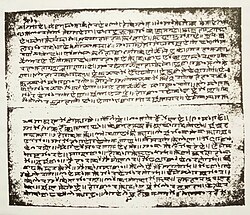
[[File:Yumbanlol (Yumpanlol) - a 6th century Classical Meitei language copper manuscript text - in Meetei script - works on sensuality & relationship between husbands & wives and how to run a household in Ancient Kangleipak civilisation state.jpg|thumb|Yumbanlol (Yumpanlol), a group of 6th century Classical Meitei language [[Indian copper plate inscriptions|copper plate inscriptions]], written in [[Meitei script]].]] | |||
[[ | The Meitei language has existed for at least 2000 years.<ref name="iias" /> | ||
According to linguist [[Suniti Kumar Chatterjee]], the [[ancient Meitei literature]] dates back to 1500 to 2000 years [[before present]].<ref>{{Cite book |last=Chatterji |first=Suniti Kumar |author-link=Suniti Kumar Chatterji |url=https://archive.org/details/in.ernet.dli.2015.32096/page/n187/mode/2up |title=Kirata-jana-krti |date=1951 |publisher=[[The Asiatic Society]], [[Digital Library of India]]; [[Internet Archive]] |location=Kolkata |publication-date=1951 |pages=157, 158 |language=en |quote=... The beginnings of this Old Manipuri literature (as in the case of Newari) may go back to 1500 years, or even 2000 years, from now. ...}}</ref> | |||
=== First Millennium CE === | === First Millennium CE === | ||
The earliest known Meitei language compositions is the ritual song ''[[Ougri]]'' ({{Script|Mtei|ꯑꯧꯒ꯭ꯔꯤ}}), which was used in religious and coronation ceremonies of [[Kangleipak]]. It may have existed before the [[Common Era]].<ref>{{Cite book |last=Ayyappappanikkar |url=https://books.google.com/books?id=KYLpvaKJIMEC&pg=PA329 |title=Medieval Indian Literature: Surveys and selections |date=1997 |publisher=[[Sahitya Akademi]] |isbn=978-81-260-0365-5 |pages=326–329 |language=en |author-link=Ayyappa Paniker}}</ref> ''[[Numit Kappa]]'' {{Meitei|ꯅꯨꯃꯤꯠ ꯀꯥꯞꯄ|t=The Shooting of the Sun}}, a religious epic that tells the tale of how the night was divided from the day, was also composed in the first century.<ref>{{Cite book |last1=Kshetrimayum |first1=Jogendro |editor-last1=Wouters |editor-first1=Jelle J. P. |editor-last2=Subba |editor-first2=Tanka B. |chapter=Violence |title=The Routledge Companion to Northeast India |url=https://books.google.com/books?id=YseEEAAAQBAJ&q=Numit+Kappa+1st&pg=PT473 |year=2023 |publisher=[[Taylor & Francis]] |isbn=978-0-367-72566-2 |page=483 |language=en}}</ref> | |||
The | |||
''[[Poireiton Khunthok]]'' {{Meitei|ꯄꯣꯢꯔꯩꯇꯣꯟ ꯈꯨꯟꯊꯣꯛ|t=The Immigration of Poireiton}} is a 3rd-century narrative work describing the establishment of a colony in Kangleipak by a group of immigrants led by [[Poireiton]], the younger brother of the god of the underworld.<ref>{{Cite book |last=Singh |first=Ningthoukhongjam Khelchandra |chapter-url=https://archive.org/details/in.ernet.dli.2015.466183/page/n121/mode/2up?view=theater |title=History of Old Manipuri Literature |location=Imphal |publisher=Ningthoukhongjam Khelchandra Singh |pages=121, 122 |language=en, mni |chapter=Poireiton Khunthokpa}}</ref> | |||
The ''Yumbanlol'', a [[Indian copper plate inscriptions|copper plate manuscript]] was composed in the 6th century or 7th century CE for the royal family of Kangleipak. It is a rare work of [[dharmashastra]], covering sexuality, the relationships between husbands and wives, and instructions on how to run a household.<ref>{{Cite book |title=Vijñānanidhi: Manuscript Treasures of India |url=https://www.yumpu.com/en/document/read/34231921/manuscript-treasures-of-india-national-mission-for-manuscripts/88 |date=February 2007 |publisher=National Mission of Manuscripts |access-date=2024-04-29 |oclc=171288062 |pages=88, 89 |language=en}}</ref> | |||
The ''Khencho'' ({{Script|Mtei|ꯈꯦꯟꯆꯣ}}), an early Meitei work of poetry was composed by the beginning of the 7th century CE.<ref>{{Cite book |last=Singh |first=Khelchandra Ningthoukhongjam |chapter-url=https://archive.org/details/in.ernet.dli.2015.466183/page/n97/mode/2up |title=History Of Old Manipuri Literature |location=Imphal |publisher=Ningthoukhongjam Khelchandra Singh |pages=97, 98 |language=mni |chapter=Khencho |author-link=Ningthoukhongjam Khelchandra}}</ref> Although it is obscure and unintelligible to present-day Meiteis, it is still recited as part of the [[Lai Haraoba]] festival.<ref>{{Cite book |last=Singh |first=Ch Manihar |url=https://books.google.com/books?id=yiBkAAAAMAAJ |title=A History of Manipuri Literature |publisher=[[Sahitya Akademi]] |year=1996 |isbn=978-81-260-0086-9 |location=India |pages=14, 15 |language=en, mni |chapter=The Early Period (Ritual Songs)}}</ref> | |||
One of the best-preserved early Meitei language epigraphic records is a copper plate inscription dating to the reign of King Khongtekcha ({{reign|c. 763|773|era=CE}}).<ref name="aponpath.com">{{Cite book |last=Devi |first=Yumlembam Gopi |url=https://books.google.com/books?id=gxqeDwAAQBAJ&q=8th%20century%20copper%20plate%20inscription%20manipur&pg=PA25 |title=Glimpses of Manipuri Culture |date=16 June 2019 |isbn=978-0-359-72919-7 |page=25 |publisher=LP |language=en}}</ref> During the same time period, Akoijam Tombi composed the ''[[Panthoibi Khonggul]]'' ({{lang|omp|{{Script|Mtei|ꯄꯥꯟꯊꯣꯏꯄꯤ ꯈꯣꯡꯀꯨꯜ}}|}}), an account of the romantic adventures of the [[deification|deified]] Meitei princess [[Panthoibi]].<ref name=":Glimpses_Panthoibi_Khongul">{{Cite book |last=Devi |first=Dr Yumlembam Gopi |url=https://books.google.com/books?id=gxqeDwAAQBAJ&dq=panthoibi+khongul&pg=PA119 |title=Glimpses of Manipuri Culture |date=16 June 2019 |publisher=Lulu.com |isbn=978-0-359-72919-7 |page=119 |language=en}}</ref> | |||
=== Second Millennium CE === | === Second Millennium CE === | ||
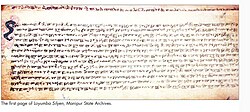
[[File:The first page of Loyumba Silyen (Loiyumpa Silyel) - 11th-12th century Classical Meitei language Constitution of the then Kangleipak civilisation state - in traditional Meetei Mayek writing system (Manipur State Archives).jpg|thumb|The first page of Loyumba Shinyen, the 11th-12th century Meitei-language constitution of Kangleipak.]] | |||
In 1100 CE, a written constitution, {{meitei|ꯂꯣꯏꯌꯨꯝꯄ ꯁꯤꯜꯌꯦꯜ|la=[[Loyumba Shinyen]]}}, was finalised by King [[Loiyumba]] ({{reign|c. 1074|1112|era=CE}}) of Kangleipak. It was a codification of the proto-constitution drafted by King [[Naophangba]] in 429 CE.<ref>{{Cite book |last=Sanajaoba |first=Naorem |url=https://books.google.com/books?id=vO-vtI8NuxIC&dq=loyumba+shinyen+final+document&pg=PP2 |title=Manipur: Treatise & Documents |date=1993 |publisher=Mittal Publications |isbn=978-81-7099-399-5 |page=2 |language=en}}</ref><ref>{{Cite book |last=Sanajaoba |first=Naorem |url=https://books.google.com/books?id=9eYC4tjzyi4C&dq=loyumba+shinyen+written+constitution&pg=PA304 |title=Law and Society: Strategy for Public Choice, 2001 |date=1991 |publisher=Mittal Publications |isbn=978-81-7099-271-4 |page=304 |language=en}}</ref> | |||
{{ | |||
=== | |||
==== | |||
= | Before 1675 CE, the Meitei language experienced no significant influence from any other languages.<ref name="iias" /> Beginning in the late 17th century, Hindu influence on Meitei culture increased, and the Meitei language experienced some influences from other languages, on its [[phonology]], [[morphology (linguistics)]], [[syntax]] and [[semantics]]. At the same time, the Hinduised King [[Pamheiba]] ordered that the [[Meitei script]] be replaced by the [[Bengali-Assamese script]].<ref name="iias" /> | ||
[[ | |||
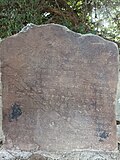
[[File:ANDRO INSCRIBED STONE.jpg|thumb|An 1822 CE stone recording a royal decree attributed to King [[Ching-Thang Khomba|Jai Singh]] ({{reign|1759|1762|1763|1798}}), erected at [[Andro, Imphal East]], Manipur]] | |||
[[ | |||
In 1725 CE, Pamheiba wrote [[Meitei translations and literary adaptations of the Mahabharata#History|Parikshit]], possibly the first piece of Meitei-language [[Hindu literature]], based on the story of the eponymous king [[Parikshit]] of the [[Mahabharata]].<ref>{{Cite book |last=Singh |first=Ch Manihar |url=https://books.google.com/books?id=yiBkAAAAMAAJ |title=A History of Manipuri Literature |date=1996 |publisher=[[Sahitya Akademi]] |isbn=978-81-260-0086-9 |location=India |page=135 |language=en}}</ref> | |||
[[ | |||
==== | == Geographical distribution == | ||
{{Further|States of India by Meitei speakers}} | |||
The majority of Meitei speakers, about 1.5 million<ref name="census">{{cite web |title=Census Tables |url=https://censusindia.gov.in/census.website/data/census-tables |website=Census of India |publisher=Office of the Registrar General & Census Commissioner, India |access-date=15 February 2024 |year=2011}}</ref> live in the Indian state of Manupur. Meitei is the official language of the [[Government of Manipur]] as well as its [[lingua franca]].<ref name="britannica.com" /> [[File:Map of Barak Valley.jpg|thumb|Districts of Barak Valley – Meitei speaking population settlement areas of Assam]] | |||
There are nearly 170,000 Meitei-speakers in Assam,<ref name="census"/> mainly in the [[Barak Valley]], where it is the third most commonly used language after Bengali and Hindi.<ref>{{Cite journal |last=Mishra |first=Awadesh |date=1 January 1999 |title=The Manipuris in the Barak Valley: A Case Study of Language Maintenance' |url=https://www.academia.edu/1059019 |journal=Linguistics of the Tibeto-Burman Area}}</ref> Manipuri is also spoken by about 9500 people in Nagaland, in communities such as [[Dimapur]], [[Kohima]], [[Peren, Nagaland|Peren]] and [[Phek]].<ref name="ethnologue_mni"/><ref name="census"/> Meitei is a [[second language]] for various [[Naga people|Naga]] and [[Kuki-Chin-Mizo people|Kuki-Chin]] ethnic groups.<ref name="ethnologue_mni"/> | |||
[[File:Sylhet in Bangladesh.svg|thumb|Areas with significant numbers of Meitei speakers in Bangladesh]] | |||
There are around 15,000 [[Meitei language in Bangladesh|Meitei speakers in Bangladesh]]{{citation needed|date=January 2025}} mainly are in the districts of [[Sylhet District|Sylhet]], [[Moulvibazar District|Moulvibazar]], [[Sunamganj District|Sunamganj]] and [[Habiganj District|Habiganj]] in the [[Sylhet Division]] of Bangladesh. In the past, there was a Meitei speaking population in [[Dhaka]], [[Mymensingh]] and [[Comilla]] also.<ref name=":Bangladesh">{{Cite web |title=Textile Bdesh Myanmar 3 |url=http://www.e-pao.net/epSubPageExtractor.asp?src=manipur.Arts_and_Culture.Mutua_Bahadur_Art_Collection.Textile_Bdesh_Myanmar_3 |access-date=14 March 2023 |website=e-pao.net}}</ref> Manipuri is used as a second language by the [[Bishnupriya Manipuri people]].<ref name="ethnologue_mni"/> | |||
Myanmar has a significant Meitei speaking population in the states of [[Kachin state|Kachin]] and [[Shan state|Shan]] and the regions of [[Yangon Region|Yangon]], [[Sagaing Region|Sagaing]], and [[Ayeyarwady Region|Ayeyarwady]], among others.<ref>{{Cite web |title=Manipuri in Myanmar 1 |url=http://e-pao.net/epSubPageExtractor.asp?src=manipur.Arts_and_Culture.Mutua_Bahadur_Art_Collection.Manipuri_in_Myanmar_1 |access-date=14 March 2023 |website=e-pao.net}}</ref> | |||
Myanmar has significant Meitei speaking population in [[Kachin state]] | |||
== Name == | == Name == | ||
According to the [[Ethnologue]], the alternative names of Meitei language are ''Kathe, Kathi, Manipuri, Meetei, Meeteilon, Meiteilon, Meiteiron, Meithe, Meithei, Menipuri, Mitei, Mithe, Ponna''.<ref | According to the [[Ethnologue]], the alternative names of Meitei language are ''Kathe, Kathi, Manipuri, Meetei, Meeteilon, Meiteilon, Meiteiron, Meithe, Meithei, Menipuri, Mitei, Mithe, Ponna''.<ref name="ethnologue_mni"/> | ||
The name ''Meitei'' or its alternate spelling ''Meithei'' is preferred by many native speakers of Meitei over ''Manipuri.''<ref name="Chelliah 1997: 2">Chelliah (1997: 2)</ref> The term is derived from the Meitei word for the language ''Meitheirón'' (''Meithei'' + ''-lon'' 'language', pronounced {{IPA|/mə́i.təi.lón/}}).<ref name="Chelliah 1997: 2"/><ref>{{Cite web |last=Sharma |first=H. Surmangol | | The name ''Meitei'' or its alternate spelling ''Meithei'' is preferred by many native speakers of Meitei over ''Manipuri.''<ref name="Chelliah 1997: 2">Chelliah (1997: 2)</ref> The term is derived from the Meitei word for the language ''Meitheirón'' (''Meithei'' + ''-lon'' 'language', pronounced {{IPA|/mə́i.təi.lón/}}).<ref name="Chelliah 1997: 2"/><ref>{{Cite web |last=Sharma |first=H. Surmangol |year=2006 |title=Learners' Manipuri-English dictionary. Meitei |url=https://dsal.uchicago.edu/cgi-bin/app/sharma_query.py?qs=%EA%AF%83%EA%AF%A9%EA%AF%87%EA%AF%A9&searchhws=yes |access-date=30 July 2022 |website=dsal.uchicago.edu}}</ref> ''Meithei'' may be a compound from ''mí'' 'man' + ''they'' 'separate'.<ref name="Chelliah 1997: 2"/> This term is used by most Western linguistic scholarship.<ref name="Chelliah 1997: 2"/> Meitei scholars use the term ''Meit(h)ei'' when writing in English and the term ''Meitheirón'' when writing in Meitei.<ref name="Chelliah 1997: 2"/> Chelliah (2015: 89) notes that the ''Meitei'' spelling has replaced the earlier ''Meithei'' spelling.<ref>Chelliah (2015: 89)</ref> | ||
The language (and people) is also referred to by the loconym ''Manipuri.''<ref name="Chelliah 1997: 2"/> The term is derived from the name of the state of [[Manipur]].<ref name="Chelliah 1997: 2"/> ''Manipuri'' is the official name of the language for the | The language (and people) is also referred to by the loconym ''Manipuri.''<ref name="Chelliah 1997: 2"/> The term is derived from the name of the state of [[Manipur]].<ref name="Chelliah 1997: 2"/> ''Manipuri'' is the official name of the language for the Indian government and is used by government institutions and non-Meitei authors.<ref name="Chelliah 1997: 2"/> The term ''Manipuri'' is also used to refer to the different [[languages of Manipur]] and to the people.<ref name="Chelliah 1997: 2"/> Additionally, ''Manipuri,'' being a loconym, can refer to anything pertaining to the Manipur state. | ||
Speakers of Meitei language are known as ''"Kathe"'' by the [[Burmese people]], ''"Moglie"'' or ''"Mekhlee"'' by the people of [[Cachar]], Assam ([[ | Speakers of Meitei language are known as ''"Kathe"'' by the [[Burmese people]], ''"Moglie"'' or ''"Mekhlee"'' by the people of [[Cachar]], Assam ([[Dimasa people|Dimasas]] and [[Assamese people|Assamese]]) and ''"Cassay"'' by the [[Shan people]] and the other peoples living in the east of the [[Ningthee River]] (or Khyendwen River). ''"Ponna"'' is the Burmese term used to refer to the [[Meitei people|Meiteis]] living inside [[Burma]].<ref>{{Cite news |last=Gangte |first=Priyadarshini M. |url=http://www.thepeopleschronicle.in/daily/english/1781 |title=Evolution of Meetei state- Emergence of Nongda Lairen Pakhangba |work=The People's Chronicle |archive-url=https://web.archive.org/web/20210119084314/http://www.thepeopleschronicle.in/daily/english/1781 |archive-date=19 January 2021 |access-date=21 March 2022}}</ref> | ||
== Dialects == | == Dialects == | ||
| Line 204: | Line 160: | ||
== Status == | == Status == | ||
{{ | {{Further|Meitei classical language movement|Meitei associate official language movement}} | ||
Meitei is the sole [[official language]] of the [[Government of Manipur]], and has been an official language of India since 1992.<ref name="britannica.com" /><ref>{{Cite web |title=Manipuri language and alphabets |url=https://omniglot.com/writing/manipuri.htm |website=omniglot.com}}</ref> | |||
Meitei | |||
Meitei language was the court language of the historic [[Manipur Kingdom]],<ref name="Sanajaoba 1988 290">{{Cite book |last=Sanajaoba |first=Naorem |url=https://books.google.com/books?id=-CzSQKVmveUC&dq=manipuri+court+language&pg=PA290 |title=Manipur, Past and Present: The Heritage and Ordeals of a Civilization |date=1988 |publisher=Mittal Publications |isbn=978-81-7099-853-2 |page=290 |language=en}}</ref> and before it merged into the Indian Republic.<ref name=":court_language_status">{{Cite book |last=Chishti |first=S. M. A. W. |url=https://books.google.com/books?id=YMcxSM_ZO30C&dq=Manipuri+court+language&pg=PA282 |title=Political Development in Manipur, 1919–1949 |date=2005 |publisher=GPH |isbn=978-81-7835-424-8 |page=282 |language=en}}</ref> The [[Sahitya Akademi]], India's National Academy of Letters, recognised Meitei as one of the major advanced Indian literary languages in 1972, long before it became an official language in 1992. | |||
In 1950, the [[Government of India]] did not include Meitei in its list of 14 official languages.<ref>{{Cite web |title=English Releases |url=https://pib.gov.in/newsite/erelcontent.aspx?relid=5928 |access-date=2022-08-26 |website=pib.gov.in}}</ref> A [[Meitei language movement#Scheduled language movement|language movement]], spearheaded by organisations including the [[Manipuri Sahitya Parishad]] and the All Manipur Students' Union demanded that Meitei be made an official language for more than 40 years, until Meitei was finally added to the [[Eighth Schedule to the Constitution of India]] in 1992.<ref>{{Cite book |last1=Thomas |first1=C. Joshua |url=https://books.google.com/books?id=daMpNcQKkjMC |title=Constraints in Development of Manipur |last2=Gopalakrishnan |first2=Ramamoorthy |last3=Singh |first3=R. K. Ranjan |date=2001 |publisher=Regency Publications [for Policy Alternatives for the North-East and Conflict Elimination Awareness] |isbn=978-81-87498-30-8 |pages=54–55 |language=en}}</ref><ref>{{Cite web |title=Manipuri language in 8th Schedule By Jeet Akoijam |url=http://e-pao.net/epPageExtractor.asp?src=MeiteiMayek.Manipuri_language_in_8th_Schedule_By_Jeet_Akoijam.html |access-date=2022-08-26 |website=e-pao.net}}</ref> | |||
Meitei became an associate official language of [[Assam]] in 2024,<ref>{{cite news |title=Assam recognises Manipuri as associate official language in four districts |url=https://www.hindustantimes.com/india-news/assam-recognises-manipuri-as-associate-official-language-in-four-districts-101708770769105.html |access-date=29 April 2024 |work=Hindustan Times |date=24 February 2024 |language=en}}</ref> following several years of effort by the [[Meitei associate official language movement]] to protect the identity, history, culture and tradition of Manipuris in Assam.<ref>{{Cite news |title=Manipuri as associate official language in Assam Sanajaoba approaches Sonowal |url=https://www.thesangaiexpress.com/Encyc/2020/9/24/Manipuri-as-associate-official-language-in-AssamSanajaoba-approaches-Sonowal-.html |website=The Sangai Express |date=24 September 2020 |language=en}}</ref><ref>{{Cite news |title=Manipuri language should be one of Assam's associate official languages: AAMSU |url=https://www.ifp.co.in/9888/manipuri-language-should-be-one-of-assams-associate-official-languages-aamsu |work=Imphal Free Press |archive-url=https://web.archive.org/web/20230811005543/https://www.ifp.co.in/9888/manipuri-language-should-be-one-of-assams-associate-official-languages-aamsu |archive-date=2023-08-11 |language=en}}</ref><ref name="hindu27Sep2020">{{Cite news |last=Laithangbam |first=Iboyaima |date=27 September 2020 |title=Assam to look into demand to include Manipuri in list of associate languages |language=en-IN |work=The Hindu |url=https://www.thehindu.com/news/national/other-states/minister-to-look-into-demand-to-include-manipuri-in-the-list-of-associate-languages-of-assam/article32707194.ece}}</ref> | |||
{{ | |||
< | |||
< | |||
The Meitei language | The Meitei language is one of the 13 official languages of the India used to administer police, armed services, and civil service recruitment exams.<ref>{{Cite web |title=Union Minister Dr Jitendra Singh lauds SSC for deciding to conduct the Multi-Tasking (Non-Technical) Staff examination 2022 in 13 regional languages in addition to Hindi and English for the first time |url=https://www.pib.gov.in/PressReleseDetailm.aspx?PRID=1892439 |access-date=25 January 2023 |website=pib.gov.in |language=en}}</ref><ref>{{Cite news |title=Manipuri among 13 regional languages approved for CAPF exam |url=https://www.ifp.co.in/manipur/manipuri-among-13-regional-languages-approved-for-capf-exam |access-date=19 April 2023 |work=[[Imphal Free Press]] |date=16 April 2023 |archive-url=https://web.archive.org/web/20241009002143/https://www.ifp.co.in/manipur/manipuri-among-13-regional-languages-approved-for-capf-exam |archive-date=2024-10-09 |language=en}}</ref> | ||
The [[Press Information Bureau]] of the Indian [[Ministry of Information and Broadcasting (India)|Ministry of Information and Broadcasting]] publishes in 14 languages, including Meitei.<ref>{{Cite web |last=Press |first=Imphal Free |author-link=Imphal Free Press |title=PIB website has news in regional languages now – KanglaOnline |url=http://kanglaonline.com/2015/11/pib-website-has-news-in-regional-languages-now/ |access-date=25 January 2023 |language=en-US}}</ref> | |||
== Education == | == Education == | ||
Meitei is a language of instruction in all in the educational institutions in Manipur. It is one of the 40 instructional languages offered by the [[Central Board of Secondary Education]] (CBSE), controlled and managed by the [[Ministry of Education (India)|Ministry of Education]].<ref>{{Cite web |title=CBSE {{!}} Academics Unit: Curriculum/Syllabus |url=https://cbseacademic.nic.in/curriculum.html |access-date=18 March 2023 |website=[[Central Board of Secondary Education|cbseacademic.nic.in]]}}</ref> Meitei is taught as a subject up to the post-graduate level in Indian universities, including [[Jawaharlal Nehru University]], [[Delhi University]], [[Gauhati University]], and the [[University of North Bengal]].<ref>{{cite journal |last1=Devi |first1=S. |date=May 2013 |title=Is Manipuri an Endangered Language? |url=http://www.languageinindia.com/may2013/rebikameitheiendangeredfinal.pdf |journal=Language in India |volume=13 |issue=5 |pages=520–533}}</ref><ref>{{Cite book |last=Bareh |first=Hamlet |url=https://books.google.com/books?id=XScmdGvMf7IC&dq=Manipuri+national+language&pg=PA80 |title=Encyclopaedia of North-East India |date=2001 |publisher=Mittal Publications |isbn=978-81-7099-790-0 |page=80 |language=en}}</ref> [[Indira Gandhi National Open University]] teaches Meitei to undergraduates.<ref>{{cite web |title=Manipur: Meitei language to be introduced in IGNOU syllabus, says union minister |url=https://nenow.in/north-east-news/manipur/manipur-meitei-language-to-be-introduced-in-ignou-syllabus-says-union-minister.html |website=Northeast Now |access-date=18 February 2024 |date=21 August 2023}}</ref> | |||
[[Indira Gandhi National Open University]] | |||
=== Assam === | === Assam === | ||
Meitei language instruction has been offered in the lower primary schools of Assam since 1956.<ref name="hindu27Sep2020" /> The [[Board of Secondary Education, Assam]] offers secondary education in Manipuri.<ref>{{Cite web |date=17 March 2023 |title=Assam HSLC Exam Routine 2023 Revised: SEBA To Conduct All Class 10 Language Papers Including English On April 1 |url=https://www.india.com/education/assam-hslc-exam-routine-2023-revised-seba-to-conduct-all-class-10-language-paper-including-english-on-april-1-after-assamese-paper-leak-himanta-biswa-sarma-5950004/ |access-date=18 March 2023 |website=India.com |language=en |quote=In addition to Assamese, the other MIL subjects are Bengali, Bodo, Hindi, Manipuri, Hmar, Nepali, Mizo, Khasi, Garo, Karbi and Urdu.}}</ref> The [[Assam Higher Secondary Education Council]] of Assam offers both Meitei-language schooling and instruction in Meitei as a second language.<ref>{{Cite web |title=AHSEC complete syllabus for HS 2nd year |url=https://ahsec.assam.gov.in/index.php/hs-2nd-year-syllabus/ |website=ahsec.assam.gov.in}}</ref> | |||
[[Board of Secondary Education, Assam]] | |||
[[Assam Higher Secondary Education Council]] | |||
Since 2020, [[Assam Government]] | Since 2020, the [[Assam Government]] has made an annual grant of {{INR Convert|5|l|year=2020}} to the [[Manipuri Sahitya Parishad]] (Manipuri Language Council). It also invested {{INR Convert|6|c|year=2020}} in the creation of a corpus for the development of the Meitei language.<ref name="hindu27Sep2020" /> | ||
The | The [[Department of Manipuri, Assam University|Department of Manipuri]] of [[Assam University]] offers education up to the Ph.D. level in Meitei language.<ref>{{Cite web |title=Manipuri Department |url=http://www.aus.ac.in/manipuri-department/ |access-date=18 March 2023 |language=en-US}}</ref><ref>{{Cite news |title=5 literary bodies bat for Manipuri language in Assam |url=https://www.thesangaiexpress.com/Encyc/2020/8/3/5-literary-bodies-bat-for-Manipuri-language-in-Assam.amp.html |access-date=18 March 2023 |work=The Sangai Express |date=3 August 2020 |language=en |quote=Moreover, Manipuri in MA and PhD courses are offered at Assam University, Silchar.}}</ref><ref>{{Cite news |title=AAMSU demands Associate Official Language status to Manipuri language |url=https://www.time8.in/aamsu-demands-associate-official-language-status-to-manipuri-language/ |work=Time8 |date=22 September 2021 |archive-url=https://web.archive.org/web/20220826054218/https://www.time8.in/aamsu-demands-associate-official-language-status-to-manipuri-language/ |archive-date=2022-08-26 |quote=Several universities, notably Assam University and Silchar University, provide Manipuri language courses.}}</ref> | ||
=== Tripura === | === Tripura === | ||
Since 1998, the [[Government of Tripura]] has offered Meitei language as a "first language" subject at primary level in 24 schools throughout the state.<ref>{{Cite web |title=MANIPURI {{!}} DIRECTORATE OF KOKBOROK & OTHER MINORITY LANGUAGES |url=https://kokborokoml.tripura.gov.in/manipuri#:~:text=The%20government%20of%20Tripura%20has,notified%20schools%20throughout%20the%20state. |access-date=18 March 2023 |website=kokborokoml.tripura.gov.in}}</ref> | |||
In December 2021, [[Tripura University]] proposed to the | In December 2021, [[Tripura University]] proposed to the Indian Ministry of Education and the [[University Grants Commission (India)|University Grants Council (UGC)]], regarding the introduction of diploma courses in Meitei, along with international languages like Japanese, Korean and Nepali.<ref>{{Cite web |date=23 December 2021 |title=Tripura University proposes introduction of diploma courses in Japanese, Korean, Nepali and Manipuri languages |url=http://www.indiatodayne.in/breaking-news/story/tripura-university-proposes-introduction-diploma-courses-japanese-korean-nepali-and-manipuri-languages-411046-2021-12-23 |access-date=18 March 2023 |website=India Today NE |language=hi}}</ref> | ||
== Phonology == | == Phonology == | ||
The exact classification of the Meitei language within [[Sino-Tibetan languages|Sino-Tibetan]] remains unclear. It has lexical resemblances to [[Kuki language|Kuki]] and [[Tangkhul language|Tangkhul]].<ref>{{cite book |last1=Post |first1=Mark W. |last2=Burling |first2=Robbins |author2-link=Robbins Burling |year=2017 |orig- | The exact classification of the Meitei language within [[Sino-Tibetan languages|Sino-Tibetan]] remains unclear. It has lexical resemblances to [[Kuki language|Kuki]] and [[Tangkhul language|Tangkhul]].<ref>{{cite book |last1=Post |first1=Mark W. |last2=Burling |first2=Robbins |author2-link=Robbins Burling |year=2017 |orig-date=First published 2003 |chapter=The Tibeto-Burman Languages of Northeastern India |editor1-last=Thurgood |editor1-first=Graham |editor1-link=Graham Thurgood |editor2-last=LaPolla |editor2-first=Randy J. |editor2-link=Randy LaPolla |title=The Sino-Tibetan Languages |edition=2nd |publisher=Routledge |pages=23, 232–233 |isbn=978-1-138-78332-4}}</ref> | ||
=== Tone === | === Tone === | ||
| Line 313: | Line 201: | ||
!colspan=3| | !colspan=3| | ||
![[Labial consonant|Labial]] | ![[Labial consonant|Labial]] | ||
![[Dental consonant|Dental]]/[[Alveolar consonant|Alveolar]] | ![[Dental consonant|Dental]]/<br />[[Alveolar consonant|Alveolar]] | ||
![[Palatal consonant|Palatal]] | ![[Palatal consonant|Palatal]] | ||
![[Velar consonant|Velar]] | ![[Velar consonant|Velar]] | ||
| Line 319: | Line 207: | ||
|- | |- | ||
!colspan=3|[[Nasal consonant|Nasal]] | !colspan=3|[[Nasal consonant|Nasal]] | ||
|{{ | |{{IPA link|m}} | ||
|{{ | |{{IPA link|n}} | ||
| | | | ||
|{{ | |{{IPA link|ŋ}} | ||
| | | | ||
|- | |- | ||
!rowspan=4|[[ | !rowspan=4|[[Plosive]] | ||
!rowspan=2|{{small|[[voice (phonetics)|voiceless]]}} | !rowspan=2|{{small|[[voice (phonetics)|voiceless]]}} | ||
!{{small|unaspirated}} | !{{small|unaspirated}} | ||
|{{ | |{{IPA link|p}} | ||
|{{ | |{{IPA link|t}} | ||
|{{ | |{{IPA link|tʃ}} | ||
|{{ | |{{IPA link|k}} | ||
|{{ | |{{IPA link|ʔ}} | ||
|- | |- | ||
!{{small|[[aspirated consonant|aspirated]]}} | !{{small|[[aspirated consonant|aspirated]]}} | ||
|{{ | |{{IPA link|pʰ}} | ||
|{{ | |{{IPA link|tʰ}} | ||
| | | | ||
|{{ | |{{IPA link|kʰ}} | ||
| | | | ||
|- | |- | ||
!rowspan=2|{{small|[[voice (phonetics)|voiced]]}} | !rowspan=2|{{small|[[voice (phonetics)|voiced]]}} | ||
!{{small|unaspirated}} | !{{small|unaspirated}} | ||
|{{ | |{{IPA link|b}} | ||
|{{ | |{{IPA link|d}} | ||
|{{ | |{{IPA link|dʒ}} | ||
|{{ | |{{IPA link|ɡ}} | ||
| | | | ||
|- | |- | ||
!{{small|[[breathy voice|breathy | !{{small|[[breathy voice|breathy]]}} | ||
|{{ | |{{IPA link|bʱ}} | ||
|{{ | |{{IPA link|dʱ}} | ||
| | | | ||
|{{ | |{{IPA link|ɡʱ}} | ||
| | | | ||
|- | |- | ||
!colspan=3|[[ | !colspan=3|[[Fricative]] | ||
| | | | ||
|{{ | |{{IPA link|s}} | ||
| | | | ||
| | | | ||
|{{ | |{{IPA link|h}} | ||
|- | |- | ||
!colspan=3|[[ | !colspan=3|[[Tap consonant|Tap]] | ||
| | | | ||
|{{ | |{{IPA link|ɾ}} | ||
| | | | ||
| | | | ||
| Line 372: | Line 260: | ||
!colspan=3|[[Lateral consonant|Lateral]] | !colspan=3|[[Lateral consonant|Lateral]] | ||
| | | | ||
|{{IPA|l}} | |{{IPA link|l}} | ||
| | | | ||
| | | | ||
| | | | ||
|- | |- | ||
!colspan=3|[[ | !colspan=3|[[Approximant]] | ||
|{{ | |{{IPA link|w}} | ||
| | | | ||
|{{ | |{{IPA link|j}} | ||
| | | | ||
| | | | ||
| Line 393: | Line 281: | ||
|- | |- | ||
![[Close vowel|High]] | ![[Close vowel|High]] | ||
|{{ | |{{IPA link|i}} | ||
| | | | ||
|{{ | |{{IPA link|u}} | ||
|- | |- | ||
![[Mid vowel|Mid]] | ![[Mid vowel|Mid]] | ||
|{{ | |{{IPA link|e}} | ||
|{{ | |{{IPA link|ɐ}} | ||
|{{ | |{{IPA link|o}} | ||
|- | |- | ||
![[Open vowel|Low]] | ![[Open vowel|Low]] | ||
| | | | ||
|{{ | |{{IPA link|a}} | ||
| | | | ||
|} | |} | ||
Note: the central vowel /ɐ/ is transcribed as <nowiki><ə></nowiki> in recent linguistic work on Meitei. However, phonetically it is never [ə], but more usually [ɐ]. It is assimilated to a following approximant: /ɐw/ = | Note: the central vowel /ɐ/ is transcribed as <nowiki><ə></nowiki> in recent linguistic work on Meitei. However, phonetically it is never [ə], but more usually [ɐ]. It is assimilated to a following approximant: /ɐw/ = [ow], /ɐj/ = [ej]. | ||
=== Phonological processes === | === Phonological processes === | ||
| Line 431: | Line 319: | ||
=== Meitei script === | === Meitei script === | ||
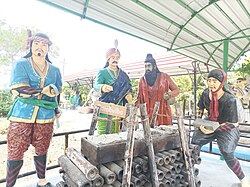
[[File:Depiction of the Puya Mei Thaba (Burning of the Meitei texts) ordered by Meitei King Pamheiba (AKA Garib Niwaj or Gopal Singh) under the influence of Bengali Hindu missionary Shantidas Gosai (AKA Shantidas Goswami or Shantidas Adhikari).jpg|thumb|300px|Depiction of the 18th century historic burning of texts written in Meitei script.]] | |||
[[ | The [[Meitei script]] ({{langx|mni|{{Script|Mtei|ꯃꯩꯇꯩ ꯃꯌꯦꯛ}}|Meitei mayek|label=none}})<ref>{{Cite journal |last1=Khuman |first1=Yanglem Loijing Khomba |last2=Devi |first2=Salam Dickeeta |last3=Singh |first3=Ch. Ponykumar |last4=Devi |first4=H. Mamata |last5=Singh |first5=N. Ajith |date=1 December 2022 |title=A benchmark dataset for printed Meitei/Meetei script character recognition |journal=Data in Brief |language=en |volume=45 |article-number=108585 |doi=10.1016/j.dib.2022.108585 |pmid=36426059 |pmc=9679442 |bibcode=2022DIB....4508585K |issn=2352-3409}}</ref> is one of the [[official scripts of the Indian Republic]]. Meitei mayek is also known as Kanglei script {{meitei|ꯀꯪꯂꯩ ꯃꯌꯦꯛ|kanglei mayek|label=no}}<ref>{{Cite book |last1=Noni |first1=Arambam |url=https://books.google.com/books?id=OzjbCgAAQBAJ&q=Kanglei+script+Meetei+Mayekuz8AhVlSWwGHeUtCqoQ6AF6BAgFEAM&pg=PA223 |title=Colonialism and Resistance: Society and State in Manipur |last2=Sanatomba |first2=Kangujam |year=2015 |publisher=[[Routledge]] |isbn=978-1-317-27066-9 |pages=223, 235, 237 |language=en}}</ref> or kok sam lai script {{meitei|ꯀꯣꯛ ꯁꯝ ꯂꯥꯏ ꯃꯌꯦꯛ|la=kok sam lai mayeke|label=no}}, after its first three letters.<ref>{{Cite web |script-title=mni:মণিপুরদা লোলয়ান চঙলকপা অমদি মীতৈ ইয়েক্না থোঙজিন্দা ৱারৌজনা লেপ্লরবদা ! |url=http://hueiyenlanpao.com/wp-content/uploads/2016/06/17.02.2022-B5.pdf |website=Hueiyen Lanpao |language=mni}}</ref> Its earliest known appearance is on 6th century coins.<ref>{{Cite book |last=Datta |first=Amaresh |url=https://books.google.com/books?id=ObFCT5_taSgC&q=Manipur%208th%20century%20copper%20plate%20inscription%20Manipur&pg=PA142 |title=Encyclopaedia of Indian Literature |publisher=[[Sahitya Akademi]] |year=1987 |isbn=978-81-260-1803-1 |page=142 |language=en}}</ref> It was used until the 18th century, when it was replaced by the [[Bengali script]], and then revived in again massively in the 20th.<ref>{{Cite news |last=Laithangbam |first=Iboyaima |date=23 September 2017 |title=Banished Manipuri script stages a comeback |language=en-IN |work=The Hindu |url=https://www.thehindu.com/news/national/other-states/banished-manipuri-script-stages-a-comeback/article19743482.ece |access-date=6 March 2023 |issn=0971-751X}}</ref> In 2021, the use of Meetei Mayek to write Manipuri was officially adopted by the [[government of Manipur]], alongside Bengali script.<ref>{{Cite web |title=GAZETTE TITLE: The Manipur Official Language (Amendment) Act, 2021 |url=http://manipurgovtpress.nic.in/en/details_gazzete/?gazette=658 |access-date=6 March 2023 |website=manipurgovtpress.nic.in}}</ref> | ||
The | The Roman alphabet has been used in medium for teaching basic Meitei as a second language teaching by the Board of Secondary Education, Manipur.<ref>{{Cite news |date=25 January 2023 |title=Manipur HSLC Date Sheet 2023: BSEM Class 10 time table released, exam begins March 16 |work=[[The Times of India]] |url=https://timesofindia.indiatimes.com/education/news/manipur-hslc-date-sheet-2023-bsem-class-10-time-table-released-exam-begins-march-16/articleshow/97300318.cms?from=mdr |access-date=6 March 2023 |issn=0971-8257}}</ref><ref>{{Cite web |last=SNS |date=10 January 2019 |title=Manipur Board Class 12 (HSC) and Class 10 (HSLC) Timetable 2019 available online at manipureducation.gov.in {{!}} Check now |url=https://www.thestatesman.com/india/manipur-board-class-12-hsc-and-class-10-hslc-timetable-2019-available-online-at-manipureducation-gov-in-check-now-1502723456.html |access-date=6 March 2023 |website=[[The Statesman (India)|The Statesman]] |language=en-US}}</ref> More recently, the Board has issued a directive that no more Manipuri textbooks using the Latin alphabet be published.<ref>{{cite web |title=MEELAL lauds BSEM order: 04th feb24 ~ E-Pao! Headlines |url=https://e-pao.net/GP.asp?src=44..040224.feb24 |website=e-pao.net |access-date=15 February 2024}}</ref> Meitei language editions of the Bible in Roman script are very commonly used by the [[Christianity in Manipur|Christians]] in Manipur.<ref>{{Cite web |title=The Birth of Jesus Manipuri Roman Mayek CB |url=https://bibleforchildren.org/PDFs/manipuri_roman_mayek/36_The_Birth_of_Jesus_Manipuri_Roman_Mayek_CB.pdf |website=bibleforchildren.org}}</ref> | ||
The [[Naoriya Phulo script]] is a [[constructed script]], invented by Laininghan Naoriya Phulo (1888–1941). It shares many similarities with [[Devanagari]] and Bengali script.<ref>{{Cite web |script-title=mni:নাওরিয়া ফুলো: ঋষি অমা - এলাংম দীনমনী |url=http://hueiyenlanpao.com/wp-content/uploads/2016/06/12.11.2019-B7.pdf |work=Hueiyen Lanpao |language=mni |publication-place=India}}</ref> It was championed by [[Apokpa Marup]], but was never widely adopted.<ref>{{Cite book |last=Singh |first=Wahengbam Ibohal |url=https://archive.org/details/in.ernet.dli.2015.463276/page/n501/mode/2up?q=Naoriya+phullo |title=The History Of Manipur |publisher=[[Digital Library of India]] |others=[[Internet Archive]] |location=India |page=501 |language=en}}</ref> | |||
[[ | |||
== Grammar == | == Grammar == | ||
Sentences in the Meitei language use the | Sentences in the Meitei language use the [[subject–object–verb word order]] (SOV). For example, in the sentence ''Ei chak chai'' (ꯑꯩ ꯆꯥꯛ ꯆꯥꯢ), which translates to ''I eat rice'', the gloss is "ei" (I), "chak" (rice), "chai" (eat). | ||
=== Nouns === | === Nouns === | ||
| Line 551: | Line 347: | ||
! Adjective (Meitei) !! Adjective (English) !! Example (Meitei) !! Example (English) | ! Adjective (Meitei) !! Adjective (English) !! Example (Meitei) !! Example (English) | ||
|- | |- | ||
| ama || one || mi ama | | ama || one || mi ama laak'i || A person comes. | ||
|- | |- | ||
| khara || some || mi khara | | khara || some || mi khara laak'i || Some persons come. | ||
|- | |- | ||
| mayaam || many || mi mayaam | | mayaam || many || mi mayaam laak'i || Many persons come. | ||
|} | |} | ||
| Line 587: | Line 383: | ||
== Number words == | == Number words == | ||
{{ | {{Further|Meitei numerals}} | ||
{| class= | {| class=wikitable | ||
|- | |- | ||
! Numeral !! Word !!Etymology!!Meitei Script | ! Numeral !! Word !!Etymology!!Meitei Script | ||
|- | |- | ||
|1||a-ma ~ a-maa|| | |1||a-ma ~ a-maa||1 ||{{Script|Mtei|ꯑꯃꯥ}} | ||
|- | |- | ||
|2||a-ni||Proto-Tibeto-Burman *ni||{{Script|Mtei|ꯑꯅꯤ}} | |2||a-ni||Proto-Tibeto-Burman *ni||{{Script|Mtei|ꯑꯅꯤ}} | ||
| Line 606: | Line 402: | ||
|7||ta-ret||PTB *let ||{{Script|Mtei|ꯇꯔꯦꯠ}} | |7||ta-ret||PTB *let ||{{Script|Mtei|ꯇꯔꯦꯠ}} | ||
|- | |- | ||
|8||ni-paan|| | |8||ni-paan||2-less||{{Script|Mtei|ꯅꯤꯄꯥꯟ}} | ||
|- | |- | ||
|9||maa-pan|| | |9||maa-pan||1-less||{{Script|Mtei|ꯃꯥꯄꯟ}} | ||
|- | |- | ||
|10||ta-raa|| | |10||ta-raa||10||{{Script|Mtei|ꯇꯔꯥ}} | ||
|- | |- | ||
|11||taraa-maa-thoi|| | |11||taraa-maa-thoi||ten + 1-more||{{Script|Mtei|ꯇꯔꯥꯃꯥꯊꯣꯏ}} | ||
|- | |- | ||
|12||taraa-ni-thoi|| | |12||taraa-ni-thoi||ten + 2-more||{{Script|Mtei|ꯇꯔꯥꯅꯤꯊꯣꯏ}} | ||
|- | |- | ||
|13||taraa-húm-doi|| | |13||taraa-húm-doi||ten + 3-more||{{Script|Mtei|ꯇꯔꯥꯍꯨꯝꯗꯣꯏ}} | ||
|- | |- | ||
|14||taraa-mari|| | |14||taraa-mari||ten +4||{{Script|Mtei|ꯇꯔꯥꯃꯔꯤ}} | ||
|- | |- | ||
|15||taraa-mangaa|| | |15||taraa-mangaa||ten +5||{{Script|Mtei|ꯇꯔꯥꯃꯉꯥ}} | ||
|- | |- | ||
|16||taraa-taruk|| | |16||taraa-taruk||ten +6||{{Script|Mtei|ꯇꯔꯥꯇꯔꯨꯛ}} | ||
|- | |- | ||
|17||taraa-taret|| | |17||taraa-taret||ten +7||{{Script|Mtei|ꯇꯔꯥꯇꯔꯦꯠ}} | ||
|- | |- | ||
|18||taraa-nipaan|| | |18||taraa-nipaan||ten +8||{{Script|Mtei|ꯇꯔꯥꯅꯤꯄꯥꯟ}} | ||
|- | |- | ||
|19||taraa-maapan|| | |19||taraa-maapan||ten +9||{{Script|Mtei|ꯇꯔꯥꯃꯥꯄꯟ}} | ||
|- | |- | ||
|20||kun ~ kul|| | |20||kun ~ kul||score ||{{Script|Mtei|ꯀꯨꯟ ~ ꯀꯨꯜ}} | ||
|- | |- | ||
|30||*kun-taraa > kun-thraa|| | |30||*kun-taraa > kun-thraa||score ten|| {{Script|Mtei|ꯀꯨꯟꯊ꯭ꯔꯥ}} | ||
|- | |- | ||
|40||ni-phú|| | |40||ni-phú||two score||{{Script|Mtei|ꯅꯤꯐꯨ}} | ||
|- | |- | ||
|50||yaang-khéi|| | |50||yaang-khéi||half hundred||{{Script|Mtei|ꯌꯥꯡꯈꯩ}} | ||
|- | |- | ||
|60||hum-phú|| | |60||hum-phú||three score|| {{Script|Mtei|ꯍꯨꯝꯐꯨ}} | ||
|- | |- | ||
|70||hum-phú-taraa|| | |70||hum-phú-taraa||three score ten||{{Script|Mtei|ꯍꯨꯝꯐꯨꯇꯔꯥ}} | ||
|- | |- | ||
|80||mari-phú|| | |80||mari-phú||four score|| {{Script|Mtei|ꯃꯔꯤꯐꯨ}} | ||
|- | |- | ||
|90||mari-phú-taraa|| | |90||mari-phú-taraa||four score ten|| {{Script|Mtei|ꯃꯔꯤꯐꯨꯇꯔꯥ}} | ||
|- | |- | ||
|100||chaama|| | |100||chaama||one hundred|| {{Script|Mtei|ꯆꯥꯃ}} | ||
|- | |- | ||
|200||cha-ni|| | |200||cha-ni||two hundreds|| {{Script|Mtei|ꯆꯥꯅꯤ}} | ||
|- | |- | ||
|300||cha-hum|| | |300||cha-hum||three hundreds|| {{Script|Mtei|ꯆꯥꯍꯨꯝ}} | ||
|- | |- | ||
|400||cha-mri|| | |400||cha-mri||four hundreds|| {{Script|Mtei|ꯆꯥꯃ꯭ꯔꯤ}} | ||
|- | |- | ||
|500||cha-mangaa|| | |500||cha-mangaa||five hundreds|| {{Script|Mtei|ꯆꯥꯃꯉꯥ}} | ||
|- | |- | ||
|1,000||lisíng ama|| | |1,000||lisíng ama||one thousand|| {{Script|Mtei|ꯂꯤꯁꯤꯡ}} | ||
|- | |- | ||
|10,000||lisīng-taraa|| | |10,000||lisīng-taraa||ten thousands ||{{Script|Mtei|ꯂꯤꯁꯤꯡꯇꯔꯥ}} | ||
|- | |- | ||
|1,00,000||licha|| | |1,00,000||licha||one hundred-thousand||{{Script|Mtei|ꯂꯤꯆꯥ}} | ||
|- | |- | ||
|10,00,000||licha-taraa|| | |10,00,000||licha-taraa||ten hundred-thousands ||{{Script|Mtei|ꯂꯤꯆꯥꯇꯔꯥ}} | ||
|- | |- | ||
|1,00,00,000||leepun|| | |1,00,00,000||leepun||one ten-million ||{{Script|Mtei|ꯂꯤꯄꯨꯟ}} | ||
|- | |- | ||
|10,00,00,000||leepun-taraa|| | |10,00,00,000||leepun-taraa||ten ten-millions ||{{Script|Mtei|ꯂꯤꯄꯨꯟꯇꯔꯥ}} | ||
|- | |- | ||
|1,00,00,00,000||leepot|| | |1,00,00,00,000||leepot||one billion ||{{Script|Mtei|ꯂꯤꯄꯣꯠ}} | ||
|- | |- | ||
|10,00,00,00,000||leepot-taraa|| | |10,00,00,00,000||leepot-taraa||ten billions ||{{Script|Mtei|ꯂꯤꯄꯣꯠꯇꯔꯥ}} | ||
|- | |- | ||
|1,00,00,00,00,000||leekei|| | |1,00,00,00,00,000||leekei||one hundred-billion ||{{Script|Mtei|ꯂꯤꯀꯩ}} | ||
|- | |- | ||
|10,00,00,00,00,000||leekei-taraa|| | |10,00,00,00,00,000||leekei-taraa||ten hundred-billions ||{{Script|Mtei|ꯂꯤꯀꯩꯇꯔꯥ}} | ||
|- | |- | ||
|1,00,00,00,00,00,000||pu-ama|| | |1,00,00,00,00,00,000||pu-ama||one ten-trillion ||{{Script|Mtei|ꯄꯨ ꯑꯃꯥ}} | ||
|} | |} | ||
== Literature == | == Literature == | ||
{{Main|Ancient Meitei literature|Meitei literature | {{Main|Ancient Meitei literature|Meitei literature}} | ||
[[File:The classical Meitei epic of the "Numit Kappa", written in ancient Meitei language (in archaic Meitei script).jpg|thumb|The [[Numit Kappa]], a | [[File:The classical Meitei epic of the "Numit Kappa", written in ancient Meitei language (in archaic Meitei script).jpg|thumb|The [[Numit Kappa]], a Classical Meitei 1st century epic based on Meitei mythology and religion.]] | ||
The ''[[Khamba Thoibi Sheireng]]'', | The ''[[Khamba Thoibi Sheireng]]'', a poem of 39,000 verses composed by Hijam Anganghal Singh and first published in 1940 ({{langx|mni|{{Script|Mtei|[[ꯈꯝꯕ ꯊꯣꯏꯕꯤ ꯁꯩꯔꯦꯡ]]}}|Poem on [[Khamba Thoibi]]}})<ref>{{Cite book |last=George |first=K. M. |url=https://books.google.com/books?id=m1R2Pa3f7r0C&dq=Khamba+Thoibi+Sheireng&pg=PA29 |title=Modern Indian Literature, an Anthology: Surveys and poems |publisher=[[Sahitya Akademi]] |year=1992 |isbn=978-81-7201-324-0 |location=India |page=29 |language=en}}</ref> is regarded as the [[national epic]] of the [[Manipuris]].<ref name="George 1992 258">{{Cite book |last=George |first=K. M. |url=https://books.google.com/books?id=m1R2Pa3f7r0C&dq=Khamba+Thoibi+Sheireng&pg=PA258 |title=Modern Indian Literature, an Anthology: Surveys and poems |date=1992 |publisher=[[Sahitya Akademi]] |isbn=978-81-7201-324-0 |location=India |page=258 |language=en |quote=H. Anganghal Singh's Khamba Thoibi Sheireng (Poem on Khamba Thoibi, 1940) is a national epic of the Manipuris based on the story of Khamba and Thoibi of Moirang. The poet composes the whole epic in the Pena Saisak style of folk ballads sung by minstrels or bards popular in Manipur.}}</ref><ref>{{Cite book |last=Datta |first=Amaresh |url=https://books.google.com/books?id=zB4n3MVozbUC&dq=Khamba+Thoibi+Sheireng&pg=PA1186 |title=Encyclopaedia of Indian Literature: Devraj to Jyoti |publisher=[[Sahitya Akademi]] |year=1988 |isbn=978-81-260-1194-0 |location=India |page=1186 |language=en}}</ref> It is a classical Meitei language [[epic poem]] based on the ancient romantic adventure tale of [[Khamba and Thoibi]] of [[Moirang]]. It is regarded as the greatest of all Meitei epic poems.<ref name="Datta 1988 1573">{{Cite book |last=Datta |first=Amaresh |url=https://books.google.com/books?id=zB4n3MVozbUC&dq=Khamba+Thoibi+Sheireng&pg=PA1573 |title=Encyclopaedia of Indian Literature: Devraj to Jyoti |publisher=[[Sahitya Akademi]] |year=1988 |isbn=978-81-260-1194-0 |location=India |page=1573 |language=en |quote=His best work, Khamba Thoibi sheireng, in 39,000 lines on the story of 'Khamba and Thoibi' was started in 1939 and the composition was completed in 1940.}}</ref><ref name=":Sisir">{{Cite book |last=Das |first=Sisir Kumar |url=https://books.google.com/books?id=sqBjpV9OzcsC&dq=Khamba+Thoibi+Sheireng&pg=PA190 |title=A History of Indian Literature: 1911–1956, struggle for freedom: triumph and tragedy |publisher=[[Sahitya Akademi]] |year=2005 |isbn=978-81-7201-798-9 |page=190 |language=en |quote=His epic Singel Indu was published in 1938 which was followed by his magnum opus Khamba Thoibi Sheireng (1940), a poem of 39000 lines, considered to be the 'national' epic of the Manipuris, written in the Pena Saisak style of folk ballads.}}</ref><ref>{{Cite magazine |last=Sing |first=Damodar |title=The Epic of Manipur: Khamba Thoibi |url=https://books.google.com/books?id=gL_8DwAAQBAJ&dq=Khamba+Thoibi+Seireng&pg=PA1582 |magazine=Akashvani |volume=XL |issue=35 |date=31 August 1975 |publisher=All India Radio (AIR) |location=New Delhi |page=1582 |language=en}}</ref> | ||
= | |||
== | |||
= | |||
The [[Meitei classical language movement]] seeks to gain recognition for Meitei as one of the [[Classical Languages of India]].<ref>{{Cite web |title=Government must take concrete step for recognition of Manipuri as classical language |url=https://www.ifp.co.in/manipur/government-must-take-concrete-step-for-recognition-of-manipuri-as-classical-language |website=Imphal Free Press |language=en}}</ref><ref>{{Cite news |last=IANS |date=20 August 2016 |title=Classic language status for Manipuri demanded |work=Business Standard India |url=https://www.business-standard.com/article/news-ians/classic-language-status-for-manipuri-demanded-116082000690_1.html}}</ref><ref>{{Cite web |date=21 August 2019 |title=Manipur Govt Begins Efforts for Inclusion of Manipuri Among 'Classical' Languages |url=http://www.indiatodayne.in/breaking-news/story/manipur-govt-begins-efforts-inclusion-manipuri-among-classical-languages-397876-2019-08-21 |website=India Today NE |language=hi}}</ref> | |||
== Annual events == | == Annual events == | ||
Various annual events are organised to promote, protect and develop Meitei language, in the sovereign states of India and Bangladesh in particular as well as in other parts of the world in general. | Various annual events are organised to promote, protect and develop Meitei language, in the sovereign states of India and Bangladesh in particular as well as in other parts of the world in general. | ||
* [[Manipuri language day]] ({{langx|mni|{{Script|Mtei|ꯂꯣꯟꯒꯤ ꯅꯨꯃꯤꯠ}}|Manipuri Lon-gi Numit}}) is observed annually on 20 August, commemorating the day in 1992 when Manipuri was made one of the [[official languages of India]].<ref>{{Cite book |last1=Coleman |first1=Daniel |url=https://books.google.com/books?id=eu8cTROu4LcC&dq=meitei+language+day&pg=PA131 |title=Countering Displacements: The Creativity and Resilience of Indigenous and Refugee-ed Peoples |last2=Glanville |first2=Erin Goheen |last3=Hasan |first3=Wafaa |last4=Kramer-Hamstra |first4=Agnes |date=26 April 2012 |publisher=University of Alberta |isbn=978-0-88864-592-0 |page=131 |language=en}}</ref> | |||
* [[Manipuri poetry day]] ({{langx|mni|{{Script|Mtei|ꯃꯅꯤꯄꯨꯔꯤ ꯁꯩꯔꯦꯡꯒꯤ ꯅꯨꯃꯤꯠ}}|Manipuri Sheirenggi Numit}}), is an annual literary event that promotes Meitei language poetry and the traditions of [[Meitei literature]].<ref>{{Cite web |title=St Joseph University, Nagaland observes Manipuri Poetry Day 2022 |url=https://www.ifp.co.in/poetry/st-joseph-university-nagaland-observes-manipuri-poetry-day-2022 |access-date=9 March 2023 |website=[[Imphal Free Press]] |date=14 October 2019 |language=en}}</ref><ref>{{Cite web |title=Manipuri Poetry Day 2021 celebrated: 22nd oct21 ~ E-Pao! Headlines |url=http://e-pao.net/GP.asp?src=14..221021.oct21 |access-date=9 March 2023 |website=e-pao.net}}</ref> Events are held in [[Manipur]] and in and by Meitei-speakers in [[Northeast India]] and [[West Bengal]].<ref>{{Cite news |last=Ajit |first=Sh |title=Manipuri in Kolkata observes "Manipuri Poetry Day" |url=https://www.imphaltimes.com/news/item/15818-manipuri-in-kolkata-observes-manipuri-poetry-day |access-date=9 March 2023 |work=Imphal Times |language=en-gb}}</ref><ref>{{Cite news |title=Manipuri Poetry Day 2021 celebrated |url=https://www.thesangaiexpress.com/Encyc/2021/10/21/IMPHAL-Oct-21Department-of-English-St-Joseph-University-Nagaland-in-collaboration-with-Fiction.html |access-date=9 March 2023 |work=The Sangai Express |date=21 October 2021 |language=en}}</ref> | |||
* The [[Manipuri Language Festival]] ({{langx|mni|{{Script|Mtei|ꯃꯅꯤꯄꯨꯔꯤ ꯂꯣꯟꯒꯤ ꯀꯨꯝꯃꯩ}}|Manipuri Lon-gi Kummei}}) is an annual cultural event that aims to protect and develop of the Meitei language, script and [[Meitei culture|culture]] in Bangladesh.<ref>{{Cite news |last=Paul |first=Jibon |date=14 May 2022 |script-title=bn:কমলগঞ্জে মণিপুরি ভাষা ও সংস্কৃতি উৎসব |url=https://dailyjalalabad.com/2022/05/186017/ |access-date=11 March 2023 |work=Daily Jalalabad |language=bn |archive-url=https://web.archive.org/web/20230311211732/https://dailyjalalabad.com/2022/05/186017/ |archive-date=2023-03-11}}</ref><ref>{{Cite web |script-title=bn:কমলগঞ্জে মনিপুরী ভাষা উৎসব উদযাপিত |url=https://www.bangla-times.com/2023/03/10/%E0%A6%95%E0%A6%AE%E0%A6%B2%E0%A6%97%E0%A6%9E%E0%A7%8D%E0%A6%9C%E0%A7%87-%E0%A6%AE%E0%A6%A8%E0%A6%BF%E0%A6%AA%E0%A7%81%E0%A6%B0%E0%A7%80-%E0%A6%AD%E0%A6%BE%E0%A6%B7%E0%A6%BE-%E0%A6%89%E0%A7%8E/ |access-date=12 March 2023 |website=bangla-times.com |date=10 March 2023 |archive-url=https://web.archive.org/web/20230311203440/https://bangla-times.com/2023/03/10/%E0%A6%95%E0%A6%AE%E0%A6%B2%E0%A6%97%E0%A6%9E%E0%A7%8D%E0%A6%9C%E0%A7%87-%E0%A6%AE%E0%A6%A8%E0%A6%BF%E0%A6%AA%E0%A7%81%E0%A6%B0%E0%A7%80-%E0%A6%AD%E0%A6%BE%E0%A6%B7%E0%A6%BE-%E0%A6%89%E0%A7%8E/ |archive-date=2023-03-11 |language=bn}}</ref> | |||
== Software == | == Software == | ||
{{ | {{Further|Meitei input methods}} | ||
In 2021, Rudali Huidrom, a Manipuri researcher of the EBMT/NLP laboratory, [[Waseda University]], | In 2021, Rudali Huidrom, a Manipuri researcher of the EBMT/NLP laboratory, [[Waseda University]], Japan, created a [[text corpus]] named "EM Corpus" (shortened form of "Emalon Manipuri Corpus"). It is the first comparable [[text corpus|text to text corpus]] built for Meitei language (mni) and English language (eng) pair from sentences. The writing system used for Meitei language in this corpus is [[Bengali script]]. It was crawled and collected from ''thesangaiexpress.com'' – the news website of "[[The Sangai Express]]", a daily newspaper of [[Manipur]] from August 2020 to 2021. In version 1, she created the monolingual data, having 1,034,715 Meitei language sentences and 846,796 English language sentences. In version 2, she created the monolingual data, having 1,880,035 Meitei language sentences and 1,450,053 English language sentences.<ref name="RudaliHuidrom">{{Cite web |title=Machine translation of English-Manipuri made possible: 13th oct21 ~ E-Pao! Headlines |url=http://e-pao.net/GP.asp?src=35..131021.oct21 |access-date=11 August 2022 |website=e-pao.net}}</ref><ref name="catalog.elra.info">{{Cite web |title=Ema-lon Manipuri Corpus (including word embedding and language model) – ELRA Catalogue |url=http://catalog.elra.info/en-us/repository/browse/ELRA-W0316/ |access-date=11 August 2022 |website=catalog.elra.info}}</ref> | ||
EM-ALBERT is the first ALBERT model available for Meitei language. EM-FT is also [[FastText]] word embedding available for Meitei language. These resources were created by Rudali Huidrom and are now available at free of cost at the | EM-ALBERT is the first ALBERT model available for Meitei language. EM-FT is also [[FastText]] word embedding available for Meitei language. These resources were created by Rudali Huidrom and are now available at free of cost at the European Language Resources Association catalogue (ELRA catalogue) under CC-BY-NC-4.0 licence.<ref name="RudaliHuidrom" /><ref name="catalog.elra.info" /> | ||
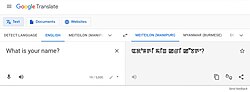
[[File:Google Translate - English to Meiteilon (Manipuri) - "What is your name?" - Screenshot.jpg|thumb|upright=1.5|A screen shot of [[Google Translate]] translating a sentence from English language into Meitei language]] | [[File:Google Translate - English to Meiteilon (Manipuri) - "What is your name?" - Screenshot.jpg|thumb|upright=1.5|A screen shot of [[Google Translate]] translating a sentence from English language into Meitei language]] | ||
On 11 May 2022, [[Google Translate]] added Meitei-language (under the name '''''"Meiteilon (Manipuri)"''''') during its addition of 24 new languages to the translation tool. The writing system used for Meitei language in this tool is [[Meitei script]].<ref>{{Cite web |date=12 May 2022 |title=Assamese, Meiteilon (Manipuri) and Mizo language has been added to Google translate, moment of pride for Northeastern India! | On 11 May 2022, [[Google Translate]] added Meitei-language (under the name '''''"Meiteilon (Manipuri)"''''') during its addition of 24 new languages to the translation tool. The writing system used for Meitei language in this tool is [[Meitei script]].<ref>{{Cite web |date=12 May 2022 |title=Assamese, Meiteilon (Manipuri) and Mizo language has been added to Google translate, moment of pride for Northeastern India! – NE India Broadcast |url=https://neindiabroadcast.com/2022/05/12/assamese-meiteilon-manipuri-and-mizo-language-has-been-added-to-google-translate-moment-of-pride-for-northeastern-india/ |access-date=11 August 2022 |language=en-US}}</ref><ref>{{Cite web |date=11 May 2022 |title=Google Translate adds support for Assamese, Mizo and Manipuri languages – Eastern Mirror |url=https://easternmirrornagaland.com/google-translate-adds-support-for-assamese-mizo-and-manipuri-languages/ |access-date=11 August 2022 |website=easternmirrornagaland.com |language=en-GB}}</ref><ref>{{Cite news |date=12 May 2022 |title=Google Translate gets support for 24 new languages including Assamese, Mizo and Manipuri |url=https://www.time8.in/google-translate-gets-support-for-24-new-languages-including-assamese-mizo-and-manipuri/ |access-date=11 August 2022 |work=Time8 |archive-url=https://web.archive.org/web/20220512140916/https://www.time8.in/google-translate-gets-support-for-24-new-languages-including-assamese-mizo-and-manipuri/ |archive-date=2022-05-12 |language=en-US}}</ref> | ||
== Sample text == | == Sample text == | ||
The following is a sample text in Modern Meitei of the Article 1 of the [[Universal Declaration of Human Rights]] (by the | The following is a sample text in Modern Meitei of the Article 1 of the [[Universal Declaration of Human Rights]] (by the United Nations):<ref>{{Cite web |title=Manipuri language and alphabets |url=https://omniglot.com/writing/manipuri.htm |access-date=12 August 2022 |website=omniglot.com}}</ref>{{efn|The Meitei-language translation of the passage of the Article 1 has two foreign words present, "ꯏꯖꯖꯠ" ("iːdʒət") and "ꯍꯛ" ("hə́k"), meaning "dignity" and "rights" respectively, as given in the source website. The original Meitei-language terms for "dignity" and "rights" are "ꯏꯀꯥꯏ ꯈꯨꯝꯅꯕ" ("í.kai kʰum.nə.bə") and "ꯐꯪꯐꯝ ꯊꯣꯛꯄ" ("pʰəŋ.pʰəm tʰok.pə") respectively.}} | ||
{{ | {{blockquote| | ||
{{lang|mni|{{script|Mtei|ꯃꯤꯑꯣꯏꯕ ꯈꯨꯗꯤꯡꯃꯛ ꯄꯣꯛꯄ ꯃꯇꯝꯗ ꯅꯤꯡꯇꯝꯃꯤ, ꯑꯃꯗꯤ ꯏꯖꯖꯠ ꯑꯃꯁꯨꯡ ꯍꯛ ꯃꯥꯟꯅꯅ ꯂꯧꯖꯩ ꯫ ꯃꯈꯣꯏ ꯄꯨꯝꯅꯃꯛ ꯋꯥꯈꯜ ꯂꯧꯁꯤꯡ ꯁꯦꯡꯏ, ꯑꯐ ꯐꯠꯇ ꯈꯪꯏ, ꯑꯗꯨꯅ ꯑꯃꯅ ꯑꯃꯒ ꯂꯣꯏꯅꯕ ꯃꯇꯝꯗ ꯃꯆꯤꯟ ꯃꯅꯥꯎꯒꯨꯝꯅ ꯂꯣꯏꯅꯒꯗꯕꯅꯤ ꯫}}}} (in [[Meitei script]]) | |||
{{lang|mni|মিওইবা খুদিংমক পোকপা মতমদা নিংতম্মী, অমদি ইজ্জৎ অমসুং হক মান্ননা লৌজৈ । মখোই পুম্নমক ৱাখল লৌশিং শেঙই, অফ ফত্তা খঙই, অদুনা অমনা অমগা লোইনবদা মচীন মনাওগুম্না লোইনগদবনি ।}} (in [[Bengali script]]) | |||
{{ | {{lang|mni|Mioiba khudingmak pokpa matamda ningtammi amadi ijjat amasung hak mānnana leijei, makhoi pumnamak wākhal loushing shengi, apha phatta khangi, aduna amana amaga loinabada machin manāogumna loinagadabani.}} ([[Roman transliteration]]) | ||
{{ | {{lang|mni|{{IPA|míːójbə kʰud̯íŋmək pókpə mət̯ə̀md̯ə níːŋt̯ə̀mmi, əməd̯i iːdʒət əməʃùng hə́k màːnənə lɐ̀jdʒɐ̀j. məkʰój púmnəmək wakʰə̀l lə̀wʃiŋ ʃèŋi, əpʱə̀ pʱə́ːt̯ə kʰə́ŋi, əd̯unə əmənə əməgə lòjnəbəd̯ə mət͡ʃìn mənáwgùmnə lójnəgəd̯əbəni'}}}} ([[International Phonetic Alphabet|IPA]] transliteration). | ||
{{ | {{langx|en|All human beings are born free and equal in dignity and rights. They are endowed with reason and conscience and should act towards one another in a spirit of brotherhood.}} }} | ||
== See also == | == See also == | ||
{{Portal bar|Asia|Bangladesh|India|Languages|Linguistics|Myanmar}} | {{Portal bar|Asia|Bangladesh|India|Languages|Linguistics|Myanmar}} | ||
* [[Meitei language in India]] | |||
** [[Meitei language in Assam]] | |||
** [[Meitei language in Tripura]] | |||
* [[Meitei language in Bangladesh]] | |||
* [[Meitei language in Myanmar]] | |||
* [[Languages of India]] | * [[Languages of India]] | ||
* [[List of languages by number of native speakers in India]] | * [[List of languages by number of native speakers in India]] | ||
* [[List of Indian poets#Manipuri|List of | * [[List of Indian poets#Manipuri|List of Meitei poets]] | ||
* [[Meitei inscriptions]] | * [[Meitei inscriptions]] | ||
* [[Meitei literature]] | * [[Meitei literature]] | ||
| Line 767: | Line 529: | ||
* [[List of Sahitya Akademi Translation Prize winners for Meitei]] | * [[List of Sahitya Akademi Translation Prize winners for Meitei]] | ||
* [[List of Yuva Puraskar winners for Meitei]] | * [[List of Yuva Puraskar winners for Meitei]] | ||
* [[List of Bal Sahitya Puraskar winners for Meitei]] | |||
* [[Vikaspedia]] | * [[Vikaspedia]] | ||
| Line 774: | Line 537: | ||
== References == | == References == | ||
{{reflist}} | {{reflist}} | ||
== Further reading == | == Further reading == | ||
* 1. ''A Short History of Kangleipak (Manipur) Part-I'', by Chingtamlen, 2005 | * 1. ''A Short History of Kangleipak (Manipur) Part-I'', by Chingtamlen, 2005 | ||
| Line 797: | Line 561: | ||
* Chelliah, Shobhana L. (2002). Early Meitei manuscripts. In C. I. Beckwith (Ed.), ''Medieval Tibeto-Burman languages: PIATS 2000: Tibetan studies: Proceedings of the ninth seminar of the International Association of Tibetan Studies, Leiden 2000'' (pp. 59–71). Leiden, Netherlands: Brill. | * Chelliah, Shobhana L. (2002). Early Meitei manuscripts. In C. I. Beckwith (Ed.), ''Medieval Tibeto-Burman languages: PIATS 2000: Tibetan studies: Proceedings of the ninth seminar of the International Association of Tibetan Studies, Leiden 2000'' (pp. 59–71). Leiden, Netherlands: Brill. | ||
* Chelliah, Shobhana L. (2002). A glossary of 39 basic words in archaic and modern Meitei. In C. I. Beckwith (Ed.), ''Medieval Tibeto-Burman languages: PIATS 2000: Tibetan studies: Proceedings of the ninth seminar of the International Association of Tibetan Studies, Leiden 2000'' (pp. 189–190). Leiden, Netherlands: Brill. | * Chelliah, Shobhana L. (2002). A glossary of 39 basic words in archaic and modern Meitei. In C. I. Beckwith (Ed.), ''Medieval Tibeto-Burman languages: PIATS 2000: Tibetan studies: Proceedings of the ninth seminar of the International Association of Tibetan Studies, Leiden 2000'' (pp. 189–190). Leiden, Netherlands: Brill. | ||
* {{cite journal |last1=Chelliah |first1=Shobhana L. | | * {{cite journal |last1=Chelliah |first1=Shobhana L. |date=January 2004 |title=Polysemy through metonymy: The case of Meitei ''pi'' 'grandmother' |journal=Studies in Language |volume=28 |issue=2 |pages=363–386 |doi=10.1075/sl.28.2.04che}} | ||
* {{cite journal |last1=Chelliah |first1=Shobhana L. |s2cid=130962163 |year=2015 |title=Is Manipur a linguistic area? |journal=Journal of South Asian Languages and Linguistics |volume=2 |issue=1 |pages=87–109 |doi=10.1515/jsall-2015-0004}} | * {{cite journal |last1=Chelliah |first1=Shobhana L. |s2cid=130962163 |year=2015 |title=Is Manipur a linguistic area? |journal=Journal of South Asian Languages and Linguistics |volume=2 |issue=1 |pages=87–109 |doi=10.1515/jsall-2015-0004}} | ||
* Singh, Ningthoukhongjam Khelchandra. (1964). ''Manipuri to Manipuri & English dictionary''. | * Singh, Ningthoukhongjam Khelchandra. (1964). ''Manipuri to Manipuri & English dictionary''. | ||
== External links == | == External links == | ||
{{ | {{Commons category}} | ||
{{Wikiquote}} | {{Wikiquote}} | ||
{{Wiktionary|Meitei}} | {{Wiktionary|Meitei}} | ||
| Line 811: | Line 575: | ||
{{Incubator|mni|Wikiquote}} | {{Incubator|mni|Wikiquote}} | ||
{{Incubator|mni|Wikivoyage}} | {{Incubator|mni|Wikivoyage}} | ||
* {{Cite web |title=Meetei Mayek |url=http://tabish.freeshell.org/eeyek/ |access-date=21 August 2022 |website=tabish.freeshell.org}} | |||
* {{Cite web |title=Meetei Mayek |url=http://tabish.freeshell.org/eeyek/ |access-date=21 August 2022 |website=tabish.freeshell.org}} | |||
** {{Cite web |title=Manipuri/Meiteilon/Meithei |url=http://tabish.freeshell.org/eeyek/mani_intro.html |access-date=21 August 2022 |website=tabish.freeshell.org}} | ** {{Cite web |title=Manipuri/Meiteilon/Meithei |url=http://tabish.freeshell.org/eeyek/mani_intro.html |access-date=21 August 2022 |website=tabish.freeshell.org}} | ||
* {{Cite web |title=Manipuri language and alphabets |url=https://omniglot.com/writing/manipuri.htm |access-date=21 August 2022 |website=omniglot.com}} | * {{Cite web |title=Manipuri language and alphabets |url=https://omniglot.com/writing/manipuri.htm |access-date=21 August 2022 |website=omniglot.com}} | ||
* {{Cite web |title=Learn to speak Manipuri |url=http://tabish.freeshell.org/manipuri/ |access-date=21 August 2022 |website=tabish.freeshell.org}} | * {{Cite web |title=Learn to speak Manipuri |url=http://tabish.freeshell.org/manipuri/ |access-date=21 August 2022 |website=tabish.freeshell.org}} | ||
* {{Cite web |title=Learn Manipuri |url=http://www.e-pao.net/epPageExtractor.asp?src=education.Learn_Manipuri.html |access-date=21 August 2022 |website=www.e-pao.net}} | * {{Cite web |title=Learn Manipuri |url=http://www.e-pao.net/epPageExtractor.asp?src=education.Learn_Manipuri.html |access-date=21 August 2022 |website=www.e-pao.net}} | ||
* {{Cite web |title=Meetei Mayek keys |url=http://www.e-pao.net/epPageExtractor.asp?src=manipur.meetei_mayek_keys.html.. |access-date=21 August 2022 |website=www.e-pao.net}} | * {{Cite web |title=Meetei Mayek keys |url=http://www.e-pao.net/epPageExtractor.asp?src=manipur.meetei_mayek_keys.html.. |access-date=21 August 2022 |website=www.e-pao.net}} | ||
* {{Cite web |title=Meetei Mayek Poems |url=http://www.e-pao.net/epPageExtractor.asp?src=MeiteiMayek.meetei_mayek_Poems.html../ |access-date=21 August 2022 |website=www.e-pao.net}} | * {{Cite web |title=Meetei Mayek Poems |url=http://www.e-pao.net/epPageExtractor.asp?src=MeiteiMayek.meetei_mayek_Poems.html../ |access-date=21 August 2022 |website=www.e-pao.net}} | ||
{{Sino-Tibetan languages}} | {{Sino-Tibetan languages}} | ||
| Line 831: | Line 593: | ||
{{DEFAULTSORT:Meitei Language}} | {{DEFAULTSORT:Meitei Language}} | ||
[[Category:Meitei language| ]] | [[Category:Meitei language| ]] | ||
[[Category:Official languages of India]] | [[Category:Official languages of India]] | ||
[[Category:Languages of Manipur]] | [[Category:Languages of Manipur]] | ||
[[Category:Languages of Assam]] | [[Category:Languages of Assam]] | ||
[[Category:Languages of Tripura]] | [[Category:Languages of Tripura]] | ||
[[Category:Languages of Bangladesh]] | [[Category:Languages of Bangladesh]] | ||
[[Category:Languages of Myanmar]] | [[Category:Languages of Myanmar]] | ||
[[Category:Languages written in Latin script]] | [[Category:Languages written in Latin script]] | ||
[[Category:Languages | [[Category:Languages written in Brahmic scripts]] | ||
[[Category:Lingua francas]] | [[Category:Lingua francas]] | ||
[[Category:Meitei culture]] | [[Category:Meitei culture]] | ||
[[Category:Meitei literature]] | [[Category:Meitei literature]] | ||
[[Category:Standard languages]] | [[Category:Standard languages]] | ||
[[Category:Subject–object–verb languages]] | [[Category:Subject–object–verb languages]] | ||
[[Category:Tonal languages]] | [[Category:Tonal languages]] | ||
[[Category:Unclassified Sino-Tibetan languages]] | [[Category:Unclassified Sino-Tibetan languages]] | ||
Revision as of 10:45, 24 February 2026
| Meitei | |
|---|---|
| Manipuri | |
| ꯃꯩꯇꯩꯂꯣꯟ • মৈতৈলোন • Meiteilon | |
 Meitei Lon written in Meitei script | |
| Native to | India, Bangladesh |
| Region | Manipur, Assam, Tripura |
| Ethnicity | Meitei |
Native speakers | 1.8 million (2003–2011)[1] |
Early forms | |
| Dialects |
|
| |
| Official status | |
Official language in | |
Recognised minority language in | |
| Regulated by | Directorate of Language Planning and Implementation, Manipur |
| Development body | |
| Language codes | |
| ISO 639-2 | mni |
| ISO 639-3 | Either:mni – Manipuriomp – Old Manipuri |
| Glottolog | mani1292 Manipurimeit1246 Meitei (standard dialect)pang1284 Pangal (Muslim dialect) |
 Regions where Meitei is official and educational language
Regions where Meitei is recognised and educational language but not official
Regions where Meitei is not recognised and not official but educational
Regions where Meitei is recognised but not official and educational
Regions with significant Meitei speaking minorities | |

Meitei (/ˈmeɪteɪ/;[3] Template:Meitei pronounced [mejtejlon]), also known as Manipuri (Template:Meitei pronounced [mənipuɾi]), is a Tibeto-Burman language of northeast India. It is the official language and the lingua franca of Manipur and an additional official language in four districts of Assam. It is one of the constitutionally scheduled official languages of the Indian Republic.[4] Meitei is the most widely-spoken Tibeto-Burman language of India and the third most widely spoken language of northeast India after Assamese and Bengali.[5] There are 1.76 million Meitei native speakers in India according to the 2011 census, 1.52 million of whom are found in the state of Manipur, where they represent the majority of its population. There are smaller communities in neighbouring Indian states, such as Assam (168,000), Tripura (24,000), Nagaland (9,500), and elsewhere in the country (37,500). The language is also spoken by smaller groups in neighbouring Myanmar[6] and Bangladesh.[7]
Meitei and Gujarati jointly hold the third place among the fastest growing languages of India, following Hindi and Kashmiri.[8]
Meitei is not endangered: its status has been assessed as safe by Ethnologue (where it is assigned to EGIDS level 2 "provincial language").[9] However, it is considered vulnerable by UNESCO.[10]
The Manipuri language is associated with the Ningthouja dynasty (Mangangs), the Khuman dynasty, the Moirangs, the Angoms, the Luwangs, the Chengleis (Sarang-Leishangthems), and the Khaba-Nganbas. Each had their respective distinct dialects and were politically independent from one another. Later, all of them fell under the dominion of the Ningthouja dynasty, changing their status of being independent "ethnicities" into those of "clans" of the collective Meitei community. The Ningthouja dialect was predominant,[11][12] and received heavy influences from the speech forms of the other groups.[13][14][15]
Meitei is one of the advanced literary languages recognised by Sahitya Akademi, India's National Academy of Letters.
Classification
Meitei belongs to the Tibeto-Burman branch of the Sino-Tibetan languages.[16][4]
During the 19th and 20th centuries, different linguists tried to assign Meitei to various sub-groups. Early classifier George Abraham Grierson (1903–1924) put it in Kuki-Chin, Vegelin and Voegelin (1965) in Kuki-Chin-Naga, and Benedict (1972) in Kuki-Naga. Robbins Burling has suggested that Meitei belongs to none of those groups.[17] Current academic consensus agrees with James Matisoff in placing Manipuri in its own subdivision of the Kamarupan group—a geographic rather than a genetic grouping.[4] However, some still consider Meitei to be a member of the Kuki-Chin-Naga branch.[18]
History
_-_a_6th_century_Classical_Meitei_language_copper_manuscript_text_-_in_Meetei_script_-_works_on_sensuality_%26_relationship_between_husbands_%26_wives_and_how_to_run_a_household_in_Ancient_Kangleipak_civilisation_state.jpg)
The Meitei language has existed for at least 2000 years.[17] According to linguist Suniti Kumar Chatterjee, the ancient Meitei literature dates back to 1500 to 2000 years before present.[19]
First Millennium CE
The earliest known Meitei language compositions is the ritual song Ougri (ꯑꯧꯒ꯭ꯔꯤ), which was used in religious and coronation ceremonies of Kangleipak. It may have existed before the Common Era.[20] Numit Kappa Template:Meitei, a religious epic that tells the tale of how the night was divided from the day, was also composed in the first century.[21]
Poireiton Khunthok Template:Meitei is a 3rd-century narrative work describing the establishment of a colony in Kangleipak by a group of immigrants led by Poireiton, the younger brother of the god of the underworld.[22]
The Yumbanlol, a copper plate manuscript was composed in the 6th century or 7th century CE for the royal family of Kangleipak. It is a rare work of dharmashastra, covering sexuality, the relationships between husbands and wives, and instructions on how to run a household.[23]
The Khencho (ꯈꯦꯟꯆꯣ), an early Meitei work of poetry was composed by the beginning of the 7th century CE.[24] Although it is obscure and unintelligible to present-day Meiteis, it is still recited as part of the Lai Haraoba festival.[25]
One of the best-preserved early Meitei language epigraphic records is a copper plate inscription dating to the reign of King Khongtekcha (r. c. 763 – 773 CE).[26] During the same time period, Akoijam Tombi composed the Panthoibi Khonggul (ꯄꯥꯟꯊꯣꯏꯄꯤ ꯈꯣꯡꯀꯨꯜ), an account of the romantic adventures of the deified Meitei princess Panthoibi.[27]
Second Millennium CE
_-_11th-12th_century_Classical_Meitei_language_Constitution_of_the_then_Kangleipak_civilisation_state_-_in_traditional_Meetei_Mayek_writing_system_(Manipur_State_Archives).jpg)
In 1100 CE, a written constitution, Template:Meitei, was finalised by King Loiyumba (r. c. 1074 – 1112 CE) of Kangleipak. It was a codification of the proto-constitution drafted by King Naophangba in 429 CE.[28][29]
Before 1675 CE, the Meitei language experienced no significant influence from any other languages.[17] Beginning in the late 17th century, Hindu influence on Meitei culture increased, and the Meitei language experienced some influences from other languages, on its phonology, morphology (linguistics), syntax and semantics. At the same time, the Hinduised King Pamheiba ordered that the Meitei script be replaced by the Bengali-Assamese script.[17]

In 1725 CE, Pamheiba wrote Parikshit, possibly the first piece of Meitei-language Hindu literature, based on the story of the eponymous king Parikshit of the Mahabharata.[30]
Geographical distribution
The majority of Meitei speakers, about 1.5 million[31] live in the Indian state of Manupur. Meitei is the official language of the Government of Manipur as well as its lingua franca.[4]

There are nearly 170,000 Meitei-speakers in Assam,[31] mainly in the Barak Valley, where it is the third most commonly used language after Bengali and Hindi.[32] Manipuri is also spoken by about 9500 people in Nagaland, in communities such as Dimapur, Kohima, Peren and Phek.[2][31] Meitei is a second language for various Naga and Kuki-Chin ethnic groups.[2]

There are around 15,000 Meitei speakers in Bangladesh[citation needed] mainly are in the districts of Sylhet, Moulvibazar, Sunamganj and Habiganj in the Sylhet Division of Bangladesh. In the past, there was a Meitei speaking population in Dhaka, Mymensingh and Comilla also.[33] Manipuri is used as a second language by the Bishnupriya Manipuri people.[2]
Myanmar has a significant Meitei speaking population in the states of Kachin and Shan and the regions of Yangon, Sagaing, and Ayeyarwady, among others.[34]
Name
According to the Ethnologue, the alternative names of Meitei language are Kathe, Kathi, Manipuri, Meetei, Meeteilon, Meiteilon, Meiteiron, Meithe, Meithei, Menipuri, Mitei, Mithe, Ponna.[2]
The name Meitei or its alternate spelling Meithei is preferred by many native speakers of Meitei over Manipuri.[35] The term is derived from the Meitei word for the language Meitheirón (Meithei + -lon 'language', pronounced /mə́i.təi.lón/).[35][36] Meithei may be a compound from mí 'man' + they 'separate'.[35] This term is used by most Western linguistic scholarship.[35] Meitei scholars use the term Meit(h)ei when writing in English and the term Meitheirón when writing in Meitei.[35] Chelliah (2015: 89) notes that the Meitei spelling has replaced the earlier Meithei spelling.[37]
The language (and people) is also referred to by the loconym Manipuri.[35] The term is derived from the name of the state of Manipur.[35] Manipuri is the official name of the language for the Indian government and is used by government institutions and non-Meitei authors.[35] The term Manipuri is also used to refer to the different languages of Manipur and to the people.[35] Additionally, Manipuri, being a loconym, can refer to anything pertaining to the Manipur state.
Speakers of Meitei language are known as "Kathe" by the Burmese people, "Moglie" or "Mekhlee" by the people of Cachar, Assam (Dimasas and Assamese) and "Cassay" by the Shan people and the other peoples living in the east of the Ningthee River (or Khyendwen River). "Ponna" is the Burmese term used to refer to the Meiteis living inside Burma.[38]
Dialects
The Meitei language exhibits a degree of regional variation; however, in recent years the broadening of communication, as well as intermarriage, has caused the dialectal differences to become relatively insignificant. The only exceptions to this occurrence are the speech differences of the dialects found in Tripura, Bangladesh and Myanmar.[39] The exact number of dialects of Meitei is unknown.[40]
The three main dialects of Meitei are: Meitei proper, Loi and Pangal. Differences between these dialects are primarily characterised by the extensions of new sounds and tonal shifts. Meitei proper is considered to be the standard variety—and is viewed as more dynamic than the other two dialects.[41] The brief table below compares some words in these three dialects:[42]
| Standard Meitei | Loi | Pangal | English translation |
|---|---|---|---|
| chaaba | chaapa | chaaba | to eat |
| kappa | kapma | kappa | to weep |
| saabiba | saapipa | saabiba | to make |
| thamba | thampa | thamba | to put |
| chuppiba | chuppipa | chuppiba | to kiss |
Devi (2002)[43] compares the Imphal, Andro, Koutruk, and Kakching dialects of Meitei.
Status
Meitei is the sole official language of the Government of Manipur, and has been an official language of India since 1992.[4][44]
Meitei language was the court language of the historic Manipur Kingdom,[45] and before it merged into the Indian Republic.[46] The Sahitya Akademi, India's National Academy of Letters, recognised Meitei as one of the major advanced Indian literary languages in 1972, long before it became an official language in 1992. In 1950, the Government of India did not include Meitei in its list of 14 official languages.[47] A language movement, spearheaded by organisations including the Manipuri Sahitya Parishad and the All Manipur Students' Union demanded that Meitei be made an official language for more than 40 years, until Meitei was finally added to the Eighth Schedule to the Constitution of India in 1992.[48][49]
Meitei became an associate official language of Assam in 2024,[50] following several years of effort by the Meitei associate official language movement to protect the identity, history, culture and tradition of Manipuris in Assam.[51][52][53]
The Meitei language is one of the 13 official languages of the India used to administer police, armed services, and civil service recruitment exams.[54][55]
The Press Information Bureau of the Indian Ministry of Information and Broadcasting publishes in 14 languages, including Meitei.[56]
Education
Meitei is a language of instruction in all in the educational institutions in Manipur. It is one of the 40 instructional languages offered by the Central Board of Secondary Education (CBSE), controlled and managed by the Ministry of Education.[57] Meitei is taught as a subject up to the post-graduate level in Indian universities, including Jawaharlal Nehru University, Delhi University, Gauhati University, and the University of North Bengal.[58][59] Indira Gandhi National Open University teaches Meitei to undergraduates.[60]
Assam
Meitei language instruction has been offered in the lower primary schools of Assam since 1956.[53] The Board of Secondary Education, Assam offers secondary education in Manipuri.[61] The Assam Higher Secondary Education Council of Assam offers both Meitei-language schooling and instruction in Meitei as a second language.[62]
Since 2020, the Assam Government has made an annual grant of ₹5 lakh (US$7,000) to the Manipuri Sahitya Parishad (Manipuri Language Council). It also invested ₹6 crore (US$840,000) in the creation of a corpus for the development of the Meitei language.[53]
The Department of Manipuri of Assam University offers education up to the Ph.D. level in Meitei language.[63][64][65]
Tripura
Since 1998, the Government of Tripura has offered Meitei language as a "first language" subject at primary level in 24 schools throughout the state.[66]
In December 2021, Tripura University proposed to the Indian Ministry of Education and the University Grants Council (UGC), regarding the introduction of diploma courses in Meitei, along with international languages like Japanese, Korean and Nepali.[67]
Phonology
The exact classification of the Meitei language within Sino-Tibetan remains unclear. It has lexical resemblances to Kuki and Tangkhul.[68]
Tone
The Meitei language is a tonal language. There is a controversy over whether there are two or three tones.[69]
Segments
Meitei distinguishes the following phonemes:[70]
Consonants
| Labial | Dental/ Alveolar |
Palatal | Velar | Glottal | |||
|---|---|---|---|---|---|---|---|
| Nasal | m | n | ŋ | ||||
| Plosive |
unaspirated |
p | t | tʃ | k | ʔ | |
| pʰ | tʰ | kʰ | |||||
|
unaspirated |
b | d | dʒ | ɡ | |||
| bʱ | dʱ | ɡʱ | |||||
| Fricative | s | h | |||||
| Tap | ɾ | ||||||
| Lateral | l | ||||||
| Approximant | w | j | |||||
Vowels
| Front | Central | Back | |
|---|---|---|---|
| High | i | u | |
| Mid | e | ɐ | o |
| Low | a |
Note: the central vowel /ɐ/ is transcribed as <ə> in recent linguistic work on Meitei. However, phonetically it is never [ə], but more usually [ɐ]. It is assimilated to a following approximant: /ɐw/ = [ow], /ɐj/ = [ej].
Phonological processes
A velar deletion is noted to occur on the suffix -lək when following a syllable ending with a /k/ phoneme.[69]
Meitei has a dissimilatory process similar to Grassmann's law found in Ancient Greek and Sanskrit, though occurring on the second aspirate.[71] Here, an aspirated consonant is deaspirated if preceded by an aspirated consonant (including /h/, /s/) in the previous syllable. The deaspirated consonants are then voiced between sonorants.[citation needed]
Template:Interlinear Template:Interlinear Template:Interlinear
Writing systems
Meitei script
_ordered_by_Meitei_King_Pamheiba_(AKA_Garib_Niwaj_or_Gopal_Singh)_under_the_influence_of_Bengali_Hindu_missionary_Shantidas_Gosai_(AKA_Shantidas_Goswami_or_Shantidas_Adhikari).jpg)
The Meitei script (ꯃꯩꯇꯩ ꯃꯌꯦꯛ, Meitei mayek)[72] is one of the official scripts of the Indian Republic. Meitei mayek is also known as Kanglei script Template:Meitei[73] or kok sam lai script Template:Meitei, after its first three letters.[74] Its earliest known appearance is on 6th century coins.[75] It was used until the 18th century, when it was replaced by the Bengali script, and then revived in again massively in the 20th.[76] In 2021, the use of Meetei Mayek to write Manipuri was officially adopted by the government of Manipur, alongside Bengali script.[77]
The Roman alphabet has been used in medium for teaching basic Meitei as a second language teaching by the Board of Secondary Education, Manipur.[78][79] More recently, the Board has issued a directive that no more Manipuri textbooks using the Latin alphabet be published.[80] Meitei language editions of the Bible in Roman script are very commonly used by the Christians in Manipur.[81]
The Naoriya Phulo script is a constructed script, invented by Laininghan Naoriya Phulo (1888–1941). It shares many similarities with Devanagari and Bengali script.[82] It was championed by Apokpa Marup, but was never widely adopted.[83]
Grammar
Sentences in the Meitei language use the subject–object–verb word order (SOV). For example, in the sentence Ei chak chai (ꯑꯩ ꯆꯥꯛ ꯆꯥꯢ), which translates to I eat rice, the gloss is "ei" (I), "chak" (rice), "chai" (eat).
Nouns
Nouns and pronouns are marked for number in Meitei. The plural is indicated by the suffixes -khoi (for personal pronouns and human proper nouns) and -sing (for all other nouns). Verbs associated with the pluralised nouns are unaffected. Examples are demonstrated below:[84]
| Noun (Meitei) | Noun (English) | Example (Meitei) | Example (English) |
|---|---|---|---|
| angaang | baby | angaang kappi | Baby cries. |
| angaangsing | babies | angaangsing kappi | Babies cry. |
When adjectives are used to be more clear, Meitei utilises separate words and does not add a suffix to the noun. Examples are show in the chart below:[84]
| Adjective (Meitei) | Adjective (English) | Example (Meitei) | Example (English) |
|---|---|---|---|
| ama | one | mi ama laak'i | A person comes. |
| khara | some | mi khara laak'i | Some persons come. |
| mayaam | many | mi mayaam laak'i | Many persons come. |
Compound verbs
Compound verbs are created by combining root verbs each ending with aspect markers. While the variety of suffixes is high, all compound verbs utilise one of two:[85]
| Suffix | English translation |
|---|---|
| -thok | out/ come out |
| -ning | To wish/ want/ desire |
Aspect markers appear as suffixes that clarify verb tense and appear at the end of the compound verb. Overall, the formula to construct a compound verb becomes [root verb] + [suffix] + [aspect marker]:[85]
| Language | Root verb | Suffix | Aspect marker | Combined form |
|---|---|---|---|---|
| Meitei | tum | -thok | -le | tumthokle |
| English | sleep | out/ come out | perfect aspect | has started sleeping |
| Meitei | tum | -ning | -le | tumningle |
| English | sleep | want | perfect aspect | has felt sleepy |
Compound verbs can also be formed utilising both compound suffixes as well, allowing utterances such as pithokningle meaning "want to give out".
Number words
| Numeral | Word | Etymology | Meitei Script |
|---|---|---|---|
| 1 | a-ma ~ a-maa | 1 | ꯑꯃꯥ |
| 2 | a-ni | Proto-Tibeto-Burman *ni | ꯑꯅꯤ |
| 3 | a-húm | PTB *sum | ꯑꯍꯨꯝ |
| 4 | ma-ri | PTB *li | ꯃꯔꯤ |
| 5 | ma-ngaa | PTB *ŋa | ꯃꯉꯥ |
| 6 | ta-ruk | PTB *luk | ꯇꯔꯨꯛ |
| 7 | ta-ret | PTB *let | ꯇꯔꯦꯠ |
| 8 | ni-paan | 2-less | ꯅꯤꯄꯥꯟ |
| 9 | maa-pan | 1-less | ꯃꯥꯄꯟ |
| 10 | ta-raa | 10 | ꯇꯔꯥ |
| 11 | taraa-maa-thoi | ten + 1-more | ꯇꯔꯥꯃꯥꯊꯣꯏ |
| 12 | taraa-ni-thoi | ten + 2-more | ꯇꯔꯥꯅꯤꯊꯣꯏ |
| 13 | taraa-húm-doi | ten + 3-more | ꯇꯔꯥꯍꯨꯝꯗꯣꯏ |
| 14 | taraa-mari | ten +4 | ꯇꯔꯥꯃꯔꯤ |
| 15 | taraa-mangaa | ten +5 | ꯇꯔꯥꯃꯉꯥ |
| 16 | taraa-taruk | ten +6 | ꯇꯔꯥꯇꯔꯨꯛ |
| 17 | taraa-taret | ten +7 | ꯇꯔꯥꯇꯔꯦꯠ |
| 18 | taraa-nipaan | ten +8 | ꯇꯔꯥꯅꯤꯄꯥꯟ |
| 19 | taraa-maapan | ten +9 | ꯇꯔꯥꯃꯥꯄꯟ |
| 20 | kun ~ kul | score | ꯀꯨꯟ ~ ꯀꯨꯜ |
| 30 | *kun-taraa > kun-thraa | score ten | ꯀꯨꯟꯊ꯭ꯔꯥ |
| 40 | ni-phú | two score | ꯅꯤꯐꯨ |
| 50 | yaang-khéi | half hundred | ꯌꯥꯡꯈꯩ |
| 60 | hum-phú | three score | ꯍꯨꯝꯐꯨ |
| 70 | hum-phú-taraa | three score ten | ꯍꯨꯝꯐꯨꯇꯔꯥ |
| 80 | mari-phú | four score | ꯃꯔꯤꯐꯨ |
| 90 | mari-phú-taraa | four score ten | ꯃꯔꯤꯐꯨꯇꯔꯥ |
| 100 | chaama | one hundred | ꯆꯥꯃ |
| 200 | cha-ni | two hundreds | ꯆꯥꯅꯤ |
| 300 | cha-hum | three hundreds | ꯆꯥꯍꯨꯝ |
| 400 | cha-mri | four hundreds | ꯆꯥꯃ꯭ꯔꯤ |
| 500 | cha-mangaa | five hundreds | ꯆꯥꯃꯉꯥ |
| 1,000 | lisíng ama | one thousand | ꯂꯤꯁꯤꯡ |
| 10,000 | lisīng-taraa | ten thousands | ꯂꯤꯁꯤꯡꯇꯔꯥ |
| 1,00,000 | licha | one hundred-thousand | ꯂꯤꯆꯥ |
| 10,00,000 | licha-taraa | ten hundred-thousands | ꯂꯤꯆꯥꯇꯔꯥ |
| 1,00,00,000 | leepun | one ten-million | ꯂꯤꯄꯨꯟ |
| 10,00,00,000 | leepun-taraa | ten ten-millions | ꯂꯤꯄꯨꯟꯇꯔꯥ |
| 1,00,00,00,000 | leepot | one billion | ꯂꯤꯄꯣꯠ |
| 10,00,00,00,000 | leepot-taraa | ten billions | ꯂꯤꯄꯣꯠꯇꯔꯥ |
| 1,00,00,00,00,000 | leekei | one hundred-billion | ꯂꯤꯀꯩ |
| 10,00,00,00,00,000 | leekei-taraa | ten hundred-billions | ꯂꯤꯀꯩꯇꯔꯥ |
| 1,00,00,00,00,00,000 | pu-ama | one ten-trillion | ꯄꯨ ꯑꯃꯥ |
Literature
.jpg)
The Khamba Thoibi Sheireng, a poem of 39,000 verses composed by Hijam Anganghal Singh and first published in 1940 (Meitei: ꯈꯝꯕ ꯊꯣꯏꯕꯤ ꯁꯩꯔꯦꯡ, romanized: Poem on Khamba Thoibi)[86] is regarded as the national epic of the Manipuris.[87][88] It is a classical Meitei language epic poem based on the ancient romantic adventure tale of Khamba and Thoibi of Moirang. It is regarded as the greatest of all Meitei epic poems.[89][90][91]
The Meitei classical language movement seeks to gain recognition for Meitei as one of the Classical Languages of India.[92][93][94]
Annual events
Various annual events are organised to promote, protect and develop Meitei language, in the sovereign states of India and Bangladesh in particular as well as in other parts of the world in general.
- Manipuri language day (Meitei: ꯂꯣꯟꯒꯤ ꯅꯨꯃꯤꯠ, romanized: Manipuri Lon-gi Numit) is observed annually on 20 August, commemorating the day in 1992 when Manipuri was made one of the official languages of India.[95]
- Manipuri poetry day (Meitei: ꯃꯅꯤꯄꯨꯔꯤ ꯁꯩꯔꯦꯡꯒꯤ ꯅꯨꯃꯤꯠ, romanized: Manipuri Sheirenggi Numit), is an annual literary event that promotes Meitei language poetry and the traditions of Meitei literature.[96][97] Events are held in Manipur and in and by Meitei-speakers in Northeast India and West Bengal.[98][99]
- The Manipuri Language Festival (Meitei: ꯃꯅꯤꯄꯨꯔꯤ ꯂꯣꯟꯒꯤ ꯀꯨꯝꯃꯩ, romanized: Manipuri Lon-gi Kummei) is an annual cultural event that aims to protect and develop of the Meitei language, script and culture in Bangladesh.[100][101]
Software
In 2021, Rudali Huidrom, a Manipuri researcher of the EBMT/NLP laboratory, Waseda University, Japan, created a text corpus named "EM Corpus" (shortened form of "Emalon Manipuri Corpus"). It is the first comparable text to text corpus built for Meitei language (mni) and English language (eng) pair from sentences. The writing system used for Meitei language in this corpus is Bengali script. It was crawled and collected from thesangaiexpress.com – the news website of "The Sangai Express", a daily newspaper of Manipur from August 2020 to 2021. In version 1, she created the monolingual data, having 1,034,715 Meitei language sentences and 846,796 English language sentences. In version 2, she created the monolingual data, having 1,880,035 Meitei language sentences and 1,450,053 English language sentences.[102][103]
EM-ALBERT is the first ALBERT model available for Meitei language. EM-FT is also FastText word embedding available for Meitei language. These resources were created by Rudali Huidrom and are now available at free of cost at the European Language Resources Association catalogue (ELRA catalogue) under CC-BY-NC-4.0 licence.[102][103]
_-_%22What_is_your_name%3F%22_-_Screenshot.jpg)
On 11 May 2022, Google Translate added Meitei-language (under the name "Meiteilon (Manipuri)") during its addition of 24 new languages to the translation tool. The writing system used for Meitei language in this tool is Meitei script.[104][105][106]
Sample text
The following is a sample text in Modern Meitei of the Article 1 of the Universal Declaration of Human Rights (by the United Nations):[107][lower-alpha 1]
ꯃꯤꯑꯣꯏꯕ ꯈꯨꯗꯤꯡꯃꯛ ꯄꯣꯛꯄ ꯃꯇꯝꯗ ꯅꯤꯡꯇꯝꯃꯤ, ꯑꯃꯗꯤ ꯏꯖꯖꯠ ꯑꯃꯁꯨꯡ ꯍꯛ ꯃꯥꯟꯅꯅ ꯂꯧꯖꯩ ꯫ ꯃꯈꯣꯏ ꯄꯨꯝꯅꯃꯛ ꯋꯥꯈꯜ ꯂꯧꯁꯤꯡ ꯁꯦꯡꯏ, ꯑꯐ ꯐꯠꯇ ꯈꯪꯏ, ꯑꯗꯨꯅ ꯑꯃꯅ ꯑꯃꯒ ꯂꯣꯏꯅꯕ ꯃꯇꯝꯗ ꯃꯆꯤꯟ ꯃꯅꯥꯎꯒꯨꯝꯅ ꯂꯣꯏꯅꯒꯗꯕꯅꯤ ꯫ (in Meitei script)
মিওইবা খুদিংমক পোকপা মতমদা নিংতম্মী, অমদি ইজ্জৎ অমসুং হক মান্ননা লৌজৈ । মখোই পুম্নমক ৱাখল লৌশিং শেঙই, অফ ফত্তা খঙই, অদুনা অমনা অমগা লোইনবদা মচীন মনাওগুম্না লোইনগদবনি । (in Bengali script)
Mioiba khudingmak pokpa matamda ningtammi amadi ijjat amasung hak mānnana leijei, makhoi pumnamak wākhal loushing shengi, apha phatta khangi, aduna amana amaga loinabada machin manāogumna loinagadabani. (Roman transliteration)
míːójbə kʰud̯íŋmək pókpə mət̯ə̀md̯ə níːŋt̯ə̀mmi, əməd̯i iːdʒət əməʃùng hə́k màːnənə lɐ̀jdʒɐ̀j. məkʰój púmnəmək wakʰə̀l lə̀wʃiŋ ʃèŋi, əpʱə̀ pʱə́ːt̯ə kʰə́ŋi, əd̯unə əmənə əməgə lòjnəbəd̯ə mət͡ʃìn mənáwgùmnə lójnəgəd̯əbəni' (IPA transliteration).
English: All human beings are born free and equal in dignity and rights. They are endowed with reason and conscience and should act towards one another in a spirit of brotherhood.
See also

- Meitei language in India
- Meitei language in Bangladesh
- Meitei language in Myanmar
- Languages of India
- List of languages by number of native speakers in India
- List of Meitei poets
- Meitei inscriptions
- Meitei literature
- Meitei Language Day
- List of epics in Meitei language
- List of Sahitya Akademi Award winners for Meitei
- List of Sahitya Akademi Translation Prize winners for Meitei
- List of Yuva Puraskar winners for Meitei
- List of Bal Sahitya Puraskar winners for Meitei
- Vikaspedia
Footnotes
- ↑ The Meitei-language translation of the passage of the Article 1 has two foreign words present, "ꯏꯖꯖꯠ" ("iːdʒət") and "ꯍꯛ" ("hə́k"), meaning "dignity" and "rights" respectively, as given in the source website. The original Meitei-language terms for "dignity" and "rights" are "ꯏꯀꯥꯏ ꯈꯨꯝꯅꯕ" ("í.kai kʰum.nə.bə") and "ꯐꯪꯐꯝ ꯊꯣꯛꯄ" ("pʰəŋ.pʰəm tʰok.pə") respectively.
References
- ↑ Template:E28
- ↑ 2.0 2.1 2.2 2.3 2.4 "Meitei | Ethnologue". Ethnologue. Archived from the original on 24 July 2019. Retrieved 3 May 2023.
- ↑ "Meithei". Oxford English Dictionary (Online ed.). Oxford University Press. Retrieved 14 October 2022. Template:OEDsub
- ↑ 4.0 4.1 4.2 4.3 4.4 "Manipuri language". Encyclopædia Britannica. 15 August 2024. Retrieved 18 November 2023.
- ↑ "Language – India, States and Union Territories" (PDF). Census of India 2011. Office of the Registrar General. pp. 13–14. Archived (PDF) from the original on 14 November 2018. Retrieved 30 April 2019.
- ↑ Sunil, Oinam (14 July 2015). "Manipuris in Mandalay see ray of hope in Modi". The Times of India.
- ↑ Template:E28
- ↑ R, Aishwaryaa (6 June 2019). "What census data reveals about use of Indian languages". Deccan Herald. Retrieved 16 November 2023.
- ↑ Template:E28
- ↑ Moseley, C., ed. (2010). Atlas of the world's languages in danger (3rd ed). Paris: UNESCO Publishing. pp. 44–45 and elsewhere.
- ↑ Sanajaoba, Naorem (1988). Manipur, Past and Present: The Heritage and Ordeals of a Civilization. Mittal Publications. p. 10. ISBN 978-81-7099-853-2.
- ↑ Miri, Mrinal (2003). Linguistic Situation in North-East India. Concept Publishing Company. p. 77. ISBN 978-81-8069-026-6.
- ↑ Singh, Chungkham Yashwanta (2000). Manipuri Grammar. Rajesh Publications. pp. 2, 202. ISBN 978-81-85891-33-0.
- ↑ Ayyappappanikkar (1997). Medieval Indian Literature: Surveys and selections. Sahitya Akademi. p. 333. ISBN 978-81-260-0365-5.
- ↑ "Aspects of Manipuri language and its literary traditions By Ahanthem Homen". e-pao.net. Retrieved 22 May 2024.
- ↑ "Meitei | Ethnologue Free". Ethnologue (Free All). Retrieved 18 November 2023.
- ↑ 17.0 17.1 17.2 17.3 "A History of Manipuri Language". Indian Institute of Advanced Study. Retrieved 18 November 2023.
- ↑ "Glottolog 4.8 – Manipuri". glottolog.org. Retrieved 18 November 2023.
- ↑ Chatterji, Suniti Kumar (1951). Kirata-jana-krti. Kolkata: The Asiatic Society, Digital Library of India; Internet Archive. pp. 157, 158.
... The beginnings of this Old Manipuri literature (as in the case of Newari) may go back to 1500 years, or even 2000 years, from now. ...
- ↑ Ayyappappanikkar (1997). Medieval Indian Literature: Surveys and selections. Sahitya Akademi. pp. 326–329. ISBN 978-81-260-0365-5.
- ↑ Kshetrimayum, Jogendro (2023). "Violence". In Wouters, Jelle J. P.; Subba, Tanka B. (eds.). The Routledge Companion to Northeast India. Taylor & Francis. p. 483. ISBN 978-0-367-72566-2.
- ↑ Singh, Ningthoukhongjam Khelchandra. "Poireiton Khunthokpa". History of Old Manipuri Literature (in English and ꯃꯤꯇꯩ ꯂꯣꯟ). Imphal: Ningthoukhongjam Khelchandra Singh. pp. 121, 122.
- ↑ Vijñānanidhi: Manuscript Treasures of India. National Mission of Manuscripts. February 2007. pp. 88, 89. OCLC 171288062. Retrieved 29 April 2024.
- ↑ Singh, Khelchandra Ningthoukhongjam. "Khencho". History Of Old Manipuri Literature (in ꯃꯤꯇꯩ ꯂꯣꯟ). Imphal: Ningthoukhongjam Khelchandra Singh. pp. 97, 98.
- ↑ Singh, Ch Manihar (1996). "The Early Period (Ritual Songs)". A History of Manipuri Literature (in English and ꯃꯤꯇꯩ ꯂꯣꯟ). India: Sahitya Akademi. pp. 14, 15. ISBN 978-81-260-0086-9.
- ↑ Devi, Yumlembam Gopi (16 June 2019). Glimpses of Manipuri Culture. LP. p. 25. ISBN 978-0-359-72919-7.
- ↑ Devi, Dr Yumlembam Gopi (16 June 2019). Glimpses of Manipuri Culture. Lulu.com. p. 119. ISBN 978-0-359-72919-7.
- ↑ Sanajaoba, Naorem (1993). Manipur: Treatise & Documents. Mittal Publications. p. 2. ISBN 978-81-7099-399-5.
- ↑ Sanajaoba, Naorem (1991). Law and Society: Strategy for Public Choice, 2001. Mittal Publications. p. 304. ISBN 978-81-7099-271-4.
- ↑ Singh, Ch Manihar (1996). A History of Manipuri Literature. India: Sahitya Akademi. p. 135. ISBN 978-81-260-0086-9.
- ↑ 31.0 31.1 31.2 "Census Tables". Census of India. Office of the Registrar General & Census Commissioner, India. 2011. Retrieved 15 February 2024.
- ↑ Mishra, Awadesh (1 January 1999). "The Manipuris in the Barak Valley: A Case Study of Language Maintenance'". Linguistics of the Tibeto-Burman Area.
- ↑ "Textile Bdesh Myanmar 3". e-pao.net. Retrieved 14 March 2023.
- ↑ "Manipuri in Myanmar 1". e-pao.net. Retrieved 14 March 2023.
- ↑ 35.0 35.1 35.2 35.3 35.4 35.5 35.6 35.7 35.8 Chelliah (1997: 2)
- ↑ Sharma, H. Surmangol (2006). "Learners' Manipuri-English dictionary. Meitei". dsal.uchicago.edu. Retrieved 30 July 2022.
- ↑ Chelliah (2015: 89)
- ↑ Gangte, Priyadarshini M. "Evolution of Meetei state- Emergence of Nongda Lairen Pakhangba". The People's Chronicle. Archived from the original on 19 January 2021. Retrieved 21 March 2022.
- ↑ Thoudam, P. C. (2006). Demographic and Ethnographic Information: Problems in the analysis of Manipuri language. Central Institute of Indian Language.
- ↑ Haokip, P. (April 2011). "The Languages of Manipur: A Case Study of the Kuki-Chin Languages". Linguistics of the Tibeto-Burman Area. 34 (1): 86–118.
- ↑ "Meitei | Ethnologue". Ethnologue. Retrieved 3 May 2023.
- ↑ Ningoma, M. S. (1996). Manipur Dialects. Sealang Projects.
- ↑ Devi, L. Manimala. 2002. A comparative study of Imphal, Andro, Koutruk and Kakching dialects of Meiteiron. (Doctoral dissertation, Canchipur: Manipur University; 273pp.)
- ↑ "Manipuri language and alphabets". omniglot.com.
- ↑ Sanajaoba, Naorem (1988). Manipur, Past and Present: The Heritage and Ordeals of a Civilization. Mittal Publications. p. 290. ISBN 978-81-7099-853-2.
- ↑ Chishti, S. M. A. W. (2005). Political Development in Manipur, 1919–1949. GPH. p. 282. ISBN 978-81-7835-424-8.
- ↑ "English Releases". pib.gov.in. Retrieved 26 August 2022.
- ↑ Thomas, C. Joshua; Gopalakrishnan, Ramamoorthy; Singh, R. K. Ranjan (2001). Constraints in Development of Manipur. Regency Publications [for Policy Alternatives for the North-East and Conflict Elimination Awareness]. pp. 54–55. ISBN 978-81-87498-30-8.
- ↑ "Manipuri language in 8th Schedule By Jeet Akoijam". e-pao.net. Retrieved 26 August 2022.
- ↑ "Assam recognises Manipuri as associate official language in four districts". Hindustan Times. 24 February 2024. Retrieved 29 April 2024.
- ↑ "Manipuri as associate official language in Assam Sanajaoba approaches Sonowal". The Sangai Express. 24 September 2020.
- ↑ "Manipuri language should be one of Assam's associate official languages: AAMSU". Imphal Free Press. Archived from the original on 11 August 2023.
- ↑ 53.0 53.1 53.2 Laithangbam, Iboyaima (27 September 2020). "Assam to look into demand to include Manipuri in list of associate languages". The Hindu.
- ↑ "Union Minister Dr Jitendra Singh lauds SSC for deciding to conduct the Multi-Tasking (Non-Technical) Staff examination 2022 in 13 regional languages in addition to Hindi and English for the first time". pib.gov.in. Retrieved 25 January 2023.
- ↑ "Manipuri among 13 regional languages approved for CAPF exam". Imphal Free Press. 16 April 2023. Archived from the original on 9 October 2024. Retrieved 19 April 2023.
- ↑ Press, Imphal Free. "PIB website has news in regional languages now – KanglaOnline". Retrieved 25 January 2023.
- ↑ "CBSE | Academics Unit: Curriculum/Syllabus". cbseacademic.nic.in. Retrieved 18 March 2023.
- ↑ Devi, S. (May 2013). "Is Manipuri an Endangered Language?" (PDF). Language in India. 13 (5): 520–533.
- ↑ Bareh, Hamlet (2001). Encyclopaedia of North-East India. Mittal Publications. p. 80. ISBN 978-81-7099-790-0.
- ↑ "Manipur: Meitei language to be introduced in IGNOU syllabus, says union minister". Northeast Now. 21 August 2023. Retrieved 18 February 2024.
- ↑ "Assam HSLC Exam Routine 2023 Revised: SEBA To Conduct All Class 10 Language Papers Including English On April 1". India.com. 17 March 2023. Retrieved 18 March 2023.
In addition to Assamese, the other MIL subjects are Bengali, Bodo, Hindi, Manipuri, Hmar, Nepali, Mizo, Khasi, Garo, Karbi and Urdu.
- ↑ "AHSEC complete syllabus for HS 2nd year". ahsec.assam.gov.in.
- ↑ "Manipuri Department". Retrieved 18 March 2023.
- ↑ "5 literary bodies bat for Manipuri language in Assam". The Sangai Express. 3 August 2020. Retrieved 18 March 2023.
Moreover, Manipuri in MA and PhD courses are offered at Assam University, Silchar.
- ↑ "AAMSU demands Associate Official Language status to Manipuri language". Time8. 22 September 2021. Archived from the original on 26 August 2022.
Several universities, notably Assam University and Silchar University, provide Manipuri language courses.
- ↑ "MANIPURI | DIRECTORATE OF KOKBOROK & OTHER MINORITY LANGUAGES". kokborokoml.tripura.gov.in. Retrieved 18 March 2023.
- ↑ "Tripura University proposes introduction of diploma courses in Japanese, Korean, Nepali and Manipuri languages". India Today NE (in हिन्दी). 23 December 2021. Retrieved 18 March 2023.
- ↑ Post, Mark W.; Burling, Robbins (2017) [First published 2003]. "The Tibeto-Burman Languages of Northeastern India". In Thurgood, Graham; LaPolla, Randy J. (eds.). The Sino-Tibetan Languages (2nd ed.). Routledge. pp. 23, 232–233. ISBN 978-1-138-78332-4.
- ↑ 69.0 69.1 LaPolla, Randy J. (2000). "Book review: A grammar of Meitei, by S. L. Chelliah". Lingua. 110 (4). Elsevier: 299–304. doi:10.1016/s0024-3841(99)00037-6.
- ↑ Chelliah, S. L. (1997). Meitei Phonology. Mouton de Gruyter. pp. 17–21.
- ↑ Chelliah (1997)
- ↑ Khuman, Yanglem Loijing Khomba; Devi, Salam Dickeeta; Singh, Ch. Ponykumar; Devi, H. Mamata; Singh, N. Ajith (1 December 2022). "A benchmark dataset for printed Meitei/Meetei script character recognition". Data in Brief. 45 108585. Bibcode:2022DIB....4508585K. doi:10.1016/j.dib.2022.108585. ISSN 2352-3409. PMC 9679442. PMID 36426059.
- ↑ Noni, Arambam; Sanatomba, Kangujam (2015). Colonialism and Resistance: Society and State in Manipur. Routledge. pp. 223, 235, 237. ISBN 978-1-317-27066-9.
- ↑ মণিপুরদা লোলয়ান চঙলকপা অমদি মীতৈ ইয়েক্না থোঙজিন্দা ৱারৌজনা লেপ্লরবদা ! (PDF). Hueiyen Lanpao (in ꯃꯤꯇꯩ ꯂꯣꯟ).
- ↑ Datta, Amaresh (1987). Encyclopaedia of Indian Literature. Sahitya Akademi. p. 142. ISBN 978-81-260-1803-1.
- ↑ Laithangbam, Iboyaima (23 September 2017). "Banished Manipuri script stages a comeback". The Hindu. ISSN 0971-751X. Retrieved 6 March 2023.
- ↑ "GAZETTE TITLE: The Manipur Official Language (Amendment) Act, 2021". manipurgovtpress.nic.in. Retrieved 6 March 2023.
- ↑ "Manipur HSLC Date Sheet 2023: BSEM Class 10 time table released, exam begins March 16". The Times of India. 25 January 2023. ISSN 0971-8257. Retrieved 6 March 2023.
- ↑ SNS (10 January 2019). "Manipur Board Class 12 (HSC) and Class 10 (HSLC) Timetable 2019 available online at manipureducation.gov.in | Check now". The Statesman. Retrieved 6 March 2023.
- ↑ "MEELAL lauds BSEM order: 04th feb24 ~ E-Pao! Headlines". e-pao.net. Retrieved 15 February 2024.
- ↑ "The Birth of Jesus Manipuri Roman Mayek CB" (PDF). bibleforchildren.org.
- ↑ নাওরিয়া ফুলো: ঋষি অমা - এলাংম দীনমনী (PDF). Hueiyen Lanpao (in ꯃꯤꯇꯩ ꯂꯣꯟ). India.
- ↑ Singh, Wahengbam Ibohal. The History Of Manipur. Internet Archive. India: Digital Library of India. p. 501.
- ↑ 84.0 84.1 Singh, S. Indrakumar (November 2013). "Agreements in Manipuri" (PDF). Language in India. 13 (11): 216–231.
- ↑ 85.0 85.1 Devi, M. Bidyarani (May 2014). "Compound Verbs in Manipuri" (PDF). Language in India. 14 (5): 66–70.
- ↑ George, K. M. (1992). Modern Indian Literature, an Anthology: Surveys and poems. India: Sahitya Akademi. p. 29. ISBN 978-81-7201-324-0.
- ↑ George, K. M. (1992). Modern Indian Literature, an Anthology: Surveys and poems. India: Sahitya Akademi. p. 258. ISBN 978-81-7201-324-0.
H. Anganghal Singh's Khamba Thoibi Sheireng (Poem on Khamba Thoibi, 1940) is a national epic of the Manipuris based on the story of Khamba and Thoibi of Moirang. The poet composes the whole epic in the Pena Saisak style of folk ballads sung by minstrels or bards popular in Manipur.
- ↑ Datta, Amaresh (1988). Encyclopaedia of Indian Literature: Devraj to Jyoti. India: Sahitya Akademi. p. 1186. ISBN 978-81-260-1194-0.
- ↑ Datta, Amaresh (1988). Encyclopaedia of Indian Literature: Devraj to Jyoti. India: Sahitya Akademi. p. 1573. ISBN 978-81-260-1194-0.
His best work, Khamba Thoibi sheireng, in 39,000 lines on the story of 'Khamba and Thoibi' was started in 1939 and the composition was completed in 1940.
- ↑ Das, Sisir Kumar (2005). A History of Indian Literature: 1911–1956, struggle for freedom: triumph and tragedy. Sahitya Akademi. p. 190. ISBN 978-81-7201-798-9.
His epic Singel Indu was published in 1938 which was followed by his magnum opus Khamba Thoibi Sheireng (1940), a poem of 39000 lines, considered to be the 'national' epic of the Manipuris, written in the Pena Saisak style of folk ballads.
- ↑ Sing, Damodar (31 August 1975). "The Epic of Manipur: Khamba Thoibi". Akashvani. Vol. XL, no. 35. New Delhi: All India Radio (AIR). p. 1582.
- ↑ "Government must take concrete step for recognition of Manipuri as classical language". Imphal Free Press.
- ↑ IANS (20 August 2016). "Classic language status for Manipuri demanded". Business Standard India.
- ↑ "Manipur Govt Begins Efforts for Inclusion of Manipuri Among 'Classical' Languages". India Today NE (in हिन्दी). 21 August 2019.
- ↑ Coleman, Daniel; Glanville, Erin Goheen; Hasan, Wafaa; Kramer-Hamstra, Agnes (26 April 2012). Countering Displacements: The Creativity and Resilience of Indigenous and Refugee-ed Peoples. University of Alberta. p. 131. ISBN 978-0-88864-592-0.
- ↑ "St Joseph University, Nagaland observes Manipuri Poetry Day 2022". Imphal Free Press. 14 October 2019. Retrieved 9 March 2023.
- ↑ "Manipuri Poetry Day 2021 celebrated: 22nd oct21 ~ E-Pao! Headlines". e-pao.net. Retrieved 9 March 2023.
- ↑ Ajit, Sh. "Manipuri in Kolkata observes "Manipuri Poetry Day"". Imphal Times. Retrieved 9 March 2023.
- ↑ "Manipuri Poetry Day 2021 celebrated". The Sangai Express. 21 October 2021. Retrieved 9 March 2023.
- ↑ Paul, Jibon (14 May 2022). কমলগঞ্জে মণিপুরি ভাষা ও সংস্কৃতি উৎসব. Daily Jalalabad (in Bengali). Archived from the original on 11 March 2023. Retrieved 11 March 2023.
- ↑ কমলগঞ্জে মনিপুরী ভাষা উৎসব উদযাপিত. bangla-times.com (in Bengali). 10 March 2023. Archived from the original on 11 March 2023. Retrieved 12 March 2023.
- ↑ 102.0 102.1 "Machine translation of English-Manipuri made possible: 13th oct21 ~ E-Pao! Headlines". e-pao.net. Retrieved 11 August 2022.
- ↑ 103.0 103.1 "Ema-lon Manipuri Corpus (including word embedding and language model) – ELRA Catalogue". catalog.elra.info. Retrieved 11 August 2022.
- ↑ "Assamese, Meiteilon (Manipuri) and Mizo language has been added to Google translate, moment of pride for Northeastern India! – NE India Broadcast". 12 May 2022. Retrieved 11 August 2022.
- ↑ "Google Translate adds support for Assamese, Mizo and Manipuri languages – Eastern Mirror". easternmirrornagaland.com. 11 May 2022. Retrieved 11 August 2022.
- ↑ "Google Translate gets support for 24 new languages including Assamese, Mizo and Manipuri". Time8. 12 May 2022. Archived from the original on 12 May 2022. Retrieved 11 August 2022.
- ↑ "Manipuri language and alphabets". omniglot.com. Retrieved 12 August 2022.
Further reading
- 1. A Short History of Kangleipak (Manipur) Part-I, by Chingtamlen, 2005
- 2. A Short History of Kangleipak (Manipur) Part-II, by Chingtamlen, 2007
- 3. A Short History of Kangleipak (Manipur) Part-III, by Chingtamlen, 2008
- 4. The Meetei and the Bishnupriya, by Chingtamlen, 2008
Culture
- Brara, N. Vijaylakshmi. (1998). Politics, society, and cosmology in India's North East. Delphi: Oxford University Press.
- Budha, W. (1992). Indigenous games of the Meiteis. Manipur: Wangkeimayum Publications.
- Kshetrimayum, Otojit. (2014). Ritual, Politics and Power in North East India: Contexualising the Lai Haraoba of Manipur. Delhi: Ruby Press & Co.
- Singh, M. Kirti. (1988). Religion and culture of Manipur. Delhi: Manas Publications.
- Singh, M. Kirti. (1993). Folk culture of Manipur. Delhi: Manas Publications.
- Singh, Saikhom Gopal. (2014). The Meeteis of Manipur: A Study in Human Geography. Delhi: Ruby Press & Co.
Language
- Bhat, D. N. S.; & Ningomba, S. (1997). Manipuri grammar. Munich: Lincom Europa.
- Chelliah, Shobhana L. (1990). Experiencer subjects in Manipuri. In V. M. Manindra & K. P. Mohanan (Eds.), Experiencer subjects in South Asian languages (pp. 195–211). Stanford: The Center for the Study of Language and Information.
- Chelliah, Shobhana L. (1992). Tone in Manipuri. In K. L. Adams & T. J. Hudak (Eds.), Papers from the first annual meeting of the Southeast Asian Linguistics Society 1991 (pp. 65–85). Tempe, AZ: Arizona State University.
- Chelliah, Shobhana L. (1992). Bracketing paradoxes in Manipuri. In M. Aronoff (Ed.), Morphology now (pp. 33–47). Albany: State University of New York Press.
- Chelliah, Shobhana L. (1994). Morphological change and fast speech phenomena in the Manipuri verb. In K. L. Adams & T. J. Hudak (Eds.), Papers from the second annual meeting of the Southeast Asian Linguistics Society 1992 (pp. 121–134). Tempe, AZ: Arizona State University.
- Chelliah, Shobhana L. (1997). A grammar of Meitei. Berlin: Mouton de Gruyter. ISBN 0-19-564331-3.
- Chelliah, Shobhana L. (2002). Early Meitei manuscripts. In C. I. Beckwith (Ed.), Medieval Tibeto-Burman languages: PIATS 2000: Tibetan studies: Proceedings of the ninth seminar of the International Association of Tibetan Studies, Leiden 2000 (pp. 59–71). Leiden, Netherlands: Brill.
- Chelliah, Shobhana L. (2002). A glossary of 39 basic words in archaic and modern Meitei. In C. I. Beckwith (Ed.), Medieval Tibeto-Burman languages: PIATS 2000: Tibetan studies: Proceedings of the ninth seminar of the International Association of Tibetan Studies, Leiden 2000 (pp. 189–190). Leiden, Netherlands: Brill.
- Chelliah, Shobhana L. (January 2004). "Polysemy through metonymy: The case of Meitei pi 'grandmother'". Studies in Language. 28 (2): 363–386. doi:10.1075/sl.28.2.04che.
- Chelliah, Shobhana L. (2015). "Is Manipur a linguistic area?". Journal of South Asian Languages and Linguistics. 2 (1): 87–109. doi:10.1515/jsall-2015-0004. S2CID 130962163.
- Singh, Ningthoukhongjam Khelchandra. (1964). Manipuri to Manipuri & English dictionary.
External links
- "Meetei Mayek". tabish.freeshell.org. Retrieved 21 August 2022.
- "Manipuri/Meiteilon/Meithei". tabish.freeshell.org. Retrieved 21 August 2022.
- "Manipuri language and alphabets". omniglot.com. Retrieved 21 August 2022.
- "Learn to speak Manipuri". tabish.freeshell.org. Retrieved 21 August 2022.
- "Learn Manipuri". www.e-pao.net. Retrieved 21 August 2022.
- "Meetei Mayek keys". www.e-pao.net. Retrieved 21 August 2022.
- "Meetei Mayek Poems". www.e-pao.net. Retrieved 21 August 2022.
- Pages using the JsonConfig extension
- CS1 foreign language sources (ISO 639-2)
- ISO language articles citing sources other than Ethnologue
- Language articles with unsupported infobox fields
- Pages with Meitei IPA
- Pages with plain IPA
- Meitei language
- Official languages of India
- Languages of Manipur
- Languages of Assam
- Languages of Tripura
- Languages of Bangladesh
- Languages of Myanmar
- Languages written in Latin script
- Languages written in Brahmic scripts
- Lingua francas
- Meitei culture
- Meitei literature
- Standard languages
- Subject–object–verb languages
- Tonal languages
- Unclassified Sino-Tibetan languages