






m Removed empty portal template using script |
RayfordFvx (talk | contribs) No edit summary |
||
| Line 1: | Line 1: | ||
{{Short description| | {{Short description|Indian national space and aeronautics agency}} | ||
{{Other uses}} | |||
{{Use dmy dates|date=July 2022}} | {{Use dmy dates|date=July 2022}} | ||
{{Use Indian English|date=October 2022}} | {{Use Indian English|date=October 2022}} | ||
{{Infobox space agency | {{Infobox space agency | ||
| name = Indian Space Research Organisation | | name = Indian Space Research Organisation | ||
| | | native_name = Bhāratīya Antarikṣa Anusandhāna Saṅgaṭhana | ||
| logo = Indian Space Research Organisation Logo.svg | | acronym = ISRO | ||
| | | logo = Indian Space Research Organisation Logo.svg | ||
| | | image = ISRO Headquarters Bengaluru.jpg | ||
|jurisdiction = [[Department of Space]] | | image_size = 300px | ||
| | | caption = ISRO Headquarters at [[Bengaluru]] | ||
| established = {{Start date and age|df=y|1969|8|15}} | | headquarters = [[Bengaluru]], [[Karnataka]], [[India]] | ||
| preceding1 = [[Indian National Committee for Space Research|INCOSPAR]] | | coordinates = {{Coord|type:landmark_region:IN-KA|format=dms|display=inline title}} | ||
| jurisdiction = [[Department of Space]] | |||
| owner = [[Government of India]] | |||
| employees = | | motto = Space technology in the service of humankind | ||
|url=https://www.isro.gov.in/ | | established = {{Start date and age|df=y|1969|8|15}} | ||
| spaceports = {{ | | preceding1 = [[Indian National Committee for Space Research|INCOSPAR]] (1962–1969) | ||
| leader_title = [[ | | employees = 19,247 (as of 1 March 2022)<ref name="annualreport2022-2023">{{cite report|title=Annual Report 2022-2023: 3.2 Human Resources |url=https://www.isro.gov.in/media_isro/pdf/HumanResource.pdf |url-status=live |archive-url=https://web.archive.org/web/20240128014945/https://www.isro.gov.in/media_isro/pdf/HumanResource.pdf |archive-date=28 January 2024 |work=[[Department of Space]] |page=139 }}</ref> | ||
| leader_name = [[ | | spaceports = {{Unbulleted indent list | ||
| website = {{ | | [[Satish Dhawan Space Centre]] | ||
| [[SSLV Launch Complex]] | |||
| [[Thumba Equatorial Rocket Launching Station]] | |||
}} | |||
| leader_title = [[Chairperson of ISRO|Chairman]] | |||
| leader_name = [[V. Narayanan (engineer)|V. Narayanan]] | |||
| agency_type = Government space agency | |||
| budget = {{increase}}{{INRConvert|13705.63|c|lk=on}} <small>(2026–27)</small><ref>{{Cite web |date=1 Feb 2025 |title=316 No.95/Department of Space|url=https://www.indiabudget.gov.in/doc/eb/sbe95.pdf&ved=2ahUKEwi40-3xqNKMAxXTzjgGHRmPEL0QFnoECCYQAQ&usg=AOvVaw2mUtbCLTpcgUOgqJZYjbGM |access-date=1 Feb 2025 |website=IndiaBudget.gov.in |pages=5 |format=PDF |publication-place=[[New Delhi]]}}</ref> | |||
| website = {{URL|https://www.isro.gov.in/|isro.gov.in}} | |||
}} | }} | ||
The '''Indian Space Research Organisation''' ('''ISRO''' {{IPAc-en|ˈ|ɪ|s|r|oʊ}}){{efn|[[ISO 15919]]: {{transliteration|hi|ISO|Bhāratīya Antarikṣa Anusandhāna Saṅgaṭhana}}}} is the national [[List of government space agencies|space agency]] of India, headquartered in [[Bengaluru]], Karnataka. It serves as the principal research and development arm of the [[Department of Space]] (DoS), overseen by the [[Prime Minister of India]], with the [[Chairperson of ISRO|Chairman of ISRO]] also serving as the chief executive of the DoS. It is primarily responsible for space-based operations, [[space exploration]], international space cooperation and the development of related technologies.<ref>{{cite web |title=Indian Space Research Organisation |url=https://www.isro.gov.in/profile.html |access-date=22 August 2023 |archive-date=5 November 2023 |archive-url=https://web.archive.org/web/20231105193909/https://www.isro.gov.in/profile.html |url-status=live }}</ref> The agency maintains a constellation of [[Earth observation satellite|imaging]], [[Communications satellite|communications]] and [[remote sensing]] satellites. It operates the [[GPS-aided GEO augmented navigation|GAGAN]] and [[Indian Regional Navigation Satellite System|IRNSS]] [[satellite navigation]] systems. It has sent [[Chandrayaan programme|three missions]] to the [[Moon]] and [[Mars Orbiter Mission|one mission]] to [[Mars]]. | |||
ISRO | Formerly, ISRO was known as the [[Indian National Committee for Space Research]] (INCOSPAR), which was set up in 1962 by then-Prime Minister [[Jawaharlal Nehru]] on the recommendation of scientist [[Vikram Sarabhai]]. It was renamed as ISRO in 1969 and was subsumed into the [[Department of Atomic Energy]] (DAE).<ref>{{cite web |date=29 August 2019 |title=Atomic Energy Commission: Department of Atomic Energy | work=[[Government of India]] |url=http://dae.nic.in/?q=node/394 |access-date=22 August 2023 |archive-url=https://web.archive.org/web/20190829222918/http://dae.nic.in/?q=node/394 |archive-date=29 August 2019}}</ref> The establishment of ISRO institutionalised space research activities in India.{{sfn|Bhargava|Chakrabarti|2003|pp=39}}{{sfn|Sadeh|2013|pp=303-}} In 1972, the Government set up a space commission and the DoS bringing ISRO under its purview. It has since then been managed by the DoS, which also governs various other institutions in the domain of astronomy and [[space technology]].<ref name="DOSHQ">{{cite web |url=https://www.isro.gov.in/about-isro/department-of-space-and-isro-hq |title=Department of Space and ISRO HQ – ISRO |access-date=28 March 2019 |work=Indian Space Research Organisation |archive-url=https://web.archive.org/web/20190328053630/https://www.isro.gov.in/about-isro/department-of-space-and-isro-hq |archive-date=28 March 2019 |url-status=live}}</ref> | ||
ISRO | ISRO built India's first satellite, [[Aryabhata (satellite)|Aryabhata]], which was launched by the [[Soviet Union|Soviet]] space agency [[Interkosmos]] in 1975.<ref name="Aryabhatta">{{cite web |url=https://www.isro.gov.in/Spacecraft/aryabhata-1 |title=Aryabhata – ISRO |work=Indian Space Research Organisation |access-date=15 August 2018 |archive-url=https://web.archive.org/web/20180815200808/https://www.isro.gov.in/Spacecraft/aryabhata-1 |archive-date=15 August 2018 |url-status=live}}</ref> In 1980, it launched the satellite [[Rohini (satellite)|RS-1]] on board the indigenously built launch vehicle [[Satellite Launch Vehicle|SLV-3]], making India the [[Timeline of first orbital launches by country|seventh country]] to undertake orbital launches. It has subsequently developed various [[small-lift launch vehicle|small-lift]] and [[medium-lift launch vehicle]]s, enabling the agency to launch various satellites and [[Deep space exploration|deep space]] missions. It is one of the six government space agencies in the world that possess full launch capabilities with the ability to deploy [[Cryogenic rocket engine|cryogenic engines]], launch [[List of Solar System probes|extraterrestrial missions]] and [[Satellite|artificial satellites]].<ref>{{cite news |last=Pulakkat |first=Hari |date=9 January 2014 |title=How ISRO developed the indigenous cryogenic engine |newspaper=[[The Economic Times]] |url=https://economictimes.indiatimes.com/news/politics-and-nation/how-isro-developed-the-indigenous-cryogenic-engine/articleshow/28575364.cms |access-date=2023-08-22 |issn=0013-0389 |archive-date=5 November 2023 |archive-url=https://web.archive.org/web/20231105193907/https://economictimes.indiatimes.com/news/politics-and-nation/how-isro-developed-the-indigenous-cryogenic-engine/articleshow/28575364.cms |url-status=live }}</ref>{{sfn|Harvey|Smid|Pirard|2011|pp=144–}}{{efn|[[CNSA]] (China), [[European Space Agency|ESA]] (most of Europe), ISRO, (India), [[JAXA]] (Japan), [[NASA]] (United States) and [[Roscosmos]] (Russia) are the six space agencies with full launch capabilities.}} It is also the only one of the four governmental space agencies to have demonstrated unmanned [[soft landing]] capabilities.<ref>{{cite news |last=Mashal |first=Mujib |date=24 August 2023 |title=India's Moon Landing Offers Blueprint For Other Countries Dreaming Big |url=https://www.nytimes.com/2023/08/24/world/asia/india-chandrayaan-3-moon-landing-space.html |url-status=live |archive-url=https://web.archive.org/web/20231002162641/https://www.nytimes.com/2023/08/24/world/asia/india-chandrayaan-3-moon-landing-space.html |archive-date=2 October 2023 |access-date=27 August 2023 |work=[[The New York Times]] |language=en-US |issn=0362-4331}}</ref>{{efn|The Soviet Union ([[Interkosmos]]), The United States (NASA), China (CNSA) and India (ISRO) are the four nations to have successfully achieved unmanned [[soft landing]].}} | ||
ISRO's programmes have played a significant role in socio-economic development. It has supported both civilian and military domains in various aspects such as [[Emergency management|disaster management]], [[Telehealth|telemedicine]], navigation and reconnaissance. [[ISRO spin-off technologies|ISRO's spin-off technologies]] have also aided in new innovations in engineering and other allied domains.<ref>{{cite news |date=28 June 2019 |title=ISRO forms new commercial arm to exploit technology, launch satellites |url=https://www.thehindubusinessline.com/news/science/isro-forms-new-psu-to-commercially-exploit-technology-launch-satellites/article28195144.ece |url-status=live |archive-url=https://web.archive.org/web/20231203012636/https://www.thehindubusinessline.com/news/science/isro-forms-new-psu-to-commercially-exploit-technology-launch-satellites/article28195144.ece |archive-date=3 December 2023 |access-date=23 August 2023 |newspaper=[[The Hindu]] [[Business Line]]}}</ref> | |||
ISRO | == History == | ||
=== Agency logo === | |||
ISRO has an official logo since 2002. It consists of an orange arrow shooting upwards attached with two blue coloured satellite panels with the name of ISRO written in two sets of text, orange-coloured [[Devanagari]] on the left and blue-coloured English in the [[Prakrit]] typeface on the right.<ref name="SpaceIndia_Q2_2002">{{cite web |title=ISRO gets new identity |url=https://www.isro.gov.in/sites/default/files/flipping_book/47-SI-Apr-Jun-2002/files/assets/basic-html/page-15.html |publisher=Indian Space Research Organisation |access-date=19 August 2018 |archive-url=https://web.archive.org/web/20180820005819/https://www.isro.gov.in/sites/default/files/flipping_book/47-SI-Apr-Jun-2002/files/assets/basic-html/page-15.html |archive-date=20 August 2018 |url-status=live}}</ref><ref name="logo">{{cite news |title=A 'vibrant' new logo for ISRO |url=https://timesofindia.indiatimes.com/india/A-vibrant-new-logo-for-Isro/articleshow/19567123.cms |access-date=19 August 2018 |agency=Times of India |date=19 August 2002 |archive-url=https://web.archive.org/web/20180909102134/https://timesofindia.indiatimes.com/india/A-vibrant-new-logo-for-Isro/articleshow/19567123.cms |archive-date=9 September 2018 |url-status=live}}</ref> | |||
=== Formative years === | === Formative years === | ||
Modern space research in India can be traced to the 1920s, when scientist [[Sisir Kumar Mitra|S. K. Mitra]] conducted a series of experiments sounding the [[ionosphere]] through ground-based radio in [[Kolkata]].{{sfn|Daniel|1992|pp=486}} Later, Indian scientists like [[C. V. Raman]] and [[Meghnad Saha]] contributed to scientific principles applicable in space sciences.{{sfn|Daniel|1992|pp=486}} After 1945, important developments were made in coordinated space research in India{{sfn|Daniel|1992|pp=486}} by two scientists: Vikram Sarabhai, founder of the [[Physical Research Laboratory]] at [[Ahmedabad]], and [[Homi J. Bhabha|Homi Bhabha]], who established the [[Tata Institute of Fundamental Research]] in 1945.{{sfn|Daniel|1992|pp=486}} Initial experiments in space sciences included the study of [[Cosmic ray|cosmic radiation]], high-altitude and airborne testing, deep underground experimentation at the [[Particle experiments at Kolar Gold Fields|Kolar mines]]—one of the deepest mining sites in the world—and studies of the [[Atmosphere of Earth|upper atmosphere]].{{sfn|Daniel|1992|pp=487}} These studies were done at research laboratories, universities, and independent locations.{{sfn|Daniel|1992|pp=487}}{{sfn|Daniel|1992|pp=488}} | |||
Modern space research in India can be traced to the 1920s, when scientist [[Sisir Kumar Mitra|S. K. Mitra]] conducted a series of experiments sounding | |||
In 1950, the | In 1950, the DAE was founded with Bhabha as its [[Secretary to the Government of India|secretary]].{{sfn|Daniel|1992|pp=488}} It provided funding for space research throughout India.{{sfn|Daniel|1992|pp=489}} During this time, tests continued on aspects of [[meteorology]] and the [[Earth's magnetic field]], a topic that had been studied in India since the establishment of the [[Colaba Observatory]] in 1823. In 1954, the [[Aryabhatta Research Institute of Observational Sciences]] (ARIES) was established in the foothills of the Himalayas.{{sfn|Daniel|1992|pp=488}} The Rangpur Observatory was set up in 1957 at [[Osmania University]], [[Hyderabad]]. Space research was further encouraged by the government of India.{{sfn|Daniel|1992|pp=489}} In 1957, the Soviet Union launched [[Sputnik 1]] and opened up possibilities for the rest of the world to conduct a space launch.{{sfn|Daniel|1992|pp=489}} | ||
INCOSPAR was set up in 1962 by the Government of India on the suggestion of Dr. Vikram Sarabhai.{{sfn|Sadeh|2013|pp=303-}} Initially there was no dedicated ministry for the space programme and all activities of INCOSPAR relating to space technology continued to function within the DAE.<ref name="DAE">{{Cite web |url=http://www.dae.nic.in/?q=node%2F394 |title=Government of India Atomic Energy Commission | Department of Atomic Energy |access-date=21 September 2019 |archive-url=https://web.archive.org/web/20190829222918/http://dae.nic.in/?q=node%2F394 |archive-date=29 August 2019 |url-status=dead}}</ref>{{sfn|Bhargava|Chakrabarti|2003|pp=39}} [[Indian Ordnance Factories Service|IOFS]] officers were drawn from the [[Directorate of Ordnance (Coordination & Services)|Indian Ordnance Factories]] to harness their knowledge of propellants and advanced light materials used to build rockets.<ref>{{cite web |url=https://www.thehitavada.com/Encyc/2021/9/19/-Success-is-yours-failure-is-mine-makes-one-a-great-leader-Mujumdar.html |title='Success is yours, failure is mine' makes one a great leader: Mujumdar |access-date=6 December 2022 |archive-date=6 December 2022 |archive-url=https://web.archive.org/web/20221206214943/https://www.thehitavada.com/Encyc/2021/9/19/-Success-is-yours-failure-is-mine-makes-one-a-great-leader-Mujumdar.html |url-status=live }}</ref> [[H. G. S. Murthy]], an IOFS officer, was appointed the first director of the Thumba Equatorial Rocket Launching Station,<ref>{{Cite web |url=https://www.dnaindia.com/mumbai/report-i-m-proud-that-i-recommended-him-for-isro-ev-chitnis-2109096 |title=I'm proud that I recommended him for ISRO: EV Chitnis |first=Ashwini |last=Pawar |date=29 July 2015 |website=DNA India |access-date=13 July 2021 |archive-date=9 July 2021 |archive-url=https://web.archive.org/web/20210709211836/https://www.dnaindia.com/mumbai/report-i-m-proud-that-i-recommended-him-for-isro-ev-chitnis-2109096 |url-status=live}}</ref> where [[sounding rocket]]s were fired, marking the start of upper atmospheric research in India.<ref>{{Cite web |url=https://www.isro.gov.in/about-isro |title=About ISRO – ISRO |access-date=28 March 2019 |archive-url=https://web.archive.org/web/20190328065955/https://www.isro.gov.in/about-isro |archive-date=28 March 2019 |url-status=live}}</ref> An indigenous series of sounding rockets named [[Rohini (rocket family)|Rohini]] was subsequently developed and started undergoing launches from 1967 onwards.<ref>{{cite news |last=Chari |first=Sridhar K |title=Sky is not the limit |url=http://www.tribuneindia.com/2006/20060722/saturday/main1.htm |access-date=14 March 2021 |newspaper=The Tribune |date=22 July 2006 |archive-date=19 September 2020 |archive-url=https://web.archive.org/web/20200919142847/https://www.tribuneindia.com/2006/20060722/saturday/main1.htm |url-status=live}}</ref> [[Waman Dattatreya Patwardhan]], another IOFS officer, developed the propellant for the rockets. | |||
=== 1970s and 1980s === | === 1970s and 1980s === | ||
Under the government of [[Indira Gandhi]], INCOSPAR was superseded by ISRO. Later in 1972, a space commission and Department of Space ( | Under the government of [[Indira Gandhi]], INCOSPAR was superseded by ISRO. Later in 1972, a space commission and Department of Space (DoS) were set up to oversee space technology development in India specifically. ISRO was brought under DoS, institutionalising space research in India and forging the Indian space programme into its existing form.{{sfn|Bhargava|Chakrabarti|2003|pp=39}}<ref name="DOSHQ" /> India joined the Soviet Interkosmos programme for space cooperation<ref name="Sheehan">{{cite book |last=Sheehan |first=Michael |title=The international politics of space |year=2007 |publisher=Routledge |isbn=978-0-415-39917-3 |url=https://books.google.com/books?id=V-Z0kfqPHy8C |location=London |pages=59–61 |access-date=14 March 2021 |archive-date=13 April 2021 |archive-url=https://web.archive.org/web/20210413211452/https://books.google.com/books?id=V-Z0kfqPHy8C |url-status=live}}</ref> and got its first satellite Aryabhata in orbit through a Soviet rocket.<ref name="Aryabhatta" /> | ||
Efforts to develop an orbital launch vehicle began after mastering sounding rocket technology. The concept was to develop a launcher capable of providing sufficient velocity for a mass of {{cvt|35|kg}} to enter [[low Earth orbit]]. It took 7 years for ISRO to develop [[Satellite Launch Vehicle]] capable of putting {{cvt|40|kg}} into a {{convert|400|km|mi|adj=on}} orbit. An SLV Launch Pad, [[ground station]]s, tracking networks, radars and other communications were set up for a launch campaign. The SLV's first launch in 1979 carried a [[Rohini (satellite)|Rohini technology payload]] but could not inject the satellite into its desired orbit. It was followed by a successful launch in 1980 carrying a Rohini Series-I satellite, making India the seventh country to reach Earth's orbit after the USSR, the US, France, the [[Prospero (spacecraft)|UK]], China and Japan. RS-1 was the third Indian satellite to reach orbit as [[Bhaskara (satellites)|Bhaskara]] had been launched from the USSR in 1979. Efforts to develop a [[medium-lift launch vehicle]] capable of putting {{convert|600|kg|lb|adj=on}} class spacecrafts into {{convert|1000|km|mi|adj=on}} [[Sun-synchronous orbit]] had already begun in 1978.<ref>{{cite news |url=https://books.google.com/books?id=IbbMj56ht8sC&pg=PA215 |title=Indian ambitions in space go sky-high |date=22 January 1981 |publisher=New Scientist |page=215 |access-date=14 March 2021 |archive-date=13 April 2021 |archive-url=https://web.archive.org/web/20210413211511/https://books.google.com/books?id=IbbMj56ht8sC&pg=PA215 |url-status=live}}</ref> They would later lead to the development of the [[Polar Satellite Launch Vehicle]] (PSLV).<ref name="SLVFlipbook">{{cite web |url=https://www.isro.gov.in/sites/default/files/flipping_book/58-SI-Jul-Sep-05/files/assets/common/downloads/publication.pdf |title=First Successful Launch of SLV-3 – Silver Jubilee |publisher=ISRO |page=17 |date=July–September 2005 |access-date=15 March 2021 |archive-date=12 November 2020 |archive-url=https://web.archive.org/web/20201112000426/https://www.isro.gov.in/sites/default/files/flipping_book/58-SI-Jul-Sep-05/files/assets/common/downloads/publication.pdf |url-status=live}}</ref> The SLV-3 later had two more launches before discontinuation in 1983.<ref name="slv">{{cite web |url=http://www.isro.gov.in/launchers/slv |title=SLV |publisher=isro.gov.in |access-date=15 March 2021 |archive-date=29 May 2017 |archive-url=https://web.archive.org/web/20170529133357/http://www.isro.gov.in/launchers/slv |url-status=live}}</ref> ISRO's [[Liquid Propulsion Systems Centre]] (LPSC) was set up in 1985 and started working on a more powerful engine, [[Vikas (rocket engine)|Vikas]], based upon the French [[Viking (rocket engine)|Viking]].<ref>{{cite book |last1=Sutton |first1=George Paul |title=History of Liquid Propellant Rocket Engines |date=2006 |publisher=AIAA |isbn=978-1-56347-649-5 |page=799 |url=https://books.google.com/books?id=s1C9Oo2I4VYC&pg=PA799 |language=en |access-date=14 March 2021 |archive-date=13 April 2021 |archive-url=https://web.archive.org/web/20210413211426/https://books.google.com/books?id=s1C9Oo2I4VYC&pg=PA799 |url-status=live}}</ref> Two years later, facilities to test liquid-fuelled rocket engines were established and development and testing of various rocket engines [[Thrusters (spacecraft)|thrusters]] began.<ref name="lpsctimeline">{{Cite web |title=Timeline of LPSC |url=https://www.lpsc.gov.in/timeline.html |work=Liquid Propulsion Systems Centre |access-date=15 March 2021 |archive-date=9 March 2021 |archive-url=https://web.archive.org/web/20210309084932/https://www.lpsc.gov.in/timeline.html |url-status=live}}</ref> | |||
At the same time, another solid-fuelled rocket, the [[Augmented Satellite Launch Vehicle]] (ASLV), whose design was based upon SLV-3 was being developed, with technologies to launch satellites into [[geostationary orbit]] (GTO). The ASLV had limited success and multiple launch failures; it was soon discontinued.<ref name=ITASLV>{{cite news |last=Menon |first=Amarnath |title=Setback in the sky |url=https://www.indiatoday.in/magazine/science-and-technology/story/19870415-failure-of-aslv-mission-comes-a-major-blow-to-india-ambitious-space-programme-798754-1987-04-14 |access-date=18 January 2014 |newspaper=India Today |date=15 April 1987 |archive-date=20 January 2014 |archive-url=https://web.archive.org/web/20140120143457/http://indiatoday.intoday.in/story/failure-of-aslv-mission-comes-a-major-blow-to-india-ambitious-space-programme/1/336942.html |url-status=live}}</ref> Alongside these developments, communication satellite technologies for the [[Indian National Satellite System]]<ref name="isro-comsats">{{Cite web |title=Communication Satellites |url=https://www.isro.gov.in/spacecraft/communication-satellites |work=Indian Space Research Organisation |access-date=16 March 2021 |archive-date=26 February 2021 |archive-url=https://web.archive.org/web/20210226184331/https://www.isro.gov.in/spacecraft/communication-satellites |url-status=live}}</ref> and the [[Indian Remote Sensing Programme]] for earth observation satellites<ref>{{Cite journal |last1=Navalgund |first1=R. R. |last2=Kasturirangan |first2=K. |date=1 December 1983 |title=The Indian remote sensing satellite: a programme overview |journal=Proceedings of the Indian Academy of Sciences Section C: Engineering Sciences |language=en |volume=6 |issue=4 |pages=313–336 |doi=10.1007/BF02881137 |issn=0973-7677 |bibcode=1983InES....6..313N |s2cid=140649818}}</ref> were developed and launches from overseas were initiated. The number of satellites eventually grew and the systems were established as among the largest satellite constellations in the world, with multi-band communication, radar imaging, optical imaging and meteorological satellites.<ref name="IRSSaga">{{Cite web |url=https://www.isro.gov.in/saga-of-indian-remote-sensing-satellite-system |title=The Saga of Indian Remote Sensing Satellite System – ISRO |website=www.isro.gov.in |access-date=16 March 2021 |archive-date=27 June 2019 |archive-url=https://web.archive.org/web/20190627192046/https://www.isro.gov.in/saga-of-indian-remote-sensing-satellite-system |url-status=live}}</ref> | |||
=== 1990s === | |||
The arrival of the PSLV in 1990s was a major boost for the Indian space programme. With the exception of its first flight in 1994 and two partial failures later, the PSLV had a streak of more than 50 successful flights. The PSLV enabled India to launch all of its low Earth orbit satellites, small payloads to GTO and hundreds of [[List of foreign satellites launched by India|foreign satellites]].<ref name="gsp-pslv-1">{{cite web |title=PSLV (1) |url=http://space.skyrocket.de/doc_lau_det/pslv_1.htm |publisher=Gunter's Space Page |access-date=16 March 2021 |archive-date=5 December 2020 |archive-url=https://web.archive.org/web/20201205170455/https://space.skyrocket.de/doc_lau_det/pslv_1.htm |url-status=live}}</ref> Along with the PSLV flights, development of a new rocket, a [[Geosynchronous Satellite Launch Vehicle]] (GSLV) was going on. India tried to obtain upper-stage cryogenic engines from Russia's [[Glavkosmos]] but was blocked by the US from doing so. As a result, [[KVD-1]] engines were imported from Russia under a new agreement which had limited success<ref name=flGSLVQuest>{{cite news |last=Subramanian |first=T S |title=The GSLV Quest |url=http://www.frontline.in/navigation/?type=static&page=flonnet&rdurl=fl1806/18060820.htm |access-date=16 March 2021 |newspaper=Frontline |date=17–31 March 2001 |archive-date=1 April 2014 |archive-url=https://web.archive.org/web/20140401030910/http://www.frontline.in/navigation/?type=static&page=flonnet&rdurl=fl1806%2F18060820.htm |url-status=live}}</ref> and a project to develop indigenous cryogenic technology was launched in 1994, taking two decades to reach fulfillment.<ref name=GSLVGopalRaj>{{cite news |last=Raj |first=N Gopal |title=The long road to cryogenic technology |url=http://www.thehindu.com/opinion/lead/the-long-road-to-cryogenic-technology/article397441.ece |access-date=12 December 2013 |newspaper=The Hindu |date=21 April 2011 |location=Chennai, India |archive-date=21 June 2014 |archive-url=https://web.archive.org/web/20140621064359/http://www.thehindu.com/opinion/lead/the-long-road-to-cryogenic-technology/article397441.ece |url-status=live}}</ref> A new agreement was signed with Russia for seven KVD-1 cryogenic stages and a ground mock-up stage with no technology transfer, instead of five cryogenic stages along with the technology and design in the earlier agreement.<ref>{{cite news |last=Subramanian |first=T S |title=The cryogenic quest |url=http://www.frontline.in/static/html/fl1809/18090140.htm |access-date=13 December 2013 |newspaper=Frontline |date=28 April – 11 May 2001 |archive-date=13 December 2013 |archive-url=https://web.archive.org/web/20131213054718/http://www.frontline.in/static/html/fl1809/18090140.htm |url-status=live}}</ref> These engines were used for the initial flights and were named GSLV Mk.1.<ref>{{cite web |title=Why ISRO's New Engine and Mk III Rocket Are Reasons to Forget 1990 Cryogenic Scandal |url=https://thewire.in/138915/cryogenic-ce-20-isro-gslv-mk-iii/ |website=The Wire |access-date=10 February 2018 |archive-date=11 February 2018 |archive-url=https://web.archive.org/web/20180211192523/https://thewire.in/138915/cryogenic-ce-20-isro-gslv-mk-iii/ |url-status=live}}</ref> ISRO was under US government sanctions between 6 May 1992 to 6 May 1994.<ref>{{Cite web |date=20 April 2021 |title=Master Sanctions Chart – State Department |url=https://www.state.gov/wp-content/uploads/2021/04/MASTER-Sanctions-chart-April-2021.pdf |url-status=live |archive-url=https://web.archive.org/web/20210504170258/https://www.state.gov/wp-content/uploads/2021/04/MASTER-Sanctions-chart-April-2021.pdf |archive-date=4 May 2021 |access-date=4 May 2021}}</ref> After the United States refused to help India with [[Global Positioning System]] (GPS) technology during the [[Kargil War]], ISRO was prompted to develop its own satellite navigation system [[Indian Regional Navigation Satellite System|IRNSS]] (now NaVIC i.e. Navigation with Indian Constellation) which it is now expanding further.<ref>{{Cite news |url=http://timesofindia.indiatimes.com/home/science/How-Kargil-spurred-India-to-design-own-GPS/articleshow/33254691.cms |title=How Kargil spurred India to design own GPS |last=Srivastava |first=Ishan |date=5 April 2014 |access-date=9 December 2014 |work=[[The Times of India]] |archive-date=15 December 2016 |archive-url=https://web.archive.org/web/20161215183718/http://timesofindia.indiatimes.com/home/science/How-Kargil-spurred-India-to-design-own-GPS/articleshow/33254691.cms |url-status=live}}</ref> | |||
=== 2000s and 2010s === | |||
In 2003, Prime Minister [[Atal Bihari Vajpayee]] urged scientists to develop technologies to land humans on the Moon<ref>{{cite news |title=India 'on course' for the Moon |url=https://news.bbc.co.uk/2/hi/south_asia/2917271.stm |work=BBC News |date=4 April 2003 |access-date=16 March 2021 |archive-date=21 January 2019 |archive-url=https://web.archive.org/web/20190121160746/http://news.bbc.co.uk/2/hi/south_asia/2917271.stm |url-status=live}}</ref> and programmes for lunar, planetary and crewed missions were started. ISRO launched [[Chandrayaan-1]] aboard PSLV in 2008, purportedly the first probe to verify the presence of water on the Moon.<ref name="THMoon">{{cite news |title=MIP detected water on Moon way back in June: ISRO Chairman |date=25 September 2009 |url=http://www.thehindu.com/sci-tech/science/mip-detected-water-on-moon-way-back-in-june-isro-chairman/article24854.ece |newspaper=The Hindu |access-date=12 March 2021 |archive-date=25 January 2016 |archive-url=https://web.archive.org/web/20160125193516/http://www.thehindu.com/sci-tech/science/mip-detected-water-on-moon-way-back-in-june-isro-chairman/article24854.ece |url-status=live}}</ref> | |||
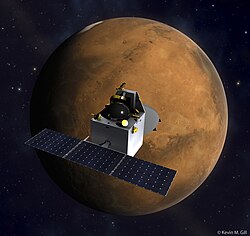
ISRO launched the [[Mars Orbiter Mission]] (or Mangalyaan) aboard PSLV in 2013, which later became the first Asian spacecraft to enter Martian orbit, making India the first country to succeed at this on its first attempt.<ref>{{cite news |url=https://www.theguardian.com/science/2014/sep/24/india-mars-satellite-successfully-enters-orbit |title=India's Mars satellite successfully enters orbit, bringing country into space elite |work=The Guardian |first=Jason |last=Burke |date=24 September 2014 |access-date=16 March 2021 |quote=India has become the first nation to send a satellite into orbit around Mars on its first attempt, and the first Asian nation to do so. |archive-date=4 December 2019 |archive-url=https://web.archive.org/web/20191204185909/https://www.theguardian.com/science/2014/sep/24/india-mars-satellite-successfully-enters-orbit |url-status=live}}</ref> | |||
Subsequently, the cryogenic upper stage for GSLV rocket became operational, making India the sixth country to have full launch capabilities.<ref name="Cryo14">{{Cite news |last=Narasimhan |first=T. E. |date=7 January 2014 |title=ISRO on cloud nine as India joins 'cryo club' |url=https://www.business-standard.com/article/current-affairs/isro-on-cloud-nine-as-india-joins-cryo-club-114010700023_1.html |url-status=live |archive-url=https://web.archive.org/web/20221111074324/https://www.business-standard.com/article/current-affairs/isro-on-cloud-nine-as-india-joins-cryo-club-114010700023_1.html |archive-date=11 November 2022 |access-date=12 March 2021 |location=Chennai |newspaper=[[Business Standard]] }}</ref> A new heavier-lift launcher [[LVM3]] was introduced in 2014 for heavier satellites and future human space missions.<ref>{{Cite web |title=GSLV Mk III |url=https://www.isro.gov.in/launchers/gslv-mk-iii |publisher=ISRO |access-date=16 March 2021 |archive-date=20 September 2018 |archive-url=https://web.archive.org/web/20180920234908/https://www.isro.gov.in/launchers/gslv-mk-iii |url-status=live}}</ref> | |||
In September 2019, [[Project NETRA]] was publicly announced to help counter problems associated with space debris and near-earth objects.<ref>{{Cite web |title=Weather forecast and conditions for Dallas Arts District, Dallas, Texas, United States |url=https://weather.com/en-IN/weather/today/l/Cochran+Heights+Dallas+Texas+United+States?canonicalCityId=3fa18fe87647fc67cc4f0adfaa9719d0 |access-date=2025-10-12 |website=The Weather Channel |language=en-IN}}</ref> | |||
=== 2020s === | |||
[[File:Chandrayaan-3 – Image of Vikram lander on lunar surface taken by Pragyan rover navcam at 1104 IST, 30 August 2023 from 15 meters away (without text).webp|thumb|[[Chandrayaan-3]] Lander on the [[Moon]] surface imaged by [[Pragyan (Chandrayaan-3)|Pragyan]] rover from 15 meters away]] | |||
On 23 August 2023, India achieved its first soft landing on an extraterrestrial body and became the first nation to successfully land a spacecraft near the [[lunar south pole]] and fourth nation to successfully land a spacecraft on the Moon with ISRO's [[Chandrayaan-3]], the third Moon mission.<ref name="guardian-20230823">{{Cite news |last=Dhillon |first=Amrit |date=2023-08-23 |title=India lands spacecraft near south pole of moon in world first |language=en-GB |work=The Guardian |url=https://www.theguardian.com/science/2023/aug/23/india-chandrayaan-3-moon-landing-mission |access-date=2023-08-23 |issn=0261-3077 |archive-date=5 November 2023 |archive-url=https://web.archive.org/web/20231105194944/https://www.theguardian.com/science/2023/aug/23/india-chandrayaan-3-moon-landing-mission |url-status=live }}</ref> Indian moon mission, Chandrayaan-3 (lit. "''Mooncraft''"), saw the successful soft landing of its ''Vikram'' lander at 6.04 pm IST (12:34 pm GMT) near the little-explored southern pole of the Moon in a world's first for any space programme.<ref>{{Cite web |date=23 August 2023 |title=Chandrayaan-3 Live Updates: 'Dawn of new India,' says PM Modi as ISRO lands spacecraft on the Moon |url=https://www.indianexpress.com/article/india/chandrayaan-3-moon-landing-live-updates-isro-vikram-lander-8903547/ |archive-url=https://web.archive.org/web/20231105194950/https://indianexpress.com/article/india/chandrayaan-3-moon-landing-live-updates-isro-vikram-lander-8903547/ |archive-date=5 November 2023 |access-date=23 August 2023 |website=indianexpress.com |publisher=Indian Express |url-status=live }}</ref> | |||
India then successfully launched its first solar probe, the [[Aditya-L1]], aboard PSLV on 2 September 2023.<ref>{{cite journal |url=https://www.nature.com/articles/d41586-023-02811-2 |author=T. V. Padma |date=September 4, 2023 |journal=[[Nature (journal)|Nature]] |title=India's first Sun mission will investigate the origins of space weather |volume=621 |issue=7978 |pages=240–241 |doi=10.1038/d41586-023-02811-2 |pmid=37667110 |bibcode=2023Natur.621..240P |s2cid=261526289 |access-date=September 5, 2023 |archive-date=5 October 2023 |archive-url=https://web.archive.org/web/20231005030143/https://www.nature.com/articles/d41586-023-02811-2 |url-status=live |url-access=subscription }}</ref><ref>{{cite web |url=https://www.space.com/india-launches-aditya-l1-first-solar-probe |first=Mike |last=Wall |website=[[Space.com]] |date=September 2, 2023 |title=India launches Aditya-L1 solar observatory, its 1st-ever sun probe |access-date=September 5, 2023 |archive-date=20 October 2023 |archive-url=https://web.archive.org/web/20231020230548/https://www.space.com/india-launches-aditya-l1-first-solar-probe |url-status=live }}</ref> | |||
On 30 December 2024, ISRO successfully launched the [[SpaDeX]] mission, pioneering [[Space rendezvous|spacecraft rendezvous]], [[Docking and berthing of spacecraft|docking]], and undocking using two small satellites.<ref>{{Cite web |date=2024-12-31 |title=Isro successfully launches SpaDeX mission for novel docking of 2 satellites in space |url=https://www.domain-b.com/technology/technology-general/isro-successfully-launches-spadex-mission-for-novel-docking-of-2-satellites-in-space |access-date=2024-12-31 |website=www.domain-b.com |language=en}}</ref><ref>{{Cite news |last=C.S |first=Hemanth |date=2024-12-30 |title=PSLV-C60 launch: ISRO launches SpaDeX mission for space docking |url=https://www.thehindu.com/sci-tech/science/pslvc60-lifts-off-with-spadex-spacecraft-from-sriharikota/article69044491.ece |access-date=2024-12-31 |work=The Hindu |language=en-IN |issn=0971-751X}}</ref> On 16 January 2025, the [[ISRO Telemetry, Tracking and Command Network]]'s Mission Operations Complex verified that the docking process was successful. India became the 4th country — after USA, Russia and China — to achieve successful space docking.<ref>{{Cite news |last=C.S |first=Hemanth |date=2025-01-16 |title=ISRO successfully executes SpaDeX docking experiment; India joins elite club of nations |url=https://www.thehindu.com/sci-tech/science/isro-successfully-executes-spadex-docking-experiment-india-joins-elite-club-of-nations/article69103462.ece |access-date=2025-01-17 |work=The Hindu |language=en-IN |issn=0971-751X}}</ref><ref>{{Cite web |last=Tripathi |first=Sibu |date=2025-01-16 |title=Isro docks SpaDeX satellites in space, sets stage for Chandrayaan-4, Gaganyaan |url=https://www.indiatoday.in/science/story/isro-spadex-satellites-docking-successful-creates-history-spacecraft-2665500-2025-01-16 |access-date=2025-01-16 |website=India Today |language=en}}</ref><ref>{{Cite web |last=Bagla |first=Pallava |date=2025-01-16 |title=ISRO's SpaDeX Mission Successful, 2 Indian Satellites Dock In Space |url=https://www.ndtv.com/india-news/isros-spadex-mission-successful-2-indian-satellites-dock-in-space-7484822 |access-date=2025-01-17 |website=ndtv.com |language=en}}</ref> ISRO also successfully managed to control two satellites as a single entity after docking.<ref>{{Cite news |date=2025-01-16 |title=ISRO successfully docks SpaDeX satellites in space, creates history |url=https://www.hindustantimes.com/india-news/isro-successfully-docks-spadex-two-satellites-in-space-101737003035346.html |archive-url=https://web.archive.org/web/20250116101958/https://www.hindustantimes.com/india-news/isro-successfully-docks-spadex-two-satellites-in-space-101737003035346.html |archive-date=16 January 2025 |access-date=2025-01-17 |work=Hindustan Times |language=en-us |url-status=live }}</ref> | |||
In May 2025, ISRO completed the final abort test for the [[Gaganyaan]] human spaceflight mission, scheduled for launch in early 2027.<ref>{{cite web|url=https://timesofindia.indiatimes.com/science/indias-gaganyaan-mission-enters-final-phase-with-crewed-launch-scheduled-for-the-first-quarter-of-2027/articleshow/120961521.cms|title= India's Gaganyaan mission enters final phase with crewed launch scheduled for the first quarter of 2027 |date=7 May 2025|website=Times of India}}</ref> In August 2025, ISRO successfully completed the first integrated air drop test for the Gaganyaan human spaceflight programme, hailed by [[Minister of Defence (India)|Defence Minister]] [[Rajnath Singh]] as a step toward self-reliant India.<ref>{{Cite news |date=2025-08-24 |title=Top news of the day: August 24, 2025 |url=https://www.thehindu.com/news/top-news-of-the-day-august-24-2025/article69971802.ece |access-date=2025-08-24 |work=The Hindu |publisher=The Hindu Bureau |language=en-IN |issn=0971-751X}}</ref> | |||
On 2 November 2025, ISRO successfully launched its heaviest [[communication satellite]] [[GSAT-7R|CMS-03]] aboard the LVM3-M5 rocket from Sriharikota, marking a milestone in India's space capabilities with all eight LVM3 missions achieving 100% success.<ref>{{Cite web |date=2025-11-02 |title=ISRO Rocket Launch Today Live Updates: India's heaviest communication satellite CMS-03 successfully placed in intended orbit, mission successfully accomplished |url=https://indianexpress.com/article/india/isro-rocket-launch-today-live-updates-heaviest-communication-satellite-cms-03-liftoff-sriharikota-lvm3-10341199/ |access-date=2025-11-02 |website=The Indian Express |language=en}}</ref> | |||
On 24 December 2025, ISRO launched [[AST SpaceMobile]]'s BlueBird Block-2 aboard the LVM3-M6 rocket. This was the heaviest foreign satellite ever launched from the Indian soil, weighing {{cvt|6100|kg}}.<ref>{{Cite news |last=C.S |first=Hemanth |date=2025-12-24 |title=BlueBird Block-2 mission: ISRO successfully launches LVM3-M6 rocket |url=https://www.thehindu.com/sci-tech/science/isro-bluebird-block-2-mission-rocket-launch-december-24-2025/article70432346.ece |access-date=2025-12-24 |work=The Hindu |language=en-IN |issn=0971-751X}}</ref> | |||
ISRO | |||
== Goals and objectives == | == Goals and objectives == | ||
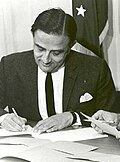
[[File:Vikram Sarabhai.jpg|thumb|180px|[[Vikram Sarabhai]], first chairperson of [[INCOSPAR]], ISRO's predecessor | [[File:Vikram Sarabhai.jpg|thumb|180px|[[Vikram Sarabhai]], first chairperson of [[Indian National Committee for Space Research|INCOSPAR]], ISRO's predecessor organisation]] | ||
As the national space agency of India, ISRO's purpose is the pursuit of all space-based applications such as research, reconnaissance, and communications. It undertakes the design and development of space rockets and satellites, and undertakes explores upper atmosphere and deep space exploration missions. ISRO has also incubated technologies in India's private space sector, boosting its growth.<ref name="isro_aboutus">{{cite web |url=http://www.isro.gov.in/about-isro/vision-and-mission-statements |title=ISRO – Vision and Mission Statements |publisher=ISRO |access-date=27 August 2015 |archive-url=https://web.archive.org/web/20150904080053/http://www.isro.gov.in/about-isro/vision-and-mission-statements |archive-date=4 September 2015 |url-status=live}}</ref>{{sfn|Rajagopalan|Prasad|2017|pp=1-2}} | |||
{{blockquote|text= | |||
The former [[president of India]] and chairman of [[Defence Research and Development Organisation|DRDO]], [[A. P. J. Abdul Kalam]], said:<ref name=apj_autobiography>{{Cite book|url=https://books.google.com/books?id=c3qmIZtWUjAC&pg=PA43|title=Wings of Fire: An Autobiography|last1=Kalam|first1=Avul Pakir Jainulabdeen Abdul|last2=Tiwari|first2=Arun|date=1999|publisher=Universities Press|isbn=9788173711466|language=en|access-date=16 August 2019|archive-date=17 April 2017|archive-url=https://web.archive.org/web/20170417091638/https://books.google.com/books?id=c3qmIZtWUjAC|url-status=live}}</ref> | On the topic of the importance of a space programme to India as a developing nation, Vikram Sarabhai as INCOSPAR chairman said in 1969:{{sfn|Burleson|2005|page=136}}<ref>{{Cite web |url=https://www.isro.gov.in/about-isro/dr-vikram-ambalal-sarabhai-1963-1971 |title=Dr. Vikram Ambalal Sarabhai (1963–1971) – ISRO |access-date=21 September 2019 |archive-url=https://web.archive.org/web/20190422014937/https://www.isro.gov.in/about-isro/dr-vikram-ambalal-sarabhai-1963-1971 |archive-date=22 April 2019 |url-status=live}}</ref><ref name="Sarabhai_compilation">{{Cite web |title=List of Important Speeches And Papers By Dr. Vikram A. Sarabhai. |url=https://www.prl.res.in/~library/sarabhai_v_speeches.pdf |url-status=live |archive-url=https://web.archive.org/web/20190627181445/https://www.prl.res.in/~library/sarabhai_v_speeches.pdf |archive-date=27 June 2019 |access-date=27 June 2019 |website=PRL.res.in |page=113 }}</ref> | ||
{{blockquote|text=To us, there is no ambiguity of purpose. We do not have the fantasy of competing with the economically advanced nations in the exploration of the Moon or the planets or manned space-flight. But we are convinced that if we are to play a meaningful role nationally, and in the community of nations, we must be second to none in the application of advanced technologies to the real problems of man and society, which we find in our country. And we should note that the application of sophisticated technologies and methods of analysis to our problems is not to be confused with embarking on grandiose schemes, whose primary impact is for show rather than for progress measured in hard economic and social terms.}} | |||
The former [[president of India]] and chairman of [[Defence Research and Development Organisation|DRDO]], [[A. P. J. Abdul Kalam]], said:<ref name=apj_autobiography>{{Cite book |url=https://books.google.com/books?id=c3qmIZtWUjAC&pg=PA43 |title=Wings of Fire: An Autobiography |last1=Kalam |first1=Avul Pakir Jainulabdeen Abdul |last2=Tiwari |first2=Arun |date=1999 |publisher=Universities Press |isbn=9788173711466 |language=en |access-date=16 August 2019 |archive-date=17 April 2017 |archive-url=https://web.archive.org/web/20170417091638/https://books.google.com/books?id=c3qmIZtWUjAC |url-status=live}}</ref> | |||
{{blockquote|text=Very many individuals with myopic vision questioned the relevance of space activities in a newly independent nation which was finding it difficult to feed its population. But neither Prime Minister Nehru nor Prof. Sarabhai had any ambiguity of purpose. Their vision was very clear: if Indians were to play a meaningful role in the community of nations, they must be second to none in the application of advanced technologies to their real-life problems. They had no intention of using it merely as a means of displaying our might.}} | {{blockquote|text=Very many individuals with myopic vision questioned the relevance of space activities in a newly independent nation which was finding it difficult to feed its population. But neither Prime Minister Nehru nor Prof. Sarabhai had any ambiguity of purpose. Their vision was very clear: if Indians were to play a meaningful role in the community of nations, they must be second to none in the application of advanced technologies to their real-life problems. They had no intention of using it merely as a means of displaying our might.}} | ||
India's economic progress has made its space programme more visible and active as the country aims for greater [[Self-sustainability|self-reliance]] in space technology.<ref name=newsweek1 /> In 2008, India launched as many as 11{{Nbsp}}satellites, including nine from other countries, and went on to become the first nation to launch 10{{Nbsp}}satellites on one{{Nbsp}}rocket.<ref name=newsweek1>{{Cite web |url=http://www.newsweek.com/id/160037 |title=Hennock etc. (2008), "The Real Space Race Is in Asia", ''Newsweek''. |website=[[Newsweek]] |access-date=25 December 2008 |archive-url=https://web.archive.org/web/20081222044922/http://www.newsweek.com/id/160037 |archive-date=22 December 2008 |url-status=live |date=20 September 2008 }}</ref> ISRO has put into operation two major satellite systems: the | India's economic progress has made its space programme more visible and active as the country aims for greater [[Self-sustainability|self-reliance]] in space technology.<ref name=newsweek1 /> In 2008, India launched as many as 11{{Nbsp}}satellites, including nine from other countries, and went on to become the first nation to launch 10{{Nbsp}}satellites on one{{Nbsp}}rocket.<ref name=newsweek1>{{Cite web |url=http://www.newsweek.com/id/160037 |title=Hennock etc. (2008), "The Real Space Race Is in Asia", ''Newsweek''. |website=[[Newsweek]] |access-date=25 December 2008 |archive-url=https://web.archive.org/web/20081222044922/http://www.newsweek.com/id/160037 |archive-date=22 December 2008 |url-status=live |date=20 September 2008}}</ref> ISRO has put into operation two major satellite systems: the Indian National Satellite System (INSAT) for communication services, and the Indian Remote Sensing Programme (IRS) satellites for management of natural resources.<ref name="isro-comsats" /><ref name="IRSSaga" /> | ||
== Organisation structure and facilities == | == Organisation structure and facilities == | ||
[[File:Department of Space (India) - organization chart.png|upright=1.3|thumb|The organisational structure of the Indian [[Department of Space]]]] | [[File:Department of Space (India) - organization chart.png|upright=1.3|thumb|The organisational structure of the Indian [[Department of Space]]]] | ||
{{See also|ISRO facilities}} | {{See also|ISRO facilities}} | ||
ISRO is managed by the | ISRO is managed by the DoS, which itself falls under the authority of the Space Commission and manages the following agencies and institutes:<ref>{{cite web |title=Organisation Structure |url=https://www.isro.gov.in/about-isro/organisation-structure |url-status=live |archive-url=https://web.archive.org/web/20220612065305/https://www.isro.gov.in/about-isro/organisation-structure |archive-date=12 June 2022 |access-date=12 June 2022 |publisher= |df=dmy-all}}</ref><ref>{{Cite web |url=https://www.isro.gov.in/update/03-aug-2019/foundation-stone-of-space-situational-awareness-control-centre-chairman-isro |title=Foundation stone of Space Situational Awareness Control Centre by Chairman, ISRO – ISRO |website=www.isro.gov.in |access-date=3 August 2019 |archive-url=https://web.archive.org/web/20190830223917/http://isro.gov.in/update/03-aug-2019/foundation-stone-of-space-situational-awareness-control-centre-chairman-isro |archive-date=30 August 2019 |url-status=live}}</ref><ref name="isro-20190130">{{Cite web |url=https://www.isro.gov.in/update/30-jan-2019/inauguration-of-human-space-flight-centre-hsfc |title=Inauguration of Human Space Flight Centre (HSFC) – ISRO |website=www.isro.gov.in |access-date=3 August 2019 |archive-url=https://web.archive.org/web/20190329015418/https://www.isro.gov.in/update/30-jan-2019/inauguration-of-human-space-flight-centre-hsfc |archive-date=29 March 2019 |url-status=live}}</ref> | ||
* [[Antrix Corporation]] – The marketing arm of ISRO, Bengaluru | * [[Antrix Corporation]] – The marketing arm of ISRO, Bengaluru | ||
* [[Physical Research Laboratory]] (PRL), Ahmedabad | * [[Physical Research Laboratory]] (PRL), Ahmedabad | ||
* [[National Atmospheric Research Laboratory]] (NARL), Gadanki, [[Andhra Pradesh]] | * [[National Atmospheric Research Laboratory]] (NARL), Gadanki, [[Andhra Pradesh]] | ||
*[[NewSpace India Limited]] – Commercial wing, Bengaluru | * [[NewSpace India Limited]] – Commercial wing, Bengaluru | ||
* [[North-Eastern Space Applications Centre]]<ref>{{cite web |url=http://necouncil.nic.in/index3.asp?sslid=72&subsublinkid=153 |title=NEC – North Eastern Council |publisher=Necouncil.nic.in |access-date=8 February 2013 |url-status=dead |archive-url=https://web.archive.org/web/20120225165210/http://necouncil.nic.in/index3.asp?sslid=72&subsublinkid=153 |archive-date=25 February 2012 }}</ref> (NE-SAC), Umiam | * [[North-Eastern Space Applications Centre]]<ref>{{cite web |url=http://necouncil.nic.in/index3.asp?sslid=72&subsublinkid=153 |title=NEC – North Eastern Council |publisher=Necouncil.nic.in |access-date=8 February 2013 |url-status=dead |archive-url=https://web.archive.org/web/20120225165210/http://necouncil.nic.in/index3.asp?sslid=72&subsublinkid=153 |archive-date=25 February 2012}}</ref> (NE-SAC), Umiam | ||
* [[Indian Institute of Space Science and Technology]] (IIST), Thiruvananthapuram – India's space university | * [[Indian Institute of Space Science and Technology]] (IIST), Thiruvananthapuram – India's space university | ||
| Line 90: | Line 119: | ||
| [[Physical Research Laboratory]] || [[Ahmedabad]] || Solar planetary physics, infrared astronomy, geo-cosmo physics, plasma physics, [[astrophysics]], [[archaeology]], and [[hydrology]] are some of the branches of study at this institute.;{{sfn|Ojha|pp=142}} it also operates the observatory at [[Udaipur]].{{sfn|Ojha|pp=142}} | | [[Physical Research Laboratory]] || [[Ahmedabad]] || Solar planetary physics, infrared astronomy, geo-cosmo physics, plasma physics, [[astrophysics]], [[archaeology]], and [[hydrology]] are some of the branches of study at this institute.;{{sfn|Ojha|pp=142}} it also operates the observatory at [[Udaipur]].{{sfn|Ojha|pp=142}} | ||
|- | |- | ||
| [[ | | [[National Atmospheric Research Laboratory]]|| [[Tirupati]] || The NARL carries out fundamental and applied research in atmospheric and space sciences.<ref>{{Cite web |title=About Us |url=https://www.narl.gov.in/ |access-date=22 July 2022 |website=[[National Atmospheric Research Laboratory]] |archive-date=14 July 2017 |archive-url=https://web.archive.org/web/20170714161347/https://www.narl.gov.in/ |url-status=live }}</ref> | ||
|- | |- | ||
| [[Space Applications Centre]] || [[Ahmedabad]] || The SAC deals with the various aspects of the practical use of space technology.{{sfn|Ojha|pp=142}} Among the fields of research at the SAC are [[geodesy]], [[telecommunication|satellite based telecommunications]], [[surveying]], [[remote sensing]], [[meteorology]], environment monitoring etc.{{sfn|Ojha|pp=142}} The SAC also operates the Delhi Earth Station, which is located in Delhi and is used for demonstration of various SATCOM experiments in addition to normal SATCOM operations.{{sfn|Suri|Rajaram|pp=415}} | | [[Space Applications Centre]] || [[Ahmedabad]] || The SAC deals with the various aspects of the practical use of space technology.{{sfn|Ojha|pp=142}} Among the fields of research at the SAC are [[geodesy]], [[telecommunication|satellite based telecommunications]], [[surveying]], [[remote sensing]], [[meteorology]], environment monitoring etc.{{sfn|Ojha|pp=142}} The SAC also operates the Delhi Earth Station, which is located in Delhi and is used for demonstration of various SATCOM experiments in addition to normal SATCOM operations.{{sfn|Suri|Rajaram|pp=415}} | ||
|- | |- | ||
| [[North-Eastern Space Applications Centre]] || [[Shillong]] || Providing developmental support to North East by undertaking specific application projects using remote sensing, GIS, satellite communication and conducting space science research.<ref>{{Cite web |title=About NESAC |url=https://nesac.gov.in/about/about-nesac/ |access-date=22 July 2022 |website=[[North-Eastern Space Applications Centre]]}}</ref> | | [[North-Eastern Space Applications Centre]] || [[Shillong]] || Providing developmental support to North East by undertaking specific application projects using remote sensing, GIS, satellite communication and conducting space science research.<ref>{{Cite web |title=About NESAC |url=https://nesac.gov.in/about/about-nesac/ |access-date=22 July 2022 |website=[[North-Eastern Space Applications Centre]] |archive-date=22 July 2022 |archive-url=https://web.archive.org/web/20220722115617/https://nesac.gov.in/about/about-nesac/ |url-status=live }}</ref> | ||
|} | |} | ||
| Line 106: | Line 135: | ||
=== Construction and launch facilities === | === Construction and launch facilities === | ||
{{Location map+ | |||
| India | |||
| float=right | |||
| width=350 | |||
| alt=Map of India and its subdivisions with the locations of its spaceport facilities | |||
| caption=Location of India's spaceports | |||
| places= | |||
<!-- Sriharikota --> | |||
{{Location map~ |India |lat=13.7178 |long=80.2 |label_size=90 |label=[[Satish Dhawan Space Centre|Satish Dhawan]] |position=right}} | |||
<!-- Kulasekarapattinam --> | |||
{{Location map~ |India |lat=8.4 |long=78.05 |label_size=90 |label=[[SSLV Launch Complex|SSLV]] |position=right}} | |||
<!-- Thumba --> | |||
{{Location map~ |India |lat=8.516667 |long=76.866667 |label_size=90 |label=[[Thumba Equatorial Rocket Launching Station|Thumba]] |position=left}} | |||
}} | |||
{| class=wikitable | {| class=wikitable | ||
|- | |- | ||
! style="width:18%;"| Facility !! style="width:15%;"| Location !! style="width:67%;"| Description | ! style="width:18%;"| Facility !! style="width:15%;"| Location !! style="width:67%;"| Description | ||
|- | |- | ||
| [[U R Rao Satellite Centre]] || [[Bengaluru]] || The venue of eight successful spacecraft projects is also one of the main satellite technology bases of ISRO. The facility serves as a venue for implementing indigenous spacecraft in India.{{sfn|Ojha|pp=142}} The satellites ''Aaryabhata'', ''Bhaskara'', ''APPLE'', and ''IRS-1A'' were built at this site, and the IRS and INSAT satellite series are presently under development here. This centre was formerly known as ISRO Satellite Centre.{{sfn|Suri|Rajaram|pp=414}} | | [[U. R. Rao Satellite Centre]]|| [[Bengaluru]] || The venue of eight successful spacecraft projects is also one of the main satellite technology bases of ISRO. The facility serves as a venue for implementing indigenous spacecraft in India.{{sfn|Ojha|pp=142}} The satellites ''Aaryabhata'', ''Bhaskara'', ''APPLE'', and ''IRS-1A'' were built at this site, and the IRS and INSAT satellite series are presently under development here. This centre was formerly known as ISRO Satellite Centre.{{sfn|Suri|Rajaram|pp=414}} | ||
|- | |- | ||
| [[Laboratory for Electro-Optics Systems]]|| [[Bengaluru]] || The Unit of ISRO responsible for the development of altitude sensors for all satellites. The high precision optics for all cameras and payloads in all ISRO satellites are developed at this laboratory, located at Peenya Industrial Estate, Bengaluru. | | [[Laboratory for Electro-Optics Systems]]|| [[Bengaluru]] || The Unit of ISRO responsible for the development of altitude sensors for all satellites. The high precision optics for all cameras and payloads in all ISRO satellites are developed at this laboratory, located at Peenya Industrial Estate, Bengaluru. | ||
|- | |- | ||
| [[Satish Dhawan Space Centre]] || [[Sriharikota]] || With multiple sub-sites the Sriharikota island facility acts as a launching site for India's satellites.{{sfn|Ojha|pp=142}} The Sriharikota facility is also the main launch base for India's sounding rockets.{{sfn|Suri|Rajaram|pp=414}} The centre is also home to India's largest Solid Propellant Space Booster Plant (SPROB) and houses the Static Test and Evaluation Complex (STEX).{{sfn|Suri|Rajaram|pp=414}} The Second Vehicle Assembly Building (SVAB) at Sriharikota is being realised as an additional integration facility, with suitable interfacing to a second launch pad.<ref>{{cite news |title=Second Vehicle Assembly Building being realised at ISRO |url=http://economictimes.indiatimes.com/news/science/second-vehicle-assembly-building-being-realised-at-isro/articleshow/50531617.cms |newspaper=The Economic Times |access-date=20 January 2016 |date=11 January 2016 |archive-url=https://web.archive.org/web/20160114044154/http://economictimes.indiatimes.com/news/science/second-vehicle-assembly-building-being-realised-at-isro/articleshow/50531617.cms |archive-date=14 January 2016 |url-status=live }}</ref><ref>{{cite news |last1=Madumathi |first1=D.S. |title=Sriharikota space port scores 50 |url=http://www.thehindu.com/todays-paper/tp-national/sriharikota-space-port-scores-50/article8070373.ece |access-date=20 January 2016 |work=The Hindu |date=6 January 2016 |archive-url=https://web.archive.org/web/20160109041156/http://www.thehindu.com/todays-paper/tp-national/sriharikota-space-port-scores-50/article8070373.ece |archive-date=9 January 2016 |url-status=live }}</ref> | | [[Satish Dhawan Space Centre]] || [[Sriharikota]] || With multiple sub-sites the Sriharikota island facility acts as a launching site for India's satellites.{{sfn|Ojha|pp=142}} The Sriharikota facility is also the main launch base for India's sounding rockets.{{sfn|Suri|Rajaram|pp=414}} The centre is also home to India's largest Solid Propellant Space Booster Plant (SPROB) and houses the Static Test and Evaluation Complex (STEX).{{sfn|Suri|Rajaram|pp=414}} The Second Vehicle Assembly Building (SVAB) at Sriharikota is being realised as an additional integration facility, with suitable interfacing to a second launch pad.<ref>{{cite news |title=Second Vehicle Assembly Building being realised at ISRO |url=http://economictimes.indiatimes.com/news/science/second-vehicle-assembly-building-being-realised-at-isro/articleshow/50531617.cms |newspaper=The Economic Times |access-date=20 January 2016 |date=11 January 2016 |archive-url=https://web.archive.org/web/20160114044154/http://economictimes.indiatimes.com/news/science/second-vehicle-assembly-building-being-realised-at-isro/articleshow/50531617.cms |archive-date=14 January 2016 |url-status=live}}</ref><ref>{{cite news |last1=Madumathi |first1=D.S. |title=Sriharikota space port scores 50 |url=http://www.thehindu.com/todays-paper/tp-national/sriharikota-space-port-scores-50/article8070373.ece |access-date=20 January 2016 |work=The Hindu |date=6 January 2016 |archive-url=https://web.archive.org/web/20160109041156/http://www.thehindu.com/todays-paper/tp-national/sriharikota-space-port-scores-50/article8070373.ece |archive-date=9 January 2016 |url-status=live}}</ref> | ||
|- | |- | ||
| [[Thumba Equatorial Rocket Launching Station]] ||[[Thiruvananthapuram]]|| TERLS is used to launch sounding rockets.<ref>{{Cite web |title=Sounding Rockets |url=https://www.isro.gov.in/launchers/sounding-rockets |access-date=22 July 2022 |website= | | [[SSLV Launch Complex]]||[[Kulasekarapattinam]]|| Currently under construction. This launch facility will cater smaller rockets such as the [[Small Satellite Launch Vehicle|SSLV]] and private sector's launch vehicles. | ||
|- | |||
| [[Thumba Equatorial Rocket Launching Station]] ||[[Thiruvananthapuram]]|| TERLS is used to launch sounding rockets.<ref>{{Cite web |title=Sounding Rockets |url=https://www.isro.gov.in/launchers/sounding-rockets |access-date=22 July 2022 |website=ISRO |archive-date=11 December 2019 |archive-url=https://web.archive.org/web/20191211145536/https://www.isro.gov.in/launchers/sounding-rockets |url-status=dead}}</ref> | |||
|} | |} | ||
| Line 124: | Line 173: | ||
! style="width:18%;"| Facility !! style="width:15%;"| Location !! style="width:67%;"| Description | ! style="width:18%;"| Facility !! style="width:15%;"| Location !! style="width:67%;"| Description | ||
|- | |- | ||
| [[Indian Deep Space Network | | [[Indian Deep Space Network]] (IDSN) || [[Bengaluru]] || This network receives, processes, archives and distributes the spacecraft health data and payload data in real-time. It can track and monitor satellites up to very large distances, even beyond the [[Moon]].<ref>{{Cite web |title=Indian Space Science Data Centre (ISSDC) – Gateway to India's Space Science Data |url=https://www.isro.gov.in/indian-space-science-data-centre-issdc-gateway-to-indias-space-science-data |access-date=22 July 2022 |website=ISRO |archive-date=1 September 2019 |archive-url=https://web.archive.org/web/20190901140723/https://www.isro.gov.in/indian-space-science-data-centre-issdc-gateway-to-indias-space-science-data |url-status=dead}}</ref> | ||
|- | |- | ||
| [[National Remote Sensing Centre]] || [[Hyderabad, Andhra Pradesh|Hyderabad]] || The NRSC applies remote sensing to manage natural resources and study aerial surveying.{{sfn|Ojha|pp=142}} With centres at [[Balanagar, Ranga Reddy|Balanagar]] and [[Mahbubnagar district|Shadnagar]] it also has training facilities at [[Dehradun]] acting as the [[Indian Institute of Remote Sensing]].{{sfn|Ojha|pp=142}} | | [[National Remote Sensing Centre]] || [[Hyderabad, Andhra Pradesh|Hyderabad]] || The NRSC applies remote sensing to manage natural resources and study aerial surveying.{{sfn|Ojha|pp=142}} With centres at [[Balanagar, Ranga Reddy|Balanagar]] and [[Mahbubnagar district|Shadnagar]] it also has training facilities at [[Dehradun]] acting as the [[Indian Institute of Remote Sensing]].{{sfn|Ojha|pp=142}} | ||
|- | |- | ||
| [[ISRO Telemetry, Tracking and Command Network]] ||[[Bengaluru]] (headquarters) and a number of ground stations throughout India and the world.{{sfn|Suri|Rajaram|pp=415}} || [[Software development]], ground operations, Tracking Telemetry and Command (TTC), and support is provided by this institution.{{sfn|Ojha|pp=142}} ISTRAC has Tracking stations throughout the country and all over the world in [[Port Louis]] (Mauritius), Bearslake (Russia), [[Biak]] (Indonesia) and [[Brunei]].<ref>{{Cite web |title=SRO Telemetry, Tracking and Command Network (ISTRAC) |url=https://www.isro.gov.in/about-isro/isro-telemetry-tracking-and-command-network-istrac |access-date=22 July 2022 |website= | | [[ISRO Telemetry, Tracking and Command Network]] ||[[Bengaluru]] (headquarters) and a number of ground stations throughout India and the world.{{sfn|Suri|Rajaram|pp=415}} || [[Software development]], ground operations, Tracking Telemetry and Command (TTC), and support is provided by this institution.{{sfn|Ojha|pp=142}} ISTRAC has Tracking stations throughout the country and all over the world in [[Port Louis]] (Mauritius), Bearslake (Russia), [[Biak]] (Indonesia) and [[Brunei]].<ref>{{Cite web |title=SRO Telemetry, Tracking and Command Network (ISTRAC) |url=https://www.isro.gov.in/about-isro/isro-telemetry-tracking-and-command-network-istrac |access-date=22 July 2022 |website=ISRO |archive-date=28 March 2019 |archive-url=https://web.archive.org/web/20190328053757/https://www.isro.gov.in/about-isro/isro-telemetry-tracking-and-command-network-istrac |url-status=dead}}</ref> | ||
|- | |- | ||
| [[Master Control Facility]] || [[Bhopal]]; [[Hassan, India|Hassan]] || Geostationary satellite orbit raising, payload testing, and in-orbit operations are performed at this facility.{{sfn|Suri|Rajaram|pp=416}} The MCF has Earth stations and the Satellite Control Centre (SCC) for controlling satellites.{{sfn|Suri|Rajaram|pp=416}} A second MCF-like facility named 'MCF-B' is being constructed at Bhopal.{{sfn|Suri|Rajaram|pp=416}} | | [[Master Control Facility]] || [[Bhopal]]; [[Hassan, India|Hassan]] || Geostationary satellite orbit raising, payload testing, and in-orbit operations are performed at this facility.{{sfn|Suri|Rajaram|pp=416}} The MCF has Earth stations and the Satellite Control Centre (SCC) for controlling satellites.{{sfn|Suri|Rajaram|pp=416}} A second MCF-like facility named 'MCF-B' is being constructed at Bhopal.{{sfn|Suri|Rajaram|pp=416}} | ||
| Line 134: | Line 183: | ||
|Space Situational Awareness Control Centre | |Space Situational Awareness Control Centre | ||
|[[Peenya]], [[Bengaluru]] | |[[Peenya]], [[Bengaluru]] | ||
|A network of telescopes and radars are being set up under the Directorate of Space Situational Awareness and Management to monitor space debris and to safeguard space-based assets. The new facility will end ISRO's dependence on [[ | |A network of telescopes and radars are being set up under the Directorate of Space Situational Awareness and Management to monitor space debris and to safeguard space-based assets. The new facility will end ISRO's dependence on [[NORAD]]. The sophisticated multi-object tracking radar installed in Nellore, a radar in [[Northeast India]] and telescopes in [[Thiruvananthapuram]], [[Mount Abu]] and North India will be part of this network.<ref name="timesind-20190805">{{Cite web |url=https://timesofindia.indiatimes.com/india/new-isro-system-to-shield-its-assets-from-space-debris/articleshow/70528348.cms |title=New Isro system to shield its assets from space debris |last=Singh |first=Surendra |date=5 August 2019 |website=The Times of India |language=en |access-date=6 August 2019 |archive-url=https://web.archive.org/web/20190826090921/https://timesofindia.indiatimes.com/india/new-isro-system-to-shield-its-assets-from-space-debris/articleshow/70528348.cms |archive-date=26 August 2019 |url-status=live}}</ref><ref>{{Cite web |url=https://timesofindia.indiatimes.com/india/isro-keen-on-protecting-space-assets-new-centre-soon/articleshow/70520904.cms |title=Isro keen on protecting space assets; new centre soon |last=Kumar |first=Chethan |date=4 August 2019 |website=The Times of India |language=en |access-date=6 August 2019 |archive-url=https://web.archive.org/web/20190825154922/https://timesofindia.indiatimes.com/india/isro-keen-on-protecting-space-assets-new-centre-soon/articleshow/70520904.cms |archive-date=25 August 2019 |url-status=live}}</ref> | ||
|} | |} | ||
| Line 142: | Line 191: | ||
! style="width:18%;"| Facility !! style="width:15%;"| Location !! style="width:67%;"| Description | ! style="width:18%;"| Facility !! style="width:15%;"| Location !! style="width:67%;"| Description | ||
|- | |- | ||
| [[Indian Institute of Remote Sensing]] (IIRS) || [[Dehradun]] || The Indian Institute of Remote Sensing (IIRS) is a premier training and educational institute set up for developing trained professionals (P.G. and PhD level) in the field of remote sensing, geoinformatics and GPS technology for natural resources, environmental and disaster management. IIRS is also executing many R&D projects on remote sensing and GIS for societal applications. IIRS also runs various outreach programmes (Live & Interactive and e-learning) to build trained skilled human resources in the field of remote sensing and geospatial technologies.<ref name="IIRSInfo">{{cite web |url=https://www.iirs.gov.in/institute-profile|title=Institute Profile |website=[[Indian Institute of Remote Sensing]] |access-date=22 July 2022}}</ref> | | [[Indian Institute of Remote Sensing]] (IIRS) || [[Dehradun]] || The Indian Institute of Remote Sensing (IIRS) is a premier training and educational institute set up for developing trained professionals (P.G. and PhD level) in the field of remote sensing, geoinformatics and GPS technology for natural resources, environmental and disaster management. IIRS is also executing many R&D projects on remote sensing and GIS for societal applications. IIRS also runs various outreach programmes (Live & Interactive and e-learning) to build trained skilled human resources in the field of remote sensing and geospatial technologies.<ref name="IIRSInfo">{{cite web |url=https://www.iirs.gov.in/institute-profile |title=Institute Profile |website=[[Indian Institute of Remote Sensing]] |access-date=22 July 2022 |archive-date=12 July 2022 |archive-url=https://web.archive.org/web/20220712154554/https://www.iirs.gov.in/institute-profile/ |url-status=live }}</ref> | ||
|- | |- | ||
|[[Indian Institute of Space Science and Technology]] (IIST) ||[[Thiruvananthapuram]] || The institute offers undergraduate and graduate courses in Aerospace Engineering, Electronics and Communication Engineering (Avionics), and Engineering Physics. The students of the first three{{Nbsp}}batches of IIST were inducted into different | |[[Indian Institute of Space Science and Technology]] (IIST) ||[[Thiruvananthapuram]] || The institute offers undergraduate and graduate courses in Aerospace Engineering, Electronics and Communication Engineering (Avionics), and Engineering Physics. The students of the first three{{Nbsp}}batches of IIST were inducted into different ISRO centres.<ref>{{Cite web |title=Institute IIST |url=https://www.iist.ac.in/aboutus/institute |access-date=22 July 2022 |website=[[Indian Institute of Space Science and Technology]] |date=4 November 2014 |archive-date=22 July 2022 |archive-url=https://web.archive.org/web/20220722115615/https://www.iist.ac.in/aboutus/institute |url-status=live }}</ref> | ||
|- | |- | ||
|[[Development and Educational Communication Unit]]||[[Ahmedabad]] || The centre works for education, research, and training, mainly in conjunction with the [[INSAT]] programme.{{sfn|Ojha|pp=142}} The main activities carried out at DECU include GRAMSAT and [[GSAT-3|EDUSAT]] projects.{{sfn|Suri|Rajaram|pp=414}} The Training and Development Communication Channel (TDCC) also falls under the operational control of the DECU.{{sfn|Suri|Rajaram|pp=415}} | |[[Development and Educational Communication Unit]] (DECU)||[[Ahmedabad]] || The centre works for education, research, and training, mainly in conjunction with the [[INSAT]] programme.{{sfn|Ojha|pp=142}} The main activities carried out at DECU include GRAMSAT and [[GSAT-3|EDUSAT]] projects.{{sfn|Suri|Rajaram|pp=414}} The Training and Development Communication Channel (TDCC) also falls under the operational control of the DECU.{{sfn|Suri|Rajaram|pp=415}} | ||
|- | |- | ||
|Space Technology Incubation Centres (S-TICs) at: | |Space Technology Incubation Centres (S-TICs) at: | ||
* [[Dr. B. R. Ambedkar National Institute of Technology Jalandhar]] | * [[Dr. B. R. Ambedkar National Institute of Technology Jalandhar]] | ||
* [[Maulana Azad National Institute of Technology]] | * [[Maulana Azad National Institute of Technology]] | ||
*[[National Institute of Technology Agartala]] | * [[National Institute of Technology, Agartala]] | ||
*[[National Institute of Technology, Rourkela]]<ref>{{cite news |title=Space tech centre: ISRO team in NIT-Rourkela |url=https://www.newindianexpress.com/states/odisha/2021/mar/10/space-tech-centre-isro-team-in-nit-rourkela-2274636.html |access-date=12 March 2021 |agency=ENS |publisher=New Indian Express |date=10 March 2021 |archive-date=10 March 2021 |archive-url=https://web.archive.org/web/20210310062726/https://www.newindianexpress.com/states/odisha/2021/mar/10/space-tech-centre-isro-team-in-nit-rourkela-2274636.html |url-status=live }}</ref> | * [[National Institute of Technology, Rourkela]]<ref>{{cite news |title=Space tech centre: ISRO team in NIT-Rourkela |url=https://www.newindianexpress.com/states/odisha/2021/mar/10/space-tech-centre-isro-team-in-nit-rourkela-2274636.html |access-date=12 March 2021 |agency=ENS |publisher=New Indian Express |date=10 March 2021 |archive-date=10 March 2021 |archive-url=https://web.archive.org/web/20210310062726/https://www.newindianexpress.com/states/odisha/2021/mar/10/space-tech-centre-isro-team-in-nit-rourkela-2274636.html |url-status=live}}</ref> | ||
*[[Visvesvaraya National Institute of Technology]]<ref>{{Cite web|date=18 March 2021|title=Dr. K. Sivan, Chairman, ISRO / Secretary, DOS inaugurates 3 Space Technology Incubation Centres and releases युक्ति-संचिता YUKTI- Sanchita 2021|url=https://www.isro.gov.in/update/18-mar-2021/dr-k-sivan-chairman-isro-secretary-dos-inaugurates-3-space-technology-incubation|access-date=20 March 2021|website=ISRO|archive-date=19 March 2021|archive-url=https://web.archive.org/web/20210319152059/https://www.isro.gov.in/update/18-mar-2021/dr-k-sivan-chairman-isro-secretary-dos-inaugurates-3-space-technology-incubation|url-status=live}}</ref> | * [[Visvesvaraya National Institute of Technology Nagpur]]<ref>{{Cite web |date=18 March 2021 |title=Dr. K. Sivan, Chairman, ISRO / Secretary, DOS inaugurates 3 Space Technology Incubation Centres and releases युक्ति-संचिता YUKTI- Sanchita 2021 |url=https://www.isro.gov.in/update/18-mar-2021/dr-k-sivan-chairman-isro-secretary-dos-inaugurates-3-space-technology-incubation |access-date=20 March 2021 |website=ISRO |archive-date=19 March 2021 |archive-url=https://web.archive.org/web/20210319152059/https://www.isro.gov.in/update/18-mar-2021/dr-k-sivan-chairman-isro-secretary-dos-inaugurates-3-space-technology-incubation |url-status=live}}</ref> | ||
|[[ | |[[Jalandhar]], [[Bhopal]], [[Agartala]], [[Rourkela]], [[Nagpur]] | ||
|The S-TICs opened at premier technical universities in India to promote startups to build applications and products in tandem with the industry and would be used for future space missions. The S-TIC will bring the industry, academia and ISRO under one umbrella to contribute towards research and development (R&D) initiatives relevant to the Indian Space Programme.<ref name=":1a" /> | |The S-TICs opened at premier technical universities in India to promote startups to build applications and products in tandem with the industry and would be used for future space missions. The S-TIC will bring the industry, academia and ISRO under one umbrella to contribute towards research and development (R&D) initiatives relevant to the Indian Space Programme.<ref name=":1a" /> | ||
|- | |- | ||
|Space Innovation Centre at: | |Space Innovation Centre at: | ||
* [[Veer Surendra Sai University of Technology]] | * [[Veer Surendra Sai University of Technology]] | ||
|[[Burla, India|Burla]], [[Sambalpur]] | |[[Burla, India|Burla]], [[Sambalpur]] | ||
|In line with its ongoing effort to promote R&D in space technology through industry as well as academia, ISRO in collaboration with Veer Surendra Sai University of Technology (VSSUT), Burla, Sambalpur, Odisha, has set up Veer Surendra Sai Space Innovation Centre (VSSSIC) within its campus at Sambalpur. The objective of its Space Innovation Research Lab is to promote and encourage the students in research and development in the area of space science and technology at VSSUT and other institutes within this region.<ref>{{Cite web|title=Space Innovation Centre – ISRO|url=https://www.isro.gov.in/capacity-building/space-innovation-centre|access-date=7 July 2021|website=www.isro.gov.in|archive-date=9 July 2021|archive-url=https://web.archive.org/web/20210709184445/https://www.isro.gov.in/capacity-building/space-innovation-centre|url-status=live}}</ref><ref>{{Cite web|date=26 August 2020|title=VSSUT first to set up Space Innovation-cum-Incubation Centre with ISRO|url=https://www.hindustantimes.com/education/vssut-first-to-set-up-space-innovation-cum-incubation-centre-with-isro/story-baqiVPndKjIN1I6Z5ud9lJ.html|access-date=7 July 2021|website=Hindustan Times|language=en|archive-date=9 July 2021|archive-url=https://web.archive.org/web/20210709185416/https://www.hindustantimes.com/education/vssut-first-to-set-up-space-innovation-cum-incubation-centre-with-isro/story-baqiVPndKjIN1I6Z5ud9lJ.html|url-status=live}}</ref> | |In line with its ongoing effort to promote R&D in space technology through industry as well as academia, ISRO in collaboration with Veer Surendra Sai University of Technology (VSSUT), Burla, Sambalpur, Odisha, has set up Veer Surendra Sai Space Innovation Centre (VSSSIC) within its campus at Sambalpur. The objective of its Space Innovation Research Lab is to promote and encourage the students in research and development in the area of space science and technology at VSSUT and other institutes within this region.<ref>{{Cite web |title=Space Innovation Centre – ISRO |url=https://www.isro.gov.in/capacity-building/space-innovation-centre |access-date=7 July 2021 |website=www.isro.gov.in |archive-date=9 July 2021 |archive-url=https://web.archive.org/web/20210709184445/https://www.isro.gov.in/capacity-building/space-innovation-centre |url-status=live}}</ref><ref>{{Cite web |date=26 August 2020 |title=VSSUT first to set up Space Innovation-cum-Incubation Centre with ISRO |url=https://www.hindustantimes.com/education/vssut-first-to-set-up-space-innovation-cum-incubation-centre-with-isro/story-baqiVPndKjIN1I6Z5ud9lJ.html |access-date=7 July 2021 |website=Hindustan Times |language=en |archive-date=9 July 2021 |archive-url=https://web.archive.org/web/20210709185416/https://www.hindustantimes.com/education/vssut-first-to-set-up-space-innovation-cum-incubation-centre-with-isro/story-baqiVPndKjIN1I6Z5ud9lJ.html |url-status=live}}</ref> | ||
|- | |- | ||
|Regional Academy Centre for Space (RAC-S) at: | |Regional Academy Centre for Space (RAC-S) at: | ||
* [[Banaras Hindu University]] | * [[Banaras Hindu University]] | ||
* [[Gauhati University]] | * [[Gauhati University]] | ||
* [[Kurukshetra University]] | * [[Kurukshetra University]] | ||
* [[Malaviya National Institute of Technology, Jaipur|Malaviya National Institute of Technology]] | * [[Malaviya National Institute of Technology, Jaipur|Malaviya National Institute of Technology]] | ||
* [[National Institute of Technology Karnataka]] | * [[National Institute of Technology, Karnataka]] | ||
* [[National Institute of Technology, Patna|National Institute of Technology Patna]] | * [[National Institute of Technology, Patna|National Institute of Technology Patna]] | ||
* [[ | * [[IIT (BHU) Varanasi]]<ref>{{Cite web |date=24 December 2020 |title=ISRO to set up its regional centre at IIT-BHU |url=https://www.hindustantimes.com/education/isro-to-set-up-its-regional-centre-at-iit-bhu/story-UUNEDrrsqHU9JvPddg8IoN.html |access-date=27 December 2020 |website=Hindustan Times |language=en |archive-date=27 December 2020 |archive-url=https://web.archive.org/web/20201227092259/https://www.hindustantimes.com/education/isro-to-set-up-its-regional-centre-at-iit-bhu/story-UUNEDrrsqHU9JvPddg8IoN.html |url-status=live}}</ref> | ||
|[[Varanasi]], [[Guwahati]], [[Kurukshetra]], [[Jaipur]], [[Mangaluru]], [[Patna]] | |||
|[[Varanasi]], [[Guwahati]], | |||
|All these centres are set up in tier-2 cities to create awareness, strengthen academic collaboration and act as incubators for space technology, space science and space applications. The activities of RAC-S will maximise the use of research potential, infrastructure, expertise, experience and facilitate capacity building. | |All these centres are set up in tier-2 cities to create awareness, strengthen academic collaboration and act as incubators for space technology, space science and space applications. The activities of RAC-S will maximise the use of research potential, infrastructure, expertise, experience and facilitate capacity building. | ||
|} | |} | ||
| Line 182: | Line 227: | ||
{{Main|Antrix Corporation}} | {{Main|Antrix Corporation}} | ||
Set up as the marketing arm of ISRO, [[Antrix Corporation|Antrix]]'s job is to promote products, services and technology developed by ISRO.<ref name="AntrixISRO">{{cite | Set up as the marketing arm of ISRO, [[Antrix Corporation|Antrix]]'s job is to promote products, services and technology developed by ISRO.<ref name="AntrixISRO">{{cite news |url=https://timesofindia.indiatimes.com/india/Antrix-responsible-for-marketing-ISRO-tech/articleshow/7457366.cms |archive-url=https://archive.today/20130426170804/http://articles.timesofindia.indiatimes.com/2011-02-09/india/28547101_1_isro-eads-astrium-antrix-corporation |url-status=live |archive-date=26 April 2013 |work=[[The Times of India]] |title=Antrix responsible for marketing ISRO tech |date=9 February 2011 |access-date=24 February 2013}}</ref><ref name="AntrixNewChief">{{cite news |url=http://www.thehindubusinessline.com/industry-and-economy/isros-commercial-arm-antrix-gets-new-chief/article2214210.ece |title=ISRO's commercial arm Antrix gets new chief |date=9 June 2011 |newspaper=The Hindu |access-date=24 February 2013 |archive-date=30 May 2022 |archive-url=https://web.archive.org/web/20220530200912/https://www.thehindubusinessline.com/economy/ |url-status=live}}</ref> | ||
=== NewSpace India Limited (Commercial Wing) === | === NewSpace India Limited (Commercial Wing) === | ||
{{Main|NewSpace India Limited}} | {{Main|NewSpace India Limited}} | ||
Set up for marketing spin-off technologies, tech transfers through industry interface and scale up industry participation in the space programmes.<ref>{{Cite web|url=https://www.deccanherald.com/science-and-environment/isros-newspace-india-limited-takes-off-in-bengaluru-736355.html|title=ISRO's NewSpace India Limited takes off in Bengaluru|date=27 May 2019|website=Deccan Herald|language=en|access-date=10 January 2020|archive-date=1 August 2020|archive-url=https://web.archive.org/web/20200801233311/https://www.deccanherald.com/science-and-environment/isros-newspace-india-limited-takes-off-in-bengaluru-736355.html|url-status=live}}</ref> | |||
Set up for marketing spin-off technologies, tech transfers through industry interface and scale up industry participation in the space programmes.<ref>{{Cite web |url=https://www.deccanherald.com/science-and-environment/isros-newspace-india-limited-takes-off-in-bengaluru-736355.html |title=ISRO's NewSpace India Limited takes off in Bengaluru |date=27 May 2019 |website=Deccan Herald |language=en |access-date=10 January 2020 |archive-date=1 August 2020 |archive-url=https://web.archive.org/web/20200801233311/https://www.deccanherald.com/science-and-environment/isros-newspace-india-limited-takes-off-in-bengaluru-736355.html |url-status=live}}</ref> | |||
=== Space Technology Incubation Centre === | === Space Technology Incubation Centre === | ||
ISRO has opened Space Technology Incubation Centres (S-TIC) at premier technical universities in India which will incubate startups to build applications and products in tandem with the industry and | ISRO has opened Space Technology Incubation Centres (S-TIC) at premier technical universities in India which will incubate startups to build applications and products in tandem with the industry and for use in future space missions. The S-TIC will bring the industry, academia and ISRO under one umbrella to contribute towards research and development (R&D) initiatives relevant to the Indian Space Programme. S-TICs are at the [[National Institute of Technology Agartala|National Institute of Technology, Agartala]] serving for east region, [[Dr. B. R. Ambedkar National Institute of Technology Jalandhar|National Institute of Technology, Jalandhar]] for the north region, and the [[National Institute of Technology, Tiruchirappalli]] for the south region of India.<ref name=":1a">{{Cite web |url=https://timesofindia.indiatimes.com/city/trichy/isro-opens-space-tech-incubation-centre-at-nit-t/articleshow/69569218.cms |title=Isro opens space tech incubation centre at NIT-T |date=30 May 2019 |website=The Times of India |language=en |access-date=1 June 2019 |archive-date=28 September 2020 |archive-url=https://web.archive.org/web/20200928200817/https://timesofindia.indiatimes.com/city/trichy/isro-opens-space-tech-incubation-centre-at-nit-t/articleshow/69569218.cms |url-status=live}}</ref> | ||
=== | === Advanced Space Research Group === | ||
Similar to NASA's [[California Institute of Technology]]-operated [[Jet Propulsion Laboratory]], ISRO and the Indian Institute of Space Science and Technology (IIST) implemented a joint working framework in 2021, wherein ISRO will approve all short-, medium- and long-term space research projects of common interest between the two. In return, an Advanced Space Research Group (ASRG) formed at IIST under the guidance of the EOC will have full access to ISRO facilities. This was done with the aim of "transforming" the IIST into a premier space research and engineering institute with the capability of leading future space exploration missions for ISRO.<ref>{{cite web |title=Advanced Space Research Group (ASRG) |date=21 December 2020 |url=https://www.iist.ac.in/innovation/asrg-vision |access-date=6 March 2022 |archive-date=21 June 2021 |archive-url=https://web.archive.org/web/20210621092504/https://iist.ac.in/innovation/asrg-vision |url-status=live}}</ref><ref>{{cite news |title=ISRO embarking on replicating NASA partnership model in India |url=https://www.thehindu.com/news/national/karnataka/isro-embarking-on-replicating-nasa-partnership-model-in-india/article34169199.ece |access-date=31 March 2021 |agency=PTI |work=The Hindu |date=26 March 2021 |archive-date=26 March 2021 |archive-url=https://web.archive.org/web/20210326204501/https://www.thehindu.com/news/national/karnataka/isro-embarking-on-replicating-nasa-partnership-model-in-india/article34169199.ece |url-status=live}}</ref> | |||
=== Directorate of Space Situational Awareness and Management === | === Directorate of Space Situational Awareness and Management === | ||
To reduce dependency on [[North American | To reduce dependency on [[NORAD|North American Aerospace Defense Command]] (NORAD) for space situational awareness and protect the civilian and military assets, ISRO is setting up telescopes and radars in four locations to cover each direction. [[Leh]], [[Mount Abu]] and [[Ponmudi]] were selected to station the telescopes and radars that will cover North, West and South of Indian territory. The last one will be in [[Northeast India]] to cover the entire eastern region. [[Satish Dhawan Space Centre]] at Sriharikota already supports Multi-Object Tracking Radar (MOTR).<ref>{{Cite web |last=Pathri |first=Rajasekhar |date=16 May 2015 |title=Isro's tracking radar to start work |url=https://www.deccanchronicle.com/150516/nation-current-affairs/article/isro%E2%80%99s-tracking-radar-start-work |url-status=live |access-date=30 September 2021 |website=Deccan Chronicle |language=en |archive-date=30 September 2021 |archive-url=https://web.archive.org/web/20210930071532/https://www.deccanchronicle.com/150516/nation-current-affairs/article/isro%E2%80%99s-tracking-radar-start-work}}</ref> All the telescopes and radars will come under Directorate of Space Situational Awareness and Management (DSSAM) in Bengaluru. It will collect tracking data on inactive satellites and will also perform research on active debris removal, space debris modelling and mitigation.<ref>{{cite news |title=ISRO chairman lays foundation stone for Space Situational Awareness Control Centre in Bengaluru |url=https://www.aninews.in/news/national/general-news/isro-chairman-lays-foundation-stone-for-space-situational-awareness-control-centre-in-bengaluru20190803215041/ |access-date=11 April 2022 |agency=IANS |publisher=ANI |date=3 August 2019 |archive-date=3 August 2019 |archive-url=https://web.archive.org/web/20190803191709/https://www.aninews.in/news/national/general-news/isro-chairman-lays-foundation-stone-for-space-situational-awareness-control-centre-in-bengaluru20190803215041/ |url-status=live}}</ref> | ||
For | For early warning, ISRO began a ₹400 crore (4 billion; US$53 million) project called Network for Space Object Tracking and Analysis (NETRA). It will help the country track [[atmospheric entry]], [[intercontinental ballistic missile]] (ICBM), [[anti-satellite weapon]] and other space-based attacks. All the radars and telescopes will be connected through NETRA. The system will support [[Remote work|remote]] and scheduled operations. NETRA will follow the [[Inter-Agency Space Debris Coordination Committee]] (IASDCC) and [[United Nations Office for Outer Space Affairs]] (UNOSA) guidelines. The objective of NETRA is to track objects at a distance of {{convert|36000|km|mi}} in GTO.<ref name="timesind-20190805" /><ref>{{Cite news |last=D.S |first=Madhumathi |date=24 September 2019 |title=ISRO initiates 'Project NETRA' to safeguard Indian space assets from debris and other harm |language=en-IN |work=The Hindu |url=https://www.thehindu.com/sci-tech/science/isro-initiates-project-netra-to-safeguard-indian-space-assets-from-debris-and-other-harm/article29497795.ece |access-date=26 September 2021 |issn=0971-751X |archive-date=26 September 2021 |archive-url=https://web.archive.org/web/20210926083059/https://www.thehindu.com/sci-tech/science/isro-initiates-project-netra-to-safeguard-indian-space-assets-from-debris-and-other-harm/article29497795.ece |url-status=live}}</ref> | ||
India signed a [[memorandum of understanding]] on the Space Situational Awareness Data Sharing Pact with the US in April 2022.<ref>{{cite news |title=India, United States to sign space MoU during 2+2 meeting in Washington |url=https://www.business-standard.com/article/international/india-united-states-to-sign-space-mou-during-2-2-meeting-in-washington-122041100164_1.html |access-date=11 April 2022 |agency=IANS |publisher=Business Standard |date=11 April 2022 |archive-date=11 April 2022 |archive-url=https://web.archive.org/web/20220411042152/https://www.business-standard.com/article/international/india-united-states-to-sign-space-mou-during-2-2-meeting-in-washington-122041100164_1.html |url-status=live }}</ref><ref>{{Cite press release |title=Readout of U.S. - India 2+2 Ministerial Dialogue |url=https://www. | India signed a [[memorandum of understanding]] on the Space Situational Awareness Data Sharing Pact with the US in April 2022.<ref>{{cite news |title=India, United States to sign space MoU during 2+2 meeting in Washington |url=https://www.business-standard.com/article/international/india-united-states-to-sign-space-mou-during-2-2-meeting-in-washington-122041100164_1.html |access-date=11 April 2022 |agency=IANS |publisher=Business Standard |date=11 April 2022 |archive-date=11 April 2022 |archive-url=https://web.archive.org/web/20220411042152/https://www.business-standard.com/article/international/india-united-states-to-sign-space-mou-during-2-2-meeting-in-washington-122041100164_1.html |url-status=live}}</ref><ref>{{Cite press release |title=Readout of U.S. - India 2+2 Ministerial Dialogue |url=https://www.war.gov/News/Releases/Release/Article/2996350/readout-of-us-india-22-ministerial-dialogue/ |access-date=14 April 2022 |publisher=[[U.S. Department of Defense]] |language=en-US |archive-date=13 April 2022 |archive-url=https://web.archive.org/web/20220413222404/https://www.defense.gov/News/Releases/Release/Article/2996350/readout-of-us-india-22-ministerial-dialogue/ |url-status=live}}</ref> It will enable DoS to collaborate with the [[Combined Space Operations Center|Combined Space Operation Center]] (CSpOC) to protect the space-based assets of both nations from natural and man-made threats.<ref>{{cite news |last1=Roy Chaudhury |first1=Dipanjan |title=India, US to conclude MoU to safeguard satellites from natural, man-made threats |url=https://economictimes.indiatimes.com/news/science/india-us-to-conclude-mou-to-safeguard-satellites-from-natural-man-made-threats/articleshow/86632984.cms |access-date=11 April 2022 |publisher=The Economic Times |date=30 September 2021 |archive-date=11 April 2022 |archive-url=https://web.archive.org/web/20220411141943/https://economictimes.indiatimes.com/news/science/india-us-to-conclude-mou-to-safeguard-satellites-from-natural-man-made-threats/articleshow/86632984.cms |url-status=live}}</ref> On 11 July 2022, ISRO System for Safe and Sustainable Space Operations Management (IS4OM) at Space Situational Awareness Control Centre, in Peenya was inaugurated by [[Jitendra Singh Rana|Jitendra Singh]]. It will help provide information on on-orbit collision, fragmentation, atmospheric re-entry risk, space-based strategic information, hazardous asteroids, and space weather forecast. IS4OM will safeguard all the operational space assets, identify and monitor other operational spacecraft with close approaches which have overpasses over [[Indian subcontinent]] and those which conduct intentional manoeuvres with suspicious motives or seek re-entry within [[South Asia]].<ref>{{Cite news |date=2022-07-11 |title=ISRO launches new system for space observation and debris management |language=en-IN |work=The Hindu |url=https://www.thehindu.com/news/cities/bangalore/isro-launches-new-system-for-space-observation-and-debris-management/article65628392.ece |access-date=2022-07-13 |issn=0971-751X |archive-date=13 July 2022 |archive-url=https://web.archive.org/web/20220713170336/https://www.thehindu.com/news/cities/bangalore/isro-launches-new-system-for-space-observation-and-debris-management/article65628392.ece |url-status=live }}</ref> | ||
==== ISRO System for Safe and Sustainable Space Operations Management ==== | ==== ISRO System for Safe and Sustainable Space Operations Management ==== | ||
On 7 March 2023, ISRO System for Safe and Sustainable Space Operations Management (IS4OM) conducted successful controlled re-entry of decommissioned satellite [[Megha-Tropiques]] after firing four on-board 11 Newton thrusters for 20 minutes each. A series of 20 manoeuvres were performed since August 2022 by spending 120 kg fuel. The final telemetry data confirmed | On 7 March 2023, ISRO System for Safe and Sustainable Space Operations Management (IS4OM) conducted successful controlled re-entry of decommissioned satellite [[Megha-Tropiques]] after firing four on-board 11 Newton thrusters for 20 minutes each. A series of 20 manoeuvres were performed since August 2022 by spending 120 kg fuel. The final telemetry data confirmed disintegration over Pacific Ocean. It was part of a compliance effort following international guidelines on space debris mitigation.<ref>{{Cite news |last=Kumar |first=Chethan |date=2023-03-07 |title=Isro successfully completes controlled re-entry of decommissioned satellite Megha-Tropiques |work=The Times of India |url=https://timesofindia.indiatimes.com/home/science/isro-successfully-completes-controlled-re-entry-of-decommissioned-satellite-megha-tropiques/articleshow/98482698.cms |access-date=2023-03-08 |issn=0971-8257 |archive-date=8 March 2023 |archive-url=https://web.archive.org/web/20230308073436/https://timesofindia.indiatimes.com/home/science/isro-successfully-completes-controlled-re-entry-of-decommissioned-satellite-megha-tropiques/articleshow/98482698.cms |url-status=live }}</ref> | ||
Speaking at the 42nd annual meeting of the Inter-Agency Space Debris Coordination Committee (IADC) in Bengaluru, [[S. Somanath]] stated that the long-term goal is for all Indian space actors—both governmental and non-governmental—to accomplish debris-free space missions by 2030.<ref>{{Cite news |date=2024-04-17 |title=India aims to achieve debris-free space missions by 2030: Isro chief |url=https://timesofindia.indiatimes.com/india/india-aims-to-achieve-debris-free-space-missions-by-2030-isro-chief/articleshow/109356772.cms |access-date=2024-04-21 |work=The Times of India |issn=0971-8257}}</ref> | |||
=== Other facilities === | === Other facilities === | ||
<!-- Alphabetical order only. --> | <!-- Alphabetical order only. --> | ||
* | * Balasore Rocket Launching Station (BRLS) – [[Balasore]] | ||
* [[Bhaskaracharya Institute For Space Applications and Geo-Informatics]] (BISAG), Gandhinagar | * [[Bhaskaracharya Institute For Space Applications and Geo-Informatics]] (BISAG), Gandhinagar | ||
* [[Human Space Flight Centre]] (HSFC), Bengaluru | * [[Human Space Flight Centre]] (HSFC), Bengaluru | ||
* [[Indian Regional Navigation Satellite System]] (IRNSS) | |||
* [[Indian Regional | * [[Indian Space Science Data Centre]] (ISSDC) | ||
* [[Indian Space Science Data Centre (ISSDC) | |||
* [[Integrated Space Cell]] | * [[Integrated Space Cell]] | ||
* [[Inter-University Centre for Astronomy and Astrophysics | * [[Inter-University Centre for Astronomy and Astrophysics]] (IUCAA) | ||
* [[ISRO Inertial Systems Unit | * [[ISRO Inertial Systems Unit]] (IISU) – Thiruvananthapuram | ||
* [[Master Control Facility]] | * [[Master Control Facility]] | ||
* [[Indian Deep Space Network|National Deep Space Observation Centre]] (NDSPO) | * [[Indian Deep Space Network|National Deep Space Observation Centre]] (NDSPO) | ||
| Line 220: | Line 267: | ||
== General satellite programmes == | == General satellite programmes == | ||
{{See also|List of Indian satellites}}[[File:Insat-1B.jpg|thumb|[[ | {{See also|List of Indian satellites}}[[File:Insat-1B.jpg|thumb|[[Indian National Satellite System|INSAT-1B]] in clean room]] | ||
Since the launch of | Since the launch of Aryabhata in 1975,<ref name="Aryabhatta" /> a number of satellite series and constellations have been deployed by Indian and foreign launchers. At present, ISRO operates one of the largest constellations of active communication and earth imaging satellites for military and civilian uses.<ref name="IRSSaga" /> | ||
=== The IRS series === | === The IRS series === | ||
{{Main|Indian Remote Sensing | {{Main|Indian Remote Sensing Programme}} | ||
The [[Indian Remote Sensing | |||
The [[Indian Remote Sensing Programme]] (IRSP) are India's earth observation satellites. They are the largest collection of remote sensing satellites for civilian use in operation today, providing remote sensing services.<ref name="IRSSaga" /> All the satellites are placed in polar [[Sun-synchronous orbit]] (except [[GEO Imaging Satellite|GISATs]]) and provide data in a variety of spatial, spectral and temporal resolutions to enable several programs to be undertaken relevant to national development. The initial versions are composed of the 1 ([[IRS-1A|A]], [[IRS-1B|B]], [[IRS-1C|C]], [[IRS-1D|D]]) nomenclature while the later versions were divided into sub-classes named based on their functioning and uses including [[Oceansat]], [[Cartosat]], [[HySIS]], [[EMISAT]] and ResourceSat etc. Their names were unified under the prefix "EOS" regardless of functioning in 2020.<ref>{{cite web |title=ISRO adopts new satellite naming style, RISAT-2BR2 now EOS-01 |url=https://telanganatoday.com/isro-adopts-new-satellite-naming-style-risat-2br2-now-eos-01 |access-date=7 November 2020 |website=telanganatoday.com |date=28 October 2020 |archive-date=2 November 2020 |archive-url=https://web.archive.org/web/20201102032056/https://telanganatoday.com/isro-adopts-new-satellite-naming-style-risat-2br2-now-eos-01 |url-status=live}}</ref> They support a wide range of applications including optical, radar and electronic [[reconnaissance]] for Indian agencies, city planning, oceanography and environmental studies.<ref name="IRSSaga" /> | |||
[[File:Render of Cartosat-3 satellite in deployed configuration.png|thumb|Render of [[Cartosat-3]] satellite in deployed configuration.]] | |||
=== The INSAT series === | === The INSAT series === | ||
{{Main|Indian National Satellite System}} | {{Main|Indian National Satellite System}} | ||
[[File:STS008-44-611.jpg|thumb|left|INSAT-1B satellite: The broadcasting sector in India is highly dependent on | |||
The [[Indian National Satellite System]] (INSAT) is the country's telecommunication system. It is a series of multipurpose [[Geosynchronous satellite|geostationary satellites]] built and launched by ISRO to satisfy the telecommunications, broadcasting, meteorology and search-and-rescue needs. Since the introduction of the first one in 1983, INSAT has become the largest domestic communication system in the [[Asia-Pacific]] Region. It is a joint venture of DOS, the [[Department of Telecommunications]], [[India Meteorological Department]], [[All India Radio]] and [[Doordarshan]]. The overall coordination and management of INSAT system rests with the Secretary-level INSAT Coordination Committee.<ref name=" | [[File:STS008-44-611.jpg|thumb|left|INSAT-1B satellite: The broadcasting sector in India is highly dependent on INSAT system.]] | ||
The [[Indian National Satellite System]] (INSAT) is the country's telecommunication system. It is a series of multipurpose [[Geosynchronous satellite|geostationary satellites]] built and launched by ISRO to satisfy the telecommunications, broadcasting, meteorology and search-and-rescue needs. Since the introduction of the first one in 1983, INSAT has become the largest domestic communication system in the [[Asia-Pacific]] Region. It is a joint venture of DOS, the [[Department of Telecommunications]], [[India Meteorological Department]], [[All India Radio]] and [[Doordarshan]]. The overall coordination and management of INSAT system rests with the Secretary-level INSAT Coordination Committee.<ref name="isro-comsats" /> The nomenclature of the series was changed to "[[GSAT]]" from "INSAT", then further changed to "CMS" from 2020 onwards.<ref name="THCMS">{{Cite news |date=17 December 2020 |title=ISRO launches India's 42nd communication satellite CMS-01 on-board PSLV-C50 |url=https://m.businesstoday.in/story/isro--to-launch-indias-42nd--communication-satellite-cms01-onboard-pslv-c50/1/425216.html |newspaper=Business Today |access-date=19 March 2021 |archive-date=13 April 2021 |archive-url=https://web.archive.org/web/20210413203459/https://m.businesstoday.in/story/isro--to-launch-indias-42nd--communication-satellite-cms01-onboard-pslv-c50/1/425216.html |url-status=live}}</ref> These satellites have been used by the [[Indian Armed Forces]] as well.<ref>{{cite news |url=https://economictimes.indiatimes.com/news/defence/navy-to-buy-rs-1589-crore-satellite-from-isro/articleshow/70283927.cms |title=Indian Navy: Navy to buy Rs 1589 crore satellite from ISRO |newspaper=The Economic Times |access-date=19 March 2021 |last1=Pubby |first1=Manu |archive-date=8 November 2020 |archive-url=https://web.archive.org/web/20201108003515/https://economictimes.indiatimes.com/news/defence/navy-to-buy-rs-1589-crore-satellite-from-isro/articleshow/70283927.cms |url-status=live}}</ref><ref>{{Cite web |title=GSAT-7A |url=https://www.isro.gov.in/launcher/gslv-f11-gsat-7a-mission |work=ISRO |access-date=19 March 2021 |archive-date=22 March 2021 |archive-url=https://web.archive.org/web/20210322211332/https://www.isro.gov.in/launcher/gslv-f11-gsat-7a-mission |url-status=live}}</ref> [[South Asia Satellite|GSAT-9]] or "SAARC Satellite" provides communication services for India's smaller neighbors.<ref>{{Cite web |title=GSAT-9 |url=http://www.isro.gov.in/Spacecraft/gsat-9 |work=ISRO |access-date=19 March 2021 |archive-date=15 April 2021 |archive-url=https://web.archive.org/web/20210415014043/https://www.isro.gov.in/Spacecraft/gsat-9 |url-status=live}}</ref> | |||
=== Gagan Satellite Navigation System === | === Gagan Satellite Navigation System === | ||
{{Main|GPS-aided | {{Main|GPS-aided GEO augmented navigation}} | ||
The Ministry of Civil Aviation has decided to implement an indigenous Satellite-Based Regional GPS Augmentation System also known as [[GNSS augmentation|Space-Based Augmentation System | |||
The Ministry of Civil Aviation has decided to implement an indigenous Satellite-Based Regional GPS Augmentation System also known as [[GNSS augmentation|Space-Based Augmentation System]] as part of the Satellite-Based Communications, Navigation, Surveillance and Air Traffic Management plan for civil aviation. The Indian SBAS system has been given the acronym GAGAN – GPS Aided GEO Augmented Navigation. A national plan for satellite navigation including implementation of a Technology Demonstration System (TDS) over Indian airspace as a [[proof of concept]] has been prepared jointly by [[Airports Authority of India]] and ISRO. The TDS was completed during 2007 with the installation of eight Indian Reference Stations at different airports linked to the Master Control Centre located near Bengaluru.<ref>{{Cite web |url=https://timesofindia.indiatimes.com/blogs/mindfly/ensuring-safety-and-reliabity-through-indigenous-satellite-navigation-system-gagan/ |title=Ensuring safety and reliabity through indigenous satellite navigation system GAGAN |date=12 January 2019 |website=Times of India Blog |language=en-US |access-date=19 March 2021 |archive-date=4 May 2019 |archive-url=https://web.archive.org/web/20190504121357/https://timesofindia.indiatimes.com/blogs/mindfly/ensuring-safety-and-reliabity-through-indigenous-satellite-navigation-system-gagan/ |url-status=live}}</ref> | |||
=== Navigation with Indian Constellation (NavIC) === | === Navigation with Indian Constellation (NavIC) === | ||
{{Main|Indian Regional Navigation Satellite System}} | {{Main|Indian Regional Navigation Satellite System}} | ||
IRNSS with an operational name NavIC is an independent regional navigation satellite system developed by India. It is designed to provide accurate position information service to users in India as well as the region extending up to {{cvt|1500|km}} from its borders, which is its primary service area. IRNSS provides two types of services, namely, Standard Positioning Service (SPS) and Restricted Service (RS), providing a position accuracy of better than {{cvt|20|m}} in the primary service area.<ref>{{cite web |title=Navigation Satellite |url=http://isro.org/satellites/navigationsatellites.aspx |publisher=ISRO |access-date=26 January 2014 |archive-url=https://web.archive.org/web/20131023005513/http://www.isro.org/satellites/navigationsatellites.aspx |archive-date=23 October 2013 |url-status=dead}}</ref> | |||
[[File:IRNSS Series 1.jpg|thumb|Rendering of an IRNSS Series 1 satellite]] | |||
=== Other satellites === | === Other satellites === | ||
{{Dynamic list|date=March 2021}} | {{Dynamic list|date=March 2021}} | ||
[[Kalpana-1]] (MetSat-1) was ISRO's first dedicated meteorological satellite.<ref>{{cite web |url=http://www.eoportal.org/directory/pres_Kalpana1MetSat1MeteorologicalSatellite1.html |title=eoPortal directory: Kalpana-1/MetSat-1 (Meteorological Satellite-1) |publisher=Eoportal.org |access-date=11 March 2011 |url-status=dead |archive-url=https://archive.today/20120908092933/http://www.eoportal.org/directory/pres_Kalpana1MetSat1MeteorologicalSatellite1.html |archive-date=8 September 2012 }}</ref><ref>{{cite web |url=http://www.indiaonline.in/Profile/Science/research/Space-Technology.aspx |title=Space Technology in India | Indian Space Research Organisation (ISRO) |publisher=Indiaonline.in |access-date=11 March 2011 |url-status=dead |archive-url=https://web.archive.org/web/20110721162412/http://www.indiaonline.in/Profile/Science/research/Space-Technology.aspx |archive-date=21 July 2011 }}</ref> Indo-French satellite [[SARAL]] on 25 February 2013. SARAL (or "Satellite with ARgos and AltiKa") is a cooperative altimetry technology mission, used for monitoring the oceans' surface and sea levels. AltiKa measures ocean surface topography with an accuracy of {{cvt|8|mm}}, compared to {{cvt|2.5|cm}} on average using altimeters, and with a spatial resolution of {{cvt|2|km}}.<ref name=iex25f13>{{cite news|title=India successfully launches Indo-French, 6 foreign satellites|url=http://www.indianexpress.com/news/india-successfully-launches-indofrench-6-foreign-satellites/1079446/0|access-date=25 February 2013|newspaper=The Indian Express|date=25 February 2013|archive-url=https://web.archive.org/web/20130301034013/http://www.indianexpress.com/news/india-successfully-launches-indofrench-6-foreign-satellites/1079446/0|archive-date=1 March 2013|url-status=live}}</ref><ref>{{cite web|url=http://ilrs.gsfc.nasa.gov/satellite_missions/list_of_satellites/sara_general.html |title=Satellite SARAL |publisher=Ilrs.gsfc.nasa.gov |access-date=24 July 2012 |url-status=dead |archive-url=https://web.archive.org/web/20120705114650/http://ilrs.gsfc.nasa.gov/satellite_missions/list_of_satellites/sara_general.html |archive-date=5 July 2012 }}</ref> | [[Kalpana-1]] (MetSat-1) was ISRO's first dedicated meteorological satellite.<ref>{{cite web |url=http://www.eoportal.org/directory/pres_Kalpana1MetSat1MeteorologicalSatellite1.html |title=eoPortal directory: Kalpana-1/MetSat-1 (Meteorological Satellite-1) |publisher=Eoportal.org |access-date=11 March 2011 |url-status=dead |archive-url=https://archive.today/20120908092933/http://www.eoportal.org/directory/pres_Kalpana1MetSat1MeteorologicalSatellite1.html |archive-date=8 September 2012}}</ref><ref>{{cite web |url=http://www.indiaonline.in/Profile/Science/research/Space-Technology.aspx |title=Space Technology in India | Indian Space Research Organisation (ISRO) |publisher=Indiaonline.in |access-date=11 March 2011 |url-status=dead |archive-url=https://web.archive.org/web/20110721162412/http://www.indiaonline.in/Profile/Science/research/Space-Technology.aspx |archive-date=21 July 2011}}</ref> Indo-French satellite [[SARAL]] on 25 February 2013. SARAL (or "Satellite with ARgos and AltiKa") is a cooperative altimetry technology mission, used for monitoring the oceans' surface and sea levels. AltiKa measures ocean surface topography with an accuracy of {{cvt|8|mm}}, compared to {{cvt|2.5|cm}} on average using altimeters, and with a spatial resolution of {{cvt|2|km}}.<ref name=iex25f13>{{cite news |title=India successfully launches Indo-French, 6 foreign satellites |url=http://www.indianexpress.com/news/india-successfully-launches-indofrench-6-foreign-satellites/1079446/0 |access-date=25 February 2013 |newspaper=The Indian Express |date=25 February 2013 |archive-url=https://web.archive.org/web/20130301034013/http://www.indianexpress.com/news/india-successfully-launches-indofrench-6-foreign-satellites/1079446/0 |archive-date=1 March 2013 |url-status=live}}</ref><ref name="nasa-gsfc-sara">{{cite web |url=http://ilrs.gsfc.nasa.gov/satellite_missions/list_of_satellites/sara_general.html |title=Satellite SARAL |publisher=Ilrs.gsfc.nasa.gov |access-date=24 July 2012 |url-status=dead |archive-url=https://web.archive.org/web/20120705114650/http://ilrs.gsfc.nasa.gov/satellite_missions/list_of_satellites/sara_general.html |archive-date=5 July 2012}}</ref> | ||
== Launch vehicles == | == Launch vehicles == | ||
During the 1960s and 1970s, India initiated its own [[launch vehicle]]s owing to geopolitical and economic considerations. In the 1960s–1970s, the country developed a sounding rocket, and by the 1980s, research had yielded the Satellite Launch Vehicle-3 (SLV-3) and the more advanced Augmented Satellite Launch Vehicle (ASLV), complete with operational supporting infrastructure.{{sfn|Gupta|Suresh|Sivan|2007|p=1697}} | |||
During the 1960s and 1970s, India initiated its own launch | |||
=== Satellite Launch Vehicle === | === Satellite Launch Vehicle === | ||
{{Main|Satellite Launch Vehicle}} | {{Main|Satellite Launch Vehicle}} | ||
[[File:Stamp of India - 1981 - Colnect 505879 - Launch of Rohini Satellite.jpeg|thumb|Stamp depicting SLV-3 D1 carrying [[Rohini (satellite)|RS-D1]] satellite to orbit]] | [[File:Stamp of India - 1981 - Colnect 505879 - Launch of Rohini Satellite.jpeg|thumb|Stamp depicting SLV-3 D1 carrying [[Rohini (satellite)|RS-D1]] satellite to orbit]] | ||
::Status: <span style="color:red;">Retired</span> | |||
The Satellite Launch Vehicle (known as SLV-3) was the first space rocket to be developed by India. The initial launch in 1979 was a failure followed by a successful launch in 1980 making India the sixth country in world with orbital launch capability. The development of bigger rockets began afterwards.<ref name="SLVFlipbook" /> | The Satellite Launch Vehicle (known as SLV-3) was the first space rocket to be developed by India. The initial launch in 1979 was a failure followed by a successful launch in 1980 making India the sixth country in world with orbital launch capability. The development of bigger rockets began afterwards.<ref name="SLVFlipbook" /> | ||
| Line 257: | Line 310: | ||
{{Main|Augmented Satellite Launch Vehicle}} | {{Main|Augmented Satellite Launch Vehicle}} | ||
Augmented or Advanced Satellite Launch Vehicle (ASLV) was another small launch vehicle released in 1980s to develop technologies required to place satellites into [[geostationary orbit]]. ISRO did not have adequate funds to develop ASLV and PSLV at once. Since ASLV suffered repeated failures, it was dropped in favour of a new project.<ref name="bharat-rakshak.com">{{cite web|url=http://www.bharat-rakshak.com/SPACE/space-launchers-aslv.html |title=Augumented Satellite Launch Vehicle |access-date=19 July 2009 |url-status=dead |archive-url=https://web.archive.org/web/20090829151541/http://www.bharat-rakshak.com/SPACE/space-launchers-aslv.html |archive-date=29 August 2009 }}</ref><ref name=ITASLV /> | [[File:ASLV.svg|50px|thumb|Augmented Satellite Launch Vehicle]] | ||
::Status: <span style="color:red;">Retired</span> | |||
The Augmented or Advanced Satellite Launch Vehicle (ASLV) was another small launch vehicle released in 1980s to develop technologies required to place satellites into [[geostationary orbit]]. ISRO did not have adequate funds to develop ASLV and PSLV at once. Since ASLV suffered repeated failures, it was dropped in favour of a new project.<ref name="bharat-rakshak.com">{{cite web |url=http://www.bharat-rakshak.com/SPACE/space-launchers-aslv.html |title=Augumented Satellite Launch Vehicle |access-date=19 July 2009 |url-status=dead |archive-url=https://web.archive.org/web/20090829151541/http://www.bharat-rakshak.com/SPACE/space-launchers-aslv.html |archive-date=29 August 2009}}</ref><ref name=ITASLV /> | |||
=== Polar Satellite Launch Vehicle === | === Polar Satellite Launch Vehicle === | ||
{{Main|Polar Satellite Launch Vehicle}} | {{Main|Polar Satellite Launch Vehicle}} | ||
[[File:PSLV-C11 launch2.jpg|thumb|PSLV-C11 lifts off carrying [[Chandrayaan-1]], first Indian mission to the moon.]] | [[File:PSLV-C11 launch2.jpg|thumb|PSLV-C11 lifts off carrying [[Chandrayaan-1]], first Indian mission to the moon.]] | ||
Polar Satellite Launch Vehicle or PSLV is the first [[medium-lift launch vehicle]] from India which enabled India to launch all its remote-sensing satellites into | ::Status: <span style="color:green;">Active</span> | ||
The Polar Satellite Launch Vehicle or PSLV is the first [[medium-lift launch vehicle]] from India which enabled India to launch all its remote-sensing satellites into Sun-synchronous orbit. PSLV had a failure in its maiden launch in 1993. Besides two other partial failures, PSLV has become the primary workhorse for ISRO with more than 50 launches placing hundreds of Indian and foreign satellites into orbit.<ref name="gsp-pslv-1" /> | |||
Decade-wise summary of PSLV launches: | Decade-wise summary of PSLV launches: | ||
| Line 292: | Line 349: | ||
|- | |- | ||
| 2020s | | 2020s | ||
| | | 10 | ||
| 0 | | 0 | ||
| | | 2 | ||
| | | 12 | ||
|- | |- | ||
| Total | | Total | ||
| | | 57 | ||
| 1 | | 1 | ||
| | | 4 | ||
| | | 62 | ||
|} | |} | ||
=== Geosynchronous Satellite Launch Vehicle === | === Geosynchronous Satellite Launch Vehicle === | ||
{{Main|Geosynchronous Satellite Launch Vehicle}} | {{Main|Geosynchronous Satellite Launch Vehicle}} | ||
[[File:GSLV-F08 Liftoff 5.jpg|thumb|GSLV-F08 launches [[GSAT-6A]] into [[geostationary transfer orbit]] (2018).]] | [[File:GSLV-F08 Liftoff 5.jpg|thumb|GSLV-F08 launches [[GSAT-6A]] into [[geostationary transfer orbit]] (2018).]] | ||
::Status: <span style="color:green;">Active</span> | |||
The Geosynchronous Satellite Launch Vehicle is a medium-lift launch vehicle which was envisaged in 1990s to transfer significant payloads to geostationary orbit. ISRO initially had a great problem realising GSLV as the development of [[CE-7.5]] in India took a decade. The US had blocked India from obtaining cryogenic technology from Russia, leading India to develop its own cryogenic engines.<ref name=flGSLVQuest /> | |||
Decade-wise summary of GSLV Launches: | Decade-wise summary of GSLV Launches: | ||
| Line 331: | Line 390: | ||
|- | |- | ||
| 2020s | | 2020s | ||
| | | 4 | ||
| 0 | | 0 | ||
| 1 | | 1 | ||
| | | 5 | ||
|- | |- | ||
| Total | | Total | ||
| | | 12 | ||
| 2 | | 2 | ||
| 4 | | 4 | ||
| | | 18 | ||
|} | |} | ||
=== Launch Vehicle Mark-3 === | === Launch Vehicle Mark-3 === | ||
{{Main|LVM3}} | {{Main|LVM3}} | ||
[[File: | |||
Launch Vehicle Mark-3 (LVM3), previously known as GSLV Mk III, is the heaviest rocket in operational service with ISRO. Equipped with a more powerful cryogenic engine and boosters than GSLV, it has significantly higher payload capacity and allows India to launch all its communication satellites.<ref>{{cite web|date=15 November 2018|url=https://www.hindustantimes.com/india-news/india-masters-rocket-science-with-isro-sucessfully-launching-gsat-29-satellite/story-m72QQBzx7fxEYLyyoMRgPI.html|title='India masters rocket science': Here's why the new ISRO launch is special|newspaper=Hindustan Times|access-date=19 March 2021|archive-date=15 November 2018|archive-url=https://web.archive.org/web/20181115195243/https://www.hindustantimes.com/india-news/india-masters-rocket-science-with-isro-sucessfully-launching-gsat-29-satellite/story-m72QQBzx7fxEYLyyoMRgPI.html|url-status=live}}</ref> LVM3 is expected to carry [[Gaganyaan|India's first crewed mission to space]]<ref>{{cite news|title=Gaganyaan: Isro's unmanned space mission for December 2020 likely to be delayed|url=https://wap.business-standard.com/article-amp/current-affairs/gaganyaan-isro-s-unmanned-space-mission-for-dec-2020-likely-to-be-delayed-120081600635_1.html|newspaper=Business Standard|date=16 August 2020|access-date=19 March 2021|via=Press Trust of India|archive-date=13 April 2021|archive-url=https://web.archive.org/web/20210413203718/https://wap.business-standard.com/article-amp/current-affairs/gaganyaan-isro-s-unmanned-space-mission-for-dec-2020-likely-to-be-delayed-120081600635_1.html|url-status=live}}</ref> and will be the testbed for [[ | [[File:LVM3 M4, Chandrayaan-3 - Launch vehicle lifting off from the Second Launch Pad (SLP) of SDSC-SHAR, Sriharikota (edit).jpg|thumb|LVM3 M4 lifting off from [[Satish Dhawan Space Centre#Second Launch Pad|SDSC SLP]], carrying [[Chandrayaan-3]] (2023)]] | ||
::Status: <span style="color:green;">Active</span> | |||
The Launch Vehicle Mark-3 (LVM3), previously known as the GSLV Mk III, is a medium-lift launch vehicle and the heaviest rocket in operational service with ISRO. Equipped with a more powerful cryogenic engine and boosters than GSLV, it has significantly higher payload capacity and allows India to launch all its communication satellites.<ref>{{cite web |date=15 November 2018 |url=https://www.hindustantimes.com/india-news/india-masters-rocket-science-with-isro-sucessfully-launching-gsat-29-satellite/story-m72QQBzx7fxEYLyyoMRgPI.html |title='India masters rocket science': Here's why the new ISRO launch is special |newspaper=Hindustan Times |access-date=19 March 2021 |archive-date=15 November 2018 |archive-url=https://web.archive.org/web/20181115195243/https://www.hindustantimes.com/india-news/india-masters-rocket-science-with-isro-sucessfully-launching-gsat-29-satellite/story-m72QQBzx7fxEYLyyoMRgPI.html |url-status=live}}</ref> LVM3 is expected to carry [[Gaganyaan|India's first crewed mission to space]]<ref>{{cite news |title=Gaganyaan: Isro's unmanned space mission for December 2020 likely to be delayed |url=https://wap.business-standard.com/article-amp/current-affairs/gaganyaan-isro-s-unmanned-space-mission-for-dec-2020-likely-to-be-delayed-120081600635_1.html |newspaper=Business Standard |date=16 August 2020 |access-date=19 March 2021 |via=Press Trust of India |archive-date=13 April 2021 |archive-url=https://web.archive.org/web/20210413203718/https://wap.business-standard.com/article-amp/current-affairs/gaganyaan-isro-s-unmanned-space-mission-for-dec-2020-likely-to-be-delayed-120081600635_1.html |url-status=live}}</ref> and will be the testbed for [[SE-2000]] engine which will power India's [[heavy-lift launch vehicle|heavy-lift rockets]] in the future.<ref name="Episode 90">{{Cite web |title=Episode 90 – An update on ISRO's activities with S Somanath and R Umamaheshwaran |url=https://astrotalkuk.org/episode-90-an-update-on-isros-activities-with-s-somanath-and-r-umamaheshwaran/ |date=24 October 2019 |access-date=19 March 2021 |publisher=AstrotalkUK |archive-date=29 October 2019 |archive-url=https://web.archive.org/web/20191029030030/https://astrotalkuk.org/episode-90-an-update-on-isros-activities-with-s-somanath-and-r-umamaheshwaran/ |url-status=live}}</ref> | |||
Decade-wise summary of LVM3 launches: | Decade-wise summary of LVM3 launches: | ||
| Line 361: | Line 422: | ||
| 0 | | 0 | ||
| 0 | | 0 | ||
| 4 | | 4 | ||
|- | |- | ||
| 2020s | | 2020s | ||
| | | 5 | ||
| 0 | | 0 | ||
| 0 | | 0 | ||
| | | 5 | ||
|- | |- | ||
| Total | | Total | ||
| | | 9 | ||
| 0 | | 0 | ||
| 0 | | 0 | ||
| | | 9 | ||
|} | |} | ||
=== Small Satellite Launch Vehicle === | === Small Satellite Launch Vehicle === | ||
{{Main|Small Satellite Launch Vehicle}} | {{Main|Small Satellite Launch Vehicle}} | ||
[[File:Mrm7669 Launch of SSLV-D1 from Satish Dhawan FLP.jpg|thumb|SSLV D1 lifting off from [[Satish Dhawan Space Centre First Launch Pad|SDSC FLP]]]] | |||
The | [[File:Mrm7669 Launch of SSLV-D1 from Satish Dhawan FLP.jpg|thumb|SSLV D1 lifting off from [[Satish Dhawan Space Centre#First Launch Pad|SDSC FLP]]]] | ||
::Status: <span style="color:green;">Active</span> | |||
The Small Satellite Launch Vehicle (SSLV) is a [[small-lift launch vehicle]] developed by the ISRO with payload capacity to deliver {{cvt|500|kg}} to low Earth orbit ({{cvt|500|km}}) or {{cvt|300|kg}} to Sun-synchronous orbit ({{cvt|500|km}})<ref name=SSLV_UMv2>{{cite web |url=http://nsilindia.co.in/sites/default/files/u1/SSLV%20Technical%20Brochure%20V12.pdf |title=SSLV technical brochure V12 |date=20 December 2019 |url-status=live |archive-url=https://web.archive.org/web/20191220153651/http://nsilindia.co.in/sites/default/files/u1/SSLV%20Technical%20Brochure%20V12.pdf |archive-date=20 December 2019 |access-date=20 December 2019}}</ref> for launching small satellites, with the capability to support multiple orbital drop-offs.<ref>Gunter's space page: [https://space.skyrocket.de/doc_lau/sslv.htm SSLV] {{Webarchive|url=https://web.archive.org/web/20180817092258/https://space.skyrocket.de/doc_lau/sslv.htm |date=17 August 2018 }}</ref><ref name=":1b">{{cite web |url=https://space.skyrocket.de/doc_lau/sslv.htm |title=SSLV |website=space.skyrocket.de |access-date=2018-12-09 |archive-date=17 August 2018 |archive-url=https://web.archive.org/web/20180817092258/https://space.skyrocket.de/doc_lau/sslv.htm |url-status=live }}</ref><ref name="DoS_20190118">{{cite web |url=http://pibphoto.nic.in/documents/rlink/2019/jan/p201911802.pdf |title=Department of Space presentation on 18 January 2019 |date=18 January 2019 |access-date=30 January 2019 |archive-date=30 January 2019 |archive-url=https://web.archive.org/web/20190130053353/http://pibphoto.nic.in/documents/rlink/2019/jan/p201911802.pdf |url-status=live }}</ref> | |||
Decade-wise summary of SSLV launches: | Decade-wise summary of SSLV launches: | ||
| Line 391: | Line 454: | ||
|- | |- | ||
| 2020s | | 2020s | ||
| | | 2 | ||
| 0 | | 0 | ||
| 1 | | 1 | ||
| | | 3 | ||
|} | |} | ||
== | === Sounding rockets === | ||
{{Main| | ==== Rohini sounding rockets ==== | ||
{{Main|Rohini (rocket family)}} | |||
[[File:Rohini rockets family shapes-03.jpg|thumb|Rohini rocket family]] | |||
::Status: <span style="color:green;">Active</span> | |||
Rohini is a series of sounding rockets developed by ISRO for [[meteorological]] and atmospheric study.<ref>{{Cite web |title=RH |url=http://www.astronautix.com/r/rh.html |access-date=2024-03-01 |website=www.astronautix.com}}</ref> These sounding rockets are capable of carrying [[Payload (air and space craft)|payloads]] of {{convert|2|to|200|kg}} between altitudes of {{convert|100|to|500|km}}.<ref>{{cite news|last=Subramanium|first=T S|title=Reaching out to the stars|url=http://www.flonnet.com/fl2101/stories/20040116004011600.htm|access-date=10 March 2012|newspaper=Frontline|date=16 January 2004|url-status=dead|archive-url=https://web.archive.org/web/20100219205953/http://flonnet.com/fl2101/stories/20040116004011600.htm|archive-date=19 February 2010}}</ref> The ISRO currently uses RH-200, RH-300,Mk-II, RH-560 Mk-II and RH-560 Mk-III rockets, which are launched from the [[Thumba Equatorial Rocket Launching Station]] (TERLS) in [[Thumba]] and the SDSC in [[Sriharikota]]. | |||
==== Advanced Technology Vehicle ==== | |||
{{Main|Advanced Technology Vehicle}} | |||
[[File:ISRO Advanced Technology Vehicle shape-01 (rotated).jpg|thumb|Advanced Technology Vehicle]] | |||
::Status: <span style="color:green;">Active</span> | |||
The Advanced Technology Vehicle is a modified Indian sounding rocket developed by ISRO.<ref>{{Cite web |title=ISRO's Scramjet Engine Technology Demonstrator Successfully Flight Tested |url=https://www.isro.gov.in/ScramjetEngineTechnology.html |access-date=2025-11-13 |website=www.isro.gov.in}}</ref> It is based on the Rohini-560 sounding rocket. The ATV programme was created to test the development of a native dual-mode air-breathing [[scramjet]] engine. {{As of|2016}}, ISRO has flown two test missions.<ref>{{Cite web |title=Scramjet Engine - TD |url=https://www.isro.gov.in/ScramjetEngine.html |access-date=2025-11-13 |website=www.isro.gov.in}}</ref> | |||
== Human spaceflight programme == | |||
{{Main|Indian Human Spaceflight Programme|Gaganyaan|List of Indian astronauts}} | |||
The first proposal to send humans into space was discussed by ISRO in 2006, leading to work on the required infrastructure and spacecraft.<ref>{{Cite web |title=Scientists Discuss Indian Manned Space Mission - ISRO |url=https://www.isro.gov.in/update/07-nov-2006/scientists-discuss-indian-manned-space-mission |archive-url=https://web.archive.org/web/20210413203522/https://www.isro.gov.in/update/07-nov-2006/scientists-discuss-indian-manned-space-mission |archive-date=2021-04-13 |access-date=2025-08-31 |website=www.isro.gov.in |language=en}}</ref><ref>{{Cite web |title=The Hindu News Update Service |url=http://www.hindu.com/thehindu/holnus/008200708091621.htm |archive-url=https://web.archive.org/web/20071102171937/http://www.hindu.com/thehindu/holnus/008200708091621.htm |archive-date=2007-11-02 |access-date=2025-08-31 |website=www.hindu.com}}</ref> The trials for crewed space missions began in 2007 with the {{convert|600|kg|lb|adj=on}} [[Space Capsule Recovery Experiment]] (SRE), launched using the PSLV rocket, and safely returned to earth 12 days later.<ref>{{Cite web |date=21 November 2007 |title=Space Capsule Recovery Experiment(SRE) |url=http://www.aprsaf.org/data/aprsaf14_data/day1/SEU10_SRE%20slides%20for%20web.pdf |url-status=dead |archive-url=https://web.archive.org/web/20131224103000/http://www.aprsaf.org/data/aprsaf14_data/day1/SEU10_SRE%20slides%20for%20web.pdf |archive-date=24 December 2013 |access-date=20 March 2021 }}</ref> | |||
In 2009, ISRO proposed a budget of {{INRConvert|124|b|lk=on|year=2009}} for its human spaceflight programme. An unmanned demonstration flight was expected after seven years from the final approval and a crewed mission was to be launched after seven years of funding.<ref>{{cite web |url=http://www.indianexpress.com/news/plan-panel-okays-isro-manned-space-flight/426945/ |title=Plan panel okays ISRO manned space flight |work=The Indian Express |date=23 February 2009 |access-date=11 March 2011 |archive-url=https://web.archive.org/web/20090607014311/http://www.indianexpress.com/news/plan-panel-okays-isro-manned-space-flight/426945 |archive-date=7 June 2009 |url-status=live}}</ref> A crewed mission initially was not a priority and left on the backburner for several years.<ref>{{Cite news |url=https://www.outlookindia.com/magazine/story/satellites-are-our-priority-now-not-human-space-flight/299103 |title=Satellites Are Our Priority Now, Not Human Space Flight |work=Outlook |date=15 July 2017 |access-date=20 March 2021 |archive-date=29 October 2021 |archive-url=https://web.archive.org/web/20211029191931/https://www.outlookindia.com/magazine/story/satellites-are-our-priority-now-not-human-space-flight/299103 |url-status=live}}</ref> A [[Crew Module Atmospheric Re-entry Experiment|space capsule recovery experiment]] in 2014<ref>{{Cite news |url=http://www.thehindu.com/sci-tech/science/india-successfully-test-fires-gslv-markiii-its-heaviest-rocket/article6703691.ece |title=GSLV Mark III takes to the skies in test flight |newspaper=The Hindu |date=18 December 2014 |access-date=7 September 2018 |archive-url=https://web.archive.org/web/20170602005710/http://www.thehindu.com/sci-tech/science/india-successfully-test-fires-gslv-markiii-its-heaviest-rocket/article6703691.ece |archive-date=2 June 2017 |url-status=live |last1=Kandavel |first1=Sangeetha}}</ref><ref>{{cite web |url=http://economictimes.indiatimes.com/news/science/india-to-launch-unmanned-crew-module-in-december/articleshow/44987199.cms |title=India to launch unmanned crew module in December |work=[[The Economic Times]] |date=30 October 2014 |access-date=20 March 2021 |archive-url=https://web.archive.org/web/20141102044330/http://economictimes.indiatimes.com/news/science/india-to-launch-unmanned-crew-module-in-december/articleshow/44987199.cms |archive-date=2 November 2014 |url-status=live}}</ref> and a pad abort test in 2018<ref>{{cite news |url=https://www.thehindu.com/sci-tech/technology/isros-first-pad-abort-test-successful/article24336860.ece |title=ISRO's first 'pad abort' test, critical for future human space mission, successful |newspaper=The Hindu |date=5 July 2018 |access-date=15 August 2018 |via=www.thehindu.com |archive-url=https://web.archive.org/web/20180705205114/https://www.thehindu.com/sci-tech/technology/isros-first-pad-abort-test-successful/article24336860.ece |archive-date=5 July 2018 |url-status=live}}</ref> were followed by Prime Minister [[Narendra Modi]]'s announcement in his 2018 [[Independence Day (India)|Independence Day]] address that India will send astronauts into space by 2022 on the new Gaganyaan spacecraft.<ref>{{cite news |url=https://www.thehindu.com/news/national/gaganyaan-mission-to-take-indian-astronaut-to-space-by-2022-pm-modi/article24695817.ece |title=Gaganyaan mission to take Indian astronaut to space by 2022: PM Modi |newspaper=The Hindu |date=15 August 2018 |access-date=15 August 2018 |via=www.thehindu.com |archive-date=27 April 2021 |archive-url=https://web.archive.org/web/20210427090426/https://www.thehindu.com/news/national/gaganyaan-mission-to-take-indian-astronaut-to-space-by-2022-pm-modi/article24695817.ece |url-status=live}}</ref> To date, ISRO has developed most of the technologies needed, such as the crew module and crew escape system, space food, and life support systems. The project would cost less than {{INR}}100 billion (US$1.3 billion) and would include sending two or three Indians to space, at an altitude of {{cvt|300|-|400|km}}, for at least seven days, using a GSLV Mk-III launch vehicle.<ref>{{cite web |url=https://www.ndtv.com/india-news/india-plans-to-put-man-in-space-for-7-days-says-indian-space-research-organisation-chairman-k-sivan-1900888 |title=Indian Astronaut Will Be in Space For 7 Days, Confirms ISRO Chairman |access-date=15 August 2018 |archive-url=https://web.archive.org/web/20180815151504/https://www.ndtv.com/india-news/india-plans-to-put-man-in-space-for-7-days-says-indian-space-research-organisation-chairman-k-sivan-1900888 |archive-date=15 August 2018 |url-status=live}}</ref><ref>{{cite web |url=https://www.thenewsminute.com/article/jfk-1961-modi-2018-pm-announces-indian-space-2022-isro-ready-86635?amp |title=JFK in 1961, Modi in 2018: PM announces 'Indian in space by 2022,' but is ISRO ready? |date=15 August 2018 |access-date=15 August 2018 |archive-url=https://web.archive.org/web/20180815201219/https://www.thenewsminute.com/article/jfk-1961-modi-2018-pm-announces-indian-space-2022-isro-ready-86635?amp |archive-date=15 August 2018 |url-status=live}}</ref> | |||
=== Astronaut training and other facilities === | === Astronaut training and other facilities === | ||
The newly established [[Human Space Flight Centre]] (HSFC) will coordinate the IHSF campaign.<ref>{{Cite news|url=https://www.thehindu.com/sci-tech/science/isro-announces-human-space-flight-centre/article25967944.ece|title=ISRO starts Human Space Flight centre|last=Ds|first=Madhumathi|date=11 January 2019|work=The Hindu|access-date=11 January 2019|language=en-IN|issn=0971-751X|archive-url=https://web.archive.org/web/20190531074335/https://www.thehindu.com/sci-tech/science/isro-announces-human-space-flight-centre/article25967944.ece|archive-date=31 May 2019|url-status=live}}</ref><ref> | [[File:Gaganyaan crew at Russia.jpg|thumb|[[Gaganyaan]] crew in Russia]] | ||
The newly established [[Human Space Flight Centre]] (HSFC) will coordinate the IHSF campaign.<ref>{{Cite news |url=https://www.thehindu.com/sci-tech/science/isro-announces-human-space-flight-centre/article25967944.ece |title=ISRO starts Human Space Flight centre |last=Ds |first=Madhumathi |date=11 January 2019 |work=The Hindu |access-date=11 January 2019 |language=en-IN |issn=0971-751X |archive-url=https://web.archive.org/web/20190531074335/https://www.thehindu.com/sci-tech/science/isro-announces-human-space-flight-centre/article25967944.ece |archive-date=31 May 2019 |url-status=live}}</ref><ref name="isro-20190130" /> ISRO will set up an astronaut training centre in Bengaluru to prepare personnel for flights in the crewed vehicle. It will use simulation facilities to train the selected astronauts in rescue and recovery operations and survival in [[microgravity]], and will undertake studies of the radiation environment of space. ISRO had to build [[High-G training|centrifuges]] to prepare astronauts for the acceleration phase of the launch. Existing launch facilities at SDSC will have to be upgraded for the Indian human spaceflight campaign.<ref>{{Cite web |url=https://www.newindianexpress.com/nation/2018/nov/15/indias-human-space-programme-gets-a-fillip-1898396.html |title=India's human space programme gets a fillip |website=The New Indian Express |date=15 November 2018 |access-date=11 January 2019 |quote=Initially, the plan was the construct a new launch pad for the human space flight, but Sivan told the Express that due to paucity of time one of the two existing launch pads is being modified to meet the requirement. |archive-url=https://web.archive.org/web/20190112095045/http://www.newindianexpress.com/nation/2018/nov/15/indias-human-space-programme-gets-a-fillip-1898396.html |archive-date=12 January 2019 |url-status=live}}</ref> HSFC and Glavkosmos signed an agreement on 1 July 2019 for the selection, support, medical examination and space training of Indian astronauts.<ref>{{Cite web |url=https://timesofindia.indiatimes.com/india/its-official-india-picks-russia-to-pick-train-astronauts/articleshow/70031169.cms |title=Gaganyaan: India chooses Russia to pick & train astronauts |date=1 July 2019 |website=The Times of India |language=en |access-date=1 August 2019 |archive-url=https://web.archive.org/web/20190723221603/https://timesofindia.indiatimes.com/india/its-official-india-picks-russia-to-pick-train-astronauts/articleshow/70031169.cms |archive-date=23 July 2019 |url-status=live}}</ref> An ISRO Technical Liaison Unit (ITLU) was to be set up in [[Moscow]] to facilitate the development of some key technologies and establishment of special facilities which are essential to support life in space.<ref>{{Cite web |url=https://timesofindia.indiatimes.com/india/isro-will-set-up-unit-in-moscow-to-develop-technology-needed-for-gaganyaan-mission/articleshow/70471565.cms |title=Isro will set up unit in Moscow to develop technology needed for Gaganyaan mission |last=Singh |first=Surendra |date=31 July 2019 |website=The Times of India |language=en |access-date=1 August 2019 |archive-url=https://web.archive.org/web/20190820164300/https://timesofindia.indiatimes.com/india/isro-will-set-up-unit-in-moscow-to-develop-technology-needed-for-gaganyaan-mission/articleshow/70471565.cms |archive-date=20 August 2019 |url-status=live}}</ref> Four [[Indian Air Force]] personnel finished training at [[Yuri Gagarin Cosmonaut Training Center]] in March 2021.<ref name="Trainingok">{{Cite news |last=Kumar |first=Chethan |date=19 March 2021 |title=Gaganyaan: Astronauts clear all tests, Russia training to end this month |url=https://timesofindia.indiatimes.com/india/astronauts-clear-all-tests-russia-training-to-end-this-month/articleshow/81575438.cms |newspaper=The Times of India |access-date=21 March 2021 |archive-date=20 March 2021 |archive-url=https://web.archive.org/web/20210320132145/https://timesofindia.indiatimes.com/india/astronauts-clear-all-tests-russia-training-to-end-this-month/articleshow/81575438.cms |url-status=live}}</ref> | |||
=== Axiom Mission 4 === | |||
[[File:Shubhanshu Shukla at ISS.png|thumb|[[Shubhanshu Shukla|Shukla]] conducting experiments aboard the [[ISS]] during [[Axiom Mission 4]]]] | |||
{{Main|Axiom Mission 4}} | |||
[[Axiom Mission 4]] (Ax‑4), launched in June 2025, included [[Shubhanshu Shukla]] as mission pilot, marking the first time an [[List of Indian astronauts|Indian astronaut]] traveled to the [[International Space Station]] (ISS). The mission was organized by the company [[Axiom Space]] and launched by [[SpaceX]] from [[Launch Complex 39A]] at [[NASA]]'s [[Kennedy Space Center]].<ref name=":5">{{Cite web |date=2025-06-04 |title=NASA, ISRO Research Aboard Fourth Private Astronaut Mission to Station |url=https://www.nasa.gov/missions/station/iss-research/nasa-isro-research-aboard-fourth-private-astronaut-mission-to-station/ |access-date=2025-06-06 |website=NASA}}</ref> Shukla flew alongside Axiom commander [[Peggy Whitson]] and mission specialists [[Sławosz Uznański-Wiśniewski]] of the [[European Space Agency]] and [[Tibor Kapu]] of Hungary. Fellow ISRO astronaut [[Prasanth Nair]] served as Shukla's backup and participated in training at NASA's [[Johnson Space Center]] in Houston.<ref>{{Cite news |date=25 June 2025 |title=Shubhanshu Shukla: India celebrates sending its first astronaut into space after 41 years |url=https://www.bbc.com/news/articles/cz09lx2gjm4o |access-date=25 June 2025 |website=BBC}}</ref><ref name="Pandey 2025">{{Cite news |date=26 June 2025 |title=Shubhanshu Shukla: Astronaut to become first Indian to set foot on ISS |url=https://www.bbc.com/news/articles/crenw0nyqnqo |access-date=26 June 2025 |website=BBC}}</ref><ref>{{Cite news |last1=Fortin |first1=Jacey |last2=K.B |first2=Pragati |date=25 June 2025 |title=Four Astronauts Lift Off on Axiom Mission to the I.S.S. |url=https://www.nytimes.com/2025/06/25/science/spacex-launch-axiom-mission-4-watch.html |access-date=26 June 2025 |work=The New York Times}}</ref><ref>{{Cite news |last1=Dunn |first1=Marcia |date=25 June 2025 |title=Astronauts from India, Poland and Hungary blast off on a privately funded trip to the space station |url=https://www.washingtonpost.com/business/2025/06/25/spacex-axiom-india-hungary-poland-astronauts/315609c4-518f-11f0-baaa-ba1025f321a8_story.html |newspaper=The Washington Post}}</ref> | |||
Shukla spent approximately two weeks aboard the ISS conducting around 60 experiments. At least seven of these were developed by ISRO or Indian academic institutions, covering areas such as cognitive effects of screen exposure, microbial adaptation, muscle atrophy, and crop resilience in microgravity.<ref name=":5" /><ref>{{cite news |author=The Wire Analysis |date=8 June 2025 |title=Know-Your-Spacemen: Is Shubhanshu Shukla's Axiom-4 Different from Rakesh Sharma's in 1984? |url=https://m.thewire.in/article/space/know-your-spacemen-is-shubhanshu-shuklas-axiom-4-different-from-rakesh-sharmas-in-1984?mid_related_new |access-date=26 June 2025 |website=The Wire}}</ref> According to ISRO Chairman V. Narayanan, Shukla's in-flight activities and research will also advance India's Gaganyaan human spaceflight programme.<ref>{{Cite news |date=2 July 2025 |title=Shukla In space: Benefits far outweigh cost, says Isro chief |work=The Times of India |url=https://timesofindia.indiatimes.com/india/shukla-in-space-benefits-far-outweigh-cost-says-isro-chief/articleshow/122190896.cms }}</ref> | |||
Media reports estimate that the Government of India spent approximately {{INRConvert|548|c|lk=on|year=2025}} on the mission seat. The cost drew scrutiny, particularly in the context of India's parallel efforts to develop its own indigenous human spaceflight capability. ISRO and Axiom Space officials defended the expenditure, citing the mission's value in astronaut training, operational readiness, and scientific return.<ref>{{Cite news |date=29 March 2025 |title=India has spent Rs 413 crore on sending astronaut to ISS; Rs 135 crore more to go this year |work=The Times of India |url=https://timesofindia.indiatimes.com/india/india-has-spent-rs-413-crore-on-sending-astronaut-to-iss-rs-135-crore-more-to-go-this-year/articleshow/119670434.cms |via=The Economic Times – The Times of India}}</ref><ref>{{Cite news |date=3 June 2025 |title=Shubhanshu Shukla: The Isro pilot taking India back to space after 41 years |url=https://www.bbc.com/news/articles/ce80glkl7nno |website=BBC}}</ref><ref>{{Cite news |date=9 June 2025 |title=Indian astronaut Shubhanshu Shukla's space mission has a whopping price tag |url=https://www.indiatoday.in/science/story/indian-astronaut-shubhanshu-shuklas-space-mission-has-a-whopping-price-tag-2738206-2025-06-09 |website=India Today}}</ref><ref>{{Cite news |date=2 July 2025 |title=Shukla In space: Benefits far outweigh cost, says Isro chief |work=The Times of India |url=https://timesofindia.indiatimes.com/india/shukla-in-space-benefits-far-outweigh-cost-says-isro-chief/articleshow/122190896.cms }}</ref> | |||
=== Crewed spacecraft === | === Crewed spacecraft === | ||
{{Main|Gaganyaan}} | {{Main|Gaganyaan}} | ||
ISRO is working towards an [[orbital spaceflight|orbital]] crewed spacecraft that can operate for seven days in [[low Earth orbit]]. The spacecraft, called | |||
[[File:Gaganyaan TV-D1 successfully secured on deck 03.jpg|thumb|Gaganyaan TV-D1 successfully secured on deck]] | |||
ISRO is working towards an [[orbital spaceflight|orbital]] crewed spacecraft that can operate for seven days in [[low Earth orbit]]. The spacecraft, called Gaganyaan, will be the basis of the [[Indian Human Spaceflight Programme]] (IHSP). The spacecraft is being developed to carry up to three people, and a planned upgraded version will be equipped with a rendezvous and docking capability. In its first crewed mission, ISRO's largely autonomous spacecraft would have a mass of approximately {{Convert|3|t|lb}} and be placed in low Earth orbit at an altitude of around {{Convert|400|km}}. It would be capable of supporting a crew of two for up to seven days.<ref>{{Cite news |last=Dutt |first=Anonna |date=2023-04-09 |title=Gaganyaan: From astronauts' training to tech upgrade, ISRO making leaps to meet 2025 target for manned mission |url=https://indianexpress.com/article/india/gaganyaan-from-astronauts-training-to-tech-upgrade-isro-making-leaps-to-meet-2025-target-for-manned-mission-8546259/ |access-date=2023-08-08 |work=[[The Indian Express]] |language=en-IN |archive-date=6 July 2023 |archive-url=https://web.archive.org/web/20230706003805/https://indianexpress.com/article/india/gaganyaan-from-astronauts-training-to-tech-upgrade-isro-making-leaps-to-meet-2025-target-for-manned-mission-8546259/ |url-status=live }}</ref> | |||
=== Space station{{anchor|Space Station}} === | === Space station{{anchor|Space Station}} === | ||
India plans to | {{Main|Bharatiya Antariksh Station}} | ||
India plans to develop a modular [[space station]] as a follow-up to the ''Gaganyaan'' human spaceflight programme. The proposed [[Bharatiya Antariksh Station]] would have a mass of approximately {{convert|20|t|lb}} and be placed in low Earth orbit at an altitude of around {{convert|400|km}}. It is intended to initially support a crew of up to three astronauts for missions lasting 15 to 20 days.<ref>{{Cite news |date=13 June 2019 |title=India planning to have own space station: ISRO chief |url=https://economictimes.indiatimes.com/news/science/india-planning-to-have-own-space-station-isro-chief/articleshow/69771669.cms |url-status=live |archive-url=https://web.archive.org/web/20190702043332/https://economictimes.indiatimes.com/news/science/india-planning-to-have-own-space-station-isro-chief/articleshow/69771669.cms |archive-date=2 July 2019 |access-date=21 July 2019 |work=The Economic Times}}</ref><ref>{{Cite web |date=13 June 2019 |title=India's own space station to come up in 5–7 years: Isro chief |url=https://timesofindia.indiatimes.com/india/india-to-have-its-own-space-station-isro/articleshow/69775360.cms |url-status=live |archive-url=https://web.archive.org/web/20190804044046/https://timesofindia.indiatimes.com/india/india-to-have-its-own-space-station-isro/articleshow/69775360.cms |archive-date=4 August 2019 |access-date=22 July 2019 |website=The Times of India |language=en}}</ref><ref name="The Hindu">{{cite web |date=2019-06-13 |title=India to have its own space station: ISRO |url=https://www.thehindu.com/sci-tech/science/india-to-have-a-separate-space-station-isro/article27898707.ece |url-status=live |archive-url=https://web.archive.org/web/20190810173302/https://www.thehindu.com/sci-tech/science/india-to-have-a-separate-space-station-isro/article27898707.ece |archive-date=10 August 2019 |work=The Hindu}}</ref> The ISRO aims to launch the station five to seven years after the completion of ''Gaganyaan''.<ref>{{Cite news |date=31 October 2019 |title=India's space station likely to have space for three |url=https://timesofindia.indiatimes.com/india/indias-space-station-likely-to-have-space-for-three/articleshow/71828669.cms |url-status=live |archive-url=https://web.archive.org/web/20191031235228/https://timesofindia.indiatimes.com/india/indias-space-station-likely-to-have-space-for-three/articleshow/71828669.cms |archive-date=31 October 2019 |access-date=1 November 2019 |work=[[The Times of India]]}}</ref><ref>{{Cite news |last=Peri |first=Dinakar |date=13 June 2019 |title=India to have its own space station: ISRO |url=https://www.thehindu.com/sci-tech/science/india-to-have-a-separate-space-station-isro/article27898707.ece |access-date=1 November 2019 |work=The Hindu |language=en-IN |issn=0971-751X}}</ref> The station is planned to be expanded in phases over several years and is envisioned as a platform for international collaboration in research related to interplanetary exploration, microgravity science, space biology, and space medicine.<ref name=":1" /> | |||
== Planetary sciences and astronomy == | == Planetary sciences and astronomy == | ||
ISRO and [[Tata Institute of Fundamental Research]] have operated a balloon launch base at Hyderabad since 1967.<ref name="ISRO balloon"/> Its proximity to the geo-magnetic equator,<ref>{{cite web |url=http://stratocat.com.ar/bases/31e.htm |title=Stratospheric balloon launch bases and sites |publisher=StratoCat |access-date=4 November 2015 |archive-url=https://web.archive.org/web/20160303170531/http://stratocat.com.ar/bases/31e.htm |archive-date=3 March 2016 |url-status=live }}</ref> where both primary and secondary [[cosmic ray]] fluxes are low, makes it an ideal location to study [[ | ISRO and [[Tata Institute of Fundamental Research]] have operated a balloon launch base at Hyderabad since 1967.<ref name="ISRO balloon" /> Its proximity to the geo-magnetic equator,<ref>{{cite web |url=http://stratocat.com.ar/bases/31e.htm |title=Stratospheric balloon launch bases and sites |publisher=StratoCat |access-date=4 November 2015 |archive-url=https://web.archive.org/web/20160303170531/http://stratocat.com.ar/bases/31e.htm |archive-date=3 March 2016 |url-status=live}}</ref> where both primary and secondary [[cosmic ray]] fluxes are low, makes it an ideal location to study [[Astrophysical X-ray source|diffuse cosmic X-ray background]].<ref name="ISRO balloon">{{cite web |url=http://www.isro.org/space_science/images/BalloonXrayStudies.htm |title=Balloon X-ray astronomy experiments from India |access-date=17 March 2009 |url-status=dead |archive-url=https://web.archive.org/web/20020528045243/http://www.isro.org/space_science/images/BalloonXrayStudies.htm |archive-date=28 May 2002}}</ref> | ||
ISRO played a role in the discovery of three species of bacteria in the upper stratosphere at an altitude between {{cvt|20|-|40|km}}. The bacteria, highly resistant to [[ultra-violet radiation]], are not found elsewhere on Earth, leading to speculation on whether they are extraterrestrial in origin.<ref>{{cite journal | last1 = Harris | first1 = Melanie J. | last2 = Wickramasinghe | first2 = N.C. | last3 = Lloyd | first3 = David | display-authors = etal | year = 2002 | issue = Instruments, Methods, and Missions for Astrobiology IV | doi = 10.1117/12.454758 | journal = Proc. SPIE | volume = 4495 | title = Detection of living cells in stratospheric samples | page = 192 | series = Instruments, Methods, and Missions for Astrobiology IV | url = http://repository.iucaa.in:8080/jspui/bitstream/11007/1631/1/295aB_2002.pdf | access-date = 21 September 2019 | archive-url = https://web.archive.org/web/20170922023031/http://repository.iucaa.in:8080/jspui/bitstream/11007/1631/1/295aB_2002.pdf | archive-date = 22 September 2017 | url-status = live | bibcode = 2002SPIE.4495..192H | s2cid = 129736236 }}</ref> They are considered [[extremophile]]s, and named as ''Bacillus isronensis'' in recognition of ISRO's contribution in the balloon experiments, which led to its discovery, ''Bacillus aryabhata'' after India's celebrated ancient astronomer [[Aryabhata]] and ''[[Janibacter hoylei]]'' after the distinguished astrophysicist [[Fred Hoyle]].<ref>{{cite journal | last1 = Shivaji | first1 = S. | last2 = Chaturvedi | first2 = P. | last3 = Begum | first3 = Z. | display-authors = etal | ISRO played a role in the discovery of three species of bacteria in the upper stratosphere at an altitude between {{cvt|20|-|40|km}}. The bacteria, highly resistant to [[Ultraviolet|ultra-violet radiation]], are not found elsewhere on Earth, leading to speculation on whether they are extraterrestrial in origin.<ref>{{cite journal |last1=Harris |first1=Melanie J. |last2=Wickramasinghe |first2=N.C. |last3=Lloyd |first3=David |display-authors=etal |year=2002 |issue=Instruments, Methods, and Missions for Astrobiology IV |doi=10.1117/12.454758 |journal=Proc. SPIE |volume=4495 |title=Detection of living cells in stratospheric samples |page=192 |series=Instruments, Methods, and Missions for Astrobiology IV |url=http://repository.iucaa.in:8080/jspui/bitstream/11007/1631/1/295aB_2002.pdf |access-date=21 September 2019 |archive-url=https://web.archive.org/web/20170922023031/http://repository.iucaa.in:8080/jspui/bitstream/11007/1631/1/295aB_2002.pdf |archive-date=22 September 2017 |url-status=live |bibcode=2002SPIE.4495..192H |s2cid=129736236}}</ref> They are considered [[extremophile]]s, and named as ''Bacillus isronensis'' in recognition of ISRO's contribution in the balloon experiments, which led to its discovery, ''Bacillus aryabhata'' after India's celebrated ancient astronomer [[Aryabhata]] and ''[[Janibacter hoylei]]'' after the distinguished astrophysicist [[Fred Hoyle]].<ref>{{cite journal |last1=Shivaji |first1=S. |last2=Chaturvedi |first2=P. |last3=Begum |first3=Z. |display-authors=etal |year=2009 |title=''Janibacter hoylei'' sp.nov., ''Bacillus isronensis'' sp.nov. and ''Bacillus aryabhattai'' sp.nov. isolated from cryotubes used for collecting air from the upper atmosphere |journal=International Journal of Systematic and Evolutionary Microbiology |volume=59 |issue=12 |pages=2977–2986 |doi=10.1099/ijs.0.002527-0 |pmid=19643890 |bibcode=2009IJSEM..59.2977S |doi-access=free}}</ref> | ||
=== Astrosat === | === Astrosat === | ||
{{Main| | {{Main|AstroSat}} | ||
[[File:Astrosat-1 in deployed configuration.png|thumb|Astrosat-1 in deployed configuration]] | [[File:Astrosat-1 in deployed configuration.png|thumb|Astrosat-1 in deployed configuration]] | ||
Launched in 2015, Astrosat is India's first dedicated multi-wavelength [[space observatory]]. Its observation study includes [[active galactic nuclei]], hot [[ | Launched in 2015, Astrosat is India's first dedicated multi-wavelength [[Space telescope|space observatory]]. Its observation study includes [[Active galactic nucleus|active galactic nuclei]], hot [[White dwarf]]s, pulsations of [[pulsar]]s, binary star systems, and [[supermassive black hole]]s located at the centre of the [[galaxy]].<ref>{{Cite web |url=https://www.isro.gov.in/update/28-sep-2018/three-years-of-astrosat |title=Three years of AstroSat – ISRO |website=www.isro.gov.in |language=en |access-date=28 September 2018 |archive-url=https://web.archive.org/web/20190830213436/http://isro.gov.in/update/28-sep-2018/three-years-of-astrosat |archive-date=30 August 2019 |url-status=live}}</ref> | ||
=== XPoSat === | |||
{{Main|XPoSat}} | |||
[[File:PSLV-C58,_XPoSat_-_Render_of_XPoSat_satellite_in_deployed_configuration.png|thumb|XPoSat]] | |||
The '''X-ray Polarimeter Satellite''' ('''XPoSat''') is a satellite for studying black holes and [[Polarization (waves)|polarisation]].<ref>{{cite web |last=Dutt |first=Anonna |date=17 September 2021 |url=https://www.hindustantimes.com/india-news/indias-first-solar-mission-likely-to-launch-next-year-isro-101631860455183.html |title='India's first solar mission likely to launch next year': ISRO |work=[[The Hindustan Times]] |access-date=18 September 2021 |archive-date=17 September 2021 |archive-url=https://web.archive.org/web/20210917230256/https://www.hindustantimes.com/india-news/indias-first-solar-mission-likely-to-launch-next-year-isro-101631860455183.html |url-status=live}}</ref><ref name='Annadurai 2019'>{{cite web |url=http://www.unoosa.org/documents/pdf/copuos/2017/copuos2017tech30E.pdf |title=Future Exploration Missions of ISRO |archive-url=https://web.archive.org/web/20180921095058/http://www.unoosa.org/documents/pdf/copuos/2017/copuos2017tech30E.pdf |archive-date=21 September 2018 |publisher=Indian Space Research Organisation (ISRO) |work=Dr. M. Annadurai, director, ISAC, ISRO. UNCOPUOS 60th Session, Vienna, 2019 |access-date=10 December 2021}}</ref> The spacecraft carries the Polarimeter Instrument in X-rays (POLIX) payload which will study the degree and angle of polarisation of bright astronomical [[X-ray]] sources in the energy range 5–30 keV.<ref>{{Cite web |url=https://indianexpress.com/article/technology/science/chandrayaan-2-launched-here-are-future-isro-missions-to-space-5842337/ |title=Chandrayaan 2 launched: Here are future ISRO missions to space |date=22 July 2019 |website=The Indian Express |language=en-IN |access-date=23 July 2019 |archive-url=https://web.archive.org/web/20190726085439/https://indianexpress.com/article/technology/science/chandrayaan-2-launched-here-are-future-isro-missions-to-space-5842337/ |archive-date=26 July 2019 |url-status=live}}</ref> It launched on 1 January 2024 on a [[Polar Satellite Launch Vehicle#PSLV-DL|PSLV-DL]] rocket,<ref name="indiatv-20231226">{{Cite news |last=Nigam |first=Saumya |date=26 December 2023 |title=ISRO to launch PSLV-C58 with XPoSAT on January 1 to study black holes, neutron stars |url=https://www.indiatvnews.com/science/isro-to-launch-pslv-c58-with-xposat-on-january-1-to-study-black-holes-neutron-stars-details-2023-12-26-909050 |url-status=live |archive-url=https://web.archive.org/web/20231228060344/https://www.indiatvnews.com/science/isro-to-launch-pslv-c58-with-xposat-on-january-1-to-study-black-holes-neutron-stars-details-2023-12-26-909050 |archive-date=28 December 2023 |access-date=27 December 2023 |work=[[India TV]] }}</ref> and it has an expected operational lifespan of at least five years.<ref name='Annadurai 2019'/><ref name="dos-qa-20230405">{{Cite web |date=5 April 2023 |title=Loksabha Q&A |url=https://pqals.nic.in/annex/1711/AU5386.pdf |url-status=dead |archive-url=https://web.archive.org/web/20230406052049/https://pqals.nic.in/annex/1711/AU5386.pdf |archive-date=6 April 2023 |publisher=[[Department of Space]] }}</ref> | |||
== Extraterrestrial exploration == | == Extraterrestrial exploration == | ||
=== Lunar exploration === | === Lunar exploration === | ||
{{Main|Chandrayaan programme}} | {{Main|Chandrayaan programme}} | ||
Chandryaan ({{lit|Mooncraft}}) are India's series of lunar exploration spacecraft. The initial mission included an orbiter and controlled impact probe while later missions include landers, rovers and sampling missions.<ref name="Episode 90" /><ref>{{Cite web |title=A mix of young and middle-aged people will train for Gaganyaan |url=https://www.theweek.in/theweek/current/2020/01/24/a-mix-of-young-and-middle-aged-people-will-train-for-gaganyaan.html |website=The Week |language=en |access-date=20 March 2021 |archive-date=28 January 2020 |archive-url=https://web.archive.org/web/20200128073908/https://www.theweek.in/theweek/current/2020/01/24/a-mix-of-young-and-middle-aged-people-will-train-for-gaganyaan.html |url-status=live}}</ref> | |||
==== Chandrayaan-1 ==== | |||
{{Main|Chandrayaan-1}} | {{Main|Chandrayaan-1}} | ||
[[File:CY1 2007 (cropped).jpg|thumb|Rendering of Chandrayaan-1 spacecraft]] | |||
Chandrayaan-1 was India's first mission to the Moon. The robotic lunar exploration mission included a lunar orbiter and an impactor called the [[Moon Impact Probe]]. ISRO launched it using a modified version of the PSLV on 22 October 2008 from Satish Dhawan Space Centre. It entered lunar orbit on 8 November 2008, carrying high-resolution remote sensing equipment for visible, near infrared, and soft and hard X-ray frequencies. During its 312-day operational period (two years were planned), it surveyed the lunar surface to produce a complete map of its chemical characteristics and three-dimensional topography. The polar regions were of special interest, as they had possible [[lunar ice|ice]] deposits. Chandrayaan-1 carried 11 instruments: five Indian and six from foreign institutes and space agencies (including [[National Aeronautics and Space Administration|NASA]], [[European Space Agency|ESA]], the [[Bulgarian Academy of Sciences]], [[Brown University]] and other European and North American institutions and companies), which were carried for free. The mission team was awarded the [[American Institute of Aeronautics and Astronautics]] SPACE 2009 award,<ref>{{cite web |url=http://www.domain-b.com/aero/aero_general/20090901_chandrayaan1.html |title=domain-b.com : American astronautics society award for Chandrayaan-1 team |date=September 2009 |access-date=12 June 2015 |archive-url=https://web.archive.org/web/20150923215805/http://www.domain-b.com/aero/aero_general/20090901_chandrayaan1.html |archive-date=23 September 2015 |url-status=live}}</ref> the [[International Lunar Exploration Working Group]]'s International Co-operation award in 2008,<ref>{{cite news |url=http://www.tribuneindia.com/2008/20081201/nation.htm#14 |title=Chandrayaan-1 wins global award |date=30 November 2008 |agency=Tribune News Service |access-date=2 February 2015 |author=Choudhury, Shubhadeep |location=Bangalore |archive-url=https://web.archive.org/web/20140808030908/http://www.tribuneindia.com/2008/20081201/nation.htm#14 |archive-date=8 August 2014 |url-status=live}}</ref> and the [[National Space Society]]'s 2009 [[Space Pioneer Awards|Space Pioneer Award]] in the science and engineering category.<ref>{{cite web |url=http://www.nss.org/awards/2009.html |title=NSS awards for 2009 |publisher=National Space Society |access-date=2 February 2015 |archive-url=https://web.archive.org/web/20150202011649/http://www.nss.org/awards/2009.html |archive-date=2 February 2015 |url-status=live}}</ref><ref>{{cite web |url=http://www.nasa.gov/centers/ames/news/features/2010/lcross_award.html |title=NASA's Lunar Impact Mission Honored by National Space Society |publisher=National Aeronautics and Space Administration |date=17 June 2010 |access-date=2 February 2013 |author=Hoover, Rachel |archive-url=https://web.archive.org/web/20130109115404/http://www.nasa.gov/centers/ames/news/features/2010/lcross_award.html |archive-date=9 January 2013 |url-status=live}}</ref> | |||
==== Chandrayaan-2 ==== | |||
{{Main|Chandrayaan-2}} | {{Main|Chandrayaan-2}} | ||
The ''Vikram'' lander, carrying the ''Pragyan'' rover, was scheduled to land on the near side of the Moon, in the south polar region at a latitude of about 70° S at approximately 1:50 am(IST) on 7 September 2019. However, the lander deviated from its intended trajectory starting from an altitude of {{cvt|2.1|km}}, and [[telemetry]] was lost seconds before touchdown was expected.<ref>{{Cite web|url=https://www.isro.gov.in/chandrayaan2-home|title=Chandrayaan2 Home – ISRO|website=www.isro.gov.in|url-status=live|archive-url=https://web.archive.org/web/20190729041910/https://www.isro.gov.in/chandrayaan2-home|archive-date=29 July 2019|access-date=23 July 2019}}</ref> A review board concluded that the crash-landing was caused by a [[software]] glitch.<ref name="Failure report">[https://www.theweek.in/news/sci-tech/2019/11/16/how-did-chandrayaan-2-fail-isro-answer.html How did Chandrayaan 2 fail? ISRO finally has the answer.] {{Webarchive|url=https://web.archive.org/web/20210219143203/https://www.theweek.in/news/sci-tech/2019/11/16/how-did-chandrayaan-2-fail-isro-answer.html |date=19 February 2021 }} Mahesh Guptan, ''The Week''. 16 November 2019.</ref> The lunar orbiter was efficiently positioned in an optimal lunar orbit, extending its expected service time from one year to seven.<ref>{{cite web|url=https://www.isro.gov.in/chandrayaan2-latest-updates|title=Chandrayaan2 Latest updates – ISRO|website=www.isro.gov.in|access-date=2 December 2019|archive-date=4 September 2019|archive-url=https://web.archive.org/web/20190904002946/https://www.isro.gov.in/chandrayaan2-latest-updates|url-status=live}}</ref> | [[File:Chandrayaan-2 lander and orbiter integrated module.jpg|thumb|''Vikram'' lander mounted on top of the orbiter of Chandrayaan-2 spacecraft|alt=]] | ||
Chandrayaan-2, the second mission to the Moon, included an orbiter, a lander and a rover. It was launched on a GSLV Mk III on 22 July 2019, consisting of a lunar orbiter, the Vikram lander, and the Pragyan lunar rover, all developed in India.<ref>{{Cite news |url=https://www.bbc.com/news/world-asia-india-49032603 |title=India launches second Moon mission |date=22 July 2019 |work=British Broadcasting Corporation |access-date=23 July 2019 |url-status=live |archive-url=https://web.archive.org/web/20190822092132/https://www.bbc.com/news/world-asia-india-49032603 |archive-date=22 August 2019 |language=en-GB}}</ref><ref name="gslv3">{{cite news |url=https://timesofindia.indiatimes.com/india/chandrayaan-2-launch-put-off-india-israel-in-lunar-race-for-4th-position/articleshow/65275012.cms |title=Chandrayaan-2 launch put off: India, Israel in lunar race for 4th position |last=Singh |first=Surendra |date=5 August 2018 |work=The Times of India |access-date=15 August 2018 |url-status=live |archive-url=https://web.archive.org/web/20180819060901/https://timesofindia.indiatimes.com/india/chandrayaan-2-launch-put-off-india-israel-in-lunar-race-for-4th-position/articleshow/65275012.cms |archive-date=19 August 2018 |agency=Times News Network}}</ref> It was the first mission meant to explore the little-explored [[lunar south pole]] region.<ref>{{Cite web |url=https://www.news18.com/news/india/chandrayaan-2-launch-moon-mission-isro-live-less-than-two-hours-to-go-for-indias-second-date-with-the-moon-2240201.html |title=India Successfully Launches Chandrayaan-2, Aims to Become First to Probe Lunar South Pole |website=News18 |date=23 July 2019 |url-status=live |archive-url=https://web.archive.org/web/20190723131504/https://www.news18.com/news/india/chandrayaan-2-launch-moon-mission-isro-live-less-than-two-hours-to-go-for-indias-second-date-with-the-moon-2240201.html |archive-date=23 July 2019 |access-date=23 July 2019}}</ref> The objective of the Chandrayaan-2 mission was to land a robotic rover to conduct various studies on the lunar surface.<ref>{{Cite web |url=https://nssdc.gsfc.nasa.gov/nmc/spacecraft/display.action?id=CHANDRYN2 |title=NASA – NSSDCA – Spacecraft – Details |website=nssdc.gsfc.nasa.gov |url-status=live |archive-url=https://web.archive.org/web/20190729172632/https://nssdc.gsfc.nasa.gov/nmc/spacecraft/display.action?id=CHANDRYN2 |archive-date=29 July 2019 |access-date=23 July 2019}}</ref> | |||
The ''Vikram'' lander, carrying the ''Pragyan'' rover, was scheduled to land on the near side of the Moon, in the south polar region at a latitude of about 70° S at approximately 1:50 am(IST) on 7 September 2019. However, the lander deviated from its intended trajectory starting from an altitude of {{cvt|2.1|km}}, and [[telemetry]] was lost seconds before touchdown was expected.<ref>{{Cite web |url=https://www.isro.gov.in/chandrayaan2-home |title=Chandrayaan2 Home – ISRO |website=www.isro.gov.in |url-status=live |archive-url=https://web.archive.org/web/20190729041910/https://www.isro.gov.in/chandrayaan2-home |archive-date=29 July 2019 |access-date=23 July 2019}}</ref> A review board concluded that the crash-landing was caused by a [[software]] glitch.<ref name="Failure report">[https://www.theweek.in/news/sci-tech/2019/11/16/how-did-chandrayaan-2-fail-isro-answer.html How did Chandrayaan 2 fail? ISRO finally has the answer.] {{Webarchive |url=https://web.archive.org/web/20210219143203/https://www.theweek.in/news/sci-tech/2019/11/16/how-did-chandrayaan-2-fail-isro-answer.html |date=19 February 2021 }} Mahesh Guptan, ''The Week''. 16 November 2019.</ref> The lunar orbiter was efficiently positioned in an optimal lunar orbit, extending its expected service time from one year to seven.<ref>{{cite web |url=https://www.isro.gov.in/chandrayaan2-latest-updates |title=Chandrayaan2 Latest updates – ISRO |website=www.isro.gov.in |access-date=2 December 2019 |archive-date=4 September 2019 |archive-url=https://web.archive.org/web/20190904002946/https://www.isro.gov.in/chandrayaan2-latest-updates |url-status=live}}</ref> It was planned that there will be another attempt to soft-land on the Moon in 2023, without an orbiter.<ref name="tie-20220104">{{cite web |last=Dutt |first=Anonna |date=4 January 2022 |title=ISRO targets Gaganyaan launch before Independence day, Chandrayaan 3 by mid-2023 |url=https://indianexpress.com/article/technology/science/isro-targets-gaganyaan-launch-before-august-15-7704957/ |access-date=7 January 2022 |work=[[The Indian Express]] |archive-date=7 January 2022 |archive-url=https://web.archive.org/web/20220107190732/https://indianexpress.com/article/technology/science/isro-targets-gaganyaan-launch-before-august-15-7704957/ |url-status=live}}</ref> | |||
==== Chandrayaan-3 ==== | |||
{{Main|Chandrayaan-3}} | |||
[[File:Chandrayaan-3 – Integrated Module.webp|thumb|Integrated Module of Chandrayaan-3 spacecraft|300x300px]] | |||
Chandryaan-3 is India's second attempt to soft-land on the Moon after the partial failure of Chandrayaan-2. The mission only included a lander-rover set and communicated with the orbiter from the previous mission. | |||
On 23 August 2023, ISRO became the first space agency to successfully land a spacecraft near the lunar south pole. ISRO is the fourth space agency ever to land on the Moon.<ref>{{Cite web |date=2023-08-23 |title='India, I reached my destination': ISRO confirms Chandrayaan 3's soft-landing on moon |url=https://www.moneycontrol.com/news/trends/current-affairs/chandrayaan-3-soft-landing-on-moon-isro-india-11245841.html |access-date=2023-08-23 |website=Moneycontrol |language=en |archive-date=29 August 2023 |archive-url=https://web.archive.org/web/20230829155506/https://www.moneycontrol.com/news/trends/current-affairs/chandrayaan-3-soft-landing-on-moon-isro-india-11245841.html |url-status=live }}</ref> Recognizing this achievement, Prime Minister Narendra Modi proclaimed August 23 as [[National Space Day (India)|National Space Day]] in India.<ref>{{cite news |date=26 August 2023 |title=Chandrayaan-3: India To Celebrate August 23 As 'National Space Day' |url=https://timesofindia.indiatimes.com/videos/news/chandrayaan-3-india-to-celebrate-august-23-as-national-space-day/videoshow/103080187.cms |accessdate=26 August 2023 |newspaper=Times of India}}</ref><ref>{{cite news |author=Soumya Pillai |date=26 August 2023 |title=PM Modi announces August 23 as 'National Space Day', lauds Isro scientists |url=https://www.hindustantimes.com/india-news/pm-modi-declares-august-23-as-national-space-day-chandrayaan-3-lands-successfully-on-moon-s-south-pole-101693025185154.html |accessdate=26 August 2023 |newspaper=Hindustan Times}}</ref><ref>{{cite web |date=26 August 2023 |title=PM Modi declares August 23 as National Space Day, says India now in front row of nations |url=https://indianexpress.com/article/cities/bangalore/narendra-modi-bengaluru-isro-moon-landing-8910185/ |access-date=27 August 2023 |website=The Indian Express |language=en}}</ref> | |||
=== Mars exploration === | === Mars exploration === | ||
{{Main|Indian Mars exploration missions}} | |||
[[File:Tharsis and Valles Marineris - Mars Orbiter Mission (30055660701).png|thumb|[[Tharsis]] and [[Valles Marineris]] as captured by [[Mars Orbiter Mission]].]] | |||
==== Mars Orbiter Mission ''(MOM)'' or ''(Mangalyaan-1)'' ==== | |||
{{Main|Mars Orbiter Mission}} | {{Main|Mars Orbiter Mission}} | ||
MOM was | [[File:Mars Orbiter Mission Over Mars (15237158879).jpg|thumb|Artist's rendering of the [[Mars Orbiter Mission]] spacecraft, with [[Mars]] in the background]] | ||
The Mars Orbiter Mission (MOM), informally known as ''Mangalyaan'' (eng: "MarsCraft") was launched into Earth [[orbit]] on 5 November 2013 by ISRO and has entered Mars orbit on 24 September 2014.<ref name="prelaunch Oct 2013">{{cite news |url=http://www.heraldsun.com.au/technology/science/india-becomes-first-country-to-enter-mars-orbit-on-their-first-attempt/story-fnjwlbuf-1227068835676?nk=20dfb6bbe7f9267fcf8572967c544066 |title=India becomes first country to enter Mars' orbit on their first attempt |date=24 September 2014 |work=Herald Sun |access-date=24 September 2014 |archive-date=24 September 2014 |archive-url=https://archive.today/20140924031128/http://www.heraldsun.com.au/technology/science/india-becomes-first-country-to-enter-mars-orbit-on-their-first-attempt/story-fnjwlbuf-1227068835676?nk=20dfb6bbe7f9267fcf8572967c544066 |url-status=live}}</ref> India thus became the first country to have a space probe enter Mars orbit on its first attempt. It was completed at a record low cost of $74 million.<ref>{{cite news |url=http://www.btvin.com/videos/watch/8916/india%E2%80%99s-maiden-mars-mission-makes-history |title=India's Maiden Mars Mission Makes History |access-date=24 September 2014 |url-status=usurped |archive-url=https://web.archive.org/web/20140925093532/http://www.btvin.com/videos/watch/8916/india%E2%80%99s-maiden-mars-mission-makes-history |archive-date=25 September 2014 |publisher=Bloomberg TV India}}</ref> | |||
The | MOM was placed into Mars orbit on 24 September 2014. The spacecraft had a launch mass of {{cvt|1337|kg|abbr=on}}, with {{cvt|15|kg|abbr=on}} of five scientific instruments as payload.<ref name="MOMIsro">{{cite web |title=Mars Orbiter Spacecraft Successfully Inserted into Mars Orbit |url=https://www.isro.gov.in/update/24-sep-2014/mars-orbiter-spacecraft-successfully-inserted-mars-orbit |website=ISRO |access-date=22 July 2022 |archive-date=6 October 2014 |archive-url=https://web.archive.org/web/20141006135353/http://www.isro.org/pressrelease/contents/PrintConfirmation.aspx?ReleasedDate=September%2024,%202014&Date=Sep24_2014 |url-status=dead}}</ref><ref name="MOMSpacecraft">{{cite web |title=Mars Orbiter Mission Spacecraft |url=https://www.isro.gov.in/Spacecraft/mars-orbiter-mission-spacecraft |website=ISRO |access-date=22 July 2022 |archive-date=5 February 2019 |archive-url=https://web.archive.org/web/20190205233935/https://www.isro.gov.in/Spacecraft/mars-orbiter-mission-spacecraft |url-status=dead}}</ref> | ||
The National Space Society awarded the Mars Orbiter Mission team the 2015 Space Pioneer Award in the science and engineering category.<ref>{{cite web |url=http://blog.nss.org/?p=4622 |title=Indian Space Research Organisation Mars Orbiter Programme Team Wins National Space Society's Space Pioneer Award for Science and Engineering |author=Brandt-Erichsen, David |date=12 January 2015 |publisher=National Space Society |url-status=live |archive-url=https://web.archive.org/web/20150202002327/http://blog.nss.org/?p=4622 |archive-date=2 February 2015 |access-date=2 February 2015}}</ref><ref>{{cite news |url=http://www.ndtv.com/india-news/isro-mars-orbiter-mission-team-wins-space-pioneer-award-726885 |title=ISRO Mars Orbiter Mission team Wins Space Pioneer Award |date=14 January 2015 |access-date=2 February 2015 |url-status=live |archive-url=https://web.archive.org/web/20150202011731/http://www.ndtv.com/india-news/isro-mars-orbiter-mission-team-wins-space-pioneer-award-726885 |archive-date=2 February 2015 |publisher=NDTV |location=Washington, United States}}</ref> | |||
=== | === Mars and Moon analogue research station === | ||
{{Main|Ladakh Human Analogue Mission}} | |||
{{Main| | |||
Researchers from the [[Birbal Sahni Institute of Palaeosciences]] (BSIP) and [[Indian Institute of Science]] (IISc) have determined that [[Ladakh]] is the best site for India's first Mars and Moon analogue research station, for planning and conducting Mars and Moon mission-related exercises. The study project is being conducted by BSIP's Binita Phartiyal, IISc's Aloke Kumar who pioneered the idea of building space-bricks from biologically solidified lunar and martian [[regolith]], and Gaganyaan astronaut Shubhanshu Shukla. The projected research station would be used for geological and [[Astrobiology|astrobiological]] research, human studies, crew training, advancing Technology Readiness Levels (TRL), testing space technologies, and engineering integration.<ref>{{Cite news |last=Kumar |first=Chethan |date=2024-08-01 |title=Scientists, Gaganyaan astronaut bat for Ladakh as Moon & Mars analogue research site |url=https://timesofindia.indiatimes.com/india/scientists-gaganyaan-astronaut-bat-for-ladakh-as-moon-mars-analogue-research-site/articleshow/112177195.cms |access-date=2024-08-18 |work=The Times of India |issn=0971-8257}}</ref> | |||
In Ladakh, Aaka Space Studio and ISRO will be leading a 21-day Mars and Moon analog mission. An important step forward in India's efforts to develop human spaceflight and analog research in support of the Gaganyaan program and future missions like Bharatiya Antariksh Station. It will replicate the harsh conditions of extraterrestrial environments. The expedition will test human health and endurance in isolation, acquire biometric data, simulate extraterrestrial landscape, investigate circadian lighting, and test life support technologies. The startup has experimented with technology, human endurance, and habitat design in [[Rann of Kutch]] in 2023, simulating lunar conditions.<ref>{{Cite web |last=Dey |first=Victor |date=2021-10-20 |title=How This Indo-Canada Startup Is Foraying Into "Space Architecture", Prototype To Be Tested In Leh, India |url=https://analyticsindiamag.com/tech-ai-blend/how-this-indo-canada-startup-is-foraying-into-space-architecture-prototype-to-be-tested-in-leh-india/ |access-date=2024-10-08 |website=AIM |language=en-US}}</ref><ref>{{Cite web |date=2024-10-08 |title=Gujarat firm set to replicate conditions on Mars and Moon in Ladakh for India's mega space mission |url=https://english.mathrubhumi.com/features/science/ladakh-mars-moon-analog-mission-1.9969783 |access-date=2024-10-08 |website=English.Mathrubhumi |language=en}}</ref> | |||
ISRO | |||
=== Solar probes === | |||
==== Aditya-L1 ==== | |||
{{Main|Aditya-L1}} | |||
==== | On 2 September 2023, ISRO launched the {{cvt|400|kg|lb|adj=on}} [[Aditya-L1]] mission to study the [[Stellar corona|solar corona]].<ref>{{Cite web |date=4 May 2019 |title=India's first solar mission in 2020: Isro chairman |url=https://timesofindia.indiatimes.com/city/madurai/indias-first-solar-mission-in-2020-isro-chairman/articleshow/69169011.cms |url-status=live |archive-url=https://web.archive.org/web/20190705100844/https://timesofindia.indiatimes.com/city/madurai/indias-first-solar-mission-in-2020-isro-chairman/articleshow/69169011.cms |archive-date=5 July 2019 |access-date=8 August 2019 |website=The Times of India |language=en}}</ref><ref>{{cite news |date=13 February 2018 |title=After Mars, India aims for Sun now |page=12 |work=Mail Today |agency=Mail Today |url=http://epaper.mailtoday.in/c/26281749 |url-status=live |access-date=5 March 2019 |archive-url=https://web.archive.org/web/20190306044940/http://epaper.mailtoday.in/c/26281749 |archive-date=6 March 2019}}</ref><ref>{{cite web |date=9 June 2011 |title=After the Moon, ISRO eyes the sun |url=http://www.ndtv.com/video/player/news/after-the-moon-isro-eyes-the-sun/201990 |url-status=live |archive-url=https://web.archive.org/web/20150927224137/http://www.ndtv.com/video/player/news/after-the-moon-isro-eyes-the-sun/201990 |archive-date=27 September 2015 |access-date=12 June 2015}}</ref> It is the first Indian space-based solar [[coronagraph]] to study the corona in visible and near-[[infrared]] bands. The main objective of the mission is to study [[coronal mass ejection]]s (CMEs), their properties (the structure and evolution of their magnetic fields for example), and consequently constrain parameters that affect [[space weather]].<ref name="AdityaISRO">{{cite web |title=Aditya – L1 First Indian mission to study the Sun |url=https://www.isro.gov.in/aditya-l1-first-indian-mission-to-study-sun |url-status=dead |archive-url=https://web.archive.org/web/20191210161048/https://www.isro.gov.in/aditya-l1-first-indian-mission-to-study-sun |archive-date=10 December 2019 |access-date=22 July 2022 |website=ISRO}}</ref> On 6 January 2024, Aditya-L1 spacecraft, India's first solar mission, has successfully entered its final orbit around the first Sun-Earth [[Lagrange point]] (L1), approximately 1.5 million kilometers from Earth.<ref name="isro-20240106">{{Cite press release |date=6 January 2024 |title=Halo-Orbit Insertion of Aditya-L1 Successfully Accomplished |url=https://www.isro.gov.in/halo-orbit-insertion-adtya-l1.html |url-status=live |archive-url=https://web.archive.org/web/20240118014614/https://www.isro.gov.in/halo-orbit-insertion-adtya-l1.html |archive-date=18 January 2024 |access-date=6 January 2024 |website=www.isro.gov.in |publisher=ISRO }}</ref> | ||
{{ | |||
== Upcoming launches == | |||
Long-term plans may include crewed landings on the Moon and other planets as well.<ref name="HTSep202">{{Cite news |last=Dutt |first=Anonna |date=18 September 2020 |title=Gaganyaan mission: Astronauts to undergo Isro module next year |url=https://m.hindustantimes.com/india-news/gaganyaan-mission-astronauts-to-undergo-isro-module-next-year/story-t4FPl0e2b7sLMgqyJ6QoyH.html |url-status=live |archive-url=https://web.archive.org/web/20220530200914/https://www.hindustantimes.com/india-news/gaganyaan-mission-astronauts-to-undergo-isro-module-next-year/story-t4FPl0e2b7sLMgqyJ6QoyH.html |archive-date=30 May 2022 |access-date=20 March 2021 |location=New Delhi}}</ref> | |||
=== Extraterrestrial probes === | === Extraterrestrial probes === | ||
{| class="wikitable" | {| class="wikitable" | ||
|- | |- | ||
! Destination | ! Destination | ||
! Craft name | |||
! Launch vehicle | |||
! Year | |||
|- | |- | ||
|Chandrayaan- | | [[Moon]] | ||
| | | [[Chandrayaan-4]] | ||
| 2 × [[LVM3]] | |||
| 2027 | |||
|- | |- | ||
| [[ | | Moon | ||
| [[Lunar Polar Exploration Mission|LUPEX]] | |||
| [[H3 (rocket)|H3]] | |||
| 2028-29 | |||
|- | |- | ||
| [[Venus]] | |||
| [[Venus Orbiter Mission]] | |||
| LVM3 | |||
| 29 March 2028<ref name=":3">{{cite news |date=18 September 2024 |title=After Moon and Mars, India sights science goals on Venus |url=https://pib.gov.in/PressReleasePage.aspx?PRID=2055982 |access-date=18 September 2024 |publisher=Press Information Bureau |agency=Union Cabinet, Government of India}}</ref> | |||
|- | |- | ||
|Mars | | [[Mars]] | ||
| [[Mars Lander Mission]] | |||
| | | LVM3 | ||
|2030 | | NET 2030 | ||
|} | |} | ||
==== Lunar exploration ==== | |||
{{Main|Chandrayaan- | ;Chandrayaan-4 | ||
{{Main|Chandrayaan-4}} | |||
Chandrayaan-4 is a planned lunar sample return mission of ISRO and the fourth iteration in its [[Chandrayaan programme]].<ref name=":6">{{Cite web |date=2024-02-18 |title=Isro 'internally' working on Chandrayaan-4, mission to be more 'complex' this time |url=https://www.businesstoday.in/technology/news/story/isro-internally-working-on-chandrayaan-4-mission-to-be-more-complex-this-time-417954-2024-02-18 |access-date=2024-07-09 |website=Business Today |language=en}}</ref><ref name=":12">{{Cite web |date=2024-06-27 |title=Chandrayaan-4 parts to be sent in 2 launches, assembled in space: ISRO chief |url=https://indianexpress.com/article/technology/science/chandrayaan-4-parts-to-be-sent-in-2-launches-assembled-in-space-isro-chief-9417421/ |access-date=2024-07-10 |website=The Indian Express |language=en}}</ref> As of January 2025, the conceptualisation phase has been completed, and the design phase is nearing completion.<ref>{{Cite web |date=2025-01-23 |title=New ISRO chief interview: 'We will have 3 uncrewed missions (before humans can go to space), of which first may be this year' |url=https://indianexpress.com/article/india/isro-chief-interview-dr-v-narayanan-space-missions-9794888/lite/ |access-date=2025-01-23 |website=The Indian Express |language=en}}</ref> The mission is expected to launch around 2028.<ref name=":42">{{Cite web |last=Jones |first=Andrew |date=2024-05-14 |title=India plans Chandrayaan-4 moon sample return, will involve private sector |url=https://spacenews.com/india-plans-chandrayaan-4-moon-sample-return-will-involve-private-sector/ |access-date=2024-07-10 |website=SpaceNews |language=en-US}}</ref> It is planned to return up to 3 kg (6.6 lb) of lunar regolith from near Shiv Shakti point, the landing site of Chandrayaan-3.<ref name=":9">{{Cite web |title=Chandrayaan-4 to bring back 2-3 kg moon samples - The Economic Times |url=https://m.economictimes.com/news/science/chandrayaan-4-to-bring-back-2-3-kg-moon-samples/articleshow/113868562.cms |access-date=2024-10-02 |website=m.economictimes.com|date=2 October 2024 }}</ref> | |||
;Lunar Polar Exploration Mission | |||
{{Main|Lunar Polar Exploration Mission}} | |||
The Lunar Polar Exploration mission (LUPEX) is a planned robotic lunar mission concept by ISRO and [[JAXA|Japan Aerospace Exploration Agency]] (JAXA). The mission would send an [[Uncrewed spacecraft|uncrewed]] [[lunar lander]] and [[Lunar rover|rover]] to explore the [[Lunar south pole|south pole region]] of the Moon no earlier than 2028.<ref name="JPN_201907302">{{cite web |last=Shimbun |first=The Yomiuri |date=30 July 2019 |title=Japan, India to team up in race to discover water on moon |url=https://the-japan-news.com/news/article/0005907013 |access-date=10 March 2021 |newspaper=The Japan News}}</ref><ref name="sn-20241023">{{cite web |last=Jones |first=Andrew |date=23 October 2024 |title=India to target moon's south pole with sample return mission |url=https://spacenews.com/india-to-target-moons-south-pole-with-sample-return-mission/ |access-date=23 October 2024 |work=[[SpaceNews]]}}</ref><ref name="JPN_20190730">{{cite web |date=30 July 2019 |title=Japan, India to team up in race to discover water on moon |url=https://the-japan-news.com/news/article/0005907013 |access-date=10 March 2021 |newspaper=The Japan News}}</ref> JAXA is likely to provide the [[H3 (rocket)|H3 launch vehicle]] and the rover, while ISRO would be responsible for the lander.<ref name=":0" /><ref name="JPGU2019">{{Cite web |last1=Hoshino |first1=Takeshi |last2=Ohtake |first2=Makiko |last3=Karouji |first3=Yuzuru |last4=Shiraishi |first4=Hiroaki |date=May 2019 |title=Current status of a Japanese lunar polar exploration mission |url=https://confit.atlas.jp/guide/event-img/jpgu2019/PPS08-15/public/pdf |url-status=live |archive-url=https://web.archive.org/web/20190725143619/https://confit.atlas.jp/guide/event-img/jpgu2019/PPS08-15/public/pdf?type=in&lang=ja |archive-date=25 July 2019 |access-date=10 March 2021 }}</ref> | |||
;Crewed Lunar Landing | |||
ISRO aims to put an Indian astronaut on the lunar surface by 2040.<ref name="spacecom-20231018">{{Cite news |last=Kuthunur |first=Sharmila |date=18 October 2023 |title=India wants to land astronauts on the moon in 2040 |url=https://www.space.com/india-land-astronauts-moon-2040 |url-status=live |archive-url=https://web.archive.org/web/20240223092227/https://www.space.com/india-land-astronauts-moon-2040 |archive-date=23 February 2024 |access-date=15 December 2023 |work=[[Space.com]] }}</ref> | |||
==== Mars exploration ==== | |||
{{Main|Mars Lander Mission}} | |||
The next Mars mission, Mars Lander Mission or Mangalyaan 2, has been proposed for launch in 2030.<ref>{{Cite web |date=2025-11-06 |title=ISRO To Launch Mangalyaan-2 Mission In 2030 |url=https://news.abplive.com/science/isro-to-launch-mangalyaan-2-in-2030-1810090 |access-date=2025-11-06 |website=ABP Live |language=en}}</ref><ref>{{Cite web |date=2025-11-06 |title=ISRO confirms Mangalyaan-2 Mission: India to attempt first Mars landing in 2030 |url=https://www.indiatvnews.com/science/isro-confirms-mangalyaan-2-mission-india-to-attempt-first-mars-landing-in-2030-2025-11-06-1016099 |access-date=2025-11-06 |website=India TV News |language=en}}</ref> The new mission plan includes a [[Mars rover|rover]], [[Mars aircraft|helicopter]], [[Sky crane (landing system)|sky crane]] and a supersonic parachute.<ref name=space2024>{{Cite web|url=https://www.space.com/india-mangalyaan-2-mars-mission-rover-helicopter-sky-crane|title=India's ambitious 2nd Mars mission to include a rover, helicopter, sky crane and a supersonic parachute|first=Sharmila |last=Kuthunur |date=17 May 2024|website=Space.com}}</ref> | |||
==== Venus exploration ==== | |||
{{Main|Venus Orbiter Mission}} | |||
ISRO is considering an orbiter mission to [[Venus]] called Venus Orbiter Mission, that could launch as early as 2028 to study [[Atmosphere of Venus|the planet's atmosphere]].<ref name="Venorb">{{Cite web |url=http://indianexpress.com/article/technology/science/isro-invites-scientists-from-across-country-for-venus-mission-4627259/ |title=ISRO gears up for Venus mission, invites proposals from scientists |date=25 April 2017 |website=[[The Indian Express]] |location=[[New Delhi]] |access-date=23 January 2018 |archive-url=https://web.archive.org/web/20170618192208/http://indianexpress.com/article/technology/science/isro-invites-scientists-from-across-country-for-venus-mission-4627259/ |archive-date=18 June 2017 |url-status=live}}</ref> Some funds for preliminary studies were allocated in the 2017–18 Indian budget under Space Sciences;<ref>{{cite news |url=https://timesofindia.indiatimes.com/city/hyderabad/India-planning-Venus-mission/articleshow/11920410.cms |title=India planning Venus mission |author=Srinivas Laxman |date=17 February 2012 |access-date=24 July 2012 |archive-url=https://web.archive.org/web/20120218204750/http://articles.timesofindia.indiatimes.com/2012-02-17/hyderabad/31070866_1_venus-mission-chandrayaan-1-isro |archive-date=18 February 2012 |work=[[The Times of India]] |url-status=live}}</ref><ref>{{cite web |url=http://www.asianage.com/india/after-mars-isro-aims-venus-probe-2-3-years-335 |title=After Mars, Isro aims for Venus probe in 2–3 years |work=The Asian Age |url-status=dead |archive-url=https://web.archive.org/web/20150530141559/http://www.asianage.com/india/after-mars-isro-aims-venus-probe-2-3-years-335 |archive-date=30 May 2015 |access-date=12 June 2015}}</ref><ref name="indiabudget.gov.in">{{Cite web |url=http://www.indiabudget.gov.in/ub2017-18/eb/sbe91.pdf |title=Department of Space |website=[[Ministry of Finance (India)|Ministry of Finance]], [[Government of India]] |access-date=18 January 2018 |archive-url=https://web.archive.org/web/20171215111518/http://indiabudget.gov.in/ub2017-18/eb/sbe91.pdf |archive-date=15 December 2017 |url-status=dead}}</ref> solicitations for potential instruments were requested in 2017<ref name="A of O">{{cite web |url=http://www.isro.gov.in/announcement-of-opportunity-ao-space-based-experiments-to-study-venus |title=Announcement of Opportunity (AO) for Space Based Experiments to Study Venus |date=19 April 2017 |website=ISRO.gov.in |access-date=13 September 2017 |archive-url=https://web.archive.org/web/20170913183153/http://www.isro.gov.in/announcement-of-opportunity-ao-space-based-experiments-to-study-venus |archive-date=13 September 2017 |url-status=live}}</ref> and 2018. A mission to Venus is scheduled for 2025 that will include a payload instrument called Venus Infrared Atmospheric Gases Linker (VIRAL) which has been co-developed with the [[Laboratoire atmosphères, milieux, observations spatiales]] (LATMOS) under [[French National Centre for Scientific Research]] (CNRS) and [[Roscosmos]].<ref>{{cite news |title=ISRO to launch its Venus mission in 2025, France to take part |url=https://www.livemint.com/science/news/isro-to-launch-its-venus-mission-in-2025-france-to-take-part-11601476329074.html |access-date=1 October 2020 |agency=PTI |publisher=Livemint |date=30 September 2020 |archive-date=31 October 2020 |archive-url=https://web.archive.org/web/20201031090613/https://www.livemint.com/science/news/isro-to-launch-its-venus-mission-in-2025-france-to-take-part-11601476329074.html |url-status=live}}</ref> | |||
ISRO is considering an orbiter mission to | |||
The Venus Orbiter Mission (VOM), which is intended to orbit a spacecraft in the orbit of planet Venus for a better understanding of the Venusian surface and subsurface, atmospheric processes, and influence of Sun on Venusian atmosphere, was approved by the [[Union Council of Ministers|Union Cabinet]] on 18 September 2024, under the direction of [[Prime Minister of India|Prime Minister]] [[Narendra Modi]]. Understanding the fundamental processes that have transformed Venus—which is thought to have once been habitable and very comparable to Earth—will be crucial to comprehending the development of Earth and Venus, the sister planets.<ref name=":3" /> A total of {{INRConvert|1236|c|lk=on|year=2024}} has been sanctioned for the Venus Orbiter Mission, of which {{INRConvert|824|c|lk=on|year=2024}} would go toward the spacecraft.<ref>{{Cite news |last=Singh |first=Surendra |date=2024-09-18 |title=Cabinet approves Chandrayaan-4 mission, first module of Bharatiya Antariksh Station, Venus mission, next-gen launcher |url=https://timesofindia.indiatimes.com/india/cabinet-approves-chandrayaan-4-mission-first-module-of-bharatiya-antariksh-station-venus-mission-next-gen-launcher/articleshow/113461522.cms |access-date=2024-09-18 |work=The Times of India |issn=0971-8257}}</ref><ref>{{Cite news |last=Sunilkumar |first=Singh Rahul |date=18 September 2024 |title=Big boost to ISRO: Chandrayaan-4, Venus mission, Indian space station and next-gen launch vehicle get Cabinet nod |url=https://www.hindustantimes.com/india-news/big-boost-to-isro-chandrayaan-4-venus-mission-indian-space-station-and-next-gen-launch-vehicle-get-cabinet-nod-101726652333095.html |access-date=19 September 2024 |work=Hindustan Times}}</ref> | |||
{{ | |||
==== Asteroids and outer solar system ==== | |||
Conceptual studies are underway for spacecraft destined for the asteroids and [[Jupiter]], as well, in the long term. The ideal launch window to send a spacecraft to Jupiter occurs every 33 months. If the mission to | Conceptual studies are underway for spacecraft destined for the asteroids and [[Jupiter]], as well, in the long term. The ideal launch window to send a spacecraft to Jupiter occurs every 33 months. If the mission to Jupiter is launched, a flyby of Venus would be required.<ref>{{cite web |title=After Mars, ISRO looks to conquer Venus & Jupiter |url=http://bangaloremirror.indiatimes.com/bangalore/others/After-Mars-ISRO-looks-to-conquer-Venus-Jupiter/articleshow/56342122.cms |url-status=live |archive-url=https://web.archive.org/web/20170108002328/http://bangaloremirror.indiatimes.com/bangalore/others/After-Mars-ISRO-looks-to-conquer-Venus-Jupiter/articleshow/56342122.cms |archive-date=8 January 2017 |access-date=7 January 2017 |newspaper=Bangalore Mirror}}</ref> Development of [[Radioisotope thermoelectric generator|RTEG]] power might allow the agency to further undertake deeper space missions to the other outer planets.<ref name="RTEG">{{Cite news |last=Laxman |first=Srinivas |title=ISRO plans new propulsion for deep space missions |url=https://timesofindia.indiatimes.com/india/isro-plans-new-propulsion-for-deep-space-missions/articleshow/80801653.cms |newspaper=The Times of India |access-date=20 March 2021 |archive-date=10 February 2021 |archive-url=https://web.archive.org/web/20210210194257/http://timesofindia.indiatimes.com/india/isro-plans-new-propulsion-for-deep-space-missions/articleshow/80801653.cms |url-status=live}}</ref> | ||
=== Space telescopes and observatories === | === Space telescopes and observatories === | ||
==== AstroSat-2 ==== | |||
{{Main|AstroSat-2}} | {{Main|AstroSat-2}} | ||
AstroSat-2 is the successor to the [[AstroSat]] mission.<ref name=TOI1>{{cite news |title=ISRO plans to launch India's 2nd space observatory |url=https://timesofindia.indiatimes.com//home/science/isro-plans-to-launch-indias-2nd-space-observatory/articleshow/62975636.cms? |archive-url=https://web.archive.org/web/20190201224032/https://timesofindia.indiatimes.com//home/science/isro-plans-to-launch-indias-2nd-space-observatory/articleshow/62975636.cms |url-status=dead |archive-date=1 February 2019 |author=Surendra Singh |date=19 February 2018 |newspaper=Times of India |access-date=20 March 2021}}</ref> | |||
{{ | |||
==== Exoworlds ==== | |||
Exoworlds is a joint proposal by ISRO, [[Indian Institute of Space Science and Technology|IIST]] and the [[University of Cambridge]] for a space telescope dedicated for atmospheric studies of [[exoplanet]]s, planned for 2025.<ref>{{Cite web |url=https://www.deccanherald.com/state/mangaluru/exoworlds-to-take-off-in-2025-kasturirangan-782783.html |title=Exoworlds to take off in 2025: Kasturirangan |date=5 December 2019 |website=Deccan Herald |language=en |access-date=6 December 2019 |archive-date=6 December 2019 |archive-url=https://web.archive.org/web/20191206074439/https://www.deccanherald.com/state/mangaluru/exoworlds-to-take-off-in-2025-kasturirangan-782783.html |url-status=live}}</ref><ref>{{Cite web |url=https://www.iist.ac.in/sites/default/files/library/7thconvocationspeech2019.pdf |title=Seventh convocation address IIST |date=5 July 2019 |url-status=live |archive-url=https://web.archive.org/web/20191206054815/https://www.iist.ac.in/sites/default/files/library/7thconvocationspeech2019.pdf |archive-date=6 December 2019 |access-date=6 December 2019}}</ref> ExoWorlds is proposed as a dedicated mission for exoplanet [[spectroscopy]] in the [[Near ultraviolet|NUV]]-[[Visible spectrum|VISIBLE]]-[[Infrared|IR]] ranges. It would be placed in a stable orbit around the [[Lagrange point|Earth-Sun L2 point]].<ref name=":2">{{cite report |url=https://www.isro.gov.in/media_isro/pdf/Highlights/MSV2035_Astronomy_Astrophysics.pdf |title=Mega Science Vision 2025 Astronomy & Astrophysics |publisher=ISRO |date=9 May 2024|access-date=May 31, 2025}}</ref>{{rp|88}}<ref name=":4">{{Cite report|title=India's Space Exploration Roadmap |url=https://www.unoosa.org/documents/pdf/copuos/2024/Technical_Presentations/26Day/6_item_15_Updated_India_Space_Exploration_Roadmap_21_June_2024-edited_1.pdf|author=Victor Joseph T|access-date=March 8, 2025}}</ref> | |||
==== Indian Spectroscopic and Imaging Space Telescope (INSIST) ==== | |||
The ''Indian Spectroscopic and Imaging Space Telescope (INSIST)'' will produce high-resolution deep [[Ultraviolet|UV]]-[[Visible spectrum|optical]] images, and will also have capabilities to carry out low to medium resolution spectroscopy. The INSIST proposal was recommended by ISRO for pre-project phase with seed funding in March 2019. Collaboration with the [[Canadian Space Agency]] is also being proposed.<ref name=":2" />{{rp|88}}<ref name=":4" /> | |||
==== DAKSHA ==== | |||
''DAKSHA'' is a proposed all-sky, high-energy transients mission, with the primary objectives of studying the [[gravitational wave]]s and [[gamma-ray burst]]s in a spectral range from 1 [[Electronvolt|keV]] to about 1 MeV. To achieve these goals, Daksha will use twin Low-Earth Orbit (LEO) satellites with Three Identical Instruments each. [[Seed money|Seed funding]] has been issued to ISRO Laboratories to create a laboratory model of its Instruments.<ref name=":4" /><ref name=":2" /> It is led by teams from [[Tata Institute of Fundamental Research]] and [[IIT Bombay]] will consist of a pair of satellites in LEO. Teams from [[Raman Research Institute]], [[Inter-University Centre for Astronomy and Astrophysics]] and PRL are developing Instruments for it. ISRO has stated that the mission meets all the technical requirements but has yet to approve funding for it.<ref>{{Cite news |date=2025-09-22 |title=IIT Bombay-led 'Daksha' mission aims to build satellites; most powerful telescopes, deep space race |url=https://timesofindia.indiatimes.com/city/mumbai/iit-bombay-led-daksha-mission-aims-to-build-satellites-most-powerful-telescopes-deep-space-race/articleshow/124036946.cms |access-date=2025-09-22 |work=The Times of India |issn=0971-8257}}</ref> | |||
==== Proposed space weather probe ==== | |||
ISRO has envisioned a mission to the stable [[Lagrange point|L5 Lagrange point]]. It is under conceptual stage and parallels [[European Space Agency|ESA's]] [[ESA Vigil|Vigil]] mission.<ref name=":2" />{{rp|90-91}} | |||
==== Proposed LEO Solar Observatory ==== | |||
ISRO has proposed to launch a complement to the Aditya-L1 probe to be placed in Low-Earth Orbit.<ref name=":2" />{{rp|91}} | |||
=== Forthcoming satellites === | === Forthcoming satellites === | ||
| Line 552: | Line 670: | ||
! Notes | ! Notes | ||
|- | |- | ||
| [[ | | [[Gaganyaan-1|G1]]/OM1 | ||
| [[ | | [[LVM3#Human-rating certification|HLVM3]] | ||
| | | TBA|| [[Reentry capsule|Reentry mission]] | ||
| | | First uncrewed mission of Gaganyaan to demonstrate end-to-end mission, including aerodynamics characterization of human rated launch vehicle, mission operations of Orbital Module, Re-entry and recovery of Crew Module.<ref>{{Cite web |title=MSN |url=https://www.msn.com/en-in/news/techandscience/we-plan-to-launch-7-missions-by-march-2026-isro-chief/ar-AA1PFCqu?apiversion=v2&domshim=1&noservercache=1&noservertelemetry=1&batchservertelemetry=1&renderwebcomponents=1&wcseo=1 |access-date=2025-12-11 |website=www.msn.com}}</ref> | ||
|- | |- | ||
| | | EOS-05 | ||
| [[ | | [[Geosynchronous Satellite Launch Vehicle|GSLV]] | ||
| | | TBA|| Earth observation | ||
| | | Launch of Earth Observation Satellite for strategic user.<ref>{{Cite web |title=MSN |url=https://www.msn.com/en-in/news/techandscience/we-plan-to-launch-7-missions-by-march-2026-isro-chief/ar-AA1PFCqu?apiversion=v2&domshim=1&noservercache=1&noservertelemetry=1&batchservertelemetry=1&renderwebcomponents=1&wcseo=1 |access-date=2025-12-11 |website=www.msn.com}}</ref> | ||
|- | |- | ||
| [[ | | [[TDS-01]] | ||
| | | PSLV | ||
| | | TBA|| Technology demonstration | ||
| | | Launch of Technology Demonstration Satellite (TDS-01) to demonstrate new technologies including high Thrust Electric Propulsion System, Indigenous TWT (Travelling Wave Tube) Amplifier, Quantum Key Distribution.<ref>{{Cite web |title=MSN |url=https://www.msn.com/en-in/news/techandscience/we-plan-to-launch-7-missions-by-march-2026-isro-chief/ar-AA1PFCqu?apiversion=v2&domshim=1&noservercache=1&noservertelemetry=1&batchservertelemetry=1&renderwebcomponents=1&wcseo=1 |access-date=2025-12-11 |website=www.msn.com}}</ref> | ||
| | |||
|- | |- | ||
| [[ | | [[EOS-10]] | ||
| | | PSLV | ||
| | | TBA|| Earth observation | ||
| First PSLV vehicle realized by NSIL through Industry consortium that will launch Earth Observation Satellite for Oceanographic studies along with Indo-Mauritius joint satellite (IMJS) and Leap-2 Satellite from Indian NGE as co-passengers.<ref>{{Cite web |title=MSN |url=https://www.msn.com/en-in/news/techandscience/we-plan-to-launch-7-missions-by-march-2026-isro-chief/ar-AA1PFCqu?apiversion=v2&domshim=1&noservercache=1&noservertelemetry=1&batchservertelemetry=1&renderwebcomponents=1&wcseo=1 |access-date=2025-12-11 |website=www.msn.com}}</ref> | |||
|- | |- | ||
| [[ | | [[NewSpace India Limited|NSIL]] | ||
| [[ | | [[Small Satellite Launch Vehicle|SSLV]] | ||
| | | TBA|| TBA | ||
| Dedicated commercial mission by NSIL.<ref>{{Cite web |title=MSN |url=https://www.msn.com/en-in/news/techandscience/we-plan-to-launch-7-missions-by-march-2026-isro-chief/ar-AA1PFCqu?apiversion=v2&domshim=1&noservercache=1&noservertelemetry=1&batchservertelemetry=1&renderwebcomponents=1&wcseo=1 |access-date=2025-12-11 |website=www.msn.com}}</ref> | |||
|} | |} | ||
=== | ==== Geospatial intelligence satellites ==== | ||
A family of 50 [[artificial intelligence]] based satellites will be launched by ISRO between 2024 and 2028 to collect [[geospatial intelligence]] (GEOINT) in different orbits to track military movements and photograph areas of interest. For the sake of national security, the satellites will monitor the neighboring areas and the international border. It will use thermal, optical, [[Synthetic-aperture radar|synthetic aperture radar]] (SAR), among other technologies, for GEOINT application. Each satellite using artificial intelligence will have the ability to communicate and collaborate with the remaining satellites in space at different orbits to monitor the environment for intelligence gathering operations.<ref name="timesofindia-20231228">{{Cite news |date=28 December 2023 |title=Isro to launch 50 satellites in 5 years to boost India's intelligence-gathering capabilities; Aditya-L1 set to reach Lagrange Point on January 6: Isro chief S Somnath |url=https://timesofindia.indiatimes.com/home/science/aditya-l1-set-to-reach-lagrange-point-on-january-6-isro-chief-s-somnath/articleshow/106356577.cms |url-status=live |archive-url=https://web.archive.org/web/20240108154310/https://timesofindia.indiatimes.com/home/science/aditya-l1-set-to-reach-lagrange-point-on-january-6-isro-chief-s-somnath/articleshow/106356577.cms |archive-date=8 January 2024 |access-date=30 December 2023 |work=[[The Times of India]] |issn=0971-8257 }}</ref><ref name="timesofindia-20231230">{{Cite news |last=Singh |first=Surendra |date=30 December 2023 |title=Isro plans 50 AI-based surveillance satellites |url=https://timesofindia.indiatimes.com/india/isro-plans-50-ai-based-surveillance-satellites/articleshow/106390103.cms |url-status=live |archive-url=https://web.archive.org/web/20240108143328/https://timesofindia.indiatimes.com/india/isro-plans-50-ai-based-surveillance-satellites/articleshow/106390103.cms |archive-date=8 January 2024 |access-date=31 December 2023 |work=[[The Times of India]] |issn=0971-8257 }}</ref> | |||
==== Bodyguard satellites ==== | |||
The Indian government's [[Satellite-Protection Project]], being developed by ISRO, is to safeguard India's space assets and orbiting satellites from potential dangers in space, particularly from rivals such as China. The initiative was started after a near-collision in the middle of 2024.<ref name=":02">{{Cite news |last=Mishra |first=Mihir |date=22 September 2025 |title=India Plans 'Bodyguard' Satellites After Orbital Near Miss |url=https://www.bloomberg.com/news/articles/2025-09-22/india-plans-bodyguard-satellites-after-risky-orbital-near-miss |access-date=23 September 2025 |work=Bloomberg}}</ref><ref>{{Cite news |last=Mukunth |first=Vasudevan |date=2025-09-22 |title=How is India planning to protect its satellites in space? |url=https://www.thehindu.com/sci-tech/science/how-is-india-planning-to-protect-its-satellites-in-space/article70080083.ece |access-date=2025-09-23 |work=The Hindu |language=en-IN |issn=0971-751X}}</ref><ref>{{Cite web |date=2025-09-22 |title=India's Space 'Satellite Bodyguards': ISRO To Lead Indigenous Defence Project {{!}} Analysis |url=https://zeenews.india.com/india/indias-space-satellite-bodyguards-isro-to-lead-indigenous-defence-project-analysis-2963295.html |access-date=2025-10-22 |website=Zee News |language=en}}</ref> | |||
== Future projects == | |||
ISRO is developing and operationalising more powerful and less pollutive rocket engines so it can eventually develop much heavier rockets. It has also planned to deploy a space station above earth where astronauts can stay for 15–20 days. The time frame is 5–7 years after Gaganyaan mission,<ref name="The Hindu"/> to develop electric and nuclear propulsion for satellites and spacecraft to reduce their weight and extend their service lives.<ref>[https://timesofindia.indiatimes.com/india/after-mars-venus-on-isros-planetary-travel-list/articleshow/69381185.cms After Mars, Venus on Isro's planetary travel list.] {{Webarchive |url=https://web.archive.org/web/20190827144405/https://timesofindia.indiatimes.com/india/after-mars-venus-on-isros-planetary-travel-list/articleshow/69381185.cms|date=27 August 2019}} U. Tejonmayam, ''Times of India''. 18 May 2019.</ref> | |||
=== Engines and launch vehicles === | |||
==== Semi-cryogenic engine ==== | |||
{{Main|SE-2000}} | |||
SE-2000 is a rocket-grade [[RP-1]] kerosene (dubbed "ISROsene") and [[liquid oxygen]] (LOX)-based semi-cryogenic rocket engine inspired by [[RD-120]]. The engine will be less polluting and far more powerful than the existing [[Vikas (rocket engine)|Vikas engine]]. When combined with the LVM3, it will boost its payload capacity; it will be clustered in future to power India's heavy rockets.<ref name="WIONMar212">{{Cite news |last=MP |first=Sidhharth |date=14 March 2021 |title=ISRO: Chandrayaan-3 launch by mid-2022, Mangalyaan-2 in definition stage |url=https://www.wionews.com/india-news/isro-chandrayaan-3-launch-by-mid-2022-mangalyaan-2-in-definition-stage-370417 |url-status=live |archive-url=https://web.archive.org/web/20210317223434/https://www.wionews.com/india-news/isro-chandrayaan-3-launch-by-mid-2022-mangalyaan-2-in-definition-stage-370417 |archive-date=17 March 2021 |access-date=21 March 2021 |newspaper=[[WION (TV channel)|WION]] |location=Chennai}}</ref> | |||
On 28 March 2025, ISRO announced significant progress in the design and development of a semi-cryogenic engine with a high thrust of 2,000 kN that will power the semi-cryogenic booster stage of the LVM3.<ref>{{Cite web |title=ISRO achieves breakthrough in semi-cryogenic engine development for LVM3 |url=https://www.msn.com/en-in/science/aeronautics/isro-achieves-breakthrough-in-semicryogenic-engine-development-for-lvm3/ar-AA1BTjUZ?ocid=msedgntp&pc=HCTS&cvid=2521e9dac93f4b15afa8dcc19a25245c&ei=87 |access-date=2025-03-30 |website=www.msn.com}}</ref> | |||
==== Methalox engine ==== | |||
Reusable [[methane]] and LOX-based engines are under development. Methane is less pollutive, leaves no residue and hence the engine needs very little [[remanufacturing|refurbishment]].<ref name="WIONMar21" /> The [[Liquid Propulsion Systems Centre|LPSC]] began cold flow tests of engine prototypes in 2020.<ref name="lpsctimeline" /> | |||
==== Modular heavy rockets ==== | |||
{{Main|Next Generation Launch Vehicle}} | |||
[[File:NGLV Family.svg|thumb|NGLV, NGLV-H and NGLV-SH]] | |||
ISRO's current launch vehicles lack the capacity for launching very heavy satellites to the [[geostationary orbit]] beyond 4 ton class, a problem that is planned to be fixed with the introduction of the [[Next Generation Launch Vehicle|NGLV]].<ref>{{Cite web |title=In A 1st, India To Launch Its Big Communications Satellite On SpaceX Rocket |url=https://www.ndtv.com/india-news/in-a-first-india-to-launch-its-satellite-on-spacexs-falcon-9-rocket-4792333 |access-date=2024-01-03 |website=NDTV.com}}</ref><ref>{{Cite news |author=<!--none--> |date=2024-01-03 |title=ISRO's commercial arm to launch GSAT-20 satellite on SpaceX's Falcon-9 in 2024 |language=en-IN |work=The Hindu |url=https://www.thehindu.com/sci-tech/science/isros-commercial-arm-to-launch-gsat-20-satellite-on-spacexs-falcon-9-in-2024/article67700823.ece |access-date=2024-01-03 |issn=0971-751X}}</ref> | |||
ISRO is studying [[Heavy-lift launch vehicle|heavy]] (HLV) and [[super heavy-lift launch vehicle]] (SHLV). Modular launchers are being designed, with interchangeable parts, to reduce production time. A {{convert|10|t|ST LT|adj=on}} capacity HLV and an SHLV capable of delivering {{convert|50|-|100|t|ST LT}} into orbit have been mentioned in statements and presentations from ISRO officials.<ref>{{Cite news |date=30 May 2015 |title=ISRO developing heavy lift launch vehicles |url=https://www.thehindu.com/news/cities/Thiruvananthapuram/isro-developing-heavy-lift-launch-vehicles/article7262881.ece |newspaper=The Hindi |location=Thiruvanantpuram |access-date=21 March 2021 |archive-date=7 April 2021 |archive-url=https://web.archive.org/web/20210407202204/https://www.thehindu.com/news/cities/Thiruvananthapuram/isro-developing-heavy-lift-launch-vehicles/article7262881.ece |url-status=live}}</ref><ref name="somanath-20200803">{{Cite speech |last=Somanath |first=S. |date=3 August 2020 |title=Indian Innovations in Space Technology: Achievements and Aspirations |url=https://imgur.com/a/ffL2XRp |url-status=live |archive-url=https://web.archive.org/web/20200913095544/http://imgur.com/a/ffL2XRp |archive-date=13 September 2020 |access-date=21 March 2021 |publisher=[[Vikram Sarabhai Space Centre]] |via=imgur |location=Regional Science Centre and Planetarium, Calicut }}</ref> | |||
The agency intends to develop a launcher in the 2020s which can carry nearly {{cvt|16|t|ST LT}} to [[geostationary transfer orbit]], nearly four times the capacity of the existing LVM3.<ref name="WIONMar21">{{Cite news |last=MP |first=Sidhharth |date=14 March 2021 |title=ISRO: Chandrayaan-3 launch by mid-2022, Mangalyaan-2 in definition stage |url=https://www.wionews.com/india-news/isro-chandrayaan-3-launch-by-mid-2022-mangalyaan-2-in-definition-stage-370417 |newspaper=[[WION (TV channel)|WION]] |location=Chennai |access-date=21 March 2021 |archive-date=17 March 2021 |archive-url=https://web.archive.org/web/20210317223434/https://www.wionews.com/india-news/isro-chandrayaan-3-launch-by-mid-2022-mangalyaan-2-in-definition-stage-370417 |url-status=live}}</ref> A rocket family of five medium to heavy-lift class modular rockets described as "Next Generation Launch Vehicle or NGLV"<ref>{{Cite news |date=2023-06-08 |title=ISRO readies plan for next generation launch vehicle |language=en-IN |work=The Hindu |url=https://www.thehindu.com/sci-tech/science/isro-readies-plan-for-next-generation-launch-vehicle/article66946403.ece |access-date=2023-07-17 |issn=0971-751X |archive-date=17 July 2023 |archive-url=https://web.archive.org/web/20230717081813/https://www.thehindu.com/sci-tech/science/isro-readies-plan-for-next-generation-launch-vehicle/article66946403.ece |url-status=live }}</ref> (initially planned as ''Unified Modular Launch Vehicle'' or ''Unified Launch Vehicle'') are being planned which will share parts and will replace ISRO's existing PSLV and GSLV rockets completely. The rocket family will be powered by LOX-Methane engine and will have a capacity of lifting from {{cvt|4.9|t|ST LT}} to {{cvt|16|t|ST LT}} to geostationary transfer orbit.<ref name="WIONSep21">{{Cite news |author=Siddarth MP |date=14 September 2021 |title=ISRO's new series of heavy-lift rockets to carry between 5-16 tonnes to GTO |url=https://www.wionews.com/science/isros-new-series-of-heavy-lift-rockets-to-carry-between-5-16-tonnes-to-gto-413107? |newspaper=WION |access-date=15 September 2021 |archive-date=15 September 2021 |archive-url=https://web.archive.org/web/20210915024552/https://www.wionews.com/science/isros-new-series-of-heavy-lift-rockets-to-carry-between-5-16-tonnes-to-gto-413107 |url-status=live}}</ref> | |||
==== Reusable launch vehicles ==== | |||
{{Main|RLV Technology Demonstration Programme}} | |||
[[File:Launch of RLV-TD HEX01 from First Launch Pad of Satish Dhawan Space Centre, Sriharikota (SDSC SHAR) 02.jpg|thumb|RLV-TD HEX01 from [[Satish Dhawan Space Centre#First Launch Pad|Satish Dhawan Space Centre FLP]] (SDSC SHAR) on 23 May 2016]] | |||
There have been two reusable launcher projects ongoing at ISRO. One is the ADMIRE test vehicle, conceived as a [[VTVL]] system and another is RLV-TD programme, being run to develop an autonomous spacecraft which will be [[Takeoff and landing|launched vertically but land like a plane]].<ref>{{Cite news |date=2 January 2019 |title=ISRO Is Working on Two Competing Reusable Launcher Designs |url=https://science.thewire.in/spaceflight/isro-is-working-on-two-competing-reusable-launch-vehicle-designs/ |work=Science Wire |access-date=21 March 2021 |archive-date=13 April 2021 |archive-url=https://web.archive.org/web/20210413203350/https://science.thewire.in/spaceflight/isro-is-working-on-two-competing-reusable-launch-vehicle-designs/ |url-status=live}}</ref> | |||
To realise a fully re-usable [[two-stage-to-orbit]] (TSTO) launch vehicle, a series of technology demonstration missions have been conceived. For this purpose, the winged Reusable Launch Vehicle Technology Demonstrator ([[RLV Technology Demonstration Programme|RLV-TD]]) has been configured. The RLV-TD acts as a flying [[testbed]] to evaluate various technologies such as hypersonic flight, autonomous landing, powered cruise flight, and hypersonic flight using air-breathing propulsion. First in the series of demonstration trials was the Hypersonic Flight Experiment (HEX). | |||
ISRO launched the prototype's test flight, RLV-TD, from the Sriharikota spaceport in February 2016. It weighs around {{cvt|1.5|t|ST LT}} and flew up to a height of {{cvt|70|km}}.<ref>{{cite news |last1=Rajwi |first1=Tiki |title=Futuristic Unmanned Space Shuttle Getting Final Touches |url=https://www.newindianexpress.com/states/kerala/2015/may/20/futuristic-unmanned-space-shuttle-getting-final-touches-763087.html |work=The New Indian Express |date=20 May 2015 |access-date=13 December 2017 |archive-url=https://web.archive.org/web/20171214071440/http://www.newindianexpress.com/states/kerala/2015/may/20/Futuristic-Unmanned-Space-Shuttle-Getting-Final-Touches-763087.html |archive-date=14 December 2017 |url-status=live}}</ref> HEX was completed five months later. A scaled-up version of it could serve as fly-back booster stage for the winged TSTO concept.<ref>{{cite news |title=Design process has been validated |url=https://www.frontline.in/science-and-technology/design-process-has-been-validated/article8704727.ece |access-date=7 September 2018 |archive-date=30 May 2022 |archive-url=https://web.archive.org/web/20220530200916/https://frontline.thehindu.com/ |url-status=live}}</ref> HEX will be followed by a landing experiment (LEX) and return flight experiment (REX).<ref>{{cite web |title=ISRO Plans To Test ground Landing Of 'Desi' Space Shuttle By Year end |url=https://kalingatv.com/nation/isro-plans-to-test-ground-landing-of-its-space-shuttle-like-reusable-launch-vehicle/ |website=Kalinga TV |date=7 October 2020 |access-date=21 March 2021 |archive-date=13 April 2021 |archive-url=https://web.archive.org/web/20210413203915/https://kalingatv.com/nation/isro-plans-to-test-ground-landing-of-its-space-shuttle-like-reusable-launch-vehicle/ |url-status=live}}</ref> | |||
=== Spacecraft propulsion and power === | |||
==== Electric thrusters ==== | |||
{{Main|Spacecraft electric propulsion}} | |||
India has been working on replacing conventional [[Spacecraft propulsion#Chemical propulsion|chemical propulsion system]] with [[Hall-effect thruster|Hall-effect]] and [[Pulsed plasma thruster|plasma]] thrusters which would make spacecraft lighter.<ref name="WIONMar21" /> [[GSAT-4]] was the first Indian spacecraft to carry electric thrusters, but it failed to reach orbit.<ref>{{cite news |url=http://www.thehindu.com/sci-tech/science/article399411.ece |title=Why didn't the cryogenic engine ignite? |last=Subramanian |first=T. S. |date=17 April 2010 |work=The Hindu |access-date=21 March 2021 |archive-date=13 November 2012 |archive-url=https://web.archive.org/web/20121113123805/http://www.thehindu.com/sci-tech/science/article399411.ece |url-status=live}}</ref> [[GSAT-9]] launched later in 2017, had [[xenon]]-based [[Spacecraft propulsion#Electric propulsion|electric propulsion system]] for in-orbit functions of the spacecraft. [[GSAT-20]] is expected to be the first fully electric satellite from India.<ref name="newsexpress">{{cite news |url=http://www.newindianexpress.com/states/kerala/ISRO-to-Test-Electric-Propulsion-on-Satellites/2015/11/30/article3153565.ece |title=ISRO to Test Electric Propulsion on Satellites |work=The New Indian Express |first=Tiki |last=Rajwi |date=30 November 2015 |access-date=21 March 2021 |archive-date=7 May 2016 |archive-url=https://web.archive.org/web/20160507084803/http://www.newindianexpress.com/states/kerala/ISRO-to-Test-Electric-Propulsion-on-Satellites/2015/11/30/article3153565.ece |url-status=dead}}</ref><ref>{{cite news |url=http://www.thehindu.com/sci-tech/science/gsat-9-heralds-cost-saving-electric-propulsion/article18347912.ece |title=GSAT-9 heralds cost-saving electric propulsion |work=The Hindu |last=D. S. |first=Madhumathi |date=1 May 2017 |access-date=21 March 2021 |archive-date=15 April 2021 |archive-url=https://web.archive.org/web/20210415023332/https://www.thehindu.com/sci-tech/science/gsat-9-heralds-cost-saving-electric-propulsion/article18347912.ece |url-status=live}}</ref> | |||
On 28 March 2025, ISRO reported that its 300 [[Newton (unit)|mN]] xenon-based Stationary Plasma Thruster had successfully completed a 1,000-hour life test under 5.4 [[Watt|kW]] full power in a vacuum chamber. The electric propulsion system, which is intended to replace the chemical propulsion system in future satellites for [[orbit raising]] and [[orbital station-keeping]], is designed to incorporate SPT. It will enable [[satellite bus]]es to carry more transponders because of their reduced weight. Compared to the chemical propulsion system, the specific impulse of SPT is at least six times greater. The EPS will be utilized for orbit raising to the geostationary orbit and is intended to be introduced and validated in the next Technology Demonstration Satellite (TDS-01) mission.<ref>{{Cite web |date=28 March 2025 |title=ISRO successfully completes 1000hrs Life Test of Stationary Plasma Thruster for Spacecraft Electric Propulsion System |url=https://www.isro.gov.in/ISRO_successfully_conducts_1000hrs_life_test_of_SPT.html |access-date=2025-04-18 |website=ISRO}}</ref><ref>{{Cite web |date=2025-03-29 |title=ISRO successfully completes 1000-hr life test of Stationary Plasma Thruster for satellites |url=https://www.thehindubusinessline.com/business-tech/isro-successfully-completes-1000-hr-life-test-of-stationary-plasma-thruster-for-satellites/article69389132.ece |access-date=2025-04-18 |website=BusinessLine |language=en}}</ref> | |||
==== Alpha source thermoelectric propulsion technology ==== | |||
{{Main|Radioisotope thermoelectric generator}} | |||
Radioisotope thermoelectric generator (RTG), also called alpha source thermoelectric technology by ISRO, is a type of [[atomic battery]] which uses nuclear [[decay heat]] from radioactive material to power the spacecraft.<ref name=NPE3>[https://netfiles.uiuc.edu/mragheb/www/NPRE%20402%20ME%20405%20Nuclear%20Power%20Engineering/Radioisotopes%20Power%20Production.pdf NPE chapter 3 Radioisotope Power Generation] {{webarchive |url=https://web.archive.org/web/20121218194925/https://netfiles.uiuc.edu/mragheb/www/NPRE%20402%20ME%20405%20Nuclear%20Power%20Engineering/Radioisotopes%20Power%20Production.pdf |date=18 December 2012 }}</ref> In January 2021, the [[U. R. Rao Satellite Centre]] issued an Expression of Interest (EoI) for design and development of a 100-watt RTG. RTGs ensure much longer spacecraft life and have less mass than solar panels on satellites. Development of RTGs will allow ISRO to undertake long-duration deep space missions to the outer planets.<ref name="RTEG" /><ref>{{Cite web |last=Bansal |first=Nitansha |title=ISRO plans for nuclear energy use in space |url=https://www.orfonline.org/expert-speak/isro-plans-for-nuclear-energy-use-in-space/ |url-status=live |access-date=19 May 2021 |website=Observer Research Foundation |language=en-US |archive-date=18 May 2021 |archive-url=https://web.archive.org/web/20210518140859/https://www.orfonline.org/expert-speak/isro-plans-for-nuclear-energy-use-in-space/}}</ref> | |||
==== Radioisotope heater unit ==== | |||
{{Main|Radioisotope heater unit}} | |||
ISRO included two radioisotope heater units developed by the Department of Atomic Energy (DAE) in the propulsion module of [[Chandrayaan-3]] on a trial basis which worked flawlessly.<ref name=":1">{{Cite news |last=Laxman |first=Srinivas |date=29 December 2023 |title=Nuclear sector set to power Indian space missions: Isro chief |url=https://timesofindia.indiatimes.com/home/science/nuclear-sector-set-to-power-indian-space-missions-isro-chief/articleshow/106359396.cms |url-status=live |archive-url=https://web.archive.org/web/20240108154309/https://timesofindia.indiatimes.com/home/science/nuclear-sector-set-to-power-indian-space-missions-isro-chief/articleshow/106359396.cms |archive-date=8 January 2024 |access-date=29 December 2023 |work=[[The Times of India]] |issn=0971-8257 }}</ref> ISRO is collaborating with Department of Atomic Energy for the RHU & RTG development for the future Chandrayaan deep-space exploration missions.<ref>{{Cite web|title=Achievements of Department of Space - 2025|url=https://www.isro.gov.in/Achievements_Department_of_Space_2025.html|website=www.isro.gov.in|access-date=2026-01-31}}</ref> | |||
==== Nuclear propulsion ==== | |||
{{Main|Nuclear propulsion}} | |||
ISRO has plans for collaboration with Department of Atomic Energy to power future space missions using nuclear propulsion technology.<ref name=":1" /><ref>{{Cite web|title=Achievements of Department of Space - 2025|url=https://www.isro.gov.in/Achievements_Department_of_Space_2025.html|website=www.isro.gov.in|access-date=2026-01-31}}</ref> | |||
=== Quantum technology === | |||
Quantum entanglement-based real-time [[quantum key distribution]] over a 300-meter atmospheric channel, combined with quantum-secure text and image transmission and quantum-assisted two-way video chatting, were jointly demonstrated on 27 January 2022, by the [[Space Applications Centre|Space Applications Center]] and [[Physical Research Laboratory]].<ref>{{Cite web |title=Department of Space demonstrates entanglement based quantum communication over 300m free space along with real time cryptographic applications |url=https://www.isro.gov.in/DeptofSpace.html |access-date=2025-06-27 |website=www.isro.gov.in}}</ref><ref>{{Cite news |date=2025-06-23 |title=End of cybercrime? How ISRO and DRDO are building India's unhackable quantum network |url=https://timesofindia.indiatimes.com/science/end-of-cybercrime-how-isro-and-drdo-are-building-indias-unhackable-quantum-network/articleshow/122025465.cms |access-date=2025-06-27 |work=The Times of India |issn=0971-8257}}</ref><ref>{{Cite web |last=Purohit |first=Manish |date=2025-06-22 |title=The end of hacking? How Isro and DRDO are building an unhackable quantum future |url=https://www.indiatoday.in/science/story/the-end-of-hacking-how-isro-and-drdo-are-building-an-unhackable-quantum-future-2743715-2025-06-22 |access-date=2025-06-27 |website=India Today |language=en}}</ref> | |||
==== Satellite-based quantum communication ==== | |||
At the [[India Mobile Congress|Indian Mobile Congress]] 2023, ISRO presented its satellite-based quantum communication on quantum key distribution technology. According to ISRO, it is creating technologies to thwart [[quantum computers]], which have the ability to readily breach the current generation of encrypted secure communication. A significant milestone for unconditionally secured satellite data communication was reached in September 2023 when ISRO demonstrated free-space quantum communication across a 300-meter distance, including live video conferencing using quantum-key encrypted signals.<ref name="news18-20231030">{{Cite news |last=Upadhyay |first=Bharat |date=30 October 2023 |title=ISRO Is Working On This BIG Project To Secure India's Future Of Computing |url=https://www.news18.com/tech/isro-is-working-on-this-big-project-to-secure-indias-future-of-computing-8639388.html |url-status=live |archive-url=https://web.archive.org/web/20231227135341/https://www.news18.com/tech/isro-is-working-on-this-big-project-to-secure-indias-future-of-computing-8639388.html |archive-date=27 December 2023 |access-date=27 December 2023 |work=[[News18 India|News18]] }}</ref> | |||
=== | === Upcoming launch facility === | ||
{{Main| | ;SSLV Launch Complex | ||
{{Main|SSLV Launch Complex}} | |||
SSLV Launch Complex is an under-construction [[spaceport]] in [[Kulasekarapattinam]], a coastal village in [[Thoothukudi district]] of [[Tamil Nadu]]. After completion, it would serve as the second launch facility of ISRO. This spaceport will mainly be used for launching SSLV and private companies' launch vehicles.<ref name="hindu-20231010">{{Cite news |date=10 October 2023 |title=Second spaceport of ISRO to be set up at Kulasekarapattinam in Tamil Nadu |url=https://www.thehindu.com/sci-tech/science/second-spaceport-of-isro-to-be-set-up-at-kulasekarapattinam-in-tamil-nadu/article67403573.ece |url-status=live |archive-url=https://web.archive.org/web/20240106045828/https://www.thehindu.com/sci-tech/science/second-spaceport-of-isro-to-be-set-up-at-kulasekarapattinam-in-tamil-nadu/article67403573.ece |archive-date=6 January 2024 |access-date=6 January 2023 |work=[[The Hindu]] }}</ref> It is estimated that this facility will cater 20 to 25 launches every year. ISRO plans to commission the launch pad by December 2026.<ref>{{Cite web |title=Foundation Stone Laid for Launch Pad at SSLV Launch Complex (SLC), Kulasekarapattinam |url=https://www.isro.gov.in/Foundation_Stone_Laid_for_Launch_Pad_at_SSLV_Launch_Complex.html |access-date=2025-08-30 |website=www.isro.gov.in}}</ref><ref>{{Cite web |title=MSN |url=https://www.msn.com/en-in/news/india/kulasekarapattinam-launch-complex-expected-to-be-ready-by-dec-26-isro-chief/ar-AA1Ll044?ocid=msedgntp&pc=U531&cvid=0a8c7c2abd0b48f2a2531302aed1fc53&ei=41 |access-date=2025-08-28 |website=www.msn.com}}</ref> | |||
This spaceport will mainly be used by | |||
== Applications == | == Applications == | ||
| Line 604: | Line 775: | ||
=== Military === | === Military === | ||
The [[Integrated Space Cell]], under the [[Integrated Defence Staff]] headquarters of the [[Ministry of Defence (India)|Ministry of Defence]],<ref name=iss>{{cite web |url=http://www.atimes.com/atimes/South_Asia/JF18Df01.html |title=India goes to war in space |date=18 June 2008 |access-date=2 July 2010 |archive-url=https://web.archive.org/web/20100811041736/http://atimes.com/atimes/South_Asia/JF18Df01.html |archive-date=11 August 2010 |url-status=dead }}</ref> has been set up to utilise more effectively the country's space-based assets for military purposes and to look into threats to these assets.<ref>{{cite web | title=India in aerospace defence plan | url= | {{See also|Integrated Space Cell|Defence Space Agency}} | ||
The [[Integrated Space Cell]], under the [[Integrated Defence Staff]] headquarters of the [[Ministry of Defence (India)|Ministry of Defence]],<ref name=iss>{{cite web |url=http://www.atimes.com/atimes/South_Asia/JF18Df01.html |title=India goes to war in space |date=18 June 2008 |access-date=2 July 2010 |archive-url=https://web.archive.org/web/20100811041736/http://atimes.com/atimes/South_Asia/JF18Df01.html |archive-date=11 August 2010 |url-status=dead}}</ref> has been set up to utilise more effectively the country's space-based assets for military purposes and to look into threats to these assets.<ref>{{cite web |title=India in aerospace defence plan |url=https://news.bbc.co.uk/2/hi/south_asia/6307875.stm |publisher=[[BBC]] |date=28 January 2007 |access-date=24 April 2009 |archive-url=https://web.archive.org/web/20090929001552/http://news.bbc.co.uk/2/hi/south_asia/6307875.stm |archive-date=29 September 2009 |url-status=live}}</ref><ref>{{cite web |title=India Begins Work on Space Weapons Command |url=http://www.spacewar.com/reports/India_Begins_Work_On_Space_Weapons_Command.html |archive-url=https://archive.today/2013.10.05-155632/http://web.archive.org/web/20070709071654/http://www.spacewar.com/reports/India_Begins_Work_On_Space_Weapons_Command.html|url-status=dead |archive-date=5 October 2013 |publisher=SpaceDaily |date=12 April 2006 |access-date=24 April 2009}}</ref> This command will leverage space technology including [[satellites]]. Unlike an aerospace command, where the Air Force controls most of its activities, the Integrated Space Cell envisages cooperation and coordination between the three services as well as civilian agencies dealing with space.<ref name=iss /> | |||
With 14 satellites, including [[GSAT-7A]] for exclusive military use and the rest as dual-use satellites, India has the fourth largest number of satellites active in the sky which includes satellites for the exclusive use of [[Indian Air Force| | With 14 satellites, including [[GSAT-7A]] for exclusive military use and the rest as dual-use satellites, India has the fourth largest number of satellites active in the sky which includes satellites for the exclusive use of its [[Indian Air Force|air force]] (IAF) and [[Indian Navy|navy]].<ref name=howmany>[https://timesofindia.indiatimes.com/india/why-isros-gsat-7a-launch-is-important-for-iaf/articleshow/67153347.cms Why Isro's Gsat-7A launch is important for the Indian Air Force] {{Webarchive |url=https://web.archive.org/web/20181219050914/https://timesofindia.indiatimes.com/india/why-isros-gsat-7a-launch-is-important-for-iaf/articleshow/67153347.cms |date=19 December 2018 }}, Times of India, 19 December 2018.</ref> GSAT-7A, an advanced military communications satellite built exclusively for the Air Force,<ref name=":0">{{Cite web |url=http://archive.defensenews.com/article/20130910/DEFREG03/309100007/India-s-Tech-Roadmap-Points-Small-Sats-Space-Weapons |title=India's Tech Roadmap Points to Small Sats, Space Weapons |archive-url=https://archive.today/20150121220451/http://archive.defensenews.com/article/20130910/DEFREG03/309100007/India-s-Tech-Roadmap-Points-Small-Sats-Space-Weapons |archive-date=21 January 2015 |url-status=dead}}</ref> is similar to the Navy's [[GSAT-7]], and GSAT-7A will enhance the IAF's [[network-centric warfare]] capabilities by interlinking different ground radar stations, ground airbases and [[airborne early warning and control]] (AWACS) aircraft such as the [[Beriev A-50]] [[EL/W-2090|Phalcon]] and [[DRDO AEW&CS]].<ref name=":0" /><ref name=skymil1 /> | ||
GSAT-7A will also be used by the [[Indian Army|Army]]'s Aviation Corps for its helicopters and [[unmanned aerial vehicle]] (UAV) operations.<ref name=":0" /><ref name=skymil1>{{Cite web|url = http://ibnlive.in.com/news/iaf-to-induct-214-fifth-generation-fighter-jets/189940-3.html|title = IAF to induct 214 fifth generation fighter jets|archive-url = https://web.archive.org/web/20120703035131/http://ibnlive.in.com/news/iaf-to-induct-214-fifth-generation-fighter-jets/189940-3.html|archive-date = 3 July 2012|url-status = dead}}</ref> In 2013, ISRO launched GSAT-7 for the exclusive use of the Navy to monitor the [[Indian Ocean | GSAT-7A will also be used by the [[Indian Army|Army]]'s Aviation Corps for its helicopters and [[unmanned aerial vehicle]] (UAV) operations.<ref name=":0" /><ref name=skymil1>{{Cite web |url=http://ibnlive.in.com/news/iaf-to-induct-214-fifth-generation-fighter-jets/189940-3.html |title=IAF to induct 214 fifth generation fighter jets |archive-url=https://web.archive.org/web/20120703035131/http://ibnlive.in.com/news/iaf-to-induct-214-fifth-generation-fighter-jets/189940-3.html |archive-date=3 July 2012 |url-status=dead}}</ref> In 2013, ISRO launched GSAT-7 for the exclusive use of the Navy to monitor the [[Indian Ocean]] Region (IOR) with the satellite's {{convert|2000|nmi|adj=on}} 'footprint' and real-time input capabilities to Indian warships, submarines and maritime aircraft.<ref name=howmany /> To boost the network-centric operations of the IAF, ISRO launched [[GSAT-7A]] in December 2018.<ref>{{Cite news |url=https://www.thehindu.com/sci-tech/science/isro-successfully-launches-gsat-7a/article25781226.ece |title=GSAT-7A, ISRO's 'angry bird', takes to the skies |last=Rohit |first=T. k |date=19 December 2018 |work=The Hindu |access-date=24 July 2019 |language=en-IN |issn=0971-751X |archive-date=1 June 2020 |archive-url=https://web.archive.org/web/20200601153940/https://www.thehindu.com/sci-tech/science/isro-successfully-launches-gsat-7a/article25781226.ece |url-status=live}}</ref><ref name=howmany /> The [[RISAT]] series of [[Radar imaging|radar-imaging]] [[earth observation satellite]]s is also meant for Military use.<ref>{{Cite news |url=https://www.thehindu.com/sci-tech/science/isro-launches-radar-imaging-observation-satellite-risat-2b/article27211076.ece |title=ISRO launches radar imaging observation satellite RISAT-2B |date=22 May 2019 |work=The Hindu |access-date=24 July 2019 |language=en-IN |issn=0971-751X |archive-url=https://web.archive.org/web/20190522193100/https://www.thehindu.com/sci-tech/science/isro-launches-radar-imaging-observation-satellite-risat-2b/article27211076.ece |archive-date=22 May 2019 |url-status=live}}</ref> ISRO launched [[EMISAT]] on 1 April 2019. EMISAT is a {{convert|436|kg|lb|adj=on}} electronic intelligence ([[ELINT]]) satellite. It will improve the situational awareness of the [[Indian Armed Forces]] by providing information and the location of hostile radars.<ref>{{Cite news |url=https://www.thehindu.com/sci-tech/technology/pslv-isro-emisat-launch-from-sriharikota-on-april-1/article26699077.ece |title=India gets surveillance satellite |last=D.s |first=Madhumathi |date=1 April 2019 |work=The Hindu |access-date=24 July 2019 |language=en-IN |issn=0971-751X |archive-url=https://web.archive.org/web/20190605075446/https://www.thehindu.com/sci-tech/technology/pslv-isro-emisat-launch-from-sriharikota-on-april-1/article26699077.ece |archive-date=5 June 2019 |url-status=live}}</ref> | ||
India's satellites and satellite launch vehicles have had military spin-offs. While India's {{convert|93|-|124|mi|km|lk=out|adj=on|order=flip}} range [[Prithvi missile]] is not derived from the Indian space programme, the intermediate range [[Agni missile]] is derived from the Indian space programme's SLV-3. In its early years, under Sarabhai and Dhawan, ISRO opposed military applications for its dual-use projects such as the SLV-3. Eventually, the [[Defence Research and Development Organisation]] (DRDO)-based missile programme borrowed staff and technology from ISRO. Missile scientist [[A.P.J. Abdul Kalam]] (later elected [[president of India|president]]), who had headed the SLV-3 project at ISRO, took over as missile programme at DRDO. About a dozen scientists accompanied him, helping to design the Agni missile using the SLV-3's solid fuel first stage and a liquid-fuel (Prithvi-missile-derived) second stage. The IRS and INSAT satellites were primarily intended, and used, for civilian-economic applications, but they also offered military spin-offs. In 1996 the [[Ministry of Defence (India)|Ministry of Defence]] temporarily blocked the use of [[IRS-1C]] by India's [[Ministry of Environment, Forest and Climate Change|environmental]] and [[Ministry of Agriculture and Farmers' Welfare|agricultural ministries]] in order to monitor ballistic missiles near India's borders. In 1997, the Air Force's "Airpower Doctrine" aspired to use space assets for surveillance and battle management.<ref name=mistry94>Mistry, 94–95</ref> | India's satellites and satellite launch vehicles have had military spin-offs. While India's {{convert|93|-|124|mi|km|lk=out|adj=on|order=flip}} range [[Prithvi missile]] is not derived from the Indian space programme, the intermediate range [[Agni missile]] is derived from the Indian space programme's SLV-3. In its early years, under Sarabhai and Dhawan, ISRO opposed military applications for its dual-use projects such as the SLV-3. Eventually, the [[Defence Research and Development Organisation]] (DRDO)-based missile programme borrowed staff and technology from ISRO. Missile scientist [[A.P.J. Abdul Kalam]] (later elected [[president of India|president]]), who had headed the SLV-3 project at ISRO, took over as missile programme at DRDO. About a dozen scientists accompanied him, helping to design the Agni missile using the SLV-3's solid fuel first stage and a liquid-fuel (Prithvi-missile-derived) second stage. The IRS and INSAT satellites were primarily intended, and used, for civilian-economic applications, but they also offered military spin-offs. In 1996 the [[Ministry of Defence (India)|Ministry of Defence]] temporarily blocked the use of [[IRS-1C]] by India's [[Ministry of Environment, Forest and Climate Change|environmental]] and [[Ministry of Agriculture and Farmers' Welfare|agricultural ministries]] in order to monitor ballistic missiles near India's borders. In 1997, the Air Force's "Airpower Doctrine" aspired to use space assets for surveillance and battle management.<ref name=mistry94>Mistry, 94–95</ref> | ||
=== Academic === | === Academic === | ||
Institutions like the [[Indira Gandhi National Open University]] and the [[Indian Institutes of Technology]] use satellites for educational applications.<ref name=Bhaskaranarayana1744>Bhaskaranarayana, 1744</ref> Between 1975 and 1976, India conducted its largest sociological programme using space technology, reaching 2,400{{Nbsp}}villages through video programming in local languages aimed at educational development via [[ATS-6]] technology developed by NASA.{{sfn|Bhaskarnarayana|Bhatia|Bandyopadhyay|Jain|2007|p=1737}} This experiment—named [[Satellite Instructional Television Experiment]] (SITE)—conducted large-scale video broadcasts resulting in significant improvement in rural education.{{sfn|Bhaskarnarayana|Bhatia|Bandyopadhyay|Jain|2007|p=1737}} | Institutions like the [[Indira Gandhi National Open University]] and the [[Indian Institutes of Technology]] use satellites for educational applications.<ref name=Bhaskaranarayana1744>Bhaskaranarayana, 1744</ref> Between 1975 and 1976, India conducted its largest sociological programme using space technology, reaching 2,400{{Nbsp}}villages through video programming in local languages aimed at educational development via [[ATS-6]] technology developed by NASA.{{sfn|Bhaskarnarayana|Bhatia|Bandyopadhyay|Jain|2007|p=1737}} This experiment—named [[Satellite Instructional Television Experiment]] (SITE)—conducted large-scale video broadcasts resulting in significant improvement in rural education.{{sfn|Bhaskarnarayana|Bhatia|Bandyopadhyay|Jain|2007|p=1737}} | ||
=== Telemedicine === | === Telemedicine === | ||
| Line 619: | Line 791: | ||
=== Biodiversity Information System === | === Biodiversity Information System === | ||
ISRO has also helped implement India's Biodiversity Information System, completed in October 2002.<ref name=sen490 /> Nirupa Sen details the | ISRO has also helped implement India's Biodiversity Information System, completed in October 2002.<ref name=sen490 /> Nirupa Sen details the programme: "Based on intensive field sampling and mapping using satellite remote sensing and geospatial modeling tools, maps have been made of vegetation cover on a 1: 250,000 scale. This has been put together in a web-enabled database that links gene-level information of plant species with spatial information in a BIOSPEC database of the ecological hot spot regions, namely [[Northeast India|northeastern India]], [[Western Ghats]], [[Himalayas|Western Himalayas]] and [[Andaman and Nicobar Islands]]. This has been made possible with collaboration between the Department of Biotechnology and ISRO."<ref name=sen490>Sen, 490</ref> | ||
=== Cartography === | === Cartography === | ||
| Line 626: | Line 798: | ||
=== Spin-offs === | === Spin-offs === | ||
{{Main|ISRO spinoff technologies}} | {{Main|ISRO spinoff technologies}} | ||
ISRO's research has been diverted into spin-offs to develop various technologies for other sectors. Examples include [[Prosthesis|bionic limbs]] for people without limbs, [[silica aerogel]] to keep Indian soldiers serving in extremely cold areas warm, distress alert transmitters for accidents, [[Doppler weather radar]] and various sensors and machines for inspection work in engineering industries.<ref>{{cite web |title=Space Spin Offs From ISRO |url=https://www.isro.gov.in/isro-technology-transfer/space-spin-offs-isro |website=ISRO |access-date=22 March 2021 |archive-date=13 April 2021 |archive-url=https://web.archive.org/web/20210413203903/https://www.isro.gov.in/isro-technology-transfer/space-spin-offs-isro |url-status=live }}</ref><ref>{{Cite web|url=http://www.unoosa.org/documents/pdf/copuos/2019/copuos2019tech39E.pdf|title=Spin-off benefits of the Indian Space Programme|last=Sreerekha|first=U|date=20 June 2019|url-status=live|archive-url=https://web.archive.org/web/20190920224822/http://www.unoosa.org/documents/pdf/copuos/2019/copuos2019tech39E.pdf|archive-date=20 September 2019|access-date=22 March 2021}}</ref> | |||
ISRO's research has been diverted into spin-offs to develop various technologies for other sectors. Examples include [[Prosthesis|bionic limbs]] for people without limbs, [[silica aerogel]] to keep Indian soldiers serving in extremely cold areas warm, distress alert transmitters for accidents, [[Doppler weather radar]] and various sensors and machines for inspection work in engineering industries.<ref>{{cite web |title=Space Spin Offs From ISRO |url=https://www.isro.gov.in/isro-technology-transfer/space-spin-offs-isro |website=ISRO |access-date=22 March 2021 |archive-date=13 April 2021 |archive-url=https://web.archive.org/web/20210413203903/https://www.isro.gov.in/isro-technology-transfer/space-spin-offs-isro |url-status=live}}</ref><ref>{{Cite web |url=http://www.unoosa.org/documents/pdf/copuos/2019/copuos2019tech39E.pdf |title=Spin-off benefits of the Indian Space Programme |last=Sreerekha |first=U |date=20 June 2019 |url-status=live |archive-url=https://web.archive.org/web/20190920224822/http://www.unoosa.org/documents/pdf/copuos/2019/copuos2019tech39E.pdf |archive-date=20 September 2019 |access-date=22 March 2021}}</ref> | |||
== International cooperations == | == International cooperations == | ||
ISRO has signed various formal cooperative arrangements in the form of either Agreements or Memoranda of Understanding (MoU) or Framework Agreements with Afghanistan, Algeria, Argentina, Armenia, Australia, Bahrain, Bangladesh, Bolivia, Brazil, Brunei, Bulgaria, Canada, Chile, China, Egypt, Finland, France, Germany, Hungary, Indonesia, Israel, Italy, Japan, Kazakhstan, Kuwait, Maldives, Mauritius, Mexico, Mongolia, Morocco, Myanmar, Norway, Peru, Portugal | ISRO has signed various formal cooperative arrangements in the form of either Agreements or Memoranda of Understanding (MoU) or Framework Agreements with Afghanistan, Algeria, Argentina, Armenia, Australia, Bahrain, Bangladesh, Bolivia, Brazil, Brunei, Bulgaria, Canada, Chile, China, Denmark, Egypt, Finland, France, Germany, Hungary, Indonesia, Israel, Italy, Japan, Kazakhstan, Kuwait, Maldives, Mauritius, Mexico, Mongolia, Morocco, Myanmar, the Netherlands, Nigeria, Norway, Oman, Peru, Portugal, Russia, [[São Tomé and Príncipe]], Saudi Arabia, Singapore, Spain, South Africa, South Korea, Sweden, Switzerland, Syria, Tajikistan, Thailand, Netherlands, Tunisia, Ukraine, the United Arab Emirates, the United Kingdom, the United States, Uzbekistan, Venezuela and Vietnam. Formal cooperative instruments have been signed with international multilateral bodies including [[European Centre for Medium-Range Weather Forecasts]] (ECMWF), [[European Commission]], [[European Organisation for the Exploitation of Meteorological Satellites]] (EUMETSAT), [[European Space Agency]] (ESA) and [[South Asian Association for Regional Cooperation]] (SAARC).<ref>{{cite web |url=http://www.isro.gov.in/international-cooperation |title=ISRO – International co-operation |publisher=Indian Space Research Organisation |access-date=27 February 2015 |archive-url=https://web.archive.org/web/20150212234842/http://www.isro.gov.in/international-cooperation |archive-date=12 February 2015 |url-status=live}}</ref> | ||
=== Notable collaborative projects === | === Notable collaborative projects === | ||
* '''Chandrayaan-1''' also carried scientific payloads to the Moon from [[NASA]], the [[European Space Agency]], [[Space Research and Technology Institute|Bulgarian Space Agency]], and other institutions/companies in North America and Europe.<ref>{{cite journal |last1=Bhardwaj |first1=Anil |last2=Barabash |first2=Stas |last3=Futaana |first3=Yoshifumi |last4=Kazama |first4=Yoichi |last5=Asamura |first5=Kazushi |last6=McCann |first6=David |last7=Sridharan |first7=R. |last8=Holmstrom |first8=Mats |last9=Wurz |first9=Peter |last10=Lundin |first10=Rickard |title=Low energy neutral atom imaging on the Moon with the SARA instrument aboard Chandrayaan-1 mission |url=http://www.ias.ac.in/jessci/dec2005/ilc-21.pdf |journal=Journal of Earth System Science |date=December 2005 |volume=114 |issue=6 |pages=749–760 |doi=10.1007/BF02715960 |bibcode=2005JESS..114..749B |s2cid=55554166 |access-date=21 March 2021 |archive-date=23 April 2021 |archive-url=https://web.archive.org/web/20210423110307/https://www.ias.ac.in/jessci/dec2005/ilc-21.pdf |url-status=live}}</ref> | |||
* | *For the Gaganyaan mission, ISRO signed a Technical Implementing Plan (TIP) with ESA to provide ground station support.<ref>{{Cite web |date=6 December 2024 |title=Europe to provide ground tracking support for Isro's Gaganyaan Mission |url=https://www.indiatoday.in/science/gaganyaan-mission/story/europe-to-provide-ground-tracking-support-for-isros-gaganyaan-mission-2645847-2024-12-06 |access-date=6 December 2024 |website=India Today |language=en}}</ref> | ||
;'''Indo-French satellite missions''' | |||
ISRO has two collaborative satellite missions with France's [[CNES]], namely the now retired [[Megha-Tropiques]] to study [[water cycle]] in the tropical atmosphere{{sfn|Suri|Rajaram|p=447}} and the presently active [[SARAL]] for [[Acid–base titration|altimetry]].<ref name="nasa-gsfc-sara" /> A third mission consisting of an Earth observation satellite with a [[Infrared|thermal infrared]] imager, [[TRISHNA]] (Thermal infraRed Imaging Satellite for High resolution Natural resource Assessment) is being planned by the two countries.<ref>{{Cite news |date=20 March 2021 |title=India, France working on third joint space mission: ISRO Chairman |url=https://www.thehindu.com/sci-tech/science/india-france-working-on-third-joint-space-mission-isro-chairman/article34115470.ece |newspaper=The Hindu |access-date=22 March 2021 |archive-date=21 March 2021 |archive-url=https://web.archive.org/web/20210321150341/https://www.thehindu.com/sci-tech/science/india-france-working-on-third-joint-space-mission-isro-chairman/article34115470.ece |url-status=live}}</ref> | |||
;LUPEX | ;LUPEX | ||
The Lunar Polar Exploration Mission (LUPEX) is a joint Indo-Japanese mission to study the polar surface of the Moon where India is tasked with providing soft landing technologies.<ref name="Episode 82">{{cite web |url=https://astrotalkuk.org/episode-82-jaxa-and-international-collaboration-with-professor-fujimoto-masaki/ |title=Episode 82: JAXA and International Collaboration with Professor Fujimoto Masaki |publisher=Astro Talk UK |date=4 January 2019 |access-date=10 March 2021 |archive-date=16 January 2021 |archive-url=https://web.archive.org/web/20210116033628/https://astrotalkuk.org/episode-82-jaxa-and-international-collaboration-with-professor-fujimoto-masaki/ |url-status=live}}</ref> | |||
;NISAR | ;NISAR | ||
[[NASA-ISRO Synthetic Aperture Radar]] (NISAR) is a joint Indo-US radar project carrying an [[L | [[NISAR (satellite)|NASA-ISRO Synthetic Aperture Radar]] (NISAR) is a joint Indo-US radar project carrying an [[L band]] and an [[S band]] radar. It is the world's first radar imaging satellite to use dual frequencies.<ref>{{cite web |title=U.S., India to Collaborate on Mars Exploration, Earth-Observing Mission |url=http://www.nasa.gov/press/2014/september/us-india-to-collaborate-on-mars-exploration-earth-observing-mission/ |website=NASA official website |date=30 September 2014 |publisher=National Aeronautics and Space Administration |access-date=1 October 2014 |archive-url=https://web.archive.org/web/20140930211905/http://www.nasa.gov/press/2014/september/us-india-to-collaborate-on-mars-exploration-earth-observing-mission/ |archive-date=30 September 2014 |url-status=live}}</ref> | ||
Some other notable collaborations include: | <u>Some other notable collaborations include:</u> | ||
* ISRO operates LUT/MCC under the international COSPAS/SARSAT Programme for Search and Rescue.<ref name="LUT1">{{cite web |title=Satellite Aided Search and Rescue |url=https://www.isro.gov.in/applications/satellite-aided-search-and-rescue |website= | * ISRO operates LUT/MCC under the international COSPAS/SARSAT Programme for Search and Rescue.<ref name="LUT1">{{cite web |title=Satellite Aided Search and Rescue |url=https://www.isro.gov.in/applications/satellite-aided-search-and-rescue |website=ISRO |access-date=22 July 2022 |archive-date=6 August 2022 |archive-url=https://web.archive.org/web/20220806183209/https://www.isro.gov.in/applications/satellite-aided-search-and-rescue |url-status=dead}}</ref> | ||
* India has established a Centre for Space Science and Technology Education in Asia and the Pacific (CSSTE-AP) that is sponsored by the United Nations.<ref name="CSSTEAP1">{{cite web |title=Center for Space Science and Technology Education in Asia and the Pacific (CSSTEAP) |url=https://www.un-spider.org/center-space-science-and-technology-education-asia-and-pacific-cssteap |website=[[UN-SPIDER]] |access-date=22 July 2022}}</ref> | * India has established a Centre for Space Science and Technology Education in Asia and the Pacific (CSSTE-AP) that is sponsored by the United Nations.<ref name="CSSTEAP1">{{cite web |title=Center for Space Science and Technology Education in Asia and the Pacific (CSSTEAP) |url=https://www.un-spider.org/center-space-science-and-technology-education-asia-and-pacific-cssteap |website=[[UN-SPIDER]] |access-date=22 July 2022 |archive-date=22 July 2022 |archive-url=https://web.archive.org/web/20220722171916/https://www.un-spider.org/center-space-science-and-technology-education-asia-and-pacific-cssteap |url-status=live }}</ref> | ||
* India is a member of the United Nations Committee on the Peaceful Uses of Outer Space, [[Cospas-Sarsat]], [[International Astronautical Federation]], [[ | * India is a member of the United Nations Committee on the Peaceful Uses of Outer Space, [[International Cospas-Sarsat Programme|Cospas-Sarsat]], [[International Astronautical Federation]], [[Committee on Space Research]] (COSPAR), [[Inter-Agency Space Debris Coordination Committee]] (IADC), [[International Space University]], and the Committee on Earth Observation Satellite (CEOS).{{sfn|Suri|Rajaram|p=447}} | ||
*Contributing to planned [[BRICS]] virtual constellation for [[remote sensing]].<ref>{{Cite web|url=http://www.unoosa.org/documents/pdf/copuos/2019/copuos2019tech44E.pdf|title=Update on ISRO's International Cooperation|last=Kunhikrishnan|first=P.|date=20 June 2019|page=10|access-date=30 June 2019|archive-url=https://web.archive.org/web/20190630161422/http://www.unoosa.org/documents/pdf/copuos/2019/copuos2019tech44E.pdf|archive-date=30 June 2019|url-status=live}}</ref><ref>{{Cite | * Contributing to planned [[BRICS]] virtual constellation for [[remote sensing]].<ref>{{Cite web |url=http://www.unoosa.org/documents/pdf/copuos/2019/copuos2019tech44E.pdf |title=Update on ISRO's International Cooperation |last=Kunhikrishnan |first=P. |date=20 June 2019 |page=10 |access-date=30 June 2019 |archive-url=https://web.archive.org/web/20190630161422/http://www.unoosa.org/documents/pdf/copuos/2019/copuos2019tech44E.pdf |archive-date=30 June 2019 |url-status=live}}</ref><ref name="ria-20190628">{{Cite news |date=28 June 2019 |title=V orbital'nuyu gruppirovku stran BRIKS voidut pyat' kosmicheskikh apparatov |script-title=ru:В орбитальную группировку стран БРИКС войдут пять космических аппаратов |trans-title=Five spacecraft will join the orbital grouping of BRICS countries |url=https://ria.ru/20190628/1555995527.html |url-status=live |archive-url=https://web.archive.org/web/20190707194515/https://ria.ru/20190628/1555995527.html |archive-date=7 July 2019 |access-date=30 June 2019 |work=[[РИА Новости]] |location=Moscow |language=ru }}</ref> | ||
== Statistics == | == Statistics == | ||
Last updated: | Last updated: 24 December 2025 | ||
* Total number of foreign satellites launched by ISRO: | * Total number of foreign satellites launched by ISRO: 434 (34 countries)<ref name="isro-listforeignsats">{{Cite web |date=23 October 2022 |title=List of International Customer Satellites Launched by ISRO |url=https://www.isro.gov.in/media_isro/pdf/ForeignSatellites/381_foreign_satellites.pdf |url-status=live |archive-url=https://web.archive.org/web/20221024134415/https://www.isro.gov.in/media_isro/pdf/ForeignSatellites/381_foreign_satellites.pdf |archive-date=24 October 2022 |access-date=24 October 2022 |publisher=ISRO }}</ref> | ||
* Spacecraft missions: | * Spacecraft missions: 133<ref>{{Cite web |title=Missions accomplished |url=https://www.isro.gov.in/Mission.html |access-date=2022-10-24 |website=www.isro.gov.in |archive-date=14 October 2022 |archive-url=https://web.archive.org/web/20221014133052/https://www.isro.gov.in/Mission.html |url-status=live }}</ref> | ||
* Launch missions: | * Launch missions: 104 | ||
* Student satellites: | * Student satellites: 18 <ref>{{Cite web |url=https://www.isro.gov.in/spacecraft/list-of-university-academic-institute-satellites |title=List of University / Academic Institute Satellites – ISRO |website=www.isro.gov.in |access-date=4 December 2019 |archive-date=19 August 2019 |archive-url=https://web.archive.org/web/20190819011224/https://www.isro.gov.in/spacecraft/list-of-university-academic-institute-satellites |url-status=live}}</ref> | ||
* Re-entry missions: | * Re-entry missions: 9 | ||
===Budget for the Department of Space=== | === Budget for the Department of Space === | ||
{| class="wikitable" | |||
! rowspan="2" |Calendar year | |||
! rowspan="2" |GDP (2011–12 base year) in crores(₹)<ref name="EcoSurStats_2021-22">{{Cite web |title=Economic Survey 2021–22 Statistical Appendix |url=https://www.indiabudget.gov.in/economicsurvey/doc/Statistical-Appendix-in-English.pdf |url-status=live |archive-url=https://web.archive.org/web/20220511132241/https://www.indiabudget.gov.in/economicsurvey/doc/Statistical-Appendix-in-English.pdf |archive-date=11 May 2022 |access-date=29 May 2022 |publisher=[[Ministry of Finance (India)|Ministry of Finance]] |page=17 |quote=Table 1.6: Components of Gross Domestic Product at Current Prices }}</ref> | |||
! rowspan="2" |Total expenditure in crores (₹) | |||
! colspan="4" |Budget of Department of Space<ref name="DoS_DDG">{{Cite web |title=Archive of Demands for Grants |url=https://www.isro.gov.in/archive_of_demands_grants.html |url-status=live |archive-url=https://web.archive.org/web/20240226072734/https://www.isro.gov.in/archive_of_demands_grants.html |archive-date=26 February 2024 |access-date=29 May 2022 |publisher=ISRO }}</ref> | |||
{| class="wikitable" | |||
! rowspan="2" |Calendar | |||
! rowspan="2" |GDP ( | |||
! rowspan="2" |Total | |||
! colspan="4" |Budget of Department of Space<ref name="DoS_DDG">{{ | |||
! rowspan="2" |Notes and references | ! rowspan="2" |Notes and references | ||
|- | |- | ||
! style="border-color:inherit;" | Nominal [[Indian rupee|INR]] (crore) | ! style="border-color:inherit;" | Nominal [[Indian rupee|INR]] (crore) | ||
! % of GDP | ! % of GDP | ||
!% of | !% of total expenditure | ||
!2020 | !2020 constant INR (crore) | ||
|- | |- | ||
| | | 1972–73 | ||
|55245 | |55245 | ||
| | | | ||
| Line 744: | Line 850: | ||
| | | | ||
|{{Inflation|IN|18.2325000|1972|2020|r=3|fmt=c|cursign=₹}} | |{{Inflation|IN|18.2325000|1972|2020|r=3|fmt=c|cursign=₹}} | ||
| Revised | | Revised estimate as actuals are not available <ref name="DDGDOS_1973-74">{{Cite web |title=Detailed Demands of Grants of Department of Space for 1973–74 |url=https://www.isro.gov.in/media_isro/pdf/RTI/ddg_1973_74.pdf |url-status=live |archive-url=https://web.archive.org/web/20240226072754/https://www.isro.gov.in/media_isro/pdf/RTI/ddg_1973_74.pdf |archive-date=26 February 2024 |access-date=30 May 2022 |publisher=[[Department of Space]] |page=06 }}</ref><ref name="DDGDOS_1974-75">{{Cite web |title=Detailed Demands of Grants of Department of Space for 1974–75 |url=https://www.isro.gov.in/media_isro/pdf/RTI/ddg_1974_75.pdf |url-status=live |archive-url=https://web.archive.org/web/20240226072900/https://www.isro.gov.in/media_isro/pdf/RTI/ddg_1974_75.pdf |archive-date=26 February 2024 |access-date=30 May 2022 |publisher=[[Department of Space]] }}</ref> | ||
|- | |- | ||
| | | 1973–74 | ||
|67241 | |67241 | ||
| | | | ||
| Line 753: | Line 859: | ||
| | | | ||
|{{Inflation|IN|19.0922000|1973|2020|r=3|fmt=c|cursign=₹}} | |{{Inflation|IN|19.0922000|1973|2020|r=3|fmt=c|cursign=₹}} | ||
| Revised | | Revised estimate as actuals are not available <ref name="DDGDOS_1974-75" />{{rp|page=13}}<ref name="DDGDOS_1975-76">{{Cite web |title=Detailed Demands of Grants of Department of Space for 1975–76 |url=https://www.isro.gov.in/media_isro/pdf/RTI/ddg_1975_76.pdf |url-status=live |archive-url=https://web.archive.org/web/20240226072909/https://www.isro.gov.in/media_isro/pdf/RTI/ddg_1975_76.pdf |archive-date=26 February 2024 |access-date=30 May 2022 |publisher=[[Department of Space]] }}</ref> | ||
|- | |- | ||
| | | 1974–75 | ||
|79378 | |79378 | ||
| | | | ||
| Line 762: | Line 868: | ||
| | | | ||
|{{Inflation|IN|30.7287000|1974|2020|r=3|fmt=c|cursign=₹}} | |{{Inflation|IN|30.7287000|1974|2020|r=3|fmt=c|cursign=₹}} | ||
| <ref name="DDGDOS_1976-77">{{ | | <ref name="DDGDOS_1976-77">{{Cite web |title=Detailed Demands of Grants of Department of Space for 1976–77 |url=https://www.isro.gov.in/media_isro/pdf/RTI/ddg_1976_77.pdf |url-status=live |archive-url=https://web.archive.org/web/20230311150735/https://www.isro.gov.in/media_isro/pdf/RTI/ddg_1976_77.pdf |archive-date=11 March 2023 |access-date=30 May 2022 |publisher=[[Department of Space]] |page=27 }}</ref> | ||
|- | |- | ||
| | | 1975–76 | ||
|85212 | |85212 | ||
| | | | ||
| Line 771: | Line 877: | ||
| | | | ||
|{{Inflation|IN|36.8379000|1975|2020|r=3|fmt=c|cursign=₹}} | |{{Inflation|IN|36.8379000|1975|2020|r=3|fmt=c|cursign=₹}} | ||
| <ref name="DDGDOS_1977-78">{{ | | <ref name="DDGDOS_1977-78">{{Cite web |title=Detailed Demands of Grants of Department of Space for 1977–78 |url=https://www.isro.gov.in/media_isro/pdf/RTI/ddg_1977_78.pdf |url-status=live |archive-url=https://web.archive.org/web/20240226072807/https://www.isro.gov.in/media_isro/pdf/RTI/ddg_1977_78.pdf |archive-date=26 February 2024 |access-date=30 May 2022 |publisher=[[Department of Space]] |page=32 }}</ref> | ||
|- | |- | ||
| | | 1976–77 | ||
|91812 | |91812 | ||
| | | | ||
| Line 780: | Line 886: | ||
| | | | ||
|{{Inflation|IN|41.1400000|1976|2020|r=3|fmt=c|cursign=₹}} | |{{Inflation|IN|41.1400000|1976|2020|r=3|fmt=c|cursign=₹}} | ||
| Revised | | Revised estimate as actuals are not available <ref name="DDGDOS_1977-78" /> | ||
|- | |- | ||
| | | 1977–78 | ||
|104024 | |104024 | ||
| | | | ||
| Line 789: | Line 895: | ||
| | | | ||
|{{Inflation|IN|37.3670000|1977|2020|r=3|fmt=c|cursign=₹}} | |{{Inflation|IN|37.3670000|1977|2020|r=3|fmt=c|cursign=₹}} | ||
| <ref name="DDGDOS_1979-80">{{ | | <ref name="DDGDOS_1979-80">{{Cite web |title=Detailed Demands of Grants of Department of Space for 1979–80 |url=https://www.isro.gov.in/media_isro/pdf/RTI/ddg_1979_80.pdf |url-status=live |archive-url=https://web.archive.org/web/20240226072837/https://www.isro.gov.in/media_isro/pdf/RTI/ddg_1979_80.pdf |archive-date=26 February 2024 |access-date=30 May 2022 |publisher=[[Department of Space]] |page=33 }}</ref> | ||
|- | |- | ||
| | | 1978–79 | ||
|112671 | |112671 | ||
| | | | ||
| Line 798: | Line 904: | ||
| | | | ||
|{{Inflation|IN|51.4518000|1978|2020|r=3|fmt=c|cursign=₹}} | |{{Inflation|IN|51.4518000|1978|2020|r=3|fmt=c|cursign=₹}} | ||
| <ref name="DDGDOS_1980-81">{{ | | <ref name="DDGDOS_1980-81">{{Cite web |title=Detailed Demands of Grants of Department of Space for 1980–81 |url=https://www.isro.gov.in/media_isro/pdf/RTI/ddg_1980_81.pdf |url-status=live |archive-url=https://web.archive.org/web/20240226072811/https://www.isro.gov.in/media_isro/pdf/RTI/ddg_1980_81.pdf |archive-date=26 February 2024 |access-date=30 May 2022 |publisher=[[Department of Space]] |page=36 }}</ref> | ||
|- | |- | ||
| | | 1979–80 | ||
|123562 | |123562 | ||
| | | | ||
| Line 807: | Line 913: | ||
| | | | ||
|{{Inflation|IN|57.0062000|1979|2020|r=3|fmt=c|cursign=₹}} | |{{Inflation|IN|57.0062000|1979|2020|r=3|fmt=c|cursign=₹}} | ||
| <ref name="DDGDOS_1981-82">{{ | | <ref name="DDGDOS_1981-82">{{Cite web |title=Detailed Demands of Grants of Department of Space for 1981–82 |url=https://www.isro.gov.in/media_isro/pdf/RTI/ddg_1981_82.pdf |url-status=live |archive-url=https://web.archive.org/web/20240226072831/https://www.isro.gov.in/media_isro/pdf/RTI/ddg_1981_82.pdf |archive-date=26 February 2024 |access-date=30 May 2022 |publisher=[[Department of Space]] |page=36 }}</ref> | ||
|- | |- | ||
| | | 1980–81 | ||
|147063 | |147063 | ||
| | | | ||
| Line 816: | Line 922: | ||
| | | | ||
|{{Inflation|IN|82.1087000|1980|2020|r=3|fmt=c|cursign=₹}} | |{{Inflation|IN|82.1087000|1980|2020|r=3|fmt=c|cursign=₹}} | ||
| <ref name="DDGDOS_1982-83 | | <ref name="DDGDOS_1982-83">{{Cite web |title=Detailed Demands of Grants of Department of Space for 1982–83 |url=https://www.isro.gov.in/media_isro/pdf/RTI/ddg_1982_83.pdf |url-status=live |archive-url=https://web.archive.org/web/20240226072833/https://www.isro.gov.in/media_isro/pdf/RTI/ddg_1982_83.pdf |archive-date=26 February 2024 |access-date=30 May 2022 |publisher=[[Department of Space]] }}</ref>{{rp|page=39}} | ||
|- | |- | ||
| | | 1981–82 | ||
|172776 | |172776 | ||
| | | | ||
| Line 825: | Line 931: | ||
| | | | ||
|{{Inflation|IN|109.132100|1981|2020|r=3|fmt=c|cursign=₹}} | |{{Inflation|IN|109.132100|1981|2020|r=3|fmt=c|cursign=₹}} | ||
| Revised | | Revised estimate as actuals are not available<ref name="DDGDOS_1982-83" />{{rp|page=38}}<ref name="DDGDOS_1983-84">{{Cite web |title=Detailed Demands of Grants of Department of Space for 1983–84 |url=https://www.isro.gov.in/media_isro/pdf/RTI/ddg_1983_84.pdf |url-status=live |archive-url=https://web.archive.org/web/20240226073036/https://www.isro.gov.in/media_isro/pdf/RTI/ddg_1983_84.pdf |archive-date=26 February 2024 |access-date=30 May 2022 |publisher=[[Department of Space]] }}</ref> | ||
|- | |- | ||
| | | 1982–83 | ||
|193255 | |193255 | ||
| | | | ||
| Line 834: | Line 940: | ||
| | | | ||
|{{Inflation|IN|94.8898000|1982|2020|r=3|fmt=c|cursign=₹}} | |{{Inflation|IN|94.8898000|1982|2020|r=3|fmt=c|cursign=₹}} | ||
| <ref name="DDGDOS_1984-85">{{ | | <ref name="DDGDOS_1984-85">{{Cite web |title=Detailed Demands of Grants of Department of Space for 1984–85 |url=https://www.isro.gov.in/media_isro/pdf/RTI/ddg_1984_85.pdf |url-status=live |archive-url=https://web.archive.org/web/20230318192646/https://www.isro.gov.in/media_isro/pdf/RTI/ddg_1984_85.pdf |archive-date=18 March 2023 |access-date=30 May 2022 |publisher=[[Department of Space]] |page=48 }}</ref> | ||
|- | |- | ||
| | | 1983–84 | ||
|225074 | |225074 | ||
| | | | ||
| Line 843: | Line 949: | ||
| | | | ||
|{{Inflation|IN|163.365600|1983|2020|r=3|fmt=c|cursign=₹}} | |{{Inflation|IN|163.365600|1983|2020|r=3|fmt=c|cursign=₹}} | ||
| <ref name="DDGDOS_1985-86">{{ | | <ref name="DDGDOS_1985-86">{{Cite web |title=Detailed Demands of Grants of Department of Space for 1985–86 |url=https://www.isro.gov.in/media_isro/pdf/RTI/ddg_1985_86.pdf |url-status=live |archive-url=https://web.archive.org/web/20240226072829/https://www.isro.gov.in/media_isro/pdf/RTI/ddg_1985_86.pdf |archive-date=26 February 2024 |access-date=30 May 2022 |publisher=[[Department of Space]] |page=53 }}</ref> | ||
|- | |- | ||
| | | 1984–85 | ||
|252188 | |252188 | ||
| | | | ||
| Line 852: | Line 958: | ||
| | | | ||
|{{Inflation|IN|181.601000|1984|2020|r=3|fmt=c|cursign=₹}} | |{{Inflation|IN|181.601000|1984|2020|r=3|fmt=c|cursign=₹}} | ||
| <ref name="DDGDOS_1986-87">{{ | | <ref name="DDGDOS_1986-87">{{Cite web |title=Detailed Demands of Grants of Department of Space for 1986–87 |url=https://www.isro.gov.in/media_isro/pdf/RTI/ddg_1986_87.pdf |url-status=live |archive-url=https://web.archive.org/web/20240226072836/https://www.isro.gov.in/media_isro/pdf/RTI/ddg_1986_87.pdf |archive-date=26 February 2024 |access-date=30 May 2022 |publisher=[[Department of Space]] |page=49 }}</ref> | ||
|- | |- | ||
| | | 1985–86 | ||
|284534 | |284534 | ||
| | | | ||
| Line 861: | Line 967: | ||
| | | | ||
|{{Inflation|IN|229.102300|1985|2020|r=3|fmt=c|cursign=₹}} | |{{Inflation|IN|229.102300|1985|2020|r=3|fmt=c|cursign=₹}} | ||
| <ref name="DDGDOS_1987-88">{{ | | <ref name="DDGDOS_1987-88">{{Cite web |title=Detailed Demands of Grants of Department of Space for 1987–88 |url=https://www.isro.gov.in/media_isro/pdf/RTI/ddg_1987_88.pdf |url-status=live |archive-url=https://web.archive.org/web/20240226072824/https://www.isro.gov.in/media_isro/pdf/RTI/ddg_1987_88.pdf |archive-date=26 February 2024 |access-date=30 May 2022 |publisher=[[Department of Space]] |page=45 }}</ref> | ||
|- | |- | ||
| | | 1986–87 | ||
|318366 | |318366 | ||
| | | | ||
| Line 870: | Line 976: | ||
| | | | ||
|{{Inflation|IN|309.990900|1986|2020|r=3|fmt=c|cursign=₹}} | |{{Inflation|IN|309.990900|1986|2020|r=3|fmt=c|cursign=₹}} | ||
| <ref name="DDGDOS_1988-89">{{ | | <ref name="DDGDOS_1988-89">{{Cite web |title=Detailed Demands of Grants of Department of Space for 1988–89 |url=https://www.isro.gov.in/media_isro/pdf/RTI/ddg_1988_89.pdf |url-status=live |archive-url=https://web.archive.org/web/20240226073042/https://www.isro.gov.in/media_isro/pdf/RTI/ddg_1988_89.pdf |archive-date=26 February 2024 |access-date=30 May 2022 |publisher=[[Department of Space]] |page=48 }}</ref> | ||
|- | |- | ||
| | | 1987–88 | ||
|361865 | |361865 | ||
| | | | ||
| Line 879: | Line 985: | ||
| | | | ||
|{{Inflation|IN|347.084600|1987|2020|r=3|fmt=c|cursign=₹}} | |{{Inflation|IN|347.084600|1987|2020|r=3|fmt=c|cursign=₹}} | ||
| <ref name="DDGDOS_1989-90">{{ | | <ref name="DDGDOS_1989-90">{{Cite web |title=Detailed Demands of Grants of Department of Space for 1989–90 |url=https://www.isro.gov.in/media_isro/pdf/RTI/ddg_1989_90.pdf |url-status=live |archive-url=https://web.archive.org/web/20240226073104/https://www.isro.gov.in/media_isro/pdf/RTI/ddg_1989_90.pdf |archive-date=26 February 2024 |access-date=30 May 2022 |publisher=[[Department of Space]] |page=50 }}</ref> | ||
|- | |- | ||
| | | 1988–89 | ||
|429363 | |429363 | ||
| | | | ||
| Line 888: | Line 994: | ||
| | | | ||
|{{Inflation|IN|422.367000|1988|2020|r=3|fmt=c|cursign=₹}} | |{{Inflation|IN|422.367000|1988|2020|r=3|fmt=c|cursign=₹}} | ||
| <ref name="DDGDOS_1990-91">{{ | | <ref name="DDGDOS_1990-91">{{Cite web |title=Detailed Demands of Grants of Department of Space for 1990–91 |url=https://www.isro.gov.in/media_isro/pdf/RTI/ddg_1990_91.pdf |url-status=live |archive-url=https://web.archive.org/web/20230329075451/https://www.isro.gov.in/media_isro/pdf/RTI/ddg_1990_91.pdf |archive-date=29 March 2023 |access-date=30 May 2022 |publisher=[[Department of Space]] |page=48 }}</ref> | ||
|- | |- | ||
| | | 1989–90 | ||
|493278 | |493278 | ||
| | | | ||
| Line 897: | Line 1,003: | ||
| | | | ||
|{{Inflation|IN|398.559500|1989|2020|r=3|fmt=c|cursign=₹}} | |{{Inflation|IN|398.559500|1989|2020|r=3|fmt=c|cursign=₹}} | ||
| <ref name="DDGDOS_1991-92">{{ | | <ref name="DDGDOS_1991-92">{{Cite web |title=Detailed Demands of Grants of Department of Space for 1991–92 |url=https://www.isro.gov.in/media_isro/pdf/RTI/ddg_1991_92.pdf |url-status=live |archive-url=https://web.archive.org/web/20240226073040/https://www.isro.gov.in/media_isro/pdf/RTI/ddg_1991_92.pdf |archive-date=26 February 2024 |access-date=30 May 2022 |publisher=[[Department of Space]] |page=50 }}</ref> | ||
|- | |- | ||
| | | 1990–91 | ||
|576109 | |576109 | ||
|105298 | |105298 | ||
| Line 906: | Line 1,012: | ||
|{{Percentage|386.221800|105298 |2}} | |{{Percentage|386.221800|105298 |2}} | ||
|{{Inflation|IN|386.221800|1990|2020|r=3|fmt=c|cursign=₹}} | |{{Inflation|IN|386.221800|1990|2020|r=3|fmt=c|cursign=₹}} | ||
| <ref name="DDGDOS_1992-93">{{ | | <ref name="DDGDOS_1992-93">{{Cite web |title=Detailed Demands of Grants of Department of Space for 1992–93 |url=https://www.isro.gov.in/media_isro/pdf/RTI/ddg_1992_93.pdf |url-status=live |archive-url=https://web.archive.org/web/20240226073103/https://www.isro.gov.in/media_isro/pdf/RTI/ddg_1992_93.pdf |archive-date=26 February 2024 |access-date=30 May 2022 |publisher=[[Department of Space]] |page=52 }}</ref><ref name="TrendsEx_1990-1998">{{Cite web |title=1999–2000 Expenditure Budget Vol. I: Trends in Expenditure |url=https://www.indiabudget.gov.in/budget_archive/ub1999-2000/eb/trend.pdf |url-status=live |archive-url=https://web.archive.org/web/20220520165656/https://www.indiabudget.gov.in/budget_archive/ub1999-2000/eb/trend.pdf |archive-date=20 May 2022 |access-date=30 May 2022 |publisher=[[Ministry of Finance (India)|Ministry of Finance]] }}</ref> | ||
|- | |- | ||
| | | 1991–92 | ||
|662260 | |662260 | ||
|111414 | |111414 | ||
| Line 915: | Line 1,021: | ||
|{{Percentage|460.101000|111414 |2}} | |{{Percentage|460.101000|111414 |2}} | ||
|{{Inflation|IN|460.101000|1991|2020|r=3|fmt=c|cursign=₹}} | |{{Inflation|IN|460.101000|1991|2020|r=3|fmt=c|cursign=₹}} | ||
| <ref name="DDGDOS_1993-94">{{ | | <ref name="DDGDOS_1993-94">{{Cite web |title=Detailed Demands of Grants of Department of Space for 1993–94 |url=https://www.isro.gov.in/media_isro/pdf/RTI/ddg_1993_94.pdf |url-status=live |archive-url=https://web.archive.org/web/20240226072855/https://www.isro.gov.in/media_isro/pdf/RTI/ddg_1993_94.pdf |archive-date=26 February 2024 |access-date=30 May 2022 |publisher=[[Department of Space]] |page=54 }}</ref><ref name="TrendsEx_1990-1998" /> | ||
|- | |- | ||
| | | 1992–93 | ||
|761196 | |761196 | ||
|122618 | |122618 | ||
| Line 924: | Line 1,030: | ||
|{{Percentage|490.920400|122618 |2}} | |{{Percentage|490.920400|122618 |2}} | ||
|{{Inflation|IN|490.920400|1992|2020|r=3|fmt=c|cursign=₹}} | |{{Inflation|IN|490.920400|1992|2020|r=3|fmt=c|cursign=₹}} | ||
| <ref name="DDGDOS_1994-95">{{ | | <ref name="DDGDOS_1994-95">{{Cite web |title=Detailed Demands of Grants of Department of Space for 1994–95 |url=https://www.isro.gov.in/media_isro/pdf/RTI/ddg_1994_95.pdf |url-status=live |archive-url=https://web.archive.org/web/20240226072813/https://www.isro.gov.in/media_isro/pdf/RTI/ddg_1994_95.pdf |archive-date=26 February 2024 |access-date=30 May 2022 |publisher=[[Department of Space]] |page=51 }}</ref><ref name="TrendsEx_1990-1998" /> | ||
|- | |- | ||
| | | 1993–94 | ||
|875992 | |875992 | ||
|141853 | |141853 | ||
| Line 933: | Line 1,039: | ||
|{{Percentage|695.335000|141853 |2}} | |{{Percentage|695.335000|141853 |2}} | ||
|{{Inflation|IN|695.335000|1993|2020|r=3|fmt=c|cursign=₹}} | |{{Inflation|IN|695.335000|1993|2020|r=3|fmt=c|cursign=₹}} | ||
| <ref name="DDGDOS_1995-96">{{ | | <ref name="DDGDOS_1995-96">{{Cite web |title=Detailed Demands of Grants of Department of Space for 1995–96 |url=https://www.isro.gov.in/media_isro/pdf/RTI/ddg_1995_96.pdf |url-status=live |archive-url=https://web.archive.org/web/20240226072849/https://www.isro.gov.in/media_isro/pdf/RTI/ddg_1995_96.pdf |archive-date=26 February 2024 |access-date=30 May 2022 |publisher=[[Department of Space]] |page=65 }}</ref><ref name="TrendsEx_1990-1998" /> | ||
|- | |- | ||
| | | 1994–95 | ||
|1027570 | |1027570 | ||
|160739 | |160739 | ||
| Line 942: | Line 1,048: | ||
|{{Percentage|759.079300|160739 |2}} | |{{Percentage|759.079300|160739 |2}} | ||
|{{Inflation|IN|759.079300|1994|2020|r=3|fmt=c|cursign=₹}} | |{{Inflation|IN|759.079300|1994|2020|r=3|fmt=c|cursign=₹}} | ||
| <ref name="DDGDOS_1996-97">{{ | | <ref name="DDGDOS_1996-97">{{Cite web |title=Detailed Demands of Grants of Department of Space for 1996–97 |url=https://www.isro.gov.in/media_isro/pdf/RTI/ddg_1996_97.pdf |url-status=live |archive-url=https://web.archive.org/web/20240226072843/https://www.isro.gov.in/media_isro/pdf/RTI/ddg_1996_97.pdf |archive-date=26 February 2024 |access-date=30 May 2022 |publisher=[[Department of Space]] |page=38 }}</ref><ref name="TrendsEx_1990-1998" /><ref name="TrendsEx_1994-2002">{{Cite web |title=2003–2004 Expenditure Budget Vol. I: Trends in Expenditure |url=https://www.indiabudget.gov.in/budget_archive/ub2003-04/eb/trend.pdf |url-status=live |archive-url=https://web.archive.org/web/20220520170435/https://www.indiabudget.gov.in/budget_archive/ub2003-04/eb/trend.pdf |archive-date=20 May 2022 |access-date=30 May 2022 |publisher=[[Ministry of Finance (India)|Ministry of Finance]] }}</ref> | ||
|- | |- | ||
| | | 1995–96 | ||
|1205583 | |1205583 | ||
|178275 | |178275 | ||
| Line 951: | Line 1,057: | ||
|{{Percentage|755.778596|178275 |2}} | |{{Percentage|755.778596|178275 |2}} | ||
|{{Inflation|IN|755.778596|1995|2020|r=3|fmt=c|cursign=₹}} | |{{Inflation|IN|755.778596|1995|2020|r=3|fmt=c|cursign=₹}} | ||
| <ref name="DDGDOS_1997-98">{{ | | <ref name="DDGDOS_1997-98">{{Cite web |title=Detailed Demands of Grants of Department of Space for 1997–98 |url=https://www.isro.gov.in/media_isro/pdf/RTI/ddg_1997_98.pdf |url-status=live |archive-url=https://web.archive.org/web/20240226072841/https://www.isro.gov.in/media_isro/pdf/RTI/ddg_1997_98.pdf |archive-date=26 February 2024 |access-date=30 May 2022 |publisher=[[Department of Space]] |page=38 }}</ref><ref name="TrendsEx_1990-1998" /><ref name="TrendsEx_1994-2002" /> | ||
|- | |- | ||
| | | 1996–97 | ||
|1394816 | |1394816 | ||
|201007 | |201007 | ||
| Line 960: | Line 1,066: | ||
|{{Percentage|1062.44660|201007 |2}} | |{{Percentage|1062.44660|201007 |2}} | ||
|{{Inflation|IN|1062.44660|1996|2020|r=3|fmt=c|cursign=₹}} | |{{Inflation|IN|1062.44660|1996|2020|r=3|fmt=c|cursign=₹}} | ||
| <ref name="DDGDOS_1998-99">{{ | | <ref name="DDGDOS_1998-99">{{Cite web |title=Detailed Demands of Grants of Department of Space for 1998–99 |url=https://www.isro.gov.in/media_isro/pdf/RTI/ddg_1998_99.pdf |url-status=live |archive-url=https://web.archive.org/web/20240226072808/https://www.isro.gov.in/media_isro/pdf/RTI/ddg_1998_99.pdf |archive-date=26 February 2024 |access-date=30 May 2022 |publisher=[[Department of Space]] |page=38 }}</ref><ref name="TrendsEx_1990-1998" /><ref name="TrendsEx_1994-2002" /> | ||
|- | |- | ||
| | | 1997–98 | ||
|1545294 | |1545294 | ||
|232053 | |232053 | ||
| Line 969: | Line 1,075: | ||
|{{Percentage|1050.50250|232053 |2}} | |{{Percentage|1050.50250|232053 |2}} | ||
|{{Inflation|IN|1050.50250|1997|2020|r=3|fmt=c|cursign=₹}} | |{{Inflation|IN|1050.50250|1997|2020|r=3|fmt=c|cursign=₹}} | ||
| <ref name="DDGDOS_1999-2000">{{ | | <ref name="DDGDOS_1999-2000">{{Cite web |title=Detailed Demands of Grants of Department of Space for 1999–2000 |url=https://www.isro.gov.in/media_isro/pdf/RTI/ddg_1999_2000.pdf |url-status=live |archive-url=https://web.archive.org/web/20240226072821/https://www.isro.gov.in/media_isro/pdf/RTI/ddg_1999_2000.pdf |archive-date=26 February 2024 |access-date=30 May 2022 |publisher=[[Department of Space]] |page=40 }}</ref><ref name="TrendsEx_1994-2002" /> | ||
|- | |- | ||
| | | 1998–99 | ||
|1772297 | |1772297 | ||
|279340 | |279340 | ||
| Line 978: | Line 1,084: | ||
|{{Percentage|1401.70260|279340 |2}} | |{{Percentage|1401.70260|279340 |2}} | ||
|{{Inflation|IN|1401.70260|1998|2020|r=3|fmt=c|cursign=₹}} | |{{Inflation|IN|1401.70260|1998|2020|r=3|fmt=c|cursign=₹}} | ||
| <ref name="DDGDOS_2000-2001">{{ | | <ref name="DDGDOS_2000-2001">{{Cite web |title=Detailed Demands of Grants of Department of Space for 2000–2001 |url=https://www.isro.gov.in/media_isro/pdf/RTI/ddg_2000_2001.pdf |url-status=live |archive-url=https://web.archive.org/web/20240226072837/https://www.isro.gov.in/media_isro/pdf/RTI/ddg_2000_2001.pdf |archive-date=26 February 2024 |access-date=30 May 2022 |publisher=[[Department of Space]] |page=41 }}</ref><ref name="TrendsEx_1994-2002" /><ref name="TrendsEx_1998-2006">{{Cite web |title=Expenditure Budget Vol. I, 2007–2008: Trends in Expenditure |url=https://www.indiabudget.gov.in/budget_archive/ub2007-08/eb/trend.pdf |url-status=live |archive-url=https://web.archive.org/web/20220530200920/https://www.indiabudget.gov.in/budget_archive/ub2007-08/eb/trend.pdf |archive-date=30 May 2022 |access-date=30 May 2022 |publisher=[[Ministry of Finance (India)|Ministry of Finance]] }}</ref> | ||
|- | |- | ||
| | | 1999–00 | ||
|1988262 | |1988262 | ||
|298053 | |298053 | ||
| Line 987: | Line 1,093: | ||
|{{Percentage|1677.38580|298053 |2}} | |{{Percentage|1677.38580|298053 |2}} | ||
|{{Inflation|IN|1677.38580|1999|2020|r=3|fmt=c|cursign=₹}} | |{{Inflation|IN|1677.38580|1999|2020|r=3|fmt=c|cursign=₹}} | ||
| <ref name="DDGDOS_2001-02">{{ | | <ref name="DDGDOS_2001-02">{{Cite web |title=Detailed Demands of Grants of Department of Space for 2001–2002 |url=https://www.isro.gov.in/media_isro/pdf/RTI/ddg_2001_2002.pdf |url-status=live |archive-url=https://web.archive.org/web/20240226072903/https://www.isro.gov.in/media_isro/pdf/RTI/ddg_2001_2002.pdf |archive-date=26 February 2024 |access-date=30 May 2022 |publisher=[[Department of Space]] |page=41 }}</ref><ref name="TrendsEx_1994-2002" /><ref name="TrendsEx_1998-2006" /> | ||
|- | |- | ||
| | | 2000–01 | ||
|2139886 | |2139886 | ||
|325592 | |325592 | ||
| Line 996: | Line 1,102: | ||
|{{Percentage|1905.39970|325592 |2}} | |{{Percentage|1905.39970|325592 |2}} | ||
|{{Inflation|IN|1905.39970|2000|2020|r=3|fmt=c|cursign=₹}} | |{{Inflation|IN|1905.39970|2000|2020|r=3|fmt=c|cursign=₹}} | ||
| <ref name="DDGDOS_2002-2003">{{ | | <ref name="DDGDOS_2002-2003">{{Cite web |title=Detailed Demands of Grants of Department of Space for 2002–2003 |url=https://www.isro.gov.in/media_isro/pdf/RTI/ddg_2002_2003.pdf |url-status=live |archive-url=https://web.archive.org/web/20230328063237/https://www.isro.gov.in/media_isro/pdf/RTI/ddg_2002_2003.pdf |archive-date=28 March 2023 |access-date=30 May 2022 |publisher=[[Department of Space]] |page=47 }}</ref><ref name="TrendsEx_1994-2002" /><ref name="TrendsEx_1998-2006" /> | ||
|- | |- | ||
| | | 2001–02 | ||
|2315243 | |2315243 | ||
|362310 | |362310 | ||
| 1900.97370 | | 1900.97370 | ||
| {{Percentage|1900.97370|2315243|2}} | | {{Percentage|1900.97370|2315243|2}} | ||
|{{Percentage|1900.97370|362310 |2}} | |{{Percentage|1900.97370|362310 |2}} | ||
|{{Inflation|IN|1900.97370|2001|2020|r=3|fmt=c|cursign=₹}} | |{{Inflation|IN|1900.97370|2001|2020|r=3|fmt=c|cursign=₹}} | ||
| <ref name="DDGDOS_2003-2004">{{ | | <ref name="DDGDOS_2003-2004">{{Cite web |title=Detailed Demands of Grants of Department of Space for 2003–2004 |url=https://www.isro.gov.in/media_isro/pdf/RTI/ddg_2003_2004.pdf |url-status=live |archive-url=https://web.archive.org/web/20240226072809/https://www.isro.gov.in/media_isro/pdf/RTI/ddg_2003_2004.pdf |archive-date=26 February 2024 |access-date=30 May 2022 |publisher=[[Department of Space]] |page=41 }}</ref><ref name="TrendsEx_1998-2006" /><ref name="TrendsEx_2001-2009">{{Cite web |title=Expenditure Budget Vol. I, 2010–2011: Trends in Expenditure |url=https://www.indiabudget.gov.in/budget_archive/ub2010-11/eb/trend.pdf |url-status=live |archive-url=https://web.archive.org/web/20220520170234/https://www.indiabudget.gov.in/budget_archive/ub2010-11/eb/trend.pdf |archive-date=20 May 2022 |access-date=30 May 2022 |publisher=[[Ministry of Finance (India)|Ministry of Finance]] }}</ref> | ||
|- | |- | ||
| | | 2002–03 | ||
|2492614 | |2492614 | ||
|413248 | |413248 | ||
| 2162.22480 | | 2162.22480 | ||
| {{Percentage|2162.22480|2492614|2}} | | {{Percentage|2162.22480|2492614|2}} | ||
|{{Percentage|2162.22480|413248 |2}} | |{{Percentage|2162.22480|413248 |2}} | ||
|{{Inflation|IN|2162.22480|2002|2020|r=3|fmt=c|cursign=₹}} | |{{Inflation|IN|2162.22480|2002|2020|r=3|fmt=c|cursign=₹}} | ||
| <ref name="DDGDOS_2004-2005">{{ | | <ref name="DDGDOS_2004-2005">{{Cite web |title=Detailed Demands of Grants of Department of Space for 2004–2005 |url=https://www.isro.gov.in/media_isro/pdf/RTI/ddg_2004_2005.pdf |url-status=live |archive-url=https://web.archive.org/web/20230311134754/https://www.isro.gov.in/media_isro/pdf/RTI/ddg_2004_2005.pdf |archive-date=11 March 2023 |access-date=30 May 2022 |publisher=[[Department of Space]] |page=42 }}</ref><ref name="TrendsEx_1998-2006" /><ref name="TrendsEx_2001-2009" /> | ||
|- | |- | ||
| | | 2003–04 | ||
|2792530 | |2792530 | ||
|471203 | |471203 | ||
| 2268.80470 | | 2268.80470 | ||
| {{Percentage|2268.80470|2792530|2}} | | {{Percentage|2268.80470|2792530|2}} | ||
|{{Percentage|2268.80470|471203 |2}} | |{{Percentage|2268.80470|471203 |2}} | ||
|{{Inflation|IN|2268.80470|2003|2020|r=3|fmt=c|cursign=₹}} | |{{Inflation|IN|2268.80470|2003|2020|r=3|fmt=c|cursign=₹}} | ||
| <ref name="DDGDOS_2005-2006">{{ | | <ref name="DDGDOS_2005-2006">{{Cite web |title=Detailed Demands of Grants of Department of Space for 2005–2006 |url=https://www.isro.gov.in/media_isro/pdf/RTI/ddg_2005_2006.pdf |url-status=live |archive-url=https://web.archive.org/web/20240226072843/https://www.isro.gov.in/media_isro/pdf/RTI/ddg_2005_2006.pdf |archive-date=26 February 2024 |access-date=30 May 2022 |publisher=[[Department of Space]] |page=48 }}</ref><ref name="TrendsEx_1998-2006" /><ref name="TrendsEx_2001-2009" /> | ||
|- | |- | ||
| | | 2004–05 | ||
|3186332 | |3186332 | ||
|498252 | |498252 | ||
| 2534.34860 | | 2534.34860 | ||
| {{Percentage|2534.34860|3186332|2}} | | {{Percentage|2534.34860|3186332|2}} | ||
|{{Percentage|2534.34860|498252 |2}} | |{{Percentage|2534.34860|498252 |2}} | ||
|{{Inflation|IN|2534.34860|2004|2020|r=3|fmt=c|cursign=₹}} | |{{Inflation|IN|2534.34860|2004|2020|r=3|fmt=c|cursign=₹}} | ||
| <ref name="DDGDOS_2006-2007">{{ | | <ref name="DDGDOS_2006-2007">{{Cite web |title=Detailed Demands of Grants of Department of Space for 2006–2007 |url=https://www.isro.gov.in/media_isro/pdf/RTI/ddg_2006_2007.pdf |url-status=live |archive-url=https://web.archive.org/web/20230311141857/https://www.isro.gov.in/media_isro/pdf/RTI/ddg_2006_2007.pdf |archive-date=11 March 2023 |access-date=30 May 2022 |publisher=[[Department of Space]] |page=48 }}</ref><ref name="TrendsEx_1998-2006" /><ref name="TrendsEx_2001-2009" /> | ||
|- | |- | ||
| | | 2005–06 | ||
|3632125 | |3632125 | ||
|505738 | |505738 | ||
| 2667.60440 | | 2667.60440 | ||
| {{Percentage|2667.60440|3632125|2}} | | {{Percentage|2667.60440|3632125|2}} | ||
|{{Percentage|2667.60440|505738 |2}} | |{{Percentage|2667.60440|505738 |2}} | ||
|{{Inflation|IN|2667.60440|2005|2020|r=3|fmt=c|cursign=₹}} | |{{Inflation|IN|2667.60440|2005|2020|r=3|fmt=c|cursign=₹}} | ||
| <ref name="DDGDOS_2007-2008">{{ | | <ref name="DDGDOS_2007-2008">{{Cite web |title=Detailed Demands of Grants of Department of Space for 2007–2008 |url=https://www.isro.gov.in/media_isro/pdf/RTI/ddg_2007_2008.pdf |url-status=live |archive-url=https://web.archive.org/web/20240226072913/https://www.isro.gov.in/media_isro/pdf/RTI/ddg_2007_2008.pdf |archive-date=26 February 2024 |access-date=30 May 2022 |publisher=[[Department of Space]] |page=53 }}</ref><ref name="TrendsEx_1998-2006" /><ref name="TrendsEx_2001-2009" /> | ||
|- | |- | ||
| | | 2006–07 | ||
|4254629 | |4254629 | ||
|583387 | |583387 | ||
| 2988.66550 | | 2988.66550 | ||
| {{Percentage|2988.66550|4254629|2}} | | {{Percentage|2988.66550|4254629|2}} | ||
|{{Percentage|2988.66550|583387 |2}} | |{{Percentage|2988.66550|583387 |2}} | ||
|{{Inflation|IN|2988.66550|2006|2020|r=3|fmt=c|cursign=₹}} | |{{Inflation|IN|2988.66550|2006|2020|r=3|fmt=c|cursign=₹}} | ||
| <ref name="DDGDOS_2008-2009">{{ | | <ref name="DDGDOS_2008-2009">{{Cite web |title=Detailed Demands of Grants of Department of Space for 2008–2009 |url=https://www.isro.gov.in/media_isro/pdf/RTI/ddg_2008_2009.pdf |url-status=live |archive-url=https://web.archive.org/web/20240226072759/https://www.isro.gov.in/media_isro/pdf/RTI/ddg_2008_2009.pdf |archive-date=26 February 2024 |access-date=30 May 2022 |publisher=[[Department of Space]] |page=50 }}</ref><ref name="TrendsEx_2001-2009" /><ref name="TrendsEx_2006-2014">{{Cite web |title=Expenditure Budget Vol. I, 2015–2016: Trends in Expenditure |url=https://www.indiabudget.gov.in/budget2015-2016/ub2015-16/eb/trend.pdf |url-status=live |archive-url=https://web.archive.org/web/20220520165527/https://www.indiabudget.gov.in/budget2015-2016/ub2015-16/eb/trend.pdf |archive-date=20 May 2022 |access-date=30 May 2022 |publisher=[[Ministry of Finance (India)|Ministry of Finance]] }}</ref> | ||
|- | |- | ||
| | | 2007–08 | ||
|4898662 | |4898662 | ||
|712671 | |712671 | ||
| 3278.00440 | | 3278.00440 | ||
| {{Percentage|3278.00440|4898662|2}} | | {{Percentage|3278.00440|4898662|2}} | ||
|{{Percentage|3278.00440|712671 |2}} | |{{Percentage|3278.00440|712671 |2}} | ||
|{{Inflation|IN|3278.00440|2007|2020|r=3|fmt=c|cursign=₹}} | |{{Inflation|IN|3278.00440|2007|2020|r=3|fmt=c|cursign=₹}} | ||
| <ref name="DDGDOS_2009-2010">{{ | | <ref name="DDGDOS_2009-2010">{{Cite web |title=Detailed Demands of Grants of Department of Space for 2009–2010 |url=https://www.isro.gov.in/media_isro/pdf/RTI/ddg_2009_2010.pdf |url-status=live |archive-url=https://web.archive.org/web/20240226072823/https://www.isro.gov.in/media_isro/pdf/RTI/ddg_2009_2010.pdf |archive-date=26 February 2024 |access-date=30 May 2022 |publisher=[[Department of Space]] |page=52 }}</ref><ref name="TrendsEx_2001-2009" /><ref name="TrendsEx_2006-2014" /> | ||
|- | |- | ||
| | | 2008–09 | ||
|5514152 | |5514152 | ||
|883956 | |883956 | ||
| 3493.57150 | | 3493.57150 | ||
| {{Percentage|3493.57150|5514152|2}} | | {{Percentage|3493.57150|5514152|2}} | ||
|{{Percentage|3493.57150|883956 |2}} | |{{Percentage|3493.57150|883956 |2}} | ||
|{{Inflation|IN|3493.57150|2008|2020|r=3|fmt=c|cursign=₹}} | |{{Inflation|IN|3493.57150|2008|2020|r=3|fmt=c|cursign=₹}} | ||
| <ref name="DDGDOS_2010-2011">{{ | | <ref name="DDGDOS_2010-2011">{{Cite web |title=Detailed Demands of Grants of Department of Space for 2010–2011 |url=https://www.isro.gov.in/media_isro/pdf/RTI/ddg_2010_2011.pdf |url-status=live |archive-url=https://web.archive.org/web/20240226072805/https://www.isro.gov.in/media_isro/pdf/RTI/ddg_2010_2011.pdf |archive-date=26 February 2024 |access-date=30 May 2022 |publisher=[[Department of Space]] |page=46 }}</ref><ref name="TrendsEx_2001-2009" /><ref name="TrendsEx_2006-2014" /> | ||
|- | |- | ||
| | | 2009–10 | ||
|6366407 | |6366407 | ||
|1024487 | |1024487 | ||
| 4162.95990 | | 4162.95990 | ||
| {{Percentage|4162.95990|6366407|2}} | | {{Percentage|4162.95990|6366407|2}} | ||
|{{Percentage|4162.95990|1024487|2}} | |{{Percentage|4162.95990|1024487|2}} | ||
|{{Inflation|IN|4162.95990|2009|2020|r=3|fmt=c|cursign=₹}} | |{{Inflation|IN|4162.95990|2009|2020|r=3|fmt=c|cursign=₹}} | ||
| <ref name="DDGDOS_2011-2012">{{ | | <ref name="DDGDOS_2011-2012">{{Cite web |title=Detailed Demands of Grants of Department of Space for 2011–2012 |url=https://www.isro.gov.in/media_isro/pdf/RTI/ddg_2011_2012.pdf |url-status=live |archive-url=https://web.archive.org/web/20240226072802/https://www.isro.gov.in/media_isro/pdf/RTI/ddg_2011_2012.pdf |archive-date=26 February 2024 |access-date=30 May 2022 |publisher=[[Department of Space]] |page=46 }}</ref><ref name="TrendsEx_2006-2014" /> | ||
|- | |- | ||
| | | 2010–11 | ||
|7634472 | |7634472 | ||
|1197328 | |1197328 | ||
| 4482.23150 | | 4482.23150 | ||
| {{Percentage|4482.23150|7634472|2}} | | {{Percentage|4482.23150|7634472|2}} | ||
|{{Percentage|4482.23150|1197328|2}} | |{{Percentage|4482.23150|1197328|2}} | ||
|{{Inflation|IN|4482.23150|2010|2020|r=3|fmt=c|cursign=₹}} | |{{Inflation|IN|4482.23150|2010|2020|r=3|fmt=c|cursign=₹}} | ||
| <ref name="DDGDOS_2012-2013">{{ | | <ref name="DDGDOS_2012-2013">{{Cite web |title=Detailed Demands of Grants of Department of Space for 2012–2013 |url=https://www.isro.gov.in/media_isro/pdf/RTI/ddg_2012_2013.pdf |url-status=live |archive-url=https://web.archive.org/web/20240226072817/https://www.isro.gov.in/media_isro/pdf/RTI/ddg_2012_2013.pdf |archive-date=26 February 2024 |access-date=30 May 2022 |publisher=[[Department of Space]] |page=43 }}</ref><ref name="TrendsEx_2006-2014" /> | ||
|- | |- | ||
| | | 2011–12 | ||
|8736329 | |8736329 | ||
|1304365 | |1304365 | ||
| 3790.78880 | | 3790.78880 | ||
| {{Percentage|3790.78880|8736329|2}} | | {{Percentage|3790.78880|8736329|2}} | ||
|{{Percentage|3790.78880|1304365|2}} | |{{Percentage|3790.78880|1304365|2}} | ||
|{{Inflation|IN|3790.78880|2011|2020|r=3|fmt=c|cursign=₹}} | |{{Inflation|IN|3790.78880|2011|2020|r=3|fmt=c|cursign=₹}} | ||
| <ref name="DDGDOS_2013-2014">{{ | | <ref name="DDGDOS_2013-2014">{{Cite web |title=Detailed Demands of Grants of Department of Space for 2013–2014 |url=https://www.isro.gov.in/media_isro/pdf/RTI/ddg_2013_2014.pdf |url-status=live |archive-url=https://web.archive.org/web/20240226072906/https://www.isro.gov.in/media_isro/pdf/RTI/ddg_2013_2014.pdf |archive-date=26 February 2024 |access-date=30 May 2022 |publisher=[[Department of Space]] |page=49 }}</ref><ref name="TrendsEx_2006-2014" /> | ||
|- | |- | ||
| | | 2012–13 | ||
|9944013 | |9944013 | ||
|1410372 | |1410372 | ||
| 4856.28390 | | 4856.28390 | ||
| {{Percentage|4856.28390|9944013|2}} | | {{Percentage|4856.28390|9944013|2}} | ||
|{{Percentage|4856.28390|1410372|2}} | |{{Percentage|4856.28390|1410372|2}} | ||
|{{Inflation|IN|4856.28390|2012|2020|r=3|fmt=c|cursign=₹}} | |{{Inflation|IN|4856.28390|2012|2020|r=3|fmt=c|cursign=₹}} | ||
| <ref name="DDGDOS_2014-2015">{{ | | <ref name="DDGDOS_2014-2015">{{Cite web |title=Detailed Demands of Grants of Department of Space for 2014–2015 |url=https://www.isro.gov.in/media_isro/pdf/RTI/ddg_2014_2015.pdf |url-status=live |archive-url=https://web.archive.org/web/20240226072815/https://www.isro.gov.in/media_isro/pdf/RTI/ddg_2014_2015.pdf |archive-date=26 February 2024 |access-date=30 May 2022 |publisher=[[Department of Space]] |page=53 }}</ref><ref name="TrendsEx_2006-2014" /> | ||
|- | |- | ||
| | | 2013–14 | ||
|11233522 | |11233522 | ||
|1559447 | |1559447 | ||
| 5168.95140 | | 5168.95140 | ||
| {{Percentage|5168.95140|11233522|2}} | | {{Percentage|5168.95140|11233522|2}} | ||
|{{Percentage|5168.95140|1559447|2}} | |{{Percentage|5168.95140|1559447|2}} | ||
|{{Inflation|IN|5168.95140|2013|2020|r=3|fmt=c|cursign=₹}} | |{{Inflation|IN|5168.95140|2013|2020|r=3|fmt=c|cursign=₹}} | ||
| <ref name="DDGDOS_2015-2016">{{ | | <ref name="DDGDOS_2015-2016">{{Cite web |title=Detailed Demands of Grants of Department of Space for 2015–2016 |url=https://www.isro.gov.in/media_isro/pdf/RTI/ddg_2015_2016.pdf |url-status=live |archive-url=https://web.archive.org/web/20240226072916/https://www.isro.gov.in/media_isro/pdf/RTI/ddg_2015_2016.pdf |archive-date=26 February 2024 |access-date=30 May 2022 |publisher=[[Department of Space]] |page=58 }}</ref><ref name="TrendsEx_2006-2014" /> | ||
|- | |- | ||
| | | 2014–15 | ||
|12467960 | |12467960 | ||
|1663673 | |1663673 | ||
| 5821.36630 | | 5821.36630 | ||
| {{Percentage|5821.36630|12467960|2}} | | {{Percentage|5821.36630|12467960|2}} | ||
|{{Percentage|5821.36630|1663673|2}} | |{{Percentage|5821.36630|1663673|2}} | ||
|{{Inflation|IN|5821.36630|2014|2020|r=3|fmt=c|cursign=₹}} | |{{Inflation|IN|5821.36630|2014|2020|r=3|fmt=c|cursign=₹}} | ||
| <ref name="DDGDOS_2016-2017">{{ | | <ref name="DDGDOS_2016-2017">{{Cite web |title=Detailed Demands of Grants of Department of Space for 2016–2017 |url=https://www.isro.gov.in/media_isro/pdf/RTI/ddg_2016_2017.pdf |url-status=live |archive-url=https://web.archive.org/web/20240226072903/https://www.isro.gov.in/media_isro/pdf/RTI/ddg_2016_2017.pdf |archive-date=26 February 2024 |access-date=30 May 2022 |publisher=[[Department of Space]] |page=74 }}</ref><ref name="TrendsEx_2014-2015">{{Cite web |title=Budget at a Glance 2016–2017 |url=https://www.indiabudget.gov.in/budget2016-2017/ub2016-17/bag/bag11.pdf |url-status=live |archive-url=https://web.archive.org/web/20220520182832/https://www.indiabudget.gov.in/budget2016-2017/ub2016-17/bag/bag11.pdf |archive-date=20 May 2022 |access-date=30 May 2022 |publisher=[[Ministry of Finance (India)|Ministry of Finance]] |page=3 }}</ref> | ||
|- | |- | ||
| | | 2015–16 | ||
|13771874 | |13771874 | ||
|1790783 | |1790783 | ||
| 6920.00520 | | 6920.00520 | ||
| {{Percentage|6920.00520|13771874|2}} | | {{Percentage|6920.00520|13771874|2}} | ||
|{{Percentage|6920.00520|1790783|2}} | |{{Percentage|6920.00520|1790783|2}} | ||
|{{Inflation|IN|6920.00520|2015|2020|r=3|fmt=c|cursign=₹}} | |{{Inflation|IN|6920.00520|2015|2020|r=3|fmt=c|cursign=₹}} | ||
| <ref name="DDGDOS_2017-2018">{{ | | <ref name="DDGDOS_2017-2018">{{Cite web |title=Detailed Demands of Grants of Department of Space for 2017–2018 |url=https://www.isro.gov.in/media_isro/pdf/RTI/ddg_2017_2018.pdf |url-status=live |archive-url=https://web.archive.org/web/20240226072827/https://www.isro.gov.in/media_isro/pdf/RTI/ddg_2017_2018.pdf |archive-date=26 February 2024 |access-date=30 May 2022 |publisher=[[Department of Space]] |page=83 }}</ref><ref name="TrendsEx_2015-2016">{{Cite web |title=Budget at a Glance 2017–2018 |url=https://www.indiabudget.gov.in/budget2017-2018/ub2017-18/bag/bag1.pdf |url-status=live |archive-url=https://web.archive.org/web/20220309024549/https://www.indiabudget.gov.in/budget2017-2018/ub2017-18/bag/bag1.pdf |archive-date=9 March 2022 |access-date=30 May 2022 |publisher=[[Ministry of Finance (India)|Ministry of Finance]] |page=3 }}</ref> | ||
|- | |- | ||
| | | 2016–17 | ||
|15391669 | |15391669 | ||
|1975194 | |1975194 | ||
| 8039.99680 | | 8039.99680 | ||
| {{Percentage|8039.99680|15391669|2}} | | {{Percentage|8039.99680|15391669|2}} | ||
|{{Percentage|8039.99680|1975194|2}} | |{{Percentage|8039.99680|1975194|2}} | ||
|{{Inflation|IN|8039.99680|2016|2020|r=3|fmt=c|cursign=₹}} | |{{Inflation|IN|8039.99680|2016|2020|r=3|fmt=c|cursign=₹}} | ||
| <ref name="DDGDOS_2018_-2019">{{ | | <ref name="DDGDOS_2018_-2019">{{Cite web |title=Detailed Demands of Grants of Department of Space for 2018–2019 |url=https://www.isro.gov.in/media_isro/pdf/RTI/ddg_2018_2019.pdf |url-status=live |archive-url=https://web.archive.org/web/20240226072920/https://www.isro.gov.in/media_isro/pdf/RTI/ddg_2018_2019.pdf |archive-date=26 February 2024 |access-date=30 May 2022 |publisher=[[Department of Space]] |page=76 }}</ref><ref name="TrendsEx_2016-2017">{{Cite web |title=Budget at a Glance 2018–2019 |url=https://www.indiabudget.gov.in/budget2018-2019/ub2018-19/bag/bag1.pdf |url-status=live |archive-url=https://web.archive.org/web/20220520182421/https://www.indiabudget.gov.in/budget2018-2019/ub2018-19/bag/bag1.pdf |archive-date=20 May 2022 |access-date=30 May 2022 |publisher=[[Ministry of Finance (India)|Ministry of Finance]] |page=3 }}</ref> | ||
|- | |- | ||
| | | 2017–18 | ||
|17090042 | |17090042 | ||
|2141975 | |2141975 | ||
| 9130.56640 | | 9130.56640 | ||
| {{Percentage|9130.56640|17090042|2}} | | {{Percentage|9130.56640|17090042|2}} | ||
|{{Percentage|9130.56640|2141973|2}} | |{{Percentage|9130.56640|2141973|2}} | ||
|{{Inflation|IN|9130.56640|2017|2020|r=3|fmt=c|cursign=₹}} | |{{Inflation|IN|9130.56640|2017|2020|r=3|fmt=c|cursign=₹}} | ||
| <ref name="DDGDOS_2019-2020">{{ | | <ref name="DDGDOS_2019-2020">{{Cite web |title=Detailed Demands of Grants of Department of Space for 2019–2020 |url=https://www.isro.gov.in/media_isro/pdf/RTI/ddg_2019_2020.pdf |url-status=live |archive-url=https://web.archive.org/web/20240226072819/https://www.isro.gov.in/media_isro/pdf/RTI/ddg_2019_2020.pdf |archive-date=26 February 2024 |access-date=30 May 2022 |publisher=[[Department of Space]] |page=91 }}</ref><ref name="TrendsEx_2017-2018">{{Cite web |title=Budget at a Glance 2019–2020 |url=https://www.indiabudget.gov.in/budget2019-20/doc/Budget_at_Glance/bag1.pdf |url-status=live |archive-url=https://web.archive.org/web/20220520182237/https://www.indiabudget.gov.in/budget2019-20/doc/Budget_at_Glance/bag1.pdf |archive-date=20 May 2022 |access-date=30 May 2022 |publisher=[[Ministry of Finance (India)|Ministry of Finance]] |page=3 }}</ref> | ||
|- | |- | ||
| | | 2018–19 | ||
|18899668 | |18899668 | ||
|2315113 | |2315113 | ||
| 11192.6566 | | 11192.6566 | ||
| {{Percentage|11192.6566|18899668|2}} | | {{Percentage|11192.6566|18899668|2}} | ||
|{{Percentage|11192.6566|2315113|2}} | |{{Percentage|11192.6566|2315113|2}} | ||
|{{Inflation|IN|11192.6566|2018|2020|r=3|fmt=c|cursign=₹}} | |{{Inflation|IN|11192.6566|2018|2020|r=3|fmt=c|cursign=₹}} | ||
| <ref name="DDGDOS_2020-2021">{{ | | <ref name="DDGDOS_2020-2021">{{Cite web |title=Detailed Demands of Grants of Department of Space for 2020–2021 |url=https://www.isro.gov.in/media_isro/pdf/RTI/ddg_2020_2021.pdf |url-status=live |archive-url=https://web.archive.org/web/20230311145014/https://www.isro.gov.in/media_isro/pdf/RTI/ddg_2020_2021.pdf |archive-date=11 March 2023 |access-date=30 May 2022 |publisher=[[Department of Space]] |page=93 }}</ref><ref name="TrendsEx_2018-2019">{{Cite web |title=Budget at a Glance 2020–2021 |url=https://www.indiabudget.gov.in/budget2020-21/doc/Budget_at_Glance/bag1.pdf |url-status=live |archive-url=https://web.archive.org/web/20220520181151/https://www.indiabudget.gov.in/budget2020-21/doc/Budget_at_Glance/bag1.pdf |archive-date=20 May 2022 |access-date=30 May 2022 |publisher=[[Ministry of Finance (India)|Ministry of Finance]] |page=3 }}</ref> | ||
|- | |- | ||
| | | 2019–20 | ||
|20074856 | |20074856 | ||
|2686330 | |2686330 | ||
| Line 1,167: | Line 1,273: | ||
|{{Percentage|13033.2917|2686330|2}} | |{{Percentage|13033.2917|2686330|2}} | ||
|{{Inflation|IN|13033.2917|2019|2020|r=3|fmt=c|cursign=₹}} | |{{Inflation|IN|13033.2917|2019|2020|r=3|fmt=c|cursign=₹}} | ||
| <ref name="DDGDOS_2021-22">{{ | | <ref name="DDGDOS_2021-22">{{Cite web |title=Detailed Demands of Grants of Department of Space for 2021–22 |url=https://www.isro.gov.in/media_isro/pdf/RTI/DDG_2021_2022.pdf |url-status=live |archive-url=https://web.archive.org/web/20240226081032/https://www.isro.gov.in/media_isro/pdf/RTI/DDG_2021_2022.pdf |archive-date=26 February 2024 |access-date=30 May 2022 |publisher=[[Department of Space]] |page=94 }}</ref><ref name="TrendsEx_2019-2020">{{Cite web |title=Budget at a Glance 2021–2022 |url=https://www.indiabudget.gov.in/budget2021-22/doc/Budget_at_Glance/budget_at_a_glance.pdf |url-status=live |archive-url=https://web.archive.org/web/20220401072554/https://www.indiabudget.gov.in/budget2021-22/doc/Budget_at_Glance/budget_at_a_glance.pdf |archive-date=1 April 2022 |access-date=30 May 2022 |publisher=[[Ministry of Finance (India)|Ministry of Finance]] |page=3 }}</ref> | ||
|- | |- | ||
| | | 2020–21 | ||
|19800914 | |19800914 | ||
|3509836 | |3509836 | ||
| Line 1,176: | Line 1,282: | ||
|{{Percentage|9490.05390|3509836|2}} | |{{Percentage|9490.05390|3509836|2}} | ||
|{{Inflation|IN|9490.05390|2020|2020|r=3|fmt=c|cursign=₹}} | |{{Inflation|IN|9490.05390|2020|2020|r=3|fmt=c|cursign=₹}} | ||
| <ref name="DDGDOS_2022-23">{{ | | <ref name="DDGDOS_2022-23">{{Cite web |title=Detailed Demands of Grants of Department of Space for 2022–23 |url=https://www.isro.gov.in/media_isro/pdf/RTI/ddg_2022_23.pdf |url-status=live |archive-url=https://web.archive.org/web/20240226073052/https://www.isro.gov.in/media_isro/pdf/RTI/ddg_2022_23.pdf |archive-date=26 February 2024 |access-date=30 May 2022 |publisher=[[Department of Space]] |page=97 }}</ref><ref name="TrendsEx_2020-2021">{{Cite web |title=Budget at a Glance 2022–2023 |url=https://www.indiabudget.gov.in/doc/Budget_at_Glance/budget_at_a_glance.pdf |url-status=live |archive-url=https://web.archive.org/web/20220331124734/https://www.indiabudget.gov.in/doc/Budget_at_Glance/budget_at_a_glance.pdf |archive-date=31 March 2022 |access-date=30 May 2022 |publisher=[[Ministry of Finance (India)|Ministry of Finance]] |page=5 }}</ref> | ||
|- | |- | ||
| | |2021–22 | ||
|23664637 | |23664637 | ||
|3793801 | |3793801 | ||
| Line 1,185: | Line 1,291: | ||
|{{Percentage|12473.84|3793801|2}} | |{{Percentage|12473.84|3793801|2}} | ||
|{{Inflation|IN|12473.84|2020|2020|r=3|fmt=c|cursign=₹}} | |{{Inflation|IN|12473.84|2020|2020|r=3|fmt=c|cursign=₹}} | ||
|<ref>{{Cite web |date=1 February 2023 |title=Components of Gross Domestic Product at Current Prices |url=https://www.indiabudget.gov.in/economicsurvey/doc/stat/tab16.pdf |archive-url=https://web.archive.org/web/20230222173837/https://www.indiabudget.gov.in/economicsurvey/doc/stat/tab16.pdf |archive-date=22 February 2023 |page=3}}</ref><ref | |<ref name="ib-gdpcp">{{Cite web |date=1 February 2023 |title=Components of Gross Domestic Product at Current Prices |url=https://www.indiabudget.gov.in/economicsurvey/doc/stat/tab16.pdf |url-status=live |archive-url=https://web.archive.org/web/20230222173837/https://www.indiabudget.gov.in/economicsurvey/doc/stat/tab16.pdf |archive-date=22 February 2023 |publisher=[[Ministry of Finance (India)|Ministry of Finance]] |page=3 }}</ref><ref name="TrendsEx_2020-2021" /><ref name="ib-ebudget2324">{{Cite web |date=1 February 2023 |title=Expeniture Budget 2023–2024 |url=https://www.indiabudget.gov.in/doc/eb/allsbe.pdf |url-status=live |archive-url=https://web.archive.org/web/20230201114025/https://www.indiabudget.gov.in/doc/eb/allsbe.pdf |archive-date=1 February 2023 |publisher=[[Ministry of Finance (India)|Ministry of Finance]] |page=334 }}</ref> | ||
|} | |} | ||
== | == Corporate affairs == | ||
=== S-band spectrum scam === | === S-band spectrum scam === | ||
In India, [[electromagnetic spectrum]], a scarce resource for wireless communication, is auctioned by the Government of India to telecom companies for use. As an example of its value, in 2010, 20 [[ | In India, [[electromagnetic spectrum]], a scarce resource for wireless communication, is auctioned by the Government of India to telecom companies for use. As an example of its value, in 2010, 20 [[Hertz|MHz]] of [[3G]] spectrum was [[Indian Telecom Spectrum Auction|auctioned]] for {{INRConvert|677|b}}. This part of the spectrum is allocated for terrestrial communication (cell phones). However, in January 2005, Antrix Corporation (commercial arm of ISRO) signed an agreement with Devas Multimedia (a private company formed by former ISRO employees and venture capitalists from the US) for lease of [[S band]] transponders (amounting to 70 MHz of spectrum) on two ISRO satellites (GSAT 6 and GSAT 6A) for a price of {{INRConvert|14|b}}, to be paid over a period of 12 years. The spectrum used in these satellites (2500 MHz and above) is allocated by the [[International Telecommunication Union]] specifically for satellite-based communication in India. Hypothetically, if the spectrum allocation is changed for utilisation for terrestrial transmission and if this 70 MHz of spectrum were sold at the 2010 auction price of the 3G spectrum, its value would have been over {{INRConvert|2000|b}}. This was a hypothetical situation. However, the [[Comptroller and Auditor General of India|Comptroller and Auditor-General]] considered this hypothetical situation and estimated the difference between the prices as a loss to the Indian Government.<ref name="Thakur, Pradeep">{{cite news |url=https://timesofindia.indiatimes.com/india/Another-spectrum-scam-hits-govt-this-time-from-ISRO/articleshow/7445139.cms |title=Another spectrum scam hits govt, this time from ISRO |last=Thakur |first=Pradeep |date=8 February 2011 |work=[[The Times of India]] |access-date=23 January 2018 |location=New Delhi |archive-url=https://web.archive.org/web/20190727213455/https://timesofindia.indiatimes.com/india/Another-spectrum-scam-hits-govt-this-time-from-ISRO/articleshow/7445139.cms |archive-date=27 July 2019 |url-status=live}}</ref><ref name="Behind the S-band spectrum scandal">{{cite news |url=http://www.thehindu.com/opinion/editorial/behind-the-sband-spectrum-scandal/article1200374.ece |title=Behind the S-band spectrum scandal |work=The Hindu |date=28 September 2011 |access-date=6 February 2015 |archive-url=https://web.archive.org/web/20140219053426/http://www.thehindu.com/opinion/editorial/behind-the-sband-spectrum-scandal/article1200374.ece |archive-date=19 February 2014 |url-status=live}}</ref> | ||
There were lapses on implementing official procedures. Antrix/ISRO had allocated the capacity of the above two satellites exclusively to Devas Multimedia, while the rules said it should always be non-exclusive. The [[ | There were lapses on implementing official procedures. Antrix/ISRO had allocated the capacity of the above two satellites exclusively to Devas Multimedia, while the rules said it should always be non-exclusive. The [[Union Council of Ministers|Cabinet]] was misinformed in November 2005 that several service providers were interested in using satellite capacity, while the Devas deal was already signed. Also, the Space Commission was not informed when approving the second satellite (its cost was diluted so that Cabinet approval was not needed). ISRO committed to spending {{INRConvert|7.66|b}} of public money on building, launching, and operating two satellites that were leased out for Devas.<ref name="ETDevdas">{{cite news |title=Devas Multimedia-Antrix deal: A timeline of ongoing tussle |url=https://economictimes.indiatimes.com/industry/telecom/telecom-news/devas-multimedia-steps-up-the-offensive-against-india-a-timeline-of-ongoing-tussle/articleshow/88974462.cms |access-date=22 July 2022 |agency=[[The Economic Times]] |date=20 January 2022 |archive-date=22 July 2022 |archive-url=https://web.archive.org/web/20220722172031/https://economictimes.indiatimes.com/industry/telecom/telecom-news/devas-multimedia-steps-up-the-offensive-against-india-a-timeline-of-ongoing-tussle/articleshow/88974462.cms |url-status=live }}</ref> | ||
In late 2009, some ISRO insiders exposed information about the Devas-Antrix deal,<ref name="Behind the S-band spectrum scandal" /><ref>{{cite web|url=http://newsroom24x7.com/2015/03/20/2862/antrix-devas-news-lalit-shastri/#main|title=antrix-devas-news-lalit-shastri| | In late 2009, some ISRO insiders exposed information about the Devas-Antrix deal,<ref name="Behind the S-band spectrum scandal" /><ref>{{cite web |url=http://newsroom24x7.com/2015/03/20/2862/antrix-devas-news-lalit-shastri/#main |title=antrix-devas-news-lalit-shastri |work=Newsroom24x7 |access-date=24 May 2016 |archive-url=https://web.archive.org/web/20150519214523/http://newsroom24x7.com/2015/03/20/2862/antrix-devas-news-lalit-shastri/#main |archive-date=19 May 2015 |url-status=live |date=20 March 2015}}</ref> and the ensuing investigations led to the deal's annulment. [[G. Madhavan Nair]] (ISRO Chairperson when the agreement was signed) was barred from holding any post under the Department of Space. Some<!-- Name was unrevealed. --> former scientists were found guilty of "acts of commission" or "acts of omission". Devas and Deutsche Telekom demanded US$2 billion and US$1 billion, respectively, in damages.<ref>{{cite web |url=http://www.newindianexpress.com/nation/Antrix-Devas-and-the-second-generation-scam/2013/08/22/article1745659.ece |title=Antrix Devas and the second generation scam |work=The New Indian Express |date=22 August 2013 |access-date=6 February 2015 |author=Jethmalani, Ram |location=New Delhi |archive-url=https://web.archive.org/web/20150206055725/http://www.newindianexpress.com/nation/Antrix-Devas-and-the-second-generation-scam/2013/08/22/article1745659.ece |archive-date=6 February 2015 |url-status=dead}}</ref> The [[Ministry of Finance (India)|Department of Revenue]] and [[Ministry of Corporate Affairs]] began an inquiry into Devas shareholding.<ref name="ETDevdas" /> | ||
The [[Central Bureau of Investigation]] registered a case against the accused in the Antrix-Devas deal under Section 120-B, besides Section 420 of IPC and Section 13(2) read with 13(1)(d) of PC Act, 1988 in March 2015 against the then executive director of | The [[Central Bureau of Investigation]] registered a case against the accused in the Antrix-Devas deal under Section 120-B, besides Section 420 of IPC and Section 13(2) read with 13(1)(d) of PC Act, 1988 in March 2015 against the then executive director of Antrix Corporation, two officials of a USA-based company, a Bengaluru-based private multimedia company, and other unknown officials of the Antrix Corporation or the Department of Space.<ref>{{cite news |title=CBI registers case in the huge Antrix-Devas scam |url=http://newsroom24x7.com/2015/03/18/cbi-registers-case-in-the-huge-antrix-devas-scam/ |access-date=16 May 2015 |publisher=Newsroom24x7.com |archive-url=https://web.archive.org/web/20150518104746/http://newsroom24x7.com/2015/03/18/cbi-registers-case-in-the-huge-antrix-devas-scam/ |archive-date=18 May 2015 |url-status=live}}</ref><ref>{{cite web |url=http://newsroom24x7.com/2015/03/20/antrix-devas-agreement-national-security-and-cbi/ |title=Antrix-Devas Agreement, national security, and CBI |work=Newsroom24x7 |access-date=24 May 2016 |archive-url=https://web.archive.org/web/20160503054604/https://newsroom24x7.com/2015/03/20/antrix-devas-agreement-national-security-and-cbi/ |archive-date=3 May 2016 |url-status=live |date=20 March 2015}}</ref> | ||
Devas Multimedia started [[arbitration]] proceedings against Antrix in June 2011. In September 2015, the [[International Court of Arbitration]] of the [[International Chamber of Commerce]] ruled in favour of Devas, and directed Antrix to pay US$672 million (Rs 44.35 billion) in damages to Devas.<ref>{{cite news | url=http://economictimes.indiatimes.com/news/science/isros-antrix-to-pay-rs-4432-crore-damages-to-devas-for-unlawfully-cancelling-contract/articleshow/49158235.cms | title=ISRO's Antrix to pay Rs 44.32 billion damages to Devas for unlawfully cancelling contract | date=30 September 2015 | work=The Economic Times | access-date=15 December 2015 | archive-url=https://web.archive.org/web/20151105072143/http://economictimes.indiatimes.com/news/science/isros-antrix-to-pay-rs-4432-crore-damages-to-devas-for-unlawfully-cancelling-contract/articleshow/49158235.cms | archive-date=5 November 2015 | url-status=live }}</ref> Antrix opposed the Devas plea for tribunal award in the [[Delhi High Court]].<ref>{{cite news|url=http://indianexpress.com/article/india/india-news-india/antrix-opposes-devas-plea-over-tribunal-award-in-hc/|title=Antrix opposes Devas plea over tribunal award in HC|last=Mathur|first=Aneesha|date=10 October 2015|work=[[The Indian Express]]|access-date=23 January 2018|location=[[New Delhi]]|archive-url=https://web.archive.org/web/20151222153015/http://indianexpress.com/article/india/india-news-india/antrix-opposes-devas-plea-over-tribunal-award-in-hc/|archive-date=22 December 2015|url-status=live}}</ref> | Devas Multimedia started [[arbitration]] proceedings against Antrix in June 2011. In September 2015, the [[International Court of Arbitration]] of the [[International Chamber of Commerce]] ruled in favour of Devas, and directed Antrix to pay US$672 million (Rs 44.35 billion) in damages to Devas.<ref>{{cite news |url=http://economictimes.indiatimes.com/news/science/isros-antrix-to-pay-rs-4432-crore-damages-to-devas-for-unlawfully-cancelling-contract/articleshow/49158235.cms |title=ISRO's Antrix to pay Rs 44.32 billion damages to Devas for unlawfully cancelling contract |date=30 September 2015 |work=The Economic Times |access-date=15 December 2015 |archive-url=https://web.archive.org/web/20151105072143/http://economictimes.indiatimes.com/news/science/isros-antrix-to-pay-rs-4432-crore-damages-to-devas-for-unlawfully-cancelling-contract/articleshow/49158235.cms |archive-date=5 November 2015 |url-status=live}}</ref> Antrix opposed the Devas plea for tribunal award in the [[Delhi High Court]].<ref>{{cite news |url=http://indianexpress.com/article/india/india-news-india/antrix-opposes-devas-plea-over-tribunal-award-in-hc/ |title=Antrix opposes Devas plea over tribunal award in HC |last=Mathur |first=Aneesha |date=10 October 2015 |work=[[The Indian Express]] |access-date=23 January 2018 |location=[[New Delhi]] |archive-url=https://web.archive.org/web/20151222153015/http://indianexpress.com/article/india/india-news-india/antrix-opposes-devas-plea-over-tribunal-award-in-hc/ |archive-date=22 December 2015 |url-status=live}}</ref> | ||
== Heads of ISRO == | |||
{{Main|Chairperson of ISRO}} | |||
List of Chairpersons (since 1963) of ISRO. | |||
#[[Vikram Sarabhai]] (1963–1971) | |||
#[[M. G. K. Menon]] (1972) | |||
#[[Satish Dhawan]] (1973–1984) | |||
#[[Udupi Ramachandra Rao|U. R. Rao]] (1984–1994) | |||
#[[Krishnaswamy Kasturirangan|K. Kasturirangan]] (1994–2003) | |||
#[[G. Madhavan Nair]] (2003–2009) | |||
#[[Koppillil Radhakrishnan|K. Radhakrishnan]] (2009–2014) | |||
#[[Shailesh Nayak]] (2015) | |||
#[[A. S. Kiran Kumar]] (2015–2018) | |||
#[[K. Sivan]] (2018–2022) | |||
#[[S. Somanath]] (2022–2025) | |||
#[[V. Narayanan (engineer)|V. Narayanan]] (2025–present) | |||
== See also == | == See also == | ||
{{Portal bar|India|Outer space|Rocketry|Spaceflight}} | |||
* [[Space industry of India]] | * [[Space industry of India]] | ||
* [[ | ** [[Antrix Corporation]] | ||
* [[ | ** [[NewSpace India Limited]] | ||
* [[ | ** [[Indian National Space Promotion and Authorisation Centre|IN–SPACe]] | ||
** [[Indian Space Association]] | |||
** [[Defence Space Agency]] | |||
** [[Space Based Surveillance project (India)|Space Based Survelliance project]] | |||
** [[Deep Ocean mission]] | |||
** [[Indian Institute of Space Science and Technology]] | |||
** [[List of Indian satellites]] | |||
** [[List of ISRO missions]] | |||
** [[Science and technology in India]] | |||
** [[National Space Science Symposium]] | |||
== Notes == | == Notes == | ||
| Line 1,218: | Line 1,345: | ||
== References == | == References == | ||
{{ | {{Reflist}} | ||
== Bibliography == | == Bibliography == | ||
{{ | {{Refbegin|40em}} | ||
* {{Cite journal|last1=Bhaskarnarayana|first1=A.|last2=Bhatia|first2=B.S.|last3=Bandyopadhyay|first3=K.|last4=Jain|first4=P.K.|year=2007|title=Applications of space communication|url=https://www.jstor.org/stable/24102068|journal=[[Current Science]]|volume=93|issue=12|pages=1737–1746|location=Bangalore|publisher=[[Indian Academy of Sciences]]|jstor=24102068|access-date=17 March 2021|archive-date=15 April 2021|archive-url=https://web.archive.org/web/20210415013343/https://www.jstor.org/stable/24102068|url-status=live | * {{Cite journal |last1=Bhaskarnarayana |first1=A. |last2=Bhatia |first2=B.S. |last3=Bandyopadhyay |first3=K. |last4=Jain |first4=P.K. |year=2007 |title=Applications of space communication |url=https://www.jstor.org/stable/24102068 |journal=[[Current Science]] |volume=93 |issue=12 |pages=1737–1746 |location=Bangalore |publisher=[[Indian Academy of Sciences]] |jstor=24102068 |access-date=17 March 2021 |archive-date=15 April 2021 |archive-url=https://web.archive.org/web/20210415013343/https://www.jstor.org/stable/24102068 |url-status=live}} | ||
* {{Cite book|last=Burleson|first=D.|year=2005|title= | * {{Cite book |last=Burleson |first=D. |year=2005 |chapter=India |title=Space Programmes Outside the United States: All Exploration and Research Efforts, Country by Country |pages=136–146 |location=Jefferson, NC |publisher=McFarland |isbn=0-7864-1852-4}} | ||
* {{Cite journal|last=Daniel|first=R.R.|year=1992|title=Space Science in India|journal=Indian Journal of History of Science|volume=27|issue=4|location=New Delhi|pages=485–499|publisher=[[Indian National Science Academy]]}} | * {{Cite journal |last=Daniel |first=R.R. |year=1992 |title=Space Science in India |journal=Indian Journal of History of Science |volume=27 |issue=4 |location=New Delhi |pages=485–499 |publisher=[[Indian National Science Academy]]}} | ||
* {{Cite journal|last1=Gupta|first1=S.C.|last2=Suresh|first2=B.N.|last3=Sivan|first3=K.|year=2007|title=Evolution of Indian launch vehicle technologies|url=http://www.currentscience.ac.in/Downloads/article_id_093_12_1697_1714_0.pdf|pages=1697–1714|journal=[[Current Science]]|volume=93|issue=12|location=Bangalore|publisher=[[Indian Academy of Sciences]]|access-date=17 March 2021 | * {{Cite journal |last1=Gupta |first1=S.C. |last2=Suresh |first2=B.N. |last3=Sivan |first3=K. |year=2007 |title=Evolution of Indian launch vehicle technologies |url=http://www.currentscience.ac.in/Downloads/article_id_093_12_1697_1714_0.pdf |pages=1697–1714 |journal=[[Current Science]] |volume=93 |issue=12 |location=Bangalore |publisher=[[Indian Academy of Sciences]] |access-date=17 March 2021 |archive-url=https://web.archive.org/web/20200806235710/https://www.currentscience.ac.in/Downloads/article_id_093_12_1697_1714_0.pdf |archive-date=6 August 2020 |url-status=live}} | ||
* {{Cite book|last=Ojha|first=N.N.| | * {{Cite book |last=Ojha |first=N.N. |chapter=India in Space |title=Science & Technology |publisher=Chronicle Books |pages=110–143 |location=New Delhi}} | ||
* {{Cite book|last1=Mistry|first1=Dinshaw|last2=Wolpert|first2=Stanley|year=2006| | * {{Cite book |last1=Mistry |first1=Dinshaw |last2=Wolpert |first2=Stanley |year=2006 |chapter=Space Programme |title=Encyclopedia of India |volume=4 |pages=93–95 |isbn=0-684-31353-7 |publisher=[[Gale (publisher)|Thomson Gale]]}} | ||
* {{Cite journal|last=Narasimha|first=Roddam|year=2002|title=Satish Dhawan| | * {{Cite journal |last=Narasimha |first=Roddam |year=2002 |title=Satish Dhawan |journal=[[Current Science]] |volume=82 |issue=2 |pages=222–225 |publisher=[[Indian Academy of Sciences]] |url=https://www.currentscience.ac.in/Downloads/article_id_082_02_0222_0225_0.pdf |location=Bangalore}}{{dead link|date=June 2022|bot=InternetArchiveBot|fix-attempted=yes}} | ||
* {{Cite journal|last=Sen|first=Nirupa|year=2003|title=Indian success stories in use of Space tools for social development|url=|journal=[[Current Science]]|volume=84|issue=4|pages=489–90|location=Bangalore|publisher=[[Indian Academy of Sciences]]}} | * {{Cite journal |last=Sen |first=Nirupa |year=2003 |title=Indian success stories in use of Space tools for social development |url= |journal=[[Current Science]] |volume=84 |issue=4 |pages=489–90 |location=Bangalore |publisher=[[Indian Academy of Sciences]]}} | ||
* {{Cite book|last1=Suri| | * {{Cite book |last1=Suri |first1=R.K. |last2=Rajaram |first2=Kalpana |chapter=Space Research |title=Science and Technology in India |pages=411–448 |isbn=81-7930-294-6 |location=New Delhi |publisher=Spectrum}} | ||
* {{citation|last=Aliberti|first=Marco|title=India in Space: Between Utility and Geopolitics|url=https://books.google.com/books?id=NYtHDwAAQBAJ&pg=PA12 | * {{citation |last=Aliberti |first=Marco |year=2018 |title=India in Space: Between Utility and Geopolitics |publisher=Springer |url=https://books.google.com/books?id=NYtHDwAAQBAJ&pg=PA12 |bibcode=2018isbu.book.....A |isbn=978-3-319-71652-7 |access-date=14 April 2019 |archive-date=8 May 2020 |archive-url=https://web.archive.org/web/20200508160347/https://books.google.com/books?id=NYtHDwAAQBAJ&pg=PA12 |url-status=live}} | ||
* {{citation |last=D. Launius |first=Roger |year=2018 |title=The Smithsonian History of Space Exploration: From the Ancient World to the Extraterrestrial Future |url=https://books.google.com/books?id=4j9wDwAAQBAJ&pg=PA196 |publisher=Smithsonian Institution |isbn=978-1-58834-637-7 |access-date=14 April 2019 |archive-date=8 May 2020 |archive-url=https://web.archive.org/web/20200508160323/https://books.google.com/books?id=4j9wDwAAQBAJ&pg=PA196 |url-status=live}} | |||
* {{citation|last1=Narayanan|first1=Nambi|last2=Ram|first2=Arun|title=Ready To Fire: How India and I Survived the ISRO Spy Case|url=https://books.google.com/books?id=Ks1SDwAAQBAJ&pg=PT59|date=2018|publisher=Bloomsbury Publishing|isbn=978-93-86826-27-5|access-date=14 April 2019|archive-date=8 May 2020|archive-url=https://web.archive.org/web/20200508160324/https://books.google.com/books?id=Ks1SDwAAQBAJ&pg=PT59|url-status=live}} | * {{citation |last1=Narayanan |first1=Nambi |last2=Ram |first2=Arun |title=Ready To Fire: How India and I Survived the ISRO Spy Case |url=https://books.google.com/books?id=Ks1SDwAAQBAJ&pg=PT59 |date=2018 |publisher=Bloomsbury Publishing |isbn=978-93-86826-27-5 |access-date=14 April 2019 |archive-date=8 May 2020 |archive-url=https://web.archive.org/web/20200508160324/https://books.google.com/books?id=Ks1SDwAAQBAJ&pg=PT59 |url-status=live}} | ||
* {{cite book|last1=Harvey|first1=Brian|last2=Smid|first2=Henk H. F.|last3=Pirard|first3=Theo|title=Emerging Space Powers: The New Space Programmes of Asia, the Middle East and South-America|url=https://books.google.com/books?id=XD1ZaYbiWwMC&pg=PA144|year=2011|publisher=Springer Science & Business Media|isbn=978-1-4419-0874-2|pages=144–|access-date=14 April 2019|archive-date=12 October 2017|archive-url=https://web.archive.org/web/20171012092733/https://books.google.com/books?id=XD1ZaYbiWwMC|url-status=live}} | * {{cite book |last1=Harvey |first1=Brian |last2=Smid |first2=Henk H. F. |last3=Pirard |first3=Theo |title=Emerging Space Powers: The New Space Programmes of Asia, the Middle East and South-America |url=https://books.google.com/books?id=XD1ZaYbiWwMC&pg=PA144 |year=2011 |publisher=Springer Science & Business Media |isbn=978-1-4419-0874-2 |pages=144– |access-date=14 April 2019 |archive-date=12 October 2017 |archive-url=https://web.archive.org/web/20171012092733/https://books.google.com/books?id=XD1ZaYbiWwMC |url-status=live}} | ||
* {{cite book|last1=Bhargava|first1=Pushpa M.|last2=Chakrabarti|first2=Chandana|title=The Saga of Indian Science Since Independence: In a Nutshell|url=https://books.google.com/books?id=g7crHmSeI5kC&pg=PA39|year=2003|publisher=Universities Press|isbn=978-81-7371-435-1|pages=39–|access-date=15 November 2015|archive-url=https://web.archive.org/web/20160513184438/https://books.google.com/books?id=g7crHmSeI5kC&pg=PA39|archive-date=13 May 2016|url-status=live}} | * {{cite book |last1=Bhargava |first1=Pushpa M. |last2=Chakrabarti |first2=Chandana |title=The Saga of Indian Science Since Independence: In a Nutshell |url=https://books.google.com/books?id=g7crHmSeI5kC&pg=PA39 |year=2003 |publisher=Universities Press |isbn=978-81-7371-435-1 |pages=39– |access-date=15 November 2015 |archive-url=https://web.archive.org/web/20160513184438/https://books.google.com/books?id=g7crHmSeI5kC&pg=PA39 |archive-date=13 May 2016 |url-status=live}} | ||
* {{cite book|last=Sadeh|first=Eligar|year=2013|title=Space Strategy in the 21st Century: Theory and Policy|url=https://books.google.com/books?id=u4nXqDvgGrIC&pg=PA303|publisher=Routledge|isbn=978-1-136-22623-6|access-date=19 February 2021|archive-url=https://web.archive.org/web/20160306161252/https://books.google.com/books?id=u4nXqDvgGrIC&pg=PA303|archive-date=6 March 2016|url-status=live}} | * {{cite book |last=Sadeh |first=Eligar |year=2013 |title=Space Strategy in the 21st Century: Theory and Policy |url=https://books.google.com/books?id=u4nXqDvgGrIC&pg=PA303 |publisher=Routledge |isbn=978-1-136-22623-6 |access-date=19 February 2021 |archive-url=https://web.archive.org/web/20160306161252/https://books.google.com/books?id=u4nXqDvgGrIC&pg=PA303 |archive-date=6 March 2016 |url-status=live}} | ||
* {{cite book|last1=Rajagopalan|last2=Prasad|first1=Rajeshwari Pillai|first2=Narayan|title=Space India 2.0: Commerce, Policy, Security and Governance Perspectives|url=https://books.google.com/books?id=iwtNDwAAQBAJ&pg=PA72|year=2017|publisher=[[Observer Research Foundation]]|isbn=978-81-86818-28-2|access-date=16 March 2021|archive-date=13 April 2021|archive-url=https://web.archive.org/web/20210413211431/https://books.google.com/books?id=iwtNDwAAQBAJ&pg=PA72|url-status=live}} | * {{cite book |last1=Rajagopalan |last2=Prasad |first1=Rajeshwari Pillai |first2=Narayan |title=Space India 2.0: Commerce, Policy, Security and Governance Perspectives |url=https://books.google.com/books?id=iwtNDwAAQBAJ&pg=PA72 |year=2017 |publisher=[[Observer Research Foundation]] |isbn=978-81-86818-28-2 |access-date=16 March 2021 |archive-date=13 April 2021 |archive-url=https://web.archive.org/web/20210413211431/https://books.google.com/books?id=iwtNDwAAQBAJ&pg=PA72 |url-status=live}} | ||
{{ | {{Refend}} | ||
== Further reading == | == Further reading == | ||
| Line 1,246: | Line 1,372: | ||
* ''Reach For the Stars: The Evolution of India's Rocket Programme'', by Gopal Raj, {{ISBN|978-0670899500}} | * ''Reach For the Stars: The Evolution of India's Rocket Programme'', by Gopal Raj, {{ISBN|978-0670899500}} | ||
* ''From Fishing Hamlet to Red Planet: India's Space Journey'', by ISRO, {{ISBN|978-9351776895}} | * ''From Fishing Hamlet to Red Planet: India's Space Journey'', by ISRO, {{ISBN|978-9351776895}} | ||
* ''Brief History of Rocketry in ISRO'', by P V Manoranjan Rao and P Radhakrishnan, {{ISBN|978-8173717642}} | * ''Brief History of Rocketry in ISRO'', by P. V. Manoranjan Rao and P. Radhakrishnan, {{ISBN|978-8173717642}} | ||
* ''India's Rise as a Space Power'', by U R Rao, {{ISBN|978-9382993483}} | * ''India's Rise as a Space Power'', by U. R. Rao, {{ISBN|978-9382993483}} | ||
== External links == | == External links == | ||
{{Commons category}} | |||
* {{ | {{Wikiquote}} | ||
* {{cite web |url = http://www.dos.gov.in |title = Official website of the Department of Space of the Government of India |publisher=dos.gov.in}} | {{Wikiversity}} | ||
* {{Official website}} | |||
* {{cite web |url=http://www.dos.gov.in |title=Official website of the Department of Space of the Government of India |publisher=dos.gov.in}} | |||
{{ | {{Clear}} | ||
{{Indian | {{Indian Department of Space}} | ||
{{Indian spacecraft}} | {{Indian spacecraft}} | ||
{{ISRO facilities}} | {{ISRO facilities}} | ||
{{Indian launch systems}} | |||
{{India topics}} | |||
{{Public sector space agencies}} | {{Public sector space agencies}} | ||
{{Gandhi Peace Prize laureates}} | {{Gandhi Peace Prize laureates}} | ||
{{Authority control}} | {{Authority control}} | ||
[[Category: | [[Category:ISRO| ]] | ||
[[Category:Government agencies established in 1969]] | [[Category:Government agencies established in 1969]] | ||
[[Category:Rocket engine manufacturers of India]] | [[Category:Rocket engine manufacturers of India]] | ||
| Line 1,271: | Line 1,400: | ||
[[Category:Space agencies]] | [[Category:Space agencies]] | ||
[[Category:Recipients of the Gandhi Peace Prize]] | [[Category:Recipients of the Gandhi Peace Prize]] | ||
[[Category:Organisations based in | [[Category:Organisations based in Bengaluru]] | ||
[[Category:Research institutes in Bengaluru]] | |||
Revision as of 00:38, 22 February 2026
| Bhāratīya Antarikṣa Anusandhāna Saṅgaṭhana | |
 | |
 ISRO Headquarters at Bengaluru | |
| Agency overview | |
|---|---|
| Abbreviation | ISRO |
| Formed | 15 August 1969 |
| Preceding agency |
|
| Type | Government space agency |
| Jurisdiction | Department of Space |
| Headquarters | Bengaluru, Karnataka, India Coordinates: Missing latitude Invalid arguments have been passed to the {{#coordinates:}} function |
| Motto | Space technology in the service of humankind |
| V. Narayanan | |
| Primary spaceports | |
| Owner | Government of India |
| Employees | 19,247 (as of 1 March 2022)[1] |
| Annual budget |  ₹13,705.63 crore (US$1.9 billion) (2026–27)[2] ₹13,705.63 crore (US$1.9 billion) (2026–27)[2] |
| Website | isro.gov.in |
The Indian Space Research Organisation (ISRO /ˈɪsroʊ/)[lower-alpha 1] is the national space agency of India, headquartered in Bengaluru, Karnataka. It serves as the principal research and development arm of the Department of Space (DoS), overseen by the Prime Minister of India, with the Chairman of ISRO also serving as the chief executive of the DoS. It is primarily responsible for space-based operations, space exploration, international space cooperation and the development of related technologies.[3] The agency maintains a constellation of imaging, communications and remote sensing satellites. It operates the GAGAN and IRNSS satellite navigation systems. It has sent three missions to the Moon and one mission to Mars.
Formerly, ISRO was known as the Indian National Committee for Space Research (INCOSPAR), which was set up in 1962 by then-Prime Minister Jawaharlal Nehru on the recommendation of scientist Vikram Sarabhai. It was renamed as ISRO in 1969 and was subsumed into the Department of Atomic Energy (DAE).[4] The establishment of ISRO institutionalised space research activities in India.[5][6] In 1972, the Government set up a space commission and the DoS bringing ISRO under its purview. It has since then been managed by the DoS, which also governs various other institutions in the domain of astronomy and space technology.[7]
ISRO built India's first satellite, Aryabhata, which was launched by the Soviet space agency Interkosmos in 1975.[8] In 1980, it launched the satellite RS-1 on board the indigenously built launch vehicle SLV-3, making India the seventh country to undertake orbital launches. It has subsequently developed various small-lift and medium-lift launch vehicles, enabling the agency to launch various satellites and deep space missions. It is one of the six government space agencies in the world that possess full launch capabilities with the ability to deploy cryogenic engines, launch extraterrestrial missions and artificial satellites.[9][10][lower-alpha 2] It is also the only one of the four governmental space agencies to have demonstrated unmanned soft landing capabilities.[11][lower-alpha 3]
ISRO's programmes have played a significant role in socio-economic development. It has supported both civilian and military domains in various aspects such as disaster management, telemedicine, navigation and reconnaissance. ISRO's spin-off technologies have also aided in new innovations in engineering and other allied domains.[12]
History
Agency logo
ISRO has an official logo since 2002. It consists of an orange arrow shooting upwards attached with two blue coloured satellite panels with the name of ISRO written in two sets of text, orange-coloured Devanagari on the left and blue-coloured English in the Prakrit typeface on the right.[13][14]
Formative years
Modern space research in India can be traced to the 1920s, when scientist S. K. Mitra conducted a series of experiments sounding the ionosphere through ground-based radio in Kolkata.[15] Later, Indian scientists like C. V. Raman and Meghnad Saha contributed to scientific principles applicable in space sciences.[15] After 1945, important developments were made in coordinated space research in India[15] by two scientists: Vikram Sarabhai, founder of the Physical Research Laboratory at Ahmedabad, and Homi Bhabha, who established the Tata Institute of Fundamental Research in 1945.[15] Initial experiments in space sciences included the study of cosmic radiation, high-altitude and airborne testing, deep underground experimentation at the Kolar mines—one of the deepest mining sites in the world—and studies of the upper atmosphere.[16] These studies were done at research laboratories, universities, and independent locations.[16][17]
In 1950, the DAE was founded with Bhabha as its secretary.[17] It provided funding for space research throughout India.[18] During this time, tests continued on aspects of meteorology and the Earth's magnetic field, a topic that had been studied in India since the establishment of the Colaba Observatory in 1823. In 1954, the Aryabhatta Research Institute of Observational Sciences (ARIES) was established in the foothills of the Himalayas.[17] The Rangpur Observatory was set up in 1957 at Osmania University, Hyderabad. Space research was further encouraged by the government of India.[18] In 1957, the Soviet Union launched Sputnik 1 and opened up possibilities for the rest of the world to conduct a space launch.[18]
INCOSPAR was set up in 1962 by the Government of India on the suggestion of Dr. Vikram Sarabhai.[6] Initially there was no dedicated ministry for the space programme and all activities of INCOSPAR relating to space technology continued to function within the DAE.[19][5] IOFS officers were drawn from the Indian Ordnance Factories to harness their knowledge of propellants and advanced light materials used to build rockets.[20] H. G. S. Murthy, an IOFS officer, was appointed the first director of the Thumba Equatorial Rocket Launching Station,[21] where sounding rockets were fired, marking the start of upper atmospheric research in India.[22] An indigenous series of sounding rockets named Rohini was subsequently developed and started undergoing launches from 1967 onwards.[23] Waman Dattatreya Patwardhan, another IOFS officer, developed the propellant for the rockets.
1970s and 1980s
Under the government of Indira Gandhi, INCOSPAR was superseded by ISRO. Later in 1972, a space commission and Department of Space (DoS) were set up to oversee space technology development in India specifically. ISRO was brought under DoS, institutionalising space research in India and forging the Indian space programme into its existing form.[5][7] India joined the Soviet Interkosmos programme for space cooperation[24] and got its first satellite Aryabhata in orbit through a Soviet rocket.[8]
Efforts to develop an orbital launch vehicle began after mastering sounding rocket technology. The concept was to develop a launcher capable of providing sufficient velocity for a mass of 35 kg (77 lb) to enter low Earth orbit. It took 7 years for ISRO to develop Satellite Launch Vehicle capable of putting 40 kg (88 lb) into a 400-kilometre (250 mi) orbit. An SLV Launch Pad, ground stations, tracking networks, radars and other communications were set up for a launch campaign. The SLV's first launch in 1979 carried a Rohini technology payload but could not inject the satellite into its desired orbit. It was followed by a successful launch in 1980 carrying a Rohini Series-I satellite, making India the seventh country to reach Earth's orbit after the USSR, the US, France, the UK, China and Japan. RS-1 was the third Indian satellite to reach orbit as Bhaskara had been launched from the USSR in 1979. Efforts to develop a medium-lift launch vehicle capable of putting 600-kilogram (1,300 lb) class spacecrafts into 1,000-kilometre (620 mi) Sun-synchronous orbit had already begun in 1978.[25] They would later lead to the development of the Polar Satellite Launch Vehicle (PSLV).[26] The SLV-3 later had two more launches before discontinuation in 1983.[27] ISRO's Liquid Propulsion Systems Centre (LPSC) was set up in 1985 and started working on a more powerful engine, Vikas, based upon the French Viking.[28] Two years later, facilities to test liquid-fuelled rocket engines were established and development and testing of various rocket engines thrusters began.[29]
At the same time, another solid-fuelled rocket, the Augmented Satellite Launch Vehicle (ASLV), whose design was based upon SLV-3 was being developed, with technologies to launch satellites into geostationary orbit (GTO). The ASLV had limited success and multiple launch failures; it was soon discontinued.[30] Alongside these developments, communication satellite technologies for the Indian National Satellite System[31] and the Indian Remote Sensing Programme for earth observation satellites[32] were developed and launches from overseas were initiated. The number of satellites eventually grew and the systems were established as among the largest satellite constellations in the world, with multi-band communication, radar imaging, optical imaging and meteorological satellites.[33]
1990s
The arrival of the PSLV in 1990s was a major boost for the Indian space programme. With the exception of its first flight in 1994 and two partial failures later, the PSLV had a streak of more than 50 successful flights. The PSLV enabled India to launch all of its low Earth orbit satellites, small payloads to GTO and hundreds of foreign satellites.[34] Along with the PSLV flights, development of a new rocket, a Geosynchronous Satellite Launch Vehicle (GSLV) was going on. India tried to obtain upper-stage cryogenic engines from Russia's Glavkosmos but was blocked by the US from doing so. As a result, KVD-1 engines were imported from Russia under a new agreement which had limited success[35] and a project to develop indigenous cryogenic technology was launched in 1994, taking two decades to reach fulfillment.[36] A new agreement was signed with Russia for seven KVD-1 cryogenic stages and a ground mock-up stage with no technology transfer, instead of five cryogenic stages along with the technology and design in the earlier agreement.[37] These engines were used for the initial flights and were named GSLV Mk.1.[38] ISRO was under US government sanctions between 6 May 1992 to 6 May 1994.[39] After the United States refused to help India with Global Positioning System (GPS) technology during the Kargil War, ISRO was prompted to develop its own satellite navigation system IRNSS (now NaVIC i.e. Navigation with Indian Constellation) which it is now expanding further.[40]
2000s and 2010s
In 2003, Prime Minister Atal Bihari Vajpayee urged scientists to develop technologies to land humans on the Moon[41] and programmes for lunar, planetary and crewed missions were started. ISRO launched Chandrayaan-1 aboard PSLV in 2008, purportedly the first probe to verify the presence of water on the Moon.[42]
ISRO launched the Mars Orbiter Mission (or Mangalyaan) aboard PSLV in 2013, which later became the first Asian spacecraft to enter Martian orbit, making India the first country to succeed at this on its first attempt.[43]
Subsequently, the cryogenic upper stage for GSLV rocket became operational, making India the sixth country to have full launch capabilities.[44] A new heavier-lift launcher LVM3 was introduced in 2014 for heavier satellites and future human space missions.[45]
In September 2019, Project NETRA was publicly announced to help counter problems associated with space debris and near-earth objects.[46]
2020s
.webp)
On 23 August 2023, India achieved its first soft landing on an extraterrestrial body and became the first nation to successfully land a spacecraft near the lunar south pole and fourth nation to successfully land a spacecraft on the Moon with ISRO's Chandrayaan-3, the third Moon mission.[47] Indian moon mission, Chandrayaan-3 (lit. "Mooncraft"), saw the successful soft landing of its Vikram lander at 6.04 pm IST (12:34 pm GMT) near the little-explored southern pole of the Moon in a world's first for any space programme.[48]
India then successfully launched its first solar probe, the Aditya-L1, aboard PSLV on 2 September 2023.[49][50]
On 30 December 2024, ISRO successfully launched the SpaDeX mission, pioneering spacecraft rendezvous, docking, and undocking using two small satellites.[51][52] On 16 January 2025, the ISRO Telemetry, Tracking and Command Network's Mission Operations Complex verified that the docking process was successful. India became the 4th country — after USA, Russia and China — to achieve successful space docking.[53][54][55] ISRO also successfully managed to control two satellites as a single entity after docking.[56]
In May 2025, ISRO completed the final abort test for the Gaganyaan human spaceflight mission, scheduled for launch in early 2027.[57] In August 2025, ISRO successfully completed the first integrated air drop test for the Gaganyaan human spaceflight programme, hailed by Defence Minister Rajnath Singh as a step toward self-reliant India.[58]
On 2 November 2025, ISRO successfully launched its heaviest communication satellite CMS-03 aboard the LVM3-M5 rocket from Sriharikota, marking a milestone in India's space capabilities with all eight LVM3 missions achieving 100% success.[59]
On 24 December 2025, ISRO launched AST SpaceMobile's BlueBird Block-2 aboard the LVM3-M6 rocket. This was the heaviest foreign satellite ever launched from the Indian soil, weighing 6,100 kg (13,400 lb).[60]
Goals and objectives

As the national space agency of India, ISRO's purpose is the pursuit of all space-based applications such as research, reconnaissance, and communications. It undertakes the design and development of space rockets and satellites, and undertakes explores upper atmosphere and deep space exploration missions. ISRO has also incubated technologies in India's private space sector, boosting its growth.[61][62]
On the topic of the importance of a space programme to India as a developing nation, Vikram Sarabhai as INCOSPAR chairman said in 1969:[63][64][65]
To us, there is no ambiguity of purpose. We do not have the fantasy of competing with the economically advanced nations in the exploration of the Moon or the planets or manned space-flight. But we are convinced that if we are to play a meaningful role nationally, and in the community of nations, we must be second to none in the application of advanced technologies to the real problems of man and society, which we find in our country. And we should note that the application of sophisticated technologies and methods of analysis to our problems is not to be confused with embarking on grandiose schemes, whose primary impact is for show rather than for progress measured in hard economic and social terms.
The former president of India and chairman of DRDO, A. P. J. Abdul Kalam, said:[66]
Very many individuals with myopic vision questioned the relevance of space activities in a newly independent nation which was finding it difficult to feed its population. But neither Prime Minister Nehru nor Prof. Sarabhai had any ambiguity of purpose. Their vision was very clear: if Indians were to play a meaningful role in the community of nations, they must be second to none in the application of advanced technologies to their real-life problems. They had no intention of using it merely as a means of displaying our might.
India's economic progress has made its space programme more visible and active as the country aims for greater self-reliance in space technology.[67] In 2008, India launched as many as 11 satellites, including nine from other countries, and went on to become the first nation to launch 10 satellites on one rocket.[67] ISRO has put into operation two major satellite systems: the Indian National Satellite System (INSAT) for communication services, and the Indian Remote Sensing Programme (IRS) satellites for management of natural resources.[31][33]
Organisation structure and facilities
ISRO is managed by the DoS, which itself falls under the authority of the Space Commission and manages the following agencies and institutes:[68][69][70]
- Antrix Corporation – The marketing arm of ISRO, Bengaluru
- Physical Research Laboratory (PRL), Ahmedabad
- National Atmospheric Research Laboratory (NARL), Gadanki, Andhra Pradesh
- NewSpace India Limited – Commercial wing, Bengaluru
- North-Eastern Space Applications Centre[71] (NE-SAC), Umiam
- Indian Institute of Space Science and Technology (IIST), Thiruvananthapuram – India's space university
Research facilities
| Facility | Location | Description |
|---|---|---|
| Vikram Sarabhai Space Centre | Thiruvananthapuram | The largest ISRO base is also the main technical centre and the venue for development of the SLV-3, ASLV, and PSLV series.[72] The base supports TERLS and the Rohini Sounding Rocket programme.[72] It is also developing the GSLV series.[72] |
| Liquid Propulsion Systems Centre | Thiruvananthapuram and Bengaluru | The LPSC handles design, development, testing and implementation of liquid propulsion control packages, liquid stages and liquid engines for launch vehicles and satellites.[72] The testing of these systems is largely conducted at IPRC at Mahendragiri.[72] The LPSC, Bengaluru also produces precision transducers.[73] |
| Physical Research Laboratory | Ahmedabad | Solar planetary physics, infrared astronomy, geo-cosmo physics, plasma physics, astrophysics, archaeology, and hydrology are some of the branches of study at this institute.;[72] it also operates the observatory at Udaipur.[72] |
| National Atmospheric Research Laboratory | Tirupati | The NARL carries out fundamental and applied research in atmospheric and space sciences.[74] |
| Space Applications Centre | Ahmedabad | The SAC deals with the various aspects of the practical use of space technology.[72] Among the fields of research at the SAC are geodesy, satellite based telecommunications, surveying, remote sensing, meteorology, environment monitoring etc.[72] The SAC also operates the Delhi Earth Station, which is located in Delhi and is used for demonstration of various SATCOM experiments in addition to normal SATCOM operations.[75] |
| North-Eastern Space Applications Centre | Shillong | Providing developmental support to North East by undertaking specific application projects using remote sensing, GIS, satellite communication and conducting space science research.[76] |
Test facilities
| Facility | Location | Description |
|---|---|---|
| ISRO Propulsion Complex | Mahendragiri | Formerly called LPSC-Mahendragiri, was declared a separate centre. It handles testing and assembly of liquid propulsion control packages, liquid engines, and stages for launch vehicles and satellites.[72] |
Construction and launch facilities


| Facility | Location | Description |
|---|---|---|
| U. R. Rao Satellite Centre | Bengaluru | The venue of eight successful spacecraft projects is also one of the main satellite technology bases of ISRO. The facility serves as a venue for implementing indigenous spacecraft in India.[72] The satellites Aaryabhata, Bhaskara, APPLE, and IRS-1A were built at this site, and the IRS and INSAT satellite series are presently under development here. This centre was formerly known as ISRO Satellite Centre.[73] |
| Laboratory for Electro-Optics Systems | Bengaluru | The Unit of ISRO responsible for the development of altitude sensors for all satellites. The high precision optics for all cameras and payloads in all ISRO satellites are developed at this laboratory, located at Peenya Industrial Estate, Bengaluru. |
| Satish Dhawan Space Centre | Sriharikota | With multiple sub-sites the Sriharikota island facility acts as a launching site for India's satellites.[72] The Sriharikota facility is also the main launch base for India's sounding rockets.[73] The centre is also home to India's largest Solid Propellant Space Booster Plant (SPROB) and houses the Static Test and Evaluation Complex (STEX).[73] The Second Vehicle Assembly Building (SVAB) at Sriharikota is being realised as an additional integration facility, with suitable interfacing to a second launch pad.[77][78] |
| SSLV Launch Complex | Kulasekarapattinam | Currently under construction. This launch facility will cater smaller rockets such as the SSLV and private sector's launch vehicles. |
| Thumba Equatorial Rocket Launching Station | Thiruvananthapuram | TERLS is used to launch sounding rockets.[79] |
Tracking and control facilities
| Facility | Location | Description |
|---|---|---|
| Indian Deep Space Network (IDSN) | Bengaluru | This network receives, processes, archives and distributes the spacecraft health data and payload data in real-time. It can track and monitor satellites up to very large distances, even beyond the Moon.[80] |
| National Remote Sensing Centre | Hyderabad | The NRSC applies remote sensing to manage natural resources and study aerial surveying.[72] With centres at Balanagar and Shadnagar it also has training facilities at Dehradun acting as the Indian Institute of Remote Sensing.[72] |
| ISRO Telemetry, Tracking and Command Network | Bengaluru (headquarters) and a number of ground stations throughout India and the world.[75] | Software development, ground operations, Tracking Telemetry and Command (TTC), and support is provided by this institution.[72] ISTRAC has Tracking stations throughout the country and all over the world in Port Louis (Mauritius), Bearslake (Russia), Biak (Indonesia) and Brunei.[81] |
| Master Control Facility | Bhopal; Hassan | Geostationary satellite orbit raising, payload testing, and in-orbit operations are performed at this facility.[82] The MCF has Earth stations and the Satellite Control Centre (SCC) for controlling satellites.[82] A second MCF-like facility named 'MCF-B' is being constructed at Bhopal.[82] |
| Space Situational Awareness Control Centre | Peenya, Bengaluru | A network of telescopes and radars are being set up under the Directorate of Space Situational Awareness and Management to monitor space debris and to safeguard space-based assets. The new facility will end ISRO's dependence on NORAD. The sophisticated multi-object tracking radar installed in Nellore, a radar in Northeast India and telescopes in Thiruvananthapuram, Mount Abu and North India will be part of this network.[83][84] |
Human resource development
| Facility | Location | Description |
|---|---|---|
| Indian Institute of Remote Sensing (IIRS) | Dehradun | The Indian Institute of Remote Sensing (IIRS) is a premier training and educational institute set up for developing trained professionals (P.G. and PhD level) in the field of remote sensing, geoinformatics and GPS technology for natural resources, environmental and disaster management. IIRS is also executing many R&D projects on remote sensing and GIS for societal applications. IIRS also runs various outreach programmes (Live & Interactive and e-learning) to build trained skilled human resources in the field of remote sensing and geospatial technologies.[85] |
| Indian Institute of Space Science and Technology (IIST) | Thiruvananthapuram | The institute offers undergraduate and graduate courses in Aerospace Engineering, Electronics and Communication Engineering (Avionics), and Engineering Physics. The students of the first three batches of IIST were inducted into different ISRO centres.[86] |
| Development and Educational Communication Unit (DECU) | Ahmedabad | The centre works for education, research, and training, mainly in conjunction with the INSAT programme.[72] The main activities carried out at DECU include GRAMSAT and EDUSAT projects.[73] The Training and Development Communication Channel (TDCC) also falls under the operational control of the DECU.[75] |
| Space Technology Incubation Centres (S-TICs) at: | Jalandhar, Bhopal, Agartala, Rourkela, Nagpur | The S-TICs opened at premier technical universities in India to promote startups to build applications and products in tandem with the industry and would be used for future space missions. The S-TIC will bring the industry, academia and ISRO under one umbrella to contribute towards research and development (R&D) initiatives relevant to the Indian Space Programme.[89] |
| Space Innovation Centre at: | Burla, Sambalpur | In line with its ongoing effort to promote R&D in space technology through industry as well as academia, ISRO in collaboration with Veer Surendra Sai University of Technology (VSSUT), Burla, Sambalpur, Odisha, has set up Veer Surendra Sai Space Innovation Centre (VSSSIC) within its campus at Sambalpur. The objective of its Space Innovation Research Lab is to promote and encourage the students in research and development in the area of space science and technology at VSSUT and other institutes within this region.[90][91] |
| Regional Academy Centre for Space (RAC-S) at: | Varanasi, Guwahati, Kurukshetra, Jaipur, Mangaluru, Patna | All these centres are set up in tier-2 cities to create awareness, strengthen academic collaboration and act as incubators for space technology, space science and space applications. The activities of RAC-S will maximise the use of research potential, infrastructure, expertise, experience and facilitate capacity building. |
Antrix Corporation Limited (Commercial Wing)
Set up as the marketing arm of ISRO, Antrix's job is to promote products, services and technology developed by ISRO.[93][94]
NewSpace India Limited (Commercial Wing)
Set up for marketing spin-off technologies, tech transfers through industry interface and scale up industry participation in the space programmes.[95]
Space Technology Incubation Centre
ISRO has opened Space Technology Incubation Centres (S-TIC) at premier technical universities in India which will incubate startups to build applications and products in tandem with the industry and for use in future space missions. The S-TIC will bring the industry, academia and ISRO under one umbrella to contribute towards research and development (R&D) initiatives relevant to the Indian Space Programme. S-TICs are at the National Institute of Technology, Agartala serving for east region, National Institute of Technology, Jalandhar for the north region, and the National Institute of Technology, Tiruchirappalli for the south region of India.[89]
Advanced Space Research Group
Similar to NASA's California Institute of Technology-operated Jet Propulsion Laboratory, ISRO and the Indian Institute of Space Science and Technology (IIST) implemented a joint working framework in 2021, wherein ISRO will approve all short-, medium- and long-term space research projects of common interest between the two. In return, an Advanced Space Research Group (ASRG) formed at IIST under the guidance of the EOC will have full access to ISRO facilities. This was done with the aim of "transforming" the IIST into a premier space research and engineering institute with the capability of leading future space exploration missions for ISRO.[96][97]
Directorate of Space Situational Awareness and Management
To reduce dependency on North American Aerospace Defense Command (NORAD) for space situational awareness and protect the civilian and military assets, ISRO is setting up telescopes and radars in four locations to cover each direction. Leh, Mount Abu and Ponmudi were selected to station the telescopes and radars that will cover North, West and South of Indian territory. The last one will be in Northeast India to cover the entire eastern region. Satish Dhawan Space Centre at Sriharikota already supports Multi-Object Tracking Radar (MOTR).[98] All the telescopes and radars will come under Directorate of Space Situational Awareness and Management (DSSAM) in Bengaluru. It will collect tracking data on inactive satellites and will also perform research on active debris removal, space debris modelling and mitigation.[99]
For early warning, ISRO began a ₹400 crore (4 billion; US$53 million) project called Network for Space Object Tracking and Analysis (NETRA). It will help the country track atmospheric entry, intercontinental ballistic missile (ICBM), anti-satellite weapon and other space-based attacks. All the radars and telescopes will be connected through NETRA. The system will support remote and scheduled operations. NETRA will follow the Inter-Agency Space Debris Coordination Committee (IASDCC) and United Nations Office for Outer Space Affairs (UNOSA) guidelines. The objective of NETRA is to track objects at a distance of 36,000 kilometres (22,000 mi) in GTO.[83][100]
India signed a memorandum of understanding on the Space Situational Awareness Data Sharing Pact with the US in April 2022.[101][102] It will enable DoS to collaborate with the Combined Space Operation Center (CSpOC) to protect the space-based assets of both nations from natural and man-made threats.[103] On 11 July 2022, ISRO System for Safe and Sustainable Space Operations Management (IS4OM) at Space Situational Awareness Control Centre, in Peenya was inaugurated by Jitendra Singh. It will help provide information on on-orbit collision, fragmentation, atmospheric re-entry risk, space-based strategic information, hazardous asteroids, and space weather forecast. IS4OM will safeguard all the operational space assets, identify and monitor other operational spacecraft with close approaches which have overpasses over Indian subcontinent and those which conduct intentional manoeuvres with suspicious motives or seek re-entry within South Asia.[104]
ISRO System for Safe and Sustainable Space Operations Management
On 7 March 2023, ISRO System for Safe and Sustainable Space Operations Management (IS4OM) conducted successful controlled re-entry of decommissioned satellite Megha-Tropiques after firing four on-board 11 Newton thrusters for 20 minutes each. A series of 20 manoeuvres were performed since August 2022 by spending 120 kg fuel. The final telemetry data confirmed disintegration over Pacific Ocean. It was part of a compliance effort following international guidelines on space debris mitigation.[105]
Speaking at the 42nd annual meeting of the Inter-Agency Space Debris Coordination Committee (IADC) in Bengaluru, S. Somanath stated that the long-term goal is for all Indian space actors—both governmental and non-governmental—to accomplish debris-free space missions by 2030.[106]
Other facilities
- Balasore Rocket Launching Station (BRLS) – Balasore
- Bhaskaracharya Institute For Space Applications and Geo-Informatics (BISAG), Gandhinagar
- Human Space Flight Centre (HSFC), Bengaluru
- Indian Regional Navigation Satellite System (IRNSS)
- Indian Space Science Data Centre (ISSDC)
- Integrated Space Cell
- Inter-University Centre for Astronomy and Astrophysics (IUCAA)
- ISRO Inertial Systems Unit (IISU) – Thiruvananthapuram
- Master Control Facility
- National Deep Space Observation Centre (NDSPO)
- Regional Remote Sensing Service Centres (RRSSC)
General satellite programmes

Since the launch of Aryabhata in 1975,[8] a number of satellite series and constellations have been deployed by Indian and foreign launchers. At present, ISRO operates one of the largest constellations of active communication and earth imaging satellites for military and civilian uses.[33]
The IRS series
The Indian Remote Sensing Programme (IRSP) are India's earth observation satellites. They are the largest collection of remote sensing satellites for civilian use in operation today, providing remote sensing services.[33] All the satellites are placed in polar Sun-synchronous orbit (except GISATs) and provide data in a variety of spatial, spectral and temporal resolutions to enable several programs to be undertaken relevant to national development. The initial versions are composed of the 1 (A, B, C, D) nomenclature while the later versions were divided into sub-classes named based on their functioning and uses including Oceansat, Cartosat, HySIS, EMISAT and ResourceSat etc. Their names were unified under the prefix "EOS" regardless of functioning in 2020.[107] They support a wide range of applications including optical, radar and electronic reconnaissance for Indian agencies, city planning, oceanography and environmental studies.[33]

The INSAT series

The Indian National Satellite System (INSAT) is the country's telecommunication system. It is a series of multipurpose geostationary satellites built and launched by ISRO to satisfy the telecommunications, broadcasting, meteorology and search-and-rescue needs. Since the introduction of the first one in 1983, INSAT has become the largest domestic communication system in the Asia-Pacific Region. It is a joint venture of DOS, the Department of Telecommunications, India Meteorological Department, All India Radio and Doordarshan. The overall coordination and management of INSAT system rests with the Secretary-level INSAT Coordination Committee.[31] The nomenclature of the series was changed to "GSAT" from "INSAT", then further changed to "CMS" from 2020 onwards.[108] These satellites have been used by the Indian Armed Forces as well.[109][110] GSAT-9 or "SAARC Satellite" provides communication services for India's smaller neighbors.[111]
The Ministry of Civil Aviation has decided to implement an indigenous Satellite-Based Regional GPS Augmentation System also known as Space-Based Augmentation System as part of the Satellite-Based Communications, Navigation, Surveillance and Air Traffic Management plan for civil aviation. The Indian SBAS system has been given the acronym GAGAN – GPS Aided GEO Augmented Navigation. A national plan for satellite navigation including implementation of a Technology Demonstration System (TDS) over Indian airspace as a proof of concept has been prepared jointly by Airports Authority of India and ISRO. The TDS was completed during 2007 with the installation of eight Indian Reference Stations at different airports linked to the Master Control Centre located near Bengaluru.[112]
IRNSS with an operational name NavIC is an independent regional navigation satellite system developed by India. It is designed to provide accurate position information service to users in India as well as the region extending up to 1,500 km (930 mi) from its borders, which is its primary service area. IRNSS provides two types of services, namely, Standard Positioning Service (SPS) and Restricted Service (RS), providing a position accuracy of better than 20 m (66 ft) in the primary service area.[113]

Other satellites
Kalpana-1 (MetSat-1) was ISRO's first dedicated meteorological satellite.[114][115] Indo-French satellite SARAL on 25 February 2013. SARAL (or "Satellite with ARgos and AltiKa") is a cooperative altimetry technology mission, used for monitoring the oceans' surface and sea levels. AltiKa measures ocean surface topography with an accuracy of 8 mm (0.31 in), compared to 2.5 cm (0.98 in) on average using altimeters, and with a spatial resolution of 2 km (1.2 mi).[116][117]
Launch vehicles
During the 1960s and 1970s, India initiated its own launch vehicles owing to geopolitical and economic considerations. In the 1960s–1970s, the country developed a sounding rocket, and by the 1980s, research had yielded the Satellite Launch Vehicle-3 (SLV-3) and the more advanced Augmented Satellite Launch Vehicle (ASLV), complete with operational supporting infrastructure.[118]
Satellite Launch Vehicle

- Status: Retired
The Satellite Launch Vehicle (known as SLV-3) was the first space rocket to be developed by India. The initial launch in 1979 was a failure followed by a successful launch in 1980 making India the sixth country in world with orbital launch capability. The development of bigger rockets began afterwards.[26]
Augmented Satellite Launch Vehicle

- Status: Retired
The Augmented or Advanced Satellite Launch Vehicle (ASLV) was another small launch vehicle released in 1980s to develop technologies required to place satellites into geostationary orbit. ISRO did not have adequate funds to develop ASLV and PSLV at once. Since ASLV suffered repeated failures, it was dropped in favour of a new project.[119][30]
Polar Satellite Launch Vehicle

- Status: Active
The Polar Satellite Launch Vehicle or PSLV is the first medium-lift launch vehicle from India which enabled India to launch all its remote-sensing satellites into Sun-synchronous orbit. PSLV had a failure in its maiden launch in 1993. Besides two other partial failures, PSLV has become the primary workhorse for ISRO with more than 50 launches placing hundreds of Indian and foreign satellites into orbit.[34]
Decade-wise summary of PSLV launches:
| Decade | Successful | Partial success | Failure | Total |
|---|---|---|---|---|
| 1990s | 3 | 1 | 1 | 5 |
| 2000s | 11 | 0 | 0 | 11 |
| 2010s | 33 | 0 | 1 | 34 |
| 2020s | 10 | 0 | 2 | 12 |
| Total | 57 | 1 | 4 | 62 |
Geosynchronous Satellite Launch Vehicle

- Status: Active
The Geosynchronous Satellite Launch Vehicle is a medium-lift launch vehicle which was envisaged in 1990s to transfer significant payloads to geostationary orbit. ISRO initially had a great problem realising GSLV as the development of CE-7.5 in India took a decade. The US had blocked India from obtaining cryogenic technology from Russia, leading India to develop its own cryogenic engines.[35]
Decade-wise summary of GSLV Launches:
| Decade | Successful | Partial success | Failure | Total |
|---|---|---|---|---|
| 2000s | 2 | 2 | 1 | 5 |
| 2010s | 6 | 0 | 2 | 8 |
| 2020s | 4 | 0 | 1 | 5 |
| Total | 12 | 2 | 4 | 18 |
Launch Vehicle Mark-3
_of_SDSC-SHAR,_Sriharikota_(edit).jpg)
- Status: Active
The Launch Vehicle Mark-3 (LVM3), previously known as the GSLV Mk III, is a medium-lift launch vehicle and the heaviest rocket in operational service with ISRO. Equipped with a more powerful cryogenic engine and boosters than GSLV, it has significantly higher payload capacity and allows India to launch all its communication satellites.[120] LVM3 is expected to carry India's first crewed mission to space[121] and will be the testbed for SE-2000 engine which will power India's heavy-lift rockets in the future.[122]
Decade-wise summary of LVM3 launches:
| Decade | Successful | Partial success | Failure | Total |
|---|---|---|---|---|
| 2010s | 4 | 0 | 0 | 4 |
| 2020s | 5 | 0 | 0 | 5 |
| Total | 9 | 0 | 0 | 9 |
Small Satellite Launch Vehicle

- Status: Active
The Small Satellite Launch Vehicle (SSLV) is a small-lift launch vehicle developed by the ISRO with payload capacity to deliver 500 kg (1,100 lb) to low Earth orbit (500 km (310 mi)) or 300 kg (660 lb) to Sun-synchronous orbit (500 km (310 mi))[123] for launching small satellites, with the capability to support multiple orbital drop-offs.[124][125][126]
Decade-wise summary of SSLV launches:
| Decade | Successful | Partial success | Failure | Total |
|---|---|---|---|---|
| 2020s | 2 | 0 | 1 | 3 |
Sounding rockets
Rohini sounding rockets

- Status: Active
Rohini is a series of sounding rockets developed by ISRO for meteorological and atmospheric study.[127] These sounding rockets are capable of carrying payloads of 2 to 200 kilograms (4.4 to 440.9 lb) between altitudes of 100 to 500 kilometres (62 to 311 mi).[128] The ISRO currently uses RH-200, RH-300,Mk-II, RH-560 Mk-II and RH-560 Mk-III rockets, which are launched from the Thumba Equatorial Rocket Launching Station (TERLS) in Thumba and the SDSC in Sriharikota.
Advanced Technology Vehicle
.jpg)
- Status: Active
The Advanced Technology Vehicle is a modified Indian sounding rocket developed by ISRO.[129] It is based on the Rohini-560 sounding rocket. The ATV programme was created to test the development of a native dual-mode air-breathing scramjet engine. As of 2016[update], ISRO has flown two test missions.[130]
Human spaceflight programme
The first proposal to send humans into space was discussed by ISRO in 2006, leading to work on the required infrastructure and spacecraft.[131][132] The trials for crewed space missions began in 2007 with the 600-kilogram (1,300 lb) Space Capsule Recovery Experiment (SRE), launched using the PSLV rocket, and safely returned to earth 12 days later.[133]
In 2009, ISRO proposed a budget of ₹124 billion (equivalent to ₹250 billion or US$3.5 billion in 2019) for its human spaceflight programme. An unmanned demonstration flight was expected after seven years from the final approval and a crewed mission was to be launched after seven years of funding.[134] A crewed mission initially was not a priority and left on the backburner for several years.[135] A space capsule recovery experiment in 2014[136][137] and a pad abort test in 2018[138] were followed by Prime Minister Narendra Modi's announcement in his 2018 Independence Day address that India will send astronauts into space by 2022 on the new Gaganyaan spacecraft.[139] To date, ISRO has developed most of the technologies needed, such as the crew module and crew escape system, space food, and life support systems. The project would cost less than ₹100 billion (US$1.3 billion) and would include sending two or three Indians to space, at an altitude of 300–400 km (190–250 mi), for at least seven days, using a GSLV Mk-III launch vehicle.[140][141]
Astronaut training and other facilities

The newly established Human Space Flight Centre (HSFC) will coordinate the IHSF campaign.[142][70] ISRO will set up an astronaut training centre in Bengaluru to prepare personnel for flights in the crewed vehicle. It will use simulation facilities to train the selected astronauts in rescue and recovery operations and survival in microgravity, and will undertake studies of the radiation environment of space. ISRO had to build centrifuges to prepare astronauts for the acceleration phase of the launch. Existing launch facilities at SDSC will have to be upgraded for the Indian human spaceflight campaign.[143] HSFC and Glavkosmos signed an agreement on 1 July 2019 for the selection, support, medical examination and space training of Indian astronauts.[144] An ISRO Technical Liaison Unit (ITLU) was to be set up in Moscow to facilitate the development of some key technologies and establishment of special facilities which are essential to support life in space.[145] Four Indian Air Force personnel finished training at Yuri Gagarin Cosmonaut Training Center in March 2021.[146]
Axiom Mission 4

Axiom Mission 4 (Ax‑4), launched in June 2025, included Shubhanshu Shukla as mission pilot, marking the first time an Indian astronaut traveled to the International Space Station (ISS). The mission was organized by the company Axiom Space and launched by SpaceX from Launch Complex 39A at NASA's Kennedy Space Center.[147] Shukla flew alongside Axiom commander Peggy Whitson and mission specialists Sławosz Uznański-Wiśniewski of the European Space Agency and Tibor Kapu of Hungary. Fellow ISRO astronaut Prasanth Nair served as Shukla's backup and participated in training at NASA's Johnson Space Center in Houston.[148][149][150][151]
Shukla spent approximately two weeks aboard the ISS conducting around 60 experiments. At least seven of these were developed by ISRO or Indian academic institutions, covering areas such as cognitive effects of screen exposure, microbial adaptation, muscle atrophy, and crop resilience in microgravity.[147][152] According to ISRO Chairman V. Narayanan, Shukla's in-flight activities and research will also advance India's Gaganyaan human spaceflight programme.[153]
Media reports estimate that the Government of India spent approximately ₹548 crore (US$77 million) on the mission seat. The cost drew scrutiny, particularly in the context of India's parallel efforts to develop its own indigenous human spaceflight capability. ISRO and Axiom Space officials defended the expenditure, citing the mission's value in astronaut training, operational readiness, and scientific return.[154][155][156][157]
Crewed spacecraft

ISRO is working towards an orbital crewed spacecraft that can operate for seven days in low Earth orbit. The spacecraft, called Gaganyaan, will be the basis of the Indian Human Spaceflight Programme (IHSP). The spacecraft is being developed to carry up to three people, and a planned upgraded version will be equipped with a rendezvous and docking capability. In its first crewed mission, ISRO's largely autonomous spacecraft would have a mass of approximately 3 tonnes (6,600 lb) and be placed in low Earth orbit at an altitude of around 400 kilometres (250 mi). It would be capable of supporting a crew of two for up to seven days.[158]
Space station
India plans to develop a modular space station as a follow-up to the Gaganyaan human spaceflight programme. The proposed Bharatiya Antariksh Station would have a mass of approximately 20 tonnes (44,000 lb) and be placed in low Earth orbit at an altitude of around 400 kilometres (250 mi). It is intended to initially support a crew of up to three astronauts for missions lasting 15 to 20 days.[159][160][161] The ISRO aims to launch the station five to seven years after the completion of Gaganyaan.[162][163] The station is planned to be expanded in phases over several years and is envisioned as a platform for international collaboration in research related to interplanetary exploration, microgravity science, space biology, and space medicine.[164]
Planetary sciences and astronomy
ISRO and Tata Institute of Fundamental Research have operated a balloon launch base at Hyderabad since 1967.[165] Its proximity to the geo-magnetic equator,[166] where both primary and secondary cosmic ray fluxes are low, makes it an ideal location to study diffuse cosmic X-ray background.[165]
ISRO played a role in the discovery of three species of bacteria in the upper stratosphere at an altitude between 20–40 km (12–25 mi). The bacteria, highly resistant to ultra-violet radiation, are not found elsewhere on Earth, leading to speculation on whether they are extraterrestrial in origin.[167] They are considered extremophiles, and named as Bacillus isronensis in recognition of ISRO's contribution in the balloon experiments, which led to its discovery, Bacillus aryabhata after India's celebrated ancient astronomer Aryabhata and Janibacter hoylei after the distinguished astrophysicist Fred Hoyle.[168]
Astrosat

Launched in 2015, Astrosat is India's first dedicated multi-wavelength space observatory. Its observation study includes active galactic nuclei, hot White dwarfs, pulsations of pulsars, binary star systems, and supermassive black holes located at the centre of the galaxy.[169]
XPoSat

The X-ray Polarimeter Satellite (XPoSat) is a satellite for studying black holes and polarisation.[170][171] The spacecraft carries the Polarimeter Instrument in X-rays (POLIX) payload which will study the degree and angle of polarisation of bright astronomical X-ray sources in the energy range 5–30 keV.[172] It launched on 1 January 2024 on a PSLV-DL rocket,[173] and it has an expected operational lifespan of at least five years.[171][174]
Extraterrestrial exploration
Lunar exploration
Chandryaan (lit. 'Mooncraft') are India's series of lunar exploration spacecraft. The initial mission included an orbiter and controlled impact probe while later missions include landers, rovers and sampling missions.[122][175]
Chandrayaan-1
.jpg)
Chandrayaan-1 was India's first mission to the Moon. The robotic lunar exploration mission included a lunar orbiter and an impactor called the Moon Impact Probe. ISRO launched it using a modified version of the PSLV on 22 October 2008 from Satish Dhawan Space Centre. It entered lunar orbit on 8 November 2008, carrying high-resolution remote sensing equipment for visible, near infrared, and soft and hard X-ray frequencies. During its 312-day operational period (two years were planned), it surveyed the lunar surface to produce a complete map of its chemical characteristics and three-dimensional topography. The polar regions were of special interest, as they had possible ice deposits. Chandrayaan-1 carried 11 instruments: five Indian and six from foreign institutes and space agencies (including NASA, ESA, the Bulgarian Academy of Sciences, Brown University and other European and North American institutions and companies), which were carried for free. The mission team was awarded the American Institute of Aeronautics and Astronautics SPACE 2009 award,[176] the International Lunar Exploration Working Group's International Co-operation award in 2008,[177] and the National Space Society's 2009 Space Pioneer Award in the science and engineering category.[178][179]
Chandrayaan-2

Chandrayaan-2, the second mission to the Moon, included an orbiter, a lander and a rover. It was launched on a GSLV Mk III on 22 July 2019, consisting of a lunar orbiter, the Vikram lander, and the Pragyan lunar rover, all developed in India.[180][181] It was the first mission meant to explore the little-explored lunar south pole region.[182] The objective of the Chandrayaan-2 mission was to land a robotic rover to conduct various studies on the lunar surface.[183]
The Vikram lander, carrying the Pragyan rover, was scheduled to land on the near side of the Moon, in the south polar region at a latitude of about 70° S at approximately 1:50 am(IST) on 7 September 2019. However, the lander deviated from its intended trajectory starting from an altitude of 2.1 km (1.3 mi), and telemetry was lost seconds before touchdown was expected.[184] A review board concluded that the crash-landing was caused by a software glitch.[185] The lunar orbiter was efficiently positioned in an optimal lunar orbit, extending its expected service time from one year to seven.[186] It was planned that there will be another attempt to soft-land on the Moon in 2023, without an orbiter.[187]
Chandrayaan-3

Chandryaan-3 is India's second attempt to soft-land on the Moon after the partial failure of Chandrayaan-2. The mission only included a lander-rover set and communicated with the orbiter from the previous mission.
On 23 August 2023, ISRO became the first space agency to successfully land a spacecraft near the lunar south pole. ISRO is the fourth space agency ever to land on the Moon.[188] Recognizing this achievement, Prime Minister Narendra Modi proclaimed August 23 as National Space Day in India.[189][190][191]
Mars exploration
.png)
Mars Orbiter Mission (MOM) or (Mangalyaan-1)
.jpg)
The Mars Orbiter Mission (MOM), informally known as Mangalyaan (eng: "MarsCraft") was launched into Earth orbit on 5 November 2013 by ISRO and has entered Mars orbit on 24 September 2014.[192] India thus became the first country to have a space probe enter Mars orbit on its first attempt. It was completed at a record low cost of $74 million.[193]
MOM was placed into Mars orbit on 24 September 2014. The spacecraft had a launch mass of 1,337 kg (2,948 lb), with 15 kg (33 lb) of five scientific instruments as payload.[194][195]
The National Space Society awarded the Mars Orbiter Mission team the 2015 Space Pioneer Award in the science and engineering category.[196][197]
Mars and Moon analogue research station
Researchers from the Birbal Sahni Institute of Palaeosciences (BSIP) and Indian Institute of Science (IISc) have determined that Ladakh is the best site for India's first Mars and Moon analogue research station, for planning and conducting Mars and Moon mission-related exercises. The study project is being conducted by BSIP's Binita Phartiyal, IISc's Aloke Kumar who pioneered the idea of building space-bricks from biologically solidified lunar and martian regolith, and Gaganyaan astronaut Shubhanshu Shukla. The projected research station would be used for geological and astrobiological research, human studies, crew training, advancing Technology Readiness Levels (TRL), testing space technologies, and engineering integration.[198]
In Ladakh, Aaka Space Studio and ISRO will be leading a 21-day Mars and Moon analog mission. An important step forward in India's efforts to develop human spaceflight and analog research in support of the Gaganyaan program and future missions like Bharatiya Antariksh Station. It will replicate the harsh conditions of extraterrestrial environments. The expedition will test human health and endurance in isolation, acquire biometric data, simulate extraterrestrial landscape, investigate circadian lighting, and test life support technologies. The startup has experimented with technology, human endurance, and habitat design in Rann of Kutch in 2023, simulating lunar conditions.[199][200]
Solar probes
Aditya-L1
On 2 September 2023, ISRO launched the 400 kg (880 lb) Aditya-L1 mission to study the solar corona.[201][202][203] It is the first Indian space-based solar coronagraph to study the corona in visible and near-infrared bands. The main objective of the mission is to study coronal mass ejections (CMEs), their properties (the structure and evolution of their magnetic fields for example), and consequently constrain parameters that affect space weather.[204] On 6 January 2024, Aditya-L1 spacecraft, India's first solar mission, has successfully entered its final orbit around the first Sun-Earth Lagrange point (L1), approximately 1.5 million kilometers from Earth.[205]
Upcoming launches
Long-term plans may include crewed landings on the Moon and other planets as well.[206]
Extraterrestrial probes
| Destination | Craft name | Launch vehicle | Year |
|---|---|---|---|
| Moon | Chandrayaan-4 | 2 × LVM3 | 2027 |
| Moon | LUPEX | H3 | 2028-29 |
| Venus | Venus Orbiter Mission | LVM3 | 29 March 2028[207] |
| Mars | Mars Lander Mission | LVM3 | NET 2030 |
Lunar exploration
- Chandrayaan-4
Chandrayaan-4 is a planned lunar sample return mission of ISRO and the fourth iteration in its Chandrayaan programme.[208][209] As of January 2025, the conceptualisation phase has been completed, and the design phase is nearing completion.[210] The mission is expected to launch around 2028.[211] It is planned to return up to 3 kg (6.6 lb) of lunar regolith from near Shiv Shakti point, the landing site of Chandrayaan-3.[212]
- Lunar Polar Exploration Mission
The Lunar Polar Exploration mission (LUPEX) is a planned robotic lunar mission concept by ISRO and Japan Aerospace Exploration Agency (JAXA). The mission would send an uncrewed lunar lander and rover to explore the south pole region of the Moon no earlier than 2028.[213][214][215] JAXA is likely to provide the H3 launch vehicle and the rover, while ISRO would be responsible for the lander.[216][217]
- Crewed Lunar Landing
ISRO aims to put an Indian astronaut on the lunar surface by 2040.[218]
Mars exploration
The next Mars mission, Mars Lander Mission or Mangalyaan 2, has been proposed for launch in 2030.[219][220] The new mission plan includes a rover, helicopter, sky crane and a supersonic parachute.[221]
Venus exploration
ISRO is considering an orbiter mission to Venus called Venus Orbiter Mission, that could launch as early as 2028 to study the planet's atmosphere.[222] Some funds for preliminary studies were allocated in the 2017–18 Indian budget under Space Sciences;[223][224][225] solicitations for potential instruments were requested in 2017[226] and 2018. A mission to Venus is scheduled for 2025 that will include a payload instrument called Venus Infrared Atmospheric Gases Linker (VIRAL) which has been co-developed with the Laboratoire atmosphères, milieux, observations spatiales (LATMOS) under French National Centre for Scientific Research (CNRS) and Roscosmos.[227]
The Venus Orbiter Mission (VOM), which is intended to orbit a spacecraft in the orbit of planet Venus for a better understanding of the Venusian surface and subsurface, atmospheric processes, and influence of Sun on Venusian atmosphere, was approved by the Union Cabinet on 18 September 2024, under the direction of Prime Minister Narendra Modi. Understanding the fundamental processes that have transformed Venus—which is thought to have once been habitable and very comparable to Earth—will be crucial to comprehending the development of Earth and Venus, the sister planets.[207] A total of ₹1,236 crore (US$170 million) has been sanctioned for the Venus Orbiter Mission, of which ₹824 crore (US$120 million) would go toward the spacecraft.[228][229]
Asteroids and outer solar system
Conceptual studies are underway for spacecraft destined for the asteroids and Jupiter, as well, in the long term. The ideal launch window to send a spacecraft to Jupiter occurs every 33 months. If the mission to Jupiter is launched, a flyby of Venus would be required.[230] Development of RTEG power might allow the agency to further undertake deeper space missions to the other outer planets.[231]
Space telescopes and observatories
AstroSat-2
AstroSat-2 is the successor to the AstroSat mission.[232]
Exoworlds
Exoworlds is a joint proposal by ISRO, IIST and the University of Cambridge for a space telescope dedicated for atmospheric studies of exoplanets, planned for 2025.[233][234] ExoWorlds is proposed as a dedicated mission for exoplanet spectroscopy in the NUV-VISIBLE-IR ranges. It would be placed in a stable orbit around the Earth-Sun L2 point.[235]:88[236]
Indian Spectroscopic and Imaging Space Telescope (INSIST)
The Indian Spectroscopic and Imaging Space Telescope (INSIST) will produce high-resolution deep UV-optical images, and will also have capabilities to carry out low to medium resolution spectroscopy. The INSIST proposal was recommended by ISRO for pre-project phase with seed funding in March 2019. Collaboration with the Canadian Space Agency is also being proposed.[235]:88[236]
DAKSHA
DAKSHA is a proposed all-sky, high-energy transients mission, with the primary objectives of studying the gravitational waves and gamma-ray bursts in a spectral range from 1 keV to about 1 MeV. To achieve these goals, Daksha will use twin Low-Earth Orbit (LEO) satellites with Three Identical Instruments each. Seed funding has been issued to ISRO Laboratories to create a laboratory model of its Instruments.[236][235] It is led by teams from Tata Institute of Fundamental Research and IIT Bombay will consist of a pair of satellites in LEO. Teams from Raman Research Institute, Inter-University Centre for Astronomy and Astrophysics and PRL are developing Instruments for it. ISRO has stated that the mission meets all the technical requirements but has yet to approve funding for it.[237]
Proposed space weather probe
ISRO has envisioned a mission to the stable L5 Lagrange point. It is under conceptual stage and parallels ESA's Vigil mission.[235]:90–91
Proposed LEO Solar Observatory
ISRO has proposed to launch a complement to the Aditya-L1 probe to be placed in Low-Earth Orbit.[235]:91
Forthcoming satellites
| Satellite name | Launch vehicle | Year | Purpose | Notes |
|---|---|---|---|---|
| G1/OM1 | HLVM3 | TBA | Reentry mission | First uncrewed mission of Gaganyaan to demonstrate end-to-end mission, including aerodynamics characterization of human rated launch vehicle, mission operations of Orbital Module, Re-entry and recovery of Crew Module.[238] |
| EOS-05 | GSLV | TBA | Earth observation | Launch of Earth Observation Satellite for strategic user.[239] |
| TDS-01 | PSLV | TBA | Technology demonstration | Launch of Technology Demonstration Satellite (TDS-01) to demonstrate new technologies including high Thrust Electric Propulsion System, Indigenous TWT (Travelling Wave Tube) Amplifier, Quantum Key Distribution.[240] |
| EOS-10 | PSLV | TBA | Earth observation | First PSLV vehicle realized by NSIL through Industry consortium that will launch Earth Observation Satellite for Oceanographic studies along with Indo-Mauritius joint satellite (IMJS) and Leap-2 Satellite from Indian NGE as co-passengers.[241] |
| NSIL | SSLV | TBA | TBA | Dedicated commercial mission by NSIL.[242] |
Geospatial intelligence satellites
A family of 50 artificial intelligence based satellites will be launched by ISRO between 2024 and 2028 to collect geospatial intelligence (GEOINT) in different orbits to track military movements and photograph areas of interest. For the sake of national security, the satellites will monitor the neighboring areas and the international border. It will use thermal, optical, synthetic aperture radar (SAR), among other technologies, for GEOINT application. Each satellite using artificial intelligence will have the ability to communicate and collaborate with the remaining satellites in space at different orbits to monitor the environment for intelligence gathering operations.[243][244]
Bodyguard satellites
The Indian government's Satellite-Protection Project, being developed by ISRO, is to safeguard India's space assets and orbiting satellites from potential dangers in space, particularly from rivals such as China. The initiative was started after a near-collision in the middle of 2024.[245][246][247]
Future projects
ISRO is developing and operationalising more powerful and less pollutive rocket engines so it can eventually develop much heavier rockets. It has also planned to deploy a space station above earth where astronauts can stay for 15–20 days. The time frame is 5–7 years after Gaganyaan mission,[161] to develop electric and nuclear propulsion for satellites and spacecraft to reduce their weight and extend their service lives.[248]
Engines and launch vehicles
Semi-cryogenic engine
SE-2000 is a rocket-grade RP-1 kerosene (dubbed "ISROsene") and liquid oxygen (LOX)-based semi-cryogenic rocket engine inspired by RD-120. The engine will be less polluting and far more powerful than the existing Vikas engine. When combined with the LVM3, it will boost its payload capacity; it will be clustered in future to power India's heavy rockets.[249]
On 28 March 2025, ISRO announced significant progress in the design and development of a semi-cryogenic engine with a high thrust of 2,000 kN that will power the semi-cryogenic booster stage of the LVM3.[250]
Methalox engine
Reusable methane and LOX-based engines are under development. Methane is less pollutive, leaves no residue and hence the engine needs very little refurbishment.[251] The LPSC began cold flow tests of engine prototypes in 2020.[29]
Modular heavy rockets

ISRO's current launch vehicles lack the capacity for launching very heavy satellites to the geostationary orbit beyond 4 ton class, a problem that is planned to be fixed with the introduction of the NGLV.[252][253] ISRO is studying heavy (HLV) and super heavy-lift launch vehicle (SHLV). Modular launchers are being designed, with interchangeable parts, to reduce production time. A 10-tonne (11-short-ton; 9.8-long-ton) capacity HLV and an SHLV capable of delivering 50–100 tonnes (55–110 short tons; 49–98 long tons) into orbit have been mentioned in statements and presentations from ISRO officials.[254][255]
The agency intends to develop a launcher in the 2020s which can carry nearly 16 t (18 short tons; 16 long tons) to geostationary transfer orbit, nearly four times the capacity of the existing LVM3.[251] A rocket family of five medium to heavy-lift class modular rockets described as "Next Generation Launch Vehicle or NGLV"[256] (initially planned as Unified Modular Launch Vehicle or Unified Launch Vehicle) are being planned which will share parts and will replace ISRO's existing PSLV and GSLV rockets completely. The rocket family will be powered by LOX-Methane engine and will have a capacity of lifting from 4.9 t (5.4 short tons; 4.8 long tons) to 16 t (18 short tons; 16 long tons) to geostationary transfer orbit.[257]
Reusable launch vehicles
_02.jpg)
There have been two reusable launcher projects ongoing at ISRO. One is the ADMIRE test vehicle, conceived as a VTVL system and another is RLV-TD programme, being run to develop an autonomous spacecraft which will be launched vertically but land like a plane.[258]
To realise a fully re-usable two-stage-to-orbit (TSTO) launch vehicle, a series of technology demonstration missions have been conceived. For this purpose, the winged Reusable Launch Vehicle Technology Demonstrator (RLV-TD) has been configured. The RLV-TD acts as a flying testbed to evaluate various technologies such as hypersonic flight, autonomous landing, powered cruise flight, and hypersonic flight using air-breathing propulsion. First in the series of demonstration trials was the Hypersonic Flight Experiment (HEX).
ISRO launched the prototype's test flight, RLV-TD, from the Sriharikota spaceport in February 2016. It weighs around 1.5 t (1.7 short tons; 1.5 long tons) and flew up to a height of 70 km (43 mi).[259] HEX was completed five months later. A scaled-up version of it could serve as fly-back booster stage for the winged TSTO concept.[260] HEX will be followed by a landing experiment (LEX) and return flight experiment (REX).[261]
Spacecraft propulsion and power
Electric thrusters
India has been working on replacing conventional chemical propulsion system with Hall-effect and plasma thrusters which would make spacecraft lighter.[251] GSAT-4 was the first Indian spacecraft to carry electric thrusters, but it failed to reach orbit.[262] GSAT-9 launched later in 2017, had xenon-based electric propulsion system for in-orbit functions of the spacecraft. GSAT-20 is expected to be the first fully electric satellite from India.[263][264]
On 28 March 2025, ISRO reported that its 300 mN xenon-based Stationary Plasma Thruster had successfully completed a 1,000-hour life test under 5.4 kW full power in a vacuum chamber. The electric propulsion system, which is intended to replace the chemical propulsion system in future satellites for orbit raising and orbital station-keeping, is designed to incorporate SPT. It will enable satellite buses to carry more transponders because of their reduced weight. Compared to the chemical propulsion system, the specific impulse of SPT is at least six times greater. The EPS will be utilized for orbit raising to the geostationary orbit and is intended to be introduced and validated in the next Technology Demonstration Satellite (TDS-01) mission.[265][266]
Alpha source thermoelectric propulsion technology
Radioisotope thermoelectric generator (RTG), also called alpha source thermoelectric technology by ISRO, is a type of atomic battery which uses nuclear decay heat from radioactive material to power the spacecraft.[267] In January 2021, the U. R. Rao Satellite Centre issued an Expression of Interest (EoI) for design and development of a 100-watt RTG. RTGs ensure much longer spacecraft life and have less mass than solar panels on satellites. Development of RTGs will allow ISRO to undertake long-duration deep space missions to the outer planets.[231][268]
Radioisotope heater unit
ISRO included two radioisotope heater units developed by the Department of Atomic Energy (DAE) in the propulsion module of Chandrayaan-3 on a trial basis which worked flawlessly.[164] ISRO is collaborating with Department of Atomic Energy for the RHU & RTG development for the future Chandrayaan deep-space exploration missions.[269]
Nuclear propulsion
ISRO has plans for collaboration with Department of Atomic Energy to power future space missions using nuclear propulsion technology.[164][270]
Quantum technology
Quantum entanglement-based real-time quantum key distribution over a 300-meter atmospheric channel, combined with quantum-secure text and image transmission and quantum-assisted two-way video chatting, were jointly demonstrated on 27 January 2022, by the Space Applications Center and Physical Research Laboratory.[271][272][273]
Satellite-based quantum communication
At the Indian Mobile Congress 2023, ISRO presented its satellite-based quantum communication on quantum key distribution technology. According to ISRO, it is creating technologies to thwart quantum computers, which have the ability to readily breach the current generation of encrypted secure communication. A significant milestone for unconditionally secured satellite data communication was reached in September 2023 when ISRO demonstrated free-space quantum communication across a 300-meter distance, including live video conferencing using quantum-key encrypted signals.[274]
Upcoming launch facility
- SSLV Launch Complex
SSLV Launch Complex is an under-construction spaceport in Kulasekarapattinam, a coastal village in Thoothukudi district of Tamil Nadu. After completion, it would serve as the second launch facility of ISRO. This spaceport will mainly be used for launching SSLV and private companies' launch vehicles.[275] It is estimated that this facility will cater 20 to 25 launches every year. ISRO plans to commission the launch pad by December 2026.[276][277]
Applications
Telecommunication
India uses its satellite communication network – one of the largest in the world – for applications such as land management, water resources management, natural disaster forecasting, radio networking, weather forecasting, meteorological imaging and computer communication.[278] Business, administrative services, and schemes such as the National Informatics Centre (NIC) are direct beneficiaries of applied satellite technology.[279]
Military
The Integrated Space Cell, under the Integrated Defence Staff headquarters of the Ministry of Defence,[280] has been set up to utilise more effectively the country's space-based assets for military purposes and to look into threats to these assets.[281][282] This command will leverage space technology including satellites. Unlike an aerospace command, where the Air Force controls most of its activities, the Integrated Space Cell envisages cooperation and coordination between the three services as well as civilian agencies dealing with space.[280]
With 14 satellites, including GSAT-7A for exclusive military use and the rest as dual-use satellites, India has the fourth largest number of satellites active in the sky which includes satellites for the exclusive use of its air force (IAF) and navy.[283] GSAT-7A, an advanced military communications satellite built exclusively for the Air Force,[216] is similar to the Navy's GSAT-7, and GSAT-7A will enhance the IAF's network-centric warfare capabilities by interlinking different ground radar stations, ground airbases and airborne early warning and control (AWACS) aircraft such as the Beriev A-50 Phalcon and DRDO AEW&CS.[216][284]
GSAT-7A will also be used by the Army's Aviation Corps for its helicopters and unmanned aerial vehicle (UAV) operations.[216][284] In 2013, ISRO launched GSAT-7 for the exclusive use of the Navy to monitor the Indian Ocean Region (IOR) with the satellite's 2,000-nautical-mile (3,700 km; 2,300 mi) 'footprint' and real-time input capabilities to Indian warships, submarines and maritime aircraft.[283] To boost the network-centric operations of the IAF, ISRO launched GSAT-7A in December 2018.[285][283] The RISAT series of radar-imaging earth observation satellites is also meant for Military use.[286] ISRO launched EMISAT on 1 April 2019. EMISAT is a 436-kilogram (961 lb) electronic intelligence (ELINT) satellite. It will improve the situational awareness of the Indian Armed Forces by providing information and the location of hostile radars.[287]
India's satellites and satellite launch vehicles have had military spin-offs. While India's 150–200-kilometre (93–124 mi) range Prithvi missile is not derived from the Indian space programme, the intermediate range Agni missile is derived from the Indian space programme's SLV-3. In its early years, under Sarabhai and Dhawan, ISRO opposed military applications for its dual-use projects such as the SLV-3. Eventually, the Defence Research and Development Organisation (DRDO)-based missile programme borrowed staff and technology from ISRO. Missile scientist A.P.J. Abdul Kalam (later elected president), who had headed the SLV-3 project at ISRO, took over as missile programme at DRDO. About a dozen scientists accompanied him, helping to design the Agni missile using the SLV-3's solid fuel first stage and a liquid-fuel (Prithvi-missile-derived) second stage. The IRS and INSAT satellites were primarily intended, and used, for civilian-economic applications, but they also offered military spin-offs. In 1996 the Ministry of Defence temporarily blocked the use of IRS-1C by India's environmental and agricultural ministries in order to monitor ballistic missiles near India's borders. In 1997, the Air Force's "Airpower Doctrine" aspired to use space assets for surveillance and battle management.[288]
Academic
Institutions like the Indira Gandhi National Open University and the Indian Institutes of Technology use satellites for educational applications.[289] Between 1975 and 1976, India conducted its largest sociological programme using space technology, reaching 2,400 villages through video programming in local languages aimed at educational development via ATS-6 technology developed by NASA.[290] This experiment—named Satellite Instructional Television Experiment (SITE)—conducted large-scale video broadcasts resulting in significant improvement in rural education.[290]
Telemedicine
ISRO has applied its technology for telemedicine, directly connecting patients in rural areas to medical professionals in urban locations via satellite.[289] Since high-quality healthcare is not universally available in some of the remote areas of India, patients in those areas are diagnosed and analysed by doctors in urban centers in real time via video conferencing.[289] The patient is then advised on medicine and treatment,[289] and treated by the staff at one of the 'super-specialty hospitals' per instructions from those doctors.[289] Mobile telemedicine vans are also deployed to visit locations in far-flung areas and provide diagnosis and support to patients.[289]
Biodiversity Information System
ISRO has also helped implement India's Biodiversity Information System, completed in October 2002.[291] Nirupa Sen details the programme: "Based on intensive field sampling and mapping using satellite remote sensing and geospatial modeling tools, maps have been made of vegetation cover on a 1: 250,000 scale. This has been put together in a web-enabled database that links gene-level information of plant species with spatial information in a BIOSPEC database of the ecological hot spot regions, namely northeastern India, Western Ghats, Western Himalayas and Andaman and Nicobar Islands. This has been made possible with collaboration between the Department of Biotechnology and ISRO."[291]
Cartography
The Indian IRS-P5 (CARTOSAT-1) was equipped with high-resolution panchromatic equipment to enable it for cartographic purposes.[63] IRS-P5 (CARTOSAT-1) was followed by a more advanced model named IRS-P6 developed also for agricultural applications.[63] The CARTOSAT-2 project, equipped with single panchromatic camera that supported scene-specific on-spot images, succeeded the CARTOSAT-1 project.[292]
Spin-offs
ISRO's research has been diverted into spin-offs to develop various technologies for other sectors. Examples include bionic limbs for people without limbs, silica aerogel to keep Indian soldiers serving in extremely cold areas warm, distress alert transmitters for accidents, Doppler weather radar and various sensors and machines for inspection work in engineering industries.[293][294]
International cooperations
ISRO has signed various formal cooperative arrangements in the form of either Agreements or Memoranda of Understanding (MoU) or Framework Agreements with Afghanistan, Algeria, Argentina, Armenia, Australia, Bahrain, Bangladesh, Bolivia, Brazil, Brunei, Bulgaria, Canada, Chile, China, Denmark, Egypt, Finland, France, Germany, Hungary, Indonesia, Israel, Italy, Japan, Kazakhstan, Kuwait, Maldives, Mauritius, Mexico, Mongolia, Morocco, Myanmar, the Netherlands, Nigeria, Norway, Oman, Peru, Portugal, Russia, São Tomé and Príncipe, Saudi Arabia, Singapore, Spain, South Africa, South Korea, Sweden, Switzerland, Syria, Tajikistan, Thailand, Netherlands, Tunisia, Ukraine, the United Arab Emirates, the United Kingdom, the United States, Uzbekistan, Venezuela and Vietnam. Formal cooperative instruments have been signed with international multilateral bodies including European Centre for Medium-Range Weather Forecasts (ECMWF), European Commission, European Organisation for the Exploitation of Meteorological Satellites (EUMETSAT), European Space Agency (ESA) and South Asian Association for Regional Cooperation (SAARC).[295]
Notable collaborative projects
- Chandrayaan-1 also carried scientific payloads to the Moon from NASA, the European Space Agency, Bulgarian Space Agency, and other institutions/companies in North America and Europe.[296]
- For the Gaganyaan mission, ISRO signed a Technical Implementing Plan (TIP) with ESA to provide ground station support.[297]
- Indo-French satellite missions
ISRO has two collaborative satellite missions with France's CNES, namely the now retired Megha-Tropiques to study water cycle in the tropical atmosphere[298] and the presently active SARAL for altimetry.[117] A third mission consisting of an Earth observation satellite with a thermal infrared imager, TRISHNA (Thermal infraRed Imaging Satellite for High resolution Natural resource Assessment) is being planned by the two countries.[299]
- LUPEX
The Lunar Polar Exploration Mission (LUPEX) is a joint Indo-Japanese mission to study the polar surface of the Moon where India is tasked with providing soft landing technologies.[300]
- NISAR
NASA-ISRO Synthetic Aperture Radar (NISAR) is a joint Indo-US radar project carrying an L band and an S band radar. It is the world's first radar imaging satellite to use dual frequencies.[301]
Some other notable collaborations include:
- ISRO operates LUT/MCC under the international COSPAS/SARSAT Programme for Search and Rescue.[302]
- India has established a Centre for Space Science and Technology Education in Asia and the Pacific (CSSTE-AP) that is sponsored by the United Nations.[303]
- India is a member of the United Nations Committee on the Peaceful Uses of Outer Space, Cospas-Sarsat, International Astronautical Federation, Committee on Space Research (COSPAR), Inter-Agency Space Debris Coordination Committee (IADC), International Space University, and the Committee on Earth Observation Satellite (CEOS).[298]
- Contributing to planned BRICS virtual constellation for remote sensing.[304][305]
Statistics
Last updated: 24 December 2025
- Total number of foreign satellites launched by ISRO: 434 (34 countries)[306]
- Spacecraft missions: 133[307]
- Launch missions: 104
- Student satellites: 18 [308]
- Re-entry missions: 9
Budget for the Department of Space
| Calendar year | GDP (2011–12 base year) in crores(₹)[309] | Total expenditure in crores (₹) | Budget of Department of Space[310] | Notes and references | |||
|---|---|---|---|---|---|---|---|
| Nominal INR (crore) | % of GDP | % of total expenditure | 2020 constant INR (crore) | ||||
| 1972–73 | 55245 | 18.2325000 | 0.03% | Error when using {{Inflation}}: |end_year=2020 (parameter 4) is greater than the latest available year (2019) in index "IN".
|
Revised estimate as actuals are not available [311][312] | ||
| 1973–74 | 67241 | 19.0922000 | 0.03% | Error when using {{Inflation}}: |end_year=2020 (parameter 4) is greater than the latest available year (2019) in index "IN".
|
Revised estimate as actuals are not available [312](p13)[313] | ||
| 1974–75 | 79378 | 30.7287000 | 0.04% | Error when using {{Inflation}}: |end_year=2020 (parameter 4) is greater than the latest available year (2019) in index "IN".
|
[314] | ||
| 1975–76 | 85212 | 36.8379000 | 0.04% | Error when using {{Inflation}}: |end_year=2020 (parameter 4) is greater than the latest available year (2019) in index "IN".
|
[315] | ||
| 1976–77 | 91812 | 41.1400000 | 0.04% | Error when using {{Inflation}}: |end_year=2020 (parameter 4) is greater than the latest available year (2019) in index "IN".
|
Revised estimate as actuals are not available [315] | ||
| 1977–78 | 104024 | 37.3670000 | 0.04% | Error when using {{Inflation}}: |end_year=2020 (parameter 4) is greater than the latest available year (2019) in index "IN".
|
[316] | ||
| 1978–79 | 112671 | 51.4518000 | 0.05% | Error when using {{Inflation}}: |end_year=2020 (parameter 4) is greater than the latest available year (2019) in index "IN".
|
[317] | ||
| 1979–80 | 123562 | 57.0062000 | 0.05% | Error when using {{Inflation}}: |end_year=2020 (parameter 4) is greater than the latest available year (2019) in index "IN".
|
[318] | ||
| 1980–81 | 147063 | 82.1087000 | 0.06% | Error when using {{Inflation}}: |end_year=2020 (parameter 4) is greater than the latest available year (2019) in index "IN".
|
[319](p39) | ||
| 1981–82 | 172776 | 109.132100 | 0.06% | Error when using {{Inflation}}: |end_year=2020 (parameter 4) is greater than the latest available year (2019) in index "IN".
|
Revised estimate as actuals are not available[319](p38)[320] | ||
| 1982–83 | 193255 | 94.8898000 | 0.05% | Error when using {{Inflation}}: |end_year=2020 (parameter 4) is greater than the latest available year (2019) in index "IN".
|
[321] | ||
| 1983–84 | 225074 | 163.365600 | 0.07% | Error when using {{Inflation}}: |end_year=2020 (parameter 4) is greater than the latest available year (2019) in index "IN".
|
[322] | ||
| 1984–85 | 252188 | 181.601000 | 0.07% | Error when using {{Inflation}}: |end_year=2020 (parameter 4) is greater than the latest available year (2019) in index "IN".
|
[323] | ||
| 1985–86 | 284534 | 229.102300 | 0.08% | Error when using {{Inflation}}: |end_year=2020 (parameter 4) is greater than the latest available year (2019) in index "IN".
|
[324] | ||
| 1986–87 | 318366 | 309.990900 | 0.1% | Error when using {{Inflation}}: |end_year=2020 (parameter 4) is greater than the latest available year (2019) in index "IN".
|
[325] | ||
| 1987–88 | 361865 | 347.084600 | 0.1% | Error when using {{Inflation}}: |end_year=2020 (parameter 4) is greater than the latest available year (2019) in index "IN".
|
[326] | ||
| 1988–89 | 429363 | 422.367000 | 0.1% | Error when using {{Inflation}}: |end_year=2020 (parameter 4) is greater than the latest available year (2019) in index "IN".
|
[327] | ||
| 1989–90 | 493278 | 398.559500 | 0.08% | Error when using {{Inflation}}: |end_year=2020 (parameter 4) is greater than the latest available year (2019) in index "IN".
|
[328] | ||
| 1990–91 | 576109 | 105298 | 386.221800 | 0.07% | 0.37% | Error when using {{Inflation}}: |end_year=2020 (parameter 4) is greater than the latest available year (2019) in index "IN".
|
[329][330] |
| 1991–92 | 662260 | 111414 | 460.101000 | 0.07% | 0.41% | Error when using {{Inflation}}: |end_year=2020 (parameter 4) is greater than the latest available year (2019) in index "IN".
|
[331][330] |
| 1992–93 | 761196 | 122618 | 490.920400 | 0.06% | 0.4% | Error when using {{Inflation}}: |end_year=2020 (parameter 4) is greater than the latest available year (2019) in index "IN".
|
[332][330] |
| 1993–94 | 875992 | 141853 | 695.335000 | 0.08% | 0.49% | Error when using {{Inflation}}: |end_year=2020 (parameter 4) is greater than the latest available year (2019) in index "IN".
|
[333][330] |
| 1994–95 | 1027570 | 160739 | 759.079300 | 0.07% | 0.47% | Error when using {{Inflation}}: |end_year=2020 (parameter 4) is greater than the latest available year (2019) in index "IN".
|
[334][330][335] |
| 1995–96 | 1205583 | 178275 | 755.778596 | 0.06% | 0.42% | Error when using {{Inflation}}: |end_year=2020 (parameter 4) is greater than the latest available year (2019) in index "IN".
|
[336][330][335] |
| 1996–97 | 1394816 | 201007 | 1062.44660 | 0.08% | 0.53% | Error when using {{Inflation}}: |end_year=2020 (parameter 4) is greater than the latest available year (2019) in index "IN".
|
[337][330][335] |
| 1997–98 | 1545294 | 232053 | 1050.50250 | 0.07% | 0.45% | Error when using {{Inflation}}: |end_year=2020 (parameter 4) is greater than the latest available year (2019) in index "IN".
|
[338][335] |
| 1998–99 | 1772297 | 279340 | 1401.70260 | 0.08% | 0.5% | Error when using {{Inflation}}: |end_year=2020 (parameter 4) is greater than the latest available year (2019) in index "IN".
|
[339][335][340] |
| 1999–00 | 1988262 | 298053 | 1677.38580 | 0.08% | 0.56% | Error when using {{Inflation}}: |end_year=2020 (parameter 4) is greater than the latest available year (2019) in index "IN".
|
[341][335][340] |
| 2000–01 | 2139886 | 325592 | 1905.39970 | 0.09% | 0.59% | Error when using {{Inflation}}: |end_year=2020 (parameter 4) is greater than the latest available year (2019) in index "IN".
|
[342][335][340] |
| 2001–02 | 2315243 | 362310 | 1900.97370 | 0.08% | 0.52% | Error when using {{Inflation}}: |end_year=2020 (parameter 4) is greater than the latest available year (2019) in index "IN".
|
[343][340][344] |
| 2002–03 | 2492614 | 413248 | 2162.22480 | 0.09% | 0.52% | Error when using {{Inflation}}: |end_year=2020 (parameter 4) is greater than the latest available year (2019) in index "IN".
|
[345][340][344] |
| 2003–04 | 2792530 | 471203 | 2268.80470 | 0.08% | 0.48% | Error when using {{Inflation}}: |end_year=2020 (parameter 4) is greater than the latest available year (2019) in index "IN".
|
[346][340][344] |
| 2004–05 | 3186332 | 498252 | 2534.34860 | 0.08% | 0.51% | Error when using {{Inflation}}: |end_year=2020 (parameter 4) is greater than the latest available year (2019) in index "IN".
|
[347][340][344] |
| 2005–06 | 3632125 | 505738 | 2667.60440 | 0.07% | 0.53% | Error when using {{Inflation}}: |end_year=2020 (parameter 4) is greater than the latest available year (2019) in index "IN".
|
[348][340][344] |
| 2006–07 | 4254629 | 583387 | 2988.66550 | 0.07% | 0.51% | Error when using {{Inflation}}: |end_year=2020 (parameter 4) is greater than the latest available year (2019) in index "IN".
|
[349][344][350] |
| 2007–08 | 4898662 | 712671 | 3278.00440 | 0.07% | 0.46% | Error when using {{Inflation}}: |end_year=2020 (parameter 4) is greater than the latest available year (2019) in index "IN".
|
[351][344][350] |
| 2008–09 | 5514152 | 883956 | 3493.57150 | 0.06% | 0.4% | Error when using {{Inflation}}: |end_year=2020 (parameter 4) is greater than the latest available year (2019) in index "IN".
|
[352][344][350] |
| 2009–10 | 6366407 | 1024487 | 4162.95990 | 0.07% | 0.41% | Error when using {{Inflation}}: |end_year=2020 (parameter 4) is greater than the latest available year (2019) in index "IN".
|
[353][350] |
| 2010–11 | 7634472 | 1197328 | 4482.23150 | 0.06% | 0.37% | Error when using {{Inflation}}: |end_year=2020 (parameter 4) is greater than the latest available year (2019) in index "IN".
|
[354][350] |
| 2011–12 | 8736329 | 1304365 | 3790.78880 | 0.04% | 0.29% | Error when using {{Inflation}}: |end_year=2020 (parameter 4) is greater than the latest available year (2019) in index "IN".
|
[355][350] |
| 2012–13 | 9944013 | 1410372 | 4856.28390 | 0.05% | 0.34% | Error when using {{Inflation}}: |end_year=2020 (parameter 4) is greater than the latest available year (2019) in index "IN".
|
[356][350] |
| 2013–14 | 11233522 | 1559447 | 5168.95140 | 0.05% | 0.33% | Error when using {{Inflation}}: |end_year=2020 (parameter 4) is greater than the latest available year (2019) in index "IN".
|
[357][350] |
| 2014–15 | 12467960 | 1663673 | 5821.36630 | 0.05% | 0.35% | Error when using {{Inflation}}: |end_year=2020 (parameter 4) is greater than the latest available year (2019) in index "IN".
|
[358][359] |
| 2015–16 | 13771874 | 1790783 | 6920.00520 | 0.05% | 0.39% | Error when using {{Inflation}}: |end_year=2020 (parameter 4) is greater than the latest available year (2019) in index "IN".
|
[360][361] |
| 2016–17 | 15391669 | 1975194 | 8039.99680 | 0.05% | 0.41% | Error when using {{Inflation}}: |end_year=2020 (parameter 4) is greater than the latest available year (2019) in index "IN".
|
[362][363] |
| 2017–18 | 17090042 | 2141975 | 9130.56640 | 0.05% | 0.43% | Error when using {{Inflation}}: |end_year=2020 (parameter 4) is greater than the latest available year (2019) in index "IN".
|
[364][365] |
| 2018–19 | 18899668 | 2315113 | 11192.6566 | 0.06% | 0.48% | Error when using {{Inflation}}: |end_year=2020 (parameter 4) is greater than the latest available year (2019) in index "IN".
|
[366][367] |
| 2019–20 | 20074856 | 2686330 | 13033.2917 | 0.06% | 0.49% | Error when using {{Inflation}}: |end_year=2020 (parameter 4) is greater than the latest available year (2019) in index "IN".
|
[368][369] |
| 2020–21 | 19800914 | 3509836 | 9490.05390 | 0.05% | 0.27% | Error when using {{Inflation}}: |end_year=2020 (parameter 4) is greater than the latest available year (2019) in index "IN".
|
[370][371] |
| 2021–22 | 23664637 | 3793801 | 12473.84 | 0.05% | 0.33% | Error when using {{Inflation}}: |end_year=2020 (parameter 4) is greater than the latest available year (2019) in index "IN".
|
[372][371][373] |
Corporate affairs
S-band spectrum scam
In India, electromagnetic spectrum, a scarce resource for wireless communication, is auctioned by the Government of India to telecom companies for use. As an example of its value, in 2010, 20 MHz of 3G spectrum was auctioned for ₹677 billion (US$9.5 billion). This part of the spectrum is allocated for terrestrial communication (cell phones). However, in January 2005, Antrix Corporation (commercial arm of ISRO) signed an agreement with Devas Multimedia (a private company formed by former ISRO employees and venture capitalists from the US) for lease of S band transponders (amounting to 70 MHz of spectrum) on two ISRO satellites (GSAT 6 and GSAT 6A) for a price of ₹14 billion (US$200 million), to be paid over a period of 12 years. The spectrum used in these satellites (2500 MHz and above) is allocated by the International Telecommunication Union specifically for satellite-based communication in India. Hypothetically, if the spectrum allocation is changed for utilisation for terrestrial transmission and if this 70 MHz of spectrum were sold at the 2010 auction price of the 3G spectrum, its value would have been over ₹2,000 billion (US$28 billion). This was a hypothetical situation. However, the Comptroller and Auditor-General considered this hypothetical situation and estimated the difference between the prices as a loss to the Indian Government.[374][375]
There were lapses on implementing official procedures. Antrix/ISRO had allocated the capacity of the above two satellites exclusively to Devas Multimedia, while the rules said it should always be non-exclusive. The Cabinet was misinformed in November 2005 that several service providers were interested in using satellite capacity, while the Devas deal was already signed. Also, the Space Commission was not informed when approving the second satellite (its cost was diluted so that Cabinet approval was not needed). ISRO committed to spending ₹7.66 billion (US$110 million) of public money on building, launching, and operating two satellites that were leased out for Devas.[376] In late 2009, some ISRO insiders exposed information about the Devas-Antrix deal,[375][377] and the ensuing investigations led to the deal's annulment. G. Madhavan Nair (ISRO Chairperson when the agreement was signed) was barred from holding any post under the Department of Space. Some former scientists were found guilty of "acts of commission" or "acts of omission". Devas and Deutsche Telekom demanded US$2 billion and US$1 billion, respectively, in damages.[378] The Department of Revenue and Ministry of Corporate Affairs began an inquiry into Devas shareholding.[376]
The Central Bureau of Investigation registered a case against the accused in the Antrix-Devas deal under Section 120-B, besides Section 420 of IPC and Section 13(2) read with 13(1)(d) of PC Act, 1988 in March 2015 against the then executive director of Antrix Corporation, two officials of a USA-based company, a Bengaluru-based private multimedia company, and other unknown officials of the Antrix Corporation or the Department of Space.[379][380]
Devas Multimedia started arbitration proceedings against Antrix in June 2011. In September 2015, the International Court of Arbitration of the International Chamber of Commerce ruled in favour of Devas, and directed Antrix to pay US$672 million (Rs 44.35 billion) in damages to Devas.[381] Antrix opposed the Devas plea for tribunal award in the Delhi High Court.[382]
Heads of ISRO
List of Chairpersons (since 1963) of ISRO.
- Vikram Sarabhai (1963–1971)
- M. G. K. Menon (1972)
- Satish Dhawan (1973–1984)
- U. R. Rao (1984–1994)
- K. Kasturirangan (1994–2003)
- G. Madhavan Nair (2003–2009)
- K. Radhakrishnan (2009–2014)
- Shailesh Nayak (2015)
- A. S. Kiran Kumar (2015–2018)
- K. Sivan (2018–2022)
- S. Somanath (2022–2025)
- V. Narayanan (2025–present)
See also

- Space industry of India
- Antrix Corporation
- NewSpace India Limited
- IN–SPACe
- Indian Space Association
- Defence Space Agency
- Space Based Survelliance project
- Deep Ocean mission
- Indian Institute of Space Science and Technology
- List of Indian satellites
- List of ISRO missions
- Science and technology in India
- National Space Science Symposium
Notes
- ↑ ISO 15919: Bhāratīya Antarikṣa Anusandhāna Saṅgaṭhana
- ↑ CNSA (China), ESA (most of Europe), ISRO, (India), JAXA (Japan), NASA (United States) and Roscosmos (Russia) are the six space agencies with full launch capabilities.
- ↑ The Soviet Union (Interkosmos), The United States (NASA), China (CNSA) and India (ISRO) are the four nations to have successfully achieved unmanned soft landing.
References
- ↑ Annual Report 2022-2023: 3.2 Human Resources (PDF). Department of Space (Report). p. 139. Archived (PDF) from the original on 28 January 2024.
- ↑ "316 No.95/Department of Space" (PDF). IndiaBudget.gov.in. New Delhi. 1 February 2025. p. 5. Retrieved 1 February 2025.
- ↑ "Indian Space Research Organisation". Archived from the original on 5 November 2023. Retrieved 22 August 2023.
- ↑ "Atomic Energy Commission: Department of Atomic Energy". Government of India. 29 August 2019. Archived from the original on 29 August 2019. Retrieved 22 August 2023.
- ↑ 5.0 5.1 5.2 Bhargava & Chakrabarti 2003, pp. 39.
- ↑ 6.0 6.1 Sadeh 2013, pp. 303-.
- ↑ 7.0 7.1 "Department of Space and ISRO HQ – ISRO". Indian Space Research Organisation. Archived from the original on 28 March 2019. Retrieved 28 March 2019.
- ↑ 8.0 8.1 8.2 "Aryabhata – ISRO". Indian Space Research Organisation. Archived from the original on 15 August 2018. Retrieved 15 August 2018.
- ↑ Pulakkat, Hari (9 January 2014). "How ISRO developed the indigenous cryogenic engine". The Economic Times. ISSN 0013-0389. Archived from the original on 5 November 2023. Retrieved 22 August 2023.
- ↑ Harvey, Smid & Pirard 2011, pp. 144–.
- ↑ Mashal, Mujib (24 August 2023). "India's Moon Landing Offers Blueprint For Other Countries Dreaming Big". The New York Times. ISSN 0362-4331. Archived from the original on 2 October 2023. Retrieved 27 August 2023.
- ↑ "ISRO forms new commercial arm to exploit technology, launch satellites". The Hindu Business Line. 28 June 2019. Archived from the original on 3 December 2023. Retrieved 23 August 2023.
- ↑ "ISRO gets new identity". Indian Space Research Organisation. Archived from the original on 20 August 2018. Retrieved 19 August 2018.
- ↑ "A 'vibrant' new logo for ISRO". Times of India. 19 August 2002. Archived from the original on 9 September 2018. Retrieved 19 August 2018.
- ↑ 15.0 15.1 15.2 15.3 Daniel 1992, pp. 486.
- ↑ 16.0 16.1 Daniel 1992, pp. 487.
- ↑ 17.0 17.1 17.2 Daniel 1992, pp. 488.
- ↑ 18.0 18.1 18.2 Daniel 1992, pp. 489.
- ↑ "Government of India Atomic Energy Commission | Department of Atomic Energy". Archived from the original on 29 August 2019. Retrieved 21 September 2019.
- ↑ "'Success is yours, failure is mine' makes one a great leader: Mujumdar". Archived from the original on 6 December 2022. Retrieved 6 December 2022.
- ↑ Pawar, Ashwini (29 July 2015). "I'm proud that I recommended him for ISRO: EV Chitnis". DNA India. Archived from the original on 9 July 2021. Retrieved 13 July 2021.
- ↑ "About ISRO – ISRO". Archived from the original on 28 March 2019. Retrieved 28 March 2019.
- ↑ Chari, Sridhar K (22 July 2006). "Sky is not the limit". The Tribune. Archived from the original on 19 September 2020. Retrieved 14 March 2021.
- ↑ Sheehan, Michael (2007). The international politics of space. London: Routledge. pp. 59–61. ISBN 978-0-415-39917-3. Archived from the original on 13 April 2021. Retrieved 14 March 2021.
- ↑ "Indian ambitions in space go sky-high". New Scientist. 22 January 1981. p. 215. Archived from the original on 13 April 2021. Retrieved 14 March 2021.
- ↑ 26.0 26.1 "First Successful Launch of SLV-3 – Silver Jubilee" (PDF). ISRO. July–September 2005. p. 17. Archived (PDF) from the original on 12 November 2020. Retrieved 15 March 2021.
- ↑ "SLV". isro.gov.in. Archived from the original on 29 May 2017. Retrieved 15 March 2021.
- ↑ Sutton, George Paul (2006). History of Liquid Propellant Rocket Engines. AIAA. p. 799. ISBN 978-1-56347-649-5. Archived from the original on 13 April 2021. Retrieved 14 March 2021.
- ↑ 29.0 29.1 "Timeline of LPSC". Liquid Propulsion Systems Centre. Archived from the original on 9 March 2021. Retrieved 15 March 2021.
- ↑ 30.0 30.1 Menon, Amarnath (15 April 1987). "Setback in the sky". India Today. Archived from the original on 20 January 2014. Retrieved 18 January 2014.
- ↑ 31.0 31.1 31.2 "Communication Satellites". Indian Space Research Organisation. Archived from the original on 26 February 2021. Retrieved 16 March 2021.
- ↑ Navalgund, R. R.; Kasturirangan, K. (1 December 1983). "The Indian remote sensing satellite: a programme overview". Proceedings of the Indian Academy of Sciences Section C: Engineering Sciences. 6 (4): 313–336. Bibcode:1983InES....6..313N. doi:10.1007/BF02881137. ISSN 0973-7677. S2CID 140649818.
- ↑ 33.0 33.1 33.2 33.3 33.4 "The Saga of Indian Remote Sensing Satellite System – ISRO". www.isro.gov.in. Archived from the original on 27 June 2019. Retrieved 16 March 2021.
- ↑ 34.0 34.1 "PSLV (1)". Gunter's Space Page. Archived from the original on 5 December 2020. Retrieved 16 March 2021.
- ↑ 35.0 35.1 Subramanian, T S (17–31 March 2001). "The GSLV Quest". Frontline. Archived from the original on 1 April 2014. Retrieved 16 March 2021.
- ↑ Raj, N Gopal (21 April 2011). "The long road to cryogenic technology". The Hindu. Chennai, India. Archived from the original on 21 June 2014. Retrieved 12 December 2013.
- ↑ Subramanian, T S (28 April – 11 May 2001). "The cryogenic quest". Frontline. Archived from the original on 13 December 2013. Retrieved 13 December 2013.
- ↑ "Why ISRO's New Engine and Mk III Rocket Are Reasons to Forget 1990 Cryogenic Scandal". The Wire. Archived from the original on 11 February 2018. Retrieved 10 February 2018.
- ↑ "Master Sanctions Chart – State Department" (PDF). 20 April 2021. Archived (PDF) from the original on 4 May 2021. Retrieved 4 May 2021.
- ↑ Srivastava, Ishan (5 April 2014). "How Kargil spurred India to design own GPS". The Times of India. Archived from the original on 15 December 2016. Retrieved 9 December 2014.
- ↑ "India 'on course' for the Moon". BBC News. 4 April 2003. Archived from the original on 21 January 2019. Retrieved 16 March 2021.
- ↑ "MIP detected water on Moon way back in June: ISRO Chairman". The Hindu. 25 September 2009. Archived from the original on 25 January 2016. Retrieved 12 March 2021.
- ↑ Burke, Jason (24 September 2014). "India's Mars satellite successfully enters orbit, bringing country into space elite". The Guardian. Archived from the original on 4 December 2019. Retrieved 16 March 2021.
India has become the first nation to send a satellite into orbit around Mars on its first attempt, and the first Asian nation to do so.
- ↑ Narasimhan, T. E. (7 January 2014). "ISRO on cloud nine as India joins 'cryo club'". Business Standard. Chennai. Archived from the original on 11 November 2022. Retrieved 12 March 2021.
- ↑ "GSLV Mk III". ISRO. Archived from the original on 20 September 2018. Retrieved 16 March 2021.
- ↑ "Weather forecast and conditions for Dallas Arts District, Dallas, Texas, United States". The Weather Channel. Retrieved 12 October 2025.
- ↑ Dhillon, Amrit (23 August 2023). "India lands spacecraft near south pole of moon in world first". The Guardian. ISSN 0261-3077. Archived from the original on 5 November 2023. Retrieved 23 August 2023.
- ↑ "Chandrayaan-3 Live Updates: 'Dawn of new India,' says PM Modi as ISRO lands spacecraft on the Moon". indianexpress.com. Indian Express. 23 August 2023. Archived from the original on 5 November 2023. Retrieved 23 August 2023.
- ↑ T. V. Padma (4 September 2023). "India's first Sun mission will investigate the origins of space weather". Nature. 621 (7978): 240–241. Bibcode:2023Natur.621..240P. doi:10.1038/d41586-023-02811-2. PMID 37667110. S2CID 261526289. Archived from the original on 5 October 2023. Retrieved 5 September 2023.
- ↑ Wall, Mike (2 September 2023). "India launches Aditya-L1 solar observatory, its 1st-ever sun probe". Space.com. Archived from the original on 20 October 2023. Retrieved 5 September 2023.
- ↑ "Isro successfully launches SpaDeX mission for novel docking of 2 satellites in space". www.domain-b.com. 31 December 2024. Retrieved 31 December 2024.
- ↑ C.S, Hemanth (30 December 2024). "PSLV-C60 launch: ISRO launches SpaDeX mission for space docking". The Hindu. ISSN 0971-751X. Retrieved 31 December 2024.
- ↑ C.S, Hemanth (16 January 2025). "ISRO successfully executes SpaDeX docking experiment; India joins elite club of nations". The Hindu. ISSN 0971-751X. Retrieved 17 January 2025.
- ↑ Tripathi, Sibu (16 January 2025). "Isro docks SpaDeX satellites in space, sets stage for Chandrayaan-4, Gaganyaan". India Today. Retrieved 16 January 2025.
- ↑ Bagla, Pallava (16 January 2025). "ISRO's SpaDeX Mission Successful, 2 Indian Satellites Dock In Space". ndtv.com. Retrieved 17 January 2025.
- ↑ "ISRO successfully docks SpaDeX satellites in space, creates history". Hindustan Times. 16 January 2025. Archived from the original on 16 January 2025. Retrieved 17 January 2025.
- ↑ "India's Gaganyaan mission enters final phase with crewed launch scheduled for the first quarter of 2027". Times of India. 7 May 2025.
- ↑ "Top news of the day: August 24, 2025". The Hindu. The Hindu Bureau. 24 August 2025. ISSN 0971-751X. Retrieved 24 August 2025.
- ↑ "ISRO Rocket Launch Today Live Updates: India's heaviest communication satellite CMS-03 successfully placed in intended orbit, mission successfully accomplished". The Indian Express. 2 November 2025. Retrieved 2 November 2025.
- ↑ C.S, Hemanth (24 December 2025). "BlueBird Block-2 mission: ISRO successfully launches LVM3-M6 rocket". The Hindu. ISSN 0971-751X. Retrieved 24 December 2025.
- ↑ "ISRO – Vision and Mission Statements". ISRO. Archived from the original on 4 September 2015. Retrieved 27 August 2015.
- ↑ Rajagopalan & Prasad 2017, pp. 1-2.
- ↑ 63.0 63.1 63.2 Burleson 2005, p. 136.
- ↑ "Dr. Vikram Ambalal Sarabhai (1963–1971) – ISRO". Archived from the original on 22 April 2019. Retrieved 21 September 2019.
- ↑ "List of Important Speeches And Papers By Dr. Vikram A. Sarabhai" (PDF). PRL.res.in. p. 113. Archived (PDF) from the original on 27 June 2019. Retrieved 27 June 2019.
- ↑ Kalam, Avul Pakir Jainulabdeen Abdul; Tiwari, Arun (1999). Wings of Fire: An Autobiography. Universities Press. ISBN 9788173711466. Archived from the original on 17 April 2017. Retrieved 16 August 2019.
- ↑ 67.0 67.1 "Hennock etc. (2008), "The Real Space Race Is in Asia", Newsweek". Newsweek. 20 September 2008. Archived from the original on 22 December 2008. Retrieved 25 December 2008.
- ↑ "Organisation Structure". Archived from the original on 12 June 2022. Retrieved 12 June 2022.
- ↑ "Foundation stone of Space Situational Awareness Control Centre by Chairman, ISRO – ISRO". www.isro.gov.in. Archived from the original on 30 August 2019. Retrieved 3 August 2019.
- ↑ 70.0 70.1 "Inauguration of Human Space Flight Centre (HSFC) – ISRO". www.isro.gov.in. Archived from the original on 29 March 2019. Retrieved 3 August 2019.
- ↑ "NEC – North Eastern Council". Necouncil.nic.in. Archived from the original on 25 February 2012. Retrieved 8 February 2013.
- ↑ 72.00 72.01 72.02 72.03 72.04 72.05 72.06 72.07 72.08 72.09 72.10 72.11 72.12 72.13 72.14 72.15 Ojha, pp. 142.
- ↑ 73.0 73.1 73.2 73.3 73.4 Suri & Rajaram, pp. 414.
- ↑ "About Us". National Atmospheric Research Laboratory. Archived from the original on 14 July 2017. Retrieved 22 July 2022.
- ↑ 75.0 75.1 75.2 Suri & Rajaram, pp. 415.
- ↑ "About NESAC". North-Eastern Space Applications Centre. Archived from the original on 22 July 2022. Retrieved 22 July 2022.
- ↑ "Second Vehicle Assembly Building being realised at ISRO". The Economic Times. 11 January 2016. Archived from the original on 14 January 2016. Retrieved 20 January 2016.
- ↑ Madumathi, D.S. (6 January 2016). "Sriharikota space port scores 50". The Hindu. Archived from the original on 9 January 2016. Retrieved 20 January 2016.
- ↑ "Sounding Rockets". ISRO. Archived from the original on 11 December 2019. Retrieved 22 July 2022.
- ↑ "Indian Space Science Data Centre (ISSDC) – Gateway to India's Space Science Data". ISRO. Archived from the original on 1 September 2019. Retrieved 22 July 2022.
- ↑ "SRO Telemetry, Tracking and Command Network (ISTRAC)". ISRO. Archived from the original on 28 March 2019. Retrieved 22 July 2022.
- ↑ 82.0 82.1 82.2 Suri & Rajaram, pp. 416.
- ↑ 83.0 83.1 Singh, Surendra (5 August 2019). "New Isro system to shield its assets from space debris". The Times of India. Archived from the original on 26 August 2019. Retrieved 6 August 2019.
- ↑ Kumar, Chethan (4 August 2019). "Isro keen on protecting space assets; new centre soon". The Times of India. Archived from the original on 25 August 2019. Retrieved 6 August 2019.
- ↑ "Institute Profile". Indian Institute of Remote Sensing. Archived from the original on 12 July 2022. Retrieved 22 July 2022.
- ↑ "Institute IIST". Indian Institute of Space Science and Technology. 4 November 2014. Archived from the original on 22 July 2022. Retrieved 22 July 2022.
- ↑ "Space tech centre: ISRO team in NIT-Rourkela". New Indian Express. ENS. 10 March 2021. Archived from the original on 10 March 2021. Retrieved 12 March 2021.
- ↑ "Dr. K. Sivan, Chairman, ISRO / Secretary, DOS inaugurates 3 Space Technology Incubation Centres and releases युक्ति-संचिता YUKTI- Sanchita 2021". ISRO. 18 March 2021. Archived from the original on 19 March 2021. Retrieved 20 March 2021.
- ↑ 89.0 89.1 "Isro opens space tech incubation centre at NIT-T". The Times of India. 30 May 2019. Archived from the original on 28 September 2020. Retrieved 1 June 2019.
- ↑ "Space Innovation Centre – ISRO". www.isro.gov.in. Archived from the original on 9 July 2021. Retrieved 7 July 2021.
- ↑ "VSSUT first to set up Space Innovation-cum-Incubation Centre with ISRO". Hindustan Times. 26 August 2020. Archived from the original on 9 July 2021. Retrieved 7 July 2021.
- ↑ "ISRO to set up its regional centre at IIT-BHU". Hindustan Times. 24 December 2020. Archived from the original on 27 December 2020. Retrieved 27 December 2020.
- ↑ "Antrix responsible for marketing ISRO tech". The Times of India. 9 February 2011. Retrieved 24 February 2013.
{{cite news}}: CS1 maint: deprecated archival service (link) - ↑ "ISRO's commercial arm Antrix gets new chief". The Hindu. 9 June 2011. Archived from the original on 30 May 2022. Retrieved 24 February 2013.
- ↑ "ISRO's NewSpace India Limited takes off in Bengaluru". Deccan Herald. 27 May 2019. Archived from the original on 1 August 2020. Retrieved 10 January 2020.
- ↑ "Advanced Space Research Group (ASRG)". 21 December 2020. Archived from the original on 21 June 2021. Retrieved 6 March 2022.
- ↑ "ISRO embarking on replicating NASA partnership model in India". The Hindu. PTI. 26 March 2021. Archived from the original on 26 March 2021. Retrieved 31 March 2021.
- ↑ Pathri, Rajasekhar (16 May 2015). "Isro's tracking radar to start work". Deccan Chronicle. Archived from the original on 30 September 2021. Retrieved 30 September 2021.
- ↑ "ISRO chairman lays foundation stone for Space Situational Awareness Control Centre in Bengaluru". ANI. IANS. 3 August 2019. Archived from the original on 3 August 2019. Retrieved 11 April 2022.
- ↑ D.S, Madhumathi (24 September 2019). "ISRO initiates 'Project NETRA' to safeguard Indian space assets from debris and other harm". The Hindu. ISSN 0971-751X. Archived from the original on 26 September 2021. Retrieved 26 September 2021.
- ↑ "India, United States to sign space MoU during 2+2 meeting in Washington". Business Standard. IANS. 11 April 2022. Archived from the original on 11 April 2022. Retrieved 11 April 2022.
- ↑ "Readout of U.S. - India 2+2 Ministerial Dialogue" (Press release). U.S. Department of Defense. Archived from the original on 13 April 2022. Retrieved 14 April 2022.
- ↑ Roy Chaudhury, Dipanjan (30 September 2021). "India, US to conclude MoU to safeguard satellites from natural, man-made threats". The Economic Times. Archived from the original on 11 April 2022. Retrieved 11 April 2022.
- ↑ "ISRO launches new system for space observation and debris management". The Hindu. 11 July 2022. ISSN 0971-751X. Archived from the original on 13 July 2022. Retrieved 13 July 2022.
- ↑ Kumar, Chethan (7 March 2023). "Isro successfully completes controlled re-entry of decommissioned satellite Megha-Tropiques". The Times of India. ISSN 0971-8257. Archived from the original on 8 March 2023. Retrieved 8 March 2023.
- ↑ "India aims to achieve debris-free space missions by 2030: Isro chief". The Times of India. 17 April 2024. ISSN 0971-8257. Retrieved 21 April 2024.
- ↑ "ISRO adopts new satellite naming style, RISAT-2BR2 now EOS-01". telanganatoday.com. 28 October 2020. Archived from the original on 2 November 2020. Retrieved 7 November 2020.
- ↑ "ISRO launches India's 42nd communication satellite CMS-01 on-board PSLV-C50". Business Today. 17 December 2020. Archived from the original on 13 April 2021. Retrieved 19 March 2021.
- ↑ Pubby, Manu. "Indian Navy: Navy to buy Rs 1589 crore satellite from ISRO". The Economic Times. Archived from the original on 8 November 2020. Retrieved 19 March 2021.
- ↑ "GSAT-7A". ISRO. Archived from the original on 22 March 2021. Retrieved 19 March 2021.
- ↑ "GSAT-9". ISRO. Archived from the original on 15 April 2021. Retrieved 19 March 2021.
- ↑ "Ensuring safety and reliabity through indigenous satellite navigation system GAGAN". Times of India Blog. 12 January 2019. Archived from the original on 4 May 2019. Retrieved 19 March 2021.
- ↑ "Navigation Satellite". ISRO. Archived from the original on 23 October 2013. Retrieved 26 January 2014.
- ↑ "eoPortal directory: Kalpana-1/MetSat-1 (Meteorological Satellite-1)". Eoportal.org. Retrieved 11 March 2011.
{{cite web}}: CS1 maint: deprecated archival service (link) - ↑ "Space Technology in India | Indian Space Research Organisation (ISRO)". Indiaonline.in. Archived from the original on 21 July 2011. Retrieved 11 March 2011.
- ↑ "India successfully launches Indo-French, 6 foreign satellites". The Indian Express. 25 February 2013. Archived from the original on 1 March 2013. Retrieved 25 February 2013.
- ↑ 117.0 117.1 "Satellite SARAL". Ilrs.gsfc.nasa.gov. Archived from the original on 5 July 2012. Retrieved 24 July 2012.
- ↑ Gupta, Suresh & Sivan 2007, p. 1697.
- ↑ "Augumented Satellite Launch Vehicle". Archived from the original on 29 August 2009. Retrieved 19 July 2009.
- ↑ "'India masters rocket science': Here's why the new ISRO launch is special". Hindustan Times. 15 November 2018. Archived from the original on 15 November 2018. Retrieved 19 March 2021.
- ↑ "Gaganyaan: Isro's unmanned space mission for December 2020 likely to be delayed". Business Standard. 16 August 2020. Archived from the original on 13 April 2021. Retrieved 19 March 2021 – via Press Trust of India.
- ↑ 122.0 122.1 "Episode 90 – An update on ISRO's activities with S Somanath and R Umamaheshwaran". AstrotalkUK. 24 October 2019. Archived from the original on 29 October 2019. Retrieved 19 March 2021.
- ↑ "SSLV technical brochure V12" (PDF). 20 December 2019. Archived (PDF) from the original on 20 December 2019. Retrieved 20 December 2019.
- ↑ Gunter's space page: SSLV Archived 17 August 2018 at the Wayback Machine
- ↑ "SSLV". space.skyrocket.de. Archived from the original on 17 August 2018. Retrieved 9 December 2018.
- ↑ "Department of Space presentation on 18 January 2019" (PDF). 18 January 2019. Archived (PDF) from the original on 30 January 2019. Retrieved 30 January 2019.
- ↑ "RH". www.astronautix.com. Retrieved 1 March 2024.
- ↑ Subramanium, T S (16 January 2004). "Reaching out to the stars". Frontline. Archived from the original on 19 February 2010. Retrieved 10 March 2012.
- ↑ "ISRO's Scramjet Engine Technology Demonstrator Successfully Flight Tested". www.isro.gov.in. Retrieved 13 November 2025.
- ↑ "Scramjet Engine - TD". www.isro.gov.in. Retrieved 13 November 2025.
- ↑ "Scientists Discuss Indian Manned Space Mission - ISRO". www.isro.gov.in. Archived from the original on 13 April 2021. Retrieved 31 August 2025.
- ↑ "The Hindu News Update Service". www.hindu.com. Archived from the original on 2 November 2007. Retrieved 31 August 2025.
- ↑ "Space Capsule Recovery Experiment(SRE)" (PDF). 21 November 2007. Archived from the original (PDF) on 24 December 2013. Retrieved 20 March 2021.
- ↑ "Plan panel okays ISRO manned space flight". The Indian Express. 23 February 2009. Archived from the original on 7 June 2009. Retrieved 11 March 2011.
- ↑ "Satellites Are Our Priority Now, Not Human Space Flight". Outlook. 15 July 2017. Archived from the original on 29 October 2021. Retrieved 20 March 2021.
- ↑ Kandavel, Sangeetha (18 December 2014). "GSLV Mark III takes to the skies in test flight". The Hindu. Archived from the original on 2 June 2017. Retrieved 7 September 2018.
- ↑ "India to launch unmanned crew module in December". The Economic Times. 30 October 2014. Archived from the original on 2 November 2014. Retrieved 20 March 2021.
- ↑ "ISRO's first 'pad abort' test, critical for future human space mission, successful". The Hindu. 5 July 2018. Archived from the original on 5 July 2018. Retrieved 15 August 2018 – via www.thehindu.com.
- ↑ "Gaganyaan mission to take Indian astronaut to space by 2022: PM Modi". The Hindu. 15 August 2018. Archived from the original on 27 April 2021. Retrieved 15 August 2018 – via www.thehindu.com.
- ↑ "Indian Astronaut Will Be in Space For 7 Days, Confirms ISRO Chairman". Archived from the original on 15 August 2018. Retrieved 15 August 2018.
- ↑ "JFK in 1961, Modi in 2018: PM announces 'Indian in space by 2022,' but is ISRO ready?". 15 August 2018. Archived from the original on 15 August 2018. Retrieved 15 August 2018.
- ↑ Ds, Madhumathi (11 January 2019). "ISRO starts Human Space Flight centre". The Hindu. ISSN 0971-751X. Archived from the original on 31 May 2019. Retrieved 11 January 2019.
- ↑ "India's human space programme gets a fillip". The New Indian Express. 15 November 2018. Archived from the original on 12 January 2019. Retrieved 11 January 2019.
Initially, the plan was the construct a new launch pad for the human space flight, but Sivan told the Express that due to paucity of time one of the two existing launch pads is being modified to meet the requirement.
- ↑ "Gaganyaan: India chooses Russia to pick & train astronauts". The Times of India. 1 July 2019. Archived from the original on 23 July 2019. Retrieved 1 August 2019.
- ↑ Singh, Surendra (31 July 2019). "Isro will set up unit in Moscow to develop technology needed for Gaganyaan mission". The Times of India. Archived from the original on 20 August 2019. Retrieved 1 August 2019.
- ↑ Kumar, Chethan (19 March 2021). "Gaganyaan: Astronauts clear all tests, Russia training to end this month". The Times of India. Archived from the original on 20 March 2021. Retrieved 21 March 2021.
- ↑ 147.0 147.1 "NASA, ISRO Research Aboard Fourth Private Astronaut Mission to Station". NASA. 4 June 2025. Retrieved 6 June 2025.
- ↑ "Shubhanshu Shukla: India celebrates sending its first astronaut into space after 41 years". BBC. 25 June 2025. Retrieved 25 June 2025.
- ↑ "Shubhanshu Shukla: Astronaut to become first Indian to set foot on ISS". BBC. 26 June 2025. Retrieved 26 June 2025.
- ↑ Fortin, Jacey; K.B, Pragati (25 June 2025). "Four Astronauts Lift Off on Axiom Mission to the I.S.S." The New York Times. Retrieved 26 June 2025.
- ↑ Dunn, Marcia (25 June 2025). "Astronauts from India, Poland and Hungary blast off on a privately funded trip to the space station". The Washington Post.
- ↑ The Wire Analysis (8 June 2025). "Know-Your-Spacemen: Is Shubhanshu Shukla's Axiom-4 Different from Rakesh Sharma's in 1984?". The Wire. Retrieved 26 June 2025.
- ↑ "Shukla In space: Benefits far outweigh cost, says Isro chief". The Times of India. 2 July 2025.
- ↑ "India has spent Rs 413 crore on sending astronaut to ISS; Rs 135 crore more to go this year". The Times of India. 29 March 2025 – via The Economic Times – The Times of India.
- ↑ "Shubhanshu Shukla: The Isro pilot taking India back to space after 41 years". BBC. 3 June 2025.
- ↑ "Indian astronaut Shubhanshu Shukla's space mission has a whopping price tag". India Today. 9 June 2025.
- ↑ "Shukla In space: Benefits far outweigh cost, says Isro chief". The Times of India. 2 July 2025.
- ↑ Dutt, Anonna (9 April 2023). "Gaganyaan: From astronauts' training to tech upgrade, ISRO making leaps to meet 2025 target for manned mission". The Indian Express. Archived from the original on 6 July 2023. Retrieved 8 August 2023.
- ↑ "India planning to have own space station: ISRO chief". The Economic Times. 13 June 2019. Archived from the original on 2 July 2019. Retrieved 21 July 2019.
- ↑ "India's own space station to come up in 5–7 years: Isro chief". The Times of India. 13 June 2019. Archived from the original on 4 August 2019. Retrieved 22 July 2019.
- ↑ 161.0 161.1 "India to have its own space station: ISRO". The Hindu. 13 June 2019. Archived from the original on 10 August 2019.
- ↑ "India's space station likely to have space for three". The Times of India. 31 October 2019. Archived from the original on 31 October 2019. Retrieved 1 November 2019.
- ↑ Peri, Dinakar (13 June 2019). "India to have its own space station: ISRO". The Hindu. ISSN 0971-751X. Retrieved 1 November 2019.
- ↑ 164.0 164.1 164.2 Laxman, Srinivas (29 December 2023). "Nuclear sector set to power Indian space missions: Isro chief". The Times of India. ISSN 0971-8257. Archived from the original on 8 January 2024. Retrieved 29 December 2023.
- ↑ 165.0 165.1 "Balloon X-ray astronomy experiments from India". Archived from the original on 28 May 2002. Retrieved 17 March 2009.
- ↑ "Stratospheric balloon launch bases and sites". StratoCat. Archived from the original on 3 March 2016. Retrieved 4 November 2015.
- ↑ Harris, Melanie J.; Wickramasinghe, N.C.; Lloyd, David; et al. (2002). "Detection of living cells in stratospheric samples" (PDF). Proc. SPIE. Instruments, Methods, and Missions for Astrobiology IV. 4495 (Instruments, Methods, and Missions for Astrobiology IV): 192. Bibcode:2002SPIE.4495..192H. doi:10.1117/12.454758. S2CID 129736236. Archived (PDF) from the original on 22 September 2017. Retrieved 21 September 2019.
- ↑ Shivaji, S.; Chaturvedi, P.; Begum, Z.; et al. (2009). "Janibacter hoylei sp.nov., Bacillus isronensis sp.nov. and Bacillus aryabhattai sp.nov. isolated from cryotubes used for collecting air from the upper atmosphere". International Journal of Systematic and Evolutionary Microbiology. 59 (12): 2977–2986. Bibcode:2009IJSEM..59.2977S. doi:10.1099/ijs.0.002527-0. PMID 19643890.
- ↑ "Three years of AstroSat – ISRO". www.isro.gov.in. Archived from the original on 30 August 2019. Retrieved 28 September 2018.
- ↑ Dutt, Anonna (17 September 2021). "'India's first solar mission likely to launch next year': ISRO". The Hindustan Times. Archived from the original on 17 September 2021. Retrieved 18 September 2021.
- ↑ 171.0 171.1 "Future Exploration Missions of ISRO" (PDF). Dr. M. Annadurai, director, ISAC, ISRO. UNCOPUOS 60th Session, Vienna, 2019. Indian Space Research Organisation (ISRO). Archived from the original (PDF) on 21 September 2018. Retrieved 10 December 2021.
- ↑ "Chandrayaan 2 launched: Here are future ISRO missions to space". The Indian Express. 22 July 2019. Archived from the original on 26 July 2019. Retrieved 23 July 2019.
- ↑ Nigam, Saumya (26 December 2023). "ISRO to launch PSLV-C58 with XPoSAT on January 1 to study black holes, neutron stars". India TV. Archived from the original on 28 December 2023. Retrieved 27 December 2023.
- ↑ "Loksabha Q&A" (PDF). Department of Space. 5 April 2023. Archived from the original (PDF) on 6 April 2023.
- ↑ "A mix of young and middle-aged people will train for Gaganyaan". The Week. Archived from the original on 28 January 2020. Retrieved 20 March 2021.
- ↑ "domain-b.com : American astronautics society award for Chandrayaan-1 team". September 2009. Archived from the original on 23 September 2015. Retrieved 12 June 2015.
- ↑ Choudhury, Shubhadeep (30 November 2008). "Chandrayaan-1 wins global award". Bangalore. Tribune News Service. Archived from the original on 8 August 2014. Retrieved 2 February 2015.
- ↑ "NSS awards for 2009". National Space Society. Archived from the original on 2 February 2015. Retrieved 2 February 2015.
- ↑ Hoover, Rachel (17 June 2010). "NASA's Lunar Impact Mission Honored by National Space Society". National Aeronautics and Space Administration. Archived from the original on 9 January 2013. Retrieved 2 February 2013.
- ↑ "India launches second Moon mission". British Broadcasting Corporation. 22 July 2019. Archived from the original on 22 August 2019. Retrieved 23 July 2019.
- ↑ Singh, Surendra (5 August 2018). "Chandrayaan-2 launch put off: India, Israel in lunar race for 4th position". The Times of India. Times News Network. Archived from the original on 19 August 2018. Retrieved 15 August 2018.
- ↑ "India Successfully Launches Chandrayaan-2, Aims to Become First to Probe Lunar South Pole". News18. 23 July 2019. Archived from the original on 23 July 2019. Retrieved 23 July 2019.
- ↑ "NASA – NSSDCA – Spacecraft – Details". nssdc.gsfc.nasa.gov. Archived from the original on 29 July 2019. Retrieved 23 July 2019.
- ↑ "Chandrayaan2 Home – ISRO". www.isro.gov.in. Archived from the original on 29 July 2019. Retrieved 23 July 2019.
- ↑ How did Chandrayaan 2 fail? ISRO finally has the answer. Archived 19 February 2021 at the Wayback Machine Mahesh Guptan, The Week. 16 November 2019.
- ↑ "Chandrayaan2 Latest updates – ISRO". www.isro.gov.in. Archived from the original on 4 September 2019. Retrieved 2 December 2019.
- ↑ Dutt, Anonna (4 January 2022). "ISRO targets Gaganyaan launch before Independence day, Chandrayaan 3 by mid-2023". The Indian Express. Archived from the original on 7 January 2022. Retrieved 7 January 2022.
- ↑ "'India, I reached my destination': ISRO confirms Chandrayaan 3's soft-landing on moon". Moneycontrol. 23 August 2023. Archived from the original on 29 August 2023. Retrieved 23 August 2023.
- ↑ "Chandrayaan-3: India To Celebrate August 23 As 'National Space Day'". Times of India. 26 August 2023. Retrieved 26 August 2023.
- ↑ Soumya Pillai (26 August 2023). "PM Modi announces August 23 as 'National Space Day', lauds Isro scientists". Hindustan Times. Retrieved 26 August 2023.
- ↑ "PM Modi declares August 23 as National Space Day, says India now in front row of nations". The Indian Express. 26 August 2023. Retrieved 27 August 2023.
- ↑ "India becomes first country to enter Mars' orbit on their first attempt". Herald Sun. 24 September 2014. Retrieved 24 September 2014.
{{cite news}}: CS1 maint: deprecated archival service (link) - ↑ "India's Maiden Mars Mission Makes History". Bloomberg TV India. Archived from the original on 25 September 2014. Retrieved 24 September 2014.
- ↑ "Mars Orbiter Spacecraft Successfully Inserted into Mars Orbit". ISRO. Archived from the original on 6 October 2014. Retrieved 22 July 2022.
- ↑ "Mars Orbiter Mission Spacecraft". ISRO. Archived from the original on 5 February 2019. Retrieved 22 July 2022.
- ↑ Brandt-Erichsen, David (12 January 2015). "Indian Space Research Organisation Mars Orbiter Programme Team Wins National Space Society's Space Pioneer Award for Science and Engineering". National Space Society. Archived from the original on 2 February 2015. Retrieved 2 February 2015.
- ↑ "ISRO Mars Orbiter Mission team Wins Space Pioneer Award". Washington, United States: NDTV. 14 January 2015. Archived from the original on 2 February 2015. Retrieved 2 February 2015.
- ↑ Kumar, Chethan (1 August 2024). "Scientists, Gaganyaan astronaut bat for Ladakh as Moon & Mars analogue research site". The Times of India. ISSN 0971-8257. Retrieved 18 August 2024.
- ↑ Dey, Victor (20 October 2021). "How This Indo-Canada Startup Is Foraying Into "Space Architecture", Prototype To Be Tested In Leh, India". AIM. Retrieved 8 October 2024.
- ↑ "Gujarat firm set to replicate conditions on Mars and Moon in Ladakh for India's mega space mission". English.Mathrubhumi. 8 October 2024. Retrieved 8 October 2024.
- ↑ "India's first solar mission in 2020: Isro chairman". The Times of India. 4 May 2019. Archived from the original on 5 July 2019. Retrieved 8 August 2019.
- ↑ "After Mars, India aims for Sun now". Mail Today. Mail Today. 13 February 2018. p. 12. Archived from the original on 6 March 2019. Retrieved 5 March 2019.
- ↑ "After the Moon, ISRO eyes the sun". 9 June 2011. Archived from the original on 27 September 2015. Retrieved 12 June 2015.
- ↑ "Aditya – L1 First Indian mission to study the Sun". ISRO. Archived from the original on 10 December 2019. Retrieved 22 July 2022.
- ↑ "Halo-Orbit Insertion of Aditya-L1 Successfully Accomplished". www.isro.gov.in (Press release). ISRO. 6 January 2024. Archived from the original on 18 January 2024. Retrieved 6 January 2024.
- ↑ Dutt, Anonna (18 September 2020). "Gaganyaan mission: Astronauts to undergo Isro module next year". New Delhi. Archived from the original on 30 May 2022. Retrieved 20 March 2021.
- ↑ 207.0 207.1 "After Moon and Mars, India sights science goals on Venus". Press Information Bureau. Union Cabinet, Government of India. 18 September 2024. Retrieved 18 September 2024.
- ↑ "Isro 'internally' working on Chandrayaan-4, mission to be more 'complex' this time". Business Today. 18 February 2024. Retrieved 9 July 2024.
- ↑ "Chandrayaan-4 parts to be sent in 2 launches, assembled in space: ISRO chief". The Indian Express. 27 June 2024. Retrieved 10 July 2024.
- ↑ "New ISRO chief interview: 'We will have 3 uncrewed missions (before humans can go to space), of which first may be this year'". The Indian Express. 23 January 2025. Retrieved 23 January 2025.
- ↑ Jones, Andrew (14 May 2024). "India plans Chandrayaan-4 moon sample return, will involve private sector". SpaceNews. Retrieved 10 July 2024.
- ↑ "Chandrayaan-4 to bring back 2-3 kg moon samples - The Economic Times". m.economictimes.com. 2 October 2024. Retrieved 2 October 2024.
- ↑ Shimbun, The Yomiuri (30 July 2019). "Japan, India to team up in race to discover water on moon". The Japan News. Retrieved 10 March 2021.
- ↑ Jones, Andrew (23 October 2024). "India to target moon's south pole with sample return mission". SpaceNews. Retrieved 23 October 2024.
- ↑ "Japan, India to team up in race to discover water on moon". The Japan News. 30 July 2019. Retrieved 10 March 2021.
- ↑ 216.0 216.1 216.2 216.3 "India's Tech Roadmap Points to Small Sats, Space Weapons".
{{cite web}}: CS1 maint: deprecated archival service (link) - ↑ Hoshino, Takeshi; Ohtake, Makiko; Karouji, Yuzuru; Shiraishi, Hiroaki (May 2019). "Current status of a Japanese lunar polar exploration mission". Archived from the original on 25 July 2019. Retrieved 10 March 2021.
- ↑ Kuthunur, Sharmila (18 October 2023). "India wants to land astronauts on the moon in 2040". Space.com. Archived from the original on 23 February 2024. Retrieved 15 December 2023.
- ↑ "ISRO To Launch Mangalyaan-2 Mission In 2030". ABP Live. 6 November 2025. Retrieved 6 November 2025.
- ↑ "ISRO confirms Mangalyaan-2 Mission: India to attempt first Mars landing in 2030". India TV News. 6 November 2025. Retrieved 6 November 2025.
- ↑ Kuthunur, Sharmila (17 May 2024). "India's ambitious 2nd Mars mission to include a rover, helicopter, sky crane and a supersonic parachute". Space.com.
- ↑ "ISRO gears up for Venus mission, invites proposals from scientists". The Indian Express. New Delhi. 25 April 2017. Archived from the original on 18 June 2017. Retrieved 23 January 2018.
- ↑ Srinivas Laxman (17 February 2012). "India planning Venus mission". The Times of India. Archived from the original on 18 February 2012. Retrieved 24 July 2012.
- ↑ "After Mars, Isro aims for Venus probe in 2–3 years". The Asian Age. Archived from the original on 30 May 2015. Retrieved 12 June 2015.
- ↑ "Department of Space" (PDF). Ministry of Finance, Government of India. Archived from the original (PDF) on 15 December 2017. Retrieved 18 January 2018.
- ↑ "Announcement of Opportunity (AO) for Space Based Experiments to Study Venus". ISRO.gov.in. 19 April 2017. Archived from the original on 13 September 2017. Retrieved 13 September 2017.
- ↑ "ISRO to launch its Venus mission in 2025, France to take part". Livemint. PTI. 30 September 2020. Archived from the original on 31 October 2020. Retrieved 1 October 2020.
- ↑ Singh, Surendra (18 September 2024). "Cabinet approves Chandrayaan-4 mission, first module of Bharatiya Antariksh Station, Venus mission, next-gen launcher". The Times of India. ISSN 0971-8257. Retrieved 18 September 2024.
- ↑ Sunilkumar, Singh Rahul (18 September 2024). "Big boost to ISRO: Chandrayaan-4, Venus mission, Indian space station and next-gen launch vehicle get Cabinet nod". Hindustan Times. Retrieved 19 September 2024.
- ↑ "After Mars, ISRO looks to conquer Venus & Jupiter". Bangalore Mirror. Archived from the original on 8 January 2017. Retrieved 7 January 2017.
- ↑ 231.0 231.1 Laxman, Srinivas. "ISRO plans new propulsion for deep space missions". The Times of India. Archived from the original on 10 February 2021. Retrieved 20 March 2021.
- ↑ Surendra Singh (19 February 2018). "ISRO plans to launch India's 2nd space observatory". Times of India. Archived from the original on 1 February 2019. Retrieved 20 March 2021.
- ↑ "Exoworlds to take off in 2025: Kasturirangan". Deccan Herald. 5 December 2019. Archived from the original on 6 December 2019. Retrieved 6 December 2019.
- ↑ "Seventh convocation address IIST" (PDF). 5 July 2019. Archived (PDF) from the original on 6 December 2019. Retrieved 6 December 2019.
- ↑ 235.0 235.1 235.2 235.3 235.4 Mega Science Vision 2025 Astronomy & Astrophysics (PDF) (Report). ISRO. 9 May 2024. Retrieved 31 May 2025.
- ↑ 236.0 236.1 236.2 Victor Joseph T. India's Space Exploration Roadmap (PDF) (Report). Retrieved 8 March 2025.
- ↑ "IIT Bombay-led 'Daksha' mission aims to build satellites; most powerful telescopes, deep space race". The Times of India. 22 September 2025. ISSN 0971-8257. Retrieved 22 September 2025.
- ↑ "MSN". www.msn.com. Retrieved 11 December 2025.
- ↑ "MSN". www.msn.com. Retrieved 11 December 2025.
- ↑ "MSN". www.msn.com. Retrieved 11 December 2025.
- ↑ "MSN". www.msn.com. Retrieved 11 December 2025.
- ↑ "MSN". www.msn.com. Retrieved 11 December 2025.
- ↑ "Isro to launch 50 satellites in 5 years to boost India's intelligence-gathering capabilities; Aditya-L1 set to reach Lagrange Point on January 6: Isro chief S Somnath". The Times of India. 28 December 2023. ISSN 0971-8257. Archived from the original on 8 January 2024. Retrieved 30 December 2023.
- ↑ Singh, Surendra (30 December 2023). "Isro plans 50 AI-based surveillance satellites". The Times of India. ISSN 0971-8257. Archived from the original on 8 January 2024. Retrieved 31 December 2023.
- ↑ Mishra, Mihir (22 September 2025). "India Plans 'Bodyguard' Satellites After Orbital Near Miss". Bloomberg. Retrieved 23 September 2025.
- ↑ Mukunth, Vasudevan (22 September 2025). "How is India planning to protect its satellites in space?". The Hindu. ISSN 0971-751X. Retrieved 23 September 2025.
- ↑ "India's Space 'Satellite Bodyguards': ISRO To Lead Indigenous Defence Project | Analysis". Zee News. 22 September 2025. Retrieved 22 October 2025.
- ↑ After Mars, Venus on Isro's planetary travel list. Archived 27 August 2019 at the Wayback Machine U. Tejonmayam, Times of India. 18 May 2019.
- ↑ MP, Sidhharth (14 March 2021). "ISRO: Chandrayaan-3 launch by mid-2022, Mangalyaan-2 in definition stage". WION. Chennai. Archived from the original on 17 March 2021. Retrieved 21 March 2021.
- ↑ "ISRO achieves breakthrough in semi-cryogenic engine development for LVM3". www.msn.com. Retrieved 30 March 2025.
- ↑ 251.0 251.1 251.2 MP, Sidhharth (14 March 2021). "ISRO: Chandrayaan-3 launch by mid-2022, Mangalyaan-2 in definition stage". WION. Chennai. Archived from the original on 17 March 2021. Retrieved 21 March 2021.
- ↑ "In A 1st, India To Launch Its Big Communications Satellite On SpaceX Rocket". NDTV.com. Retrieved 3 January 2024.
- ↑ "ISRO's commercial arm to launch GSAT-20 satellite on SpaceX's Falcon-9 in 2024". The Hindu. 3 January 2024. ISSN 0971-751X. Retrieved 3 January 2024.
- ↑ "ISRO developing heavy lift launch vehicles". The Hindi. Thiruvanantpuram. 30 May 2015. Archived from the original on 7 April 2021. Retrieved 21 March 2021.
- ↑ Somanath, S. (3 August 2020). Indian Innovations in Space Technology: Achievements and Aspirations (Speech). Regional Science Centre and Planetarium, Calicut: Vikram Sarabhai Space Centre. Archived from the original on 13 September 2020. Retrieved 21 March 2021 – via imgur.
- ↑ "ISRO readies plan for next generation launch vehicle". The Hindu. 8 June 2023. ISSN 0971-751X. Archived from the original on 17 July 2023. Retrieved 17 July 2023.
- ↑ Siddarth MP (14 September 2021). "ISRO's new series of heavy-lift rockets to carry between 5-16 tonnes to GTO". WION. Archived from the original on 15 September 2021. Retrieved 15 September 2021.
- ↑ "ISRO Is Working on Two Competing Reusable Launcher Designs". Science Wire. 2 January 2019. Archived from the original on 13 April 2021. Retrieved 21 March 2021.
- ↑ Rajwi, Tiki (20 May 2015). "Futuristic Unmanned Space Shuttle Getting Final Touches". The New Indian Express. Archived from the original on 14 December 2017. Retrieved 13 December 2017.
- ↑ "Design process has been validated". Archived from the original on 30 May 2022. Retrieved 7 September 2018.
- ↑ "ISRO Plans To Test ground Landing Of 'Desi' Space Shuttle By Year end". Kalinga TV. 7 October 2020. Archived from the original on 13 April 2021. Retrieved 21 March 2021.
- ↑ Subramanian, T. S. (17 April 2010). "Why didn't the cryogenic engine ignite?". The Hindu. Archived from the original on 13 November 2012. Retrieved 21 March 2021.
- ↑ Rajwi, Tiki (30 November 2015). "ISRO to Test Electric Propulsion on Satellites". The New Indian Express. Archived from the original on 7 May 2016. Retrieved 21 March 2021.
- ↑ D. S., Madhumathi (1 May 2017). "GSAT-9 heralds cost-saving electric propulsion". The Hindu. Archived from the original on 15 April 2021. Retrieved 21 March 2021.
- ↑ "ISRO successfully completes 1000hrs Life Test of Stationary Plasma Thruster for Spacecraft Electric Propulsion System". ISRO. 28 March 2025. Retrieved 18 April 2025.
- ↑ "ISRO successfully completes 1000-hr life test of Stationary Plasma Thruster for satellites". BusinessLine. 29 March 2025. Retrieved 18 April 2025.
- ↑ NPE chapter 3 Radioisotope Power Generation Archived 18 December 2012 at the Wayback Machine
- ↑ Bansal, Nitansha. "ISRO plans for nuclear energy use in space". Observer Research Foundation. Archived from the original on 18 May 2021. Retrieved 19 May 2021.
- ↑ "Achievements of Department of Space - 2025". www.isro.gov.in. Retrieved 31 January 2026.
- ↑ "Achievements of Department of Space - 2025". www.isro.gov.in. Retrieved 31 January 2026.
- ↑ "Department of Space demonstrates entanglement based quantum communication over 300m free space along with real time cryptographic applications". www.isro.gov.in. Retrieved 27 June 2025.
- ↑ "End of cybercrime? How ISRO and DRDO are building India's unhackable quantum network". The Times of India. 23 June 2025. ISSN 0971-8257. Retrieved 27 June 2025.
- ↑ Purohit, Manish (22 June 2025). "The end of hacking? How Isro and DRDO are building an unhackable quantum future". India Today. Retrieved 27 June 2025.
- ↑ Upadhyay, Bharat (30 October 2023). "ISRO Is Working On This BIG Project To Secure India's Future Of Computing". News18. Archived from the original on 27 December 2023. Retrieved 27 December 2023.
- ↑ "Second spaceport of ISRO to be set up at Kulasekarapattinam in Tamil Nadu". The Hindu. 10 October 2023. Archived from the original on 6 January 2024. Retrieved 6 January 2023.
- ↑ "Foundation Stone Laid for Launch Pad at SSLV Launch Complex (SLC), Kulasekarapattinam". www.isro.gov.in. Retrieved 30 August 2025.
- ↑ "MSN". www.msn.com. Retrieved 28 August 2025.
- ↑ Bhaskarnarayana et al. 2007, pp. 1738–1746.
- ↑ Bhaskarnarayana et al. 2007, p. 1738.
- ↑ 280.0 280.1 "India goes to war in space". 18 June 2008. Archived from the original on 11 August 2010. Retrieved 2 July 2010.
- ↑ "India in aerospace defence plan". BBC. 28 January 2007. Archived from the original on 29 September 2009. Retrieved 24 April 2009.
- ↑ "India Begins Work on Space Weapons Command". SpaceDaily. 12 April 2006. Retrieved 24 April 2009.
{{cite web}}: CS1 maint: deprecated archival service (link) - ↑ 283.0 283.1 283.2 Why Isro's Gsat-7A launch is important for the Indian Air Force Archived 19 December 2018 at the Wayback Machine, Times of India, 19 December 2018.
- ↑ 284.0 284.1 "IAF to induct 214 fifth generation fighter jets". Archived from the original on 3 July 2012.
- ↑ Rohit, T. k (19 December 2018). "GSAT-7A, ISRO's 'angry bird', takes to the skies". The Hindu. ISSN 0971-751X. Archived from the original on 1 June 2020. Retrieved 24 July 2019.
- ↑ "ISRO launches radar imaging observation satellite RISAT-2B". The Hindu. 22 May 2019. ISSN 0971-751X. Archived from the original on 22 May 2019. Retrieved 24 July 2019.
- ↑ D.s, Madhumathi (1 April 2019). "India gets surveillance satellite". The Hindu. ISSN 0971-751X. Archived from the original on 5 June 2019. Retrieved 24 July 2019.
- ↑ Mistry, 94–95
- ↑ 289.0 289.1 289.2 289.3 289.4 289.5 Bhaskaranarayana, 1744
- ↑ 290.0 290.1 Bhaskarnarayana et al. 2007, p. 1737.
- ↑ 291.0 291.1 Sen, 490
- ↑ Burleson 2005, p. 143.
- ↑ "Space Spin Offs From ISRO". ISRO. Archived from the original on 13 April 2021. Retrieved 22 March 2021.
- ↑ Sreerekha, U (20 June 2019). "Spin-off benefits of the Indian Space Programme" (PDF). Archived (PDF) from the original on 20 September 2019. Retrieved 22 March 2021.
- ↑ "ISRO – International co-operation". Indian Space Research Organisation. Archived from the original on 12 February 2015. Retrieved 27 February 2015.
- ↑ Bhardwaj, Anil; Barabash, Stas; Futaana, Yoshifumi; Kazama, Yoichi; Asamura, Kazushi; McCann, David; Sridharan, R.; Holmstrom, Mats; Wurz, Peter; Lundin, Rickard (December 2005). "Low energy neutral atom imaging on the Moon with the SARA instrument aboard Chandrayaan-1 mission" (PDF). Journal of Earth System Science. 114 (6): 749–760. Bibcode:2005JESS..114..749B. doi:10.1007/BF02715960. S2CID 55554166. Archived (PDF) from the original on 23 April 2021. Retrieved 21 March 2021.
- ↑ "Europe to provide ground tracking support for Isro's Gaganyaan Mission". India Today. 6 December 2024. Retrieved 6 December 2024.
- ↑ 298.0 298.1 Suri & Rajaram, p. 447.
- ↑ "India, France working on third joint space mission: ISRO Chairman". The Hindu. 20 March 2021. Archived from the original on 21 March 2021. Retrieved 22 March 2021.
- ↑ "Episode 82: JAXA and International Collaboration with Professor Fujimoto Masaki". Astro Talk UK. 4 January 2019. Archived from the original on 16 January 2021. Retrieved 10 March 2021.
- ↑ "U.S., India to Collaborate on Mars Exploration, Earth-Observing Mission". NASA official website. National Aeronautics and Space Administration. 30 September 2014. Archived from the original on 30 September 2014. Retrieved 1 October 2014.
- ↑ "Satellite Aided Search and Rescue". ISRO. Archived from the original on 6 August 2022. Retrieved 22 July 2022.
- ↑ "Center for Space Science and Technology Education in Asia and the Pacific (CSSTEAP)". UN-SPIDER. Archived from the original on 22 July 2022. Retrieved 22 July 2022.
- ↑ Kunhikrishnan, P. (20 June 2019). "Update on ISRO's International Cooperation" (PDF). p. 10. Archived (PDF) from the original on 30 June 2019. Retrieved 30 June 2019.
- ↑ "V orbital'nuyu gruppirovku stran BRIKS voidut pyat' kosmicheskikh apparatov" В орбитальную группировку стран БРИКС войдут пять космических аппаратов [Five spacecraft will join the orbital grouping of BRICS countries]. РИА Новости (in русский). Moscow. 28 June 2019. Archived from the original on 7 July 2019. Retrieved 30 June 2019.
- ↑ "List of International Customer Satellites Launched by ISRO" (PDF). ISRO. 23 October 2022. Archived (PDF) from the original on 24 October 2022. Retrieved 24 October 2022.
- ↑ "Missions accomplished". www.isro.gov.in. Archived from the original on 14 October 2022. Retrieved 24 October 2022.
- ↑ "List of University / Academic Institute Satellites – ISRO". www.isro.gov.in. Archived from the original on 19 August 2019. Retrieved 4 December 2019.
- ↑ "Economic Survey 2021–22 Statistical Appendix" (PDF). Ministry of Finance. p. 17. Archived (PDF) from the original on 11 May 2022. Retrieved 29 May 2022.
Table 1.6: Components of Gross Domestic Product at Current Prices
- ↑ "Archive of Demands for Grants". ISRO. Archived from the original on 26 February 2024. Retrieved 29 May 2022.
- ↑ "Detailed Demands of Grants of Department of Space for 1973–74" (PDF). Department of Space. p. 06. Archived (PDF) from the original on 26 February 2024. Retrieved 30 May 2022.
- ↑ 312.0 312.1 "Detailed Demands of Grants of Department of Space for 1974–75" (PDF). Department of Space. Archived (PDF) from the original on 26 February 2024. Retrieved 30 May 2022.
- ↑ "Detailed Demands of Grants of Department of Space for 1975–76" (PDF). Department of Space. Archived (PDF) from the original on 26 February 2024. Retrieved 30 May 2022.
- ↑ "Detailed Demands of Grants of Department of Space for 1976–77" (PDF). Department of Space. p. 27. Archived (PDF) from the original on 11 March 2023. Retrieved 30 May 2022.
- ↑ 315.0 315.1 "Detailed Demands of Grants of Department of Space for 1977–78" (PDF). Department of Space. p. 32. Archived (PDF) from the original on 26 February 2024. Retrieved 30 May 2022.
- ↑ "Detailed Demands of Grants of Department of Space for 1979–80" (PDF). Department of Space. p. 33. Archived (PDF) from the original on 26 February 2024. Retrieved 30 May 2022.
- ↑ "Detailed Demands of Grants of Department of Space for 1980–81" (PDF). Department of Space. p. 36. Archived (PDF) from the original on 26 February 2024. Retrieved 30 May 2022.
- ↑ "Detailed Demands of Grants of Department of Space for 1981–82" (PDF). Department of Space. p. 36. Archived (PDF) from the original on 26 February 2024. Retrieved 30 May 2022.
- ↑ 319.0 319.1 "Detailed Demands of Grants of Department of Space for 1982–83" (PDF). Department of Space. Archived (PDF) from the original on 26 February 2024. Retrieved 30 May 2022.
- ↑ "Detailed Demands of Grants of Department of Space for 1983–84" (PDF). Department of Space. Archived (PDF) from the original on 26 February 2024. Retrieved 30 May 2022.
- ↑ "Detailed Demands of Grants of Department of Space for 1984–85" (PDF). Department of Space. p. 48. Archived (PDF) from the original on 18 March 2023. Retrieved 30 May 2022.
- ↑ "Detailed Demands of Grants of Department of Space for 1985–86" (PDF). Department of Space. p. 53. Archived (PDF) from the original on 26 February 2024. Retrieved 30 May 2022.
- ↑ "Detailed Demands of Grants of Department of Space for 1986–87" (PDF). Department of Space. p. 49. Archived (PDF) from the original on 26 February 2024. Retrieved 30 May 2022.
- ↑ "Detailed Demands of Grants of Department of Space for 1987–88" (PDF). Department of Space. p. 45. Archived (PDF) from the original on 26 February 2024. Retrieved 30 May 2022.
- ↑ "Detailed Demands of Grants of Department of Space for 1988–89" (PDF). Department of Space. p. 48. Archived (PDF) from the original on 26 February 2024. Retrieved 30 May 2022.
- ↑ "Detailed Demands of Grants of Department of Space for 1989–90" (PDF). Department of Space. p. 50. Archived (PDF) from the original on 26 February 2024. Retrieved 30 May 2022.
- ↑ "Detailed Demands of Grants of Department of Space for 1990–91" (PDF). Department of Space. p. 48. Archived (PDF) from the original on 29 March 2023. Retrieved 30 May 2022.
- ↑ "Detailed Demands of Grants of Department of Space for 1991–92" (PDF). Department of Space. p. 50. Archived (PDF) from the original on 26 February 2024. Retrieved 30 May 2022.
- ↑ "Detailed Demands of Grants of Department of Space for 1992–93" (PDF). Department of Space. p. 52. Archived (PDF) from the original on 26 February 2024. Retrieved 30 May 2022.
- ↑ 330.0 330.1 330.2 330.3 330.4 330.5 330.6 "1999–2000 Expenditure Budget Vol. I: Trends in Expenditure" (PDF). Ministry of Finance. Archived (PDF) from the original on 20 May 2022. Retrieved 30 May 2022.
- ↑ "Detailed Demands of Grants of Department of Space for 1993–94" (PDF). Department of Space. p. 54. Archived (PDF) from the original on 26 February 2024. Retrieved 30 May 2022.
- ↑ "Detailed Demands of Grants of Department of Space for 1994–95" (PDF). Department of Space. p. 51. Archived (PDF) from the original on 26 February 2024. Retrieved 30 May 2022.
- ↑ "Detailed Demands of Grants of Department of Space for 1995–96" (PDF). Department of Space. p. 65. Archived (PDF) from the original on 26 February 2024. Retrieved 30 May 2022.
- ↑ "Detailed Demands of Grants of Department of Space for 1996–97" (PDF). Department of Space. p. 38. Archived (PDF) from the original on 26 February 2024. Retrieved 30 May 2022.
- ↑ 335.0 335.1 335.2 335.3 335.4 335.5 335.6 "2003–2004 Expenditure Budget Vol. I: Trends in Expenditure" (PDF). Ministry of Finance. Archived (PDF) from the original on 20 May 2022. Retrieved 30 May 2022.
- ↑ "Detailed Demands of Grants of Department of Space for 1997–98" (PDF). Department of Space. p. 38. Archived (PDF) from the original on 26 February 2024. Retrieved 30 May 2022.
- ↑ "Detailed Demands of Grants of Department of Space for 1998–99" (PDF). Department of Space. p. 38. Archived (PDF) from the original on 26 February 2024. Retrieved 30 May 2022.
- ↑ "Detailed Demands of Grants of Department of Space for 1999–2000" (PDF). Department of Space. p. 40. Archived (PDF) from the original on 26 February 2024. Retrieved 30 May 2022.
- ↑ "Detailed Demands of Grants of Department of Space for 2000–2001" (PDF). Department of Space. p. 41. Archived (PDF) from the original on 26 February 2024. Retrieved 30 May 2022.
- ↑ 340.0 340.1 340.2 340.3 340.4 340.5 340.6 340.7 "Expenditure Budget Vol. I, 2007–2008: Trends in Expenditure" (PDF). Ministry of Finance. Archived (PDF) from the original on 30 May 2022. Retrieved 30 May 2022.
- ↑ "Detailed Demands of Grants of Department of Space for 2001–2002" (PDF). Department of Space. p. 41. Archived (PDF) from the original on 26 February 2024. Retrieved 30 May 2022.
- ↑ "Detailed Demands of Grants of Department of Space for 2002–2003" (PDF). Department of Space. p. 47. Archived (PDF) from the original on 28 March 2023. Retrieved 30 May 2022.
- ↑ "Detailed Demands of Grants of Department of Space for 2003–2004" (PDF). Department of Space. p. 41. Archived (PDF) from the original on 26 February 2024. Retrieved 30 May 2022.
- ↑ 344.0 344.1 344.2 344.3 344.4 344.5 344.6 344.7 "Expenditure Budget Vol. I, 2010–2011: Trends in Expenditure" (PDF). Ministry of Finance. Archived (PDF) from the original on 20 May 2022. Retrieved 30 May 2022.
- ↑ "Detailed Demands of Grants of Department of Space for 2004–2005" (PDF). Department of Space. p. 42. Archived (PDF) from the original on 11 March 2023. Retrieved 30 May 2022.
- ↑ "Detailed Demands of Grants of Department of Space for 2005–2006" (PDF). Department of Space. p. 48. Archived (PDF) from the original on 26 February 2024. Retrieved 30 May 2022.
- ↑ "Detailed Demands of Grants of Department of Space for 2006–2007" (PDF). Department of Space. p. 48. Archived (PDF) from the original on 11 March 2023. Retrieved 30 May 2022.
- ↑ "Detailed Demands of Grants of Department of Space for 2007–2008" (PDF). Department of Space. p. 53. Archived (PDF) from the original on 26 February 2024. Retrieved 30 May 2022.
- ↑ "Detailed Demands of Grants of Department of Space for 2008–2009" (PDF). Department of Space. p. 50. Archived (PDF) from the original on 26 February 2024. Retrieved 30 May 2022.
- ↑ 350.0 350.1 350.2 350.3 350.4 350.5 350.6 350.7 "Expenditure Budget Vol. I, 2015–2016: Trends in Expenditure" (PDF). Ministry of Finance. Archived (PDF) from the original on 20 May 2022. Retrieved 30 May 2022.
- ↑ "Detailed Demands of Grants of Department of Space for 2009–2010" (PDF). Department of Space. p. 52. Archived (PDF) from the original on 26 February 2024. Retrieved 30 May 2022.
- ↑ "Detailed Demands of Grants of Department of Space for 2010–2011" (PDF). Department of Space. p. 46. Archived (PDF) from the original on 26 February 2024. Retrieved 30 May 2022.
- ↑ "Detailed Demands of Grants of Department of Space for 2011–2012" (PDF). Department of Space. p. 46. Archived (PDF) from the original on 26 February 2024. Retrieved 30 May 2022.
- ↑ "Detailed Demands of Grants of Department of Space for 2012–2013" (PDF). Department of Space. p. 43. Archived (PDF) from the original on 26 February 2024. Retrieved 30 May 2022.
- ↑ "Detailed Demands of Grants of Department of Space for 2013–2014" (PDF). Department of Space. p. 49. Archived (PDF) from the original on 26 February 2024. Retrieved 30 May 2022.
- ↑ "Detailed Demands of Grants of Department of Space for 2014–2015" (PDF). Department of Space. p. 53. Archived (PDF) from the original on 26 February 2024. Retrieved 30 May 2022.
- ↑ "Detailed Demands of Grants of Department of Space for 2015–2016" (PDF). Department of Space. p. 58. Archived (PDF) from the original on 26 February 2024. Retrieved 30 May 2022.
- ↑ "Detailed Demands of Grants of Department of Space for 2016–2017" (PDF). Department of Space. p. 74. Archived (PDF) from the original on 26 February 2024. Retrieved 30 May 2022.
- ↑ "Budget at a Glance 2016–2017" (PDF). Ministry of Finance. p. 3. Archived (PDF) from the original on 20 May 2022. Retrieved 30 May 2022.
- ↑ "Detailed Demands of Grants of Department of Space for 2017–2018" (PDF). Department of Space. p. 83. Archived (PDF) from the original on 26 February 2024. Retrieved 30 May 2022.
- ↑ "Budget at a Glance 2017–2018" (PDF). Ministry of Finance. p. 3. Archived (PDF) from the original on 9 March 2022. Retrieved 30 May 2022.
- ↑ "Detailed Demands of Grants of Department of Space for 2018–2019" (PDF). Department of Space. p. 76. Archived (PDF) from the original on 26 February 2024. Retrieved 30 May 2022.
- ↑ "Budget at a Glance 2018–2019" (PDF). Ministry of Finance. p. 3. Archived (PDF) from the original on 20 May 2022. Retrieved 30 May 2022.
- ↑ "Detailed Demands of Grants of Department of Space for 2019–2020" (PDF). Department of Space. p. 91. Archived (PDF) from the original on 26 February 2024. Retrieved 30 May 2022.
- ↑ "Budget at a Glance 2019–2020" (PDF). Ministry of Finance. p. 3. Archived (PDF) from the original on 20 May 2022. Retrieved 30 May 2022.
- ↑ "Detailed Demands of Grants of Department of Space for 2020–2021" (PDF). Department of Space. p. 93. Archived (PDF) from the original on 11 March 2023. Retrieved 30 May 2022.
- ↑ "Budget at a Glance 2020–2021" (PDF). Ministry of Finance. p. 3. Archived (PDF) from the original on 20 May 2022. Retrieved 30 May 2022.
- ↑ "Detailed Demands of Grants of Department of Space for 2021–22" (PDF). Department of Space. p. 94. Archived (PDF) from the original on 26 February 2024. Retrieved 30 May 2022.
- ↑ "Budget at a Glance 2021–2022" (PDF). Ministry of Finance. p. 3. Archived (PDF) from the original on 1 April 2022. Retrieved 30 May 2022.
- ↑ "Detailed Demands of Grants of Department of Space for 2022–23" (PDF). Department of Space. p. 97. Archived (PDF) from the original on 26 February 2024. Retrieved 30 May 2022.
- ↑ 371.0 371.1 "Budget at a Glance 2022–2023" (PDF). Ministry of Finance. p. 5. Archived (PDF) from the original on 31 March 2022. Retrieved 30 May 2022.
- ↑ "Components of Gross Domestic Product at Current Prices" (PDF). Ministry of Finance. 1 February 2023. p. 3. Archived (PDF) from the original on 22 February 2023.
- ↑ "Expeniture Budget 2023–2024" (PDF). Ministry of Finance. 1 February 2023. p. 334. Archived (PDF) from the original on 1 February 2023.
- ↑ Thakur, Pradeep (8 February 2011). "Another spectrum scam hits govt, this time from ISRO". The Times of India. New Delhi. Archived from the original on 27 July 2019. Retrieved 23 January 2018.
- ↑ 375.0 375.1 "Behind the S-band spectrum scandal". The Hindu. 28 September 2011. Archived from the original on 19 February 2014. Retrieved 6 February 2015.
- ↑ 376.0 376.1 "Devas Multimedia-Antrix deal: A timeline of ongoing tussle". The Economic Times. 20 January 2022. Archived from the original on 22 July 2022. Retrieved 22 July 2022.
- ↑ "antrix-devas-news-lalit-shastri". Newsroom24x7. 20 March 2015. Archived from the original on 19 May 2015. Retrieved 24 May 2016.
- ↑ Jethmalani, Ram (22 August 2013). "Antrix Devas and the second generation scam". The New Indian Express. New Delhi. Archived from the original on 6 February 2015. Retrieved 6 February 2015.
- ↑ "CBI registers case in the huge Antrix-Devas scam". Newsroom24x7.com. Archived from the original on 18 May 2015. Retrieved 16 May 2015.
- ↑ "Antrix-Devas Agreement, national security, and CBI". Newsroom24x7. 20 March 2015. Archived from the original on 3 May 2016. Retrieved 24 May 2016.
- ↑ "ISRO's Antrix to pay Rs 44.32 billion damages to Devas for unlawfully cancelling contract". The Economic Times. 30 September 2015. Archived from the original on 5 November 2015. Retrieved 15 December 2015.
- ↑ Mathur, Aneesha (10 October 2015). "Antrix opposes Devas plea over tribunal award in HC". The Indian Express. New Delhi. Archived from the original on 22 December 2015. Retrieved 23 January 2018.
Bibliography
- Bhaskarnarayana, A.; Bhatia, B.S.; Bandyopadhyay, K.; Jain, P.K. (2007). "Applications of space communication". Current Science. 93 (12). Bangalore: Indian Academy of Sciences: 1737–1746. JSTOR 24102068. Archived from the original on 15 April 2021. Retrieved 17 March 2021.
- Burleson, D. (2005). "India". Space Programmes Outside the United States: All Exploration and Research Efforts, Country by Country. Jefferson, NC: McFarland. pp. 136–146. ISBN 0-7864-1852-4.
- Daniel, R.R. (1992). "Space Science in India". Indian Journal of History of Science. 27 (4). New Delhi: Indian National Science Academy: 485–499.
- Gupta, S.C.; Suresh, B.N.; Sivan, K. (2007). "Evolution of Indian launch vehicle technologies" (PDF). Current Science. 93 (12). Bangalore: Indian Academy of Sciences: 1697–1714. Archived (PDF) from the original on 6 August 2020. Retrieved 17 March 2021.
- Ojha, N.N. "India in Space". Science & Technology. New Delhi: Chronicle Books. pp. 110–143.
- Mistry, Dinshaw; Wolpert, Stanley (2006). "Space Programme". Encyclopedia of India. Vol. 4. Thomson Gale. pp. 93–95. ISBN 0-684-31353-7.
- Narasimha, Roddam (2002). "Satish Dhawan" (PDF). Current Science. 82 (2). Bangalore: Indian Academy of Sciences: 222–225.[permanent dead link]
- Sen, Nirupa (2003). "Indian success stories in use of Space tools for social development". Current Science. 84 (4). Bangalore: Indian Academy of Sciences: 489–90.
- Suri, R.K.; Rajaram, Kalpana. "Space Research". Science and Technology in India. New Delhi: Spectrum. pp. 411–448. ISBN 81-7930-294-6.
- Aliberti, Marco (2018), India in Space: Between Utility and Geopolitics, Springer, Bibcode:2018isbu.book.....A, ISBN 978-3-319-71652-7, archived from the original on 8 May 2020, retrieved 14 April 2019
- D. Launius, Roger (2018), The Smithsonian History of Space Exploration: From the Ancient World to the Extraterrestrial Future, Smithsonian Institution, ISBN 978-1-58834-637-7, archived from the original on 8 May 2020, retrieved 14 April 2019
- Narayanan, Nambi; Ram, Arun (2018), Ready To Fire: How India and I Survived the ISRO Spy Case, Bloomsbury Publishing, ISBN 978-93-86826-27-5, archived from the original on 8 May 2020, retrieved 14 April 2019
- Harvey, Brian; Smid, Henk H. F.; Pirard, Theo (2011). Emerging Space Powers: The New Space Programmes of Asia, the Middle East and South-America. Springer Science & Business Media. pp. 144–. ISBN 978-1-4419-0874-2. Archived from the original on 12 October 2017. Retrieved 14 April 2019.
- Bhargava, Pushpa M.; Chakrabarti, Chandana (2003). The Saga of Indian Science Since Independence: In a Nutshell. Universities Press. pp. 39–. ISBN 978-81-7371-435-1. Archived from the original on 13 May 2016. Retrieved 15 November 2015.
- Sadeh, Eligar (2013). Space Strategy in the 21st Century: Theory and Policy. Routledge. ISBN 978-1-136-22623-6. Archived from the original on 6 March 2016. Retrieved 19 February 2021.
- Rajagopalan, Rajeshwari Pillai; Prasad, Narayan (2017). Space India 2.0: Commerce, Policy, Security and Governance Perspectives. Observer Research Foundation. ISBN 978-81-86818-28-2. Archived from the original on 13 April 2021. Retrieved 16 March 2021.
Further reading
- The Economics of India's Space Programme, by U. Sankar, Oxford University Press, New Delhi, 2007, ISBN 978-0-19-568345-5
- The Indian Space Programme, by Gurbir Singh, Astrotalkuk Publications, ISBN 978-0956933737
- Reach For the Stars: The Evolution of India's Rocket Programme, by Gopal Raj, ISBN 978-0670899500
- From Fishing Hamlet to Red Planet: India's Space Journey, by ISRO, ISBN 978-9351776895
- Brief History of Rocketry in ISRO, by P. V. Manoranjan Rao and P. Radhakrishnan, ISBN 978-8173717642
- India's Rise as a Space Power, by U. R. Rao, ISBN 978-9382993483
External links
{{URL|example.com|optional display text}}- "Official website of the Department of Space of the Government of India". dos.gov.in.

| Satellites |
|  | ||||||||||
|---|---|---|---|---|---|---|---|---|---|---|---|---|
| Space probes |
| |||||||||||
| Human spaceflight | ||||||||||||
| ||||||||||||
| Africa |
| ||||||||||||
|---|---|---|---|---|---|---|---|---|---|---|---|---|---|
| Americas |
| ||||||||||||
| Asia |
| ||||||||||||
| Europe |
| ||||||||||||
| Oceania | |||||||||||||
| World | |||||||||||||
| Former |
| ||||||||||||
| |||||||||||||


_-_organization_chart.png)

- Pages using the JsonConfig extension
- Dynamic lists
- Flag decoration missing country data templates
- ISRO
- Government agencies established in 1969
- Rocket engine manufacturers of India
- Government agencies of India
- Space programme of India
- 1969 establishments in Mysore State
- Space agencies
- Recipients of the Gandhi Peace Prize
- Organisations based in Bengaluru
- Research institutes in Bengaluru