


Ajay Kumar (talk | contribs) Created a new article |
m basic refine structure based on references further and cleaned formatting for accuracy |
||
| Line 1: | Line 1: | ||
{{short description|Thin crepe originating from South India}} | {{short description|Thin crepe originating from South India}} | ||
{{Use dmy dates|date= | {{Use dmy dates|date=June 2024}} | ||
{{Use Indian English|date=February 2019}} | {{Use Indian English|date=February 2019}} | ||
{{Infobox food | {{Infobox food | ||
| name = Dosa | | name = Dosa | ||
| image = | | image = Dosa at Sri Ganesha Restauran, Bangkok (44570742744).jpg | ||
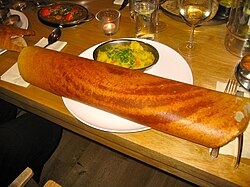
| caption = Dosa with [[Sambar (dish)|sambar]] and [[chutney]] | | caption = Dosa with [[Sambar (dish)|sambar]] and [[chutney]] | ||
| | | place_of_origin = [[Southern India]] | ||
| served = Hot | |||
| served = Hot | | type = [[Pancake]], [[crepe]] | ||
| type = [[Pancake]], [[crepe]] | | main_ingredient = [[Rice]] and [[black gram]] | ||
| main_ingredient = [[Rice]] and [[black gram]] | | variations = [[Masala dosa]], rava dosa, ghee roast dosa, podi dosa, paneer dosa, plain dosa, and many more | ||
| variations = [[Masala dosa]], rava dosa, ghee roast dosa, | |||
}} | }} | ||
A '''dosa''' is a thin | A '''dosa''' (in [[Indian English]]) or '''thosai''' (in [[Malaysian English]] and [[Singapore English]])<ref>See: | ||
* {{Cite news |last=Mok |first=Opalyn |date=2015-04-12 |title=Traditional Indian snacks for breakfast or tea |url=https://www.malaymail.com/news/eat/drink/2015/04/12/traditional-indian-snacks-for-breakfast-or-tea/876893 |newspaper=[[Malay Mail]]}} | |||
* {{Cite book |pages=109–10 |title=Food, Foodways And Foodscapes: Culture, Community And Consumption In Post-colonial Singapore |first1=Lily Lee Lee |last1=Kong|first2=Vineeta |last2=Sinha |date=2015 |publisher=World Scientific |isbn=978-981-4641-24-1 }}</ref> is a thin, savoury [[crepe]] in [[South Indian cuisine]] made from a [[fermentation (food)|fermented]] [[batter (cooking)|batter]] of ground [[Vigna mungo|black gram]] and [[rice]]. Dosas are served hot, often with [[chutney]] and [[Sambar (dish)|sambar]]. | |||
==History== | ==History== | ||
[[File:Dosa Classic.jpg|alt=Two dosa rest next to a dollop of butter on a | [[File:Dosa Classic.jpg|alt=Two dosa rest next to a dollop of butter on a plantain leaf: The sauces have separate bowks.|thumb|Plain dosas with condiments]] | ||
[[File:Butter Dosa served with coconut chutney and sambhar.jpg|thumb|Butter dosa served with coconut chutney and sambhar]] | [[File:Butter Dosa served with coconut chutney and sambhar.jpg|thumb|Butter dosa served with coconut chutney and sambhar]] | ||
The dosa originated in [[South India]], but its precise geographical origins are unknown. According to [[food historian]] [[K. T. Achaya]], references in the [[Sangam literature]] suggest that dosa was already in use in the [[Tamilagam|ancient Tamil country]] around the first century CE.<ref name="KTAchaya">{{cite book | title=The Story of Our Food |url=https://books.google.com/books?id=bk9RHRCqZOkC&pg=PA80 | author=K. T. Achaya|date = November 2003|page=80 |publisher=Universities Press| isbn=81-7371-293-X}}</ref> However, according to historian [[P. Thankappan Nair]], dosa originated in the town of [[Udupi]] in [[Karnataka]].<ref>{{cite book |author=P. Thankappan Nair |url=https://books.google.com/books?id=swNuAAAAMAAJ |title=South Indians in Kolkata |publisher=Punthi Pustak |year=2004 |isbn=81-86791-50-7 |page=320}}</ref> Achaya states that the earliest written mention of dosa appears in the eighth-century literature of present-day [[Tamil Nadu]], while the earliest mention of dosaë in [[Kannada literature]] appears a century later.<ref name="Charmine2013"/> | |||
In popular tradition, the origin of the dosa is linked to Udupi, probably because of the dish's association with [[Udupi cuisine|Udupi restaurants]].<ref name="Charmine2013">{{cite book |author=Charmaine O' Brien |title=The Penguin Food Guide to India |url=https://books.google.com/books?id=BGhBAgAAQBAJ&pg=PT378 |date=15 December 2013 |publisher=Penguin Books Limited |isbn=978-93-5118-575-8 |pages=378 }}</ref> The | In popular tradition, the origin of the dosa is linked to Udupi, probably because of the dish's association with [[Udupi cuisine#Udupi restaurants|Udupi restaurants]].<ref name="Charmine2013">{{cite book |author=Charmaine O' Brien |title=The Penguin Food Guide to India |url=https://books.google.com/books?id=BGhBAgAAQBAJ&pg=PT378 |date=15 December 2013 |publisher=Penguin Books Limited |isbn=978-93-5118-575-8 |pages=378 }}</ref> The Karnataka dosa is traditionally softer and thicker; the thinner and crispier version of dosa, which became popular across India, was first made in present-day Tamil Nadu.<ref name="Vir2004">{{cite book |author=Vir Sanghvi |title=Rude Food: The Collected Food Writings of Vir Sanghvi |url=https://books.google.com/books?id=eK1uGVxmEiUC&pg=PA110 |date=1 January 2004 |publisher=Penguin Books India |isbn=978-0-14-303139-0 |pages=109–110 }}</ref> A recipe for dosa can be found in ''[[Manasollasa]]'', a 12th-century [[Sanskrit]] encyclopedia compiled by [[Someshvara III]], who ruled from present-day Karnataka.<ref>{{cite book |author=K.T. Achaya |title=The Story of Our Food |url=https://books.google.com/books?id=bk9RHRCqZOkC&pg=PA85 |year=2003 |publisher=Universities Press |isbn=978-81-7371-293-7 |page=85 }}</ref> | ||
The dosa arrived in Mumbai with the opening of Udupi restaurants in the 1930s.<ref>{{cite news |date=31 May 2019 |title=8 oldest Udupi restaurants in Bombay |newspaper=The Free Press Journal |url=https://www.freepressjournal.in/food/8-oldest-udupi-restaurants-in-mumbai |url-status=live |access-date=15 August 2022 |archive-url=https://web.archive.org/web/20190905100436/https://www.freepressjournal.in/food/8-oldest-udupi-restaurants-in-mumbai |archive-date=5 September 2019}}</ref> After [[Independence of India|India's independence]] in 1947, South Indian cuisine became gradually popular in [[North India]]. In [[New Delhi]], the Madras Hotel in [[Connaught Place, New Delhi|Connaught Place]] became one of the first restaurants to serve South Indian cuisine.<ref>{{Cite book |url=https://books.google.com/books?id=s-krDwAAQBAJ&dq=The+first+South+Indian+eatery+that+introduced+the+common+public+of+Delhi+to+coffee+and+South&pg=PT34 |title=Much Ado Over Coffee: Indian Coffee House Then And Now, Bhaswati Bhattacharya, Routledge, 2017 |isbn=978-1-351-38315-8 |access-date=28 March 2023 |archive-date=16 April 2023 |archive-url=https://web.archive.org/web/20230416004432/https://books.google.com/books?id=s-krDwAAQBAJ&dq=The+first+South+Indian+eatery+that+introduced+the+common+public+of+Delhi+to+coffee+and+South&pg=PT34 |url-status=live |last1=Bhattacharya |first1=Bhaswati |date=3 August 2017 |publisher=Routledge }}</ref><ref>{{cite book |author=Sethu Ramaswamy |title=Bride at Ten, Mother at Fifteen: Autobiography of an Unknown Indian Woman |year=2003 |url=https://books.google.com/books?id=r5OQAAAAIAAJ |isbn=9788174362896 |publisher=Namita Gokhale Editions }}{{page needed|date=October 2025}}</ref> | |||
Dosas, like many other dishes of South Indian cuisine, were introduced in [[Ceylon]] (Sri Lanka) by [[Indians in Sri Lanka|South Indian emigrants]] during [[British rule in Ceylon|British rule]].<ref>{{Cite book |title=Microbial Fermentations in Nature and as Designed Processes |publisher=[[Wiley (publisher)|Wiley]] |year=2023 |isbn=978-1-119-84999-5 |editor-last=J. Hurst |editor-first=Christon |location=Hoboken |pages=342 |language=en |chapter=Fermented Foods of South Asia |oclc=1393173167}}</ref><ref>{{Cite book |last=Davidson |first=Alan |title=The Oxford companion to food |publisher=[[Oxford Univ. Press]] |year=2014 |isbn=978-0-19-967733-7 |editor-last=Jaine |editor-first=Tom |edition=3. ed. / ed. by Tom Jaine |location=Oxford |pages=774 |chapter=Sri Lanka |oclc=903167481}}</ref> [[Tirunelveli]] and [[Tuticorin]] merchants who settled there were instrumental in the spreading of South Indian cookery across the island by opening restaurants ([[Vegetarian restaurant|vegetarian ''hotels'']]) to meet initially the needs of the emigrant population.<ref>{{Cite journal |last=Kadhirvel |first=S. |date=2000 |title=Indian Tamils in Sri Lanka: The countours of dissonance |url=https://www.jstor.org/stable/44144420 |journal=Proceedings of the Indian History Congress |volume=61 |pages=1045–1046 |jstor=44144420 |issn=2249-1937 |access-date=3 November 2023 |archive-date=3 November 2023 |archive-url=https://web.archive.org/web/20231103123430/https://www.jstor.org/stable/44144420 |url-status=live }}</ref><ref>{{Cite book |url=https://catalog.lib.uchicago.edu/vufind/Record/10887820 |title=Circulation of cultures and culture of circulation: diasporic cultures of South Asia during 18th to 20th centuries |date=2014 |publisher=SAARC Cultural Centre |isbn=978-955-0567-12-6 |editor-last=Garg |editor-first=Sanjay |location=Colombo |pages=151 |oclc=910664759 |editor-last2=SAARC Cultural Centre |access-date=3 November 2023 |archive-date=29 June 2023 |archive-url=https://web.archive.org/web/20230629105635/https://catalog.lib.uchicago.edu/vufind/Record/10887820 |url-status=live }}</ref> Dosa has found its way into the culinary habits of the Sri Lankan people, where it has evolved into an island-specific version which is quite distinct from the Indian dosa. In both forms, it is called ''those'' ({{Lang|si|තෝසේ}} or {{IPA|si|t̪oːse|}}) or ''thosai'' ({{Lang|ta|தோசை}} or {{IPA|ta|t̪oːsaɪ̯|}}) in [[Sinhala language|Sinhala]] and in [[Sri Lankan Tamil dialects|Sri Lankan Tamil]]. | |||
In Odisha, [[Chakuli Pitha]]s are made which are quite similar to Dosa, but they are served flat or with single fold, but Dosas are arranged in different styles. Also, they aren't filled with stuffings unlike Dosa. There is a variation, such as Budha Chakuli, where fruits, raisins, grated coconut and jaggery are added to the batter. Also, Chakuli Pithas are not served with Chutney and Sambhar but wide-ranging accompaniments, such as any Bhaja/Tarkari/Dalma or simple ones like Jaggery/Sugar. The batter consists of less rice than gram (biri). | |||
As in Sri Lanka, dosa was introduced far abroad since the early 18th century, by the migration of the [[Indian Tamil diaspora]] to [[Southeast Asia]] and later in the [[Western world]], and through the worldwide popularisation of Indian and Sri Lankan cuisines since the second half of the 20th century.{{citation needed|date=October 2025}} | |||
== Names == | == Names == | ||
[[File:דוסה.jpg|thumb|Dosa with chutney and sambar with sauteed potato filling in a restaurant]] | [[File:דוסה.jpg|thumb|Dosa with chutney and sambar with sauteed potato filling in a restaurant]] | ||
[[File:Paper Masala Dosa.jpg|thumb|Dosa served with | [[File:Paper Masala Dosa.jpg|thumb|Dosa served with sautéed potatoes]] | ||
Dosa is the [[Anglicisation|anglicised]] name of a variety of South Indian names for the dish, for example dosai in [[Tamil language|Tamil]], | Dosa is the [[Anglicisation|anglicised]] name of a variety of South Indian names for the dish, for example, ''dosai'' in [[Tamil language|Tamil]], ''dōsaë'' in [[Tulu language|Tulu]], ''dōse'' in [[Kannada]], dōsa in [[Telugu language|Telugu]], ''dosha'' in [[Malayalam language|Malayalam]] and Chakuli Pitha in [[Odia language|Odia]]. | ||
The standard transliterations and pronunciations of the word in various South Indian languages are | The standard transliterations and pronunciations of the word in various South Indian languages are: | ||
{| class="wikitable" | {| class="wikitable" | ||
| Line 38: | Line 43: | ||
! Language !! Transliteration !! Pronunciation ([[International Phonetic Alphabet|IPA]]) | ! Language !! Transliteration !! Pronunciation ([[International Phonetic Alphabet|IPA]]) | ||
|- | |- | ||
| {{ | |{{Langx|kn|ದೋಸೆ}} | ||
|dōse | |||
|{{IPA|kn|d̪oːse|}} | |||
|- | |- | ||
| {{ | | {{langx|ml|ദോശ}} || dōśa ||{{IPA|ml|d̪oːʃa|}} | ||
|- | |- | ||
| {{ | | {{langx|ta|தோசை}} || dōsai || {{IPA|ta|d̪oːsaɪ̯|}} | ||
|- | |- | ||
| {{ | | {{langx|te|దోస<ref>{{Cite web|url = https://dsal.uchicago.edu/cgi-bin/app/brown_query.py?qs=%E0%B0%A6%E0%B1%8B%E0%B0%B8%E0%B1%86&searchhws=yes |archive-url = https://web.archive.org/web/20200715213645/http://dsalsrv02.uchicago.edu/cgi-bin/app/brown_query.py?qs=%E0%B0%A6%E0%B1%8B%E0%B0%B8%E0%B1%86&searchhws=yes|url-status = live |archive-date = 15 July 2020|title = A Telugu-English dictionary |author=Charles Philip Brown |year = 1903}}</ref>}}|| dōsa || {{IPA|te|d̪oːsa|}} | ||
|- | |- | ||
| | |[[Odia language|Odia]]:ଚକୁଳି || chàkulī | ||
|- | |- | ||
|} | |} | ||
The Tamil term {{lang|ta|தோசை}} ''dōsai'' lends to ''thosai'' as used in [[Malaysian English]] and [[Singapore English]] mentioned above. | |||
==Nutrition== | ==Nutrition== | ||
Dosa is high in [[carbohydrate]]s and contains no added [[sugar]]s | Dosa is high in [[carbohydrate]]s and contains no added [[sugar]]s. As its key ingredients are rice and [[Vigna mungo|black gram]], it is a good source of [[protein]].<ref>{{cite book |last=Restaurant style dosa recipe |first=Dosa recipe |url=https://tasty-food.in/dosa-recipe/ |title=Dosa recipe |date=9 July 2023 |publisher= |isbn= |edition= |page= |access-date= |orig-year=}}</ref> A typical homemade plain dosa without oil contains about 112 calories, of which 84% is [[carbohydrate]] and 16% is protein.<ref>{{Cite web|url=https://www.myfitnesspal.com/food/calories/plain-dosa-without-oil-255437887|title=Calorie Chart, Nutrition Facts, Calories in Food |website=MyFitnessPal |access-date=7 May 2019|archive-date=19 April 2023|archive-url=https://web.archive.org/web/20230419101238/https://www.myfitnesspal.com/food/calories/plain-dosa-without-oil-255437887|url-status=live}}</ref> The fermentation process increases the [[vitamin B]] and [[vitamin C]] content.<ref>{{cite book |title=Nutrition and Dietetics - Higher Secondary - First Year |publisher=Directorate of School Education, Government of Tamil Nadu |year=2004 |page=31 |url=http://www.textbooksonline.tn.nic.in/Books/11/Std11-Nutr-EM.pdf |access-date=30 August 2012 |archive-url=https://web.archive.org/web/20120321034305/http://www.textbooksonline.tn.nic.in/Books/11/Std11-Nutr-EM.pdf |archive-date=21 March 2012 |url-status=dead }}</ref> | ||
== Preparation == | == Preparation == | ||
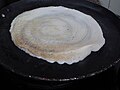
A mixture of rice and | A mixture of rice and white gram that has been soaked in water for at least 4–5 hours is ground finely to form a batter. Some add a bit of soaked [[fenugreek]] seeds while grinding the batter. The proportion of rice to lentils is generally 3:1 or 4:1. After adding salt, the batter is allowed to ferment overnight, before being mixed with water to get the desired consistency. The batter is then ladled onto a hot ''[[tava]]'' or griddle greased with oil or ''[[ghee]]''. It is spread out with the base of a ladle or a bowl to form a pancake. It can be made either thick like a pancake, or thin and crispy. A dosa is served hot, either folded in half or rolled like a wrap. It is usually served with chutney and sambar. The mixture of white grams and rice can be replaced with highly refined wheat flour or [[semolina]]. | ||
<gallery> | <gallery> | ||
File:ಸಂಪಣೆ.JPG|Rice batter | File:ಸಂಪಣೆ.JPG|Rice batter | ||
File:Dosa-Preparation.jpg|Batter poured on a [[tava]] or griddle | File:Dosa-Preparation.jpg|Batter poured on a [[tava]] or griddle | ||
| Line 65: | Line 73: | ||
==Serving== | ==Serving== | ||
Dosas can be stuffed with fillings of [[vegetables]] and sauces to make a quick meal. They are typically served with a vegetarian [[side dish]], which varies according to regional and personal preferences. Common side items are: | |||
* [[Sambar (dish)|Sambar]] | * [[Sambar (dish)|Sambar]] | ||
* [[Chutney]] | * [[Chutney]] | ||
* [[Idli podi]] or ''milagaipodi'': | * [[Idli podi]] or ''milagaipodi'': A lentil powder with spices and sometimes desiccated coconut, mixed with sesame oil or groundnut oil or [[ghee]] | ||
* [[Indian pickle]]s | * [[Indian pickle]]s | ||
==Variations== | ==Variations== | ||
[[Masala dosa]] is a roasted dosa served with potato curry, chutney and sambar, while saada (plain) dosa is prepared with a lighter texture; paper dosa is a thin and crisp version. Rava dosa is made crispier using semolina.<ref> | [[Masala dosa]] is a roasted dosa served with potato curry, chutney, and sambar, while saada (plain) dosa is prepared with a lighter texture; paper dosa is a thin and crisp version. Rava dosa is made crispier using semolina.<ref>{{Cite web |url=https://www.saveur.com/indian-dosa-crepes-guide |title=A Beginner's Guide to the Great Wide World of Indian Dosa, Priya Krishna and Shailendra Krishna, October 6, 2016 |date=6 October 2016 |access-date=21 February 2018 |archive-date=9 November 2016 |archive-url=https://web.archive.org/web/20161109175440/http://www.saveur.com/indian-dosa-crepes-guide? |url-status=live }}</ref> Newer versions include Chinese dosa, cheese dosa, paneer dosa, and pizza dosa.<ref>{{Cite news |url=https://www.nytimes.com/2017/10/06/dining/dosa-recipe-pondicheri.html |title=A Dosa Lesson From a Professional - A Good Appetite, Melissa Clark, ''New York Times'', 6 October 2017 |date=6 October 2017 |access-date=21 February 2018 |archive-date=21 February 2018 |archive-url=https://web.archive.org/web/20180221103452/https://www.nytimes.com/2017/10/06/dining/dosa-recipe-pondicheri.html |url-status=live }}</ref> | ||
Though dosa is typically made with rice and lentils, other versions exist.<ref>{{cite book |last1=Kumar |first1=Ashwani |last2=Singh |first2=Sarabjit |last3=Tomer |first3=Vidisha |last4=Prasad |first4=Rasane |title=Cereals and cereal-based foods : functional benefits and technological advances for nutrition and healthcare |date=2022 |publisher=Apple Academic Press |location=Palm Bay, FL, USA |isbn=9781000164299 |page=251 |edition=First |url=https://books.google.com/books?id=n7UxEAAAQBAJ |access-date=25 April 2023|quote="The ingredients for dosa preparation are not limited to just rice and black gram instead pure rice or a mixture of rice, wheat, sorghum, maize or millets can also be used."}}</ref> | Though dosa is typically made with rice and lentils, other versions exist.<ref>{{cite book |last1=Kumar |first1=Ashwani |last2=Singh |first2=Sarabjit |last3=Tomer |first3=Vidisha |last4=Prasad |first4=Rasane |title=Cereals and cereal-based foods : functional benefits and technological advances for nutrition and healthcare |date=2022 |publisher=Apple Academic Press |location=Palm Bay, FL, USA |isbn=9781000164299 |page=251 |edition=First |url=https://books.google.com/books?id=n7UxEAAAQBAJ |access-date=25 April 2023|quote="The ingredients for dosa preparation are not limited to just rice and black gram instead pure rice or a mixture of rice, wheat, sorghum, maize, or millets can also be used."}}</ref> | ||
{| class="wikitable sortable" | {| class="wikitable sortable" | ||
| Line 82: | Line 90: | ||
! Description | ! Description | ||
|- | |- | ||
| [[Masala dosa]] || Roasted and crispy dosa | | [[Uttapam]] || This variety of dosa is much thicker and softer and served with vegetable toppings. It also uses less oil, hence is considered healthier than the typical dosa. It takes more time to prepare than a regular dosa. Both surfaces may be baked. They are eaten like a regular dosa with servings of sambhar and chutney. Its history is as old as the dosa, featuring in Sangam literature. It is closely related to both the dosa and the [[appam]]. | ||
|- | |||
| [[Masala dosa]] || Roasted and crispy dosa, served with potato curry, chutney and sambar | |||
|- | |- | ||
|Oats dosa | |Oats dosa | ||
|Healthy, crisp and lacy instant dosa made with oats | |Healthy, crisp and lacy instant dosa made with oats | ||
|- | |- | ||
|Wheat dosa || Dosa made with wheat flour batter. | |Wheat dosa || Dosa made with wheat flour batter; a typical wheat dosa may consume more oil and takes longer to prepare than a regular dosa. Instead of oil, ghee or butter may be used. | ||
|- | |- | ||
|Set dosa | |Set dosa | ||
| | |Smaller, spongy, soft and light, served in a set of 2-3 dosa per serving | ||
|- | |||
| Red rice dosa || A healthier variant of the regular dosa, it uses [[red rice]] instead of [[white rice]], though the batter may also involve a mixture of the two rice varieties, too. | |||
|- | |- | ||
| Plain dosa || Dosa has | | Plain dosa || Dosa has light texture and can be crispy. | ||
|- | |- | ||
| | | Kal dosai || A thicker, softer, and spongier variant of a plain dosa, it also uses a stone tawa instead of the regular iron tawa for other dosas. | ||
|- | |- | ||
| | | Tandoori dosa || A variety of dosa that uses a tandoor to prepare it instead of a tawa<!-- vegetable or vegetarian? , and comes in various veg and non-veg subvariants. --> | ||
|- | |- | ||
| | | Ghee roast || (''Nei dosai'' in Tamil) Plain dosa cooked with ghee instead of oil and usually with no filling | ||
|- | |- | ||
| | | Paper roast/Plain roast dosa || A large, plain dosa known for its thin layer and crispiness resulting from making a very thin layer of batter and the addition of extra oil compared to plain dosa | ||
|- | |- | ||
| | | Egg dosa || (''Muttai dosai'' in Tamil) A thicker base of dosa topped with beaten [[egg]], or beaten egg is added to batter before cooking. | ||
|- | |- | ||
| | | Kari dosai || A Tamil Nadu specialty with a dosa of thicker base topped with cooked meat, usually chicken or mutton: Dosas topped with vegetables or vegetable curry are also sometimes referred to as ''kari dosai''. | ||
|- | |- | ||
| | | Madurai kari dosai || A famous variant of kari dosai is the Madurai kari dosai. This has a vegetarian and a non-vegetarian variant. The latter consists of non-vegetarian toppings of a mix of omelette, minced meat, and without vegetables, while the former has a fully vegetarian topping of vegetable curry. | ||
|- | |- | ||
| | | Pori dosa/Puffed rice dosa || Uses some [[puffed rice]] alongside raw rice and some lentils in the batter | ||
|- | |- | ||
| | | Paneer dosa || Spiced, flavorful [[paneer]] filling inside the dosa | ||
|- | |- | ||
| | | Palak dosa || Layered with ''palak'' ([[spinach]]) paste inside the folds of dosa | ||
|- | |- | ||
| | | Pizza dosa || A fusion of the traditional dosa and a regular pizza, it comes in many subvariants. It primarily uses toppings that resemble those of a regular pizza. | ||
|- | |- | ||
| | | Spring roll dosa || A fusion of the traditional plain dosa and the [[spring roll]], it has vegetarian and non-vegetarian variants. It uses the same stuffing as in the spring roll and is usually cut and served rolled up as a spring roll. It is also notably spicy. | ||
|- | |- | ||
| | | Jini dosa || A variety from [[Mumbai]]; a crispy, cheesy dosa stuffed with a spicy mix of vegetables such as cabbage, carrots, and capsicum in addition to a tangy sauce. | ||
|- | |- | ||
| | | Schezwan dosa || A type of dosa with stuffing of a mix of cooked vegetables and Schezwan sauce | ||
|- | |- | ||
| | | Mini soya dosa<ref>{{cite web|url=https://recipes.timesofindia.com/recipes/mini-soya-dosa/rs55705184.cms|title=Recipe: Mini soya dosa|work=The Times of India|access-date=15 August 2022|archive-date=24 June 2017|archive-url=https://web.archive.org/web/20170624015457/http://recipes.timesofindia.com/recipes/mini-soya-dosa/rs55705184.cms|url-status=live}}</ref> || Soya milk and wheat flour<ref>{{cite web|url=http://food.ndtv.com/recipe-mini-soya-dosa-227607|title=Mini Soya Dosa|work=food.ndtv.com|access-date=20 March 2015|archive-date=2 April 2015|archive-url=https://web.archive.org/web/20150402154838/http://food.ndtv.com/recipe-mini-soya-dosa-227607|url-status=live}}</ref> | ||
|- | |- | ||
| | | [[Pesarattu]] (green dosa)<ref>{{cite news |url=https://timesofindia.indiatimes.com/healthy-snack-recipe-green-dosa/articleshow/19830786.cms |title=Healthy snack recipe: Green Dosa |work=The Times of India |date=17 February 2016 |access-date=15 August 2022 |archive-date=19 March 2022 |archive-url=https://web.archive.org/web/20220319193643/https://timesofindia.indiatimes.com/healthy-snack-recipe-green-dosa/articleshow/19830786.cms |url-status=live }}</ref> || Made with [[green gram]].<ref>{{cite web|url=http://food.ndtv.com/recipe-pesarattu-green-gram-dosa-463419|title=Pesarattu (Green Gram Dosa)|work=food.ndtv.com|access-date=20 March 2015|archive-date=2 April 2015|archive-url=https://web.archive.org/web/20150402120039/http://food.ndtv.com/recipe-pesarattu-green-gram-dosa-463419|url-status=live}}</ref> It is served with Allam Pachadi. (Ginger chutney) | ||
|- | |- | ||
| | | Adai dosa || From Tamil Nadu, it is a dosa-like dish prepared from a combination of ''toor dal'', rice, curry leaves, red chillies, and asafoetida. The batter is not fermented, and is usually eaten with jaggery or ''[[aviyal]]''. | ||
|- | |- | ||
| | | Light white dosa || Rice and coconut<ref>{{cite web|url=https://recipes.timesofindia.com/recipes/light-white-dosa/rs53316767.cms |title=Recipe: Light white dosa|work=The Times of India}}</ref> | ||
|- | |- | ||
| Jaggery dosa || | |Kadapa Neyyi karam dosa<ref name="New Indian Express 2018-08-14">{{Cite news|url=https://www.newindianexpress.com/cities/hyderabad/2017/nov/10/the-karam-dosas-from-kadapa-1698077.html|title=The karam dosas from kadapa|work=The New Indian Express|access-date=14 August 2018|archive-date=15 August 2022|archive-url=https://web.archive.org/web/20220815211038/https://www.newindianexpress.com/cities/hyderabad/2017/nov/10/the-karam-dosas-from-kadapa-1698077.html|url-status=live}}</ref> | ||
|Rice flour fermented overnight and mixed with sodium carbonate. The topping is a mixture of onion and chili paste (called ''yerra karam'') and a chutney made with tomato and flour made in a gravy of curd. It is roasted in [[Ghee]]. It is also occasionally topped with fried gram powder.<ref name="New Indian Express 2018-08-14" /> | |||
|- | |||
| Onion rava dosa<ref>{{cite web|url=https://food.ndtv.com/recipe-onion-rava-dosa-219188|title=Onion Rava Dosa|work=food.ndtv.com|access-date=15 August 2022|archive-date=15 August 2022|archive-url=https://web.archive.org/web/20220815211038/https://food.ndtv.com/recipe-onion-rava-dosa-219188|url-status=live}}</ref>|| Semolina, rice flour, onion | |||
|- | |||
| Ragi wheat dosa || Ragi, whole wheat flour<ref>{{cite web|url=https://food.ndtv.com/recipe-ragi-wheat-dosa-1-463409|title=Ragi Wheat Dosa|work=food.ndtv.com|access-date=15 August 2022|archive-date=15 August 2022|archive-url=https://web.archive.org/web/20220815211037/https://food.ndtv.com/recipe-ragi-wheat-dosa-1-463409|url-status=live}}</ref> | |||
|- | |||
| [[Rava dosa]] || Made with [[semolina|''rava'']] or [[semolina|''sooji'']] (semolina), it is a healthier alternative to regular dosa. Rava dosa takes up more oil than a regular dosa and can stick to the tawa if enough oil is not used. It also takes more time to prepare than a regular dosa. | |||
|- | |||
| [[Benne dose]] || Made with [[butter]] (''benne'' in Kannada), it is predominantly famous as ''[[Benne dose|Davanagere benne dose]]'' associated with the [[Davanagere]] district in Karnataka. | |||
|- | |||
| [[Neer dosa]] || Made with a watery rice batter | |||
|- | |||
| Vodu dose or Kappa roti|| Vodu dose or kappa roti is made from unfermented rice, [[fenugreek]], grated [[coconut]], thinly flattened rice, and sometimes leftover cooked rice. It is cooked on an earthen pan with a rounded bottom. It is fluffy and appears like a bread. It is cooked without the use of oil. | |||
|- | |||
| Amboli, ghavan, dhirde || In coastal parts of Maharashtra, variations known as ''amboli'' and ''ghavan'' are thin rice ''crêpes'' prepared with fermented batter, while ''dhirde'' is prepared with unfermented batter. | |||
|- | |||
| Buttermilk dosa || Semolina, maida, buttermilk<ref>{{cite book |last1=Verma |first1=Neera |title=South Indian Cook Book |publisher=Diamond Pocket Books (P) Ltd. |isbn=978-81-7182-836-4 |url=https://books.google.com/books?id=KHua3-_qTcYC&q=Butter+milk+dosa |language=en}}</ref> | |||
|- | |||
| Jaggery dosa || Rice flour, maida, grated coconut, [[jaggery]]. | |||
|- | |||
|Minapattu | |||
|Very similar to plain dosa, this version tends to be thicker and, compared to plain dosa, it has a greater ratio of urad dal to rice flour or, in some cases, idli rava. | |||
|- | |||
|Maida dosa || The maida dosa batter is made from maida (refined flour) by adding water to get dense consistency; chopped onion, chilli, coriander leaves, and salt are added for taste. Maida dosa is quickly made in many households of Karnataka state, India. | |||
|} | |} | ||
| Line 141: | Line 176: | ||
File:Dosa (Plain).jpg|Plain dosa | File:Dosa (Plain).jpg|Plain dosa | ||
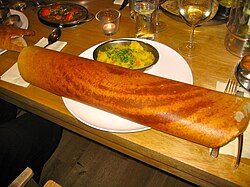
File:Paper Masala Dosa.jpg|Paper roast, a wafer-thin crispy dosa, served in restaurants | File:Paper Masala Dosa.jpg|Paper roast, a wafer-thin crispy dosa, served in restaurants | ||
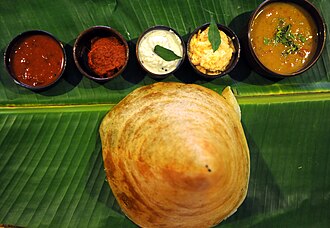
File:Amini Ghee Roast.jpg|Ghee roast | File:Amini Ghee Roast.jpg|Ghee roast, known as ''nei dosa'' in Tamil | ||
File:Butter Dosa.JPG|Butter dosa, known as ''benne dose'' in | File:Butter Dosa.JPG|Butter dosa, known as ''benne dose'' in Kannada | ||
File:Pesarattu and Ginger chutney.jpg|''Pesarattu'' (moong dal dosa) and ginger chutney in Andhra Pradesh | File:Pesarattu and Ginger chutney.jpg|''Pesarattu'' (moong dal dosa) and ginger chutney in Andhra Pradesh | ||
File:NeerDosa.jpg|Mangalorian ''neer dosa'' popular in South Canara districts, Karnataka | File:NeerDosa.jpg|Mangalorian ''neer dosa'' popular in South Canara districts, Karnataka | ||
File:Kambu adai.JPG|Kambu (bajra/pearl millet) dosa | File:Kambu adai.JPG|Kambu (bajra/pearl millet) dosa | ||
File:Rava Dosa of Salem.jpg|Rava dosa made from sooji rava flour, more popular in Karnataka and Udupi restaurants in Mumbai | File:Rava Dosa of Salem.jpg|Rava dosa made from sooji rava flour, more popular in Karnataka and Udupi restaurants in Mumbai | ||
File:Aate ka dosa.jpg| | File:Aate ka dosa.jpg|Wheat batter dosa, known locally as ''godi mau'' or ''godhumai mavvu'' dosa | ||
File:Ragi dosa.JPG|Ragi dosa made of [[ | File:Ragi dosa.JPG|Ragi dosa made of [[ragi flour]] mixed with small portions of rice and urad dal | ||
File:Onion Chilli Tomato Uthappam.jpg|''Uthappam'' or ''utthapa'', a version with onion, chilli and tomato | File:Onion Chilli Tomato Uthappam.jpg|''Uthappam'' or ''utthapa'', a version with onion, chilli, and tomato | ||
File:Methi dosa on a pan.jpg|''Methi dosa'' on a pan, known as vendhyam dosai in Tamil Nadu | File:Methi dosa on a pan.jpg|''Methi dosa'' on a pan, known as ''vendhyam dosai'' in Tamil Nadu | ||
File:Masala Dosa 02.jpg|Masala dosa at a street food center | File:Masala Dosa 02.jpg|Masala dosa at a street food center | ||
File:Table Dosa.jpg|"Table dosa" which covers almost half of the table | File:Table Dosa.jpg|"Table dosa" which covers almost half of the table | ||
File:Mysore Mallige Dosey.jpg|Mysore Mallige Dosey | |||
File:Indian dosa masala.jpg|Indian street dosa masala in Varanasi, India | File:Indian dosa masala.jpg|Indian street dosa masala in Varanasi, India | ||
File:Onion Dosey.jpg|Onion dosa, with coconut chutney and | File:Onion Dosey.jpg|Onion dosa, with coconut chutney and potato curry | ||
File:Set Dosey.jpg|Set dosa, a set of 3 dosas with coconut chutney, curry and | File:Set Dosey.jpg|Set dosa, a set of 3 dosas with coconut chutney, curry and Mysore [[Bonda (snack)|''bonda'']] | ||
</gallery> | </gallery> | ||
==World record== | |||
On 16 November 2014, 29 chefs, at Hotel Daspalla in Hyderabad, India, created a dosa that was {{convert|16.68|m|abbr=on}} long and weighed {{convert|13.69|kg|abbr=on}}, earning the [[Guinness World Record]] for the longest dosa.<ref>{{Cite web |title=Longest Dosa |url=https://www.guinnessworldrecords.com/world-records/longest-dosa |website=Guinness World Records |language=en}}</ref> | |||
==In popular culture== | ==In popular culture== | ||
* In a November 2019 video promoting her [[Kamala Harris 2020 presidential campaign|campaign for presidency]], [[United States]] [[Vice President of the United States|Vice President]] [[Kamala Harris]] cooked masala dosa with actress and comedian [[Mindy Kaling]].<ref>27 November 2019. [https://www.thehindu.com/entertainment/movies/us-presidential-candidate-kamala-harris-cooks-masala-dosas-with-mindy-kaling/article30095372.ece US presidential candidate Kamala Harris cooks masala dosas with Mindy Kaling]. The Hindu. Retrieved 23 July 2023.</ref> | * In a November 2019 video promoting her [[Kamala Harris 2020 presidential campaign|campaign for presidency]], [[United States]] [[Vice President of the United States|Vice President]] [[Kamala Harris]] cooked masala dosa with actress and comedian [[Mindy Kaling]].<ref>27 November 2019. [https://www.thehindu.com/entertainment/movies/us-presidential-candidate-kamala-harris-cooks-masala-dosas-with-mindy-kaling/article30095372.ece US presidential candidate Kamala Harris cooks masala dosas with Mindy Kaling] {{Webarchive|url=https://web.archive.org/web/20230723090723/https://www.thehindu.com/entertainment/movies/us-presidential-candidate-kamala-harris-cooks-masala-dosas-with-mindy-kaling/article30095372.ece |date=23 July 2023 }}. ''The Hindu''. Retrieved 23 July 2023.</ref> | ||
* [[ | * The 2023 [[Tamil culture]]-inspired [[cooking video game]] ''[[Venba (video game)|Venba]]'' features dosa as an in-game recipe. | ||
==Related foods== | ==Related foods== | ||
* [[Uttapam]]: a thick relatively soft crepe mostly topped with diced onions, tomatoes, cilantro or cheese, sometimes described as an Indian pizza | * [[Uttapam]]: a thick relatively soft crepe mostly topped with diced onions, tomatoes, cilantro or cheese, sometimes described as an Indian pizza | ||
* [[Pesarattu]]: made from [[green gram]] in [[Andhra Pradesh]], served with a ginger and tamarind chutney | * [[Pesarattu]]: made from [[green gram]] in [[Andhra Pradesh]], served with a ginger and tamarind chutney | ||
* [[Appam]]: a pancake prepared from patted rice batter, served with sweet coconut milk | * [[Appam]]: a pancake prepared from patted rice batter, served with sweet coconut milk or sugar | ||
* [[Chakuli pitha]]: batter contains more black gram and less rice flour | * [[Chakuli pitha]]: the batter contains more black gram and less rice flour | ||
* [[Apam balik]]: made from a mixture of flour, eggs, sugar, baking soda, coconut milk and water | * [[Martabak manis|Apam balik]]: made from a mixture of flour, eggs, sugar, baking soda, coconut milk and water | ||
* [[Jianbing]]: a Chinese dish | * [[Jianbing]]: a Chinese dish | ||
* [[Bánh xèo]]: a Vietnamese dish | * [[Bánh xèo]]: a Vietnamese dish | ||
| Line 178: | Line 218: | ||
* [[List of Indian breads]] | * [[List of Indian breads]] | ||
* [[List of pancakes]] | * [[List of pancakes]] | ||
* [[Udupi cuisine]] | * [[Udupi cuisine]] | ||
* [[Cuisine of Kerala]] | * [[Cuisine of Kerala]] | ||
* [[South Indian cuisine]] | |||
* [[Thali]] | |||
==References== | ==References== | ||
| Line 193: | Line 233: | ||
{{Malaysian cuisine}} | {{Malaysian cuisine}} | ||
[[Category:Dosa| ]] | [[Category:Dosa (food)| ]] | ||
[[Category:Andhra cuisine]] | [[Category:Andhra cuisine]] | ||
[[Category:Articles containing video clips]] | [[Category:Articles containing video clips]] | ||
| Line 211: | Line 251: | ||
[[Category:Telangana cuisine]] | [[Category:Telangana cuisine]] | ||
[[Category:Vegetarian dishes of India]] | [[Category:Vegetarian dishes of India]] | ||
[[Category:Indo-Caribbean cuisine]] | |||
[[Category:Hindu cuisine]] | |||
[[Category:Indian cuisine]] | |||
[[Category:South Asian cuisine]] | |||
[[Category:Vegetarian cuisine]] | |||
Latest revision as of 12:28, 26 March 2026
.jpg) | |
| Type | Pancake, crepe |
|---|---|
| Serving temperature | Hot |
| Main ingredients | Rice and black gram |
| Variations | Masala dosa, rava dosa, ghee roast dosa, podi dosa, paneer dosa, plain dosa, and many more |
A dosa (in Indian English) or thosai (in Malaysian English and Singapore English)[1] is a thin, savoury crepe in South Indian cuisine made from a fermented batter of ground black gram and rice. Dosas are served hot, often with chutney and sambar.
History[edit | edit source]


The dosa originated in South India, but its precise geographical origins are unknown. According to food historian K. T. Achaya, references in the Sangam literature suggest that dosa was already in use in the ancient Tamil country around the first century CE.[2] However, according to historian P. Thankappan Nair, dosa originated in the town of Udupi in Karnataka.[3] Achaya states that the earliest written mention of dosa appears in the eighth-century literature of present-day Tamil Nadu, while the earliest mention of dosaë in Kannada literature appears a century later.[4]
In popular tradition, the origin of the dosa is linked to Udupi, probably because of the dish's association with Udupi restaurants.[4] The Karnataka dosa is traditionally softer and thicker; the thinner and crispier version of dosa, which became popular across India, was first made in present-day Tamil Nadu.[5] A recipe for dosa can be found in Manasollasa, a 12th-century Sanskrit encyclopedia compiled by Someshvara III, who ruled from present-day Karnataka.[6]
The dosa arrived in Mumbai with the opening of Udupi restaurants in the 1930s.[7] After India's independence in 1947, South Indian cuisine became gradually popular in North India. In New Delhi, the Madras Hotel in Connaught Place became one of the first restaurants to serve South Indian cuisine.[8][9]
Dosas, like many other dishes of South Indian cuisine, were introduced in Ceylon (Sri Lanka) by South Indian emigrants during British rule.[10][11] Tirunelveli and Tuticorin merchants who settled there were instrumental in the spreading of South Indian cookery across the island by opening restaurants (vegetarian hotels) to meet initially the needs of the emigrant population.[12][13] Dosa has found its way into the culinary habits of the Sri Lankan people, where it has evolved into an island-specific version which is quite distinct from the Indian dosa. In both forms, it is called those (තෝසේ or [t̪oːse]) or thosai (தோசை or [t̪oːsaɪ̯]) in Sinhala and in Sri Lankan Tamil.
In Odisha, Chakuli Pithas are made which are quite similar to Dosa, but they are served flat or with single fold, but Dosas are arranged in different styles. Also, they aren't filled with stuffings unlike Dosa. There is a variation, such as Budha Chakuli, where fruits, raisins, grated coconut and jaggery are added to the batter. Also, Chakuli Pithas are not served with Chutney and Sambhar but wide-ranging accompaniments, such as any Bhaja/Tarkari/Dalma or simple ones like Jaggery/Sugar. The batter consists of less rice than gram (biri).
As in Sri Lanka, dosa was introduced far abroad since the early 18th century, by the migration of the Indian Tamil diaspora to Southeast Asia and later in the Western world, and through the worldwide popularisation of Indian and Sri Lankan cuisines since the second half of the 20th century.[citation needed]
Names[edit | edit source]


Dosa is the anglicised name of a variety of South Indian names for the dish, for example, dosai in Tamil, dōsaë in Tulu, dōse in Kannada, dōsa in Telugu, dosha in Malayalam and Chakuli Pitha in Odia.
The standard transliterations and pronunciations of the word in various South Indian languages are:
| Language | Transliteration | Pronunciation (IPA) |
|---|---|---|
| Kannada: ದೋಸೆ | dōse | [d̪oːse] |
| Malayalam: ദോശ | dōśa | [d̪oːʃa] |
| Tamil: தோசை | dōsai | [d̪oːsaɪ̯] |
| Telugu: దోస[14] | dōsa | [d̪oːsa] |
| Odia:ଚକୁଳି | chàkulī |
The Tamil term தோசை dōsai lends to thosai as used in Malaysian English and Singapore English mentioned above.
Nutrition[edit | edit source]
Dosa is high in carbohydrates and contains no added sugars. As its key ingredients are rice and black gram, it is a good source of protein.[15] A typical homemade plain dosa without oil contains about 112 calories, of which 84% is carbohydrate and 16% is protein.[16] The fermentation process increases the vitamin B and vitamin C content.[17]
Preparation[edit | edit source]
A mixture of rice and white gram that has been soaked in water for at least 4–5 hours is ground finely to form a batter. Some add a bit of soaked fenugreek seeds while grinding the batter. The proportion of rice to lentils is generally 3:1 or 4:1. After adding salt, the batter is allowed to ferment overnight, before being mixed with water to get the desired consistency. The batter is then ladled onto a hot tava or griddle greased with oil or ghee. It is spread out with the base of a ladle or a bowl to form a pancake. It can be made either thick like a pancake, or thin and crispy. A dosa is served hot, either folded in half or rolled like a wrap. It is usually served with chutney and sambar. The mixture of white grams and rice can be replaced with highly refined wheat flour or semolina.
-
 Rice batter
 -
 Batter poured on a tava or griddle
 -
 Batter being spread uniformly
 -
 After being cooked for some time


Serving[edit | edit source]
Dosas can be stuffed with fillings of vegetables and sauces to make a quick meal. They are typically served with a vegetarian side dish, which varies according to regional and personal preferences. Common side items are:
- Sambar
- Chutney
- Idli podi or milagaipodi: A lentil powder with spices and sometimes desiccated coconut, mixed with sesame oil or groundnut oil or ghee
- Indian pickles
Variations[edit | edit source]
Masala dosa is a roasted dosa served with potato curry, chutney, and sambar, while saada (plain) dosa is prepared with a lighter texture; paper dosa is a thin and crisp version. Rava dosa is made crispier using semolina.[18] Newer versions include Chinese dosa, cheese dosa, paneer dosa, and pizza dosa.[19]
Though dosa is typically made with rice and lentils, other versions exist.[20]
| Name | Description |
|---|---|
| Uttapam | This variety of dosa is much thicker and softer and served with vegetable toppings. It also uses less oil, hence is considered healthier than the typical dosa. It takes more time to prepare than a regular dosa. Both surfaces may be baked. They are eaten like a regular dosa with servings of sambhar and chutney. Its history is as old as the dosa, featuring in Sangam literature. It is closely related to both the dosa and the appam. |
| Masala dosa | Roasted and crispy dosa, served with potato curry, chutney and sambar |
| Oats dosa | Healthy, crisp and lacy instant dosa made with oats |
| Wheat dosa | Dosa made with wheat flour batter; a typical wheat dosa may consume more oil and takes longer to prepare than a regular dosa. Instead of oil, ghee or butter may be used. |
| Set dosa | Smaller, spongy, soft and light, served in a set of 2-3 dosa per serving |
| Red rice dosa | A healthier variant of the regular dosa, it uses red rice instead of white rice, though the batter may also involve a mixture of the two rice varieties, too. |
| Plain dosa | Dosa has light texture and can be crispy. |
| Kal dosai | A thicker, softer, and spongier variant of a plain dosa, it also uses a stone tawa instead of the regular iron tawa for other dosas. |
| Tandoori dosa | A variety of dosa that uses a tandoor to prepare it instead of a tawa |
| Ghee roast | (Nei dosai in Tamil) Plain dosa cooked with ghee instead of oil and usually with no filling |
| Paper roast/Plain roast dosa | A large, plain dosa known for its thin layer and crispiness resulting from making a very thin layer of batter and the addition of extra oil compared to plain dosa |
| Egg dosa | (Muttai dosai in Tamil) A thicker base of dosa topped with beaten egg, or beaten egg is added to batter before cooking. |
| Kari dosai | A Tamil Nadu specialty with a dosa of thicker base topped with cooked meat, usually chicken or mutton: Dosas topped with vegetables or vegetable curry are also sometimes referred to as kari dosai. |
| Madurai kari dosai | A famous variant of kari dosai is the Madurai kari dosai. This has a vegetarian and a non-vegetarian variant. The latter consists of non-vegetarian toppings of a mix of omelette, minced meat, and without vegetables, while the former has a fully vegetarian topping of vegetable curry. |
| Pori dosa/Puffed rice dosa | Uses some puffed rice alongside raw rice and some lentils in the batter |
| Paneer dosa | Spiced, flavorful paneer filling inside the dosa |
| Palak dosa | Layered with palak (spinach) paste inside the folds of dosa |
| Pizza dosa | A fusion of the traditional dosa and a regular pizza, it comes in many subvariants. It primarily uses toppings that resemble those of a regular pizza. |
| Spring roll dosa | A fusion of the traditional plain dosa and the spring roll, it has vegetarian and non-vegetarian variants. It uses the same stuffing as in the spring roll and is usually cut and served rolled up as a spring roll. It is also notably spicy. |
| Jini dosa | A variety from Mumbai; a crispy, cheesy dosa stuffed with a spicy mix of vegetables such as cabbage, carrots, and capsicum in addition to a tangy sauce. |
| Schezwan dosa | A type of dosa with stuffing of a mix of cooked vegetables and Schezwan sauce |
| Mini soya dosa[21] | Soya milk and wheat flour[22] |
| Pesarattu (green dosa)[23] | Made with green gram.[24] It is served with Allam Pachadi. (Ginger chutney) |
| Adai dosa | From Tamil Nadu, it is a dosa-like dish prepared from a combination of toor dal, rice, curry leaves, red chillies, and asafoetida. The batter is not fermented, and is usually eaten with jaggery or aviyal. |
| Light white dosa | Rice and coconut[25] |
| Kadapa Neyyi karam dosa[26] | Rice flour fermented overnight and mixed with sodium carbonate. The topping is a mixture of onion and chili paste (called yerra karam) and a chutney made with tomato and flour made in a gravy of curd. It is roasted in Ghee. It is also occasionally topped with fried gram powder.[26] |
| Onion rava dosa[27] | Semolina, rice flour, onion |
| Ragi wheat dosa | Ragi, whole wheat flour[28] |
| Rava dosa | Made with rava or sooji (semolina), it is a healthier alternative to regular dosa. Rava dosa takes up more oil than a regular dosa and can stick to the tawa if enough oil is not used. It also takes more time to prepare than a regular dosa. |
| Benne dose | Made with butter (benne in Kannada), it is predominantly famous as Davanagere benne dose associated with the Davanagere district in Karnataka. |
| Neer dosa | Made with a watery rice batter |
| Vodu dose or Kappa roti | Vodu dose or kappa roti is made from unfermented rice, fenugreek, grated coconut, thinly flattened rice, and sometimes leftover cooked rice. It is cooked on an earthen pan with a rounded bottom. It is fluffy and appears like a bread. It is cooked without the use of oil. |
| Amboli, ghavan, dhirde | In coastal parts of Maharashtra, variations known as amboli and ghavan are thin rice crêpes prepared with fermented batter, while dhirde is prepared with unfermented batter. |
| Buttermilk dosa | Semolina, maida, buttermilk[29] |
| Jaggery dosa | Rice flour, maida, grated coconut, jaggery. |
| Minapattu | Very similar to plain dosa, this version tends to be thicker and, compared to plain dosa, it has a greater ratio of urad dal to rice flour or, in some cases, idli rava. |
| Maida dosa | The maida dosa batter is made from maida (refined flour) by adding water to get dense consistency; chopped onion, chilli, coriander leaves, and salt are added for taste. Maida dosa is quickly made in many households of Karnataka state, India. |
-
 Masala dosa served traditionally with chutney, sambar, sauteed potato filling
 -
 Uttapam is one of the many varieties of dosa prepared in India and served for breakfast.
 -
 Urad plain dosa
 -
 Wheat flour dosa
 -
 Plain dosa
 -
 Paper roast, a wafer-thin crispy dosa, served in restaurants
 -
 Ghee roast, known as nei dosa in Tamil
 -
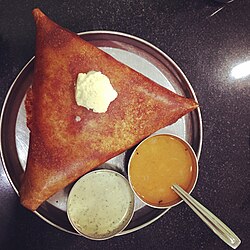 Butter dosa, known as benne dose in Kannada
 -
 Pesarattu (moong dal dosa) and ginger chutney in Andhra Pradesh
 -
 Mangalorian neer dosa popular in South Canara districts, Karnataka
 -
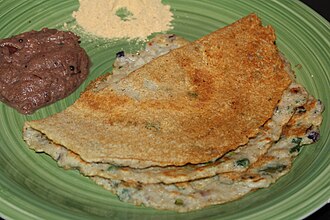 Kambu (bajra/pearl millet) dosa
 -
 Rava dosa made from sooji rava flour, more popular in Karnataka and Udupi restaurants in Mumbai
 -
 Wheat batter dosa, known locally as godi mau or godhumai mavvu dosa
 -
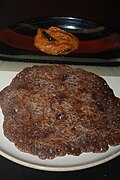 Ragi dosa made of ragi flour mixed with small portions of rice and urad dal
 -
 Uthappam or utthapa, a version with onion, chilli, and tomato
 -
 Methi dosa on a pan, known as vendhyam dosai in Tamil Nadu
 -
 Masala dosa at a street food center
 -
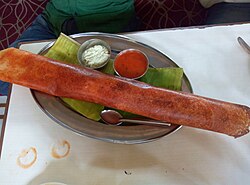 "Table dosa" which covers almost half of the table
 -
 Mysore Mallige Dosey
 -
 Indian street dosa masala in Varanasi, India
 -
 Onion dosa, with coconut chutney and potato curry
 -
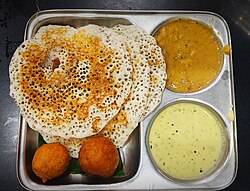 Set dosa, a set of 3 dosas with coconut chutney, curry and Mysore bonda


.jpg)
.jpg)
.jpg)


World record[edit | edit source]
On 16 November 2014, 29 chefs, at Hotel Daspalla in Hyderabad, India, created a dosa that was 16.68 m (54.7 ft) long and weighed 13.69 kg (30.2 lb), earning the Guinness World Record for the longest dosa.[30]
In popular culture[edit | edit source]
- In a November 2019 video promoting her campaign for presidency, United States Vice President Kamala Harris cooked masala dosa with actress and comedian Mindy Kaling.[31]
- The 2023 Tamil culture-inspired cooking video game Venba features dosa as an in-game recipe.
Related foods[edit | edit source]
- Uttapam: a thick relatively soft crepe mostly topped with diced onions, tomatoes, cilantro or cheese, sometimes described as an Indian pizza
- Pesarattu: made from green gram in Andhra Pradesh, served with a ginger and tamarind chutney
- Appam: a pancake prepared from patted rice batter, served with sweet coconut milk or sugar
- Chakuli pitha: the batter contains more black gram and less rice flour
- Apam balik: made from a mixture of flour, eggs, sugar, baking soda, coconut milk and water
- Jianbing: a Chinese dish
- Bánh xèo: a Vietnamese dish
- Lahoh: a Somali dish
- Injera: an Ethiopian dish made with fermented teff batter
See also[edit | edit source]
- List of fermented foods
- List of Indian breads
- List of pancakes
- Udupi cuisine
- Cuisine of Kerala
- South Indian cuisine
- Thali
References[edit | edit source]
- ↑ See:
- Mok, Opalyn (12 April 2015). "Traditional Indian snacks for breakfast or tea". Malay Mail.
- Kong, Lily Lee Lee; Sinha, Vineeta (2015). Food, Foodways And Foodscapes: Culture, Community And Consumption In Post-colonial Singapore. World Scientific. pp. 109–10. ISBN 978-981-4641-24-1.
- ↑ K. T. Achaya (November 2003). The Story of Our Food. Universities Press. p. 80. ISBN 81-7371-293-X.
- ↑ P. Thankappan Nair (2004). South Indians in Kolkata. Punthi Pustak. p. 320. ISBN 81-86791-50-7.
- ↑ 4.0 4.1 Charmaine O' Brien (15 December 2013). The Penguin Food Guide to India. Penguin Books Limited. p. 378. ISBN 978-93-5118-575-8.
- ↑ Vir Sanghvi (1 January 2004). Rude Food: The Collected Food Writings of Vir Sanghvi. Penguin Books India. pp. 109–110. ISBN 978-0-14-303139-0.
- ↑ K.T. Achaya (2003). The Story of Our Food. Universities Press. p. 85. ISBN 978-81-7371-293-7.
- ↑ "8 oldest Udupi restaurants in Bombay". The Free Press Journal. 31 May 2019. Archived from the original on 5 September 2019. Retrieved 15 August 2022.
- ↑ Bhattacharya, Bhaswati (3 August 2017). Much Ado Over Coffee: Indian Coffee House Then And Now, Bhaswati Bhattacharya, Routledge, 2017. Routledge. ISBN 978-1-351-38315-8. Archived from the original on 16 April 2023. Retrieved 28 March 2023.
- ↑ Sethu Ramaswamy (2003). Bride at Ten, Mother at Fifteen: Autobiography of an Unknown Indian Woman. Namita Gokhale Editions. ISBN 9788174362896.[page needed]
- ↑ J. Hurst, Christon, ed. (2023). "Fermented Foods of South Asia". Microbial Fermentations in Nature and as Designed Processes. Hoboken: Wiley. p. 342. ISBN 978-1-119-84999-5. OCLC 1393173167.
- ↑ Davidson, Alan (2014). "Sri Lanka". In Jaine, Tom (ed.). The Oxford companion to food (3. ed. / ed. by Tom Jaine ed.). Oxford: Oxford Univ. Press. p. 774. ISBN 978-0-19-967733-7. OCLC 903167481.
- ↑ Kadhirvel, S. (2000). "Indian Tamils in Sri Lanka: The countours of dissonance". Proceedings of the Indian History Congress. 61: 1045–1046. ISSN 2249-1937. JSTOR 44144420. Archived from the original on 3 November 2023. Retrieved 3 November 2023.
- ↑ Garg, Sanjay; SAARC Cultural Centre, eds. (2014). Circulation of cultures and culture of circulation: diasporic cultures of South Asia during 18th to 20th centuries. Colombo: SAARC Cultural Centre. p. 151. ISBN 978-955-0567-12-6. OCLC 910664759. Archived from the original on 29 June 2023. Retrieved 3 November 2023.
- ↑ Charles Philip Brown (1903). "A Telugu-English dictionary". Archived from the original on 15 July 2020.
- ↑ Restaurant style dosa recipe, Dosa recipe (9 July 2023). Dosa recipe.
- ↑ "Calorie Chart, Nutrition Facts, Calories in Food". MyFitnessPal. Archived from the original on 19 April 2023. Retrieved 7 May 2019.
- ↑ Nutrition and Dietetics - Higher Secondary - First Year (PDF). Directorate of School Education, Government of Tamil Nadu. 2004. p. 31. Archived from the original (PDF) on 21 March 2012. Retrieved 30 August 2012.
- ↑ "A Beginner's Guide to the Great Wide World of Indian Dosa, Priya Krishna and Shailendra Krishna, October 6, 2016". 6 October 2016. Archived from the original on 9 November 2016. Retrieved 21 February 2018.
- ↑ "A Dosa Lesson From a Professional - A Good Appetite, Melissa Clark, New York Times, 6 October 2017". 6 October 2017. Archived from the original on 21 February 2018. Retrieved 21 February 2018.
- ↑ Kumar, Ashwani; Singh, Sarabjit; Tomer, Vidisha; Prasad, Rasane (2022). Cereals and cereal-based foods : functional benefits and technological advances for nutrition and healthcare (First ed.). Palm Bay, FL, USA: Apple Academic Press. p. 251. ISBN 9781000164299. Retrieved 25 April 2023.
The ingredients for dosa preparation are not limited to just rice and black gram instead pure rice or a mixture of rice, wheat, sorghum, maize, or millets can also be used.
- ↑ "Recipe: Mini soya dosa". The Times of India. Archived from the original on 24 June 2017. Retrieved 15 August 2022.
- ↑ "Mini Soya Dosa". food.ndtv.com. Archived from the original on 2 April 2015. Retrieved 20 March 2015.
- ↑ "Healthy snack recipe: Green Dosa". The Times of India. 17 February 2016. Archived from the original on 19 March 2022. Retrieved 15 August 2022.
- ↑ "Pesarattu (Green Gram Dosa)". food.ndtv.com. Archived from the original on 2 April 2015. Retrieved 20 March 2015.
- ↑ "Recipe: Light white dosa". The Times of India.
- ↑ 26.0 26.1 "The karam dosas from kadapa". The New Indian Express. Archived from the original on 15 August 2022. Retrieved 14 August 2018.
- ↑ "Onion Rava Dosa". food.ndtv.com. Archived from the original on 15 August 2022. Retrieved 15 August 2022.
- ↑ "Ragi Wheat Dosa". food.ndtv.com. Archived from the original on 15 August 2022. Retrieved 15 August 2022.
- ↑ Verma, Neera. South Indian Cook Book. Diamond Pocket Books (P) Ltd. ISBN 978-81-7182-836-4.
- ↑ "Longest Dosa". Guinness World Records.
- ↑ 27 November 2019. US presidential candidate Kamala Harris cooks masala dosas with Mindy Kaling Archived 23 July 2023 at the Wayback Machine. The Hindu. Retrieved 23 July 2023.


Template:Sri Lankan cuisine Template:Burmese cuisine
| Common dishes |
| ||||||||||||
|---|---|---|---|---|---|---|---|---|---|---|---|---|---|
| Snacks |
| ||||||||||||
| Desserts | |||||||||||||
| Drinks |
| ||||||||||||
| Condiments | |||||||||||||
- Pages using the JsonConfig extension
- Pages with Sinhala IPA
- Pages with Tamil IPA
- Pages with Kannada IPA
- Pages with Malayalam IPA
- Articles containing Telugu-language text
- Pages with Telugu IPA
- Dosa (food)
- Andhra cuisine
- Burmese cuisine
- Fermented foods
- Indian breads
- Indian fast food
- Karnataka cuisine
- Kerala cuisine
- Malaysian breads
- Mangalorean cuisine
- Pancakes
- Singaporean cuisine
- South Indian cuisine
- Sri Lankan pancakes
- Tamil cuisine
- Telangana cuisine
- Vegetarian dishes of India
- Indo-Caribbean cuisine
- Hindu cuisine
- Indian cuisine
- South Asian cuisine
- Vegetarian cuisine