

WikiDwarfBOT (talk | contribs) Cleanup: Source modification. Information added. |
Frankieren (talk | contribs) Improved wording and formatting |
||
| Line 1: | Line 1: | ||
{{Short description|State in | {{Short description|State in northwestern India}} | ||
{{About||the Bollywood film|Haryana (film)}} | {{About||the Bollywood film|Haryana (film)}} | ||
{{pp-extended|small=yes}} | |||
{{Use | {{pp-move|small=yes}} | ||
{{Use | {{Use Indian English|date=November 2025}} | ||
{{Use dmy dates|date=November 2025}} | |||
{{Infobox Indian state or territory | {{Infobox Indian state or territory | ||
| name = Haryana | | name = Haryana | ||
| official_name = State of Haryana | | official_name = State of Haryana | ||
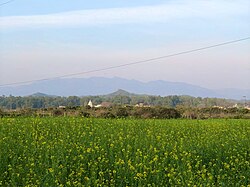
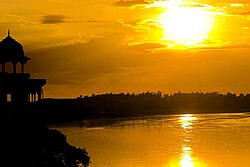
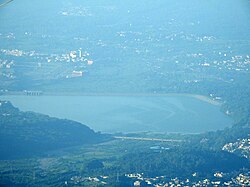
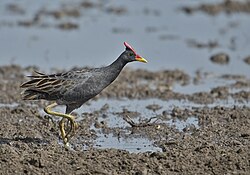
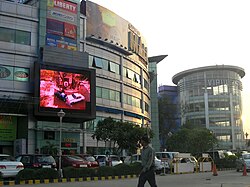
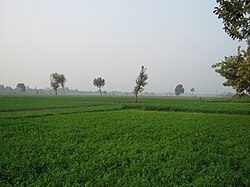
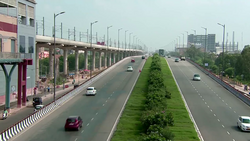
| image_caption = From top, left to right: [[Cyber City, Gurgaon|Cyber City in Gurgaon]], [[Pinjore Gardens]], Bronze chariot of [[Krishna]] and [[Arjuna]] at [[Kurukshetra]], [[Madhogarh Fort, Haryana|Madhogarh Fort]], Migratory birds at [[Kaushalya Dam]], Lake in [[Surajkund]] | |||
| type = State | | type = State | ||
| image_seal = Emblem of Haryana.svg | | image_seal = Emblem of Haryana.svg | ||
| image_skyline = {{Photomontage | | image_skyline = {{Photomontage | ||
| photo1a = Cyber City View.jpg | | photo1a = Cyber City View.jpg | ||
| photo2a = | | photo2a = Pinjore Garden Chandigarh India (8).JPG | ||
| photo2b = | | photo2b = Sourabh475123 01.jpg | ||
| photo3a = | | photo3a = Madhogarh Fort, Haryana.jpg | ||
| photo3b = | | photo3b = Migratory birds at Kaushalya dam, near Pinjor, Haryana, India.jpg | ||
| | | photo4b = Most Beautiful Lake in Faridabad.jpg | ||
| spacing = 1 | | spacing = 1 | ||
| color_border = white | | color_border = white | ||
| color = white | | color = white | ||
| size = 250 | | size = 250 | ||
}} | }} | ||
| etymology = Abode of God or Green Forest | | etymology = "Abode of God or Green Forest" | ||
| nickname = | | nickname = | ||
| motto = Satyameva Jayate <br/> | | motto = [[Satyameva Jayate]] ([[Sanskrit]])<br/>"Truth alone triumphs"{{Force singular}} | ||
| anthem = [[Jai Jai Jai Haryana]] ([[Hindi]])<br/>"Victory to Haryana" | |||
| image_map = IN-HR.svg | | image_map = IN-HR.svg | ||
| coordinates = {{ | | coordinates = {{Coord|30.73|N|76.78|E|region:IN-HR_type:adm1st|format=dms|display=inline,title}} | ||
| region = North India | | region = North India | ||
| before_was = Part of [[Punjab]] | | before_was = Part of [[Punjab, India|Punjab]] | ||
| formation_date2 = formation1 | | formation_date2 = formation1 | ||
| formation_date4 = 1 November 1966 | | formation_date4 = 1 November 1966 | ||
| capital = Chandigarh | | capital = Chandigarh | ||
| largestcity = Faridabad | | largestcity = Faridabad | ||
| districts = [[List of districts of Haryana| | | districts = [[List of districts of Haryana|{{Wikidata|qualifier|Q2668932|P360|P1114}} ({{Wikidata|qualifier|Q5284615|P31|P1114}} divisions)]] | ||
| Governor = [[ | | Governor = [[Ashim Kumar Ghosh]] | ||
| Chief_Minister = [[ | | Chief_Minister = [[Nayab Singh Saini]] | ||
| party = | | party = | ||
| judiciary = [[Punjab and Haryana High Court]] | | judiciary = [[Punjab and Haryana High Court]] | ||
| legislature_type = Unicameral | | legislature_type = Unicameral | ||
| assembly = | | assembly = {{Wikidata|property|linked|P194}} | ||
| assembly_seats = | | assembly_seats = {{Wikidata|property|{{Wikidata|property|raw|P194}}|P1342}} seats | ||
| rajya_sabha_seats = 5 seats | | rajya_sabha_seats = 5 seats | ||
| lok_sabha_seats = 10 seats | | lok_sabha_seats = 10 seats | ||
| area_footnotes = <ref name="profile">{{ | | area_footnotes = <ref name="profile">{{Cite web|title=Haryana at a Glance|url=http://www.haryana.gov.in/knowharyana/haryanaglance.html|website=Government of Haryana|access-date=1 March 2016|archive-url=https://web.archive.org/web/20160314194109/http://www.haryana.gov.in/knowharyana/haryanaglance.html|archive-date=14 March 2016|url-status=dead}}</ref> | ||
| area_total_km2 = 44212 | | area_total_km2 = 44212 | ||
| area_rank = | | area_rank = 20th | ||
| elevation_m = | | elevation_m = | ||
| elevation_max_m = 1, | | elevation_max_m = 1,467 | ||
| elevation_max_point = [[Karoh Peak]] | | elevation_max_point = [[Karoh Peak]] | ||
| elevation_min_m = 169 | | elevation_min_m = 169 | ||
| population_total = {{IncreaseNeutral}} | | elevation_min_point = [[Yamuna River]] | ||
| population_as_of = | | population_footnotes = <ref>{{Cite book | url=https://ruralindiaonline.org/en/library/resource/population-projections-for-india-and-states-2011-2036/ | title=Population Projections for India and States, 2011–2036 | date=July 2020 | access-date=25 March 2023 | archive-date=13 March 2023 | archive-url=https://web.archive.org/web/20230313055356/https://ruralindiaonline.org/en/library/resource/population-projections-for-india-and-states-2011-2036/ | url-status=live }}</ref> | ||
| population_rank = | | population_total = {{IncreaseNeutral}} 30,936,000 | ||
| population_urban = | | population_as_of = 2025 | ||
| population_rural = | | population_rank = 17th | ||
| population_urban = 43.26% | |||
| population_rural = 56.74% | |||
| population_density = 573 | | population_density = 573 | ||
| population_demonym = [[Haryanvi people|Haryanvi]] | | population_demonym = [[Haryanvi people|Haryanvi]] | ||
| 0fficial_Langs = [[Hindi]]<ref name=nclmanurep2010>{{ | | 0fficial_Langs = [[Hindi]]<ref name=nclmanurep2010>{{Cite web |url = http://www.nclm.nic.in/shared/linkimages/NCLM52ndReport.pdf |title = Report of the Commissioner for linguistic minorities: 52nd report (July 2014 to June 2015) |pages = 85–86 |publisher = Commissioner for Linguistic Minorities, Ministry of Minority Affairs, Government of India |access-date = 16 February 2016|archive-url = https://web.archive.org/web/20161115133948/http://nclm.nic.in/shared/linkimages/NCLM52ndReport.pdf |archive-date = 15 November 2016 |url-status=dead }}</ref> | ||
| additional_official = [[English language|English]] | | additional_official = {{Hlist|[[English language|English]]|[[Punjabi language|Punjabi]]<ref name="punjabiofficial"/>}} | ||
| | | official_script = {{Hlist|[[Devanagari]]}} | ||
| GDP_footnotes = <ref>{{Cite web |last1=Upadhyaya |first1=Rutvik |date=28 March 2025 |title=Haryana Budget Analysis 2025-26 |url=https://prsindia.org/files/budget/budget_state/haryana/2025/Haryana_Budget_Analysis_2025-26.pdf |website=[[PRS Legislative Research]] |access-date=17 July 2025}}</ref> | |||
| GDP_total = {{Increase}} $158.53 billion (nominal)<br/>{{Increase}} $667.78 billion (PPP) | |||
| GDP_total = {{Increase}}{{ | | GDP_year = 2025-26 | ||
| GDP_year = | |||
| GDP_rank = 13th | | GDP_rank = 13th | ||
| GDP_per_capita = {{Increase}}{{INRConvert| | | GDP_per_capita = {{Increase}} {{INRConvert|353182|lk=r}} (nominal)<ref name="Sharada1979" /><br/>{{Increase}} $21,889 (PPP)<ref name="Sharada1979" /> | ||
| GDP_per_capita_rank = 6th | | GDP_per_capita_rank = 6th | ||
| HDI = {{Increase}} 0. | | HDI = {{Increase}} 0.696 {{Color|orange|Medium}}<ref>{{cite web |title=India: Subnational HDI |url=https://globaldatalab.org/shdi/table/shdi/IND/ |website=Global Data Labs |access-date=8 June 2025}}</ref> | ||
| HDI_year = 2022 | |||
| HDI_rank = 13th | |||
| literacy = 84.8%<ref>{{Cite book |url=https://www.mospi.gov.in/sites/default/files/publication_reports/AnnualReport_PLFS2023-24L2.pdf |title=Annual Report, Periodic Labour Force Survey (PLFS) (July 2023 – June 2024) |date=23 September 2024 |publisher=National Sample Survey Office, Ministry of Statistics and Programme Implementation, Government of India |pages=A-10 |chapter=Appendix-A: Detailed tables, Table (7): Literacy rate (in per cent) of persons of different age groups for each State/UT (persons, age-group (years): 7 & above, rural+urban (column 6))}}</ref> | |||
| literacy_year = | | literacy_year = 2024 | ||
| literacy_rank = | | literacy_rank = 18th | ||
| sex_ratio = | | sex_ratio = 892[[female|♀]]/1000 [[male|♂]]<ref>{{Cite web|title=Sex ratio of State and Union Territories of India as per National Health survey (2019-2021)|url=https://main.mohfw.gov.in/sites/default/files/NFHS-5_Phase-II_0.pdf|website=Ministry of Health and Family Welfare, India|access-date=8 January 2023|archive-date=22 September 2023|archive-url=https://web.archive.org/web/20230922160100/https://main.mohfw.gov.in/sites/default/files/NFHS-5_Phase-II_0.pdf|url-status=live}}</ref> | ||
| sexratio_year = | | sexratio_year = 2025 | ||
| sexratio_rank = 29th | | sexratio_rank = 29th | ||
| iso_code = IN-HR | | iso_code = IN-HR | ||
| registration_plate = HR | | registration_plate = HR | ||
| website = haryana.gov.in | | website = haryana.gov.in | ||
| footnotes = {{ | | footnotes = {{Note|cap|†}}Joint Capital with Punjab<br />{{Ref|cap|††}} Common for Punjab, Haryana and Chandigarh. | ||
| foundation_day = Haryana Day | | foundation_day = Haryana Day | ||
| mammal = [[Blackbuck]] | | mammal = [[Blackbuck]] | ||
| Line 91: | Line 92: | ||
}} | }} | ||
'''Haryana''' | '''Haryana'''{{efn|{{Indic Transl|hi|Hariyāṇā|ɦəɾɪːˈaːɳɑɐː}}}} is a [[States and union territories of India|state]] located in the [[Northwest India|northwestern part]] of [[India]]. It was carved out after the linguistic reorganisation of [[Punjab, India|Punjab]] on 1 November 1966. It is ranked 21st in terms of area, with less than 1.4% ({{Cvt|44212|km2|disp=or}}) of India's land area.<ref name="profile" /><ref name="harec1" /> The state capital is [[Chandigarh]], which it shares with the neighbouring state of Punjab; the most populous city is [[Faridabad]], a part of the [[National Capital Region (India)|National Capital Region]]. The city of [[Gurgaon]] is among India's largest financial and technology hubs.<ref>{{cite web|url=https://www.indiatoday.in/food-drink/musings/story/ncr-food-hub-dlf-phase-v-one-horizon-centre-whisky-samba-lifefd-967750-2017-03-26|title=This is NCR's new foodie magnet; have you been yet?|work=[[India Today]]|date=26 March 2017|access-date=21 April 2017|archive-url=https://web.archive.org/web/20170422134055/http://indiatoday.intoday.in/story/ncr-food-hub-dlf-phase-v-one-horizon-centre-whisky-samba-lifefd/1/913271.html|archive-date=22 April 2017|url-status=live}}</ref> Haryana has {{wikidata|qualifier|Q5284615|P31|P1114}} [[Divisions of Haryana|administrative divisions]], {{wikidata|qualifier|Q2668932|P360|P1114}} [[List of districts of Haryana|districts]], 72 sub-divisions, 93 [[tehsil|revenue tehsil]]s, 50 sub-tehsils, 140 [[Community development block in India|community development block]]s, 154 [[List of cities in Haryana by population|cities and towns]], 7,356 villages, and 6,222 [[Gram panchayat|villages panchayats]].<ref name="harec1" />{{sfn|NIDM|p=4}} | ||
Haryana contains 32 [[special economic zone]]s (SEZs), mainly located within the industrial corridor projects connecting the National Capital Region.<ref name="harec1" /><ref name=harec2/> | Haryana contains 32 [[special economic zone]]s (SEZs), mainly located within the industrial corridor projects connecting the National Capital Region.<ref name="harec1" /><ref name=harec2/> [[Gurgaon]] is considered one of the major [[information technology]] and [[automobile]] hubs of India.<ref name=IT3>{{cite news|last=|first=|title=Gurugram among top 5 IT hubs in Asia Pacific|url=https://www.hindustantimes.com/gurgaon/gurugram-among-top-5-it-hubs-in-asia-pacific/story-JKwwaSNvsf4Os3AQAAha6L.html|access-date=28 May 2019|newspaper=Hindustan Times|date=28 May 2019|agency=|archive-date=24 August 2019|archive-url=https://web.archive.org/web/20190824131759/https://www.hindustantimes.com/gurgaon/gurugram-among-top-5-it-hubs-in-asia-pacific/story-JKwwaSNvsf4Os3AQAAha6L.html|url-status=live}}</ref><ref name=percapita3>{{cite news|last=Julka|first=Harsimran|title=IT firms looking beyond Gurgaon, Noida, Greater Noida to other cities in north India|url=http://articles.economictimes.indiatimes.com/2011-09-30/news/30228817_1_gurgaon-satellite-towns-noida|access-date=2 October 2013|newspaper=The Economic Times|date=30 September 2011|agency=ET Bureau|archive-url=https://web.archive.org/web/20131105032828/http://articles.economictimes.indiatimes.com/2011-09-30/news/30228817_1_gurgaon-satellite-towns-noida|archive-date=5 November 2013|url-status=dead}}</ref> Haryana [[List of Indian states and territories by Human Development Index|ranks 11th]] among Indian states in [[human development index]].<ref name="snhdi-gdl">{{cite web |title=Sub-national HDI - Area Database |url=https://hdi.globaldatalab.org/areadata/shdi/ |website=Global Data Lab |publisher=Institute for Management Research, Radboud University |access-date=24 October 2018|archive-url=https://web.archive.org/web/20180923120638/https://hdi.globaldatalab.org/areadata/shdi/ |archive-date=23 September 2018 |url-status=dead}}</ref> The [[economy of Haryana]] is the [[List of Indian states and union territories by GDP|13th largest]] in India, with a gross state domestic product (GSDP) of {{INRConvert|7.65|t|lk=r}} and has the country's [[List of Indian states and union territories by GDP per capita|5th-highest GSDP per capita]] of {{INRConvert|240|k}}.<ref name="Survey1">{{cite web|url=http://web1.hry.nic.in/budget/esurvey.pdf|title=Economic Survey of Haryana 2020-21|work=[[Government of Haryana]]|pages=2–3|date=1 February 2022|access-date=1 February 2022|archive-date=19 January 2022|archive-url=https://web.archive.org/web/20220119164659/http://web1.hry.nic.in/budget/Esurvey.pdf|url-status=dead}}</ref> | ||
The state is rich in [[History of Haryana|history]], [[List of Monuments of National Importance in Haryana|monuments]], [[List of State Protected Monuments in Haryana|heritage]], [[List of | The state is rich in [[History of Haryana|history]], [[List of Monuments of National Importance in Haryana|monuments]], [[List of State Protected Monuments in Haryana|heritage]], [[List of protected areas of Haryana|flora and fauna]] and [[Tourism in Haryana|tourism]], with a well-developed [[Economy of Haryana|economy]], [[List of highways in Haryana|national and state highways]]. It is bordered by [[Punjab, India|Punjab]] and [[Himachal Pradesh]] to the north, by [[Rajasthan]] to the west and [[South Haryana|south]], while river [[Yamuna]] forms its eastern border with [[Uttar Pradesh]]. Haryana surrounds the country's capital territory of [[Delhi]] on three sides (north, west and south), consequently, a large area of Haryana state is included in the economically important National Capital Region of India for the purposes of planning and development. | ||
==Etymology== | ==Etymology== | ||
Some anthropologists believe that the name "Haryana" originated in the period following the ''[[Mahābhārata]]'', when the Ābhiras are thought to have settled in the region. This community was known for developing advanced agricultural techniques.<ref>{{cite book |last=Lal |first=Muni |url=https://books.google.com/books?id=0cgCAAAAMAAJ&q=abhiras | |||
|title=Haryana: On High Road to Prosperity |date=1974 |publisher=Vikas Publishing House |isbn=978-0-7069-0290-7 }}</ref><ref>{{cite book|last=Punia|first=Bijender K.|url=https://books.google.com/books?id=7d3rX5jr1WQC&dq=abhira+name+haryana&pg=PA18|title=Tourism Management: Problems and Prospects|date=1994|publisher=APH Publishing|isbn=978-81-7024-643-5|language=en}}</ref> | |||
Historian Pran Nath Chopra suggests that the name evolved linguistically over time—from Ābhirāyana (derived from ābhira meaning "Abhira" and ayana meaning "path" or "way") to Ahirāyana, and eventually became Hariyānā or Haryana.<ref>{{cite book|last=Chopra|first=Pran Nath|url=https://books.google.com/books?id=ggtuAAAAMAAJ&q=Abhirayana%3DAhirayana%3DHirayana%3D|title=Religions and Communities of India|date=1982|publisher=Vision Books|isbn=978-0-391-02748-0|language=en}}</ref> | |||
==History== | ==History== | ||
| Line 106: | Line 110: | ||
===Ancient period=== | ===Ancient period=== | ||
{{Main|Indus Valley Civilization|Vedic Civilization}} | {{Main|Indus Valley Civilization|Vedic Civilization}} | ||
{{multiple image | {{multiple image | ||
| perrow = 2 | | perrow = 2 | ||
| Line 118: | Line 123: | ||
The villages of [[Rakhigarhi]] in [[Hisar district]] and [[Bhirrana]] in [[Fatehabad district]] are home to ancient sites of the [[Indus Valley Civilization]], which contain evidence of paved roads, a drainage system, a large-scale rainwater collection storage system, terracotta brick and statue production, and skilled metalworking (in both bronze and precious metals).<ref name="IVC-Rakhigarhi">{{citation |url=http://thehindu.com/features/friday-review/history-and-culture/rakhigarhi-the-biggest-harappan-site/article5840414.ece |title=Rakhigarhi, the biggest Harappan site |newspaper=[[The Hindu]] |date=27 March 2014 |access-date=24 January 2016 |archive-url=https://web.archive.org/web/20161127171505/http://www.thehindu.com/features/friday-review/history-and-culture/rakhigarhi-the-biggest-harappan-site/article5840414.ece |archive-date=27 November 2016 |url-status=live |last1=Subramanian |first1=T. S. }}</ref> | The villages of [[Rakhigarhi]] in [[Hisar district]] and [[Bhirrana]] in [[Fatehabad district]] are home to ancient sites of the [[Indus Valley Civilization]], which contain evidence of paved roads, a drainage system, a large-scale rainwater collection storage system, terracotta brick and statue production, and skilled metalworking (in both bronze and precious metals).<ref name="IVC-Rakhigarhi">{{citation |url=http://thehindu.com/features/friday-review/history-and-culture/rakhigarhi-the-biggest-harappan-site/article5840414.ece |title=Rakhigarhi, the biggest Harappan site |newspaper=[[The Hindu]] |date=27 March 2014 |access-date=24 January 2016 |archive-url=https://web.archive.org/web/20161127171505/http://www.thehindu.com/features/friday-review/history-and-culture/rakhigarhi-the-biggest-harappan-site/article5840414.ece |archive-date=27 November 2016 |url-status=live |last1=Subramanian |first1=T. S. }}</ref> | ||
During the [[Vedic era]], Haryana was the site of the [[Kuru | During the [[Vedic era]], Haryana was the site of the [[Kuru kingdom]], one of India's great [[Mahajanapadas]]. The south of Haryana is the claimed location of [[Manusmṛti|Manu]]'s state of [[Brahmavarta]].<ref>{{cite web|title=The Tribune, Chandigarh, India - Haryana Plus|url=http://www.tribuneindia.com/2011/20111220/harplus.htm|website=The Tribune|access-date=4 August 2016|archive-url=https://web.archive.org/web/20161031143942/http://www.tribuneindia.com/2011/20111220/harplus.htm|archive-date=31 October 2016|url-status=live}}</ref>{{Better source needed|date=October 2019}} The area surrounding [[Dhosi Hill]], and districts of [[Rewari district|Rewari]] and [[Mahendragarh district|Mahendragarh]] had Ashrams of several Rishis who made valuable contributions to important Hindu scriptures like [[Vedas]], [[Upanishads]], [[Manusmriti]], [[Brahmana]]s and [[Puranas]].<ref>Sudhir Bhargava, "Location of [[Brahmavarta]] and [[Drishadvati river|Drishadwati river]] is important to find earliest alignment of Saraswati river" Seminar, Saraswati river-a perspective, 20–22 Nov 2009, Kurukshetra University, Kurukshetra, organized by Saraswati Nadi Shodh Sansthan, Haryana, Seminar Report: pages 114–117</ref> As per Manusmriti,<ref>{{cite book |chapter=Mlecchas, Yavanas and Heathens: Interacting Xenologies in Early Nineteenth-Century Calcutta |first=Dermot |last=Killingley |title=Beyond Orientalism: The Work of Wilhelm Halbfass and Its Impact on Indian and Cross-cultural Studies |editor1-first=Eli |editor1-last=Franco |editor2-first=Karin |editor2-last=Preisendanz |publisher=Motilal Banarsidass |year=2007 |isbn=978-8-12083-110-0 |chapter-url=https://books.google.com/books?id=tv-4tyO9u_QC&pg=PA125 |page=125}}</ref> Manu was the king of [[Brahmavarta]], the flood time state 10,000 years ago surrounded by oldest route of Sarasvati and Drishadwati rivers on the banks of which Sanatan-Vedic or present-day Hindu ethos evolved and scriptures were composed. | ||
===Medieval period=== | ===Medieval period=== | ||
Ancient bronze and stone idols of Jain [[Tirthankara]] were found in archaeological expeditions in [[Badli]], [[Bhiwani]] ([[Ranila]], [[Charkhi Dadri]] and [[Badhra]]), [[Dadri]], [[Gurgaon]] ([[Gurugram ]]), [[Hansi]], [[Hisar (city)|Hisar]], Kasan, Nahad, [[Narnaul]], [[Pehowa]], [[Rewari]], Rohad, [[Rohtak]] ([[Asthal Bohar]]) and [[Sonepat]] in Haryana.{{sfn|Atul Kumar Sinha|Abhay Kumar Singh|2007|p=401}} | Ancient bronze and stone idols of Jain [[Tirthankara]] were found in archaeological expeditions in [[Badli]], [[Bhiwani]] ([[Ranila]], [[Charkhi Dadri]] and [[Badhra]]), [[Dadri]], [[Gurgaon]] ([[Gurugram]]), [[Hansi]], [[Hisar (city)|Hisar]], Kasan, Nahad, [[Narnaul]], [[Pehowa]], [[Rewari]], Rohad, [[Rohtak]] ([[Asthal Bohar]]) and [[Sonepat]] in Haryana.{{sfn|Atul Kumar Sinha|Abhay Kumar Singh|2007|p=401}} | ||
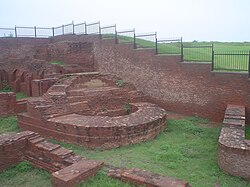
[[File:Harsha Ka Tila.jpg|thumb|left|180px|''Harsha Ka Tila'' mound west of [[Sheikh Chilli's Tomb]] complex, with ruins from the reign of 7th-century ruler [[Harsha]]]] | |||
[[Pushyabhuti dynasty]] ruled parts of northern India in the 7th century with its capital at [[Thanesar]]. [[Harsha]] was a prominent king of the dynasty. [[Tomara dynasty]] ruled the south Haryana region in the 10th century. [[Anangpal Tomar]] was a prominent king among the Tomaras.<ref>{{cite web|date=22 March 2021|title=Explained: The legacy of Tomar king Anangpal II and his connection with Delhi|url=https://indianexpress.com/article/explained/tomar-king-anangpal-ii-legacy-delhi-7237182/|access-date=6 May 2021|website=The Indian Express|archive-date=13 April 2021|archive-url=https://web.archive.org/web/20210413220940/https://indianexpress.com/article/explained/tomar-king-anangpal-ii-legacy-delhi-7237182/|url-status=live}}</ref> | |||
After the sack of [[Bhatner fort]] during the [[Timurid dynasty|Timurid]] conquests of India in 1398, [[Timur]] attacked and sacked the cities of [[Sirsa]], [[Fatehabad, Haryana|Fatehabad]], [[Sunam]], [[Kaithal]] and [[Panipat]].<ref>{{cite book|url=https://books.google.com/books?id=e9Q6AQAAMAAJ&pg=PA497|title=The History of India, as Told by Its Own Historians. The Muhammadan Period: Ed. from the Posthumous Papers of the Late Sir H. M. Elliot ..|last1=Elliot|first1=Sir Henry Miers|last2=Dowson|first2=John|date=1871|publisher=Trübner and Company|pages=427–31}}</ref><ref>{{cite book|title=Haryana, Ancient and Medieval|last=Phadke|first=H.A.|date=1990|publisher=Harman Publishing House|page=123}}</ref> | |||
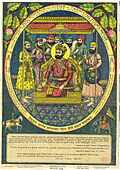
[[File:Maharaja Hemu Bhargava - Victor of Twenty Two Pitched Battles, 1910s.jpg|thumb|180px|left|Portrait of [[Hemu|Hem Chandra Vikramaditya]], who fought and won across North India from the [[Punjab region|Punjab]] to [[Bengal]], winning 22 straight battles{{sfn|Sarkar|1960|p=66}}]] | |||
[[ | [[Hem Chandra Vikramaditya]], also called [[Hemu]], claimed royal status and the throne of Delhi after defeating Akbar's Mughal forces on 7 October 1556 in the [[Battle of Delhi (1556)|Battle of Delhi]], and assumed the ancient title of [[Hemachandra Vikramaditya|Vikramaditya]]. The area that is now Haryana has been ruled by some of the major empires of India. [[Panipat]] is known for three seminal battles in the history of India. In the [[First Battle of Panipat]] (1526), [[Babur]] defeated the [[Lodi Empire|Lodis]]. In the [[Second Battle of Panipat]] (1556), [[Akbar]] defeated the local Haryanvi Hindu Emperor of Delhi, who belonged to [[Rewari]]. [[Hem Chandra Vikramaditya]] had earlier won 22 battles across India from 1553 to 1556 from [[Punjab]] to [[Bengal]], defeating the Mughals and Afghans. Hemu had defeated Akbar's forces twice at Agra and the [[Battle of Tughlaqabad|Battle of Delhi]] in 1556 to become the last Hindu Emperor of India with a formal coronation at [[Purana Quila]] in Delhi on 7 October 1556. In the [[Third Battle of Panipat]] (1761), the Afghan king [[Ahmad Shah Abdali]] defeated the [[Maratha Confederacy|Marathas]]. | ||
[[ | |||
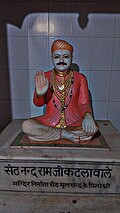
[[File:Seth Ji.jpg|thumb|180px|left|Statue of Seth Nandram Ji Katla Wale]] | |||
The growth of trade centers like Bhiwani was supported by influential merchants such as Seth Nand Ram Ji Katla Wale, who promoted social development and commerce during the late 18th and early 19th centuries. He was one of the prominent leaders who devoted his life to establishing Bhiwani as a trade centre in the 18th century. | |||
<ref>{{cite book |author1=Arnold P. Kaminsky |author2=Roger D. Long |title=India Today: An Encyclopedia of Life in the Republic |url=https://books.google.com/books?id=wWDnTWrz4O8C&pg=PA300 |year=2011 |publisher=ABC-CLIO |isbn=978-0-313-37462-3 |page=300 |access-date=13 February 2016 |archive-url=https://web.archive.org/web/20160619120748/https://books.google.com/books?id=wWDnTWrz4O8C&pg=PA300 |archive-date=19 June 2016 |url-status=live}}</ref> | |||
===British | ===British period=== | ||
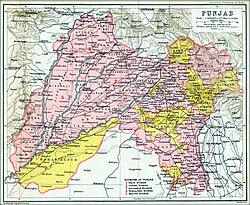
The state was part of the British [[Punjab Province (British India)|Punjab province]]. The [[Punjab Province (British India)#Administrative divisions|Delhi division]] of Punjab province formed the bulk of Haryana. Among the princely states that were located in the state were [[Jind State|Jind]], [[Kalsia State|Kalsia]], [[Loharu State|Loharu]], [[Dujana]] and [[Pataudi State|Pataudi]], as well as parts of the [[Patiala State]]. | The state was part of the British [[Punjab Province (British India)|Punjab province]]. The [[Punjab Province (British India)#Administrative divisions|Delhi division]] of Punjab province formed the bulk of Haryana. Among the princely states that were located in the state were [[Jind State|Jind]], [[Kalsia State|Kalsia]], [[Loharu State|Loharu]], [[Dujana]] and [[Pataudi State|Pataudi]], as well as parts of the [[Patiala State]]. | ||
[[File:Punjab 1909.jpg|thumb|left|Map of the [[Punjab Province (British India)|Punjab Province of British India]]; Haryana formed the southeastern areas of the province]] | |||
===Partition and aftermath=== | ===Partition and aftermath=== | ||
| Line 140: | Line 153: | ||
===Formation of Haryana=== | ===Formation of Haryana=== | ||
{{Main|Punjab Reorganisation Act, 1966}} | {{Main|Punjab Reorganisation Act, 1966}} | ||
The commission recommended that the tehsil of [[Kharar, SAS Nagar|Kharar]], which includes [[Chandigarh]], the state capital of Punjab, should be a part of Haryana. However, [[Kharar, SAS Nagar|Kharar]] was given to Punjab.<ref>{{citation|url=http://www.haryana-online.com/History/history_1966-.htm |title=History of Haryana - Haryana Day: A new state is born! |url-status= | Haryana as a state came into existence on 1 November 1966 the Punjab Reorganisation Act (1966). The Indian government set up the Shah Commission under the chairmanship of Justice JC Shah on 23 April 1966 to divide the existing state of [[Punjab, India|Punjab]] and determine the boundaries of the new state of Haryana after consideration of the languages spoken by the people. It encompassed the predominantly Hindi-speaking southern part of former Punjab, while the state of Punjab was reduced to the area where Punjabi speakers formed the majority population. The commission delivered its report on 31 May 1966 whereby the then-districts of [[Hisar (district)|Hisar]], [[Mahendragarh]], [[Gurgaon]], [[Rohtak]] and [[Karnal]] were to be a part of the new state of Haryana. Further, the [[tehsil]]s of [[Jind]] and [[Narwana]] in the [[Sangrur]] district – along with [[Naraingarh]], [[Ambala]] and [[Jagadhri]] – were to be included.<ref>{{citation|title=the punjab reorganisation act, 1966 - Chief Secretary, Haryana|url=http://csharyana.gov.in/WriteReadData/Acts/Re-Organisation/1474.pdf|access-date=12 November 2015|archive-url=https://web.archive.org/web/20160304081746/http://csharyana.gov.in/WriteReadData/Acts/Re-Organisation/1474.pdf|archive-date=4 March 2016|url-status=live}}</ref> | ||
The commission recommended that the tehsil of [[Kharar, SAS Nagar|Kharar]], which includes [[Chandigarh]], the state capital of Punjab, should be a part of Haryana. However, [[Kharar, SAS Nagar|Kharar]] was given to Punjab.<ref>{{citation|url=http://www.haryana-online.com/History/history_1966-.htm |title=History of Haryana - Haryana Day: A new state is born! |url-status=usurped |archive-url=https://web.archive.org/web/20131002001513/http://haryana-online.com/History/history_1966-.htm |archive-date=2 October 2013 }}</ref> The city of Chandigarh was made a [[union territory]], serving as the capital of both Punjab and Haryana.<ref>{{citation|url=https://www.indiatoday.in/india/story/haryana-will-get-chandigarh-punjab-can-claim-lahore-or-shimla-says-peeved-hooda-171617-2013-07-24|title=Haryana will get Chandigarh, Punjab can claim Lahore or Shimla, says a peeved Hooda|date=25 July 2013|access-date=15 November 2015|archive-url=https://web.archive.org/web/20151117024604/http://indiatoday.intoday.in/story/haryana-will-get-chandigarh-punjab-can-claim-lahore-or-shimla-says-peeved-hooda/1/296302.html|archive-date=17 November 2015|url-status=live}}</ref> | |||
[[B. D. Sharma|Bhagwat Dayal Sharma]] became the first [[List of Chief Ministers of Haryana|Chief Minister of Haryana]].<ref>{{citation |title=List of Haryana Chief Ministers from November 1, 1966 till date |date=21 October 2014 |work=[[The Indian Express]] |url=http://indianexpress.com/article/india/politics/list-of-haryana-chief-ministers-from-november-1-1966-till-date |access-date=12 November 2015 |archive-url=https://web.archive.org/web/20151030051508/http://indianexpress.com/article/india/politics/list-of-haryana-chief-ministers-from-november-1-1966-till-date/ |archive-date=30 October 2015 |url-status=live}}</ref> [[Devi Lal|Chaudhary Devi Lal]] is credited to be the individual who pushed for the creation of this commission. He was an instrumental figure in the separation of the Haryana state from Punjab in 1966.<ref>{{Cite web |title=Chaudhary Devi Lal {{!}} Indian Politician & Freedom Fighter {{!}} Britannica |url=https://www.britannica.com/biography/Chaudhary-Devi-Lal |access-date=6 August 2024 |website=www.britannica.com |language=en}}</ref> | |||
===Punjabi migration to Haryana in 1947 and 1980s=== | |||
The Punjabi migration to Haryana occurred in two major waves—first during the Partition of India in 1947, and later during the 1980s, influenced by the Khalistani movement in Punjab.<ref>{{cite magazine| title = The Many-Faced Afterlife of 1947 | url=https://www.theindiaforum.in/history/many-faced-afterlife-1947 |date=31 May 2023 |first1=Pranav |last1=Kohli |magazine=The India Forum (theindiaforum.in)}}</ref><ref>{{cite web |title =Khalistan And The Militant Movements In Punjab And Beyond: A Chronological Account |date=27 March 2024 | url=https://insightuk.org/khalistan-and-the-militant-movements-in-punjab-and-beyond |work=[[INSIGHT UK]] }}</ref> | |||
The Partition of India led to one of the largest mass migrations in history, as millions of people were displaced due to the creation of Pakistan. Many Punjabi Hindus and Sikhs fled West Punjab (now in Pakistan) and settled in Haryana, bringing with them their agricultural skills, business expertise, and cultural traditions. Their arrival helped in the economic development of Haryana, particularly in agriculture and trade, as they introduced advanced farming techniques and expanded local businesses. | |||
The Khalistani movement, which emerged in Punjab during the 1980s, led to political instability and violent insurgency. The demand for a separate Sikh state (Khalistan) resulted in clashes between separatist groups and security forces, making the region unsafe for many civilians. This turmoil prompted Punjabi families, including both Hindus and Sikhs, to migrate to neighbouring Haryana, seeking security, stability, and economic opportunities. | |||
The urban centers of Haryana witnessed an influx of Punjabi migrants, who contributed to the state's business and industrial sectors. | |||
By the mid-1990s, the insurgency declined due to government interventions, weakening separatist factions, and changing political dynamics. | |||
These migrations have shaped Haryana's demographic, cultural, and economic landscape, making Punjabis an integral part of the state's growth and identity. | |||
==Demographics== | ==Demographics== | ||
{{historical populations|11=1901|12= | {{historical populations | ||
|7=1881|8=40,15,386 | |||
|9=1891|10=41,71,339 | |||
|11=1901|12=42,68,222 | |||
|13=1911|14=38,70,574 | |||
|15=1921|16=42,11,393 | |||
|17=1931|18=44,95,730 | |||
|19=1941|20=51,66,169 | |||
|21=1951|22=56,73,597 | |||
|23=1961|24=75,90,524 | |||
|25=1971|26=1,00,36,431 | |||
|27=1981|28=1,29,22,119 | |||
|29=1991|30=1,64,63,648 | |||
|31=2001|32=2,11,44,564 | |||
|33=2011|34=2,53,51,462 | |||
|percentages=pagr | |||
|footnote=source: | |||
{{efn|name=Haryana1881}}{{efn|name=Haryana1891}}{{efn|name=Haryana1901}}{{efn|name=Haryana1911}}{{efn|name=Haryana1921}}{{efn|name=Haryana1931}}{{efn|name=Haryana1941}}<ref>{{cite web|url=http://www.censusindia.gov.in/2011census/PCA/A2_Data_Table.html|title=Decadal Variation in Population Since 1901|access-date=18 March 2020|archive-date=8 August 2019|archive-url=https://web.archive.org/web/20190808131957/http://www.censusindia.gov.in/2011census/PCA/A2_Data_Table.html|url-status=live}}</ref> | |||
|align=right}} | |||
{{See also|List of people from Haryana}} | {{See also|List of people from Haryana}} | ||
=== Castes, tribes and ethnic groups=== | |||
As per 2019 estimates, the [[Caste system in India|caste]] wise composition of Haryana is 25–30% [[Jats]], 21% [[Scheduled Castes and Scheduled Tribes|Scheduled Caste]], 8% [[Khatris]], 7.5% [[Brahmin]]s, 5.1% [[Ahir]]/[[Yadav]], 5% [[Vaish]], 4% [[Jat Sikhs]], 3.8% [[Meo (ethnic group)|Meo]]s and other Muslims, 3.4% [[Rajputs]], 3.35% [[Gujjar]], 2.9% [[Saini]], 2.7% [[Kumhar]]s, 1.1% [[Ror]] and 0.7% [[Bishnois]].<ref>{{cite news |last1=Rao |first1=Hitender |date=5 October 2019 |title=Haryana Assembly Elections 2019: BJP, Congress field fewer Jats for 2019 polls |url=https://www.hindustantimes.com/haryana/haryana-assembly-elections-2019-bjp-congress-field-fewer-jats-for-2019-polls/story-cihkwx35EiM78nszZ9bg5M.html |work=Hindustan Times |access-date=18 September 2024}}</ref><ref>{{Cite news |last=Sura |first=Ajay |date=25 September 2019 |title=27% of population, Jats chief minister 62% of time in Haryana's history |url=https://timesofindia.indiatimes.com/city/chandigarh/27-of-population-jats-have-occupied-top-chair-62-of-time-since-states-formation/articleshow/71285092.cms |work=The Times of India |issn=0971-8257 |access-date=18 September 2024}}</ref><ref>{{cite book |last1=Ruth-Lovell |first1=Saskia |last2=Spirova |first2=Maria |title=Clientelism and Democratic Representation in Comparative Perspective |date=15 October 2019 |publisher=ECPR Press |isbn=978-1-78552-301-4 |url=https://books.google.com/books?id=2EQhEQAAQBAJ&q=jat |language=en}}</ref> | |||
According to a 2023 report, the Jats constitute 25% of the state's population, while Sainis are at 8%.<ref>{{cite news |last1=Sharma |first1=Pawan |date=25 October 2025 |title=BJP appoints OBC MP Saini as Haryana party president |url=https://www.hindustantimes.com/cities/chandigarh-news/bjp-appoints-obc-mp-saini-as-haryana-party-president-101698431366653.html |work=Hindustan Times |access-date=28 October 2023}}</ref> | |||
The [[Punjabis]] ethnic group constitutes more than one-third of Haryana's population, making them a significant and influential community in the state.<ref>{{cite web| title=Punjabis in Majority in GT road belt - one third of Haryana seats| date = 9 October 2024| url = https://www.ptcnews.tv/politics/haryana-elections-2024-bjp-shatters-57-year-record-conquers-jat-bastion-with-7-stunning-new-wins-4399408}}</ref><ref>{{cite web| title = Punjabis around 38 percent in Haryana| url =https://www.patrika.com/ambala-news/punjabi-community-of-haryana-demands-to-political-leadership-3462115}}</ref><ref>{{cite web| title = Punjabis population 38 percent in Haryana| date =22 December 2009| url =https://indianexpress.com/article/cities/chandigarh/punjabis-discriminated-against-in-haryana/}}</ref> | |||
===Languages=== | |||
[[File:Language Map of Haryana (2011 Census).svg|left|200px|thumb|Languages spoken by district<br /> | |||
'''Haryanvi''' varieties | |||
{{legend|#f0817f|40–50%}} | |||
{{legend|#ea443e|60–70%}} | |||
{{legend|#e02119|70–80%}} | |||
{{legend|#cc1e14|80–90%}} | |||
{{legend|#aa1a13|90–100%}} | |||
Other '''Hindi''' varieties | |||
{{legend|#ffe0d1|30–40%}} | |||
{{legend|#ffcfb8|40–50%}} | |||
{{legend|#ffac85|50–60%}} | |||
{{legend|#ffac85|50–60%}} | |||
{{legend|#ff8952|60–70%}} | |||
{{legend|#ff661f|70–80%}} | |||
{{legend|#eb5600|80–90%}} | |||
'''Punjabi''' | |||
{{legend|#fde791|40–50%}} | |||
]] | |||
{{Pie chart | |||
| thumb = right | |||
| caption = Languages of Haryana (2011)<ref>{{cite web |url=https://censusindia.gov.in/2011census/C-16/DDW-C16-STMT-MDDS-0600.XLSX |title=Indian Census 2011 |access-date=11 October 2020 |archive-date=12 January 2020 |archive-url=https://web.archive.org/web/20200112015624/http://censusindia.gov.in/2011census/C-16/DDW-C16-STMT-MDDS-0600.XLSX |url-status=live }}</ref> | |||
| label1 = [[Hindi]] | |||
| value1 = 47.96 | |||
| color1 = Orange | |||
| label2 = [[Haryanvi language|Haryanvi]] | |||
| value2 = 37.17 | |||
| color2 = Red | |||
| label3 = [[Punjabi Language|Punjabi]] | |||
| value3 = 7.36 | |||
| color3 = Pink | |||
| label4 = [[Bagri language|Bagri]] | |||
| value4 = 2.11 | |||
| color4 = maroon | |||
| label5 = [[Mewati language|Mewati]] | |||
| value5 = 1.66 | |||
| color5 = gold | |||
| label6 = [[Urdu]] | |||
| value6 = 1.48 | |||
| color6 = Green | |||
| value7 = 1.28 | |||
| color7 = purple | |||
| label7 = [[Mahasu Pahari|Mahasui (Baghati)]] | |||
| other = yes | |||
}} | |||
The official language of Haryana is [[Modern Standard Hindi]]<ref name="2011lang">{{cite web |url=http://nclm.nic.in/shared/linkimages/NCLM50thReport.pdf |title=Report of the Commissioner for linguistic minorities: 50th report (July 2012 to June 2013) |publisher=Commissioner for Linguistic Minorities, Ministry of Minority Affairs, Government of India |access-date=4 December 2016 |archive-url=https://web.archive.org/web/20160708012438/http://nclm.nic.in/shared/linkimages/NCLM50thReport.pdf |archive-date=8 July 2016 |url-status=dead| page = 11}}</ref> and second official language is [[Punjabi language|Punjabi]].<ref name="punjabiofficial">{{cite web |url=https://www.hindustantimes.com/india/haryana-grants-second-language-status-to-punjabi/story-MTUeEQDE4fRCbEyPkAm63N.html |title=Haryana grants second language status to Punjabi |work=[[Hindustan Times]] |agency=Indo-Asian News Service |date=28 January 2010 |access-date=2 January 2019 |archive-url=https://web.archive.org/web/20181105012411/https://www.hindustantimes.com/india/haryana-grants-second-language-status-to-punjabi/story-MTUeEQDE4fRCbEyPkAm63N.html |archive-date=5 November 2018 |url-status=live }}</ref> | |||
Several regional languages or dialects, often subsumed under the name "[[Hindi languages|Hindi]]", are spoken in the state. Predominant among them is [[Haryanvi language|Haryanvi]] (also known as Bangru), whose territory encompasses the central and eastern portions of Haryana. [[Hindi]] and [[Punjabi language|Punjabi]] is spoken in the northeast, [[Bagri language|Bagri]] in the west, Deshwali in the East and [[Ahirwati]], [[Mewati language|Mewati]] and [[Braj Bhasha]] in the south.<ref name="Sharada1979">{{cite book|title=Hariyāṇā kī upabhāṣāeṃ|date=c. 1979|editor-last=Sharada|editor-first=Sadhu Ram|place=Chandigarh|publisher=Bhasha Vibhag|language=hi}}</ref> | |||
There are also significant numbers of speakers of [[Urdu]] and [[Punjabi language|Punjabi]], the latter of which was recognised as the second official language of Haryana for government and administrative purposes in 2010.<ref name="2011lang"/><ref name="punjabiofficial"/> After the state's formation, Telugu was made the state's "second language" – to be taught in schools – but it was not the "second official language" for official communication. Due to a lack of students, the language ultimately stopped being taught.<ref>{{cite news |last1=Bhatia |first1=Varinder |title=Haryana's South connect: When it made Telugu second language in school |url=https://indianexpress.com/article/explained/haryanas-south-connect-when-it-made-telugu-second-language-in-school-5570917/ |access-date=18 March 2020 |work=The Indian Express |date=6 February 2019 |archive-date=5 May 2020 |archive-url=https://web.archive.org/web/20200505184601/https://indianexpress.com/article/explained/haryanas-south-connect-when-it-made-telugu-second-language-in-school-5570917/ |url-status=live }}</ref> Tamil was made the second language in 1969 by [[Bansi Lal]] to show the state's differences with Punjab although there were no Tamil speakers in Haryana at the time.<ref name="DNA">{{cite web|url=https://www.dnaindia.com/india/report-punjabi-edges-out-tamil-in-haryana-1356124|title=Punjabi edges out Tamil in Haryana|first=Ajay|last=Bharadwaj|date=7 March 2010|website=DNA India|access-date=26 September 2020|archive-date=8 November 2020|archive-url=https://web.archive.org/web/20201108134854/https://www.dnaindia.com/india/report-punjabi-edges-out-tamil-in-haryana-1356124|url-status=live}}</ref> In 2010, due to the lack of Tamil speakers, the language was removed from its status.<ref name="DNA"/> | |||
There are also some speakers of several major regional languages of neighbouring states or other parts of the subcontinent, like [[Bengali language|Bengali]], [[Bhojpuri language|Bhojpuri]], [[Marwari language|Marwari]], [[Mewari language|Mewari]], and [[Nepali language|Nepali]],<ref>Bengali and Bhojpuri are listed as they have more than 50,000 speakers each according to the 2011 census; the rest are included following Ethnologue (22nd edition).</ref> as well as smaller communities of speakers of languages that are dispersed across larger regions, like [[Bauria language|Bauria]], [[Bazigar language|Bazigar]], [[Gujari language|Gujari]], [[Gade Lohar language|Gade Lohar]], [[Oadki language|Oadki]], and [[Sansi language|Sansi]].<ref name="Ethnologue2019">{{cite web|editor-last1 = Eberhard| editor-first1 = David M.| editor-last2 = Simons| editor-first2 = Gary F.| editor-last3 = Fennig| editor-first3 = Charles D.| year=2019|title=India – Languages|edition=22nd|website = Ethnologue|publisher=SIL International|url=https://www.ethnologue.com/country/IN/languages | archive-url = https://web.archive.org/web/20190401120331/https://www.ethnologue.com/country/IN/languages | archive-date = 1 April 2019}}</ref> | |||
===Religion=== | ===Religion=== | ||
{{Pie chart | {{Pie chart | ||
|thumb = right | | thumb = right | ||
|caption = Religion in Haryana (2011)<ref name="census2011">{{cite web|title=Population by religion community - 2011|url=http://www.censusindia.gov.in/2011census/C-01/DDW00C-01%20MDDS.XLS|website=Census of India, 2011|publisher=The Registrar General & Census Commissioner, India|archive-url=https://web.archive.org/web/20150825155850/http://www.censusindia.gov.in/2011census/C-01/DDW00C-01%20MDDS.XLS|archive-date=25 August 2015}}</ref> | | caption = Religion in Haryana (2011)<ref name="census2011">{{cite web|title=Population by religion community - 2011|url=http://www.censusindia.gov.in/2011census/C-01/DDW00C-01%20MDDS.XLS|website=Census of India, 2011|publisher=The Registrar General & Census Commissioner, India|archive-url=https://web.archive.org/web/20150825155850/http://www.censusindia.gov.in/2011census/C-01/DDW00C-01%20MDDS.XLS|archive-date=25 August 2015}}</ref> | ||
|label1 = [[Hinduism]] | | label1 = [[Hinduism]] | ||
|value1 = 87.46 | | value1 = 87.46 | ||
|color1 = Orange | | color1 = Orange | ||
|label2 = [[Islam]] | | label2 = [[Islam]] | ||
|value2 = 7.03 | | value2 = 7.03 | ||
|color2 = Green | | color2 = Green | ||
|label3 = [[Sikhism]] | | label3 = [[Sikhism]] | ||
|value3 = 4.91 | | value3 = 4.91 | ||
|color3 = | | color3 = Yellow | ||
|label4 = [[Jainism]] | | label4 = [[Jainism]] | ||
|value4 = 0.21 | | value4 = 0.21 | ||
|color4 = Pink | | color4 = Pink | ||
|label5 = [[Christianity]] | | label5 = [[Christianity]] | ||
|value5 = 0.20 | | value5 = 0.20 | ||
|color5 = Blue | | color5 = Blue | ||
|label6 = [[Buddhism]] | | label6 = [[Buddhism]] | ||
|value6 = 0.03 | | value6 = 0.03 | ||
|color6 = Gold | | color6 = Gold | ||
|label7 = Others | | label7 = Others | ||
|value7 = 0.18 | | value7 = 0.18 | ||
|color7 = Black | | color7 = Black | ||
}} | }} | ||
According to the 2011 census, of the total population of 25,351,462 in Haryana, [[Hindu]]s (87.46%) constitute the majority of the state's population with [[Muslim]]s (7.03%) (mainly [[Meo (ethnic group)|Meo]]s) and [[Sikh]]s (4.91%) being the largest minorities.<ref name="census2011"/> | According to the 2011 census, of the total population of 25,351,462 in Haryana, [[Hindu]]s (87.46%) constitute the majority of the state's population with [[Muslim]]s (7.03%) (mainly [[Meo (ethnic group)|Meo]]s) and [[Sikh]]s (4.91%) being the largest minorities.<ref name="census2011"/> | ||
Muslims are mainly found in the [[Nuh district]]. Haryana has the second largest Sikh population in India after [[Punjab, India|Punjab]], and they mostly live in the districts adjoining [[Punjab (India)|Punjab]], such as [[Sirsa district|Sirsa]], [[Jind district|Jind]], [[Fatehabad district|Fatehabad]], [[Kaithal district|Kaithal]], [[Kurukshetra district|Kurukshetra]], [[Ambala district|Ambala]] and [[Panchkula district|Panchkula]].<ref name=harsikh1>{{cite news|title=Haryana government announced the formation of rules to register Anand Karaj, the Sikh marriage ceremony|url=http://www.dailypioneer.com/state-editions/chandigarh/haryana-notifies-anand-marriage-registration-rules.html|access-date=13 July 2014|archive-url=https://web.archive.org/web/20140715040119/http://www.dailypioneer.com/state-editions/chandigarh/haryana-notifies-anand-marriage-registration-rules.html|archive-date=15 July 2014|url-status=live}}</ref><ref name=harsc1>{{cite web | url=http://www.censusindia.gov.in/Tables_Published/SCST/dh_sc_haryana.pdf | title=Census India 2001 | year=2001 | access-date=28 March 2013 | author=Govt. of India, Census | archive-url=https://web.archive.org/web/20111113213432/http://www.censusindia.gov.in/Tables_Published/SCST/dh_sc_haryana.pdf | archive-date=13 November 2011 | url-status=live}}</ref> | Muslims are mainly found in the districts of [[Nuh district|Nuh]], [[Palwal district|Palwal]], and [[Faridabad district|Faridabad]], along with the [[Sohna]] tehsil of [[Gurgaon district]].<ref name="census2011"/> Haryana has the second largest Sikh population in India after [[Punjab, India|Punjab]], and they mostly live in the districts adjoining [[Punjab (India)|Punjab]], such as [[Sirsa district|Sirsa]], [[Jind district|Jind]], [[Fatehabad district|Fatehabad]], [[Kaithal district|Kaithal]], [[Kurukshetra district|Kurukshetra]], [[Ambala district|Ambala]] and [[Panchkula district|Panchkula]].<ref name=harsikh1>{{cite news|title=Haryana government announced the formation of rules to register Anand Karaj, the Sikh marriage ceremony|url=http://www.dailypioneer.com/state-editions/chandigarh/haryana-notifies-anand-marriage-registration-rules.html|access-date=13 July 2014|archive-url=https://web.archive.org/web/20140715040119/http://www.dailypioneer.com/state-editions/chandigarh/haryana-notifies-anand-marriage-registration-rules.html|archive-date=15 July 2014|url-status=live}}</ref><ref name=harsc1>{{cite web | url=http://www.censusindia.gov.in/Tables_Published/SCST/dh_sc_haryana.pdf | title=Census India 2001 | year=2001 | access-date=28 March 2013 | author=Govt. of India, Census | archive-url=https://web.archive.org/web/20111113213432/http://www.censusindia.gov.in/Tables_Published/SCST/dh_sc_haryana.pdf | archive-date=13 November 2011 | url-status=live}}</ref> | ||
= | <div style="overflow-x:auto; border: 1px solid #AAA; padding-left: 0.5em; padding-right: 0.5em"> | ||
{ | {| class="wikitable sortable" | ||
| | |+ Religion in Haryana, India (1881–2011) | ||
| | ! rowspan="2" |[[Religion in India|Religious]]<br />group | ||
| | ! colspan="2" |1881<ref name="Census1881">{{cite web |url=https://www.jstor.org/stable/saoa.crl.25057656 |jstor=saoa.crl.25057656 |access-date=1 June 2024 |title=Census of India, 1881 Report on the Census of the Panjáb Taken on the 17th of February 1881, vol. I. |year=1881 |archive-date=15 January 2024 |archive-url=https://web.archive.org/web/20240115015937/https://www.jstor.org/stable/saoa.crl.25057656 |url-status=live }}</ref><ref name="Census1881B">{{cite web |url=https://www.jstor.org/stable/saoa.crl.25057657 |jstor=saoa.crl.25057657 |access-date=1 June 2024 |title=Census of India, 1881 Report on the Census of the Panjáb Taken on the 17th of February 1881, vol. II. |year=1881 |pages=14 |archive-date=15 January 2024 |archive-url=https://web.archive.org/web/20240115015938/https://www.jstor.org/stable/saoa.crl.25057657 |url-status=live }}</ref><ref name="Census1881C">{{cite web |url=https://www.jstor.org/stable/saoa.crl.25057658 |jstor=saoa.crl.25057658 |access-date=1 June 2024 |title=Census of India, 1881 Report on the Census of the Panjáb Taken on the 17th of February 1881, vol. III. |year=1881 |pages=14 |archive-date=20 January 2024 |archive-url=https://web.archive.org/web/20240120083807/https://www.jstor.org/stable/saoa.crl.25057658 |url-status=live }}</ref>{{efn|name=Haryana1881|1881 figure taken from [[Census in British India|census data]] by combining the total population of all [[Districts of British India|districts]] ([[Gurgaon district|Gurgaon]], [[Karnal district|Karnal]], [[Hisar district|Hissar]], [[Rohtak district|Rohtak]], [[Sirsa district|Sirsa]], and [[Ambala district|Ambala]]), and [[princely state]]s ([[Dujana]], [[Pataudi State|Pataudi]], [[Kalsia]], [[Loharu State|Loharu]], and [[Jind State|Jind]]) which are in the region that comprises the contemporary state of Haryana, India. See 1881 census data here:<ref name="Census1881"/><ref name="Census1881B"/><ref name="Census1881C"/>}} | ||
| | ! colspan="2" |1891<ref name="Census1891">{{cite web|url=https://www.jstor.org/stable/saoa.crl.25318668 |jstor=saoa.crl.25318668 |access-date=30 November 2024 |title=Census of India, 1891 The Punjab and its feudatories, part I--The report on the census |year=1891 }}</ref><ref name="Census1891B">{{cite web|url=https://www.jstor.org/stable/saoa.crl.25318669 |jstor=saoa.crl.25318669 |access-date=30 November 2024 |title=Census of India, 1891 The Punjab and its feudatories, part II--Imperial Tables and Supplementary Returns for the British Territory |year=1891 |pages=14 }}</ref><ref name="Census1891C">{{cite web|url=https://www.jstor.org/stable/saoa.crl.25318670 |jstor=saoa.crl.25318670 |access-date=30 November 2024 |title=Census of India, 1891 The Punjab and its feudatories, part III--Imperial Tables and Supplementary Returns for the Native States, Together with a Caste Index |year=1891 |pages=8 }}</ref>{{efn|name=Haryana1891|1891 figure taken from [[Census in British India|census data]] by combining the total population of all [[Districts of British India|districts]] ([[Hisar district|Hissar]], [[Rohtak district|Rohtak]], [[Gurgaon district|Gurgaon]], [[Karnal district|Karnal]], and [[Ambala district|Ambala]]), and [[princely state]]s ([[Dujana]], [[Pataudi State|Pataudi]], [[Kalsia]], [[Loharu State|Loharu]], and [[Jind State|Jind]]) which are in the region that comprises the contemporary state of Haryana, India. See 1891 census data here:<ref name="Census1891"/><ref name="Census1891B"/><ref name="Census1891C"/>}} | ||
| | ! colspan="2" |1901<ref name="Census1901">{{cite web |url=https://www.jstor.org/stable/saoa.crl.25363739 |jstor=saoa.crl.25363739 |access-date=10 March 2024 |title=Census of India 1901. [Vol. 17A]. Imperial tables, I-VIII, X-XV, XVII and XVIII for the Punjab, with the native states under the political control of the Punjab Government, and for the North-west Frontier Province. |year=1901 |archive-date=28 January 2024 |archive-url=https://web.archive.org/web/20240128154853/https://www.jstor.org/stable/saoa.crl.25363739 |url-status=live }}</ref>{{rp|34}}{{efn|name=Haryana1901|1901 figure taken from [[Census in British India|census data]] by combining the total population of all [[Districts of British India|districts]] ([[Hisar district|Hissar]], [[Rohtak district|Rohtak]], [[Gurgaon district|Gurgaon]], [[Karnal district|Karnal]], and [[Ambala district|Ambala]]), and [[princely state]]s ([[Dujana]], [[Pataudi State|Pataudi]], [[Kalsia]], [[Loharu State|Loharu]], and [[Jind State|Jind]]) which are in the region that comprises the contemporary state of Haryana, India. See 1901 census data here:<ref name="Census1901"/>{{rp|34}}}} | ||
| | ! colspan="2" |1911<ref name="Census1911">{{cite web |url=https://www.jstor.org/stable/saoa.crl.25393788 |jstor=saoa.crl.25393788 |access-date=3 March 2024 |title=Census of India 1911. Vol. 14, Punjab. Pt. 2, Tables. |year=1911 |archive-date=9 January 2024 |archive-url=https://web.archive.org/web/20240109220619/https://www.jstor.org/stable/saoa.crl.25393788 |url-status=live }}</ref>{{rp|27}}<ref name="Census1911B">{{cite web|url=https://archive.org/details/in.ernet.dli.2015.62718 |access-date=3 March 2024 |title=Census Of India 1911 Punjab Vol XIV Part II |year=1911 |author=Kaul, Harikishan}}</ref>{{rp|27}}{{efn|name=Haryana1911|1911 figure taken from [[Census in British India|census data]] by combining the total population of all [[Districts of British India|districts]] ([[Hisar district|Hissar]], [[Rohtak district|Rohtak]], [[Gurgaon district|Gurgaon]], [[Karnal district|Karnal]], and [[Ambala district|Ambala]]), and [[princely state]]s ([[Dujana]], [[Pataudi State|Pataudi]], [[Kalsia]], [[Loharu State|Loharu]], and [[Jind State|Jind]]) which are in the region that comprises the contemporary state of Haryana, India. See 1911 census data here:<ref name="Census1911"/>{{rp|27}}<ref name="Census1911B"/>{{rp|27}}}} | ||
| | ! colspan="2" |1921<ref name="Census1921">{{cite web |url=https://www.jstor.org/stable/saoa.crl.25430165 |jstor=saoa.crl.25430165 |access-date=17 February 2024 |title=Census of India 1921. Vol. 15, Punjab and Delhi. Pt. 2, Tables. |year=1921 |archive-date=26 March 2023 |archive-url=https://web.archive.org/web/20230326083309/https://www.jstor.org/stable/saoa.crl.25430165 |url-status=live }}</ref>{{rp|29}}{{efn|name=Haryana1921|1921 figure taken from [[Census in British India|census data]] by combining the total population of all [[Districts of British India|districts]] ([[Hisar district|Hissar]], [[Rohtak district|Rohtak]], [[Gurgaon district|Gurgaon]], [[Karnal district|Karnal]], and [[Ambala district|Ambala]]), and [[princely state]]s ([[Dujana]], [[Pataudi State|Pataudi]], [[Kalsia]], [[Loharu State|Loharu]], and [[Jind State|Jind]]) which are in the region that comprises the contemporary state of Haryana, India. See 1921 census data here:<ref name="Census1921"/>{{rp|29}}}} | ||
| | ! colspan="2" |1931<ref name="Census1931">{{cite web |url=https://www.jstor.org/stable/saoa.crl.25793242 |jstor=saoa.crl.25793242 |access-date=4 February 2024 |title=Census of India 1931. Vol. 17, Punjab. Pt. 2, Tables. |year=1931 |archive-date=31 October 2023 |archive-url=https://web.archive.org/web/20231031110212/https://www.jstor.org/stable/saoa.crl.25793242 |url-status=live }}</ref>{{rp|277}}{{efn|name=Haryana1931|1931 figure taken from [[Census in British India|census data]] by combining the total population of all [[Districts of British India|districts]] ([[Hisar district|Hissar]], [[Rohtak district|Rohtak]], [[Gurgaon district|Gurgaon]], [[Karnal district|Karnal]], and [[Ambala district|Ambala]]), and [[princely state]]s ([[Dujana]], [[Pataudi State|Pataudi]], [[Kalsia]], [[Loharu State|Loharu]], and [[Jind State|Jind]]) which are in the region that comprises the contemporary state of Haryana, India. See 1931 census data here:<ref name="Census1931"/>{{rp|277}}}} | ||
! colspan="2" |1941<ref name="Census1941">{{cite web |url=https://www.jstor.org/stable/saoa.crl.28215541 |jstor=saoa.crl.28215541 |access-date=19 January 2023 |title=Census of India, 1941. Vol. 6, Punjab |year=1941 |archive-date=2 October 2022 |archive-url=https://web.archive.org/web/20221002225000/https://www.jstor.org/stable/saoa.crl.28215541 |url-status=live |author1=India Census Commissioner |volume=6 }}</ref>{{rp|42}}{{efn|name=Haryana1941|1941 figure taken from [[Census in British India|census data]] by combining the total population of all [[Districts of British India|districts]] ([[Hisar district|Hissar]], [[Rohtak district|Rohtak]], [[Gurgaon district|Gurgaon]], [[Karnal district|Karnal]], and [[Ambala district|Ambala]]), and [[princely state]]s ([[Dujana]], [[Pataudi State|Pataudi]], [[Kalsia]], [[Loharu State|Loharu]], and [[Jind State|Jind]]) which are in the region that comprises the contemporary state of Haryana, India. See 1941 census data here:<ref name="Census1941"/>{{rp|42}}}} | |||
! colspan="2" |2011<ref name="census2011" /> | |||
|- | |||
![[Population|{{abbr|Pop.|Population}}]] | |||
!{{Abbr|%|percentage}} | |||
!{{abbr|Pop.|Population}} | |||
!{{Abbr|%|percentage}} | |||
!{{abbr|Pop.|Population}} | |||
!{{Abbr|%|percentage}} | |||
!{{abbr|Pop.|Population}} | |||
!{{Abbr|%|percentage}} | |||
!{{abbr|Pop.|Population}} | |||
!{{Abbr|%|percentage}} | |||
!{{abbr|Pop.|Population}} | |||
!{{Abbr|%|percentage}} | |||
!{{abbr|Pop.|Population}} | |||
!{{Abbr|%|percentage}} | |||
!{{abbr|Pop.|Population}} | |||
!{{Abbr|%|percentage}} | |||
|- | |||
| [[Hinduism]] [[File:Om.svg|15px]]{{efn|name=ad-dharmi|1931-1941 census: including [[Ad-Dharmi]]s}} | |||
| 2,863,454 | |||
|{{Percentage | 2863454 | 4015386 | 2 }} | |||
| 2,959,925 | |||
|{{Percentage | 2959925 | 4171339 | 2 }} | |||
| 3,012,101 | |||
|{{Percentage | 3012101 | 4268222 | 2 }} | |||
| 2,644,264 | |||
|{{Percentage | 2644264 | 3870574 | 2 }} | |||
| 2,898,119 | |||
|{{Percentage | 2898119 | 4211393 | 2 }} | |||
| 2,980,206 | |||
|{{Percentage | 2980206 | 4495730 | 2 }} | |||
| 3,436,411 | |||
|{{Percentage | 3436411 | 5166169 | 2 }} | |||
| 22,171,128 | |||
|{{Percentage | 22171128 | 25351462 | 2 }} | |||
|- | |||
| [[Islam]] [[File:Star and Crescent.svg|15px]] | |||
| 1,009,526 | |||
|{{Percentage | 1009526 | 4015386 | 2 }} | |||
| 1,037,541 | |||
|{{Percentage | 1037541 | 4171339 | 2 }} | |||
| 1,090,306 | |||
|{{Percentage | 1090306 | 4268222 | 2 }} | |||
| 1,019,439 | |||
|{{Percentage | 1019439 | 3870574 | 2 }} | |||
| 1,074,072 | |||
|{{Percentage | 1074072 | 4211393 | 2 }} | |||
| 1,204,537 | |||
|{{Percentage | 1204537 | 4495730 | 2 }} | |||
| 1,401,689 | |||
|{{Percentage | 1401689 | 5166169 | 2 }} | |||
| 1,781,342 | |||
|{{Percentage | 1781342 | 25351462 | 2 }} | |||
|- | |||
| [[Sikhism]] [[File:Khanda.svg|15px]] | |||
| 118,468 | |||
|{{Percentage | 118468 | 4015386 | 2 }} | |||
| 146,483 | |||
|{{Percentage | 146483 | 4171339 | 2 }} | |||
| 135,634 | |||
|{{Percentage | 135634 | 4268222 | 2 }} | |||
| 175,837 | |||
|{{Percentage | 175837 | 3870574 | 2 }} | |||
| 193,075 | |||
|{{Percentage | 193075 | 4211393 | 2 }} | |||
| 271,077 | |||
|{{Percentage | 271077 | 4495730 | 2 }} | |||
| 292,487 | |||
|{{Percentage | 292487 | 5166169 | 2 }} | |||
| 1,243,752 | |||
|{{Percentage | 1243752 | 25351462 | 2 }} | |||
|- | |||
| [[Jainism]] [[File:Jain_Prateek_Chihna.svg|15px]] | |||
| 19,885 | |||
|{{Percentage | 19885 | 4015386 | 2 }} | |||
| 21,575 | |||
|{{Percentage | 21575 | 4171339 | 2 }} | |||
| 23,906 | |||
|{{Percentage | 23906 | 4268222 | 2 }} | |||
| 20,950 | |||
|{{Percentage | 20950 | 3870574 | 2 }} | |||
| 24,005 | |||
|{{Percentage | 24005 | 4211393 | 2 }} | |||
| 23,666 | |||
|{{Percentage | 23666 | 4495730 | 2 }} | |||
| 23,050 | |||
|{{Percentage | 23050 | 5166169 | 2 }} | |||
| 52,613 | |||
|{{Percentage | 52613 | 25351462 | 2 }} | |||
|- | |||
| [[Christianity]] [[File:Christian cross.svg|15px]] | |||
| 4,045 | |||
|{{Percentage | 4045 | 4015386 | 2 }} | |||
| 5,783 | |||
|{{Percentage | 5783 | 4171339 | 2 }} | |||
| 6,232 | |||
|{{Percentage | 6232 | 4268222 | 2 }} | |||
| 10,019 | |||
|{{Percentage | 10019 | 3870574 | 2 }} | |||
| 22,075 | |||
|{{Percentage | 22075 | 4211393 | 2 }} | |||
| 16,228 | |||
|{{Percentage | 16228 | 4495730 | 2 }} | |||
| 11,549 | |||
|{{Percentage | 11549 | 5166169 | 2 }} | |||
| 50,353 | |||
|{{Percentage | 50353 | 25351462 | 2 }} | |||
|- | |||
| [[Zoroastrianism]] [[File:Faravahar.svg|15px]] | |||
| 6 | |||
|{{Percentage | 6 | 4015386 | 4 }} | |||
| 25 | |||
|{{Percentage | 25 | 4171339 | 3 }} | |||
| 27 | |||
|{{Percentage | 27 | 4268222 | 3 }} | |||
| 53 | |||
|{{Percentage | 53 | 3870574 | 3 }} | |||
| 39 | |||
|{{Percentage | 39 | 4211393 | 3 }} | |||
| 8 | |||
|{{Percentage | 8 | 4495730 | 4 }} | |||
| 62 | |||
|{{Percentage | 62 | 5166169 | 3 }} | |||
| {{N/a}} | |||
| {{N/a}} | |||
|- | |||
| [[Buddhism]] [[File:Dharma_Wheel_(2).svg|15px]] | |||
| 0 | |||
|{{Percentage | 0 | 4015386 | 4 }} | |||
| 0 | |||
|{{Percentage | 0 | 4171339 | 4 }} | |||
| 0 | |||
|{{Percentage | 0 | 4268222 | 4 }} | |||
| 4 | |||
|{{Percentage | 4 | 3870574 | 4 }} | |||
| 5 | |||
|{{Percentage | 5 | 4211393 | 4 }} | |||
| 6 | |||
|{{Percentage | 6 | 4495730 | 4 }} | |||
| 149 | |||
|{{Percentage | 149 | 5166169 | 3 }} | |||
| 7,514 | |||
|{{Percentage | 7514 | 25351462 | 2 }} | |||
|- | |||
| [[Judaism]] [[File:Star_of_David.svg|15px]] | |||
| {{N/a}} | |||
| {{N/a}} | |||
| 6 | |||
|{{Percentage | 6 | 4171339 | 4 }} | |||
| 5 | |||
|{{Percentage | 5 | 4268222 | 4 }} | |||
| 8 | |||
|{{Percentage | 8 | 3870574 | 4 }} | |||
| 2 | |||
|{{Percentage | 2 | 4211393 | 4 }} | |||
| 2 | |||
|{{Percentage | 2 | 4495730 | 4 }} | |||
| 7 | |||
|{{Percentage | 7 | 5166169 | 4 }} | |||
| {{N/a}} | |||
| {{N/a}} | |||
|- | |||
| Others | |||
| 2 | |||
|{{Percentage | 2 | 4015386 | 4 }} | |||
| 1 | |||
|{{Percentage | 1 | 4171339 | 4 }} | |||
| 11 | |||
|{{Percentage | 11 | 4268222 | 4 }} | |||
| 0 | |||
|{{Percentage | 0 | 3870574 | 4 }} | |||
| 1 | |||
|{{Percentage | 1 | 4211393 | 4 }} | |||
| 0 | |||
|{{Percentage | 0 | 4495730 | 4 }} | |||
| 765 | |||
|{{Percentage | 765 | 5166169 | 2 }} | |||
| 44,760 | |||
|{{Percentage | 44760 | 25351462 | 2 }} | |||
|- | |||
! Total population | |||
! 4,015,386 | |||
!{{Percentage | 4015386 | 4015386 | 2 }} | |||
! 4,171,339 | |||
!{{Percentage | 4171339 | 4171339 | 2 }} | |||
! 4,268,222 | |||
!{{Percentage | 4268222 | 4268222 | 2 }} | |||
! 3,870,574 | |||
!{{Percentage | 3870574 | 3870574 | 2 }} | |||
! 4,211,393 | |||
!{{Percentage | 4211393 | 4211393 | 2 }} | |||
! 4,495,730 | |||
!{{Percentage | 4495730 | 4495730 | 2 }} | |||
! 5,166,169 | |||
!{{Percentage | 5166169 | 5166169 | 2 }} | |||
! 25,351,462 | |||
!{{Percentage | 25351462 | 25351462 | 2 }} | |||
|- class="sortbottom" | |||
| colspan="20" | {{smalldiv|Note: Colonial-era census figures include small portions of contemporary [[Punjab, India]] due to changes to administrative division borders during the post-independence era. | |||
# [[Kharar, SAS Nagar|kharar]], [[Rupnagar|Ropar]] tehsil of [[Ambala district|Ambala District]] Included in haryana here, while Fully [[Rupnagar|Ropar tehsil]] given to Punjab in [[Punjab Reorganisation Act, 1966]] while [[Kharar, SAS Nagar|Kharar tehsil]] 154 village with [[kalka]] given to haryana and 282 Village with [[Kharar, SAS Nagar|Kharar]] [[kurali]] town given to [[Punjab, India|Punjab]] and 36 villages with [[Chandigarh|Chandigarth]] and Manimajra town to [[Chandigarh|Chandigarth UT]]. | |||
# [[Jind State|Jind Princly State]] fully included in Haryana while its some area also fall into [[Punjab, India|Punjab]] and [[Nabha State|Nabha]], [[Patiala State|Patiala]] State some area also fall in Haryana which not added here.{{clarify|date=February 2026}}<ref>{{Cite book |title=25842_1971_AMB}}</ref>}} | |||
|} | |||
</div> | |||
==Culture== | ==Culture== | ||
===Music=== | ===Music=== | ||
{{Main|Music of Haryana}} | {{Main|Music of Haryana}} | ||
Haryana has its own unique traditional [[Music of Haryana|folk music]], [[List of Indian folk dances#Haryana|folk dances]], [[saang]] (folk theatre),<ref name=harcu2>Sachchidananda'' Encyclopaedic Profile of Indian Tribes'' Volume 1 - 1996 817141298X p416.</ref> [[Haryanvi cinema|cinema]],<ref name=harcu1>{{cite news|last=Bhatia|first=Sheveta|title=Second Innings|url=http://www.indianexpress.com/news/second-innings/661605/|access-date=17 March 2011|newspaper=The Indian Express|date=17 August 2010}}</ref> belief system such as [[Punjabi folk religion#Jathera|Jathera]] (ancestral worship),<ref name=harcu3>{{cite web|url=http://www.global.ucsb.edu/punjab/journalfall04.html|title=Journal of Punjab Studies - Center for Sikh and Punjab Studies - UC Santa Barbara|website=global.ucsb.edu|access-date=4 December 2017|archive-url=https://web.archive.org/web/20160303213237/http://www.global.ucsb.edu/punjab/journalfall04.html|archive-date=3 March 2016|url-status=dead}}</ref><ref name=harcu4>A Glossary of the tribes & castes of Punjab by H. A Rose</ref> and arts such as [[Embroidery of India#Phulkari (Punjab and Haryana)|Phulkari]] and [[Embroidery of India#Shisha or Mirrorwork (Gujarat, Haryana, Rajasthan)|Shisha]] embroidery.<ref name=harcu4/> | |||
Haryana has its own unique traditional [[Music of Haryana|folk music]], [[List of Indian folk dances#Haryana|folk dances]], [[saang]] (folk theatre),<ref name=harcu2>Sachchidananda'' Encyclopaedic Profile of Indian Tribes'' Volume 1 - 1996 817141298X p416.</ref> [[Haryanvi cinema|cinema]],<ref name=harcu1>{{cite news|last=Bhatia|first=Sheveta|title=Second Innings|url=http://www.indianexpress.com/news/second-innings/661605/|access-date=17 March 2011|newspaper=The Indian Express|date=17 August 2010|archive-date=24 April 2022|archive-url=https://web.archive.org/web/20220424220013/https://indianexpress.com/news/second-innings/661605/|url-status=live}}</ref> belief system such as [[Punjabi folk religion#Jathera|Jathera]] (ancestral worship),<ref name=harcu3>{{cite web|url=http://www.global.ucsb.edu/punjab/journalfall04.html|title=Journal of Punjab Studies - Center for Sikh and Punjab Studies - UC Santa Barbara|website=global.ucsb.edu|access-date=4 December 2017|archive-url=https://web.archive.org/web/20160303213237/http://www.global.ucsb.edu/punjab/journalfall04.html|archive-date=3 March 2016|url-status=dead}}</ref><ref name=harcu4>A Glossary of the tribes & castes of Punjab by H. A Rose</ref> and arts such as [[Embroidery of India#Phulkari (Punjab and Haryana)|Phulkari]] and [[Embroidery of India#Shisha or Mirrorwork (Gujarat, Haryana, Rajasthan)|Shisha]] embroidery.<ref name=harcu4/> | |||
====Folk dances==== | ====Folk dances==== | ||
Folk music and dances of Haryana are based on satisfying the cultural needs of primarily [[agrarian society|agrarian]] and [[martial race|martial nature]]s of Haryanavi tribes.<ref name=harmu3/> | Folk music and dances of Haryana are based on satisfying the cultural needs of primarily [[agrarian society|agrarian]] and [[martial race|martial nature]]s of Haryanavi tribes.<ref name=harmu3/> | ||
Haryanvi musical folk theatre's main types are [[Saang]], [[ | Haryanvi musical folk theatre's main types are [[Saang]], [[Raslila]] and [[Raga#Rāga-Rāgini system|Ragini]]. The Saang and Ragini form of theatre was popularised by [[Lakhmi Chand]].<ref name=harmu3>Manorma Sharma, 2007, [https://books.google.com/books?isbn=8131300463 Musical Heritage of India], Page 65-125.</ref> | ||
Haryanvi folk dances and music have fast energetic movements. Three popular categories of dance are festive-seasonal, devotional, and ceremonial-recreational. The festive-seasonal dances and songs are [[Gogaji]]/[[Gugga]], [[Holi]], [[Phalgun|Phaag]], [[Shravana|Sawan]], [[Teej]]. The devotional dances and songs are [[Chaupai (poetry)|Chaupaiya]], [[Holi]], [[Taal (instrument)|Manjira]], [[Rasa lila|Ras Leela]], [[Raga#Rāga-Rāgini system|Ragini]]s). The ceremonial-recreational dances and songs are of following types: legendary bravery ([[Punjabi Qisse|Kissa]] and [[Raga#Rāga-Rāgini system|Ragini]] of male warriors and female Satis), love and romance ([[Pungi|Been]] and its variant [[Nāginī]] dance, and [[Raga#Rāga-Rāgini system|Ragini]]), ceremonial ([[Chang dance|Dhamal Dance]], [[Ghoomar]], [[Jhumar|Jhoomar]] (male), Khoria, Loor, and [[Raga#Rāga-Rāgini system|Ragini]]).<ref name=harcu3/> | Haryanvi folk dances and music have fast energetic movements. Three popular categories of dance are festive-seasonal, devotional, and ceremonial-recreational. The festive-seasonal dances and songs are [[Gogaji]]/[[Gugga]], [[Holi]], [[Phalgun|Phaag]], [[Shravana|Sawan]], [[Teej]]. The devotional dances and songs are [[Chaupai (poetry)|Chaupaiya]], [[Holi]], [[Taal (instrument)|Manjira]], [[Rasa lila|Ras Leela]], [[Raga#Rāga-Rāgini system|Ragini]]s). The ceremonial-recreational dances and songs are of following types: legendary bravery ([[Punjabi Qisse|Kissa]] and [[Raga#Rāga-Rāgini system|Ragini]] of male warriors and female Satis), love and romance ([[Pungi|Been]] and its variant [[Nāginī]] dance, and [[Raga#Rāga-Rāgini system|Ragini]]), ceremonial ([[Chang dance|Dhamal Dance]], [[Ghoomar]], [[Jhumar|Jhoomar]] (male), Khoria, Loor, and [[Raga#Rāga-Rāgini system|Ragini]]).<ref name=harcu3/> | ||
==== Folk music and songs ==== | ==== Folk music and songs ==== | ||
Haryanvi folk music is based on day-to-day themes and injecting earthly humour enlivens the feel of the songs.<ref name=harcu3/> Haryanvi music takes two main forms: | Haryanvi folk music is based on day-to-day themes and injecting earthly humour enlivens the feel of the songs.<ref name=harcu3/> Haryanvi music takes two main forms: classical folk music and Desi folk music (country music of Haryana),<ref name=harmu1/> and sung in the form of ballads and love, valor and bravery, harvest, happiness and pangs of the parting of lovers.<ref name=harmu3/><ref name=harmu1>S. C. Bhatt and Gopal K. Bhargava, 2006, [https://books.google.com/books?isbn=8178353652 Land and People of Indian States and Union Territories: 21 Arts and Crafts of Haryana].</ref><ref name=harmu2>S. Gajrani, 2004, [https://books.google.com/books?isbn=818205060X History, Religion and Culture of India], Volume 1, Page 96.</ref> | ||
=====Classical Haryanvi folk music===== | =====Classical Haryanvi folk music===== | ||
| Line 221: | Line 530: | ||
Music and dance for Haryanvi people is a way of lessening societal differences as folk singers are highly esteemed and they are sought after and invited for events, ceremonies and special occasions regardless of their caste or status. These inter-caste songs are fluid in nature, and never personalised for any specific caste, and they are sung collectively by women from different strata, castes, and dialects. These songs transform fluidly in dialect, style, words, etc. This adoptive style can be seen in the adoption of tunes of Bollywood movie songs into Haryanvi songs. Despite this continuous fluid transforming nature, Haryanvi songs have a distinct style of their own as explained above.<ref name=harmu3/> | Music and dance for Haryanvi people is a way of lessening societal differences as folk singers are highly esteemed and they are sought after and invited for events, ceremonies and special occasions regardless of their caste or status. These inter-caste songs are fluid in nature, and never personalised for any specific caste, and they are sung collectively by women from different strata, castes, and dialects. These songs transform fluidly in dialect, style, words, etc. This adoptive style can be seen in the adoption of tunes of Bollywood movie songs into Haryanvi songs. Despite this continuous fluid transforming nature, Haryanvi songs have a distinct style of their own as explained above.<ref name=harmu3/> | ||
With the coming up of a strongly socio-economic metropolitan culture in the emergence of urban Gurgaon Haryana is also witnessing community participation in public arts and city beautification. Several landmarks across Gurgaon are decorated with public murals and graffiti with cultural cohesive ideologies and stand the testimony of a lived sentiment in Haryana folk.<ref>{{cite web|url=https://timesofindia.indiatimes.com/city/gurgaon/Artists-give-Gurgaons-walls-a-makeover/articleshow/51552667.cms|title=Artists give Gurgaon's walls a makeover |date=25 March 2016|first=Pratyush |last=Patra |website=The Times of India|access-date=6 November 2019}}</ref> | With the coming up of a strongly socio-economic metropolitan culture in the emergence of urban Gurgaon Haryana is also witnessing community participation in public arts and city beautification. Several landmarks across Gurgaon are decorated with public murals and graffiti with cultural cohesive ideologies and stand the testimony of a lived sentiment in Haryana folk.<ref>{{cite web|url=https://timesofindia.indiatimes.com/city/gurgaon/Artists-give-Gurgaons-walls-a-makeover/articleshow/51552667.cms|title=Artists give Gurgaon's walls a makeover|date=25 March 2016|first=Pratyush|last=Patra|website=The Times of India|access-date=6 November 2019|archive-date=9 December 2019|archive-url=https://web.archive.org/web/20191209170004/https://timesofindia.indiatimes.com/city/gurgaon/Artists-give-Gurgaons-walls-a-makeover/articleshow/51552667.cms|url-status=live}}</ref> | ||
===Cuisine=== | ===Cuisine=== | ||
{{see also|Cuisine of Haryana}} | {{see also|Cuisine of Haryana}} | ||
As per a survey, 13% of males and 7.8% of females of Haryana are non-vegetarian.<ref>{{cite news |title=Most Indians are non-vegetarian, Southern and Northeastern states top the list: Report |url=https://www.businesstoday.in/current/economy-politics/most-indians-nonvegetarian-southern-northeastern-states-top-list-report/story/277456.html |access-date=12 August 2020 |work=Business Today |date= | As per a survey, 13% of males and 7.8% of females of Haryana are non-vegetarian.<ref>{{cite news |date=22 May 2018 |title=Most Indians are non-vegetarian, Southern and Northeastern states top the list: Report |url=https://www.businesstoday.in/current/economy-politics/most-indians-nonvegetarian-southern-northeastern-states-top-list-report/story/277456.html |url-status=live |archive-url=https://web.archive.org/web/20200927040402/https://www.businesstoday.in/current/economy-politics/most-indians-nonvegetarian-southern-northeastern-states-top-list-report/story/277456.html |archive-date=27 September 2020 |access-date=12 August 2020 |work=Business Today}}</ref> The cuisine of Haryana, rooted in its predominantly agricultural society, has maintained a simple and uncomplicated essence.<ref name="Corporation">{{Cite web |last=Corporation |first=Haryana Tourism |title=Cuisine of Haryana {{!}} About us {{!}} Haryana Tourism Corporation Limited. |url=https://haryanatourism.gov.in/cuisine-of-haryana |access-date=3 April 2024 |website=haryanatourism.gov.in |language=en-IN |archive-date=10 December 2017 |archive-url=https://web.archive.org/web/20171210183724/http://haryanatourism.gov.in/cuisine-of-haryana |url-status=live }}</ref> The [[Indian cuisine#Haryana|regional cuisine]] features the staples of [[roti]], [[saag]], [[Curry|vegetarian sabzi]] and milk products such as [[ghee]], milk, [[lassi]] and [[kheer]].<ref name="harfood12">[http://www.haryanatourism.gov.in/showpage.aspx?contentid=5491 Cuisine of Haryana] {{Webarchive|url=https://web.archive.org/web/20171204223020/http://www.haryanatourism.gov.in/showpage.aspx?contentid=5491|date=4 December 2017}}, [[Haryana Tourism]].</ref> Haryana is often referred to as the 'Land of Rotis' due to its residents' fondness for various types of rotis. Wheat rotis are ubiquitous, along with the popular baajre ki roti. In the past, rotis were commonly made from a blend of wheat, gram, and barley flour, offering a nutritious and wholesome combination. Another notable variety is the gochini atta, crafted from wheat and gram flour.<ref>{{Cite web |last=Corporation |first=Haryana Tourism |title=Cuisine of Haryana {{!}} About us {{!}} Haryana Tourism Corporation Limited. |url=https://haryanatourism.gov.in/cuisine-of-haryana |access-date=4 April 2024 |website=haryanatourism.gov.in |language=en-IN |archive-date=10 December 2017 |archive-url=https://web.archive.org/web/20171210183724/http://haryanatourism.gov.in/cuisine-of-haryana |url-status=live }}</ref> Haryana is renowned for its abundant livestock, including the famed Murrah buffalo and the Haryana cow. This cattle wealth ensures a plentiful supply of milk and dairy products in Haryanvi cuisine. Many households produce their own butter and ghee, which are generously incorporated into daily meals. Fresh homemade butter, known as "nooni" or "tindi ghee," is commonly churned on a daily basis. When a girl becomes a mother, it's customary for her family to present her with gifts of ghee, edible gum (gondh), laddus (sweetmeats made from gram flour), and dry fruits. Buttermilk, known as "chaaj," is a popular beverage and serves as an instant refresher during the summer months. Lassi, made from yogurt, is another beloved drink that can almost constitute a meal in itself. The Haryanvi fondness for lassi is evident in the fact that "thandai," a sweet milk-based drink, is referred to as "kachi lassi" in Haryana.<ref name="Corporation"/> | ||
===Punjabi culture=== | |||
Punjabi culture has a significant presence in Haryana, particularly in regions bordering Punjab and the GT road belt. The influence is evident in language, cuisine, festivals, and traditions. Many people in Haryana speak Punjabi alongside Hindi and Haryanvi, and Punjabi music and dance forms like Bhangra and Giddha are popular. Additionally, Punjabi cuisine, including dishes like Makki di Roti and Sarson da Saag, is widely enjoyed. Efforts to preserve and promote Punjabi identity in Haryana have been ongoing, with linguistic and cultural initiatives aimed at strengthening the connection between the Punjabi-speaking population and their heritage.<ref>{{cite news|title = Punjabi Identity in Haryana|url=https://www.rozanaspokesman.com/opinion/250325/reviving-punjabi-identity-in-haryana-a-journey-through-linguistic-an.html}}</ref> | |||
===Society=== | ===Society=== | ||
[[Haryanvi people]] have a concept of inclusive society involving the ''"36 Jātis"'' or communities. Castes such as [[Jat]], [[Rajput]], [[Gurjar]], [[Saini]], [[Pasi (caste)|Pasi]], [[Ahirs]], [[Ror]], [[Meo (ethnic group)| | [[Haryanvi people]] have a concept of inclusive society involving the ''"36 Jātis"'' or communities. Castes such as [[Jat]], [[Rajput]], [[Gurjar]], [[Saini]], [[Pasi (caste)|Pasi]], [[Ahirs]], [[Ror]], [[Meo (ethnic group)|Meo]], [[Charan]], [[Bishnoi]], [[Harijan]], [[Aggarwal]], [[Brahmin]], [[Khatri]] and [[Tyagi]] are some of the notable of these 36 Jātis.<ref>{{cite book |last1=Sāṅgavāna |first1=Guṇapālasiṃha |title=Harayāṇavī lokagītoṃ kā sāṃskr̥tika adhyayana |date=1989 |publisher=Hariyāṇā Sāhitya Akādamī |page=17 |url=https://books.google.com/books?id=ubI3AAAAIAAJ|language=hi}}</ref><ref>{{cite web|url=https://www.ijmra.us/project%20doc/2017/IJRSS_NOVEMBER2017/IJMRA-12670.pdf|title=Social study the KhapPanchayats of Haryana: A Survey, International Journal of Research in Social Sciences Vol. 7 Issue 11|publisher=Open J-Gage as well as in Cabell's Directories of Publishing Opportunities, U.S.A|access-date=31 December 2019|archive-date=31 July 2020|archive-url=https://web.archive.org/web/20200731122151/https://www.ijmra.us/project%20doc/2017/IJRSS_NOVEMBER2017/IJMRA-12670.pdf|url-status=live}}</ref> | ||
==Geography== | ==Geography== | ||
[[File:Mustard field near Chandigarh.jpg|thumb|A [[Mustard plant|mustard field]] in Haryana, near the state capital of [[Chandigarh]]]] | [[File:Mustard field near Chandigarh.jpg|thumb|A [[Mustard plant|mustard field]] in Haryana, near the state capital of [[Chandigarh]]]] | ||
Haryana is a landlocked state in northern India. It is between 27°39' to 30°35' N latitude and between 74°28' and 77°36' E longitude.{{sfn|NIDM|p=2}} The total geographical area of the state is 4.42 m ha, which is 1.4% of the geographical area of the country.<ref name=agri/> The altitude of Haryana varies between 700 and 3600 ft (200 metres to 1200 metres) above sea level.<ref>{{citation|title=Organizations|url=http://haryana.gov.in/departments/organizations.html|access-date=19 December 2018|archive-url=https://web.archive.org/web/20181114182552/http://www.haryana.gov.in/departments/organizations.html|archive-date=14 November 2018|url-status=dead}}</ref> Haryana has only 4% (compared with national 21.85%) area under forests.<ref name="harec1" /> [[Karoh Peak]], a {{convert|1467|m|ft|0|adj=on}} tall mountain peak in the Sivalik Hills range of the greater Himalayas range located near [[Morni Hills]] area of Panchkula district, is the highest point in Haryana.<ref name = hillsofmorni>{{cite web |title= Hills of Morni |url= http://www.hillsofmorni.com/morni-hills/karoh-peak-the-highest-point-in-morni |publisher= hillsofmorni.com |access-date= 24 March 2016 |archive-url= https://web.archive.org/web/20160314061747/http://www.hillsofmorni.com/morni-hills/karoh-peak-the-highest-point-in-morni/ |archive-date= 14 March 2016 |url-status=live|date= 27 September 2014 }}</ref><ref name = quickgs>{{cite web |title= Interesting Facts About Haryana |url= http://www.quickgs.com/interesting-facts-about-haryana/ |publisher= quickgs.com |access-date= 24 March 2016 |archive-url= https://web.archive.org/web/20160312032245/http://www.quickgs.com/interesting-facts-about-haryana |archive-date= 12 March 2016 |url-status=live|date= 7 May 2015 }}</ref><ref name = peakbagger> | Haryana is a landlocked state in northern India. It is between 27°39' to 30°35' N latitude and between 74°28' and 77°36' E longitude.{{sfn|NIDM|p=2}} The total geographical area of the state is 4.42 m ha, which is 1.4% of the geographical area of the country.<ref name=agri/> The altitude of Haryana varies between 700 and 3600 ft (200 metres to 1200 metres) above sea level.<ref>{{citation|title=Organizations|url=http://haryana.gov.in/departments/organizations.html|access-date=19 December 2018|archive-url=https://web.archive.org/web/20181114182552/http://www.haryana.gov.in/departments/organizations.html|archive-date=14 November 2018|url-status=dead}}</ref> Haryana has only 4% (compared with national 21.85%) area under forests.<ref name="harec1" /> [[Karoh Peak]], a {{convert|1467|m|ft|0|adj=on}} tall mountain peak in the Sivalik Hills range of the greater Himalayas range located near [[Morni Hills]] area of Panchkula district, is the highest point in Haryana.<ref name = hillsofmorni>{{cite web |title= Hills of Morni |url= http://www.hillsofmorni.com/morni-hills/karoh-peak-the-highest-point-in-morni |publisher= hillsofmorni.com |access-date= 24 March 2016 |archive-url= https://web.archive.org/web/20160314061747/http://www.hillsofmorni.com/morni-hills/karoh-peak-the-highest-point-in-morni/ |archive-date= 14 March 2016 |url-status=live|date= 27 September 2014 }}</ref><ref name = quickgs>{{cite web |title= Interesting Facts About Haryana |url= http://www.quickgs.com/interesting-facts-about-haryana/ |publisher= quickgs.com |access-date= 24 March 2016 |archive-url= https://web.archive.org/web/20160312032245/http://www.quickgs.com/interesting-facts-about-haryana |archive-date= 12 March 2016 |url-status=live|date= 7 May 2015 }}</ref><ref name = peakbagger> | ||
{{cite peakbagger| name = Karoh Peak |pid=53260| access-date = 24 March 2016}}</ref><ref name = uchicago>{{cite web | title= Gazetteer of India | url= https://dsal.uchicago.edu/reference/gazetteer/text.html?objectid=DS405.1.I34_V18_376.gif | publisher= University of Chicago | access-date= 24 March 2016 | archive-url= https://web.archive.org/web/20160405214858/http://dsal.uchicago.edu/reference/gazetteer/text.html?objectid=DS405.1.I34_V18_376.gif | archive-date= 5 April 2016 | url-status=live}}</ref> Most of the state sits atop the fertile [[Ghaggar River|Ghaggar Plain]], a subsection of the [[Indo-Gangetic Plain]]. Haryana has 4 states and 2 union territories on its border – Punjab, Rajasthan, Uttar Pradesh, Himachal Pradesh, Delhi, and Chandigarh. | {{cite peakbagger| name = Karoh Peak |pid=53260| access-date = 24 March 2016}}</ref><ref name = uchicago>{{cite web | title= Gazetteer of India | url= https://dsal.uchicago.edu/reference/gazetteer/text.html?objectid=DS405.1.I34_V18_376.gif | publisher= University of Chicago | access-date= 24 March 2016 | archive-url= https://web.archive.org/web/20160405214858/http://dsal.uchicago.edu/reference/gazetteer/text.html?objectid=DS405.1.I34_V18_376.gif | archive-date= 5 April 2016 | url-status=live}}</ref> Most of the state sits atop the fertile [[Ghaggar River|Ghaggar Plain]], a subsection of the [[Indo-Gangetic Plain]]. Haryana has 4 states and 2 union territories on its border – Punjab, Rajasthan, Uttar Pradesh, Himachal Pradesh, Delhi, and Chandigarh. | ||
| Line 241: | Line 554: | ||
* The [[Yamuna]]-[[Ghaggar]] plain forming the largest part of the state is also called ''Delhi [[doab]]'' consists of ''Sutlej-Ghaggar doab'' (between Sutlej in the north of Punjab and the Ghaggar river flowing through northern Haryana), ''Ghaggar-Hakra doab'' (between Ghaggar river and [[Drishadvati river|Hakra]] or Drishadvati river which is the paleochannel of the holy [[Saraswati River]]) and ''Hakra-Yamuna doab'' (between Hakra river and Yamuna). | * The [[Yamuna]]-[[Ghaggar]] plain forming the largest part of the state is also called ''Delhi [[doab]]'' consists of ''Sutlej-Ghaggar doab'' (between Sutlej in the north of Punjab and the Ghaggar river flowing through northern Haryana), ''Ghaggar-Hakra doab'' (between Ghaggar river and [[Drishadvati river|Hakra]] or Drishadvati river which is the paleochannel of the holy [[Saraswati River]]) and ''Hakra-Yamuna doab'' (between Hakra river and Yamuna). | ||
* The [[Shivalik Hills|Lower Shivalik Hills]] to the northeast in foothills of [[Himalaya]] | * The [[Shivalik Hills|Lower Shivalik Hills]] to the northeast in foothills of [[Himalaya]] | ||
* The [[Bagar | * The [[Bagar region]] semi-desert dry sandy plain in north west of Haryana, covering northwest districts of Sirsa, western Fatehabad and northwestern Hisar. | ||
* The [[Aravalli Range|Aravali Range]]'s northernmost low rise isolated non-continuous outcrops in the [[South Haryana|south]] | * The [[Aravalli Range|Aravali Range]]'s northernmost low rise isolated non-continuous outcrops in the [[South Haryana|south]], covering [[Nuh district|Nuh]], [[Gurgaon district|Gurgaon]], [[Faridabad district|Faridabad]], [[Rewari district|Rewari]], and [[Mahendragarh district|Mahendragarh]]. | ||
===Hydrography=== | ===Hydrography=== | ||
[[File:YamunaRiver.jpg|thumb|[[Yamuna]] river near the Haryana | [[File:YamunaRiver.jpg|thumb|[[Yamuna]] river near the Haryana border]] | ||
The [[Yamuna]], a tributary of the [[Ganges]], flows along the state's eastern boundary.<ref>{{citation|url=http://zeenews.india.com/news/haryana/river-saraswati-is-for-real-found-in-haryana_1591937.html|title=River Saraswati is for real, found in Haryana|work=Zee Nees|date=8 May 2015|access-date=12 November 2015|archive-url=https://web.archive.org/web/20151120040149/http://zeenews.india.com/news/haryana/river-saraswati-is-for-real-found-in-haryana_1591937.html|archive-date=20 November 2015|url-status=live}}</ref> | The [[Yamuna]], a tributary of the [[Ganges]], flows along the state's eastern boundary.<ref>{{citation|url=http://zeenews.india.com/news/haryana/river-saraswati-is-for-real-found-in-haryana_1591937.html|title=River Saraswati is for real, found in Haryana|work=Zee Nees|date=8 May 2015|access-date=12 November 2015|archive-url=https://web.archive.org/web/20151120040149/http://zeenews.india.com/news/haryana/river-saraswati-is-for-real-found-in-haryana_1591937.html|archive-date=20 November 2015|url-status=live}}</ref> | ||
Northern Haryana has several northeast to west flowing rivers originating from the [[Sivalik Hills]] of [[Himalayas]], such as [[Ghaggar River|Ghaggar]] ([[palaeochannel]] of vedic [[Sarasvati river]]),<ref name="ref42refar"> | Northern Haryana has several northeast to west flowing rivers originating from the [[Sivalik Hills]] of [[Himalayas]], such as [[Ghaggar River|Ghaggar]] ([[palaeochannel]] of vedic [[Sarasvati river]]),<ref name="ref42refar"> | ||
{{cite book | title=Students' Britannica India, Volumes 1-5 | author1=Dale Hoiberg | author2=Indu Ramchandani | publisher=Popular Prakashan, 2000 | isbn=978-0-85229-760-5 | url=https://books.google.com/books?id=AE_LIg9G5CgC | quote=... The Ghaggar River rises in the Shiwalik Range, northwestern [[Himachal Pradesh]] State, and flows about 320 km southwest through Haryana State, where it receives the Saraswati River. Beyond the Otu Barrage, the Ghaggar River is known as the Hakra River which loses itself in the [[Thar Desert]]. Just southwest of Sirsa it feeds two irrigation canals that extend into [[Rajasthan]]. ... | year=2000 | access-date=13 November 2017 | archive-url=https://web.archive.org/web/20171206083034/https://books.google.com/books?id=AE_LIg9G5CgC | archive-date=6 December 2017 | url-status=live}} | {{cite book | title=Students' Britannica India, Volumes 1-5 | author1=Dale Hoiberg | author2=Indu Ramchandani | publisher=Popular Prakashan, 2000 | isbn=978-0-85229-760-5 | url=https://books.google.com/books?id=AE_LIg9G5CgC | quote=... The Ghaggar River rises in the Shiwalik Range, northwestern [[Himachal Pradesh]] State, and flows about 320 km southwest through Haryana State, where it receives the Saraswati River. Beyond the Otu Barrage, the Ghaggar River is known as the Hakra River which loses itself in the [[Thar Desert]]. Just southwest of Sirsa it feeds two irrigation canals that extend into [[Rajasthan]]. ... | year=2000 | access-date=13 November 2017 | archive-url=https://web.archive.org/web/20171206083034/https://books.google.com/books?id=AE_LIg9G5CgC | archive-date=6 December 2017 | url-status=live}} | ||
</ref> [[Chautang]] (paleochannel of vedic [[Drishadvati river]], tributary of the Ghagghar),<ref name="Ambala">{{cite web|url=http://www.ambalaonline.in/city-guide/rivers-in-ambala|title=Rivers in Ambala, Markanda River Ambala, Tangri River Ambala|website=ambalaonline.in|access-date=4 December 2017|archive-url=https://web.archive.org/web/20171113165622/http://www.ambalaonline.in/city-guide/rivers-in-ambala|archive-date=13 November 2017|url-status=dead}}</ref><ref name="IE1">{{cite news | url=http://archive.indianexpress.com/news/overflowing-ghaggar-tangri-inundate-some-villages-along-punjabharyana-border/687474/ | newspaper=The Indian Express | title=Overflowing Ghaggar, Tangri inundate some villages along Punjab-Haryana border | first=Sanjeev | last=Chopra | date=25 September 2010 | access-date=9 April 2017 | archive-url=https://web.archive.org/web/20180628231143/http://archive.indianexpress.com/news/overflowing-ghaggar-tangri-inundate-some-villages-along-punjabharyana-border/687474/ | archive-date=28 June 2018 | url-status=live}}</ref> [[Tangri river]] (tributary of the Ghagghar),<ref name="Ambala" /><ref name="IE1" /> [[Kaushalya river]] (tributary of the Ghagghar),<ref name="MH1">{{cite web|url=http://www.hillsofmorni.com/around-morni/kaushalya-dam/|title=Kaushalya Dam|date=13 December 2012|access-date=4 December 2017|archive-url=https://web.archive.org/web/20171114024025/http://www.hillsofmorni.com/around-morni/kaushalya-dam/|archive-date=14 November 2017|url-status=live}}</ref> [[Markanda river, Haryana|Markanda River]] (tributary of Ghagghar),<ref name="Ambala"/><ref name="IE1"/> [[Sarsuti]],<ref name="Ambala"/><ref name="IE1"/> [[Dangri]],<ref name="Ambala"/><ref name="IE1"/> [[Somb river]].<ref name="SombHar1">{{cite web|url=http://www.haryana-online.com/geography.htm|title=HaryanaOnline - Geography of Haryana|access-date=4 December 2017|url-status= | </ref> [[Chautang]] (paleochannel of vedic [[Drishadvati river]], tributary of the Ghagghar),<ref name="Ambala">{{cite web|url=http://www.ambalaonline.in/city-guide/rivers-in-ambala|title=Rivers in Ambala, Markanda River Ambala, Tangri River Ambala|website=ambalaonline.in|access-date=4 December 2017|archive-url=https://web.archive.org/web/20171113165622/http://www.ambalaonline.in/city-guide/rivers-in-ambala|archive-date=13 November 2017|url-status=dead}}</ref><ref name="IE1">{{cite news | url=http://archive.indianexpress.com/news/overflowing-ghaggar-tangri-inundate-some-villages-along-punjabharyana-border/687474/ | newspaper=The Indian Express | title=Overflowing Ghaggar, Tangri inundate some villages along Punjab-Haryana border | first=Sanjeev | last=Chopra | date=25 September 2010 | access-date=9 April 2017 | archive-url=https://web.archive.org/web/20180628231143/http://archive.indianexpress.com/news/overflowing-ghaggar-tangri-inundate-some-villages-along-punjabharyana-border/687474/ | archive-date=28 June 2018 | url-status=live}}</ref> [[Tangri river]] (tributary of the Ghagghar),<ref name="Ambala" /><ref name="IE1" /> [[Kaushalya river]] (tributary of the Ghagghar),<ref name="MH1">{{cite web|url=http://www.hillsofmorni.com/around-morni/kaushalya-dam/|title=Kaushalya Dam|date=13 December 2012|access-date=4 December 2017|archive-url=https://web.archive.org/web/20171114024025/http://www.hillsofmorni.com/around-morni/kaushalya-dam/|archive-date=14 November 2017|url-status=live}}</ref> [[Markanda river, Haryana|Markanda River]] (tributary of Ghagghar),<ref name="Ambala"/><ref name="IE1"/> [[Sarsuti]],<ref name="Ambala"/><ref name="IE1"/> [[Dangri]],<ref name="Ambala"/><ref name="IE1"/> [[Somb river]].<ref name="SombHar1">{{cite web|url=http://www.haryana-online.com/geography.htm|title=HaryanaOnline - Geography of Haryana|access-date=4 December 2017|url-status=usurped|archive-url=https://web.archive.org/web/20160201121800/http://www.haryana-online.com/geography.htm|archive-date=1 February 2016}}</ref> Haryana's main seasonal river, the Ghaggar-Hakra, known as Ghaggar before the [[Ottu barrage]] and as the Hakra downstream of the barrage,<ref name="ref42refar"/> rises in the outer Himalayas, between the Yamuna and the [[Satluj]] and enters the state near [[Pinjore]] in the [[Panchkula district]], passes through [[Ambala]] and [[Sirsa district|Sirsa]], it reaches [[Bikaner]] in [[Rajasthan]] and runs for {{convert|460|km|abbr=on}} before disappearing into the deserts of Rajasthan.<ref name=kurukshetra>{{citation|url=http://www.kurukshetra.nic.in/AtAGlance/Rivers/index.htm|title=Geography- others|publisher=District Administration, Kurukshetra|access-date=1 December 2018|archive-url=https://web.archive.org/web/20180502082953/http://kurukshetra.nic.in/AtAGlance/Rivers/index.htm|archive-date=2 May 2018|url-status=dead}}</ref> The seasonal [[Markanda River, Haryana|Markanda River]], known as the ''Aruna'' in ancient times, originates from the lower Shivalik Hills and enters Haryana west of [[Ambala]], and swells into a raging torrent during monsoon is notorious for its devastating power, carries its surplus water on to the Sanisa Lake where the Markanda joins the Sarasuti and later the Ghaggar.<ref name=kurukshetra/> | ||
Southern Haryana has several south-west to east flowing seasonal rivulets originating from the [[Aravalli Range]] in and around the hills in [[Mewat]] region, including [[Sahibi River]]<ref name=culture1>[https://books.google.com/books?isbn=0391023586 Cultural Contours of India: Dr. Satya Prakash Felicitation Volume, Vijai Shankar Śrivastava, 1981]. {{ISBN|0391023586}}</ref><ref name="Sahibi1">{{cite web|url=http://www.indiamapped.in/revers-in-india/haryana/sahibi-river|title=Sahibi river|access-date=4 December 2017|archive-url=https://web.archive.org/web/20171012201926/http://www.indiamapped.in/revers-in-india/haryana/sahibi-river|archive-date=12 October 2017|url-status=live}}</ref><ref name=AKjain>{{cite book|url=https://books.google.com/books?id=1PjJD61h8Q0C&q=sahibi+river&pg=PA41|title=River Pollution|first=A.K.|last=Jain|date=4 December 2017|publisher=APH Publishing|access-date=4 December 2017|via=Google Books|isbn=9788131304631}}</ref><ref name=Dariba>[https://books.google.com/books?isbn=812460049X Minerals and Metals in Ancient India: Archaeological evidence], Arun Kumar Biswas, Sulekha Biswas, University of Michigan. 1996. {{ISBN|812460049X}}.</ref> (called [[Najafgarh drain]] in Delhi),<ref name=najafpolluted1>{{cite web|url=http://cities.expressindia.com/fullstory.php?newsid=138509|title=Latest News, Breaking News Live, Current Headlines, India News Online - The Indian Express|website=The Indian Express|access-date=4 December 2017}}{{dead link|date=February 2023|bot=medic}}{{cbignore|bot=medic}}</ref><ref name=najafpolluted2>[http://cities.expressindia.com/fullstory.php?newsid=118627 Environment Minister raises a stink over Najafgarh jheel]{{dead link|date=February 2023|bot=medic}}{{cbignore|bot=medic}}, 22 February 2005, The Indian Express</ref><ref>[http://www.indianexpress.com/news/najafgarh-basin-delhis-most-polluted-area/558870/ Najafgarh basin Delhi's most polluted area] {{Webarchive|url=https://web.archive.org/web/20100119214020/http://www.indianexpress.com/news/najafgarh-basin-delhis-most-polluted-area/558870/ |date=19 January 2010 }}, 25 December 2009, The Indian Express</ref><ref name=najafpolluted3>[http://articles.timesofindia.indiatimes.com/2009-12-25/pollution/28101026_1_industrial-clusters-industrial-hubs-najafgarh-drain Najafgarh drain 11th among highly polluted industrial clusters] {{Webarchive|url=https://archive.today/20120701125350/http://articles.timesofindia.indiatimes.com/2009-12-25/pollution/28101026_1_industrial-clusters-industrial-hubs-najafgarh-drain |date=1 July 2012 }}, 25 December 2009, The [[Times of India]]</ref><ref name=najafpolluted4>[http://cities.expressindia.com/fullstory.php?newsid=191225Najafgarh drain causes less pollution in Yamuna now]{{dead link|date=February 2023|bot=medic}}{{cbignore|bot=medic}}, 4 July 2006, The Indian Express</ref> [[Dohan river]] (tributary of Sahibi, originates at Mandoli village near [[Neem Ka Thana]] in [[Jhunjhunu district]] of [[Rajasthan]] and then disappears in Mahendragarh district),<ref name="Sahibi1"/><ref name=Dariba/> [[Krishnavati river]] (former tributary of Sahibi river, originates near [[Dariba, Rajasthan|Dariba]] and disappears in Mahendragarh district much before reaching Sahibi river)<ref name="Sahibi1"/><ref name=Dariba/> and [[Indori river]] (longest tributary of Sahibi River, originates in [[Sikar district]] of [[Rajasthan]] and flows to Rewari district of Haryana), these once were tributaries of the [[Drishadwati]]/[[Saraswati]] river.<ref name="autogenerated3">{{cite web|url=http://www.haryana-online.com/geography.htm |title=Geography of Haryana - Map, Shivaliks, Ghaggar, Yamuna, Saraswati, Morni - India |work=haryana-online.com |url-status= | Southern Haryana has several south-west to east flowing seasonal rivulets originating from the [[Aravalli Range]] in and around the hills in [[Mewat]] region, including [[Sahibi River]]<ref name=culture1>[https://books.google.com/books?isbn=0391023586 Cultural Contours of India: Dr. Satya Prakash Felicitation Volume, Vijai Shankar Śrivastava, 1981]. {{ISBN|0391023586}}</ref><ref name="Sahibi1">{{cite web|url=http://www.indiamapped.in/revers-in-india/haryana/sahibi-river|title=Sahibi river|access-date=4 December 2017|archive-url=https://web.archive.org/web/20171012201926/http://www.indiamapped.in/revers-in-india/haryana/sahibi-river|archive-date=12 October 2017|url-status=live}}</ref><ref name=AKjain>{{cite book|url=https://books.google.com/books?id=1PjJD61h8Q0C&q=sahibi+river&pg=PA41|title=River Pollution|first=A.K.|last=Jain|date=4 December 2017|publisher=APH Publishing|access-date=4 December 2017|via=Google Books|isbn=9788131304631}}</ref><ref name=Dariba>[https://books.google.com/books?isbn=812460049X Minerals and Metals in Ancient India: Archaeological evidence], Arun Kumar Biswas, Sulekha Biswas, University of Michigan. 1996. {{ISBN|812460049X}}.</ref> (called [[Najafgarh drain]] in Delhi),<ref name=najafpolluted1>{{cite web|url=http://cities.expressindia.com/fullstory.php?newsid=138509|title=Latest News, Breaking News Live, Current Headlines, India News Online - The Indian Express|website=The Indian Express|access-date=4 December 2017}}{{dead link|date=February 2023|bot=medic}}{{cbignore|bot=medic}}</ref><ref name=najafpolluted2>[http://cities.expressindia.com/fullstory.php?newsid=118627 Environment Minister raises a stink over Najafgarh jheel]{{dead link|date=February 2023|bot=medic}}{{cbignore|bot=medic}}, 22 February 2005, The Indian Express</ref><ref>[http://www.indianexpress.com/news/najafgarh-basin-delhis-most-polluted-area/558870/ Najafgarh basin Delhi's most polluted area] {{Webarchive|url=https://web.archive.org/web/20100119214020/http://www.indianexpress.com/news/najafgarh-basin-delhis-most-polluted-area/558870/ |date=19 January 2010 }}, 25 December 2009, The Indian Express</ref><ref name=najafpolluted3>[http://articles.timesofindia.indiatimes.com/2009-12-25/pollution/28101026_1_industrial-clusters-industrial-hubs-najafgarh-drain Najafgarh drain 11th among highly polluted industrial clusters] {{Webarchive|url=https://archive.today/20120701125350/http://articles.timesofindia.indiatimes.com/2009-12-25/pollution/28101026_1_industrial-clusters-industrial-hubs-najafgarh-drain |date=1 July 2012 }}, 25 December 2009, The [[Times of India]]</ref><ref name=najafpolluted4>[http://cities.expressindia.com/fullstory.php?newsid=191225Najafgarh drain causes less pollution in Yamuna now]{{dead link|date=February 2023|bot=medic}}{{cbignore|bot=medic}}, 4 July 2006, The Indian Express</ref> [[Dohan river]] (tributary of Sahibi, originates at Mandoli village near [[Neem Ka Thana]] in [[Jhunjhunu district]] of [[Rajasthan]] and then disappears in Mahendragarh district),<ref name="Sahibi1"/><ref name=Dariba/> [[Krishnavati river]] (former tributary of Sahibi river, originates near [[Dariba, Rajasthan|Dariba]] and disappears in Mahendragarh district much before reaching Sahibi river)<ref name="Sahibi1"/><ref name=Dariba/> and [[Indori river]] (longest tributary of Sahibi River, originates in [[Sikar district]] of [[Rajasthan]] and flows to Rewari district of Haryana), these once were tributaries of the [[Drishadwati]]/[[Saraswati]] river.<ref name="autogenerated3">{{cite web|url=http://www.haryana-online.com/geography.htm |title=Geography of Haryana - Map, Shivaliks, Ghaggar, Yamuna, Saraswati, Morni - India |work=haryana-online.com |url-status=usurped |archive-url=https://web.archive.org/web/20160201121800/http://www.haryana-online.com/geography.htm |archive-date=1 February 2016 }}</ref><ref>{{citation|title=Haryana to meet Rajasthan over stopping of river waters|url=http://timesofindia.indiatimes.com/india/Haryana-to-meet-Rajasthan-over-stopping-of-river-waters/articleshow/45399754.cms|work=The Times of India|author=Siwach, Sukhbir|date=7 December 2014|access-date=12 November 2015|archive-url=https://web.archive.org/web/20160205134642/http://timesofindia.indiatimes.com/india/Haryana-to-meet-Rajasthan-over-stopping-of-river-waters/articleshow/45399754.cms|archive-date=5 February 2016|url-status=live}}</ref><ref>Sudhir Bhargava,"Location of Brahmavarta and Drishadwati River is important to find earliest alignment of Saraswati River", International Conference, 20–22 Nov 2009, "Saraswati-a perspective" pages 114–117, Kurukshetra University, Kurukshetra, Organised by: Saraswati Nadi Shodh Sansthan, Haryana.</ref> | ||
[[File:Kaushalya Dam.jpg|thumb|[[Kaushalya Dam]]]] | [[File:Kaushalya Dam.jpg|thumb|[[Kaushalya Dam]]]] | ||
Major canals are [[Western Yaumna Canal|Western Yamuna Canal]],<ref name="WYC">{{cite web|url=http://india-wris.nrsc.gov.in/wrpinfo/index.php?title=Western_Yamuna_Canal_Major_Irrigation_Project_JI01653|title=Western Yamuna Canal Major Irrigation Project JI01653 -|website=india-wris.nrsc.gov.in|access-date=4 December 2017|archive-url=https://web.archive.org/web/20171113165614/http://india-wris.nrsc.gov.in/wrpinfo/index.php?title=Western_Yamuna_Canal_Major_Irrigation_Project_JI01653|archive-date=13 November 2017|url-status=dead}}</ref><ref name="india.gov.in">{{cite web|url=https://www.india.gov.in/|archive-url=https://web.archive.org/web/20090207085128/http://india.gov.in/sectors/water_resources/sutlej_link.php|url-status=dead|title=National Portal of India|archive-date=7 February 2009|website=india.gov.in}}</ref><ref name=obs1>{{cite web|url=http://pib.nic.in/archieve/lreleng/lyr2003/rmar2003/04032003/r040320035.html|title=PIB Press Releases|website=pib.nic.in|access-date=4 December 2017|archive-url=https://web.archive.org/web/20170301205001/http://pib.nic.in/archieve/lreleng/lyr2003/rmar2003/04032003/r040320035.html|archive-date=1 March 2017|url-status=live}}</ref> [[Sutlej Yamuna link canal]] (from [[Sutlej]] river tributary of [[Indus]]),<ref name="india.gov.in"/><ref name=obs1/> and [[Indira Gandhi Canal]].<ref name=igc1>Ramtanu Maitra: The Indira Gandhi Canal: greening the desert in India EIR Volume 14, Number 7, 13 February 1987</ref> | Major canals are [[Western Yaumna Canal|Western Yamuna Canal]],<ref name="WYC">{{cite web|url=http://india-wris.nrsc.gov.in/wrpinfo/index.php?title=Western_Yamuna_Canal_Major_Irrigation_Project_JI01653|title=Western Yamuna Canal Major Irrigation Project JI01653 -|website=india-wris.nrsc.gov.in|access-date=4 December 2017|archive-url=https://web.archive.org/web/20171113165614/http://india-wris.nrsc.gov.in/wrpinfo/index.php?title=Western_Yamuna_Canal_Major_Irrigation_Project_JI01653|archive-date=13 November 2017|url-status=dead}}</ref><ref name="india.gov.in">{{cite web|url=https://www.india.gov.in/|archive-url=https://web.archive.org/web/20090207085128/http://india.gov.in/sectors/water_resources/sutlej_link.php|url-status=dead|title=National Portal of India|archive-date=7 February 2009|website=india.gov.in}}</ref><ref name=obs1>{{cite web|url=http://pib.nic.in/archieve/lreleng/lyr2003/rmar2003/04032003/r040320035.html|title=PIB Press Releases|website=pib.nic.in|access-date=4 December 2017|archive-url=https://web.archive.org/web/20170301205001/http://pib.nic.in/archieve/lreleng/lyr2003/rmar2003/04032003/r040320035.html|archive-date=1 March 2017|url-status=live}}</ref> [[Sutlej Yamuna link canal]] (from [[Sutlej]] river tributary of [[Indus]]),<ref name="india.gov.in"/><ref name=obs1/> and [[Indira Gandhi Canal]].<ref name=igc1>Ramtanu Maitra: The Indira Gandhi Canal: greening the desert in India EIR Volume 14, Number 7, 13 February 1987</ref> | ||
Major dams are [[Kaushalya Dam]] in Panchkula district,<ref name=":0">{{cite web | url=http://www.hillsofmorni.com/around-morni/kaushalya-dam/ | title=Kaushalya Dam | publisher=Hills of Morni | date=13 December 2012 | access-date=14 June 2014 | archive-url=https://web.archive.org/web/20140523064947/http://www.hillsofmorni.com/around-morni/kaushalya-dam/ | archive-date=23 May 2014 | url-status=live}}</ref> [[Hathnikund Barrage]]<ref name="WYC"/><ref name=hath1>{{cite web|last=Tak|first=Prakash C.|author2=Jagdish P. Sati|author3=Anjum N. Rizvi|title=Status of waterbirds at Hathnikund Barrage wetland, Yamunanagar District, Haryana, India|date=April 2010|volume=2|issue=4|pages=841|url=http://threatenedtaxa.org/ZooPrintJournal/2010/April/o220026iv10841-844.pdf|access-date=10 July 2011|url-status=dead|archive-url=https://web.archive.org/web/20120317104520/http://threatenedtaxa.org/ZooPrintJournal/2010/April/o220026iv10841-844.pdf|archive-date=17 March 2012}}</ref> and [[Tajewala Barrage]] on Yamuna in Yamunanagar district,<ref name="WYC"/><ref name="hath1" /><ref name="Haberman2006">{{cite book|last=Haberman|first=David L.|title=River of love in an age of pollution: the Yamuna River of northern India|url=https://books.google.com/books?id=63uDsPPr48gC&pg=PA78|access-date=2 June 2011|year=2006|publisher=University of California Press|isbn=978-0-520-24789-5|page=78}}</ref> [[Pathrala barrage]] on Somb river in Yamunanagar district,<ref name="WYC"/><ref name="Haberman2006"/> ancient [[Anagpur Dam]] near Surajkund in Faridabad district,<ref name=Peck>{{cite book |last=Peck |first=Lucy |title=Delhi - A thousand years of Building | Major dams are [[Kaushalya Dam]] in Panchkula district,<ref name=":0">{{cite web | url=http://www.hillsofmorni.com/around-morni/kaushalya-dam/ | title=Kaushalya Dam | publisher=Hills of Morni | date=13 December 2012 | access-date=14 June 2014 | archive-url=https://web.archive.org/web/20140523064947/http://www.hillsofmorni.com/around-morni/kaushalya-dam/ | archive-date=23 May 2014 | url-status=live}}</ref> [[Hathnikund Barrage]]<ref name="WYC"/><ref name=hath1>{{cite web|last=Tak|first=Prakash C.|author2=Jagdish P. Sati|author3=Anjum N. Rizvi|title=Status of waterbirds at Hathnikund Barrage wetland, Yamunanagar District, Haryana, India|date=April 2010|volume=2|issue=4|pages=841|url=http://threatenedtaxa.org/ZooPrintJournal/2010/April/o220026iv10841-844.pdf|access-date=10 July 2011|url-status=dead|archive-url=https://web.archive.org/web/20120317104520/http://threatenedtaxa.org/ZooPrintJournal/2010/April/o220026iv10841-844.pdf|archive-date=17 March 2012}}</ref> and [[Tajewala Barrage]] on Yamuna in Yamunanagar district,<ref name="WYC"/><ref name="hath1" /><ref name="Haberman2006">{{cite book|last=Haberman|first=David L.|title=River of love in an age of pollution: the Yamuna River of northern India|url=https://books.google.com/books?id=63uDsPPr48gC&pg=PA78|access-date=2 June 2011|year=2006|publisher=University of California Press|isbn=978-0-520-24789-5|page=78}}</ref> [[Pathrala barrage]] on Somb river in Yamunanagar district,<ref name="WYC"/><ref name="Haberman2006"/> ancient [[Anagpur Dam]] near Surajkund in Faridabad district,<ref name=Peck>{{cite book |last=Peck |first=Lucy |title=Delhi - A thousand years of Building |page=29 |publisher=Roli Books Pvt Ltd. |location=New Delhi |year=2005 |isbn=81-7436-354-8 |url=https://www.vedamsbooks.com/no43813.htm |access-date=5 September 2009 |quote=Suraj Kund dam and Surajkund tank: One of the two significant structures in the area, the dam lies about {{cvt|1|km|disp=sqbr}} to the north of the Anangpur village. A path from the main village street will lead you in to flat pastureland. Head for the small rocky hill ahead of you and climb over it. On the other side is another flat area, rather thickly covered in thorn trees. It is worth finding a way through them to the dam that straddles the gap between the two nearby hills. The dam is an impressive edifice {{convert|50|m|ft|abbr=on|disp=sqbr}} wide and {{convert|7|m|ft|abbr=on|disp=sqbr}} high built from accurately hewn quartzite blocks.---There is a passage for the egress of water at the level of the ground on the dammed side. The flat land across which you have walked is clearly caused by centuries of silt deposits in the lake that once existed behind this dam. The land around has been vwey heavily quarried recently, so further archaeological finds are unlikely. |archive-url=https://web.archive.org/web/20060312215021/https://www.vedamsbooks.com/no43813.htm |archive-date=12 March 2006 |url-status=live }}</ref><ref name= Mohan>{{cite web|url=http://www.isprs.org/congresses/istanbul2004/comm5/papers/676.pdf|title=Spatial Data Modeling in GIS for Historical Restoration and Conservation of Cultural Heritage of Seven Cities of Delhi|author=Madan Mohan|access-date=7 September 2009|publisher=Department of Geography, Faculty of Natural Sciences, Jamia Millia Islamia (Central University) New Delhi, India|archive-date=26 April 2023|archive-url=https://web.archive.org/web/20230426130611/https://www.isprs.org/congresses/istanbul2004/comm5/papers/676.pdf|url-status=dead}}</ref> and [[Ottu barrage]] on Ghaggar-Hakra River in Sirsa district.<ref name="ref36hahor">{{Citation | title=Imperial gazetteer of India | author=Sir William Wilson Hunter, India Office | publisher=Clarendon Press, 1908 | url=https://books.google.com/books?id=iUAKAQAAIAAJ | quote=... It was agreed between the British Government and the State of Bikaner that the Dhanur lake, about 8 miles from Sirsa, should be converted into a reservoir by the construction of a masonry weir at Otu ... two canals, the northern and southern ... constructed with famine labor in 1896-7 ... 6.3 lakhs, of which 2.8 lakhs was debited to Bikaner ... | year=1908 | access-date=13 November 2017 | archive-url=https://web.archive.org/web/20130929213116/http://books.google.com/books?id=iUAKAQAAIAAJ | archive-date=29 September 2013 | url-status=live}}</ref><ref name="indexp2002ysf">{{Citation | title=Tau here, Tau there, Tau everywhere | author=Mukesh Bhardwaj | date=7 April 2002 | access-date=28 November 2010 | newspaper=The Indian Express | url=http://www.indianexpress.com/oldStory/449/ | quote=... The prestigious Panipat Thermal Plant was named after Devi Lal, as was the new tourist complex at Ottu weir in Sirsa ... | archive-date=24 April 2022 | archive-url=https://web.archive.org/web/20220424220014/https://indianexpress.com/article/news-archive/tau-here-tau-there-tau-everywhere/ | url-status=live }}</ref><ref name="jagran2010kfa">{{Citation | title=बस साल भर बाद खेतों की प्यास बुझाएगी ओटू झील (Ottu reservoir will begin quenching the thirst of fields in only a year) | date=27 May 2010 | access-date=28 November 2010 | newspaper=Dainik Jagran | url=http://in.jagran.yahoo.com/news/local/haryana/4_6_6421654.html | quote=''... किसानों की समस्या से निजात दिलाने में सहायक ओटू झील की याद बरबस किसानों व सिंचाई विभाग को आना लाज़िमी है। सिंचाई विभाग ने किसानों के हित को ध्यान में रखते हुए झील की खुदाई की गति तेज़ कर दी है (it is obvious that the suffering farmers and the irrigation department would look to the Ottu reservoir. Mindful of the farmers' interests, the irrigation department has accelerated the work to deepen Ottu reservoir) ...'' | archive-url=https://web.archive.org/web/20110726050310/http://in.jagran.yahoo.com/news/local/haryana/4_6_6421654.html | archive-date=26 July 2011 | url-status=dead }}</ref> | ||
Major lakes are Dighal Wetland | Major lakes are Dighal Wetland, [[Badkhal Lake]] in Faridabad,<ref name="badkhal1">{{cite web|title=Badkhal |url=http://haryanatourism.gov.in/destination/badkhal.asp |publisher=Haryana Tourism, Government of Haryana |access-date=18 March 2014 |url-status=dead |archive-url=https://web.archive.org/web/20140302053727/http://haryanatourism.gov.in/destination/badkhal.asp |archive-date=2 March 2014 }}</ref><ref name="badkhal2"> | ||
{{cite magazine| title = Delhi's water bodies face threat of extinction| magazine = India Today| url = | {{cite magazine| title = Delhi's water bodies face threat of extinction| magazine = India Today| url = https://www.indiatoday.in/india/story/delhi-water-bodies-extinct-mcd-delhi-parks-and-lakes-society-183229-2014-03-01| date = 1 March 2014| access-date = 18 March 2014| archive-url = https://web.archive.org/web/20171107153406/http://indiatoday.intoday.in/story/delhi-water-bodies-extinct-mcd-delhi-parks-and-lakes-society/1/346248.html| archive-date = 7 November 2017| url-status=live}} | ||
</ref> holy [[Brahma Sarovar]]<ref name=kurudist3>{{cite news|title=Lakhs take dip in Brahma Sarovar on Occasion of Solar Eclipse|url= | </ref> [[Basai Wetland]], [[Sultanpur National Park]], and [[Damdama Lake]] in Gurgaon,<ref>[http://www.damdamalake.com/ Damdama lake] {{Webarchive|url=https://web.archive.org/web/20181127151930/http://www.damdamalake.com/|date=27 November 2018}}, official website.</ref> [[Bhindawas Wildlife Sanctuary|Bhindawas Lake]] in Jhajjar, holy [[Brahma Sarovar]]<ref name=kurudist3>{{cite news|title=Lakhs take dip in Brahma Sarovar on Occasion of Solar Eclipse|url=https://www.oneindia.com/2006/03/29/lakhs-take-dip-in-brahma-sarovar-on-occasion-of-solar-eclipse-1143642694.html|access-date=25 October 2014|agency=United News of IndiaI|publisher=Oneindia|date=29 March 2006|archive-url=https://web.archive.org/web/20141025190607/http://news.oneindia.in/2006/03/29/lakhs-take-dip-in-brahma-sarovar-on-occasion-of-solar-eclipse-1143642694.html|archive-date=25 October 2014|url-status=live}}</ref><ref name=kurudist4>{{cite news|last1=Dutt|first1=K.G.|title=Three hundred thousand take holy dip|url=http://www.tribuneindia.com/1998/98aug23/head2.htm|access-date=25 October 2014|newspaper=The Tribune India|date=23 August 1998|archive-url=https://web.archive.org/web/20141025191427/http://www.tribuneindia.com/1998/98aug23/head2.htm|archive-date=25 October 2014|url-status=live}}</ref> and [[Sannihit Sarovar]] in Kurukshetra,<ref name=kurudist1>{{cite web | title = Religious Places in Kurukshetra - Brahma Sarovar | publisher = Kurukshetra district website | url = http://www.kurukshetra.nic.in/tour/Religious/tirath/Kurukshetra/010-brahmsarovar/index.htm#top | access-date = 8 August 2014 | archive-url = https://web.archive.org/web/20140729232051/http://www.kurukshetra.nic.in/tour/Religious/tirath/Kurukshetra/010-brahmsarovar/index.htm#top | archive-date = 29 July 2014 | url-status=dead}}</ref> [[Blue Bird Lake]] in Hisar,<ref name=blue1>{{cite web|url=http://www.tribuneindia.com/news/haryana/vets-screen-geese-shut-hisar-s-bluebird-lake/21336.html|title=Title: The Tribune - Hisar Bluebird lake, Published 23 December 2014. Retrieved 26 March 2016|access-date=4 December 2017|archive-url=https://web.archive.org/web/20170821173905/http://www.tribuneindia.com/news/haryana/vets-screen-geese-shut-hisar-s-bluebird-lake/21336.html|archive-date=21 August 2017|url-status=live}}</ref><ref name=blue2>{{cite web|url=http://haryanatourism.gov.in/destination/bluebird.asp|title=Blue Bird (Hisar)|date=11 October 2011|access-date=4 December 2017|url-status=dead|archive-url=https://web.archive.org/web/20111011073014/http://haryanatourism.gov.in/destination/bluebird.asp|archive-date=11 October 2011}}</ref><ref name="dum1">[http://www.damdamalake.com Damdama lake] {{Webarchive|url=https://web.archive.org/web/20181127151930/http://www.damdamalake.com/ |date=27 November 2018 }}, official website.</ref><ref name="dum2">Rajiv Tiwari, [https://books.google.com/books?id=FBRYCgAAQBAJ&dq=damdama+lake&pg=PT117 "Delhi A Travel Guide"] {{Webarchive|url=https://web.archive.org/web/20181127110551/https://books.google.com/books?id=FBRYCgAAQBAJ&pg=PT117&dq=damdama+lake#v=onepage&q=damdama%20lake |date=27 November 2018 }}, {{ISBN|9798128819703}}.</ref> [[Hathni Kund]] in Yamunanagar district,<ref name="WYC" /><ref name="hath1" /> [[Karna Lake]] at Karnal,<ref name="karna1">Page 153, Tourism: Theory, Planning, and Practice, By K.K. Karma, Krishnan K. Kamra, Published 1997, Indus Publishing, {{ISBN|81-7387-073-X}}</ref> ancient [[Surajkund]] in [[Faridabad]],<ref name=Peck/><ref name=Sharma>{{cite book |last=Sharma |first=Y.D |title=Delhi and its Neighbourhood |page=100 in 161 |access-date=5 September 2009 |publisher=Archaeological Survey of India |location=New Delhi |year=2001 |url=http://www.indiaclub.com/Shop/SearchResults.asp?ProdStock=8780 |quote=Page 100: Suraj Kund lies about 3 km south-east of Tughlaqabad in district Gurgaon---The reservoir is believed to have been constructed in the tenth century by King Surjapal of Tomar dynasty, whose existence is based on Bardic tradition. Page 101: About 2 km south-west of Surajkund, close to the village of Anagpur (also called Arangpur is a dam ascribed to Anagpal of the Tomar Dynasty, who is also credited with building the [[Lal Kot]] |url-status=dead |archive-url=https://web.archive.org/web/20050831215230/http://www.indiaclub.com/shop/SearchResults.asp?ProdStock=8780 |archive-date=31 August 2005 }}</ref><ref name=suraj>{{cite web |url= http://asi.nic.in/asi_monu_tktd_haryana_surajkund.asp |title= Ticketed Monuments – Haryana: Suraj Kund |access-date= 5 September 2009 |publisher= National Informatics Centre, Government of India |archive-url= https://web.archive.org/web/20091011023435/http://asi.nic.in/asi_monu_tktd_haryana_surajkund.asp |archive-date= 11 October 2009 |url-status=dead}}</ref> and [[Tilyar Lake]] in Rohtak.<ref name=til>Page 149, ''India: A Travel Guide'', By B.R. Kishore, published 2001, Diamond Pocket Books (P) Limited, {{ISBN|81-284-0067-3}}</ref><ref name=til4>{{cite web|url=http://cza.nic.in/Status%20of%20Master%20Plan%20Submitted%20by%20Zoos.pdf|title=List of zoos who have submitted their master plan|access-date=4 December 2017|url-status=dead|archive-url=https://web.archive.org/web/20160304054343/http://www.cza.nic.in/Status%20of%20Master%20Plan%20Submitted%20by%20Zoos.pdf|archive-date=4 March 2016}}</ref><ref name=til5>{{cite web|url=http://haryanaforest.gov.in/protect.aspx|title=Protected Area|website=haryanaforest.gov.in|access-date=4 December 2017|archive-url=https://web.archive.org/web/20140512232130/http://haryanaforest.gov.in/protect.aspx|archive-date=12 May 2014|url-status=dead}}</ref> | ||
The ''Haryana State Waterbody Management Board'' is responsible for the rejuvenation of 14,000 [[Johad#Johads of Haryana|johads of Haryana]] and up to 60 lakes in [[National Capital Region (India)|National Capital Region]] falling within the Haryana state.<ref name=HarWater1>[http://indianexpress.com/article/chandigarh/haryana-to-develop-50-60-small-lakes-water-bodies-in-ncr-manohar-lal-khattar-4918316/ "Haryana to develop 50-60 small lakes, water bodies in NCR: Manohar Lal Khattar"] {{Webarchive|url=https://web.archive.org/web/20171107062251/http://indianexpress.com/article/chandigarh/haryana-to-develop-50-60-small-lakes-water-bodies-in-ncr-manohar-lal-khattar-4918316/ |date=7 November 2017 }}, [[Indian Express]], 1 November 2017.</ref><ref name=HarWater2>[http://www.business-standard.com/article/pti-stories/haryana-to-constitute-pond-management-authority-117110101271_1.html "Haryana to constitute pond management authority "] {{Webarchive|url=https://web.archive.org/web/20171107003731/http://www.business-standard.com/article/pti-stories/haryana-to-constitute-pond-management-authority-117110101271_1.html |date=7 November 2017 }}, [[Business Standard]], 1 November 2017.</ref> | The ''Haryana State Waterbody Management Board'' is responsible for the rejuvenation of 14,000 [[Johad#Johads of Haryana|johads of Haryana]] and up to 60 lakes in [[National Capital Region (India)|National Capital Region]] falling within the Haryana state.<ref name=HarWater1>[http://indianexpress.com/article/chandigarh/haryana-to-develop-50-60-small-lakes-water-bodies-in-ncr-manohar-lal-khattar-4918316/ "Haryana to develop 50-60 small lakes, water bodies in NCR: Manohar Lal Khattar"] {{Webarchive|url=https://web.archive.org/web/20171107062251/http://indianexpress.com/article/chandigarh/haryana-to-develop-50-60-small-lakes-water-bodies-in-ncr-manohar-lal-khattar-4918316/ |date=7 November 2017 }}, [[Indian Express]], 1 November 2017.</ref><ref name=HarWater2>[http://www.business-standard.com/article/pti-stories/haryana-to-constitute-pond-management-authority-117110101271_1.html "Haryana to constitute pond management authority "] {{Webarchive|url=https://web.archive.org/web/20171107003731/http://www.business-standard.com/article/pti-stories/haryana-to-constitute-pond-management-authority-117110101271_1.html |date=7 November 2017 }}, [[Business Standard]], 1 November 2017.</ref> | ||
| Line 267: | Line 582: | ||
The only [[hot spring]] in Haryana is the [[Sohna#Sohna Sulphur Hot Spring|Sohna Sulphur Hot Spring]] at [[Sohna]] in Gurgaon district.<ref name=trib200>[http://www.tribuneindia.com/2000/20000218/haryana.htm#2 "Sohna Hot Spring."] {{Webarchive|url=https://web.archive.org/web/20171104211236/http://www.tribuneindia.com/2000/20000218/haryana.htm#2 |date=4 November 2017 }}, The Tribune.</ref><ref name=HT1>{{cite web|url=http://haryanatourism.gov.in/showpage.aspx?contentid=5617&serviceid=39|title=Hotel Detail - Haryana Tourism Corporation Limited.|website=haryanatourism.gov.in|access-date=4 December 2017|archive-url=https://web.archive.org/web/20170213152258/http://haryanatourism.gov.in/showpage.aspx?contentid=5617&serviceid=39|archive-date=13 February 2017|url-status=live}}</ref> [[Tosham Hill range]] has several [[Tosham Hill range#Sacred Sulphur Ponds of Tosham Hill|sacred sulphur ponds]] of religious significance that are revered for the healing impact of [[sulphur]], such as ''Pandu Teerth Kund'', ''Surya Kund'', ''Kukkar Kund'', ''Gyarasia Kund'' or ''Vyas Kund''.<ref name=toshamsulfur1>2004, [https://books.google.com/books?id=MvAdAQAAMAAJ&q=sulphur+tosham "Records, Volume 135, Part 1."] {{Webarchive|url=https://web.archive.org/web/20181127110452/https://books.google.com/books?id=MvAdAQAAMAAJ&q=sulphur+tosham&dq=sulphur+tosham |date=27 November 2018 }}, [[Geological Survey of India]], Page 144.</ref> | The only [[hot spring]] in Haryana is the [[Sohna#Sohna Sulphur Hot Spring|Sohna Sulphur Hot Spring]] at [[Sohna]] in Gurgaon district.<ref name=trib200>[http://www.tribuneindia.com/2000/20000218/haryana.htm#2 "Sohna Hot Spring."] {{Webarchive|url=https://web.archive.org/web/20171104211236/http://www.tribuneindia.com/2000/20000218/haryana.htm#2 |date=4 November 2017 }}, The Tribune.</ref><ref name=HT1>{{cite web|url=http://haryanatourism.gov.in/showpage.aspx?contentid=5617&serviceid=39|title=Hotel Detail - Haryana Tourism Corporation Limited.|website=haryanatourism.gov.in|access-date=4 December 2017|archive-url=https://web.archive.org/web/20170213152258/http://haryanatourism.gov.in/showpage.aspx?contentid=5617&serviceid=39|archive-date=13 February 2017|url-status=live}}</ref> [[Tosham Hill range]] has several [[Tosham Hill range#Sacred Sulphur Ponds of Tosham Hill|sacred sulphur ponds]] of religious significance that are revered for the healing impact of [[sulphur]], such as ''Pandu Teerth Kund'', ''Surya Kund'', ''Kukkar Kund'', ''Gyarasia Kund'' or ''Vyas Kund''.<ref name=toshamsulfur1>2004, [https://books.google.com/books?id=MvAdAQAAMAAJ&q=sulphur+tosham "Records, Volume 135, Part 1."] {{Webarchive|url=https://web.archive.org/web/20181127110452/https://books.google.com/books?id=MvAdAQAAMAAJ&q=sulphur+tosham&dq=sulphur+tosham |date=27 November 2018 }}, [[Geological Survey of India]], Page 144.</ref> | ||
Seasonal waterfalls include [[Morni#Tikkar Taal|Tikkar Taal twin lakes]] at [[Morni|Morni hiills]], [[Dhosi Hill]] in Mahendragarh district | Seasonal waterfalls include [[Morni#Tikkar Taal|Tikkar Taal twin lakes]] at [[Morni|Morni hiills]], [[Dhosi Hill]] in Mahendragarh district, [[Pali village]] on the outskirts of Faridabad, and Ghamroj Waterfall near [[Gurgaon]]. | ||
===Climate=== | ===Climate=== | ||
Haryana is hot in summer | Haryana is hot in summer with maximum temperatures hovering around {{convert|40|C}} and cool in winter with minimum temperatures around {{Convert|6|C|F}}. The hottest months are May and June and the coldest are December and January.<ref name="autogenerated3" /> The climate is semi-arid to subhumid with an average rainfall of 592.93 mm.<ref>{{Cite web |title=World Bank Climate Change Knowledge Portal |url=https://climateknowledgeportal.worldbank.org/ |access-date=9 May 2024 |website=climateknowledgeportal.worldbank.org |language=en |archive-date=8 September 2021 |archive-url=https://web.archive.org/web/20210908011654/https://climateknowledgeportal.worldbank.org/ |url-status=live }}</ref> Around 29% of rainfall is received during the months from July to September as a result of the [[monsoon]], and the remaining rainfall is received during the period from December to February as a result of the [[Western Disturbance|western disturbance]].<ref name=agri>{{citation|title=Home|url=http://agriharyana.nic.in|publisher=Department of Agriculture (Haryana)|url-status=dead|archive-url=https://web.archive.org/web/20151117023236/http://agriharyana.nic.in/|archive-date=17 November 2015}}</ref> | ||
| | {{Climate chart|[[Gurgaon]] | ||
|5.9|20.9|15.2 | |||
|8.4|23.7|21.4 | |||
| | |13.1|29.8|12.0 | ||
|19.1|36.9|16.6 | |||
|24.1|40.4|30.4 | |||
| | |26.6|39.7|73.2 | ||
| | |26.3|35.2|201.5 | ||
|25.5|33.7|207.2 | |||
|23.4|34.2|102.1 | |||
|17.4|33.1|13.7 | |||
|11.1|28.4|10.9 | |||
| | |6.7|22.9|7.6 | ||
|float=left | |||
| | |clear=none | ||
|source=<ref>{{cite web |title=Climatological Normals 1971 - 2000 |url=https://imdpune.gov.in/library/public/Climatological%20Normals%20(1971-2000).pdf |publisher=Office of Head, Climate Research & Services India Meteorological Department |access-date=10 November 2025}}</ref>}} | |||
{{Climate chart|[[Ambala]] | |||
|6.7|18.1|30.7 | |||
| | |9.6|22.5|35.9 | ||
| | |14.3|27.7|29.4 | ||
| | |19.6|35.1|20.1 | ||
|23.8|38.4|35.3 | |||
| | |25.5|37.9|111.4 | ||
|25.7|34.5|257.0 | |||
| | |25.1|33.5|228.0 | ||
| | |23.3|33.1|136.5 | ||
| | |17.8|31.7|14.3 | ||
|11.8|26.9|6.5 | |||
|7.5|21.0|15.4 | |||
|float=left | |||
|clear=none | |||
|source=<ref>{{cite web |title=Climatological Tables of Observatories in India 1991-2020 |url=https://imdpune.gov.in/library/public/Climatological%20Tables%201991-2020.pdf |publisher=Office of Head, Climate Research & Services India Meteorological Department |access-date=10 November 2025}}</ref>}} | |||
| | |||
| | |||
| | |||
| | |||
| | |||
| | |||
| | |||
| | |||
| | |||
| | |||
| | |||
| | |||
| | |||
| | |||
| | |||
| | |||
| | |||
| | |||
| | |||
| | |||
| | |||
| | |||
| | |||
| | |||
| | |||
| | |||
|source | |||
| | |||
{{ | |||
| | |||
| | |||
| | |||
| | |||
| | |||
| | |||
| | |||
| | |||
| | |||
| | |||
| | |||
| | |||
| | |||
| | |||
| | |||
| | |||
| | |||
| | |||
| | |||
| | |||
| | |||
| | |||
| | |||
| | |||
| | |||
| | |||
| | |||
| | |||
| | |||
| | |||
| | |||
| | |||
| | |||
| | |||
| | |||
| | |||
| | |||
| | |||
| | |||
| | |||
| | |||
| | |||
| | |||
}} | |||
===Flora and fauna=== | ===Flora and fauna=== | ||
| Line 476: | Line 624: | ||
|- | |- | ||
| '''Formation day''' | | '''Formation day''' | ||
| 1 November (Day of <br />separation from Punjab) | | 1 November (Day of<br />separation from Punjab) | ||
|- | |- | ||
| '''State mammal''' | | '''State mammal''' | ||
| Line 492: | Line 640: | ||
====Forests==== | ====Forests==== | ||
Forest cover in the state in 2013 was 3.59% (1586 km<sup>2</sup>) and the | Forest cover in the state in 2013 was 3.59% (1586 km<sup>2</sup>) and the tree cover in the state was 2.90% (1282 km<sup>2</sup>), giving a total forest and tree cover of 6.49%.<ref>{{citation|title=Welcome To Our Website|url=http://haryanaforest.gov.in/HomeContent1.aspx|publisher=Haryana Forest Department|access-date=1 December 2018|archive-url=https://web.archive.org/web/20180327010800/http://haryanaforest.gov.in/HomeContent1.aspx|archive-date=27 March 2018|url-status=dead}}</ref> In 2016 and 2017, 18,412 hectares were brought under tree cover by planting 14.1 million seedlings.<ref name="harec1" /> Thorny, dry, deciduous forest and thorny shrubs can be found all over the state. During the [[monsoon]], a carpet of grass covers the hills. [[Dalbergia sissoo|Shisham]], [[Senegalia catechu|khair]], [[Vachellia nilotica|babul]], [[Terminalia pendula|dhok]], and [[Azadirachta indica|neem]] are the dominant trees of the [[Tropical and subtropical dry broadleaf forests|subtropical dry deciduous forest]] typical of northern India. The species of [[fauna]] found in the state of Haryana include [[black buck]], [[nilgai]], [[Leopard|panther]], [[fox]], [[mongoose]], [[jackal]] and wild dog. More than 450 species of birds are found here.<ref>{{citation|title=Flora and Fauna|url=http://www.knowmyindia.com/haryana/gurgaon/sultanpur-national-park/flora-and-fauna.html|access-date=12 November 2015|archive-url=https://web.archive.org/web/20160101032538/http://www.knowmyindia.com/haryana/gurgaon/sultanpur-national-park/flora-and-fauna.html|archive-date=1 January 2016|url-status=live}}</ref><ref>{{citation|title=Conservation of Wildlife|url=http://haryanaforest.gov.in/conservation.aspx|access-date=1 December 2018|archive-url=https://web.archive.org/web/20180327013117/http://haryanaforest.gov.in/conservation.aspx|archive-date=27 March 2018|url-status=dead}}</ref><ref>{{citation|url=http://www.haryana-online.com/fauna.htm |title=Fauna of Haryana |url-status=usurped |archive-url=https://web.archive.org/web/20151202230620/http://haryana-online.com/fauna.htm |archive-date=2 December 2015 }}</ref> | ||
===={{anchor | Protected wildlife areas of Haryana }} Wildlife==== | ===={{anchor | Protected wildlife areas of Haryana }} Wildlife==== | ||
[[File:Watercock (41632546090).jpg|thumb|Watercock]] | [[File:Watercock (41632546090).jpg|thumb|Watercock]] | ||
{{see also|List of National Parks & Wildlife Sanctuaries of Haryana, India}} | {{see also|List of National Parks & Wildlife Sanctuaries of Haryana, India}} | ||
Haryana has two national parks, eight wildlife sanctuaries, two wildlife conservation areas, four animal and bird breeding centers, one deer park and three zoos, all of which are managed by the Haryana Forest Department of the Government of Haryana.<ref>{{citation|title=Parks, Reserves and Other Protected Areas in Haryana|url=http://haryanaforest.gov.in/protect.aspx|access-date=11 May 2014|archive-url=https://web.archive.org/web/20140512232130/http://haryanaforest.gov.in/protect.aspx|archive-date=12 May 2014|url-status=dead}}</ref><ref>{{cite web|title=Protected Area|url=http://haryanaforest.gov.in/protect.aspx|publisher=haryanaforest.gov.in|access-date=4 August 2016|archive-url=https://web.archive.org/web/20140512232130/http://haryanaforest.gov.in/protect.aspx|archive-date=12 May 2014|url-status=dead}}</ref> Sultanpur National Park is a notable | |||
Haryana has two national parks, eight wildlife sanctuaries, two wildlife conservation areas, four animal and bird breeding centers, one deer park and three zoos, all of which are managed by the Haryana Forest Department of the Government of Haryana.<ref>{{citation|title=Parks, Reserves and Other Protected Areas in Haryana|url=http://haryanaforest.gov.in/protect.aspx|access-date=11 May 2014|archive-url=https://web.archive.org/web/20140512232130/http://haryanaforest.gov.in/protect.aspx|archive-date=12 May 2014|url-status=dead}}</ref><ref>{{cite web|title=Protected Area|url=http://haryanaforest.gov.in/protect.aspx|publisher=haryanaforest.gov.in|access-date=4 August 2016|archive-url=https://web.archive.org/web/20140512232130/http://haryanaforest.gov.in/protect.aspx|archive-date=12 May 2014|url-status=dead}}</ref> [[Sultanpur National Park]] is a notable park in Gurgaon District. | |||
===Environmental and ecological issues=== | ===Environmental and ecological issues=== | ||
{{see also|Air pollution in India}} | {{see also|Air pollution in India}} | ||
[[Haryana Environment Protection Council]] is the advisory committee and the Department of Environment, Haryana is the department responsible for the administration of the environment. Areas of Haryana surrounding [[National Capital Region (India)|Delhi NCR]] are the most polluted. During the [[smog]] of November 2017, the [[air quality index]] of [[Gurgaon]] and [[Faridabad]] showed that the density of [[Particulates|fine particulates]] (2.5 [[Micrometre|μm]] diameter) was an average a score of 400 and the monthly average of Haryana was 60. Other sources of pollution are [[exhaust gas]]es from old vehicles, [[Crusher|stone crushers]] and brick kilns. Haryana has 7.5 million vehicles, of which 40% are old, more polluting vehicles, and 500,000 new vehicles are added every year. Other majorly polluted cities are [[Bhiwani]], [[Bahadurgarh]], [[Dharuhera]], [[Hisar (city)|Hisar]] and [[Yamunanagar]].<ref name=harenv1>[https://translate.google.com/translate?&sl=hi&tl=en&u=http%3A%2F%2Fwww.jagran.com%2Fnews%2Fnational-air-pollution-effect-from-punjab-to-patna-17024258.html "From Punjab to Patna pollution spreads."], [[Dainik Jagran]], 12 November 2017.</ref> | [[Haryana Environment Protection Council]] is the advisory committee and the Department of Environment, Haryana is the department responsible for the administration of the environment. Areas of Haryana surrounding [[National Capital Region (India)|Delhi NCR]] are the most polluted. During the [[smog]] of November 2017, the [[air quality index]] of [[Gurgaon]] and [[Faridabad]] showed that the density of [[Particulates|fine particulates]] (2.5 [[Micrometre|μm]] diameter) was an average a score of 400 and the monthly average of Haryana was 60. Other sources of pollution are [[exhaust gas]]es from old vehicles, [[Crusher|stone crushers]] and brick kilns. Haryana has 7.5 million vehicles, of which 40% are old, more polluting vehicles, and 500,000 new vehicles are added every year. Other majorly polluted cities are [[Bhiwani]], [[Bahadurgarh]], [[Dharuhera]], [[Hisar (city)|Hisar]] and [[Yamunanagar]].<ref name=harenv1>[https://translate.google.com/translate?&sl=hi&tl=en&u=http%3A%2F%2Fwww.jagran.com%2Fnews%2Fnational-air-pollution-effect-from-punjab-to-patna-17024258.html "From Punjab to Patna pollution spreads."] {{Webarchive|url=https://web.archive.org/web/20220424220015/https://www-jagran-com.translate.goog/news/national-air-pollution-effect-from-punjab-to-patna-17024258.html?_x_tr_sl=hi&_x_tr_tl=en&_x_tr_hl=en-US |date=24 April 2022 }}, [[Dainik Jagran]], 12 November 2017.</ref> | ||
==Administration== | ==Administration== | ||
{{main | Administrative divisions of Haryana }} | {{main|Administrative divisions of Haryana}} | ||
===Divisions=== | ===Divisions=== | ||
[[File:Haryana_Wahlkreise_Lok_Sabha.svg|thumb|Ten [[Lok Sabha]] constituencies in Haryana]] | [[File:Haryana_Wahlkreise_Lok_Sabha.svg|thumb|Ten [[Lok Sabha]] constituencies in Haryana]] | ||
{{See also|List of cities in Haryana by population}} | {{See also|List of cities in Haryana by population}} | ||
The state is divided into | |||
The state is divided into six revenue divisions, five [[Police ranks and insignia of India#State police forces and their structure|Police Ranges]] and four [[Police ranks and insignia of India#State police forces and their structure|Police Commissionerates]] (c. January 2017).<ref name=harD1>[http://www.dailypioneer.com/state-editions/haryana-re-organises-administrative-units.html Reorganisation of Haryana divisions] {{Webarchive|url=https://web.archive.org/web/20171229231507/http://www.dailypioneer.com/state-editions/haryana-re-organises-administrative-units.html |date=29 December 2017 }}, Daily Pioneer, 3 January 2017.</ref><ref name=reddiv1>[http://www.uniindia.com/haryana-approves-to-create-two-new-revenue-divisions/states/news/768930.html Haryana approves to create two new revenue divisions] {{Webarchive|url=https://web.archive.org/web/20171229172428/http://www.uniindia.com/haryana-approves-to-create-two-new-revenue-divisions/states/news/768930.html |date=29 December 2017 }}, 2 February 2017.</ref><ref name=reddiv2>[https://timesofindia.indiatimes.com/city/chandigarh/authority-set-up-to-rejig-administrative-units-across-haryana/articleshow/56302722.cms Authority set up to rejig administrative units across Haryana] {{Webarchive|url=https://web.archive.org/web/20171229183401/https://timesofindia.indiatimes.com/city/chandigarh/authority-set-up-to-rejig-administrative-units-across-haryana/articleshow/56302722.cms |date=29 December 2017 }}, Times of India, 3 January 2017.</ref><ref name=reddiv3>[https://news.webindia123.com/news/articles/india/20170202/3048081.html Haryana approves to create two new revenue divisions] {{Webarchive|url=https://web.archive.org/web/20171229172256/https://news.webindia123.com/news/articles/india/20170202/3048081.html |date=29 December 2017 }}, Web India, 1 February 2017.</ref> [[Divisions of Haryana#Police divisions|Six revenue divisions]] are: [[Ambala Division|Ambala]], [[Rohtak Division|Rohtak]], [[Gurgaon Division|Gurgaon]], [[Hisar Division|Hisar]], [[Karnal division|Karnal]] and [[Faridabad division|Faridabad]].<ref name=harD1/> Haryana has 11 [[Municipal Corporations in India|municipal corporations]] (Gurgaon, Faridabad, Ambala, Panchkula, Yamunanagar, Rohtak, Hisar, Panipat, Karnal, Sonipat, and Manesar<ref>{{Cite news|date=24 December 2021|title=One year later, Municipal Corporation of Manesar battling transfer of amenities|url=https://www.hindustantimes.com/cities/gurugram-news/one-year-later-municipal-corporation-of-manesar-battling-transfer-of-amenities-101640287094252.html|access-date=24 February 2022|work=Hindustan Times|language=en|archive-date=23 February 2022|archive-url=https://web.archive.org/web/20220223165215/https://www.hindustantimes.com/cities/gurugram-news/one-year-later-municipal-corporation-of-manesar-battling-transfer-of-amenities-101640287094252.html|url-status=live}}</ref>), 18 municipal councils and 52 [[Nagar Palika|municipalities]].<ref name=MC1>[https://translate.google.com/translate?&sl=auto&tl=en&u=https%3A%2F%2Fwww.jagran.com%2Fharyana%2Fgurgaon-municipal-tax-increase-17339518.html Municipal taxes will be sanctioned to the weak bodies of the state] {{Webarchive|url=https://web.archive.org/web/20220424220015/https://www-jagran-com.translate.goog/haryana/gurgaon-municipal-tax-increase-17339518.html?_x_tr_sl=auto&_x_tr_tl=en&_x_tr_hl=en-US |date=24 April 2022 }}, [https://www.jagran.com/haryana/gurgaon-municipal-tax-increase-17339518.html Dainik Jagran news] {{Webarchive|url=https://web.archive.org/web/20180119060632/https://www.jagran.com/haryana/gurgaon-municipal-tax-increase-17339518.html |date=19 January 2018 }}</ref> | |||
Within these, there are 22 districts, 72 sub-divisions, 93 tehsils, 50 sub-tehsils, 140 blocks, 154 cities and towns, 6,848 villages, 6,226 villages panchayats and numerous smaller [[Dhani (settlement type)|dhani]]s.{{sfn|NIDM|p=4}} | Within these, there are 22 districts, 72 sub-divisions, 93 tehsils, 50 sub-tehsils, 140 blocks, 154 cities and towns, 6,848 villages, 6,226 villages panchayats and numerous smaller [[Dhani (settlement type)|dhani]]s.{{sfn|NIDM|p=4}} | ||
| Line 515: | Line 665: | ||
===Districts=== | ===Districts=== | ||
{{Main|List of districts of Haryana}} | {{Main|List of districts of Haryana}} | ||
{|class="wikitable sortable" style="text-align: left;" | {|class="wikitable sortable" style="text-align: left;" | ||
|- | |- | ||
| Line 532: | Line 683: | ||
|} | |} | ||
Haryana consists of six divisions comprising 22 districts. Each district is headed by a Deputy Commissioner (DC), an [[Indian Administrative Service|IAS]] officer who also functions as the District Magistrate (DM) for maintaining law and order and the [[District magistrate|District Collector]] for land revenue administration. | |||
The districts are further divided into [[Subdivision in India|sub-divisions]] and [[tehsil]]s for land revenue administration, and into [[Community development block|blocks]] for development administration. The subdivisions and tehsils are headed by [[Sub-divisional magistrate|Sub-Divisional Magistrates]] (SDMs) and [[Tehsildar]]s, respectively. | |||
===Law and order=== | ===Law and order=== | ||
The [[Haryana Police]] force is the law enforcement agency of Haryana. [[Divisions of Haryana#Police ranges|Five Police Ranges]] are Ambala, Hissar, Karnal, Rewari and Rohtak.<ref name=range1>[http://www.business-standard.com/article/news-ians/haryana-establishes-five-police-ranges-117011601376_1.html Haryana establishes five police ranges] {{Webarchive|url=https://web.archive.org/web/20171229232024/http://www.business-standard.com/article/news-ians/haryana-establishes-five-police-ranges-117011601376_1.html |date=29 December 2017 }}, business Standard, 16 January 2017.</ref> [[Divisions of Haryana#Police commissionerates| | The [[Haryana Police]] force is the law enforcement agency of Haryana. [[Divisions of Haryana#Police ranges|Five Police Ranges]] are Ambala, Hissar, Karnal, Rewari and Rohtak.<ref name=range1>[http://www.business-standard.com/article/news-ians/haryana-establishes-five-police-ranges-117011601376_1.html Haryana establishes five police ranges] {{Webarchive|url=https://web.archive.org/web/20171229232024/http://www.business-standard.com/article/news-ians/haryana-establishes-five-police-ranges-117011601376_1.html |date=29 December 2017 }}, business Standard, 16 January 2017.</ref> [[Divisions of Haryana#Police commissionerates|Four Police Commissionerates]] are Faridabad, Gurgaon, Panchkula and Sonipat.<ref name=harD1/> Cybercrime investigation cell is based in Gurgaon's Sector 51.<ref>{{citation |title=Haryana Police |url=http://haryanapoliceonline.gov.in |access-date=1 May 2019 |archive-url=https://web.archive.org/web/20180811060318/http://haryanapoliceonline.gov.in/ |archive-date=11 August 2018 |url-status=dead }}</ref> | ||
The highest judicial authority in the state is the [[Punjab and Haryana High Court]], with the next higher right of appeal being to the [[Supreme Court of India]]. Haryana uses an e-filing facility.<ref>{{citation |title=HC starts e-filing, gets Wi-Fi complex |url=http://www.tribuneindia.com/news/punjab/courts/hc-starts-e-filing-gets-wi-fi-complex/13112.html |work=[[The Tribune (Chandigarh)|The Tribune]] |date=1 December 2014 |location=Chandigarh |agency=Tribune News Service |access-date=24 January 2016 |archive-url=https://web.archive.org/web/20160306023012/http://www.tribuneindia.com/news/punjab/courts/hc-starts-e-filing-gets-wi-fi-complex/13112.html |archive-date=6 March 2016 |url-status=live }}</ref> | The highest judicial authority in the state is the [[Punjab and Haryana High Court]], with the next higher right of appeal being to the [[Supreme Court of India]]. Haryana uses an e-filing facility.<ref>{{citation |title=HC starts e-filing, gets Wi-Fi complex |url=http://www.tribuneindia.com/news/punjab/courts/hc-starts-e-filing-gets-wi-fi-complex/13112.html |work=[[The Tribune (Chandigarh)|The Tribune]] |date=1 December 2014 |location=Chandigarh |agency=Tribune News Service |access-date=24 January 2016 |archive-url=https://web.archive.org/web/20160306023012/http://www.tribuneindia.com/news/punjab/courts/hc-starts-e-filing-gets-wi-fi-complex/13112.html |archive-date=6 March 2016 |url-status=live }}</ref> | ||
===Governance and e-governance=== | ===Governance and e-governance=== | ||
{{See also | List of Chief Ministers of Haryana | Haryana Legislative Assembly | List of constituencies of Haryana Legislative Assembly | List of constituencies of the Lok Sabha#Haryana (10) | Political families of Haryana | label 1 = CMs | label 2 = Assembly | label 3 = | {{See also|List of Chief Ministers of Haryana|Haryana Legislative Assembly|List of constituencies of Haryana Legislative Assembly|List of constituencies of the Lok Sabha#Haryana (10)|Political families of Haryana|label 1=CMs|label 2=Assembly|label 3=Assembly constituencies|label 4=Lok Sabha constituencies|label 5=Political dynasties}} | ||
The [[Common Service Centres]] (CSCs) have been upgraded in all districts to offer hundreds of e-services to citizens, including applications for new water and sanitation connections, electricity bill collection, ration card member registration, the result of [[Haryana Board of School Education|HBSE]], admit cards for board examinations, online admission forms for government colleges, long route booking of buses, admission forms for [[Kurukshetra University]] and [[Haryana Urban Development Authority|HUDA]] plots status inquiry.<ref name = "Express">{{cite web|url=http://indianexpress.com/article/cities/chandigarh/digital-india-campaign-panchkula-comes-out-on-top-among-all-districts-of-haryana|title=Digital India campaign: Panchkula comes out on top among all districts of Haryana|date=26 December 2015|work=The Indian Express|access-date=10 March 2016|archive-url=https://web.archive.org/web/20160316045224/http://indianexpress.com/article/cities/chandigarh/digital-india-campaign-panchkula-comes-out-on-top-among-all-districts-of-haryana/|archive-date=16 March 2016|url-status=live}}</ref> Haryana has become the first state to implement [[Aadhaar]]-enabled birth registration in all the districts.<ref name=Express/> Thousands of all traditional offline state and central government services are also available [[24/7 service|24/7 online]] through single unified [[UMANG]] app and portal as part of [[Digital India]] initiative.<ref name=umang1>[https://economictimes.indiatimes.com/news/economy/finance/government-unveils-umang-app-for-citizen-services/articleshow/61769676.cms "Government unveils Umang app for citizen services."] {{Webarchive|url=https://web.archive.org/web/20180417000928/https://economictimes.indiatimes.com/news/economy/finance/government-unveils-umang-app-for-citizen-services/articleshow/61769676.cms |date=17 April 2018 }}, Economic Times, 23 November 2017.</ref><ref name=umang4>[http://www.business-standard.com/article/economy-policy/govt-s-umang-app-finally-sees-the-light-of-the-day-all-you-need-to-know-117112300381_1.html "Govt's Umang app finally sees the light of the day: All you need to know."] {{Webarchive|url=https://web.archive.org/web/20171201031928/http://www.business-standard.com/article/economy-policy/govt-s-umang-app-finally-sees-the-light-of-the-day-all-you-need-to-know-117112300381_1.html |date=1 December 2017 }}, [[Business Standard]], 23 November 2017.</ref> | The [[Common Service Centres]] (CSCs) have been upgraded in all districts to offer hundreds of e-services to citizens, including applications for new water and sanitation connections, electricity bill collection, ration card member registration, the result of [[Haryana Board of School Education|HBSE]], admit cards for board examinations, online admission forms for government colleges, long route booking of buses, admission forms for [[Kurukshetra University]] and [[Haryana Urban Development Authority|HUDA]] plots status inquiry.<ref name = "Express">{{cite web|url=http://indianexpress.com/article/cities/chandigarh/digital-india-campaign-panchkula-comes-out-on-top-among-all-districts-of-haryana|title=Digital India campaign: Panchkula comes out on top among all districts of Haryana|date=26 December 2015|work=The Indian Express|access-date=10 March 2016|archive-url=https://web.archive.org/web/20160316045224/http://indianexpress.com/article/cities/chandigarh/digital-india-campaign-panchkula-comes-out-on-top-among-all-districts-of-haryana/|archive-date=16 March 2016|url-status=live}}</ref> Haryana has become the first state to implement [[Aadhaar]]-enabled birth registration in all the districts.<ref name=Express/> Thousands of all traditional offline state and central government services are also available [[24/7 service|24/7 online]] through single unified [[UMANG]] app and portal as part of [[Digital India]] initiative.<ref name=umang1>[https://economictimes.indiatimes.com/news/economy/finance/government-unveils-umang-app-for-citizen-services/articleshow/61769676.cms "Government unveils Umang app for citizen services."] {{Webarchive|url=https://web.archive.org/web/20180417000928/https://economictimes.indiatimes.com/news/economy/finance/government-unveils-umang-app-for-citizen-services/articleshow/61769676.cms |date=17 April 2018 }}, Economic Times, 23 November 2017.</ref><ref name=umang4>[http://www.business-standard.com/article/economy-policy/govt-s-umang-app-finally-sees-the-light-of-the-day-all-you-need-to-know-117112300381_1.html "Govt's Umang app finally sees the light of the day: All you need to know."] {{Webarchive|url=https://web.archive.org/web/20171201031928/http://www.business-standard.com/article/economy-policy/govt-s-umang-app-finally-sees-the-light-of-the-day-all-you-need-to-know-117112300381_1.html |date=1 December 2017 }}, [[Business Standard]], 23 November 2017.</ref> | ||
==Economy== | ==Economy== | ||
[[File:Sahara Mall Gurgaon.jpg|thumb|A | [[File:Sahara Mall Gurgaon.jpg|thumb|A shopping mall in Gurgaon]] | ||
{{Main|Economy of Haryana|List of special economic zones in India#Haryana|l2 = SEZs in Haryana|Haryana State Industrial and Infrastructure Development Corporation|l3 = HSIDC estates|List of companies based in Gurgaon|l4 = Companies in Gurugram|Tourism in Haryana}} | |||
Haryana's [[list of Indian states and union territories by GDP|14th placed]] 12.96% 2012–17 [[compound annual growth rate|CAGR]]<ref name=harec2>[https://www.ibef.org/states/haryana-presentation Industrial Development & Economic Growth in Haryana] {{Webarchive|url=https://web.archive.org/web/20181006154831/https://www.ibef.org/states/haryana-presentation |date=6 October 2018 }}, [[India Brand Equity Foundation]], Nov 2017.</ref> estimated a 2017–18 GSDP of US$95 billion<ref name="harec1"/> split into 52% [[Service economy|services]], 30% [[Industrial sector|industries]] and 18% [[Agriculture in India|agriculture]].<ref name="harec1">{{cite web|title=Haryana State Budget 2017-18|url=http://web1.hry.nic.in/budget/Bgfinal.pdf|website=Haryana Finance Dept|access-date=7 October 2017|archive-url=https://web.archive.org/web/20170822065346/http://web1.hry.nic.in/budget/Bgfinal.pdf|archive-date=22 August 2017|url-status=dead}}</ref> | |||
The services sector is split across 45% in real estate and financial and professional services, 26% trade and [[Tourism in Haryana|hospitality]], 15% state and central government employees, and 14% transport and logistics & warehousing.<ref name="harec1" /> | |||
The industrial sector is split across 69% manufacturing, 28% construction, 2% utilities and 1% mining.<ref name="harec1" /> In industrial manufacturing, Haryana produces 67% of passenger cars, 60% of motorcycles, 50% of tractors and 50% of the refrigerators in India.<ref name="harec1"/> | The industrial sector is split across 69% manufacturing, 28% construction, 2% utilities and 1% mining.<ref name="harec1" /> In industrial manufacturing, Haryana produces 67% of passenger cars, 60% of motorcycles, 50% of tractors and 50% of the refrigerators in India.<ref name="harec1"/> | ||
The service and industrial sectors are boosted by 7 operational [[special economic zone|SEZ]]s and an additional 23 formally approved SEZs (20 already notified and 3 in- | The service and industrial sectors are boosted by 7 operational [[special economic zone|SEZ]]s and an additional 23 formally approved SEZs (20 already notified and 3 approved in-principle) that are mostly spread along the [[Delhi–Mumbai Industrial Corridor Project|Delhi–Mumbai Industrial Corridor]], [[Amritsar Delhi Kolkata Industrial Corridor]] and [[Delhi Western Peripheral Expressway|Western Peripheral Expressway]].<ref name="harec1"/> | ||
The agricultural sector is split across 93% crops and livestock, 4% commercial forestry and logging, and 2% fisheries.<ref name="harec1" /> Although Haryana has less than 1.4% of the total area of India, it contributes 15% of food grains to the [[Public distribution system|central food security public distribution system]],<ref name="harec1" /> and makes up 7% of total national agricultural exports, including 60% of total national [[basmati]] rice exports.<ref name="harec1"/> | The agricultural sector is split across 93% crops and livestock, 4% commercial forestry and logging, and 2% fisheries.<ref name="harec1" /> Although Haryana has less than 1.4% of the total area of India, it contributes 15% of food grains to the [[Public distribution system|central food security public distribution system]],<ref name="harec1" /> and makes up 7% of total national agricultural exports, including 60% of total national [[basmati]] rice exports.<ref name="harec1"/> | ||
| Line 561: | Line 716: | ||
[[File:Green farms of Jats in Haryana.jpg|thumb|Green farms in Haryana]] | [[File:Green farms of Jats in Haryana.jpg|thumb|Green farms in Haryana]] | ||
Haryana is traditionally an [[agrarian society]] of [[zamindar]]s (owner-cultivator farmers). About 70% of Haryana's residents are engaged in agriculture.<ref>{{cite report|title= Report on Haryana Agriculture and Farmers' Welfare| url= https://www.icfa.org.in/assets/doc/reports/haryana-agriculture-and-farmers.pdf| publisher= Indian Council of Food and Welfare| page=2}}</ref> The [[Green Revolution in India|Green Revolution in Haryana]] of the 1960s<ref name="about IARI"/> combined with the completion of [[Bhakra Dam]] in 1963<ref name=bdam1>{{cite web|title=Bhakra Dam Will Be Engineering Marvel|url=https://news.google.com/newspapers?nid=P9oYG7HA76QC&dat=19550904&printsec=frontpage|work=The Indian Express|access-date=11 April 2017|page=13|date=4 September 1955}}</ref> and [[Western Yamuna Canal#Western Yamuna Command Network|Western Yamuna Command Network]] canal system in 1970s resulted in the significantly increased food grain production.<ref name="about IARI">{{cite web|title=About IARI|url=http://www.iari.res.in/index.php?option=com_content&view=article&id=161&Itemid=1730|website=IARI|access-date=11 June 2015|archive-url=https://web.archive.org/web/20150316004157/http://iari.res.in/index.php?option=com_content&view=article&id=161&Itemid=1730|archive-date=16 March 2015|url-status=live}}</ref> | Haryana is traditionally an [[agrarian society]] of [[zamindar]]s (owner-cultivator farmers). About 70% of Haryana's residents are engaged in agriculture.<ref name="rep1">{{cite report| title= Report on Haryana Agriculture and Farmers' Welfare| url= https://www.icfa.org.in/assets/doc/reports/haryana-agriculture-and-farmers.pdf| publisher= Indian Council of Food and Welfare| page= 2| access-date= 29 September 2021| archive-date= 28 November 2021| archive-url= https://web.archive.org/web/20211128073103/https://www.icfa.org.in/assets/doc/reports/haryana-agriculture-and-farmers.pdf| url-status= dead}}</ref> The [[Green Revolution in India|Green Revolution in Haryana]] of the 1960s<ref name="about IARI"/> combined with the completion of [[Bhakra Dam]] in 1963<ref name=bdam1>{{cite web|title=Bhakra Dam Will Be Engineering Marvel|url=https://news.google.com/newspapers?nid=P9oYG7HA76QC&dat=19550904&printsec=frontpage|work=The Indian Express|access-date=11 April 2017|page=13|date=4 September 1955|archive-date=24 April 2022|archive-url=https://web.archive.org/web/20220424220014/https://news.google.com/newspapers?nid=P9oYG7HA76QC&dat=19550904&printsec=frontpage|url-status=live}}</ref> and [[Western Yamuna Canal#Western Yamuna Command Network|Western Yamuna Command Network]] canal system in 1970s resulted in the significantly increased food grain production.<ref name="about IARI">{{cite web|title=About IARI|url=http://www.iari.res.in/index.php?option=com_content&view=article&id=161&Itemid=1730|website=IARI|access-date=11 June 2015|archive-url=https://web.archive.org/web/20150316004157/http://iari.res.in/index.php?option=com_content&view=article&id=161&Itemid=1730|archive-date=16 March 2015|url-status=live}}</ref> This movement lead to large-scale investments towards improving irrigation systems, enhancing the quality of fertilizers, and investing in superior seeds.<ref>{{Cite web |date=21 February 2024 |title=Haryana {{!}} History, Capital, Population, Map, & Government {{!}} Britannica |url=https://www.britannica.com/place/Haryana |access-date=3 April 2024 |website=www.britannica.com |language=en |archive-date=2 May 2015 |archive-url=https://web.archive.org/web/20150502205358/http://www.britannica.com/EBchecked/topic/256424/Haryana |url-status=live }}</ref> As a result, Haryana is self sufficient in food production and the second largest contributor to India's central pool of food grains.<ref name="rep1"/> | ||
In 2015–2016, Haryana produced the following principal crops: 13,352,000 [[tonne | |||
In 2015–2016, Haryana produced the following principal crops: 13,352,000 [[tonne]]s of [[wheat]], 4,145,000 tonnes of [[basmati|rice]], 7,169,000 tonnes of [[sugarcane]], 993,000 tonnes of [[cotton]] and 855,000 tonnes of [[oilseeds]] ([[mustard seed]], [[sunflower]], etc.). In the northeastern area, dairy cattle, buffaloes, and bullocks play a prominent role, being utilised both for agricultural ploughing and as draft animals.<ref>{{Cite web |date=21 February 2024 |title=Haryana {{!}} History, Capital, Population, Map, & Government {{!}} Britannica |url=https://www.britannica.com/place/Haryana |access-date=4 April 2024 |website=www.britannica.com |language=en |archive-date=2 May 2015 |archive-url=https://web.archive.org/web/20150502205358/http://www.britannica.com/EBchecked/topic/256424/Haryana |url-status=live }}</ref> | |||
==== Fruits, vegetables and spices ==== | ==== Fruits, vegetables and spices ==== | ||
Vegetable production was | Vegetable production was [[potato]] 853,806 tonnes, [[onion]] 705,795 tonnes, [[tomato]] 675,384 tonnes, [[cauliflower]] 578,953 tonnes, [[Leaf vegetable|leafy vegetables]] 370,646 tonnes, [[brinjal]] 331,169 tonnes, [[Cucurbitaceae|guard]] 307,793 tonnes, [[pea]]s 111,081 tonnes and others 269,993 tonnes.<ref name="harec1" /> | ||
[[Fruit]] | [[Fruit]] production was [[citrus]] 301,764 tonnes, [[guava]] 152,184 tonnes, [[mango]] 89,965 tonnes, [[Sapota|chikoo]] 16,022 tonnes, [[Indian gooseberry|aonla]] 12,056 tonnes and other fruits 25,848 tonnes.<ref name="harec1" /> | ||
[[Spice]] | [[Spice]] production was [[garlic]] 40,497 tonnes, [[fenugreek]] 9,348 tonnes, [[ginger]] 4,304 tonnes and others 840 tonnes.<ref name="harec1" /> | ||
====Flowers and medicinal plants==== | ====Flowers and medicinal plants==== | ||
[[Cut flowers]] production was | [[Cut flowers]] production was [[Calendula officinalis|marigold]] 61,830 tonnes, [[gladiolus]] 2,448,620 million, [[rose]] 1,861,160 million and other 691,300 million.<ref name="harec1" /> | ||
[[Medicinal plants]] production was: [[aloe vera]] 1403 tonnes and [[stevia]] 13 tonnes.<ref name="harec1" /> | [[Medicinal plants]] production was: [[aloe vera]] 1403 tonnes and [[stevia]] 13 tonnes.<ref name="harec1" /> | ||
====Livestock==== | ====Livestock==== | ||
{{ see also | Central_Institute_for_Research_on_Buffaloes#Context:_Buffalo_and_dairying | l1= Dairying in Haryana }} | {{see also|Central_Institute_for_Research_on_Buffaloes#Context:_Buffalo_and_dairying|l1=Dairying in Haryana}} | ||
Haryana is well known for its high-yield [[Murrah buffalo]].<ref name=murr1>{{cite web|url=http://www.axonvet.com/murrah-buffalo.html|title=Murrah Buffalo|access-date=1 December 2018|archive-url=https://web.archive.org/web/20180207042140/http://www.axonvet.com/murrah-buffalo.html|archive-date=7 February 2018|url-status=dead}}</ref><ref name=murr2>{{cite web|url=http://www.tribuneindia.com/news/punjab/story/184582.html|title=Murrah buffalo sets record with 26.33 kg milk|work=The Tribune|date=16 January 2016|access-date=24 April 2016|archive-url=https://web.archive.org/web/20170813151238/http://www.tribuneindia.com/news/punjab/story/184582.html|archive-date=13 August 2017|url-status=live}}</ref><ref name=murr3>{{cite web |url=http://timesofindia.indiatimes.com/city/hyderabad/Andhra-Pradesh-farmer-buys-Haryana-murrah-buffalo-for-Rs-25L/articleshow/21753870.cms |title=Andhra Pradesh farmer buys Haryana murrah buffalo for Rs 25L |work=The Times of India |date=11 August 2013 |access-date=30 June 2014 |archive-url=https://web.archive.org/web/20161220151300/http://timesofindia.indiatimes.com/city/hyderabad/Andhra-Pradesh-farmer-buys-Haryana-murrah-buffalo-for-Rs-25L/articleshow/21753870.cms |archive-date=20 December 2016 |url-status=live }}</ref><ref name=murr4>{{cite news |url=http://www.hindustantimes.com/punjab/chandigarh/farmer-earns-rs-40-lakh-a-year-from-murrah-bull-semen-sale/article1-1185010.aspx |title=Rs 40-lakh-a-year hurrah for owner of this Murrah! |newspaper=Hindustan Times |date=17 February 2014 |access-date=30 June 2014 |url-status=dead |archive-url=https://web.archive.org/web/20140819102909/http://www.hindustantimes.com/punjab/chandigarh/farmer-earns-rs-40-lakh-a-year-from-murrah-bull-semen-sale/article1-1185010.aspx |archive-date=19 August 2014 }}</ref> Other breeds of [[cattle]] native to Haryana are [[Haryanvi cattle|Haryanvi]], [[Mewati cattle|Mewati]], [[Sahiwal cattle|Sahiwal]] and [[Nili-Ravi]].<ref name=annr1>{{cite web|url=http://www.cirb.res.in/images/pdf_files/annualreport15-16.pdf|title=CIRB annual report 2015-16.|access-date=4 December 2017|archive-url=https://web.archive.org/web/20170720115045/http://cirb.res.in/images/pdf_files/annualreport15-16.pdf|archive-date=20 July 2017|url-status=dead}}</ref> | Haryana is well known for its high-yield [[Murrah buffalo]].<ref name=murr1>{{cite web|url=http://www.axonvet.com/murrah-buffalo.html|title=Murrah Buffalo|access-date=1 December 2018|archive-url=https://web.archive.org/web/20180207042140/http://www.axonvet.com/murrah-buffalo.html|archive-date=7 February 2018|url-status=dead}}</ref><ref name=murr2>{{cite web|url=http://www.tribuneindia.com/news/punjab/story/184582.html|title=Murrah buffalo sets record with 26.33 kg milk|work=The Tribune|date=16 January 2016|access-date=24 April 2016|archive-url=https://web.archive.org/web/20170813151238/http://www.tribuneindia.com/news/punjab/story/184582.html|archive-date=13 August 2017|url-status=live}}</ref><ref name=murr3>{{cite web |url=http://timesofindia.indiatimes.com/city/hyderabad/Andhra-Pradesh-farmer-buys-Haryana-murrah-buffalo-for-Rs-25L/articleshow/21753870.cms |title=Andhra Pradesh farmer buys Haryana murrah buffalo for Rs 25L |work=The Times of India |date=11 August 2013 |access-date=30 June 2014 |archive-url=https://web.archive.org/web/20161220151300/http://timesofindia.indiatimes.com/city/hyderabad/Andhra-Pradesh-farmer-buys-Haryana-murrah-buffalo-for-Rs-25L/articleshow/21753870.cms |archive-date=20 December 2016 |url-status=live }}</ref><ref name=murr4>{{cite news |url=http://www.hindustantimes.com/punjab/chandigarh/farmer-earns-rs-40-lakh-a-year-from-murrah-bull-semen-sale/article1-1185010.aspx |title=Rs 40-lakh-a-year hurrah for owner of this Murrah! |newspaper=Hindustan Times |date=17 February 2014 |access-date=30 June 2014 |url-status=dead |archive-url=https://web.archive.org/web/20140819102909/http://www.hindustantimes.com/punjab/chandigarh/farmer-earns-rs-40-lakh-a-year-from-murrah-bull-semen-sale/article1-1185010.aspx |archive-date=19 August 2014 }}</ref> Other breeds of [[cattle]] native to Haryana are [[Haryanvi cattle|Haryanvi]], [[Mewati cattle|Mewati]], [[Sahiwal cattle|Sahiwal]] and [[Nili-Ravi]].<ref name=annr1>{{cite web|url=http://www.cirb.res.in/images/pdf_files/annualreport15-16.pdf|title=CIRB annual report 2015-16.|access-date=4 December 2017|archive-url=https://web.archive.org/web/20170720115045/http://cirb.res.in/images/pdf_files/annualreport15-16.pdf|archive-date=20 July 2017|url-status=dead}}</ref> | ||
| Line 590: | Line 746: | ||
===Industrial sector=== | ===Industrial sector=== | ||
====Manufacturing==== | ====Manufacturing==== | ||
{{See also | Automotive_industry_in_India#Haryana | label 1 = Automotive industry in Haryana}} | {{See also|Automotive_industry_in_India#Haryana|label 1=Automotive industry in Haryana}} | ||
[[File:Larsen & Toubro Office.png|thumb|[[Larsen & Toubro]] | [[File:Larsen & Toubro Office.png|thumb|[[Larsen & Toubro]] office at [[Faridabad]]]] | ||
[[File:DLF Gateway Tower.png|thumb|The headquarters of [[DLF Limited]], India's largest real estate company, in Gurgaon, Haryana | [[File:DLF Gateway Tower.png|thumb|The headquarters of [[DLF Limited]], India's largest real estate company, in Gurgaon, Haryana]] | ||
* [[Faridabad]] is one of the biggest industrial cities of Haryana as well as North India.<ref>{{cite web|url=http://www.tribuneindia.com/2005/20051228/delhi.htm#1|title=The Tribune, Chandigarh, India - Delhi and neighbourhood|work=The Tribune|access-date=7 February 2008|archive-url=https://web.archive.org/web/20070613023249/http://www.tribuneindia.com/2005/20051228/delhi.htm#1|archive-date=13 June 2007|url-status=live}}</ref> The city is home to large-scale MNC companies like India [[Yamaha Motor Company|Yamaha]] Motor Pvt. Ltd., [[Havells]] India Limited,<ref>{{cite web|url=http://www.havells.com/company-profile.aspx|title=File not found|access-date=11 March 2018|archive-url=https://web.archive.org/web/20151222095909/http://www.havells.com/company-profile.aspx|archive-date=22 December 2015|url-status=live}}</ref> [[JCB ( | * [[Faridabad]] is one of the biggest industrial cities of Haryana as well as North India.<ref>{{cite web|url=http://www.tribuneindia.com/2005/20051228/delhi.htm#1|title=The Tribune, Chandigarh, India - Delhi and neighbourhood|work=The Tribune|access-date=7 February 2008|archive-url=https://web.archive.org/web/20070613023249/http://www.tribuneindia.com/2005/20051228/delhi.htm#1|archive-date=13 June 2007|url-status=live}}</ref> The city is home to large-scale MNC companies like India [[Yamaha Motor Company|Yamaha]] Motor Pvt. Ltd., [[Havells]] India Limited,<ref>{{cite web|url=http://www.havells.com/company-profile.aspx|title=File not found|access-date=11 March 2018|archive-url=https://web.archive.org/web/20151222095909/http://www.havells.com/company-profile.aspx|archive-date=22 December 2015|url-status=live}}</ref> [[JCB (heavy equipment manufacturer)|JCB]] India Limited, [[Escorts Group]], [[Indian Oil]] (R&D),<ref>{{cite web|author=Manohar, Asit|url=http://articles.economictimes.indiatimes.com/2012-03-26/news/31240306_1_bio-fuels-research-work-indian-oil-corporation|title=IOC Faridabad unit to pump in bio-fuel; R&D unit gearing to reduce pressure on conventional fuel|work=The Times of India|date=26 March 2012|access-date=11 March 2018|archive-url=https://web.archive.org/web/20151208113631/http://articles.economictimes.indiatimes.com/2012-03-26/news/31240306_1_bio-fuels-research-work-indian-oil-corporation|archive-date=8 December 2015|url-status=dead}}</ref> and [[Larsen & Toubro]] (L&T).<ref>{{cite web|url=http://www.lntgulf.com/default.php|archive-url=https://web.archive.org/web/20160304041859/http://www.lntgulf.com/contact-us.html|url-status=dead|title=金牛配资_炒股配资平台_ 免息配资公司|archive-date=4 March 2016|website=lntgulf.com}}</ref> Eyewear e-tailer Lenskart and healthcare startup Lybrate have their headquarters in Faridabad.<ref>{{cite web|url=http://www.thehindubusinessline.com/companies/eyewear-etailer-lenskart-looks-at-150-growth-this-fiscal/article7916307.ece|title=Eye-wear e-tailer Lenskart looks at 150% growth this fiscal|author=Abhishek Law|work=Business Line|date=25 November 2015 |access-date=11 March 2018|archive-url=https://web.archive.org/web/20160211195817/http://www.thehindubusinessline.com/companies/eyewear-etailer-lenskart-looks-at-150-growth-this-fiscal/article7916307.ece|archive-date=11 February 2016|url-status=live}}</ref><ref>{{cite news|url=http://timesofindia.indiatimes.com/city/delhi/Faridabad-Rents-climbing-sleepy-town-is-hot-property/articleshow/47728780.cms|title=Faridabad: Rents climbing, sleepy town is hot property|work=The Times of India|date=19 June 2015 |access-date=11 March 2018|archive-url=https://web.archive.org/web/20150622054331/http://timesofindia.indiatimes.com/city/delhi/Faridabad-Rents-climbing-sleepy-town-is-hot-property/articleshow/47728780.cms|archive-date=22 June 2015|url-status=live}}</ref> | ||
* [[Hisar, India|Hissar]], an [[National Capital Region (India)#Counter magnets|NCR Counter Magnet city]] known as a steel and cotton spinning hub as well as an upcoming integrated industrial aerocity and [[Maintenance, repair, and operations|aero MRO]] hub at [[Hisar Airport]],<ref name=hsraero1>[http://www.hindustantimes.com/punjab/chandigarh/hisar-aerodrome-being-considered-for-international-airport-says-mla/article1-1292554.aspx Hisar aerodrome being considered for international airport, says MLA] {{webarchive|url=https://web.archive.org/web/20141211001542/http://www.hindustantimes.com/punjab/chandigarh/hisar-aerodrome-being-considered-for-international-airport-says-mla/article1-1292554.aspx |date=11 December 2014 }}, HT Correspondent, [[Hindustan Times]]. Retrieved 2 December 2014.</ref><ref name=tbm1>[http://www.travelbizmonitor.com/Ministry/haryana-govt-to-develop-international-airport-at-hisar-30068 Haryana to develop international airport at Hisar] {{Webarchive|url=https://web.archive.org/web/20171019112209/http://www.travelbizmonitor.com/Ministry/haryana-govt-to-develop-international-airport-at-hisar-30068 |date=19 October 2017 }}, [http://www.travelbizmonitor.com TravelBizMonitor] {{Webarchive|url=https://web.archive.org/web/20171129150531/http://www.travelbizmonitor.com/ |date=29 November 2017 }}, Retrieved in March 2016.</ref><ref name=trib4>[http://www.tribuneindia.com/news/haryana/state-shelves-hisar-airport-project/87044.html State shelves Hisar airport cargo project] {{Webarchive|url=https://web.archive.org/web/20171019111840/http://www.tribuneindia.com/news/haryana/state-shelves-hisar-airport-project/87044.html |date=19 October 2017 }}, [[The Tribune (Chandigarh)|The Tribune]], 29 May 2015.</ref> is a fast-developing city and the hometown of [[Navin Jindal]] and [[Subhash Chandra]] of [[Zee TV]] fame. [[Savitri Jindal]], Navin Jindal's mother, has been listed by ''[[Forbes]]'' as the third richest woman in the world.<ref name="forbes">{{cite magazine |title=Savitri Jindal and family |magazine=Forbes |url=https://www.forbes.com/profile/savitri-jindal |access-date=13 July 2012 |archive-url=https://web.archive.org/web/20120704153925/http://www.forbes.com/profile/savitri-jindal/ |archive-date=4 July 2012 |url-status=live }}</ref> | * [[Hisar, India|Hissar]], an [[National Capital Region (India)#Counter magnets|NCR Counter Magnet city]] known as a steel and cotton spinning hub as well as an upcoming integrated industrial aerocity and [[Maintenance, repair, and operations|aero MRO]] hub at [[Hisar Airport]],<ref name=hsraero1>[http://www.hindustantimes.com/punjab/chandigarh/hisar-aerodrome-being-considered-for-international-airport-says-mla/article1-1292554.aspx Hisar aerodrome being considered for international airport, says MLA] {{webarchive|url=https://web.archive.org/web/20141211001542/http://www.hindustantimes.com/punjab/chandigarh/hisar-aerodrome-being-considered-for-international-airport-says-mla/article1-1292554.aspx |date=11 December 2014 }}, HT Correspondent, [[Hindustan Times]]. Retrieved 2 December 2014.</ref><ref name=tbm1>[http://www.travelbizmonitor.com/Ministry/haryana-govt-to-develop-international-airport-at-hisar-30068 Haryana to develop international airport at Hisar] {{Webarchive|url=https://web.archive.org/web/20171019112209/http://www.travelbizmonitor.com/Ministry/haryana-govt-to-develop-international-airport-at-hisar-30068 |date=19 October 2017 }}, [http://www.travelbizmonitor.com TravelBizMonitor] {{Webarchive|url=https://web.archive.org/web/20171129150531/http://www.travelbizmonitor.com/ |date=29 November 2017 }}, Retrieved in March 2016.</ref><ref name=trib4>[http://www.tribuneindia.com/news/haryana/state-shelves-hisar-airport-project/87044.html State shelves Hisar airport cargo project] {{Webarchive|url=https://web.archive.org/web/20171019111840/http://www.tribuneindia.com/news/haryana/state-shelves-hisar-airport-project/87044.html |date=19 October 2017 }}, [[The Tribune (Chandigarh)|The Tribune]], 29 May 2015.</ref> is a fast-developing city and the hometown of [[Navin Jindal]] and [[Subhash Chandra]] of [[Zee TV]] fame. [[Savitri Jindal]], Navin Jindal's mother, has been listed by ''[[Forbes]]'' as the third richest woman in the world.<ref name="forbes">{{cite magazine |title=Savitri Jindal and family |magazine=Forbes |url=https://www.forbes.com/profile/savitri-jindal |access-date=13 July 2012 |archive-url=https://web.archive.org/web/20120704153925/http://www.forbes.com/profile/savitri-jindal/ |archive-date=4 July 2012 |url-status=live }}</ref> | ||
* [[Panipat]] has heavy industry, including a refinery operated by the [[Indian Oil Corporation]], a urea manufacturing plant operated by [[National Fertilizers]] Limited and a [[National Thermal Power Corporation]] power plant. It is known for its woven ''modhas'' or round stools.<ref>{{cite news| url=http://www.indianmirror.com/culture/states-culture/haryana.html| title=Haryana culture| work=Indian mirror| access-date=31 July 2015| archive-url=https://web.archive.org/web/20150827193200/http://www.indianmirror.com/culture/states-culture/haryana.html| archive-date=27 August 2015| url-status=live}}</ref> | * [[Panipat]] has heavy industry, including a refinery operated by the [[Indian Oil Corporation]], a urea manufacturing plant operated by [[National Fertilizers]] Limited and a [[National Thermal Power Corporation]] power plant. It is known for its woven ''modhas'' or round stools.<ref>{{cite news| url=http://www.indianmirror.com/culture/states-culture/haryana.html| title=Haryana culture| work=Indian mirror| access-date=31 July 2015| archive-url=https://web.archive.org/web/20150827193200/http://www.indianmirror.com/culture/states-culture/haryana.html| archive-date=27 August 2015| url-status=live}}</ref> | ||
* [[Sonipat]]: [[Kundli#Kundli Industrial Area|IMT Kundli]], Nathupur, Rai and Barhi are industrial areas with several [[small and medium-sized enterprises]], and also large ones such as Atlas cycles, E.C.E., [[Birla family|Birla factory]], and [[OSRAM]]<ref name=soni1>{{cite web|url=http://www.osramindia.com|title=OSRAM|access-date=4 December 2017|archive-url=https://web.archive.org/web/20080513131033/http://www.osramindia.com/|archive-date=13 May 2008|url-status= | * [[Sonipat]]: [[Kundli#Kundli Industrial Area|IMT Kundli]], Nathupur, Rai and Barhi are industrial areas with several [[small and medium-sized enterprises]], and also large ones such as Atlas cycles, E.C.E., [[Birla family|Birla factory]], and [[OSRAM]]<ref name=soni1>{{cite web|url=http://www.osramindia.com|title=OSRAM|access-date=4 December 2017|archive-url=https://web.archive.org/web/20080513131033/http://www.osramindia.com/|archive-date=13 May 2008|url-status=usurped}}</ref><ref name=soni2>{{cite web|url=http://www.atlascyclesonepat.com|title=Atlas Cycles (Haryana) Ltd., Sonepat (India)|website=atlascyclesonepat.com|access-date=4 December 2017|archive-url=https://web.archive.org/web/20171216134908/http://atlascyclesonepat.com/|archive-date=16 December 2017|url-status=dead}}</ref><ref name=soni3>{{cite web|url=http://www.eceindustriesltd.com|title=ECE Industries Ltd.|website=eceindustriesltd.com|access-date=4 December 2017|archive-url=https://web.archive.org/web/20171129142459/http://www.eceindustriesltd.com/|archive-date=29 November 2017|url-status=live}}</ref> | ||
* [[Gurgaon]]: [[Manesar#Industrial Model Township .28IMT.29.2C Manesar|IMT Manesar]], [[Dundahera]] and [[Sohna]] are industrial and logistics hubs,<ref name=gurman1>{{cite web|url=http://epaper.timesofindia.com/Default/Scripting/ArticleWin.asp?Archive&Skin=TOINEW&BaseHref=CAP/2011/02/05&PageLabel=58&EntityId=Ar05800&ViewMode=HTML|title=Article Window|date=5 February 2011|access-date=5 February 2011|archive-url=https://web.archive.org/web/20181127110536/http://epaper.timesofindia.com/Default/Scripting/ArticleWin.asp?Archive&Skin=TOINEW&BaseHref=CAP%2F2011%2F02%2F05&PageLabel=58&EntityId=Ar05800&ViewMode=HTML|archive-date=27 November 2018|url-status= | * [[Gurgaon]]: [[Manesar#Industrial Model Township .28IMT.29.2C Manesar|IMT Manesar]], [[Dundahera]] and [[Sohna]] are industrial and logistics hubs,<ref name=gurman1>{{cite web|url=http://epaper.timesofindia.com/Default/Scripting/ArticleWin.asp?Archive&Skin=TOINEW&BaseHref=CAP/2011/02/05&PageLabel=58&EntityId=Ar05800&ViewMode=HTML|title=Article Window|date=5 February 2011|access-date=5 February 2011|archive-url=https://web.archive.org/web/20181127110536/http://epaper.timesofindia.com/Default/Scripting/ArticleWin.asp?Archive&Skin=TOINEW&BaseHref=CAP%2F2011%2F02%2F05&PageLabel=58&EntityId=Ar05800&ViewMode=HTML|archive-date=27 November 2018|url-status=dead}}</ref><ref name=gurman2>{{cite web|url=http://www.india.com/news/india/haryana-showpiece-millennium-city-gurgaons-powerless-original-residents-suffer-135834/|title=Haryana showpiece millennium city Gurgaon's 'powerless' original residents suffer|website=India.com|date=1 September 2014|access-date=25 February 2015|archive-url=https://web.archive.org/web/20150924034445/http://www.india.com/news/india/haryana-showpiece-millennium-city-gurgaons-powerless-original-residents-suffer-135834/|archive-date=24 September 2015|url-status=live}}</ref><ref name=gurman3>{{cite news|url=http://timesofindia.indiatimes.com/city/gurgaon/Villagers-fume-after-Haryana-CM-skips-KMP-meet/articleshow/7141757.cms?referral=PM|author=Tanushree Roy Chowdhury|work=The Times of India|agency=TNN|title=Villagers fume after Haryana CM skips KMP meet|date=22 December 2010|access-date=7 February 2011|archive-url=https://web.archive.org/web/20170102004049/http://timesofindia.indiatimes.com/city/gurgaon/Villagers-fume-after-Haryana-CM-skips-KMP-meet/articleshow/7141757.cms?referral=PM|archive-date=2 January 2017|url-status=live}}</ref> and also has the [[National Security Guards]], the [[Indian Institute of Corporate Affairs]], the [[National Brain Research Centre]] and the National Bomb Data Centre.<ref name=gurman4>{{cite web|url=http://www.citypincode.in/PinCodeOf.jsp?area=Manesar%20&district=Gurgaon|title=Pin Code of Manesar Gurgaon|website=citypincode.in|access-date=9 March 2014|archive-url=https://web.archive.org/web/20140309090757/http://www.citypincode.in/PinCodeOf.jsp?area=Manesar%20&district=Gurgaon|archive-date=9 March 2014|url-status=dead}}</ref> | ||
====Utilities==== | ====Utilities==== | ||
| Line 609: | Line 765: | ||
***[[Haryana Power Generation Corporation#Generation capacity|WYC Hydro Electric Station]], 62.4 MW, Yamunanagar<ref name=HGPCL1/> | ***[[Haryana Power Generation Corporation#Generation capacity|WYC Hydro Electric Station]], 62.4 MW, Yamunanagar<ref name=HGPCL1/> | ||
** [[Solar power]] stations | ** [[Solar power]] stations | ||
*** [[Haryana Power Generation Corporation#Plans|Faridabad Solar Power Plant]]: being set up by [[Haryana Power Generation Corporation|HPGCL]] Faridabad (c.2016).<ref>{{citation |title=Haryana aims to install solar plants to replace old thermal plants |url=http://articles.economictimes.indiatimes.com/2016-03-15/news/71543274_1_power-plant-solar-plant-hpgcl |work=[[The Economic Times]] |date=15 March 2016 |access-date=24 March 2016 |archive-url=https://web.archive.org/web/20160405034650/http://articles.economictimes.indiatimes.com/2016-03-15/news/71543274_1_power-plant-solar-plant-hpgcl |archive-date=5 April 2016 |url-status= | *** [[Haryana Power Generation Corporation#Plans|Faridabad Solar Power Plant]]: being set up by [[Haryana Power Generation Corporation|HPGCL]] Faridabad (c.2016).<ref>{{citation |title=Haryana aims to install solar plants to replace old thermal plants |url=http://articles.economictimes.indiatimes.com/2016-03-15/news/71543274_1_power-plant-solar-plant-hpgcl |work=[[The Economic Times]] |date=15 March 2016 |access-date=24 March 2016 |archive-url=https://web.archive.org/web/20160405034650/http://articles.economictimes.indiatimes.com/2016-03-15/news/71543274_1_power-plant-solar-plant-hpgcl |archive-date=5 April 2016 |url-status=dead }}</ref> | ||
* [[Nuclear power]] stations | * [[Nuclear power]] stations | ||
** [[Gorakhpur Nuclear Power Plant]], 2800MW, Fatehabad, Phase-I 1400MW by 2021<ref name="GHAVP1">{{cite web | url=http://pib.nic.in/newsite/erelease.aspx?relid=102476 | title=Prime Minister Dr. Manmohan sigh Lays Foundation Stone of 2800 MW Gorakhpur Haryana Anu Vidyut Pariyojana (Nuclear Power Project) | publisher=Press Information Bureau, Government of India | date=13 January 2014 | access-date=6 February 2014 | archive-url=https://web.archive.org/web/20140222061426/http://pib.nic.in/newsite/erelease.aspx?relid=102476 | archive-date=22 February 2014 | url-status=live}}</ref><ref>[http://www.downtoearth.org.in/news/gorakhpur-nuclear-power-plant-makes-headway-39141 Gorakhpur nuclear power plant makes headway] {{Webarchive|url=https://web.archive.org/web/20170921202535/http://www.downtoearth.org.in/news/gorakhpur-nuclear-power-plant-makes-headway-39141 |date=21 September 2017 }}. Down To Earth. 20 September 2012. Retrieved 2 April 2016.</ref> | ** [[Gorakhpur Nuclear Power Plant]], 2800MW, Fatehabad, Phase-I 1400MW by 2021<ref name="GHAVP1">{{cite web | url=http://pib.nic.in/newsite/erelease.aspx?relid=102476 | title=Prime Minister Dr. Manmohan sigh Lays Foundation Stone of 2800 MW Gorakhpur Haryana Anu Vidyut Pariyojana (Nuclear Power Project) | publisher=Press Information Bureau, Government of India | date=13 January 2014 | access-date=6 February 2014 | archive-url=https://web.archive.org/web/20140222061426/http://pib.nic.in/newsite/erelease.aspx?relid=102476 | archive-date=22 February 2014 | url-status=live}}</ref><ref>[http://www.downtoearth.org.in/news/gorakhpur-nuclear-power-plant-makes-headway-39141 Gorakhpur nuclear power plant makes headway] {{Webarchive|url=https://web.archive.org/web/20170921202535/http://www.downtoearth.org.in/news/gorakhpur-nuclear-power-plant-makes-headway-39141 |date=21 September 2017 }}. Down To Earth. 20 September 2012. Retrieved 2 April 2016.</ref> | ||
| Line 625: | Line 781: | ||
[[File:Administrative_map_of_Haryana_with_RTO_codes_for_vehicle_registration.png|thumb|Admin map of Haryana with RTO codes]] | [[File:Administrative_map_of_Haryana_with_RTO_codes_for_vehicle_registration.png|thumb|Admin map of Haryana with RTO codes]] | ||
=====Aviation ===== | ===== Aviation ===== | ||
{{main | History_of_Haryana#Aviation | l1= Aviation in Haryana }} | {{main|History_of_Haryana#Aviation|l1 = Aviation in Haryana}} | ||
=====Roads and highways===== | =====Roads and highways===== | ||
{{main | List of highways in Haryana | l1= Highways in Haryana }} | {{main|List of highways in Haryana|l1 = Highways in Haryana}} | ||
Haryana has a total road length of {{convert|26062|km}}, including {{convert|2482|km}} comprising [[List of National Highways in India|29 national highways]], {{convert|1801|km}} of [[List of state highways in Haryana|state highways]],<ref>{{Cite news|url=https://haryanasamanyagyan.com/notes/state-highways-in-haryana/1592/|title=List of State Highways in Haryana|date=2 September 2017|work=Haryana Samanya Gyan|access-date=4 November 2018|archive-url=https://web.archive.org/web/20181104211139/https://haryanasamanyagyan.com/notes/state-highways-in-haryana/1592/|archive-date=4 November 2018|url-status=live}}</ref> {{convert|1395|km}} of Major District Roads (MDR) and {{convert|20344|km}} of Other District Roads (ODR) (c. December 2017).<ref name=trib1>[http://www.tribuneindia.com/news/haryana/single-agency-to-handle-road-repair-work-from-january-1/520344.html "Single agency to handle road repair work from January 1"] {{Webarchive|url=https://web.archive.org/web/20171229174916/http://www.tribuneindia.com/news/haryana/single-agency-to-handle-road-repair-work-from-january-1/520344.html |date=29 December 2017 }}, ''Tribune'', 29 December 2017.</ref> A fleet of 3,864 [[Haryana Roadways]] buses covers a distance of 1.15 million km per day, and it was the first state in the country to introduce luxury video coaches.<ref>{{cite web|url=http://haryanaindustries.nic.in/WhyHaryana/Pages/NewEconomicInfrastructure.aspx|archive-url=https://web.archive.org/web/20090410062940/http://haryanaindustries.nic.in/WhyHaryana/Pages/NewEconomicInfrastructure.aspx|url-status=dead|title=Why Haryana? - Economic Infrastructure|archive-date=10 April 2009}}</ref> | Haryana has a total road length of {{convert|26062|km}}, including {{convert|2482|km}} comprising [[List of National Highways in India|29 national highways]], {{convert|1801|km}} of [[List of state highways in Haryana|state highways]],<ref>{{Cite news|url=https://haryanasamanyagyan.com/notes/state-highways-in-haryana/1592/|title=List of State Highways in Haryana|date=2 September 2017|work=Haryana Samanya Gyan|access-date=4 November 2018|archive-url=https://web.archive.org/web/20181104211139/https://haryanasamanyagyan.com/notes/state-highways-in-haryana/1592/|archive-date=4 November 2018|url-status=live}}</ref> {{convert|1395|km}} of Major District Roads (MDR) and {{convert|20344|km}} of Other District Roads (ODR) (c. December 2017).<ref name=trib1>[http://www.tribuneindia.com/news/haryana/single-agency-to-handle-road-repair-work-from-january-1/520344.html "Single agency to handle road repair work from January 1"] {{Webarchive|url=https://web.archive.org/web/20171229174916/http://www.tribuneindia.com/news/haryana/single-agency-to-handle-road-repair-work-from-january-1/520344.html |date=29 December 2017 }}, ''Tribune'', 29 December 2017.</ref> A fleet of 3,864 [[Haryana Roadways]] buses covers a distance of 1.15 million km per day, and it was the first state in the country to introduce luxury video coaches.<ref>{{cite web|url=http://haryanaindustries.nic.in/WhyHaryana/Pages/NewEconomicInfrastructure.aspx|archive-url=https://web.archive.org/web/20090410062940/http://haryanaindustries.nic.in/WhyHaryana/Pages/NewEconomicInfrastructure.aspx|url-status=dead|title=Why Haryana? - Economic Infrastructure|archive-date=10 April 2009}}</ref> | ||
Ancient [[Delhi Multan Road]] and [[Grand Trunk Road]], South Asia's oldest and longest major roads, pass through Haryana. GT Road passes through the districts of [[Sonipat district|Sonipat]], [[Panipat district|Panipat]], [[Karnal district|Karnal]], [[Kurukshetra district|Kurukshetra]] and [[Ambala district|Ambala]] in north Haryana where it enters [[Delhi]] and subsequently the industrial town of [[Faridabad]] on its way. The {{convert|135.6|km}} [[ | Ancient [[Delhi Multan Road]] and [[Grand Trunk Road]], South Asia's oldest and longest major roads, pass through Haryana. GT Road passes through the districts of [[Sonipat district|Sonipat]], [[Panipat district|Panipat]], [[Karnal district|Karnal]], [[Kurukshetra district|Kurukshetra]] and [[Ambala district|Ambala]] in north Haryana where it enters [[Delhi]] and subsequently the industrial town of [[Faridabad]] on its way. The {{convert|135.6|km}} [[Western Peripheral Expressway|Kundli-Manesar-Palwal Expressway (KMP)]] will provide a high-speed link to northern Haryana with its southern districts such as [[Sonipat]], [[Gurgaon]], and [[Faridabad]].<ref>{{cite web|url=http://www.indianexpress.com/story/20526.html|title=KMP Expressways to be completed by 2009|work=The Indian Express|url-status=dead|archive-url=https://web.archive.org/web/20070315201640/http://www.indianexpress.com/story/20526.html|archive-date=15 March 2007}}</ref> | ||
The Delhi-Agra Expressway (NH-2) that passes through Faridabad is being widened to six lanes from the current four lanes.<ref>{{cite news |url=http://www.hindustantimes.com/india/nh-2-widening-to-claim-25-000-trees-in-faridabad-dist/story-ek0KPewdRR6CZ7mZEgMeWM.html |title=NH-2 widening to claim 25,000 trees in Faridabad dist | india |newspaper=Hindustan Times |date=6 June 2012 |access-date=3 November 2015 |archive-url=https://web.archive.org/web/20151117032245/http://www.hindustantimes.com/india/nh-2-widening-to-claim-25-000-trees-in-faridabad-dist/story-ek0KPewdRR6CZ7mZEgMeWM.html |archive-date=17 November 2015 |url-status=live }}</ref> It will further boost [[Faridabad]]'s connectivity with [[Delhi]]. | The Delhi-Agra Expressway (NH-2) that passes through Faridabad is being widened to six lanes from the current four lanes.<ref>{{cite news |url=http://www.hindustantimes.com/india/nh-2-widening-to-claim-25-000-trees-in-faridabad-dist/story-ek0KPewdRR6CZ7mZEgMeWM.html |title=NH-2 widening to claim 25,000 trees in Faridabad dist | india |newspaper=Hindustan Times |date=6 June 2012 |access-date=3 November 2015 |archive-url=https://web.archive.org/web/20151117032245/http://www.hindustantimes.com/india/nh-2-widening-to-claim-25-000-trees-in-faridabad-dist/story-ek0KPewdRR6CZ7mZEgMeWM.html |archive-date=17 November 2015 |url-status=live }}</ref> It will further boost [[Faridabad]]'s connectivity with [[Delhi]]. | ||
| Line 639: | Line 795: | ||
===== Railway ===== | ===== Railway ===== | ||
<!-- Retain the redlink to encourage its creations as per wikipedia gudielines. --> | <!-- Retain the redlink to encourage its creations as per wikipedia gudielines. --> | ||
{{See also | Railway in Haryana | Railway stations in Haryana | North_Western_Railway_zone#History | Northern_Railway_zone#History | North_Central_Railway_zone#History | label 3 = NWR history | label 4 = | {{See also|Railway in Haryana|Railway stations in Haryana|North_Western_Railway_zone#History|Northern_Railway_zone#History|North_Central_Railway_zone#History|label 3=NWR history|label 4=NR history|label 5=NCR history}} | ||
The rail network in Haryana is covered by five rail divisions under three rail zones. [[Diamond Quadrilateral]] [[High-speed rail in India|High-speed rail network]],<ref name=harhsrn1>{{citation|title=Address by The President of India to the Joint sitting of Parliament 2014|url=http://www.pmindia.gov.in/President_Address.pdf|url-status=dead|archive-url=https://web.archive.org/web/20140714225448/http://www.pmindia.gov.in/President_Address.pdf|archive-date=14 July 2014}}</ref> [[Eastern Dedicated Freight Corridor]] (72 km)<ref name=hardfc1>{{cite web|url=http://dfccil.gov.in/dfccil_app/Eastern_Corridor|title=Eastern DFC|access-date=4 December 2017|archive-url=https://web.archive.org/web/20171126065737/http://dfccil.gov.in/dfccil_app/Eastern_Corridor|archive-date=26 November 2017|url-status=dead}}</ref> and [[Western Dedicated Freight Corridor]] (177 km)<ref name=hardfc2>{{cite web|url=http://dfccil.gov.in/dfccil_app/Western_Corridor|title=Western DFC|access-date=4 December 2017|archive-url=https://web.archive.org/web/20171203070023/http://dfccil.gov.in/dfccil_app/Western_Corridor|archive-date=3 December 2017|url-status=dead}}</ref> pass through Haryana. | The rail network in Haryana is covered by five rail divisions under three rail zones. [[Diamond Quadrilateral]] [[High-speed rail in India|High-speed rail network]],<ref name=harhsrn1>{{citation|title=Address by The President of India to the Joint sitting of Parliament 2014|url=http://www.pmindia.gov.in/President_Address.pdf|url-status=dead|archive-url=https://web.archive.org/web/20140714225448/http://www.pmindia.gov.in/President_Address.pdf|archive-date=14 July 2014}}</ref> [[Eastern Dedicated Freight Corridor]] (72 km)<ref name=hardfc1>{{cite web|url=http://dfccil.gov.in/dfccil_app/Eastern_Corridor|title=Eastern DFC|access-date=4 December 2017|archive-url=https://web.archive.org/web/20171126065737/http://dfccil.gov.in/dfccil_app/Eastern_Corridor|archive-date=26 November 2017|url-status=dead}}</ref> and [[Western Dedicated Freight Corridor]] (177 km)<ref name=hardfc2>{{cite web|url=http://dfccil.gov.in/dfccil_app/Western_Corridor|title=Western DFC|access-date=4 December 2017|archive-url=https://web.archive.org/web/20171203070023/http://dfccil.gov.in/dfccil_app/Western_Corridor|archive-date=3 December 2017|url-status=dead}}</ref> pass through Haryana. | ||
| Line 650: | Line 806: | ||
=====Metro===== | =====Metro===== | ||
{{main | Delhi Metro | Rapid Metro Gurgaon | label 1 = Delhi Metro | label 2 = Gurgaon Metro}} | {{main|Delhi Metro|Rapid Metro Gurgaon|label 1 = Delhi Metro|label 2 = Gurgaon Metro}} | ||
[[Delhi Metro]] connects the national capital Delhi with the NCR cities of [[Faridabad]], [[Gurgaon]] and [[Bahadurgarh]]. Faridabad has the longest metro network in the NCR Region consisting of 11 stations and a track length of 17 km.<ref>{{cite news |url=http://www.hindustantimes.com/newdelhi/ncr-s-longest-metro-line-in-faridabad/article1-800767.aspx |title=NCR's longest Metro line in Faridabad | delhi |newspaper=Hindustan Times |date=23 January 2012 |access-date=3 November 2015 }}{{Dead link|date=August 2021 |bot=InternetArchiveBot |fix-attempted=yes }}</ref> | [[Delhi Metro]] connects the national capital Delhi with the NCR cities of [[Faridabad]], [[Gurgaon]] and [[Bahadurgarh]]. Faridabad has the longest metro network in the NCR Region consisting of 11 stations and a track length of 17 km.<ref>{{cite news |url=http://www.hindustantimes.com/newdelhi/ncr-s-longest-metro-line-in-faridabad/article1-800767.aspx |title=NCR's longest Metro line in Faridabad | delhi |newspaper=Hindustan Times |date=23 January 2012 |access-date=3 November 2015 }}{{Dead link|date=August 2021 |bot=InternetArchiveBot |fix-attempted=yes }}</ref> | ||
| Line 664: | Line 821: | ||
[[Electronic media]] channels include [[MTV]], [[9XM]], Star Group, [[SET Max]], [[News Time]], [[NDTV 24x7]] and [[Zee Group]]. The [[radio]] stations include [[All India Radio]] and other [[FM broadcasting|FM]] stations. | [[Electronic media]] channels include [[MTV]], [[9XM]], Star Group, [[SET Max]], [[News Time]], [[NDTV 24x7]] and [[Zee Group]]. The [[radio]] stations include [[All India Radio]] and other [[FM broadcasting|FM]] stations. | ||
Panipat, Hisar, Ambala and Rohtak are the cities in which the leading newspapers of Haryana are printed and circulated throughout Haryana, in which [[Dainik Bhaskar]], [[Dainik Jagran]], [[Punjab Kesari]], [[The Tribune (Chandigarh)|The Tribune]], {{Lang|hi-latn|[[Aaj Samaj]]}}, [[Hari Bhoomi]]<ref>{{cite web|url=https://www.haribhoomi.com/local/haryana|title=Haryana News - Haryana News Live - Haryana Hindi News - Haryana Latest News | Hari Bhoomi|website=haribhoomi.com}}</ref> and Amar Ujala are prominent. | Panipat, Hisar, Ambala and Rohtak are the cities in which the leading newspapers of Haryana are printed and circulated throughout Haryana, in which [[Dainik Bhaskar]], [[Dainik Jagran]], [[Punjab Kesari]], [[The Tribune (Chandigarh)|The Tribune]], {{Lang|hi-latn|[[Aaj Samaj]]}}, [[Hari Bhoomi]]<ref>{{cite web|url=https://www.haribhoomi.com/local/haryana|title=Haryana News - Haryana News Live - Haryana Hindi News - Haryana Latest News | Hari Bhoomi|website=haribhoomi.com|access-date=8 July 2020|archive-date=21 June 2020|archive-url=https://web.archive.org/web/20200621034451/https://www.haribhoomi.com/local/haryana|url-status=live}}</ref> and Amar Ujala are prominent. | ||
==Healthcare== | ==Healthcare== | ||
{{See also | Haryana Civil Medical Services | | {{See also|Haryana Civil Medical Services|List of Medical, Ayurvedic, Dental, Physiotherapy, Nursing and Para-medical colleges in Haryana|National Rural Health Mission|label 1=Haryana Civil Medical Services|label 2=Teaching hospitals|label 3=NRHM}} | ||
[[File:Academic Block, ESIC Medical College and Hospital, Faridabad.jpg|thumb|[[ESIC Medical College, Faridabad]]]] | [[File:Academic Block, ESIC Medical College and Hospital, Faridabad.jpg|thumb|[[ESIC Medical College, Faridabad]]]] | ||
The total fertility rate of Haryana is 2.3. The infant mortality rate is 41 (SRS 2012) and the maternal mortality ratio is 146 (SRS 2010–2012).<ref>{{citation|title=State Wise Information|url=http://nrhm.gov.in/nrhm-in-state/state-wise-information/haryana.html|archive-url=https://web.archive.org/web/20130515054804/http://www.nrhm.gov.in/nrhm-in-state/state-wise-information/haryana.html|url-status=dead|archive-date=15 May 2013|publisher=[[National Rural Health Mission]]}}</ref> The state of Haryana has various Medical Colleges including [[Pandit Bhagwat Dayal Sharma Post Graduate Institute of Medical Sciences]] Rohtak, [[Bhagat Phool Singh Medical College]] in District [[Sonipat]], [[ESIC Medical College, Faridabad]] along with notable private medical institutes like [[Medanta]], [[Max Hospital, Gurgaon|Max Hospital]], [[Fortis Healthcare]] | The [[total fertility rate]] of Haryana is 2.3. The [[infant mortality]] rate is 41 (SRS 2012) and the [[maternal mortality ratio]] is 146 (SRS 2010–2012).<ref>{{citation|title=State Wise Information|url=http://nrhm.gov.in/nrhm-in-state/state-wise-information/haryana.html|archive-url=https://web.archive.org/web/20130515054804/http://www.nrhm.gov.in/nrhm-in-state/state-wise-information/haryana.html|url-status=dead|archive-date=15 May 2013|publisher=[[National Rural Health Mission]]}}</ref> The state of Haryana has various Medical Colleges including [[Pandit Bhagwat Dayal Sharma Post Graduate Institute of Medical Sciences]] Rohtak, [[Bhagat Phool Singh Medical College]] in District [[Sonipat]], [[ESIC Medical College, Faridabad]] along with notable private medical institutes like [[Medanta]], [[Max Hospital, Gurgaon|Max Hospital]], and [[Fortis Healthcare]]. | ||
==Education== | ==Education== | ||
| Line 676: | Line 834: | ||
=== Literacy === | === Literacy === | ||
The literacy rate in Haryana has seen an upward trend and is 76.64 per cent as per the 2011 population census. Male literacy stands at 85.38%, while female literacy is at 66.67%. In 2001, the literacy rate in Haryana stood at 67.91%, of which males and females were 78.49% and 55.73% literate respectively.<ref>{{citation|url=http://censusindia.gov.in/2011-prov-results/data_files/india/Final_PPT_2011_chapter6.pdf|title=Census 2011, Chapter 6 (State of Literacy)|pages=114–117|access-date=17 November 2015|archive-url=https://web.archive.org/web/20150706191931/http://censusindia.gov.in/2011-prov-results/data_files/india/Final_PPT_2011_chapter6.pdf|archive-date=6 July 2015|url-status=live}}</ref> {{As of|2013}}, [[Gurgaon]] city had the highest literacy rate in Haryana at 86.30% | The literacy rate in Haryana has seen an upward trend and is 76.64 per cent as per the 2011 population census. Male literacy stands at 85.38%, while female literacy is at 66.67%. In 2001, the literacy rate in Haryana stood at 67.91%, of which males and females were 78.49% and 55.73% literate respectively.<ref>{{citation|url=http://censusindia.gov.in/2011-prov-results/data_files/india/Final_PPT_2011_chapter6.pdf|title=Census 2011, Chapter 6 (State of Literacy)|pages=114–117|access-date=17 November 2015|archive-url=https://web.archive.org/web/20150706191931/http://censusindia.gov.in/2011-prov-results/data_files/india/Final_PPT_2011_chapter6.pdf|archive-date=6 July 2015|url-status=live}}</ref> {{As of|2013}}, [[Gurgaon]] city had the highest literacy rate in Haryana at 86.30% followed by [[Panchkula]] at 81.9% and [[Ambala]] at 81.7%.<ref>{{citation |url=http://www.indianexpress.com/news/in-haryana-gurgaon-tops-literacy-rate-but-has-worst-sex-ratio/1119373/#sthash.pBWugHfA.dpuf |title=In Haryana, Gurgaon tops literacy rate but has worst sex ratio |work=The Indian Express|date=23 May 2013 |access-date=3 November 2015 |archive-url=https://web.archive.org/web/20130607143725/http://www.indianexpress.com/news/in-haryana-gurgaon-tops-literacy-rate-but-has-worst-sex-ratio/1119373#sthash.pBWugHfA.dpuf |archive-date=7 June 2013 |url-status=live }}</ref> In terms of districts, {{as of|2012|lc=y}}, [[Rewari]] had the highest literacy rate in Haryana at 74%, higher than the national average of 59.5%; male literacy was 79% and female literacy was 67%.<ref>{{cite web|url=http://www.ijrsr.com/September2012/12.pdf |title=Spatio-temporal Pattern of Literacy in Haryana |access-date=15 May 2013 |url-status=dead |archive-url=https://web.archive.org/web/20140524023017/http://www.ijrsr.com/September2012/12.pdf |archive-date=24 May 2014 }}</ref> In 2011, Haryana's urban literacy rate stood at 84.98%, marking a notable rise from 79.92% in 2001. Similarly, the rural literacy rate in the state experienced an improvement, reaching 68.91% in 2011 compared to 58.74% in 2001.<ref>{{Cite web |title=Haryana Population 2022 {{!}} Sex Ratio & Literacy rate 2024 |url=https://www.census2011.co.in/census/state/haryana.html |access-date=4 April 2024 |website=www.census2011.co.in |archive-date=4 April 2024 |archive-url=https://web.archive.org/web/20240404020031/https://www.census2011.co.in/census/state/haryana.html |url-status=live }}</ref> | ||
=== Schools === | === Schools === | ||
[[Haryana Board of School Education]], established in September 1969 and shifted to [[Bhiwani]] in 1981, conducts public examinations at middle, matriculation, and senior secondary levels twice a year. Over 700,000 candidates attend annual examinations in February and March; 150,000 attend supplementary examinations each November. The Board also conducts examinations for Haryana Open School at senior and senior secondary levels twice a year.<ref>{{citation|url=http://www.bseh.org.in/history|title=History|publisher=[[Haryana Board of School Education]]|access-date=23 December 2015|archive-url=https://web.archive.org/web/20151224053220/http://www.bseh.org.in/history/|archive-date=24 December 2015|url-status=live}}</ref> The Haryana government provides free education to women up to the [[bachelor's degree]] level. | [[Haryana Board of School Education]], established in September 1969 and shifted to [[Bhiwani]] in 1981, conducts public examinations at middle, matriculation, and senior secondary levels twice a year. Over 700,000 candidates attend annual examinations in February and March; 150,000 attend supplementary examinations each November. The Board also conducts examinations for Haryana Open School at senior and senior secondary levels twice a year.<ref>{{citation|url=http://www.bseh.org.in/history|title=History|publisher=[[Haryana Board of School Education]]|access-date=23 December 2015|archive-url=https://web.archive.org/web/20151224053220/http://www.bseh.org.in/history/|archive-date=24 December 2015|url-status=live}}</ref> The Haryana government provides free education to women up to the [[bachelor's degree]] level. | ||
In 2015–2016, there were nearly 20,000 schools, including 10,100 state government schools (36 Aarohi Schools, 11 Kasturba Gandhi Balika Vidyalayas, 21 Model Sanskriti Schools, 8,744 government primary school, 3386 government middle school, 1,284 government high school and 1,967 government senior secondary schools),<ref name=harsch4>{{cite web|url=http://hryedumis.gov.in/statistics/reports|title=Management Information System - Reports|website=hryedumis.gov.in|access-date=4 December 2017|archive-url=https://web.archive.org/web/20171214061251/http://hryedumis.gov.in/statistics/reports|archive-date=14 December 2017|url-status=dead}}</ref> 7,635 private schools (200 aided,<ref name=harsch1>{{cite web |url=http://www.schooleducationharyana.gov.in/downloads_pdf/stat/AidedSchool_AsOn09072014.pdf |title=Haryana Education stats: aided private schools, 2015-2016 |access-date=4 December 2017 |archive-url=https://web.archive.org/web/20171011005518/http://www.schooleducationharyana.gov.in/downloads_pdf/stat/AidedSchool_AsOn09072014.pdf |archive-date=11 October 2017 |url-status=dead | In 2015–2016, there were nearly 20,000 schools, including 10,100 state government schools (36 Aarohi Schools, 11 Kasturba Gandhi Balika Vidyalayas, 21 Model Sanskriti Schools, 8,744 government primary school, 3386 government middle school, 1,284 government high school and 1,967 government senior secondary schools),<ref name=harsch4>{{cite web|url=http://hryedumis.gov.in/statistics/reports|title=Management Information System - Reports|website=hryedumis.gov.in|access-date=4 December 2017|archive-url=https://web.archive.org/web/20171214061251/http://hryedumis.gov.in/statistics/reports|archive-date=14 December 2017|url-status=dead}}</ref> 7,635 private schools (200 aided,<ref name=harsch1>{{cite web |url=http://www.schooleducationharyana.gov.in/downloads_pdf/stat/AidedSchool_AsOn09072014.pdf |title=Haryana Education stats: aided private schools, 2015-2016 |access-date=4 December 2017 |archive-url=https://web.archive.org/web/20171011005518/http://www.schooleducationharyana.gov.in/downloads_pdf/stat/AidedSchool_AsOn09072014.pdf |archive-date=11 October 2017 |url-status=dead }}</ref> 6,612 recognised unaided,<ref name=harsch2>{{cite web|url=http://www.schooleducationharyana.gov.in/downloads_pdf/stat/ListofPrivateRecognized16122016.pdf|title=Haryana Education stats: Recognized unaided schools 2015-2016|access-date=4 December 2017|archive-url=https://web.archive.org/web/20171031023229/http://www.schooleducationharyana.gov.in/downloads_pdf/stat/ListofPrivateRecognized16122016.pdf|archive-date=31 October 2017|url-status=dead}}</ref> and 821 unrecognised unaided private schools<ref name=harsch3>{{cite web|url=http://www.schooleducationharyana.gov.in/downloads_pdf/stat/ListofPrivateUnrecognized16122016.pdf|title=Haryana Education stats: list of unrecognized unaided schools, 2015-2016|access-date=4 December 2017|archive-url=https://web.archive.org/web/20171026051114/http://www.schooleducationharyana.gov.in/downloads_pdf/stat/ListofPrivateUnrecognized16122016.pdf|archive-date=26 October 2017|url-status=dead}}</ref>) and several hundred other central government and private schools such as [[Kendriya Vidyalaya]], [[Indian Army Public Schools]], [[Jawahar Navodaya Vidyalaya]] and [[D.A.V. College Managing Committee|DAV schools]] affiliated to central government's [[Central Board of Secondary Education|CBSE]] and [[Indian Certificate of Secondary Education|ICSE]] school boards. | ||
=== Universities and higher education === | === Universities and higher education === | ||
[[File:Mriu at night1.jpg|thumb|MRIU]] | [[File:Mriu at night1.jpg|thumb|MRIU]] | ||
{{See also|List of institutions of higher education in Haryana}} | {{See also|List of institutions of higher education in Haryana}} | ||
Haryana has 48 universities and 1,038 colleges,<ref name=":1">{{Cite news|url=https://www.tribuneindia.com/news/haryana/a-first-haryana-has-more-women-than-men-pursuing-higher-education/837137.html|title=A first: Haryana has more women than men pursuing higher education|last=Thakur|first=Bhartesh Singh|date=23 September 2019|work=[[The Tribune (Chandigarh)|The Tribune]]}}</ref> including 115 government colleges, 88 government-aided colleges and 96 self-finance colleges.<ref name=hareduc1>[https://translate.google.com/translate?&sl=hi&tl=en&u=https%3A%2F%2Fwww.jagran.com%2Fharyana%2Fmahendragarh-haryana-is-growing-rapidly-in-higher-education-colleges-in-small-states-17374290.html Haryana is growing rapidly in higher education, 299 colleges in small state], [https://www.jagran.com/haryana/mahendragarh-haryana-is-growing-rapidly-in-higher-education-colleges-in-small-states-17374290.html Jagram] {{Webarchive|url=https://web.archive.org/web/20180119234959/https://www.jagran.com/haryana/mahendragarh-haryana-is-growing-rapidly-in-higher-education-colleges-in-small-states-17374290.html |date=19 January 2018 }}, 17 January 2018.</ref> [[Hisar (city)|Hisar]] has three universities: [[Chaudhary Charan Singh Haryana Agricultural University]] – Asia's largest agricultural university,<ref name="about hau">{{cite web|url=http://hau.ernet.in/|title=About HAU|publisher=Haryana Agricultural University|access-date=27 May 2012|archive-url=https://web.archive.org/web/20120512064952/http://hau.ernet.in/|archive-date=12 May 2012|url-status=dead}}</ref> [[Guru Jambheshwar University of Science and Technology]], [[Lala Lajpat Rai University of Veterinary & Animal Sciences]]); several national agricultural and veterinary research centres ([[NRC on Equines, Hisar, Haryana|National Research Centre on Equines]]),<ref name="vision 2030">{{cite web|title=Vision 2030|url=http://nrce.nic.in/downloads/NRCE%20Vision%202030.pdf|publisher=National Research Centre on Equines|access-date=7 June 2012|url-status=dead|archive-url=https://web.archive.org/web/20120913134303/http://www.nrce.nic.in/downloads/NRCE%20Vision%202030.pdf|archive-date=13 September 2012}}</ref> Central Sheep Breeding Farm,<ref name="sheep breeding farm">{{cite web|url=http://dahd.nic.in/dahd/reports/compendium-of-schemes/central-sheep-breeding-farm-hissar-haryana.aspx |title=Central sheep breeding farm |publisher=Department of Animal Husbandry, Dairying & Fisheries, GoI |access-date=27 May 2012 |url-status=dead |archive-url=https://web.archive.org/web/20121122055903/http://dahd.nic.in/dahd/reports/compendium-of-schemes/central-sheep-breeding-farm-hissar-haryana.aspx |archive-date=22 November 2012 }}</ref> National Institute on Pig Breeding and Research,<ref name="ppu">{{cite web|url=http://www.ppu.edu.in/about-hisar.html |title=Climate of Hisar |publisher=PPU |access-date=27 May 2012 |url-status=dead |archive-url=https://web.archive.org/web/20120505132444/http://www.ppu.edu.in/about-hisar.html |archive-date=5 May 2012 }}</ref> Northern Region Farm Machinery Training and Testing Institute<ref name="nrfmtti">{{cite web|url=http://nrfmtti.dacnet.nic.in/|title=About us|publisher=Northern Region Farm Machinery Training and Testing Institute|access-date=27 May 2012|url-status=dead|archive-url=https://web.archive.org/web/20110916140714/http://nrfmtti.dacnet.nic.in/|archive-date=16 September 2011}}</ref> and Central Institute for Research on Buffaloes (CIRB);<ref name="about cirb">{{cite web|url=http://www.cirb.res.in/index.php?option=com_content&view=article&id=58&Itemid=1&lang=en|title=About CIRB|publisher=Central Institute for Research on Buffaloes|access-date=27 May 2012|archive-url=https://web.archive.org/web/20120913001100/http://www.cirb.res.in/index.php?option=com_content&view=article&id=58&Itemid=1&lang=en|archive-date=13 September 2012|url-status=live}}</ref> and more than 20 colleges including [[Maharaja Agrasen Medical College, Agroha]].<ref name="mamc">{{cite web|url=http://mamc.edu.in/|title=Official website|publisher=Maharaja Agrasen Medical College|access-date=27 May 2012|archive-url=https://web.archive.org/web/20120426072051/http://mamc.edu.in/|archive-date=26 April 2012|url-status=live}}</ref> | |||
Haryana has 48 universities and 1,038 colleges,<ref name=":1">{{Cite news|url=https://www.tribuneindia.com/news/haryana/a-first-haryana-has-more-women-than-men-pursuing-higher-education/837137.html|title=A first: Haryana has more women than men pursuing higher education|last=Thakur|first=Bhartesh Singh|date=23 September 2019|work=[[The Tribune (Chandigarh)|The Tribune]]|access-date=2 October 2019|archive-date=25 September 2019|archive-url=https://web.archive.org/web/20190925164158/https://www.tribuneindia.com/news/haryana/a-first-haryana-has-more-women-than-men-pursuing-higher-education/837137.html|url-status=live}}</ref> including 115 government colleges, 88 government-aided colleges and 96 self-finance colleges.<ref name=hareduc1>[https://translate.google.com/translate?&sl=hi&tl=en&u=https%3A%2F%2Fwww.jagran.com%2Fharyana%2Fmahendragarh-haryana-is-growing-rapidly-in-higher-education-colleges-in-small-states-17374290.html Haryana is growing rapidly in higher education, 299 colleges in small state] {{Webarchive|url=https://web.archive.org/web/20220424220015/https://www-jagran-com.translate.goog/haryana/mahendragarh-haryana-is-growing-rapidly-in-higher-education-colleges-in-small-states-17374290.html?_x_tr_sl=hi&_x_tr_tl=en&_x_tr_hl=en-US |date=24 April 2022 }}, [https://www.jagran.com/haryana/mahendragarh-haryana-is-growing-rapidly-in-higher-education-colleges-in-small-states-17374290.html Jagram] {{Webarchive|url=https://web.archive.org/web/20180119234959/https://www.jagran.com/haryana/mahendragarh-haryana-is-growing-rapidly-in-higher-education-colleges-in-small-states-17374290.html |date=19 January 2018 }}, 17 January 2018.</ref> [[Hisar (city)|Hisar]] has three universities: [[Chaudhary Charan Singh Haryana Agricultural University]] – Asia's largest agricultural university,<ref name="about hau">{{cite web|url=http://hau.ernet.in/|title=About HAU|publisher=Haryana Agricultural University|access-date=27 May 2012|archive-url=https://web.archive.org/web/20120512064952/http://hau.ernet.in/|archive-date=12 May 2012|url-status=dead}}</ref> [[Guru Jambheshwar University of Science and Technology]], [[Lala Lajpat Rai University of Veterinary & Animal Sciences]]); several national agricultural and veterinary research centres ([[NRC on Equines, Hisar, Haryana|National Research Centre on Equines]]),<ref name="vision 2030">{{cite web|title=Vision 2030|url=http://nrce.nic.in/downloads/NRCE%20Vision%202030.pdf|publisher=National Research Centre on Equines|access-date=7 June 2012|url-status=dead|archive-url=https://web.archive.org/web/20120913134303/http://www.nrce.nic.in/downloads/NRCE%20Vision%202030.pdf|archive-date=13 September 2012}}</ref> Central Sheep Breeding Farm,<ref name="sheep breeding farm">{{cite web|url=http://dahd.nic.in/dahd/reports/compendium-of-schemes/central-sheep-breeding-farm-hissar-haryana.aspx |title=Central sheep breeding farm |publisher=Department of Animal Husbandry, Dairying & Fisheries, GoI |access-date=27 May 2012 |url-status=dead |archive-url=https://web.archive.org/web/20121122055903/http://dahd.nic.in/dahd/reports/compendium-of-schemes/central-sheep-breeding-farm-hissar-haryana.aspx |archive-date=22 November 2012 }}</ref> National Institute on Pig Breeding and Research,<ref name="ppu">{{cite web|url=http://www.ppu.edu.in/about-hisar.html |title=Climate of Hisar |publisher=PPU |access-date=27 May 2012 |url-status=dead |archive-url=https://web.archive.org/web/20120505132444/http://www.ppu.edu.in/about-hisar.html |archive-date=5 May 2012 }}</ref> Northern Region Farm Machinery Training and Testing Institute<ref name="nrfmtti">{{cite web|url=http://nrfmtti.dacnet.nic.in/|title=About us|publisher=Northern Region Farm Machinery Training and Testing Institute|access-date=27 May 2012|url-status=dead|archive-url=https://web.archive.org/web/20110916140714/http://nrfmtti.dacnet.nic.in/|archive-date=16 September 2011}}</ref> and Central Institute for Research on Buffaloes (CIRB);<ref name="about cirb">{{cite web|url=http://www.cirb.res.in/index.php?option=com_content&view=article&id=58&Itemid=1&lang=en|title=About CIRB|publisher=Central Institute for Research on Buffaloes|access-date=27 May 2012|archive-url=https://web.archive.org/web/20120913001100/http://www.cirb.res.in/index.php?option=com_content&view=article&id=58&Itemid=1&lang=en|archive-date=13 September 2012|url-status=live}}</ref> and more than 20 colleges including [[Maharaja Agrasen Medical College, Agroha]].<ref name="mamc">{{cite web|url=http://mamc.edu.in/|title=Official website|publisher=Maharaja Agrasen Medical College|access-date=27 May 2012|archive-url=https://web.archive.org/web/20120426072051/http://mamc.edu.in/|archive-date=26 April 2012|url-status=live}}</ref> | |||
Demographically, Haryana has 471,000 women and 457,000 men pursuing post-secondary school higher education. There are more than 18,616 female teachers and 17,061 male teachers in higher education.<ref name=":1" /> | Demographically, Haryana has 471,000 women and 457,000 men pursuing post-secondary school higher education. There are more than 18,616 female teachers and 17,061 male teachers in higher education.<ref name=":1" /> | ||
[[Union Minister]] [[Ravi Shankar Prasad]] announced on 27 February 2016 that the National Institute of Electronics and Information Technology (NIELIT) would be set up in Kurukshetra to provide computer training to youth and a Software Technology Park of India (STPI) would be set up in [[Panchkula]]'s existing HSIIDC IT Park in Sector 23.<ref name=express>{{citation |title=Under the Digital India initiative: Software Technology Park of India |url=http://indianexpress.com/article/cities/chandigarh/digital-india-digital-india-initiative-software-technology-park-of-india-software-technology-park-in-panchkula-panchkula-news-under-the-digital-india-initiative-software-technology-park-of-india |work=[[The Indian Express]] |date=28 February 2016 |access-date=10 March 2016 |archive-url=https://web.archive.org/web/20160310222254/http://indianexpress.com/article/cities/chandigarh/digital-india-digital-india-initiative-software-technology-park-of-india-software-technology-park-in-panchkula-panchkula-news-under-the-digital-india-initiative-software-technology-park-of-india/ |archive-date=10 March 2016 |url-status=live | [[Union Minister]] [[Ravi Shankar Prasad]] announced on 27 February 2016 that the National Institute of Electronics and Information Technology (NIELIT) would be set up in Kurukshetra to provide computer training to youth and a Software Technology Park of India (STPI) would be set up in [[Panchkula]]'s existing HSIIDC IT Park in Sector 23.<ref name=express>{{citation |title=Under the Digital India initiative: Software Technology Park of India |url=http://indianexpress.com/article/cities/chandigarh/digital-india-digital-india-initiative-software-technology-park-of-india-software-technology-park-in-panchkula-panchkula-news-under-the-digital-india-initiative-software-technology-park-of-india |work=[[The Indian Express]] |date=28 February 2016 |access-date=10 March 2016 |archive-url=https://web.archive.org/web/20160310222254/http://indianexpress.com/article/cities/chandigarh/digital-india-digital-india-initiative-software-technology-park-of-india-software-technology-park-in-panchkula-panchkula-news-under-the-digital-india-initiative-software-technology-park-of-india/ |archive-date=10 March 2016 |url-status=live }}</ref> Hindi and English are compulsory languages in schools whereas Punjabi, Sanskrit and Urdu are chosen as optional languages.<ref>{{cite web|url=http://www.nclm.nic.in/shared/linkimages/NCLM47thReport.pdf|title=National Committee for Linguistic Minorities|access-date=4 December 2017|archive-url=https://web.archive.org/web/20171018191624/http://nclm.nic.in/shared/linkimages/NCLM47thReport.pdf|archive-date=18 October 2017|url-status=dead}}</ref> | ||
==Sports== | ==Sports== | ||
{{See also| Template:Stadiums in Haryana | label 1 = | {{See also|Template:Stadiums in Haryana|label 1=Stadiums in Haryana}}{{Multiple image | ||
| image1 = Bajrang Punia receiving Arjuna Award-2015 (cropped).jpg | | image1 = Bajrang Punia receiving Arjuna Award-2015 (cropped).jpg | ||
| caption1 = Wrestler [[Bajrang Punia]] | | caption1 = Wrestler [[Bajrang Punia]] | ||
| Line 706: | Line 865: | ||
}} | }} | ||
In the [[2010 Commonwealth Games]] at Delhi, 22 out of 38 gold medals that India won came from Haryana.<ref>{{cite web|url= | In the [[2010 Commonwealth Games]] at Delhi, 22 out of 38 gold medals that India won came from Haryana.<ref>{{cite web|url=/http://mizoramexpress.com/index.php/2010/10/32-medal-winner-from-haryana-to-get-maruti-cars|archive-url=https://web.archive.org/web/20101126160127/http://mizoramexpress.com/index.php/2010/10/32-medal-winner-from-haryana-to-get-maruti-cars|url-status=usurped|title=32 Medal winner from Haryana to get Maruti Cars|archive-date=26 November 2010|website=MizoramExpress.com}}</ref> During the 33rd National Games held in [[Assam]] in 2007, Haryana stood first in the nation<ref>[http://www.33rdnationalgames.nic.in/medal_tally.htm Official site for the 33rd National Games 2007, Guwahati<!-- Bot generated title -->] {{webarchive|url=https://web.archive.org/web/20091019025637/http://www.33rdnationalgames.nic.in/medal_tally.htm |date=19 October 2009 }}</ref> with a medal tally of 80, including 30 gold, 22 silver and 28 bronze medals. | ||
The [[1983 Cricket World Cup|1983 World Cup]] winning captain [[Kapil Dev]] made his domestic-cricket debut playing for Haryana. [[Nahar Singh Stadium]] was built in [[Faridabad]] in the year 1981 for international cricket. This ground has the capacity to hold around 25,000 people as spectators.<ref>{{cite web|url=http://content-www.cricinfo.com/ci/content/ground/58081.html|title=Nahar Singh Stadium - India - Cricket Grounds - ESPN Cricinfo|publisher=ESPNcricinfo|access-date=7 February 2008|archive-url=https://web.archive.org/web/20090104073151/http://content-www.cricinfo.com/ci/content/ground/58081.html|archive-date=4 January 2009|url-status=live}}</ref> Tejli Sports Complex is an ultra-modern sports complex in [[Yamuna Nagar]]. [[Tau Devi Lal Stadium]] in [[Gurgaon]] is a multi-sport complex.<ref>{{cite web|url=http://content-www.cricinfo.com/icl/content/ground/321957.html|title=Tau Devi Lal Cricket Stadium - India - Cricket Grounds - ESPN Cricinfo|publisher=ESPNcricinfo|access-date=7 February 2008|archive-url=https://web.archive.org/web/20080608174232/http://content-www.cricinfo.com/icl/content/ground/321957.html|archive-date=8 June 2008|url-status=live}}</ref> | The [[1983 Cricket World Cup|1983 World Cup]] winning captain [[Kapil Dev]] made his domestic-cricket debut playing for Haryana. [[Nahar Singh Stadium]] was built in [[Faridabad]] in the year 1981 for international cricket. This ground has the capacity to hold around 25,000 people as spectators.<ref>{{cite web|url=http://content-www.cricinfo.com/ci/content/ground/58081.html|title=Nahar Singh Stadium - India - Cricket Grounds - ESPN Cricinfo|publisher=ESPNcricinfo|access-date=7 February 2008|archive-url=https://web.archive.org/web/20090104073151/http://content-www.cricinfo.com/ci/content/ground/58081.html|archive-date=4 January 2009|url-status=live}}</ref> Tejli Sports Complex is an ultra-modern sports complex in [[Yamuna Nagar]]. [[Tau Devi Lal Stadium]] in [[Gurgaon]] is a multi-sport complex.<ref>{{cite web|url=http://content-www.cricinfo.com/icl/content/ground/321957.html|title=Tau Devi Lal Cricket Stadium - India - Cricket Grounds - ESPN Cricinfo|publisher=ESPNcricinfo|access-date=7 February 2008|archive-url=https://web.archive.org/web/20080608174232/http://content-www.cricinfo.com/icl/content/ground/321957.html|archive-date=8 June 2008|url-status=live}}</ref> | ||
[[Chief Minister of Haryana]] [[Manohar Lal Khattar]] announced the "Haryana Sports and Physical Fitness Policy", a policy to support 26 Olympic sports, on 12 January 2015 with the words "We will develop Haryana as the sports hub of the country."<ref>{{citation|title=News Details|url=http://haryanacmoffice.gov.in/newsupdates/details/id/338|publisher=Office of [[Chief Minister of Haryana]]|access-date=1 December 2018|archive-url=https://web.archive.org/web/20170701072127/http://haryanacmoffice.gov.in/newsupdates/details/id/338|archive-date=1 July 2017|url-status=dead}}</ref>{{sfn|GoH|2015|p=27}} | [[Chief Minister of Haryana]], [[Manohar Lal Khattar]] announced the "Haryana Sports and Physical Fitness Policy", a policy to support 26 Olympic sports, on 12 January 2015 with the words "We will develop Haryana as the sports hub of the country."<ref>{{citation|title=News Details|url=http://haryanacmoffice.gov.in/newsupdates/details/id/338|publisher=Office of [[Chief Minister of Haryana]]|access-date=1 December 2018|archive-url=https://web.archive.org/web/20170701072127/http://haryanacmoffice.gov.in/newsupdates/details/id/338|archive-date=1 July 2017|url-status=dead}}</ref>{{sfn|GoH|2015|p=27}} | ||
Haryana is home to [[Haryana Gold]], one of India's eight professional basketball teams that compete in the country's [[UBA Pro Basketball League]]. | Haryana is home to [[Haryana Gold]], one of India's eight professional basketball teams that compete in the country's [[UBA Pro Basketball League]]. | ||
| Line 716: | Line 875: | ||
At the [[2016 Summer Olympics]], [[Sakshi Malik]] won the bronze medal in the 58 kg category, becoming the first Indian female wrestler to win a medal at the Olympics and the fourth female Olympic medalist from the country. | At the [[2016 Summer Olympics]], [[Sakshi Malik]] won the bronze medal in the 58 kg category, becoming the first Indian female wrestler to win a medal at the Olympics and the fourth female Olympic medalist from the country. | ||
Notable badminton player [[Saina Nehwal]] is from [[Hisar (city)|Hisar]] in Haryana.<ref>{{cite web|date=31 October 2010|first1=Bhupendra |last1=Yadav |title=Why Haryana is India's mine for medals|url=https://timesofindia.indiatimes.com/home/sunday-times/all-that-matters/Why-Haryana-is-Indias-mine-for-medals/articleshow/6844460.cms|access-date=26 July 2020|website=The Times of India}}</ref> | Notable badminton player [[Saina Nehwal]] is from [[Hisar (city)|Hisar]] in Haryana.<ref>{{cite web|date=31 October 2010|first1=Bhupendra|last1=Yadav|title=Why Haryana is India's mine for medals|url=https://timesofindia.indiatimes.com/home/sunday-times/all-that-matters/Why-Haryana-is-Indias-mine-for-medals/articleshow/6844460.cms|access-date=26 July 2020|website=The Times of India|archive-date=16 December 2019|archive-url=https://web.archive.org/web/20191216022235/https://timesofindia.indiatimes.com/home/sunday-times/all-that-matters/Why-Haryana-is-Indias-mine-for-medals/articleshow/6844460.cms|url-status=live}}</ref> | ||
Notable athlete [[Neeraj Chopra]], who competes in Javelin Throw and won the first track and field gold medal in [[2020 Tokyo Olympics]] for India, was born and raised in Panipat, Haryana. | Notable athlete [[Neeraj Chopra]], who competes in Javelin Throw and won the first track and field gold medal in [[2020 Tokyo Olympics]] for India, was born and raised in Panipat, Haryana. | ||
Wrestling is also very prominent in Haryana, as 2 medals won in wrestling at [[2020 Tokyo Olympics]] were from Haryana. | Wrestling is also very prominent in Haryana, as 2 medals won in wrestling at [[2020 Tokyo Olympics]] were from Haryana. | ||
Notable athlete [[Ravi Dahiya]], who was born in [[Nahri]] village of [[Sonipat]] District, won silver medal in the [[2020 Tokyo Olympics]] for India. | Notable athlete [[Ravi Dahiya]], who was born in [[Nahri]] village of [[Sonipat]] District, won a silver medal in the [[2020 Tokyo Olympics]] for India. | ||
[[Ravi Kumar Dahiya|Ravi Kumar]] is an Indian freestyle wrestler who won a silver medal at the 2020 Tokyo Olympics in the 57 kg category. Dahiya is also a bronze medalist from 2019 World Wrestling Championships and a two-time Asian champion. | [[Ravi Kumar Dahiya|Ravi Kumar]] is an Indian freestyle wrestler who won a silver medal at the 2020 Tokyo Olympics in the 57 kg category. Dahiya is also a bronze medalist from 2019 World Wrestling Championships and a two-time Asian champion. | ||
==Notable people== | |||
{{further|List of people from Haryana}} | |||
==See also== | ==See also== | ||
* [[List of Monuments of National Importance in Haryana]] | * [[List of Monuments of National Importance in Haryana]] | ||
* [[List of State Protected Monuments in Haryana]] | * [[List of State Protected Monuments in Haryana]] | ||
* [[Outline of Haryana]] | * [[Outline of Haryana]] | ||
* [[Politics of Haryana]] | * [[Politics of Haryana]] | ||
| Line 734: | Line 895: | ||
* [[Haryanvi cinema]] | * [[Haryanvi cinema]] | ||
* [[List of earthquakes in Haryana]] | * [[List of earthquakes in Haryana]] | ||
== Notes == | |||
{{notelist}} | |||
==References== | ==References== | ||
| Line 740: | Line 904: | ||
==Sources== | ==Sources== | ||
{{Refbegin|40em}} | {{Refbegin|40em}} | ||
* {{citation |ref={{harvid|GoH|2015}} |title=Haryana Sports and Physical Fitness Policy|url=http://haryanasports.gov.in/pdf/sportspolicyeng.pdf|publisher=Government of Haryana|date=12 January 2015|access-date=13 November 2015|archive-url=https://web.archive.org/web/20151117020824/http://haryanasports.gov.in/pdf/sportspolicyeng.pdf|archive-date=17 November 2015|url-status=dead}} | * {{citation|ref={{harvid|GoH|2015}}|title=Haryana Sports and Physical Fitness Policy|url=http://haryanasports.gov.in/pdf/sportspolicyeng.pdf|publisher=Government of Haryana|date=12 January 2015|access-date=13 November 2015|archive-url=https://web.archive.org/web/20151117020824/http://haryanasports.gov.in/pdf/sportspolicyeng.pdf|archive-date=17 November 2015|url-status=dead}} | ||
* {{citation |editor=Atul Kumar Sinha |editor2=Abhay Kumar Singh |title=Udayana New Horizons in History, Classics and Inter-Cultural studies |url=https://books.google.com/books?id=d4VeYJdww2YC |publisher=Anamika Publishers |year=2007 |isbn=978-81-7975-168-8 }} | * {{citation |editor=Atul Kumar Sinha |editor2=Abhay Kumar Singh |title=Udayana New Horizons in History, Classics and Inter-Cultural studies |url=https://books.google.com/books?id=d4VeYJdww2YC |publisher=Anamika Publishers |year=2007 |isbn=978-81-7975-168-8 }} | ||
* {{citation |ref={{harvid|NIDM}} |title=National Disaster Risk Reduction Portal - Haryana|url=http://nidm.gov.in/pdf/dp/Haryana.pdf|publisher=National Institute of Disaster Management|access-date=12 November 2015|archive-url=https://web.archive.org/web/20160909120623/http://nidm.gov.in/pdf/dp/Haryana.pdf|archive-date=9 September 2016|url-status=dead}} | * {{citation|ref={{harvid|NIDM}}|title=National Disaster Risk Reduction Portal - Haryana|url=http://nidm.gov.in/pdf/dp/Haryana.pdf|publisher=National Institute of Disaster Management|access-date=12 November 2015|archive-url=https://web.archive.org/web/20160909120623/http://nidm.gov.in/pdf/dp/Haryana.pdf|archive-date=9 September 2016|url-status=dead}} | ||
* {{cite book|title= Haryana: Past and Present|last= Sharma|first= Suresh K|year= 2006|publisher= Mittal Publications|location= New Delhi|isbn= 81-8324-046-1|page= 763|access-date= 11 July 2012|url= https://books.google.com/books?id=VE71IqAC0YYC&q=haryana}} | * {{cite book|title= Haryana: Past and Present|last= Sharma|first= Suresh K|year= 2006|publisher= Mittal Publications|location= New Delhi|isbn= 81-8324-046-1|page= 763|access-date= 11 July 2012|url= https://books.google.com/books?id=VE71IqAC0YYC&q=haryana|archive-date= 28 March 2024|archive-url= https://web.archive.org/web/20240328160106/https://books.google.com/books?id=VE71IqAC0YYC&q=haryana|url-status= live}} | ||
* {{cite book|title= Haryana General Knowledge|last= Khanna|first= C. L.|year= 2008|publisher= Upkar Prakashan|location= Agra|isbn= 978-81-7482-383-0|page= 75|access-date= 11 July 2012|url= https://books.google.com/books?id=kF-iDEMnuyMC&q=haryana}} | * {{cite book|title= Haryana General Knowledge|last= Khanna|first= C. L.|year= 2008|publisher= Upkar Prakashan|location= Agra|isbn= 978-81-7482-383-0|page= 75|access-date= 11 July 2012|url= https://books.google.com/books?id=kF-iDEMnuyMC&q=haryana}} | ||
* {{cite book|title= Folk Tales & Legends of Haryana|last= Yadav|first= Ram B.|year= 2008|publisher= Pinnacle Technology|location= Gurgaon|isbn= 978-81-7871-162-1|page= 305|access-date= 11 July 2012|url= https://books.google.com/books?id=Ovqab_L5IaAC&q=haryana}}{{Dead link|date=February 2023 |bot=InternetArchiveBot |fix-attempted=yes }} | * {{cite book|title= Folk Tales & Legends of Haryana|last= Yadav|first= Ram B.|year= 2008|publisher= Pinnacle Technology|location= Gurgaon|isbn= 978-81-7871-162-1|page= 305|access-date= 11 July 2012|url= https://books.google.com/books?id=Ovqab_L5IaAC&q=haryana}}{{Dead link|date=February 2023 |bot=InternetArchiveBot |fix-attempted=yes }} | ||
| Line 759: | Line 923: | ||
* {{cite book|title= Journal of Haryana Studies|year= 2008|publisher= Kurukshetra University|location= Kurukshetra|access-date= 11 July 2012|url= https://books.google.com/books?id=aFVuAAAAMAAJ&q=haryana}} | * {{cite book|title= Journal of Haryana Studies|year= 2008|publisher= Kurukshetra University|location= Kurukshetra|access-date= 11 July 2012|url= https://books.google.com/books?id=aFVuAAAAMAAJ&q=haryana}} | ||
* {{cite book|title= Atlas of the birds of Delhi and Haryana|last1= Harvey|first1= Bill|last2= Harvey|first2= William|last3= Devasar|first3= Nikhil|last4= Grewal|first4= Bikram|author5= Oriental Bird Club|year= 2006|publisher= Rupa & Co.|isbn= 81-291-0954-9|page= 352|access-date= 11 July 2012|url= https://books.google.com/books?id=Y2cQAQAAMAAJ&q=haryana}} | * {{cite book|title= Atlas of the birds of Delhi and Haryana|last1= Harvey|first1= Bill|last2= Harvey|first2= William|last3= Devasar|first3= Nikhil|last4= Grewal|first4= Bikram|author5= Oriental Bird Club|year= 2006|publisher= Rupa & Co.|isbn= 81-291-0954-9|page= 352|access-date= 11 July 2012|url= https://books.google.com/books?id=Y2cQAQAAMAAJ&q=haryana}} | ||
* {{cite book |last=Sarkar |first=Jadunath |author-link=Jadunath Sarkar |url=https://books.google.com/books?id=qoRDAAAAYAAJ |title=Military History of India |publisher=Orient Longmans |year=1960 |pages=66–69 |isbn=9780861251551}} | * {{cite book |last=Sarkar |first=Jadunath |author-link=Jadunath Sarkar |url=https://books.google.com/books?id=qoRDAAAAYAAJ |title=Military History of India |publisher=Orient Longmans |year=1960 |pages=66–69 |isbn=9780861251551 }} | ||
{{Refend}} | {{Refend}} | ||
| Line 765: | Line 929: | ||
; Government | ; Government | ||
* [http://www.haryana.gov.in/ | * [http://www.haryana.gov.in/ Official site of the Government of Haryana] {{Webarchive|url=https://web.archive.org/web/20160303184729/http://haryana.gov.in/ |date=3 March 2016 }} | ||
* [http://haryanatourism.gov.in/ Official | * [http://haryanatourism.gov.in/ Official tourism site of Haryana, India] {{Webarchive|url=https://web.archive.org/web/20130813100403/http://www.haryanatourism.gov.in/ |date=13 August 2013 }} | ||
* [https://www.haryana.com Haryana | * [https://www.haryana.com Haryana community website] {{Webarchive|url=https://web.archive.org/web/20220703164928/https://haryana.com/ |date=3 July 2022 }} | ||
; General information | ; General information | ||
* {{GovPubs|Haryana}} | * {{GovPubs|Haryana}} | ||
* {{Britannica|256424|Haryana}} | * {{Britannica|256424|Haryana}} | ||
* {{Wikiatlas|Haryana}} | * {{Wikiatlas|Haryana}} | ||
* {{ | * {{OSM relation|1942601}} | ||
{{subject bar|India|Geography|Asia|wikt=Haryana|auto=1}} | {{subject bar|India|Geography|Asia|wikt=Haryana|auto=1}} | ||
| Line 783: | Line 946: | ||
[[Category:North India|*]] | [[Category:North India|*]] | ||
[[Category:1966 establishments in India]] | [[Category:1966 establishments in India]] | ||
[[Category: | [[Category:Countries and territories where Hindi is an official language]] | ||
[[Category: | [[Category:Countries and territories where Punjabi is an official language]] | ||
[[Category:States and territories established in 1966]] | [[Category:States and territories established in 1966]] | ||
[[Category:States and union territories of India]] | [[Category:States and union territories of India]] | ||
Revision as of 17:21, 10 March 2026
Haryana | |
|---|---|
| State of Haryana | |
 .JPG)     From top, left to right: Cyber City in Gurgaon, Pinjore Gardens, Bronze chariot of Krishna and Arjuna at Kurukshetra, Madhogarh Fort, Migratory birds at Kaushalya Dam, Lake in Surajkund | |
| Etymology: "Abode of God or Green Forest" | |
| Motto(s): | |
| Anthem: Jai Jai Jai Haryana (Hindi) "Victory to Haryana" | |
 Location of Haryana in India | |
| Coordinates: 30°44′N 76°47′E / 30.73°N 76.78°E | |
| Country |  India India |
| Region | North India |
| Before was | Part of Punjab |
| Formation (as a state) | 1 November 1966 |
| Capital | Chandigarh |
| Largest city | Faridabad |
| Districts | ( divisions) |
| Government | |
| • Body | Government of Haryana |
| • Governor | Ashim Kumar Ghosh |
| • Chief minister | Nayab Singh Saini |
| State Legislature | Unicameral |
| • Assembly | (seats) |
| National Parliament | Parliament of India |
| • Rajya Sabha | 5 seats |
| • Lok Sabha | 10 seats |
| High Court | Punjab and Haryana High Court |
| Area | |
| • Total | 44,212 km2 (17,070 sq mi) |
| • Rank | 20th |
| Highest elevation | 1,467 m (4,813 ft) |
| Lowest elevation | 169 m (554 ft) |
| Population (2025)[2] | |
| • Total |  30,936,000 30,936,000 |
| • Rank | 17th |
| • Density | 573/km2 (1,480/sq mi) |
| • Urban | 43.26% |
| • Rural | 56.74% |
| Demonym | Haryanvi |
| Language | |
| • Official | Hindi[3] |
| • Additional official | |
| • Official script | |
| GDP | |
| • Total (2025-26) |  $158.53 billion (nominal) $667.78 billion (PPP) $158.53 billion (nominal) $667.78 billion (PPP) |
| • Rank | 13th |
| • Per capita | ₹353,182 (US$5,000) (nominal)[5] $21,889 (PPP)[5] (6th) |
| Time zone | UTC+05:30 (IST) |
| ISO 3166 code | IN-HR |
| Vehicle registration | HR |
| HDI (2022) | 0.696 Medium[7] (13th) |
| Literacy (2024) | 84.8%[8] (18th) |
| Sex ratio (2025) | 892♀/1000 ♂[9] (29th) |
| Website | haryana |
| Symbols of Haryana | |
| Song | Jai Jai Jai Haryana (Hindi) "Victory to Haryana" |
| Foundation day | Haryana Day |
| Mammal | Blackbuck |
| Bird | Black francolin |
| Flower | Lotus |
| Tree | Bodhi tree |
| State highway mark | |
 | |
| State highway of Haryana HR SH1 – HR SH33 | |
| List of Indian state symbols | |
| ^† Joint Capital with Punjab †† Common for Punjab, Haryana and Chandigarh. | |

Haryana[lower-alpha 1] is a state located in the northwestern part of India. It was carved out after the linguistic reorganisation of Punjab on 1 November 1966. It is ranked 21st in terms of area, with less than 1.4% (44,212 km2 or 17,070 sq mi) of India's land area.[1][10] The state capital is Chandigarh, which it shares with the neighbouring state of Punjab; the most populous city is Faridabad, a part of the National Capital Region. The city of Gurgaon is among India's largest financial and technology hubs.[11] Haryana has administrative divisions, districts, 72 sub-divisions, 93 revenue tehsils, 50 sub-tehsils, 140 community development blocks, 154 cities and towns, 7,356 villages, and 6,222 villages panchayats.[10][12]
Haryana contains 32 special economic zones (SEZs), mainly located within the industrial corridor projects connecting the National Capital Region.[10][13] Gurgaon is considered one of the major information technology and automobile hubs of India.[14][15] Haryana ranks 11th among Indian states in human development index.[16] The economy of Haryana is the 13th largest in India, with a gross state domestic product (GSDP) of ₹7.65 trillion (US$110 billion) and has the country's 5th-highest GSDP per capita of ₹240,000 (US$3,400).[17]
The state is rich in history, monuments, heritage, flora and fauna and tourism, with a well-developed economy, national and state highways. It is bordered by Punjab and Himachal Pradesh to the north, by Rajasthan to the west and south, while river Yamuna forms its eastern border with Uttar Pradesh. Haryana surrounds the country's capital territory of Delhi on three sides (north, west and south), consequently, a large area of Haryana state is included in the economically important National Capital Region of India for the purposes of planning and development.
Etymology
Some anthropologists believe that the name "Haryana" originated in the period following the Mahābhārata, when the Ābhiras are thought to have settled in the region. This community was known for developing advanced agricultural techniques.[18][19]
Historian Pran Nath Chopra suggests that the name evolved linguistically over time—from Ābhirāyana (derived from ābhira meaning "Abhira" and ayana meaning "path" or "way") to Ahirāyana, and eventually became Hariyānā or Haryana.[20]
History
Ancient period


The villages of Rakhigarhi in Hisar district and Bhirrana in Fatehabad district are home to ancient sites of the Indus Valley Civilization, which contain evidence of paved roads, a drainage system, a large-scale rainwater collection storage system, terracotta brick and statue production, and skilled metalworking (in both bronze and precious metals).[21]
During the Vedic era, Haryana was the site of the Kuru kingdom, one of India's great Mahajanapadas. The south of Haryana is the claimed location of Manu's state of Brahmavarta.[22][better source needed] The area surrounding Dhosi Hill, and districts of Rewari and Mahendragarh had Ashrams of several Rishis who made valuable contributions to important Hindu scriptures like Vedas, Upanishads, Manusmriti, Brahmanas and Puranas.[23] As per Manusmriti,[24] Manu was the king of Brahmavarta, the flood time state 10,000 years ago surrounded by oldest route of Sarasvati and Drishadwati rivers on the banks of which Sanatan-Vedic or present-day Hindu ethos evolved and scriptures were composed.
Medieval period
Ancient bronze and stone idols of Jain Tirthankara were found in archaeological expeditions in Badli, Bhiwani (Ranila, Charkhi Dadri and Badhra), Dadri, Gurgaon (Gurugram), Hansi, Hisar, Kasan, Nahad, Narnaul, Pehowa, Rewari, Rohad, Rohtak (Asthal Bohar) and Sonepat in Haryana.[25]

Pushyabhuti dynasty ruled parts of northern India in the 7th century with its capital at Thanesar. Harsha was a prominent king of the dynasty. Tomara dynasty ruled the south Haryana region in the 10th century. Anangpal Tomar was a prominent king among the Tomaras.[26]
After the sack of Bhatner fort during the Timurid conquests of India in 1398, Timur attacked and sacked the cities of Sirsa, Fatehabad, Sunam, Kaithal and Panipat.[27][28]

Hem Chandra Vikramaditya, also called Hemu, claimed royal status and the throne of Delhi after defeating Akbar's Mughal forces on 7 October 1556 in the Battle of Delhi, and assumed the ancient title of Vikramaditya. The area that is now Haryana has been ruled by some of the major empires of India. Panipat is known for three seminal battles in the history of India. In the First Battle of Panipat (1526), Babur defeated the Lodis. In the Second Battle of Panipat (1556), Akbar defeated the local Haryanvi Hindu Emperor of Delhi, who belonged to Rewari. Hem Chandra Vikramaditya had earlier won 22 battles across India from 1553 to 1556 from Punjab to Bengal, defeating the Mughals and Afghans. Hemu had defeated Akbar's forces twice at Agra and the Battle of Delhi in 1556 to become the last Hindu Emperor of India with a formal coronation at Purana Quila in Delhi on 7 October 1556. In the Third Battle of Panipat (1761), the Afghan king Ahmad Shah Abdali defeated the Marathas.

The growth of trade centers like Bhiwani was supported by influential merchants such as Seth Nand Ram Ji Katla Wale, who promoted social development and commerce during the late 18th and early 19th centuries. He was one of the prominent leaders who devoted his life to establishing Bhiwani as a trade centre in the 18th century. [30]
British period
The state was part of the British Punjab province. The Delhi division of Punjab province formed the bulk of Haryana. Among the princely states that were located in the state were Jind, Kalsia, Loharu, Dujana and Pataudi, as well as parts of the Patiala State.

Partition and aftermath
During the Partition of India, the Punjab province was one of two British Indian provinces, alongside Bengal, to be partitioned between India and Pakistan. Haryana, along with other Hindu and Sikh-dominated areas of Punjab province, became part of India as East Punjab state. As a result, a significant number of Muslims left for the newly formed country of Pakistan. Similarly, a huge number of Hindu and Sikh refugees poured into the state from West Punjab. Gopi Chand Bhargava, who hailed from Sirsa in present-day Haryana, became the first Chief Minister of East Punjab.
Formation of Haryana
Haryana as a state came into existence on 1 November 1966 the Punjab Reorganisation Act (1966). The Indian government set up the Shah Commission under the chairmanship of Justice JC Shah on 23 April 1966 to divide the existing state of Punjab and determine the boundaries of the new state of Haryana after consideration of the languages spoken by the people. It encompassed the predominantly Hindi-speaking southern part of former Punjab, while the state of Punjab was reduced to the area where Punjabi speakers formed the majority population. The commission delivered its report on 31 May 1966 whereby the then-districts of Hisar, Mahendragarh, Gurgaon, Rohtak and Karnal were to be a part of the new state of Haryana. Further, the tehsils of Jind and Narwana in the Sangrur district – along with Naraingarh, Ambala and Jagadhri – were to be included.[31]
The commission recommended that the tehsil of Kharar, which includes Chandigarh, the state capital of Punjab, should be a part of Haryana. However, Kharar was given to Punjab.[32] The city of Chandigarh was made a union territory, serving as the capital of both Punjab and Haryana.[33]
Bhagwat Dayal Sharma became the first Chief Minister of Haryana.[34] Chaudhary Devi Lal is credited to be the individual who pushed for the creation of this commission. He was an instrumental figure in the separation of the Haryana state from Punjab in 1966.[35]
Punjabi migration to Haryana in 1947 and 1980s
The Punjabi migration to Haryana occurred in two major waves—first during the Partition of India in 1947, and later during the 1980s, influenced by the Khalistani movement in Punjab.[36][37]
The Partition of India led to one of the largest mass migrations in history, as millions of people were displaced due to the creation of Pakistan. Many Punjabi Hindus and Sikhs fled West Punjab (now in Pakistan) and settled in Haryana, bringing with them their agricultural skills, business expertise, and cultural traditions. Their arrival helped in the economic development of Haryana, particularly in agriculture and trade, as they introduced advanced farming techniques and expanded local businesses.
The Khalistani movement, which emerged in Punjab during the 1980s, led to political instability and violent insurgency. The demand for a separate Sikh state (Khalistan) resulted in clashes between separatist groups and security forces, making the region unsafe for many civilians. This turmoil prompted Punjabi families, including both Hindus and Sikhs, to migrate to neighbouring Haryana, seeking security, stability, and economic opportunities.
The urban centers of Haryana witnessed an influx of Punjabi migrants, who contributed to the state's business and industrial sectors.
By the mid-1990s, the insurgency declined due to government interventions, weakening separatist factions, and changing political dynamics.
These migrations have shaped Haryana's demographic, cultural, and economic landscape, making Punjabis an integral part of the state's growth and identity.
Demographics
| Year | Pop. | ±% p.a. |
|---|---|---|
| 1881 | 4,015,386 | — |
| 1891 | 4,171,339 | +0.38% |
| 1901 | 4,268,222 | +0.23% |
| 1911 | 3,870,574 | −0.97% |
| 1921 | 4,211,393 | +0.85% |
| 1931 | 4,495,730 | +0.66% |
| 1941 | 5,166,169 | +1.40% |
| 1951 | 5,673,597 | +0.94% |
| 1961 | 7,590,524 | +2.95% |
| 1971 | 10,036,431 | +2.83% |
| 1981 | 12,922,119 | +2.56% |
| 1991 | 16,463,648 | +2.45% |
| 2001 | 21,144,564 | +2.53% |
| 2011 | 25,351,462 | +1.83% |
| source: [lower-alpha 2][lower-alpha 3][lower-alpha 4][lower-alpha 5][lower-alpha 6][lower-alpha 7][lower-alpha 8][38] | ||
Castes, tribes and ethnic groups
As per 2019 estimates, the caste wise composition of Haryana is 25–30% Jats, 21% Scheduled Caste, 8% Khatris, 7.5% Brahmins, 5.1% Ahir/Yadav, 5% Vaish, 4% Jat Sikhs, 3.8% Meos and other Muslims, 3.4% Rajputs, 3.35% Gujjar, 2.9% Saini, 2.7% Kumhars, 1.1% Ror and 0.7% Bishnois.[39][40][41]
According to a 2023 report, the Jats constitute 25% of the state's population, while Sainis are at 8%.[42]
The Punjabis ethnic group constitutes more than one-third of Haryana's population, making them a significant and influential community in the state.[43][44][45]
Languages
.svg)
Haryanvi varieties
The official language of Haryana is Modern Standard Hindi[47] and second official language is Punjabi.[4] Several regional languages or dialects, often subsumed under the name "Hindi", are spoken in the state. Predominant among them is Haryanvi (also known as Bangru), whose territory encompasses the central and eastern portions of Haryana. Hindi and Punjabi is spoken in the northeast, Bagri in the west, Deshwali in the East and Ahirwati, Mewati and Braj Bhasha in the south.[5]
There are also significant numbers of speakers of Urdu and Punjabi, the latter of which was recognised as the second official language of Haryana for government and administrative purposes in 2010.[47][4] After the state's formation, Telugu was made the state's "second language" – to be taught in schools – but it was not the "second official language" for official communication. Due to a lack of students, the language ultimately stopped being taught.[48] Tamil was made the second language in 1969 by Bansi Lal to show the state's differences with Punjab although there were no Tamil speakers in Haryana at the time.[49] In 2010, due to the lack of Tamil speakers, the language was removed from its status.[49]
There are also some speakers of several major regional languages of neighbouring states or other parts of the subcontinent, like Bengali, Bhojpuri, Marwari, Mewari, and Nepali,[50] as well as smaller communities of speakers of languages that are dispersed across larger regions, like Bauria, Bazigar, Gujari, Gade Lohar, Oadki, and Sansi.[51]
Religion
According to the 2011 census, of the total population of 25,351,462 in Haryana, Hindus (87.46%) constitute the majority of the state's population with Muslims (7.03%) (mainly Meos) and Sikhs (4.91%) being the largest minorities.[52]
Muslims are mainly found in the districts of Nuh, Palwal, and Faridabad, along with the Sohna tehsil of Gurgaon district.[52] Haryana has the second largest Sikh population in India after Punjab, and they mostly live in the districts adjoining Punjab, such as Sirsa, Jind, Fatehabad, Kaithal, Kurukshetra, Ambala and Panchkula.[53][54]
| Religious group |
1881[55][56][57][lower-alpha 2] | 1891[58][59][60][lower-alpha 3] | 1901[61]:34[lower-alpha 4] | 1911[62]:27[63]:27[lower-alpha 5] | 1921[64]:29[lower-alpha 6] | 1931[65]:277[lower-alpha 7] | 1941[66]:42[lower-alpha 8] | 2011[52] | |||||||||||
|---|---|---|---|---|---|---|---|---|---|---|---|---|---|---|---|---|---|---|---|
| Pop. | % | Pop. | % | Pop. | % | Pop. | % | Pop. | % | Pop. | % | Pop. | % | Pop. | % | ||||
Hinduism  [lower-alpha 9] [lower-alpha 9]
|
2,863,454 | 71.31% | 2,959,925 | 70.96% | 3,012,101 | 70.57% | 2,644,264 | 68.32% | 2,898,119 | 68.82% | 2,980,206 | 66.29% | 3,436,411 | 66.52% | 22,171,128 | 87.46% | |||
Islam 
|
1,009,526 | 25.14% | 1,037,541 | 24.87% | 1,090,306 | 25.54% | 1,019,439 | 26.34% | 1,074,072 | 25.5% | 1,204,537 | 26.79% | 1,401,689 | 27.13% | 1,781,342 | 7.03% | |||
Sikhism 
|
118,468 | 2.95% | 146,483 | 3.51% | 135,634 | 3.18% | 175,837 | 4.54% | 193,075 | 4.58% | 271,077 | 6.03% | 292,487 | 5.66% | 1,243,752 | 4.91% | |||
Jainism 
|
19,885 | 0.5% | 21,575 | 0.52% | 23,906 | 0.56% | 20,950 | 0.54% | 24,005 | 0.57% | 23,666 | 0.53% | 23,050 | 0.45% | 52,613 | 0.21% | |||
Christianity 
|
4,045 | 0.1% | 5,783 | 0.14% | 6,232 | 0.15% | 10,019 | 0.26% | 22,075 | 0.52% | 16,228 | 0.36% | 11,549 | 0.22% | 50,353 | 0.2% | |||
Zoroastrianism 
|
6 | 0.0001% | 25 | 0.001% | 27 | 0.001% | 53 | 0.001% | 39 | 0.001% | 8 | 0.0002% | 62 | 0.001% | N/A | N/A | |||
Buddhism .svg)
|
0 | 0% | 0 | 0% | 0 | 0% | 4 | 0.0001% | 5 | 0.0001% | 6 | 0.0001% | 149 | 0.003% | 7,514 | 0.03% | |||
Judaism 
|
N/A | N/A | 6 | 0.0001% | 5 | 0.0001% | 8 | 0.0002% | 2 | 0% | 2 | 0% | 7 | 0.0001% | N/A | N/A | |||
| Others | 2 | 0% | 1 | 0% | 11 | 0.0003% | 0 | 0% | 1 | 0% | 0 | 0% | 765 | 0.01% | 44,760 | 0.18% | |||
| Total population | 4,015,386 | 100% | 4,171,339 | 100% | 4,268,222 | 100% | 3,870,574 | 100% | 4,211,393 | 100% | 4,495,730 | 100% | 5,166,169 | 100% | 25,351,462 | 100% | |||
Note: Colonial-era census figures include small portions of contemporary Punjab, India due to changes to administrative division borders during the post-independence era.
| |||||||||||||||||||
Culture
Music
Haryana has its own unique traditional folk music, folk dances, saang (folk theatre),[68] cinema,[69] belief system such as Jathera (ancestral worship),[70][71] and arts such as Phulkari and Shisha embroidery.[71]
Folk dances
Folk music and dances of Haryana are based on satisfying the cultural needs of primarily agrarian and martial natures of Haryanavi tribes.[72]
Haryanvi musical folk theatre's main types are Saang, Raslila and Ragini. The Saang and Ragini form of theatre was popularised by Lakhmi Chand.[72]
Haryanvi folk dances and music have fast energetic movements. Three popular categories of dance are festive-seasonal, devotional, and ceremonial-recreational. The festive-seasonal dances and songs are Gogaji/Gugga, Holi, Phaag, Sawan, Teej. The devotional dances and songs are Chaupaiya, Holi, Manjira, Ras Leela, Raginis). The ceremonial-recreational dances and songs are of following types: legendary bravery (Kissa and Ragini of male warriors and female Satis), love and romance (Been and its variant Nāginī dance, and Ragini), ceremonial (Dhamal Dance, Ghoomar, Jhoomar (male), Khoria, Loor, and Ragini).[70]
Folk music and songs
Haryanvi folk music is based on day-to-day themes and injecting earthly humour enlivens the feel of the songs.[70] Haryanvi music takes two main forms: classical folk music and Desi folk music (country music of Haryana),[73] and sung in the form of ballads and love, valor and bravery, harvest, happiness and pangs of the parting of lovers.[72][73][74]
Classical Haryanvi folk music
Classical Haryanvi folk music is based on Indian classical music.[73] Hindustani classical ragas, learnt in gharana parampara of guru–shishya tradition, are used to sing songs of heroic bravery (such as Alha-Khand (1163–1202 CE) about the bravery of Alha and Udal, Jaimal and Patta of Maharana Udai Singh II), Brahmas worship and festive seasonal songs (such as Teej, Holi and Phaag songs of Phalgun month near Holi).[73][74] Bravery songs are sung in high pitch.[72]
Desi Haryanvi folk music
Desi Haryanvi folk music, is a form of Haryanvi music, based on Raag Bhairvi, Raag Bhairav, Raag Kafi, Raag Jaijaivanti, Raag Jhinjhoti and Raag Pahadi and used for celebrating community bonhomie to sing seasonal songs, ballads, ceremonial songs (wedding, etc.) and related religious legendary tales such as Puran Bhagat.[73][74] Relationship and songs celebrating love and life are sung in medium pitch. Ceremonial and religious songs are sung in low pitch.[72] Young girls and women usually sing entertaining and fast seasonal, love, relationship and friendship-related songs such as Phagan (song for eponymous season/month), Katak (songs for the eponymous season/month), Samman (songs for the eponymous season/month), bande-bandi (male-female duet songs), sathne (songs of sharing heartfelt feelings among female friends).[72] Older women usually sing devotional Mangal Geet (auspicious songs) and ceremonial songs such as Bhajan, Bhat (wedding gift to the mother of bride or groom by her brother), Sagai, Ban (Hindu wedding ritual where pre-wedding festivities starts), Kuan-Poojan (a custom that is performed to welcome the birth of a child by worshiping the well or source of drinking water), Sanjhi and Holi festival.[72]
Socially normative-cohesive impact
Music and dance for Haryanvi people is a way of lessening societal differences as folk singers are highly esteemed and they are sought after and invited for events, ceremonies and special occasions regardless of their caste or status. These inter-caste songs are fluid in nature, and never personalised for any specific caste, and they are sung collectively by women from different strata, castes, and dialects. These songs transform fluidly in dialect, style, words, etc. This adoptive style can be seen in the adoption of tunes of Bollywood movie songs into Haryanvi songs. Despite this continuous fluid transforming nature, Haryanvi songs have a distinct style of their own as explained above.[72]
With the coming up of a strongly socio-economic metropolitan culture in the emergence of urban Gurgaon Haryana is also witnessing community participation in public arts and city beautification. Several landmarks across Gurgaon are decorated with public murals and graffiti with cultural cohesive ideologies and stand the testimony of a lived sentiment in Haryana folk.[75]
Cuisine
As per a survey, 13% of males and 7.8% of females of Haryana are non-vegetarian.[76] The cuisine of Haryana, rooted in its predominantly agricultural society, has maintained a simple and uncomplicated essence.[77] The regional cuisine features the staples of roti, saag, vegetarian sabzi and milk products such as ghee, milk, lassi and kheer.[78] Haryana is often referred to as the 'Land of Rotis' due to its residents' fondness for various types of rotis. Wheat rotis are ubiquitous, along with the popular baajre ki roti. In the past, rotis were commonly made from a blend of wheat, gram, and barley flour, offering a nutritious and wholesome combination. Another notable variety is the gochini atta, crafted from wheat and gram flour.[79] Haryana is renowned for its abundant livestock, including the famed Murrah buffalo and the Haryana cow. This cattle wealth ensures a plentiful supply of milk and dairy products in Haryanvi cuisine. Many households produce their own butter and ghee, which are generously incorporated into daily meals. Fresh homemade butter, known as "nooni" or "tindi ghee," is commonly churned on a daily basis. When a girl becomes a mother, it's customary for her family to present her with gifts of ghee, edible gum (gondh), laddus (sweetmeats made from gram flour), and dry fruits. Buttermilk, known as "chaaj," is a popular beverage and serves as an instant refresher during the summer months. Lassi, made from yogurt, is another beloved drink that can almost constitute a meal in itself. The Haryanvi fondness for lassi is evident in the fact that "thandai," a sweet milk-based drink, is referred to as "kachi lassi" in Haryana.[77]
Punjabi culture
Punjabi culture has a significant presence in Haryana, particularly in regions bordering Punjab and the GT road belt. The influence is evident in language, cuisine, festivals, and traditions. Many people in Haryana speak Punjabi alongside Hindi and Haryanvi, and Punjabi music and dance forms like Bhangra and Giddha are popular. Additionally, Punjabi cuisine, including dishes like Makki di Roti and Sarson da Saag, is widely enjoyed. Efforts to preserve and promote Punjabi identity in Haryana have been ongoing, with linguistic and cultural initiatives aimed at strengthening the connection between the Punjabi-speaking population and their heritage.[80]
Society
Haryanvi people have a concept of inclusive society involving the "36 Jātis" or communities. Castes such as Jat, Rajput, Gurjar, Saini, Pasi, Ahirs, Ror, Meo, Charan, Bishnoi, Harijan, Aggarwal, Brahmin, Khatri and Tyagi are some of the notable of these 36 Jātis.[81][82]
Geography

Haryana is a landlocked state in northern India. It is between 27°39' to 30°35' N latitude and between 74°28' and 77°36' E longitude.[83] The total geographical area of the state is 4.42 m ha, which is 1.4% of the geographical area of the country.[84] The altitude of Haryana varies between 700 and 3600 ft (200 metres to 1200 metres) above sea level.[85] Haryana has only 4% (compared with national 21.85%) area under forests.[10] Karoh Peak, a 1,467-metre (4,813 ft) tall mountain peak in the Sivalik Hills range of the greater Himalayas range located near Morni Hills area of Panchkula district, is the highest point in Haryana.[86][87][88][89] Most of the state sits atop the fertile Ghaggar Plain, a subsection of the Indo-Gangetic Plain. Haryana has 4 states and 2 union territories on its border – Punjab, Rajasthan, Uttar Pradesh, Himachal Pradesh, Delhi, and Chandigarh.
Plains and mountains
Haryana has four main geographical features.[90]
- The Yamuna-Ghaggar plain forming the largest part of the state is also called Delhi doab consists of Sutlej-Ghaggar doab (between Sutlej in the north of Punjab and the Ghaggar river flowing through northern Haryana), Ghaggar-Hakra doab (between Ghaggar river and Hakra or Drishadvati river which is the paleochannel of the holy Saraswati River) and Hakra-Yamuna doab (between Hakra river and Yamuna).
- The Lower Shivalik Hills to the northeast in foothills of Himalaya
- The Bagar region semi-desert dry sandy plain in north west of Haryana, covering northwest districts of Sirsa, western Fatehabad and northwestern Hisar.
- The Aravali Range's northernmost low rise isolated non-continuous outcrops in the south, covering Nuh, Gurgaon, Faridabad, Rewari, and Mahendragarh.
Hydrography

The Yamuna, a tributary of the Ganges, flows along the state's eastern boundary.[91]
Northern Haryana has several northeast to west flowing rivers originating from the Sivalik Hills of Himalayas, such as Ghaggar (palaeochannel of vedic Sarasvati river),[92] Chautang (paleochannel of vedic Drishadvati river, tributary of the Ghagghar),[93][94] Tangri river (tributary of the Ghagghar),[93][94] Kaushalya river (tributary of the Ghagghar),[95] Markanda River (tributary of Ghagghar),[93][94] Sarsuti,[93][94] Dangri,[93][94] Somb river.[96] Haryana's main seasonal river, the Ghaggar-Hakra, known as Ghaggar before the Ottu barrage and as the Hakra downstream of the barrage,[92] rises in the outer Himalayas, between the Yamuna and the Satluj and enters the state near Pinjore in the Panchkula district, passes through Ambala and Sirsa, it reaches Bikaner in Rajasthan and runs for 460 km (290 mi) before disappearing into the deserts of Rajasthan.[97] The seasonal Markanda River, known as the Aruna in ancient times, originates from the lower Shivalik Hills and enters Haryana west of Ambala, and swells into a raging torrent during monsoon is notorious for its devastating power, carries its surplus water on to the Sanisa Lake where the Markanda joins the Sarasuti and later the Ghaggar.[97]
Southern Haryana has several south-west to east flowing seasonal rivulets originating from the Aravalli Range in and around the hills in Mewat region, including Sahibi River[98][99][100][101] (called Najafgarh drain in Delhi),[102][103][104][105][106] Dohan river (tributary of Sahibi, originates at Mandoli village near Neem Ka Thana in Jhunjhunu district of Rajasthan and then disappears in Mahendragarh district),[99][101] Krishnavati river (former tributary of Sahibi river, originates near Dariba and disappears in Mahendragarh district much before reaching Sahibi river)[99][101] and Indori river (longest tributary of Sahibi River, originates in Sikar district of Rajasthan and flows to Rewari district of Haryana), these once were tributaries of the Drishadwati/Saraswati river.[107][108][109]

Major canals are Western Yamuna Canal,[110][111][112] Sutlej Yamuna link canal (from Sutlej river tributary of Indus),[111][112] and Indira Gandhi Canal.[113]
Major dams are Kaushalya Dam in Panchkula district,[114] Hathnikund Barrage[110][115] and Tajewala Barrage on Yamuna in Yamunanagar district,[110][115][116] Pathrala barrage on Somb river in Yamunanagar district,[110][116] ancient Anagpur Dam near Surajkund in Faridabad district,[117][118] and Ottu barrage on Ghaggar-Hakra River in Sirsa district.[119][120][121]
Major lakes are Dighal Wetland, Badkhal Lake in Faridabad,[122][123] Basai Wetland, Sultanpur National Park, and Damdama Lake in Gurgaon,[124] Bhindawas Lake in Jhajjar, holy Brahma Sarovar[125][126] and Sannihit Sarovar in Kurukshetra,[127] Blue Bird Lake in Hisar,[128][129][130][131] Hathni Kund in Yamunanagar district,[110][115] Karna Lake at Karnal,[132] ancient Surajkund in Faridabad,[117][133][134] and Tilyar Lake in Rohtak.[135][136][137]
The Haryana State Waterbody Management Board is responsible for the rejuvenation of 14,000 johads of Haryana and up to 60 lakes in National Capital Region falling within the Haryana state.[138][139]
The only hot spring in Haryana is the Sohna Sulphur Hot Spring at Sohna in Gurgaon district.[140][141] Tosham Hill range has several sacred sulphur ponds of religious significance that are revered for the healing impact of sulphur, such as Pandu Teerth Kund, Surya Kund, Kukkar Kund, Gyarasia Kund or Vyas Kund.[142]
Seasonal waterfalls include Tikkar Taal twin lakes at Morni hiills, Dhosi Hill in Mahendragarh district, Pali village on the outskirts of Faridabad, and Ghamroj Waterfall near Gurgaon.
Climate
Haryana is hot in summer with maximum temperatures hovering around 40 °C (104 °F) and cool in winter with minimum temperatures around 6 °C (43 °F). The hottest months are May and June and the coldest are December and January.[107] The climate is semi-arid to subhumid with an average rainfall of 592.93 mm.[143] Around 29% of rainfall is received during the months from July to September as a result of the monsoon, and the remaining rainfall is received during the period from December to February as a result of the western disturbance.[84]
| Gurgaon | ||||||||||||||||||||||||||||||||||||||||||||||||||||||||||||
|---|---|---|---|---|---|---|---|---|---|---|---|---|---|---|---|---|---|---|---|---|---|---|---|---|---|---|---|---|---|---|---|---|---|---|---|---|---|---|---|---|---|---|---|---|---|---|---|---|---|---|---|---|---|---|---|---|---|---|---|---|
| Climate chart (explanation) | ||||||||||||||||||||||||||||||||||||||||||||||||||||||||||||
| ||||||||||||||||||||||||||||||||||||||||||||||||||||||||||||
| ||||||||||||||||||||||||||||||||||||||||||||||||||||||||||||
| Ambala | ||||||||||||||||||||||||||||||||||||||||||||||||||||||||||||
|---|---|---|---|---|---|---|---|---|---|---|---|---|---|---|---|---|---|---|---|---|---|---|---|---|---|---|---|---|---|---|---|---|---|---|---|---|---|---|---|---|---|---|---|---|---|---|---|---|---|---|---|---|---|---|---|---|---|---|---|---|
| Climate chart (explanation) | ||||||||||||||||||||||||||||||||||||||||||||||||||||||||||||
| ||||||||||||||||||||||||||||||||||||||||||||||||||||||||||||
| ||||||||||||||||||||||||||||||||||||||||||||||||||||||||||||
Flora and fauna
| Formation day | 1 November (Day of separation from Punjab) |
| State mammal | Black buck[146] |
| State bird | Black francolin |
| State tree | Peepal[146] |
| State flower | Lotus[146] |
Forests
Forest cover in the state in 2013 was 3.59% (1586 km2) and the tree cover in the state was 2.90% (1282 km2), giving a total forest and tree cover of 6.49%.[147] In 2016 and 2017, 18,412 hectares were brought under tree cover by planting 14.1 million seedlings.[10] Thorny, dry, deciduous forest and thorny shrubs can be found all over the state. During the monsoon, a carpet of grass covers the hills. Shisham, khair, babul, dhok, and neem are the dominant trees of the subtropical dry deciduous forest typical of northern India. The species of fauna found in the state of Haryana include black buck, nilgai, panther, fox, mongoose, jackal and wild dog. More than 450 species of birds are found here.[148][149][150]
Wildlife
.jpg)
Haryana has two national parks, eight wildlife sanctuaries, two wildlife conservation areas, four animal and bird breeding centers, one deer park and three zoos, all of which are managed by the Haryana Forest Department of the Government of Haryana.[151][152] Sultanpur National Park is a notable park in Gurgaon District.
Environmental and ecological issues
Haryana Environment Protection Council is the advisory committee and the Department of Environment, Haryana is the department responsible for the administration of the environment. Areas of Haryana surrounding Delhi NCR are the most polluted. During the smog of November 2017, the air quality index of Gurgaon and Faridabad showed that the density of fine particulates (2.5 μm diameter) was an average a score of 400 and the monthly average of Haryana was 60. Other sources of pollution are exhaust gases from old vehicles, stone crushers and brick kilns. Haryana has 7.5 million vehicles, of which 40% are old, more polluting vehicles, and 500,000 new vehicles are added every year. Other majorly polluted cities are Bhiwani, Bahadurgarh, Dharuhera, Hisar and Yamunanagar.[153]
Administration
Divisions

The state is divided into six revenue divisions, five Police Ranges and four Police Commissionerates (c. January 2017).[154][155][156][157] Six revenue divisions are: Ambala, Rohtak, Gurgaon, Hisar, Karnal and Faridabad.[154] Haryana has 11 municipal corporations (Gurgaon, Faridabad, Ambala, Panchkula, Yamunanagar, Rohtak, Hisar, Panipat, Karnal, Sonipat, and Manesar[158]), 18 municipal councils and 52 municipalities.[159]
Within these, there are 22 districts, 72 sub-divisions, 93 tehsils, 50 sub-tehsils, 140 blocks, 154 cities and towns, 6,848 villages, 6,226 villages panchayats and numerous smaller dhanis.[12]
Districts
| Divisions | Districts |
|---|---|
| Ambala | Ambala, Kurukshetra, Panchkula, Yamuna Nagar |
| Faridabad | Faridabad, Palwal, Nuh |
| Gurgaon | Gurgaon, Mahendragarh, Rewari, |
| Hisar | Fatehabad, Jind, Hisar, Sirsa, |
| Rohtak | Jhajjar, Charkhi Dadri, Rohtak, Sonipat, Bhiwani[90] |
| Karnal | Karnal, Panipat, Kaithal |
Haryana consists of six divisions comprising 22 districts. Each district is headed by a Deputy Commissioner (DC), an IAS officer who also functions as the District Magistrate (DM) for maintaining law and order and the District Collector for land revenue administration.
The districts are further divided into sub-divisions and tehsils for land revenue administration, and into blocks for development administration. The subdivisions and tehsils are headed by Sub-Divisional Magistrates (SDMs) and Tehsildars, respectively.
Law and order
The Haryana Police force is the law enforcement agency of Haryana. Five Police Ranges are Ambala, Hissar, Karnal, Rewari and Rohtak.[160] Four Police Commissionerates are Faridabad, Gurgaon, Panchkula and Sonipat.[154] Cybercrime investigation cell is based in Gurgaon's Sector 51.[161]
The highest judicial authority in the state is the Punjab and Haryana High Court, with the next higher right of appeal being to the Supreme Court of India. Haryana uses an e-filing facility.[162]
Governance and e-governance
The Common Service Centres (CSCs) have been upgraded in all districts to offer hundreds of e-services to citizens, including applications for new water and sanitation connections, electricity bill collection, ration card member registration, the result of HBSE, admit cards for board examinations, online admission forms for government colleges, long route booking of buses, admission forms for Kurukshetra University and HUDA plots status inquiry.[163] Haryana has become the first state to implement Aadhaar-enabled birth registration in all the districts.[163] Thousands of all traditional offline state and central government services are also available 24/7 online through single unified UMANG app and portal as part of Digital India initiative.[164][165]
Economy

Haryana's 14th placed 12.96% 2012–17 CAGR[13] estimated a 2017–18 GSDP of US$95 billion[10] split into 52% services, 30% industries and 18% agriculture.[10]
The services sector is split across 45% in real estate and financial and professional services, 26% trade and hospitality, 15% state and central government employees, and 14% transport and logistics & warehousing.[10]
The industrial sector is split across 69% manufacturing, 28% construction, 2% utilities and 1% mining.[10] In industrial manufacturing, Haryana produces 67% of passenger cars, 60% of motorcycles, 50% of tractors and 50% of the refrigerators in India.[10]
The service and industrial sectors are boosted by 7 operational SEZs and an additional 23 formally approved SEZs (20 already notified and 3 approved in-principle) that are mostly spread along the Delhi–Mumbai Industrial Corridor, Amritsar Delhi Kolkata Industrial Corridor and Western Peripheral Expressway.[10]
The agricultural sector is split across 93% crops and livestock, 4% commercial forestry and logging, and 2% fisheries.[10] Although Haryana has less than 1.4% of the total area of India, it contributes 15% of food grains to the central food security public distribution system,[10] and makes up 7% of total national agricultural exports, including 60% of total national basmati rice exports.[10]
Agriculture
Crops

Haryana is traditionally an agrarian society of zamindars (owner-cultivator farmers). About 70% of Haryana's residents are engaged in agriculture.[166] The Green Revolution in Haryana of the 1960s[167] combined with the completion of Bhakra Dam in 1963[168] and Western Yamuna Command Network canal system in 1970s resulted in the significantly increased food grain production.[167] This movement lead to large-scale investments towards improving irrigation systems, enhancing the quality of fertilizers, and investing in superior seeds.[169] As a result, Haryana is self sufficient in food production and the second largest contributor to India's central pool of food grains.[166]
In 2015–2016, Haryana produced the following principal crops: 13,352,000 tonnes of wheat, 4,145,000 tonnes of rice, 7,169,000 tonnes of sugarcane, 993,000 tonnes of cotton and 855,000 tonnes of oilseeds (mustard seed, sunflower, etc.). In the northeastern area, dairy cattle, buffaloes, and bullocks play a prominent role, being utilised both for agricultural ploughing and as draft animals.[170]
Fruits, vegetables and spices
Vegetable production was potato 853,806 tonnes, onion 705,795 tonnes, tomato 675,384 tonnes, cauliflower 578,953 tonnes, leafy vegetables 370,646 tonnes, brinjal 331,169 tonnes, guard 307,793 tonnes, peas 111,081 tonnes and others 269,993 tonnes.[10]
Fruit production was citrus 301,764 tonnes, guava 152,184 tonnes, mango 89,965 tonnes, chikoo 16,022 tonnes, aonla 12,056 tonnes and other fruits 25,848 tonnes.[10]
Spice production was garlic 40,497 tonnes, fenugreek 9,348 tonnes, ginger 4,304 tonnes and others 840 tonnes.[10]
Flowers and medicinal plants
Cut flowers production was marigold 61,830 tonnes, gladiolus 2,448,620 million, rose 1,861,160 million and other 691,300 million.[10]
Medicinal plants production was: aloe vera 1403 tonnes and stevia 13 tonnes.[10]
Livestock
Haryana is well known for its high-yield Murrah buffalo.[171][172][173][174] Other breeds of cattle native to Haryana are Haryanvi, Mewati, Sahiwal and Nili-Ravi.[175]
Research
To support its agrarian economy, both the central government (Central Institute for Research on Buffaloes, Central Sheep Breeding Farm, National Research Centre on Equines, Central Institute of Fisheries, National Dairy Research Institute, Regional Centre for Biotechnology, Indian Institute of Wheat and Barley Research and National Bureau of Animal Genetic Resources) and the state government (CCS HAU, LUVAS, Government Livestock Farm, Regional Fodder Station and Northern Region Farm Machinery Training and Testing Institute) have opened several institutes for research and education.[176][177][178]
Industrial sector
Manufacturing


- Faridabad is one of the biggest industrial cities of Haryana as well as North India.[179] The city is home to large-scale MNC companies like India Yamaha Motor Pvt. Ltd., Havells India Limited,[180] JCB India Limited, Escorts Group, Indian Oil (R&D),[181] and Larsen & Toubro (L&T).[182] Eyewear e-tailer Lenskart and healthcare startup Lybrate have their headquarters in Faridabad.[183][184]
- Hissar, an NCR Counter Magnet city known as a steel and cotton spinning hub as well as an upcoming integrated industrial aerocity and aero MRO hub at Hisar Airport,[185][186][187] is a fast-developing city and the hometown of Navin Jindal and Subhash Chandra of Zee TV fame. Savitri Jindal, Navin Jindal's mother, has been listed by Forbes as the third richest woman in the world.[188]
- Panipat has heavy industry, including a refinery operated by the Indian Oil Corporation, a urea manufacturing plant operated by National Fertilizers Limited and a National Thermal Power Corporation power plant. It is known for its woven modhas or round stools.[189]
- Sonipat: IMT Kundli, Nathupur, Rai and Barhi are industrial areas with several small and medium-sized enterprises, and also large ones such as Atlas cycles, E.C.E., Birla factory, and OSRAM[190][191][192]
- Gurgaon: IMT Manesar, Dundahera and Sohna are industrial and logistics hubs,[193][194][195] and also has the National Security Guards, the Indian Institute of Corporate Affairs, the National Brain Research Centre and the National Bomb Data Centre.[196]
Utilities
Haryana State has always given high priority to the expansion of electricity infrastructure, as it is one of the most important drivers of development for the state. Haryana was the first state in the country to achieve 100% rural electrification in 1970 as well as the first in the country to link all villages with all-weather roads and provide safe drinking water facilities throughout the state.[197][better source needed]
Sources of power in the state include:
- Renewable and non-polluting sources
- Hydroelectricity
- Bhakra-Nangal Dam Hydroelectric Power Plant
- WYC Hydro Electric Station, 62.4 MW, Yamunanagar[198]
- Solar power stations
- Faridabad Solar Power Plant: being set up by HPGCL Faridabad (c.2016).[199]
- Hydroelectricity
- Nuclear power stations
- Gorakhpur Nuclear Power Plant, 2800MW, Fatehabad, Phase-I 1400MW by 2021[200][201]
- Coal-fired thermal power stations
- Deenbandhu Chhotu Ram Thermal Power Station, 600MW, Yamunanagar[198]
- Indira Gandhi Super Thermal Power Project, 1500MW, Jhajjar[198]
- Jhajjar Power Station, 1500MW[198]
- Panipat Thermal Power Station I, 440MW[198]
- Panipat Thermal Power Station II, 920MW[198]
- Rajiv Gandhi Thermal Power Station, 1200MW, Hisar[198]
Services sector
Transport

Aviation
Roads and highways
Haryana has a total road length of 26,062 kilometres (16,194 mi), including 2,482 kilometres (1,542 mi) comprising 29 national highways, 1,801 kilometres (1,119 mi) of state highways,[202] 1,395 kilometres (867 mi) of Major District Roads (MDR) and 20,344 kilometres (12,641 mi) of Other District Roads (ODR) (c. December 2017).[203] A fleet of 3,864 Haryana Roadways buses covers a distance of 1.15 million km per day, and it was the first state in the country to introduce luxury video coaches.[204]
Ancient Delhi Multan Road and Grand Trunk Road, South Asia's oldest and longest major roads, pass through Haryana. GT Road passes through the districts of Sonipat, Panipat, Karnal, Kurukshetra and Ambala in north Haryana where it enters Delhi and subsequently the industrial town of Faridabad on its way. The 135.6 kilometres (84.3 mi) Kundli-Manesar-Palwal Expressway (KMP) will provide a high-speed link to northern Haryana with its southern districts such as Sonipat, Gurgaon, and Faridabad.[205]
The Delhi-Agra Expressway (NH-2) that passes through Faridabad is being widened to six lanes from the current four lanes.[206] It will further boost Faridabad's connectivity with Delhi.
Railway
The rail network in Haryana is covered by five rail divisions under three rail zones. Diamond Quadrilateral High-speed rail network,[207] Eastern Dedicated Freight Corridor (72 km)[208] and Western Dedicated Freight Corridor (177 km)[209] pass through Haryana.
Bikaner railway division of the North Western Railway zone manages the rail network in western and southern Haryana covering Bhatinda-Dabwali-Hanumangarh line, Rewari-Bhiwani-Hisar-Bathinda line, Hisar-Sadulpur line and Rewari-Loharu-Sadulpur line.[210][211] Jaipur railway division of North Western Railway zone manages the rail network in south-west Haryana covering Rewari-Reengas-Jaipur line, Delhi-Alwar-Jaipur line and Loharu-Sikar line.[212]
The Delhi railway division of the Northern Railway zone manages the rail network in north and east-central Haryana, covering Delhi-Panipat-Ambala line, Delhi-Rohtak-Tohana line, Rewari–Rohtak line, Jind-Sonepat line and Delhi-Rewari line.[213][214][215][216][217] Agra railway division of North Central Railway zone manages another very small part of the network in southeast Haryana covering only the Palwal-Mathura line.[218][219]
Ambala railway division of Northern Railway zone manages a small part of the rail network in north-east Haryana covering Ambala-Yamunanagar line, Ambala-Kurukshetra line and UNESCO World Heritage Kalka–Shimla Railway.[220]
Metro
Delhi Metro connects the national capital Delhi with the NCR cities of Faridabad, Gurgaon and Bahadurgarh. Faridabad has the longest metro network in the NCR Region consisting of 11 stations and a track length of 17 km.[221]
Sky Way

The Haryana and Delhi governments have constructed the 4.5-kilometre (2.8 mi) international standard Delhi Faridabad Skyway, the first of its kind in North India, to connect Delhi and Faridabad.[222]
Communication and media
Haryana has a statewide network of telecommunication facilities. Haryana Government has its own statewide area network by which all government offices of 22 districts and 126 blocks across the state are connected with each other, thus making it the first SWAN of the country.[223][224][225] Bharat Sanchar Nigam Limited and most of the leading private sector players (such as Reliance Infocom, Tata Teleservices, Bharti Telecom, Idea Vodafone Essar, Aircel, Uninor and Videocon) have operations in the state. The two biggest cities of Haryana, Faridabad and Gurgaon, which are part of the National Capital Region, come under the local Delhi Mobile Telecommunication System. The rest of the cities of Haryana come under Haryana Telecommunication System.
Electronic media channels include MTV, 9XM, Star Group, SET Max, News Time, NDTV 24x7 and Zee Group. The radio stations include All India Radio and other FM stations.
Panipat, Hisar, Ambala and Rohtak are the cities in which the leading newspapers of Haryana are printed and circulated throughout Haryana, in which Dainik Bhaskar, Dainik Jagran, Punjab Kesari, The Tribune, Aaj Samaj, Hari Bhoomi[226] and Amar Ujala are prominent.
Healthcare

The total fertility rate of Haryana is 2.3. The infant mortality rate is 41 (SRS 2012) and the maternal mortality ratio is 146 (SRS 2010–2012).[227] The state of Haryana has various Medical Colleges including Pandit Bhagwat Dayal Sharma Post Graduate Institute of Medical Sciences Rohtak, Bhagat Phool Singh Medical College in District Sonipat, ESIC Medical College, Faridabad along with notable private medical institutes like Medanta, Max Hospital, and Fortis Healthcare.
Education
Literacy
The literacy rate in Haryana has seen an upward trend and is 76.64 per cent as per the 2011 population census. Male literacy stands at 85.38%, while female literacy is at 66.67%. In 2001, the literacy rate in Haryana stood at 67.91%, of which males and females were 78.49% and 55.73% literate respectively.[228] As of 2013[update], Gurgaon city had the highest literacy rate in Haryana at 86.30% followed by Panchkula at 81.9% and Ambala at 81.7%.[229] In terms of districts, as of 2012[update], Rewari had the highest literacy rate in Haryana at 74%, higher than the national average of 59.5%; male literacy was 79% and female literacy was 67%.[230] In 2011, Haryana's urban literacy rate stood at 84.98%, marking a notable rise from 79.92% in 2001. Similarly, the rural literacy rate in the state experienced an improvement, reaching 68.91% in 2011 compared to 58.74% in 2001.[231]
Schools
Haryana Board of School Education, established in September 1969 and shifted to Bhiwani in 1981, conducts public examinations at middle, matriculation, and senior secondary levels twice a year. Over 700,000 candidates attend annual examinations in February and March; 150,000 attend supplementary examinations each November. The Board also conducts examinations for Haryana Open School at senior and senior secondary levels twice a year.[232] The Haryana government provides free education to women up to the bachelor's degree level.
In 2015–2016, there were nearly 20,000 schools, including 10,100 state government schools (36 Aarohi Schools, 11 Kasturba Gandhi Balika Vidyalayas, 21 Model Sanskriti Schools, 8,744 government primary school, 3386 government middle school, 1,284 government high school and 1,967 government senior secondary schools),[233] 7,635 private schools (200 aided,[234] 6,612 recognised unaided,[235] and 821 unrecognised unaided private schools[236]) and several hundred other central government and private schools such as Kendriya Vidyalaya, Indian Army Public Schools, Jawahar Navodaya Vidyalaya and DAV schools affiliated to central government's CBSE and ICSE school boards.
Universities and higher education

Haryana has 48 universities and 1,038 colleges,[237] including 115 government colleges, 88 government-aided colleges and 96 self-finance colleges.[238] Hisar has three universities: Chaudhary Charan Singh Haryana Agricultural University – Asia's largest agricultural university,[239] Guru Jambheshwar University of Science and Technology, Lala Lajpat Rai University of Veterinary & Animal Sciences); several national agricultural and veterinary research centres (National Research Centre on Equines),[240] Central Sheep Breeding Farm,[241] National Institute on Pig Breeding and Research,[242] Northern Region Farm Machinery Training and Testing Institute[243] and Central Institute for Research on Buffaloes (CIRB);[244] and more than 20 colleges including Maharaja Agrasen Medical College, Agroha.[245]
Demographically, Haryana has 471,000 women and 457,000 men pursuing post-secondary school higher education. There are more than 18,616 female teachers and 17,061 male teachers in higher education.[237]
Union Minister Ravi Shankar Prasad announced on 27 February 2016 that the National Institute of Electronics and Information Technology (NIELIT) would be set up in Kurukshetra to provide computer training to youth and a Software Technology Park of India (STPI) would be set up in Panchkula's existing HSIIDC IT Park in Sector 23.[246] Hindi and English are compulsory languages in schools whereas Punjabi, Sanskrit and Urdu are chosen as optional languages.[247]
Sports
.jpg)


.jpg)
In the 2010 Commonwealth Games at Delhi, 22 out of 38 gold medals that India won came from Haryana.[248] During the 33rd National Games held in Assam in 2007, Haryana stood first in the nation[249] with a medal tally of 80, including 30 gold, 22 silver and 28 bronze medals.
The 1983 World Cup winning captain Kapil Dev made his domestic-cricket debut playing for Haryana. Nahar Singh Stadium was built in Faridabad in the year 1981 for international cricket. This ground has the capacity to hold around 25,000 people as spectators.[250] Tejli Sports Complex is an ultra-modern sports complex in Yamuna Nagar. Tau Devi Lal Stadium in Gurgaon is a multi-sport complex.[251]
Chief Minister of Haryana, Manohar Lal Khattar announced the "Haryana Sports and Physical Fitness Policy", a policy to support 26 Olympic sports, on 12 January 2015 with the words "We will develop Haryana as the sports hub of the country."[252][253]
Haryana is home to Haryana Gold, one of India's eight professional basketball teams that compete in the country's UBA Pro Basketball League.
At the 2016 Summer Olympics, Sakshi Malik won the bronze medal in the 58 kg category, becoming the first Indian female wrestler to win a medal at the Olympics and the fourth female Olympic medalist from the country.
Notable badminton player Saina Nehwal is from Hisar in Haryana.[254]
Notable athlete Neeraj Chopra, who competes in Javelin Throw and won the first track and field gold medal in 2020 Tokyo Olympics for India, was born and raised in Panipat, Haryana. Wrestling is also very prominent in Haryana, as 2 medals won in wrestling at 2020 Tokyo Olympics were from Haryana.
Notable athlete Ravi Dahiya, who was born in Nahri village of Sonipat District, won a silver medal in the 2020 Tokyo Olympics for India.
Ravi Kumar is an Indian freestyle wrestler who won a silver medal at the 2020 Tokyo Olympics in the 57 kg category. Dahiya is also a bronze medalist from 2019 World Wrestling Championships and a two-time Asian champion.
Notable people
See also
- List of Monuments of National Importance in Haryana
- List of State Protected Monuments in Haryana
- Outline of Haryana
- Politics of Haryana
- Tourism in Haryana
- Haryanvi cinema
- List of earthquakes in Haryana
Notes
- ↑ Template:Indic Transl
- ↑ 2.0 2.1 1881 figure taken from census data by combining the total population of all districts (Gurgaon, Karnal, Hissar, Rohtak, Sirsa, and Ambala), and princely states (Dujana, Pataudi, Kalsia, Loharu, and Jind) which are in the region that comprises the contemporary state of Haryana, India. See 1881 census data here:[55][56][57]
- ↑ 3.0 3.1 1891 figure taken from census data by combining the total population of all districts (Hissar, Rohtak, Gurgaon, Karnal, and Ambala), and princely states (Dujana, Pataudi, Kalsia, Loharu, and Jind) which are in the region that comprises the contemporary state of Haryana, India. See 1891 census data here:[58][59][60]
- ↑ 4.0 4.1 1901 figure taken from census data by combining the total population of all districts (Hissar, Rohtak, Gurgaon, Karnal, and Ambala), and princely states (Dujana, Pataudi, Kalsia, Loharu, and Jind) which are in the region that comprises the contemporary state of Haryana, India. See 1901 census data here:[61]:34
- ↑ 5.0 5.1 1911 figure taken from census data by combining the total population of all districts (Hissar, Rohtak, Gurgaon, Karnal, and Ambala), and princely states (Dujana, Pataudi, Kalsia, Loharu, and Jind) which are in the region that comprises the contemporary state of Haryana, India. See 1911 census data here:[62]:27[63]:27
- ↑ 6.0 6.1 1921 figure taken from census data by combining the total population of all districts (Hissar, Rohtak, Gurgaon, Karnal, and Ambala), and princely states (Dujana, Pataudi, Kalsia, Loharu, and Jind) which are in the region that comprises the contemporary state of Haryana, India. See 1921 census data here:[64]:29
- ↑ 7.0 7.1 1931 figure taken from census data by combining the total population of all districts (Hissar, Rohtak, Gurgaon, Karnal, and Ambala), and princely states (Dujana, Pataudi, Kalsia, Loharu, and Jind) which are in the region that comprises the contemporary state of Haryana, India. See 1931 census data here:[65]:277
- ↑ 8.0 8.1 1941 figure taken from census data by combining the total population of all districts (Hissar, Rohtak, Gurgaon, Karnal, and Ambala), and princely states (Dujana, Pataudi, Kalsia, Loharu, and Jind) which are in the region that comprises the contemporary state of Haryana, India. See 1941 census data here:[66]:42
- ↑ 1931-1941 census: including Ad-Dharmis
References
- ↑ 1.0 1.1 "Haryana at a Glance". Government of Haryana. Archived from the original on 14 March 2016. Retrieved 1 March 2016.
- ↑ Population Projections for India and States, 2011–2036. July 2020. Archived from the original on 13 March 2023. Retrieved 25 March 2023.
- ↑ "Report of the Commissioner for linguistic minorities: 52nd report (July 2014 to June 2015)" (PDF). Commissioner for Linguistic Minorities, Ministry of Minority Affairs, Government of India. pp. 85–86. Archived from the original (PDF) on 15 November 2016. Retrieved 16 February 2016.
- ↑ 4.0 4.1 4.2 "Haryana grants second language status to Punjabi". Hindustan Times. Indo-Asian News Service. 28 January 2010. Archived from the original on 5 November 2018. Retrieved 2 January 2019.
- ↑ 5.0 5.1 5.2 Sharada, Sadhu Ram, ed. (c. 1979). Hariyāṇā kī upabhāṣāeṃ (in हिन्दी). Chandigarh: Bhasha Vibhag.
- ↑ Upadhyaya, Rutvik (28 March 2025). "Haryana Budget Analysis 2025-26" (PDF). PRS Legislative Research. Retrieved 17 July 2025.
- ↑ "India: Subnational HDI". Global Data Labs. Retrieved 8 June 2025.
- ↑ "Appendix-A: Detailed tables, Table (7): Literacy rate (in per cent) of persons of different age groups for each State/UT (persons, age-group (years): 7 & above, rural+urban (column 6))". Annual Report, Periodic Labour Force Survey (PLFS) (July 2023 – June 2024) (PDF). National Sample Survey Office, Ministry of Statistics and Programme Implementation, Government of India. 23 September 2024. pp. A-10.
- ↑ "Sex ratio of State and Union Territories of India as per National Health survey (2019-2021)" (PDF). Ministry of Health and Family Welfare, India. Archived (PDF) from the original on 22 September 2023. Retrieved 8 January 2023.
- ↑ 10.00 10.01 10.02 10.03 10.04 10.05 10.06 10.07 10.08 10.09 10.10 10.11 10.12 10.13 10.14 10.15 10.16 10.17 10.18 "Haryana State Budget 2017-18" (PDF). Haryana Finance Dept. Archived from the original (PDF) on 22 August 2017. Retrieved 7 October 2017.
- ↑ "This is NCR's new foodie magnet; have you been yet?". India Today. 26 March 2017. Archived from the original on 22 April 2017. Retrieved 21 April 2017.
- ↑ 12.0 12.1 NIDM, p. 4.
- ↑ 13.0 13.1 Industrial Development & Economic Growth in Haryana Archived 6 October 2018 at the Wayback Machine, India Brand Equity Foundation, Nov 2017.
- ↑ "Gurugram among top 5 IT hubs in Asia Pacific". Hindustan Times. 28 May 2019. Archived from the original on 24 August 2019. Retrieved 28 May 2019.
- ↑ Julka, Harsimran (30 September 2011). "IT firms looking beyond Gurgaon, Noida, Greater Noida to other cities in north India". The Economic Times. ET Bureau. Archived from the original on 5 November 2013. Retrieved 2 October 2013.
- ↑ "Sub-national HDI - Area Database". Global Data Lab. Institute for Management Research, Radboud University. Archived from the original on 23 September 2018. Retrieved 24 October 2018.
- ↑ "Economic Survey of Haryana 2020-21" (PDF). Government of Haryana. 1 February 2022. pp. 2–3. Archived from the original (PDF) on 19 January 2022. Retrieved 1 February 2022.
- ↑ Lal, Muni (1974). Haryana: On High Road to Prosperity. Vikas Publishing House. ISBN 978-0-7069-0290-7.
- ↑ Punia, Bijender K. (1994). Tourism Management: Problems and Prospects. APH Publishing. ISBN 978-81-7024-643-5.
- ↑ Chopra, Pran Nath (1982). Religions and Communities of India. Vision Books. ISBN 978-0-391-02748-0.
- ↑ 21.0 21.1 Subramanian, T. S. (27 March 2014), "Rakhigarhi, the biggest Harappan site", The Hindu, archived from the original on 27 November 2016, retrieved 24 January 2016
- ↑ "The Tribune, Chandigarh, India - Haryana Plus". The Tribune. Archived from the original on 31 October 2016. Retrieved 4 August 2016.
- ↑ Sudhir Bhargava, "Location of Brahmavarta and Drishadwati river is important to find earliest alignment of Saraswati river" Seminar, Saraswati river-a perspective, 20–22 Nov 2009, Kurukshetra University, Kurukshetra, organized by Saraswati Nadi Shodh Sansthan, Haryana, Seminar Report: pages 114–117
- ↑ Killingley, Dermot (2007). "Mlecchas, Yavanas and Heathens: Interacting Xenologies in Early Nineteenth-Century Calcutta". In Franco, Eli; Preisendanz, Karin (eds.). Beyond Orientalism: The Work of Wilhelm Halbfass and Its Impact on Indian and Cross-cultural Studies. Motilal Banarsidass. p. 125. ISBN 978-8-12083-110-0.
- ↑ Atul Kumar Sinha & Abhay Kumar Singh 2007, p. 401.
- ↑ "Explained: The legacy of Tomar king Anangpal II and his connection with Delhi". The Indian Express. 22 March 2021. Archived from the original on 13 April 2021. Retrieved 6 May 2021.
- ↑ Elliot, Sir Henry Miers; Dowson, John (1871). The History of India, as Told by Its Own Historians. The Muhammadan Period: Ed. from the Posthumous Papers of the Late Sir H. M. Elliot . Trübner and Company. pp. 427–31.
- ↑ Phadke, H.A. (1990). Haryana, Ancient and Medieval. Harman Publishing House. p. 123.
- ↑ Sarkar 1960, p. 66.
- ↑ Arnold P. Kaminsky; Roger D. Long (2011). India Today: An Encyclopedia of Life in the Republic. ABC-CLIO. p. 300. ISBN 978-0-313-37462-3. Archived from the original on 19 June 2016. Retrieved 13 February 2016.
- ↑ the punjab reorganisation act, 1966 - Chief Secretary, Haryana (PDF), archived (PDF) from the original on 4 March 2016, retrieved 12 November 2015
- ↑ History of Haryana - Haryana Day: A new state is born!, archived from the original on 2 October 2013
- ↑ Haryana will get Chandigarh, Punjab can claim Lahore or Shimla, says a peeved Hooda, 25 July 2013, archived from the original on 17 November 2015, retrieved 15 November 2015
- ↑ "List of Haryana Chief Ministers from November 1, 1966 till date", The Indian Express, 21 October 2014, archived from the original on 30 October 2015, retrieved 12 November 2015
- ↑ "Chaudhary Devi Lal | Indian Politician & Freedom Fighter | Britannica". www.britannica.com. Retrieved 6 August 2024.
- ↑ Kohli, Pranav (31 May 2023). "The Many-Faced Afterlife of 1947". The India Forum (theindiaforum.in).
- ↑ "Khalistan And The Militant Movements In Punjab And Beyond: A Chronological Account". INSIGHT UK. 27 March 2024.
- ↑ "Decadal Variation in Population Since 1901". Archived from the original on 8 August 2019. Retrieved 18 March 2020.
- ↑ Rao, Hitender (5 October 2019). "Haryana Assembly Elections 2019: BJP, Congress field fewer Jats for 2019 polls". Hindustan Times. Retrieved 18 September 2024.
- ↑ Sura, Ajay (25 September 2019). "27% of population, Jats chief minister 62% of time in Haryana's history". The Times of India. ISSN 0971-8257. Retrieved 18 September 2024.
- ↑ Ruth-Lovell, Saskia; Spirova, Maria (15 October 2019). Clientelism and Democratic Representation in Comparative Perspective. ECPR Press. ISBN 978-1-78552-301-4.
- ↑ Sharma, Pawan (25 October 2025). "BJP appoints OBC MP Saini as Haryana party president". Hindustan Times. Retrieved 28 October 2023.
- ↑ "Punjabis in Majority in GT road belt - one third of Haryana seats". 9 October 2024.
- ↑ "Punjabis around 38 percent in Haryana".
- ↑ "Punjabis population 38 percent in Haryana". 22 December 2009.
- ↑ "Indian Census 2011". Archived from the original on 12 January 2020. Retrieved 11 October 2020.
- ↑ 47.0 47.1 "Report of the Commissioner for linguistic minorities: 50th report (July 2012 to June 2013)" (PDF). Commissioner for Linguistic Minorities, Ministry of Minority Affairs, Government of India. p. 11. Archived from the original (PDF) on 8 July 2016. Retrieved 4 December 2016.
- ↑ Bhatia, Varinder (6 February 2019). "Haryana's South connect: When it made Telugu second language in school". The Indian Express. Archived from the original on 5 May 2020. Retrieved 18 March 2020.
- ↑ 49.0 49.1 Bharadwaj, Ajay (7 March 2010). "Punjabi edges out Tamil in Haryana". DNA India. Archived from the original on 8 November 2020. Retrieved 26 September 2020.
- ↑ Bengali and Bhojpuri are listed as they have more than 50,000 speakers each according to the 2011 census; the rest are included following Ethnologue (22nd edition).
- ↑ Eberhard, David M.; Simons, Gary F.; Fennig, Charles D., eds. (2019). "India – Languages". Ethnologue (22nd ed.). SIL International. Archived from the original on 1 April 2019.
- ↑ 52.0 52.1 52.2 52.3 "Population by religion community - 2011". Census of India, 2011. The Registrar General & Census Commissioner, India. Archived from the original on 25 August 2015.
- ↑ "Haryana government announced the formation of rules to register Anand Karaj, the Sikh marriage ceremony". Archived from the original on 15 July 2014. Retrieved 13 July 2014.
- ↑ Govt. of India, Census (2001). "Census India 2001" (PDF). Archived (PDF) from the original on 13 November 2011. Retrieved 28 March 2013.
- ↑ 55.0 55.1 "Census of India, 1881 Report on the Census of the Panjáb Taken on the 17th of February 1881, vol. I." 1881. JSTOR saoa.crl.25057656. Archived from the original on 15 January 2024. Retrieved 1 June 2024.
- ↑ 56.0 56.1 "Census of India, 1881 Report on the Census of the Panjáb Taken on the 17th of February 1881, vol. II". 1881. p. 14. JSTOR saoa.crl.25057657. Archived from the original on 15 January 2024. Retrieved 1 June 2024.
- ↑ 57.0 57.1 "Census of India, 1881 Report on the Census of the Panjáb Taken on the 17th of February 1881, vol. III". 1881. p. 14. JSTOR saoa.crl.25057658. Archived from the original on 20 January 2024. Retrieved 1 June 2024.
- ↑ 58.0 58.1 "Census of India, 1891 The Punjab and its feudatories, part I--The report on the census". 1891. JSTOR saoa.crl.25318668. Retrieved 30 November 2024.
- ↑ 59.0 59.1 "Census of India, 1891 The Punjab and its feudatories, part II--Imperial Tables and Supplementary Returns for the British Territory". 1891. p. 14. JSTOR saoa.crl.25318669. Retrieved 30 November 2024.
- ↑ 60.0 60.1 "Census of India, 1891 The Punjab and its feudatories, part III--Imperial Tables and Supplementary Returns for the Native States, Together with a Caste Index". 1891. p. 8. JSTOR saoa.crl.25318670. Retrieved 30 November 2024.
- ↑ 61.0 61.1 "Census of India 1901. [Vol. 17A]. Imperial tables, I-VIII, X-XV, XVII and XVIII for the Punjab, with the native states under the political control of the Punjab Government, and for the North-west Frontier Province". 1901. JSTOR saoa.crl.25363739. Archived from the original on 28 January 2024. Retrieved 10 March 2024.
- ↑ 62.0 62.1 "Census of India 1911. Vol. 14, Punjab. Pt. 2, Tables". 1911. JSTOR saoa.crl.25393788. Archived from the original on 9 January 2024. Retrieved 3 March 2024.
- ↑ 63.0 63.1 Kaul, Harikishan (1911). "Census Of India 1911 Punjab Vol XIV Part II". Retrieved 3 March 2024.
- ↑ 64.0 64.1 "Census of India 1921. Vol. 15, Punjab and Delhi. Pt. 2, Tables". 1921. JSTOR saoa.crl.25430165. Archived from the original on 26 March 2023. Retrieved 17 February 2024.
- ↑ 65.0 65.1 "Census of India 1931. Vol. 17, Punjab. Pt. 2, Tables". 1931. JSTOR saoa.crl.25793242. Archived from the original on 31 October 2023. Retrieved 4 February 2024.
- ↑ 66.0 66.1 India Census Commissioner (1941). "Census of India, 1941. Vol. 6, Punjab". JSTOR saoa.crl.28215541. Archived from the original on 2 October 2022. Retrieved 19 January 2023.
- ↑ 25842_1971_AMB.
- ↑ Sachchidananda Encyclopaedic Profile of Indian Tribes Volume 1 - 1996 817141298X p416.
- ↑ Bhatia, Sheveta (17 August 2010). "Second Innings". The Indian Express. Archived from the original on 24 April 2022. Retrieved 17 March 2011.
- ↑ 70.0 70.1 70.2 "Journal of Punjab Studies - Center for Sikh and Punjab Studies - UC Santa Barbara". global.ucsb.edu. Archived from the original on 3 March 2016. Retrieved 4 December 2017.
- ↑ 71.0 71.1 A Glossary of the tribes & castes of Punjab by H. A Rose
- ↑ 72.0 72.1 72.2 72.3 72.4 72.5 72.6 72.7 Manorma Sharma, 2007, Musical Heritage of India, Page 65-125.
- ↑ 73.0 73.1 73.2 73.3 73.4 S. C. Bhatt and Gopal K. Bhargava, 2006, Land and People of Indian States and Union Territories: 21 Arts and Crafts of Haryana.
- ↑ 74.0 74.1 74.2 S. Gajrani, 2004, History, Religion and Culture of India, Volume 1, Page 96.
- ↑ Patra, Pratyush (25 March 2016). "Artists give Gurgaon's walls a makeover". The Times of India. Archived from the original on 9 December 2019. Retrieved 6 November 2019.
- ↑ "Most Indians are non-vegetarian, Southern and Northeastern states top the list: Report". Business Today. 22 May 2018. Archived from the original on 27 September 2020. Retrieved 12 August 2020.
- ↑ 77.0 77.1 Corporation, Haryana Tourism. "Cuisine of Haryana | About us | Haryana Tourism Corporation Limited". haryanatourism.gov.in. Archived from the original on 10 December 2017. Retrieved 3 April 2024.
- ↑ Cuisine of Haryana Archived 4 December 2017 at the Wayback Machine, Haryana Tourism.
- ↑ Corporation, Haryana Tourism. "Cuisine of Haryana | About us | Haryana Tourism Corporation Limited". haryanatourism.gov.in. Archived from the original on 10 December 2017. Retrieved 4 April 2024.
- ↑ "Punjabi Identity in Haryana".
- ↑ Sāṅgavāna, Guṇapālasiṃha (1989). Harayāṇavī lokagītoṃ kā sāṃskr̥tika adhyayana (in हिन्दी). Hariyāṇā Sāhitya Akādamī. p. 17.
- ↑ "Social study the KhapPanchayats of Haryana: A Survey, International Journal of Research in Social Sciences Vol. 7 Issue 11" (PDF). Open J-Gage as well as in Cabell's Directories of Publishing Opportunities, U.S.A. Archived (PDF) from the original on 31 July 2020. Retrieved 31 December 2019.
- ↑ NIDM, p. 2.
- ↑ 84.0 84.1 Home, Department of Agriculture (Haryana), archived from the original on 17 November 2015
- ↑ Organizations, archived from the original on 14 November 2018, retrieved 19 December 2018
- ↑ "Hills of Morni". hillsofmorni.com. 27 September 2014. Archived from the original on 14 March 2016. Retrieved 24 March 2016.
- ↑ "Interesting Facts About Haryana". quickgs.com. 7 May 2015. Archived from the original on 12 March 2016. Retrieved 24 March 2016.
- ↑ "Karoh Peak". Peakbagger.com. Retrieved 24 March 2016.
- ↑ "Gazetteer of India". University of Chicago. Archived from the original on 5 April 2016. Retrieved 24 March 2016.
- ↑ 90.0 90.1 NIDM, p. 3.
- ↑ "River Saraswati is for real, found in Haryana", Zee Nees, 8 May 2015, archived from the original on 20 November 2015, retrieved 12 November 2015
- ↑ 92.0 92.1
Dale Hoiberg; Indu Ramchandani (2000). Students' Britannica India, Volumes 1-5. Popular Prakashan, 2000. ISBN 978-0-85229-760-5. Archived from the original on 6 December 2017. Retrieved 13 November 2017.
... The Ghaggar River rises in the Shiwalik Range, northwestern Himachal Pradesh State, and flows about 320 km southwest through Haryana State, where it receives the Saraswati River. Beyond the Otu Barrage, the Ghaggar River is known as the Hakra River which loses itself in the Thar Desert. Just southwest of Sirsa it feeds two irrigation canals that extend into Rajasthan. ...
- ↑ 93.0 93.1 93.2 93.3 93.4 "Rivers in Ambala, Markanda River Ambala, Tangri River Ambala". ambalaonline.in. Archived from the original on 13 November 2017. Retrieved 4 December 2017.
- ↑ 94.0 94.1 94.2 94.3 94.4 Chopra, Sanjeev (25 September 2010). "Overflowing Ghaggar, Tangri inundate some villages along Punjab-Haryana border". The Indian Express. Archived from the original on 28 June 2018. Retrieved 9 April 2017.
- ↑ "Kaushalya Dam". 13 December 2012. Archived from the original on 14 November 2017. Retrieved 4 December 2017.
- ↑ "HaryanaOnline - Geography of Haryana". Archived from the original on 1 February 2016. Retrieved 4 December 2017.
- ↑ 97.0 97.1 Geography- others, District Administration, Kurukshetra, archived from the original on 2 May 2018, retrieved 1 December 2018
- ↑ Cultural Contours of India: Dr. Satya Prakash Felicitation Volume, Vijai Shankar Śrivastava, 1981. ISBN 0391023586
- ↑ 99.0 99.1 99.2 "Sahibi river". Archived from the original on 12 October 2017. Retrieved 4 December 2017.
- ↑ Jain, A.K. (4 December 2017). River Pollution. APH Publishing. ISBN 9788131304631. Retrieved 4 December 2017 – via Google Books.
- ↑ 101.0 101.1 101.2 Minerals and Metals in Ancient India: Archaeological evidence, Arun Kumar Biswas, Sulekha Biswas, University of Michigan. 1996. ISBN 812460049X.
- ↑ "Latest News, Breaking News Live, Current Headlines, India News Online - The Indian Express". The Indian Express. Retrieved 4 December 2017.[dead link]
- ↑ Environment Minister raises a stink over Najafgarh jheel[dead link], 22 February 2005, The Indian Express
- ↑ Najafgarh basin Delhi's most polluted area Archived 19 January 2010 at the Wayback Machine, 25 December 2009, The Indian Express
- ↑ Najafgarh drain 11th among highly polluted industrial clusters Archived 1 July 2012 at Archive.today, 25 December 2009, The Times of India
- ↑ drain causes less pollution in Yamuna now[dead link], 4 July 2006, The Indian Express
- ↑ 107.0 107.1 "Geography of Haryana - Map, Shivaliks, Ghaggar, Yamuna, Saraswati, Morni - India". haryana-online.com. Archived from the original on 1 February 2016.
- ↑ Siwach, Sukhbir (7 December 2014), "Haryana to meet Rajasthan over stopping of river waters", The Times of India, archived from the original on 5 February 2016, retrieved 12 November 2015
- ↑ Sudhir Bhargava,"Location of Brahmavarta and Drishadwati River is important to find earliest alignment of Saraswati River", International Conference, 20–22 Nov 2009, "Saraswati-a perspective" pages 114–117, Kurukshetra University, Kurukshetra, Organised by: Saraswati Nadi Shodh Sansthan, Haryana.
- ↑ 110.0 110.1 110.2 110.3 110.4 "Western Yamuna Canal Major Irrigation Project JI01653 -". india-wris.nrsc.gov.in. Archived from the original on 13 November 2017. Retrieved 4 December 2017.
- ↑ 111.0 111.1 "National Portal of India". india.gov.in. Archived from the original on 7 February 2009.
- ↑ 112.0 112.1 "PIB Press Releases". pib.nic.in. Archived from the original on 1 March 2017. Retrieved 4 December 2017.
- ↑ Ramtanu Maitra: The Indira Gandhi Canal: greening the desert in India EIR Volume 14, Number 7, 13 February 1987
- ↑ "Kaushalya Dam". Hills of Morni. 13 December 2012. Archived from the original on 23 May 2014. Retrieved 14 June 2014.
- ↑ 115.0 115.1 115.2 Tak, Prakash C.; Jagdish P. Sati; Anjum N. Rizvi (April 2010). "Status of waterbirds at Hathnikund Barrage wetland, Yamunanagar District, Haryana, India" (PDF). p. 841. Archived from the original (PDF) on 17 March 2012. Retrieved 10 July 2011.
- ↑ 116.0 116.1 Haberman, David L. (2006). River of love in an age of pollution: the Yamuna River of northern India. University of California Press. p. 78. ISBN 978-0-520-24789-5. Retrieved 2 June 2011.
- ↑ 117.0 117.1 Peck, Lucy (2005). Delhi - A thousand years of Building. New Delhi: Roli Books Pvt Ltd. p. 29. ISBN 81-7436-354-8. Archived from the original on 12 March 2006. Retrieved 5 September 2009.
Suraj Kund dam and Surajkund tank: One of the two significant structures in the area, the dam lies about 1 km [0.62 mi] to the north of the Anangpur village. A path from the main village street will lead you in to flat pastureland. Head for the small rocky hill ahead of you and climb over it. On the other side is another flat area, rather thickly covered in thorn trees. It is worth finding a way through them to the dam that straddles the gap between the two nearby hills. The dam is an impressive edifice 50 m [160 ft] wide and 7 m [23 ft] high built from accurately hewn quartzite blocks.---There is a passage for the egress of water at the level of the ground on the dammed side. The flat land across which you have walked is clearly caused by centuries of silt deposits in the lake that once existed behind this dam. The land around has been vwey heavily quarried recently, so further archaeological finds are unlikely.
- ↑ Madan Mohan. "Spatial Data Modeling in GIS for Historical Restoration and Conservation of Cultural Heritage of Seven Cities of Delhi" (PDF). Department of Geography, Faculty of Natural Sciences, Jamia Millia Islamia (Central University) New Delhi, India. Archived from the original (PDF) on 26 April 2023. Retrieved 7 September 2009.
- ↑ Sir William Wilson Hunter, India Office (1908), Imperial gazetteer of India, Clarendon Press, 1908, archived from the original on 29 September 2013, retrieved 13 November 2017,
... It was agreed between the British Government and the State of Bikaner that the Dhanur lake, about 8 miles from Sirsa, should be converted into a reservoir by the construction of a masonry weir at Otu ... two canals, the northern and southern ... constructed with famine labor in 1896-7 ... 6.3 lakhs, of which 2.8 lakhs was debited to Bikaner ...
- ↑ Mukesh Bhardwaj (7 April 2002), "Tau here, Tau there, Tau everywhere", The Indian Express, archived from the original on 24 April 2022, retrieved 28 November 2010,
... The prestigious Panipat Thermal Plant was named after Devi Lal, as was the new tourist complex at Ottu weir in Sirsa ...
- ↑ "बस साल भर बाद खेतों की प्यास बुझाएगी ओटू झील (Ottu reservoir will begin quenching the thirst of fields in only a year)", Dainik Jagran, 27 May 2010, archived from the original on 26 July 2011, retrieved 28 November 2010,
... किसानों की समस्या से निजात दिलाने में सहायक ओटू झील की याद बरबस किसानों व सिंचाई विभाग को आना लाज़िमी है। सिंचाई विभाग ने किसानों के हित को ध्यान में रखते हुए झील की खुदाई की गति तेज़ कर दी है (it is obvious that the suffering farmers and the irrigation department would look to the Ottu reservoir. Mindful of the farmers' interests, the irrigation department has accelerated the work to deepen Ottu reservoir) ...
- ↑ "Badkhal". Haryana Tourism, Government of Haryana. Archived from the original on 2 March 2014. Retrieved 18 March 2014.
- ↑ "Delhi's water bodies face threat of extinction". India Today. 1 March 2014. Archived from the original on 7 November 2017. Retrieved 18 March 2014.
- ↑ Damdama lake Archived 27 November 2018 at the Wayback Machine, official website.
- ↑ "Lakhs take dip in Brahma Sarovar on Occasion of Solar Eclipse". Oneindia. United News of IndiaI. 29 March 2006. Archived from the original on 25 October 2014. Retrieved 25 October 2014.
- ↑ Dutt, K.G. (23 August 1998). "Three hundred thousand take holy dip". The Tribune India. Archived from the original on 25 October 2014. Retrieved 25 October 2014.
- ↑ "Religious Places in Kurukshetra - Brahma Sarovar". Kurukshetra district website. Archived from the original on 29 July 2014. Retrieved 8 August 2014.
- ↑ "Title: The Tribune - Hisar Bluebird lake, Published 23 December 2014. Retrieved 26 March 2016". Archived from the original on 21 August 2017. Retrieved 4 December 2017.
- ↑ "Blue Bird (Hisar)". 11 October 2011. Archived from the original on 11 October 2011. Retrieved 4 December 2017.
- ↑ Damdama lake Archived 27 November 2018 at the Wayback Machine, official website.
- ↑ Rajiv Tiwari, "Delhi A Travel Guide" Archived 27 November 2018 at the Wayback Machine, ISBN 9798128819703.
- ↑ Page 153, Tourism: Theory, Planning, and Practice, By K.K. Karma, Krishnan K. Kamra, Published 1997, Indus Publishing, ISBN 81-7387-073-X
- ↑ Sharma, Y.D (2001). Delhi and its Neighbourhood. New Delhi: Archaeological Survey of India. p. 100 in 161. Archived from the original on 31 August 2005. Retrieved 5 September 2009.
Page 100: Suraj Kund lies about 3 km south-east of Tughlaqabad in district Gurgaon---The reservoir is believed to have been constructed in the tenth century by King Surjapal of Tomar dynasty, whose existence is based on Bardic tradition. Page 101: About 2 km south-west of Surajkund, close to the village of Anagpur (also called Arangpur is a dam ascribed to Anagpal of the Tomar Dynasty, who is also credited with building the Lal Kot
- ↑ "Ticketed Monuments – Haryana: Suraj Kund". National Informatics Centre, Government of India. Archived from the original on 11 October 2009. Retrieved 5 September 2009.
- ↑ Page 149, India: A Travel Guide, By B.R. Kishore, published 2001, Diamond Pocket Books (P) Limited, ISBN 81-284-0067-3
- ↑ "List of zoos who have submitted their master plan" (PDF). Archived from the original (PDF) on 4 March 2016. Retrieved 4 December 2017.
- ↑ "Protected Area". haryanaforest.gov.in. Archived from the original on 12 May 2014. Retrieved 4 December 2017.
- ↑ "Haryana to develop 50-60 small lakes, water bodies in NCR: Manohar Lal Khattar" Archived 7 November 2017 at the Wayback Machine, Indian Express, 1 November 2017.
- ↑ "Haryana to constitute pond management authority " Archived 7 November 2017 at the Wayback Machine, Business Standard, 1 November 2017.
- ↑ "Sohna Hot Spring." Archived 4 November 2017 at the Wayback Machine, The Tribune.
- ↑ "Hotel Detail - Haryana Tourism Corporation Limited". haryanatourism.gov.in. Archived from the original on 13 February 2017. Retrieved 4 December 2017.
- ↑ 2004, "Records, Volume 135, Part 1." Archived 27 November 2018 at the Wayback Machine, Geological Survey of India, Page 144.
- ↑ "World Bank Climate Change Knowledge Portal". climateknowledgeportal.worldbank.org. Archived from the original on 8 September 2021. Retrieved 9 May 2024.
- ↑ "Climatological Normals 1971 - 2000" (PDF). Office of Head, Climate Research & Services India Meteorological Department. Retrieved 10 November 2025.
- ↑ "Climatological Tables of Observatories in India 1991-2020" (PDF). Office of Head, Climate Research & Services India Meteorological Department. Retrieved 10 November 2025.
- ↑ 146.0 146.1 146.2 "State animals, birds, trees and flowers" (PDF). Wildlife Institute of India. Archived from the original (PDF) on 15 June 2007. Retrieved 5 March 2012.
- ↑ Welcome To Our Website, Haryana Forest Department, archived from the original on 27 March 2018, retrieved 1 December 2018
- ↑ Flora and Fauna, archived from the original on 1 January 2016, retrieved 12 November 2015
- ↑ Conservation of Wildlife, archived from the original on 27 March 2018, retrieved 1 December 2018
- ↑ Fauna of Haryana, archived from the original on 2 December 2015
- ↑ Parks, Reserves and Other Protected Areas in Haryana, archived from the original on 12 May 2014, retrieved 11 May 2014
- ↑ "Protected Area". haryanaforest.gov.in. Archived from the original on 12 May 2014. Retrieved 4 August 2016.
- ↑ "From Punjab to Patna pollution spreads." Archived 24 April 2022 at the Wayback Machine, Dainik Jagran, 12 November 2017.
- ↑ 154.0 154.1 154.2 Reorganisation of Haryana divisions Archived 29 December 2017 at the Wayback Machine, Daily Pioneer, 3 January 2017.
- ↑ Haryana approves to create two new revenue divisions Archived 29 December 2017 at the Wayback Machine, 2 February 2017.
- ↑ Authority set up to rejig administrative units across Haryana Archived 29 December 2017 at the Wayback Machine, Times of India, 3 January 2017.
- ↑ Haryana approves to create two new revenue divisions Archived 29 December 2017 at the Wayback Machine, Web India, 1 February 2017.
- ↑ "One year later, Municipal Corporation of Manesar battling transfer of amenities". Hindustan Times. 24 December 2021. Archived from the original on 23 February 2022. Retrieved 24 February 2022.
- ↑ Municipal taxes will be sanctioned to the weak bodies of the state Archived 24 April 2022 at the Wayback Machine, Dainik Jagran news Archived 19 January 2018 at the Wayback Machine
- ↑ Haryana establishes five police ranges Archived 29 December 2017 at the Wayback Machine, business Standard, 16 January 2017.
- ↑ Haryana Police, archived from the original on 11 August 2018, retrieved 1 May 2019
- ↑ "HC starts e-filing, gets Wi-Fi complex", The Tribune, Chandigarh, Tribune News Service, 1 December 2014, archived from the original on 6 March 2016, retrieved 24 January 2016
- ↑ 163.0 163.1 "Digital India campaign: Panchkula comes out on top among all districts of Haryana". The Indian Express. 26 December 2015. Archived from the original on 16 March 2016. Retrieved 10 March 2016.
- ↑ "Government unveils Umang app for citizen services." Archived 17 April 2018 at the Wayback Machine, Economic Times, 23 November 2017.
- ↑ "Govt's Umang app finally sees the light of the day: All you need to know." Archived 1 December 2017 at the Wayback Machine, Business Standard, 23 November 2017.
- ↑ 166.0 166.1 Report on Haryana Agriculture and Farmers' Welfare (PDF) (Report). Indian Council of Food and Welfare. p. 2. Archived from the original (PDF) on 28 November 2021. Retrieved 29 September 2021.
- ↑ 167.0 167.1 "About IARI". IARI. Archived from the original on 16 March 2015. Retrieved 11 June 2015.
- ↑ "Bhakra Dam Will Be Engineering Marvel". The Indian Express. 4 September 1955. p. 13. Archived from the original on 24 April 2022. Retrieved 11 April 2017.
- ↑ "Haryana | History, Capital, Population, Map, & Government | Britannica". www.britannica.com. 21 February 2024. Archived from the original on 2 May 2015. Retrieved 3 April 2024.
- ↑ "Haryana | History, Capital, Population, Map, & Government | Britannica". www.britannica.com. 21 February 2024. Archived from the original on 2 May 2015. Retrieved 4 April 2024.
- ↑ "Murrah Buffalo". Archived from the original on 7 February 2018. Retrieved 1 December 2018.
- ↑ "Murrah buffalo sets record with 26.33 kg milk". The Tribune. 16 January 2016. Archived from the original on 13 August 2017. Retrieved 24 April 2016.
- ↑ "Andhra Pradesh farmer buys Haryana murrah buffalo for Rs 25L". The Times of India. 11 August 2013. Archived from the original on 20 December 2016. Retrieved 30 June 2014.
- ↑ "Rs 40-lakh-a-year hurrah for owner of this Murrah!". Hindustan Times. 17 February 2014. Archived from the original on 19 August 2014. Retrieved 30 June 2014.
- ↑ "CIRB annual report 2015-16" (PDF). Archived from the original (PDF) on 20 July 2017. Retrieved 4 December 2017.
- ↑ M Gupta, 2011, Ranking of Indian institutions in agriculture & allied sciences Archived 27 January 2018 at the Wayback Machine.
- ↑ Jagvir Singh Yadav, 1992, Evaluation of Agricultural Extension: A Study of Haryana, Page 44.
- ↑ Salim Ahmed Lalli, 2007, Infrastructure and agricultural development in Haryana: policy implications.
- ↑ "The Tribune, Chandigarh, India - Delhi and neighbourhood". The Tribune. Archived from the original on 13 June 2007. Retrieved 7 February 2008.
- ↑ "File not found". Archived from the original on 22 December 2015. Retrieved 11 March 2018.
- ↑ Manohar, Asit (26 March 2012). "IOC Faridabad unit to pump in bio-fuel; R&D unit gearing to reduce pressure on conventional fuel". The Times of India. Archived from the original on 8 December 2015. Retrieved 11 March 2018.
- ↑ "金牛配资_炒股配资平台_ 免息配资公司". lntgulf.com. Archived from the original on 4 March 2016.
- ↑ Abhishek Law (25 November 2015). "Eye-wear e-tailer Lenskart looks at 150% growth this fiscal". Business Line. Archived from the original on 11 February 2016. Retrieved 11 March 2018.
- ↑ "Faridabad: Rents climbing, sleepy town is hot property". The Times of India. 19 June 2015. Archived from the original on 22 June 2015. Retrieved 11 March 2018.
- ↑ Hisar aerodrome being considered for international airport, says MLA Archived 11 December 2014 at the Wayback Machine, HT Correspondent, Hindustan Times. Retrieved 2 December 2014.
- ↑ Haryana to develop international airport at Hisar Archived 19 October 2017 at the Wayback Machine, TravelBizMonitor Archived 29 November 2017 at the Wayback Machine, Retrieved in March 2016.
- ↑ State shelves Hisar airport cargo project Archived 19 October 2017 at the Wayback Machine, The Tribune, 29 May 2015.
- ↑ "Savitri Jindal and family". Forbes. Archived from the original on 4 July 2012. Retrieved 13 July 2012.
- ↑ "Haryana culture". Indian mirror. Archived from the original on 27 August 2015. Retrieved 31 July 2015.
- ↑ "OSRAM". Archived from the original on 13 May 2008. Retrieved 4 December 2017.
- ↑ "Atlas Cycles (Haryana) Ltd., Sonepat (India)". atlascyclesonepat.com. Archived from the original on 16 December 2017. Retrieved 4 December 2017.
- ↑ "ECE Industries Ltd". eceindustriesltd.com. Archived from the original on 29 November 2017. Retrieved 4 December 2017.
- ↑ "Article Window". 5 February 2011. Archived from the original on 27 November 2018. Retrieved 5 February 2011.
- ↑ "Haryana showpiece millennium city Gurgaon's 'powerless' original residents suffer". India.com. 1 September 2014. Archived from the original on 24 September 2015. Retrieved 25 February 2015.
- ↑ Tanushree Roy Chowdhury (22 December 2010). "Villagers fume after Haryana CM skips KMP meet". The Times of India. TNN. Archived from the original on 2 January 2017. Retrieved 7 February 2011.
- ↑ "Pin Code of Manesar Gurgaon". citypincode.in. Archived from the original on 9 March 2014. Retrieved 9 March 2014.
- ↑ General Information, archived from the original on 9 September 2012
- ↑ 198.0 198.1 198.2 198.3 198.4 198.5 198.6 "HPGCL power plant capacity". Archived from the original on 6 December 2017. Retrieved 5 December 2017.
- ↑ "Haryana aims to install solar plants to replace old thermal plants", The Economic Times, 15 March 2016, archived from the original on 5 April 2016, retrieved 24 March 2016
- ↑ "Prime Minister Dr. Manmohan sigh Lays Foundation Stone of 2800 MW Gorakhpur Haryana Anu Vidyut Pariyojana (Nuclear Power Project)". Press Information Bureau, Government of India. 13 January 2014. Archived from the original on 22 February 2014. Retrieved 6 February 2014.
- ↑ Gorakhpur nuclear power plant makes headway Archived 21 September 2017 at the Wayback Machine. Down To Earth. 20 September 2012. Retrieved 2 April 2016.
- ↑ "List of State Highways in Haryana". Haryana Samanya Gyan. 2 September 2017. Archived from the original on 4 November 2018. Retrieved 4 November 2018.
- ↑ "Single agency to handle road repair work from January 1" Archived 29 December 2017 at the Wayback Machine, Tribune, 29 December 2017.
- ↑ "Why Haryana? - Economic Infrastructure". Archived from the original on 10 April 2009.
- ↑ "KMP Expressways to be completed by 2009". The Indian Express. Archived from the original on 15 March 2007.
- ↑ "NH-2 widening to claim 25,000 trees in Faridabad dist | india". Hindustan Times. 6 June 2012. Archived from the original on 17 November 2015. Retrieved 3 November 2015.
- ↑ Address by The President of India to the Joint sitting of Parliament 2014 (PDF), archived from the original (PDF) on 14 July 2014
- ↑ "Eastern DFC". Archived from the original on 26 November 2017. Retrieved 4 December 2017.
- ↑ "Western DFC". Archived from the original on 3 December 2017. Retrieved 4 December 2017.
- ↑ "Bikaner Division map and history" (PDF). Archived (PDF) from the original on 29 December 2017. Retrieved 29 December 2017.
- ↑ "Overview of Bikaner Division" (PDF). North Western Railway. Archived from the original (PDF) on 8 May 2014. Retrieved 7 May 2014.
- ↑ "Jaipur division network map" (PDF). Archived (PDF) from the original on 29 December 2017. Retrieved 29 December 2017.
- ↑ "Delhi division map and history". Archived from the original on 7 May 2014. Retrieved 29 December 2017.
- ↑ "Zones and their Divisions in Indian Railways" (PDF). Indian Railways. Archived from the original (PDF) on 19 March 2015. Retrieved 13 January 2016.
- ↑ "Ambala Railway Division". Northern Railway zone. Railway Board. Archived from the original on 18 April 2014. Retrieved 13 January 2016.
- ↑ "Statement showing Category-wise No.of stations in IR based on Pass. earning of 2011" (PDF). Archived from the original (PDF) on 28 January 2016. Retrieved 15 January 2016.
- ↑ "PASSENGER AMENITIES - CRITERIA= For Categorisation of Stations" (PDF). Archived from the original (PDF) on 4 March 2016. Retrieved 15 January 2016.
- ↑ "NCR Zone map". Archived from the original on 30 December 2017. Retrieved 29 December 2017.
- ↑ "North Central Railways / Indian Railways Portal". ncr.indianrailways.gov.in. Archived from the original on 7 July 2012. Retrieved 4 December 2017.
- ↑ Ambala Division map and history Archived 18 April 2014 at the Wayback Machine.
- ↑ "NCR's longest Metro line in Faridabad | delhi". Hindustan Times. 23 January 2012. Retrieved 3 November 2015.[permanent dead link]
- ↑ "Projects - Delhi - Faridabad Elevated Expressway Project (dfskyway TM) (NH - 2)". HCC Infrastructure. 29 November 2010. Archived from the original on 1 January 2016. Retrieved 3 November 2015.
- ↑ "Egovonline.net". Archived from the original on 30 March 2012.
- ↑ "Punjabnewsline.com". Archived from the original on 1 January 2008.
- ↑ "The Tribune India". The Tribune. Archived from the original on 27 June 2009. Retrieved 6 February 2008.
- ↑ "Haryana News - Haryana News Live - Haryana Hindi News - Haryana Latest News | Hari Bhoomi". haribhoomi.com. Archived from the original on 21 June 2020. Retrieved 8 July 2020.
- ↑ State Wise Information, National Rural Health Mission, archived from the original on 15 May 2013
- ↑ Census 2011, Chapter 6 (State of Literacy) (PDF), pp. 114–117, archived (PDF) from the original on 6 July 2015, retrieved 17 November 2015
- ↑ "In Haryana, Gurgaon tops literacy rate but has worst sex ratio", The Indian Express, 23 May 2013, archived from the original on 7 June 2013, retrieved 3 November 2015
- ↑ "Spatio-temporal Pattern of Literacy in Haryana" (PDF). Archived from the original (PDF) on 24 May 2014. Retrieved 15 May 2013.
- ↑ "Haryana Population 2022 | Sex Ratio & Literacy rate 2024". www.census2011.co.in. Archived from the original on 4 April 2024. Retrieved 4 April 2024.
- ↑ History, Haryana Board of School Education, archived from the original on 24 December 2015, retrieved 23 December 2015
- ↑ "Management Information System - Reports". hryedumis.gov.in. Archived from the original on 14 December 2017. Retrieved 4 December 2017.
- ↑ "Haryana Education stats: aided private schools, 2015-2016" (PDF). Archived from the original (PDF) on 11 October 2017. Retrieved 4 December 2017.
- ↑ "Haryana Education stats: Recognized unaided schools 2015-2016" (PDF). Archived from the original (PDF) on 31 October 2017. Retrieved 4 December 2017.
- ↑ "Haryana Education stats: list of unrecognized unaided schools, 2015-2016" (PDF). Archived from the original (PDF) on 26 October 2017. Retrieved 4 December 2017.
- ↑ 237.0 237.1 Thakur, Bhartesh Singh (23 September 2019). "A first: Haryana has more women than men pursuing higher education". The Tribune. Archived from the original on 25 September 2019. Retrieved 2 October 2019.
- ↑ Haryana is growing rapidly in higher education, 299 colleges in small state Archived 24 April 2022 at the Wayback Machine, Jagram Archived 19 January 2018 at the Wayback Machine, 17 January 2018.
- ↑ "About HAU". Haryana Agricultural University. Archived from the original on 12 May 2012. Retrieved 27 May 2012.
- ↑ "Vision 2030" (PDF). National Research Centre on Equines. Archived from the original (PDF) on 13 September 2012. Retrieved 7 June 2012.
- ↑ "Central sheep breeding farm". Department of Animal Husbandry, Dairying & Fisheries, GoI. Archived from the original on 22 November 2012. Retrieved 27 May 2012.
- ↑ "Climate of Hisar". PPU. Archived from the original on 5 May 2012. Retrieved 27 May 2012.
- ↑ "About us". Northern Region Farm Machinery Training and Testing Institute. Archived from the original on 16 September 2011. Retrieved 27 May 2012.
- ↑ "About CIRB". Central Institute for Research on Buffaloes. Archived from the original on 13 September 2012. Retrieved 27 May 2012.
- ↑ "Official website". Maharaja Agrasen Medical College. Archived from the original on 26 April 2012. Retrieved 27 May 2012.
- ↑ "Under the Digital India initiative: Software Technology Park of India", The Indian Express, 28 February 2016, archived from the original on 10 March 2016, retrieved 10 March 2016
- ↑ "National Committee for Linguistic Minorities" (PDF). Archived from the original (PDF) on 18 October 2017. Retrieved 4 December 2017.
- ↑ "32 Medal winner from Haryana to get Maruti Cars". MizoramExpress.com. Archived from the original on 26 November 2010.
- ↑ Official site for the 33rd National Games 2007, Guwahati Archived 19 October 2009 at the Wayback Machine
- ↑ "Nahar Singh Stadium - India - Cricket Grounds - ESPN Cricinfo". ESPNcricinfo. Archived from the original on 4 January 2009. Retrieved 7 February 2008.
- ↑ "Tau Devi Lal Cricket Stadium - India - Cricket Grounds - ESPN Cricinfo". ESPNcricinfo. Archived from the original on 8 June 2008. Retrieved 7 February 2008.
- ↑ News Details, Office of Chief Minister of Haryana, archived from the original on 1 July 2017, retrieved 1 December 2018
- ↑ GoH 2015, p. 27.
- ↑ Yadav, Bhupendra (31 October 2010). "Why Haryana is India's mine for medals". The Times of India. Archived from the original on 16 December 2019. Retrieved 26 July 2020.
Sources
- Haryana Sports and Physical Fitness Policy (PDF), Government of Haryana, 12 January 2015, archived from the original (PDF) on 17 November 2015, retrieved 13 November 2015
- Atul Kumar Sinha; Abhay Kumar Singh, eds. (2007), Udayana New Horizons in History, Classics and Inter-Cultural studies, Anamika Publishers, ISBN 978-81-7975-168-8
- National Disaster Risk Reduction Portal - Haryana (PDF), National Institute of Disaster Management, archived from the original (PDF) on 9 September 2016, retrieved 12 November 2015
- Sharma, Suresh K (2006). Haryana: Past and Present. New Delhi: Mittal Publications. p. 763. ISBN 81-8324-046-1. Archived from the original on 28 March 2024. Retrieved 11 July 2012.
- Khanna, C. L. (2008). Haryana General Knowledge. Agra: Upkar Prakashan. p. 75. ISBN 978-81-7482-383-0. Retrieved 11 July 2012.
- Yadav, Ram B. (2008). Folk Tales & Legends of Haryana. Gurgaon: Pinnacle Technology. p. 305. ISBN 978-81-7871-162-1. Retrieved 11 July 2012.[permanent dead link]
- Mittal, Satish Chandra (1986). Haryana, a Historical Perspective. New Delhi: Atlantic Publishers & Distributors. p. 183. Retrieved 11 July 2012.
- Singh, Mandeep; Kaur, Harvinder (2004). Economic Development of Haryana. New Delhi: Deep and Deep Publications. p. 234. ISBN 81-7629-558-2. Retrieved 11 July 2012.
- Gandhi, Mahatma (1977). Gandhiji and Haryana: A collection of his speeches and writings pertaining to Haryana. Usha Publications. p. 158. Retrieved 11 July 2012.
- Phadke, H. A. (1990). Haryana, ancient and medieval. Harman Publishing House. p. 256. ISBN 81-85151-34-2. Retrieved 11 July 2012.
- Singh, Chattar (2004). Social and economic change in Haryana. National Book Organisation. p. 252. ISBN 81-87521-10-4. Retrieved 11 July 2012.
- Yadav, Kripal Chandra (2002). Modern Haryana: History and culture, 1803–1966. Manohar Publishers & Distributors. p. 320. ISBN 81-7304-371-X. Retrieved 11 July 2012.
- Rai, Gulshan (1987). Formation of Haryana. B.R. Publishing Corporation. p. 223. ISBN 81-7018-412-6. Retrieved 11 July 2012.
- Handa, Devendra (2004). Buddhist remains from Haryana. Sundeep Prakashan. p. 97. ISBN 81-7574-153-8. Retrieved 11 July 2012.
- Haryana at a glance: Statistical overview & development indicators. Jagran Research Centre. 2007. p. 157. ISBN 9788186821428. Retrieved 11 July 2012.
- Singh, Chander Pal (2003). Early medieval art of Haryana. Koshal Book Depot. p. 168. ISBN 81-86049-07-X. Retrieved 11 July 2012.
- Handa, Devendra (2006). Sculptures from Haryana: Iconography and style. Indian Institute of Advanced Study. p. 286. ISBN 81-7305-307-3. Retrieved 11 July 2012.
- Journal of Haryana Studies. Kurukshetra: Kurukshetra University. 2008. Retrieved 11 July 2012.
- Harvey, Bill; Harvey, William; Devasar, Nikhil; Grewal, Bikram; Oriental Bird Club (2006). Atlas of the birds of Delhi and Haryana. Rupa & Co. p. 352. ISBN 81-291-0954-9. Retrieved 11 July 2012.
- Sarkar, Jadunath (1960). Military History of India. Orient Longmans. pp. 66–69. ISBN 9780861251551.
External links
- Government
- Official site of the Government of Haryana Archived 3 March 2016 at the Wayback Machine
- Official tourism site of Haryana, India Archived 13 August 2013 at the Wayback Machine
- Haryana community website Archived 3 July 2022 at the Wayback Machine
- General information
- Haryana web resources provided by GovPubs at the University of Colorado Boulder Libraries
- Haryana at the Encyclopædia Britannica
 Wikimedia Atlas of Haryana
 Geographic data related to Haryana at OpenStreetMap
Lua error in Module:Sister_project_links at line 463: attempt to index field 'wikibase' (a nil value).
.png)


