

m Removed empty portal template using script |
m General improvements to article content |
||
| Line 1: | Line 1: | ||
{{Short description| Dravidian language | {{Short description|Dravidian language}} | ||
{{Use Indian English|date=April 2024}} | |||
{{Use dmy dates|date=April 2024}} | |||
{{Infobox language | {{Infobox language | ||
| name = Telugu | | name = Telugu | ||
| nativename = | | nativename = Telugu | ||
| pronunciation = {{IPA | | pronunciation = {{IPA|te|ˈt̪eluɡu|}} | ||
| states = [[India]] | | states = [[India]] | ||
| region = [[Andhra Pradesh]] | | region = *[[Andhra Pradesh]] | ||
| ethnicity = [[Telugu people]] | *[[Telangana]] | ||
| speakers = {{sigfig| | *[[Puducherry (union territory)|Puducherry]] | ||
| date = 2011 | | ethnicity = [[Telugu people|Telugus]] | ||
| ref = <ref name="Ethnologue_tel">{{ | | speakers = [[first language|L1]]: {{sigfig|82.966790|2}} million | ||
| speakers2 = [[ | | date = 2011 census | ||
| ref = <ref name="Ethnologue_tel">{{e26|tel}}</ref><ref>{{cite web |url=http://www.censusindia.gov.in/2011Census/Language_MTs.html |title=Statement 1: Abstract of speakers' strength of languages and mother tongues – 2011 |publisher=Office of the Registrar General & Census Commissioner, India |website=censusindia.gov.in |access-date=2018-07-07 |archive-date=16 July 2019 |archive-url=https://web.archive.org/web/20190716072837/http://censusindia.gov.in/2011Census/Language_MTs.html |url-status=live}}</ref> | |||
| speakers2 = [[L2 speakers|L2]]: {{sigfig|13.015000|2}} million (2011 census)<ref name="Ethnologue_tel"/> | |||
| speakers_label = Speakers | |||
| familycolor = Dravidian | | familycolor = Dravidian | ||
| fam2 = | | fam2 = [[Dravidian languages#Classification|Southern Dravidic]] | ||
| ancestor = Old Telugu | | fam3 = [[Dravidian languages#Classification|South–Central Dravidic]]{{sfnp|Zvelebil|1990|p=57}} | ||
| script = [[Telugu script]] | | fam4 = | ||
| nation = | | ancestor = [[Old Telugu]] | ||
*[[Andhra Pradesh]] | | script = {{Unbulleted list|[[Telugu script]]|[[Telugu Braille]]|[[Arabic Script]] (used in [[Hyderabad, India|Hyderabad]])}} | ||
*[[Telangana]] | | nation = *[[Official languages of India|India]] | ||
*[[Puducherry (union territory)|Puducherry]] ([[Yanam]]) | **[[Andhra Pradesh]] | ||
*[[West Bengal]] (additional)<ref>{{cite web|date=2020-12-24|title=West Bengal shows 'Mamata' to Telugus|url=https://www.thehansindia.com/andhra-pradesh/west-bengal-shows-mamata-to-telugus-663381|url-status=live|access-date=2020-12-31|website=[[The Hans India]]|language=en|archive-date=23 December 2020|archive-url=https://web.archive.org/web/20201223184833/https://www.thehansindia.com/andhra-pradesh/west-bengal-shows-mamata-to-telugus-663381}}</ref> | **[[Telangana]] | ||
| minority = | **[[Puducherry (union territory)|Puducherry]] ([[Yanam district|Yanam]]) | ||
**[[West Bengal#Languages|West Bengal]] (additional)<ref>{{cite web|date=2020-12-24|title=West Bengal shows 'Mamata' to Telugus|url=https://www.thehansindia.com/andhra-pradesh/west-bengal-shows-mamata-to-telugus-663381|url-status=live|access-date=2020-12-31|website=[[The Hans India]]|language=en|archive-date=23 December 2020|archive-url=https://web.archive.org/web/20201223184833/https://www.thehansindia.com/andhra-pradesh/west-bengal-shows-mamata-to-telugus-663381}}</ref> | |||
| minority = [[Languages of South Africa|South Africa]] (protected language)<ref name=SA>{{cite web|title=Constitution of the Republic of South Africa, 1996 – Chapter 1: Founding Provisions|url=http://www.gov.za/documents/constitution/chapter-1-founding-provisions|website=gov.za|access-date=6 December 2014|archive-date=28 October 2014|archive-url=https://web.archive.org/web/20141028043044/http://www.gov.za/documents/constitution/chapter-1-founding-provisions|url-status=live}}</ref> | |||
*[[KwaZulu-Natal Province]] (optional third language) | |||
| agency = *[[Telugu Academy]] | |||
*Official Language Commission of Government of Andhra Pradesh | |||
*Centre of Excellence for Studies in Classical Telugu | |||
| iso1 = te | | iso1 = te | ||
| iso2 = tel | | iso2 = tel | ||
| iso3 = tel | | iso3 = tel | ||
| lc1 = wbq | | lc1 = wbq | ||
| ld1 = [[Waddar language| | | ld1 = [[Waddar language|Vaddari]] | ||
| lingua = 49-DBA-aa | | lingua = 49-DBA-aa | ||
| image = Telugu.svg | | image = Telugu.svg | ||
| image_class = skin-invert-image | |||
| imagescale = | | imagescale = | ||
| imagecaption = The word "Telugu" in | | imagecaption = The word "Telugu" in the Telugu script | ||
| notice = IPA | | notice = IPA | ||
| glotto = telu1262 | | glotto = telu1262 | ||
| Line 36: | Line 48: | ||
| glottoname2 = Old Telugu | | glottoname2 = Old Telugu | ||
| sign = [[Indian Signing System|Signed Telugu]] | | sign = [[Indian Signing System|Signed Telugu]] | ||
| dia1 = see [[Telugu | | dia1 = see [[Telugu dialects]] | ||
| linglist = tel | | linglist = tel | ||
| fam1 = [[Dravidian languages|Dravidic]] | |||
| ancestor2 = Middle Telugu | |||
| ancestor3 = | |||
| map = Telugu speaker map India.svg | |||
| mapcaption = Geographical distribution of native Telugu speakers. {{Legend|#fa1414|Telugu is majority or plurality.}} {{Legend|#FDBCB4|Telugu is a significant minority (25% of the population}} | |||
}} | }} | ||
{{ | '''Telugu''' ({{IPAc-en|ˈ|t|ɛ|l|ᵿ|ɡ|uː|audio=En-us-Telugu.ogg}};<ref>Laurie Bauer, 2007, ''The Linguistics Student's Handbook'', Edinburgh</ref> {{lang|te|{{Script|Telu|తెలుగు}}|}}, {{IPA|te|ˈt̪eluɡu}}) is a [[Dravidian languages|Dravidian language]] native to the Indian states of [[Andhra Pradesh]] and [[Telangana]], where it is also the [[official language]]. Telugu is a [[Classical languages of India|classical language]] with a recorded history of at least 2,000 years. Spoken by about 100 million people,<ref> {{Cite news |date=2017-12-12 |title=Brahmi Footprint Triggers Centuries-Old Telugu Enigma |url=https://timesofindia.indiatimes.com/city/hyderabad/brahmi-footprint-triggers-centuries-old-telugu-enigma/articleshow/62031758.cms |access-date=2026-03-21 |work=The Times of India |issn=0971-8257}}</ref><ref> Eberhard, David M., Gary F. Simons, and Charles D. Fennig (eds.). [[ethnologue:tel/|Ethnologue: Languages of the World]]. (26th ed., 2023)</ref> Telugu is the most widely spoken member of the Dravidian language family, and one of the twenty-two [[Languages with official recognition in India|scheduled languages of the Republic of India]].<ref>{{cite encyclopedia |title=Dravidian languages |encyclopedia=Encyclopædia Britannica |url=https://www.britannica.com/topic/Dravidian-languages |access-date=3 September 2018 |archive-url=https://web.archive.org/web/20170709173402/https://www.britannica.com/topic/Dravidian-languages |archive-date=9 July 2017 |url-status=live}}</ref> | ||
{{ | |||
{{ | [[File:Telugu Flag (Social Media).png|thumb|A yellow and green bicolour used informally on social media to represent Telugu identity.]] | ||
It is one of the few languages that has primary official status in more than one [[States and union territories of India|Indian state]], alongside [[Hindi]] and [[Bengali language|Bengali]].<ref>{{cite web |date=12 December 2017 |title=Making Telugu compulsory: Mother tongues, the last stronghold against Hindi imposition |url=https://www.thenewsminute.com/article/making-telugu-compulsory-mother-tongues-last-stronghold-against-hindi-imposition-73014 |url-status=live |archive-url=https://web.archive.org/web/20220513182853/https://www.thenewsminute.com/article/making-telugu-compulsory-mother-tongues-last-stronghold-against-hindi-imposition-73014 |archive-date=13 May 2022 |access-date=13 May 2022 |website=The News Minute |quote=Again, Telugu is one of the two non-Hindi languages (the other being Bengali) that is the primary state official language of more than one state.}}</ref> Telugu is one of the languages designated as a [[Classical Languages of India|classical language]] by the [[Government of India]]. It is the fourteenth most spoken native language in the world.<ref name="e262">[https://www.ethnologue.com/statistics/ Statistics], in {{e26}}</ref>{{Refn|<ref>{{cite book |last=Dalby |first=Andrew |author-link=Andrew Dalby |url=https://books.google.com/books?id=7dHNCgAAQBAJ&dq=telugu+modern+standard+dialects&pg=PA300 |title=Dictionary of Languages: The definitive reference to more than 400 languages |date=2015-10-28 |publisher=Bloomsbury Publishing |isbn=978-1-4081-0214-5 |page=301 |language=en}}</ref><ref>{{cite book |last=Frawley |first=William |url=https://books.google.com/books?id=sl_dDVctycgC&dq=standard+telugu+based+on+dialect&pg=RA3-PA220 |title=International Encyclopedia of Linguistics: 4-Volume Set |date=May 2003 |publisher=Oxford University Press, USA |isbn=978-0-19-513977-8 |page=220 |language=en}}</ref><ref>{{cite book |last1=Garry |first1=Jane |url=https://books.google.com/books?id=SGtiAAAAMAAJ&q=standard+telugu+based+on+dialect |title=Facts about the World's Languages: An Encyclopedia of the World's Major Languages, Past and Present |last2=Rubino |first2=Carl R. Galvez |date=2001 |publisher=H.W. Wilson |isbn=978-0-8242-0970-4 |page=728 |language=en}}</ref>}} | |||
Telugu is also | Telugu is also spoken in the states of [[Karnataka]], [[Tamil Nadu]], [[Kerala]], [[Maharashtra]], [[Chhattisgarh]], [[Odisha]] and the union territories of [[Puducherry (union territory)|Puducherry]] and [[Andaman and Nicobar Islands]], Although it is not a main language in those states, and only a minority speaks them. It is also spoken by members of the [[Telugu diaspora]] spread across countries like the [[Telugu Americans|United States]], [[Indian Australians|Australia]], [[Malaysian Telugu|Malaysia]], [[Mauritius]], [[United Arab Emirates|UAE]], [[Saudi Arabia]], and others.<ref name="Oonk-2007">{{cite book |last=Oonk |first=Gijsbert |url=https://books.google.com/books?id=BkwsMTyShi8C&dq=telugu+diaspora&pg=PA92 |title=Global Indian Diasporas: Exploring Trajectories of Migration and Theory |date=2007 |publisher=Amsterdam University Press |isbn=978-90-5356-035-8 |pages=92–116 |language=en |access-date=14 August 2022 |archive-url=https://web.archive.org/web/20221013130853/https://books.google.com/books?id=BkwsMTyShi8C&dq=telugu+diaspora&pg=PA92 |archive-date=13 October 2022 |url-status=live}}</ref><ref>{{cite book |last1=Rajan |first1=S. Irudaya |url=https://books.google.com/books?id=jm21DwAAQBAJ&dq=telugu+people+gulf&pg=PA281 |title=India's Low-Skilled Migration to the Middle East: Policies, Politics and Challenges |last2=Saxena |first2=Prem |date=2019-10-10 |publisher=Springer Nature |isbn=978-981-13-9224-5 |language=en |access-date=14 August 2022 |archive-url=https://web.archive.org/web/20221013130925/https://books.google.com/books?id=jm21DwAAQBAJ&dq=telugu+people+gulf&pg=PA281 |archive-date=13 October 2022 |url-status=live}}</ref> Telugu is the fastest-growing language in the United States.<ref>{{cite news |date=2018-10-20 |title=Do you speak Telugu? Welcome to America |url=https://www.bbc.com/news/world-45902204 |url-status=live |archive-url=https://web.archive.org/web/20191213071110/https://www.bbc.com/news/world-45902204 |archive-date=13 December 2019 |access-date=2022-08-12 |work=BBC News |language=en-GB}}</ref> It is also a protected language in [[South Africa]] and is offered as an optional third language in schools in [[KwaZulu-Natal]] province.<ref>{{cite web |date=2014-03-21 |title=Telugu to be an official subject in South African schools |url=https://www.thehansindia.com/posts/index/Education-and-Careers/2014-03-21/Telugu-to-be-an-official-subject-in-South-African-schools/89751 |url-status=live |archive-url=https://web.archive.org/web/20221013130925/https://www.thehansindia.com/posts/index/Education-and-Careers/2014-03-21/Telugu-to-be-an-official-subject-in-South-African-schools/89751 |archive-date=13 October 2022 |access-date=2022-08-12 |website=[[The Hans India]] |language=en}}</ref> | ||
According to Mikhail S. Andronov, Telugu split from the [[Proto-Dravidian language]] around 1000 BCE.<ref name="Andronov-2003">{{cite book |last=Andronov |first=Mikhail Sergeevich |url=https://books.google.com/books?id=vhB60gYvnLgC&q=Telugu |title=A Comparative Grammar of the Dravidian Languages |publisher=[[Harrassowitz Verlag]] |year=2003 |isbn=978-3-447-04455-4 |pages=22, 23 |language=en}}</ref><ref name="Indian Encyclopaedia">"Indian Encyclopaedia – Volume 1", p. 2067, by Subodh Kapoor, Genesis Publishing Pvt Ltd, 2002</ref> The earliest Telugu words appear in [[Prakrit]] [[Bhattiprolu inscription|inscriptions]] dating to {{Circa|4th century BCE}}, found in [[Bhattiprolu]], Andhra Pradesh.<ref name="protohistory23">{{citation |last1=Agrawal |first1=D. P. |title=Essays in Indian protohistory |page=326 |year=1979 |url=https://books.google.com/books?id=KwJuAAAAMAAJ |access-date=15 November 2015 |archive-url=https://web.archive.org/web/20221013131442/https://books.google.com/books?id=KwJuAAAAMAAJ |archive-date=13 October 2022 |url-status=live |publisher=The Indian Society for Prehistoric and Quaternary Studies/B.R. Pub. Corp. |isbn=978-0-391-01866-2 |last2=Chakrabarti |first2=Dilip K. |author-link1=D. P. Agrawal |author-link2=Dilip K. Chakrabarti}}</ref><ref name="Hindu3">[http://www.thehindu.com/todays-paper/tp-national/tp-andhrapradesh/article1971071.ece The Hindu News: Telugu is 2,400 years old, says ASI] {{Webarchive|url=https://web.archive.org/web/20150903183458/http://www.thehindu.com/todays-paper/tp-national/tp-andhrapradesh/article1971071.ece|date=3 September 2015}} "The Archaeological Survey of India (ASI) has joined the Andhra Pradesh Official Languages Commission to say that early forms of the Telugu language and its script indeed existed 2,400 years ago"</ref> Telugu label inscriptions and Prakrit inscriptions containing Telugu words have been dated to the era of Emperor [[Ashoka]] (257 BCE), as well as to the [[Satavahana dynasty|Satavahana]] and [[Vishnukundina dynasty|Vishnukundina]] periods.<ref name="The Times of India-2017">{{cite news |date=18 December 2017 |title=How Telugu won legal battle for 'classical' tag |url=https://timesofindia.indiatimes.com/city/hyderabad/how-telugu-won-legal-battle-for-classical-tag/articleshow/62110737.cms |url-status=live |archive-url=https://web.archive.org/web/20190727190444/https://timesofindia.indiatimes.com/city/hyderabad/how-telugu-won-legal-battle-for-classical-tag/articleshow/62110737.cms |archive-date=27 July 2019 |access-date=15 July 2019 |website=The Times of India}}</ref>{{sfn|Sinopoli|2001|p=163}}. Earlier Telugu label inscription “tolacuvānḍru,” found near [[Keesaragutta]] Temple, dates to the [[Vishnukundina]] Period (c. 400 CE) and Historians from [[Telangana]] claim that the ‘Toluchuvandru’ inscription of [[Keesaragutta]] temple in [[Medchal-Malkajgiri]] district is about a century older than the Kalamalla inscription, which was inscribed in 575 AD.<ref> https://www.newindianexpress.com/states/telangana/2022/Jan/10/firsttelugu-inscription-claim-sparks-debate-2405135.html </ref> Inscriptions in the Old Telugu script were found as far away as [[Indonesia]] and [[Myanmar]].<ref>{{Cite book |url=https://books.google.com/books?id=zHRuAAAAMAAJ&q=Vengi |title=India's Cultural Relations with South-east Asia |date=1996 |publisher=Sharada Publishing House |isbn=978-81-85616-39-1 |editor-last=Miśra |editor-first=Bhāskaranātha |pages=70, 71 |language=en |editor-last2=Rao |editor-first2=Manjushri |editor-last3=Pande |editor-first3=Susmita}}</ref> Telugu has been used as an official language for over 1,500 years.<ref name=BBC_Feb2022/> It served as the court language for several dynasties in southern and eastern India, including the [[Vishnukundina]], [[List of Telugu chodas|Telugu Chodas]], [[Eastern Chalukyas]], [[Eastern Ganga dynasty|Eastern Gangas]], [[Kakatiya dynasty|Kakatiyas]], [[Vijayanagara Empire]], [[Qutb Shahis]], [[Madurai Nayak dynasty|Madurai Nayaks]], and [[Thanjavur Nayak kingdom|Thanjavur Nayaks]].{{Refn|<ref>{{cite book |last=Pollock |first=Sheldon |url=https://books.google.com/books?id=ak9csfpY2WoC&dq=telugu+court+language&pg=PA385 |title=Literary Cultures in History: Reconstructions from South Asia |date=2003-05-19 |publisher=University of California Press |isbn=978-0-520-22821-4 |pages=378, 385 |language=en |author-link=Sheldon Pollock}}</ref><ref>{{cite book |last=Kersenboom |first=Saskia |url=https://books.google.com/books?id=lFR06tVELyIC&dq=telugu+court+language&pg=PA39 |title=Nityasumangali: Devadasi Tradition in South India |date=1987 |publisher=Motilal Banarsidass Publ |isbn=978-81-208-0330-5 |pages=32, 39 |language=en}}</ref><ref>{{cite book |last=Eaton |first=Richard M. |url=https://books.google.com/books?id=cGd2huLXEVYC&dq=Qutb+Shahi+Telugu&pg=PA142 |title=A Social History of the Deccan, 1300-1761: Eight Indian Lives |date=2005-11-17 |publisher=Cambridge University Press |isbn=978-0-521-25484-7 |pages=142, 143 |language=en |author-link=Richard M. Eaton}}</ref><ref>{{cite book |last=Sharma |first=R. S. |url=http://archive.org/details/in.ernet.dli.2015.459498 |title=A Comprehensive History Of India Vol. 4 Part 1 |date=1957 |page=263 |author-link=Ram Sharan Sharma}}</ref>}} Notably, it was also adopted as an official language outside its homeland, even by non-Telugu dynasties, such as the [[Thanjavur Maratha kingdom|Thanjavur Marathas]] in Tamil Nadu.<ref>{{cite web |title=The Dance Traditions of Thanjavur |url=https://www.oberlinlibstaff.com/acceleratedmotion/dancehistory/bharatanatyam/section4.php |access-date=2023-03-16 |website=[[Oberlin College Library|Oberlin College Libraries]] |quote=As Marathi-speaking people running a kingdom administered in the Telugu language, and ruling over a Tamil-speaking population, the Maratha kings developed a uniquely hybrid and innovative courtly culture.}}</ref> | |||
Telugu has an unbroken, prolific, and diverse [[Telugu literature|literary tradition]] of over a thousand years.<ref>{{cite book |last1=Greene |first1=Roland |author-link=Roland Greene |url=https://books.google.com/books?id=dC7FCgAAQBAJ&dq=Telugu+literature+thousand+years&pg=PA541 |title=The Princeton Handbook of World Poetries |last2=Cushman |first2=Stephen |date=2016-11-22 |publisher=Princeton University Press |isbn=978-1-4008-8063-8 |page=541 |language=en}}</ref><ref>{{cite book |last=Harder |first=Hans |url=https://books.google.com/books?id=NlsvDwAAQBAJ&dq=Telugu+literature+thousand+years&pg=PT87 |title=Literature and Nationalist Ideology: Writing Histories of Modern Indian Languages |date=2017-08-03 |publisher=Routledge |isbn=978-1-351-38435-3 |language=en}}</ref> [[Pavuluri Mallana]]'s ''Sāra Sangraha Ganitamu'' ({{Circa|11th century}}) is the first scientific [[treatise]] on mathematics in any Dravidian language.<ref>{{cite book |last=Radhakrishna Murthy |first=Kothapalli |url=https://books.google.com/books?id=PkAuAAAAMAAJ&q=Pavuluri+Mallana |title=The Economic Conditions of Mediaeval Āndhradēsa: A.D. 1000-A.D. 1500 |date=1987 |publisher=Sri Venkateswara Publications |page=10 |language=en}}</ref><ref>{{cite book |last1=Yadav |first1=B. S. |url=https://books.google.com/books?id=nwrw0Lv1vXIC&q=mathematician+andhra&pg=PA206 |title=Ancient Indian Leaps into Mathematics |last2=Mohan |first2=Man |date=2011-01-20 |publisher=[[Springer Science+Business Media]] |isbn=978-0-8176-4695-0 |page=206 |language=en}}</ref> [[Avadhanam|Avadhānaṃ]], a literary performance that requires immense memory power and an in-depth knowledge of literature and [[Prosody (poetry)|prosody]], originated and was specially cultivated among Telugu poets for over five centuries.<ref>{{cite book |last=Datta |first=Amaresh |author-link=Amaresh Datta |url=https://books.google.com/books?id=ObFCT5_taSgC&dq=Avadhanam+telugu&pg=PA292 |title=Encyclopaedia of Indian Literature |date=1987 |publisher=[[Sahitya Akademi]] |isbn=978-81-260-1803-1 |volume=1 |pages=292, 293 |language=en}}</ref><ref>{{cite book |last=Mukherjee |first=Sujit |author-link=Sujit Mukherjee |url=https://books.google.com/books?id=YCJrUfVtZxoC&dq=Avadhanam+telugu&pg=PA31 |title=A Dictionary of Indian Literature |date=1998 |publisher=[[Orient Blackswan]] |isbn=978-81-250-1453-9 |page=31 |language=en}}</ref> Roughly 10,000 pre-colonial inscriptions exist in Telugu.<ref name="Morrison 1997 2182">{{cite journal |last1=Morrison |first1=Kathleen D. |last2=Lycett |first2=Mark T. |year=1997 |title=Inscriptions as Artifacts: Precolonial South India and the Analysis of Texts |url=https://instructure-uploads.s3.amazonaws.com/account_11160000000081823/attachments/42567515/Morrison%20and%20Lycett%201997_Inscriptions%20as%20Artifacts%20in%20Vijayanagara.pdf?response-content-disposition=attachment%3B%20filename%3D%22Morrison%20and%20Lycett%201997_Inscriptions%20as%20Artifacts%20in%20Vijayanagara.pdf%22%3B%20filename%2A%3DUTF-8%27%27Morrison%2520and%2520Lycett%25201997%255FInscriptions%2520as%2520Artifacts%2520in%2520Vijayanagara.pdf&X-Amz-Algorithm=AWS4-HMAC-SHA256&X-Amz-Credential=AKIAJFNFXH2V2O7RPCAA%2F20170219%2Fus-east-1%2Fs3%2Faws4_request&X-Amz-Date=20170219T040950Z&X-Amz-Expires=86400&X-Amz-SignedHeaders=host&X-Amz-Signature=169465afbba6ed9475c43780668095b81c9b8a8ff3b01b54af9aeeb7919a3326 |journal=Journal of Archaeological Method and Theory |publisher=Springer |volume=4 |issue=3/4 |page=218 |doi=10.1007/BF02428062 |s2cid=143958738 |archive-url=https://web.archive.org/web/20170219180727/https://instructure-uploads.s3.amazonaws.com/account_11160000000081823/attachments/42567515/Morrison%20and%20Lycett%201997_Inscriptions%20as%20Artifacts%20in%20Vijayanagara.pdf?response-content-disposition=attachment%3B%20filename%3D%22Morrison%20and%20Lycett%201997_Inscriptions%20as%20Artifacts%20in%20Vijayanagara.pdf%22%3B%20filename%2A%3DUTF-8%27%27Morrison%2520and%2520Lycett%25201997%255FInscriptions%2520as%2520Artifacts%2520in%2520Vijayanagara.pdf&X-Amz-Algorithm=AWS4-HMAC-SHA256&X-Amz-Credential=AKIAJFNFXH2V2O7RPCAA%2F20170219%2Fus-east-1%2Fs3%2Faws4_request&X-Amz-Date=20170219T040950Z&X-Amz-Expires=86400&X-Amz-SignedHeaders=host&X-Amz-Signature=169465afbba6ed9475c43780668095b81c9b8a8ff3b01b54af9aeeb7919a3326 |archive-date=19 February 2017}}</ref> | |||
In the precolonial era, Telugu became the language of [[high culture]] throughout [[South India]].{{Refn|<ref>{{cite book |last=Winterbottom |first=Anna |url=https://books.google.com/books?id=b3wYDAAAQBAJ&dq=telugu+high+culture&pg=PA120 |title=Hybrid Knowledge in the Early East India Company World |date=2016-04-29 |publisher=Springer |isbn=978-1-137-38020-3 |page=120 |language=en |quote=Telugu had become the language of high culture in southern India during the medieval period, and by the seventeenth century its status rivalled that of Sanskrit.}}</ref><ref>{{cite book |last=Miller |first=Barbara Stoler |url=https://books.google.com/books?id=Q3_WAAAAMAAJ&q=Telugu+language+of+high+culture |title=The Powers of Art: Patronage in Indian Culture |date=1992 |publisher=Oxford University Press |isbn=978-0-19-562842-5 |page=132 |language=en |quote=In Tyagaraja's time, Telugu was the language of high culture even in Tanjore, the heartland of the Tamil linguistic area. |author-link=Barbara Stoler Miller}}</ref><ref name="Ramaswamy-2017">{{cite book |last=Ramaswamy |first=Vijaya |url=https://books.google.com/books?id=ALUvDwAAQBAJ&pg=PA88 |title=Historical Dictionary of the Tamils |date=2017-08-25 |publisher=[[Rowman & Littlefield]] |isbn=978-1-5381-0686-0 |page=88 |language=en |quote=In precolonial or early-modern South India, Telugu became the cultural language of the south, including the Tamil country, somewhat similar to the overwhelming dominance of French as the cultural language of modern Europe during roughly the same era. Therefore, Telugu predominates in the evolution of Carnatic music, and it is the practice to teach Telugu language in music colleges to those aspiring to become singers.}}</ref>}} Vijaya Ramaswamy compared it to the overwhelming dominance of [[French language|French]] as the cultural language of [[Europe]] during roughly the same era.<ref name="Ramaswamy-2017" /> Telugu also predominates in the evolution of [[Carnatic music]], one of two main subgenres of [[Indian classical music]] and is widely taught in music colleges focusing on Carnatic tradition.{{Refn|<ref name="Ramaswamy-2017" /><ref>{{cite book |last=Randel |first=Don Michael |url=https://books.google.com/books?id=2udRDwAAQBAJ&dq=Telugu+carnatic+music&pg=PT1331 |title=The Harvard Dictionary of Music: Fourth Edition |date=2003-11-28 |publisher=Harvard University Press |isbn=978-0-674-41799-1 |language=en}}</ref><ref>{{cite book |last=Shulman |first=David |url=https://books.google.com/books?id=80gWwO3XJOMC&dq=Telugu+musical+language&pg=PR14 |title=Spring, Heat, Rains: A South Indian Diary |date=2009-08-01 |publisher=[[University of Chicago Press]] |isbn=978-0-226-75578-6 |pages=xiii, xiv |language=en |author-link=David Dean Shulman}}</ref>}} Over the centuries, many non-Telugu speakers have praised the natural [[musicality]] of Telugu speech, referring to it as a mellifluous and [[Phonaesthetics|euphonious]] language.<ref>{{cite book |last=Fox-Strangways |first=Arthur Henry |author-link=A. H. Fox Strangways |url=https://books.google.com/books?id=oWc-HoAXdYkC&dq=musical+language+telugu&pg=PA84 |title=The Music of Hindostan |date=1914 |publisher=Mittal Publications |page=84 |language=en}}</ref><ref>{{cite book |last= |first= |url=https://books.google.com/books?id=GdKcAAAAQBAJ&dq=mellifluous+telugu&pg=PA296 |title=The Geography of India: Sacred and Historic Places |date=2010-04-01 |publisher=[[Encyclopædia Britannica, Inc.|Britannica Educational Publishing]] |isbn=978-1-61530-202-4 |editor-last=Pletcher |editor-first=Kenneth |page=296 |language=en}}</ref>{{TOC limit|3}} | |||
{{Infobox ethnonym|person=Telugu|people=Teluguvāru|language=Telugu|country=Telugu Nāḍu}} | |||
== Etymology == | == Etymology == | ||
| Line 58: | Line 76: | ||
{{Location map~ |India |lat=16.074|long=78.868 |label= Srisailam|position=left}} | {{Location map~ |India |lat=16.074|long=78.868 |label= Srisailam|position=left}} | ||
{{Location map~ |India |lat=18.85|long=79.9|label=Kaleshwaram|position=right}} | {{Location map~ |India |lat=18.85|long=79.9|label=Kaleshwaram|position=right}} | ||
}} | |width=205}} | ||
Speakers of Telugu refer to it as simply ''Telugu'' or ''Telugoo''.{{sfn|Rao|Shulman|2002|loc=Chapter 2}} Older forms of the name include ''Teluṅgu'' and ''Tenuṅgu''.<ref>{{citation |first=Asko |last=Parpola |author-link=Asko Parpola |title=The Roots of Hinduism: The Early Aryans and the Indus Civilization |publisher=[[Oxford University Press]] |year=2015 |isbn=978- | Speakers of Telugu refer to it as simply ''Telugu'' or ''Telugoo''.{{sfn|Rao|Shulman|2002|loc=Chapter 2}} Older forms of the name include ''Teluṅgu'' and ''Tenuṅgu''.<ref>{{citation |first=Asko |last=Parpola |author-link=Asko Parpola |title=The Roots of Hinduism: The Early Aryans and the Indus Civilization |publisher=[[Oxford University Press]] |year=2015 |isbn=978-0-19-022692-3 |page=167}}</ref> ''Tenugu'' is derived from the [[Proto-Dravidian language|Proto-Dravidian]] word ''*ten'' ('south')<ref>{{cite book |title=Telugu Basha Charitra |publisher=Osmania University |year=1979 |location=Hyderabad |pages=6, 7}}</ref> to mean 'the people who lived in the south/southern direction' (relative to Sanskrit- and [[Prakrit]]-speaking peoples). The name ''Telugu'', then, is a result of an "n" to "l" alternation established in Telugu.<ref>{{cite book |title=The Dravidian Languages – Bhadriraju Krishnamurti}}</ref>{{sfn|Rao|Shulman|2002|loc=Introduction}} | ||
The popular belief holds that Telugu is derived from Trilinga of [[Trilinga Kshetras]] being the land bounded by the three [[Linga]]s which is Telugu homeland. P. Chenchiah and Bhujanga Rao note that Atharvana Acharya in the 13th century wrote a grammar of Telugu, calling it the ''Trilinga Śabdānusāsana'' (or ''Trilinga Grammar)''.<ref>{{cite book |last1=Chenchiah |first1=P. |year=1988 |url=https://books.google.com/books?id=xwXx7LB-ai4C&pg=PA55 |title=A History of Telugu Literature |last2=Rao |first2=Raja M. Bhujanga |publisher=Asian Educational Services |isbn=978-81-206-0313-4 |page=55 |access-date=26 January 2017 |archive-url=https://web.archive.org/web/20221013130924/https://books.google.com/books?id=xwXx7LB-ai4C&pg=PA55 |archive-date=13 October 2022 |url-status=live}}</ref> However, most scholars note that Atharvana's grammar was titled ''Atharvana Karikavali.''{{Refn|<ref>{{cite book |url=https://books.google.com/books?id=bBJuAAAAMAAJ&q=Atharvana |title=Sri Venkateswara University Oriental Journal |date=1974 |publisher=Oriental Research Institute, [[Sri Venkateswara University]]|volume=17 |page=55 |language=en}}</ref><ref>{{cite book |last=Purushottam |first=Boddupalli |url=https://books.google.com/books?id=_lZkAAAAMAAJ&q=Atharvana+Telugu+Grammar |title=The Theories of Telugu Grammar |date=1996 |publisher=International School of Dravidian Linguistics |isbn=978-81-85692-17-3 |page=4 |language=en}}</ref><ref>{{cite book |last=Aksharajna |url=https://books.google.com/books?id=Dh43AQAAMAAJ&q=Atharvana+Telugu+Grammar |title=Some Mile-stones in Telugu Literature |date=1915 |publisher=Read & Company |page=41 |language=en}}</ref><ref>{{cite book |last=Sherwani |first=Haroon Khan |url=https://books.google.com/books?id=9T5uAAAAMAAJ&q=Atharvana+Telugu+Grammar |title=History of Medieval Deccan, 1295-1724: Mainly cultural aspects |date=1974 |publisher=Government of Andhra Pradesh |page=167 |language=en |author-link=Haroon Khan Sherwani}}</ref>}} [[Appa-kavi|Appa Kavi]] in the 17th century explicitly wrote that ''Telugu'' was derived from ''Trilinga''. Scholar [[Charles Philip Brown|C. P. Brown]] made a comment that it was a "strange notion" since the predecessors of Appa Kavi had no knowledge of such a derivation.<ref>{{citation |last=Brown |first=Charles P. |title=Madras Journal of Literature and Science |volume=X |page=53 |year=1839 |archive-url=https://web.archive.org/web/20221013130924/https://books.google.com/books?id=ZhkYAAAAYAAJ&pg=PA53 |chapter=Essay on the Language and Literature of Telugus |chapter-url=https://books.google.com/books?id=ZhkYAAAAYAAJ&pg=PA53 |publisher=Vepery mission Press. |access-date=26 January 2017 |archive-date=13 October 2022 |author-link=Charles Phillip Brown |url-status=live}}</ref> | |||
[[George Abraham Grierson]] and other linguists doubt this derivation, holding rather that ''Telugu'' was the older term and ''Trilinga'' must be the later [[Sanskritisation]] of it.<ref name="Grierson1967">{{Linguistic Survey of India|4|year=1967|orig- | [[George Abraham Grierson]] and other linguists doubt this derivation, holding rather that ''Telugu'' was the older term and ''Trilinga'' must be the later [[Sanskritisation]] of it.<ref name="Grierson1967">{{Linguistic Survey of India|4|year=1967|orig-date=1906|publisher=Motilal Banarsidass|place=Delhi|chapter=Telugu|chapter-url=https://archive.org/details/rosettaproject_tel_detail-1|access-date=12 June 2014|p=576}}</ref><ref>{{citation |last=Sekaram |first=Kandavalli Balendu |title=The Andhras through the ages |url=https://books.google.com/books?id=E6E5AQAAIAAJ |page=4 |year=1973 |archive-url=https://web.archive.org/web/20221013130925/https://books.google.com/books?id=E6E5AQAAIAAJ |publisher=Sri Saraswati Book Depot |quote="The easier and more ancient "Telugu" appears to have been converted here into the impressive Sanskrit word Trilinga, and making use of its enormous prestige as the classical language, the theory was put forth that the word Trilinga is the mother and not the child." |access-date=25 January 2017 |archive-date=13 October 2022 |url-status=live}}</ref> If so the derivation itself must have been quite ancient because ''Triglyphum'', ''Trilingum'' and ''Modogalingam'' are attested in ancient Greek sources, the last of which can be interpreted as a Telugu rendition of "''Trilinga''".<ref>{{citation |last=Caldwell |first=Robert |title=A Comparative Grammar of the Dravidian or South-Indian Family of Languages |url=http://gretil.sub.uni-goettingen.de/gretil_elib/Cdw856__Caldwell_ComparativeGrammarDravidian.pdf |page=64 |year=1856 |archive-url= https://ghostarchive.org/archive/20221009/http://gretil.sub.uni-goettingen.de/gretil_elib/Cdw856__Caldwell_ComparativeGrammarDravidian.pdf |location=London |publisher=Harrison |archive-date=9 October 2022 |author-link=Robert Caldwell |url-status=live}}</ref> | ||
== History == | == History == | ||
{{ | Telugu, as a Dravidian language, descends from [[Proto-Dravidian]], a [[proto-language]]. [[Linguistic reconstruction]] suggests that Proto-Dravidian was spoken around the fourth millennium BCE.<ref>{{cite journal |last1=Kolipakam |first1=Vishnupriya |last2=Jordan |first2=Fiona M. |last3=Dunn |first3=Michael |last4=Greenhill |first4=Simon J. |last5=Bouckaert |first5=Remco |last6=Gray |first6=Russell D. |last7=Verkerk |first7=Annemarie |date=21 March 2018 |title=A Bayesian phylogenetic study of the Dravidian language family |journal=Royal Society Open Science |language=en |volume=5 |issue=3 |article-number=171504 |doi=10.1098/rsos.171504 |doi-access=free|issn=2054-5703 |pmc=5882685 |pmid=29657761|bibcode=2018RSOS....571504K}}</ref><ref name="Harvard">{{cite web |url=https://lists.hcs.harvard.edu/mailman/listinfo/proto-dravidian |title=Proto-Dravidian |work=Harvard |access-date=25 March 2014 |archive-date=1 January 2016 |archive-url=https://web.archive.org/web/20160101233449/https://lists.hcs.harvard.edu/mailman/listinfo/proto-dravidian |url-status=live}}</ref> [[Comparative linguistics]] confirms that Telugu belongs to the South Dravidian-II (also called South-Central Dravidian) sub-group, which also includes the non-literary languages like [[Gondi language|Gondi]], [[Kuvi language|Kuvi]], [[Koya language|Koya]], [[Pengo language|Pengo]], [[Konda language (Dravidian)|Konda]] and Manda.<ref>{{Cite web |page=19 |title=Dravidian languages by Bhadriraju Krishnamurti |url=https://edisciplinas.usp.br/pluginfile.php/4415432/mod_folder/content/0/Cambridge%20Language%20Surveys/Krishnamurti%202003.%20The%20Dravidian%20Languages.pdf?forcedownload=1}}</ref> | ||
| | |||
| | Proto-Telugu is the reconstructed linguistic ancestor of all the dialects and registers of Telugu.<ref>{{Cite web |title=Dravidian etymology: Query result |url=https://starlingdb.org/cgi-bin/response.cgi?root=config&morpho=0&basename=%5Cdata%5Cdrav%5Cdravet&first=1 |access-date=2024-08-07 |website=starlingdb.org}}</ref> Russian linguist Mikhail S. Andronov, places the split of Telugu at {{Circa}}1000 BCE.{{Refn|<ref name="Andronov-2003">{{cite book |last=Andronov |first=Mikhail Sergeevich |url=https://books.google.com/books?id=vhB60gYvnLgC&q=Telugu |title=A Comparative Grammar of the Dravidian Languages |publisher=[[Harrassowitz Verlag]] |year=2003 |isbn=978-3-447-04455-4 |pages=22, 23 |language=en}}</ref><ref name="Indian Encyclopaedia">"Indian Encyclopaedia – Volume 1", p. 2067, by Subodh Kapoor, Genesis Publishing Pvt Ltd, 2002</ref><ref name="Harvard"/>}} | ||
| | |||
| | The linguistic history of Telugu is periodised as follows:<ref name="Andronov-2003"/><ref>{{Cite book |page=4 |date=18 January 1969 |title=Historical Grammar of Telugu |url=https://archive.org/details/in.ernet.dli.2015.153565}}</ref> | ||
| | * Pre-historic Telugu ({{Circa}} 600 BCE–200 BCE) | ||
| | * Old Telugu (200 BCE–1000 CE) | ||
| | * Middle Telugu (1000 CE–1600 CE) | ||
| | * Modern Telugu (1600 CE–present) | ||
| | |||
=== Pre-historic Telugu (c. 600 BCE – 200 BCE) === | |||
Pre-historic Telugu is identified with the period around 600 BCE or even earlier.<ref name="Mari-2021">{{Cite journal |last=Mari |first=Will |date=3 July 2021 |title=Editor & Publisher, 1901–2015, Internet Archive |journal=American Journalism |volume=38 |issue=3 |pages=381–383 |doi=10.1080/08821127.2021.1949564 |issn=0882-1127 |s2cid=237538061}}</ref><ref>{{Cite book |pages=v, 4 |title=Historical Grammar of Telugu |author=Korada Mahadeva Sastri |date=1969 |url=https://archive.org/details/in.ernet.dli.2015.153565/page/n8/mode/1up?view=theater}}</ref> Pre-historic Telugu is considered one of the most conservative languages of the Dravidian family based on its linguistic features.<ref>{{Cite journal |last1=Sjoberg |first1=Andree F. |last2=Krishnamurti |first2=Bhadriraju |date=December 1966 |title=Telugu Verbal Bases: A Comparative and Descriptive Study |journal=Language |volume=42 |issue=4 |pages=838–846 |doi=10.2307/411840 |jstor=411840 |issn=0097-8507}}</ref><ref>{{Cite book |title=Linguistic Survey of India (1906) |date=1906 |page=273 |url=https://archive.org/details/in.ernet.dli.2015.62469/page/n273/mode/1up?view=theater&q=older |quote=Dravidian languages such as Telugu have preserved older forms and represent a more ancient state of development.}}</ref> | |||
* Plural Markers: One notable feature is the presence of contrast in plural markers, such as ''-r'', ''-ḷ'' and ''-nkkVḷ'' (a combination of ''-nkk'' and ''-Vḷ''), which was lost in the earliest forms of many other Dravidian languages.<ref>{{Cite book |last1=Andronov |first1=Mikhail Sergeevich |url=https://books.google.com/books?id=vhB60gYvnLgC&pg=PA23 |title=Compartive Grammar of Dravidian Languages by Mikhail Andronov |date=18 January 2024 |publisher=Otto Harrassowitz Verlag |isbn=978-3-447-04455-4 |page=112}}</ref> Examples include ''pū-ḷ'' (flowers), ''ā-ḷ'' (cows), distinct from ''kolan-kuḷ'' (tanks), and ''ī-gaḷ'' (houseflies). By the time of early writings, -kVḷ marker underwent back-stem formation with the root words, losing its status as a distinct plural marker, eg. mrā̃-kulu (< *maran-kVḷ), later getting analyzed as mrā̃ku-lu, creating a root mrā̃ku (> Modern māku). Other examples include goḍugu, ciluka, eluka, īga. | |||
* Nominative Markers: The nominative markers were ''-nḏu'' (masc.sg.p1) and ''-aṁbu'' (inanimate.sg), which continued to appear in early inscriptions.<ref>{{Cite web |title=Nominative suffixes in Old Telugu, Iravatham Mahadevan |url=https://www.harappa.com/arrow/3.html |quote=The Old Telugu nominatives are the possible retentions of the ancient pictorial values of the symbols on Indus Valley tablets.}}</ref> | |||
* Phonemic Retention: The early language displayed high phonemic retention, with characteristic phonemes like the [[voiced retroflex approximant]] (''ḻ'' or /ɻ/) and the [[Voiced dental and alveolar plosives|voiced alveolar plosive]] (''ḏ'' or /d/), which evolved into the [[Voiced dental, alveolar and postalveolar trills|alveolar trill]] (''ṟ'' or /r/) in different positions. Both /d/ and /r/ are evidenced as distinct phonemes in early epigraphic records.<ref name="Ancient Andhra Edicts-1971">{{Cite web |date=18 January 1971 |first=Budaraju Radha |last=Krishna |title=ప్రాచీనాంధ్రశాసనాలు (క్రీ.శ. 1100వరకు) (పాఠ, పదకోశ, సంగ్రహభాషా చరిత్రలతో)|url=https://archive.org/details/in.ernet.dli.2015.493129 |access-date=30 December 2023 |lang=te |trans-title=EARLY TELUGU INSCRIPTIONS (UP TO 1100 A.D.) With Texts, Glossary & Brief Linguistic History}}</ref><ref>{{Cite web |date=18 January 2012 |title=Proposal to encode 0C5A TELUGU LETTER RRRA |url=https://unicode.org/L2/L2012/12016-telugu-rrra-proposal.pdf |access-date=6 April 2024 |publisher=unicode.org}}</ref> | |||
* Tenses: Tenses were structured as "past vs non-past," and gender was categorized as "masculine vs non-masculine."<ref>{{Cite web|url=https://www.cambridge.org/core/books/dravidian-languages/CB6877BB2AFC237DA0B154E62F8DD898&ved=2ahUKEwi57o6r6eSDAxX3cGwGHXNlAJMQFnoECA4QBQ&usg=AOvVaw3nl5sxu0iZyE2nHwS5mszk|title=Dravidian Languages, Krishnamurti|access-date=23 February 2025}}</ref> | |||
* Demonstratives: Three demonstratives were in use: ''ā'' (distant 'that'), ''ī'' (proximate 'this'), and ''ū'' (intermediate 'yonder'; in Classical Telugu, ''ulla'').<ref>{{Cite web |title=The Dravidian Languages by Bhadriraju Krishnamurthi |url=https://edisciplinas.usp.br/pluginfile.php/4415432/mod_folder/content/0/Cambridge%2520Language%2520Surveys/Krishnamurti%25202003.%2520The%2520Dravidian%2520Languages.pdf?forcedownload=1 |page=256}}</ref> | |||
* Non-Palatalized Initials: Non-palatalized initials are identified in words like ''kēsiri'' ("they did"), found in inscriptions up until the 8th century CE.<ref>{{Cite book |last1=Andronov |first1=Mikhail Sergeevich |url=https://books.google.com/books?id=vhB60gYvnLgC&pg=PA23 |title=A Comparative Grammar of the Dravidian Languages |date=18 January 2024 |publisher=Otto Harrassowitz Verlag |isbn=978-3-447-04455-4 |page=60}}</ref> | |||
* Word Endings: Words typically ended in vowels, though some had consonant endings with [[sonorant]]s like ''-y'', ''-r'', ''-m'', ''-n'', ''-l'', ''-ḷ'', ''-ḻ'', and ''-w''. Classical Telugu developed an [[Epenthesis|epenthetic]] ''-u'' that vowelized the final consonant, a feature that has been partly retained in Modern Telugu. | |||
* Place Name Suffixes: Archaic place name suffixes include ''-puḻōl'', ''-ūr'', ''-paḷḷiya'', ''-pāḷiyam'', ''-paṟṟu'', ''-konḏa'', ''-pūṇḍi'', ''-paṭṭaṇa(ṁbu)'', ''pāḻu'', ''paṟiti'', and ''pāka(m)''.<ref name="Ancient Andhra Edicts-1971" /> | |||
* Apical Displacement: Apical displacement was underway for certain words.<ref>{{Cite book |last=Krishnamurti |first=Bhadriraju |title=Comparative Dravidian Linguistics |chapter=Areal and Lexical Diffusion of Sound Change: Evidence from Dravidian |date=2001 |pages=160–182 |doi=10.1093/oso/9780198241225.003.0010 |isbn=978-0-19-824122-5 |chapter-url=https://academic.oup.com/book/48110/chapter-abstract/421300203?redirectedFrom=fulltext}}</ref> | |||
* Conjunctive Marker: The conjunctive marker ''-um'' had various structural applications.<ref>{{Cite web |date=18 January 1971 |title=Early Telugu Inscriptions (Up to 1100 AD), Dr. Budaraju Radha Krishna. |url=https://archive.org/details/in.ernet.dli.2015.493129/page/n1/mode/1up |quote=Pg: ci; "Of these, '-umu' is the earliest form".}}</ref> | |||
=== Earliest records === | === Earliest records === | ||
[[ | One of the earliest Telugu words, ''nāgabu'', found at the [[Amaravati Stupa]], is dated to around 200 BCE.<ref name="Ancient Andhra inscriptions-1928">{{Cite book |page=109 |url=https://archive.org/details/bharathi19280601/page/n109/mode/2up |title=ప్రాచీనాంధ్ర శాసనాలు, వేటూరి ప్రభాకర శాస్త్రి |date=1928-06-01 |language=te |trans-title=Ancient Andhra inscriptions, Veturi Prabhakara Sastri}}</ref> This word was further analyzed by [[Iravatham Mahadevan]] in his attempts to decipher the [[Indus script]].<ref>{{Cite web |page=4 |title=Harappan Heritage of Andhra |url=https://rmrl.in/wp-content/plugins/book_lists/admin/pdf_books/38%20-%20Harappan%20Heritage%20of%20Andhra_%20A%20New%20Interpretation%20(2010).pdf }}{{Dead link|date=March 2026 |bot=InternetArchiveBot }}</ref> Several Telugu words, primarily personal and place names, were identified at [[Amaravati]], [[Nagarjunakonda]], [[Krishna Basin|Krishna river basin]], [[Ballari]], [[Eluru]], [[Ongole]] and [[Nellore]] between 200 BCE and 500 CE.<ref>{{Cite book |chapter=Chapter III |pages=22–30 |title=Telugu words in Prakrit and Sanskrit inscriptions |author=K. Mahadeva Sastri |date=1969 |chapter-url=https://archive.org/details/in.ernet.dli.2015.153565/page/n38/mode/1up?view=theater}}</ref> | ||
The [[Ghantasala, Krishna district|Ghantasala]] Brahmin inscription<ref>{{cite web |editor-last=Chhabra |editor-first=B. CH. |editor2-last=Rao |editor2-first=N. Lakshminarayan |title=Epigraphia Indica Vol. XXVII 1947- 48 |url=http://indianculture.gov.in/ebooks/epigraphia-indica-vol-xxvii-1947-48 |access-date=5 April 2023 |website= |pages=1–4 |language=en}}</ref> and the pillar inscription of Vijaya Satakarni at Vijayapuri, [[Nagarjunakonda]], and other locations date to the first century CE.<ref name="The Times of India-2017"/><ref>{{cite web |title=R.Gandhi vs The Secretary to the Government |url=https://indiankanoon.org/doc/24294042/ |url-status=live |archive-url=https://web.archive.org/web/20180819015314/https://indiankanoon.org/doc/24294042/ |archive-date=19 August 2018 |access-date=9 May 2018 |website=[[Indian Kanoon]]}}</ref> Additionally, the [[:te:తుమ్మలగూడెం|Tummalagudem]] inscription of the [[Vishnukundina dynasty|Vishnukundinas]] dates to the 5th century CE.<ref>{{cite book |url=https://books.google.com/books?id=vk1mAAAAMAAJ&q=Tummalagudem |title=Epigraphia Andhrica |date=1969 |publisher=Government of Andhra Pradesh |volume=2 |pages=9–14 |language=en}}</ref><ref name="The Times of India-2017"/> Telugu place names in Prakrit inscriptions are attested from the 2nd century CE onwards.<ref name="Krishnamurti-2003">{{cite book |last=Krishnamurti |first=Bhadriraju |url=https://books.google.com/books?id=54fV7Lwu3fMC&dq=first+inscription+in+Telugu+575&pg=PA23 |title=The Dravidian Languages |date=16 January 2003 |publisher=Cambridge University Press |isbn=978-1-139-43533-8 |page=23 |language=en}}</ref><ref>{{cite book |last1=Hock |first1=Hans Henrich |url=https://books.google.com/books?id=PSFBDAAAQBAJ&dq=first+inscription+in+Telugu+575&pg=PA99 |title=The Languages and Linguistics of South Asia: A Comprehensive Guide |last2=Bashir |first2=Elena |date=24 May 2016 |publisher=Walter de Gruyter GmbH & Co KG |isbn=978-3-11-042330-3 |page=99 |language=en}}</ref> | |||
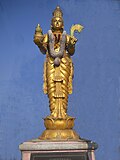
A number of Telugu words were found in the [[Sanskrit]] and [[Prakrit]] inscriptions of the [[Satavahana|Satavahana dynasty]], [[Vishnukundinas|Vishnukundina dynasty]], and [[Andhra Ikshvaku]]s.<ref name="The Times of India-2017"/> The coin legends of the Satavahanas, in all areas and all periods, used a [[Prakrit]] dialect without exception. Some reverse coin legends are in Telugu{{Sfn|Sinopoli|2001|p=163}}<ref name="MP">{{cite book |last=Pollock |first=Sheldon |title=The Language of the Gods in the World of Men: Sanskrit, Culture, and Power in Premodern India |publisher=University of California Press |year=2003 |isbn=978-0-5202-4500-6 |page=290}}</ref> and [[Tamil language|Tamil]] languages.<ref name="Taylor & Francis">{{cite book |last1=Yandell |first1=Keith E. |url=https://books.google.com/books?id=ucMeAgAAQBAJ&pg=PA253 |title=Religion and Public Culture: Encounters and Identities in Modern South India |last2=Paul |first2=John J. |publisher=Taylor & Francis |year=2013 |isbn=978-1-136-81808-0 |page=253 |access-date=3 March 2018 |archive-url=https://web.archive.org/web/20221013131438/https://books.google.com/books?id=ucMeAgAAQBAJ&pg=PA253 |archive-date=13 October 2022 |url-status=live}}</ref>[[File:Telugu talli bomma.JPG|thumb|Telugu Talli Bomma (statue of Mother Telugu), the personification of Telugu language in Andhra Pradesh]] | |||
=== Post-Ikshvaku period === | |||
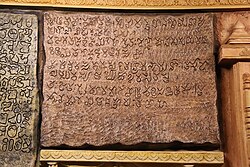
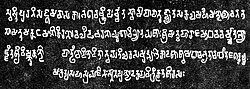
{{Main|Early Telugu epigraphy}}The period from the 4th century CE to 1022 CE marks the second phase of Telugu history, following the [[Andhra Ikshvaku]] period. The first long inscription entirely in Telugu, dated to 575 CE, is attributed to the [[Renati Chodas|Renati Choda]] king Dhanunjaya and found in the [[Kadapa district]].<ref name="Krishnamurti-2003" /><ref>{{cite book |last=Frawley |first=William J. |url=https://books.google.com/books?id=6ftQEAAAQBAJ&dq=first+inscription+that+is+entirely+in+Telugu,+dated+575&pg=RA3-PA219 |title=International Encyclopedia of Linguistics |date=1 May 2003 |publisher=Oxford University Press |isbn=978-0-19-977178-3 |page=219 |language=en}}</ref><ref name=BBC_Feb2022>{{cite news |last=రెడ్డి |first=తులసీ ప్రసాద్ |date=22 February 2022 |title=కడప జిల్లాలోని కలమల్ల శాసనమే తొలి తెలుగు శాసనమా? |language=te |work=BBC News తెలుగు |url=https://www.bbc.com/telugu/india-60467482 |access-date=5 April 2023 |trans-title=Is the Kalamalla inscription in Kadapa district the first Telugu inscription?}}</ref> | |||
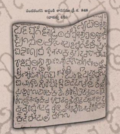
An early Telugu label inscription, "tolacuvānḍru" (తొలచువాండ్రు; {{Translation|rock carvers or quarrymen}}), is found on one of the rock-cut caves around the [[Keesaragutta Temple|Keesaragutta temple]], 35 kilometers from [[Hyderabad]].<ref>{{cite book |url=https://books.google.com/books?id=4gpDAAAAYAAJ&q=Telugu+label+inscription |title=Itihas |date=1989 |publisher=Director of State Archives, Government of Andhra Pradesh. |volume=15 |page=34 |language=en}}</ref><ref>{{cite book |last1=Reddy |first1=Emani Siva Nagi |url=https://books.google.com/books?id=lddOAAAAYAAJ&q=keesaragutta+telugu+inscription |title=Evolution of Building Technology: Early and Madieval [i.e. Medieval] in Andhradeśa |last2=Śivanāgireḍḍi |first2=Īmani |date=1998 |publisher=Bharatiya Kala Prakashan |isbn=978-81-86050-29-3 |page=315 |language=en}}</ref> This inscription is dated to the [[Vishnukundina dynasty|Vishnukundina]] period of around 400 CE<ref name="Government of Telangana">{{cite web |title=Ancient Temples of Telangana |url=http://anyflip.com/voxm/rlzk/basic |url-status=live |archive-url=https://web.archive.org/web/20171011122959/http://anyflip.com/voxm/rlzk/basic |archive-date=11 October 2017 |access-date=28 July 2017 |website= |publisher=Government of Telangana |page=47}}</ref><ref name="Namasthe Telangana-2022">{{cite web |date=10 January 2022 |title=విష్ణుకుండి రాజధాని కీసర |trans-title=Keesara, the capital of Vishnukundi|url=https://www.ntnews.com/editpage/editorial-article-news-5-398554 |access-date=6 April 2023 |website=[[Namasthe Telangana]] |language=te-IN}}</ref> and is the earliest known short Telugu inscription from the Telangana region.<ref name="Namasthe Telangana-2022" /> | |||
Several titles of [[Mahendravarman I]] in Telugu language, dated to {{Circa|600 CE}}, were inscribed on cave-inscriptions in Tamil Nadu.<ref>{{Cite web |page=323 |title=Mahendravarman I |date=1960 |url=https://archive.org/details/in.ernet.dli.2015.98114/page/n5}}</ref> | |||
From the 6th century onwards, complete Telugu inscriptions began to appear in districts neighbouring Kadapa such as Prakasam and [[Palnadu district|Palnadu]].<ref name="WebpageNotGIF" />{{Rp|page=10}} Metrically composed Telugu inscriptions and those with ornamental or literary prose appear from 630 CE.<ref name="Radhakrsna-1998">{{cite book |last=Rādhākr̥ṣṇa |first=Būdarāju |url=https://books.google.com/books?id=XFxkAAAAMAAJ&q=Metrically+composed+ |title=Occasional Papers in Language and Literature |date=1998 |publisher=Prachee Publications |isbn=978-81-7443-007-6 |page=126 |language=en}}</ref><ref name="Vijay">{{cite web |last=T. |first=Vijay Kumar |title=Translation as Negotiation: The Making of Telugu Language and Literature |url=https://ntm.org.in/download/ttvol/volume10-1/Translation-as-Negotiation-The%20Making-of-Telugu%20Language-and-Literature.pdf |pages=65, 67, 68}}</ref> The Madras Museum plates of Balliya Choda dated to the mid-ninth century CE, are the earliest copper plate grants in the Telugu language.<ref>{{cite book |author=D. C. Sircar |title=Indian Epigraphy |volume=10 |series=Epigraphy, Palaeography, Numismatics Series |publisher=Motilal Banarsidass Publ. |year=1996 |page=50}}</ref> | |||
Telugu was | During this period, Telugu was heavily influenced by Sanskrit and Prakrit, corresponding to the advent of Telugu literature. Initially, Telugu literature appeared in inscriptions and poetry in the courts of rulers, and later in written works, such as [[Nannayya]]'s ''[[Andhra Mahabharatam]]'' (1022 CE).<ref name="APOnline">{{cite web |title=Languages |url=http://www.aponline.gov.in/Quick%20links/HIST-CULT/languages.html |work=aponline.gov.in |archive-url=https://web.archive.org/web/20120208110254/http://www.aponline.gov.in/Quick%20links/HIST-CULT/languages.html |archive-date=8 February 2012}}</ref> | ||
=== Middle Ages === | === Middle Ages === | ||
The third phase is marked by further | The third phase is marked by further stylisation and sophistication of the literary languages. During this period the split of the [[Telugu script|Telugu]] from the [[Telugu-Kannada alphabet]] took place.<ref>{{cite book|title= The Dravidian Languages |last= Krishnamurti |first= Bhadriraju |year= 2003 |publisher= [[Cambridge University Press]] |isbn= 978-0-521-77111-5 |pages= [https://archive.org/details/dravidianlanguag00kris/page/n107 78]–79 |url=https://archive.org/details/dravidianlanguag00kris|url-access= limited}}</ref> | ||
=== Vijayanagara Empire === | === Vijayanagara Empire === | ||
The [[Vijayanagara Empire]] gained dominance from 1336 to the late 17th century, reaching its peak during the rule of [[Krishnadevaraya]] in the 16th century, when Telugu literature experienced what is considered its [[Golden Age]].<ref name="APOnline" /> | The [[Vijayanagara Empire]] gained dominance from 1336 to the late 17th century, reaching its peak during the rule of [[Krishnadevaraya]] in the 16th century, when Telugu literature experienced what is considered its [[Golden Age]].<ref name="APOnline" /> The 15th-century Venetian explorer [[Niccolò de' Conti]], who visited the [[Vijayanagara Empire]], found that the words in the Telugu language end with vowels, just like those in [[Italian language|Italian]], and hence referred to it as "The Italian of the East";<ref>{{cite news |last=Rao |first=M. Malleswara |date=22 December 2012 |title=When foreigners fell in love with Telugu language |url=https://www.thehindu.com/todays-paper/tp-national/when-foreigners-fell-in-love-with-telugu-language/article4227784.ece |url-status=live |archive-url=https://web.archive.org/web/20200808053858/https://www.thehindu.com/todays-paper/tp-national/when-foreigners-fell-in-love-with-telugu-language/article4227784.ece |archive-date=8 August 2020 |access-date=15 July 2019 |newspaper=The Hindu}}</ref> a saying that has been widely repeated.<ref name="Morris2005">{{cite book |last=Morris |first=Henry |url=https://books.google.com/books?id=P0AOJBShvRAC&pg=PA86 |title=A Descriptive and Historical Account of the Godavery District in the Presidency of Madras |publisher=Asian Educational Services |year=2005 |isbn=978-81-206-1973-9 |page=86 |access-date=29 January 2017 |archive-url=https://web.archive.org/web/20221013131427/https://books.google.com/books?id=P0AOJBShvRAC&pg=PA86 |archive-date=13 October 2022 |url-status=live}}</ref> | ||
=== Delhi Sultanate and | === Delhi Sultanate, Qutb Shahi, and Nizam era === | ||
A distinct dialect developed in present-day [[ | A distinct dialect developed in present-day [[Hyderabad]] region, due to [[Persian language|Persian]] and [[Arabic]] influence. This influence began with the establishment of the [[Delhi Sultanate]] rule by the [[Tughlaq dynasty]] in the northern Deccan Plateau during the 14th century. | ||
In the | In the latter half of the 17th century, the [[Mughal Empire]] extended further south, culminating in the establishment of the [[Hyderabad State]] by the dynasty of the [[Nizam of Hyderabad]] in 1724. This heralded an era of [[Persian literature|Persian]] influence on the Telugu language, especially Hyderabad State. The effect is also evident in the prose of the early 19th century, as in the ''[[kaifiyat]]s''.<ref name="APOnline" /> | ||
=== Colonial period === | === Colonial period === | ||
In the late 19th and the early 20th centuries, the influence of the [[English language]] was seen, and modern communication/printing press arose as an effect of [[British Raj|British rule]], especially in the areas that were part of the [[Madras Presidency]]. Literature from this time had a mix of classical and modern traditions and included works by such scholars as [[Gidugu Venkata Ramamoorty]], [[Kandukuri Veeresalingam]], [[Gurajada Apparao]], Gidugu Sitapati and [[Panuganti Lakshminarasimha Rao]].<ref name="APOnline" /> | |||
In the | In the princely [[Hyderabad State]], the [[Andhra Mahasabha]] was started in 1921 with the main goal of promoting Telugu language, literature, its books and historical research. Key figures in this movement included [[Madapati Hanumantha Rao]] (founder of the Andhra Mahasabha), [[Komarraju Venkata Lakshmana Rao]] (founder of the Library Movement in Hyderabad State), and [[Suravaram Pratapa Reddy]].<ref>{{cite book |last1=Sundarayya |first1=Puccalapalli |url=https://books.google.com/books?id=TPjIh1G0TmcC&dq=%22Andhra+Mahasabha%22+-wikipedia&pg=PA12 |title=Telangana People's Struggle and Its Lessons |last2=Chattopadhyaya |first2=Harindranath |date=1972 |publisher=Foundation Books |isbn=978-81-7596-316-0 |page=12 |language=en}}</ref> | ||
Since the 1930s, what was considered an "elite" literary form of the Telugu language has now spread to the common people with the introduction of [[mass media]] like movies, television, radio and newspapers. This form of the language is also taught in schools and colleges as a standard.<ref>{{ | Since the 1930s, what was considered an "elite" literary form of the Telugu language has now spread to the common people with the introduction of [[mass media]] like movies, television, radio and newspapers. This form of the language is also taught in schools and colleges as a standard.<ref>{{cite book |last1=Krishnamurti |first1=Bhadriraju |title=A Grammar of Modern Telugu |last2=Gwynn |first2=J.P.L. |publisher=Oxford University Press |year=1985 |location=New Delhi}}</ref> | ||
=== Post-independence period === | === Post-independence period === | ||
Telugu is one of the 22 [[languages with official status in India]].<ref>{{cite web |title=PART A Languages specified in the Eighth Schedule (Scheduled Languages) |url=http://censusindia.gov.in/Census_Data_2001/Census_Data_Online/Language/Statement1.htm |archive-url=https://web.archive.org/web/20131029190612/http://censusindia.gov.in/Census_Data_2001/Census_Data_Online/Language/Statement1.htm |archive-date=29 October 2013}}</ref> The Andhra Pradesh Official Language Act, 1966, declares Telugu the official language of the state that is currently divided into Andhra Pradesh and Telangana.<ref>{{cite news |last=Rao |first=M. Malleswara |title=Telugu declared official language |newspaper=[[The Hindu]] |date=18 September 2005 |url=http://www.hindu.com/2005/09/18/stories/2005091803740600.htm |access-date=16 July 2007 |archive-date=10 August 2007 |archive-url=https://web.archive.org/web/20070810140217/http://www.hindu.com/2005/09/18/stories/2005091803740600.htm }}</ref><ref name="APOnline2">{{cite web|url=http://www.aponline.gov.in/Quick%20links/hist-cult/history_post.html|title=AP Fact File: Post-Independence Era|work=aponline.gov.in|archive-url=https://web.archive.org/web/20131220113947/http://www.aponline.gov.in/quick%20links/hist-cult/history_post.html|archive-date=20 December 2013}}</ref> It also has official language status in the [[Yanam district]] of the [[union territory]] of [[Puducherry (union territory)|Puducherry]]. It is the fourth most spoken Indian language in India after [[Hindi]], [[Bengali language|Bengali]] and [[Marathi language|Marathi]].<ref>{{cite news |last1=Jain |first1=Bharti |date=27 June 2018 |title=Hindi mother tongue of 44% in India, Bangla second most-spoken |work=The Economic Times |url=https://economictimes.indiatimes.com/news/politics-and-nation/hindi-mother-tongue-of-44-in-india-bangla-second-most-spoken/articleshow/64759135.cms |access-date=27 June 2018}}</ref> It is one of the six [[Classical Languages of India|classical languages of India]].<ref name="antiquity">{{cite web |title=Declaration of Telugu and Kannada as classical languages |url=http://pib.nic.in/release/release.asp?relid=44340 |archive-url=https://web.archive.org/web/20081216124306/http://pib.nic.in/release/release.asp?relid=44340 |archive-date=16 December 2008 |access-date=31 October 2008 |work=Press Information Bureau |publisher=Ministry of Tourism and Culture, Government of India}}</ref><ref name="classical">{{cite news |date=1 October 2008 |title=Telugu gets classical status |newspaper=[[The Times of India]] |url=http://timesofindia.indiatimes.com/Hyderabad/Telugu_gets_classical_status/articleshow/3660521.cms |access-date=1 November 2008 |archive-url=https://web.archive.org/web/20081104015938/http://timesofindia.indiatimes.com/Hyderabad/Telugu_gets_classical_status/articleshow/3660521.cms |archive-date=4 November 2008}}</ref> | |||
[[Telugu Language Day]] is celebrated every year on 29 August, the birthday of Telugu poet [[Gidugu Venkata Ramamurthy]].<ref>{{cite news|date=26 August 2010|title=Telugu Language Day on August 29|language=en-IN|work=The Hindu|url=https://www.thehindu.com/todays-paper/tp-national/tp-andhrapradesh/Telugu-Language-Day-on-August-29/article16145571.ece|access-date=4 December 2020|issn=0971-751X|archive-date=22 October 2020|archive-url=https://web.archive.org/web/20201022221551/https://www.thehindu.com/todays-paper/tp-national/tp-andhrapradesh/Telugu-Language-Day-on-August-29/article16145571.ece|url-status=live}}</ref><ref>{{cite news|title=Telugu Language Day 2020: 6 Tollywood songs that emphasize the importance of Telugu language|url=https://timesofindia.indiatimes.com/entertainment/telugu/movies/news/telugu-language-day-2020-6-tollywood-songs-that-emphasize-the-importance-of-telugu-language/articleshow/77818454.cms|access-date=4 December 2020|website=The Times of India|language=en|archive-date=15 April 2021|archive-url=https://web.archive.org/web/20210415110338/https://timesofindia.indiatimes.com/entertainment/telugu/movies/news/telugu-language-day-2020-6-tollywood-songs-that-emphasize-the-importance-of-telugu-language/articleshow/77818454.cms|url-status=live}}</ref> The fourth [[World Telugu Conference]] was organised in [[Tirupati]] in the last week of December 2012. Issues related to [[Telugu language policy]] were deliberated at length.<ref>{{cite web |author=B. Prabhakara Sarma |date=6 December 2012 |title=World Telugu Conference: Then and now |url=http://www.thehindu.com/news/cities/Hyderabad/world-telugu-conference-then-and-now/article4167022.ece |access-date=3 February 2013 |work=The Hindu}}</ref><ref>{{cite web |author=V. |first=Rishi Kumar |date= |title=Tirupathi to host World Telugu Conference |url=http://www.thehindubusinessline.com/news/states/tirupathi-to-host-world-telugu-conference/article4130001.ece |access-date=3 February 2013 |website=[[Business Line]] |publisher=}}</ref> The American Community Survey has said that data for 2016 which were released in September 2017 showed Telugu is the third most widely spoken Indian language in the US. Hindi tops the list followed by Gujarati, as of the [[2010 United States Census|2010 census]].<ref>{{cite web |url= https://www.census.gov/ |title= Language spoken at home by ability to speak english for the population 5 years and over |work= [[United States Census Bureau]] |access-date= 2 December 2017 |archive-date= 27 December 1996 |archive-url= https://web.archive.org/web/19961227012639/https://www.census.gov/ |url-status= live}} Note: Excluding other languages with many speakers outside India such as Urdu</ref><ref>{{cite web |last=Bhattacharya |first=Ananya |date=24 September 2018 |title=America's fastest growing foreign language is from south India |url=https://qz.com/india/1399825/telugu-is-uss-fastest-growing-foreign-language/ |url-status=live |archive-url=https://web.archive.org/web/20220812083339/https://qz.com/india/1399825/telugu-is-uss-fastest-growing-foreign-language/ |archive-date=12 August 2022 |access-date=12 August 2022 |website=Quartz |language=en}}</ref> | |||
In the Indian subcontinent, a command over the Telugu language, alongside [[Sanskrit]], [[Tamil language|Tamil]], [[Meitei language|Meitei]], [[Odia language|Oriya]], [[Persian language in the Indian subcontinent|Persian]], or [[Arabic]], is highly appreciated and respected for learning dances (most significantly [[Indian Classical Dance]]s) as dancers could have the tools of these languages to go into the primary material texts.<ref>{{cite book |last1=Munsi |first1=Urmimala Sarkar |url=https://books.google.com/books?id=bKepAgAAQBAJ&dq=classical+language+meitei&pg=PT35 |title=Traversing Tradition: Celebrating Dance in India |last2=Burridge |first2=Stephanie |date=2012 |publisher=[[Routledge]], [[Taylor & Francis]] |isbn=978-1-136-70378-2 |location=en |page=35 |language=en |quote=... This means a command of Sanskrit, Tamil, Telugu, Oriya, Meitei, Persian, or Arabic. ...}}</ref> | |||
== Geographic distribution == | == Geographic distribution == | ||
{{Main | {{Main|States of India by Telugu speakers}} | ||
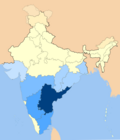
[[File:Telugu speakers in India.png|thumb|Geographic distribution of Telugu immigrants in light blue; Telugu is native to dark blue.]] | [[File:Telugu speakers in India.png|thumb|Geographic distribution of Telugu immigrants in light blue; Telugu is native to dark blue.]] | ||
Telugu is natively spoken in the states of [[Andhra Pradesh]] and [[Telangana]] and [[Yanam (India)|Yanam]] district of [[Puducherry (union territory)|Puducherry]]. Telugu speakers are also found in the | Telugu is natively spoken in the states of [[Andhra Pradesh]] and [[Telangana]] and [[Yanam (India)|Yanam]] district of [[Puducherry (union territory)|Puducherry]]. Telugu speakers are also found in the neighbouring states of [[Tamil Nadu]], [[Karnataka]], [[Maharashtra]], [[Odisha]], [[Chhattisgarh]], some parts of [[Jharkhand]], and the [[Kharagpur, West Bengal|Kharagpur]] region of [[West Bengal]] in India. Many Telugu immigrants are also found in the states of [[Andaman and Nicobar Islands]], [[Gujarat]], [[Goa]], [[Bihar]], [[Kashmir]], [[Uttar Pradesh]], [[Punjab]], [[Haryana]], and [[Rajasthan]]. {{As of|2018}} 7.2% of the population, Telugu is the fourth-most-spoken native language in India after [[Hindi]], [[Bengali language|Bengali]], and [[Marathi language|Marathi]]. In [[Karnataka]], 7.0% of the population speak Telugu, and 5.6% in [[Tamil Nadu]].<ref name="Censusindia.gov.in">{{cite web |url=https://censusindia.gov.in/2011census/C-16.html |title=Census of India Website: Office of the Registrar General & Census Commissioner, India |publisher=Censusindia.gov.in |access-date=22 March 2022 |archive-date=28 July 2020 |archive-url=https://web.archive.org/web/20200728125958/https://www.censusindia.gov.in/2011census/C-16.html |url-status=live}}</ref> | ||
There are more than | There are more than 400,000 [[Telugu Americans]] in the [[United States]].<ref>{{cite news |date=March 2023 |title=Telugu population figure worldwide |newspaper=[[Ethnologue]] |url=https://www.ethnologue.com/language/tel}}</ref><ref>{{cite web |date=19 September 2018 |title=Almost Half Speak a Foreign Language in America's Largest Cities |url=https://cis.org/Report/Almost-Half-Speak-Foreign-Language-Americas-Largest-Cities |last1=Zeigler |first1=Karen |last2=Camarota |first2=Steven A. }}</ref> {{As of|2018}}, Telugu is the fastest-growing [[Languages of the United States|language in the United States]], (especially in [[Indians in New Jersey|New Jersey]] and [[Indians in the New York City metropolitan area|New York City]]), with the number of Telugu speakers in the United States increasing by 86% between 2010 and 2017.<ref>{{cite news|title=Do you speak Telugu? Welcome to America|publisher=BBC News|date=20 October 2018|url=https://www.bbc.com/news/world-45902204|access-date=24 December 2019|archive-date=13 December 2019|archive-url=https://web.archive.org/web/20191213071110/https://www.bbc.com/news/world-45902204|url-status=live}}</ref> {{As of|2021}}, it is the 18th most spoken [[Languages of the United States|native language in the United States]] and the third most spoken South Asian language after [[Hindi]] and [[Urdu]].<ref name="ACS2021">{{cite web |title=ACS B16001 |url=https://data.census.gov/table?q=B16001:+LANGUAGE+SPOKEN+AT+HOME+BY+ABILITY+TO+SPEAK+ENGLISH+FOR+THE+POPULATION+5+YEARS+AND+OVER&g=0100000US&tid=ACSDT1Y2021.B16001&moe=true |access-date=26 December 2022 |website=ACS B16001 |publisher=U.S. Census Bureau}}</ref> Minority Telugus are also found in [[Australia]], [[New Zealand]], [[Bahrain]], [[Canada]], [[Fiji]], [[Malaysia]], [[Sri Lanka]], [[Singapore]], [[Mauritius]], [[Myanmar]], [[Europe]] ([[Italy]], the [[United Kingdom]]), [[South Africa]], [[Trinidad and Tobago]], and the [[United Arab Emirates]].<ref name="Oonk-2007"/><ref>{{cite book |last1=Rajan |first1=S. Irudaya |url=https://books.google.com/books?id=jm21DwAAQBAJ&dq=telugu+people+gulf&pg=PA281 |title=India's Low-Skilled Migration to the Middle East: Policies, Politics and Challenges |last2=Saxena |first2=Prem |date=10 October 2019 |publisher=Springer Nature |isbn=978-981-13-9224-5 |language=en |access-date=14 August 2022 |archive-url=https://web.archive.org/web/20221013130925/https://books.google.com/books?id=jm21DwAAQBAJ&dq=telugu+people+gulf&pg=PA281 |archive-date=13 October 2022 |url-status=live}}</ref> | ||
== Legal status == | == Legal status == | ||
Telugu is the [[official language]] of the Indian states of [[Andhra Pradesh]] and [[Telangana]]. It is one of the [[Languages with official status in India|22 languages under schedule 8 of the constitution of India]]. It is one of the official languages of the union territories of [[Puducherry (union territory)|Puducherry]]. Telugu is a protected language in [[South Africa]]. According to the [[Constitution of South Africa]], the [[Pan South African Language Board]] must promote and ensure respect for Telugu along with other languages.<ref>{{cite web|title=Constitution of the Republic of South Africa, 1996 – Chapter 1: Founding Provisions {{!}} South African Government|url=https://www.gov.za/documents/constitution/chapter-1-founding-provisions|access-date=2021 | Telugu is the [[official language]] of the Indian states of [[Andhra Pradesh]] and [[Telangana]]. It is one of the [[Languages with official status in India|22 languages under schedule 8 of the constitution of India]]. It is one of the official languages of the union territories of [[Puducherry (union territory)|Puducherry]]. Telugu is a protected language in [[South Africa]]. According to the [[Constitution of South Africa]], the [[Pan South African Language Board]] must promote and ensure respect for Telugu along with other languages.<ref>{{cite web|title=Constitution of the Republic of South Africa, 1996 – Chapter 1: Founding Provisions {{!}} South African Government|url=https://www.gov.za/documents/constitution/chapter-1-founding-provisions|access-date=6 January 2021|website=gov.za|archive-date=18 May 2019|archive-url=https://web.archive.org/web/20190518042037/https://www.gov.za/documents/constitution/chapter-1-founding-provisions|url-status=live}}</ref> The [[Government of South Africa]] announced that Telugu will be re-included as an official subject in the South African schools after it was removed from the curriculum in state schools.<ref>{{cite web |date=21 March 2014 |title=Telugu to be an official subject in South African schools |url=https://www.thehansindia.com/posts/index/Education-and-Careers/2014-03-21/Telugu-to-be-an-official-subject-in-South-African-schools/89751 |url-status=live |archive-url=https://web.archive.org/web/20221013130925/https://www.thehansindia.com/posts/index/Education-and-Careers/2014-03-21/Telugu-to-be-an-official-subject-in-South-African-schools/89751 |archive-date=13 October 2022 |access-date=12 August 2022 |website=[[The Hans India]] |language=en}}</ref> | ||
In addition, with the creation in October 2004 of a legal status for classical languages by the [[Government of India]] | In addition, with the creation in October 2004 of a legal status for classical languages by the [[Government of India]] on 8 August 2008, Telugu was also given classical language status due to several campaigns.<ref>{{cite web|title=Vice President stresses the need to preserve and promote classical languages|url=http://pib.gov.in/Pressreleaseshare.aspx?PRID=1599865|access-date=6 January 2021|website=pib.gov.in|language=en|archive-date=9 January 2021|archive-url=https://web.archive.org/web/20210109141713/https://pib.gov.in/Pressreleaseshare.aspx?PRID=1599865|url-status=live}}</ref><ref name="The Times of India-2017"/><ref>{{cite web |date=14 January 2020 |title=Explained: How is a language declared 'classical' in India, what benefits it enjoys |url=https://indianexpress.com/article/explained/explained-how-is-a-language-declared-classical-in-india-what-benefits-it-enjoys-6216415/ |url-status=live |archive-url=https://web.archive.org/web/20210107165557/https://indianexpress.com/article/explained/explained-how-is-a-language-declared-classical-in-india-what-benefits-it-enjoys-6216415/ |archive-date=7 January 2021 |access-date=6 January 2021 |website=The Indian Express |language=en}}</ref> | ||
== Epigraphical records == | |||
{{Main|Early Telugu epigraphy}} | |||
According to the famous Japanese historian [[Noboru Karashima]] who served as the president of the Epigraphical Society of India in 1985, there are approximately 10,000 inscriptions which exist in the Telugu language as of the year 1996 making it one of the most densely inscribed languages.<ref name="Morrison 1997 2182"/> Telugu inscriptions are found in all the districts of [[Andhra Pradesh]] and Telangana.{{Refn|<ref name="Government of Telangana"/><ref name="WebpageNotGIF">{{cite journal |url=https://dsal.uchicago.edu/books/socialscientist/pager.html?objectid=HN681.S597_269-71_012.gif |title=Emergence of Regional Identity and Beginning of Vernacular Literature: A Case Study of Telugu |journal=Social Scientist |volume=23 |number=10–12 |pages=8–23 |doi=10.2307/3517880 |jstor=3517880 |year=1995 |last1=Nagaraju |first1=S. |access-date=20 February 2021 |archive-date=13 April 2021 |archive-url=https://web.archive.org/web/20210413224331/https://dsal.uchicago.edu/books/socialscientist/pager.html?objectid=HN681.S597_269-71_012.gif |url-status=live|url-access=subscription }}</ref><ref name=gi>{{cite book |url=https://books.google.com/books?id=CMskDQAAQBAJ&pg=PA421 |title=The Language of the Gods in the World of Men |first=Sheldon |last=Pollock |page=421 |isbn=978-0-520-24500-6 |date=23 May 2006 |publisher=University of California Press |access-date=3 December 2017 |archive-date=13 October 2022 |archive-url=https://web.archive.org/web/20221013131427/https://books.google.com/books?id=CMskDQAAQBAJ&pg=PA421 |url-status=live}}</ref><ref name=yo>{{cite book |url=https://books.google.com/books?id=HSfoCwAAQBAJ&pg=PA263 |title=Precolonial India in Practice: Society, Region, and Identity in Medieval Andhra |first=Cynthia |last=Talbot |pages=50, 263 |isbn=978-0-19-513661-6 |year=2001 |publisher=Oxford University Press |access-date=16 August 2019 |archive-date=13 October 2022 |archive-url=https://web.archive.org/web/20221013131428/https://books.google.com/books?id=HSfoCwAAQBAJ&pg=PA263 |url-status=live}}</ref>}} They are also found in Karnataka, Tamil Nadu, Odisha, and Chhattisgarh.{{Refn|<ref name=yo/><ref name=fe>{{cite book |url=https://books.google.com/books?id=fBchTO0NS0EC&pg=PA45 |title=Language, Emotion, and Politics in South India: The Making of a Mother Tongue |first=Lisa |last=Mitchell |page=45 |isbn=978-0-253-35301-6 |year=2009 |publisher=Indiana University Press |access-date=16 August 2019 |archive-date=13 October 2022 |archive-url=https://web.archive.org/web/20221013131428/https://books.google.com/books?id=fBchTO0NS0EC&pg=PA45 |url-status=live}}</ref><ref name = as>{{cite book |url=https://books.google.com/books?id=jUwFL3IipK0C&pg=PA161 |title=Dimensions of Human Cultures in Central India: Professor S.K. Tiwari Felication Volume |editor=A.A. Abbasi |page=161 |isbn=978-81-7625-186-0 |year=2001 |publisher=Sarup & Sons |access-date=2 December 2017 |archive-date=13 October 2022 |archive-url=https://web.archive.org/web/20221013131429/https://books.google.com/books?id=jUwFL3IipK0C&pg=PA161 |url-status=live}}</ref><ref>{{cite book |url=https://books.google.com/books?id=XYrG07qQDxkC&pg=PA100 |title=Indian Epigraphy: A Guide to the Study of Inscriptions in Sanskrit, Prakrit, and Other Indo-European Languages |first=Richard |last=Salomon |page=100 |isbn=978-0-19-535666-3 |date=10 December 1998 |publisher=Oxford University Press |access-date=16 August 2019 |archive-date=13 October 2022 |archive-url=https://web.archive.org/web/20221013131429/https://books.google.com/books?id=XYrG07qQDxkC&pg=PA100 |url-status=live}}</ref>}} According to recent estimates by ASI (Archaeological Survey of India) the number of inscriptions in the Telugu language goes up to 14,000.<ref name="WebpageNotGIF" /><ref>{{cite book |url=https://books.google.com/books?id=pfAKljlCJq0C&q=telugu+inscriptions+in+adilabad+district+pre+colonial&pg=PA50 |title=Precolonial India in Practice: Society, Region, and Identity in Medieval Andhra |isbn=978-0-19-803123-9 |last1=Talbot |first1=Cynthia |date=20 September 2001 |publisher=Oxford University Press |access-date=3 October 2020 |archive-date=13 October 2022 |archive-url=https://web.archive.org/web/20221013131430/https://books.google.com/books?id=pfAKljlCJq0C&q=telugu+inscriptions+in+adilabad+district+pre+colonial&pg=PA50 |url-status=live}}</ref> Adilabad, Medak, Karimnagar, Nizamabad, Ranga Reddy, Hyderabad, Mahbubnagar, Anantapur, Chittoor and Srikakulam produced only a handful of Telugu inscriptions in the Kakatiya era between 1135 CE and 1324 CE.<ref>{{cite book |url=https://books.google.com/books?id=pfAKljlCJq0C&q=telugu+inscriptions+in+adilabad+district+pre+colonial&pg=PA50 |title=Precolonial India in Practice: Society, Region, and Identity in Medieval Andhra |first=Cynthia |last=Talbot |date=20 September 2001 |publisher=Oxford University Press |via=Google Books |isbn=978-0-19-803123-9 |access-date=3 October 2020 |archive-date=13 October 2022 |archive-url=https://web.archive.org/web/20221013131430/https://books.google.com/books?id=pfAKljlCJq0C&q=telugu+inscriptions+in+adilabad+district+pre+colonial&pg=PA50 |url-status=live}}</ref><ref>{{cite web |url=https://books.google.com/books?id=KVzUAAAAMAAJ&q=telugu+inscriptions+in+adilabad |title=Gifts to Gods and Brahmins: A Study of Religious Endowments in Medieval Andhra |first=Cynthia |last=Talbot |date=15 July 1988 |publisher=[[University of Wisconsin–Madison]] |via=Google Books |access-date=3 October 2020 |archive-date=13 October 2022 |archive-url=https://web.archive.org/web/20221013131436/https://books.google.com/books?id=KVzUAAAAMAAJ&q=telugu+inscriptions+in+adilabad |url-status=live}}</ref> | |||
== Geographical influence == | == Geographical influence == | ||
=== Telugu region boundaries === | === Telugu region boundaries === | ||
Andhra is characterised as having its own mother tongue, and its territory has been equated with the extent of the Telugu language. The equivalence between the Telugu linguistic sphere and the geographical boundaries of Andhra is also brought out in an eleventh-century description of Andhra boundaries. Andhra, according to this text, was bounded in north by Mahendra mountain in the modern [[Ganjam district]] in [[Odisha]] and to the south by [[Srikalahasteeswara temple]] in [[ | Andhra is characterised as having its own mother tongue, and its territory has been equated with the extent of the Telugu language. The equivalence between the Telugu linguistic sphere and the geographical boundaries of Andhra is also brought out in an eleventh-century description of Andhra boundaries. Andhra, according to this text, was bounded in north by Mahendra mountain in the modern [[Ganjam district]] in [[Odisha]] and to the south by [[Srikalahasteeswara temple]] in [[Tirupati district]].<ref>{{Cite book |last=Talbot |first=Cynthia |url=https://books.google.com/books?id=pfAKljlCJq0C&pg=PA36 |title=Precolonial India in Practice: Society, Region, and Identity in Medieval Andhra |date=2001-09-20 |publisher=Oxford University Press |isbn=978-0-19-803123-9 |page=36 |language=en}}</ref> However, [[Andhra]] extended westwards as far as [[Srisailam]] in [[Nandyal district]], about halfway across the modern state.<ref name = a>{{cite book |first=Cynthia |last=Talbot |title=Precolonial India in Practice: Society, Region, and Identity in Medieval Andhra |url=https://books.google.com/books?id=pfAKljlCJq0C&pg=PA34 |date=20 September 2001 |publisher=Oxford University Press |isbn=978-0-19-803123-9 |pages=34– |access-date=17 May 2017 |archive-date=13 October 2022 |archive-url=https://web.archive.org/web/20221013131430/https://books.google.com/books?id=pfAKljlCJq0C&pg=PA34 |url-status=live}}</ref> According to other sources in the early sixteenth century, the northern boundary is [[Varaha Lakshmi Narasimha temple, Simhachalam|Simhachalam]] and the southern limit is [[Tirumala]] of the Telugu ation.<ref name = b>{{cite book|author1=Velcheru Narayana Rao|first2=David|last2=Shulman|title=Classical Telugu Poetry: An Anthology|url=https://books.google.com/books?id=r8UkDQAAQBAJ&pg=PA6|year=2002|publisher=Univ of California Press|isbn=978-0-520-22598-5|pages=6–|access-date=17 May 2017|archive-date=13 October 2022|archive-url=https://web.archive.org/web/20221013131434/https://books.google.com/books?id=r8UkDQAAQBAJ&pg=PA6|url-status=live}}</ref><ref name= c>{{cite book|title=International Journal of Dravidian Linguistics: IJDL.|url=https://books.google.com/books?id=_XVkAAAAMAAJ|year=2004|publisher=Department of Linguistics, University of Kerala.|access-date=17 May 2017|archive-date=13 October 2022|archive-url=https://web.archive.org/web/20221013131430/https://books.google.com/books?id=_XVkAAAAMAAJ|url-status=live}}</ref><ref name= d>{{cite book|first=Ajay K.|last=Rao|title=Re-figuring the Ramayana as Theology: A History of Reception in Premodern India|url=https://books.google.com/books?id=OUyvBAAAQBAJ&pg=PA37|date=3 October 2014|publisher=Routledge|isbn=978-1-134-07735-9|pages=37–|access-date=17 May 2017|archive-date=13 October 2022|archive-url=https://web.archive.org/web/20221013131431/https://books.google.com/books?id=OUyvBAAAQBAJ&pg=PA37|url-status=live}}</ref><ref name = e>{{cite book|author=S. Krishnaswami Aiyangar|title=Evolution of Hindu Administrative Institutions in South India|url=https://books.google.com/books?id=6jRR9yu-u4kC&pg=PA6|year=1994|publisher=Asian Educational Services|isbn=978-81-206-0966-2|pages=6–|access-date=17 May 2017|archive-date=13 October 2022|archive-url=https://web.archive.org/web/20221013131434/https://books.google.com/books?id=6jRR9yu-u4kC&pg=PA6|url-status=live}}</ref><ref name= f>{{cite book|first=Cynthia|last=Talbot|title=Precolonial India in Practice: Society, Region, and Identity in Medieval Andhra|url=https://books.google.com/books?id=HSfoCwAAQBAJ&pg=PA195|year=2001|publisher=Oxford University Press|isbn=978-0-19-513661-6|pages=195–|access-date=17 May 2017|archive-date=13 October 2022|archive-url=https://web.archive.org/web/20221013131942/https://books.google.com/books?id=HSfoCwAAQBAJ&pg=PA195|url-status=live}}</ref><ref name=g>{{cite book|first=Sambaiah|last=Gundimeda|title=Dalit Politics in Contemporary India|url=https://books.google.com/books?id=WqXbCgAAQBAJ&pg=PT205|date=14 October 2015|publisher=Routledge|isbn=978-1-317-38104-4|pages=205–}}</ref> | ||
=== Telugu | === Telugu Place Names === | ||
{{Main|Place names in India}} | {{Main|Place names in India}} | ||
Telugu place names are present all around Andhra Pradesh and Telangana. Common suffixes are -''ooru, -pudi, -padu, -peta, -pattanam, -wada,'' -''gallu, -cherla, -seema, -gudem, -palle, -palem, -konda, -veedu, -valasa, -pakam, -paka, -prolu, -wolu, -waka, -ili, -kunta, -parru, -villi, -gadda, -kallu, -eru, -varam,-puram,-pedu'' and -''palli''. Examples that use this nomenclature are [[Nellore]], [[Tadepalligudem]], [[Guntur]], [[Chintalapudi, West Godavari district|Chintalapudi]], [[Yerpedu]], [[Narasaraopeta]], [[Sattenapalle]], [[Visakapatnam]], [[Vizianagaram]], [[Ananthagiri Hills|Ananthagiri]], [[Vijayawada]], [[Vuyyuru]], [[Macherla]], [[Poranki]], [[Ramagundam]], [[Warangal]], [[Mancherial]], [[Peddapalli]], [[Siddipet]], [[Pithapuram]], [[Banswada]], and [[Miryalaguda]]. | |||
== Dialects and Teluguoid languages == | |||
[[File:Andhra Pradesh districts map.svg|thumb|Andhra Pradesh before [[Bifurcation of Andhra Pradesh|bifurcation]] (1956–2014)]] | |||
{{Main|Telangana dialect}} | |||
There are four regional dialects in Telugu:<ref name="A Grammar of Modern Telugu">{{cite book |last1=Bhadriraju |first1=Krishnamurti |title=A Grammar of Modern Telugu |last2=Gwynn |first2=J.P.L. |publisher=Oxford University Press |year=1985 |location=New Delhi |pages=xvii-xviii}}</ref> | |||
* | * Northern: [[Telangana dialect|Telangana]] | ||
* Southern: [[Rayalaseema]] | |||
* Central: [[Coastal Andhra]] | |||
* Eastern: [[North Andhra]] | |||
Colloquially, [[Telangana]], [[Rayalaseema]] and [[Coastal Andhra]] dialects are considered the three Telugu dialects and regions.<ref name="CaffarelMartin2004">{{cite book|last1=Caffarel|first1=Alice|last2=Martin|first2=J. R.|author-link2=J.R. Martin|last3=Matthiessen|first3=Christian M. I. M.|author-link3=C.M.I.M. Matthiessen|title=Language Typology: A Functional Perspective|url=https://books.google.com/books?id=vJGjDlLPQ_IC&pg=PA434|access-date=19 November 2016|year=2004|publisher=John Benjamins Publishing|isbn=978-1-58811-559-1|page=434|archive-date=13 October 2022|archive-url=https://web.archive.org/web/20221013131948/https://books.google.com/books?id=vJGjDlLPQ_IC&pg=PA434|url-status=live}}</ref> | |||
[[Waddar language|Waddar]], [[Chenchu language|Chenchu]], [[Mukha-Dora language|Mukha-Dora]], and [[Manna-Dora language|Manna-Dora]] are all closely related to Telugu.<ref>{{glotto|telu1265|Teluguic}}</ref> Other dialects of Telugu are Berad, Dasari, Dommara, Golari, Kamathi, Komtao, Konda-Reddi, Salewari, Vadaga, Vadari Bangalore, and Yanadi.<ref>{{cite web |url=https://www.ethnologue.com/language/tel |title=Telugu |work=Ethnologue (Free All) |publisher=Ethnologue |access-date=30 March 2016 |archive-date=19 August 2018 |archive-url=https://web.archive.org/web/20180819015319/https://www.ethnologue.com/language/tel |url-status=live}}</ref> | |||
== Phonology == | |||
[[File:WIKITONGUES- Naren speaking Telugu.webm|thumb|A man speaking Telugu.]] | |||
[[File:WIKITONGUES- Manjusha speaking Telugu.webm|thumb|A woman speaking Telugu.]] | |||
The Roman transliteration used for transcribing the Telugu script is the [[National Library at Kolkata romanisation]]. | The Roman transliteration used for transcribing the Telugu script is the [[National Library at Kolkata romanisation]]. | ||
Telugu words generally end in vowels. In | Telugu words generally end in vowels. In Classical Telugu, this was absolute; in the modern language ''m, n, y, w'' may end a word. Sanskrit loans have introduced aspirated and murmured consonants as well. | ||
Telugu does not have [[contrastive stress]], and speakers vary on where they perceive stress. Most place it on the penultimate or final syllable, depending on word and vowel length.<ref>Lisker and Krishnamurti (1991), "Lexical stress in a 'stressless' language: judgments by Telugu- and English-speaking linguists." ''Proceedings of the XII International Congress of Phonetic Sciences'' (Université de Provence), 2:90–93.</ref> | Telugu does not have [[contrastive stress]], and speakers vary on where they perceive stress. Most place it on the penultimate or final syllable, depending on word and vowel length.<ref>Lisker and Krishnamurti (1991), "Lexical stress in a 'stressless' language: judgments by Telugu- and English-speaking linguists." ''Proceedings of the XII International Congress of Phonetic Sciences'' (Université de Provence), 2:90–93.</ref> | ||
=== Consonants === | === Consonants === | ||
The table below lists the | The table below lists the consonant phonemes of Telugu,<ref name="Krishnamurti">Krishnamurti (1998), "Telugu". In Steever (ed.), ''The Dravidian Languages''. Routledge. pp. 202–240, 260</ref><ref name="Bhaskararao-2017">{{cite journal |last1=Bhaskararao |first1=Peri |last2=Ray |first2=Arpita |date=2017 |title=Illustrations of the IPA – Telugu |journal=Journal of the International Phonetic Association |volume=47 |issue=2 |pages=231–241 |doi=10.1017/S0025100316000207 |s2cid=232346235}}</ref> along with the symbols used in the transliteration of the Telugu script used here (where different from IPA). | ||
{| class="wikitable" style="text-align: center" | {| class="wikitable" style="text-align: center" | ||
|+Telugu consonants | |+Telugu consonants | ||
! colspan="2" | | ! colspan="2" rowspan="2" | | ||
![[Labial consonant|Labial]] | ! rowspan="2" |[[Labial consonant|Labial]] | ||
![[Denti-alveolar consonant|Denti-<br />alveolar]] | ! colspan="2" |[[Denti-alveolar consonant|Denti-<br />alveolar]] | ||
![[ | ! rowspan="2" |[[Retroflex]] | ||
![[Postalveolar consonant|Post-alv.]]/<br />[[Palatal consonant|Palatal]] | ! rowspan="2" |[[Postalveolar consonant|Post-alv.]]/<br />[[Palatal consonant|Palatal]] | ||
![[Velar consonant|Velar]] | ! rowspan="2" |[[Velar consonant|Velar]] | ||
![[Glottal consonant|Glottal]] | ! rowspan="2" |[[Glottal consonant|Glottal]] | ||
|- | |- | ||
!colspan=2|[[Nasal consonant|Nasal]] | !<small>plain</small> | ||
| | !<small>[[sibilant]]</small> | ||
|- | |||
! colspan="2" |[[Nasal consonant|Nasal]] | |||
|{{IPA link|m}} '''m''' | |||
|{{IPA link|n}} '''n''' | |||
| | |||
|{{IPA link|ɳ}} '''ṇ''' | |||
| | | | ||
| | | | ||
| | | | ||
|- | |- | ||
!rowspan=4|[[ | ! rowspan="4" |[[Plosive]]/<br />[[Affricate consonant|Affricate]] | ||
!<small>[[tenuis consonant|unaspirated]]</small> | !<small>[[tenuis consonant|unaspirated]]</small> | ||
| | |{{IPA link|p}} '''p''' | ||
|{{IPA link|t}} '''t''' | |||
|{{IPA link|t͡s}} '''ts''' | |||
|{{IPA link|ʈ}} '''ṭ''' | |||
|{{IPA link|t͡ʃ}} '''c''' | |||
|{{IPA link|k}} '''k''' | |||
| | | | ||
|- | |- | ||
!<small>[[voice (phonetics)|voiced]]</small> | !<small>[[voice (phonetics)|voiced]]</small> | ||
| | |{{IPA link|b}} '''b''' | ||
|{{IPA link|d}} '''d''' | |||
|{{IPA link|d͡z}} '''dz''' | |||
|{{IPA link|ɖ}} '''ḍ''' | |||
|{{IPA link|d͡ʒ}} '''j''' | |||
|{{IPA link|ɡ}} '''g''' | |||
| | | | ||
|- | |- | ||
!<small>[[aspirated consonant|aspirated]]*</small> | !<small>[[aspirated consonant|aspirated]]*</small> | ||
| | |{{IPA link|pʰ}} '''ph''' | ||
|{{IPA link|tʰ}} '''th''' | |||
| | |||
|{{IPA link|ʈʰ}} '''ṭh''' | |||
|{{IPA link|t͡ʃʰ}} '''ch''' | |||
|{{IPA link|kʰ}} '''kh''' | |||
| | | | ||
|- | |- | ||
!<small>[[breathy voice]]d*</small> | !<small>[[breathy voice]]d*</small> | ||
| | |{{IPA link|bʱ}} '''bh''' | ||
|{{IPA link|dʱ}} '''dh''' | |||
| | |||
|{{IPA link|ɖʱ}} '''ḍh''' | |||
|{{IPA link|d͡ʒʱ}} '''jh''' | |||
|{{IPA link|ɡʱ}} '''gh''' | |||
| | | | ||
|- | |- | ||
!colspan=2|[[ | ! colspan="2" |[[Fricative]]* | ||
| | |{{IPA link|f}} '''f''' | ||
| | |||
|{{IPA link|s}} '''s''' | |||
|{{IPA link|ʂ}} '''ṣ''' | |||
|{{IPA link|ʃ}} '''ś''' | |||
| | | | ||
| | |{{IPA link|h}} '''h''' | ||
|- | |- | ||
!colspan=2|[[Approximant consonant|Approximant]] | ! colspan="2" |[[Approximant consonant|Approximant]] | ||
| | |{{IPA link|ʋ}} '''v''' | ||
|{{IPA link|l}} '''l''' | |||
| | |||
|{{IPA link|ɭ}} '''ḷ''' | |||
|{{IPA link|j}} '''y''' | |||
| | | | ||
| | | | ||
|- | |- | ||
!colspan=2|[[Tap consonant|Tap]] | ! colspan="2" |[[Tap consonant|Tap]] | ||
| | |||
|{{IPA link|ɾ}} '''r''' | |||
| | | | ||
| | | | ||
| | | | ||
| Line 260: | Line 294: | ||
|} | |} | ||
* The aspirated and breathy-voiced consonants occur mostly in Sanskrit and Prakrit loanwords, additionally /tʰ/ is used to substitute /θ/ in English loans, the only aspirate which occurs natively is /dʱ/ which occurs only in a few compound numbers e.g. /pɐddʱenimidi/ "18" likely a result of the proto Dravidian laryngeal */H/<ref name="bhk">{{ | * The aspirated and breathy-voiced consonants occur mostly in Sanskrit and Prakrit loanwords, additionally /tʰ/ is used to substitute /θ/ in English loans, the only aspirate which occurs natively is /dʱ/ which occurs only in a few compound numbers e.g. /pɐddʱenimidi/ "18" likely a result of the proto Dravidian laryngeal */H/<ref name="bhk">{{cite book |title= The Dravidian Languages |last= Krishnamurti |first= Bhadriraju |year= 2003 |publisher= [[Cambridge University Press]] |isbn= 978-0-521-77111-5 |url= https://books.google.com/books?id=54fV7Lwu3fMC |access-date= 8 December 2021 |archive-date= 13 October 2022 |archive-url= https://web.archive.org/web/20221013131939/https://books.google.com/books?id=54fV7Lwu3fMC |url-status= live}}</ref> there is also an unaspirated /pɐddenimidi/ version which is used more commonly. All of the fricatives except for native {{IPA|/s/}} also only occurs in loanwords.<ref name="Bhaskararao-2017"/> | ||
* Perso-Arabic phonemes like /q, x, ɣ, z/ are substituted with /k, kʰ, ɡ, d͡ʒ/ similar to Hindi.<ref name=" | * Perso-Arabic phonemes like /q, x, ɣ, z/ are substituted with /k, kʰ, ɡ, d͡ʒ/ similar to Hindi.<ref name="Bhaskararao-2017"/> | ||
* /t͡s, d͡z/ | * /t͡s, d͡z/ occur only in native words and lack aspirated/breathy forms. Native words with /t͡ʃ, d͡ʒ/ before non front vowels became /t͡s, d͡z/; this change became phonemised after loaning words with /t͡ʃ, d͡ʒ/ from other languages. Intervocalically /d͡z/ can become [z] e.g. [rɐːzu, d͡zoːli, ɡudd͡zu].<ref name="Bhaskararao-2017"/> | ||
* /ʋ/ can be rounded to a [β̞ʷ] around rounded vowels.<ref name=" | * /ʋ/ can be rounded to a [β̞ʷ] around rounded vowels.<ref name="Bhaskararao-2017"/> | ||
* The common Proto Dravidian approximant */ɻ/ merged with /ɖ/ in Telugu while it was preserved as /ɽ/ in the other Southern II branch languages.<ref name="bhk"/> | * The common Proto Dravidian approximant */ɻ/ merged with /ɖ/ in Telugu while it was preserved as /ɽ/ in the other Southern II branch languages.<ref name="bhk"/> | ||
* Many of the old /ɳ/ and /ɭ/ merged with /n/ and /l/.<ref name="bhk"/> | * Many of the old /ɳ/ and /ɭ/ merged with /n/ and /l/.<ref name="bhk"/> | ||
Most consonants contrast in length in word-medial position, meaning that there are long (geminated) and short phonetic renderings of the sounds. A few examples of words that contrast by length of word-medial consonants:<ref name=" | Most consonants contrast in length in word-medial position, meaning that there are long (geminated) and short phonetic renderings of the sounds. A few examples of words that contrast by length of word-medial consonants:<ref name="Bhaskararao-2017" /> | ||
* /ɐ'''ʈ'''u/ ''aṭu'' (that side) – /ɐ'''ʈː'''u/ ''aṭṭu'' (pancake) | * /ɐ'''ʈ'''u/ ''aṭu'' (that side) – /ɐ'''ʈː'''u/ ''aṭṭu'' (pancake) | ||
* /mo'''ɡ'''ɐ/ ''moga'' (male) – /moɡːɐ/ ''mogga'' (bud) | * /mo'''ɡ'''ɐ/ ''moga'' (male) – /moɡːɐ/ ''mogga'' (bud) | ||
| Line 277: | Line 310: | ||
* /mɐɾi/ ''ma'''r'''i'' (again) – /mɐ'''ɾː'''i/ ''marri'' (banyan tree) | * /mɐɾi/ ''ma'''r'''i'' (again) – /mɐ'''ɾː'''i/ ''marri'' (banyan tree) | ||
All [[retroflex consonant]]s occur in intervocalic position and when adjacent to a retroflex consonant, for instance. /ʋɐː'''ɳ'''iː/ ''vāṇī'' 'tippet', /kɐ'''ʈɳ'''ɐm/ ''kaṭṇam'' 'dowry', /pɐ'''ɳɖ'''u/ ''paṇḍu'' 'fruit'; /kɐ'''ɭ'''ɐ/ ''kaḷa'' 'art' | All [[retroflex consonant]]s occur in intervocalic position and when adjacent to a retroflex consonant, for instance. /ʋɐː'''ɳ'''iː/ ''vāṇī'' 'tippet', /kɐ'''ʈɳ'''ɐm/ ''kaṭṇam'' 'dowry', /pɐ'''ɳɖ'''u/ ''paṇḍu'' 'fruit'; /kɐ'''ɭ'''ɐ/ ''kaḷa'' 'art'. With the exception of /ɳ/ and /ɭ/, all occur word-initial in a few words, such as /'''ʈ'''ɐkːu/ ''ṭakku'' 'pretence', /'''ʈ<sup>h</sup>'''iːʋi/ ''ṭhīvi'' 'grandeur', /'''ɖ'''ipːɐ/ ''ḍippā'' 'half of a spherical object', and /'''ʂ'''oːku/ ''ṣōku'' 'fashionable appearance'.<ref name="Bhaskararao-2017" /> | ||
The approximant /j/ occurs in word-initial position only in borrowed words, such as. /'''j'''ɐnɡu/ ''yangu'', from English 'young', /'''j'''ɐʃɐsːu/ ''yaśassu'' from Sanskrit ''yaśas'' / | The approximant /j/ occurs in word-initial position only in borrowed words, such as. /'''j'''ɐnɡu/ ''yangu'', from English 'young', /'''j'''ɐʃɐsːu/ ''yaśassu'' from Sanskrit ''yaśas'' /jɐʃɐs/ 'fame'.{{citation needed|date=December 2020}} | ||
=== Vowels === | === Vowels === | ||
Vowels in Telugu contrast in length; there are short and long versions of all vowels except for /æ/, which only occurs as long. Long vowels can occur in any position within the word, but native Telugu words do not end in a long vowel. Short vowels occur in all positions of a word, with the exception of /o/, which does not occur word-finally.<ref name=" | Vowels in Telugu contrast in length; there are short and long versions of all vowels except for /æ/, which only occurs as long. Long vowels can occur in any position within the word, but native Telugu words do not end in a long vowel. Short vowels occur in all positions of a word, with the exception of /o/, which does not occur word-finally.<ref name="Bhaskararao-2017" /> The vowels of Telugu are illustrated below, along with the Telugu script and romanisation. | ||
{|class="wikitable" style=text-align:center | {|class="wikitable" style=text-align:center | ||
|+ | |+Telugu vowels | ||
|- | |- | ||
! | ! | ||
| Line 294: | Line 327: | ||
|- | |- | ||
![[Close vowel|Close]] | ![[Close vowel|Close]] | ||
| | |{{IPA link|i}} '''i'''||{{IPA link|iː}} '''ī''' | ||
| colspan="2" rowspan="2" | | | colspan="2" rowspan="2" | | ||
| | |{{IPA link|u}} '''u'''||{{IPA link|uː}} '''ū''' | ||
|- | |- | ||
![[Mid vowel|Mid]] | ![[Mid vowel|Mid]] | ||
| | |{{IPA link|e}} '''e'''||{{IPA link|eː}} '''ē''' | ||
| | |{{IPA link|o}} '''o'''||{{IPA link|oː}} '''ō''' | ||
|- | |- | ||
![[Open vowel|Open]] | ![[Open vowel|Open]] | ||
| colspan="2" | | | colspan="2" | | ||
| | |{{IPA link|a}} ~ {{IPA link|ɐ}} '''a'''||{{IPA link|aː}} ~ {{IPA link|ɐː}} '''ā''' | ||
| colspan="2" | | | colspan="2" | | ||
|} | |} | ||
* An emphatic u maybe added to loans ending with a consonant, eg. school > iskūlu. | |||
==== Allophones ==== | ==== Allophones ==== | ||
In most dialects, the vowel {{IPA|/æː/}} only occurs in loan words. In the [[Guntur]] dialect, {{IPA|[æː]}} is a frequent allophone of {{IPA|/aː/}} in certain verbs in the past tense. | In most dialects, the vowel {{IPA|/æː/}} only occurs in loan words. In the [[Guntur]] dialect, {{IPA|[æː]}} is a frequent allophone of {{IPA|/aː/}} in certain verbs in the past tense. | ||
Telugu has two diphthongs: {{IPA|/ai/}} ఐ | Telugu has two diphthongs: {{IPA|/ai/}} ({{Lang|te|ఐ}}) and {{IPA|/au/}} ({{Lang|te|ఔ}}). | ||
Roots alter according to whether the first vowel is tense or lax.<ref>{{Harvcoltxt|Wilkinson|1974|p=251}}</ref>{{fix|text=need illustrations}} Also, if the second vowel is open (i.e., {{IPA|/aː/}} or {{IPA|/a/}}), then the first vowel is more open and centralised (e.g., {{IPA|[m'''ɛː'''ka]}} 'goat', as opposed to {{IPA|[m'''eː'''ku]}} 'nail').{{citation needed|date=December 2012}} Telugu words also have vowels in inflectional suffixes that are harmonised with the vowels of the preceding syllable.<ref>A Grammar of the Telugu Language, p. 295, [[Charles_Philip_Brown]], [https://books.google.com/books?id=JOgUAAAAYAAJ] {{Webarchive|url=https://web.archive.org/web/20221013131933/https://books.google.com/books?id=JOgUAAAAYAAJ|date=13 October 2022}}</ref> | |||
===Colloquial speech=== | |||
Source:<ref>A study of Telugu regional and social dialects: a prosodic analysis by J. Venkateswara Sastry</ref> | |||
* In some colloquial speech ṇ, ḷ might completely merge with n, l except in clusters with retroflex plosives. | |||
*In Standard Telugu and most dialects ś is pronounced as s, while Telanganan dialects merge ś to ṣ. eg. iṣṭam, dēśam > istaw̃, dēsaw̃/dēṣaw̃. | |||
* Non initial and particularly final m tends to be [w̃]. | |||
* Initial kṣ tend to be kś before front vowels and kṣ/ṭṣ before other in educated speech, ch for uneducated speech; medially tts(h) for all. | |||
* Cluster simplification, eg. viplavam, amlam, raktam, anyāyam > yipalavaw̃, āw̃alaw̃, rattaw̃, annēyaw̃. | |||
* va, vā becomes (w)o, {ā, ō} initially, eg. vāḍu > āḍu/ōḍu. Before front vowels the v becomes y, eg. vennela > yennela. | |||
* Some aspirates might be debuccalized to a h while previous actual h's might be deleted, eg. mukham, mahā > muhaw̃/mugaw̃, mā. | |||
*Telanganan speech tend to have less aspirated consonants. | |||
* Palatalization, eg. madhyāhnam > majjhānaw̃/majjhēnaw̃. | |||
* ph, ts, dz > f, s, j. | |||
* Differences in suffixing, eg. kannu-lu > Coastal kaḷḷu, Rayalseema kaṇḍḷu/kaṇḷu, Telangana kanlu. | |||
* Sri Lankan Telugu too lacks ṇ, ḷ, merges c with s and has vowel alternations like i instead of final -u, perhaps due to Tamil and Sinhalese influence.<ref>{{Cite web|url=https://www.academia.edu/41175429|title=Sri Lanka Gypsy Telugu: A Dravidian Dialect from Sri Lanka's Sinhalese Heartland|first=Steven C.|last=Bonta|access-date=23 February 2025|via=www.academia.edu}}</ref> | |||
== Grammar == | == Grammar == | ||
{{Main|Telugu grammar}} | {{Main|Telugu grammar}} | ||
The traditional study of Telugu Grammar is known as ''vyākaraṇam'' (వ్యాకరణం). The first treatise on Telugu grammar, the ''Āndhra Śabda | The traditional study of Telugu Grammar is known as ''vyākaraṇam'' (వ్యాకరణం). The first treatise on Telugu grammar, the ''Āndhra Śabda Cintāmaṇi'', was written in Sanskrit by [[Nannayya]], considered the first Telugu poet and translator, in the 12th century CE. This grammar followed patterns described in grammatical treatises such as ''[[Aṣṭādhyāyī]]'' and [[Pāṇini|''Vālmīkivyākaranam'']], but unlike [[Pāṇini]], Nannayya divided his work into five chapters, covering ''samjnā'', ''[[sandhi]]'', ''ajanta'', ''[[halanta]]'' and ''kriya''. | ||
In the 19th century, Chinnaya Suri wrote a condensed work on Telugu grammar called ''Bāla Vyākaraṇam'', borrowing concepts and ideas from Nannayya's grammar. | In the 19th century, Chinnaya Suri wrote a condensed work on Telugu grammar called ''Bāla Vyākaraṇam'', borrowing concepts and ideas from Nannayya's grammar. | ||
=== Morphosyntax === | === Morphosyntax === | ||
Relations between participants in an event are coded in Telugu words through [[suffix]]ation; there are no prefixes or infixes in the language.<ref name=" | Relations between participants in an event are coded in Telugu words through [[suffix]]ation; there are no prefixes or infixes in the language.<ref name="Krishnamurti" /> There are six word classes in Telugu: nominals (proper nouns, pronouns), verbs (actions or events), modifiers (adjectives, quantifiers, numerals), adverbs (modify the way in which actions or events unfold), and clitics. | ||
Telugu nouns are [[Morpheme|inflected]] for [[Grammatical number|number]] (singular, plural), [[noun class]] (three classes traditionally termed ''masculine, feminine'', and ''neuter'') and [[Grammatical case|case]] ([[Nominative case|nominative]], [[Accusative case|accusative]], [[Genitive case|genitive]], [[Dative case|dative]], [[Vocative case|vocative]], [[Instrumental case|instrumental]], and [[Locative case|locative]]).<ref>{{ | Telugu nouns are [[Morpheme|inflected]] for [[Grammatical number|number]] (singular, plural), [[noun class]] (three classes traditionally termed ''masculine, feminine'', and ''neuter'') and [[Grammatical case|case]] ([[Nominative case|nominative]], [[Accusative case|accusative]], [[Genitive case|genitive]], [[Dative case|dative]], [[Vocative case|vocative]], [[Instrumental case|instrumental]], and [[Locative case|locative]]).<ref>{{cite book| year=1857 |title= A grammar of the Telugu language |author1=Charles Philip Brown |edition=2 |publisher=Christian Knowledge Society's Press}}</ref> | ||
==== Word order ==== | ==== Word order ==== | ||
The [[Word order|basic word order]] in Telugu is subject-object-verb (SOV). | The [[Word order|basic word order]] in Telugu is subject-object-verb (SOV).<ref>{{cite book |last1=Elçi |first1=Atilla |url=https://books.google.com/books?id=YRjBDwAAQBAJ&pg=PA148 |title=Smart Computing Paradigms: New Progresses and Challenges: Proceedings of ICACNI 2018 |volume=1 |last2=Sa |first2=Pankaj Kumar |last3=Modi |first3=Chirag N. |last4=Olague |first4=Gustavo |last5=Sahoo |first5=Manmath N. |last6=Bakshi |first6=Sambit |date=30 November 2019 |publisher=Springer Nature |isbn=978-981-13-9683-0 |page=148 |language=en}}</ref> | ||
{{ | |||
| | |||
| | |||
| | |||
| | |||
| | |||
==== Noun classes (gender) ==== | ==== Noun classes (gender) ==== | ||
As with other Dravidian languages, gender in Telugu follows a semantic system,<ref name=" | As with other Dravidian languages, gender in Telugu follows a semantic system,<ref name="Corbett-1991">{{cite book|title=Gender|last=Corbett, Greville G.|date=1991|publisher=Cambridge University Press|isbn=0-521-32939-6|location=Cambridge [England]|pages=151–154|oclc=21227561}}</ref> in the sense that it is mostly the meaning of the word which defines the noun class to which it belongs. There are three noun classes: masculine (human males, ''he-''gender), feminine (human females, ''she''-gender), and neuter (all non-humans, ''it-gender''). The gender of most nouns is encoded through agreement/indexation in pronominal suffixes rather than overtly on the noun.<ref name="Krishnamurti" /> | ||
{{interlinear|lang=tel|indent=3 | {{interlinear | ||
| anna | | lang = tel | ||
| older.brother come-past-'''MASC''' | | indent = 3|anna vaccā'''ḍu'''|older.brother come-past-'''MASC'''|The older brother came | ||
| The older brother came}} | }} | ||
{{interlinear|lang=tel|indent=3 | {{interlinear | ||
| amma | | lang = tel | ||
| mother come-past-'''FEM''' | | indent = 3|amma vacc-in'''di'''|mother come-past-'''FEM'''|Mother came | ||
| Mother came}} | }} | ||
In terms of the verbal agreement system, genders in marking on the Telugu verb only occur in the third person.<ref name=" | In terms of the verbal agreement system, genders in marking on the Telugu verb only occur in the third person.<ref name="Krishnamurti" /> | ||
{| class="wikitable" | {| class="wikitable" | ||
| Line 361: | Line 402: | ||
|- | |- | ||
!Masculine | !Masculine | ||
|{{interlinear|lang=tel| | |{{interlinear | ||
|{{interlinear|lang=tel| | | lang = tel|tericā-'''ḍu'''|He opened | ||
}} | |||
|{{interlinear | |||
| lang = tel|tericā-'''ru'''|They opened | |||
}} | |||
|- | |- | ||
!Feminine | !Feminine | ||
|{{interlinear|lang=tel| | |{{interlinear | ||
|{{interlinear|lang=tel| | | lang = tel|tericin-'''di'''|She opened | ||
}} | |||
|{{interlinear | |||
| lang = tel|tericā-'''ru'''|They opened | |||
}} | |||
|- | |- | ||
!Neuter | !Neuter | ||
|{{interlinear|lang=tel| | |{{interlinear | ||
|{{interlinear|lang=tel| | | lang = tel|tericin-'''di'''|It opened | ||
}} | |||
|{{interlinear | |||
| lang = tel|tericā-'''yi'''/tericina-'''vi'''|They (non-human) opened | |||
}} | |||
|} | |} | ||
The Telugu gender system | The Telugu gender system differs from other Dravidian languages such as [[Tamil language|Tamil]] in that the Telugu feminine shares indexation morphemes with the masculine plural (''-ru'') and with the neuter singular (''-di''). What characterises the three-gender system is then the individual behaviour of the singular-plural ''pairs'' of suffixes.<ref name="Corbett-1991" /> | ||
{| class="wikitable" | {| class="wikitable" | ||
|- | |- | ||
!Gender | !Gender | ||
|Verbal suffixes<br>(singular | |Verbal suffixes<br/>(singular : plural) | ||
|- | |- | ||
!''Masculine'' | !''Masculine'' | ||
| -ḍu | | -ḍu : -ru | ||
|- | |- | ||
!''Feminine'' | !''Feminine'' | ||
| | | -di : -ru | ||
|- | |- | ||
!''Neuter'' | !''Neuter'' | ||
| -di/ - | | -di : -yi/-vi | ||
|} | |} | ||
| Line 394: | Line 447: | ||
==== Personal pronouns ==== | ==== Personal pronouns ==== | ||
{| class="wikitable" | {| class="wikitable" | ||
| | |+ Telugu pronouns | ||
|- | |||
|I | |||
|{{langx|te|label=none|నేను|nēnu}} | |||
|- | |||
|we (inclusive) | |||
|{{langx|te|label=none|మనం|manaṃ}} | |||
{{langx|te|label=none|మనము|manamu}} | |||
|- | |||
|we (exclusive) | |||
|{{langx|te|label=none|మేము|mēmu}} | |||
|- | |- | ||
|you (singular) | |||
|{{langx|te|label=none|నీవు|nīvu}} | |||
{{langx|te|label=none|నువ్వు|nuvvu}} | |||
|- | |||
|you (plural) | |||
|{{langx|te|label=none|మీరు|mīru}} | |||
|- | |- | ||
| | |she | ||
| | |{{langx|te|label=none|ఆమె|āme}} | ||
| | |||
| | |||
|- | |- | ||
| | |he | ||
| | |{{langx|te|label=none|అతను|atanu}} | ||
| | |||
|- | |- | ||
| | |they (humans) | ||
| | | {{langx|te|label=none|వాళ్ళు|vāḷḷu}} | ||
| | |||
|- | |- | ||
| | |it | ||
|{{langx|te|label=none|అది|adi}} | |||
|- | |- | ||
| | | they (non-humans) | ||
| {{langx|te|label=none|అవి|avi}} | |||
| | {{langx|te|label=none|అయి|ayi}} | ||
|} | |} | ||
In informal Telugu, personal pronouns distinguish masculine from non-masculine.<ref>{{ | In informal Telugu, personal pronouns distinguish masculine from non-masculine.<ref>{{cite book| year=1873 |title= A progressive grammar of the Telugu language |author1=Albert Henry Arden |publisher=Society for promoting Christian knowledge |page=57 |url=https://books.google.com/books?id=tW8IAAAAQAAJ&q=neuter+feminine&pg=PA57 |access-date=3 August 2014}}</ref><ref>{{cite book |year=1857 |title=A grammar of the Telugu language |author=Charles Philip Brown |edition=2 |publisher=Christian Knowledge Society's Press |page=39 |url=https://books.google.com/books?id=pnAIAAAAQAAJ&q=feminine&pg=PA39 |access-date=3 August 2014 |archive-date=13 October 2022 |archive-url=https://web.archive.org/web/20221013132000/https://books.google.com/books?id=pnAIAAAAQAAJ&q=feminine&pg=PA39 |url-status=live}}</ref> | ||
==== Demonstratives ==== | ==== Demonstratives ==== | ||
| Line 511: | Line 561: | ||
== Lexicon == | == Lexicon == | ||
<!--This section should contain a discussion of any special features of the vocabulary (or lexicon) of the language, like if it contains a large number of borrowed words or a different sets of words for different politeness levels, taboo groups, etc.--> | <!--This section should contain a discussion of any special features of the vocabulary (or lexicon) of the language, like if it contains a large number of borrowed words or a different sets of words for different politeness levels, taboo groups, etc.--> | ||
Majority of the lexicon in Telugu is inherited from [[Proto-Dravidian language]], a reconstructed hypothetical language of third millennium BCE.<ref>{{Cite journal |last1=Sjoberg |first1=Andree F. |last2=Krishnamurti |first2=Bhadriraju |date=December 1966 |title=Telugu Verbal Bases: A Comparative and Descriptive Study |journal=Language |volume=42 |issue=4 |page=838 |doi=10.2307/411840 |jstor=411840 |issn=0097-8507}}</ref><ref>{{Cite book |last=Krishnamurti |first=Bhadriraju |title=The Dravidian Languages |date=16 January 2003 |publisher=Cambridge University Press |doi=10.1017/cbo9780511486876 |isbn=978-0-521-77111-5}}</ref> Telugu retained some of the most archaic words, markers and morphemes of the Dravidian origin.<ref>{{Cite book |last=Charles philip Brown |url=http://archive.org/details/ABrawnsdictionaryEnglishAndTelugu1853 |title=A Brawn'sdictionary English And Telugu ( 1853)}}</ref><ref>{{Cite journal |last=Sjoberg |first=Andrée F. |date=1966 |title=Review of Telugu Verbal Bases: A Comparative and Descriptive Study |journal=Language |volume=42 |issue=4 |pages=838–846 |doi=10.2307/411840 |jstor=411840 |issn=0097-8507}}</ref> It shares its cognates with its closest South-Dravidian-II languages like [[Gondi language|Gondi]], [[Kuwi language|Kuwi]] and also with other Dravidian languages such as [[Tamil language|Tamil]] and [[Kannada]]. | |||
The lexicon of Classical Telugu works shows a pervasive influence of Sanskrit; there is also evidence suggesting an earlier influence even before Nannaya.<ref>{{cite book|last=Shulman|first=David|url=https://books.google.com/books?id=rUvcDwAAQBAJ|title=Classical Telugu Poetry|date=12 May 2020|publisher=Univ of California Press|isbn=978-0-520-97665-8|page=4|language=en|access-date=25 May 2020|archive-date=13 October 2022|archive-url=https://web.archive.org/web/20221013131441/https://books.google.com/books?id=rUvcDwAAQBAJ|url-status=live}}</ref> During the period 1000–1100 CE, Nannaya's re-writing of the ''Mahābhārata'' in Telugu (మహాభారతము) established the liberal borrowing of Sanskrit words.<ref>{{cite news |publisher=Telugu academy |first=G |last=Ramadasu |title=Telugu bhasha charitra |year=1980}}</ref> | |||
Literature in ''Accatelugu'' (అచ్చతెలుగు), ''Mēlimitelugu'' (మేలిమితెలుగు), or ''Jānutelugu'' (జానుతెలుగు) by poets like [[Adibhatla Narayana Dasu]] and [[:te:పొన్నెగంటి తెలగన్న|Ponneganti Telaganna]] emphasised the importance of native lexicon of Dravidian origin, in contrast to the extensive borrowings from Sanskrit and Prakrit.<ref>{{Cite book |first=పొన్నిగంటి |last=తెలుగన్న |url=http://archive.org/details/Yayati-Charitra |title=యయాతి చరిత్ర సుగమ వ్యాఖ్య |trans-title=A simple commentary on the history of Yayati |isbn=81-86073-88-4 |date=2001 |lang=te}}</ref><ref name="Mari-2021"/> Spoken Telugu preserved most of its Dravidian lexicon intact in various colloquial dialects. | |||
The vocabulary of Telugu, especially in [[ | The vocabulary of Telugu, especially in the city of Hyderabad, has borrowings from [[Persian language|Persian]] and [[Arabic]] (through [[Urdu]] and directly) languages. These words have been modified to fit Telugu phonology. This was due to [[Deccan sultanates|Turkic]] rule in these regions, such as the erstwhile kingdoms of [[Golkonda]] and [[Nizam of Hyderabad|Hyderabad]] (e.g., కబురు, {{IPA|/kaburu/}} for Urdu {{IPA|/xabar/}}, {{Nastaliq|خبر}} or జవాబు, {{IPA|/dʒavaːbu/}} for Urdu {{IPA|/dʒawɑːb/}}, {{Nastaliq|جواب}}). | ||
Modern Telugu vocabulary can be said to constitute a [[diglossia]] because the formal, standardised version of the language is either [[Lexicon|lexically]] Sanskrit or heavily influenced by Sanskrit, as taught in schools, and used by the government and Hindu religious institutions. However, | Many words were borrowed from [[English language]] in the modern era and a few from [[Portuguese language|Portuguese]] during the colonial era. Modern Telugu vocabulary can be said to constitute a [[diglossia]] because the formal, standardised version of the language is either [[Lexicon|lexically]] Sanskrit or heavily influenced by Sanskrit, as taught in schools, and used by the government and Hindu religious institutions. However, colloquial Telugu is less influenced by Sanskrit and varies depending upon region. | ||
===Prākr̥ti and vikr̥ti=== | |||
Telugu has many [[tatsama]] words, called {{Transliteration|te|ISO|prākr̥ti}}. These are direct borrowings from Sanskrit. The equivalent forms of prākr̥ti words, known as {{Transliteration|te|ISO|vikr̥ti}} words (or [[tadbhava]] words), originate from the same Sanskrit root word, but have evolved through phonological changes in Sanskrit's descendant Prakrit languages, from which they were borrowed into Telugu. The word ''vikr̥ti'' means 'distorted' in Sanskrit. In addition to phonological changes, some vikr̥ti words have also undergone semantic shifts, altering their meanings over time. However, prākr̥ti words are generally used in formal settings such as educational institutions and offices. Below is a table of prākr̥ti words and their corresponding vikr̥ti words, with semantic shifts noted: | |||
{| class="wikitable" | |||
|- | |||
! {{Transliteration|te|ISO|Prākr̥ti}} | |||
! {{Transliteration|te|ISO|Vikr̥ti}} | |||
|- | |||
| {{lang|te|అగ్ని}} {{Transliteration|te|ISO|agni}} 'fire' | |||
| {{lang|te|అగ్గి}} {{Transliteration|te|ISO|aggi}} | |||
|- | |||
| {{lang|te|భోజనం}} {{Transliteration|te|ISO|bhōjanaṁ}} 'food; meal' | |||
| {{lang|te|బోనం}} {{Transliteration|te|ISO|bōnaṁ}} | |||
|- | |||
| {{lang|te|విద్య}} {{Transliteration|te|ISO|vidya}} 'education' | |||
| {{lang|te|విద్దె}} {{Transliteration|te|ISO|vidde}}, {{lang|te|విద్దియ}} {{Transliteration|te|ISO|viddiya}} | |||
|- | |||
| {{lang|te|రాక్షసి}} {{Transliteration|te|ISO|rākṣasi}} 'demoness' | |||
| {{lang|te|రక్కసి}} {{Transliteration|te|ISO|rakkasi}} | |||
|- | |||
| {{lang|te|శూన్యం}} {{Transliteration|te|ISO|śūnyaṁ}} 'emptiness, void' | |||
| {{lang|te|సున్న}} {{Transliteration|te|ISO|sunna}} 'zero' | |||
|- | |||
| {{lang|te|దృష్టి}} {{Transliteration|te|ISO|dr̥ṣṭi}} 'sight' | |||
| {{lang|te|దిష్టి}} {{Transliteration|te|ISO|diṣṭi}} 'evil eye' | |||
|- | |||
| {{lang|te|కనిష్టం}} {{Transliteration|te|ISO|kaniśṭaṁ}} 'minimum' | |||
| {{lang|te|కనీసం}} {{Transliteration|te|ISO|kanīsaṁ}} 'at least, smallest' | |||
|- | |||
| {{lang|te|అగరవర్తి}} a{{Transliteration|te|ISO|garavarti}} 'incense' | |||
| {{lang|te|అగరవత్తి}} {{Transliteration|te|ISO|agaravatti}} | |||
|- | |||
| {{lang|te|విభూతి}} {{Transliteration|te|ISO|vibhūti}} 'ash' | |||
| {{lang|te|విభూధి}} {{Transliteration|te|ISO|vibhūdhi}} | |||
|- | |||
| {{lang|te|చనక}} {{Transliteration|te|ISO|canaka}} 'chickpea' | |||
| {{lang|te|శనగ}} {{Transliteration|te|ISO|śanaga}} | |||
|- | |||
| {{lang|te|కవచ}} {{Transliteration|te|ISO|kavaca}} 'protective shell' | |||
| {{lang|te|గవచ}} {{Transliteration|te|ISO|gavaca}}, {{lang|te|గవ్వ}} {{Transliteration|te|ISO|gavva}} | |||
|- | |||
| {{lang|te|భిక్షం}} {{Transliteration|te|ISO|bhikṣaṁ}} 'alms' | |||
| {{lang|te|బిచ్చం}} {{Transliteration|te|ISO|biccaṁ}} | |||
|- | |||
| {{lang|te|ద్వితీయ}} {{Transliteration|te|ISO|dvitīya}} 'second' | |||
| {{lang|te|విదియ}} {{Transliteration|te|ISO|vidiya}} | |||
|- | |||
| {{lang|te|తృతీయ}} {{Transliteration|te|ISO|tr̥tīya}} 'third' | |||
| {{lang|te|తదియ}} {{Transliteration|te|ISO|tadiya}} | |||
|- | |||
| {{lang|te|జాగ్రత}} {{Transliteration|te|ISO|jāgrata}} 'alert, careful' | |||
| {{lang|te|జాగ్రత్త}} {{Transliteration|te|ISO|jāgratta}} 'beware, careful' | |||
|- | |||
| {{lang|te|వామతి}} {{Transliteration|te|ISO|vāmati}} 'vomit' | |||
| {{lang|te|వాంతి}} {{Transliteration|te|ISO|vānti}} | |||
|- | |||
| {{lang|te|స్వంత}} {{Transliteration|te|ISO|svanta}} 'own' | |||
| {{lang|te|సొంత}} {{Transliteration|te|ISO|sonta}} | |||
|- | |||
| {{lang|te|అటవి}} {{Transliteration|te|ISO|aṭavi}} 'forest' | |||
| {{lang|te|అడవి}} {{Transliteration|te|ISO|aḍavi}} | |||
|- | |||
| {{lang|te|త్వర}} {{Transliteration|te|ISO|tvara}} 'fast' | |||
| {{lang|te|తొర}} {{Transliteration|te|ISO|tora}} | |||
|- | |||
| {{lang|te|రక్తం}} {{Transliteration|te|ISO|raktaṁ}} 'blood' | |||
| {{lang|te|రగతం}} {{Transliteration|te|ISO|ragataṁ}}, {{lang|te|రత్తం}} {{Transliteration|te|ISO|rattaṁ}} | |||
|} | |||
== Sample text == | |||
The given sample text is Article 1 from the United Nations Universal Declaration of Human Rights.<ref>{{cite web |title=Universal Declaration of Human Rights |url=https://www.un.org/en/universal-declaration-human-rights/index.html |website=www.un.org |access-date=29 March 2020 |language=en |date=6 October 2015}}</ref> | |||
===English=== | |||
All human beings are born free and equal in dignity and rights. They are endowed with reason and conscience and should act towards one another in a spirit of brotherhood. | |||
===Telugu=== | |||
{{lang|te|ప్రతిపత్తిస్వత్వముల విషయమున మానవులెల్లరును జన్మతః స్వతంత్రులును సమానులును నగుదురు. వారు వివేచన-అంతఃకరణ సంపన్నులగుటచే పరస్పరము భ్రాతృభావముతో వర్తింపవలయును.}} | |||
===Romanisation (ISO 15919)=== | |||
{{Transliteration|te|Pratipattisvatvamula viṣayamuna mānavulellarunu janmataḥ svatantrulunu samānulunu naguduru. Vāru vivēcana-antaḥkaraṇa sampannulaguṭacē parasparamu bhrātr̥bhāvamutō vartimpavalayunu.}} | |||
===IPA=== | |||
{{IPA|/pɾɐt̪ipɐt̪t̪isʋɐt̪ʋɐmulɐ viʂɐjɐmun̪ɐ maːn̪ɐʋulellaɾun̪u d͡ʒɐn̪mɐt̪ɐhɐ sʋɐt̪ɐn̪t̪ɾulun̪u sɐmaːn̪ulun̪u n̪ɐɡud̪uɾu ǁ ʋaːɾu ʋiʋeːt͡ʃɐn̪ɐ ɐn̪t̪ɐkkɐɾɐɳɐ sɐmpɐn̪n̪ulɐɡuʈɐt͡ʃeː pɐɾɐspɐɾɐmu bʱɾaːt̪ɾubʱaːʋɐmut̪oː ʋɐɾt̪impɐʋɐlɐjun̪u ǁ/||label=}} | |||
== Writing system == | == Writing system == | ||
{| class="wikitable" align=right style="margin-left:1em" | |||
|+Consonants – {{langx |te|label=none|హల్లులు|hallulu}} | |||
|- | |||
|{{Letter|l=te|s=Telu|ch=క|iso=ka|ipa=/ka/}} | |||
|{{Letter|l=te|s=Telu|ch=ఖ|iso=kha|ipa=/kʰa/}} | |||
|{{Letter|l=te|s=Telu|ch=గ|iso=ga|ipa=/ɡa/}} | |||
|{{Letter|l=te|s=Telu|ch=ఘ|iso=gha|ipa=/ɡʱa/}} | |||
|{{Letter|l=te|s=Telu|ch=ఙ|iso=ṅa|ipa=/ŋa/}} | |||
|- | |||
|{{Letter|l=te|s=Telu|ch=చ|iso=ca|ipa=/t͡ʃa/}} | |||
|{{Letter|l=te|s=Telu|ch=ఛ|iso=cha|ipa=/t͡ʃʰa/}} | |||
|{{Letter|l=te|s=Telu|ch=జ|iso=ja|ipa=/d͡ʒa/}} | |||
|{{Letter|l=te|s=Telu|ch=ఝ|iso=jha|ipa=/d͡ʒʱa/}} | |||
|{{Letter|l=te|s=Telu|ch=ఞ|iso=ña|ipa=/ɲa/}} | |||
|- | |||
|{{Letter|l=te|s=Telu|ch=ట|iso=ṭa|ipa=/ʈa/}} | |||
|{{Letter|l=te|s=Telu|ch=ఠ|iso=ṭha|ipa=/ʈʰa/}} | |||
|{{Letter|l=te|s=Telu|ch=డ|iso=ḍa|ipa=/ɖa/}} | |||
|{{Letter|l=te|s=Telu|ch=ఢ|iso=ḍha|ipa=/ɖʱa/}} | |||
|{{Letter|l=te|s=Telu|ch=ణ|iso=ṇa|ipa=/ɳa/}} | |||
|- | |||
|{{Letter|l=te|s=Telu|ch=త|iso=ta|ipa=/t̪a/}} | |||
|{{Letter|l=te|s=Telu|ch=థ|iso=tha|ipa=/t̪ʰa/}} | |||
|{{Letter|l=te|s=Telu|ch=ద|iso=da|ipa=/d̪a/}} | |||
|{{Letter|l=te|s=Telu|ch=ధ|iso=dha|ipa=/d̪ʱa/}} | |||
|{{Letter|l=te|s=Telu|ch=న|iso=na|ipa=/n̪a/}} | |||
|- | |||
|{{Letter|l=te|s=Telu|ch=ప|iso=pa|ipa=/pa/}} | |||
|{{Letter|l=te|s=Telu|ch=ఫ|iso=pha|ipa=/pʰa/}} | |||
|{{Letter|l=te|s=Telu|ch=బ|iso=ba|ipa=/ba/}} | |||
|{{Letter|l=te|s=Telu|ch=భ|iso=bha|ipa=/bʱa/}} | |||
|{{Letter|l=te|s=Telu|ch=మ|iso=ma|ipa=/ma/}} | |||
|- | |||
|{{Letter|l=te|s=Telu|ch=య|iso=ya|ipa=/ja/}} | |||
|{{Letter|l=te|s=Telu|ch=ర|iso=ra|ipa=/ɾa/}} | |||
|{{Letter|l=te|s=Telu|ch=ల|iso=la|ipa=/la/}} | |||
|{{Letter|l=te|s=Telu|ch=వ|iso=va|ipa=/ʋa/}} | |||
|{{Letter|l=te|s=Telu|ch=ళ|iso=ḷa|ipa=/ɭa/}} | |||
|- | |||
|{{Letter|l=te|s=Telu|ch=శ|iso=śa|ipa=/ʃa/}} | |||
|{{Letter|l=te|s=Telu|ch=ష|iso=ṣa|ipa=/ʂa/}} | |||
|{{Letter|l=te|s=Telu|ch=స|iso=sa|ipa=/sa/}} | |||
|{{Letter|l=te|s=Telu|ch=హ|iso=ha|ipa=/ha/}} | |||
|{{Letter|l=te|s=Telu|ch=ఱ|iso=ṟa|ipa=/ra/}} | |||
|} | |||
{{Main|Telugu script|Telugu Braille}} | {{Main|Telugu script|Telugu Braille}} | ||
Telugu script is an [[abugida]] comprising 60 symbols – 16 vowels, 3 vowel modifiers, and 41 consonants. Telugu has a complete set of letters that follow a system to express sounds. The script is derived from the [[Brahmi script]] like those of many other Indian languages.<ref name="bot">[[:te:దస్త్రం:Telugulipi evolution.jpg]]</ref><ref>{{cite book |last=Austin |first=Peter |url=https://books.google.com/books?id=Q3tAqIU0dPsC&dq=Telugu+Brahmi+script&pg=PA117 |title=One Thousand Languages: Living, Endangered, and Lost |date=2008 |publisher=University of California Press |isbn=978-0-520-25560-9 |page=117 |language=en |author-link=Peter Austin (linguist)}}</ref> Telugu script is written from left to right and comprises sequences of both simple and complex characters. It is syllabic in nature – the basic units of writing are syllables. Inasmuch as the number of possible syllables is very large, syllables are composed of more basic units such as vowels ("''acchu''" or "''swaram''") and consonants ("''hallu''" or "''vyanjanam''"). Consonants in consonant clusters take shapes that are very different from the shapes they take elsewhere. Consonants are presumed pure consonants, that is, without any vowel sound in them. However, it is traditional to write and read consonants with an implied "a" vowel sound. When consonants combine with other vowel signs, the vowel part is indicated orthographically using signs known as vowel "''mātras''". The shapes of vowel "''mātras''" are also very different from the shapes of the corresponding vowels. | |||
Historically, a sentence used to end with either a single bar। ("''pūrna virāmam''") or a double bar॥ ("''dīrgha virāmam''"); in handwriting, Telugu words were not separated by spaces. However, in modern times, English punctuation (commas, semicolon, etc.) has virtually replaced the old method of punctuation.<ref name="cpbrown">{{ | Historically, a sentence used to end with either a single bar। ("''pūrna virāmam''") or a double bar॥ ("''dīrgha virāmam''"); in handwriting, Telugu words were not separated by spaces. However, in modern times, English punctuation (commas, semicolon, etc.) has virtually replaced the old method of punctuation.<ref name="cpbrown">{{cite book|title=A Grammar of the Telugu Language|last=Brown|first=Charles Philip|publisher=W. H. Allen & Co.|year=1857|isbn=978-81-206-0041-6|location=London|page=[https://archive.org/details/grammaroftelugul0000brow/page/5 5]|url=https://archive.org/details/grammaroftelugul0000brow/page/5}}</ref> | ||
Telugu has full-zero (''"[[anusvāra]]"'' or ''"sunna"'' ) ( ం ), half-zero (''"arthanusvāra"'' or "''[[Chandrabindu|candrabindu]]''" or ''"ara-sunna"'' ) (ఁ) and ''[[visarga]]'' ( ః ) to convey various shades of nasal sounds. [la] and [La], [ra] and [Ra] are differentiated.<ref name="cpbrown" /> | Telugu has full-zero (''"[[anusvāra]]"'' or ''"sunna"'' ) ( ం ), half-zero (''"arthanusvāra"'' or "''[[Chandrabindu|candrabindu]]''" or ''"ara-sunna"'' ) (ఁ) and ''[[visarga]]'' ( ః ) to convey various shades of nasal sounds. [la] and [La], [ra] and [Ra] are differentiated.<ref name="cpbrown" /> | ||
| Line 533: | Line 711: | ||
[[File:ఎన్నికల ప్రచార సామగ్రి దుకాణము.jpg|thumb|Wall painting at a shop in India. It first shows the painted party symbols of all the major political parties in the region during the nationwide elections in India in 2014. It also has a Telugu inscription showing availability of political flags, banners, caps, badges and other election material.]] | [[File:ఎన్నికల ప్రచార సామగ్రి దుకాణము.jpg|thumb|Wall painting at a shop in India. It first shows the painted party symbols of all the major political parties in the region during the nationwide elections in India in 2014. It also has a Telugu inscription showing availability of political flags, banners, caps, badges and other election material.]] | ||
=== Telugu Guṇintālu (తెలుగు గుణింతాలు) === | === {{transliteration|te|Telugu Guṇintālu}} ({{lang|te|తెలుగు గుణింతాలు}}) === | ||
These are some examples of combining a consonant with different vowels.<br /> | These are some examples of combining a consonant with different vowels.<br />{{lang|te|క కా కి కీ కు కూ కృ కౄ కె కే కై కొ కో కౌ క్ కం కః<br /> | ||
క కా కి కీ కు కూ కృ కౄ కె కే కై కొ కో కౌ క్ కం కః<br /> | ఖ ఖా ఖి ఖీ ఖు ఖూ ఖృ ఖౄ ఖె ఖే ఖై ఖొ ఖో ఖౌ ఖ్ ఖం ఖః}} | ||
ఖ ఖా ఖి ఖీ ఖు ఖూ ఖృ ఖౄ ఖె ఖే ఖై ఖొ ఖో ఖౌ ఖ్ ఖం ఖః | |||
=== Number system === | === Number system === | ||
Telugu has ten digits employed with the [[Hindu–Arabic numeral system]]. However, in modern usage, the [[Arabic numerals]] have replaced them. | Telugu has ten digits employed with the [[Hindu–Arabic numeral system]]. However, in modern usage, the [[Arabic numerals]] have replaced them. | ||
{| class="wikitable" | {| class="wikitable" | ||
|- | |+ Telugu numerals | ||
| 0 || | |- | ||
| | |{{letter|top=0{{br}}sunna|ch=౦|s=Telu}} | ||
| | |{{letter|top=1{{br}}okaṭi|ch=౧|s=Telu}} | ||
| | |{{letter|top=2{{br}}renḍu|ch=౨|s=Telu}} | ||
| | |{{letter|top=3{{br}}mūḍu|ch=౩|s=Telu}} | ||
|{{letter|top=4{{br}}nālugu|ch=౪|s=Telu}} | |||
|{{letter|top=5{{br}}aidu|ch=౫|s=Telu}} | |||
|{{letter|top=6{{br}}āru|ch=౬|s=Telu}} | |||
|{{letter|top=7{{br}}ēḍu|ch=౭|s=Telu}} | |||
|{{letter|top=8{{br}}enimidi|ch=౮|s=Telu}} | |||
|{{letter|top=9{{br}}tommidi|ch=౯|s=Telu}} | |||
|} | |} | ||
Telugu is assigned [[Unicode]] codepoints: 0C00-0C7F (3072–3199).<ref>{{ | Telugu is assigned [[Unicode]] codepoints: 0C00-0C7F (3072–3199).<ref>{{cite book|title=Technical Reference Manual for the Standardization of Geographical Names|last=United Nations Group of Experts on Geographical Names|publisher=United Nations Publications|year=2007|isbn=978-92-1-161500-5|page=110|author2=United Nations Statistical Division}}</ref> | ||
{{Telugu}} | {{Telugu}} | ||
== Literature == | == Literature == | ||
{{Main|Telugu literature}} | |||
=== | === Ancient Telugu Writings Period (300 BC {{En dash}} 500 CE) === | ||
==== Amaravati Stupa ==== | |||
[[Amaravati Stupa|Amarāvati Stupa]] is a ruined Buddhist stūpa at the village of [[Amaravathi]], [[Palnadu district]], Andhra Pradesh, India, probably built in phases between the third century BCE and about 250 CE. The word "nagabu" was one of the first Telugu words that was written on the Amaravati Stupa.<ref name="Andronov-2003"/><ref name="Ancient Andhra inscriptions-1928"/> | |||
[[File:Ancient Telugu Script displayed at Telugu Museum 3.jpg|thumb|Ancient Telugu Writing displayed at Telugu Museum]] | |||
=== Early Medieval Telugu Writings Period (500 {{En dash}} 850 CE) === | |||
These writings were mostly written by the Vishnukudinas, Telugu Chodas, and the Chalukyas.{{Citation needed|date=January 2024}} | |||
=== | ==== Kallamalla Writing (575 CE) ==== | ||
This is the first writing entirely written in Telugu. It was written by Renati Choda king Dhanunjaya. in 575 CE. It was found on the premises of Chennakesava-Siddeshwara temple at Kalamalla village in Yerraguntla Mandal of the district.{{Citation needed|date=January 2024}} | |||
==== Indravarma Sasanam ==== | |||
This was a writing written by Indra Varma in the 6th century. Indra Varma was a Vishnukudina king in the 6th century.{{Citation needed|date=January 2024}} | |||
[[File:1 1149A old telugu language-Vishnu Kundi indravarma sasanam 6th century 1.jpg|thumb|Old Telugu Script – Vishnukundina Indra Varma Sasanam 6th century]] | |||
==== Janashrayi-Chhandovichiti ==== | |||
The 6th- or 7th-century [[Sanskrit]] text ''[[Janashrayi-Chhandovichiti]]'' (or ''Janāśraya-chandas'') deals with the [[metre (poetry)|metres]] used in Telugu, including some metres that are not found in [[Sanskrit prosody]]. This indicates that Telugu poetry existed during or around the 6th century.<ref>{{cite book |editor1=G. Ramakrishna |editor2=N. Gayathri |editor3=Debiprasad Chattopadhyaya |title=An Encyclopaedia of South Indian Culture |url=https://books.google.com/books?id=BIkeAAAAMAAJ |year=1983 |publisher=K.P. Bagchi |oclc=948611193 |pages=164–165 |isbn=978-0-8364-1188-1 }}</ref> | |||
[[ | ==== Vipparla and Lakshmipuram Writings ==== | ||
Vipparla Inscription of Jayasimha I and the Lakshmipuram inscription of the Mangi yuvaraja were the earliest Telugu inscriptions of Eastern chalukyas found in the 7th century AD.{{Citation needed|date=January 2024}} | |||
[[File:Addanki 848AD Sasanamu.png|thumb]] | |||
===The | ==== Addanki Poem ==== | ||
Addanki inscription also known as the Pandaranga inscription belongs to 848AD,<ref>{{Cite web |date=2023-04-01 |title=First anniversary of Bapatla district on April 4 |url=https://www.deccanchronicle.com/nation/current-affairs/010423/first-anniversary-of-bapatla-district-on-april-4.html |access-date=2024-06-30 |website=www.deccanchronicle.com |language=en}}</ref> excavated near the Thousand Pillar Temple of Addanki. It is testimony to a flourishing Telugu literature much before the available literary texts. Locals believe that this is the first poem ever to be written in Telugu, also called the first Padya Sasanam(Poetic inscription) with (dvipada, with Yati and Prasa; style taruvoja)Staying with the Boya campaign, Pandaranga got victories in all military campaigns of his master Gunaga Vijayaditya III. The inscription spoke about the donation of land by the king to him for his successful military exploits. | |||
=== Telugu Jain Literature Period (850-1020 CE) === | |||
==== Malliya Rechana ==== | |||
[[Malliya Rechana]] composed the first Telugu poetic prosody book [[Kavijanasrayam]] (pre-Nannayya chandassu). This was a popular one and referred by many poets. There seems to be even an earlier prosody book by Rechana's guru Vaadindra Chudamani which is not available.<ref>{{cite book|url=https://archive.org/stream/in.ernet.dli.2015.491601/2015.491601.telugu-marugulu#page/n95/mode/2up|title=Telugu Marugulu|last=Chimakurthi|first=Seshagiri Rao|publisher=Telugu Gosti|year=1992|page=87}}</ref><ref>{{cite book|url=https://archive.org/stream/Palkuriki_233/NidudavoluVENKATARAOGariRachanaluParisilana#page/n97/mode/2up|title=Nidadavolu Venkata Rao Gari Rachanalu Parisheelana|page=80}}</ref><ref name="Chaganti-1956">{{cite book|url=https://archive.org/stream/in.ernet.dli.2015.373092/2015.373092.Sri-Andhra#page/n19/mode/2up|title=Andhra Kavi Tarangani|last=Chaganti|first=Seshayya|publisher=Hindu dharma sastra granthalayam|year=1956}}</ref> | |||
Veturi Prabhakara Sastry in 1900s mentioned the existence of ''Pre-Nannayya Chandassu'' in Raja Raja Narendra Pattabhisheka Sanchika.<ref name="Chaganti-1956" /> Accurate dating of this piece of literature happened after the 1980s discoveries in Karimnagar.<ref>{{cite book|last=Prabhakara Sastry|first=Veturi|url=http://ebooks.tirumala.org/Home/Download/?ID=614|title=Prabandha Ratnavali|publisher=Tirumala Tirupati Devasthanam|year=2014|page=44|orig-date=1918}}</ref>{{Unreliable source?|date=January 2024}}<ref name="Bhaskararao-2017" /><ref>{{cite book|url=https://books.google.com/books?id=MaLgBQAAQBAJ|title=Rethinking Hindu Identity|last=Jha|first=Dwijendra Narayan|year=2014|publisher=Routledge |isbn=978-1-317-49033-3}}</ref> Rechana's work is variously dated from 940 CE to 12th and 13th century. Most scholars date him to post-Nannaya period.{{Citation needed|date=January 2024}} | |||
===The Pre-Nannaya Period (before 1020 CE)=== | |||
In the earliest period Telugu literature existed in the form of inscriptions, precisely from 575 CE onward. Metrically composed Telugu inscriptions and those with ornamental or literary prose appear from 630 CE.<ref name="Radhakrsna-1998" /><ref name="Vijay" /> Most scholars posit that Telugu literature existed prior to [[Nannayya|Nannaya]] (11th century), the first known Telugu poet.<ref name="WebpageNotGIF" />{{rp|page=16}} T. Vijay Kumar notes, "Since no literary texts in Telugu pre-dating 1020 C.E. have so far actually been discovered, the existence of any pre-Nannaya literature remains a matter of speculation and debate."<ref name="Vijay" /> | |||
=== | ===The Age of the Puranas (1020–1400 CE)=== | ||
This is the period of Kavitrayam or Trinity of Poets. Nannayya, [[Tikkana]], and [[Yerrapragada]] (or Errana) are known as the Kavitrayam.{{Citation needed|date=January 2024}} | |||
[[ | [[Nannaya]]'s (Telugu: నన్నయ) ''[[Andhra Mahabharatam]]'' written in early 11th century is commonly referred to as the first Telugu literary composition (Aadi Kavyam).<ref name="Vijay" /> Although there is evidence of Telugu literature before Nannaya, he is given the epithet Aadi Kavi ("the first poet"). Nannaya Bhattu acknowledged the help extended to him by his friend Narayana Bhattu in his composition in fields like making choices of grammatical forms, metres, form of the book, etc. and compares it to that extended to Arjuna by God Sri Krishna in the Bharata war. Nannaya was the first to establish a formal grammar of written Telugu. This grammar followed the patterns which existed in grammatical treatises like Aṣṭādhyāyī and Vālmīkivyākaranam but unlike Pāṇini, Nannayya divided his work into five chapters, covering samjnā, sandhi, ajanta, halanta and kriya.[14] Nannaya completed the first two chapters and a part of the third chapter of the Mahabharata epic, which is rendered in the Champu style.{{Citation needed|date=January 2024}} | ||
[[ | [[Tikkana Somayaji]] (1205–1288 CE): Nannaya's ''Andhra Mahabharatam'' was almost completed by Tikanna Somayaji (Telugu: తిక్కన సోమయాజి) (1205–1288) who wrote chapters 4 to 18.{{Citation needed|date=January 2024}} | ||
[[Yerrapragada]]: (Telugu: ఎర్రాప్రగడ) who lived in the 14th century, finished the epic by completing the third chapter. He mimics Nannaya's style in the beginning, slowly changes tempo and finishes the chapter in the writing style of Tikkana. These three writers – Nannaya, Tikanna and Yerrapragada – are known as the Kavitraya ("three great poets") of Telugu. Other such translations like Marana's Markandeya Puranam, [[Mulaghatika Ketana|Ketana]]'s ''Dasakumara Charita'', Yerrapragada's Harivamsam followed. Many scientific works, like Ganitasarasangrahamu by Pavuluri Mallana and Prakirnaganitamu by Eluganti Peddana, were written in the 12th century.{{relevance inline|date=October 2022}}{{Citation needed|date=January 2024}} | |||
Sumati | Sumati Satakam, which is a neeti ("moral"), is one of the most famous Telugu Satakams.{{citation needed|date=December 2019}} Satakam is composed of more than a 100 padyalu (poems). According to many literary critics{{who|date=July 2022}} Sumati Satakam was composed by Baddena Bhupaludu (Telugu: బద్దెన భూపాల) (CE 1220–1280). He was also known as Bhadra Bhupala. He was a Chola prince and a vassal under the Kakatiya empress Rani Rudrama Devi, and a pupil of Tikkana.{{citation needed|date=December 2019}} If we assume that the Sumati Satakam was indeed written by Baddena, it would rank as one of the earliest Satakams in Telugu along with the Vrushadhipa Satakam of Palkuriki Somanatha and the Sarveswara Satakam of Yathavakkula Annamayya.{{original research inline|date=April 2020}} The Sumatee Satakam is also one of the earliest Telugu works to be translated into a European language, as C. P. Brown rendered it in English in the 1840s.{{Citation needed|date=January 2024}} | ||
[[Palkuriki Somanatha]]: Important among his Telugu language writings are the Basava Purana, Panditaradhya charitra, Malamadevipuranamu and Somanatha Stava–in dwipada metre ("couplets"); Anubhavasara, Chennamallu Sisamalu, | [[Palkuriki Somanatha]]: Important among his Telugu language writings are the [[Basava Purana]], Panditaradhya charitra, Malamadevipuranamu and Somanatha Stava–in dwipada metre ("couplets"); Anubhavasara, Chennamallu Sisamalu, Vrushadhipa Sataka and Cheturvedasara–in verses; Basavodharana in verses and ragale metre (rhymed couplets in blank verse); and the Basavaragada.{{Citation needed|date=January 2024}} | ||
[[Gona Budda Reddy]]: His Ranganatha Ramayanam was a pioneering work in the Telugu language on the theme of the Ramayana epic. Most scholars believe he wrote it between 1300 and 1310 A.D., possibly with help from his family. The work has become part of cultural life in Andhra Pradesh and is used in puppet shows. | [[Gona Budda Reddy]]: His ''Ranganatha Ramayanam'' was a pioneering work in the Telugu language on the theme of the ''Ramayana'' epic. Most scholars believe he wrote it between 1300 and 1310 A.D., possibly with help from his family. The work has become part of cultural life in Andhra Pradesh and is used in puppet shows.{{Citation needed|date=January 2024}} | ||
In the Telugu literature [[Tikkana]] was given agraasana (top position) by many famous critics. | In the Telugu literature [[Tikkana]] was given agraasana (top position) by many famous critics.{{Citation needed|date=January 2024}} | ||
[[Paravastu Chinnayya Soori]] (1807–1861) is a well-known Telugu writer who dedicated his entire life to the progress and promotion of Telugu language and literature. Sri Chinnayasoori wrote the ''Bala Vyakaranam'' in a new style after doing extensive research on Telugu grammar. Other well-known writings by Chinnayasoori are ''Neethichandrika'', ''Sootandhra Vyaakaranamu'', ''Andhra Dhatumoola'', and ''Neeti Sangrahamu''. | [[Paravastu Chinnayya Soori]] (1807–1861) is a well-known Telugu writer who dedicated his entire life to the progress and promotion of Telugu language and literature. Sri Chinnayasoori wrote the ''Bala Vyakaranam'' in a new style after doing extensive research on Telugu grammar. Other well-known writings by Chinnayasoori are ''Neethichandrika'', ''Sootandhra Vyaakaranamu'', ''Andhra Dhatumoola'', and ''Neeti Sangrahamu''.{{Citation needed|date=January 2024}} | ||
[[Kandukuri Veeresalingam]] (1848–1919) is generally considered the father of modern Telugu literature.<ref>{{ | [[Kandukuri Veeresalingam]] (1848–1919) is generally considered the father of modern Telugu literature.<ref>{{cite book |title=Landmarks in Telugu Literature |last=Sarma |first=Challa Radhakrishna |year=1975 |publisher=Lakshminarayana Granthamala |page=30 |url=https://books.google.com/books?id=rY4OAAAAYAAJ&q=Landmarks+in+Telugu+Literature |access-date=1 March 2015 |archive-date=13 October 2022 |archive-url=https://web.archive.org/web/20221013131935/https://books.google.com/books?id=rY4OAAAAYAAJ&q=Landmarks+in+Telugu+Literature |url-status=live}}</ref> His novel ''Rajasekhara Charitamu'' was inspired by the [[Vicar of Wakefield]]. His work marked the beginning of a dynamic of socially conscious Telugu literature and its transition to the modern period, which is also part of the wider literary renaissance that took place in Indian culture during this period. Other prominent literary figures from this period are [[Gurajada Appa Rao]], [[Viswanatha Satyanarayana]], [[Gurram Jashuva]], [[Rayaprolu Subba Rao]], [[Devulapalli Krishnasastri]] and [[Srirangam Srinivasa Rao]], popularly known as ''Mahakavi'' Sri Sri. Sri Sri was instrumental in popularising free verse in spoken Telugu (''vaaduka bhasha''), as opposed to the pure form of written Telugu used by several poets in his time. Devulapalli Krishnasastri is often referred to as the [[Percy Bysshe Shelley|Shelley]] of Telugu literature because of his pioneering works in Telugu Romantic poetry.{{Citation needed|date=January 2024}} | ||
[[Viswanatha Satyanarayana]] won India's national literary honour, the [[Jnanpith Award]] for his magnum opus ''Ramayana | [[Viswanatha Satyanarayana]] won India's national literary honour, the [[Jnanpith Award]] for his magnum opus ''[[Ramayana Kalpavruksham]]u''.<ref>{{cite book |title=Encyclopaedia of Indian Literature |last=Datta |first=Amaresh |author2=Lal, Mohan |year=1991 |publisher=[[Sahitya Akademi]] |page=3294}}</ref> [[C. Narayana Reddy]] won the [[Jnanpith Award]] in 1988 for his poetic work, [[Viswambhara|''Viswambara'']]. [[Ravuri Bharadhwaja]] won the third [[Jnanpith Award]] for Telugu literature in 2013 for ''Paakudu Raallu'', a graphic account of life behind the screen in [[film industry]].<ref>{{cite book |title=Modern Indian Literature, an Anthology |last=George |first=K.M. |year=1992 |publisher=[[Sahitya Akademi]] |isbn=978-81-7201-324-0 |page=1121}}</ref> ''[[Kanyasulkam]]'', the first social play in Telugu by [[Gurajada Appa Rao]], was followed by the progressive movement, the free verse movement and the Digambara style of Telugu verse. Other modern Telugu novelists include Unnava Lakshminarayana (''Maalapalli''), Bulusu Venkateswarulu (''Bharatiya Tatva Sastram''), [[Kodavatiganti Kutumba Rao]] and Buchi Babu.{{Citation needed|date=January 2024}} | ||
== Media == | == Media == | ||
{{Main category|Telugu-language mass media}} | |||
=== Telugu support on digital devices === | === Telugu support on digital devices === | ||
Telugu input, display, and support were initially provided on the [[Microsoft Windows]] platform. Subsequently, various browsers, computer applications, operating systems, and user interfaces were | Telugu input, display, and support were initially provided on the [[Microsoft Windows]] platform. Subsequently, various browsers, computer applications, operating systems, and user interfaces were localised in Telugu language for Windows and [[Linux]] platforms by vendors and [[free and open-source software]] volunteers. Telugu-capable smart phones were also introduced by vendors in 2013.<ref>{{cite web|url=http://www.thehindubusinessline.com/industry-and-economy/info-tech/samsung-phones-to-support-9-indian-languages/article5018907.ece|title=Samsung phones to support 9 Indian languages|work=Business Line|date=13 August 2013|access-date=13 December 2013|archive-date=26 December 2013|archive-url=https://web.archive.org/web/20131226050122/http://www.thehindubusinessline.com/industry-and-economy/info-tech/samsung-phones-to-support-9-indian-languages/article5018907.ece}}</ref> | ||
== See also == | == See also == | ||
{{Div col start|colwidth=30em}} | |||
* [[Telugu grammar]] | * [[Telugu grammar]] | ||
* [[Telugu people]] | * [[Telugu people]] | ||
* [[Telugu states]] | * [[Telugu states]] | ||
* [[Telugu years]] | * [[Telugu years]] | ||
* [[List of languages by number of native speakers in India]] | * [[List of languages by number of native speakers in India]] | ||
* [[List of Telugu-language newspapers]] | |||
* [[List of Telugu-language television channels]] | * [[List of Telugu-language television channels]] | ||
* [[States of India by Telugu speakers]] | * [[States of India by Telugu speakers]] | ||
* [[Telugu language policy]] | * [[Telugu language policy]] | ||
{{Div col end}} | |||
== References == | == References == | ||
| Line 620: | Line 823: | ||
* Albert Henry Arden, ''A Progressive Grammar of the Telugu Language'' (1873). | * Albert Henry Arden, ''A Progressive Grammar of the Telugu Language'' (1873). | ||
* Charles Philip Brown, ''English–Telugu dictionary'' (1852; revised ed. 1903); | * Charles Philip Brown, ''English–Telugu dictionary'' (1852; revised ed. 1903); | ||
* The Linguistic Legacy of Indo-Guyanese [https://www.stabroeknews.com/2014/04/21/features/in-the-diaspora/linguistic-legacy-indian-guyanese/ The Linguistic Legacy of Indian-Guyanese] {{Webarchive|url=https://web.archive.org/web/20221013131942/https://www.stabroeknews.com/2014/04/21/features/in-the-diaspora/linguistic-legacy-indian-guyanese/ |date=13 October 2022 }} | * The Linguistic Legacy of Indo-Guyanese [https://www.stabroeknews.com/2014/04/21/features/in-the-diaspora/linguistic-legacy-indian-guyanese/ The Linguistic Legacy of Indian-Guyanese] {{Webarchive|url=https://web.archive.org/web/20221013131942/https://www.stabroeknews.com/2014/04/21/features/in-the-diaspora/linguistic-legacy-indian-guyanese/ |date=13 October 2022}} | ||
* Languages of Mauritius [https://mauritiusattractions.com/mauritius-languages-i-85.html Languages of Mauritius – Mauritius Attractions] {{Webarchive|url=https://web.archive.org/web/20170324091230/https://mauritiusattractions.com/mauritius-languages-i-85.html |date=24 March 2017 }} | * Languages of Mauritius [https://mauritiusattractions.com/mauritius-languages-i-85.html Languages of Mauritius – Mauritius Attractions] {{Webarchive|url=https://web.archive.org/web/20170324091230/https://mauritiusattractions.com/mauritius-languages-i-85.html |date=24 March 2017}} | ||
* Charles Philip Brown, ''A Grammar of the Telugu Language'' (1857) | * Charles Philip Brown, ''A Grammar of the Telugu Language'' (1857) | ||
* P. Percival, ''Telugu–English dictionary: with the Telugu words printed in the Roman as well as in the Telugu Character'' (1862, [https://archive.org/details/teluguenglishdic0000revp Internet Archive edition]) | * P. Percival, ''Telugu–English dictionary: with the Telugu words printed in the Roman as well as in the Telugu Character'' (1862, [https://archive.org/details/teluguenglishdic0000revp Internet Archive edition]) | ||
* Gwynn, J. P. L. (John Peter Lucius). ''A Telugu–English Dictionary'' Delhi; New York: Oxford University Press (1991; [https://dsal.uchicago.edu/dictionaries/gwynn/ online edition] {{Webarchive|url=https://web.archive.org/web/20210226064427/https://dsal.uchicago.edu/dictionaries/gwynn/ |date=26 February 2021 }}). | * Gwynn, J. P. L. (John Peter Lucius). ''A Telugu–English Dictionary'' Delhi; New York: Oxford University Press (1991; [https://dsal.uchicago.edu/dictionaries/gwynn/ online edition] {{Webarchive|url=https://web.archive.org/web/20210226064427/https://dsal.uchicago.edu/dictionaries/gwynn/ |date=26 February 2021}}). | ||
* Uwe Gustafsson, ''An Adiwasi Oriya–Telugu–English dictionary'', Central Institute of Indian Languages Dictionary Series, 6. Mysore: Central Institute of Indian Language (1989). | * Uwe Gustafsson, ''An Adiwasi Oriya–Telugu–English dictionary'', Central Institute of Indian Languages Dictionary Series, 6. Mysore: Central Institute of Indian Language (1989). | ||
* {{citation |last1=Rao |first1=Velcheru Narayana |last2=Shulman |first2=David |title=Classical Telugu Poetry: An Anthology |publisher=University of California Press |year=2002 |url=https://publishing.cdlib.org/ucpressebooks/view?docId=kt096nc4c5;brand=ucpress |access-date=13 October 2022 |archive-date=5 September 2022 |archive-url=https://web.archive.org/web/20220905153330/https://publishing.cdlib.org/ucpressebooks/view?docId=kt096nc4c5;brand=ucpress |url-status=live }} | * {{citation |last1=Rao |first1=Velcheru Narayana |last2=Shulman |first2=David |title=Classical Telugu Poetry: An Anthology |publisher=University of California Press |year=2002 |url=https://publishing.cdlib.org/ucpressebooks/view?docId=kt096nc4c5;brand=ucpress |access-date=13 October 2022 |archive-date=5 September 2022 |archive-url=https://web.archive.org/web/20220905153330/https://publishing.cdlib.org/ucpressebooks/view?docId=kt096nc4c5;brand=ucpress |url-status=live}} | ||
* Callā Rādhākr̥ṣṇaśarma, ''Landmarks in Telugu Literature: A Short Survey of Telugu Literature'' (1975). | * Callā Rādhākr̥ṣṇaśarma, ''Landmarks in Telugu Literature: A Short Survey of Telugu Literature'' (1975). | ||
* {{ | * {{cite book|last=Sinopoli|first=Carla M.|year=2001|chapter=On the edge of empire: form and substance in the Satavahana dynasty |title=Empires: Perspectives from Archaeology and History |chapter-url=https://www.academia.edu/37057436|publisher=[[Cambridge University Press]]|isbn=978-0-521-77020-0}} | ||
* {{cite journal | |||
|last=Wilkinson | |last=Wilkinson | ||
|first=Robert W. | |first=Robert W. | ||
| Line 638: | Line 842: | ||
|pages=251–270 | |pages=251–270 | ||
}} | }} | ||
* {{citation | last = Zvelebil | first = Kamil | title = Dravidian Linguistics: An Introduction | publisher = Pondicherry Institute of Linguistics and Culture | year = 1990 | isbn = 978-81-8545-201-2 }} | |||
{{Refend}} | {{Refend}} | ||
== External links == | == External links == | ||
{{Sister project links |auto=1|b=Telugu |commons=Telugu|voy=Telugu phrasebook |wikt=Telugu|q=y|iw=te | {{InterWiki|Telugu|code=te}} | ||
{{Sister project links |auto=1|b=Telugu |commons=Telugu|voy=Telugu phrasebook |wikt=Telugu|q=y|iw=te}} | |||
* [https://www.britannica.com/topic/Telugu-language Telugu language] at ''[[Encyclopædia Britannica]]'' | * [https://www.britannica.com/topic/Telugu-language Telugu language] at ''[[Encyclopædia Britannica]]'' | ||
* [https://archive.org/details/dictionarymixed00unkngoog Dictionary of mixed Telugu By Charles Philip Brown] | * [https://archive.org/details/dictionarymixed00unkngoog Dictionary of mixed Telugu By Charles Philip Brown] | ||
* [https://web.archive.org/web/20050603081433/http://www.engr.mun.ca/~adluri/telugu/language/script/script1a.html Origins of Telugu Script] | * [https://web.archive.org/web/20050603081433/http://www.engr.mun.ca/~adluri/telugu/language/script/script1a.html Origins of Telugu Script] | ||
{{Andhra Pradesh}} | |||
{{Navboxes|list= | |||
{{Languages of India}} | {{Languages of India}} | ||
{{Languages spoken in Andhrapradesh}} | {{Languages spoken in Andhrapradesh}} | ||
{{Languages spoken in Telangana}} | {{Languages spoken in Telangana}} | ||
| Line 669: | Line 868: | ||
{{Telangana}} | {{Telangana}} | ||
{{Andhra Pradesh}} | {{Andhra Pradesh}} | ||
{{ | }} | ||
{{Portal bar|Languages|India}} | |||
{{Authority control}} | {{Authority control}} | ||
| Line 692: | Line 891: | ||
[[Category:Languages of Sri Lanka]] | [[Category:Languages of Sri Lanka]] | ||
[[Category:Languages of South Africa]] | [[Category:Languages of South Africa]] | ||
[[Category:Languages of Mauritius]] | [[Category:Languages of Mauritius]] | ||
[[Category:Languages of West Bengal]] | [[Category:Languages of West Bengal]] | ||
| Line 699: | Line 897: | ||
[[Category:Languages of Kuwait]] | [[Category:Languages of Kuwait]] | ||
[[Category:Languages of Kerala]] | [[Category:Languages of Kerala]] | ||
[[Category:Languages | [[Category:Languages written in Brahmic scripts]] | ||
[[Category:Articles containing video clips]] | |||
[[Category: | |||
Revision as of 23:47, 23 March 2026
| Telugu | |
|---|---|
| Telugu | |
 The word "Telugu" in the Telugu script | |
| Pronunciation | [ˈt̪eluɡu] |
| Native to | India |
| Region | |
| Ethnicity | Telugus |
| Speakers | L1: 83 million (2011 census)[1][2] L2: 13 million (2011 census)[1] |
Early forms | Old Telugu
|
| Dialects |
|
| Signed Telugu | |
| Official status | |
Official language in |
|
Recognised minority language in | |
| Regulated by |
|
| Language codes | |
| ISO 639-1 | te |
| ISO 639-2 | tel |
| ISO 639-3 | tel – inclusive codeIndividual code: wbq – Vaddari |
tel | |
| Glottolog | telu1262 Teluguoldt1249 Old Telugu |
| Linguasphere | 49-DBA-aa |
 Geographical distribution of native Telugu speakers. Telugu is majority or plurality. Telugu is a significant minority (25% of the population | |
Telugu (/ˈtɛlʊɡuː/ ( listen);[6] తెలుగు, Telugu pronunciation: [ˈt̪eluɡu]) is a Dravidian language native to the Indian states of Andhra Pradesh and Telangana, where it is also the official language. Telugu is a classical language with a recorded history of at least 2,000 years. Spoken by about 100 million people,[7][8] Telugu is the most widely spoken member of the Dravidian language family, and one of the twenty-two scheduled languages of the Republic of India.[9]
.png)
It is one of the few languages that has primary official status in more than one Indian state, alongside Hindi and Bengali.[10] Telugu is one of the languages designated as a classical language by the Government of India. It is the fourteenth most spoken native language in the world.[11][15]
Telugu is also spoken in the states of Karnataka, Tamil Nadu, Kerala, Maharashtra, Chhattisgarh, Odisha and the union territories of Puducherry and Andaman and Nicobar Islands, Although it is not a main language in those states, and only a minority speaks them. It is also spoken by members of the Telugu diaspora spread across countries like the United States, Australia, Malaysia, Mauritius, UAE, Saudi Arabia, and others.[16][17] Telugu is the fastest-growing language in the United States.[18] It is also a protected language in South Africa and is offered as an optional third language in schools in KwaZulu-Natal province.[19]
According to Mikhail S. Andronov, Telugu split from the Proto-Dravidian language around 1000 BCE.[20][21] The earliest Telugu words appear in Prakrit inscriptions dating to c. 4th century BCE, found in Bhattiprolu, Andhra Pradesh.[22][23] Telugu label inscriptions and Prakrit inscriptions containing Telugu words have been dated to the era of Emperor Ashoka (257 BCE), as well as to the Satavahana and Vishnukundina periods.[24][25]. Earlier Telugu label inscription “tolacuvānḍru,” found near Keesaragutta Temple, dates to the Vishnukundina Period (c. 400 CE) and Historians from Telangana claim that the ‘Toluchuvandru’ inscription of Keesaragutta temple in Medchal-Malkajgiri district is about a century older than the Kalamalla inscription, which was inscribed in 575 AD.[26] Inscriptions in the Old Telugu script were found as far away as Indonesia and Myanmar.[27] Telugu has been used as an official language for over 1,500 years.[28] It served as the court language for several dynasties in southern and eastern India, including the Vishnukundina, Telugu Chodas, Eastern Chalukyas, Eastern Gangas, Kakatiyas, Vijayanagara Empire, Qutb Shahis, Madurai Nayaks, and Thanjavur Nayaks.[33] Notably, it was also adopted as an official language outside its homeland, even by non-Telugu dynasties, such as the Thanjavur Marathas in Tamil Nadu.[34]
Telugu has an unbroken, prolific, and diverse literary tradition of over a thousand years.[35][36] Pavuluri Mallana's Sāra Sangraha Ganitamu (c. 11th century) is the first scientific treatise on mathematics in any Dravidian language.[37][38] Avadhānaṃ, a literary performance that requires immense memory power and an in-depth knowledge of literature and prosody, originated and was specially cultivated among Telugu poets for over five centuries.[39][40] Roughly 10,000 pre-colonial inscriptions exist in Telugu.[41]
In the precolonial era, Telugu became the language of high culture throughout South India.[45] Vijaya Ramaswamy compared it to the overwhelming dominance of French as the cultural language of Europe during roughly the same era.[44] Telugu also predominates in the evolution of Carnatic music, one of two main subgenres of Indian classical music and is widely taught in music colleges focusing on Carnatic tradition.[48] Over the centuries, many non-Telugu speakers have praised the natural musicality of Telugu speech, referring to it as a mellifluous and euphonious language.[49][50]
| Person | Telugu |
|---|---|
| People | Teluguvāru |
| Language | Telugu |
| Country | Telugu Nāḍu |
Etymology


Speakers of Telugu refer to it as simply Telugu or Telugoo.[51] Older forms of the name include Teluṅgu and Tenuṅgu.[52] Tenugu is derived from the Proto-Dravidian word *ten ('south')[53] to mean 'the people who lived in the south/southern direction' (relative to Sanskrit- and Prakrit-speaking peoples). The name Telugu, then, is a result of an "n" to "l" alternation established in Telugu.[54][55]
The popular belief holds that Telugu is derived from Trilinga of Trilinga Kshetras being the land bounded by the three Lingas which is Telugu homeland. P. Chenchiah and Bhujanga Rao note that Atharvana Acharya in the 13th century wrote a grammar of Telugu, calling it the Trilinga Śabdānusāsana (or Trilinga Grammar).[56] However, most scholars note that Atharvana's grammar was titled Atharvana Karikavali.[61] Appa Kavi in the 17th century explicitly wrote that Telugu was derived from Trilinga. Scholar C. P. Brown made a comment that it was a "strange notion" since the predecessors of Appa Kavi had no knowledge of such a derivation.[62]
George Abraham Grierson and other linguists doubt this derivation, holding rather that Telugu was the older term and Trilinga must be the later Sanskritisation of it.[63][64] If so the derivation itself must have been quite ancient because Triglyphum, Trilingum and Modogalingam are attested in ancient Greek sources, the last of which can be interpreted as a Telugu rendition of "Trilinga".[65]
History
Telugu, as a Dravidian language, descends from Proto-Dravidian, a proto-language. Linguistic reconstruction suggests that Proto-Dravidian was spoken around the fourth millennium BCE.[66][67] Comparative linguistics confirms that Telugu belongs to the South Dravidian-II (also called South-Central Dravidian) sub-group, which also includes the non-literary languages like Gondi, Kuvi, Koya, Pengo, Konda and Manda.[68]
Proto-Telugu is the reconstructed linguistic ancestor of all the dialects and registers of Telugu.[69] Russian linguist Mikhail S. Andronov, places the split of Telugu at c.1000 BCE.[70]
The linguistic history of Telugu is periodised as follows:[20][71]
- Pre-historic Telugu (c. 600 BCE–200 BCE)
- Old Telugu (200 BCE–1000 CE)
- Middle Telugu (1000 CE–1600 CE)
- Modern Telugu (1600 CE–present)
Pre-historic Telugu (c. 600 BCE – 200 BCE)
Pre-historic Telugu is identified with the period around 600 BCE or even earlier.[72][73] Pre-historic Telugu is considered one of the most conservative languages of the Dravidian family based on its linguistic features.[74][75]
- Plural Markers: One notable feature is the presence of contrast in plural markers, such as -r, -ḷ and -nkkVḷ (a combination of -nkk and -Vḷ), which was lost in the earliest forms of many other Dravidian languages.[76] Examples include pū-ḷ (flowers), ā-ḷ (cows), distinct from kolan-kuḷ (tanks), and ī-gaḷ (houseflies). By the time of early writings, -kVḷ marker underwent back-stem formation with the root words, losing its status as a distinct plural marker, eg. mrā̃-kulu (< *maran-kVḷ), later getting analyzed as mrā̃ku-lu, creating a root mrā̃ku (> Modern māku). Other examples include goḍugu, ciluka, eluka, īga.
- Nominative Markers: The nominative markers were -nḏu (masc.sg.p1) and -aṁbu (inanimate.sg), which continued to appear in early inscriptions.[77]
- Phonemic Retention: The early language displayed high phonemic retention, with characteristic phonemes like the voiced retroflex approximant (ḻ or /ɻ/) and the voiced alveolar plosive (ḏ or /d/), which evolved into the alveolar trill (ṟ or /r/) in different positions. Both /d/ and /r/ are evidenced as distinct phonemes in early epigraphic records.[78][79]
- Tenses: Tenses were structured as "past vs non-past," and gender was categorized as "masculine vs non-masculine."[80]
- Demonstratives: Three demonstratives were in use: ā (distant 'that'), ī (proximate 'this'), and ū (intermediate 'yonder'; in Classical Telugu, ulla).[81]
- Non-Palatalized Initials: Non-palatalized initials are identified in words like kēsiri ("they did"), found in inscriptions up until the 8th century CE.[82]
- Word Endings: Words typically ended in vowels, though some had consonant endings with sonorants like -y, -r, -m, -n, -l, -ḷ, -ḻ, and -w. Classical Telugu developed an epenthetic -u that vowelized the final consonant, a feature that has been partly retained in Modern Telugu.
- Place Name Suffixes: Archaic place name suffixes include -puḻōl, -ūr, -paḷḷiya, -pāḷiyam, -paṟṟu, -konḏa, -pūṇḍi, -paṭṭaṇa(ṁbu), pāḻu, paṟiti, and pāka(m).[78]
- Apical Displacement: Apical displacement was underway for certain words.[83]
- Conjunctive Marker: The conjunctive marker -um had various structural applications.[84]
Earliest records
One of the earliest Telugu words, nāgabu, found at the Amaravati Stupa, is dated to around 200 BCE.[85] This word was further analyzed by Iravatham Mahadevan in his attempts to decipher the Indus script.[86] Several Telugu words, primarily personal and place names, were identified at Amaravati, Nagarjunakonda, Krishna river basin, Ballari, Eluru, Ongole and Nellore between 200 BCE and 500 CE.[87]
The Ghantasala Brahmin inscription[88] and the pillar inscription of Vijaya Satakarni at Vijayapuri, Nagarjunakonda, and other locations date to the first century CE.[24][89] Additionally, the Tummalagudem inscription of the Vishnukundinas dates to the 5th century CE.[90][24] Telugu place names in Prakrit inscriptions are attested from the 2nd century CE onwards.[91][92]
A number of Telugu words were found in the Sanskrit and Prakrit inscriptions of the Satavahana dynasty, Vishnukundina dynasty, and Andhra Ikshvakus.[24] The coin legends of the Satavahanas, in all areas and all periods, used a Prakrit dialect without exception. Some reverse coin legends are in Telugu[25][93] and Tamil languages.[94]

Post-Ikshvaku period
The period from the 4th century CE to 1022 CE marks the second phase of Telugu history, following the Andhra Ikshvaku period. The first long inscription entirely in Telugu, dated to 575 CE, is attributed to the Renati Choda king Dhanunjaya and found in the Kadapa district.[91][95][28]
An early Telugu label inscription, "tolacuvānḍru" (తొలచువాండ్రు; transl. rock carvers or quarrymen), is found on one of the rock-cut caves around the Keesaragutta temple, 35 kilometers from Hyderabad.[96][97] This inscription is dated to the Vishnukundina period of around 400 CE[98][99] and is the earliest known short Telugu inscription from the Telangana region.[99]
Several titles of Mahendravarman I in Telugu language, dated to c. 600 CE, were inscribed on cave-inscriptions in Tamil Nadu.[100]
From the 6th century onwards, complete Telugu inscriptions began to appear in districts neighbouring Kadapa such as Prakasam and Palnadu.[101](p10) Metrically composed Telugu inscriptions and those with ornamental or literary prose appear from 630 CE.[102][103] The Madras Museum plates of Balliya Choda dated to the mid-ninth century CE, are the earliest copper plate grants in the Telugu language.[104]
During this period, Telugu was heavily influenced by Sanskrit and Prakrit, corresponding to the advent of Telugu literature. Initially, Telugu literature appeared in inscriptions and poetry in the courts of rulers, and later in written works, such as Nannayya's Andhra Mahabharatam (1022 CE).[105]
Middle Ages
The third phase is marked by further stylisation and sophistication of the literary languages. During this period the split of the Telugu from the Telugu-Kannada alphabet took place.[106]
Vijayanagara Empire
The Vijayanagara Empire gained dominance from 1336 to the late 17th century, reaching its peak during the rule of Krishnadevaraya in the 16th century, when Telugu literature experienced what is considered its Golden Age.[105] The 15th-century Venetian explorer Niccolò de' Conti, who visited the Vijayanagara Empire, found that the words in the Telugu language end with vowels, just like those in Italian, and hence referred to it as "The Italian of the East";[107] a saying that has been widely repeated.[108]
Delhi Sultanate, Qutb Shahi, and Nizam era
A distinct dialect developed in present-day Hyderabad region, due to Persian and Arabic influence. This influence began with the establishment of the Delhi Sultanate rule by the Tughlaq dynasty in the northern Deccan Plateau during the 14th century.
In the latter half of the 17th century, the Mughal Empire extended further south, culminating in the establishment of the Hyderabad State by the dynasty of the Nizam of Hyderabad in 1724. This heralded an era of Persian influence on the Telugu language, especially Hyderabad State. The effect is also evident in the prose of the early 19th century, as in the kaifiyats.[105]
Colonial period
In the late 19th and the early 20th centuries, the influence of the English language was seen, and modern communication/printing press arose as an effect of British rule, especially in the areas that were part of the Madras Presidency. Literature from this time had a mix of classical and modern traditions and included works by such scholars as Gidugu Venkata Ramamoorty, Kandukuri Veeresalingam, Gurajada Apparao, Gidugu Sitapati and Panuganti Lakshminarasimha Rao.[105]
In the princely Hyderabad State, the Andhra Mahasabha was started in 1921 with the main goal of promoting Telugu language, literature, its books and historical research. Key figures in this movement included Madapati Hanumantha Rao (founder of the Andhra Mahasabha), Komarraju Venkata Lakshmana Rao (founder of the Library Movement in Hyderabad State), and Suravaram Pratapa Reddy.[109]
Since the 1930s, what was considered an "elite" literary form of the Telugu language has now spread to the common people with the introduction of mass media like movies, television, radio and newspapers. This form of the language is also taught in schools and colleges as a standard.[110]
Post-independence period
Telugu is one of the 22 languages with official status in India.[111] The Andhra Pradesh Official Language Act, 1966, declares Telugu the official language of the state that is currently divided into Andhra Pradesh and Telangana.[112][113] It also has official language status in the Yanam district of the union territory of Puducherry. It is the fourth most spoken Indian language in India after Hindi, Bengali and Marathi.[114] It is one of the six classical languages of India.[115][116]
Telugu Language Day is celebrated every year on 29 August, the birthday of Telugu poet Gidugu Venkata Ramamurthy.[117][118] The fourth World Telugu Conference was organised in Tirupati in the last week of December 2012. Issues related to Telugu language policy were deliberated at length.[119][120] The American Community Survey has said that data for 2016 which were released in September 2017 showed Telugu is the third most widely spoken Indian language in the US. Hindi tops the list followed by Gujarati, as of the 2010 census.[121][122]
In the Indian subcontinent, a command over the Telugu language, alongside Sanskrit, Tamil, Meitei, Oriya, Persian, or Arabic, is highly appreciated and respected for learning dances (most significantly Indian Classical Dances) as dancers could have the tools of these languages to go into the primary material texts.[123]
Geographic distribution

Telugu is natively spoken in the states of Andhra Pradesh and Telangana and Yanam district of Puducherry. Telugu speakers are also found in the neighbouring states of Tamil Nadu, Karnataka, Maharashtra, Odisha, Chhattisgarh, some parts of Jharkhand, and the Kharagpur region of West Bengal in India. Many Telugu immigrants are also found in the states of Andaman and Nicobar Islands, Gujarat, Goa, Bihar, Kashmir, Uttar Pradesh, Punjab, Haryana, and Rajasthan. As of 2018[update] 7.2% of the population, Telugu is the fourth-most-spoken native language in India after Hindi, Bengali, and Marathi. In Karnataka, 7.0% of the population speak Telugu, and 5.6% in Tamil Nadu.[124]
There are more than 400,000 Telugu Americans in the United States.[125][126] As of 2018[update], Telugu is the fastest-growing language in the United States, (especially in New Jersey and New York City), with the number of Telugu speakers in the United States increasing by 86% between 2010 and 2017.[127] As of 2021[update], it is the 18th most spoken native language in the United States and the third most spoken South Asian language after Hindi and Urdu.[128] Minority Telugus are also found in Australia, New Zealand, Bahrain, Canada, Fiji, Malaysia, Sri Lanka, Singapore, Mauritius, Myanmar, Europe (Italy, the United Kingdom), South Africa, Trinidad and Tobago, and the United Arab Emirates.[16][129]
Legal status
Telugu is the official language of the Indian states of Andhra Pradesh and Telangana. It is one of the 22 languages under schedule 8 of the constitution of India. It is one of the official languages of the union territories of Puducherry. Telugu is a protected language in South Africa. According to the Constitution of South Africa, the Pan South African Language Board must promote and ensure respect for Telugu along with other languages.[130] The Government of South Africa announced that Telugu will be re-included as an official subject in the South African schools after it was removed from the curriculum in state schools.[131]
In addition, with the creation in October 2004 of a legal status for classical languages by the Government of India on 8 August 2008, Telugu was also given classical language status due to several campaigns.[132][24][133]
Epigraphical records
According to the famous Japanese historian Noboru Karashima who served as the president of the Epigraphical Society of India in 1985, there are approximately 10,000 inscriptions which exist in the Telugu language as of the year 1996 making it one of the most densely inscribed languages.[41] Telugu inscriptions are found in all the districts of Andhra Pradesh and Telangana.[136] They are also found in Karnataka, Tamil Nadu, Odisha, and Chhattisgarh.[140] According to recent estimates by ASI (Archaeological Survey of India) the number of inscriptions in the Telugu language goes up to 14,000.[101][141] Adilabad, Medak, Karimnagar, Nizamabad, Ranga Reddy, Hyderabad, Mahbubnagar, Anantapur, Chittoor and Srikakulam produced only a handful of Telugu inscriptions in the Kakatiya era between 1135 CE and 1324 CE.[142][143]
Geographical influence
Telugu region boundaries
Andhra is characterised as having its own mother tongue, and its territory has been equated with the extent of the Telugu language. The equivalence between the Telugu linguistic sphere and the geographical boundaries of Andhra is also brought out in an eleventh-century description of Andhra boundaries. Andhra, according to this text, was bounded in north by Mahendra mountain in the modern Ganjam district in Odisha and to the south by Srikalahasteeswara temple in Tirupati district.[144] However, Andhra extended westwards as far as Srisailam in Nandyal district, about halfway across the modern state.[145] According to other sources in the early sixteenth century, the northern boundary is Simhachalam and the southern limit is Tirumala of the Telugu ation.[146][147][148][149][150][151]
Telugu Place Names
Telugu place names are present all around Andhra Pradesh and Telangana. Common suffixes are -ooru, -pudi, -padu, -peta, -pattanam, -wada, -gallu, -cherla, -seema, -gudem, -palle, -palem, -konda, -veedu, -valasa, -pakam, -paka, -prolu, -wolu, -waka, -ili, -kunta, -parru, -villi, -gadda, -kallu, -eru, -varam,-puram,-pedu and -palli. Examples that use this nomenclature are Nellore, Tadepalligudem, Guntur, Chintalapudi, Yerpedu, Narasaraopeta, Sattenapalle, Visakapatnam, Vizianagaram, Ananthagiri, Vijayawada, Vuyyuru, Macherla, Poranki, Ramagundam, Warangal, Mancherial, Peddapalli, Siddipet, Pithapuram, Banswada, and Miryalaguda.
Dialects and Teluguoid languages

There are four regional dialects in Telugu:[152]
- Northern: Telangana
- Southern: Rayalaseema
- Central: Coastal Andhra
- Eastern: North Andhra
Colloquially, Telangana, Rayalaseema and Coastal Andhra dialects are considered the three Telugu dialects and regions.[153]
Waddar, Chenchu, Mukha-Dora, and Manna-Dora are all closely related to Telugu.[154] Other dialects of Telugu are Berad, Dasari, Dommara, Golari, Kamathi, Komtao, Konda-Reddi, Salewari, Vadaga, Vadari Bangalore, and Yanadi.[155]
Phonology
The Roman transliteration used for transcribing the Telugu script is the National Library at Kolkata romanisation.
Telugu words generally end in vowels. In Classical Telugu, this was absolute; in the modern language m, n, y, w may end a word. Sanskrit loans have introduced aspirated and murmured consonants as well.
Telugu does not have contrastive stress, and speakers vary on where they perceive stress. Most place it on the penultimate or final syllable, depending on word and vowel length.[156]
Consonants
The table below lists the consonant phonemes of Telugu,[157][158] along with the symbols used in the transliteration of the Telugu script used here (where different from IPA).
| Labial | Denti- alveolar |
Retroflex | Post-alv./ Palatal |
Velar | Glottal | |||
|---|---|---|---|---|---|---|---|---|
| plain | sibilant | |||||||
| Nasal | m m | n n | ɳ ṇ | |||||
| Plosive/ Affricate |
unaspirated | p p | t t | t͡s ts | ʈ ṭ | t͡ʃ c | k k | |
| voiced | b b | d d | d͡z dz | ɖ ḍ | d͡ʒ j | ɡ g | ||
| aspirated* | pʰ ph | tʰ th | ʈʰ ṭh | t͡ʃʰ ch | kʰ kh | |||
| breathy voiced* | bʱ bh | dʱ dh | ɖʱ ḍh | d͡ʒʱ jh | ɡʱ gh | |||
| Fricative* | f f | s s | ʂ ṣ | ʃ ś | h h | |||
| Approximant | ʋ v | l l | ɭ ḷ | j y | ||||
| Tap | ɾ r | |||||||
- The aspirated and breathy-voiced consonants occur mostly in Sanskrit and Prakrit loanwords, additionally /tʰ/ is used to substitute /θ/ in English loans, the only aspirate which occurs natively is /dʱ/ which occurs only in a few compound numbers e.g. /pɐddʱenimidi/ "18" likely a result of the proto Dravidian laryngeal */H/[159] there is also an unaspirated /pɐddenimidi/ version which is used more commonly. All of the fricatives except for native /s/ also only occurs in loanwords.[158]
- Perso-Arabic phonemes like /q, x, ɣ, z/ are substituted with /k, kʰ, ɡ, d͡ʒ/ similar to Hindi.[158]
- /t͡s, d͡z/ occur only in native words and lack aspirated/breathy forms. Native words with /t͡ʃ, d͡ʒ/ before non front vowels became /t͡s, d͡z/; this change became phonemised after loaning words with /t͡ʃ, d͡ʒ/ from other languages. Intervocalically /d͡z/ can become [z] e.g. [rɐːzu, d͡zoːli, ɡudd͡zu].[158]
- /ʋ/ can be rounded to a [β̞ʷ] around rounded vowels.[158]
- The common Proto Dravidian approximant */ɻ/ merged with /ɖ/ in Telugu while it was preserved as /ɽ/ in the other Southern II branch languages.[159]
- Many of the old /ɳ/ and /ɭ/ merged with /n/ and /l/.[159]
Most consonants contrast in length in word-medial position, meaning that there are long (geminated) and short phonetic renderings of the sounds. A few examples of words that contrast by length of word-medial consonants:[158]
- /ɐʈu/ aṭu (that side) – /ɐʈːu/ aṭṭu (pancake)
- /moɡɐ/ moga (male) – /moɡːɐ/ mogga (bud)
- /nɐmɐkɐmu/ namakamu (a vedic hymn) – /nɐmːɐkɐmu/ nammakamu (belief)
- /kɐnu/ kanu (to give birth to) – /kɐnːu/ kannu (eye)
- /kɐlɐ/ kala (dream) – /kɐlːɐ/ kalla (falsehood)
- /mɐɾi/ mari (again) – /mɐɾːi/ marri (banyan tree)
All retroflex consonants occur in intervocalic position and when adjacent to a retroflex consonant, for instance. /ʋɐːɳiː/ vāṇī 'tippet', /kɐʈɳɐm/ kaṭṇam 'dowry', /pɐɳɖu/ paṇḍu 'fruit'; /kɐɭɐ/ kaḷa 'art'. With the exception of /ɳ/ and /ɭ/, all occur word-initial in a few words, such as /ʈɐkːu/ ṭakku 'pretence', /ʈhiːʋi/ ṭhīvi 'grandeur', /ɖipːɐ/ ḍippā 'half of a spherical object', and /ʂoːku/ ṣōku 'fashionable appearance'.[158]
The approximant /j/ occurs in word-initial position only in borrowed words, such as. /jɐnɡu/ yangu, from English 'young', /jɐʃɐsːu/ yaśassu from Sanskrit yaśas /jɐʃɐs/ 'fame'.[citation needed]
Vowels
Vowels in Telugu contrast in length; there are short and long versions of all vowels except for /æ/, which only occurs as long. Long vowels can occur in any position within the word, but native Telugu words do not end in a long vowel. Short vowels occur in all positions of a word, with the exception of /o/, which does not occur word-finally.[158] The vowels of Telugu are illustrated below, along with the Telugu script and romanisation.
| Front | Central | Back | ||||
|---|---|---|---|---|---|---|
| Close | i i | iː ī | u u | uː ū | ||
| Mid | e e | eː ē | o o | oː ō | ||
| Open | a ~ ɐ a | aː ~ ɐː ā | ||||
- An emphatic u maybe added to loans ending with a consonant, eg. school > iskūlu.
Allophones
In most dialects, the vowel /æː/ only occurs in loan words. In the Guntur dialect, [æː] is a frequent allophone of /aː/ in certain verbs in the past tense.
Telugu has two diphthongs: /ai/ (ఐ) and /au/ (ఔ).
Roots alter according to whether the first vowel is tense or lax.[160][need illustrations] Also, if the second vowel is open (i.e., /aː/ or /a/), then the first vowel is more open and centralised (e.g., [mɛːka] 'goat', as opposed to [meːku] 'nail').[citation needed] Telugu words also have vowels in inflectional suffixes that are harmonised with the vowels of the preceding syllable.[161]
Colloquial speech
Source:[162]
- In some colloquial speech ṇ, ḷ might completely merge with n, l except in clusters with retroflex plosives.
- In Standard Telugu and most dialects ś is pronounced as s, while Telanganan dialects merge ś to ṣ. eg. iṣṭam, dēśam > istaw̃, dēsaw̃/dēṣaw̃.
- Non initial and particularly final m tends to be [w̃].
- Initial kṣ tend to be kś before front vowels and kṣ/ṭṣ before other in educated speech, ch for uneducated speech; medially tts(h) for all.
- Cluster simplification, eg. viplavam, amlam, raktam, anyāyam > yipalavaw̃, āw̃alaw̃, rattaw̃, annēyaw̃.
- va, vā becomes (w)o, {ā, ō} initially, eg. vāḍu > āḍu/ōḍu. Before front vowels the v becomes y, eg. vennela > yennela.
- Some aspirates might be debuccalized to a h while previous actual h's might be deleted, eg. mukham, mahā > muhaw̃/mugaw̃, mā.
- Telanganan speech tend to have less aspirated consonants.
- Palatalization, eg. madhyāhnam > majjhānaw̃/majjhēnaw̃.
- ph, ts, dz > f, s, j.
- Differences in suffixing, eg. kannu-lu > Coastal kaḷḷu, Rayalseema kaṇḍḷu/kaṇḷu, Telangana kanlu.
- Sri Lankan Telugu too lacks ṇ, ḷ, merges c with s and has vowel alternations like i instead of final -u, perhaps due to Tamil and Sinhalese influence.[163]
Grammar
The traditional study of Telugu Grammar is known as vyākaraṇam (వ్యాకరణం). The first treatise on Telugu grammar, the Āndhra Śabda Cintāmaṇi, was written in Sanskrit by Nannayya, considered the first Telugu poet and translator, in the 12th century CE. This grammar followed patterns described in grammatical treatises such as Aṣṭādhyāyī and Vālmīkivyākaranam, but unlike Pāṇini, Nannayya divided his work into five chapters, covering samjnā, sandhi, ajanta, halanta and kriya.
In the 19th century, Chinnaya Suri wrote a condensed work on Telugu grammar called Bāla Vyākaraṇam, borrowing concepts and ideas from Nannayya's grammar.
Morphosyntax
Relations between participants in an event are coded in Telugu words through suffixation; there are no prefixes or infixes in the language.[157] There are six word classes in Telugu: nominals (proper nouns, pronouns), verbs (actions or events), modifiers (adjectives, quantifiers, numerals), adverbs (modify the way in which actions or events unfold), and clitics.
Telugu nouns are inflected for number (singular, plural), noun class (three classes traditionally termed masculine, feminine, and neuter) and case (nominative, accusative, genitive, dative, vocative, instrumental, and locative).[164]
Word order
The basic word order in Telugu is subject-object-verb (SOV).[165]
Noun classes (gender)
As with other Dravidian languages, gender in Telugu follows a semantic system,[166] in the sense that it is mostly the meaning of the word which defines the noun class to which it belongs. There are three noun classes: masculine (human males, he-gender), feminine (human females, she-gender), and neuter (all non-humans, it-gender). The gender of most nouns is encoded through agreement/indexation in pronominal suffixes rather than overtly on the noun.[157]
In terms of the verbal agreement system, genders in marking on the Telugu verb only occur in the third person.[157]
| Third person | Singular | Plural |
|---|---|---|
| Masculine | Template:Interlinear | Template:Interlinear |
| Feminine | Template:Interlinear | Template:Interlinear |
| Neuter | Template:Interlinear | Template:Interlinear |
The Telugu gender system differs from other Dravidian languages such as Tamil in that the Telugu feminine shares indexation morphemes with the masculine plural (-ru) and with the neuter singular (-di). What characterises the three-gender system is then the individual behaviour of the singular-plural pairs of suffixes.[166]
| Gender | Verbal suffixes (singular : plural) |
|---|---|
| Masculine | -ḍu : -ru |
| Feminine | -di : -ru |
| Neuter | -di : -yi/-vi |
Pronouns
Telugu pronouns include personal pronouns (the persons speaking, the persons spoken to, or the persons or things spoken about); indefinite pronouns; relative pronouns (connecting parts of sentences); and reciprocal or reflexive pronouns (in which the object of a verb is acted on by the verb's subject).
Personal pronouns
| I | నేను, nēnu |
| we (inclusive) | మనం, manaṃ
మనము, manamu |
| we (exclusive) | మేము, mēmu |
| you (singular) | నీవు, nīvu
నువ్వు, nuvvu |
| you (plural) | మీరు, mīru |
| she | ఆమె, āme |
| he | అతను, atanu |
| they (humans) | వాళ్ళు, vāḷḷu |
| it | అది, adi |
| they (non-humans) | అవి, avi
అయి, ayi |
In informal Telugu, personal pronouns distinguish masculine from non-masculine.[167][168]
Demonstratives
There is a wide variety of demonstrative pronouns in Telugu, whose forms depend on both proximity to the speaker and the level of formality. The formal demonstratives may also be used as formal personal pronoun, that is, the polite forms for this woman or this man and that woman or that man can also simply mean she and he in more formal contexts.
In the singular, there are four levels of formality when speaking about males and females, although the most formal/polite form is the same for both human genders. In both singular and plural, Telugu distinguishes two levels of distance from speaker (like in English), basically this and that, and these and those.
| Singular | ||||||
|---|---|---|---|---|---|---|
| Proximal
(close to speaker, "this") |
Distal
(far from speaker, "that") | |||||
| Gender/Formality | Feminine | Masculine | Neuter | Feminine | Masculine | Neuter |
| very informal | idi | vīḍu | idi | adi | vāḍu | adi |
| informal | īme | itanu | āme | atanu | ||
| formal | īviḍa | īyana | āviḍa | āyana | ||
| very formal | vīru | vāru | ||||
In the plural, there are no distinctions between formality levels, but once again masculine and feminine forms are the same, while the neuter demonstratives are different.
| Plural | |||||
|---|---|---|---|---|---|
| Proximal
(close to speaker, "these") |
Distal
(far from speaker, "those") | ||||
| Feminine | Masculine | Neuter | Feminine | Masculine | Neuter |
| vīỊỊu/vīru | ivi | vāỊỊu/vāru | avi | ||
Case system
The nominative case (karta), the object of a verb (karma), and the verb are somewhat in a sequence in Telugu sentence construction. "Vibhakti" (case of a noun) and "pratyāyamulu" (an affix to roots and words forming derivatives and inflections) depict the ancient nature and progression of the language. The "Vibhaktis" of Telugu language " డు [ɖu], ము [mu], వు [vu], లు [lu]", etc., are different from those in Sanskrit and have been in use for a long time.
Lexicon
Majority of the lexicon in Telugu is inherited from Proto-Dravidian language, a reconstructed hypothetical language of third millennium BCE.[169][170] Telugu retained some of the most archaic words, markers and morphemes of the Dravidian origin.[171][172] It shares its cognates with its closest South-Dravidian-II languages like Gondi, Kuwi and also with other Dravidian languages such as Tamil and Kannada.
The lexicon of Classical Telugu works shows a pervasive influence of Sanskrit; there is also evidence suggesting an earlier influence even before Nannaya.[173] During the period 1000–1100 CE, Nannaya's re-writing of the Mahābhārata in Telugu (మహాభారతము) established the liberal borrowing of Sanskrit words.[174]
Literature in Accatelugu (అచ్చతెలుగు), Mēlimitelugu (మేలిమితెలుగు), or Jānutelugu (జానుతెలుగు) by poets like Adibhatla Narayana Dasu and Ponneganti Telaganna emphasised the importance of native lexicon of Dravidian origin, in contrast to the extensive borrowings from Sanskrit and Prakrit.[175][72] Spoken Telugu preserved most of its Dravidian lexicon intact in various colloquial dialects.
The vocabulary of Telugu, especially in the city of Hyderabad, has borrowings from Persian and Arabic (through Urdu and directly) languages. These words have been modified to fit Telugu phonology. This was due to Turkic rule in these regions, such as the erstwhile kingdoms of Golkonda and Hyderabad (e.g., కబురు, /kaburu/ for Urdu /xabar/, خبر or జవాబు, /dʒavaːbu/ for Urdu /dʒawɑːb/, جواب).
Many words were borrowed from English language in the modern era and a few from Portuguese during the colonial era. Modern Telugu vocabulary can be said to constitute a diglossia because the formal, standardised version of the language is either lexically Sanskrit or heavily influenced by Sanskrit, as taught in schools, and used by the government and Hindu religious institutions. However, colloquial Telugu is less influenced by Sanskrit and varies depending upon region.
Prākr̥ti and vikr̥ti
Telugu has many tatsama words, called prākr̥ti. These are direct borrowings from Sanskrit. The equivalent forms of prākr̥ti words, known as vikr̥ti words (or tadbhava words), originate from the same Sanskrit root word, but have evolved through phonological changes in Sanskrit's descendant Prakrit languages, from which they were borrowed into Telugu. The word vikr̥ti means 'distorted' in Sanskrit. In addition to phonological changes, some vikr̥ti words have also undergone semantic shifts, altering their meanings over time. However, prākr̥ti words are generally used in formal settings such as educational institutions and offices. Below is a table of prākr̥ti words and their corresponding vikr̥ti words, with semantic shifts noted:
| Prākr̥ti | Vikr̥ti |
|---|---|
| అగ్ని agni 'fire' | అగ్గి aggi |
| భోజనం bhōjanaṁ 'food; meal' | బోనం bōnaṁ |
| విద్య vidya 'education' | విద్దె vidde, విద్దియ viddiya |
| రాక్షసి rākṣasi 'demoness' | రక్కసి rakkasi |
| శూన్యం śūnyaṁ 'emptiness, void' | సున్న sunna 'zero' |
| దృష్టి dr̥ṣṭi 'sight' | దిష్టి diṣṭi 'evil eye' |
| కనిష్టం kaniśṭaṁ 'minimum' | కనీసం kanīsaṁ 'at least, smallest' |
| అగరవర్తి agaravarti 'incense' | అగరవత్తి agaravatti |
| విభూతి vibhūti 'ash' | విభూధి vibhūdhi |
| చనక canaka 'chickpea' | శనగ śanaga |
| కవచ kavaca 'protective shell' | గవచ gavaca, గవ్వ gavva |
| భిక్షం bhikṣaṁ 'alms' | బిచ్చం biccaṁ |
| ద్వితీయ dvitīya 'second' | విదియ vidiya |
| తృతీయ tr̥tīya 'third' | తదియ tadiya |
| జాగ్రత jāgrata 'alert, careful' | జాగ్రత్త jāgratta 'beware, careful' |
| వామతి vāmati 'vomit' | వాంతి vānti |
| స్వంత svanta 'own' | సొంత sonta |
| అటవి aṭavi 'forest' | అడవి aḍavi |
| త్వర tvara 'fast' | తొర tora |
| రక్తం raktaṁ 'blood' | రగతం ragataṁ, రత్తం rattaṁ |
Sample text
The given sample text is Article 1 from the United Nations Universal Declaration of Human Rights.[176]
English
All human beings are born free and equal in dignity and rights. They are endowed with reason and conscience and should act towards one another in a spirit of brotherhood.
Telugu
ప్రతిపత్తిస్వత్వముల విషయమున మానవులెల్లరును జన్మతః స్వతంత్రులును సమానులును నగుదురు. వారు వివేచన-అంతఃకరణ సంపన్నులగుటచే పరస్పరము భ్రాతృభావముతో వర్తింపవలయును.
Romanisation (ISO 15919)
Pratipattisvatvamula viṣayamuna mānavulellarunu janmataḥ svatantrulunu samānulunu naguduru. Vāru vivēcana-antaḥkaraṇa sampannulaguṭacē parasparamu bhrātr̥bhāvamutō vartimpavalayunu.
IPA
/pɾɐt̪ipɐt̪t̪isʋɐt̪ʋɐmulɐ viʂɐjɐmun̪ɐ maːn̪ɐʋulellaɾun̪u d͡ʒɐn̪mɐt̪ɐhɐ sʋɐt̪ɐn̪t̪ɾulun̪u sɐmaːn̪ulun̪u n̪ɐɡud̪uɾu ǁ ʋaːɾu ʋiʋeːt͡ʃɐn̪ɐ ɐn̪t̪ɐkkɐɾɐɳɐ sɐmpɐn̪n̪ulɐɡuʈɐt͡ʃeː pɐɾɐspɐɾɐmu bʱɾaːt̪ɾubʱaːʋɐmut̪oː ʋɐɾt̪impɐʋɐlɐjun̪u ǁ/
Writing system
Telugu script is an abugida comprising 60 symbols – 16 vowels, 3 vowel modifiers, and 41 consonants. Telugu has a complete set of letters that follow a system to express sounds. The script is derived from the Brahmi script like those of many other Indian languages.[177][178] Telugu script is written from left to right and comprises sequences of both simple and complex characters. It is syllabic in nature – the basic units of writing are syllables. Inasmuch as the number of possible syllables is very large, syllables are composed of more basic units such as vowels ("acchu" or "swaram") and consonants ("hallu" or "vyanjanam"). Consonants in consonant clusters take shapes that are very different from the shapes they take elsewhere. Consonants are presumed pure consonants, that is, without any vowel sound in them. However, it is traditional to write and read consonants with an implied "a" vowel sound. When consonants combine with other vowel signs, the vowel part is indicated orthographically using signs known as vowel "mātras". The shapes of vowel "mātras" are also very different from the shapes of the corresponding vowels.
Historically, a sentence used to end with either a single bar। ("pūrna virāmam") or a double bar॥ ("dīrgha virāmam"); in handwriting, Telugu words were not separated by spaces. However, in modern times, English punctuation (commas, semicolon, etc.) has virtually replaced the old method of punctuation.[179]
Telugu has full-zero ("anusvāra" or "sunna" ) ( ం ), half-zero ("arthanusvāra" or "candrabindu" or "ara-sunna" ) (ఁ) and visarga ( ః ) to convey various shades of nasal sounds. [la] and [La], [ra] and [Ra] are differentiated.[179]
Telugu has ĉ [t͡s] and ĵ [d͡z], which are not represented in Sanskrit.

Telugu Guṇintālu (తెలుగు గుణింతాలు)
These are some examples of combining a consonant with different vowels.
క కా కి కీ కు కూ కృ కౄ కె కే కై కొ కో కౌ క్ కం కః
ఖ ఖా ఖి ఖీ ఖు ఖూ ఖృ ఖౄ ఖె ఖే ఖై ఖొ ఖో ఖౌ ఖ్ ఖం ఖః
Number system
Telugu has ten digits employed with the Hindu–Arabic numeral system. However, in modern usage, the Arabic numerals have replaced them.
| Template:Letter | Template:Letter | Template:Letter | Template:Letter | Template:Letter | Template:Letter | Template:Letter | Template:Letter | Template:Letter | Template:Letter |
Telugu is assigned Unicode codepoints: 0C00-0C7F (3072–3199).[180]
| Telugu[1][2] Official Unicode Consortium code chart (PDF) | ||||||||||||||||
| 0 | 1 | 2 | 3 | 4 | 5 | 6 | 7 | 8 | 9 | A | B | C | D | E | F | |
| U+0C0x | ఀ | ఁ | ం | ః | ఄ | అ | ఆ | ఇ | ఈ | ఉ | ఊ | ఋ | ఌ | ఎ | ఏ | |
| U+0C1x | ఐ | ఒ | ఓ | ఔ | క | ఖ | గ | ఘ | ఙ | చ | ఛ | జ | ఝ | ఞ | ట | |
| U+0C2x | ఠ | డ | ఢ | ణ | త | థ | ద | ధ | న | ప | ఫ | బ | భ | మ | య | |
| U+0C3x | ర | ఱ | ల | ళ | ఴ | వ | శ | ష | స | హ | ఽ | ా | ి | |||
| U+0C4x | ీ | ు | ూ | ృ | ౄ | ె | ే | ై | ొ | ో | ౌ | ్ | ||||
| U+0C5x | ౕ | ౖ | ౘ | ౙ | ౚ | |||||||||||
| U+0C6x | ౠ | ౡ | ౢ | ౣ | ౦ | ౧ | ౨ | ౩ | ౪ | ౫ | ౬ | ౭ | ౮ | ౯ | ||
| U+0C7x | ౷ | ౸ | ౹ | ౺ | ౻ | ౼ | ౽ | ౾ | ౿ | |||||||
| Notes | ||||||||||||||||
Literature
Ancient Telugu Writings Period (300 BC – 500 CE)
Amaravati Stupa
Amarāvati Stupa is a ruined Buddhist stūpa at the village of Amaravathi, Palnadu district, Andhra Pradesh, India, probably built in phases between the third century BCE and about 250 CE. The word "nagabu" was one of the first Telugu words that was written on the Amaravati Stupa.[20][85]

Early Medieval Telugu Writings Period (500 – 850 CE)
These writings were mostly written by the Vishnukudinas, Telugu Chodas, and the Chalukyas.[citation needed]
Kallamalla Writing (575 CE)
This is the first writing entirely written in Telugu. It was written by Renati Choda king Dhanunjaya. in 575 CE. It was found on the premises of Chennakesava-Siddeshwara temple at Kalamalla village in Yerraguntla Mandal of the district.[citation needed]
Indravarma Sasanam
This was a writing written by Indra Varma in the 6th century. Indra Varma was a Vishnukudina king in the 6th century.[citation needed]

Janashrayi-Chhandovichiti
The 6th- or 7th-century Sanskrit text Janashrayi-Chhandovichiti (or Janāśraya-chandas) deals with the metres used in Telugu, including some metres that are not found in Sanskrit prosody. This indicates that Telugu poetry existed during or around the 6th century.[181]
Vipparla and Lakshmipuram Writings
Vipparla Inscription of Jayasimha I and the Lakshmipuram inscription of the Mangi yuvaraja were the earliest Telugu inscriptions of Eastern chalukyas found in the 7th century AD.[citation needed]

Addanki Poem
Addanki inscription also known as the Pandaranga inscription belongs to 848AD,[182] excavated near the Thousand Pillar Temple of Addanki. It is testimony to a flourishing Telugu literature much before the available literary texts. Locals believe that this is the first poem ever to be written in Telugu, also called the first Padya Sasanam(Poetic inscription) with (dvipada, with Yati and Prasa; style taruvoja)Staying with the Boya campaign, Pandaranga got victories in all military campaigns of his master Gunaga Vijayaditya III. The inscription spoke about the donation of land by the king to him for his successful military exploits.
Telugu Jain Literature Period (850-1020 CE)
Malliya Rechana
Malliya Rechana composed the first Telugu poetic prosody book Kavijanasrayam (pre-Nannayya chandassu). This was a popular one and referred by many poets. There seems to be even an earlier prosody book by Rechana's guru Vaadindra Chudamani which is not available.[183][184][185]
Veturi Prabhakara Sastry in 1900s mentioned the existence of Pre-Nannayya Chandassu in Raja Raja Narendra Pattabhisheka Sanchika.[185] Accurate dating of this piece of literature happened after the 1980s discoveries in Karimnagar.[186][unreliable source?][158][187] Rechana's work is variously dated from 940 CE to 12th and 13th century. Most scholars date him to post-Nannaya period.[citation needed]
The Pre-Nannaya Period (before 1020 CE)
In the earliest period Telugu literature existed in the form of inscriptions, precisely from 575 CE onward. Metrically composed Telugu inscriptions and those with ornamental or literary prose appear from 630 CE.[102][103] Most scholars posit that Telugu literature existed prior to Nannaya (11th century), the first known Telugu poet.[101](p16) T. Vijay Kumar notes, "Since no literary texts in Telugu pre-dating 1020 C.E. have so far actually been discovered, the existence of any pre-Nannaya literature remains a matter of speculation and debate."[103]
The Age of the Puranas (1020–1400 CE)
This is the period of Kavitrayam or Trinity of Poets. Nannayya, Tikkana, and Yerrapragada (or Errana) are known as the Kavitrayam.[citation needed]
Nannaya's (Telugu: నన్నయ) Andhra Mahabharatam written in early 11th century is commonly referred to as the first Telugu literary composition (Aadi Kavyam).[103] Although there is evidence of Telugu literature before Nannaya, he is given the epithet Aadi Kavi ("the first poet"). Nannaya Bhattu acknowledged the help extended to him by his friend Narayana Bhattu in his composition in fields like making choices of grammatical forms, metres, form of the book, etc. and compares it to that extended to Arjuna by God Sri Krishna in the Bharata war. Nannaya was the first to establish a formal grammar of written Telugu. This grammar followed the patterns which existed in grammatical treatises like Aṣṭādhyāyī and Vālmīkivyākaranam but unlike Pāṇini, Nannayya divided his work into five chapters, covering samjnā, sandhi, ajanta, halanta and kriya.[14] Nannaya completed the first two chapters and a part of the third chapter of the Mahabharata epic, which is rendered in the Champu style.[citation needed]
Tikkana Somayaji (1205–1288 CE): Nannaya's Andhra Mahabharatam was almost completed by Tikanna Somayaji (Telugu: తిక్కన సోమయాజి) (1205–1288) who wrote chapters 4 to 18.[citation needed]
Yerrapragada: (Telugu: ఎర్రాప్రగడ) who lived in the 14th century, finished the epic by completing the third chapter. He mimics Nannaya's style in the beginning, slowly changes tempo and finishes the chapter in the writing style of Tikkana. These three writers – Nannaya, Tikanna and Yerrapragada – are known as the Kavitraya ("three great poets") of Telugu. Other such translations like Marana's Markandeya Puranam, Ketana's Dasakumara Charita, Yerrapragada's Harivamsam followed. Many scientific works, like Ganitasarasangrahamu by Pavuluri Mallana and Prakirnaganitamu by Eluganti Peddana, were written in the 12th century.[relevant?][citation needed]
Sumati Satakam, which is a neeti ("moral"), is one of the most famous Telugu Satakams.[citation needed] Satakam is composed of more than a 100 padyalu (poems). According to many literary critics[who?] Sumati Satakam was composed by Baddena Bhupaludu (Telugu: బద్దెన భూపాల) (CE 1220–1280). He was also known as Bhadra Bhupala. He was a Chola prince and a vassal under the Kakatiya empress Rani Rudrama Devi, and a pupil of Tikkana.[citation needed] If we assume that the Sumati Satakam was indeed written by Baddena, it would rank as one of the earliest Satakams in Telugu along with the Vrushadhipa Satakam of Palkuriki Somanatha and the Sarveswara Satakam of Yathavakkula Annamayya.[original research?] The Sumatee Satakam is also one of the earliest Telugu works to be translated into a European language, as C. P. Brown rendered it in English in the 1840s.[citation needed]
Palkuriki Somanatha: Important among his Telugu language writings are the Basava Purana, Panditaradhya charitra, Malamadevipuranamu and Somanatha Stava–in dwipada metre ("couplets"); Anubhavasara, Chennamallu Sisamalu, Vrushadhipa Sataka and Cheturvedasara–in verses; Basavodharana in verses and ragale metre (rhymed couplets in blank verse); and the Basavaragada.[citation needed]
Gona Budda Reddy: His Ranganatha Ramayanam was a pioneering work in the Telugu language on the theme of the Ramayana epic. Most scholars believe he wrote it between 1300 and 1310 A.D., possibly with help from his family. The work has become part of cultural life in Andhra Pradesh and is used in puppet shows.[citation needed]
In the Telugu literature Tikkana was given agraasana (top position) by many famous critics.[citation needed]
Paravastu Chinnayya Soori (1807–1861) is a well-known Telugu writer who dedicated his entire life to the progress and promotion of Telugu language and literature. Sri Chinnayasoori wrote the Bala Vyakaranam in a new style after doing extensive research on Telugu grammar. Other well-known writings by Chinnayasoori are Neethichandrika, Sootandhra Vyaakaranamu, Andhra Dhatumoola, and Neeti Sangrahamu.[citation needed]
Kandukuri Veeresalingam (1848–1919) is generally considered the father of modern Telugu literature.[188] His novel Rajasekhara Charitamu was inspired by the Vicar of Wakefield. His work marked the beginning of a dynamic of socially conscious Telugu literature and its transition to the modern period, which is also part of the wider literary renaissance that took place in Indian culture during this period. Other prominent literary figures from this period are Gurajada Appa Rao, Viswanatha Satyanarayana, Gurram Jashuva, Rayaprolu Subba Rao, Devulapalli Krishnasastri and Srirangam Srinivasa Rao, popularly known as Mahakavi Sri Sri. Sri Sri was instrumental in popularising free verse in spoken Telugu (vaaduka bhasha), as opposed to the pure form of written Telugu used by several poets in his time. Devulapalli Krishnasastri is often referred to as the Shelley of Telugu literature because of his pioneering works in Telugu Romantic poetry.[citation needed]
Viswanatha Satyanarayana won India's national literary honour, the Jnanpith Award for his magnum opus Ramayana Kalpavrukshamu.[189] C. Narayana Reddy won the Jnanpith Award in 1988 for his poetic work, Viswambara. Ravuri Bharadhwaja won the third Jnanpith Award for Telugu literature in 2013 for Paakudu Raallu, a graphic account of life behind the screen in film industry.[190] Kanyasulkam, the first social play in Telugu by Gurajada Appa Rao, was followed by the progressive movement, the free verse movement and the Digambara style of Telugu verse. Other modern Telugu novelists include Unnava Lakshminarayana (Maalapalli), Bulusu Venkateswarulu (Bharatiya Tatva Sastram), Kodavatiganti Kutumba Rao and Buchi Babu.[citation needed]
Media
Telugu support on digital devices
Telugu input, display, and support were initially provided on the Microsoft Windows platform. Subsequently, various browsers, computer applications, operating systems, and user interfaces were localised in Telugu language for Windows and Linux platforms by vendors and free and open-source software volunteers. Telugu-capable smart phones were also introduced by vendors in 2013.[191]
See also
References
- ↑ 1.0 1.1 Template:E26
- ↑ "Statement 1: Abstract of speakers' strength of languages and mother tongues – 2011". censusindia.gov.in. Office of the Registrar General & Census Commissioner, India. Archived from the original on 16 July 2019. Retrieved 7 July 2018.
- ↑ Zvelebil (1990), p. 57.
- ↑ "West Bengal shows 'Mamata' to Telugus". The Hans India. 24 December 2020. Archived from the original on 23 December 2020. Retrieved 31 December 2020.
- ↑ "Constitution of the Republic of South Africa, 1996 – Chapter 1: Founding Provisions". gov.za. Archived from the original on 28 October 2014. Retrieved 6 December 2014.
- ↑ Laurie Bauer, 2007, The Linguistics Student's Handbook, Edinburgh
- ↑ "Brahmi Footprint Triggers Centuries-Old Telugu Enigma". The Times of India. 12 December 2017. ISSN 0971-8257. Retrieved 21 March 2026.
- ↑ Eberhard, David M., Gary F. Simons, and Charles D. Fennig (eds.). Ethnologue: Languages of the World. (26th ed., 2023)
- ↑ "Dravidian languages". Encyclopædia Britannica. Archived from the original on 9 July 2017. Retrieved 3 September 2018.
- ↑ "Making Telugu compulsory: Mother tongues, the last stronghold against Hindi imposition". The News Minute. 12 December 2017. Archived from the original on 13 May 2022. Retrieved 13 May 2022.
Again, Telugu is one of the two non-Hindi languages (the other being Bengali) that is the primary state official language of more than one state.
- ↑ Statistics, in Template:E26
- ↑ Dalby, Andrew (28 October 2015). Dictionary of Languages: The definitive reference to more than 400 languages. Bloomsbury Publishing. p. 301. ISBN 978-1-4081-0214-5.
- ↑ Frawley, William (May 2003). International Encyclopedia of Linguistics: 4-Volume Set. Oxford University Press, USA. p. 220. ISBN 978-0-19-513977-8.
- ↑ Garry, Jane; Rubino, Carl R. Galvez (2001). Facts about the World's Languages: An Encyclopedia of the World's Major Languages, Past and Present. H.W. Wilson. p. 728. ISBN 978-0-8242-0970-4.
- ↑ [12][13][14]
- ↑ 16.0 16.1 Oonk, Gijsbert (2007). Global Indian Diasporas: Exploring Trajectories of Migration and Theory. Amsterdam University Press. pp. 92–116. ISBN 978-90-5356-035-8. Archived from the original on 13 October 2022. Retrieved 14 August 2022.
- ↑ Rajan, S. Irudaya; Saxena, Prem (10 October 2019). India's Low-Skilled Migration to the Middle East: Policies, Politics and Challenges. Springer Nature. ISBN 978-981-13-9224-5. Archived from the original on 13 October 2022. Retrieved 14 August 2022.
- ↑ "Do you speak Telugu? Welcome to America". BBC News. 20 October 2018. Archived from the original on 13 December 2019. Retrieved 12 August 2022.
- ↑ "Telugu to be an official subject in South African schools". The Hans India. 21 March 2014. Archived from the original on 13 October 2022. Retrieved 12 August 2022.
- ↑ 20.0 20.1 20.2 20.3 Andronov, Mikhail Sergeevich (2003). A Comparative Grammar of the Dravidian Languages. Harrassowitz Verlag. pp. 22, 23. ISBN 978-3-447-04455-4.
- ↑ 21.0 21.1 "Indian Encyclopaedia – Volume 1", p. 2067, by Subodh Kapoor, Genesis Publishing Pvt Ltd, 2002
- ↑ Agrawal, D. P.; Chakrabarti, Dilip K. (1979), Essays in Indian protohistory, The Indian Society for Prehistoric and Quaternary Studies/B.R. Pub. Corp., p. 326, ISBN 978-0-391-01866-2, archived from the original on 13 October 2022, retrieved 15 November 2015
- ↑ The Hindu News: Telugu is 2,400 years old, says ASI Archived 3 September 2015 at the Wayback Machine "The Archaeological Survey of India (ASI) has joined the Andhra Pradesh Official Languages Commission to say that early forms of the Telugu language and its script indeed existed 2,400 years ago"
- ↑ 24.0 24.1 24.2 24.3 24.4 "How Telugu won legal battle for 'classical' tag". The Times of India. 18 December 2017. Archived from the original on 27 July 2019. Retrieved 15 July 2019.
- ↑ 25.0 25.1 Sinopoli 2001, p. 163.
- ↑ https://www.newindianexpress.com/states/telangana/2022/Jan/10/firsttelugu-inscription-claim-sparks-debate-2405135.html
- ↑ Miśra, Bhāskaranātha; Rao, Manjushri; Pande, Susmita, eds. (1996). India's Cultural Relations with South-east Asia. Sharada Publishing House. pp. 70, 71. ISBN 978-81-85616-39-1.
- ↑ 28.0 28.1 రెడ్డి, తులసీ ప్రసాద్ (22 February 2022). "కడప జిల్లాలోని కలమల్ల శాసనమే తొలి తెలుగు శాసనమా?" [Is the Kalamalla inscription in Kadapa district the first Telugu inscription?]. BBC News తెలుగు (in తెలుగు). Retrieved 5 April 2023.
- ↑ Pollock, Sheldon (19 May 2003). Literary Cultures in History: Reconstructions from South Asia. University of California Press. pp. 378, 385. ISBN 978-0-520-22821-4.
- ↑ Kersenboom, Saskia (1987). Nityasumangali: Devadasi Tradition in South India. Motilal Banarsidass Publ. pp. 32, 39. ISBN 978-81-208-0330-5.
- ↑ Eaton, Richard M. (17 November 2005). A Social History of the Deccan, 1300-1761: Eight Indian Lives. Cambridge University Press. pp. 142, 143. ISBN 978-0-521-25484-7.
- ↑ Sharma, R. S. (1957). A Comprehensive History Of India Vol. 4 Part 1. p. 263.
- ↑ [29][30][31][32]
- ↑ "The Dance Traditions of Thanjavur". Oberlin College Libraries. Retrieved 16 March 2023.
As Marathi-speaking people running a kingdom administered in the Telugu language, and ruling over a Tamil-speaking population, the Maratha kings developed a uniquely hybrid and innovative courtly culture.
- ↑ Greene, Roland; Cushman, Stephen (22 November 2016). The Princeton Handbook of World Poetries. Princeton University Press. p. 541. ISBN 978-1-4008-8063-8.
- ↑ Harder, Hans (3 August 2017). Literature and Nationalist Ideology: Writing Histories of Modern Indian Languages. Routledge. ISBN 978-1-351-38435-3.
- ↑ Radhakrishna Murthy, Kothapalli (1987). The Economic Conditions of Mediaeval Āndhradēsa: A.D. 1000-A.D. 1500. Sri Venkateswara Publications. p. 10.
- ↑ Yadav, B. S.; Mohan, Man (20 January 2011). Ancient Indian Leaps into Mathematics. Springer Science+Business Media. p. 206. ISBN 978-0-8176-4695-0.
- ↑ Datta, Amaresh (1987). Encyclopaedia of Indian Literature. Vol. 1. Sahitya Akademi. pp. 292, 293. ISBN 978-81-260-1803-1.
- ↑ Mukherjee, Sujit (1998). A Dictionary of Indian Literature. Orient Blackswan. p. 31. ISBN 978-81-250-1453-9.
- ↑ 41.0 41.1 Morrison, Kathleen D.; Lycett, Mark T. (1997). "Inscriptions as Artifacts: Precolonial South India and the Analysis of Texts" (PDF). Journal of Archaeological Method and Theory. 4 (3/4). Springer: 218. doi:10.1007/BF02428062. S2CID 143958738. Archived from the original (PDF) on 19 February 2017.
- ↑ Winterbottom, Anna (29 April 2016). Hybrid Knowledge in the Early East India Company World. Springer. p. 120. ISBN 978-1-137-38020-3.
Telugu had become the language of high culture in southern India during the medieval period, and by the seventeenth century its status rivalled that of Sanskrit.
- ↑ Miller, Barbara Stoler (1992). The Powers of Art: Patronage in Indian Culture. Oxford University Press. p. 132. ISBN 978-0-19-562842-5.
In Tyagaraja's time, Telugu was the language of high culture even in Tanjore, the heartland of the Tamil linguistic area.
- ↑ 44.0 44.1 44.2 Ramaswamy, Vijaya (25 August 2017). Historical Dictionary of the Tamils. Rowman & Littlefield. p. 88. ISBN 978-1-5381-0686-0.
In precolonial or early-modern South India, Telugu became the cultural language of the south, including the Tamil country, somewhat similar to the overwhelming dominance of French as the cultural language of modern Europe during roughly the same era. Therefore, Telugu predominates in the evolution of Carnatic music, and it is the practice to teach Telugu language in music colleges to those aspiring to become singers.
- ↑ [42][43][44]
- ↑ Randel, Don Michael (28 November 2003). The Harvard Dictionary of Music: Fourth Edition. Harvard University Press. ISBN 978-0-674-41799-1.
- ↑ Shulman, David (1 August 2009). Spring, Heat, Rains: A South Indian Diary. University of Chicago Press. pp. xiii, xiv. ISBN 978-0-226-75578-6.
- ↑ [44][46][47]
- ↑ Fox-Strangways, Arthur Henry (1914). The Music of Hindostan. Mittal Publications. p. 84.
- ↑ Pletcher, Kenneth, ed. (1 April 2010). The Geography of India: Sacred and Historic Places. Britannica Educational Publishing. p. 296. ISBN 978-1-61530-202-4.
- ↑ Rao & Shulman 2002, Chapter 2.
- ↑ Parpola, Asko (2015), The Roots of Hinduism: The Early Aryans and the Indus Civilization, Oxford University Press, p. 167, ISBN 978-0-19-022692-3
- ↑ Telugu Basha Charitra. Hyderabad: Osmania University. 1979. pp. 6, 7.
- ↑ The Dravidian Languages – Bhadriraju Krishnamurti.
- ↑ Rao & Shulman 2002, Introduction.
- ↑ Chenchiah, P.; Rao, Raja M. Bhujanga (1988). A History of Telugu Literature. Asian Educational Services. p. 55. ISBN 978-81-206-0313-4. Archived from the original on 13 October 2022. Retrieved 26 January 2017.
- ↑ Sri Venkateswara University Oriental Journal. Vol. 17. Oriental Research Institute, Sri Venkateswara University. 1974. p. 55.
- ↑ Purushottam, Boddupalli (1996). The Theories of Telugu Grammar. International School of Dravidian Linguistics. p. 4. ISBN 978-81-85692-17-3.
- ↑ Aksharajna (1915). Some Mile-stones in Telugu Literature. Read & Company. p. 41.
- ↑ Sherwani, Haroon Khan (1974). History of Medieval Deccan, 1295-1724: Mainly cultural aspects. Government of Andhra Pradesh. p. 167.
- ↑ [57][58][59][60]
- ↑ Brown, Charles P. (1839), "Essay on the Language and Literature of Telugus", Madras Journal of Literature and Science, vol. X, Vepery mission Press., p. 53, archived from the original on 13 October 2022, retrieved 26 January 2017
- ↑ Grierson, George A. (1967). "Telugu". Linguistic Survey of India. Vol. Volume IV, Mundā and Dravidian languages. Delhi: Motilal Banarsidass. p. 576. Retrieved 12 June 2014.
{{cite book}}:|volume=has extra text (help); External link in|volume= - ↑ Sekaram, Kandavalli Balendu (1973), The Andhras through the ages, Sri Saraswati Book Depot, p. 4, archived from the original on 13 October 2022, retrieved 25 January 2017,
The easier and more ancient "Telugu" appears to have been converted here into the impressive Sanskrit word Trilinga, and making use of its enormous prestige as the classical language, the theory was put forth that the word Trilinga is the mother and not the child.
- ↑ Caldwell, Robert (1856), A Comparative Grammar of the Dravidian or South-Indian Family of Languages (PDF), London: Harrison, p. 64, archived (PDF) from the original on 9 October 2022
- ↑ Kolipakam, Vishnupriya; Jordan, Fiona M.; Dunn, Michael; Greenhill, Simon J.; Bouckaert, Remco; Gray, Russell D.; Verkerk, Annemarie (21 March 2018). "A Bayesian phylogenetic study of the Dravidian language family". Royal Society Open Science. 5 (3) 171504. Bibcode:2018RSOS....571504K. doi:10.1098/rsos.171504. ISSN 2054-5703. PMC 5882685. PMID 29657761.
- ↑ 67.0 67.1 "Proto-Dravidian". Harvard. Archived from the original on 1 January 2016. Retrieved 25 March 2014.
- ↑ "Dravidian languages by Bhadriraju Krishnamurti" (PDF). p. 19.
- ↑ "Dravidian etymology: Query result". starlingdb.org. Retrieved 7 August 2024.
- ↑ [20][21][67]
- ↑ Historical Grammar of Telugu. 18 January 1969. p. 4.
- ↑ 72.0 72.1 Mari, Will (3 July 2021). "Editor & Publisher, 1901–2015, Internet Archive". American Journalism. 38 (3): 381–383. doi:10.1080/08821127.2021.1949564. ISSN 0882-1127. S2CID 237538061.
- ↑ Korada Mahadeva Sastri (1969). Historical Grammar of Telugu. pp. v, 4.
- ↑ Sjoberg, Andree F.; Krishnamurti, Bhadriraju (December 1966). "Telugu Verbal Bases: A Comparative and Descriptive Study". Language. 42 (4): 838–846. doi:10.2307/411840. ISSN 0097-8507. JSTOR 411840.
- ↑ Linguistic Survey of India (1906). 1906. p. 273.
Dravidian languages such as Telugu have preserved older forms and represent a more ancient state of development.
- ↑ Andronov, Mikhail Sergeevich (18 January 2024). Compartive Grammar of Dravidian Languages by Mikhail Andronov. Otto Harrassowitz Verlag. p. 112. ISBN 978-3-447-04455-4.
- ↑ "Nominative suffixes in Old Telugu, Iravatham Mahadevan".
The Old Telugu nominatives are the possible retentions of the ancient pictorial values of the symbols on Indus Valley tablets.
- ↑ 78.0 78.1 Krishna, Budaraju Radha (18 January 1971). "ప్రాచీనాంధ్రశాసనాలు (క్రీ.శ. 1100వరకు) (పాఠ, పదకోశ, సంగ్రహభాషా చరిత్రలతో)" [EARLY TELUGU INSCRIPTIONS (UP TO 1100 A.D.) With Texts, Glossary & Brief Linguistic History] (in తెలుగు). Retrieved 30 December 2023.
- ↑ "Proposal to encode 0C5A TELUGU LETTER RRRA" (PDF). unicode.org. 18 January 2012. Retrieved 6 April 2024.
- ↑ "Dravidian Languages, Krishnamurti". Retrieved 23 February 2025.
- ↑ "The Dravidian Languages by Bhadriraju Krishnamurthi" (PDF). p. 256.
- ↑ Andronov, Mikhail Sergeevich (18 January 2024). A Comparative Grammar of the Dravidian Languages. Otto Harrassowitz Verlag. p. 60. ISBN 978-3-447-04455-4.
- ↑ Krishnamurti, Bhadriraju (2001). "Areal and Lexical Diffusion of Sound Change: Evidence from Dravidian". Comparative Dravidian Linguistics. pp. 160–182. doi:10.1093/oso/9780198241225.003.0010. ISBN 978-0-19-824122-5.
- ↑ "Early Telugu Inscriptions (Up to 1100 AD), Dr. Budaraju Radha Krishna". 18 January 1971.
Pg: ci; "Of these, '-umu' is the earliest form".
- ↑ 85.0 85.1 ప్రాచీనాంధ్ర శాసనాలు, వేటూరి ప్రభాకర శాస్త్రి [Ancient Andhra inscriptions, Veturi Prabhakara Sastri] (in తెలుగు). 1 June 1928. p. 109.
- ↑ "Harappan Heritage of Andhra" (PDF). p. 4.[dead link]
- ↑ K. Mahadeva Sastri (1969). "Chapter III". Telugu words in Prakrit and Sanskrit inscriptions. pp. 22–30.
- ↑ Chhabra, B. CH.; Rao, N. Lakshminarayan (eds.). "Epigraphia Indica Vol. XXVII 1947- 48". pp. 1–4. Retrieved 5 April 2023.
- ↑ "R.Gandhi vs The Secretary to the Government". Indian Kanoon. Archived from the original on 19 August 2018. Retrieved 9 May 2018.
- ↑ Epigraphia Andhrica. Vol. 2. Government of Andhra Pradesh. 1969. pp. 9–14.
- ↑ 91.0 91.1 Krishnamurti, Bhadriraju (16 January 2003). The Dravidian Languages. Cambridge University Press. p. 23. ISBN 978-1-139-43533-8.
- ↑ Hock, Hans Henrich; Bashir, Elena (24 May 2016). The Languages and Linguistics of South Asia: A Comprehensive Guide. Walter de Gruyter GmbH & Co KG. p. 99. ISBN 978-3-11-042330-3.
- ↑ Pollock, Sheldon (2003). The Language of the Gods in the World of Men: Sanskrit, Culture, and Power in Premodern India. University of California Press. p. 290. ISBN 978-0-5202-4500-6.
- ↑ Yandell, Keith E.; Paul, John J. (2013). Religion and Public Culture: Encounters and Identities in Modern South India. Taylor & Francis. p. 253. ISBN 978-1-136-81808-0. Archived from the original on 13 October 2022. Retrieved 3 March 2018.
- ↑ Frawley, William J. (1 May 2003). International Encyclopedia of Linguistics. Oxford University Press. p. 219. ISBN 978-0-19-977178-3.
- ↑ Itihas. Vol. 15. Director of State Archives, Government of Andhra Pradesh. 1989. p. 34.
- ↑ Reddy, Emani Siva Nagi; Śivanāgireḍḍi, Īmani (1998). Evolution of Building Technology: Early and Madieval [i.e. Medieval] in Andhradeśa. Bharatiya Kala Prakashan. p. 315. ISBN 978-81-86050-29-3.
- ↑ 98.0 98.1 "Ancient Temples of Telangana". Government of Telangana. p. 47. Archived from the original on 11 October 2017. Retrieved 28 July 2017.
- ↑ 99.0 99.1 "విష్ణుకుండి రాజధాని కీసర" [Keesara, the capital of Vishnukundi]. Namasthe Telangana (in తెలుగు). 10 January 2022. Retrieved 6 April 2023.
- ↑ "Mahendravarman I". 1960. p. 323.
- ↑ 101.0 101.1 101.2 101.3 Nagaraju, S. (1995). "Emergence of Regional Identity and Beginning of Vernacular Literature: A Case Study of Telugu". Social Scientist. 23 (10–12): 8–23. doi:10.2307/3517880. JSTOR 3517880. Archived from the original on 13 April 2021. Retrieved 20 February 2021.
- ↑ 102.0 102.1 Rādhākr̥ṣṇa, Būdarāju (1998). Occasional Papers in Language and Literature. Prachee Publications. p. 126. ISBN 978-81-7443-007-6.
- ↑ 103.0 103.1 103.2 103.3 T., Vijay Kumar. "Translation as Negotiation: The Making of Telugu Language and Literature" (PDF). pp. 65, 67, 68.
- ↑ D. C. Sircar (1996). Indian Epigraphy. Epigraphy, Palaeography, Numismatics Series. Vol. 10. Motilal Banarsidass Publ. p. 50.
- ↑ 105.0 105.1 105.2 105.3 "Languages". aponline.gov.in. Archived from the original on 8 February 2012.
- ↑ Krishnamurti, Bhadriraju (2003). The Dravidian Languages. Cambridge University Press. pp. 78–79. ISBN 978-0-521-77111-5.
- ↑ Rao, M. Malleswara (22 December 2012). "When foreigners fell in love with Telugu language". The Hindu. Archived from the original on 8 August 2020. Retrieved 15 July 2019.
- ↑ Morris, Henry (2005). A Descriptive and Historical Account of the Godavery District in the Presidency of Madras. Asian Educational Services. p. 86. ISBN 978-81-206-1973-9. Archived from the original on 13 October 2022. Retrieved 29 January 2017.
- ↑ Sundarayya, Puccalapalli; Chattopadhyaya, Harindranath (1972). Telangana People's Struggle and Its Lessons. Foundation Books. p. 12. ISBN 978-81-7596-316-0.
- ↑ Krishnamurti, Bhadriraju; Gwynn, J.P.L. (1985). A Grammar of Modern Telugu. New Delhi: Oxford University Press.
- ↑ "PART A Languages specified in the Eighth Schedule (Scheduled Languages)". Archived from the original on 29 October 2013.
- ↑ Rao, M. Malleswara (18 September 2005). "Telugu declared official language". The Hindu. Archived from the original on 10 August 2007. Retrieved 16 July 2007.
- ↑ "AP Fact File: Post-Independence Era". aponline.gov.in. Archived from the original on 20 December 2013.
- ↑ Jain, Bharti (27 June 2018). "Hindi mother tongue of 44% in India, Bangla second most-spoken". The Economic Times. Retrieved 27 June 2018.
- ↑ "Declaration of Telugu and Kannada as classical languages". Press Information Bureau. Ministry of Tourism and Culture, Government of India. Archived from the original on 16 December 2008. Retrieved 31 October 2008.
- ↑ "Telugu gets classical status". The Times of India. 1 October 2008. Archived from the original on 4 November 2008. Retrieved 1 November 2008.
- ↑ "Telugu Language Day on August 29". The Hindu. 26 August 2010. ISSN 0971-751X. Archived from the original on 22 October 2020. Retrieved 4 December 2020.
- ↑ "Telugu Language Day 2020: 6 Tollywood songs that emphasize the importance of Telugu language". The Times of India. Archived from the original on 15 April 2021. Retrieved 4 December 2020.
- ↑ B. Prabhakara Sarma (6 December 2012). "World Telugu Conference: Then and now". The Hindu. Retrieved 3 February 2013.
- ↑ V., Rishi Kumar. "Tirupathi to host World Telugu Conference". Business Line. Retrieved 3 February 2013.
- ↑ "Language spoken at home by ability to speak english for the population 5 years and over". United States Census Bureau. Archived from the original on 27 December 1996. Retrieved 2 December 2017. Note: Excluding other languages with many speakers outside India such as Urdu
- ↑ Bhattacharya, Ananya (24 September 2018). "America's fastest growing foreign language is from south India". Quartz. Archived from the original on 12 August 2022. Retrieved 12 August 2022.
- ↑ Munsi, Urmimala Sarkar; Burridge, Stephanie (2012). Traversing Tradition: Celebrating Dance in India. en: Routledge, Taylor & Francis. p. 35. ISBN 978-1-136-70378-2.
... This means a command of Sanskrit, Tamil, Telugu, Oriya, Meitei, Persian, or Arabic. ...
- ↑ "Census of India Website: Office of the Registrar General & Census Commissioner, India". Censusindia.gov.in. Archived from the original on 28 July 2020. Retrieved 22 March 2022.
- ↑ "Telugu population figure worldwide". Ethnologue. March 2023.
- ↑ Zeigler, Karen; Camarota, Steven A. (19 September 2018). "Almost Half Speak a Foreign Language in America's Largest Cities".
- ↑ "Do you speak Telugu? Welcome to America". BBC News. 20 October 2018. Archived from the original on 13 December 2019. Retrieved 24 December 2019.
- ↑ "ACS B16001". ACS B16001. U.S. Census Bureau. Retrieved 26 December 2022.
- ↑ Rajan, S. Irudaya; Saxena, Prem (10 October 2019). India's Low-Skilled Migration to the Middle East: Policies, Politics and Challenges. Springer Nature. ISBN 978-981-13-9224-5. Archived from the original on 13 October 2022. Retrieved 14 August 2022.
- ↑ "Constitution of the Republic of South Africa, 1996 – Chapter 1: Founding Provisions | South African Government". gov.za. Archived from the original on 18 May 2019. Retrieved 6 January 2021.
- ↑ "Telugu to be an official subject in South African schools". The Hans India. 21 March 2014. Archived from the original on 13 October 2022. Retrieved 12 August 2022.
- ↑ "Vice President stresses the need to preserve and promote classical languages". pib.gov.in. Archived from the original on 9 January 2021. Retrieved 6 January 2021.
- ↑ "Explained: How is a language declared 'classical' in India, what benefits it enjoys". The Indian Express. 14 January 2020. Archived from the original on 7 January 2021. Retrieved 6 January 2021.
- ↑ Pollock, Sheldon (23 May 2006). The Language of the Gods in the World of Men. University of California Press. p. 421. ISBN 978-0-520-24500-6. Archived from the original on 13 October 2022. Retrieved 3 December 2017.
- ↑ 135.0 135.1 Talbot, Cynthia (2001). Precolonial India in Practice: Society, Region, and Identity in Medieval Andhra. Oxford University Press. pp. 50, 263. ISBN 978-0-19-513661-6. Archived from the original on 13 October 2022. Retrieved 16 August 2019.
- ↑ [98][101][134][135]
- ↑ Mitchell, Lisa (2009). Language, Emotion, and Politics in South India: The Making of a Mother Tongue. Indiana University Press. p. 45. ISBN 978-0-253-35301-6. Archived from the original on 13 October 2022. Retrieved 16 August 2019.
- ↑ A.A. Abbasi, ed. (2001). Dimensions of Human Cultures in Central India: Professor S.K. Tiwari Felication Volume. Sarup & Sons. p. 161. ISBN 978-81-7625-186-0. Archived from the original on 13 October 2022. Retrieved 2 December 2017.
- ↑ Salomon, Richard (10 December 1998). Indian Epigraphy: A Guide to the Study of Inscriptions in Sanskrit, Prakrit, and Other Indo-European Languages. Oxford University Press. p. 100. ISBN 978-0-19-535666-3. Archived from the original on 13 October 2022. Retrieved 16 August 2019.
- ↑ [135][137][138][139]
- ↑ Talbot, Cynthia (20 September 2001). Precolonial India in Practice: Society, Region, and Identity in Medieval Andhra. Oxford University Press. ISBN 978-0-19-803123-9. Archived from the original on 13 October 2022. Retrieved 3 October 2020.
- ↑ Talbot, Cynthia (20 September 2001). Precolonial India in Practice: Society, Region, and Identity in Medieval Andhra. Oxford University Press. ISBN 978-0-19-803123-9. Archived from the original on 13 October 2022. Retrieved 3 October 2020 – via Google Books.
- ↑ Talbot, Cynthia (15 July 1988). "Gifts to Gods and Brahmins: A Study of Religious Endowments in Medieval Andhra". University of Wisconsin–Madison. Archived from the original on 13 October 2022. Retrieved 3 October 2020 – via Google Books.
- ↑ Talbot, Cynthia (20 September 2001). Precolonial India in Practice: Society, Region, and Identity in Medieval Andhra. Oxford University Press. p. 36. ISBN 978-0-19-803123-9.
- ↑ Talbot, Cynthia (20 September 2001). Precolonial India in Practice: Society, Region, and Identity in Medieval Andhra. Oxford University Press. pp. 34–. ISBN 978-0-19-803123-9. Archived from the original on 13 October 2022. Retrieved 17 May 2017.
- ↑ Velcheru Narayana Rao; Shulman, David (2002). Classical Telugu Poetry: An Anthology. Univ of California Press. pp. 6–. ISBN 978-0-520-22598-5. Archived from the original on 13 October 2022. Retrieved 17 May 2017.
- ↑ International Journal of Dravidian Linguistics: IJDL. Department of Linguistics, University of Kerala. 2004. Archived from the original on 13 October 2022. Retrieved 17 May 2017.
- ↑ Rao, Ajay K. (3 October 2014). Re-figuring the Ramayana as Theology: A History of Reception in Premodern India. Routledge. pp. 37–. ISBN 978-1-134-07735-9. Archived from the original on 13 October 2022. Retrieved 17 May 2017.
- ↑ S. Krishnaswami Aiyangar (1994). Evolution of Hindu Administrative Institutions in South India. Asian Educational Services. pp. 6–. ISBN 978-81-206-0966-2. Archived from the original on 13 October 2022. Retrieved 17 May 2017.
- ↑ Talbot, Cynthia (2001). Precolonial India in Practice: Society, Region, and Identity in Medieval Andhra. Oxford University Press. pp. 195–. ISBN 978-0-19-513661-6. Archived from the original on 13 October 2022. Retrieved 17 May 2017.
- ↑ Gundimeda, Sambaiah (14 October 2015). Dalit Politics in Contemporary India. Routledge. pp. 205–. ISBN 978-1-317-38104-4.
- ↑ Bhadriraju, Krishnamurti; Gwynn, J.P.L. (1985). A Grammar of Modern Telugu. New Delhi: Oxford University Press. pp. xvii–xviii.
- ↑ Caffarel, Alice; Martin, J. R.; Matthiessen, Christian M. I. M. (2004). Language Typology: A Functional Perspective. John Benjamins Publishing. p. 434. ISBN 978-1-58811-559-1. Archived from the original on 13 October 2022. Retrieved 19 November 2016.
- ↑ Hammarström, Harald; Forkel, Robert; Haspelmath, Martin, eds. (2017). "Teluguic". Glottolog 3.0. Jena, Germany: Max Planck Institute for the Science of Human History.
- ↑ "Telugu". Ethnologue (Free All). Ethnologue. Archived from the original on 19 August 2018. Retrieved 30 March 2016.
- ↑ Lisker and Krishnamurti (1991), "Lexical stress in a 'stressless' language: judgments by Telugu- and English-speaking linguists." Proceedings of the XII International Congress of Phonetic Sciences (Université de Provence), 2:90–93.
- ↑ 157.0 157.1 157.2 157.3 Krishnamurti (1998), "Telugu". In Steever (ed.), The Dravidian Languages. Routledge. pp. 202–240, 260
- ↑ 158.0 158.1 158.2 158.3 158.4 158.5 158.6 158.7 158.8 Bhaskararao, Peri; Ray, Arpita (2017). "Illustrations of the IPA – Telugu". Journal of the International Phonetic Association. 47 (2): 231–241. doi:10.1017/S0025100316000207. S2CID 232346235.
- ↑ 159.0 159.1 159.2 Krishnamurti, Bhadriraju (2003). The Dravidian Languages. Cambridge University Press. ISBN 978-0-521-77111-5. Archived from the original on 13 October 2022. Retrieved 8 December 2021.
- ↑ Wilkinson (1974:251)
- ↑ A Grammar of the Telugu Language, p. 295, Charles_Philip_Brown, [1] Archived 13 October 2022 at the Wayback Machine
- ↑ A study of Telugu regional and social dialects: a prosodic analysis by J. Venkateswara Sastry
- ↑ Bonta, Steven C. "Sri Lanka Gypsy Telugu: A Dravidian Dialect from Sri Lanka's Sinhalese Heartland". Retrieved 23 February 2025 – via www.academia.edu.
- ↑ Charles Philip Brown (1857). A grammar of the Telugu language (2 ed.). Christian Knowledge Society's Press.
- ↑ Elçi, Atilla; Sa, Pankaj Kumar; Modi, Chirag N.; Olague, Gustavo; Sahoo, Manmath N.; Bakshi, Sambit (30 November 2019). Smart Computing Paradigms: New Progresses and Challenges: Proceedings of ICACNI 2018. Vol. 1. Springer Nature. p. 148. ISBN 978-981-13-9683-0.
- ↑ 166.0 166.1 Corbett, Greville G. (1991). Gender. Cambridge [England]: Cambridge University Press. pp. 151–154. ISBN 0-521-32939-6. OCLC 21227561.
- ↑ Albert Henry Arden (1873). A progressive grammar of the Telugu language. Society for promoting Christian knowledge. p. 57. Retrieved 3 August 2014.
- ↑ Charles Philip Brown (1857). A grammar of the Telugu language (2 ed.). Christian Knowledge Society's Press. p. 39. Archived from the original on 13 October 2022. Retrieved 3 August 2014.
- ↑ Sjoberg, Andree F.; Krishnamurti, Bhadriraju (December 1966). "Telugu Verbal Bases: A Comparative and Descriptive Study". Language. 42 (4): 838. doi:10.2307/411840. ISSN 0097-8507. JSTOR 411840.
- ↑ Krishnamurti, Bhadriraju (16 January 2003). The Dravidian Languages. Cambridge University Press. doi:10.1017/cbo9780511486876. ISBN 978-0-521-77111-5.
- ↑ Charles philip Brown. A Brawn'sdictionary English And Telugu ( 1853).
- ↑ Sjoberg, Andrée F. (1966). "Review of Telugu Verbal Bases: A Comparative and Descriptive Study". Language. 42 (4): 838–846. doi:10.2307/411840. ISSN 0097-8507. JSTOR 411840.
- ↑ Shulman, David (12 May 2020). Classical Telugu Poetry. Univ of California Press. p. 4. ISBN 978-0-520-97665-8. Archived from the original on 13 October 2022. Retrieved 25 May 2020.
- ↑ Ramadasu, G (1980). "Telugu bhasha charitra". Telugu academy.
- ↑ తెలుగన్న, పొన్నిగంటి (2001). యయాతి చరిత్ర సుగమ వ్యాఖ్య [A simple commentary on the history of Yayati] (in తెలుగు). ISBN 81-86073-88-4.
- ↑ "Universal Declaration of Human Rights". www.un.org. 6 October 2015. Retrieved 29 March 2020.
- ↑ te:దస్త్రం:Telugulipi evolution.jpg
- ↑ Austin, Peter (2008). One Thousand Languages: Living, Endangered, and Lost. University of California Press. p. 117. ISBN 978-0-520-25560-9.
- ↑ 179.0 179.1 Brown, Charles Philip (1857). A Grammar of the Telugu Language. London: W. H. Allen & Co. p. 5. ISBN 978-81-206-0041-6.
- ↑ United Nations Group of Experts on Geographical Names; United Nations Statistical Division (2007). Technical Reference Manual for the Standardization of Geographical Names. United Nations Publications. p. 110. ISBN 978-92-1-161500-5.
- ↑ G. Ramakrishna; N. Gayathri; Debiprasad Chattopadhyaya, eds. (1983). An Encyclopaedia of South Indian Culture. K.P. Bagchi. pp. 164–165. ISBN 978-0-8364-1188-1. OCLC 948611193.
- ↑ "First anniversary of Bapatla district on April 4". www.deccanchronicle.com. 1 April 2023. Retrieved 30 June 2024.
- ↑ Chimakurthi, Seshagiri Rao (1992). Telugu Marugulu. Telugu Gosti. p. 87.
- ↑ Nidadavolu Venkata Rao Gari Rachanalu Parisheelana. p. 80.
- ↑ 185.0 185.1 Chaganti, Seshayya (1956). Andhra Kavi Tarangani. Hindu dharma sastra granthalayam.
- ↑ Prabhakara Sastry, Veturi (2014) [1918]. Prabandha Ratnavali. Tirumala Tirupati Devasthanam. p. 44.
- ↑ Jha, Dwijendra Narayan (2014). Rethinking Hindu Identity. Routledge. ISBN 978-1-317-49033-3.
- ↑ Sarma, Challa Radhakrishna (1975). Landmarks in Telugu Literature. Lakshminarayana Granthamala. p. 30. Archived from the original on 13 October 2022. Retrieved 1 March 2015.
- ↑ Datta, Amaresh; Lal, Mohan (1991). Encyclopaedia of Indian Literature. Sahitya Akademi. p. 3294.
- ↑ George, K.M. (1992). Modern Indian Literature, an Anthology. Sahitya Akademi. p. 1121. ISBN 978-81-7201-324-0.
- ↑ "Samsung phones to support 9 Indian languages". Business Line. 13 August 2013. Archived from the original on 26 December 2013. Retrieved 13 December 2013.
Bibliography
- Albert Henry Arden, A Progressive Grammar of the Telugu Language (1873).
- Charles Philip Brown, English–Telugu dictionary (1852; revised ed. 1903);
- The Linguistic Legacy of Indo-Guyanese The Linguistic Legacy of Indian-Guyanese Archived 13 October 2022 at the Wayback Machine
- Languages of Mauritius Languages of Mauritius – Mauritius Attractions Archived 24 March 2017 at the Wayback Machine
- Charles Philip Brown, A Grammar of the Telugu Language (1857)
- P. Percival, Telugu–English dictionary: with the Telugu words printed in the Roman as well as in the Telugu Character (1862, Internet Archive edition)
- Gwynn, J. P. L. (John Peter Lucius). A Telugu–English Dictionary Delhi; New York: Oxford University Press (1991; online edition Archived 26 February 2021 at the Wayback Machine).
- Uwe Gustafsson, An Adiwasi Oriya–Telugu–English dictionary, Central Institute of Indian Languages Dictionary Series, 6. Mysore: Central Institute of Indian Language (1989).
- Rao, Velcheru Narayana; Shulman, David (2002), Classical Telugu Poetry: An Anthology, University of California Press, archived from the original on 5 September 2022, retrieved 13 October 2022
- Callā Rādhākr̥ṣṇaśarma, Landmarks in Telugu Literature: A Short Survey of Telugu Literature (1975).
- Sinopoli, Carla M. (2001). "On the edge of empire: form and substance in the Satavahana dynasty". Empires: Perspectives from Archaeology and History. Cambridge University Press. ISBN 978-0-521-77020-0.
- Wilkinson, Robert W. (1974). "Tense/lax vowel harmony in Telugu: The influence of derived contrast on rule application". Linguistic Inquiry. 5 (2): 251–270.
- Zvelebil, Kamil (1990), Dravidian Linguistics: An Introduction, Pondicherry Institute of Linguistics and Culture, ISBN 978-81-8545-201-2
External links
- Telugu language at Encyclopædia Britannica
- Dictionary of mixed Telugu By Charles Philip Brown
- Origins of Telugu Script
| ||||||||||||||


- Pages using the JsonConfig extension
- Pages with Telugu IPA
- Languages with Linglist code
- Languages which need ISO 639-3 comment
- ISO language articles citing sources other than Ethnologue
- Language articles with unsupported infobox fields
- Articles containing Telugu-language text
- Pages with plain IPA
- Telugu language
- Classical Language in India
- Dravidian languages
- Languages of Andhra Pradesh
- Languages of Telangana
- Languages of Puducherry
- Languages of Tamil Nadu
- Official languages of India
- Languages attested from the 6th century
- Agglutinative languages
- Subject–object–verb languages
- Vowel-harmony languages
- Ancient languages
- Languages of Karnataka
- Languages of Malaysia
- Languages of Maharashtra
- Languages of Odisha
- Languages of Sri Lanka
- Languages of South Africa
- Languages of Mauritius
- Languages of West Bengal
- Languages of Bahrain
- Languages of Qatar
- Languages of Kuwait
- Languages of Kerala
- Languages written in Brahmic scripts