


No edit summary Tags: Mobile edit Mobile web edit |
No edit summary Tags: Mobile edit Mobile web edit |
||
| Line 38: | Line 38: | ||
'''Meitei''' (also known as '''Manipuri''' or '''Meetei''') is the [[official language]] and the [[lingua franca]] of the [[States of India|Indian state]] of [[Manipur]].<ref>{{cite web|title=Origin and Development of the Meetei Language|url=http://rdmodernresearch.org/wp-content/uploads/2016/01/120.pdf|publisher=Department of English, Ethiraj College for Women, Chennai, Tamilnadu|accessdate=19 July 2017|author=Khongbantabam Naobi Devi, Ph,D}}</ref> It is developed from the [[Ancient Meitei language]]. It is one of the [[Languages with official status in India|22 scheduled languages of India]].<ref>http://e-pao.net/epPageExtractor.asp?src=MeiteiMayek.Manipuri_language_in_8th_Schedule_By_Jeet_Akoijam.html..</ref><ref>https://rajbhasha.gov.in/en/languages-included-eighth-schedule-indian-constitution</ref><ref>https://universalinstitutions.com/languages-added-in-the-8th-schedule-of-indian-constitution/</ref> | '''Meitei''' (also known as '''Manipuri''' or '''Meetei''') is the [[official language]] and the [[lingua franca]] of the [[States of India|Indian state]] of [[Manipur]].<ref>{{cite web|title=Origin and Development of the Meetei Language|url=http://rdmodernresearch.org/wp-content/uploads/2016/01/120.pdf|publisher=Department of English, Ethiraj College for Women, Chennai, Tamilnadu|accessdate=19 July 2017|author=Khongbantabam Naobi Devi, Ph,D}}</ref> It is developed from the [[Ancient Meitei language]]. It is one of the [[Languages with official status in India|22 scheduled languages of India]].<ref>http://e-pao.net/epPageExtractor.asp?src=MeiteiMayek.Manipuri_language_in_8th_Schedule_By_Jeet_Akoijam.html..</ref><ref>https://rajbhasha.gov.in/en/languages-included-eighth-schedule-indian-constitution</ref><ref>https://universalinstitutions.com/languages-added-in-the-8th-schedule-of-indian-constitution/</ref> | ||
== | Meitei is the most spoken Tibeto-Burman language of India and the most spoken language in Northeast India after [[Bengali language|Bengali]] and [[Assamese language|Assamese]]. In the 2011 census of India, there were 1.8 million native speakers of Meitei. Additionally, there are around 200,000 native speakers of Meitei abroad. Meiteilon is also spoken in the Northeast Indian states of [[Assam]] and [[Tripura]] and in [[Bangladesh]] and [[Burma]] (now Myanmar). It is currently classified as a "vulnerable language" by [[UNESCO]].<ref>{{cite book |editor-last1=Moseley |editor-first1=C. |title=Atlas of the world's languages in danger (3rd ed) |date=2010 |publisher=UNESCO Publishing |location=Paris}}</ref> | ||
Meiteilon is a [[Tone (linguistics)|tonal]] language whose exact classification within Sino-Tibetan remains unclear. It has lexical resemblances to [[Kuki language|Kuki]] and [[Tangkhul language|Tangkhul Naga]].<ref>{{cite book |last=Burling |first=Robbins |year=2003 |chapter=The Tibeto-Burman Languages of Northeastern India |editor1-last=Thurgood |editor1-first=Graham |editor2-last=LaPolla |editor2-first=Randy J. |title=The Sino-Tibetan Languages |publisher=Routledge |pages=169–191 |isbn=0-7007-1129-5}}</ref> | |||
It has been recognised (under the name ''Manipuri'') by the Indian Union and has been included in the list of scheduled languages (included in the 8th schedule by the 71st amendment of the constitution in 1992). Meiteilon is taught as a subject up to the post-graduate level (Ph.D.) in some universities of India, apart from being a medium of instruction up to the undergraduate level in Manipur. Education in government schools is provided in Meiteilon through the eighth standard.<ref>{{cite journal |last1=Devi |first1=S. |date=May 2013 |title=Is Manipuri an Endangered Language? |url=http://www.languageinindia.com/may2013/rebikameitheiendangeredfinal.pdf |journal=Language in India |volume=13 |issue=5 |pages=520–533}}</ref> | |||
==Name== | |||
The name ''Meitei'' or its alternate spelling ''Meithei'' is preferred by many native speakers of Meitei over ''Manipuri.''<ref name="Chelliah 1997: 2">Chelliah (1997: 2)</ref> The term is derived from the Meitei word for the language ''Meitheirón'' (''Meithei'' + ''-lon'' 'language').<ref name="Chelliah 1997: 2"/> ''Meithei'' may be a compound from ''mí'' 'man' + ''they'' 'separate'.<ref name="Chelliah 1997: 2"/> This term is used by most western linguistic scholarship.<ref name="Chelliah 1997: 2"/> Meitei scholars use the term ''Mei(h)tei'' when writing in English and the term ''Meitheirón'' when writing in Meitei.<ref name="Chelliah 1997: 2"/> Chelliah (2015: 89) notes that the ''Meitei'' spelling has replaced the earlier ''Meithei'' spelling.<ref>Chelliah (2015: 89)</ref> | |||
The language (and people) is also referred to by the loconym ''Manipuri.''<ref name="Chelliah 1997: 2"/> The term is derived from name of the state of [[Manipur]].<ref name="Chelliah 1997: 2"/> ''Manipur'' itself has basis on [[Hindu]] epic [[Mahabharata]], in which a shining diamond called ''mani'' ('jewel') in [[Sanskrit]] is thrown from the head of a snake god [[Vasuki (snake)|Vasuki]], which spreads natural beauty throughout the land.<ref name="Chelliah 1997: 2"/> ''Manipuri'' is the official name of the language for the [[India]]n government and is used by government institutions and non-Meitei authors.<ref name="Chelliah 1997: 2"/> The term ''Manipuri'' is also used to refer to the [[Bishnupriya Manipuri language|Bishnupriya]] and people.<ref name="Chelliah 1997: 2"/> Additionally, ''Manipuri,'' being a loconym, can refer to anything pertaining to Manipur state. | |||
The term ''Meetei'' is used by Meitei speakers who want political autonomy from [[India]], so-called "revivalists".<ref name="Chelliah 1997: 2"/> | |||
==Dialects== | |||
The Meitei language exhibits a degree of regional variation; however, in recent years the broadening of communication, as well as intermarriage, has caused the [[dialect]]al differences to become relatively insignificant. The only exceptions to this occurrence are the speech differences of the dialects found in Tripura, Bangladesh and Myanmar.<ref>{{cite book |last1=Thoudam |first1=P. C. |title=Demographic and Ethnographic Information: Problems in the analysis of Manipuri language |date=2006 |publisher=Central Institute of Indian Language}}</ref> The exact number of dialects of Meitei is unknown.<ref>{{cite journal |last1=Haokip |first1=P. |date=April 2011 |title=The Languages of Manipur: A Case Study of the Kuki-Chin Languages |journal=Linguistics of the Tibeto-Burman Area |volume=34 |issue=1 |pages=86–118}}</ref> | |||
The three main dialects of Meitei are: Meitei proper, Loi and Pangal. Differences between these dialects are primarily characterised by the extensions of new sounds and tonal shifts. Meitei proper is considered, of the three, to be the [[standard language|standard variety]]—and is viewed as more dynamic{{Clarify|date=November 2014}} than the other two dialects.{{Clarify|date=July 2015}} The brief table below compares some words in these three dialects:<ref>{{cite book |last1=Ningoma |first1=M. S. |title=Manipur Dialects |date=1996 |publisher=Sealang Projects}}</ref> | |||
{| class="wikitable" | |||
|- | |||
! Standard Meitei !! Loi !! Pangal !! English translation | |||
|- | |||
| chaaba || chaapa|| chaaba|| to eat | |||
|- | |||
| kappa|| kapma|| kappa|| to weep | |||
|- | |||
| saabiba|| saapipa|| saabiba|| to make | |||
|- | |||
| thamba|| thampa|| thamba|| to put | |||
|- | |||
| chuppiba|| chuppipa|| chuppiba|| to kiss | |||
|} | |||
Devi (2002)<ref name="Devi2002">Devi, L. Manimala. 2002. A comparative study of Imphal, Andro, Koutruk and Kakching dialects of Meiteiron. (Doctoral dissertation, Canchipur: Manipur University; 273pp.)</ref> compares the [[Imphal]], [[Andro, Imphal East|Andro]], Koutruk, and [[Kakching]] dialects of Meitei. | |||
== Syntax == | |||
Meitei language is an [[Subject–object–verb|SOV]] language, though topics can be fronted. | |||
==Phonology== | |||
=== Tone === | |||
The Meitei language is a [[tonal language]]. There is a controversy over whether there are two or three tones.<ref name="ReferenceA">{{cite journal |last1=LaPolla |first1=Randy J. |author-link=Randy LaPolla |year=2000 |title=Book review: A grammar of Meitei, by S. L. Chelliah |journal=Lingua |publisher=Elsevier |volume=110 |issue=4 |pages=299–304 |doi=10.1016/s0024-3841(99)00037-6}}</ref> | |||
=== Segments === | |||
Meitei uses the following sounds:<ref>{{cite book |last1=Chelliah |first1=S. L. |title=Meitei Phonology |date=1997 |publisher=Mouton de Gruyter |pages=17–21}}</ref> | |||
'''Consonants''' | |||
{|class=wikitable style=text-align:center | |||
!colspan=3| | |||
![[Labial consonant|Labial]] | |||
![[Dental consonant|Dental]]/[[Alveolar consonant|Alveolar]] | |||
![[Palatal consonant|Palatal]] | |||
![[Velar consonant|Velar]] | |||
![[Glottal consonant|Glottal]] | |||
|- | |||
!colspan=3|[[Nasal consonant|Nasal]] | |||
|{{IPAlink|m}} | |||
|{{IPAlink|n}} | |||
| | |||
|{{IPAlink|ŋ}} | |||
| | |||
|- | |||
!rowspan=4|[[Stop consonant|Stop]] | |||
!rowspan=2|{{small|[[voice (phonetics)|voiceless]]}} | |||
!{{small|unaspirated}} | |||
|{{IPAlink|p}} | |||
|{{IPAlink|t}} | |||
|{{IPAlink|tʃ}} | |||
|{{IPAlink|k}} | |||
|{{IPAlink|ʔ}} | |||
|- | |||
!{{small|[[aspirated consonant|aspirated]]}} | |||
|{{IPAlink|pʰ}} | |||
|{{IPAlink|tʰ}} | |||
| | |||
|{{IPAlink|kʰ}} | |||
| | |||
|- | |||
!rowspan=2|{{small|[[voice (phonetics)|voiced]]}} | |||
!{{small|unaspirated}} | |||
|{{IPAlink|b}} | |||
|{{IPAlink| d}} | |||
|{{IPAlink|dʒ}} | |||
|{{IPAlink|ɡ}} | |||
| | |||
|- | |||
!{{small|[[breathy voice|breathy-voiced]]}} | |||
|{{IPAlink|bʱ}} | |||
|{{IPAlink|dʱ}} | |||
|{{IPAlink|dʒʱ}} | |||
|{{IPAlink|gʱ}} | |||
| | |||
|- | |||
!colspan=3|[[Fricative consonant|Fricative]] | |||
| | |||
|{{IPAlink|s}} | |||
| | |||
| | |||
|{{IPAlink|h}} | |||
|- | |||
!colspan=3|[[Flap consonant|Flap]] | |||
| | |||
|{{IPAlink|ɾ}} | |||
| | |||
| | |||
| | |||
|- | |||
!colspan=3|[[Lateral consonant|Lateral]] | |||
| | |||
|{{IPA|l}} | |||
| | |||
| | |||
| | |||
|- | |||
!colspan=3|[[Approximant consonant|Approximant]] | |||
|{{IPAlink|w}} | |||
| | |||
|{{IPAlink|j}} | |||
| | |||
| | |||
|} | |||
'''Vowels''' | |||
{|class=wikitable style=text-align:center | |||
! | |||
![[Front vowel|Front]] | |||
![[Central vowel|Central]] | |||
![[Back vowel|Back]] | |||
|- | |||
![[Close vowel|High]] | |||
|{{IPAlink|i}} | |||
| | |||
|{{IPAlink|u}} | |||
|- | |||
![[Mid vowel|Mid]] | |||
|{{IPAlink|e}} | |||
|{{IPAlink|ɐ}} | |||
|{{IPAlink|o}} | |||
|- | |||
![[Open vowel|Low]] | |||
| | |||
|{{IPAlink|a}} | |||
| | |||
|} | |||
Note: the central vowel /ɐ/ is transcribed as <ə> in recent linguistic work on Meitei. However, phonetically it is never [ə], but more usually [ɐ]. It is assimilated to a following approximant: /ɐw/ = /ow/, /ɐj/ = [ej]. | |||
===Phonological processes=== | |||
==== Velar deletion ==== | |||
A velar deletion is noted to occur on the suffix -lək when following a syllable ending with a /k/ phoneme.<ref name="ReferenceA"/> | |||
==== Grassman's law ==== | |||
Meitei has a [[dissimilatory]] process similar to [[Grassmann's law]] found in Ancient Greek and [[Sanskrit]], though occurring on the second aspirate.<ref>Chelliah (1997)</ref> Here, an aspirated consonant is deaspirated if preceded by an aspirated consonant (including {{IPA|/h/, /s/}}) in the previous syllable. The deaspirated consonants are then voiced between sonorants. | |||
* {{IPA|/tʰin-/}} ('pierce') + {{IPA|/-khət/}} ('upward') → {{IPA|/tʰinɡət/}} ('pierce upwards') | |||
* {{IPA|/səŋ/}} ('cow') + {{IPA|/kʰom/}} ('udder') → {{IPA|/səŋɡom/}} ('milk') | |||
* {{IPA|/hi-/}} ('trim') + {{IPA|/-tʰok/}} ('outward') → {{IPA|/hidok/}} ('trim outwards') | |||
==Writing systems== | |||
===Meitei script=== | |||
{{main|Meitei script}} | |||
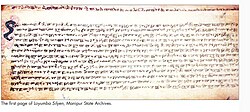
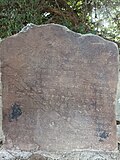
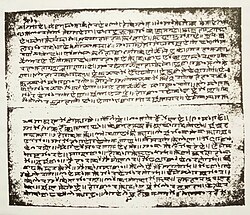
Meitei has [[Meitei script|its own script]], which was used until the 18th century. Its earliest use is not known. [[Pamheiba]], the ruler of the [[Manipur Kingdom]] who introduced [[Hinduism]], banned the use of the Meitei script and adopted the [[Bengali alphabet|Bengali script]]. Now in schools and colleges, the Bengali script is gradually being replaced by the Meitei script. The local organisations have played a major role in spreading awareness about their own script. | |||
Many Meitei documents were destroyed at the beginning of the 18th century during the reign of Hindu converted King Pamheiba, under the instigation of the Bengali Hindu missionary, [[Shantidas Gosai]]. | |||
Between 1709 and the middle of the 20th century, the Meitei language was written using the [[Bengali language|Bengali]] script. During the 1940s and 1950s, Meitei scholars began campaigning to bring back the Old Meitei (Old Manipuri) alphabet. In 1976 at a writers conference, all the scholars finally agreed on a new version of the alphabet containing a number of additional letters to represent sounds not present in Meitei when the script was first developed. The current Meitei alphabet is a reconstruction of the ancient Meitei script. | |||
Since the early 1980s, the Meitei alphabet has been taught in schools in [[Manipur]] | |||
It is a syllabic alphabet in which consonants all have an inherent vowel /a/. Other vowels are written as independent letters or by using diacritical marks that are written above, below, before or after the consonant they belong to. Each letter is named after a part of the human body. | |||
There are some texts from the [[Maring Naga|Maring]] and [[Limbu people|Limbu]] tribes of Manipur, which were written in the Meitei script. | |||
===Latin script=== | |||
There exists an informal, but fairly consistent practical spelling of Meitei in Latin script. This spelling is used in the transcription of personal names and place names, and it is extensively used on the internet (Facebook, blogspots, etc.). It is also found in academic publications, for the spelling of Meitei book titles and the like (examples can be seen in the References, below). This spelling, on the whole, offers a transparent, unambiguous representation of the Meitei sound system, although the tones are usually not marked. It is "practical" in the sense that it does not use extra-alphabetical symbols, and can, therefore, be produced easily on any standard keyboard. The only point of ambiguity is found in the spelling of the vowels /ɐ/ and /a/, which are usually both written "a", except when they occur before an [[approximant]] (see table below). The vowel /a/ is sometimes written as "aa" to distinguish it from /ɐ/. | |||
{|| class="wikitable" | |||
|- | |||
! IPA !! Practical | |||
|- | |||
|/m/||m | |||
|- | |||
|/n/||n | |||
|- | |||
|/ŋ/||ng | |||
|- | |||
|/b/||b | |||
|- | |||
|/d/||d | |||
|- | |||
|/dʒ/||j | |||
|- | |||
|/ɡ/||g | |||
|- | |||
|/bʱ/||bh | |||
|- | |||
|/dʱ/||dh | |||
|- | |||
|/dʒʱ/||jh | |||
|- | |||
|/ɡʱ/||gh | |||
|- | |||
|/p/||p | |||
|- | |||
|/t/||t | |||
|- | |||
|/tʃ/||ch | |||
|- | |||
|/k/||k | |||
|- | |||
|/ʔ/||’ | |||
|- | |||
|/pʰ/||ph (rarely f) | |||
|- | |||
|/tʰ/||th | |||
|- | |||
|/kʰ/||kh | |||
|- | |||
|/s/||s or sh | |||
|- | |||
|/h/||h | |||
|- | |||
|/ɾ/||r | |||
|- | |||
|/l/||l | |||
|- | |||
|/w/||w | |||
|- | |||
|/j/||y | |||
|- | |||
|/ɐ/||a | |||
|- | |||
|/ɐj/||ei | |||
|- | |||
|/ɐw/||ou | |||
|- | |||
|/a/||a or aa | |||
|- | |||
|/aj/||ai | |||
|- | |||
|/aw/||ao | |||
|- | |||
|/e/||e | |||
|- | |||
|/i/||i (rarely ee) | |||
|- | |||
|/o/||o | |||
|- | |||
|/oj/||oi | |||
|- | |||
|/u/||u (rarely oo) | |||
|- | |||
|/uj/||ui | |||
|} | |||
===Bengali=== | |||
Bangladesh and India currently use the Eastern [[Bengali alphabet|Bengali script]].<ref name="Ethnologue"/> | |||
==Grammar== | |||
A sentence in Meitei language use the format '''Subject + Object + Verb''' for example in the sentence ''Ei chak chai(ꯑꯩ ꯆꯥꯛ ꯆꯥꯢ)'' which literally mean ''I eat rice'' here, "Ei"=I,"Chak"=Rice,"Chai"=eat. So the simplest form of a grammatically correct sentence is (S+O+V). | |||
=== Number agreement === | |||
Agreement in nouns and pronouns is expressed to clarify singular and plural cases through the addition of the suffixes -khoi (for personal pronouns and human proper nouns) and -sing (for all other nouns). Verbs associated with the pluralised nouns are unaffected. Examples are demonstrated below:<ref name="Singh 2013">{{cite journal |last=Singh |first=S. Indrakumar |date=November 2013 |title=Agreements in Manipuri |url=http://www.languageinindia.com/nov2013/indrakumaragreementsmanipurifinal.pdf |journal=Language in India |volume=13 |issue=11 |pages=216–231}}</ref> | |||
{| class="wikitable" | |||
|- | |||
! Noun (Meitei) !! Noun (English) !! Example (Meitei) !! Example (English) | |||
|- | |||
| angaang || baby || angaang kappi|| Baby cries. | |||
|- | |||
| angaangsing || babies || angaangsing kappi || Babies cry. | |||
|} | |||
When adjectives are used to be more clear, Meitei utilises separate words and does not add a suffix to the noun. Examples are show in the chart below:<ref name="Singh 2013" /> | |||
{| class="wikitable" | |||
|- | |||
! Adjective (Meitei) !! Adjective (English) !! Example (Meitei) !! Example (English) | |||
|- | |||
| ama || one || mi ama laak’i || A person comes. | |||
|- | |||
| khara || some || mi khara laak’i || Some persons come. | |||
|- | |||
| mayaam || many || mi mayaam laak’i || Many persons come. | |||
|} | |||
=== Compound verbs === | |||
Compound verbs are created by combining root verbs each ending with aspect markers. While the variety of suffixes is high, all compound verbs utilise one of two:<ref name="Devi 2014">{{cite journal |last1=Devi |first1=M. Bidyarani |date=May 2014 |title=Compound Verbs in Manipuri |url=http://www.languageinindia.com/may2014/bidyaranimanipuricompoundverbsfinal.pdf |journal=Language in India |volume=14 |issue=5 |pages=66–70}}</ref> | |||
{| class="wikitable" | |||
|- | |||
! Suffix !! English translation | |||
|- | |||
| -thok|| out/ come out | |||
|- | |||
| -ning|| To wish/ want/ desire | |||
|} | |||
Aspect markers appear as suffixes that clarify verb tense and appear at the end of the compound verb. Overall, the formula to construct a compound verb becomes [root verb] + [suffix] + [aspect marker]:<ref name="Devi 2014" /> | |||
{| class="wikitable" | |||
|- | |||
! Language !! Root verb !! Suffix !! Aspect marker !! Combined form | |||
|- | |||
| Meitei || tum || -thok || -le || tumthokle | |||
|- | |||
| English || sleep || out/ come out || perfect aspect || has started sleeping | |||
|- | |||
| Meitei || tum || -ning || -le || tumningle | |||
|- | |||
| English || sleep || want || perfect aspect || has felt sleepy | |||
|} | |||
Compound verbs can also be formed utilising both compound suffixes as well, allowing utterances such as ''pithokningle'' meaning "want to give out". | |||
==Number words== | |||
{| class="wikitable" | |||
|- | |||
! Numeral !! Word !!Etymology!!Meitei Script | |||
|- | |||
|1||a-ma ~ a-maa||"1" ||{{Script|Mtei|ꯑꯃꯥ}} | |||
|- | |||
|2||a-ni||Proto-Tibeto-Burman *ni||{{Script|Mtei|ꯑꯅꯤ}} | |||
|- | |||
|3||a-húm||PTB *sum||{{Script|Mtei|ꯑꯍꯨꯝ}} | |||
|- | |||
|4||ma-ri||PTB *li||{{Script|Mtei|ꯃꯔꯤ}} | |||
|- | |||
|5||ma-ngaa||PTB *nga||{{Script|Mtei|ꯃꯉꯥ}} | |||
|- | |||
|6||ta-ruk||PTB *luk||{{Script|Mtei|ꯇꯔꯨꯛ}} | |||
|- | |||
|7||ta-ret||PTB *let ||{{Script|Mtei|ꯇꯔꯦꯠ}} | |||
|- | |||
|8||ni-paan||“2-less”||{{Script|Mtei|ꯅꯤꯄꯥꯟ}} | |||
|- | |||
|9||maa-pan||“1-less”||{{Script|Mtei|ꯃꯥꯄꯟ}} | |||
|- | |||
|10||ta-raa||"10"||{{Script|Mtei|ꯇꯔꯥ}} | |||
|- | |||
|11||taraa-maa-thoi||“ten + 1-more”||{{Script|Mtei|ꯇꯔꯥꯃꯥꯊꯣꯏ}} | |||
|- | |||
|12||taraa-ni-thoi||“ten + 2-more”||{{Script|Mtei|ꯇꯔꯥꯅꯤꯊꯣꯏ}} | |||
|- | |||
|13||taraa-húm-doi||“ten + 3-more”||{{Script|Mtei|ꯇꯔꯥꯍꯨꯝꯗꯣꯏ}} | |||
|- | |||
|14||taraa-mari||“ten +4”||{{Script|Mtei|ꯇꯔꯥꯃꯔꯤ}} | |||
|- | |||
|15||taraa-mangaa||“ten +5”||{{Script|Mtei|ꯇꯔꯥꯃꯉꯥ}} | |||
|- | |||
|16||taraa-taruk||“ten +6”||{{Script|Mtei|ꯇꯔꯥꯇꯔꯨꯛ}} | |||
|- | |||
|17||taraa-taret||“ten +7”||{{Script|Mtei|ꯇꯔꯥꯇꯔꯦꯠ}} | |||
|- | |||
|18||taraa-nipaan||“ten +8”||{{Script|Mtei|ꯇꯔꯥꯅꯤꯄꯥꯟ}} | |||
|- | |||
|19||taraa-maapan||“ten +9”||{{Script|Mtei|ꯇꯔꯥꯃꯥꯄꯟ}} | |||
|- | |||
|20||kun ~ kul|| ||{{Script|Mtei|ꯀꯨꯟ ~ ꯀꯨꯜ}} | |||
|- | |||
|30||*kun-taraa > kun-thraa||“twenty + ten”|| {{Script|Mtei|ꯀꯨꯟꯊ꯭ꯔꯥ}} | |||
|- | |||
|40||ni-phú||“two × score”||{{Script|Mtei|ꯅꯤꯐꯨ}} | |||
|- | |||
|50||yaang-khéi||“hundred-half”||{{Script|Mtei|ꯌꯥꯡꯈꯩ}} | |||
|- | |||
|60||hum-phú||“three × score”|| {{Script|Mtei|ꯍꯨꯝꯐꯨ}} | |||
|- | |||
|70||hum-phú-taraa||“three × score + ten”||{{Script|Mtei|ꯍꯨꯝꯐꯨꯇꯔꯥ}} | |||
|- | |||
|80||mari-phú||“four × score”|| {{Script|Mtei|ꯃꯔꯤꯐꯨ}} | |||
|- | |||
|90||mari-phú-taraa||“four × score + ten”|| {{Script|Mtei|ꯃꯔꯤꯐꯨꯇꯔꯥ}} | |||
|- | |||
|100||chaama||“hundred × one”|| {{Script|Mtei|ꯆꯥꯃ}} | |||
|- | |||
|200||cha-ni||“hundred × two”|| {{Script|Mtei|ꯆꯥꯅꯤ}} | |||
|- | |||
|300||cha-hum||“hundred × three”|| {{Script|Mtei|ꯆꯥꯍꯨꯝ}} | |||
|- | |||
|400||cha-mri||"hundred x four"|| {{Script|Mtei|ꯆꯥꯃ꯭ꯔꯤ}} | |||
|- | |||
|500||cha-mangaa||"hundred x five"|| {{Script|Mtei|ꯆꯥꯃꯉꯥ}} | |||
|- | |||
|1000||lisíng ama||“thousand × 1”|| {{Script|Mtei|ꯂꯤꯁꯤꯡ}} | |||
|- | |||
|10000||lisīng-taraa||"thousand x 10" ||{{Script|Mtei|ꯂꯤꯁꯤꯡꯇꯔꯥ}} | |||
|- | |||
|100000||licha|| "hundred thousand"||{{Script|Mtei|ꯂꯤꯆꯥ}} | |||
|- | |||
|1000000||licha-taraa||"hundred thousand x 10" ||{{Script|Mtei|ꯂꯤꯆꯥꯇꯔꯥ}} | |||
|- | |||
|10000000||leepun||"ten million" ||{{Script|Mtei|ꯂꯤꯄꯨꯟ}} | |||
|- | |||
|100000000||leepun-taraa||"ten million x 10" ||{{Script|Mtei|ꯂꯤꯄꯨꯟꯇꯔꯥ}} | |||
|- | |||
|1000000000||leepot||"billion" ||{{Script|Mtei|ꯂꯤꯄꯣꯠ}} | |||
|- | |||
|10000000000||leepot-taraa||"billion x 10" ||{{Script|Mtei|ꯂꯤꯄꯣꯠꯇꯔꯥ}} | |||
|- | |||
|100000000000||leekei||"hundred billion" ||{{Script|Mtei|ꯂꯤꯀꯩ}} | |||
|- | |||
|1000000000000||leekei-taraa||"hundred billion x 10" ||{{Script|Mtei|ꯂꯤꯀꯩꯇꯔꯥ}} | |||
|- | |||
|10000000000000||pu-ama||"ten trillion" ||{{Script|Mtei|ꯄꯨ ꯑꯃꯥ}} | |||
|} | |||
==Linguistic tradition== | |||
The culture involved with the Meitei language is rooted deeply with pride and tradition based on having respect to the community elders. Young children who do not know about the tales that have been passed on from generation to generation are very rare. Regarding the history behind the ancient use of [[proverb]]s that defines the way conversation is held with the Meitei language, it is a way of expressing and telling stories and even using modern slang with old proverbs to communicate between one another.<ref>{{cite journal |last1=Betholia |first1=C. |date=August 2008 |title=Manipuri Culture Seen Through Proverbs |url=http://indianfolklore.org/journals/index.php/IFL/article/view/111/883 |journal=Indian Folklife |issue=30 |pages=4–5}}</ref> | |||
The Meitei language is known to be one of the oldest languages in [[Northeast India|northeastern India]] and has a lengthy 2000-year period of existence. It had its own script. The history behind the Meitei language itself comes primarily from the medieval period of [[Northeast India|northeastern India]].<ref>{{cite journal |last1=Singh |first1=T. D. |date=April 2014 |title=Phonological System of Medieval Manipuri |url=http://www.languageinindia.com/april2014/debachandmedievalmanipuri.pdf |journal=Language in India |volume=14 |issue=4 |pages=56–68}}</ref> | |||
== See also == | |||
* [[Languages of India]] | |||
* [[List of languages by number of native speakers in India]] | |||
* [[List of Indian poets#Manipuri|List of Manipuri poets]] | |||
* [[Sahitya Akademi Award to Manipuri Writers]] | |||
* [[Meitei inscriptions]] | |||
* [[Meitei Wikipedia]] | * [[Meitei Wikipedia]] | ||
* [[Meitei literature]] | * [[Meitei literature]] | ||
==References== | |||
{{reflist}} | |||
* 1. ''A Short History of Kangleipak (Manipur) Part-I'', by Chingtamlen, 2005 | |||
* 2. ''A Short History of Kangleipak (Manipur) Part-II'', by Chingtamlen, 2007 | |||
* 3. ''A Short History of Kangleipak (Manipur) Part-III'', by Chingtamlen, 2008 | |||
* 4. ''The Meetei and the Bishnupriya'', by Chingtamlen, 2008 | |||
===Culture=== | |||
* Brara, N. Vijaylakshmi. (1998). ''Politics, society, and cosmology in India's North East''. Delphi: [[Oxford University Press]]. | |||
* Budha, W. (1992). ''Indigenous games of the Meiteis''. Manipur: Wangkeimayum Publications. | |||
* Kshetrimayum, Otojit. (2014). ''Ritual, Politics and Power in North East India: Contexualising the Lai Haraoba of Manipur''. Delhi: Ruby Press & Co. | |||
* Singh, M. Kirti. (1988). ''Religion and culture of Manipur''. Delhi: Manas Publications. | |||
* Singh, M. Kirti. (1993). ''Folk culture of Manipur''. Delhi: Manas Publications. | |||
* Singh, Saikhom Gopal. (2014). ''The Meeteis of Manipur: A Study in Human Geography''. Delhi: Ruby Press & Co. | |||
===Language=== | |||
* Bhat, D. N. S.; & Ningomba, S. (1997). ''Manipuri grammar''. Munich: Lincom Europa. | |||
* [[Shobhana Chelliah|Chelliah, Shobhana L.]] (1990). Experiencer subjects in Manipuri. In V. M. Manindra & K. P. Mohanan (Eds.), ''Experiencer subjects in South Asian languages'' (pp. 195–211). Stanford: The Center for the Study of Language and Information. | |||
* Chelliah, Shobhana L. (1992). Tone in Manipuri. In K. L. Adams & T. J. Hudak (Eds.), ''Papers from the first annual meeting of the Southeast Asian Linguistics Society 1991'' (pp. 65–85). Tempe, AZ: [[Arizona State University]]. | |||
* Chelliah, Shobhana L. (1992). Bracketing paradoxes in Manipuri. In M. Aronoff (Ed.), ''Morphology now'' (pp. 33–47). Albany: [[State University of New York Press]]. | |||
* Chelliah, Shobhana L. (1994). Morphological change and fast speech phenomena in the Manipuri verb. In K. L. Adams & T. J. Hudak (Eds.), ''Papers from the second annual meeting of the Southeast Asian Linguistics Society 1992'' (pp. 121–134). Tempe, AZ: Arizona State University. | |||
* Chelliah, Shobhana L. (1997). ''A grammar of Meitei''. Berlin: Mouton de Gruyter. {{ISBN|0-19-564331-3}}. | |||
* Chelliah, Shobhana L. (2002). Early Meitei manuscripts. In C. I. Beckwith (Ed.), ''Medieval Tibeto-Burman languages: PIATS 2000: Tibetan studies: Proceedings of the ninth seminar of the International Association of Tibetan Studies, Leiden 2000'' (pp. 59–71). Leiden, Netherlands: Brill. | |||
* Chelliah, Shobhana L. (2002). A glossary of 39 basic words in archaic and modern Meitei. In C. I. Beckwith (Ed.), ''Medieval Tibeto-Burman languages: PIATS 2000: Tibetan studies: Proceedings of the ninth seminar of the International Association of Tibetan Studies, Leiden 2000'' (pp. 189–190). Leiden, Netherlands: Brill. | |||
* {{cite journal |last1=Chelliah |first1=Shobhana L. |year=2004 |title=Polysemy through metonymy: The case of Meitei ''pi'' 'grandmother' |journal=Studies in Language |volume=28 |issue=2 |pages=363–386 |doi=10.1075/sl.28.2.04che}} | |||
* {{cite journal |last1=Chelliah |first1=Shobhana L. |s2cid=130962163 |year=2015 |title=Is Manipur a linguistic area? |journal=Journal of South Asian Languages and Linguistics |volume=2 |issue=1 |pages=87–109 |doi=10.1515/jsall-2015-0004}} | |||
* Singh, Ningthoukhongjam Khelchandra. (1964). ''Manipuri to Manipuri & English dictionary''. | |||
==External links== | |||
{{InterWiki|code=mni|Meitei}} | |||
{{Incubator|mni|Wikiquote}} | |||
{{incubator|code=omp|lang=Ancient Meitei}} | |||
{{commons category|Meitei language}} | |||
* [http://tabish.freeshell.org/eeyek/ Meitei Mayek (Meitei Script)] | |||
** [http://tabish.freeshell.org/eeyek/mani_intro.html Manipuri/ Meitheilon: An Introduction ] | |||
* [http://www.omniglot.com/writing/manipuri.htm ''Meetei Mayek'' Alphabet] | |||
* [http://tabish.freeshell.org/manipuri/ Learn to speak Manipuri, with the right pronunciation] | |||
* [http://www.e-pao.net/epPageExtractor.asp?src=education.Learn_Manipuri.html Learn Manipuri] | |||
* [http://www.e-pao.net/epPageSelector.asp?src=meetei_mayek_keys&ch=manipur Learn Meithei Mayek (Meithei Script) – E-Pao.net] | |||
* [http://www.e-pao.net/epPageExtractor.asp?src=MeiteiMayek.meetei_mayek_Poems.html../ Manipuri Poetry] | |||
{{Sino-Tibetan languages}} | |||
{{Kuki-Chin–Naga languages}} | |||
{{Languages of Northeast India}} | |||
{{Languages of India}} | |||
{{Languages of Bangladesh}} | |||
{{Authority control}} | |||
{{DEFAULTSORT:Meitei Language}} | |||
[[Category:Meitei language| ]] | |||
[[Category:Official languages of India]] | |||
[[Category:Languages of Myanmar]] | |||
[[Category:Meitei culture]] | |||
[[Category:Unclassified Sino-Tibetan languages]] | |||
== References == | == References == | ||
Revision as of 10:10, 4 August 2021
| Meitei | |
|---|---|
| Manipuri, Meithei, Meetei, Kathe, Monipuriya, Mekhlee, Mogolu | |
 | |
| Native to | Manipur, Assam and Tripura |
| Region |  India, India,  Bangladesh, Bangladesh,  Myanmar, Myanmar,  Canada Canada |
| Ethnicity | Meitei ethnicity |
| Era | 1445 BC - present[2] |
Sino-Tibetan
| |
Early form | |
| Dialects | |
| Bengali alphabet (current) Latin alphabet (to a lesser extent) Meitei alphabet (historical)[3] | |
| Official status | |
Official language in | India[4][5][6] |
Recognised minority language in | |
| Language codes | |
| ISO 639-2 | mni |
| ISO 639-3 | Either:mni – Meeteiomp – Old Manipuri |
omp Old Manipuri | |
| Glottolog | mani1292 |
Meitei (also known as Manipuri or Meetei) is the official language and the lingua franca of the Indian state of Manipur.[7] It is developed from the Ancient Meitei language. It is one of the 22 scheduled languages of India.[8][9][10]
Meitei is the most spoken Tibeto-Burman language of India and the most spoken language in Northeast India after Bengali and Assamese. In the 2011 census of India, there were 1.8 million native speakers of Meitei. Additionally, there are around 200,000 native speakers of Meitei abroad. Meiteilon is also spoken in the Northeast Indian states of Assam and Tripura and in Bangladesh and Burma (now Myanmar). It is currently classified as a "vulnerable language" by UNESCO.[11]
Meiteilon is a tonal language whose exact classification within Sino-Tibetan remains unclear. It has lexical resemblances to Kuki and Tangkhul Naga.[12]
It has been recognised (under the name Manipuri) by the Indian Union and has been included in the list of scheduled languages (included in the 8th schedule by the 71st amendment of the constitution in 1992). Meiteilon is taught as a subject up to the post-graduate level (Ph.D.) in some universities of India, apart from being a medium of instruction up to the undergraduate level in Manipur. Education in government schools is provided in Meiteilon through the eighth standard.[13]
Name
The name Meitei or its alternate spelling Meithei is preferred by many native speakers of Meitei over Manipuri.[14] The term is derived from the Meitei word for the language Meitheirón (Meithei + -lon 'language').[14] Meithei may be a compound from mí 'man' + they 'separate'.[14] This term is used by most western linguistic scholarship.[14] Meitei scholars use the term Mei(h)tei when writing in English and the term Meitheirón when writing in Meitei.[14] Chelliah (2015: 89) notes that the Meitei spelling has replaced the earlier Meithei spelling.[15]
The language (and people) is also referred to by the loconym Manipuri.[14] The term is derived from name of the state of Manipur.[14] Manipur itself has basis on Hindu epic Mahabharata, in which a shining diamond called mani ('jewel') in Sanskrit is thrown from the head of a snake god Vasuki, which spreads natural beauty throughout the land.[14] Manipuri is the official name of the language for the Indian government and is used by government institutions and non-Meitei authors.[14] The term Manipuri is also used to refer to the Bishnupriya and people.[14] Additionally, Manipuri, being a loconym, can refer to anything pertaining to Manipur state.
The term Meetei is used by Meitei speakers who want political autonomy from India, so-called "revivalists".[14]
Dialects
The Meitei language exhibits a degree of regional variation; however, in recent years the broadening of communication, as well as intermarriage, has caused the dialectal differences to become relatively insignificant. The only exceptions to this occurrence are the speech differences of the dialects found in Tripura, Bangladesh and Myanmar.[16] The exact number of dialects of Meitei is unknown.[17]
The three main dialects of Meitei are: Meitei proper, Loi and Pangal. Differences between these dialects are primarily characterised by the extensions of new sounds and tonal shifts. Meitei proper is considered, of the three, to be the standard variety—and is viewed as more dynamic[clarification needed] than the other two dialects.[clarification needed] The brief table below compares some words in these three dialects:[18]
| Standard Meitei | Loi | Pangal | English translation |
|---|---|---|---|
| chaaba | chaapa | chaaba | to eat |
| kappa | kapma | kappa | to weep |
| saabiba | saapipa | saabiba | to make |
| thamba | thampa | thamba | to put |
| chuppiba | chuppipa | chuppiba | to kiss |
Devi (2002)[19] compares the Imphal, Andro, Koutruk, and Kakching dialects of Meitei.
Syntax
Meitei language is an SOV language, though topics can be fronted.
Phonology
Tone
The Meitei language is a tonal language. There is a controversy over whether there are two or three tones.[20]
Segments
Meitei uses the following sounds:[21]
Consonants
| Labial | Dental/Alveolar | Palatal | Velar | Glottal | |||
|---|---|---|---|---|---|---|---|
| Nasal | m | n | ŋ | ||||
| Stop |
unaspirated |
p | t | tʃ | k | ʔ | |
| pʰ | tʰ | kʰ | |||||
|
unaspirated |
b | d | dʒ | ɡ | |||
| bʱ | dʱ | dʒʱ | gʱ | ||||
| Fricative | s | h | |||||
| Flap | ɾ | ||||||
| Lateral | l | ||||||
| Approximant | w | j | |||||
Vowels
| Front | Central | Back | |
|---|---|---|---|
| High | i | u | |
| Mid | e | ɐ | o |
| Low | a |
Note: the central vowel /ɐ/ is transcribed as <ə> in recent linguistic work on Meitei. However, phonetically it is never [ə], but more usually [ɐ]. It is assimilated to a following approximant: /ɐw/ = /ow/, /ɐj/ = [ej].
Phonological processes
Velar deletion
A velar deletion is noted to occur on the suffix -lək when following a syllable ending with a /k/ phoneme.[20]
Grassman's law
Meitei has a dissimilatory process similar to Grassmann's law found in Ancient Greek and Sanskrit, though occurring on the second aspirate.[22] Here, an aspirated consonant is deaspirated if preceded by an aspirated consonant (including /h/, /s/) in the previous syllable. The deaspirated consonants are then voiced between sonorants.
- /tʰin-/ ('pierce') + /-khət/ ('upward') → /tʰinɡət/ ('pierce upwards')
- /səŋ/ ('cow') + /kʰom/ ('udder') → /səŋɡom/ ('milk')
- /hi-/ ('trim') + /-tʰok/ ('outward') → /hidok/ ('trim outwards')
Writing systems
Meitei script
Meitei has its own script, which was used until the 18th century. Its earliest use is not known. Pamheiba, the ruler of the Manipur Kingdom who introduced Hinduism, banned the use of the Meitei script and adopted the Bengali script. Now in schools and colleges, the Bengali script is gradually being replaced by the Meitei script. The local organisations have played a major role in spreading awareness about their own script.
Many Meitei documents were destroyed at the beginning of the 18th century during the reign of Hindu converted King Pamheiba, under the instigation of the Bengali Hindu missionary, Shantidas Gosai.
Between 1709 and the middle of the 20th century, the Meitei language was written using the Bengali script. During the 1940s and 1950s, Meitei scholars began campaigning to bring back the Old Meitei (Old Manipuri) alphabet. In 1976 at a writers conference, all the scholars finally agreed on a new version of the alphabet containing a number of additional letters to represent sounds not present in Meitei when the script was first developed. The current Meitei alphabet is a reconstruction of the ancient Meitei script.
Since the early 1980s, the Meitei alphabet has been taught in schools in Manipur
It is a syllabic alphabet in which consonants all have an inherent vowel /a/. Other vowels are written as independent letters or by using diacritical marks that are written above, below, before or after the consonant they belong to. Each letter is named after a part of the human body.
There are some texts from the Maring and Limbu tribes of Manipur, which were written in the Meitei script.
Latin script
There exists an informal, but fairly consistent practical spelling of Meitei in Latin script. This spelling is used in the transcription of personal names and place names, and it is extensively used on the internet (Facebook, blogspots, etc.). It is also found in academic publications, for the spelling of Meitei book titles and the like (examples can be seen in the References, below). This spelling, on the whole, offers a transparent, unambiguous representation of the Meitei sound system, although the tones are usually not marked. It is "practical" in the sense that it does not use extra-alphabetical symbols, and can, therefore, be produced easily on any standard keyboard. The only point of ambiguity is found in the spelling of the vowels /ɐ/ and /a/, which are usually both written "a", except when they occur before an approximant (see table below). The vowel /a/ is sometimes written as "aa" to distinguish it from /ɐ/.
| IPA | Practical |
|---|---|
| /m/ | m |
| /n/ | n |
| /ŋ/ | ng |
| /b/ | b |
| /d/ | d |
| /dʒ/ | j |
| /ɡ/ | g |
| /bʱ/ | bh |
| /dʱ/ | dh |
| /dʒʱ/ | jh |
| /ɡʱ/ | gh |
| /p/ | p |
| /t/ | t |
| /tʃ/ | ch |
| /k/ | k |
| /ʔ/ | ’ |
| /pʰ/ | ph (rarely f) |
| /tʰ/ | th |
| /kʰ/ | kh |
| /s/ | s or sh |
| /h/ | h |
| /ɾ/ | r |
| /l/ | l |
| /w/ | w |
| /j/ | y |
| /ɐ/ | a |
| /ɐj/ | ei |
| /ɐw/ | ou |
| /a/ | a or aa |
| /aj/ | ai |
| /aw/ | ao |
| /e/ | e |
| /i/ | i (rarely ee) |
| /o/ | o |
| /oj/ | oi |
| /u/ | u (rarely oo) |
| /uj/ | ui |
Bengali
Bangladesh and India currently use the Eastern Bengali script.[23]
Grammar
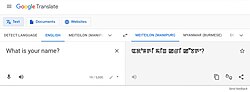
A sentence in Meitei language use the format Subject + Object + Verb for example in the sentence Ei chak chai(ꯑꯩ ꯆꯥꯛ ꯆꯥꯢ) which literally mean I eat rice here, "Ei"=I,"Chak"=Rice,"Chai"=eat. So the simplest form of a grammatically correct sentence is (S+O+V).
Number agreement
Agreement in nouns and pronouns is expressed to clarify singular and plural cases through the addition of the suffixes -khoi (for personal pronouns and human proper nouns) and -sing (for all other nouns). Verbs associated with the pluralised nouns are unaffected. Examples are demonstrated below:[24]
| Noun (Meitei) | Noun (English) | Example (Meitei) | Example (English) |
|---|---|---|---|
| angaang | baby | angaang kappi | Baby cries. |
| angaangsing | babies | angaangsing kappi | Babies cry. |
When adjectives are used to be more clear, Meitei utilises separate words and does not add a suffix to the noun. Examples are show in the chart below:[24]
| Adjective (Meitei) | Adjective (English) | Example (Meitei) | Example (English) |
|---|---|---|---|
| ama | one | mi ama laak’i | A person comes. |
| khara | some | mi khara laak’i | Some persons come. |
| mayaam | many | mi mayaam laak’i | Many persons come. |
Compound verbs
Compound verbs are created by combining root verbs each ending with aspect markers. While the variety of suffixes is high, all compound verbs utilise one of two:[25]
| Suffix | English translation |
|---|---|
| -thok | out/ come out |
| -ning | To wish/ want/ desire |
Aspect markers appear as suffixes that clarify verb tense and appear at the end of the compound verb. Overall, the formula to construct a compound verb becomes [root verb] + [suffix] + [aspect marker]:[25]
| Language | Root verb | Suffix | Aspect marker | Combined form |
|---|---|---|---|---|
| Meitei | tum | -thok | -le | tumthokle |
| English | sleep | out/ come out | perfect aspect | has started sleeping |
| Meitei | tum | -ning | -le | tumningle |
| English | sleep | want | perfect aspect | has felt sleepy |
Compound verbs can also be formed utilising both compound suffixes as well, allowing utterances such as pithokningle meaning "want to give out".
Number words
| Numeral | Word | Etymology | Meitei Script |
|---|---|---|---|
| 1 | a-ma ~ a-maa | "1" | ꯑꯃꯥ |
| 2 | a-ni | Proto-Tibeto-Burman *ni | ꯑꯅꯤ |
| 3 | a-húm | PTB *sum | ꯑꯍꯨꯝ |
| 4 | ma-ri | PTB *li | ꯃꯔꯤ |
| 5 | ma-ngaa | PTB *nga | ꯃꯉꯥ |
| 6 | ta-ruk | PTB *luk | ꯇꯔꯨꯛ |
| 7 | ta-ret | PTB *let | ꯇꯔꯦꯠ |
| 8 | ni-paan | “2-less” | ꯅꯤꯄꯥꯟ |
| 9 | maa-pan | “1-less” | ꯃꯥꯄꯟ |
| 10 | ta-raa | "10" | ꯇꯔꯥ |
| 11 | taraa-maa-thoi | “ten + 1-more” | ꯇꯔꯥꯃꯥꯊꯣꯏ |
| 12 | taraa-ni-thoi | “ten + 2-more” | ꯇꯔꯥꯅꯤꯊꯣꯏ |
| 13 | taraa-húm-doi | “ten + 3-more” | ꯇꯔꯥꯍꯨꯝꯗꯣꯏ |
| 14 | taraa-mari | “ten +4” | ꯇꯔꯥꯃꯔꯤ |
| 15 | taraa-mangaa | “ten +5” | ꯇꯔꯥꯃꯉꯥ |
| 16 | taraa-taruk | “ten +6” | ꯇꯔꯥꯇꯔꯨꯛ |
| 17 | taraa-taret | “ten +7” | ꯇꯔꯥꯇꯔꯦꯠ |
| 18 | taraa-nipaan | “ten +8” | ꯇꯔꯥꯅꯤꯄꯥꯟ |
| 19 | taraa-maapan | “ten +9” | ꯇꯔꯥꯃꯥꯄꯟ |
| 20 | kun ~ kul | ꯀꯨꯟ ~ ꯀꯨꯜ | |
| 30 | *kun-taraa > kun-thraa | “twenty + ten” | ꯀꯨꯟꯊ꯭ꯔꯥ |
| 40 | ni-phú | “two × score” | ꯅꯤꯐꯨ |
| 50 | yaang-khéi | “hundred-half” | ꯌꯥꯡꯈꯩ |
| 60 | hum-phú | “three × score” | ꯍꯨꯝꯐꯨ |
| 70 | hum-phú-taraa | “three × score + ten” | ꯍꯨꯝꯐꯨꯇꯔꯥ |
| 80 | mari-phú | “four × score” | ꯃꯔꯤꯐꯨ |
| 90 | mari-phú-taraa | “four × score + ten” | ꯃꯔꯤꯐꯨꯇꯔꯥ |
| 100 | chaama | “hundred × one” | ꯆꯥꯃ |
| 200 | cha-ni | “hundred × two” | ꯆꯥꯅꯤ |
| 300 | cha-hum | “hundred × three” | ꯆꯥꯍꯨꯝ |
| 400 | cha-mri | "hundred x four" | ꯆꯥꯃ꯭ꯔꯤ |
| 500 | cha-mangaa | "hundred x five" | ꯆꯥꯃꯉꯥ |
| 1000 | lisíng ama | “thousand × 1” | ꯂꯤꯁꯤꯡ |
| 10000 | lisīng-taraa | "thousand x 10" | ꯂꯤꯁꯤꯡꯇꯔꯥ |
| 100000 | licha | "hundred thousand" | ꯂꯤꯆꯥ |
| 1000000 | licha-taraa | "hundred thousand x 10" | ꯂꯤꯆꯥꯇꯔꯥ |
| 10000000 | leepun | "ten million" | ꯂꯤꯄꯨꯟ |
| 100000000 | leepun-taraa | "ten million x 10" | ꯂꯤꯄꯨꯟꯇꯔꯥ |
| 1000000000 | leepot | "billion" | ꯂꯤꯄꯣꯠ |
| 10000000000 | leepot-taraa | "billion x 10" | ꯂꯤꯄꯣꯠꯇꯔꯥ |
| 100000000000 | leekei | "hundred billion" | ꯂꯤꯀꯩ |
| 1000000000000 | leekei-taraa | "hundred billion x 10" | ꯂꯤꯀꯩꯇꯔꯥ |
| 10000000000000 | pu-ama | "ten trillion" | ꯄꯨ ꯑꯃꯥ |
Linguistic tradition
The culture involved with the Meitei language is rooted deeply with pride and tradition based on having respect to the community elders. Young children who do not know about the tales that have been passed on from generation to generation are very rare. Regarding the history behind the ancient use of proverbs that defines the way conversation is held with the Meitei language, it is a way of expressing and telling stories and even using modern slang with old proverbs to communicate between one another.[26]
The Meitei language is known to be one of the oldest languages in northeastern India and has a lengthy 2000-year period of existence. It had its own script. The history behind the Meitei language itself comes primarily from the medieval period of northeastern India.[27]
See also
- Languages of India
- List of languages by number of native speakers in India
- List of Manipuri poets
- Sahitya Akademi Award to Manipuri Writers
- Meitei inscriptions
- Meitei Wikipedia
- Meitei literature
References
- ↑ Moseley, C. (Editor) (2010). Atlas of the world's languages in danger (3rd ed). Paris: UNESCO Publishing.
{{cite book}}:|first1=has generic name (help) - ↑ Meetei at Ethnologue (18th ed., 2015)
Old Manipuri at Ethnologue (18th ed., 2015) - ↑ Primrose, Arthur John (1888). A Manipuri Grammar, Vocabulary, and Phrase Book: To which are Added Some Manipuri Proverbs and Specimens of Manipuri Correspondence. Assam Secretariat Press. p. 1.
- ↑ http://e-pao.net/epPageExtractor.asp?src=MeiteiMayek.Manipuri_language_in_8th_Schedule_By_Jeet_Akoijam.html..
- ↑ https://universalinstitutions.com/languages-added-in-the-8th-schedule-of-indian-constitution/
- ↑ https://rajbhasha.gov.in/en/languages-included-eighth-schedule-indian-constitution
- ↑ Khongbantabam Naobi Devi, Ph,D. "Origin and Development of the Meetei Language" (PDF). Department of English, Ethiraj College for Women, Chennai, Tamilnadu. Retrieved 19 July 2017.
{{cite web}}: CS1 maint: multiple names: authors list (link) - ↑ http://e-pao.net/epPageExtractor.asp?src=MeiteiMayek.Manipuri_language_in_8th_Schedule_By_Jeet_Akoijam.html..
- ↑ https://rajbhasha.gov.in/en/languages-included-eighth-schedule-indian-constitution
- ↑ https://universalinstitutions.com/languages-added-in-the-8th-schedule-of-indian-constitution/
- ↑ Moseley, C., ed. (2010). Atlas of the world's languages in danger (3rd ed). Paris: UNESCO Publishing.
- ↑ Burling, Robbins (2003). "The Tibeto-Burman Languages of Northeastern India". In Thurgood, Graham; LaPolla, Randy J. (eds.). The Sino-Tibetan Languages. Routledge. pp. 169–191. ISBN 0-7007-1129-5.
- ↑ Devi, S. (May 2013). "Is Manipuri an Endangered Language?" (PDF). Language in India. 13 (5): 520–533.
- ↑ 14.00 14.01 14.02 14.03 14.04 14.05 14.06 14.07 14.08 14.09 14.10 Chelliah (1997: 2)
- ↑ Chelliah (2015: 89)
- ↑ Thoudam, P. C. (2006). Demographic and Ethnographic Information: Problems in the analysis of Manipuri language. Central Institute of Indian Language.
- ↑ Haokip, P. (April 2011). "The Languages of Manipur: A Case Study of the Kuki-Chin Languages". Linguistics of the Tibeto-Burman Area. 34 (1): 86–118.
- ↑ Ningoma, M. S. (1996). Manipur Dialects. Sealang Projects.
- ↑ Devi, L. Manimala. 2002. A comparative study of Imphal, Andro, Koutruk and Kakching dialects of Meiteiron. (Doctoral dissertation, Canchipur: Manipur University; 273pp.)
- ↑ 20.0 20.1 LaPolla, Randy J. (2000). "Book review: A grammar of Meitei, by S. L. Chelliah". Lingua. 110 (4). Elsevier: 299–304. doi:10.1016/s0024-3841(99)00037-6.
- ↑ Chelliah, S. L. (1997). Meitei Phonology. Mouton de Gruyter. pp. 17–21.
- ↑ Chelliah (1997)
- ↑ Cite error: Invalid
<ref>tag; no text was provided for refs namedEthnologue - ↑ 24.0 24.1 Singh, S. Indrakumar (November 2013). "Agreements in Manipuri" (PDF). Language in India. 13 (11): 216–231.
- ↑ 25.0 25.1 Devi, M. Bidyarani (May 2014). "Compound Verbs in Manipuri" (PDF). Language in India. 14 (5): 66–70.
- ↑ Betholia, C. (August 2008). "Manipuri Culture Seen Through Proverbs". Indian Folklife (30): 4–5.
- ↑ Singh, T. D. (April 2014). "Phonological System of Medieval Manipuri" (PDF). Language in India. 14 (4): 56–68.
- 1. A Short History of Kangleipak (Manipur) Part-I, by Chingtamlen, 2005
- 2. A Short History of Kangleipak (Manipur) Part-II, by Chingtamlen, 2007
- 3. A Short History of Kangleipak (Manipur) Part-III, by Chingtamlen, 2008
- 4. The Meetei and the Bishnupriya, by Chingtamlen, 2008
Culture
- Brara, N. Vijaylakshmi. (1998). Politics, society, and cosmology in India's North East. Delphi: Oxford University Press.
- Budha, W. (1992). Indigenous games of the Meiteis. Manipur: Wangkeimayum Publications.
- Kshetrimayum, Otojit. (2014). Ritual, Politics and Power in North East India: Contexualising the Lai Haraoba of Manipur. Delhi: Ruby Press & Co.
- Singh, M. Kirti. (1988). Religion and culture of Manipur. Delhi: Manas Publications.
- Singh, M. Kirti. (1993). Folk culture of Manipur. Delhi: Manas Publications.
- Singh, Saikhom Gopal. (2014). The Meeteis of Manipur: A Study in Human Geography. Delhi: Ruby Press & Co.
Language
- Bhat, D. N. S.; & Ningomba, S. (1997). Manipuri grammar. Munich: Lincom Europa.
- Chelliah, Shobhana L. (1990). Experiencer subjects in Manipuri. In V. M. Manindra & K. P. Mohanan (Eds.), Experiencer subjects in South Asian languages (pp. 195–211). Stanford: The Center for the Study of Language and Information.
- Chelliah, Shobhana L. (1992). Tone in Manipuri. In K. L. Adams & T. J. Hudak (Eds.), Papers from the first annual meeting of the Southeast Asian Linguistics Society 1991 (pp. 65–85). Tempe, AZ: Arizona State University.
- Chelliah, Shobhana L. (1992). Bracketing paradoxes in Manipuri. In M. Aronoff (Ed.), Morphology now (pp. 33–47). Albany: State University of New York Press.
- Chelliah, Shobhana L. (1994). Morphological change and fast speech phenomena in the Manipuri verb. In K. L. Adams & T. J. Hudak (Eds.), Papers from the second annual meeting of the Southeast Asian Linguistics Society 1992 (pp. 121–134). Tempe, AZ: Arizona State University.
- Chelliah, Shobhana L. (1997). A grammar of Meitei. Berlin: Mouton de Gruyter. ISBN 0-19-564331-3.
- Chelliah, Shobhana L. (2002). Early Meitei manuscripts. In C. I. Beckwith (Ed.), Medieval Tibeto-Burman languages: PIATS 2000: Tibetan studies: Proceedings of the ninth seminar of the International Association of Tibetan Studies, Leiden 2000 (pp. 59–71). Leiden, Netherlands: Brill.
- Chelliah, Shobhana L. (2002). A glossary of 39 basic words in archaic and modern Meitei. In C. I. Beckwith (Ed.), Medieval Tibeto-Burman languages: PIATS 2000: Tibetan studies: Proceedings of the ninth seminar of the International Association of Tibetan Studies, Leiden 2000 (pp. 189–190). Leiden, Netherlands: Brill.
- Chelliah, Shobhana L. (2004). "Polysemy through metonymy: The case of Meitei pi 'grandmother'". Studies in Language. 28 (2): 363–386. doi:10.1075/sl.28.2.04che.
- Chelliah, Shobhana L. (2015). "Is Manipur a linguistic area?". Journal of South Asian Languages and Linguistics. 2 (1): 87–109. doi:10.1515/jsall-2015-0004. S2CID 130962163.
- Singh, Ningthoukhongjam Khelchandra. (1964). Manipuri to Manipuri & English dictionary.
External links
- Meitei Mayek (Meitei Script)
- Meetei Mayek Alphabet
- Learn to speak Manipuri, with the right pronunciation
- Learn Manipuri
- Learn Meithei Mayek (Meithei Script) – E-Pao.net
- Manipuri Poetry
Template:Languages of Bangladesh
References
