




No edit summary Tags: Visual edit Mobile edit Mobile web edit |
minor enhance layout for accuracy and cleaned formatting |
||
| Line 4: | Line 4: | ||
{{Use Indian English|date=June 2015}} | {{Use Indian English|date=June 2015}} | ||
{{Use dmy dates|date=October 2020}} | {{Use dmy dates|date=October 2020}} | ||
'''Bihari''' ({{Audio|Bihari.ogg|listen}}) is a [[demonym]] given to the inhabitants of the Indian state of [[Bihar]]. Bihari people can be separated into three main [[Indo-Aryan peoples|Indo-Aryan]] [[South Asian ethnic groups|ethnolinguistic groups]]: [[Bhojpuri people|Bhojpuris]], [[Maithils]] and [[Magahi people|Magahis]].<ref>{{cite book |last1=Brass |first1=Paul R. |year=2005 |title=Language, Religion and Politics in North India |url=https://books.google.com/books?id=SylBHS8IJAUC&pg=PA69 |page=69 |publisher=iUniverse |isbn=978-0-595-34394-2}}</ref> They are also further divided into a variety of hereditary [[caste]] groups.<ref name="Gupta2004">{{cite book|author=Dipankar Gupta|title=Caste in Question: Identity Or Hierarchy?|url=https://books.google.com/books?id=bgpEIb4tNjgC&pg=PA1|date=8 December 2004|publisher=SAGE Publications|isbn=978-0-7619-3324-3|pages=113–114}}</ref> | |||
'''Bihari''' ({{Audio|Bihari.ogg|listen}}) is a [[demonym]] given to the inhabitants of the Indian state of [[Bihar]]. Bihari people can be separated into three main [[Indo-Aryan peoples|Indo-Aryan]] [[South Asian ethnic groups|ethnolinguistic groups]] | In Bihar today, the Bihari identity is seen as secondary to caste/clan, linguistic and religious identity but nonetheless is a subset of the larger Indian identity.<ref>{{cite journal |last1=Verma |first1=Jyoti |title=Bihari Identity: An Uncharted Question |journal=Psychology and Developing Societies |date=2019 |volume=31 |issue=2 |pages=315–342 |doi=10.1177/0971333619863237 |s2cid=202290212 }}</ref> Biharis can be found throughout India, and in the neighbouring countries of [[Nepal]], [[Pakistan]] and [[Bangladesh]]. During the [[Partition of India]] in 1947, many [[Bihari Muslim]]s migrated to [[East Bengal]] (renamed to [[East Pakistan]]; later [[Bangladesh Liberation War|became]] [[Bangladesh]]).<ref name="Refugess International-Bangladesh">{{cite web| url= http://www.refugeesinternational.org/content/article/detail/8245| title= Bangladesh: Stateless Biharis Grasp for a Resolution and Their Rights| publisher= Refugees International| access-date= 2007-02-16| archiveurl= https://web.archive.org/web/20070321134045/http://www.refugeesinternational.org/content/article/detail/8245| archivedate= 21 March 2007| url-status= dead}}</ref><ref name="Stateless People in Bangladesh Inc.-Biharis">{{cite web| url= http://www.statelesspeopleinbangladesh.net/home.php| title= Stateless in Bangladesh and Pakistan| publisher= Stateless People in Bangladesh Inc.| access-date= 2007-02-16| archiveurl= https://web.archive.org/web/20070221171846/http://www.statelesspeopleinbangladesh.net/home.php| archivedate= 21 February 2007| url-status= dead}}</ref> Bihari people are also well represented in the [[Muhajir (Urdu-speaking people)|Muhajir people]] of [[Pakistan]] (formerly [[West Pakistan]]) because of [[Partition of India|Partition]].<ref name="Tribune-Bihari people">{{cite news |title=Pakistan under attack! |url=https://www.tribuneindia.com/2000/20000920/edit.htm#1 |url-status=live |newspaper=The Tribune |type=Editorial |location=Chandigarh |date=2000-09-20 |access-date=2007-02-16 |archiveurl=https://web.archive.org/web/20070209093445/http://www.tribuneindia.com/2000/20000920/edit.htm |archivedate=2007-02-09}}</ref><ref name="CIDCM-Bihari people">{{cite web|url=http://www.cidcm.umd.edu/mar/assessment.asp?groupId=77103 |title=Assessment for Biharis in Bangladesh |publisher=Center for International Development and Conflict Management |access-date=2007-02-16 |url-status=dead |archiveurl=https://web.archive.org/web/20091002111502/http://www.cidcm.umd.edu/mar/assessment.asp?groupId=77103 |archivedate=2009-10-02}}</ref> | ||
In Bihar today, the Bihari identity is seen as secondary to caste/clan, linguistic and religious identity but nonetheless is a subset of the larger Indian identity.<ref>{{cite journal |last1=Verma |first1=Jyoti |title=Bihari Identity: An Uncharted Question |journal=Psychology and Developing Societies |date=2019 |volume=31 |issue=2 |pages=315–342 |doi=10.1177/0971333619863237 |s2cid=202290212 }}</ref> Biharis can be found throughout India, and in the neighbouring countries of [[Nepal]], [[Pakistan]] and [[Bangladesh]]. During the [[Partition of India]] in 1947, many [[Bihari Muslim]]s migrated to [[East Bengal]] (renamed to [[East Pakistan]]; later [[Bangladesh Liberation War|became]] [[Bangladesh]]).<ref name="Refugess International-Bangladesh">{{cite web| url= http://www.refugeesinternational.org/content/article/detail/8245| title= Bangladesh: Stateless Biharis Grasp for a Resolution and Their Rights| publisher= Refugees International| access-date= 2007-02-16| archiveurl= https://web.archive.org/web/20070321134045/http://www.refugeesinternational.org/content/article/detail/8245| archivedate= 21 March 2007| url-status= dead}}</ref><ref name="Stateless People in Bangladesh Inc.-Biharis">{{cite web| url= http://www.statelesspeopleinbangladesh.net/home.php| title= Stateless in Bangladesh and Pakistan| publisher= Stateless People in Bangladesh Inc.| access-date= 2007-02-16| archiveurl= https://web.archive.org/web/20070221171846/http://www.statelesspeopleinbangladesh.net/home.php| archivedate= 21 February 2007| url-status= dead}}</ref> Bihari people are also well represented in the [[Muhajir (Urdu-speaking people)|Muhajir people]] of [[Pakistan]] (formerly [[West Pakistan]]) because of [[Partition of India|Partition]].<ref name="Tribune-Bihari people">{{cite news |title=Pakistan under attack! |url= | |||
==History== | ==History== | ||
| Line 12: | Line 11: | ||
[[File:Chandragupta Maurya and Bhadrabahu.jpg|thumb|[[Chandragupta Maurya]], the founder of Mauryan Empire with Jain monk [[Bhadrabahu]].]] | [[File:Chandragupta Maurya and Bhadrabahu.jpg|thumb|[[Chandragupta Maurya]], the founder of Mauryan Empire with Jain monk [[Bhadrabahu]].]] | ||
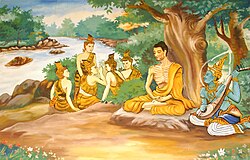
[[File:Ascetic Bodhisatta Gotama with the Group of Five.jpg|thumb|[[Gautama Buddha]] undertaking extreme ascetic practices before his enlightenment under the Bodhi tree, on the bank of river [[Phalgu]] in [[Bodh Gaya]], Bihar]] | [[File:Ascetic Bodhisatta Gotama with the Group of Five.jpg|thumb|[[Gautama Buddha]] undertaking extreme ascetic practices before his enlightenment under the Bodhi tree, on the bank of river [[Phalgu]] in [[Bodh Gaya]], Bihar]] | ||
{{Multiple image|perrow=2|total_width=300|caption_align=center | |||
| image1 = Udyanacharya Sanskrit Vidyalaya.jpg|caption1=11th-century Hindu philosopher [[Udayana]] | |||
| image2 = Shantipa.jpg|caption2=11th-century [[Vajrayana]] [[Buddhist]] philosopher, [[Ratnākaraśānti]] | |||
| image3 = Shantirakshita - Google Art Project.jpg|caption3= 8th-century Buddhist Abbot of [[Nalanda]], [[Śāntarakṣita]] | |||
| image4 = Mural of Sariputra at Palcho monastery.jpg|caption4=The last head priest of the [[Mahabodhi Temple]] in [[Bodh Gaya]] in the 15th-century, [[Śāriputra (15th-century)|Śāriputra]] | |||
}} | |||
The founder of [[Sur Empire]], Sher Shah Suri was born in [[Sasaram]], a city in the state of [[Bihar]] in present-day India into a [[Pashtuns|Pashtun]] family.<ref>Asad Muḥammad K̲h̲ān̲, ''The Harvest of Anger and Other Stories'', Oxford University Press (2002), p. 62</ref><ref>[[Ishwari Prasad]], ''The Mughal Empire'', Chugh Publications (1974), p. 157</ref> During the period of Islamic rule, much of Bihar was under the sway of local [[Zamindars of Bihar|Zamindars]] or chieftains who maintained their own armies and territories. These chieftains retained much of their power until the arrival of the British East India Company.<ref name="Ansari2019">{{cite book|author=Tahir Hussain Ansari|title=Mughal Administration and the Zamindars of Bihar|url=https://books.google.com/books?id=kUueDwAAQBAJ|date=20 June 2019|publisher=Taylor & Francis|isbn=978-1-00-065152-2|page=2}}</ref> | Bihar is one of the longest inhabited places in the world with a history going back to the [[Neolithic]] age.<ref>{{Cite web | url=http://yac.bih.nic.in/Da-02.htm#Chirand | title=Directorate of Archaeology - Page 2 | access-date=14 September 2018 | archive-date=25 May 2012 | archive-url=https://web.archive.org/web/20120525025802/http://yac.bih.nic.in/Da-02.htm#Chirand | url-status=dead }}</ref> Since that time, Biharis have long been involved in some of the most important events in [[South Asian history]]. Biharis were the founders of many great empires based out of [[Magadha (Mahajanapada)|Magadh]] including the [[Nanda Empire]], [[Maurya Empire]] and the [[Gupta Empire]].<ref>{{Cite book |last1=West |first1=Barbara A. |year=2010 |title=Encyclopedia of the Peoples of Asia and Oceania |url=https://books.google.com/books?id=pCiNqFj3MQsC&pg=PA117 |page=117 |publisher=Infobase |isbn=978-1-4381-1913-7}}</ref> All of these empires had their capitals in [[Pataliputra]] (modern-day [[Patna]]). | ||
Two of India's major religions also have their origins in Bihar. [[Gautama Buddha]] who was the founder of [[Buddhism]], achieved [[Enlightenment in Buddhism|enlightenment]] in [[Bodh Gaya]], [[Bihar]]. [[Mahavira]], the founder of [[Jainism]], was born in [[Vaishali district|Vaishali]] in North Bihar.<ref>{{Cite book | url=https://books.google.com/books?id=loQkEIf8z5wC&q=jainism+buddhism+bihar&pg=PA202 |title = Jainism: A Pictorial Guide to the Religion of Non-violence|isbn = 9788120815346|last1 = Titze|first1 = Kurt|last2 = Bruhn|first2 = Klaus|year = 1998| publisher=Motilal Banarsidass Publ. }}</ref> | |||
Bihar is home to two [[UNESCO]] [[World Heritage Sites]], the [[Mahabodhi Temple]] at Bodh Gaya where the Buddha attained [[nirvana]] and the Buddhist monastic university of [[Nalanda]]. Until at least the 13th century, there was still a significant number of Buddhists in Bihar who mainly followed the [[Mahayana]] and [[Vajrayana]] schools until they were assimilated into Hinduism. However many village temples still retain idols of the Buddha and [[Bodhisattvas]].<ref>{{cite book |last1=Prasad |first1=Birendra Nath |title=Archaeology of Religion in South Asia: Buddhist, Brahmanical and Jaina Religious Centres in Bihar and Bengal, c. AD 600–1200 |date=2021 |publisher=Routledge |page=423 |isbn=9781000416756 |url=https://books.google.com/books?id=TB4gEAAAQBAJ&q=Pīṭhipati}}</ref> Many famous [[Buddhist]] and [[Hindu]] philosophers and scholars have originated or studied in Bihar during the period from the 5th to 13th century at institutions like [[Nalanda]] and [[Vikramashila]] including [[Kamalaśīla]], [[Ratnākaraśānti]], [[Śāntarakṣita]], [[Abhayakaragupta]], [[Udayana]] and [[Gaṅgeśa]].<ref>{{cite journal |last1=Buswell Jr. |first1=Robert |title=Nālanda |journal=Princeton Dictionary of Buddhism |date=2013 |page=565 |url=https://www.oxfordreference.com/display/10.1093/acref/9780190681159.001.0001/acref-9780190681159-e-2844?rskey=UW22xF&result=3}}</ref><ref>{{cite journal |last1=Buswell Jr |first1=Robert |title=Vikramaśīla |journal=Princeton Dictionary of Buddhis |date=2013 |page=970 |isbn=978-0-691-15786-3 |url=https://books.google.com/books?id=EGmYDwAAQBAJ&q=Vikrama%C5%9B%C4%ABla&pg=PA702}}</ref> | |||
Various native kingdoms also flourished in Bihar during the medieval period including the [[Later Gupta dynasty]],<ref name=Ghosh2021>{{cite book |last1=Ghosh |first1=Suchandra |title=The Encyclopedia of Ancient History |chapter=Later Guptas |date=2022 |pages=1–2 |doi=10.1002/9781119399919.eahaa00571 |isbn=978-1-119-39991-9 |url=https://onlinelibrary.wiley.com/doi/full/10.1002/9781119399919.eahaa00571|url-access=subscription }}</ref>{{sfn|Sailendra Nath Sen|1999|p=246}} [[Karnats of Mithila]], [[Pithipatis of Bodh Gaya]] and the [[Khayaravala dynasty]].<ref name=Chakrabarty10>{{cite book |last1=Chakrabarty |first1=Dilip |title=The Geopolitical Orbits of Ancient India: The Geographical Frames of the Ancient Indian Dynasties |date=2010 |publisher=Oxford University Press |pages=47–48 |isbn=978-0-19-908832-4 |url=https://books.google.com/books?id=EIAyDwAAQBAJ&dq=the+focus+of+the+history+of+bihar+in+the+eleventh+and+twelfth+century+is+on+Mithila&pg=PT115}}</ref> | |||
The founder of [[Sur Empire]], [[Sher Shah Suri]] was born in [[Sasaram]], a city in the state of [[Bihar]] in present-day India into a [[Pashtuns|Pashtun]] family.<ref>Asad Muḥammad K̲h̲ān̲, ''The Harvest of Anger and Other Stories'', Oxford University Press (2002), p. 62</ref><ref>[[Ishwari Prasad]], ''The Mughal Empire'', Chugh Publications (1974), p. 157</ref> During the period of Islamic rule, much of Bihar was under the sway of local [[Zamindars of Bihar|Zamindars]] or chieftains who maintained their own armies and territories. These chieftains retained much of their power until the arrival of the [[British East India Company]].<ref name="Ansari2019">{{cite book|author=Tahir Hussain Ansari|title=Mughal Administration and the Zamindars of Bihar|url=https://books.google.com/books?id=kUueDwAAQBAJ|date=20 June 2019|publisher=Taylor & Francis|isbn=978-1-00-065152-2|page=2}}</ref> | |||
==Martial tradition== | ==Martial tradition== | ||
[[File:Camel Rider,.jpg|thumb|A Purbiya camel rider in [[Bihar]], [[India]] in 1825.]] | [[File:Camel Rider,.jpg|thumb|A Purbiya camel rider in [[Bihar]], [[India]] in 1825.]] | ||
Many academics including Dirk Kolff and [[Walter Hauser]] have noted that Bihar has a history of armed activism among its peasantry.<ref name=Hauser2004>{{cite journal | title=From Peasant Soldiering to Peasant Activism: Reflections on the Transition of a Martial Tradition in the Flaming Fields of Bihar | author= Walter Hauser | journal=Journal of the Economic and Social History of the Orient |volume = 47| issue= 3 | year=2004 | pages= 401–434|jstor = 25165055| doi= 10.1163/1568520041974684 }}</ref> For centuries, [[Purbiya]] soldiers from Western [[Bihar]] have long served as soldiers in the armies of Kings in Western regions of India. [[Mughal Empire|Mughal]] sources also record that many peasant soldiers were recruited from Northern parts of Bihar (Tirhut).<ref name="Jha2018">{{cite book|author=Pankaj Jha|title=A Political History of Literature: Vidyapati and the Fifteenth Century|url=https://books.google.com/books?id=8xl9DwAAQBAJ|date=20 November 2018|publisher=OUP India|isbn=978-0-19-909535-3|page=22}}</ref> | Many academics including [[Dirk H. A. Kolff|Dirk Kolff]] and [[Walter Hauser]] have noted that Bihar has a history of armed activism among its peasantry.<ref name=Hauser2004>{{cite journal | title=From Peasant Soldiering to Peasant Activism: Reflections on the Transition of a Martial Tradition in the Flaming Fields of Bihar | author= Walter Hauser | journal=Journal of the Economic and Social History of the Orient |volume = 47| issue= 3 | year=2004 | pages= 401–434|jstor = 25165055| doi= 10.1163/1568520041974684 }}</ref> For centuries, [[Purbiya]] soldiers from Western [[Bihar]] have long served as soldiers in the armies of Kings in Western regions of India. [[Mughal Empire|Mughal]] sources also record that many peasant soldiers were recruited from Northern parts of Bihar (Tirhut).<ref name="Jha2018">{{cite book|author=Pankaj Jha|title=A Political History of Literature: Vidyapati and the Fifteenth Century|url=https://books.google.com/books?id=8xl9DwAAQBAJ|date=20 November 2018|publisher=OUP India|isbn=978-0-19-909535-3|page=22}}</ref> | ||
In late nineteenth and early twentieth century, the | In late nineteenth and early twentieth century, the middle peasant castes like [[Koeri]], [[Kurmi]], [[Paswan]] and [[Yadav]] also got recruited into the [[British Indian Army]] as soldiers. According to William Pinch, after 1898, the social resurgence and claim for higher status in the social hierarchy attracted the peasant communities towards the military service.<ref name="George">{{cite book|title=Rebels From the Mud Houses: Dalits and the Making of the Maoist Revolution ... | ||
|page=181 |first=George |last= | |page=181 |first=George |last=Kunnath |publisher=Taylor and Francis |location=New York |year=2018 |isbn=978-1-138-09955-5|url= https://books.google.com/books?id=IkcrDwAAQBAJ&pg=PT181|access-date=1 July 2022}}</ref> | ||
The Bihari Soldiers of British army played a major role in the [[Indian Rebellion of 1857]] against the British following the suppression of the uprising, British authorities decided not to recruit troops from Bihar. Then they decided to recruit troops from [[Sikh]] and [[Muslim]] Communities of the [[Punjab]].<ref>{{Cite book|url=https://books.google.com/books?id=q5JECgAAQBAJ&pg=PA6|title = Military Manpower, Armies and Warfare in South Asia|isbn = 9781317321286|last1 = Roy|first1 = Kaushik|date = 6 October 2015}}</ref> | The Bihari Soldiers of British army played a major role in the [[Indian Rebellion of 1857]] against the British following the suppression of the uprising, British authorities decided not to recruit troops from Bihar. Then they decided to recruit troops from [[Sikh]] and [[Muslim]] Communities of the [[Punjab]].<ref>{{Cite book|url=https://books.google.com/books?id=q5JECgAAQBAJ&pg=PA6|title = Military Manpower, Armies and Warfare in South Asia|isbn = 9781317321286|last1 = Roy|first1 = Kaushik|date = 6 October 2015| publisher=Routledge }}</ref> | ||
This martial heritage continued into the late 20th century with the formation of private armies or ''senas'' that were formed to maintain the interests of specific castes.<ref name=Hauser2004 /> | This martial heritage continued into the late 20th century with the formation of private armies or ''senas'' that were formed to maintain the interests of specific castes.<ref name=Hauser2004 /> | ||
| Line 38: | Line 46: | ||
[[File:2019 Feb 04 - Kumbh Mela - Portrait 28 - Man from Bihar.jpg|thumb|A man from Bihar, attending Kumbh Mela.]] | [[File:2019 Feb 04 - Kumbh Mela - Portrait 28 - Man from Bihar.jpg|thumb|A man from Bihar, attending Kumbh Mela.]] | ||
[[File:Gopalganj- Cutting grass and making rope, India, ca. 1915 (IMP-CSCNWW33-OS14-61).jpg|thumb|Agriculture workers in Gopalganj, ca. 1915.]] | [[File:Gopalganj- Cutting grass and making rope, India, ca. 1915 (IMP-CSCNWW33-OS14-61).jpg|thumb|Agriculture workers in Gopalganj, ca. 1915.]] | ||
The traditional dress of Bihari people includes | The traditional dress of Bihari people includes [[Dhoti]] and Chapkan ([[Angarkha]])<ref>Winer, Lise (2009) Dictionary of the English/Creole of Trinidad & Tobago: On Historical Principles [https://books.google.com/books?id=_n82hsbDJBMC&q=mirjai&pg=PA504] {{webarchive|url=https://web.archive.org/web/20180510200339/https://books.google.com/books?id=_n82hsbDJBMC&pg=PA504&dq=punjabi+kurta+bihar&hl=en&sa=X&ei=WjV3VazaGYPsUtWagOgE&ved=0CFEQ6AEwBQ|date=10 May 2018}}</ref><ref name="google4"/> or [[Kurta]] (replacing the older [[Angarkha|chapkan]] which is a robe fastened on the right or on the left)<ref name="google4">{{cite book|title=Bihar And Orissa Gazetteers Shahabad|author=O'Malley, L.S.S.|publisher=Logos Press|isbn=9788172681227|url=https://books.google.com/books?id=iftaR6DVxIAC&pg=PA51|page=51|access-date=2017-02-17|url-status=live|archive-url=https://web.archive.org/web/20170218063342/https://books.google.co.uk/books?id=iftaR6DVxIAC&pg=PA51|archive-date=18 February 2017}}</ref> for men and [[Saree]] for women. In rural [[Bihar]], men also wear a sort of plaid called [[Gamchha]], which is often tied around the head as turban or headscarf and sometimes thrown round the body or over the shoulders.<ref name="google4"/> In everyday life women wear [[saree]] or [[Salwar kameez]]. The saree is worn in "Seedha Aanchal" style traditionally.<ref name="Web India 123-Bihari Dress">{{cite web|url = http://www.webindia123.com/bihar/people/language.htm#O|title = Bihari Clothing|publisher = Web India 123|access-date = 2007-02-16|url-status = live|archiveurl = https://web.archive.org/web/20061121082905/http://www.webindia123.com/bihar/people/language.htm#O|archivedate = 21 November 2006}}</ref> Nevertheless, Western shirts and trousers are becoming popular among both the rural and urban male population.<ref name="Web India 123-Bihari Dress" /> And [[Shalwar kameez|Salwar-Kameez]] for women in urban Bihar. Jewellery such as rings for men and bangles for women are popular. However, there are some traditional Bihari jewelries like "Chhara", "Hansuli", "Kamarbandh","Tika", "Nathiya", "Bichhiya", "Dholna", "Patwasi", "Panjeb", "Matarmala" ," etc.<ref name="Web India 123-Bihari Dress" /> | ||
==Language and literature== | ==Language and literature== | ||
{{Main|Languages in Bihar|Literature in Bihar}} | {{Main|Languages in Bihar|Literature in Bihar}} | ||
{{See also|Maithili language|Bhojpuri|Angika|Magahi|Magadhi Prakrit|Hindi in Bihar|Urdu Language in Bihar}} | {{See also|Maithili language|Bhojpuri language|Angika|Magahi|Magadhi Prakrit|Hindi in Bihar|Urdu Language in Bihar}} | ||
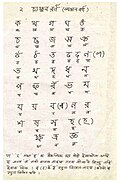
[[File:The consonants of the Mithilakshar script and the corresponding Devnagari.jpg|left|180px|thumb|Maithili language in Tirhuta and Devanagari scripts]] [[Hindi]] is the official language of the | [[File:The consonants of the Mithilakshar script and the corresponding Devnagari.jpg|left|180px|thumb|Maithili language in Tirhuta and Devanagari scripts]] [[Hindi]] is the official language of the State.<ref name=CSDOffLang1950>{{cite web |title=The Bihar Official Language Act, 1950 |url=http://csd.bih.nic.in/Act&rule/Act1english.pdf |year=1950 |website=Cabinet Secretariat Department, Government of Bihar |access-date=9 April 2015 |url-status=live |archiveurl=https://web.archive.org/web/20150413072041/http://csd.bih.nic.in/Act%26rule/Act1english.pdf |archivedate=13 April 2015}}</ref> Maithili (61 million speakers including [[Bajjika dialect]] which has 11 million speakers in India),<ref name=Chitransh2012>{{cite news |last=Chitransh |first=Anugya |title=Bhojpuri is not the only language in Bihar |url=http://hillpost.in/2012/09/bhojpuri-is-not-the-only-language-in-bihar/50489/ |date=1 September 2012 |newspaper=Hill Post |access-date=10 April 2015 |url-status=live |archiveurl=https://web.archive.org/web/20141228200009/http://hillpost.in/2012/09/bhojpuri-is-not-the-only-language-in-bihar/50489/ |archivedate=28 December 2014}}</ref> and Urdu<ref name=Benedikter2009>{{cite book |last=Benedikter |first=Thomas |title=Language Policy and Linguistic Minorities in India: An Appraisal of the Linguistic Rights of Minorities in India |url=https://books.google.com/books?id=vpZv2GHM7VQC&pg=PA89 |date=2009 |page=89 |location=Münster |publisher=[[LIT Verlag]] |isbn=978-3-643-10231-7 |access-date=10 April 2015}}</ref> are other recognised languages of the state. Unrecognised languages of the state are Bhojpuri (60 million), Angika (30 million) and Magahi (20 million).<ref name="Chitransh2012" /><ref name=Cardona2003>{{cite book |editor1-last=Cardona |editor1-first=George |editor1-link=George Cardona |editor2-last=Jain |editor2-first=Dhanesh |title=The Indo-Aryan Languages |date=11 September 2003 |page=500 |publisher=Routledge |series=Routledge Language Family Series |isbn=978-0-415-77294-5 |quote=...the number of speakers of Bihari languages are difficult to indicate because of unreliable sources. In the urban region most educated speakers of the language name Hindi as their language because this is what they use in formal contexts and believe it to be the appropriate response because of lack of awareness. The uneducated and the urban population of the region return Hindi as the generic name for their language.}}</ref> [[Bhojpuri language|Bhojpuri]] and [[Magahi]] are sociolinguistically a part of the [[Hindi Belt]] languages fold, thus they were not granted official status in the state.The number of speakers of the [[Bihari languages]] is difficult to count because of unreliable sources. In the urban region, most educated speakers of the language name Hindi as their language because this is what they use in formal contexts and believe it to be the appropriate response because of unawareness. The uneducated and the rural population of the region regards Hindi as the generic name for their language.<ref name="Dhanesh" >{{cite book |last1=Jain |first1=Dhanesh |last2=Cardona |first2=George |date=2003 |title=The Indo-Aryan Languages |publisher=Routledge |page=500 |quote=The number of speakers of Bihari languages are difficult to indicate because of unreliable sources. In the urban region, most educated speakers of the language name either Hindi or Urdu as their language because this is what they use in formal contexts and believe it to be the appropriate response because of unawareness. The uneducated and the rural population of the region regards Hindi or Urdu as the generic name for their language.}}</ref> | ||
Despite the large number of speakers of [[Bihari languages]], they have not been constitutionally recognized in [[India]], except [[Maithili language|Maithili]] which is recognised under the [[Eighth Schedule of the Constitution of India]]. Hindi is the language used for educational and official matters in Bihar.<ref>[http://www.diehardindian.com/demogrph/moredemo/histlang.htm History of Indian languages] {{webarchive|url=https://web.archive.org/web/20120226234832/http://www.diehardindian.com/demogrph/moredemo/histlang.htm |date=26 February 2012 }}, "Bihari is actually the name of a group of three related languages—Bhojpuri, Maithili, and Magahi—spoken mainly in northeastern India in Bihar."</ref> These languages was legally absorbed under the subordinate label of Hindi in the 1961 Census. Such state and national politics are creating conditions for language endangerment.<ref>{{cite conference | Despite the large number of speakers of [[Bihari languages]], they have not been constitutionally recognized in [[India]], except [[Maithili language|Maithili]] which is recognised under the [[Eighth Schedule of the Constitution of India]]. Hindi is the language used for educational and official matters in Bihar.<ref>[http://www.diehardindian.com/demogrph/moredemo/histlang.htm History of Indian languages] {{webarchive|url=https://web.archive.org/web/20120226234832/http://www.diehardindian.com/demogrph/moredemo/histlang.htm |date=26 February 2012 }}, "Bihari is actually the name of a group of three related languages—Bhojpuri, Maithili, and Magahi—spoken mainly in northeastern India in Bihar."</ref> These languages was legally absorbed under the subordinate label of Hindi in the 1961 Census. Such state and national politics are creating conditions for language endangerment.<ref>{{cite conference | ||
| Line 54: | Line 62: | ||
| url = https://books.google.com/books?id=tcfJY7kANo8C&q=awadhi+and+magahi+languages&pg=PA5 | | url = https://books.google.com/books?id=tcfJY7kANo8C&q=awadhi+and+magahi+languages&pg=PA5 | ||
}}</ref> | }}</ref> | ||
The first success for spreading Hindi occurred in Bihar in 1881, when Hindi displaced Urdu as the sole official language of the province. In this struggle between competing Hindi and Urdu, the potential claims of the three large mother tongues in the region – [[Bhojpuri language|Bhojpuri]], [[Maithili language|Maithili]] and [[Magahi language|Magahi]] were ignored. After independence Hindi was again given the sole official status through the Bihar Official Language Act, 1950.<ref>Brass Paul R., ''The Politics of India Since Independence'', Cambridge University Press, pp. 183</ref> Urdu became the second official language in the undivided State of Bihar on 16 August 1989. Bihar also produced several eminent Urdu writers including [[Sulaiman Nadvi]], [[Manazir Ahsan Gilani]], [[Abdul Qavi Desnavi]], Paigham Afaqui, [[Jabir Husain]], Sohail Azimabadi, [[Hussain Ul Haque]], | The first success for spreading Hindi occurred in Bihar in 1881, when Hindi displaced Urdu as the sole official language of the province. In this struggle between competing Hindi and Urdu, the potential claims of the three large mother tongues in the region – [[Bhojpuri language|Bhojpuri]], [[Maithili language|Maithili]] and [[Magahi language|Magahi]] were ignored. After independence Hindi was again given the sole official status through the Bihar Official Language Act, 1950.<ref>Brass Paul R., ''The Politics of India Since Independence'', Cambridge University Press, pp. 183</ref> Urdu became the second official language in the undivided State of Bihar on 16 August 1989. Bihar also produced several eminent Urdu writers including [[Sulaiman Nadvi]], [[Manazir Ahsan Gilani]], [[Abdul Qavi Desnavi]], Paigham Afaqui, [[Jabir Husain]], [[Sohail Azimabadi]], [[Hussain Ul Haque]], [[Shamim Hashimi]],<ref>{{cite web |url=http://urduliterature.org/shamimhashimi.aspx |title=Dr. Shamim Hashimi |website=Urdu Literature |archive-url=https://web.archive.org/web/20131002040811/http://urduliterature.org/shamimhashimi.aspx |archive-date=2 October 2013 |access-date=18 July 2013}}</ref> and [[Wahab Ashrafi]],<ref>{{cite web |url=http://www.biharanjuman.org/bio/wahab.htm |title=Professor Dr. Syed Abdul Wahab Ashrafi |website=Biharanjuman.org |archive-url=https://web.archive.org/web/20130928013618/http://www.biharanjuman.org/bio/wahab.htm |archive-date=28 September 2013 |access-date=18 July 2013}}</ref> among others. | ||
Bihar has produced a number of writers of Hindi, including Raja Radhika Raman Singh, Shiva Pujan Sahay, Divakar Prasad Vidyarthy, [[Ramdhari Singh 'Dinkar']], [[Ram Briksh Benipuri]], [[Phanishwar Nath 'Renu']], [[Gopal Singh "Nepali"]] and Baba [[Nagarjun]]. [[Mahapandit Rahul Sankrityayan]], the great writer and [[Buddhist]] scholar, was born in [[Uttar Pradesh|U.P.]] but spent his life in the land of [[Buddha]], i.e., Bihar. [[Hrishikesh Sulabh]] and Neeraj Singh (from Ara) are the prominent writer of the new generation. They are short story writer, playwright and theatre critic. Arun Kamal and Aalok Dhanwa are the well-known poets. Different regional languages also have produced some prominent poets and authors. [[Sharat Chandra Chattopadhyay]], who is among the greatest writers in [[Bengali language|Bengali]], resided for some time in Bihar. [[Upamanyu Chatterjee]] also hails from Patna in Bihar. [[Devaki Nandan Khatri]], who rose to fame at the beginning of the 20th century on account of his novels such as ''[[Chandrakanta (novel)|Chandrakanta]]'' and ''Chandrakanta Santati'', was born in [[Muzaffarpur]], Bihar. [[Vidyapati|Vidyapati Thakur]] is the most renowned poet of Maithili (c. 14–15th century). [[Satyapal Chandra]]<ref name="indiatimes">{{cite | Bihar has produced a number of writers of Hindi, including [[Raja Radhika Raman Sinha|Raja Radhika Raman Singh]], [[Acharya Shivpujan Sahay|Shiva Pujan Sahay]], Divakar Prasad Vidyarthy, [[Ramdhari Singh 'Dinkar']], [[Ram Briksh Benipuri]], [[Phanishwar Nath 'Renu']], [[Gopal Singh "Nepali"]] and Baba [[Nagarjun]]. [[Mahapandit Rahul Sankrityayan]], the great writer and [[Buddhist]] scholar, was born in [[Uttar Pradesh|U.P.]] but spent his life in the land of [[Buddha]], i.e., Bihar. [[Hrishikesh Sulabh]] and Neeraj Singh (from Ara) are the prominent writer of the new generation. They are short story writer, playwright and theatre critic. Arun Kamal and Aalok Dhanwa are the well-known poets. Different regional languages also have produced some prominent poets and authors. [[Sharat Chandra Chattopadhyay]], who is among the greatest writers in [[Bengali language|Bengali]], resided for some time in Bihar. [[Upamanyu Chatterjee]] also hails from Patna in Bihar. [[Devaki Nandan Khatri]], who rose to fame at the beginning of the 20th century on account of his novels such as ''[[Chandrakanta (novel)|Chandrakanta]]'' and ''Chandrakanta Santati'', was born in [[Muzaffarpur]], Bihar. [[Vidyapati|Vidyapati Thakur]] is the most renowned poet of Maithili (c. 14–15th century). [[Satyapal Chandra]]<ref name="indiatimes">{{cite news|url=http://timesofindia.indiatimes.com/city/patna/After-11-novels-Bihar-lad-set-for-Bollywood-debut/articleshow/20938614.cms|work=The Times of India|title=After 11 novels, Bihar lad set for Bollywood debut - Times of India|date=6 July 2013 |access-date=2017-02-17|url-status=live|archiveurl=https://web.archive.org/web/20170228122118/http://timesofindia.indiatimes.com/city/patna/After-11-novels-Bihar-lad-set-for-Bollywood-debut/articleshow/20938614.cms|archivedate=28 February 2017}}</ref> has written many English bestseller novels and he is one of India's emerging young writer. | ||
== | ==Religion== | ||
{{Main|Religion in Bihar}} | |||
According to the 2011 census, 82.7% of Bihar's population practiced Hinduism, while 16.9% followed Islam.<ref name="census2011">{{cite web|title=Population by religion community - 2011|url=http://www.censusindia.gov.in/2011census/C-01/DDW00C-01%20MDDS.XLS|website=Census of India, 2011|publisher=The Registrar General & Census Commissioner, India|archiveurl=https://web.archive.org/web/20150825155850/http://www.censusindia.gov.in/2011census/C-01/DDW00C-01%20MDDS.XLS|archivedate=2015-08-25}}</ref> | |||
{| class="wikitable" | |||
|- | |||
! Religion !! Population | |||
|- | |- | ||
| [[Hindu]] || 82.7 | |||
|- | |- | ||
| [[Muslim]] || 17.70 | |||
|- | |- | ||
| | | Others || 0.4 | ||
|} | |||
==Caste and ethnic groups== | |||
{{Main|Bihar caste-based survey 2022}} | |||
Bihari society follows a rigid caste system. The castes of Bihar are divided into [[Forward Castes]], [[Other Backward Class]], Extremely Backward Caste, Schedule Caste and Schedule Tribes. There exists a category among the Schedule Castes called Mahadalit, which was created by the [[Nitish Kumar]] government to identify more socio-economic backward groups among the Schedule Castes. In October 2023, Government of Bihar released the report of [[Bihar caste-based survey 2022]], it conducted in the same year. This was the first caste census to be conducted after Indian independence. The data published provided an insight into demographic detail of various caste groups of the state. It was found in this report that Other Backward Class and Extremely Backward Castes together account for approximately 63% of the population of the state of Bihar.<ref>{{cite news|url=https://www.thehindu.com/news/national/bihar-caste-survey-obcs-ebcs-comprise-more-than-63-of-population/article67371818.ece|title=Bihar caste census OBC EBC comprise 63 percent of state population|website=The Hindu|date=2 October 2023 |accessdate=2 October 2023 |last1=Tewary |first1=Amarnath }}</ref> The detailed data of the census report titled ''Bihar me jati adharit janganana'' (caste based census in Bihar) reveals that the Other Backward Class (OBC) population in the State is 27.1286% while, the Extremely Backward Class (EBC) comprises 36.0148%. The Scheduled Caste population in Bihar is at 19.6518% while the Scheduled Tribe population is 1.6824%. The General Caste also called Forward Castes are 15.5224% of the total population of the state.<ref>{{cite web|url=https://indianexpress.com/article/explained/bihar-caste-census-data-8965210/|title=Bihar caste census data|website=Indian express|date=2 October 2023 |accessdate=2 October 2023}}</ref><ref>{{cite web|url=https://www.indiatoday.in/india/story/bihar-caste-survey-numbers-out-most-backward-classes-population-2443291-2023-10-02|title=Bihar caste census results out, OBCs form 63% of population, General 16%|website=India Today|date=2 October 2023 |accessdate=2 October 2023}}</ref> | |||
{| class="wikitable" | |||
|- | |||
[[ | ! colspan="2" | Caste Groups of Bihar<ref>{{Cite news|url=https://www.thehindu.com/news/national/bihar-caste-survey-obcs-ebcs-comprise-more-than-63-of-population/article67371818.ece|title=Bihar caste survey OBCs, EBCs comprise more than 63% of State's population|website=[[The Hindu]] |date=2 October 2023 |last1=Tewary |first1=Amarnath }}</ref><ref>{{cite web|url=https://www.livehindustan.com/bihar/story-bihar-caste-survey-report-how-many-castes-in-bihar-with-more-than-1-percent-population-see-full-list-8791799.html|title=Bihar Caste Survey Report: बिहार में 1 प्रतिशत से अधिक आबादी वाली कितनी हैं जातियां? देखें पूरी लिस्ट |date=2 October 2023 }}</ref> | ||
|- | |||
! Caste Groups || Population (%) | |||
|- | |- | ||
| [[ | | [[Other Backward Class|OBC]] || 27.12% | ||
|- | |- | ||
| | | EBC || 36.01% | ||
|| | |||
|- | |- | ||
| [[ | | [[Dalit]]s(SCs) || 19.65% | ||
|| | |||
|- | |- | ||
| | | [[Forward caste]] || 15.52% | ||
|| | |||
|- | |- | ||
| | | [[Adivasi]]s(STs) || 1.68% | ||
|| | |||
|} | |} | ||
The total population of the state was approximately 130 million.<ref>{{cite web|url=https://www.livemint.com/politics/news/bihar-caste-based-census-out-extremely-backward-class-is-36-01-backward-class-2713-11696234333143.html|title=Bihar caste-based census out: Extremely backward class is 36.01%, backward class 27|website=livemint|date=2 October 2023 |accessdate=2 October 2023}}</ref> The largest social category of Extremely Backward Castes in Bihar comprise nearly 130 castes, which historically worked as service providers for other caste groups. In the local political context, they are termed as ''Pachpania''. The prominent castes of this category are Nai (barbers), [[Mallaah]], the fishermen (bearing surnames of Sahani, [[Nishad]] and [[Kewat]]), [[Lohar (caste)|Lohar]] (blacksmiths), [[Teli]] (traditionally worked as oil pressers) and [[Lonia|Nonia]] (traditionally they made salt).<ref>{{cite web|url=https://indianexpress.com/article/political-pulse/bihar-caste-survey-the-importance-of-being-ebc-in-state-8965283/|title=Bihar caste survey the importance of being EBC in state|website=Indian express|date=2 October 2023 |accessdate=2 October 2023}}</ref><ref>{{cite web|url=https://indianexpress.com/article/political-pulse/bihar-caste-census-ebcs-at-top-high-in-party-lists-in-2020-assembly-polls-8965229/|title=Bihar caste survey: EBCs at top, were also high in party lists in 2020 Assembly polls|website=Indian express|date=2 October 2023 |accessdate=2 October 2023}}</ref> | |||
Among the other prominent caste groups of the state, the [[Yadav]]s comprised 14.26% of the surveyed population, while [[Kushwaha]] and [[Kurmi]] formed 4.27% and 2.87% of the population respectively. These three caste were part of Other Backward Class category in the state, which is different from the Extremely Backward Castes, who are considered more socio-economic backward group.<ref>{{cite web|url=https://www.hindustantimes.com/india-news/bihar-government-releases-caste-based-survey-report-obc-27-general-category-1552-101696232978438.html|title=Bihar caste survey OBC EBC 63 percent population|website=Hindustan Times|date=2 October 2023 |accessdate=2 October 2023}}</ref><ref>{{cite web|url=https://timesofindia.indiatimes.com/india/bihar-caste-census-27-13backward-class-15-52-general-category/articleshow/104103634.cms|title=Bihar caste survey released: OBCs, EBCs together account for 63% of total population|website=Times of India|access-date=2 October 2023}}</ref> Among the General Castes, [[Brahmin]]s were recorded to be 3.66 per cent, while the [[Kayastha]]s were recorded to be 0.60 per cent of the total population.<ref>{{Cite news |last=Bhelari |first=Amit |date=2023-11-07 |title=Bihar caste-based survey report {{!}} Poverty highest among Scheduled Castes, lowest among Kayasths |url=https://www.thehindu.com/news/national/bihars-caste-based-survey-report-shows-yadavs-hold-most-govt-jobs-among-obcs/article67509087.ece |access-date=2024-02-17 |work=The Hindu |language=en-IN |issn=0971-751X}}</ref> The [[Bhumihar]]s constituted 2.86 per cent of the total population.<ref>{{cite web|url=https://www.business-standard.com/india-news/bihar-caste-census-63-people-from-backward-extremely-backward-classes-123100200680_1.html|title=Bihar caste census 63 percent people EBC OBC|website=business standard|accessdate=2 October 2023}}</ref> The [[Rajput]]s were 3.45% of the surveyed population in this census report.<ref>{{cite web|url=https://www.firstpost.com/india/bihar-caste-based-census-report-released-obcs-63-per-cent-general-category-15-52-per-cent-yadavs-14-27-per-cent-13193682.html|title=Bihar caste based census report released obc ebc 63 percent Yadavs 14 percent|website=Firstpost|date=2 October 2023 |accessdate=2 October 2023}}</ref> | |||
{| class="wikitable" | {| class="wikitable sortable" | ||
|- | |||
! Caste !! Population !! Percentage | |||
|- | |||
| [[Yadav]] || {{number and percent|18650119|130725310|4|disp=table}} | |||
|- | |||
| [[Kushwaha]] ([[Koeri]]) ||{{number and percent|5506113|130725310|4|disp=table}} | |||
|- | |||
| [[Kurmi]] || {{number and percent|3762969|130725310|4|disp=table}} | |||
|- | |||
| [[Brahmin]] || {{number and percent|4781280|130725310|4|disp=table}} | |||
|- | |||
| [[Teli]] || {{number and percent|3677491|130725310|4|disp=table}} | |||
|- | |||
| [[Mallaah|Mallah]] ([[Nishad]]) || {{number and percent|3410093|130725310|4|disp=table}} | |||
|- | |||
| [[Lonia|Nonia]] || {{number and percent|2498474|130725310|4|disp=table}} | |||
|- | |||
| [[Kanu (caste)|Kanu]] ||{{number and percent|2892761|130725310|4|disp=table}} | |||
|- | |||
| [[Bania (caste)|Bania]] || {{number and percent|3026912|130725310|4|disp=table}} | |||
|- | |||
| [[Bhumihar]] || {{number and percent|3750886|130725310|4|disp=table}} | |||
|- | |||
| [[Rajput]]|| {{number and percent|4510733|130725310|4|disp=table}} | |||
|- | |- | ||
| [[Dusadh|Dushadh]] || {{number and percent|6943000|130725310|4|disp=table}} | |||
|- | |- | ||
| [[ | | [[Musahar]] || {{number and percent|4035787|130725310|4|disp=table}} | ||
|- | |- | ||
| [[ | | [[Kayastha]] || {{number and percent|785771|130725310|4|disp=table}} | ||
|- | |- | ||
| | | [[Chamar|Ravidas]] || {{number and percent|6869664|130725310|4|disp=table}} | ||
|} | |} | ||
== Bihari cuisine == | |||
{{Main|Bihari cuisine}} | |||
Notable local foods of Bihar include [[Dal Pitha]], [[Litti (dish)|Litti Chokha]], [[Ghugni|Chana Ghugni]], [[Mutton Kabab]], [[Reshmi kabab|Reshmi Kabab]], [[Kadhi bari|Kadhi Bari]], Puri Sabzi, [[Malpua]], Sattu Paratha, Doodh Pitha, Bajka, Kopal/Arikanchan ki Sabzi and many kinds of veggies etc. The famous sweets include [[Imarti]], [[Laung lata|Laung Lata]], Parwal ki Mithai, Khowa Lai, [[Tilkut]], [[Anarsa]], [[Khaja]], Laktho, [[Gulgula (doughnut)|Gulgula]] etc.<ref>{{Cite news |title=Famous food of Bihar |url=https://www.prabhatkhabar.com/state/bihar/famous-foods-of-bihar-swt |access-date=6 June 2024 |work=Prabhat Khabar}}</ref> | |||
==Bihari politics== | ==Bihari politics== | ||
{{main|Politics of Bihar}} | {{main|Politics of Bihar}} | ||
The politics of Bihar is influenced by [[caste]] and religion based consciousness to a large extent. The upper castes dominated the politics and political parties till 1967. But after 1967, the resurgence of middle castes took place and the castes like [[Koeri]], [[Yadav]] and [[Kurmi]] replaced the upper castes | The politics of Bihar is influenced by [[caste]] and religion based consciousness to a large extent. The upper castes dominated the politics and political parties till 1967. But after 1967, the resurgence of middle castes took place and the castes like [[Koeri]], [[Yadav]] and [[Kurmi]] replaced the upper castes, becoming the new political elites of the state . Some [[Dalit]] caste like [[Paswan]] and [[Chamar]] also performed well in politics, [[Bhola Paswan Shastri]] and [[Ram Sundar Das]] were former Chief Ministers from respective caste and [[Jagjivan Ram]] became Deputy Prime Minister and first Labour Minister of India. Since 1990, the Politics of Bihar is dominated by regional political parties like [[Janata Dal (United)]] and [[Rashtriya Janata Dal]], while a number of small parties like [[Rashtriya Jan Jan Party]], [[Plurals Party|Plural party]], [[Rashtriya Lok Janata Dal]] and [[Jan Adhikar Party]] are also active.<ref>{{cite book |last=Kumar|first=Sanjay |title=Post mandal politics in Bihar:Changing electoral patterns|publisher=SAGE publication|isbn=978-93-528-0585-3|url=https://books.google.com/books?id=2zhODwAAQBAJ|date=2018-06-05}}</ref> | ||
==Bihari sub-nationalism== | ==Bihari sub-nationalism== | ||
In 1923, a special session of the [[Indian National Congress|Congress]] took place in [[Delhi]]. During this session, an issue of sitting arrangement came up whereby the delegates from Bihar were not given seats in the front row. [[Maghfoor Ahmad Ajazi]] registered his objection to this discriminatory arrangement after which Bihari delegates were also given appropriate seats. His protest was admittedly on the issue of [[self-respect]] of the Biharis.<ref name="twocircles">{{cite web|last1=Sajjad|first1=Mohammad|title=Maghfur Aijazi: A freedom-fighter and a builder of Indian democracy|url= | In 1923, a special session of the [[Indian National Congress|Congress]] took place in [[Delhi]]. During this session, an issue of sitting arrangement came up whereby the delegates from Bihar were not given seats in the front row. [[Maghfoor Ahmad Ajazi]] registered his objection to this discriminatory arrangement after which Bihari delegates were also given appropriate seats. His protest was admittedly on the issue of [[self-respect]] of the Biharis.<ref name="twocircles">{{cite web|last1=Sajjad|first1=Mohammad|title=Maghfur Aijazi: A freedom-fighter and a builder of Indian democracy|url=https://twocircles.net/2013jan06/maghfur_aijazi_freedomfighter_and_builder_indian_democracy.html#.VPkHguHN45w|website=TwoCircles.net|date=6 January 2013|access-date=5 March 2015}}</ref><ref name="Teesri Jung">{{Cite news|date=4 March 2021|url=https://teesrijungnews.com/2021/03/%E0%A4%AE%E0%A5%8C%E0%A4%B2%E0%A4%BE%E0%A4%A8%E0%A4%BE-%E0%A4%AE%E0%A4%97%E0%A4%BC%E0%A4%AB%E0%A4%BC%E0%A5%81%E0%A4%B0-%E0%A4%85%E0%A4%B9%E0%A4%AE%E0%A4%A6-%E0%A4%85%E0%A4%9C%E0%A4%BE%E0%A4%9C/|title=मग़फ़ुर अहमद अजाज़ी : जंग ए आज़ादी का गुमनाम सिपाही!|newspaper=Teesri Jung|language=hi}}</ref> | ||
According to social scientist Dr. [[Shaibal Gupta]], the beating of students from Bihar in Mumbai in October 2008 has consolidated Bihari sub-nationalism.<ref>Ahmad Faizan, ''"Bihar violence: Raj the gainer"'', The times of India, Pune, 27 October 2008, pp. 6</ref> | According to social scientist Dr. [[Shaibal Gupta]], the beating of students from Bihar in Mumbai in October 2008 has consolidated Bihari sub-nationalism.<ref>Ahmad Faizan, ''"Bihar violence: Raj the gainer"'', The times of India, Pune, 27 October 2008, pp. 6</ref> | ||
==Diaspora== | |||
{{main|Bihari diaspora}} | |||
During the [[Partition of India]] in 1947, many [[Bihari Muslim]]s migrated to [[East Bengal]] (renamed to [[East Pakistan]]; later [[Bangladesh Liberation War|became]] [[Bangladesh]]).<ref name="Refugess International-Bangladesh"/><ref name="Stateless People in Bangladesh Inc.-Biharis"/> Bihari people are also well represented in the [[Muhajir (Urdu-speaking people)|Muhajir people]] of [[Pakistan]] (formerly [[West Pakistan]]) because of [[Partition of India|Partition]].<ref name="Tribune-Bihari people"/><ref name="CIDCM-Bihari people"/>h Ranbir | |||
==See also== | ==See also== | ||
* [[Anti-Bihari sentiment]] | * [[Anti-Bihari sentiment]] | ||
* [[Bihari | * [[Bihari Mauritians]] | ||
* [[List of people from Bihar]] | * [[List of people from Bihar]] | ||
* [[Bihari Muslims]] | |||
* [[List of people from Jharkhand]] | * [[List of people from Jharkhand]] | ||
== Notes == | |||
<references group="lower-alpha" /> | |||
==References== | ==References== | ||
| Line 138: | Line 173: | ||
{{Refbegin}} | {{Refbegin}} | ||
* {{cite book|last=Gopal|first=Ram|author-link=Ram Gopal (author)|title=Hindu Culture During and After Muslim Rule: Survival and Subsequent Challenges|url=https://books.google.com/books?id=wVr_f_gXOX4C&pg=PA20|year=1994|publisher=M.D. Publications Pvt. Ltd.|isbn=978-81-85880-26-6}} | * {{cite book|last=Gopal|first=Ram|author-link=Ram Gopal (author)|title=Hindu Culture During and After Muslim Rule: Survival and Subsequent Challenges|url=https://books.google.com/books?id=wVr_f_gXOX4C&pg=PA20|year=1994|publisher=M.D. Publications Pvt. Ltd.|isbn=978-81-85880-26-6}} | ||
* {{cite book|last=O'Malley|first=Lewis Sydney Steward|title=History of Magadha|url=https://books.google.com/books?id=18ULAwAACAAJ|year=1909|isbn=978-81-89224-01-1}} | * {{cite book|last=O'Malley|first=Lewis Sydney Steward|title=History of Magadha|url=https://books.google.com/books?id=18ULAwAACAAJ|year=1909|publisher=Veena Publications |isbn=978-81-89224-01-1}} | ||
* {{cite book |author=Sailendra Nath Sen |url=https://books.google.com/books?id=Wk4_ICH_g1EC&pg=PA246 |title=Ancient Indian History and Civilization |publisher=New Age |year=1999 |isbn=9788122411980 }} | |||
{{Refend}} | {{Refend}} | ||
{{commons category|People of Bihar}} | {{commons category|People of Bihar}} | ||
| Line 147: | Line 183: | ||
{{DEFAULTSORT:Bihari People}} | {{DEFAULTSORT:Bihari People}} | ||
[[Category:Indo-Aryan peoples]] | [[Category:Indo-Aryan peoples]] | ||
[[Category: | [[Category:Ethnic groups in Pakistan]] | ||
[[Category:Ethnic groups in Bangladesh]] | [[Category:Ethnic groups in Bangladesh]] | ||
[[Category:Ethnic groups in India]] | [[Category:Ethnic groups in India]] | ||
[[Category:Social groups of Bihar|*]] | [[Category:Social groups of Bihar|*]] | ||
Latest revision as of 15:44, 20 March 2026
Bihari ( listen (help·info)) is a demonym given to the inhabitants of the Indian state of Bihar. Bihari people can be separated into three main Indo-Aryan ethnolinguistic groups: Bhojpuris, Maithils and Magahis.[1] They are also further divided into a variety of hereditary caste groups.[2]
In Bihar today, the Bihari identity is seen as secondary to caste/clan, linguistic and religious identity but nonetheless is a subset of the larger Indian identity.[3] Biharis can be found throughout India, and in the neighbouring countries of Nepal, Pakistan and Bangladesh. During the Partition of India in 1947, many Bihari Muslims migrated to East Bengal (renamed to East Pakistan; later became Bangladesh).[4][5] Bihari people are also well represented in the Muhajir people of Pakistan (formerly West Pakistan) because of Partition.[6][7]
listen (help·info)) is a demonym given to the inhabitants of the Indian state of Bihar. Bihari people can be separated into three main Indo-Aryan ethnolinguistic groups: Bhojpuris, Maithils and Magahis.[1] They are also further divided into a variety of hereditary caste groups.[2]
In Bihar today, the Bihari identity is seen as secondary to caste/clan, linguistic and religious identity but nonetheless is a subset of the larger Indian identity.[3] Biharis can be found throughout India, and in the neighbouring countries of Nepal, Pakistan and Bangladesh. During the Partition of India in 1947, many Bihari Muslims migrated to East Bengal (renamed to East Pakistan; later became Bangladesh).[4][5] Bihari people are also well represented in the Muhajir people of Pakistan (formerly West Pakistan) because of Partition.[6][7]
History[edit | edit source]


Bihar is one of the longest inhabited places in the world with a history going back to the Neolithic age.[8] Since that time, Biharis have long been involved in some of the most important events in South Asian history. Biharis were the founders of many great empires based out of Magadh including the Nanda Empire, Maurya Empire and the Gupta Empire.[9] All of these empires had their capitals in Pataliputra (modern-day Patna). Two of India's major religions also have their origins in Bihar. Gautama Buddha who was the founder of Buddhism, achieved enlightenment in Bodh Gaya, Bihar. Mahavira, the founder of Jainism, was born in Vaishali in North Bihar.[10]
Bihar is home to two UNESCO World Heritage Sites, the Mahabodhi Temple at Bodh Gaya where the Buddha attained nirvana and the Buddhist monastic university of Nalanda. Until at least the 13th century, there was still a significant number of Buddhists in Bihar who mainly followed the Mahayana and Vajrayana schools until they were assimilated into Hinduism. However many village temples still retain idols of the Buddha and Bodhisattvas.[11] Many famous Buddhist and Hindu philosophers and scholars have originated or studied in Bihar during the period from the 5th to 13th century at institutions like Nalanda and Vikramashila including Kamalaśīla, Ratnākaraśānti, Śāntarakṣita, Abhayakaragupta, Udayana and Gaṅgeśa.[12][13]
Various native kingdoms also flourished in Bihar during the medieval period including the Later Gupta dynasty,[14][15] Karnats of Mithila, Pithipatis of Bodh Gaya and the Khayaravala dynasty.[16]
The founder of Sur Empire, Sher Shah Suri was born in Sasaram, a city in the state of Bihar in present-day India into a Pashtun family.[17][18] During the period of Islamic rule, much of Bihar was under the sway of local Zamindars or chieftains who maintained their own armies and territories. These chieftains retained much of their power until the arrival of the British East India Company.[19]
Martial tradition[edit | edit source]

Many academics including Dirk Kolff and Walter Hauser have noted that Bihar has a history of armed activism among its peasantry.[20] For centuries, Purbiya soldiers from Western Bihar have long served as soldiers in the armies of Kings in Western regions of India. Mughal sources also record that many peasant soldiers were recruited from Northern parts of Bihar (Tirhut).[21]
In late nineteenth and early twentieth century, the middle peasant castes like Koeri, Kurmi, Paswan and Yadav also got recruited into the British Indian Army as soldiers. According to William Pinch, after 1898, the social resurgence and claim for higher status in the social hierarchy attracted the peasant communities towards the military service.[22]
The Bihari Soldiers of British army played a major role in the Indian Rebellion of 1857 against the British following the suppression of the uprising, British authorities decided not to recruit troops from Bihar. Then they decided to recruit troops from Sikh and Muslim Communities of the Punjab.[23] This martial heritage continued into the late 20th century with the formation of private armies or senas that were formed to maintain the interests of specific castes.[20]
Servan-Schreiber described this martial tradition as follows:[24]
For any traveler on the roads of Bihar, an inescapable image comes to mind. That of a peasant who always keeps his wooden club or lathi at hand, under no circumstances letting it out of his reach. The Biharis, who constitute a martial race in India similar to the Sikhs or the Pathans, in keeping with the role conceived by the British colonial administration, were a mother lode for Monghol and English army recruiters. Their independent fighting spirit, which has earned them a reputation for toughness, has been in evidence throughout their history.
Clothing[edit | edit source]
.jpg)

.jpg)
The traditional dress of Bihari people includes Dhoti and Chapkan (Angarkha)[25][26] or Kurta (replacing the older chapkan which is a robe fastened on the right or on the left)[26] for men and Saree for women. In rural Bihar, men also wear a sort of plaid called Gamchha, which is often tied around the head as turban or headscarf and sometimes thrown round the body or over the shoulders.[26] In everyday life women wear saree or Salwar kameez. The saree is worn in "Seedha Aanchal" style traditionally.[27] Nevertheless, Western shirts and trousers are becoming popular among both the rural and urban male population.[27] And Salwar-Kameez for women in urban Bihar. Jewellery such as rings for men and bangles for women are popular. However, there are some traditional Bihari jewelries like "Chhara", "Hansuli", "Kamarbandh","Tika", "Nathiya", "Bichhiya", "Dholna", "Patwasi", "Panjeb", "Matarmala" ," etc.[27]
Language and literature[edit | edit source]

Hindi is the official language of the State.[28] Maithili (61 million speakers including Bajjika dialect which has 11 million speakers in India),[29] and Urdu[30] are other recognised languages of the state. Unrecognised languages of the state are Bhojpuri (60 million), Angika (30 million) and Magahi (20 million).[29][31] Bhojpuri and Magahi are sociolinguistically a part of the Hindi Belt languages fold, thus they were not granted official status in the state.The number of speakers of the Bihari languages is difficult to count because of unreliable sources. In the urban region, most educated speakers of the language name Hindi as their language because this is what they use in formal contexts and believe it to be the appropriate response because of unawareness. The uneducated and the rural population of the region regards Hindi as the generic name for their language.[32]
Despite the large number of speakers of Bihari languages, they have not been constitutionally recognized in India, except Maithili which is recognised under the Eighth Schedule of the Constitution of India. Hindi is the language used for educational and official matters in Bihar.[33] These languages was legally absorbed under the subordinate label of Hindi in the 1961 Census. Such state and national politics are creating conditions for language endangerment.[34] The first success for spreading Hindi occurred in Bihar in 1881, when Hindi displaced Urdu as the sole official language of the province. In this struggle between competing Hindi and Urdu, the potential claims of the three large mother tongues in the region – Bhojpuri, Maithili and Magahi were ignored. After independence Hindi was again given the sole official status through the Bihar Official Language Act, 1950.[35] Urdu became the second official language in the undivided State of Bihar on 16 August 1989. Bihar also produced several eminent Urdu writers including Sulaiman Nadvi, Manazir Ahsan Gilani, Abdul Qavi Desnavi, Paigham Afaqui, Jabir Husain, Sohail Azimabadi, Hussain Ul Haque, Shamim Hashimi,[36] and Wahab Ashrafi,[37] among others.
Bihar has produced a number of writers of Hindi, including Raja Radhika Raman Singh, Shiva Pujan Sahay, Divakar Prasad Vidyarthy, Ramdhari Singh 'Dinkar', Ram Briksh Benipuri, Phanishwar Nath 'Renu', Gopal Singh "Nepali" and Baba Nagarjun. Mahapandit Rahul Sankrityayan, the great writer and Buddhist scholar, was born in U.P. but spent his life in the land of Buddha, i.e., Bihar. Hrishikesh Sulabh and Neeraj Singh (from Ara) are the prominent writer of the new generation. They are short story writer, playwright and theatre critic. Arun Kamal and Aalok Dhanwa are the well-known poets. Different regional languages also have produced some prominent poets and authors. Sharat Chandra Chattopadhyay, who is among the greatest writers in Bengali, resided for some time in Bihar. Upamanyu Chatterjee also hails from Patna in Bihar. Devaki Nandan Khatri, who rose to fame at the beginning of the 20th century on account of his novels such as Chandrakanta and Chandrakanta Santati, was born in Muzaffarpur, Bihar. Vidyapati Thakur is the most renowned poet of Maithili (c. 14–15th century). Satyapal Chandra[38] has written many English bestseller novels and he is one of India's emerging young writer.
Religion[edit | edit source]
According to the 2011 census, 82.7% of Bihar's population practiced Hinduism, while 16.9% followed Islam.[39]
| Religion | Population |
|---|---|
| Hindu | 82.7 |
| Muslim | 17.70 |
| Others | 0.4 |
Caste and ethnic groups[edit | edit source]
Bihari society follows a rigid caste system. The castes of Bihar are divided into Forward Castes, Other Backward Class, Extremely Backward Caste, Schedule Caste and Schedule Tribes. There exists a category among the Schedule Castes called Mahadalit, which was created by the Nitish Kumar government to identify more socio-economic backward groups among the Schedule Castes. In October 2023, Government of Bihar released the report of Bihar caste-based survey 2022, it conducted in the same year. This was the first caste census to be conducted after Indian independence. The data published provided an insight into demographic detail of various caste groups of the state. It was found in this report that Other Backward Class and Extremely Backward Castes together account for approximately 63% of the population of the state of Bihar.[40] The detailed data of the census report titled Bihar me jati adharit janganana (caste based census in Bihar) reveals that the Other Backward Class (OBC) population in the State is 27.1286% while, the Extremely Backward Class (EBC) comprises 36.0148%. The Scheduled Caste population in Bihar is at 19.6518% while the Scheduled Tribe population is 1.6824%. The General Caste also called Forward Castes are 15.5224% of the total population of the state.[41][42]
| Caste Groups of Bihar[43][44] | |
|---|---|
| Caste Groups | Population (%) |
| OBC | 27.12% |
| EBC | 36.01% |
| Dalits(SCs) | 19.65% |
| Forward caste | 15.52% |
| Adivasis(STs) | 1.68% |
The total population of the state was approximately 130 million.[45] The largest social category of Extremely Backward Castes in Bihar comprise nearly 130 castes, which historically worked as service providers for other caste groups. In the local political context, they are termed as Pachpania. The prominent castes of this category are Nai (barbers), Mallaah, the fishermen (bearing surnames of Sahani, Nishad and Kewat), Lohar (blacksmiths), Teli (traditionally worked as oil pressers) and Nonia (traditionally they made salt).[46][47]
Among the other prominent caste groups of the state, the Yadavs comprised 14.26% of the surveyed population, while Kushwaha and Kurmi formed 4.27% and 2.87% of the population respectively. These three caste were part of Other Backward Class category in the state, which is different from the Extremely Backward Castes, who are considered more socio-economic backward group.[48][49] Among the General Castes, Brahmins were recorded to be 3.66 per cent, while the Kayasthas were recorded to be 0.60 per cent of the total population.[50] The Bhumihars constituted 2.86 per cent of the total population.[51] The Rajputs were 3.45% of the surveyed population in this census report.[52]
| Caste | Population | Percentage |
|---|---|---|
| Yadav | 18,650,119 | 14.2666% |
| Kushwaha (Koeri) | 5,506,113 | 4.212% |
| Kurmi | 3,762,969 | 2.8785% |
| Brahmin | 4,781,280 | 3.6575% |
| Teli | 3,677,491 | 2.8131% |
| Mallah (Nishad) | 3,410,093 | 2.6086% |
| Nonia | 2,498,474 | 1.9112% |
| Kanu | 2,892,761 | 2.2129% |
| Bania | 3,026,912 | 2.3155% |
| Bhumihar | 3,750,886 | 2.8693% |
| Rajput | 4,510,733 | 3.4505% |
| Dushadh | 6,943,000 | 5.3111% |
| Musahar | 4,035,787 | 3.0872% |
| Kayastha | 785,771 | 0.6011% |
| Ravidas | 6,869,664 | 5.255% |
Bihari cuisine[edit | edit source]
Notable local foods of Bihar include Dal Pitha, Litti Chokha, Chana Ghugni, Mutton Kabab, Reshmi Kabab, Kadhi Bari, Puri Sabzi, Malpua, Sattu Paratha, Doodh Pitha, Bajka, Kopal/Arikanchan ki Sabzi and many kinds of veggies etc. The famous sweets include Imarti, Laung Lata, Parwal ki Mithai, Khowa Lai, Tilkut, Anarsa, Khaja, Laktho, Gulgula etc.[53]
Bihari politics[edit | edit source]
The politics of Bihar is influenced by caste and religion based consciousness to a large extent. The upper castes dominated the politics and political parties till 1967. But after 1967, the resurgence of middle castes took place and the castes like Koeri, Yadav and Kurmi replaced the upper castes, becoming the new political elites of the state . Some Dalit caste like Paswan and Chamar also performed well in politics, Bhola Paswan Shastri and Ram Sundar Das were former Chief Ministers from respective caste and Jagjivan Ram became Deputy Prime Minister and first Labour Minister of India. Since 1990, the Politics of Bihar is dominated by regional political parties like Janata Dal (United) and Rashtriya Janata Dal, while a number of small parties like Rashtriya Jan Jan Party, Plural party, Rashtriya Lok Janata Dal and Jan Adhikar Party are also active.[54]
Bihari sub-nationalism[edit | edit source]
In 1923, a special session of the Congress took place in Delhi. During this session, an issue of sitting arrangement came up whereby the delegates from Bihar were not given seats in the front row. Maghfoor Ahmad Ajazi registered his objection to this discriminatory arrangement after which Bihari delegates were also given appropriate seats. His protest was admittedly on the issue of self-respect of the Biharis.[55][56]
According to social scientist Dr. Shaibal Gupta, the beating of students from Bihar in Mumbai in October 2008 has consolidated Bihari sub-nationalism.[57]
Diaspora[edit | edit source]
During the Partition of India in 1947, many Bihari Muslims migrated to East Bengal (renamed to East Pakistan; later became Bangladesh).[4][5] Bihari people are also well represented in the Muhajir people of Pakistan (formerly West Pakistan) because of Partition.[6][7]h Ranbir
See also[edit | edit source]
- Anti-Bihari sentiment
- Bihari Mauritians
- List of people from Bihar
- Bihari Muslims
- List of people from Jharkhand
Notes[edit | edit source]
References[edit | edit source]
- ↑ Brass, Paul R. (2005). Language, Religion and Politics in North India. iUniverse. p. 69. ISBN 978-0-595-34394-2.
- ↑ Dipankar Gupta (8 December 2004). Caste in Question: Identity Or Hierarchy?. SAGE Publications. pp. 113–114. ISBN 978-0-7619-3324-3.
- ↑ Verma, Jyoti (2019). "Bihari Identity: An Uncharted Question". Psychology and Developing Societies. 31 (2): 315–342. doi:10.1177/0971333619863237. S2CID 202290212.
- ↑ 4.0 4.1 "Bangladesh: Stateless Biharis Grasp for a Resolution and Their Rights". Refugees International. Archived from the original on 21 March 2007. Retrieved 16 February 2007.
- ↑ 5.0 5.1 "Stateless in Bangladesh and Pakistan". Stateless People in Bangladesh Inc. Archived from the original on 21 February 2007. Retrieved 16 February 2007.
- ↑ 6.0 6.1 "Pakistan under attack!". The Tribune (Editorial). Chandigarh. 20 September 2000. Archived from the original on 9 February 2007. Retrieved 16 February 2007.
- ↑ 7.0 7.1 "Assessment for Biharis in Bangladesh". Center for International Development and Conflict Management. Archived from the original on 2 October 2009. Retrieved 16 February 2007.
- ↑ "Directorate of Archaeology - Page 2". Archived from the original on 25 May 2012. Retrieved 14 September 2018.
- ↑ West, Barbara A. (2010). Encyclopedia of the Peoples of Asia and Oceania. Infobase. p. 117. ISBN 978-1-4381-1913-7.
- ↑ Titze, Kurt; Bruhn, Klaus (1998). Jainism: A Pictorial Guide to the Religion of Non-violence. Motilal Banarsidass Publ. ISBN 9788120815346.
- ↑ Prasad, Birendra Nath (2021). Archaeology of Religion in South Asia: Buddhist, Brahmanical and Jaina Religious Centres in Bihar and Bengal, c. AD 600–1200. Routledge. p. 423. ISBN 9781000416756.
- ↑ Buswell Jr., Robert (2013). "Nālanda". Princeton Dictionary of Buddhism: 565.
- ↑ Buswell Jr, Robert (2013). "Vikramaśīla". Princeton Dictionary of Buddhis: 970. ISBN 978-0-691-15786-3.
- ↑ Ghosh, Suchandra (2022). "Later Guptas". The Encyclopedia of Ancient History. pp. 1–2. doi:10.1002/9781119399919.eahaa00571. ISBN 978-1-119-39991-9.
- ↑ Sailendra Nath Sen 1999, p. 246.
- ↑ Chakrabarty, Dilip (2010). The Geopolitical Orbits of Ancient India: The Geographical Frames of the Ancient Indian Dynasties. Oxford University Press. pp. 47–48. ISBN 978-0-19-908832-4.
- ↑ Asad Muḥammad K̲h̲ān̲, The Harvest of Anger and Other Stories, Oxford University Press (2002), p. 62
- ↑ Ishwari Prasad, The Mughal Empire, Chugh Publications (1974), p. 157
- ↑ Tahir Hussain Ansari (20 June 2019). Mughal Administration and the Zamindars of Bihar. Taylor & Francis. p. 2. ISBN 978-1-00-065152-2.
- ↑ 20.0 20.1 Walter Hauser (2004). "From Peasant Soldiering to Peasant Activism: Reflections on the Transition of a Martial Tradition in the Flaming Fields of Bihar". Journal of the Economic and Social History of the Orient. 47 (3): 401–434. doi:10.1163/1568520041974684. JSTOR 25165055.
- ↑ Pankaj Jha (20 November 2018). A Political History of Literature: Vidyapati and the Fifteenth Century. OUP India. p. 22. ISBN 978-0-19-909535-3.
- ↑ Kunnath, George (2018). Rebels From the Mud Houses: Dalits and the Making of the Maoist Revolution ... New York: Taylor and Francis. p. 181. ISBN 978-1-138-09955-5. Retrieved 1 July 2022.
- ↑ Roy, Kaushik (6 October 2015). Military Manpower, Armies and Warfare in South Asia. Routledge. ISBN 9781317321286.
- ↑ Servan-Schreiber, Catherine (1998). "Indian Epics of the Terai Conquest: The Story of a Migration". Diogenes. 46 (181): 77–93. doi:10.1177/039219219804618106. S2CID 144074264.
- ↑ Winer, Lise (2009) Dictionary of the English/Creole of Trinidad & Tobago: On Historical Principles [1] Archived 10 May 2018 at the Wayback Machine
- ↑ 26.0 26.1 26.2 O'Malley, L.S.S. Bihar And Orissa Gazetteers Shahabad. Logos Press. p. 51. ISBN 9788172681227. Archived from the original on 18 February 2017. Retrieved 17 February 2017.
- ↑ 27.0 27.1 27.2 "Bihari Clothing". Web India 123. Archived from the original on 21 November 2006. Retrieved 16 February 2007.
- ↑ "The Bihar Official Language Act, 1950" (PDF). Cabinet Secretariat Department, Government of Bihar. 1950. Archived (PDF) from the original on 13 April 2015. Retrieved 9 April 2015.
- ↑ 29.0 29.1 Chitransh, Anugya (1 September 2012). "Bhojpuri is not the only language in Bihar". Hill Post. Archived from the original on 28 December 2014. Retrieved 10 April 2015.
- ↑ Benedikter, Thomas (2009). Language Policy and Linguistic Minorities in India: An Appraisal of the Linguistic Rights of Minorities in India. Münster: LIT Verlag. p. 89. ISBN 978-3-643-10231-7. Retrieved 10 April 2015.
- ↑ Cardona, George; Jain, Dhanesh, eds. (11 September 2003). The Indo-Aryan Languages. Routledge Language Family Series. Routledge. p. 500. ISBN 978-0-415-77294-5.
...the number of speakers of Bihari languages are difficult to indicate because of unreliable sources. In the urban region most educated speakers of the language name Hindi as their language because this is what they use in formal contexts and believe it to be the appropriate response because of lack of awareness. The uneducated and the urban population of the region return Hindi as the generic name for their language.
- ↑ Jain, Dhanesh; Cardona, George (2003). The Indo-Aryan Languages. Routledge. p. 500.
The number of speakers of Bihari languages are difficult to indicate because of unreliable sources. In the urban region, most educated speakers of the language name either Hindi or Urdu as their language because this is what they use in formal contexts and believe it to be the appropriate response because of unawareness. The uneducated and the rural population of the region regards Hindi or Urdu as the generic name for their language.
- ↑ History of Indian languages Archived 26 February 2012 at the Wayback Machine, "Bihari is actually the name of a group of three related languages—Bhojpuri, Maithili, and Magahi—spoken mainly in northeastern India in Bihar."
- ↑ Verma, Mahandra K (2001). "Language Endangerment and Indian languages: An exploration and a critique". Linguistic Structure and Language Dynamics in South Asia. ISBN 9788120817654.
- ↑ Brass Paul R., The Politics of India Since Independence, Cambridge University Press, pp. 183
- ↑ "Dr. Shamim Hashimi". Urdu Literature. Archived from the original on 2 October 2013. Retrieved 18 July 2013.
- ↑ "Professor Dr. Syed Abdul Wahab Ashrafi". Biharanjuman.org. Archived from the original on 28 September 2013. Retrieved 18 July 2013.
- ↑ "After 11 novels, Bihar lad set for Bollywood debut - Times of India". The Times of India. 6 July 2013. Archived from the original on 28 February 2017. Retrieved 17 February 2017.
- ↑ "Population by religion community - 2011". Census of India, 2011. The Registrar General & Census Commissioner, India. Archived from the original on 25 August 2015.
- ↑ Tewary, Amarnath (2 October 2023). "Bihar caste census OBC EBC comprise 63 percent of state population". The Hindu. Retrieved 2 October 2023.
- ↑ "Bihar caste census data". Indian express. 2 October 2023. Retrieved 2 October 2023.
- ↑ "Bihar caste census results out, OBCs form 63% of population, General 16%". India Today. 2 October 2023. Retrieved 2 October 2023.
- ↑ Tewary, Amarnath (2 October 2023). "Bihar caste survey OBCs, EBCs comprise more than 63% of State's population". The Hindu.
- ↑ "Bihar Caste Survey Report: बिहार में 1 प्रतिशत से अधिक आबादी वाली कितनी हैं जातियां? देखें पूरी लिस्ट". 2 October 2023.
- ↑ "Bihar caste-based census out: Extremely backward class is 36.01%, backward class 27". livemint. 2 October 2023. Retrieved 2 October 2023.
- ↑ "Bihar caste survey the importance of being EBC in state". Indian express. 2 October 2023. Retrieved 2 October 2023.
- ↑ "Bihar caste survey: EBCs at top, were also high in party lists in 2020 Assembly polls". Indian express. 2 October 2023. Retrieved 2 October 2023.
- ↑ "Bihar caste survey OBC EBC 63 percent population". Hindustan Times. 2 October 2023. Retrieved 2 October 2023.
- ↑ "Bihar caste survey released: OBCs, EBCs together account for 63% of total population". Times of India. Retrieved 2 October 2023.
- ↑ Bhelari, Amit (7 November 2023). "Bihar caste-based survey report | Poverty highest among Scheduled Castes, lowest among Kayasths". The Hindu. ISSN 0971-751X. Retrieved 17 February 2024.
- ↑ "Bihar caste census 63 percent people EBC OBC". business standard. Retrieved 2 October 2023.
- ↑ "Bihar caste based census report released obc ebc 63 percent Yadavs 14 percent". Firstpost. 2 October 2023. Retrieved 2 October 2023.
- ↑ "Famous food of Bihar". Prabhat Khabar. Retrieved 6 June 2024.
- ↑ Kumar, Sanjay (5 June 2018). Post mandal politics in Bihar:Changing electoral patterns. SAGE publication. ISBN 978-93-528-0585-3.
- ↑ Sajjad, Mohammad (6 January 2013). "Maghfur Aijazi: A freedom-fighter and a builder of Indian democracy". TwoCircles.net. Retrieved 5 March 2015.
- ↑ "मग़फ़ुर अहमद अजाज़ी : जंग ए आज़ादी का गुमनाम सिपाही!". Teesri Jung (in हिन्दी). 4 March 2021.
- ↑ Ahmad Faizan, "Bihar violence: Raj the gainer", The times of India, Pune, 27 October 2008, pp. 6
Bibliography[edit | edit source]
- Gopal, Ram (1994). Hindu Culture During and After Muslim Rule: Survival and Subsequent Challenges. M.D. Publications Pvt. Ltd. ISBN 978-81-85880-26-6.
- O'Malley, Lewis Sydney Steward (1909). History of Magadha. Veena Publications. ISBN 978-81-89224-01-1.
- Sailendra Nath Sen (1999). Ancient Indian History and Civilization. New Age. ISBN 9788122411980.

.png)