

No edit summary |
improve lead after review |
||
| Line 1: | Line 1: | ||
{{Short description| | {{Short description|Central police force in India}} | ||
{{EngvarB|date=March 2014}} | {{EngvarB|date=March 2014}} | ||
{{Use dmy dates|date=December 2018}} | {{Use dmy dates|date=December 2018}} | ||
{{Infobox law enforcement agency | {{Infobox law enforcement agency | ||
| agencyname = Central Industrial Security Force | | agencyname = Central Industrial Security Force (CISF) | ||
| commonname = | | commonname = | ||
| abbreviation = CISF | | abbreviation = CISF | ||
| logo = CISF LOGO.svg | |||
| logo = | |||
| logocaption = Emblem of the Central Industrial Security Force | | logocaption = Emblem of the Central Industrial Security Force | ||
| badge = | | badge = | ||
| badgecaption = | | badgecaption = | ||
| flag = | | flag = CISF Flag.svg | ||
| flagcaption = | | flagcaption = Flag of the Central Industrial Security Force | ||
| motto = ''Protection and Security'' | | motto = "संरक्षण एवं सुरक्षा"<br/>''Protection and Security'' | ||
| mottotranslated = | | mottotranslated = | ||
| director general = Rajwinder Singh Bhatti, IPS | |||
| mission = | | mission = | ||
| formed = {{Start date and age|1969|03|10|df=yes}} | | formed = {{Start date and age|1969|03|10|df=yes}} | ||
| preceding1 = | | preceding1 = | ||
| employees = | | employees = 190,000 active Personnel<ref>{{cite web |url=http://mha.nic.in/sites/upload_files/mha/files/EnglAnnualReport2016-17_17042017.pdf |title=Annual Report 2016-17 |access-date=1 June 2021|archive-url=https://web.archive.org/web/20170808200948/http://mha.nic.in/sites/upload_files/mha/files/EnglAnnualReport2016-17_17042017.pdf |archive-date=8 August 2017 |url-status=dead |publisher=Ministry of Home Affairs, Government of India}}</ref> | ||
| volunteers = | | volunteers = | ||
| budget = {{INRConvert| | | budget = {{INRConvert|16828.85|c|1}} <small>(2026–27)</small><ref>{{Cite web |date=1 Feb 2026 |title=DEMAND NO. 51, Demands for Grants, 2026-2027, MINISTRY OF HOME AFFAIRS |url=https://www.indiabudget.gov.in/doc/eb/sbe51.pdf |access-date=1 Feb 2026 |website=IndiaBudget.gov.in |pages=5 |publication-place=[[New Delhi]]}}</ref> | ||
| country = India | | country = India | ||
| countryabbr = | | countryabbr = | ||
| federal = | | federal = Yes | ||
| map = | | map = | ||
| legalpersonality = | | legalpersonality = | ||
| Line 33: | Line 30: | ||
| sizepopulation = | | sizepopulation = | ||
| legaljuris = | | legaljuris = | ||
| governingbody = Ministry of Home Affairs (India) | | governingbody = [[Ministry of Home Affairs (India)|Ministry of Home Affairs]] | ||
| governingbodyscnd = | | governingbodyscnd = | ||
| constitution1 = [[Central Industrial Security Force Act, 1968]] | | constitution1 = [[Central Industrial Security Force Act, 1968]] | ||
| Line 52: | Line 49: | ||
| electeetype = Minister | | electeetype = Minister | ||
| minister1name = [[Amit Shah]] | | minister1name = [[Amit Shah]] | ||
| minister1pfo = | | minister1pfo = [[Minister of Home Affairs (India)|Minister of Home Affairs]] | ||
| chief1name = | | chief1name = [[Praveer Ranjan]], [[Indian Police Service|IPS]] | ||
| chief1position = [[Director General]] | | chief1position = [[Director General]] | ||
| parentagency = | | parentagency = | ||
| child1agency = | | child1agency = | ||
| unittype = | | unittype = | ||
| Line 76: | Line 73: | ||
| animal1type = | | animal1type = | ||
| animals1 = | | animals1 = | ||
| person1name = [[O.P. Singh]] | | person1name = [[O. P. Singh]] {{small|([[Indian Police Service|IPS]])}} | ||
| person1reason = Former Director General<ref>{{cite web|url=http://mha1.nic.in/ipr/ips_ersheet_new/ERSheet1.aspx|title=Om Prakash Singh – Executive Record Sheet|website=[[Ministry of Home Affairs (India)|Ministry of Home Affairs]], [[Government of India]]|archive-url=https://web.archive.org/web/20160424100743/http://mha1.nic.in/ipr/ips_ersheet_new/ERSheet1.aspx|archive-date=24 April 2016|url-status=dead|access-date=11 January 2018}}</ref> | | person1reason = Former Director General<ref>{{cite web|url=http://mha1.nic.in/ipr/ips_ersheet_new/ERSheet1.aspx|title=Om Prakash Singh – Executive Record Sheet|website=[[Ministry of Home Affairs (India)|Ministry of Home Affairs]], [[Government of India]]|archive-url=https://web.archive.org/web/20160424100743/http://mha1.nic.in/ipr/ips_ersheet_new/ERSheet1.aspx|archive-date=24 April 2016|url-status=dead|access-date=11 January 2018}}</ref> | ||
| person1type = | | person1type = | ||
| Line 84: | Line 81: | ||
| anniversary1 = | | anniversary1 = | ||
| award1 = | | award1 = | ||
| website = | | website = {{URL|http://cisf.gov.in/}} | ||
| footnotes = | | footnotes = | ||
| reference = | | reference = | ||
}} | }} | ||
{{Politics of India}} | {{Politics of India}} | ||
The '''Central Industrial Security Force''' ('''CISF''' | The '''Central Industrial Security Force''' ('''CISF''') is a [[Central Armed Police Forces|central armed police force]] in [[India]], under the [[Ministry of Home Affairs (India)|Ministry of Home Affairs]]. CISF's primary mission is to provide [[security police|security policing]] services to large institutions, whether state-owned or privately owned. | ||
It was set up under an Act of the [[Parliament of India]] on | It was set up under an Act of the [[Parliament of India]] on 15 March 1969 with a strength of 2,800. CISF was subsequently formally authorized by another Act of Parliament passed on 15 June 1983. Its current active strength is 148,371 personnel.<ref>{{cite web|url=https://www.cisf.gov.in/dgmsg/|title=CISF Official Website}}</ref> In April 2017, the government raised the sanctioned strength from 145,000 to 180,000 personnel. Recently the strength has been increased to 200,000.<ref>{{cite web|url=http://pib.nic.in/newsite/erelease.aspx?relid=(Release%20ID%20:160843)|title=Press Information Bureau|access-date=29 April 2017}}</ref> | ||
Among its duties are guarding sensitive governmental buildings, Parliament complex, the Delhi Metro, and providing airport security.<ref>{{Cite news|agency=Times News Network (TNN) |title=Rajesh Ranjan takes charge as CISF chief |date=12 April 2018 |newspaper=[[The Times of India]] |url=https://timesofindia.indiatimes.com/india/articleshow/63722073.cms |archive-url=https://web.archive.org/web/20180412185049/https://timesofindia.indiatimes.com/india/articleshow/63722073.cms |archive-date=12 April 2018 |url-status=live }}</ref> | |||
CISF also [[Security Consultancy Wing|provides consultancy services]] to private industries as well as other organisations within the Indian government. The scope of CISF's consulting practice includes security consulting and fire protection consulting. | |||
It also plays a major role in Disaster Management. The CISF has a 'Fire Wing' which helps during fire accidents in Industries where the CISF is on guard. | |||
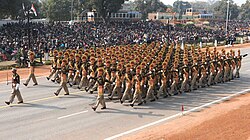
[[File:The Central Industrial Security Force marching contingent passes through the Rajpath during the 62nd Republic Day Parade-2011, in New Delhi on January 26, 2011.jpg|alt=|thumb|CISF marching contingent in New Delhi]] | [[File:The Central Industrial Security Force marching contingent passes through the Rajpath during the 62nd Republic Day Parade-2011, in New Delhi on January 26, 2011.jpg|alt=|thumb|CISF marching contingent in New Delhi]] | ||
== | ==History== | ||
The Central Industrial Security Force (CISF) was established by an Act of Parliament on 10 March 1969 with an initial sanctioned strength of approximately 188,000 personnel. | |||
As its name indicates, it was created to provide better protection and security to industrial undertakings across the country. Initially, protection was limited to industries wholly owned by the Central Government. This restriction has since been relaxed, and the CISF now also safeguards joint-venture enterprises in which the Central Government has a stake. | |||
Over the years, the role of the CISF has significantly expanded and diversified. Today, in addition to industrial units, it provides security to [[List of airports in India|airports]], [[List of ports in India|seaports]], [[Urban rail transit in India|metro rail networks]], key government buildings, heritage monuments (including the [[Taj Mahal]] and [[Red Fort]]), opium and alkaloid extraction units, nuclear power plants, and space establishments.The CISF also specialises in VIP security and disaster management. Currently, it performs a wide range of duties related to internal security, election security, anti-Naxal operations, and any other tasks assigned to it by the Government of India.<ref>{{cite web | title=CISF Act | CISF | url=https://www.cisf.gov.in/cisfeng/cisf-act-2/ }}</ref> | |||
==Structure and organisation== | ==Structure and organisation== | ||
| Line 114: | Line 114: | ||
The Financial Adviser of the CISF has been an [[Indian Revenue Service]] officer of the rank of Director and also has Dy Advisers from the Indian Audit and Accounts Service and Indian Civil Account Service. | The Financial Adviser of the CISF has been an [[Indian Revenue Service]] officer of the rank of Director and also has Dy Advisers from the Indian Audit and Accounts Service and Indian Civil Account Service. | ||
===Rank structure | ===Rank structure=== | ||
{{main|List of police ranks in India}} | {{main|List of police ranks in India}} | ||
{{main|Indian Police Service}} | {{main|Indian Police Service}} | ||
Being a central Indian police agency and having high presence of [[Indian Police Service]] officers, CISF follows ranks and insignia similar to other police organisations in India. Non-gazetted (enrolled) officers and members use the same ranks as other Indian police forces. | Being a central Indian police agency and having high presence of [[Indian Police Service]] officers, CISF follows ranks and insignia similar to other police organisations in India. Non-gazetted (enrolled) officers and members use the same ranks as other Indian police forces. | ||
==CISF protection to Non-Nationalised Industry | ;Officers | ||
{| style="border:1px solid #8888aa; background-color:#f7f8ff; padding:5px; font-size:95%; margin: 0px 12px 12px 0px;" | |||
{{Ranks and Insignia of Non NATO Armed Forces/OF/Blank}} | |||
{{Ranks and Insignia of Non NATO Armies/OF/India (CISF)}} | |||
|} | |||
;Enlisted ranks | |||
{| style="border:1px solid #8888aa; background-color:#f7f8ff; padding:5px; font-size:95%; margin: 0px 12px 12px 0px;" | |||
|- style="background:#ccc;" | |||
{{Ranks and Insignia of Indian forces/OR/Blank}} | |||
{{Ranks and Insignia of Non NATO Armies/OR/India (CISF)}} | |||
|} | |||
==CISF protection to Non-Nationalised Industry== | |||
The Indian Parliament on 25 February 2009, authorised the provision of Central Industrial Security Force security to private and cooperative establishments across the country for a fee with the passage of the CISF (Amendment) Bill, 2008. | The Indian Parliament on 25 February 2009, authorised the provision of Central Industrial Security Force security to private and cooperative establishments across the country for a fee with the passage of the CISF (Amendment) Bill, 2008. | ||
| Line 157: | Line 138: | ||
The Bill, which was passed by [[Rajya Sabha]] on 19 February and [[Lok Sabha]] on 25 February 2009, also provides for deployment of CISF to protect Indian missions abroad and its participation in the UN peacekeeping operations. | The Bill, which was passed by [[Rajya Sabha]] on 19 February and [[Lok Sabha]] on 25 February 2009, also provides for deployment of CISF to protect Indian missions abroad and its participation in the UN peacekeeping operations. | ||
CISF started providing security to the [[Infosys]] | CISF started providing security to the [[Infosys]] [[Bengaluru]] campus on 31 July 2009.<ref>{{cite web|url=http://www.hindu.com/2009/08/01/stories/2009080157301800.htm |archive-url=https://web.archive.org/web/20090803023437/http://www.hindu.com/2009/08/01/stories/2009080157301800.htm |url-status=dead |archive-date=3 August 2009 |title=Infosys gets CISF cover |date=1 August 2009 |work=[[The Hindu]] |access-date=20 June 2012}}</ref> The [[Infosys]] in [[Mysuru]], the [[Jamnagar Refinery|Reliance Jamnagar Refinery]] and the Delhi Metro Airport Express Line are in the list of private sector establishments placed under CISF cover. Manish Kumar Rai, Assistant Commandant, led the first contingent of CISF deployed at Infosys Bengaluru. | ||
CISF has also started providing security to the Infosys Pune campus from 21 April 2011. | CISF has also started providing security to the Infosys [[Pune]] campus from 21 April 2011. | ||
<ref>{{cite web|author=PTI |url=http://www.thehindubusinessline.com/industry-and-economy/info-tech/article1714840.ece |title=Business Line : Industry & Economy / Info-tech : Infosys' Pune campus gets CISF cover |publisher=Thehindubusinessline.com |access-date=20 June 2012}}</ref> | <ref>{{cite web|author=PTI |url=http://www.thehindubusinessline.com/industry-and-economy/info-tech/article1714840.ece |title=Business Line : Industry & Economy / Info-tech : Infosys' Pune campus gets CISF cover |publisher=Thehindubusinessline.com |access-date=20 June 2012}}</ref> | ||
In 2016, the Patanjali Food and Herbal Park received 35 full-time, armed Central Industrial Security Force (CISF) commandos. The park was the eighth private institute in India to be guarded by paramilitary CISF forces. | |||
==Major Subunits== | |||
=== Airport security === | |||
{{main|Airport Sector (CISF)}} | |||
The Central Industrial Security Force (CISF) is responsible for security at [[List of airports in India|all commercial airports in India]], that is handled by specialized [[Airport Sector (CISF)|Airport Sector]], which oversees aviation security operations across the country. Airport security was previously handled by state-controlled airport police. The idea of transferring this responsibility to the CISF was first raised after the [[Indian Airlines Flight 814|1999 hijacking of Indian Airlines Flight 814]], though it remained dormant for two years. | |||
== | In the wake of the [[9/11 terrorist attacks]] in the [[United States]], the [[Government of India]] moved to strengthen aviation security and formally adopted the proposal to deploy the CISF at airports. [[Jaipur Airport]] became the first to come under CISF control on 3 February 2000, and most other commercial airports soon followed.<ref>{{cite web|author=Subhro Niyogi and Soma Ghosh |url=https://timesofindia.indiatimes.com/city/kolkata-/Mid-November-target-for-CISF-takeover-of-airport/articleshow/757802279.cms |archive-url=https://web.archive.org/web/20121018190936/http://articles.timesofindia.indiatimes.com/2001-10-24/kolkata/27235118_1_cisf-airport-security-airport-premises |url-status=live |archive-date=18 October 2012 |title=Mid-November target for CISF takeover of airport-Kolkata-Cities |date=24 October 2001 |work=[[The Times of India]] |access-date=20 June 2012}}</ref> | ||
{{ | |||
As of February 2023, the CISF provides security at 66 international and domestic airports across the country.<ref>{{cite web |url=https://pib.gov.in/PressReleasePage.aspx?PRID=1896652 |title=CISF is deployed at 66 airports for providing security |date=6 February 2023 |website=pib.gov.in |publisher=Press Information Bureau |access-date=21 December 2023}}</ref><ref>{{cite news |date=7 February 2023 |title=CISF personnel deployed at 66 airports to provide security to the facilities and installations: Mos Civil Aviation |url=https://travel.economictimes.indiatimes.com/news/aviation/domestic/cisf-personnel-deployed-at-66-airports-to-provide-security-to-the-facilities-and-installations-mos-civil-aviation/97686713 |work=ANI |location=New Delhi |access-date=21 December 2023}}</ref> | |||
===CISF Unit Delhi Metro Rail Corporation=== | |||
Security on the [[Delhi Metro]] is provided and handled by the [[CISF Unit Delhi Metro Rail Corporation]], which assumed responsibility from the [[Delhi Police]] in 2007.<ref>{{cite web|author=PTI | |||
|url=https://timesofindia.indiatimes.com/india/CISF-to-take-over-Delhi-Metro-security/articleshow/1730990.cms |archive-url=https://web.archive.org/web/20121103182406/http://articles.timesofindia.indiatimes.com/2007-03-07/india/27875703_1_cisf-delhi-metro-baggage |url-status=live |archive-date=3 November 2012 |title=CISF to take over Delhi Metro security |date=7 March 2007 |work=[[The Times of India]] | |||
|access-date=20 June 2012}}</ref> It oversees an extensive surveillance system, with feeds reviewed in real time by both CISF and Metro control rooms. More than 3,500 CISF personnel are deployed across the network, supported by metal detectors, X-ray baggage scanners, and dog squads. Each train car is equipped with an intercom for emergency communication with the driver, and regular security drills are conducted to ensure operational preparedness.<ref>{{cite web|author=Megha Suri Singh |url=https://timesofindia.indiatimes.com/city/delhi/Moscow-blasts-put-Metro-security-in-alert-mode/articleshow/5740559.cms |archive-url=https://web.archive.org/web/20121103182411/http://articles.timesofindia.indiatimes.com/2010-03-30/delhi/28140741_1_metro-stations-delhi-metro-metro-security |url-status=live |archive-date=3 November 2012 |title=Moscow blasts put Metro security in alert mode |date=30 March 2010 |work=[[The Times of India]] |access-date=20 June 2012}}</ref><ref>{{cite web|author=TNN |url=https://timesofindia.indiatimes.com/city/delhi/Mock-drills-at-4-Metro-stations/articleshow/5724920.cms |archive-url=https://web.archive.org/web/20121103182417/http://articles.timesofindia.indiatimes.com/2010-03-26/delhi/28141931_1_drills-metro-stations-disaster-preparedness |url-status=live |archive-date=3 November 2012 |title=Mock drills at 4 Metro stations |date=26 March 2010 |work=[[The Times of India]] |access-date=20 June 2012}}</ref> | |||
===Parliament Security=== | |||
From 20 May 2024 onwards, the CISF has been entrusted with the responsibility of securing the entire Parliament House complex, including both the [[Old Parliament House, New Delhi|old]] and [[Parliament House, New Delhi|present Parliament buildings]] following the withdrawal of Parliamentary Duty Group (PDG) personnel of the [[Central Reserve Police Force|CRPF]] and [[Delhi Police]] due to a recent security breach. To enhance the complex’s security architecture, the CISF has implemented an upgraded framework, that covers access control, perimeter & internal security, counter-terror preparedness, and emergency response. | |||
Over 3,300 personnel are deployed with advanced screening systems and specialised training in [[Unmanned aerial vehicle|Drone]], [[Computer security|Cyber]], [[CBRN]] and NSG/Army modules.<ref>{{cite web|author= Indian Express|url=https://indianexpress.com/article/india/3300-cisf-parliament-security-crpf-exit-9341041/|title= CISF took over Parliament Security|work=[[The Indian Express]] |date=20 May 2024 |access-date= 20 May 2024}}</ref> | |||
===Fire Wing=== | |||
In addition to providing protection, safety, and security to industrial undertakings, the CISF also offers specialized protection against fire hazards. It is the only [[Central Armed Police Forces|Central Armed Police Force]] with a full-fledged fire service wing, which is also the largest fire-fighting force in the country. The CISF’s first fire unit, comprising 53 personnel, was inducted at [[Fertilisers and Chemicals Travancore]], [[Kochi]], on 16 April 1970, following recommendations by a commission led by Justice B. Mukherjee that investigated a major fire at the [[Heavy Engineering Corporation]] plant in [[Ranchi]] on 29 January 1970.<ref>{{cite web |url=https://eparlib.nic.in/bitstream/123456789/58147/1/copu_05_13_1971.pdf |title=Action Taken by Government on the Recommendations contained in the Fourteenth Report of the Committee on Public Undertakings (Fourth Lok Sabha) |date=1 April 1972 |website=eparlib.nic.in |publisher=Committee on Public Undertakings, Parliament of India |access-date=21 December 2023}}</ref> | |||
In January 1991, the [[Government of India]] approved recruitment rules for various posts to establish a dedicated fire service cadre within the CISF, which formally began functioning on 12 January 1991. As of 31 March 2020, the fire wing has been inducted into 104 units and has a total strength of 8,482 personnel.<ref>{{cite web |url=https://www.cisf.gov.in/cisfeng/fire/ |title= Fire Wing |website= cisf.gov.in |publisher= CISF |access-date= 21 December 2023}}</ref><ref>{{cite web |url=https://www.mha.gov.in/sites/default/files/AnnualReport_19_20.pdf |title= Annual Report Ministry of Home Affairs 2019-2020 |website= mha.gov.in |publisher= MHA |page= 138 |access-date= 21 December 2023}}</ref> | |||
| | |||
== | === Seaport security === | ||
The Central Industrial Security Force (CISF) has been tasked to take over the security of all the [[ports in India]]. As of 2026, the CISF already provides the security of 12 major ports across India, and over 200 other non-major ports, 78 of which handle export-import operations, are protected by the respective [[Police forces of the states and union territories of India|State Police Forces]]. On 19 January, CISF [[Director general of police|Director General]], [[Praveer Ranjan]] said that the responsibility of these additional 78 ports will be transferred to the force. The [[Union Home Minister]], [[Amit Shah]], also recently chaired a meeting to take up the case of vessels and port security.<ref name=":0">{{Cite news |last=Kumar |first=Mayank |date=2026-01-19 |title=CISF to take over security of all sea ports; govt approves airport-like hybrid arrangements |url=https://theprint.in/defence/cisf-to-take-over-security-of-all-sea-ports-govt-approves-airport-like-hybrid-arrangements/2831206/ |access-date=2026-01-27 |work=[[ThePrint]]}}</ref> | |||
The force will establish a dedicated "vertical for seaports" in line with the Airport Sector arrangement. A Bureau of Port Security (BoPS) will also be established as a [[statutory body]] on the lines of the [[Bureau of Civil Aviation Security]] (BCAS). The new units will require 12,000 personnel, and their recruitment and training for the specific requirements have been approved by the government. The force is now preparing an action plan. A dedicated training centre is being considered at a maritime institute at the [[Okha Port]], [[Gujarat]], where personnel will be trained before deployment. The operations will follow a hybrid model similar to the one adopted in airport security, where the operations are divided into core and non-core functions.<ref name=":0" /> | |||
A committee headed by [[Additional director general of police|Additional Director General]] Sudhir Kumar has submitted a six-point set of recommendations to the government, which suggests the formation of the Recognised Security Organisation (RSO). The RSO will be tasked with the security assessment and planning of each port. These functions were earlier carried out by private agencies. The government has also accepted the recommendation to lay out different standards of security based on the category of port. The report also suggests the deployment of a drive-through container scanning system at these ports. Jab moments should be monitored by the Integrated [[Command and Control]] Centre (ICCC).<ref name=":0" /> | |||
==Special Security Group== | ===Special Security Group=== | ||
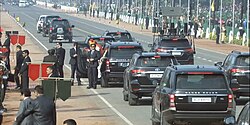
[[File:Prime Minister Narendra Modi's Security Personnel with convoy.jpg|alt=|thumb|The Prime Minister's Security personnel, which includes SSG members.]] | [[File:Prime Minister Narendra Modi's Security Personnel with convoy.jpg|alt=|thumb|The Prime Minister's Security personnel, which includes SSG members.]] | ||
In 2006, Central Industrial Security Force (CISF), on the basis of recommendations of the [[Intelligence Bureau (India)|Intelligence Bureau]], raised a special unit called Special Security Group (SSG) to provide security cover to people nominated by the Home Ministry. It came into existence on 17 November 2006. This unit is responsible for providing physical protection, evacuation, mobile and static security cover to persons who have been nominated by the Home Ministry.<ref name=" Ministry of Home Affairs Annual Report 2015-2016">{{cite news|last=MHA|title=Ministry of Home Affairs Annual Report 2015-2016|url=http://mha.nic.in/sites/upload_files/mha/files/AR%28E%291516.pdf|access-date=30 May 2016|publisher=Ministry of Home Affairs|date=2016|location=New Delhi|language=en|archive-url=https://web.archive.org/web/20170625213524/http://mha.nic.in/sites/upload_files/mha/files/AR(E)1516.pdf|archive-date=25 June 2017|url-status=dead}}</ref> {{rp|para 2.129}} For a person to be eligible for security cover by CISF special unit, the intelligence bureau and other secret police agencies are required to specify the danger after a detailed 'threat analysis', which are often fudged for political and other considerations.<ref name="Staggering rise in VIP protectee list: 454 people in 2016 ">{{cite news| | In 2006, Central Industrial Security Force (CISF), on the basis of recommendations of the [[Intelligence Bureau (India)|Intelligence Bureau]], raised a special unit called Special Security Group (SSG) to provide security cover to people nominated by the Home Ministry. It came into existence on 17 November 2006. This unit is responsible for providing physical protection, evacuation, mobile and static security cover to persons who have been nominated by the Home Ministry.<ref name=" Ministry of Home Affairs Annual Report 2015-2016">{{cite news|last=MHA|title=Ministry of Home Affairs Annual Report 2015-2016|url=http://mha.nic.in/sites/upload_files/mha/files/AR%28E%291516.pdf|access-date=30 May 2016|publisher=Ministry of Home Affairs|date=2016|location=New Delhi|language=en|archive-url=https://web.archive.org/web/20170625213524/http://mha.nic.in/sites/upload_files/mha/files/AR(E)1516.pdf|archive-date=25 June 2017|url-status=dead}}</ref> {{rp|para 2.129}} For a person to be eligible for security cover by CISF special unit, the intelligence bureau and other secret police agencies are required to specify the danger after a detailed 'threat analysis', which are often fudged for political and other considerations.<ref name="Staggering rise in VIP protectee list: 454 people in 2016 ">{{cite news|last1= Ahuja|first1=Rajesh |title=Staggering rise in VIP protectee list: 454 people in 2016 |url=http://www.hindustantimes.com/india/staggering-rise-in-vip-protectee-list-454-people-in-2016/story-HamIRQTpG9yXOGR39PNHDP.html|access-date=30 May 2016|publisher=Hindustan Times|date=29 May 2016|location=New Delhi|language=en }}</ref><ref name="Centre removes CISF security cover to Amar Singh">{{cite news|last1=DNA|title=Centre removes CISF security cover to Amar Singh|url=http://www.dnaindia.com/india/report-centre-removes-cisf-security-cover-to-amar-singh-2224121|access-date=19 June 2016|publisher=DNA|date=15 June 2016}}</ref> In addition to CISF the Government also utilizes CRPF for personal security cover. | ||
==Women in CISF== | ==Women in CISF== | ||
*Initially the recruitment and posting of Personnel to the CISF was restricted to men. In the year 1992, [[Mrs.]] [[Asha Sinha]] earned the distinction of being the First Woman Commandant of a [[Central Armed Police Forces]] in India when she was posted as Commandant, [[Mazagon Dock Shipbuilders Limited]]. Earlier the role of Women was allowed but limited to supervisory roles in the Central Armed Police Forces which includes the CISF.<ref name="economictimes.indiatimes.com">https://economictimes.indiatimes.com/news/defence/government-allows-women-to-be-combat-officers-in-all-central-armed-police-forces/articleshow/51380021.cms</ref> The [[Parliamentary Committees of India]] for women's empowerment recommended greater roles for women in the CAPF including CISF. On these recommendations the [[Ministry of Home Affairs (India)]] declared reservation for women in constabulary in paramilitary forces, and later declared that they can also be inducted as officers in combat roles in all five Central Armed Police Forces.<ref name="economictimes.indiatimes.com"/> | *Initially the recruitment and posting of Personnel to the CISF was restricted to men. In the year 1992, [[Mrs.]] [[Asha Sinha]] earned the distinction of being the First Woman Commandant of a [[Central Armed Police Forces]] in India when she was posted as Commandant, [[Mazagon Dock Shipbuilders Limited]]. Earlier the role of Women was allowed but limited to supervisory roles in the Central Armed Police Forces which includes the CISF.<ref name="economictimes.indiatimes.com">{{Cite news|url=https://economictimes.indiatimes.com/news/defence/government-allows-women-to-be-combat-officers-in-all-central-armed-police-forces/articleshow/51380021.cms|title = Government allows women to be combat officers in all Central Armed Police Forces|newspaper = The Economic Times}}</ref> The [[Parliamentary Committees of India]] for women's empowerment recommended greater roles for women in the CAPF including CISF. On these recommendations the [[Ministry of Home Affairs (India)]] declared reservation for women in constabulary in paramilitary forces, and later declared that they can also be inducted as officers in combat roles in all five Central Armed Police Forces.<ref name="economictimes.indiatimes.com"/> | ||
*The Union Home Minister announced that women's representation in the CRPF and CISF would be made 15 per cent.<ref>https://www.telegraphindia.com/india/women-quota-in-crpf-cisf-to-be-made-15-per-cent/cid/1681181</ref> On 5 January 2016, it was decided that 33 per cent posts at the constabulary level would be reserved for women in the CRPF and the CISF in a phased manner. The CISF is increasing the engagement of women at positions where there is greater Civilian-Police Interaction, specially in the Airports and the Metro Stations.<ref>https://www.livemint.com/Politics/lFSQdbCGziERnrTywVZeJN/CISF-to-deploy-more-women-personnel-on-Delhi-Metro.html</ref><ref>https://www.shethepeople.tv/news/cisf-inducts-1600-women-constables</ref> | *The Union Home Minister announced that women's representation in the CRPF and CISF would be made 15 per cent.<ref>{{Cite web|url=https://www.telegraphindia.com/india/women-quota-in-crpf-cisf-to-be-made-15-per-cent/cid/1681181|title=Women quota in CRPF, CISF to be made 15 per cent}}</ref> On 5 January 2016, it was decided that 33 per cent posts at the constabulary level would be reserved for women in the CRPF and the CISF in a phased manner. The CISF is increasing the engagement of women at positions where there is greater Civilian-Police Interaction, specially in the Airports and the Metro Stations.<ref>{{Cite web|url=https://www.livemint.com/Politics/lFSQdbCGziERnrTywVZeJN/CISF-to-deploy-more-women-personnel-on-Delhi-Metro.html|title = CISF to deploy more women personnel on Delhi Metro|date = 13 January 2013}}</ref><ref>{{Cite web|url=https://www.shethepeople.tv/news/cisf-inducts-1600-women-constables|title = CISF Inducts 1,600 Women Constables, to be Posted at Delhi Metro, Airport . Presently 6.5% woman are in CISF- SheThePeople TV| date=6 March 2018 }}</ref> | ||
==Overseas Deployment== | |||
A contingent of the CISF was deployed at [[United Nations Stabilisation Mission in Haiti|United Nations Stabilizations Mission in Haiti (MINUSTAH)]] / [[United Nations Mission for Justice Support in Haiti|United Nations Mission for Justice Support in Haiti (MINUJUSTH)]] since 17 August 2008. It was repatriated to India on 31 December 2018.<ref>{{cite web |url=https://www.mha.gov.in/sites/default/files/AnnualReport_19_20.pdf |title= Annual Report Ministry of Home Affairs 2019-2020 |website= mha.gov.in |publisher=MHA |access-date= 5 January 2022}}</ref> | |||
On 17 July 2024, the CISF deployed officers alongside the CRPF, SSB, ITBP, NSG and the Assam Rifles to provide security assistance to the [[Police Nationale]] and [[Gendarmerie Nationale (France)|Gendarmerie Nationale]] for the 2024 Olympics in Paris.<ref>{{cite news | url=https://economictimes.indiatimes.com/news/sports/indian-capf-special-forces-canine-squad-in-france-for-olympics-venue-security/articleshow/111803465.cms | title=Indian CAPF, special forces canine squad in France for Olympics venue security | newspaper=The Economic Times | date=17 July 2024 }}</ref> | |||
==See also== | ==See also== | ||
| Line 201: | Line 199: | ||
* [[National Security Guard]] | * [[National Security Guard]] | ||
* [[Border outpost]] | * [[Border outpost]] | ||
* [[Security police]] | |||
== References == | == References == | ||
| Line 208: | Line 207: | ||
{{commons category|Central Industrial Security Force}} | {{commons category|Central Industrial Security Force}} | ||
* {{Official website|http://cisf.gov.in/}} | * {{Official website|http://cisf.gov.in/}} | ||
{{Home Ministry (India)}} | {{Home Ministry (India)}} | ||
{{Law enforcement | {{Law enforcement agencies of India}} | ||
{{India topics}} | {{India topics}} | ||
{{Authority control}} | |||
[[Category:Central Industrial Security Force| ]] | [[Category:Central Industrial Security Force| ]] | ||
| Line 219: | Line 218: | ||
[[Category:Federal law enforcement agencies of India]] | [[Category:Federal law enforcement agencies of India]] | ||
[[Category:Specialist law enforcement agencies of India]] | [[Category:Specialist law enforcement agencies of India]] | ||
[[Category:Central Armed Police Forces of India]] | |||
Latest revision as of 11:26, 29 March 2026
| Central Industrial Security Force (CISF) | |
|---|---|
 Emblem of the Central Industrial Security Force | |
 Flag of the Central Industrial Security Force | |
| Abbreviation | CISF |
| Motto | "संरक्षण एवं सुरक्षा" Protection and Security |
| Agency overview | |
| Formed | 10 March 1969 |
| Employees | 190,000 active Personnel[1] |
| Annual budget | ₹16,828.85 crore (US$2.4 billion) (2026–27)[2] |
| Jurisdictional structure | |
| Federal agency | India |
| Operations jurisdiction | India |
| Governing body | Ministry of Home Affairs |
| Constituting instrument | |
| General nature | |
| Operational structure | |
| Headquarters | New Delhi, India |
| Minister responsible | |
| Agency executive | |
| Notables | |
| Person |
|
| Website | |
| cisf | |
 |
|---|
| This article is part of a series on the politics and government of India |
 India portal India portal |
The Central Industrial Security Force (CISF) is a central armed police force in India, under the Ministry of Home Affairs. CISF's primary mission is to provide security policing services to large institutions, whether state-owned or privately owned.
It was set up under an Act of the Parliament of India on 15 March 1969 with a strength of 2,800. CISF was subsequently formally authorized by another Act of Parliament passed on 15 June 1983. Its current active strength is 148,371 personnel.[4] In April 2017, the government raised the sanctioned strength from 145,000 to 180,000 personnel. Recently the strength has been increased to 200,000.[5]
Among its duties are guarding sensitive governmental buildings, Parliament complex, the Delhi Metro, and providing airport security.[6]
CISF also provides consultancy services to private industries as well as other organisations within the Indian government. The scope of CISF's consulting practice includes security consulting and fire protection consulting.
It also plays a major role in Disaster Management. The CISF has a 'Fire Wing' which helps during fire accidents in Industries where the CISF is on guard.

History[edit | edit source]
The Central Industrial Security Force (CISF) was established by an Act of Parliament on 10 March 1969 with an initial sanctioned strength of approximately 188,000 personnel.
As its name indicates, it was created to provide better protection and security to industrial undertakings across the country. Initially, protection was limited to industries wholly owned by the Central Government. This restriction has since been relaxed, and the CISF now also safeguards joint-venture enterprises in which the Central Government has a stake.
Over the years, the role of the CISF has significantly expanded and diversified. Today, in addition to industrial units, it provides security to airports, seaports, metro rail networks, key government buildings, heritage monuments (including the Taj Mahal and Red Fort), opium and alkaloid extraction units, nuclear power plants, and space establishments.The CISF also specialises in VIP security and disaster management. Currently, it performs a wide range of duties related to internal security, election security, anti-Naxal operations, and any other tasks assigned to it by the Government of India.[7]
Structure and organisation[edit | edit source]
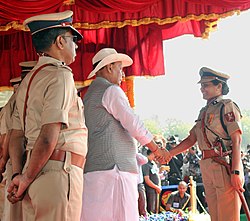
,_in_Ghaziabad_on_March_10,_2018.jpg)
The CISF is headed by an Indian Police Service officer with the rank of Director-General, assisted by an IPS officer in the rank of Addl. Director-General. The force is divided into Nine Sectors (Airport, North, North-East, East, West, South, Training, South-East, Central) and also has a Fire Service Wing.
The Airport Sector is commanded by an IPS officer in the rank of Addl. Director-General, assisted by an Inspector-General. The Airport Sector is divided into a number of Field Formation Units, one for each airport. Units at major international airports are commanded by a Deputy Inspector-General or Commandant; units at smaller airports by a Deputy or Assistant Commandant. The other six Sectors are each commanded by an Inspector-General, who is assisted by a Deputy Inspector-General.
The seven regional Sectors are divided into Zones, each commanded by a Deputy Inspector-General. Within each Zone are a number of Units, each under the command of a Commandant, or a DIG for certain major Units. A Deputy Commandant serves as the second-in-command of most units, or as the head of a smaller unit. Within the Training Sector, the National Industrial Security Academy (NISA) is headed by an Inspector-General; the Fire Service Training Institute (FSTI) and six other recruit training centres are headed by Deputy Inspectors General.
The Financial Adviser of the CISF has been an Indian Revenue Service officer of the rank of Director and also has Dy Advisers from the Indian Audit and Accounts Service and Indian Civil Account Service.
Rank structure[edit | edit source]
Being a central Indian police agency and having high presence of Indian Police Service officers, CISF follows ranks and insignia similar to other police organisations in India. Non-gazetted (enrolled) officers and members use the same ranks as other Indian police forces.
- Officers
| Equivalent NATO code |
OF-10 | OF-9 | OF-8 | OF-7 | OF-6 | OF-5 | OF-4 | OF-3 | OF-2 | OF-1 | OF(D) and student officer | |||||||||||||||||||||||||||||||||||||
|---|---|---|---|---|---|---|---|---|---|---|---|---|---|---|---|---|---|---|---|---|---|---|---|---|---|---|---|---|---|---|---|---|---|---|---|---|---|---|---|---|---|---|---|---|---|---|---|---|
 Central Industrial Security Force[8][9] Central Industrial Security Force[8][9] |
|

|

|

|

|

|

|
|||||||||||||||||||||||||||||||||||||||||
| Inspector general - |
Deputy inspector-general - |
Senior commandant - |
Commandant - |
Deputy commandant - |
Assistant commandant - |
|||||||||||||||||||||||||||||||||||||||||||

- Enlisted ranks
| Rank group | Subordinate Officers (SO) | Non commissioned officers (NCO) | Enlisted | |||||||||||||||||||||||||||||||||
|---|---|---|---|---|---|---|---|---|---|---|---|---|---|---|---|---|---|---|---|---|---|---|---|---|---|---|---|---|---|---|---|---|---|---|---|---|
| Central Industrial Security Force[8][9][10] |

|

|

|

|
No insignia | |||||||||||||||||||||||||||||||
| Inspector निरीक्षक |
Sub inspector उप निरीक्षक |
Assistant sub-inspector सहायक उप निरीक्षक |
Head constable हवलदार |
Constable कनिष्ठबल | ||||||||||||||||||||||||||||||||
CISF protection to Non-Nationalised Industry[edit | edit source]
The Indian Parliament on 25 February 2009, authorised the provision of Central Industrial Security Force security to private and cooperative establishments across the country for a fee with the passage of the CISF (Amendment) Bill, 2008.
The Bill, which was passed by Rajya Sabha on 19 February and Lok Sabha on 25 February 2009, also provides for deployment of CISF to protect Indian missions abroad and its participation in the UN peacekeeping operations.
CISF started providing security to the Infosys Bengaluru campus on 31 July 2009.[11] The Infosys in Mysuru, the Reliance Jamnagar Refinery and the Delhi Metro Airport Express Line are in the list of private sector establishments placed under CISF cover. Manish Kumar Rai, Assistant Commandant, led the first contingent of CISF deployed at Infosys Bengaluru.
CISF has also started providing security to the Infosys Pune campus from 21 April 2011. [12]
In 2016, the Patanjali Food and Herbal Park received 35 full-time, armed Central Industrial Security Force (CISF) commandos. The park was the eighth private institute in India to be guarded by paramilitary CISF forces.
Major Subunits[edit | edit source]
Airport security[edit | edit source]
The Central Industrial Security Force (CISF) is responsible for security at all commercial airports in India, that is handled by specialized Airport Sector, which oversees aviation security operations across the country. Airport security was previously handled by state-controlled airport police. The idea of transferring this responsibility to the CISF was first raised after the 1999 hijacking of Indian Airlines Flight 814, though it remained dormant for two years.
In the wake of the 9/11 terrorist attacks in the United States, the Government of India moved to strengthen aviation security and formally adopted the proposal to deploy the CISF at airports. Jaipur Airport became the first to come under CISF control on 3 February 2000, and most other commercial airports soon followed.[13]
As of February 2023, the CISF provides security at 66 international and domestic airports across the country.[14][15]
CISF Unit Delhi Metro Rail Corporation[edit | edit source]
Security on the Delhi Metro is provided and handled by the CISF Unit Delhi Metro Rail Corporation, which assumed responsibility from the Delhi Police in 2007.[16] It oversees an extensive surveillance system, with feeds reviewed in real time by both CISF and Metro control rooms. More than 3,500 CISF personnel are deployed across the network, supported by metal detectors, X-ray baggage scanners, and dog squads. Each train car is equipped with an intercom for emergency communication with the driver, and regular security drills are conducted to ensure operational preparedness.[17][18]
Parliament Security[edit | edit source]
From 20 May 2024 onwards, the CISF has been entrusted with the responsibility of securing the entire Parliament House complex, including both the old and present Parliament buildings following the withdrawal of Parliamentary Duty Group (PDG) personnel of the CRPF and Delhi Police due to a recent security breach. To enhance the complex’s security architecture, the CISF has implemented an upgraded framework, that covers access control, perimeter & internal security, counter-terror preparedness, and emergency response.
Over 3,300 personnel are deployed with advanced screening systems and specialised training in Drone, Cyber, CBRN and NSG/Army modules.[19]
Fire Wing[edit | edit source]
In addition to providing protection, safety, and security to industrial undertakings, the CISF also offers specialized protection against fire hazards. It is the only Central Armed Police Force with a full-fledged fire service wing, which is also the largest fire-fighting force in the country. The CISF’s first fire unit, comprising 53 personnel, was inducted at Fertilisers and Chemicals Travancore, Kochi, on 16 April 1970, following recommendations by a commission led by Justice B. Mukherjee that investigated a major fire at the Heavy Engineering Corporation plant in Ranchi on 29 January 1970.[20]
In January 1991, the Government of India approved recruitment rules for various posts to establish a dedicated fire service cadre within the CISF, which formally began functioning on 12 January 1991. As of 31 March 2020, the fire wing has been inducted into 104 units and has a total strength of 8,482 personnel.[21][22]
Seaport security[edit | edit source]
The Central Industrial Security Force (CISF) has been tasked to take over the security of all the ports in India. As of 2026, the CISF already provides the security of 12 major ports across India, and over 200 other non-major ports, 78 of which handle export-import operations, are protected by the respective State Police Forces. On 19 January, CISF Director General, Praveer Ranjan said that the responsibility of these additional 78 ports will be transferred to the force. The Union Home Minister, Amit Shah, also recently chaired a meeting to take up the case of vessels and port security.[23]
The force will establish a dedicated "vertical for seaports" in line with the Airport Sector arrangement. A Bureau of Port Security (BoPS) will also be established as a statutory body on the lines of the Bureau of Civil Aviation Security (BCAS). The new units will require 12,000 personnel, and their recruitment and training for the specific requirements have been approved by the government. The force is now preparing an action plan. A dedicated training centre is being considered at a maritime institute at the Okha Port, Gujarat, where personnel will be trained before deployment. The operations will follow a hybrid model similar to the one adopted in airport security, where the operations are divided into core and non-core functions.[23]
A committee headed by Additional Director General Sudhir Kumar has submitted a six-point set of recommendations to the government, which suggests the formation of the Recognised Security Organisation (RSO). The RSO will be tasked with the security assessment and planning of each port. These functions were earlier carried out by private agencies. The government has also accepted the recommendation to lay out different standards of security based on the category of port. The report also suggests the deployment of a drive-through container scanning system at these ports. Jab moments should be monitored by the Integrated Command and Control Centre (ICCC).[23]
Special Security Group[edit | edit source]

In 2006, Central Industrial Security Force (CISF), on the basis of recommendations of the Intelligence Bureau, raised a special unit called Special Security Group (SSG) to provide security cover to people nominated by the Home Ministry. It came into existence on 17 November 2006. This unit is responsible for providing physical protection, evacuation, mobile and static security cover to persons who have been nominated by the Home Ministry.[24] :para 2.129 For a person to be eligible for security cover by CISF special unit, the intelligence bureau and other secret police agencies are required to specify the danger after a detailed 'threat analysis', which are often fudged for political and other considerations.[25][26] In addition to CISF the Government also utilizes CRPF for personal security cover.
Women in CISF[edit | edit source]
- Initially the recruitment and posting of Personnel to the CISF was restricted to men. In the year 1992, Mrs. Asha Sinha earned the distinction of being the First Woman Commandant of a Central Armed Police Forces in India when she was posted as Commandant, Mazagon Dock Shipbuilders Limited. Earlier the role of Women was allowed but limited to supervisory roles in the Central Armed Police Forces which includes the CISF.[27] The Parliamentary Committees of India for women's empowerment recommended greater roles for women in the CAPF including CISF. On these recommendations the Ministry of Home Affairs (India) declared reservation for women in constabulary in paramilitary forces, and later declared that they can also be inducted as officers in combat roles in all five Central Armed Police Forces.[27]
- The Union Home Minister announced that women's representation in the CRPF and CISF would be made 15 per cent.[28] On 5 January 2016, it was decided that 33 per cent posts at the constabulary level would be reserved for women in the CRPF and the CISF in a phased manner. The CISF is increasing the engagement of women at positions where there is greater Civilian-Police Interaction, specially in the Airports and the Metro Stations.[29][30]
Overseas Deployment[edit | edit source]
A contingent of the CISF was deployed at United Nations Stabilizations Mission in Haiti (MINUSTAH) / United Nations Mission for Justice Support in Haiti (MINUJUSTH) since 17 August 2008. It was repatriated to India on 31 December 2018.[31]
On 17 July 2024, the CISF deployed officers alongside the CRPF, SSB, ITBP, NSG and the Assam Rifles to provide security assistance to the Police Nationale and Gendarmerie Nationale for the 2024 Olympics in Paris.[32]
See also[edit | edit source]
- Ministry of Home Affairs
- Border Security Force
- Indo-Tibetan Border Police
- Central Reserve Police Force
- Sashastra Seema Bal
- Security categories in India
- Assam Rifles
- National Security Guard
- Border outpost
- Security police
References[edit | edit source]
- ↑ "Annual Report 2016-17" (PDF). Ministry of Home Affairs, Government of India. Archived from the original (PDF) on 8 August 2017. Retrieved 1 June 2021.
- ↑ "DEMAND NO. 51, Demands for Grants, 2026-2027, MINISTRY OF HOME AFFAIRS" (PDF). IndiaBudget.gov.in. New Delhi. 1 February 2026. p. 5. Retrieved 1 February 2026.
- ↑ "Om Prakash Singh – Executive Record Sheet". Ministry of Home Affairs, Government of India. Archived from the original on 24 April 2016. Retrieved 11 January 2018.
- ↑ "CISF Official Website".
- ↑ "Press Information Bureau". Retrieved 29 April 2017.
- ↑ "Rajesh Ranjan takes charge as CISF chief". The Times of India. Times News Network (TNN). 12 April 2018. Archived from the original on 12 April 2018.
- ↑ "CISF Act | CISF".
- ↑ 8.0 8.1 "All ranks inclusive annual governing body meeting". Central Industrial Security Force. 19 November 2018. Archived from the original on 23 September 2022 – via Facebook.
- ↑ 9.0 9.1 "The Central Industrial Security Force Act, 1968 (50 of 1968): (As Modified Vide Act No.14 of 1983, 20 of 1989, 40 of 1999 and 22 of 2009)" (PDF). Central Industrial Security Force. 2009. p. 18.
- ↑ "The Central Industrial Security Force Rank Structure". Network18 Group. 2022.
- ↑ "Infosys gets CISF cover". The Hindu. 1 August 2009. Archived from the original on 3 August 2009. Retrieved 20 June 2012.
- ↑ PTI. "Business Line : Industry & Economy / Info-tech : Infosys' Pune campus gets CISF cover". Thehindubusinessline.com. Retrieved 20 June 2012.
- ↑ Subhro Niyogi and Soma Ghosh (24 October 2001). "Mid-November target for CISF takeover of airport-Kolkata-Cities". The Times of India. Archived from the original on 18 October 2012. Retrieved 20 June 2012.
- ↑ "CISF is deployed at 66 airports for providing security". pib.gov.in. Press Information Bureau. 6 February 2023. Retrieved 21 December 2023.
- ↑ "CISF personnel deployed at 66 airports to provide security to the facilities and installations: Mos Civil Aviation". ANI. New Delhi. 7 February 2023. Retrieved 21 December 2023.
- ↑ PTI (7 March 2007). "CISF to take over Delhi Metro security". The Times of India. Archived from the original on 3 November 2012. Retrieved 20 June 2012.
- ↑ Megha Suri Singh (30 March 2010). "Moscow blasts put Metro security in alert mode". The Times of India. Archived from the original on 3 November 2012. Retrieved 20 June 2012.
- ↑ TNN (26 March 2010). "Mock drills at 4 Metro stations". The Times of India. Archived from the original on 3 November 2012. Retrieved 20 June 2012.
- ↑ Indian Express (20 May 2024). "CISF took over Parliament Security". The Indian Express. Retrieved 20 May 2024.
- ↑ "Action Taken by Government on the Recommendations contained in the Fourteenth Report of the Committee on Public Undertakings (Fourth Lok Sabha)" (PDF). eparlib.nic.in. Committee on Public Undertakings, Parliament of India. 1 April 1972. Retrieved 21 December 2023.
- ↑ "Fire Wing". cisf.gov.in. CISF. Retrieved 21 December 2023.
- ↑ "Annual Report Ministry of Home Affairs 2019-2020" (PDF). mha.gov.in. MHA. p. 138. Retrieved 21 December 2023.
- ↑ 23.0 23.1 23.2 Kumar, Mayank (19 January 2026). "CISF to take over security of all sea ports; govt approves airport-like hybrid arrangements". ThePrint. Retrieved 27 January 2026.
- ↑ MHA (2016). "Ministry of Home Affairs Annual Report 2015-2016" (PDF). New Delhi: Ministry of Home Affairs. Archived from the original (PDF) on 25 June 2017. Retrieved 30 May 2016.
- ↑ Ahuja, Rajesh (29 May 2016). "Staggering rise in VIP protectee list: 454 people in 2016". New Delhi: Hindustan Times. Retrieved 30 May 2016.
- ↑ DNA (15 June 2016). "Centre removes CISF security cover to Amar Singh". DNA. Retrieved 19 June 2016.
- ↑ 27.0 27.1 "Government allows women to be combat officers in all Central Armed Police Forces". The Economic Times.
- ↑ "Women quota in CRPF, CISF to be made 15 per cent".
- ↑ "CISF to deploy more women personnel on Delhi Metro". 13 January 2013.
- ↑ "CISF Inducts 1,600 Women Constables, to be Posted at Delhi Metro, Airport . Presently 6.5% woman are in CISF- SheThePeople TV". 6 March 2018.
- ↑ "Annual Report Ministry of Home Affairs 2019-2020" (PDF). mha.gov.in. MHA. Retrieved 5 January 2022.
- ↑ "Indian CAPF, special forces canine squad in France for Olympics venue security". The Economic Times. 17 July 2024.
External links[edit | edit source]
 India topics India topics | |||||||||||||||||||||
|---|---|---|---|---|---|---|---|---|---|---|---|---|---|---|---|---|---|---|---|---|---|
| |||||||||||||||||||||
| |||||||||||||||||||||
| |||||||||||||||||||||
| |||||||||||||||||||||
| |||||||||||||||||||||
- Pages using the JsonConfig extension
- Pages using infobox law enforcement agency with unknown parameters
- Central Industrial Security Force
- 1969 establishments in Delhi
- Government agencies established in 1969
- Federal law enforcement agencies of India
- Specialist law enforcement agencies of India
- Central Armed Police Forces of India