









m →History: added wiki-links |
>DrKay m Reverted edits by 27.59.200.39 (talk) to last version by Beauty School Dropout |
||
| Line 1: | Line 1: | ||
{{Use dmy dates|date= | {{short description|Capital of Telangana, India}} | ||
{{Infobox | {{about||the Pakistani city|Hyderabad, Sindh|other uses}} | ||
| | {{pp-pc1}} | ||
| | {{featured article}} | ||
| | {{Use dmy dates|date=November 2021}} | ||
| | {{Use Indian English|date=November 2019}} | ||
| | {{Infobox settlement | ||
| | | name = Hyderabad | ||
| | <!-- Please do not add any Indic script in this infobox, per WP:INDICSCRIPT policy. -->| settlement_type = [[Metropolis]] <!-- Not a Megacity, as the population of the city is under 10 million residents --> | ||
| | | image_skyline = Hyderabad Montage 2020.jpg | ||
| | | image_size = 300px | ||
| | | image_alt = A montage of images related to Hyderabad city | ||
| | | image_caption = Clockwise from top: [[Charminar]] during Ramzan night bazaar, [[Qutb Shahi tombs]], [[Buddha Statue of Hyderabad|Buddha Statue]] at [[Hussain Sagar]], [[Falaknuma Palace]], skyline at [[Gachibowli]], [[Birla Mandir, Hyderabad|Birla Mandir]] | ||
| | | nickname = [[Hyderabad pearl|City of Pearls]] | ||
| | | other_name = | ||
| | | image_map = {{Maplink|frame=yes|plain=y|frame-width=300|frame-height=300|frame-align=center|type=shape|from=India/Telangana/Hyderabad.map}} | ||
| | | map_caption = Interactive Map Outlining Hyderabad | ||
| | | pushpin_map_alt = A map showing location of Hyderabad in Telangana, India. | ||
| | | pushpin_map_caption = Location in Telangana##Location in India##Location in Asia##Location in Earth | ||
| pushpin_map = India Telangana#India#Asia#Earth | |||
| | | pushpin_mapsize = 300 | ||
| | | pushpin_label_position = right | ||
| | | coordinates = {{coord|17|21|42|N|78|28|29|E|display=inline,title}} | ||
| | | subdivision_type = Country | ||
| | | subdivision_name = {{flag|India}} | ||
| | | subdivision_type1 = [[States and territories of India|State]] | ||
| | | subdivision_type2 = [[List of districts of India|Districts]] | ||
| | | subdivision_name1 = {{flagicon image|Government_of_Telangana_Logo.png}} [[Telangana]] | ||
| | | subdivision_name2 = {{plainlist| | ||
| | * [[Hyderabad district, India|Hyderabad]] | ||
| | * [[Medchal-Malkajgiri district|Medchal–Malkajgiri]] | ||
| | * [[Ranga Reddy district|Ranga Reddy]] | ||
}}'''Hyderabad''' | * [[Sangareddy district|Sangareddy]]}} | ||
| established_title = Established | |||
| established_date = 1591 | |||
| founder = [[Muhammad Quli Qutb Shah]] | |||
| government_type = [[Municipal Corporations in India|Municipal Corporation]] | |||
| governing_body = [[Greater Hyderabad Municipal Corporation]], <br /> | |||
[[Hyderabad Metropolitan Development Authority]] | |||
| total_type = [[City proper|City]] | |||
| unit_pref = Metric | |||
| area_footnotes = | |||
| area_total_km2 = 650 | |||
| area_metro_km2 = 7,257 | |||
| elevation_footnotes = | |||
| elevation_m = 542 | |||
| population_total = 6,809,970 ([[List of cities in India by population|4th]]) | |||
| population_as_of = 2011 | |||
| population_footnotes = <ref name="greater Hyderabad" /> | |||
| population_density_km2 = 10477 | |||
| population_est = 9,482,000 | |||
| pop_est_as_of = 2018 | |||
| pop_est_footnotes = <ref>{{cite web |title=The World's Cities in 2018 |url=https://www.un.org/en/events/citiesday/assets/pdf/the_worlds_cities_in_2018_data_booklet.pdf |work=[[United Nations Department of Economic and Social Affairs]] |year=2018 |access-date=11 July 2020 |url-status=live |archive-url=https://web.archive.org/web/20210315074343/https://www.un.org/en/events/citiesday/assets/pdf/the_worlds_cities_in_2018_data_booklet.pdf |archive-date=15 March 2021}}</ref> | |||
| population_urban = 7,749,334 ([[List of million-plus urban agglomerations in India|6th]]) | |||
| population_urban_footnotes = <ref name="2011UA" /> | |||
| population_metro = 9.7 million ([[List of metropolitan areas in India|6th]]) | |||
| population_metro_footnotes = <ref name="metropop">{{cite news |title=Time to put metropolitan planning committee in place |url=https://timesofindia.indiatimes.com/city/hyderabad/Time-to-put-metropolitan-planning-committee-in-place/articleshow/39138115.cms |newspaper=[[The Times of India]] |access-date=22 March 2016 |date=28 July 2014 |location=Hyderabad |url-status=live |archive-url=https://web.archive.org/web/20210314172214/http://timesofindia.indiatimes.com/city/hyderabad/Time-to-put-metropolitan-planning-committee-in-place/articleshow/39138115.cms |archive-date=14 March 2021}}</ref> | |||
| population_demonym = Hyderabadi | |||
| timezone1 = [[Indian Standard Time|IST]] | |||
| utc_offset1 = +5:30 | |||
| postal_code_type = [[Postal Index Number|PIN(s)]] | |||
| postal_code = 500xxx, 501xxx, 502xxx | |||
| area_codes = [[Telephone numbers in India|+91–40, 8413, 8414, 8415, 8417, 8418, 8453, 8455]] | |||
| registration_plate = [[List of Regional Transport Office districts in India|TS-07 to TS-15<br />(previously AP-09 to AP-14 and AP-28, AP-29)]] | |||
| blank_name_sec1 = [[Gross metropolitan product|Metro GDP]] ([[Purchasing power parity|PPP]]) | |||
| blank_info_sec1 = {{US$}}40–{{US$}}74 billion<ref name=gdp /> | |||
| leader_title = [[Greater Hyderabad Municipal Corporation|Mayor]] | |||
| leader_name = [[Gadwal Vijayalakshmi]] | |||
| leader_party = [[Telangana Rashtra Samiti|TRS]] | |||
| blank2_name = {{nowrap|Official languages}} | |||
| blank2_info = {{hlist|[[Telugu language|Telugu]]|[[Urdu language|Urdu]]}}<!-- Please do not add anything besides Telugu and Urdu. --> | |||
| website = {{URL|www.ghmc.gov.in}} | |||
| official_name = | |||
}} | |||
'''Hyderabad''' ({{IPAc-en|ˈ|h|aɪ|d|ər|ə|b|æ|d|audio=Hyderabad.ogg}} {{respell|HY|dər|ə|bad}};<ref>{{lexico|Hyderabad}}</ref> {{IPA-te|ˈɦaɪ̯daraːbaːd|lang}}, {{IPA-ur|ˈɦɛːdəɾaːbaːd|lang}}) is the capital and largest city of the [[India]]n [[States and union territories of India|state]] of [[Telangana]] and the ''[[de jure]]'' capital of [[Andhra Pradesh]].{{refn|According to the [[Andhra Pradesh Reorganisation Act, 2014]] part 2 Section 5:(1) On and from the appointed day, Hyderabad in the existing State of [[Andhra Pradesh]], shall be the common capital of the State of [[Telangana]] and the State of Andhra Pradesh for such period not exceeding ten years.<br />(2) After expiry of the period referred to in sub-section (1), Hyderabad shall be the capital of the State of Telangana and there shall be a new capital for the State of Andhra Pradesh.<br />The common capital is defined as the existing area notified as the Greater Hyderabad Municipal Corporation under the Hyderabad Municipal Corporation Act, 1955. Though Andhra Pradesh uses facilities in Hyderabad during the transition period, Telangana state is responsible for day-to-day administration of the city. City MLAs are members of the [[Legislature of Telangana]] (§ 3 and 18(1) of the Act).|group=upper-alpha}} It occupies {{cvt|650|km2|sqmi}} on the [[Deccan Plateau]] along the banks of the [[Musi River (India)|Musi River]], in the northern part of [[South India]]. With an average altitude of {{cvt|542|m|ft}}, much of Hyderabad is situated on hilly terrain around [[Hyderabad city lakes|artificial lakes]], including the [[Hussain Sagar]] lake, predating the city's founding, in the north of the city centre. According to the [[2011 Census of India]], Hyderabad is the [[List of cities in India by population|fourth-most populous city in India]] with a population of {{nowrap|6.9 million}} residents within the city limits, and has a population of {{nowrap|9.7 million}} residents in the [[Hyderabad Metropolitan Region|metropolitan region]], making it the [[List of metropolitan areas in India|sixth-most populous metropolitan area]] in India. With an output of {{US$}}74 billion, Hyderabad has the fifth-largest urban economy in India. | |||
[[Muhammad Quli Qutb Shah]] established Hyderabad in 1591 to extend the capital beyond the [[Golconda Fort|fortified Golconda]]. In 1687, the city was [[Siege of Golconda|annexed]] by the [[Mughal Empire|Mughals]]. In 1724, [[Viceroy of the Deccan|Mughal Viceroy]] [[Asaf Jah I|Nizam Asaf Jah I]] declared his sovereignty and founded the [[Asaf Jahi dynasty]], also known as the [[Nizam of Hyderabad|Nizams]]. Hyderabad served as the imperial capital of the Asaf Jahis from 1769 to 1948. As capital of the [[princely state|princely state of Hyderabad]], the city housed the [[British Residency, Hyderabad|British Residency]] and [[Secunderabad Cantonment Board|cantonment]] until [[Indian Independence Act 1947|Indian independence]] in 1947. [[Annexation of Hyderabad|Hyderabad was annexed]] by the [[Dominion of India|Indian Union]] in 1948 and continued as a capital of [[Hyderabad State (1948–1956)|Hyderabad State (1948–56)]]. After the [[Gentlemen's Agreement of 1956|introduction]] of the [[States Reorganisation Act, 1956|States Reorganisation Act of 1956]], Hyderabad was made the capital of the [[Andhra Pradesh (1956–2014)|newly formed Andhra Pradesh]]. In 2014, [[Andhra Pradesh Reorganisation Act, 2014|Andhra Pradesh was bifurcated]] to form Telangana and Hyderabad became the joint capital of the two states with a transitional arrangement scheduled to end in 2024. Since 1956, the city has housed the [[Rashtrapati Nilayam|winter office]] of the [[President of India]]. | |||
Relics of the Qutb Shahi and Nizam rules remain visible today; the [[Charminar]] has come to symbolise the city. By the end of early modern era, the Mughal Empire declined in the Deccan and the Nizam's patronage had attracted men of letters from various parts of the world. The amalgamation of local and migrated artisans had originated a [[Culture of Hyderabad|distinctive culture]], and the city emerged as a significant centre of [[oriental culture]]. [[Deccan painting|Painting]], [[Bidriware|handicraft]], [[Jewels of the Nizams of Hyderabad|jewellery]], [[Deccani Masnavi|literature]], [[Deccani language|dialect]] and [[Clothing of Hyderabad, India|clothing]] are prominent still today. Through its [[Hyderabadi cuisine|cuisine]], the city is listed as a [[UNESCO]] [[City of Gastronomy|creative city of gastronomy]]. The [[Telugu cinema|Telugu film industry]] based in the city was the country's second-largest producer of motion pictures {{as of|2012|lc=on}}. | |||
Until the {{nowrap|19th century}} Hyderabad was known for the [[Hyderabad pearl|pearl industry]] and was nicknamed the "City of Pearls", and was the only [[Golconda Diamonds]] trading centre in the world. Many of the city's historical and traditional [[bazaar]]s remain open. Hyderabad's central location between the [[Deccan Plateau]] and the [[Western Ghats]], and industrialisation throughout the {{nowrap|20th century}} attracted major Indian research, manufacturing, educational and financial institutions. Since the 1990s, the city has emerged as an Indian hub of [[Genome Valley|pharmaceuticals and biotechnology]]. The formation of [[Hardware Park, Hyderabad|special economic zone]]s and [[HITEC City]] dedicated to information technology has encouraged [[Big Four tech companies|leading multinationals]] to set up operations in Hyderabad. {{TOC limit|limit=3}} | |||
== History == | == History == | ||
{{Main|History of Hyderabad}} | |||
=== Toponymy === | |||
<!-- SOME BOOKS IN THIS SECTION DO NOT HAVE "ISBN". FOR THOSE REFERENCES, WE KEPT URL LINKS. Because different scholars claim different names of the city during same period, thus its better to update sources --> | |||
The name ''Hyderabad'' means "Haydar's city" or "lion city", from ''[[haydar]]'' 'lion' and ''[[-abad|ābād]]'' 'city', after [[Caliph]] [[Ali Ibn Abi Talib]], also known as Haydar because of his lion-like valour in battle.<ref name="Everett-Heath2005">{{cite book |title=Concise dictionary of world place names |publisher=[[Oxford University Press]] |page=223 |isbn=978-0-19-860537-9 |last=Everett-Heath |first=John |year=2005}}</ref> | |||
The city was originally called ''Baghnagar'' "city of gardens", and later acquired the name ''Hyderabad''.<ref name="AnPet">{{cite book |title=Dictionary of Islamic architecture |url=https://archive.org/details/dictionaryofisla00andr |url-access=registration |publisher=[[Routledge]] |page=[https://archive.org/details/dictionaryofisla00andr/page/112 112] |isbn=978-0-415-06084-4 |last=Petersen |first=Andrew |year=1996 |access-date=28 June 2021}}</ref><ref name="Holister">{{cite book |title=The Shia of India |url=https://insideismailism.files.wordpress.com/2014/11/shia-of-india-1953-john-norman-hollister_txt.pdf |publisher=Luzac and company limited |last=Holister |first=John Norman |pages=120–125 |year=1953 |access-date=15 July 2020 |archive-url=https://web.archive.org/web/20181010135146/https://insideismailism.files.wordpress.com/2014/11/shia-of-india-1953-john-norman-hollister_txt.pdf |archive-date=10 October 2018 |url-status=live}}</ref> The European travellers [[Heinrich von Poser|von Poser]] and [[Jean de Thévenot|Thévenot]] found both names in use in the 17th century.<ref name="Lach&Kley">{{cite book |title=Asia in the Making of Europe |volume=3 |url=https://books.google.com/books?id=YPPiumz4vx0C |publisher=[[University Of Chicago Press]] |page=? |isbn=978-0-226-46768-9 |last1=Lach |first1=Donald F |last2=Kley |first2=Edwin J. Van |year=1993 |url-status=live |archive-url=https://web.archive.org/web/20180303193015/https://books.google.com/books?id=YPPiumz4vx0C& |archive-date=3 March 2018}}</ref><ref name="TH-Hyd name">{{cite news |title=The city of love: Hyderabad |url=https://www.thehindu.com/features/metroplus/The-city-of-love-Hyderabad/article15474440.ece |newspaper=[[The Hindu]] |last=Nanisetti |first=Serish |date=7 October 2016 |access-date=9 October 2016 |url-status=live |archive-url=https://web.archive.org/web/20201207155308/https://www.thehindu.com/features/metroplus/The-city-of-love-Hyderabad/article15474440.ece |archive-date=7 December 2020}}</ref> | |||
One popular legend suggests that the founder of the city, [[Muhammad Quli Qutb Shah]], named it ''Bhagya-nagar'' after [[Bhagmati]], a local [[nautch]] (dancing) girl whom he married. She converted to [[Islam]] and adopted the title ''Hyder Mahal''. The city would have been named ''Hyderabad'' in her honour.<ref name="Hyderabad_and_Bhagmati">{{cite book |title=Rights at work: pay equity reform and the politics of legal mobilization |publisher=[[University of Chicago Press]] |page=6 |isbn=978-0-226-55571-3 |last=McCann |first=Michael W. |year=1994}} | |||
* {{cite book |title=The march of India |url=https://books.google.com/books?id=d5AhAQAAMAAJ |access-date=7 January 2013 |year=1959 |publisher=Publications Division, Ministry of Informations and Broadcasting, Government of India |page=89 |url-status=live |archive-url=https://web.archive.org/web/20140103024703/http://books.google.com/books?id=d5AhAQAAMAAJ |archive-date=3 January 2014}} | |||
* {{cite book |title=Mohammad Quli Qutb Shah |publisher=Sahitya Akademi |pages=14–15 |isbn=978-81-260-0233-7 |last=Khan |first=Masud Ḥusain |year=1996}} | |||
* {{cite book |title=With respect to sex: negotiating hijra identity in south India |publisher=University of Chicago Press |page=6 |isbn=978-0-226-70755-6 |last=Reddy |first=Gayatri |year=2005}} | |||
* {{cite book |title=The colors of violence: cultural identities, religion, and conflict |url=https://archive.org/details/colorsofviolence00kaka |url-access=registration |publisher=University of Chicago Press |page=[https://archive.org/details/colorsofviolence00kaka/page/23 23] |isbn=978-0-226-42284-8 |last=Kakar |first=Sudhir |year=1996}}</ref> | |||
=== Early and medieval history === | |||
The discovery of [[Megalithic]] burial sites and [[Hasmathpet cairns|cairn circles]] in the [[suburb]]s of Hyderabad, in 1851 by [[Philip Meadows Taylor]], a [[polymath]] in the service of the Nizam, had provided evidence that the region in which the city stands has been inhabited from the [[South Asian Stone Age|Stone Age]].<ref>{{cite news|title=Prehistoric and megalithic cairns vanish from capital's landscape|url=https://timesofindia.indiatimes.com/city/hyderabad/prehistoric-and-megalithic-cairns-vanish-from-capitals-landscape/articleshow/59696497.cms|newspaper=The Times of India|date=21 July 2017|access-date=19 September 2021}}</ref><ref name="yimene">{{cite book |title=An African Indian community in Hyderabad |url=https://books.google.com/books?id=DigPvwHTqJ4C|last=Yimene |first=Ababu Minda |year=2004|publisher=Cuvillier Verlag |page=2|isbn=978-3-86537-206-2|access-date=19 September 2021}}</ref> Archaeologists excavating near the city have unearthed [[Iron Age]] sites that may date from 500 [[BCE]].<ref name="Hyd_BC">{{cite news |title=Iron Age burial site discovered |url=http://www.hindu.com/2008/09/10/stories/2008091058090100.htm |last=Venkateshwarlu |first=K. |newspaper=[[The Hindu]] |date=10 September 2008 |access-date=7 June 2013 |url-status=dead |archive-url=https://web.archive.org/web/20131110234947/http://www.hindu.com/2008/09/10/stories/2008091058090100.htm |archive-date=10 November 2013}}</ref> The region comprising modern Hyderabad and its surroundings was ruled by the [[Chalukya dynasty]] from 624 [[Common Era|CE]] to 1075 CE.<ref name="kolluru">{{cite book |title=Inscriptions of the minor Chalukya dynasties of Andhra Pradesh |publisher=Mittal Publications |page=1 |isbn=978-81-7099-216-5 |last=Kolluru |first=Suryanarayana |year=1993}}</ref> Following the dissolution of the Chalukya empire into four parts in the 11th century, Golconda came under the control of the [[Kakatiya dynasty]] from 1158, whose seat of power was at [[Warangal]]—{{cvt|148|km|mi|0}} northeast of modern Hyderabad.<ref name="Golctime">{{harvtxt|Sardar, Golconda through Time|2007|pp=19–41}}</ref> The Kakatiya ruler [[Ganapatideva]] 1199–1262 built a [[Hilltop castle|hilltop]] [[Outpost (military)|outpost]]—later known as [[Golconda Fort]]—to defend their western region.<ref name="yimene"/> | |||
[[File:Govardhan II, Visit of sufi-singer Shir Muhammad to Abul Hasan Qutb Shah, ca. 1720, Bibliothèque nationale de France, Paris.jpg|thumb|A 17th century [[Deccani painting|Deccani School]] miniature of [[Qutb Shahi]] ruler [[Abul Hasan Qutb Shah]] with Sufi singers in the ''[[Mehfil]]''-(“gathering to entertain or praise someone”).|alt=A deccani style of painting of the last Qutb Shahi ruler Abul Hasan Qutb Shah|left]] | |||
[[File:Qutubshahi Tombs.jpg|thumb|The [[Qutb Shahi Tombs]] at Ibrahim Bagh are the tombs of the seven Qutb Shahi rulers.|alt=Tomb of Abdullah Qutb Shah, the former ruler of Hyderabad|left]] | |||
The Kakatiya dynasty was reduced to a vassal of the [[Khalji dynasty]] in 1310 after its defeat by Sultan [[Alauddin Khalji]] of the [[Delhi Sultanate]]. This lasted until 1321, when the Kakatiya dynasty was annexed by [[Malik Kafur]], Allaudin Khalji's general.<ref name="medival India">{{cite book |title=Historical dictionary of medieval India |publisher=[[The Scarecrow Press]] |pages=85 and 141 |isbn=978-0-8108-5503-8 |last=Khan |first=Iqtidar Alam |year=2008}}</ref> During this period, Alauddin Khalji took the ''[[Koh-i-Noor]]'' diamond, which is said to have been mined from the [[Kollur Mine]]s of Golconda, to Delhi.<ref>{{cite news |title=Heritage Golconda diamond up for auction at Sotheby's |url=http://articles.timesofindia.indiatimes.com/2012-02-29/hyderabad/31109972_1_heritage-golconda-type-iia-golconda-diamond |last=Ghose |first=Archana Khare |date=29 February 2012 |access-date=1 March 2012 |archive-url=https://web.archive.org/web/20130510184349/http://articles.timesofindia.indiatimes.com/2012-02-29/hyderabad/31109972_1_heritage-golconda-type-iia-golconda-diamond |archive-date=10 May 2013 |newspaper=[[The Times of India]] |url-status=dead}}</ref> [[Muhammad bin Tughluq]] succeeded to the Delhi sultanate in 1325, bringing Warangal under the rule of the [[Tughlaq dynasty]], [[Malik Maqbul Tilangani]] was appointed its governor. In 1336 the regional chieftains [[Musunuri Nayakas]]—who revolted against the Delhi sultanate in 1333—took Warangal under their direct control and declared it as their capital.<ref>{{cite book |title=The Delhi Sultanate |chapter=Muhammad Bin Tughluq |pages=61–89 |publisher=Bharatiya Vidya Bhavan |chapter-url=https://archive.org/details/delhisultanate00bhar |year=1967 |last=Majumdar |first=R. C. |access-date= 5 March 2020}}</ref> In 1347 when [[Ala-ud-Din Bahman Shah]], a governor under bin Tughluq, rebelled against Delhi and established the [[Bahmani Sultanate]] in the [[Deccan Plateau]], with [[Gulbarga]]—{{cvt|200|km|mi|0}} west of Hyderabad—as its capital, both the neighboring rulers Musunuri Nayakas of Warangal and Bahmani Sultans of Gulbarga engaged in many wars until 1364–65 when a peace treaty was signed and the Musunuri Nayakas ceded Golconda Fort to the Bahmani Sultan. The Bahmani Sultans ruled the region until 1518 and were the first independent Muslim rulers of the Deccan.{{sfn|Prasad, History of the Andhras|1988|p=172}}{{sfn|Sardar, Golconda through Time|2007|p=20}}<ref name="Mainak">{{cite book|title=Perception, Design and Ecology of the Built Environment: A Focus on the Global South|url=https://books.google.com/books?id=hyTMDwAAQBAJ&pg=PA504|publisher=[[Springer Nature]]|page=504|isbn=9783030258795|last=Ghosh|first=Mainak|year=2020|access-date=13 October 2021}}</ref> | |||
<!-- SOME BOOKS IN THIS SECTION DO NOT HAVE "ISBN". FOR THOSE REFERENCES WE KEPT URL LINKS --> | |||
In 1496 [[Quli Qutb Mulk|Sultan Quli]] was appointed as a Bahmani governor of Telangana, he rebuilt, expanded and [[Fortification|fortified]] the old mud-fort of Golconda and named the city "Muhammad nagar". In 1518, he revolted against the Bahmani Sultanate and established the [[Qutb Shahi dynasty]].<ref name="Golctime" /><ref>{{cite news |title=Hyderabad through the ages |url=http://www.hindu.com/thehindu/br/2002/05/28/stories/2002052800050300.htm |last=Nayeem |first=M.A |newspaper=The Hindu |date=28 May 2002 |access-date=18 December 2013 |url-status=live |archive-url=https://web.archive.org/web/20090604122609/http://www.hindu.com/thehindu/br/2002/05/28/stories/2002052800050300.htm |archive-date=4 June 2009}}</ref><ref>{{cite web |title=Golconda |url=http://www.ioc.u-tokyo.ac.jp/~islamarc/WebPage1/htm_eng/index/map_e.htm |last=Matsuo |first=Ara |publisher=[[University of Tokyo]] |date=22 November 2005 |access-date=18 December 2013 |url-status=live |archive-url=https://web.archive.org/web/20130613080243/http://www.ioc.u-tokyo.ac.jp/~islamarc/WebPage1/htm_eng/index/map_e.htm |archive-date=13 June 2013}}</ref> The fifth Qutb Shahi sultan, [[Muhammad Quli Qutb Shah]], established Hyderabad on the banks of the Musi River in 1591,<ref>{{cite book |title=Historical dictionary of the British empire |publisher=[[Greenwood Press]] |page=544 |isbn=978-0-313-27917-1 |last1=Olson |first1=James Stuart |last2=Shadle |first2=Robert |year=1996}}</ref><ref>{{cite web |url=https://www.livemint.com/Leisure/Zad93Q6KZOuM4jrH99qaeN/Opinion--A-Hyderabadi-conundrum.html |title=Opinion A Hyderabadi conundrum |date=15 November 2018 |access-date=15 November 2018 |archive-url=https://web.archive.org/web/20181115151348/https://www.livemint.com/Leisure/Zad93Q6KZOuM4jrH99qaeN/Opinion--A-Hyderabadi-conundrum.html |archive-date=15 November 2018 |url-status=live}}</ref> to avoid water shortages experienced at Golconda.<ref>{{cite book |title=Developments in administration under H.E.H. the Nizam VII |publisher=Osmania University Press |url=https://books.google.com/books?id=nWYeAAAAMAAJ |page=243 |year=1984|editor1-first=Shamim|editor1-last=Aleem|editor2-last=Aleem|editor2-first=M. Aabdul |access-date=15 June 2012 |archive-date=16 December 2020 |archive-url=https://web.archive.org/web/20201216141226/https://books.google.com/books?id=nWYeAAAAMAAJ |url-status=live}}</ref> During his rule, he had the [[Charminar]] and [[Makkah Masjid, Hyderabad|Mecca Masjid]] built in the city.<ref>{{cite book |title=Encyclopedia of India |publisher=Smriti Books |page=61 |isbn=978-81-87967-71-2 |last=Bansal |first=Sunita Pant |year=2005}}</ref> On 21 September 1687, the Golconda Sultanate came under the rule of the Mughal emperor [[Aurangzeb]] after a [[Siege of Golconda|year-long siege]] of the Golconda Fort.<ref name="Richards1">{{cite journal |title=The Hyderabad Karnatik, 1687–1707 |first=J. F. |last=Richards |year=1975 |journal=[[Modern Asian Studies]] |pages=241–260 |doi=10.1017/S0026749X00004996 |volume=9 |issue=2}}</ref><ref name="Waldemar Hansen">{{cite book |title=The Peacock throne: the drama of Mogul India |publisher=[[Motilal Banarsidass]] |pages=168 and 471 |isbn=978-81-208-0225-4 |last=Hansen |first=Waldemar |year=1972}}</ref> The annexed city "Hyderabad" was renamed ''Darul Jihad'' (House of War),<ref name="TH&Journal">{{cite news |title=Living Hyderabad: drum house on the hillock |url=https://www.thehindu.com/society/history-and-culture/living-hyderabad-drum-house-on-the-hillock/article21571851.ece |last=Nanisetti |first=Serish |newspaper=The Hindu |date=13 December 2017 |access-date=19 December 2017 |url-status=live |archive-url=https://web.archive.org/web/20210226211248/https://www.thehindu.com/society/history-and-culture/living-hyderabad-drum-house-on-the-hillock/article21571851.ece |archive-date=26 February 2021}}</ref> whereas its state "Golconda" was renamed ''Deccan Suba'' (Deccan province) and the capital was moved from Golconda to [[Aurangabad]], about {{cvt|550|km|mi|0}} northwest of Hyderabad.<ref name="Richards" /><ref name="columbia&TOI">{{cite book |title=Muslim civilization in India |chapter=A century of political decline: 1707–1803 |publisher=[[Columbia University]]|chapter-url=http://www.columbia.edu/itc/mealac/pritchett/00islamlinks/ikram/part2_19.html |year=1964 |last=Ikram |first=S. M.|author-link=S. M. Ikram|editor-last=Embree|editor-first=Ainslie T|editor-link=Ainslie Embree |isbn=978-0-231-02580-5 |access-date=8 October 2011 |archive-date=6 March 2012 |archive-url=https://web.archive.org/web/20120306002641/http://www.columbia.edu/itc/mealac/pritchett/00islamlinks/ikram/part2_19.html |url-status=live}} | |||
* {{cite news |title=Testing time again for the pearl of Deccan |url=http://timesofindia.indiatimes.com/india/Testing-time-again-for-the-Pearl-of-Deccan/articleshow/5324913.cms?referral=PM |last=Rao |first=Sushil |newspaper=The Times of India |date=11 December 2009 |access-date=22 April 2012 |url-status=live |archive-url=https://web.archive.org/web/20150910232115/http://timesofindia.indiatimes.com/india/Testing-time-again-for-the-Pearl-of-Deccan/articleshow/5324913.cms?referral=PM |archive-date=10 September 2015}}</ref> | |||
=== Modern history === | |||
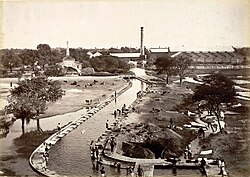
[[File:Hyderabad mills.jpg|thumb|A mill with a canal connecting to Hussain Sagar lake. Following the introduction of railways in the 1880s, factories were built around the lake.|alt=Sepia photograph of buildings around the water canal]] | |||
In 1713, Mughal emperor [[Farrukhsiyar]] appointed [[Mubariz Khan]] as Governor of Hyderabad. During his tenure, he [[City Wall of Hyderabad|fortified the city]] and controlled the internal and neighbouring threats.<ref name="Richards">{{cite book |title=The Mughal Empire, Part 1 |volume=5 |url=https://books.google.com/books?id=HHyVh29gy4QC |pages=279–281 |last=Richards |first=John.F. |publisher=[[Cambridge University Press]] |year=1993 |isbn=9780521566032 |access-date=29 June 2021 |archive-date=29 May 2016 |archive-url=https://web.archive.org/web/20160529043831/https://books.google.com/books?id=HHyVh29gy4QC |url-status=live }}</ref> In 1714 [[Farrukhsiyar]] appointed [[Nizam-ul-Mulk, Asaf Jah I|Asaf Jah I]] as [[Viceroy of the Deccan]]—(administrator of six Mughal governorates) with the title ''Nizam-ul-Mulk'' (Administrator of the Realm). In 1721, he was appointed as Prime Minister of the [[Mughal Empire]].<ref name="Mehta&Roy">{{cite book |title=Advanced Study in the History of Modern India: 1707–1813 |publisher=[[Sterling Publishing]] |page=143 |isbn=978-1-932705-54-6 |last=Mehta |first=Jaswant Lal |year=2005}} | |||
* {{cite book |title=Holy Ignorance: When Religion and Culture Part Ways |publisher=[[Columbia University Press]] |page=95 |isbn=978-0-231-80042-6 |last=Roy |first=Olivier |year=2011}}</ref> His differences with the court nobles led him to resign from all the imperial responsibilities in 1723 and leave for Deccan.<ref name="Mehta">{{cite book |title=Advanced Study in the History of Modern India: 1707–1813 |last=Mehta |first=Jaswant Lal |page=143 |year=2005 |publisher=[[Sterling Publishing]] |isbn=978-1-932705-54-6}}</ref><ref name="Roy">{{cite book |title=Holy Ignorance: When Religion and Culture Part Ways |last=Roy |first=Olivier |page=95 |year=2011 |publisher=[[Columbia University Press]] |isbn=978-0-231-80042-6}}</ref> Under the influence of Asaf Jah I's opponents, Mughal Emperor [[Muhammad Shah]] issued a decree to [[Mubariz Khan]], to stop Asaf Jah I which resulted in the [[Battle of Shakar Kheda]].<ref name="Mehta"/>{{rp|93–94}} In 1724, Asaf Jah I defeated Mubariz Khan to establish autonomy over the ''[[Deccan Plateau|Deccan]]'', named the region ''[[Hyderabad State|Hyderabad Deccan]]'', and started what came to be known as the [[Asaf Jahi dynasty]]. Subsequent rulers retained the title ''Nizam ul-Mulk'' and were referred to as Asaf Jahi Nizams, or [[Nizam of Hyderabad|Nizams of Hyderabad]].<ref name="Richards" /><ref name="columbia&TOI" /> The death of Asaf Jah I in 1748 resulted in a period of political unrest as his sons and grandson—[[Nasir Jung]] (1748–1750), [[Muhyi ad-Din Muzaffar Jang Hidayat|Muzaffar Jang]] (1750-1751) and [[Salabat Jung]] (1751-1762)—contended for the throne backed by opportunistic neighbouring states and colonial foreign forces. The accession of [[Ali Khan Asaf Jah II|Asaf Jah II]], who reigned from 1762 to 1803, ended the instability. In 1768 he signed the [[Treaty of Masulipatam]], surrendering the coastal region to the [[East India Company]] in return for a fixed annual rent.<ref name="Reg Sal Geo">{{cite book |title=Nizam-British relations, 1724–1857 |publisher=Concept Publishing |pages=130–150 |isbn=978-81-7022-195-1 |last=Regani |first=Sarojini |year=1988}} | |||
* {{cite book |title=A comprehensive history of medieval India |publisher=[[Dorling Kindersley]] |page=346 |isbn=978-81-317-3202-1 |last=Farooqui |first=Salma Ahmed |year=2011}} | |||
* {{cite book |title=An historical sketch of the native states of India in subsidiary alliance with the British government |publisher=Asian Education Services |pages=280–292 |isbn=978-81-206-1971-5 |last=Malleson |first=George Bruce |year=2005}} | |||
* {{cite book |title=The annals of Indian administration, Volume 14 |publisher=BiblioBazaar |page=467 |isbn=978-1-145-42314-5 |last=Townsend |first=Meredith |year=2010}}</ref> | |||
In 1769 Hyderabad city became the formal capital of the Asaf Jahi Nizams.<ref name="Richards" /><ref name="columbia&TOI" /> In response to regular threats from [[Hyder Ali]] (Dalwai of [[Mysore]]), [[Baji Rao I]] ([[Peshwa]] of the [[Maratha Empire]]), and Basalath Jung (Asaf Jah II's elder brother, who was supported by [[French India|French]] General the [[Marquis de Bussy-Castelnau]]), the Nizam signed a [[subsidiary alliance]] with the East India Company in 1798, allowing the [[British Indian Army]] to be stationed at [[Bolarum]] (modern [[Secunderabad]]) to protect the state's capital, for which the Nizams paid an annual maintenance to the British.<ref name="Reg Sal Geo" /> | |||
Hyderabad | Until 1874 there were no modern industries in Hyderabad. With the introduction of railways in the 1880s, four factories were built to the south and east of [[Hussain Sagar]] lake,<ref>{{cite web |title=The mills, Hyderabad. |url=https://www.europeana.eu/portal/record/92037/_http___www_bl_uk_onlinegallery_onlineex_apac_photocoll_t_zoomify62268_html.html?start=6&query= |year=2013 |publisher=[[Europeana]] |last=Dayal |first=Deen |access-date=31 October 2015 |url-status=live |archive-url=https://web.archive.org/web/20160101224338/http://www.europeana.eu/portal/record/92037/_http___www_bl_uk_onlinegallery_onlineex_apac_photocoll_t_zoomify62268_html.html?start=6&query= |archive-date=1 January 2016}}</ref> and during the early 20th century, Hyderabad was transformed into a modern city with the establishment of transport services, underground drainage, running water, [[Hussain Sagar Thermal Power Station|electricity]], telecommunications, universities, industries, and [[Begumpet Airport]]. The [[Nizams]] ruled the [[princely state]] of [[Hyderabad State|Hyderabad]] during the [[British Raj]].<ref name="Richards" /><ref name="columbia&TOI" /> | ||
After India [[Indian independence movement|gained independence]], the Nizam declared his intention to remain independent rather than become part of the [[Dominion of India|Indian Union]] or newly formed [[Dominion of Pakistan]].<ref name="Reg Sal Geo" /> The Hyderabad State Congress, with the support of the [[Indian National Congress]] and the [[Communist Party of India]], began agitating against [[Osman Ali Khan, Asaf Jah VII|Nizam VII]] in 1948. On 17 September that year, the [[Indian Army]] took control of Hyderabad State after an invasion codenamed [[Annexation of Hyderabad|Operation Polo]]. With the defeat of his forces, Nizam VII capitulated to the Indian Union by signing an [[Instrument of Accession]], which made him the ''[[Rajpramukh]]'' (Princely Governor) of the state until it was abolished on 31 October 1956.<ref name="columbia&TOI" /><ref>{{cite news |title=Momentous day for lovers of freedom, democracy |url=http://www.hindu.com/2004/09/17/stories/2004091706840400.htm |last=Venkateshwarlu |first=K |date=17 September 2004 |access-date=23 May 2012 |url-status=dead |archive-url=https://web.archive.org/web/20120817055717/http://www.hindu.com/2004/09/17/stories/2004091706840400.htm |newspaper=[[The Hindu]] |archive-date=17 August 2012}}</ref> | |||
==== Post-Independence ==== | |||
Between 1946 and 1951, the Communist Party of India fomented the [[Telangana Rebellion|Telangana uprising]] against the [[Indian feudalism|feudal]] lords of the [[Telangana region]].<ref>{{cite book |title=Affirming life and diversity |publisher=Pragati Offset |pages=1–10 |isbn=978-1-84369-674-2 |last1=Sathees |first1=P.V. |last2=Pimbert |first2=Michel |last3=The DDS Community Media Trust |year=2008}}</ref> The [[Constitution of India]], which became effective on 26 January 1950, made Hyderabad State one of the [[States Reorganisation Act#Three types of states|part B states]] of India, with Hyderabad city continuing to be the capital.<ref>{{cite news |title=Demand for states along linguistic lines gained momentum in the '50s |url=http://timesofindia.indiatimes.com/india/Demand-for-states-along-linguistic-lines-gained-momentum-in-the-50s/articleshow/7250365.cms?referral=PM |newspaper=The Times of India |date=10 January 2011 |access-date=31 July 2013 |url-status=live |archive-url=https://web.archive.org/web/20150910201915/http://timesofindia.indiatimes.com/india/Demand-for-states-along-linguistic-lines-gained-momentum-in-the-50s/articleshow/7250365.cms?referral=PM |archive-date=10 September 2015}}</ref> In his 1955 report ''Thoughts on Linguistic States'', [[B. R. Ambedkar]], then chairman of the [[Constitution of India#Drafting|Drafting Committee of the Indian Constitution]], proposed designating the city of Hyderabad as the [[second capital]] of India because of its amenities and strategic central location.<ref name="Mahesh Ambedkar">{{cite book |title=The Architect of Modern India Dr Bhimrao Ambedkar |publisher=Diamond Pocket Books |pages=132–133 |isbn=978-81-288-0954-5 |last=Ambedkar |first=Mahesh |year=2005}}</ref> | |||
On 1 November 1956 the states of India [[States Reorganisation Act#The States Reorganisation Act|were reorganised]] by language. Hyderabad state was split into three parts, which were merged with neighbouring states to form the modern states of [[Maharashtra]], [[Karnataka]] and Andhra Pradesh. The nine [[Telugu language|Telugu]]- and [[Urdu]]-speaking districts of Hyderabad State in the Telangana region were merged with the Telugu-speaking [[Andhra State]] to create Andhra Pradesh,<ref>{{cite book |title=Multi-sited ethnography: theory, praxis and locality in contemporary research |publisher=Ashgate Publishing |pages=165–166 |isbn=978-0-7546-9144-0 |last=Falzon |first=Mark-Anthony |year=2009}}</ref><ref>{{cite book |title=The Police in India |publisher=Atlantic Publishers |page=142 |isbn=978-81-7156-628-0 |last=Chande |first=M.B |year=1997}}</ref><ref>{{cite news |title=Living together, separately |url=http://www.thehindu.com/opinion/lead/living-together-separately/article4358004.ece |newspaper=The Hindu |last=Guha |first=Ramachandra |date=30 January 2013 |access-date=5 August 2013 |url-status=live |archive-url=https://web.archive.org/web/20130921053616/http://www.thehindu.com/opinion/lead/living-together-separately/article4358004.ece |archive-date=21 September 2013}}</ref> with Hyderabad as its capital. Several protests, known collectively as the [[Telangana movement]], attempted to invalidate the merger and demanded the creation of a new Telangana state. Major actions took place in 1969 and 1972, and a third began in 2010.<ref>{{cite news |title=How Telangana movement has sparked political turf war in Andhra |url=http://www.rediff.com/news/report/how-telangana-movement-has-sparked-political-turf-war-in-andhra/20111005.htm |work=Rediff.com |date=5 October 2011 |access-date=19 February 2012 |url-status=live |archive-url=https://web.archive.org/web/20120123122405/http://www.rediff.com/news/report/how-telangana-movement-has-sparked-political-turf-war-in-andhra/20111005.htm |archive-date=23 January 2012}}</ref> The city suffered several explosions: one at [[Dilsukhnagar]] in 2002 claimed two lives;<ref>{{cite news |title=Timeline:history of blasts in Hyderabad |url=http://www.firstpost.com/india/timeline-history-of-blasts-in-hyderabad-635152.html |newspaper=[[First Post (India)]] |date=22 February 2013 |access-date=22 February 2013 |url-status=live |archive-url=https://web.archive.org/web/20130225025636/http://www.firstpost.com/india/timeline-history-of-blasts-in-hyderabad-635152.html |archive-date=25 February 2013}}</ref> terrorist bombs in [[Mecca Masjid blast|May]] and [[August 2007 Hyderabad bombings|August]] 2007 caused [[Religious violence in India|communal tension and riots]];<ref>{{cite news |title=At least 13 killed in bombing, riots at mosque in India |url=http://www.cbc.ca/news/world/at-least-13-killed-in-bombing-riots-at-mosque-in-india-1.646677 |newspaper=[[CBC News]] |date=18 May 2007 |access-date=21 September 2012 |url-status=live |archive-url=https://web.archive.org/web/20130923074108/http://www.cbc.ca/news/world/at-least-13-killed-in-bombing-riots-at-mosque-in-india-1.646677 |archive-date=23 September 2013}}</ref> and two bombs exploded in [[2013 Hyderabad blasts|February 2013]].<ref>{{cite news |title=Hyderabad bomb blasts:two deadly explosions leave terror cloud over India |url=http://world.time.com/2013/02/21/hyderabad-bomb-blasts-two-deadly-explosions-leave-terror-cloud-over-india/ |newspaper=[[Time (magazine)|Time]] |last=Mahr |first=Krista |date=21 February 2013 |access-date=22 February 2013 |url-status=live |archive-url=https://web.archive.org/web/20130224052121/http://world.time.com/2013/02/21/hyderabad-bomb-blasts-two-deadly-explosions-leave-terror-cloud-over-india/ |archive-date=24 February 2013}}</ref> On 30 July 2013 the government of India declared that part of Andhra Pradesh would be split off to form a new Telangana state, and that Hyderabad city would be the capital city and part of Telangana, while the city would also remain the capital of Andhra Pradesh for no more than ten years. On 3 October 2013 the Union Cabinet approved the proposal,<ref>{{cite news |title=Telangana at last: India gets a new state, demand for other states gets a boost |url=http://www.hindustantimes.com/india-news/telangana-at-last-india-gets-a-new-state-clamour-for-other-states-grow/article1-1100983.aspx |newspaper=[[Hindustan Times]] |last=Naqshbandi |first=Aurangzeb |date=31 July 2013 |access-date=31 July 2013 |url-status=dead |archive-url=https://web.archive.org/web/20140125041752/http://www.hindustantimes.com/india-news/telangana-at-last-india-gets-a-new-state-clamour-for-other-states-grow/article1-1100983.aspx |archive-date=25 January 2014}} | |||
* {{cite web |title=Creation of a new state of Telangana by bifurcating the existing State of Andhra Pradesh |url=http://pib.nic.in/newsite/erelease.aspx?relid=99854 |publisher=Press Information Bureau, Government of India |date=3 October 2013 |access-date=3 October 2013 |url-status=live |archive-url=https://web.archive.org/web/20131004214211/http://pib.nic.in/newsite/erelease.aspx?relid=99854 |archive-date=4 October 2013}} | |||
* {{cite web |title=Text of Cabinet note on Telangana |url=http://epaper.thehansindia.com/PUBLICATIONS/THEHANSINDIA/THI/2013/10/06/ArticleHtmls/Text-of-Cabinet-Note-on-Telangana-06102013007003.shtml?Mode=1 |archive-url=https://web.archive.org/web/20131013165402/http://epaper.thehansindia.com/PUBLICATIONS/THEHANSINDIA/THI/2013/10/06/ArticleHtmls/Text-of-Cabinet-Note-on-Telangana-06102013007003.shtml?Mode=1 |archive-date=13 October 2013 |newspaper=[[The Hans India]] |date=6 October 2013 |access-date=7 October 2013}}</ref> and in February 2014 both houses of [[Parliament of India|Parliament]] [[Act of Parliament|passed]] the [[Andhra Pradesh Reorganisation Act, 2014|Telangana Bill]]. With the final assent of the President of India, Telangana state was formed on 2 June 2014.<ref>{{cite news |title=what you need to know about India's newest state-Telangana |url=http://www.dnaindia.com/india/report-here-s-what-you-need-to-know-about-india-s-newest-state-telangana-1992986 |newspaper=Daily News and Analysis |date=2 June 2014 |access-date=29 November 2014 |url-status=live |archive-url=https://web.archive.org/web/20141205152545/http://www.dnaindia.com/india/report-here-s-what-you-need-to-know-about-india-s-newest-state-telangana-1992986 |archive-date=5 December 2014}}</ref> | |||
== Geography == | == Geography == | ||
[[File: | {{Main|Geography of Hyderabad}} | ||
Hyderabad is | |||
[[File:Hussainsagar hyd.jpg|thumb|left|[[Hussain Sagar]] lake, built during the reign of the Qutb Shahi dynasty, was once the source of drinking water for Hyderabad.<ref name="Hussain Sagar" />|alt=Large manmade lake, with Hyderabad in the far distance]] | |||
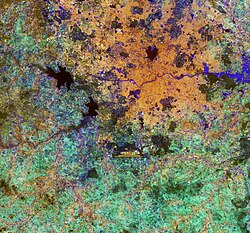
Hyderabad is {{cvt|1566|km}} south of [[Delhi]], {{cvt|699| km}} southeast of [[Mumbai]], and {{cvt|570|km}} north of [[Bangalore]] by road.<ref>{{Google maps | url =https://maps.google.com/maps?ll=17.366,78.476&spn=0.1,0.1&t=h&q=17.366,78.476 | access-date =6 January 2013 }}</ref> It is situated in the southern part of Telangana in southeastern India,<ref name="Hyderabad_tg_location">{{cite journal |title=Consecutive days maximum rainfall analysis by gumbel's extreme value distributions for southern Telangana |url=http://www.tnsroindia.org.in/JOURNAL/FULL%20TEXT%20ISSUE%207.pdf |last1=Momin |first1=Umar farooque |last2=Kulkarni |first2=Prasad.S |last3=Horaginamani |first3=Sirajuddin M |last4=M |first4=Ravichandran |last5=Patel |first5=Adamsab M |last6=Kousar |first6=Hina |volume=2 |issue=7 |page=411 |journal=Indian Journal of Natural Sciences |year=2011 |issn=0976-0997 |access-date=11 February 2015 |url-status=dead |archive-url=https://web.archive.org/web/20150608085835/http://www.tnsroindia.org.in/JOURNAL/FULL%20TEXT%20ISSUE%207.pdf |archive-date=8 June 2015}}</ref> along the banks of the [[Musi River (India)|Musi River]], a tributary of [[Krishna River]] located on the [[Deccan Plateau]] in the northern part of [[South India]].<ref name=area>{{cite news |url=https://timesofindia.indiatimes.com/city/hyderabad/New-geographical-map-of-Hyderabad-released/articleshow/45543021.cms |title=New geographical map of Hyderabad released |date=17 December 2014 |access-date=12 April 2020 |url-status=live |archive-url=https://web.archive.org/web/20160303140652/http://timesofindia.indiatimes.com/city/hyderabad/New-geographical-map-of-Hyderabad-released/articleshow/45543021.cms |archive-date=3 March 2016}}</ref><ref>{{cite web |title=Greater Hyderabad Municipal Corporation |url=http://www.ghmc.gov.in/greaterhyd.asp |website=www.ghmc.gov.in |access-date=23 December 2015 |url-status=dead |archive-url=https://web.archive.org/web/20160101224338/http://www.ghmc.gov.in/greaterhyd.asp |archive-date=1 January 2016}}</ref><ref name="Hyderabad_Geo">{{cite web |title=Physical Feature |url=http://www.apind.gov.in/Library/District/hyderabad.pdf |work=AP Government |year=2002 |access-date=4 April 2012 |url-status=dead |archive-url=https://web.archive.org/web/20120416235458/http://www.apind.gov.in/Library/District/hyderabad.pdf |archive-date=16 April 2012}}</ref> Greater Hyderabad covers {{cvt|650|km2|sqmi}}, making it one of the largest metropolitan areas in India.<ref name=":0" /> With an average altitude of {{cvt|542|m|ft|0}}, Hyderabad lies on predominantly sloping terrain of grey and pink [[granite]], dotted with small hills, the highest being [[Banjara Hills]] at {{cvt|672|m|ft|0}}.<ref name="Hyderabad_Geo" /><ref name="JNTU_Geo">{{cite web |title=Hyderabad geography |url=http://jntuhdufr.com/geography |work=[[Jawaharlal Nehru Technological University, Hyderabad|JNTU]] |access-date=4 May 2012 |url-status=live |archive-url=https://web.archive.org/web/20131111002233/http://jntuhdufr.com/geography |archive-date=11 November 2013}}</ref> [[Hyderabad city lakes|The city has numerous lakes]] sometime referred to as ''sagar'', meaning "sea". Examples include artificial lakes created by dams on the Musi, such as Hussain Sagar (built in 1562 near the city centre), [[Osman Sagar]] and [[Himayat Sagar]].<ref name="Hyderabad_Geo" /><ref name="rainwaterharvesting">{{cite web |title=Water sources and water supply |url=http://www.rainwaterharvesting.org/hussain_sagar/hussainsagar%202.pdf |work=rainwaterharvesting.org |page=2 |year=2005 |access-date=20 January 2012 |url-status=live |archive-url=https://web.archive.org/web/20120111100030/http://www.rainwaterharvesting.org/hussain_sagar/hussainsagar%202.pdf |archive-date=11 January 2012}}</ref> {{As of|1996}}, the city had 140 lakes and 834 water tanks (ponds).<ref name="Sreoshi Singh">{{cite web |title=Water security in peri-urban south Asia |url=http://saciwaters.org/periurban/Scoping_Study_Report_Hyderabad.pdf |first=Sreoshi |last=Singh |publisher=South Asia Consortium for Interdisciplinary Water Resources Studies |year=2010 |access-date=18 May 2012 |url-status=dead |archive-url=https://web.archive.org/web/20120116235407/http://saciwaters.org/periurban/Scoping_Study_Report_Hyderabad.pdf |archive-date=16 January 2012}}</ref> | |||
=== Climate === | === Climate === | ||
Hyderabad has a | Hyderabad has a [[tropical savanna climate|tropical wet and dry climate]] ([[Köppen climate classification|Köppen]] ''Aw'') bordering on a hot [[semi-arid climate]] (Köppen ''BSh'').<ref>{{cite book |title=Climate and food security |publisher=International Rice Research Institute |page=[https://archive.org/details/climatefoodsecur0000inte/page/348 348] |year=1987 |isbn=978-971-10-4210-3 |url=https://archive.org/details/climatefoodsecur0000inte/page/348}} | ||
* {{cite book |title=The ecology of tropical food crops |publisher=Cambridge University Press |pages=249–251 |isbn=978-0-521-41062-5 |last1=Norman |first1=Michael John Thornley |first2=C.J |last2=Pearson |first3=P.G.E |last3=Searle |year=1995}}</ref> The annual mean temperature is {{cvt|26.6|C|F|1}}; monthly mean temperatures are {{cvt|21|–|33|C|F|0}}.<ref name="weatherbase hyd">{{cite web |title=Weatherbase entry for Hyderabad |url=http://www.weatherbase.com/weather/weather.php3?s=82134&units=metric |publisher=Canty and Associates LLC |access-date=13 June 2012 |url-status=live |archive-url=https://web.archive.org/web/20131030043855/http://www.weatherbase.com/weather/weather.php3?s=82134&units=metric |archive-date=30 October 2013}}</ref> Summers (March–June) are hot and humid, with average highs in the mid-to-high 30s Celsius;<ref name="imd hyd">{{cite web |title=Hyderabad |url=http://www.imd.gov.in/section/climate/extreme/hyderabad2.htm |publisher=[[India Meteorological Department]] |access-date=13 June 2012 |url-status=dead |archive-url=https://web.archive.org/web/20131110233943/http://www.imd.gov.in/section/climate/extreme/hyderabad2.htm |archive-date=10 November 2013}}</ref> maximum temperatures often exceed {{cvt|40|C|F}} between April and June.<ref name="weatherbase hyd" /> The coolest temperatures occur in December and January, when the lowest temperature occasionally dips to {{cvt|10|C|F|0}}.<ref name="weatherbase hyd" /> May is the hottest month, when daily temperatures range from {{cvt|26-39|C}}; December, the coldest, has temperatures varying from {{cvt|14.5-28|C}}.<ref name="imd hyd" /> | |||
Heavy rain from the [[Southwest monsoon|south-west summer monsoon]] falls between June and October, supplying Hyderabad with most of its mean annual rainfall.<ref name="imd hyd" /> Since records began in November 1891, the heaviest rainfall recorded in a 24-hour period was {{cvt|241.5|mm|in|0}} on 24 August 2000. The highest temperature ever recorded was {{cvt|45.5|C|0}} on 2 June 1966, and the lowest was {{cvt|6.1|C|0}} on 8 January 1946.<ref>{{cite web |title=Extreme weather events Overall |url=http://www.imdhyderabad.gov.in/tssite/tlngextwx.htm |publisher=Meteorological Centre, Hyderabad |date=December 2013 |access-date=6 March 2015 |url-status=dead |archive-url=https://web.archive.org/web/20150402140911/http://www.imdhyderabad.gov.in/tssite/tlngextwx.htm |archive-date=2 April 2015}}</ref> The city receives 2,731 hours of sunshine per year; maximum daily [[Insolation|sunlight exposure]] occurs in February.<ref>{{cite web |title=Historical weather for Hyderabad, India |url=http://www.weatherbase.com/weather/weatherall.php3?s=82134&refer=&units=metric |publisher=Weatherbase |access-date=3 October 2008 |url-status=live |archive-url=https://web.archive.org/web/20111204143148/http://www.weatherbase.com/weather/weatherall.php3?s=82134&refer=&units=metric |archive-date=4 December 2011}}</ref> | |||
=== | {{Hyderabad weatherbox}} | ||
=== Conservation === | |||
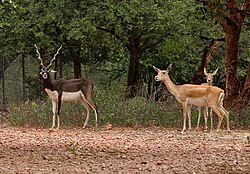
[[File:Blackbuck (Antilope cervicapra)- Male & female in Hyderabad, AP W IMG 7268.jpg|thumb|right|[[Blackbuck]]s grazing at [[Mahavir Harina Vanasthali National Park]]|alt=Three antelopes]] | |||
Hyderabad's lakes and the sloping terrain of its low-lying hills provide habitat for an assortment of flora and fauna. {{As of|2016}}, the tree cover is 1.7% of total city area, a decrease from 2.7% in 1996.<ref>{{cite news |title=Bats seen in the day? Experts blame habitat loss |url=http://timesofindia.indiatimes.com/city/hyderabad/Bats-seen-in-the-day-Experts-blame-habitat-loss/articleshow/53732842.cms |last=Tadepalli |first=Siddharth |newspaper=Times of India |date=17 August 2016 |access-date=17 August 2016 |url-status=live |archive-url=https://web.archive.org/web/20160817172152/http://timesofindia.indiatimes.com/city/hyderabad/Bats-seen-in-the-day-Experts-blame-habitat-loss/articleshow/53732842.cms |archive-date=17 August 2016}}</ref> The forest region in and around the city encompasses areas of ecological and biological importance, which are preserved in the form of [[national park]]s, [[zoo]]s, mini-zoos and a [[wildlife sanctuary]]. [[Nehru Zoological Park]], the city's one large zoo, is the first in India to have a lion and tiger [[safari park]]. Hyderabad has three national parks ([[Mrugavani National Park]], [[Mahavir Harina Vanasthali National Park]] and [[Kasu Brahmananda Reddy National Park]]), and the [[Manjira Wildlife Sanctuary]] is about {{cvt|50|km|mi|0}} from the city. Hyderabad's other environmental reserves are: [[Hyderabad Botanical Garden|Kotla Vijayabhaskara Reddy Botanical Gardens]], [[Ameenpur Lake]], [[Shamirpet Lake]], [[Hussain Sagar]], [[Fox Sagar Lake]], [[Mir Alam Tank]] and [[Patancheru#Geography|Patancheru Lake]], which is home to regional birds and attracts seasonal [[Bird migration|migratory birds]] from different parts of the world.<ref name="hyd-wildlife">{{cite web |title=Annual administration report 2011–2012 |url=http://www.forests.ap.gov.in/pdf/AAR/AAR11-12.pdf |page=78 |publisher=[[Andhra Pradesh Forest Department]] |access-date=31 October 2015 |url-status=dead |archive-url=https://web.archive.org/web/20160101224338/http://www.forests.ap.gov.in/pdf/AAR/AAR11-12.pdf |archive-date=1 January 2016}} | |||
* {{cite web |title=Nehru Zoological Park |url=http://www.hydzoo.com/about-the-zoo.html |publisher=[[Nehru Zoological Park]] |access-date=11 April 2017 |url-status=live |archive-url=https://web.archive.org/web/20170508173049/http://www.hydzoo.com/about-the-zoo.html |archive-date=8 May 2017}} | |||
* {{cite web |title=Search Establishment |url=http://cza.nic.in/htmlreports/htmlsearchzoo.aspx |publisher=[[Central Zoo Authority of India]] |access-date=21 June 2013 |url-status=dead |archive-url=https://web.archive.org/web/20130909064232/http://cza.nic.in/htmlreports/htmlsearchzoo.aspx |archive-date=9 September 2013}} | |||
* {{cite news |title=A study in green |url=http://www.hindu.com/thehindu/mp/2003/06/11/stories/2003061100390100.htm |last=Seshan |first=K.S.S |date=11 June 2003 |access-date=21 June 2013 |url-status=dead |archive-url=https://web.archive.org/web/20131110234111/http://www.hindu.com/thehindu/mp/2003/06/11/stories/2003061100390100.htm |newspaper=[[The Hindu]] |archive-date=10 November 2013}} | |||
* {{cite news |title=Govt mining policy destroying India's rich biodiversity:NGO |url=http://timesofindia.indiatimes.com/home/environment/flora-fauna/Govt-mining-policy-destroying-Indias-rich-biodiversity-NGO/articleshow/16711337.cms?referral=PM |newspaper=The Times of India |date=7 October 2012 |access-date=21 June 2013 |url-status=live |archive-url=https://web.archive.org/web/20150910201914/http://timesofindia.indiatimes.com/home/environment/flora-fauna/Govt-mining-policy-destroying-Indias-rich-biodiversity-NGO/articleshow/16711337.cms?referral=PM |archive-date=10 September 2015}} | |||
* {{cite news |title=No place for migratory birds in city |url=http://postnoon.com/2012/01/08/no-place-for-migratory-birds-in-city/17511 |archive-url=https://web.archive.org/web/20121126152841/http://postnoon.com/2012/01/08/no-place-for-migratory-birds-in-city/17511 |archive-date=26 November 2012 |last=Koka |first=Sudeshna |newspaper=PostNoon |date=8 January 2012 |access-date=21 June 2013}}</ref> Organisations engaged in environmental and wildlife preservation include the [[Telangana Forest Department]],<ref>{{cite news |title=T'gana forest dept to develop 10 nature parks around Hy'bad |url=http://www.business-standard.com/article/pti-stories/t-gana-forest-dept-to-develop-10-nature-parks-around-hy-bad-114100801046_1.html |newspaper=Business Standard |date=8 October 2014 |access-date=19 February 2015 |url-status=live |archive-url=https://web.archive.org/web/20150219000626/http://www.business-standard.com/article/pti-stories/t-gana-forest-dept-to-develop-10-nature-parks-around-hy-bad-114100801046_1.html |archive-date=19 February 2015}}</ref> [[Indian Council of Forestry Research and Education]], the [[International Crops Research Institute for the Semi-Arid Tropics]] (ICRISAT), the [[Animal Welfare Board of India]], the [[Blue Cross of Hyderabad]] and the [[University of Hyderabad]].<ref name="hyd-wildlife" /><!-- SOME OF THE WIKILINKED ARTICLES ARE NOT CITED DUE TO OVER BURDEN OF CITATIONS, ANY WAY THOSE ARE CITED ON THEIR RELATED ARTICLE/PAGE --> | |||
== Administration == | |||
{{Main|Administration of Hyderabad}} | |||
=== Common capital status === | |||
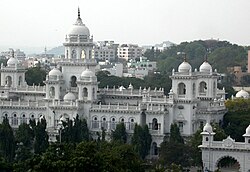
[[File:Hyderabad Town Hall.jpg|thumb|left|[[Telangana Legislature]]|alt=White building with multiple domes]] | |||
According to the [[Andhra Pradesh Reorganisation Act, 2014]] part 2 Section 5:<ref>{{cite web |url=http://www.prsindia.org/uploads/media/Telangana/AP%20Reorganisation%20Bill,%202014.pdf |title=AP Reorganisation Bill, 2014 |date=2014 |work=prsindia.org |access-date=29 July 2014 |url-status=dead |archive-url=https://web.archive.org/web/20140327124943/http://www.prsindia.org/uploads/media/Telangana/AP%20Reorganisation%20Bill,%202014.pdf |archive-date=27 March 2014}}</ref> "(1) On and from the appointed day, Hyderabad in the existing State of [[Andhra Pradesh]], shall be the common capital of the State of [[Telangana]] and the State of Andhra Pradesh for such period not exceeding ten years. (2) After expiry of the period referred to in sub-section (1), Hyderabad shall be the capital of the State of [[Telangana]] and there shall be a new capital for the State of [[Andhra Pradesh]]." | |||
The same sections also define that the common capital includes the existing area designated as the [[Greater Hyderabad Municipal Corporation]] under the Hyderabad Municipal Corporation Act, 1955. As stipulated in sections 3 and 18(1) of the Reorganisation Act, city MLAs are members of Telangana state assembly. | |||
=== Local government === | |||
{{See also|List of Hyderabad Corporation wards}} | |||
[[File:GHMC NEW ZONES,CIRCLE MAP.jpg|thumb|right|The GHMC is divided into six municipal zones]] | |||
The [[Greater Hyderabad Municipal Corporation]] (GHMC) oversees the civic infrastructure of the city, there are six administrative zones of GHMC: South Zone–(Charminar), East Zone–(L. B. Nagar), West Zone–(Serilingampally), North Zone–(Kukatpally), Northeast Zone–(Secunderabad) and Central Zone–(Khairatabad); these zones consist of 30 "circles", which together encompass [[List of Hyderabad Corporation wards|150 municipal wards]]. Each ward is represented by a [[corporator]], elected by popular vote, {{as of|2020|lc=on}} the city has 7,400,000 voters of which 3,850,000 are male and 3,500,000 are female.<ref name="news18">{{cite news |title=Live Results: Greater Hyderabad Municipal Elections 2020|url=https://www.news18.com/ghmc-election-results-2020-tally-live/|newspaper=[[Network18 Group]]|year=2020|access-date=13 September 2021|url-status=live}}</ref> The corporators elect the [[Mayor]], who is the [[Titular ruler|titular head]] of GHMC; executive powers rest with the Municipal Commissioner, appointed by the state government. The GHMC carries out the city's infrastructural work such as building and maintenance of roads and drains, town planning including construction regulation, maintenance of municipal markets and parks, solid waste management, the issuing of birth and death certificates, the issuing of trade licences, collection of property tax, and community welfare services such as mother and child healthcare, and pre-school and non-formal education.<ref name="citi charter">{{cite web |title=Citizen's charter |url=http://www.ghmc.gov.in/tender%20pdfs/Citizen%20Charter-19.06.pdf |archive-url=https://web.archive.org/web/20130717215758/http://www.ghmc.gov.in/tender%20pdfs/Citizen%20Charter-19.06.pdf |url-status=dead |archive-date=17 July 2013 |publisher=GHMC |access-date=31 July 2013}}</ref> The GHMC was formed in April 2007 by merging the [[Municipal Corporation of Hyderabad]] (MCH) with 12 municipalities of the [[Hyderabad district, India|Hyderabad]], [[Ranga Reddy district|Ranga Reddy]] and [[Medak district|Medak]] districts covering a total area of {{cvt|650|km2|sqmi}}.<ref name=":0">{{cite web |title=Drinking water: issues in access and equity |url=http://jointactionforwater.org/sites/default/files/Hyderabad-Water-Briefing-paper-CR.pdf |archive-url=https://web.archive.org/web/20131110235911/http://jointactionforwater.org/sites/default/files/Hyderabad-Water-Briefing-paper-CR.pdf |archive-date=10 November 2013 |url-status=dead |publisher=jointactionforwater.org |last=Ramachandraia |first=C |year=2009 |access-date=18 November 2012}}</ref>{{rp|3}} The [[Secunderabad Cantonment Board]] is a civic administration agency overseeing an area of {{cvt|40.1|km2|sqmi}},<ref name="Wba ci rep">{{cite web |title=Exploring urban growth management in three developing country cities |url=http://siteresources.worldbank.org/INTURBANDEVELOPMENT/Resources/336387-1169585750379/Urban_Growth_June_2008.pdf |publisher=[[World Bank]] |date=15 June 2008 |access-date=6 December 2012 |url-status=live |archive-url=https://web.archive.org/web/20130605133128/http://siteresources.worldbank.org/INTURBANDEVELOPMENT/Resources/336387-1169585750379/Urban_Growth_June_2008.pdf |archive-date=5 June 2013}}</ref>{{rp|93}} where there are several military camps.<ref name="cgg Hyderabad 1">{{cite web |title=Survey of child labour in slums of Hyderabad: final report |url=http://cgg.gov.in/publicationdownloads/Survey%20of%20Child%20Labour%20in%20slums%20of%20Hyderabad.pdf |archive-url=https://web.archive.org/web/20120629112955/http://cgg.gov.in/publicationdownloads/Survey%20of%20Child%20Labour%20in%20slums%20of%20Hyderabad.pdf |archive-date=29 June 2012 |publisher=Center for Good Governance, Hyderabad |date=17 December 2008 |access-date=16 May 2012}}</ref>{{rp|2}}<ref>{{cite web |title=Information hand book under right to information act Secunderabad cantonment board |url=http://scb.aponline.gov.in/SCBPortal/RTI-Act.pdf |publisher=[[Secunderabad Cantonment Board]] |page=6 |access-date=31 July 2013 |url-status=dead |archive-url=https://web.archive.org/web/20131110232944/http://scb.aponline.gov.in/SCBPortal/RTI-Act.pdf |archive-date=10 November 2013}}</ref> The [[Osmania University]] campus is administered independently by the university authority.<ref name="Wba ci rep" />{{rp|93}} Appointed in February 2021, [[Gadwal Vijayalakshmi]] of [[Telangana Rashtra Samithi]] (TRS) is serving as the Mayor of GHMC.<ref>{{cite news |title=Mayor a highly educated and accomplished person |url=https://www.thehindu.com/news/cities/Hyderabad/mayor-a-highly-educated-and-accomplished-person/article33814972.ece |newspaper=The Hindu |date=11 February 2021 |access-date=18 February 2021 |url-status=live |archive-url=https://web.archive.org/web/20210222145640/https://www.thehindu.com/news/cities/Hyderabad/mayor-a-highly-educated-and-accomplished-person/article33814972.ece |archive-date=22 February 2021}}</ref> | |||
Law and order in Hyderabad city is supervised by the [[Governor (India)|Governor]] of Telangana.<ref name="toi gov">{{cite news |title=Andhra Pradesh, Telangana spar over governor powers; Centre to take law department advice |url=http://timesofindia.indiatimes.com/india/Andhra-Pradesh-Telangana-spar-over-governor-powers-Centre-to-take-law-department-advice/articleshow/45314625.cms |newspaper=The Times of India |date=29 November 2014 |access-date=9 December 2014 |url-status=live |archive-url=https://web.archive.org/web/20141202055647/http://timesofindia.indiatimes.com/india/Andhra-Pradesh-Telangana-spar-over-governor-powers-Centre-to-take-law-department-advice/articleshow/45314625.cms |archive-date=2 December 2014}}</ref> The jurisdiction is divided into three police commissionerates: [[Hyderabad City Police|Hyderabad]], [[Cyberabad Metropolitan Police|Cyberabad]], and [[Rachakonda Police Commissionerate|Rachakonda]]. Each zone is headed by a [[Deputy Commissioner of Police (India)|deputy commissioner of police]].<ref name="hp">{{cite web |title=About us |url=http://www.hyderabadpolice.gov.in/Main/AboutUs.htm |publisher=Hyderabad City Police |access-date=20 February 2015 |archive-url=https://web.archive.org/web/20150206002744/http://hyderabadpolice.gov.in/Main/AboutUs.htm |archive-date=6 February 2015}}</ref><ref name="cp">{{cite web |title=Know your police station |url=http://www.cyberabadpolice.gov.in/about.html |publisher=Cyberabad police |access-date=31 October 2015 |url-status=live |archive-url=https://web.archive.org/web/20151125051107/http://www.cyberabadpolice.gov.in/about.html |archive-date=25 November 2015}}</ref> | |||
The jurisdictions of the city's administrative agencies are, in ascending order of size: the Hyderabad Police area, Hyderabad district, the GHMC area ("Hyderabad city") and the area under the [[Hyderabad Metropolitan Development Authority]] (HMDA). The HMDA is an apolitical urban planning agency that covers the GHMC and its suburbs, extending to 54 ''[[Tehsil|mandals]]'' in five districts encircling the city. It coordinates the development activities of GHMC and suburban municipalities and manages the administration of bodies such as the [[Hyderabad Metropolitan Water Supply and Sewerage Board]] (HMWSSB).<ref name="HMDA1">{{cite web |title=Welcome to HMDA |url=http://www.hmda.gov.in/ |work=[[Hyderabad Metropolitan Development Authority]] |access-date=7 October 2011 |url-status=dead |archive-url=https://web.archive.org/web/20150208055156/http://www.hmda.gov.in/ |archive-date= 8 February 2015}}</ref> | |||
Hyderabad is the seat of the [[Government of Telangana]], [[Government of Andhra Pradesh]] and the [[President of India]]'s winter retreat [[Rashtrapati Nilayam]], as well as the [[Telangana High Court]] and various local government agencies. The Lower City Civil Court and the Metropolitan Criminal Court are under the jurisdiction of the High Court.<ref>{{cite web|title=Presidential Retreats|url=https://presidentofindia.nic.in/presidential-retreats.htm|work=[[National Informatics Centre]]|date=5 August 2019|access-date=13 September 2021}}</ref><ref name="toi her">{{cite news |title=Advantage Telangana over immovable assets |url=http://timesofindia.indiatimes.com/india/Advantage-Telangana-over-immovable-assets/articleshow/21521630.cms?referral=PM |last=Nagaraju |first=Jinka |newspaper=The Times of India |date=1 August 2013 |access-date=11 August 2013 |url-status=live |archive-url=https://web.archive.org/web/20150910235124/http://timesofindia.indiatimes.com/india/Advantage-Telangana-over-immovable-assets/articleshow/21521630.cms?referral=PM |archive-date=10 September 2015}}</ref><ref>{{cite web |title=India |url=http://www.redress.org/downloads/country-reports/india.pdf |publisher=[[Redress (charitable organisation)]] |year=2002 |access-date=18 November 2012 |url-status=dead |archive-url=https://web.archive.org/web/20121004082512/http://www.redress.org/downloads/country-reports/india.pdf |archive-date=4 October 2012}}</ref>{{rp|1}} The GHMC area contains 24 State Legislative Assembly constituencies,<ref>{{cite web |url=https://timesofindia.indiatimes.com/city/hyderabad/kcrs-early-election-gamble-gives-enough-ammo-to-trs/articleshow/66104449.cms |title=KCR's early election gamble gives enough ammo to TRS |website=[[The Times of India]] |access-date=7 October 2018 |archive-url=https://web.archive.org/web/20181007181033/https://timesofindia.indiatimes.com/city/hyderabad/kcrs-early-election-gamble-gives-enough-ammo-to-trs/articleshow/66104449.cms |archive-date=7 October 2018 |url-status=live}}</ref> which form five constituencies of the [[Lok Sabha]] (the [[lower house]] of the Parliament of India).<ref name="GHMC-The Hindu">{{cite news |title=GHMC polls: all set for the d-day |url=http://www.thehindu.com/news/cities/Hyderabad/ghmc-polls-all-set-for-the-dday/article52463.ece |newspaper=The Hindu |date=22 November 2009 |access-date=18 November 2012 |url-status=live |archive-url=https://web.archive.org/web/20131110235141/http://www.thehindu.com/news/cities/Hyderabad/ghmc-polls-all-set-for-the-dday/article52463.ece |archive-date=10 November 2013}}</ref> | |||
=== Utility services === | |||
[[File:Street in Hyderabad, India.JPG|thumb|upright|A GHMC sweeper cleaning the [[Tank Bund Road, Hyderabad|Tank Bund Road]]|alt=Woman sweeping the road]] | |||
The HMWSSB regulates [[rainwater harvesting]], sewerage services and water supply, which is sourced from several dams located in the suburbs. In 2005, the HMWSSB started operating a {{cvt|116|km|mi|-long|0|adj=mid}} water supply pipeline from [[Nagarjuna Sagar Dam]] to meet increasing demand.<ref>{{cite web |title=Profile |url=https://www.hyderabadwater.gov.in/en/index.php/about/profile-us |publisher=Hyderabad Metropolitan Water Supply and Sewerage Board |access-date=31 October 2015 |url-status=live |archive-url=https://web.archive.org/web/20160101224338/https://www.hyderabadwater.gov.in/en/index.php/about/profile-us |archive-date=1 January 2016}}</ref><ref name="CSE">{{cite journal |title=Hyderabad |publisher=[[Centre for Science and Environment]] |url=http://cseindia.org/userfiles/hyderabad_portraits.pdf |year=2011 |author=Anon |pages=331–341 |journal=Excreta Matters |access-date=20 February 2015 |url-status=dead |archive-url=https://web.archive.org/web/20160304074515/http://cseindia.org/userfiles/hyderabad_portraits.pdf |archive-date=4 March 2016}}</ref> The [[Telangana State Southern Power Distribution Company Limited|Telangana Southern Power Distribution Company Limited]] (TSPDCL) manages electricity supply.<ref>{{cite web |title=About TSSPDCL |url=https://www.tssouthernpower.com/CPDCL_Home.portal;jsessionid=2sVQJntXymj13nDLBGDh5kkRjbQbcP8HGG3JjVlG3xhX9JcsmL63!-2089831870?_nfpb=true&_pageLabel=CPDCL_Home_portal_page_69_page_70 |publisher=Telangana Southern Power Distribution Company Limited |access-date=20 February 2015 |url-status=live |archive-url=https://web.archive.org/web/20150220201201/https://www.tssouthernpower.com/CPDCL_Home.portal;jsessionid=2sVQJntXymj13nDLBGDh5kkRjbQbcP8HGG3JjVlG3xhX9JcsmL63!-2089831870?_nfpb=true&_pageLabel=CPDCL_Home_portal_page_69_page_70 |archive-date=20 February 2015}}</ref> {{As of|2014}}, there were 15 [[fire station]]s in the city, operated by the Telangana State Disaster and Fire Response Department.<ref>{{cite news |title=Telangana has fewer fire stations than A.P. |url=http://www.thehindu.com/news/cities/Hyderabad/telangana-has-fewer-fire-stations-than-ap/article6517175.ece |last=Lasania |first=Yunus Y |newspaper=The Hindu |date=20 October 2014 |access-date=18 February 2015 |url-status=live |archive-url=https://web.archive.org/web/20160101224337/http://www.thehindu.com/news/cities/Hyderabad/telangana-has-fewer-fire-stations-than-ap/article6517175.ece |archive-date=1 January 2016}}</ref> The government-owned [[India Post]] has five head post offices and many sub-post offices in Hyderabad, which are complemented by private courier services.<ref name="Hyderabad_Geo" /> | |||
=== Pollution control === | |||
Hyderabad produces around 4,500 [[metric tonnes|tonnes]] of solid waste daily, which is transported from collection units in [[Imlibun]], [[Yousufguda]] and Lower Tank Bund to the dumpsite in [[Jawaharnagar, Telangana|Jawaharnagar]].<ref>{{cite news |title=Twin festivals pile more garbage load on GHMC |url=http://www.thehindu.com/news/cities/Hyderabad/article2420707.ece |newspaper=The Hindu |date=3 September 2011 |access-date=18 April 2012 |url-status=live |archive-url=https://web.archive.org/web/20120917193731/http://www.thehindu.com/news/cities/Hyderabad/article2420707.ece |archive-date=17 September 2012}}</ref> Disposal is managed by the Integrated Solid Waste Management project which was started by the GHMC in 2010.<ref>{{cite news |title=Waste management project gets nod |url=http://timesofindia.indiatimes.com/city/hyderabad/Waste-management-project-gets-nod/articleshow/5466250.cms?referral=PM |newspaper=The Times of India |date=18 January 2010 |access-date=17 April 2012 |url-status=live |archive-url=https://web.archive.org/web/20150911045645/http://timesofindia.indiatimes.com/city/hyderabad/Waste-management-project-gets-nod/articleshow/5466250.cms?referral=PM |archive-date=11 September 2015}}</ref> Rapid urbanisation and increased economic activity has led to increased [[industrial waste]], [[air pollution|air]], [[noise pollution|noise]] and [[water pollution]], which is regulated by the [[Telangana Pollution Control Board]] (TPCB).<ref>{{cite web |title=Co-benefits analysis of air pollution and GHG emissions for Hyderabad, India |url=http://environmentportal.in/files/2008-03-IES-Co-Benefits-Hyderabad.pdf |last=Guttikunda |first=Sarath |publisher=Integrated Environmental Strategies Program |date=March 2008 |access-date=20 February 2015 |url-status=live |archive-url=https://web.archive.org/web/20150220203320/http://environmentportal.in/files/2008-03-IES-Co-Benefits-Hyderabad.pdf |archive-date=20 February 2015}}</ref><ref>{{cite news |title=Pollution up in Hyderabad post Pollution Control Board split |url=http://www.deccanchronicle.com/141117/nation-current-affairs/article/pollution-hyderabad-post-pollution-control-board-split |newspaper=The Deccan Chronicle |date=17 November 2014 |access-date=20 February 2015 |url-status=live |archive-url=https://web.archive.org/web/20150220220851/http://www.deccanchronicle.com/141117/nation-current-affairs/article/pollution-hyderabad-post-pollution-control-board-split |archive-date=20 February 2015}}</ref> The contribution of different sources to air pollution in 2006 was: 20–50% from vehicles, 40–70% from a combination of vehicle discharge and road dust, 10–30% from industrial discharges and 3–10% from the burning of household rubbish.<ref name="Bh Gur">{{cite book |title=Air pollution:health and environmental impacts |publisher=Taylor and Francis |page=90|editor1-first=Bhola R.|editor1-last=Gurjar|editor2-first=Luisa T.|editor2-last=Molina|editor3-first=Chandra S.P.|editor3-last=Ojha |isbn=978-1-4398-0963-1 |year=2010}}</ref> Deaths resulting from [[Particulates|atmospheric particulate matter]] are estimated at 1,700–3,000 each year.<ref name="pollu multi">{{cite news |title=50 research scholars to study pollution |url=http://ibnlive.in.com/news/50-research-scholars-to-study-pollution/217031-60-121.html |publisher=CNN-IBN |date=3 January 2012 |access-date=18 April 2012 |url-status=dead |archive-url=https://web.archive.org/web/20120111164248/http://ibnlive.in.com/news/50-research-scholars-to-study-pollution/217031-60-121.html |archive-date=11 January 2012}} | |||
* {{cite news |title=Be a pal and stop polluting |at=Lifestyle section |work=The Deccan Chronicle |date=26 October 2011}} | |||
* {{cite journal |title=Use of multi-objective air pollution monitoring sites and online air pollution monitoring system for total health risk assessment in Hyderabad |last1=Anjaneyulu |first1=Y. |last2=Jayakumar |first2=I. |last3=Hima Bindu |first3=V. |last4=Sagareswar |first4=G. |last5=Mukunda Rao |first5=P.V. |last6=Rambabu |first6=N. |last7=Ramani |first7=K.V. |journal=International Journal of Environmental Research and Public Health |date=August 2005 |volume=2 |issue=2 |pages=343–354 |doi=10.3390/ijerph2005020021 |pmid=16705838 |pmc=3810641|doi-access=free}}</ref> The city's "VIP areas", the Assembly building, Secretariat, and Telangana chief minister's office, have particularly low [[air quality index]] ratings, suffering from high levels of [[PM2.5]]'s.<ref>{{Cite news |url=https://timesofindia.indiatimes.com/city/hyderabad/gasping-for-breath-in-vip-areas-blame-it-on-toxic-cloud-in-the-air/articleshow/55991387.cms |title=Gasping for breath in VIP areas, blame it on toxic cloud in the air |work=The Times of India |last=Sikdar |first=Prabeerkumar |date=15 December 2016 |access-date=27 May 2018 |archive-url=https://web.archive.org/web/20180616074728/https://timesofindia.indiatimes.com/city/hyderabad/gasping-for-breath-in-vip-areas-blame-it-on-toxic-cloud-in-the-air/articleshow/55991387.cms |archive-date=16 June 2018 |url-status=live}}</ref> [[Groundwater|Ground water]] around Hyderabad, which has a [[Hard water|hardness]] of up to 1000 ppm, around three times higher than is desirable,<ref>{{cite news |title=Ground water in city unfit for use |url=http://www.deccanchronicle.com/channels/cities/hyderabad/ground-water-city-unfit-use-198 |newspaper=The Deccan Chronicle |date=30 August 2011 |access-date=18 April 2012 |url-status=dead |archive-url=https://web.archive.org/web/20111214115551/http://www.deccanchronicle.com/channels/cities/hyderabad/ground-water-city-unfit-use-198 |archive-date=14 December 2011}}</ref> is the main source of drinking water but the increasing population and consequent increase in demand has led to a decline in not only ground water but also river and lake levels.<ref name="TOI wa sup">{{cite news |title=If Singur, Manjira dry up, there's Krishna |url=http://timesofindia.indiatimes.com/city/hyderabad/If-Singur-Manjira-dry-up-theres-Krishna/articleshow/1018913.cms?referral=PM |newspaper=The Times of India |date=11 February 2005 |access-date=21 April 2012 |url-status=live |archive-url=https://web.archive.org/web/20150911051148/http://timesofindia.indiatimes.com/city/hyderabad/If-Singur-Manjira-dry-up-theres-Krishna/articleshow/1018913.cms?referral=PM |archive-date=11 September 2015}}</ref><ref name="TOI wa sca">{{cite news |title=City stares at water scarcity |url=http://timesofindia.indiatimes.com/city/hyderabad/City-stares-at-water-scarcity/articleshow/11468495.cms?referral=PM |newspaper=The Times of India |date=13 January 2012 |access-date=21 April 2012 |url-status=live |archive-url=https://web.archive.org/web/20150910232114/http://timesofindia.indiatimes.com/city/hyderabad/City-stares-at-water-scarcity/articleshow/11468495.cms?referral=PM |archive-date=10 September 2015}}</ref> This shortage is further exacerbated by inadequately treated [[effluent]] discharged from industrial treatment plants polluting the water sources of the city.<ref name="TOI wa pol">{{cite news |title=Manjira faces pollution threat |url=http://timesofindia.indiatimes.com/city/hyderabad/Manjira-faces-pollution-threat/articleshow/329239.cms?referral=PM |last=Chunduri |first=Mridula |newspaper=The Times of India |date=29 November 2003 |access-date=21 April 2012 |url-status=live |archive-url=https://web.archive.org/web/20150911023846/http://timesofindia.indiatimes.com/city/hyderabad/Manjira-faces-pollution-threat/articleshow/329239.cms?referral=PM |archive-date=11 September 2015}}</ref> | |||
=== Healthcare === | |||
{{See also|Healthcare in Hyderabad}} | |||
[[File:NTR Garden, Hussain Sagar.jpg|thumb|The [[NTR Gardens]] is among the gardens in the vicinity of [[Hussain Sagar]] lake serving as a recreation park.|alt=People in a garden]] | |||
The Commissionerate of Health and Family Welfare is responsible for planning, implementation and monitoring of all facilities related to health and preventive services.<ref>{{cite web |title=Welcome to Commissionerate of Health and Family Welfare |url=http://cfw.tg.nic.in/index.html |publisher=Government of Telangana state |access-date=18 February 2015 |url-status=dead |archive-url=https://web.archive.org/web/20150501184316/http://cfw.tg.nic.in/index.html |archive-date=1 May 2015}}</ref><ref name="Ruet and Tawa">{{cite book |title=Governing India's metropolises: case studies of four cities |publisher=Routledge |chapter=7: Assessing urban governance through the prism of healthcare services in Delhi, Hyderabad and Mumbai |last1=Kennedy |first1=Loraine |last2=Duggal |first2=Ravi |last3=Lama-Rewal |first3=Stephanie Tawa |isbn=978-0-415-55148-9|editor1-last=Ruet|editor1-first=Joel|editor2-last=Lama-Rewal|editor2-first=Stephanie Tawa |year=2009}}</ref> {{As of|2010}}–11, the city had 50 government hospitals,<ref>{{cite web |title=Government hospitals |url=http://www.ghmc.gov.in/ghmcservices/hosnur.asp |archive-url=https://archive.today/20120802015031/http://www.ghmc.gov.in/ghmcservices/hosnur.asp |url-status=dead |archive-date=2 August 2012 |publisher=GHMC |year=2011 |access-date=9 May 2012}}</ref> 300 private and charity hospitals and 194 nursing homes providing around 12,000 hospital beds, fewer than half the required 25,000.<ref name="NorthBridge Capital">{{cite web |title=Hyderabad hospital report |url=http://www.northbridgeasia.com/ResearchReports/HYDERABAD%2520HOSPITAL%2520REPORT.pdf |publisher=Northbridge Capital |page=8 |date=May 2010 |access-date=10 May 2012 |url-access=subscription |url-status=dead |archive-url=https://web.archive.org/web/20100815040646/http://www.northbridgeasia.com/default.aspx |archive-date=15 August 2010}}</ref> For every 10,000 people in the city, there are 17.6 hospital beds,<ref name="hospital_beds_ratio">{{As of|2011}}, the census city population was 6,809,970 and there were 12,000 available hospital beds, giving the derived rate.</ref> 9 specialist doctors, 14 nurses and 6 physicians.<ref name="NorthBridge Capital" /> The city has about 4,000 individual clinics.<ref name="TheHindu_Health">{{cite news |title=Healthcare sector takes a leap in city |url=http://www.thehindu.com/news/cities/Hyderabad/article2809193.ece |newspaper=The Hindu |last=Gopal |first=M.Sai |date=18 January 2012 |access-date=6 May 2012 |url-status=live |archive-url=https://web.archive.org/web/20120508040709/http://www.thehindu.com/news/cities/Hyderabad/article2809193.ece |archive-date=8 May 2012}}</ref> Private clinics are preferred by many residents because of the distance to, poor quality of care at and long waiting times in government facilities,<ref name="NFHS-3">{{cite web |title=Health and living conditions in eight Indian cities |url=http://pdf.usaid.gov/pdf_docs/PNADQ634.pdf |work=National Family Health Survey (NFHS-3), India, 2005–06 |publisher=International Institute for Population Sciences |last1=Gupta |first1=Kamla |last2=Arnold |first2=Fred |last3=Lhungdim |first3=H. |year=2009 |access-date=13 June 2012 |url-status=live |archive-url=https://web.archive.org/web/20121212040205/http://pdf.usaid.gov/pdf_docs/PNADQ634.pdf |archive-date=12 December 2012}} The cities surveyed were [[Delhi]], [[Meerut]], [[Kolkata]], [[Indore]], [[Mumbai]], [[Nagpur]], [[Chennai]] and Hyderabad.</ref>{{rp|60–61}} despite the high proportion of the city's residents being covered by government health insurance: 24% according to a National Family Health Survey in 2005.<ref name="NFHS-3" />{{rp|41}} {{As of|2012}}, many new private hospitals of various sizes were opened or being built.<ref name="TheHindu_Health" /> Hyderabad has outpatient and inpatient facilities that use [[Unani medicine|Unani]], [[Homeopathy|homoeopathic]] and [[Ayurveda|Ayurvedic]] treatments.<ref>{{cite news |title=168 professors needed in Ayush department |url=http://www.deccanchronicle.com/140805/nation-current-affairs/article/168-professors-needed-ayush-department |last=Garari |first=Kaniza |newspaper=Deccan Chronicle |date=5 August 2014 |access-date=19 February 2015 |url-status=live |archive-url=https://web.archive.org/web/20150219000201/http://www.deccanchronicle.com/140805/nation-current-affairs/article/168-professors-needed-ayush-department |archive-date=19 February 2015}}</ref> | |||
In the 2005 National Family Health Survey, it was reported that the city's [[total fertility rate]] is 1.8,<ref name="NFHS-3" />{{rp|47}} which is below the [[replacement rate]]. Only 61% of children had been provided with all basic [[vaccine]]s ([[BCG vaccine|BCG]], [[Measles vaccine|measles]] and full courses of [[Polio vaccine|polio]] and [[DPT vaccine|DPT]]), fewer than in all other surveyed cities except [[Meerut]].<ref name="NFHS-3" />{{rp|98}} The infant [[mortality rate]] was 35 per 1,000 live births, and the mortality rate for children under five was 41 per 1,000 live births.<ref name="NFHS-3" />{{rp|97}} The survey also reported that a third of women and a quarter of men are overweight or obese, 49% of children below 5 years are [[Anemia|anaemic]], and up to 20% of children are underweight,<ref name="NFHS-3" />{{rp|44, 55–56}} while more than 2% of women and 3% of men suffer from [[diabetes]].<ref name="NFHS-3" />{{rp|57}} | |||
== Demographics == | |||
{{Main|Demographics of Hyderabad}} | |||
{{India census population | |||
|1951=1085722 | |||
|1961=1118553 | |||
|1971=1796000 | |||
|1981=2546000 | |||
|1991=3059262 | |||
|2001=3637483 | |||
|2011=6809970 | |||
|state= | |||
|title=Hyderabad population | |||
|footnote=Sources:<ref name="Census 1951-61">{{cite book |title=Process of urban fringe development: A model |url=https://books.google.com/books?id=buz5csyXFmwC |publisher=Concept Publishing Company |page=25 |last=Gopi |first=K.N |year=1978 |access-date=6 August 2013 |archive-date=28 June 2021 |archive-url=https://web.archive.org/web/20210628083435/https://books.google.com/books?id=buz5csyXFmwC |url-status=live}}</ref><ref name="Census Hyderabad">{{cite web |title=Economy, population and urban sprawl a comparative study of urban agglomerations of Banglore and Hyderabad, India using remote sensing and GIS techniques |url=http://www.cicred.org/Eng/Seminars/Details/Seminars/PDE2007/Papers/IYER_Neelakantan_paperNairobi2007-project.pdf |last1=Iyer |first1=Neelakantan Krishna |last2=Kulkarni |first2=Sumati |last3=Raghavaswam |first3=V. |page=21 |date=13 June 2007 |publisher=circed.org |access-date=10 December 2012 |url-status=live |archive-url=https://web.archive.org/web/20120519132559/http://www.cicred.org/Eng/Seminars/Details/Seminars/PDE2007/Papers/IYER_Neelakantan_paperNairobi2007-project.pdf |archive-date=19 May 2012}}</ref><ref name="greater Hyderabad">{{cite web |title=Cities having population 1 lakh and above, census 2011 |url=http://www.censusindia.gov.in/2011-prov-results/paper2/data_files/India2/Table_2_PR_Cities_1Lakh_and_Above.pdf |page=11 |year=2011 |publisher=Government of India |access-date=10 December 2012 |url-status=live |archive-url=https://web.archive.org/web/20120507135928/http://www.censusindia.gov.in/2011-prov-results/paper2/data_files/India2/Table_2_PR_Cities_1Lakh_and_Above.pdf |archive-date=7 May 2012}}</ref>}} | |||
When the GHMC was created in 2007, the area occupied by the municipality increased from {{cvt|175|km2|sqmi}} to {{cvt|650|km2|sqmi}}.<ref name=":0" /><ref>{{Cite web |title=Corporation History |url=https://www.ghmc.gov.in/CorporationHistory.aspx |access-date=13 March 2021 |website=[[Greater Hyderabad Municipal Corporation]] |archive-date=22 May 2021 |archive-url=https://web.archive.org/web/20210522090129/https://www.ghmc.gov.in/CorporationHistory.aspx |url-status=live}}</ref> Consequently, the population increased by 87%, from 3,637,483 {{As of|2001|lc=on}} census to 6,809,970 {{As of|2011|lc=on}} census, 24% of which are migrants from elsewhere in India,<ref name="cgg Hyderabad 1" />{{rp|2}} making Hyderabad the nation's [[List of cities in India by population|fourth most populous city]].<ref name="greater Hyderabad" /><ref name="2011UA">{{cite web |title=Urban agglomerations/cities having population 1 lakh and above |url=http://www.censusindia.gov.in/2011-prov-results/paper2/data_files/India2/Table_3_PR_UA_Citiees_1Lakh_and_Above.pdf |publisher=Government of India |access-date=17 October 2011 |url-status=live |archive-url=https://web.archive.org/web/20111113152754/http://www.censusindia.gov.in/2011-prov-results/paper2/data_files/India2/Table_3_PR_UA_Citiees_1Lakh_and_Above.pdf |archive-date=13 November 2011}} | |||
* {{cite news |title=Hyderabad district records highest literacy rate |url=http://www.siasat.com/english/news/hyderabad-district-records-highest-literacy-rate |newspaper=The Siasat Daily |access-date=6 April 2011 |date=1 April 2011 |url-status=live |archive-url=https://web.archive.org/web/20110408210319/http://www.siasat.com/english/news/hyderabad-district-records-highest-literacy-rate |archive-date=8 April 2011}}</ref> {{As of|2011}}, the population density is {{cvt|18480|/sqkm|/sqmi}}<ref name="TOI_City Density">{{cite news |title=Sex ratio goes up in state |url=http://timesofindia.indiatimes.com/city/hyderabad/Sex-ratio-goes-up-in-state-/articleshow/7840622.cms?referral=PM |newspaper=The Times of India |date=1 April 2011 |access-date=16 April 2011 |url-status=live |archive-url=https://web.archive.org/web/20150910233621/http://timesofindia.indiatimes.com/city/hyderabad/Sex-ratio-goes-up-in-state-/articleshow/7840622.cms?referral=PM |archive-date=10 September 2015}}</ref> and the Hyderabad urban agglomeration had a population of 7,749,334 making it the [[List of million-plus urban agglomerations in India|sixth most populous urban agglomeration]] in the country.<ref name="2011UA" /> {{As of|2011|lc=on}} [[2011 Census of India|census]], there are 3,500,802 male and 3,309,168 female citizens—a [[human sex ratio|sex ratio]] of 945 females per 1000 males, higher than the national average of 926 per 1000.<ref name="Census">{{cite web|title=Cities having population 1 lakh and above, Census 2011 | |||
|url=https://www.censusindia.gov.in/2011-prov-results/paper2/data_files/India2/Table_2_PR_Cities_1Lakh_and_Above.pdf|publisher=censusindia.gov.in|page=11|year=2011|access-date=13 September 2021}}</ref><ref>{{cite news |title=Urban sex ratio below national mark |url=http://timesofindia.indiatimes.com/city/ranchi/Urban-sex-ratio-below-national-mark-/articleshow/10061412.cms?referral=PM |newspaper=The Times of India |date=21 September 2011 |access-date=16 April 2012 |url-status=live |archive-url=https://web.archive.org/web/20150910225106/http://timesofindia.indiatimes.com/city/ranchi/Urban-sex-ratio-below-national-mark-/articleshow/10061412.cms?referral=PM |archive-date=10 September 2015}}</ref> Among children aged {{nobreak|0–6}} years, 373,794 are boys and 352,022 are girls—a ratio of 942 per 1000. Literacy stands at 83% (male 86%; female 80%), higher than the national average of 74.04%.<ref name="Census"/><ref>{{cite news |title=AP slips further in national literacy ratings |url=http://timesofindia.indiatimes.com/city/hyderabad/AP-slips-further-in-national-literacy-ratings/articleshow/8521983.cms?referral=PM |newspaper=The Times of India |last=Henry |first=Nikhila |date=23 May 2011 |access-date=18 February 2012 |url-status=live |archive-url=https://web.archive.org/web/20150910210428/http://timesofindia.indiatimes.com/city/hyderabad/AP-slips-further-in-national-literacy-ratings/articleshow/8521983.cms?referral=PM |archive-date=10 September 2015}}</ref> The socio-economic strata consist of 20% [[upper class]], 50% [[middle class]] and 30% [[working class]].<ref>{{cite journal |title=Incidence and burden of road traffic injuries in urban India |last1=Dandona |first1=Rakhi |last2=Kumar |first2=Anil |last3=Ameer |first3=Md Abdul |last4=Ahmed |first4=G Mushtaq |last5=Dandona |first5=Lalit |date=16 November 2009 |pmc=2777413 |volume=14 |issue=6 |pages=354–359 |doi=10.1136/ip.2008.019620 |journal=Injury Prevention |pmid=19074239}}</ref> | |||
===Ethnicity=== | |||
Referred to as "Hyderabadi", the residents of Hyderabad are predominantly [[Telugu people|Telugu]] and [[Dakhini|Urdu speaking]] people, with minority [[Bengalis|Bengali]], [[Sindhis|Sindhi]], [[Kannada people|Kannada]], [[Memon people|Memon]], [[Nawayath]]i, [[Malayali|Malayalam]], [[Marathi people|Marathi]], [[Gujarati people|Gujarati]], [[Marwari people|Marwari]], [[Odia people|Odia]], [[Punjabis|Punjabi]], [[Tamils|Tamil]] and [[Uttar Pradesh]]i communities.<ref name="krank freitag">{{cite web |title=Cultural, spatial and socio-economic fragmentation in the Indian megacity Hyderabad |url=http://www.ibi.ethz.ch/publications/old_publications/200800_Krank_Fragmentation_Hyderabad.pdf |publisher=Irmgard Coninx Foundation |last=Krank |first=Sabrina |year=2007 |access-date=17 April 2012 |url-status=dead |archive-url=https://web.archive.org/web/20150223213419/http://www.ibi.ethz.ch/publications/old_publications/200800_Krank_Fragmentation_Hyderabad.pdf |archive-date=23 February 2015}} | |||
* {{cite book |title=Hadhrami traders, scholars, and statesmen in the Indian ocean, 1750s–1960s |publisher=[[Brill Publishers]] |pages=77–81 |isbn=978-90-04-10771-7 |last1=Freitag |first1=Ulrike |last2=Clarence-Smith |first2=W.G. |year=1997}} | |||
* {{cite news |title=Hyderabad appeal endures |url=http://www.thehindu.com/news/cities/Hyderabad/article3509617.ece |last=Ifthekhar |first=J.S. |newspaper=The Hindu |date=10 June 2012 |access-date=10 June 2012 |url-status=live |archive-url=https://web.archive.org/web/20120611203955/http://www.thehindu.com/news/cities/Hyderabad/article3509617.ece |archive-date=11 June 2012}}</ref> [[Hyderabadi Muslims]] are a unique community who owe much of their history, language, cuisine, and culture to Hyderabad, and the various dynasties who previously ruled. [[Hadhrami people|Hadhrami Arabs]], [[Afro-Arab|African Arabs]], [[Armenians]], [[Habesha people|Abyssinians]], [[Iranian peoples|Iranians]], [[Pashtun diaspora|Pathans]] and [[Turkish people]] are also present; these communities, of which the Hadhrami Arabs are the largest, declined after [[Hyderabad State]] became part of the Indian Union, as they lost the patronage of the Asaf Jahi Nizams.<ref name="krank freitag" /> | |||
===Religion=== | |||
{{bar box | |||
|title=Religion in Greater Hyderabad (2011) | |||
|titlebar=#fcd666 | |||
|float=right | |||
|bars= | |||
{{bar percent|Hinduism|orange|64.93}} | |||
{{bar percent|Islam|green|30.13}} | |||
{{bar percent|Christianity|blue|2.75}} | |||
{{bar percent|Others|grey|2.19}} | |||
}} | |||
Hindus are in the majority. Muslims form a very large minority, and are present throughout the city and predominate in and around old Hyderabad. There are also Christian, Sikh, Jain, Buddhist and Parsi communities and iconic [[List of churches in Secunderabad and Hyderabad|churches]], [[List of mosques in Hyderabad|mosque]]s and [[Temples of Hyderabad|temples]].<ref>{{cite news |title=Muslim population in AP |url=http://www.milligazette.com/Archives/2004/16-31Aug04-Print-Edition/163108200423.htm |last=Khan |first=Masood Ali |newspaper=[[The Milli Gazette]] |date=31 August 2004 |access-date=23 May 2012 |url-status=live |archive-url=https://web.archive.org/web/20120420135424/http://www.milligazette.com/Archives/2004/16-31Aug04-Print-Edition/163108200423.htm |archive-date=20 April 2012}} | |||
* {{cite book |title=Hyderabad: an expat survival guide |publisher=Chillibreeze |page=21 |isbn=978-81-904055-5-3 |year=2007}} | |||
* {{cite journal |doi=10.1080/19472498.2011.577568 |title=Hindu temples in Hyderabad: State patronage and politics in South Asia |journal=South Asian History and Culture |volume=2 |issue=3 |page=352 |year=2011 |last1=Leonard |first1=Karen |s2cid=132551060 |url=https://semanticscholar.org/paper/0440f2ee30ae4f34f2a6ebaf398a235cacfad313 |access-date=22 November 2019 |archive-date=28 June 2021 |archive-url=https://web.archive.org/web/20210628083413/https://www.semanticscholar.org/paper/Hindu-temples-in-Hyderabad%3A-state-patronage-and-in-Leonard/0440f2ee30ae4f34f2a6ebaf398a235cacfad313 |url-status=live}}</ref> {{As of|2011|alt=According to the 2011}} census, the religious make-up of Greater Hyderabad was: Hindus (64.9%), Muslims (30.1%), Christians (2.8%), Jains (0.3%), Sikhs (0.3%) and Buddhists (0.1%); 1.5% did not state any religion.<ref name="census2011">{{cite web |title=C-1 Population By Religious Community |url=http://www.censusindia.gov.in/2011census/c-01.html |publisher=Government of India, Ministry of Home Affairs| access-date = 22 February 2020| url-status = live| archive-url = https://web.archive.org/web/20150913045700/http://www.censusindia.gov.in/2011census/C-01.html| archive-date = 13 September 2015 }} ''On this page, select "Andhra Pradesh" from the download menu. Data for "GHMC (M Corp. + OG)" is at row 11 of the downloaded excel file.''</ref> | |||
=== Language === | |||
[[Telugu language|Telugu]] and [[Urdu]] are both official languages of the city, and most Hyderabadis are bilingual.<ref>{{Cite news |title=Urdu is now first language in Indian state of Telangana |url=http://www.greaterkashmir.com/news/national/urdu-is-now-first-language-in-indian-state-of-telangana/186887.html |newspaper=[[Greater Kashmir]] |access-date=24 April 2016 |url-status=live |archive-url=https://web.archive.org/web/20160514164824/http://www.greaterkashmir.com/news/national/urdu-is-now-first-language-in-indian-state-of-telangana/186887.html |archive-date=14 May 2016}}</ref> The Telugu dialect spoken in Hyderabad is called [[Telangana Baasha|Telangana Mandalika]], and the Urdu spoken is called [[Deccani language|Deccani]].<ref name="James Minahan">{{cite book |title=Encyclopedia of the stateless nations: ethnic and national groups around the world |publisher=[[Greenwood Publishing Group]] |volume=4 |isbn=978-0-313-32384-3 |last=Minahan |first=James |year=2002}}</ref>{{rp|1869–70}}<ref>{{cite book |title=1000 languages: living, endangered, and lost |publisher=[[University of California Press]] |page=120 |isbn=978-0-520-25560-9 |last=Austin |first=Peter K |year=2008}}</ref> English is a "Secondary official language" used monumentally in business and administration, and it is an important medium of instruction in education and publications.<ref name="TOI_Language">{{cite news |title=MCH plans citizens' charter in Telugu, Urdu |url=http://timesofindia.indiatimes.com/city/hyderabad/MCH-plans-Citizens-Charter-in-Telugu-Urdu/articleshow/8502281.cms?referral=PM |newspaper=The Times of India |date=1 May 2002 |access-date=25 October 2011 |url-status=live |archive-url=https://web.archive.org/web/20150911022340/http://timesofindia.indiatimes.com/city/hyderabad/MCH-plans-Citizens-Charter-in-Telugu-Urdu/articleshow/8502281.cms?referral=PM |archive-date=11 September 2015}}</ref> A significant minority speak other languages, including [[Hindi]], [[Bengali language|Bengali]], [[Kannada]], [[Marathi language|Marathi]], [[Punjabi language|Punjabi]], [[Marwari language|Marwari]], [[Odia language|Odia]] and [[Tamil language|Tamil]].<ref name="krank freitag" /> | |||
=== Slums === | |||
In the greater metropolitan area, 13% of the population live [[Below Poverty Line|below the poverty line]].<ref>{{cite web |title=Poverty reduction at city level: strategy development for Hyderabad |url=http://www.cgg.gov.in/workingpapers/UPRS%20for%20Hyderabad.pdf |publisher=Center for Good Governance, Hyderabad |access-date=17 May 2013 |url-status=dead |archive-url=https://web.archive.org/web/20120629182139/http://cgg.gov.in/workingpapers/UPRS%20for%20Hyderabad.pdf |archive-date=29 June 2012}}</ref> According to a 2012 report submitted by GHMC to the [[World Bank]], Hyderabad has 1,476 slums with a total population of 1.7 million, of whom 66% live in 985 slums in the "core" of the city (the part that formed Hyderabad before the April 2007 expansion) and the remaining 34% live in 491 suburban tenements.<ref>{{cite news |title=World bank team visits Hyderabad slums |url=http://timesofindia.indiatimes.com/city/hyderabad/World-bank-team-visits-Hyderabad-slums/articleshow/14036371.cms?referral=PM |newspaper=The Times of India |date=12 June 2012 |access-date=12 June 2012 |url-status=live |archive-url=https://web.archive.org/web/20150911030859/http://timesofindia.indiatimes.com/city/hyderabad/World-bank-team-visits-Hyderabad-slums/articleshow/14036371.cms?referral=PM |archive-date=11 September 2015}}</ref> About 22% of the slum-dwelling households had migrated from different parts of India in the last decade of the 20th century, and 63% claimed to have lived in the slums for more than 10 years.<ref name="cgg Hyderabad 1" />{{rp|55}} Overall literacy in the slums is {{nobreak|60–80%}} and female literacy is {{nobreak|52–73%}}. A third of the slums have basic service connections, and the remainder depend on general public services provided by the government. There are 405 government schools, 267 government aided schools, 175 private schools and 528 community halls in the slum areas.<ref name="GHMC_Slums">{{cite web |title=Basic services to the urban poor |url=http://www.ghmc.gov.in/cdp/chapter%205.pdf |archive-url=https://web.archive.org/web/20090206043309/http://ghmc.gov.in/cdp/chapter%205.pdf |url-status=dead |archive-date=6 February 2009 |work=City development plan |publisher=Greater Hyderabad Municipal Corporation |access-date=17 April 2012}}</ref>{{rp|70}} According to a 2008 survey by the Centre for Good Governance, 87.6% of the slum-dwelling households are [[nuclear family|nuclear families]], 18% are very poor, with an income up to {{INR convert|20000}} per annum, 73% live below the poverty line (a standard poverty line recognised by the Andhra Pradesh Government is {{INR convert|24000}} per annum), 27% of the [[SEC Classification|chief wage earners]] (CWE) are [[casual labour]] and 38% of the CWE are illiterate. About 3.7% of the slum children aged 5–14 do not go to school and 3.2% work as [[child labour]], of whom 64% are boys and 36% are girls. The largest employers of child labour are street shops and construction sites. Among the working children, 35% are engaged in hazardous jobs.<ref name="cgg Hyderabad 1" />{{rp|59}} | |||
== Cityscape == | |||
{{Wide image| Gachibowli IT %26 Financial District Skyline View, Dec 2018.jpg|1280px|Gachibowli IT & Financial District Skyline view}} | |||
=== Neighbourhoods === | |||
{{See also|Neighbourhoods of Hyderabad}} | |||
[[File:Hussain sagar, sailing festival. Hyderabad India.JPG|thumb|[[Optimist (dinghy)|Optimist]] and [[Laser (dinghy)|Laser]] dinghies during the [[Hussain Sagar#Sailing|Hyderabad Sailing Week]] [[Regatta]] at Hussain Sagar|alt=People sailing in the lake regatta]] | |||
The historic city established by Muhammad Quli Qutb Shah on the southern side of the Musi River forms the heritage region of Hyderabad called the ''[[Old City (Hyderabad, India)|Purana Shahar]]'' (Old City), while the "New City" encompasses the urbanised area on the northern banks. The two are connected by many bridges across the river, the oldest of which is [[Purana pul|Purana Pul]]—("old bridge") built in 1578 AD.<ref name="pulol">{{cite news |title=Puranapul 'rented' out to vendors by extortionist |url=http://www.deccanchronicle.com/channels/cities/hyderabad/puranapul-%E2%80%98rented%E2%80%99-out-vendors-extortionist-291 |newspaper=[[The Deccan Chronicle]] |date=24 June 2011 |access-date=11 June 2012 |url-status=dead |archive-url=https://web.archive.org/web/20110809100406/http://www.deccanchronicle.com/channels/cities/hyderabad/puranapul-%E2%80%98rented%E2%80%99-out-vendors-extortionist-291 |archive-date= 9 August 2011}}</ref> Hyderabad is [[Twin cities|twinned]] with neighbouring [[Secunderabad]], to which it is connected by [[Hussain Sagar]].<ref name="Alam&Reddy">{{cite book |title=Urban growth theories and settlement systems of India |publisher=Concept Publishing |pages=79–99 |isbn=978-81-8069-739-5 |last1=Alam |first1=Shah Manzoor |last2=Reddy |first2=A. Geeta |last3=Markandey |first3=Kalpana |year=2011}}</ref> | |||
<!-- SOME BOOKS IN THIS SECTION DO NOT HAVE "ISBN" THUS FOR THOSE REFERENCES URL LINKS ARE KEPT--> | |||
Many historic and heritage sites lie in south central Hyderabad, such as the Charminar, Mecca Masjid, [[Salar Jung Museum]], [[Nizam Museum]], [[Telangana High Court]], [[Falaknuma Palace]], [[Chowmahalla Palace]] and the traditional retail corridor comprising the [[Pathargatti|Pearl Market]], [[Laad Bazaar]] and [[Madina, Hyderabad|Madina Circle]]. North of the river are hospitals, colleges, major railway stations and business areas such as [[Begum Bazaar]], [[Koti, Hyderabad|Koti]], [[Abids]], [[Sultan Bazar]] and [[Moazzam Jahi Market]], along with administrative and recreational establishments such as the [[Reserve Bank of India#Offices and branches|Reserve Bank of India]], the [[Telangana Secretariat]], the [[India Government Mint, Hyderabad|India Government Mint]], the [[Telangana Legislature]], the [[Public Gardens, Hyderabad|Public Gardens]], the [[Nizam Club]], the [[Ravindra Bharathi]], the [[Telangana State Archaeology Museum|State Museum]], the [[Birla Mandir, Hyderabad|Birla Temple]] and the [[Birla Science Museum|Birla Planetarium]].<ref name="Alam&Reddy" /><ref name="Rao">{{cite book |title=Cities in transition |publisher=Routledge |pages=117–140 |isbn=978-0-203-39115-0 |first=Nirmala |last=Rao |year=2007}}</ref><ref name="Gop to fati">{{cite book |title=Process of urban fringe development:a model |publisher=Concept Publishing |pages=13–17 |isbn=978-81-7022-017-6 |last=Gopi |first=K.N |year=1978}} | |||
* {{cite book |title=Urbanization, urban development, and metropolitan cities in India |publisher=Concept Publishing |pages=375–380 |isbn=978-81-8069-412-7 |last1=Nath |first1=Viswambhar |last2=Aggarwal |first2=Surinder K |year=2007}} | |||
* {{cite book |title=Poverty in metropolitan cities |url=https://books.google.com/books?id=sO1yDYWxsGgC |publisher=Concept Publishing |last1=Alam |first1=Shah Manzoor |last2=Khan |first2=Fátima Ali |year=1987 |pages=139–157 |access-date=9 August 2020 |archive-date=28 June 2021 |archive-url=https://web.archive.org/web/20210628083454/https://books.google.com/books?id=sO1yDYWxsGgC |url-status=live}}</ref> | |||
North of central Hyderabad lie Hussain Sagar, [[Tank Bund Road]], [[Rani Gunj]] and the [[Secunderabad Junction railway station|Secunderabad railway station]].<ref name="Alam&Reddy" /> Most of the city's parks and recreational centres, such as [[Sanjeevaiah Park]], [[Indira Park]], [[Lumbini Park]], [[NTR Gardens]], the [[Hussain Sagar#Buddha statue|Buddha statue]] and [[Hussain Sagar#Patton Tank|Tankbund Park]] are located here.<ref name="Hussain Sagar">{{cite web |title=Implementing the ecosystem approach to preserve the ecological integrity of urban lakes: the case of lake Hussain sagar, Hyderabad, India |url=http://wldb.ilec.or.jp/ILBMTrainingMaterials/resources/Hussainsagar.pdf |work=Ecosystem approach for conservation of lake Hussainsagar |page=3 |last=Kodarkar |first=Mohan |publisher=International Lake Environment Committee Foundation |access-date=11 June 2012 |url-status=dead |archive-url=https://web.archive.org/web/20121209123821/http://wldb.ilec.or.jp/ILBMTrainingMaterials/resources/Hussainsagar.pdf |archive-date=9 December 2012}} | |||
* {{cite news |title=Hussain sagar stink is not a bother |url=https://timesofindia.indiatimes.com/city/hyderabad/hussain-sagar-stink-is-not-a-bother/articleshow/469132.cms |archive-url=https://web.archive.org/web/20130507020604/http://articles.timesofindia.indiatimes.com/2004-02-02/hyderabad/28340004_1_hussain-sagar-buddha-statue-stink |archive-date=7 May 2013 |newspaper=The Times of India |date=2 February 2004 |access-date=11 June 2012 |url-status=live}}</ref> In the northwest part of the city there are upscale residential and commercial areas such as Banjara Hills, [[Jubilee Hills]], [[Begumpet]], [[Khairatabad]], [[Tolichowki]], [[Jagannath Temple, Hyderabad|Jagannath Temple]] and [[Miyapur]].<ref>{{cite news |title=Miyapur most 'searched' on web |url=http://www.thehindu.com/todays-paper/tp-features/tp-propertyplus/miyapur-most-searched-on-web/article4467740.ece |newspaper=The Hindu |date=2 March 2013 |access-date=2 March 2013 |url-status=live |archive-url=https://web.archive.org/web/20130305103614/http://www.thehindu.com/todays-paper/tp-features/tp-propertyplus/miyapur-most-searched-on-web/article4467740.ece |archive-date=5 March 2013}}</ref> The northern end contains industrial areas such as [[Kukatpally]], [[Sanathnagar]], [[Moosapet]], [[Balanagar, Medchal district|Balanagar]], [[Patancheru]] and [[Chanda Nagar]]. The northeast end is dotted with residential areas such as [[Malkajgiri]], [[Neredmet]], [[A. S. Rao Nagar]] and [[Uppal Kalan|Uppal]].<ref name="Alam&Reddy" /><ref name="Rao" /><ref name="Gop to fati" /> In the eastern part of the city lie [[List of defence research centers in Hyderabad|many defence research centres]] and [[Ramoji Film City]]. The "Cyberabad" area in the southwest and west of the city, consisting of [[Madhapur]] and [[Gachibowli]] has grown rapidly since the 1990s. It is home to information technology and bio-pharmaceutical companies and to landmarks such as Hyderabad Airport, [[Osman Sagar]], [[Himayat Sagar|Himayath Sagar]] and [[Kasu Brahmananda Reddy National Park]].<ref name="roy aih">{{cite book |title=Worlding cities: Asian experiments and the art of being global |publisher=[[John Wiley & Sons]] |page=253 |year=2011 |isbn=978-1-4051-9277-4 |last1=Roy |first1=Ananya |last2=Aihwa |first2=Ong}}</ref><ref name="toi chary">{{cite news |title=An Amazon shot for city |url=http://timesofindia.indiatimes.com/city/hyderabad/An-Amazon-shot-for-city/articleshow/10335301.cms?referral=PM |newspaper=The Times of India |date=13 October 2011 |access-date=13 October 2011 |url-status=live |archive-url=https://web.archive.org/web/20150226140847/http://timesofindia.indiatimes.com/city/hyderabad/An-Amazon-shot-for-city/articleshow/10335301.cms?referral=PM |archive-date=26 February 2015}}</ref> | |||
=== Landmarks === | |||
[[Heritage structures in Hyderabad, India|Heritage buildings]] constructed during the [[Qutb Shahi]] and [[Asaf Jahi dynasty|Nizam]] eras showcase [[Indo-Islamic architecture]] influenced by [[Medieval architecture|Medieval]], [[Mughal architecture|Mughal]] and [[Art of Europe|European]] styles.<ref name="AnPet" /><ref name="Bur Mic">{{cite book |title=Indian Islamic architecture: forms and typologies, sites and monuments |pages=146–148 |year=2008 |publisher=[[Brill Publishers]] |isbn=978-90-04-16339-3 |first1=John |last1=Burton-Page|author1-link=John Burton-Page |first2=George |last2=Michell}}</ref> After the 1908 [[Great Musi Flood of 1908|flooding of the Musi River]], the city was expanded and civic monuments constructed, particularly during the rule of [[Mir Osman Ali Khan]] (the VIIth [[Nizam of Hyderabad|Nizam]]), whose patronage of architecture led to him being referred to as the maker of modern Hyderabad.<ref name="Jonathan and Sheila" /><ref name="musi flood">{{cite web |title=Architecture of Hyderabad during the CIB period |url=http://www.aponline.gov.in/Quick%20Links/Hist-Cult/architecture_arc.html |publisher=aponline.gov.in |access-date=24 February 2013 |url-status=dead |archive-url=https://web.archive.org/web/20121212025600/http://aponline.gov.in/Quick%20links/HIST-CULT/architecture_arc.html |archive-date=12 December 2012}}</ref> In 2012, the government of India declared Hyderabad the first "Best heritage city of India".<ref name="Best_Heritage_City">{{Cite news |title=Heritage award for Hyderabad raises many eyebrows |url=http://timesofindia.indiatimes.com/city/hyderabad/Heritage-award-for-Hyderabad-raises-many-eyebrows/articleshow/12105415.cms?referral=PM |newspaper=The Times of India |date=2 March 2012 |access-date=20 March 2012 |url-status=live |archive-url=https://web.archive.org/web/20150211173202/http://timesofindia.indiatimes.com/city/hyderabad/Heritage-award-for-Hyderabad-raises-many-eyebrows/articleshow/12105415.cms?referral=PM |archive-date=11 February 2015}}</ref> | |||
Qutb Shahi architecture of the 16th and early 17th centuries followed classical [[Iranian architecture|Persian architecture]] featuring domes and colossal arches.<ref name="George Michell and Jubilee_Hall">{{cite book |title=The new Cambridge history of India, volumes 1–7 |publisher=Cambridge University Press |pages=218–219 |year=1987 |isbn=978-0-521-56321-5 |last=Michell |first=George}} | |||
* {{cite news |title=Jubilee hall a masterpiece of Asaf Jahi architecture |url=http://www.siasat.com/english/news/%E2%80%98jubilee-hall%E2%80%99-masterpiece-asaf-jahi-architecture |newspaper=The Siasat Daily |date=31 December 2011 |access-date=12 April 2012 |url-status=live |archive-url=https://web.archive.org/web/20120512184548/http://www.siasat.com/english/news/%E2%80%98jubilee-hall%E2%80%99-masterpiece-asaf-jahi-architecture |archive-date=12 May 2012}}</ref> The oldest surviving Qutb Shahi structure in Hyderabad is the ruins of the Golconda Fort built in the 16th century. Most of the historical bazaars that still exist were constructed on the street north of [[Charminar]] towards the fort. The Charminar has become an icon of the city; located in the centre of old Hyderabad, it is a square structure with sides {{cvt|20|m|ft}} long and four grand arches each facing a road. At each corner stands a {{cvt|56|m|ft}}-high minaret. The Charminar, Golconda Fort and the [[Qutb Shahi tombs]] are considered to be [[Monuments of National Importance of India|monuments of national importance in India]]; in 2010 the Indian government proposed that the sites be listed for [[World Heritage Site|UNESCO World Heritage status]].<ref name="Jonathan and Sheila" /><ref name="UNESCO">{{cite web |title=The Qutb Shahi monuments of Hyderabad Golconda Fort, Qutb Shahi tombs, Charminar |url=https://whc.unesco.org/en/tentativelists/5573/ |work=[[UNESCO World Heritage Site]] |year=2010 |access-date=22 February 2013 |url-status=live |archive-url=https://web.archive.org/web/20130222105425/https://whc.unesco.org/en/tentativelists/5573/ |archive-date=22 February 2013}}</ref><ref name="Tourist guide">{{cite book |title=Tourist guide to Andhra Pradesh |url=https://books.google.com/books?id=E4l78qG3TkAC |year=2006 |publisher=Sura Books |isbn=978-81-7478-176-5 |access-date=22 February 2013 |archive-date=28 June 2021 |archive-url=https://web.archive.org/web/20210628083410/https://books.google.com/books?id=E4l78qG3TkAC |url-status=live}}</ref>{{rp|11–18}}<!-- THE FOLLOWING BOOK SOURCE IS LINKED FOR READERS CONVENIENCE THIS IS NOT COMMONLY PRACTICED WITH OTHER BOOK SOURCES IN THIS ARTICLE --><ref name="Qutb shahi style architecture">{{cite web |title=Qutb Shahi style (mainly in and around Hyderabad city) |url=http://www.aponline.gov.in/quick%20links/hist-cult/architecture_qut.html |publisher=aponline.gov.in |access-date=24 February 2013 |url-status=dead |archive-url=https://web.archive.org/web/20130110075247/http://www.aponline.gov.in/quick%20links/hist-cult/architecture_qut.html |archive-date=10 January 2013}}</ref> | |||
Among the oldest surviving examples of Nizam architecture in Hyderabad is the [[Chowmahalla Palace]], which was the [[Durbar Hall#Durbar Hall – Khilawat Mubarak, Hyderabad|seat of royal power]]. It showcases a diverse array of architectural styles, from the [[Baroque]] [[Harem]] to its [[Neoclassical architecture|Neoclassical]] royal court. The other palaces include [[Falaknuma Palace]] (inspired by the style of [[Andrea Palladio]]), [[Purani Haveli]], [[King Kothi Palace]] and [[Bella Vista, Hyderabad|Bella Vista Palace]] all of which were built at the peak of Nizam rule in the 19th century. During Mir Osman Ali Khan's rule, European styles, along with Indo-Islamic, became prominent. These styles are reflected in the [[Indo-Saracenic architecture|Indo-Saracenic]] style of architecture seen in many civic monuments such as the [[Telangana High Court|Hyderabad High Court]], [[Osmania General Hospital|Osmania Hospital]], [[City College Hyderabad|City College]] and the [[Kacheguda railway station]], all designed by [[Vincent Esch]].<ref>{{cite journal |doi=10.1080/02666030.1993.9628458 |first=G. H. R. |last=Tillotson |title=Vincent J. Esch and the Architecture of Hyderabad, 1914–36 |date=1993 |journal=South Asian Studies |volume=9 |issue=1 |pages=29–46}}</ref> Other landmark structures of the city constructed during his regin are the [[State Central Library, Hyderabad|State Central Library]], the Telangana Legislature, the [[Telangana State Archaeology Museum|State Archaeology Museum]], [[Jubilee Hall, Hyderabad|Jubilee Hall]], and [[Hyderabad Deccan railway station|Hyderabad railway station]].<ref name="Jonathan and Sheila" /><ref name="George Michell and Jubilee_Hall" /><ref name="UNESCO_Asia">{{cite web |title=UNESCO Asia-Pacific heritage awards for culture heritage conservation |url=http://www.unescobkk.org/unit-archive-folders/clt-archive-folder/heritage/world-heritage-and-immovable-heritage/asia-pacific-heritage-awards-for-culture-heritage-conservation/ |work=[[UNESCO]] |year=2010 |access-date=8 October 2011 |url-status=dead |archive-url=https://web.archive.org/web/20120403002556/http://www.unescobkk.org/unit-archive-folders/clt-archive-folder/heritage/world-heritage-and-immovable-heritage/asia-pacific-heritage-awards-for-culture-heritage-conservation/ |archive-date=3 April 2012}}</ref><ref name="Palaces of the Nizam">{{cite web |title=Palaces of the Nizam: Asaf Jahi style (mainly in and around Hyderabad city) |url=http://www.aponline.gov.in/quick%20links/hist-cult/architecture_niz.html |publisher=aponline.gov.in |date=24 February 2013 |access-date=24 February 2013 |url-status=dead |archive-url=https://web.archive.org/web/20130706131005/http://www.aponline.gov.in/quick%20links/hist-cult/architecture_niz.html |archive-date=6 July 2013}}</ref> Other landmarks of note are [[Paigah Palace]], [[Asman Garh Palace]], [[Basheer Bagh Palace]], [[Errum Manzil]] and the [[Spanish Mosque]], all constructed by the [[Paigah family]].<ref name="Tourist guide" />{{rp|16–17}}<ref name="paigah palaces">{{cite news |title=Structure so pure |url=http://www.hindu.com/mp/2003/12/31/stories/2003123100350300.htm |date=31 December 2003 |access-date=22 February 2013 |archive-url=https://web.archive.org/web/20121025183156/http://www.hindu.com/mp/2003/12/31/stories/2003123100350300.htm |archive-date=25 October 2012 |newspaper=[[The Hindu]] |url-status=dead}}</ref><ref name="The Paigah Palaces">{{cite web |title=The Paigah Palaces (Hyderabad city) |url=http://www.aponline.gov.in/quick%20links/hist-cult/architecture_pai.html |publisher=aponline.gov.in |access-date=24 February 2013 |url-status=dead |archive-url=https://web.archive.org/web/20121212025507/http://aponline.gov.in/Quick%20links/HIST-CULT/architecture_pai.html |archive-date=12 December 2012}}</ref> | |||
{{Wide image| Chowmahalla Palace Hyderabad.JPG|680px|The [[Chowmahalla Palace]]—a principal palace of the Nizam's, constructed by [[Salabat Jung]] in 1750|alt=Single-story colonnaded façade with grass and trees in front}} | |||
== Economy == | |||
{{Main|Economy of Hyderabad}} | |||
[[File:MindSpace campus in Hyderabad, India.jpg|thumb|[[HITEC City]], the hub of information technology companies|alt=City panorama showing gardens, clean roads and modern office buildings]] | |||
[[File:Uppal aerial view.jpg|thumb|[[Middle class]] apartments in [[Uppal Kalan]]—a [[rural–urban fringe]] of Hyderabad city]] | |||
Recent estimates of the economy of Hyderabad's metropolitan area have ranged from {{US$}}40-{{US$}}74 billion ([[Purchasing power parity|PPP]] [[Gross domestic product|GDP]]), and have ranked it either [[List of cities by GDP|fifth- or sixth-<!--PWC AND BROOKINGS RANK HYDERABAD SIXTH AMONG INDIAN CITIES WHILE THE "SAFE WATER NETWORK" REPORT RANKS IT FIFTH---> most productive metro area of India]].<ref name=gdp>{{cite web |title=Global city GDP 2014 |url=https://www.brookings.edu/research/global-metro-monitor/ |publisher=[[Brookings Institution]] |date=22 January 2015 |access-date=4 March 2017 |url-status=live |archive-url=https://web.archive.org/web/20170525113815/https://www.brookings.edu/research/global-metro-monitor/ |archive-date=25 May 2017}} | |||
* {{cite web |title=Global city GDP rankings 2008–2025 |url=https://www.ukmediacentre.pwc.com/imagelibrary/downloadMedia.ashx?MediaDetailsID=1562 |publisher=[[Pricewaterhouse Coopers|PwC]] |access-date=16 December 2009 |archive-url=https://web.archive.org/web/20110504031739/https://www.ukmediacentre.pwc.com/imagelibrary/downloadMedia.ashx?MediaDetailsID=1562 |archive-date=4 May 2011}} | |||
* {{cite web |title=Drinking water supply for urban poor: City of Hyderabad |url=http://www.safewaternetwork.org/sites/default/files/Safe%20Water%20Network_Hyderabad%20City%20Report.pdf |publisher=Safe Water Network |date=1 October 2016 |access-date=3 March 2017 |url-status=dead |archive-url=https://web.archive.org/web/20170303201127/http://www.safewaternetwork.org/sites/default/files/Safe%20Water%20Network_Hyderabad%20City%20Report.pdf |archive-date=3 March 2017}}</ref> Hyderabad is the largest contributor to the [[gross domestic product]] (GDP), tax and other revenues, of Telangana, and the sixth largest deposit centre and fourth largest credit centre nationwide, as ranked by the [[Reserve Bank of India]] (RBI) in June 2012.<ref>{{cite web |title=India's 25 most competitive cities |url=http://www.rediff.com/business/slide-show/slide-show-1-indias-25-most-competitive-cities/20101209.htm |work=Rediff.com |date=10 December 2010 |access-date=10 December 2010 |url-status=live |archive-url=https://web.archive.org/web/20101211114607/http://www.rediff.com/business/slide-show/slide-show-1-indias-25-most-competitive-cities/20101209.htm |archive-date=11 December 2010}} | |||
* {{cite news |title=Civic infra bodies get a raw deal in budget |url=http://timesofindia.indiatimes.com/city/hyderabad/Civic-infra-bodies-get-a-raw-deal-in-Budget/articleshow/11957060.cms?referral=PM |last=Jafri |first=Syed Amin |newspaper=The Times of India |date=20 February 2012 |access-date=18 April 2012 |url-status=live |archive-url=https://web.archive.org/web/20150910200408/http://timesofindia.indiatimes.com/city/hyderabad/Civic-infra-bodies-get-a-raw-deal-in-Budget/articleshow/11957060.cms?referral=PM |archive-date=10 September 2015}}</ref> Its per capita annual income in 2011 was {{INR convert|44300}}.<ref name="TOI_Hyd_Economy" /> {{As of|2006}}, the largest employers in the city were the state government (113,098 employees) and central government (85,155).<ref>{{cite web |title=Employee census 2006 |url=http://www.apdes.ap.gov.in/Census%20&%20Surveys%202006/emp-2006/sec_wise.htm |archive-url=https://web.archive.org/web/20101226015719/http://www.apdes.ap.gov.in/Census%20%26%20Surveys%202006/emp-2006/sec_wise.htm |archive-date=26 December 2010 |publisher=Directorate of Economics and Statistics, Andhra Pradesh Government |year=2006 |access-date=17 May 2010 |url-status=dead}} | |||
* {{cite web |title=Census of central government employees |url=http://www.dget.nic.in/publications/ccge/census2001.pdf |archive-url=https://www.webcitation.org/5r4NgRobm?url=http://www.dget.nic.in/publications/ccge/census2001.pdf |archive-date=8 July 2010 |year=2003 |publisher=Ministry of Labour, Government of India |access-date=17 May 2010}}</ref> According to a 2005 survey, 77% of males and 19% of females in the city were employed.<ref name="delhi_gov">{{cite conference |title=National Seminar on N.S.S. 61st Round Results |contribution=Employment–unemployment situation in million plus cities of India |url=http://delhi.gov.in/DoIT/DES/Publication/paper61.pdf |publisher=[[Delhi Government]] |page=15 |first1=B. K. |last1=Sharma |first2=N. T. |last2=Krishna |date=October 2007 |access-date=18 June 2012 |url-status=dead |archive-url=https://web.archive.org/web/20110812091829/http://www.delhi.gov.in/DoIT/DES/Publication/paper61.pdf |archive-date=12 August 2011}}</ref> The [[service industry]] remains dominant in the city, and 90% of the employed workforce is engaged in this sector.<ref name="MIT">{{cite web |title=Country briefing:India–economy |url=http://globalhealth.mit.edu/india-economy/ |publisher=[[Massachusetts Institute of Technology]] |date=1 September 2010 |access-date=18 June 2012 |url-status=live |archive-url=https://web.archive.org/web/20130517090452/http://globalhealth.mit.edu/india-economy/ |archive-date=17 May 2013}}</ref> | |||
Hyderabad's role in the pearl trade has given it the name "[[Hyderabad Pearls|City of Pearls]]" and up until the 18th century, the city was the only global trading centre for diamonds known as [[Golconda Diamonds]].<ref name="Waldemar Hansen" /><ref name="Saudi-aramco">{{cite web |title=City of Pearls |url=http://www.saudiaramcoworld.com/issue/199805/city.of.pearls.htm |work=[[Saudi Aramco]] |last=Werner |first=Louis |year=1998 |access-date=3 May 2013 |url-status=dead |archive-url=https://web.archive.org/web/20130510030006/http://www.saudiaramcoworld.com/issue/199805/city.of.pearls.htm |archive-date=10 May 2013}}</ref><ref name="From pearls">{{cite book |title=Frommer's India |publisher=[[Wiley Publishing]] |page=403 |year=2010 |isbn=978-0-470-55610-8 |last1=de Bruyn |first1=Pippa |last2=Bain |first2=Keith |last3=Allardice |first3=David |last4=Joshi |first4=Shonar}} | |||
* {{cite news |title=Hyderabad in NYT 2011 list of must see places |url=http://timesofindia.indiatimes.com/city/hyderabad/Hyderabad-in-NYT-2011-list-of-must-see-places/articleshow/7363573.cms?referral=PM |newspaper=The Times of India |date=26 January 2011 |access-date=17 July 2011 |url-status=live |archive-url=https://web.archive.org/web/20150209082918/http://timesofindia.indiatimes.com/city/hyderabad/Hyderabad-in-NYT-2011-list-of-must-see-places/articleshow/7363573.cms?referral=PM |archive-date=9 February 2015}}</ref> Industrialisation began under the Nizams in the late 19th century, helped by railway expansion that connected the city with major ports.<ref name="Albion CX19">{{cite web |title=Other Albion CX19 |url=http://www.albioncx19project.org.uk/other_cx19s.htm |work=Albion CX19 restoration project |access-date=18 June 2012 |url-status=live |archive-url=https://web.archive.org/web/20120422220423/http://www.albioncx19project.org.uk/other_cx19s.htm |archive-date=22 April 2012}}</ref><ref name="Neelakantan">{{cite conference |title=Economy, population and urban sprawl |url=http://www.cicred.org/Eng/Seminars/Details/Seminars/PDE2007/Papers/IYER_Neelakantan_paperNairobi2007-project.pdf |conference=Urban population, development and environment dynamics in developing countries |pages=7–19 |date=13 June 2007 |access-date=18 June 2012 |url-status=live |archive-url=https://web.archive.org/web/20120519132559/http://www.cicred.org/Eng/Seminars/Details/Seminars/PDE2007/Papers/IYER_Neelakantan_paperNairobi2007-project.pdf |archive-date=19 May 2012}}</ref> From the 1950s to the 1970s, Indian enterprises, such as [[Bharat Heavy Electricals Limited]] (BHEL), [[Nuclear Fuel Complex]] (NFC), [[National Mineral Development Corporation]] (NMDC), [[Bharat Electronics]] (BEL), [[Electronics Corporation of India Limited]] (ECIL), [[Defence Research and Development Organisation]] (DRDO), [[Hindustan Aeronautics Limited]] (HAL), [[Centre for Cellular and Molecular Biology]] (CCMB), [[Centre for DNA Fingerprinting and Diagnostics]] (CDFD), [[State Bank of Hyderabad]] (SBH) and [[Andhra Bank]] (AB)<ref name="Rao" /> were established in the city.<ref name="TOI_EcoGrow">{{cite news |title=Brand Hyderabad loss of gloss? |url=http://timesofindia.indiatimes.com/city/hyderabad/Brand-Hyderabad-loss-of-gloss/articleshow/10725855.cms?referral=PM |last=Bharadwaj Chand |first=Swati |newspaper=The Times of India |date=14 November 2011 |access-date=18 June 2012 |url-status=live |archive-url=https://web.archive.org/web/20150911025354/http://timesofindia.indiatimes.com/city/hyderabad/Brand-Hyderabad-loss-of-gloss/articleshow/10725855.cms?referral=PM |archive-date=11 September 2015}}</ref> The city is home to [[Hyderabad Stock Exchange|Hyderabad Securities]] formerly known as Hyderabad Stock Exchange (HSE),<ref name="HSE-TOI">{{cite news |title=Sebi allows exit of Hyderabad stock exchange |url=http://www.livemint.com/Money/V10pI34CQWj6f6eAJDCkOL/Sebi-allows-exit-of-Hyderabad-stock-exchange.html |last=Laskar |first=Anirudh |newspaper=[[Mint (newspaper)|Mint]] |date=28 January 2013 |access-date=26 February 2013 |url-status=live |archive-url=https://web.archive.org/web/20131111044701/http://www.livemint.com/Money/V10pI34CQWj6f6eAJDCkOL/Sebi-allows-exit-of-Hyderabad-stock-exchange.html |archive-date=11 November 2013}}</ref> and houses the regional office of the [[Securities and Exchange Board of India]] (SEBI).<ref name="SEBI-TOI">{{cite news |title=Sebi opens local office in the city |url=http://timesofindia.indiatimes.com/city/hyderabad/Sebi-opens-local-office-in-the-city/articleshow/18689654.cms?referral=PM |newspaper=The Times of India |date=26 February 2013 |access-date=26 February 2013 |url-status=live |archive-url=https://web.archive.org/web/20150910222059/http://timesofindia.indiatimes.com/city/hyderabad/Sebi-opens-local-office-in-the-city/articleshow/18689654.cms?referral=PM |archive-date=10 September 2015}}</ref> In 2013, the [[Bombay Stock Exchange]] (BSE) facility in Hyderabad was forecast to provide operations and transactions services to BSE-[[Mumbai]] by the end of 2014.<ref name="BSE">{{cite news |title=Hyderabad realty sector looking up |url=http://www.thehindu.com/news/national/andhra-pradesh/hyderabad-realty-sector-looking-up/article5387954.ece |newspaper=The Hindu |date=26 November 2013 |access-date=26 November 2013 |url-status=live |archive-url=https://web.archive.org/web/20131127083807/http://www.thehindu.com/news/national/andhra-pradesh/hyderabad-realty-sector-looking-up/article5387954.ece |archive-date=27 November 2013}}</ref> The growth of the financial services sector has helped Hyderabad evolve from a traditional manufacturing city to a cosmopolitan industrial service centre.<ref name="Rao" /> Since the 1990s, the growth of information technology (IT), IT-enabled services (ITES), insurance and financial institutions has expanded the service sector, and these primary economic activities have boosted the ancillary sectors of trade and commerce, transport, storage, communication, real estate and retail.<ref name="Neelakantan" /> {{As of|2020}}, the IT exports from Hyderabad was {{INR}}128,807 crore ({{US$}}15 billion), the city houses 1500 IT and ITES companies that provide 582,126 employment.<ref>{{cite news |title=Telangana records 17.93 % growth in IT sector |url=https://timesofindia.indiatimes.com/city/hyderabad/telangana-records-17-93-growth-in-it-sector/articleshow/75868301.cms |newspaper=The Times of India |date=21 May 2020 |access-date=21 May 2020 |url-status=live |archive-url=https://web.archive.org/web/20201209200149/https://timesofindia.indiatimes.com/city/hyderabad/telangana-records-17-93-growth-in-it-sector/articleshow/75868301.cms |archive-date=9 December 2020}} | |||
* {{cite web |title=Telangana IT exports grows 18% at ₹1.28 lakh crore in FY20 |url=https://www.livemint.com/industry/infotech/telangana-it-exports-grows-18-at-rs-1-28-lakh-crore-in-fy20-11590060044912.html |url-status=live |archive-url=https://web.archive.org/web/20210308101211/https://www.livemint.com/industry/infotech/telangana-it-exports-grows-18-at-rs-1-28-lakh-crore-in-fy20-11590060044912.html |archive-date=8 March 2021}} | |||
* {{cite web |title=Hyderabad overtakes Bengaluru in IT office space occupation |website=[[The Hindu]] |url=https://www.thehindu.com/news/cities/Hyderabad/hyderabad-overtakes-bengaluru-in-it-office-space-occupation/article29480100.ece |url-status=live |archive-url=https://web.archive.org/web/20210406194142/https://www.thehindu.com/news/cities/Hyderabad/hyderabad-overtakes-bengaluru-in-it-office-space-occupation/article29480100.ece |archive-date=6 April 2021}} | |||
* {{cite web |title=Hyderabad IT companies told to gradually ramp up operations |url=https://www.livemint.com/companies/news/hyderabad-it-companies-told-to-gradually-ramp-up-operations-11589079377864.html |url-status=live |archive-url=https://web.archive.org/web/20210308151341/https://www.livemint.com/companies/news/hyderabad-it-companies-told-to-gradually-ramp-up-operations-11589079377864.html |archive-date=8 March 2021}}</ref> | |||
<!-- THE PARAGRAPH BELOW CONTAINS VERY FEW DETAILS ABOUT BAZAARS OF HYDERABAD. FURTHER DETAILS ARE AVAILABLE IN NEIGHBOURHOOD SECTION--> | |||
Hyderabad's commercial markets are divided into four sectors: central business districts,<ref name="TOICBD&THCBD">{{cite news |title=Despite Telangana heat, city's information technology cup brimming over: report |url=http://timesofindia.indiatimes.com/city/hyderabad/Despite-Telangana-heat-citys-Information-Technology-cup-brimming-over-Report/articleshow/13015756.cms?referral=PM |last=Bharadwaj-Chand |first=Swati |newspaper=The Times of India |date=6 May 2012 |access-date=6 May 2012 |url-status=live |archive-url=https://web.archive.org/web/20150910230610/http://timesofindia.indiatimes.com/city/hyderabad/Despite-Telangana-heat-citys-Information-Technology-cup-brimming-over-Report/articleshow/13015756.cms?referral=PM |archive-date=10 September 2015}} | |||
* {{cite news |title=Will the real central hub stand up? |url=http://www.hindu.com/pp/2005/07/23/stories/2005072300260100.htm |last=Mathew |first=Dennis Marcus |date=23 July 2005 |access-date=11 October 2011 |url-status=dead |archive-url=https://web.archive.org/web/20131110234752/http://www.hindu.com/pp/2005/07/23/stories/2005072300260100.htm |newspaper=[[The Hindu]] |archive-date=10 November 2013}}</ref> sub-central business centres, neighbourhood business centres and local business centres.<ref name="Peter Scott">{{cite book |title=Geography and retailing |publisher=[[Rutgers University Press]] |pages=137–138 |year=2009 |isbn=978-0-202-30946-0 |last=Scott |first=Peter}}</ref> Many traditional and historic [[bazaar]]s are located throughout the city, Laad Bazaar being the prominent among all is popular for selling a variety of traditional and cultural antique wares, along with gems and pearls.<ref name="TheHindu_LB">{{cite news |title=Laad bazaar traders cry foul |url=http://www.hindu.com/2008/02/22/stories/2008022257980200.htm |last=Kumar |first=Abhijit Dev |date=22 February 2008 |access-date=22 February 2008 |url-status=dead |archive-url=https://web.archive.org/web/20080226172413/http://www.hindu.com/2008/02/22/stories/2008022257980200.htm |newspaper=[[The Hindu]] |archive-date=26 February 2008}} | |||
* {{cite book |title=The rough guide to south India |publisher=[[The Penguin Group]] |page=553 |year=1982 |isbn=978-1-84353-103-6 |last1=Abram |first1=David |last2=Edwards |first2=Nick |last3=Ford |first3=Mike}}</ref><ref>{{cite news |title=Glory of the gates |url=http://www.hindu.com/mp/2004/03/10/stories/2004031000490300.htm |last=Venkateshwarlu |first=K. |date=10 March 2004 |access-date=11 October 2011 |url-status=dead |archive-url=https://web.archive.org/web/20121110141925/http://www.hindu.com/mp/2004/03/10/stories/2004031000490300.htm |newspaper=[[The Hindu]] |archive-date=10 November 2012}}</ref> | |||
[[File:Laad Bazaar bridal ware shops view.jpg|thumb|left|Bridalwear shops in [[Laad Bazaar]], near the [[Charminar]]|alt=four men in a traditional bridalwear shops in the market]] | |||
The establishment of [[Indian Drugs and Pharmaceuticals Limited]] (IDPL), a public sector undertaking, in 1961 was followed over the decades by many national and global companies opening manufacturing and research facilities in the city.<ref name="Kenneth&WB">{{cite book |title=The Geography of India: Sacred and Historic Places |publisher=Britannica educational publishing |page=188 |year=2011 |isbn=978-1-61530-202-4 |last=Pletcher |first=Kenneth}} | |||
* {{cite journal |title=The pharmaceutical industry in India and Hungary |publisher=[[World Bank Publications]] |pages=9–10 |year=1997 |issn=0253-7494 |last1=Felker |first1=Greg |last2=Chaudhuri |first2=Shekhar |last3=György |first3=Katalin |journal=World and Regional Supply and Demand Balances for Nitrogen, Phosphate, and Potash}}</ref> {{As of|2010}}, the city manufactured one third of India's bulk drugs and 16% of biotechnology products,<ref name="hyd pharma">{{cite web |title=Biotechnology and pharmaceutical opportunities in India |url=http://www.clustercollaboration.eu/documents/10147/101938/Biotechnology+and+Pharmaceutical+Opportunities+in+India.pdf |archive-url=https://web.archive.org/web/20121202085111/http://www.clustercollaboration.eu/documents/10147/101938/Biotechnology%2Band%2BPharmaceutical%2BOpportunities%2Bin%2BIndia.pdf |url-status=dead |archive-date=2 December 2012 |publisher=[[UK Trade & Investment]] |year=2010 |access-date=4 February 2014}}</ref><ref name="biotech">{{cite web |title=Biotech industry India |url=http://www.ded.mo.gov/mostep/docs/main/indian-biotech-industry.pdf |publisher=Department of Information Technology, Biotechnology and Science & Technology, Government of Karnataka |year=2012 |access-date=4 February 2014 |url-status=dead |archive-url=https://web.archive.org/web/20120907101916/http://www.ded.mo.gov/mostep/docs/main/indian-biotech-industry.pdf |archive-date=7 September 2012}}</ref> contributing to its reputation as "India's pharmaceutical capital" and the "[[Genome Valley]] of India".<ref name="Gen Tgr hp">{{cite web |title=Hyderabad: India's genome valley |url=http://www.rediff.com/money/2004/nov/30spec.htm |work=Rediff.com |date=30 November 2004 |access-date=13 June 2011 |url-status=live |archive-url=https://web.archive.org/web/20110525063233/http://www.rediff.com/money/2004/nov/30spec.htm |archive-date=25 May 2011}} | |||
* {{cite news |title=Hyderabad is a hot destination for Walsh |url=https://www.telegraph.co.uk/finance/newsbysector/transport/4339614/Hyderabad-is-a-hot-destination-for-Walsh.html |newspaper=[[The Daily Telegraph]] |date=25 January 2009 |access-date=18 October 2011 |first=Alistair |last=Osborne |url-status=live |archive-url=https://web.archive.org/web/20120423045405/http://www.telegraph.co.uk/finance/newsbysector/transport/4339614/Hyderabad-is-a-hot-destination-for-Walsh.html |archive-date=23 April 2012}} | |||
* {{cite news |title=Job market booming overseas for many American companies |url=http://www.huffingtonpost.com/2010/12/28/job-market-booming-overseas_n_801839.html |newspaper=[[Huffington Post]] |date=28 December 2010 |access-date=6 October 2011 |url-status=live |archive-url=https://web.archive.org/web/20110825122948/http://www.huffingtonpost.com/2010/12/28/job-market-booming-overseas_n_801839.html |archive-date=25 August 2011}}</ref> Hyderabad is a global centre of information technology, for which it is known as ''Cyberabad'' (Cyber City).<ref name="roy aih" /><ref name="toi chary" /> {{As of|2013}}, it contributed 15% of India's and 98% of Andhra Pradesh's exports in IT and ITES sectors<ref name="toi-it">{{cite news |title=Special governance for Hyderabad needed for growth |url=http://timesofindia.indiatimes.com/city/hyderabad/Special-governance-for-Hyderabad-needed-for-growth/articleshow/20753414.cms?referral=PM |newspaper=The Times of India |date=25 June 2013 |access-date=25 June 2013 |url-status=live |archive-url=https://web.archive.org/web/20150910200409/http://timesofindia.indiatimes.com/city/hyderabad/Special-governance-for-Hyderabad-needed-for-growth/articleshow/20753414.cms?referral=PM |archive-date=10 September 2015}}</ref> and 22% of [[NASSCOM]]'s total membership is from the city.<ref name="TOI_Hyd_Economy" /> The development of [[HITEC City]], a township with extensive technological infrastructure, prompted multinational companies to establish facilities in Hyderabad.<ref name="roy aih" /> The city is home to more than 1300 IT and ITES firms that provide employment for 407,000 individuals; the global conglomerates include [[Microsoft]], [[Apple Inc|Apple]], [[Amazon.com|Amazon]], [[Google]], [[IBM]], [[Yahoo!]], [[Oracle Corporation]], [[Dell]], [[Facebook]], [[CISCO]],<ref name="cgg Hyderabad 1" />{{rp|3}}<ref name="goo bus">* {{cite news |title=The top five cities |url=http://businesstoday.intoday.in/story/the-top-five-cities/0/4265.html |newspaper=[[Business Today (business magazine)|Business Today]] |date=27 August 2011 |url-status=live |access-date=9 September 2011 |archive-url=https://web.archive.org/web/20120402035602/http://businesstoday.intoday.in/story/the-top-five-cities/0/4265.html |archive-date=2 April 2012}} | |||
* {{cite web |title=Our office locations |url=http://careers.microsoft.com/careers/en/in/offices.aspx |year=2011 |url-status=live |archive-url=https://web.archive.org/web/20110902080539/http://careers.microsoft.com/careers/en/in/offices.aspx |archive-date=2 September 2011 |access-date=9 September 2011 |publisher=[[Microsoft]]}} | |||
* {{cite news |title=Presence of global IT boosts Hyderabad image |url=http://www.deccanchronicle.com/nation/current-affairs/190117/presence-of-global-it-boosts-hyderabad-image.html |url-status=live |newspaper=Deccan chronicle |last=Suares |first=Coreena |date=19 January 2017 |access-date=3 February 2017 |archive-url=https://web.archive.org/web/20170203164829/http://www.deccanchronicle.com/nation/current-affairs/190117/presence-of-global-it-boosts-hyderabad-image.html |archive-date=3 February 2017}}</ref> and major Indian firms including [[Tech Mahindra]], [[Infosys]], [[Tata Consultancy Services]] (TCS), Polaris, [[Cyient]] and [[Wipro]].<ref name="cgg Hyderabad 1" />{{rp|3}} In 2009 the [[World Bank Group]] ranked the city as the [[Doing Business Report|second best Indian city for doing business]].<ref name="Doing Business">{{cite web |url=http://www.doingbusiness.org/data/exploreeconomies/india/sub/hyderabad |title=Ease of doing business in Hyderabad – India (2009) |publisher=[[World Bank Group]] |access-date=8 February 2011 |url-status=live |archive-url=https://web.archive.org/web/20110127135011/http://www.doingbusiness.org/data/exploreeconomies/india/sub/hyderabad/ |archive-date=27 January 2011}}</ref> The city and its suburbs contain the highest number of [[special economic zone]]s of any Indian city.<ref name="TOI_Hyd_Economy">{{cite news |title=Heat on Hyderabad |url=http://timesofindia.indiatimes.com/city/hyderabad/Heat-on-Hyderabad/articleshow/9191298.cms?referral=PM |url-status=live |last=Sivaramakrishnan |first=K.C. |newspaper=The Times of India |date=12 July 2011 |access-date=19 April 2012 |archive-url=https://web.archive.org/web/20150910223603/http://timesofindia.indiatimes.com/city/hyderabad/Heat-on-Hyderabad/articleshow/9191298.cms?referral=PM |archive-date=10 September 2015}}</ref> | |||
The [[Automotive industry in Hyderabad]] is also emerging and making it an automobile hub.<ref>{{Cite news |title=Telangana emerging as automobile hub |url=https://www.thehindu.com/news/cities/Hyderabad/telangana-emerging-as-automobile-hub/article23247160.ece |newspaper=The Hindu |author=Staff Reporter |date=14 March 2018 |access-date=27 June 2021 |issn=0971-751X |archive-date=24 June 2021 |archive-url=https://web.archive.org/web/20210624202843/https://www.thehindu.com/news/cities/Hyderabad/telangana-emerging-as-automobile-hub/article23247160.ece |url-status=live }}</ref> Automobile companies including as [[Hyundai Motor Company|Hyundai]], [[Hyderabad Allwyn]], [[Praga Tools]], [[HMT (company)|HMT Bearings]], [[Ordnance Factory Medak]], Deccan Auto and [[Mahindra & Mahindra]] have units in the Hyderabad economic zone.<ref>{{cite web |title=Automobile |url=https://invest.telangana.gov.in/automobiles/ |work=[[Government of Telangana]] |year=2021 |access-date=28 June 2021 |archive-date=28 June 2021 |archive-url=https://web.archive.org/web/20210628091446/https://invest.telangana.gov.in/automobiles/ |url-status=live }}</ref> [[Fiat Chrysler Automobiles]], [[Maruti Suzuki]] and [[Triton Energy]] will invest in Hyderabad.<ref>{{Cite news |title=Fiat Chrysler setting up $150 million global digital hub in Hyderabad |url=https://www.thehindu.com/news/cities/Hyderabad/fiat-chrysler-setting-up-150-million-global-digital-hub-in-hyderabad/article33343983.ece |newspaper=The Hindu |last=Kumar |first=N. Ravi |date=16 December 2020 |access-date=27 June 2021 |issn=0971-751X |archive-date=31 December 2020 |archive-url=https://web.archive.org/web/20201231161912/https://www.thehindu.com/news/cities/Hyderabad/fiat-chrysler-setting-up-150-million-global-digital-hub-in-hyderabad/article33343983.ece |url-status=live }}</ref> | |||
Like the rest of India, Hyderabad has a large [[informal economy]] that employs 30% of the labour force.<ref name="GHMC_Slums" />{{rp|71}} According to a survey published in 2007, it had 40–50,000 [[Hawker (trade)|street vendors]], and their numbers were increasing.<ref name="wipper&Christoph">{{cite web |title=Urban street food vendors in the food provisioning system of Hyderabad |url=http://ageconsearch.umn.edu/bitstream/36909/2/Megacity%20Report-4.pdf |last1=Wipper |first1=Marlis |last2=Dittrich |first2=Christoph |year=2007 |url-status=live |archive-url=https://web.archive.org/web/20130504154643/http://ageconsearch.umn.edu/bitstream/36909/2/Megacity%20Report-4.pdf |archive-date=4 May 2013 |access-date=18 June 2012 |work=Analysis and action for sustainable development of Hyderabad |publisher=[[Humboldt University of Berlin]]}}</ref>{{rp|9}} Among the street vendors, 84% are male and 16% female,<ref name="Sharit&Debdulal">{{cite web |title=Street vending in ten cities in India |url=http://nasvinet.org/upload/NASVI_FINAL%20REPORT.pdf |publisher=[[Tata Institute of Social Sciences]] |year=2012 |last1=Bhowmik |first1=Sharit K. |last2=Saha |first2=Debdulal |access-date=18 June 2012 |url-status=dead |archive-url=https://web.archive.org/web/20131105184331/http://nasvinet.org/upload/NASVI_FINAL%20REPORT.pdf |archive-date=5 November 2013}}</ref>{{rp|12}} and four fifths are "stationary vendors" operating from a fixed pitch, often with their own [[Market stall|stall]].<ref name="Sharit&Debdulal" />{{rp|15–16}} Most are financed through personal savings; only 8% borrow from moneylenders.<ref name="Sharit&Debdulal" />{{rp|19}} Vendor earnings vary from {{INR convert|50}} to {{INR convert|800}} per day.<ref name="wipper&Christoph" />{{rp|25}} Other unorganised economic sectors include dairy, poultry farming, brick manufacturing, casual labour and domestic help. Those involved in the informal economy constitute a major portion of urban poor.<ref name="GHMC_Slums" />{{rp|71}}<ref name="Kumar-Business Line">{{cite news |title=Hyderabad in UNESCO list for rich culinary heritage |url=https://www.thehindubusinessline.com/news/national/hyderabad-in-unesco-list-for-rich-culinary-heritage/article29870823.ece |last=Kumar |first=V.Rishi |newspaper=Business Line |date=3 November 2019 |access-date=1 March 2021 |url-status=live |archive-url=https://web.archive.org/web/20210406023824/https://www.thehindubusinessline.com/news/national/hyderabad-in-unesco-list-for-rich-culinary-heritage/article29870823.ece |archive-date=6 April 2021}}</ref> | |||
== Culture == | |||
{{Main|Culture of Hyderabad}} | |||
[[File:Macca view from Charminar.jpg|thumb|[[Makkah Masjid, Hyderabad|Makkah Masjid]] constructed during the [[Qutb Shah]]i and [[Mughal Empire|Mughal]] rule in Hyderabad|alt=Stone mosque]] | |||
Hyderabad emerged as the foremost centre of culture in India with the decline of the [[Mughal Empire]]. After the [[Siege of Delhi|fall of Delhi in 1857]], the migration of performing artists to the city particularly from the north and west of the [[Indian sub continent]], under the patronage of the Nizam, enriched the cultural milieu.<ref name="TOI-culture">{{cite news |title=The courtesans of Hyderabad & Mehboob Ki Mehendi |url=http://timesofindia.indiatimes.com/city/hyderabad/The-courtesans-of-Hyderabad-Mehboob-Ki-Mehendi/articleshow/17724790.cms?referral=PM |work=[[The Times of India]] |date=23 December 2012 |access-date=4 April 2012 |url-status=live |archive-url=https://web.archive.org/web/20150910204924/http://timesofindia.indiatimes.com/city/hyderabad/The-courtesans-of-Hyderabad-Mehboob-Ki-Mehendi/articleshow/17724790.cms?referral=PM |archive-date=10 September 2015}}</ref><ref name="Court">{{cite book |title=The Nocturnal Court: The Life of a Prince of Hyderabad |publisher=Oxford University Press |page=xlii |year=2004 |last1=Jaisi |first1=sadiq |last2=Luther |first2=Narendra |isbn=978-0-19-566605-2}}</ref> This migration resulted in a mingling of North and South Indian languages, cultures and religions, which has since led to a [[Ganga-Jamuni tehzeeb|co-existence of Hindu and Muslim traditions]], for which the city has become noted.<ref name="NS&voyager">{{cite book |title=Hyderabad: an expat survival guide |publisher=Chillibreeze |page=9 |year=2007 |isbn=978-81-904055-5-3}} | |||
* {{cite news |last=Mohammed |first=Syed |title=Hyderabad through the eyes of a voyager |url=http://timesofindia.indiatimes.com/city/hyderabad/Hyderabad-through-the-eyes-of-a-voyager/articleshow/9340561.cms?referral=PM |newspaper=The Times of India |date=24 July 2011 |access-date=27 December 2011 |url-status=live |archive-url=https://web.archive.org/web/20150910211931/http://timesofindia.indiatimes.com/city/hyderabad/Hyderabad-through-the-eyes-of-a-voyager/articleshow/9340561.cms?referral=PM |archive-date=10 September 2015}}</ref><ref name="Lynton1987">{{cite book |last=Lynton |first=Harriet Ronken |title=Days of the beloved |year=1987 |publisher=Orient Blackswan |isbn=978-0-86311-269-0}}</ref>{{rp|viii}} A further consequence of this north–south mix is that both [[Telugu language|Telugu]] and [[Urdu]] are official languages of Telangana.<ref>{{cite web |title=Languages |url=http://www.aponline.gov.in/quick%20links/hist-cult/languages.html |publisher=Government of Andhra Pradesh |year=2011 |access-date=14 April 2012 |url-status=dead |archive-url=https://web.archive.org/web/20120208110254/http://www.aponline.gov.in/Quick%20links/HIST-CULT/languages.html |archive-date=8 February 2012}}</ref> The mixing of religions has resulted in many festivals being celebrated in Hyderabad such as [[Ganesh Chaturthi]], [[Diwali]] and [[Bonalu]] of Hindu tradition and [[Eid ul-Fitr]] and [[Eid al-Adha]] by Muslims.<ref name="TOI_fest">{{cite news |title=Mosques in Hyderabad remain a picture of neglect |url=http://timesofindia.indiatimes.com/city/hyderabad/Mosques-in-Hyderabad-remain-a-picture-of-neglect/articleshow/9561076.cms?referral=PM |last=Naseeruddin |first=Md |newspaper=The Times of India |date=11 August 2011 |access-date=10 August 2013 |url-status=live |archive-url=https://web.archive.org/web/20150911023848/http://timesofindia.indiatimes.com/city/hyderabad/Mosques-in-Hyderabad-remain-a-picture-of-neglect/articleshow/9561076.cms?referral=PM |archive-date=11 September 2015}}</ref> | |||
Traditional Hyderabadi garb reveals a mix of Muslim and Hindu influences with men wearing ''[[sherwani]]'' and ''[[kurta]]–[[paijama]]'' and women wearing ''[[khara dupatta]]'' and ''[[salwar kameez]]''.<ref>{{cite news |last=Rajamani |first=Radhika |title=Clothes make-over for men |url=http://www.hindu.com/thehindu/mp/2002/03/21/stories/2002032100230100.htm |date=21 March 2002 |access-date=22 April 2012 |archive-url=https://web.archive.org/web/20101127202917/http://hindu.com/thehindu/mp/2002/03/21/stories/2002032100230100.htm |archive-date=27 November 2010 |newspaper=[[The Hindu]] |url-status=dead}}</ref><ref name="TOI_Culture">{{cite news |title=Changing trends in city's culture |url=http://timesofindia.indiatimes.com/city/hyderabad/Changing-trends-in-citys-culture/articleshow/14738898.cms?referral=PM |newspaper=The Times of India |date=8 July 2012 |access-date=8 July 2012 |archive-url=https://web.archive.org/web/20150911051150/http://timesofindia.indiatimes.com/city/hyderabad/Changing-trends-in-citys-culture/articleshow/14738898.cms?referral=PM |archive-date=11 September 2015 |url-status=live}}</ref><ref name="Karen Leonard">{{cite book |last=Leonard |first=Karen Isaksen |title=Locating home: India's Hyderabadis abroad |publisher=[[Stanford University Press]] |pages=14 and 248–255 |year=2007 |isbn=978-0-8047-5442-2}}</ref> Most Muslim women wear ''[[burqa]]'' and ''[[hijab]]'' outdoors.<ref>{{cite book |title=The Untold Charminar |url=https://books.google.com/books?id=ww3GYpMrwysC&pg=PT187 |publisher=Penguin |page=187 |year=2008 |isbn=978-81-8475-971-6 |first=Syeda |last=Imam |access-date=9 August 2020 |archive-date=28 June 2021 |archive-url=https://web.archive.org/web/20210628083449/https://books.google.com/books?id=ww3GYpMrwysC&pg=PT187 |url-status=live}}</ref><!-- Url is kept in the above book citation as against the article style because there are no written page numbers in the book --> In addition to the traditional Hindu and Muslim garments, increasing exposure to western cultures has led to a rise in the wearing of [[western clothing|western style clothing]] among youths.<ref>{{cite news |title=Efforts should be made to preserve traditional wear |url=http://www.hindu.com/edu/2009/03/23/stories/2009032350730400.htm |date=23 March 2009 |access-date=14 April 2012 |archive-url=https://web.archive.org/web/20131110234115/http://www.hindu.com/edu/2009/03/23/stories/2009032350730400.htm |archive-date=10 November 2013 |newspaper=[[The Hindu]] |url-status=dead}}</ref> | |||
=== Literature === | |||
In the past, [[Qutb Shah]]i rulers and [[Asaf Jahi dynasty|Asaf Jahi Nizams]] attracted artists, architects and men of letters from different parts of the world through patronage. The resulting ethnic mix popularised cultural events such as ''[[mushaira]]s'' (poetic symposia) and ''[[Qawwali]]'' (devotional songs).<ref name="Int Mushaira">{{cite news |title=Anjuman Muhibban-e-Urdu to hold international mushaira |url=http://www.siasat.com/english/news/anjuman-muhibban-e-urdu-hold-international-mushaira |newspaper=The Siasat Daily |date=13 April 2012 |access-date=13 April 2012 |url-status=live |archive-url=https://web.archive.org/web/20131111041310/http://www.siasat.com/english/news/anjuman-muhibban-e-urdu-hold-international-mushaira |archive-date=11 November 2013}}</ref><ref name="qawwali">{{cite news |title=Wah! This Hyderabadi family has been carrying foward the legacy of qawwali for over 900 years|url=https://timesofindia.indiatimes.com/city/hyderabad/wah-this-hyderabadi-family-has-been-carrying-foward-the-legacy-of-qawwali-for-over-900-years/articleshow/59239321.cms|newspaper=The Times of India|last=Paul|first=Papri|date=21 June 2021|access-date=22 September 2021 |url-status=live}}</ref> The Qutb Shahi dynasty particularly encouraged the growth of [[Deccani language|Deccani Urdu]] literature leading to works such as the ''[[Deccani Masnavi]]'' and ''[[Diwan (poetry)|Diwan poetry]]'', which are among the earliest available manuscripts in Urdu.<ref name="Masud">{{cite book |title=Mohammad Quli Qutb Shah |publisher=[[Sahitya Akademi]] |pages=50–77 |year=1996 |isbn=978-81-260-0233-7 |last=Hussain Khan |first=Masud}}</ref> ''[[Lazzat Un Nisa]]'', a book compiled in the 15th century at Qutb Shahi courts, contains erotic paintings with diagrams for secret medicines and stimulants in the eastern form of ancient sexual arts.<ref name="Lizzat-un-nisa">{{cite book |title=Scent in the Islamic Garden: A Study of Deccani Urdu Literary Sources |publisher=Oxford University Press |page=40 |year=2001 |isbn=978-0-19-579334-5 |first=Ali Alber |last=Husain}}</ref> The reign of the [[Asaf Jahi dynasty|Asaf Jahi Nizams]] saw many literary reforms and the introduction of Urdu as a language of court, administration and education.<ref name="Datta">{{cite book |title=Encyclopaedia of Indian literature: Devraj to Jyoti, Volume 2 |publisher=Sahitya Akademi |pages=1260, 1746–1748 |year=2005 |isbn=978-81-260-1194-0 |last=Datta |first=Amaresh}}</ref> In 1824, a collection of Urdu ''[[Ghazal]]'' poetry, named ''Gulzar-e-Mahlaqa'', authored by [[Mah Laqa Bai]]—the first female Urdu poet to produce a Diwan—was published in Hyderabad.<ref name="Mah laqa bai">{{cite book |title=Women writing in India volume 1, 600 BC to the early twentieth century |publisher=[[The Feminist Press]] |pages=[https://archive.org/details/womenwritinginin00thar/page/120 120]–122 |year=1991 |isbn=978-1-55861-027-9 |first1=Susie J. |last1=Tharu |first2=K. |last2=Lalita |url-access=registration |url=https://archive.org/details/womenwritinginin00thar}}</ref> | |||
Hyderabad has continued with these traditions in its annual [[Hyderabad Literary Festival]], held since 2010, showcasing the city's literary and cultural creativity.<ref>{{cite web |title=Celebrating creativity |url=http://www.hyderabadliteraryfestival.com/ |work=Hyderabad Literary Festival 2012 |year=2012 |access-date=14 April 2012 |url-status=dead |archive-url=https://web.archive.org/web/20120419043414/http://www.hyderabadliteraryfestival.com/ |archive-date=19 April 2012}}</ref> Organisations engaged in the advancement of literature include the [[Sahitya Akademi]], the Urdu Academy, the Telugu Academy, the [[National Council for Promotion of Urdu Language]], the Comparative Literature Association of India, and the Andhra Saraswata Parishad. Literary development is further aided by state institutions such as the State Central Library, the largest public library in the state which was established in 1891,<ref name="Asifia_library">{{cite news |last=Singh |first=T. Lalith |title=State central library to sport a grand look again |url=http://hindu.com/2005/08/06/stories/2005080615910300.htm |date=6 August 2005 |access-date=13 April 2012 |url-status=dead |archive-url=https://web.archive.org/web/20120409172950/http://hindu.com/2005/08/06/stories/2005080615910300.htm |newspaper=[[The Hindu]] |archive-date=9 April 2012}}</ref> and other major libraries including the [[Sri Krishna Devaraya Andhra Bhasha Nilayam]], the [[British Library, Hyderabad|British Library]] and the [[Sundarayya Vignana Kendram]].<ref name="dsal and sundarayya">{{cite web |title=The original Urdu research centre (URC) |url=https://dsal.uchicago.edu/bibliographic/urlc/urc.html |publisher=Digital South Asia Library |date=29 September 2009 |access-date=29 April 2012 |url-status=live |archive-url=https://web.archive.org/web/20120727033037/http://dsal.uchicago.edu/bibliographic/urlc/urc.html |archive-date=27 July 2012}} | |||
* {{cite web |title=The Urdu research centre, Hyderabad: a souvenir |url=http://www.sundarayya.org/pdf/BBC-URLC.pdf |work=[[Sundarayya Vignana Kendram]] |date=10 June 2004 |access-date=29 April 2012 |url-status=dead |archive-url=https://web.archive.org/web/20131110235124/http://www.sundarayya.org/pdf/BBC-URLC.pdf |archive-date=10 November 2013}}</ref> | |||
{{Wide image| A typical charminar evening.jpg|680px|Evening view of the [[Charminar]] along with other [[Heritage structures in Hyderabad, India|heritage structures]] and [[List of bazaars in Hyderabad|bazaars]]}} | |||
=== Music and films === | |||
[[South Indian music]] and dances such as the [[Kuchipudi]] and [[Bharatanatyam]] styles are popular in the Deccan region. As a result of their culture policies, [[North Indian music]] and dance gained popularity during the rule of the Mughals and Nizams,<ref name="Nigam&Bhatnagar">{{cite book |title=Romance of Hyderabad culture |page=44 |last1=Nigam |first1=Mohan Lal |last2=Bhatnagar |first2=Anupama |publisher=Deva Publication |year=1997 |oclc=644231278}}</ref> and it was also during their reign that it became a tradition among the nobility to associate themselves with [[tawaif]] (courtesans). These courtesans were revered as the epitome of etiquette and culture, and were appointed to teach singing, poetry and classical dance to many children of the aristocracy.<ref name="rekha">{{cite journal |title=Women in the Hyderabad State in 19th and 20th centuries |url=http://jhss.org/articleview.php?artid=143 |last=Rekha |first=Pande |editor=Tiwari, Pushpa |journal=Journal of History and Social Science |year=2012 |issn=2229-5798 |access-date=6 December 2012 |url-status=live |archive-url=https://web.archive.org/web/20130104122459/http://jhss.org/articleview.php?artid=143 |archive-date=4 January 2013}}</ref> This gave rise to certain styles of court music, dance and poetry. Besides [[Western culture|western]] and Indian popular music genres such as [[filmi]] music, the residents of Hyderabad play city-based ''[[marfa music]]'', ''[[Dholak ke Geet]]'' (household songs based on local [[folklore]]), and [[qawwali]], especially at weddings, festivals and other celebratory events.<ref name="thehindu_marfa">{{cite news |title=It's "teen maar" for marriages, festivals |url=http://www.hindu.com/2008/10/23/stories/2008102358610200.htm |last=Kumar |first=Abhijit Dev |date=23 October 2008 |access-date=17 June 2012 |url-status=dead |archive-url=https://web.archive.org/web/20120129001233/http://www.hindu.com/2008/10/23/stories/2008102358610200.htm |newspaper=[[The Hindu]] |archive-date=29 January 2012}}</ref><ref name="Dholak ke geet">{{cite book |title=Deccan Heritage |publisher=Universities Press |isbn=978-81-7371-285-2 |page=218 |last1=K Gupta |first1=Harsh |last2=Parasher Sen |first2=Aloka |last3=Balasubramanian |first3=Dorairajan |year=2000}}</ref> The state government organises the Golconda Music and Dance Festival, the Taramati Music Festival and the Premavathi Dance Festival to further encourage the development of music.<ref name="TOI and NYT_Culture">{{cite news |title=Doorway to culture in the name of Taramati |url=http://timesofindia.indiatimes.com/city/hyderabad/Doorway-to-culture-in-the-name-of-Taramati/articleshow/387074.cms?referral=PM |newspaper=The Times of India |date=28 December 2003 |access-date=23 June 2012 |url-status=live |archive-url=https://web.archive.org/web/20150912002257/http://timesofindia.indiatimes.com/city/hyderabad/Doorway-to-culture-in-the-name-of-Taramati/articleshow/387074.cms?referral=PM |archive-date=12 September 2015}} | |||
* {{cite news |title=36 hours in Hyderabad, India |last=Vora |first=Shivani |url=https://www.nytimes.com/2012/05/13/travel/36-hours-in-hyderabad-india.html |newspaper=[[The New York Times]] |date=13 May 2012 |access-date=23 June 2012 |url-status=live |archive-url=https://web.archive.org/web/20120515160316/http://www.nytimes.com//2012/05/13/travel/36-hours-in-hyderabad-india.html |archive-date=15 May 2012}}</ref> | |||
Although the city is not particularly noted for theatre and drama,<ref name="TheHindu_Theatere">{{cite news |title=Theatre is catching up in Hyderabad |url=http://www.hindu.com/edu/2009/01/19/stories/2009011950120100.htm |last=Kumar |first=S. Sandeep |date=19 January 2009 |access-date=23 June 2012 |url-status=dead |archive-url=https://web.archive.org/web/20131110234122/http://www.hindu.com/edu/2009/01/19/stories/2009011950120100.htm |newspaper=[[The Hindu]] |archive-date=10 November 2013}}</ref> the state government promotes theatre with multiple programmes and festivals<ref name="The Hindu_theater2">{{cite news |title=Verse drama feast |url=http://www.hindu.com/fr/2011/04/15/stories/2011041550400300.htm |last=Srihari |first=Gudipoodi |date=15 April 2011 |access-date=23 June 2012 |url-status=dead |archive-url=https://web.archive.org/web/20131110235229/http://www.hindu.com/fr/2011/04/15/stories/2011041550400300.htm |newspaper=[[The Hindu]] |archive-date=10 November 2013}}</ref><ref>{{cite web |title=Andhra Pradesh state film television and theater development corporation limited |url=http://www.aponline.gov.in/quick%20links/departments/general%20administration/a%20p%20state%20film,%20t%20v%20and%20theatre%20development%20corporation%20limited/forms/note%20on%20film%20development%20corporation%20as%20on%2031.3.2008.pdf |publisher=aponline.gov.in |date=31 March 2008 |access-date=18 November 2012 |url-status=dead |archive-url=https://web.archive.org/web/20131110234232/http://www.aponline.gov.in/quick%20links/departments/general%20administration/a%20p%20state%20film%2C%20t%20v%20and%20theatre%20development%20corporation%20limited/forms/note%20on%20film%20development%20corporation%20as%20on%2031.3.2008.pdf |archive-date=10 November 2013}}</ref> in such venues as the [[Ravindra Bharati]], [[Shilpakala Vedika]], Lalithakala Thoranam and [[Lamakaan]]. Although not a purely music oriented event, [[Numaish]], a popular annual exhibition of local and national consumer products, does feature some musical performances.<ref name="siasat numaish">{{cite news |title=Exhibition named 'Numaish' at last |url=http://www.siasat.com/english/news/exhibition-named-%E2%80%98numaish%E2%80%99-last |newspaper=The Siasat Daily |date=20 December 2009 |access-date=17 June 2012 |url-status=live |archive-url=https://web.archive.org/web/20120224081127/http://www.siasat.com/english/news/exhibition-named-%E2%80%98numaish%E2%80%99-last |archive-date=24 February 2012}}</ref> | |||
The ''' | The city is home to the Telugu film industry, popularly known as [[Cinema of Andhra Pradesh|Tollywood]].<ref name="great-tollywood">{{cite news |title=Tollywood loses top slot |url=http://timesofindia.indiatimes.com/city/hyderabad/Tollywood-loses-top-slot/articleshow/9689376.cms?referral=PM |newspaper=The Times of India |date=22 August 2011 |access-date=14 April 2012 |url-status=live |archive-url=https://web.archive.org/web/20150911223619/http://timesofindia.indiatimes.com/city/hyderabad/Tollywood-loses-top-slot/articleshow/9689376.cms?referral=PM |archive-date=11 September 2015}}</ref> In the 1970s, [[Deccani language]] realist films by globally acclaimed [[Shyam Benegal]] started a movement of [[coming of age]] [[art film]]s in India, which came to be known as [[parallel cinema]].<ref name="cinema-in-Hyderabad">{{cite book|title=Encyclopedia of Indian Cinema|url=https://books.google.com/books?id=SLkABAAAQBAJ&pg=PT77|pages=172–173|last1=Rajadhyaksha|first1=Ashish|last2=Willemen|first2=Paul|publisher=Routledge |year=2014|isbn=9781315062549|access-date=15 September 2021}} | ||
*{{cite web|title=Shyam Benegal's 'Ankur' and the beginning of a film movement|url=https://scroll.in/reel/823176/shyam-benegals-ankur-and-the-beginning-of-a-film-movement|last=Datta|first=Sangeeta|work=Scroll|date=14 December 2016|access-date=15 September 2021}} | |||
*{{cite web|title=Shyam Benegal's Ankur was written as a story for college magazine|url=https://www.ndtv.com/entertainment/shyam-benegals-ankur-was-written-as-a-story-for-college-magazine-629931|newspaper=[[New Delhi Television Ltd ]]|date=23 November 2012|access-date=15 September 2021}} | |||
*{{cite news|title=Ankur (1974)|url=https://www.thehindu.com/features/cinema/ankur-1974/article3918198.ece|newspaper=The Hindu|last=Salam|first=Zia Us|date=20 September 2012|access-date=15 September 2021}}</ref> The [[Deccani film industry]] ("Dollywood") produces films in the local Hyderabadi dialect, which have gained regional popularity since 2005.<ref name="City_movies">{{cite news |last=Kavirayani |first=Suresh |title=New breed of Hyderabadi stars |url=http://timesofindia.indiatimes.com/entertainment/regional/news-interviews/New-breed-of-Hyderabadi-stars/articleshow/8126745.cms?referral=PM |newspaper=The Times of India |date=1 May 2011 |access-date=13 April 2012 |url-status=live |archive-url=https://web.archive.org/web/20150911212052/http://timesofindia.indiatimes.com/entertainment/regional/news-interviews/New-breed-of-Hyderabadi-stars/articleshow/8126745.cms?referral=PM |archive-date=11 September 2015}}</ref> The city has hosted international film festivals such as the [[The Golden Elephant|International Children's Film Festival]] and the [[Hyderabad International Film Festival]].<ref name="IBN&TH">{{cite news |title=17th international children's film fest starts in Hyderabad |url=http://ibnlive.in.com/news/17th-childrens-film-fest-starts-in-hyderabad/202515-8-66.html |publisher=CNN-IBN |date=26 December 2011 |access-date=13 April 2012 |url-status=dead |archive-url=https://web.archive.org/web/20120227010530/http://ibnlive.in.com/news/17th-childrens-film-fest-starts-in-hyderabad/202515-8-66.html |archive-date=27 February 2012}} | |||
* {{cite news |last=K. |first=Sangeetha Devi |title=Fuelled by passion |url=http://www.hindu.com/mp/2007/03/15/stories/2007031500260100.htm |date=15 March 2007 |access-date=14 April 2012 |url-status=dead |archive-url=https://web.archive.org/web/20121107033503/http://www.hindu.com/mp/2007/03/15/stories/2007031500260100.htm |newspaper=[[The Hindu]] |archive-date=7 November 2012}}</ref> In 2005, ''[[Guinness World Records]]'' declared [[Ramoji Film City]] to be the world's largest film studio.<ref>{{cite book |title=Largest film studio |url=http://www.guinnessworldrecords.com/world-records/largest-film-studio/ |publisher=Guinness World Records |date=1 January 2005 |access-date=22 February 2015 |url-status=live |archive-url=https://web.archive.org/web/20141218024841/http://www.guinnessworldrecords.com/world-records/largest-film-studio/ |archive-date=18 December 2014}}</ref> | |||
=== Art and handicrafts === | |||
[[File:Water pipe base, Bidriware, Hyderabad, India.jpg|thumb|left|An 18th century Bidriware, water pipe base of [[Hookah]], displayed at the [[Los Angeles County Museum of Art]]|alt=Decorated metal vase]] | |||
The ''' | The region is well known for its Golconda and Hyderabad painting styles which are branches of [[Deccan painting]].<ref name="ccrtindia.gov.in">{{cite web |title=Miniature painting |url=http://ccrtindia.gov.in/miniaturepainting.htm |archive-url=https://web.archive.org/web/20130318231813/http://ccrtindia.gov.in/miniaturepainting.htm |archive-date=18 March 2013 |publisher=[[Centre for Cultural Resources and Training]] |access-date=9 June 2012}}</ref> Developed during the 16th century, the Golconda style is a native style blending foreign techniques and bears some similarity to the [[Mysore painting|Vijayanagara paintings]] of neighbouring Mysore. A significant use of luminous gold and white colours is generally found in the Golconda style.<ref name="1 Mark_Zebrowski and 2 Ralph and Lefèvre">{{cite book |title=Deccani painting |publisher=[[University of California Press]] |pages=40–66 |year=1983 |isbn=978-0-85667-153-1 |last=Zebrowski |first=Mark}} | ||
* {{cite book |title=National exhibition of works of art, at Leeds, 1868: official catalogue |publisher=The Executive Committee |pages=301–313 |year=2010 |isbn=978-1-165-04393-4 |last1=James |first1=Ralph |last2=Lefèvre |first2=L}}</ref> The Hyderabad style originated in the 17th century under the Nizams. Highly influenced by [[Mughal painting]], this style makes use of bright colours and mostly depicts regional landscape, culture, costumes and jewellery.<ref name="ccrtindia.gov.in" /> | |||
Although not a centre for handicrafts itself, the patronage of the arts by the Mughals and Nizams attracted artisans from the region to Hyderabad. Such crafts include: [[Wootz steel]], [[Silver Filigree of Karimnagar|Filigree work]], [[Bidriware]], a metalwork handicraft from neighbouring [[Karnataka]], which was popularised during the 18th century and has since been granted a [[Geographical Indication Registry (India)#Geographical Indications tags|Geographical Indication]] (GI) tag under the auspices of the [[WTO]] act;<ref name="Jonathan and Sheila">{{cite book |title=The grove encyclopedia of Islamic art and architecture, volume 2 |publisher=Oxford University Press |pages=179 and 286 |year=2009 |isbn=978-0-19-530991-1 |last1=Bloom |first1=Jonathan |last2=Blair |first2=Sheila}}</ref><ref name="Bidriware">{{cite news |title=Proving their mettle in metal craft |url=http://timesofindia.indiatimes.com/city/hyderabad/Proving-their-mettle-in-metal-craft/articleshow/11332582.cms?referral=PM |newspaper=The Times of India |date=2 January 2012 |access-date=13 April 2012 |url-status=live |archive-url=https://web.archive.org/web/20150911200450/http://timesofindia.indiatimes.com/city/hyderabad/Proving-their-mettle-in-metal-craft/articleshow/11332582.cms?referral=PM |archive-date=11 September 2015}}</ref> and [[Zari]] and [[Zardozi]], embroidery works on textile that involve making elaborate designs using gold, silver and other metal threads.<ref>{{cite journal |title=Geographical indications journal no:49 |url=http://ipindia.nic.in/girindia/journal/Journal_49.pdf |volume=1 |issue=49 |page=15 |journal=Government of India |year=2012 |access-date=16 September 2015 |url-status=dead |archive-url=https://web.archive.org/web/20130809220647/http://ipindia.nic.in/girindia/journal/Journal_49.pdf |archive-date=9 August 2013}}</ref> [[Chintz]]—a glazed [[Calico (fabric)|calico]] textiles was originated in Golconda in 16th century.<ref>{{cite book |title=India: Cultural Patterns And Processes |url=https://books.google.com/books?id=ACyNDwAAQBAJ |page=1 |last=Noble |first=Allen G. |isbn=978-0-429-72463-3 |publisher=Routledge |year=2019 |access-date=23 June 2020 |archive-date=28 June 2021 |archive-url=https://web.archive.org/web/20210628083419/https://books.google.com/books?id=ACyNDwAAQBAJ |url-status=live}}</ref><ref>{{cite journal |title=Golconda Chintz: Manufacture and Trade in The 17th Century |volume=49 |year=1988 |last=Singh |first=Seema |journal=Proceedings of the Indian History Congress |pages=301–305 |jstor=44148394}}</ref> and another example of a handicraft drawn to Hyderabad is [[Kalamkari]], a hand-painted or block-printed cotton textile that comes from cities in Andhra Pradesh. This craft is distinguished in having both a Hindu style, known as [[Srikalahasti]] and entirely done by hand, and an Islamic style, known as [[Machilipatnam]] that uses both hand and block techniques.<ref>{{cite news |last=Mohammed |first=Syed |title=Kalamkari losing Islamic thread |url=http://timesofindia.indiatimes.com/city/hyderabad/Kalamkari-losing-Islamic-thread/articleshow/11562051.cms?referral=PM |newspaper=The Times of India |date=20 January 2012 |access-date=14 April 2012 |url-status=live |archive-url=https://web.archive.org/web/20150911194938/http://timesofindia.indiatimes.com/city/hyderabad/Kalamkari-losing-Islamic-thread/articleshow/11562051.cms?referral=PM |archive-date=11 September 2015}} | |||
* {{cite book |title=Hyderabad state |publisher=Atlantic Publishers |page=42 |year=1991|orig-year=1909 |author=Imperial Gazetteer of India, Provincial Series}}</ref> Examples of Hyderabad's arts and crafts are housed in various museums including the Salar Jung Museum (housing "one of the largest one-man-collections in the world"<ref>{{cite web |title=Partnership with the Salar Jung museum, Hyderabad |url=https://www.britishmuseum.org/about_us/skills-sharing/world_collections_programme/salar_jung_museum.aspx |work=World collections programme |publisher=[[British Museum]] |access-date=13 April 2012 |url-status=live |archive-url=https://web.archive.org/web/20120617002126/http://www.britishmuseum.org/about_us/skills-sharing/world_collections_programme/salar_jung_museum.aspx |archive-date=17 June 2012}}</ref>), the [[Telangana State Archaeology Museum]], the [[Nizam Museum]], the [[City Museum, Hyderabad|City Museum]] and the [[Birla Science Museum]].<ref>{{cite news |title=Muffakham Jah opens city museum |url=http://www.thehindu.com/news/cities/Hyderabad/article2985506.ece |newspaper=The Hindu |date=12 March 2012 |access-date=13 April 2012 |url-status=live |archive-url=https://web.archive.org/web/20120316101124/http://www.thehindu.com/news/cities/Hyderabad/article2985506.ece |archive-date=16 March 2012}} | |||
* {{cite news |title=Here's a treasure trove |url=http://www.thehindu.com/life-and-style/kids/article2023279.ece |newspaper=The Hindu |first=Aparna |last=Menon |date=16 May 2011 |access-date=14 April 2012 |url-status=dead |archive-url=https://web.archive.org/web/20120502041447/http://www.thehindu.com/life-and-style/kids/article2023279.ece |archive-date=2 May 2012}}</ref> | |||
=== Cuisine === | |||
{{Main|Hyderabadi cuisine}} | |||
[[File:Hyderabadi biryani (406687573).jpg|thumb|[[Hyderabadi biryani]] along with other [[Hyderabadi cuisine]]|alt=Hyderabadi food]] | |||
Hyderabadi cuisine comprises a broad repertoire of rice, wheat and [[Lamb and mutton|meat]] dishes and the skilled use of various spices.<ref name="Elsa Hahne">{{cite book |title=You are where you eat: stories and recipes from the neighborhoods of New Orleans |publisher=[[University Press of Mississippi]] |pages=47–49 |year=2008 |isbn=978-1-57806-941-5 |last=Hahne |first=Elsa}}</ref> Hyderabad is listed by [[UNESCO]] as a [[City of Gastronomy|creative city of gastronomy]].<ref>{{cite news |title=Hyderabad figures in UNESCO list for rich culinary heritage |url=https://www.thehindu.com/news/cities/Hyderabad/hyderabad-figures-in-unesco-list-for-rich-culinary-heritage/article29845839.ece |newspaper=The Hindu |last=Nanisetti |first=Serish |date=1 November 2019 |access-date=1 January 2020 |url-status=live |archive-url=https://web.archive.org/web/20210117230004/https://www.thehindu.com/news/cities/Hyderabad/hyderabad-figures-in-unesco-list-for-rich-culinary-heritage/article29845839.ece |archive-date=17 January 2021}}</ref><ref>{{cite web |title=UNESCO designates 66 new Creative Cities |url=https://en.unesco.org/creative-cities/events/unesco-designates-66-new-creative-cities |publisher=[[UNESCO]] |date=30 October 2019 |access-date=7 January 2020 |url-status=live |archive-url=https://web.archive.org/web/20210201210257/https://en.unesco.org/creative-cities/events/unesco-designates-66-new-creative-cities |archive-date=1 February 2021}}</ref> The ''[[Hyderabadi biryani]]'' and ''[[Hyderabadi haleem]]'' with their blend of [[Mughlai cuisine|Mughlai]] and [[Arab cuisine]]s,<ref name="Sanjeev Kapoor" /> carry the national [[Geographical Indication Registry (India)|Geographical Indications tag]].<ref>{{cite news |title=Hyderabadi haleem now close to being patented |url=http://www.ndtv.com/article/cities/hyderabadi-haleem-now-close-to-being-patented-49064.html |publisher=[[NDTV]] |date=2 September 2010 |access-date=14 April 2012 |url-status=live |archive-url=https://web.archive.org/web/20111204151143/http://www.ndtv.com/article/cities/hyderabadi-haleem-now-close-to-being-patented-49064.html |archive-date=4 December 2011}} | |||
* {{cite news |title=The original 'slow food' staple: a GI tag for the iconic Hyderabadi dish is reason to raise a toast |url=http://www.livemint.com/2010/09/10214526/The-original-8216slow-food.html?h=B |last=Roy |first=Amrita |newspaper=Mint (newspaper) |date=10 September 2010 |access-date=14 April 2012 |archive-date=28 June 2021 |archive-url=https://web.archive.org/web/20210628083442/https://www.livemint.com/2010/09/10214526/the-original-8216slow-food.html |url-status=live}} | |||
* {{Cite news |title=Andhra Pradesh / Hyderabad news: legendary biryani now turns 'single' |url=http://www.hindu.com/2005/08/18/stories/2005081817520200.htm |date=18 August 2005 |access-date=14 April 2012 |url-status=dead |archive-url=https://web.archive.org/web/20120829060517/http://www.hindu.com/2005/08/18/stories/2005081817520200.htm |newspaper=[[The Hindu]] |archive-date=29 August 2012}}</ref> Hyderabadi cuisine is influenced to some extent by [[French cuisine|French]],<ref name="TNE">{{cite web|title=The french connection|url=https://www.newindianexpress.com/cities/hyderabad/2020/dec/03/the-french-connection-2231070.html|publisher=The New Indian Express|date=3 December 2020|access-date=26 October 2021}}</ref> but more by Arabic, [[Turkish cuisine|Turkish]], [[Iranian cuisine|Iranian]] and native [[Telugu cuisine|Telugu]] and [[Marathwada]] cuisines.<ref name="Karen Leonard" /><ref name="Sanjeev Kapoor">{{cite book |title=Royal Hyderabadi cooking |publisher=Popular Prakashan |page=3 |year=2008 |isbn=978-81-7991-373-4 |last=Kapoor |first=Sanjeev}}</ref> Popular native dishes include ''[[nihari]]'', ''[[chakna]]'', ''[[baghara baingan]]'' and the desserts ''[[qubani ka meetha]]'', ''[[double ka meetha]]'' and ''kaddu ki kheer'' (a sweet porridge made with sweet gourd).<ref name="Karen Leonard" /><ref>{{cite news |title=A plateful of culture |url=http://www.thehindu.com/todays-paper/tp-features/tp-metroplus/a-plateful-of-culture/article911611.ece |newspaper=The Hindu |date=25 November 2010 |access-date=31 October 2015 |url-status=live |archive-url=https://web.archive.org/web/20160101224337/http://www.thehindu.com/todays-paper/tp-features/tp-metroplus/a-plateful-of-culture/article911611.ece |archive-date=1 January 2016}} | |||
* {{cite news |title=Times food guide 2012 reaches Hyderabad |url=http://timesofindia.indiatimes.com/life-style/food/food-reviews/Times-Food-Guide-2012-reaches-Hyderabad/articleshow/12005484.cms |work=The Times of India |date=24 February 2012 |access-date=31 October 2015 |url-status=live |archive-url=https://web.archive.org/web/20150912075827/http://timesofindia.indiatimes.com/life-style/food/food-reviews/Times-Food-Guide-2012-reaches-Hyderabad/articleshow/12005484.cms |archive-date=12 September 2015}}</ref> | |||
== Media == | |||
{{Main|Media in Hyderabad}} | |||
One of Hyderabad's earliest newspapers, ''[[The Deccan Times]]'', was established in the 1780s.<ref>{{cite book |title=The history of Urdu press: a case study of Hyderabad |publisher=Classical Publishing |page=27 |year=1995 |oclc=246868337 |first=Khan |last=Masood Ali}}</ref> Major Telugu dailies published in Hyderabad are ''[[Eenadu]]'', ''[[Sakshi (magazine)|Sakshi]]'' and ''[[Namaste Telangana]]'', while major English papers are ''[[The Times of India]]'', ''[[The Hindu]]'' and ''[[The Deccan Chronicle]]''. The major Urdu papers include ''[[The Siasat Daily]]'', ''[[The Munsif Daily]]'' and ''[[Indian Etemaad|Etemaad]]''.<ref>{{cite web |title=Magazine publishers of India |url=http://www.publishersglobal.com/directory/india/media/magazine-publishers/1/ |page=1 |publisher=Publishers Global |access-date=13 May 2012 |url-status=live |archive-url=https://web.archive.org/web/20130218063342/http://www.publishersglobal.com/directory/india/media/magazine-publishers/1 |archive-date=18 February 2013}}</ref><ref>{{cite news |title=Hyderabad Urdu papers launch campaign for simple weddings |url=http://archive.indianexpress.com/news/hyderabad-urdu-papers-launch-campaign-for-simple-weddings/1043888/ |newspaper=The Indian Express |date=12 December 2012 |access-date=1 August 2013 |url-status=live |archive-url=https://web.archive.org/web/20160101224337/http://archive.indianexpress.com/news/hyderabad-urdu-papers-launch-campaign-for-simple-weddings/1043888/ |archive-date=1 January 2016}}</ref> The Secunderabad Cantonment Board established the first radio station in Hyderabad State around 1919. [[Deccan Radio (Nizams Era)|Deccan Radio]] was the first radio public broadcast station in the city starting on 3 February 1935,<ref name="Wavescan">{{cite web |title=The long and interesting story of all India Radio, Hyderabad – part 1 |url=http://www.ontheshortwaves.com/Wavescan/wavescan100815.html |work=ontheshortwaves.com |date=15 August 2010 |access-date=20 January 2012 |url-status=live |archive-url=https://web.archive.org/web/20130505052736/http://www.ontheshortwaves.com/Wavescan/wavescan100815.html |archive-date=5 May 2013}}</ref> with [[FM broadcasting]] beginning in 2000.<ref name="CIA_India">{{cite web |title=South Asia: India |url=https://www.cia.gov/the-world-factbook/countries/india/ |work=[[Central Intelligence Agency]] |date=12 April 2012 |access-date=22 May 2012 |archive-date=18 March 2021 |archive-url=https://web.archive.org/web/20210318202107/https://www.cia.gov/the-world-factbook/countries/india |url-status=live}}</ref> The available channels in Hyderabad include [[All India Radio]], [[Radio Mirchi]], [[Radio City (India radio station)|Radio City]], [[Red FM 93.5|Red FM]], [[BIG FM 92.7|Big FM]] and [[Fever 104 FM|Fever FM]].<ref>{{cite web |title=Radio stations in Andhra Pradesh, India |url=http://www.asiawaves.net/india/andhra-pradesh-radio.htm#hyderabad-radio |work=asiawaves.net |access-date=18 September 2011 |url-status=live |archive-url=https://web.archive.org/web/20110927015040/http://www.asiawaves.net/india/andhra-pradesh-radio.htm#hyderabad-radio |archive-date=27 September 2011}}</ref> | |||
Television broadcasting in Hyderabad began in 1974 with the launch of ''[[Doordarshan]]'', the government of India's [[Public broadcasting|public service broadcaster]],<ref>{{cite web |title=Kendra's origin |url=http://www.ddsaptagiri.tv/kendrasOrigin.html |publisher=Doordarshan Kendra Hyderabad |year=2008 |access-date=7 October 2011 |url-status=dead |archive-url=https://web.archive.org/web/20111106005016/http://www.ddsaptagiri.tv/kendrasOrigin.html |archive-date=6 November 2011}}</ref> which transmits two [[free-to-air]] terrestrial television channels and one satellite channel. Private satellite channels started in July 1992 with the launch of [[STAR (India)|Star TV]].<ref>{{cite journal |title=Invasion from the skies: the impact of foreign television in India |first=Usha |last=Manchanda |journal=Australian Studies in Journalism |volume=7 |year=1998 |page=146}}</ref> Satellite TV channels are accessible via [[Cable television|cable subscription]], [[direct-broadcast satellite]] services or [[IPTV|internet-based television]].<ref name="CIA_India" /><ref>{{cite web |title=Consolidated list of channels allowed to be carried by cable operators/ multi system operators/ DTH licensees in India |url=http://mib.nic.in/writereaddata/html_en_files/tvchannels/channellist.pdf |archive-url=https://web.archive.org/web/20120905131430/http://mib.nic.in/writereaddata/html_en_files/tvchannels/channellist.pdf |archive-date=5 September 2012 |url-status=dead |publisher=[[Ministry of Information and Broadcasting (India)]] |access-date=13 May 2012}}</ref> Hyderabad's first dial-up internet access became available in the early 1990s and was limited to software development companies.<ref name="Fortner and Fackler">{{cite book |title=The handbook of global communication and media ethics |publisher=[[John Wiley & Sons]] |year=2011 |isbn=978-1-4051-8812-8 |last1=Fortner |first1=Robert.S |last2=Fackler |first2=P. Mark}}</ref> The first public internet access service began in 1995, with the first private sector [[internet service provider]] (ISP) starting operations in 1998.<ref>{{cite web |title=Information and communication technologies throughout the world |url=http://www.unesco.org/webworld/wcir/en/pdf_report/chap15.pdf |publisher=[[UNESCO]] |page=210 |year=1998 |access-date=26 May 2012 |url-status=live |archive-url=https://web.archive.org/web/20131005120335/http://www.unesco.org/webworld/wcir/en/pdf_report/chap15.pdf |archive-date=5 October 2013}}</ref> In 2015, high-speed public WiFi was introduced in parts of the city.<ref>{{cite news |title=Hyderabad begins rollout of public WiFi |url=http://www.livemint.com/Industry/NrFl3eM6vrzzk9WEYcPQUN/Hyderabad-begins-rollout-of-public-WiFi.html |newspaper=Livemint |date=16 April 2015 |access-date=16 April 2015 |url-status=live |archive-url=https://web.archive.org/web/20150418182728/http://www.livemint.com/Industry/NrFl3eM6vrzzk9WEYcPQUN/Hyderabad-begins-rollout-of-public-WiFi.html |archive-date=18 April 2015}}</ref> | |||
== Education == | |||
{{Main|Education in Hyderabad}} | |||
[[File:Osmania College of Arts and Social.jpg|thumb|left|[[Osmania University]] College of Arts|alt=Large pink granite building]] | |||
Public and [[Public school (India)|private schools]] in Hyderabad are governed by the [[Central Board of Secondary Education]] and follow a [[Education in India#10+2+3 pattern|"10+2+3" plan]]. About two-thirds of pupils attend privately run institutions.<ref name="TNYT_School">{{cite news |title=Many of India's poor turn to private schools |url=https://www.nytimes.com/2011/12/31/world/asia/for-indias-poor-private-schools-help-fill-a-growing-demand.html |last1=Bajaj |first1=Vikas |last2=Yardley |first2=Jim |newspaper=[[The New York Times]] |date=30 December 2011 |access-date=10 June 2012 |url-status=live |archive-url=https://web.archive.org/web/20120401181603/http://www.nytimes.com/2011/12/31/world/asia/for-indias-poor-private-schools-help-fill-a-growing-demand.html |archive-date=1 April 2012}}</ref> Languages of instruction include English, Hindi, Telugu and Urdu.<ref>{{cite news |title=Centre extends 40-cr aid to Urdu schools |url=http://timesofindia.indiatimes.com/city/hyderabad/Centre-extends-40-cr-aid-to-Urdu-schools/articleshow/2211395.cms?referral=PM |newspaper=The Times of India |date=27 February 2002 |access-date=9 July 2011 |url-status=live |archive-url=https://web.archive.org/web/20150911190425/http://timesofindia.indiatimes.com/city/hyderabad/Centre-extends-40-cr-aid-to-Urdu-schools/articleshow/2211395.cms?referral=PM |archive-date=11 September 2015}}</ref> Depending on the institution, students are required to sit the [[Secondary School Certificate]]<ref name="ssc">{{cite news |title=SSC results: girls score higher percentage |date=22 May 2011 |url=http://www.thehindu.com/news/cities/Hyderabad/article2040014.ece |newspaper=The Hindu |access-date=9 September 2011 |url-status=live |archive-url=https://web.archive.org/web/20131110234109/http://www.thehindu.com/news/cities/Hyderabad/article2040014.ece |archive-date=10 November 2013}}</ref> or the [[Indian Certificate of Secondary Education]]. After completing secondary education, students enroll in schools or junior colleges with a higher secondary facility. Admission to professional graduation colleges in Hyderabad, many of which are affiliated with either [[Jawaharlal Nehru Technological University, Hyderabad|Jawaharlal Nehru Technological University Hyderabad]] (JNTUH) or Osmania University (OU), is through the [[Engineering Agricultural and Medical Common Entrance Test]] (EAM-CET).<ref name="ouwebsite">{{cite web |title=Vice chancellor's speech about Osmania university |url=http://www.osmania.ac.in/AboutUsVCSpeech.htm |archive-url=https://web.archive.org/web/20071112105013/http://www.osmania.ac.in/AboutUsVCSpeech.htm |archive-date=12 November 2007 |publisher=Osmania University |access-date=15 November 2007}}</ref><ref>{{cite web |title=EAMCET 2013 |url=http://www.apeamcet.org/pdfs/AMBOOKLET.pdf |archive-url=https://web.archive.org/web/20140701081320/http://www.apeamcet.org/pdfs/AMBOOKLET.pdf |archive-date=1 July 2014 |publisher=Andhra Pradesh State Council of Higher Education |year=2013 |access-date=10 August 2013}}</ref> | |||
There are 13 universities in Hyderabad: two private universities, two [[deemed universities]], six state universities and three [[Central University, India|central universities]]. The central universities are the [[University of Hyderabad]] (Hyderabad Central University, HCU),<ref>{{cite web |url=http://www.ugc.ac.in/oldpdf/pub/annualreport/annualreport_0506.pdf |title=Annual report 2005–2006 |publisher=[[University Grants Commission (India)]] |pages=195–217 |access-date=20 January 2012 |url-status=live |archive-url=https://web.archive.org/web/20121020032352/http://www.ugc.ac.in/oldpdf/pub/annualreport/annualreport_0506.pdf |archive-date=20 October 2012}}</ref> [[Maulana Azad National Urdu University]] and the [[English and Foreign Languages University]].<ref name="central_univ">{{cite web |title=Central universities |url=http://mhrd.gov.in/central-universities |publisher=Ministry of Human Resource Development, Government of India |access-date=20 June 2012 |url-status=live |archive-url=https://web.archive.org/web/20141009011555/http://www.mhrd.gov.in/central-universities |archive-date=9 October 2014}}</ref> [[Osmania University]], established in 1918, was the first university in Hyderabad and {{as of|2012|lc=y}} is India's second most popular institution for international students.<ref name="IBN_Edu">{{cite news |title=OU to hike fee for foreign students |url=http://ibnlive.in.com/news/ou-to-hike-fee-for-foreign-students/243697-60-121.html |last=Reddy |first=T. Karnakar |publisher=CNN-IBN |date=30 March 2012 |access-date=2 May 2012 |url-status=dead |archive-url=https://web.archive.org/web/20120421024041/http://ibnlive.in.com/news/ou-to-hike-fee-for-foreign-students/243697-60-121.html |archive-date=21 April 2012}}</ref> The [[Dr. B. R. Ambedkar Open University]], established in 1982, is the first distance-learning [[open university]] in India.<ref>{{cite news |title=Distance no bar |url=http://www.hindu.com/edu/2005/08/22/stories/2005082200020100.htm |last=Reddy |first=R. Ravikanth |date=22 August 2005 |access-date=3 May 2012 |url-status=dead |archive-url=https://web.archive.org/web/20120208001541/http://www.hindu.com/edu/2005/08/22/stories/2005082200020100.htm |newspaper=[[The Hindu]] |archive-date=8 February 2012}}</ref> | |||
Hyderabad is home to a number of centres specialising in particular fields such as biomedical sciences, biotechnology and pharmaceuticals,<ref name="rediff">{{cite news |title=Hyderabad: India's Genome Valley |url=http://www.rediff.com/money/2004/nov/30spec.htm |last=Iype |first=George |work=Rediff.com |date=30 November 2004 |access-date=3 May 2012 |url-status=live |archive-url=https://web.archive.org/web/20121019113823/http://www.rediff.com/money/2004/nov/30spec.htm |archive-date=19 October 2012}}</ref> such as the [[National Institute of Pharmaceutical Education and Research, Hyderabad|National Institute of Pharmaceutical Education and Research]] (NIPER) and [[National Institute of Nutrition, Hyderabad|National Institute of Nutrition]] (NIN).<ref>{{cite news |title=A fillip to pharma sector |url=http://www.hindu.com/edu/2009/09/21/stories/2009092151160300.htm |access-date=3 January 2011 |date=21 September 2009 |url-status=dead |archive-url=https://web.archive.org/web/20131023060245/http://www.hindu.com/edu/2009/09/21/stories/2009092151160300.htm |newspaper=[[The Hindu]] |archive-date=23 October 2013}}</ref> Hyderabad has five major medical schools—[[Osmania Medical College]], [[Gandhi Medical College]], [[Nizam's Institute of Medical Sciences]], [[Deccan College of Medical Sciences]] and [[Shadan Institute of Medical Sciences]]<ref>{{cite web |title=List of colleges teaching MBBS |url=http://www.mciindia.org/InformationDesk/ForStudents/ListofCollegesTeachingMBBS.aspx |publisher=[[Medical Council of India]] |year=2010 |access-date=3 May 2012 |url-status=dead |archive-url=https://web.archive.org/web/20130607111811/http://www.mciindia.org/InformationDesk/ForStudents/ListofCollegesTeachingMBBS.aspx |archive-date=7 June 2013}}</ref>—and many affiliated teaching hospitals. An [[All India Institutes of Medical Sciences|All India Institute of Medical Sciences]] has been sanctioned in the outskirts of Hyderabad.<ref>{{Cite web |url=http://www.newindianexpress.com/states/telangana/2018/dec/18/cabinet-gives-nod-for-setting-up-aiims-at-bibinagar-1913062.html |title=Cabinet gives nod for setting up AIIMS at Bibinagar in Telangana |website=The New Indian Express |access-date=11 January 2019 |archive-url=https://web.archive.org/web/20181219182344/http://www.newindianexpress.com/states/telangana/2018/dec/18/cabinet-gives-nod-for-setting-up-aiims-at-bibinagar-1913062.html |archive-date=19 December 2018 |url-status=live}}</ref> The [[Government Nizamia Tibbi College]] is a college of [[Unani medicine]].<ref>{{cite news |title=Blow to students as Unani PG seats slashed |url=http://timesofindia.indiatimes.com/city/hyderabad/Blow-to-students-as-Unani-PG-seats-slashed/articleshow/15410989.cms?referral=PM |newspaper=The Times of India |date=9 August 2012 |access-date=3 May 2012 |url-status=live |archive-url=https://web.archive.org/web/20150911220606/http://timesofindia.indiatimes.com/city/hyderabad/Blow-to-students-as-Unani-PG-seats-slashed/articleshow/15410989.cms?referral=PM |archive-date=11 September 2015}}</ref> Hyderabad is also the headquarters of the [[Indian Heart Association]], a non-profit foundation for cardiovascular education.<ref>[http://indianheartassociation.org/ Indian Heart Association Webpage] {{webarchive |url=https://web.archive.org/web/20170703040111/http://indianheartassociation.org/ |date=3 July 2017 }}. Retrieved 30 April 2015.</ref> | |||
[[File:View from the top of the Academic Block.jpg|thumb|right|[[Birla Institute of Technology and Science, Pilani – Hyderabad Campus|BITS Pilani, Hyderabad]]]] | |||
Institutes in Hyderabad include the [[National Institute of Rural Development]], [[National Law Universities|NALSAR University of Law, Hyderabad]] (NLU), the [[Indian School of Business]], the [[National Geophysical Research Institute]], the [[Institute of Public Enterprise]], the [[Administrative Staff College of India]] and the [[Sardar Vallabhbhai Patel National Police Academy]]. Technical and engineering schools include the [[International Institute of Information Technology, Hyderabad]] (IIITH), [[Birla Institute of Technology and Science, Pilani – Hyderabad]] (BITS Hyderabad), [[Gandhi Institute of Technology and Management Hyderabad Campus]] (GITAM Hyderabad Campus), and [[Indian Institute of Technology, Hyderabad]] (IIT-H) as well as [[agricultural engineering]] institutes such as the [[International Crops Research Institute for the Semi-Arid Tropics]] (ICRISAT) and the [[Acharya N. G. Ranga Agricultural University]].<!-- THE DISCUSSED INSTITUTIONS ARE ALREADY WIKILINKED SO INTENTIONALLY NOT CITED TO AVOID BULK CITATIONS --> Hyderabad also has schools of fashion design including Raffles Millennium International, [[NIFT Hyderabad]] and [[Wigan and Leigh College, India|Wigan and Leigh College]]. The National Institute of Design, Hyderabad (NID-H), will offer undergraduate and postgraduate courses from 2015.<ref>{{cite web |title=Fashion and Textile Design Institutes |url=http://www.designinindia.net/everywhere/disciplines/fashion-textile-design/institutions/schools-india.html |publisher=Design in India |access-date=10 August 2013 |url-status=dead |archive-url=https://web.archive.org/web/20130809072055/http://www.designinindia.net/everywhere/disciplines/fashion-textile-design/institutions/schools-india.html |archive-date=9 August 2013}}</ref><ref>{{cite news |title=Anand Sharma lays foundation for National Institute of Design, Hyderabad |url=http://timesofindia.indiatimes.com/home/education/news/Anand-Sharma-lays-foundation-for-National-Institute-of-Design-Hyderabad/articleshow/20264059.cms |newspaper=The Times of India |date=25 May 2011 |access-date=11 August 2013 |archive-url=https://web.archive.org/web/20130527023718/http://timesofindia.indiatimes.com/home/education/news/Anand-Sharma-lays-foundation-for-National-Institute-of-Design-Hyderabad/articleshow/20264059.cms |archive-date=27 May 2013 |url-status=dead}}</ref> | |||
{{clear left}}<!--Start main section heading on left. Previous image interferes with this.--> | |||
== Sports == | |||
{{See also|List of stadiums in Hyderabad|Sports in Hyderabad}} | |||
[[File:Rajiv Gandhi International Stadium, Uppal.jpg|thumb|The [[Rajiv Gandhi International Cricket Stadium]]]] | |||
At the professional level, the city has hosted national and international sports events such as the 2002 [[National Games of India]], the [[2003 Afro-Asian Games]], the [[2004 AP Tourism Hyderabad Open]] women's tennis tournament, the [[2007 Military World Games]], the [[2009 World Badminton Championships]] and the 2009 [[IBSF World Snooker Championship]]. The city hosts a number of venues suitable for professional competition such as the [[Swarnandhra Pradesh Sports Complex]] for [[field hockey]], the [[G. M. C. Balayogi Athletic Stadium|G. M. C. Balayogi Stadium]] in [[Gachibowli]] for athletics and football,<ref>{{cite news |title=Synthetic track at GMC Balayogi stadium will be protected:SAAP |url=http://hindu.com/2005/12/15/stories/2005121505350200.htm |date=15 December 2005 |access-date=9 September 2011 |url-status=dead |archive-url=https://web.archive.org/web/20121005005858/http://hindu.com/2005/12/15/stories/2005121505350200.htm |newspaper=[[The Hindu]] |archive-date=5 October 2012}} | |||
* {{cite web |title=Balayogi athletic stadium |url=http://www.worldstadiums.com/stadium_pictures/asia/india/hyderabad_balayogi.shtml |work=World stadiums |access-date=7 October 2011 |url-status=dead |archive-url=https://web.archive.org/web/20111104063053/http://www.worldstadiums.com/stadium_pictures/asia/india/hyderabad_balayogi.shtml |archive-date=4 November 2011}}</ref> and for cricket, the [[Lal Bahadur Shastri Stadium]] and [[Rajiv Gandhi International Cricket Stadium]], home ground of the [[Hyderabad Cricket Association]].<ref>{{cite web |title=Stadiums in India |url=http://www.worldstadiums.com/asia/countries/india.shtml |publisher=World Stadium |access-date=22 August 2011 |url-status=dead |archive-url=https://web.archive.org/web/20110924095432/http://www.worldstadiums.com/asia/countries/india.shtml |archive-date=24 September 2011}}</ref> Hyderabad has hosted many international cricket matches, including matches in the 1987 and the 1996 [[ICC Cricket World Cup]]s. The [[Hyderabad cricket team]] represents the city in the [[Ranji Trophy]]—a [[first-class cricket]] tournament among India's states and cities. Hyderabad is home to the [[Indian Premier League]] franchise [[Sunrisers Hyderabad]] champions of [[2016 Indian Premier League]]. A previous franchise was the [[Deccan Chargers]], which won the [[2009 Indian Premier League]] held in South Africa.<ref>{{cite web |title=Last in 2008, toppers this year: Deccan script IPL fairytale |url=http://archive.indianexpress.com/news/last-in-2008-toppers-this-year-deccan-scri/465138/ |work=The Indian Express |date=24 May 2009 |access-date=30 April 2012 |url-status=live |archive-url=https://web.archive.org/web/20160101224337/http://archive.indianexpress.com/news/last-in-2008-toppers-this-year-deccan-scri/465138/ |archive-date=1 January 2016}}</ref> The new professional [[Association football|football]] club of the city [[Hyderabad FC]] competes in [[Indian Super League]]. | |||
During British rule, Secunderabad became a well-known sporting centre and many race courses, parade grounds and [[polo]] fields were built.<ref name="Prasad1986">{{cite book |last=Prasad |first=Dharmendra |title=Social and cultural geography of Hyderabad city: a historical perspective |year=1986 |publisher=Inter-India Publications |isbn=978-81-210-0045-1}}</ref>{{rp|18}} Many elite clubs formed by the Nizams and the British such as the [[Secunderabad Club]], the [[Nizam Club]] and the [[Hyderabad Race Club]], which is known for its horse racing<ref>{{cite news |title=Race course slows traffic in Malakpet |url=http://timesofindia.indiatimes.com/city/hyderabad/Race-Course-slows-traffic-in-Malakpet/articleshow/538514.cms?referral=PM |newspaper=The Times of India |date=5 March 2004 |access-date=5 March 2004 |url-status=live |archive-url=https://web.archive.org/web/20150911222113/http://timesofindia.indiatimes.com/city/hyderabad/Race-Course-slows-traffic-in-Malakpet/articleshow/538514.cms?referral=PM |archive-date=11 September 2015}}</ref> especially the annual Deccan derby, still exist.<ref>{{cite news |title=Starsky claims The Hindu Deccan Derby |url=http://www.hindu.com/2001/10/03/stories/07030879.htm |date=3 October 2001 |access-date=30 April 2012 |url-status=dead |archive-url=https://web.archive.org/web/20131110234318/http://www.hindu.com/2001/10/03/stories/07030879.htm |newspaper=[[The Hindu]] |archive-date=10 November 2013}}</ref> In more recent times, motorsports has become popular with the [[Andhra Pradesh Motor Sports Club]] organising popular events such as the Deccan {{frac|4}} Mile Drag,<ref>{{cite news |title=Excitement unlimited at drag race |url=http://www.hindu.com/2009/12/14/stories/2009121459890400.htm |date=14 December 2009 |access-date=25 November 2012 |url-status=dead |archive-url=https://web.archive.org/web/20120308151417/http://www.hindu.com/2009/12/14/stories/2009121459890400.htm |newspaper=[[The Hindu]] |archive-date=8 March 2012}}</ref> [[Regularity rally|TSD Rallies]] and 4x4 off-road rallying.<ref>{{cite news |title=Gokak racer wins off-road rally in Mumbai |url=http://www.thehindu.com/todays-paper/tp-national/tp-karnataka/article3652088.ece |newspaper=The Hindu |date=18 July 2012 |access-date=25 November 2012 |url-status=live |archive-url=https://web.archive.org/web/20131111000251/http://www.thehindu.com/todays-paper/tp-national/tp-karnataka/article3652088.ece |archive-date=11 November 2013}}</ref> | |||
International-level sportspeople from Hyderabad include: cricketers [[Ghulam Ahmed (cricketer)|Ghulam Ahmed]], [[M. L. Jaisimha]], [[Mohammed Azharuddin]], [[V. V. S. Laxman]], [[Pragyan Ojha]], [[Venkatapathy Raju]], [[Shivlal Yadav]], [[Arshad Ayub]], [[Syed Abid Ali]], [[Mithali Raj]] and [[Noel David]]; football players [[Syed Abdul Rahim]], [[Syed Nayeemuddin]] and [[Shabbir Ali (Footballer)|Shabbir Ali]]; tennis player [[Sania Mirza]]; badminton players [[S. M. Arif]], [[Pullela Gopichand]], [[Saina Nehwal]], [[P. V. Sindhu]], [[Jwala Gutta]] and [[Chetan Anand (badminton)|Chetan Anand]]; hockey players [[Syed Mohammad Hadi]] and [[Mukesh Kumar (hockey)|Mukesh Kumar]]; rifle shooters [[Gagan Narang]] and [[Asher Noria]] and bodybuilder [[Mir Mohtesham Ali Khan]].<ref>{{cite news |title=Remembering unsung heroes |url=http://www.hindu.com/thehindu/mp/2002/11/07/stories/2002110700970400.htm |last=Sen Gupta |first=Abhijit |date=7 November 2002 |access-date=25 October 2011 |url-status=dead |archive-url=https://web.archive.org/web/20101128203958/http://hindu.com/thehindu/mp/2002/11/07/stories/2002110700970400.htm |newspaper=[[The Hindu]] |archive-date=28 November 2010}} | |||
* {{cite news |title=Top sporting icons from Hyderabad |url=http://archives.deccanchronicle.com/130329/sports-cricket/gallery/top-sporting-icons-hyderabad |newspaper=Deccan Chronicle |date=29 July 2013 |access-date=1 August 2013 |url-status=dead |archive-url=https://web.archive.org/web/20140220055117/http://archives.deccanchronicle.com/130329/sports-cricket/gallery/top-sporting-icons-hyderabad |archive-date=20 February 2014}} | |||
* {{cite web |title=Mohtesham Ali wins Musclemania bronze |url=http://www.rediff.com/sports/2008/nov/24mohtesham-ali-wins-musclemania-bronze.htm |work=rediff.com |date=24 November 2008 |access-date=1 November 2015 |url-status=live |archive-url=https://web.archive.org/web/20160304124551/http://www.rediff.com/sports/2008/nov/24mohtesham-ali-wins-musclemania-bronze.htm |archive-date=4 March 2016}}</ref> | |||
== Transport == | |||
{{Main|Transport in Hyderabad}} | |||
[[File:Hyderabad metro 2017.jpg|left|thumb|[[Hyderabad Metro]]]] | |||
{{As of|2018}}, the most commonly used forms of medium-distance transport in Hyderabad include government-owned services such as light railways and buses, as well as privately operated taxis and [[auto rickshaw]]s. These altogether serve 3.5 million passengers daily. Bus services operate from the [[Mahatma Gandhi Bus Station]] in the city centre with a fleet of 3800 buses serving 3.3 million passengers.<ref name="transport">{{cite news |title=1,200 new vehicles a day choke Hyderabad roads |url=https://telanganatoday.com/1200-new-vehicles-a-day-choke-hyderabad-roads |newspaper=Telangana Today |last=Baski |first=Sunny |date=13 January 2019 |access-date=14 January 2019 |url-status=live |archive-url=https://web.archive.org/web/20190114153418/https://telanganatoday.com/1200-new-vehicles-a-day-choke-hyderabad-roads |archive-date=14 January 2019}}</ref><ref>{{cite news |title=Chaos reigns supreme at MGBS |url=http://www.thehindu.com/news/cities/Hyderabad/article2562114.ece |date=22 October 2011 |newspaper=The Hindu |access-date=23 October 2011 |url-status=live |archive-url=https://web.archive.org/web/20111023115053/http://www.thehindu.com/news/cities/Hyderabad/article2562114.ece |archive-date=23 October 2011}}</ref> | |||
[[Hyderabad Metro]]—(a light-rail [[rapid transit]] system) was inaugurated in November 2017. {{As of|2020}} it is a 3 track network spread upon {{cvt|69.2|km|0}} with 57 stations, it is the second-largest metro rail network in India.<ref>{{Cite news |url=https://www.thehindu.com/news/cities/Hyderabad/hyderabad-metro-rail-is-now-second-largest-metro-network-in-country/article25029210.ece |title=Hyderabad Metro Rail is now second largest metro network in country |last=Geetanath |first=V. |date=24 September 2018 |work=The Hindu |access-date=11 January 2019 |language=en-IN |issn=0971-751X |url-status=live |archive-url=https://web.archive.org/web/20201109083715/https://www.thehindu.com/news/cities/Hyderabad/hyderabad-metro-rail-is-now-second-largest-metro-network-in-country/article25029210.ece |archive-date=9 November 2020}}</ref><ref>{{cite news |title=Hyderabad Metro Rail becomes second largest metro network in India. |url=https://www.livemint.com/industry/infrastructure/hyderabad-metro-rail-becomes-second-largest-metro-network-in-india-see-photos-11581095057705.html |newspaper=Livemint |date=7 February 2020 |access-date=3 March 2020 |url-status=live |archive-url=https://web.archive.org/web/20210118013856/https://www.livemint.com/industry/infrastructure/hyderabad-metro-rail-becomes-second-largest-metro-network-in-india-see-photos-11581095057705.html |archive-date=18 January 2021}}</ref> Hyderabad's [[Hyderabad Multi-Modal Transport System|Multi-Modal Transport System (MMTS)]], is a three-line suburban rail service with 121 services carrying 180,000 passengers daily.<ref name="transport" /> Complementing these government services are minibus routes operated by [[Setwin]] (Society for Employment Promotion & Training in Twin Cities).<ref>{{cite news |title=SETWIN buses back on roads |url=http://www.hindu.com/2006/09/04/stories/2006090419800300.htm |date=4 September 2006 |access-date=28 April 2012 |url-status=dead |archive-url=https://web.archive.org/web/20120602232830/http://www.hindu.com/2006/09/04/stories/2006090419800300.htm |newspaper=[[The Hindu]] |archive-date=2 June 2012}}</ref> Intercity rail services operate from Hyderabad; the main, and largest, station is [[Secunderabad Railway Station]], which serves as [[Indian Railways]]' [[South Central Railway zone]] headquarters and a hub for both buses and MMTS light rail services connecting Secunderabad and Hyderabad. Other major railway stations in Hyderabad are [[Hyderabad Deccan Station]], [[Kacheguda Railway Station]], [[Begumpet Railway Station]], [[Malkajgiri Railway Station]] and [[Lingampally Railway Station]].<ref>{{cite web |title=History |url=http://www.scr.indianrailways.gov.in/view_section.jsp?lang=0&id=0,1,283 |publisher=[[Indian Railways]] |access-date=23 May 2012 |url-status=dead |archive-url=https://web.archive.org/web/20160108223043/http://www.scr.indianrailways.gov.in/view_section.jsp?lang=0&id=0%2C1%2C283 |archive-date=8 January 2016}}</ref> | |||
{{As of|2018}}, there are over 5.3 million vehicles operating in the city, of which 4.3 million are two-wheelers and 1.04 million four-wheelers.<ref name="transport" /> The large number of vehicles coupled with relatively low road coverage—roads occupy only 9.5% of the total city area<ref name="Wba ci rep" />{{rp|79}}—has led to widespread traffic congestion<ref>{{cite web |title=Pre-feasibility study for bus rapid transit |url=http://www.itdp.org/documents/Hyderabad_BRT.pdf |archive-url=https://web.archive.org/web/20120508075537/http://www.itdp.org/documents/Hyderabad_BRT.pdf |archive-date=8 May 2012 |publisher=[[Institute for Transportation and Development Policy]] |date=March 2005 |access-date=11 September 2012}} pp. 2–3</ref> especially since 80% of passengers and 60% of freight are transported by road.<ref>{{cite web |title=Co-benefits from transportation sector: A case study-Hyderabad, India |url=http://www.docstoc.com/docs/18360745/Co-benefits-from-transportation-sector-A-case-study-Hyderabad-India |archive-url=https://web.archive.org/web/20131110214814/http://www.docstoc.com/docs/18360745/Co-benefits-from-transportation-sector-A-case-study-Hyderabad-India |archive-date=10 November 2013 |publisher=Institute for Global Environmental Strategies |format=PDF |last=Ramani |first=K.V. |date=22 April 2008 |access-date=14 May 2013}}</ref>{{rp|3}} The Inner Ring Road, the [[Outer Ring Road (Hyderabad)|Outer Ring Road]], the [[Elevated Expressways in Hyderabad#P.V. Narasimha Rao Elevated Expressway|Hyderabad Elevated Expressway]], the longest flyover in India,<ref>{{cite news |title=India's longest flyover opens |url=http://archive.indianexpress.com/news/india-s-longest-flyover-opens/530789/ |newspaper=The Indian Express |date=20 October 2009 |access-date=15 May 2013 |url-status=live |archive-url=https://web.archive.org/web/20140208155905/http://archive.indianexpress.com/news/india-s-longest-flyover-opens/530789 |archive-date=8 February 2014}}</ref> and various [[Interchange (road)|interchanges]], overpasses and underpasses were built to ease congestion. Maximum speed limits within the city are {{cvt|50|km/h|mph|0}} for two-wheelers and cars, {{cvt|35|km/h|mph|0}} for auto rickshaws and {{cvt|40|km/h|mph|0}} for [[light commercial vehicle]]s and buses.<ref>{{cite news |title=Speed limits fixed for vehicles on city roads |url=http://www.hindu.com/2010/01/10/stories/2010011058940300.htm |date=10 January 2010 |access-date=25 May 2012 |url-status=dead |archive-url=https://web.archive.org/web/20110918131728/http://www.hindu.com/2010/01/10/stories/2010011058940300.htm |newspaper=[[The Hindu]] |archive-date=18 September 2011}}</ref> | |||
Hyderabad sits at the junction of three [[National Highway (India)|National Highways]] linking it to six other states: [[National Highway 44 (India)|NH-44]] runs {{cvt|3963|km|0}} from [[Srinagar]], [[Jammu and Kashmir (union territory)|Jammu and Kashmir]], in the north to [[Kanyakumari]], [[Tamil Nadu]], in the south; [[National Highway 65 (India)|NH-65]], runs {{cvt|841|km|0}} east-west between Machilipatnam, [[Andhra Pradesh]] connects Hyderabad and [[Suryapet]] with [[Pune]], [[Maharashtra]]; {{cvt|334|km|0|adj=on}} [[National Highway 163 (India)|NH-163]] links Hyderabad, [[Telangana]] and [[Bhopalpatnam]], [[Chhattisgarh]]; {{cvt|270|km|0|adj=on}} [[National Highway 765 (India)|NH-765]] links Hyderabad, [[Telangana]] to [[Srisailam]], [[Andhra Pradesh]]. Five state highways, {{cvt|225|km|0|adj=on}} [[State Highway 1 (Telangana)|SH-1]] links Hyderabad, to [[Ramagundam]], SH-2, SH-4, and SH-6, either start from, or pass through, Hyderabad.<ref>{{cite web |title=Municipal infrastructure |url=http://www.ghmc.gov.in/downloads/chapter%204.pdf |publisher=Greater Hyderabad Municipal Corporation |access-date=6 December 2012 |url-status=dead |archive-url=https://web.archive.org/web/20130903112131/http://www.ghmc.gov.in/downloads/chapter%204.pdf |archive-date=3 September 2013}}</ref>{{rp|58}} | |||
Air traffic was previously handled via [[Begumpet Airport]] established in 1930, but this was replaced by [[Rajiv Gandhi International Airport]] (RGIA) {{airport codes|HYD|VOHS}} in 2008,<ref>{{cite news |title=A hub beginning to take roots |url=http://www.thehindubusinessline.in/bline/2010/03/03/stories/2010030353660400.htm |last=Kurmanath |first=K.V |newspaper=Business Line |date=3 March 2010 |access-date=9 May 2012 |url-status=dead |archive-url=https://web.archive.org/web/20131110214905/http://www.thehindubusinessline.in/bline/2010/03/03/stories/2010030353660400.htm |archive-date=10 November 2013}}</ref> capable of handling 25 million passengers and 150,000 metric-tonnes of cargo per annum. In 2020, [[Airports Council International]], an autonomous body representing the world's airports, judged RGIA the Best Airport in Environment and Ambience and the Best Airport by Size and Region in the {{nobreak|15-25 million}} passenger category.<ref>{{cite news |title=RGIA is sixth busiest airport in country |url=https://www.thehindu.com/news/cities/Hyderabad/rgia-is-sixth-busiest-airport-in-country/article30446704.ece |newspaper=The Hindu |date=1 January 2020 |access-date=11 January 2021 |url-status=live |archive-url=https://web.archive.org/web/20210226033442/https://www.thehindu.com/news/cities/Hyderabad/rgia-is-sixth-busiest-airport-in-country/article30446704.ece |archive-date=26 February 2021}} | |||
* {{cite news |title=Honour for Hyderabad international airport |url=https://www.thehindubusinessline.com/economy/logistics/honour-for-hyderabad-international-airport/article31025242.ece |newspaper=The Hindu |date=9 March 2020 |access-date=10 January 2021 |url-status=live |archive-url=https://web.archive.org/web/20210227090601/https://www.thehindubusinessline.com/economy/logistics/honour-for-hyderabad-international-airport/article31025242.ece |archive-date=27 February 2021}}</ref> | |||
== See also == | |||
* [[List of flyovers and under-passes in Hyderabad]] | |||
* [[List of people from Hyderabad]] | |||
* [[List of tallest buildings in Hyderabad]] | |||
* [[List of tourist attractions in Hyderabad]] | |||
== Notes == | |||
{{notelist-ua}} | |||
== References == | == References == | ||
{{ | {{Reflist}} | ||
== Bibliography == | |||
{{Refbegin|colwidth=50em}} | |||
* {{citation |first=G. Durga |last=Prasad |title=History of the Andhras up to 1565 A.D. |publisher=P.G. Publishers |location=Guntur |year=1988 |url=http://www.katragadda.com/articles/HistoryOfTheAndhras.pdf |ref={{sfnref|Prasad, History of the Andhras|1988}} |access-date=1 June 2016 |archive-date=5 July 2016 |archive-url=https://web.archive.org/web/20160705212933/http://www.katragadda.com/articles/HistoryOfTheAndhras.pdf |url-status=live }} | |||
* {{citation |last=Sardar |first=Marika |title=Golconda through Time: A Mirror of the Evolving Deccan (PhD thesis, New York University) |year=2007 |isbn=978-0-549-10119-2 |ref={{sfnref|Sardar, Golconda through Time|2007}}}} | |||
{{Refend}} | |||
== Further reading == | |||
{{Refbegin|colwidth=30em}} | |||
* {{cite journal |last=Ahmad |first=Akbar S. |date=July 1985 |title=Muslim society in South India: the case of Hyderabad |journal=Journal of Muslim Minority Affairs |volume=6 |issue=2 |pages=317–331 |doi=10.1080/13602008508715945}} | |||
* {{cite book |last=Austin |first=Ian |title=City of Legends: The Story of Hyderabad |url=https://books.google.com/books?id=zY1uAAAAMAAJ |year=1992 |publisher=Penguin |isbn=978-0-670-84724-2 |access-date=6 November 2015 |archive-date=1 January 2016 |archive-url=https://web.archive.org/web/20160101224337/https://books.google.com/books?id=zY1uAAAAMAAJ |url-status=live}} | |||
* {{cite book |last=Husain |first=M. Burhan |title=Hyderabad, 400 Years of Science & Technology |url=https://books.google.com/books?id=yAxHAQAAIAAJ |year=1991 |publisher=Al-Kitab Publishers |access-date=6 November 2015 |archive-date=1 January 2016 |archive-url=https://web.archive.org/web/20160101224337/https://books.google.com/books?id=yAxHAQAAIAAJ |url-status=live}} | |||
* {{cite book |last=Khalidi |first=Omar |title=Hyderabad, After the Fall |url=https://books.google.com/books?id=M0ovAAAAMAAJ |year=1988 |publisher=Hyderabad Historical Society, South Asia Books |isbn=978-0-930811-02-0 |access-date=6 November 2015 |archive-date=1 January 2016 |archive-url=https://web.archive.org/web/20160101224337/https://books.google.com/books?id=M0ovAAAAMAAJ |url-status=live}} | |||
* {{cite book |last=Khalidi |first=Omar |title=Romance of the Golconda Diamonds |url=https://books.google.com/books?id=KCTDQgAACAAJ |year=1999 |publisher=Mapin Publishing |isbn=978-1-890206-10-9 |access-date=6 November 2015 |archive-date=1 January 2016 |archive-url=https://web.archive.org/web/20160101224337/https://books.google.com/books?id=KCTDQgAACAAJ |url-status=live}} | |||
* {{cite book |last=Krishnan |first=Usha Ramamrutham Bala |title=Jewels of the Nizams |url=https://books.google.com/books?id=cT_rAAAAMAAJ |year=2001 |publisher=Department of Culture, Government of India, India Book House |isbn=978-81-85832-15-9 |access-date=6 November 2015 |archive-date=1 January 2016 |archive-url=https://web.archive.org/web/20160101224337/https://books.google.com/books?id=cT_rAAAAMAAJ |url-status=live}} | |||
* {{cite book |last=Law |first=John |title=Modern Hyderabad: Deccan (1914) |url=https://books.google.com/books?id=O6-qcQAACAAJ |year=2010 |publisher=Kessinger Publishing |isbn=978-1-164-08734-2 |access-date=6 November 2015 |archive-date=1 January 2016 |archive-url=https://web.archive.org/web/20160101224337/https://books.google.com/books?id=O6-qcQAACAAJ |url-status=live}} | |||
* {{cite book |last=Luther |first=Narendra |title=Hyderabad: A Biography |url=https://books.google.com/books?id=TDluAAAAMAAJ |year=2006 |publisher=Oxford University Press |isbn=978-0-19-567535-1 |access-date=6 November 2015 |archive-date=1 January 2016 |archive-url=https://web.archive.org/web/20160101224337/https://books.google.com/books?id=TDluAAAAMAAJ |url-status=live}} | |||
* {{cite book |last=Naidu |first=Ratna |title=Old Cities, New Predicament : A Study Of Hyderabad |url=https://books.google.com/books?id=BdUPAQAAMAAJ |year=1990 |publisher=SAGE Publications |isbn=978-81-7036-202-9 |access-date=6 November 2015 |archive-date=1 January 2016 |archive-url=https://web.archive.org/web/20160101224337/https://books.google.com/books?id=BdUPAQAAMAAJ |url-status=live}} | |||
* {{cite book |last1=Pernau |first1=Margrit |title=The Passing of Patrimonialism: Politics and Political Culture in Hyderabad, 1911–1948 |url=https://books.google.com/books?id=jnJuAAAAMAAJ |year=2000 |publisher=Manohar Publication |isbn=978-81-7304-362-8 |access-date=6 November 2015 |archive-date=1 January 2016 |archive-url=https://web.archive.org/web/20160101224337/https://books.google.com/books?id=jnJuAAAAMAAJ |url-status=live}} | |||
* {{cite book |last=Prasad |first=Dharmendra |title=Social and Cultural Geography of Hyderabad City: A Historical Perspective |url=https://books.google.com/books?id=dDtuAAAAMAAJ |date=1 January 1986 |publisher=Inter-India Publications |isbn=978-81-210-0045-1 |access-date=6 November 2015 |archive-date=1 January 2016 |archive-url=https://web.archive.org/web/20160101224337/https://books.google.com/books?id=dDtuAAAAMAAJ |url-status=live}} | |||
* {{cite book |title=A History of South India from Prehistoric Times to the Fall of Vijayanagar |publisher=[[Oxford University Press]] |page=192 |isbn=978-0-19-560686-7 |last=Sastri |first=Kallidaikurichi Aiyah Nilakanta |year=1976}} | |||
{{Refend}} | |||
== External links == | |||
* [http://oar.icrisat.org/866/1/RA_00105.pdf A guide to Hyderabad] | |||
* [https://hmrl.co.in/ Hyderabad Metro] | |||
* {{curlie|Regional/Asia/India/Andhra_Pradesh/Localities/Hyderabad/}} | |||
<!--See Wikipedia policy on external links ([[WP:EL]]) before adding any links here--> | |||
<!--======================== {{No more links}} ============================ | |||
| PLEASE BE CAUTIOUS IN ADDING MORE LINKS TO THIS ARTICLE. Wikipedia is not a collection of links nor should it be used for advertising. | |||
| Excessive or inappropriate links WILL BE DELETED. | |||
| | See [[Wikipedia:External links]] & [[Wikipedia:Spam]] for details. | |||
| | If there are already plentiful links, please propose additions or replacements on this article's discussion page, or submit your link to the relevant category at the Open Directory Project (dmoz.org) and link back to that category using the {{dmoz}} template. | |||
|==={{No more links}}=========--> | |||
{{Geographic location | |||
|Centre = Hyderabad | |||
|North = [[Maharashtra]] | |||
|East = [[Chhattisgarh]]<br />[[Andhra Pradesh]] | |||
|South = [[Andhra Pradesh]] | |||
|West = [[Karnataka]] | |||
}} | |||
{{Navboxes | |||
|title =Articles related to Hyderabad | |||
|list = | |||
{{Hyderabad topics}} | |||
{{State and Union Territory capitals of India}} | |||
{{Million-plus cities in India}} | |||
{{Neighborhoods of Hyderabad}} | |||
{{Telangana}} | |||
{{World's most populated urban areas}} | |||
}} | |||
{{Subject bar |b=y |commons=yes |commons-search=Category:Hyderabad, India |n=yes |n-search=Category:Hyderabad |q=yes |s=yes |voy=yes |d=yes|portal1=Hyderabad|portal2=India|portals3=Geography|portal4=Modern history}} | |||
{{Authority control}} | |||
[[Category:Hyderabad, India| ]] | [[Category:Hyderabad, India| ]] | ||
[[Category:Cities and towns in Hyderabad district, India]] | |||
[[Category:Cities in Telangana]] | |||
[[Category:Indian capital cities]] | |||
[[Category:High-technology business districts in India]] | |||
[[Category:Metropolitan cities in India]] | |||
[[Category:Historic districts]] | |||
[[Category:Capitals of former nations]] | |||
[[Category:Former national capitals]] | |||
[[Category:Former capital cities in India]]<!--former national capital--> | |||
[[Category:Populated places established in 1591]] | |||
[[Category:1591 establishments in Asia]] | |||
[[Category:1590s establishments in India]] | |||
Revision as of 16:32, 20 January 2022
Lua error in Module:Effective_protection_level at line 16: attempt to index field 'FlaggedRevs' (a nil value).


.svg)

Hyderabad (/ˈhaɪdərəbæd/ ( listen) HY-dər-ə-bad;[6] Telugu: [ˈɦaɪ̯daraːbaːd], Urdu: [ˈɦɛːdəɾaːbaːd]) is the capital and largest city of the Indian state of Telangana and the de jure capital of Andhra Pradesh.[upper-alpha 1] It occupies 650 km2 (250 sq mi) on the Deccan Plateau along the banks of the Musi River, in the northern part of South India. With an average altitude of 542 m (1,778 ft), much of Hyderabad is situated on hilly terrain around artificial lakes, including the Hussain Sagar lake, predating the city's founding, in the north of the city centre. According to the 2011 Census of India, Hyderabad is the fourth-most populous city in India with a population of 6.9 million residents within the city limits, and has a population of 9.7 million residents in the metropolitan region, making it the sixth-most populous metropolitan area in India. With an output of US$74 billion, Hyderabad has the fifth-largest urban economy in India.
Muhammad Quli Qutb Shah established Hyderabad in 1591 to extend the capital beyond the fortified Golconda. In 1687, the city was annexed by the Mughals. In 1724, Mughal Viceroy Nizam Asaf Jah I declared his sovereignty and founded the Asaf Jahi dynasty, also known as the Nizams. Hyderabad served as the imperial capital of the Asaf Jahis from 1769 to 1948. As capital of the princely state of Hyderabad, the city housed the British Residency and cantonment until Indian independence in 1947. Hyderabad was annexed by the Indian Union in 1948 and continued as a capital of Hyderabad State (1948–56). After the introduction of the States Reorganisation Act of 1956, Hyderabad was made the capital of the newly formed Andhra Pradesh. In 2014, Andhra Pradesh was bifurcated to form Telangana and Hyderabad became the joint capital of the two states with a transitional arrangement scheduled to end in 2024. Since 1956, the city has housed the winter office of the President of India.
Relics of the Qutb Shahi and Nizam rules remain visible today; the Charminar has come to symbolise the city. By the end of early modern era, the Mughal Empire declined in the Deccan and the Nizam's patronage had attracted men of letters from various parts of the world. The amalgamation of local and migrated artisans had originated a distinctive culture, and the city emerged as a significant centre of oriental culture. Painting, handicraft, jewellery, literature, dialect and clothing are prominent still today. Through its cuisine, the city is listed as a UNESCO creative city of gastronomy. The Telugu film industry based in the city was the country's second-largest producer of motion pictures as of 2012[update].
Until the 19th century Hyderabad was known for the pearl industry and was nicknamed the "City of Pearls", and was the only Golconda Diamonds trading centre in the world. Many of the city's historical and traditional bazaars remain open. Hyderabad's central location between the Deccan Plateau and the Western Ghats, and industrialisation throughout the 20th century attracted major Indian research, manufacturing, educational and financial institutions. Since the 1990s, the city has emerged as an Indian hub of pharmaceuticals and biotechnology. The formation of special economic zones and HITEC City dedicated to information technology has encouraged leading multinationals to set up operations in Hyderabad.
History
Toponymy
The name Hyderabad means "Haydar's city" or "lion city", from haydar 'lion' and ābād 'city', after Caliph Ali Ibn Abi Talib, also known as Haydar because of his lion-like valour in battle.[7]
The city was originally called Baghnagar "city of gardens", and later acquired the name Hyderabad.[8][9] The European travellers von Poser and Thévenot found both names in use in the 17th century.[10][11]
One popular legend suggests that the founder of the city, Muhammad Quli Qutb Shah, named it Bhagya-nagar after Bhagmati, a local nautch (dancing) girl whom he married. She converted to Islam and adopted the title Hyder Mahal. The city would have been named Hyderabad in her honour.[12]
Early and medieval history
The discovery of Megalithic burial sites and cairn circles in the suburbs of Hyderabad, in 1851 by Philip Meadows Taylor, a polymath in the service of the Nizam, had provided evidence that the region in which the city stands has been inhabited from the Stone Age.[13][14] Archaeologists excavating near the city have unearthed Iron Age sites that may date from 500 BCE.[15] The region comprising modern Hyderabad and its surroundings was ruled by the Chalukya dynasty from 624 CE to 1075 CE.[16] Following the dissolution of the Chalukya empire into four parts in the 11th century, Golconda came under the control of the Kakatiya dynasty from 1158, whose seat of power was at Warangal—148 km (92 mi) northeast of modern Hyderabad.[17] The Kakatiya ruler Ganapatideva 1199–1262 built a hilltop outpost—later known as Golconda Fort—to defend their western region.[14]


The Kakatiya dynasty was reduced to a vassal of the Khalji dynasty in 1310 after its defeat by Sultan Alauddin Khalji of the Delhi Sultanate. This lasted until 1321, when the Kakatiya dynasty was annexed by Malik Kafur, Allaudin Khalji's general.[18] During this period, Alauddin Khalji took the Koh-i-Noor diamond, which is said to have been mined from the Kollur Mines of Golconda, to Delhi.[19] Muhammad bin Tughluq succeeded to the Delhi sultanate in 1325, bringing Warangal under the rule of the Tughlaq dynasty, Malik Maqbul Tilangani was appointed its governor. In 1336 the regional chieftains Musunuri Nayakas—who revolted against the Delhi sultanate in 1333—took Warangal under their direct control and declared it as their capital.[20] In 1347 when Ala-ud-Din Bahman Shah, a governor under bin Tughluq, rebelled against Delhi and established the Bahmani Sultanate in the Deccan Plateau, with Gulbarga—200 km (124 mi) west of Hyderabad—as its capital, both the neighboring rulers Musunuri Nayakas of Warangal and Bahmani Sultans of Gulbarga engaged in many wars until 1364–65 when a peace treaty was signed and the Musunuri Nayakas ceded Golconda Fort to the Bahmani Sultan. The Bahmani Sultans ruled the region until 1518 and were the first independent Muslim rulers of the Deccan.[21][22][23]
In 1496 Sultan Quli was appointed as a Bahmani governor of Telangana, he rebuilt, expanded and fortified the old mud-fort of Golconda and named the city "Muhammad nagar". In 1518, he revolted against the Bahmani Sultanate and established the Qutb Shahi dynasty.[17][24][25] The fifth Qutb Shahi sultan, Muhammad Quli Qutb Shah, established Hyderabad on the banks of the Musi River in 1591,[26][27] to avoid water shortages experienced at Golconda.[28] During his rule, he had the Charminar and Mecca Masjid built in the city.[29] On 21 September 1687, the Golconda Sultanate came under the rule of the Mughal emperor Aurangzeb after a year-long siege of the Golconda Fort.[30][31] The annexed city "Hyderabad" was renamed Darul Jihad (House of War),[32] whereas its state "Golconda" was renamed Deccan Suba (Deccan province) and the capital was moved from Golconda to Aurangabad, about 550 km (342 mi) northwest of Hyderabad.[33][34]
Modern history

In 1713, Mughal emperor Farrukhsiyar appointed Mubariz Khan as Governor of Hyderabad. During his tenure, he fortified the city and controlled the internal and neighbouring threats.[33] In 1714 Farrukhsiyar appointed Asaf Jah I as Viceroy of the Deccan—(administrator of six Mughal governorates) with the title Nizam-ul-Mulk (Administrator of the Realm). In 1721, he was appointed as Prime Minister of the Mughal Empire.[35] His differences with the court nobles led him to resign from all the imperial responsibilities in 1723 and leave for Deccan.[36][37] Under the influence of Asaf Jah I's opponents, Mughal Emperor Muhammad Shah issued a decree to Mubariz Khan, to stop Asaf Jah I which resulted in the Battle of Shakar Kheda.[36]:93–94 In 1724, Asaf Jah I defeated Mubariz Khan to establish autonomy over the Deccan, named the region Hyderabad Deccan, and started what came to be known as the Asaf Jahi dynasty. Subsequent rulers retained the title Nizam ul-Mulk and were referred to as Asaf Jahi Nizams, or Nizams of Hyderabad.[33][34] The death of Asaf Jah I in 1748 resulted in a period of political unrest as his sons and grandson—Nasir Jung (1748–1750), Muzaffar Jang (1750-1751) and Salabat Jung (1751-1762)—contended for the throne backed by opportunistic neighbouring states and colonial foreign forces. The accession of Asaf Jah II, who reigned from 1762 to 1803, ended the instability. In 1768 he signed the Treaty of Masulipatam, surrendering the coastal region to the East India Company in return for a fixed annual rent.[38]
In 1769 Hyderabad city became the formal capital of the Asaf Jahi Nizams.[33][34] In response to regular threats from Hyder Ali (Dalwai of Mysore), Baji Rao I (Peshwa of the Maratha Empire), and Basalath Jung (Asaf Jah II's elder brother, who was supported by French General the Marquis de Bussy-Castelnau), the Nizam signed a subsidiary alliance with the East India Company in 1798, allowing the British Indian Army to be stationed at Bolarum (modern Secunderabad) to protect the state's capital, for which the Nizams paid an annual maintenance to the British.[38]
Until 1874 there were no modern industries in Hyderabad. With the introduction of railways in the 1880s, four factories were built to the south and east of Hussain Sagar lake,[39] and during the early 20th century, Hyderabad was transformed into a modern city with the establishment of transport services, underground drainage, running water, electricity, telecommunications, universities, industries, and Begumpet Airport. The Nizams ruled the princely state of Hyderabad during the British Raj.[33][34]
After India gained independence, the Nizam declared his intention to remain independent rather than become part of the Indian Union or newly formed Dominion of Pakistan.[38] The Hyderabad State Congress, with the support of the Indian National Congress and the Communist Party of India, began agitating against Nizam VII in 1948. On 17 September that year, the Indian Army took control of Hyderabad State after an invasion codenamed Operation Polo. With the defeat of his forces, Nizam VII capitulated to the Indian Union by signing an Instrument of Accession, which made him the Rajpramukh (Princely Governor) of the state until it was abolished on 31 October 1956.[34][40]
Post-Independence
Between 1946 and 1951, the Communist Party of India fomented the Telangana uprising against the feudal lords of the Telangana region.[41] The Constitution of India, which became effective on 26 January 1950, made Hyderabad State one of the part B states of India, with Hyderabad city continuing to be the capital.[42] In his 1955 report Thoughts on Linguistic States, B. R. Ambedkar, then chairman of the Drafting Committee of the Indian Constitution, proposed designating the city of Hyderabad as the second capital of India because of its amenities and strategic central location.[43]
On 1 November 1956 the states of India were reorganised by language. Hyderabad state was split into three parts, which were merged with neighbouring states to form the modern states of Maharashtra, Karnataka and Andhra Pradesh. The nine Telugu- and Urdu-speaking districts of Hyderabad State in the Telangana region were merged with the Telugu-speaking Andhra State to create Andhra Pradesh,[44][45][46] with Hyderabad as its capital. Several protests, known collectively as the Telangana movement, attempted to invalidate the merger and demanded the creation of a new Telangana state. Major actions took place in 1969 and 1972, and a third began in 2010.[47] The city suffered several explosions: one at Dilsukhnagar in 2002 claimed two lives;[48] terrorist bombs in May and August 2007 caused communal tension and riots;[49] and two bombs exploded in February 2013.[50] On 30 July 2013 the government of India declared that part of Andhra Pradesh would be split off to form a new Telangana state, and that Hyderabad city would be the capital city and part of Telangana, while the city would also remain the capital of Andhra Pradesh for no more than ten years. On 3 October 2013 the Union Cabinet approved the proposal,[51] and in February 2014 both houses of Parliament passed the Telangana Bill. With the final assent of the President of India, Telangana state was formed on 2 June 2014.[52]
Geography

Hyderabad is 1,566 km (973 mi) south of Delhi, 699 km (434 mi) southeast of Mumbai, and 570 km (350 mi) north of Bangalore by road.[54] It is situated in the southern part of Telangana in southeastern India,[55] along the banks of the Musi River, a tributary of Krishna River located on the Deccan Plateau in the northern part of South India.[56][57][58] Greater Hyderabad covers 650 km2 (250 sq mi), making it one of the largest metropolitan areas in India.[59] With an average altitude of 542 m (1,778 ft), Hyderabad lies on predominantly sloping terrain of grey and pink granite, dotted with small hills, the highest being Banjara Hills at 672 m (2,205 ft).[58][60] The city has numerous lakes sometime referred to as sagar, meaning "sea". Examples include artificial lakes created by dams on the Musi, such as Hussain Sagar (built in 1562 near the city centre), Osman Sagar and Himayat Sagar.[58][61] As of 1996[update], the city had 140 lakes and 834 water tanks (ponds).[62]
Climate
Hyderabad has a tropical wet and dry climate (Köppen Aw) bordering on a hot semi-arid climate (Köppen BSh).[63] The annual mean temperature is 26.6 °C (79.9 °F); monthly mean temperatures are 21–33 °C (70–91 °F).[64] Summers (March–June) are hot and humid, with average highs in the mid-to-high 30s Celsius;[65] maximum temperatures often exceed 40 °C (104 °F) between April and June.[64] The coolest temperatures occur in December and January, when the lowest temperature occasionally dips to 10 °C (50 °F).[64] May is the hottest month, when daily temperatures range from 26–39 °C (79–102 °F); December, the coldest, has temperatures varying from 14.5–28 °C (58.1–82.4 °F).[65]
Heavy rain from the south-west summer monsoon falls between June and October, supplying Hyderabad with most of its mean annual rainfall.[65] Since records began in November 1891, the heaviest rainfall recorded in a 24-hour period was 241.5 mm (10 in) on 24 August 2000. The highest temperature ever recorded was 45.5 °C (114 °F) on 2 June 1966, and the lowest was 6.1 °C (43 °F) on 8 January 1946.[66] The city receives 2,731 hours of sunshine per year; maximum daily sunlight exposure occurs in February.[67]
| Month | Jan | Feb | Mar | Apr | May | Jun | Jul | Aug | Sep | Oct | Nov | Dec | Year |
|---|---|---|---|---|---|---|---|---|---|---|---|---|---|
| Record high °C (°F) | 35.9 (96.6) |
39.1 (102.4) |
42.2 (108.0) |
43.3 (109.9) |
44.5 (112.1) |
45.5 (113.9) |
38.0 (100.4) |
37.6 (99.7) |
36.5 (97.7) |
36.7 (98.1) |
34.0 (93.2) |
35.0 (95.0) |
45.5 (113.9) |
| Average high °C (°F) | 28.6 (83.5) |
31.8 (89.2) |
35.2 (95.4) |
37.6 (99.7) |
38.8 (101.8) |
34.4 (93.9) |
30.5 (86.9) |
29.6 (85.3) |
30.1 (86.2) |
30.4 (86.7) |
28.8 (83.8) |
27.8 (82.0) |
32.0 (89.5) |
| Daily mean °C (°F) | 22.8 (73.0) |
25.4 (77.7) |
28.8 (83.8) |
31.4 (88.5) |
33.2 (91.8) |
29.7 (85.5) |
27.2 (81.0) |
26.4 (79.5) |
26.8 (80.2) |
26.2 (79.2) |
24.1 (75.4) |
22.2 (72.0) |
27.0 (80.6) |
| Average low °C (°F) | 13.9 (57.0) |
15.5 (59.9) |
20.3 (68.5) |
24.1 (75.4) |
26.0 (78.8) |
23.9 (75.0) |
22.5 (72.5) |
22.0 (71.6) |
21.7 (71.1) |
20.0 (68.0) |
16.4 (61.5) |
13.1 (55.6) |
20.0 (67.9) |
| Record low °C (°F) | 6.1 (43.0) |
8.9 (48.0) |
13.2 (55.8) |
16.0 (60.8) |
16.7 (62.1) |
17.8 (64.0) |
18.6 (65.5) |
18.7 (65.7) |
17.8 (64.0) |
11.7 (53.1) |
7.4 (45.3) |
7.1 (44.8) |
6.1 (43.0) |
| Average rainfall mm (inches) | 9.2 (0.36) |
10.2 (0.40) |
12.3 (0.48) |
27.2 (1.07) |
34.5 (1.36) |
113.8 (4.48) |
162.0 (6.38) |
203.9 (8.03) |
148.5 (5.85) |
113.9 (4.48) |
19.1 (0.75) |
5.0 (0.20) |
859.6 (33.84) |
| Average precipitation days (≥ 0.3 mm) | 1.1 | 1 | 1.4 | 3.7 | 4.2 | 10.9 | 15.4 | 16.3 | 12.3 | 7.6 | 2.5 | 0.5 | 76.9 |
| Average rainy days | 0.6 | 0.6 | 0.9 | 2.0 | 2.5 | 6.8 | 9.5 | 11.3 | 8.4 | 5.6 | 1.3 | 0.3 | 49.8 |
| Average relative humidity (%) (at 17:30 IST) | 41 | 33 | 29 | 30 | 31 | 52 | 65 | 70 | 67 | 59 | 49 | 44 | 48 |
| Average dew point °C (°F) | 12 (54) |
12 (54) |
13 (55) |
15 (59) |
15 (59) |
19 (66) |
20 (68) |
20 (68) |
20 (68) |
17 (63) |
15 (59) |
13 (55) |
16 (61) |
| Mean monthly sunshine hours | 272.8 | 265.6 | 272.8 | 276.0 | 279.0 | 180.0 | 136.4 | 133.3 | 162.0 | 226.3 | 243.0 | 251.1 | 2,698.3 |
| Mean daily sunshine hours | 8.8 | 9.4 | 8.8 | 9.2 | 9.0 | 6.0 | 4.4 | 4.3 | 5.4 | 7.3 | 8.1 | 8.1 | 7.4 |
| Average ultraviolet index | 9 | 11 | 12 | 12 | 12 | 12 | 12 | 12 | 12 | 11 | 9 | 8 | 11 |
| Source 1: India Meteorological Department (sun 1971–2000)[68][69][70] Time and Date (dewpoints, 2005–2015)[71][72] | |||||||||||||
| Source 2: Tokyo Climate Center (mean temperatures 1991–2020)[73] Weather Atlas[74] | |||||||||||||
Conservation
-_Male_%26_female_in_Hyderabad,_AP_W_IMG_7268.jpg)
Hyderabad's lakes and the sloping terrain of its low-lying hills provide habitat for an assortment of flora and fauna. As of 2016[update], the tree cover is 1.7% of total city area, a decrease from 2.7% in 1996.[75] The forest region in and around the city encompasses areas of ecological and biological importance, which are preserved in the form of national parks, zoos, mini-zoos and a wildlife sanctuary. Nehru Zoological Park, the city's one large zoo, is the first in India to have a lion and tiger safari park. Hyderabad has three national parks (Mrugavani National Park, Mahavir Harina Vanasthali National Park and Kasu Brahmananda Reddy National Park), and the Manjira Wildlife Sanctuary is about 50 km (31 mi) from the city. Hyderabad's other environmental reserves are: Kotla Vijayabhaskara Reddy Botanical Gardens, Ameenpur Lake, Shamirpet Lake, Hussain Sagar, Fox Sagar Lake, Mir Alam Tank and Patancheru Lake, which is home to regional birds and attracts seasonal migratory birds from different parts of the world.[76] Organisations engaged in environmental and wildlife preservation include the Telangana Forest Department,[77] Indian Council of Forestry Research and Education, the International Crops Research Institute for the Semi-Arid Tropics (ICRISAT), the Animal Welfare Board of India, the Blue Cross of Hyderabad and the University of Hyderabad.[76]
Administration
Common capital status

According to the Andhra Pradesh Reorganisation Act, 2014 part 2 Section 5:[78] "(1) On and from the appointed day, Hyderabad in the existing State of Andhra Pradesh, shall be the common capital of the State of Telangana and the State of Andhra Pradesh for such period not exceeding ten years. (2) After expiry of the period referred to in sub-section (1), Hyderabad shall be the capital of the State of Telangana and there shall be a new capital for the State of Andhra Pradesh."
The same sections also define that the common capital includes the existing area designated as the Greater Hyderabad Municipal Corporation under the Hyderabad Municipal Corporation Act, 1955. As stipulated in sections 3 and 18(1) of the Reorganisation Act, city MLAs are members of Telangana state assembly.
Local government

The Greater Hyderabad Municipal Corporation (GHMC) oversees the civic infrastructure of the city, there are six administrative zones of GHMC: South Zone–(Charminar), East Zone–(L. B. Nagar), West Zone–(Serilingampally), North Zone–(Kukatpally), Northeast Zone–(Secunderabad) and Central Zone–(Khairatabad); these zones consist of 30 "circles", which together encompass 150 municipal wards. Each ward is represented by a corporator, elected by popular vote, as of 2020[update] the city has 7,400,000 voters of which 3,850,000 are male and 3,500,000 are female.[79] The corporators elect the Mayor, who is the titular head of GHMC; executive powers rest with the Municipal Commissioner, appointed by the state government. The GHMC carries out the city's infrastructural work such as building and maintenance of roads and drains, town planning including construction regulation, maintenance of municipal markets and parks, solid waste management, the issuing of birth and death certificates, the issuing of trade licences, collection of property tax, and community welfare services such as mother and child healthcare, and pre-school and non-formal education.[80] The GHMC was formed in April 2007 by merging the Municipal Corporation of Hyderabad (MCH) with 12 municipalities of the Hyderabad, Ranga Reddy and Medak districts covering a total area of 650 km2 (250 sq mi).[59]:3 The Secunderabad Cantonment Board is a civic administration agency overseeing an area of 40.1 km2 (15.5 sq mi),[81]:93 where there are several military camps.[82]:2[83] The Osmania University campus is administered independently by the university authority.[81]:93 Appointed in February 2021, Gadwal Vijayalakshmi of Telangana Rashtra Samithi (TRS) is serving as the Mayor of GHMC.[84]
Law and order in Hyderabad city is supervised by the Governor of Telangana.[85] The jurisdiction is divided into three police commissionerates: Hyderabad, Cyberabad, and Rachakonda. Each zone is headed by a deputy commissioner of police.[86][87]
The jurisdictions of the city's administrative agencies are, in ascending order of size: the Hyderabad Police area, Hyderabad district, the GHMC area ("Hyderabad city") and the area under the Hyderabad Metropolitan Development Authority (HMDA). The HMDA is an apolitical urban planning agency that covers the GHMC and its suburbs, extending to 54 mandals in five districts encircling the city. It coordinates the development activities of GHMC and suburban municipalities and manages the administration of bodies such as the Hyderabad Metropolitan Water Supply and Sewerage Board (HMWSSB).[88]
Hyderabad is the seat of the Government of Telangana, Government of Andhra Pradesh and the President of India's winter retreat Rashtrapati Nilayam, as well as the Telangana High Court and various local government agencies. The Lower City Civil Court and the Metropolitan Criminal Court are under the jurisdiction of the High Court.[89][90][91]:1 The GHMC area contains 24 State Legislative Assembly constituencies,[92] which form five constituencies of the Lok Sabha (the lower house of the Parliament of India).[93]
Utility services

The HMWSSB regulates rainwater harvesting, sewerage services and water supply, which is sourced from several dams located in the suburbs. In 2005, the HMWSSB started operating a 116 km-long (72 mi) water supply pipeline from Nagarjuna Sagar Dam to meet increasing demand.[94][95] The Telangana Southern Power Distribution Company Limited (TSPDCL) manages electricity supply.[96] As of 2014[update], there were 15 fire stations in the city, operated by the Telangana State Disaster and Fire Response Department.[97] The government-owned India Post has five head post offices and many sub-post offices in Hyderabad, which are complemented by private courier services.[58]
Pollution control
Hyderabad produces around 4,500 tonnes of solid waste daily, which is transported from collection units in Imlibun, Yousufguda and Lower Tank Bund to the dumpsite in Jawaharnagar.[98] Disposal is managed by the Integrated Solid Waste Management project which was started by the GHMC in 2010.[99] Rapid urbanisation and increased economic activity has led to increased industrial waste, air, noise and water pollution, which is regulated by the Telangana Pollution Control Board (TPCB).[100][101] The contribution of different sources to air pollution in 2006 was: 20–50% from vehicles, 40–70% from a combination of vehicle discharge and road dust, 10–30% from industrial discharges and 3–10% from the burning of household rubbish.[102] Deaths resulting from atmospheric particulate matter are estimated at 1,700–3,000 each year.[103] The city's "VIP areas", the Assembly building, Secretariat, and Telangana chief minister's office, have particularly low air quality index ratings, suffering from high levels of PM2.5's.[104] Ground water around Hyderabad, which has a hardness of up to 1000 ppm, around three times higher than is desirable,[105] is the main source of drinking water but the increasing population and consequent increase in demand has led to a decline in not only ground water but also river and lake levels.[106][107] This shortage is further exacerbated by inadequately treated effluent discharged from industrial treatment plants polluting the water sources of the city.[108]
Healthcare

The Commissionerate of Health and Family Welfare is responsible for planning, implementation and monitoring of all facilities related to health and preventive services.[109][110] As of 2010[update]–11, the city had 50 government hospitals,[111] 300 private and charity hospitals and 194 nursing homes providing around 12,000 hospital beds, fewer than half the required 25,000.[112] For every 10,000 people in the city, there are 17.6 hospital beds,[113] 9 specialist doctors, 14 nurses and 6 physicians.[112] The city has about 4,000 individual clinics.[114] Private clinics are preferred by many residents because of the distance to, poor quality of care at and long waiting times in government facilities,[115]:60–61 despite the high proportion of the city's residents being covered by government health insurance: 24% according to a National Family Health Survey in 2005.[115]:41 As of 2012[update], many new private hospitals of various sizes were opened or being built.[114] Hyderabad has outpatient and inpatient facilities that use Unani, homoeopathic and Ayurvedic treatments.[116]
In the 2005 National Family Health Survey, it was reported that the city's total fertility rate is 1.8,[115]:47 which is below the replacement rate. Only 61% of children had been provided with all basic vaccines (BCG, measles and full courses of polio and DPT), fewer than in all other surveyed cities except Meerut.[115]:98 The infant mortality rate was 35 per 1,000 live births, and the mortality rate for children under five was 41 per 1,000 live births.[115]:97 The survey also reported that a third of women and a quarter of men are overweight or obese, 49% of children below 5 years are anaemic, and up to 20% of children are underweight,[115]:44, 55–56 while more than 2% of women and 3% of men suffer from diabetes.[115]:57
Demographics
| Hyderabad population | |||
|---|---|---|---|
| Census | Population | %± | |
| 1951 | 1,085,722 | — | |
| 1961 | 1,118,553 | 3.0% | |
| 1971 | 1,796,000 | 60.6% | |
| 1981 | 2,546,000 | 41.8% | |
| 1991 | 3,059,262 | 20.2% | |
| 2001 | 3,637,483 | 18.9% | |
| 2011 | 6,809,970 | 87.2% | |
| Sources:[117][118][1] | |||
When the GHMC was created in 2007, the area occupied by the municipality increased from 175 km2 (68 sq mi) to 650 km2 (250 sq mi).[59][119] Consequently, the population increased by 87%, from 3,637,483 as of 2001[update] census to 6,809,970 as of 2011[update] census, 24% of which are migrants from elsewhere in India,[82]:2 making Hyderabad the nation's fourth most populous city.[1][3] As of 2011[update], the population density is 18,480/km2 (47,900/sq mi)[120] and the Hyderabad urban agglomeration had a population of 7,749,334 making it the sixth most populous urban agglomeration in the country.[3] as of 2011[update] census, there are 3,500,802 male and 3,309,168 female citizens—a sex ratio of 945 females per 1000 males, higher than the national average of 926 per 1000.[121][122] Among children aged 0–6 years, 373,794 are boys and 352,022 are girls—a ratio of 942 per 1000. Literacy stands at 83% (male 86%; female 80%), higher than the national average of 74.04%.[121][123] The socio-economic strata consist of 20% upper class, 50% middle class and 30% working class.[124]
Ethnicity
Referred to as "Hyderabadi", the residents of Hyderabad are predominantly Telugu and Urdu speaking people, with minority Bengali, Sindhi, Kannada, Memon, Nawayathi, Malayalam, Marathi, Gujarati, Marwari, Odia, Punjabi, Tamil and Uttar Pradeshi communities.[125] Hyderabadi Muslims are a unique community who owe much of their history, language, cuisine, and culture to Hyderabad, and the various dynasties who previously ruled. Hadhrami Arabs, African Arabs, Armenians, Abyssinians, Iranians, Pathans and Turkish people are also present; these communities, of which the Hadhrami Arabs are the largest, declined after Hyderabad State became part of the Indian Union, as they lost the patronage of the Asaf Jahi Nizams.[125]
Religion
Hindus are in the majority. Muslims form a very large minority, and are present throughout the city and predominate in and around old Hyderabad. There are also Christian, Sikh, Jain, Buddhist and Parsi communities and iconic churches, mosques and temples.[126] According to the 2011[update] census, the religious make-up of Greater Hyderabad was: Hindus (64.9%), Muslims (30.1%), Christians (2.8%), Jains (0.3%), Sikhs (0.3%) and Buddhists (0.1%); 1.5% did not state any religion.[127]
Language
Telugu and Urdu are both official languages of the city, and most Hyderabadis are bilingual.[128] The Telugu dialect spoken in Hyderabad is called Telangana Mandalika, and the Urdu spoken is called Deccani.[129]:1869–70[130] English is a "Secondary official language" used monumentally in business and administration, and it is an important medium of instruction in education and publications.[131] A significant minority speak other languages, including Hindi, Bengali, Kannada, Marathi, Punjabi, Marwari, Odia and Tamil.[125]
Slums
In the greater metropolitan area, 13% of the population live below the poverty line.[132] According to a 2012 report submitted by GHMC to the World Bank, Hyderabad has 1,476 slums with a total population of 1.7 million, of whom 66% live in 985 slums in the "core" of the city (the part that formed Hyderabad before the April 2007 expansion) and the remaining 34% live in 491 suburban tenements.[133] About 22% of the slum-dwelling households had migrated from different parts of India in the last decade of the 20th century, and 63% claimed to have lived in the slums for more than 10 years.[82]:55 Overall literacy in the slums is 60–80% and female literacy is 52–73%. A third of the slums have basic service connections, and the remainder depend on general public services provided by the government. There are 405 government schools, 267 government aided schools, 175 private schools and 528 community halls in the slum areas.[134]:70 According to a 2008 survey by the Centre for Good Governance, 87.6% of the slum-dwelling households are nuclear families, 18% are very poor, with an income up to ₹20,000 (US$280) per annum, 73% live below the poverty line (a standard poverty line recognised by the Andhra Pradesh Government is ₹24,000 (US$340) per annum), 27% of the chief wage earners (CWE) are casual labour and 38% of the CWE are illiterate. About 3.7% of the slum children aged 5–14 do not go to school and 3.2% work as child labour, of whom 64% are boys and 36% are girls. The largest employers of child labour are street shops and construction sites. Among the working children, 35% are engaged in hazardous jobs.[82]:59
Cityscape

Neighbourhoods

The historic city established by Muhammad Quli Qutb Shah on the southern side of the Musi River forms the heritage region of Hyderabad called the Purana Shahar (Old City), while the "New City" encompasses the urbanised area on the northern banks. The two are connected by many bridges across the river, the oldest of which is Purana Pul—("old bridge") built in 1578 AD.[135] Hyderabad is twinned with neighbouring Secunderabad, to which it is connected by Hussain Sagar.[136]
Many historic and heritage sites lie in south central Hyderabad, such as the Charminar, Mecca Masjid, Salar Jung Museum, Nizam Museum, Telangana High Court, Falaknuma Palace, Chowmahalla Palace and the traditional retail corridor comprising the Pearl Market, Laad Bazaar and Madina Circle. North of the river are hospitals, colleges, major railway stations and business areas such as Begum Bazaar, Koti, Abids, Sultan Bazar and Moazzam Jahi Market, along with administrative and recreational establishments such as the Reserve Bank of India, the Telangana Secretariat, the India Government Mint, the Telangana Legislature, the Public Gardens, the Nizam Club, the Ravindra Bharathi, the State Museum, the Birla Temple and the Birla Planetarium.[136][137][138]
North of central Hyderabad lie Hussain Sagar, Tank Bund Road, Rani Gunj and the Secunderabad railway station.[136] Most of the city's parks and recreational centres, such as Sanjeevaiah Park, Indira Park, Lumbini Park, NTR Gardens, the Buddha statue and Tankbund Park are located here.[53] In the northwest part of the city there are upscale residential and commercial areas such as Banjara Hills, Jubilee Hills, Begumpet, Khairatabad, Tolichowki, Jagannath Temple and Miyapur.[139] The northern end contains industrial areas such as Kukatpally, Sanathnagar, Moosapet, Balanagar, Patancheru and Chanda Nagar. The northeast end is dotted with residential areas such as Malkajgiri, Neredmet, A. S. Rao Nagar and Uppal.[136][137][138] In the eastern part of the city lie many defence research centres and Ramoji Film City. The "Cyberabad" area in the southwest and west of the city, consisting of Madhapur and Gachibowli has grown rapidly since the 1990s. It is home to information technology and bio-pharmaceutical companies and to landmarks such as Hyderabad Airport, Osman Sagar, Himayath Sagar and Kasu Brahmananda Reddy National Park.[140][141]
Landmarks
Heritage buildings constructed during the Qutb Shahi and Nizam eras showcase Indo-Islamic architecture influenced by Medieval, Mughal and European styles.[8][142] After the 1908 flooding of the Musi River, the city was expanded and civic monuments constructed, particularly during the rule of Mir Osman Ali Khan (the VIIth Nizam), whose patronage of architecture led to him being referred to as the maker of modern Hyderabad.[143][144] In 2012, the government of India declared Hyderabad the first "Best heritage city of India".[145]
Qutb Shahi architecture of the 16th and early 17th centuries followed classical Persian architecture featuring domes and colossal arches.[146] The oldest surviving Qutb Shahi structure in Hyderabad is the ruins of the Golconda Fort built in the 16th century. Most of the historical bazaars that still exist were constructed on the street north of Charminar towards the fort. The Charminar has become an icon of the city; located in the centre of old Hyderabad, it is a square structure with sides 20 m (66 ft) long and four grand arches each facing a road. At each corner stands a 56 m (184 ft)-high minaret. The Charminar, Golconda Fort and the Qutb Shahi tombs are considered to be monuments of national importance in India; in 2010 the Indian government proposed that the sites be listed for UNESCO World Heritage status.[143][147][148]:11–18[149]
Among the oldest surviving examples of Nizam architecture in Hyderabad is the Chowmahalla Palace, which was the seat of royal power. It showcases a diverse array of architectural styles, from the Baroque Harem to its Neoclassical royal court. The other palaces include Falaknuma Palace (inspired by the style of Andrea Palladio), Purani Haveli, King Kothi Palace and Bella Vista Palace all of which were built at the peak of Nizam rule in the 19th century. During Mir Osman Ali Khan's rule, European styles, along with Indo-Islamic, became prominent. These styles are reflected in the Indo-Saracenic style of architecture seen in many civic monuments such as the Hyderabad High Court, Osmania Hospital, City College and the Kacheguda railway station, all designed by Vincent Esch.[150] Other landmark structures of the city constructed during his regin are the State Central Library, the Telangana Legislature, the State Archaeology Museum, Jubilee Hall, and Hyderabad railway station.[143][146][151][152] Other landmarks of note are Paigah Palace, Asman Garh Palace, Basheer Bagh Palace, Errum Manzil and the Spanish Mosque, all constructed by the Paigah family.[148]:16–17[153][154]

Economy


Recent estimates of the economy of Hyderabad's metropolitan area have ranged from US$40-US$74 billion (PPP GDP), and have ranked it either fifth- or sixth- most productive metro area of India.[5] Hyderabad is the largest contributor to the gross domestic product (GDP), tax and other revenues, of Telangana, and the sixth largest deposit centre and fourth largest credit centre nationwide, as ranked by the Reserve Bank of India (RBI) in June 2012.[155] Its per capita annual income in 2011 was ₹44,300 (US$620).[156] As of 2006[update], the largest employers in the city were the state government (113,098 employees) and central government (85,155).[157] According to a 2005 survey, 77% of males and 19% of females in the city were employed.[158] The service industry remains dominant in the city, and 90% of the employed workforce is engaged in this sector.[159]
Hyderabad's role in the pearl trade has given it the name "City of Pearls" and up until the 18th century, the city was the only global trading centre for diamonds known as Golconda Diamonds.[31][160][161] Industrialisation began under the Nizams in the late 19th century, helped by railway expansion that connected the city with major ports.[162][163] From the 1950s to the 1970s, Indian enterprises, such as Bharat Heavy Electricals Limited (BHEL), Nuclear Fuel Complex (NFC), National Mineral Development Corporation (NMDC), Bharat Electronics (BEL), Electronics Corporation of India Limited (ECIL), Defence Research and Development Organisation (DRDO), Hindustan Aeronautics Limited (HAL), Centre for Cellular and Molecular Biology (CCMB), Centre for DNA Fingerprinting and Diagnostics (CDFD), State Bank of Hyderabad (SBH) and Andhra Bank (AB)[137] were established in the city.[164] The city is home to Hyderabad Securities formerly known as Hyderabad Stock Exchange (HSE),[165] and houses the regional office of the Securities and Exchange Board of India (SEBI).[166] In 2013, the Bombay Stock Exchange (BSE) facility in Hyderabad was forecast to provide operations and transactions services to BSE-Mumbai by the end of 2014.[167] The growth of the financial services sector has helped Hyderabad evolve from a traditional manufacturing city to a cosmopolitan industrial service centre.[137] Since the 1990s, the growth of information technology (IT), IT-enabled services (ITES), insurance and financial institutions has expanded the service sector, and these primary economic activities have boosted the ancillary sectors of trade and commerce, transport, storage, communication, real estate and retail.[163] As of 2020[update], the IT exports from Hyderabad was ₹128,807 crore (US$15 billion), the city houses 1500 IT and ITES companies that provide 582,126 employment.[168]
Hyderabad's commercial markets are divided into four sectors: central business districts,[169] sub-central business centres, neighbourhood business centres and local business centres.[170] Many traditional and historic bazaars are located throughout the city, Laad Bazaar being the prominent among all is popular for selling a variety of traditional and cultural antique wares, along with gems and pearls.[171][172]

The establishment of Indian Drugs and Pharmaceuticals Limited (IDPL), a public sector undertaking, in 1961 was followed over the decades by many national and global companies opening manufacturing and research facilities in the city.[173] As of 2010[update], the city manufactured one third of India's bulk drugs and 16% of biotechnology products,[174][175] contributing to its reputation as "India's pharmaceutical capital" and the "Genome Valley of India".[176] Hyderabad is a global centre of information technology, for which it is known as Cyberabad (Cyber City).[140][141] As of 2013[update], it contributed 15% of India's and 98% of Andhra Pradesh's exports in IT and ITES sectors[177] and 22% of NASSCOM's total membership is from the city.[156] The development of HITEC City, a township with extensive technological infrastructure, prompted multinational companies to establish facilities in Hyderabad.[140] The city is home to more than 1300 IT and ITES firms that provide employment for 407,000 individuals; the global conglomerates include Microsoft, Apple, Amazon, Google, IBM, Yahoo!, Oracle Corporation, Dell, Facebook, CISCO,[82]:3[178] and major Indian firms including Tech Mahindra, Infosys, Tata Consultancy Services (TCS), Polaris, Cyient and Wipro.[82]:3 In 2009 the World Bank Group ranked the city as the second best Indian city for doing business.[179] The city and its suburbs contain the highest number of special economic zones of any Indian city.[156]
The Automotive industry in Hyderabad is also emerging and making it an automobile hub.[180] Automobile companies including as Hyundai, Hyderabad Allwyn, Praga Tools, HMT Bearings, Ordnance Factory Medak, Deccan Auto and Mahindra & Mahindra have units in the Hyderabad economic zone.[181] Fiat Chrysler Automobiles, Maruti Suzuki and Triton Energy will invest in Hyderabad.[182]
Like the rest of India, Hyderabad has a large informal economy that employs 30% of the labour force.[134]:71 According to a survey published in 2007, it had 40–50,000 street vendors, and their numbers were increasing.[183]:9 Among the street vendors, 84% are male and 16% female,[184]:12 and four fifths are "stationary vendors" operating from a fixed pitch, often with their own stall.[184]:15–16 Most are financed through personal savings; only 8% borrow from moneylenders.[184]:19 Vendor earnings vary from ₹50 (70¢ US) to ₹800 (US$11) per day.[183]:25 Other unorganised economic sectors include dairy, poultry farming, brick manufacturing, casual labour and domestic help. Those involved in the informal economy constitute a major portion of urban poor.[134]:71[185]
Culture

Hyderabad emerged as the foremost centre of culture in India with the decline of the Mughal Empire. After the fall of Delhi in 1857, the migration of performing artists to the city particularly from the north and west of the Indian sub continent, under the patronage of the Nizam, enriched the cultural milieu.[186][187] This migration resulted in a mingling of North and South Indian languages, cultures and religions, which has since led to a co-existence of Hindu and Muslim traditions, for which the city has become noted.[188][189]:viii A further consequence of this north–south mix is that both Telugu and Urdu are official languages of Telangana.[190] The mixing of religions has resulted in many festivals being celebrated in Hyderabad such as Ganesh Chaturthi, Diwali and Bonalu of Hindu tradition and Eid ul-Fitr and Eid al-Adha by Muslims.[191]
Traditional Hyderabadi garb reveals a mix of Muslim and Hindu influences with men wearing sherwani and kurta–paijama and women wearing khara dupatta and salwar kameez.[192][193][194] Most Muslim women wear burqa and hijab outdoors.[195] In addition to the traditional Hindu and Muslim garments, increasing exposure to western cultures has led to a rise in the wearing of western style clothing among youths.[196]
Literature
In the past, Qutb Shahi rulers and Asaf Jahi Nizams attracted artists, architects and men of letters from different parts of the world through patronage. The resulting ethnic mix popularised cultural events such as mushairas (poetic symposia) and Qawwali (devotional songs).[197][198] The Qutb Shahi dynasty particularly encouraged the growth of Deccani Urdu literature leading to works such as the Deccani Masnavi and Diwan poetry, which are among the earliest available manuscripts in Urdu.[199] Lazzat Un Nisa, a book compiled in the 15th century at Qutb Shahi courts, contains erotic paintings with diagrams for secret medicines and stimulants in the eastern form of ancient sexual arts.[200] The reign of the Asaf Jahi Nizams saw many literary reforms and the introduction of Urdu as a language of court, administration and education.[201] In 1824, a collection of Urdu Ghazal poetry, named Gulzar-e-Mahlaqa, authored by Mah Laqa Bai—the first female Urdu poet to produce a Diwan—was published in Hyderabad.[202] Hyderabad has continued with these traditions in its annual Hyderabad Literary Festival, held since 2010, showcasing the city's literary and cultural creativity.[203] Organisations engaged in the advancement of literature include the Sahitya Akademi, the Urdu Academy, the Telugu Academy, the National Council for Promotion of Urdu Language, the Comparative Literature Association of India, and the Andhra Saraswata Parishad. Literary development is further aided by state institutions such as the State Central Library, the largest public library in the state which was established in 1891,[204] and other major libraries including the Sri Krishna Devaraya Andhra Bhasha Nilayam, the British Library and the Sundarayya Vignana Kendram.[205]

Music and films
South Indian music and dances such as the Kuchipudi and Bharatanatyam styles are popular in the Deccan region. As a result of their culture policies, North Indian music and dance gained popularity during the rule of the Mughals and Nizams,[206] and it was also during their reign that it became a tradition among the nobility to associate themselves with tawaif (courtesans). These courtesans were revered as the epitome of etiquette and culture, and were appointed to teach singing, poetry and classical dance to many children of the aristocracy.[207] This gave rise to certain styles of court music, dance and poetry. Besides western and Indian popular music genres such as filmi music, the residents of Hyderabad play city-based marfa music, Dholak ke Geet (household songs based on local folklore), and qawwali, especially at weddings, festivals and other celebratory events.[208][209] The state government organises the Golconda Music and Dance Festival, the Taramati Music Festival and the Premavathi Dance Festival to further encourage the development of music.[210]
Although the city is not particularly noted for theatre and drama,[211] the state government promotes theatre with multiple programmes and festivals[212][213] in such venues as the Ravindra Bharati, Shilpakala Vedika, Lalithakala Thoranam and Lamakaan. Although not a purely music oriented event, Numaish, a popular annual exhibition of local and national consumer products, does feature some musical performances.[214]
The city is home to the Telugu film industry, popularly known as Tollywood.[215] In the 1970s, Deccani language realist films by globally acclaimed Shyam Benegal started a movement of coming of age art films in India, which came to be known as parallel cinema.[216] The Deccani film industry ("Dollywood") produces films in the local Hyderabadi dialect, which have gained regional popularity since 2005.[217] The city has hosted international film festivals such as the International Children's Film Festival and the Hyderabad International Film Festival.[218] In 2005, Guinness World Records declared Ramoji Film City to be the world's largest film studio.[219]
Art and handicrafts

The region is well known for its Golconda and Hyderabad painting styles which are branches of Deccan painting.[220] Developed during the 16th century, the Golconda style is a native style blending foreign techniques and bears some similarity to the Vijayanagara paintings of neighbouring Mysore. A significant use of luminous gold and white colours is generally found in the Golconda style.[221] The Hyderabad style originated in the 17th century under the Nizams. Highly influenced by Mughal painting, this style makes use of bright colours and mostly depicts regional landscape, culture, costumes and jewellery.[220]
Although not a centre for handicrafts itself, the patronage of the arts by the Mughals and Nizams attracted artisans from the region to Hyderabad. Such crafts include: Wootz steel, Filigree work, Bidriware, a metalwork handicraft from neighbouring Karnataka, which was popularised during the 18th century and has since been granted a Geographical Indication (GI) tag under the auspices of the WTO act;[143][222] and Zari and Zardozi, embroidery works on textile that involve making elaborate designs using gold, silver and other metal threads.[223] Chintz—a glazed calico textiles was originated in Golconda in 16th century.[224][225] and another example of a handicraft drawn to Hyderabad is Kalamkari, a hand-painted or block-printed cotton textile that comes from cities in Andhra Pradesh. This craft is distinguished in having both a Hindu style, known as Srikalahasti and entirely done by hand, and an Islamic style, known as Machilipatnam that uses both hand and block techniques.[226] Examples of Hyderabad's arts and crafts are housed in various museums including the Salar Jung Museum (housing "one of the largest one-man-collections in the world"[227]), the Telangana State Archaeology Museum, the Nizam Museum, the City Museum and the Birla Science Museum.[228]
Cuisine
.jpg)
Hyderabadi cuisine comprises a broad repertoire of rice, wheat and meat dishes and the skilled use of various spices.[229] Hyderabad is listed by UNESCO as a creative city of gastronomy.[230][231] The Hyderabadi biryani and Hyderabadi haleem with their blend of Mughlai and Arab cuisines,[232] carry the national Geographical Indications tag.[233] Hyderabadi cuisine is influenced to some extent by French,[234] but more by Arabic, Turkish, Iranian and native Telugu and Marathwada cuisines.[194][232] Popular native dishes include nihari, chakna, baghara baingan and the desserts qubani ka meetha, double ka meetha and kaddu ki kheer (a sweet porridge made with sweet gourd).[194][235]
Media
One of Hyderabad's earliest newspapers, The Deccan Times, was established in the 1780s.[236] Major Telugu dailies published in Hyderabad are Eenadu, Sakshi and Namaste Telangana, while major English papers are The Times of India, The Hindu and The Deccan Chronicle. The major Urdu papers include The Siasat Daily, The Munsif Daily and Etemaad.[237][238] The Secunderabad Cantonment Board established the first radio station in Hyderabad State around 1919. Deccan Radio was the first radio public broadcast station in the city starting on 3 February 1935,[239] with FM broadcasting beginning in 2000.[240] The available channels in Hyderabad include All India Radio, Radio Mirchi, Radio City, Red FM, Big FM and Fever FM.[241]
Television broadcasting in Hyderabad began in 1974 with the launch of Doordarshan, the government of India's public service broadcaster,[242] which transmits two free-to-air terrestrial television channels and one satellite channel. Private satellite channels started in July 1992 with the launch of Star TV.[243] Satellite TV channels are accessible via cable subscription, direct-broadcast satellite services or internet-based television.[240][244] Hyderabad's first dial-up internet access became available in the early 1990s and was limited to software development companies.[245] The first public internet access service began in 1995, with the first private sector internet service provider (ISP) starting operations in 1998.[246] In 2015, high-speed public WiFi was introduced in parts of the city.[247]
Education

Public and private schools in Hyderabad are governed by the Central Board of Secondary Education and follow a "10+2+3" plan. About two-thirds of pupils attend privately run institutions.[248] Languages of instruction include English, Hindi, Telugu and Urdu.[249] Depending on the institution, students are required to sit the Secondary School Certificate[250] or the Indian Certificate of Secondary Education. After completing secondary education, students enroll in schools or junior colleges with a higher secondary facility. Admission to professional graduation colleges in Hyderabad, many of which are affiliated with either Jawaharlal Nehru Technological University Hyderabad (JNTUH) or Osmania University (OU), is through the Engineering Agricultural and Medical Common Entrance Test (EAM-CET).[251][252]
There are 13 universities in Hyderabad: two private universities, two deemed universities, six state universities and three central universities. The central universities are the University of Hyderabad (Hyderabad Central University, HCU),[253] Maulana Azad National Urdu University and the English and Foreign Languages University.[254] Osmania University, established in 1918, was the first university in Hyderabad and as of 2012[update] is India's second most popular institution for international students.[255] The Dr. B. R. Ambedkar Open University, established in 1982, is the first distance-learning open university in India.[256]
Hyderabad is home to a number of centres specialising in particular fields such as biomedical sciences, biotechnology and pharmaceuticals,[257] such as the National Institute of Pharmaceutical Education and Research (NIPER) and National Institute of Nutrition (NIN).[258] Hyderabad has five major medical schools—Osmania Medical College, Gandhi Medical College, Nizam's Institute of Medical Sciences, Deccan College of Medical Sciences and Shadan Institute of Medical Sciences[259]—and many affiliated teaching hospitals. An All India Institute of Medical Sciences has been sanctioned in the outskirts of Hyderabad.[260] The Government Nizamia Tibbi College is a college of Unani medicine.[261] Hyderabad is also the headquarters of the Indian Heart Association, a non-profit foundation for cardiovascular education.[262]

Institutes in Hyderabad include the National Institute of Rural Development, NALSAR University of Law, Hyderabad (NLU), the Indian School of Business, the National Geophysical Research Institute, the Institute of Public Enterprise, the Administrative Staff College of India and the Sardar Vallabhbhai Patel National Police Academy. Technical and engineering schools include the International Institute of Information Technology, Hyderabad (IIITH), Birla Institute of Technology and Science, Pilani – Hyderabad (BITS Hyderabad), Gandhi Institute of Technology and Management Hyderabad Campus (GITAM Hyderabad Campus), and Indian Institute of Technology, Hyderabad (IIT-H) as well as agricultural engineering institutes such as the International Crops Research Institute for the Semi-Arid Tropics (ICRISAT) and the Acharya N. G. Ranga Agricultural University. Hyderabad also has schools of fashion design including Raffles Millennium International, NIFT Hyderabad and Wigan and Leigh College. The National Institute of Design, Hyderabad (NID-H), will offer undergraduate and postgraduate courses from 2015.[263][264]
Sports

At the professional level, the city has hosted national and international sports events such as the 2002 National Games of India, the 2003 Afro-Asian Games, the 2004 AP Tourism Hyderabad Open women's tennis tournament, the 2007 Military World Games, the 2009 World Badminton Championships and the 2009 IBSF World Snooker Championship. The city hosts a number of venues suitable for professional competition such as the Swarnandhra Pradesh Sports Complex for field hockey, the G. M. C. Balayogi Stadium in Gachibowli for athletics and football,[265] and for cricket, the Lal Bahadur Shastri Stadium and Rajiv Gandhi International Cricket Stadium, home ground of the Hyderabad Cricket Association.[266] Hyderabad has hosted many international cricket matches, including matches in the 1987 and the 1996 ICC Cricket World Cups. The Hyderabad cricket team represents the city in the Ranji Trophy—a first-class cricket tournament among India's states and cities. Hyderabad is home to the Indian Premier League franchise Sunrisers Hyderabad champions of 2016 Indian Premier League. A previous franchise was the Deccan Chargers, which won the 2009 Indian Premier League held in South Africa.[267] The new professional football club of the city Hyderabad FC competes in Indian Super League.
During British rule, Secunderabad became a well-known sporting centre and many race courses, parade grounds and polo fields were built.[268]:18 Many elite clubs formed by the Nizams and the British such as the Secunderabad Club, the Nizam Club and the Hyderabad Race Club, which is known for its horse racing[269] especially the annual Deccan derby, still exist.[270] In more recent times, motorsports has become popular with the Andhra Pradesh Motor Sports Club organising popular events such as the Deccan 1⁄4 Mile Drag,[271] TSD Rallies and 4x4 off-road rallying.[272]
International-level sportspeople from Hyderabad include: cricketers Ghulam Ahmed, M. L. Jaisimha, Mohammed Azharuddin, V. V. S. Laxman, Pragyan Ojha, Venkatapathy Raju, Shivlal Yadav, Arshad Ayub, Syed Abid Ali, Mithali Raj and Noel David; football players Syed Abdul Rahim, Syed Nayeemuddin and Shabbir Ali; tennis player Sania Mirza; badminton players S. M. Arif, Pullela Gopichand, Saina Nehwal, P. V. Sindhu, Jwala Gutta and Chetan Anand; hockey players Syed Mohammad Hadi and Mukesh Kumar; rifle shooters Gagan Narang and Asher Noria and bodybuilder Mir Mohtesham Ali Khan.[273]
Transport

As of 2018[update], the most commonly used forms of medium-distance transport in Hyderabad include government-owned services such as light railways and buses, as well as privately operated taxis and auto rickshaws. These altogether serve 3.5 million passengers daily. Bus services operate from the Mahatma Gandhi Bus Station in the city centre with a fleet of 3800 buses serving 3.3 million passengers.[274][275]
Hyderabad Metro—(a light-rail rapid transit system) was inaugurated in November 2017. As of 2020[update] it is a 3 track network spread upon 69.2 km (43 mi) with 57 stations, it is the second-largest metro rail network in India.[276][277] Hyderabad's Multi-Modal Transport System (MMTS), is a three-line suburban rail service with 121 services carrying 180,000 passengers daily.[274] Complementing these government services are minibus routes operated by Setwin (Society for Employment Promotion & Training in Twin Cities).[278] Intercity rail services operate from Hyderabad; the main, and largest, station is Secunderabad Railway Station, which serves as Indian Railways' South Central Railway zone headquarters and a hub for both buses and MMTS light rail services connecting Secunderabad and Hyderabad. Other major railway stations in Hyderabad are Hyderabad Deccan Station, Kacheguda Railway Station, Begumpet Railway Station, Malkajgiri Railway Station and Lingampally Railway Station.[279]
As of 2018[update], there are over 5.3 million vehicles operating in the city, of which 4.3 million are two-wheelers and 1.04 million four-wheelers.[274] The large number of vehicles coupled with relatively low road coverage—roads occupy only 9.5% of the total city area[81]:79—has led to widespread traffic congestion[280] especially since 80% of passengers and 60% of freight are transported by road.[281]:3 The Inner Ring Road, the Outer Ring Road, the Hyderabad Elevated Expressway, the longest flyover in India,[282] and various interchanges, overpasses and underpasses were built to ease congestion. Maximum speed limits within the city are 50 km/h (31 mph) for two-wheelers and cars, 35 km/h (22 mph) for auto rickshaws and 40 km/h (25 mph) for light commercial vehicles and buses.[283]
Hyderabad sits at the junction of three National Highways linking it to six other states: NH-44 runs 3,963 km (2,462 mi) from Srinagar, Jammu and Kashmir, in the north to Kanyakumari, Tamil Nadu, in the south; NH-65, runs 841 km (523 mi) east-west between Machilipatnam, Andhra Pradesh connects Hyderabad and Suryapet with Pune, Maharashtra; 334 km (208 mi) NH-163 links Hyderabad, Telangana and Bhopalpatnam, Chhattisgarh; 270 km (168 mi) NH-765 links Hyderabad, Telangana to Srisailam, Andhra Pradesh. Five state highways, 225 km (140 mi) SH-1 links Hyderabad, to Ramagundam, SH-2, SH-4, and SH-6, either start from, or pass through, Hyderabad.[284]:58
Air traffic was previously handled via Begumpet Airport established in 1930, but this was replaced by Rajiv Gandhi International Airport (RGIA) (IATA: HYD, ICAO: VOHS) in 2008,[285] capable of handling 25 million passengers and 150,000 metric-tonnes of cargo per annum. In 2020, Airports Council International, an autonomous body representing the world's airports, judged RGIA the Best Airport in Environment and Ambience and the Best Airport by Size and Region in the 15-25 million passenger category.[286]
See also
- List of flyovers and under-passes in Hyderabad
- List of people from Hyderabad
- List of tallest buildings in Hyderabad
- List of tourist attractions in Hyderabad
Notes
- ↑ According to the Andhra Pradesh Reorganisation Act, 2014 part 2 Section 5:(1) On and from the appointed day, Hyderabad in the existing State of Andhra Pradesh, shall be the common capital of the State of Telangana and the State of Andhra Pradesh for such period not exceeding ten years.
(2) After expiry of the period referred to in sub-section (1), Hyderabad shall be the capital of the State of Telangana and there shall be a new capital for the State of Andhra Pradesh.
The common capital is defined as the existing area notified as the Greater Hyderabad Municipal Corporation under the Hyderabad Municipal Corporation Act, 1955. Though Andhra Pradesh uses facilities in Hyderabad during the transition period, Telangana state is responsible for day-to-day administration of the city. City MLAs are members of the Legislature of Telangana (§ 3 and 18(1) of the Act).
References
- ↑ 1.0 1.1 1.2 "Cities having population 1 lakh and above, census 2011" (PDF). Government of India. 2011. p. 11. Archived (PDF) from the original on 7 May 2012. Retrieved 10 December 2012.
- ↑ "The World's Cities in 2018" (PDF). United Nations Department of Economic and Social Affairs. 2018. Archived (PDF) from the original on 15 March 2021. Retrieved 11 July 2020.
- ↑ 3.0 3.1 3.2 "Urban agglomerations/cities having population 1 lakh and above" (PDF). Government of India. Archived (PDF) from the original on 13 November 2011. Retrieved 17 October 2011.
- "Hyderabad district records highest literacy rate". The Siasat Daily. 1 April 2011. Archived from the original on 8 April 2011. Retrieved 6 April 2011.
- ↑ "Time to put metropolitan planning committee in place". The Times of India. Hyderabad. 28 July 2014. Archived from the original on 14 March 2021. Retrieved 22 March 2016.
- ↑ 5.0 5.1 "Global city GDP 2014". Brookings Institution. 22 January 2015. Archived from the original on 25 May 2017. Retrieved 4 March 2017.
- "Global city GDP rankings 2008–2025". PwC. Archived from the original on 4 May 2011. Retrieved 16 December 2009.
- "Drinking water supply for urban poor: City of Hyderabad" (PDF). Safe Water Network. 1 October 2016. Archived from the original (PDF) on 3 March 2017. Retrieved 3 March 2017.
- ↑ Template:Lexico
- ↑ Everett-Heath, John (2005). Concise dictionary of world place names. Oxford University Press. p. 223. ISBN 978-0-19-860537-9.
- ↑ 8.0 8.1 Petersen, Andrew (1996). Dictionary of Islamic architecture. Routledge. p. 112. ISBN 978-0-415-06084-4. Retrieved 28 June 2021.
- ↑ Holister, John Norman (1953). The Shia of India (PDF). Luzac and company limited. pp. 120–125. Archived (PDF) from the original on 10 October 2018. Retrieved 15 July 2020.
- ↑ Lach, Donald F; Kley, Edwin J. Van (1993). Asia in the Making of Europe. Vol. 3. University Of Chicago Press. p. ?. ISBN 978-0-226-46768-9. Archived from the original on 3 March 2018.
- ↑ Nanisetti, Serish (7 October 2016). "The city of love: Hyderabad". The Hindu. Archived from the original on 7 December 2020. Retrieved 9 October 2016.
- ↑ McCann, Michael W. (1994). Rights at work: pay equity reform and the politics of legal mobilization. University of Chicago Press. p. 6. ISBN 978-0-226-55571-3.
- The march of India. Publications Division, Ministry of Informations and Broadcasting, Government of India. 1959. p. 89. Archived from the original on 3 January 2014. Retrieved 7 January 2013.
- Khan, Masud Ḥusain (1996). Mohammad Quli Qutb Shah. Sahitya Akademi. pp. 14–15. ISBN 978-81-260-0233-7.
- Reddy, Gayatri (2005). With respect to sex: negotiating hijra identity in south India. University of Chicago Press. p. 6. ISBN 978-0-226-70755-6.
- Kakar, Sudhir (1996). The colors of violence: cultural identities, religion, and conflict. University of Chicago Press. p. 23. ISBN 978-0-226-42284-8.
- ↑ "Prehistoric and megalithic cairns vanish from capital's landscape". The Times of India. 21 July 2017. Retrieved 19 September 2021.
- ↑ 14.0 14.1 Yimene, Ababu Minda (2004). An African Indian community in Hyderabad. Cuvillier Verlag. p. 2. ISBN 978-3-86537-206-2. Retrieved 19 September 2021.
- ↑ Venkateshwarlu, K. (10 September 2008). "Iron Age burial site discovered". The Hindu. Archived from the original on 10 November 2013. Retrieved 7 June 2013.
- ↑ Kolluru, Suryanarayana (1993). Inscriptions of the minor Chalukya dynasties of Andhra Pradesh. Mittal Publications. p. 1. ISBN 978-81-7099-216-5.
- ↑ 17.0 17.1 Sardar, Golconda through Time (2007, pp. 19–41)
- ↑ Khan, Iqtidar Alam (2008). Historical dictionary of medieval India. The Scarecrow Press. pp. 85 and 141. ISBN 978-0-8108-5503-8.
- ↑ Ghose, Archana Khare (29 February 2012). "Heritage Golconda diamond up for auction at Sotheby's". The Times of India. Archived from the original on 10 May 2013. Retrieved 1 March 2012.
- ↑ Majumdar, R. C. (1967). "Muhammad Bin Tughluq". The Delhi Sultanate. Bharatiya Vidya Bhavan. pp. 61–89. Retrieved 5 March 2020.
- ↑ Prasad, History of the Andhras 1988, p. 172.
- ↑ Sardar, Golconda through Time 2007, p. 20.
- ↑ Ghosh, Mainak (2020). Perception, Design and Ecology of the Built Environment: A Focus on the Global South. Springer Nature. p. 504. ISBN 9783030258795. Retrieved 13 October 2021.
- ↑ Nayeem, M.A (28 May 2002). "Hyderabad through the ages". The Hindu. Archived from the original on 4 June 2009. Retrieved 18 December 2013.
- ↑ Matsuo, Ara (22 November 2005). "Golconda". University of Tokyo. Archived from the original on 13 June 2013. Retrieved 18 December 2013.
- ↑ Olson, James Stuart; Shadle, Robert (1996). Historical dictionary of the British empire. Greenwood Press. p. 544. ISBN 978-0-313-27917-1.
- ↑ "Opinion A Hyderabadi conundrum". 15 November 2018. Archived from the original on 15 November 2018. Retrieved 15 November 2018.
- ↑ Aleem, Shamim; Aleem, M. Aabdul, eds. (1984). Developments in administration under H.E.H. the Nizam VII. Osmania University Press. p. 243. Archived from the original on 16 December 2020. Retrieved 15 June 2012.
- ↑ Bansal, Sunita Pant (2005). Encyclopedia of India. Smriti Books. p. 61. ISBN 978-81-87967-71-2.
- ↑ Richards, J. F. (1975). "The Hyderabad Karnatik, 1687–1707". Modern Asian Studies. 9 (2): 241–260. doi:10.1017/S0026749X00004996.
- ↑ 31.0 31.1 Hansen, Waldemar (1972). The Peacock throne: the drama of Mogul India. Motilal Banarsidass. pp. 168 and 471. ISBN 978-81-208-0225-4.
- ↑ Nanisetti, Serish (13 December 2017). "Living Hyderabad: drum house on the hillock". The Hindu. Archived from the original on 26 February 2021. Retrieved 19 December 2017.
- ↑ 33.0 33.1 33.2 33.3 33.4 Richards, John.F. (1993). The Mughal Empire, Part 1. Vol. 5. Cambridge University Press. pp. 279–281. ISBN 9780521566032. Archived from the original on 29 May 2016. Retrieved 29 June 2021.
- ↑ 34.0 34.1 34.2 34.3 34.4 Ikram, S. M. (1964). "A century of political decline: 1707–1803". In Embree, Ainslie T (ed.). Muslim civilization in India. Columbia University. ISBN 978-0-231-02580-5. Archived from the original on 6 March 2012. Retrieved 8 October 2011.
- Rao, Sushil (11 December 2009). "Testing time again for the pearl of Deccan". The Times of India. Archived from the original on 10 September 2015. Retrieved 22 April 2012.
- ↑ Mehta, Jaswant Lal (2005). Advanced Study in the History of Modern India: 1707–1813. Sterling Publishing. p. 143. ISBN 978-1-932705-54-6.
- Roy, Olivier (2011). Holy Ignorance: When Religion and Culture Part Ways. Columbia University Press. p. 95. ISBN 978-0-231-80042-6.
- ↑ 36.0 36.1 Mehta, Jaswant Lal (2005). Advanced Study in the History of Modern India: 1707–1813. Sterling Publishing. p. 143. ISBN 978-1-932705-54-6.
- ↑ Roy, Olivier (2011). Holy Ignorance: When Religion and Culture Part Ways. Columbia University Press. p. 95. ISBN 978-0-231-80042-6.
- ↑ 38.0 38.1 38.2 Regani, Sarojini (1988). Nizam-British relations, 1724–1857. Concept Publishing. pp. 130–150. ISBN 978-81-7022-195-1.
- Farooqui, Salma Ahmed (2011). A comprehensive history of medieval India. Dorling Kindersley. p. 346. ISBN 978-81-317-3202-1.
- Malleson, George Bruce (2005). An historical sketch of the native states of India in subsidiary alliance with the British government. Asian Education Services. pp. 280–292. ISBN 978-81-206-1971-5.
- Townsend, Meredith (2010). The annals of Indian administration, Volume 14. BiblioBazaar. p. 467. ISBN 978-1-145-42314-5.
- ↑ Dayal, Deen (2013). "The mills, Hyderabad". Europeana. Archived from the original on 1 January 2016. Retrieved 31 October 2015.
- ↑ Venkateshwarlu, K (17 September 2004). "Momentous day for lovers of freedom, democracy". The Hindu. Archived from the original on 17 August 2012. Retrieved 23 May 2012.
- ↑ Sathees, P.V.; Pimbert, Michel; The DDS Community Media Trust (2008). Affirming life and diversity. Pragati Offset. pp. 1–10. ISBN 978-1-84369-674-2.
- ↑ "Demand for states along linguistic lines gained momentum in the '50s". The Times of India. 10 January 2011. Archived from the original on 10 September 2015. Retrieved 31 July 2013.
- ↑ Ambedkar, Mahesh (2005). The Architect of Modern India Dr Bhimrao Ambedkar. Diamond Pocket Books. pp. 132–133. ISBN 978-81-288-0954-5.
- ↑ Falzon, Mark-Anthony (2009). Multi-sited ethnography: theory, praxis and locality in contemporary research. Ashgate Publishing. pp. 165–166. ISBN 978-0-7546-9144-0.
- ↑ Chande, M.B (1997). The Police in India. Atlantic Publishers. p. 142. ISBN 978-81-7156-628-0.
- ↑ Guha, Ramachandra (30 January 2013). "Living together, separately". The Hindu. Archived from the original on 21 September 2013. Retrieved 5 August 2013.
- ↑ "How Telangana movement has sparked political turf war in Andhra". Rediff.com. 5 October 2011. Archived from the original on 23 January 2012. Retrieved 19 February 2012.
- ↑ "Timeline:history of blasts in Hyderabad". First Post (India). 22 February 2013. Archived from the original on 25 February 2013. Retrieved 22 February 2013.
- ↑ "At least 13 killed in bombing, riots at mosque in India". CBC News. 18 May 2007. Archived from the original on 23 September 2013. Retrieved 21 September 2012.
- ↑ Mahr, Krista (21 February 2013). "Hyderabad bomb blasts:two deadly explosions leave terror cloud over India". Time. Archived from the original on 24 February 2013. Retrieved 22 February 2013.
- ↑ Naqshbandi, Aurangzeb (31 July 2013). "Telangana at last: India gets a new state, demand for other states gets a boost". Hindustan Times. Archived from the original on 25 January 2014. Retrieved 31 July 2013.
- "Creation of a new state of Telangana by bifurcating the existing State of Andhra Pradesh". Press Information Bureau, Government of India. 3 October 2013. Archived from the original on 4 October 2013. Retrieved 3 October 2013.
- "Text of Cabinet note on Telangana". The Hans India. 6 October 2013. Archived from the original on 13 October 2013. Retrieved 7 October 2013.
- ↑ "what you need to know about India's newest state-Telangana". Daily News and Analysis. 2 June 2014. Archived from the original on 5 December 2014. Retrieved 29 November 2014.
- ↑ 53.0 53.1 Kodarkar, Mohan. "Implementing the ecosystem approach to preserve the ecological integrity of urban lakes: the case of lake Hussain sagar, Hyderabad, India" (PDF). Ecosystem approach for conservation of lake Hussainsagar. International Lake Environment Committee Foundation. p. 3. Archived from the original (PDF) on 9 December 2012. Retrieved 11 June 2012.
- "Hussain sagar stink is not a bother". The Times of India. 2 February 2004. Archived from the original on 7 May 2013. Retrieved 11 June 2012.
- ↑ Google (6 January 2013). "Hyderabad" (Map). Google Maps. Google. Retrieved 6 January 2013.
{{cite map}}:|author=has generic name (help) - ↑ Momin, Umar farooque; Kulkarni, Prasad.S; Horaginamani, Sirajuddin M; M, Ravichandran; Patel, Adamsab M; Kousar, Hina (2011). "Consecutive days maximum rainfall analysis by gumbel's extreme value distributions for southern Telangana" (PDF). Indian Journal of Natural Sciences. 2 (7): 411. ISSN 0976-0997. Archived from the original (PDF) on 8 June 2015. Retrieved 11 February 2015.
- ↑ "New geographical map of Hyderabad released". 17 December 2014. Archived from the original on 3 March 2016. Retrieved 12 April 2020.
- ↑ "Greater Hyderabad Municipal Corporation". www.ghmc.gov.in. Archived from the original on 1 January 2016. Retrieved 23 December 2015.
- ↑ 58.0 58.1 58.2 58.3 "Physical Feature" (PDF). AP Government. 2002. Archived from the original (PDF) on 16 April 2012. Retrieved 4 April 2012.
- ↑ 59.0 59.1 59.2 Ramachandraia, C (2009). "Drinking water: issues in access and equity" (PDF). jointactionforwater.org. Archived from the original (PDF) on 10 November 2013. Retrieved 18 November 2012.
- ↑ "Hyderabad geography". JNTU. Archived from the original on 11 November 2013. Retrieved 4 May 2012.
- ↑ "Water sources and water supply" (PDF). rainwaterharvesting.org. 2005. p. 2. Archived (PDF) from the original on 11 January 2012. Retrieved 20 January 2012.
- ↑ Singh, Sreoshi (2010). "Water security in peri-urban south Asia" (PDF). South Asia Consortium for Interdisciplinary Water Resources Studies. Archived from the original (PDF) on 16 January 2012. Retrieved 18 May 2012.
- ↑ Climate and food security. International Rice Research Institute. 1987. p. 348. ISBN 978-971-10-4210-3.
- Norman, Michael John Thornley; Pearson, C.J; Searle, P.G.E (1995). The ecology of tropical food crops. Cambridge University Press. pp. 249–251. ISBN 978-0-521-41062-5.
- ↑ 64.0 64.1 64.2 "Weatherbase entry for Hyderabad". Canty and Associates LLC. Archived from the original on 30 October 2013. Retrieved 13 June 2012.
- ↑ 65.0 65.1 65.2 "Hyderabad". India Meteorological Department. Archived from the original on 10 November 2013. Retrieved 13 June 2012.
- ↑ "Extreme weather events Overall". Meteorological Centre, Hyderabad. December 2013. Archived from the original on 2 April 2015. Retrieved 6 March 2015.
- ↑ "Historical weather for Hyderabad, India". Weatherbase. Archived from the original on 4 December 2011. Retrieved 3 October 2008.
- ↑ "Station: Hyderabad (A) Climatological Table 1981–2010" (PDF). Climatological Normals 1981–2010. India Meteorological Department. January 2015. pp. 331–332. Archived from the original (PDF) on 5 February 2020. Retrieved 13 February 2020.
- ↑ "Extremes of Temperature & Rainfall for Indian Stations (Up to 2012)" (PDF). India Meteorological Department. December 2016. p. M9. Archived from the original (PDF) on 5 February 2020. Retrieved 13 February 2020.
- ↑ "Table 3 Monthly mean duration of Sun Shine (hours) at different locations in India" (PDF). Daily Normals of Global & Diffuse Radiation (1971–2000). India Meteorological Department. December 2016. p. M-3. Archived from the original (PDF) on 5 February 2020. Retrieved 13 February 2020.
- ↑ "Climate & Weather Averages in Hyderabad, Telangana, India". Time and Date. Retrieved 18 July 2022.
- ↑ "Climatological Tables 1991–2020" (PDF). India Meteorological Department. p. 21. Archived from the original (PDF) on 1 January 2023. Retrieved 1 January 2023.
- ↑ "Normals Data: Hyderabad Airport - India Latitude: 17.45°N Longitude: 78.47°E Height: 530 (m)". Japan Meteorological Agency. Retrieved 29 February 2020.
- ↑ "Climate and monthly weather forecast Hyderabad, India". Weather Atlas. Retrieved 13 June 2022.
- ↑ Tadepalli, Siddharth (17 August 2016). "Bats seen in the day? Experts blame habitat loss". Times of India. Archived from the original on 17 August 2016. Retrieved 17 August 2016.
- ↑ 76.0 76.1 "Annual administration report 2011–2012" (PDF). Andhra Pradesh Forest Department. p. 78. Archived from the original (PDF) on 1 January 2016. Retrieved 31 October 2015.
- "Nehru Zoological Park". Nehru Zoological Park. Archived from the original on 8 May 2017. Retrieved 11 April 2017.
- "Search Establishment". Central Zoo Authority of India. Archived from the original on 9 September 2013. Retrieved 21 June 2013.
- Seshan, K.S.S (11 June 2003). "A study in green". The Hindu. Archived from the original on 10 November 2013. Retrieved 21 June 2013.
- "Govt mining policy destroying India's rich biodiversity:NGO". The Times of India. 7 October 2012. Archived from the original on 10 September 2015. Retrieved 21 June 2013.
- Koka, Sudeshna (8 January 2012). "No place for migratory birds in city". PostNoon. Archived from the original on 26 November 2012. Retrieved 21 June 2013.
- ↑ "T'gana forest dept to develop 10 nature parks around Hy'bad". Business Standard. 8 October 2014. Archived from the original on 19 February 2015. Retrieved 19 February 2015.
- ↑ "AP Reorganisation Bill, 2014" (PDF). prsindia.org. 2014. Archived from the original (PDF) on 27 March 2014. Retrieved 29 July 2014.
- ↑ "Live Results: Greater Hyderabad Municipal Elections 2020". Network18 Group. 2020. Retrieved 13 September 2021.
{{cite news}}: CS1 maint: url-status (link) - ↑ "Citizen's charter" (PDF). GHMC. Archived from the original (PDF) on 17 July 2013. Retrieved 31 July 2013.
- ↑ 81.0 81.1 81.2 "Exploring urban growth management in three developing country cities" (PDF). World Bank. 15 June 2008. Archived (PDF) from the original on 5 June 2013. Retrieved 6 December 2012.
- ↑ 82.0 82.1 82.2 82.3 82.4 82.5 "Survey of child labour in slums of Hyderabad: final report" (PDF). Center for Good Governance, Hyderabad. 17 December 2008. Archived from the original (PDF) on 29 June 2012. Retrieved 16 May 2012.
- ↑ "Information hand book under right to information act Secunderabad cantonment board" (PDF). Secunderabad Cantonment Board. p. 6. Archived from the original (PDF) on 10 November 2013. Retrieved 31 July 2013.
- ↑ "Mayor a highly educated and accomplished person". The Hindu. 11 February 2021. Archived from the original on 22 February 2021. Retrieved 18 February 2021.
- ↑ "Andhra Pradesh, Telangana spar over governor powers; Centre to take law department advice". The Times of India. 29 November 2014. Archived from the original on 2 December 2014. Retrieved 9 December 2014.
- ↑ "About us". Hyderabad City Police. Archived from the original on 6 February 2015. Retrieved 20 February 2015.
- ↑ "Know your police station". Cyberabad police. Archived from the original on 25 November 2015. Retrieved 31 October 2015.
- ↑ "Welcome to HMDA". Hyderabad Metropolitan Development Authority. Archived from the original on 8 February 2015. Retrieved 7 October 2011.
- ↑ "Presidential Retreats". National Informatics Centre. 5 August 2019. Retrieved 13 September 2021.
- ↑ Nagaraju, Jinka (1 August 2013). "Advantage Telangana over immovable assets". The Times of India. Archived from the original on 10 September 2015. Retrieved 11 August 2013.
- ↑ "India" (PDF). Redress (charitable organisation). 2002. Archived from the original (PDF) on 4 October 2012. Retrieved 18 November 2012.
- ↑ "KCR's early election gamble gives enough ammo to TRS". The Times of India. Archived from the original on 7 October 2018. Retrieved 7 October 2018.
- ↑ "GHMC polls: all set for the d-day". The Hindu. 22 November 2009. Archived from the original on 10 November 2013. Retrieved 18 November 2012.
- ↑ "Profile". Hyderabad Metropolitan Water Supply and Sewerage Board. Archived from the original on 1 January 2016. Retrieved 31 October 2015.
- ↑ Anon (2011). "Hyderabad" (PDF). Excreta Matters. Centre for Science and Environment: 331–341. Archived from the original (PDF) on 4 March 2016. Retrieved 20 February 2015.
- ↑ "About TSSPDCL". Telangana Southern Power Distribution Company Limited. Archived from the original on 20 February 2015. Retrieved 20 February 2015.
- ↑ Lasania, Yunus Y (20 October 2014). "Telangana has fewer fire stations than A.P." The Hindu. Archived from the original on 1 January 2016. Retrieved 18 February 2015.
- ↑ "Twin festivals pile more garbage load on GHMC". The Hindu. 3 September 2011. Archived from the original on 17 September 2012. Retrieved 18 April 2012.
- ↑ "Waste management project gets nod". The Times of India. 18 January 2010. Archived from the original on 11 September 2015. Retrieved 17 April 2012.
- ↑ Guttikunda, Sarath (March 2008). "Co-benefits analysis of air pollution and GHG emissions for Hyderabad, India" (PDF). Integrated Environmental Strategies Program. Archived (PDF) from the original on 20 February 2015. Retrieved 20 February 2015.
- ↑ "Pollution up in Hyderabad post Pollution Control Board split". The Deccan Chronicle. 17 November 2014. Archived from the original on 20 February 2015. Retrieved 20 February 2015.
- ↑ Gurjar, Bhola R.; Molina, Luisa T.; Ojha, Chandra S.P., eds. (2010). Air pollution:health and environmental impacts. Taylor and Francis. p. 90. ISBN 978-1-4398-0963-1.
- ↑ "50 research scholars to study pollution". CNN-IBN. 3 January 2012. Archived from the original on 11 January 2012. Retrieved 18 April 2012.
- "Be a pal and stop polluting". The Deccan Chronicle. 26 October 2011. Lifestyle section.
- Anjaneyulu, Y.; Jayakumar, I.; Hima Bindu, V.; Sagareswar, G.; Mukunda Rao, P.V.; Rambabu, N.; Ramani, K.V. (August 2005). "Use of multi-objective air pollution monitoring sites and online air pollution monitoring system for total health risk assessment in Hyderabad". International Journal of Environmental Research and Public Health. 2 (2): 343–354. doi:10.3390/ijerph2005020021. PMC 3810641. PMID 16705838.
- ↑ Sikdar, Prabeerkumar (15 December 2016). "Gasping for breath in VIP areas, blame it on toxic cloud in the air". The Times of India. Archived from the original on 16 June 2018. Retrieved 27 May 2018.
- ↑ "Ground water in city unfit for use". The Deccan Chronicle. 30 August 2011. Archived from the original on 14 December 2011. Retrieved 18 April 2012.
- ↑ "If Singur, Manjira dry up, there's Krishna". The Times of India. 11 February 2005. Archived from the original on 11 September 2015. Retrieved 21 April 2012.
- ↑ "City stares at water scarcity". The Times of India. 13 January 2012. Archived from the original on 10 September 2015. Retrieved 21 April 2012.
- ↑ Chunduri, Mridula (29 November 2003). "Manjira faces pollution threat". The Times of India. Archived from the original on 11 September 2015. Retrieved 21 April 2012.
- ↑ "Welcome to Commissionerate of Health and Family Welfare". Government of Telangana state. Archived from the original on 1 May 2015. Retrieved 18 February 2015.
- ↑ Kennedy, Loraine; Duggal, Ravi; Lama-Rewal, Stephanie Tawa (2009). "7: Assessing urban governance through the prism of healthcare services in Delhi, Hyderabad and Mumbai". In Ruet, Joel; Lama-Rewal, Stephanie Tawa (eds.). Governing India's metropolises: case studies of four cities. Routledge. ISBN 978-0-415-55148-9.
- ↑ "Government hospitals". GHMC. 2011. Retrieved 9 May 2012.
{{cite web}}: CS1 maint: deprecated archival service (link) - ↑ 112.0 112.1 "Hyderabad hospital report". Northbridge Capital. May 2010. p. 8. Archived from the original (PDF) on 15 August 2010. Retrieved 10 May 2012.
- ↑ As of 2011[update], the census city population was 6,809,970 and there were 12,000 available hospital beds, giving the derived rate.
- ↑ 114.0 114.1 Gopal, M.Sai (18 January 2012). "Healthcare sector takes a leap in city". The Hindu. Archived from the original on 8 May 2012. Retrieved 6 May 2012.
- ↑ 115.0 115.1 115.2 115.3 115.4 115.5 115.6 Gupta, Kamla; Arnold, Fred; Lhungdim, H. (2009). "Health and living conditions in eight Indian cities" (PDF). National Family Health Survey (NFHS-3), India, 2005–06. International Institute for Population Sciences. Archived (PDF) from the original on 12 December 2012. Retrieved 13 June 2012. The cities surveyed were Delhi, Meerut, Kolkata, Indore, Mumbai, Nagpur, Chennai and Hyderabad.
- ↑ Garari, Kaniza (5 August 2014). "168 professors needed in Ayush department". Deccan Chronicle. Archived from the original on 19 February 2015. Retrieved 19 February 2015.
- ↑ Gopi, K.N (1978). Process of urban fringe development: A model. Concept Publishing Company. p. 25. Archived from the original on 28 June 2021. Retrieved 6 August 2013.
- ↑ Iyer, Neelakantan Krishna; Kulkarni, Sumati; Raghavaswam, V. (13 June 2007). "Economy, population and urban sprawl a comparative study of urban agglomerations of Banglore and Hyderabad, India using remote sensing and GIS techniques" (PDF). circed.org. p. 21. Archived (PDF) from the original on 19 May 2012. Retrieved 10 December 2012.
- ↑ "Corporation History". Greater Hyderabad Municipal Corporation. Archived from the original on 22 May 2021. Retrieved 13 March 2021.
- ↑ "Sex ratio goes up in state". The Times of India. 1 April 2011. Archived from the original on 10 September 2015. Retrieved 16 April 2011.
- ↑ 121.0 121.1 "Cities having population 1 lakh and above, Census 2011" (PDF). censusindia.gov.in. 2011. p. 11. Retrieved 13 September 2021.
- ↑ "Urban sex ratio below national mark". The Times of India. 21 September 2011. Archived from the original on 10 September 2015. Retrieved 16 April 2012.
- ↑ Henry, Nikhila (23 May 2011). "AP slips further in national literacy ratings". The Times of India. Archived from the original on 10 September 2015. Retrieved 18 February 2012.
- ↑ Dandona, Rakhi; Kumar, Anil; Ameer, Md Abdul; Ahmed, G Mushtaq; Dandona, Lalit (16 November 2009). "Incidence and burden of road traffic injuries in urban India". Injury Prevention. 14 (6): 354–359. doi:10.1136/ip.2008.019620. PMC 2777413. PMID 19074239.
- ↑ 125.0 125.1 125.2 Krank, Sabrina (2007). "Cultural, spatial and socio-economic fragmentation in the Indian megacity Hyderabad" (PDF). Irmgard Coninx Foundation. Archived from the original (PDF) on 23 February 2015. Retrieved 17 April 2012.
- Freitag, Ulrike; Clarence-Smith, W.G. (1997). Hadhrami traders, scholars, and statesmen in the Indian ocean, 1750s–1960s. Brill Publishers. pp. 77–81. ISBN 978-90-04-10771-7.
- Ifthekhar, J.S. (10 June 2012). "Hyderabad appeal endures". The Hindu. Archived from the original on 11 June 2012. Retrieved 10 June 2012.
- ↑ Khan, Masood Ali (31 August 2004). "Muslim population in AP". The Milli Gazette. Archived from the original on 20 April 2012. Retrieved 23 May 2012.
- Hyderabad: an expat survival guide. Chillibreeze. 2007. p. 21. ISBN 978-81-904055-5-3.
- Leonard, Karen (2011). "Hindu temples in Hyderabad: State patronage and politics in South Asia". South Asian History and Culture. 2 (3): 352. doi:10.1080/19472498.2011.577568. S2CID 132551060. Archived from the original on 28 June 2021. Retrieved 22 November 2019.
- ↑ "C-1 Population By Religious Community". Government of India, Ministry of Home Affairs. Archived from the original on 13 September 2015. Retrieved 22 February 2020. On this page, select "Andhra Pradesh" from the download menu. Data for "GHMC (M Corp. + OG)" is at row 11 of the downloaded excel file.
- ↑ "Urdu is now first language in Indian state of Telangana". Greater Kashmir. Archived from the original on 14 May 2016. Retrieved 24 April 2016.
- ↑ Minahan, James (2002). Encyclopedia of the stateless nations: ethnic and national groups around the world. Vol. 4. Greenwood Publishing Group. ISBN 978-0-313-32384-3.
- ↑ Austin, Peter K (2008). 1000 languages: living, endangered, and lost. University of California Press. p. 120. ISBN 978-0-520-25560-9.
- ↑ "MCH plans citizens' charter in Telugu, Urdu". The Times of India. 1 May 2002. Archived from the original on 11 September 2015. Retrieved 25 October 2011.
- ↑ "Poverty reduction at city level: strategy development for Hyderabad" (PDF). Center for Good Governance, Hyderabad. Archived from the original (PDF) on 29 June 2012. Retrieved 17 May 2013.
- ↑ "World bank team visits Hyderabad slums". The Times of India. 12 June 2012. Archived from the original on 11 September 2015. Retrieved 12 June 2012.
- ↑ 134.0 134.1 134.2 "Basic services to the urban poor" (PDF). City development plan. Greater Hyderabad Municipal Corporation. Archived from the original (PDF) on 6 February 2009. Retrieved 17 April 2012.
- ↑ "Puranapul 'rented' out to vendors by extortionist". The Deccan Chronicle. 24 June 2011. Archived from the original on 9 August 2011. Retrieved 11 June 2012.
- ↑ 136.0 136.1 136.2 136.3 Alam, Shah Manzoor; Reddy, A. Geeta; Markandey, Kalpana (2011). Urban growth theories and settlement systems of India. Concept Publishing. pp. 79–99. ISBN 978-81-8069-739-5.
- ↑ 137.0 137.1 137.2 137.3 Rao, Nirmala (2007). Cities in transition. Routledge. pp. 117–140. ISBN 978-0-203-39115-0.
- ↑ 138.0 138.1 Gopi, K.N (1978). Process of urban fringe development:a model. Concept Publishing. pp. 13–17. ISBN 978-81-7022-017-6.
- Nath, Viswambhar; Aggarwal, Surinder K (2007). Urbanization, urban development, and metropolitan cities in India. Concept Publishing. pp. 375–380. ISBN 978-81-8069-412-7.
- Alam, Shah Manzoor; Khan, Fátima Ali (1987). Poverty in metropolitan cities. Concept Publishing. pp. 139–157. Archived from the original on 28 June 2021. Retrieved 9 August 2020.
- ↑ "Miyapur most 'searched' on web". The Hindu. 2 March 2013. Archived from the original on 5 March 2013. Retrieved 2 March 2013.
- ↑ 140.0 140.1 140.2 Roy, Ananya; Aihwa, Ong (2011). Worlding cities: Asian experiments and the art of being global. John Wiley & Sons. p. 253. ISBN 978-1-4051-9277-4.
- ↑ 141.0 141.1 "An Amazon shot for city". The Times of India. 13 October 2011. Archived from the original on 26 February 2015. Retrieved 13 October 2011.
- ↑ Burton-Page, John; Michell, George (2008). Indian Islamic architecture: forms and typologies, sites and monuments. Brill Publishers. pp. 146–148. ISBN 978-90-04-16339-3.
- ↑ 143.0 143.1 143.2 143.3 Bloom, Jonathan; Blair, Sheila (2009). The grove encyclopedia of Islamic art and architecture, volume 2. Oxford University Press. pp. 179 and 286. ISBN 978-0-19-530991-1.
- ↑ "Architecture of Hyderabad during the CIB period". aponline.gov.in. Archived from the original on 12 December 2012. Retrieved 24 February 2013.
- ↑ "Heritage award for Hyderabad raises many eyebrows". The Times of India. 2 March 2012. Archived from the original on 11 February 2015. Retrieved 20 March 2012.
- ↑ 146.0 146.1 Michell, George (1987). The new Cambridge history of India, volumes 1–7. Cambridge University Press. pp. 218–219. ISBN 978-0-521-56321-5.
- "Jubilee hall a masterpiece of Asaf Jahi architecture". The Siasat Daily. 31 December 2011. Archived from the original on 12 May 2012. Retrieved 12 April 2012.
- ↑ "The Qutb Shahi monuments of Hyderabad Golconda Fort, Qutb Shahi tombs, Charminar". UNESCO World Heritage Site. 2010. Archived from the original on 22 February 2013. Retrieved 22 February 2013.
- ↑ 148.0 148.1 Tourist guide to Andhra Pradesh. Sura Books. 2006. ISBN 978-81-7478-176-5. Archived from the original on 28 June 2021. Retrieved 22 February 2013.
- ↑ "Qutb Shahi style (mainly in and around Hyderabad city)". aponline.gov.in. Archived from the original on 10 January 2013. Retrieved 24 February 2013.
- ↑ Tillotson, G. H. R. (1993). "Vincent J. Esch and the Architecture of Hyderabad, 1914–36". South Asian Studies. 9 (1): 29–46. doi:10.1080/02666030.1993.9628458.
- ↑ "UNESCO Asia-Pacific heritage awards for culture heritage conservation". UNESCO. 2010. Archived from the original on 3 April 2012. Retrieved 8 October 2011.
- ↑ "Palaces of the Nizam: Asaf Jahi style (mainly in and around Hyderabad city)". aponline.gov.in. 24 February 2013. Archived from the original on 6 July 2013. Retrieved 24 February 2013.
- ↑ "Structure so pure". The Hindu. 31 December 2003. Archived from the original on 25 October 2012. Retrieved 22 February 2013.
- ↑ "The Paigah Palaces (Hyderabad city)". aponline.gov.in. Archived from the original on 12 December 2012. Retrieved 24 February 2013.
- ↑ "India's 25 most competitive cities". Rediff.com. 10 December 2010. Archived from the original on 11 December 2010. Retrieved 10 December 2010.
- Jafri, Syed Amin (20 February 2012). "Civic infra bodies get a raw deal in budget". The Times of India. Archived from the original on 10 September 2015. Retrieved 18 April 2012.
- ↑ 156.0 156.1 156.2 Sivaramakrishnan, K.C. (12 July 2011). "Heat on Hyderabad". The Times of India. Archived from the original on 10 September 2015. Retrieved 19 April 2012.
- ↑ "Employee census 2006". Directorate of Economics and Statistics, Andhra Pradesh Government. 2006. Archived from the original on 26 December 2010. Retrieved 17 May 2010.
- "Census of central government employees" (PDF). Ministry of Labour, Government of India. 2003. Archived from the original (PDF) on 8 July 2010. Retrieved 17 May 2010.
- ↑ Sharma, B. K.; Krishna, N. T. (October 2007). "Employment–unemployment situation in million plus cities of India". National Seminar on N.S.S. 61st Round Results (PDF). Delhi Government. p. 15. Archived from the original (PDF) on 12 August 2011. Retrieved 18 June 2012.
- ↑ "Country briefing:India–economy". Massachusetts Institute of Technology. 1 September 2010. Archived from the original on 17 May 2013. Retrieved 18 June 2012.
- ↑ Werner, Louis (1998). "City of Pearls". Saudi Aramco. Archived from the original on 10 May 2013. Retrieved 3 May 2013.
- ↑ de Bruyn, Pippa; Bain, Keith; Allardice, David; Joshi, Shonar (2010). Frommer's India. Wiley Publishing. p. 403. ISBN 978-0-470-55610-8.
- "Hyderabad in NYT 2011 list of must see places". The Times of India. 26 January 2011. Archived from the original on 9 February 2015. Retrieved 17 July 2011.
- ↑ "Other Albion CX19". Albion CX19 restoration project. Archived from the original on 22 April 2012. Retrieved 18 June 2012.
- ↑ 163.0 163.1 Economy, population and urban sprawl (PDF). Urban population, development and environment dynamics in developing countries. 13 June 2007. pp. 7–19. Archived (PDF) from the original on 19 May 2012. Retrieved 18 June 2012.
- ↑ Bharadwaj Chand, Swati (14 November 2011). "Brand Hyderabad loss of gloss?". The Times of India. Archived from the original on 11 September 2015. Retrieved 18 June 2012.
- ↑ Laskar, Anirudh (28 January 2013). "Sebi allows exit of Hyderabad stock exchange". Mint. Archived from the original on 11 November 2013. Retrieved 26 February 2013.
- ↑ "Sebi opens local office in the city". The Times of India. 26 February 2013. Archived from the original on 10 September 2015. Retrieved 26 February 2013.
- ↑ "Hyderabad realty sector looking up". The Hindu. 26 November 2013. Archived from the original on 27 November 2013. Retrieved 26 November 2013.
- ↑ "Telangana records 17.93 % growth in IT sector". The Times of India. 21 May 2020. Archived from the original on 9 December 2020. Retrieved 21 May 2020.
- "Telangana IT exports grows 18% at ₹1.28 lakh crore in FY20". Archived from the original on 8 March 2021.
- "Hyderabad overtakes Bengaluru in IT office space occupation". The Hindu. Archived from the original on 6 April 2021.
- "Hyderabad IT companies told to gradually ramp up operations". Archived from the original on 8 March 2021.
- ↑ Bharadwaj-Chand, Swati (6 May 2012). "Despite Telangana heat, city's information technology cup brimming over: report". The Times of India. Archived from the original on 10 September 2015. Retrieved 6 May 2012.
- Mathew, Dennis Marcus (23 July 2005). "Will the real central hub stand up?". The Hindu. Archived from the original on 10 November 2013. Retrieved 11 October 2011.
- ↑ Scott, Peter (2009). Geography and retailing. Rutgers University Press. pp. 137–138. ISBN 978-0-202-30946-0.
- ↑ Kumar, Abhijit Dev (22 February 2008). "Laad bazaar traders cry foul". The Hindu. Archived from the original on 26 February 2008. Retrieved 22 February 2008.
- Abram, David; Edwards, Nick; Ford, Mike (1982). The rough guide to south India. The Penguin Group. p. 553. ISBN 978-1-84353-103-6.
- ↑ Venkateshwarlu, K. (10 March 2004). "Glory of the gates". The Hindu. Archived from the original on 10 November 2012. Retrieved 11 October 2011.
- ↑ Pletcher, Kenneth (2011). The Geography of India: Sacred and Historic Places. Britannica educational publishing. p. 188. ISBN 978-1-61530-202-4.
- Felker, Greg; Chaudhuri, Shekhar; György, Katalin (1997). "The pharmaceutical industry in India and Hungary". World and Regional Supply and Demand Balances for Nitrogen, Phosphate, and Potash. World Bank Publications: 9–10. ISSN 0253-7494.
- ↑ "Biotechnology and pharmaceutical opportunities in India" (PDF). UK Trade & Investment. 2010. Archived from the original (PDF) on 2 December 2012. Retrieved 4 February 2014.
- ↑ "Biotech industry India" (PDF). Department of Information Technology, Biotechnology and Science & Technology, Government of Karnataka. 2012. Archived from the original (PDF) on 7 September 2012. Retrieved 4 February 2014.
- ↑ "Hyderabad: India's genome valley". Rediff.com. 30 November 2004. Archived from the original on 25 May 2011. Retrieved 13 June 2011.
- Osborne, Alistair (25 January 2009). "Hyderabad is a hot destination for Walsh". The Daily Telegraph. Archived from the original on 23 April 2012. Retrieved 18 October 2011.
- "Job market booming overseas for many American companies". Huffington Post. 28 December 2010. Archived from the original on 25 August 2011. Retrieved 6 October 2011.
- ↑ "Special governance for Hyderabad needed for growth". The Times of India. 25 June 2013. Archived from the original on 10 September 2015. Retrieved 25 June 2013.
- ↑ * "The top five cities". Business Today. 27 August 2011. Archived from the original on 2 April 2012. Retrieved 9 September 2011.
- "Our office locations". Microsoft. 2011. Archived from the original on 2 September 2011. Retrieved 9 September 2011.
- Suares, Coreena (19 January 2017). "Presence of global IT boosts Hyderabad image". Deccan chronicle. Archived from the original on 3 February 2017. Retrieved 3 February 2017.
- ↑ "Ease of doing business in Hyderabad – India (2009)". World Bank Group. Archived from the original on 27 January 2011. Retrieved 8 February 2011.
- ↑ Staff Reporter (14 March 2018). "Telangana emerging as automobile hub". The Hindu. ISSN 0971-751X. Archived from the original on 24 June 2021. Retrieved 27 June 2021.
- ↑ "Automobile". Government of Telangana. 2021. Archived from the original on 28 June 2021. Retrieved 28 June 2021.
- ↑ Kumar, N. Ravi (16 December 2020). "Fiat Chrysler setting up $150 million global digital hub in Hyderabad". The Hindu. ISSN 0971-751X. Archived from the original on 31 December 2020. Retrieved 27 June 2021.
- ↑ 183.0 183.1 Wipper, Marlis; Dittrich, Christoph (2007). "Urban street food vendors in the food provisioning system of Hyderabad" (PDF). Analysis and action for sustainable development of Hyderabad. Humboldt University of Berlin. Archived (PDF) from the original on 4 May 2013. Retrieved 18 June 2012.
- ↑ 184.0 184.1 184.2 Bhowmik, Sharit K.; Saha, Debdulal (2012). "Street vending in ten cities in India" (PDF). Tata Institute of Social Sciences. Archived from the original (PDF) on 5 November 2013. Retrieved 18 June 2012.
- ↑ Kumar, V.Rishi (3 November 2019). "Hyderabad in UNESCO list for rich culinary heritage". Business Line. Archived from the original on 6 April 2021. Retrieved 1 March 2021.
- ↑ "The courtesans of Hyderabad & Mehboob Ki Mehendi". The Times of India. 23 December 2012. Archived from the original on 10 September 2015. Retrieved 4 April 2012.
- ↑ Jaisi, sadiq; Luther, Narendra (2004). The Nocturnal Court: The Life of a Prince of Hyderabad. Oxford University Press. p. xlii. ISBN 978-0-19-566605-2.
- ↑ Hyderabad: an expat survival guide. Chillibreeze. 2007. p. 9. ISBN 978-81-904055-5-3.
- Mohammed, Syed (24 July 2011). "Hyderabad through the eyes of a voyager". The Times of India. Archived from the original on 10 September 2015. Retrieved 27 December 2011.
- ↑ Lynton, Harriet Ronken (1987). Days of the beloved. Orient Blackswan. ISBN 978-0-86311-269-0.
- ↑ "Languages". Government of Andhra Pradesh. 2011. Archived from the original on 8 February 2012. Retrieved 14 April 2012.
- ↑ Naseeruddin, Md (11 August 2011). "Mosques in Hyderabad remain a picture of neglect". The Times of India. Archived from the original on 11 September 2015. Retrieved 10 August 2013.
- ↑ Rajamani, Radhika (21 March 2002). "Clothes make-over for men". The Hindu. Archived from the original on 27 November 2010. Retrieved 22 April 2012.
- ↑ "Changing trends in city's culture". The Times of India. 8 July 2012. Archived from the original on 11 September 2015. Retrieved 8 July 2012.
- ↑ 194.0 194.1 194.2 Leonard, Karen Isaksen (2007). Locating home: India's Hyderabadis abroad. Stanford University Press. pp. 14 and 248–255. ISBN 978-0-8047-5442-2.
- ↑ Imam, Syeda (2008). The Untold Charminar. Penguin. p. 187. ISBN 978-81-8475-971-6. Archived from the original on 28 June 2021. Retrieved 9 August 2020.
- ↑ "Efforts should be made to preserve traditional wear". The Hindu. 23 March 2009. Archived from the original on 10 November 2013. Retrieved 14 April 2012.
- ↑ "Anjuman Muhibban-e-Urdu to hold international mushaira". The Siasat Daily. 13 April 2012. Archived from the original on 11 November 2013. Retrieved 13 April 2012.
- ↑ Paul, Papri (21 June 2021). "Wah! This Hyderabadi family has been carrying foward the legacy of qawwali for over 900 years". The Times of India. Retrieved 22 September 2021.
{{cite news}}: CS1 maint: url-status (link) - ↑ Hussain Khan, Masud (1996). Mohammad Quli Qutb Shah. Sahitya Akademi. pp. 50–77. ISBN 978-81-260-0233-7.
- ↑ Husain, Ali Alber (2001). Scent in the Islamic Garden: A Study of Deccani Urdu Literary Sources. Oxford University Press. p. 40. ISBN 978-0-19-579334-5.
- ↑ Datta, Amaresh (2005). Encyclopaedia of Indian literature: Devraj to Jyoti, Volume 2. Sahitya Akademi. pp. 1260, 1746–1748. ISBN 978-81-260-1194-0.
- ↑ Tharu, Susie J.; Lalita, K. (1991). Women writing in India volume 1, 600 BC to the early twentieth century. The Feminist Press. pp. 120–122. ISBN 978-1-55861-027-9.
- ↑ "Celebrating creativity". Hyderabad Literary Festival 2012. 2012. Archived from the original on 19 April 2012. Retrieved 14 April 2012.
- ↑ Singh, T. Lalith (6 August 2005). "State central library to sport a grand look again". The Hindu. Archived from the original on 9 April 2012. Retrieved 13 April 2012.
- ↑ "The original Urdu research centre (URC)". Digital South Asia Library. 29 September 2009. Archived from the original on 27 July 2012. Retrieved 29 April 2012.
- "The Urdu research centre, Hyderabad: a souvenir" (PDF). Sundarayya Vignana Kendram. 10 June 2004. Archived from the original (PDF) on 10 November 2013. Retrieved 29 April 2012.
- ↑ Nigam, Mohan Lal; Bhatnagar, Anupama (1997). Romance of Hyderabad culture. Deva Publication. p. 44. OCLC 644231278.
- ↑ Rekha, Pande (2012). Tiwari, Pushpa (ed.). "Women in the Hyderabad State in 19th and 20th centuries". Journal of History and Social Science. ISSN 2229-5798. Archived from the original on 4 January 2013. Retrieved 6 December 2012.
- ↑ Kumar, Abhijit Dev (23 October 2008). "It's "teen maar" for marriages, festivals". The Hindu. Archived from the original on 29 January 2012. Retrieved 17 June 2012.
- ↑ K Gupta, Harsh; Parasher Sen, Aloka; Balasubramanian, Dorairajan (2000). Deccan Heritage. Universities Press. p. 218. ISBN 978-81-7371-285-2.
- ↑ "Doorway to culture in the name of Taramati". The Times of India. 28 December 2003. Archived from the original on 12 September 2015. Retrieved 23 June 2012.
- Vora, Shivani (13 May 2012). "36 hours in Hyderabad, India". The New York Times. Archived from the original on 15 May 2012. Retrieved 23 June 2012.
- ↑ Kumar, S. Sandeep (19 January 2009). "Theatre is catching up in Hyderabad". The Hindu. Archived from the original on 10 November 2013. Retrieved 23 June 2012.
- ↑ Srihari, Gudipoodi (15 April 2011). "Verse drama feast". The Hindu. Archived from the original on 10 November 2013. Retrieved 23 June 2012.
- ↑ "Andhra Pradesh state film television and theater development corporation limited" (PDF). aponline.gov.in. 31 March 2008. Archived from the original (PDF) on 10 November 2013. Retrieved 18 November 2012.
- ↑ "Exhibition named 'Numaish' at last". The Siasat Daily. 20 December 2009. Archived from the original on 24 February 2012. Retrieved 17 June 2012.
- ↑ "Tollywood loses top slot". The Times of India. 22 August 2011. Archived from the original on 11 September 2015. Retrieved 14 April 2012.
- ↑ Rajadhyaksha, Ashish; Willemen, Paul (2014). Encyclopedia of Indian Cinema. Routledge. pp. 172–173. ISBN 9781315062549. Retrieved 15 September 2021.
- Datta, Sangeeta (14 December 2016). "Shyam Benegal's 'Ankur' and the beginning of a film movement". Scroll. Retrieved 15 September 2021.
- "Shyam Benegal's Ankur was written as a story for college magazine". New Delhi Television Ltd . 23 November 2012. Retrieved 15 September 2021.
- Salam, Zia Us (20 September 2012). "Ankur (1974)". The Hindu. Retrieved 15 September 2021.
- ↑ Kavirayani, Suresh (1 May 2011). "New breed of Hyderabadi stars". The Times of India. Archived from the original on 11 September 2015. Retrieved 13 April 2012.
- ↑ "17th international children's film fest starts in Hyderabad". CNN-IBN. 26 December 2011. Archived from the original on 27 February 2012. Retrieved 13 April 2012.
- K., Sangeetha Devi (15 March 2007). "Fuelled by passion". The Hindu. Archived from the original on 7 November 2012. Retrieved 14 April 2012.
- ↑ Largest film studio. Guinness World Records. 1 January 2005. Archived from the original on 18 December 2014. Retrieved 22 February 2015.
- ↑ 220.0 220.1 "Miniature painting". Centre for Cultural Resources and Training. Archived from the original on 18 March 2013. Retrieved 9 June 2012.
- ↑ Zebrowski, Mark (1983). Deccani painting. University of California Press. pp. 40–66. ISBN 978-0-85667-153-1.
- James, Ralph; Lefèvre, L (2010). National exhibition of works of art, at Leeds, 1868: official catalogue. The Executive Committee. pp. 301–313. ISBN 978-1-165-04393-4.
- ↑ "Proving their mettle in metal craft". The Times of India. 2 January 2012. Archived from the original on 11 September 2015. Retrieved 13 April 2012.
- ↑ "Geographical indications journal no:49" (PDF). Government of India. 1 (49): 15. 2012. Archived from the original (PDF) on 9 August 2013. Retrieved 16 September 2015.
- ↑ Noble, Allen G. (2019). India: Cultural Patterns And Processes. Routledge. p. 1. ISBN 978-0-429-72463-3. Archived from the original on 28 June 2021. Retrieved 23 June 2020.
- ↑ Singh, Seema (1988). "Golconda Chintz: Manufacture and Trade in The 17th Century". Proceedings of the Indian History Congress. 49: 301–305. JSTOR 44148394.
- ↑ Mohammed, Syed (20 January 2012). "Kalamkari losing Islamic thread". The Times of India. Archived from the original on 11 September 2015. Retrieved 14 April 2012.
- Imperial Gazetteer of India, Provincial Series (1991) [1909]. Hyderabad state. Atlantic Publishers. p. 42.
- ↑ "Partnership with the Salar Jung museum, Hyderabad". World collections programme. British Museum. Archived from the original on 17 June 2012. Retrieved 13 April 2012.
- ↑ "Muffakham Jah opens city museum". The Hindu. 12 March 2012. Archived from the original on 16 March 2012. Retrieved 13 April 2012.
- Menon, Aparna (16 May 2011). "Here's a treasure trove". The Hindu. Archived from the original on 2 May 2012. Retrieved 14 April 2012.
- ↑ Hahne, Elsa (2008). You are where you eat: stories and recipes from the neighborhoods of New Orleans. University Press of Mississippi. pp. 47–49. ISBN 978-1-57806-941-5.
- ↑ Nanisetti, Serish (1 November 2019). "Hyderabad figures in UNESCO list for rich culinary heritage". The Hindu. Archived from the original on 17 January 2021. Retrieved 1 January 2020.
- ↑ "UNESCO designates 66 new Creative Cities". UNESCO. 30 October 2019. Archived from the original on 1 February 2021. Retrieved 7 January 2020.
- ↑ 232.0 232.1 Kapoor, Sanjeev (2008). Royal Hyderabadi cooking. Popular Prakashan. p. 3. ISBN 978-81-7991-373-4.
- ↑ "Hyderabadi haleem now close to being patented". NDTV. 2 September 2010. Archived from the original on 4 December 2011. Retrieved 14 April 2012.
- Roy, Amrita (10 September 2010). "The original 'slow food' staple: a GI tag for the iconic Hyderabadi dish is reason to raise a toast". Mint (newspaper). Archived from the original on 28 June 2021. Retrieved 14 April 2012.
- "Andhra Pradesh / Hyderabad news: legendary biryani now turns 'single'". The Hindu. 18 August 2005. Archived from the original on 29 August 2012. Retrieved 14 April 2012.
- ↑ "The french connection". The New Indian Express. 3 December 2020. Retrieved 26 October 2021.
- ↑ "A plateful of culture". The Hindu. 25 November 2010. Archived from the original on 1 January 2016. Retrieved 31 October 2015.
- "Times food guide 2012 reaches Hyderabad". The Times of India. 24 February 2012. Archived from the original on 12 September 2015. Retrieved 31 October 2015.
- ↑ Masood Ali, Khan (1995). The history of Urdu press: a case study of Hyderabad. Classical Publishing. p. 27. OCLC 246868337.
- ↑ "Magazine publishers of India". Publishers Global. p. 1. Archived from the original on 18 February 2013. Retrieved 13 May 2012.
- ↑ "Hyderabad Urdu papers launch campaign for simple weddings". The Indian Express. 12 December 2012. Archived from the original on 1 January 2016. Retrieved 1 August 2013.
- ↑ "The long and interesting story of all India Radio, Hyderabad – part 1". ontheshortwaves.com. 15 August 2010. Archived from the original on 5 May 2013. Retrieved 20 January 2012.
- ↑ 240.0 240.1 "South Asia: India". Central Intelligence Agency. 12 April 2012. Archived from the original on 18 March 2021. Retrieved 22 May 2012.
- ↑ "Radio stations in Andhra Pradesh, India". asiawaves.net. Archived from the original on 27 September 2011. Retrieved 18 September 2011.
- ↑ "Kendra's origin". Doordarshan Kendra Hyderabad. 2008. Archived from the original on 6 November 2011. Retrieved 7 October 2011.
- ↑ Manchanda, Usha (1998). "Invasion from the skies: the impact of foreign television in India". Australian Studies in Journalism. 7: 146.
- ↑ "Consolidated list of channels allowed to be carried by cable operators/ multi system operators/ DTH licensees in India" (PDF). Ministry of Information and Broadcasting (India). Archived from the original (PDF) on 5 September 2012. Retrieved 13 May 2012.
- ↑ Fortner, Robert.S; Fackler, P. Mark (2011). The handbook of global communication and media ethics. John Wiley & Sons. ISBN 978-1-4051-8812-8.
- ↑ "Information and communication technologies throughout the world" (PDF). UNESCO. 1998. p. 210. Archived (PDF) from the original on 5 October 2013. Retrieved 26 May 2012.
- ↑ "Hyderabad begins rollout of public WiFi". Livemint. 16 April 2015. Archived from the original on 18 April 2015. Retrieved 16 April 2015.
- ↑ Bajaj, Vikas; Yardley, Jim (30 December 2011). "Many of India's poor turn to private schools". The New York Times. Archived from the original on 1 April 2012. Retrieved 10 June 2012.
- ↑ "Centre extends 40-cr aid to Urdu schools". The Times of India. 27 February 2002. Archived from the original on 11 September 2015. Retrieved 9 July 2011.
- ↑ "SSC results: girls score higher percentage". The Hindu. 22 May 2011. Archived from the original on 10 November 2013. Retrieved 9 September 2011.
- ↑ "Vice chancellor's speech about Osmania university". Osmania University. Archived from the original on 12 November 2007. Retrieved 15 November 2007.
- ↑ "EAMCET 2013" (PDF). Andhra Pradesh State Council of Higher Education. 2013. Archived from the original (PDF) on 1 July 2014. Retrieved 10 August 2013.
- ↑ "Annual report 2005–2006" (PDF). University Grants Commission (India). pp. 195–217. Archived (PDF) from the original on 20 October 2012. Retrieved 20 January 2012.
- ↑ "Central universities". Ministry of Human Resource Development, Government of India. Archived from the original on 9 October 2014. Retrieved 20 June 2012.
- ↑ Reddy, T. Karnakar (30 March 2012). "OU to hike fee for foreign students". CNN-IBN. Archived from the original on 21 April 2012. Retrieved 2 May 2012.
- ↑ Reddy, R. Ravikanth (22 August 2005). "Distance no bar". The Hindu. Archived from the original on 8 February 2012. Retrieved 3 May 2012.
- ↑ Iype, George (30 November 2004). "Hyderabad: India's Genome Valley". Rediff.com. Archived from the original on 19 October 2012. Retrieved 3 May 2012.
- ↑ "A fillip to pharma sector". The Hindu. 21 September 2009. Archived from the original on 23 October 2013. Retrieved 3 January 2011.
- ↑ "List of colleges teaching MBBS". Medical Council of India. 2010. Archived from the original on 7 June 2013. Retrieved 3 May 2012.
- ↑ "Cabinet gives nod for setting up AIIMS at Bibinagar in Telangana". The New Indian Express. Archived from the original on 19 December 2018. Retrieved 11 January 2019.
- ↑ "Blow to students as Unani PG seats slashed". The Times of India. 9 August 2012. Archived from the original on 11 September 2015. Retrieved 3 May 2012.
- ↑ Indian Heart Association Webpage Archived 3 July 2017 at the Wayback Machine. Retrieved 30 April 2015.
- ↑ "Fashion and Textile Design Institutes". Design in India. Archived from the original on 9 August 2013. Retrieved 10 August 2013.
- ↑ "Anand Sharma lays foundation for National Institute of Design, Hyderabad". The Times of India. 25 May 2011. Archived from the original on 27 May 2013. Retrieved 11 August 2013.
- ↑ "Synthetic track at GMC Balayogi stadium will be protected:SAAP". The Hindu. 15 December 2005. Archived from the original on 5 October 2012. Retrieved 9 September 2011.
- "Balayogi athletic stadium". World stadiums. Archived from the original on 4 November 2011. Retrieved 7 October 2011.
- ↑ "Stadiums in India". World Stadium. Archived from the original on 24 September 2011. Retrieved 22 August 2011.
- ↑ "Last in 2008, toppers this year: Deccan script IPL fairytale". The Indian Express. 24 May 2009. Archived from the original on 1 January 2016. Retrieved 30 April 2012.
- ↑ Prasad, Dharmendra (1986). Social and cultural geography of Hyderabad city: a historical perspective. Inter-India Publications. ISBN 978-81-210-0045-1.
- ↑ "Race course slows traffic in Malakpet". The Times of India. 5 March 2004. Archived from the original on 11 September 2015. Retrieved 5 March 2004.
- ↑ "Starsky claims The Hindu Deccan Derby". The Hindu. 3 October 2001. Archived from the original on 10 November 2013. Retrieved 30 April 2012.
- ↑ "Excitement unlimited at drag race". The Hindu. 14 December 2009. Archived from the original on 8 March 2012. Retrieved 25 November 2012.
- ↑ "Gokak racer wins off-road rally in Mumbai". The Hindu. 18 July 2012. Archived from the original on 11 November 2013. Retrieved 25 November 2012.
- ↑ Sen Gupta, Abhijit (7 November 2002). "Remembering unsung heroes". The Hindu. Archived from the original on 28 November 2010. Retrieved 25 October 2011.
- "Top sporting icons from Hyderabad". Deccan Chronicle. 29 July 2013. Archived from the original on 20 February 2014. Retrieved 1 August 2013.
- "Mohtesham Ali wins Musclemania bronze". rediff.com. 24 November 2008. Archived from the original on 4 March 2016. Retrieved 1 November 2015.
- ↑ 274.0 274.1 274.2 Baski, Sunny (13 January 2019). "1,200 new vehicles a day choke Hyderabad roads". Telangana Today. Archived from the original on 14 January 2019. Retrieved 14 January 2019.
- ↑ "Chaos reigns supreme at MGBS". The Hindu. 22 October 2011. Archived from the original on 23 October 2011. Retrieved 23 October 2011.
- ↑ Geetanath, V. (24 September 2018). "Hyderabad Metro Rail is now second largest metro network in country". The Hindu. ISSN 0971-751X. Archived from the original on 9 November 2020. Retrieved 11 January 2019.
- ↑ "Hyderabad Metro Rail becomes second largest metro network in India". Livemint. 7 February 2020. Archived from the original on 18 January 2021. Retrieved 3 March 2020.
- ↑ "SETWIN buses back on roads". The Hindu. 4 September 2006. Archived from the original on 2 June 2012. Retrieved 28 April 2012.
- ↑ "History". Indian Railways. Archived from the original on 8 January 2016. Retrieved 23 May 2012.
- ↑ "Pre-feasibility study for bus rapid transit" (PDF). Institute for Transportation and Development Policy. March 2005. Archived from the original (PDF) on 8 May 2012. Retrieved 11 September 2012. pp. 2–3
- ↑ Ramani, K.V. (22 April 2008). "Co-benefits from transportation sector: A case study-Hyderabad, India". Institute for Global Environmental Strategies. Archived from the original (PDF) on 10 November 2013. Retrieved 14 May 2013.
- ↑ "India's longest flyover opens". The Indian Express. 20 October 2009. Archived from the original on 8 February 2014. Retrieved 15 May 2013.
- ↑ "Speed limits fixed for vehicles on city roads". The Hindu. 10 January 2010. Archived from the original on 18 September 2011. Retrieved 25 May 2012.
- ↑ "Municipal infrastructure" (PDF). Greater Hyderabad Municipal Corporation. Archived from the original (PDF) on 3 September 2013. Retrieved 6 December 2012.
- ↑ Kurmanath, K.V (3 March 2010). "A hub beginning to take roots". Business Line. Archived from the original on 10 November 2013. Retrieved 9 May 2012.
- ↑ "RGIA is sixth busiest airport in country". The Hindu. 1 January 2020. Archived from the original on 26 February 2021. Retrieved 11 January 2021.
- "Honour for Hyderabad international airport". The Hindu. 9 March 2020. Archived from the original on 27 February 2021. Retrieved 10 January 2021.
Bibliography
- Prasad, G. Durga (1988), History of the Andhras up to 1565 A.D. (PDF), Guntur: P.G. Publishers, archived (PDF) from the original on 5 July 2016, retrieved 1 June 2016
- Sardar, Marika (2007), Golconda through Time: A Mirror of the Evolving Deccan (PhD thesis, New York University), ISBN 978-0-549-10119-2
Further reading
- Ahmad, Akbar S. (July 1985). "Muslim society in South India: the case of Hyderabad". Journal of Muslim Minority Affairs. 6 (2): 317–331. doi:10.1080/13602008508715945.
- Austin, Ian (1992). City of Legends: The Story of Hyderabad. Penguin. ISBN 978-0-670-84724-2. Archived from the original on 1 January 2016. Retrieved 6 November 2015.
- Husain, M. Burhan (1991). Hyderabad, 400 Years of Science & Technology. Al-Kitab Publishers. Archived from the original on 1 January 2016. Retrieved 6 November 2015.
- Khalidi, Omar (1988). Hyderabad, After the Fall. Hyderabad Historical Society, South Asia Books. ISBN 978-0-930811-02-0. Archived from the original on 1 January 2016. Retrieved 6 November 2015.
- Khalidi, Omar (1999). Romance of the Golconda Diamonds. Mapin Publishing. ISBN 978-1-890206-10-9. Archived from the original on 1 January 2016. Retrieved 6 November 2015.
- Krishnan, Usha Ramamrutham Bala (2001). Jewels of the Nizams. Department of Culture, Government of India, India Book House. ISBN 978-81-85832-15-9. Archived from the original on 1 January 2016. Retrieved 6 November 2015.
- Law, John (2010). Modern Hyderabad: Deccan (1914). Kessinger Publishing. ISBN 978-1-164-08734-2. Archived from the original on 1 January 2016. Retrieved 6 November 2015.
- Luther, Narendra (2006). Hyderabad: A Biography. Oxford University Press. ISBN 978-0-19-567535-1. Archived from the original on 1 January 2016. Retrieved 6 November 2015.
- Naidu, Ratna (1990). Old Cities, New Predicament : A Study Of Hyderabad. SAGE Publications. ISBN 978-81-7036-202-9. Archived from the original on 1 January 2016. Retrieved 6 November 2015.
- Pernau, Margrit (2000). The Passing of Patrimonialism: Politics and Political Culture in Hyderabad, 1911–1948. Manohar Publication. ISBN 978-81-7304-362-8. Archived from the original on 1 January 2016. Retrieved 6 November 2015.
- Prasad, Dharmendra (1 January 1986). Social and Cultural Geography of Hyderabad City: A Historical Perspective. Inter-India Publications. ISBN 978-81-210-0045-1. Archived from the original on 1 January 2016. Retrieved 6 November 2015.
- Sastri, Kallidaikurichi Aiyah Nilakanta (1976). A History of South India from Prehistoric Times to the Fall of Vijayanagar. Oxford University Press. p. 192. ISBN 978-0-19-560686-7.
External links
Places adjacent to Hyderabad | |
|---|---|


Lua error in Module:Sister_project_links at line 463: attempt to index field 'wikibase' (a nil value).
- Pages using the JsonConfig extension
- Pages with plain IPA
- Hyderabad, India
- Cities and towns in Hyderabad district, India
- Cities in Telangana
- Indian capital cities
- High-technology business districts in India
- Metropolitan cities in India
- Historic districts
- Capitals of former nations
- Former national capitals
- Former capital cities in India
- Populated places established in 1591
- 1591 establishments in Asia
- 1590s establishments in India