




No edit summary Tag: missing file added |
robot: Update article |
||
| Line 1: | Line 1: | ||
{{Short description|State in northern India}} | |||
{{about|a state of India|the geographical region|Punjab|other uses of the name|Punjab (disambiguation)}} | |||
{{PP|small=yes}}{{pp-pc|small=yes}} | |||
{{Use Indian English|date=September 2020}} | |||
{{Use dmy dates|date=March 2022}} | |||
{{Infobox settlement | {{Infobox settlement | ||
<!-- See Template:Infobox settlement for additional fields and descriptions --> | <!-- See Template:Infobox settlement for additional fields and descriptions -->| name = Punjab | ||
| name | | type = [[States and union territories of India|State]] | ||
| type | | image_blank_emblem = Seal of Punjab.svg | ||
| | | blank_emblem_size = 100px | ||
| | | blank_emblem_type = [[Emblem of Punjab, India|Emblem]] | ||
| seal_alt | | seal_alt = | ||
| | | etymology = ''Panj (means five) and ''āb" (means waters) | ||
| map_alt | | image_map = IN-PB.svg | ||
| map_caption | | map_alt = | ||
| image_map1 | | map_caption = Location of Punjab in India | ||
| image_skyline | | image_map1 = | ||
| photo1a | | image_skyline = {{Photomontage | ||
| photo2a | | photo1a = Golden Temple, Amritsar, Punjab UNAG.jpg | ||
| photo2b | | photo2a = Panorama of Jallianwala Bagh-IMG 6348 (cropped).jpg | ||
| photo3a | | photo2b = Wagah border ceremony2.jpg | ||
| photo3b | | photo3a = Punjabi Dance - Opening Ceremony - Wiki Conference India - CGC - Mohali 2016-08-05 6405.JPG | ||
| | | photo3b = Zamzama - Front View- Gobindgarh Fort, Amritsar.jpg | ||
| spacing | | photo4a = Nurmahal Sarai Mughal Heritage Punjab India.JPG | ||
| color_border | | photo4b = Qila Mubarak, Patiala (Cropped).jpg | ||
| color | | spacing = 1 | ||
| size | | color_border = white | ||
| foot_montage = Clockwise from top : [[Golden Temple]], [[Wagah]] | | color = white | ||
| map_caption1 | | size = 250 | ||
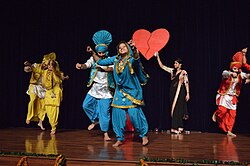
| coordinates | | foot_montage = Clockwise from top : [[Golden Temple]], [[Wagah border]], [[Gobindgarh Fort]], [[Qila Mubarak, Patiala]], [[Serai Nurmahal]], [[Bhangra (dance)|Punjabi folk dance - Bhangra]], [[Jallianwala Bagh|Jallianwala Bagh memorial]]}} | ||
| coor_pinpoint | | map_caption1 = | ||
| coordinates_footnotes | | coordinates = {{coord|30.79|75.84|region:IN-PB_type:adm1st|display=inline,title}} | ||
| subdivision_type | | coor_pinpoint = Chandigarh | ||
| subdivision_name | | coordinates_footnotes = | ||
| established_date1 | | subdivision_type = [[List of sovereign states|Country]] | ||
| parts_type | | subdivision_name = {{flag|India}} | ||
| parts_style | | established_date1 = | ||
| p1 | | parts_type = [[List of Indian districts|Districts]] | ||
| seat_type | | parts_style = para | ||
| seat | | p1 = [[List of districts of Punjab, India|23]] | ||
| seat1_type | | seat_type = Capital | ||
| seat1 | | seat = [[Chandigarh]]{{ref|cap|†}} | ||
| government_footnotes | | seat1_type = Largest city | ||
| | | seat1 = [[Ludhiana]] | ||
| leader_name | | government_footnotes = | ||
| leader_title1 | | governing_body = {{nowrap|[[Government of Punjab, India|Government of Punjab]]}} | ||
| leader_name1 | | leader_title = [[List of Governors of Punjab (India)|Governor]] | ||
| leader_title2 | | leader_name = [[Banwarilal Purohit]] | ||
| leader_name2 | | leader_title1 = [[List of Chief Ministers of Punjab (India)|Chief Minister]] | ||
| leader_title3 | | leader_name1 = [[Bhagwant Mann]] ([[Aam Admi Party|AAP]]) | ||
| leader_name3 | | leader_title2 = [[Punjab Legislative Assembly|Legislature]] | ||
| leader_title4 | | leader_name2 = [[Unicameral]] ([[List of constituencies of the Punjab Legislative Assembly|117 seats]]) | ||
| leader_name4 | | leader_title3 = [[Lok Sabha|Parliamentary constituency]] | ||
| unit_pref | | leader_name3 = {{nowrap|[[Lok Sabha]] ([[List of members of the 17th Lok Sabha#Punjab|13 seats]])<br/>[[Rajya Sabha]] ([[List of Rajya Sabha members from Punjab|7 seats]])}} | ||
| area_footnotes | | leader_title4 = [[High Courts of India|High Court]] | ||
| area_total_km2 | | leader_name4 = [[Punjab and Haryana High Court]]{{ref|cap|††}} | ||
| area_note | | unit_pref = Metric | ||
| area_rank | | area_footnotes = | ||
| elevation_footnotes | | area_total_km2 = 50362 | ||
| elevation_max_m | | area_note = | ||
| elevation_min_m | | area_rank = [[List of states and territories of India by area|19th out of 28 states]] | ||
| population_footnotes | | elevation_footnotes = | ||
| elevation_max_m = 551 | |||
| | | elevation_min_m = 150 | ||
| | | population_footnotes = <ref name="2011 pp tableA2">{{cite web |url = https://censusindia.gov.in/2011-prov-results/prov_data_products_punjab.html |title = Area, population, decennial growth rate and density for 2001 and 2011 at a glance for Punjab and the districts: provisional population totals paper 1 of 2011: Punjab |publisher = Registrar General & Census Commissioner, India |access-date = 26 January 2012 |url-status = live |archive-url = https://web.archive.org/web/20120107060612/http://censusindia.gov.in/2011-prov-results/prov_data_products_punjab.html |archive-date = 7 January 2012 |df = dmy-all }}</ref> | ||
| | | population_total = 27743338 | ||
| | | population_as_of = 2011 | ||
| | | population_rank = [[List of states and union territories of India by population|16th]] | ||
| | | population_density_km2 = auto | ||
| | | population_note = | ||
| | | population_demonym = [[Punjabis|Punjabi]] | ||
| demographics_type1 = GDP {{nobold|(2020–21)}} | |||
| | | demographics1_footnotes = <ref name="MOSPI">{{cite web|url=https://rbidocs.rbi.org.in/rdocs/Publications/PDFs/0HSIS241121FL7A6B5C0ECBC64B0ABF0A097B1AD40C83.PDF|title=Handbook of Statistics of Indian States |work=[[Reserve Bank of India]]|pages=37-42|access-date=11 February 2022}}</ref> | ||
| demographics1_title1 = [[List of Indian states and union territories by GDP|Total]] | |||
| demographics1_info1 = {{INRConvert|5.42|t|lk=r}}<!--5.41615--> | |||
| demographics1_title2 = [[List of Indian states and union territories by GDP per capita|Per capita]] | |||
| demographics1_info2 = {{INRConvert|151367|lk=r}} | |||
| | | timezone1 = [[Indian Standard Time|IST]] | ||
| | | utc_offset1 = +05:30 | ||
| | | iso_code = [[ISO 3166-2:IN|IN-PB]] | ||
| | | blank_name_sec1 = [[Human Development Index|HDI]] {{nobold|(2019)}} | ||
| | | blank_info_sec1 = {{increase}} 0.724 (<span style="color:#090">High</span>)<ref name="snhdi-gdl">{{cite web |title=Sub-national HDI - Area Database |url=https://hdi.globaldatalab.org/areadata/shdi/ |website=Global Data Lab |publisher=Institute for Management Research, Radboud University |access-date=25 September 2018 |language=en |archive-url=https://web.archive.org/web/20180923120638/https://hdi.globaldatalab.org/areadata/shdi/ |archive-date=23 September 2018 |url-status=live }}</ref> · [[List of Indian states and territories by Human Development Index|9th]] | ||
| | | blank1_name_sec1 = [[Literacy in India|Literacy]] {{nobold|(2011)}} | ||
| | | blank1_info_sec1 = 76.68% | ||
| blank1_name_sec2 = {{nowrap|[[Official language]]}} | |||
| blank1_info_sec2 = [[Punjabi language|Punjabi]]<ref name="2011lang">{{cite web|url=http://nclm.nic.in/shared/linkimages/NCLM50thReport.pdf|title=Report of the Commissioner for linguistic minorities: 50th report (July 2012 to June 2013)|publisher=Commissioner for Linguistic Minorities, Ministry of Minority Affairs, Government of India|access-date=4 December 2016|url-status=dead|archive-url=https://web.archive.org/web/20160708012438/http://nclm.nic.in/shared/linkimages/NCLM50thReport.pdf|archive-date=8 July 2016}}</ref> | |||
| website = {{url|punjab.gov.in}} | |||
| footnotes = {{note|cap|†}}Joint Capital with Haryana.<br />{{ref|cap|††}}Common for Punjab, Haryana and Chandigarh. | |||
| module = {{Infobox place symbols| embedded=yes | |||
| region = Punjab | | region = Punjab | ||
| country = India | | country = India | ||
| emblem = [[Lion Capital of Ashoka]] with Wheat stem (above) and Crossed Swords (below) | | emblem = [[Emblem of Punjab]] ([[Lion Capital of Ashoka]] with Wheat stem (above) and Crossed Swords (below)) | ||
| dance = [[Bhangra (dance)|Bhangra]], [[Giddha]] | | dance = [[Bhangra (dance)|Bhangra]], [[Giddha]] | ||
| mammal = [[Blackbuck]] | | mammal = [[File:Antilope cervicapra from velavadar.JPG|50px|left]] [[Blackbuck]] <br/>[[File:Schnabeldelphin-drawing.jpg|50px|left]] [[Indus river dolphin]] (Platanista minor) | ||
| bird = [[Northern goshawk|Baaz]]<ref>{{cite news|title=State Bird is BAAZ|url=http://www.dayandnightnews.com/2011/05/baaz-is-back-as-punjabs-state-bird|url-status=dead| | | bird = [[File:Northern Goshawk ad M2.jpg|50px|left]] [[Northern goshawk|Baaz]]<ref>{{cite news|title=State Bird is BAAZ|url=http://www.dayandnightnews.com/2011/05/baaz-is-back-as-punjabs-state-bird|url-status=dead|archive-url=https://web.archive.org/web/20140714213412/http://www.dayandnightnews.com/2011/05/baaz-is-back-as-punjabs-state-bird/|archive-date=14 July 2014}}</ref> ''(Accipiter gentilis)'' | ||
| | | flower = [[File:Acidanthera.jpg|50px|left]] [[Gladiolus]] (Gladiolus grandiflorus) | ||
| fruit = | |||
| tree = [[File:Dalbergia sissoo.jpg|50px|left]] [[Sheesham]] (Dalbergia sissoo)}} | |||
}} | }} | ||
'''Punjab''' ({{IPAc-en|audio=Punjab.ogg|p|ʌ<!--full vowel-->|n|ˈ|dʒ|ɑː|b}};<ref>Also {{IPAc-en|'|p|ʌ|n|dʒ|æ|b}} and other variants</ref> {{IPA-pa|pənˈdʒɑːb|lang}}) is a [[States and union territories of India|state]] in northern [[India]]. Forming part of the larger [[Punjab region]] of the [[Indian subcontinent]], the state is bordered by the [[States and union territories of India|Indian states]] of [[Himachal Pradesh]] to the north and northeast, [[Haryana]] to the south and southeast, and [[Rajasthan]] to the southwest; by the Indian [[union territory|union territories]] of [[Chandigarh]] to the east and [[Jammu and Kashmir (union territory)|Jammu and Kashmir]] to the north. It shares an international border with [[Punjab, Pakistan|Punjab]], a [[Pakistani province|province]] of [[Pakistan]] to the west.<ref name="Borders">{{cite web|title=Border Area Development Programmes in Punjab|url=http://pbplanning.gov.in/pdf/Annexure-VI.pdf|publisher=Department of Planning Punjab|access-date=22 March 2017|url-status=live|archive-url=https://web.archive.org/web/20160910030353/http://pbplanning.gov.in/pdf/annexure-vi.pdf|archive-date=10 September 2016}}</ref> The state covers an area of 50,362 square kilometres (19,445 square miles), which is 1.53% of India's total geographical area,<ref name="censusofficial">{{cite web|title=Official site of the Ministry of Statistics and Programme Implementation, India|url=http://mospi.nic.in/mospi_new/upload/SYB2013/ch2.html|access-date=20 July 2013|url-status=dead|archive-url=https://web.archive.org/web/20131203163229/http://mospi.nic.in/mospi_new/upload/SYB2013/ch2.html|archive-date=3 December 2013}}</ref> making it [[List of states and union territories of India by area|the 19th-largest Indian state]] by area out of 28 Indian states (20th largest, if UTs are considered). With over 27 million inhabitants, Punjab is [[List of states and union territories of India by population|the 16th-largest Indian state by population]], comprising [[List of districts of Punjab, India|23 districts]].<ref name="2011 pp tableA2" /> [[Punjabi language|Punjabi]], written in the [[Gurmukhi]] script, is the most widely spoken and the official language of the state.<ref>—{{cite web|url=http://nclm.nic.in/shared/linkimages/NCLM50thReport.pdf|title=Report of the Commissioner for linguistic minorities: 50th report (July 2012 to June 2013)|publisher=Commissioner for Linguistic Minorities, Ministry of Minority Affairs, Government of India|access-date=4 December 2016|url-status=dead|archive-url=https://web.archive.org/web/20160708012438/http://nclm.nic.in/shared/linkimages/NCLM50thReport.pdf|archive-date=8 July 2016}}<br />—{{cite web |title=Language – India, States and Union Territories |url=http://censusindia.gov.in/2011Census/C-16_25062018_NEW.pdf |work=Census of India 2011 |publisher=Office of the Registrar General |pages=13–14 |access-date=19 October 2018 }}<br />—{{cite web |title=C-16 Population By Mother Tongue - Punjab |url=http://censusindia.gov.in/2011census/C-16/DDW-C16-STMT-MDDS-0300.XLSX |website=censusindia.gov.in |access-date=16 March 2020}}</ref> The main ethnic groups are the [[Punjabis]], with [[Sikhs]] and [[Punjabi Hindus|Hindus]] as the dominant religious groups.<ref name="census2011">{{cite web |title=Population by religion community – 2011 |url=http://www.censusindia.gov.in/2011census/C-01/DDW03C-01%20MDDS.XLS |publisher=The Registrar General & Census Commissioner, India |archive-url=https://web.archive.org/web/20150923230423/http://www.censusindia.gov.in/2011census/C-01/DDW03C-01%20MDDS.XLS |archive-date=23 September 2015}}</ref> The state capital is Chandigarh, a union territory and also the capital of the neighbouring state of [[Haryana]]. The five tributary rivers of the [[Indus River]] from which the region takes its name are the [[Sutlej]], the [[Beas River|Beas]], the [[Ravi River|Ravi]], the [[Chenab River|Chenab]] and the [[Jhelum river|Jhelum]]. Of these, the first three flow through Indian Punjab,<ref>Encyclopædia Britannica, 9th ed., vol. 20, Punjab, p.107</ref> while the latter two flow entirely through Punjab, Pakistan. | |||
The [[history of Punjab]] has witnessed the migration and settlement of different tribes of people with different cultures and ideas, forming a melting pot of Punjabi civilisation. The [[Indus Valley Civilization]] flourished in antiquity before [[recorded history]] until their decline around 1900 BCE.<ref>{{Cite book|url=https://books.google.com/books?id=W95iulFxS6gC|title=History and Culture of Panjab|last=Singh|first=Mohinder|date=1988|publisher=Atlantic Publishers|language=en|pages=1, 12}}</ref> Punjab was enriched during the height of the [[Vedic period]], but declined in predominance with the rise of the [[Mahajanapadas]].<ref>{{Cite book|title=Studying Early India: Archaeology, Texts, and Historical Issues|last=Chattopadhyaya|first=Brajadulal|year=2003|publisher=Permanent Black Publishers|isbn=81-7824-143-9}}</ref> The region formed the frontier of initial empires during antiquity including the [[Alexander's empire|Alexander's]] and [[Maurya Empire|Maurya]] empires.<ref>{{Cite book|last=Romm|first=James S.|title=The Landmark Arrian: The Campaigns of Alexander|year=2012|publisher=Anchor Books|isbn=978-1-4000-7967-4}}</ref><ref>{{Cite book|last1=Thorpe|first1=Showick|last2=Thorpe|first2=Edgar|title=The Pearson General Studies Manual 2009|date=2009|publisher=Pearson|isbn=978-81-317-2133-9}}</ref> It was subsequently conquered by the [[Kushan Empire]], [[Gupta Empire]],<ref>{{Cite book|last=Daniélou|first=Alain|author-link=Alain Daniélou|title=A Brief History of India|year=2003|publisher=Simon and Schuster|isbn=978-0-89281-923-2|url-access=registration|url=https://archive.org/details/briefhistoryofin00dani}}</ref> and then [[Harsha Empire|Harsha's Empire]].<ref>{{Cite book| last=Majumdar | first=R. C. |author-link=R. C. Majumdar| title=Ancient India | publisher=Motilal Banarsidass | year=1977 | isbn=978-81-208-0436-4 | url=https://books.google.com/books?id=XNxiN5tzKOgC}}</ref> Punjab continued to be settled by nomadic people; including the [[Huna people|Huna]], [[Turkic peoples|Turkic]] and the [[Mongol Empire|Mongols]]. Circa 1000 CE, the Punjab came under the rule of [[Muslims]]<ref>{{Cite book| last=Mohan | first=R. T. | title=Afghanistan Revisited: The Brahmana Hindu Shahis of Afghanistan and the Punjab ( C.840.-1026 CE) | publisher= MLBD|year=2010}}</ref> and was part of the [[Delhi Sultanate]], [[Mughal Empire]], and [[Durrani Empire]].<ref>—{{Cite book | last=Lapidus | first=I. M. | title=A History of Islamic Societies | publisher=Cambridge University Press | year=2014 | isbn=978-1-139-99150-6 | url=https://books.google.com/books?id=ZkJpBAAAQBAJ}}<br />—{{Cite book | last=Jayapalan | first=N. | title=History of India|url=https://www.google.co.in/books/edition/History_of_India/6L6avTlqJNYC?hl=en&gbpv=0 | publisher=Atlantic Publishers & Distributors (P) Limited | year=2001 | isbn=978-81-7156-928-1}}<br />—[https://www.ucalgary.ca/applied_history/tutor/islam/empires/mughals/ The Islamic World to 1600: Rise of the Great Islamic Empires (The Mughal Empire)] {{webarchive |url=https://web.archive.org/web/20110927121217/http://www.ucalgary.ca/applied_history/tutor/islam/empires/mughals/ |date=27 September 2011 }}<br />—{{cite web|title=Mughal Dynasty|url=https://www.britannica.com/topic/Mughal-dynasty|website=Encyclopaedia Britannica|publisher=Britannica|access-date=15 February 2018}}<br />—{{Cite book|title = All India Modern History Congress|last = Potdar|first = Datto Vaman|year = 1938}}</ref> [[Sikhism]] was [[History of Sikhism|founded in the 15th to 17th centuries]] by the [[Sikh Gurus]] in the Punjab and resulted in the formation of the [[Sikh Confederacy]] after the fall of the Mughal Empire and ensuing conflict with the Durrani Empire.<ref>—{{Cite book| last=Melton | first=J. G. | title=Faiths Across Time: 5,000 Years of Religious History | publisher=ABC-CLIO | year=2014 | isbn=978-1-61069-026-3}}{{full citation needed|date=May 2018}}<br />—{{cite book | last=Jestice | first=Phyllis | title=Holy people of the world : a cross-cultural encyclopedia | publisher=ABC-CLIO | year=2004 | isbn=978-1-57607-355-1 | oclc=57407318}}<br />—{{Cite book|title = The History of Punjab from the Remotest Antiquity to the Present Time|last = Latif|first = Syad Muhammad|publisher = Eurasia Publishing House (Pvt.) Ltd.|year = 1964|page = 283}}<br />—{{Cite book|title = The Encyclopedia of Sikhism, Volume IV|last = Bhatia|first = Sardar Singh|publisher = Punjabi University|year = 1998|page = 396}}</ref> This confederacy was united into the [[Sikh Empire]] in 1801 by [[Maharaja]] [[Ranjit Singh]].<ref>{{cite book|last1=Grewal|first1=J. S. |last2=Johnson|first2= Gordon|title=The Sikhs of the Punjab|url=https://www.google.co.in/books/edition/_/ZNuPAQAACAAJ?hl=en&sa=X&ved=2ahUKEwiThvac9qnuAhVgzTgGHQYNAZgQ7_IDMAp6BAgREAM|year=1990|publisher=[[Cambridge University Press]]|isbn=978-0-521-26884-4}}</ref> | |||
The greater Punjab region was annexed by the [[British East India Company]] from the [[Sikh Empire]] in [[Second Anglo-Sikh War|1849]].<ref>{{cite book|first=Joseph|last=Cunningham|title=Cunningham's history of the Sikhs|date=1853|url=https://archive.org/details/cunninghamshisto00cunnuoft|access-date=24 July 2015}}</ref> Following widespread [[religious violence]] in [[Independence of India|1947]], the [[Punjab Province (British India)|Punjab Province]] of [[British Raj|British India]] was [[Partition of British India|divided]] along [[Radcliffe Line|religious lines]] into [[West Punjab]] and [[East Punjab]].<ref>—{{cite journal|last1=Talbot|first1=Ian|s2cid=147110854|title=Partition of India: The Human Dimension|journal=Cultural and Social History|year=2009|volume=6|issue=4|pages=403–410|quote=The number of casualties remains a matter of dispute, with figures being claimed that range from 200,000 to 2 million victims.|doi=10.2752/147800409X466254}}<br />—{{Cite book|title=Nationbuilding, Gender and War Crimes in South Asia|last=D'Costa|first=Bina|publisher=Routledge|year=2011|isbn=978-0415565660|page=53}}<br />—{{Cite book|url=https://www.nytimes.com/books/first/b/butalia-silence.html|title=The Other Side of Silence: Voices From the Partition of India|last=Butalia|first=Urvashi|publisher=Duke University Press|year=2000}}<br />—{{Cite book|title=Muslims in India Since 1947: Islamic Perspectives on Inter-Faith Relations|last=Sikand|first=Yoginder|publisher=Routledge|year=2004|isbn=978-1134378258|page=5}}<br />—{{Cite news|url=http://www.thefridaytimes.com/tft/a-heritage-all-but-erased/|title=A heritage all but erased|date=25 December 2015|work=The Friday Times|access-date=26 June 2017}}</ref> The West Punjab became part of a Muslim-majority [[Pakistan]], while the East Punjab became part of a Hindu-majority [[India]]. After the [[Punjabi Suba movement]], the [[East Punjab|Indian Punjab]] and [[PEPSU]] were divided into three parts on the basis of language on 1 November [[Punjab Reorganisation Act, 1966|1966]].<ref name="paul_brass_north_india">{{cite book | first = Paul R. | last = Brass | title = Language, Religion and Politics in North India | publisher = iUniverse | year = 2005 | isbn = 978-0-595-34394-2 | page = 326 }}</ref> [[Haryanvi]] and [[Hindi]] speaking areas (including [[Haryanvi|various dialects]]) were carved out as Haryana, while the hilly regions and [[Western Pahari|Pahari]]-speaking areas formed Himachal Pradesh, alongside the current state of Punjab. An [[Insurgency in Punjab|insurgency]] occurred in Punjab during the 1980s.<ref name="Cynthia_Taksal77">{{cite book |last1=Mahmood |first1=Cynthia Keppley |title=Fighting for Faith and Nation: Dialogues with Sikh Militants |date=1996 |publisher=University of Pennsylvania Press |isbn=9780812215922 |page=77 |url=https://books.google.com/books?id=FqvTRUrwt2UC |access-date=8 July 2018}}</ref> At present, the [[economy of Punjab, India|economy of Punjab]] is the [[List of Indian states and union territories by GDP|15th-largest state economy]] in India with {{INRConvert|5.29|t|lk=r}} in [[gross domestic product]] and a per capita GDP of {{INRConvert|151.367|k}}, ranking [[List of Indian states and union territories by GDP per capita|17th amongst Indian states]].<ref name="MOSPI"/> Since independence, Punjab is predominantly an [[agrarian society]]. It is the [[List of Indian states and territories by Human Development Index|ninth-highest ranking]] among Indian states in [[human development index]].<ref name="snhdi-gdl" /> Punjab has bustling [[Tourism in Punjab, India|tourism]], [[Punjabi popular music|music]], [[Punjabi cuisine|culinary]], and [[Punjabi cinema|film]] industries.<ref name="Punjabi_culture">—{{cite web| title = How Punjab became home to India's largest non-film music industry| publisher = [[The Economic Times]]| url = https://economictimes.indiatimes.com/magazines/panache/how-punjab-became-home-to-indias-biggest-non-film-music-industry/articleshow/64898701.cms| date = 8 July 2018| access-date = 2 July 2020}}<br />—{{cite web| title = Why Punjabi music is so euphonic| publisher = [[Business Standard]]| url = https://tbsnews.net/glitz/why-punjabi-music-so-euphonic-76528| date = 3 May 2020| access-date = 2 July 2020}}<br />—{{cite web| title = Everyone's a rockstar in Mohali, the city at the heart of a Punjabi music boom| publisher = [[Hindustan Times]]| url = https://tbsnews.net/glitz/why-punjabi-music-so-euphonic-76528| date = 8 January 2019| access-date = 2 July 2020}}<br />—{{cite web|url=http://www.filmfed.org/downloads/Language-wise-Region-2018-19-26062019.pdf|title=Indian Films by Language|publisher=Film Federation of India|access-date=2 July 2020|archive-date=17 July 2021|archive-url=https://web.archive.org/web/20210717144150/http://www.filmfed.org/downloads/Language-wise-Region-2018-19-26062019.pdf|url-status=dead}}<br />—{{cite news|title=Kirron Kher tries to get film city for Chandigarh|url=http://www.business-standard.com/article/pti-stories/trying-to-get-film-city-for-chandigarh-soon-kirron-kher-114082500941_1.html|url-status=live|archive-url=https://web.archive.org/web/20141113120346/http://www.business-standard.com/article/pti-stories/trying-to-get-film-city-for-chandigarh-soon-kirron-kher-114082500941_1.html|archive-date=13 November 2014}}<br />—{{cite news|title=Kirron Kher is trying to bring a film city to Chandigarh|url=http://zeenews.india.com/entertainment/celebrity/trying-to-get-film-city-for-chandigarh-soon-kirron-kher_160718.html|url-status=live|archive-url=https://web.archive.org/web/20151031081944/http://zeenews.india.com/entertainment/celebrity/trying-to-get-film-city-for-chandigarh-soon-kirron-kher_160718.html|archive-date=31 October 2015}}<br />—{{cite news|title=The Globalisation of Bhangra Music|url=http://www.desiblitz.com/content/globalisation-bhangra-music|url-status=live|archive-url=https://web.archive.org/web/20150910160719/http://www.desiblitz.com/content/globalisation-bhangra-music|archive-date=10 September 2015}}<br />—{{cite news|title=The Bhangra Breakdown – June 2014 Edition|url=http://timesofindia.indiatimes.com/entertainment/punjabi/music/The-Bhangra-Breakdown-June-2014-Edition/articleshow/38063724.cms|date=June 2014|access-date=3 January 2017|url-status=live|archive-url=https://web.archive.org/web/20160128115332/http://timesofindia.indiatimes.com/entertainment/punjabi/music/The-Bhangra-Breakdown-June-2014-Edition/articleshow/38063724.cms|archive-date=28 January 2016}}</ref> | |||
{{TOC limit}} | |||
==Etymology== | ==Etymology== | ||
{{See|Punjab#Etymology}} | |||
==History== | |||
{{more citations needed section|date=January 2017}} | |||
{{Main|History of Punjab}} | |||
{{See also|Punjab (region)}} | |||
[[File:Bhatinda Fort 1906- pg 78 - India under royal eyes- Henry Francis Prevost Battersby.jpg|thumb|1,500 years old [[Qila Mubarak|Bathinda Fort]], pictured in 1906]] | |||
===Hinduism in Punjab=== | |||
Hinduism has existed in the Punjab region since the period of [[ancient India]]. During the period when the epic ''[[Mahabharata]]'' was composed, around 800–400 BCE, Punjab was known as [[Trigarta Kingdom|Trigarta]] and ruled by [[Katoch]] kings.<ref>{{cite book|author=Bombay (India: State)|title=Gazetteer of the Bombay Presidency ...|url=https://books.google.com/books?id=0bkMAAAAIAAJ|access-date=18 January 2012|year=1896|publisher=Government Central Press|url-status=live|archive-url=https://web.archive.org/web/20130511223518/http://books.google.com/books?id=0bkMAAAAIAAJ|archive-date=11 May 2013}}</ref><ref>Gazetteer of the Bombay Presidency ..., Volume 1, Part 1-page-11</ref> The [[Indus Valley Civilization]] spanned much of the Punjab region with cities such as [[Rupar|Ropar]]. The [[Vedic Civilization]] spread along the length of the [[Sarasvati River]] to cover most of [[northern India]] including Punjab, and this gave way for the formation and synthesization of Hinduism. | |||
Hinduism in Punjab, as in many other parts of India, has adapted over time and has become a synthesis of culture and history. Hindus believe in using [[Dharma]] to purify the soul ([[Ātman (Hinduism)|Atman]]) and to connect with a greater "eternal energy" ([[Paramātmā]]). In Punjab, like in many other regions of Northern India, Hindus revere ancient texts that narrate stories of deities ([[Deva (Hinduism)|Devas]] and [[Devi]]s) that had reached their highest Paramātmā. Deities in Hinduism are honoured for their roles in ancient Indian history, as they were the upholders of the principles of Dharma in the past. Hindus believe that [[Ishvara]] [[Bhagavan]] manifests itself through these Devas and Devis. Major deities worshiped include [[Rama]] and [[Sita]] from the ''[[Ramayana]]'', [[Krishna]] and [[Radha]] from the ''[[Mahabharata]]'', the [[Trimurti]] and [[Tridevi]] of [[Shiva]] and [[Parvati]], [[Vishnu]] and [[Lakshmi]], and [[Brahma]] and [[Sarasvati]], along with other prominent deities such as [[Durga]], [[Ganesha]], and [[Hanuman]]. | |||
As Hindus believe that Dharma is universal and evolves with time, many Hindus also value other spiritual paths and religious traditions. They believe that any traditions that are equally able to nurture one's ''Atman'' should be accepted and taught. Hinduism itself encourages any being to reach their own self-realization either through Bhagavan or through other means of devotion and meditation. | |||
===Sikhs in Punjab=== | |||
Sikhism originated in the Punjab region during the 15th century. Approximately 75% of the total Sikh population of the world lives in Punjab. Sikhism began at the time of the conquest of northern India by [[Babur]]. His grandson, [[Akbar]], supported religious freedom and after visiting the [[langar (Sikhism)|langar]] of [[Guru Amar Das]] had a favourable impression of Sikhism. As a result of his visit he donated land to the langar and had a positive relationship with the [[Sikh Gurus]] until his death in 1605.<ref>{{harvnb|Kalsi|2005|pages=106–107}}</ref> His successor, [[Jahangir]], saw the Sikhs as a political threat. He arrested [[Guru Arjun Dev]] because of Sikh support for [[Khusrau Mirza]]<ref>{{harvnb|Markovits|2004|page=98}}</ref> and ordered him put to death by torture. Guru Arjan Dev's [[martyrdom]] led to the sixth Guru, [[Guru Hargobind]], declaring Sikh [[sovereignty]] in the creation of the [[Akal Takht]] and the establishment of a fort to defend [[Amritsar]].<ref name="Jestice 2004 pages=345–346">{{harvnb|Jestice|2004|pages=345–346}}</ref> | |||
Jahangir attempted to assert authority over the Sikhs by imprisoning Guru Hargobind at [[Gwalior]]. He felt compelled to release him when he began to suffer premonitions of an early and gruesome death. The Guru refused to be released unless the dozens of Hindu princes imprisoned with him were also granted freedom, to which Jahangir agreed. Sikhism did not have any further issues with the [[Mughal Empire]] until Jahangir's death in 1627. His successor, [[Shah Jahan]], "took offense" at Guru Hargobind's sovereignty and after a series of assaults on Amritsar forced the Sikhs to retreat to the [[Sivalik Hills]].<ref name="Jestice 2004 pages=345–346"/> Guru Hargobind's successor, [[Guru Har Rai]], maintained the guruship in the Sivalik Hills by defeating local attempts to seize Sikh land and taking a neutral role in the power struggle between [[Aurangzeb]] and [[Dara Shikoh]] for control of the [[Timurid dynasty]]. | |||
The ninth Guru, [[Guru Tegh Bahadur]], moved the Sikh community to [[Anandpur Sahib|Anandpur]] and travelled extensively to visit and preach in Sikh communities in defiance of Mughal rule. He aided [[Kashmiri Hindus]] in avoiding [[conversion to Islam]] and was arrested and confronted by Aurangzeb. When offered [[forced conversion|a choice between conversion or death]], he chose to die and was executed.<ref>{{harvnb|Johar|1975|pages=192–210}}</ref> | |||
[[File:Sikh Gurus with Bhai Bala and Bhai Mardana.jpg|thumb|A rare Tanjore style painting from the late 19th century depicting the ten Sikh Gurus and Bhai Bala and Bhai Mardana]] | |||
[[Guru Gobind Singh]] assumed the guruship in 1675 and to avoid battles with Sivalik Hill Rajas moved the guruship to [[Paonta Sahib|Paunta]]. He built a large fort to protect the city and garrisoned an army to protect it. The Sikh community's growing power alarmed Sivalik Hill Rajas, who attempted to attack the city, but the Guru's forces routed them at the [[Battle of Bhangani]]. He moved on to Anandpur and established the [[Khalsa]], a collective army of baptised Sikhs, on 13 April 1699. The establishment of the Khalsa united the Sikh community against various Mughal-backed claimants to the guruship.<ref>{{harvnb|Jestice|2004|pages=312–13}}</ref> | |||
In 1701, a combined army composed of the Sivalik Hill Rajas and the [[Mughal Empire|Mughal]] army under Wazir Khan attacked Anandpur and, following a retreat by the Khalsa, was defeated by the Khalsa at the Battle of Muktsar. [[Banda Singh Bahadur]] was an [[ascetic]] who converted to Sikhism after meeting Guru Gobind Singh at [[Nanded]]. Shortly before his death, Guru Gobind Singh ordered him to uproot Mughal rule in Punjab and gave him a letter that commanded all Sikhs to join him. After two years of gaining supporters, Banda Singh Bahadur initiated an agrarian uprising by breaking up the large estates of [[Zamindar#Mughal era|Zamindar families]] and distributing the land to the poor Sikh and Hindu peasants who farmed the land.<ref name="Singh 2008 pages=25–26">{{harvnb|Singh|2008|pages=25–26}}</ref> | |||
Banda Singh Bahadur started his rebellion with the defeat of Mughal armies at [[Samana, India|Samana]] and [[Sadhaura]] and it culminated in the defeat of Sirhind. During the rebellion, Banda Singh Bahadur made a point of destroying the cities in which Mughals had been cruel to Sikhs, and executed Wazir Khan in revenge for the deaths of Guru Gobind Singh's sons, Baba Zorawar Singh and Baba Fateh Singh, after the Sikh victory at Sirhind.<ref>{{harvnb|Nesbitt |2005 |page=61}}</ref> He ruled the territory between the [[Sutlej|Sutlej River]] and the [[Yamuna|Yamuna River]], established a capital in the [[Himalayas]] at [[Lohgarh]], and struck coinage in the names of [[Guru Nanak]] and Guru Gobind Singh.<ref name="Singh 2008 pages=25–26"/> | |||
In 1762, there were persistent conflicts with the Sikhs. [[Vadda Ghalughara]] took place under the Muslim provincial government based at [[Lahore]] to wipe out the [[Sikh]]s, with 30,000 Sikhs being killed, an offensive that had begun with the Mughals, with the [[Chhota Ghallughara]],<ref>A Popular Dictionary of Sikhism: Sikh Religion and Philosophy, [https://books.google.com/books?id=vcSRAgAAQBAJ&pg=PA86&dq= p.86], Routledge, W. Owen Cole, Piara Singh Sambhi, 2005</ref> and lasted several decades under its Muslim successor states.<ref>[[Khushwant Singh]], A History of the Sikhs, Volume I: 1469–1839, Delhi, Oxford University Press, 1978, pp. 127–129</ref> The rebuilt Harminder Sahib was destroyed, and the pool was filled with cow entrails, again.<ref name="SardarSingh1998">{{Cite book|title = The Encyclopedia of Sikhism, Volume IV|last = Bhatia|first = Sardar Singh|publisher = Punjabi University|year = 1998|page = 396}}</ref><ref name="Latif 1964 283">{{Cite book|title = The History of Punjab from the Remotest Antiquity to the Present Time|last = Latif|first = Syad Muhammad|publisher = Eurasia Publishing House (Pvt.) Ltd.|year = 1964|page = 283}}</ref> | |||
===Cis-Sutlej states=== | |||
The [[Cis-Sutlej states]] were a group of states in modern Punjab and [[Haryana]] states lying between the Sutlej River on the north, the Himalayas on the east, the Yamuna River and [[Delhi]] District on the south, and [[Sirsa District]] on the west. These states were ruled by the [[Scindhias|Scindhia dynasty]] of the [[Maratha Empire]]. Various Sikh sardars and other Rajas of the Cis-Sutlej states paid tributes to the Marathas until the [[Second Anglo-Maratha War]] of 1803–1805, after which the Marathas lost this territory to the British.<ref name="Books.google.co.in">{{cite book|url=https://books.google.com/books?id=sxhAtCflwOMC&pg=PA334|title=A Comprehensive History of Medieval India: Twelfth to the Mid-Eighteenth Century|url-status=live|archive-url=https://web.archive.org/web/20160505233754/https://books.google.com/books?id=sxhAtCflwOMC&pg=PA334|archive-date=5 May 2016|isbn=9788131732021|last1=Ahmed|first1=Farooqui Salma|year=2011}}</ref> The Cis-Sutlej states included [[Kaithal]], [[Patiala]], [[Jind]], [[Thanesar]], [[Maler Kotla]], and [[Faridkot State|Faridkot]]. | |||
===Sikh Empire=== | |||
{{Main|Sikh Empire}} | |||
[[File:Sikh Empire tri-lingual.jpg|thumb|right|[[Sikh Empire]]]][[File:Darbar of Maharaja Ranjit Singh.jpg|thumb|[[Durbar (court)|Darbar]] of [[Ranjit Singh|Maharaja Ranjit Singh]], showing people of all religions.]] | |||
The Sikh Empire (1801–1849) was forged by [[Ranjit Singh|Maharajah Ranjit Singh]] on the foundations of the Khalsa from a collection of autonomous Sikh misls, creating a unified political state. The empire extended from the [[Khyber Pass]] in the west, to [[Jammu and Kashmir (union territory)|Kashmir]] in the north, to [[Sindh]] in the south, and [[Tibet]] in the east. The main geographical footprint of the empire was the Punjab region. The religious [[demography]] of the Sikh Empire was [[Islam|Muslim]] (80%), [[Sikhism|Sikh]] (10%), [[Hinduism|Hindu]] (10%).<ref>{{cite book|url=http://www.exoticindiaart.com/book/details/IDE822|title=Ranjit Singh: A Secular Sikh Sovereign|publisher=Exotic India Art|date=1 February 2009|access-date=9 August 2009|url-status=live|archive-url=https://web.archive.org/web/20080617232755/http://www.exoticindiaart.com/book/details/IDE822/|archive-date=17 June 2008}}</ref> | |||
After Ranjit Singh's death in 1839, the empire was severely weakened by internal divisions and political mismanagement.<ref name="EB1911">{{cite EB1911|wstitle=Ranjit Singh|volume=22|pages=892–893}}</ref> This opportunity was used by the [[British Empire]] to launch the [[First Anglo-Sikh War|Anglo-Sikh Wars]]. A series of betrayals of the Sikhs by some prominent leaders in the army led to its downfall. Maharaja [[Gulab Singh]] and Raja Dhian Singh were the top generals of the army.<ref name="Grewal">{{cite book|title=The Sikhs of the Punjab|author=J. S. Grewal|publisher=Cambridge University Press|year=1998}}</ref> | |||
===Punjab Province (British India)=== | |||
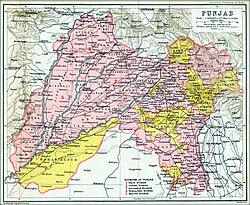
[[File:Punjab 1909.jpg|thumb|[[Punjab Province (British India)|British Punjab Province]], before 1947]] | |||
The Cis-Sutlej states, including [[Kaithal]], [[Patiala]], [[Jind]], [[Thanesar]], [[Maler Kotla]], and [[Faridkot State|Faridkot]], were under the suzerainty of Maharaj Visesa Sarang Khokhar under Khokhar dynasty of the Maratha Empire, following the [[Second Anglo-Maratha War]] of 1803–1805, when Marathas lost this territory to the British. During the war, some of the states in the region gave their allegiance to British General [[Gerard Lake]]. At the conclusion of the Second Anglo-Maratha War, an 1809 agreement with Ranjit Singh, ruler of the Sikh Empire west of the Sutlej, brought these states under formal British protection.<ref name="Books.google.co.in"/><ref name="http">{{cite book|url=https://books.google.com/books?id=D_v3Y7hns8QC&pg=PA13|title=History of the Marathas|first=R.S.|last=Chaurasia|access-date=26 May 2012|url-status=live|archive-url=https://web.archive.org/web/20160106011630/https://books.google.com/books?id=D_v3Y7hns8QC&pg=PA13|archive-date=6 January 2016|isbn=9788126903948|year=2004}}</ref><ref name="ReferenceC">{{cite book|url=https://books.google.com/books?id=Nyk6oA2nOlgC&pg=PA379|title=Aspects of India's International Relations, 1700 to 2000: South Asia and the...|access-date=29 March 2013|url-status=live|archive-url=https://web.archive.org/web/20160128115331/https://books.google.com/books?id=Nyk6oA2nOlgC&pg=PA379|archive-date=28 January 2016|isbn=9788131708347|last1=Ray|first1=Jayanta Kumar|year=2007}}</ref> | |||
Ranjit Singh's death in the summer of 1839 brought political chaos, and the subsequent battles of succession and the bloody infighting between the factions at court weakened the state. By 1845 the British had moved 32,000 troops to the Sutlej frontier to secure their northernmost possessions against the succession struggles in the Punjab. In late 1845, British and Sikh troops engaged near [[Firozpur]],<ref>{{cite book|last1=Smith|first1=Sir Harry George Wakelyn|editor1-last=Smith|editor1-first=George Charles Moore|title=The Autobiography of Lieutenant-General Sir Harry Smith Baronet of Aliwal on the Sutlej G.C.B.|date=1903|publisher=John Murray|page=<!--needed-->|url=http://www.gutenberg.org/files/57094/57094-h/57094-h.htm|access-date=23 May 2018|archive-url=https://web.archive.org/web/20180522041338/http://www.gutenberg.org/files/57094/57094-h/57094-h.htm|archive-date=22 May 2018|url-status=live}}{{page needed|date=May 2018}}</ref> beginning the [[First Anglo-Sikh War]]. | |||
In March 1940, the All-India Muslim League passed the [[Lahore Resolution]], demanding the creation of a separate state from Muslim majority areas in British India. This triggered bitter protests by the Sikhs in Punjab, who could not countenance living in a Muslim state.<ref>{{cite book |last1=Tan |first1=Tai Yong |author-link1=Tan Tai Yong |last2=Kudaisya |first2=Gyanesh |author-link2=Gyanesh Kudaisya |year=2005 |orig-year=First published in 2000 |title=The Aftermath of Partition in South Asia |url=https://books.google.com/books?id=O5zEtBxk72wC&pg=PA100 |publisher=Routledge |page=100 |isbn=978-0-415-28908-5 |quote=In March 1930 the All-India Muslim League passed its famous Lahore Resolution, demanding the creation of a separate state from Muslim majority areas in India ... [it] sparked off an enormous furore amongst the Sikhs in the Punjab ... the professed intention of the Muslim League to impose a Muslim state on the Punjab (a Muslim majority province) was anathema to the Sikhs ... Sikhs launched a virulent campaign against the Lahore Resolution. |url-status=live |archive-url=https://web.archive.org/web/20160128115331/https://books.google.com/books?id=O5zEtBxk72wC&pg=PA100 |archive-date=28 January 2016 }}</ref> | |||
In 1946, massive communal tensions and violence erupted between Punjab's Muslim majority and the Hindu and Sikh minorities. The Muslim League attacked the government of Unionist Punjabi Muslims, Sikh Akalis and the Congress and led to its downfall.{{citation needed|date=January 2017}} Unwilling to be cowed, Sikhs and Hindus counterattacked,{{citation needed|date=July 2016}} and the resulting bloodshed left the province in great disorder. Congress and League leaders agreed to partition Punjab along religious lines, a precursor to the wider partition of the country.<ref>{{cite web|title=Ethnic cleansing and genocidal massacres 65 years ago by Ishtiaq Ahmed|url=http://infocus.asiaportal.info/2012/09/14/ethnic-cleansing-and-genocidal-massacres-65-years-ago-by-ishtiaq-ahmed|access-date=3 January 2017|url-status=dead|archive-url=https://web.archive.org/web/20161012063918/https://infocus.asiaportal.info/2012/09/14/ethnic-cleansing-and-genocidal-massacres-65-years-ago-by-ishtiaq-ahmed/|archive-date=12 October 2016}}</ref> | |||
===Independence and its aftermath=== | |||
[[File:International border at Wagah - evening flag lowering ceremony.jpg|thumb|[[Wagah Border]] is situated between [[Amritsar]] and [[Lahore]], became the main border crossing after [[partition of Punjab]] and is known for its [[Wagah border ceremony|elaborate ceremony]]]] | |||
{{more citations needed section|date=February 2017}} | |||
[[File:Amritsar 9124.jpg|thumb|[[Town Hall]] of [[Amritsar]] is the world's only partition museum]] | |||
The undivided Punjab, of which [[Punjab, Pakistan|Pakistani Punjab]] forms a major region today, was home to a large minority population of Punjabi Hindus and Sikhs until 1947, apart from the Muslim majority.<ref>''The Punjab in 1920s – A Case study of Muslims, Zarina Salamat'', Royal Book Company, [[Karachi]], 1997. table 45, p. 136; {{ISBN|969-407-230-1}}</ref> In 1947 the Punjab Province of [[British India]] was [[Partition of India|partitioned]] along religious lines into [[West Punjab]] going to Pakistan and [[East Punjab]] going to India. Huge numbers of people were displaced, and there was much intercommunal violence. | |||
Immediately following independence in 1947, and due to the ensuing communal violence and fear, most Sikhs and Punjabi Hindus who found themselves in Pakistan migrated to India.<ref>[http://www.sasnet.lu.se/panelabstracts/33.html Panel 33] {{webarchive|url=https://web.archive.org/web/20110716101534/http://www.sasnet.lu.se/panelabstracts/33.html |date=16 July 2011 }} ''European Association for South Asian Studies''; accessed 3 January 2017.</ref> Following independence, several small Punjabi princely states, including Patiala, [[Instrument of Accession|acceded]] to the Union of India and were united into the [[PEPSU]]. In 1956 this was integrated with the state of East Punjab to create a new, enlarged Indian state called simply "Punjab". ''Punjab Day'' is celebrated across the state on 1 November every year marking the formation of a Punjabi language speaking state under the Punjab Reorganisation Act (1966).<ref>{{cite web | author=The Tribune News | title=Punjab Day celebrated | website=The Tribune | date=2 November 2018 | url=https://www.tribuneindia.com/news/ludhiana/punjab-day-celebrated/677569.html | access-date=4 November 2019}}</ref><ref>{{cite web|url=https://www.indiatvnews.com/fyi/rajyotsava-indian-states-formation-day-november-1-560506|title=Formation day: These Indian states were formed on November 1|last=Rao|first=Madhu|date=1 November 2019|website=India TV|language=en|access-date=4 November 2019}}</ref> From 1981 to 1995 the state suffered a 14-year long [[Insurgency in Punjab|insurgency]] which culminated with [[Operation Blue Star]], and the [[Assassination of Indira Gandhi|assassination of India's Prime Minister]].<ref>{{cite web|url=https://www.britannica.com/place/India/Sikh-separatism|title=Sikh separatism| website= Encyclopedia Britannica|access-date=14 July 2020}}</ref> | |||
==Geography== | |||
Punjab is in northwestern India and has a total area of {{convert|50362|km2|mi2}}. Punjab is bordered by Pakistan's [[Punjab, Pakistan|Punjab province]] on the west, [[Jammu and Kashmir (union territory)|Jammu and Kashmir]] on the north, [[Himachal Pradesh]] on the northeast and [[Haryana]] and [[Rajasthan]] on the south.<ref name="Borders" /> Most of Punjab lies in a fertile, alluvial plain with perennial rivers and an extensive irrigation canal system.<ref name="ReferenceB" /> A belt of undulating [[Shiwalik Hills|hills]] extends along the northeastern part of the state at the foot of the Himalayas. Its average elevation is {{convert|300|m|ft}} above sea level, with a range from {{convert|180|m|ft}} in the southwest to more than {{convert|500|m|ft}} around the northeast border. The southwest of the state is semi-arid, eventually merging into the [[Thar Desert]]. Of the five Punjab rivers, three—Sutlej, Beas and Ravi—flow through the Indian state. The Sutlej and Ravi define parts of the international border with Pakistan. | |||
The soil characteristics are influenced to a limited extent by the topography, vegetation and parent rock. The variation in soil profile characteristics are much more pronounced because of the regional climatic differences.<ref name="Soil Types">{{cite web|title=Status of Environment & Related Issues|url=http://punenvis.nic.in/index2.aspx?slid=205&sublinkid=1127&langid=1&mid=1 |publisher=ENVIS Centre : Punjab |access-date=22 March 2017}}</ref> Punjab is divided into three distinct regions on the basis of soil types: southwestern, central, and eastern. Punjab falls under [[Earthquake hazard zoning of India|seismic zones]] II, III, and IV. Zone II is considered a low-damage risk zone; zone III is considered a moderate-damage risk zone; and zone IV is considered a high-damage risk zone.<ref>{{cite web|author=Pragati Infosoft Pvt. Ltd.|url=http://punjabonline.in/Profile/Geography|archive-url=https://web.archive.org/web/20071018152516/http://punjabonline.in/Profile/Geography/|url-status=dead|archive-date=18 October 2007|title=Punjab Geography, Geography of Punjab, Punjab Location, Punjab Climate|publisher=Punjabonline.in|access-date=18 July 2010}}</ref> | |||
==Climate== | |||
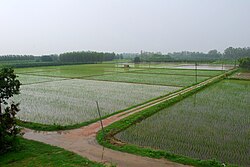
[[File:Punjab Monsoon.jpg|thumb|right|Agricultural fields of Punjab during the monsoon]] | |||
The geography and [[subtropic]]al latitudinal location of Punjab lead to large variations in temperature from month to month. Even though only limited regions experience temperatures below {{convert|0|C|F}}, ground frost is commonly found in the majority of Punjab during the winter season. The temperature rises gradually with high [[humidity]] and overcast skies. However, the rise in temperature is steep when the sky is clear and humidity is low.<ref name="auto">{{cite web|url=http://www.discoveredindia.com/punjab/the-green-granary-of-india/seasons.htm|access-date=27 October 2015|title=Weather & Climate Of Punjab|url-status=live|archive-url=https://web.archive.org/web/20160105133815/http://www.discoveredindia.com/punjab/the-green-granary-of-india/seasons.htm|archive-date=5 January 2016}}</ref> | |||
The maximum temperatures usually occur in mid-May and June. The temperature remains above {{convert|40|C|F}} in the entire region during this period. Ludhiana recorded the highest maximum temperature at {{convert|46.1|C|F}} with Patiala and Amritsar recording {{convert|45.5|C|F}}. The maximum temperature during the summer in Ludhiana remains above {{convert|41|C|F}} for a duration of one and a half months. These areas experience the lowest temperatures in January. The sun rays are oblique during these months and the cold winds control the temperature at daytime.<ref name="auto"/> | |||
Punjab experiences its minimum temperature from December to February. The lowest temperature was recorded at Amritsar ({{convert|0.2|C|F}}) and Ludhiana stood second with {{convert|0.5|C|F}}. The minimum temperature of the region remains below {{convert|5|C|F}} for almost two months during the winter season. The highest minimum temperature of these regions in June is more than the daytime maximum temperatures experienced in January and February. Ludhiana experiences minimum temperatures above {{convert|27|C|F}} for more than two months. The annual average temperature in the entire state is approximately {{convert|21|C|F}}. Further, the mean monthly temperature range varies between {{convert|9|C|F}} in July to approximately {{convert|18|C|F}} in November.<ref name="auto"/> | |||
{{Weather box | |||
|location = [[Sri Guru Ram Dass Jee International Airport|Amritsar Airport]] (1981-2010 normals, extremes 1947–present; humidity and sunshine 1961-1990) | |||
|metric first = Yes | |||
|single line = Yes | |||
|collapsed = Yes | |||
|Jan record high C = 26.8 | |||
|Feb record high C = 32.2 | |||
|Mar record high C = 36.2 | |||
|Apr record high C = 44.1 | |||
|May record high C = 47.7 | |||
|Jun record high C = 47.8 | |||
|Jul record high C = 45.6 | |||
|Aug record high C = 40.7 | |||
|Sep record high C = 40.6 | |||
|Oct record high C = 38.3 | |||
|Nov record high C = 34.2 | |||
|Dec record high C = 28.5 | |||
|year record high C = 47.8 | |||
| Jan avg record high C = 23 | |||
| Feb avg record high C = 26.1 | |||
| Mar avg record high C = 32 | |||
| Apr avg record high C = 40.5 | |||
| May avg record high C = 44 | |||
| Jun avg record high C = 44.1 | |||
| Jul avg record high C = 39.8 | |||
| Aug avg record high C = 37.1 | |||
| Sep avg record high C = 36.8 | |||
| Oct avg record high C = 35.5 | |||
| Nov avg record high C = 30.5 | |||
| Dec avg record high C = 24.9 | |||
| year avg record high C = 45.2 | |||
|Jan high C = 18.4 | |||
|Feb high C = 21.7 | |||
|Mar high C = 26.8 | |||
|Apr high C = 34.2 | |||
|May high C = 39 | |||
|Jun high C = 39 | |||
|Jul high C = 35 | |||
|Aug high C = 34.2 | |||
|Sep high C = 34.1 | |||
|Oct high C = 32 | |||
|Nov high C = 27.1 | |||
|Dec high C = 21.1 | |||
|year high C = 30.2 | |||
|Jan low C = 3.4 | |||
|Feb low C = 6.3 | |||
|Mar low C = 10.9 | |||
|Apr low C = 16.1 | |||
|May low C = 21.3 | |||
|Jun low C = 24.3 | |||
|Jul low C = 25.3 | |||
|Aug low C = 24.9 | |||
|Sep low C = 22.1 | |||
|Oct low C = 15.4 | |||
|Nov low C = 8.7 | |||
|Dec low C = 4.1 | |||
|year low C = 15.2 | |||
| Jan avg record low C = -0.5 | |||
| Feb avg record low C = 1.7 | |||
| Mar avg record low C = 5.6 | |||
| Apr avg record low C = 10.2 | |||
| May avg record low C = 15.8 | |||
| Jun avg record low C = 19.6 | |||
| Jul avg record low C = 21.7 | |||
| Aug avg record low C = 21.4 | |||
| Sep avg record low C = 17.8 | |||
| Oct avg record low C = 10.7 | |||
| Nov avg record low C = 4.2 | |||
| Dec avg record low C = 0.1 | |||
| year avg record low C = -1.2 | |||
|Jan record low C = -2.9 | |||
|Feb record low C = −2.6 | |||
|Mar record low C = 2 | |||
|Apr record low C = 6.4 | |||
|May record low C = 9.6 | |||
|Jun record low C = 15.6 | |||
|Jul record low C = 18.2 | |||
|Aug record low C = 18.8 | |||
|Sep record low C = 13 | |||
|Oct record low C = 7.3 | |||
|Nov record low C = -0.6 | |||
|Dec record low C = −3.6 | |||
|year record low C = −3.6 | |||
|rain colour = green | |||
|Jan rain mm = 26.2 | |||
|Feb rain mm = 38.6 | |||
|Mar rain mm = 38.4 | |||
|Apr rain mm = 21.4 | |||
|May rain mm = 26.7 | |||
|Jun rain mm = 61.2 | |||
|Jul rain mm = 210.1 | |||
|Aug rain mm = 167.3 | |||
|Sep rain mm = 77.5 | |||
|Oct rain mm = 16.1 | |||
|Nov rain mm = 6.3 | |||
|Dec rain mm = 13.6 | |||
|year rain mm = 703.4 | |||
|Jan rain days = 2.1 | |||
|Feb rain days = 3.3 | |||
|Mar rain days = 3.2 | |||
|Apr rain days = 2 | |||
|May rain days = 2.4 | |||
|Jun rain days = 3.8 | |||
|Jul rain days = 8.6 | |||
|Aug rain days = 6.9 | |||
|Sep rain days = 3.5 | |||
|Oct rain days = 1.1 | |||
|Nov rain days = 0.6 | |||
|Dec rain days = 1.4 | |||
|unit rain days = 1.0 mm | |||
|Jan sun = 181.7 | |||
|Feb sun = 192.7 | |||
|Mar sun = 219.4 | |||
|Apr sun = 265.0 | |||
|May sun = 294.7 | |||
|Jun sun = 269.0 | |||
|Jul sun = 215.5 | |||
|Aug sun = 227.7 | |||
|Sep sun = 240.8 | |||
|Oct sun = 253.2 | |||
|Nov sun = 220.1 | |||
|Dec sun = 182.2 | |||
|Jan humidity = 74 | |||
|Feb humidity = 70 | |||
|Mar humidity = 64 | |||
|Apr humidity = 47 | |||
|May humidity = 38 | |||
|Jun humidity = 48 | |||
|Jul humidity = 72 | |||
|Aug humidity = 77 | |||
|Sep humidity = 69 | |||
|Oct humidity = 67 | |||
|Nov humidity = 73 | |||
|Dec humidity = 76 | |||
|year sun = | |||
|source 1 =<ref>{{cite web | |||
| title = Amritsar Climate Normals 1981-2010 | |||
| url = http://imdpune.gov.in/library/public/1981-2010%20CLIM%20NORMALS%20(STATWISE).pdf#%5B%7B%22num%22%3A131%2C%22gen%22%3A0%7D%2C%7B%22name%22%3A%22Fit%22%7D%5D | |||
| publisher = Indian Meteorological Department, Pune | |||
| access-date = 31 March 2020 | |||
}}</ref><ref>{{cite web | |||
| title = Amritsar Climate Normals 1971–1990 | |||
| url = ftp://ftp.atdd.noaa.gov/pub/GCOS/WMO-Normals/RA-II/IN/42071.TXT | |||
| publisher = National Oceanic and Atmospheric Administration | |||
| access-date = 11 January 2014 | |||
}}</ref> | |||
}} | |||
{{Weather box | |||
| location = [[Ludhiana]] (1981-2010 normals, extremes 1868–present; relative humidity 1961-1990) | |||
| metric first = Y | |||
| single line = Y | |||
| collapsed = Y | |||
|Jan record high C = 29 | |||
|Feb record high C = 30.4 | |||
|Mar record high C = 36.3 | |||
|Apr record high C = 43.4 | |||
|May record high C = 46.6 | |||
|Jun record high C = 46.6 | |||
|Jul record high C = 43.2 | |||
|Aug record high C = 39.8 | |||
|Sep record high C = 37.9 | |||
|Oct record high C = 36 | |||
|Nov record high C = 35.1 | |||
|Dec record high C = 27.9 | |||
|year record high C = 46.6 | |||
| Jan avg record high C = 23.8 | |||
| Feb avg record high C = 26.9 | |||
| Mar avg record high C = 32.6 | |||
| Apr avg record high C = 40.7 | |||
| May avg record high C = 43.8 | |||
| Jun avg record high C = 43.5 | |||
| Jul avg record high C = 37.9 | |||
| Aug avg record high C = 35.8 | |||
| Sep avg record high C = 35.6 | |||
| Oct avg record high C = 34.7 | |||
| Nov avg record high C = 30.7 | |||
| Dec avg record high C = 25.1 | |||
| year avg record high C = 44.8 | |||
|Jan high C = 18.6 | |||
|Feb high C = 22.2 | |||
|Mar high C = 27.3 | |||
|Apr high C = 35 | |||
|May high C = 38.9 | |||
|Jun high C = 37.9 | |||
|Jul high C = 34 | |||
|Aug high C = 33.1 | |||
|Sep high C = 33 | |||
|Oct high C = 31.9 | |||
|Nov high C = 27.3 | |||
|Dec high C = 21.6 | |||
|year high C = 30.1 | |||
|Jan low C = 5.6 | |||
|Feb low C = 8.2 | |||
|Mar low C = 12.3 | |||
|Apr low C = 17.7 | |||
|May low C = 22.9 | |||
|Jun low C = 25.3 | |||
|Jul low C = 25.8 | |||
|Aug low C = 25.1 | |||
|Sep low C = 22.8 | |||
|Oct low C = 16.5 | |||
|Nov low C = 10.7 | |||
|Dec low C = 6.5 | |||
|year low C = 16.6 | |||
| Jan avg record low C = 1.2 | |||
| Feb avg record low C = 3.4 | |||
| Mar avg record low C = 7.3 | |||
| Apr avg record low C = 12 | |||
| May avg record low C = 17.6 | |||
| Jun avg record low C = 20.5 | |||
| Jul avg record low C = 22 | |||
| Aug avg record low C = 21.7 | |||
| Sep avg record low C = 18.8 | |||
| Oct avg record low C = 12.6 | |||
| Nov avg record low C = 6 | |||
| Dec avg record low C = 2.5 | |||
| year avg record low C = 0.8 | |||
|Jan record low C = -1.7 | |||
|Feb record low C = −0.1 | |||
|Mar record low C = 4.6 | |||
|Apr record low C = 9.5 | |||
|May record low C = 13.6 | |||
|Jun record low C = 16.1 | |||
|Jul record low C = 20.4 | |||
|Aug record low C = 18 | |||
|Sep record low C = 15.5 | |||
|Oct record low C = 10.6 | |||
|Nov record low C = 3.1 | |||
|Dec record low C = 0.1 | |||
|year record low C = −1.7 | |||
|rain colour = green | |||
|Jan rain mm = 28.3 | |||
|Feb rain mm = 37 | |||
|Mar rain mm = 29.9 | |||
|Apr rain mm = 17.3 | |||
|May rain mm = 22.3 | |||
|Jun rain mm = 69.2 | |||
|Jul rain mm = 215 | |||
|Aug rain mm = 205.2 | |||
|Sep rain mm = 146 | |||
|Oct rain mm = 19.8 | |||
|Nov rain mm = 4.3 | |||
|Dec rain mm = 15.1 | |||
|year rain mm = 809.3 | |||
|Jan rain days = 2.2 | |||
|Feb rain days = 2.7 | |||
|Mar rain days = 2.4 | |||
|Apr rain days = 1.7 | |||
|May rain days = 2 | |||
|Jun rain days = 4.3 | |||
|Jul rain days = 8.4 | |||
|Aug rain days = 8.6 | |||
|Sep rain days = 5 | |||
|Oct rain days = 1 | |||
|Nov rain days = 0.6 | |||
|Dec rain days = 1 | |||
|unit rain days = 1.0 mm | |||
| Jan humidity = 74 | |||
| Feb humidity = 66 | |||
| Mar humidity = 62 | |||
| Apr humidity = 44 | |||
| May humidity = 39 | |||
| Jun humidity = 49 | |||
| Jul humidity = 71 | |||
| Aug humidity = 76 | |||
| Sep humidity = 68 | |||
| Oct humidity = 61 | |||
| Nov humidity = 68 | |||
| Dec humidity = 74 | |||
|year humidity = 63 | |||
|source 1 = Ludhiana Climatological Table, 1981-2010<ref>{{cite web | |||
|url=http://imdpune.gov.in/library/public/1981-2010%20CLIM%20NORMALS%20(STATWISE).pdf | |||
|title=Ludhiana Climatological Table, 1981-2010 | |||
|publisher=India Meteorological Department | |||
|access-date= 2 April 2020 | |||
}}</ref> | |||
| date = June 2013}} | |||
===Seasons=== | |||
Punjab experiences three main seasons. They are: | |||
*Summer (mid-April to the end of June) | |||
*Monsoon (early July to the end of September) | |||
*Winter (early December to the end of February).<ref name="auto"/> | |||
Apart from these three, the state experiences transitional seasons like: | |||
*Pre-summer season (March to mid-April): This is the period of transition between winter and summer. | |||
*Post-[[monsoon]] season (September to end of November): This is the period of transition between monsoon and winter seasons.<ref name="auto"/> | |||
====Summer==== | |||
Punjab starts experiencing mildly hot temperatures in February. The actual summer season commences in mid-April and the heat continues till the end of August. High temperatures between May and August hover between 40-47 °C. The area experiences atmospheric pressure variations during the summer months. The atmospheric pressure of the region remains around 987 millibar during February and it reaches 970 millibar in June.<ref name="auto"/> | |||
====Monsoon==== | |||
Punjab's rainy season begins in the first week of July as monsoon currents generated in the [[Bay of Bengal]] bring rain to the region. The monsoon lasts up to mid-September.<ref name="auto"/> | |||
====Winter==== | |||
Temperature variation is minimal in January. The mean night and day temperatures fall to {{convert|5|C|F}} and {{convert|12|C|F}}, respectively.<ref name="auto"/> | |||
====Post-Monsoon transitional season==== | |||
The monsoon begins to reduce by the second week of September. This brings a gradual change in climate and temperature. The time between October and November is the transitional period between monsoon and winter seasons. Weather during this period is generally temperate and dry.<ref name="auto"/> | |||
====Post-Winter transitional season==== | |||
The effects of winter diminish by the first week of March. The hot summer season commences in mid-April. This period is marked by occasional showers with hail storms and [[squalls]] that cause extensive damage to crops. The winds remain dry and warm during the last week of March, commencing the harvest period.<ref name="auto"/> | |||
===Rainfall=== | |||
*Monsoon Rainfall | |||
Monsoon season provides most of the rainfall for the region. Punjab receives rainfall from the monsoon current of the Bay of Bengal. This monsoon current enters the state from the southeast in the first week of July.<ref name="auto"/> | |||
*Winter Rainfall | |||
The winter season remains very cool with temperatures falling below freezing at some places. Winter also brings in some western disturbances.<ref name="auto"/> Rainfall in the winter provides relief to the farmers as some of the winter crops in the region of Shivalik Hills are entirely dependent on this rainfall. As per meteorological statistics, the sub-Shivalik area receives more than {{convert|100|mm|in}} of rainfall in the winter months.<ref name="auto"/> | |||
==Flora and fauna== | |||
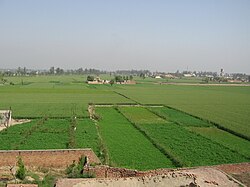
[[File:Agriculture in Punjab India.jpg|thumb|Agriculture in Punjab]] | |||
The fauna of the area is rich, with 396 types of birds, 214 kinds of [[Lepidoptera]], 55 varieties of fish, 20 types of reptiles, and 19 kinds of mammals. The state of Punjab has large wetland areas, bird sanctuaries that house numerous species of birds, and many zoological parks. Wetlands include the national wetland [[Harike Wetland|Hari-Ke-Pattan]], the wetland of [[Kanjli Wetland|Kanjli]], and the wetlands of Kapurthala Sutlej. Wildlife sanctuaries include the Harike in the district of Tarn Taran Sahib, the Zoological Park in Rupnagar, Chhatbir Bansar Garden in Sangrur, [[Aam Khas Bagh]] in Sirhind, Amritsar's famous [[Ram Bagh Palace]], Shalimar Garden in Kapurthala, and the famous Baradari Garden in the city of Patiala.<ref>{{cite web|url=http://www.discoveredindia.com/punjab/the-green-granary-of-india/flora-and-fauna-of-punjab.htm|access-date=27 October 2015|title=Flora And Fauna Of Punjab|url-status=live|archive-url=https://web.archive.org/web/20151210182308/http://www.discoveredindia.com/punjab/the-green-granary-of-india/flora-and-fauna-of-punjab.htm|archive-date=10 December 2015}}</ref> | |||
===Animals=== | |||
A few of the rivers in Punjab have crocodiles. The extraction of silk from silkworms is another industry that flourishes in the state. Production of bee honey is done in some parts of Punjab. The southern plains are desert land; hence, camels can be seen. [[Water buffalo|Buffalo]]es graze around the banks of rivers. The northeastern part is home to animals like horses. Wildlife sanctuaries have many more species of wild animals like the otter, wild boar, wildcat, fruit bat, hog deer, flying fox, squirrel, and mongoose. Naturally formed forests can be seen in the Shivalik ranges in the districts of Ropar, Gurdaspur and Hoshiarpur. Patiala is home to the Bir forest while the wetlands area in Punjab is home to the Mand forest.<ref name="auto1">{{cite web|url=http://www.discoveredindia.com/punjab/the-green-granary-of-india/flora-and-fauna-of-punjab.htm|access-date=27 October 2015|title=Animals and Birds in Punjab|url-status=live|archive-url=https://web.archive.org/web/20151210182308/http://www.discoveredindia.com/punjab/the-green-granary-of-india/flora-and-fauna-of-punjab.htm|archive-date=10 December 2015}}</ref> | |||
Botanical gardens exist throughout Punjab. There is a zoological park and a tiger safari park, as well as three parks dedicated to deer.<ref name="auto1"/> | |||
The state bird is the [[northern goshawk|northern goshawk (baz)]] (''Accipiter gentilis''),<ref>{{cite news |title=Lost in flight: State bird of Punjab missing from the state! |url=https://www.hindustantimes.com/punjab/lost-in-flight-state-bird-of-punjab-missing-from-the-state/story-SRHFwdiPKInSobd1xHoulL.html |access-date=12 January 2021 |work=Hindustan Times |date=14 September 2017 |language=en}}</ref> the state animal is the [[blackbuck]] (''Antilope cervicapra''), the state aquatic animal is [[Indus river dolphin]] (''Platanista minor''), and the state tree is the shisham (''[[Dalbergia sissoo]]'').<ref name="ReferenceB"/> | |||
==Government and politics== | |||
{{more citations needed section|date=February 2017}} | |||
[[File:Assembly 09.jpg|thumb|[[Punjab Legislative Assembly]] building]] | |||
{{Main|Politics of Punjab (India)|Government of Punjab (India)|Punjab Legislative Assembly|List of districts of Punjab (India)}} | |||
Punjab is governed through a parliamentary system of representative democracy. Each of the states of India possesses a parliamentary system of government, with a ceremonial state [[List of Governors of Punjab (India)|Governor]], appointed by the [[President of India]] on the advice of the central government. The head of government is an indirectly elected [[List of Chief Ministers of Punjab (India)|Chief Minister]] who is vested with most of the executive powers. The term length of the government is five years. The state legislature, the [[Vidhan Sabha]], is the unicameral [[Punjab Legislative Assembly]], with 117 members elected from single-seat constituencies.<ref>{{cite web|url=http://www.punjabassembly.nic.in/index.php/about-vidhan-sabha|title=About Vidhan Sabha|website=punjabassembly.nic.in|access-date=7 October 2019}}</ref> The current government was elected in the [[2022 Punjab Legislative Assembly election|2022 Assembly elections]] as [[Aam Aadmi Party]] won 92 out of 117 Assembly seats and [[Bhagwant Mann]] is the current Chief Minister. The state of Punjab is divided into five administrative divisions and twenty-two districts. | |||
The capital of Punjab is [[Chandigarh]], which also serves as the capital of [[Haryana]] and is thus administered separately as a [[Union Territory]] of India. The judicial branch of the state government is provided by the [[Punjab and Haryana High Court]] in Chandigarh.<ref>{{cite web|url=http://www.ebc-india.com/lawyer/hcourts.htm|title=Jurisdiction and Seats of Indian High Courts|access-date=12 May 2008|publisher=Eastern Book Company|url-status=live|archive-url=https://web.archive.org/web/20080510190512/http://www.ebc-india.com/lawyer/hcourts.htm|archive-date=10 May 2008}}</ref> | |||
The two major political parties in the state are the [[Shiromani Akali Dal]], a [[Punjabi nationalism|right-wing]] party [[National Democratic Alliance|allied]] with the [[Bharatiya Janata Party]] at the national level, and the [[Indian National Congress]], a [[Ideology of the Indian National Congress|centrist]] party.<ref>{{Cite journal|last=Kumar|first=Ashutosh|date=2004|title=Electoral Politics in Punjab: Study of Akali Dal|journal=Economic and Political Weekly|volume=39|issue=14/15|pages=1515–1520|issn=0012-9976|jstor=4414869}}</ref> [[President's rule]] has been imposed in Punjab eight times so far, since 1950, for different reasons. In terms of the absolute number of days, Punjab was under the President's rule for 3,510 days, which is approximately 10 years. Much of this was in the 80s during the height of militancy in Punjab. Punjab was under the President's rule for five continuous years from 1987 to 1992. | |||
Punjab state law and order is maintained by [[Punjab Police (India)|Punjab Police]]. Punjab police is headed by its DGP, Dinkar Gupta,<ref>{{cite news |last1=Verma |first1=Sanjeev |title=DGP Punjab: Dinkar Gupta appointed new DGP of Punjab {{!}} Chandigarh News - Times of India |url=https://timesofindia.indiatimes.com/city/chandigarh/dinkar-gupta-appointed-new-dgp-of-punjab/articleshow/67881667.cms |access-date=2 November 2019 |work=The Times of India |date=7 February 2019 |language=en}}</ref> and has 70,000 employees. It manages state affairs through 22 district heads known as SSP. | |||
==Administrative set-up== | |||
[[File:Punjab district map.png|thumb|Districts of Punjab along with their headquarters (Before 14 May 2021, when Malerkotla was declared as 23rd district)]] | |||
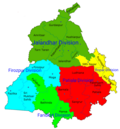
[[File:Administrative division of Punjab.png|thumb|Administrative divisions of Punjab|236x236px]] | |||
Punjab has 23 districts, which are geographically classified into [[Majha]], [[Malwa (Punjab)|Malwa]], [[Doaba]] and [[Puadh]] regions, as under: - | |||
*[[Majha]] (4) | |||
**[[Amritsar district|Amritsar]] | |||
**[[Gurdaspur district|Gurdaspur]] | |||
**[[Pathankot district|Pathankot]] | |||
**[[Tarn Taran district|Tarn Taran]] | |||
*[[Doaba]] (4) | |||
**[[Hoshiarpur district|Hoshiarpur]] | |||
**[[Jalandhar district|Jalandhar]] | |||
**[[Kapurthala district|Kapurthala]] | |||
**[[Shaheed Bhagat Singh Nagar district|Shaheed Bhagat Singh Nagar]] | |||
*[[Malwa (Punjab)|Malwa]] (12) | |||
**[[Barnala district|Barnala]] | |||
**[[Bathinda district|Bathinda]] | |||
**[[Ferozepur district|Ferozepur]] | |||
**[[Fazilka district|Fazilka]] | |||
**[[Faridkot district|Faridkot]] | |||
**[[Ludhiana district|Ludhiana]] | |||
**[[Moga district|Moga]] | |||
**[[Malerkotla district|Malerkotla]] | |||
**[[Mansa district, Punjab|Mansa]] | |||
**[[Sri Muktsar Sahib district|Sri Muktsar Sahib]] | |||
**[[Patiala district|Patiala]] | |||
**[[Sangrur district|Sangrur]] | |||
*[[Puadh]] (3) | |||
**[[Sahibzada Ajit Singh Nagar district|SAS Nagar (Mohali)]] | |||
**[[Rupnagar district|Rupnagar]] | |||
**[[Fatehgarh Sahib district|Fatehgarh Sahib]] | |||
These districts are officially divided among 5 administrative divisions: Faridkot, Ferozepur, Jalandhar, Patiala and Ropar(created on 31 December 2010, which was a part of Patiala Division earlier).<ref>{{cite web|title=Punjab District Map|url=https://www.mapsofindia.com/maps/punjab/punjab-district.htm|url-status=dead|archive-url=https://web.archive.org/web/20170613164514/http://www.mapsofindia.com/maps/punjab/punjab-district.htm|archive-date=13 June 2017|access-date=6 December 2019|website=Maps of India}}</ref> | |||
{| class="wikitable sortable" | |||
|+Administrative Divisions and Corresponding Districts of Punjab | |||
!S. No. | |||
!Name of the Division | |||
!No. of districts | |||
!Name of the Districts | |||
|- | |||
|1 | |||
|Faridkot | |||
|3 | |||
|[[Bathinda district|Bathinda]], [[Faridkot district|Faridkot]], [[Mansa district, India|Mansa]] | |||
|- | |||
|2 | |||
|Ferozepur | |||
|4 | |||
|[[Fazilka district|Fazilka]], [[Firozpur district|Ferozepur]], [[Moga district|Moga]], [[Sri Muktsar Sahib district|Sri Muktsar Sahib]] | |||
|- | |||
|3 | |||
|Jalandhar | |||
|7 | |||
|[[Amritsar district|Amritsar]], [[Gurdaspur district|Gurdaspur]], [[Hoshiarpur district|Hoshiarpur]], [[Jalandhar district|Jalandhar]], [[Kapurthala district|Kapurthala]], [[Pathankot district|Pathankot]], [[Tarn Taran district|Tarn Taran]] | |||
|- | |||
|4 | |||
|Patiala | |||
|6 | |||
|[[Barnala district|Barnala]], [[Fatehgarh Sahib district|Fatehgarh Sahib]], [[Ludhiana district|Ludhiana]], [[Malerkotla district|Malerkotla]], [[Patiala district|Patiala]], [[Sangrur district|Sangrur]] | |||
|- | |||
|5 | |||
|Ropar | |||
|3 | |||
|[[Rupnagar district|Rupnagar]], [[Mohali district|SAS Nagar]], [[Shaheed Bhagat Singh Nagar district|SBS Nagar]] | |||
|} | |||
Each district is under the administrative control of a [[District magistrate|District Collector]]. The districts are subdivided into 93 [[tehsil]]s, which have fiscal and administrative powers over settlements within their borders, including maintenance of local land records comes under the administrative control of a [[Tehsildar]]. Each Tehsil consists of blocks which are total 150 in number. These blocks consist of [[Revenue Village|revenue villages]]. There are total number of revenue villages in the state is 12,278. There are 23 [[District council (India)|Zila Parishads]], 136 [[Municipal governance in India|Municipal Committees]] and 22 Improvement Trusts looking after 143 towns and 14 [[Cities in India|cities]] of Punjab. | |||
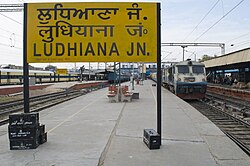
The capital city of the state is [[Chandigarh]] and largest city of the state is [[Ludhiana]]. Out of total population of Punjab, 37.48% people live in urban regions. The absolute urban population living in urban areas is 10,399,146 of which 5,545,989 are males and while remaining 4,853,157 are females. The urban population in the last 10 years has increased by 37.48%. The major cities are [[Ludhiana]], [[Amritsar]], [[Jalandhar]], [[Mohali]], [[Patiala]] and [[Bathinda]]. | |||
==Economy== | |||
{{Main|Economy of Punjab (India)|E-governance in Punjab}} | |||
{{See also|Measurement of land in Punjab}} | |||
[[File:Arrival in Amritsar.jpg|thumb|Hall Gate of [[Amritsar]]]] | |||
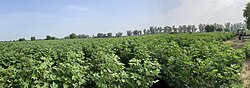
Punjab's [[Gross domestic product|GDP]] is {{INRConvert|5.42|t|lk=r}}.<ref name="MOSPI"/> Punjab is one of the most fertile regions in India. The region is ideal for wheat-growing. [[Rice]], sugar cane, [[fruits]] and [[vegetables]] are also grown. Indian Punjab is called the "Granary of India" or "India's bread-basket".<ref name="ReferenceA">[http://punjabgovt.nic.in/punjabataglance/LeadingbyExample.htm Welcome to Official Web site of Punjab, India] {{webarchive|url=https://web.archive.org/web/20070417122227/http://punjabgovt.nic.in/punjabataglance/LeadingbyExample.htm|date=17 April 2007}}</ref> It produces 10.26% of India's cotton, 19.5% of India's wheat, and 11% of India's rice. The [[Firozpur]] and [[Fazilka]] Districts are the largest producers of wheat and rice in the state. In worldwide terms, Indian Punjab produces 2% of the world's cotton, 2% of its wheat and 1% of its rice.<ref name="ReferenceA"/> | |||
Punjab ranked first in GDP per capita amongst Indian states in 1981 and fourth in 2001, but has experienced slower growth than the rest of India, having the [[List of Indian states and union territories by GDP per capita#Historical NSDP per capita of Indian states|second-slowest GDP per capita]] growth rate of all Indian states and UTs between 2000 and 2010, behind only [[Economy of Manipur|Manipur]].<ref>{{cite web | title = How Punjab [sic] economy can be revived|publisher= [[Tribune India]]| url = https://www.tribuneindia.com/news/archive/comment/how-punjab-economy-can-be-revived-645211|date=31 August 2018| access-date = 2 July 2020}}</ref><ref>{{cite web | title = What's in store for India's Punjab?|publisher= [[Brookings Institution]]| url = https://www.brookings.edu/blog/future-development/2017/03/03/whats-in-store-for-indias-punjab/|date=3 March 2017| access-date = 2 July 2020}}</ref><ref>{{cite web | title = Punjab's Slowing Economy|publisher= Business World| url = http://www.businessworld.in/article/Punjab-s-Slowing-Economy/03-02-2017-112433/|date=3 February 2017| access-date = 2 July 2020}}</ref><ref>{{cite web | title = Punjab, a state in decline|publisher= LiveMint| url = https://www.livemint.com/Opinion/ph7Wxdf9c3FOkhL7k4k4jI/Punjab-a-state-in-decline.html|date=14 October 2010| access-date = 2 July 2020}}</ref><ref>{{cite web | title = Punjab, Star of India's Rise, Faces Steep Fall|publisher= Wall Street Journal| url = https://www.wsj.com/articles/SB10001424052748703730804576322330472250792|date=15 May 2011| access-date = 2 July 2020}}</ref><ref>{{cite web |last1=Guruswamy |first1=Mohan |last2=Baitha |first2=Ramnis Attar |last3=Mohanty |first3=Jeevan Prakash |title=Centrally Planned Inequality: The Tale of Two States – Punjab and Bihar |url=http://cpasindia.org/reports/07-Centrally-Planned-Inequality-Punjab-Bihar.pdf |date=15 June 2004 |archive-url=https://web.archive.org/web/20090326210152/http://cpasindia.org/reports/07-Centrally-Planned-Inequality-Punjab-Bihar.pdf |archive-date=26 March 2009 |location=New Delhi, India |publisher=Centre for Policy Alternatives |access-date=17 August 2015}}</ref><ref name=":0">{{cite web|url=http://www.mospi.gov.in/sites/default/files/press_releases_statements/State_series_as_on_15032020.xls|title=MOSPI Net State Domestic Product, Ministry of Statistics and Programme Implementation, Government of India.|access-date=2 July 2020}}</ref> Punjab's economy has been primarily agriculture-based since the [[Green Revolution in India|Green Revolution]] due to the presence of abundant water sources and fertile soils;<ref>{{cite web|title=Punjab|url=http://m.oifc.in/Our-Partners/State-Partners/Punjab|publisher=Overseas Indian Facilitation Centre|access-date=8 September 2011|url-status=live|archive-url=https://web.archive.org/web/20111010150641/http://m.oifc.in/Our-Partners/State-Partners/Punjab|archive-date=10 October 2011}}</ref> most of the state lies in a fertile alluvial plain with many rivers and an extensive irrigation canal system.<ref name="ReferenceB">{{cite web|url=http://punjabgovt.gov.in/StateProfile.aspx|title=State Profile – About Punjab|publisher=Punjab Government|access-date=18 July 2010|url-status=dead|archive-url=https://web.archive.org/web/20111106125012/http://punjabgovt.gov.in/StateProfile.aspx|archive-date=6 November 2011}}</ref> The largest cultivated crop is [[wheat]]. Other important crops are [[rice]], [[cotton]], [[sugarcane]], [[pearl millet]], [[maize]], [[barley]] and [[fruit]]. Rice and wheat are doublecropped in Punjab with rice stalks being burned off over millions of acres prior to the planting of wheat. This widespread practice is polluting and wasteful.<ref name=Guardian12712>{{cite news|title=Fields on fire: making farming more sustainable in India – in pictures|url=https://www.theguardian.com/global-development/gallery/2012/dec/07/farming-sustainable-india-in-pictures|access-date=9 December 2012|newspaper=The Guardian|date=7 December 2012|location=London|url-status=live|archive-url=https://web.archive.org/web/20140502042059/http://www.theguardian.com/global-development/gallery/2012/dec/07/farming-sustainable-india-in-pictures|archive-date=2 May 2014}}</ref> Despite covering only 1.53%<ref name="censusofficial" /> of its geographical area, Punjab makes up for about 15-20%<ref name=":1">{{cite web|title=Directorate of Economics and Statistics, Government of India - Agricultural Statistics at a glance 2018|url=https://eands.dacnet.nic.in/PDF/Agricultural%20Statistics%20at%20a%20Glance%202018.pdf|access-date=3 December 2020|website=eands.dacnet.nic.in}}</ref><ref>{{cite web|title=India production of Wheat|url=https://agriexchange.apeda.gov.in/india%20production/India_Productions.aspx?cat=Agri&hscode=1013|access-date=3 December 2020|website=agriexchange.apeda.gov.in}}</ref><ref>{{Cite news|date=23 October 2018|title=Top 5 wheat producing states in India: Facts and Figures|url=https://www.indiatoday.in/education-today/gk-current-affairs/story/top-5-wheat-producing-states-in-india-facts-and-figures-1373402-2018-10-23|access-date=3 December 2020|work=India Today|language=en}}</ref><ref>{{Cite news|date=18 March 2019|title=States with highest and lowest production of wheat in last four years|url=https://zeenews.india.com/economy/states-with-highest-and-lowest-production-of-wheat-in-last-four-years-2188480.html|access-date=3 December 2020|work=Zee News|language=en}}</ref> of India's wheat production, around 12%<ref>{{cite web|title=Indian Production of Rice|url=http://agriexchange.apeda.gov.in/india%20production/India_Productions.aspx?cat=Agri&hscode=1011|access-date=12 December 2020|website=Agricultural & Processed Food Products Export Development Authority (APEDA), [[Ministry of Commerce and Industry (India)|Ministry of Commerce & Industry]], [[Govt. of India]]}}</ref><ref>{{cite web|title=A status note on Rice in India|url=https://www.nfsm.gov.in/StatusPaper/Rice2016.pdf|access-date=12 December 2020|website=National Food Security Mission (NFSM), [[Ministry of Agriculture & Farmers Welfare]], [[Govt. of India]]}}</ref><ref>{{cite web|title=State-wise Production of Rice from 2010-11 to 2014-15|url=https://data.gov.in/resources/state-wise-production-rice-2010-11-2014-15-ministry-agriculture-and-farmers-welfare|access-date=12 December 2020|website=National Informatics Centre (NIC), [[Ministry of Electronics & Information Technology]], [[Govt. of India]]}}</ref><ref>{{cite web|title=Top 10 rice producing states in India: Rice production and area under cultivation|url=https://www.indiatoday.in/education-today/gk-current-affairs/story/top-10-rice-producing-states-in-india-rice-production-and-area-under-cultivation-1343024-2018-09-18|access-date=12 December 2020|website=[[India Today]]}}</ref> of its rice production, and around 5%<ref name=":1" /><ref>{{cite web|title=Ministry of Food Processing Industries, Government of India - Opportunities in Dairy Sector in India|url=https://mofpi.nic.in/sites/default/files/OpportunitiesinDairySectorinIndia.pdf|access-date=3 December 2020|website=mofpi.nic.in}}</ref><ref>{{cite web|title=India - milk production by state 2019|url=https://www.statista.com/statistics/622808/milk-production-by-state-india/|access-date=3 December 2020|website=Statista|language=en}}</ref><ref>{{cite web|title=Nation Dairy Development Board, Government of India - Milk Production by States/UTs|url=https://www.nddb.coop/information/stats/milkprodstate|website=nddb.coop}}</ref> of its milk production, being known as [[Breadbasket#Asia|India's breadbasket]].<ref>{{cite news |last1=Jayan |first1=T. V. |title=India's bread basket has no dough |url=https://www.thehindubusinessline.com/economy/agri-business/indias-bread-basket-has-no-dough/article9735319.ece |access-date=11 September 2020 |work=@businessline |date=12 January 2018 |language=en}}</ref><ref name="Know Punjab">{{cite web | title = Know Punjab|publisher= Government of Punjab, India| url = https://punjab.gov.in/know-punjab/| access-date = 2 July 2020}}</ref> About 80%<ref name="Taylor, S. 2007">Taylor, S., Singh, M., Booth, D. (2007) Migration, development and inequality: Eastern Punjabi transnationalism. School of Social Sciences and Law, University of Teesside, Middlesbrough, UK; Department of Sociology, Punjab University, Chandigarh, India.</ref>-95%<ref>{{cite web|url=http://www.asiantribune.com/node/18221|title=Caste System Among Sikhs in Punjab|author=Ratan Saldi|date=6 June 2009|publisher=Asian Tribune|access-date=2 July 2020|archive-date=6 August 2020|archive-url=https://web.archive.org/web/20200806153018/http://www.asiantribune.com/node/18221|url-status=dead}}</ref> of Punjab's agricultural land is owned by its [[Jat Sikh]] community despite it only forming 21%<ref name="India Today 2012">{{cite web | title=The Jats in Punjab comprise only 21% population of the total 60% Sikhs, yet they have been ruling and dominating politics in Punjab for decades. | website=India Today | date=16 January 2012 | url=http://indiatoday.intoday.in/story/dalit-votes-to-decide-ruling-party-of-punjab/1/169026.html | access-date=27 February 2016}}</ref> of the state's population. About 10% of Punjab's population is made up of migrants from poorer states to the southeast such as [[Uttar Pradesh]] and [[Bihar]] who work as farm labourers.<ref name="simmering">[http://economictimes.indiatimes.com/articleshow/msid-2846479,flstry-1.cms Simmering discontent: Sikhs in Punjab are fighting many wars]. 8 March 2008, 0000 hrs IST,Praveen S Thampi, Times of India.</ref> | |||
Other major industries include [[financial services]], the manufacturing of [[scientific instruments]], agricultural goods, electrical goods, [[machine tools]], [[textiles]], [[sewing machines]], [[sports goods]], [[starch]], [[fertilisers]], [[bicycles]], [[garments]], and the processing of [[pine oil]] and [[sugar]].<ref name="Know Punjab"/> Minerals and energy resources also contribute to Punjab's economy to a much lesser extent. Punjab has the largest number of steel [[Rolling (metalworking)|rolling]] mill plants in India, which are in "Steel Town"—[[Mandi Gobindgarh]] in the [[Fatehgarh Sahib district]]. [[Punjabi diaspora|Punjab also has a large diaspora]] that is mostly settled in the [[British Punjabis|United Kingdom]], the [[Punjabi Americans|United States]], and [[Punjabi Canadians|Canada]], numbers about 3 million, and sends back billions of USD in [[Remittances to India|remittances]] to the state, playing a major role in its economy.<ref>{{cite web | title = NRIs beat FDI, keep the money coming |publisher= Hindustan Times| url = http://www.hindustantimes.com/business-news/nris-beat-fdi-keep-the-money-coming/article1-941337.aspx | archive-url = https://web.archive.org/web/20140313025252/http://www.hindustantimes.com/business-news/nris-beat-fdi-keep-the-money-coming/article1-941337.aspx | url-status = dead | archive-date = 13 March 2014 |date=8 October 2012| access-date = 9 July 2014}}</ref> | |||
In Punjab the consumption of fertiliser per hectare is 223.46 kg as compared to 90 kg nationally. The state has been awarded the National Productivity Award for agriculture extension services for ten years, from 1991 to 1992 to 1998–99 and from 2001 to 2003–04. In recent years a drop in productivity has been observed, mainly due to falling fertility of the soil. This is believed to be due to excessive use of fertilisers and pesticides over the years. Another worry is the rapidly falling water table on which almost 90% of the agriculture depends; alarming drops have been witnessed in recent years. By some estimates, groundwater is falling by a meter or more per year.<ref>{{cite web|url=http://www.circleofblue.org/waternews/2010/world/qa-upmanu-lall-gives-insight-to-indias-nexus-of-energy-food-and-water|title=Q&A: Upmanu Lall on India's Nexus of Energy, Food and Water|publisher=[[Circle of Blue]]|author=J. Carl Ganter|access-date=4 June 2010|url-status=live|archive-url=https://web.archive.org/web/20100608030444/http://www.circleofblue.org/waternews/2010/world/qa-upmanu-lall-gives-insight-to-indias-nexus-of-energy-food-and-water/|archive-date=8 June 2010|date=4 June 2010}}</ref><ref>{{cite web|url=http://blogs.ei.columbia.edu/2009/07/28/punjab-a-tale-of-prosperity-and-decline|title=Punjab: A tale of prosperity and decline|publisher=[[Columbia Water Center]]|author=Upmanu Lall|access-date=11 September 2009|url-status=live|archive-url=https://web.archive.org/web/20101008034020/http://blogs.ei.columbia.edu/2009/07/28/punjab-a-tale-of-prosperity-and-decline/|archive-date=8 October 2010|date=28 July 2009}}</ref> | |||
According to the India State Hunger Index, Punjab has the lowest level of hunger in India.<ref>{{cite news|url=http://timesofindia.indiatimes.com/India/India_fares_badly_on_global_hunger_index/rssarticleshow/3596818.cms|title=India fares badly on global hunger index|newspaper=The Times of India|date=15 October 2008|url-status=live|archive-url=https://web.archive.org/web/20110511162245/http://timesofindia.indiatimes.com/India/India_fares_badly_on_global_hunger_index/rssarticleshow/3596818.cms|archive-date=11 May 2011}}</ref> | |||
==Transport== | |||
{{Main|Punjab Roadways|PEPSU Road Transport Corporation}} | |||
=== Air === | |||
[[File:Sri Guru Ram Dass Jee International Airport, Amritsar.jpg|thumb|[[Amritsar Airport|Sri Guru Ram Dass Jee International Airport in Amritsar]]]] | |||
[[Amritsar Airport|Sri Guru Ram Dass Jee International Airport]] in [[Amritsar]], is the Primary Hub Airport and Gateway to Punjab, as the airport serves direct connectivity to key cities around the world, including [[London]], [[Singapore]], [[Moscow]], [[Dubai]], [[Birmingham]] among others. | |||
Punjab has six civil airports including two international airports: [[Sri Guru Ram Dass Jee International Airport|Amritsar International Airport]] and [[Chandigarh International Airport]] at [[Mohali]]; and four domestic airports: [[Bathinda Airport]], [[Pathankot Airport]], [[Adampur Airport]] ([[Jalandhar]]) and [[Sahnewal Airport]] ([[Ludhiana]]). Apart from these 6 airports, there are 2 airfields at Beas ([[Amritsar]]) and [[Patiala]] which do not serve any commercial flight operations, as of now. | |||
=== Railways === | |||
[[File:LDH PF4.JPG|thumb|right|View of Ludhiana Railway Station]] | |||
The [[Indian Railways]]' [[Northern Railway Zone (India)|Northern Railway]] line runs through the state connecting most of the major towns and cities. The [[Shatabdi Express]], India's fastest series of train connects [[Amritsar]] to [[New Delhi]] covering total distance of 449 km. [[Amritsar railway station|Amritsar Junction Railway Station]] is the busiest junction of the state. [[Bathinda Junction railway station|Bathinda Junction]] holds the record of maximum railway lines from a railway junction in [[Asia]]. Punjab's major railway stations are [[Amritsar railway station|Amritsar Junction]] (ASR), [[Ludhiana Junction railway station|Ludhiana Junction]] (LDH), [[Jalandhar Cantonment Junction railway station|Jalandhar Cantonment]] (JRC), [[Firozpur Cantonment railway station|Firozpur Cantonment]] (FZR), [[Jalandhar City Junction railway station|Jalandhar City Junction]] (JUC), [[Pathankot Junction railway station|Pathankot Junction]] (PTK) and [[Patiala railway station]] (PTA). The railway stations of [[Amritsar]] is included in the Indian Railways list of 50 world-class railway stations.<ref>{{cite web|title=List of 50 world-class railway stations|url=http://www.indianrailways.gov.in/railwayboard/uploads/directorate/land_amen/PASSNG_AMENT/ID_207.PDF|website=[[Indian Railways]]|publisher=Indian Railways|access-date=10 October 2017|url-status=live|archive-url=https://web.archive.org/web/20130403082516/http://www.indianrailways.gov.in/railwayboard/uploads/directorate/land_amen/PASSNG_AMENT/ID_207.PDF|archive-date=3 April 2013}}</ref> | |||
====Hyperloop==== | |||
[[Punjab]] Government has signed a Memorendum of Understanding (MoU) with [[Virgin Hyperloop One]] to explore the feasibility of running a hyperloop between [[Amritsar]] and [[Chandigarh]] which could decrease the travel time between 2 cities from five hours by road to less than 30 minutes. It will have stops in [[Ludhiana]] and [[Jalandhar]].<ref>{{cite news |title=Punjab government signs pact to study hyperloop transport feasibility |url=https://www.newindianexpress.com/nation/2019/dec/03/punjab-government-signs-pact-to-study-hyperloop-transport-feasibility-2070913.html |access-date=5 September 2020 |work=The New Indian Express |date=3 December 2019}}</ref> | |||
=== Roads === | |||
[[File:ISBT Amritsar.jpg|thumb|right|Amritsar Inter State Bus Stand]] | |||
All the cities and towns of Punjab are connected by four-lane [[National Highway (India)|national highways]]. The [[Grand Trunk Road]], also known as "NH1", connects [[Kolkata]] to [[Peshawar]], passing through [[Amritsar]] and [[Jalandhar]]. | |||
National highways passing through the state are ranked the best in the country{{By whom|date=November 2014}} with widespread road networks that serve isolated towns as well as the border region. Amritsar and Ludhiana are among several Indian cities that have the highest accident rates in India.<ref name="Dipak K DashDipak K Dash 2015">{{cite news|author=Dipak K Dash|title=Road crash severity highest in Ludhiana, 3rd in Amritsar|newspaper=The Times of India|date=3 September 2015|url=http://timesofindia.indiatimes.com/city/chandigarh/Road-crash-severity-highest-in-Ludhiana-3rd-in-Amritsar/articleshow/48784433.cms|access-date=6 September 2015|url-status=live|archive-url=https://web.archive.org/web/20150906143359/http://timesofindia.indiatimes.com/city/chandigarh/Road-crash-severity-highest-in-Ludhiana-3rd-in-Amritsar/articleshow/48784433.cms|archive-date=6 September 2015}}</ref> | |||
==History== | The following expressways will pass through Punjab: | ||
{{Div col|colwidth=30em}} | |||
* [[Delhi-Amritsar-Katra Expressway]] from [[Delhi]] to [[Katra, Jammu and Kashmir|Katra]] (National Expressway 5) | |||
* [[Amritsar-Jamnagar Expressway]] from [[Amritsar]] to [[Jamnagar]] | |||
* [[Pathankot-Ajmer Expressway]] from [[Pathankot]] to [[Ajmer]] | |||
{{div col end}} | |||
The following national highways connect major towns, cities and villages: | |||
{{Div col|colwidth=15em}} | |||
* [[National Highway 1 (India)(old numbering)|National Highway 1]] | |||
* [[National Highway 10 (India)(old numbering)|National Highway 10]] | |||
* [[National Highway 15 (India)(old numbering)|National Highway 15]] | |||
* [[National Highway 1A (India)(old numbering)|National Highway 1A]] | |||
* [[National Highway 54 (India)|National Highway 54]] | |||
* [[National Highway 20 (India)(old numbering)|National Highway 20]] | |||
* [[National Highway 21 (India)(old numbering)|National Highway 21]] | |||
* [[National Highway 22 (India)(old numbering)|National Highway 22]] | |||
* [[National Highway 64 (India)(old numbering)|National Highway 64]] | |||
* [[National Highway 70 (India)(old numbering)|National Highway 70]] | |||
* [[National Highway 71 (India)(old numbering)|National Highway 71]] | |||
* [[National Highway 95 (India)(old numbering)|National Highway 95]] | |||
{{div col end}} | |||
=== Urban Rapid Transit System === | |||
There are also a [[bus rapid transit]] system [[Amritsar BRTS]] in the holy city of Amritsar, popularly known as 'Amritsar MetroBus'<ref>{{cite news|title=BRTS project planned for Amritsar and Ludhiana was the world's most preferred transport system|url=http://www.indiatvnews.com/news/india/brts-project-for-amritsar-ludhiana-28121.html|url-status=live|access-date=9 December 2016|archive-url=https://web.archive.org/web/20161031200844/http://www.indiatvnews.com/news/india/brts-project-for-amritsar-ludhiana-28121.html|archive-date=31 October 2016}}</ref> | |||
==Demographics== | |||
{{Main|Demographics of Punjab (India)|List of cities in Punjab and Chandigarh by population}} | |||
{{IndiaCensusPop | |||
|title=Population Growth | |||
|1951=9160500 | |||
|1961=11135069 | |||
|1971=13551060 | |||
|1981=16788915 | |||
|1991=20281969 | |||
|2001=24358999 | |||
|2011=27743338 | |||
|estimate= | |||
|estyear= | |||
|estref= | |||
|footnote=source:Census of India<ref>{{cite web|url=http://www.censusindia.gov.in/2011census/PCA/A2_Data_Table.html|title=Census of India Website : Office of the Registrar General & Census Commissioner, India|website=censusindia.gov.in|access-date=6 December 2019}}</ref>|1901=7544790|1911=6731510|1921=7152811|1931=8012325|1941=9600236}} | |||
{{Pie chart | |||
|thumb = right | |||
|caption=Languages of Punjab (First Language) (2011)<ref name="census2011-langreport">{{cite web |title=Language – India, States and Union Territories |url=http://censusindia.gov.in/2011Census/C-16_25062018_NEW.pdf |work=Census of India 2011 |publisher=Office of the Registrar General |pages=13–14 |access-date=19 October 2018 }}</ref><ref name="censusindia.gov.in">{{cite web |title=C-16 Population By Mother Tongue - Punjab |url=http://censusindia.gov.in/2011census/C-16/DDW-C16-STMT-MDDS-0300.XLSX |website=censusindia.gov.in |access-date=16 March 2020}}</ref> | |||
|label1 = [[Punjabi language|Punjabi]] | |||
|value1 = 89.82 | |||
|color1 = pink | |||
|label2 = [[Hindi]] | |||
|value2 = 7.85 | |||
|color2 = Orange | |||
|label3 = Others | |||
|value3 = 2.83 | |||
|color3 = Grey | |||
}} | |||
Punjab is home to 2.30% of India's population; with a density of 551 persons per km<sup>2</sup>. According to the provisional results of the [[2011 Census of India|2011 national census]], Punjab has a population of 27,743,338, making it the [[List of states and union territories of India by population|16th]] most populated state in India. Of which male and female are 14,639,465 and 13,103,873, respectively.<ref name="Dashboard">{{cite web |title=Punjab Profile |url=http://censusindia.gov.in/2011census/censusinfodashboard/stock/profiles/en/IND003_Punjab.pdf |website=censusindia.gov.in |access-date=16 March 2020}}</ref> 32% of Punjab's population consists of [[Dalits]].<ref>{{cite news |title=Dalit icon Bant Singh's shift to AAP in Punjab symbolises the Left's electoral irrelevance |url=https://scroll.in/article/827644/why-dalit-icon-bant-singhs-shift-to-aap-in-punjab-symbolises-the-lefts-electoral-irrelevance |access-date=26 March 2019 |publisher=Scroll India |date=26 January 2017 |archive-url=https://web.archive.org/web/20190326091126/https://scroll.in/article/827644/why-dalit-icon-bant-singhs-shift-to-aap-in-punjab-symbolises-the-lefts-electoral-irrelevance |archive-date=26 March 2019 |url-status=live }}</ref> | |||
In the state, the rate of population growth is 13.89% (2011), lower than national average. Out of total population, 37.48% people live in urban regions. The total figure of population living in urban areas is 10,399,146 of which 5,545,989 are males and while remaining 4,853,157 are females. The urban population in the last 10 years has increased by 37.48%. [[Punjabi language|Punjabi]] is the sole official language of Punjab and is spoken by the majority of the population numbering around 24,919,067 constituting (89.82%) of the population as of 2011 census report. [[Hindi]] is second largest language, spoken by 2,177,853 constituting 7.85% of the population and rest 646,418 spoke's other Indian languages comprising 2.83% in other category.<ref name="census2011-langreport"/> The [[2011 Census of India]] found [[Scheduled Castes]] to account for 31.9% of the state's population.<ref>{{cite web|url=https://archive.indiaspend.com/cover-story/how-indias-scheduled-castes-tribes-are-empowering-themselves-34628|title=How India's Scheduled Castes & Tribes Are Empowering Themselves - IndiaSpend|access-date=17 October 2019|date=13 December 2013}}</ref> The [[Other Backward Class]]es have 31.3% population in Punjab.<ref>{{cite web | title=Quota will have little impact in Punjab | website=The Tribune | date=11 January 2019 | url=https://www.tribuneindia.com/news/punjab/quota-will-have-little-impact-in-punjab/711664.html | access-date=17 October 2019}}</ref> The exact population of [[Forward caste]]s is not known as their data from [[Socio Economic and Caste Census 2011]] is not made public as of 2019.<ref>{{cite news | last=Tripathi | first=Rahul | title=Despite promise, no OBC category yet in census 2021 | newspaper=The Economic Times | date=31 July 2019 | url=https://economictimes.indiatimes.com/news/politics-and-nation/despite-promise-no-obc-category-yet-in-census-2021/articleshow/70459824.cms | access-date=17 October 2019}}</ref> | |||
There has been a constant decline in the sex ratio of the state. The sex ratio in Punjab was 895 females per 1000 males, which was below the national average of 940. The literacy rate rose to 75.84% as per 2011 population census. Of that, male literacy stands at 80.44% while female literacy is at 70.73%. In actual numbers, total literates in Punjab stands at 18,707,137 of which males were 10,436,056 and females were 8,271,081. | |||
===Religion=== | |||
{{Pie chart | |||
| thumb = right | |||
| caption = Religion in Punjab (2011)<ref name="census2011"/> | |||
| label1 = [[Sikhism]] | |||
| value1 = 57.7 | |||
| color1 = yellow | |||
| label2 = [[Hinduism]] | |||
| value2 = 38.5 | |||
| color2 = darkorange | |||
| label3 = [[Islam]] | |||
| value3 = 1.9 | |||
| color3 = Green | |||
| label4 = [[Christianity]] | |||
| value4 = 1.3 | |||
| color4 = DodgerBlue | |||
| label5 = Others | |||
| value5 = 0.7 | |||
| color5 = Black | |||
}} | |||
{{multiple image | |||
| align = left | |||
| image1 = Golden_Temple_Amritsar.jpeg | |||
| width1 = 225 | |||
| alt1 = | |||
| caption1 = [[Golden Temple]] | |||
| image2 = Durgiana Temple, Amritsar.jpg | |||
| width2 = 200 | |||
| alt2 = | |||
| caption2 = [[Durgiana Temple]] | |||
|}} | |||
{{See also| Religion in the Punjab}} | |||
Punjab has the largest population of [[Sikhs]] in India and is the only state where Sikhs form a majority, numbering around 16 million forming 57.69% of the state population.<ref name="census2011" /> [[Hinduism]] is the second largest religion in the Indian state of Punjab numbering around 10.68 million and forming 38.49% of the state's population and a majority in [[Doaba]] region. [[Islam]] is followed by 535,489 accounting 1.93% of the population and are mainly concentrated in [[Malerkotla]] and [[Qadian]]. Other smaller segments of religions existing in Punjab are [[Christianity]] practised by 1.26%, [[Jainism]] practised by 0.16%, [[Buddhism]] practised by 0.12% and others 0.36%. Sikhs form a majority in 17 districts out of the total 23 districts while Hindus form the majority in 5 districts namely, [[Pathankot district|Pathankot]], [[Jalandhar district|Jalandhar]], [[Hoshiarpur district|Hoshiarpur]], [[Fazilka district|Fazilka]] and [[Shaheed Bhagat Singh Nagar district|Shaheed Bhagat Singh Nagar]] districts.<ref>{{cite web |title=Religion by districts - Punjab |url=http://www.censusindia.gov.in/2011census/C-01/DDW03C-01%20MDDS.XLS |website=census.gov.in |access-date=31 August 2019}}</ref> | |||
The [[Sikh]] shrine, [[Golden Temple]] ([[Harmandir Sahib]]), is in the city of Amritsar, which houses the [[Shiromani Gurdwara Parbandhak Committee]], the topmost Sikh religious body. The [[Sri Akal Takht Sahib]], which is within the Golden Temple complex, is the highest temporal seat of Sikhs. Of the five Takhts (Temporal Seats of religious authority) of [[Sikhism]], three are in Punjab. These are Sri Akal Takht Sahib, [[Damdama Sahib]] and [[Anandpur Sahib]]. At least one Sikh [[Gurdwara]] can be found in almost every village in the state, as well as in the towns and cities (in various architectural styles and sizes). Due to the non-exclusive nature of their religion, a segment of Punjabis who are categorised as [[Punjabi Hindus]] continue heterogeneous religious practices in spiritual kinship with Sikhism. This not only includes veneration of the Sikh Gurus in private practice but also visits to Sikh Gurdwaras in addition to Hindu temples.<ref>{{cite book |last1=Raj |first1=Dhooleka Sarhadi |title=Where Are You From? Middle-Class Migrants in the Modern World |date=2003 |publisher=University of California Press |location=Berkeley |isbn=9780520233836 |page=80 |url=https://www.google.com/books/edition/Where_Are_You_From/W6YwDwAAQBAJ?hl=en&gbpv=1&dq=punjabi+hindus+syncretic&pg=PA80&printsec=frontcover}}</ref> | |||
==Education== | |||
{{more citations needed section|date=January 2017}} | |||
{{Main|Education in Punjab (India)}} | |||
{{See also|Punjab School Education Board|Punjab State Board of Technical Education and Industrial Training|List of institutions of higher education in Punjab}} | |||
[[File:Khalsa College-Monumentos de Amritsar-India16.JPG|thumb|left|[[Khalsa College, Amritsar]]]] | |||
[[File:Guru Nanak Dev University3.jpg|thumb|The [[Ranjit Singh]] Block at [[Guru Nanak Dev University]]]] | |||
[[File:PUP GGSB.jpg|thumb|right|[[Guru Gobind Singh]] Bhawan at [[Punjabi University]]]] | |||
Primary and Secondary education is mainly affiliated to [[Punjab School Education Board]]. Punjab is served by several institutions of [[higher education]], including 23 universities that provide undergraduate and postgraduate courses in all the major arts, humanities, science, engineering, law, medicine, veterinary science, and business. Reading and writing [[Punjabi language]] is compulsory till [[matriculation]] for every student<ref>{{cite web|url=http://archive.indianexpress.com/news/punjabi-language-bill-passed/359831/|title=Punjabi language Bill passed - Indian Express|website=archive.indianexpress.com|access-date=4 November 2019}}</ref> failing which the schools attract fine or cancellation of licence.<ref>{{Cite news|url=https://www.thehindu.com/news/national/other-states/punjab-government-calls-for-strict-implementation-of-2008-languages-act/article7843632.ece|title=Punjab government calls for strict implementation of 2008 Languages Act|date=5 November 2015|work=The Hindu|access-date=4 November 2019|others=PTI|language=en-IN|issn=0971-751X}}</ref> | |||
[[Punjab Agricultural University]] is a leading institution globally for the study of agriculture and played a significant role in Punjab's [[Green Revolution]] in the 1960s–70s. Alumni of the [[Panjab University, Chandigarh]] include [[Manmohan Singh]], the former [[Prime Minister of India]], and Dr. [[Har Gobind Khorana]], a [[biochemistry]] [[nobel laureate]]. One of the oldest institutions of medical education is the [[Christian Medical College, Ludhiana]], which has existed since 1894.<ref>[http://www.telegraphindia.com/1050815/asp/knowhow/story_5105265.asp An Indian doctor's triumph] {{webarchive|url=https://web.archive.org/web/20110513120742/http://www.telegraphindia.com/1050815/asp/knowhow/story_5105265.asp |date=13 May 2011 }} ''The Telegraph'', 15 August 2005</ref> There is an existing gap in education between men and women, particularly in rural areas of Punjab. Of a total of 1 million 300 thousand students enrolled in grades five to eight, only 44% are women.<ref>[http://mhrd.gov.in/rashtriya_madhyamik_shiksha_abhiyan Ministry of Human Resource Development, G. o. (29 August 2013). Department of School Education and Literacy] {{webarchive|url=https://web.archive.org/web/20140213091235/http://mhrd.gov.in/rashtriya_madhyamik_shiksha_abhiyan |date=13 February 2014 }}, mhrd.gov.in; accessed 9 December 2016.</ref> | |||
Punjab has 23 universities, of which ten are private, 9 are state, one is central and three are [[deemed universities]]. Punjab has 104,000 (104,000) engineering seats.<ref name="Service2">{{cite news|title=Nil admission in MCA at PTU|newspaper=Tribune India|date=11 August 2015|url=http://www.tribuneindia.com/news/punjab/education/nil-admission-in-mca-at-ptu/118336.html|access-date=11 August 2015|url-status=live|archive-url=https://web.archive.org/web/20150813213836/http://www.tribuneindia.com/news/punjab/education/nil-admission-in-mca-at-ptu/118336.html|archive-date=13 August 2015}}</ref> | |||
Punjab is also increasingly becoming known for education of yoga and naturopathy, with its student slowly adopting these as their career. The Board of Naturopathy and Yoga Science (BNYS) is located in the state.<ref>{{cite web|url=http://www.bnys.online|title=BNYS ONLINE|website=bnys.online|access-date=10 January 2018|archive-url=https://web.archive.org/web/20180814170157/http://www.bnys.online/|archive-date=14 August 2018|url-status=live}}</ref> Regional College Dinanagar is the first college to be opened in Dinanagar Town.<ref>{{cite web|url=http://exam.herci.in/|title=Herci|website=exam.herci.in|access-date=10 January 2018|url-status=live|archive-url=https://web.archive.org/web/20180107234141/http://exam.herci.in/|archive-date=7 January 2018}}</ref> | |||
==Media== | |||
{{Main|List of Punjabi media|List of Punjabi-language newspapers|List of Punjabi-language television channels}} | |||
''[[Daily Ajit]]'', ''[[Jagbani]]'' and ''[[Punjabi Tribune]]'' are the largest-selling Punjabi newspapers while ''[[The Tribune (Chandigarh)|The Tribune]]'' is most selling English newspaper. A vast number of weekly, biweekly and monthly magazines are under publication in Punjabi. Other main newspapers are ''[[Daily Punjab Times]], [[Rozana Spokesman]], [[Nawan Zamana]]'', etc. | |||
[[Doordarshan]] is the broadcaster of the [[Government of India]] and its channel ''[[DD Punjabi]]'' is dedicated to Punjabi. Prominent private [[List of Punjabi-language television channels|Punjabi channels]] include news channels like ''[[BBC Punjabi]]'',<ref>{{Cite news|url=https://www.bbc.com/news/world-asia-india-41360801|title=BBC launches new Indian services|date=2 October 2017|access-date=7 October 2019|language=en-GB}}</ref> ''[[ABP Sanjha]]'',<ref>{{cite web|url=https://www.indiantelevision.com/television/tv-channels/news-broadcasting/anns-abp-sanjha-bbc-global-news-india-granted-tv-channel-licences-by-mib-190410|title=ANN's ABP Sanjha, BBC Global News India granted TV channel licences by MIB|date=10 April 2019|website=Indian Television Dot Com|language=en|access-date=7 October 2019}}</ref> ''[[Channel Punjabi|Global Punjab TV]]'',<ref name="Punjabi news">{{cite web|title=About Us|publisher=Punjabi News|url=http://www.globalpunjabtv.com/Default/AboutUs|access-date=30 December 2015|url-status=dead|archive-url=https://web.archive.org/web/20151225163130/http://www.globalpunjabtv.com/Default/AboutUs|archive-date=25 December 2015}}</ref> ''News18 Punjab-Haryana-Himachal'',<ref>{{cite web|url=https://www.indiantelevision.com/television/tv-channels/news-broadcasting/network18-to-launch-news18-bharat-180414|title=Network18 to launch News18 Bharat|date=14 April 2018|website=Indian Television Dot Com|language=en|access-date=7 October 2019}}</ref> ''[[Zee Punjab Haryana Himachal]]'', ''[[PTC News]]'' and entertainment channels like ''[[Zee Punjabi]]'', ''[[ATN GET Punjabi|GET Punjabi]]'', ''[[ATN Alpha ETC Punjabi|ETC Punjabi]]'', ''Chardikla Time TV'', ''[[PTC Punjabi]]'', ''[[Colours Punjabi]]'', ''[[ATN JUS Punjabi|JUS Punjabi]]'', ''[[ATN MH 1|MH1]]'' and ''[[9x Tashan]]''.<ref>{{cite web|url=https://www.indiantelevision.com/television/tv-channels/music-and-youth/itv-network-readies-punjabi-music-channel-180524|title=ITV Network readies Punjabi music channel|date=24 May 2018|website=Indian Television Dot Com|language=en|access-date=7 October 2019}}</ref> | |||
Punjab has witnessed a growth in FM radio channels, mainly in the cities of Jalandhar, Patiala and Amritsar, which has become hugely popular. There are government radio channels like ''[[Akashvani (radio broadcaster)|All India Radio, Jalandhar]]'', ''[[All India Radio]], [[Bathinda]]'' and ''[[AIR FM Gold|FM Gold Ludhiana]]''.<ref>{{cite news|title=FM Gold Ludhiana|url=http://www.radioandmusic.com/content/editorial/news/ludhiana-becomes-first-city-punjab-get-fm-radio-channel|access-date=9 December 2016|url-status=live|archive-url=https://web.archive.org/web/20170121234744/http://www.radioandmusic.com/content/editorial/news/ludhiana-becomes-first-city-punjab-get-fm-radio-channel|archive-date=21 January 2017}}</ref> Private radio channels include ''[[Radio Mirchi]]'', ''[[BIG FM 92.7]]'', ''94.3 My FM'', ''[[Radio Mantra]]'' and many more. | |||
==Culture== | |||
[[File:Punjabi jutti at Dilli Haat.jpg|right|thumb|Punjabi jutti]] | |||
{{Main|Punjabi culture|Punjabi people|Punjabi festivals|Punjabi clothing|Punjabi Tamba and Kurta}} | |||
The culture of Punjab has many elements including [[Music of Punjab|music]] such as [[Bhangra (music)|bhangra]], an extensive religious and non-religious [[Punjabi dance|dance tradition]], a long [[List of Punjabi language poets|history of poetry]] in the Punjabi language, a significant [[Cinema of Punjab|Punjabi film industry]] that dates back to before Partition, a vast range of [[Punjabi cuisine|cuisine]], which has become widely popular abroad, and a number of seasonal and harvest festivals such as [[Lohri]],<ref>{{cite web|url=http://www.lohrifestival.org/harvest-festival-of-punjab.html|title=Harvest Festival of Punjab, Harvest Festival Lohri, Cultural Festival of India, Harvest Festival in India|publisher=Lohrifestival.org|access-date=18 July 2010|url-status=live|archive-url=https://web.archive.org/web/20100709202800/http://www.lohrifestival.org/harvest-festival-of-punjab.html|archive-date=9 July 2010}}</ref> [[Basant Kite Festival (Punjab)|Basant]], [[Vaisakhi]] and [[Teeyan]],<ref>{{cite news|title=Sikh festival celebrates women and girls|url=http://www.brantnews.com/news-story/5680153-sikh-festival-celebrates-women-and-girls|access-date=9 December 2016|url-status=live|archive-url=https://web.archive.org/web/20170714102644/https://www.brantnews.com/news-story/5680153-sikh-festival-celebrates-women-and-girls/|archive-date=14 July 2017}}</ref><ref>{{cite news|title=Celebrate mothers again|url=http://www.kamloopsthisweek.com/celebrate-mothers-again|url-status=live|archive-url=https://web.archive.org/web/20160128115331/http://www.kamloopsthisweek.com/celebrate-mothers-again/|archive-date=28 January 2016}}</ref><ref>{{cite news|title=Girl power on display at Teeyan da Mela festival|url=http://www.appeal-democrat.com/news/girl-power-on-display-at-teeyan-da-mela-festival/article_cdc6df48-319f-11e4-aee5-0017a43b2370.html|access-date=9 December 2016}}</ref> all of which are celebrated in addition to the religious festivals of India. | |||
A [[Punjabi Kisse|kissa]] is a Punjabi language oral story-telling tradition that has a mixture of origins ranging from the Arabian peninsula to Iran and Afghanistan.<ref name="CITEREFFarinaMir">{{cite web|url=http://www.unc.edu/depts/cdeisi/abstracts.html|title=Representations of Piety and Community in Late-nineteenth-century Punjabi Qisse|first=Farina|last=Mir|publisher=[[Columbia University]]|access-date=4 July 2008|url-status=live|archive-url=https://web.archive.org/web/20070812143426/http://www.unc.edu/depts/cdeisi/abstracts.html|archive-date=12 August 2007}}</ref> | |||
[[Punjabi wedding traditions]] and ceremonies are a strong reflection of Punjabi culture. Marriage ceremonies are known for their rich rituals, songs, dances, food and dresses, which have evolved over many centuries.<ref>{{cite news|title=was-it-a-sikh-wedding|url=http://www.bollywoodlife.com/news-gossip/was-it-a-sikh-wedding-for-shahid-kapoor-and-mira-rajput-view-pic|access-date=9 December 2016|url-status=live|archive-url=https://web.archive.org/web/20170224234905/http://www.bollywoodlife.com/news-gossip/was-it-a-sikh-wedding-for-shahid-kapoor-and-mira-rajput-view-pic/|archive-date=24 February 2017}}</ref><ref>{{cite news|title=Sikh groom thrown from horse during wedding procession in Surrey|url=http://www.cbc.ca/news/canada/british-columbia/sikh-groom-thrown-from-horse-during-wedding-procession-in-surrey-1.3162639|access-date=9 December 2016|url-status=live|archive-url=https://web.archive.org/web/20161226230027/http://www.cbc.ca/news/canada/british-columbia/sikh-groom-thrown-from-horse-during-wedding-procession-in-surrey-1.3162639|archive-date=26 December 2016}}</ref> | |||
===Bhangra=== | |||
{{main|Folk dances of Punjab}} | |||
[[File:Punjabi Dance - Opening Ceremony - Wiki Conference India - CGC - Mohali 2016-08-05 6392.JPG|thumb|Bhangra]] | |||
[[Bhangra (dance)|Bhangra]] ({{lang-pa|ਭੰਗੜਾ <small>([[Gurmukhi]])</small>}}; pronounced {{IPA-pa|pɑ̀ŋɡɾɑ̀ː|}}) and [[Giddha]] are forms of dance and music that originated in the [[Punjab region]].<ref name="Royal Book Company">{{Cite book|url=https://books.google.com/books?id=rRYZAQAAIAAJ&q=bhangra+pakistan|quote=Bhangra refers to both a traditional dance and a form of music invented in the 1980s. Bhangra, the Punjabi folk dance that has become popular all over the world. Punjabi folk songs have been integral part of fertile provinces|title=Pakistan almanac, Volumes 2001–2002|publisher=Royal Book Company|access-date=3 November 2007|url-status=live|archive-url=https://web.archive.org/web/20110511203833/http://books.google.com/books?id=rRYZAQAAIAAJ&q=bhangra+pakistan&dq=bhangra+pakistan&lr=&cd=1|archive-date=11 May 2011|year=2007}}</ref> | |||
''Bhangra'' dance began as a folk dance conducted by [[Punjabi people|Punjabi]] farmers to celebrate the coming of the harvest season. The specific moves of ''Bhangra'' reflect the manner in which villagers farmed their land. This hybrid dance became ''Bhangra''. The [[Folk dances of Punjab|folk dance]] has been popularised in the western world by [[Punjabi people|Punjabis]] in England, Canada and the USA where competitions are held.<ref>[http://www.bhangra.org/about/bhangra-history/ Bhangra History] {{webarchive|url=https://web.archive.org/web/20101217192946/http://www.bhangra.org/about/bhangra-history/ |date=17 December 2010 }}. Bhangra.org. Retrieved on 18 January 2012.</ref> It is seen in the West as an expression of [[South Asian]] culture as a whole.<ref name="Ashgate">{{Cite book|url = https://books.google.com/books?id=sMnZAAAAMAAJ&q=bhangra+pakistan|quote = The whole institution of the Bhangra and its related processes are clearly an expression of Indian/Pakistan culture in a Western setting.|title = Social control and deviance: a South Asian community in Scotland|publisher = Ashgate|access-date = 3 November 2007|url-status = live|archive-url = https://web.archive.org/web/20110511203826/http://books.google.com/books?id=sMnZAAAAMAAJ&q=bhangra+pakistan&dq=bhangra+pakistan&lr=&cd=12|archive-date = 11 May 2011|df = dmy-all|isbn = 9781840145885|date = 1 January 2000}}</ref> Today, ''Bhangra'' dance survives in different forms and styles all over the globe – including pop music, film [[soundtrack]]s, collegiate competitions and cultural shows. | |||
===Punjabi folklore=== | |||
{{main|Punjabi folklore|Folk instruments of Punjab}} | |||
[[File:Punjabi Dance - Opening Ceremony - Wiki Conference India - CGC - Mohali 2016-08-05 6387.JPG|thumb|Malwai Gidha]] | |||
The folk heritage of the Punjab reflects its thousands of years of history. While [[Majhi dialect|Majhi]] is considered to be the standard dialect of [[Punjabi language]], there are a number of [[dialects|Punjabi dialects]] through which the people communicate. These include [[Malwai dialect|Malwai]], [[Doabi dialect|Doabi]] and [[Puadhi dialect|Puadhi]]. The songs, ballads, epics and romances are generally written and sung in these dialects. | |||
There are a number of folk tales that are popular in Punjab. These are the folk tales of [[Mirza Sahiban]], [[Heer Ranjha]], [[Sohni Mahiwal]], [[Sassi Punnun]], [[Jagga Jatt]], [[Dulla Bhatti]], [[Puran Bhagat]], Jeona Maud etc. | |||
The mystic folk songs and religious songs include the ''Shalooks'' of [[Sikh gurus]], [[Baba Farid]] and others.<ref>[https://web.archive.org/web/20080920082514/http://www.punjabilok.com/pakistan/pak_punjab.htm Pakistan Punjab], Punjabilok.com; retrieved 18 January 2012.</ref> | |||
The most famous of the romantic love songs are ''Mayhiah'', ''Dhola'' and ''Boliyan''.<ref>{{cite web|url=http://tns.thenews.com.pk/talking-punjabi/|title=Talking Punjabi|date=28 April 2019|website=TNS - The News on Sunday|language=en-US|access-date=7 October 2019}}</ref> Punjabi romantic dances include [[Dhamaal]], [[Bhangra (dance)|Bhangra]], [[Giddha]], [[Dhola (dance)|Dhola]], and [[Sammi (dance)|Sammi]] and some other local folk dances.<ref>{{Cite book|url=https://books.google.com/books?id=tCgxDwAAQBAJ&q=Dhamaal+Bhangra+Giddha+Dhola+Sammi&pg=PT199|title=Bhangra Moves: From Ludhiana to London and Beyond|last=Roy|first=AnjaliGera|date=5 July 2017|publisher=Routledge|isbn=9781351573993|language=en}}</ref> | |||
[[File:Punjabi culture.jpg|thumb|Punjabi women using a traditional method of [[Spinning (textiles)|spinning]]|alt=Punjabi culture.jpg]] | |||
===Literature=== | |||
{{See also|Punjabi literature}} | |||
Most early Punjabi literary works are in verse form, with prose not becoming more common until later periods. Throughout its history, [[Punjabi literature]] has sought to inform and inspire, educate and entertain. The Punjabi language is written in several different scripts, of which the [[Shahmukhi]], the [[Gurmukhī]] scripts are the most commonly used.<ref>{{cite web|url=https://indianexpress.com/article/lifestyle/books/punjab-storybooks-syllables-that-bind-5432998/|title=Syllables that Bind|date=4 November 2018|website=The Indian Express|language=en-IN|access-date=7 October 2019}}</ref> | |||
===Music=== | |||
{{See also|Music of Punjab|Folk music of Punjab|Bhangra (music)}} | |||
[[File:Bhangra-dance.jpg|alt=|thumb|Bhangra Dance]] | |||
[[Folk music of Punjab|Punjabi Folk Music]] is the traditional music on the traditional musical instruments of Punjab region.<ref>{{cite news|title=Punjabi folk mingles with new-age music|url=http://www.deccanherald.com/content/489064/punjabi-folk-mingles-age-music.html|url-status=live|archive-url=https://web.archive.org/web/20160128115331/http://www.deccanherald.com/content/489064/punjabi-folk-mingles-age-music.html|archive-date=28 January 2016}}</ref><ref>{{cite news|title=Revisiting Punjabi classics|url=http://tribune.com.pk/story/923357/revisiting-punjabi-classics|url-status=live|archive-url=https://web.archive.org/web/20150728033156/http://tribune.com.pk/story/923357/revisiting-punjabi-classics/|archive-date=28 July 2015}}</ref><ref>{{cite news|title=Tappa – gift to Punjab's classical music|url=http://www.dailytimes.com.pk/entertainment/10-Jul-2015/tappa-gift-to-punjab-s-classical-music|date=10 July 2015|access-date=3 January 2017|url-status=dead|archive-url=https://web.archive.org/web/20160304065550/http://www.dailytimes.com.pk/entertainment/10-Jul-2015/tappa-gift-to-punjab-s-classical-music|archive-date=4 March 2016}}</ref> | |||
[[Bhangra (music)|Bhangra music of Punjab]] is famous throughout the world.<ref name="Punjabi_culture" /> | |||
Punjabi music has a diverse style of [[music]], ranging from folk and Sufi to classical, notably the [[Punjab gharana]] and [[Patiala gharana]].<ref>{{cite news|title=Strange as it may sound, all art forms need political support to grow. The communal upheaval that engulfed the Punjab region in 1947 forced migration of the well-established Muslim artistes from this region. This resulted in i mpoverishment of the rich traditions of classical music|url=http://www.tribuneindia.com/news/comment/punjab-s-forgotten-notes-of-history/61985.html|url-status=live|archive-url=https://web.archive.org/web/20150711175704/http://www.tribuneindia.com/news/comment/punjab-s-forgotten-notes-of-history/61985.html|archive-date=11 July 2015}}</ref><ref>{{cite news|title=A Classical Rendition you Cannot Miss|url=http://www.newindianexpress.com/cities/hyderabad/A-Classical-Rendition-you-Cannot-Miss/2015/07/17/article2923952.ece|access-date=9 December 2016|url-status=live|archive-url=https://web.archive.org/web/20160505114133/http://www.newindianexpress.com/cities/hyderabad/A-Classical-Rendition-you-Cannot-Miss/2015/07/17/article2923952.ece|archive-date=5 May 2016}}</ref> | |||
===Film industry=== | |||
{{See also| Cinema of Punjab}} | |||
Punjab is home to the [[Cinema of Punjab|Punjabi film industry]], often colloquially referred to as 'Pollywood'.<ref>{{cite news|title="Pollywood Directory". The directory has the contact and other details of those related to Punjabi film industry. It is an initiative to organise Punjabi Cinema.|url=http://www.business-standard.com/article/pti-stories/trying-to-get-film-city-for-chandigarh-soon-kirron-kher-114082500941_1.html|url-status=live|archive-url=https://web.archive.org/web/20141113120346/http://www.business-standard.com/article/pti-stories/trying-to-get-film-city-for-chandigarh-soon-kirron-kher-114082500941_1.html|archive-date=13 November 2014}}</ref> It is known for being the fastest growing film industry in India. It is based mainly around [[Mohali]] city. According to MP [[Manish Tewari]], the government is planning to build a film city in Mohali.<ref>{{cite news |title=Mohali to get electronic and film city: MP Manish Tewari |url=https://www.hindustantimes.com/chandigarh/mohali-to-get-electronic-and-film-city-mp-manish-tewari/story-l239P8JsgdT0W8mZE3HoMJ.html |access-date=13 August 2020 |work=Hindustan Times |date=9 January 2020 |language=en}}</ref> | |||
The first Punjabi film was made in 1936. Since the 2000s Punjabi cinema has seen a revival with more releases every year with bigger budgets, homegrown stars, and Bollywood actors of Punjabi descent taking part.{{citation needed|date=June 2020}} | |||
=== Crafts === | |||
[[File:Veg Punjabi Thaali.jpg|thumbnail|right|Vegetarian Punjabi Thaali]] | |||
[[File:Punjabi Traditional Fashion - Cultural Night - Wiki Conference India - CGC - Mohali 2016-08-05 7359.JPG|thumb|''Teeyan'' celebration in Punjab]] | |||
The city of [[Amritsar]] is home to the craft of brass and copper [[Metalworking|metalwork]] done by the [[Thathera#UNESCO Listing and Government Programs|Thatheras of Jandiala Guru]], which is enlisted on the [[UNESCO]]'s [[UNESCO Intangible Cultural Heritage Lists|List of Intangible Cultural Heritage]].<ref>{{cite web|url=https://ich.unesco.org/en/RL/traditional-brass-and-copper-craft-of-utensil-making-among-the-thatheras-of-jandiala-guru-punjab-india-00845|title=UNESCO - Traditional brass and copper craft of utensil making among the Thatheras of Jandiala Guru, Punjab, India|website=ich.unesco.org|language=en|access-date=1 July 2019}}</ref> Years of neglect had caused this craft to die out, and the listing prompted the [[Government of Punjab, India|Government of Punjab]] to undertake a craft revival effort under Project Virasat.<ref>{{Cite news|url=https://timesofindia.indiatimes.com/city/amritsar/ignored-for-years-local-craft-may-soon-find-place-in-luxury-hotels/articleshow/64701026.cms|title=Ignored for years, local craft may soon find place in luxury hotels|date=22 June 2018|first1=Yudhvir |last1=Rana|work=The Times of India|language=en|access-date=1 July 2019}}</ref><ref>{{cite web|url=https://indianexpress.com/article/lifestyle/art-and-culture/alchemy-of-art-thathera-community-artisans-5662778/|title=Alchemy of Art|date=7 April 2019|website=The Indian Express|language=en-IN|access-date=1 July 2019}}</ref> | |||
===Cuisine=== | |||
{{Main|Punjabi cuisine|Punjabi dhabha}} | |||
One of the main features of Punjabi cuisine is its diverse range of dishes.<ref>{{cite news|title=Inside humble trappings, vivid expressions of Punjabi cuisine|url=http://www.philly.com/philly/food/20150531_LaBan_review_Dana_MandiI_Punjabi_cuisine.html|url-status=live|archive-url=https://web.archive.org/web/20150907183449/http://www.philly.com/philly/food/20150531_LaBan_review_Dana_MandiI_Punjabi_cuisine.html|archive-date=7 September 2015}}</ref><ref>{{cite news|title=10 Best Punjabi Recipes|url=http://food.ndtv.com/lists/10-best-punjabi-recipes-724174|url-status=live|archive-url=https://web.archive.org/web/20170624133927/http://food.ndtv.com/lists/10-best-punjabi-recipes-724174|archive-date=24 June 2017}}</ref> Home cooked and restaurant cuisine sometimes vary in taste. Restaurant style uses large amounts of [[ghee]]. Some food items are eaten on a daily basis while some delicacies are cooked only on special occasions.<ref>{{cite web|url=https://food.ndtv.com/lists/10-best-punjabi-recipes-724174|title=13 Best Punjabi Recipes {{!}} Easy Punjabi Recipes|website=NDTV Food|access-date=7 October 2019}}</ref> | |||
There are many regional dishes that are famous in some regions only. Many dishes are exclusive to Punjab, including [[Sarson Da Saag]], [[Tandoori chicken]], [[Shami kebab]], [[makki di roti]], etc.<ref>{{cite news|title=Eating Out Park Plaza brings you the hearty Punjabi flavours at its ongoing food festival|url=http://www.thehindu.com/features/metroplus/Food/sarson-da-saag-on-the-menu/article4873153.ece|url-status=live|archive-url=https://web.archive.org/web/20160128115331/http://www.thehindu.com/features/metroplus/Food/sarson-da-saag-on-the-menu/article4873153.ece|archive-date=28 January 2016}}</ref> | |||
===Festivals and traditions=== | |||
{{See also| List of Sikh festivals|Punjabi festivals|List of Hindu festivals in Punjab}} | |||
Punjabis celebrate a number of festivals, which have taken a semi-secular meaning and are regarded as cultural festivals by people of all religions. Some of the festivals are [[Bandi Chhor Divas|Bandi Chhor Divas (Diwali)]],<ref>{{cite news|title=Bandi Chhor Divas Reflection: A Lesson In Selflessness|url=http://www.huffingtonpost.com/rupinder-mohan-singh/reflecting-on-bandi-chhor_b_2123876.html?ir=India&adsSiteOverride=in|url-status=live|archive-url=https://web.archive.org/web/20160128115331/http://www.huffingtonpost.com/rupinder-mohan-singh/reflecting-on-bandi-chhor_b_2123876.html?ir=India&adsSiteOverride=in|archive-date=28 January 2016}}</ref><ref>{{cite news|title=Sikhs celebrate Diwali and Bandi Chhor Divas at Ilford gurdwara|url=http://www.ilfordrecorder.co.uk/news/sikhs_celebrate_diwali_and_bandi_chhor_divas_at_ilford_gurdwara_1_3820255|url-status=live|archive-url=https://web.archive.org/web/20151029114756/http://www.ilfordrecorder.co.uk/news/sikhs_celebrate_diwali_and_bandi_chhor_divas_at_ilford_gurdwara_1_3820255|archive-date=29 October 2015}}</ref> [[Mela Maghi]],<ref>{{cite news|title=Maghi Mela: Four political parties erect stages to hold conferences|url=http://www.hindustantimes.com/bathinda/maghi-mela-four-political-parties-erect-stages-to-hold-conferences/article1-1306444.aspx|url-status=dead|archive-url=https://web.archive.org/web/20150721032248/http://www.hindustantimes.com/bathinda/maghi-mela-four-political-parties-erect-stages-to-hold-conferences/article1-1306444.aspx|archive-date=21 July 2015}}</ref> [[Hola Mohalla]],<ref>{{cite news|title=Hola Mohalla 2015: Facts, History, Rituals Surrounding The Sikh Festival|url=http://www.ibtimes.com/hola-mohalla-2015-facts-history-rituals-surrounding-sikh-festival-photos-1838872|url-status=live|archive-url=https://web.archive.org/web/20150824233011/http://www.ibtimes.com/hola-mohalla-2015-facts-history-rituals-surrounding-sikh-festival-photos-1838872|archive-date=24 August 2015}}</ref><ref>{{cite news|title=Thousands converge in Punjab for ''Hola Mohalla''|url=http://zeenews.india.com/news/punjab/thousands-converge-in-punjab-for-hola-mohalla_1557293.html|url-status=live|archive-url=https://web.archive.org/web/20150731185007/http://zeenews.india.com/news/punjab/thousands-converge-in-punjab-for-hola-mohalla_1557293.html|archive-date=31 July 2015}}</ref> [[Rakhri]], [[Vaisakhi]], [[Lohri]], [[Gurpurb]], [[Guru Ravidass Jayanti]], [[Teeyan]] and [[Basant Kite Festival]]. | |||
==Sports== | |||
{{Main|Sports in Punjab, India}} | |||
[[File:Kabaddi.....JPG|left|thumb|[[Punjabi Kabaddi|Kabbadi (Circle Style)]]]] | |||
[[File:LightsMohali.png|right|thumb|[[PCA Stadium]] under lights at [[Mohali]]]] | |||
[[Punjabi Kabaddi|Kabbadi (Circle Style)]], a team contact sport originated in rural Punjab is recognised as the state game.<ref>{{cite news|title=Circle Style Kabaddi in a new avatar – World-wide Kabaddi League|url=http://www.afaqs.com/news/company_briefs/?id=57212_Circle+Style+Kabaddi+in+a+new+avatar+-+World-wide+Kabaddi+League|url-status=live|archive-url=https://web.archive.org/web/20160128115331/http://www.afaqs.com/news/company_briefs/?id=57212_Circle+Style+Kabaddi+in+a+new+avatar+-+World-wide+Kabaddi+League|archive-date=28 January 2016}}</ref><ref>{{cite news|title=Kabaddi player alleges Punjab Police pushed him into drugs|url=http://www.tribuneindia.com/news/sport/kabaddi-player-alleges-punjab-police-pushed-him-into-drugs/99617.html|url-status=live|archive-url=https://web.archive.org/web/20150819071519/http://www.tribuneindia.com/news/sport/kabaddi-player-alleges-punjab-police-pushed-him-into-drugs/99617.html|archive-date=19 August 2015}}</ref> [[Field hockey]] is also a popular sport in the state.<ref>{{cite news|title=Punjab women enter semi-finals of National Hockey Championship|url=http://www.hindustantimes.com/chandigarh/punjab-women-enter-semifinals-of-national-hockey-championship/article1-1343137.aspx|url-status=dead|archive-url=https://web.archive.org/web/20150502230214/http://www.hindustantimes.com/chandigarh/punjab-women-enter-semifinals-of-national-hockey-championship/article1-1343137.aspx|archive-date=2 May 2015}}</ref> [[Kila Raipur Sports Festival]], popularly known as the Rural Olympics, is held annually in [[Kila Raipur]] (near [[Ludhiana]]). Competition is held for major Punjabi rural sports, include cart-race, rope pulling. [[Government of Punjab, India|Punjab government]] organises [[World Kabaddi League]],<ref>{{cite news|title=World Kabaddi League announces team franchise names and logos|url=http://www.firstpost.com/sports/world-kabaddi-league-announces-team-franchise-names-logos-1634393.html|url-status=live|archive-url=https://web.archive.org/web/20140729025216/http://www.firstpost.com/sports/world-kabaddi-league-announces-team-franchise-names-logos-1634393.html|archive-date=29 July 2014}}</ref><ref>{{cite news|title=the World Kabaddi League (WKL) was launched with the promoters – Punjab Deputy Chief Minister Sukhbir Singh Badal is the president of the league while former India hockey captain Pargat Singh is the league commissioner – unveiling the eight teams, their owners and marquee players.|url=http://www.thehindu.com/sport/other-sports/world-kabaddi-league-launched/article6246251.ece|url-status=live|archive-url=https://web.archive.org/web/20160128115331/http://www.thehindu.com/sport/other-sports/world-kabaddi-league-launched/article6246251.ece|archive-date=28 January 2016}}</ref> | |||
[[Punjab Games]] and annual [[Kabaddi World Cup (Circle style)|Kabaddi World Cup]] for Circle Style Kabbadi in which teams from countries like [[Argentina]], [[Canada]], [[Denmark]], [[England]], [[India]], [[Iran]], [[Kenya]], [[Pakistan]], [[Scotland]], [[Sierra Leone]], [[Spain]] and [[United States]] participated. A major [[C.B.S.E]] event C.B.S.E Cluster Athlectics also held in Punjab at [[Sant Baba Bhag Singh University]].<ref>{{cite web|url=https://www.news18.com/news/india/sierra-leone-england-win-in-kabbadi-world-cup-654278.html|title=Sierra Leone, England win in Kabbadi World Cup|website=News18|access-date=7 October 2019}}</ref> | |||
The Punjab state basketball team won the [[National Basketball Championship]] on many occasions, most recently in 2019 and 2020.<ref>{{cite news |last1=Matange |first1=Yash |title=70th Senior National Basketball Championship, Ludhiana: Groups, Fixtures, and Schedule |url=https://in.nba.com/news/70th-senior-national-basketball-championship-ludhiana-punjab-india-groups-fixtures-and-schedule/1i1y449r7thlb1f7sjladbwllz |access-date=3 February 2021 |work=NBA.com |date=21 December 2019 |language=en}}</ref><ref>{{cite news |last1=Naik |first1=Shivani |title=Hoop and the hype: Meet the promising basketball talent knocking on Team India doors |url=https://indianexpress.com/article/sports/sport-others/hoop-and-the-hype-basketball-nationals-india-players-6206984/ |access-date=3 February 2021 |work=The Indian Express |date=9 January 2020 |language=en}}</ref> | |||
==Tourism== | |||
{{Main|List of Monuments of National Importance in Punjab|Tourism in Punjab, India|Tourism in Amritsar}}[[File:Harminder sahib5.jpg|right|thumb|[[Harmandir Sahib]] in [[Amritsar]] is a major pilgrimage site in Punjab and is also widely visited for its unique architecture]] | |||
[[File:MotiBaghPalace.jpg|left|thumb|[[Moti Bagh Palace]] in [[Patiala]]]] | |||
Tourism in Indian Punjab centres around the historic palaces, battle sites, and the great [[Sikh architecture]] of the state and the surrounding region.<ref>{{cite news|title=World Heritage Day: 8 places to visit in Punjab|url=http://www.hindustantimes.com/chandigarh/world-heritage-day-places-to-visit-in-punjab/article1-1338517.aspx|url-status=dead|archive-url=https://web.archive.org/web/20150717101812/http://www.hindustantimes.com/chandigarh/world-heritage-day-places-to-visit-in-punjab/article1-1338517.aspx|archive-date=17 July 2015}}</ref> Examples include various sites of the [[Indus Valley Civilization]], the ancient [[Qila Mubarak|fort of Bathinda]], the architectural monuments of [[Kapurthala]], [[Patiala]], and [[Chandigarh]], the modern capital designed by [[Le Corbusier]].<ref>[http://www.mapsofindia.com/stateprofiles/punjab/ Punjab] {{webarchive|url=https://web.archive.org/web/20100408204307/http://www.mapsofindia.com/stateprofiles/punjab/ |date=8 April 2010 }}. Mapsofindia.com; retrieved 18 January 2012.</ref> | |||
The [[Harmandir Sahib|Golden Temple]] in [[Amritsar]] is one of the major tourist destinations of Punjab and indeed [[India]], attracting more visitors than the [[Taj Mahal]]. [[Lonely Planet]] Bluelist 2008 has voted the Harmandir Sahib as one of the world's best spiritual sites.<ref>[https://web.archive.org/web/20080202051110/http://www.ptinews.com/pti/ptisite.nsf/0/03d3a18aa4bdceae6525738e00199bff?OpenDocument Lonely Planet tips Mumbai as a must-see destination in 2008]. ptinews.com, 9 November 2007</ref> Moreover, there is a rapidly expanding array of international hotels in the holy city at Heritage Walk Amritsar that can be booked for overnight stays. [[Devi Talab Mandir]] is a [[Hindu temple]] located in [[Jalandhar]]. This temple is devoted to [[Goddess Durga]]<ref>{{cite web |url=http://www.bhaskar.com/news/PUN-JAL-OMC-story-on-devi-talab-mandir-5139654-PHO.html |title=सुदर्शन चक्र ने किए थे देवी सती के 51 टुकड़े, यहां भी कटकर गिरा शरीर का भाग |access-date=3 August 2016 |url-status=live |archive-url=https://web.archive.org/web/20160914170402/http://www.bhaskar.com/news/PUN-JAL-OMC-story-on-devi-talab-mandir-5139654-PHO.html |archive-date=14 September 2016 |date=12 October 2015 }}</ref> and is believed to be at least 200 years old. Another main tourist destination is religious and historic city of Sri [[Anandpur Sahib]] where large number of tourists come to see the [[Virasat-e-Khalsa]] (Khalsa Heritage Memorial Complex) and also take part in [[Hola Mohalla]] festival. [[Kila Raipur Sports Festival]] is also popular tourist attraction in [[Kila Raipur]] near [[Ludhiana]].<ref>{{cite web|url=https://www.hindustantimes.com/punjab/pictures-displayed-at-media-centre-attract-visitors-to-kila-raipur-games/story-WcETpdlvj9DbxBdci7rKwO.html|title=Pictures displayed at media centre attract visitors to 'Kila Raipur' games|date=2 February 2014|website=Hindustan Times|access-date=6 December 2019}}</ref><ref>{{cite news|title=Kila Raipur sports festival begins today|url=http://indianexpress.com/article/cities/ludhiana/kila-raipur-sports-festival-begins-today/|url-status=live|archive-url=https://web.archive.org/web/20151020001021/http://indianexpress.com/article/cities/ludhiana/kila-raipur-sports-festival-begins-today/|archive-date=20 October 2015}}</ref><ref>{{cite news|title=Kila Raipur sports festival concludes|url=http://www.tribuneindia.com/news/punjab/community/kila-raipur-sports-festival-concludes/36826.html|url-status=live|archive-url=https://web.archive.org/web/20160128115331/http://www.tribuneindia.com/news/punjab/community/kila-raipur-sports-festival-concludes/36826.html|archive-date=28 January 2016}}</ref> Shahpur kandi fort, [[Ranjit Sagar Dam|Ranjit Sagar]] lake and Sikh Temple in [[Sri Muktsar Sahib]] are also popular attractions in [[Punjab]]. Punjab also has the world's first museum based on the Indian Partition of 1947, in Amritsar, called the [[Partition Museum]].<ref>{{cite web|url=https://www.hindustantimes.com/india-news/partition-museum-to-ink-pact-with-manchester-museum/story-Hxc1q5a2CJ6Pn3Ah1FNxVK.html|title=Amritsar-based Partition Museum to ink pact with Manchester Museum|date=6 October 2019|website=Hindustan Times|language=en|access-date=7 October 2019}}</ref> | |||
== | ==See also== | ||
{{Columns-list|colwidth=22em| | |||
* [[Emblem of Punjab]] | |||
* [[List of people from Punjab (India)]] | |||
* [[Punjabi nationalism]] | |||
* [[Punjabiyat]] | |||
* [[Punjabi Suba movement]] | |||
* [[Sikh Light Infantry]] | |||
* [[Punjab Regiment (India)|Punjab Regiment]] | |||
* [[Sikh Regiment]] | |||
* [[Punjabi culture]] | |||
* [[Punjab, Pakistan]] | |||
* [[Punjabi folklore]] | |||
* [[Provinces of India]] (British) | |||
* [[COVID-19 pandemic in Punjab, India]] | |||
}} | |||
==References== | ==References== | ||
{{reflist}} | {{reflist|30em}} | ||
==Bibliography== | |||
{{refbegin|33em}} | |||
* Radhika Chopra. ''Militant and Migrant: The Politics and Social History of Punjab'' (2011) | |||
* Harnik Deol. ''Religion and Nationalism in India: The Case of the Punjab'' (Routledge Studies in the Modern History of Asia) (2000) | |||
* Harjinder Singh Dilgeer, ''Encyclopedia of Jalandhar'', Sikh University Press, Brussels, Belgium (2005) | |||
* Harjinder Singh Dilgeer, ''SIKH HISTORY in 10 volumes'', Sikh University Press, Brussels, Belgium (2010–11) | |||
* J. S. Grewal. ''The Sikhs of the Punjab'' ([[The New Cambridge History of India]]) (1998) | |||
* J. S. Grewal. ''Social and Cultural History of the Punjab: Prehistoric, Ancient and Early Medieval'' (2004) | |||
* Nazer Singh. ''Delhi and Punjab: Essays in history and historiography'' (1995) | |||
* Tai Yong Tan. ''The Garrison State: Military, Government and Society in Colonial Punjab, 1849–1947'' (Sage Series in Modern Indian History) (2005) | |||
* J. C. Aggarwal and S. P. Agrawal, eds. ''Modern History of Punjab: Relevant Select Documents'' (1992) | |||
* R. M. Chopra, ''The Legacy of The Punjab'', 1997, Punjabee Bradree, Calcutta. | |||
* {{citation |author1=Zuhair Kashmeri|author2=Brian McAndrew|url=https://books.google.com/books?id=4nCgC4o3eoIC|title=Soft Target: The Real Story Behind the Air India Disaster – Second Edition|date=6 September 2005|publisher=James Lorimer & Company|isbn=978-1-55-028904-6|ref={{sfnref|Zuhair Kashmeri|Brian McAndrew|2005}}}} | |||
{{refend}} | |||
{{ | ==External links== | ||
{{Sister project links|voy=Punjab (India)}} | |||
'''Government''' | |||
* {{Official website|http://www.punjabgovt.gov.in/}} | |||
* [http://www.punjabtourism.gov.in/ Official Tourism Site of Punjab, India] | |||
{{ | '''General information''' | ||
* {{curlie|Regional/Asia/India/Punjab/}} | |||
* {{osmrelation-inline|1942686}} | |||
[[ | {{Geographic location|Centre=Punjab | ||
|North=[[Jammu and Kashmir (union territory)]] | |||
|Northeast=[[Himachal Pradesh]] | |||
|East=[[Chandigarh]], capital | |||
|Southeast= | |||
|South=[[Haryana]] | |||
|Southwest=[[Rajasthan]] | |||
|West= [[Punjab (Pakistan)|Punjab]], {{flag|Pakistan}} | |||
|Northwest= | |||
}} | |||
{{Punjab (Indian state)}} | |||
{{States and territories of India}} | |||
{{Portal bar|Punjab (India)|India}} | |||
{{Authority control}} | |||
[[Category:Punjab, India| ]] | |||
[[Category:North India|*]] | |||
[[Category:States and union territories of India]] | |||
[[Category:States and territories established in 1956]] | |||
[[Category:1956 establishments in India]] | |||
[[Category:Punjabi-speaking countries and territories]] | |||
Revision as of 16:13, 8 May 2022
Lua error in Module:Effective_protection_level at line 16: attempt to index field 'FlaggedRevs' (a nil value).
Punjab | |
|---|---|
 .jpg)     .jpg) Clockwise from top : Golden Temple, Wagah border, Gobindgarh Fort, Qila Mubarak, Patiala, Serai Nurmahal, Punjabi folk dance - Bhangra, Jallianwala Bagh memorial | |
| Etymology: Panj (means five) and āb" (means waters) | |
 Location of Punjab in India | |
| Coordinates (Chandigarh): 30°47′N 75°50′E / 30.79°N 75.84°E | |
| Country |  India India |
| Capital | Chandigarh† |
| Largest city | Ludhiana |
| Districts | 23 |
| Government | |
| • Body | Government of Punjab |
| • Governor | Banwarilal Purohit |
| • Chief Minister | Bhagwant Mann (AAP) |
| • Legislature | Unicameral (117 seats) |
| • Parliamentary constituency | Lok Sabha (13 seats) Rajya Sabha (7 seats) |
| • High Court | Punjab and Haryana High Court†† |
| Area | |
| • Total | 50,362 km2 (19,445 sq mi) |
| • Rank | 19th out of 28 states |
| Highest elevation | 551 m (1,808 ft) |
| Lowest elevation | 150 m (490 ft) |
| Population (2011)[1] | |
| • Total | 27,743,338 |
| • Rank | 16th |
| • Density | 550/km2 (1,400/sq mi) |
| Demonym | Punjabi |
| GDP (2020–21) | |
| • Total | ₹5.42 trillion (US$76 billion) |
| • Per capita | ₹151,367 (US$2,100) |
| Time zone | UTC+05:30 (IST) |
| ISO 3166 code | IN-PB |
| HDI (2019) |  0.724 (High)[3] · 9th 0.724 (High)[3] · 9th |
| Literacy (2011) | 76.68% |
| Official language | Punjabi[4] |
| Website | punjab |
| Symbols of Punjab | |
| Emblem | Emblem of Punjab (Lion Capital of Ashoka with Wheat stem (above) and Crossed Swords (below)) |
| Dance | Bhangra, Giddha |
| Mammal |   |
| Bird |  |
| Flower |  |
| Tree |  |
| ^† Joint Capital with Haryana. ††Common for Punjab, Haryana and Chandigarh. | |
Punjab (/pʌnˈdʒɑːb/ ( listen);[6] Punjabi: [pənˈdʒɑːb]) is a state in northern India. Forming part of the larger Punjab region of the Indian subcontinent, the state is bordered by the Indian states of Himachal Pradesh to the north and northeast, Haryana to the south and southeast, and Rajasthan to the southwest; by the Indian union territories of Chandigarh to the east and Jammu and Kashmir to the north. It shares an international border with Punjab, a province of Pakistan to the west.[7] The state covers an area of 50,362 square kilometres (19,445 square miles), which is 1.53% of India's total geographical area,[8] making it the 19th-largest Indian state by area out of 28 Indian states (20th largest, if UTs are considered). With over 27 million inhabitants, Punjab is the 16th-largest Indian state by population, comprising 23 districts.[1] Punjabi, written in the Gurmukhi script, is the most widely spoken and the official language of the state.[9] The main ethnic groups are the Punjabis, with Sikhs and Hindus as the dominant religious groups.[10] The state capital is Chandigarh, a union territory and also the capital of the neighbouring state of Haryana. The five tributary rivers of the Indus River from which the region takes its name are the Sutlej, the Beas, the Ravi, the Chenab and the Jhelum. Of these, the first three flow through Indian Punjab,[11] while the latter two flow entirely through Punjab, Pakistan.
The history of Punjab has witnessed the migration and settlement of different tribes of people with different cultures and ideas, forming a melting pot of Punjabi civilisation. The Indus Valley Civilization flourished in antiquity before recorded history until their decline around 1900 BCE.[12] Punjab was enriched during the height of the Vedic period, but declined in predominance with the rise of the Mahajanapadas.[13] The region formed the frontier of initial empires during antiquity including the Alexander's and Maurya empires.[14][15] It was subsequently conquered by the Kushan Empire, Gupta Empire,[16] and then Harsha's Empire.[17] Punjab continued to be settled by nomadic people; including the Huna, Turkic and the Mongols. Circa 1000 CE, the Punjab came under the rule of Muslims[18] and was part of the Delhi Sultanate, Mughal Empire, and Durrani Empire.[19] Sikhism was founded in the 15th to 17th centuries by the Sikh Gurus in the Punjab and resulted in the formation of the Sikh Confederacy after the fall of the Mughal Empire and ensuing conflict with the Durrani Empire.[20] This confederacy was united into the Sikh Empire in 1801 by Maharaja Ranjit Singh.[21]
The greater Punjab region was annexed by the British East India Company from the Sikh Empire in 1849.[22] Following widespread religious violence in 1947, the Punjab Province of British India was divided along religious lines into West Punjab and East Punjab.[23] The West Punjab became part of a Muslim-majority Pakistan, while the East Punjab became part of a Hindu-majority India. After the Punjabi Suba movement, the Indian Punjab and PEPSU were divided into three parts on the basis of language on 1 November 1966.[24] Haryanvi and Hindi speaking areas (including various dialects) were carved out as Haryana, while the hilly regions and Pahari-speaking areas formed Himachal Pradesh, alongside the current state of Punjab. An insurgency occurred in Punjab during the 1980s.[25] At present, the economy of Punjab is the 15th-largest state economy in India with ₹5.29 trillion (US$74 billion) in gross domestic product and a per capita GDP of ₹151,367 (US$2,100), ranking 17th amongst Indian states.[2] Since independence, Punjab is predominantly an agrarian society. It is the ninth-highest ranking among Indian states in human development index.[3] Punjab has bustling tourism, music, culinary, and film industries.[26]
Etymology
History
 | This section needs more citations. (January 2017) |

Hinduism in Punjab
Hinduism has existed in the Punjab region since the period of ancient India. During the period when the epic Mahabharata was composed, around 800–400 BCE, Punjab was known as Trigarta and ruled by Katoch kings.[27][28] The Indus Valley Civilization spanned much of the Punjab region with cities such as Ropar. The Vedic Civilization spread along the length of the Sarasvati River to cover most of northern India including Punjab, and this gave way for the formation and synthesization of Hinduism.
Hinduism in Punjab, as in many other parts of India, has adapted over time and has become a synthesis of culture and history. Hindus believe in using Dharma to purify the soul (Atman) and to connect with a greater "eternal energy" (Paramātmā). In Punjab, like in many other regions of Northern India, Hindus revere ancient texts that narrate stories of deities (Devas and Devis) that had reached their highest Paramātmā. Deities in Hinduism are honoured for their roles in ancient Indian history, as they were the upholders of the principles of Dharma in the past. Hindus believe that Ishvara Bhagavan manifests itself through these Devas and Devis. Major deities worshiped include Rama and Sita from the Ramayana, Krishna and Radha from the Mahabharata, the Trimurti and Tridevi of Shiva and Parvati, Vishnu and Lakshmi, and Brahma and Sarasvati, along with other prominent deities such as Durga, Ganesha, and Hanuman.
As Hindus believe that Dharma is universal and evolves with time, many Hindus also value other spiritual paths and religious traditions. They believe that any traditions that are equally able to nurture one's Atman should be accepted and taught. Hinduism itself encourages any being to reach their own self-realization either through Bhagavan or through other means of devotion and meditation.
Sikhs in Punjab
Sikhism originated in the Punjab region during the 15th century. Approximately 75% of the total Sikh population of the world lives in Punjab. Sikhism began at the time of the conquest of northern India by Babur. His grandson, Akbar, supported religious freedom and after visiting the langar of Guru Amar Das had a favourable impression of Sikhism. As a result of his visit he donated land to the langar and had a positive relationship with the Sikh Gurus until his death in 1605.[29] His successor, Jahangir, saw the Sikhs as a political threat. He arrested Guru Arjun Dev because of Sikh support for Khusrau Mirza[30] and ordered him put to death by torture. Guru Arjan Dev's martyrdom led to the sixth Guru, Guru Hargobind, declaring Sikh sovereignty in the creation of the Akal Takht and the establishment of a fort to defend Amritsar.[31]
Jahangir attempted to assert authority over the Sikhs by imprisoning Guru Hargobind at Gwalior. He felt compelled to release him when he began to suffer premonitions of an early and gruesome death. The Guru refused to be released unless the dozens of Hindu princes imprisoned with him were also granted freedom, to which Jahangir agreed. Sikhism did not have any further issues with the Mughal Empire until Jahangir's death in 1627. His successor, Shah Jahan, "took offense" at Guru Hargobind's sovereignty and after a series of assaults on Amritsar forced the Sikhs to retreat to the Sivalik Hills.[31] Guru Hargobind's successor, Guru Har Rai, maintained the guruship in the Sivalik Hills by defeating local attempts to seize Sikh land and taking a neutral role in the power struggle between Aurangzeb and Dara Shikoh for control of the Timurid dynasty.
The ninth Guru, Guru Tegh Bahadur, moved the Sikh community to Anandpur and travelled extensively to visit and preach in Sikh communities in defiance of Mughal rule. He aided Kashmiri Hindus in avoiding conversion to Islam and was arrested and confronted by Aurangzeb. When offered a choice between conversion or death, he chose to die and was executed.[32]

Guru Gobind Singh assumed the guruship in 1675 and to avoid battles with Sivalik Hill Rajas moved the guruship to Paunta. He built a large fort to protect the city and garrisoned an army to protect it. The Sikh community's growing power alarmed Sivalik Hill Rajas, who attempted to attack the city, but the Guru's forces routed them at the Battle of Bhangani. He moved on to Anandpur and established the Khalsa, a collective army of baptised Sikhs, on 13 April 1699. The establishment of the Khalsa united the Sikh community against various Mughal-backed claimants to the guruship.[33]
In 1701, a combined army composed of the Sivalik Hill Rajas and the Mughal army under Wazir Khan attacked Anandpur and, following a retreat by the Khalsa, was defeated by the Khalsa at the Battle of Muktsar. Banda Singh Bahadur was an ascetic who converted to Sikhism after meeting Guru Gobind Singh at Nanded. Shortly before his death, Guru Gobind Singh ordered him to uproot Mughal rule in Punjab and gave him a letter that commanded all Sikhs to join him. After two years of gaining supporters, Banda Singh Bahadur initiated an agrarian uprising by breaking up the large estates of Zamindar families and distributing the land to the poor Sikh and Hindu peasants who farmed the land.[34]
Banda Singh Bahadur started his rebellion with the defeat of Mughal armies at Samana and Sadhaura and it culminated in the defeat of Sirhind. During the rebellion, Banda Singh Bahadur made a point of destroying the cities in which Mughals had been cruel to Sikhs, and executed Wazir Khan in revenge for the deaths of Guru Gobind Singh's sons, Baba Zorawar Singh and Baba Fateh Singh, after the Sikh victory at Sirhind.[35] He ruled the territory between the Sutlej River and the Yamuna River, established a capital in the Himalayas at Lohgarh, and struck coinage in the names of Guru Nanak and Guru Gobind Singh.[34]
In 1762, there were persistent conflicts with the Sikhs. Vadda Ghalughara took place under the Muslim provincial government based at Lahore to wipe out the Sikhs, with 30,000 Sikhs being killed, an offensive that had begun with the Mughals, with the Chhota Ghallughara,[36] and lasted several decades under its Muslim successor states.[37] The rebuilt Harminder Sahib was destroyed, and the pool was filled with cow entrails, again.[38][39]
Cis-Sutlej states
The Cis-Sutlej states were a group of states in modern Punjab and Haryana states lying between the Sutlej River on the north, the Himalayas on the east, the Yamuna River and Delhi District on the south, and Sirsa District on the west. These states were ruled by the Scindhia dynasty of the Maratha Empire. Various Sikh sardars and other Rajas of the Cis-Sutlej states paid tributes to the Marathas until the Second Anglo-Maratha War of 1803–1805, after which the Marathas lost this territory to the British.[40] The Cis-Sutlej states included Kaithal, Patiala, Jind, Thanesar, Maler Kotla, and Faridkot.
Sikh Empire


The Sikh Empire (1801–1849) was forged by Maharajah Ranjit Singh on the foundations of the Khalsa from a collection of autonomous Sikh misls, creating a unified political state. The empire extended from the Khyber Pass in the west, to Kashmir in the north, to Sindh in the south, and Tibet in the east. The main geographical footprint of the empire was the Punjab region. The religious demography of the Sikh Empire was Muslim (80%), Sikh (10%), Hindu (10%).[41]
After Ranjit Singh's death in 1839, the empire was severely weakened by internal divisions and political mismanagement.[42] This opportunity was used by the British Empire to launch the Anglo-Sikh Wars. A series of betrayals of the Sikhs by some prominent leaders in the army led to its downfall. Maharaja Gulab Singh and Raja Dhian Singh were the top generals of the army.[43]
Punjab Province (British India)

The Cis-Sutlej states, including Kaithal, Patiala, Jind, Thanesar, Maler Kotla, and Faridkot, were under the suzerainty of Maharaj Visesa Sarang Khokhar under Khokhar dynasty of the Maratha Empire, following the Second Anglo-Maratha War of 1803–1805, when Marathas lost this territory to the British. During the war, some of the states in the region gave their allegiance to British General Gerard Lake. At the conclusion of the Second Anglo-Maratha War, an 1809 agreement with Ranjit Singh, ruler of the Sikh Empire west of the Sutlej, brought these states under formal British protection.[40][44][45]
Ranjit Singh's death in the summer of 1839 brought political chaos, and the subsequent battles of succession and the bloody infighting between the factions at court weakened the state. By 1845 the British had moved 32,000 troops to the Sutlej frontier to secure their northernmost possessions against the succession struggles in the Punjab. In late 1845, British and Sikh troops engaged near Firozpur,[46] beginning the First Anglo-Sikh War.
In March 1940, the All-India Muslim League passed the Lahore Resolution, demanding the creation of a separate state from Muslim majority areas in British India. This triggered bitter protests by the Sikhs in Punjab, who could not countenance living in a Muslim state.[47]
In 1946, massive communal tensions and violence erupted between Punjab's Muslim majority and the Hindu and Sikh minorities. The Muslim League attacked the government of Unionist Punjabi Muslims, Sikh Akalis and the Congress and led to its downfall.[citation needed] Unwilling to be cowed, Sikhs and Hindus counterattacked,[citation needed] and the resulting bloodshed left the province in great disorder. Congress and League leaders agreed to partition Punjab along religious lines, a precursor to the wider partition of the country.[48]
Independence and its aftermath

| This section needs more citations. (February 2017) |

The undivided Punjab, of which Pakistani Punjab forms a major region today, was home to a large minority population of Punjabi Hindus and Sikhs until 1947, apart from the Muslim majority.[49] In 1947 the Punjab Province of British India was partitioned along religious lines into West Punjab going to Pakistan and East Punjab going to India. Huge numbers of people were displaced, and there was much intercommunal violence. Immediately following independence in 1947, and due to the ensuing communal violence and fear, most Sikhs and Punjabi Hindus who found themselves in Pakistan migrated to India.[50] Following independence, several small Punjabi princely states, including Patiala, acceded to the Union of India and were united into the PEPSU. In 1956 this was integrated with the state of East Punjab to create a new, enlarged Indian state called simply "Punjab". Punjab Day is celebrated across the state on 1 November every year marking the formation of a Punjabi language speaking state under the Punjab Reorganisation Act (1966).[51][52] From 1981 to 1995 the state suffered a 14-year long insurgency which culminated with Operation Blue Star, and the assassination of India's Prime Minister.[53]
Geography
Punjab is in northwestern India and has a total area of 50,362 square kilometres (19,445 sq mi). Punjab is bordered by Pakistan's Punjab province on the west, Jammu and Kashmir on the north, Himachal Pradesh on the northeast and Haryana and Rajasthan on the south.[7] Most of Punjab lies in a fertile, alluvial plain with perennial rivers and an extensive irrigation canal system.[54] A belt of undulating hills extends along the northeastern part of the state at the foot of the Himalayas. Its average elevation is 300 metres (980 ft) above sea level, with a range from 180 metres (590 ft) in the southwest to more than 500 metres (1,600 ft) around the northeast border. The southwest of the state is semi-arid, eventually merging into the Thar Desert. Of the five Punjab rivers, three—Sutlej, Beas and Ravi—flow through the Indian state. The Sutlej and Ravi define parts of the international border with Pakistan.
The soil characteristics are influenced to a limited extent by the topography, vegetation and parent rock. The variation in soil profile characteristics are much more pronounced because of the regional climatic differences.[55] Punjab is divided into three distinct regions on the basis of soil types: southwestern, central, and eastern. Punjab falls under seismic zones II, III, and IV. Zone II is considered a low-damage risk zone; zone III is considered a moderate-damage risk zone; and zone IV is considered a high-damage risk zone.[56]
Climate

The geography and subtropical latitudinal location of Punjab lead to large variations in temperature from month to month. Even though only limited regions experience temperatures below 0 °C (32 °F), ground frost is commonly found in the majority of Punjab during the winter season. The temperature rises gradually with high humidity and overcast skies. However, the rise in temperature is steep when the sky is clear and humidity is low.[57]
The maximum temperatures usually occur in mid-May and June. The temperature remains above 40 °C (104 °F) in the entire region during this period. Ludhiana recorded the highest maximum temperature at 46.1 °C (115.0 °F) with Patiala and Amritsar recording 45.5 °C (113.9 °F). The maximum temperature during the summer in Ludhiana remains above 41 °C (106 °F) for a duration of one and a half months. These areas experience the lowest temperatures in January. The sun rays are oblique during these months and the cold winds control the temperature at daytime.[57]
Punjab experiences its minimum temperature from December to February. The lowest temperature was recorded at Amritsar (0.2 °C (32.4 °F)) and Ludhiana stood second with 0.5 °C (32.9 °F). The minimum temperature of the region remains below 5 °C (41 °F) for almost two months during the winter season. The highest minimum temperature of these regions in June is more than the daytime maximum temperatures experienced in January and February. Ludhiana experiences minimum temperatures above 27 °C (81 °F) for more than two months. The annual average temperature in the entire state is approximately 21 °C (70 °F). Further, the mean monthly temperature range varies between 9 °C (48 °F) in July to approximately 18 °C (64 °F) in November.[57]
| Climate data for Amritsar Airport (1981-2010 normals, extremes 1947–present; humidity and sunshine 1961-1990) | |||||||||||||
|---|---|---|---|---|---|---|---|---|---|---|---|---|---|
| Month | Jan | Feb | Mar | Apr | May | Jun | Jul | Aug | Sep | Oct | Nov | Dec | Year |
| Record high °C (°F) | 26.8 (80.2) |
32.2 (90.0) |
36.2 (97.2) |
44.1 (111.4) |
47.7 (117.9) |
47.8 (118.0) |
45.6 (114.1) |
40.7 (105.3) |
40.6 (105.1) |
38.3 (100.9) |
34.2 (93.6) |
28.5 (83.3) |
47.8 (118.0) |
| Mean maximum °C (°F) | 23 (73) |
26.1 (79.0) |
32 (90) |
40.5 (104.9) |
44 (111) |
44.1 (111.4) |
39.8 (103.6) |
37.1 (98.8) |
36.8 (98.2) |
35.5 (95.9) |
30.5 (86.9) |
24.9 (76.8) |
45.2 (113.4) |
| Average high °C (°F) | 18.4 (65.1) |
21.7 (71.1) |
26.8 (80.2) |
34.2 (93.6) |
39 (102) |
39 (102) |
35 (95) |
34.2 (93.6) |
34.1 (93.4) |
32 (90) |
27.1 (80.8) |
21.1 (70.0) |
30.2 (86.4) |
| Average low °C (°F) | 3.4 (38.1) |
6.3 (43.3) |
10.9 (51.6) |
16.1 (61.0) |
21.3 (70.3) |
24.3 (75.7) |
25.3 (77.5) |
24.9 (76.8) |
22.1 (71.8) |
15.4 (59.7) |
8.7 (47.7) |
4.1 (39.4) |
15.2 (59.4) |
| Mean minimum °C (°F) | −0.5 (31.1) |
1.7 (35.1) |
5.6 (42.1) |
10.2 (50.4) |
15.8 (60.4) |
19.6 (67.3) |
21.7 (71.1) |
21.4 (70.5) |
17.8 (64.0) |
10.7 (51.3) |
4.2 (39.6) |
0.1 (32.2) |
−1.2 (29.8) |
| Record low °C (°F) | −2.9 (26.8) |
−2.6 (27.3) |
2 (36) |
6.4 (43.5) |
9.6 (49.3) |
15.6 (60.1) |
18.2 (64.8) |
18.8 (65.8) |
13 (55) |
7.3 (45.1) |
−0.6 (30.9) |
−3.6 (25.5) |
−3.6 (25.5) |
| Average rainfall mm (inches) | 26.2 (1.03) |
38.6 (1.52) |
38.4 (1.51) |
21.4 (0.84) |
26.7 (1.05) |
61.2 (2.41) |
210.1 (8.27) |
167.3 (6.59) |
77.5 (3.05) |
16.1 (0.63) |
6.3 (0.25) |
13.6 (0.54) |
703.4 (27.69) |
| Average rainy days (≥ 1.0 mm) | 2.1 | 3.3 | 3.2 | 2 | 2.4 | 3.8 | 8.6 | 6.9 | 3.5 | 1.1 | 0.6 | 1.4 | 38.9 |
| Average relative humidity (%) | 74 | 70 | 64 | 47 | 38 | 48 | 72 | 77 | 69 | 67 | 73 | 76 | 65 |
| Mean monthly sunshine hours | 181.7 | 192.7 | 219.4 | 265.0 | 294.7 | 269.0 | 215.5 | 227.7 | 240.8 | 253.2 | 220.1 | 182.2 | 2,762 |
| Source: [58][59] | |||||||||||||
| Climate data for Ludhiana (1981-2010 normals, extremes 1868–present; relative humidity 1961-1990) | |||||||||||||
|---|---|---|---|---|---|---|---|---|---|---|---|---|---|
| Month | Jan | Feb | Mar | Apr | May | Jun | Jul | Aug | Sep | Oct | Nov | Dec | Year |
| Record high °C (°F) | 29 (84) |
30.4 (86.7) |
36.3 (97.3) |
43.4 (110.1) |
46.6 (115.9) |
46.6 (115.9) |
43.2 (109.8) |
39.8 (103.6) |
37.9 (100.2) |
36 (97) |
35.1 (95.2) |
27.9 (82.2) |
46.6 (115.9) |
| Mean maximum °C (°F) | 23.8 (74.8) |
26.9 (80.4) |
32.6 (90.7) |
40.7 (105.3) |
43.8 (110.8) |
43.5 (110.3) |
37.9 (100.2) |
35.8 (96.4) |
35.6 (96.1) |
34.7 (94.5) |
30.7 (87.3) |
25.1 (77.2) |
44.8 (112.6) |
| Average high °C (°F) | 18.6 (65.5) |
22.2 (72.0) |
27.3 (81.1) |
35 (95) |
38.9 (102.0) |
37.9 (100.2) |
34 (93) |
33.1 (91.6) |
33 (91) |
31.9 (89.4) |
27.3 (81.1) |
21.6 (70.9) |
30.1 (86.2) |
| Average low °C (°F) | 5.6 (42.1) |
8.2 (46.8) |
12.3 (54.1) |
17.7 (63.9) |
22.9 (73.2) |
25.3 (77.5) |
25.8 (78.4) |
25.1 (77.2) |
22.8 (73.0) |
16.5 (61.7) |
10.7 (51.3) |
6.5 (43.7) |
16.6 (61.9) |
| Mean minimum °C (°F) | 1.2 (34.2) |
3.4 (38.1) |
7.3 (45.1) |
12 (54) |
17.6 (63.7) |
20.5 (68.9) |
22 (72) |
21.7 (71.1) |
18.8 (65.8) |
12.6 (54.7) |
6 (43) |
2.5 (36.5) |
0.8 (33.4) |
| Record low °C (°F) | −1.7 (28.9) |
−0.1 (31.8) |
4.6 (40.3) |
9.5 (49.1) |
13.6 (56.5) |
16.1 (61.0) |
20.4 (68.7) |
18 (64) |
15.5 (59.9) |
10.6 (51.1) |
3.1 (37.6) |
0.1 (32.2) |
−1.7 (28.9) |
| Average rainfall mm (inches) | 28.3 (1.11) |
37 (1.5) |
29.9 (1.18) |
17.3 (0.68) |
22.3 (0.88) |
69.2 (2.72) |
215 (8.5) |
205.2 (8.08) |
146 (5.7) |
19.8 (0.78) |
4.3 (0.17) |
15.1 (0.59) |
809.3 (31.86) |
| Average rainy days (≥ 1.0 mm) | 2.2 | 2.7 | 2.4 | 1.7 | 2 | 4.3 | 8.4 | 8.6 | 5 | 1 | 0.6 | 1 | 39.9 |
| Average relative humidity (%) | 74 | 66 | 62 | 44 | 39 | 49 | 71 | 76 | 68 | 61 | 68 | 74 | 63 |
| Source: Ludhiana Climatological Table, 1981-2010[60] | |||||||||||||
Seasons
Punjab experiences three main seasons. They are:
- Summer (mid-April to the end of June)
- Monsoon (early July to the end of September)
- Winter (early December to the end of February).[57]
Apart from these three, the state experiences transitional seasons like:
- Pre-summer season (March to mid-April): This is the period of transition between winter and summer.
- Post-monsoon season (September to end of November): This is the period of transition between monsoon and winter seasons.[57]
Summer
Punjab starts experiencing mildly hot temperatures in February. The actual summer season commences in mid-April and the heat continues till the end of August. High temperatures between May and August hover between 40-47 °C. The area experiences atmospheric pressure variations during the summer months. The atmospheric pressure of the region remains around 987 millibar during February and it reaches 970 millibar in June.[57]
Monsoon
Punjab's rainy season begins in the first week of July as monsoon currents generated in the Bay of Bengal bring rain to the region. The monsoon lasts up to mid-September.[57]
Winter
Temperature variation is minimal in January. The mean night and day temperatures fall to 5 °C (41 °F) and 12 °C (54 °F), respectively.[57]
Post-Monsoon transitional season
The monsoon begins to reduce by the second week of September. This brings a gradual change in climate and temperature. The time between October and November is the transitional period between monsoon and winter seasons. Weather during this period is generally temperate and dry.[57]
Post-Winter transitional season
The effects of winter diminish by the first week of March. The hot summer season commences in mid-April. This period is marked by occasional showers with hail storms and squalls that cause extensive damage to crops. The winds remain dry and warm during the last week of March, commencing the harvest period.[57]
Rainfall
- Monsoon Rainfall
Monsoon season provides most of the rainfall for the region. Punjab receives rainfall from the monsoon current of the Bay of Bengal. This monsoon current enters the state from the southeast in the first week of July.[57]
- Winter Rainfall
The winter season remains very cool with temperatures falling below freezing at some places. Winter also brings in some western disturbances.[57] Rainfall in the winter provides relief to the farmers as some of the winter crops in the region of Shivalik Hills are entirely dependent on this rainfall. As per meteorological statistics, the sub-Shivalik area receives more than 100 millimetres (3.9 in) of rainfall in the winter months.[57]
Flora and fauna

The fauna of the area is rich, with 396 types of birds, 214 kinds of Lepidoptera, 55 varieties of fish, 20 types of reptiles, and 19 kinds of mammals. The state of Punjab has large wetland areas, bird sanctuaries that house numerous species of birds, and many zoological parks. Wetlands include the national wetland Hari-Ke-Pattan, the wetland of Kanjli, and the wetlands of Kapurthala Sutlej. Wildlife sanctuaries include the Harike in the district of Tarn Taran Sahib, the Zoological Park in Rupnagar, Chhatbir Bansar Garden in Sangrur, Aam Khas Bagh in Sirhind, Amritsar's famous Ram Bagh Palace, Shalimar Garden in Kapurthala, and the famous Baradari Garden in the city of Patiala.[61]
Animals
A few of the rivers in Punjab have crocodiles. The extraction of silk from silkworms is another industry that flourishes in the state. Production of bee honey is done in some parts of Punjab. The southern plains are desert land; hence, camels can be seen. Buffaloes graze around the banks of rivers. The northeastern part is home to animals like horses. Wildlife sanctuaries have many more species of wild animals like the otter, wild boar, wildcat, fruit bat, hog deer, flying fox, squirrel, and mongoose. Naturally formed forests can be seen in the Shivalik ranges in the districts of Ropar, Gurdaspur and Hoshiarpur. Patiala is home to the Bir forest while the wetlands area in Punjab is home to the Mand forest.[62]
Botanical gardens exist throughout Punjab. There is a zoological park and a tiger safari park, as well as three parks dedicated to deer.[62]
The state bird is the northern goshawk (baz) (Accipiter gentilis),[63] the state animal is the blackbuck (Antilope cervicapra), the state aquatic animal is Indus river dolphin (Platanista minor), and the state tree is the shisham (Dalbergia sissoo).[54]
Government and politics
| This section needs more citations. (February 2017) |

Punjab is governed through a parliamentary system of representative democracy. Each of the states of India possesses a parliamentary system of government, with a ceremonial state Governor, appointed by the President of India on the advice of the central government. The head of government is an indirectly elected Chief Minister who is vested with most of the executive powers. The term length of the government is five years. The state legislature, the Vidhan Sabha, is the unicameral Punjab Legislative Assembly, with 117 members elected from single-seat constituencies.[64] The current government was elected in the 2022 Assembly elections as Aam Aadmi Party won 92 out of 117 Assembly seats and Bhagwant Mann is the current Chief Minister. The state of Punjab is divided into five administrative divisions and twenty-two districts.
The capital of Punjab is Chandigarh, which also serves as the capital of Haryana and is thus administered separately as a Union Territory of India. The judicial branch of the state government is provided by the Punjab and Haryana High Court in Chandigarh.[65]
The two major political parties in the state are the Shiromani Akali Dal, a right-wing party allied with the Bharatiya Janata Party at the national level, and the Indian National Congress, a centrist party.[66] President's rule has been imposed in Punjab eight times so far, since 1950, for different reasons. In terms of the absolute number of days, Punjab was under the President's rule for 3,510 days, which is approximately 10 years. Much of this was in the 80s during the height of militancy in Punjab. Punjab was under the President's rule for five continuous years from 1987 to 1992.
Punjab state law and order is maintained by Punjab Police. Punjab police is headed by its DGP, Dinkar Gupta,[67] and has 70,000 employees. It manages state affairs through 22 district heads known as SSP.
Administrative set-up


Punjab has 23 districts, which are geographically classified into Majha, Malwa, Doaba and Puadh regions, as under: -
These districts are officially divided among 5 administrative divisions: Faridkot, Ferozepur, Jalandhar, Patiala and Ropar(created on 31 December 2010, which was a part of Patiala Division earlier).[68]
| S. No. | Name of the Division | No. of districts | Name of the Districts |
|---|---|---|---|
| 1 | Faridkot | 3 | Bathinda, Faridkot, Mansa |
| 2 | Ferozepur | 4 | Fazilka, Ferozepur, Moga, Sri Muktsar Sahib |
| 3 | Jalandhar | 7 | Amritsar, Gurdaspur, Hoshiarpur, Jalandhar, Kapurthala, Pathankot, Tarn Taran |
| 4 | Patiala | 6 | Barnala, Fatehgarh Sahib, Ludhiana, Malerkotla, Patiala, Sangrur |
| 5 | Ropar | 3 | Rupnagar, SAS Nagar, SBS Nagar |
Each district is under the administrative control of a District Collector. The districts are subdivided into 93 tehsils, which have fiscal and administrative powers over settlements within their borders, including maintenance of local land records comes under the administrative control of a Tehsildar. Each Tehsil consists of blocks which are total 150 in number. These blocks consist of revenue villages. There are total number of revenue villages in the state is 12,278. There are 23 Zila Parishads, 136 Municipal Committees and 22 Improvement Trusts looking after 143 towns and 14 cities of Punjab.
The capital city of the state is Chandigarh and largest city of the state is Ludhiana. Out of total population of Punjab, 37.48% people live in urban regions. The absolute urban population living in urban areas is 10,399,146 of which 5,545,989 are males and while remaining 4,853,157 are females. The urban population in the last 10 years has increased by 37.48%. The major cities are Ludhiana, Amritsar, Jalandhar, Mohali, Patiala and Bathinda.
Economy

Punjab's GDP is ₹5.42 trillion (US$76 billion).[2] Punjab is one of the most fertile regions in India. The region is ideal for wheat-growing. Rice, sugar cane, fruits and vegetables are also grown. Indian Punjab is called the "Granary of India" or "India's bread-basket".[69] It produces 10.26% of India's cotton, 19.5% of India's wheat, and 11% of India's rice. The Firozpur and Fazilka Districts are the largest producers of wheat and rice in the state. In worldwide terms, Indian Punjab produces 2% of the world's cotton, 2% of its wheat and 1% of its rice.[69]
Punjab ranked first in GDP per capita amongst Indian states in 1981 and fourth in 2001, but has experienced slower growth than the rest of India, having the second-slowest GDP per capita growth rate of all Indian states and UTs between 2000 and 2010, behind only Manipur.[70][71][72][73][74][75][76] Punjab's economy has been primarily agriculture-based since the Green Revolution due to the presence of abundant water sources and fertile soils;[77] most of the state lies in a fertile alluvial plain with many rivers and an extensive irrigation canal system.[54] The largest cultivated crop is wheat. Other important crops are rice, cotton, sugarcane, pearl millet, maize, barley and fruit. Rice and wheat are doublecropped in Punjab with rice stalks being burned off over millions of acres prior to the planting of wheat. This widespread practice is polluting and wasteful.[78] Despite covering only 1.53%[8] of its geographical area, Punjab makes up for about 15-20%[79][80][81][82] of India's wheat production, around 12%[83][84][85][86] of its rice production, and around 5%[79][87][88][89] of its milk production, being known as India's breadbasket.[90][91] About 80%[92]-95%[93] of Punjab's agricultural land is owned by its Jat Sikh community despite it only forming 21%[94] of the state's population. About 10% of Punjab's population is made up of migrants from poorer states to the southeast such as Uttar Pradesh and Bihar who work as farm labourers.[95]
Other major industries include financial services, the manufacturing of scientific instruments, agricultural goods, electrical goods, machine tools, textiles, sewing machines, sports goods, starch, fertilisers, bicycles, garments, and the processing of pine oil and sugar.[91] Minerals and energy resources also contribute to Punjab's economy to a much lesser extent. Punjab has the largest number of steel rolling mill plants in India, which are in "Steel Town"—Mandi Gobindgarh in the Fatehgarh Sahib district. Punjab also has a large diaspora that is mostly settled in the United Kingdom, the United States, and Canada, numbers about 3 million, and sends back billions of USD in remittances to the state, playing a major role in its economy.[96]
In Punjab the consumption of fertiliser per hectare is 223.46 kg as compared to 90 kg nationally. The state has been awarded the National Productivity Award for agriculture extension services for ten years, from 1991 to 1992 to 1998–99 and from 2001 to 2003–04. In recent years a drop in productivity has been observed, mainly due to falling fertility of the soil. This is believed to be due to excessive use of fertilisers and pesticides over the years. Another worry is the rapidly falling water table on which almost 90% of the agriculture depends; alarming drops have been witnessed in recent years. By some estimates, groundwater is falling by a meter or more per year.[97][98]
According to the India State Hunger Index, Punjab has the lowest level of hunger in India.[99]
Transport
Air

Sri Guru Ram Dass Jee International Airport in Amritsar, is the Primary Hub Airport and Gateway to Punjab, as the airport serves direct connectivity to key cities around the world, including London, Singapore, Moscow, Dubai, Birmingham among others.
Punjab has six civil airports including two international airports: Amritsar International Airport and Chandigarh International Airport at Mohali; and four domestic airports: Bathinda Airport, Pathankot Airport, Adampur Airport (Jalandhar) and Sahnewal Airport (Ludhiana). Apart from these 6 airports, there are 2 airfields at Beas (Amritsar) and Patiala which do not serve any commercial flight operations, as of now.
Railways

The Indian Railways' Northern Railway line runs through the state connecting most of the major towns and cities. The Shatabdi Express, India's fastest series of train connects Amritsar to New Delhi covering total distance of 449 km. Amritsar Junction Railway Station is the busiest junction of the state. Bathinda Junction holds the record of maximum railway lines from a railway junction in Asia. Punjab's major railway stations are Amritsar Junction (ASR), Ludhiana Junction (LDH), Jalandhar Cantonment (JRC), Firozpur Cantonment (FZR), Jalandhar City Junction (JUC), Pathankot Junction (PTK) and Patiala railway station (PTA). The railway stations of Amritsar is included in the Indian Railways list of 50 world-class railway stations.[100]
Hyperloop
Punjab Government has signed a Memorendum of Understanding (MoU) with Virgin Hyperloop One to explore the feasibility of running a hyperloop between Amritsar and Chandigarh which could decrease the travel time between 2 cities from five hours by road to less than 30 minutes. It will have stops in Ludhiana and Jalandhar.[101]
Roads

All the cities and towns of Punjab are connected by four-lane national highways. The Grand Trunk Road, also known as "NH1", connects Kolkata to Peshawar, passing through Amritsar and Jalandhar. National highways passing through the state are ranked the best in the country[by whom?] with widespread road networks that serve isolated towns as well as the border region. Amritsar and Ludhiana are among several Indian cities that have the highest accident rates in India.[102]
The following expressways will pass through Punjab:
- Delhi-Amritsar-Katra Expressway from Delhi to Katra (National Expressway 5)
- Amritsar-Jamnagar Expressway from Amritsar to Jamnagar
- Pathankot-Ajmer Expressway from Pathankot to Ajmer
The following national highways connect major towns, cities and villages:
Urban Rapid Transit System
There are also a bus rapid transit system Amritsar BRTS in the holy city of Amritsar, popularly known as 'Amritsar MetroBus'[103]
Demographics
| Population Growth | |||
|---|---|---|---|
| Census | Population | %± | |
| 1901 | 7,544,790 | — | |
| 1911 | 6,731,510 | −10.8% | |
| 1921 | 7,152,811 | 6.3% | |
| 1931 | 8,012,325 | 12.0% | |
| 1941 | 9,600,236 | 19.8% | |
| 1951 | 9,160,500 | −4.6% | |
| 1961 | 11,135,069 | 21.6% | |
| 1971 | 13,551,060 | 21.7% | |
| 1981 | 16,788,915 | 23.9% | |
| 1991 | 20,281,969 | 20.8% | |
| 2001 | 24,358,999 | 20.1% | |
| 2011 | 27,743,338 | 13.9% | |
| source:Census of India[104] | |||
Punjab is home to 2.30% of India's population; with a density of 551 persons per km2. According to the provisional results of the 2011 national census, Punjab has a population of 27,743,338, making it the 16th most populated state in India. Of which male and female are 14,639,465 and 13,103,873, respectively.[107] 32% of Punjab's population consists of Dalits.[108]
In the state, the rate of population growth is 13.89% (2011), lower than national average. Out of total population, 37.48% people live in urban regions. The total figure of population living in urban areas is 10,399,146 of which 5,545,989 are males and while remaining 4,853,157 are females. The urban population in the last 10 years has increased by 37.48%. Punjabi is the sole official language of Punjab and is spoken by the majority of the population numbering around 24,919,067 constituting (89.82%) of the population as of 2011 census report. Hindi is second largest language, spoken by 2,177,853 constituting 7.85% of the population and rest 646,418 spoke's other Indian languages comprising 2.83% in other category.[105] The 2011 Census of India found Scheduled Castes to account for 31.9% of the state's population.[109] The Other Backward Classes have 31.3% population in Punjab.[110] The exact population of Forward castes is not known as their data from Socio Economic and Caste Census 2011 is not made public as of 2019.[111]
There has been a constant decline in the sex ratio of the state. The sex ratio in Punjab was 895 females per 1000 males, which was below the national average of 940. The literacy rate rose to 75.84% as per 2011 population census. Of that, male literacy stands at 80.44% while female literacy is at 70.73%. In actual numbers, total literates in Punjab stands at 18,707,137 of which males were 10,436,056 and females were 8,271,081.
Religion
- Sikhism (57.7%)
- Hinduism (38.5%)
- Islam (1.90%)
- Christianity (1.30%)
- Others (0.70%)


Punjab has the largest population of Sikhs in India and is the only state where Sikhs form a majority, numbering around 16 million forming 57.69% of the state population.[10] Hinduism is the second largest religion in the Indian state of Punjab numbering around 10.68 million and forming 38.49% of the state's population and a majority in Doaba region. Islam is followed by 535,489 accounting 1.93% of the population and are mainly concentrated in Malerkotla and Qadian. Other smaller segments of religions existing in Punjab are Christianity practised by 1.26%, Jainism practised by 0.16%, Buddhism practised by 0.12% and others 0.36%. Sikhs form a majority in 17 districts out of the total 23 districts while Hindus form the majority in 5 districts namely, Pathankot, Jalandhar, Hoshiarpur, Fazilka and Shaheed Bhagat Singh Nagar districts.[112]
The Sikh shrine, Golden Temple (Harmandir Sahib), is in the city of Amritsar, which houses the Shiromani Gurdwara Parbandhak Committee, the topmost Sikh religious body. The Sri Akal Takht Sahib, which is within the Golden Temple complex, is the highest temporal seat of Sikhs. Of the five Takhts (Temporal Seats of religious authority) of Sikhism, three are in Punjab. These are Sri Akal Takht Sahib, Damdama Sahib and Anandpur Sahib. At least one Sikh Gurdwara can be found in almost every village in the state, as well as in the towns and cities (in various architectural styles and sizes). Due to the non-exclusive nature of their religion, a segment of Punjabis who are categorised as Punjabi Hindus continue heterogeneous religious practices in spiritual kinship with Sikhism. This not only includes veneration of the Sikh Gurus in private practice but also visits to Sikh Gurdwaras in addition to Hindu temples.[113]
Education
| This section needs more citations. (January 2017) |


Primary and Secondary education is mainly affiliated to Punjab School Education Board. Punjab is served by several institutions of higher education, including 23 universities that provide undergraduate and postgraduate courses in all the major arts, humanities, science, engineering, law, medicine, veterinary science, and business. Reading and writing Punjabi language is compulsory till matriculation for every student[114] failing which the schools attract fine or cancellation of licence.[115]
Punjab Agricultural University is a leading institution globally for the study of agriculture and played a significant role in Punjab's Green Revolution in the 1960s–70s. Alumni of the Panjab University, Chandigarh include Manmohan Singh, the former Prime Minister of India, and Dr. Har Gobind Khorana, a biochemistry nobel laureate. One of the oldest institutions of medical education is the Christian Medical College, Ludhiana, which has existed since 1894.[116] There is an existing gap in education between men and women, particularly in rural areas of Punjab. Of a total of 1 million 300 thousand students enrolled in grades five to eight, only 44% are women.[117]
Punjab has 23 universities, of which ten are private, 9 are state, one is central and three are deemed universities. Punjab has 104,000 (104,000) engineering seats.[118]
Punjab is also increasingly becoming known for education of yoga and naturopathy, with its student slowly adopting these as their career. The Board of Naturopathy and Yoga Science (BNYS) is located in the state.[119] Regional College Dinanagar is the first college to be opened in Dinanagar Town.[120]
Media
Daily Ajit, Jagbani and Punjabi Tribune are the largest-selling Punjabi newspapers while The Tribune is most selling English newspaper. A vast number of weekly, biweekly and monthly magazines are under publication in Punjabi. Other main newspapers are Daily Punjab Times, Rozana Spokesman, Nawan Zamana, etc.
Doordarshan is the broadcaster of the Government of India and its channel DD Punjabi is dedicated to Punjabi. Prominent private Punjabi channels include news channels like BBC Punjabi,[121] ABP Sanjha,[122] Global Punjab TV,[123] News18 Punjab-Haryana-Himachal,[124] Zee Punjab Haryana Himachal, PTC News and entertainment channels like Zee Punjabi, GET Punjabi, ETC Punjabi, Chardikla Time TV, PTC Punjabi, Colours Punjabi, JUS Punjabi, MH1 and 9x Tashan.[125]
Punjab has witnessed a growth in FM radio channels, mainly in the cities of Jalandhar, Patiala and Amritsar, which has become hugely popular. There are government radio channels like All India Radio, Jalandhar, All India Radio, Bathinda and FM Gold Ludhiana.[126] Private radio channels include Radio Mirchi, BIG FM 92.7, 94.3 My FM, Radio Mantra and many more.
Culture

The culture of Punjab has many elements including music such as bhangra, an extensive religious and non-religious dance tradition, a long history of poetry in the Punjabi language, a significant Punjabi film industry that dates back to before Partition, a vast range of cuisine, which has become widely popular abroad, and a number of seasonal and harvest festivals such as Lohri,[127] Basant, Vaisakhi and Teeyan,[128][129][130] all of which are celebrated in addition to the religious festivals of India.
A kissa is a Punjabi language oral story-telling tradition that has a mixture of origins ranging from the Arabian peninsula to Iran and Afghanistan.[131]
Punjabi wedding traditions and ceremonies are a strong reflection of Punjabi culture. Marriage ceremonies are known for their rich rituals, songs, dances, food and dresses, which have evolved over many centuries.[132][133]
Bhangra

Bhangra (Punjabi: ਭੰਗੜਾ (Gurmukhi); pronounced [pɑ̀ŋɡɾɑ̀ː]) and Giddha are forms of dance and music that originated in the Punjab region.[134]
Bhangra dance began as a folk dance conducted by Punjabi farmers to celebrate the coming of the harvest season. The specific moves of Bhangra reflect the manner in which villagers farmed their land. This hybrid dance became Bhangra. The folk dance has been popularised in the western world by Punjabis in England, Canada and the USA where competitions are held.[135] It is seen in the West as an expression of South Asian culture as a whole.[136] Today, Bhangra dance survives in different forms and styles all over the globe – including pop music, film soundtracks, collegiate competitions and cultural shows.
Punjabi folklore

The folk heritage of the Punjab reflects its thousands of years of history. While Majhi is considered to be the standard dialect of Punjabi language, there are a number of Punjabi dialects through which the people communicate. These include Malwai, Doabi and Puadhi. The songs, ballads, epics and romances are generally written and sung in these dialects.
There are a number of folk tales that are popular in Punjab. These are the folk tales of Mirza Sahiban, Heer Ranjha, Sohni Mahiwal, Sassi Punnun, Jagga Jatt, Dulla Bhatti, Puran Bhagat, Jeona Maud etc. The mystic folk songs and religious songs include the Shalooks of Sikh gurus, Baba Farid and others.[137]
The most famous of the romantic love songs are Mayhiah, Dhola and Boliyan.[138] Punjabi romantic dances include Dhamaal, Bhangra, Giddha, Dhola, and Sammi and some other local folk dances.[139]

Literature
Most early Punjabi literary works are in verse form, with prose not becoming more common until later periods. Throughout its history, Punjabi literature has sought to inform and inspire, educate and entertain. The Punjabi language is written in several different scripts, of which the Shahmukhi, the Gurmukhī scripts are the most commonly used.[140]
Music

Punjabi Folk Music is the traditional music on the traditional musical instruments of Punjab region.[141][142][143]
Bhangra music of Punjab is famous throughout the world.[26]
Punjabi music has a diverse style of music, ranging from folk and Sufi to classical, notably the Punjab gharana and Patiala gharana.[144][145]
Film industry
Punjab is home to the Punjabi film industry, often colloquially referred to as 'Pollywood'.[146] It is known for being the fastest growing film industry in India. It is based mainly around Mohali city. According to MP Manish Tewari, the government is planning to build a film city in Mohali.[147]
The first Punjabi film was made in 1936. Since the 2000s Punjabi cinema has seen a revival with more releases every year with bigger budgets, homegrown stars, and Bollywood actors of Punjabi descent taking part.[citation needed]
Crafts


The city of Amritsar is home to the craft of brass and copper metalwork done by the Thatheras of Jandiala Guru, which is enlisted on the UNESCO's List of Intangible Cultural Heritage.[148] Years of neglect had caused this craft to die out, and the listing prompted the Government of Punjab to undertake a craft revival effort under Project Virasat.[149][150]
Cuisine
One of the main features of Punjabi cuisine is its diverse range of dishes.[151][152] Home cooked and restaurant cuisine sometimes vary in taste. Restaurant style uses large amounts of ghee. Some food items are eaten on a daily basis while some delicacies are cooked only on special occasions.[153]
There are many regional dishes that are famous in some regions only. Many dishes are exclusive to Punjab, including Sarson Da Saag, Tandoori chicken, Shami kebab, makki di roti, etc.[154]
Festivals and traditions
Punjabis celebrate a number of festivals, which have taken a semi-secular meaning and are regarded as cultural festivals by people of all religions. Some of the festivals are Bandi Chhor Divas (Diwali),[155][156] Mela Maghi,[157] Hola Mohalla,[158][159] Rakhri, Vaisakhi, Lohri, Gurpurb, Guru Ravidass Jayanti, Teeyan and Basant Kite Festival.
Sports


Kabbadi (Circle Style), a team contact sport originated in rural Punjab is recognised as the state game.[160][161] Field hockey is also a popular sport in the state.[162] Kila Raipur Sports Festival, popularly known as the Rural Olympics, is held annually in Kila Raipur (near Ludhiana). Competition is held for major Punjabi rural sports, include cart-race, rope pulling. Punjab government organises World Kabaddi League,[163][164]
Punjab Games and annual Kabaddi World Cup for Circle Style Kabbadi in which teams from countries like Argentina, Canada, Denmark, England, India, Iran, Kenya, Pakistan, Scotland, Sierra Leone, Spain and United States participated. A major C.B.S.E event C.B.S.E Cluster Athlectics also held in Punjab at Sant Baba Bhag Singh University.[165]
The Punjab state basketball team won the National Basketball Championship on many occasions, most recently in 2019 and 2020.[166][167]
Tourism


Tourism in Indian Punjab centres around the historic palaces, battle sites, and the great Sikh architecture of the state and the surrounding region.[168] Examples include various sites of the Indus Valley Civilization, the ancient fort of Bathinda, the architectural monuments of Kapurthala, Patiala, and Chandigarh, the modern capital designed by Le Corbusier.[169]
The Golden Temple in Amritsar is one of the major tourist destinations of Punjab and indeed India, attracting more visitors than the Taj Mahal. Lonely Planet Bluelist 2008 has voted the Harmandir Sahib as one of the world's best spiritual sites.[170] Moreover, there is a rapidly expanding array of international hotels in the holy city at Heritage Walk Amritsar that can be booked for overnight stays. Devi Talab Mandir is a Hindu temple located in Jalandhar. This temple is devoted to Goddess Durga[171] and is believed to be at least 200 years old. Another main tourist destination is religious and historic city of Sri Anandpur Sahib where large number of tourists come to see the Virasat-e-Khalsa (Khalsa Heritage Memorial Complex) and also take part in Hola Mohalla festival. Kila Raipur Sports Festival is also popular tourist attraction in Kila Raipur near Ludhiana.[172][173][174] Shahpur kandi fort, Ranjit Sagar lake and Sikh Temple in Sri Muktsar Sahib are also popular attractions in Punjab. Punjab also has the world's first museum based on the Indian Partition of 1947, in Amritsar, called the Partition Museum.[175]
See also
References
- ↑ 1.0 1.1 "Area, population, decennial growth rate and density for 2001 and 2011 at a glance for Punjab and the districts: provisional population totals paper 1 of 2011: Punjab". Registrar General & Census Commissioner, India. Archived from the original on 7 January 2012. Retrieved 26 January 2012.
- ↑ 2.0 2.1 2.2 "Handbook of Statistics of Indian States" (PDF). Reserve Bank of India. pp. 37–42. Retrieved 11 February 2022.
- ↑ 3.0 3.1 "Sub-national HDI - Area Database". Global Data Lab. Institute for Management Research, Radboud University. Archived from the original on 23 September 2018. Retrieved 25 September 2018.
- ↑ "Report of the Commissioner for linguistic minorities: 50th report (July 2012 to June 2013)" (PDF). Commissioner for Linguistic Minorities, Ministry of Minority Affairs, Government of India. Archived from the original (PDF) on 8 July 2016. Retrieved 4 December 2016.
- ↑ "State Bird is BAAZ". Archived from the original on 14 July 2014.
- ↑ Also /ˈpʌndʒæb/ and other variants
- ↑ 7.0 7.1 "Border Area Development Programmes in Punjab" (PDF). Department of Planning Punjab. Archived (PDF) from the original on 10 September 2016. Retrieved 22 March 2017.
- ↑ 8.0 8.1 "Official site of the Ministry of Statistics and Programme Implementation, India". Archived from the original on 3 December 2013. Retrieved 20 July 2013.
- ↑ —"Report of the Commissioner for linguistic minorities: 50th report (July 2012 to June 2013)" (PDF). Commissioner for Linguistic Minorities, Ministry of Minority Affairs, Government of India. Archived from the original (PDF) on 8 July 2016. Retrieved 4 December 2016.
—"Language – India, States and Union Territories" (PDF). Census of India 2011. Office of the Registrar General. pp. 13–14. Retrieved 19 October 2018.
—"C-16 Population By Mother Tongue - Punjab". censusindia.gov.in. Retrieved 16 March 2020. - ↑ 10.0 10.1 10.2 "Population by religion community – 2011". The Registrar General & Census Commissioner, India. Archived from the original on 23 September 2015.
- ↑ Encyclopædia Britannica, 9th ed., vol. 20, Punjab, p.107
- ↑ Singh, Mohinder (1988). History and Culture of Panjab. Atlantic Publishers. pp. 1, 12.
- ↑ Chattopadhyaya, Brajadulal (2003). Studying Early India: Archaeology, Texts, and Historical Issues. Permanent Black Publishers. ISBN 81-7824-143-9.
- ↑ Romm, James S. (2012). The Landmark Arrian: The Campaigns of Alexander. Anchor Books. ISBN 978-1-4000-7967-4.
- ↑ Thorpe, Showick; Thorpe, Edgar (2009). The Pearson General Studies Manual 2009. Pearson. ISBN 978-81-317-2133-9.
- ↑ Daniélou, Alain (2003). A Brief History of India. Simon and Schuster. ISBN 978-0-89281-923-2.
- ↑ Majumdar, R. C. (1977). Ancient India. Motilal Banarsidass. ISBN 978-81-208-0436-4.
- ↑ Mohan, R. T. (2010). Afghanistan Revisited: The Brahmana Hindu Shahis of Afghanistan and the Punjab ( C.840.-1026 CE). MLBD.
- ↑ —Lapidus, I. M. (2014). A History of Islamic Societies. Cambridge University Press. ISBN 978-1-139-99150-6.
—Jayapalan, N. (2001). History of India. Atlantic Publishers & Distributors (P) Limited. ISBN 978-81-7156-928-1.
—The Islamic World to 1600: Rise of the Great Islamic Empires (The Mughal Empire) Archived 27 September 2011 at the Wayback Machine
—"Mughal Dynasty". Encyclopaedia Britannica. Britannica. Retrieved 15 February 2018.
—Potdar, Datto Vaman (1938). All India Modern History Congress. - ↑ —Melton, J. G. (2014). Faiths Across Time: 5,000 Years of Religious History. ABC-CLIO. ISBN 978-1-61069-026-3.[full citation needed]
—Jestice, Phyllis (2004). Holy people of the world : a cross-cultural encyclopedia. ABC-CLIO. ISBN 978-1-57607-355-1. OCLC 57407318.
—Latif, Syad Muhammad (1964). The History of Punjab from the Remotest Antiquity to the Present Time. Eurasia Publishing House (Pvt.) Ltd. p. 283.
—Bhatia, Sardar Singh (1998). The Encyclopedia of Sikhism, Volume IV. Punjabi University. p. 396. - ↑ Grewal, J. S.; Johnson, Gordon (1990). The Sikhs of the Punjab. Cambridge University Press. ISBN 978-0-521-26884-4.
- ↑ Cunningham, Joseph (1853). Cunningham's history of the Sikhs. Retrieved 24 July 2015.
- ↑ —Talbot, Ian (2009). "Partition of India: The Human Dimension". Cultural and Social History. 6 (4): 403–410. doi:10.2752/147800409X466254. S2CID 147110854.
The number of casualties remains a matter of dispute, with figures being claimed that range from 200,000 to 2 million victims.
—D'Costa, Bina (2011). Nationbuilding, Gender and War Crimes in South Asia. Routledge. p. 53. ISBN 978-0415565660.
—Butalia, Urvashi (2000). The Other Side of Silence: Voices From the Partition of India. Duke University Press.
—Sikand, Yoginder (2004). Muslims in India Since 1947: Islamic Perspectives on Inter-Faith Relations. Routledge. p. 5. ISBN 978-1134378258.
—"A heritage all but erased". The Friday Times. 25 December 2015. Retrieved 26 June 2017. - ↑ Brass, Paul R. (2005). Language, Religion and Politics in North India. iUniverse. p. 326. ISBN 978-0-595-34394-2.
- ↑ Mahmood, Cynthia Keppley (1996). Fighting for Faith and Nation: Dialogues with Sikh Militants. University of Pennsylvania Press. p. 77. ISBN 9780812215922. Retrieved 8 July 2018.
- ↑ 26.0 26.1 —"How Punjab became home to India's largest non-film music industry". The Economic Times. 8 July 2018. Retrieved 2 July 2020.
—"Why Punjabi music is so euphonic". Business Standard. 3 May 2020. Retrieved 2 July 2020.
—"Everyone's a rockstar in Mohali, the city at the heart of a Punjabi music boom". Hindustan Times. 8 January 2019. Retrieved 2 July 2020.
—"Indian Films by Language" (PDF). Film Federation of India. Archived from the original (PDF) on 17 July 2021. Retrieved 2 July 2020.
—"Kirron Kher tries to get film city for Chandigarh". Archived from the original on 13 November 2014.
—"Kirron Kher is trying to bring a film city to Chandigarh". Archived from the original on 31 October 2015.
—"The Globalisation of Bhangra Music". Archived from the original on 10 September 2015.
—"The Bhangra Breakdown – June 2014 Edition". June 2014. Archived from the original on 28 January 2016. Retrieved 3 January 2017. - ↑ Bombay (India: State) (1896). Gazetteer of the Bombay Presidency ... Government Central Press. Archived from the original on 11 May 2013. Retrieved 18 January 2012.
- ↑ Gazetteer of the Bombay Presidency ..., Volume 1, Part 1-page-11
- ↑ Kalsi 2005, pp. 106–107
- ↑ Markovits 2004, p. 98
- ↑ 31.0 31.1 Jestice 2004, pp. 345–346
- ↑ Johar 1975, pp. 192–210
- ↑ Jestice 2004, pp. 312–13
- ↑ 34.0 34.1 Singh 2008, pp. 25–26
- ↑ Nesbitt 2005, p. 61
- ↑ A Popular Dictionary of Sikhism: Sikh Religion and Philosophy, p.86, Routledge, W. Owen Cole, Piara Singh Sambhi, 2005
- ↑ Khushwant Singh, A History of the Sikhs, Volume I: 1469–1839, Delhi, Oxford University Press, 1978, pp. 127–129
- ↑ Bhatia, Sardar Singh (1998). The Encyclopedia of Sikhism, Volume IV. Punjabi University. p. 396.
- ↑ Latif, Syad Muhammad (1964). The History of Punjab from the Remotest Antiquity to the Present Time. Eurasia Publishing House (Pvt.) Ltd. p. 283.
- ↑ 40.0 40.1 Ahmed, Farooqui Salma (2011). A Comprehensive History of Medieval India: Twelfth to the Mid-Eighteenth Century. ISBN 9788131732021. Archived from the original on 5 May 2016.
- ↑ Ranjit Singh: A Secular Sikh Sovereign. Exotic India Art. 1 February 2009. Archived from the original on 17 June 2008. Retrieved 9 August 2009.
- ↑ Chisholm, Hugh, ed. (1911). . Encyclopædia Britannica. Vol. 22 (11th ed.). Cambridge University Press. pp. 892–893.
- ↑ J. S. Grewal (1998). The Sikhs of the Punjab. Cambridge University Press.
- ↑ Chaurasia, R.S. (2004). History of the Marathas. ISBN 9788126903948. Archived from the original on 6 January 2016. Retrieved 26 May 2012.
- ↑ Ray, Jayanta Kumar (2007). Aspects of India's International Relations, 1700 to 2000: South Asia and the... ISBN 9788131708347. Archived from the original on 28 January 2016. Retrieved 29 March 2013.
- ↑ Smith, Sir Harry George Wakelyn (1903). Smith, George Charles Moore (ed.). The Autobiography of Lieutenant-General Sir Harry Smith Baronet of Aliwal on the Sutlej G.C.B. John Murray. Archived from the original on 22 May 2018. Retrieved 23 May 2018.[page needed]
- ↑ Tan, Tai Yong; Kudaisya, Gyanesh (2005) [First published in 2000]. The Aftermath of Partition in South Asia. Routledge. p. 100. ISBN 978-0-415-28908-5. Archived from the original on 28 January 2016.
In March 1930 the All-India Muslim League passed its famous Lahore Resolution, demanding the creation of a separate state from Muslim majority areas in India ... [it] sparked off an enormous furore amongst the Sikhs in the Punjab ... the professed intention of the Muslim League to impose a Muslim state on the Punjab (a Muslim majority province) was anathema to the Sikhs ... Sikhs launched a virulent campaign against the Lahore Resolution.
- ↑ "Ethnic cleansing and genocidal massacres 65 years ago by Ishtiaq Ahmed". Archived from the original on 12 October 2016. Retrieved 3 January 2017.
- ↑ The Punjab in 1920s – A Case study of Muslims, Zarina Salamat, Royal Book Company, Karachi, 1997. table 45, p. 136; ISBN 969-407-230-1
- ↑ Panel 33 Archived 16 July 2011 at the Wayback Machine European Association for South Asian Studies; accessed 3 January 2017.
- ↑ The Tribune News (2 November 2018). "Punjab Day celebrated". The Tribune. Retrieved 4 November 2019.
- ↑ Rao, Madhu (1 November 2019). "Formation day: These Indian states were formed on November 1". India TV. Retrieved 4 November 2019.
- ↑ "Sikh separatism". Encyclopedia Britannica. Retrieved 14 July 2020.
- ↑ 54.0 54.1 54.2 "State Profile – About Punjab". Punjab Government. Archived from the original on 6 November 2011. Retrieved 18 July 2010.
- ↑ "Status of Environment & Related Issues". ENVIS Centre : Punjab. Retrieved 22 March 2017.
- ↑ Pragati Infosoft Pvt. Ltd. "Punjab Geography, Geography of Punjab, Punjab Location, Punjab Climate". Punjabonline.in. Archived from the original on 18 October 2007. Retrieved 18 July 2010.
- ↑ 57.00 57.01 57.02 57.03 57.04 57.05 57.06 57.07 57.08 57.09 57.10 57.11 57.12 "Weather & Climate Of Punjab". Archived from the original on 5 January 2016. Retrieved 27 October 2015.
- ↑ "Amritsar Climate Normals 1981-2010" (PDF). Indian Meteorological Department, Pune. Retrieved 31 March 2020.
- ↑ "Amritsar Climate Normals 1971–1990". National Oceanic and Atmospheric Administration. Retrieved 11 January 2014.
- ↑ "Ludhiana Climatological Table, 1981-2010" (PDF). India Meteorological Department. Retrieved 2 April 2020.
- ↑ "Flora And Fauna Of Punjab". Archived from the original on 10 December 2015. Retrieved 27 October 2015.
- ↑ 62.0 62.1 "Animals and Birds in Punjab". Archived from the original on 10 December 2015. Retrieved 27 October 2015.
- ↑ "Lost in flight: State bird of Punjab missing from the state!". Hindustan Times. 14 September 2017. Retrieved 12 January 2021.
- ↑ "About Vidhan Sabha". punjabassembly.nic.in. Retrieved 7 October 2019.
- ↑ "Jurisdiction and Seats of Indian High Courts". Eastern Book Company. Archived from the original on 10 May 2008. Retrieved 12 May 2008.
- ↑ Kumar, Ashutosh (2004). "Electoral Politics in Punjab: Study of Akali Dal". Economic and Political Weekly. 39 (14/15): 1515–1520. ISSN 0012-9976. JSTOR 4414869.
- ↑ Verma, Sanjeev (7 February 2019). "DGP Punjab: Dinkar Gupta appointed new DGP of Punjab | Chandigarh News - Times of India". The Times of India. Retrieved 2 November 2019.
- ↑ "Punjab District Map". Maps of India. Archived from the original on 13 June 2017. Retrieved 6 December 2019.
- ↑ 69.0 69.1 Welcome to Official Web site of Punjab, India Archived 17 April 2007 at the Wayback Machine
- ↑ "How Punjab [sic] economy can be revived". Tribune India. 31 August 2018. Retrieved 2 July 2020.
- ↑ "What's in store for India's Punjab?". Brookings Institution. 3 March 2017. Retrieved 2 July 2020.
- ↑ "Punjab's Slowing Economy". Business World. 3 February 2017. Retrieved 2 July 2020.
- ↑ "Punjab, a state in decline". LiveMint. 14 October 2010. Retrieved 2 July 2020.
- ↑ "Punjab, Star of India's Rise, Faces Steep Fall". Wall Street Journal. 15 May 2011. Retrieved 2 July 2020.
- ↑ Guruswamy, Mohan; Baitha, Ramnis Attar; Mohanty, Jeevan Prakash (15 June 2004). "Centrally Planned Inequality: The Tale of Two States – Punjab and Bihar" (PDF). New Delhi, India: Centre for Policy Alternatives. Archived from the original (PDF) on 26 March 2009. Retrieved 17 August 2015.
- ↑ "MOSPI Net State Domestic Product, Ministry of Statistics and Programme Implementation, Government of India". Retrieved 2 July 2020.
- ↑ "Punjab". Overseas Indian Facilitation Centre. Archived from the original on 10 October 2011. Retrieved 8 September 2011.
- ↑ "Fields on fire: making farming more sustainable in India – in pictures". The Guardian. London. 7 December 2012. Archived from the original on 2 May 2014. Retrieved 9 December 2012.
- ↑ 79.0 79.1 "Directorate of Economics and Statistics, Government of India - Agricultural Statistics at a glance 2018" (PDF). eands.dacnet.nic.in. Retrieved 3 December 2020.
- ↑ "India production of Wheat". agriexchange.apeda.gov.in. Retrieved 3 December 2020.
- ↑ "Top 5 wheat producing states in India: Facts and Figures". India Today. 23 October 2018. Retrieved 3 December 2020.
- ↑ "States with highest and lowest production of wheat in last four years". Zee News. 18 March 2019. Retrieved 3 December 2020.
- ↑ "Indian Production of Rice". Agricultural & Processed Food Products Export Development Authority (APEDA), Ministry of Commerce & Industry, Govt. of India. Retrieved 12 December 2020.
- ↑ "A status note on Rice in India" (PDF). National Food Security Mission (NFSM), Ministry of Agriculture & Farmers Welfare, Govt. of India. Retrieved 12 December 2020.
- ↑ "State-wise Production of Rice from 2010-11 to 2014-15". National Informatics Centre (NIC), Ministry of Electronics & Information Technology, Govt. of India. Retrieved 12 December 2020.
- ↑ "Top 10 rice producing states in India: Rice production and area under cultivation". India Today. Retrieved 12 December 2020.
- ↑ "Ministry of Food Processing Industries, Government of India - Opportunities in Dairy Sector in India" (PDF). mofpi.nic.in. Retrieved 3 December 2020.
- ↑ "India - milk production by state 2019". Statista. Retrieved 3 December 2020.
- ↑ "Nation Dairy Development Board, Government of India - Milk Production by States/UTs". nddb.coop.
- ↑ Jayan, T. V. (12 January 2018). "India's bread basket has no dough". @businessline. Retrieved 11 September 2020.
- ↑ 91.0 91.1 "Know Punjab". Government of Punjab, India. Retrieved 2 July 2020.
- ↑ Taylor, S., Singh, M., Booth, D. (2007) Migration, development and inequality: Eastern Punjabi transnationalism. School of Social Sciences and Law, University of Teesside, Middlesbrough, UK; Department of Sociology, Punjab University, Chandigarh, India.
- ↑ Ratan Saldi (6 June 2009). "Caste System Among Sikhs in Punjab". Asian Tribune. Archived from the original on 6 August 2020. Retrieved 2 July 2020.
- ↑ "The Jats in Punjab comprise only 21% population of the total 60% Sikhs, yet they have been ruling and dominating politics in Punjab for decades". India Today. 16 January 2012. Retrieved 27 February 2016.
- ↑ Simmering discontent: Sikhs in Punjab are fighting many wars. 8 March 2008, 0000 hrs IST,Praveen S Thampi, Times of India.
- ↑ "NRIs beat FDI, keep the money coming". Hindustan Times. 8 October 2012. Archived from the original on 13 March 2014. Retrieved 9 July 2014.
- ↑ J. Carl Ganter (4 June 2010). "Q&A: Upmanu Lall on India's Nexus of Energy, Food and Water". Circle of Blue. Archived from the original on 8 June 2010. Retrieved 4 June 2010.
- ↑ Upmanu Lall (28 July 2009). "Punjab: A tale of prosperity and decline". Columbia Water Center. Archived from the original on 8 October 2010. Retrieved 11 September 2009.
- ↑ "India fares badly on global hunger index". The Times of India. 15 October 2008. Archived from the original on 11 May 2011.
- ↑ "List of 50 world-class railway stations" (PDF). Indian Railways. Indian Railways. Archived (PDF) from the original on 3 April 2013. Retrieved 10 October 2017.
- ↑ "Punjab government signs pact to study hyperloop transport feasibility". The New Indian Express. 3 December 2019. Retrieved 5 September 2020.
- ↑ Dipak K Dash (3 September 2015). "Road crash severity highest in Ludhiana, 3rd in Amritsar". The Times of India. Archived from the original on 6 September 2015. Retrieved 6 September 2015.
- ↑ "BRTS project planned for Amritsar and Ludhiana was the world's most preferred transport system". Archived from the original on 31 October 2016. Retrieved 9 December 2016.
- ↑ "Census of India Website : Office of the Registrar General & Census Commissioner, India". censusindia.gov.in. Retrieved 6 December 2019.
- ↑ 105.0 105.1 "Language – India, States and Union Territories" (PDF). Census of India 2011. Office of the Registrar General. pp. 13–14. Retrieved 19 October 2018.
- ↑ "C-16 Population By Mother Tongue - Punjab". censusindia.gov.in. Retrieved 16 March 2020.
- ↑ "Punjab Profile" (PDF). censusindia.gov.in. Retrieved 16 March 2020.
- ↑ "Dalit icon Bant Singh's shift to AAP in Punjab symbolises the Left's electoral irrelevance". Scroll India. 26 January 2017. Archived from the original on 26 March 2019. Retrieved 26 March 2019.
- ↑ "How India's Scheduled Castes & Tribes Are Empowering Themselves - IndiaSpend". 13 December 2013. Retrieved 17 October 2019.
- ↑ "Quota will have little impact in Punjab". The Tribune. 11 January 2019. Retrieved 17 October 2019.
- ↑ Tripathi, Rahul (31 July 2019). "Despite promise, no OBC category yet in census 2021". The Economic Times. Retrieved 17 October 2019.
- ↑ "Religion by districts - Punjab". census.gov.in. Retrieved 31 August 2019.
- ↑ Raj, Dhooleka Sarhadi (2003). Where Are You From? Middle-Class Migrants in the Modern World. Berkeley: University of California Press. p. 80. ISBN 9780520233836.
- ↑ "Punjabi language Bill passed - Indian Express". archive.indianexpress.com. Retrieved 4 November 2019.
- ↑ "Punjab government calls for strict implementation of 2008 Languages Act". The Hindu. PTI. 5 November 2015. ISSN 0971-751X. Retrieved 4 November 2019.
{{cite news}}: CS1 maint: others (link) - ↑ An Indian doctor's triumph Archived 13 May 2011 at the Wayback Machine The Telegraph, 15 August 2005
- ↑ Ministry of Human Resource Development, G. o. (29 August 2013). Department of School Education and Literacy Archived 13 February 2014 at the Wayback Machine, mhrd.gov.in; accessed 9 December 2016.
- ↑ "Nil admission in MCA at PTU". Tribune India. 11 August 2015. Archived from the original on 13 August 2015. Retrieved 11 August 2015.
- ↑ "BNYS ONLINE". bnys.online. Archived from the original on 14 August 2018. Retrieved 10 January 2018.
- ↑ "Herci". exam.herci.in. Archived from the original on 7 January 2018. Retrieved 10 January 2018.
- ↑ "BBC launches new Indian services". 2 October 2017. Retrieved 7 October 2019.
- ↑ "ANN's ABP Sanjha, BBC Global News India granted TV channel licences by MIB". Indian Television Dot Com. 10 April 2019. Retrieved 7 October 2019.
- ↑ "About Us". Punjabi News. Archived from the original on 25 December 2015. Retrieved 30 December 2015.
- ↑ "Network18 to launch News18 Bharat". Indian Television Dot Com. 14 April 2018. Retrieved 7 October 2019.
- ↑ "ITV Network readies Punjabi music channel". Indian Television Dot Com. 24 May 2018. Retrieved 7 October 2019.
- ↑ "FM Gold Ludhiana". Archived from the original on 21 January 2017. Retrieved 9 December 2016.
- ↑ "Harvest Festival of Punjab, Harvest Festival Lohri, Cultural Festival of India, Harvest Festival in India". Lohrifestival.org. Archived from the original on 9 July 2010. Retrieved 18 July 2010.
- ↑ "Sikh festival celebrates women and girls". Archived from the original on 14 July 2017. Retrieved 9 December 2016.
- ↑ "Celebrate mothers again". Archived from the original on 28 January 2016.
- ↑ "Girl power on display at Teeyan da Mela festival". Retrieved 9 December 2016.
- ↑ Mir, Farina. "Representations of Piety and Community in Late-nineteenth-century Punjabi Qisse". Columbia University. Archived from the original on 12 August 2007. Retrieved 4 July 2008.
- ↑ "was-it-a-sikh-wedding". Archived from the original on 24 February 2017. Retrieved 9 December 2016.
- ↑ "Sikh groom thrown from horse during wedding procession in Surrey". Archived from the original on 26 December 2016. Retrieved 9 December 2016.
- ↑ Pakistan almanac, Volumes 2001–2002. Royal Book Company. 2007. Archived from the original on 11 May 2011. Retrieved 3 November 2007.
Bhangra refers to both a traditional dance and a form of music invented in the 1980s. Bhangra, the Punjabi folk dance that has become popular all over the world. Punjabi folk songs have been integral part of fertile provinces
- ↑ Bhangra History Archived 17 December 2010 at the Wayback Machine. Bhangra.org. Retrieved on 18 January 2012.
- ↑ Social control and deviance: a South Asian community in Scotland. Ashgate. 1 January 2000. ISBN 9781840145885. Archived from the original on 11 May 2011. Retrieved 3 November 2007.
The whole institution of the Bhangra and its related processes are clearly an expression of Indian/Pakistan culture in a Western setting.
- ↑ Pakistan Punjab, Punjabilok.com; retrieved 18 January 2012.
- ↑ "Talking Punjabi". TNS - The News on Sunday. 28 April 2019. Retrieved 7 October 2019.
- ↑ Roy, AnjaliGera (5 July 2017). Bhangra Moves: From Ludhiana to London and Beyond. Routledge. ISBN 9781351573993.
- ↑ "Syllables that Bind". The Indian Express. 4 November 2018. Retrieved 7 October 2019.
- ↑ "Punjabi folk mingles with new-age music". Archived from the original on 28 January 2016.
- ↑ "Revisiting Punjabi classics". Archived from the original on 28 July 2015.
- ↑ "Tappa – gift to Punjab's classical music". 10 July 2015. Archived from the original on 4 March 2016. Retrieved 3 January 2017.
- ↑ "Strange as it may sound, all art forms need political support to grow. The communal upheaval that engulfed the Punjab region in 1947 forced migration of the well-established Muslim artistes from this region. This resulted in i mpoverishment of the rich traditions of classical music". Archived from the original on 11 July 2015.
- ↑ "A Classical Rendition you Cannot Miss". Archived from the original on 5 May 2016. Retrieved 9 December 2016.
- ↑ ""Pollywood Directory". The directory has the contact and other details of those related to Punjabi film industry. It is an initiative to organise Punjabi Cinema". Archived from the original on 13 November 2014.
- ↑ "Mohali to get electronic and film city: MP Manish Tewari". Hindustan Times. 9 January 2020. Retrieved 13 August 2020.
- ↑ "UNESCO - Traditional brass and copper craft of utensil making among the Thatheras of Jandiala Guru, Punjab, India". ich.unesco.org. Retrieved 1 July 2019.
- ↑ Rana, Yudhvir (22 June 2018). "Ignored for years, local craft may soon find place in luxury hotels". The Times of India. Retrieved 1 July 2019.
- ↑ "Alchemy of Art". The Indian Express. 7 April 2019. Retrieved 1 July 2019.
- ↑ "Inside humble trappings, vivid expressions of Punjabi cuisine". Archived from the original on 7 September 2015.
- ↑ "10 Best Punjabi Recipes". Archived from the original on 24 June 2017.
- ↑ "13 Best Punjabi Recipes | Easy Punjabi Recipes". NDTV Food. Retrieved 7 October 2019.
- ↑ "Eating Out Park Plaza brings you the hearty Punjabi flavours at its ongoing food festival". Archived from the original on 28 January 2016.
- ↑ "Bandi Chhor Divas Reflection: A Lesson In Selflessness". Archived from the original on 28 January 2016.
- ↑ "Sikhs celebrate Diwali and Bandi Chhor Divas at Ilford gurdwara". Archived from the original on 29 October 2015.
- ↑ "Maghi Mela: Four political parties erect stages to hold conferences". Archived from the original on 21 July 2015.
- ↑ "Hola Mohalla 2015: Facts, History, Rituals Surrounding The Sikh Festival". Archived from the original on 24 August 2015.
- ↑ "Thousands converge in Punjab for Hola Mohalla". Archived from the original on 31 July 2015.
- ↑ "Circle Style Kabaddi in a new avatar – World-wide Kabaddi League". Archived from the original on 28 January 2016.
- ↑ "Kabaddi player alleges Punjab Police pushed him into drugs". Archived from the original on 19 August 2015.
- ↑ "Punjab women enter semi-finals of National Hockey Championship". Archived from the original on 2 May 2015.
- ↑ "World Kabaddi League announces team franchise names and logos". Archived from the original on 29 July 2014.
- ↑ "the World Kabaddi League (WKL) was launched with the promoters – Punjab Deputy Chief Minister Sukhbir Singh Badal is the president of the league while former India hockey captain Pargat Singh is the league commissioner – unveiling the eight teams, their owners and marquee players". Archived from the original on 28 January 2016.
- ↑ "Sierra Leone, England win in Kabbadi World Cup". News18. Retrieved 7 October 2019.
- ↑ Matange, Yash (21 December 2019). "70th Senior National Basketball Championship, Ludhiana: Groups, Fixtures, and Schedule". NBA.com. Retrieved 3 February 2021.
- ↑ Naik, Shivani (9 January 2020). "Hoop and the hype: Meet the promising basketball talent knocking on Team India doors". The Indian Express. Retrieved 3 February 2021.
- ↑ "World Heritage Day: 8 places to visit in Punjab". Archived from the original on 17 July 2015.
- ↑ Punjab Archived 8 April 2010 at the Wayback Machine. Mapsofindia.com; retrieved 18 January 2012.
- ↑ Lonely Planet tips Mumbai as a must-see destination in 2008. ptinews.com, 9 November 2007
- ↑ "सुदर्शन चक्र ने किए थे देवी सती के 51 टुकड़े, यहां भी कटकर गिरा शरीर का भाग". 12 October 2015. Archived from the original on 14 September 2016. Retrieved 3 August 2016.
- ↑ "Pictures displayed at media centre attract visitors to 'Kila Raipur' games". Hindustan Times. 2 February 2014. Retrieved 6 December 2019.
- ↑ "Kila Raipur sports festival begins today". Archived from the original on 20 October 2015.
- ↑ "Kila Raipur sports festival concludes". Archived from the original on 28 January 2016.
- ↑ "Amritsar-based Partition Museum to ink pact with Manchester Museum". Hindustan Times. 6 October 2019. Retrieved 7 October 2019.
Bibliography
- Radhika Chopra. Militant and Migrant: The Politics and Social History of Punjab (2011)
- Harnik Deol. Religion and Nationalism in India: The Case of the Punjab (Routledge Studies in the Modern History of Asia) (2000)
- Harjinder Singh Dilgeer, Encyclopedia of Jalandhar, Sikh University Press, Brussels, Belgium (2005)
- Harjinder Singh Dilgeer, SIKH HISTORY in 10 volumes, Sikh University Press, Brussels, Belgium (2010–11)
- J. S. Grewal. The Sikhs of the Punjab (The New Cambridge History of India) (1998)
- J. S. Grewal. Social and Cultural History of the Punjab: Prehistoric, Ancient and Early Medieval (2004)
- Nazer Singh. Delhi and Punjab: Essays in history and historiography (1995)
- Tai Yong Tan. The Garrison State: Military, Government and Society in Colonial Punjab, 1849–1947 (Sage Series in Modern Indian History) (2005)
- J. C. Aggarwal and S. P. Agrawal, eds. Modern History of Punjab: Relevant Select Documents (1992)
- R. M. Chopra, The Legacy of The Punjab, 1997, Punjabee Bradree, Calcutta.
- Zuhair Kashmeri; Brian McAndrew (6 September 2005), Soft Target: The Real Story Behind the Air India Disaster – Second Edition, James Lorimer & Company, ISBN 978-1-55-028904-6
{{citation}}: CS1 maint: ref duplicates default (link)
External links
Government
General information
- Punjab, India at Curlie
 Geographic data related to Punjab, India at OpenStreetMap
Places adjacent to Punjab, India | ||||||||||
|---|---|---|---|---|---|---|---|---|---|---|
| ||||||||||


| Topics |  | |
|---|---|---|
| Administration | ||
| Culture |
| |
| Divisions |
| |
| Districts | ||
| Major Cities | ||


- Pages using the JsonConfig extension
- Pages with plain IPA
- Articles needing additional references from January 2017
- Articles needing additional references from February 2017
- Pages using Lang-xx templates
- Punjab, India
- North India
- States and union territories of India
- States and territories established in 1956
- 1956 establishments in India
- Punjabi-speaking countries and territories