




WikiDwarfBOT (talk | contribs) Cleanup: Grammar fix. Source modification. Information added. |
m expanded content |
||
| Line 1: | Line 1: | ||
{{ | {{Short description|Dravidian language}} | ||
{{pp-move}} | |||
{{protection padlock|small=yes}} | |||
{{Use Indian English|date=February 2017}} | {{Use Indian English|date=February 2017}} | ||
{{Use dmy dates|date=June 2018}} | {{Use dmy dates|date=June 2018}} | ||
{{Infobox language | {{Infobox language | ||
| name = Tamil | | name = Tamil | ||
| | | nativename = {{langx|ta|தமிழ் | ||
| | |Tamiḻ|label=none}} | ||
| pronunciation = {{IPA | | pronunciation = {{IPA|ta|t̪amiɻ||ta-தமிழ்.oga|help=}} | ||
| states = [[India]] | | states = {{ubl | ||
| region = [[Tamil Nadu]] | | [[Languages of India|India]] | ||
| ethnicity = [[Tamils]] | | [[Languages of Sri Lanka|Sri Lanka]] | ||
| speakers = {{sigfig|78. | | [[Languages of Malaysia|Malaysia]] | ||
}} | |||
| region = * [[India]] | |||
** [[Tamil Nadu]] | |||
** Union territory of [[Puducherry (union territory)|Puducherry]] ([[Puducherry district|Puducherry]] and [[Karaikal district]]s) | |||
** [[Kerala]] | |||
** [[Karnataka]] (south) | |||
** [[Andhra Pradesh]] (south) | |||
** [[Andaman and Nicobar Islands]]<ref name="Talbot 2001 27–37">{{Harvnb|Talbot|2001|pp=27–37}}</ref> | |||
* [[Sri Lanka]] | |||
** [[Northern Province, Sri Lanka|Northern Province]] | |||
** [[Eastern Province, Sri Lanka|Eastern Province]] | |||
** [[Central Province, Sri Lanka|Central Province]] | |||
| ethnicity = *[[Tamils]] | |||
*[[Sri Lankan Moors]] | |||
| speakers = [[first language|L1]]: {{sigfig|78.721340|2}} million | |||
| date = 2011–2019 | | date = 2011–2019 | ||
| ref = | | ref = <ref name="Ethnologue28|tam">{{Ethnologue28|tam}}</ref> | ||
| speakers2 = [[ | | speakers2 = [[second language|L2]]: {{sigfig|7.623000|2}} million (2011)<ref name="Ethnologue28|tam">{{Ethnologue28|tam}}</ref><br/>Total: {{sigfig|86.344340|2}} million (2011–2019)<ref name="Ethnologue28|tam">{{Ethnologue28|tam}}</ref> | ||
| speakers_label = Speakers | |||
| familycolor = Dravidian | | familycolor = Dravidian | ||
| fam2 = [[Southern Dravidian languages|Southern]] | | fam2 = Southern | ||
| | | fam3 = [[Southern Dravidian languages|Southern I]] | ||
| | | fam4 = Tamil–[[Kannada dialects|Kannada]] | ||
| | | fam5 = Tamil–[[Kota language (India)|Kota]] | ||
| | | fam6 = Tamil–[[Toda language|Toda]] | ||
| fam7 = Tamil–Irula | |||
| fam8 = Tamil–[[Kodava language|Kodava]]–[[Urali language|Urali]] | |||
| fam9 = [[Tamiloid languages|Tamil]]–[[Malayalamoid languages|Malayalam]] | |||
| fam10 = [[Tamiloid languages|Tamiloid]] | |||
| fam11 = Tamil–[[Paliyan language|Paliyan]] | |||
| ancestor = [[Old Tamil language|Old Tamil]] | | ancestor = [[Old Tamil language|Old Tamil]] | ||
| ancestor2 = [[Middle Tamil language|Middle Tamil]] | | ancestor2 = [[Middle Tamil language|Middle Tamil]] | ||
| script = [[Tamil script | | script = {{ubl | ||
| nation = | | [[Tamil script]] | ||
* [[Tamil Nadu]]<ref name="TN">{{citation |title=Official languages of Tamil Nadu |url=http://www.tn.gov.in/welcometn.htm |url-status=dead |publisher=Tamil Nadu Government |access-date=1 May 2007 |archive-url=https://web.archive.org/web/20121021154022/http://www.tn.gov.in/welcometn.htm |archive-date=21 October 2012}}</ref> | | [[Tamil-Brahmi script]] (historical) | ||
* [[Puducherry (union territory)|Puducherry]]<ref>{{citation |url=http://nclm.nic.in/shared/linkimages/NCLM50thReport.pdf |title=Report of the Commissioner for Linguistic Minorities in India: 50th report (delivered to the Lokh Sabha in 2014) |page=155 |publisher=National Commissioner for Linguistic Minorities, Ministry of Minority Affairs, Government of India |access-date=8 June 2017 |url-status=dead |archive-url=https://web.archive.org/web/20160708012438/http://nclm.nic.in/shared/linkimages/NCLM50thReport.pdf |archive-date=8 July 2016 |df=dmy-all}}</ref> | | [[Grantha script]] (historical) | ||
| [[Vatteluttu script]] (historical) | |||
| [[Pallava script]] (historical) | |||
{{ | | [[Kolezhuthu|Kolezhuthu script]] (historical) | ||
| [[Arabic script]] ([[Arwi]]) | |||
| [[Latin script]] (informal) | |||
| [[Tamil Braille]] ([[Bharati Braille|Bharati]]) | |||
}} | |||
| nation = *[[Official languages of India|India]] | |||
**[[Tamil Nadu]]<ref name="TN">{{citation |title=Official languages of Tamil Nadu |url=http://www.tn.gov.in/welcometn.htm |url-status=dead |publisher=Tamil Nadu Government |access-date=1 May 2007 |archive-url=https://web.archive.org/web/20121021154022/http://www.tn.gov.in/welcometn.htm |archive-date=21 October 2012}}</ref> | |||
**[[Puducherry (union territory)|Puducherry]]<ref>{{citation |url=http://nclm.nic.in/shared/linkimages/NCLM50thReport.pdf |title=Report of the Commissioner for Linguistic Minorities in India: 50th report (delivered to the Lokh Sabha in 2014) |page=155 |publisher=National Commissioner for Linguistic Minorities, Ministry of Minority Affairs, Government of India. |access-date=8 June 2017 |url-status=dead |archive-url=https://web.archive.org/web/20160708012438/http://nclm.nic.in/shared/linkimages/NCLM50thReport.pdf |archive-date=8 July 2016 |df=dmy-all}}</ref> | |||
*[[Languages of Sri Lanka|Sri Lanka]]<ref>{{cite web |title=Official Languages Policy |url=http://www.languagesdept.gov.lk/web/index.php?option=com_content&view=article&id=38&Itemid=163&lang=en |website=languagesdept.gov.lk |publisher=Department of Official Languages |access-date=20 May 2021 |archive-date=12 April 2021 |archive-url=https://web.archive.org/web/20210412193905/http://languagesdept.gov.lk/web/index.php?option=com_content&view=article&id=38&Itemid=163&lang=en |url-status=dead }}</ref> | |||
*[[Languages of Singapore|Singapore]]<ref name="statutes.agc.gov.sg">{{Singapore legislation|title=Republic of Singapore Independence Act|ed=1985}}, s7.</ref> | |||
| minority = {{plainlist| | |||
*[[Languages of South Africa|South Africa]]{{efn|protected language}}<ref>{{citation|url=http://www.gov.za/documents/constitution/chapter-1-founding-provisions|title=Constitution of the Republic of South Africa, 1996 – Chapter 1: Founding Provisions |publisher= South African Government|website=www.gov.za}}</ref> | |||
*[[Languages of Malaysia|Malaysia]]<ref name="MS">{{citation |title=School languages |url=http://www10.gencat.net/pres_casa_llengues/AppJava/frontend/llengues_detall_print.jsp?id=632&idioma=5 |url-status=dead |publisher=LINGUAMON |access-date=26 March 2016 |archive-url=https://web.archive.org/web/20150902021816/http://www10.gencat.net/pres_casa_llengues/AppJava/frontend/llengues_detall_print.jsp?id=632&idioma=5 |archive-date=2 September 2015}}</ref>}} | |||
| agency = [[India]] | |||
* [[Central Institute of Classical Tamil]] | |||
* [[Department of Tamil Development and Information (Tamil Nadu)]] | |||
* [[International Institute of Tamil Studies]] | |||
* [[Tamil University]] | |||
* [[World Tamil Sangam]] | |||
[[Sri Lanka]] | |||
* [[Ministry of Public Administration, Home Affairs, Provincial Councils and Local Government|Department of Official Languages]] | |||
[[Singapore]] | |||
* [[Ministry of Digital Development and Information|Tamil Language Council]] | |||
[[Malaysia]] | |||
* [[Ministry of Education (Malaysia)|Malaysian Tamil Language Standardisation Council]] | |||
[[Canada]] and [[United States]] | |||
* [[Federation of Tamil Sangams of North America]] | |||
| iso1 = ta | | iso1 = ta | ||
| iso2 = tam | | iso2 = tam | ||
| Line 42: | Line 88: | ||
| lingua = 49-EBE-a | | lingua = 49-EBE-a | ||
| image = Word Tamil.svg | | image = Word Tamil.svg | ||
| imagecaption = The word | | imagecaption = The word ''Tamil'' in the [[Tamil script]] | ||
| image_class = skin-invert-image | |||
| map = Idioma tamil.png | | map = Idioma tamil.png | ||
| mapcaption = | | mapcaption = | ||
| dia1 = [[ | | map_class = skin-invert-image | ||
| dia1 = [[Sri Lankan Tamil dialects|Eelam]] | |||
| dia2 = [[Malaysian Tamil|Malesiyat]] | |||
| dia3 = [[Bangalore Tamil dialects|Bunagurr]] | |||
| dia4 = [[Iyengar Tamil|Iyengar]] | |||
| dia5 = [[Kongu Tamil|Kongu]] | |||
| dia6 = [[Madras Bashai|Chennai]] | |||
| dia7 = [[Madurai Tamil|Madurai]] | |||
| dia8 = [[Tirunelveli Tamil|Tiruneveli]] | |||
| dia9 = [[Indian Tamil dialect of Sri Lanka|Estate]] | |||
| dia10 = [[Central Tamil dialect|Central]] | |||
| dia11 = [[Brahmin Tamil|Brahmin]] | |||
| dia12 = [[Arwi]] | |||
| dia13 = [[Lingua Malabar Tamul|Malabar]] {{Extinct}} | |||
| notice = IPA | | notice = IPA | ||
| sign = [[Signed Tamil]] | | sign = [[Signed Tamil]] | ||
| Line 54: | Line 114: | ||
| glottoname2 = Old Tamil | | glottoname2 = Old Tamil | ||
}} | }} | ||
{{Contains special characters|Indic}} | {{Contains special characters|Indic}} | ||
'''Tamil''' | {{Tamil transliteration}}'''Tamil'''{{efn|{{IPAc-en|ˈ|t|æ|m|ɪ|l|,_|ˈ|t|ɑː|m|-}} {{respell|TAM|il|,_|TAHM|-}}.<ref>{{cite web |title=Tamil, n. and adj. |url=https://www.oed.com/view/Entry/197399?redirectedFrom=tamil |website=OED Online |publisher=Oxford University Press |access-date=24 January 2023}}</ref>}} ({{lang|ta|தமிழ்}}, {{Transliteration|ta|ISO|Tamiḻ}}, {{IPA|ta|t̪amiɻ|pron|ta-தமிழ்.oga}}) is a [[Dravidian language]] spoken by the [[Tamil people]] of [[South Asia]]. It is one of the longest-surviving [[classical language]]s in the world,<ref name="Circulation and the Historical Geog">{{citation |last=Stein |first=B. |title=Circulation and the Historical Geography of Tamil Country |journal=The Journal of Asian Studies |volume=37 |issue=1 |year=1977 |pages=7–26 |jstor=2053325 |doi=10.2307/2053325|s2cid=144599197 }}. "Tamil is one of the two longest-surviving classical languages in India" (p. 7).</ref><ref>{{Harvnb|Steever|1998|p=6}}. "one of India's two classical languages, alongside the more widely known Indo-Aryan language Sanskrit".</ref> attested since {{circa}} [[300 BC|300 BCE]].<ref>{{usurped|1=[https://web.archive.org/web/20100707000020/http://www.ciil-classicaltamil.org/project1.html Definitive Editions of Ancient Tamil Works]}}</ref><ref>{{citation |last1=Abraham |first1=S.A. |title=Chera, Chola, Pandya: Using Archaeological Evidence to Identify the Tamil Kingdoms of Early Historic South India |url=http://scholarspace.manoa.hawaii.edu/bitstream/10125/17189/1/AP-v42n2-207-223.pdf |journal=Asian Perspectives |volume=42 |issue=2 |page=207 |year=2003 |s2cid=153420843 |doi=10.1353/asi.2003.0031 |hdl=10125/17189 |hdl-access=free}}</ref><ref name="companion">{{Harvnb|Zvelebil|1992|p=12}}: "...the most acceptable periodisation which has so far been suggested for the development of Tamil writing seems to me to be that of A Chidambaranatha Chettiar (1907–1967): 1. Sangam Literature – 200BC to AD 200; 2. Post Sangam literature – AD 200 – AD 600; 3. Early Medieval literature – AD 600 to AD 1200; 4. Later Medieval literature – AD 1200 to AD 1800; 5. Pre-Modern literature – AD 1800 to 1900"</ref><ref name="Maloney1970">{{citation |last=Maloney |first=C. |title=The Beginnings of Civilization in South India |journal=The Journal of Asian Studies |volume=29 |issue=3 |pages=603–616 |year=1970 |jstor=2943246 |doi=10.2307/2943246|s2cid=162291987 }} at p. 610</ref><ref name="Palani">{{citation |last=Subramaniam |first=T.S. |title=Palani excavation triggers fresh debate |url=http://www.thehindu.com/news/states/tamil-nadu/article2408091.ece |newspaper=The Hindu |location=Chennai, India |date=29 August 2011}}</ref> | ||
Tamil was the [[lingua franca]] for early maritime traders in South India, with [[Tamil inscriptions]] found outside of the Indian subcontinent, such as [[Indonesia]], [[Thailand]], and [[Egypt]]. The language has a well-documented history with literary works like [[Sangam literature]], consisting of over 2,000 poems. Tamil script evolved from Tamil Brahmi, and later, the vatteluttu script was used until the current script was standardized. The language has a distinct grammatical structure, with agglutinative morphology that allows for complex word formations. | |||
Tamil is the official language of the state of [[Tamil Nadu]] and union territory of [[Puducherry (union territory)|Puducherry]] in India. It is also one of the official languages of [[Sri Lanka]] and [[Singapore]]. [[Tamil diaspora|Tamil-speaking diaspora communities]] exist in several countries across the world. Tamil was the first to be recognized as a [[classical languages of India|classical language of India]] by the [[Government of India|Central Government]] in 2004.<ref>{{Cite web |date=2019-02-06 |title=Haryana's South connect: When it made Telugu second language in school |url=https://indianexpress.com/article/explained/haryanas-south-connect-when-it-made-telugu-second-language-in-school-5570917/ |access-date=2025-03-02 |website=The Indian Express |language=en}}</ref> | |||
== Etymology == | |||
The earliest extant Tamil literary works and their commentaries celebrate the [[Pandiyan Kingdom|Pandiyan Kings]] for the organization of long-term [[Tamil Sangams]], which researched, developed and made amendments to the Tamil language. Although the name of the language which was developed by these Tamil Sangams is mentioned as Tamil, the period when the name "Tamil" came to be applied to the language is unclear, as is the precise etymology of the name. The earliest attested use of the name is found in [[Tholkappiyam]], which is also the oldest extant Tamil text, dated as early as the 2nd century BCE.<ref>{{Harvnb|Zvelebil|1992|p=x}}</ref><ref name="Zvelebil 1973">{{Cite book|last=Zvelebil|first=Kamil|url=https://books.google.com/books?id=degUAAAAIAAJ&q=info:3mNeiVqlnhoJ:scholar.google.com/&pg=PR9|title=The Smile of Murugan: On Tamil Literature of South India|date=1973|publisher=BRILL|isbn=978-90-04-03591-1}}</ref> The [[Hathigumpha inscription]], inscribed around a similar period (150 BCE) by [[Kharavela]], the Jain king of [[Kalinga (historical region)|Kalinga]], also refers to a ''Tamira Samghatta'' (''Tamil confederacy'').<ref name="Allen">{{cite book |last1=Allen |first1=Charles |title=Coromandel : a personal history of South India |date=2017 |publisher=Little, Brown |location=London |isbn=9781408705391 |page=9}}</ref> | |||
The [[Samavayanga Sutra]], dated to the 3rd century BCE, contains a reference to a Tamil script named 'Damili'.<ref>{{cite book|last=Jain|first=Sagarmal|title=Aspects of Jainology: Volume VI|year=1998|chapter=Jain Literature [From earliest time to c. 10th A.D.]}}</ref> | |||
[[Franklin Southworth|Southworth]] suggests that the name comes from {{IAST|tam-miḻ}} > {{IAST|tam-iḻ}} "self-speak", or "our own speech".<ref name="Southworth 1998 129–132">{{Harvnb|Southworth|1998|pp=129–132}}</ref> [[Kamil Zvelebil]] suggests an etymology of {{IAST|tam-iḻ}}, with {{IAST|tam}} meaning "self" or "one's self", and "{{IAST|-iḻ}}" having the connotation of "unfolding sound". Alternatively, he suggests a derivation of {{IAST|tamiḻ}} < {{IAST|tam-iḻ}} < *{{IAST|tav-iḻ}} < *{{IAST|tak-iḻ}}, meaning in origin "the proper process (of speaking)".<ref>{{Harvnb|Zvelebil|1992|p=ix–xvi}}</ref> However, this is deemed unlikely by Southworth due to the contemporary use of the compound 'centamiḻ', which means refined speech in the earliest literature.<ref name="Southworth 1998 129–132"/> | |||
Tamil | The Tamil Lexicon of the [[University of Madras]] defines the word "Tamil" as "sweetness".<ref>{{Citation|publisher=University of Madras |title=Tamil lexicon |place=Madras |year=1924–36 |url= https://dsal.uchicago.edu/cgi-bin/app/tamil-lex_query.py?qs=%E0%AE%A4%E0%AE%AE%E0%AE%BF%E0%AE%B4%E0%AF%8D&searchhws=yes&matchtype=exact|access-date=26 October 2022 |postscript=.}} (Online edition at the University of Chicago)</ref> S. V. Subramanian suggests the meaning "sweet sound", from ''tam'' – "sweet" and ''il'' – "sound".<ref>{{Citation|last=Subramanian|first=S.V|title=Heritage of Tamils; Language and Grammar|year=1980|publisher=International Institute of Tamil Studies|pages=7–12}}</ref> | ||
David Shulman cites Cuntaramurti's ''[[Tevaram]]'', in which he writes to [[Shiva]], "Do you know proper Tamil?" and ascribes it the meaning "Do you know how to behave properly as a male lover should? Can you understand the hints and implicit meaning that a proficient lover ought to be able to decipher?" He also states that at some point in history, Tamil meant something like "knowing how to love", in a poetic sense, and that to "know Tamil" could also mean "to be a civilized being".<ref>{{Citation|publisher = Harvard University Belknap Press | title = Tamil: A Biography | year = 2016 | url = https://www.hup.harvard.edu/books/9780674059924 | pages = 2}}</ref> | |||
== Classification == | == Classification == | ||
{{Main|Dravidian languages}} | {{Main|Dravidian languages}} | ||
''Tamil'' belongs to the [[Southern Dravidian languages|southern]] branch of the [[Dravidian languages]], a family of around 26 languages native to the [[Indian subcontinent]]. <ref>{{Harvnb|Krishnamurti|2003|p=19}}</ref> It is also classified as being part of a [[Tamil languages|Tamil language family]] that, alongside Tamil proper, includes the languages of about 35 ethno-linguistic groups<ref>Perumal, A. K. (2005) ''Manorama Yearbook'' (Tamil), pp. 302–318.</ref> such as the [[Irula language|Irula]] and [[Yerukala language|Yerukula]] languages (see [[SIL Ethnologue]]). | ''Tamil'' belongs to the [[Southern Dravidian languages|southern]] branch of the [[Dravidian languages]], a family of around 26 languages native to the [[Indian subcontinent]].<ref>{{Harvnb|Krishnamurti|2003|p=19}}</ref> It is also classified as being part of a [[Tamil languages|Tamil language family]] that, alongside Tamil proper, includes the languages of about 35 ethno-linguistic groups<ref>Perumal, A. K. (2005) ''Manorama Yearbook'' (Tamil), pp. 302–318.</ref> such as the [[Irula language|Irula]] and [[Yerukala language|Yerukula]] languages (see [[SIL Ethnologue]]). | ||
The closest major relative of Tamil is [[Malayalam]]; the two began diverging around the 9th century | The closest major relative of Tamil is [[Malayalam]]; the two began diverging around the 9th century CE.<ref>{{citation|title=Concise Encyclopedia of Languages of the World|date=2010|publisher=Elsevier|page=297}}</ref> Although many of the differences between Tamil and Malayalam demonstrate a pre-historic divergence of the western dialect,<ref name="malayalamorigin">{{Citation | doi = 10.1017/S0041977X00021285| title = Some observations on the sub-group Tamil-Malayalam: Differential realizations of the cluster * ṉt| journal = Bulletin of the School of Oriental and African Studies| volume = 53| page = 87| year = 2009| last1 = Menon | first1 = A. G. | s2cid = 131480876}}</ref> the process of separation into a distinct language, Malayalam, was not completed until sometime in the 13th or 14th century.<ref name="andronov">{{Harvnb|Andronov|1970|p=21}}</ref> | ||
Additionally Kannada is also relatively close to the Tamil language and shares the format of the formal ancient Tamil language. While there are some variations from the Tamil language, Kannada still preserves a lot from its roots. As part of the southern family of Indian languages and situated relatively close to the northern parts of India, Kannada also shares some Sanskrit words, similar to Malayalam. Many of the formerly used words in Tamil have been preserved with little change in Kannada. This shows a relative parallel to Tamil, even as Tamil has undergone some changes in modern ways of speaking.{{sfn|Mahadevan|2003}}{{page needed|date=July 2024}} | |||
== History == | == History == | ||
[[File:Civiltà_thamirabani,_reperti_da_adhichanallur,_02.jpg|thumb|Findings from [[Adichanallur]] in the [[Government Museum, Chennai]]|left]] | [[File:Civiltà_thamirabani,_reperti_da_adhichanallur,_02.jpg|thumb|Findings from [[Adichanallur]] in the [[Government Museum, Chennai]]|left]] | ||
[[File:Keezhadi excavation.jpg|thumb|[[Keezhadi excavation site]]|left]] | [[File:Keezhadi excavation.jpg|thumb|[[Keezhadi excavation site]]|left]] | ||
=== Legendary origins === | |||
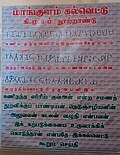
[[File:Tamil Inscriptions.jpg|thumb|upright=0.9|Explanation for [[Mangulam]] Tamil Brahmi inscription in Mangulam, [[Madurai district]], Tamil Nadu, dated to Tamil [[Sangam period]] ({{Circa|400 BCE|200 CE}})]] | |||
[[File:Satavahana Bilingual Coin.jpg|thumb|right|upright=0.9|[[Tamil-Brahmi|Tamil Brahmi]] script in the reverse side of the bilingual silver coin of king [[Vashishtiputra Sātakarni]] ({{Circa|160 CE}}) of [[Deccan Plateau|Deccan]]. '''Rev:''' Ujjain/Sātavāhana symbol, crescented six-arch chaitya hill and river with Tamil Brahmi script<ref>{{Citation|last=Nagaswamy |first=N |title=Roman Karur |publisher=Brahad Prakashan |year=1995 |oclc=191007985 |url=http://www.tamilartsacademy.com/books/roman%20karur/chapter04.html |url-status=dead |archive-url=https://web.archive.org/web/20110720024602/http://www.tamilartsacademy.com/books/roman%20karur/chapter04.html |archive-date=20 July 2011 }}</ref><ref>{{Harvnb|Mahadevan|2003|pp=199–205}}</ref><ref>{{Citation|last=Panneerselvam|first=R|year=1969|title=Further light on the bilingual coin of the Sātavāhanas|journal=Indo-Iranian Journal|volume=4|issue=11|pages=281–288|doi=10.1163/000000069790078428|doi-access=free}}</ref><ref>{{Citation|last=Yandel|first=Keith|title=Religion and Public Culture: Encounters and Identities in Modern South India |publisher=Routledge Curzon |year=2000 |page=235 |isbn=978-0-7007-1101-7}}</ref> '''Obv:''' Bust of king; [[Prakrit]] legend in the [[Brāhmī script|Brahmi]] script]] | |||
=== | |||
[[File:Tamil Inscriptions.jpg|thumb|upright=0.9|Explanation for [[Mangulam]] Tamil Brahmi inscription in Mangulam, [[Madurai district]], Tamil Nadu, dated to Tamil [[Sangam period]] ({{Circa|400 | |||
[[File:Satavahana Bilingual Coin.jpg|thumb|right|upright=0.9|[[Tamil-Brahmi|Tamil Brahmi]] script in the reverse side of the bilingual silver coin of king [[Vashishtiputra Sātakarni]] ({{Circa| | |||
According to Hindu legend, Tamil or in personification form [[Tamil Thai|Tamil Thāi]] (Mother Tamil) was created by Lord [[Shiva]]. [[Murugan]], revered as the Tamil God, along with sage [[Agastya]], brought it to the people.{{sfn|Ramaswamy|1997|p=87}} | According to Hindu legend, Tamil or in personification form [[Tamil Thai|Tamil Thāi]] (Mother Tamil) was created by Lord [[Shiva]]. [[Murugan]], revered as the Tamil God, along with sage [[Agastya]], brought it to the people.{{sfn|Ramaswamy|1997|p=87}} | ||
=== | ===Historical origins=== | ||
Tamil, like other Dravidian languages, ultimately descends from the [[Proto-Dravidian language]], which was most likely spoken around the third millennium BCE, possibly in the region around the lower [[Godavari]] river basin. The material evidence suggests that the speakers of Proto-Dravidian were of the culture associated with the [[Neolithic]] complexes of South India.<ref>{{Harvnb|Southworth|2005|pp=249–250}}</ref> | |||
Scholars categorise the attested history of the language into three periods: Old Tamil (300 BCE–700 CE), Middle Tamil (700–1600) and Modern Tamil (1600–present).<ref name="Lehmann 1998 75">{{Harvnb|Lehmann|1998|pp=75–76}}</ref> | |||
===Brahmi script=== | |||
About 60,000 of the approximately 100,000 inscriptions found by the [[Archaeological Survey of India]] in India are in Tamil Nadu. Of them, most are in Tamil, with only about 5 percent in other languages such as Telugu, Kannada, Sanskrit and Marathi.<ref>{{citation |title= Students get glimpse of heritage |url= http://www.hindu.com/2005/11/22/stories/2005112215970400.htm |archive-url= https://web.archive.org/web/20060518064346/http://www.hindu.com/2005/11/22/stories/2005112215970400.htm |url-status= dead |archive-date= 18 May 2006 |date = 22 November 2005|work= [[The Hindu]] |location=Chennai, India}}</ref> | |||
In 2004, a number of skeletons were found buried in earthenware [[urn]]s dating from at least 696 BCE in [[Adichanallur]]. Some of these urns contained writing in [[Tamil Brahmi]] script, and some contained skeletons of Tamil origin.<ref name=":2b">{{Cite journal|last=Christy|first=Agatha|date=2019|title=A Study About Archaeological Survey in Adichanallur|url=https://www.ijresm.com/Vol.2_2019/Vol2_Iss11_November19/IJRESM_V2_I11_33.pdf|journal=International Journal of Research in Engineering, Science and Management|volume=2|pages=158–169}}</ref> Between 2017 and 2018, 5,820 artifacts have been found in [[Keezhadi excavation site|Keezhadi]]. These were sent to Beta Analytic in [[Miami]], [[Florida]], for [[Accelerator Mass Spectrometry]] (AMS) dating. One sample containing [[Tamil-Brahmi]] inscriptions was claimed to be dated to around 580 BCE.<ref>{{cite web |title=KEELADI |url=https://www.tnarch.gov.in/keeladi|website=Government of Tamil Nadu Department of Archeology}}</ref><ref>{{cite web |last1=Gershon |first1=Livia |title=Archaeologists Unearth Ancient Dagger Linked to Enigmatic Indian Civilization |url=https://www.smithsonianmag.com/smart-news/excavation-india-may-hold-clues-ancient-civilization-180978414/|access-date=2022-01-29|website=Smithsonian Magazine}}</ref> | |||
[[John Guy (historian)|John Guy]] states that Tamil was the [[lingua franca]] for early maritime traders from India.<ref name="scroll.in">{{citation|url=http://scroll.in/article/704603/Step-aside,-Gujaratis:-Tamilians-were-India's-earliest-recorded-maritime-traders|title=Scroll.in – News. Politics. Culture.|date=6 February 2015 |publisher=scroll.in}}</ref> [[Tamil Brahmi|Tamil language inscriptions]] written in Brahmi script have been discovered in [[Sri Lanka]] and on trade goods in Thailand and Egypt.<ref name=Egypt /><ref name="Foreign locations">{{Citation |last=Mahadevan |first=Iravatham |title=An epigraphic perspective on the antiquity of Tamil |date=24 June 2010 |newspaper=The Hindu |url=http://www.thehindu.com/opinion/op-ed/an-epigraphic-perspective-on-the-antiquity-of-tamil/article482654.ece |location=Chennai, India }}</ref> In November 2007, an excavation at Quseir-al-Qadim (likely the classical-era port town [[Myos Hormos]]) revealed Egyptian pottery dating back to first century BCE with ancient Tamil Brahmi inscriptions.<ref name="Egypt">{{citation|title=Tamil Brahmi script in Egypt|url=http://www.thehindu.com/todays-paper/tamil-brahmi-script-in-egypt/article1952611.ece|access-date=5 January 2015|work=The Hindu|date=21 November 2007|archive-url=http://web.archive.org/web/20141126154601/http://www.thehindu.com/todays-paper/tamil-brahmi-script-in-egypt/article1952611.ece|archive-date=2014-11-26}}</ref> There are a number of apparent [[Tamil loanwords in Biblical Hebrew]] dating to before 500 BCE, the oldest attestation of the language.<ref name=Rabin438>Rabin, C. ''Proceedings of the Second International Conference Seminar of Tamil Studies'', p. 438</ref> | |||
=== Old Tamil === | === Old Tamil === | ||
{{Main|Old Tamil language}} | {{Main|Old Tamil language}} | ||
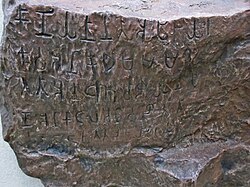
[[File:Mangulam inscription.jpg|thumb|upright=0.9|[[Mangulam]] [[Tamil-Brahmi|Tamil Brahmi]] inscription in Mangulam, [[Madurai district]], Tamil Nadu, dated to Tamil [[Sangam period]] ({{Circa|400 | [[File:Mangulam inscription.jpg|thumb|upright=0.9|[[Mangulam]] [[Tamil-Brahmi|Tamil Brahmi]] inscription in Mangulam, [[Madurai district]], Tamil Nadu, dated to Tamil [[Sangam period]] ({{Circa|400 BCE|200 CE}})|left]] | ||
Old Tamil is the period of the Tamil language spanning the 3rd century | |||
Old Tamil is the period of the Tamil language spanning the 3rd century BCE to the 8th century CE. The earliest records in Old Tamil are short inscriptions written in a variant of the [[Brahmi script]] called [[Tamil-Brahmi]].<ref>{{Harvnb|Mahadevan|2003|pp=90–95}}</ref> The earliest long text in Old Tamil is the ''[[Tolkāppiyam]]'', an early work on Tamil grammar and poetics, whose oldest layers could be as old as the late 2nd century BCE.<ref name="Lehmann 1998 75"/><ref name="Zvelebil 1973"/> Many literary works in Old Tamil have also survived. These include a corpus of 2,381 poems collectively known as [[Sangam literature]]. These poems are usually dated to between the 1st century BCE and 5th century CE.<ref name="Lehmann 1998 75"/><ref name="Zvelebil 1973"/> | |||
=== Middle Tamil === | === Middle Tamil === | ||
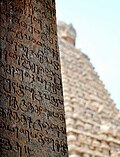
[[File:Tanjavur Tamil Inscription2.jpg|thumb|upright=0.9|[[Middle Tamil]] inscriptions in [[Vatteluttu|Vatteluttu script]] in stone during [[Chola empire|Chola]] period | [[File:Tanjavur Tamil Inscription2.jpg|thumb|upright=0.9|[[Middle Tamil]] inscriptions in [[Vatteluttu|Vatteluttu script]] in stone during [[Chola empire|Chola]] period {{circa|1000}} CE at [[Brahadeeswara temple]] in [[Thanjavur]], Tamil Nadu|left]] | ||
{{Main|Middle Tamil language}} | {{Main|Middle Tamil language}} | ||
The evolution of [[Old Tamil]] into [[Middle Tamil]], which is generally taken to have been completed by the 8th century,<ref name="Lehmann 1998 75"/> was characterised by a number of phonological and grammatical changes. In phonological terms, the most important shifts were the virtual disappearance of the aytam (ஃ), an old phoneme,<ref>{{Harvnb|Kuiper|1958|p=194}}</ref> the coalescence of the alveolar and dental nasals,<ref>{{Harvnb|Meenakshisundaran|1965|pp=132–133}}</ref> and the transformation of the alveolar [[plosive]] into a [[Rhotic consonant|rhotic]].<ref>{{Harvnb|Kuiper|1958|pp=213–215}}</ref> In grammar, the most important change was the emergence of the present tense. The present tense evolved out of the verb ''{{IAST|kil}}'' ({{lang|ta|கில்}}), meaning "to be possible" or "to befall". In Old Tamil, this verb was used as an [[Grammatical aspect|aspect marker]] to indicate that an action was micro-durative, non-sustained or non-lasting, usually in combination with a time marker such as ''{{IAST|ṉ}}'' ({{lang|ta|ன்}}). In Middle Tamil, this usage evolved into a present tense marker – ''{{IAST|kiṉṟa}}'' ({{lang|ta|கின்ற}}) – which combined the old aspect and time markers.<ref>{{Citation | doi = 10.2307/601707| jstor = 601707| title = The Duration of an Action-Real or Aspectual? The Evolution of the Present Tense in Tamil| journal = Journal of the American Oriental Society| volume = 105| issue = 2| pages = 277–291| year = 1985| last1 = Rajam | first1 = V. S.}} at pp. 284–285</ref> | The evolution of [[Old Tamil]] into [[Middle Tamil]], which is generally taken to have been completed by the 8th century,<ref name="Lehmann 1998 75"/> was characterised by a number of phonological and grammatical changes. In phonological terms, the most important shifts were the virtual disappearance of the aytam (ஃ), an old phoneme,<ref>{{Harvnb|Kuiper|1958|p=194}}</ref> the coalescence of the alveolar and dental nasals,<ref>{{Harvnb|Meenakshisundaran|1965|pp=132–133}}</ref> and the transformation of the alveolar [[plosive]] into a [[Rhotic consonant|rhotic]].<ref>{{Harvnb|Kuiper|1958|pp=213–215}}</ref> In grammar, the most important change was the emergence of the present tense. The present tense evolved out of the verb ''{{IAST|kil}}'' ({{lang|ta|கில்}}), meaning "to be possible" or "to befall". In Old Tamil, this verb was used as an [[Grammatical aspect|aspect marker]] to indicate that an action was micro-durative, non-sustained or non-lasting, usually in combination with a time marker such as ''{{IAST|ṉ}}'' ({{lang|ta|ன்}}). In Middle Tamil, this usage evolved into a present tense marker – ''{{IAST|kiṉṟa}}'' ({{lang|ta|கின்ற}}) – which combined the old aspect and time markers.<ref>{{Citation | doi = 10.2307/601707| jstor = 601707| title = The Duration of an Action-Real or Aspectual? The Evolution of the Present Tense in Tamil| journal = Journal of the American Oriental Society| volume = 105| issue = 2| pages = 277–291| year = 1985| last1 = Rajam | first1 = V. S.}} at pp. 284–285</ref> | ||
| Line 114: | Line 177: | ||
The [[Nannūl]] remains the standard normative grammar for modern literary Tamil, which therefore continues to be based on Middle Tamil of the 13th century rather than on Modern Tamil.<ref>{{Harvnb|Shapiro|Schiffman|1983|p=2}}</ref> Colloquial spoken Tamil, in contrast, shows a number of changes. The negative conjugation of verbs, for example, has fallen out of use in Modern Tamil<ref>{{Harvnb|Annamalai|Steever|1998|p=100}}</ref> – instead, negation is expressed either morphologically or syntactically.<ref>{{Harvnb|Steever|2005|pp=107–8}}</ref> Modern spoken Tamil also shows a number of sound changes, in particular, a tendency to lower high vowels in initial and medial positions,<ref>{{Harvnb|Meenakshisundaran|1965|p=125}}</ref> and the disappearance of vowels between plosives and between a plosive and rhotic.<ref>{{Harvnb|Meenakshisundaran|1965|pp=122–123}}</ref> | The [[Nannūl]] remains the standard normative grammar for modern literary Tamil, which therefore continues to be based on Middle Tamil of the 13th century rather than on Modern Tamil.<ref>{{Harvnb|Shapiro|Schiffman|1983|p=2}}</ref> Colloquial spoken Tamil, in contrast, shows a number of changes. The negative conjugation of verbs, for example, has fallen out of use in Modern Tamil<ref>{{Harvnb|Annamalai|Steever|1998|p=100}}</ref> – instead, negation is expressed either morphologically or syntactically.<ref>{{Harvnb|Steever|2005|pp=107–8}}</ref> Modern spoken Tamil also shows a number of sound changes, in particular, a tendency to lower high vowels in initial and medial positions,<ref>{{Harvnb|Meenakshisundaran|1965|p=125}}</ref> and the disappearance of vowels between plosives and between a plosive and rhotic.<ref>{{Harvnb|Meenakshisundaran|1965|pp=122–123}}</ref> | ||
Contact with European languages affected written and spoken Tamil. Changes in written Tamil include the use of European-style punctuation and the use of consonant clusters that were not permitted in Middle Tamil. The syntax of written Tamil has also changed, with the introduction of new aspectual auxiliaries and more complex sentence structures, and with the emergence of a more rigid word order that resembles the [[Theta role|syntactic argument structure]] of English.<ref>{{Citation | doi = 10.1515/ijsl.1978.16.59| title = Standard Language and Socio-Historical Parameters: Standard Lankan Tamil| journal = International Journal of the Sociology of Language | Contact with European languages affected written and spoken Tamil. Changes in written Tamil include the use of European-style punctuation and the use of consonant clusters that were not permitted in Middle Tamil. The syntax of written Tamil has also changed, with the introduction of new aspectual auxiliaries and more complex sentence structures, and with the emergence of a more rigid word order that resembles the [[Theta role|syntactic argument structure]] of English.<ref>{{Citation | doi = 10.1515/ijsl.1978.16.59| title = Standard Language and Socio-Historical Parameters: Standard Lankan Tamil| journal = International Journal of the Sociology of Language| issue = 16| year = 1978| last1 = Kandiah | first1 = T. | s2cid = 143499414}} at pp. 65–69</ref> | ||
In 1578, Portuguese Christian missionaries published a Tamil prayer book in old Tamil script named ''[[Thambiran Vanakkam]]'', thus making Tamil the first Indian language to be printed and published.<ref>{{Citation|url=http://www.thehindu.com/news/national/tamil-nadu/tamil-saw-its-first-book-in-1578/article476102.ece|title=Tamil saw its first book in 1578|author=Karthik Madhavan|newspaper=The Hindu|date=2010-06-20}}</ref> The ''[[Tamil Lexicon]]'', published by the [[University of Madras]], was one of the earliest dictionaries published in Indian languages.<ref>{{citation|last = Kolappan |first = B. |title = Delay, howlers in Tamil Lexicon embarrass scholars |newspaper = The Hindu| location = Chennai| date = 22 June 2014| url = http://www.thehindu.com/news/national/tamil-nadu/delay-howlers-in-tamil-lexicon-embarrass-scholars/article6138747.ece |access-date = 25 December 2014}}</ref> | |||
A strong strain of [[linguistic purism]] emerged in the early 20th century, culminating in the [[Pure Tamil Movement]] which called for removal of all Sanskritic elements from Tamil.<ref name="thaniththamizh">{{Harvnb|Ramaswamy|1997}}</ref> It received some support from [[Dravidian parties]].<ref>{{Harvnb|Ramaswamy|1997}}: "Dravidianism, too, lent its support to the contestatory classicist project, motivated principally by the political imperative of countering (Sanskritic) Indian nationalism... It was not until the DMK came to power in 1967 that such demands were fulfilled, and the pure Tamil cause received a boost, although purification efforts are not particularly high on the agenda of either the Dravidian movement or the Dravidianist idiom of tamiḻppaṟṟu."</ref> This led to the replacement of a significant number of [[Sanskrit]] loanwords by Tamil equivalents, though many others remain.<ref name="Krishnamurti 2003 p=480">{{Harvnb|Krishnamurti|2003|p=480}}</ref> | |||
According to a 2001 survey, there were 1,863 newspapers published in Tamil, of which 353 were dailies.<ref>''India 2001: A Reference Annual 2001''. Compiled and edited by Research, Reference and Training Division, Publications Division, New Delhi: Government of India, Ministry of Information and Broadcasting.</ref> | |||
== Geographic distribution == | == Geographic distribution == | ||
Tamil is the primary language of the majority of the people residing in [[Tamil Nadu]], [[Puducherry (union territory)|Puducherry]], (in India) and in the [[Northern Province, Sri Lanka|Northern]] and [[Eastern Province, Sri Lanka|Eastern]] provinces of [[Sri Lanka]]. The language is spoken among small minority groups in other states of India which include [[Karnataka]], [[Telangana]], [[Andhra Pradesh]], [[Kerala]], [[Maharashtra]], [[Gujarat]], [[Delhi]], [[Andaman and Nicobar Islands]] in India and in certain regions of Sri Lanka such as [[Colombo]] and [[Central Province, Sri Lanka|the hill country]]. Tamil or dialects of it were used widely in the state of Kerala as the major language of administration, literature and common usage until the 12th century | Tamil is the primary language of the majority of the people residing in [[Tamil Nadu]], [[Puducherry (union territory)|Puducherry]], (in India) and in the [[Northern Province, Sri Lanka|Northern]] and [[Eastern Province, Sri Lanka|Eastern]] provinces of [[Sri Lanka]]. The language is spoken among small minority groups in other states of India which include [[Karnataka]], [[Telangana]], [[Andhra Pradesh]], [[Kerala]], [[Maharashtra]], [[Gujarat]], [[Delhi]], [[Andaman and Nicobar Islands]] in India and in certain regions of Sri Lanka such as [[Colombo]] and [[Central Province, Sri Lanka|the hill country]]. Tamil or dialects of it were used widely in the state of Kerala as the major language of administration, literature and common usage until the 12th century CE. Tamil was also used widely in inscriptions found in southern [[Andhra Pradesh]] districts of [[Chittoor district|Chittoor]] and [[Nellore district|Nellore]] until the 12th century CE.<ref name="Talbot 2001 27–37">{{Harvnb|Talbot|2001|pp=27–37}}</ref> Tamil was used for inscriptions from the 10th through 14th centuries in southern Karnataka districts such as [[Kolar District|Kolar]], [[Mysore]], [[Mandya]] and [[Bengaluru]].<ref>{{Harvnb|Murthy|Rao|Veluthat|Bari|1990|pp=85–106}}</ref> | ||
There are currently sizeable [[Tamil diaspora|Tamil-speaking populations]] descended from colonial-era migrants in [[Malaysia]], [[Singapore]], [[Philippines]], [[Mauritius]], [[Tamil South Africans|South Africa]], Indonesia,<ref>{{Harvnb|Ramstedt|2004|p= 243}}</ref> Thailand,<ref>{{Harvnb|Kesavapany|Mani|Ramasamy|2008|p= 60}}</ref> [[Burma]], and [[Vietnam]]. Tamil is used as one of the languages of education in [[Malaysia]], along with English, Malay and Mandarin.<ref name="Tamil Schools">[http://www.indianmalaysian.com/education.htm Tamil Schools]. Indianmalaysian.com. Retrieved 28 July 2013.</ref><ref>Ghazali, Kamila (2010). [https://www.un.org/en/chronicle/article/national-identity-and-minority-languages UN Chronicle – National Identity and Minority Languages]. United Nations, accessed 28 Jan 2021.</ref> A large community of [[Tamils in Pakistan|Pakistani Tamils]] speakers exists in [[Karachi]], [[Pakistan]], which includes Tamil-speaking Hindus<ref name="TNP">{{Citation | There are currently sizeable [[Tamil diaspora|Tamil-speaking populations]] descended from colonial-era migrants in [[Malaysia]], [[Singapore]], [[Philippines]], [[Mauritius]], [[Tamil South Africans|South Africa]], Indonesia,<ref>{{Harvnb|Ramstedt|2004|p= 243}}</ref> Thailand,<ref>{{Harvnb|Kesavapany|Mani|Ramasamy|2008|p= 60}}</ref> [[Burma]], [[Brunei]], and [[Vietnam]]. Tamil is used as one of the languages of education in [[Malaysia]], along with English, Malay and Mandarin.<ref name="Tamil Schools">[http://www.indianmalaysian.com/education.htm Tamil Schools]. Indianmalaysian.com. Retrieved 28 July 2013.</ref><ref>Ghazali, Kamila (2010). [https://www.un.org/en/chronicle/article/national-identity-and-minority-languages UN Chronicle – National Identity and Minority Languages]. United Nations, accessed 28 Jan 2021.</ref> A large community of [[Tamils in Pakistan|Pakistani Tamils]] speakers exists in [[Karachi]], [[Pakistan]], which includes Tamil-speaking Hindus<ref name="TNP">{{Citation | ||
|url=http://www.thenews.com.pk/Todays-News-4-98530-Strangers-to-their-roots-and-those-around-them | |url=http://www.thenews.com.pk/Todays-News-4-98530-Strangers-to-their-roots-and-those-around-them | ||
|title=Strangers to Their Roots and Those Around Them | |title=Strangers to Their Roots and Those Around Them | ||
| Line 128: | Line 197: | ||
|archive-url=https://web.archive.org/web/20130617043012/http://www.thenews.com.pk/Todays-News-4-98530-Strangers-to-their-roots-and-those-around-them | |archive-url=https://web.archive.org/web/20130617043012/http://www.thenews.com.pk/Todays-News-4-98530-Strangers-to-their-roots-and-those-around-them | ||
|archive-date=17 June 2013 | |archive-date=17 June 2013 | ||
}}</ref><ref name="PHP">Sunny, Sanjesh (21 September 2010) [ | }}</ref><ref name="PHP">Sunny, Sanjesh (21 September 2010) [https://pakistanhindupost.blogspot.com/2010/09/picture-of-tamil-hindus-in-karachi.html Tamil Hindus in Karachi]. ''Pakistan Hindu Post''</ref> as well as Christians and Muslims – including some Tamil-speaking Muslim refugees from Sri Lanka.<ref name="HBL">Raman, B. (15 July 2002) [http://www.thehindubusinessline.com/2002/07/15/stories/2002071500050800.htm Osama's shadow on Sri Lanka?]. ''The Hindu Business Line''</ref> There are about 100 Tamil Hindu families in [[Madrasi Para]] colony in Karachi. They speak impeccable Tamil along with Urdu, Punjabi and Sindhi.<ref>{{Cite news |last=Paul |first=Sumit |date=2018-11-03 |title=For Tamil cuisine, away in Pakistan |url=https://www.thehindu.com/opinion/open-page/for-tamil-cuisine-away-in-pakistan/article25414464.ece |access-date=12 July 2019 |work=The Hindu |language=en-IN |issn=0971-751X}}</ref> Many in [[Réunion]], [[Guyana]], [[Fiji]], [[Suriname]], and [[Trinidad and Tobago]] have Tamil origins,<ref name="ucberkeleydiaspora">{{Citation|url=http://www.lib.berkeley.edu/SSEAL/SouthAsia/overview.html |title=Overview of the South Asian Diaspora |access-date=23 April 2008 |last=McMahon |first=Suzanne |publisher=University of California, Berkeley |archive-url=http://web.archive.org/web/20110327123838/http://www.lib.berkeley.edu/SSEAL/SouthAsia/overview.html|archive-date=2011-03-27}}</ref> but only a small number speak the language. In Reunion where the Tamil language was forbidden to be learnt and used in public space by [[France]] it is now being relearnt by students and adults.<ref name="ucberkeleydiaspora1">{{Citation|url= http://www.lib.berkeley.edu/SSEAL/SouthAsia/tamil.html |title= Indentured immigration and social accommodation in La Réunion |access-date=8 January 2010 |last= Ghasarian |first=Christian |publisher=University of California, Berkeley |archive-url=http://web.archive.org/web/20110511142452/http://www.lib.berkeley.edu/SSEAL/SouthAsia/tamil.html|archive-date=2011-05-11}}</ref> Tamil is also spoken by migrants [[Sri Lankan Tamil diaspora|from Sri Lanka]] and India in [[Tamil Canadians|Canada]], the [[Tamil Americans|United States]], the [[United Arab Emirates]], the [[British Tamils|United Kingdom]], [[Tamil South Africans|South Africa]], and [[Tamil Australians|Australia]]. | ||
== | == Status == | ||
{{see also|States of India by Tamil speakers | {{see also|States of India by Tamil speakers}} | ||
In addition, with the creation in October 2004 of a legal status for classical languages by the [[Government of India]] and following a political campaign supported by several Tamil associations,<ref name="dmkpolitics2">{{citation | url= http://www.telegraphindia.com/1040928/asp/frontpage/story_3813391.asp | archive-url= https://archive.today/20130203214540/http://www.telegraphindia.com/1040928/asp/frontpage/story_3813391.asp | === Official status === | ||
Tamil is the [[official language]] of the Indian state of Tamil Nadu and one of the [[Languages with official status in India|22 languages under schedule 8 of the constitution of India]].<ref name="Eight">{{cite web|title=Eighth Schedule|url=https://www.mea.gov.in/Images/pdf1/S8.pdf|publisher=[[Government of India]]|access-date=5 December 2023}}</ref> It is one of the official languages of the union territories of [[Puducherry (union territory)|Puducherry]] and the [[Andaman and Nicobar Islands]].<ref>{{citation | last = Ramamoorthy | first = L | publisher = Language in India | url = http://www.languageinindia.com/feb2004/multilingual.html | date = February 2004 | title = Multilingualism and Second Language Acquisition and Learning in Pondicherry | access-date =16 August 2007}}</ref><ref>{{citation | last = Sunwani | first = Vijay K | publisher = Language in India | url = http://www.languageinindia.com/feb2007/northeasternstates.pdf | date = February 2007 | title = Amazing Andamans and North-East India: A Panoramic View of States, Societies and Cultures | access-date =16 August 2007}}</ref> Tamil is also one of the official languages of [[Singapore]]. Tamil is one of the official and national languages of Sri Lanka, along with [[Sinhala language|Sinhala]].<ref name="languagesdept">{{citation|url=http://www.languagesdept.gov.lk/|title=Department of Official Languages|publisher=Government of Sri Lanka|access-date=13 September 2012|archive-date=6 January 2019|archive-url=https://web.archive.org/web/20190106094214/http://www.languagesdept.gov.lk/%20|url-status=dead}}</ref> It was once given nominal official status in the Indian state of [[Haryana]], purportedly as a rebuff to [[Punjab (India)|Punjab]], though there was no attested Tamil-speaking population in the state, and was later replaced by [[Punjabi language|Punjabi]], in 2010.<ref>Bharadwaj, Ajay (7 March 2010) [http://www.dnaindia.com/india/1356124/report-punjabi-edges-out-tamil-in-haryana Punjabi edges out Tamil in Haryana]. DNA India</ref> | |||
In addition, with the creation in October 2004 of a legal status for classical languages by the [[Government of India]] and following a political campaign supported by several Tamil associations,<ref name="dmkpolitics2">{{citation |last=Dutta |first=Sujan |title=Classic case of politics of language |date=28 September 2004 |work=The Telegraph |url=http://www.telegraphindia.com/1040928/asp/frontpage/story_3813391.asp |access-date=20 April 2007 |archive-url=https://archive.today/20130203214540/http://www.telegraphindia.com/1040928/asp/frontpage/story_3813391.asp |archive-date=3 February 2013 |url-status=dead |place=[[Kolkata]], India |quote=Members of the committee felt that the pressure was being brought on it because of the compulsions of the Congress and the UPA government to appease its ally, M. Karunanidhi's DMK.}}</ref><ref name="historyofdemand">{{Citation |last=Viswanathan |first=S. |title=Recognising a classic |date=October 2004 |work=The Hindu |url=https://frontline.thehindu.com/static/html/fl2122/stories/20041105004310600.htm |archive-url=https://web.archive.org/web/20070926212522/http://www.hinduonnet.com/fline/fl2122/stories/20041105004310600.htm |archive-date=26 September 2007}}</ref> Tamil became the first legally recognised [[Languages of India#Classical languages of India|Classical language]] of India. The recognition was announced by the contemporaneous [[President of India]], [[Abdul Kalam]], who was a Tamil himself, in a joint sitting of both houses of the [[Parliament of India|Indian Parliament]] on 6 June 2004.<ref name="LanguageInIndia">{{Citation |last=Thirumalai |first=MS |title=Tradition, Modernity and Impact of Globalization – Whither Will Tamil Go? |date=November 2004 |journal=Language in India |volume=4 |url=http://www.languageinindia.com/nov2004/tamilglobalization1.html |access-date=17 November 2007}}</ref><ref name="BBC Classical language">{{Cite news |date=2004-09-17 |title=India sets up classical languages |url=https://news.bbc.co.uk/1/hi/world/south_asia/3667032.stm |language=en-GB}}</ref><ref name="The Hindu Classical language">[https://web.archive.org/web/20051030050314/http://www.hindu.com/2005/10/28/stories/2005102809281200.htm "Sanskrit to be declared classical language"]. ''The Hindu''. 28 October 2005.</ref> | |||
=== Education === | |||
In Malaysia, 543 primary education government schools are available fully in [[Tamil primary schools in Malaysia|Tamil as the medium of instruction]].<ref>{{citation|url=http://ccat.sas.upenn.edu/~haroldfs/540/handouts/sparadox/sparadox.html |title=Language Shift in the Tamil Communities of Malaysia and Singapore: the Paradox of Egalitarian Language Policy |publisher=Ccat.sas.upenn.edu |access-date=13 September 2012}}</ref> The establishment of Tamil-medium schools has been in process in [[Myanmar]] to provide education completely in Tamil language by the Tamils who settled there 200 years ago.<ref name="bbc.com">{{Cite news |date=2014-03-06 |title=Myanmar's Tamils seek to protect their identity |url=https://www.bbc.com/news/world-asia-25438275 |work=BBC News |language=en-GB}}</ref> Tamil language is available as a course in some local school boards and major universities in [[Canada]] and the month of January has been declared "Tamil Heritage Month" by the [[Parliament of Canada]].<ref>{{citation|url=http://www.pm.gc.ca/eng/news/2017/01/14/statement-prime-minister-canada-thai-pongal|title=Statement by the Prime Minister of Canada on Thai Pongal|date=13 January 2017}}</ref><ref>{{citation|url=http://www.thenewsminute.com/article/canada-officially-declares-pride-its-tamils-passes-bill-calling-tamil-heritage-month-51059|title=Canada officially declares pride in its Tamils, passes Bill calling for Tamil Heritage Month|date=8 October 2016|work=The News Minute|access-date=6 August 2017}}</ref> Tamil enjoys a special status of protection under Article 6(b), Chapter 1 of the [[Constitution of South Africa]] and is taught as a subject in schools in [[KwaZulu-Natal]] province.<ref>{{citation|url=http://www.constitutionalcourt.org.za/site/constitution/english-web/ch1.html|title=Constitutional Court of South Africa – The Constitution|website=www.constitutionalcourt.org.za|access-date=5 August 2017|archive-url=http://web.archive.org/web/20060518064102/http://www.constitutionalcourt.org.za/site/constitution/english-web/ch1.html|archive-date=2006-05-18}}</ref><ref>{{citation|url=http://www.jagranjosh.com/current-affairs/five-indian-languages-reinstated-as-official-subjects-in-south-african-schools-1395392591-1|title=Five Indian languages reinstated as official subjects in South African schools|date=21 March 2014|work=Jagranjosh.com|access-date=6 August 2017}}</ref> Recently, it has been rolled out as a subject of study in schools in the [[Overseas France|French overseas department]] of [[Réunion]].<ref>{{citation|url=http://www.thehindu.com/news/national/For-these-islanders-a-reunion-with-Tamil/article17009446.ece|title=For these islanders, a reunion with Tamil|work=The Hindu|date=8 January 2017|access-date=6 August 2017|last1=Srivatsa|first1=Sharath S.}}</ref> | |||
=== Mass media === | |||
{{See also|Tamil cinema}} | |||
Tamil-language paper media such as [[newspaper]]s are very common, with a 2001 survey claiming there were 1,863 newspapers published in Tamil (including 353 dailies). Tamil-language digital media is also abundant, with films being especially common.<ref name=":0">{{Cite book |title=Linguistic Survey of India Tamil Nadu |publisher=Language Division Office of the Registrar General, India |pages=48–66 |language=en}}</ref> | |||
== Dialects == | == Dialects == | ||
[[File:Jambai Tamil Brahmi.jpg|thumb|upright=1.81|[[Athiyamān Nedumān Añci|Jambai Tamil Brahmi inscription]] near [[Tirukkoyilur]] in [[Villupuram district]], Tamil Nadu dated to the early [[Tamil Sangam]] age ( | [[File:Jambai Tamil Brahmi.jpg|thumb|upright=1.81|[[Athiyamān Nedumān Añci|Jambai Tamil Brahmi inscription]] near [[Tirukkoyilur]] in [[Villupuram district]], Tamil Nadu dated to the early [[Tamil Sangam]] age ({{Circa|400 BC}})]] | ||
{{Listen | {{Listen | ||
| type = speech | | type = speech | ||
| Line 148: | Line 226: | ||
| description2 = Audio recording of [[Pudumaipithan]]'s short story 'Pon Nagaram' (showing a few loanwords). | | description2 = Audio recording of [[Pudumaipithan]]'s short story 'Pon Nagaram' (showing a few loanwords). | ||
}} | }} | ||
=== Region-specific variations === | === Region-specific variations === | ||
{{see also|Sri Lankan Tamil dialects|Indian Tamil dialect of Sri Lanka}} | {{see also|Sri Lankan Tamil dialects|Indian Tamil dialect of Sri Lanka}} | ||
The [[Socio-linguistics|socio-linguistic]] situation of Tamil is characterised by [[diglossia]]: there are two separate registers varying by [[socioeconomic status]], a high register and a low one.<ref>Arokianathan, S. [http://www.ciil-ebooks.net/html/piil/acharya2.html Writing and Diglossic: A Case Study of Tamil Radio Plays] {{webarchive|url=https://web.archive.org/web/20070928092717/https://www.ciil-ebooks.net/html/piil/acharya2.html |date=28 September 2007 }}. ciil-ebooks.net</ref><ref>{{Citation | doi = 10.2307/414796| jstor = 414796| title = Diglossia: A Study of the Theory, with Application to Tamil| journal = Language| volume = 64| issue = 1| pages = 152–155| year = 1988| last1 = Steever | first1 = S. B. | last2 = Britto | first2 = F. }}</ref> Tamil dialects are primarily differentiated from each other by the fact that they have undergone different phonological changes and sound shifts in evolving from Old Tamil. For example, the word for "here"—''{{IAST|iṅku}}'' in ''Centamil'' (the classic variety)—has evolved into ''{{IAST |iṅkū}}'' in the Kongu dialect of [[Coimbatore]], ''inga'' in the dialects of [[Thanjavur]] and [[Palakkad]], and ''{{IAST |iṅkai}}'' in some [[Sri Lankan Tamil dialects|dialects of Sri Lanka]]. Old Tamil's ''{{IAST|iṅkaṇ}}'' (where ''{{IAST|kaṇ}}'' means place) is the source of ''{{IAST |iṅkane}}'' in the dialect of [[Tirunelveli]], Old Tamil ''{{IAST |iṅkiṭṭu}}'' is the source of ''{{IAST |iṅkuṭṭu}}'' in the dialect of [[Madurai]], | The [[Socio-linguistics|socio-linguistic]] situation of Tamil is characterised by [[diglossia]]: there are two separate registers varying by [[socioeconomic status]], a high register and a low one.<ref>Arokianathan, S. [http://www.ciil-ebooks.net/html/piil/acharya2.html Writing and Diglossic: A Case Study of Tamil Radio Plays] {{webarchive|url=https://web.archive.org/web/20070928092717/https://www.ciil-ebooks.net/html/piil/acharya2.html |date=28 September 2007 }}. ciil-ebooks.net</ref><ref>{{Citation | doi = 10.2307/414796| jstor = 414796| title = Diglossia: A Study of the Theory, with Application to Tamil| journal = Language| volume = 64| issue = 1| pages = 152–155| year = 1988| last1 = Steever | first1 = S. B. | last2 = Britto | first2 = F. }}</ref> Tamil dialects are primarily differentiated from each other by the fact that they have undergone different phonological changes and sound shifts in evolving from Old Tamil. For example, the word for "here"—''{{IAST|iṅku}}'' in ''Centamil'' (the classic variety)—has evolved into ''{{IAST |iṅkū}}'' in the Kongu dialect of [[Coimbatore]], ''inga'' in the dialects of [[Thanjavur]] and [[Palakkad]], and ''{{IAST |iṅkai}}'' in some [[Sri Lankan Tamil dialects|dialects of Sri Lanka]]. Old Tamil's ''{{IAST|iṅkaṇ}}'' (where ''{{IAST|kaṇ}}'' means place) is the source of ''{{IAST |iṅkane}}'' in the dialect of [[Tirunelveli]], Old Tamil ''{{IAST |iṅkiṭṭu}}'' is the source of ''{{IAST |iṅkuṭṭu}}'' in the dialect of [[Madurai]], and ''{{IAST |iṅkaṭe}}'' in some northern dialects. Even now, in the Coimbatore area, it is common to hear "{{IAST|akkaṭṭa}}" meaning "that place". Although Tamil dialects do not differ significantly in their vocabulary, there are a few exceptions. The dialects spoken in Sri Lanka retain many words and grammatical forms that are not in everyday use in India,<ref name="Lehmann 1998 75"/><ref name=as>{{Harvnb|Annamalai|Steever|1998|pp=100–28}}</ref> and use many other words slightly differently.<ref>{{Citation | doi = 10.1163/000000066790086440| title = Some features of Ceylon Tamil| journal = Indo-Iranian Journal| volume = 9| issue = 2| page = 113| year = 1966| last1 = Zvelebil | first1 = K. }}</ref> Tamil dialects include [[Central Tamil dialect]], [[Kongu Tamil]], [[Madras Bashai]], [[Madurai Tamil]], [[Nellai Tamil]], Kumari Tamil in India; [[Batticaloa Tamil dialect]], [[Jaffna Tamil dialect]], [[Negombo Tamil dialect]] in Sri Lanka; and [[Malaysian Tamil]] in Malaysia. | ||
==== Loanword variations ==== | ==== Loanword variations ==== | ||
{{See also|Indo-Aryan loanwords in Tamil|Loan words in Sri Lankan Tamil}} | {{See also|Indo-Aryan loanwords in Tamil|Loan words in Sri Lankan Tamil}} | ||
The dialect of the district of [[Palakkad]] in Kerala has many [[ | The dialect of the district of [[Palakkad]] in Kerala has many [[Malayalam]] loanwords, has been influenced by Malayalam's syntax, and has a distinctive Malayalam accent. Similarly, Tamil spoken in Kanyakumari District has more unique words and phonetic style than Tamil spoken at other parts of Tamil Nadu. The words and phonetics are so different that a person from [[Kanyakumari district]] is easily identifiable by their spoken Tamil. [[Hebbar Iyengars|Hebbar]] and [[Mandyam]] dialects, spoken by groups of Tamil [[Vaishnavism|Vaishnavites]] who migrated to [[Karnataka]] in the 11th century, retain many features of the ''Vaishnava paribasai'', a special form of Tamil developed in the 9th and 10th centuries that reflect Vaishnavite religious and spiritual values.<ref>Thiru. Mu (1978). Kovintācāriyar, ''{{IAST|Vāḻaiyaṭi vāḻai}}'' Lifco, Madras, pp. 26–39.</ref> Several [[caste]]s have their own [[sociolect]]s which most members of that caste traditionally used regardless of where they come from. It is often possible to identify a person's caste by their speech.<ref name="EB 2007">Krishnamurti, Bhadriraju (2013) [http://global.britannica.com/EBchecked/topic/581953/Tamil-language "Tamil dialects"] in ''Tamil language''. Encyclopædia Britannica Online</ref> For example, [[Tamil Brahmin]]s tend to speak a variety of dialects that are all collectively known as [[Brahmin Tamil]]. These dialects tend to have softer consonants (with consonant deletion also common). These dialects also tend to have many [[Sanskrit]] loanwords. Tamil in Sri Lanka incorporates [[Loan words in Sri Lankan Tamil|loan words]] from [[Portuguese language|Portuguese]], [[Dutch Language|Dutch]], and English. | ||
== Spoken and literary variants == | == Spoken and literary variants == | ||
| Line 179: | Line 258: | ||
In addition to its dialects, Tamil exhibits different forms: a classical literary style modelled on the ancient language (''{{IAST|sankattamiḻ}}''), a modern literary and formal style (''{{IAST|centamiḻ}}''), and a modern [[colloquial]] form (''{{IAST|koṭuntamiḻ}}''). These styles shade into each other, forming a stylistic continuum. For example, it is possible to write ''{{IAST|centamiḻ}}'' with a vocabulary drawn from ''{{IAST|caṅkattamiḻ}}'', or to use forms associated with one of the other variants while speaking ''{{IAST|koṭuntamiḻ}}''.<ref>Schiffman, Harold (1997). "[http://ccat.sas.upenn.edu/~haroldfs/messeas/diglossia/handbuk.html Diglossia as a Sociolinguistic Situation]", in Florian Coulmas (ed.), ''The Handbook of Sociolinguistics''. London: Basil Blackwell, Ltd. pp. 205 ff.</ref> | In addition to its dialects, Tamil exhibits different forms: a classical literary style modelled on the ancient language (''{{IAST|sankattamiḻ}}''), a modern literary and formal style (''{{IAST|centamiḻ}}''), and a modern [[colloquial]] form (''{{IAST|koṭuntamiḻ}}''). These styles shade into each other, forming a stylistic continuum. For example, it is possible to write ''{{IAST|centamiḻ}}'' with a vocabulary drawn from ''{{IAST|caṅkattamiḻ}}'', or to use forms associated with one of the other variants while speaking ''{{IAST|koṭuntamiḻ}}''.<ref>Schiffman, Harold (1997). "[http://ccat.sas.upenn.edu/~haroldfs/messeas/diglossia/handbuk.html Diglossia as a Sociolinguistic Situation]", in Florian Coulmas (ed.), ''The Handbook of Sociolinguistics''. London: Basil Blackwell, Ltd. pp. 205 ff.</ref> | ||
In modern times, ''{{IAST|centamiḻ}}'' is generally used in formal writing and speech. For instance, it is the language of textbooks, of much of [[Tamil literature]] and of public speaking and debate. In recent times, however, ''{{IAST|koṭuntamiḻ}}'' has been making inroads into areas that have traditionally been considered the province of ''{{IAST|centamiḻ}}''. Most contemporary cinema, theatre and popular entertainment on television and radio, for example, is in ''{{IAST|koṭuntamiḻ}}'', and many politicians use it to bring themselves closer to their audience. The increasing use of ''{{IAST|koṭuntamiḻ}}'' in modern times has led to the emergence of unofficial | In modern times, ''{{IAST|centamiḻ}}'' is generally used in formal writing and speech. For instance, it is the language of textbooks, of much of [[Tamil literature]] and of public speaking and debate. Modern written Tamil also has a conservative appearance, and it is possible to read eight-century Tamil inscriptions with it.<ref>Tienken, Herman, Metaphony, or height harmony, in written Tamil and Malayalam pp. 53-66 https://hermantieken.com/wp-content/uploads/2013/02/doc.pdf</ref> In recent times, however, ''{{IAST|koṭuntamiḻ}}'' has been making inroads into areas that have traditionally been considered the province of ''{{IAST|centamiḻ}}''. Most contemporary cinema, theatre and popular entertainment on television and radio, for example, is in ''{{IAST|koṭuntamiḻ}}'', and many politicians use it to bring themselves closer to their audience. The increasing use of ''{{IAST|koṭuntamiḻ}}'' in modern times has led to the emergence of unofficial 'standard' spoken dialects. In India, the 'standard' ''{{IAST|koṭuntamiḻ}}'', rather than on any one dialect,<ref name="Standard restandard">{{Citation | last1 = Schiffman | first1 = Harold | year = 1998 | title = Standardization or restandardization: The case for 'Standard' Spoken Tamil | url =http://ccat.sas.upenn.edu/~haroldfs/public/stantam/STANTAM.HTM | journal = Language in Society | volume = 27 | issue = 3| pages = 359–385 |doi=10.1017/S0047404598003030 | postscript = .| url-access = subscription }}</ref>{{clarify|date=May 2022}} but has been significantly influenced by the dialects of [[Thanjavur]] and [[Madurai]]. Spoken Tamil in India is often mixed with English to create the hybrid language [[Tanglish]], which has been growing in popularity, especially in cities. In Sri Lanka, the standard is based on the dialect of [[Jaffna]]. | ||
=== Lexical differences === | |||
There are some words that are only used in Literary Tamil such as: ''annai'' (mother), ''ali'' (offer), ''iyalum'' (possible), ''illam'' (house), and ''karpi'' (teach).<ref name=":0" /> | |||
There are also some words only used in Colloquial Tamil, such as: ''Le:cu'' (easy), ''rompa'' (much), ''vantava:''lam ''(unpleasant facts)'', ''tatave'' (times/occasion).<ref name=":0" /> | |||
=== Comparative text === | |||
{| class="wikitable" | |||
!Literary Tamil<ref name=":0" /> | |||
!Colloquial Tamil | |||
!English | |||
|- | |||
|''atu avaratu panam.'' | |||
''na:n pe:na:vai avanitam kotutten.'' | |||
|''atu avaro:da panam.'' | |||
''na: pe:na:va avankitte kututtæn.'' | |||
|It is his money. | |||
I gave the pen to him. | |||
|} | |||
== Writing system == | == Writing system == | ||
<!--- | <!--- | ||
NOTE: | NOTE: | ||
| Line 191: | Line 288: | ||
[[File:History of Tamil script.jpg|thumb|upright=1.81|Historical evolution of Tamil writing from the earlier [[Tamil Brahmi]] near the top to the current [[Tamil script]] at bottom]] | [[File:History of Tamil script.jpg|thumb|upright=1.81|Historical evolution of Tamil writing from the earlier [[Tamil Brahmi]] near the top to the current [[Tamil script]] at bottom]] | ||
[[File:Tirukkural manuscript.jpg|thumb|upright=1.81|''[[Tirukkural|Tirukkuṟaḷ]]'' [[palm leaf manuscript]]]] | [[File:Tirukkural manuscript.jpg|thumb|upright=1.81|''[[Tirukkural|Tirukkuṟaḷ]]'' [[palm leaf manuscript]]]] | ||
After [[Tamil Brahmi]] fell out of use, Tamil was written using a script called [[Vatteluttu alphabet|{{IAST|vaṭṭeḻuttu}}]] amongst others such as [[Grantha script|Grantha]] and [[Pallava script|Pallava]]. The current Tamil script consists of 12 [[vowel]]s, 18 [[consonant]]s and one special character, the ''[[āytam]]''. The vowels and consonants combine to form 216 compound characters, giving a total of 247 characters (12 + 18 + 1 + (12 × 18)). All consonants have an inherent vowel ''a'', as with other [[Indic scripts]]. This inherent vowel is removed by adding a [[tittle]] called a ''{{IAST|puḷḷi}}'', to the consonantal sign<!--, whereas no such distinction is there in other Indic scipts-->. For example, {{lang|ta|ன}} is ''ṉa'' (with the inherent ''a'') and {{lang|ta|ன்}} is ''ṉ'' (without a vowel). Many Indic scripts have a similar sign, generically called [[virama]], but the Tamil script is somewhat different in that it nearly always uses a visible ''puḷḷi'' to indicate a 'dead consonant' (a consonant without a vowel). In other Indic scripts, it is generally preferred to use a ligature or a half form to write a syllable or a cluster containing a dead consonant, although writing it with a visible virama is also possible. The Tamil script does not differentiate voiced and unvoiced [[plosive]]s. Instead, plosives are articulated with voice depending on their position in a word, in accordance with the rules of [[Tamil phonology]]. | After [[Tamil Brahmi]] fell out of use, Tamil was written using a script called [[Vatteluttu alphabet|{{IAST|vaṭṭeḻuttu}}]] amongst others such as [[Grantha script|Grantha]] and [[Pallava script|Pallava]]. The current [[Tamil script]] consists of 12 [[vowel]]s, 18 [[consonant]]s and one special character, the ''[[āytam]]''. The vowels and consonants combine to form 216 compound characters, giving a total of 247 characters (12 + 18 + 1 + (12 × 18)). All consonants have an inherent vowel ''a'', as with other [[Indic scripts]]. This inherent vowel is removed by adding a [[tittle]] called a ''{{IAST|puḷḷi}}'', to the consonantal sign<!--, whereas no such distinction is there in other Indic scipts-->. For example, {{lang|ta|ன}} is ''ṉa'' (with the inherent ''a'') and {{lang|ta|ன்}} is ''ṉ'' (without a vowel). Many Indic scripts have a similar sign, generically called [[virama]], but the Tamil script is somewhat different in that it nearly always uses a visible ''puḷḷi'' to indicate a 'dead consonant' (a consonant without a vowel). In other Indic scripts, it is generally preferred to use a ligature or a half form to write a syllable or a cluster containing a dead consonant, although writing it with a visible virama is also possible. The Tamil script does not differentiate voiced and unvoiced [[plosive]]s. Instead, plosives are articulated with voice depending on their position in a word, in accordance with the rules of [[Tamil phonology]].<ref>{{Cite web |title=Tamil Language/Letters - Wikiversity |url=https://en.wikiversity.org/wiki/Tamil_Language/Letters |access-date=2025-05-13 |website=en.wikiversity.org |language=en}}</ref> | ||
In addition to the standard characters, six characters taken from the [[Grantha script]], which was used in the Tamil region to write Sanskrit, are sometimes used to represent sounds not native to Tamil, that is, words adopted from Sanskrit, [[Prakrit]], and other languages. The traditional system prescribed by classical grammars for writing loan-words, which involves respelling them in accordance with Tamil phonology, remains, but is not always consistently applied.<ref>{{citation|last=Fowler|first=Murray|title=The Segmental Phonemes of Sanskritized Tamil |journal=Language |volume=30 |pages=360–367 |doi=10.2307/410134 |year=1954 |jstor=410134 |issue=3}} at p. 360.</ref> [[ISO 15919#Overview|ISO 15919]] is an international standard for the [[Tamil script#Letters|transliteration of Tamil]] and other [[Indic scripts]] into Latin characters. It uses diacritics to map the much larger set of [[Brahmic scripts|Brahmic consonants and vowels]] to [[Latin script]], and thus the alphabets of various languages, including English. | In addition to the standard characters, six characters taken from the [[Grantha script]], which was used in the Tamil region to write Sanskrit, are sometimes used to represent sounds not native to Tamil, that is, words adopted from Sanskrit, [[Prakrit]], and other languages. The traditional system prescribed by classical grammars for writing loan-words, which involves respelling them in accordance with Tamil phonology, remains, but is not always consistently applied.<ref>{{citation|last=Fowler|first=Murray|title=The Segmental Phonemes of Sanskritized Tamil |journal=Language |volume=30 |pages=360–367 |doi=10.2307/410134 |year=1954 |jstor=410134 |issue=3}} at p. 360.</ref> [[ISO 15919#Overview|ISO 15919]] is an international standard for the [[Tamil script#Letters|transliteration of Tamil]] and other [[Indic scripts]] into Latin characters. It uses diacritics to map the much larger set of [[Brahmic scripts|Brahmic consonants and vowels]] to [[Latin script]], and thus the alphabets of various languages, including English.<ref>{{Cite book |last1=Daniels |first1=Peter T. |url=https://archive.org/details/isbn_9780195079937/mode/2up |title=The world's writing systems |last2=Bright |first2=William |date=1996 |publisher=New York : Oxford University Press |others=Internet Archive |isbn=978-0-19-507993-7}}</ref> | ||
=== Numerals and symbols === | === Numerals and symbols === | ||
{{main|Tamil numerals}} | {{main|Tamil numerals}} | ||
Apart from the usual numerals, Tamil has numerals for 10, 100 and 1000. Symbols for day, month, year, debit, credit, as above, rupee, and numeral are present as well. Tamil also uses several historical fractional signs. | Apart from the usual numerals, Tamil has numerals for 10, 100 and 1000. Symbols for day, month, year, debit, credit, as above, rupee, and numeral are present as well. Tamil also uses several historical fractional signs.<ref>{{Cite web |last=V |first=Selvakumar |date=13 May 2025 |title=History of Numbers and Fractions and Arithmetic Calculations in the Tamil Region: Some Observations |url=https://scispace.com/pdf/history-of-numbers-and-fractions-and-arithmetic-calculations-mv5r8z0ojx.pdf |url-status=live |access-date=13 May 2025 |website=History of Numbers and Fractions and Arithmetic Calculations in the Tamil Region: Some Observations |archive-url=https://web.archive.org/web/20250513133748/https://scispace.com/pdf/history-of-numbers-and-fractions-and-arithmetic-calculations-mv5r8z0ojx.pdf |archive-date=13 May 2025 }}</ref> | ||
{| class=wikitable style="text-align: center;" | {| class=wikitable style="text-align: center;" | ||
|- | |- | ||
| Line 217: | Line 314: | ||
---> | ---> | ||
{{Main|Tamil phonology}} | {{Main|Tamil phonology}} | ||
{| class="wikitable" style="text-align: center;" | |||
|+Tamil consonants<ref>{{Harvcoltxt|Keane|2004|p=111}}</ref> | |||
! | |||
![[Labial consonant|Labial]] | |||
![[Dental consonant|Dental]] | |||
![[Alveolar consonant|Alveolar]] | |||
![[Retroflex consonant|Retroflex]] | |||
![[Alveolo-palatal consonant|Alveolo-palatal]] | |||
![[Velar consonant|Velar]] | |||
![[Glottal consonant|Glottal]] | |||
|- | |||
![[Nasal stop|Nasal]] | |||
|{{IPA link|m}} {{lang|ta|ம்}} | |||
|({{IPA link|n̪}}) {{lang|ta|ந்}} | |||
|{{IPA link|n}} {{lang|ta|ன்}} | |||
|{{IPA link|ɳ}} {{lang|ta|ண்}} | |||
|{{IPA link|ɲ}} {{lang|ta|ஞ்}} | |||
|({{IPA link|ŋ}}) {{lang|ta|ங்}} | |||
| | |||
|- | |||
![[Stop consonant|Stop]]/[[Affricate consonant|Affricate]] | |||
|{{IPA link|p}} {{lang|ta|ப்}} | |||
|{{IPA link|t̪}} {{lang|ta|த்}} | |||
|({{IPA link|t|trː}} {{lang|ta|ற்ற}}) | |||
|{{IPA link|ʈ}} {{lang|ta|ட்}} | |||
|{{IPA link|t͡ɕ}} ~ {{IPA link|t͡ʃ}} {{lang|ta|ச்}} | |||
|{{IPA link|k}} {{lang|ta|க்}} | |||
| | |||
|- | |||
![[Fricative consonant|Fricative]] | |||
|({{IPA link|f}})<sup>1</sup> | |||
| | |||
|({{IPA link|z}}, {{IPA link|s}})<sup>1</sup> {{lang|ta|ஸ்}} | |||
|({{IPA link|ʂ}})<sup>1</sup> {{lang|ta|ஷ்}} | |||
|({{IPA link|ɕ}})<sup>1</sup> {{lang|ta|ஶ்}} | |||
|({{IPA link|x}})<sup>1</sup> | |||
|({{IPA link|h}})<sup>1</sup> {{lang|ta|ஹ்}} | |||
|- | |||
![[Tap consonant|Tap]] | |||
| | |||
| | |||
|[[ɾ]] {{lang|ta|ர்}} | |||
| | |||
| | |||
| | |||
| | |||
|- | |||
![[Trill consonant|Trill]] | |||
| | |||
| | |||
|{{IPA link|r}} {{lang|ta|ற்}} | |||
| | |||
| | |||
| | |||
| | |||
|- | |||
![[Approximant consonant|Approximant]] | |||
|{{IPA link|ʋ}} {{lang|ta|வ்}} | |||
| | |||
| | |||
|{{IPA link|ɻ}} {{lang|ta|ழ்}} | |||
|{{IPA link|j}} {{lang|ta|ய்}} | |||
| | |||
| | |||
|- | |||
![[Lateral consonant|Lateral approximant]] | |||
| | |||
| | |||
|{{IPA link|l}} {{lang|ta|ல்}} | |||
|{{IPA link|ɭ}} {{lang|ta|ள்}} | |||
| | |||
| | |||
| | |||
|} | |||
{{IPA|/h/}}, {{IPA|/x/}}, {{IPA|/f/}}, {{IPA|/z/}}, {{IPA|/ʂ/}} and {{IPA|/ɕ/}} are only found in loanwords and may be considered marginal phonemes, though they are traditionally not seen as fully phonemic. | |||
{| class="wikitable" | |||
|+[[Monophthong]]s<ref>{{Harvcoltxt|Keane|2004|pp=114–115}}</ref> | |||
! rowspan="2" | | |||
! colspan="2" |[[Front vowel|Front]] | |||
! colspan="2" |[[Central vowel|Central]] | |||
! colspan="2" |[[Back vowel|Back]] | |||
|- | |||
!<small>short</small> | |||
!<small>long</small> | |||
!<small>short</small> | |||
!<small>long</small> | |||
!<small>short</small> | |||
!<small>long</small> | |||
|- style="text-align: center;" | |||
![[Close vowel|Close]] | |||
|{{IPA link|i}} '''{{lang|ta|இ}}''' | |||
|{{IPA link|iː}} '''{{lang|ta|ஈ}}''' | |||
| | |||
| | |||
|{{IPA link|u}} '''{{lang|ta|உ}}''' | |||
|{{IPA link|uː}} '''{{lang|ta|ஊ}}''' | |||
|- style="text-align: center;" | |||
![[Mid vowel|Mid]] | |||
|{{IPA link|e}} '''{{lang|ta|எ}}''' | |||
|{{IPA link|eː}} '''{{lang|ta|ஏ}}''' | |||
| | |||
| | |||
|{{IPA link|o}} '''{{lang|ta|ஒ}}''' | |||
|{{IPA link|oː}} '''{{lang|ta|ஓ}}''' | |||
|- style="text-align: center;" | |||
![[Open vowel|Open]] | |||
| | |||
| | |||
|{{IPA link|ä}} '''{{lang|ta|அ}}''' | |||
|{{IPA link|äː}} '''{{lang|ta|ஆ}}''' | |||
| | |||
| | |||
|} | |||
Tamil has two [[diphthong]]s: {{IPA|/aɪ̯/}} '''{{lang|ta|ஐ}}''' and {{IPA|/aʊ̯/}} '''{{lang|ta|ஔ}}''', the latter of which is restricted to a few lexical items. | |||
== Grammar == | === Phonotactics === | ||
<!--- | Tamil has no [[consonant cluster]]s at the beginning of words and the consonant clusters which do occur are: /mp/, /rt/, /ɳʈ/, /ŋk/, /ṇt/, /ll/, /ɭɭ/, /pp/, /cc/, /tt/, /kk/, /rr/, /ɾk/, /mm/, and /nn/.<ref name=":0" /> | ||
== Grammar ==<!--- | |||
NOTE: | NOTE: | ||
Before editing this page for unicode errors please check your OS configuration for complex character support. You can check it here: http://en.wikipedia.org/wiki/WP:INDIC and https://en.wikipedia.org/wiki/Help:Multilingual_support_(Indic) | Before editing this page for unicode errors please check your OS configuration for complex character support. You can check it here: http://en.wikipedia.org/wiki/WP:INDIC and https://en.wikipedia.org/wiki/Help:Multilingual_support_(Indic) | ||
| Line 250: | Line 463: | ||
Tamil words consist of a [[lexeme|lexical root]] to which one or more [[affix]]es are attached. Most Tamil affixes are [[suffix]]es. Tamil suffixes can be [[Morphological derivation|derivational]] suffixes, which either change the part of speech of the word or its meaning, or [[inflection]]al suffixes, which mark categories such as [[Grammatical person|person]], [[Grammatical number|number]], [[Grammatical mood|mood]], [[Grammatical tense|tense]], etc. There is no absolute limit on the length and extent of [[agglutination]], which can lead to long words with many suffixes, which would require several words or a sentence in English. To give an example, the word ''pōkamuṭiyātavarkaḷukkāka'' (போகமுடியாதவர்களுக்காக) means "for the sake of those who cannot go" and consists of the following [[morpheme]]s: | Tamil words consist of a [[lexeme|lexical root]] to which one or more [[affix]]es are attached. Most Tamil affixes are [[suffix]]es. Tamil suffixes can be [[Morphological derivation|derivational]] suffixes, which either change the part of speech of the word or its meaning, or [[inflection]]al suffixes, which mark categories such as [[Grammatical person|person]], [[Grammatical number|number]], [[Grammatical mood|mood]], [[Grammatical tense|tense]], etc. There is no absolute limit on the length and extent of [[agglutination]], which can lead to long words with many suffixes, which would require several words or a sentence in English. To give an example, the word ''pōkamuṭiyātavarkaḷukkāka'' (போகமுடியாதவர்களுக்காக) means "for the sake of those who cannot go" and consists of the following [[morpheme]]s: | ||
{| | {{fs interlinear|indent=2 | ||
|போக முடி ஆத் அ வர் கள் உக்கு ஆக | |||
| | |pōka muṭi āt a var kaḷ ukku āka | ||
|go accomplish {{gcl|NEG|negation}}.IMPRS PTCP {{gcl|NMLZ|nominalizer ("he/she who does")}} PL to for | |||
|}} | |||
| | |||
| | |||
| | |||
| | |||
|} | |||
=== Morphology === | === Morphology === | ||
| Line 288: | Line 476: | ||
---> | ---> | ||
Tamil nouns (and pronouns) are classified into two super-classes (''{{IAST|tiṇai}}'')—the "rational" (''{{IAST|uyartiṇai}}''), and the "irrational" (''{{ | Tamil nouns (and pronouns) are classified into two super-classes (''{{IAST|tiṇai}}'')—the "rational" (''{{IAST|uyartiṇai}}''), and the "irrational" (''{{transliteration|ta|ISO|akṟiṇai}}'')—which include a total of five classes (''pāl'', which literally means "gender"). Humans and [[deity|deities]] are classified as "rational", and all other nouns (animals, objects, abstract nouns) are classified as irrational. The "rational" nouns and pronouns belong to one of three classes (''pāl'')—masculine singular, feminine singular, and rational plural. The "irrational" nouns and pronouns belong to one of two classes: irrational singular and irrational plural. The ''pāl'' is often indicated through suffixes. The plural form for rational nouns may be used as an [[honorific]], gender-neutral, singular form.<ref name="classes_of_nouns">{{Citation | ||
| url = https://books.google.com/books?id=AfwCAAAAMAAJ&q=%22Classes+of+nouns+in+Tamil%22&pg=RA1-PA156 | | url = https://books.google.com/books?id=AfwCAAAAMAAJ&q=%22Classes+of+nouns+in+Tamil%22&pg=RA1-PA156 | ||
| Line 325: | Line 513: | ||
|} | |} | ||
Suffixes are used to perform the functions of [[Grammatical case|cases]] or [[postposition]]s. Traditional grammarians tried to group the various suffixes into eight cases corresponding to the cases used in [[Sanskrit]]. These were the [[nominative case|nominative]], [[accusative case|accusative]], [[dative case|dative]], [[sociative case|sociative]], [[genitive case|genitive]], [[instrumental case|instrumental]], [[locative case|locative]], and [[ablative case|ablative]]. Modern grammarians argue that this classification is artificial,<ref name='CaseMarkerZvelebil'>{{citation|title=Dravidian Case-Suffixes: Attempt at a Reconstruction|journal=Journal of the American Oriental Society|date=April–June 1972|first=K. V.|last=Zvelebil|volume=92|issue=2|pages=272–276 |jstor=600654|quote=The entire problem of the concept of "case" in Dravidian will be ignored in this paper. In fact, we might posit a great number of "cases" for perhaps any Dravidian language once we departed from the familiar types of paradigms forced upon us by traditional, indigenous and European grammars, especially of the literary languages. It is, for instance, sheer convention based on Tamil grammatical tradition (influenced no doubt by Sanskrit) that, as a rule, the number of cases in Tamil is given as eight.|doi=10.2307/600654}}</ref> and that Tamil usage is best understood if each suffix or combination of suffixes is seen as marking a separate case.<ref name="Standard restandard" /> Tamil nouns can take one of four [[Prefix (linguistics)|prefixes]]: ''i'', ''a'', ''u'', and ''e'' which are functionally equivalent to the [[demonstrative]]s in English. For example, the word ''vazhi'' (வழி) meaning "way" can take these to produce ''ivvazhi'' (இவ்வழி) "this way", ''avvazhi'' (அவ்வழி) "that way", ''uvvazhi'' (உவ்வழி) "the medial way" and ''evvazhi'' (எவ்வழி) "which way". | Suffixes are used to perform the functions of [[Grammatical case|cases]] or [[postposition]]s. Traditional grammarians tried to group the various suffixes into eight cases corresponding to the cases used in [[Sanskrit]]. These were the [[nominative case|nominative]], [[accusative case|accusative]], [[dative case|dative]], [[sociative case|sociative]], [[genitive case|genitive]], [[instrumental case|instrumental]], [[locative case|locative]], and [[ablative case|ablative]]. Modern grammarians argue that this classification is artificial,<ref name='CaseMarkerZvelebil'>{{citation|title=Dravidian Case-Suffixes: Attempt at a Reconstruction|journal=Journal of the American Oriental Society|date=April–June 1972|first=K. V.|last=Zvelebil|volume=92|issue=2|pages=272–276 |jstor=600654|quote=The entire problem of the concept of "case" in Dravidian will be ignored in this paper. In fact, we might posit a great number of "cases" for perhaps any Dravidian language once we departed from the familiar types of paradigms forced upon us by traditional, indigenous and European grammars, especially of the literary languages. It is, for instance, sheer convention based on Tamil grammatical tradition (influenced no doubt by Sanskrit) that, as a rule, the number of cases in Tamil is given as eight.|doi=10.2307/600654}}</ref> and that Tamil usage is best understood if each suffix or combination of suffixes is seen as marking a separate case.<ref name="Standard restandard" /> Tamil nouns can take one of four [[Prefix (linguistics)|prefixes]]: ''i'', ''a'', ''u'', and ''e'' which are functionally equivalent to the [[demonstrative]]s in English. For example, the word ''vazhi'' (வழி) meaning "way" can take these to produce ''ivvazhi'' (இவ்வழி) "this way", ''avvazhi'' (அவ்வழி) "that way", ''uvvazhi'' (உவ்வழி) "the medial way" (only used in [[Sri Lankan Tamil dialects|Sri Lanka]]) and ''evvazhi'' (எவ்வழி) "which way". | ||
Tamil verbs are also inflected through the use of suffixes. A typical Tamil verb form will have a number of [[suffix]]es, which show person, number, mood, tense, and voice. | Tamil verbs are also inflected through the use of suffixes. A typical Tamil verb form will have a number of [[suffix]]es, which show person, number, mood, tense, and voice. | ||
| Line 359: | Line 547: | ||
Traditional grammars of Tamil do not distinguish between [[adjective]]s and [[adverb]]s, including both of them under the category ''uriccol'', although modern grammarians tend to distinguish between them on morphological and syntactical grounds.<ref name="lehmann1989">{{Citation |last=Lehmann |first=Thomas |title=A Grammar of Modern Tamil |year=1989 |publisher=Pondicherry Institute of Linguistics and Culture |location=Pondicherry|pages= 9–11}}</ref> Tamil has many [[ideophone]]s that act as adverbs indicating the way the object in a given state "says" or "sounds".<ref>{{Citation |last=Swiderski |first = Richard M. |title=The metamorphosis of English: versions of other languages |publisher=Bergin & Garvey |location=New York |year=1996 |page=61 |isbn=978-0-89789-468-5 }}</ref> | Traditional grammars of Tamil do not distinguish between [[adjective]]s and [[adverb]]s, including both of them under the category ''uriccol'', although modern grammarians tend to distinguish between them on morphological and syntactical grounds.<ref name="lehmann1989">{{Citation |last=Lehmann |first=Thomas |title=A Grammar of Modern Tamil |year=1989 |publisher=Pondicherry Institute of Linguistics and Culture |location=Pondicherry|pages= 9–11}}</ref> Tamil has many [[ideophone]]s that act as adverbs indicating the way the object in a given state "says" or "sounds".<ref>{{Citation |last=Swiderski |first = Richard M. |title=The metamorphosis of English: versions of other languages |publisher=Bergin & Garvey |location=New York |year=1996 |page=61 |isbn=978-0-89789-468-5 }}</ref> | ||
Tamil does not have [[article (grammar)|articles]]. Definiteness and indefiniteness are either indicated by special grammatical devices, such as using the number "one" as an indefinite article, or by the context.<ref name="steeversummary">{{Harvnb|Annamalai|Steever|1998|p=109}}</ref> In the first person plural, Tamil makes a distinction between [[Clusivity|inclusive]] pronouns {{lang|ta|நாம் }} ''{{IAST|nām}}'' (we), {{lang|ta| | Tamil does not have [[article (grammar)|articles]]. Definiteness and indefiniteness are either indicated by special grammatical devices, such as using the number "one" as an indefinite article, or by the context.<ref name="steeversummary">{{Harvnb|Annamalai|Steever|1998|p=109}}</ref> In the first person plural, Tamil makes a distinction between [[Clusivity|inclusive]] pronouns {{lang|ta|நாம்}} ''{{IAST|nām}}'' (we), {{lang|ta|நம்}} ''{{IAST|nam}}'' (our) that include the addressee, and exclusive pronouns {{lang|ta|நாங்கள்}} ''{{IAST|nāṅkaḷ}}'' (we), {{lang|ta|எங்கள்}} ''{{IAST|eṅkaḷ}}'' (our) that do not.<ref name="steeversummary"/> | ||
=== Syntax === | === Syntax === | ||
| Line 371: | Line 559: | ||
Before editing this page for unicode errors please check your OS configuration for complex character support. You can check it here: http://en.wikipedia.org/wiki/WP:INDIC and https://en.wikipedia.org/wiki/Help:Multilingual_support_(Indic) | Before editing this page for unicode errors please check your OS configuration for complex character support. You can check it here: http://en.wikipedia.org/wiki/WP:INDIC and https://en.wikipedia.org/wiki/Help:Multilingual_support_(Indic) | ||
---> | ---> | ||
The vocabulary of Tamil is mainly Dravidian. A strong sense of [[linguistic purism]] is found in Modern Tamil,<ref>{{Citation | doi = 10.1017/S0010417500018673| title = En/gendering Language: The Poetics of Tamil Identity| journal = Comparative Studies in Society and History| volume = 35| issue = 4| page = 683| year = 2009| last1 = Ramaswamy | first1 = S. | s2cid = 145729544}}</ref> which opposes the use of foreign loanwords.<ref>{{Harvnb|Krishnamurti|2003|p=480}}.</ref> Nonetheless, a number of words used in classical and modern Tamil are loanwords from the languages of neighbouring groups, or with whom the Tamils had trading links, including | The vocabulary of Tamil is mainly Dravidian. A strong sense of [[linguistic purism]] is found in Modern Tamil,<ref>{{Citation | doi = 10.1017/S0010417500018673| title = En/gendering Language: The Poetics of Tamil Identity| journal = Comparative Studies in Society and History| volume = 35| issue = 4| page = 683| year = 2009| last1 = Ramaswamy | first1 = S. | s2cid = 145729544}}</ref> which opposes the use of foreign loanwords.<ref>{{Harvnb|Krishnamurti|2003|p=480}}.</ref> Nonetheless, a number of words used in classical and modern Tamil are loanwords from the languages of neighbouring groups, or with whom the Tamils had trading links, including [[Malay language|Malay]] (e.g. {{IAST|cavvarici}} "sago" from Malay {{IAST|sāgu}}), Chinese (for example, {{IAST|campān}} "skiff" from Chinese san-pan) and Greek (for example, {{IAST|ora}} from Greek ὥρα). In more modern times, Tamil has imported words from [[Urdu]] and [[Marathi language|Marathi]], reflecting groups that have influenced the Tamil area at times, and from neighbouring languages such as [[Telugu language|Telugu]], [[Kannada]], and Sinhala. During the modern period, words have also been adapted from European languages, such as Portuguese, French, and English.<ref>{{Harvnb|Meenakshisundaran|1965|pp=169–193}}</ref> | ||
The strongest effect of purism in Tamil has been on words taken from Sanskrit. During its history, Tamil, along with other Dravidian languages like [[Telugu language|Telugu]], [[ | The strongest effect of purism in Tamil has been on words taken from Sanskrit. During its history, Tamil, along with other Dravidian languages like [[Telugu language|Telugu]], [[Kannada]], [[Malayalam]] etc., was influenced by [[Sanskrit]] in terms of vocabulary, grammar and literary styles,<ref name="influence">"Literature in all Dravidian languages owes a great deal to Sanskrit, the magic wand whose touch raised each of the languages from a level of patois to that of a literary idiom" (Sastri 1955, p. 309); Trautmann, Thomas R. (2006). ''Languages and nations: the Dravidian proof in colonial Madras''. Berkeley: University of California Press. "The author endeavours to demonstrate that the entire Sangam poetic corpus follows the "Kavya" form of Sanskrit poetry" – {{Harvnb|Tieken|2001|p=18}}.</ref><ref>{{Citation | doi = 10.2307/597587| jstor = 597587| title = Indo-Aryan Loan Words in the Cīvakacintāmaṇi| journal = Journal of the American Oriental Society| volume = 87| issue = 4| pages = 430–434| year = 1967| last1 = Vaidyanathan | first1 = S.}}</ref><ref name="caldwell">{{Harvnb|Caldwell|1974|pp=87–88}}</ref><ref name="takahashi">Takahashi, Takanobu. (1995). ''Tamil love poetry and poetics''. Brill's Indological Library, v. 9. Leiden: E. J. Brill, pp. 16, 18. {{ISBN|90-04-10042-3}}.</ref> reflecting the increased trend of [[Sanskritisation]] in the Tamil country.<ref>Pollock, Sheldon (1996). "The Sanskrit Cosmopolis 300–1300: Transculturation, vernacularisation and the question of ideology" in Jan E. M. Houben (ed.), ''The ideology and status of Sanskrit: Contributions to the history of the Sanskrit language''. E. J. Brill, Leiden. pp. 209–217. {{ISBN|90-04-10613-8}}.</ref> Tamil vocabulary never became quite as heavily Sanskritised as that of the other Dravidian languages, and unlike in those languages, it was and remains possible to express complex ideas (including in science, art, religion and law) without the use of Sanskrit loan words.<ref>{{Citation|last=Trautmann|first=Thomas R.|title=Hullabaloo About Telugu|journal=South Asia Research| volume=19| issue=1 |year=1999 | pages=53–70|doi=10.1177/026272809901900104|s2cid=144334963}} at p. 64</ref><ref>{{Harvnb|Caldwell|1974|p=50}}</ref><ref>Ellis, F. W. (1820), "Note to the introduction" in Campbell, A.D., ''A grammar of the Teloogoo language.'' Madras: College Press, pp. 29–30.</ref> In addition, Sanskritisation was actively resisted by a number of authors of the late medieval period,<ref>''See'' Ramaswamy's analysis of one such text, the ''{{transliteration|ta|ISO|Tamiḻ viṭututu}}'', in {{Citation | doi = 10.2307/2659024| jstor = 2659024| title = Language of the People in the World of Gods: Ideologies of Tamil before the Nation| journal = The Journal of Asian Studies| volume = 57| issue = 1| pages = 66–92| year = 1998| last1 = Ramaswamy | first1 = S. | s2cid = 162469583}}</ref> culminating in the 20th century in a movement called ''[[Tanittamil Iyakkam|{{IAST|taṉit tamiḻ iyakkam}}]]'' (meaning "pure Tamil movement"), led by [[Parithimaar Kalaignar]] and [[Maraimalai Adigal]], which sought to remove the accumulated influence of Sanskrit on Tamil.<ref>Varadarajan, M. ''A History of Tamil Literature'', transl. from Tamil by E. Sa. Viswanathan, Sahitya Akademi, New Delhi, 1988. p. 12: "Since then the movement has been popularly known as the ''tanittamil iyakkam'' or the Pure Tamil movement among the Tamil scholars."</ref> As a result of this, Tamil in formal documents, literature and public speeches has seen a marked decline in the use Sanskrit loan words in the past few decades,<ref>{{harvnb|Ramaswamy|1997|loc = "[http://content.cdlib.org/view?docId=ft5199n9v7&chunk.id=ch4 Laboring for language]"}}: "Nevertheless, even impressionistically speaking, the marked decline in the use of foreign words, especially of Sanskritic origin, in Tamil literary, scholarly, and even bureaucratic circles over the past half century is quite striking."</ref> under some estimates having fallen from 40 to 50% to about 20%.<ref name="Krishnamurti 2003 p=480"/> As a result, the Prakrit and Sanskrit loan words used in modern Tamil are, unlike in some other Dravidian languages, restricted mainly to some spiritual terminology and [[abstract noun]]s.<ref>Meenakshisundaram, T. P. (1982) ''A History of Tamil Language'', Sarvodaya Ilakkiya Pannai. (translated) pp. 241–2</ref> | ||
In the 20th century, institutions and learned bodies have, with government support, generated technical dictionaries for Tamil containing [[neologism]]s and words derived from Tamil roots to replace loan words from English and other languages.<ref name="thaniththamizh" /> | In the 20th century, institutions and learned bodies have, with government support, generated technical dictionaries for Tamil containing [[neologism]]s and words derived from Tamil roots to replace loan words from English and other languages.<ref name="thaniththamizh" /> {{as of|2019|post=,}} the language had a listed vocabulary of over 470,000 unique words, including those from old literary sources. In November 2019, the state government issued an order to add 9,000 new words to the vocabulary.<ref>{{cite news | ||
| title = By govt. order: 9,000 words to enter Tamil vocabulary | | title = By govt. order: 9,000 words to enter Tamil vocabulary | ||
| newspaper = The Hindu | | newspaper = The Hindu | ||
| Line 388: | Line 576: | ||
{{Main|Tamil loanwords in other languages}} | {{Main|Tamil loanwords in other languages}} | ||
Words of Tamil origin occur in other languages. | Words of Tamil origin occur in other languages. For example, scholars trace the origin of the word 'rice' in English and other European languages to Tamil ''arici'' / அரிசி, through loans from 400 BCE Tamil to Hebrew and ultimately to Greek ''óruza'' / όρυζα.<ref name=Rabin436> Rabin, C. ''Proceedings of the Second International Conference Seminar of Tamil Studies'', p. 436</ref> Another notable example of a word in worldwide use with Dravidian (not specifically Tamil) etymology is ''[[:wikt:orange|orange]]'', via Sanskrit {{IAST|nāraṅga}} from a Dravidian predecessor of Tamil {{transliteration|ta|ISO|nārttaṅkāy}} 'fragrant fruit'. One suggestion as to the origin of the word ''anaconda'' is the Tamil {{transliteration|ta|ISO|anaikkonda}} 'having killed an elephant'.<ref>[https://www.etymonline.com/word/anaconda "Origin and Meaning of Anaconda"]. ''Online Etymology Dictionary''.</ref> [[Words of Tamil origin|Examples in English]] include ''cheroot'' ({{transliteration|ta|ISO|curuṭṭu}} meaning 'rolled up'),<ref name="OED">{{Citation| url = http://dictionary.oed.com| title = Oxford English Dictionary Online| access-date =14 April 2007| work = Oxford English Dictionary}}</ref> ''mango'' (from {{transliteration|ta|ISO|māṅgāy}}),<ref name="OED"/> ''mulligatawny'' (from {{transliteration|ta|ISO|miḷaku taṇṇīr}} 'pepper water'), ''pariah'' (from {{transliteration|ta|ISO|paṟaiyar}}), ''curry'' (from {{transliteration|ta|ISO|kaṟi}}),<ref name="oed-curry">"curry, n.<sup>2</sup>", ''The Oxford English Dictionary''. 2nd ed. 1989. OED Online. Oxford University Press. 14 August 2009</ref> ''catamaran'' (from {{transliteration|ta|ISO|kaṭṭu maram}} 'bundled logs'),<ref name="OED"/> and ''congee'' (from {{transliteration|ta|ISO|kañji}} 'rice porridge' or 'gruel').<ref>{{citation|title=congee|url=http://en.academic.ru/dic.nsf/mwc/12703/congee|website=academic.ru}}</ref> | ||
== Sample text == | == Sample text == | ||
The following is a sample text in literary Tamil of Article 1 of the [[Universal Declaration of Human Rights]] | The following is a sample text in literary Tamil of Article 1 of the [[Universal Declaration of Human Rights]]. The first line is the [[Tamil script]]; the second is romanized Tamil; the third is the [[International Phonetic Alphabet]]; the fourth is the gloss. | ||
''' | {{fs interlinear|lang=ta|indent=2|italics3=yes | ||
|'''உறுப்புரை''' '''1:''' மனிதப் பிறவியினர் சகலரும் சுதந்திரமாகவே பிறக்கின்றனர்; அவர்கள் மதிப்பிலும், உரிமைகளிலும் சமமானவர்கள், அவர்கள் நியாயத்தையும் மனசாட்சியையும் இயற்பண்பாகப் பெற்றவர்கள். அவர்கள் ஒருவருடனொருவர் சகோதர உணர்வுப் பாங்கில் நடந்துகொள்ளல் வேண்டும். | |||
''' | |'''Uṟuppurai''' '''1:''' Maṉitap piṟaviyiṉar cakalarum cutantiramākavē piṟakkiṉṟaṉar; avarkaḷ matippilum, urimaikaḷilum camamāṉavarkaḷ, avarkaḷ niyāyattaiyum maṉaccāṭciyaiyum iyaṟpaṇpākap peṟṟavarkaḷ. Avarkaḷ oruvaruṭaṉoruvar cakōtara uṇarvup pāṅkil naṭantukoḷḷal vēṇṭum. | ||
|'''urupːurai''' '''ond̺rʉ''' mənid̪ə piriʋijinər səgələrum sud̪ən̪d̪irəmaːgəʋeː pirəkːin̺d̺ranər əvərgəɭ məd̪ipːilum uriməigəɭilum səməmaːnəʋərgəɭ əvərgəɭ nijaːjatːəijum mənətt͡ʃaːʈt͡ʃijəijum ijərpəɳbaːgə pet̺rəʋərgəɭ əvərgəɭ oruʋəruɖənoruʋər sagoːdəɾə uɳərʋɨ paːŋgil nəɖən̪d̪ʉkoɭɭəl veːɳɖum | |||
''' | |'''Section''' '''1:''' Human beings all-of-them freely {are born}. They rights-in-and dignities-in-and equal-ones. They law-and conscience-and intrinsically possessed-ones. They among-one-another brotherly feeling spirit-in act must. | ||
|'''Article 1:''' All human beings are born free and equal in dignity and rights. They possess conscience and reason. Therefore, everyone should act in a spirit of brotherhood towards each other.}} | |||
''' | |||
== See also == | == See also == | ||
* [[List of countries where Tamil is an official language]] | * [[List of countries where Tamil is an official language]] | ||
* [[List of languages by first written accounts]] | * [[List of languages by first written accounts]] | ||
| Line 412: | Line 595: | ||
* [[Tamil population by nation]] | * [[Tamil population by nation]] | ||
* [[Tamil Loanwords in other languages]] | * [[Tamil Loanwords in other languages]] | ||
* [[Tamil Shorthand]] | |||
* [[Geolinguistics]] | |||
* [[Language geography]] | |||
== Footnotes == | == Footnotes == | ||
{{notelist}} | {{notelist}} | ||
== References == | == References == | ||
{{Reflist}} | |||
=== Bibliography === | |||
{{refbegin|30em}} | {{refbegin|30em}} | ||
* {{Citation |last=Andronov |first=M.S. |title=Dravidian Languages |publisher=Nauka Publishing House |year=1970}} | * {{Citation |last=Andronov |first=M.S. |title=Dravidian Languages |publisher=Nauka Publishing House |year=1970}} | ||
* {{Citation | last1=Annamalai | first1=E. | last2=Steever | first2=S.B. | contribution=Modern Tamil | editor-last=Steever | editor-first=Sanford | title=The Dravidian Languages | publisher=Routledge | year=1998 | place=London | isbn=978-0-415-10023-6 | pages=100–128}} | * {{Citation | last1=Annamalai | first1=E. | last2=Steever | first2=S.B. | contribution=Modern Tamil | editor-last=Steever | editor-first=Sanford | title=The Dravidian Languages | publisher=Routledge | year=1998 | place=London | isbn=978-0-415-10023-6 | pages=100–128}} | ||
* {{Citation |last=Caldwell|first= Robert|year= 1974|orig- | * {{Citation |last=Caldwell|first= Robert|year= 1974|orig-date=1856|isbn=8170690382|title=[[A Comparative Grammar of the Dravidian or South-Indian Family of Languages]]|place= New Delhi|publisher= Oriental Books Reprint Corp.}} | ||
* {{Citation | last=Hart | first=George L. | title=The poems of ancient Tamil : their milieu and their Sanskrit counterparts | publisher=University of California Press | place=Berkeley | year=1975 | isbn=978-0-520-02672-8 | url=https://archive.org/details/poemsofancientta00hart }} | * {{Citation | last=Hart | first=George L. | title=The poems of ancient Tamil : their milieu and their Sanskrit counterparts | publisher=University of California Press | place=Berkeley | year=1975 | isbn=978-0-520-02672-8 | url=https://archive.org/details/poemsofancientta00hart }} | ||
* {{Citation |last=Krishnamurti |first=Bhadriraju |title=The Dravidian Languages |publisher=[[Cambridge University Press]] | series = Cambridge Language Surveys |year=2003 |isbn=978-0-521-77111-5 }} | * {{Citation |last=Krishnamurti |first=Bhadriraju |title=The Dravidian Languages |publisher=[[Cambridge University Press]] | series = Cambridge Language Surveys |year=2003 |isbn=978-0-521-77111-5 }} | ||
* {{Citation | last1=Kesavapany | first1=K. | last2=Mani | first2=A | last3=Ramasamy | first3=Palanisamy | title=Rising India and Indian Communities in East Asia | year=2008 | place=Singapore | publisher=Institute of Southeast Asian Studies | isbn=978-981-230-799-6}} | * {{Citation | last1=Kesavapany | first1=K. | last2=Mani | first2=A | last3=Ramasamy | first3=Palanisamy | title=Rising India and Indian Communities in East Asia | year=2008 | place=Singapore | publisher=Institute of Southeast Asian Studies | isbn=978-981-230-799-6}} | ||
* {{Citation | doi = 10.1007/BF00162818| title = Two problems of old Tamil phonology I. The old Tamil āytam (with an appendix by K. Zvelebil)| journal = Indo-Iranian Journal| volume = 2| issue = 3| pages = 191–224| year = 1958| last1 = Kuiper | first1 = F. B. J.| s2cid = 161402102}} | * {{Citation | doi = 10.1007/BF00162818| title = Two problems of old Tamil phonology I. The old Tamil āytam (with an appendix by K. Zvelebil)| journal = Indo-Iranian Journal| volume = 2| issue = 3| pages = 191–224| year = 1958| last1 = Kuiper | first1 = F. B. J.| doi-broken-date = 12 July 2025| s2cid = 161402102}} | ||
* {{Citation | last=Lehmann | first=Thomas | contribution=Old Tamil | editor-last=Steever | editor-first=Sanford | title=The Dravidian Languages | publisher=Routledge | year=1998 | place=London | isbn=978-0-415-10023-6 | pages=75–99}} | * {{Citation | last=Lehmann | first=Thomas | contribution=Old Tamil | editor-last=Steever | editor-first=Sanford | title=The Dravidian Languages | publisher=Routledge | year=1998 | place=London | isbn=978-0-415-10023-6 | pages=75–99}} | ||
* {{Citation | last=Mahadevan | first=Iravatham | author-link=Iravatham Mahadevan | title=Early Tamil Epigraphy from the Earliest Times to the Sixth Century A.D | series=[[Harvard Oriental Series]] vol. 62 | year=2003 | place=Cambridge, Massachusetts | publisher=Harvard University Press | isbn=978-0-674-01227-1}} | * {{Citation | last=Mahadevan | first=Iravatham | author-link=Iravatham Mahadevan | title=Early Tamil Epigraphy from the Earliest Times to the Sixth Century A.D | series=[[Harvard Oriental Series]] vol. 62 | year=2003 | place=Cambridge, Massachusetts | publisher=Harvard University Press | isbn=978-0-674-01227-1}} | ||
| Line 449: | Line 637: | ||
{{refbegin}} | {{refbegin}} | ||
* [[Johann Philipp Fabricius|Fabricius, Johann Philip]] (1933 and 1972), [https://dsal.uchicago.edu/dictionaries/fabricius/ ''Tamil and English Dictionary'']. based on J.P. Fabricius ''Malabar-English Dictionary'', 3rd and 4th Edition Revised and Enlarged by David Bexell. Evangelical Lutheran Mission Publishing House, Tranquebar; called Tranquebar Dictionary. | * [[Johann Philipp Fabricius|Fabricius, Johann Philip]] (1933 and 1972), [https://dsal.uchicago.edu/dictionaries/fabricius/ ''Tamil and English Dictionary'']. based on J.P. Fabricius ''Malabar-English Dictionary'', 3rd and 4th Edition Revised and Enlarged by David Bexell. Evangelical Lutheran Mission Publishing House, Tranquebar; called Tranquebar Dictionary. | ||
* {{Citation |last=Freeman |first=Rich |date=February 1998 |title=Rubies and Coral: The Lapidary Crafting of Language in Kerala |journal=The Journal of Asian Studies |volume=57 |issue=1 |pages=38–65 |doi=10.2307/2659023 |jstor=2659023 |s2cid=162294036 }} | * {{Citation |last=Freeman |first=Rich |date=February 1998 |title=Rubies and Coral: The Lapidary Crafting of Language in Kerala |journal=The Journal of Asian Studies |volume=57 |issue=1 |pages=38–65 |doi=10.2307/2659023 |jstor=2659023 |s2cid=162294036 |doi-access=free }} | ||
* {{Citation |last=Keane |first=Elinor |year=2004 |title=Tamil |journal=Journal of the International Phonetic Association |volume=34 |issue=1 |pages=111–116 |doi=10.1017/S0025100304001549|doi-access=free }} | * {{Citation |last=Keane |first=Elinor |year=2004 |title=Tamil |journal=Journal of the International Phonetic Association |volume=34 |issue=1 |pages=111–116 |doi=10.1017/S0025100304001549|doi-access=free }} | ||
{{refend}} | {{refend}} | ||
| Line 455: | Line 643: | ||
== External links == | == External links == | ||
{{InterWiki|code=ta}} | {{InterWiki|code=ta}} | ||
* [https://www.britannica.com/topic/Tamil-language Tamil language] at ''[[Encyclopædia Britannica]]'' | * [https://www.britannica.com/topic/Tamil-language Tamil language] at ''[[Encyclopædia Britannica]]'' | ||
* [https://tamilnation.org/literature/index.htm Tamil language and literature] | * [https://tamilnation.org/literature/index.htm Tamil language and literature] | ||
* | * {{Wiktionary-inline|Category:Tamil language|Tamil language}} | ||
* | * {{Wikibooks inline|links=Tamil language}} | ||
* | * {{Wikivoyage inline|Tamil|Tamil language}} | ||
{{navboxes| | |||
|list = | |||
{{Tamil language}} | {{Tamil language}} | ||
{{Tamil Nadu}} | {{Tamil Nadu}} | ||
{{Dravidian languages}} | {{Dravidian languages}} | ||
{{Languages of India}} | {{Languages of India}} | ||
| Line 476: | Line 663: | ||
{{Languages of Mauritius}} | {{Languages of Mauritius}} | ||
}} | }} | ||
{{Portal bar|Tamils|India}} | |||
{{Authority control}} | {{Authority control}} | ||
| Line 494: | Line 682: | ||
[[Category:Languages of Sri Lanka]] | [[Category:Languages of Sri Lanka]] | ||
[[Category:Languages of Tamil Nadu]] | [[Category:Languages of Tamil Nadu]] | ||
[[Category:Languages of Telangana]] | |||
[[Category:Official languages of India]] | [[Category:Official languages of India]] | ||
[[Category:Subject–object–verb languages]] | [[Category:Subject–object–verb languages]] | ||
[[Category:Languages attested from the 1st millennium BC]] | [[Category:Languages attested from the 1st millennium BC]] | ||
[[Category:Articles containing video clips]] | [[Category:Articles containing video clips]] | ||
Latest revision as of 09:54, 28 March 2026


Template:Tamil transliterationTamil[lower-alpha 2] (தமிழ், Tamiḻ, pronounced [t̪amiɻ]  [[:Media:ta-தமிழ்.oga|]] (help·info)) is a Dravidian language spoken by the Tamil people of South Asia. It is one of the longest-surviving classical languages in the world,[10][11] attested since c. 300 BCE.[12][13][14][15][16]
Tamil was the lingua franca for early maritime traders in South India, with Tamil inscriptions found outside of the Indian subcontinent, such as Indonesia, Thailand, and Egypt. The language has a well-documented history with literary works like Sangam literature, consisting of over 2,000 poems. Tamil script evolved from Tamil Brahmi, and later, the vatteluttu script was used until the current script was standardized. The language has a distinct grammatical structure, with agglutinative morphology that allows for complex word formations.
Tamil is the official language of the state of Tamil Nadu and union territory of Puducherry in India. It is also one of the official languages of Sri Lanka and Singapore. Tamil-speaking diaspora communities exist in several countries across the world. Tamil was the first to be recognized as a classical language of India by the Central Government in 2004.[17]
Etymology[edit | edit source]
The earliest extant Tamil literary works and their commentaries celebrate the Pandiyan Kings for the organization of long-term Tamil Sangams, which researched, developed and made amendments to the Tamil language. Although the name of the language which was developed by these Tamil Sangams is mentioned as Tamil, the period when the name "Tamil" came to be applied to the language is unclear, as is the precise etymology of the name. The earliest attested use of the name is found in Tholkappiyam, which is also the oldest extant Tamil text, dated as early as the 2nd century BCE.[18][19] The Hathigumpha inscription, inscribed around a similar period (150 BCE) by Kharavela, the Jain king of Kalinga, also refers to a Tamira Samghatta (Tamil confederacy).[20]
The Samavayanga Sutra, dated to the 3rd century BCE, contains a reference to a Tamil script named 'Damili'.[21]
Southworth suggests that the name comes from tam-miḻ > tam-iḻ "self-speak", or "our own speech".[22] Kamil Zvelebil suggests an etymology of tam-iḻ, with tam meaning "self" or "one's self", and "-iḻ" having the connotation of "unfolding sound". Alternatively, he suggests a derivation of tamiḻ < tam-iḻ < *tav-iḻ < *tak-iḻ, meaning in origin "the proper process (of speaking)".[23] However, this is deemed unlikely by Southworth due to the contemporary use of the compound 'centamiḻ', which means refined speech in the earliest literature.[22]
The Tamil Lexicon of the University of Madras defines the word "Tamil" as "sweetness".[24] S. V. Subramanian suggests the meaning "sweet sound", from tam – "sweet" and il – "sound".[25]
David Shulman cites Cuntaramurti's Tevaram, in which he writes to Shiva, "Do you know proper Tamil?" and ascribes it the meaning "Do you know how to behave properly as a male lover should? Can you understand the hints and implicit meaning that a proficient lover ought to be able to decipher?" He also states that at some point in history, Tamil meant something like "knowing how to love", in a poetic sense, and that to "know Tamil" could also mean "to be a civilized being".[26]
Classification[edit | edit source]
Tamil belongs to the southern branch of the Dravidian languages, a family of around 26 languages native to the Indian subcontinent.[27] It is also classified as being part of a Tamil language family that, alongside Tamil proper, includes the languages of about 35 ethno-linguistic groups[28] such as the Irula and Yerukula languages (see SIL Ethnologue).
The closest major relative of Tamil is Malayalam; the two began diverging around the 9th century CE.[29] Although many of the differences between Tamil and Malayalam demonstrate a pre-historic divergence of the western dialect,[30] the process of separation into a distinct language, Malayalam, was not completed until sometime in the 13th or 14th century.[31]
Additionally Kannada is also relatively close to the Tamil language and shares the format of the formal ancient Tamil language. While there are some variations from the Tamil language, Kannada still preserves a lot from its roots. As part of the southern family of Indian languages and situated relatively close to the northern parts of India, Kannada also shares some Sanskrit words, similar to Malayalam. Many of the formerly used words in Tamil have been preserved with little change in Kannada. This shows a relative parallel to Tamil, even as Tamil has undergone some changes in modern ways of speaking.[32][page needed]
History[edit | edit source]


Legendary origins[edit | edit source]

According to Hindu legend, Tamil or in personification form Tamil Thāi (Mother Tamil) was created by Lord Shiva. Murugan, revered as the Tamil God, along with sage Agastya, brought it to the people.[37]
Historical origins[edit | edit source]
Tamil, like other Dravidian languages, ultimately descends from the Proto-Dravidian language, which was most likely spoken around the third millennium BCE, possibly in the region around the lower Godavari river basin. The material evidence suggests that the speakers of Proto-Dravidian were of the culture associated with the Neolithic complexes of South India.[38]
Scholars categorise the attested history of the language into three periods: Old Tamil (300 BCE–700 CE), Middle Tamil (700–1600) and Modern Tamil (1600–present).[39]
Brahmi script[edit | edit source]
About 60,000 of the approximately 100,000 inscriptions found by the Archaeological Survey of India in India are in Tamil Nadu. Of them, most are in Tamil, with only about 5 percent in other languages such as Telugu, Kannada, Sanskrit and Marathi.[40]
In 2004, a number of skeletons were found buried in earthenware urns dating from at least 696 BCE in Adichanallur. Some of these urns contained writing in Tamil Brahmi script, and some contained skeletons of Tamil origin.[41] Between 2017 and 2018, 5,820 artifacts have been found in Keezhadi. These were sent to Beta Analytic in Miami, Florida, for Accelerator Mass Spectrometry (AMS) dating. One sample containing Tamil-Brahmi inscriptions was claimed to be dated to around 580 BCE.[42][43]
John Guy states that Tamil was the lingua franca for early maritime traders from India.[44] Tamil language inscriptions written in Brahmi script have been discovered in Sri Lanka and on trade goods in Thailand and Egypt.[45][46] In November 2007, an excavation at Quseir-al-Qadim (likely the classical-era port town Myos Hormos) revealed Egyptian pottery dating back to first century BCE with ancient Tamil Brahmi inscriptions.[45] There are a number of apparent Tamil loanwords in Biblical Hebrew dating to before 500 BCE, the oldest attestation of the language.[47]
Old Tamil[edit | edit source]

Old Tamil is the period of the Tamil language spanning the 3rd century BCE to the 8th century CE. The earliest records in Old Tamil are short inscriptions written in a variant of the Brahmi script called Tamil-Brahmi.[48] The earliest long text in Old Tamil is the Tolkāppiyam, an early work on Tamil grammar and poetics, whose oldest layers could be as old as the late 2nd century BCE.[39][19] Many literary works in Old Tamil have also survived. These include a corpus of 2,381 poems collectively known as Sangam literature. These poems are usually dated to between the 1st century BCE and 5th century CE.[39][19]
Middle Tamil[edit | edit source]

The evolution of Old Tamil into Middle Tamil, which is generally taken to have been completed by the 8th century,[39] was characterised by a number of phonological and grammatical changes. In phonological terms, the most important shifts were the virtual disappearance of the aytam (ஃ), an old phoneme,[49] the coalescence of the alveolar and dental nasals,[50] and the transformation of the alveolar plosive into a rhotic.[51] In grammar, the most important change was the emergence of the present tense. The present tense evolved out of the verb kil (கில்), meaning "to be possible" or "to befall". In Old Tamil, this verb was used as an aspect marker to indicate that an action was micro-durative, non-sustained or non-lasting, usually in combination with a time marker such as ṉ (ன்). In Middle Tamil, this usage evolved into a present tense marker – kiṉṟa (கின்ற) – which combined the old aspect and time markers.[52]
Modern Tamil[edit | edit source]
The Nannūl remains the standard normative grammar for modern literary Tamil, which therefore continues to be based on Middle Tamil of the 13th century rather than on Modern Tamil.[53] Colloquial spoken Tamil, in contrast, shows a number of changes. The negative conjugation of verbs, for example, has fallen out of use in Modern Tamil[54] – instead, negation is expressed either morphologically or syntactically.[55] Modern spoken Tamil also shows a number of sound changes, in particular, a tendency to lower high vowels in initial and medial positions,[56] and the disappearance of vowels between plosives and between a plosive and rhotic.[57]
Contact with European languages affected written and spoken Tamil. Changes in written Tamil include the use of European-style punctuation and the use of consonant clusters that were not permitted in Middle Tamil. The syntax of written Tamil has also changed, with the introduction of new aspectual auxiliaries and more complex sentence structures, and with the emergence of a more rigid word order that resembles the syntactic argument structure of English.[58]
In 1578, Portuguese Christian missionaries published a Tamil prayer book in old Tamil script named Thambiran Vanakkam, thus making Tamil the first Indian language to be printed and published.[59] The Tamil Lexicon, published by the University of Madras, was one of the earliest dictionaries published in Indian languages.[60]
A strong strain of linguistic purism emerged in the early 20th century, culminating in the Pure Tamil Movement which called for removal of all Sanskritic elements from Tamil.[61] It received some support from Dravidian parties.[62] This led to the replacement of a significant number of Sanskrit loanwords by Tamil equivalents, though many others remain.[63]
According to a 2001 survey, there were 1,863 newspapers published in Tamil, of which 353 were dailies.[64]
Geographic distribution[edit | edit source]
Tamil is the primary language of the majority of the people residing in Tamil Nadu, Puducherry, (in India) and in the Northern and Eastern provinces of Sri Lanka. The language is spoken among small minority groups in other states of India which include Karnataka, Telangana, Andhra Pradesh, Kerala, Maharashtra, Gujarat, Delhi, Andaman and Nicobar Islands in India and in certain regions of Sri Lanka such as Colombo and the hill country. Tamil or dialects of it were used widely in the state of Kerala as the major language of administration, literature and common usage until the 12th century CE. Tamil was also used widely in inscriptions found in southern Andhra Pradesh districts of Chittoor and Nellore until the 12th century CE.[1] Tamil was used for inscriptions from the 10th through 14th centuries in southern Karnataka districts such as Kolar, Mysore, Mandya and Bengaluru.[65]
There are currently sizeable Tamil-speaking populations descended from colonial-era migrants in Malaysia, Singapore, Philippines, Mauritius, South Africa, Indonesia,[66] Thailand,[67] Burma, Brunei, and Vietnam. Tamil is used as one of the languages of education in Malaysia, along with English, Malay and Mandarin.[68][69] A large community of Pakistani Tamils speakers exists in Karachi, Pakistan, which includes Tamil-speaking Hindus[70][71] as well as Christians and Muslims – including some Tamil-speaking Muslim refugees from Sri Lanka.[72] There are about 100 Tamil Hindu families in Madrasi Para colony in Karachi. They speak impeccable Tamil along with Urdu, Punjabi and Sindhi.[73] Many in Réunion, Guyana, Fiji, Suriname, and Trinidad and Tobago have Tamil origins,[74] but only a small number speak the language. In Reunion where the Tamil language was forbidden to be learnt and used in public space by France it is now being relearnt by students and adults.[75] Tamil is also spoken by migrants from Sri Lanka and India in Canada, the United States, the United Arab Emirates, the United Kingdom, South Africa, and Australia.
Status[edit | edit source]
Official status[edit | edit source]
Tamil is the official language of the Indian state of Tamil Nadu and one of the 22 languages under schedule 8 of the constitution of India.[76] It is one of the official languages of the union territories of Puducherry and the Andaman and Nicobar Islands.[77][78] Tamil is also one of the official languages of Singapore. Tamil is one of the official and national languages of Sri Lanka, along with Sinhala.[79] It was once given nominal official status in the Indian state of Haryana, purportedly as a rebuff to Punjab, though there was no attested Tamil-speaking population in the state, and was later replaced by Punjabi, in 2010.[80]
In addition, with the creation in October 2004 of a legal status for classical languages by the Government of India and following a political campaign supported by several Tamil associations,[81][82] Tamil became the first legally recognised Classical language of India. The recognition was announced by the contemporaneous President of India, Abdul Kalam, who was a Tamil himself, in a joint sitting of both houses of the Indian Parliament on 6 June 2004.[83][84][85]
Education[edit | edit source]
In Malaysia, 543 primary education government schools are available fully in Tamil as the medium of instruction.[86] The establishment of Tamil-medium schools has been in process in Myanmar to provide education completely in Tamil language by the Tamils who settled there 200 years ago.[87] Tamil language is available as a course in some local school boards and major universities in Canada and the month of January has been declared "Tamil Heritage Month" by the Parliament of Canada.[88][89] Tamil enjoys a special status of protection under Article 6(b), Chapter 1 of the Constitution of South Africa and is taught as a subject in schools in KwaZulu-Natal province.[90][91] Recently, it has been rolled out as a subject of study in schools in the French overseas department of Réunion.[92]
Mass media[edit | edit source]
Tamil-language paper media such as newspapers are very common, with a 2001 survey claiming there were 1,863 newspapers published in Tamil (including 353 dailies). Tamil-language digital media is also abundant, with films being especially common.[93]
Dialects[edit | edit source]


Region-specific variations[edit | edit source]
The socio-linguistic situation of Tamil is characterised by diglossia: there are two separate registers varying by socioeconomic status, a high register and a low one.[94][95] Tamil dialects are primarily differentiated from each other by the fact that they have undergone different phonological changes and sound shifts in evolving from Old Tamil. For example, the word for "here"—iṅku in Centamil (the classic variety)—has evolved into iṅkū in the Kongu dialect of Coimbatore, inga in the dialects of Thanjavur and Palakkad, and iṅkai in some dialects of Sri Lanka. Old Tamil's iṅkaṇ (where kaṇ means place) is the source of iṅkane in the dialect of Tirunelveli, Old Tamil iṅkiṭṭu is the source of iṅkuṭṭu in the dialect of Madurai, and iṅkaṭe in some northern dialects. Even now, in the Coimbatore area, it is common to hear "akkaṭṭa" meaning "that place". Although Tamil dialects do not differ significantly in their vocabulary, there are a few exceptions. The dialects spoken in Sri Lanka retain many words and grammatical forms that are not in everyday use in India,[39][96] and use many other words slightly differently.[97] Tamil dialects include Central Tamil dialect, Kongu Tamil, Madras Bashai, Madurai Tamil, Nellai Tamil, Kumari Tamil in India; Batticaloa Tamil dialect, Jaffna Tamil dialect, Negombo Tamil dialect in Sri Lanka; and Malaysian Tamil in Malaysia.
Loanword variations[edit | edit source]
The dialect of the district of Palakkad in Kerala has many Malayalam loanwords, has been influenced by Malayalam's syntax, and has a distinctive Malayalam accent. Similarly, Tamil spoken in Kanyakumari District has more unique words and phonetic style than Tamil spoken at other parts of Tamil Nadu. The words and phonetics are so different that a person from Kanyakumari district is easily identifiable by their spoken Tamil. Hebbar and Mandyam dialects, spoken by groups of Tamil Vaishnavites who migrated to Karnataka in the 11th century, retain many features of the Vaishnava paribasai, a special form of Tamil developed in the 9th and 10th centuries that reflect Vaishnavite religious and spiritual values.[98] Several castes have their own sociolects which most members of that caste traditionally used regardless of where they come from. It is often possible to identify a person's caste by their speech.[99] For example, Tamil Brahmins tend to speak a variety of dialects that are all collectively known as Brahmin Tamil. These dialects tend to have softer consonants (with consonant deletion also common). These dialects also tend to have many Sanskrit loanwords. Tamil in Sri Lanka incorporates loan words from Portuguese, Dutch, and English.
Spoken and literary variants[edit | edit source]
In addition to its dialects, Tamil exhibits different forms: a classical literary style modelled on the ancient language (sankattamiḻ), a modern literary and formal style (centamiḻ), and a modern colloquial form (koṭuntamiḻ). These styles shade into each other, forming a stylistic continuum. For example, it is possible to write centamiḻ with a vocabulary drawn from caṅkattamiḻ, or to use forms associated with one of the other variants while speaking koṭuntamiḻ.[100]
In modern times, centamiḻ is generally used in formal writing and speech. For instance, it is the language of textbooks, of much of Tamil literature and of public speaking and debate. Modern written Tamil also has a conservative appearance, and it is possible to read eight-century Tamil inscriptions with it.[101] In recent times, however, koṭuntamiḻ has been making inroads into areas that have traditionally been considered the province of centamiḻ. Most contemporary cinema, theatre and popular entertainment on television and radio, for example, is in koṭuntamiḻ, and many politicians use it to bring themselves closer to their audience. The increasing use of koṭuntamiḻ in modern times has led to the emergence of unofficial 'standard' spoken dialects. In India, the 'standard' koṭuntamiḻ, rather than on any one dialect,[102][clarification needed] but has been significantly influenced by the dialects of Thanjavur and Madurai. Spoken Tamil in India is often mixed with English to create the hybrid language Tanglish, which has been growing in popularity, especially in cities. In Sri Lanka, the standard is based on the dialect of Jaffna.
Lexical differences[edit | edit source]
There are some words that are only used in Literary Tamil such as: annai (mother), ali (offer), iyalum (possible), illam (house), and karpi (teach).[93]
There are also some words only used in Colloquial Tamil, such as: Le:cu (easy), rompa (much), vantava:lam (unpleasant facts), tatave (times/occasion).[93]
Comparative text[edit | edit source]
| Literary Tamil[93] | Colloquial Tamil | English |
|---|---|---|
| atu avaratu panam.
na:n pe:na:vai avanitam kotutten. |
atu avaro:da panam.
na: pe:na:va avankitte kututtæn. |
It is his money.
I gave the pen to him. |
Writing system[edit | edit source]


After Tamil Brahmi fell out of use, Tamil was written using a script called vaṭṭeḻuttu amongst others such as Grantha and Pallava. The current Tamil script consists of 12 vowels, 18 consonants and one special character, the āytam. The vowels and consonants combine to form 216 compound characters, giving a total of 247 characters (12 + 18 + 1 + (12 × 18)). All consonants have an inherent vowel a, as with other Indic scripts. This inherent vowel is removed by adding a tittle called a puḷḷi, to the consonantal sign. For example, ன is ṉa (with the inherent a) and ன் is ṉ (without a vowel). Many Indic scripts have a similar sign, generically called virama, but the Tamil script is somewhat different in that it nearly always uses a visible puḷḷi to indicate a 'dead consonant' (a consonant without a vowel). In other Indic scripts, it is generally preferred to use a ligature or a half form to write a syllable or a cluster containing a dead consonant, although writing it with a visible virama is also possible. The Tamil script does not differentiate voiced and unvoiced plosives. Instead, plosives are articulated with voice depending on their position in a word, in accordance with the rules of Tamil phonology.[103]
In addition to the standard characters, six characters taken from the Grantha script, which was used in the Tamil region to write Sanskrit, are sometimes used to represent sounds not native to Tamil, that is, words adopted from Sanskrit, Prakrit, and other languages. The traditional system prescribed by classical grammars for writing loan-words, which involves respelling them in accordance with Tamil phonology, remains, but is not always consistently applied.[104] ISO 15919 is an international standard for the transliteration of Tamil and other Indic scripts into Latin characters. It uses diacritics to map the much larger set of Brahmic consonants and vowels to Latin script, and thus the alphabets of various languages, including English.[105]
Numerals and symbols[edit | edit source]
Apart from the usual numerals, Tamil has numerals for 10, 100 and 1000. Symbols for day, month, year, debit, credit, as above, rupee, and numeral are present as well. Tamil also uses several historical fractional signs.[106]
| zero | one | two | three | four | five | six | seven | eight | nine | ten | hundred | thousand |
|---|---|---|---|---|---|---|---|---|---|---|---|---|
| ௦ | ௧ | ௨ | ௩ | ௪ | ௫ | ௬ | ௭ | ௮ | ௯ | ௰ | ௱ | ௲ |
| day | month | year | debit | credit | as above | rupee | numeral |
|---|---|---|---|---|---|---|---|
| ௳ | ௴ | ௵ | ௶ | ௷ | ௸ | ௹ | ௺ |
Phonology[edit | edit source]
| Labial | Dental | Alveolar | Retroflex | Alveolo-palatal | Velar | Glottal | |
|---|---|---|---|---|---|---|---|
| Nasal | m ம் | (n̪) ந் | n ன் | ɳ ண் | ɲ ஞ் | (ŋ) ங் | |
| Stop/Affricate | p ப் | t̪ த் | (trː ற்ற) | ʈ ட் | t͡ɕ ~ t͡ʃ ச் | k க் | |
| Fricative | (f)1 | (z, s)1 ஸ் | (ʂ)1 ஷ் | (ɕ)1 ஶ் | (x)1 | (h)1 ஹ் | |
| Tap | ɾ ர் | ||||||
| Trill | r ற் | ||||||
| Approximant | ʋ வ் | ɻ ழ் | j ய் | ||||
| Lateral approximant | l ல் | ɭ ள் |
/h/, /x/, /f/, /z/, /ʂ/ and /ɕ/ are only found in loanwords and may be considered marginal phonemes, though they are traditionally not seen as fully phonemic.
| Front | Central | Back | ||||
|---|---|---|---|---|---|---|
| short | long | short | long | short | long | |
| Close | i இ | iː ஈ | u உ | uː ஊ | ||
| Mid | e எ | eː ஏ | o ஒ | oː ஓ | ||
| Open | ä அ | äː ஆ | ||||
Tamil has two diphthongs: /aɪ̯/ ஐ and /aʊ̯/ ஔ, the latter of which is restricted to a few lexical items.
Phonotactics[edit | edit source]
Tamil has no consonant clusters at the beginning of words and the consonant clusters which do occur are: /mp/, /rt/, /ɳʈ/, /ŋk/, /ṇt/, /ll/, /ɭɭ/, /pp/, /cc/, /tt/, /kk/, /rr/, /ɾk/, /mm/, and /nn/.[93]
Grammar[edit | edit source]
| Part of a series on |
| Tamils |
|---|
 |
Tamil employs agglutinative grammar, where suffixes are used to mark noun class, number, and case, verb tense and other grammatical categories. Tamil's standard metalinguistic terminology and scholarly vocabulary is itself Tamil, as opposed to the Sanskrit that is standard for most Indo-Aryan languages.[109][110]
Much of Tamil grammar is extensively described in the oldest known grammar book for Tamil, the Tolkāppiyam. Modern Tamil writing is largely based on the 13th-century grammar Naṉṉūl which restated and clarified the rules of the Tolkāppiyam, with some modifications. Traditional Tamil grammar consists of five parts, namely eḻuttu, col, poruḷ, yāppu, aṇi. Of these, the last two are mostly applied in poetry.[111]
Tamil words consist of a lexical root to which one or more affixes are attached. Most Tamil affixes are suffixes. Tamil suffixes can be derivational suffixes, which either change the part of speech of the word or its meaning, or inflectional suffixes, which mark categories such as person, number, mood, tense, etc. There is no absolute limit on the length and extent of agglutination, which can lead to long words with many suffixes, which would require several words or a sentence in English. To give an example, the word pōkamuṭiyātavarkaḷukkāka (போகமுடியாதவர்களுக்காக) means "for the sake of those who cannot go" and consists of the following morphemes:
Morphology[edit | edit source]
Tamil nouns (and pronouns) are classified into two super-classes (tiṇai)—the "rational" (uyartiṇai), and the "irrational" (akṟiṇai)—which include a total of five classes (pāl, which literally means "gender"). Humans and deities are classified as "rational", and all other nouns (animals, objects, abstract nouns) are classified as irrational. The "rational" nouns and pronouns belong to one of three classes (pāl)—masculine singular, feminine singular, and rational plural. The "irrational" nouns and pronouns belong to one of two classes: irrational singular and irrational plural. The pāl is often indicated through suffixes. The plural form for rational nouns may be used as an honorific, gender-neutral, singular form.[112]
| peyarccol (Name-words)[113] | ||||
| uyartiṇai (rational) |
aḵṟiṇai (irrational) | |||
| āṇpāl Male |
peṇpāl Female |
palarpāl Collective |
oṉṟaṉpāl One |
palaviṉpāl Many |
| Example: the Tamil words for "doer" | ||||
| ceytavaṉ He who did |
ceytavaḷ She who did |
ceytavar(kaḷ) They who did |
ceytatu That which did |
ceytavai Those ones which did |
Suffixes are used to perform the functions of cases or postpositions. Traditional grammarians tried to group the various suffixes into eight cases corresponding to the cases used in Sanskrit. These were the nominative, accusative, dative, sociative, genitive, instrumental, locative, and ablative. Modern grammarians argue that this classification is artificial,[114] and that Tamil usage is best understood if each suffix or combination of suffixes is seen as marking a separate case.[102] Tamil nouns can take one of four prefixes: i, a, u, and e which are functionally equivalent to the demonstratives in English. For example, the word vazhi (வழி) meaning "way" can take these to produce ivvazhi (இவ்வழி) "this way", avvazhi (அவ்வழி) "that way", uvvazhi (உவ்வழி) "the medial way" (only used in Sri Lanka) and evvazhi (எவ்வழி) "which way".
Tamil verbs are also inflected through the use of suffixes. A typical Tamil verb form will have a number of suffixes, which show person, number, mood, tense, and voice.
- Person and number are indicated by suffixing the oblique case of the relevant pronoun. The suffixes to indicate tenses and voice are formed from grammatical particles, which are added to the stem.
- Tamil has two voices. The first indicates that the subject of the sentence undergoes or is the object of the action named by the verb stem, and the second indicates that the subject of the sentence directs the action referred to by the verb stem.
- Tamil has three simple tenses—past, present, and future—indicated by the suffixes, as well as a series of perfects indicated by compound suffixes. Mood is implicit in Tamil, and is normally reflected by the same morphemes which mark tense categories. Tamil verbs also mark evidentiality, through the addition of the hearsay clitic ām.[115] Verb inflection is shown below using example aḻintukkoṇṭiruntēṉ; (அழிந்துக்கொண்டிருந்தேன்); "(I) was being destroyed".
| அழி | ந்து | கொண்டு | இரு | ந்த் | ஏன் |
| aḻi | ntu | koṇṭu | iru | nt | ēn |
| root destroy |
transitivity marker intransitive |
aspect marker continuous |
aspect marker continuous |
tense marker past tense |
person marker first person, singular |
Traditional grammars of Tamil do not distinguish between adjectives and adverbs, including both of them under the category uriccol, although modern grammarians tend to distinguish between them on morphological and syntactical grounds.[116] Tamil has many ideophones that act as adverbs indicating the way the object in a given state "says" or "sounds".[117]
Tamil does not have articles. Definiteness and indefiniteness are either indicated by special grammatical devices, such as using the number "one" as an indefinite article, or by the context.[118] In the first person plural, Tamil makes a distinction between inclusive pronouns நாம் nām (we), நம் nam (our) that include the addressee, and exclusive pronouns நாங்கள் nāṅkaḷ (we), எங்கள் eṅkaḷ (our) that do not.[118]
Syntax[edit | edit source]
Tamil is a consistently head-final language. The verb comes at the end of the clause, with a typical word order of subject–object–verb (SOV).[119][120] However, word order in Tamil is also flexible, so that surface permutations of the SOV order are possible with different pragmatic effects. Tamil has postpositions rather than prepositions. Demonstratives and modifiers precede the noun within the noun phrase. Subordinate clauses precede the verb of the matrix clause.
Tamil is a null-subject language. Not all Tamil sentences have subjects, verbs, and objects. It is possible to construct grammatically valid and meaningful sentences which lack one or more of the three. For example, a sentence may only have a verb—such as muṭintuviṭṭatu ("completed")—or only a subject and object, without a verb such as atu eṉ vīṭu ("That [is] my house"). Tamil does not have a copula (a linking verb equivalent to the word is). The word is included in the translations only to convey the meaning more easily.
Vocabulary[edit | edit source]
The vocabulary of Tamil is mainly Dravidian. A strong sense of linguistic purism is found in Modern Tamil,[121] which opposes the use of foreign loanwords.[122] Nonetheless, a number of words used in classical and modern Tamil are loanwords from the languages of neighbouring groups, or with whom the Tamils had trading links, including Malay (e.g. cavvarici "sago" from Malay sāgu), Chinese (for example, campān "skiff" from Chinese san-pan) and Greek (for example, ora from Greek ὥρα). In more modern times, Tamil has imported words from Urdu and Marathi, reflecting groups that have influenced the Tamil area at times, and from neighbouring languages such as Telugu, Kannada, and Sinhala. During the modern period, words have also been adapted from European languages, such as Portuguese, French, and English.[123]
The strongest effect of purism in Tamil has been on words taken from Sanskrit. During its history, Tamil, along with other Dravidian languages like Telugu, Kannada, Malayalam etc., was influenced by Sanskrit in terms of vocabulary, grammar and literary styles,[124][125][126][127] reflecting the increased trend of Sanskritisation in the Tamil country.[128] Tamil vocabulary never became quite as heavily Sanskritised as that of the other Dravidian languages, and unlike in those languages, it was and remains possible to express complex ideas (including in science, art, religion and law) without the use of Sanskrit loan words.[129][130][131] In addition, Sanskritisation was actively resisted by a number of authors of the late medieval period,[132] culminating in the 20th century in a movement called taṉit tamiḻ iyakkam (meaning "pure Tamil movement"), led by Parithimaar Kalaignar and Maraimalai Adigal, which sought to remove the accumulated influence of Sanskrit on Tamil.[133] As a result of this, Tamil in formal documents, literature and public speeches has seen a marked decline in the use Sanskrit loan words in the past few decades,[134] under some estimates having fallen from 40 to 50% to about 20%.[63] As a result, the Prakrit and Sanskrit loan words used in modern Tamil are, unlike in some other Dravidian languages, restricted mainly to some spiritual terminology and abstract nouns.[135]
In the 20th century, institutions and learned bodies have, with government support, generated technical dictionaries for Tamil containing neologisms and words derived from Tamil roots to replace loan words from English and other languages.[61] As of 2019,[update] the language had a listed vocabulary of over 470,000 unique words, including those from old literary sources. In November 2019, the state government issued an order to add 9,000 new words to the vocabulary.[136]
Influence[edit | edit source]
Words of Tamil origin occur in other languages. For example, scholars trace the origin of the word 'rice' in English and other European languages to Tamil arici / அரிசி, through loans from 400 BCE Tamil to Hebrew and ultimately to Greek óruza / όρυζα.[137] Another notable example of a word in worldwide use with Dravidian (not specifically Tamil) etymology is orange, via Sanskrit nāraṅga from a Dravidian predecessor of Tamil nārttaṅkāy 'fragrant fruit'. One suggestion as to the origin of the word anaconda is the Tamil anaikkonda 'having killed an elephant'.[138] Examples in English include cheroot (curuṭṭu meaning 'rolled up'),[139] mango (from māṅgāy),[139] mulligatawny (from miḷaku taṇṇīr 'pepper water'), pariah (from paṟaiyar), curry (from kaṟi),[140] catamaran (from kaṭṭu maram 'bundled logs'),[139] and congee (from kañji 'rice porridge' or 'gruel').[141]
Sample text[edit | edit source]
The following is a sample text in literary Tamil of Article 1 of the Universal Declaration of Human Rights. The first line is the Tamil script; the second is romanized Tamil; the third is the International Phonetic Alphabet; the fourth is the gloss.
See also[edit | edit source]
- List of countries where Tamil is an official language
- List of languages by first written accounts
- Tamil keyboard
- Tamil population by cities
- Tamil population by nation
- Tamil Loanwords in other languages
- Tamil Shorthand
- Geolinguistics
- Language geography
Footnotes[edit | edit source]
- ↑ protected language
- ↑ /ˈtæmɪl, ˈtɑːm-/ TAM-il, TAHM-.[9]
References[edit | edit source]
- ↑ 1.0 1.1 Talbot 2001, pp. 27–37
- ↑ 2.0 2.1 2.2 Template:Ethnologue28
- ↑ Official languages of Tamil Nadu, Tamil Nadu Government, archived from the original on 21 October 2012, retrieved 1 May 2007
- ↑ Report of the Commissioner for Linguistic Minorities in India: 50th report (delivered to the Lokh Sabha in 2014) (PDF), National Commissioner for Linguistic Minorities, Ministry of Minority Affairs, Government of India., p. 155, archived from the original (PDF) on 8 July 2016, retrieved 8 June 2017
- ↑ "Official Languages Policy". languagesdept.gov.lk. Department of Official Languages. Archived from the original on 12 April 2021. Retrieved 20 May 2021.
- ↑ Republic of Singapore Independence Act 1965 (No. 9 of 1965, 1985 Rev. Ed.), s7.
- ↑ "Constitution of the Republic of South Africa, 1996 – Chapter 1: Founding Provisions", www.gov.za, South African Government
- ↑ School languages, LINGUAMON, archived from the original on 2 September 2015, retrieved 26 March 2016
- ↑ "Tamil, n. and adj". OED Online. Oxford University Press. Retrieved 24 January 2023.
- ↑ Stein, B. (1977), "Circulation and the Historical Geography of Tamil Country", The Journal of Asian Studies, 37 (1): 7–26, doi:10.2307/2053325, JSTOR 2053325, S2CID 144599197. "Tamil is one of the two longest-surviving classical languages in India" (p. 7).
- ↑ Steever 1998, p. 6. "one of India's two classical languages, alongside the more widely known Indo-Aryan language Sanskrit".
- ↑ Definitive Editions of Ancient Tamil Works[usurped]
- ↑ Abraham, S.A. (2003), "Chera, Chola, Pandya: Using Archaeological Evidence to Identify the Tamil Kingdoms of Early Historic South India" (PDF), Asian Perspectives, 42 (2): 207, doi:10.1353/asi.2003.0031, hdl:10125/17189, S2CID 153420843
- ↑ Zvelebil 1992, p. 12: "...the most acceptable periodisation which has so far been suggested for the development of Tamil writing seems to me to be that of A Chidambaranatha Chettiar (1907–1967): 1. Sangam Literature – 200BC to AD 200; 2. Post Sangam literature – AD 200 – AD 600; 3. Early Medieval literature – AD 600 to AD 1200; 4. Later Medieval literature – AD 1200 to AD 1800; 5. Pre-Modern literature – AD 1800 to 1900"
- ↑ Maloney, C. (1970), "The Beginnings of Civilization in South India", The Journal of Asian Studies, 29 (3): 603–616, doi:10.2307/2943246, JSTOR 2943246, S2CID 162291987 at p. 610
- ↑ Subramaniam, T.S. (29 August 2011), "Palani excavation triggers fresh debate", The Hindu, Chennai, India
- ↑ "Haryana's South connect: When it made Telugu second language in school". The Indian Express. 6 February 2019. Retrieved 2 March 2025.
- ↑ Zvelebil 1992, p. x
- ↑ 19.0 19.1 19.2 Zvelebil, Kamil (1973). The Smile of Murugan: On Tamil Literature of South India. BRILL. ISBN 978-90-04-03591-1.
- ↑ Allen, Charles (2017). Coromandel : a personal history of South India. London: Little, Brown. p. 9. ISBN 9781408705391.
- ↑ Jain, Sagarmal (1998). "Jain Literature [From earliest time to c. 10th A.D.]". Aspects of Jainology: Volume VI.
- ↑ 22.0 22.1 Southworth 1998, pp. 129–132
- ↑ Zvelebil 1992, p. ix–xvi
- ↑ Tamil lexicon, Madras: University of Madras, 1924–36, retrieved 26 October 2022. (Online edition at the University of Chicago)
- ↑ Subramanian, S.V (1980), Heritage of Tamils; Language and Grammar, International Institute of Tamil Studies, pp. 7–12
- ↑ Tamil: A Biography, Harvard University Belknap Press, 2016, p. 2
- ↑ Krishnamurti 2003, p. 19
- ↑ Perumal, A. K. (2005) Manorama Yearbook (Tamil), pp. 302–318.
- ↑ Concise Encyclopedia of Languages of the World, Elsevier, 2010, p. 297
- ↑ Menon, A. G. (2009), "Some observations on the sub-group Tamil-Malayalam: Differential realizations of the cluster * ṉt", Bulletin of the School of Oriental and African Studies, 53: 87, doi:10.1017/S0041977X00021285, S2CID 131480876
- ↑ Andronov 1970, p. 21
- ↑ Mahadevan 2003.
- ↑ Nagaswamy, N (1995), Roman Karur, Brahad Prakashan, OCLC 191007985, archived from the original on 20 July 2011
- ↑ Mahadevan 2003, pp. 199–205
- ↑ Panneerselvam, R (1969), "Further light on the bilingual coin of the Sātavāhanas", Indo-Iranian Journal, 4 (11): 281–288, doi:10.1163/000000069790078428
- ↑ Yandel, Keith (2000), Religion and Public Culture: Encounters and Identities in Modern South India, Routledge Curzon, p. 235, ISBN 978-0-7007-1101-7
- ↑ Ramaswamy 1997, p. 87.
- ↑ Southworth 2005, pp. 249–250
- ↑ 39.0 39.1 39.2 39.3 39.4 Lehmann 1998, pp. 75–76
- ↑ "Students get glimpse of heritage", The Hindu, Chennai, India, 22 November 2005, archived from the original on 18 May 2006
- ↑ Christy, Agatha (2019). "A Study About Archaeological Survey in Adichanallur" (PDF). International Journal of Research in Engineering, Science and Management. 2: 158–169.
- ↑ "KEELADI". Government of Tamil Nadu Department of Archeology.
- ↑ Gershon, Livia. "Archaeologists Unearth Ancient Dagger Linked to Enigmatic Indian Civilization". Smithsonian Magazine. Retrieved 29 January 2022.
- ↑ Scroll.in – News. Politics. Culture., scroll.in, 6 February 2015
- ↑ 45.0 45.1 "Tamil Brahmi script in Egypt", The Hindu, 21 November 2007, archived from the original on 26 November 2014, retrieved 5 January 2015
- ↑ Mahadevan, Iravatham (24 June 2010), "An epigraphic perspective on the antiquity of Tamil", The Hindu, Chennai, India
- ↑ Rabin, C. Proceedings of the Second International Conference Seminar of Tamil Studies, p. 438
- ↑ Mahadevan 2003, pp. 90–95
- ↑ Kuiper 1958, p. 194
- ↑ Meenakshisundaran 1965, pp. 132–133
- ↑ Kuiper 1958, pp. 213–215
- ↑ Rajam, V. S. (1985), "The Duration of an Action-Real or Aspectual? The Evolution of the Present Tense in Tamil", Journal of the American Oriental Society, 105 (2): 277–291, doi:10.2307/601707, JSTOR 601707 at pp. 284–285
- ↑ Shapiro & Schiffman 1983, p. 2
- ↑ Annamalai & Steever 1998, p. 100
- ↑ Steever 2005, pp. 107–8
- ↑ Meenakshisundaran 1965, p. 125
- ↑ Meenakshisundaran 1965, pp. 122–123
- ↑ Kandiah, T. (1978), "Standard Language and Socio-Historical Parameters: Standard Lankan Tamil", International Journal of the Sociology of Language (16), doi:10.1515/ijsl.1978.16.59, S2CID 143499414 at pp. 65–69
- ↑ Karthik Madhavan (20 June 2010), "Tamil saw its first book in 1578", The Hindu
- ↑ Kolappan, B. (22 June 2014), "Delay, howlers in Tamil Lexicon embarrass scholars", The Hindu, Chennai, retrieved 25 December 2014
- ↑ 61.0 61.1 Ramaswamy 1997
- ↑ Ramaswamy 1997: "Dravidianism, too, lent its support to the contestatory classicist project, motivated principally by the political imperative of countering (Sanskritic) Indian nationalism... It was not until the DMK came to power in 1967 that such demands were fulfilled, and the pure Tamil cause received a boost, although purification efforts are not particularly high on the agenda of either the Dravidian movement or the Dravidianist idiom of tamiḻppaṟṟu."
- ↑ 63.0 63.1 Krishnamurti 2003, p. 480
- ↑ India 2001: A Reference Annual 2001. Compiled and edited by Research, Reference and Training Division, Publications Division, New Delhi: Government of India, Ministry of Information and Broadcasting.
- ↑ Murthy et al. 1990, pp. 85–106
- ↑ Ramstedt 2004, p. 243
- ↑ Kesavapany, Mani & Ramasamy 2008, p. 60
- ↑ Tamil Schools. Indianmalaysian.com. Retrieved 28 July 2013.
- ↑ Ghazali, Kamila (2010). UN Chronicle – National Identity and Minority Languages. United Nations, accessed 28 Jan 2021.
- ↑ Shahbazi, Ammar (20 March 2012), "Strangers to Their Roots and Those Around Them", The News (Pakistan), archived from the original on 17 June 2013
- ↑ Sunny, Sanjesh (21 September 2010) Tamil Hindus in Karachi. Pakistan Hindu Post
- ↑ Raman, B. (15 July 2002) Osama's shadow on Sri Lanka?. The Hindu Business Line
- ↑ Paul, Sumit (3 November 2018). "For Tamil cuisine, away in Pakistan". The Hindu. ISSN 0971-751X. Retrieved 12 July 2019.
- ↑ McMahon, Suzanne, Overview of the South Asian Diaspora, University of California, Berkeley, archived from the original on 27 March 2011, retrieved 23 April 2008
- ↑ Ghasarian, Christian, Indentured immigration and social accommodation in La Réunion, University of California, Berkeley, archived from the original on 11 May 2011, retrieved 8 January 2010
- ↑ "Eighth Schedule" (PDF). Government of India. Retrieved 5 December 2023.
- ↑ Ramamoorthy, L (February 2004), Multilingualism and Second Language Acquisition and Learning in Pondicherry, Language in India, retrieved 16 August 2007
- ↑ Sunwani, Vijay K (February 2007), Amazing Andamans and North-East India: A Panoramic View of States, Societies and Cultures (PDF), Language in India, retrieved 16 August 2007
- ↑ Department of Official Languages, Government of Sri Lanka, archived from the original on 6 January 2019, retrieved 13 September 2012
- ↑ Bharadwaj, Ajay (7 March 2010) Punjabi edges out Tamil in Haryana. DNA India
- ↑ Dutta, Sujan (28 September 2004), "Classic case of politics of language", The Telegraph, Kolkata, India, retrieved 20 April 2007,
Members of the committee felt that the pressure was being brought on it because of the compulsions of the Congress and the UPA government to appease its ally, M. Karunanidhi's DMK.
{{citation}}: CS1 maint: deprecated archival service (link) - ↑ Viswanathan, S. (October 2004), "Recognising a classic", The Hindu, archived from the original on 26 September 2007
- ↑ Thirumalai, MS (November 2004), "Tradition, Modernity and Impact of Globalization – Whither Will Tamil Go?", Language in India, 4, retrieved 17 November 2007
- ↑ "India sets up classical languages". 17 September 2004.
- ↑ "Sanskrit to be declared classical language". The Hindu. 28 October 2005.
- ↑ Language Shift in the Tamil Communities of Malaysia and Singapore: the Paradox of Egalitarian Language Policy, Ccat.sas.upenn.edu, retrieved 13 September 2012
- ↑ "Myanmar's Tamils seek to protect their identity". BBC News. 6 March 2014.
- ↑ Statement by the Prime Minister of Canada on Thai Pongal, 13 January 2017
- ↑ "Canada officially declares pride in its Tamils, passes Bill calling for Tamil Heritage Month", The News Minute, 8 October 2016, retrieved 6 August 2017
- ↑ "Constitutional Court of South Africa – The Constitution", www.constitutionalcourt.org.za, archived from the original on 18 May 2006, retrieved 5 August 2017
- ↑ "Five Indian languages reinstated as official subjects in South African schools", Jagranjosh.com, 21 March 2014, retrieved 6 August 2017
- ↑ Srivatsa, Sharath S. (8 January 2017), "For these islanders, a reunion with Tamil", The Hindu, retrieved 6 August 2017
- ↑ 93.0 93.1 93.2 93.3 93.4 Linguistic Survey of India Tamil Nadu. Language Division Office of the Registrar General, India. pp. 48–66.
- ↑ Arokianathan, S. Writing and Diglossic: A Case Study of Tamil Radio Plays Archived 28 September 2007 at the Wayback Machine. ciil-ebooks.net
- ↑ Steever, S. B.; Britto, F. (1988), "Diglossia: A Study of the Theory, with Application to Tamil", Language, 64 (1): 152–155, doi:10.2307/414796, JSTOR 414796
- ↑ Annamalai & Steever 1998, pp. 100–28
- ↑ Zvelebil, K. (1966), "Some features of Ceylon Tamil", Indo-Iranian Journal, 9 (2): 113, doi:10.1163/000000066790086440
- ↑ Thiru. Mu (1978). Kovintācāriyar, Vāḻaiyaṭi vāḻai Lifco, Madras, pp. 26–39.
- ↑ Krishnamurti, Bhadriraju (2013) "Tamil dialects" in Tamil language. Encyclopædia Britannica Online
- ↑ Schiffman, Harold (1997). "Diglossia as a Sociolinguistic Situation", in Florian Coulmas (ed.), The Handbook of Sociolinguistics. London: Basil Blackwell, Ltd. pp. 205 ff.
- ↑ Tienken, Herman, Metaphony, or height harmony, in written Tamil and Malayalam pp. 53-66 https://hermantieken.com/wp-content/uploads/2013/02/doc.pdf
- ↑ 102.0 102.1 Schiffman, Harold (1998), "Standardization or restandardization: The case for 'Standard' Spoken Tamil", Language in Society, 27 (3): 359–385, doi:10.1017/S0047404598003030.
- ↑ "Tamil Language/Letters - Wikiversity". en.wikiversity.org. Retrieved 13 May 2025.
- ↑ Fowler, Murray (1954), "The Segmental Phonemes of Sanskritized Tamil", Language, 30 (3): 360–367, doi:10.2307/410134, JSTOR 410134 at p. 360.
- ↑ Daniels, Peter T.; Bright, William (1996). The world's writing systems. Internet Archive. New York : Oxford University Press. ISBN 978-0-19-507993-7.
{{cite book}}: CS1 maint: publisher location (link) - ↑ V, Selvakumar (13 May 2025). "History of Numbers and Fractions and Arithmetic Calculations in the Tamil Region: Some Observations" (PDF). History of Numbers and Fractions and Arithmetic Calculations in the Tamil Region: Some Observations. Archived (PDF) from the original on 13 May 2025. Retrieved 13 May 2025.
- ↑ Keane (2004:111)
- ↑ Keane (2004:114–115)
- ↑ Zvelebil, Kamil (1973), The Smile of Murugan, BRILL, p. 4, ISBN 978-90-04-03591-1
- ↑ Ramanujam, A. K.; Dharwadker, V. (eds.) (2000) The collected essays of A.K. Ramanujam, Oxford University Press, p. 111. ISBN 0-19-563937-5
- ↑ "Five fold grammar of Tamil", University of Pennsylvania, archived from the original on 9 June 2007, retrieved 1 June 2007
- ↑ Caldwell, Robert (1875), Classes of nouns in Tamil, Trübner, retrieved 1 June 2007
- ↑ Caldwell, Robert (1875), Classes of nouns in Tamil, retrieved 1 June 2007
- ↑ Zvelebil, K. V. (April–June 1972), "Dravidian Case-Suffixes: Attempt at a Reconstruction", Journal of the American Oriental Society, 92 (2): 272–276, doi:10.2307/600654, JSTOR 600654,
The entire problem of the concept of "case" in Dravidian will be ignored in this paper. In fact, we might posit a great number of "cases" for perhaps any Dravidian language once we departed from the familiar types of paradigms forced upon us by traditional, indigenous and European grammars, especially of the literary languages. It is, for instance, sheer convention based on Tamil grammatical tradition (influenced no doubt by Sanskrit) that, as a rule, the number of cases in Tamil is given as eight.
- ↑ Steever, Sanford B. (2002), "Direct and indirect discourse in Tamil", in Güldemann, Tom; von Roncador, Manfred (eds.), Reported Discourse: A Meeting Ground for Different Linguistic Domains, Amsterdam: John Benjamins Publishing Company, p. 105, ISBN 978-90-272-2958-8
- ↑ Lehmann, Thomas (1989), A Grammar of Modern Tamil, Pondicherry: Pondicherry Institute of Linguistics and Culture, pp. 9–11
- ↑ Swiderski, Richard M. (1996), The metamorphosis of English: versions of other languages, New York: Bergin & Garvey, p. 61, ISBN 978-0-89789-468-5
- ↑ 118.0 118.1 Annamalai & Steever 1998, p. 109
- ↑ Tamil is a head-final language, archived from the original on 19 September 2003, retrieved 1 June 2007
- ↑ WALS – Tamil, Wals.info, retrieved 13 September 2012
- ↑ Ramaswamy, S. (2009), "En/gendering Language: The Poetics of Tamil Identity", Comparative Studies in Society and History, 35 (4): 683, doi:10.1017/S0010417500018673, S2CID 145729544
- ↑ Krishnamurti 2003, p. 480.
- ↑ Meenakshisundaran 1965, pp. 169–193
- ↑ "Literature in all Dravidian languages owes a great deal to Sanskrit, the magic wand whose touch raised each of the languages from a level of patois to that of a literary idiom" (Sastri 1955, p. 309); Trautmann, Thomas R. (2006). Languages and nations: the Dravidian proof in colonial Madras. Berkeley: University of California Press. "The author endeavours to demonstrate that the entire Sangam poetic corpus follows the "Kavya" form of Sanskrit poetry" – Tieken 2001, p. 18.
- ↑ Vaidyanathan, S. (1967), "Indo-Aryan Loan Words in the Cīvakacintāmaṇi", Journal of the American Oriental Society, 87 (4): 430–434, doi:10.2307/597587, JSTOR 597587
- ↑ Caldwell 1974, pp. 87–88
- ↑ Takahashi, Takanobu. (1995). Tamil love poetry and poetics. Brill's Indological Library, v. 9. Leiden: E. J. Brill, pp. 16, 18. ISBN 90-04-10042-3.
- ↑ Pollock, Sheldon (1996). "The Sanskrit Cosmopolis 300–1300: Transculturation, vernacularisation and the question of ideology" in Jan E. M. Houben (ed.), The ideology and status of Sanskrit: Contributions to the history of the Sanskrit language. E. J. Brill, Leiden. pp. 209–217. ISBN 90-04-10613-8.
- ↑ Trautmann, Thomas R. (1999), "Hullabaloo About Telugu", South Asia Research, 19 (1): 53–70, doi:10.1177/026272809901900104, S2CID 144334963 at p. 64
- ↑ Caldwell 1974, p. 50
- ↑ Ellis, F. W. (1820), "Note to the introduction" in Campbell, A.D., A grammar of the Teloogoo language. Madras: College Press, pp. 29–30.
- ↑ See Ramaswamy's analysis of one such text, the Tamiḻ viṭututu, in Ramaswamy, S. (1998), "Language of the People in the World of Gods: Ideologies of Tamil before the Nation", The Journal of Asian Studies, 57 (1): 66–92, doi:10.2307/2659024, JSTOR 2659024, S2CID 162469583
- ↑ Varadarajan, M. A History of Tamil Literature, transl. from Tamil by E. Sa. Viswanathan, Sahitya Akademi, New Delhi, 1988. p. 12: "Since then the movement has been popularly known as the tanittamil iyakkam or the Pure Tamil movement among the Tamil scholars."
- ↑ Ramaswamy 1997, "Laboring for language": "Nevertheless, even impressionistically speaking, the marked decline in the use of foreign words, especially of Sanskritic origin, in Tamil literary, scholarly, and even bureaucratic circles over the past half century is quite striking."
- ↑ Meenakshisundaram, T. P. (1982) A History of Tamil Language, Sarvodaya Ilakkiya Pannai. (translated) pp. 241–2
- ↑ "By govt. order: 9,000 words to enter Tamil vocabulary". The Hindu. Chennai: Kasturi & Sons. 9 November 2019. p. 2. Retrieved 29 December 2019.
- ↑ Rabin, C. Proceedings of the Second International Conference Seminar of Tamil Studies, p. 436
- ↑ "Origin and Meaning of Anaconda". Online Etymology Dictionary.
- ↑ 139.0 139.1 139.2 "Oxford English Dictionary Online", Oxford English Dictionary, retrieved 14 April 2007
- ↑ "curry, n.2", The Oxford English Dictionary. 2nd ed. 1989. OED Online. Oxford University Press. 14 August 2009
- ↑ "congee", academic.ru
Bibliography[edit | edit source]
- Andronov, M.S. (1970), Dravidian Languages, Nauka Publishing House
- Annamalai, E.; Steever, S.B. (1998), "Modern Tamil", in Steever, Sanford (ed.), The Dravidian Languages, London: Routledge, pp. 100–128, ISBN 978-0-415-10023-6
- Caldwell, Robert (1974) [1856], A Comparative Grammar of the Dravidian or South-Indian Family of Languages, New Delhi: Oriental Books Reprint Corp., ISBN 8170690382
- Hart, George L. (1975), The poems of ancient Tamil : their milieu and their Sanskrit counterparts, Berkeley: University of California Press, ISBN 978-0-520-02672-8
- Krishnamurti, Bhadriraju (2003), The Dravidian Languages, Cambridge Language Surveys, Cambridge University Press, ISBN 978-0-521-77111-5
- Kesavapany, K.; Mani, A; Ramasamy, Palanisamy (2008), Rising India and Indian Communities in East Asia, Singapore: Institute of Southeast Asian Studies, ISBN 978-981-230-799-6
- Kuiper, F. B. J. (1958), "Two problems of old Tamil phonology I. The old Tamil āytam (with an appendix by K. Zvelebil)", Indo-Iranian Journal, 2 (3): 191–224, doi:10.1007/BF00162818 ( (inactive $1) 12 July 2025), S2CID 161402102
{{citation}}: CS1 maint: DOI inactive as of July 2025 (link) - Lehmann, Thomas (1998), "Old Tamil", in Steever, Sanford (ed.), The Dravidian Languages, London: Routledge, pp. 75–99, ISBN 978-0-415-10023-6
- Mahadevan, Iravatham (2003), Early Tamil Epigraphy from the Earliest Times to the Sixth Century A.D, Harvard Oriental Series vol. 62, Cambridge, Massachusetts: Harvard University Press, ISBN 978-0-674-01227-1
- Meenakshisundaran, T.P. (1965), A History of Tamil Language, Poona: Deccan College, OCLC 246076230
- Murthy, Srinivasa; Rao, Surendra; Veluthat, Kesavan; Bari, S.A. (1990), Essays on Indian History and culture: Felicitation volume in Honour of Professor B. Sheik Ali, New Delhi: Mittal, ISBN 978-81-7099-211-0
- Ramstedt, Martin (2004), Hinduism in modern Indonesia, London: Routledge, ISBN 978-0-7007-1533-6
- Rajam, VS (1992), A Reference Grammar of Classical Tamil Poetry, Philadelphia: The American Philosophical Society, ISBN 978-0-87169-199-6
- Ramaswamy, Sumathy (1997), "Laboring for language", Passions of the Tongue: Language Devotion in Tamil India, 1891–1970, Berkeley: University of California Press, ISBN 978-0-585-10600-7
- Shapiro, Michael C.; Schiffman, Harold F. (1983), Language and society in South Asia, Dordrecht: Foris, ISBN 978-90-70176-55-6
- Schiffman, Harold F. (1999), A Reference Grammar of Spoken Tamil, Cambridge: Cambridge University Press, ISBN 978-0-521-64074-9
- Southworth, Franklin C. (1998), "On the Origin of the word tamiz", International Journal of Dravidian Linguistics, 27 (1): 129–132
- Southworth, Franklin C. (2005), Linguistic archaeology of South Asia, Routledge, ISBN 978-0-415-33323-8
- Steever, Sanford (1998), "Introduction", in Steever, Sanford (ed.), The Dravidian Languages, London: Routledge, pp. 1–39, ISBN 978-0-415-10023-6
- Steever, Sanford (2005), The Tamil auxiliary verb system, London: Routledge, ISBN 978-0-415-34672-6
- Tharu, Susie; Lalita, K., eds. (1991), Women Writing in India: 600 B.C. to the present – Vol. 1: 600 B.C. to the early twentieth century, Feminist Press, ISBN 978-1-55861-027-9
- Talbot, Cynthia (2001), Precolonial India in practice: Society, Region and Identity in Medieval Andhra, New York: Oxford University Press, ISBN 978-0-19-513661-6
- Tieken, Herman (2001), Kavya in South India: Old Tamil Cankam Poetry, Gonda Indological Studies, Volume X, Groningen: Egbert Forsten Publishing, ISBN 978-90-6980-134-6
- Varadarajan, Mu. (1988), A History of Tamil Literature, translated by E.Sa. Viswanathan, New Delhi: Sahitya Akademi, OCLC 20170197
- Zvelebil, Kamil (1992), Companion studies to the history of Tamil literature, Leiden: Brill, ISBN 978-90-04-09365-2
Further reading[edit | edit source]
- Fabricius, Johann Philip (1933 and 1972), Tamil and English Dictionary. based on J.P. Fabricius Malabar-English Dictionary, 3rd and 4th Edition Revised and Enlarged by David Bexell. Evangelical Lutheran Mission Publishing House, Tranquebar; called Tranquebar Dictionary.
- Freeman, Rich (February 1998), "Rubies and Coral: The Lapidary Crafting of Language in Kerala", The Journal of Asian Studies, 57 (1): 38–65, doi:10.2307/2659023, JSTOR 2659023, S2CID 162294036
- Keane, Elinor (2004), "Tamil", Journal of the International Phonetic Association, 34 (1): 111–116, doi:10.1017/S0025100304001549
External links[edit | edit source]
Template:Languages of Sri Lanka
| ||||||||||||||


- Pages using the JsonConfig extension
- Pages with Tamil IPA
- Languages with Linglist code
- ISO language articles citing sources other than Ethnologue
- Language articles with unsupported infobox fields
- Pages with plain IPA
- Tamil language
- Agglutinative languages
- Classical Language in India
- Dravidian languages
- Languages of Andhra Pradesh
- Languages of Indonesia
- Languages of Karnataka
- Languages of Kerala
- Languages of Malaysia
- Languages of Mauritius
- Languages of Puducherry
- Languages of South Africa
- Languages of Singapore
- Languages of Sri Lanka
- Languages of Tamil Nadu
- Languages of Telangana
- Official languages of India
- Subject–object–verb languages
- Languages attested from the 1st millennium BC