








imported>Kridha Modified short description. |
rework structure also and added references |
||
| Line 1: | Line 1: | ||
{{Short description|Traditional art work of West Bengal and Odisha, India | {{Short description|Traditional art work of West Bengal and Odisha, India}} | ||
{{Use dmy dates|date=March 2022}} | |||
{{Infobox geographical indication | {{Infobox geographical indication | ||
| name = | | name = Pattachitra | ||
|image= {{Photomontage | |image= {{Photomontage | ||
| photo1a = | | photo1a = Odisha Pattachitara Depicting Unconditional Love between Radha Krushna.jpg|thumb|Odisha Pattachitara Depicting Unconditional Love between Radha Krushna (Krishna) | ||
| photo2b = Extrait de Chandi Mangal de Hazra Chitrakar (Naya Bengale) (1439702942).jpg | | photo2b = Extrait de Chandi Mangal de Hazra Chitrakar (Naya Bengale) (1439702942).jpg | ||
| position = centre | | position = centre | ||
| size = 250 | | size = 250 | ||
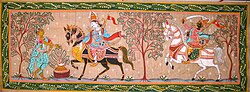
| foot_montage = [[Odisha]] Pattachitra (top) depicting [[Radha Krishna]] | | foot_montage = [[Odisha]] Pattachitra (top) depicting [[Radha Krishna]]. [[Bengal|Bengali]] Patachitra (bottom) depicting [[Durga]]. | ||
}} | }} | ||
| alt = | | alt = | ||
| alternative names = | | alternative names = Patachitra | ||
| description =Patachitra (or Pattachitra in Odisha) is an old traditional art of [[Odisha]] and [[West Bengal]] | | description =Patachitra (or Pattachitra in Odisha) is an old traditional art of [[Odisha]] and [[West Bengal]] | ||
| area = * [[Raghurajpur]], [[Puri]], Danda Sahi, [[Parlakhemundi]], [[Chikiti]], [[Digapahandi]], [[Sonepur, Odisha|Sonepur]], [[Dharakote]] (Odisha)<ref name="odisha.gov.in">http://odisha.gov.in/e-magazine/Orissareview/2010/November/engpdf/46-48.pdf</ref><ref name="The Hindu">{{cite news |title=Orissa Pattachitra |url=https://www.thehindu.com/todays-paper/tp-in-school/orissa-pattachitra/article14422369.ece |access-date=23 July 2018}}</ref><br/> | | area = * [[Raghurajpur]], [[Puri]], Danda Sahi, [[Parlakhemundi]], [[Chikiti]], [[Digapahandi]], [[Sonepur, Odisha|Sonepur]], [[Dharakote]] (Odisha)<ref name="odisha.gov.in">{{Cite web | url=http://odisha.gov.in/e-magazine/Orissareview/2010/November/engpdf/46-48.pdf | title=Registration of Geographical Indications and Orissa | archive-url=https://web.archive.org/web/20170110190425/http://odisha.gov.in/e-magazine/Orissareview/2010/November/engpdf/46-48.pdf | archive-date=10 January 2017 }}</ref><ref name="The Hindu">{{cite news |title=Orissa Pattachitra |url=https://www.thehindu.com/todays-paper/tp-in-school/orissa-pattachitra/article14422369.ece |access-date=23 July 2018 |archive-date=22 November 2021 |archive-url=https://web.archive.org/web/20211122102657/https://www.thehindu.com/todays-paper/tp-in-school/orissa-pattachitra/article14422369.ece |url-status=live }}</ref><br /> | ||
* [[Birbhum]], [[West Midnapore]], Nayagram of [[Pingla]] block in [[Jhargram]], [[Bardhaman]], [[Murshidabad]] district and [[Kalighat]] region (West Bengal)<ref>Bose, Nirmal Kumar. 1953. ''Folk religion of Bengal, part I number I (A study of the Vrata rites).''C. Kar, Benoy Bose Road, Calcutta, India</ref><ref>{{Cite news|url=https://mediaindia.eu/art-culture/patachitra-ancient-scroll-painting-of-bengal/|title=Patachitra: Ancient scroll painting of Bengal|date=2017 | * [[Birbhum]], [[West Midnapore]], Nayagram of [[Pingla]] block in [[Jhargram]], [[Bardhaman]], [[Murshidabad]] district and [[Kalighat]] region (West Bengal)<ref>Bose, Nirmal Kumar. 1953. ''Folk religion of Bengal, part I number I (A study of the Vrata rites).''C. Kar, Benoy Bose Road, Calcutta, India</ref><ref>{{Cite news|url=https://mediaindia.eu/art-culture/patachitra-ancient-scroll-painting-of-bengal/|title=Patachitra: Ancient scroll painting of Bengal|date=26 April 2017|work=Media India Group|access-date=18 May 2018|language=en-US|archive-date=19 May 2018|archive-url=https://web.archive.org/web/20180519120435/https://mediaindia.eu/art-culture/patachitra-ancient-scroll-painting-of-bengal/|url-status=live}}</ref> | ||
| country = [[India]] | | country = [[India]] | ||
| registered =*[[Odisha]] Pattachitra: 10 July 2008 | | registered =*[[Odisha]] Pattachitra: 10 July 2008 | ||
*[[West Bengal|Bengal]] Patachitra: 28 March 2018 | *[[West Bengal|Bengal]] Patachitra: 28 March 2018 | ||
| material = Cloth, Paper, Color, Theme | | material = Cloth, Silk, Palm leaf, Paper, Color, Theme | ||
| official website ={{URL|http://www.ipindia.nic.in/registered-gls.htm|ipindiaservices.gov.in}}}} | | official website ={{URL|http://www.ipindia.nic.in/registered-gls.htm|ipindiaservices.gov.in}}}} | ||
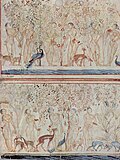
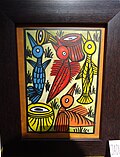
'''Patachitra or Pattachitra''' is a general term for traditional, cloth-based [[scroll]] painting,<ref>SenGupta, pp. 13.</ref> based in the eastern Indian [[States and territories of India|states]] of [[Odisha]]<ref>http://www.daricha.org/sub_genre.aspx?ID=39&Name=Patachitra</ref><ref>{{cite web|title=Patta Chitra|url=http://www.paramparaproject.org/traditions_pata-chitra.html}}</ref> and [[West Bengal]] | '''Patachitra''' or '''Pattachitra''' is a general term for traditional, cloth-based [[scroll]] painting,<ref>SenGupta, pp. 13.</ref> based in the eastern Indian [[States and territories of India|states]] of [[Odisha]],<ref>{{Cite web|url=http://www.daricha.org/sub_genre.aspx?ID=39&Name=Patachitra|title=:::::: Daricha Foundation ::::::|access-date=11 May 2018|archive-date=22 November 2021|archive-url=https://web.archive.org/web/20211122102659/http://www.daricha.org/sub_genre.aspx?ID=39&Name=Patachitra|url-status=live}}</ref><ref>{{cite web|title=Patta Chitra|url=http://www.paramparaproject.org/traditions_pata-chitra.html|access-date=2 March 2014|archive-date=21 May 2014|archive-url=https://web.archive.org/web/20140521003914/http://www.paramparaproject.org/traditions_pata-chitra.html|url-status=live}}</ref> and [[West Bengal]]<ref>{{Cite web |last1=Rahaman|first1=Md Motiur|last2=Hom Choudhury|first2=Mahuya|last3=Sengupta|first3=Sangita|date=29 February 2016|title=VALIDATION AND GEOGRAPHICAL INDICATION (G.I) REGISTRATION OF PATACHITRA OF WEST BENGAL- ISSUES AND CHALLENGES|url=https://www.researchgate.net/publication/320172069}}</ref> as well as parts of [[Bangladesh]]. Patachitra art form is known for its intricate details as well as mythological narratives and folktales inscribed in it. Pattachitra is one of the ancient artworks of [[Odisha]], originally created for ritual use and as souvenirs for pilgrims to [[Puri]], as well as other temples in Odisha.<ref>{{Cite journal|last=Gadon|first=Elinor W.|date=February 2000|title=Indian Art Worlds in Contention: Local, Regional and National Discourses on Orissan Patta Paintings. By Helle Bundgaard. Nordic Institute of Asian Studies Monograph Series, No. 80. Richmond, Surrey: Curzon, 1999. 247 pp. $45.00 (cloth).|url=https://www.cambridge.org/core/journals/journal-of-asian-studies/article/indian-art-worlds-in-contention-local-regional-and-national-discourses-on-orissan-patta-paintings-by-helle-bundgaard-nordic-institute-of-asian-studies-monograph-series-no-80-richmond-surrey-curzon-1999-247-pp-4500-cloth/F46E8FB8E5D42BF037AA4A8178BDFB75|journal=The Journal of Asian Studies|language=en|volume=59|issue=1|pages=192–194|doi=10.2307/2658630|jstor=2658630|s2cid=201436927|issn=1752-0401|access-date=29 August 2020|archive-date=29 August 2020|archive-url=https://web.archive.org/web/20200829190142/https://www.cambridge.org/core/journals/journal-of-asian-studies/article/indian-art-worlds-in-contention-local-regional-and-national-discourses-on-orissan-patta-paintings-by-helle-bundgaard-nordic-institute-of-asian-studies-monograph-series-no-80-richmond-surrey-curzon-1999-247-pp-4500-cloth/F46E8FB8E5D42BF037AA4A8178BDFB75|url-status=live|url-access=subscription}}</ref> Patachitras are a component of an ancient [[Bengalis|Bengali]] narrative art, originally serving as a visual device during the performance of a song.<ref name="chitrolekha.com">{{Cite news|url=http://chitrolekha.com/myths-and-folktales-patachitra/|title=Myths and Folktales in the Patachitra Art of Bengal: Tradition and Modernity - The Chitrolekha Journal on Art and Design|date=2 August 2015|work=The Chitrolekha Journal on Art and Design|access-date=18 May 2018|language=en-US|archive-date=19 May 2018|archive-url=https://web.archive.org/web/20180519054832/http://chitrolekha.com/myths-and-folktales-patachitra/|url-status=live}}</ref> | ||
==Etymology== | ==Etymology== | ||
In | In [[Sanskrit language|Sanskrit]], the word ''paṭṭa'' means "cloth" and ''chitra'' means "picture". Most of these paintings depict stories of Hindu deities.<ref>SenGupta, pp. 12.</ref> | ||
==Early history== | |||
''Charanachitras'', ''Mankhas'', ''Yamapatas'' were ancient forms of paintings executed on textile-scrolls and dealt with themes of a narrative-didactic nature of storytelling, which finds mentions in Hindu, Jain and Buddhist texts. According to historian [[Niharranjan Ray|N.R Ray]], these textile-scroll paintings were ancestors of the Pattachitra art form.<ref>{{cite web |last1=Balakrishna |first1=Sandeep |title=Mankhas as the Extinct Inheritors of a Profound Cultural Treasure |url=https://www.dharmadispatch.in/culture/mankhas-as-the-extinct-inheritors-of-a-profound-cultural-treasure |website=The Dharma Dispatch |language=en |date=5 September 2022 |access-date=25 June 2024 |archive-date=24 June 2024 |archive-url=https://web.archive.org/web/20240624153303/https://www.dharmadispatch.in/culture/mankhas-as-the-extinct-inheritors-of-a-profound-cultural-treasure |url-status=live }}</ref> | |||
==Bengal Patachitra== | |||
The Bengal Patachitra refers to the painting of [[West Bengal]] and [[Bangladesh]]. It is a traditional and mythological heritage of [[West Bengal]]. The Bengal Patachitra is divided into some different aspects like ''Durga Pat'', ''[[Chalchitra]]'', ''Tribal Patachitra'', ''Medinipur Patachitra'', and ''[[Kalighat painting|Kalighat Patachitra]]''.<ref>{{Cite news|url=http://www.anandabazar.com/district/nadia-murshidabad/portrait-art-s-demand-at-nabadwip-1.700221|title=পটচিত্রের চাহিদা বাড়ছে নবদ্বীপের রাসে|last=বন্দ্যোপাধ্যায়|first=দেবাশিস|work=Anandabazar Patrika|access-date=11 May 2018|language=bn|archive-date=13 April 2018|archive-url=https://web.archive.org/web/20180413125204/http://www.anandabazar.com/district/nadia-murshidabad/portrait-art-s-demand-at-nabadwip-1.700221|url-status=live}}</ref> The subject matter of Bengal Patachitra is mostly mythological, religious stories, folk lore and social. The Kalighat Patachitra, the last tradition of Bengal Patachitra is developed by [[Jamini Roy]]. The artist of the Bengal Patachitra is called [[Patua]].<ref name="Giusti, M 2014">Giusti, M. and Chakraborty, U. (ed.). ''Immagini Storie Parole. Dialoghi di formazione coi dipinti cantati delle donne Chitrakar del West Bengal''. Mantova: Universitas Studiorum, 2014, {{ISBN|978-88-97683-39-1}}</ref> | |||
Patachitra of Naya village in [[West Bengal]] is now collected in [[National Museum of Ethnology (Portugal)|National Museum of Ethnology]] (henceforth MNE) in [[Lisbon]].<ref>{{Cite journal|last=Ponte|first=Inês|date=13 May 2015|title=Cosmopolitan impressions from a contemporary Bengali patachitra painting museum collection in Portugal|journal=Ateliers d'Anthropologie|volume=41 |language=en|issue=41|doi=10.4000/ateliers.9771|issn=1245-1436|doi-access=free}}</ref><gallery mode="packed" style="font-size:88%; line-height:130%; border-bottom:1px #aaa solid;" heights="180" caption="The Bengal Patachitra"> | |||
File:Extrait de Chandi Mangal de Meena Chitrakar (Naya Bengale) (1439706046).jpg|Patachitra of Naya village | |||
File:Extrait de Ramayana de Hazra Chitrakar (Naya Bengale) (1438842569).jpg|Patachitra of Naya village | |||
File:Medinipur Patachitra - durga.jpg|Goddess [[Durga]] and her family in [[Midnapore|Medinipur]] Patachitra | |||
File:Kalighat Patachitra of Maharaja Virendra Mohan Dar.jpg|[[Maharaja]] Virendra Mohan Dar of Dar, Akhnoor ([[Kalighat painting|Kalighat Pattachitrra]]). {{Circa|1929}} | |||
</gallery> | |||
===Origin=== | |||
[[File:Pattachitra - Archaeological Activities Exhibition - Directorate of Archaeology & Museums - West Bengal - Kolkata 2014-09-14 7907.JPG|thumb|[[Patua]] scroll on display at Archaeological activities exhibition of [[West Bengal|Bengal]] Patachitra]] | |||
Patachitra is known for its excellent play of colour. It is a traditional folk art form of rural Bengal. There are some controversial opinions about the dates of ancient Patas. But it has been suggested based on historical themes connected with the accompanied songs like [[Patua Sangeet]]. It dates back to the Pre- Pala period which is still tucked away with small villages of [[Midnapore]], [[Bankura]], [[Purulia]], [[Howrah]], [[Hooghly district|Hooghly]] and [[24 Parganas]].<ref>{{cite book |last1=Sen Gupta |first1=Sankar |title=The Patas and the Patuas of Bengal |date=1973 |publisher=Indian Publications |location=Calcutta |pages=54–55 |url=https://catalogue.nla.gov.au/Record/1808881 |archive-date=25 July 2023 |access-date=25 July 2023 |archive-url=https://web.archive.org/web/20230725111114/https://catalogue.nla.gov.au/Record/1808881 |url-status=live }}</ref> | |||
There are some Jadu-Patuas painting of mural style in the temples of [[Bankura district|Bankura District]] in West Bengal.<ref>{{cite book |last1=Mookerjee |first1=Ajitcoomar |title=Folk Art of Bengal |date=1939 |publisher=University of Calcutta |url=https://archive.org/details/BdfolkArt}}</ref> | |||
[[File:Jadupatua painting.jpg|thumb|Jadupatua painting]] | |||
===Theme and style=== | |||
[[File:Swarna Chitrakar - Kolkata 2014-02-14 3080.JPG|left|thumb|Performing the Patua Sangeet by a [[Patua]] during an international conference in [[Kolkata]]|278x278px]] | |||
There are many types of Pots like religious, secular. Religious pots encompass the story of Hindu epics like, mythology, Ramayana, Mahabharata narrating stories of Hindu gods and goddesses like [[Radha Krishna]], [[Chaitanya Mahaprabhu|Chaitanya]], [[Kali]], Shiba and the indigenous Bengali folklore of Manasha and Chandi, Behula and Lakshinder being the most popular. Secular pots depicts important news events, scandals accidents etc. such as bus accidents at Narayangarh, rural elections, the rationing system, family planning, evils of the dowry system etc. Every Patachitra has a song related to it, which the artists sing while unfurling the Patachitra. Singing pot in Bengal is called [[Patua Sangeet]]. Patua Sangeet or Poter Gan is a cultural tradition of the singing Bengal Patachitra. It is performed by [[Patua]].<ref>{{Cite book|title=Bangiyo Loko-Sangeet Ratnakosh|last=Sri Ashutosh Bhattacharya|publisher=Paschimbanga Loko Sanskriti Gobeshona Kendra|location=Kolkata|pages=1041}}</ref> It is famous in the village part of [[West Bengal]] like [[Birbhum]], [[Jhargram]], [[Bardhaman]] and [[Murshidabad]] as a folk song of [[West Bengal]].<ref name="chitrolekha.com"/> | |||
===Aspects of painting=== | |||
Bengal Patachitra painting has a different type of motive and aspects that unrolled the Bengali culture. Using the mythological epic and the natural color it is one of the individual characteristics of the Bengal Patachitra. | |||
====Chalchitra==== | |||
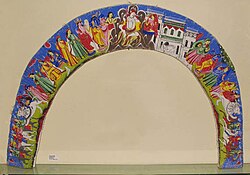
[[File:Chalchitra Kumartuli, Kolkata.jpg|thumb|[[Chalchitra]], a part of Bengal Patachitra, referred to the background Patachitra of the [[Durga]] Pratima]] | |||
[[Chalchitra]] is a part of ''Bengal Patachitra'', It referred to the ''Debi Chal'' or ''Durga chala'', the background of the [[Durga]] Pratima or idol.<ref>{{Cite book|title=Paschimbanger lokoshilpa o lokosamaj|last=tarapada santra|publisher=Kolkata: lokosanskriti o adibasi sanskriti kendra|year=2000|location=Kolkata|pages=12}}</ref> [[Patua]], the artists of Chalchitra called it as '''Pata Lekha''', means the writing of Patachitra.<ref name="Giusti, M 2014"/> 300–400 years old idols of [[Shakta Rash|Nabadwip Shakta Rash]] used Chalchitra as a part of Pratima. At a time, the use of Chalchitra became fade, but now it has a great popularity.<ref>{{Cite news|url=http://www.anandabazar.com/district/nadia-murshidabad/portrait-art-s-demand-at-nabadwip-1.700221|title=পটচিত্রের চাহিদা বাড়ছে নবদ্বীপের রাসে|last=বন্দ্যোপাধ্যায়|first=দেবাশিস|work=Anandabazar Patrika|access-date=14 April 2018|language=bn|archive-date=13 April 2018|archive-url=https://web.archive.org/web/20180413125204/http://www.anandabazar.com/district/nadia-murshidabad/portrait-art-s-demand-at-nabadwip-1.700221|url-status=live}}</ref> | |||
====Durga sara==== | |||
[[File:Durga sara Bengal Patachitra.jpg|thumb|Durga sara, an aspect of Bengal Patachitra]] | |||
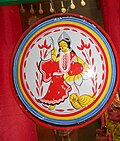
Durga sara is a variant of the patachitra. Instead of a cloth, the backside of a clay tray or dish called sara (সরা) in Bengali is used as the canvas, where an image of the Hindu goddess [[Durga]] is painted. Poor Bengali Hindu families in regions of West Bengal like [[Nadia district|Nadiya]] & [[24 Parganas]] use it as an alternative of [[Murti|idols]] for worship.<ref name=":1">{{Cite news|url=http://www.anandabazar.com/state/%E0%A6%85%E0%A6%AC%E0%A6%95-%E0%A6%B7%E0%A7%9F-%E0%A6%86%E0%A6%B0-%E0%A6%85%E0%A6%AC%E0%A6%B2-%E0%A6%AA-%E0%A6%A4-%E0%A6%B0-%E0%A6%AE-%E0%A6%9D-%E0%A6%AC-%E0%A6%B2-%E0%A6%B0-%E0%A6%9A-%E0%A6%B2%E0%A6%9A-%E0%A6%A4-%E0%A6%B0-1.74260|title=অবক্ষয় আর অবলুপ্তির মাঝে বাংলার চালচিত্র - Anandabazar|last=ভট্টাচার্য|first=বিভূতিসুন্দর|work=Anandabazar Patrika|access-date=14 April 2018|language=bn|archive-date=14 April 2018|archive-url=https://web.archive.org/web/20180414234040/http://www.anandabazar.com/state/%E0%A6%85%E0%A6%AC%E0%A6%95-%E0%A6%B7%E0%A7%9F-%E0%A6%86%E0%A6%B0-%E0%A6%85%E0%A6%AC%E0%A6%B2-%E0%A6%AA-%E0%A6%A4-%E0%A6%B0-%E0%A6%AE-%E0%A6%9D-%E0%A6%AC-%E0%A6%B2-%E0%A6%B0-%E0%A6%9A-%E0%A6%B2%E0%A6%9A-%E0%A6%A4-%E0%A6%B0-1.74260|url-status=live}}</ref><ref>{{Cite news |title=বাংলার লোকশিল্পে দুর্গা |url=https://www.anandabazar.com/amp/patrika/review-of-a-pot-art-exhibition-regarding-bengalis-famous-durga-puja/cid/1465372 |archive-date=17 December 2023 |access-date=29 June 2025 |archive-url=https://web.archive.org/web/20231217000703/https://www.anandabazar.com/amp/patrika/review-of-a-pot-art-exhibition-regarding-bengalis-famous-durga-puja/cid/1465372 |url-status=live }}</ref> | |||
==== Lakshmi sara ==== | |||
[[File:Lakkhi sara.jpg|thumb|Lakshmi sara in West Bengal]] | |||
Lakshmi sara is similar in style to the Durga sara. It depicts the Hindu goddess [[Lakshmi]] & was used as an alternative to idols by poorer Bengali Hindu families during the [[Sharada Purnima|Kojagori Lakshmi Puja]] festivities. Initially confined to regions of East Bengal (in what is now [[Bangladesh]]), specifically [[Greater Faridpur|Faridpur]] & [[Dhaka Division|Dhaka]] regions, the art style came to West Bengal through the hands of Bengali Hindu artists fleeing [[Persecution of Hindus|religious persecution]] following the [[Partition of Bengal (1947)|Partition of Bengal]], [[1950 East Pakistan riots]], [[1964 East Pakistan riots]] & [[Bangladesh genocide|1971 Bangladesh genocide]], with its sales being fuelled by demand from [[East Bengali refugees]].<ref>{{Cite news |title=ছবি-নকশার বৈচিত্রে রঙিন বাংলার লক্ষ্মীসরা |url=https://www.anandabazar.com/amp/ananda-utsav/puja-parikrama/laxmi-puja-2020-laxmi-sara-of-bengal-varies-in-painting-and-designs-of-local-flavour-dgtl-1.1221967}}</ref><ref>{{Cite web |title=লক্ষ্মীপট - বাংলাপিডিয়া |url=https://bn.banglapedia.org/index.php/%E0%A6%B2%E0%A6%95%E0%A7%8D%E0%A6%B7%E0%A7%8D%E0%A6%AE%E0%A7%80%E0%A6%AA%E0%A6%9F |access-date=2025-06-29 |website=bn.banglapedia.org |language=bn |archive-date=19 August 2022 |archive-url=https://web.archive.org/web/20220819165134/https://bn.banglapedia.org/index.php/%E0%A6%B2%E0%A6%95%E0%A7%8D%E0%A6%B7%E0%A7%8D%E0%A6%AE%E0%A7%80%E0%A6%AA%E0%A6%9F |url-status=live }}</ref> | |||
==== Gazir Pat ==== | |||
[[File:Pir Gazi and his tiger in Sundarbans.jpg|thumb|An example of a Gazir pat]] | |||
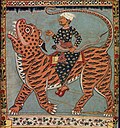
Gazir pat is a variation of the patachitra theme. Catering specifically to [[Bengali Muslims]], it depicts the exploits of [[Gazi Pir|Pir Boro Khan Gazi]], an Islamic preacher whose tomb lies in [[Ghutiari Sharif railway station|Ghutiari Sharif]], who combined the roles of a [[Pir (Sufism)|pir]] & a [[Ghazi (warrior)|ghazi]] & is renowned for having battled the Bengali Hindu [[Folk religion|folk god]] [[Dakshin Rai|Dakshin Ray]] as a part of his [[Dawah|missionary activities]]. He himself has been raised to the status of a folk god by [[Caste system among South Asian Muslims|Arzals]] & [[Dalit|Dalits]] living in the [[Sundarbans|Sunderbans]] alike, who seek his intercession in repelling [[Tiger attacks in the Sundarbans|attacks]] of the [[Bengal tiger]]. This art form is widespread in Bangladesh.<ref>{{Cite web |title=গাজীর পট - বাংলাপিডিয়া |url=https://bn.banglapedia.org/index.php?title=%E0%A6%97%E0%A6%BE%E0%A6%9C%E0%A7%80%E0%A6%B0_%E0%A6%AA%E0%A6%9F |access-date=2025-06-29 |website=bn.banglapedia.org |language=bn}}</ref> | |||
===Technique=== | |||
The Patachitra of different districts of [[West Bengal]] are characterized by many peculiarities in colour and design. The patachitra of [[Manbhum]], now known as [[Purulia district|Purulia]] can easily be distinguished by their preference for one particular shade of burnt sienna relieved by white and yellow patches and densely packed composition. The seated figures of [[Dasaratha]] and [[Chand Sadagar]] of [[Medinipur]] crowning the [[Ramayana]] and Kamale-Kamini scrolls are impressive and monumental.<ref>Craft council of West Bengal-1985-86, The Jarana Patachitra of Bengal- Mahamaya, p-112</ref> In the scrolls of pot of [[Birbhum district|Birbhum]], [[Bankura district|Bankura]] and [[Burdwan district|Burdwan]] preference for Indian red background usually found, the scrolls of [[Hooghly district|Hooghly]] preferred a dark brown. The [[Hooghly district|Hooghly]] and [[Manbhum]] 'pats' are peculiar and definitely modernistic with the abstract linear treatment.<ref>D. P. Ghosh, FOLK ART OF BENGAL, Visvabharati, p-4</ref> | |||
===Colour=== | |||
Use of natural color is one of the individual characteristics of the Bengal Patachitra. In general, blue, [[yellow]], [[green]], [[red]], [[brown]], [[black]] and [[white]] are used in the Patachitra of [[West Bengal]]. Chalk dust is used for white color, pauri for yellow color, cultivated indigo for blue, bhushakali for black and mete sindur for red color.<ref>{{Cite web| url=http://ipindiaservices.gov.in/GI_DOC/564/564%20-%20Statement%20of%20Case%20-%2017-08-2016.pdf | title=Report on Patachitra of West Bengal | access-date=11 May 2018 | archive-date=12 May 2018 | archive-url=https://web.archive.org/web/20180512043755/http://ipindiaservices.gov.in/GI_DOC/564/564%20-%20Statement%20of%20Case%20-%2017-08-2016.pdf | url-status=dead}}</ref> | |||
=== Artists === | |||
Bengal Patua artists carry the occupational surname of 'Chitrakar'. They are concentrated in the village of Naya in [[Medinipur]] district of [[West Bengal]]. Prominent artists include Khandu and Radha Chitrakar and their children Bapi, Samir, Prabir, Laltu, Tagar, Mamoni and Laila Chitrakar. [[Manimala Chitrakar|Monimala]] is known for her use of bold, primal colours and the development of her own iconographic style.<ref>{{Cite book|title=Indigenius Artists India|last=Nair|first=Sunita|publisher=Sunita Nair|year=2018|isbn=978-93-5311-387-2|location=Mumbai|pages=135–137}}</ref> | |||
== Odisha Pattachitra == | == Odisha Pattachitra == | ||
Pattachitra is a traditional painting of | Pattachitra is a traditional painting of Odisha, India.<ref name="odisha.gov.in"/> These paintings are based on [[Hinduism]] and specially inspired by [[Jagannath]] and [[Vaishnava]] traditions.<ref>{{cite web|title=Patta Chitra|url=http://www.odisha.gov.in/portal/ViewDetails.asp?vchglinkid=GL010&vchplinkid=PL060&vchslinkid=SL036|access-date=30 May 2012|archive-date=23 September 2017|archive-url=https://web.archive.org/web/20170923182155/http://www1.odisha.gov.in/portal/ViewDetails.asp?vchglinkid=GL010&vchplinkid=PL060&vchslinkid=SL036|url-status=live}}</ref> All colours used in the Paintings are natural and paintings are made ancient traditional way by Chitrakaras that is Odiya Painter. Pattachitra style of painting is one of the oldest and most popular art forms of [[Odisha]]. The name Pattachitra has evolved from the Sanskrit words ''patta'', meaning canvas, and ''chitra'', meaning picture. Pattachitra is thus a painting done on canvas, and is manifested by rich colourful application, creative motifs, designs, and portrayal of simple themes, mostly mythological in depiction.<ref>{{Cite web|url=http://india.gov.in/knowindia/pattachitra.php|title=National Portal of India|access-date=18 February 2010|archive-date=5 February 2011|archive-url=https://web.archive.org/web/20110205133406/http://india.gov.in/knowindia/pattachitra.php|url-status=live}}</ref> The traditions of ''pattachitra'' paintings are more than thousand years old. | ||
<ref>[http://craftorissa.com/b2c/product_info.php?products_id=112 Unknown]{{dead link|date=March 2018 |bot=InternetArchiveBot |fix-attempted=yes }}</ref><ref>{{cite web|url=http://www.archive.india.gov.in/knowindia/culture_heritage.php?id=106|title=Pattachitra Painting|publisher=archive.india.gov.in|access-date=1 April 2014|archive-date=7 April 2014|archive-url=https://web.archive.org/web/20140407063444/http://www.archive.india.gov.in/knowindia/culture_heritage.php?id=106|url-status=live}}</ref> | |||
[[File:Ostindischer Meister 001.jpg|center|thumb|382x382px|Study of a Pattachitra painting depicting the Gopis on the banks of the Yamuna, circa 1550. Odisha.]] | |||
=== Origin | === Origin === | ||
The paintings of [[Odisha]] can be divided into three categories from the point of view of medium, i.e. paintings on cloth or 'Patta Chitra', paintings on walls or 'Bhitti Chitra' and palm leaf engravings or "Tala Patra Chitra | [[File:Two lovers, folio from a Ragamala album.jpg|thumb|220x220px|Pattachitra painting of ''Raga Kodaba'' of [[Odissi music]] depicted in the form of two lovers. Pigment on cloth, 16 x 12cm, Odisha, mid-nineteenth century. Private collection|left]][[File:Earthen pot with lid.jpg|thumb|Large earthen pot with the outer surface and the lid painted with Pattachitra, Odisha Museum, India.]]The paintings of [[Odisha]] can be divided into three categories from the point of view of medium, i.e. paintings on cloth or 'Patta Chitra', paintings on walls or 'Bhitti Chitra' and palm leaf engravings or "Tala Patra Chitra" or "Pothi, Chitra'.<ref>{{Cite web|url=https://www.unnatisilks.com/patachitra-introduction-indian-crafts.html|title=Crafts of India -Patachitra - Introduction|website=Unnati Silks|access-date=19 July 2018|archive-date=8 February 2022|archive-url=https://web.archive.org/web/20220208135207/https://www.unnatisilks.com/patachitra-introduction-indian-crafts.html|url-status=dead}}</ref> The style of all these remains more or less the same at a specific time because then the artists were commissioned to work in all these media, it is believed.{{According to whom|date=July 2020}}{{citation needed|date=November 2019}} | ||
The painting the | The painting, the pattachitra, resembles the old murals of [[Odisha]], especially religious centres of [[Puri]], [[Konark]] and [[Bhubaneswar]] region, dating back to the 5th century BC. The best work is found in and around [[Puri]], especially in the village of [[Raghurajpur]].<ref>{{cite web|url=http://www.paramparik-karigar.org/bystates/pattachitra.html |title=Pattachitra Arts - Orissa {{!}} Handmade Crafts directly from Craftsmen |access-date=18 February 2010 |url-status=dead |archive-url=https://web.archive.org/web/20110227115716/http://www.paramparik-karigar.org/bystates/pattachitra.html |archive-date=27 February 2011 }}</ref> | ||
This old tradition of Odia painting still survives in | [[File:Pattachitra Painting (16419923734).jpg|thumb|Pattachitra made on palm leaf, Odisha.]]This old tradition of Odia painting still survives in places like [[Puri]], [[Raghurajpur]], [[Paralakhemundi]], [[Chikiti]] and [[Sonepur, Odisha|Sonepur]]. Lord [[Jagannath]] in the present form is being taken as the origin of the Patta style. The colour schemes of the deities of Puri are quite similar to those of the Patta style. The oldest record of Patta Paintings probably does not go beyond the establishment of the present shrine of Shri Jagannath at Puri. It may be since paintings do not survive like sculptures. The paints inside the shrines of Lord Jagannath at Puri make the date probable. The oldest classical marble paintings of Sitabanji at [[Keonjhar]] do not conform to the present style of Patta painting wholly. The wooden statues of the three deities are also covered with cloth and then overlaid with glue mixed with chalk, and then given paint only with four limited colours of [[red]], [[yellow]], [[white]] and [[black]]. The deities who are held in high esteem by the [[Odias]] and who inspire religion, life and activity of the people also carry with them a tradition of art and painting which is as old as the deities themselves. If the Savara origin of [[Jagannath]] is accepted, the date of the Patta paintings can be dated back to an earlier period. These paintings were originally substitutes for worship on days when the idols were kept away from the public after their ritual bath.<ref>{{Cite web |last=Mokashi |first=Akshata |date=2021-01-29 |title=Pattachitra: The Heritage Art of Odisha |url=https://www.livehistoryindia.com/story/living-culture/pattachitra |access-date=2022-12-31 |website=www.livehistoryindia.com |language=en |archive-date=31 December 2022 |archive-url=https://web.archive.org/web/20221231090802/https://www.livehistoryindia.com/story/living-culture/pattachitra |url-status=live }}</ref> | ||
=== Theme and | === Theme and style === | ||
The theme of Odia painting centres round the [[Jagannath]] and the [[Vaishnava]] sect. Since beginning of Pattachitra culture, Lord [[Jagannath]] who was an incarnation of Lord [[Krishna]] has been the major source of inspiration. The subject matter of | [[File:Easy Pattachitra of Lord Jagarnath.jpg|thumb|Pattachitra of Lord Jagarnath]]The theme of Odia painting centres round the [[Jagannath]] and the [[Vaishnava]] sect. Since the beginning of Pattachitra culture, Lord [[Jagannath]] who was an incarnation of Lord [[Krishna]] has been the major source of inspiration. The subject matter of Pattachitra is mostly mythological, religious stories and [[folk lore]]. Themes are chiefly on Lord Jagannath and [[Radha]]-[[Krishna]], different "Vesas" of Shri Jagannath, [[Balabhadra]] and [[Subhadra]], temple activities, the ten incarnations of [[Vishnu]] basing on the '[[Gita Govinda]]' of [[Jayadeva|Jayadev]], Kama Kujara [[Navagunjara]], [[Ramayana]], [[Mahabharata]].<ref>{{cite web|url=http://www.indianart.in/indian-art-journey/patta-chitra-paintings.html|title=Indian Art » Blog Archive » Patta Chitra Paintings|publisher=indianart.in|access-date=19 March 2010|archive-date=21 July 2011|archive-url=https://web.archive.org/web/20110721162339/http://www.indianart.in/indian-art-journey/patta-chitra-paintings.html|url-status=live}}</ref> The individual paintings of gods and goddesses are also being painted. | ||
The Pattachitra style | The Pattachitra style is a mix of both folk and classical elements, but leans more towards folk forms. The dress style has [[Mughal Empire|Mughal]] influences. All of the poses have been confined to a few well-defined postures. These are not free from monotonous repetitions, though at times this is necessary to accentuate the narrative character of the style. The lines are bold and clean and angular and sharp. Generally, there are no landscapes, perspectives, or distant views. All the incidents are seen in close juxtaposition. The background on which the figures are represented is delineated with decorations of flowers and foliage, and is mostly painted in red colour. All the paintings are given decorative borders. The whole painting is conceived in the form of a design on a given canvas. | ||
The themes may be classified into following categories<ref>[http://www.rabindraart.com/how-to-do-pattachitra.html categories of Pattachitra] {{webarchive|url=https://web.archive.org/web/20100729235958/http://www.rabindraart.com/how-to-do-pattachitra.html |date=2010 | The themes may be classified into following categories<ref>[http://www.rabindraart.com/how-to-do-pattachitra.html categories of Pattachitra] {{webarchive|url=https://web.archive.org/web/20100729235958/http://www.rabindraart.com/how-to-do-pattachitra.html |date=29 July 2010 }}</ref> | ||
* Jagannath paintings | * Jagannath paintings | ||
* Vaishnav Paintings | * Vaishnav Paintings | ||
* Bhagabat paintings | |||
* Ramayana paintings | |||
* Saiva paintings | * Saiva paintings | ||
* Shakta paintings | * Shakta paintings | ||
| Line 54: | Line 106: | ||
* Ragachitras | * Ragachitras | ||
* Bandhachitra | * Bandhachitra | ||
* Yamapati and yatripatas – (sketches of puri temple) [[Ganjapa]] playing card paintings and other | * Yamapati and yatripatas – (sketches of puri temple) [[Ganjapa]] playing card paintings and other social themes on paintings. | ||
* Navagunjara<ref>https://www.devotionalstore.com/blogs/devotional-blog/traditional-arts-of-odisha-pattachitra-painting</ref> | * Navagunjara<ref>{{Cite web|url=https://www.devotionalstore.com/blogs/devotional-blog/traditional-arts-of-odisha-pattachitra-painting|title=Traditional Art of Odisha : Pattachitra Painting|work=DevotionalStore |date=2 January 2017|access-date=11 January 2017|archive-date=13 January 2017|archive-url=https://web.archive.org/web/20170113141345/https://www.devotionalstore.com/blogs/devotional-blog/traditional-arts-of-odisha-pattachitra-painting|url-status=live |author1=Devotionalstore }}</ref> | ||
=== Technique === | === Technique === | ||
[[File:Patta Chitra 01.jpg|thumb|centre|600px|Pattachitra were inspired by [[Jagannath]] [[culture]] in Odisha]] | [[File:Patta Chitra 01.jpg|thumb|centre|600px|Modern-day Pattachitra depicting Kanchi Bijaya. Pattachitras were inspired by [[Jagannath]] [[culture]] in Odisha]] | ||
Traditionally the painters are known as ''chitrakars''. A patta painter's home with all the members of family is his studio. Woman members prepare the glue, the canvas and apply colours | [[File:Balarama, Subhadra and Jagannath in the temple at Puri, with Wellcome V0017732.jpg|thumb|220x220px|''Sankhanabhi Pata'', Pattachitra map of the Puri temple, with many human and sacred figures, buildings and animals. By a painter of Puri, Odisha, ca. 1880/1910.]]Traditionally, the painters are known as ''chitrakars''. A patta painter's home with all the members of the family is his studio. Woman members prepare the glue, the canvas and apply colours which we call the fill-in, and give the final lacquer coating. The master hand, mostly the male member, draws the initial line and gives the final finishing touch. | ||
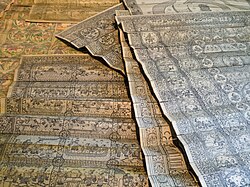
Patta paintings are done on small strips of [[cotton]] cloth. The [[canvas]] is prepared by coating the clothing with a mixture of chalk and gum made from [[tamarind]] seeds. Then it is rubbed by taking the help of two different stones and then the cloth is dried. The mixture of gum and [[chalk]] gives the cloth's surface a leathery finish on which the artists paint with vegetable, earth and stone colours.<ref> | Patta paintings are done on small strips of [[cotton]] cloth. The [[canvas]] is prepared by coating the clothing with a mixture of chalk and gum made from [[Guar gum|Guar]] or [[tamarind]] seeds. Then it is rubbed by taking the help of two different stones, and then the cloth is dried. The mixture of gum and [[chalk]] gives the cloth's surface a leathery finish on which the artists paint with vegetable, earth and stone colours.<ref>{{Cite web |url=http://www.mumbaipluses.com/thaneplus/index.aspx?page=article§id=2&contentid=201001302010020115560358832bd438§xslt=&comments=true&pageno=1 |title=The meticulous process of Pattachitra paintings |access-date=22 March 2010 |archive-date=2 March 2012 |archive-url=https://web.archive.org/web/20120302222641/http://www.mumbaipluses.com/thaneplus/index.aspx?page=article§id=2&contentid=201001302010020115560358832bd438§xslt=&comments=true&pageno=1 |url-status=dead }}</ref> | ||
The painters do not use pencil or [[charcoal]] for the preliminary drawings. They are so expert in the line that they simply draw directly with the brush, either in light red or yellow. Then the colours are filled in. The final lines are drawn, and the patta is given a lacquer coating to protect it from the weather, thus making the painting glossy. This process of glazing or [[varnishing]] is quite interesting. The painting is held over a fireplace so that the back of the painting is exposed to heat. On the surface of the painting, fine lacquer is applied. | |||
=== Colour === | === Colour === | ||
Pattachitras are painted in five natural colours - Hingula, Haritala, Kala, Sankha and Geru, which are: Vermilion, Green, Black, Pearl White and Brick Orange respectively. There are typical scenes and figures, like Krishna, Gopis, elephants, trees, and other creatures are seen in these paintings. Krishna is always painted in blue and the Gopis in light pink, purple or brown colours.<ref>{{Cite web |url=http://www.mumbaipluses.com/thaneplus/index.aspx?page=article§id=2&contentid=201001302010020115560358832bd438§xslt=&comments=true&pageno=1 |title=Radha, Krishna and Gopis in Pattachitra |access-date=22 March 2010 |archive-date=2 March 2012 |archive-url=https://web.archive.org/web/20120302222641/http://www.mumbaipluses.com/thaneplus/index.aspx?page=article§id=2&contentid=201001302010020115560358832bd438§xslt=&comments=true&pageno=1 |url-status=dead }}</ref> | |||
The painters use vegetable and mineral colours without going for factory-made poster colours. They prepare their own colours.<ref>{{cite web|url=http://www.rabindraart.com/how-to-do-pattachitra.html |title=How to do Pattachitra |access-date=2010 | The painters use vegetable and mineral colours without going for factory-made poster colours. They prepare their own colours.<ref>{{cite web|url=http://www.rabindraart.com/how-to-do-pattachitra.html |title=How to do Pattachitra |access-date=22 March 2010 |url-status=dead |archive-url=https://web.archive.org/web/20100729235958/http://www.rabindraart.com/how-to-do-pattachitra.html |archive-date=29 July 2010 }}</ref> White colour is made from the [[conch]]-shells by powdering, [[boiling]] and [[filter (chemistry)|filtering]] in a very hazardous process. It requires a lot of patience. But this process gives brilliance and prominence to the [[hue]]. 'Hingula', a mineral colour, is used for red. 'Haritala', king of stone ingredients for yellow, 'Ramaraja', a sort of indigo for blue, are being used. Pure [[Oil lamp|lamp]]-[[black]] or black prepared from the burning of [[coconut]] shells are used.<ref>[http://www.rabindraart.com/how-to-do-pattachitra.html natural colours used in Pattachitra] {{webarchive|url=https://web.archive.org/web/20100729235958/http://www.rabindraart.com/how-to-do-pattachitra.html |date=29 July 2010 }}</ref> There was no blue, either cobalt or ultramarine, in the earlier colour schemes. The colours used in the Patta paintings are primarily bright colours, limited to red, yellow, indigo, black and white. The brushes that are used by these 'Chitrakaras' are also indigenous and are made of hair of domestic animals. A bunch of hair tied to the end of a [[bamboo]] stick makes the brush.<ref>[http://www.rabindraart.com/how-to-do-pattachitra.html colour brushes used in Pattachitra] {{webarchive|url=https://web.archive.org/web/20100729235958/http://www.rabindraart.com/how-to-do-pattachitra.html |date=29 July 2010 }}</ref> | ||
=== Palm leaf Pattachitra === | === Palm leaf Pattachitra === | ||
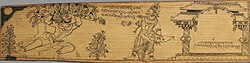
== | Palm leaf ''pattachitra'', which is in the [[Odia language|Odia]] language known as ''Tala Pattachitra'' drawn on a palm leaf. First of all, palm leaves are left to harden after being taken from the tree. Then these are sewn together to form like a canvas. The images are traced by using black or white ink to fill grooves etched on rows of equal-sized panels of palm leaf that are sewn together. These panels can also be easily folded like a fan and packed in a compact pile for better conservation. Often, palm-leaf illustrations are more elaborate, obtained by superimposing layers that are glued together for most of the surface, but in some areas can open like small windows to reveal a second image under the first layer.<ref>{{cite web|url=http://www.jagannatha.net/painting.html |title=Patta paintings |access-date=26 March 2010 |url-status=dead |archive-url=https://web.archive.org/web/20090106124430/http://www.jagannatha.net/painting.html |archive-date=6 January 2009 }} Palm leaf pattachitra</ref>[[File:Left detail, India, Orissa, late 18th century - The Monkeys and Bears Fight Ravana and His Demons (verso) - 1979.21.b - Cleveland Museum of Art (cropped).jpg|center|thumb|600x600px|''Tala-pattachitra'', palm leaf manuscript illustrating [[Labanyabati]] of Kabi Samrata [[Upendra Bhanja]]. Left detail, India, Odisha, late 18th century - Hanuman and Bharata at Nandigrama (verso) - 1979.21.b - [[Cleveland Museum of Art]].]] | ||
<gallery mode=" | |||
=== Gallery === | |||
<gallery mode="nolines" widths="220"> | |||
File:Papier-mâché mask at Odisha Crafts Museum, Bhubaneswar, Odisha, India 01.jpg|Papier-mâché mask of Goddess Kali painted in the Pattachitra idiom, Kala Bhoomi Odisha Crafts Museum, Bhubaneswar. | |||
File:Exhibits at the Odisha Crafts Museum 17.jpg|Wooden Ramalila masks painted in the Pattachitra style, Kala Bhoomi Odisha Crafts Museum, Bhubaneswar. | |||
File:Konark palm leaf manuscript.jpg|Tala Pattachitra, palm leaf painting showing the architectural plan of the [[Konark Sun Temple|Sun Temple of Konark]], Odisha. | |||
File:Wooden toys of women at Odisha Crafts Museum, Bhubaneswar, Odisha, India.jpg|Wooden statuettes painted in the Pattachitra style, Kala Bhoomi Odisha Crafts Museum, Bhubaneswar. | |||
File:Wooden torana at Odisha Crafts Museum, Bhubaneswar, Odisha, India 04.jpg|Prabha of Devi Subhadra's [[Ratha Yatra (Puri)|Ratha]], Puri, Odisha. | |||
File:Narasimha Mural Puri.jpg|Modern wall mural of [[Narasimha]] in a street of Puri, Odisha. | |||
</gallery> | </gallery> | ||
== References == | == References == | ||
| Line 129: | Line 145: | ||
* [http://www.midnapore.in/festival/potmaya/pot-maya-naya-pingla.html Patachitra of Medinipur (Midnapore)] | * [http://www.midnapore.in/festival/potmaya/pot-maya-naya-pingla.html Patachitra of Medinipur (Midnapore)] | ||
* [https://web.archive.org/web/20090410050953/http://orissagov.nic.in/e-magazine/Orissareview/dec2005/engpdf/patta_chitra_its_past_and_present.pdf Past of Pattachitra] | * [https://web.archive.org/web/20090410050953/http://orissagov.nic.in/e-magazine/Orissareview/dec2005/engpdf/patta_chitra_its_past_and_present.pdf Past of Pattachitra] | ||
* [http://www.orissagateway.com/features/Arts_and_Architecture/Art/Handicrafts/Pattachitra/ Essential Ideas on Pattachita] {{Webarchive|url=https://web.archive.org/web/20110716093741/http://www.orissagateway.com/features/Arts_and_Architecture/Art/Handicrafts/Pattachitra/ |date=2011 | * [http://www.orissagateway.com/features/Arts_and_Architecture/Art/Handicrafts/Pattachitra/ Essential Ideas on Pattachita] {{Webarchive|url=https://web.archive.org/web/20110716093741/http://www.orissagateway.com/features/Arts_and_Architecture/Art/Handicrafts/Pattachitra/ |date=16 July 2011 }} | ||
* [http://india.gov.in/knowindia/pattachitra.php Pattachitra Painting] | * [http://india.gov.in/knowindia/pattachitra.php Pattachitra Painting] | ||
* [http://www.orissa.gov.in/photogallery/pattachitra.htm Pattachitra Photogallery] | * [http://www.orissa.gov.in/photogallery/pattachitra.htm Pattachitra Photogallery] | ||
* Pattachithra – the amazing folk art of Odisha - [https://in.openart.community/general-topics/pattachithra-amazing-folk-art-odisha/ OpenArt India] | |||
{{Geographical indications in West Bengal}} | |||
{{Culture of West Bengal}} | {{Culture of West Bengal}} | ||
{{West Bengal topics}} | {{West Bengal topics}} | ||
| Line 141: | Line 159: | ||
[[Category:Geographical indications in West Bengal]] | [[Category:Geographical indications in West Bengal]] | ||
[[Category:Arts of Odisha]] | [[Category:Arts of Odisha]] | ||
[[Category:Bangladeshi painting]] | |||
[[Category:Geographical indications in Odisha]] | [[Category:Geographical indications in Odisha]] | ||
[[Category:Schools of Indian painting]] | [[Category:Schools of Indian painting]] | ||
[[Category: | [[Category:Arts of West Bengal]] | ||
[[Category:Indian folk art]] | [[Category:Indian folk art]] | ||
Revision as of 18:28, 10 February 2026
| Pattachitra | |
|---|---|
| Geographical indication | |
 _(1439702942).jpg) | |
| Alternative names | Patachitra |
| Description | Patachitra (or Pattachitra in Odisha) is an old traditional art of Odisha and West Bengal |
| Area |
|
| Country | India |
| Registered | |
| Material | Cloth, Silk, Palm leaf, Paper, Color, Theme |
| Official website | ipindiaservices.gov.in |
Patachitra or Pattachitra is a general term for traditional, cloth-based scroll painting,[5] based in the eastern Indian states of Odisha,[6][7] and West Bengal[8] as well as parts of Bangladesh. Patachitra art form is known for its intricate details as well as mythological narratives and folktales inscribed in it. Pattachitra is one of the ancient artworks of Odisha, originally created for ritual use and as souvenirs for pilgrims to Puri, as well as other temples in Odisha.[9] Patachitras are a component of an ancient Bengali narrative art, originally serving as a visual device during the performance of a song.[10]
Etymology
In Sanskrit, the word paṭṭa means "cloth" and chitra means "picture". Most of these paintings depict stories of Hindu deities.[11]
Early history
Charanachitras, Mankhas, Yamapatas were ancient forms of paintings executed on textile-scrolls and dealt with themes of a narrative-didactic nature of storytelling, which finds mentions in Hindu, Jain and Buddhist texts. According to historian N.R Ray, these textile-scroll paintings were ancestors of the Pattachitra art form.[12]
Bengal Patachitra
The Bengal Patachitra refers to the painting of West Bengal and Bangladesh. It is a traditional and mythological heritage of West Bengal. The Bengal Patachitra is divided into some different aspects like Durga Pat, Chalchitra, Tribal Patachitra, Medinipur Patachitra, and Kalighat Patachitra.[13] The subject matter of Bengal Patachitra is mostly mythological, religious stories, folk lore and social. The Kalighat Patachitra, the last tradition of Bengal Patachitra is developed by Jamini Roy. The artist of the Bengal Patachitra is called Patua.[14]
Patachitra of Naya village in West Bengal is now collected in National Museum of Ethnology (henceforth MNE) in Lisbon.[15]
- The Bengal Patachitra
-
 Patachitra of Naya village
 -
 Patachitra of Naya village
 -

-

_(1439706046).jpg)
_(1438842569).jpg)


Origin

Patachitra is known for its excellent play of colour. It is a traditional folk art form of rural Bengal. There are some controversial opinions about the dates of ancient Patas. But it has been suggested based on historical themes connected with the accompanied songs like Patua Sangeet. It dates back to the Pre- Pala period which is still tucked away with small villages of Midnapore, Bankura, Purulia, Howrah, Hooghly and 24 Parganas.[16] There are some Jadu-Patuas painting of mural style in the temples of Bankura District in West Bengal.[17]

Theme and style

There are many types of Pots like religious, secular. Religious pots encompass the story of Hindu epics like, mythology, Ramayana, Mahabharata narrating stories of Hindu gods and goddesses like Radha Krishna, Chaitanya, Kali, Shiba and the indigenous Bengali folklore of Manasha and Chandi, Behula and Lakshinder being the most popular. Secular pots depicts important news events, scandals accidents etc. such as bus accidents at Narayangarh, rural elections, the rationing system, family planning, evils of the dowry system etc. Every Patachitra has a song related to it, which the artists sing while unfurling the Patachitra. Singing pot in Bengal is called Patua Sangeet. Patua Sangeet or Poter Gan is a cultural tradition of the singing Bengal Patachitra. It is performed by Patua.[18] It is famous in the village part of West Bengal like Birbhum, Jhargram, Bardhaman and Murshidabad as a folk song of West Bengal.[10]
Aspects of painting
Bengal Patachitra painting has a different type of motive and aspects that unrolled the Bengali culture. Using the mythological epic and the natural color it is one of the individual characteristics of the Bengal Patachitra.
Chalchitra

Chalchitra is a part of Bengal Patachitra, It referred to the Debi Chal or Durga chala, the background of the Durga Pratima or idol.[19] Patua, the artists of Chalchitra called it as Pata Lekha, means the writing of Patachitra.[14] 300–400 years old idols of Nabadwip Shakta Rash used Chalchitra as a part of Pratima. At a time, the use of Chalchitra became fade, but now it has a great popularity.[20]
Durga sara

Durga sara is a variant of the patachitra. Instead of a cloth, the backside of a clay tray or dish called sara (সরা) in Bengali is used as the canvas, where an image of the Hindu goddess Durga is painted. Poor Bengali Hindu families in regions of West Bengal like Nadiya & 24 Parganas use it as an alternative of idols for worship.[21][22]
Lakshmi sara

Lakshmi sara is similar in style to the Durga sara. It depicts the Hindu goddess Lakshmi & was used as an alternative to idols by poorer Bengali Hindu families during the Kojagori Lakshmi Puja festivities. Initially confined to regions of East Bengal (in what is now Bangladesh), specifically Faridpur & Dhaka regions, the art style came to West Bengal through the hands of Bengali Hindu artists fleeing religious persecution following the Partition of Bengal, 1950 East Pakistan riots, 1964 East Pakistan riots & 1971 Bangladesh genocide, with its sales being fuelled by demand from East Bengali refugees.[23][24]
Gazir Pat

Gazir pat is a variation of the patachitra theme. Catering specifically to Bengali Muslims, it depicts the exploits of Pir Boro Khan Gazi, an Islamic preacher whose tomb lies in Ghutiari Sharif, who combined the roles of a pir & a ghazi & is renowned for having battled the Bengali Hindu folk god Dakshin Ray as a part of his missionary activities. He himself has been raised to the status of a folk god by Arzals & Dalits living in the Sunderbans alike, who seek his intercession in repelling attacks of the Bengal tiger. This art form is widespread in Bangladesh.[25]
Technique
The Patachitra of different districts of West Bengal are characterized by many peculiarities in colour and design. The patachitra of Manbhum, now known as Purulia can easily be distinguished by their preference for one particular shade of burnt sienna relieved by white and yellow patches and densely packed composition. The seated figures of Dasaratha and Chand Sadagar of Medinipur crowning the Ramayana and Kamale-Kamini scrolls are impressive and monumental.[26] In the scrolls of pot of Birbhum, Bankura and Burdwan preference for Indian red background usually found, the scrolls of Hooghly preferred a dark brown. The Hooghly and Manbhum 'pats' are peculiar and definitely modernistic with the abstract linear treatment.[27]
Colour
Use of natural color is one of the individual characteristics of the Bengal Patachitra. In general, blue, yellow, green, red, brown, black and white are used in the Patachitra of West Bengal. Chalk dust is used for white color, pauri for yellow color, cultivated indigo for blue, bhushakali for black and mete sindur for red color.[28]
Artists
Bengal Patua artists carry the occupational surname of 'Chitrakar'. They are concentrated in the village of Naya in Medinipur district of West Bengal. Prominent artists include Khandu and Radha Chitrakar and their children Bapi, Samir, Prabir, Laltu, Tagar, Mamoni and Laila Chitrakar. Monimala is known for her use of bold, primal colours and the development of her own iconographic style.[29]
Odisha Pattachitra
Pattachitra is a traditional painting of Odisha, India.[1] These paintings are based on Hinduism and specially inspired by Jagannath and Vaishnava traditions.[30] All colours used in the Paintings are natural and paintings are made ancient traditional way by Chitrakaras that is Odiya Painter. Pattachitra style of painting is one of the oldest and most popular art forms of Odisha. The name Pattachitra has evolved from the Sanskrit words patta, meaning canvas, and chitra, meaning picture. Pattachitra is thus a painting done on canvas, and is manifested by rich colourful application, creative motifs, designs, and portrayal of simple themes, mostly mythological in depiction.[31] The traditions of pattachitra paintings are more than thousand years old. [32][33]

Origin


The paintings of Odisha can be divided into three categories from the point of view of medium, i.e. paintings on cloth or 'Patta Chitra', paintings on walls or 'Bhitti Chitra' and palm leaf engravings or "Tala Patra Chitra" or "Pothi, Chitra'.[34] The style of all these remains more or less the same at a specific time because then the artists were commissioned to work in all these media, it is believed.[according to whom?][citation needed]
The painting, the pattachitra, resembles the old murals of Odisha, especially religious centres of Puri, Konark and Bhubaneswar region, dating back to the 5th century BC. The best work is found in and around Puri, especially in the village of Raghurajpur.[35]
.jpg)
This old tradition of Odia painting still survives in places like Puri, Raghurajpur, Paralakhemundi, Chikiti and Sonepur. Lord Jagannath in the present form is being taken as the origin of the Patta style. The colour schemes of the deities of Puri are quite similar to those of the Patta style. The oldest record of Patta Paintings probably does not go beyond the establishment of the present shrine of Shri Jagannath at Puri. It may be since paintings do not survive like sculptures. The paints inside the shrines of Lord Jagannath at Puri make the date probable. The oldest classical marble paintings of Sitabanji at Keonjhar do not conform to the present style of Patta painting wholly. The wooden statues of the three deities are also covered with cloth and then overlaid with glue mixed with chalk, and then given paint only with four limited colours of red, yellow, white and black. The deities who are held in high esteem by the Odias and who inspire religion, life and activity of the people also carry with them a tradition of art and painting which is as old as the deities themselves. If the Savara origin of Jagannath is accepted, the date of the Patta paintings can be dated back to an earlier period. These paintings were originally substitutes for worship on days when the idols were kept away from the public after their ritual bath.[36]
Theme and style

The theme of Odia painting centres round the Jagannath and the Vaishnava sect. Since the beginning of Pattachitra culture, Lord Jagannath who was an incarnation of Lord Krishna has been the major source of inspiration. The subject matter of Pattachitra is mostly mythological, religious stories and folk lore. Themes are chiefly on Lord Jagannath and Radha-Krishna, different "Vesas" of Shri Jagannath, Balabhadra and Subhadra, temple activities, the ten incarnations of Vishnu basing on the 'Gita Govinda' of Jayadev, Kama Kujara Navagunjara, Ramayana, Mahabharata.[37] The individual paintings of gods and goddesses are also being painted.
The Pattachitra style is a mix of both folk and classical elements, but leans more towards folk forms. The dress style has Mughal influences. All of the poses have been confined to a few well-defined postures. These are not free from monotonous repetitions, though at times this is necessary to accentuate the narrative character of the style. The lines are bold and clean and angular and sharp. Generally, there are no landscapes, perspectives, or distant views. All the incidents are seen in close juxtaposition. The background on which the figures are represented is delineated with decorations of flowers and foliage, and is mostly painted in red colour. All the paintings are given decorative borders. The whole painting is conceived in the form of a design on a given canvas.
The themes may be classified into following categories[38]
- Jagannath paintings
- Vaishnav Paintings
- Bhagabat paintings
- Ramayana paintings
- Saiva paintings
- Shakta paintings
- Paintings as legends
- Ragachitras
- Bandhachitra
- Yamapati and yatripatas – (sketches of puri temple) Ganjapa playing card paintings and other social themes on paintings.
- Navagunjara[39]
Technique


Traditionally, the painters are known as chitrakars. A patta painter's home with all the members of the family is his studio. Woman members prepare the glue, the canvas and apply colours which we call the fill-in, and give the final lacquer coating. The master hand, mostly the male member, draws the initial line and gives the final finishing touch.
Patta paintings are done on small strips of cotton cloth. The canvas is prepared by coating the clothing with a mixture of chalk and gum made from Guar or tamarind seeds. Then it is rubbed by taking the help of two different stones, and then the cloth is dried. The mixture of gum and chalk gives the cloth's surface a leathery finish on which the artists paint with vegetable, earth and stone colours.[40]
The painters do not use pencil or charcoal for the preliminary drawings. They are so expert in the line that they simply draw directly with the brush, either in light red or yellow. Then the colours are filled in. The final lines are drawn, and the patta is given a lacquer coating to protect it from the weather, thus making the painting glossy. This process of glazing or varnishing is quite interesting. The painting is held over a fireplace so that the back of the painting is exposed to heat. On the surface of the painting, fine lacquer is applied.
Colour
Pattachitras are painted in five natural colours - Hingula, Haritala, Kala, Sankha and Geru, which are: Vermilion, Green, Black, Pearl White and Brick Orange respectively. There are typical scenes and figures, like Krishna, Gopis, elephants, trees, and other creatures are seen in these paintings. Krishna is always painted in blue and the Gopis in light pink, purple or brown colours.[41]
The painters use vegetable and mineral colours without going for factory-made poster colours. They prepare their own colours.[42] White colour is made from the conch-shells by powdering, boiling and filtering in a very hazardous process. It requires a lot of patience. But this process gives brilliance and prominence to the hue. 'Hingula', a mineral colour, is used for red. 'Haritala', king of stone ingredients for yellow, 'Ramaraja', a sort of indigo for blue, are being used. Pure lamp-black or black prepared from the burning of coconut shells are used.[43] There was no blue, either cobalt or ultramarine, in the earlier colour schemes. The colours used in the Patta paintings are primarily bright colours, limited to red, yellow, indigo, black and white. The brushes that are used by these 'Chitrakaras' are also indigenous and are made of hair of domestic animals. A bunch of hair tied to the end of a bamboo stick makes the brush.[44]
Palm leaf Pattachitra
Palm leaf pattachitra, which is in the Odia language known as Tala Pattachitra drawn on a palm leaf. First of all, palm leaves are left to harden after being taken from the tree. Then these are sewn together to form like a canvas. The images are traced by using black or white ink to fill grooves etched on rows of equal-sized panels of palm leaf that are sewn together. These panels can also be easily folded like a fan and packed in a compact pile for better conservation. Often, palm-leaf illustrations are more elaborate, obtained by superimposing layers that are glued together for most of the surface, but in some areas can open like small windows to reveal a second image under the first layer.[45]
_-_1979.21.b_-_Cleveland_Museum_of_Art_(cropped).jpg)
Gallery
-
 Papier-mâché mask of Goddess Kali painted in the Pattachitra idiom, Kala Bhoomi Odisha Crafts Museum, Bhubaneswar.
 -
 Wooden Ramalila masks painted in the Pattachitra style, Kala Bhoomi Odisha Crafts Museum, Bhubaneswar.
 -
 Tala Pattachitra, palm leaf painting showing the architectural plan of the Sun Temple of Konark, Odisha.
 -
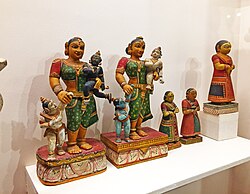 Wooden statuettes painted in the Pattachitra style, Kala Bhoomi Odisha Crafts Museum, Bhubaneswar.
 -
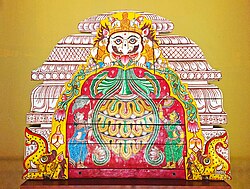 Prabha of Devi Subhadra's Ratha, Puri, Odisha.
 -
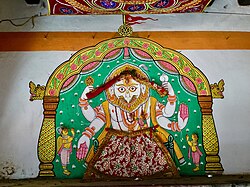 Modern wall mural of Narasimha in a street of Puri, Odisha.


References
Citations
- ↑ 1.0 1.1 "Registration of Geographical Indications and Orissa" (PDF). Archived from the original (PDF) on 10 January 2017.
- ↑ "Orissa Pattachitra". Archived from the original on 22 November 2021. Retrieved 23 July 2018.
- ↑ Bose, Nirmal Kumar. 1953. Folk religion of Bengal, part I number I (A study of the Vrata rites).C. Kar, Benoy Bose Road, Calcutta, India
- ↑ "Patachitra: Ancient scroll painting of Bengal". Media India Group. 26 April 2017. Archived from the original on 19 May 2018. Retrieved 18 May 2018.
- ↑ SenGupta, pp. 13.
- ↑ ":::::: Daricha Foundation ::::::". Archived from the original on 22 November 2021. Retrieved 11 May 2018.
- ↑ "Patta Chitra". Archived from the original on 21 May 2014. Retrieved 2 March 2014.
- ↑ Rahaman, Md Motiur; Hom Choudhury, Mahuya; Sengupta, Sangita (29 February 2016). "VALIDATION AND GEOGRAPHICAL INDICATION (G.I) REGISTRATION OF PATACHITRA OF WEST BENGAL- ISSUES AND CHALLENGES".
- ↑ Gadon, Elinor W. (February 2000). "Indian Art Worlds in Contention: Local, Regional and National Discourses on Orissan Patta Paintings. By Helle Bundgaard. Nordic Institute of Asian Studies Monograph Series, No. 80. Richmond, Surrey: Curzon, 1999. 247 pp. $45.00 (cloth)". The Journal of Asian Studies. 59 (1): 192–194. doi:10.2307/2658630. ISSN 1752-0401. JSTOR 2658630. S2CID 201436927. Archived from the original on 29 August 2020. Retrieved 29 August 2020.
- ↑ 10.0 10.1 "Myths and Folktales in the Patachitra Art of Bengal: Tradition and Modernity - The Chitrolekha Journal on Art and Design". The Chitrolekha Journal on Art and Design. 2 August 2015. Archived from the original on 19 May 2018. Retrieved 18 May 2018.
- ↑ SenGupta, pp. 12.
- ↑ Balakrishna, Sandeep (5 September 2022). "Mankhas as the Extinct Inheritors of a Profound Cultural Treasure". The Dharma Dispatch. Archived from the original on 24 June 2024. Retrieved 25 June 2024.
- ↑ বন্দ্যোপাধ্যায়, দেবাশিস. "পটচিত্রের চাহিদা বাড়ছে নবদ্বীপের রাসে". Anandabazar Patrika (in Bengali). Archived from the original on 13 April 2018. Retrieved 11 May 2018.
- ↑ 14.0 14.1 Giusti, M. and Chakraborty, U. (ed.). Immagini Storie Parole. Dialoghi di formazione coi dipinti cantati delle donne Chitrakar del West Bengal. Mantova: Universitas Studiorum, 2014, ISBN 978-88-97683-39-1
- ↑ Ponte, Inês (13 May 2015). "Cosmopolitan impressions from a contemporary Bengali patachitra painting museum collection in Portugal". Ateliers d'Anthropologie. 41 (41). doi:10.4000/ateliers.9771. ISSN 1245-1436.
- ↑ Sen Gupta, Sankar (1973). The Patas and the Patuas of Bengal. Calcutta: Indian Publications. pp. 54–55. Archived from the original on 25 July 2023. Retrieved 25 July 2023.
- ↑ Mookerjee, Ajitcoomar (1939). Folk Art of Bengal. University of Calcutta.
- ↑ Sri Ashutosh Bhattacharya. Bangiyo Loko-Sangeet Ratnakosh. Kolkata: Paschimbanga Loko Sanskriti Gobeshona Kendra. p. 1041.
- ↑ tarapada santra (2000). Paschimbanger lokoshilpa o lokosamaj. Kolkata: Kolkata: lokosanskriti o adibasi sanskriti kendra. p. 12.
{{cite book}}: CS1 maint: publisher location (link) - ↑ বন্দ্যোপাধ্যায়, দেবাশিস. "পটচিত্রের চাহিদা বাড়ছে নবদ্বীপের রাসে". Anandabazar Patrika (in Bengali). Archived from the original on 13 April 2018. Retrieved 14 April 2018.
- ↑ ভট্টাচার্য, বিভূতিসুন্দর. "অবক্ষয় আর অবলুপ্তির মাঝে বাংলার চালচিত্র - Anandabazar". Anandabazar Patrika (in Bengali). Archived from the original on 14 April 2018. Retrieved 14 April 2018.
- ↑ "বাংলার লোকশিল্পে দুর্গা". Archived from the original on 17 December 2023. Retrieved 29 June 2025.
- ↑ "ছবি-নকশার বৈচিত্রে রঙিন বাংলার লক্ষ্মীসরা".
- ↑ "লক্ষ্মীপট - বাংলাপিডিয়া". bn.banglapedia.org (in Bengali). Archived from the original on 19 August 2022. Retrieved 29 June 2025.
- ↑ "গাজীর পট - বাংলাপিডিয়া". bn.banglapedia.org (in Bengali). Retrieved 29 June 2025.
- ↑ Craft council of West Bengal-1985-86, The Jarana Patachitra of Bengal- Mahamaya, p-112
- ↑ D. P. Ghosh, FOLK ART OF BENGAL, Visvabharati, p-4
- ↑ "Report on Patachitra of West Bengal" (PDF). Archived from the original (PDF) on 12 May 2018. Retrieved 11 May 2018.
- ↑ Nair, Sunita (2018). Indigenius Artists India. Mumbai: Sunita Nair. pp. 135–137. ISBN 978-93-5311-387-2.
- ↑ "Patta Chitra". Archived from the original on 23 September 2017. Retrieved 30 May 2012.
- ↑ "National Portal of India". Archived from the original on 5 February 2011. Retrieved 18 February 2010.
- ↑ Unknown[permanent dead link]
- ↑ "Pattachitra Painting". archive.india.gov.in. Archived from the original on 7 April 2014. Retrieved 1 April 2014.
- ↑ "Crafts of India -Patachitra - Introduction". Unnati Silks. Archived from the original on 8 February 2022. Retrieved 19 July 2018.
- ↑ "Pattachitra Arts - Orissa | Handmade Crafts directly from Craftsmen". Archived from the original on 27 February 2011. Retrieved 18 February 2010.
- ↑ Mokashi, Akshata (29 January 2021). "Pattachitra: The Heritage Art of Odisha". www.livehistoryindia.com. Archived from the original on 31 December 2022. Retrieved 31 December 2022.
- ↑ "Indian Art » Blog Archive » Patta Chitra Paintings". indianart.in. Archived from the original on 21 July 2011. Retrieved 19 March 2010.
- ↑ categories of Pattachitra Archived 29 July 2010 at the Wayback Machine
- ↑ Devotionalstore (2 January 2017). "Traditional Art of Odisha : Pattachitra Painting". DevotionalStore. Archived from the original on 13 January 2017. Retrieved 11 January 2017.
- ↑ "The meticulous process of Pattachitra paintings". Archived from the original on 2 March 2012. Retrieved 22 March 2010.
- ↑ "Radha, Krishna and Gopis in Pattachitra". Archived from the original on 2 March 2012. Retrieved 22 March 2010.
- ↑ "How to do Pattachitra". Archived from the original on 29 July 2010. Retrieved 22 March 2010.
- ↑ natural colours used in Pattachitra Archived 29 July 2010 at the Wayback Machine
- ↑ colour brushes used in Pattachitra Archived 29 July 2010 at the Wayback Machine
- ↑ "Patta paintings". Archived from the original on 6 January 2009. Retrieved 26 March 2010. Palm leaf pattachitra
Further reading
- Kossak, Steven (1997). Indian court painting, 16th-19th century. New York: The Metropolitan Museum of Art. ISBN 0-87099-783-1. (see index: p. 148-152)
External links
- Patachitra of Medinipur (Midnapore)
- Past of Pattachitra
- Essential Ideas on Pattachita Archived 16 July 2011 at the Wayback Machine
- Pattachitra Painting
- Pattachitra Photogallery
- Pattachithra – the amazing folk art of Odisha - OpenArt India
| Cuisine |  | ||||
|---|---|---|---|---|---|
| Dance |
| ||||
| Music |
| ||||
| Handlooms and handicrafts |
| ||||
| Observations and festivals | |||||
| Arts | |||||
| Other | |||||


| Dance |
| ||||||
|---|---|---|---|---|---|---|---|
| Music | |||||||
| Play, theatre and puppetry |
| ||||||
| Wedding | |||||||
| Festivals | |||||||
| Martial arts | |||||||
| Handlooms | |||||||
| Arts and Handicrafts |
| ||||||
| Architecture | |||||||
| Calendar (Panjika) | |||||||


.png)