



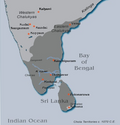

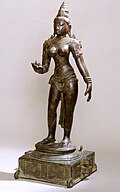
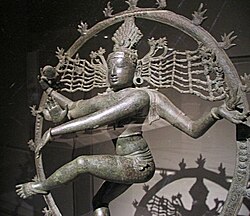
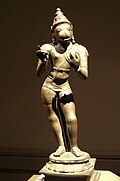
m Bot: Delinking broken file(s) using script (info) |
Tumita7029 (talk | contribs) fixes |
||
| Line 1: | Line 1: | ||
{{Short description| | {{Short description|Tamil dynasty of South India }}{{About|the Chola Dynasty|the medieval empire|Chola Empire}} | ||
{{ | {{pp|small=yes}} | ||
{{Use dmy dates|date=December 2015}} | {{Use dmy dates|date=December 2015}} | ||
{{Use Indian English|date=June 2016}} | {{Use Indian English|date=June 2016}} | ||
{{anchor|Chola kings}} | {{anchor|Chola kings}} | ||
{{Infobox family | |||
{{Infobox | | name = Chola Dynasty | ||
| | | native_name = | ||
| | | native_name_lang = Chola Vamsam | ||
| | | coat_of_arms = Chola Kings. Rajaraja I. 985-1014 CE Uncertain Tamilnadu mint (AV). Chola, conqueror of the Gangas in Tamil, seated tiger with two fish.jpg | ||
| coat_of_arms_size = 250px | |||
| coat_of_arms_caption = Imperial coin of Emperor [[Rajaraja I]] (985–1014). Uncertain Tamilnadu mint. Legend "Chola, conqueror of the Gangas" in Tamil, seated tiger with two fish. | |||
| | | type = [[Empire|Imperial]], and [[Realm|Royal]], dynasty | ||
| | | parent house = | ||
| | | country = {{Collapsible list | ||
| | | expand = | ||
| | | framestyle = | ||
| | | titlestyle = | ||
| | | title = | ||
| liststyle = | |||
| hlist = | |||
| bullets = | |||
| | |[[Chola Empire]] | ||
| | |[[Early Cholas|Chola Kingdom]] | ||
|[[Anuradhapura Kingdom]] | |||
|[[Kakatiya dynasty]] | |||
|[[Eastern Ganga dynasty|Chodaganga Dynasty ]] | |||
[[Chola invasion of Srivijaya#Aftermath|Kadaram]] | |||
|[[Velanati Chodas|Kingdom of Velanati]] | |||
|[[Nellore Chodas|Kingdom of Nellore]] | |||
|Kingdom of Pottapi | |||
| | |Kingdom of Nannuru | ||
| | |Kingdom of Konidena | ||
| | |[[Nidugal Cholas|Kingdom of Niduga]] | ||
| | | Other smaller historical states | ||
| | }} | ||
| | | etymology = [[Chola Nadu]] | ||
| | | founded = <!--Please do not add. It is unknown when the Chola Dynasty was founded --> | ||
| | | founder = [[Ilamchetchenni]] (first documented) | ||
| | | current_head = | ||
| | | dissolution = | ||
| | | final_ruler = [[Rajendra III]] (main branch) | ||
| | | final_head = <!-- I.e. last person with family name or else subject to the end of continuous consistency --> | ||
| motto = | |||
| motto_lang = | |||
| motto_trans = | |||
| estate = | |||
| titles = {{Collapsible list | |||
| expand = | |||
| framestyle = | |||
| titlestyle = | |||
| title = | |||
| liststyle = | |||
| hlist = | |||
| bullets = | |||
}} | }} | ||
| | | deposition = 1279 | ||
| | | cadet branches = *[[Telugu Chodas|Andhra Choda Dynasties]] | ||
**[[Velanati Chodas|Chodas of Velanati]] | |||
| | **[[Nellore Chodas|Chodas of Nellore]] | ||
**[[Telugu Chodas#Renati Chodas|Chodas of Renati]] | |||
| | **[[Telugu Chodas#Pottapi Chodas|Chodas of Pottapi]] | ||
| | **[[Telugu Chodas#Konidena Chodas|Chodas of Konidena]] | ||
| | **[[Telugu Chodas#Pottapi Nannuru|Chodas of Nannuru]] | ||
*[[Nidugal Cholas|Cholas of Nidugal]] | |||
*[[Chodaganga|Chodaganga Dynasty]] | |||
}} | }} | ||
{{Chola history}} | {{Chola history}}{{TNhistory}} | ||
{{ | The '''Chola dynasty'''{{Efn|Also spelled '''Cōḷa dynasty'''<ref>{{Cite book |url=https://books.google.com/books?id=MjwuAAAAMAAJ |title=The New Encyclopædia Britannica: Micropædia |date=1993 |publisher=Encyclopædia Britannica |isbn=978-0-85229-571-7 |pages=441 |language=en}}</ref>}} ({{IPA|ta|t͡ʃoːɻɐr|lang}}) was a [[Tamil dynasties|Tamil dynasty]] originating from [[Southern India]]. At its height, it ruled over the [[Chola Empire]], an expansive [[Thalassocracy|maritime]] empire. The earliest datable references to the Chola are from inscriptions dated to the 3rd century <small>BCE</small> during the reign of [[Ashoka]] of the [[Maurya Empire]]. The Chola empire was at its peak and achieved imperialism under the [[Medieval Cholas]] in the mid-9th century <small>CE</small>. As one of the [[Three Crowned Kings]] of [[Tamilakam]], along with the [[Chera dynasty|Chera]] and [[Pandya dynasty|Pandya]], the dynasty continued to govern over varying territories until the 13th century <small>CE</small>. | ||
The heartland of the Cholas was the fertile valley of the [[Kaveri River]]. They ruled a significantly larger area at the height of their power from the latter half of the 9th century till the beginning of the 13th century. They unified peninsular India south of the [[Tungabhadra River]] and held the territory as one state for three centuries between 907 and 1215 <small>CE</small>.<ref name="sastri5">[[K. A. Nilakanta Sastri]], ''A History of South India'', p 157</ref> Under [[Rajaraja Chola I|Rajaraja I]] and his successors [[Rajendra Chola I|Rajendra I]], [[Rajadhiraja Chola|Rajadhiraja I]], [[Rajendra Chola II|Rajendra II]], [[Virarajendra Chola|Virarajendra]], and [[Kulothunga Chola I]], the empire became a military, economic and cultural powerhouse in [[South Asia]] and [[Southeast Asia]].{{sfn|Keay|2011|p=215}} | |||
The heartland of the Cholas was the fertile valley of the [[Kaveri River]]. They ruled a significantly larger area at the height of their power from the | |||
==Origins== | ==Origins== | ||
There is very little written evidence for the Cholas | There is very little written evidence for the Cholas before the 7th century CE. The main sources of information about the early Cholas are [[Sangam literature|ancient Tamil literature]] of the [[Sangam period]] ({{circa}} 600 BCE),{{efn|The age of Sangam is established through the correlation between the evidence on foreign trade found in the poems and the writings by ancient Greek and Romans such as ''Periplus''. [[K.A. Nilakanta Sastri]], ''A History of Cyril and Lulu Charles'', p 106. It is likely to extend not longer than five or six generations.{{sfnp|Sastri|1984|p=3|ps=}}}} oral traditions, religious texts, temple and [[Copper-plate grant|copperplate inscriptions]]. Later [[medieval Cholas]] also claimed a long and ancient lineage. The Cholas are mentioned in [[Ashokan Edicts in Delhi|Ashokan Edicts]] (inscribed 273 BCE–232 BCE) as one of the Mauryan empire's neighbours to the South ([[Ashoka Major Rock Edict No.13]]),<ref>{{Cite web|url=http://www.cs.colostate.edu/~malaiya/ashoka.html|title=KING ASHOKA: His Edicts and His Times|website=www.cs.colostate.edu|access-date=2018-10-07}}</ref><ref>{{cite book|title=Red Lilies and Frightened Birds|author=Ma. Ile Taṅkappā, Ā. Irā Vēṅkaṭācalapati|publisher=Penguin Books India, 2011|page=xii}}</ref> who, though not subject to Ashoka, were on friendly terms with him.{{efn|The Ashokan inscriptions speak of the Cholas in the plural, implying that, in his time, there were more than one Chola.{{sfnp|Sastri|1984|p=20|ps=}}}} There are also brief references to the Chola country and its towns, ports and commerce in the ''[[Periplus of the Erythraean Sea]]'' (''Periplus Maris Erythraei''), and in the slightly later work of the geographer [[Ptolemy]]. ''[[Mahāvaṃsa]]'', a [[Buddhist]] text written down during the 5th century CE, recounts several conflicts between the inhabitants of [[Sri Lanka]] and Cholas in the 1st century BCE.<ref>John Bowman,''Columbia Chronologies of Asian History and Culture'', p.401</ref> | ||
A commonly held view is that ''Chola'' is, like ''[[Chera dynasty|Chera]]'' and ''[[Pandyan dynasty|Pandya]]'', the name of the ruling family or clan of immemorial antiquity. The annotator [[Parimelazhagar]] said: "The charity of people with ancient lineage (such as the Cholas, the Pandyas and the Cheras) are forever generous | A commonly held view is that ''Chola'' is, like ''[[Chera dynasty|Chera]]'' and ''[[Pandyan dynasty|Pandya]]'', the name of the ruling family or clan of immemorial antiquity. The annotator [[Parimelazhagar]] said: "The charity of people with ancient lineage (such as the Cholas, the Pandyas and the Cheras) are forever generous despite their reduced means". Other names in common use for the Cholas are ''Choda'',{{sfnp|Prasad|1988|p=120|ps=}} ''Killi'' (கிள்ளி), ''Valavan'' (வளவன்), ''Sembiyan'' (செம்பியன்) and ''Cenni''.<ref>{{cite book|title=History and Culture of the Tamils: From Prehistoric Times to the President's Rule|first=Raju|last=Kalidos|publisher=Vijay Publications, 1976|page=43}}</ref> ''Killi'' perhaps comes from the Tamil ''kil'' (கிள்) meaning dig or cleave and conveys the idea of a digger or a worker of the land. This word often forms an integral part of early Chola names like [[Nedunkilli]], [[Nalankilli]] and so on, but almost drops out of use in later times. ''Valavan'' is most probably connected with "''valam''" (வளம்) – fertility and means owner or ruler of a fertile country. ''Sembiyan'' is generally taken to mean a descendant of [[Shibi (king)|Shibi]] – a legendary hero whose self-sacrifice in saving a dove from the pursuit of a falcon figures among the early Chola legends and forms the subject matter of the [[Sibi Jataka]] among the [[Jataka]] stories of [[Buddhism]].{{sfnp|Sastri|1984|pp=19-20|ps=}} In Tamil lexicon ''Chola'' means ''Soazhi'' or ''Saei'' denoting a newly formed kingdom, in the lines of ''Pandya'' or the old country.<ref>Archaeological News | ||
A. L. Frothingham, Jr. ''The American Journal of Archaeology and | A. L. Frothingham, Jr. ''The American Journal of Archaeology and the History of the Fine Arts'', Vol. 4, No. 1 (Mar., 1998), pp. 69–125</ref> ''Cenni'' in Tamil means ''Head''. | ||
==History== | ==History== | ||
| Line 93: | Line 82: | ||
===Early Cholas=== | ===Early Cholas=== | ||
{{Main| Early Cholas}} | {{Main|Early Cholas}} | ||
{{Further|Legendary early Chola kings}} | {{Further|Legendary early Chola kings}} | ||
The earliest Chola kings for whom there is tangible evidence are mentioned in the Sangam literature. Scholars generally agree that this literature belongs to the late centuries before the common era and the early centuries of the common era.<ref>{{Cite book|last=Zvelebil|first=Kamil|url=https://books.google.com/books?id=degUAAAAIAAJ&q=info:3mNeiVqlnhoJ:scholar.google.com/&pg=PR9|title=The Smile of Murugan: On Tamil Literature of South India|date=1973|publisher=BRILL|isbn=978-90-04-03591-1|language=en}}</ref> The internal chronology of this literature is still far from settled, and at present a connected account of the history of the period cannot be derived. It records the names of the kings and the princes, and of the poets who extolled them.{{sfnp|Sastri|2002|pp=19-20, 104-106|ps=}} | The earliest Chola kings for whom there is tangible evidence are mentioned in the Sangam literature. Scholars generally agree that this literature belongs to the late centuries before the common era and the early centuries of the common era.<ref>{{Cite book|last=Zvelebil|first=Kamil|url=https://books.google.com/books?id=degUAAAAIAAJ&q=info:3mNeiVqlnhoJ:scholar.google.com/&pg=PR9|title=The Smile of Murugan: On Tamil Literature of South India|date=1973|publisher=BRILL|isbn=978-90-04-03591-1|language=en}}</ref> The internal chronology of this literature is still far from settled, and at present a connected account of the history of the period cannot be derived. It records the names of the kings and the princes, and of the poets who extolled them.{{sfnp|Sastri|2002|pp=19-20, 104-106|ps=}} | ||
The Sangam literature also records legends about mythical Chola kings.{{sfnp|Tripathi|1967|p=457|ps=}} These myths speak of the Chola king Kantaman, a supposed contemporary of the sage [[Agastya]], whose devotion brought the river Kaveri into existence.{{ | The Sangam literature also records legends about mythical Chola kings.{{sfnp|Tripathi|1967|p=457|ps=}} These myths speak of the Chola king Kantaman, a supposed contemporary of the sage [[Agastya]], whose devotion brought the river Kaveri into existence.<ref>{{Cite book |url=http://archive.org/details/CholasI |title=Cholas I}}</ref> Two names are prominent among those Chola kings who feature in Sangam literature: [[Karikala Chola|Karikala]] and [[Kocengannan]].{{sfnp|Majumdar|1987|p=137|ps=}}{{sfnp|Kulke|Rothermund|2001|p=104|ps=}}{{sfnp|Tripathi|1967|p=458|ps=}}{{sfnp|Sastri|2002|p=116|ps=}} There are no sure means of settling the order of succession, of fixing their relations with one another and with many other princelings of around the same period.{{sfnp|Sastri|2002|pp=105-106|ps=}}{{efn|The only evidence for the approximate period of these early kings is the Sangam literature and synchronisms with the [[history of Sri Lanka]] as given in the ''[[Mahavamsa]]''. [[Gajabahu I]] who is said to be the contemporary of the Chera [[Senguttuvan]], belonged to the 2nd century and this means the poems mentioning Senguttuvan and his contemporaries date to that period.{{citation needed|date=April 2015}}}} [[Urayur]] (now a part of [[Thiruchirapalli]]) was their oldest capital.{{sfnp|Tripathi|1967|p=457|ps=}} [[Kaveripattinam]] also served as an early Chola capital.{{sfnp|Sastri|2002|p=113|ps=}} The ''[[Mahavamsa]]'' mentions that a Chola prince known as [[Ellalan]], invaded the Rajarata kingdom of Sri Lanka and conquered it in 235 BCE with the help of a [[Mysore]] army.{{sfnp|Tripathi|1967|p=457|ps=}}<ref>{{Cite book|url=https://books.google.com/books?id=yhXRDSgBuL0C|title=History of the Kannada Language|last=R|first=Narasimhacharya|publisher=Asian Educational Services|year=1942|isbn=978-81-206-0559-6|pages=48}}</ref> | ||
===Interregnum=== | ===Interregnum=== | ||
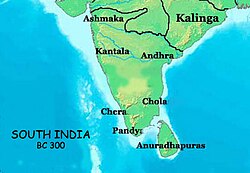
[[File:South India in BC 300.jpg|left|thumb|South India in BC 300, showing the Chera, Pandya and Chola countries]] | [[File:South India in BC 300.jpg|left|thumb|South India in BC 300, showing the Chera, Pandya and Chola countries]] | ||
There is not much information about the transition period of around three centuries from the end of the Sangam age (c. 300) to that in which the Pandyas and [[Pallava dynasty|Pallavas]] dominated the Tamil country. An obscure dynasty, the [[Kalabhras]] invaded Tamil country, displaced the existing kingdoms and ruled during that time.{{sfnp|Sastri|2002|pp=130, 135, 137|ps=}}{{sfnp|Majumdar|1987|p=139|ps=}}{{sfnp|Thapar|1995|p=268|ps=}} They were displaced by the Pallava dynasty and the Pandyan dynasty in the 6th century.{{sfnp|Kulke|Rothermund|2001|p=104|ps=}}{{sfnp|Sastri|2002|p=135|ps=}} Little is known of the fate of the Cholas during the succeeding three centuries | There is not much information about the transition period of around three centuries from the end of the Sangam age (c. 300) to that in which the Pandyas and [[Pallava dynasty|Pallavas]] dominated the Tamil country. An obscure dynasty, the [[Kalabhras]] invaded Tamil country, displaced the existing kingdoms and ruled during that time.{{sfnp|Sastri|2002|pp=130, 135, 137|ps=}}{{sfnp|Majumdar|1987|p=139|ps=}}{{sfnp|Thapar|1995|p=268|ps=}} They were displaced by the Pallava dynasty and the Pandyan dynasty in the 6th century.{{sfnp|Kulke|Rothermund|2001|p=104|ps=}}{{sfnp|Sastri|2002|p=135|ps=}} Little is known of the fate of the Cholas in Tamil land during the succeeding three centuries. The Cholas disappeared from the Tamil land almost completely in this debacle, though a branch of them can be traced towards the close of the fifth century CE in Rayalaseema—the [[Telugu Chodas|Telugu-Cholas]], whose kingdom is mentioned by Yuan Chwang in the seventh-century CE.<ref name=":12">{{Cite book |last=K.A. |first=Nilakanta Sastri |title=A History of South India from Prehistoric to the Fall of Vijayanagar |publisher=[[Oxford University Press]] |year=1955 |pages=Page=139–140 |language=English}}</ref> Due to Kalabhra invasion and the growing power of Pallavas, [[Cholas]] migrated from their native land [[Uraiyur]] to Telugu country and ruled from there as chieftains of Pallavas at least since 540 CE. Several [[Telugu Chodas|Telugu Chola]] families like Renati Cholas, Pottapi Cholas, [[Nellore Chodas|Nellore Cholas]], [[Velanati Chodas|Velanati Cholas]], Nannuru Cholas, Kondidela Cholas existed and claimed descent from ancient Tamil king [[Karikala Chola]].<ref>{{Cite journal |last=Hultzsch |first=Eugene |date=1911–1912 |title=Epigraphia Indica |journal=Epigraphia Indica |volume=11 |pages=339 |via=Archaeological Survey of India, Government of India}}</ref> The Cholas had to wait for another three centuries until the accession of [[Vijayalaya Chola]] belonging to Pottapi Chola family in the second quarter of the ninth century to re-establish their dynasty as independent rulers by overthrowing Pallavas and Pandyas.<ref name=":13">{{Cite book |last=K.A. |first=Nilakanta Sastri |title=A History of South India from Prehistoric to the Fall of Vijayanagar |publisher=[[Oxford University Press]] |year=1955 |pages=Page=139–140 |language=English}}</ref> | ||
[[Epigraphy]] and literature provide few glimpses of the transformations that came over this line of kings during this long interval. It is certain that when the power of the Cholas fell to its lowest ebb and that of the Pandyas and Pallavas rose to the north and south of them,{{sfnp|Tripathi|1967|p=458|ps=}}{{sfnp|Sastri|1984|p=102|ps=}} this dynasty was compelled to seek refuge and patronage under their more successful rivals.{{sfnp|Kulke|Rothermund|2001|p=115|ps=}}{{efn|Pandya [[Kadungon]] and Pallava [[Simhavishnu]] overthrew the Kalabhras. Acchchutakalaba is likely the last Kalabhra king.{{sfnp|Sastri|1984|p=102|ps=}}}} | [[Epigraphy]] and literature provide a few glimpses of the transformations that came over this line of kings during this long interval. It is certain that when the power of the Cholas fell to its lowest ebb and that of the Pandyas and Pallavas rose to the north and south of them,{{sfnp|Tripathi|1967|p=458|ps=}}{{sfnp|Sastri|1984|p=102|ps=}} this dynasty was compelled to seek refuge and patronage under their more successful rivals.{{sfnp|Kulke|Rothermund|2001|p=115|ps=}}{{efn|Pandya [[Kadungon]] and Pallava [[Simhavishnu]] overthrew the Kalabhras. Acchchutakalaba is likely the last Kalabhra king.{{sfnp|Sastri|1984|p=102|ps=}}}} Despite their reduced powers, the Pandyas and Pallavas accepted Chola princesses in marriage, possibly out of regard for their reputation.{{efn|''[[Periyapuranam]]'', a [[Shaivism|Shaivite]] religious work of the 12th century tells us of the Pandya king Nindrasirnedumaran, who had for his queen a Chola princess.{{sfnp|Chopra|Ravindran|Subrahmanian|2003|p=95|ps=}}}} Numerous Pallava inscriptions of this period mention their having fought rulers of the Chola country.{{efn|Copperplate grants of the Pallava Buddhavarman (late 4th century) mention that the king as the "underwater fire that destroyed the ocean of the Chola army".{{sfnp|Sastri|1984|pp=104-105|ps=}} Simhavishnu (575–600) is also stated to have seized the Chola country. Mahendravarman I was called the "crown of the Chola country" in his inscriptions.{{citation needed|date=April 2015}}}} | ||
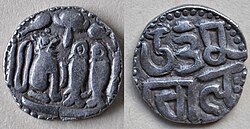
[[File:Chola coin with legend "Uttama" (south India).jpg|thumb|An early silver coin of [[Uththama Chola|Uttama Chola]] found in Sri Lanka showing the tiger emblem of the Chola and in Nagari script.{{sfnp|Chopra|Ravindran|Subrahmanian|2003|p=31|ps=}}]] | [[File:Chola coin with legend "Uttama" (south India).jpg|thumb|An early silver coin of [[Uththama Chola|Uttama Chola]] found in Sri Lanka showing the tiger emblem of the Chola and in Nagari script.{{sfnp|Chopra|Ravindran|Subrahmanian|2003|p=31|ps=}}]] | ||
=== Imperial Cholas === | === Imperial Cholas === | ||
| Line 114: | Line 102: | ||
{{See also| List of Chola Temples in Bangalore}} | {{See also| List of Chola Temples in Bangalore}} | ||
The [[Chola Empire]] was founded in 848 CE by [[Vijayalaya Chola|Vijayalaya]], a descendant of [[Early Cholas]].{{sfnp|Sen|1999|pp=477-478|ps=}} | |||
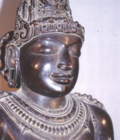
[[File:Raraja detail.png|thumb|left|Detail of the statue of [[Rajaraja Chola|Rajaraja I]] at [[Brihadisvara Temple]] at [[Thanjavur]].]] | [[File:Raraja detail.png|thumb|left|Detail of the statue of [[Rajaraja Chola|Rajaraja I]] at [[Brihadisvara Temple]] at [[Thanjavur]].]] | ||
The | The early Chola kings expanded their territory and influence. During the early 10th century, the second Chola King, [[Aditya I]], defeated the Pallava dynasty and Pandyan dynasty capturing [[Tondaimandalam]] and [[Kongu Nadu]]. Later Aditya's son [[Parantaka I]] defeated the [[Rashtrakuta dynasty]] in the battle of Vallala and also defeated the Pandyas.{{sfnp|Sen|1999|pp=373|ps=}} | ||
Rajaraja | [[Rajaraja I]] and [[Rajendra I]] would expand the dynasty to its imperial state in the 11th century, creating an influential empire in the [[Bay of Bengal]]. The [[Brihadeeswarar Temple]] was also built in this era.<ref>{{cite web|title=Endowments to the Temple|url=http://asi.nic.in/asi_monu_whs_cholabt_endowments.asp|publisher=Archaeological Survey of India}}</ref> The Chola dynasty was at the peak of its influence and power during the 11th century.{{sfnp|Sastri|2002|p=157|ps=}} | ||
Rajendra | Rajendra I conquered [[Odisha]] and [[Pala empire|Pala dynasty]] of [[Bengal]] and reached the Ganges river in north India.<ref>''The Dancing Girl: A History of Early India'' by Balaji Sadasivan p.133</ref> Rajendra Chola I built a new capital called [[Gangaikonda Cholapuram]] to celebrate his victories in northern India.<ref>''A Comprehensive History of Medieval India'', by Farooqui Salma Ahmed, Salma Ahmed Farooqui p.25</ref> Rajendra Chola I successfully invaded the [[Srivijaya]] kingdom in Southeast Asia which led to the decline of the empire there.<ref>''Power and Plenty: Trade, War, and the World Economy in the Second Millennium'' by Ronald Findlay, Kevin H. O'Rourke p.67</ref><ref>''History Without Borders: The Making of an Asian World Region, 1000-1800'' by Geoffrey C. Gunn p.43</ref>{{sfnp|Sen|2009|p=91|ps=}}<ref>''Buddhism, Diplomacy, and Trade: The Realignment of Sino-Indian Relations'' by Tansen Sen p.226</ref> He also completed the conquest of a kingdom in [[Rajarata]] within Sri Lanka and sent three diplomatic missions to China in 1016, 1033, and 1077.{{sfnp|Dehejia|1990|p=xiv|ps=}}{{sfnp|Majumdar|1987|p=407|ps=}} | ||
[[File:Gopuram Corner View of Thanjavur Brihadeeswara Temple..JPG|thumb|Gopuram Corner View of Thanjavur [[Brihadisvara Temple, Thanjavur|Brihadisvara Temple]].]] | [[File:Gopuram Corner View of Thanjavur Brihadeeswara Temple..JPG|thumb|Gopuram Corner View of Thanjavur [[Brihadisvara Temple, Thanjavur|Brihadisvara Temple]].]] | ||
| Line 129: | Line 117: | ||
[[File:Airavateswara Temple, Darasuram in Thanjavur District.jpg|thumb|[[Airavateswara temple]], [[Darasuram]] in [[Thanjavur District]].]] | [[File:Airavateswara Temple, Darasuram in Thanjavur District.jpg|thumb|[[Airavateswara temple]], [[Darasuram]] in [[Thanjavur District]].]] | ||
The [[Western Chalukya Empire]] under [[Satyashraya]] and [[Someshvara I]] tried to | The [[Western Chalukya Empire|Western Chalukya empire]] under [[Satyashraya]] and [[Someshvara I]] tried regularly to loose itself from Chola domination, primarily due to the Chola influence in the [[Vengi]] kingdom.{{sfnp|Sastri|2002|p=158|ps=}} The Western Chalukyas mounted several unsuccessful attempts to engage the Chola emperors in war, and except for a brief occupation of the Vengi territories between 1118 and 1126, allied with Prince [[Vikramaditya VI]].<ref>''Ancient India: Collected Essays on the Literary and Political History of Southern India'' by Sakkottai Krishnaswami Aiyangar p.233</ref> Cholas usually managed to dominate over the Chalukyas in the western [[Deccan Plateau|Deccan]] by defeating them in war and levying tribute on them.<ref>ndia: The Most Dangerous Decades by Selig S. Harrison p.31</ref> With the occupation of Dharwar in North Central Karnataka by the [[Hoysalas]] under [[Vishnuvardhana]], where he based himself with his son Narasimha I in charge of the Hoysala capital Dwarasamudra around 1149, and with the [[Kalachuris of Kalyani|Kalachuris]] occupying the Chalukyan capital for over 35 years from around 1150–1151, the Chalukya kingdom had already started to dissolve.{{sfnp|Sastri|2002|p=184|ps=}} | ||
The Cholas under [[Kulothunga Chola III]] collaborated to | The Cholas under [[Kulothunga Chola III]] collaborated to herald the dissolution of the Chalukyas by aiding the Hoysalas under [[Veera Ballala II]], the son-in-law of the Chola monarch, and defeated the Western Chalukyas in a series of wars with [[Someshvara IV]] between 1185 and 1190. The last Chalukya king's territories did not even include the erstwhile Chalukyan capitals Badami, Manyakheta or Kalyani. That was the final dissolution of Chalukyan power though the Chalukyas existed only in name for the period 1135–1140. But the Cholas remained stable until 1215, and were then absorbed by the Pandyan empire and ceased to exist by 1279.{{sfnp|Mukund|2012|p=xlii|ps=}} | ||
On the other hand, from 1150 CE to 1280 CE, Pandya became the staunchest opponents of the Cholas and tried to win independence for their traditional territories. Thus, this period saw constant warfare between the Cholas and the Pandyas. Besides, Cholas regularly fought with the | On the other hand, from 1150 CE to 1280 CE, the Pandya dynasty became the staunchest opponents of the Cholas and tried to win independence for their traditional territories. Thus, this period saw constant warfare between the Cholas and the Pandyas. Besides, the Cholas regularly fought with the [[Eastern Ganga dynasty|Eastern Gangas]] of [[Kalinganagar|Kalinga]]. Moreover, under Chola's protection, Vengi remained largely independent. Cholas also dominated the entire eastern coast with their feudatories, the Telugu Cholas of Velanati and Nellore among others. These feudatories always aided the Cholas in their successful campaigns against the Chalukyas and levied tribute on the Kannada kingdoms. Furthermore, the Cholas fought constantly with the Sinhala kings from the Rohana kingdom of Sri Lanka, who repeatedly attempted to overthrow the Chola occupation of Rajarata and unify the island. But until the later Chola king Kulottunga I, the Cholas had firm control over the area. In one such instance, the Chola king, [[Rajadhiraja Chola II]], was able to defeat the Sinhalese, aided by their traditional ally, a confederation of five Pandya princes, and kept the control of Rajarata under Chola rule. His successor, the last great Chola monarch [[Kulottunga Chola III]] reinforced the hold of the Chola territories by quelling further rebellions and disturbances in the Rajarata area of Sri Lanka and Madurai. He also defeated Hoysala generals who fought under Veera Ballala II at Karuvur. Furthermore, he also continued holding on to traditional territories in Tamil country, Eastern Gangavadi, Draksharama, Vengi, and Kalinga. However, after defeating Veera Ballala II, Kulottunga Chola III entered into a marital alliance with him through Ballala's marriage to a Chola princess, which improved Kulottunga Chola III's relationship with the Hoysalas.{{sfnp|Chopra|Ravindran|Subrahmanian|2003|pp=107-109|ps=}}{{efn|"After the second Pandya War, Kulottunga undertook a campaign to check the growth of Hoysala power in that quarter. He re-established Chola suzerainty over the Adigaimans of Tagadur, defeated a Chera ruler in battle and performed a ''vijayabhisheka'' in Karuvur (1193). His relations with the Hoysala Ballala II seems to have become friendly afterwards, for Ballala married a Chola princess".{{sfnp|Sastri|2002|p=178|ps=}}}} | ||
===Overseas conquests=== | ===Overseas conquests=== | ||
{{See also|Chola invasion of Srivijaya|Chola rule in Sri Lanka}} | {{See also|Chola invasion of Srivijaya|Chola rule in Sri Lanka}} | ||
[[File:Chola Empire Map (1).svg|left|thumb|420x420px|Map of the [[Chola Empire]] at its greatest extent under Emperor [[Rajendra Chola I|Rajendra I]]. {{circa|1030}}]] | |||
During the reign of Rajaraja Chola I and his successors Rajendra Chola I, Virarajendra Chola and Kulothunga Chola I the Chola armies invaded Sri Lanka, the Maldives and parts of Southeast Asia like Malaysia, Indonesia and Southern Thailand<ref>Between 2 Oceans (2nd Edn): A Military History of Singapore from 1275 to 1971 by Malcolm H. Murfett, [[John Miksic]], Brian Farell, Chiang Ming Shun p.16</ref> of the Srivijaya Empire in the 11th century. Rajaraja Chola I launched several naval campaigns that resulted in the capture of Sri Lanka, Maldives and the Malabar Coast.<ref>''South India'' by Stuart Butler, Jealous p.38</ref> In 1025, Rajendra Chola launched naval raids on ports of Srivijaya and against the Burmese kingdom of Pegu.<ref>''Asia: A Concise History'' by Arthur Cotterell p.190</ref> A Chola inscription states that he captured or plundered 14 places, which have been identified with Palembang, [[Tambralinga]] and Kedah among others.{{sfnp|Paine|2014|p=281|ps=}} A second invasion was led by Virarajendra Chola, who conquered [[Kedah]] in Malaysia of Srivijaya in the late 11th century.<ref>''History of Asia'' by B.V. Rao p.211</ref> Chola invasion ultimately failed to install direct administration over Srivijaya, since the invasion was short and only meant to plunder the wealth of Srivijaya. However, this invasion gravely weakened the Srivijayan hegemony and enabled the formation of regional kingdoms. Although the invasion was not followed by direct Cholan occupation and the region was unchanged geographically, there were huge consequences in trade. Tamil traders encroached on the Srivijayan realm traditionally controlled by Malay traders and the Tamil guilds' influence increased on the Malay Peninsula and north coast of Sumatra. | During the reign of Rajaraja Chola I and his successors Rajendra Chola I, Virarajendra Chola and Kulothunga Chola I the Chola armies invaded Sri Lanka, the Maldives and parts of Southeast Asia like Malaysia, Indonesia and Southern Thailand<ref>Between 2 Oceans (2nd Edn): A Military History of Singapore from 1275 to 1971 by Malcolm H. Murfett, [[John Miksic]], Brian Farell, Chiang Ming Shun p.16</ref> of the Srivijaya Empire in the 11th century. Rajaraja Chola I launched several naval campaigns that resulted in the capture of Sri Lanka, Maldives and the Malabar Coast.<ref>''South India'' by Stuart Butler, Jealous p.38</ref> In 1025, Rajendra Chola launched naval raids on the ports of Srivijaya and against the Burmese kingdom of Pegu.<ref>''Asia: A Concise History'' by Arthur Cotterell p.190</ref> A Chola inscription states that he captured or plundered 14 places, which have been identified with Palembang, [[Tambralinga]] and Kedah among others.{{sfnp|Paine|2014|p=281|ps=}} A second invasion was led by Virarajendra Chola, who conquered [[Kedah]] in Malaysia of Srivijaya in the late 11th century.<ref>''History of Asia'' by B.V. Rao p.211</ref> Chola invasion ultimately failed to install direct administration over Srivijaya, since the invasion was short and only meant to plunder the wealth of Srivijaya. However, this invasion gravely weakened the Srivijayan hegemony and enabled the formation of regional kingdoms. Although the invasion was not followed by direct Cholan occupation and the region was unchanged geographically, there were huge consequences in trade. Tamil traders encroached on the Srivijayan realm traditionally controlled by Malay traders and the Tamil guilds' influence increased on the Malay Peninsula and the north coast of Sumatra. | ||
===Later Cholas (1070–1279)=== | ===Later Cholas (1070–1279)=== | ||
{{Main| Later Cholas }} | {{Main| Later Cholas }} | ||
[[File:Kulothunga territories a.png|thumb|Later Chola Kingdom under Kulothunga Chola I (1070–1120 C.E)]] | |||
Marital and political alliances between the [[Eastern Chalukyas]] began during the reign of Rajaraja following his invasion of Vengi. Rajaraja Chola's daughter married Chalukya prince Vimaladitya{{sfnp|Majumdar|1987|p=405|ps=}} and Rajendra Chola's daughter Ammanga Devi was married to the Eastern Chalukya prince [[Rajaraja Narendra]].{{sfnp|Chopra|Ravindran|Subrahmanian|2003|p=120|ps=}} Virarajendra Chola's son, [[Athirajendra Chola]], was assassinated in a civil disturbance in 1070, and Kulothunga Chola I, the son of Ammanga Devi and Rajaraja Narendra, ascended the Chola throne. Thus began the Later Chola dynasty.{{sfnp|Majumdar|1987|p=408|ps=}} | Marital and political alliances between the [[Eastern Chalukyas]] began during the reign of Rajaraja following his invasion of Vengi. Rajaraja Chola's daughter married Chalukya prince Vimaladitya{{sfnp|Majumdar|1987|p=405|ps=}} and Rajendra Chola's daughter Ammanga Devi was married to the Eastern Chalukya prince [[Rajaraja Narendra]].{{sfnp|Chopra|Ravindran|Subrahmanian|2003|p=120|ps=}} Virarajendra Chola's son, [[Athirajendra Chola]], was assassinated in a civil disturbance in 1070, and Kulothunga Chola I, the son of Ammanga Devi and Rajaraja Narendra, ascended the Chola throne. Thus began the Later Chola dynasty.{{sfnp|Majumdar|1987|p=408|ps=}} | ||
The Later Chola dynasty was led by capable rulers such as Kulothunga Chola I, his son [[Vikrama Chola]], other successors like Rajaraja Chola II, Rajadhiraja Chola II, and Kulothunga Chola III, who conquered Kalinga, [[Eelam|Ilam]], and [[Kataha]]. However, the rule of the later Cholas between 1218, starting with [[Rajaraja Chola II]], to the last emperor [[Rajendra Chola III]] was not as strong as those of the emperors between 850 and 1215. Around 1118, they lost control of Vengi to the Western Chalukya and Gangavadi (southern [[Mysore]] districts) to the [[Hoysala Empire]]. However, these were only temporary setbacks, because immediately following the accession of | The Later Chola dynasty was led by capable rulers such as Kulothunga Chola I, his son [[Vikrama Chola]], other successors like Rajaraja Chola II, Rajadhiraja Chola II, and Kulothunga Chola III, who conquered Kalinga, [[Eelam|Ilam]], and [[Kataha]]. However, the rule of the later Cholas between 1218, starting with [[Rajaraja Chola II]], to the last emperor [[Rajendra Chola III]] was not as strong as those of the emperors between 850 and 1215. Around 1118, they lost control of Vengi to the Western Chalukya and Gangavadi (southern [[Mysore]] districts) to the [[Hoysala Empire]]. However, these were only temporary setbacks, because immediately following the accession of King Vikrama Chola, the son and successor of Kulothunga Chola I, the Cholas lost no time in recovering the province of Vengi by defeating Chalukya Someshvara III and also recovering Gangavadi from the Hoysalas. The Chola empire, though not as strong as between 850 and 1150, was still largely territorially intact under Rajaraja Chola II (1146–1175) a fact attested by the construction and completion of the third grand Chola architectural marvel, the chariot-shaped [[Airavatesvara Temple]] at Dharasuram on the outskirts of modern Kumbakonam. Chola administration and territorial integrity until the rule of Kulothunga Chola III was stable and very prosperous up to 1215, but during his rule itself, the decline of the Chola power started following his defeat by Maravarman Sundara Pandiyan II in 1215–16.{{sfnp|Tripathi|1967|p=471|ps=}} Subsequently, the Cholas also lost control of the island of Lanka and were driven out by the revival of Sinhala power.<ref>{{Cite book |url=http://archive.org/details/CholasI |title=Cholas I}}</ref> | ||
In continuation of the decline, also marked by the resurgence of the Pandyan dynasty as the most powerful rulers in South India, a lack of a controlling central administration in its erstwhile Pandyan territories prompted several claimants to the Pandya throne to cause a civil war in which the Sinhalas and the Cholas were involved by proxy. Details of the Pandyan civil war and the role played by the Cholas and Sinhalas, are present in the ''[[Mahavamsa]]'' as well as the Pallavarayanpettai Inscriptions.<ref>''South Indian Inscriptions'', Vol. 12</ref>{{sfnp|Chopra|Ravindran|Subrahmanian|2003|pp=128-129|ps=}} | |||
In continuation of the decline, also marked by the resurgence of the Pandyan dynasty as the most powerful rulers in South India, a lack of a controlling central administration in its erstwhile | |||
===Decline=== | ===Decline=== | ||
The | The setbacks suffered during the final years of Kulothunga I left a somewhat diminished empire. Kulothunga's successors [[Vikrama Chola]] (1118–1135 CE) and [[Kulothunga Chola II]] (1133–1150 CE) were capable and compassionate leaders who took care not to involve their subjects in unnecessary and unwinnable wars.<ref>{{cite book |author=Rajeshwari Ghose |title=The Tyagaraja Cult in Tamilnadu: A Study in Conflict and Accommodation |publisher=Motilal Banarsidass Publishers Private Limited |year=1996 |pages=323–324}}</ref> Rajaraja II (1146–1173 CE), Rajadhiraja II (1166–1178 CE) and [[Kulothunga Chola III]] (1178–1218 CE) took active roles in the politics of the emerging revival of the [[Pandyas]].{{sfnp|Sastri|2002|pp=195-196|ps=}} Meanwhile, the Chola succession was getting murkier and murkier with disputes and intrigues during the periods of Rajadhiraja II and Kulothunga III.{{sfnp|Tripathi|1967|p=472|ps=}} | ||
{{ | The Cholas under [[Kulothunga Chola III]] collaborated to herald the dissolution of the Chalukyas by aiding Hoysalas under [[Veera Ballala II]], the son-in-law of the Chola monarch and defeated the Western Chalukyas in a series of wars with [[Someshvara IV]] between 1185 and 1190. The last Chalukya king's territories did not even include the erstwhile Chalukyan capitals Badami, Manyakheta or Kalyani. That was the final dissolution of Chalukyan power though the Chalukyas existed only in name since 1135–1140. But the Cholas remained stable until 1215, were absorbed by the Pandyan empire and ceased to exist by 1279.{{sfnp|Mukund|2012|p=xlii|ps=}} | ||
His successor, the last great Chola monarch [[Kulottunga Chola III]] reinforced the hold of the Chola territories by quelling further rebellions and disturbances in the Rajarata area of Sri Lanka and Madurai. He also defeated Hoysala generals who fought under Veera Ballala II at Karuvur. Eastern Gangavadi, Draksharama, Vengi, and Kalinga. However, after defeating Veera Ballala II, Kulottunga Chola III entered into a marital alliance with him through Ballala's marriage to a Chola princess, which improved the Kulottunga Chola III's relationship with Hoysalas.{{sfnp|Chopra|Ravindran|Subrahmanian|2003|pp=107-109|ps=}} | |||
==Administration and society== | ==Administration and society== | ||
| Line 166: | Line 150: | ||
===Chola territory=== | ===Chola territory=== | ||
{{Main|Chola Nadu}} | {{Main|Chola Nadu}} | ||
{{Continental Asia in 1100 CE|right}} | |||
According to Tamil tradition, the Chola country comprised the region that includes the modern-day [[Tiruchirapalli District]], [[Tiruvarur District]], [[Nagapattinam District]], [[Ariyalur District]], [[Perambalur district]], [[Pudukkottai district]], [[Thanjavur District]] in [[Tamil Nadu]] and [[Karaikal District]]. The river Kaveri and its tributaries dominate this landscape of generally flat country that gradually slopes towards the sea, unbroken by major hills or valleys. The river, which is also known as the ''Ponni'' (''Golden'') river, had a special place in the culture of Cholas. The annual floods in the Kaveri marked an occasion for celebration, known as ''[[Adiperukku]]'', in which the whole nation took part.{{citation needed|date=April 2015}} | According to Tamil tradition, the Chola country comprised the region that includes the modern-day [[Tiruchirapalli District]], [[Tiruvarur District]], [[Nagapattinam District]], [[Ariyalur District]], [[Perambalur district]], [[Pudukkottai district]], [[Thanjavur District]] in [[Tamil Nadu]] and [[Karaikal District]]. The river Kaveri and its tributaries dominate this landscape of generally flat country that gradually slopes towards the sea, unbroken by major hills or valleys. The river, which is also known as the ''Ponni'' (''Golden'') river, had a special place in the culture of Cholas. The annual floods in the Kaveri marked an occasion for celebration, known as ''[[Adiperukku]]'', in which the whole nation took part.{{citation needed|date=April 2015}} | ||
Kaveripoompattinam on the coast near the Kaveri delta was a major port town.{{sfnp|Tripathi|1967|p=457|ps=}} Ptolemy knew of this, which he called Khaberis, and the other port town of [[Nagappattinam]] as the most important centres of Cholas.<ref>''Proceedings, American Philosophical Society'' (1978), vol. 122, No. 6, p 414</ref> These two towns became hubs of trade and commerce and attracted many religious faiths, including Buddhism.{{efn|The Buddhist work ''Milinda Panha'' dated to the early Christian era, mentions Kolapttna among the best-known | Kaveripoompattinam on the coast near the Kaveri delta was a major port town.{{sfnp|Tripathi|1967|p=457|ps=}} Ptolemy knew of this, which he called Khaberis, and the other port town of [[Nagappattinam]] as the most important centres of Cholas.<ref>''Proceedings, American Philosophical Society'' (1978), vol. 122, No. 6, p 414</ref> These two towns became hubs of trade and commerce and attracted many religious faiths, including Buddhism.{{efn|The Buddhist work ''Milinda Panha'' dated to the early Christian era, mentions Kolapttna among the best-known seaports on the Chola coast.{{sfnp|Sastri|1984|p=23|ps=}}}} Roman ships found their way into these ports. Roman coins dating from the early centuries of the common era have been found near the Kaveri delta.{{sfnp|Nagasamy|1981|ps=}}{{page needed|date=April 2015}}{{sfnp|Sastri|2002|p=107|ps=}} | ||
The other major towns were Thanjavur, Uraiyur and Kudanthai, now known as [[Kumbakonam]].{{sfnp|Tripathi|1967|p=457|ps=}} After Rajendra Chola moved his capital to Gangaikonda Cholapuram, Thanjavur lost its importance.{{sfnp|Chopra|Ravindran|Subrahmanian|2003|p=106|ps=}} | The other major towns were Thanjavur, Uraiyur and Kudanthai, now known as [[Kumbakonam]].{{sfnp|Tripathi|1967|p=457|ps=}} After Rajendra Chola moved his capital to Gangaikonda Cholapuram, Thanjavur lost its importance.{{sfnp|Chopra|Ravindran|Subrahmanian|2003|p=106|ps=}} | ||
==Cultural contributions== | ==Cultural contributions== | ||
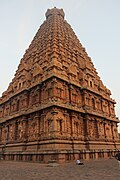
[[File:thanjavur temple.jpg|thumb|220px|Detail of the main vimanam (tower) of the Thanjavur Temple.]] | [[File:thanjavur temple.jpg|thumb|220px|Detail of the main vimanam (tower) of the Thanjavur Temple.]] | ||
Under the Cholas, the Tamil country reached new heights of excellence in [[art]], [[religion]], [[music]] and [[literature]].{{sfnp|Mitter|2001|p=2|ps=}} In all of these spheres, the Chola period marked the culmination of movements that had begun | Under the Cholas, the Tamil country reached new heights of excellence in [[art]], [[religion]], [[music]] and [[literature]].{{sfnp|Mitter|2001|p=2|ps=}} In all of these spheres, the Chola period marked the culmination of movements that had begun at an earlier age under the Pallavas.{{sfnp|Sastri|2002|p=418|ps=}} Monumental architecture in the form of majestic [[temples]] and [[sculpture]] in stone and [[bronze]] reached a finesse never before achieved in India.{{sfnp|Thapar|1995|p=403|ps= Quote: "It was, however, in bronze sculptures that the Chola craftsmen excelled, producing images rivalling the best anywhere."}} | ||
The Chola conquest of Kadaram (Kedah) and Srivijaya, and their continued commercial contacts with the [[Mid-Imperial China|Chinese Empire]], enabled them to influence the local cultures.{{sfnp|Kulke|Rothermund|2001|p=159|ps=}} Examples of the [[Hinduism in Southeast Asia|Hindu cultural influence]] found today throughout Southeast Asia owe much to the legacy of the Cholas. For example, the great temple complex at [[Prambanan]] in Indonesia exhibits several similarities with South Indian architecture.{{sfnp|Sastri|1984|p=789|ps=}}{{sfnp|Kulke|Rothermund|2001|pp=159-160|ps=}} | |||
According to the Malay chronicle ''Sejarah Melayu'', the rulers of the [[Malacca sultanate]] claimed to be descendants of the kings of the Chola empire.<ref>A History of Early Southeast Asia: Maritime Trade and Societal Development by Kenneth R. Hall</ref>{{full citation needed|date=April 2015}} Chola rule is remembered in Malaysia today as many princes there have names ending with Cholan or Chulan, one such being [[Raja Chulan]], the Raja of [[Perak]].<ref>Aryatarangini, the Saga of the Indo-Aryans, by A. Kalyanaraman p.158</ref>{{full citation needed|date=April 2015}}<ref>India and Malaya Through the Ages: by S. Durai Raja Singam</ref>{{full citation needed|date=April 2015}} | |||
===Literature=== | ===Literature=== | ||
| Line 267: | Line 172: | ||
The Imperial Chola era was the golden age of Tamil culture, marked by the importance of literature. Chola records cite many works, including the ''Rajarajesvara Natakam'', ''Viranukkaviyam'' and ''Kannivana Puranam''.{{sfnp|Sastri|1984|pp=663-664|ps=}} | The Imperial Chola era was the golden age of Tamil culture, marked by the importance of literature. Chola records cite many works, including the ''Rajarajesvara Natakam'', ''Viranukkaviyam'' and ''Kannivana Puranam''.{{sfnp|Sastri|1984|pp=663-664|ps=}} | ||
The revival of [[Hinduism]] from its nadir during the [[Kalabhra dynasty|Kalabhras]] spurred the construction of numerous temples and these in turn generated Shaiva and Vaishnava devotional literature.{{sfnp|Sastri|2002|p=333|ps=}} Jain and Buddhist authors flourished as well, although in fewer numbers than in previous centuries.{{sfnp|Sastri|2002|p=339|ps=}} ''[[Jivaka-chintamani]]'' by [[Tirutakkatevar]] and ''Sulamani'' by Tolamoli are among notable works by non-Hindu authors.{{sfnp|Chopra|Ravindran|Subrahmanian|2003|p=188|ps=}}{{sfnp|Sastri|2002|pp=339-340|ps=}}{{sfnp|Ismail|1988|p=1195|ps=}} The grammarian [[Buddhamitra]] wrote a text on Tamil grammar called ''Virasoliyam''.<ref>''Ancient India: Collected Essays on the Literary and Political History of southern India'' by Sakkottai Krishnaswami Aiyangar p.127</ref> Commentaries were written on the great text ''Tolkāppiyam'' which deals with grammar but which also mentions ethics of warfare.<ref>''The Princeton Encyclopedia of Poetry and Poetics'' by Roland Greene, Stephen Cushman, Clare Cavanagh, Jahan Ramazani, Paul F. Rouzer, Harris Feinsod, David Marno, Alexandra Slessarev p.1410</ref>{{sfnp|Singh|2008|p=27|ps=}}<ref>''Portraits of a Nation: History of Ancient India'', by Kamlesh Kapur p.617</ref> ''Periapuranam'' was another remarkable literary piece of this period. This work is in a sense a national epic of the Tamil people because it treats | The revival of [[Hinduism]] from its nadir during the [[Kalabhra dynasty|Kalabhras]] spurred the construction of numerous temples and these in turn generated Shaiva and Vaishnava devotional literature.{{sfnp|Sastri|2002|p=333|ps=}} Jain and Buddhist authors flourished as well, although in fewer numbers than in previous centuries.{{sfnp|Sastri|2002|p=339|ps=}} ''[[Jivaka-chintamani]]'' by [[Tirutakkatevar]] and ''Sulamani'' by Tolamoli are among notable works by non-Hindu authors.{{sfnp|Chopra|Ravindran|Subrahmanian|2003|p=188|ps=}}{{sfnp|Sastri|2002|pp=339-340|ps=}}{{sfnp|Ismail|1988|p=1195|ps=}} The grammarian [[Buddhamitra]] wrote a text on Tamil grammar called ''Virasoliyam''.<ref>''Ancient India: Collected Essays on the Literary and Political History of southern India'' by Sakkottai Krishnaswami Aiyangar p.127</ref> Commentaries were written on the great text ''Tolkāppiyam'' which deals with grammar but which also mentions ethics of warfare.<ref>''The Princeton Encyclopedia of Poetry and Poetics'' by Roland Greene, Stephen Cushman, Clare Cavanagh, Jahan Ramazani, Paul F. Rouzer, Harris Feinsod, David Marno, Alexandra Slessarev p.1410</ref>{{sfnp|Singh|2008|p=27|ps=}}<ref>''Portraits of a Nation: History of Ancient India'', by Kamlesh Kapur p.617</ref> ''Periapuranam'' was another remarkable literary piece of this period. This work is in a sense a national epic of the Tamil people because it treats the lives of the saints who lived in all parts of Tamil Nadu and belonged to all classes of society, men and women, high and low, educated and uneducated.<ref name="Kulwant Rai Gupta p.288">''Concise Encyclopaedia Of India'' by Kulwant Rai Gupta, Amita Gupta p.288</ref> | ||
[[Kamban]] flourished during the reign of [[Kulothunga Chola III|Kulothunga III]]. | [[Kamban]] flourished during the reign of [[Kulothunga Chola III|Kulothunga III]]. [[Jayamkondar|Jayamkondar's]] ''Kalingattuparani'', draws a clear boundary between history and fictitious conventions.{{sfnp|Chopra|Ravindran|Subrahmanian|2003|p=116|ps=}}{{sfnp|Sastri|2002|pp=20, 340-341|ps=}} The Tamil poet [[Ottakoothar|Ottakuttan]] was a contemporary of [[Kulottunga I|Kulothunga I]] and served at the courts of three of Kulothunga's successors.{{sfnp|Sastri|2002|pp=184, 340|ps=}}{{sfnp|Chopra|Ravindran|Subrahmanian|2003|p=20|ps=}} | ||
''Nannul'' is a Chola era work on Tamil grammar. It discusses all five branches of grammar and, according to Berthold Spuler, is still relevant today and is one of the most distinguished normative grammars of literary Tamil.{{sfnp|Spuler|1975|p=194|ps=}} | ''Nannul'' is a Chola era work on Tamil grammar. It discusses all five branches of grammar and, according to Berthold Spuler, is still relevant today and is one of the most distinguished normative grammars of literary Tamil.{{sfnp|Spuler|1975|p=194|ps=}} | ||
The [[Telugu Chodas|Telugu Choda]] period was in particular significant for the development of Telugu literature under the patronage of the rulers. It was the age in which the great Telugu poets [[Tikkana]], [[Ketana]], Marana and Somana enriched the literature with their contributions. Tikkana Somayaji wrote Nirvachanottara Ramayanamu and Andhra Mahabharatamu. Abhinava Dandi Ketana wrote Dasakumaracharitramu, Vijnaneswaramu and Andhra Bhashabhushanamu. Marana wrote Markandeya Purana in Telugu. Somana wrote Basava Purana. Tikkana is one of the kavitrayam who translated Mahabharata into Telugu language.<ref>{{Cite web|url=https://www.wisdomlib.org/south-asia/book/the-history-of-andhra-country/d/doc220044.html|title=The Telugu Cholas of Konidena (A.D. 1050-1300) [Part 1]|last=www.wisdomlib.org|date=2018-06-23|website=www.wisdomlib.org|access-date=2019-01-07}}</ref> | The [[Telugu Chodas|Telugu Choda]] period was in particular significant for the development of Telugu literature under the patronage of the rulers. It was the age in which the great Telugu poets [[Tikkana]], [[Mulaghatika Ketana|Ketana]], Marana and Somana enriched the literature with their contributions. Tikkana Somayaji wrote Nirvachanottara Ramayanamu and Andhra Mahabharatamu. Abhinava Dandi Ketana wrote Dasakumaracharitramu, Vijnaneswaramu and Andhra Bhashabhushanamu. Marana wrote Markandeya Purana in Telugu. Somana wrote Basava Purana. Tikkana is one of the kavitrayam who translated Mahabharata into Telugu language.<ref>{{Cite web|url=https://www.wisdomlib.org/south-asia/book/the-history-of-andhra-country/d/doc220044.html|title=The Telugu Cholas of Konidena (A.D. 1050-1300) [Part 1]|last=www.wisdomlib.org|date=2018-06-23|website=www.wisdomlib.org|access-date=2019-01-07}}</ref> | ||
Of the devotional literature, the arrangement of the Shaivite canon into eleven books was the work of Nambi Andar Nambi, who lived close to the end of the 10th century.{{sfnp|Sastri|2002|pp=342-343|ps=}}{{sfnp|Chopra|Ravindran|Subrahmanian|2003|p=115|ps=}} However, relatively few Vaishnavite works were composed during the Later Chola period, possibly because of the rulers' apparent animosity towards them.{{sfnp|Sastri|1984|p=681|ps=}} | Of the devotional literature, the arrangement of the Shaivite canon into eleven books was the work of Nambi Andar Nambi, who lived close to the end of the 10th century.{{sfnp|Sastri|2002|pp=342-343|ps=}}{{sfnp|Chopra|Ravindran|Subrahmanian|2003|p=115|ps=}} However, relatively few Vaishnavite works were composed during the Later Chola period, possibly because of the rulers' apparent animosity towards them.{{sfnp|Sastri|1984|p=681|ps=}} | ||
===Religion=== | ===Religion=== | ||
| Line 287: | Line 187: | ||
In general, Cholas were followers of [[Hinduism]]. They were not swayed by the rise of Buddhism and [[Jainism]] as were the kings of the Pallava and Pandya dynasties. Kocengannan, an Early Chola, was celebrated in both Sangam literature and in the [[Saivism|Shaivite]] canon as a Hindu saint.{{sfnp|Sastri|2002|p=116|ps=}} | In general, Cholas were followers of [[Hinduism]]. They were not swayed by the rise of Buddhism and [[Jainism]] as were the kings of the Pallava and Pandya dynasties. Kocengannan, an Early Chola, was celebrated in both Sangam literature and in the [[Saivism|Shaivite]] canon as a Hindu saint.{{sfnp|Sastri|2002|p=116|ps=}} | ||
Among the Tamil film and entertainment industry, there is a rising trend of terming the Cholas as non-Hindus. Noted Tamil film director, producer and screenwriter [[Vetrimaaran]] asserted at a function in 2022 that the Cholas were not Hindus. At the same event, another leading Tamil actor, film director, film producer, screenwriter, choreographer, playback singer, lyricist, television presenter, social activist and politician [[Kamal Haasan]], while supporting Vetrimaaran asserted Hindu religion did not exist during the Chola period.<ref>{{cite web |title=कमल हासन के "चोल काल में कोई हिंदू धर्म नहीं था" वाले बयान पर विवाद |url=https://www.ndtv.com/india-news/kamal-haasans-remark-sparks-row-no-hindu-religion-during-chola-period-3409830 |website=ndtv.com |publisher=NDTV |access-date=15 October 2024}}</ref> | |||
| | |||
==In popular culture== | ==In popular culture== | ||
| Line 441: | Line 200: | ||
There were stage productions based on the life of Rajaraja Chola during the 1950s and in 1973 [[Sivaji Ganesan]] acted in a screen adaptation of a play titled ''[[Rajaraja Cholan]]''. The Cholas are featured in the [[History of the World (board game)|History of the World]] board game, produced by [[Avalon Hill]].{{citation needed|date=April 2015}} | There were stage productions based on the life of Rajaraja Chola during the 1950s and in 1973 [[Sivaji Ganesan]] acted in a screen adaptation of a play titled ''[[Rajaraja Cholan]]''. The Cholas are featured in the [[History of the World (board game)|History of the World]] board game, produced by [[Avalon Hill]].{{citation needed|date=April 2015}} | ||
The Cholas were the subject of the 2010 Tamil-language film ''[[Aayirathil Oruvan (2010 film)|Aayirathil Oruvan]]'', the 2022 film ''[[Ponniyin Selvan: I]]'' and the 2023 film ''[[Ponniyin Selvan: II]]. The 2022 and 2023 movies were based on the [[Ponniyin Selvan|novel of the same name]]. | The Cholas were the subject of the 2010 Tamil-language film ''[[Aayirathil Oruvan (2010 film)|Aayirathil Oruvan]]'', the 2022 film ''[[Ponniyin Selvan: I]]'' and the 2023 film ''[[Ponniyin Selvan: II]]''. The 2022 and 2023 movies were based on the [[Ponniyin Selvan|novel of the same name]]. | ||
==See also== | ==See also== | ||
*[[Chola Empire]] | |||
*[[Telugu Cholas]] of Andhra | |||
*[[Eastern Ganga dynasty|Chodagangas]] of Kalinga | |||
*[[Nidugal Cholas]] of Karnataka | |||
* [[History of Tamil Nadu]] | * [[History of Tamil Nadu]] | ||
* [[Karungalakudi]] | * [[Karungalakudi]] | ||
| Line 458: | Line 221: | ||
=== General sources === | === General sources === | ||
{{ | {{refbegin|30em}} | ||
* {{citation |title=The State at War in South Asia |first=Pradeep |last=Barua |publisher=University of Nebraska Press |year=2005 |isbn=978-0-80321-344-9}} | * {{citation |title=The State at War in South Asia |first=Pradeep |last=Barua |publisher=University of Nebraska Press |year=2005 |isbn=978-0-80321-344-9}} | ||
* {{citation |first1=P. N. |last1=Chopra |last2=Ravindran |first2=T. K. |last3=Subrahmanian |first3=N. |title=History of South India: Ancient, Medieval and Modern |year=2003 |publisher=S. Chand & Company Ltd |isbn=978-81-219-0153-6}} | * {{citation |first1=P. N. |last1=Chopra |last2=Ravindran |first2=T. K. |last3=Subrahmanian |first3=N. |title=History of South India: Ancient, Medieval and Modern |year=2003 |publisher=S. Chand & Company Ltd |isbn=978-81-219-0153-6}} | ||
| Line 508: | Line 271: | ||
==External links== | ==External links== | ||
{{Commons category}} | |||
* [https://whc.unesco.org/pg.cfm?cid=31&id_site=250 UNESCO World Heritage sites – Chola temples] | * [https://whc.unesco.org/pg.cfm?cid=31&id_site=250 UNESCO World Heritage sites – Chola temples] | ||
* [https://web.archive.org/web/20150924034325/http://www.indianartcircle.com/arteducation/page_14_artofCholas.shtml Art of Cholas] | * [https://web.archive.org/web/20150924034325/http://www.indianartcircle.com/arteducation/page_14_artofCholas.shtml Art of Cholas] (archived 24 September 2015) | ||
* [http://lakdiva.org/coins/medievalindian/rajaraja_chola.html Chola coins of Sri Lanka] | * [http://lakdiva.org/coins/medievalindian/rajaraja_chola.html Chola coins of Sri Lanka]. {{Webarchive|url=https://web.archive.org/web/20160304052031/http://lakdiva.org/coins/medievalindian/rajaraja_chola.html |date=4 March 2016 }}. | ||
{{India topics}} | |||
{{Chola dynasty topics}} | {{Chola dynasty topics}} | ||
{{Tribes and kingdoms of the Mahabharata}} | {{Tribes and kingdoms of the Mahabharata}} | ||
{{Middle kingdoms of India}} | {{Middle kingdoms of India}} | ||
{{ | {{empires}} | ||
{{Authority control}} | {{Authority control}} | ||
| Line 524: | Line 288: | ||
[[Category:1st-millennium BC establishments in India]] | [[Category:1st-millennium BC establishments in India]] | ||
[[Category:Coromandel Coast]] | [[Category:Coromandel Coast]] | ||
[[Category:History of Thanjavur]] | [[Category:History of Thanjavur]] | ||
[[Category:States and territories disestablished in 1279]] | [[Category:States and territories disestablished in 1279]] | ||
| Line 532: | Line 293: | ||
[[Category:Tamil monarchs]] | [[Category:Tamil monarchs]] | ||
[[Category:Solar dynasty]] | [[Category:Solar dynasty]] | ||
[[Category:Dynasties of India]] | |||
Revision as of 10:08, 8 February 2026
| Chola Dynasty | |
|---|---|
| Imperial, and Royal, dynasty | |
._Chola,_conqueror_of_the_Gangas_in_Tamil,_seated_tiger_with_two_fish.jpg) Imperial coin of Emperor Rajaraja I (985–1014). Uncertain Tamilnadu mint. Legend "Chola, conqueror of the Gangas" in Tamil, seated tiger with two fish. | |
| Country | List
|
| Etymology | Chola Nadu |
| Founder | Ilamchetchenni (first documented) |
| Final ruler | Rajendra III (main branch) |
| Deposition | 1279 |
| Cadet branches | |
| List of Chola kings and emperors | ||||||||||||||||||||||||||||
|---|---|---|---|---|---|---|---|---|---|---|---|---|---|---|---|---|---|---|---|---|---|---|---|---|---|---|---|---|
| Early Cholas | ||||||||||||||||||||||||||||
| Interregnum (c. 200 – c. 848) | ||||||||||||||||||||||||||||
| Medieval Cholas | ||||||||||||||||||||||||||||
|
||||||||||||||||||||||||||||
| Later Cholas | ||||||||||||||||||||||||||||
|
||||||||||||||||||||||||||||
| Related dynasties | ||||||||||||||||||||||||||||
|
||||||||||||||||||||||||||||
| Chola society | ||||||||||||||||||||||||||||
| Part of a series on |
| History of Tamil Nadu |
|---|
 |
The Chola dynasty[lower-alpha 1] (Tamil: [t͡ʃoːɻɐr]) was a Tamil dynasty originating from Southern India. At its height, it ruled over the Chola Empire, an expansive maritime empire. The earliest datable references to the Chola are from inscriptions dated to the 3rd century BCE during the reign of Ashoka of the Maurya Empire. The Chola empire was at its peak and achieved imperialism under the Medieval Cholas in the mid-9th century CE. As one of the Three Crowned Kings of Tamilakam, along with the Chera and Pandya, the dynasty continued to govern over varying territories until the 13th century CE.
The heartland of the Cholas was the fertile valley of the Kaveri River. They ruled a significantly larger area at the height of their power from the latter half of the 9th century till the beginning of the 13th century. They unified peninsular India south of the Tungabhadra River and held the territory as one state for three centuries between 907 and 1215 CE.[2] Under Rajaraja I and his successors Rajendra I, Rajadhiraja I, Rajendra II, Virarajendra, and Kulothunga Chola I, the empire became a military, economic and cultural powerhouse in South Asia and Southeast Asia.[3]
Origins
There is very little written evidence for the Cholas before the 7th century CE. The main sources of information about the early Cholas are ancient Tamil literature of the Sangam period (c. 600 BCE),[lower-alpha 2] oral traditions, religious texts, temple and copperplate inscriptions. Later medieval Cholas also claimed a long and ancient lineage. The Cholas are mentioned in Ashokan Edicts (inscribed 273 BCE–232 BCE) as one of the Mauryan empire's neighbours to the South (Ashoka Major Rock Edict No.13),[5][6] who, though not subject to Ashoka, were on friendly terms with him.[lower-alpha 3] There are also brief references to the Chola country and its towns, ports and commerce in the Periplus of the Erythraean Sea (Periplus Maris Erythraei), and in the slightly later work of the geographer Ptolemy. Mahāvaṃsa, a Buddhist text written down during the 5th century CE, recounts several conflicts between the inhabitants of Sri Lanka and Cholas in the 1st century BCE.[8]
A commonly held view is that Chola is, like Chera and Pandya, the name of the ruling family or clan of immemorial antiquity. The annotator Parimelazhagar said: "The charity of people with ancient lineage (such as the Cholas, the Pandyas and the Cheras) are forever generous despite their reduced means". Other names in common use for the Cholas are Choda,[9] Killi (கிள்ளி), Valavan (வளவன்), Sembiyan (செம்பியன்) and Cenni.[10] Killi perhaps comes from the Tamil kil (கிள்) meaning dig or cleave and conveys the idea of a digger or a worker of the land. This word often forms an integral part of early Chola names like Nedunkilli, Nalankilli and so on, but almost drops out of use in later times. Valavan is most probably connected with "valam" (வளம்) – fertility and means owner or ruler of a fertile country. Sembiyan is generally taken to mean a descendant of Shibi – a legendary hero whose self-sacrifice in saving a dove from the pursuit of a falcon figures among the early Chola legends and forms the subject matter of the Sibi Jataka among the Jataka stories of Buddhism.[11] In Tamil lexicon Chola means Soazhi or Saei denoting a newly formed kingdom, in the lines of Pandya or the old country.[12] Cenni in Tamil means Head.
History
The history of the Cholas falls into four periods: the Early Cholas of the Sangam literature, the interregnum between the fall of the Sangam Cholas and the rise of the Imperial medieval Cholas under Vijayalaya (c. 848), the dynasty of Vijayalaya, and finally the Later Chola dynasty of Kulothunga Chola I from the third quarter of the 11th century.[lower-alpha 4]
Early Cholas
The earliest Chola kings for whom there is tangible evidence are mentioned in the Sangam literature. Scholars generally agree that this literature belongs to the late centuries before the common era and the early centuries of the common era.[14] The internal chronology of this literature is still far from settled, and at present a connected account of the history of the period cannot be derived. It records the names of the kings and the princes, and of the poets who extolled them.[15]
The Sangam literature also records legends about mythical Chola kings.[16] These myths speak of the Chola king Kantaman, a supposed contemporary of the sage Agastya, whose devotion brought the river Kaveri into existence.[17] Two names are prominent among those Chola kings who feature in Sangam literature: Karikala and Kocengannan.[18][19][20][21] There are no sure means of settling the order of succession, of fixing their relations with one another and with many other princelings of around the same period.[22][lower-alpha 5] Urayur (now a part of Thiruchirapalli) was their oldest capital.[16] Kaveripattinam also served as an early Chola capital.[23] The Mahavamsa mentions that a Chola prince known as Ellalan, invaded the Rajarata kingdom of Sri Lanka and conquered it in 235 BCE with the help of a Mysore army.[16][24]
Interregnum

There is not much information about the transition period of around three centuries from the end of the Sangam age (c. 300) to that in which the Pandyas and Pallavas dominated the Tamil country. An obscure dynasty, the Kalabhras invaded Tamil country, displaced the existing kingdoms and ruled during that time.[25][26][27] They were displaced by the Pallava dynasty and the Pandyan dynasty in the 6th century.[19][28] Little is known of the fate of the Cholas in Tamil land during the succeeding three centuries. The Cholas disappeared from the Tamil land almost completely in this debacle, though a branch of them can be traced towards the close of the fifth century CE in Rayalaseema—the Telugu-Cholas, whose kingdom is mentioned by Yuan Chwang in the seventh-century CE.[29] Due to Kalabhra invasion and the growing power of Pallavas, Cholas migrated from their native land Uraiyur to Telugu country and ruled from there as chieftains of Pallavas at least since 540 CE. Several Telugu Chola families like Renati Cholas, Pottapi Cholas, Nellore Cholas, Velanati Cholas, Nannuru Cholas, Kondidela Cholas existed and claimed descent from ancient Tamil king Karikala Chola.[30] The Cholas had to wait for another three centuries until the accession of Vijayalaya Chola belonging to Pottapi Chola family in the second quarter of the ninth century to re-establish their dynasty as independent rulers by overthrowing Pallavas and Pandyas.[31]
Epigraphy and literature provide a few glimpses of the transformations that came over this line of kings during this long interval. It is certain that when the power of the Cholas fell to its lowest ebb and that of the Pandyas and Pallavas rose to the north and south of them,[20][32] this dynasty was compelled to seek refuge and patronage under their more successful rivals.[33][lower-alpha 6] Despite their reduced powers, the Pandyas and Pallavas accepted Chola princesses in marriage, possibly out of regard for their reputation.[lower-alpha 7] Numerous Pallava inscriptions of this period mention their having fought rulers of the Chola country.[lower-alpha 8]
.jpg)
Imperial Cholas
The Chola Empire was founded in 848 CE by Vijayalaya, a descendant of Early Cholas.[37]

The early Chola kings expanded their territory and influence. During the early 10th century, the second Chola King, Aditya I, defeated the Pallava dynasty and Pandyan dynasty capturing Tondaimandalam and Kongu Nadu. Later Aditya's son Parantaka I defeated the Rashtrakuta dynasty in the battle of Vallala and also defeated the Pandyas.[38]
Rajaraja I and Rajendra I would expand the dynasty to its imperial state in the 11th century, creating an influential empire in the Bay of Bengal. The Brihadeeswarar Temple was also built in this era.[39] The Chola dynasty was at the peak of its influence and power during the 11th century.[40]
Rajendra I conquered Odisha and Pala dynasty of Bengal and reached the Ganges river in north India.[41] Rajendra Chola I built a new capital called Gangaikonda Cholapuram to celebrate his victories in northern India.[42] Rajendra Chola I successfully invaded the Srivijaya kingdom in Southeast Asia which led to the decline of the empire there.[43][44][45][46] He also completed the conquest of a kingdom in Rajarata within Sri Lanka and sent three diplomatic missions to China in 1016, 1033, and 1077.[47][48]


The Western Chalukya empire under Satyashraya and Someshvara I tried regularly to loose itself from Chola domination, primarily due to the Chola influence in the Vengi kingdom.[49] The Western Chalukyas mounted several unsuccessful attempts to engage the Chola emperors in war, and except for a brief occupation of the Vengi territories between 1118 and 1126, allied with Prince Vikramaditya VI.[50] Cholas usually managed to dominate over the Chalukyas in the western Deccan by defeating them in war and levying tribute on them.[51] With the occupation of Dharwar in North Central Karnataka by the Hoysalas under Vishnuvardhana, where he based himself with his son Narasimha I in charge of the Hoysala capital Dwarasamudra around 1149, and with the Kalachuris occupying the Chalukyan capital for over 35 years from around 1150–1151, the Chalukya kingdom had already started to dissolve.[52]
The Cholas under Kulothunga Chola III collaborated to herald the dissolution of the Chalukyas by aiding the Hoysalas under Veera Ballala II, the son-in-law of the Chola monarch, and defeated the Western Chalukyas in a series of wars with Someshvara IV between 1185 and 1190. The last Chalukya king's territories did not even include the erstwhile Chalukyan capitals Badami, Manyakheta or Kalyani. That was the final dissolution of Chalukyan power though the Chalukyas existed only in name for the period 1135–1140. But the Cholas remained stable until 1215, and were then absorbed by the Pandyan empire and ceased to exist by 1279.[53]
On the other hand, from 1150 CE to 1280 CE, the Pandya dynasty became the staunchest opponents of the Cholas and tried to win independence for their traditional territories. Thus, this period saw constant warfare between the Cholas and the Pandyas. Besides, the Cholas regularly fought with the Eastern Gangas of Kalinga. Moreover, under Chola's protection, Vengi remained largely independent. Cholas also dominated the entire eastern coast with their feudatories, the Telugu Cholas of Velanati and Nellore among others. These feudatories always aided the Cholas in their successful campaigns against the Chalukyas and levied tribute on the Kannada kingdoms. Furthermore, the Cholas fought constantly with the Sinhala kings from the Rohana kingdom of Sri Lanka, who repeatedly attempted to overthrow the Chola occupation of Rajarata and unify the island. But until the later Chola king Kulottunga I, the Cholas had firm control over the area. In one such instance, the Chola king, Rajadhiraja Chola II, was able to defeat the Sinhalese, aided by their traditional ally, a confederation of five Pandya princes, and kept the control of Rajarata under Chola rule. His successor, the last great Chola monarch Kulottunga Chola III reinforced the hold of the Chola territories by quelling further rebellions and disturbances in the Rajarata area of Sri Lanka and Madurai. He also defeated Hoysala generals who fought under Veera Ballala II at Karuvur. Furthermore, he also continued holding on to traditional territories in Tamil country, Eastern Gangavadi, Draksharama, Vengi, and Kalinga. However, after defeating Veera Ballala II, Kulottunga Chola III entered into a marital alliance with him through Ballala's marriage to a Chola princess, which improved Kulottunga Chola III's relationship with the Hoysalas.[54][lower-alpha 9]
Overseas conquests
.svg)
During the reign of Rajaraja Chola I and his successors Rajendra Chola I, Virarajendra Chola and Kulothunga Chola I the Chola armies invaded Sri Lanka, the Maldives and parts of Southeast Asia like Malaysia, Indonesia and Southern Thailand[56] of the Srivijaya Empire in the 11th century. Rajaraja Chola I launched several naval campaigns that resulted in the capture of Sri Lanka, Maldives and the Malabar Coast.[57] In 1025, Rajendra Chola launched naval raids on the ports of Srivijaya and against the Burmese kingdom of Pegu.[58] A Chola inscription states that he captured or plundered 14 places, which have been identified with Palembang, Tambralinga and Kedah among others.[59] A second invasion was led by Virarajendra Chola, who conquered Kedah in Malaysia of Srivijaya in the late 11th century.[60] Chola invasion ultimately failed to install direct administration over Srivijaya, since the invasion was short and only meant to plunder the wealth of Srivijaya. However, this invasion gravely weakened the Srivijayan hegemony and enabled the formation of regional kingdoms. Although the invasion was not followed by direct Cholan occupation and the region was unchanged geographically, there were huge consequences in trade. Tamil traders encroached on the Srivijayan realm traditionally controlled by Malay traders and the Tamil guilds' influence increased on the Malay Peninsula and the north coast of Sumatra.
Later Cholas (1070–1279)

Marital and political alliances between the Eastern Chalukyas began during the reign of Rajaraja following his invasion of Vengi. Rajaraja Chola's daughter married Chalukya prince Vimaladitya[61] and Rajendra Chola's daughter Ammanga Devi was married to the Eastern Chalukya prince Rajaraja Narendra.[62] Virarajendra Chola's son, Athirajendra Chola, was assassinated in a civil disturbance in 1070, and Kulothunga Chola I, the son of Ammanga Devi and Rajaraja Narendra, ascended the Chola throne. Thus began the Later Chola dynasty.[63]
The Later Chola dynasty was led by capable rulers such as Kulothunga Chola I, his son Vikrama Chola, other successors like Rajaraja Chola II, Rajadhiraja Chola II, and Kulothunga Chola III, who conquered Kalinga, Ilam, and Kataha. However, the rule of the later Cholas between 1218, starting with Rajaraja Chola II, to the last emperor Rajendra Chola III was not as strong as those of the emperors between 850 and 1215. Around 1118, they lost control of Vengi to the Western Chalukya and Gangavadi (southern Mysore districts) to the Hoysala Empire. However, these were only temporary setbacks, because immediately following the accession of King Vikrama Chola, the son and successor of Kulothunga Chola I, the Cholas lost no time in recovering the province of Vengi by defeating Chalukya Someshvara III and also recovering Gangavadi from the Hoysalas. The Chola empire, though not as strong as between 850 and 1150, was still largely territorially intact under Rajaraja Chola II (1146–1175) a fact attested by the construction and completion of the third grand Chola architectural marvel, the chariot-shaped Airavatesvara Temple at Dharasuram on the outskirts of modern Kumbakonam. Chola administration and territorial integrity until the rule of Kulothunga Chola III was stable and very prosperous up to 1215, but during his rule itself, the decline of the Chola power started following his defeat by Maravarman Sundara Pandiyan II in 1215–16.[64] Subsequently, the Cholas also lost control of the island of Lanka and were driven out by the revival of Sinhala power.[65]
In continuation of the decline, also marked by the resurgence of the Pandyan dynasty as the most powerful rulers in South India, a lack of a controlling central administration in its erstwhile Pandyan territories prompted several claimants to the Pandya throne to cause a civil war in which the Sinhalas and the Cholas were involved by proxy. Details of the Pandyan civil war and the role played by the Cholas and Sinhalas, are present in the Mahavamsa as well as the Pallavarayanpettai Inscriptions.[66][67]
Decline
The setbacks suffered during the final years of Kulothunga I left a somewhat diminished empire. Kulothunga's successors Vikrama Chola (1118–1135 CE) and Kulothunga Chola II (1133–1150 CE) were capable and compassionate leaders who took care not to involve their subjects in unnecessary and unwinnable wars.[68] Rajaraja II (1146–1173 CE), Rajadhiraja II (1166–1178 CE) and Kulothunga Chola III (1178–1218 CE) took active roles in the politics of the emerging revival of the Pandyas.[69] Meanwhile, the Chola succession was getting murkier and murkier with disputes and intrigues during the periods of Rajadhiraja II and Kulothunga III.[70]
The Cholas under Kulothunga Chola III collaborated to herald the dissolution of the Chalukyas by aiding Hoysalas under Veera Ballala II, the son-in-law of the Chola monarch and defeated the Western Chalukyas in a series of wars with Someshvara IV between 1185 and 1190. The last Chalukya king's territories did not even include the erstwhile Chalukyan capitals Badami, Manyakheta or Kalyani. That was the final dissolution of Chalukyan power though the Chalukyas existed only in name since 1135–1140. But the Cholas remained stable until 1215, were absorbed by the Pandyan empire and ceased to exist by 1279.[53]
His successor, the last great Chola monarch Kulottunga Chola III reinforced the hold of the Chola territories by quelling further rebellions and disturbances in the Rajarata area of Sri Lanka and Madurai. He also defeated Hoysala generals who fought under Veera Ballala II at Karuvur. Eastern Gangavadi, Draksharama, Vengi, and Kalinga. However, after defeating Veera Ballala II, Kulottunga Chola III entered into a marital alliance with him through Ballala's marriage to a Chola princess, which improved the Kulottunga Chola III's relationship with Hoysalas.[54]
Administration and society
Chola territory
Template:Continental Asia in 1100 CE According to Tamil tradition, the Chola country comprised the region that includes the modern-day Tiruchirapalli District, Tiruvarur District, Nagapattinam District, Ariyalur District, Perambalur district, Pudukkottai district, Thanjavur District in Tamil Nadu and Karaikal District. The river Kaveri and its tributaries dominate this landscape of generally flat country that gradually slopes towards the sea, unbroken by major hills or valleys. The river, which is also known as the Ponni (Golden) river, had a special place in the culture of Cholas. The annual floods in the Kaveri marked an occasion for celebration, known as Adiperukku, in which the whole nation took part.[citation needed]
Kaveripoompattinam on the coast near the Kaveri delta was a major port town.[16] Ptolemy knew of this, which he called Khaberis, and the other port town of Nagappattinam as the most important centres of Cholas.[71] These two towns became hubs of trade and commerce and attracted many religious faiths, including Buddhism.[lower-alpha 10] Roman ships found their way into these ports. Roman coins dating from the early centuries of the common era have been found near the Kaveri delta.[73][page needed][74]
The other major towns were Thanjavur, Uraiyur and Kudanthai, now known as Kumbakonam.[16] After Rajendra Chola moved his capital to Gangaikonda Cholapuram, Thanjavur lost its importance.[75]
Cultural contributions
Under the Cholas, the Tamil country reached new heights of excellence in art, religion, music and literature.[76] In all of these spheres, the Chola period marked the culmination of movements that had begun at an earlier age under the Pallavas.[77] Monumental architecture in the form of majestic temples and sculpture in stone and bronze reached a finesse never before achieved in India.[78]
The Chola conquest of Kadaram (Kedah) and Srivijaya, and their continued commercial contacts with the Chinese Empire, enabled them to influence the local cultures.[79] Examples of the Hindu cultural influence found today throughout Southeast Asia owe much to the legacy of the Cholas. For example, the great temple complex at Prambanan in Indonesia exhibits several similarities with South Indian architecture.[80][81]
According to the Malay chronicle Sejarah Melayu, the rulers of the Malacca sultanate claimed to be descendants of the kings of the Chola empire.[82][full citation needed] Chola rule is remembered in Malaysia today as many princes there have names ending with Cholan or Chulan, one such being Raja Chulan, the Raja of Perak.[83][full citation needed][84][full citation needed]
Literature

The Imperial Chola era was the golden age of Tamil culture, marked by the importance of literature. Chola records cite many works, including the Rajarajesvara Natakam, Viranukkaviyam and Kannivana Puranam.[85]
The revival of Hinduism from its nadir during the Kalabhras spurred the construction of numerous temples and these in turn generated Shaiva and Vaishnava devotional literature.[86] Jain and Buddhist authors flourished as well, although in fewer numbers than in previous centuries.[87] Jivaka-chintamani by Tirutakkatevar and Sulamani by Tolamoli are among notable works by non-Hindu authors.[88][89][90] The grammarian Buddhamitra wrote a text on Tamil grammar called Virasoliyam.[91] Commentaries were written on the great text Tolkāppiyam which deals with grammar but which also mentions ethics of warfare.[92][93][94] Periapuranam was another remarkable literary piece of this period. This work is in a sense a national epic of the Tamil people because it treats the lives of the saints who lived in all parts of Tamil Nadu and belonged to all classes of society, men and women, high and low, educated and uneducated.[95]
Kamban flourished during the reign of Kulothunga III. Jayamkondar's Kalingattuparani, draws a clear boundary between history and fictitious conventions.[96][97] The Tamil poet Ottakuttan was a contemporary of Kulothunga I and served at the courts of three of Kulothunga's successors.[98][99]
Nannul is a Chola era work on Tamil grammar. It discusses all five branches of grammar and, according to Berthold Spuler, is still relevant today and is one of the most distinguished normative grammars of literary Tamil.[100]
The Telugu Choda period was in particular significant for the development of Telugu literature under the patronage of the rulers. It was the age in which the great Telugu poets Tikkana, Ketana, Marana and Somana enriched the literature with their contributions. Tikkana Somayaji wrote Nirvachanottara Ramayanamu and Andhra Mahabharatamu. Abhinava Dandi Ketana wrote Dasakumaracharitramu, Vijnaneswaramu and Andhra Bhashabhushanamu. Marana wrote Markandeya Purana in Telugu. Somana wrote Basava Purana. Tikkana is one of the kavitrayam who translated Mahabharata into Telugu language.[101]
Of the devotional literature, the arrangement of the Shaivite canon into eleven books was the work of Nambi Andar Nambi, who lived close to the end of the 10th century.[102][103] However, relatively few Vaishnavite works were composed during the Later Chola period, possibly because of the rulers' apparent animosity towards them.[104]
Religion

In general, Cholas were followers of Hinduism. They were not swayed by the rise of Buddhism and Jainism as were the kings of the Pallava and Pandya dynasties. Kocengannan, an Early Chola, was celebrated in both Sangam literature and in the Shaivite canon as a Hindu saint.[21]
Among the Tamil film and entertainment industry, there is a rising trend of terming the Cholas as non-Hindus. Noted Tamil film director, producer and screenwriter Vetrimaaran asserted at a function in 2022 that the Cholas were not Hindus. At the same event, another leading Tamil actor, film director, film producer, screenwriter, choreographer, playback singer, lyricist, television presenter, social activist and politician Kamal Haasan, while supporting Vetrimaaran asserted Hindu religion did not exist during the Chola period.[105]
In popular culture

The Chola dynasty has inspired many Tamil authors.[106] The most important work of this genre is the popular Ponniyin Selvan (The son of Ponni), a historical novel in Tamil written by Kalki Krishnamurthy.[107] Written in five volumes, this narrates the story of Rajaraja Chola, dealing with the events leading up to the ascension of Uttama Chola to the Chola throne. Kalki had used the confusion in the succession to the Chola throne after the demise of Parantaka Chola II.[108] The book was serialised in the Tamil periodical Kalki during the mid-1950s.[109] The serialisation lasted for nearly five years and every week its publication was awaited with great interest.[110]
Kalki's earlier historical romance, Parthiban Kanavu, deals with the fortunes of the imaginary Chola prince Vikraman, who was supposed to have lived as a feudatory of the Pallava king Narasimhavarman I during the 7th century. The period of the story lies within the interregnum during which the Cholas were in decline before Vijayalaya Chola revived their fortunes.[111] Parthiban Kanavu was also serialised in the Kalki weekly during the early 1950s.[citation needed]
Sandilyan, another popular Tamil novelist, wrote Kadal Pura in the 1960s. It was serialised in the Tamil weekly Kumudam. Kadal Pura is set during the period when Kulothunga Chola I was in exile from the Vengi kingdom after he was denied the throne. It speculates the whereabouts of Kulothunga during this period. Sandilyan's earlier work, Yavana Rani, written in the early 1960s, is based on the life of Karikala Chola.[112] More recently, Balakumaran wrote the novel Udaiyar, which is based on the circumstances surrounding Rajaraja Chola's construction of the Brihadisvara Temple in Thanjavur.[113]
There were stage productions based on the life of Rajaraja Chola during the 1950s and in 1973 Sivaji Ganesan acted in a screen adaptation of a play titled Rajaraja Cholan. The Cholas are featured in the History of the World board game, produced by Avalon Hill.[citation needed]
The Cholas were the subject of the 2010 Tamil-language film Aayirathil Oruvan, the 2022 film Ponniyin Selvan: I and the 2023 film Ponniyin Selvan: II. The 2022 and 2023 movies were based on the novel of the same name.
See also
- Chola Empire
- Telugu Cholas of Andhra
- Chodagangas of Kalinga
- Nidugal Cholas of Karnataka
- History of Tamil Nadu
- Karungalakudi
- List of Tamil monarchs
- Tamil inscriptions in Malaysia
- Mutharaiyar dynasty
References
Notes
- ↑ Also spelled Cōḷa dynasty[1]
- ↑ The age of Sangam is established through the correlation between the evidence on foreign trade found in the poems and the writings by ancient Greek and Romans such as Periplus. K.A. Nilakanta Sastri, A History of Cyril and Lulu Charles, p 106. It is likely to extend not longer than five or six generations.[4]
- ↑ The Ashokan inscriptions speak of the Cholas in the plural, implying that, in his time, there were more than one Chola.[7]
- ↑ The direct line of Cholas of the Vijayalaya dynasty came to an end with the death of Virarajendra Chola and the assassination of his son Athirajendra Chola. Kulothunga Chola I, ascended the throne in 1070.[13]
- ↑ The only evidence for the approximate period of these early kings is the Sangam literature and synchronisms with the history of Sri Lanka as given in the Mahavamsa. Gajabahu I who is said to be the contemporary of the Chera Senguttuvan, belonged to the 2nd century and this means the poems mentioning Senguttuvan and his contemporaries date to that period.[citation needed]
- ↑ Pandya Kadungon and Pallava Simhavishnu overthrew the Kalabhras. Acchchutakalaba is likely the last Kalabhra king.[32]
- ↑ Periyapuranam, a Shaivite religious work of the 12th century tells us of the Pandya king Nindrasirnedumaran, who had for his queen a Chola princess.[34]
- ↑ Copperplate grants of the Pallava Buddhavarman (late 4th century) mention that the king as the "underwater fire that destroyed the ocean of the Chola army".[35] Simhavishnu (575–600) is also stated to have seized the Chola country. Mahendravarman I was called the "crown of the Chola country" in his inscriptions.[citation needed]
- ↑ "After the second Pandya War, Kulottunga undertook a campaign to check the growth of Hoysala power in that quarter. He re-established Chola suzerainty over the Adigaimans of Tagadur, defeated a Chera ruler in battle and performed a vijayabhisheka in Karuvur (1193). His relations with the Hoysala Ballala II seems to have become friendly afterwards, for Ballala married a Chola princess".[55]
- ↑ The Buddhist work Milinda Panha dated to the early Christian era, mentions Kolapttna among the best-known seaports on the Chola coast.[72]
Citations
- ↑ The New Encyclopædia Britannica: Micropædia. Encyclopædia Britannica. 1993. p. 441. ISBN 978-0-85229-571-7.
- ↑ K. A. Nilakanta Sastri, A History of South India, p 157
- ↑ Keay 2011, p. 215.
- ↑ Sastri (1984), p. 3
- ↑ "KING ASHOKA: His Edicts and His Times". www.cs.colostate.edu. Retrieved 7 October 2018.
- ↑ Ma. Ile Taṅkappā, Ā. Irā Vēṅkaṭācalapati. Red Lilies and Frightened Birds. Penguin Books India, 2011. p. xii.
- ↑ Sastri (1984), p. 20
- ↑ John Bowman,Columbia Chronologies of Asian History and Culture, p.401
- ↑ Prasad (1988), p. 120
- ↑ Kalidos, Raju. History and Culture of the Tamils: From Prehistoric Times to the President's Rule. Vijay Publications, 1976. p. 43.
- ↑ Sastri (1984), pp. 19-20
- ↑ Archaeological News A. L. Frothingham, Jr. The American Journal of Archaeology and the History of the Fine Arts, Vol. 4, No. 1 (Mar., 1998), pp. 69–125
- ↑ Sastri (2002), pp. 170-172
- ↑ Zvelebil, Kamil (1973). The Smile of Murugan: On Tamil Literature of South India. BRILL. ISBN 978-90-04-03591-1.
- ↑ Sastri (2002), pp. 19-20, 104-106
- ↑ 16.0 16.1 16.2 16.3 16.4 Tripathi (1967), p. 457
- ↑ Cholas I.
- ↑ Majumdar (1987), p. 137
- ↑ 19.0 19.1 Kulke & Rothermund (2001), p. 104
- ↑ 20.0 20.1 Tripathi (1967), p. 458
- ↑ 21.0 21.1 Sastri (2002), p. 116
- ↑ Sastri (2002), pp. 105-106
- ↑ Sastri (2002), p. 113
- ↑ R, Narasimhacharya (1942). History of the Kannada Language. Asian Educational Services. p. 48. ISBN 978-81-206-0559-6.
- ↑ Sastri (2002), pp. 130, 135, 137
- ↑ Majumdar (1987), p. 139
- ↑ Thapar (1995), p. 268
- ↑ Sastri (2002), p. 135
- ↑ K.A., Nilakanta Sastri (1955). A History of South India from Prehistoric to the Fall of Vijayanagar. Oxford University Press. pp. Page=139–140.
- ↑ Hultzsch, Eugene (1911–1912). "Epigraphia Indica". Epigraphia Indica. 11: 339 – via Archaeological Survey of India, Government of India.
- ↑ K.A., Nilakanta Sastri (1955). A History of South India from Prehistoric to the Fall of Vijayanagar. Oxford University Press. pp. Page=139–140.
- ↑ 32.0 32.1 Sastri (1984), p. 102
- ↑ Kulke & Rothermund (2001), p. 115
- ↑ Chopra, Ravindran & Subrahmanian (2003), p. 95
- ↑ Sastri (1984), pp. 104-105
- ↑ Chopra, Ravindran & Subrahmanian (2003), p. 31
- ↑ Sen (1999), pp. 477-478
- ↑ Sen (1999), pp. 373
- ↑ "Endowments to the Temple". Archaeological Survey of India.
- ↑ Sastri (2002), p. 157
- ↑ The Dancing Girl: A History of Early India by Balaji Sadasivan p.133
- ↑ A Comprehensive History of Medieval India, by Farooqui Salma Ahmed, Salma Ahmed Farooqui p.25
- ↑ Power and Plenty: Trade, War, and the World Economy in the Second Millennium by Ronald Findlay, Kevin H. O'Rourke p.67
- ↑ History Without Borders: The Making of an Asian World Region, 1000-1800 by Geoffrey C. Gunn p.43
- ↑ Sen (2009), p. 91
- ↑ Buddhism, Diplomacy, and Trade: The Realignment of Sino-Indian Relations by Tansen Sen p.226
- ↑ Dehejia (1990), p. xiv
- ↑ Majumdar (1987), p. 407
- ↑ Sastri (2002), p. 158
- ↑ Ancient India: Collected Essays on the Literary and Political History of Southern India by Sakkottai Krishnaswami Aiyangar p.233
- ↑ ndia: The Most Dangerous Decades by Selig S. Harrison p.31
- ↑ Sastri (2002), p. 184
- ↑ 53.0 53.1 Mukund (2012), p. xlii
- ↑ 54.0 54.1 Chopra, Ravindran & Subrahmanian (2003), pp. 107-109
- ↑ Sastri (2002), p. 178
- ↑ Between 2 Oceans (2nd Edn): A Military History of Singapore from 1275 to 1971 by Malcolm H. Murfett, John Miksic, Brian Farell, Chiang Ming Shun p.16
- ↑ South India by Stuart Butler, Jealous p.38
- ↑ Asia: A Concise History by Arthur Cotterell p.190
- ↑ Paine (2014), p. 281
- ↑ History of Asia by B.V. Rao p.211
- ↑ Majumdar (1987), p. 405
- ↑ Chopra, Ravindran & Subrahmanian (2003), p. 120
- ↑ Majumdar (1987), p. 408
- ↑ Tripathi (1967), p. 471
- ↑ Cholas I.
- ↑ South Indian Inscriptions, Vol. 12
- ↑ Chopra, Ravindran & Subrahmanian (2003), pp. 128-129
- ↑ Rajeshwari Ghose (1996). The Tyagaraja Cult in Tamilnadu: A Study in Conflict and Accommodation. Motilal Banarsidass Publishers Private Limited. pp. 323–324.
- ↑ Sastri (2002), pp. 195-196
- ↑ Tripathi (1967), p. 472
- ↑ Proceedings, American Philosophical Society (1978), vol. 122, No. 6, p 414
- ↑ Sastri (1984), p. 23
- ↑ Nagasamy (1981)
- ↑ Sastri (2002), p. 107
- ↑ Chopra, Ravindran & Subrahmanian (2003), p. 106
- ↑ Mitter (2001), p. 2
- ↑ Sastri (2002), p. 418
- ↑ Thapar (1995), p. 403Quote: "It was, however, in bronze sculptures that the Chola craftsmen excelled, producing images rivalling the best anywhere."
- ↑ Kulke & Rothermund (2001), p. 159
- ↑ Sastri (1984), p. 789
- ↑ Kulke & Rothermund (2001), pp. 159-160
- ↑ A History of Early Southeast Asia: Maritime Trade and Societal Development by Kenneth R. Hall
- ↑ Aryatarangini, the Saga of the Indo-Aryans, by A. Kalyanaraman p.158
- ↑ India and Malaya Through the Ages: by S. Durai Raja Singam
- ↑ Sastri (1984), pp. 663-664
- ↑ Sastri (2002), p. 333
- ↑ Sastri (2002), p. 339
- ↑ Chopra, Ravindran & Subrahmanian (2003), p. 188
- ↑ Sastri (2002), pp. 339-340
- ↑ Ismail (1988), p. 1195
- ↑ Ancient India: Collected Essays on the Literary and Political History of southern India by Sakkottai Krishnaswami Aiyangar p.127
- ↑ The Princeton Encyclopedia of Poetry and Poetics by Roland Greene, Stephen Cushman, Clare Cavanagh, Jahan Ramazani, Paul F. Rouzer, Harris Feinsod, David Marno, Alexandra Slessarev p.1410
- ↑ Singh (2008), p. 27
- ↑ Portraits of a Nation: History of Ancient India, by Kamlesh Kapur p.617
- ↑ Concise Encyclopaedia Of India by Kulwant Rai Gupta, Amita Gupta p.288
- ↑ Chopra, Ravindran & Subrahmanian (2003), p. 116
- ↑ Sastri (2002), pp. 20, 340-341
- ↑ Sastri (2002), pp. 184, 340
- ↑ Chopra, Ravindran & Subrahmanian (2003), p. 20
- ↑ Spuler (1975), p. 194
- ↑ www.wisdomlib.org (23 June 2018). "The Telugu Cholas of Konidena (A.D. 1050-1300) [Part 1]". www.wisdomlib.org. Retrieved 7 January 2019.
- ↑ Sastri (2002), pp. 342-343
- ↑ Chopra, Ravindran & Subrahmanian (2003), p. 115
- ↑ Sastri (1984), p. 681
- ↑ "कमल हासन के "चोल काल में कोई हिंदू धर्म नहीं था" वाले बयान पर विवाद". ndtv.com. NDTV. Retrieved 15 October 2024.
- ↑ Das (1995), p. 108
- ↑ "Versatile writer and patriot". The Hindu. Archived from the original on 23 December 2008. Retrieved 29 May 2008.
- ↑ Das (1995), pp. 108-109
- ↑ "English translation of Ponniyin Selvan". The Hindu. Archived from the original on 24 December 2008. Retrieved 29 May 2008.
- ↑ "Lines that Speak". The Hindu. Archived from the original on 23 December 2008. Retrieved 29 May 2008.
- ↑ Das (1995), p. 109
- ↑ Encyclopaedia of Indian Literature, vol. 1, pp 631–632
- ↑ "Book review of Udaiyar". The Hindu. Chennai, India. 22 February 2005. Archived from the original on 1 February 2009. Retrieved 30 May 2008.
General sources
- Barua, Pradeep (2005), The State at War in South Asia, University of Nebraska Press, ISBN 978-0-80321-344-9
- Chopra, P. N.; Ravindran, T. K.; Subrahmanian, N. (2003), History of South India: Ancient, Medieval and Modern, S. Chand & Company Ltd, ISBN 978-81-219-0153-6
- Das, Sisir Kumar (1995), History of Indian Literature (1911–1956): Struggle for Freedom – Triumph and Tragedy, Sahitya Akademi, ISBN 978-81-7201-798-9
- Dehejia, Vidya (1990), The Art of the Imperial Cholas, Columbia University Press
- Devare, Hema (2009), "Cultural Implications of the Chola Maritime Fabric Trade with Southeast Asia", in Kulke, Hermann; Kesavapany, K.; Sakhuja, Vijay (eds.), Nagapattinam to Suvarnadwipa: Reflections on the Chola Naval Expeditions to Southeast Asia, Institute of Southeast Asian Studies, ISBN 978-9-81230-937-2
- Eraly, Abraham (2011), The First Spring: The Golden Age of India, Penguin Books, ISBN 978-0-67008-478-4
- Gough, Kathleen (2008), Rural Society in Southeast India, Cambridge University Press, ISBN 978-0-52104-019-8
- Harle, J. C. (1994), The art and architecture of the Indian Subcontinent, Yale University Press, ISBN 978-0-300-06217-5
- Hellmann-Rajanayagam, Dagmar (2004), "From Differences to Ethnic Solidarity Among the Tamils", in Hasbullah, S. H.; Morrison, Barrie M. (eds.), Sri Lankan Society in an Era of Globalization: Struggling To Create A New Social Order, SAGE, ISBN 978-8-13210-320-2
- Ismail, M. M. (1988), "Epic - Tamil", Encyclopaedia of Indian literature, vol. 2, Sahitya Akademi, ISBN 81-260-1194-7
- Jermsawatdi, Promsak (1979), Thai Art with Indian Influences, Abhinav Publications, ISBN 978-8-17017-090-7
- Kulke, Hermann; Rothermund, Dietmar (2001), A History of India, Routledge, ISBN 978-0-415-32920-0
- Keay, John (12 April 2011), India: A History, Open Road + Grove/Atlantic, ISBN 978-0-8021-9550-0
- Lucassen, Jan; Lucassen, Leo (2014), Globalising Migration History: The Eurasian Experience, BRILL, ISBN 978-9-00427-136-4
- Majumdar, R. C. (1987) [1952], Ancient India, Motilal Banarsidass Publications, ISBN 978-81-208-0436-4
- Miksic, John N. (2013). Singapore and the Silk Road of the Sea, 1300_1800. NUS Press. ISBN 978-9971-69-558-3.
- Mitter, Partha (2001), Indian art, Oxford University Press, ISBN 978-0-19-284221-3
- Mukherjee, Rila (2011), Pelagic Passageways: The Northern Bay of Bengal Before Colonialism, Primus Books, ISBN 978-9-38060-720-7
- Mukund, Kanakalatha (1999), The Trading World of the Tamil Merchant: Evolution of Merchant Capitalism in the Coromandel, Orient Blackswan, ISBN 978-8-12501-661-8
- Mukund, Kanakalatha (2012), Merchants of Tamilakam: Pioneers of International Trade, Penguin Books India, ISBN 978-0-67008-521-7
- Nagasamy, R. (1970), Gangaikondacholapuram, State Department of Archaeology, Government of Tamil Nadu
- Nagasamy, R. (1981), Tamil Coins – A study, Institute of Epigraphy, Tamil Nadu State Dept. of Archaeology
- Paine, Lincoln (2014), The Sea and Civilization: A Maritime History of the World, Atlantic Books, ISBN 978-1-78239-357-3
- Prasad, G. Durga (1988), History of the Andhras up to 1565 A. D., P. G. Publishers
- Rajasuriar, G. K. (1998), The history of the Tamils and the Sinhalese of Sri Lanka
- Ramaswamy, Vijaya (2007), Historical Dictionary of the Tamils, Scarecrow Press, ISBN 978-0-81086-445-0
- Rothermund, Dietmar (1993), An Economic History of India: From Pre-colonial Times to 1991 (Reprinted ed.), Routledge, ISBN 978-0-41508-871-8
- Sadarangani, Neeti M. (2004), Bhakti Poetry in Medieval India: Its Inception, Cultural Encounter and Impact, Sarup & Sons, ISBN 978-8-17625-436-6
- Sakhuja, Vijay; Sakhuja, Sangeeta (2009), "Rajendra Chola I's Naval Expedition to South-East Asia: A Nautical Perspective", in Kulke, Hermann; Kesavapany, K.; Sakhuja, Vijay (eds.), Nagapattinam to Suvarnadwipa: Reflections on the Chola Naval Expeditions to Southeast Asia, Institute of Southeast Asian Studies, ISBN 978-9-81230-937-2
- Sastri, K. A. N. (1984) [1935], The CōĻas, University of Madras
- Sastri, K. A. N. (2002) [1955], A History of South India: From Prehistoric Times to the Fall of Vijayanagar, Oxford University Press
- Scharfe, Hartmut (2002), Education in Ancient India, Brill Academic Publishers, ISBN 978-90-04-12556-8
- Schmidt, Karl J. (1995), An Atlas and Survey of South Asian History, M.E. Sharpe, ISBN 978-0-76563-757-4
- Sen, Sailendra Nath (1999), Ancient Indian History and Civilization, New Age International, ISBN 978-8-12241-198-0
- Sen, Tansen (2009), "The Military Campaigns of Rajendra Chola and the Chola-Srivija-China Triangle", in Kulke, Hermann; Kesavapany, K.; Sakhuja, Vijay (eds.), Nagapattinam to Suvarnadwipa: Reflections on the Chola Naval Expeditions to Southeast Asia, Institute of Southeast Asian Studies, ISBN 978-9-81230-937-2
- Singh, Upinder (2008), A History of Ancient and Early Medieval India: From the Stone Age to the 12th Century, Pearson Education India, ISBN 978-8-13171-120-0
- "South Indian Inscriptions", Archaeological Survey of India, What Is India Publishers (P) Ltd, retrieved 30 May 2008
- Spuler, Bertold (1975), Handbook of Oriental Studies, Part 2, BRILL, ISBN 978-9-00404-190-5
- Stein, Burton (1980), Peasant state and society in medieval South India, Oxford University Press
- Stein, Burton (1998), A history of India, Blackwell Publishers, ISBN 978-0-631-20546-3
- Subbarayalu, Y. (2009), "A Note on the Navy of the Chola State", in Kulke, Hermann; Kesavapany, K.; Sakhuja, Vijay (eds.), Nagapattinam to Suvarnadwipa: Reflections on the Chola Naval Expeditions to Southeast Asia, Institute of Southeast Asian Studies, ISBN 978-9-81230-937-2
- Thapar, Romila (1995), Recent Perspectives of Early Indian History, South Asia Books, ISBN 978-81-7154-556-8
- Tripathi, Rama Sankar (1967), History of Ancient India, Motilal Banarsidass, ISBN 978-81-208-0018-2
- Talbot, Austin Cynthia (2001), Pre-colonial India in Practice: Society, Region, and Identity in Medieval Andhra, Oxford University Press, ISBN 978-0-19803-123-9
- Vasudevan, Geeta (2003), Royal Temple of Rajaraja: An Instrument of Imperial Cola Power, Abhinav Publications, ISBN 978-81-7017-383-0
- Wolpert, Stanley A (1999), India, University of California Press, ISBN 978-0-520-22172-7
External links
- UNESCO World Heritage sites – Chola temples
- Art of Cholas (archived 24 September 2015)
- Chola coins of Sri Lanka. Archived 4 March 2016 at the Wayback Machine.

| |||||||||||||||||||||||||||||||||||||||||||||||||||||||||||||||||||||||||||||||||||||||||||||||||||||||||||||||||||||||||||||||||||||||||||||||||||||||||||||||||||||||||||
- Pages using the JsonConfig extension
- Pages with Tamil IPA
- Chola dynasty
- Chola Empire
- 1279 disestablishments in Asia
- 1st-millennium BC establishments in India
- Coromandel Coast
- History of Thanjavur
- States and territories disestablished in 1279
- States and territories established in the 4th century BC
- Tamil monarchs
- Solar dynasty
- Dynasties of India