










No edit summary |
WikiDwarfBOT (talk | contribs) Cleanup: Grammar fix. Source modification. Information added. |
||
| Line 1: | Line 1: | ||
:'' | {{Short description|Region in India}} | ||
[[ | {{Good article}} | ||
{{Use Indian English|date=October 2022}} | |||
*[[ | {{Use dmy dates|date=October 2022}} | ||
*[[ | {{Infobox settlement <!-- See Template:Infobox settlement for additional fields and descriptions --> | ||
*[[ | | name = South India | ||
*[[ | | native_name_lang = Dakshinapatha <!-- ISO 639-3 {{lang|ori}} instead --> <!-- ISO 639-2 {{lang|bn}} instead --> | ||
*[[ | | settlement_type = [[Region]] | ||
*[[ | | image_skyline = {{multiple image | ||
| border = infobox | |||
| total_width = 300 | |||
| image_style = | |||
| perrow = 2/2/2/2 | |||
| image1 = Ross and Smith island, Andaman Nicobar Island.jpg{{!}}Ross and Smith island, Andaman Nicobar Island | |||
| image2 = Sri venkateshwara swamy temple.webp{{!}}Venkateswara Temple | |||
| image3 = MysorePalace-LeftAngle.jpg{{!}} | |||
| image4 = Alappuzha Boat Beauty W.jpg{{!}} | |||
| image5 = Bangaram Island, Lakshadweep 20160325- DSC1780.jpg{{!}} | |||
| image6 = Matrimandir, Soul of the Auroville, near Pondicherry.JPG{{!}} | |||
| image7 = Statue of Thiruvalluvar.jpg{{!}} | |||
| image8 = Charminar at night (JUNE 2019) 2.jpg{{!}}Skyline of Pune | |||
}} | |||
| image_alt = | |||
| image_caption = '''From Top, left to right''': [[Ross Island, North and Middle Andaman district|Ross Beach (Andaman)]], [[Venkateswara Temple|Venkateswara Temple (Andhra Pradesh)]], [[Mysore Palace|Mysore Palace (Karnataka)]], [[Alappuzha|Backwaters of Alappuzha (Kerala)]], [[Bangaram Atoll|Bangaram island (Lakshwadeep)]], [[Matrimandir|Matrimandir (Puducherry)]], [[Thiruvalluvar Statue|Thiruvalluvar Statue (Tamil Nadu)]], [[Charminar|Charminar (Telangana)]]. | |||
| motto = | |||
| image_map = India South India Locator Map.svg | |||
| map_alt = | |||
| map_caption = [[states and union territories of India|States]] and [[union territory|union territories]] in South India | |||
| coordinates_footnotes = | |||
| subdivision_type = [[List of sovereign states|Country]] | |||
| subdivision_name = {{flagu|India}} | |||
| subdivision_type1 = [[States and union territories of India|States and union territories]] | |||
| subdivision_name1 = {{plainlist| | |||
*{{flagicon image|}} [[Andhra Pradesh]] | |||
*{{flagicon image|Flag of Karnataka, India.png}} [[Karnataka]] | |||
*{{flagicon image|Flag of Kerala.png}} [[Kerala]] | |||
*{{flagicon image|}} [[Lakshadweep]] | |||
*{{flagicon image|Banner of Puducherry.png}} [[Puducherry (union territory)|Puducherry]] | |||
*{{flagicon image|..Tamil Nadu Flag(INDIA).png}} [[Tamil Nadu]] | |||
*{{flagicon image|Flag of the Government of Telangana.svg}} [[Telangana]] | |||
}} | |||
| subdivision_type2 = Most populous cities | |||
| subdivision_name2 = {{plainlist| | |||
*[[Bangalore]] | |||
*[[Chennai]] | |||
*[[Hyderabad]] | |||
*[[Visakhapatnam]] | |||
*[[Kochi]] | |||
*[[Vijayawada]] | |||
*[[Thiruvananthapuram]] | |||
*[[Coimbatore]] | |||
*[[Tirupati]] | |||
*[[Madurai]] | |||
*[[Kozhikode]] | |||
*[[Tiruchirappalli]] | |||
*[[Salem, Tamil Nadu|Salem]] | |||
*[[Warangal]] | |||
*[[Hubli-Dharwad]] | |||
}} | |||
| blank_name_sec1 = [[Official languages of India|Official languages]] | |||
| blank_info_sec1 = {{plainlist| | |||
* [[Telugu language|Telugu]] | |||
* [[Tamil language|Tamil]] | |||
* [[Kannada]] | |||
* [[Malayalam]] | |||
* [[Urdu]]([[Dekkani Dialect]]) | |||
* [[English language|English]] ([[lingua franca]])<ref>{{Cite web|url=https://www.deccanchronicle.com/nation/current-affairs/090619/in-the-land-of-many-tongues-hindi-cant-be-lingua-franca.html|title=In the land of many tongues, Hindi can't be lingua franca|date=9 June 2019|website=Deccan Chronicle}}</ref> | |||
}} | |||
| unit_pref = Metric | |||
<!-- ALL fields with measurements have automatic unit conversion --> | |||
<!-- for references: use <ref> tags -->| area_footnotes = | |||
| area_note = | |||
| area_water_percent = | |||
| area_rank = | |||
| area_total_km2 = 635,780 | |||
| area_land_km2 = | |||
| area_water_km2 = | |||
| elevation_footnotes = | |||
| elevation_m = | |||
| elevation_max_m = 2695 | |||
| elevation_max_point = <!-- for denoting the measurement point --> [[Anamudi]] | |||
| elevation_min_m = −2.2 | |||
| elevation_min_point = <!-- for denoting the measurement point --> [[Kuttanad]] | |||
| population_total = 253,051,953 | |||
| population_as_of = 2011 | |||
| population_density_km2 = 400 | |||
| population_demonym = South Indian<br />[[Telugu people|Telugu]]<br/>[[Tamil people|Tamilian]]<br />[[Kannada people|Kannadiga]]<br />[[Malayali]]<br />Laccadivian<br />Pondicherrian | |||
| timezone1 = [[Indian Standard Time|IST]] ([[UTC+5:30]]) | |||
| utc_offset1 = | |||
| timezone1_DST = | |||
| utc_offset1_DST = | |||
| population_density_sq_mi = | |||
| other_name = | |||
| blank_info_sec2 = {{plainlist| | |||
* [[Beary language|Beary]] | |||
* [[Badaga language|Badaga]] | |||
* [[Gondi language|Gondi]] | |||
* [[Marathi language|Marathi]] | |||
* [[Kodava language|Kodava]] | |||
* [[Konkani language|Konkani]] | |||
*[[Toda language|Toda]] | |||
* [[Tulu language|Tulu]] | |||
}} | |||
| blank_name_sec2 = [[Official languages of India|Minority languages]] | |||
| blank1_name_sec1 = [[Human Development Index|HDI]] {{nobold|(2019)}} | |||
| blank1_info_sec1 = {{increase}} 0.755 ({{color|green|High}}) | |||
| blank2_name_sec1 = [[Literacy in India|Literacy]] {{nobold|(2011)}} | |||
| blank2_info_sec1 = 81.09%<ref name="Literacy survey_2018">{{cite web |title=Literacy Survey, India (2017–18) |date=8 September 2020 |url=https://www.firstpost.com/india/at-96-2-kerala-tops-indias-literacy-rate-chart-again-andhra-pradesh-ranks-lowest-with-66-4-8796401.html |publisher=Firstpost |access-date=9 September 2020}}</ref> | |||
| blank3_name_sec1 = [[Human sex ratio|Sex ratio]] {{nobold|(2011)}} | |||
| blank3_info_sec1 = 986 [[females|♀]]/1000 [[males|♂]]<ref name="pc-census2011">{{cite web |title=Census 2011 (Final Data) – Demographic details, Literate Population (Total, Rural & Urban) |url=https://planningcommission.gov.in/data/datatable/data_2312/DatabookDec2014%20307.pdf |website=planningcommission.gov.in |publisher=Planning Commission, Government of India |access-date=3 October 2018 |archive-url=https://web.archive.org/web/20180127163347/https://planningcommission.gov.in/data/datatable/data_2312/DatabookDec2014%20307.pdf |archive-date=27 January 2018 |url-status=dead }}</ref> | |||
}} | |||
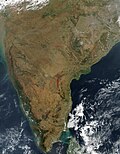
{{ | '''South India''', also known as '''Peninsular India''',<ref name="HobsonJobson2013"/> consists of the peninsular southern part of [[India]]. It encompasses the [[States and union territories of India|Indian states]] of [[Andhra Pradesh]], [[Karnataka]], [[Kerala]], [[Tamil Nadu]], and [[Telangana]], as well as the [[union territory|union territories]] of the [[Andaman and Nicobar Islands]], [[Lakshadweep]] and [[Puducherry (union territory)|Puducherry]], comprising 19.31% of India's area ({{convert|635,780|km2|sqmi|abbr=on|disp=or}}) and 20% of India's population. Covering the southern part of the [[peninsula]]r [[Deccan Plateau]], South India is bounded by the [[Bay of Bengal]] in the east, the [[Arabian Sea]] in the west and the [[Indian Ocean]] in the south. The geography of the region is diverse with two mountain ranges – the [[Western Ghats|Western]] and [[Eastern Ghats]] – bordering the [[plateau]] heartland. The [[Godavari River|Godavari]], [[Krishna River|Krishna]], [[Kaveri]], [[Tungabhadra River|Tungabhadra]], [[Periyar River|Periyar]], [[Bharathappuzha]], [[Pamba River|Pamba]], [[Thamirabarani River|Thamirabarani]], [[Palar River|Palar]], and [[Vaigai River|Vaigai]] rivers are important [[Perennial stream|perennial]] rivers. | ||
{{ | The majority of the people in South India speak at least one of the four major [[Dravidian languages]]: [[Telugu language|Telugu]], [[Tamil language|Tamil]], [[Kannada]] and [[Malayalam]] (all 4 of which are among the 6 [[Classical Languages of India]]). Some states and [[Union territory|union territories]] also recognize a minority language, such as [[Deccani language|Deccani Urdu]] in [[Telangana]],<ref>{{cite web |url = https://www.thenewsminute.com/article/urdu-second-official-language-telangana-state-passes-bill-71742 |title = Urdu is second official language in Telangana as state passes Bill|date=17 November 2017 |website=The News Minute }}</ref> and [[Tamil language|Tamil]] and [[French language|French]] in Puducherry. Besides these languages, [[Indian English|English]] is used by both the central and state governments for official communications and is used on all public signboards. | ||
During its [[History of South India|history]], a number of dynastic kingdoms ruled over parts of South India, and the [[Muslim conquests in the Indian subcontinent]] across [[South Asia|southern]] and [[Southeast Asia|southeastern]] Asia affected the history and culture in those regions. Major dynasties established in South India include the [[Satavahanas]], [[Cheras]], [[Cholas]], [[Pandyas]], [[Pallavas]], [[Vishnukundina dynasty|Vishnukundinas]], [[Chalukyas]], [[Rashtrakutas]], [[Bahmani]], [[Deccan Sultanates]], [[Kingdom of Cochin|Cochin]], [[Kakatiyas]], [[Kadambas]], [[Hoysala dynasty|Hoysalas]], [[Zamorin]], [[Vijayanagara Empire|Vijayanagara]], [[Maratha Empire|Maratha]], [[Travancore]], [[Arakkal kingdom|Arakkal]], and [[Kingdom of Mysore|Mysore]]. [[Cochin Jews|Jews]] and [[Age of discovery|Europeans]] entered India through the southwestern [[Malabar Coast]] of [[Kerala]]. Parts of South India were colonized under [[Portuguese India]], [[French India]] and the [[British Raj]]. The Kingdom of [[Travancore]] was the last princely state of India and merged with Union of India on 1 July 1949. | |||
South India witnessed sustained growth in per-capita income and population, structural changes in the economy, an increased pace of technological innovation. After experiencing fluctuations in the decades immediately after [[Indian independence movement|Indian independence]], the economies of South Indian states have registered a higher-than-national-average growth over the past three decades. South India has the [[List of Indian states and union territories by GDP|largest gross domestic product]] compared to other regions in India. The South Indian states lead in some [[socio-economics|socio-economic]] metrics of India. The [[Human Development Index|HDI]] in the southern states is high and the economy has undergone growth at a faster rate than in most northern states. [[Literacy in India|Literacy rates]] in the southern states is higher than the national average, with approximately 81% of the population capable of reading and writing. The [[fertility rate]] in South India is 1.9, the lowest of all regions in India. | |||
==Etymology== | |||
South India is also known as Peninsular India, and has been known by several other names too. The term "Deccan", referring to the area covered by the [[Deccan Plateau]] that covers most of peninsular India excluding the coastal areas, is an anglicised form of the [[Prakrit language|Prakrit]] word ''dakkhiṇa'' derived from the [[Sanskrit]] word ''dakshiṇa'' meaning south.<ref name="HobsonJobson2013">{{Cite book |title = Hobson-Jobson: The Definitive Glossary of British India |first1=Henry|last1=Yule|first2=A. C. |last2=Burnell|date=13 June 2013|publisher=Oxford|isbn=978-0-19-164583-9 }}</ref> ''Carnatic'', derived from ''"Karnāḍ"'' or ''"Karunāḍ"'' meaning ''high country'', has also been associated with South India.<ref name="hobsons">{{cite web |url = https://dsal.uchicago.edu/cgi-bin/philologic/getobject.pl?c.0:1:415.hobson |archive-url = https://archive.today/20120714033828/http://dsal.uchicago.edu/cgi-bin/philologic/getobject.pl?c.0:1:415.hobson |url-status=dead |archive-date=14 July 2012 |title = Origins of the word 'Carnatic' in the Hobson Jobson Dictionary |publisher=University of Chicago |access-date=15 September 2006 }}</ref> | |||
== History == | |||
{{Main|History of South India}} | |||
=== Historical references === | |||
{{See also|Dakshinapatha}} | |||
Historical South India has been referred to as [[Deccan Plateau|Deccan]], a [[prakrit]]ic derivative of an ancient term 'Dakshiṇa' or Dakshinapatha. The term had geographical as well as the geopolitical meaning and was mentioned as early as [[Pāṇini|Panini]] (500 BCE).{{Citation needed|date=February 2023}} | |||
=== Ancient and Medieval era === | |||
{{See also|Spice trade}} | |||
[[File:Silk route.jpg|thumb|left|Ancient [[Silk Road]] map. The [[Spice trade]] was mainly along the water routes (blue).]] | |||
[[Carbon dating]] shows that ash mounds associated with [[Neolithic]] cultures in South India date back to 8000 BCE. Artifacts such as ground stone axes and minor copper objects have been found in the Odisha region. Towards the beginning of 1000 BCE, [[Iron Age|iron technology]] spread through the region; however, there does not appear to be a fully developed [[Bronze Age]] preceding the Iron Age in South India.<ref name="prehistory">{{cite book|last=Agarwal|first=D.P.|url=https://www.arkeologi.uu.se/afr/projects/BOOK/agrawal.pdf|title=Urban Origins in India|year=2006|publisher=Uppsala University|url-status=dead|archive-url=https://web.archive.org/web/20060525164517/https://www.arkeologi.uu.se/afr/projects/BOOK/agrawal.pdf|archive-date=25 May 2006|df=dmy-all}}</ref> The region was in the middle of a trade route that extended from [[Muziris]] to [[Arikamedu]] linking the [[Mediterranean]] to [[East Asia]].<ref>{{cite book|title=The Periplus of the Erythraean Sea: Travel And Trade In The Indian Ocean By A Merchant Of The First Century |first=Wilfred|last=Schoff|year=1912|publisher=South Asia Books|isbn=978-81-215-0699-1}}</ref><ref>{{cite book|first=Miller|last=J. Innes|orig-date=1969|title=The Spice Trade of The Roman Empire: 29 B.C. to A.D. 641 |publisher=Oxford University Press|year=1998|isbn=978-0-19-814264-5}}</ref> Trade with [[Phoenicians]], [[Ancient Rome|Romans]], [[Greeks]], [[Arabs]], [[Demographics of Syria|Syrians]], [[Jew]]s, and [[Chinese people|Chinese]] began during the [[Sangam period]] (c. 3rd century BCE to c. 4th century CE).<ref>{{Cite book|first=Bjorn|last=Landstrom|title=The Quest for India|publisher=Allwin and Unwin|year=1964|isbn=978-0-04-910016-9}}</ref> The region was part of the ancient [[Silk Road]] connecting the [[Eastern world|East]] with the [[Western culture|West]].<ref>{{cite book |last=Elisseeff|first=Vadime |title=The Silk Roads: Highways of Culture and Commerce |publisher=[[UNESCO]] Publishing / Berghahn Books|year=2001|isbn=978-92-3-103652-1}}</ref> | |||
[[File:Rajendra map new.svg|thumb|left|The [[Chola Empire]] during Rajendra Chola I, c. 1030]] | |||
[[File:Vijayanagara_1450s.png|thumb|left|Extent of [[Vijayanagara Empire]]|200px]] | |||
Several dynasties – such as the [[Chera dynasty|Cheras]] of [[Karur|Karuvur]], the [[Pandyas]] of [[Madurai]], the [[Cholas]] of [[Thanjavur]], the [[Zamorin]]s of [[Kozhikode]], the [[Travancore royal family]] of [[Thiruvananthapuram]], the [[Kingdom of Cochin]], the [[Mushika dynasty|Mushikas]] of [[Kannur]], the [[Satavahanas]] of [[Amaravati]], the [[Pallavas]] of [[Kanchi]], the [[Kadambas]] of [[Banavasi]], the [[Western Ganga Dynasty|Western Gangas]] of [[Kolar]], the [[Rashtrakuta]]s of [[Manyakheta]], the [[Chalukya dynasty|Chalukyas]] of [[Badami]], the [[Hoysalas]] of [[Belur, Karnataka|Belur]], and the [[Kakatiya dynasty|Kakatiyas]] of [[Warangal|Orugallu]] – ruled over the region from the 6th century BCE to the 14th century CE. The [[Vijayanagara Empire]], founded in the 14th century CE, covered much of the region of South India, controlling the lands of the modern states of [[Karnataka]], [[Andhra Pradesh]], [[Tamil Nadu]], [[Kerala]], [[Goa]] and some parts of [[Telangana]] and [[Maharashtra]]. It was established in 1336 by the brothers [[Harihara I]] and [[Bukka Raya I]] of the [[Sangama dynasty]], members of a pastoralist [[Herder|cowherd]] community that claimed [[Yadava]] lineage.{{sfn|Sewell|2011|p=22, 23, 420}} The empire rose to prominence as a culmination of attempts by the southern powers to ward off [[Islamic invasions of India|Perso-Turkic Islamic invasions]] by the end of the 13th century. At its peak, it subjugated almost all of South India's ruling families and pushed the sultans of the Deccan beyond the [[Tungabhadra River|Tungabhadra]]-[[Krishna River|Krishna]] river [[doab]] region, in addition to annexing [[Gajapati Empire|Gajapati Kingdom]] ([[Odisha]]) till [[Krishna river]], thus becoming a notable power.<ref name="notable">{{harvnb|Stein|1989|p=xi}}</ref> It lasted until 1646, although its power declined after a major military defeat in the [[Battle of Talikota]] in 1565 by the combined armies of the [[Deccan sultanates]]. The empire is named after its capital city of [[Vijayanagara]], whose ruins surround present day [[Hampi]], now a [[World Heritage Site]] in [[Karnataka]], India. It was the last Indian dynasty to rule over the region. After repeated invasions from the [[Sultanate of Delhi]] and the fall of Vijayanagara empire in 1646, the region was ruled by [[Deccan Sultanates]], the [[Maratha Empire]], and [[Palaiyakkarar|polygars]] and [[Nayak dynasty|Nayak]] governors of the Vijayanagara empire who declared their independence.<ref>{{cite news |title=They administered our region |url = https://www.hindu.com/mp/2007/06/04/stories/2007060451940400.htm |archive-url = https://web.archive.org/web/20140407102228/https://www.hindu.com/mp/2007/06/04/stories/2007060451940400.htm|url-status=dead|archive-date=7 April 2014|date=4 June 2007|access-date=6 April 2014|newspaper=[[The Hindu]]}}</ref> | |||
===Colonial era=== | |||
[[File:Madras Prov South 1909.jpg|thumb|right|Map of South India during [[British Raj]]]] | |||
The Europeans arrived in the 15th century; and by the middle of the 18th century, the [[French East India Company|French]] and the [[British East India Company|British]] were involved in a protracted struggle for military control over South India. After the defeat of [[Tipu Sultan]] in the [[Fourth Anglo-Mysore War]] in 1799 and the end of the [[Vellore Mutiny]] in 1806, the British consolidated their power over much of present-day South India, with the exception of [[Pondicherry district|French Pondichéry]]. The [[British Empire]] took control of the region from the British East India Company in 1857.<ref>{{cite book |title=Great Mutiny: India 1857 |first=Christopher |last=Hibbert |date=1 March 2000 |publisher=Penguin|page=221|isbn=978-0-14-004752-3 }}</ref> During the British colonial rule, the region was divided into the [[Madras Presidency]] (later, the Madras Province), [[Hyderabad State]], [[Kingdom of Mysore|Mysore]], and the [[Madras States Agency]] (composed of [[Travancore]], [[Kingdom of Cochin|Cochin]], [[Kingdom of Jeypore|Jeypore]], and a number of other minor [[princely state]]s). The region played a major role in the [[Indian independence movement]]. Of the 72 delegates who participated in the first session of the [[Indian National Congress]] at Bombay in December 1885, 22 hailed from South India.<ref>{{cite book |title = Indian National Evolution: A Brief Survey of the Origin and Progress of the Indian National Congress and the Growth of Indian Nationalism |page=59|publisher=Cornell University Press|date=22 September 2009|isbn=978-1-112-45184-3}}</ref> | |||
===Dravida Nadu movement=== | |||
{{main|Dravida Nadu}} | |||
[[File:Dravidian subgroups.png|thumb|250px|Map distribution of [[dravidian languages]]]] | |||
Dravida Nadu was a proposed nation for sovereign state for the speakers of the [[Dravidian languages]] in South India. The movement for Dravida Nadu was at its height from the 1940s to 1960s, but due to fears of Tamil hegemony, it failed to find any support outside [[Tamil Nadu]]. Initially, the demand of Dravida Nadu proponents was limited to [[Tamil language|Tamil]]-speaking regions, but it was later expanded to include other Indian states with a majority of Dravidian-speakers ([[Andhra Pradesh]], [[Telangana]], [[Kerala]] and [[Karnataka]]).<ref>{{Cite book|last = Taylor |first = Richard Warren |title = Religion and Society: The First Twenty-five Years, 1953–1978 |publisher = Christian Literature Society (for the Christian Institute for the Study of Religion and Society, Bangalore) |year = 1982 |oclc = 9007066 |page = 242}}</ref> Some of the proponents also included parts of [[Ceylon]] ([[Sri Lanka]]),<ref>{{Cite book|last = Welch |first = Claude Emerson |title = Political Modernization: A Reader in Comparative Political Change |publisher = Wadsworth Pub. Co |year = 1967 |oclc = 941238 |page = 173}}</ref> [[Orissa, India|Orissa]] and [[Maharashtra]].<ref>{{Cite book| editor = James H. Mills, Satadru Sen | title = Confronting the Body: The Politics of Physicality in Colonial and Post-Colonial India | publisher = Anthem Press | year = 2004 | isbn = 978-1-84331-032-7 | page = 145}}</ref> Other names for the proposed sovereign state included "South India", "Deccan Federation" and "Dakshinapath".<ref>{{Cite book| last = Afzal | first = M. Rafique | title = The Case for Pakistan | publisher = National Commission on Historical and Cultural Research | location = Islamabad | year = 1979 | oclc = 8165052 | no-pp = true | page = xxv}}</ref><ref>{{Cite book | last = Tirtha | first = Ranjit | title = Society and Development in Contemporary India: Geographical Perspectives | publisher = Harlo | year = 1980 | isbn = 0-8187-0040-8 | oclc = 6930110 | page = [https://archive.org/details/societydevelopme00tirt/page/161 161] | url = https://archive.org/details/societydevelopme00tirt/page/161 }}</ref> The [[States Reorganisation Act]] 1956, which created linguistic States, weakened the demand further.<ref name="Romesh_Thapar_Change">{{Cite book| last = Thapar | first = Romesh|author-link=Romesh Thapar | title = Change and Conflict in India | publisher = Macmillan | year = 1978 | isbn = 0-8364-0222-7 | page = 75}}</ref><ref name="CR_Rao_Defeat">{{Cite book| last = Rao | first = C Rajeswara | title = Defeat Separatist Conspiracy in Andhra | publisher = Communist Party of India | year = 1973 | oclc = 814926 | page = 28 }}</ref> In 1960, the DMK leaders decided to withdraw their demand for a Dravida Nadu from the party programme at a meeting held in the absence of Annadurai. In 1963, the Government of India led by [[Jawaharlal Nehru]], declared [[secession]]ism as an illegal act. As a consequence, Annadurai abandoned the "claim" for Dravida Nadu – now geographically limited to modern Tamil Nadu – completely in 1963. | |||
=== Post-independence === | |||
[[File:South Indian territories.svg|thumb|upright=0.9|South India (1953–1956) before the States Reorganisation Act of 1956]] | |||
The demand for states to be organized on a linguistic basis was developed even before India achieved independence from British rule. The post-independence period saw the ascent of political movements for the creation of new states developed on linguistic lines. The movement to create a [[Telugu language|Telugu]]-speaking state out of the northern portion of [[Madras State]] gathered strength in the years after independence, and in 1953, the sixteen northern Telugu-speaking districts of Madras State became the new [[Andhra State|State of Andhra]]. After the [[independence of India]] in 1947, the region was organised into four states: [[Madras State]], [[Mysore State]], [[Hyderabad State (1948–1956)|Hyderabad State]] and [[Travancore–Cochin]].<ref name="Article 1">{{cite book|title=Constitution of India|chapter=Article 1|chapter-url=https://lawmin.nic.in/olwing/coi/coi-english/coi-indexenglish.htm|publisher=Law Ministry, Government of India|access-date=31 December 2015|url-status=dead|archive-url=https://web.archive.org/web/20120402064301/https://lawmin.nic.in/olwing/coi/coi-english/coi-indexenglish.htm|archive-date=2 April 2012|df=dmy-all}}</ref> [[Andhra State]] was created in 1953 to protect the interests of [[Telugu people]] of [[Madras State]] from Tamil dominance.{{Citation needed|date=February 2023}} The [[States Reorganisation Act]] of 1956 reorganized the states on linguistic lines, resulting in the creation of the new states of Andhra Pradesh, Karnataka, Kerala, and Tamil Nadu.<ref>{{cite web |url=https://www.epw.in/system/files/pdf/1955_7/42/reorganisation_of_statesthe_approach_and_arrangements.pdf|title=Reorganisation of states|publisher=Economic Weekly|access-date=20 March 2016}}</ref><ref>{{cite web |url=https://indiacode.nic.in/coiweb/amend/amend7.htm|title=Seventh Amendment|publisher=Indiacode.nic.in|access-date=19 March 2016|url-status=dead |archive-url=https://web.archive.org/web/20170501011646/https://indiacode.nic.in/coiweb/amend/amend7.htm|archive-date=1 May 2017|df=dmy-all}}</ref> As a result of this Act, Andhra Pradesh was created through the merger of Andhra State with the Telugu-speaking districts of Hyderabad State in 1956.<ref name="1956act" /> Madras State retained its name and [[Kanyakumari district]] was added to it from the state of Travancore-Cochin.<ref name="1956act"/> The state was subsequently renamed Tamil Nadu in 1968.<ref name="1956act"/> The [[Marathi language|Marathi]]-speaking [[Marathwada]] region of Hyderabad State was transferred to [[Bombay State]] and ceased to be a part of South India. Kerala emerged from the merger of [[Malabar District]] and the [[Kasaragod taluk]] of [[South Canara]] districts of Madras State with Travancore–Cochin.<ref name="1956act">{{cite web |url = https://www.indiaenvironmentportal.org.in/files/file/state%20reorganisation%20act.pdf |title = States Reorganisation Act, 1956 |website = indiaenvironmentportal.org.in |access-date = 19 March 2016 }}</ref> | |||
[[Mysore State]] was re-organised with the addition of the districts of [[Bellary district|Bellary]] and South Canara (excluding Kasaragod taluk){{NoteTag|''Taluk'' is a smaller administrative division than a district.}} and the [[Kollegal|Kollegal taluk]] of [[Coimbatore district]] from Madras State; the districts of [[Belgaum district|Belgaum]], [[Bijapur district, Karnataka|Bijapur]], [[North Canara]], and [[Dharwad district|Dharwad]] from [[Bombay State]]; the Kannada-majority districts of [[Bidar]], [[Raichur]], and [[Gulbarga]] from the Hyderabad State; and the province of [[Coorg Province|Coorg]].<ref name="1956act" /> Mysore State was renamed as Karnataka in 1973. The [[Union territory]] of Puducherry was created in 1954, comprising the previous [[French India|French]] enclaves of Pondichérry, [[Karaikal]], [[Yanam, French India|Yanam]], and [[Mahé, India|Mahé]].<ref>{{cite web |url = https://www.epw.in/system/files/pdf/1955_7/42/reorganisation_of_statesthe_approach_and_arrangements.pdf |title = Reorganisation of states |publisher=Economic Weekly|access-date=31 December 2015 }}</ref> The [[Laccadive Islands]], which were divided between South Canara and the Malabar districts of Madras State, were united and organised into the union territory of [[Lakshadweep]]. [[Goa]] was created as a union territory by taking military actions against the Portuguese by the government of India, later it has been declared as a state due to its drastic growth.<ref>{{cite book |last=Poddar |first=Prem |url = https://books.google.com/books?id=peOqBgAAQBAJ&q=Goa+was+made+India%27s+twenty-fifth+state&pg=PA454 |title = Historical Companion to Postcolonial Literatures - Continental Europe and its Empires |date=2008-07-02 |publisher=Edinburgh University Press |isbn=978-0-7486-3027-1 |language=en }}</ref> Telangana was created on 2 June 2014 by bifurcating Andhra Pradesh; and it comprises ten districts of the erstwhile state of Andhra Pradesh.<ref>{{cite web |title = The Andhra Pradesh Reorganisation Act, 2014 |url = https://www.mha.nic.in/sites/upload_files/mha/files/APRegACT2014_0.pdf |publisher=Ministry of law and justice, Government of India |access-date=3 March 2014 |url-status=dead |archive-url = https://web.archive.org/web/20160108223043/https://www.mha.nic.in/sites/upload_files/mha/files/APRegACT2014_0.pdf |archive-date=8 January 2016 |df=dmy-all}}</ref><ref>{{cite news |title=Telangana bill passed by upper house |url = https://timesofindia.indiatimes.com/telangana-bill-in-rajya-sabha/liveblog/30712218.cms |newspaper=[[Times of India]] |access-date=20 March 2016 |date=20 February 2014 }}</ref> | |||
== Geography == | |||
{{Main|Geography of South India}} | |||
[[File:South India satellite.jpg|thumb|upright=0.9|Satellite image of South India]] | |||
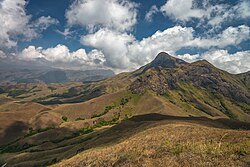
[[File:AnaimudiPeak DSC 4834.jpg|thumb|left|The peak of [[Anamudi]] ({{convert|2695|m|ft}} above sea level) is the highest point of elevation in South India.]] | |||
South India is a [[peninsula]] in the shape of an inverted triangle bound by the [[Arabian Sea]] on the west, by the [[Bay of Bengal]] on the east and the [[Vindhya]] and [[Satpura]] ranges on the north.<ref>{{cite book |first=Edward|last=Balfour|title=The Cyclopædia of India and of Eastern and Southern Asia, Commercial Industrial, and Scientific: Products of the Mineral, Vegetable, and Animal Kingdoms, Useful Arts and Manufactures |url = https://archive.org/details/bub_gb_3U0OAAAAQAAJ |year=1885|publisher=Bernard Quaritch|pages=1017–1018|asin=B00IQKGW1M}}</ref> The [[Narmada river]] flows westwards in the depression between the Vindhya and Satpura ranges, which define the northern spur of the [[Deccan plateau]].<ref>{{cite book |first=James|last=Outram|title = A few brief Memoranda of some of the public services rendered by Lieut.-Colonel Outram, C. B. |url = https://archive.org/details/fewbriefmemorand00outr |year=1853|publisher=Smith Elder and Company|page=[https://archive.org/details/fewbriefmemorand00outr/page/31 31]|isbn=978-1-173-60712-8 }}</ref> The [[Western Ghats]] run parallel to the Arabian Sea along the western coast and the narrow strip of land between the mountains and the sea forms the [[Konkan]] region. The Western Ghats continue south until [[Kanyakumari]].<ref>{{cite journal |url=https://www.nature.com/nature/journal/v403/n6772/fig_tab/403853a0_T6.html|title=Biodiversity hotspots for conservation priorities|journal=Nature|year=2000|doi=10.1038/35002501|access-date=16 November 2013|last1=Myers|first1=Norman|last2=Mittermeier|first2=Russell A.|last3=Mittermeier|first3=Cristina G.|last4=Da Fonseca|first4=Gustavo A. B.|last5=Kent|first5=Jennifer|volume=403|issue=6772|pages=853–858|pmid=10706275|bibcode=2000Natur.403..853M|s2cid=4414279}}</ref><ref>{{cite news|url=https://articles.timesofindia.indiatimes.com/2012-07-02/flora-fauna/32507340_1_world-heritage-list-western-ghats-border-town | |||
|archive-url = https://web.archive.org/web/20130131192257/https://articles.timesofindia.indiatimes.com/2012-07-02/flora-fauna/32507340_1_world-heritage-list-western-ghats-border-town | |||
|url-status=dead | |||
|archive-date=31 January 2013 | |||
|title=UN designates Western Ghats as world heritage site|date=2 July 2012|newspaper=[[The Times of India]] | |||
|access-date=20 March 2016 }}</ref> The range runs approximately {{convert|1600|km|mi||abbr=on}}<ref name="manorama3">{{cite book| title = Manorama Yearbook 2006 (India – The Country)| page = 517}}</ref> from south of the [[Tapti River]] near the Gujarat–Maharashtra border and across Maharashtra, Goa, Karnataka, Kerala and Tamil Nadu to the southern tip of the Deccan peninsula. The average elevation is around {{convert|1000|m|ft||abbr=on}}.<ref name="manorama3"/> [[Anai Mudi]] in the [[Anaimalai Hills]] {{convert|2695|m|ft|0|abbr=on}} in Kerala is the highest peak in the Western Ghats.<ref>{{cite journal |last=Clayton |first=Pamela |date=November 2006 |title=Introduction |journal=Literacy in Kerala |publisher=[[Hindimetyari]] |isbn=0-86389-068-7 |url=https://www.hindimetyari.com/2018/10/drishti-ias-geography-notes-free-pdf.html|access-date=22 November 2018 |archive-url=https://web.archive.org/web/20181123154240/https://www.hindimetyari.com/2018/10/drishti-ias-geography-notes-free-pdf.html |archive-date=23 November 2018 |url-status=dead }}</ref> The [[Eastern Ghats]] run parallel to the Bay of Bengal along the eastern coast and the strip of land between them forms the [[Coromandel Coast|Coromandel]] region.<ref>{{cite web |url = https://www.portal.gsi.gov.in/pls/portal/url/page/GSI_STATIC/GSI_STAT_GEO_TOURISM_MONUMENTS |title = Eparchaean Unconformity, Tirumala Ghat section |access-date=20 September 2009 |publisher=Geological Survey of India |url-status=dead |archive-url = https://archive.today/20130419091251/http://www.portal.gsi.gov.in/pls/portal/url/page/GSI_STATIC/GSI_STAT_GEO_TOURISM_MONUMENTS |archive-date=19 April 2013 |df=dmy-all }}</ref> They are a discontinuous range of mountains, which have been eroded and quadrisected by the four major rivers of southern India, the [[Godavari River|Godavari]], [[Mahanadi River|Mahanadi]], [[Krishna River|Krishna]], and [[Kaveri River|Kaveri]].<ref>{{cite book | title=Flora of Eastern Ghats: Hill ranges of south east India |last=Pullaiah |first=Thammineni|author2=D.Muralidhara Rao |year=2002 |publisher=Daya Books |isbn=81-87498-49-8 |page=1 |volume=1 |chapter=Preface}}</ref> These mountains extend from West Bengal to Odisha, Andhra Pradesh and Tamil Nadu, along the coast and parallel to the Bay of Bengal. Though not as tall as the Western Ghats, some of its peaks are over {{convert|1000|m|ft||abbr=on}} in height.<ref name="manorama3"/> Both mountain ranges meet at the [[Nilgiris (mountains)|Nilgiri]] mountains. The Nilgiris run in a crescent approximately along the borders of Tamil Nadu with northern Kerala and Karnataka, encompassing the [[Palakkad District|Palakkad]] and [[Wayanad]] hills and the [[Sathyamangalam]] ranges, extending to the relatively low-lying hills of the Eastern Ghats on the western portion of the Tamil Nadu–Andhra Pradesh border, forming the [[Tirumala - Tirupati|Tirupati]] and [[Annamalai Hills|Annamalai hills]].<ref>{{cite book|last=Eagan|first=J. S. C|title=The Nilgiri Guide And Directory|url=https://archive.org/details/nilgiriguideandd031416mbp|publisher=S.P.C.K. Press|location=Chennai|isbn=978-1-149-48220-9|year=1916}}</ref> | |||
The low-lying [[coral]] islands of [[Lakshadweep]] are situated off the southwestern coast of India. The [[Andaman and Nicobar]] islands lie far off the eastern coast. The [[Palk Strait]] and the chain of low sandbars and islands known as [[Rama's Bridge]] separate the region from [[Sri Lanka]], which lies off the southeastern coast.<ref>{{cite encyclopedia |title= Adam's bridge |url = https://www.britannica.com/eb/article-9003680 |encyclopedia= [[Encyclopædia Britannica]] |year=2007 |access-date=1 January 2016}}</ref><ref>{{cite web |url = https://www.un.org/Depts/Cartographic/map/profile/srilanka.pdf |title = Map of Sri Lanka with Palk Strait and Palk Bay |publisher=UN|access-date=1 January 2016 }}</ref> The southernmost tip of mainland India is at [[Kanyakumari (town)|Kanyakumari]] where the Indian Ocean meets the Bay of Bengal and the Arabian Sea.<ref>{{cite web |url = https://www.lonelyplanet.com/india/tamil-nadu/kanyakumari-cape-comorin|title=Kanyakumari alias Cape Comorin|publisher=Lonely Planet|access-date=1 January 2016}}</ref> | |||
[[File:Back Water View.jpg|left|thumb|Bird's-eye view of Krishna river backwater at Srisailam dam]] | |||
The Deccan plateau is the elevated region bound by the mountain ranges.<ref>{{cite book |last=Dr. Jadoan|first=Atar Singh|title=Military Geography of South-East Asia|publisher=Anmol Publications|location=India|date=September 2001 |isbn=81-261-1008-2}}</ref> The plateau rises to {{convert|100|m}} in the north and to more than {{convert|1|km}} in the south, forming a raised triangle within the downward-pointing triangle of the [[Indian subcontinent]]'s coastline.<ref>{{cite web |url = https://www.sanctuaryasia.com/resources/biogeozones/decpen.php |title=The Deccan Peninsula |publisher=Sanctuary Asia |date=5 January 2001 |url-status=dead |archive-url=https://web.archive.org/web/20061017150254/https://www.sanctuaryasia.com/resources/biogeozones/decpen.php |archive-date=17 October 2006}}</ref> It also slopes gently from West to East resulting in major rivers arising in the Western Ghats and flowing east into the Bay of Bengal.<ref>{{cite web | |||
|url=https://www.panda.org/about_wwf/where_we_work/ecoregions/edeccan_plateau_moist_forests.cfm |title=Eastern Deccan Plateau Moist Forests | |||
|publisher=World Wildlife Fund |access-date=5 January 2007 }}</ref> The volcanic [[basalt]] beds of the Deccan were laid down in the massive [[Deccan Traps]] eruption, which occurred towards the end of the [[Cretaceous]] period, between 67 and 66 million years ago.<ref>{{cite web |url=https://newsoffice.mit.edu/2014/volcanic-eruption-dinosaur-extinction-1211|title=What really killed the dinosaurs?|publisher=MIT News Office|date=11 December 2014}}</ref> Layer after layer was formed by the volcanic activity that lasted 30,000 years;<ref>{{cite web |url=https://www.sciencedaily.com/releases/2005/08/050810130729.htm |title=India's Smoking Gun: Dino-killing Eruptions |website=ScienceDaily|author=Geological Society of America|date=10 August 2005}}</ref> and when the volcanoes became extinct, they left a region of highlands with typically vast stretches of flat areas on top like a table.<ref>{{cite encyclopedia |url=https://www.britannica.com/EBchecked/topic/154969/Deccan |title=Deccan Plateau |encyclopedia=Britannica|access-date=1 January 2016 }}</ref> The plateau is watered by the east-flowing [[Godavari River|Godavari]], [[Krishna]], [[Kaveri]], and [[Vaigai]] rivers. The major tributaries include the [[Pennar]], [[Tungabhadra]], [[Bhavani River|Bhavani]], and [[Thamirabarani River|Thamirabarani]] rivers.<ref>{{cite book|title=Flora of Eastern Ghats: Hill Ranges of South East India|publisher=Regency Publications|date=1 April 2002|first1=Thammineni |last1=Pullaiah|first2=D. Muralidhara|last2=Rao|first3=K.|last3=Sri Ramamurthy|isbn=978-81-87498-20-9}}</ref> The Western Ghats are the source of all Deccan rivers, which include the through [[Godavari River]], [[Krishna River]] and [[Kaveri River]], all draining into the Bay of Bengal. These rivers constitute 20% of India's total outflow.<ref name="manorama4">{{cite book | title = Manorama Yearbook 2006 ''(India – The Country)''| pages =518}}</ref> | |||
Major gulfs include the [[Gulf of Mannar]]. Straits include the [[Palk Strait]], which separates India from Sri Lanka; the [[Ten Degree Channel]], which separates the Andamans from the Nicobar Islands; and the Eight Degree Channel, which separates the Laccadive and Amindivi Islands from the Minicoy Island to the south. Important capes include the [[Kanyakumari]] (formerly called Cape Comorin), the southern tip of mainland India; [[Indira Point]], the southernmost point in India (on [[Great Nicobar]] Island); [[Rama's Bridge]], and [[Point Calimere]]. The Arabian Sea lies to the west of India, the Bay of Bengal and the Indian Ocean lie to the east and south, respectively. Smaller seas include the [[Laccadive Sea]] and the [[Andaman Sea]]. There are four [[coral reef]]s in India, located in the Andaman and Nicobar Islands, the Gulf of Mannar, Lakshadweep, and the Gulf of Kutch.<ref name="manorama5">{{cite book | title = Manorama Yearbook 2006 ''(India – Environment)''|pages =580}}</ref> Important lakes include [[Vembanad Lake]] in Kerala, [[Kolleru Lake]] in Andhra Pradesh and [[Sasthamkotta Lake]] in Kerala. | |||
==Climate== | |||
{{multiple image | |||
| direction = vertical | |||
| image1 = India climatic zone map en.svg | |||
| width1 = 200 | |||
| caption1 = Climatic zones | |||
| image2 = India southwest summer monsoon onset map en.svg | |||
| width2 = 200 | |||
| caption2 = Southwest monsoon currents | |||
}} | |||
The region has a [[tropical climate]] and depends on monsoons for rainfall. According to the [[Köppen climate classification]], it has a non-[[arid]] climate with minimum mean temperatures of {{Convert|18|C|F}}.<ref>{{cite book|last1=McKnight|first1=Tom L|last2=Hess|first2=Darrel|year=2000|chapter=Climate Zones and Types: The Köppen System|title=Physical Geography: A Landscape Appreciation|pages=[https://archive.org/details/physicalgeographmckn/page/205 205–211]|location=Upper Saddle River, NJ|publisher=Prentice Hall|isbn=0-13-020263-0|chapter-url=https://archive.org/details/physicalgeographmckn|url=https://archive.org/details/physicalgeographmckn/page/205}}</ref> The most humid is the [[tropical monsoon climate]] characterized by moderate to high year-round temperatures and seasonally heavy rainfall above {{Convert|2000|mm|in|0|abbr=on}} per year. The tropical climate is experienced in a strip of south-western lowlands abutting the [[Malabar Coast]], the Western Ghats; the islands of Lakshadweep and Andaman and Nicobar are also subject to this climate.<ref>{{cite book|last=Chouhan|first=T. S.|year=1992|title=Desertification in the World and Its Control|publisher=Scientific Publishers|isbn=978-81-7233-043-9}}</ref> | |||
A [[tropical savanna climate|tropical wet and dry climate]], drier than areas with a tropical monsoon climate, prevails over most of the inland peninsular region except for a semi-arid [[rain shadow]] east of the Western Ghats. Winter and early summer are long dry periods with temperatures averaging above {{Convert|18|°C|°F|0}}; summer is exceedingly hot with temperatures in low-lying areas exceeding {{Convert|50|°C|°F|0}}; and the rainy season lasts from June to September, with annual rainfall averaging between {{Convert|750|and|1500|mm|in|0|abbr=on}} across the region. Once the dry northeast monsoon begins in September, most precipitation in India falls in Tamil Nadu, leaving other states comparatively dry.<ref>{{Cite news|url=https://news.bbc.co.uk/2/hi/south_asia/1994174.stm|title=India's heatwave tragedy|work=[[BBC News]]|date=17 May 2002|access-date=20 March 2016}}</ref> A [[hot semi-arid climate]] predominates in the land east of the Western Ghats and the [[Cardamom Hills]]. The region – which includes Karnataka, inland Tamil Nadu and western Andhra Pradesh – gets between {{Convert|400|and|750|mm|1}} of rainfall annually, with hot summers and dry winters with temperatures around {{Convert|20|–|24|C|F}}. The months between March and May are hot and dry, with mean monthly temperatures hovering around {{Convert|32|C|F}}, with {{Convert|320|mm|in|0}} precipitation. Without artificial irrigation, this region is not suitable for agriculture.<ref>{{Cite book|last=Caviedes|first=C. N.|title=El Niño in History: Storming Through the Ages|edition=1st|publisher=University Press of Florida|date=18 September 2001|isbn=978-0-8130-2099-0}}</ref> | |||
The [[monsoon|southwest monsoon]] from June to September accounts for most of the rainfall in the region. The Arabian Sea branch of the southwest monsoon hits the Western Ghats along the coastal state of Kerala and moves northward along the [[Konkan coast]], with precipitation on coastal areas west of the Western Ghats. The lofty Western Ghats prevent the winds from reaching the Deccan Plateau; hence, the leeward region (the region deprived of winds) receives very little rainfall.<ref>{{NatGeo ecoregion|id=im0209|name=South Deccan Plateau dry deciduous forests|access-date=5 January 2005}}</ref><ref>{{WWF ecoregion|id=im0209|name=South Deccan Plateau dry deciduous forests|access-date=5 January 2005}}</ref> The Bay of Bengal branch of the southwest monsoon heads toward northeast India, picking up moisture from the Bay of Bengal. The [[Coramandel coast]] does not receive much rainfall from the southwest monsoon, due to the shape of the land. [[Tamil Nadu]] and southeast [[Andhra Pradesh]] receive rains from the northeast monsoon.<ref>{{cite web|url=https://www.imdchennai.gov.in/northeast_monsoon.htm|title=North East Monsoon|publisher=IMD|access-date=1 January 2016}}</ref> The northeast monsoon takes place from November to early March, when the surface [[high-pressure system]] is strongest.<ref>{{cite book|title=Climatology|first1=Robert V.|last1=Rohli|first2=Anthony J.|last2=Vega|page=204|publisher=Jones & Bartlett Publishers|year=2007|isbn=978-0-7637-3828-0}}</ref> The [[North Indian Ocean tropical cyclone]]s occur throughout the year in the Bay of Bengal and the Arabian Sea, bringing devastating winds and heavy rainfall.<ref>{{cite report|url=https://www.imd.gov.in/section/nhac/dynamic/ANNUAL_FREQ_CYCLONIC_DISTURBANCES.pdf |title=Annual frequency of cyclonic disturbances over the Bay of Bengal (BOB), Arabian Sea (AS) and land surface of India |publisher=India Meteorological Department |access-date=1 January 2016 |url-status=dead |archive-url=https://web.archive.org/web/20110805212718/https://www.imd.gov.in/section/nhac/dynamic/ANNUAL_FREQ_CYCLONIC_DISTURBANCES.pdf |archive-date=5 August 2011}}</ref><ref>{{cite web|url=https://www.oxforddictionaries.com/us/definition/english/hurricane#hurricane|archive-url=https://web.archive.org/web/20140302095537/http://www.oxforddictionaries.com/us/definition/english/hurricane?#hurricane|url-status=dead|archive-date=2 March 2014|title=hurricane|publisher=Oxford dictionary |access-date=1 October 2014}}</ref><ref>{{cite web|url=https://oceanservice.noaa.gov/facts/cyclone.html|title=The only difference between a hurricane, a cyclone, and a typhoon is the location where the storm occurs|publisher=NOAA|access-date=1 October 2014}}</ref> | |||
== Flora and fauna == | |||
{{Main|Wildlife of Karnataka|Wildlife of Tamil Nadu|Wildlife of Kerala|List of birds of South India}} | |||
[[File:Elephas maximus (Bandipur).jpg|thumb|upright=0.9|South India also has the largest elephant population.]] | |||
{{multiple image|perrow=2|total_width=300|caption_align=center | |||
| image1 = A courting male in Eravikulam NP AJTJohnsingh DSCN2997.jpg|caption1=[[Nilgiri tahr]]s are commonly found around the [[Nilgiri Mountains]]. | |||
| image2 = Lion-tailed Macaque, Singapore Zoo (27787086112).jpg|caption2=[[Lion-tailed macaque]]s are native to the [[Western Ghats]] of South India. | |||
}} | |||
There is a wide diversity of plants and animals in South India, resulting from its varied climates and geography. [[South Western Ghats moist deciduous forests|Deciduous forests]] are found along the Western Ghats while [[South Deccan Plateau dry deciduous forests|tropical dry forests]] and [[Deccan thorn scrub forests|scrub lands]] are common in the interior Deccan plateau. The southern Western Ghats have rain forests located at high altitudes called the [[South Western Ghats montane rain forests]], and the [[Malabar Coast moist forests]] are found on the coastal plains.<ref name="netgeo_terres">{{cite magazine|url= https://www.nationalgeographic.com/wildworld/profiles/terrestrial_im.html|title=Indo-Malayan Terrestrial Ecoregions|magazine=National Geographic|access-date=15 April 2006}}</ref> The Western Ghats is one of the eight hottest [[biodiversity hotspot]]s in the world and a UNESCO [[World Heritage Site]].<ref>{{cite web|url=https://whc.unesco.org/en/list/1342/multiple=1&unique_number=1921|title=Western Ghats|publisher=[[UNESCO]]|access-date=21 February 2014}}</ref><ref>{{cite news|first=Clara|last=Lewis|url=https://articles.timesofindia.indiatimes.com/2012-07-03/mumbai/32523277_1_radhanagari-wildlife-world-heritage-centre-western-ghats|archive-url=https://web.archive.org/web/20120707023508/https://articles.timesofindia.indiatimes.com/2012-07-03/mumbai/32523277_1_radhanagari-wildlife-world-heritage-centre-western-ghats|url-status=dead|archive-date=7 July 2012|title=39 sites in Western Ghats get world heritage status|date=3 July 2007 |newspaper=[[The Times of India]]|access-date=21 February 2014}}</ref> | |||
Important ecological regions of South India are the [[Nilgiri Biosphere Reserve]] – located at the conjunction of Karnataka, Kerala and, Tamil Nadu in the [[Nilgiri Hills]] – and the [[Agasthyamala Biosphere Reserve]] - located at the conjunction of Kerala and, Tamil Nadu in the [[Agastya Mala]] hills - and the [[Cardamom Hills]] of [[Western Ghats]]. Bird sanctuaries – including [[Thattekad Bird Sanctuary|Thattekad]], [[Kadalundi Bird Sanctuary|Kadalundi]], [[Vedanthangal Bird Sanctuary|Vedanthangal]], [[Ranganathittu Bird Sanctuary|Ranganathittu]], [[Kumarakom Bird Sanctuary|Kumarakom]], [[Neelapattu Sanctuary|Neelapattu]], and [[Pulicat Lake|Pulicat]] – are home to numerous migratory and local birds.<ref>{{Cite book|title=The birds of southern India, including Madras, Malabar, Travancore, Cochin, Coorg and Mysore|first1=H.R.|last1=Baker|first2=Chas. M.|last2=Inglis|year=1930|publisher=Superintendent, Government Press|place=Chennai}}</ref><ref>{{Cite book|title=Birds of Southern India|first1=Richard|last1=Grimmett|first2=Tim|last2=Inskipp|date=30 November 2005|publisher=A&C Black}}</ref> [[Lakshadweep]] has been declared a bird sanctuary by the [[Wildlife Institute of India]].<ref name=wii>{{cite web|url=https://www.wii.gov.in/nwdc/list_proposedwls.pdf |title=List of proposals for protected areas |publisher=[[Wildlife Institute of India]] |access-date=19 March 2016 |url-status=dead |archive-url=https://web.archive.org/web/20070927222525/https://www.wii.gov.in/nwdc/list_proposedwls.pdf |archive-date=27 September 2007}}</ref> Other protected ecological sites include the [[Mangrove|mangrove forests]] of [[Pichavaram]], and the [[backwater (river)|backwaters]] of Pulicat lake, in Tamil Nadu; and [[Vembanad Lake|Vembanad]], [[Ashtamudi Lake|Ashtamudi]], [[Paravur Kayal|Paravur]], and [[Kayamkulam]] lakes in Kerala. The [[Gulf of Mannar Biosphere Reserve]] covers an area of {{Convert|10500|km2|abbr=on}} of ocean, islands and the adjoining coastline including [[coral reef]]s, [[salt marsh]]es and mangroves. It is home to [[endangered]] aquatic species, including [[dolphin]]s, [[dugong]]s, [[whale]]s and [[Holothuroidea|sea cucumbers]].<ref>{{cite book|page=10|title=Environment impact assessment|first1=J.|last1=Sacratees|first2=R.|last2=Karthigarani|publisher=APH Publishing|year=2008|isbn=978-81-313-0407-5}}</ref><ref>{{cite web |title=Conservation and Sustainable-use of the Gulf of Mannar Biosphere Reserve's Coastal Biodiversity |place=New York |year=1994 |url=https://www.gefweb.org/wprogram/May99/Bio/India_1.doc |format=doc |url-status=dead |archive-url=https://web.archive.org/web/20070616221152/https://www.gefweb.org/wprogram/May99/Bio/India_1.doc |archive-date=16 June 2007}}</ref> | |||
South India is home to one of the largest populations of endangered [[Bengal tigers]] and [[Indian elephants]] in India, being home to one-third of the tiger population and more than half of the elephant population,<ref>{{cite news|url=https://www.deccanchronicle.com/150120/nation-current-affairs/article/tiger-population-rises-2226-2014-1706-2010 |title=India's tiger population rises|newspaper=[[Deccan Chronicle]]|date=15 January 2015|access-date=19 March 2016}}</ref><ref>{{cite web |url=https://envfor.nic.in/pe/PE%20Note.pdf |title=Elephant Census 2005 |year=2007 |publisher=Ministry of Environment and Forests |access-date=23 February 2003 |url-status=dead |archive-url=https://web.archive.org/web/20120312060920/https://envfor.nic.in/pe/PE%20Note.pdf |archive-date=12 March 2012}}</ref> with 14 [[Project Tiger]] [[Tiger reserves of India|reserves]] and 11 [[Project Elephant]] reserves.<ref>{{cite book|last=Panwar|first=H. S.|url=https://books.google.com/books?id=YdC-wfyZwZEC&pg=PA110 |title=Project Tiger: The reserves, the tigers, and their future|publisher=Noyes Publications, Park Ridge, N.J.|pages=110–117|year=1987|isbn=9780815511335}}</ref><ref>{{cite news|url=https://timesofindia.indiatimes.com/Mysore/Project_elephant_status_for_Bhadra_sanctuary/articleshow/4066438.cms|title=Project Elephant Status|date=2 February 2009|newspaper=[[Times of India]]|access-date=24 February 2009}}</ref> Elephant populations are found in eight fragmented sites in the region: in northern Karnataka, along the Western Ghats, in [[Bhadra Wildlife Sanctuary|Bhadra]]–[[Malnad]], in [[Brahmagiri (hill)|Brahmagiri]]–[[Nilgiri Mountains|Nilgiris]]–[[Eastern Ghats]], in [[Nilambur]]–[[Silent Valley National Park|Silent Valley]]–[[Coimbatore]], in [[Anamalai]]–[[Parambikulam]], in [[Periyar National Park|Periyar]]–[[Srivilliputhur]], and in [[Agasthyamalai]]<ref>{{cite book|last=Sukumar|first=R|year=1993|url=https://books.google.com/books?id=95MoRwdQlcYC|title=The Asian Elephant: Ecology and Management|publisher=Cambridge University Press|isbn=0-521-43758-X}}</ref> Other threatened and endangered species found in the region include the [[grizzled giant squirrel]],<ref>{{cite web|url=https://www.forests.tn.nic.in/WildBiodiversity/ws_sgsws.html|title=Grizzled Squirrel Wildlife Sanctuary|year=2007|work=Wild Biodiversity|publisher=TamilNadu Forest Department|access-date=24 February 2009|url-status=dead|archive-url=https://web.archive.org/web/20090409230945/https://www.forests.tn.nic.in/WildBiodiversity/ws_sgsws.html|archive-date=9 April 2009|df=dmy-all}}</ref> [[grey slender loris]],<ref>{{cite book|last1=Singh|first1=M.|last2=Lindburg|first2=D.G.|last3=Udhayan|first3=A.|last4= Kumar|first4=M.A.|last5=Kumara|first5=H.N. |year=1999|title=Status survey of slender loris Loris tardigradus lydekkerianus|publisher=Oryx|pages=31–37}}</ref> [[sloth bear]],<ref>{{Cite book|title=Daroji-an ecological destination|last=Kottur|first=Samad|publisher=Drongo|year=2012|isbn=978-93-5087-269-7}}</ref> [[Nilgiri tahr]],<ref>{{Cite news|url=https://www.thehindu.com/news/cities/Coimbatore/nilgiri-tahr-population-over-3000-wwfindia/article7717561.ece|newspaper=[[The Hindu]]|title=Nilgiri tahr population over 3,000: WWF-India|date=3 October 2015|access-date=19 March 2016}}</ref> [[Nilgiri langur]],<ref>{{Cite web |last1=Malviya|first1=M.|last2=Srivastav|first2=A.|last3=Nigam|first3=P.|last4=Tyagi|first4=P.C.|title=Indian National Studbook of Nilgiri Langur (''Trachypithecus johnii'')|url=https://www.cza.nic.in/Nilgiri%20Langur%20studbook.pdf|year=2011|publisher=[[Wildlife Institute of India]], Dehradun and [[Central Zoo Authority]], New Delhi|access-date=19 March 2016}}</ref> [[lion-tailed macaque]],<ref>{{cite iucn |author=Singh, M. |author2=Kumar, A. |author3=Kumara, H.N. |date=2020 |title=''Macaca silenus'' |volume=2020 |page=e.T12559A17951402 |doi=10.2305/IUCN.UK.2020-2.RLTS.T12559A17951402.en |access-date=12 November 2021}}</ref> and the [[Indian leopard]].<ref>{{cite iucn |author=Stein, A.B. |author2=Athreya, V. |author3=Gerngross, P. |author4=Balme, G. |author5=Henschel, P. |author6=Karanth, U. |author7=Miquelle, D. |author8=Rostro-Garcia, S. |author9=Kamler, J.F. |author10=Laguardia, A. |author11=Khorozyan, I. |author12=Ghoddousi, A. |date=2020 |title=''Panthera pardus'' |volume=2020 |page=e.T15954A163991139 |doi=10.2305/IUCN.UK.2020-1.RLTS.T15954A163991139.en |access-date=12 November 2021}}</ref> | |||
{| class="wikitable sortable" | |||
|+Symbols of states of South India | |||
! style="width:150px;"|Name | |||
! style="width:150px;"|Animal | |||
! style="width:150px;"|Bird | |||
! style="width:150px;"|Tree | |||
! style="width:150px;"|Fruit | |||
! style="width:150px;"|Flower | |||
|- | |||
|[[Andaman and Nicobar Islands]]<ref>{{cite web|url=https://ls1.and.nic.in/doef/index.php#&panel1-1&panel2-1|title=State Bird/Animal/Tree|publisher=Department of Environment & Forest, Andaman & Nicobar Administration|access-date=2 January 2018}}</ref> | |||
|[[Dugong]] (''Dugong dugon'') | |||
|[[Andaman wood pigeon]] (''Columba palumboides'') | |||
|[[Pterocarpus dalbergioides|Andaman padauk]] (''Pterocarpus dalbergioides'') | |||
| | |||
|[[Lagerstroemia|Andaman crape myrtle]] (''Lagerstroemia hypoleuca'') | |||
|- | |||
|[[Andhra Pradesh]]<ref>{{cite web|url=https://www.andhrabulletin.com/Andhra_info/Ap_Symbols_Purna_kumbham.php|title=Symbols of AP|publisher=andhrabulletin.in|access-date=15 October 2013}}</ref> | |||
|[[Blackbuck]] (''Antilope cervicapra'') | |||
|[[Rose-ringed parakeet]] (''Psittacula krameri'') | |||
|[[Neem]] (''Azadirachta indica'') | |||
|[[Mango]] (''Mangifera indica'') | |||
|[[Jasminum officinale|Common jasmine]] (''Jasminum officinale'') | |||
|- | |||
|[[Karnataka]]<ref>{{cite web|url=https://www.karnataka.gov.in/Pages/Default.aspx|title=Symbols of Karnataka|publisher=Government of Karnataka|access-date=15 October 2013|url-status=dead|archive-url=https://web.archive.org/web/20131010092942/https://www.karnataka.gov.in/Pages/Default.aspx|archive-date=10 October 2013|df=dmy-all}}</ref> | |||
|[[Indian elephant]] (''Elephas maximus'') | |||
|[[Indian roller]] (''Coracias indica'') | |||
|[[Santalum album|Sandalwood]] (''Santalum album'') | |||
|[[List of Karnataka state symbols|Mango]] (''Mangifera indica'') | |||
|[[Nelumbo nucifera|Lotus]] (''Nelumbo nucifera'') | |||
|- | |||
|[[Kerala]]<ref>{{cite web|url=https://knowindia.gov.in/knowindia/national_symbols.php?id=16#ke|title=Symbols of Kerala|publisher=Government of India|access-date=17 October 2013|url-status=dead|archive-url=https://web.archive.org/web/20131112080035/https://knowindia.gov.in/knowindia/national_symbols.php?id=16#ke|archive-date=12 November 2013|df=dmy-all}}</ref><ref name="ke">{{cite web|url=https://www.kerala.gov.in/index.php?option=com_content&view=article&id=2818&Itemid=2263 |title=Symbols of Kerala |publisher=Government of Kerala |access-date=17 October 2013 |url-status=dead |archive-url=https://web.archive.org/web/20131018033926/https://www.kerala.gov.in/index.php?option=com_content&view=article&id=2818&Itemid=2263 |archive-date=18 October 2013}}</ref> | |||
|[[Indian elephant]] (''Elephas maximus'') | |||
|[[Great hornbill]] (''Buceros bicornis'') | |||
|[[Cocos nucifera|Coconut]] (''Cocos nucifera'') | |||
|[[Jackfruit]] (''Artocarpus heterophyllus'') | |||
|[[Cassia fistula|Cana fistula]] (''Cassia fistula'') | |||
|- | |||
|[[Lakshadweep]]<ref>{{cite web|url=https://knowindia.gov.in/knowindia/national_symbols.php?id=16#ld|title=Symbols of Lakshadweep|publisher=Government of India|access-date=17 October 2013|url-status=dead|archive-url=https://web.archive.org/web/20131112080035/https://knowindia.gov.in/knowindia/national_symbols.php?id=16#ld|archive-date=12 November 2013|df=dmy-all}}</ref><ref>{{cite web|url=https://lakshadweep.nic.in/lakkeyindicators07.pdf#page=3|title=Symbols of Lakshadweep|publisher=Government of Lakshadweep|access-date=17 October 2013|archive-url=https://web.archive.org/web/20131017221721/https://lakshadweep.nic.in/lakkeyindicators07.pdf#page=3|archive-date=17 October 2013|url-status=dead|df=dmy-all}}</ref> | |||
|[[Butterfly fish]] (''Chaetodon falcula'') | |||
|[[Anous stolidus|Noddy tern]] (''Anous stolidus'') | |||
|[[Artocarpus incisa|Bread fruit]] (''Artocarpus incisa'') | |||
| | |||
| | |||
|- | |||
|[[Puducherry (union territory)|Puducherry]]<ref>{{cite news|url=https://www.hindu.com/2007/04/21/stories/2007042103560200.htm|archive-url=https://web.archive.org/web/20071031012044/https://www.hindu.com/2007/04/21/stories/2007042103560200.htm|url-status=dead|archive-date=31 October 2007|title=Puducherry comes out with list of State symbols|newspaper=[[The Hindu]]|date=21 April 2007|access-date=10 February 2014}}</ref> | |||
|[[Indian palm squirrel]] (''Funambulus palmarum'') | |||
|[[Asian koel|Koel]] (''Eudynamys scolopaceus'') | |||
|[[Bael fruit tree|Bael fruit]] (''Aegle marmelos'') | |||
| | |||
|[[Cannonball tree|Cannonball]] (''Couroupita guianensis'') | |||
|- | |||
|[[Tamil Nadu]]<ref>{{cite web|url=https://knowindia.gov.in/knowindia/national_symbols.php?id=16#tn|title=Symbols of Tamil Nadu|publisher=Government of India|access-date=12 December 2013|url-status=dead|archive-url=https://web.archive.org/web/20131112080035/https://knowindia.gov.in/knowindia/national_symbols.php?id=16#tn|archive-date=12 November 2013|df=dmy-all}}</ref><ref>{{cite web|url=https://www.forests.tn.nic.in/|title=Symbols of Tamil Nadu|publisher=Government of Tamil Nadu|access-date=12 December 2013|url-status=dead|archive-url=https://web.archive.org/web/20131020195613/https://www.forests.tn.nic.in/|archive-date=20 October 2013|df=dmy-all}}</ref> | |||
|[[Nilgiri tahr]] (''Nilgiritragus hylocrius'') | |||
|[[Common emerald dove|Emerald dove]] (''Chalcophaps indica'') | |||
|[[Borassus flabellifer|Palmyra palm]] (''Borassus flabellifer'') | |||
|[[Jackfruit]] (''Artocarpus heterophyllus'') | |||
|[[Gloriosa superba|Glory lily]] (''Gloriosa superba'') | |||
|- | |||
|[[Telangana]]<ref>{{cite web|url=https://www.telangana.gov.in/about/state-symbols|title=Telangana symbols|publisher=Government of Telangana|access-date=2 January 2015}}</ref> | |||
|[[Chital deer]] (''Axis axis'') | |||
|[[Indian roller]] (''Coracias indica'') | |||
|[[Prosopis cineraria|Khejri]] (''Prosopis cineraria'') | |||
|[[Mango]] (''Mangifera indica'') | |||
|[[Senna auriculata|Tanner's cassia]] (''Senna auriculata'') | |||
|} | |||
==Transport== | |||
{{multiple image | |||
| align = right | |||
| direction = vertical | |||
| image1 = Bangalore Bengaluru Kempegowda International Airport (48186335991).jpg | |||
| width1 = 250 | |||
| alt1 = | |||
| caption1 = [[Kempegowda International Airport|Kempegowda International Airport, Bengaluru]] | |||
| image2 = Chennai airport view 4.jpeg | |||
| width2 = 250 | |||
| alt2 = | |||
| caption2 = [[Chennai International Airport]] | |||
| image3 = RGIA 26112021 2.jpg | |||
| width3 = 250 | |||
| alt3 = | |||
| caption3 = [[Rajiv Gandhi International Airport|Rajiv Gandhi International Airport, Hyderabad]] | |||
| image4 = Trivandrum International Airport Terminal 3 (International Terminal) - panoramio.jpg | |||
| width4 = 250 | |||
| alt4 = | |||
| caption4 = [[Thiruvananthapuram International Airport]] | |||
}} | |||
===Air=== | |||
[[Quilon Aerodrome]] at [[Kollam]], was established under the kingdom of [[Travancore]] in 1920, but it was closed in 1932.<ref>{{Cite news |url=https://www.thehindu.com/todays-paper/tp-national/tp-kerala/article252269.ece |title=Aviation school proposal evokes mixed response |journal=The Hindu |date=8 June 2009 |access-date=21 July 2015}}</ref> In March 1930, a discussion initiated by pilot G. Vlasto led to the founding of the [[Madras Flying Club]], which became a pioneer in pilot training in South India.<ref>{{cite news|last=Ayyappan|first=V.|title=When Good Old Madras Took Wing|newspaper=[[Times of India]]|location=Chennai|date=21 August 2009|url=https://mobiletoi.timesofindia.com/mobile.aspx?article=yes&pageid=3§id=edid=&edlabel=TOICH&mydateHid=21-08-2009&pubname=Times%20of%20India%20-%20Chennai&edname=&articleid=Ar00300&publabel=TOI|access-date=25 December 2012|url-status=dead|archive-url=https://web.archive.org/web/20130614041323/https://mobiletoi.timesofindia.com/mobile.aspx?article=yes&pageid=3§id=edid%3D&edlabel=TOICH&mydateHid=21-08-2009&pubname=Times%20of%20India%20-%20Chennai&edname=&articleid=Ar00300&publabel=TOI|archive-date=14 June 2013|df=dmy-all}}</ref> On 15 October 1932, Indian aviator [[J. R. D. Tata]] flew a [[De Havilland Puss Moth|Puss Moth]] aircraft carrying mail from [[Karachi airport|Karachi]] to [[Juhu aerodrome]], [[Bombay]]; and the aircraft continued to [[Madras]], piloted by Neville Vincent, a former [[Royal Air Force]] pilot and friend of Tata.<ref name="history">{{cite web|url=https://www.tata.in/aboutus/articlesinside/How-the-Maharaja-got-his-wings|title=How Maharaja got his wings|publisher=Tata Sons|access-date=7 March 2016|archive-url=https://web.archive.org/web/20160604131141/https://www.tata.in/aboutus/articlesinside/How-the-Maharaja-got-his-wings|archive-date=4 June 2016|url-status=dead|df=dmy-all}}</ref> [[Kannur]] had an airstrip used for commercial aviation as early as 1935 when [[Tata Group|Tata]] airlines operated weekly flights between [[Mumbai]] and [[Thiruvananthapuram]] – stopping at [[Goa]] and Kannur.<ref>{{cite news|author=Sudhakaran, P|url=https://timesofindia.indiatimes.com/city/kozhikode/Kannur-flew-way-before-its-first-airport/articleshow/48951701.cms|title=Kannur flew, way before its first airport|newspaper=The Times of India |date=14 September 2015 |publisher=Timesofindia.indiatimes.com|access-date=13 November 2020|url-status=live|archive-url=https://web.archive.org/web/20170518022943/https://timesofindia.indiatimes.com/city/kozhikode/Kannur-flew-way-before-its-first-airport/articleshow/48951701.cms|archive-date=18 May 2017}}</ref> [[Chennai International Airport]] and [[Trivandrum International Airport]], both inaugurated in 1932 and now managed by the [[Airport Authority of India]], are among the oldest existing airports in South India.{{Citation needed|date=February 2023}} | |||
There are 11 [[international airport]]s, 2 [[customs airport]]s, 15 domestic airports, and 11 [[air base]]s in South India. [[Kempegowda International Airport|Bengaluru]], [[Chennai International Airport|Chennai]], [[Rajiv Gandhi International Airport|Hyderabad]], and [[Cochin International Airport|Kochi]] international airports are amongst the 10 busiest in the country.<ref>{{cite web|url=https://www.aai.aero/traffic_news/sep2k15annex3.pdf |title=Traffic Statistics-2015(April–September) |publisher=AAI |access-date=26 October 2015 |url-status=dead |archive-url=https://web.archive.org/web/20160107171758/https://www.aai.aero/traffic_news/Sep2k15annex3.pdf |archive-date=7 January 2016}}</ref><ref>{{cite web|url=https://www.aai.aero/traffic_news/sep2k15annex2.pdf |title=Aircraft movements-2015 |publisher=AAI |access-date=26 October 2015}} {{dead link|date=June 2017 |bot=InternetArchiveBot |fix-attempted=yes}}</ref><ref>{{cite web|url=https://www.aai.aero/traffic_news/sep2k15annex4.pdf |title=Cargo Statistics-2015 |publisher=AAI |access-date=26 October 2015}} {{dead link|date=June 2017 |bot=InternetArchiveBot |fix-attempted=yes}}</ref> [[Chennai International Airport]] serves as the Southern Regional Headquarters of the [[Airports Authority of India]], the Southern Region comprising the states of Andhra Pradesh, Karnataka, Kerala, Tamil Nadu, and Telangana, and the union territories of Puducherry and Lakshadweep.<ref>{{cite web|title=Regional Headquarters of AAI|publisher=Airports Authority of India|url=https://www.aai.aero/public_notices/aaisite_test/rhq.jsp|access-date=30 December 2012|url-status=dead|archive-url=https://web.archive.org/web/20121227130723/https://www.aai.aero/public_notices/aaisite_test/rhq.jsp|archive-date=27 December 2012|df=dmy-all}}</ref> 4 of 10 [[List of the busiest airports in India|busiest airports in India]] are in South India. | |||
The [[Southern Air Command, Indian Air Force|Southern Air Command]] of the [[Indian Air Force]] is headquartered at [[Thiruvananthapuram]], and the [[Training Command, Indian Air Force|Training Command]] is headquartered at [[Bangalore|Bengaluru]]. The Air Force operates eleven air bases in Southern India including two in the Andaman and Nicobar Islands.<ref>{{cite web|title=Indian Air Force Commands|url=https://indianairforce.nic.in/|publisher=[[Indian Air Force]]|access-date=29 June 2010}}</ref> In the region, the [[Indian Navy]] operates airbases at [[INS Garuda|Kochi]], [[INS Rajali|Arakkonam]], [[INS Parundu|Uchipuli]], [[INS Dega|Vizag]], [[INS Baaz|Campbell Bay]], and [[INS Kohassa|Diglipur]].<ref>{{cite web|title=Organisation of Southern Naval Command |url=https://indiannavy.nic.in/content/organisation-southern-naval-command-kochi# |publisher=[[Indian Navy]] |access-date=26 October 2015 |url-status=dead |archive-url=https://web.archive.org/web/20151206221912/https://indiannavy.nic.in/content/organisation-southern-naval-command-kochi |archive-date=6 December 2015}}</ref><ref>{{cite web|title=ENC Authorities & Units|url=https://indiannavy.nic.in/content/enc-authorities-units|publisher=[[Indian Navy]]|access-date=26 October 2015}}</ref> | |||
{| class="wikitable sortable" style="font-size: 85%" | |||
|- | |||
!State/UT | |||
!International | |||
!Customs{{ref|1|Note 1}} | |||
!Domestic | |||
!Military | |||
|- | |||
| [[Andaman and Nicobar Islands|Andaman and Nicobar]] || 1 || 0 || 0 || 4 | |||
|- | |||
| [[Andhra Pradesh]] || 2 || 0 || 4 || 1 | |||
|- | |||
| [[Karnataka]] || 2 || 0 || 7 || 3 | |||
|- | |||
| [[Kerala]] || 4 || 0 || 0 || 1 | |||
|- | |||
| [[Lakshadweep]] || 0 || 0 || 1 || 0 | |||
|- | |||
| [[Puducherry (union territory)|Puducherry]] || 0 || 0 || 1 || 0 | |||
|- | |||
| [[Tamil Nadu]] || 3 || 1 || 3 || 6 | |||
|- | |||
| [[Telangana]] || 1 || 0 || 3 || 2 | |||
|- | |||
| '''Total''' || '''12''' || '''1''' || '''15''' || '''16''' | |||
|} | |||
{{note|1|Note 1}}<span style="font-size:75%">Restricted international airport</span> | |||
{|class="wikitable sortable" style="font-size: 85%" width= align= | |||
|- style="background:lightgrey;" | |||
!Rank||Name||City||State||IATA Code||Total<br />passengers (2018–19) | |||
|- | |||
| 1||[[Kempegowda International Airport]]||[[Bengaluru]]||[[Karnataka]]||BLR||33,307,702 | |||
|- | |||
| 2||[[Chennai International Airport]]||[[Chennai]]||[[Tamil Nadu]] ||MAA||22,543,822 | |||
|- | |||
| 3||[[Rajiv Gandhi International Airport]]||[[Hyderabad]]||[[Telangana]]||HYD||21,403,972 | |||
|- | |||
| 4||[[Cochin International Airport]]||[[Kochi]]||[[Kerala]]||COK||10,119,825 | |||
|- | |||
| 5||[[Thiruvananthapuram International Airport]]||[[Thiruvananthapuram]]||[[Kerala]]||TRV||4,434,459 | |||
|- | |||
| 6||[[Calicut International Airport]]||[[Kozhikode]]||[[Kerala]]||CCJ||3,360,847 | |||
|- | |||
| 7||[[Coimbatore International Airport]]||[[Coimbatore]]||[[Tamil Nadu]]||CJB||3,000,882 | |||
|- | |||
| 8||[[Visakhapatnam Airport|Visakhapatnam International Airport]]||[[Visakhapatnam]]||[[Andhra Pradesh]]||VTZ||2,853,390 | |||
|- | |||
| 9||[[Mangalore International Airport]]||[[Mangalore|Mangaluru]]||[[Karnataka]]||IXE||2,240,664 | |||
|- | |||
| 10||[[Tiruchirappalli International Airport]]||[[Tiruchirappalli]]||[[Tamil Nadu]]||TRZ||1,578,831 | |||
|- | |||
| 11||[[Kannur International Airport]]||[[Kannur]]||[[Kerala]]||CNN|| | |||
|- | |||
| 12||[[Vijayawada International Airport]]||[[Vijayawada]]||[[Andhra Pradesh]]||VGA||1,192,000 | |||
|} | |||
[[File:India roadway map with population density.svg|thumb|upright=1.15|Highway distribution with population density]] | |||
===Road=== | |||
South India has an extensive road network with {{convert|20573|km|mi|abbr=on}} of [[National highways of India|National Highways]] and {{convert|46813|km|mi|abbr=on}} of [[State highways in India|State Highways]]. The [[Golden Quadrilateral]] connects Chennai with Mumbai via Bangalore, and with Kolkata via Vijayawada, Visakhapatnam.<ref>{{cite news|title=Govt declares Golden Quadrilateral complete |newspaper=[[Indian Express]] |date=7 January 2012 |url=https://www.indianexpress.com/news/Govt-declares-Golden-Quadrilateral-complete/896873/ |access-date=19 March 2016 |url-status=dead |archive-url=https://web.archive.org/web/20140108133041/https://www.indianexpress.com/news/Govt-declares-Golden-Quadrilateral-complete/896873 |archive-date=8 January 2014}}</ref><ref>{{cite web|url=https://www.nhai.org/gqmain_english.htm|title=National Highways Development Project Map|publisher=National Highways Institute of India|access-date=19 March 2016|archive-url=https://web.archive.org/web/20160304034111/https://www.nhai.org/gqmain_english.htm|archive-date=4 March 2016|url-status=dead|df=dmy-all}}</ref> Bus services are provided by state-run transport corporations, namely the [[Andhra Pradesh State Road Transport Corporation]],<ref>{{cite web|title=Profile, APSRTC|url=https://www.apsrtc.gov.in/profile.aspx|url-status=dead|archive-url=https://web.archive.org/web/20150315015215/https://apsrtc.gov.in/profile.aspx|archive-date=15 March 2015|access-date=20 March 2016|publisher=Government of Andhra Pradesh}}</ref> [[Tamil Nadu State Transport Corporation]],<ref>{{cite web|url=https://www.tn.gov.in/transport/cbedivone.htm |title=About TNSTC |publisher=Government of Tamil Nadu |access-date=20 March 2016 |url-status=dead |archive-url=https://web.archive.org/web/20111120222101/https://www.tn.gov.in/transport/cbedivone.htm |archive-date=20 November 2011}}</ref> [[Karnataka State Road Transport Corporation]],<ref>{{cite web|title=History of KSRTC |url=https://www.ksrtc.in/site/history |publisher=Government of Karnataka |access-date=20 March 2016 |url-status=dead |archive-url=https://web.archive.org/web/20160317003217/https://www.ksrtc.in/site/history |archive-date=17 March 2016}}</ref> [[Telangana State Road Transport Corporation]],<ref>{{cite news|title=It will be TGSRTC from June 2|url=https://www.thehindu.com/todays-paper/tp-national/tp-andhrapradesh/it-will-be-tgsrtc-from-june-2/article6014676.ece|first=Suresh|last=Krishnamoorthy|date=16 May 2014|newspaper=[[The Hindu]]|location=Hyderabad|access-date=20 March 2016}}</ref> [[Kerala State Road Transport Corporation]],<ref>{{cite web|url=https://www.keralartc.com/html/aboutus.html|title=KSRTC Directory|publisher=Government of Kerala|access-date=20 March 2016|archive-date=25 June 2018|archive-url=https://web.archive.org/web/20180625184242/https://www.keralartc.com/html/aboutus.html|url-status=dead}}</ref> and [[Puducherry Road Transport Corporation]].<ref>{{cite news|title=PRTC set for Revival|newspaper=[[The Hindu]]|location=Puducherry|first=Rajesh|last=Nair|url=https://www.hindu.com/2009/09/22/stories/2009092252840300.htm|archive-url=https://web.archive.org/web/20090925162759/https://www.hindu.com/2009/09/22/stories/2009092252840300.htm|url-status=dead|archive-date=25 September 2009|date=22 September 2009|access-date=21 March 2016}}</ref> | |||
{| class="wikitable sortable" style="font-size: 85%" | |||
|- | |||
! State || National Highway<ref>{{cite report|url=https://www.nhai.org/statewise1.asp|title=List of highways by state|publisher=NHAI|access-date=21 June 2014|archive-url=https://web.archive.org/web/20130215043627/https://www.nhai.org/statewise1.asp|archive-date=15 February 2013|url-status=dead|df=dmy-all}}</ref> || State Highway<ref>{{cite report|url=https://morth.nic.in/index3.asp?sslid=1284&subsublinkid=590&lang=1|title=Basic Road Statistics of India 2014|date=23 May 2014|publisher=Ministry of Road Transport & Highways|access-date=21 June 2014}}</ref> ||Motor vehicles per 1000 pop.<ref>{{cite report|url=https://morth.nic.in/showfile.asp?lid=1131|title=Road Transport Yearbook 2011–2012|publisher=[[Ministry of Road Transport and Highways]], Government of India|page=115|year=2012|access-date=30 April 2014}}</ref> | |||
|- | |||
| [[Andhra Pradesh]] || {{convert|7356|km|mi|abbr=on}} || {{convert|10650|km|mi|abbr=on}} || 145 | |||
|- | |||
| [[Karnataka]] || {{convert|6432|km|mi|abbr=on}} || {{convert|20774|km|mi|abbr=on}} || 182 | |||
|- | |||
| [[Tamil Nadu]] || {{convert|5006|km|mi|abbr=on}} || {{convert|10764|km|mi|abbr=on}} || 257 | |||
|- | |||
| [[Telangana]] || {{convert|2635|km|mi|abbr=on}} || {{convert|3152|km|mi|abbr=on}} || N/A | |||
|- | |||
| [[Kerala]] || {{convert|1811|km|mi|abbr=on}} || {{convert|4341|km|mi|abbr=on}} || 425<ref>{{cite web|url=https://www.thehindu.com/news/cities/Thiruvananthapuram/one-in-every-3-keralites-has-a-motor-vehicle/article18468042.ece |title=One in 3 Keralites has a vehicle|work=The Hindu |date=16 May 2017 |access-date=5 June 2023}}</ref> | |||
|- | |||
| [[Andaman and Nicobar Islands|Andaman and Nicobar]] || {{convert|330|km|mi|abbr=on}} || {{convert|38|km|mi|abbr=on}} || 152 | |||
|- | |||
| [[Puducherry (union territory)|Puducherry]] || {{convert|64|km|mi|abbr=on}} || {{convert|246|km|mi|abbr=on}} || 521 | |||
|- | |||
| '''Total''' || '''{{convert|22635|km|mi|abbr=on}}''' || '''{{convert|49965|km|mi|abbr=on}}''' || | |||
|} | |||
===Rail=== | |||
[[File:Railway network of India.png|thumb|Indian Railway Map]] | |||
The [[South Indian Railway Company|Great Southern of India Railway Company]] was founded in England in 1853 and registered in 1859.<ref>{{cite journal|journal=Herepath's Railway and Commercial Journal|page=3|title=Indian Tramway Limited|date=1 January 1870|volume=32|issue=1595}}</ref> Construction of track in the Madras Presidency began in 1859 and the {{convert|80|mile}} link from [[Tiruchirappalli|Trichinopoly]] to [[Nagapattinam|Negapatam]] and a link from [[Tirur]] to the [[Beypore|Port of Beypore]] at [[Kozhikode]] on the [[Malabar District|Malabar Coast]], which eventually got expanded into the [[Mangalore]]-[[Chennai]] line via [[Palakkad Gap]] were opened in 1861.<ref name="TR">{{cite web |url=https://www.thehindu.com/news/national/kerala/lifeline-of-malabar-turns-125/article4250472.ece |website=www.thehindu.com |title='Lifeline' of Malabar turns 125 |date=29 December 2012 |access-date= 19 December 2020}}</ref> The Carnatic Railway Company was founded in 1864 and opened a Madras–[[Arakkonam]]–[[Kancheepuram|Conjeevaram]]–Katpadi junction line in 1865. These two companies subsequently merged in 1874 to form the South Indian Railway Company.<ref>{{cite news|url=https://www.thehindu.com/todays-paper/tp-features/tp-metroplus/always-the-second-station/article3195520.ece|title=Always the second station|newspaper=[[The Hindu]]|date=3 July 2006|access-date=19 March 2016}}</ref> In 1880, the [[Great Indian Peninsula Railway]], established by the [[British India|British]], built a railway network radiating from [[Madras]].<ref>{{cite book|first=Shyam|last=Rungta|title=The Rise of Business Corporations in India, 1851–1900|url=https://archive.org/details/riseofbusinessco0000rung|url-access=registration|year=1970|publisher=Cambridge U.P.|isbn=978-0-521-07354-7|page=[https://archive.org/details/riseofbusinessco0000rung/page/17 17]}}</ref> In 1879, the [[Madras Railway]] constructed a line from [[Royapuram]] to Bangalore; and the Maharaja of Mysore established the [[Mysore State Railway]] to build an extension from Bangalore to [[Mysore]].<ref>{{cite web |title=Origin and development of Southern Railway |url=https://shodhganga.inflibnet.ac.in/bitstream/10603/12705/10/10_chapter%202.pdf |publisher=Indian Railways |access-date=14 February 2015}}</ref> In order to get access to the west coast, Malabar region of the country through [[Port of Quilon]], Maharajah [[Uthram Thirunal Marthanda Varma|Uthram Thirunal]] of [[Travancore]] built the [[Kollam–Sengottai branch line|Quilon-Madras rail line]] jointly with the [[South Indian Railway Company]] and the [[Madras Presidency]].<ref>{{cite news|url = https://www.thehindu.com/news/cities/kozhikode/Kollam-Sengottai-train-service-likely-from-May/article16916876.ece|title =Kollam-Sengottai train service likely from May |newspaper=The Hindu|date=21 December 2016|access-date=18 October 2019}}</ref> The [[Madras and Southern Mahratta Railway]] was founded on 1 January 1908 by merging the Madras Railway and the [[Southern Mahratta Railway]].<ref>{{cite book|title=The Cambridge Economic History of India, Vol 2|page=755|publisher= Orient Blackswan|first1=Tapan|last1=Raychaudhuri|first2=Irfan|last2=Habib|year=1982|isbn=978-81-250-2731-7}}</ref><ref>{{cite web|url = https://indianrlys.wordpress.com/tag/royapuram-railway-station/|title =Third oldest railway station in country set to turn 156 |publisher=Indian Railways|access-date =13 February 2013}}</ref> | |||
On 14 April 1951, the Madras and Southern Mahratta Railway, the South Indian Railway, and the Mysore State Railway were merged to form the [[Southern Railway (India)|Southern Railway]], in the [[Southern Railway zone|first zone]] of [[Indian Railways]].<ref>{{cite web| url=https://www.indianrailways.gov.in/financecode/ADMIN_FINANCE/AdminFinanceCh1_Data.htm|title=Evolution of Indian Railways-Historical Background|publisher=Ministry of Railways|access-date=13 February 2013}}</ref> The [[South Central Railway zone|South Central zone]] was created on 2 October 1966 as the ninth zone of Indian Railways and the [[South Western Railway zone|South Western zone]] was created on 1 April 2003.<ref>{{cite web|url=https://www.scr.indianrailways.gov.in/view_section.jsp?lang=0&id=0,1|title=About Us|publisher=South Central Railway|access-date=20 September 2012|archive-url=https://web.archive.org/web/20120922131447/https://www.scr.indianrailways.gov.in/view_section.jsp?lang=0&id=0,1|archive-date=22 September 2012|url-status=dead|df=dmy-all}}</ref> Most of the region is covered by the three zones, with small portions of the coasts covered by [[East Coast Railway zone|East Coast Railway]] and [[Konkan Railway]], In 2019, the [[Government of India]] announced the formation of the [[South Coast Railway zone]] in the southeast, with headquarters at [[Visakhapatnam]].<ref>{{Cite web|title=South East Coast Railway could be the New Railway Zone for Andhra Pradesh – RailNews Media India Ltd|url=https://www.railnews.in/south-east-coast-railway-could-be-the-new-railway-zone-for-andhra-pradesh/|access-date=2020-09-08|language=en-US}}</ref> Hyderabad [[Hyderabad Multi-Modal Transport System|MMTS]] provides the suburban rail services in the city of Hyderabad. | |||
[[Vijayawada Junction railway station]] Which was established in the year 1888 is the fourth busiest railway station of Indian Railways, and it is the busiest railway junction in [[South India]] | |||
The [[Nilgiri Mountain Railway]] is a [[UNESCO]] [[World Heritage Site]].<ref>{{cite web|url=https://www.railtourismindia.com/Trains/HillCharters/neelgiri.html|title=Nilgiri Mountain Railway|publisher=IRCTC|access-date=8 March 2013|archive-date=4 March 2016|archive-url=https://web.archive.org/web/20160304114624/https://www.railtourismindia.com/Trains/HillCharters/neelgiri.html|url-status=dead}}</ref> | |||
{| class="wikitable sortable" style="font-size: 85%" | |||
|+ | |||
! Sl. No !! Name of railway zone<ref name="zone">{{cite web|url=https://www.indianrailways.gov.in/railwayboard/view_section.jsp?lang=0&id=0,1,304,366,533,1007,1012|title=Zones & Divisions of Indian Railways|publisher=Indian Railways|access-date=20 March 2016}}</ref>!! Abbr. !! Route length<br /> (in km)<ref>{{cite book|url=https://www.indianrailways.gov.in/railwayboard/uploads/directorate/stat_econ/Stat_0910/Year%20Book%202009-10-Sml_size_English.pdf|title=Indian Railways Year Book 2009–10|publisher=Indian Railways|access-date=20 March 2016}}</ref>!! Headquarters<ref name="zone"/> !! Founded<ref>{{cite web |url=https://iced.cag.gov.in/wp-content/uploads/C-10/F-1/2.%20Intorductio%20to%20IR%20&%20Rail%20Budget%20formulation.pdf|title=Introduction to Indian Railways & Rail Budget formulation|publisher=International centre for Environmental Audit, Government of India|access-date=20 March 2016}}</ref>!! Divisions !! Major stations<ref>{{cite web|url=https://www.indianrail.gov.in/7days_Avl.html |title=Top 100 Booking Stations of Indian Railways |publisher=Indian Railways |access-date=20 March 2016 |url-status=dead |archive-url=https://web.archive.org/web/20140510115649/https://www.indianrail.gov.in/7days_Avl.html |archive-date=10 May 2014}}</ref> | |||
|- | |||
| 1. || [[Southern Railway zone|Southern]] || style="text-align:center;" | SR || style="text-align:center;" | 5,098 || [[Chennai]] || 14 April 1951 || [[Chennai]],<ref>{{cite web |url= https://www.sr.indianrailways.gov.in/view_section.jsp?lang=0&id=0,1,263,579,580|title = Chennai Railway Division |access-date= 24 March 2014 |website= [[Railway Board]]|publisher = [[Southern Railway zone]]}}</ref> [[Tiruchirappalli Railway Division|Tiruchirappalli]],<ref>{{cite web |url= https://www.sr.indianrailways.gov.in/view_section.jsp?lang=0&id=0,1,263,579,582|title = Tiruchirappalli Railway Division |access-date= 24 March 2014|website = [[Railway Board]]|publisher = [[Southern Railway zone]]}}</ref> [[Madurai]],<ref>{{cite web|url = https://www.sr.indianrailways.gov.in/view_section.jsp?lang=0&id=0,1,263,579,581|title = Madurai Railway Division|access-date = 24 March 2014|website = [[Railway Board]]|publisher = [[Southern Railway zone]]}}</ref> [[Palakkad Railway Division|Palakkad]],<ref>{{cite web|url = https://www.sr.indianrailways.gov.in/view_section.jsp?lang=0&id=0,1,263,579,583|title = Palakkad Railway Division|access-date = 24 March 2014|website = [[Railway Board]]|publisher = [[Southern Railway zone]]}}</ref> [[Salem, Tamil Nadu|Salem]],<ref>{{cite web|url = https://www.sr.indianrailways.gov.in/view_section.jsp?lang=0&id=0,1,263,579,585|title = Salem Railway Division|access-date = 24 March 2014|website = [[Railway Board]]|publisher = [[Southern Railway zone]]}}</ref> [[Thiruvananthapuram Railway division|Thiruvananthapuram]]<ref>{{cite web|url = https://www.sr.indianrailways.gov.in/view_section.jsp?lang=0&id=0,1,263,579,584|title = Thiruvananthapuram Railway Division|access-date = 24 March 2014|website = [[Railway Board]]|publisher = [[Southern Railway zone]]}}</ref> || [[Chennai Central railway station|Chennai Central]], [[Chennai Egmore railway station|Chennai Egmore]], [[Chennai Beach railway station|Chennai Beach]], [[Tambaram railway station|Tambaram]], [[Coimbatore Junction railway station|Coimbatore]], [[Ernakulam Junction railway station|Ernakulam]], [[Erode Junction railway station|Erode]], [[Katpadi Junction railway station|Katpadi]], [[Kollam Junction railway station|Kollam]], [[Kozhikode railway station|Kozhikode]], [[Madurai Junction railway station|Madurai]], [[Mangalore Central railway station|Mangalore Central]], [[Palakkad Junction railway station|Palakkad]], [[Salem Junction railway station|Salem]], [[Thanjavur Junction railway station|Thanjavur]], [[Thiruvananthapuram Central railway station|Thiruvananthapuram Central]], [[Thrissur railway station|Thrissur]], [[Tiruchirappalli Junction railway station|Tiruchirappalli]], [[Tirunelveli Junction railway station|Tirunelveli]], [[Kanniyakumari railway station]] | |||
|- | |||
|2. | |||
|[[South Coast Railway zone|South Coast]] | |||
| style="text-align:center;" |SCoR | |||
| style="text-align:center;" |3,496 | |||
|[[Visakhapatnam railway station|Visakhapatnam]] | |||
|2019 (announced) | |||
|[[Waltair railway division|Waltair]], [[Vijayawada railway division|Vijayawada]], [[Guntakal]], [[Guntur railway division|Guntur]] | |||
|[[Visakhapatnam railway station|Visakhapatnam]], [[Guntur railway station|Guntur]], [[Nellore railway station|Nellore]], [[Tirupati Main railway station|Tirupati Main]], [[Vijayawada Junction railway station|Vijayawada]], [[Adoni]], [[Guntakal Junction railway station|Guntakal]], [[Rajahmundry railway station|Rajahmundry]], [[Kakinada Town railway station|Kakinada Town]], [[Kadapa railway station|Kadapa]], [[Kondapalli railway station|Kondapalli]] | |||
|- | |||
| 3. || [[South Central Railway zone|South Central]]|| style="text-align:center;" | SCR || style="text-align:center;" | 3,127 ||[[Secunderabad Junction railway station|Secunderabad]]|| 2 October 1966 ||[[Secunderabad]],<ref>{{cite web|url = https://www.scr.indianrailways.gov.in/view_section.jsp?lang=0&id=0,1,291,360|title = Secunderabad Railway Division|access-date = 24 March 2014|website = [[Railway Board]]|publisher = [[South Central Railway zone]]}}</ref> [[Hyderabad]], [[Nanded]]||[[Secunderabad Railway Station|Secunderabad]], [[Hyderabad railway station|Hyderabad]], [[Warangal railway station|Warangal]] | |||
|- | |||
| 4. || [[South Western Railway zone|South Western]]|| style="text-align:center;" | SWR || style="text-align:center;" | 3,177 ||[[Hubli]]|| 1 April 2003 || [[Hubli]], [[Bangalore|Bengaluru]], [[Mysore]], [[Gulbarga]]<ref>{{Cite news|title = New railway division in Gulbarga to be under SWR|url = https://www.thehindu.com/news/national/karnataka/new-railway-division-in-gulbarga-to-be-under-swr/article5754127.ece|newspaper = The Hindu|date = 6 March 2014|access-date = 25 December 2015|issn = 0971-751X|language = en-IN}}</ref>||[[Bangalore City railway station|Bengaluru City]], [[Hubli Junction railway station|Hubli]], [[Mysore Junction railway station|Mysore]] | |||
|- | |||
| 5. || [[East Coast Railway zone|East Coast]]|| style="text-align:center;" | ECoR || style="text-align:center;" | 2,572 ||[[Bhubaneswar]]|| 1 April 2003 || [[Khurda Road]], [[Sambalpur]]|| [[Visakhapatnam railway station|Visakhapatnam]], [[Rayagada railway station|Rayagada]], [[Palasa railway station|Palasa]], [[Vizianagaram Junction railway station|Vizianagaram]] | |||
|- | |||
| 6. ||[[Konkan Railway|Konkan]]|| style="text-align:center;" | KR || style="text-align:center;" | 741 ||[[Navi Mumbai]]|| 26 January 1988 ||[[Karwar]], [[Ratnagiri]]||[[Madgaon railway station|Madgaon]] | |||
|} | |||
====Metro==== | |||
{{main|Urban rail transit in India}} | |||
[[File:Kochi Metro train at Palarivattom, Aug 2017.jpg|thumb|250px| [[Kochi Metro]]]] | |||
There are currently 4 operational [[rapid transit]] (popularly known as 'metro') systems in South India, with [[Hyderabad Metro]] being the largest.<ref>{{cite web|url=https://www.livemint.com/Politics/ylEObaYWxcC7lGO2E2e4wJ/The-rise-of-metro-rail-network-in-India.html|title=How metro rail networks are spreading across India|first=Jyotika|last=Sood|date=26 July 2017|website=livemint.com}}</ref> As of December 2022, India has 822.038 km of operational metro lines and 16 systems.<ref name="auto">{{cite news|url=https://timesofindia.indiatimes.com/city/gurgaon/metro-lines-cover-only-3-of-gurugram/articleshow/70905439.cms|title=Metro lines cover only 3% of Gurugram | Gurgaon News |website=The Times of India|date=30 August 2019 }}</ref> As of December 2022, South India has 205.06 km of operational metro lines and 16 systems.<ref name="auto"/> A further 237.06 km of lines are under construction. | |||
{{Updated|19 January 2023}} | |||
* OP + U/C = Operational & Under-construction combined | |||
* OP + U/C+ Planned = Operational, Under-construction & Planned Combined | |||
{{Static row numbers}} | |||
{| class="wikitable sortable collapsible static-row-numbers" style="font-size:small" | |||
|- | |||
! rowspan="2"|System | |||
! rowspan="2"|Locale | |||
! rowspan="2"|State/ Union Territory | |||
! rowspan="2"|Lines | |||
! rowspan="2"|Stations | |||
! colspan="4" |Length | |||
! rowspan="2"|Operator(s) | |||
! rowspan="2"|Opened | |||
! rowspan="2"|Annual Ridership (in millions) | |||
|- | |||
! Operational | |||
! Under Construction | |||
! Planned | |||
! OP+U/C+Planned | |||
|- | |||
| [[Hyderabad Metro]] | |||
| {{Hlist|[[Hyderabad]]|[[Secunderabad]]|}} | |||
| [[Telangana]] | |||
| 3 | |||
| [[List of Hyderabad Metro stations|57]] | |||
|{{cvt|67.21|km|mi|abbr=on|adj=on}} | |||
| - | |||
| {{cvt|63|km|mi|abbr=on|adj=on}}<ref name="MRG_Hyd">{{cite web|url=https://themetrorailguy.com/hyderabad-metro-information-map-updates/|title=Hyderabad Metro – Information, Route Maps, Fares, Tenders & Updates|website=The Metro Rail Guy}}</ref> | |||
| {{cvt|130.21|km|mi|abbr=on}} | |||
| Hyderabad Metro Rail Ltd. (HMRL) | |||
| 29 November 2017<ref>{{cite web |url=http://indianexpress.com/article/cities/hyderabad/hyderabad-metro-rail-to-be-flagged-off-by-pm-modi-today-see-timings-fares-routes-and-features-4958126 |title=Hyderabad Metro rail flagged off today: See fares, timings, routes and other features |date=28 November 2017 |website=The Indian Express |language=en |access-date=28 November 2017}}</ref> | |||
| 178<ref name="URTreport">{{cite web | url=https://indianexpress.com/article/cities/ahmedabad/at-810-km-india-overtakes-japan-in-length-of-metro-rail-projects-union-minister-puri-8182940/ | title=India overtakes Japan in length of metrorail projects: Union minister | date=30 September 2022 }}</ref> | |||
|- | |||
| [[Namma Metro]] | |||
| {{Hlist|[[Bengaluru]]|}} | |||
| {{Hlist|[[Karnataka]]|}} | |||
| 2 | |||
| [[List of Namma Metro stations|52]]<ref>{{cite web|url=http://www.newindianexpress.com/cities/bengaluru/Metro-Phase-I-Will-be-Ready-by-May-to-Miss-Deadline/2015/10/22/article3091913.ece|title=Metro Phase I Will be Ready by May, to Miss Deadline|work=The New Indian Express|date=22 October 2015}}</ref> | |||
| {{cvt|56.2|km|mi|abbr=on|adj=on}}<ref>{{cite web|url=https://indianexpress.com/article/cities/bangalore/bengaluru-metro-cm-bommai-hardeep-puri-inaugurate-extended-stretch-on-purple-line-7476492/|title=Bengaluru Metro: CM Bommai, Hardeep Puri inaugurate extended stretch on Purple Line|work=The Indian Express|date=30 August 2021}}</ref> | |||
| {{cvt|117.0|km|mi|abbr=on|adj=on}}<ref name="MRG_Bengaluru">{{cite web|url=https://themetrorailguy.com/bangalore-metro-information-map-updates/|title=Bangalore Metro – Information, Route Maps, Fares, Tenders & Updates|website=The Metro Rail Guy}}</ref> | |||
| {{cvt|144.65|km|mi|abbr=on|adj=on}}<ref name="MRG_Bengaluru" /> | |||
| {{cvt|317.85|km|mi|abbr=on}} | |||
| Bengaluru Metro Rail Corporation Limited (BMRCL) | |||
| 20 October 2011<ref name="NMopen">{{cite news |title=South India's first underground Metro launch on April 29 |work=The Times of India |url=http://timesofindia.indiatimes.com/city/bengaluru/South-Indias-first-underground-Metro-launch-on-April-29/articleshow/51971933.cms |access-date=26 April 2016}}</ref> | |||
| 174.22<ref name="NMAnnualRep">{{Cite web|url=https://english.bmrc.co.in/FileUploads/19802f_BondFiles.pdf|title=BMRCL Annual Report 2019-20}}</ref> | |||
|- | |||
| [[Chennai Metro]] {{rint|chennai|metr0}} | |||
| [[Chennai]] | |||
| [[Tamil Nadu]] | |||
| 2 | |||
| [[List of Chennai Metro stations|40]]<ref>{{cite web|url=https://www.thehindu.com/news/cities/chennai/stations-in-chennai-metro-rails-phase-i-extension-will-be-renamed/article32768185.ece|title=Stations in Chennai Metro rails Phase I extension will be renamed|work=[[The Hindu]]|date=5 October 2020|access-date=6 October 2020}}</ref> | |||
| {{cvt|54.65|km|mi|abbr=on|adj=on}}<ref>{{cite web|url=https://www.thehindu.com/news/cities/chennai/over-6-crore-people-have-travelled-through-chennai-metro-since-2015/article30682887.ece|title=Over 6 Crore people have travelled through Chennai Metro|work=[[The Hindu]]|date=28 January 2020|access-date=29 January 2020}}</ref> | |||
| {{cvt|118.9|km|mi|abbr=on|adj=on}}<ref name="MRG_Chennai">{{cite web|url=https://themetrorailguy.com/chennai-metro-information-map-updates/|title=Chennai Metro – Information, Route Maps, Fares, Tenders & Updates|website=The Metro Rail Guy}}</ref> | |||
| {{cvt|65|km|mi|abbr=on|adj=on}}<ref name="MRG_Chennai" /> | |||
| {{cvt|238.55|km|mi|abbr=on}} | |||
| Chennai Metro Rail Limited (CMRL) | |||
| 29 June 2015<ref>{{cite web|url=https://www.thehindu.com/news/cities/chennai/chennai-metro-rail-inauguration/article7366598.ece|title=Chennai's First Metro rail ride begins|work=[[The Hindu]]|date=29 June 2015|access-date=3 April 2016}}</ref> | |||
| 73{{Citation needed|date=May 2022}} | |||
|- | |||
| [[Kochi Metro]] [[File:Kochi_Metro_logo.png|border|22x22px]] | |||
| [[Kochi]] | |||
| [[Kerala]] | |||
| 1 | |||
| [[List of Kochi Metro stations|24]] | |||
|{{cvt|27.4|km|mi|abbr=on|adj=on}} | |||
| {{cvt|1.16|km|mi|abbr=on|adj=on}}<ref>{{Cite news |last=Bureau |date=31 August 2022 |title=PM Modi to launch Kochi Metro extension, redevelopment of 3 railway stations on Sept 1 |language=en-IN |work=The Hindu |url=https://www.thehindu.com/news/national/kerala/pm-modi-to-launch-kochi-metro-extension-redevelopment-of-3-railway-stations-on-sept-1/article65833290.ece |access-date=2 September 2022 |issn=0971-751X}}</ref><ref name="MRG_Kochi">{{cite web |title=Kochi Metro – Information, Route Maps, Fares, Tenders & Updates |url=https://themetrorailguy.com/kochi-metro-information-map-updates/ |website=The Metro Rail Guy}}</ref> | |||
| {{cvt|11.2|km|mi|abbr=on|adj=on}}<ref>{{Cite web |author=Greeshma Gopal Giri|date=12 January 2018 |title=KMRL shoots down costly UMTC proposal {{!}} Kochi News |url=https://timesofindia.indiatimes.com/city/kochi/kmrl-shoots-down-costly-umtc-proposal/articleshow/62468909.cms |access-date=2 September 2022 |website=The Times of India |language=en}}</ref> | |||
| {{cvt|39.16|km|mi|abbr=on}} | |||
| [[Kochi Metro Rail Limited|Kochi Metro Rail Limited (KMRL)]] | |||
| 17 June 2017<ref>{{cite news |url=http://indianexpress.com/article/india/kochi-metro-inauguration-here-are-the-important-points-from-pm-narendra-modis-speech-4708401 |title=Kochi Metro a 'futuristic infrastructure that will contribute to India's growth': What PM Modi said at inauguration |work=[[The Indian Express]] |date=17 June 2017 |access-date=30 July 2017}}</ref> | |||
| 17<ref name="URTreport" /> | |||
|} | |||
===Water=== | |||
A total of 89 ports are situated along the southern seacoast: Andaman and Nicobar (23), Kerala (17), Tamil Nadu (15), Andhra Pradesh (12), Karanataka(10), Lakshadweep (10), Pondicherry (2).<ref>{{cite report|url=https://business.gov.in/Industry_services/ports.php |title=List of ports |publisher=Government of India |access-date=19 March 2016 |url-status=dead |archive-url=https://web.archive.org/web/20130821132857/https://business.gov.in/Industry_services/ports.php |archive-date=21 August 2013}}</ref> Major ports include those at [[Visakhapatnam Port|Visakhapatnam]], [[Chennai Port|Chennai]], [[New Mangalore Port|Mangalore]], [[Tuticorin Port|Tuticorin]], [[Ennore Port|Ennore]], [[Kakinada Port|Kakinada]], and [[Cochin Port Trust|Kochi]].<ref>{{cite web |url=https://ipa.nic.in/e-magazine.pdf|title=Ports Report|publisher=Indian Ports Association|access-date=19 March 2016|url-status=dead|archive-url=https://web.archive.org/web/20160402204558/https://ipa.nic.in/e-magazine.pdf|archive-date=2 April 2016|df=dmy-all}}</ref> | |||
{{multiple image | |||
| align = right | |||
| direction = vertical | |||
| image1 = Container terminal.JPG | |||
| width1 = 250 | |||
| alt1 = | |||
| caption1 = [[International Container Transshipment Terminal, Kochi]] | |||
| image2 = Vizag harbour view1.JPG | |||
| width2 = 250 | |||
| alt2 = | |||
| caption2 = A Vishakhapatnam harbour view | |||
| image3 = Port of Chennai, India - panoramio.jpg | |||
| width3 = 250 | |||
| alt3 = | |||
| caption3 = A terminal at the Chennai Port | |||
}} | |||
{| class="wikitable sortable" style="font-size: 85%" | |||
|- style="background:#efefef;" | |||
! rowspan="2"|Name | |||
! rowspan="2"|City | |||
! rowspan="2"|State | |||
! colspan="2"|Cargo Handled <br /><small>([[fiscal year|FY]]2017–18)</small><ref>{{cite report|url=https://www.ipa.nic.in/WriteReadData/Links/Trf%20April%20to%20March%202018a388518f-75d5-4b54-b0b1-ae77da51d1d1.xls|title=Traffic handled at major ports|publisher=Indian Ports Association|access-date=26 June 2018}}</ref> | |||
|- | |||
! Million [[tonne]]s !! % Change<br /><small>(over previous [[fiscal year|FY]])</small> | |||
|- | |||
|[[Visakhapatnam Port]] || [[Visakhapatnam]] || [[Andhra Pradesh]] ||align=center|63.54 || align=center| 4.12% ↑ | |||
|- | |||
|[[Chennai Port]] || [[Chennai]] || [[Tamil Nadu]] ||align=center| 51.88 || align=center| 3.32% ↑ | |||
|- | |||
|[[New Mangalore Port]] || [[Mangalore]] || [[Karnataka]] ||align=center| 42.05 || align=center| 5.28% ↑ | |||
|- | |||
|[[Tuticorin Port|V.O. Chidambaranar Port]] || [[Thoothukudi]] || [[Tamil Nadu]] ||align=center| 36.57 || align=center| -4.91% ↓ | |||
|- | |||
|[[Ennore Port|Kamarajar Port]] || [[Chennai]] || [[Tamil Nadu]] ||align=center| 30.45 || align=center| 1.42% ↑ | |||
|- | |||
|[[Cochin Port]] || [[Kochi]] || [[Kerala]] ||align=center| 29.14 || align=center| 16.52% ↑ | |||
|- | |||
|[[Gangavaram Port]] || [[Visakhapatnam]] || [[Andhra Pradesh]] ||align=center|20.54 || align=center| 5.12% ↑ | |||
|- | |||
|[[Kakinada Port]] || [[Kakinada]] || [[Andhra Pradesh]] ||align=center|15.12 ||align=center| 1.1 ↑ | |||
|} | |||
The [[Kerala backwaters]] are a network of interconnected canals, rivers, lakes, and inlets, a labyrinthine system formed by more than 900 km of waterways. In the midst of this landscape, there are a number of towns and cities, which serve as the starting and endpoints of transportation services and backwater cruises.<ref>{{cite news|url=https://www.independent.co.uk/travel/asia/india-s-southern-sun-drenched-state-of-kerala-uncovered-cruises-elephants-and-ancient-cures-a6814086.html |archive-url=https://ghostarchive.org/archive/20220524/https://www.independent.co.uk/travel/asia/india-s-southern-sun-drenched-state-of-kerala-uncovered-cruises-elephants-and-ancient-cures-a6814086.html |archive-date=24 May 2022 |url-access=subscription |url-status=live|first=Mark|last=Evaleigh|title=Backwater cruises and ancient cures in Kerala, India's southern, sun-drenched state|newspaper=The Independent|date=15 January 2016|access-date=1 March 2016}}</ref> [[Vizhinjam International Seaport]] also called The Port of [[Trivandrum]] is a mother port under construction on the Arabian Sea at Vizhinjam in [[Trivandrum]], India. Once completed, it is estimated that this port will handle over 40% of India's [[transshipment]]s, thereby reducing the country's reliance on ports at [[Dubai]], [[Colombo]], and [[Singapore]].{{Citation needed|date=February 2023}} | |||
The [[Eastern Naval Command]] and [[Southern Naval Command]] of the Indian Navy are headquartered at [[Visakhapatnam Port|Visakhapatnam]] and [[Cochin Port|Kochi]], respectively.<ref>{{cite news|url=https://timesofindia.indiatimes.com/city/visakhapatnam/Satish-Soni-is-now-Command-of-Vizag-based-Eastern-Naval-Command/articleshow/36616092.cms|title=Vizag based Eastern naval command|date=14 June 2014|last=Rao|first=Kamalakara|newspaper=[[Times of India]]|access-date=1 January 2016}}</ref><ref>{{cite web|url=https://indiannavy.nic.in/content/organisation-southern-naval-command-kochi|title=Southern naval command|publisher=[[Indian Navy]]|access-date=1 January 2016}}</ref> In the region, the Indian Navy has its major operational bases at Visakhapatnam, Chennai, Kochi, Karwar, and Kavaratti.<ref>{{cite web|url=https://indiannavy.nic.in/kadamba.htm |title=INS Kadamba |publisher=[[Indian Navy]] |access-date=4 January 2012 |url-status=dead |archive-url=https://web.archive.org/web/20111208193718/https://indiannavy.nic.in/kadamba.htm |archive-date= 8 December 2011}}</ref><ref>{{cite news|url=https://www.deccanchronicle.com/channels/nation/north/india-set-drop-anchor-china-764 |title=India set to drop anchor off China |newspaper=[[Deccan Chronicle]] |date=26 June 2011 |access-date=6 January 2012 |url-status=dead |archive-url=https://web.archive.org/web/20110827013028/https://www.deccanchronicle.com/channels/nation/north/india-set-drop-anchor-china-764 |archive-date=27 August 2011}}</ref><ref>{{cite news|url=https://www.thehindu.com/news/states/kerala/article3370886.ece|title=Navy commissions full-scale station in Lakshadweep|newspaper=[[The Hindu]]|date=1 May 2012|access-date=9 May 2012}}</ref> | |||
==Economy== | |||
{{Main|Economy of South India}} | |||
[[File:Major crop areas India.png|thumb|upright=0.9|Major crop areas]] | |||
After independence, the economy of South India conformed to a [[socialism|socialist]] framework, with strict governmental control over [[private sector]] participation, [[foreign trade]], and [[foreign direct investment]]. From 1960 to 1990, the South Indian economies experienced mixed economic growth. In the 1960s, Kerala achieved above-average growth while Andhra Pradesh's economy declined. Kerala experienced an economic decline in the 1970s while the economies of Karnataka, Tamil Nadu, and Andhra Pradesh consistently exceeded national average growth rates, due to [[Economic reforms in India|reform-oriented]] economic policies.<ref>{{cite web |url=https://www.icrier.org/pdf/wp144.pdf|title=Economic Growth in Indian States|publisher=ICRIER|first=K.L.|last=Krishna|date=September 2004|access-date=22 July 2015}}</ref> As of March 2015, there are 109 operational [[Special Economic Zone]]s in South India, which is about 60% of the country's total.<ref name="Com">{{cite web |title=Special Economic Zones|url=https://commerce.nic.in/pquestion/RS20150311.pdf|access-date=15 January 2016|publisher=Government of India|url-status=dead |archive-url=https://web.archive.org/web/20160128151624/https://commerce.nic.in/pquestion/RS20150311.pdf|archive-date=28 January 2016|df=dmy-all}}</ref> As of 2019–20, the total [[gross domestic product]] of the region is ₹67 trillion (US$946 billion). [[Tamil Nadu]] has the [[List of Indian states by GDP|second]]-highest GDP and is the second-most industrialised state in the country after [[Maharashtra]].<ref>{{cite web|title=Gross State Domestic Product (GSDP) at Current Prices |url=https://planningcommission.nic.in/data/datatable/0306/table%20168.pdf|publisher=Planning Commission Government of India|archive-date=15 July 2014|archive-url=https://web.archive.org/web/20140715140421/https://planningcommission.nic.in/data/datatable/0306/table%20168.pdf}}</ref> With the presence of two major ports, an international airport, and a converging road and rail networks, Chennai is referred to as the "Gateway of South India."<ref name="OT_ScorchingHot">{{cite web | url = https://www.outlookindia.com/outlooktraveller/explore/story/70874/things-to-do-in-chennai | title = Scorching hot during summer and unbelievably crowded, the modern city of Chennai dipped in traditions from its Madras days never fails to surprise a traveller | last = Mohan | first = Vishnu | date = 5 October 2020 | website = | publisher = Outlook Traveller | access-date = 31 December 2021 | quote = }}</ref><ref name="OI_TourismDay2018">{{cite news | last = Vikas | first = S. V. | title = World Tourism Day 2018: Significance, theme and why it is observed | newspaper = One India | location = New Delhi | pages = | language = | date = 27 September 2018 | url = https://www.oneindia.com/india/world-tourism-day-2018-significance-theme-why-it-is-observed-2783487.html | access-date = 27 September 2018}}</ref><ref name="National_Unwrapped">{{cite news | last = Grover | first = Amar | title = Chennai unwrapped: Why the city is the great international gateway to South India | newspaper = The National | location = Chennai | pages = | language = | date = 17 September 2019 | url = https://www.thenationalnews.com/lifestyle/travel/chennai-unwrapped-why-the-city-is-the-great-international-gateway-to-south-india-1.911568 | access-date = 31 December 2021}}</ref><ref name="OI_Turns375">{{cite news | last = Sharma | first = Reetu | title = Chennai turns 375: Things you should know about 'Gateway to South India' | newspaper = One India | location = Chennai | pages = | language = | date = 23 August 2014 | url = https://www.oneindia.com/feature/chennai-turns-375-years-old-things-you-should-know-1507481.html | access-date = 20 March 2021}}</ref> South India contributes 30% of India's GDP, which is the highest in the country.<ref name="rbi_data1">{{Cite web|url=https://www.timesnownews.com/business-economy/economy/gsdp-these-south-indian-states-contributes-to-30-per-cent-of-indian-economy-all-details-article-100036029|title=GSDP: These South Indian states contributes to 30 per cent of Indian economy- All details|date=6 May 2023|website=TimesNow}}</ref><ref name="rbi_data2">{{Cite web|url=https://www.livemint.com/economy/which-south-indian-state-in-india-has-strongest-economy-11683326670106.html|title=Which South Indian state in India has strongest economy?|date=6 May 2023|website=mint}}</ref> The region's [[per capita income]] is the highest in India and has the lowest [[debt-to-GDP ratio]].<ref name="rbi_data1"/><ref name="rbi_data2"/> | |||
=== Agriculture === | |||
[[File:Rice fields of Kuttanad.jpg|thumb|right|Farmers using traditional water turbines in a rice field]] | |||
Over 48% of South India's population is engaged in agriculture, which is largely dependent on seasonal monsoons. Frequent droughts have left farmers debt-ridden, forcing them to sell their livestock and sometimes to commit suicide.<ref>{{cite news|url=https://news.bbc.co.uk/2/hi/south_asia/3769981.stm|title=Suicide spree on India's farms|access-date=10 April 2006|date=3 June 2004|work=[[BBC News]]|first=Omer|last=Farooq}}</ref> Some of the main crops cultivated in South India include [[Paddy field|paddy]], [[sorghum]], [[pearl millet]], pulses, [[Finger millet|ragi]], [[sugarcane]], [[mango]]es, [[chile pepper|chilli]], and [[cotton]]. The staple food is rice; the delta regions of Godavari, [[Krishna River|Krishna]], and [[Kaveri River|Kaveri]] are among the top rice producing areas in the country.<ref name="Com"/><ref>{{cite web|url=https://lcweb2.loc.gov/cgi-bin/query/r?frd/cstdy:@field(DOCID+in0139)|title=India: A Country Study: Crop Output|date=September 1995|publisher=[[Library of Congress]], [[Washington D.C.]]|access-date=21 March 2009}}</ref> [[Areca]] nut, [[coffee]], [[tea]], [[turmeric]] and other [[spices]], and [[rubber]] are cultivated in the hills, the region accounting for 92% of the total [[coffee production in India]].<ref name="Com"/><ref>{{cite web |url=https://ip.cals.cornell.edu/courses/iard602/2006spring/documents/sample_papers/value_coffee.ppt#1 |title=Value Addition to Coffee in India |access-date=5 October 2005 |publisher=Cornell Education |first=Salomey |last=Yeboah |date=8 March 2005 |url-status=dead |archive-url=https://web.archive.org/web/20060919130235/https://ip.cals.cornell.edu/courses/iard602/2006spring/documents/sample_papers/value_coffee.ppt |archive-date=19 September 2006}}</ref><ref>{{cite web|url=https://faostat.fao.org/site/339/default.aspx |publisher=[[FAO|UN Food & Agriculture Organization]] |title=Production of Spice by countries |year=2011 |access-date=20 December 2013 |url-status=dead |archive-url=https://web.archive.org/web/20110713020710/https://faostat.fao.org/site/339/default.aspx |archive-date=13 July 2011}}</ref><ref>{{cite news|url=https://www.thehindu.com/news/national/tamil-nadu/possibilities-for-improving-vehicular-traffic-flow-explored/article7627408.ece|title=Possibilities for improving vehicular traffic flow explored|date=8 September 2015|newspaper=[[The Hindu]]|access-date=20 March 2016}}</ref><ref>{{cite news|url=https://articles.economictimes.indiatimes.com/2009-12-29/news/28384976_1_turmeric-lakh-bags-quintal|title=Turmeric at an all-time high price|date=29 December 2009|newspaper=[[The Economic Times]]|access-date=20 March 2016}}</ref> Other major agricultural products include [[poultry]] and [[silk]].<ref>{{cite web|url=https://www.tnsericulture.gov.in/prototype2/briefnoteonesriculture.htm |title=Sericulture note |publisher=Government of Tamil Nadu |access-date=20 March 2016 |url-status=dead |archive-url=https://web.archive.org/web/20120527142455/https://www.tnsericulture.gov.in/prototype2/briefnoteonesriculture.htm |archive-date=27 May 2012}}</ref><ref>{{cite news|url=https://archive.financialexpress.com/news/tamil-nadu-poultry-industry-seeks-export-concessions/88614|title=Tamil Nadu Poultry Industry Seeks Export Concessions|newspaper=[[The Financial Express (India)|Financial Express]]|date=28 June 2013|access-date=28 March 2015|archive-url=https://web.archive.org/web/20150402114342/https://archive.financialexpress.com/news/tamil-nadu-poultry-industry-seeks-export-concessions/88614|archive-date=2 April 2015|url-status=dead|df=dmy-all}}</ref> Kerala produces 97% of the national output of black pepper<ref name="Limca Book of Records">{{cite book |title=Limca Book of Records |url=https://books.google.com/books?id=Y-JtAAAAMAAJ |access-date=18 November 2012 |year=2001 |publisher=Bisleri Beverages Limited |page=97}}</ref> and accounts for 85% of the [[natural rubber]] in the country.<ref name="google10">{{cite book |title=South Asia 2006 |url=https://books.google.com/books?id=YG8bAQAAMAAJ |access-date=18 November 2012 |year= 2005 |publisher=Taylor & Francis |page=291|isbn=978-1857433180}}</ref><ref name="Economic Affairs">{{cite book |title=Economic Affairs |url=https://books.google.com/books?id=StHsAAAAMAAJ |access-date=18 November 2012 |year=1998 |publisher=H. Roy |page=47}}</ref> [[Coconut]], [[tea]], [[coffee]], [[cashew]], and spices—including cardamom, [[vanilla]], [[cinnamon]], and [[nutmeg]] are the main agricultural products.<ref name="ChattopadhyayFranke2006"/>{{rp|74}}<ref name="Newton">{{cite book |author=James Newton |title=Jay Rai's Kitchen – Keralan Cuisine |url=https://books.google.com/books?id=5zDWhOU-I04C&pg=PT3 |access-date=18 November 2012 |publisher=Springwood emedia |isbn=978-1476123080 |pages=3–}}</ref><ref name="B.L.MarkoseMarkose2007">{{cite book |author1=Rajan, S. & B.L.Markose |author2=Baby Lissy Markose |title=Propagation of Horticultural Crops: Vol.06. Horticulture Science Series |url=https://books.google.com/books?id=19zgbxw-YhYC&pg=PA212 |access-date=18 November 2012 |year= 2007 |publisher=New India Publishing |isbn=978-8189422486 |pages=212–}}</ref><ref name="Pradhan2009">{{cite book |author=Pradhan |title=Retailing Management 3E |url=https://books.google.com/books?id=8y7Zb_D-_oYC&pg=PA256 |access-date=18 November 2012 |year=2009 |publisher=Tata McGraw-Hill Education |isbn=978-0070152564 |pages=256–}}</ref><ref name="PradeepkumarPradeep2008">{{cite book |author1=T. Pradeepkumar |author2=Kumar, Pradeep |title=Management of Horticultural Crops: Vol.11 Horticulture Science Series: In 2 Parts |url=https://books.google.com/books?id=VHmokNZXbHUC&pg=PA509 |access-date=18 November 2012 |year= 2008 |publisher=New India Publishing |isbn=978-8189422493 |pages=509–}}</ref><ref name="OsellaOsella2000">{{cite book |author1=Filippo Osella |author2=Caroline Osella |title=Social Mobility In Kerala: Modernity and Identity in Conflict |url=https://books.google.com/books?id=rMRw0gTZSJwC&pg=PA235 |access-date=18 November 2012 |year= 2000 |publisher=Pluto Press |isbn=978-0745316932 |pages=235–}}</ref> Around 80% of [[India]]'s export quality cashew kernels are prepared in [[Kollam]].<ref>{{cite news |url=https://www.thehindu.com/news/national/kerala/cashew-sector-in-a-tailspin/article8767346.ece |title=Cashew sector in a tailspin |newspaper=The Hindu |access-date=24 June 2016}}</ref> The key cash crop is [[Coconut]] and Kerala ranks first in the area of coconut cultivation in India.{{sfn|Chandran|2018|p=407}} In 1960–61, about 70% of the Coconuts produced in India were from Kerala, which have reduced to 42% in 2011–12.{{sfn|Chandran|2018|p=407}} Around 90% of the total [[Cardamom]] produced in India is from Kerala.<ref name="eco"/> India is the second-largest producer of Cardamom in world. The three southern states, Karnataka, Tamil Nadu, and Kerala, are home to [[coffee]] and tea gardens, [[rubber]] plantations, and spice crops, generating employment to more than 13 lakh people. Almost 40% of [[tea]] produced in the southern states is exported and 31% of [[Black pepper|pepper]] grown here, too, goes to other countries.<ref>{{cite news |date=15 October 2017 |title=South story: plantation crops get the shivers |website=[[The Hindu]] |publisher= |url=https://www.thehindu.com/business/agri-business/south-story-plantation-crops-get-the-shivers/article19866174.ece |access-date=13 March 2023}}</ref> South India produces more than 50% of total fish production in India.<ref>{{Cite web|title=Indian States fish production|url=http://dof.gov.in/sites/default/files/2020-08/HandbookonFS2018.pdf}}</ref> | |||
=== Software Industry === | |||
{{multiple image | |||
| align = right | |||
| direction = vertical | |||
| image1 = Infosys (4911287704).jpg | |||
| width1 = 250 | |||
| alt1 = | |||
| caption1 = [[Infosys|Infosys, Bengaluru]] | |||
| image2 = Technopark Phase III Buildings February 2014.jpg | |||
| width2 = 250 | |||
| alt2 = | |||
| caption2 = [[Technopark, Trivandrum]] | |||
}} | |||
South India's urban centres are significant contributors to the Indian and global economy. According to the [[Globalization and World Cities Research Network]], Bengaluru, Chennai, and Hyderabad are the South Indian cities most integrated with the global economy. Bengaluru is classified as an [[Global city|alpha world city]], while Chennai and Hyderabad are beta world cities.<ref>{{Cite web |title=GaWC - The World According to GaWC 2020 |url=https://www.lboro.ac.uk/microsites/geography/gawc/world2020t.html |access-date=2022-07-31 |website=www.lboro.ac.uk}}</ref> | |||
[[Bengaluru]], [[Hyderabad]], [[Chennai]], [[Kochi]] and [[Thiruvananthapuram]] are amongst the major information technology (IT) hubs of India, with Bengaluru known as the [[Silicon Valley]] of India <ref name="cnn-Dec2012"> | |||
* {{cite news |url=https://edition.cnn.com/2012/12/06/tech/bangalore-india-internet-access |title=How the 'Silicon Valley of India' is bridging the digital divide |last=Canton |first=Naomi |publisher=CNN| access-date=6 December 2012 |date=6 December 2012| archive-url=https://web.archive.org/web/20121218052853/https://edition.cnn.com/2012/12/06/tech/bangalore-india-internet-access| archive-date=18 December 2012| url-status=live |df=dmy-all}} | |||
* {{cite news |url=https://www.nytimes.com/2006/03/20/business/worldbusiness/20bangalore.html |title=Is the Next Silicon Valley Taking Root in Bangalore? |last=Rai |first=Saritha |work=[[The New York Times]] | access-date=20 March 2006 |date=20 March 2006 | archive-url=https://web.archive.org/web/20111013023256/https://www.nytimes.com/2006/03/20/business/worldbusiness/20bangalore.html | archive-date=13 October 2011 | url-status=live |df=dmy-all}} | |||
* {{cite news |url=https://www.bbc.co.uk/news/world-asia-india-20201666 |title=Can the 'American Dream' be reversed in India? |last=Vaidyanathan |first=Rajini |publisher=[[BBC World News]]| access-date=5 November 2012 |date=5 November 2012| archive-url=https://web.archive.org/web/20121105101908/https://www.bbc.co.uk/news/world-asia-india-20201666| archive-date=5 November 2012| url-status=live |df=dmy-all}}</ref> and Hyderabad hosting biggest offices of [[Amazon (company)]], [[Microsoft]] outside [[United States]].<ref name="nytimes-Aug2020"> | |||
* {{cite news |url=https://www.nytimes.com/2020/08/25/business/amazon-hyderabad-india.html |title=In South India, Amazon Builds Its Largest Office Yet |last=Abdul |first=Geneva |publisher=nytimes| access-date=29 December 2022 |date=29 December 2022|df=dmy-all}} | |||
* {{cite news |url=https://economictimes.indiatimes.com/tech/software/microsoft-india-inaugurates-largest-facility-outside-us-in-hyderabad/articleshow/3357520.cms?from=mdr |title=Microsoft India inaugurates largest facility outside US in Hyderabad|publisher = The Economic Times| access-date=29 December 2022 |date=29 December 2022|df=dmy-all}}</ref> The presence of these hubs has spurred economic growth and attracted foreign investments and job seekers from other parts of the country.<ref>{{cite news|url=https://www.business-standard.com/article/economy-policy/after-delhi-maharastra-tn-received-highest-fdi-equity-inflows-in-fy15-114113000130_1.html|title=Maharashtra tops FDI equity inflows|newspaper=[[Business Standard]]|date=1 December 2012|access-date=22 July 2015}}</ref> Software exports from South India grossed over {{INRConvert|640|b}} in fiscal 2005–06.<ref>{{cite news|url=https://www.thehindubusinessline.com/todays-paper/tp-info-tech/tn-software-exports-clock-32-pc-growth/article1733052.ece|title=TN software exports clock 32 pc growth|date=7 May 2006|newspaper=[[The Hindu Business Line]]|access-date=5 October 2006}}</ref> | |||
=== Manufacturing industry === | |||
In early 1960's many industrial corporations like [[Andhra Pradesh Industrial Infrastructure Corporation|APIIC (Andhra Pradesh)]], KIDC (Karnataka), [[Kerala State Industrial Development Corporation|KSIDC (Kerala)]], [[Tamil Nadu Industrial Development Corporation|TIDC (TamilNadu)]] was set up to provides businesses with infrastructure such as land (open plot or built-up spaces), roads, water supply, drainage facilities and street lights.{{Citation needed|date=March 2023}} [[Salem Steel Plant]] (SSP), a unit of [[Steel Authority of India|Steel Authority of India Limited]] (SAIL), is a [[Steel mill|steel plant]] involved in the production of [[stainless steel]].<ref name="sail.co.in">{{Cite web|title=Salem Steel Plant {{!}} SAIL|url=https://sail.co.in/special-steel-plants/salem-steel-plant|website=sail.co.in|access-date=2020-05-30}}</ref> It is located along the [[Salem, Tamil Nadu|Salem]] — [[Bangalore]] [[National Highway 44 (India)|National Highway 44]] in the foothills of [[Kanjamalai]] in [[Salem district]], [[Tamil Nadu]], India.<ref>{{Cite web|title=PROFILE OF SALEM STEEL PLANT (SSP)|url=https://sg.inflibnet.ac.in/bitstream/10603/23165/7/07_chapter%202.pdf|website=sg.inflibnet.ac.in|access-date=30 May 2020}}</ref><ref>{{Cite journal|last1=M|first1=Prakash|last2=M|first2=Manickam|year=2014|title=A Salem Steel plant an Overview|url=https://theinternationaljournal.org/ojs/index.php?journal=rjcbs&page=article&op=download&path%5B%5D=2803&path%5B%5D=pdf|journal=Research Journal of Commerce and Behavioural Science|publisher=The International Journal Research Publications|volume=3|pages=8|issn=2251-1547}}</ref> The plant has an installed capacity of 70,000 tonnes per annum in its cold rolling mill and 3,64,000 tonnes per annum in the hot rolling mill.<ref name="sail.co.in" /> It also has the country's first stainless steel blanking facility.<ref>{{Cite news|last=Dutta|first=Indrani|date=2010-07-12|title=Salem Steel's expansion set to be completed by September|language=en-IN|work=The Hindu|url=https://www.thehindu.com/business/Salem-Steels-expansion-set-to-be-completed-by-September/article16194342.ece|access-date=2020-05-30|issn=0971-751X}}</ref> | |||
Chennai, known as the "[[Detroit of Asia]]", accounts for about 35% of India's overall automotive components and automobile output.<ref>{{cite news|url=https://www.rediff.com/money/2000/oct/25cars.htm|title=Madras, the Detroit of South Asia|work=[[Rediff]]|date=30 April 2004|access-date=22 July 2015}}</ref> South India is now home to major automobile companies like [[Ashok Leyland Limited]], [[Hero MotoCorp]], [[Isuzu Motors India]], [[Kia Motors]], [[Kobelco]], [[Honda Motorcycle and Scooter India]], [[Mahindra Reva]], [[TAFE Tractors]], [[Tata Motors]], [[Toyota Kirloskar Motor Private Limited]], [[TVS Motor]], [[Volvo]], [[Eicher Motors|Eicher]], [[Ather Energy]], [[BMW India]], [[Mini]], [[BMW Motorrad]], [[Caterpillar Inc.]], [[Royal Enfield]], [[Hyundai Motor India Limited]], [[Daimler India Commercial Vehicles|Daimler]], [[BharatBenz]], [[Yamaha Motor Company]].{{Citation needed|date=March 2023}} Coimbatore supplies two-thirds of India's requirements of motors and pumps, and is one of the largest exporters of [[wet grinder]]s and [[Automobile|auto components]], as well as jewellery.<ref>{{cite web|url=https://www.resourceinvestor.com/News/2007/8/Pages/India-s-Gems-and-Jewellery-Market-is-Glittering.aspx|title=India's Gems and Jewellery Market is Glittering|publisher=Resource Investor|access-date=30 August 2011|archive-url=https://web.archive.org/web/20110926235942/https://www.resourceinvestor.com/News/2007/8/Pages/India-s-Gems-and-Jewellery-Market-is-Glittering.aspx|archive-date=26 September 2011|url-status=dead|df=dmy-all}}</ref> [[Andhra Pradesh]] is emerging as another automobile manufacturing hub.<ref>{{Cite web|title=Subramanyam Javvadi: 'Eight auto majors are looking at Andhra Pradesh as their base for operations.'|url=https://www.autocarpro.in/Interview/subramanyam-javvadi-eight-auto-majors-are-looking-at-andhra-pradesh-as-their-base-for-operations-55581|access-date=2020-09-08|website=Autocar Professional|language=en-US}}</ref> | |||
Another major industry is textiles<ref>{{cite news|title=Lok Sabha Elections 2014: Erode has potential to become a textile heaven says Narendra Modi|url=https://www.dnaindia.com/india/report-lok-sabha-elections-2014-erode-has-potential-to-become-a-textile-heaven-says-narendra-modi-1979317|newspaper=DNA India|date=17 April 2014|access-date=20 March 2016}}</ref> with the region being home to nearly 60% of the fiber textile mills in India.<ref>{{cite web|title=State wise number of cotton mills |url=https://www.citiindia.com/images/database/table4.pdf |publisher=Confederation of Textile Industry |access-date=23 January 2016}} {{dead link|date=June 2017 |bot=InternetArchiveBot |fix-attempted=yes}}</ref> | |||
=== Tourism === | |||
[[File:Hogenakkal Falls Close.jpg|200 px|thumb|[[Hogenakkal Falls]] often referred as [[Niagara Falls]] of Asia]] | |||
[[Tourism in India|Tourism]] contributes significantly to the GDP of the region, with three states – Tamil Nadu, Andhra Pradesh, Karnataka, and Telangana – among the top 10 states for tourist arrivals, accounting for more than 50% of domestic tourist visits.<ref>{{cite web |title=India Tourism Statistics at a Glance |url=https://tourism.gov.in/sites/default/files/Other/english%20India%20Torurism%20Statics%20020917.pdf|publisher=Ministry of Tourism, Government of India |access-date=30 April 2018}}</ref> Tamil Nadu has the largest tourism industry in India with a percentage share of 21.31% and 21.86% of domestic and foreign tourist visits in the country. According to the 2020 [[Ministry of Tourism (India)|Ministry of Tourism]] report, the number of domestic arrivals was at 494.8 million making the state the second most popular tourist destination in the country, and foreign arrivals numbered 6.86 million, the highest in the country, making it the most popular state for tourism in the country.<ref>{{Cite web|title=India Tourism Statistics 2020|url=https://tourism.gov.in/sites/default/files/2021-05/INDIA%20TOURISM%20STATISTICS%202020.pdf|access-date=10 August 2021}}</ref> In 2023, Kerala was listed at the 13th spot in [[The New York Times]]' annual list of places to visit and was the only tourist destination listed from India.<ref>{{Cite web |title=Kerala Only Indian State In New York Times List Of Places To Visit In 2023 |url=https://www.ndtv.com/india-news/new-york-times-names-kerala-in-its-list-of-52-places-to-visit-in-2023-3688909 |access-date=2023-01-16 |website=NDTV.com}}</ref> Kerala was named by [[Time (magazine)|TIME magazine]] in 2022 among the 50 extraordinary destinations to explore in its list of the World’s Greatest Places.<ref>{{Cite web |title=Ahmedabad and Kerala on TIME magazine's list of World's Greatest Places of 2022 |url=https://www.indiatoday.in/lifestyle/travel/story/ahmedabad-and-kerala-on-time-magazine-s-list-of-world-s-greatest-places-of-2022-1975386-2022-07-14 |access-date=2023-01-16 |website=India Today |language=en}}</ref> | |||
{| class="wikitable sortable" | |||
|+List of South Indian states and territories by GDP and NDPS (2019–20)<ref>{{Cite web |title=Reserve Bank of India - Publications |url=https://www.rbi.org.in/Scripts/PublicationsView.aspx?id=20677 |access-date=2022-06-17 |website=www.rbi.org.in}}</ref><ref>{{Cite web |title=Reserve Bank of India - Publications |url=https://www.rbi.org.in/Scripts/PublicationsView.aspx?id=20679 |access-date=2022-06-17 |website=www.rbi.org.in}}</ref> | |||
!Rank | |||
!All India Rank | |||
!State/Union Territory | |||
!GDP in Indian Rupees (Lakh₹) | |||
!GDP in US Dollars (Billion$) | |||
!NSDP in Indian Rupees (Lakh₹) | |||
!NSDP in US Dollars (Billion$) | |||
|- | |||
| 1 | |||
| 2 | |||
| [[Economy of Tamil Nadu|Tamil Nadu]] | |||
| 17,97,22,872 | |||
| 230 | |||
| 16,19,71,992 | |||
| 200 | |||
|- | |||
| 2 | |||
| 5 | |||
| [[Economy of Karnataka|Karnataka]] | |||
| 16,28,92,793 | |||
| 200 | |||
| 14,75,27,677 | |||
| 180 | |||
|- | |||
| 3 | |||
| 8 | |||
| [[Economy of Andhra Pradesh|Andhra Pradesh]] | |||
| 9,71,22,422 | |||
| 120 | |||
| 8,70,06,430 | |||
| 110 | |||
|- | |||
| 4 | |||
| 9 | |||
| [[Economy of Telangana|Telangana]] | |||
| 9,57,20,710 | |||
| 120 | |||
| 8,71,37,381 | |||
| 110 | |||
|- | |||
| 5 | |||
| 11 | |||
| [[Economy of Kerala|Kerala]] | |||
| 8,54,68,899 | |||
| 110 | |||
| 7,73,09,933 | |||
| 97 | |||
|- | |||
| 6 | |||
| 26 | |||
| [[Economy of Puducherry|Puducherry]] | |||
| 38,00,369 | |||
| 4.8 | |||
| 34,57,849 | |||
| 4.3 | |||
|- | |||
|7 | |||
| 33 | |||
| [[Economy of Andaman and Nicobar Islands|Andaman and Nicobar Islands]] | |||
| 9,71,923 | |||
| 1.2 | |||
| 8,70,221 | |||
| 1.1 | |||
|} | |||
{| class="wikitable collapsible" | |||
|- | |||
! colspan ="3"| Economic and demographic indicators<ref name="ecoindicators"/> | |||
|- | |||
! style="width:50%;"| Parameter | |||
! style="width:25%;"| South India | |||
! style="width:25%;"| National | |||
|- | |||
|[[Gross domestic product]] (GDP) | |||
|₹67 trillion (US$946 billion) | |||
|₹209.19 trillion (US$2.9 trillion) | |||
|- | |||
|[[net domestic product|Net state domestic product]] (SDP) | |||
|{{INRConvert|29.027|k}} | |||
|{{INRConvert|23.222|k}} | |||
|- | |||
|Population below the poverty line | |||
|15.41% | |||
|26.1% | |||
|- | |||
|Urban population | |||
|32.8% | |||
|27.8% | |||
|- | |||
|Households with electricity | |||
|98.91% | |||
|88.2% | |||
|- | |||
|[[Literacy rate]] | |||
|81.09% | |||
|74%<ref name="ciastats">{{cite web|url=https://www.cia.gov/library/publications/the-world-factbook/geos/in.html|title=The World Factbook|publisher=CIA|access-date=22 July 2015|archive-date=11 June 2008|archive-url=https://web.archive.org/web/20080611033144/https://www.cia.gov/library/publications/the-world-factbook/geos/in.html|url-status=dead}}</ref> | |||
|} | |||
==Demographics== | |||
{{Main|Dravidian people|Telugus|Tamils|Kannadigas|Malayalis|Tuluvas}}[[File:SouthIndiaAgePyramid.jpg|thumb|upright=1.35|Population Pyramid in South India]] | |||
As per the [[2011 census of India]], the estimated population of South India was 252 million, around one fifth of the total population of the country. The region's [[total fertility rate]] (TFR) was less than the [[Sub-replacement fertility|population replacement level]] of 2.1 for all states, with Kerala and Tamil Nadu having the lowest TFRs in India at 1.7.<ref>{{cite journal|title=The surprising global variation in replacement fertility|last1=Espenshade|first1=TJ|last2=Guzman|first2=JC|last3=Westoff|first3=CF|s2cid=10798893|year=2003|journal=Population Research and Policy Review|volume=22|doi=10.1023/B:POPU.0000020882.29684.8e|issue=5/6|page=580}}</ref><ref>{{cite report|url= https://www.censusindia.gov.in/vital_statistics/SRS_Bulletins/MMR_release_070711.pdf|title=Maternal & Child Mortality and Total Fertility Rates|publisher=Office of Registrar General|place=India|date=7 July 2011|access-date=3 December 2013}}</ref> As a result, from 1981 to 2011 the proportion of the population of South India to India's total population has declined.<ref>{{cite book|last=Ishtiaq|first=M.|title=Language Shifts Among the Scheduled Tribes in India: A Geographical Study|year=1999|publisher=Motilal Banarsidass|location=Delhi| isbn=978-81-208-1617-6| url=https://books.google.com/books?id=fkIgsfb95rAC|access-date=7 September 2012|pages=26–27}}</ref><ref>{{cite report|url=https://censusindia.gov.in/Census_Data_2001/Census_Data_Online/Language/Statement5.htm |title=Comparative Speaker's Strength of Scheduled Languages – 1971, 1981, 1991 and 2001 |publisher=Census of India |year=1991 |url-status=dead |archive-url=https://web.archive.org/web/20090411183701/https://www.censusindia.gov.in/Census_Data_2001/Census_Data_Online/Language/Statement5.htm |archive-date=11 April 2009}}</ref> The population density of the region is approximately 463 per square kilometer.{{citation needed|date=January 2021}} [[Scheduled Castes and Tribes]] form 18% of the population of the region. Agriculture is the major employer in the region, with 47.5% of the population being involved in agrarian activities.<ref>{{Cite report|url=https://censusindia.gov.in/Tables_Published/A-Series/A-Series_links/t_00_009.aspx|title=Distribution of workers by category of workers, Census 2011|publisher=Government of India|access-date=20 March 2016}}</ref> About 60% of the population lives in permanent housing structures.<ref>{{Cite report|url=https://censusindia.gov.in/2011census/hlo/HLO_Tables.html|title=Houselisting and Housing, Census 2011|publisher=Government of India|access-date=20 March 2016}}</ref> 67.8% of South India has access to tap water, with wells and springs being major sources of water supply.<ref>{{cite report|url=https://data.gov.in/resources/households-access-safe-drinking-water/download |archive-url=https://web.archive.org/web/20200806011859/https://data.gov.in/resources/households-access-safe-drinking-water/download |url-status=dead |archive-date=6 August 2020 |title=Households access to safe drinking water |publisher=Government of India |year=2011 |access-date=21 April 2014}}</ref> | |||
After experiencing fluctuations in the decades immediately after the independence of India, the economies of South Indian states have, over the past three decades, registered growth higher than the national average. While South Indian states have improved in some of the [[socio-economics|socio-economic]] metrics,<ref name="ecoindicators">{{cite journal|url=https://outlookindia.com/full.asp?fodname=20070716&fname=HThe+Stats&sid=1|title=Also A Head For Numbers|date=16 July 2007|journal=[[Outlook (Indian magazine)|Outlook]]|access-date=22 July 2015|url-status=dead|archive-url=https://web.archive.org/web/20130502014202/https://outlookindia.com/full.asp?fodname=20070716&fname=HThe+Stats&sid=1|archive-date=2 May 2013|df=dmy-all}}</ref><ref name=outlook1>{{cite journal|url=https://outlookindia.com/full.asp?fodname=20070716&fname=AOpenning+Essay+%28F%29&sid=1|title=The Better Half|first=Ramachandra|last=Guha|journal=[[Outlook (Indian magazine)|Outlook]]|date=22 July 2015|access-date=20 March 2016|url-status=dead|archive-url=https://web.archive.org/web/20160320010101/https://outlookindia.com/full.asp?fodname=20070716&fname=AOpenning+Essay+%28F%29&sid=1|archive-date=20 March 2016|df=dmy-all}}</ref> poverty continues to affect the region as it does the rest of the country, although it has considerably decreased over the years. Based on the 2011 census, the [[Human Development Index|HDI]] in the southern states is high, and the economy has grown at a faster rate than those of most northern states.<ref>{{cite journal|url=https://medind.nic.in/iby/t08/i8/ibyt08i8p198.pdf|title=Human development, poverty, health & nutrition situation in India|first1=G.M.|last1=Antony|first2=A.|last2=Laxmaiah|journal=The Indian Journal of Medical Research|publisher=Council of Social Development, Southern Regional Centre & Division of Community Studies National Institute of Nutrition (ICMR)|date=20 April 2015|volume=128|issue=2|pages=198–205|pmid=19001685|access-date=22 July 2015}}</ref> | |||
As per the 2011 census, the average [[literacy rate]] in South India is approximately 80%, considerably higher than the Indian national average of 74%, with Kerala having the highest literacy rate of 93.91%.<ref name="lit">{{cite report|url=https://censusindia.gov.in/2011-prov-results/data_files/india/Final_PPT_2011_chapter6.pdf|title= Literacy in South India |page=14|publisher= Government of Indiaformat=PDF|access-date=24 March 2020}}</ref> South India has the highest [[human sex ratio|sex ratio]] with Kerala and Tamil Nadu being the top two states.<ref>{{cite report|url=https://www.censusindia.gov.in/vital_statistics/SRS_Report_2012/10_Chap_3_2012.pdf|title=Vital statistics report 2012|date=19 April 2014|publisher=Registrar General & Census Commissioner, Ministry of Home Affairs, Government of India|access-date=19 April 2014}}</ref> The South Indian states rank amongst the top 10 in [[Indian states ranked by economic freedom|economic freedom]], [[List of Indian states by life expectancy at birth|life expectancy]], [[Indian states ranking by drinking water|access to drinking water]], [[Indian states ranking by families owning house|house ownership]], and [[Indian states ranking by television ownership|TV ownership]].<ref>{{cite report|url=https://www.in.undp.org/content/dam/india/docs/inequality_adjusted_human_development_index_for_indias_state1.pdf|title=Inequality-Adjusted Human Development Index for India's States 2011|publisher=United Nations Development Programme|access-date=13 February 2013}}</ref><ref>{{cite report|url=https://www.cato.org/sites/cato.org/files/economic-freedom-india-2013/economic-freedom-states-of-india-chapter-1.pdf|title=Economic Freedom of the States of India: 2013| publisher=[[Cato Institute]]|page=24|year=2013|access-date=29 April 2014}}</ref><ref>{{cite report|url=https://data.gov.in/resources/households-access-safe-drinking-water/download |archive-url=https://web.archive.org/web/20200806011859/https://data.gov.in/resources/households-access-safe-drinking-water/download |url-status=dead |archive-date=6 August 2020 |title=Households access to safe drinking water |publisher=Government of India |access-date=21 April 2014}}</ref><ref>{{cite report|url=https://indiabudget.nic.in/es2012-13/estat1.pdf|title=Access to safe drinking water in households in India|publisher=Government of India|access-date=21 April 2014|date=|archive-date=6 August 2013|archive-url=https://web.archive.org/web/20130806182450/http://indiabudget.gov.in/es2012-13/estat1.pdf|url-status=dead}}</ref><ref>{{cite web|url=https://www.censusindia.gov.in/2011census/hlo/hlo_highlights.html|title=TV ownership| publisher=Government of India |access-date=21 April 2014}}</ref> The [[Poverty in India|poverty]] rate is at 19% while that in the other Indian states is at 38%. The [[per capita income]] is {{INRConvert|19531}}, which is more than double of the other Indian states ({{INRConvert|8951}}).<ref>{{cite news|url=https://www.ibtimes.com/dravida-nadu-what-if-south-seceded-republic-india-1413910|title=Dravida Nadu: What If The South Seceded From The Republic Of India?|work=IBT Times|date=10 March 2013|access-date=20 March 2016}}</ref><ref>{{cite news|url=https://indiatoday.intoday.in/story/north-india-vs-south-india-who-is-doing-better-report-says-south-india/1/269761.html|title=Who is doing better?|work=[[India Today]]|date=7 March 2013|access-date=20 March 2016}}</ref> Of the three demographically related targets of the [[Millennium Development Goals]] set by the [[United Nations]] and expected to be achieved by 2015, Kerala and Tamil Nadu achieved the goals related to improvement of maternal health and of reducing infant mortality and child mortality by 2009.<ref>{{Cite news|url=https://www.frontline.in/other/data-card/missing-targets/article5740024.ece|title=Missing targets|work=Frontline|date=12 March 2014|access-date=20 March 2016}}</ref><ref>{{cite report|url=https://mospi.nic.in/Mospi_New/upload/mdg_26feb15.pdf|title=Millennium Development Goals – Country report 2015|publisher=Government of India|access-date=1 January 2016|url-status=dead|archive-url=https://web.archive.org/web/20151113185746/https://www.mospi.nic.in/mospi_new/upload/mdg_26feb15.pdf|archive-date=13 November 2015|df=dmy-all}}</ref> | |||
{| class="wikitable sortable" style="font-size:0.9em; background:#fff; width:100%; text-align:right;" | |||
|- | |||
! State | |||
! Population | |||
! Males !! Females | |||
! Sex Ratio | |||
! Literacy % | |||
! Rural Population | |||
! Urban Population | |||
! Area (km<sup>2</sup>) | |||
! Density (/km<sup>2</sup>) | |||
|- | |||
| style="background:#f7f7fe;text-align:left;"|Andaman and Nicobar Islands || 380,520 || 202,330 || 177,614 || 878 || 86.63 || 237,093 | |||
| 143,488 || 8,249 || 46 | |||
|- | |||
| style="background:#f7f7fe;text-align:left;"|Andhra Pradesh || 49,386,799|| 24,738,068 || 24,648,731 || 996 || 67.41 || 34,776,389 | |||
| 14,610,410 || 162,975 || 308 | |||
|- | |||
| style="background:#f7f7fe;text-align:left;"|Karnataka|| 61,130,704 || 30,966,657 || 30,128,640 || 973 || 75.36 || 37,469,335 || 23,625,962 | |||
| 191,791 || 319 | |||
|- | |||
| style="background:#f7f7fe;text-align:left;"|Kerala || 33,406,061 || 16,027,412 || 17,378,649 || 1084 || 96.2 || 17,471,135 || 15,934,926 | |||
| 38,863 || 859 | |||
|- | |||
| style="background:#f7f7fe;text-align:left;"|Lakshadweep || 64,473 || 33,123 || 31,350 || 946 || 91.85 || 14,141 || 50,332 | |||
| 32.62|| 2,013 | |||
|- | |||
| style="background:#f7f7fe;text-align:left;"|Puducherry || 1,247,953 || 612,511 || 635,442 || 1037 || 86.55|| 395,200 || 852,753 | |||
| 483 || 2,598 | |||
|- | |||
| style="background:#f7f7fe;text-align:left;"|Tamil Nadu || 72,147,030 || 36,137,975 || 36,009,055 || 996 || 82.9 || 37,229,590 || 34,917,440 || 130,058 | |||
| 555 | |||
|- | |||
| style="background:#f7f7fe;text-align:left;"|Telangana || 35,003,674 || 17,611,633 || 17,392,041 || 988 || 72.80 || 21,395,009 || 21,395,009 | |||
| 112,077 || 312 | |||
|} | |||
=== List of metropolitan areas in South India === | |||
{{main|List of metropolitan areas in India}} | |||
This is a list of [[metropolitan area]]s by population in [[India]]. The 74th Amendment to the Indian Constitution defines a [[metropolitan area]] as: An area having a population of 10 Lakh or 1 Million or more, comprised in one or more districts and consisting of two or more Municipalities or Panchayats or other contiguous areas, specified by the Governor by public notification to be a Metropolitan area.<ref>{{cite web|title=Local Bodies|url=http://mospi.nic.in/Mospi_New/upload/SYB2013/CH-42-LOCAL%20BODIES/local%20bodies.pdf|website=Ministry of Statistics and Programme Implementation|publisher=National Informatics Centre|access-date=5 June 2015|page=9|archive-url=https://web.archive.org/web/20160304034226/http://mospi.nic.in/Mospi_New/upload/SYB2013/CH-42-LOCAL%20BODIES/local%20bodies.pdf|archive-date=4 March 2016|url-status=dead}}</ref><ref>{{cite web|url=http://indiacode.nic.in/coiweb/amend/amend74.htm|title=The Constitution (Seventy-Fourth Amendment) Act, 1992}}</ref> | |||
According to [[2011 Census of India]], top 10 metropolition areas in south India are | |||
{| class="wikitable" style="font-size:0.9em; background:#fff; text-align:center; min-width:70%;" | |||
|- | |||
! Rank !! City !! Skyline !!State !!Population | |||
|- | |||
| style="background:#f7f7fe;"|1 || [[Bengaluru]] ||[[File:UB City at night .jpg|150px]]|| Karnataka || | 13,193,000 | |||
|- | |||
| style="background:#f7f7fe;"|2 || [[Chennai]] ||[[File:Chennai metro during trail run during night.JPG|150px]]|| Tamil Nadu || | 11,503,293 | |||
|- | |||
| style="background:#f7f7fe;"|3 || [[Hyderabad]] ||[[File:High Rise buildings in Madhapur from Golkonda hill.jpg|150px]]|| Telangana|| | 6,809,970 | |||
|- | |||
| style="background:#f7f7fe;"|4 || [[Visakhapatnam]] ||[[File:Vizag View from Kailasagiri.jpg|150px]]|| Andhra Pradesh|| | 6,000,000 | |||
|- | |||
| style="background:#f7f7fe;"|5 || [[Kozhikode]] ||[[File:Calicut beach skyline.jpg|150px]]|| Kerala|| | 3,921,000 | |||
|- | |||
| style="background:#f7f7fe;"|6 || [[Kochi]] ||[[File:Kochi Skyline.jpg|150px]]|| Kerala|| | 3,301,000 | |||
|- | |||
| style="background:#f7f7fe;"|7 || [[Coimbatore]] ||[[File:CHIL SEZ.jpg|150px]]|| Tamil Nadu|| | 2,935,000 | |||
|- | |||
| style="background:#f7f7fe;"|8 || [[Thiruvananthapuram]] ||[[File:Night View of Technopark Trivandrum.jpg|150px]]|| Kerala|| 2,793,000 | |||
|- | |||
| style="background:#f7f7fe;"|9 || [[Madurai]] ||[[File:Goddess Meenakshi's Own Kingdom!.jpg|150px]]|| Tamil Nadu|| 1,799,000 | |||
|- | |||
| style="background:#f7f7fe;"|10 || [[Salem, Tamil Nadu|Salem]] ||[[File:Salem city from Hills.jpg|150px]]|| Tamil Nadu|| 1,146,000 | |||
|- | |||
|} | |||
===Languages=== | |||
{{Main|Dravidian languages|Telugu language|Malayalam language|Tamil language|Kannada language}} | |||
[[File:DravidianTree.png|upright=1.35|thumb|right|Dravidian language tree]] | |||
The largest linguistic group in South India is the [[Dravidian family of languages]], of approximately 73 languages.<ref>{{cite book|first=Robert|last=Caldwell|title=A comparative grammar of the Dravidian or South-Indian family of languages|edition=3rd|place=New Delhi|publisher=Asian Educational Services|year=1998|isbn=978-81-206-0117-8}}</ref> The major languages spoken include [[Telugu language|Telugu]], [[Tamil language|Tamil]], [[Kannada]], and [[Malayalam]].<ref>{{cite book|first=K.A.|last=Nilakanta Sastri|title=A History of South India|edition=7th|publisher=[[Oxford University Press]]|year=1996|isbn=978-0-19-560686-7}}</ref> [[Tulu language|Tulu]] is spoken by about 1.5 million people in coastal Kerala and Karnataka; [[Konkani language|Konkani]], an [[Indo-Aryan languages|Indo-Aryan]] language, is spoken by around 0.8 million people in the Konkan coast (Canara) and Kerala; [[Kodava language|Kodava Takk]] is spoken by more than half a million people in Kodagu, Mysore, and Bangalore. English is also widely spoken in urban areas of South India.<ref>{{cite web |url=https://www.languageinindia.com/junjul2002/baldridgeindianenglish.html |title=Lingusitic and Social Characteristics of Indian English |first=Jason |last=Baldridge |publisher=University of Edinburgh |access-date=22 July 2015}}</ref> [[Deccani language|Deccani Urdu]] a regional dialect of Urdu , is spoken by around 14,685,643 [[Indian Muslims|Muslims]] in southern India slightly over 5.80% of the overall population which makes it the 5th largest language in South india. All the speakers of Urdu in South India are first language speakers hence South India has more number of Native speakers of Urdu than Pakistan (majority speaker's of Urdu language in Pakistan are second language Speakers. ) <ref>{{cite report|url=https://www.censusindia.gov.in/Census_Data_2001/Census_Data_Online/Social_and_cultural/Religion.aspx|title=Religious statistics, Census 2011|publisher=Government of India|access-date=22 July 2015}}</ref><ref>{{cite web |url=https://www.languageinindia.com/april2003/urduinap.html |title=Urdu in Andhra Pradesh |publisher=Language in India |first=A.R. |last=Fatihi |access-date=22 July 2015 |url-status=dead |archive-url=https://web.archive.org/web/20150713110121/https://www.languageinindia.com/april2003/urduinap.html |archive-date=13 July 2015}}</ref><ref>{{cite book|last=Upadhyaya|first=Padmanabha|title=Coastal Karnataka: Studies in Folkloristic and Linguistic Traditions of Dakshina Kannada Region of the Western Coast of India|publisher=Govind Pai Samshodhana Kendra|isbn=81-86668-06-3|year=1973}}</ref> Telugu, Tamil, Kannada, Malayalam, Urdu, and konkani are listed among the 22 [[official languages of India]] as per the Official Languages Act (1963). Tamil was the first language to be granted [[Classical language in India|classical language]] status by the Government of India in 2004.<ref>{{cite news|url=https://news.bbc.co.uk/2/hi/south_asia/3667032.stm|work=[[BBC News]]|title=India sets up classical languages|access-date=1 May 2007|date=17 September 2004}}</ref><ref>{{cite news|url=https://www.thehindu.com/2004/09/18/stories/2004091806530100.htm|archive-url=https://web.archive.org/web/20180303153544/https://www.thehindu.com/2004/09/18/stories/2004091806530100.htm|url-status=dead|archive-date=3 March 2018|title=Tamil to be a classical language|newspaper=[[The Hindu]]|date=18 September 2004|access-date=1 August 2010 |location=Chennai, India}}</ref> Other major languages declared classical are Telugu (in 2008), Kannada (in 2008) and Malayalam (in 2013)<ref>{{cite press release|url=https://pib.nic.in/newsite/erelease.aspx?relid=44340|title=Declaration of Telugu and Kannada as classical languages|work=Press Information Bureau|publisher=Ministry of Tourism and Culture, Government of India|access-date=31 October 2008}}</ref><ref>{{cite news|url=https://www.thehindu.com/todays-paper/tp-national/classical-status-for-malayalam/article4744630.ece |title=Classical status for Malayalam|newspaper=[[The Hindu]]|date=24 May 2013|access-date=25 May 2013|location=Thiruvananthapuram, India}}</ref> These four languages have literary outputs larger than other [[literary language]]s of India.<ref>{{Cite web|title=Dravidian literature|url=https://www.britannica.com/art/Dravidian-literature|access-date=2021-08-10|website=Encyclopedia Britannica|language=en}}</ref> | |||
{|class="wikitable sortable" | |||
|- | |||
!S.No. | |||
!Language | |||
!Number of speakers<ref>"Census of India: Comparative speaker's strength of Scheduled Languages-1951, 1961, 1971, 1981, 1991, 2001 and 2011" (PDF).</ref> | |||
!States and union territories where official | |||
|- | |||
|align=center|1 | |||
|align=center|[[Telugu language|Telugu]] | |||
|align=center|74,002,856 | |||
|[[Andhra Pradesh]], [[Telangana]], [[Yanam, Puducherry|Puducherry]],<br>[[West Bengal]] | |||
|- | |||
|align=center|2 | |||
|align=center|[[Tamil language|Tamil]] | |||
|align=center|60,793,814 | |||
|[[Tamil Nadu]], [[Puducherry (union territory)|Puducherry]] | |||
|- | |||
|align=center|3 | |||
|align=center|[[Kannada]] | |||
|align=center|43,706,512 | |||
|[[Karnataka]] | |||
|- | |||
|align=center|4 | |||
|align=center|[[Malayalam]] | |||
|align=center|34,838,319 | |||
|[[Kerala]], [[Lakshadweep]], [[Mahé, India|Mahé]] | |||
|- | |||
|align=center|5 | |||
|align=center|[[Deccani language|Deccani Urdu]] | |||
|align=center|14,685,643 | |||
|[[Telangana]], [[Andhra Pradesh]] | |||
|} | |||
===Religion=== | |||
{{Main|Hinduism in South India}} | |||
{{Pie chart | |||
|float=right | |||
|caption= Religion in South India (2011 Census) | |||
|label1 = [[Hinduism]] | |||
|value1 = 84 | |||
|color1 = orange | |||
|label2 = [[Islam]] | |||
|value2 = 11 | |||
|color2 = Green | |||
|label3 = [[Christianity]] | |||
|value3 = 4 | |||
|color3 = purple | |||
|label4 = Others | |||
|value4 = 1 | |||
|color4 = grey | |||
}} | |||
Evidence of [[prehistoric religion]] in South India comes from scattered [[Mesolithic]] rock paintings depicting dances and rituals, such as the [[Kupgal petroglyphs]] of eastern Karnataka, at [[South Asian Stone Age|Stone Age]] sites.<ref>{{cite news|title=Ancient Indians made 'rock music'|work=[[BBC News]]|date=19 March 2004|url=https://news.bbc.co.uk/2/hi/science/nature/3520384.stm|access-date=7 August 2015}}</ref> | |||
[[Hinduism]] is the major religion today in South India, with about 84% of the population adhering to it, which is often regarded as the oldest religion in the world, tracing its roots to prehistoric times in India.<ref>{{Cite book|publisher=Merriam-Webster|title=Encyclopedia of World Religions|page=[https://archive.org/details/isbn_9780877790440/page/484 484]|first=Merriam|last=Webster|isbn=978-0-87779-044-0|year=1999|url=https://archive.org/details/isbn_9780877790440/page/484}}</ref> Its spiritual traditions include both the [[Shaivism|Shaivite]] and [[Vaishnavism|Vaishnavite]] branches of Hinduism, although [[Buddhist]] and [[Jainism|Jain]] philosophies were influential several centuries earlier.<ref>{{cite book|title=The Encyclopedia of Religion|url=https://archive.org/details/encyclopediaofre13elia|url-access=limited|first1=Mircea|last1=Eliade|first2=Charles J.|last2=Adams|page=[https://archive.org/details/encyclopediaofre13elia/page/169 169]|year=1993|publisher=Macmillan|isbn=978-0-02-897135-3}}</ref> [[Ayyavazhi]] has spread significantly across the southern parts of South India.<ref>{{cite book|last=Singh|first=Janak|title=World religions and the new era of science|year=2010|publisher=Xlibris Corporation|isbn=978-1-4535-3572-1|page=5}}</ref><ref>{{cite book|last1=Wallis|first1=Graham Harvey|last2=Wallis|first2=Robert|title=The A to Z of shamanism|year=2010|publisher=Scarecrow Press|location=Lanham, Md.|isbn=978-0-8108-7600-2|page=101|url=https://books.google.com/books?id=Mf-xa4cisbUC&q=Ayyavazhi|access-date=4 October 2014}}</ref> [[Shaiva Siddhanta]] philosophy is prominent among many communities.<ref>{{Cite web|title=Shaiva-siddhanta {{!}} Hindu philosophy|url=https://www.britannica.com/topic/Shaiva-siddhanta|access-date=2021-08-04|website=Encyclopedia Britannica|language=en}}</ref> | |||
[[Shaivism]] developed as an amalgam of pre-Vedic religions and traditions derived from the southern [[Tamils|Tamil]] Dravidian [[Shaiva Siddhanta]] traditions and philosophies, which were assimilated in the non-Vedic Shiva-tradition. The religious history of South India is influenced by Hinduism quite notably during the medieval century. The twelve [[Azhwars|Alvars]] (saint-poets of Vaishnavite tradition) and sixty-three [[Nayanars]] (saint poets of Shaivite tradition) are regarded as exponents of the ''bhakti'' tradition of Hinduism in South India. Most of them came from the Tamil region and the last of them lived in the 9th century CE.{{Citation needed|date=February 2023}} | |||
About 11% of the population In South India follow [[Islam]],as per 2011 census making 29 Million Out of 253 Million Population.<ref>{{cite web |title=Muslim Population in India - State wise Population |url=https://www.census2011.co.in/data/religion/2-muslims.html |website=www.census2011.co.in}}</ref>[[Islam]] was introduced to South India in the early 7th century by [[Arab]] traders on the Malabar Coast, and spread during the rule of the Deccan Sultanates, from the 17th to 18th centuries. Muslims of Arab descent in Kerala are called [[Jonaka Mappila]].<ref>{{cite book|first1=Shail|last1=Mayaram|first2=M. S. S.|last2=Pandian|first3=Ajay|last3=Skaria|title=Muslims, Dalits and the Fabrications of History|year=2005|publisher=Permanent Black and Ravi Dayal Publisher|isbn=978-81-7824-115-9|pages=39–}}</ref> | |||
About 4% follow [[Christianity]].<ref>{{cite report|title=Population By Religious Community – Tamil Nadu|year=2011|url=https://www.censusindia.gov.in/2011census/C-01.html|format=XLS|publisher=Office of The Registrar General and Census Commissioner, Ministry of Home Affairs, Government of India|access-date=13 September 2015}}</ref> According to tradition, Christianity was introduced to South India by [[Thomas the Apostle]], who visited Muziris in Kerala in 52 CE and proselytized natives, who are called [[Saint Thomas Christians|Nazrani Mappila]].<ref>{{Cite book|title=The Encyclopedia of Christianity|volume=5|first=Erwin|last=Fahlbusch|publisher=Eerdmans Publishing|year=2008|isbn=978-0-8028-2417-2}}</ref><ref>{{cite book|title=The Jews of India: A Story of Three Communities|first=Orpa |last=Slapak|publisher=The Israel Museum, Jerusalem|year=2003|page=27|isbn=965-278-179-7}}</ref> | |||
Kerala is also home to one of the oldest Jewish communities in the world, who are supposed to have arrived on the Malabar coast during the reign of [[Biblical account of King Solomon|King Solomon]].<ref>{{cite book|first=James|last=Henry|year=1977|title=The Jews in India and the Far East|page=120|publisher=Greenwood Press|isbn=0-8371-2615-0}}</ref><ref>{{cite book|last1=Katz|first1=Nathan|last2=Goldberg|first2=Ellen S|year=1993|title=The Last Jews of Cochin: Jewish Identity in Hindu India|publisher=Univ. of South Carolina Press|isbn=0-87249-847-6}}</ref> | |||
==Administration== | |||
South India consists of the five southern Indian states of Andhra Pradesh, Telangana, Karnataka, Kerala, and Tamil Nadu, as well as the union territories of Puducherry, and Lakshadweep.<ref>{{cite web|url=https://www.knowindia.gov.in/knowindia/state_uts.php|title=States and Union Territories|publisher=Government of India|access-date=17 November 2013|url-status=dead|archive-url=https://web.archive.org/web/20131024173954/https://knowindia.gov.in/knowindia/state_uts.php|archive-date=24 October 2013|df=dmy-all}}</ref> Puducherry and the five states each have an elected state government, while Lakshadweep is [[Government of India|centrally]] administered by the [[president of India]].<ref>{{cite web|url=https://india.gov.in/knowindia/profile.php?id=21|title=Union Territories of India|publisher=National Portal of India|access-date=12 January 2016}}</ref><ref>{{cite news|title=Changing UPA's governors: Why Tharoor is only half-right|url=https://www.firstpost.com/politics/changing-upas-governors-tharoor-half-right-1576401.html|newspaper=Firstpost|access-date=19 March 2016|date=27 June 2014}}</ref> Each state is headed by a [[Governor (India)|Governor]] who is appointed by the President of India and who names the leader of the state legislature's ruling party or [[coalition government|coalition]] as [[chief minister]], who is the head of the state government.<ref>{{cite web |url=https://lawmin.nic.in/coi/contents.htm|title=Constitution of India|publisher=[[Ministry of Law and Justice (India)|Ministry of Law and Justice, Government of India]]|access-date=20 March 2016|url-status=dead|archive-url=https://web.archive.org/web/20160325025912/https://lawmin.nic.in/coi/contents.htm|archive-date=25 March 2016|df=dmy-all}}</ref><ref>{{cite book|first=Durga Das|last=Basu|title=Introduction to the Constitution of India|year=1960|pages=241, 245|publisher=LexisNexis Butterworths|isbn=978-81-8038-559-9}}</ref> | |||
Each state or territory is further divided into [[Districts of India|districts]], which are further subdivided into revenue divisions and ''[[taluk]]''s / ''[[Mandal]]''s or ''tehsil''s.<ref>{{cite report |title=Statement showing the Nomenclature and Number of Sub-Districts in States/UTs |url=https://www.censusindia.gov.in/Tables_Published/Admin_Units/Admin_links/subdistrict_nomeclature.html |publisher=Office of The Registrar General & Census Commissioner, India, New Delhi |access-date=19 March 2016 }}</ref><ref name="Govt"/> Local bodies govern respective cities, towns, and villages, along with an elected [[mayor]], [[municipality|municipal chairman]], or [[Panchayati raj in India|panchayat chairman]], respectively.<ref name="Govt"/> | |||
===States=== | |||
{|class="wikitable sortable" style="font-size: 85%" | |||
|- | |||
!S. No. | |||
!Name | |||
![[ISO 3166-2:IN|ISO 3166-2 code]]<ref name="iso">{{cite web|url=https://www.iso.org/obp/ui/#iso:code:3166:IN|title=ISO Online Browsing Platform|publisher=[[International Organization for Standardization|ISO]]|access-date=4 November 2014}}</ref><ref name="gefeg">{{cite web|url=https://www.gefeg.com/edifact/d03a/s3/codes/cl1h.htm|title=Code List: 3229|work=UN/EDIFACT|publisher=GEFEG|access-date=25 December 2012}}</ref> | |||
!Date of formation<ref name="1956act"/> | |||
!Population | |||
!Area<br />(km<sup>2</sup>)<ref name="census_main">{{cite web|url=https://www.worldatlas.com/articles/what-are-the-states-of-india.html|website= www.worldatlas.com |title=Area of Indian states |date= 10 July 2018 |access-date=24 March 2020}}</ref> | |||
!Official<br />language(s)<ref name=langoff50>{{cite report|url=https://nclm.nic.in/shared/linkimages/NCLM50thReport.pdf |title=Report of the Commissioner for linguistic minorities: 50th report (July 2012 to June 2013) |publisher=Commissioner for Linguistic Minorities, Ministry of Minority Affairs, Government of India |access-date=14 January 2015 |url-status=dead |archive-url=https://web.archive.org/web/20160708012438/https://nclm.nic.in/shared/linkimages/NCLM50thReport.pdf |archive-date= 8 July 2016}}</ref> | |||
!Capital | |||
!Population density <br />(per km<sup>2</sup>)<ref name="census_main"/> | |||
!Sex Ratio<ref name="census_main"/> | |||
!Literacy Rate (%)<ref name="lit"/> | |||
!% of urban population<ref name="urban">{{cite report|url=https://mohua.gov.in/pdf/5c80e2225a124Handbook%20of%20Urban%20Statistics%202019.pdf|title=Urban Population in South India (by percent)|page=36|publisher=Ministry of Housing and Urban Affairs, Government of India|access-date=24 March 2020}}</ref> | |||
|- | |||
|align=center|1 | |||
|align=center|[[Andhra Pradesh]] | |||
|align=center|AP | |||
|align=center|1 Oct 1953 | |||
|align=center|49,506,799<ref name="andhra"/> | |||
|align=center|162,968<ref name="andhra"/> | |||
|align=center|[[Telugu language|Telugu]], [[English language|English]] | |||
|align=center|[[Amaravati]] | |||
|align=center|308<ref name="andhra"/> | |||
|align=center|996<ref name="andhra">{{cite report|url=https://www.ap.gov.in/wp-content/uploads/2016/01/2-AP-Demography.pdf|title=Demographics of Andhra Pradesh|publisher=Government of Andhra Pradesh|access-date=20 March 2016|archive-url=https://web.archive.org/web/20160328080346/https://www.ap.gov.in/wp-content/uploads/2016/01/2-AP-Demography.pdf|archive-date=28 March 2016|url-status=dead|df=dmy-all}}</ref> | |||
|align=center|67.41<ref>{{cite report|title=Literacy of AP (Census 2011)|url=https://www.ap.gov.in/AP%20State%20Statistical%20Abstract%20May%202014/2%20AP%20Demography.pdf|publisher=Government of Andhra Pradesh|access-date=11 June 2014|page=43|archive-url=https://web.archive.org/web/20140714213923/https://www.ap.gov.in/AP%20State%20Statistical%20Abstract%20May%202014/2%20AP%20Demography.pdf|archive-date=14 July 2014|url-status=dead|df=dmy-all}}</ref> | |||
|align=center|29.4<ref name="andhra"/> | |||
|- | |||
| align="center" |2 | |||
| align="center" |[[Karnataka]] | |||
| align="center" |KA | |||
| align="center" |1 Nov 1956 | |||
| align="center" |61,095,297 | |||
| align="center" |191,791 | |||
| align="center" |[[Kannada]], [[English language|English]] | |||
| align="center" |[[Bengaluru]] | |||
| align="center" |319 | |||
| align="center" |973 | |||
| align="center" |75.60 | |||
| align="center" |38.67 | |||
|- | |||
| align="center" |3 | |||
| align="center" |[[Kerala]] | |||
| align="center" |KL | |||
| align="center" |1 Nov 1956 | |||
| align="center" |33,406,061 | |||
| align="center" |38,863 | |||
| align="center" |[[Malayalam]], [[English language|English]] | |||
| align="center" |[[Thiruvananthapuram]] | |||
| align="center" |860 | |||
| align="center" |1084 | |||
| align="center" |94.00 | |||
| align="center" |47.72 | |||
|- | |||
| align="center" |4 | |||
| align="center" |[[Tamil Nadu]] | |||
| align="center" |TN | |||
| align="center" |26 Jan 1950 | |||
| align="center" |72,147,030 | |||
| align="center" |130,058 | |||
| align="center" |[[Tamil language|Tamil]], [[English language|English]] | |||
| align="center" |[[Chennai]] | |||
| align="center" |555 | |||
| align="center" |996 | |||
| align="center" |80.33 | |||
| align="center" |48.40 | |||
|- | |||
| align="center" |5 | |||
| align="center" |[[Telangana]] | |||
| align="center" |TG | |||
| align="center" |2 Jun 2014<ref name="telangana" /> | |||
| align="center" |35,193,978<ref name="telangana">{{cite report|title=Telangana State Profile|url=https://www.telangana.gov.in/About/State-Profile|publisher=Telangana government portal|access-date=11 June 2014|page=34|format=PDF}}</ref> | |||
| align="center" |112,077<ref name="telangana" /> | |||
| align="center" |[[Telugu language|Telugu]], [[Deccani language|Deccani Urdu]] | |||
| align="center" |[[Hyderabad]] | |||
| align="center" |307<ref name="stats">{{cite report|title=Population of Telangana|url=https://www.telangana.gov.in/Telangana%20Statistical%20Abstract%20May%202014/2%20Demography.pdf|publisher=Telangana government portal|access-date=11 June 2014|page=34|url-status=dead|archive-url=https://web.archive.org/web/20140701085602/https://www.telangana.gov.in/Telangana%20Statistical%20Abstract%20May%202014/2%20Demography.pdf|archive-date=1 July 2014|df=dmy-all}}</ref> | |||
| align="center" |988<ref name="telangana" /> | |||
| align="center" |66.50<ref name="stats" /> | |||
| align="center" |38.7<ref name="telangana" /> | |||
|} | |||
* {{note|1|Note 1}} Andhra Pradesh was divided into two states, Telangana and a residual Andhra Pradesh on 2 June 2014.<ref name="The Times Of India">{{cite news|url=https://timesofindia.indiatimes.com/india/T-party-today-Indias-29th-state-Telangana-is-born/articleshow/35912105.cms|newspaper=[[Times of India]]|title=Bifurcated into Telangana State and residual Andhra Pradesh State|date=2 June 2014|access-date=20 March 2016}}</ref><ref>{{cite journal|url=https://mha.nic.in/sites/upload_files/mha/files/APRegACT2014.pdf |title=The Gazette of India : The Andhra Pradesh Reorganization Act, 2014 |publisher=Government of India |journal=Ministry of Law and Justice |date=1 March 2014 |access-date=23 April 2014}} {{dead link|date=June 2017 |bot=InternetArchiveBot |fix-attempted=yes}}</ref><ref name="APGazetteMar4">{{cite web |url=https://www.egazette.nic.in/WriteReadData/2014/158365.pdf|title=The Gazette of India : The Andhra Pradesh Reorganization Act, 2014 Sub-section|date=4 March 2014|access-date=23 April 2014}}</ref> [[Hyderabad]], located entirely within the borders of Telangana, is to serve as joint capital for both states for a period of time not exceeding ten years.<ref>{{cite news |url=https://www.ndtv.com/article/cheat-sheet/andhra-pradesh-minus-telangana-10-facts-534339|title=Andhra Pradesh Minus Telangana: 10 Facts|first=Sanchari|last=Bhattacharya|date=1 June 2014|access-date=20 March 2016|work=[[NDTV]]}}</ref> | |||
===Union territories=== | |||
{|class="wikitable sortable" style="font-size: 85%" | |||
|- | |||
!S.No. | |||
!Name | |||
![[ISO 3166-2:IN|ISO 3166-2 code]]<ref name="iso"/><ref name="gefeg"/> | |||
!Population | |||
!Area<br />(km<sup>2</sup>)<ref name="census_main"/> | |||
!Official<br />language<ref name=langoff50/> | |||
!Capital | |||
!Population density<br />(per km<sup>2</sup>)<ref name="census_main"/> | |||
!Sex Ratio<ref name="census_main"/> | |||
!Literacy Rate(%)<ref name="lit"/> | |||
!% of urban population<ref name="urban"/> | |||
|- | |||
| align="center" |1 | |||
| align="center" |[[Lakshadweep]] | |||
| align="center" |LD | |||
| align="center" |64,473 | |||
| align="center" |30 | |||
| align="center" |[[Indian English|English]], [[Malayalam]] | |||
| align="center" |[[Kavaratti]] | |||
| align="center" |2,013 | |||
| align="center" |946 | |||
| align="center" |92.28 | |||
| align="center" |78.07 | |||
|- | |||
| align="center" |2 | |||
| align="center" |[[Puducherry (union territory)|Puducherry]] | |||
| align="center" |PY | |||
| align="center" |1,247,953 | |||
| align="center" |490 | |||
| align="center" |[[Tamil language|Tamil]], [[Indian English|English]] | |||
| align="center" |[[Pondicherry (city)|Puducherry]] | |||
| align="center" |2,598 | |||
| align="center" |1037 | |||
| align="center" |86.55 | |||
| align="center" |68.33 | |||
|} | |||
===Legislative representation=== | |||
{{multiple image | |||
| header = Legislative assemblies of states | |||
| direction = vertical | |||
| image1 = Andhra Pradesh Secretariat.jpg | |||
| width1 = 250 | |||
| caption1 = [[Andhra Pradesh Legislative Assembly|Shasana Sabha]] (Andhra Pradesh) | |||
| image4 = Fort_St._George,_Chennai_2.jpg | |||
| caption4 = [[Fort St. George, India|Fort St. George]] (Tamil Nadu) | |||
| image5 = Andhra_Pradesh_Legislative_Assembly.jpg | |||
| width5 = 250 | |||
| caption5 = Shasana Sabha (Telangana) | |||
| image2 = Vidhana_Soudha_2012.jpg | |||
| width2 = 250 | |||
| caption2 = [[Vidhan Soudha]] (Karnataka) | |||
| image3 = Kerala Legislative Assembly, Thiruvananthapuram.jpg | |||
| width3 = 250 | |||
| caption3 = [[Niyamasabha Mandiram]] (Kerala) | |||
}} | |||
South India elects 132 [[Member of Parliament (India)|members]] to the [[Lok Sabha]], accounting for roughly one-fourth of the total strength.<ref name="Lok Sabha"/> The region is allocated 58 seats in the [[Rajya Sabha]], out of the total of 245.<ref name="Rajya Sabha"/> | |||
The [[Legislative Assembly|state legislatures]] of Tamil Nadu, Kerala and Puducherry are [[unicameral legislature|unicameral]], while Andhra Pradesh, Karnataka, and Telangana have [[bicameral legislature|bicameral]] legislatures.<ref name="Vidhan Sabha"/><ref>{{Cite book|title=The Pearson Concise General Knowledge Manual 2016|first=Showick|last=Thorpeand|publisher=Pearson Education India|year=2015|isbn=978-93-325-5884-7|chapter=Chapter 3|page=17}}</ref> States with bicameral legislatures have an upper house ([[Legislative Council]]) with members not more than one-third the size of the Assembly. State legislatures elect members for terms of five years.<ref name="Govt">{{cite encyclopedia|url=https://www.britannica.com/place/India/Railways-and-roads#toc46435|title=State and local governments of India|encyclopedia=Britannica|access-date=12 January 2016}}</ref> Governors may suspend or dissolve assemblies and can administer when no party is able to form a government.<ref name="Govt"/> | |||
{| class="sortable wikitable" style="text-align:center;" style="font-size: 85%" | |||
|- | |||
!State/UT | |||
![[Lok Sabha]]<ref name="Lok Sabha">{{cite web|url=https://parliamentofindia.nic.in/ls/intro/introls.htm|title=Lok Sabha Introduction|publisher=National Informatics Centre, Government of India|access-date=22 September 2008}}</ref> | |||
![[Rajya Sabha]]<ref name="Rajya Sabha">{{cite web|url=https://rajyasabha.nic.in/rsnew/faq/freaq1.asp#six |title=Rajya Sabha |publisher=Indian Parliament |access-date=8 December 2012 |url-status=dead |archive-url=https://archive.today/20130724045633/http://rajyasabha.nic.in/rsnew/faq/freaq1.asp |archive-date=24 July 2013}}</ref> | |||
![[Vidhan Sabha|Saasana Sabha/Vidhan Sabha]]<ref name="Vidhan Sabha">{{cite web|url= https://eci.nic.in/eci_main1/seat_in_legislativeassembilies.aspx|title=State/UT wise Seats in the Assembly and their Reservation Status|publisher=Election Commission of India|access-date=8 December 2012}}</ref> | |||
![[Governor (India)|Governor]]/[[Lieutenant Governor]] | |||
![[Chief Minister (India)|Chief Minister]] | |||
|- | |||
|[[Andhra Pradesh]]|| 25 || 11 || 175 || [[Biswabhusan Harichandan]] || [[Y. S. Jaganmohan Reddy]] | |||
|- | |||
|[[Karnataka]] || 28 || 12 || 224 || [[Thawar Chand Gehlot]] || [[Basavaraj Bommai]] | |||
|- | |||
|[[Kerala]] || 20 || 9 || 140 || [[Arif Mohammad Khan]] || [[Pinarayi Vijayan]] | |||
|- | |||
|[[Lakshadweep]] || 1 || N/A || N/A || [[H. Rajesh Prasad]] || N/A | |||
|- | |||
|[[Puducherry (union territory)|Puducherry]] || 1 || 1 || 30 || [[Tamilisai Soundararajan]]|| [[N. Rangaswamy]] | |||
|- | |||
|[[Tamil Nadu]] || 39 || 18 || 234 || [[R. N. Ravi]] || [[M. K. Stalin]] | |||
|- | |||
|[[Telangana]] || 17 || 7 || 119 || [[Tamilisai Soundararajan]] || [[K. Chandrashekar Rao]] | |||
|- | |||
|'''Total''' || '''132''' || '''58''' || '''922''' || || | |||
|} | |||
==Politics== | |||
{{Main|Politics in South India}} | |||
Politics in South India is characterized by a mix of regional and national political parties. The [[Justice Party (India)|Justice Party]] and [[Swaraj Party]] were the two major parties in the erstwhile Madras Presidency.<ref name="encyclopp">{{cite book|title=Encyclopedia of Political Parties|last=Ralhan|first=O.P.|year=2002|publisher=Print House|pages=180–199|isbn=978-81-7488-287-5}}</ref> The Justice Party eventually lost the [[1937 Madras Presidency legislative assembly election|1937 elections]] to the Indian National Congress, and [[Chakravarti Rajagopalachari]] became the Chief Minister of the Madras Presidency.<ref name="encyclopp"/> | |||
During the 1920s and 1930s, the [[Self-Respect Movement]], spearheaded by [[Theagaroya Chetty]] and [[E. V. Ramaswamy]] (commonly known as Periyar), emerged in the Madras Presidency.<ref>{{cite book|title=Political and Social Conflict in South India; The non-Brahmin movement and Tamil Separatism, 1916–1929|last=Irschick|first=Eugene F.|year=1969|oclc=249254802|publisher=[[University of California Press]]|url=https://history.berkeley.edu/faculty/Irschick/Politics.pdf|access-date=20 March 2016|archive-url=https://web.archive.org/web/20160304001539/https://history.berkeley.edu/faculty/Irschick/Politics.pdf|archive-date=4 March 2016|url-status=dead|df=dmy-all}}</ref> In 1944, Periyar transformed the party into a social organisation, renaming the party [[Dravidar Kazhagam]], and withdrew from electoral politics. The initial aim was the secession of [[Dravida Nadu]] from the rest of India upon Indian independence. After independence, [[C. N. Annadurai]], a follower of Periyar, formed the [[Dravida Munnetra Kazhagam]] (DMK) in 1948. The [[Anti-Hindi agitations of Tamil Nadu]] led to the rise of Dravidian parties that formed Tamil Nadu's first government, in 1967. In 1972, a split in the DMK resulted in the formation of the [[All India Anna Dravida Munnetra Kazhagam]] (AIADMK) led by [[M. G. Ramachandran]]. [[Dravidian parties]] continue to dominate Tamil Nadu electoral politics, the national parties usually aligning as junior partners to the major Dravidian parties, AIADMK and DMK.<ref>{{cite journal|last=Wyatt|first=A.K.J.|title=New Alignments in South Indian Politics: The 2001 Assembly Elections in Tamil Nadu|journal=[[Asian Survey]]|volume=42|issue=5|pages=733–753|publisher=[[University of California Press]]|year=2002|doi=10.1525/as.2002.42.5.733|df=dmy-all|hdl=1983/1811|url=https://research-information.bris.ac.uk/en/publications/new-alignments-in-south-indian-politics-the-2001-assembly-elections-in-tamil-nadu(ccd8e236-7d18-4981-92b0-5a1d63ff695d).html|hdl-access=free}}</ref><ref>{{cite news|last=Hasan|first=Zoya|title=The democratisation of politics|newspaper=[[The Hindu]]|date=2 February 2003|url=https://www.hinduonnet.com/thehindu/lr/2003/02/02/stories/2003020200180300.htm|access-date=19 April 2008|archive-url=https://web.archive.org/web/20080307083023/https://www.hinduonnet.com/thehindu/lr/2003/02/02/stories/2003020200180300.htm|archive-date=7 March 2008|url-status=usurped|df=dmy-all}}</ref> | |||
Indian National Congress dominated the political scene in Tamil Nadu in the 1950s and 1960s under the leadership of [[K. Kamaraj]], who led the party after the death of [[Jawaharlal Nehru]] and ensured the selection of Prime Ministers [[Lal Bahadur Shastri]] and [[Indira Gandhi]].<ref>{{cite book|title=India through the ages|url=https://archive.org/details/indiathroughages00mada|last=Gopal|first=Madan|year=1990|page=[https://archive.org/details/indiathroughages00mada/page/164 164]|editor=K.S. Gautam|publisher=Publication Division, Ministry of Information and Broadcasting, Government of India|asin=B003DXXMC4}}</ref> Congress continues to be a major party in Andhra Pradesh, Karnataka, and Kerala. The party ruled with minimal opposition for 30 years in Andhra Pradesh, before the formation of the [[Telugu Desam Party]] by [[Nandamuri Taraka Rama Rao]] in 1982.<ref>{{cite news|url=https://www.dnaindia.com/india/report_telugu-desam-party-turns-29-nt-rama-rao-remembered_1364859|title=Telugu Desam Party turns 29, NT Rama Rao remembered|newspaper=DNA India|date=29 March 2010|access-date=31 May 2010}}</ref> Two prominent coalitions in Kerala are the [[United Democratic Front (India)|United Democratic Front]], led by the Indian National Congress, and the [[Left Democratic Front (Kerala)|Left Democratic Front]], led by the [[Communist Party of India (Marxist)]]. For the past fifty years, these two coalitions have been alternately in power; and [[E. M. S. Namboodiripad]], the first elected chief minister of Kerala in 1957, is credited as the leader of the first democratically elected communist government in the world.<ref>{{cite journal|first=Olle|last=Törnquist|year=1991|title=Communists and democracy: Two Indian cases and one debate|journal=Bulletin of Concerned Asian Scholars|publisher=Committee of Concerned Asian Scholars|volume=23|issue=2|pages=63–76|issn=0007-4810|url=https://criticalasianstudies.org/assets/files/bcas/v23n02.pdf|doi=10.1080/14672715.1991.10413152|quote=The first democratically elected communist-led government in India actually came to power in 1957 in the southwest-Indian state of Kerala|access-date=1 January 2016|archive-date=11 August 2011|archive-url=https://web.archive.org/web/20110811034858/https://criticalasianstudies.org/assets/files/bcas/v23n02.pdf|url-status=dead}}</ref><ref>{{cite book|first1=Sarina|last1=Singh|first2=Amy|last2=Karafin|first3=Anirban|last3=Mahapatra|title=South India|date=1 September 2009|publisher=Lonely Planet|isbn=978-1-74179-155-6|url-access=registration|url=https://archive.org/details/southindia0000unse}}</ref> The [[Bharatiya Janata Party]] and [[Janata Dal (Secular)]] are significant parties in Karnataka.<ref>{{cite web |last=Price |first=Pamela |url=https://www.isec.ac.in/Karnataka_Price16.5.05_aligned.pdf |title=Ideological Elements in Political Instability in Karnataka |publisher=University of Oslo |url-status=dead |archive-url=https://web.archive.org/web/20060525164515/https://www.isec.ac.in/Karnataka_Price16.5.05_aligned.pdf |archive-date=25 May 2006}}</ref> As of [[2023 Karnataka Legislative Assembly election|May 2023]], Goa has been left as the only South Indian state governed by a BJP majority in its [[Goa Legislative Assembly|Legislative Assembly]]. | |||
C. Rajagopalachari, the first Indian Governor General of India post independence, was from South India. The region has produced six Indian presidents, namely, [[Sarvepalli Radhakrishnan]],<ref>{{cite news|url=https://www.telegraphindia.com/1060415/asp/opinion/story_6099278.asp|archive-url=https://archive.today/20120911200507/http://www.telegraphindia.com/1060415/asp/opinion/story_6099278.asp|url-status=dead|archive-date=11 September 2012|title=Why Amartya Sen should become the next president of India|access-date=30 November 2008|first=Ramachandra|last=Guha|newspaper=[[The Telegraph (Calcutta)|The Telegraph]]|date=15 April 2006}}</ref> [[V. V. Giri]],<ref>{{cite web|url=https://vicepresidentofindia.nic.in/giri.asp |title=Giri, Shri Varahagiri Venkata |access-date=30 November 2008 |publisher=Vice President's Secretariat |url-status=dead |archive-url=https://web.archive.org/web/20090210115524/https://vicepresidentofindia.nic.in/giri.asp |archive-date=10 February 2009}}</ref> [[Neelam Sanjiva Reddy]],<ref>{{cite news|first=G.S.|last=Bhargava|title=Making of the President – Congress chief selects PM as well as President|newspaper=[[The Tribune (Chandigarh)|The Tribune]]|location=India|access-date=6 January 2009|url=https://www.tribuneindia.com/2007/20070730/edit.htm|date=29 July 2007}}</ref> [[R. Venkataraman]],<ref>{{cite news|first=Sanjoy|last=Hazarika|title=India's Mild New President: Ramaswamy Venkataraman |newspaper=[[The New York Times]]|date=17 July 1987|access-date=6 January 2009|url=https://query.nytimes.com/gst/fullpage.html?res=9B0DEEDD1239F934A25754C0A961948260&n=Top/News/World/Countries%20and%20Territories/India}}</ref> [[K. R. Narayanan]],<ref>{{cite web|url=https://vicepresidentofindia.nic.in/krn.asp |title=Narayanan, Shri K, R |access-date=6 December 2008 |publisher=Vice President's Secretariat |url-status=dead |archive-url=https://web.archive.org/web/20090210115549/https://vicepresidentofindia.nic.in/krn.asp |archive-date=10 February 2009}}</ref> and [[APJ Abdul Kalam]].<ref>{{cite book|title=Prisoners of the Nuclear Dream|last1=Ramana|first1=M. V.|last2=Reddy, C.|first2=Rammanohar|year=2003|publisher=Orient Blackswan|location=New Delhi|isbn=978-81-250-2477-4|page=169}}</ref> [[Prime Minister of India|Prime ministers]] [[P. V. Narasimha Rao]] and [[H. D. Deve Gowda]] were from the region.<ref>{{cite news|first=S.A.|last=Aiyar|title=Unsung hero of the India story|quote=Twenty years ago, Narasimha Rao became Prime Minister and initiated economic reforms that transformed India|newspaper=[[Times of India]]|date=26 June 2011|url=https://blogs.timesofindia.indiatimes.com/Swaminomics/entry/unsung-hero-of-the-india-story}}</ref> | |||
=== List of current state governments === | |||
{{See also|State legislative assemblies of India|State legislative councils of India}} | |||
{| class="wikitable sortable" | |||
!State/Union territory | |||
!Emblem | |||
!Governor/Lt. Governor | |||
!Chief Minister | |||
!colspan="2" |Ruling party | |||
|- | |||
|[[Government of Andhra Pradesh|Andhra Pradesh]] | |||
| | |||
|[[Biswabhusan Harichandan]] | |||
|[[Y. S. Jagan Mohan Reddy]] | |||
| bgcolor="{{party color|YSR Congress Party}}" | | |||
|[[YSR Congress Party]] | |||
|- | |||
|[[Government of Karnataka|Karnataka]] | |||
|[[File:Seal of Karnataka.svg|70x70px]] | |||
|[[Thawar Chand Gehlot]] | |||
| [[Siddaramaiah]] | |||
| bgcolor="{{party color|Indian National Congress}}" | | |||
|[[Indian National Congress]] | |||
|- | |||
|[[Government of Kerala|Kerala]] | |||
|[[File:Government of Kerala Logo.svg|70x70px]] | |||
|[[Arif Mohammad Khan]] | |||
|[[Pinarayi Vijayan]] | |||
| bgcolor="{{party color|Communist Party of India (Marxist)}}" | | |||
|[[Communist Party of India (Marxist)]] | |||
|- | |||
|[[Government of Puducherry|Puducherry]] | |||
|[[File:Emblem of the Government of Puducherry.png|70x70px]] | |||
|[[Tamilisai Soundararajan]] | |||
|[[N. Rangaswamy]] | |||
| bgcolor="{{party color|All India N.R. Congress}}" | | |||
|[[All India N.R. Congress]] | |||
|- | |||
|[[Government of Tamil Nadu|Tamil Nadu]] | |||
|[[File:TamilNadu Logo.svg|70x70px]] | |||
|[[R. N. Ravi]] | |||
|[[M. K. Stalin]] | |||
| bgcolor="{{party color|Dravida Munnetra Kazhagam}}" | | |||
|[[Dravida Munnetra Kazhagam]] | |||
|- | |||
|[[Government of Telangana|Telangana]] | |||
| | |||
|[[Tamilisai Soundararajan]] | |||
|[[K. Chandrashekar Rao]] | |||
| bgcolor="{{party color|Telangana Rashtra Samithi}}" | | |||
|[[Bharat Rashtra Samithi]] | |||
|- | |||
|} | |||
==Culture and heritage== | |||
{{Main|South Indian culture}} | |||
===Clothing=== | |||
[[File:Traditional South Indian Wedding Ceremony.jpg|thumb|A wedding in traditional South Indian wear]] | |||
South Indian women traditionally wear a ''[[sari]]'', a garment that consists of a drape varying from {{convert|5|yd|}} to {{convert|9|yd|}} in length and {{convert|2|ft|}} to {{convert|4|ft|}} in breadth that is typically wrapped around the waist, with one end draped over the shoulder, baring the midriff, as according to Indian philosophy, the navel is considered as the source of life and creativity.<ref name="Saree">{{cite book|last=Boulanger|first=Chantal|title=Saris: An Illustrated Guide to the Indian Art of Draping|year=1997|publisher=Shakti Press International|location=New York|isbn=0-9661496-1-0}}</ref><ref>{{cite book|last=Lynton|first=Linda|title=The Sari|year=1995|publisher=Harry N. Abrams, Incorporated|location=New York|isbn=0-8109-4461-8}}</ref> Ancient Tamil poetry, such as the ''[[Silappadhikaram]]'', describes women in exquisite drapery or sari.<ref>{{cite book|last=Parthasarathy|first=R.|year=1993|title=The Tale of an Anklet: An Epic of South India – The Cilappatikaram of Ilanko Atikal, Translations from the Asian Classics|publisher=Columbia University Press|location=New York|isbn=0-231-07849-8}}</ref> [[Madisar]] is a typical style worn by Brahmin women from Tamil Nadu.<ref>{{cite web |url=https://tamilnadu.com/fashion/madisar-pudavai.html |title = Tamilnadu {{!}} The Brahmin Way of Wearing A Saree|date = 13 March 2014}}</ref> Women wear colourful [[silk saree]]s on special occasions such as marriages.<ref>{{cite book|title=Sociology of Religion|first1=Susanne|last1=C. Monahan|first2= William|last2= Andrew Mirola|first3=Michael|last3= O. Emerson|publisher=Prentice Hall|year=2001|isbn=978-0-13-025380-4|page=83}}</ref> | |||
The men wear a ''[[dhoti]]'', a {{convert|4.5|m}} long, white rectangular piece of non-stitched cloth often bordered in brightly coloured stripes. It is usually wrapped around the waist and the legs and knotted at the waist.<ref>{{cite encyclopedia|url=https://www.britannica.com/topic/dhoti|title=About Dhoti|encyclopedia=Britannica|access-date=12 January 2016}}</ref> A colourful ''[[lungi]]'' with typical [[batik]] patterns is the most common form of male attire in the countryside.<ref name="Cloth">{{cite encyclopedia|url=https://www.britannica.com/place/India/Clothing|title=Clothing in India|encyclopedia=Britannica|access-date=12 January 2016}}</ref> | |||
People in urban areas generally wear tailored clothing, and western dress is popular. Western-style school uniforms are worn by both boys and girls in schools, even in rural areas.<ref name="Cloth"/> | |||
[[Calico]], a [[plain weave|plain-woven]] [[textile]] made from unbleached, and often not fully processed, [[cotton]], was originated at [[Kozhikode|Calicut]] (Kozhikode), from which the name of the textile came, in South India, now [[Kerala]], during the 11th century,<ref>{{Cite encyclopedia |title=calico |encyclopedia=[[Encyclopædia Britannica Online]] |url=https://www.britannica.com/topic/calico-textile |access-date=2021-02-01}}</ref> where the cloth was known as ''Chaliyan''.<ref>{{cite book |first=Jill |last=Condra |title=The Greenwood Encyclopedia of Clothing Through World History: 1801 to the Present |year=2008 |volume= 3 |isbn=9780313336652 |url=https://books.google.com/books?id=q6FI2czFz6MC&q=calico+calicut}}</ref> The raw fabric was dyed and printed in bright hues, and [[Chintz|calico prints]] later became popular in the [[Europe]].<ref>{{cite book|url=https://books.google.com/books?id=KuQyRKaoJmUC&q=calico+calicut |title=Lynda Mugglestone "The Oxford History of English" |date= 27 July 2006|isbn=9780191623172 |access-date=2014-01-16|last1=Mugglestone |first1=Lynda }}</ref> | |||
===Cuisine=== | |||
{{main|South Indian cuisine}} | |||
{{multiple image | |||
| align = right | |||
| direction = vertical | |||
| image1 = South Indian food cuisine.jpg | |||
| width1 = 250 | |||
| alt1 = | |||
| caption1 = A traditional meal served on a banana leaf | |||
| image2 = Dosa on tray.jpg | |||
| width2 = 250 | |||
| alt2 = | |||
| caption2 = [[Dosa (food)|Dosa]] made from a fermented batter of ground black lentils and rice | |||
| image3 = Idli sambar mix.jpg | |||
| width3 = 250 | |||
| alt3 = | |||
| caption3 = [[Idli]] | |||
}} | |||
[[Rice]] is the diet staple, while fish is an integral component of coastal South Indian meals.<ref>{{cite web|url=https://faostat.fao.org/site/616/DesktopDefault.aspx?PageID=616#ancor|title=Food Balance Sheets and Crops Primary Equivalent|publisher=[[FAO]]|access-date=17 August 2012}}</ref> [[Coconut]] and spices are used extensively in South Indian cuisine. The region has a rich cuisine involving both traditional non-vegetarian and vegetarian dishes comprising rice, [[legume]]s, and [[lentil]]s. Its distinct aroma and flavour is achieved by the blending of [[flavouring]]s and spices, including [[Curry tree|curry leaves]], [[mustard seed]]s, [[coriander]], [[ginger]], [[garlic]], [[chili powder|chili]], [[black pepper|pepper]], [[cinnamon]], [[clove]]s, [[green cardamom]], [[cumin]], [[nutmeg]], coconut, and [[rosewater]].<ref>{{cite book|last=Czarra|first=Fred|year=2009|title=Spices: A Global History|url=https://archive.org/details/spicesglobalhist0000czar|url-access=registration|publisher= Reaktion Books|page=[https://archive.org/details/spicesglobalhist0000czar/page/128 128]|isbn=978-1-86189-426-7}}</ref><ref>{{cite book|last=Dalby|first=Andrew|title=Dangerous Tastes: The Story of Spices|publisher=Berkeley: University of California Press|year=2002|isbn=978-0-520-23674-5}}</ref> | |||
The traditional way of eating a meal involves being seated on the floor, having the food served on a [[banana leaf]],<ref>{{cite book|title=Advancing banana and plantain R & D in Asia and the Pacific|page=84|last1=Molina|first1=A.B.|last2=Roa|first2=V.N.|last3=Van den Bergh|first3=I.|last4=Maghuyop|first4=M.A.|publisher=Biodiversity International|year=2000|isbn=978-971-91751-3-1}}</ref> and using clean fingers of the right hand to take the food into the mouth.<ref>{{cite book|title=India: The Culture|first=Bobbie|last=Kalman|publisher=Crabtree Publishing Company|year=2009|page=29|isbn=978-0-7787-9287-1}}</ref> After the meal, the fingers are washed; the easily degradable banana leaf is discarded or becomes fodder for cattle.<ref>{{cite web|url=https://www.iskconhighertaste.com/served-on-a-banana/|title=Serving on a banana leaf|publisher=ISCKON|access-date=1 January 2016|url-status=dead|archive-url=https://web.archive.org/web/20160114232758/https://www.iskconhighertaste.com/served-on-a-banana/|archive-date=14 January 2016|df=dmy-all}}</ref> Eating on banana leaves is a custom thousands of years old, imparts a unique flavor to the food, and is considered healthy.<ref>{{cite web|url=https://www.indiatimes.com/health/healthyliving/the-benefits-of-eating-food-on-banana-leaves-242512.html|title=The Benefits of Eating Food on Banana Leaves|publisher=India Times|date=9 March 2015|access-date=20 March 2016}}</ref> | |||
''[[Idli]]'', ''[[Dosa (food)|dosa]]'', ''[[uthappam]]'', ''[[Pesarattu]]'', ''[[appam]]'', ''[[Pongal (dish)|pongal]]'', and ''[[paniyaram]]'' are popular breakfast dishes in Tamil Nadu, Andhra Pradesh, and Kerala.<ref>{{cite book|first=K.T.|last=Achaya|title=The Story of Our Food|date=1 November 2003|publisher=Universities Press |isbn=978-81-7371-293-7|page=80}}</ref><ref>{{cite news|url=https://www.thehindu.com/seta/2004/10/21/stories/2004102100111600.htm |archive-url=https://web.archive.org/web/20141206094937/https://www.thehindu.com/seta/2004/10/21/stories/2004102100111600.htm |url-status=dead |archive-date=6 December 2014 |title=Changes in the Indian menu over the ages|newspaper=[[The Hindu]]|date=21 October 2014|first=D.|last=Balasubramanian|access-date=20 March 2016}}</ref> Rice is served with ''[[Sambar (dish)|sambar]]'', ''[[Rasam (dish)|rasam]]'', and ''[[poriyal]]'' for lunch. [[Telugu cuisine|Andhra cuisine]] is characterised by [[Pickling|pickles]] and spicy [[curry|curries]].<ref>{{cite news|url=https://archives.deccanchronicle.com/130731/lifestyle-food/gallery/look-telangana-cuisine|title=The Telangana Table|last=Lesley|first=A.|newspaper=[[Deccan Chronicle]]|date=1 June 2012|access-date=22 February 2014|url-status=dead|archive-url=https://web.archive.org/web/20140225113155/https://archives.deccanchronicle.com/130731/lifestyle-food/gallery/look-telangana-cuisine|archive-date=25 February 2014|df=dmy-all}}</ref> Famous dishes are ''[[Pesarattu]]'', ''[[Ulava charu]]'', ''[[Bobbatlu]]'', ''[[Pootharekulu]]'', and ''[[Gongura]]''. [[Chettinad cuisine]] is famous for its non-vegetarian items, and [[Hyderabadi cuisine]] is popular for its ''[[Hyderabadi biryani|biryani]]''.<ref>{{Cite news|url=https://www.thehindu.com/thehindu/mp/2003/05/26/stories/2003052600120400.htm|archive-url=https://web.archive.org/web/20030628053658/https://www.thehindu.com/thehindu/mp/2003/05/26/stories/2003052600120400.htm|url-status=dead|archive-date=28 June 2003|title=Varieties from Chettinad cuisine|date=26 May 2003|newspaper=[[The Hindu]]|access-date=20 March 2016}}</ref> ''[[Neer dosa]]'', ''[[Chitranna]]'', ''[[Ragi mudde]]'', ''[[Maddur vada]]'', ''[[Mysore pak]]'', ''[[Obbattu]]'', ''[[Bisi Bele Bath]]'', ''[[Mangalore buns]]'', ''[[Kesari bat]]'', ''[[Akki rotti]]'' and ''[[Dharwad pedha]]'' are famous cuisines of Karnataka.<ref>{{cite web|url=https://travel.earth/delicious-karnataka-foods-you-have-to-try|title=Popular Karnataka Food Items You Have To Try|date=21 October 2020}}</ref> [[Udupi cuisine|Udupi Cuisine]], which originates from [[Udupi]] located in the Coastal [[Kanara]] region of Karnataka is famous for its vegetarian dishes.<ref>{{Cite web|title=6 Dishes from Udupi Every South Indian Food Lover Must Try|url=https://food.ndtv.com/food-drinks/6-dishes-from-udupi-every-south-indian-food-lover-must-try-1720411|access-date=2021-01-20|website=NDTV Food}}</ref> | |||
[[Coconut]] is native to Southern India and spread to [[Europe]], [[Arabia]], and [[Persia]] through the southwestern [[Malabar Coast]] of South India over the centuries. Coconut of Indian origin was brought to the Americas by Portuguese merchants. [[Black pepper]] is also native to the [[Malabar Coast]]<ref name="Sen, Colleen-Taylor">{{cite book |title= Food Culture in India – Food culture around the world |first=Colleen Taylor |last=Sen |publisher=Greenwood Publishing Group |year=2004 |isbn=9780313324871 |page=58 |url=https://books.google.com/books?id=YIyV_5wrplMC |quote=Peppers, called the king of spices, are the dried berries of a tropical vine native to Kerala, which is India's major producer}}</ref><ref name="Hajeski">{{cite book |title=National Geographic Complete Guide to Herbs and Spices: Remedies, Seasonings, and Ingredients to Improve Your Health and Enhance Your Life |first=Nancy J |last=Hajeski |publisher=National Geographic Books |year=2016 |isbn=9781426215889 |url=https://books.google.com/books?id=DmscDQAAQBAJ |page=236}}</ref> of [[India]], and the [[Malabar pepper]] is extensively cultivated there. During classical era, [[Phoenicians]], [[Greeks]], [[Egyptians]], [[Ancient Rome|Romans]], and [[Chinese people|Chinese]] were attracted by the [[spice]]s including [[Cinnamon]] and [[Black pepper]] from the ancient port of [[Muziris]] in the [[Malabar coast|southwestern coast of India]].<ref name="Menon57">{{cite book|author=A Sreedhara Menon|title=A Survey of Kerala History|url=https://books.google.com/books?id=FVsw35oEBv4C&pg=PA57|access-date=10 October 2012|year=2007|publisher=DC Books|isbn=978-81-264-1578-6|pages=57–58}}</ref><ref>[https://books.google.com/books?id=6jF4Q5jQWboC&pg=PA392 ''Faces of Goa: a journey through the history and cultural revolution of Goa and other communities influenced by the Portuguese''] By Karin Larsen (p. 392)</ref> | |||
During [[Middle Age]]s prior to the [[Age of Discovery]] which began with the end of the 15th century CE, the kingdom of [[Kozhikode|Calicut]] (Kozhikode) on [[Malabar Coast]] was the centre of Indian [[black pepper|pepper]] exports to the [[Red Sea]] and [[Europe]] at this time<ref name="Diffie">''Foundations of the Portuguese empire, hi lo millo1415–1580'' Bailey Wallys Diffie p.234''ff'' [https://books.google.com/books?id=vtZtMBLJ7GgC&pg=PA236]</ref> with [[Egypt]]ian and [[Arab]] traders being particularly active. The [[Thalassery cuisine]], a style of cuisine originated in the [[Malabar District|Northern Kerala]] over centuries, makes use of such spices.{{Citation needed|date=February 2023}} | |||
===Music and dance=== | |||
{{multiple image | |||
| header = South Indian dance forms | |||
| direction = horizontal | |||
| image1 = SavithaPress1.jpg | |||
| width1 = 100 | |||
| caption1 = [[Bharatanatyam]] (Tamil Nadu) | |||
| image2 = Kathakali IMG 0348 by Joseph Lazer.JPG | |||
| width2 = 100 | |||
| caption2 = [[Kathakali]] (Kerala) | |||
| image3 = Mohiniyattom performance.jpg | |||
| width3 = 100 | |||
| caption3 = [[Mohiniyattam]] (Kerala) | |||
| image4 = A Kuchipudi Dancer from Andhra Pradesh.JPG | |||
| width4 = 100 | |||
| caption4 = [[Kuchipudi]] (Andhra Pradesh) | |||
| image5 = Demon Yakshagana.jpg | |||
| width5 = 100 | |||
| caption5 = [[Yakshagana]] (Karnataka) | |||
}} | |||
The traditional music of South India is known as [[Carnatic music]], which includes rhythmic and structured music by composers such as [[Purandara Dasa]], [[Kanaka Dasa]], [[Tyagayya]], [[Annamacharya]], [[Bhadrachala Ramadasu|Baktha Ramadasu]], [[Muthuswami Dikshitar]], [[Shyama Shastri]], [[Kshetrayya]], [[Mysore Vasudevachar]], and [[Swathi Thirunal]].<ref>{{cite news|url=https://www.hindu.com/seta/2005/01/13/stories/2005011300111500.htm|archive-url=https://web.archive.org/web/20050331184754/https://www.hindu.com/seta/2005/01/13/stories/2005011300111500.htm|url-status=dead|archive-date=31 March 2005|title=The music of we primates:Nada Brahmam|newspaper=[[The Hindu]]|date=13 January 2013|access-date=19 March 2016}}</ref> The main instrument that is used in South Indian Hindu temples is the ''[[nadaswaram]]'', a [[reed instrument]] that is often accompanied by the [[thavil]], a type of [[drum instrument]].<ref>{{Cite book|title=Sound of Indian Music|first=Ganavya|last=Doraisamy|date=5 August 2014|isbn=978-1-304-50409-8|publisher=Lulu|page=35}}</ref> | |||
South India is home to several distinct dance forms such as [[Bharata Natyam|Bharatanatyam]], [[Kuchipudi]], [[Andhra Natyam]], [[Kathakali]], [[Kerala Natanam]], [[Koodiyattam]], [[Margamkali]], [[Mohiniaattam]], [[Oppana]], [[Ottamthullal]], [[Theyyam]], Vilasini Natyam, and [[Yakshagana]].<ref>{{cite book|title=The Handbook of Tamil Culture and Heritage|year=2000|publisher=International Tamil Language Foundation|location=Chicago|page=1201}}</ref><ref>{{cite encyclopedia|url=https://www.britannica.com/eb/article-9079037/bharata-natya|title=Bharata-natyam|encyclopedia=Encyclopaedia Britannica|year=2007|access-date=19 March 2016}}</ref><ref>{{cite book|last=Samson|first=Leela|title=Rhythm in Joy: Classical Indian Dance Traditions|year=1987|publisher=Lustre Press|location=New Delhi|page=29|isbn=978-99919-41-55-4}}</ref><ref>{{cite book|last=Banerjee|first=Projesh|title=Indian Ballet Dancing|date=1 February 1989|publisher=Abhinav Publications|location=New Jersey|page=43|isbn=978-81-7017-175-1}}</ref><ref>{{cite book|last= Bowers|first=Faubion|title=The Dance in India|date=June 1953|publisher=AMS Press|location=New York|pages=13–15|isbn=978-0-404-00963-2}}</ref> The dance, clothing, and sculptures of South India exemplify the beauty of the body and motherhood.<ref name="Saree"/><ref>{{cite journal|last=Beck|first=Brenda|year=1976|title=The Symbolic Merger of Body, Space, and Cosmos in Hindu Tamil Nadu|journal=Contributions to Indian Sociology|volume=10|issue=2|pages=213–243|doi=10.1177/006996677601000202|s2cid=143220583}}</ref><ref>{{cite book|title=The Natyasastra A Treatise on Hindu Dramaturgy and Histrionies Ascriben to Bharata-Muni|first=Manomohan|last=Ghosh|place=Calcutta|publisher=Manisha Granthalaya|page=204|isbn=978-5-88214-664-0}}</ref><ref>{{cite book|first1=Vidya|last1=Dehejia|first2=Richard H.|last2=Davis|first3=R.|last3=Nagaswamy|first4=Karen|last4=Pechilis|publisher=Prentiss|year=2002|title=The Sensuous and the Sacred: Chola Bronzes from South India|isbn=0-295-98284-5}}</ref><ref>{{cite book|last=Wadley|first=Susan|year=1980|title=The Powers of Tamil Women|publisher=Syracuse University Press|isbn=978-0-915984-42-8}}</ref> | |||
===Cinema=== | |||
{{main|Cinema of South India}} | |||
[[File:AVM Studios Globe.jpg|thumb|right|[[AVM Productions|AVM studios]] in Chennai, the oldest surviving studio in [[India]]]] | |||
Films done in regional languages are prevalent in [[Cinema of South India|South India]], with several regional cinemas being recognized: [[Kannada cinema]] (Karnataka), [[Malayalam cinema]] (Kerala), [[Tamil cinema]] (Tamil Nadu), and [[Telugu cinema]] (Andhra Pradesh and Telangana). The first silent film in South India, ''[[Keechaka Vadham]]'', was made by [[R. Nataraja Mudaliar]] in 1916.<ref name=RANDOR>{{cite news|url=https://www.hindu.com/mp/2009/09/07/stories/2009090750790300.htm |archive-url=https://web.archive.org/web/20090912035730/https://www.hindu.com/mp/2009/09/07/stories/2009090750790300.htm |url-status=dead |archive-date=12 September 2009 |title=The pioneer 'Tamil' film-maker |newspaper=[[The Hindu]]|date=7 September 2009|access-date=29 June 2011|location=Chennai, India}}</ref> Mudaliar also established Madras's first film studio.<ref>{{cite news|last=Muthiah|first=S.|title=The pioneer 'Tamil' film-maker|url=https://www.hindu.com/mp/2009/09/07/stories/2009090750790300.htm|archive-url=https://web.archive.org/web/20090912035730/https://www.hindu.com/mp/2009/09/07/stories/2009090750790300.htm|url-status=dead|archive-date=12 September 2009|access-date=21 April 2014|newspaper=[[The Hindu]]|date=7 September 2009}}</ref> The first Tamil talkie, ''[[Kalidas (film)|Kalidas]]'', was released on 31 October 1931, barely seven months after India's first talking picture, ''[[Alam Ara]]''.<ref name="velayutham2">{{cite book|last=Velayutham|first=Selvaraj |title =Tamil cinema: the cultural politics of India's other film industry |year=2008|url=https://archive.org/details/tamilcinemacultu00vela|url-access=limited|page=[https://archive.org/details/tamilcinemacultu00vela/page/n18 2]|publisher=Routledge|isbn=978-0-415-39680-6}}</ref> | |||
[[Swamikannu Vincent]] built the first cinema studio of South India, at Coimbatore, introducing the "tent cinema", which he first established in Madras and which was known as "Edison's Grand Cinemamegaphone".<ref>{{Cite news|url=https://www.hindu.com/fr/2010/04/30/stories/2010043051340400.htm|archive-url=https://web.archive.org/web/20100505150330/https://www.hindu.com/fr/2010/04/30/stories/2010043051340400.htm|url-status=dead|archive-date=5 May 2010|title=He brought cinema to South|work=[[The Hindu]]|access-date=26 September 2011|location=Chennai, India|date=30 April 2010}}</ref> Filmmakers [[K. N. T. Sastry]] and [[B. Narsing Rao]] in Telugu cinema; [[K Balachandar]], [[Balu Mahendra]], [[Bharathiraaja]], and [[Mani Ratnam]] in Tamil cinema; [[Adoor Gopalakrishnan]], [[Shaji N. Karun]], [[John Abraham (director)|John Abraham]], and [[G. Aravindan]] in Malayalam cinema; and [[Girish Kasaravalli]] , [[Girish Karnad]] and [[P. Sheshadri]] in Kannada cinema produced realistic cinema in parallel with each other throughout the 1970s.<ref>{{Cite book|author=Rajadhyaksha, Ashish|year=1998|title=Oxford Guide to Film Studies|publisher=Oxford: Oxford University Press|page=65}}</ref> | |||
South Indian cinema has also [[Tamil cinema and Dravidian politics|had an influence on politics of Tamil Nadu]].<ref>{{Cite book|first1=K.|last1=Moti Gokulsing|first2=Wimal|last2=Dissanyake|year=2004|title= Indian Popular Cinema: A Narrative of Cultural Change|publisher=Trentham Books Limited|isbn=978-1-85856-329-9}}</ref> Prominent film personalities such as [[C N Annadurai]], [[M G Ramachandran]], [[M Karunanidhi]], [[N. T. Rama Rao]], and [[Jayalalithaa]] have become chief ministers of South Indian states.<ref>{{cite book|last=Kasbekar|first=Asha|title=Pop Culture India!: Media, Arts, and Lifestyle|page=215|year=2006|publisher=ABC-CLIO|isbn=978-1-85109-636-7}}</ref> As of 2014, South Indian film industries contribute to 53% of the total films produced in India.<ref name="film">{{Cite web|url=https://www.filmfed.org/IFF2017.HTML|title=Film Federation Of India|website=www.filmfed.org|access-date=7 February 2022|archive-date=24 November 2018|archive-url=https://web.archive.org/web/20181124213649/https://filmfed.org/IFF2017.HTML|url-status=dead}}</ref> | |||
{| class="wikitable" style="width:33em; text-align:center; margin-left:auto; margin-right:auto;" | |||
|- | |||
!colspan="2" style="white-space:nowrap; text-align:left;"|Feature films certified by the [[Central Board of Film Certification]] (2019)<ref>{{cite web|title=Film Federation Of India|url=https://www.filmfed.org/IFF2019.html|access-date=2020-12-03|website=www.filmfed.org}}</ref> | |||
|- | |||
!Language!!No. of films | |||
|- | |||
| [[Telugu language|Telugu]] | |||
| 281 | |||
|- | |||
| [[Tamil language|Tamil]] | |||
| 254 | |||
|- | |||
| [[Malayalam]] | |||
| 219 | |||
|- | |||
| [[Kannada]] | |||
| 336 | |||
|- | |||
| [[Tulu language|Tulu]] | |||
| 16 | |||
|- | |||
| [[Konkani language|Konkani]] | |||
| 10 | |||
|- | |||
| '''Total''' | |||
| 1116 | |||
|} | |||
===Literature=== | |||
[[File:Madurai meenakshi temple.jpg|thumb|upright=0.9|The large ''[[gopuram]]'' is a hallmark of [[Dravidian architecture]].]] | |||
South India has an independent literary tradition dating back over 2500 years. The first known literature of South India is the poetic [[Sangam literature]], which was written in [[Tamil language|Tamil]] 2500 to 2100 years ago. [[Tamil literature]] was composed in three successive poetic assemblies known as [[Tamil Sangams]], the earliest of which, according to ancient tradition, were held on a now vanished [[Kumari Kandam|continent]] far to the south of India.<ref>{{cite book|author=Zvelebil, Kamil|year= 1973|title=The smile of Murugan on Tamil literature of South India|publisher= Leiden|quote=Zvelebil dates the ''Ur-Tolkappiyam'' to the 1st or 2nd century BCE}}</ref> This Tamil literature includes the oldest grammatical treatise, ''[[Tholkappiyam]]'', and the epics ''Silappatikaram'' and ''[[Manimekalai]]''.<ref>{{cite journal|title=Women and Farm Work in Tamil Folk Songs|year=1993|first=Vijaya|last=Ramaswamy|volume=21|issue=9/11|pages=113–129|doi= 10.2307/3520429|quote=As early as the Tolkappiyam (which has sections ranging from the 3rd century BC to the 5th century AD) the eco-types in South India have been classified into|journal=Social Scientist|jstor=3520429}}</ref> References to [[Kannada literature]] appear from the fourth century CE.<ref>{{Cite book|last=Ramanujan|first=A. K.|year=1973|title=Speaking of Śiva|publisher=Penguin|page=[https://archive.org/details/speakingofiva0000rama/page/11 11]|isbn=0-14-044270-7|url=https://archive.org/details/speakingofiva0000rama/page/11}}</ref><ref>{{cite book|first=R.S.|last=Mugali|year=2006|title=The Heritage of Karnataka|pages=173–175|isbn=1-4067-0232-3}}</ref> [[Telugu literature]] inscriptions. Poets such as [[Annamacharya]] made many contributions to this literature.<ref>{{cite book|title= A History of Telugu Literature|last1=Chenchiah|first1=P.|last2=Rao|first2=Raja Bhujanga|year=1988|publisher=Asian Educational Services|isbn=81-206-0313-3|page=16}}</ref> A distinct [[Malayalam literature]] came about in the 13th century.<ref>{{cite encyclopedia|url=https://www.britannica.com/EBchecked/topic/359722/Malayalam-language|title=Malayalam Language|encyclopedia=Britannica|access-date=1 January 2016}}</ref> | |||
===Architecture=== | |||
South India has two distinct styles of rock architecture, the ''[[Dravidian architecture|Dravidian]]'' style of Tamil Nadu, Andhra Pradesh and the ''[[Vesara]]'' style of Karnataka, Telangana.<ref>{{cite book|last=Harman|first=William P.|title=The sacred marriage of a Hindu goddess|date=9 October 1992|publisher=Motilal Banarsidass|page=6|isbn=978-81-208-0810-2}}</ref> | |||
''[[Koil]]'' or ''Gudi'' [[Hindu temple architecture|Hindu temples]] of the Dravidian style, consist of porches or ''mantapas'' preceding the door leading to the sanctum. Monumental, ornate gate-pyramids, or ''[[gopuram]]s'' – each topped by a ''[[kalasam]]'', or stone [[finial]] – are the principal features in the quadrangular enclosures that surround the more notable temples<ref>{{cite book|first=Francis D.K.|last=Ching|year= 2007|title= A Global History of Architecture|url=https://archive.org/details/globalhistoryofa0000chin|url-access=registration|publisher=John Wiley and Sons|location=New York, NY |isbn=978-0-471-26892-5|page= [https://archive.org/details/globalhistoryofa0000chin/page/762 762]|display-authors=etal}}</ref><ref>{{cite book|first=Francis D.K.|last= Ching|year= 1995|title= A Visual Dictionary of Architecture|publisher=John Wiley and Sons|location=New York, NY |isbn=0-471-28451-3|page=253}}</ref> along with pillared halls. A South Indian temple typically has a [[Temple tank|water reservoir]] called the ''Kalyani'' or ''Pushkarni''.<ref>{{cite book |last=Fergusson|first=James|title=History of Indian and Eastern Architecture|orig-date= 1910|edition=3rd|year=1997|publisher=Low Price Publications|location=New Delhi|page=309|isbn=978-1-172-80350-7}}</ref> | |||
The origins of the ''gopuram'' can be traced back to early structures of the Pallavas. Under the Pandya rulers in the twelfth century, gateways had become the dominant feature of a temple's outer appearance, eventually overshadowing the inner sanctuary which became obscured from view by the ''gopuram''{{'}}s colossal size.<ref>{{cite book |last=Mitchell|first=George|title=The Hindu Temple|publisher=University of Chicago Press|year=1988|location=Chicago, IL |pages=151–153|isbn=0-226-53230-5}}</ref><ref>{{cite encyclopedia|url=https://www.britannica.com/eb/article-9037402/gopura|title=Gopuram|encyclopedia=Encyclopædia Britannica|access-date=20 January 2008}}</ref> | |||
The [[Architecture of Kerala]] is a unique architecture that emerged in the [[Malabar Coast|southwestern part of India]], which is in its striking contrast to Dravidian architecture, which is normally practised in other parts of South India.<ref name="Krc">{{Cite web |url=https://nitc.academia.edu/BPhilip/Papers/374480/TRADITIONAL_KERALA_ARCHITECTURE |title = Traditional Kerala Architecture |last1 = Philip |first1 = Boney}}</ref> It has been performed/followed according to Indian Vedic architectural science (''[[Vastu Shastra]]'').<ref name="Krc"/> | |||
==Health== | |||
All South Indian states ranks in [[Indian states ranking by institutional delivery|top 10 in institutional delivery in India]]. Kerala has the highest institutional delivery percentage 99.8% and Telangana has the lowest in 91.5%.<ref>{{Cite web|url=http://rchiips.org/NFHS/factsheet_NFHS-4.shtml|title=National Family Health Survey|website=rchiips.org}}</ref> [[Chennai]] attracts about 45 percent of health tourists from abroad arriving in the country and 30 to 40 percent of domestic health tourists. The city has been termed ''India's health capital''. | |||
[[File:Apollo Proton Cancer Centre, Chennai.jpg|thumb|[[Apollo Hospitals]], [[Chennai]]]] | |||
[[File:Lakeshore_Hospital_Kochi.jpg|thumb|[[Lakeshore Hospital]], [[Kochi]]]] | |||
''As of 2018, number of Public facilities in South India.'' | |||
{| class="wikitable sortable" align="center" | |||
! rowspan="2" | State | |||
! colspan="5" |No. of Public facilities | |||
! rowspan="2" |No. of beds available in public facilities <ref name="Hospitals in the Country">{{Cite web|url=https://pib.gov.in/pib.gov.in/Pressreleaseshare.aspx?PRID=1539877|title=Hospitals in the Country|website=pib.gov.in}}</ref> | |||
|- | |||
!Primary Health Centers | |||
!Community Health Centers | |||
!Sub-District/Divisional Hospitals | |||
!District Hospitals | |||
!Total | |||
|- | |||
|[[Andaman & Nicobar Islands]] | |||
|27 | |||
|4 | |||
|0 | |||
|3 | |||
|34 | |||
|1,246 | |||
|- | |||
|[[Andhra Pradesh]] | |||
|1,417 | |||
|198 | |||
|31 | |||
|20 | |||
|1,666 | |||
|60,799 | |||
|- | |||
|[[Karnataka]] | |||
|2,547 | |||
|207 | |||
|147 | |||
|42 | |||
|2,943 | |||
|56,333 | |||
|- | |||
|[[Kerala]] | |||
|933 | |||
|229 | |||
|82 | |||
|53 | |||
|1,297 | |||
|39,511 | |||
|- | |||
|[[Lakshadweep]] | |||
|4 | |||
|3 | |||
|2 | |||
|1 | |||
|10 | |||
|250 | |||
|- | |||
|[[Puducherry (union territory)|Puducherry]] | |||
|40 | |||
|4 | |||
|5 | |||
|4 | |||
|53 | |||
|4,462 | |||
|- | |||
|[[Tamil Nadu]] | |||
|1,854 | |||
|385 | |||
|310 | |||
|32 | |||
|2,581 | |||
|72,616 | |||
|- | |||
|[[Telangana]] | |||
|788 | |||
|82 | |||
|47 | |||
|15 | |||
|932 | |||
|17,358 | |||
|- | |||
|'''Total''' | |||
|'''7,610''' | |||
|'''1,112''' | |||
|'''624''' | |||
|'''170''' | |||
|'''9,516''' | |||
|'''252,755''' | |||
|- | |||
|'''All India''' | |||
|'''29,899''' | |||
|'''5,568''' | |||
|'''1,255''' | |||
|'''1,003''' | |||
|'''37,725''' | |||
|'''739,024''' | |||
|} | |||
''As of 2017, Number of Government Hospitals and Beds in Rural & Urban Areas.'' | |||
{| class="wikitable sortable" align="center" | |||
! rowspan="2" | State | |||
! colspan="2" |Rural hospitals | |||
! colspan="2" |Urban hospitals <ref name="Hospitals in the Country"/> | |||
|- | |||
!Total Number of Hospitals | |||
!Total Number ofBeds | |||
!Total Number of Hospitals | |||
!Total Number of Beds | |||
|- | |||
|[[Andaman & Nicobar Islands]] | |||
|27 | |||
|575 | |||
|3 | |||
|500 | |||
|- | |||
|[[Andhra Pradesh]] | |||
|193 | |||
|6,480 | |||
|65 | |||
|16,658 | |||
|- | |||
|[[Karnataka]] | |||
|2,471 | |||
|21,072 | |||
|374 | |||
|49,093 | |||
|- | |||
|[[Kerala]] | |||
|981 | |||
|16,865 | |||
|299 | |||
|21,139 | |||
|- | |||
|[[Lakshadweep]] | |||
|9 | |||
|300 | |||
|0 | |||
|0 | |||
|- | |||
|[[Puducherry (union territory)|Puducherry]] | |||
|3 | |||
|96 | |||
|11 | |||
|3,473 | |||
|- | |||
|[[Tamil Nadu]] | |||
|692 | |||
|40,179 | |||
|525 | |||
|37,353 | |||
|- | |||
|[[Telangana]] | |||
|802 | |||
|7,668 | |||
|61 | |||
|13,315 | |||
|- | |||
|'''Total''' | |||
|'''5,178''' | |||
|'''93,255''' | |||
|'''1,338''' | |||
|'''141,531''' | |||
|- | |||
|'''All India''' | |||
|'''19,810''' | |||
|'''279,588''' | |||
|'''3,772''' | |||
|'''431,173''' | |||
|} | |||
==Education== | |||
The South India is home to some of the nation's largest and most prominent public and private institutions of higher education. Notable public colleges and universities in the South include: | |||
===Universities by state and type=== | |||
[[File:Senate House (University of Madras).jpg|thumb|[[University of Madras]] is one of the oldest and among the most prominent universities in India.]] | |||
The table below is correct {{as of|2022|11|26|lc=yes}}. | |||
{| class="wikitable sortable" | |||
|- | |||
! State !! [[List of central universities in India|Central<br>universities]] !! [[List of state universities in India|State<br>universities]]!! [[List of deemed universities in India|Deemed<br>universities]] !! [[List of private universities in India|Private<br>universities]] !! Total | |||
|- | |||
| [[Andhra Pradesh]] ([[List of educational institutions in Andhra Pradesh#Universities|list]]) | |||
|| 3 || 27 || 4 || 6 || style="text-align:center" |40 | |||
|- | |||
| [[Karnataka]] ([[List of educational institutions in Karnataka#Universities|list]]) | |||
|| 1 || 34 || 14 || 25 ||style="text-align:center" | 74 | |||
|- | |||
| [[Kerala]] ([[List of educational institutions in Kerala#Universities|list]]) | |||
|| 1 || 15 || 3 || 0 || style="text-align:center" |19 | |||
|- | |||
| [[Puducherry (union territory)|Puducherry]] ([[List of educational institutions in Puducherry#Universities|list]]) | |||
|| 1 || 1 || 1 || 0 || style="text-align:center" |3 | |||
|- | |||
| [[Tamil Nadu]] ([[List of educational institutions in Tamil Nadu#Universities|list]]) | |||
|| 2 || 22 || 28 || 4 || style="text-align:center" |56 | |||
|- | |||
| [[Telangana]] ([[List of educational institutions in Telangana#Universities|list]]) | |||
|| 3 || 17 || 4 || 5 || style="text-align:center" |29 | |||
|- | |||
| '''Total''' || | '''11''' || | '''116''' || | '''54''' || | '''40''' || style="text-align:center" | {{big|'''221'''}} | |||
|} | |||
=== List of all IIT's === | |||
{{main|Indian Institutes of Technology}} | |||
[[File:IITMmensa.jpg|thumb|[[Indian Institute of Technology Madras|Indian Institute of Technology, Madras]] is a premier engineering institute in India.]] | |||
{| class="wikitable sortable" | |||
!No. !! Name !! Abbreviation | |||
!Founded!! Established as IIT | |||
!State/UT | |||
|- | |||
|1 | |||
|[[IIT Madras]]|| IITM | |||
|1959||1959 | |||
|[[Tamil Nadu]] | |||
|- | |||
|2 | |||
|[[IIT Hyderabad]] || IITH | |||
|2008||2008 | |||
||[[Telangana]] | |||
|- | |||
|3 | |||
|[[IIT Palakkad]]|| IITPKD | |||
|2015<ref>{{cite web|title=JEE Advanced 2015: IIT Bombay announces that four new IITs will admit students from this session|url=http://www.prepsure.com/news/jee-advanced-2015-iit-bombay-announces-that-4-new-iits-will-admit-students-from-this-session/|access-date=12 June 2015|work=Prepsure.com|archive-date=27 June 2015|archive-url=https://web.archive.org/web/20150627021308/http://www.prepsure.com/news/jee-advanced-2015-iit-bombay-announces-that-4-new-iits-will-admit-students-from-this-session/|url-status=live}}</ref>|| 2015 | |||
|[[Kerala]] | |||
|- | |||
|4 | |||
|[[Indian Institute of Technology Tirupati|IIT Tirupati]] || IITTP | |||
|2015<ref>{{Cite news |date=2015-06-25 |title=IIT Tirupati all set to begin classes from Aug. 5 |language=en-IN |work=The Hindu |url=https://www.thehindu.com/news/national/andhra-pradesh/iit-tirupati-all-set-to-begin-classes-from-aug-5/article7355881.ece |access-date=2023-01-28 |issn=0971-751X}}</ref>|| 2015 | |||
||[[Andhra Pradesh]] | |||
|- | |||
|5 | |||
|[[IIT Dharwad]]||IITDH | |||
|2016<ref name="m.timesofindia.com">{{cite web|url=http://m.timesofindia.com/city/bengaluru/Dharwad-will-host-first-IIT-of-Karnataka/articleshow/48877460.cms|title=Dharwad will host first IIT of Karnataka|work=The Times of India|access-date=9 September 2015|archive-date=15 February 2020|archive-url=https://web.archive.org/web/20200215004817/https://m.timesofindia.com/city/bengaluru/Dharwad-will-host-first-IIT-of-Karnataka/articleshow/48877460.cms|url-status=live}}</ref> | |||
|2016 | |||
|[[Karnataka]] | |||
|- | |||
|} | |||
===List of all IIM's=== | |||
{{main|Indian Institutes of Management}} | |||
[[File:IIM Kozhikode Aerial View s.jpg|thumb|[[Indian Institute of Management Kozhikode]]]] | |||
{| class="wikitable sortable static-row-numbers static-row-header-hash" | |||
|+ {{sronly|List of institutes}} | |||
|- | |||
! scope="col" | No. | |||
! scope="col" | Institute | |||
! scope="col" | Established<ref name=MHRD>{{cite web |title=Technical Education {{!}} Government of India, Ministry of Human Resource Development |url=http://mhrd.gov.in/technical-education-3 |website=mhrd.gov.in |access-date=20 December 2018 |archive-date=26 April 2017 |archive-url=https://web.archive.org/web/20170426063857/http://www.mhrd.gov.in/technical-education-3 |url-status=live }}</ref> | |||
! scope="col" | Location | |||
! scope="col" | State/UT | |||
! NIRF Ranking 2022<ref>{{cite web |title=India Rankings 2022: Management |url=https://www.nirfindia.org/2022/ManagementRanking.html |date=2022 |website=[[National Institutional Ranking Framework]] |access-date=16 July 2022}}</ref> | |||
|- | |||
|1 | |||
|[[Indian Institute of Management Bangalore|IIM Bangalore]] | |||
|1973 | |||
|[[Bangalore|Bengaluru]] | |||
|[[Karnataka]] | |||
|2 | |||
| | |||
|- | |||
|2|| [[Indian Institute of Management Kozhikode|IIM Kozhikode]]|| 1996 || [[Kozhikode]]|| [[Kerala]] | |||
|5 ||{{efn|Indian Institute of Management Kozhikode was established in 1996 and took its first batch of students in 1997.<ref name=growth>{{cite web |title=IIMK - Growth History |url=https://www.iimk.ac.in/iimk/growthhistory.php?page=2 |website=www.iimk.ac.in |access-date=20 December 2018 |archive-date=2 January 2021 |archive-url=https://web.archive.org/web/20210102223513/https://www.iimk.ac.in/iimk/growthhistory.php?page=2 |url-status=live }}</ref>}} | |||
|- | |||
|3|| [[Indian Institute of Management Tiruchirappalli|IIM Tiruchirappalli]]|| 2011 || [[Tiruchirappalli]]|| [[Tamil Nadu]] | |||
|18 || {{efn|Indian Institute of Management Tiruchirappalli was inaugurated in January 2011.<ref name=MHRD/>}} | |||
|- | |||
|4|| [[Indian Institute of Management Visakhapatnam|IIM Visakhapatnam]] || 2015 || [[Visakhapatnam]]|| [[Andhra Pradesh]] | |||
| 33 || {{efn|Indian Institute of Management Visakhapatnam started operation on 21 September 2015.<ref>{{cite news |title=IIM-Vizag to officially start sessions at AU today |url=https://timesofindia.indiatimes.com/good-governance/andhra-pradesh/IIM-Vizag-to-officially-start-sessions-at-AU-today/articleshow/49043938.cms |access-date=20 December 2018 |work=The Times of India |issue=21 September 2015 |archive-date=2 January 2021 |archive-url=https://web.archive.org/web/20210102223439/https://timesofindia.indiatimes.com/andhra-pradesh/IIM-Vizag-to-officially-start-sessions-at-AU-today/articleshow/49043938.cms |url-status=live }}</ref>}} | |||
|- | |||
|} | |||
===List of all NIT's=== | |||
{{main|National Institutes of Technology (India)}} | |||
{| class="wikitable sortable" | |||
|+ | |||
NITs and locations, sorted by date of establishment<ref>{{Cite web|url=http://mhrd.gov.in/nits|title=National Institutes of Technology {{!}} Government of India, Ministry of Human Resource Development|website=mhrd.gov.in|language=en|access-date=2017-06-29}}</ref> | |||
! rowspan=2 | No. | |||
! rowspan=2 | Name | |||
! rowspan=2 | Abbreviation | |||
! rowspan=2 | Founded | |||
! rowspan=2 | Established | |||
! rowspan=2 | City/Town | |||
! rowspan=2 | State/UT | |||
! colspan=2 | ''[[National Institutional Ranking Framework|NIRF Rank]]'' | |||
! rowspan="2" | Website | |||
|- | |||
! Engineering<ref>{{Cite web |title=Engineering {{!}} MoE, National Institute Ranking Framework (NIRF) |url=https://www.nirfindia.org/2022/EngineeringRanking.html |access-date=2023-02-24 |website=www.nirfindia.org}}</ref> | |||
! Overall<ref>{{Cite web |title=Overall {{!}} MoE, National Institute Ranking Framework (NIRF) |url=https://www.nirfindia.org/2022/OverallRanking.html |access-date=2023-02-24 |website=www.nirfindia.org}}</ref> | |||
|- | |||
|1 | |||
|[[National Institute of Technology Calicut|NIT Calicut]] | |||
|NITC | |||
|1961 | |||
|2002 | |||
|[[Kozhikode]] | |||
|[[Kerala]] | |||
|31 | |||
| - | |||
|[https://www.nitc.ac.in/ <nowiki>[10]</nowiki>] | |||
|- | |||
|2 | |||
|[[National Institute of Technology Karnataka|NIT Karnataka]] | |||
|NITK | |||
|1960 | |||
|2002 | |||
|[[Suratkhal]] | |||
|[[Karnataka]] | |||
|10 | |||
|27 | |||
|[https://www.nitk.ac.in/ <nowiki>[13]</nowiki>] | |||
|- | |||
|3 | |||
|[[National Institute of Technology Warangal|NIT Warangal]] | |||
|NITW | |||
|1959 | |||
|2002 | |||
|[[Warangal]] | |||
|[[Telangana]] | |||
|21 | |||
|45 | |||
|[https://www.nitw.ac.in/ <nowiki>[14]</nowiki>] | |||
|- | |||
|4 | |||
|[[NIT Tiruchirappalli]] | |||
|NITT | |||
|1964 | |||
|2002 | |||
|[[Tiruchirappalli]] | |||
|[[Tamil Nadu]] | |||
|8 | |||
|21 | |||
|[https://www.nitt.edu/ <nowiki>[16]</nowiki>] | |||
|- | |||
|5 | |||
|[[National Institute of Technology Puducherry|NIT Puducherry]] | |||
|NITPY | |||
|2010 | |||
|2010 | |||
|[[Karaikal]] | |||
|[[Puducherry (union territory)|Puducherry]] | |||
|136 | |||
| - | |||
|[https://www.nitpy.ac.in/ <nowiki>[28]</nowiki>] | |||
|- | |||
|6 | |||
|[[National Institute of Technology, Andhra Pradesh|NIT Andhra Pradesh]] | |||
|NITANP | |||
|2015 | |||
|2015 | |||
|[[Tadepalligudem]] | |||
|[[Andhra Pradesh]] | |||
| - | |||
| - | |||
|[https://nitandhra.ac.in/ <nowiki>[31]</nowiki>] | |||
|} | |||
[[File:NITC AB.jpg|thumb|[[National Institute of Technology Calicut]]]] | |||
===List of all IIIT's=== | |||
{{main|Indian Institutes of Information Technology}} | |||
{| class="wikitable sortable" | |||
|+ IIITs and locations, sorted by date of establishment | |||
|- | |||
!# | |||
! Name | |||
!Established!! Mode | |||
! State/UT | |||
|- | |||
|1 | |||
| [[Indian Institute of Information Technology, Design and Manufacturing, Kancheepuram|IIITDM Kancheepuram]] | |||
|2007|| MOE ||[[Tamil Nadu]] | |||
|- | |||
|2 | |||
| [[Indian Institute of Information Technology, Sri City|IIIT Sri City]] | |||
| 2013 || PPP ||[[Andhra Pradesh]] | |||
|- | |||
|3 | |||
| [[Indian Institute of Information Technology, Tiruchirappalli|IIIT Tiruchirappalli]] | |||
| 2013 || PPP ||[[Tamil Nadu]] | |||
|- | |||
|4 | |||
| [[Indian Institute of Information Technology, Dharwad|IIIT Dharwad]] | |||
| 2015 || PPP ||[[Karnataka]] | |||
|- | |||
|5 | |||
| [[Indian Institute of Information Technology, Design and Manufacturing, Kurnool|IIITDM Kurnool]] | |||
| 2015 || MOE ||[[Andhra Pradesh]] | |||
|- | |||
|6 | |||
| [[Indian Institute of Information Technology, Kottayam|IIIT Kottayam]] | |||
| 2015 || PPP ||[[Kerala]] | |||
|- | |||
|7 | |||
| [[Indian Institute of Information Technology, Raichur|IIIT Raichur]] | |||
| 2019 || PPP ||[[Karnataka]] | |||
|} | |||
==Sports== | |||
Cricket is by far the most popular sport in South India with International cricket matches attracting a sizeable number of spectators who are willing to pay more than the standard ticket price to get a chance to watch the match. | |||
===Association football=== | |||
Football is second most popular sport in South India. | |||
[[File:Jewharlal Nehru Stadium Kochi ISL 2016 Final.jpg|thumb|right|260px|[[2016 Indian Super League Final|2016 ISL Final]] at [[Jawaharlal Nehru Stadium (Kochi)|Jawaharlal Nehru International Stadium]], [[Kochi]]]] | |||
====Indian Super League (ISL)==== | |||
{{main|Indian Super League}} | |||
The [[South Indian Derby|Southern Derby]] or Southern Rivalry, is the name given to a [[Association football|football]] [[Local derby|derby]] contested by any two of the three professional [[football clubs]] from South India—[[Bengaluru FC]], [[Chennaiyin FC]] and [[Kerala Blasters FC]].<ref>{{Cite web|last=|first=|date=11 July 2020|title=Indian Super League: The Southern Derby|url=http://www.theturffootball.com/articles/indian-super-league-the-southern-derby/|url-status=live|archive-url=https://web.archive.org/web/20210109150456/http://www.theturffootball.com/articles/indian-super-league-the-southern-derby/|archive-date=9 January 2021|access-date=28 December 2020|website=www.theturffootball.com}}</ref><ref>{{Cite web|date=12 November 2016|title=Chennaiyin FC versus Kerala Blasters in ISL's most bitter rivalries|url=https://www.hindustantimes.com/football/chennaiyin-fc-versus-kerala-blasters-in-isl-s-most-bitter-rivalries/story-kg8r1jJxyAuRdhe8nTjk5O.html|access-date=6 December 2020|website=[[Hindustan Times]]|language=en|archive-date=9 January 2021|archive-url=https://web.archive.org/web/20210109150451/https://www.hindustantimes.com/football/chennaiyin-fc-versus-kerala-blasters-in-isl-s-most-bitter-rivalries/story-kg8r1jJxyAuRdhe8nTjk5O.html|url-status=live}}</ref><ref>{{Cite web|title=ISL 2020-21: Bengaluru FC renew rivalry with Chennaiyin FC|url=https://www.theweek.in/news/sports/2020/12/04/isl-2020-21-bengaluru-fc-renew-rivalry-with-chennaiyin-fc.html|access-date=6 December 2020|website=The Week|language=en|archive-date=9 January 2021|archive-url=https://web.archive.org/web/20210109150536/https://www.theweek.in/news/sports/2020/12/04/isl-2020-21-bengaluru-fc-renew-rivalry-with-chennaiyin-fc.html|url-status=live}}</ref> The [[Geography of South India|geographical proximity]] of the clubs contributes significantly to the rivalries. | |||
{| class="wikitable sortable" | |||
|- | |||
|+ South Indian Teams in Indian Super League | |||
|- | |||
! Club !! State !! Stadium !! Span !! Championship Titles | |||
|- | |||
| [[Bengaluru FC]] | |||
| [[Karnataka]] | |||
| [[Sree Kanteerava Stadium]] | |||
| 2014–Present | |||
| [[2018–19 Indian Super League season|2018–19]] | |||
|- | |||
| [[Chennaiyin FC]] | |||
| [[Tamil Nadu]] | |||
| [[Jawaharlal Nehru Stadium (Chennai)]] | |||
| 2014–Present | |||
|[[2015 Indian Super League season|2015]]<br /> [[2019–20 Indian Super League season|2019-20]] | |||
|- | |||
| [[Hyderabad FC]] | |||
| [[Telangana]] | |||
| [[G.M.C Balayogi Athletic Stadium]] | |||
| 2019–Present | |||
| [[2021-22 Indian Super League season|2021–22]] | |||
|- | |||
| [[Kerala Blasters FC]] | |||
| [[Kerala]] | |||
| [[Jawaharlal Nehru Stadium (Kochi)]] | |||
| 2014–Present | |||
| - | |||
|} | |||
====National Football Championship (Santosh Trophy)==== | |||
{{main|Santosh Trophy}} | |||
[[File:Kerala football team.jpg|thumb|right|250px|[[2021–22 Santosh Trophy|NFC 2021-22 final]] match between Kerala and West Bengal]] | |||
The tournament was started in [[1941–42 Santosh Trophy|1941]] by [[Indian Football Association]] (IFA), which was the then ''[[de facto]]'' governing body of football in India. It was named after the former president of the IFA, Sir Manmatha Nath Roy Chowdhury, the [[Maharaja]] of [[Santosh, Bangladesh|Santosh]] who had died at the age of 61 in 1939.<ref name="History"/><ref>{{cite book |last=Majumdar, Boria |first=Bandyopadhyay, Kausik |date=1 February 2006 |title=Goalless: The Story of a Unique Footballing Nation |url=https://books.google.com/books?id=i55oAAAACAAJ |location=[[New Delhi]] |publisher=[[Penguin Books|Penguin India]] |isbn=9780670058747 |archive-url=https://web.archive.org/web/20220408140616/https://books.google.co.in/books/about/Goalless_the_Story_of_a_Unique_Footballi.html?id=i55oAAAACAAJ&redir_esc=y |archive-date=8 April 2022}}</ref><ref>[https://news.google.com/newspapers?id=nrE-AAAAIBAJ&sjid=QkwMAAAAIBAJ&pg=6023%2C180366 Maharaja of Santosh dead], Indian Express, 1 April 1939, p. 15</ref> | |||
{| class="wikitable sortable" | |||
|- | |||
|+ South Indian Teams in National Football Championship | |||
|- | |||
! Team !! Stadium !! Championship Titles | |||
|- | |||
| [[Andhra Pradesh football team]] | |||
| - | |||
| 1965–66 | |||
|- | |||
| [[Karnataka football team]] | |||
| [[Bangalore Football Stadium]] | |||
| 1946–47 <br /> 1952–53<br />1967–68<br />1968–69<br />2022–23 | |||
|- | |||
| [[Kerala football team]] | |||
| [[Jawaharlal Nehru Stadium (Kochi)]]<br /> [[EMS Stadium]] <br />[[Malappuram District Sports Complex Stadium|Payyanad Stadium]] | |||
| 1973–74<br /> 1991–92<br /> 1992–93<br /> 2001–02<br /> 2004–05<br /> 2017–18<br /> 2021–22 | |||
|- | |||
| [[Tamil Nadu football team]] | |||
| [[Jawaharlal Nehru Stadium (Chennai)]] | |||
| 1972–73<br /> 2011–12 | |||
|- | |||
| [[Telangana football team]] | |||
| [[G.M.C Balayogi Athletic Stadium]] | |||
| 1956–57<br /> 1957–58 | |||
|} | |||
===Cricket=== | |||
[[Cricket]] is the most popular sport.<ref>{{cite web|url= http://sporteology.com/top-10-most-popular-sports-in-india/ |title=Top 10 Most Popular Sports in India |publisher=Sporteology.com |access-date=2013-10-16}}</ref> It is played by many people in open spaces throughout all states in South India.<ref>{{cite web |url=http://www.synovate.com/news/article/2003/11/study-finds-india-sports-a-high-awareness-of-celebrity-brand-endorsements-and-sachin-is-number-one.html |title=Ipsos – Nobody's unpredictable |publisher=Synovate.com |access-date=2012-06-16 |url-status=dead |archive-url=https://web.archive.org/web/20120414120435/http://www.synovate.com/news/article/2003/11/study-finds-india-sports-a-high-awareness-of-celebrity-brand-endorsements-and-sachin-is-number-one.html |archive-date=2012-04-14 }}</ref> | |||
====Indian Premier League==== | |||
{{main|Indian Premier League}} | |||
[[File:IPL T20 Chennai vs Kolkata.JPG|thumb |280px|right|Chennai Super Kings playing the [[Kolkata Knight Riders]] at the [[M. A. Chidambaram Stadium]], [[Chennai]] in the [[2008 Indian Premier League]].]] | |||
{| class="wikitable sortable" | |||
|- | |||
|+ South Indian Teams in IPL | |||
|- | |||
! Team !! Span !! Stadium !! Championship Titles | |||
|- | |||
| [[Chennai Super Kings]] | |||
| 2008-2015, 2017–present | |||
| [[M. A. Chidambaram Stadium]] | |||
| [[2010 Indian Premier League|2010]], [[2011 Indian Premier League|2011]], [[2018 Indian Premier League|2018]], [[2021 Indian Premier League|2021]], [[2023 Indian Premier League|2023]] | |||
|- | |||
| [[Royal Challengers Bangalore]] | |||
| 2008–present | |||
| [[M. Chinnaswamy Stadium]] | |||
| - | |||
|- | |||
| [[Sunrisers Hyderabad]] | |||
| 2013–Present | |||
|[[Rajiv Gandhi International Cricket Stadium]] | |||
| [[2016 Indian Premier League|2016]] | |||
|- | |||
| [[Deccan Chargers]] | |||
| 2008-2012 | |||
|[[Rajiv Gandhi International Cricket Stadium]] | |||
| [[2009 Indian Premier League|2009]] | |||
|- | |||
| [[Kochi Tuskers Kerala]] | |||
| 2011 | |||
|[[Jawaharlal Nehru Stadium (Kochi)]] | |||
| - | |||
|} | |||
===Traditional Sports=== | |||
[[File:Boat race chundan.jpg|thumb|right|250px|[[Vallam kali]](Boat race) with snake boats]] | |||
* [[Jallikattu]] | |||
* [[Malla-yuddha]] | |||
* [[Gatta gusthi]] | |||
* [[Pallanguzhi]] | |||
* [[Vallam kali]] | |||
* [[Nadan panthu kali]] | |||
==See also== | |||
* [[East India]] | |||
* [[North India]] | |||
* [[Northeast India]] | |||
* [[Central India]] | |||
* [[Western India]] | |||
* [[Administrative divisions of India]] | |||
== Notes == | |||
{{NoteFoot}} | |||
{{notelist}} | |||
== References == | |||
{{Reflist}} | |||
== External links == | |||
{{Sister project links}} | |||
{{Clear}} | |||
{{Geography of India}} | |||
{{South India topics |state = expanded }} | |||
{{Portal bar|India}} | |||
{{Authority control}} | |||
[[Category:South India| ]] | |||
[[Category:Peninsulas of India]] | |||
[[Category:Regions of India]] | [[Category:Regions of India]] | ||
[[Category:South Asia]] | |||
[[Category:Landforms of Andhra Pradesh]] | |||
[[Category:Landforms of Kerala]] | |||
[[Category:Landforms of Karnataka]] | |||
[[Category:Landforms of Tamil Nadu]] | |||
[[Category:Landforms of Telangana]] | |||
[[Category:Landforms of Lakshadweep]] | |||
[[Category:Landforms of Puducherry]] | |||
Revision as of 04:44, 22 July 2023
South India | |
|---|---|
 States and union territories in South India | |
| Country |  India India |
| States and union territories | |
| Most populous cities | |
| Area | |
| • Total | 635,780 km2 (245,480 sq mi) |
| Highest elevation (Anamudi) | 2,695 m (8,842 ft) |
| Lowest elevation (Kuttanad) | −2.2 m (−7.2 ft) |
| Population (2011) | |
| • Total | 253,051,953 |
| • Density | 400/km2 (1,000/sq mi) |
| Demonym(s) | South Indian Telugu Tamilian Kannadiga Malayali Laccadivian Pondicherrian |
| Time zone | IST (UTC+5:30) |
| Official languages | |
| HDI (2019) |  0.755 (High) 0.755 (High) |
| Literacy (2011) | 81.09%[2] |
| Sex ratio (2011) | 986 ♀/1000 ♂[3] |
| Minority languages | |


_2.jpg)


South India, also known as Peninsular India,[4] consists of the peninsular southern part of India. It encompasses the Indian states of Andhra Pradesh, Karnataka, Kerala, Tamil Nadu, and Telangana, as well as the union territories of the Andaman and Nicobar Islands, Lakshadweep and Puducherry, comprising 19.31% of India's area (635,780 km2 or 245,480 sq mi) and 20% of India's population. Covering the southern part of the peninsular Deccan Plateau, South India is bounded by the Bay of Bengal in the east, the Arabian Sea in the west and the Indian Ocean in the south. The geography of the region is diverse with two mountain ranges – the Western and Eastern Ghats – bordering the plateau heartland. The Godavari, Krishna, Kaveri, Tungabhadra, Periyar, Bharathappuzha, Pamba, Thamirabarani, Palar, and Vaigai rivers are important perennial rivers.
The majority of the people in South India speak at least one of the four major Dravidian languages: Telugu, Tamil, Kannada and Malayalam (all 4 of which are among the 6 Classical Languages of India). Some states and union territories also recognize a minority language, such as Deccani Urdu in Telangana,[5] and Tamil and French in Puducherry. Besides these languages, English is used by both the central and state governments for official communications and is used on all public signboards.
During its history, a number of dynastic kingdoms ruled over parts of South India, and the Muslim conquests in the Indian subcontinent across southern and southeastern Asia affected the history and culture in those regions. Major dynasties established in South India include the Satavahanas, Cheras, Cholas, Pandyas, Pallavas, Vishnukundinas, Chalukyas, Rashtrakutas, Bahmani, Deccan Sultanates, Cochin, Kakatiyas, Kadambas, Hoysalas, Zamorin, Vijayanagara, Maratha, Travancore, Arakkal, and Mysore. Jews and Europeans entered India through the southwestern Malabar Coast of Kerala. Parts of South India were colonized under Portuguese India, French India and the British Raj. The Kingdom of Travancore was the last princely state of India and merged with Union of India on 1 July 1949.
South India witnessed sustained growth in per-capita income and population, structural changes in the economy, an increased pace of technological innovation. After experiencing fluctuations in the decades immediately after Indian independence, the economies of South Indian states have registered a higher-than-national-average growth over the past three decades. South India has the largest gross domestic product compared to other regions in India. The South Indian states lead in some socio-economic metrics of India. The HDI in the southern states is high and the economy has undergone growth at a faster rate than in most northern states. Literacy rates in the southern states is higher than the national average, with approximately 81% of the population capable of reading and writing. The fertility rate in South India is 1.9, the lowest of all regions in India.
Etymology
South India is also known as Peninsular India, and has been known by several other names too. The term "Deccan", referring to the area covered by the Deccan Plateau that covers most of peninsular India excluding the coastal areas, is an anglicised form of the Prakrit word dakkhiṇa derived from the Sanskrit word dakshiṇa meaning south.[4] Carnatic, derived from "Karnāḍ" or "Karunāḍ" meaning high country, has also been associated with South India.[6]
History
Historical references
Historical South India has been referred to as Deccan, a prakritic derivative of an ancient term 'Dakshiṇa' or Dakshinapatha. The term had geographical as well as the geopolitical meaning and was mentioned as early as Panini (500 BCE).[citation needed]
Ancient and Medieval era

Carbon dating shows that ash mounds associated with Neolithic cultures in South India date back to 8000 BCE. Artifacts such as ground stone axes and minor copper objects have been found in the Odisha region. Towards the beginning of 1000 BCE, iron technology spread through the region; however, there does not appear to be a fully developed Bronze Age preceding the Iron Age in South India.[7] The region was in the middle of a trade route that extended from Muziris to Arikamedu linking the Mediterranean to East Asia.[8][9] Trade with Phoenicians, Romans, Greeks, Arabs, Syrians, Jews, and Chinese began during the Sangam period (c. 3rd century BCE to c. 4th century CE).[10] The region was part of the ancient Silk Road connecting the East with the West.[11]


Several dynasties – such as the Cheras of Karuvur, the Pandyas of Madurai, the Cholas of Thanjavur, the Zamorins of Kozhikode, the Travancore royal family of Thiruvananthapuram, the Kingdom of Cochin, the Mushikas of Kannur, the Satavahanas of Amaravati, the Pallavas of Kanchi, the Kadambas of Banavasi, the Western Gangas of Kolar, the Rashtrakutas of Manyakheta, the Chalukyas of Badami, the Hoysalas of Belur, and the Kakatiyas of Orugallu – ruled over the region from the 6th century BCE to the 14th century CE. The Vijayanagara Empire, founded in the 14th century CE, covered much of the region of South India, controlling the lands of the modern states of Karnataka, Andhra Pradesh, Tamil Nadu, Kerala, Goa and some parts of Telangana and Maharashtra. It was established in 1336 by the brothers Harihara I and Bukka Raya I of the Sangama dynasty, members of a pastoralist cowherd community that claimed Yadava lineage.[12] The empire rose to prominence as a culmination of attempts by the southern powers to ward off Perso-Turkic Islamic invasions by the end of the 13th century. At its peak, it subjugated almost all of South India's ruling families and pushed the sultans of the Deccan beyond the Tungabhadra-Krishna river doab region, in addition to annexing Gajapati Kingdom (Odisha) till Krishna river, thus becoming a notable power.[13] It lasted until 1646, although its power declined after a major military defeat in the Battle of Talikota in 1565 by the combined armies of the Deccan sultanates. The empire is named after its capital city of Vijayanagara, whose ruins surround present day Hampi, now a World Heritage Site in Karnataka, India. It was the last Indian dynasty to rule over the region. After repeated invasions from the Sultanate of Delhi and the fall of Vijayanagara empire in 1646, the region was ruled by Deccan Sultanates, the Maratha Empire, and polygars and Nayak governors of the Vijayanagara empire who declared their independence.[14]
Colonial era

The Europeans arrived in the 15th century; and by the middle of the 18th century, the French and the British were involved in a protracted struggle for military control over South India. After the defeat of Tipu Sultan in the Fourth Anglo-Mysore War in 1799 and the end of the Vellore Mutiny in 1806, the British consolidated their power over much of present-day South India, with the exception of French Pondichéry. The British Empire took control of the region from the British East India Company in 1857.[15] During the British colonial rule, the region was divided into the Madras Presidency (later, the Madras Province), Hyderabad State, Mysore, and the Madras States Agency (composed of Travancore, Cochin, Jeypore, and a number of other minor princely states). The region played a major role in the Indian independence movement. Of the 72 delegates who participated in the first session of the Indian National Congress at Bombay in December 1885, 22 hailed from South India.[16]
Dravida Nadu movement

Dravida Nadu was a proposed nation for sovereign state for the speakers of the Dravidian languages in South India. The movement for Dravida Nadu was at its height from the 1940s to 1960s, but due to fears of Tamil hegemony, it failed to find any support outside Tamil Nadu. Initially, the demand of Dravida Nadu proponents was limited to Tamil-speaking regions, but it was later expanded to include other Indian states with a majority of Dravidian-speakers (Andhra Pradesh, Telangana, Kerala and Karnataka).[17] Some of the proponents also included parts of Ceylon (Sri Lanka),[18] Orissa and Maharashtra.[19] Other names for the proposed sovereign state included "South India", "Deccan Federation" and "Dakshinapath".[20][21] The States Reorganisation Act 1956, which created linguistic States, weakened the demand further.[22][23] In 1960, the DMK leaders decided to withdraw their demand for a Dravida Nadu from the party programme at a meeting held in the absence of Annadurai. In 1963, the Government of India led by Jawaharlal Nehru, declared secessionism as an illegal act. As a consequence, Annadurai abandoned the "claim" for Dravida Nadu – now geographically limited to modern Tamil Nadu – completely in 1963.
Post-independence

The demand for states to be organized on a linguistic basis was developed even before India achieved independence from British rule. The post-independence period saw the ascent of political movements for the creation of new states developed on linguistic lines. The movement to create a Telugu-speaking state out of the northern portion of Madras State gathered strength in the years after independence, and in 1953, the sixteen northern Telugu-speaking districts of Madras State became the new State of Andhra. After the independence of India in 1947, the region was organised into four states: Madras State, Mysore State, Hyderabad State and Travancore–Cochin.[24] Andhra State was created in 1953 to protect the interests of Telugu people of Madras State from Tamil dominance.[citation needed] The States Reorganisation Act of 1956 reorganized the states on linguistic lines, resulting in the creation of the new states of Andhra Pradesh, Karnataka, Kerala, and Tamil Nadu.[25][26] As a result of this Act, Andhra Pradesh was created through the merger of Andhra State with the Telugu-speaking districts of Hyderabad State in 1956.[27] Madras State retained its name and Kanyakumari district was added to it from the state of Travancore-Cochin.[27] The state was subsequently renamed Tamil Nadu in 1968.[27] The Marathi-speaking Marathwada region of Hyderabad State was transferred to Bombay State and ceased to be a part of South India. Kerala emerged from the merger of Malabar District and the Kasaragod taluk of South Canara districts of Madras State with Travancore–Cochin.[27]
Mysore State was re-organised with the addition of the districts of Bellary and South Canara (excluding Kasaragod taluk)[note 1] and the Kollegal taluk of Coimbatore district from Madras State; the districts of Belgaum, Bijapur, North Canara, and Dharwad from Bombay State; the Kannada-majority districts of Bidar, Raichur, and Gulbarga from the Hyderabad State; and the province of Coorg.[27] Mysore State was renamed as Karnataka in 1973. The Union territory of Puducherry was created in 1954, comprising the previous French enclaves of Pondichérry, Karaikal, Yanam, and Mahé.[28] The Laccadive Islands, which were divided between South Canara and the Malabar districts of Madras State, were united and organised into the union territory of Lakshadweep. Goa was created as a union territory by taking military actions against the Portuguese by the government of India, later it has been declared as a state due to its drastic growth.[29] Telangana was created on 2 June 2014 by bifurcating Andhra Pradesh; and it comprises ten districts of the erstwhile state of Andhra Pradesh.[30][31]
Geography


South India is a peninsula in the shape of an inverted triangle bound by the Arabian Sea on the west, by the Bay of Bengal on the east and the Vindhya and Satpura ranges on the north.[32] The Narmada river flows westwards in the depression between the Vindhya and Satpura ranges, which define the northern spur of the Deccan plateau.[33] The Western Ghats run parallel to the Arabian Sea along the western coast and the narrow strip of land between the mountains and the sea forms the Konkan region. The Western Ghats continue south until Kanyakumari.[34][35] The range runs approximately 1,600 km (990 mi)[36] from south of the Tapti River near the Gujarat–Maharashtra border and across Maharashtra, Goa, Karnataka, Kerala and Tamil Nadu to the southern tip of the Deccan peninsula. The average elevation is around 1,000 m (3,300 ft).[36] Anai Mudi in the Anaimalai Hills 2,695 m (8,842 ft) in Kerala is the highest peak in the Western Ghats.[37] The Eastern Ghats run parallel to the Bay of Bengal along the eastern coast and the strip of land between them forms the Coromandel region.[38] They are a discontinuous range of mountains, which have been eroded and quadrisected by the four major rivers of southern India, the Godavari, Mahanadi, Krishna, and Kaveri.[39] These mountains extend from West Bengal to Odisha, Andhra Pradesh and Tamil Nadu, along the coast and parallel to the Bay of Bengal. Though not as tall as the Western Ghats, some of its peaks are over 1,000 m (3,300 ft) in height.[36] Both mountain ranges meet at the Nilgiri mountains. The Nilgiris run in a crescent approximately along the borders of Tamil Nadu with northern Kerala and Karnataka, encompassing the Palakkad and Wayanad hills and the Sathyamangalam ranges, extending to the relatively low-lying hills of the Eastern Ghats on the western portion of the Tamil Nadu–Andhra Pradesh border, forming the Tirupati and Annamalai hills.[40]
The low-lying coral islands of Lakshadweep are situated off the southwestern coast of India. The Andaman and Nicobar islands lie far off the eastern coast. The Palk Strait and the chain of low sandbars and islands known as Rama's Bridge separate the region from Sri Lanka, which lies off the southeastern coast.[41][42] The southernmost tip of mainland India is at Kanyakumari where the Indian Ocean meets the Bay of Bengal and the Arabian Sea.[43]

The Deccan plateau is the elevated region bound by the mountain ranges.[44] The plateau rises to 100 metres (330 ft) in the north and to more than 1 kilometre (0.62 mi) in the south, forming a raised triangle within the downward-pointing triangle of the Indian subcontinent's coastline.[45] It also slopes gently from West to East resulting in major rivers arising in the Western Ghats and flowing east into the Bay of Bengal.[46] The volcanic basalt beds of the Deccan were laid down in the massive Deccan Traps eruption, which occurred towards the end of the Cretaceous period, between 67 and 66 million years ago.[47] Layer after layer was formed by the volcanic activity that lasted 30,000 years;[48] and when the volcanoes became extinct, they left a region of highlands with typically vast stretches of flat areas on top like a table.[49] The plateau is watered by the east-flowing Godavari, Krishna, Kaveri, and Vaigai rivers. The major tributaries include the Pennar, Tungabhadra, Bhavani, and Thamirabarani rivers.[50] The Western Ghats are the source of all Deccan rivers, which include the through Godavari River, Krishna River and Kaveri River, all draining into the Bay of Bengal. These rivers constitute 20% of India's total outflow.[51]
Major gulfs include the Gulf of Mannar. Straits include the Palk Strait, which separates India from Sri Lanka; the Ten Degree Channel, which separates the Andamans from the Nicobar Islands; and the Eight Degree Channel, which separates the Laccadive and Amindivi Islands from the Minicoy Island to the south. Important capes include the Kanyakumari (formerly called Cape Comorin), the southern tip of mainland India; Indira Point, the southernmost point in India (on Great Nicobar Island); Rama's Bridge, and Point Calimere. The Arabian Sea lies to the west of India, the Bay of Bengal and the Indian Ocean lie to the east and south, respectively. Smaller seas include the Laccadive Sea and the Andaman Sea. There are four coral reefs in India, located in the Andaman and Nicobar Islands, the Gulf of Mannar, Lakshadweep, and the Gulf of Kutch.[52] Important lakes include Vembanad Lake in Kerala, Kolleru Lake in Andhra Pradesh and Sasthamkotta Lake in Kerala.
Climate


The region has a tropical climate and depends on monsoons for rainfall. According to the Köppen climate classification, it has a non-arid climate with minimum mean temperatures of 18 °C (64 °F).[53] The most humid is the tropical monsoon climate characterized by moderate to high year-round temperatures and seasonally heavy rainfall above 2,000 mm (79 in) per year. The tropical climate is experienced in a strip of south-western lowlands abutting the Malabar Coast, the Western Ghats; the islands of Lakshadweep and Andaman and Nicobar are also subject to this climate.[54]
A tropical wet and dry climate, drier than areas with a tropical monsoon climate, prevails over most of the inland peninsular region except for a semi-arid rain shadow east of the Western Ghats. Winter and early summer are long dry periods with temperatures averaging above 18 °C (64 °F); summer is exceedingly hot with temperatures in low-lying areas exceeding 50 °C (122 °F); and the rainy season lasts from June to September, with annual rainfall averaging between 750 and 1,500 mm (30 and 59 in) across the region. Once the dry northeast monsoon begins in September, most precipitation in India falls in Tamil Nadu, leaving other states comparatively dry.[55] A hot semi-arid climate predominates in the land east of the Western Ghats and the Cardamom Hills. The region – which includes Karnataka, inland Tamil Nadu and western Andhra Pradesh – gets between 400 and 750 millimetres (15.7 and 29.5 in) of rainfall annually, with hot summers and dry winters with temperatures around 20–24 °C (68–75 °F). The months between March and May are hot and dry, with mean monthly temperatures hovering around 32 °C (90 °F), with 320 millimetres (13 in) precipitation. Without artificial irrigation, this region is not suitable for agriculture.[56]
The southwest monsoon from June to September accounts for most of the rainfall in the region. The Arabian Sea branch of the southwest monsoon hits the Western Ghats along the coastal state of Kerala and moves northward along the Konkan coast, with precipitation on coastal areas west of the Western Ghats. The lofty Western Ghats prevent the winds from reaching the Deccan Plateau; hence, the leeward region (the region deprived of winds) receives very little rainfall.[57][58] The Bay of Bengal branch of the southwest monsoon heads toward northeast India, picking up moisture from the Bay of Bengal. The Coramandel coast does not receive much rainfall from the southwest monsoon, due to the shape of the land. Tamil Nadu and southeast Andhra Pradesh receive rains from the northeast monsoon.[59] The northeast monsoon takes place from November to early March, when the surface high-pressure system is strongest.[60] The North Indian Ocean tropical cyclones occur throughout the year in the Bay of Bengal and the Arabian Sea, bringing devastating winds and heavy rainfall.[61][62][63]
Flora and fauna
.jpg)

.jpg)
There is a wide diversity of plants and animals in South India, resulting from its varied climates and geography. Deciduous forests are found along the Western Ghats while tropical dry forests and scrub lands are common in the interior Deccan plateau. The southern Western Ghats have rain forests located at high altitudes called the South Western Ghats montane rain forests, and the Malabar Coast moist forests are found on the coastal plains.[64] The Western Ghats is one of the eight hottest biodiversity hotspots in the world and a UNESCO World Heritage Site.[65][66]
Important ecological regions of South India are the Nilgiri Biosphere Reserve – located at the conjunction of Karnataka, Kerala and, Tamil Nadu in the Nilgiri Hills – and the Agasthyamala Biosphere Reserve - located at the conjunction of Kerala and, Tamil Nadu in the Agastya Mala hills - and the Cardamom Hills of Western Ghats. Bird sanctuaries – including Thattekad, Kadalundi, Vedanthangal, Ranganathittu, Kumarakom, Neelapattu, and Pulicat – are home to numerous migratory and local birds.[67][68] Lakshadweep has been declared a bird sanctuary by the Wildlife Institute of India.[69] Other protected ecological sites include the mangrove forests of Pichavaram, and the backwaters of Pulicat lake, in Tamil Nadu; and Vembanad, Ashtamudi, Paravur, and Kayamkulam lakes in Kerala. The Gulf of Mannar Biosphere Reserve covers an area of 10,500 km2 (4,100 sq mi) of ocean, islands and the adjoining coastline including coral reefs, salt marshes and mangroves. It is home to endangered aquatic species, including dolphins, dugongs, whales and sea cucumbers.[70][71]
South India is home to one of the largest populations of endangered Bengal tigers and Indian elephants in India, being home to one-third of the tiger population and more than half of the elephant population,[72][73] with 14 Project Tiger reserves and 11 Project Elephant reserves.[74][75] Elephant populations are found in eight fragmented sites in the region: in northern Karnataka, along the Western Ghats, in Bhadra–Malnad, in Brahmagiri–Nilgiris–Eastern Ghats, in Nilambur–Silent Valley–Coimbatore, in Anamalai–Parambikulam, in Periyar–Srivilliputhur, and in Agasthyamalai[76] Other threatened and endangered species found in the region include the grizzled giant squirrel,[77] grey slender loris,[78] sloth bear,[79] Nilgiri tahr,[80] Nilgiri langur,[81] lion-tailed macaque,[82] and the Indian leopard.[83]
| Name | Animal | Bird | Tree | Fruit | Flower |
|---|---|---|---|---|---|
| Andaman and Nicobar Islands[84] | Dugong (Dugong dugon) | Andaman wood pigeon (Columba palumboides) | Andaman padauk (Pterocarpus dalbergioides) | Andaman crape myrtle (Lagerstroemia hypoleuca) | |
| Andhra Pradesh[85] | Blackbuck (Antilope cervicapra) | Rose-ringed parakeet (Psittacula krameri) | Neem (Azadirachta indica) | Mango (Mangifera indica) | Common jasmine (Jasminum officinale) |
| Karnataka[86] | Indian elephant (Elephas maximus) | Indian roller (Coracias indica) | Sandalwood (Santalum album) | Mango (Mangifera indica) | Lotus (Nelumbo nucifera) |
| Kerala[87][88] | Indian elephant (Elephas maximus) | Great hornbill (Buceros bicornis) | Coconut (Cocos nucifera) | Jackfruit (Artocarpus heterophyllus) | Cana fistula (Cassia fistula) |
| Lakshadweep[89][90] | Butterfly fish (Chaetodon falcula) | Noddy tern (Anous stolidus) | Bread fruit (Artocarpus incisa) | ||
| Puducherry[91] | Indian palm squirrel (Funambulus palmarum) | Koel (Eudynamys scolopaceus) | Bael fruit (Aegle marmelos) | Cannonball (Couroupita guianensis) | |
| Tamil Nadu[92][93] | Nilgiri tahr (Nilgiritragus hylocrius) | Emerald dove (Chalcophaps indica) | Palmyra palm (Borassus flabellifer) | Jackfruit (Artocarpus heterophyllus) | Glory lily (Gloriosa superba) |
| Telangana[94] | Chital deer (Axis axis) | Indian roller (Coracias indica) | Khejri (Prosopis cineraria) | Mango (Mangifera indica) | Tanner's cassia (Senna auriculata) |
Transport


_-_panoramio.jpg)
Air
Quilon Aerodrome at Kollam, was established under the kingdom of Travancore in 1920, but it was closed in 1932.[95] In March 1930, a discussion initiated by pilot G. Vlasto led to the founding of the Madras Flying Club, which became a pioneer in pilot training in South India.[96] On 15 October 1932, Indian aviator J. R. D. Tata flew a Puss Moth aircraft carrying mail from Karachi to Juhu aerodrome, Bombay; and the aircraft continued to Madras, piloted by Neville Vincent, a former Royal Air Force pilot and friend of Tata.[97] Kannur had an airstrip used for commercial aviation as early as 1935 when Tata airlines operated weekly flights between Mumbai and Thiruvananthapuram – stopping at Goa and Kannur.[98] Chennai International Airport and Trivandrum International Airport, both inaugurated in 1932 and now managed by the Airport Authority of India, are among the oldest existing airports in South India.[citation needed]
There are 11 international airports, 2 customs airports, 15 domestic airports, and 11 air bases in South India. Bengaluru, Chennai, Hyderabad, and Kochi international airports are amongst the 10 busiest in the country.[99][100][101] Chennai International Airport serves as the Southern Regional Headquarters of the Airports Authority of India, the Southern Region comprising the states of Andhra Pradesh, Karnataka, Kerala, Tamil Nadu, and Telangana, and the union territories of Puducherry and Lakshadweep.[102] 4 of 10 busiest airports in India are in South India.
The Southern Air Command of the Indian Air Force is headquartered at Thiruvananthapuram, and the Training Command is headquartered at Bengaluru. The Air Force operates eleven air bases in Southern India including two in the Andaman and Nicobar Islands.[103] In the region, the Indian Navy operates airbases at Kochi, Arakkonam, Uchipuli, Vizag, Campbell Bay, and Diglipur.[104][105]
| State/UT | International | CustomsNote 1 | Domestic | Military |
|---|---|---|---|---|
| Andaman and Nicobar | 1 | 0 | 0 | 4 |
| Andhra Pradesh | 2 | 0 | 4 | 1 |
| Karnataka | 2 | 0 | 7 | 3 |
| Kerala | 4 | 0 | 0 | 1 |
| Lakshadweep | 0 | 0 | 1 | 0 |
| Puducherry | 0 | 0 | 1 | 0 |
| Tamil Nadu | 3 | 1 | 3 | 6 |
| Telangana | 1 | 0 | 3 | 2 |
| Total | 12 | 1 | 15 | 16 |
^Note 1 Restricted international airport
| Rank | Name | City | State | IATA Code | Total passengers (2018–19) |
|---|---|---|---|---|---|
| 1 | Kempegowda International Airport | Bengaluru | Karnataka | BLR | 33,307,702 |
| 2 | Chennai International Airport | Chennai | Tamil Nadu | MAA | 22,543,822 |
| 3 | Rajiv Gandhi International Airport | Hyderabad | Telangana | HYD | 21,403,972 |
| 4 | Cochin International Airport | Kochi | Kerala | COK | 10,119,825 |
| 5 | Thiruvananthapuram International Airport | Thiruvananthapuram | Kerala | TRV | 4,434,459 |
| 6 | Calicut International Airport | Kozhikode | Kerala | CCJ | 3,360,847 |
| 7 | Coimbatore International Airport | Coimbatore | Tamil Nadu | CJB | 3,000,882 |
| 8 | Visakhapatnam International Airport | Visakhapatnam | Andhra Pradesh | VTZ | 2,853,390 |
| 9 | Mangalore International Airport | Mangaluru | Karnataka | IXE | 2,240,664 |
| 10 | Tiruchirappalli International Airport | Tiruchirappalli | Tamil Nadu | TRZ | 1,578,831 |
| 11 | Kannur International Airport | Kannur | Kerala | CNN | |
| 12 | Vijayawada International Airport | Vijayawada | Andhra Pradesh | VGA | 1,192,000 |

Road
South India has an extensive road network with 20,573 km (12,783 mi) of National Highways and 46,813 km (29,088 mi) of State Highways. The Golden Quadrilateral connects Chennai with Mumbai via Bangalore, and with Kolkata via Vijayawada, Visakhapatnam.[106][107] Bus services are provided by state-run transport corporations, namely the Andhra Pradesh State Road Transport Corporation,[108] Tamil Nadu State Transport Corporation,[109] Karnataka State Road Transport Corporation,[110] Telangana State Road Transport Corporation,[111] Kerala State Road Transport Corporation,[112] and Puducherry Road Transport Corporation.[113]
| State | National Highway[114] | State Highway[115] | Motor vehicles per 1000 pop.[116] |
|---|---|---|---|
| Andhra Pradesh | 7,356 km (4,571 mi) | 10,650 km (6,620 mi) | 145 |
| Karnataka | 6,432 km (3,997 mi) | 20,774 km (12,908 mi) | 182 |
| Tamil Nadu | 5,006 km (3,111 mi) | 10,764 km (6,688 mi) | 257 |
| Telangana | 2,635 km (1,637 mi) | 3,152 km (1,959 mi) | N/A |
| Kerala | 1,811 km (1,125 mi) | 4,341 km (2,697 mi) | 425[117] |
| Andaman and Nicobar | 330 km (210 mi) | 38 km (24 mi) | 152 |
| Puducherry | 64 km (40 mi) | 246 km (153 mi) | 521 |
| Total | 22,635 km (14,065 mi) | 49,965 km (31,047 mi) |
Rail

The Great Southern of India Railway Company was founded in England in 1853 and registered in 1859.[118] Construction of track in the Madras Presidency began in 1859 and the 80 miles (130 km) link from Trichinopoly to Negapatam and a link from Tirur to the Port of Beypore at Kozhikode on the Malabar Coast, which eventually got expanded into the Mangalore-Chennai line via Palakkad Gap were opened in 1861.[119] The Carnatic Railway Company was founded in 1864 and opened a Madras–Arakkonam–Conjeevaram–Katpadi junction line in 1865. These two companies subsequently merged in 1874 to form the South Indian Railway Company.[120] In 1880, the Great Indian Peninsula Railway, established by the British, built a railway network radiating from Madras.[121] In 1879, the Madras Railway constructed a line from Royapuram to Bangalore; and the Maharaja of Mysore established the Mysore State Railway to build an extension from Bangalore to Mysore.[122] In order to get access to the west coast, Malabar region of the country through Port of Quilon, Maharajah Uthram Thirunal of Travancore built the Quilon-Madras rail line jointly with the South Indian Railway Company and the Madras Presidency.[123] The Madras and Southern Mahratta Railway was founded on 1 January 1908 by merging the Madras Railway and the Southern Mahratta Railway.[124][125]
On 14 April 1951, the Madras and Southern Mahratta Railway, the South Indian Railway, and the Mysore State Railway were merged to form the Southern Railway, in the first zone of Indian Railways.[126] The South Central zone was created on 2 October 1966 as the ninth zone of Indian Railways and the South Western zone was created on 1 April 2003.[127] Most of the region is covered by the three zones, with small portions of the coasts covered by East Coast Railway and Konkan Railway, In 2019, the Government of India announced the formation of the South Coast Railway zone in the southeast, with headquarters at Visakhapatnam.[128] Hyderabad MMTS provides the suburban rail services in the city of Hyderabad.
Vijayawada Junction railway station Which was established in the year 1888 is the fourth busiest railway station of Indian Railways, and it is the busiest railway junction in South India
The Nilgiri Mountain Railway is a UNESCO World Heritage Site.[129]
Metro

There are currently 4 operational rapid transit (popularly known as 'metro') systems in South India, with Hyderabad Metro being the largest.[142] As of December 2022, India has 822.038 km of operational metro lines and 16 systems.[143] As of December 2022, South India has 205.06 km of operational metro lines and 16 systems.[143] A further 237.06 km of lines are under construction.
- As of 19 January 2023
- OP + U/C = Operational & Under-construction combined
- OP + U/C+ Planned = Operational, Under-construction & Planned Combined
| System | Locale | State/ Union Territory | Lines | Stations | Length | Operator(s) | Opened | Annual Ridership (in millions) | |||
|---|---|---|---|---|---|---|---|---|---|---|---|
| Operational | Under Construction | Planned | OP+U/C+Planned | ||||||||
| Hyderabad Metro | Telangana | 3 | 57 | 67.21 km (41.76 mi) | - | 63 km (39 mi)[144] | 130.21 km (80.91 mi) | Hyderabad Metro Rail Ltd. (HMRL) | 29 November 2017[145] | 178[146] | |
| Namma Metro | 2 | 52[147] | 56.2 km (34.9 mi)[148] | 117.0 km (72.7 mi)[149] | 144.65 km (89.88 mi)[149] | 317.85 km (197.50 mi) | Bengaluru Metro Rail Corporation Limited (BMRCL) | 20 October 2011[150] | 174.22[151] | ||
| Chennai Metro | Chennai | Tamil Nadu | 2 | 40[152] | 54.65 km (33.96 mi)[153] | 118.9 km (73.9 mi)[154] | 65 km (40 mi)[154] | 238.55 km (148.23 mi) | Chennai Metro Rail Limited (CMRL) | 29 June 2015[155] | 73[citation needed] |
Kochi Metro 
|
Kochi | Kerala | 1 | 24 | 27.4 km (17.0 mi) | 1.16 km (0.72 mi)[156][157] | 11.2 km (7.0 mi)[158] | 39.16 km (24.33 mi) | Kochi Metro Rail Limited (KMRL) | 17 June 2017[159] | 17[146] |
Water
A total of 89 ports are situated along the southern seacoast: Andaman and Nicobar (23), Kerala (17), Tamil Nadu (15), Andhra Pradesh (12), Karanataka(10), Lakshadweep (10), Pondicherry (2).[160] Major ports include those at Visakhapatnam, Chennai, Mangalore, Tuticorin, Ennore, Kakinada, and Kochi.[161]


| Name | City | State | Cargo Handled (FY2017–18)[162] | |
|---|---|---|---|---|
| Million tonnes | % Change (over previous FY) | |||
| Visakhapatnam Port | Visakhapatnam | Andhra Pradesh | 63.54 | 4.12% ↑ |
| Chennai Port | Chennai | Tamil Nadu | 51.88 | 3.32% ↑ |
| New Mangalore Port | Mangalore | Karnataka | 42.05 | 5.28% ↑ |
| V.O. Chidambaranar Port | Thoothukudi | Tamil Nadu | 36.57 | -4.91% ↓ |
| Kamarajar Port | Chennai | Tamil Nadu | 30.45 | 1.42% ↑ |
| Cochin Port | Kochi | Kerala | 29.14 | 16.52% ↑ |
| Gangavaram Port | Visakhapatnam | Andhra Pradesh | 20.54 | 5.12% ↑ |
| Kakinada Port | Kakinada | Andhra Pradesh | 15.12 | 1.1 ↑ |
The Kerala backwaters are a network of interconnected canals, rivers, lakes, and inlets, a labyrinthine system formed by more than 900 km of waterways. In the midst of this landscape, there are a number of towns and cities, which serve as the starting and endpoints of transportation services and backwater cruises.[163] Vizhinjam International Seaport also called The Port of Trivandrum is a mother port under construction on the Arabian Sea at Vizhinjam in Trivandrum, India. Once completed, it is estimated that this port will handle over 40% of India's transshipments, thereby reducing the country's reliance on ports at Dubai, Colombo, and Singapore.[citation needed]
The Eastern Naval Command and Southern Naval Command of the Indian Navy are headquartered at Visakhapatnam and Kochi, respectively.[164][165] In the region, the Indian Navy has its major operational bases at Visakhapatnam, Chennai, Kochi, Karwar, and Kavaratti.[166][167][168]
Economy

After independence, the economy of South India conformed to a socialist framework, with strict governmental control over private sector participation, foreign trade, and foreign direct investment. From 1960 to 1990, the South Indian economies experienced mixed economic growth. In the 1960s, Kerala achieved above-average growth while Andhra Pradesh's economy declined. Kerala experienced an economic decline in the 1970s while the economies of Karnataka, Tamil Nadu, and Andhra Pradesh consistently exceeded national average growth rates, due to reform-oriented economic policies.[169] As of March 2015, there are 109 operational Special Economic Zones in South India, which is about 60% of the country's total.[170] As of 2019–20, the total gross domestic product of the region is ₹67 trillion (US$946 billion). Tamil Nadu has the second-highest GDP and is the second-most industrialised state in the country after Maharashtra.[171] With the presence of two major ports, an international airport, and a converging road and rail networks, Chennai is referred to as the "Gateway of South India."[172][173][174][175] South India contributes 30% of India's GDP, which is the highest in the country.[176][177] The region's per capita income is the highest in India and has the lowest debt-to-GDP ratio.[176][177]
Agriculture

Over 48% of South India's population is engaged in agriculture, which is largely dependent on seasonal monsoons. Frequent droughts have left farmers debt-ridden, forcing them to sell their livestock and sometimes to commit suicide.[178] Some of the main crops cultivated in South India include paddy, sorghum, pearl millet, pulses, ragi, sugarcane, mangoes, chilli, and cotton. The staple food is rice; the delta regions of Godavari, Krishna, and Kaveri are among the top rice producing areas in the country.[170][179] Areca nut, coffee, tea, turmeric and other spices, and rubber are cultivated in the hills, the region accounting for 92% of the total coffee production in India.[170][180][181][182][183] Other major agricultural products include poultry and silk.[184][185] Kerala produces 97% of the national output of black pepper[186] and accounts for 85% of the natural rubber in the country.[187][188] Coconut, tea, coffee, cashew, and spices—including cardamom, vanilla, cinnamon, and nutmeg are the main agricultural products.[189]:74[190][191][192][193][194] Around 80% of India's export quality cashew kernels are prepared in Kollam.[195] The key cash crop is Coconut and Kerala ranks first in the area of coconut cultivation in India.[196] In 1960–61, about 70% of the Coconuts produced in India were from Kerala, which have reduced to 42% in 2011–12.[196] Around 90% of the total Cardamom produced in India is from Kerala.[197] India is the second-largest producer of Cardamom in world. The three southern states, Karnataka, Tamil Nadu, and Kerala, are home to coffee and tea gardens, rubber plantations, and spice crops, generating employment to more than 13 lakh people. Almost 40% of tea produced in the southern states is exported and 31% of pepper grown here, too, goes to other countries.[198] South India produces more than 50% of total fish production in India.[199]
Software Industry
.jpg)

South India's urban centres are significant contributors to the Indian and global economy. According to the Globalization and World Cities Research Network, Bengaluru, Chennai, and Hyderabad are the South Indian cities most integrated with the global economy. Bengaluru is classified as an alpha world city, while Chennai and Hyderabad are beta world cities.[200]
Bengaluru, Hyderabad, Chennai, Kochi and Thiruvananthapuram are amongst the major information technology (IT) hubs of India, with Bengaluru known as the Silicon Valley of India [201] and Hyderabad hosting biggest offices of Amazon (company), Microsoft outside United States.[202] The presence of these hubs has spurred economic growth and attracted foreign investments and job seekers from other parts of the country.[203] Software exports from South India grossed over ₹640 billion (US$9.0 billion) in fiscal 2005–06.[204]
Manufacturing industry
In early 1960's many industrial corporations like APIIC (Andhra Pradesh), KIDC (Karnataka), KSIDC (Kerala), TIDC (TamilNadu) was set up to provides businesses with infrastructure such as land (open plot or built-up spaces), roads, water supply, drainage facilities and street lights.[citation needed] Salem Steel Plant (SSP), a unit of Steel Authority of India Limited (SAIL), is a steel plant involved in the production of stainless steel.[205] It is located along the Salem — Bangalore National Highway 44 in the foothills of Kanjamalai in Salem district, Tamil Nadu, India.[206][207] The plant has an installed capacity of 70,000 tonnes per annum in its cold rolling mill and 3,64,000 tonnes per annum in the hot rolling mill.[205] It also has the country's first stainless steel blanking facility.[208]
Chennai, known as the "Detroit of Asia", accounts for about 35% of India's overall automotive components and automobile output.[209] South India is now home to major automobile companies like Ashok Leyland Limited, Hero MotoCorp, Isuzu Motors India, Kia Motors, Kobelco, Honda Motorcycle and Scooter India, Mahindra Reva, TAFE Tractors, Tata Motors, Toyota Kirloskar Motor Private Limited, TVS Motor, Volvo, Eicher, Ather Energy, BMW India, Mini, BMW Motorrad, Caterpillar Inc., Royal Enfield, Hyundai Motor India Limited, Daimler, BharatBenz, Yamaha Motor Company.[citation needed] Coimbatore supplies two-thirds of India's requirements of motors and pumps, and is one of the largest exporters of wet grinders and auto components, as well as jewellery.[210] Andhra Pradesh is emerging as another automobile manufacturing hub.[211]
Another major industry is textiles[212] with the region being home to nearly 60% of the fiber textile mills in India.[213]
Tourism

Tourism contributes significantly to the GDP of the region, with three states – Tamil Nadu, Andhra Pradesh, Karnataka, and Telangana – among the top 10 states for tourist arrivals, accounting for more than 50% of domestic tourist visits.[214] Tamil Nadu has the largest tourism industry in India with a percentage share of 21.31% and 21.86% of domestic and foreign tourist visits in the country. According to the 2020 Ministry of Tourism report, the number of domestic arrivals was at 494.8 million making the state the second most popular tourist destination in the country, and foreign arrivals numbered 6.86 million, the highest in the country, making it the most popular state for tourism in the country.[215] In 2023, Kerala was listed at the 13th spot in The New York Times' annual list of places to visit and was the only tourist destination listed from India.[216] Kerala was named by TIME magazine in 2022 among the 50 extraordinary destinations to explore in its list of the World’s Greatest Places.[217]
| Rank | All India Rank | State/Union Territory | GDP in Indian Rupees (Lakh₹) | GDP in US Dollars (Billion$) | NSDP in Indian Rupees (Lakh₹) | NSDP in US Dollars (Billion$) |
|---|---|---|---|---|---|---|
| 1 | 2 | Tamil Nadu | 17,97,22,872 | 230 | 16,19,71,992 | 200 |
| 2 | 5 | Karnataka | 16,28,92,793 | 200 | 14,75,27,677 | 180 |
| 3 | 8 | Andhra Pradesh | 9,71,22,422 | 120 | 8,70,06,430 | 110 |
| 4 | 9 | Telangana | 9,57,20,710 | 120 | 8,71,37,381 | 110 |
| 5 | 11 | Kerala | 8,54,68,899 | 110 | 7,73,09,933 | 97 |
| 6 | 26 | Puducherry | 38,00,369 | 4.8 | 34,57,849 | 4.3 |
| 7 | 33 | Andaman and Nicobar Islands | 9,71,923 | 1.2 | 8,70,221 | 1.1 |
| Economic and demographic indicators[220] | ||
|---|---|---|
| Parameter | South India | National |
| Gross domestic product (GDP) | ₹67 trillion (US$946 billion) | ₹209.19 trillion (US$2.9 trillion) |
| Net state domestic product (SDP) | ₹29,027 (US$410) | ₹23,222 (US$330) |
| Population below the poverty line | 15.41% | 26.1% |
| Urban population | 32.8% | 27.8% |
| Households with electricity | 98.91% | 88.2% |
| Literacy rate | 81.09% | 74%[221] |
Demographics

As per the 2011 census of India, the estimated population of South India was 252 million, around one fifth of the total population of the country. The region's total fertility rate (TFR) was less than the population replacement level of 2.1 for all states, with Kerala and Tamil Nadu having the lowest TFRs in India at 1.7.[222][223] As a result, from 1981 to 2011 the proportion of the population of South India to India's total population has declined.[224][225] The population density of the region is approximately 463 per square kilometer.[citation needed] Scheduled Castes and Tribes form 18% of the population of the region. Agriculture is the major employer in the region, with 47.5% of the population being involved in agrarian activities.[226] About 60% of the population lives in permanent housing structures.[227] 67.8% of South India has access to tap water, with wells and springs being major sources of water supply.[228]
After experiencing fluctuations in the decades immediately after the independence of India, the economies of South Indian states have, over the past three decades, registered growth higher than the national average. While South Indian states have improved in some of the socio-economic metrics,[220][229] poverty continues to affect the region as it does the rest of the country, although it has considerably decreased over the years. Based on the 2011 census, the HDI in the southern states is high, and the economy has grown at a faster rate than those of most northern states.[230]
As per the 2011 census, the average literacy rate in South India is approximately 80%, considerably higher than the Indian national average of 74%, with Kerala having the highest literacy rate of 93.91%.[231] South India has the highest sex ratio with Kerala and Tamil Nadu being the top two states.[232] The South Indian states rank amongst the top 10 in economic freedom, life expectancy, access to drinking water, house ownership, and TV ownership.[233][234][235][236][237] The poverty rate is at 19% while that in the other Indian states is at 38%. The per capita income is ₹19,531 (US$270), which is more than double of the other Indian states (₹8,951 (US$130)).[238][239] Of the three demographically related targets of the Millennium Development Goals set by the United Nations and expected to be achieved by 2015, Kerala and Tamil Nadu achieved the goals related to improvement of maternal health and of reducing infant mortality and child mortality by 2009.[240][241]
| State | Population | Males | Females | Sex Ratio | Literacy % | Rural Population | Urban Population | Area (km2) | Density (/km2) |
|---|---|---|---|---|---|---|---|---|---|
| Andaman and Nicobar Islands | 380,520 | 202,330 | 177,614 | 878 | 86.63 | 237,093 | 143,488 | 8,249 | 46 |
| Andhra Pradesh | 49,386,799 | 24,738,068 | 24,648,731 | 996 | 67.41 | 34,776,389 | 14,610,410 | 162,975 | 308 |
| Karnataka | 61,130,704 | 30,966,657 | 30,128,640 | 973 | 75.36 | 37,469,335 | 23,625,962 | 191,791 | 319 |
| Kerala | 33,406,061 | 16,027,412 | 17,378,649 | 1084 | 96.2 | 17,471,135 | 15,934,926 | 38,863 | 859 |
| Lakshadweep | 64,473 | 33,123 | 31,350 | 946 | 91.85 | 14,141 | 50,332 | 32.62 | 2,013 |
| Puducherry | 1,247,953 | 612,511 | 635,442 | 1037 | 86.55 | 395,200 | 852,753 | 483 | 2,598 |
| Tamil Nadu | 72,147,030 | 36,137,975 | 36,009,055 | 996 | 82.9 | 37,229,590 | 34,917,440 | 130,058 | 555 |
| Telangana | 35,003,674 | 17,611,633 | 17,392,041 | 988 | 72.80 | 21,395,009 | 21,395,009 | 112,077 | 312 |
List of metropolitan areas in South India
This is a list of metropolitan areas by population in India. The 74th Amendment to the Indian Constitution defines a metropolitan area as: An area having a population of 10 Lakh or 1 Million or more, comprised in one or more districts and consisting of two or more Municipalities or Panchayats or other contiguous areas, specified by the Governor by public notification to be a Metropolitan area.[242][243] According to 2011 Census of India, top 10 metropolition areas in south India are
| Rank | City | Skyline | State | Population |
|---|---|---|---|---|
| 1 | Bengaluru |  |
Karnataka | 13,193,000 |
| 2 | Chennai |  |
Tamil Nadu | 11,503,293 |
| 3 | Hyderabad |  |
Telangana | 6,809,970 |
| 4 | Visakhapatnam |  |
Andhra Pradesh | 6,000,000 |
| 5 | Kozhikode |  |
Kerala | 3,921,000 |
| 6 | Kochi |  |
Kerala | 3,301,000 |
| 7 | Coimbatore |  |
Tamil Nadu | 2,935,000 |
| 8 | Thiruvananthapuram |  |
Kerala | 2,793,000 |
| 9 | Madurai |  |
Tamil Nadu | 1,799,000 |
| 10 | Salem |  |
Tamil Nadu | 1,146,000 |
Languages

The largest linguistic group in South India is the Dravidian family of languages, of approximately 73 languages.[244] The major languages spoken include Telugu, Tamil, Kannada, and Malayalam.[245] Tulu is spoken by about 1.5 million people in coastal Kerala and Karnataka; Konkani, an Indo-Aryan language, is spoken by around 0.8 million people in the Konkan coast (Canara) and Kerala; Kodava Takk is spoken by more than half a million people in Kodagu, Mysore, and Bangalore. English is also widely spoken in urban areas of South India.[246] Deccani Urdu a regional dialect of Urdu , is spoken by around 14,685,643 Muslims in southern India slightly over 5.80% of the overall population which makes it the 5th largest language in South india. All the speakers of Urdu in South India are first language speakers hence South India has more number of Native speakers of Urdu than Pakistan (majority speaker's of Urdu language in Pakistan are second language Speakers. ) [247][248][249] Telugu, Tamil, Kannada, Malayalam, Urdu, and konkani are listed among the 22 official languages of India as per the Official Languages Act (1963). Tamil was the first language to be granted classical language status by the Government of India in 2004.[250][251] Other major languages declared classical are Telugu (in 2008), Kannada (in 2008) and Malayalam (in 2013)[252][253] These four languages have literary outputs larger than other literary languages of India.[254]
| S.No. | Language | Number of speakers[255] | States and union territories where official |
|---|---|---|---|
| 1 | Telugu | 74,002,856 | Andhra Pradesh, Telangana, Puducherry, West Bengal |
| 2 | Tamil | 60,793,814 | Tamil Nadu, Puducherry |
| 3 | Kannada | 43,706,512 | Karnataka |
| 4 | Malayalam | 34,838,319 | Kerala, Lakshadweep, Mahé |
| 5 | Deccani Urdu | 14,685,643 | Telangana, Andhra Pradesh |
Religion
- Hinduism (84.0%)
- Islam (11.0%)
- Christianity (4.00%)
- Others (1.00%)
Evidence of prehistoric religion in South India comes from scattered Mesolithic rock paintings depicting dances and rituals, such as the Kupgal petroglyphs of eastern Karnataka, at Stone Age sites.[256]
Hinduism is the major religion today in South India, with about 84% of the population adhering to it, which is often regarded as the oldest religion in the world, tracing its roots to prehistoric times in India.[257] Its spiritual traditions include both the Shaivite and Vaishnavite branches of Hinduism, although Buddhist and Jain philosophies were influential several centuries earlier.[258] Ayyavazhi has spread significantly across the southern parts of South India.[259][260] Shaiva Siddhanta philosophy is prominent among many communities.[261]
Shaivism developed as an amalgam of pre-Vedic religions and traditions derived from the southern Tamil Dravidian Shaiva Siddhanta traditions and philosophies, which were assimilated in the non-Vedic Shiva-tradition. The religious history of South India is influenced by Hinduism quite notably during the medieval century. The twelve Alvars (saint-poets of Vaishnavite tradition) and sixty-three Nayanars (saint poets of Shaivite tradition) are regarded as exponents of the bhakti tradition of Hinduism in South India. Most of them came from the Tamil region and the last of them lived in the 9th century CE.[citation needed]
About 11% of the population In South India follow Islam,as per 2011 census making 29 Million Out of 253 Million Population.[262]Islam was introduced to South India in the early 7th century by Arab traders on the Malabar Coast, and spread during the rule of the Deccan Sultanates, from the 17th to 18th centuries. Muslims of Arab descent in Kerala are called Jonaka Mappila.[263]
About 4% follow Christianity.[264] According to tradition, Christianity was introduced to South India by Thomas the Apostle, who visited Muziris in Kerala in 52 CE and proselytized natives, who are called Nazrani Mappila.[265][266]
Kerala is also home to one of the oldest Jewish communities in the world, who are supposed to have arrived on the Malabar coast during the reign of King Solomon.[267][268]
Administration
South India consists of the five southern Indian states of Andhra Pradesh, Telangana, Karnataka, Kerala, and Tamil Nadu, as well as the union territories of Puducherry, and Lakshadweep.[269] Puducherry and the five states each have an elected state government, while Lakshadweep is centrally administered by the president of India.[270][271] Each state is headed by a Governor who is appointed by the President of India and who names the leader of the state legislature's ruling party or coalition as chief minister, who is the head of the state government.[272][273]
Each state or territory is further divided into districts, which are further subdivided into revenue divisions and taluks / Mandals or tehsils.[274][275] Local bodies govern respective cities, towns, and villages, along with an elected mayor, municipal chairman, or panchayat chairman, respectively.[275]
States
| S. No. | Name | ISO 3166-2 code[276][277] | Date of formation[27] | Population | Area (km2)[278] |
Official language(s)[279] |
Capital | Population density (per km2)[278] |
Sex Ratio[278] | Literacy Rate (%)[231] | % of urban population[280] |
|---|---|---|---|---|---|---|---|---|---|---|---|
| 1 | Andhra Pradesh | AP | 1 Oct 1953 | 49,506,799[281] | 162,968[281] | Telugu, English | Amaravati | 308[281] | 996[281] | 67.41[282] | 29.4[281] |
| 2 | Karnataka | KA | 1 Nov 1956 | 61,095,297 | 191,791 | Kannada, English | Bengaluru | 319 | 973 | 75.60 | 38.67 |
| 3 | Kerala | KL | 1 Nov 1956 | 33,406,061 | 38,863 | Malayalam, English | Thiruvananthapuram | 860 | 1084 | 94.00 | 47.72 |
| 4 | Tamil Nadu | TN | 26 Jan 1950 | 72,147,030 | 130,058 | Tamil, English | Chennai | 555 | 996 | 80.33 | 48.40 |
| 5 | Telangana | TG | 2 Jun 2014[283] | 35,193,978[283] | 112,077[283] | Telugu, Deccani Urdu | Hyderabad | 307[284] | 988[283] | 66.50[284] | 38.7[283] |
- ^Note 1 Andhra Pradesh was divided into two states, Telangana and a residual Andhra Pradesh on 2 June 2014.[285][286][287] Hyderabad, located entirely within the borders of Telangana, is to serve as joint capital for both states for a period of time not exceeding ten years.[288]
Union territories
| S.No. | Name | ISO 3166-2 code[276][277] | Population | Area (km2)[278] |
Official language[279] |
Capital | Population density (per km2)[278] |
Sex Ratio[278] | Literacy Rate(%)[231] | % of urban population[280] |
|---|---|---|---|---|---|---|---|---|---|---|
| 1 | Lakshadweep | LD | 64,473 | 30 | English, Malayalam | Kavaratti | 2,013 | 946 | 92.28 | 78.07 |
| 2 | Puducherry | PY | 1,247,953 | 490 | Tamil, English | Puducherry | 2,598 | 1037 | 86.55 | 68.33 |
Legislative representation


South India elects 132 members to the Lok Sabha, accounting for roughly one-fourth of the total strength.[289] The region is allocated 58 seats in the Rajya Sabha, out of the total of 245.[290]
The state legislatures of Tamil Nadu, Kerala and Puducherry are unicameral, while Andhra Pradesh, Karnataka, and Telangana have bicameral legislatures.[291][292] States with bicameral legislatures have an upper house (Legislative Council) with members not more than one-third the size of the Assembly. State legislatures elect members for terms of five years.[275] Governors may suspend or dissolve assemblies and can administer when no party is able to form a government.[275]
| State/UT | Lok Sabha[289] | Rajya Sabha[290] | Saasana Sabha/Vidhan Sabha[291] | Governor/Lieutenant Governor | Chief Minister |
|---|---|---|---|---|---|
| Andhra Pradesh | 25 | 11 | 175 | Biswabhusan Harichandan | Y. S. Jaganmohan Reddy |
| Karnataka | 28 | 12 | 224 | Thawar Chand Gehlot | Basavaraj Bommai |
| Kerala | 20 | 9 | 140 | Arif Mohammad Khan | Pinarayi Vijayan |
| Lakshadweep | 1 | N/A | N/A | H. Rajesh Prasad | N/A |
| Puducherry | 1 | 1 | 30 | Tamilisai Soundararajan | N. Rangaswamy |
| Tamil Nadu | 39 | 18 | 234 | R. N. Ravi | M. K. Stalin |
| Telangana | 17 | 7 | 119 | Tamilisai Soundararajan | K. Chandrashekar Rao |
| Total | 132 | 58 | 922 |
Politics
Politics in South India is characterized by a mix of regional and national political parties. The Justice Party and Swaraj Party were the two major parties in the erstwhile Madras Presidency.[293] The Justice Party eventually lost the 1937 elections to the Indian National Congress, and Chakravarti Rajagopalachari became the Chief Minister of the Madras Presidency.[293]
During the 1920s and 1930s, the Self-Respect Movement, spearheaded by Theagaroya Chetty and E. V. Ramaswamy (commonly known as Periyar), emerged in the Madras Presidency.[294] In 1944, Periyar transformed the party into a social organisation, renaming the party Dravidar Kazhagam, and withdrew from electoral politics. The initial aim was the secession of Dravida Nadu from the rest of India upon Indian independence. After independence, C. N. Annadurai, a follower of Periyar, formed the Dravida Munnetra Kazhagam (DMK) in 1948. The Anti-Hindi agitations of Tamil Nadu led to the rise of Dravidian parties that formed Tamil Nadu's first government, in 1967. In 1972, a split in the DMK resulted in the formation of the All India Anna Dravida Munnetra Kazhagam (AIADMK) led by M. G. Ramachandran. Dravidian parties continue to dominate Tamil Nadu electoral politics, the national parties usually aligning as junior partners to the major Dravidian parties, AIADMK and DMK.[295][296]
Indian National Congress dominated the political scene in Tamil Nadu in the 1950s and 1960s under the leadership of K. Kamaraj, who led the party after the death of Jawaharlal Nehru and ensured the selection of Prime Ministers Lal Bahadur Shastri and Indira Gandhi.[297] Congress continues to be a major party in Andhra Pradesh, Karnataka, and Kerala. The party ruled with minimal opposition for 30 years in Andhra Pradesh, before the formation of the Telugu Desam Party by Nandamuri Taraka Rama Rao in 1982.[298] Two prominent coalitions in Kerala are the United Democratic Front, led by the Indian National Congress, and the Left Democratic Front, led by the Communist Party of India (Marxist). For the past fifty years, these two coalitions have been alternately in power; and E. M. S. Namboodiripad, the first elected chief minister of Kerala in 1957, is credited as the leader of the first democratically elected communist government in the world.[299][300] The Bharatiya Janata Party and Janata Dal (Secular) are significant parties in Karnataka.[301] As of May 2023, Goa has been left as the only South Indian state governed by a BJP majority in its Legislative Assembly.
C. Rajagopalachari, the first Indian Governor General of India post independence, was from South India. The region has produced six Indian presidents, namely, Sarvepalli Radhakrishnan,[302] V. V. Giri,[303] Neelam Sanjiva Reddy,[304] R. Venkataraman,[305] K. R. Narayanan,[306] and APJ Abdul Kalam.[307] Prime ministers P. V. Narasimha Rao and H. D. Deve Gowda were from the region.[308]
List of current state governments


Culture and heritage
Clothing

South Indian women traditionally wear a sari, a garment that consists of a drape varying from 5 yards (4.6 m) to 9 yards (8.2 m) in length and 2 feet (0.61 m) to 4 feet (1.2 m) in breadth that is typically wrapped around the waist, with one end draped over the shoulder, baring the midriff, as according to Indian philosophy, the navel is considered as the source of life and creativity.[309][310] Ancient Tamil poetry, such as the Silappadhikaram, describes women in exquisite drapery or sari.[311] Madisar is a typical style worn by Brahmin women from Tamil Nadu.[312] Women wear colourful silk sarees on special occasions such as marriages.[313]
The men wear a dhoti, a 4.5 metres (15 ft) long, white rectangular piece of non-stitched cloth often bordered in brightly coloured stripes. It is usually wrapped around the waist and the legs and knotted at the waist.[314] A colourful lungi with typical batik patterns is the most common form of male attire in the countryside.[315]
People in urban areas generally wear tailored clothing, and western dress is popular. Western-style school uniforms are worn by both boys and girls in schools, even in rural areas.[315] Calico, a plain-woven textile made from unbleached, and often not fully processed, cotton, was originated at Calicut (Kozhikode), from which the name of the textile came, in South India, now Kerala, during the 11th century,[316] where the cloth was known as Chaliyan.[317] The raw fabric was dyed and printed in bright hues, and calico prints later became popular in the Europe.[318]
Cuisine


Rice is the diet staple, while fish is an integral component of coastal South Indian meals.[319] Coconut and spices are used extensively in South Indian cuisine. The region has a rich cuisine involving both traditional non-vegetarian and vegetarian dishes comprising rice, legumes, and lentils. Its distinct aroma and flavour is achieved by the blending of flavourings and spices, including curry leaves, mustard seeds, coriander, ginger, garlic, chili, pepper, cinnamon, cloves, green cardamom, cumin, nutmeg, coconut, and rosewater.[320][321]
The traditional way of eating a meal involves being seated on the floor, having the food served on a banana leaf,[322] and using clean fingers of the right hand to take the food into the mouth.[323] After the meal, the fingers are washed; the easily degradable banana leaf is discarded or becomes fodder for cattle.[324] Eating on banana leaves is a custom thousands of years old, imparts a unique flavor to the food, and is considered healthy.[325]
Idli, dosa, uthappam, Pesarattu, appam, pongal, and paniyaram are popular breakfast dishes in Tamil Nadu, Andhra Pradesh, and Kerala.[326][327] Rice is served with sambar, rasam, and poriyal for lunch. Andhra cuisine is characterised by pickles and spicy curries.[328] Famous dishes are Pesarattu, Ulava charu, Bobbatlu, Pootharekulu, and Gongura. Chettinad cuisine is famous for its non-vegetarian items, and Hyderabadi cuisine is popular for its biryani.[329] Neer dosa, Chitranna, Ragi mudde, Maddur vada, Mysore pak, Obbattu, Bisi Bele Bath, Mangalore buns, Kesari bat, Akki rotti and Dharwad pedha are famous cuisines of Karnataka.[330] Udupi Cuisine, which originates from Udupi located in the Coastal Kanara region of Karnataka is famous for its vegetarian dishes.[331] Coconut is native to Southern India and spread to Europe, Arabia, and Persia through the southwestern Malabar Coast of South India over the centuries. Coconut of Indian origin was brought to the Americas by Portuguese merchants. Black pepper is also native to the Malabar Coast[332][333] of India, and the Malabar pepper is extensively cultivated there. During classical era, Phoenicians, Greeks, Egyptians, Romans, and Chinese were attracted by the spices including Cinnamon and Black pepper from the ancient port of Muziris in the southwestern coast of India.[334][335]
During Middle Ages prior to the Age of Discovery which began with the end of the 15th century CE, the kingdom of Calicut (Kozhikode) on Malabar Coast was the centre of Indian pepper exports to the Red Sea and Europe at this time[336] with Egyptian and Arab traders being particularly active. The Thalassery cuisine, a style of cuisine originated in the Northern Kerala over centuries, makes use of such spices.[citation needed]
Music and dance


The traditional music of South India is known as Carnatic music, which includes rhythmic and structured music by composers such as Purandara Dasa, Kanaka Dasa, Tyagayya, Annamacharya, Baktha Ramadasu, Muthuswami Dikshitar, Shyama Shastri, Kshetrayya, Mysore Vasudevachar, and Swathi Thirunal.[337] The main instrument that is used in South Indian Hindu temples is the nadaswaram, a reed instrument that is often accompanied by the thavil, a type of drum instrument.[338]
South India is home to several distinct dance forms such as Bharatanatyam, Kuchipudi, Andhra Natyam, Kathakali, Kerala Natanam, Koodiyattam, Margamkali, Mohiniaattam, Oppana, Ottamthullal, Theyyam, Vilasini Natyam, and Yakshagana.[339][340][341][342][343] The dance, clothing, and sculptures of South India exemplify the beauty of the body and motherhood.[309][344][345][346][347]
Cinema

Films done in regional languages are prevalent in South India, with several regional cinemas being recognized: Kannada cinema (Karnataka), Malayalam cinema (Kerala), Tamil cinema (Tamil Nadu), and Telugu cinema (Andhra Pradesh and Telangana). The first silent film in South India, Keechaka Vadham, was made by R. Nataraja Mudaliar in 1916.[348] Mudaliar also established Madras's first film studio.[349] The first Tamil talkie, Kalidas, was released on 31 October 1931, barely seven months after India's first talking picture, Alam Ara.[350]
Swamikannu Vincent built the first cinema studio of South India, at Coimbatore, introducing the "tent cinema", which he first established in Madras and which was known as "Edison's Grand Cinemamegaphone".[351] Filmmakers K. N. T. Sastry and B. Narsing Rao in Telugu cinema; K Balachandar, Balu Mahendra, Bharathiraaja, and Mani Ratnam in Tamil cinema; Adoor Gopalakrishnan, Shaji N. Karun, John Abraham, and G. Aravindan in Malayalam cinema; and Girish Kasaravalli , Girish Karnad and P. Sheshadri in Kannada cinema produced realistic cinema in parallel with each other throughout the 1970s.[352]
South Indian cinema has also had an influence on politics of Tamil Nadu.[353] Prominent film personalities such as C N Annadurai, M G Ramachandran, M Karunanidhi, N. T. Rama Rao, and Jayalalithaa have become chief ministers of South Indian states.[354] As of 2014, South Indian film industries contribute to 53% of the total films produced in India.[355]
| Feature films certified by the Central Board of Film Certification (2019)[356] | |
|---|---|
| Language | No. of films |
| Telugu | 281 |
| Tamil | 254 |
| Malayalam | 219 |
| Kannada | 336 |
| Tulu | 16 |
| Konkani | 10 |
| Total | 1116 |
Literature

South India has an independent literary tradition dating back over 2500 years. The first known literature of South India is the poetic Sangam literature, which was written in Tamil 2500 to 2100 years ago. Tamil literature was composed in three successive poetic assemblies known as Tamil Sangams, the earliest of which, according to ancient tradition, were held on a now vanished continent far to the south of India.[357] This Tamil literature includes the oldest grammatical treatise, Tholkappiyam, and the epics Silappatikaram and Manimekalai.[358] References to Kannada literature appear from the fourth century CE.[359][360] Telugu literature inscriptions. Poets such as Annamacharya made many contributions to this literature.[361] A distinct Malayalam literature came about in the 13th century.[362]
Architecture
South India has two distinct styles of rock architecture, the Dravidian style of Tamil Nadu, Andhra Pradesh and the Vesara style of Karnataka, Telangana.[363]
Koil or Gudi Hindu temples of the Dravidian style, consist of porches or mantapas preceding the door leading to the sanctum. Monumental, ornate gate-pyramids, or gopurams – each topped by a kalasam, or stone finial – are the principal features in the quadrangular enclosures that surround the more notable temples[364][365] along with pillared halls. A South Indian temple typically has a water reservoir called the Kalyani or Pushkarni.[366]
The origins of the gopuram can be traced back to early structures of the Pallavas. Under the Pandya rulers in the twelfth century, gateways had become the dominant feature of a temple's outer appearance, eventually overshadowing the inner sanctuary which became obscured from view by the gopuram's colossal size.[367][368]
The Architecture of Kerala is a unique architecture that emerged in the southwestern part of India, which is in its striking contrast to Dravidian architecture, which is normally practised in other parts of South India.[369] It has been performed/followed according to Indian Vedic architectural science (Vastu Shastra).[369]
Health
All South Indian states ranks in top 10 in institutional delivery in India. Kerala has the highest institutional delivery percentage 99.8% and Telangana has the lowest in 91.5%.[370] Chennai attracts about 45 percent of health tourists from abroad arriving in the country and 30 to 40 percent of domestic health tourists. The city has been termed India's health capital.


As of 2018, number of Public facilities in South India.
| State | No. of Public facilities | No. of beds available in public facilities [371] | ||||
|---|---|---|---|---|---|---|
| Primary Health Centers | Community Health Centers | Sub-District/Divisional Hospitals | District Hospitals | Total | ||
| Andaman & Nicobar Islands | 27 | 4 | 0 | 3 | 34 | 1,246 |
| Andhra Pradesh | 1,417 | 198 | 31 | 20 | 1,666 | 60,799 |
| Karnataka | 2,547 | 207 | 147 | 42 | 2,943 | 56,333 |
| Kerala | 933 | 229 | 82 | 53 | 1,297 | 39,511 |
| Lakshadweep | 4 | 3 | 2 | 1 | 10 | 250 |
| Puducherry | 40 | 4 | 5 | 4 | 53 | 4,462 |
| Tamil Nadu | 1,854 | 385 | 310 | 32 | 2,581 | 72,616 |
| Telangana | 788 | 82 | 47 | 15 | 932 | 17,358 |
| Total | 7,610 | 1,112 | 624 | 170 | 9,516 | 252,755 |
| All India | 29,899 | 5,568 | 1,255 | 1,003 | 37,725 | 739,024 |
As of 2017, Number of Government Hospitals and Beds in Rural & Urban Areas.
| State | Rural hospitals | Urban hospitals [371] | ||
|---|---|---|---|---|
| Total Number of Hospitals | Total Number ofBeds | Total Number of Hospitals | Total Number of Beds | |
| Andaman & Nicobar Islands | 27 | 575 | 3 | 500 |
| Andhra Pradesh | 193 | 6,480 | 65 | 16,658 |
| Karnataka | 2,471 | 21,072 | 374 | 49,093 |
| Kerala | 981 | 16,865 | 299 | 21,139 |
| Lakshadweep | 9 | 300 | 0 | 0 |
| Puducherry | 3 | 96 | 11 | 3,473 |
| Tamil Nadu | 692 | 40,179 | 525 | 37,353 |
| Telangana | 802 | 7,668 | 61 | 13,315 |
| Total | 5,178 | 93,255 | 1,338 | 141,531 |
| All India | 19,810 | 279,588 | 3,772 | 431,173 |
Education
The South India is home to some of the nation's largest and most prominent public and private institutions of higher education. Notable public colleges and universities in the South include:
Universities by state and type
.jpg)
The table below is correct as of 26 November 2022[update].
| State | Central universities |
State universities |
Deemed universities |
Private universities |
Total |
|---|---|---|---|---|---|
| Andhra Pradesh (list) | 3 | 27 | 4 | 6 | 40 |
| Karnataka (list) | 1 | 34 | 14 | 25 | 74 |
| Kerala (list) | 1 | 15 | 3 | 0 | 19 |
| Puducherry (list) | 1 | 1 | 1 | 0 | 3 |
| Tamil Nadu (list) | 2 | 22 | 28 | 4 | 56 |
| Telangana (list) | 3 | 17 | 4 | 5 | 29 |
| Total | 11 | 116 | 54 | 40 | 221 |
List of all IIT's

| No. | Name | Abbreviation | Founded | Established as IIT | State/UT |
|---|---|---|---|---|---|
| 1 | IIT Madras | IITM | 1959 | 1959 | Tamil Nadu |
| 2 | IIT Hyderabad | IITH | 2008 | 2008 | Telangana |
| 3 | IIT Palakkad | IITPKD | 2015[372] | 2015 | Kerala |
| 4 | IIT Tirupati | IITTP | 2015[373] | 2015 | Andhra Pradesh |
| 5 | IIT Dharwad | IITDH | 2016[374] | 2016 | Karnataka |
List of all IIM's

| No. | Institute | Established[375] | Location | State/UT | NIRF Ranking 2022[376] | |
|---|---|---|---|---|---|---|
| 1 | IIM Bangalore | 1973 | Bengaluru | Karnataka | 2 | |
| 2 | IIM Kozhikode | 1996 | Kozhikode | Kerala | 5 | [lower-alpha 1] |
| 3 | IIM Tiruchirappalli | 2011 | Tiruchirappalli | Tamil Nadu | 18 | [lower-alpha 2] |
| 4 | IIM Visakhapatnam | 2015 | Visakhapatnam | Andhra Pradesh | 33 | [lower-alpha 3] |
List of all NIT's
| No. | Name | Abbreviation | Founded | Established | City/Town | State/UT | NIRF Rank | Website | |
|---|---|---|---|---|---|---|---|---|---|
| Engineering[380] | Overall[381] | ||||||||
| 1 | NIT Calicut | NITC | 1961 | 2002 | Kozhikode | Kerala | 31 | - | [10] |
| 2 | NIT Karnataka | NITK | 1960 | 2002 | Suratkhal | Karnataka | 10 | 27 | [13] |
| 3 | NIT Warangal | NITW | 1959 | 2002 | Warangal | Telangana | 21 | 45 | [14] |
| 4 | NIT Tiruchirappalli | NITT | 1964 | 2002 | Tiruchirappalli | Tamil Nadu | 8 | 21 | [16] |
| 5 | NIT Puducherry | NITPY | 2010 | 2010 | Karaikal | Puducherry | 136 | - | [28] |
| 6 | NIT Andhra Pradesh | NITANP | 2015 | 2015 | Tadepalligudem | Andhra Pradesh | - | - | [31] |

List of all IIIT's
| # | Name | Established | Mode | State/UT |
|---|---|---|---|---|
| 1 | IIITDM Kancheepuram | 2007 | MOE | Tamil Nadu |
| 2 | IIIT Sri City | 2013 | PPP | Andhra Pradesh |
| 3 | IIIT Tiruchirappalli | 2013 | PPP | Tamil Nadu |
| 4 | IIIT Dharwad | 2015 | PPP | Karnataka |
| 5 | IIITDM Kurnool | 2015 | MOE | Andhra Pradesh |
| 6 | IIIT Kottayam | 2015 | PPP | Kerala |
| 7 | IIIT Raichur | 2019 | PPP | Karnataka |
Sports
Cricket is by far the most popular sport in South India with International cricket matches attracting a sizeable number of spectators who are willing to pay more than the standard ticket price to get a chance to watch the match.
Association football
Football is second most popular sport in South India.

Indian Super League (ISL)
The Southern Derby or Southern Rivalry, is the name given to a football derby contested by any two of the three professional football clubs from South India—Bengaluru FC, Chennaiyin FC and Kerala Blasters FC.[382][383][384] The geographical proximity of the clubs contributes significantly to the rivalries.
| Club | State | Stadium | Span | Championship Titles |
|---|---|---|---|---|
| Bengaluru FC | Karnataka | Sree Kanteerava Stadium | 2014–Present | 2018–19 |
| Chennaiyin FC | Tamil Nadu | Jawaharlal Nehru Stadium (Chennai) | 2014–Present | 2015 2019-20 |
| Hyderabad FC | Telangana | G.M.C Balayogi Athletic Stadium | 2019–Present | 2021–22 |
| Kerala Blasters FC | Kerala | Jawaharlal Nehru Stadium (Kochi) | 2014–Present | - |
National Football Championship (Santosh Trophy)

The tournament was started in 1941 by Indian Football Association (IFA), which was the then de facto governing body of football in India. It was named after the former president of the IFA, Sir Manmatha Nath Roy Chowdhury, the Maharaja of Santosh who had died at the age of 61 in 1939.[385][386][387]
| Team | Stadium | Championship Titles |
|---|---|---|
| Andhra Pradesh football team | - | 1965–66 |
| Karnataka football team | Bangalore Football Stadium | 1946–47 1952–53 1967–68 1968–69 2022–23 |
| Kerala football team | Jawaharlal Nehru Stadium (Kochi) EMS Stadium Payyanad Stadium |
1973–74 1991–92 1992–93 2001–02 2004–05 2017–18 2021–22 |
| Tamil Nadu football team | Jawaharlal Nehru Stadium (Chennai) | 1972–73 2011–12 |
| Telangana football team | G.M.C Balayogi Athletic Stadium | 1956–57 1957–58 |
Cricket
Cricket is the most popular sport.[388] It is played by many people in open spaces throughout all states in South India.[389]
Indian Premier League

| Team | Span | Stadium | Championship Titles |
|---|---|---|---|
| Chennai Super Kings | 2008-2015, 2017–present | M. A. Chidambaram Stadium | 2010, 2011, 2018, 2021, 2023 |
| Royal Challengers Bangalore | 2008–present | M. Chinnaswamy Stadium | - |
| Sunrisers Hyderabad | 2013–Present | Rajiv Gandhi International Cricket Stadium | 2016 |
| Deccan Chargers | 2008-2012 | Rajiv Gandhi International Cricket Stadium | 2009 |
| Kochi Tuskers Kerala | 2011 | Jawaharlal Nehru Stadium (Kochi) | - |
Traditional Sports

See also
- East India
- North India
- Northeast India
- Central India
- Western India
- Administrative divisions of India
Notes
- ↑ Taluk is a smaller administrative division than a district.
References
- ↑ "In the land of many tongues, Hindi can't be lingua franca". Deccan Chronicle. 9 June 2019.
- ↑ "Literacy Survey, India (2017–18)". Firstpost. 8 September 2020. Retrieved 9 September 2020.
- ↑ "Census 2011 (Final Data) – Demographic details, Literate Population (Total, Rural & Urban)" (PDF). planningcommission.gov.in. Planning Commission, Government of India. Archived from the original (PDF) on 27 January 2018. Retrieved 3 October 2018.
- ↑ 4.0 4.1 Yule, Henry; Burnell, A. C. (13 June 2013). Hobson-Jobson: The Definitive Glossary of British India. Oxford. ISBN 978-0-19-164583-9.
- ↑ "Urdu is second official language in Telangana as state passes Bill". The News Minute. 17 November 2017.
- ↑ "Origins of the word 'Carnatic' in the Hobson Jobson Dictionary". University of Chicago. Retrieved 15 September 2006.
{{cite web}}: CS1 maint: deprecated archival service (link) - ↑ Agarwal, D.P. (2006). Urban Origins in India (PDF). Uppsala University. Archived from the original (PDF) on 25 May 2006.
- ↑ Schoff, Wilfred (1912). The Periplus of the Erythraean Sea: Travel And Trade In The Indian Ocean By A Merchant Of The First Century. South Asia Books. ISBN 978-81-215-0699-1.
- ↑ J. Innes, Miller (1998) [1969]. The Spice Trade of The Roman Empire: 29 B.C. to A.D. 641. Oxford University Press. ISBN 978-0-19-814264-5.
- ↑ Landstrom, Bjorn (1964). The Quest for India. Allwin and Unwin. ISBN 978-0-04-910016-9.
- ↑ Elisseeff, Vadime (2001). The Silk Roads: Highways of Culture and Commerce. UNESCO Publishing / Berghahn Books. ISBN 978-92-3-103652-1.
- ↑ Sewell 2011, p. 22, 23, 420.
- ↑ Stein 1989, p. xi
- ↑ "They administered our region". The Hindu. 4 June 2007. Archived from the original on 7 April 2014. Retrieved 6 April 2014.
- ↑ Hibbert, Christopher (1 March 2000). Great Mutiny: India 1857. Penguin. p. 221. ISBN 978-0-14-004752-3.
- ↑ Indian National Evolution: A Brief Survey of the Origin and Progress of the Indian National Congress and the Growth of Indian Nationalism. Cornell University Press. 22 September 2009. p. 59. ISBN 978-1-112-45184-3.
- ↑ Taylor, Richard Warren (1982). Religion and Society: The First Twenty-five Years, 1953–1978. Christian Literature Society (for the Christian Institute for the Study of Religion and Society, Bangalore). p. 242. OCLC 9007066.
- ↑ Welch, Claude Emerson (1967). Political Modernization: A Reader in Comparative Political Change. Wadsworth Pub. Co. p. 173. OCLC 941238.
- ↑ James H. Mills, Satadru Sen, ed. (2004). Confronting the Body: The Politics of Physicality in Colonial and Post-Colonial India. Anthem Press. p. 145. ISBN 978-1-84331-032-7.
- ↑ Afzal, M. Rafique (1979). The Case for Pakistan. Islamabad: National Commission on Historical and Cultural Research. xxv. OCLC 8165052.
- ↑ Tirtha, Ranjit (1980). Society and Development in Contemporary India: Geographical Perspectives. Harlo. p. 161. ISBN 0-8187-0040-8. OCLC 6930110.
- ↑ Thapar, Romesh (1978). Change and Conflict in India. Macmillan. p. 75. ISBN 0-8364-0222-7.
- ↑ Rao, C Rajeswara (1973). Defeat Separatist Conspiracy in Andhra. Communist Party of India. p. 28. OCLC 814926.
- ↑ "Article 1". Constitution of India. Law Ministry, Government of India. Archived from the original on 2 April 2012. Retrieved 31 December 2015.
- ↑ "Reorganisation of states" (PDF). Economic Weekly. Retrieved 20 March 2016.
- ↑ "Seventh Amendment". Indiacode.nic.in. Archived from the original on 1 May 2017. Retrieved 19 March 2016.
- ↑ 27.0 27.1 27.2 27.3 27.4 27.5 "States Reorganisation Act, 1956" (PDF). indiaenvironmentportal.org.in. Retrieved 19 March 2016.
- ↑ "Reorganisation of states" (PDF). Economic Weekly. Retrieved 31 December 2015.
- ↑ Poddar, Prem (2 July 2008). Historical Companion to Postcolonial Literatures - Continental Europe and its Empires. Edinburgh University Press. ISBN 978-0-7486-3027-1.
- ↑ "The Andhra Pradesh Reorganisation Act, 2014" (PDF). Ministry of law and justice, Government of India. Archived from the original (PDF) on 8 January 2016. Retrieved 3 March 2014.
- ↑ "Telangana bill passed by upper house". Times of India. 20 February 2014. Retrieved 20 March 2016.
- ↑ Balfour, Edward (1885). The Cyclopædia of India and of Eastern and Southern Asia, Commercial Industrial, and Scientific: Products of the Mineral, Vegetable, and Animal Kingdoms, Useful Arts and Manufactures. Bernard Quaritch. pp. 1017–1018. ASIN B00IQKGW1M.
- ↑ Outram, James (1853). A few brief Memoranda of some of the public services rendered by Lieut.-Colonel Outram, C. B. Smith Elder and Company. p. 31. ISBN 978-1-173-60712-8.
- ↑ Myers, Norman; Mittermeier, Russell A.; Mittermeier, Cristina G.; Da Fonseca, Gustavo A. B.; Kent, Jennifer (2000). "Biodiversity hotspots for conservation priorities". Nature. 403 (6772): 853–858. Bibcode:2000Natur.403..853M. doi:10.1038/35002501. PMID 10706275. S2CID 4414279. Retrieved 16 November 2013.
- ↑ "UN designates Western Ghats as world heritage site". The Times of India. 2 July 2012. Archived from the original on 31 January 2013. Retrieved 20 March 2016.
- ↑ 36.0 36.1 36.2 Manorama Yearbook 2006 (India – The Country). p. 517.
- ↑ Clayton, Pamela (November 2006). "Introduction". Literacy in Kerala. Hindimetyari. ISBN 0-86389-068-7. Archived from the original on 23 November 2018. Retrieved 22 November 2018.
- ↑ "Eparchaean Unconformity, Tirumala Ghat section". Geological Survey of India. Retrieved 20 September 2009.
{{cite web}}: CS1 maint: deprecated archival service (link) - ↑ Pullaiah, Thammineni; D.Muralidhara Rao (2002). "Preface". Flora of Eastern Ghats: Hill ranges of south east India. Vol. 1. Daya Books. p. 1. ISBN 81-87498-49-8.
- ↑ Eagan, J. S. C (1916). The Nilgiri Guide And Directory. Chennai: S.P.C.K. Press. ISBN 978-1-149-48220-9.
- ↑ "Adam's bridge". Encyclopædia Britannica. 2007. Retrieved 1 January 2016.
- ↑ "Map of Sri Lanka with Palk Strait and Palk Bay" (PDF). UN. Retrieved 1 January 2016.
- ↑ "Kanyakumari alias Cape Comorin". Lonely Planet. Retrieved 1 January 2016.
- ↑ Dr. Jadoan, Atar Singh (September 2001). Military Geography of South-East Asia. India: Anmol Publications. ISBN 81-261-1008-2.
- ↑ "The Deccan Peninsula". Sanctuary Asia. 5 January 2001. Archived from the original on 17 October 2006.
- ↑ "Eastern Deccan Plateau Moist Forests". World Wildlife Fund. Retrieved 5 January 2007.
- ↑ "What really killed the dinosaurs?". MIT News Office. 11 December 2014.
- ↑ Geological Society of America (10 August 2005). "India's Smoking Gun: Dino-killing Eruptions". ScienceDaily.
- ↑ "Deccan Plateau". Britannica. Retrieved 1 January 2016.
- ↑ Pullaiah, Thammineni; Rao, D. Muralidhara; Sri Ramamurthy, K. (1 April 2002). Flora of Eastern Ghats: Hill Ranges of South East India. Regency Publications. ISBN 978-81-87498-20-9.
- ↑ Manorama Yearbook 2006 (India – The Country). p. 518.
- ↑ Manorama Yearbook 2006 (India – Environment). p. 580.
- ↑ McKnight, Tom L; Hess, Darrel (2000). "Climate Zones and Types: The Köppen System". Physical Geography: A Landscape Appreciation. Upper Saddle River, NJ: Prentice Hall. pp. 205–211. ISBN 0-13-020263-0.
- ↑ Chouhan, T. S. (1992). Desertification in the World and Its Control. Scientific Publishers. ISBN 978-81-7233-043-9.
- ↑ "India's heatwave tragedy". BBC News. 17 May 2002. Retrieved 20 March 2016.
- ↑ Caviedes, C. N. (18 September 2001). El Niño in History: Storming Through the Ages (1st ed.). University Press of Florida. ISBN 978-0-8130-2099-0.
- ↑ Template:NatGeo ecoregion
- ↑ "South Deccan Plateau dry deciduous forests". Terrestrial Ecoregions. World Wildlife Fund. Retrieved 5 January 2005.
- ↑ "North East Monsoon". IMD. Retrieved 1 January 2016.
- ↑ Rohli, Robert V.; Vega, Anthony J. (2007). Climatology. Jones & Bartlett Publishers. p. 204. ISBN 978-0-7637-3828-0.
- ↑ Annual frequency of cyclonic disturbances over the Bay of Bengal (BOB), Arabian Sea (AS) and land surface of India (PDF) (Report). India Meteorological Department. Archived from the original (PDF) on 5 August 2011. Retrieved 1 January 2016.
- ↑ "hurricane". Oxford dictionary. Archived from the original on 2 March 2014. Retrieved 1 October 2014.
- ↑ "The only difference between a hurricane, a cyclone, and a typhoon is the location where the storm occurs". NOAA. Retrieved 1 October 2014.
- ↑ "Indo-Malayan Terrestrial Ecoregions". National Geographic. Retrieved 15 April 2006.
- ↑ "Western Ghats". UNESCO. Retrieved 21 February 2014.
- ↑ Lewis, Clara (3 July 2007). "39 sites in Western Ghats get world heritage status". The Times of India. Archived from the original on 7 July 2012. Retrieved 21 February 2014.
- ↑ Baker, H.R.; Inglis, Chas. M. (1930). The birds of southern India, including Madras, Malabar, Travancore, Cochin, Coorg and Mysore. Chennai: Superintendent, Government Press.
- ↑ Grimmett, Richard; Inskipp, Tim (30 November 2005). Birds of Southern India. A&C Black.
- ↑ "List of proposals for protected areas" (PDF). Wildlife Institute of India. Archived from the original (PDF) on 27 September 2007. Retrieved 19 March 2016.
- ↑ Sacratees, J.; Karthigarani, R. (2008). Environment impact assessment. APH Publishing. p. 10. ISBN 978-81-313-0407-5.
- ↑ "Conservation and Sustainable-use of the Gulf of Mannar Biosphere Reserve's Coastal Biodiversity". New York. 1994. Archived from the original (doc) on 16 June 2007.
- ↑ "India's tiger population rises". Deccan Chronicle. 15 January 2015. Retrieved 19 March 2016.
- ↑ "Elephant Census 2005" (PDF). Ministry of Environment and Forests. 2007. Archived from the original (PDF) on 12 March 2012. Retrieved 23 February 2003.
- ↑ Panwar, H. S. (1987). Project Tiger: The reserves, the tigers, and their future. Noyes Publications, Park Ridge, N.J. pp. 110–117. ISBN 9780815511335.
- ↑ "Project Elephant Status". Times of India. 2 February 2009. Retrieved 24 February 2009.
- ↑ Sukumar, R (1993). The Asian Elephant: Ecology and Management. Cambridge University Press. ISBN 0-521-43758-X.
- ↑ "Grizzled Squirrel Wildlife Sanctuary". Wild Biodiversity. TamilNadu Forest Department. 2007. Archived from the original on 9 April 2009. Retrieved 24 February 2009.
- ↑ Singh, M.; Lindburg, D.G.; Udhayan, A.; Kumar, M.A.; Kumara, H.N. (1999). Status survey of slender loris Loris tardigradus lydekkerianus. Oryx. pp. 31–37.
- ↑ Kottur, Samad (2012). Daroji-an ecological destination. Drongo. ISBN 978-93-5087-269-7.
- ↑ "Nilgiri tahr population over 3,000: WWF-India". The Hindu. 3 October 2015. Retrieved 19 March 2016.
- ↑ Malviya, M.; Srivastav, A.; Nigam, P.; Tyagi, P.C. (2011). "Indian National Studbook of Nilgiri Langur (Trachypithecus johnii)" (PDF). Wildlife Institute of India, Dehradun and Central Zoo Authority, New Delhi. Retrieved 19 March 2016.
- ↑ Singh, M.; Kumar, A.; Kumara, H.N. (2020). "Macaca silenus". IUCN Red List of Threatened Species. 2020: e.T12559A17951402. doi:10.2305/IUCN.UK.2020-2.RLTS.T12559A17951402.en. Retrieved 12 November 2021.
- ↑ Stein, A.B.; Athreya, V.; Gerngross, P.; Balme, G.; Henschel, P.; Karanth, U.; Miquelle, D.; Rostro-Garcia, S.; Kamler, J.F.; Laguardia, A.; Khorozyan, I.; Ghoddousi, A. (2020). "Panthera pardus". IUCN Red List of Threatened Species. 2020: e.T15954A163991139. doi:10.2305/IUCN.UK.2020-1.RLTS.T15954A163991139.en. Retrieved 12 November 2021.
- ↑ "State Bird/Animal/Tree". Department of Environment & Forest, Andaman & Nicobar Administration. Retrieved 2 January 2018.
- ↑ "Symbols of AP". andhrabulletin.in. Retrieved 15 October 2013.
- ↑ "Symbols of Karnataka". Government of Karnataka. Archived from the original on 10 October 2013. Retrieved 15 October 2013.
- ↑ "Symbols of Kerala". Government of India. Archived from the original on 12 November 2013. Retrieved 17 October 2013.
- ↑ "Symbols of Kerala". Government of Kerala. Archived from the original on 18 October 2013. Retrieved 17 October 2013.
- ↑ "Symbols of Lakshadweep". Government of India. Archived from the original on 12 November 2013. Retrieved 17 October 2013.
- ↑ "Symbols of Lakshadweep" (PDF). Government of Lakshadweep. Archived from the original (PDF) on 17 October 2013. Retrieved 17 October 2013.
- ↑ "Puducherry comes out with list of State symbols". The Hindu. 21 April 2007. Archived from the original on 31 October 2007. Retrieved 10 February 2014.
- ↑ "Symbols of Tamil Nadu". Government of India. Archived from the original on 12 November 2013. Retrieved 12 December 2013.
- ↑ "Symbols of Tamil Nadu". Government of Tamil Nadu. Archived from the original on 20 October 2013. Retrieved 12 December 2013.
- ↑ "Telangana symbols". Government of Telangana. Retrieved 2 January 2015.
- ↑ "Aviation school proposal evokes mixed response". The Hindu. 8 June 2009. Retrieved 21 July 2015.
- ↑ Ayyappan, V. (21 August 2009). "When Good Old Madras Took Wing". Times of India. Chennai. Archived from the original on 14 June 2013. Retrieved 25 December 2012.
- ↑ "How Maharaja got his wings". Tata Sons. Archived from the original on 4 June 2016. Retrieved 7 March 2016.
- ↑ Sudhakaran, P (14 September 2015). "Kannur flew, way before its first airport". The Times of India. Timesofindia.indiatimes.com. Archived from the original on 18 May 2017. Retrieved 13 November 2020.
- ↑ "Traffic Statistics-2015(April–September)" (PDF). AAI. Archived from the original (PDF) on 7 January 2016. Retrieved 26 October 2015.
- ↑ "Aircraft movements-2015" (PDF). AAI. Retrieved 26 October 2015. [permanent dead link]
- ↑ "Cargo Statistics-2015" (PDF). AAI. Retrieved 26 October 2015. [permanent dead link]
- ↑ "Regional Headquarters of AAI". Airports Authority of India. Archived from the original on 27 December 2012. Retrieved 30 December 2012.
- ↑ "Indian Air Force Commands". Indian Air Force. Retrieved 29 June 2010.
- ↑ "Organisation of Southern Naval Command". Indian Navy. Archived from the original on 6 December 2015. Retrieved 26 October 2015.
- ↑ "ENC Authorities & Units". Indian Navy. Retrieved 26 October 2015.
- ↑ "Govt declares Golden Quadrilateral complete". Indian Express. 7 January 2012. Archived from the original on 8 January 2014. Retrieved 19 March 2016.
- ↑ "National Highways Development Project Map". National Highways Institute of India. Archived from the original on 4 March 2016. Retrieved 19 March 2016.
- ↑ "Profile, APSRTC". Government of Andhra Pradesh. Archived from the original on 15 March 2015. Retrieved 20 March 2016.
- ↑ "About TNSTC". Government of Tamil Nadu. Archived from the original on 20 November 2011. Retrieved 20 March 2016.
- ↑ "History of KSRTC". Government of Karnataka. Archived from the original on 17 March 2016. Retrieved 20 March 2016.
- ↑ Krishnamoorthy, Suresh (16 May 2014). "It will be TGSRTC from June 2". The Hindu. Hyderabad. Retrieved 20 March 2016.
- ↑ "KSRTC Directory". Government of Kerala. Archived from the original on 25 June 2018. Retrieved 20 March 2016.
- ↑ Nair, Rajesh (22 September 2009). "PRTC set for Revival". The Hindu. Puducherry. Archived from the original on 25 September 2009. Retrieved 21 March 2016.
- ↑ List of highways by state (Report). NHAI. Archived from the original on 15 February 2013. Retrieved 21 June 2014.
- ↑ Basic Road Statistics of India 2014 (Report). Ministry of Road Transport & Highways. 23 May 2014. Retrieved 21 June 2014.
- ↑ Road Transport Yearbook 2011–2012 (Report). Ministry of Road Transport and Highways, Government of India. 2012. p. 115. Retrieved 30 April 2014.
- ↑ "One in 3 Keralites has a vehicle". The Hindu. 16 May 2017. Retrieved 5 June 2023.
- ↑ "Indian Tramway Limited". Herepath's Railway and Commercial Journal. 32 (1595): 3. 1 January 1870.
- ↑ "'Lifeline' of Malabar turns 125". www.thehindu.com. 29 December 2012. Retrieved 19 December 2020.
- ↑ "Always the second station". The Hindu. 3 July 2006. Retrieved 19 March 2016.
- ↑ Rungta, Shyam (1970). The Rise of Business Corporations in India, 1851–1900. Cambridge U.P. p. 17. ISBN 978-0-521-07354-7.
- ↑ "Origin and development of Southern Railway" (PDF). Indian Railways. Retrieved 14 February 2015.
- ↑ "Kollam-Sengottai train service likely from May". The Hindu. 21 December 2016. Retrieved 18 October 2019.
- ↑ Raychaudhuri, Tapan; Habib, Irfan (1982). The Cambridge Economic History of India, Vol 2. Orient Blackswan. p. 755. ISBN 978-81-250-2731-7.
- ↑ "Third oldest railway station in country set to turn 156". Indian Railways. Retrieved 13 February 2013.
- ↑ "Evolution of Indian Railways-Historical Background". Ministry of Railways. Retrieved 13 February 2013.
- ↑ "About Us". South Central Railway. Archived from the original on 22 September 2012. Retrieved 20 September 2012.
- ↑ "South East Coast Railway could be the New Railway Zone for Andhra Pradesh – RailNews Media India Ltd". Retrieved 8 September 2020.
- ↑ "Nilgiri Mountain Railway". IRCTC. Archived from the original on 4 March 2016. Retrieved 8 March 2013.
- ↑ 130.0 130.1 "Zones & Divisions of Indian Railways". Indian Railways. Retrieved 20 March 2016.
- ↑ Indian Railways Year Book 2009–10 (PDF). Indian Railways. Retrieved 20 March 2016.
- ↑ "Introduction to Indian Railways & Rail Budget formulation" (PDF). International centre for Environmental Audit, Government of India. Retrieved 20 March 2016.
- ↑ "Top 100 Booking Stations of Indian Railways". Indian Railways. Archived from the original on 10 May 2014. Retrieved 20 March 2016.
- ↑ "Chennai Railway Division". Railway Board. Southern Railway zone. Retrieved 24 March 2014.
- ↑ "Tiruchirappalli Railway Division". Railway Board. Southern Railway zone. Retrieved 24 March 2014.
- ↑ "Madurai Railway Division". Railway Board. Southern Railway zone. Retrieved 24 March 2014.
- ↑ "Palakkad Railway Division". Railway Board. Southern Railway zone. Retrieved 24 March 2014.
- ↑ "Salem Railway Division". Railway Board. Southern Railway zone. Retrieved 24 March 2014.
- ↑ "Thiruvananthapuram Railway Division". Railway Board. Southern Railway zone. Retrieved 24 March 2014.
- ↑ "Secunderabad Railway Division". Railway Board. South Central Railway zone. Retrieved 24 March 2014.
- ↑ "New railway division in Gulbarga to be under SWR". The Hindu. 6 March 2014. ISSN 0971-751X. Retrieved 25 December 2015.
- ↑ Sood, Jyotika (26 July 2017). "How metro rail networks are spreading across India". livemint.com.
- ↑ 143.0 143.1 "Metro lines cover only 3% of Gurugram | Gurgaon News". The Times of India. 30 August 2019.
- ↑ "Hyderabad Metro – Information, Route Maps, Fares, Tenders & Updates". The Metro Rail Guy.
- ↑ "Hyderabad Metro rail flagged off today: See fares, timings, routes and other features". The Indian Express. 28 November 2017. Retrieved 28 November 2017.
- ↑ 146.0 146.1 "India overtakes Japan in length of metrorail projects: Union minister". 30 September 2022.
- ↑ "Metro Phase I Will be Ready by May, to Miss Deadline". The New Indian Express. 22 October 2015.
- ↑ "Bengaluru Metro: CM Bommai, Hardeep Puri inaugurate extended stretch on Purple Line". The Indian Express. 30 August 2021.
- ↑ 149.0 149.1 "Bangalore Metro – Information, Route Maps, Fares, Tenders & Updates". The Metro Rail Guy.
- ↑ "South India's first underground Metro launch on April 29". The Times of India. Retrieved 26 April 2016.
- ↑ "BMRCL Annual Report 2019-20" (PDF).
- ↑ "Stations in Chennai Metro rails Phase I extension will be renamed". The Hindu. 5 October 2020. Retrieved 6 October 2020.
- ↑ "Over 6 Crore people have travelled through Chennai Metro". The Hindu. 28 January 2020. Retrieved 29 January 2020.
- ↑ 154.0 154.1 "Chennai Metro – Information, Route Maps, Fares, Tenders & Updates". The Metro Rail Guy.
- ↑ "Chennai's First Metro rail ride begins". The Hindu. 29 June 2015. Retrieved 3 April 2016.
- ↑ Bureau (31 August 2022). "PM Modi to launch Kochi Metro extension, redevelopment of 3 railway stations on Sept 1". The Hindu. ISSN 0971-751X. Retrieved 2 September 2022.
{{cite news}}:|last=has generic name (help) - ↑ "Kochi Metro – Information, Route Maps, Fares, Tenders & Updates". The Metro Rail Guy.
- ↑ Greeshma Gopal Giri (12 January 2018). "KMRL shoots down costly UMTC proposal | Kochi News". The Times of India. Retrieved 2 September 2022.
- ↑ "Kochi Metro a 'futuristic infrastructure that will contribute to India's growth': What PM Modi said at inauguration". The Indian Express. 17 June 2017. Retrieved 30 July 2017.
- ↑ List of ports (Report). Government of India. Archived from the original on 21 August 2013. Retrieved 19 March 2016.
- ↑ "Ports Report" (PDF). Indian Ports Association. Archived from the original (PDF) on 2 April 2016. Retrieved 19 March 2016.
- ↑ Traffic handled at major ports (Report). Indian Ports Association. Retrieved 26 June 2018.
- ↑ Evaleigh, Mark (15 January 2016). "Backwater cruises and ancient cures in Kerala, India's southern, sun-drenched state". The Independent. Archived from the original on 24 May 2022. Retrieved 1 March 2016.
- ↑ Rao, Kamalakara (14 June 2014). "Vizag based Eastern naval command". Times of India. Retrieved 1 January 2016.
- ↑ "Southern naval command". Indian Navy. Retrieved 1 January 2016.
- ↑ "INS Kadamba". Indian Navy. Archived from the original on 8 December 2011. Retrieved 4 January 2012.
- ↑ "India set to drop anchor off China". Deccan Chronicle. 26 June 2011. Archived from the original on 27 August 2011. Retrieved 6 January 2012.
- ↑ "Navy commissions full-scale station in Lakshadweep". The Hindu. 1 May 2012. Retrieved 9 May 2012.
- ↑ Krishna, K.L. (September 2004). "Economic Growth in Indian States" (PDF). ICRIER. Retrieved 22 July 2015.
- ↑ 170.0 170.1 170.2 "Special Economic Zones" (PDF). Government of India. Archived from the original (PDF) on 28 January 2016. Retrieved 15 January 2016.
- ↑ "Gross State Domestic Product (GSDP) at Current Prices" (PDF). Planning Commission Government of India. Archived from the original (PDF) on 15 July 2014.
- ↑ Mohan, Vishnu (5 October 2020). "Scorching hot during summer and unbelievably crowded, the modern city of Chennai dipped in traditions from its Madras days never fails to surprise a traveller". Outlook Traveller. Retrieved 31 December 2021.
- ↑ Vikas, S. V. (27 September 2018). "World Tourism Day 2018: Significance, theme and why it is observed". One India. New Delhi. Retrieved 27 September 2018.
- ↑ Grover, Amar (17 September 2019). "Chennai unwrapped: Why the city is the great international gateway to South India". The National. Chennai. Retrieved 31 December 2021.
- ↑ Sharma, Reetu (23 August 2014). "Chennai turns 375: Things you should know about 'Gateway to South India'". One India. Chennai. Retrieved 20 March 2021.
- ↑ 176.0 176.1 "GSDP: These South Indian states contributes to 30 per cent of Indian economy- All details". TimesNow. 6 May 2023.
- ↑ 177.0 177.1 "Which South Indian state in India has strongest economy?". mint. 6 May 2023.
- ↑ Farooq, Omer (3 June 2004). "Suicide spree on India's farms". BBC News. Retrieved 10 April 2006.
- ↑ "India: A Country Study: Crop Output". Library of Congress, Washington D.C. September 1995. Retrieved 21 March 2009.
- ↑ Yeboah, Salomey (8 March 2005). "Value Addition to Coffee in India". Cornell Education. Archived from the original on 19 September 2006. Retrieved 5 October 2005.
- ↑ "Production of Spice by countries". UN Food & Agriculture Organization. 2011. Archived from the original on 13 July 2011. Retrieved 20 December 2013.
- ↑ "Possibilities for improving vehicular traffic flow explored". The Hindu. 8 September 2015. Retrieved 20 March 2016.
- ↑ "Turmeric at an all-time high price". The Economic Times. 29 December 2009. Retrieved 20 March 2016.
- ↑ "Sericulture note". Government of Tamil Nadu. Archived from the original on 27 May 2012. Retrieved 20 March 2016.
- ↑ "Tamil Nadu Poultry Industry Seeks Export Concessions". Financial Express. 28 June 2013. Archived from the original on 2 April 2015. Retrieved 28 March 2015.
- ↑ Limca Book of Records. Bisleri Beverages Limited. 2001. p. 97. Retrieved 18 November 2012.
- ↑ South Asia 2006. Taylor & Francis. 2005. p. 291. ISBN 978-1857433180. Retrieved 18 November 2012.
- ↑ Economic Affairs. H. Roy. 1998. p. 47. Retrieved 18 November 2012.
- ↑ Cite error: Invalid
<ref>tag; no text was provided for refs namedChattopadhyayFranke2006 - ↑ James Newton. Jay Rai's Kitchen – Keralan Cuisine. Springwood emedia. pp. 3–. ISBN 978-1476123080. Retrieved 18 November 2012.
- ↑ Rajan, S. & B.L.Markose; Baby Lissy Markose (2007). Propagation of Horticultural Crops: Vol.06. Horticulture Science Series. New India Publishing. pp. 212–. ISBN 978-8189422486. Retrieved 18 November 2012.
- ↑ Pradhan (2009). Retailing Management 3E. Tata McGraw-Hill Education. pp. 256–. ISBN 978-0070152564. Retrieved 18 November 2012.
- ↑ T. Pradeepkumar; Kumar, Pradeep (2008). Management of Horticultural Crops: Vol.11 Horticulture Science Series: In 2 Parts. New India Publishing. pp. 509–. ISBN 978-8189422493. Retrieved 18 November 2012.
- ↑ Filippo Osella; Caroline Osella (2000). Social Mobility In Kerala: Modernity and Identity in Conflict. Pluto Press. pp. 235–. ISBN 978-0745316932. Retrieved 18 November 2012.
- ↑ "Cashew sector in a tailspin". The Hindu. Retrieved 24 June 2016.
- ↑ 196.0 196.1 Chandran 2018, p. 407.
- ↑ Cite error: Invalid
<ref>tag; no text was provided for refs namedeco - ↑ "South story: plantation crops get the shivers". The Hindu. 15 October 2017. Retrieved 13 March 2023.
- ↑ "Indian States fish production" (PDF).
- ↑ "GaWC - The World According to GaWC 2020". www.lboro.ac.uk. Retrieved 31 July 2022.
- ↑
- Canton, Naomi (6 December 2012). "How the 'Silicon Valley of India' is bridging the digital divide". CNN. Archived from the original on 18 December 2012. Retrieved 6 December 2012.
- Rai, Saritha (20 March 2006). "Is the Next Silicon Valley Taking Root in Bangalore?". The New York Times. Archived from the original on 13 October 2011. Retrieved 20 March 2006.
- Vaidyanathan, Rajini (5 November 2012). "Can the 'American Dream' be reversed in India?". BBC World News. Archived from the original on 5 November 2012. Retrieved 5 November 2012.
- ↑
- Abdul, Geneva (29 December 2022). "In South India, Amazon Builds Its Largest Office Yet". nytimes. Retrieved 29 December 2022.
- "Microsoft India inaugurates largest facility outside US in Hyderabad". The Economic Times. 29 December 2022. Retrieved 29 December 2022.
- ↑ "Maharashtra tops FDI equity inflows". Business Standard. 1 December 2012. Retrieved 22 July 2015.
- ↑ "TN software exports clock 32 pc growth". The Hindu Business Line. 7 May 2006. Retrieved 5 October 2006.
- ↑ 205.0 205.1 "Salem Steel Plant | SAIL". sail.co.in. Retrieved 30 May 2020.
- ↑ "PROFILE OF SALEM STEEL PLANT (SSP)" (PDF). sg.inflibnet.ac.in. Retrieved 30 May 2020.
- ↑ M, Prakash; M, Manickam (2014). "A Salem Steel plant an Overview". Research Journal of Commerce and Behavioural Science. 3. The International Journal Research Publications: 8. ISSN 2251-1547.
- ↑ Dutta, Indrani (12 July 2010). "Salem Steel's expansion set to be completed by September". The Hindu. ISSN 0971-751X. Retrieved 30 May 2020.
- ↑ "Madras, the Detroit of South Asia". Rediff. 30 April 2004. Retrieved 22 July 2015.
- ↑ "India's Gems and Jewellery Market is Glittering". Resource Investor. Archived from the original on 26 September 2011. Retrieved 30 August 2011.
- ↑ "Subramanyam Javvadi: 'Eight auto majors are looking at Andhra Pradesh as their base for operations.'". Autocar Professional. Retrieved 8 September 2020.
- ↑ "Lok Sabha Elections 2014: Erode has potential to become a textile heaven says Narendra Modi". DNA India. 17 April 2014. Retrieved 20 March 2016.
- ↑ "State wise number of cotton mills" (PDF). Confederation of Textile Industry. Retrieved 23 January 2016. [permanent dead link]
- ↑ "India Tourism Statistics at a Glance" (PDF). Ministry of Tourism, Government of India. Retrieved 30 April 2018.
- ↑ "India Tourism Statistics 2020" (PDF). Retrieved 10 August 2021.
- ↑ "Kerala Only Indian State In New York Times List Of Places To Visit In 2023". NDTV.com. Retrieved 16 January 2023.
- ↑ "Ahmedabad and Kerala on TIME magazine's list of World's Greatest Places of 2022". India Today. Retrieved 16 January 2023.
- ↑ "Reserve Bank of India - Publications". www.rbi.org.in. Retrieved 17 June 2022.
- ↑ "Reserve Bank of India - Publications". www.rbi.org.in. Retrieved 17 June 2022.
- ↑ 220.0 220.1 "Also A Head For Numbers". Outlook. 16 July 2007. Archived from the original on 2 May 2013. Retrieved 22 July 2015.
- ↑ "The World Factbook". CIA. Archived from the original on 11 June 2008. Retrieved 22 July 2015.
- ↑ Espenshade, TJ; Guzman, JC; Westoff, CF (2003). "The surprising global variation in replacement fertility". Population Research and Policy Review. 22 (5/6): 580. doi:10.1023/B:POPU.0000020882.29684.8e. S2CID 10798893.
- ↑ Maternal & Child Mortality and Total Fertility Rates (PDF) (Report). India: Office of Registrar General. 7 July 2011. Retrieved 3 December 2013.
- ↑ Ishtiaq, M. (1999). Language Shifts Among the Scheduled Tribes in India: A Geographical Study. Delhi: Motilal Banarsidass. pp. 26–27. ISBN 978-81-208-1617-6. Retrieved 7 September 2012.
- ↑ Comparative Speaker's Strength of Scheduled Languages – 1971, 1981, 1991 and 2001 (Report). Census of India. 1991. Archived from the original on 11 April 2009.
- ↑ Distribution of workers by category of workers, Census 2011 (Report). Government of India. Retrieved 20 March 2016.
- ↑ Houselisting and Housing, Census 2011 (Report). Government of India. Retrieved 20 March 2016.
- ↑ Households access to safe drinking water (Report). Government of India. 2011. Archived from the original on 6 August 2020. Retrieved 21 April 2014.
- ↑ Guha, Ramachandra (22 July 2015). "The Better Half". Outlook. Archived from the original on 20 March 2016. Retrieved 20 March 2016.
- ↑ Antony, G.M.; Laxmaiah, A. (20 April 2015). "Human development, poverty, health & nutrition situation in India" (PDF). The Indian Journal of Medical Research. 128 (2). Council of Social Development, Southern Regional Centre & Division of Community Studies National Institute of Nutrition (ICMR): 198–205. PMID 19001685. Retrieved 22 July 2015.
- ↑ 231.0 231.1 231.2 Literacy in South India (PDF) (Report). Government of Indiaformat=PDF. p. 14. Retrieved 24 March 2020.
- ↑ Vital statistics report 2012 (PDF) (Report). Registrar General & Census Commissioner, Ministry of Home Affairs, Government of India. 19 April 2014. Retrieved 19 April 2014.
- ↑ Inequality-Adjusted Human Development Index for India's States 2011 (PDF) (Report). United Nations Development Programme. Retrieved 13 February 2013.
- ↑ Economic Freedom of the States of India: 2013 (PDF) (Report). Cato Institute. 2013. p. 24. Retrieved 29 April 2014.
- ↑ Households access to safe drinking water (Report). Government of India. Archived from the original on 6 August 2020. Retrieved 21 April 2014.
- ↑ Access to safe drinking water in households in India (PDF) (Report). Government of India. Archived from the original (PDF) on 6 August 2013. Retrieved 21 April 2014.
- ↑ "TV ownership". Government of India. Retrieved 21 April 2014.
- ↑ "Dravida Nadu: What If The South Seceded From The Republic Of India?". IBT Times. 10 March 2013. Retrieved 20 March 2016.
- ↑ "Who is doing better?". India Today. 7 March 2013. Retrieved 20 March 2016.
- ↑ "Missing targets". Frontline. 12 March 2014. Retrieved 20 March 2016.
- ↑ Millennium Development Goals – Country report 2015 (PDF) (Report). Government of India. Archived from the original (PDF) on 13 November 2015. Retrieved 1 January 2016.
- ↑ "Local Bodies" (PDF). Ministry of Statistics and Programme Implementation. National Informatics Centre. p. 9. Archived from the original (PDF) on 4 March 2016. Retrieved 5 June 2015.
- ↑ "The Constitution (Seventy-Fourth Amendment) Act, 1992".
- ↑ Caldwell, Robert (1998). A comparative grammar of the Dravidian or South-Indian family of languages (3rd ed.). New Delhi: Asian Educational Services. ISBN 978-81-206-0117-8.
- ↑ Nilakanta Sastri, K.A. (1996). A History of South India (7th ed.). Oxford University Press. ISBN 978-0-19-560686-7.
- ↑ Baldridge, Jason. "Lingusitic and Social Characteristics of Indian English". University of Edinburgh. Retrieved 22 July 2015.
- ↑ Religious statistics, Census 2011 (Report). Government of India. Retrieved 22 July 2015.
- ↑ Fatihi, A.R. "Urdu in Andhra Pradesh". Language in India. Archived from the original on 13 July 2015. Retrieved 22 July 2015.
- ↑ Upadhyaya, Padmanabha (1973). Coastal Karnataka: Studies in Folkloristic and Linguistic Traditions of Dakshina Kannada Region of the Western Coast of India. Govind Pai Samshodhana Kendra. ISBN 81-86668-06-3.
- ↑ "India sets up classical languages". BBC News. 17 September 2004. Retrieved 1 May 2007.
- ↑ "Tamil to be a classical language". The Hindu. Chennai, India. 18 September 2004. Archived from the original on 3 March 2018. Retrieved 1 August 2010.
- ↑ "Declaration of Telugu and Kannada as classical languages". Press Information Bureau (Press release). Ministry of Tourism and Culture, Government of India. Retrieved 31 October 2008.
- ↑ "Classical status for Malayalam". The Hindu. Thiruvananthapuram, India. 24 May 2013. Retrieved 25 May 2013.
- ↑ "Dravidian literature". Encyclopedia Britannica. Retrieved 10 August 2021.
- ↑ "Census of India: Comparative speaker's strength of Scheduled Languages-1951, 1961, 1971, 1981, 1991, 2001 and 2011" (PDF).
- ↑ "Ancient Indians made 'rock music'". BBC News. 19 March 2004. Retrieved 7 August 2015.
- ↑ Webster, Merriam (1999). Encyclopedia of World Religions. Merriam-Webster. p. 484. ISBN 978-0-87779-044-0.
- ↑ Eliade, Mircea; Adams, Charles J. (1993). The Encyclopedia of Religion. Macmillan. p. 169. ISBN 978-0-02-897135-3.
- ↑ Singh, Janak (2010). World religions and the new era of science. Xlibris Corporation. p. 5. ISBN 978-1-4535-3572-1.
- ↑ Wallis, Graham Harvey; Wallis, Robert (2010). The A to Z of shamanism. Lanham, Md.: Scarecrow Press. p. 101. ISBN 978-0-8108-7600-2. Retrieved 4 October 2014.
- ↑ "Shaiva-siddhanta | Hindu philosophy". Encyclopedia Britannica. Retrieved 4 August 2021.
- ↑ "Muslim Population in India - State wise Population". www.census2011.co.in.
- ↑ Mayaram, Shail; Pandian, M. S. S.; Skaria, Ajay (2005). Muslims, Dalits and the Fabrications of History. Permanent Black and Ravi Dayal Publisher. pp. 39–. ISBN 978-81-7824-115-9.
- ↑ Population By Religious Community – Tamil Nadu (XLS) (Report). Office of The Registrar General and Census Commissioner, Ministry of Home Affairs, Government of India. 2011. Retrieved 13 September 2015.
- ↑ Fahlbusch, Erwin (2008). The Encyclopedia of Christianity. Vol. 5. Eerdmans Publishing. ISBN 978-0-8028-2417-2.
- ↑ Slapak, Orpa (2003). The Jews of India: A Story of Three Communities. The Israel Museum, Jerusalem. p. 27. ISBN 965-278-179-7.
- ↑ Henry, James (1977). The Jews in India and the Far East. Greenwood Press. p. 120. ISBN 0-8371-2615-0.
- ↑ Katz, Nathan; Goldberg, Ellen S (1993). The Last Jews of Cochin: Jewish Identity in Hindu India. Univ. of South Carolina Press. ISBN 0-87249-847-6.
- ↑ "States and Union Territories". Government of India. Archived from the original on 24 October 2013. Retrieved 17 November 2013.
- ↑ "Union Territories of India". National Portal of India. Retrieved 12 January 2016.
- ↑ "Changing UPA's governors: Why Tharoor is only half-right". Firstpost. 27 June 2014. Retrieved 19 March 2016.
- ↑ "Constitution of India". Ministry of Law and Justice, Government of India. Archived from the original on 25 March 2016. Retrieved 20 March 2016.
- ↑ Basu, Durga Das (1960). Introduction to the Constitution of India. LexisNexis Butterworths. pp. 241, 245. ISBN 978-81-8038-559-9.
- ↑ Statement showing the Nomenclature and Number of Sub-Districts in States/UTs (Report). Office of The Registrar General & Census Commissioner, India, New Delhi. Retrieved 19 March 2016.
- ↑ 275.0 275.1 275.2 275.3 "State and local governments of India". Britannica. Retrieved 12 January 2016.
- ↑ 276.0 276.1 "ISO Online Browsing Platform". ISO. Retrieved 4 November 2014.
- ↑ 277.0 277.1 "Code List: 3229". UN/EDIFACT. GEFEG. Retrieved 25 December 2012.
- ↑ 278.0 278.1 278.2 278.3 278.4 278.5 "Area of Indian states". www.worldatlas.com. 10 July 2018. Retrieved 24 March 2020.
- ↑ 279.0 279.1 Report of the Commissioner for linguistic minorities: 50th report (July 2012 to June 2013) (PDF) (Report). Commissioner for Linguistic Minorities, Ministry of Minority Affairs, Government of India. Archived from the original (PDF) on 8 July 2016. Retrieved 14 January 2015.
- ↑ 280.0 280.1 Urban Population in South India (by percent) (PDF) (Report). Ministry of Housing and Urban Affairs, Government of India. p. 36. Retrieved 24 March 2020.
- ↑ 281.0 281.1 281.2 281.3 281.4 Demographics of Andhra Pradesh (PDF) (Report). Government of Andhra Pradesh. Archived from the original (PDF) on 28 March 2016. Retrieved 20 March 2016.
- ↑ Literacy of AP (Census 2011) (PDF) (Report). Government of Andhra Pradesh. p. 43. Archived from the original (PDF) on 14 July 2014. Retrieved 11 June 2014.
- ↑ 283.0 283.1 283.2 283.3 283.4 Telangana State Profile (PDF) (Report). Telangana government portal. p. 34. Retrieved 11 June 2014.
- ↑ 284.0 284.1 Population of Telangana (PDF) (Report). Telangana government portal. p. 34. Archived from the original (PDF) on 1 July 2014. Retrieved 11 June 2014.
- ↑ "Bifurcated into Telangana State and residual Andhra Pradesh State". Times of India. 2 June 2014. Retrieved 20 March 2016.
- ↑ "The Gazette of India : The Andhra Pradesh Reorganization Act, 2014" (PDF). Ministry of Law and Justice. Government of India. 1 March 2014. Retrieved 23 April 2014. [permanent dead link]
- ↑ "The Gazette of India : The Andhra Pradesh Reorganization Act, 2014 Sub-section" (PDF). 4 March 2014. Retrieved 23 April 2014.
- ↑ Bhattacharya, Sanchari (1 June 2014). "Andhra Pradesh Minus Telangana: 10 Facts". NDTV. Retrieved 20 March 2016.
- ↑ 289.0 289.1 "Lok Sabha Introduction". National Informatics Centre, Government of India. Retrieved 22 September 2008.
- ↑ 290.0 290.1 "Rajya Sabha". Indian Parliament. Retrieved 8 December 2012.
{{cite web}}: CS1 maint: deprecated archival service (link) - ↑ 291.0 291.1 "State/UT wise Seats in the Assembly and their Reservation Status". Election Commission of India. Retrieved 8 December 2012.
- ↑ Thorpeand, Showick (2015). "Chapter 3". The Pearson Concise General Knowledge Manual 2016. Pearson Education India. p. 17. ISBN 978-93-325-5884-7.
- ↑ 293.0 293.1 Ralhan, O.P. (2002). Encyclopedia of Political Parties. Print House. pp. 180–199. ISBN 978-81-7488-287-5.
- ↑ Irschick, Eugene F. (1969). Political and Social Conflict in South India; The non-Brahmin movement and Tamil Separatism, 1916–1929 (PDF). University of California Press. OCLC 249254802. Archived from the original (PDF) on 4 March 2016. Retrieved 20 March 2016.
- ↑ Wyatt, A.K.J. (2002). "New Alignments in South Indian Politics: The 2001 Assembly Elections in Tamil Nadu". Asian Survey. 42 (5). University of California Press: 733–753. doi:10.1525/as.2002.42.5.733. hdl:1983/1811.
- ↑ Hasan, Zoya (2 February 2003). "The democratisation of politics". The Hindu. Archived from the original on 7 March 2008. Retrieved 19 April 2008.
- ↑ Gopal, Madan (1990). K.S. Gautam (ed.). India through the ages. Publication Division, Ministry of Information and Broadcasting, Government of India. p. 164. ASIN B003DXXMC4.
- ↑ "Telugu Desam Party turns 29, NT Rama Rao remembered". DNA India. 29 March 2010. Retrieved 31 May 2010.
- ↑ Törnquist, Olle (1991). "Communists and democracy: Two Indian cases and one debate" (PDF). Bulletin of Concerned Asian Scholars. 23 (2). Committee of Concerned Asian Scholars: 63–76. doi:10.1080/14672715.1991.10413152. ISSN 0007-4810. Archived from the original (PDF) on 11 August 2011. Retrieved 1 January 2016.
The first democratically elected communist-led government in India actually came to power in 1957 in the southwest-Indian state of Kerala
- ↑ Singh, Sarina; Karafin, Amy; Mahapatra, Anirban (1 September 2009). South India. Lonely Planet. ISBN 978-1-74179-155-6.
- ↑ Price, Pamela. "Ideological Elements in Political Instability in Karnataka" (PDF). University of Oslo. Archived from the original (PDF) on 25 May 2006.
- ↑ Guha, Ramachandra (15 April 2006). "Why Amartya Sen should become the next president of India". The Telegraph. Retrieved 30 November 2008.
{{cite news}}: CS1 maint: deprecated archival service (link) - ↑ "Giri, Shri Varahagiri Venkata". Vice President's Secretariat. Archived from the original on 10 February 2009. Retrieved 30 November 2008.
- ↑ Bhargava, G.S. (29 July 2007). "Making of the President – Congress chief selects PM as well as President". The Tribune. India. Retrieved 6 January 2009.
- ↑ Hazarika, Sanjoy (17 July 1987). "India's Mild New President: Ramaswamy Venkataraman". The New York Times. Retrieved 6 January 2009.
- ↑ "Narayanan, Shri K, R". Vice President's Secretariat. Archived from the original on 10 February 2009. Retrieved 6 December 2008.
- ↑ Ramana, M. V.; Reddy, C., Rammanohar (2003). Prisoners of the Nuclear Dream. New Delhi: Orient Blackswan. p. 169. ISBN 978-81-250-2477-4.
- ↑ Aiyar, S.A. (26 June 2011). "Unsung hero of the India story". Times of India.
Twenty years ago, Narasimha Rao became Prime Minister and initiated economic reforms that transformed India
- ↑ 309.0 309.1 Boulanger, Chantal (1997). Saris: An Illustrated Guide to the Indian Art of Draping. New York: Shakti Press International. ISBN 0-9661496-1-0.
- ↑ Lynton, Linda (1995). The Sari. New York: Harry N. Abrams, Incorporated. ISBN 0-8109-4461-8.
- ↑ Parthasarathy, R. (1993). The Tale of an Anklet: An Epic of South India – The Cilappatikaram of Ilanko Atikal, Translations from the Asian Classics. New York: Columbia University Press. ISBN 0-231-07849-8.
- ↑ "Tamilnadu | The Brahmin Way of Wearing A Saree". 13 March 2014.
- ↑ C. Monahan, Susanne; Andrew Mirola, William; O. Emerson, Michael (2001). Sociology of Religion. Prentice Hall. p. 83. ISBN 978-0-13-025380-4.
- ↑ "About Dhoti". Britannica. Retrieved 12 January 2016.
- ↑ 315.0 315.1 "Clothing in India". Britannica. Retrieved 12 January 2016.
- ↑ "calico". Encyclopædia Britannica Online. Retrieved 1 February 2021.
- ↑ Condra, Jill (2008). The Greenwood Encyclopedia of Clothing Through World History: 1801 to the Present. Vol. 3. ISBN 9780313336652.
- ↑ Mugglestone, Lynda (27 July 2006). Lynda Mugglestone "The Oxford History of English". ISBN 9780191623172. Retrieved 16 January 2014.
- ↑ "Food Balance Sheets and Crops Primary Equivalent". FAO. Retrieved 17 August 2012.
- ↑ Czarra, Fred (2009). Spices: A Global History. Reaktion Books. p. 128. ISBN 978-1-86189-426-7.
- ↑ Dalby, Andrew (2002). Dangerous Tastes: The Story of Spices. Berkeley: University of California Press. ISBN 978-0-520-23674-5.
{{cite book}}: CS1 maint: publisher location (link) - ↑ Molina, A.B.; Roa, V.N.; Van den Bergh, I.; Maghuyop, M.A. (2000). Advancing banana and plantain R & D in Asia and the Pacific. Biodiversity International. p. 84. ISBN 978-971-91751-3-1.
- ↑ Kalman, Bobbie (2009). India: The Culture. Crabtree Publishing Company. p. 29. ISBN 978-0-7787-9287-1.
- ↑ "Serving on a banana leaf". ISCKON. Archived from the original on 14 January 2016. Retrieved 1 January 2016.
- ↑ "The Benefits of Eating Food on Banana Leaves". India Times. 9 March 2015. Retrieved 20 March 2016.
- ↑ Achaya, K.T. (1 November 2003). The Story of Our Food. Universities Press. p. 80. ISBN 978-81-7371-293-7.
- ↑ Balasubramanian, D. (21 October 2014). "Changes in the Indian menu over the ages". The Hindu. Archived from the original on 6 December 2014. Retrieved 20 March 2016.
- ↑ Lesley, A. (1 June 2012). "The Telangana Table". Deccan Chronicle. Archived from the original on 25 February 2014. Retrieved 22 February 2014.
- ↑ "Varieties from Chettinad cuisine". The Hindu. 26 May 2003. Archived from the original on 28 June 2003. Retrieved 20 March 2016.
- ↑ "Popular Karnataka Food Items You Have To Try". 21 October 2020.
- ↑ "6 Dishes from Udupi Every South Indian Food Lover Must Try". NDTV Food. Retrieved 20 January 2021.
- ↑ Sen, Colleen Taylor (2004). Food Culture in India – Food culture around the world. Greenwood Publishing Group. p. 58. ISBN 9780313324871.
Peppers, called the king of spices, are the dried berries of a tropical vine native to Kerala, which is India's major producer
- ↑ Hajeski, Nancy J (2016). National Geographic Complete Guide to Herbs and Spices: Remedies, Seasonings, and Ingredients to Improve Your Health and Enhance Your Life. National Geographic Books. p. 236. ISBN 9781426215889.
- ↑ A Sreedhara Menon (2007). A Survey of Kerala History. DC Books. pp. 57–58. ISBN 978-81-264-1578-6. Retrieved 10 October 2012.
- ↑ Faces of Goa: a journey through the history and cultural revolution of Goa and other communities influenced by the Portuguese By Karin Larsen (p. 392)
- ↑ Foundations of the Portuguese empire, hi lo millo1415–1580 Bailey Wallys Diffie p.234ff [1]
- ↑ "The music of we primates:Nada Brahmam". The Hindu. 13 January 2013. Archived from the original on 31 March 2005. Retrieved 19 March 2016.
- ↑ Doraisamy, Ganavya (5 August 2014). Sound of Indian Music. Lulu. p. 35. ISBN 978-1-304-50409-8.
- ↑ The Handbook of Tamil Culture and Heritage. Chicago: International Tamil Language Foundation. 2000. p. 1201.
- ↑ "Bharata-natyam". Encyclopaedia Britannica. 2007. Retrieved 19 March 2016.
- ↑ Samson, Leela (1987). Rhythm in Joy: Classical Indian Dance Traditions. New Delhi: Lustre Press. p. 29. ISBN 978-99919-41-55-4.
- ↑ Banerjee, Projesh (1 February 1989). Indian Ballet Dancing. New Jersey: Abhinav Publications. p. 43. ISBN 978-81-7017-175-1.
- ↑ Bowers, Faubion (June 1953). The Dance in India. New York: AMS Press. pp. 13–15. ISBN 978-0-404-00963-2.
- ↑ Beck, Brenda (1976). "The Symbolic Merger of Body, Space, and Cosmos in Hindu Tamil Nadu". Contributions to Indian Sociology. 10 (2): 213–243. doi:10.1177/006996677601000202. S2CID 143220583.
- ↑ Ghosh, Manomohan. The Natyasastra A Treatise on Hindu Dramaturgy and Histrionies Ascriben to Bharata-Muni. Calcutta: Manisha Granthalaya. p. 204. ISBN 978-5-88214-664-0.
- ↑ Dehejia, Vidya; Davis, Richard H.; Nagaswamy, R.; Pechilis, Karen (2002). The Sensuous and the Sacred: Chola Bronzes from South India. Prentiss. ISBN 0-295-98284-5.
- ↑ Wadley, Susan (1980). The Powers of Tamil Women. Syracuse University Press. ISBN 978-0-915984-42-8.
- ↑ "The pioneer 'Tamil' film-maker". The Hindu. Chennai, India. 7 September 2009. Archived from the original on 12 September 2009. Retrieved 29 June 2011.
- ↑ Muthiah, S. (7 September 2009). "The pioneer 'Tamil' film-maker". The Hindu. Archived from the original on 12 September 2009. Retrieved 21 April 2014.
- ↑ Velayutham, Selvaraj (2008). Tamil cinema: the cultural politics of India's other film industry. Routledge. p. 2. ISBN 978-0-415-39680-6.
- ↑ "He brought cinema to South". The Hindu. Chennai, India. 30 April 2010. Archived from the original on 5 May 2010. Retrieved 26 September 2011.
- ↑ Rajadhyaksha, Ashish (1998). Oxford Guide to Film Studies. Oxford: Oxford University Press. p. 65.
{{cite book}}: CS1 maint: publisher location (link) - ↑ Moti Gokulsing, K.; Dissanyake, Wimal (2004). Indian Popular Cinema: A Narrative of Cultural Change. Trentham Books Limited. ISBN 978-1-85856-329-9.
- ↑ Kasbekar, Asha (2006). Pop Culture India!: Media, Arts, and Lifestyle. ABC-CLIO. p. 215. ISBN 978-1-85109-636-7.
- ↑ "Film Federation Of India". www.filmfed.org. Archived from the original on 24 November 2018. Retrieved 7 February 2022.
- ↑ "Film Federation Of India". www.filmfed.org. Retrieved 3 December 2020.
- ↑ Zvelebil, Kamil (1973). The smile of Murugan on Tamil literature of South India. Leiden.
Zvelebil dates the Ur-Tolkappiyam to the 1st or 2nd century BCE
- ↑ Ramaswamy, Vijaya (1993). "Women and Farm Work in Tamil Folk Songs". Social Scientist. 21 (9/11): 113–129. doi:10.2307/3520429. JSTOR 3520429.
As early as the Tolkappiyam (which has sections ranging from the 3rd century BC to the 5th century AD) the eco-types in South India have been classified into
- ↑ Ramanujan, A. K. (1973). Speaking of Śiva. Penguin. p. 11. ISBN 0-14-044270-7.
- ↑ Mugali, R.S. (2006). The Heritage of Karnataka. pp. 173–175. ISBN 1-4067-0232-3.
- ↑ Chenchiah, P.; Rao, Raja Bhujanga (1988). A History of Telugu Literature. Asian Educational Services. p. 16. ISBN 81-206-0313-3.
- ↑ "Malayalam Language". Britannica. Retrieved 1 January 2016.
- ↑ Harman, William P. (9 October 1992). The sacred marriage of a Hindu goddess. Motilal Banarsidass. p. 6. ISBN 978-81-208-0810-2.
- ↑ Ching, Francis D.K.; et al. (2007). A Global History of Architecture. New York, NY: John Wiley and Sons. p. 762. ISBN 978-0-471-26892-5.
- ↑ Ching, Francis D.K. (1995). A Visual Dictionary of Architecture. New York, NY: John Wiley and Sons. p. 253. ISBN 0-471-28451-3.
- ↑ Fergusson, James (1997) [1910]. History of Indian and Eastern Architecture (3rd ed.). New Delhi: Low Price Publications. p. 309. ISBN 978-1-172-80350-7.
- ↑ Mitchell, George (1988). The Hindu Temple. Chicago, IL: University of Chicago Press. pp. 151–153. ISBN 0-226-53230-5.
- ↑ "Gopuram". Encyclopædia Britannica. Retrieved 20 January 2008.
- ↑ 369.0 369.1 Philip, Boney. "Traditional Kerala Architecture".
- ↑ "National Family Health Survey". rchiips.org.
- ↑ 371.0 371.1 "Hospitals in the Country". pib.gov.in.
- ↑ "JEE Advanced 2015: IIT Bombay announces that four new IITs will admit students from this session". Prepsure.com. Archived from the original on 27 June 2015. Retrieved 12 June 2015.
- ↑ "IIT Tirupati all set to begin classes from Aug. 5". The Hindu. 25 June 2015. ISSN 0971-751X. Retrieved 28 January 2023.
- ↑ "Dharwad will host first IIT of Karnataka". The Times of India. Archived from the original on 15 February 2020. Retrieved 9 September 2015.
- ↑ 375.0 375.1 "Technical Education | Government of India, Ministry of Human Resource Development". mhrd.gov.in. Archived from the original on 26 April 2017. Retrieved 20 December 2018.
- ↑ "India Rankings 2022: Management". National Institutional Ranking Framework. 2022. Retrieved 16 July 2022.
- ↑ "IIMK - Growth History". www.iimk.ac.in. Archived from the original on 2 January 2021. Retrieved 20 December 2018.
- ↑ "IIM-Vizag to officially start sessions at AU today". The Times of India. No. 21 September 2015. Archived from the original on 2 January 2021. Retrieved 20 December 2018.
- ↑ "National Institutes of Technology | Government of India, Ministry of Human Resource Development". mhrd.gov.in. Retrieved 29 June 2017.
- ↑ "Engineering | MoE, National Institute Ranking Framework (NIRF)". www.nirfindia.org. Retrieved 24 February 2023.
- ↑ "Overall | MoE, National Institute Ranking Framework (NIRF)". www.nirfindia.org. Retrieved 24 February 2023.
- ↑ "Indian Super League: The Southern Derby". www.theturffootball.com. 11 July 2020. Archived from the original on 9 January 2021. Retrieved 28 December 2020.
- ↑ "Chennaiyin FC versus Kerala Blasters in ISL's most bitter rivalries". Hindustan Times. 12 November 2016. Archived from the original on 9 January 2021. Retrieved 6 December 2020.
- ↑ "ISL 2020-21: Bengaluru FC renew rivalry with Chennaiyin FC". The Week. Archived from the original on 9 January 2021. Retrieved 6 December 2020.
- ↑ Cite error: Invalid
<ref>tag; no text was provided for refs namedHistory - ↑ Majumdar, Boria, Bandyopadhyay, Kausik (1 February 2006). Goalless: The Story of a Unique Footballing Nation. New Delhi: Penguin India. ISBN 9780670058747. Archived from the original on 8 April 2022.
{{cite book}}: CS1 maint: multiple names: authors list (link) - ↑ Maharaja of Santosh dead, Indian Express, 1 April 1939, p. 15
- ↑ "Top 10 Most Popular Sports in India". Sporteology.com. Retrieved 16 October 2013.
- ↑ "Ipsos – Nobody's unpredictable". Synovate.com. Archived from the original on 14 April 2012. Retrieved 16 June 2012.
External links


.jpg)

- Pages using the JsonConfig extension
- Good articles
- Pages using pie chart with unknown parameters
- South India
- Peninsulas of India
- Regions of India
- South Asia
- Landforms of Andhra Pradesh
- Landforms of Kerala
- Landforms of Karnataka
- Landforms of Tamil Nadu
- Landforms of Telangana
- Landforms of Lakshadweep
- Landforms of Puducherry