


m robot: Update article (please report if you notice any mistake or error in this edit) |
imported>MarceloCoode04 m cleaned up information for accuracy and improved wording |
||
| Line 2: | Line 2: | ||
{{Use dmy dates|date=March 2022}} | {{Use dmy dates|date=March 2022}} | ||
{{Use Indian English|date=January 2016}} | {{Use Indian English|date=January 2016}} | ||
{{Infobox government budget | |||
|title = [[Union Budget of India]] | |||
|bill= [https://www.indiabudget.gov.in/doc/AFS/allafs.pdf Annual Financial Statement of the Central Government for the year 2026-27]<br /> [https://sansad.in/getFile/BillsTexts/LSBillTexts/Asintroduced/English_FinanceBill21202610322PM.pdf?source=legislation The Finance Bill, 2026] | |||
|presented = 1 February 2026 | |||
|parliament = [[18th Lok Sabha|18th]] ([[Lok Sabha]]) | |||
|debt = {{decreasepositive}} 55.6% of [[GDP]] | |||
|deficit = {{decreasepositive}} 4.3% of [[GDP]] | |||
|surplus = | |||
|debt_payment = | |||
|tax_cut = Complete tax rebate on annual income upto {{INRConvert|12.75|l}} | |||
|spending = | |||
|Total_Expenditures = {{Increase}}{{INRConvert|53.5|t|year=2026|to=USD}} | |||
|Total_Revenue = {{Increase}} {{INRConvert|36.5|t|year=2026|to=USD}} | |||
|chancellor = | |||
|treasurer = | |||
|total revenue = | |||
|minister = [[Nirmala Sitharaman]] | |||
|passed = 1 February 2026 | |||
|submitted_to = [[Parliament of India]] | |||
|year = [[2026 Union budget of India|2026]] | |||
|url = {{URL|https://www.indiabudget.gov.in/}} | |||
|government=[[Third Modi ministry]]|party = [[Bharatiya Janata Party]] | |||
|date_submitted = 1 February 2026 | |||
|submitter = [[Nirmala Sitharaman]]<br />[[Finance Minister of India|Minister of Finance]] | |||
|caption = [[Emblem of India]] | |||
|imagesize = 200px | |||
|bill_link=|image = Budget-logo.jpg | |||
|next_year = 2027 | |||
|next_budget = 2027 Union budget of India | |||
|previous_year = 2025 | |||
|previous_budget = 2025 Union budget of India | |||
|country = India | |||
|gdp = {{Increase}} {{INRConvert|427|t|year=2025|to=USD}} }} | |||
The '''Union Budget of India''', also | The '''Union Budget of India''', also known as the Annual Financial Statement under Article 112 of the [[Constitution of India|Indian Constitution]], is the country's annual financial plan prepared by the [[Ministry of Finance (India)|Ministry of Finance]]. It outlines the government's expected revenues, collected by the [[Department of Revenue (India)|Department of Revenue]], and planned expenditures, managed by the [[Ministry of Finance (India)#Department of Expenditure|Department of Expenditure]]. The budget serves as a financial blueprint for the upcoming fiscal year, forecasting economic conditions and aligning the [[Government of India]]'s spending with its policy objectives. | ||
The Government of India presents the Union Budget on the first day of February to ensure its implementation before the commencement of the new financial year in April. Prior to 2016, the budget was presented by the [[Ministry of Finance (India)|Finance Minister]] in the [[Parliament of India|Parliament]] on the last working day of February. The Budget Division of the [[Department of Economic Affairs (India)|Department of Economic Affairs]], within the Ministry of Finance, is the primary body responsible for preparing the budget.<ref>{{Cite web |date=31 January 2022 |title=How does government prepare its Union Budget every year |url=https://timesofindia.indiatimes.com/business/faqs/budget-faqs/how-does-government-prepare-its-union-budget-every-year/articleshow/89230483.cms |access-date=2 February 2022 |work=The Times of India|language=en}}</ref> | |||
Since 1947, there have been a total of 73 annual budgets, 14 interim budgets and four special | The Union Budget is presented through the Finance Bill, and the Appropriation Bill must be passed by the [[Lok Sabha]] before it can take effect on April 1, the beginning of India's [[Fiscal year|financial year]]. | ||
Ever since television became ubiquitous, the Union Budget has been broadcast live from [[Parliament House, New Delhi|Sansad Bhawan]] on [[DD National]], [[DD News]], and [[Sansad TV]] and many times on the [[All India radio]]. The presentation typically runs uninterrupted from 11 AM to 1 PM, followed by a panel discussion that assesses the changes, benefits, and shortcomings of the budget. Additional budget documents and materials are available on the official [https://www.indiabudget.gov.in/ budget website] and the Union Budget mobile app. | |||
The [[Rail Budget]]—which was presented separately since 1924—was merged with the Union Budget in 2016.<ref>{{cite news |last1=Chakraborty |first1=Abhishek |date=21 September 2016 |title=Railway Budget, Presented For 92 Years, Merged With Union Budget |work=NDTV |url=https://www.ndtv.com/india-news/end-of-92-year-journey-no-more-rail-budget-from-next-year-1464559 |access-date=6 March 2021}}</ref> | |||
Since 1947, there have been a total of 73 annual budgets, 14 interim budgets, and four special or mini-budgets.<ref name=":1">{{cite news |last=Padmanabhan |first=Arvind |date=12 February 2014 |title=Chidambaram is second only to Morarji Desai in presenting Budget |work=Business Today |url=http://www.businesstoday.in/interim-budget-2014/union-budget-2014/national-budget-chidambaram-is-second-only-to-morarji-desai/story/203266.html |access-date=29 September 2017}}</ref><ref name="previous" /> | |||
==Traditions== | |||
===Time of budget announcement=== | |||
[[Yashwant Sinha]], the Finance Minister of India in the NDA government led by Prime Minister [[Atal Bihari Vajpayee]], changed the longstanding tradition by announcing the 1999 Union Budget at 11 AM. The budget was previously presented at 5 PM, a colonial practice designed to align with British morning time.<ref>{{cite news |date=17 March 2001 |title=Budget with a difference |url=http://hindu.com/thehindu/2001/03/17/stories/13171101.htm |access-date=8 March 2009}}</ref> This new timing became the standard from 2001 onwards. | |||
===Date of budget announcement=== | |||
In 2017, breaking from the tradition of presenting the Union Budget on the last working day of February, [[Arun Jaitley]], the then Finance Minister in the NDA government led by Prime Minister Narendra Modi, announced that the budget would now be presented on February 1.<ref>{{cite news |date=16 November 2016 |title=Union Budget 2017 on 1 Feb: End of a colonial hangover for speedy implementation of schemes |work=Firstpost.com |agency=Firstpost |url=http://www.firstpost.com/politics/union-budget-2017-on-1-feb-end-of-a-colonial-hangover-for-speedy-implementation-of-schemes-3107554.html}}</ref> | |||
===Halwa ceremony=== | |||
[[File:The Union Minister for Finance, Corporate Affairs and Information & Broadcasting, Shri Arun Jaitley at the Halwa ceremony to mark the commencement of Budget printing process for General Budget 2016-17, in New Delhi.jpg|thumb|The Finance Minister [[Arun Jaitley]] at the Halwa ceremony to mark the commencement of the Budget printing process]] | |||
The printing of the budget documents commence approximately a week before their presentation in the Parliament, marked by a traditional Halwa ceremony. During this event, a large quantity of [[Halva|halwa]] (a sweet delicacy) is prepared and served to the officers and support staff involved in the process. As part of the ceremony, these individuals are isolated and remain in the [[North Block]] until the Budget is presented. The Finance Minister serves the halwa, in keeping with the Indian custom of sharing something sweet before embarking on an important task.<ref name="NDTV">{{cite news |date=19 February 2016 |title=Printing Of Union Budget Document Begins With 'Halwa' Ceremony |work=NDTV |agency=Press Trust of India |url=http://www.ndtv.com/india-news/printing-of-union-budget-document-begins-with-halwa-ceremony-1279156 |access-date=19 February 2016}}</ref> | |||
=== Lock-In Period === | |||
[[File:The Union Finance Minister Shri P. Chidambaram giving final touches from his desktop to the General Budget 2006-07, in New Delhi. The Minister of State (Revenue) Shri. S.S. Palanimanickam and the Minister of State (E.jpg|thumb|Union Finance Minister putting the final touches on the General Budget 2006–07 from his desktop]] | |||
The "lock-in" is a period during which the secrecy of the Budget is maintained to ensure its contents are not divulged or leaked before the actual presentation. It begins with the Halwa ceremony and commemorates the commencement of a period of isolation for the finance ministry staff at the Budget Press, located at the ministry's headquarters in the [[North Block]]. These staff members are not allowed to leave the premises until the Finance Minister concludes their Budget speech on February 1. | |||
In the past, the "lock-in" period, during which officials were not allowed to contact the outside world, was longer. However, since 2021, with the Budget being presented in a purely digital format, the lock-in period has become shorter. | |||
The basement of North Block once housed a printing press that was used to print budget documents for 40 years, from 1980 to 2020. Since then, the budget has transitioned to a digital format, with only a minimal number of documents being printed, while the majority of distribution takes place through a mobile app or the official website. | |||
The transition to a digital format also shortened the lock-in period, reducing it to just five days, compared to the previous duration of up to two weeks.[[File:The President Dr. A.P.J. Abdul Kalam is being led in a ceremonial procession to the Central Hall of the Parliament to address the Budget Session of the Parliament in New Delhi. The Vice President Shri Bhairon Singh Shekhawat.jpg|thumb|213x213px|The President being led in a ceremonial procession to the Central Hall of Parliament to deliver the pre-budget speech during the Budget Session, 2005<ref>{{Cite web |last=Joy |first=Shemin |date=3 February 2021 |title=16 Rajya Sabha MPs move 118 amendments to President Ram Nath Kovind's Budget session address |url=https://www.deccanherald.com/national/16-rajya-sabha-mps-move-118-amendments-to-president-ram-nath-kovinds-budget-session-address-946953.html |access-date=3 February 2021 |website=Deccan Herald |language=en}}</ref>]] | |||
=== Briefcase === | |||
Until 2018, it was a tradition for the Minister of Finance to carry the budget in a leather briefcase. This practice was established by India’s first Finance Minister, [[R. K. Shanmukham Chetty]].<gallery> | |||
The Union Minister for Finance and Corporate Affairs, [[Arun Jaitley]] at the Halwa ceremony to mark the commencement of Budget printing process for Union Budget 2017-18, in New Delhi on January 19, 2017.jpg|The Finance Minister at the [[Halva|halwa]] ceremony, 2017 | |||
The Union Finance Minister, Shri Pranab Mukherjee leaves North Block for Parliament House to present the General Budget 2011-12, in New Delhi on February 28, 2011.jpg|The Finance Minister with the budget briefcase, 2011 | |||
</gallery> | |||
=== ''Bahi-Khata'' === | |||
[[File:The Union Minister for Finance, Smt. Nirmala Sitharaman departs from North Block to Parliament House to present the Union Budget 2023-24, in New Delhi on February 01, 2023.jpg|thumb|215x215px|The Finance Minister with a digital ''Bahi-Khata'']] | |||
On 5 July 2019, Finance Minister [[Nirmala Sitharaman]] broke tradition by carrying the budget in a ''Bahi-Khata'', a traditional Indian accounting ledger used to maintain financial records. On 1 February 2021, she presented the first paperless budget, using a digital tablet wrapped in a traditional ''bahi-khata'' style pouch. | |||
=== FM called on President at the Rashtrapati Bhavan === | |||
[[File:President Droupadi Murmu giving customary Curd and Sugar to Finance Minister Nirmala Sitharaman before presenting the Union budget 2025.jpg|thumb|Nirmala Sitharaman being given the customary curd and sugar by President Droupadi Murmu before the Union Budget presentation on 1 February 2025<ref>{{Cite web |title=Nirmala Sitharaman's 'Dahi-Cheeni' Moment With President Ahead Of Budget |url=https://www.ndtv.com/business-news/budget-2025-nirmala-sitharamans-dahi-cheeni-moment-with-president-ahead-of-budget-7608942 |access-date=2025-02-01 |website=www.ndtv.com |language=en}}</ref>]] | |||
As per established tradition, the Finance Minister meets the President at the Rashtrapati Bhavan to seek assent before heading to Parliament to present the Union Budget. The President offers the Finance Minister a customary serving of curd and sugar, a gesture believed to bring good luck. | |||
=== Cabinet Meeting in Sansad Bhawan === | |||
[[File:The Prime Minister, Shri Narendra Modi chairing the first Cabinet Meeting, in New Delhi on May 27, 2014.jpg|left|thumb|195x195px|Cabinet Meeting in Sansad]] | |||
A meeting of the Union Cabinet is held at 10 AM on February 1. After receiving the cabinet's approval, the Finance Minister presents the Union Budget in the Parliament of India. | |||
=== Post Budget Press Meet === | |||
The Union Minister for Finance and Corporate Affairs, accompanied by the Ministers of State for Finance, the Finance Secretary, and other Secretaries of the Ministry of Finance, addresses a Post-Budget Press Conference. During this conference, they provide details on the announcements made in the Budget speech and respond to media queries.<gallery> | |||
File:The Union Minister for Finance and Corporate Affairs, Shri Arun Jaitley addressing a Post Budget Press Conference, in New Delhi (1).jpg|Union Minister for Finance addressing a Post Budget Press Conference in New Delhi | |||
File:The Union Minister for Finance and Corporate Affairs, Shri Arun Jaitley addressing a Post Budget Press Conference, in New Delhi on February 01, 2018.jpg|Press Meet at National Media Center New Delhi | |||
</gallery> | |||
=== Post Budget Meeting === | |||
[[File:The Union Minister for Finance and Corporate Affairs, Shri Arun Jaitley addressing the Central Board of Directors of the Reserve Bank of India in its customary post- budget meeting, in New Delhi.jpg|thumb|The Union Minister for Finance addressing the Central Board of Directors of the Reserve Bank of India in its customary post-budget meeting in New Delhi]] | |||
The Finance Minister addresses the Reserve Bank of India's central board of directors, highlighting key points of the Union Budget, including the fiscal consolidation roadmap and the high capital expenditure plan. The minister also discusses the announcements made during the budget speech. It is customary for the Finance Minister to address the RBI board after the budget presentation. | |||
== Interim Budget == | |||
An interim budget is not the same as a "Vote on Account". While a "Vote on Account" addresses only the expenditure side of the government's budget, an interim budget provides a complete set of accounts, including both expenditure and receipts. An interim budget presents a full financial statement, similar to a complete budget. Although the law does not prevent the Union government from introducing tax changes, successive governments typically avoid making significant changes to income tax laws during an interim budget, especially in an election year.<ref>{{cite news |title=2019 Union Budget of India |work=money.bhaskar.com |url=https://money.bhaskar.com/budget-2019 |access-date=28 January 2019 |archive-url=https://web.archive.org/web/20190325115928/https://money.bhaskar.com/budget-2019/ |archive-date=25 March 2019}}</ref> | |||
== Difference between Interim Budget and Union Budget == | |||
An interim budget differs from a Union budget in that it serves as a temporary [[financial plan]] for the government when elections are approaching. This budget seeks parliamentary approval to cover the government's expenses for the remaining months of its term. Unlike the Union budget, which outlines the entire year, an interim budget focuses on the transition period until the new government assumes office. While estimates are provided for the full year, the incoming government has the flexibility to modify them when preparing the new budget. The interim budget also has the authority to make changes to the tax regime, but historically, significant tax adjustments or new schemes are avoided due to the limited time in office. Essentially, it mirrors the first part of a Union budget, detailing the previous year's income and expenses, with only essential expenses documented until the elections. Additionally, regulations from the [[Election Commission of India]] prevent any substantial policy changes that could potentially influence voters during this critical period.<ref>{{Cite web |date=2024-01-29 |title=Unveiling the Interim Budget 2024 Blueprint |url=https://thehinduvoice.com/unveiling-the-interim-budget-2024-blueprint/ |archive-url=https://web.archive.org/web/20240130093744/https://thehinduvoice.com/unveiling-the-interim-budget-2024-blueprint/ |url-status=usurped |archive-date=30 January 2024 |access-date=2024-01-31 |language=en-US}}</ref> | |||
== History Of Budget == | |||
=== Pre-liberalization === | |||
[[File:Dr. John Matthai, Finance Minister, Government of India has a final glance at the budget proposals before delivering his budget speech in the Parliament, in February 1949.jpg|thumb|Finance Minister John Matthai takes a final glance at the budget proposals before delivering his budget speech in the Parliament in February 1949]] | |||
The first Union Budget of independent India was presented by [[R. K. Shanmukham Chetty]] on 26 November 1947. Total revenues amounted to ₹171.15 crore, while the fiscal deficit was ₹24.59 crore. The total expenditure was estimated at ₹197.29 crore, with Defence expenditure constituting ₹92.74 crore. | |||
The Union Budgets for the [[fiscal year]]s 1959–61 to 1963–64, including the interim budget for 1962–63, were presented by [[Morarji Desai]]. On 29 February 1964 and 1968, he became the only Finance Minister to present the Union Budget on his birthday.<ref>{{cite web|title=The Central Budgets in retrospect|url=http://pib.nic.in/feature/feyr2003/ffeb2003/f240220031.html|access-date=6 March 2021|website=pib.nic.in}}</ref> Desai presented a total of five annual budgets and an interim budget during his first term, and three final budgets and one interim budget during his second term, when he served as both the Finance Minister and the [[Deputy Prime Minister of India]]. After Desai's resignation, [[Indira Gandhi]], the then Prime Minister, took over the Ministry of Finance, becoming the first woman to hold the post of Finance Minister in India. | |||
[[Hirubhai M. Patel]] presented the shortest budget speech for the interim budget of 1977, which was merely 800 words long.<ref>{{cite web|date=25 January 2020|title=Budget 2020: Who gave the longest Budget speech?|url=https://www.deccanherald.com/business/budget-2020/budget-2020-who-gave-the-longest-budget-speech-798016.html|access-date=21 January 2021|publisher=Deccan Herald}}</ref> [[Pranab Mukherjee]]—the first [[Rajya Sabha]] member to hold the Finance portfolio—presented the annual budgets for the financial years 1982–83, 1983–84, and 1984–85. [[Rajiv Gandhi]] presented the Union Budget for 1987–89 after [[V. P. Singh]] resigned from his government, becoming the third Prime Minister to present a budget, following in the footsteps of his mother and grandfather. [[N. D. Tiwari]] presented the budget for 1988–89, followed by [[Shankarrao Chavan|S. B. Chavan]] for 1989–90 and [[Madhu Dandavate|Madhu Dandawate]] for 1990–91. [[Manmohan Singh|Dr. Manmohan Singh]] became the Finance Minister and presented the interim budget for 1991–92, as elections were forced due to political developments. Following early elections in May 1991, in which the [[Indian National Congress]] returned to power, Dr. Manmohan Singh, as the Finance Minister, presented the budget for 1991–92. | |||
=== Post-liberalization === | |||
Manmohan Singh, under Prime Minister [[P. V. Narasimha Rao]], [[Economic liberalisation in India|opened the Indian economy]] in his annual budgets from 1992 to 1993,<ref name="economyopen">{{cite news|access-date=22 February 2008 |url=http://www.rediff.com/money/2004/may/20man2.htm |title=Meet Manmohan Singh, the economist |date=20 May 2004}}</ref> encouraging foreign investments and reducing the peak import duty from over 300% to 50%. After the 1996 elections, a non-Congress ministry assumed office, and the financial budget for 1996–97 was presented by [[P. Chidambaram]], who was then part of the [[Tamil Maanila Congress (Moopanar)|Tamil Maanila Congress]]. Following a [[constitutional crisis]] when the [[Inder Kumar Gujral|I. K. Gujral]] Ministry was on its way out, a special session of Parliament was convened solely to pass Chidambaram's [[1997 Union budget of India|1997–98 budget]], which was passed without debate. After the general elections in March 1998, which led to the Bharatiya Janata Party forming the Central Government, Yashwant Sinha, the then Finance Minister, presented both the interim and final budgets for 1998–99. Following the general elections in 1999, Sinha again became the Finance Minister and presented four annual budgets from 1999–2000 to 2002–2003. Due to the elections in May 2004, an interim budget was presented by [[Jaswant Singh]]. | |||
The Union Budget of India for 2012–2013 was presented by [[Pranab Mukherjee]] on 16 March 2012, marking the seventh budget of his career. These budgetary proposals were applicable for the financial year from 1 April 2012 to 31 March 2013. The Union Budget for 2013–2014 was presented by [[P. Chidambaram]] on 28 February 2013. The Interim Union Budget for 2014–2015 was presented on 17 February 2014.<ref>{{cite web|title=Salient Features of Interim Union Budget of India for 2014-15|url=http://news.biharprabha.com/2014/02/salient-features-of-interim-union-budget-of-india-for-2014-15/|work=IANS|publisher=news.biharprabha.com|access-date=17 February 2014}}</ref> The Union Budget of India for the years spanning from 2014 to 2019 was presented by [[Arun Jaitley]].<ref>{{Cite web|url=http://www.moneycontrol.com/news/business/union-budget-2018-highlights-key-takeaways-from-arun-jaitleys-fifth-budget-2496849.html|title=Union Budget 2018 Highlights: Key takeaways from Arun Jaitley's fifth Budget|website=Moneycontrol|language=en-US|access-date=1 February 2018}}</ref><ref>{{cite news|title=Expectation from union budget 2014-15|url=http://www.patrika.com/news/expectation-from-union-budget-2014-15/1017014|access-date=10 July 2014|work=Patrika Group|date=10 July 2014}}</ref> The Interim Union Budget for 2019–2020 was presented by [[Piyush Goyal]],<ref>{{cite news |title=Budget 2019: Full text of Piyush Goyal's budget speech |url=https://www.livemint.com/budget/news/budget-2019-full-text-of-piyush-goyal-s-budget-speech-1549020796632.html |access-date=1 February 2019 |work=Mint |date=1 February 2019}}</ref> and [[Nirmala Sitharaman]] has been presenting the Union Budget since 2020.<ref>{{Cite web|title=india budget|work=Government of India|url=https://www.indiabudget.gov.in/doc/Budget_Speech.pdf|access-date=2 February 2021}}</ref><ref>{{cite web | title=Key Highlights of Union Budget 2019-20 |url=https://pib.gov.in/PressReleseDetail.aspx?PRID=1577423 |access-date=27 August 2019 | publisher=Press Information Bureau, Government of India | date=5 July 2019}}</ref> | |||
==Finance ministers who have presented the budget== | ==Finance ministers who have presented the budget== | ||
===Timeline=== | ===Timeline=== | ||
[[Morarji Desai]] | [[Morarji Desai]] holds the record for presenting the most Union Budgets, with 10 budgets, followed by [[P. Chidambaram]] and [[Nirmala Sitharaman]], both of whom presented 9. In 2026, Sitharaman equalled Chidambaram's record. As Finance Ministers, [[Pranab Mukherjee]] presented 8 budgets, [[C. D. Deshmukh]] presented 7 budgets, while Manmohan Singh and [[T. T. Krishnamachari]] each presented 6 budgets.<ref name=":1" /> | ||
{{ | {{#tag:timeline| | ||
ImageSize = width:800 height:auto barincrement:20 | ImageSize = width:800 height:auto barincrement:20 | ||
PlotArea = top:10 bottom:50 right:130 left:20 | PlotArea = top:10 bottom:50 right:130 left:20 | ||
| Line 19: | Line 130: | ||
Colors = | Colors = | ||
id:act value:kelleygreen | id:act value:kelleygreen | ||
id:INC value: | id:INC value:rgb(0,0.74902,1) legend:INC | ||
id:JP value: | id:JP value:blue legend:JP | ||
id:BJP value: | id:BJP value:rgb(1,0.6,0.2) legend:NDA | ||
id:idp value:gray(0.8) legend:Other | id:idp value:gray(0.8) legend:Other | ||
id:gray1 value:gray(0. | id:gray1 value:gray(0.5) | ||
id:gray2 value:gray(0.9) | id:gray2 value:gray(0.9) | ||
DateFormat = yyyy | DateFormat = yyyy | ||
Period = from:1947 till: | Period = from:1947 till:{{CURRENTYEAR}} | ||
TimeAxis = orientation:horizontal | TimeAxis = orientation:horizontal | ||
ScaleMinor = gridcolor:gray2 unit:year increment:1 start: | ScaleMinor = gridcolor:gray2 unit:year increment:1 start:1948 | ||
ScaleMajor = gridcolor:gray1 unit:year increment:5 start: | ScaleMajor = gridcolor:gray1 unit:year increment:5 start:1950 | ||
Legend = columns:4 left:150 top:24 columnwidth:100 | Legend = columns:4 left:150 top:24 columnwidth:100 | ||
| Line 44: | Line 155: | ||
barset:FM | barset:FM | ||
from: 1947 till: | from: 1947 till: 1949 color:INC text:"[[R. K. Shanmukham Chetty|Chetty]]" fontsize:10 | ||
from: | from: 1949 till: 1951 color:INC text:"[[John Mathai|Mathai]]" fontsize:10 | ||
from: | from: 1951 till: 1957 color:INC text:"[[C. D. Deshmukh|Deshmukh]]" fontsize:10 | ||
from: 1957 till: 1958 color:INC text:"[[T. T. Krishnamachari|Krishnamachari]]" fontsize:10 | |||
from: 1957 till: 1958 color:INC text:"[[T. T. Krishnamachari]]" fontsize:10 | from: 1958 till: 1959 color:INC text:"[[Jawaharlal Nehru|Nehru]]" fontsize:10 | ||
from: 1958 till: 1959 color:INC text:"[[Jawaharlal Nehru]]" fontsize:10 | from: 1959 till: 1964 color:INC text:"[[Morarji Desai|Desai]]" fontsize:10 | ||
from: 1959 till: 1964 color:INC text:"[[Morarji Desai]] | from: 1964 till: 1966 color:INC text:"[[T. T. Krishnamachari|Krishnamachari]]" fontsize:10 | ||
from: 1964 till: 1966 color:INC text:"[[T. T. Krishnamachari]]" fontsize:10 | from: 1966 till: 1967 color:INC text:"[[Sachindra Chaudhuri|Chaudhuri]]" fontsize:10 | ||
from: 1966 till: 1967 color:INC text:"[[Sachindra Chaudhuri]]" fontsize:10 | from: 1967 till: 1970 color:INC text:"[[Morarji Desai|Desai]]" fontsize:10 | ||
from: 1967 till: 1970 color:INC text:"[[Morarji Desai]] | from: 1970 till: 1971 color:INC text:"[[Indira Gandhi|I. Gandhi]] " fontsize:10 | ||
from: 1970 till: 1971 color:INC text:"[[Indira Gandhi]] " fontsize:10 | |||
from: 1971 till: 1975 color:INC text:"[[Yashwantrao Chavan|Y. Chavan]]" fontsize:10 | from: 1971 till: 1975 color:INC text:"[[Yashwantrao Chavan|Y. Chavan]]" fontsize:10 | ||
from: 1975 till: 1977 color:INC text:"[[Chidambaram Subramaniam| | from: 1975 till: 1977 color:INC text:"[[Chidambaram Subramaniam|Subramaniam]]" fontsize:10 | ||
from: 1977 till: 1979 color:INC text:"[[Hirubhai M. Patel]]" fontsize:10 | from: 1977 till: 1979 color:INC text:"[[Hirubhai M. Patel|Patel]]" fontsize:10 | ||
from: 1979 till: 1980 color:JP text:"[[Charan Singh]]" fontsize:10 | from: 1979 till: 1980 color:JP text:"[[Charan Singh|C. Singh]]" fontsize:10 | ||
from: 1980 till: 1982 color:INC text:"[[R. Venkataraman]]" fontsize:10 | from: 1980 till: 1982 color:INC text:"[[R. Venkataraman|Venkataraman]]" fontsize:10 | ||
from: 1982 till: 1985 color:INC text:"[[Pranab Mukherjee]]" fontsize:10 | from: 1982 till: 1985 color:INC text:"[[Pranab Mukherjee|Mukherjee]]" fontsize:10 | ||
from: 1985 till: 1987 color:INC text:"[[V. P. Singh]]" fontsize:10 | from: 1985 till: 1987 color:INC text:"[[V. P. Singh]]" fontsize:10 | ||
from: 1987 till: 1988 color:INC text:"[[Rajiv Gandhi]]" fontsize:10 | from: 1987 till: 1988 color:INC text:"[[Rajiv Gandhi|R. Gandhi]]" fontsize:10 | ||
from: 1988 till: 1989 color:INC text:"[[N.D.Tiwari]]" fontsize:10 | from: 1988 till: 1989 color:INC text:"[[N. D. Tiwari|Tiwari]]" fontsize:10 | ||
from: 1989 till: 1990 color:INC text:"[[Shankarrao Chavan]]" fontsize:10 | from: 1989 till: 1990 color:INC text:"[[Shankarrao Chavan|S. Chavan]]" fontsize:10 | ||
from: 1990 till: 1991 color:idp text:"[[Madhu Dandavate]]" fontsize:10 | from: 1990 till: 1991 color:idp text:"[[Madhu Dandavate|Dandavate]]" fontsize:10 | ||
from: 1991 till: 1996 color:INC text:"[[Manmohan Singh]]" fontsize:10 | from: 1991 till: 1996 color:INC text:"[[Manmohan Singh|M. Singh]]" fontsize:10 | ||
from: 1996 till: 1998 color:idp text:"[[P. Chidambaram|Chidambaram]]" fontsize:10 | from: 1996 till: 1998 color:idp text:"[[P. Chidambaram|Chidambaram]]" fontsize:10 | ||
from: 1998 till: | from: 1998 till: 2003 color:BJP text:"[[Yashwant Sinha|Sinha]]" fontsize:10 | ||
from: | from: 2003 till: 2004 color:BJP text:"[[Jaswant Singh|J. Singh]]" fontsize:10 | ||
from: 2004 till: | from: 2004 till: 2009 color:INC text:"[[P. Chidambaram|Chidambaram]]" fontsize:10 | ||
from: | from: 2009 till: 2013 color:INC text:"[[Pranab Mukherjee|Mukherjee]]" fontsize:10 | ||
from: | from: 2013 till: 2014 color:INC text:"[[P. Chidambaram|Chidambaram]]" fontsize:10 | ||
from: 2014 till: 2019 color:BJP text:"[[Arun Jaitley|Jaitley]]" fontsize:10 | from: 2014 till: 2019 color:BJP text:"[[Arun Jaitley|Jaitley]]" fontsize:10 | ||
from: 2019 till: | from: 2019 till: {{CURRENTYEAR}} color:BJP text:"[[Nirmala Sitharaman|Sitharaman]]" fontsize:10 | ||
}} | |||
<small>Notes:<br /> | <small>Notes:<br /><sup>1</sup>During Deshmukh's tenure, the Budget papers were prepared in Hindi as well for the first time.<ref name=":0">{{Cite news |last= |first= |date=29 June 2019 |title=Finance Ministers of India: Budget through the years: The men who made India |work=The Economic Times |url=https://economictimes.indiatimes.com/news/economy/policy/budget-through-the-years-the-men-who-made-india/articleshow/69994755.cms?from=mdr |access-date=3 February 2021}}</ref><br /><sup>2</sup>Morarji Desai presented eight annual and two interim budgets.</small><ref name=":0" /> | ||
<sup>1</sup>During Deshmukh's tenure the Budget papers were prepared in Hindi as well for the first time.<ref name=":0">{{Cite news|last=|first=|date=29 June 2019|title=Finance Ministers of India: Budget through the years: The men who made India|work=The Economic Times|url=https://economictimes.indiatimes.com/news/economy/policy/budget-through-the-years-the-men-who-made-india/articleshow/69994755.cms?from=mdr | |||
<sup>2</sup>Morarji Desai presented eight annual and two interim budgets.</small><ref name=":0" /> | |||
== List of Union Budgets == | |||
== | {| class="wikitable";" | ||
|- | |||
!Sr. No | |||
!Year | |||
!Date | |||
!Presented by <br />{{Small|[[Minister of Finance (India)|(Finance Minister)]]}} | |||
![[Prime Minister of India|Prime Minister]] | |||
! colspan=2|Party/Coalition | |||
|- | |||
|1 | |||
|1947–48 | |||
|26 November 1947 | |||
| rowspan=2|[[R. K. Shanmukham Chetty]] | |||
| rowspan=21|[[Jawaharlal Nehru]] | |||
| rowspan=34| [[Indian National Congress]] | |||
|width="4px" bgcolor="{{party color|Indian National Congress}}" rowspan=34| | |||
|- | |||
|2 | |||
|1948–49 | |||
|28 February 1948 | |||
|- | |||
|3 | |||
|1949–50 | |||
|28 February 1949 | |||
| rowspan=2|[[John Matthai]] | |||
|- | |||
|4 | |||
|1950–51 | |||
|28 February 1950 | |||
|- | |||
|5 | |||
|1951–52 | |||
|28 February 1951 | |||
| rowspan=7|[[C. D. Deshmukh]] | |||
|- | |||
|6 | |||
|1952–53 {{Small|(Interim)}} | |||
|29 February 1952 | |||
|- | |||
|7 | |||
|1952–53 | |||
|23 May 1952 | |||
|- | |||
|8 | |||
|1953–54 | |||
|27 February 1953 | |||
|- | |||
|9 | |||
|1954–55 | |||
|27 February 1954 | |||
|- | |||
|10 | |||
|1955–56 | |||
|28 February 1955 | |||
|- | |||
|11 | |||
|1956–57 | |||
|29 February 1956 | |||
|- | |||
|12 | |||
|1957–58 {{Small|(Interim)}} | |||
|19 March 1957 | |||
| rowspan=2|[[T. T. Krishnamachari]] | |||
|- | |||
|13 | |||
|1957–58 | |||
|15 May 1957 | |||
|- | |||
|14 | |||
|1958–59 | |||
|28 February 1958 | |||
|[[Jawaharlal Nehru]] {{Small|[[Prime Minister of India|(Prime Minister)]]}} | |||
|- | |||
|15 | |||
|1959–60 | |||
|28 February 1959 | |||
| rowspan=6|[[Morarji Desai]] | |||
|- | |||
|16 | |||
|1960–61 | |||
|29 February 1960 | |||
|- | |||
|17 | |||
|1961–62 | |||
|28 February 1961 | |||
|- | |||
|18 | |||
|1962–63 {{Small|(Interim)}} | |||
|14 March 1962 | |||
|- | |||
|19 | |||
|1962–63 | |||
|23 April 1962 | |||
|- | |||
|20 | |||
|1963–64 | |||
|28 February 1963 | |||
|- | |||
|21 | |||
|1964–65 | |||
|29 February 1964 | |||
| rowspan=2|[[T. T. Krishnamachari]] | |||
|- | |||
|22 | |||
|1965–66 | |||
|27 February 1965 | |||
|[[Lal Bahadur Shastri]] | |||
|- | |||
|23 | |||
|1966–67 | |||
|28 February 1966 | |||
|[[Sachindra Chaudhuri]] | |||
| rowspan=12|[[Indira Gandhi]] | |||
|- | |||
|24 | |||
|1967–68 {{Small|(Interim)}} | |||
|20 March 1967 | |||
| rowspan=4|[[Morarji Desai]] | |||
|- | |||
|25 | |||
|1967–68 | |||
|25 May 1967 | |||
|- | |||
|26 | |||
|1968–69 | |||
|29 February 1968 | |||
|- | |||
|27 | |||
|1969–70 | |||
|28 February 1969 | |||
|- | |||
|28 | |||
|1970–71 | |||
|28 February 1970 | |||
|[[Indira Gandhi]] {{Small|[[Prime Minister of India|(Prime Minister)]]}} | |||
|- | |||
|29 | |||
|1971–72 | |||
|24 March 1971 | |||
| rowspan=4|[[Yashwantrao Chavan]] | |||
|- | |||
|30 | |||
|1972–73 | |||
|16 March 1972 | |||
|- | |||
|31 | |||
|1973–74 | |||
|28 February 1973 | |||
|- | |||
|32 | |||
|1974–75 | |||
|28 February 1974 | |||
|- | |||
|33 | |||
|1975–76 | |||
|28 February 1975 | |||
| rowspan=2|[[Chidambaram Subramaniam]] | |||
|- | |||
|34 | |||
|1976–77 | |||
|15 May 1976 | |||
|- | |||
|35 | |||
|1977–78 | |||
|17 June 1977 | |||
| rowspan=2|[[Hirubhai M. Patel]] | |||
| rowspan=3|[[Morarji Desai]] | |||
| rowspan=3| [[Janata Party]] | |||
|width="4px" bgcolor="{{party color|Janata Party}}" rowspan=3| | |||
|- | |||
|36 | |||
|1978–79 | |||
|28 February 1978 | |||
|- | |||
|37 | |||
|1979–80 | |||
|28 February 1979 | |||
|[[Charan Singh]] {{Small|[[Prime Minister of India|(Prime Minister)]]}} | |||
|- | |||
|38 | |||
|1980–81 | |||
|18 June 1980 | |||
|rowspan=2|[[Ramaswamy Venkataraman]] | |||
| rowspan=5|[[Indira Gandhi]] | |||
| rowspan=10| [[Indian National Congress]] | |||
|width="4px" bgcolor="{{party color|Indian National Congress}}" rowspan=10| | |||
|- | |||
|39 | |||
|1981–82 | |||
|28 February 1981 | |||
|- | |||
|40 | |||
|1982–83 | |||
|27 February 1982 | |||
|rowspan=3|[[Pranab Mukherjee]] | |||
|- | |||
|41 | |||
|1983–84 | |||
|28 February 1983 | |||
|- | |||
|42 | |||
|1984–85 | |||
|29 February 1984 | |||
|- | |||
|43 | |||
|1985–86 | |||
|16 March 1985 | |||
|rowspan=2|[[V. P. Singh]] | |||
|rowspan=5|[[Rajiv Gandhi]] | |||
|- | |||
|44 | |||
|1986–87 | |||
|28 February 1986 | |||
|- | |||
|45 | |||
|1987–88 | |||
|28 February 1987 | |||
|[[Rajiv Gandhi]] {{Small|[[Prime Minister of India|(Prime Minister)]]}} | |||
|- | |||
|46 | |||
|1988–89 | |||
|29 February 1988 | |||
|[[N. D. Tiwari]] | |||
|- | |||
|47 | |||
|1989–90 | |||
|28 February 1989 | |||
|[[Shankarrao Chavan]] | |||
|- | |||
|48 | |||
|1990–91 | |||
|19 March 1990 | |||
|[[Madhu Dandavate]] | |||
| [[V. P. Singh]] | |||
|[[Third Front (India)|Third Front]] | |||
|width="4px" bgcolor="{{party color|Janata Dal}}"| | |||
|- | |||
|49 | |||
|1991–92 | |||
|24 July 1991 | |||
|rowspan=5|[[Manmohan Singh]] | |||
|rowspan=5|[[P. V. Narasimha Rao]] | |||
|rowspan=5|[[Indian National Congress]] | |||
|width="4px" bgcolor="{{party color|Indian National Congress}}" rowspan=5| | |||
|- | |||
|50 | |||
|1992–93 | |||
|29 February 1992 | |||
|- | |||
|51 | |||
|1993–94 | |||
|27 February 1993 | |||
|- | |||
|52 | |||
|1994–95 | |||
|28 February 1994 | |||
|- | |||
|53 | |||
|1995–96 | |||
|15 March 1995 | |||
|- | |||
|54 | |||
|1996–97 | |||
|19 March 1996 | |||
|rowspan=2|[[P. Chidambaram]] | |||
| rowspan=2|[[H. D. Deve Gowda]] | |||
|rowspan=2|[[United Front (India, 1996)|United Front]] | |||
|width="4px" bgcolor="#87CEEB"rowspan=2| | |||
|- | |||
|55 | |||
|[[1997 Union budget of India|1997–98]] | |||
|28 February 1997 | |||
|- | |||
|56 | |||
|1998–99 | |||
|01 June 1998 | |||
|rowspan=5|[[Yashwant Sinha]] | |||
| rowspan="7" |[[Atal Bihari Vajpayee]] | |||
| rowspan="7" |[[National Democratic Alliance]] | |||
|width="4px" bgcolor="{{party color|Bharatiya Janata Party}}"rowspan=7| | |||
|- | |||
|57 | |||
|1999–20 | |||
|27 February 1999 | |||
|- | |||
|58 | |||
|2000–01 | |||
|29 February 2000 | |||
|- | |||
|59 | |||
|2001–02 | |||
|28 February 2001 | |||
|- | |||
|60 | |||
|2002–03 | |||
|28 February 2002 | |||
|- | |||
|61 | |||
|2003–04 | |||
|28 February 2003 | |||
| rowspan="2" |[[Jaswant Singh]] | |||
|- | |||
|62 | |||
|2004–05 {{Small|(Interim)}} | |||
|4 February 2004 | |||
|- | |||
|63 | |||
|2004–05 | |||
|8 July 2004 | |||
| rowspan="5" |[[P. Chidambaram]] | |||
| rowspan="12" |[[Manmohan Singh]] | |||
| rowspan="12" |[[United Progressive Alliance]] | |||
| width="4px" bgcolor="{{party color|Indian National Congress}}" rowspan=12| | |||
|- | |||
|64 | |||
|2005–06 | |||
|28 February 2005 | |||
|- | |||
|65 | |||
|2006–07 | |||
|28 February 2006 | |||
|- | |||
|66 | |||
|2007–08 | |||
|28 February 2007 | |||
|- | |||
|67 | |||
|2008–09 | |||
|29 February 2008 | |||
|- | |||
|68 | |||
|2009–10 {{Small|(Interim)}} | |||
|16 February 2009 | |||
| rowspan="5" |[[Pranab Mukherjee]] | |||
|- | |||
|69 | |||
|[[2009 Union budget of India|2009–10]] | |||
|6 July 2009 | |||
|- | |||
|70 | |||
|[[2010 Union budget of India|2010–11]] | |||
|26 February 2010 | |||
|- | |||
|71 | |||
|[[2011 Union budget of India|2011–12]] | |||
|28 February 2011 | |||
|- | |||
|72 | |||
|[[2012 Union budget of India|2012–13]] | |||
|16 March 2012 | |||
|- | |||
|73 | |||
|[[2013 Union budget of India|2013–14]] | |||
|28 February 2013 | |||
| rowspan="2" |[[P. Chidambaram]] | |||
|- | |||
|74 | |||
|[[2014 Interim-Union budget of India|2014–15]] {{Small|(Interim)}} | |||
|17 February 2014 | |||
|- | |||
|75 | |||
|[[2014 Union budget of India|2014–15]] | |||
|10 July 2014 | |||
| rowspan="5" |[[Arun Jaitley]] | |||
| rowspan="15" |[[Narendra Modi]] | |||
| rowspan="15" |[[National Democratic Alliance]] | |||
| width="4px" bgcolor="{{party color|Bharatiya Janata Party}}"rowspan=15| | |||
|- | |||
|76 | |||
|[[2015 Union budget of India|2015–16]] | |||
|28 February 2015 | |||
|- | |||
|77 | |||
|[[2016 Union budget of India|2016–17]] | |||
|29 February 2016 | |||
|- | |||
|78 | |||
|[[2017 Union budget of India|2017–18]] | |||
|1 February 2017 | |||
|- | |||
|79 | |||
|[[2018 Union budget of India|2018–19]] | |||
|1 February 2018 | |||
|- | |||
|80 | |||
|[[2019 Interim-Union budget of India|2019–20]] {{Small|(Interim)}} | |||
|1 February 2019 | |||
|[[Piyush Goyal]] | |||
|- | |||
|81 | |||
|[[2019 Union budget of India|2019–20]] | |||
|5 July 2019 | |||
| rowspan="9" |[[Nirmala Sitharaman]] | |||
|- | |||
|82 | |||
|[[2020 Union budget of India|2020–21]] | |||
|1 February 2020 | |||
|- | |||
|83 | |||
|[[2021 Union budget of India|2021–22]] | |||
|1 February 2021 | |||
|- | |||
|84 | |||
|[[2022 Union budget of India|2022–23]] | |||
|1 February 2022 | |||
|- | |||
|85 | |||
|[[2023 Union budget of India|2023–24]] | |||
|1 February 2023 | |||
|- | |||
|86 | |||
|[[2024 Interim-Union budget of India|2024–25]] {{Small|(Interim)}} | |||
|1 February 2024 | |||
|- | |||
|87 | |||
|[[2024 Union budget of India|2024–25]] | |||
|22 July 2024 | |||
|- | |||
|88 | |||
|[[2025 Union budget of India|2025–26]] | |||
|1 February 2025 | |||
|- | |||
|89 | |||
|[[2026 Union budget of India|2026–27]] | |||
|1 February 2026 | |||
|} | |||
==Union Budget History== | |||
The following table shows the Total Receipts, Fiscal Deficits, Total Defense Spending and Major Subsidies as listed in past Union Budgets, as per the "At a Glance" subsection of each budget.<ref name="previous">{{cite web|date=10 June 2024|title=Previous Union Budgets|url=https://www.indiabudget.gov.in/previous_union_budget.php|access-date=11 June 2024|publisher=Government of India}}</ref> The following figures are not adjusted for inflation. | |||
{| class="wikitable sortable";" | |||
|- | |||
!Year <br /> | |||
!Total Receipts <br /> {{efn|Total Receipts includes tax revenue, non-tax revenue and capital receipts.}} | |||
!Fiscal Deficit <br /> {{efn|Fiscal deficit is defined as revenue receipts plus total non-debt receipts minus total expenditure, and is reflective of the total borrowing requirement of Government.}} | |||
!Total Budget | |||
!Budget as Percent of GDP | |||
!Total Defence Spending <br /> {{efn|Total Defense Spending is a sum of both Revenue and Capital Expenditure on Defense Services (in budgets prior to 2015).}} | |||
!Major Subsidies <br /> {{efn|Major Subsidies includes Fertiliser, Food and Petroleum, as per budgets from 2016 onwards.}} | |||
|- | |||
|1994-95 | |||
|₹1,597,780,000,000 | |||
|₹577,040,000,000 | |||
|₹2,174,820,000,000 | |||
|21.16% | |||
|₹ | |||
|₹ | |||
|- | |||
|1995-96 | |||
|₹1,684,680,000,000 | |||
|₹602,430,000,000 | |||
|₹2,287,110,000,000 | |||
|18.96% | |||
|₹268,790,000,000 | |||
|₹125,500,000,000 | |||
|- | |||
|1996-97 | |||
|₹2,010,070,000,000 | |||
|₹667,330,000,000 | |||
|₹2,677,400,000,000 | |||
|19.12% | |||
|₹294,980,000,000 | |||
|₹142,330,000,000 | |||
|- | |||
|1997-98 | |||
|₹2,320,680,000,000 | |||
|₹889,370,000,000 | |||
|₹3,210,050,000,000 | |||
|20.78% | |||
|₹360,990,000,000 | |||
|₹183,660,000,000 | |||
|- | |||
|1998-99 | |||
|₹2,793,660,000,000 | |||
|₹1,133,490,000,000 | |||
|₹3,927,150,000,000 | |||
|22.16% | |||
|₹412,000,000,000 | |||
|₹210,630,000,000 | |||
|- | |||
|1999-00 | |||
|₹3,037,380,000,000 | |||
|₹1,047,170,000,000 | |||
|₹4,084,550,000,000 | |||
|20.55% | |||
|₹493,530,000,000 | |||
|₹256,920,000,000 | |||
|- | |||
|2000-01 | |||
|₹3,644,360,000,000 | |||
|₹1,188,160,000,000 | |||
|₹4,832,520,000,000 | |||
|22.58% | |||
|₹544,610,000,000 | |||
|₹269,490,000,000 | |||
|- | |||
|2001-02 | |||
|₹3,624,530,000,000 | |||
|₹1,409,550,000,000 | |||
|₹5,034,080,000,000 | |||
|21.74% | |||
|₹570,000,000,000 | |||
|₹305,230,000,000 | |||
|- | |||
|2002-03 | |||
|₹4,141,620,000,000 | |||
|₹1,450,720,000,000 | |||
|₹5,592,340,000,000 | |||
|22.43% | |||
|₹560,000,000,000 | |||
|₹446,180,000,000 | |||
|- | |||
|2003-04 | |||
|₹4,713,680,000,000 | |||
|₹1,232,720,000,000 | |||
|₹5,946,400,000,000 | |||
|21.29% | |||
|₹603,000,000,000 | |||
|₹447,070,000,000 | |||
|- | |||
|2004-05 | |||
|₹4,976,820,000,000 | |||
|₹1,252,020,000,000 | |||
|₹6,228,840,000,000 | |||
|19.55% | |||
|₹770,000,000,000 | |||
|₹465,140,000,000 | |||
|- | |||
|2005-06 | |||
|₹5,061,230,000,000 | |||
|₹1,464,350,000,000 | |||
|₹6,525,580,000,000 | |||
|17.97% | |||
|₹817,000,000,000 | |||
|₹468,740,000,000 | |||
|- | |||
|2006-07 | |||
|₹5,833,870,000,000 | |||
|₹1,425,730,000,000 | |||
|₹7,259,600,000,000 | |||
|17.06% | |||
|₹860,000,000,000 | |||
|₹534,630,000,000 | |||
|- | |||
|2007-08 | |||
|₹7,126,710,000,000 | |||
|₹1,269,120,000,000 | |||
|₹8,395,830,000,000 | |||
|17.14% | |||
|₹925,000,000,000 | |||
|₹697,420,000,000 | |||
|- | |||
|2008-09 | |||
|₹8,839,560,000,000 | |||
|₹3,369,920,000,000 | |||
|₹12,209,480,000,000 | |||
|22.14% | |||
|₹1,142,230,000,000 | |||
|₹1,297,080,000,000 | |||
|- | |||
|2009-10 | |||
|₹10,244,870,000,000 | |||
|₹4,184,820,000,000 | |||
|₹14,429,690,000,000 | |||
|22.67% | |||
|₹1,417,810,000,000 | |||
|₹1,413,510,000,000 | |||
|- | |||
|2010-11 | |||
|₹11,973,280,000,000 | |||
|₹3,735,910,000,000 | |||
|₹15,709,190,000,000 | |||
|20.58% | |||
|₹1,541,170,000,000 | |||
|₹1,734,200,000,000 | |||
|- | |||
|2011-12 | |||
|₹13,043,650,000,000 | |||
|₹5,159,900,000,000 | |||
|₹18,203,550,000,000 | |||
|20.84% | |||
|₹1,709,130,000,000 | |||
|₹2,179,410,000,000 | |||
|- | |||
|2012-13 | |||
|₹14,103,720,000,000 | |||
|₹4,901,900,000,000 | |||
|₹19,005,620,000,000 | |||
|19.11% | |||
|₹1,817,760,000,000 | |||
|₹2,570,790,000,000 | |||
|- | |||
|2013-14 | |||
|₹15,594,470,000,000 | |||
|₹5,028,580,000,000 | |||
|₹20,623,050,000,000 | |||
|18.36% | |||
|₹2,034,990,000,000 | |||
|₹2,546,320,000,000 | |||
|- | |||
|2014-15 | |||
|₹16,636,730,000,000 | |||
|₹5,107,250,000,000 | |||
|₹21,743,980,000,000 | |||
|17.44% | |||
|₹2,186,940,000,000 | |||
|₹2,582,580,000,000 | |||
|- | |||
|2015-16 | |||
|₹17,907,830,000,000 | |||
|₹5,327,910,000,000 | |||
|₹23,235,740,000,000 | |||
|16.87% | |||
|₹2,258,950,000,000 | |||
|₹2,418,330,000,000 | |||
|- | |||
|2016-17 | |||
|₹19,751,940,000,000 | |||
|₹5,356,180,000,000 | |||
|₹25,108,120,000,000 | |||
|16.31% | |||
|₹2,517,810,000,000 | |||
|₹2,040,250,000,000 | |||
|- | |||
|2017-18 | |||
|₹21,419,730,000,000 | |||
|₹5,910,620,000,000 | |||
|₹27,330,350,000,000 | |||
|15.99% | |||
|₹2,765,740,000,000 | |||
|₹1,911,830,000,000 | |||
|- | |||
|2018-19 | |||
|₹23,151,130,000,000 | |||
|₹6,494,180,000,000 | |||
|₹29,645,310,000,000 | |||
|15.69% | |||
|₹2,908,020,000,000 | |||
|₹1,967,690,000,000 | |||
|- | |||
|2019-20 | |||
|₹26,863,300,000,000 | |||
|₹9,336,510,000,000 | |||
|₹36,199,810,000,000 | |||
|18.01% | |||
|₹3,186,650,000,000 | |||
|₹2,283,410,000,000 | |||
|- | |||
|2020-21 | |||
|₹35,170,240,000,000<ref>{{Cite web| title=Receipt Budget, 2022-2023 | url=https://www.indiabudget.gov.in/budget2022-23/doc/rec/ar.pdf | archive-url=https://web.archive.org/web/20230209224649/https://www.indiabudget.gov.in/budget2022-23/doc/rec/ar.pdf | archive-date=2023-02-09}}</ref> | |||
|₹18,182,910,000,000 | |||
|₹53,353,150,000,000 | |||
|26.87% | |||
|₹3,400,940,000,000 | |||
|₹7,077,070,000,000 | |||
|- | |||
|2021-22 | |||
|₹37,912,579,400,000<ref>{{Cite web| title=Receipt Budget, 2023-2024 | url=https://www.indiabudget.gov.in/budget2023-24/doc/rec/ar.pdf | archive-url=https://web.archive.org/web/20241118194620/https://www.indiabudget.gov.in/budget2023-24/doc/rec/ar.pdf | archive-date=2024-11-18}}</ref> | |||
|₹15,845,210,000,000 | |||
|₹53,757,789,400,000 | |||
|22.78% | |||
|₹3,665,460,000,000 | |||
|₹4,461,500,000,000 | |||
|- | |||
|2022-23 | |||
|₹41,947,800,000,000<ref name="auto">{{Cite web | url=https://www.indiabudget.gov.in/doc/Budget_at_Glance/bag5.pdf | title=Receipts | website=www.indiabudget.gov.in}}</ref> | |||
|₹16,619,600,000,000 | |||
|₹58,567,400,000,000 | |||
|21.73% | |||
| | |||
|- | |||
|2023-24 | |||
|₹44,434,470,000,000 <ref name="auto"/> | |||
|₹16,546,430,000,000 | |||
|₹60,980,900,000,000 | |||
|20.18% | |||
| | |||
|- | |||
|2024-25 (Provisional) <ref>{{Cite web |last=Briefing |first=India |date=2024-07-23 |title=India's Union Budget 2024-25: Key Announcements |url=https://www.india-briefing.com/news/indias-union-budget-2024-25-key-announcements-33723.html/ |access-date=2024-07-23 |website=India Briefing News |language=en-US}}</ref> | |||
|₹48,200,000,000,000 | |||
|₹16,133,120,000,000 | |||
|₹64,333,120,000,000 | |||
|19.85% | |||
| | |||
|- | |||
|} | |||
==See also== | ==See also== | ||
*[[Military budget of India]] | *[[Military budget of India]] | ||
*[[Railway budget of India]] | *[[Railway budget of India]] | ||
*[[Indian Economy]] | |||
==References== | ==References== | ||
<ref>Business Standard [https://www.business-standard.com/budget Budget 2024-25 "Stay Updated with Latest Budget News"]</ref> | |||
{{Reflist}} | {{Reflist}} | ||
== Explanatory notes == | |||
{{notelist}} | |||
==External links== | ==External links== | ||
* [http://www.indiabudget.nic.in/ Economic Survey and Union Budget] | * [https://www.indiabudget.gov.in/ Indian Budget by Ministry of Finance] | ||
** [http://www.indiabudget.nic.in/bspeech.asp List of Budget Speeches (since 1947)] | * [http://www.indiabudget.nic.in/ Economic Survey and Union Budget] {{Webarchive|url=https://web.archive.org/web/20180115045004/http://indiabudget.nic.in/ |date=15 January 2018 }} | ||
** [http://www.indiabudget.nic.in/bspeech.asp List of Budget Speeches (since 1947)] {{Webarchive|url=https://web.archive.org/web/20161224054540/http://indiabudget.nic.in/bspeech.asp |date=24 December 2016 }} | |||
{{Union budget of India}} | {{Union budget of India}} | ||
{{Government of India}} | |||
{{India topics}} | |||
{{National government budgets}} | {{National government budgets}} | ||
{{DEFAULTSORT:Union Budget Of India}} | {{DEFAULTSORT:Union Budget Of India}} | ||
[[Category:Union budgets of India| ]] | [[Category:Union budgets of India| ]] | ||
Latest revision as of 01:09, 15 March 2026
| Annual Financial Statement of the Central Government for the year 2026-27 The Finance Bill, 2026 | |
|---|---|
 | |
| Submitted | 1 February 2026 |
| Submitted by | Nirmala Sitharaman Minister of Finance |
| Submitted to | Parliament of India |
| Presented | 1 February 2026 |
| Passed | 1 February 2026 |
| Parliament | 18th (Lok Sabha) |
| Party | Bharatiya Janata Party |
| Finance minister | Nirmala Sitharaman |
| Total revenue |  ₹36.5 trillion (US$510 billion) ₹36.5 trillion (US$510 billion) |
| Total expenditures | ₹53.5 trillion (US$750 billion) |
| Tax cuts | Complete tax rebate on annual income upto ₹12.75 lakh (US$18,000) |
| Deficit | Template:Decreasepositive 4.3% of GDP |
| Debt | Template:Decreasepositive 55.6% of GDP |
| GDP | ₹427 trillion (US$6.0 trillion) |
| Website | www |
‹ 2025 2027 › | |
The Union Budget of India, also known as the Annual Financial Statement under Article 112 of the Indian Constitution, is the country's annual financial plan prepared by the Ministry of Finance. It outlines the government's expected revenues, collected by the Department of Revenue, and planned expenditures, managed by the Department of Expenditure. The budget serves as a financial blueprint for the upcoming fiscal year, forecasting economic conditions and aligning the Government of India's spending with its policy objectives.
The Government of India presents the Union Budget on the first day of February to ensure its implementation before the commencement of the new financial year in April. Prior to 2016, the budget was presented by the Finance Minister in the Parliament on the last working day of February. The Budget Division of the Department of Economic Affairs, within the Ministry of Finance, is the primary body responsible for preparing the budget.[1]
The Union Budget is presented through the Finance Bill, and the Appropriation Bill must be passed by the Lok Sabha before it can take effect on April 1, the beginning of India's financial year.
Ever since television became ubiquitous, the Union Budget has been broadcast live from Sansad Bhawan on DD National, DD News, and Sansad TV and many times on the All India radio. The presentation typically runs uninterrupted from 11 AM to 1 PM, followed by a panel discussion that assesses the changes, benefits, and shortcomings of the budget. Additional budget documents and materials are available on the official budget website and the Union Budget mobile app.
The Rail Budget—which was presented separately since 1924—was merged with the Union Budget in 2016.[2]
Since 1947, there have been a total of 73 annual budgets, 14 interim budgets, and four special or mini-budgets.[3][4]
Traditions[edit | edit source]
Time of budget announcement[edit | edit source]
Yashwant Sinha, the Finance Minister of India in the NDA government led by Prime Minister Atal Bihari Vajpayee, changed the longstanding tradition by announcing the 1999 Union Budget at 11 AM. The budget was previously presented at 5 PM, a colonial practice designed to align with British morning time.[5] This new timing became the standard from 2001 onwards.
Date of budget announcement[edit | edit source]
In 2017, breaking from the tradition of presenting the Union Budget on the last working day of February, Arun Jaitley, the then Finance Minister in the NDA government led by Prime Minister Narendra Modi, announced that the budget would now be presented on February 1.[6]
Halwa ceremony[edit | edit source]

The printing of the budget documents commence approximately a week before their presentation in the Parliament, marked by a traditional Halwa ceremony. During this event, a large quantity of halwa (a sweet delicacy) is prepared and served to the officers and support staff involved in the process. As part of the ceremony, these individuals are isolated and remain in the North Block until the Budget is presented. The Finance Minister serves the halwa, in keeping with the Indian custom of sharing something sweet before embarking on an important task.[7]
Lock-In Period[edit | edit source]
_Shri._S.S._Palanimanickam_and_the_Minister_of_State_(E.jpg)
The "lock-in" is a period during which the secrecy of the Budget is maintained to ensure its contents are not divulged or leaked before the actual presentation. It begins with the Halwa ceremony and commemorates the commencement of a period of isolation for the finance ministry staff at the Budget Press, located at the ministry's headquarters in the North Block. These staff members are not allowed to leave the premises until the Finance Minister concludes their Budget speech on February 1.
In the past, the "lock-in" period, during which officials were not allowed to contact the outside world, was longer. However, since 2021, with the Budget being presented in a purely digital format, the lock-in period has become shorter.
The basement of North Block once housed a printing press that was used to print budget documents for 40 years, from 1980 to 2020. Since then, the budget has transitioned to a digital format, with only a minimal number of documents being printed, while the majority of distribution takes place through a mobile app or the official website.
The transition to a digital format also shortened the lock-in period, reducing it to just five days, compared to the previous duration of up to two weeks.

Briefcase[edit | edit source]
Until 2018, it was a tradition for the Minister of Finance to carry the budget in a leather briefcase. This practice was established by India’s first Finance Minister, R. K. Shanmukham Chetty.
-
 The Finance Minister with the budget briefcase, 2011

Bahi-Khata[edit | edit source]

On 5 July 2019, Finance Minister Nirmala Sitharaman broke tradition by carrying the budget in a Bahi-Khata, a traditional Indian accounting ledger used to maintain financial records. On 1 February 2021, she presented the first paperless budget, using a digital tablet wrapped in a traditional bahi-khata style pouch.
FM called on President at the Rashtrapati Bhavan[edit | edit source]

As per established tradition, the Finance Minister meets the President at the Rashtrapati Bhavan to seek assent before heading to Parliament to present the Union Budget. The President offers the Finance Minister a customary serving of curd and sugar, a gesture believed to bring good luck.
Cabinet Meeting in Sansad Bhawan[edit | edit source]

A meeting of the Union Cabinet is held at 10 AM on February 1. After receiving the cabinet's approval, the Finance Minister presents the Union Budget in the Parliament of India.
Post Budget Press Meet[edit | edit source]
The Union Minister for Finance and Corporate Affairs, accompanied by the Ministers of State for Finance, the Finance Secretary, and other Secretaries of the Ministry of Finance, addresses a Post-Budget Press Conference. During this conference, they provide details on the announcements made in the Budget speech and respond to media queries.
-
 Union Minister for Finance addressing a Post Budget Press Conference in New Delhi
 -
 Press Meet at National Media Center New Delhi
.jpg)

Post Budget Meeting[edit | edit source]

The Finance Minister addresses the Reserve Bank of India's central board of directors, highlighting key points of the Union Budget, including the fiscal consolidation roadmap and the high capital expenditure plan. The minister also discusses the announcements made during the budget speech. It is customary for the Finance Minister to address the RBI board after the budget presentation.
Interim Budget[edit | edit source]
An interim budget is not the same as a "Vote on Account". While a "Vote on Account" addresses only the expenditure side of the government's budget, an interim budget provides a complete set of accounts, including both expenditure and receipts. An interim budget presents a full financial statement, similar to a complete budget. Although the law does not prevent the Union government from introducing tax changes, successive governments typically avoid making significant changes to income tax laws during an interim budget, especially in an election year.[10]
Difference between Interim Budget and Union Budget[edit | edit source]
An interim budget differs from a Union budget in that it serves as a temporary financial plan for the government when elections are approaching. This budget seeks parliamentary approval to cover the government's expenses for the remaining months of its term. Unlike the Union budget, which outlines the entire year, an interim budget focuses on the transition period until the new government assumes office. While estimates are provided for the full year, the incoming government has the flexibility to modify them when preparing the new budget. The interim budget also has the authority to make changes to the tax regime, but historically, significant tax adjustments or new schemes are avoided due to the limited time in office. Essentially, it mirrors the first part of a Union budget, detailing the previous year's income and expenses, with only essential expenses documented until the elections. Additionally, regulations from the Election Commission of India prevent any substantial policy changes that could potentially influence voters during this critical period.[11]
History Of Budget[edit | edit source]
Pre-liberalization[edit | edit source]

The first Union Budget of independent India was presented by R. K. Shanmukham Chetty on 26 November 1947. Total revenues amounted to ₹171.15 crore, while the fiscal deficit was ₹24.59 crore. The total expenditure was estimated at ₹197.29 crore, with Defence expenditure constituting ₹92.74 crore.
The Union Budgets for the fiscal years 1959–61 to 1963–64, including the interim budget for 1962–63, were presented by Morarji Desai. On 29 February 1964 and 1968, he became the only Finance Minister to present the Union Budget on his birthday.[12] Desai presented a total of five annual budgets and an interim budget during his first term, and three final budgets and one interim budget during his second term, when he served as both the Finance Minister and the Deputy Prime Minister of India. After Desai's resignation, Indira Gandhi, the then Prime Minister, took over the Ministry of Finance, becoming the first woman to hold the post of Finance Minister in India.
Hirubhai M. Patel presented the shortest budget speech for the interim budget of 1977, which was merely 800 words long.[13] Pranab Mukherjee—the first Rajya Sabha member to hold the Finance portfolio—presented the annual budgets for the financial years 1982–83, 1983–84, and 1984–85. Rajiv Gandhi presented the Union Budget for 1987–89 after V. P. Singh resigned from his government, becoming the third Prime Minister to present a budget, following in the footsteps of his mother and grandfather. N. D. Tiwari presented the budget for 1988–89, followed by S. B. Chavan for 1989–90 and Madhu Dandawate for 1990–91. Dr. Manmohan Singh became the Finance Minister and presented the interim budget for 1991–92, as elections were forced due to political developments. Following early elections in May 1991, in which the Indian National Congress returned to power, Dr. Manmohan Singh, as the Finance Minister, presented the budget for 1991–92.
Post-liberalization[edit | edit source]
Manmohan Singh, under Prime Minister P. V. Narasimha Rao, opened the Indian economy in his annual budgets from 1992 to 1993,[14] encouraging foreign investments and reducing the peak import duty from over 300% to 50%. After the 1996 elections, a non-Congress ministry assumed office, and the financial budget for 1996–97 was presented by P. Chidambaram, who was then part of the Tamil Maanila Congress. Following a constitutional crisis when the I. K. Gujral Ministry was on its way out, a special session of Parliament was convened solely to pass Chidambaram's 1997–98 budget, which was passed without debate. After the general elections in March 1998, which led to the Bharatiya Janata Party forming the Central Government, Yashwant Sinha, the then Finance Minister, presented both the interim and final budgets for 1998–99. Following the general elections in 1999, Sinha again became the Finance Minister and presented four annual budgets from 1999–2000 to 2002–2003. Due to the elections in May 2004, an interim budget was presented by Jaswant Singh.
The Union Budget of India for 2012–2013 was presented by Pranab Mukherjee on 16 March 2012, marking the seventh budget of his career. These budgetary proposals were applicable for the financial year from 1 April 2012 to 31 March 2013. The Union Budget for 2013–2014 was presented by P. Chidambaram on 28 February 2013. The Interim Union Budget for 2014–2015 was presented on 17 February 2014.[15] The Union Budget of India for the years spanning from 2014 to 2019 was presented by Arun Jaitley.[16][17] The Interim Union Budget for 2019–2020 was presented by Piyush Goyal,[18] and Nirmala Sitharaman has been presenting the Union Budget since 2020.[19][20]
Finance ministers who have presented the budget[edit | edit source]
Timeline[edit | edit source]
Morarji Desai holds the record for presenting the most Union Budgets, with 10 budgets, followed by P. Chidambaram and Nirmala Sitharaman, both of whom presented 9. In 2026, Sitharaman equalled Chidambaram's record. As Finance Ministers, Pranab Mukherjee presented 8 budgets, C. D. Deshmukh presented 7 budgets, while Manmohan Singh and T. T. Krishnamachari each presented 6 budgets.[3]
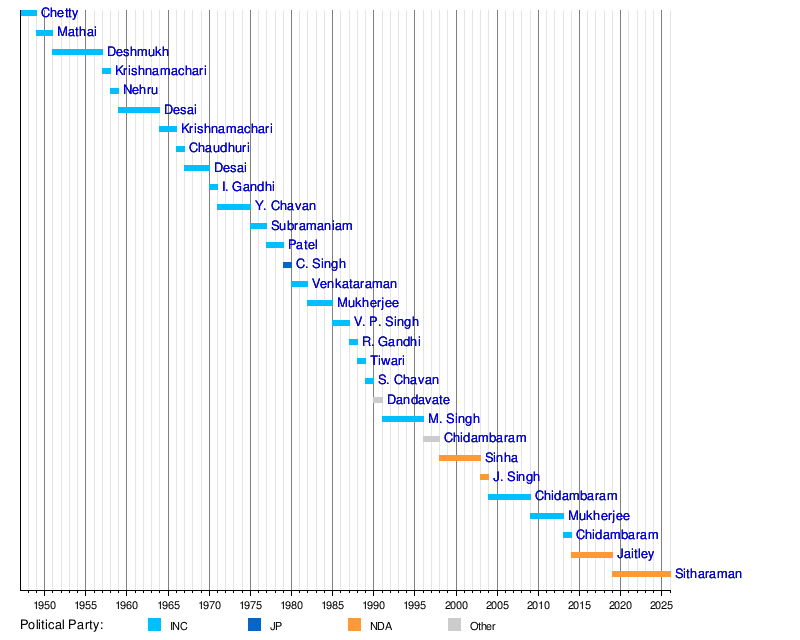
Notes:
1During Deshmukh's tenure, the Budget papers were prepared in Hindi as well for the first time.[21]
2Morarji Desai presented eight annual and two interim budgets.[21]
List of Union Budgets[edit | edit source]
| Sr. No | Year | Date | Presented by |
Prime Minister | Party/Coalition | |
|---|---|---|---|---|---|---|
| 1 | 1947–48 | 26 November 1947 | R. K. Shanmukham Chetty | Jawaharlal Nehru | Indian National Congress | |
| 2 | 1948–49 | 28 February 1948 | ||||
| 3 | 1949–50 | 28 February 1949 | John Matthai | |||
| 4 | 1950–51 | 28 February 1950 | ||||
| 5 | 1951–52 | 28 February 1951 | C. D. Deshmukh | |||
| 6 | 1952–53
(Interim) |
29 February 1952 | ||||
| 7 | 1952–53 | 23 May 1952 | ||||
| 8 | 1953–54 | 27 February 1953 | ||||
| 9 | 1954–55 | 27 February 1954 | ||||
| 10 | 1955–56 | 28 February 1955 | ||||
| 11 | 1956–57 | 29 February 1956 | ||||
| 12 | 1957–58
(Interim) |
19 March 1957 | T. T. Krishnamachari | |||
| 13 | 1957–58 | 15 May 1957 | ||||
| 14 | 1958–59 | 28 February 1958 | Jawaharlal Nehru | |||
| 15 | 1959–60 | 28 February 1959 | Morarji Desai | |||
| 16 | 1960–61 | 29 February 1960 | ||||
| 17 | 1961–62 | 28 February 1961 | ||||
| 18 | 1962–63
(Interim) |
14 March 1962 | ||||
| 19 | 1962–63 | 23 April 1962 | ||||
| 20 | 1963–64 | 28 February 1963 | ||||
| 21 | 1964–65 | 29 February 1964 | T. T. Krishnamachari | |||
| 22 | 1965–66 | 27 February 1965 | Lal Bahadur Shastri | |||
| 23 | 1966–67 | 28 February 1966 | Sachindra Chaudhuri | Indira Gandhi | ||
| 24 | 1967–68
(Interim) |
20 March 1967 | Morarji Desai | |||
| 25 | 1967–68 | 25 May 1967 | ||||
| 26 | 1968–69 | 29 February 1968 | ||||
| 27 | 1969–70 | 28 February 1969 | ||||
| 28 | 1970–71 | 28 February 1970 | Indira Gandhi | |||
| 29 | 1971–72 | 24 March 1971 | Yashwantrao Chavan | |||
| 30 | 1972–73 | 16 March 1972 | ||||
| 31 | 1973–74 | 28 February 1973 | ||||
| 32 | 1974–75 | 28 February 1974 | ||||
| 33 | 1975–76 | 28 February 1975 | Chidambaram Subramaniam | |||
| 34 | 1976–77 | 15 May 1976 | ||||
| 35 | 1977–78 | 17 June 1977 | Hirubhai M. Patel | Morarji Desai | Janata Party | |
| 36 | 1978–79 | 28 February 1978 | ||||
| 37 | 1979–80 | 28 February 1979 | Charan Singh | |||
| 38 | 1980–81 | 18 June 1980 | Ramaswamy Venkataraman | Indira Gandhi | Indian National Congress | |
| 39 | 1981–82 | 28 February 1981 | ||||
| 40 | 1982–83 | 27 February 1982 | Pranab Mukherjee | |||
| 41 | 1983–84 | 28 February 1983 | ||||
| 42 | 1984–85 | 29 February 1984 | ||||
| 43 | 1985–86 | 16 March 1985 | V. P. Singh | Rajiv Gandhi | ||
| 44 | 1986–87 | 28 February 1986 | ||||
| 45 | 1987–88 | 28 February 1987 | Rajiv Gandhi | |||
| 46 | 1988–89 | 29 February 1988 | N. D. Tiwari | |||
| 47 | 1989–90 | 28 February 1989 | Shankarrao Chavan | |||
| 48 | 1990–91 | 19 March 1990 | Madhu Dandavate | V. P. Singh | Third Front | |
| 49 | 1991–92 | 24 July 1991 | Manmohan Singh | P. V. Narasimha Rao | Indian National Congress | |
| 50 | 1992–93 | 29 February 1992 | ||||
| 51 | 1993–94 | 27 February 1993 | ||||
| 52 | 1994–95 | 28 February 1994 | ||||
| 53 | 1995–96 | 15 March 1995 | ||||
| 54 | 1996–97 | 19 March 1996 | P. Chidambaram | H. D. Deve Gowda | United Front | |
| 55 | 1997–98 | 28 February 1997 | ||||
| 56 | 1998–99 | 01 June 1998 | Yashwant Sinha | Atal Bihari Vajpayee | National Democratic Alliance | |
| 57 | 1999–20 | 27 February 1999 | ||||
| 58 | 2000–01 | 29 February 2000 | ||||
| 59 | 2001–02 | 28 February 2001 | ||||
| 60 | 2002–03 | 28 February 2002 | ||||
| 61 | 2003–04 | 28 February 2003 | Jaswant Singh | |||
| 62 | 2004–05
(Interim) |
4 February 2004 | ||||
| 63 | 2004–05 | 8 July 2004 | P. Chidambaram | Manmohan Singh | United Progressive Alliance | |
| 64 | 2005–06 | 28 February 2005 | ||||
| 65 | 2006–07 | 28 February 2006 | ||||
| 66 | 2007–08 | 28 February 2007 | ||||
| 67 | 2008–09 | 29 February 2008 | ||||
| 68 | 2009–10
(Interim) |
16 February 2009 | Pranab Mukherjee | |||
| 69 | 2009–10 | 6 July 2009 | ||||
| 70 | 2010–11 | 26 February 2010 | ||||
| 71 | 2011–12 | 28 February 2011 | ||||
| 72 | 2012–13 | 16 March 2012 | ||||
| 73 | 2013–14 | 28 February 2013 | P. Chidambaram | |||
| 74 | 2014–15
(Interim) |
17 February 2014 | ||||
| 75 | 2014–15 | 10 July 2014 | Arun Jaitley | Narendra Modi | National Democratic Alliance | |
| 76 | 2015–16 | 28 February 2015 | ||||
| 77 | 2016–17 | 29 February 2016 | ||||
| 78 | 2017–18 | 1 February 2017 | ||||
| 79 | 2018–19 | 1 February 2018 | ||||
| 80 | 2019–20
(Interim) |
1 February 2019 | Piyush Goyal | |||
| 81 | 2019–20 | 5 July 2019 | Nirmala Sitharaman | |||
| 82 | 2020–21 | 1 February 2020 | ||||
| 83 | 2021–22 | 1 February 2021 | ||||
| 84 | 2022–23 | 1 February 2022 | ||||
| 85 | 2023–24 | 1 February 2023 | ||||
| 86 | 2024–25
(Interim) |
1 February 2024 | ||||
| 87 | 2024–25 | 22 July 2024 | ||||
| 88 | 2025–26 | 1 February 2025 | ||||
| 89 | 2026–27 | 1 February 2026 | ||||
Union Budget History[edit | edit source]
The following table shows the Total Receipts, Fiscal Deficits, Total Defense Spending and Major Subsidies as listed in past Union Budgets, as per the "At a Glance" subsection of each budget.[4] The following figures are not adjusted for inflation.
| Year |
Total Receipts [lower-alpha 1] |
Fiscal Deficit [lower-alpha 2] |
Total Budget | Budget as Percent of GDP | Total Defence Spending [lower-alpha 3] |
Major Subsidies [lower-alpha 4] |
|---|---|---|---|---|---|---|
| 1994-95 | ₹1,597,780,000,000 | ₹577,040,000,000 | ₹2,174,820,000,000 | 21.16% | ₹ | ₹ |
| 1995-96 | ₹1,684,680,000,000 | ₹602,430,000,000 | ₹2,287,110,000,000 | 18.96% | ₹268,790,000,000 | ₹125,500,000,000 |
| 1996-97 | ₹2,010,070,000,000 | ₹667,330,000,000 | ₹2,677,400,000,000 | 19.12% | ₹294,980,000,000 | ₹142,330,000,000 |
| 1997-98 | ₹2,320,680,000,000 | ₹889,370,000,000 | ₹3,210,050,000,000 | 20.78% | ₹360,990,000,000 | ₹183,660,000,000 |
| 1998-99 | ₹2,793,660,000,000 | ₹1,133,490,000,000 | ₹3,927,150,000,000 | 22.16% | ₹412,000,000,000 | ₹210,630,000,000 |
| 1999-00 | ₹3,037,380,000,000 | ₹1,047,170,000,000 | ₹4,084,550,000,000 | 20.55% | ₹493,530,000,000 | ₹256,920,000,000 |
| 2000-01 | ₹3,644,360,000,000 | ₹1,188,160,000,000 | ₹4,832,520,000,000 | 22.58% | ₹544,610,000,000 | ₹269,490,000,000 |
| 2001-02 | ₹3,624,530,000,000 | ₹1,409,550,000,000 | ₹5,034,080,000,000 | 21.74% | ₹570,000,000,000 | ₹305,230,000,000 |
| 2002-03 | ₹4,141,620,000,000 | ₹1,450,720,000,000 | ₹5,592,340,000,000 | 22.43% | ₹560,000,000,000 | ₹446,180,000,000 |
| 2003-04 | ₹4,713,680,000,000 | ₹1,232,720,000,000 | ₹5,946,400,000,000 | 21.29% | ₹603,000,000,000 | ₹447,070,000,000 |
| 2004-05 | ₹4,976,820,000,000 | ₹1,252,020,000,000 | ₹6,228,840,000,000 | 19.55% | ₹770,000,000,000 | ₹465,140,000,000 |
| 2005-06 | ₹5,061,230,000,000 | ₹1,464,350,000,000 | ₹6,525,580,000,000 | 17.97% | ₹817,000,000,000 | ₹468,740,000,000 |
| 2006-07 | ₹5,833,870,000,000 | ₹1,425,730,000,000 | ₹7,259,600,000,000 | 17.06% | ₹860,000,000,000 | ₹534,630,000,000 |
| 2007-08 | ₹7,126,710,000,000 | ₹1,269,120,000,000 | ₹8,395,830,000,000 | 17.14% | ₹925,000,000,000 | ₹697,420,000,000 |
| 2008-09 | ₹8,839,560,000,000 | ₹3,369,920,000,000 | ₹12,209,480,000,000 | 22.14% | ₹1,142,230,000,000 | ₹1,297,080,000,000 |
| 2009-10 | ₹10,244,870,000,000 | ₹4,184,820,000,000 | ₹14,429,690,000,000 | 22.67% | ₹1,417,810,000,000 | ₹1,413,510,000,000 |
| 2010-11 | ₹11,973,280,000,000 | ₹3,735,910,000,000 | ₹15,709,190,000,000 | 20.58% | ₹1,541,170,000,000 | ₹1,734,200,000,000 |
| 2011-12 | ₹13,043,650,000,000 | ₹5,159,900,000,000 | ₹18,203,550,000,000 | 20.84% | ₹1,709,130,000,000 | ₹2,179,410,000,000 |
| 2012-13 | ₹14,103,720,000,000 | ₹4,901,900,000,000 | ₹19,005,620,000,000 | 19.11% | ₹1,817,760,000,000 | ₹2,570,790,000,000 |
| 2013-14 | ₹15,594,470,000,000 | ₹5,028,580,000,000 | ₹20,623,050,000,000 | 18.36% | ₹2,034,990,000,000 | ₹2,546,320,000,000 |
| 2014-15 | ₹16,636,730,000,000 | ₹5,107,250,000,000 | ₹21,743,980,000,000 | 17.44% | ₹2,186,940,000,000 | ₹2,582,580,000,000 |
| 2015-16 | ₹17,907,830,000,000 | ₹5,327,910,000,000 | ₹23,235,740,000,000 | 16.87% | ₹2,258,950,000,000 | ₹2,418,330,000,000 |
| 2016-17 | ₹19,751,940,000,000 | ₹5,356,180,000,000 | ₹25,108,120,000,000 | 16.31% | ₹2,517,810,000,000 | ₹2,040,250,000,000 |
| 2017-18 | ₹21,419,730,000,000 | ₹5,910,620,000,000 | ₹27,330,350,000,000 | 15.99% | ₹2,765,740,000,000 | ₹1,911,830,000,000 |
| 2018-19 | ₹23,151,130,000,000 | ₹6,494,180,000,000 | ₹29,645,310,000,000 | 15.69% | ₹2,908,020,000,000 | ₹1,967,690,000,000 |
| 2019-20 | ₹26,863,300,000,000 | ₹9,336,510,000,000 | ₹36,199,810,000,000 | 18.01% | ₹3,186,650,000,000 | ₹2,283,410,000,000 |
| 2020-21 | ₹35,170,240,000,000[22] | ₹18,182,910,000,000 | ₹53,353,150,000,000 | 26.87% | ₹3,400,940,000,000 | ₹7,077,070,000,000 |
| 2021-22 | ₹37,912,579,400,000[23] | ₹15,845,210,000,000 | ₹53,757,789,400,000 | 22.78% | ₹3,665,460,000,000 | ₹4,461,500,000,000 |
| 2022-23 | ₹41,947,800,000,000[24] | ₹16,619,600,000,000 | ₹58,567,400,000,000 | 21.73% | ||
| 2023-24 | ₹44,434,470,000,000 [24] | ₹16,546,430,000,000 | ₹60,980,900,000,000 | 20.18% | ||
| 2024-25 (Provisional) [25] | ₹48,200,000,000,000 | ₹16,133,120,000,000 | ₹64,333,120,000,000 | 19.85% |
See also[edit | edit source]
References[edit | edit source]
- ↑ "How does government prepare its Union Budget every year". The Times of India. 31 January 2022. Retrieved 2 February 2022.
- ↑ Chakraborty, Abhishek (21 September 2016). "Railway Budget, Presented For 92 Years, Merged With Union Budget". NDTV. Retrieved 6 March 2021.
- ↑ 3.0 3.1 Padmanabhan, Arvind (12 February 2014). "Chidambaram is second only to Morarji Desai in presenting Budget". Business Today. Retrieved 29 September 2017.
- ↑ 4.0 4.1 "Previous Union Budgets". Government of India. 10 June 2024. Retrieved 11 June 2024.
- ↑ "Budget with a difference". 17 March 2001. Retrieved 8 March 2009.
- ↑ "Union Budget 2017 on 1 Feb: End of a colonial hangover for speedy implementation of schemes". Firstpost.com. Firstpost. 16 November 2016.
- ↑ "Printing Of Union Budget Document Begins With 'Halwa' Ceremony". NDTV. Press Trust of India. 19 February 2016. Retrieved 19 February 2016.
- ↑ Joy, Shemin (3 February 2021). "16 Rajya Sabha MPs move 118 amendments to President Ram Nath Kovind's Budget session address". Deccan Herald. Retrieved 3 February 2021.
- ↑ "Nirmala Sitharaman's 'Dahi-Cheeni' Moment With President Ahead Of Budget". www.ndtv.com. Retrieved 1 February 2025.
- ↑ "2019 Union Budget of India". money.bhaskar.com. Archived from the original on 25 March 2019. Retrieved 28 January 2019.
- ↑ "Unveiling the Interim Budget 2024 Blueprint". 29 January 2024. Archived from the original on 30 January 2024. Retrieved 31 January 2024.
- ↑ "The Central Budgets in retrospect". pib.nic.in. Retrieved 6 March 2021.
- ↑ "Budget 2020: Who gave the longest Budget speech?". Deccan Herald. 25 January 2020. Retrieved 21 January 2021.
- ↑ "Meet Manmohan Singh, the economist". 20 May 2004. Retrieved 22 February 2008.
- ↑ "Salient Features of Interim Union Budget of India for 2014-15". IANS. news.biharprabha.com. Retrieved 17 February 2014.
- ↑ "Union Budget 2018 Highlights: Key takeaways from Arun Jaitley's fifth Budget". Moneycontrol. Retrieved 1 February 2018.
- ↑ "Expectation from union budget 2014-15". Patrika Group. 10 July 2014. Retrieved 10 July 2014.
- ↑ "Budget 2019: Full text of Piyush Goyal's budget speech". Mint. 1 February 2019. Retrieved 1 February 2019.
- ↑ "india budget" (PDF). Government of India. Retrieved 2 February 2021.
- ↑ "Key Highlights of Union Budget 2019-20". Press Information Bureau, Government of India. 5 July 2019. Retrieved 27 August 2019.
- ↑ 21.0 21.1 "Finance Ministers of India: Budget through the years: The men who made India". The Economic Times. 29 June 2019. Retrieved 3 February 2021.
- ↑ "Receipt Budget, 2022-2023" (PDF). Archived from the original (PDF) on 9 February 2023.
- ↑ "Receipt Budget, 2023-2024" (PDF). Archived from the original (PDF) on 18 November 2024.
- ↑ 24.0 24.1 "Receipts" (PDF). www.indiabudget.gov.in.
- ↑ Briefing, India (23 July 2024). "India's Union Budget 2024-25: Key Announcements". India Briefing News. Retrieved 23 July 2024.
- ↑ Business Standard Budget 2024-25 "Stay Updated with Latest Budget News"
Explanatory notes[edit | edit source]
- ↑ Total Receipts includes tax revenue, non-tax revenue and capital receipts.
- ↑ Fiscal deficit is defined as revenue receipts plus total non-debt receipts minus total expenditure, and is reflective of the total borrowing requirement of Government.
- ↑ Total Defense Spending is a sum of both Revenue and Capital Expenditure on Defense Services (in budgets prior to 2015).
- ↑ Major Subsidies includes Fertiliser, Food and Petroleum, as per budgets from 2016 onwards.
External links[edit | edit source]
- Indian Budget by Ministry of Finance
- Economic Survey and Union Budget Archived 15 January 2018 at the Wayback Machine
- List of Budget Speeches (since 1947) Archived 24 December 2016 at the Wayback Machine
| Constitution |  | |
|---|---|---|
| Executive | ||
| Legislature | ||
| Judiciary | ||
