

imported>StellarHalo No edit summary |
robot: Update article (please report if you notice any mistake or error in this edit) |
||
| Line 1: | Line 1: | ||
{{Short description|Last ruling Indian Maharaja of Patiala from 1938–1947}} | |||
{{Distinguish|Yadwinder Singh}} | {{Distinguish|Yadwinder Singh}} | ||
{{Use dmy dates|date=July 2013}} | {{Use dmy dates|date=July 2013}} | ||
{{Use Indian English|date=July 2013}} | {{Use Indian English|date=July 2013}} | ||
{{Infobox person | {{Infobox person | ||
| pre-nominals | | pre-nominals = [[Maharaja]], [[Sir]] | ||
| name | | name = Yadavindra Singh | ||
| post-nominals | | post-nominals = [[GCIE]], [[Knight Grand Cross of the British Empire|GBE]] | ||
{{Infobox royalty | | module = {{Infobox royalty | ||
| embed = yes | | embed = yes | ||
| image = | | image = Yadvindra.jpg | ||
| image_size = | | image_size = | ||
| alt = | | alt = | ||
| Line 19: | Line 20: | ||
| predecessor = [[Maharaja Bhupinder Singh]] | | predecessor = [[Maharaja Bhupinder Singh]] | ||
| pre-type = | | pre-type = | ||
| successor = [[Amarinder Singh]] | | successor = [[Amarinder Singh]] (as [[Pretender|titular monarch]]) | ||
| suc-type = | | suc-type = | ||
| regent = {{List collapsed|title=''See list''|1=[[Liaqat Hayat Khan]]}} | | regent = {{List collapsed|title=''See list''|1=[[Liaqat Hayat Khan]]}} | ||
| reg-type = {{nowrap|[[Patiala State|Minister of State]]}} | | reg-type = {{nowrap|[[Patiala State|Minister of State]]}} | ||
| birth_date = | | birth_date = | ||
| birth_place = [[Patiala]], [[ | | birth_place = [[Patiala]], [[Patiala State]], [[British Raj|British India]] | ||
| | | nationality = Indian | ||
| citizenship = Indian | |||
| death_date = | |||
| death_place = [[The Hague]], [[Netherlands]] | | death_place = [[The Hague]], [[Netherlands]] | ||
| spouse = {{marriage|Hem Prabha Devi|1935|17 June 1974}} <br> {{marriage|[[Mehtab Kaur of Patiala]]|1938|17 June 1974}} | | spouse = {{marriage|Hem Prabha Devi|1935|17 June 1974}} <br> {{marriage|[[Mehtab Kaur of Patiala]]|1938|17 June 1974}} | ||
| Line 36: | Line 39: | ||
| religion = [[Sikhism]] | | religion = [[Sikhism]] | ||
}} | }} | ||
| module2 | | module2 = {{Infobox officeholder | embed = yes | ||
| office = Indian Ambassador to [[Italy]] | | office = Indian Ambassador to [[Italy]] | ||
| term = 1965-1966 | | term = 1965-1966 | ||
| Line 44: | Line 47: | ||
| successor2 = K. S. Bajpai | | successor2 = K. S. Bajpai | ||
}} | }} | ||
| module3 | | module3 = {{Infobox cricketer | embed = yes | ||
| batting = Right-hand bat | | batting = Right-hand bat | ||
| bowling = - | | bowling = - | ||
| Line 80: | Line 83: | ||
| onetest = True | | onetest = True | ||
| testdebutfor = | | testdebutfor = | ||
| testdebutagainst = England | | testdebutagainst = England | ||
| testcap = 21 | |||
| testdebutdate = 10 February | | testdebutdate = 10 February | ||
| testdebutyear = 1934 | | testdebutyear = 1934 | ||
| Line 94: | Line 98: | ||
}} | }} | ||
''' | [[Maharaja]] [[Sir]] '''Yadavindra Singh''' {{post nominals|country=GBR|GCIE|GBE}} ({{audio|Yuvraj_of_Patiala.ogg|pronunciation}}) was the 9th and last ruling [[Maharaja of Patiala]] from 1938 to 1971. He was also an [[India]]n [[cricket]]er who played in one [[Test cricket|Test]] [[English cricket team in India in 1933–34|in 1934]].<ref>{{cite web|url=https://www.icc-cricket.com/news/666983 |title=The Greatest: One Test Wonders |work=International Cricket Council |access-date=19 April 2018}}</ref><ref name="Bio">{{Cite web|url=http://www.espncricinfo.com/ci/content/player/32278.html |title=Yadavindra Singh|access-date=31 May 2020 |work=ESPN Cricinfo}}</ref> | ||
==Early life and family== | ==Early life and family== | ||
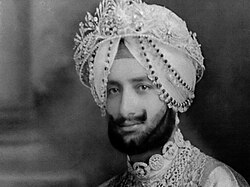
[[File:Yadavindra Singh of Patiala.jpg|thumb|Sir Yadavindra Singh of Patiala|alt=|left]] | [[File:Yadavindra Singh of Patiala.jpg|thumb|Sir Yadavindra Singh of Patiala|alt=|left]] | ||
He succeeded his father, [[Maharaja Bhupinder Singh]], as the [[Maharaja of Patiala]] on 23 March 1938 and subsequently married his second wife, [[Mehtab Kaur of Patiala|Mehtab Kaur]] (1922–2017), in 1938. | Born at [[Patiala|Patiala City]] in [[Patiala State]], within the [[British Raj]] (now in [[Punjab, India|Punjab]], [[India]]) in 1914 into a royal [[Jatt Sikh]] family of the [[Phulkian Sardars|Phulkian]] [[Sidhu]] clan, Maharaja Yadavindra attended [[Aitchison College]] in [[Lahore]]. He served in the Patiala State Police, became its Inspector General and served in Malaya, Italy and Burma during the Second World War. In 1935, he married his first wife, Hem Prabha Devi of [[Saraikela State]] (1913–2014). | ||
He succeeded his father, [[Maharaja Bhupinder Singh]], as the [[Maharaja of Patiala]] on 23 March 1938 and subsequently married his second wife, [[Mehtab Kaur of Patiala|Mehtab Kaur]] (1922–2017), in 1938. Although the stated reason for his second marriage was that it was due to his first wife being issueless, it was believed that the actual reason was the influences of [[Shiromani Akali Dal|Akali leaders]] who wanted the future Maharaja of Patiala to marry a woman from a Jat Sikh family in order to beget genuine Sikh heirs.<ref>{{Cite web|url=https://www.tribuneindia.com/news/comment/tales-from-two-punjabs/446088.html|title=Tales from two Punjabs|last=Singh|first=K.C.|date=3 August 2017|website=[[tribuneindia.com]]}}</ref> | |||
== Political career == | == Political career == | ||
Yadavindra served as president of the [[Indian Olympic Association]] from 1938 to 1960. He was instrumental in organizing the [[Asian Games]] | |||
Yadavindra served as president of the [[Indian Olympic Association]] from 1938 to 1960. He was instrumental in organizing the [[Asian Games]]. He was a noted horticulturist by passion and later served as chairman of Indian Horticulture Development Council. He was also the president of [[Board of Control for Cricket in India|BCCI]]. | |||
Following his accession to the throne of Patiala, Yadavindra pursued a political and diplomatic career, serving as chancellor of the [[Chamber of Princes]] from 1943 to 1944. In 1947, when India gained [[Independence Day (India)|independence]], he was the pro-chancellor of the [[Chamber of Princes]]. At a special session he said "After centuries time has come when India has gained independence from foreign rule and it's the time when we all (princely states) should unite for our motherland" and persuaded many other rulers to join India. | Following his accession to the throne of Patiala, Yadavindra pursued a political and diplomatic career, serving as chancellor of the [[Chamber of Princes]] from 1943 to 1944. In 1947, when India gained [[Independence Day (India)|independence]], he was the pro-chancellor of the [[Chamber of Princes]]. At a special session he said "After centuries time has come when India has gained independence from foreign rule and it's the time when we all (princely states) should unite for our motherland" and persuaded many other rulers to join India. | ||
===Partition (1947) === | ===Partition (1947) === | ||
During the [[Partition of India]] numerous pogroms occurred in and around the princely state of Patiala.<ref>{{cite news|last1=Mustafa Janjua|first1=Haroon|title=Daily Times - Unheard cries: atrocities in Patiala, 1947|url=https://dailytimes.com.pk/106317/unheard-cries-atrocities-in-patiala-1947/|date=January 7, 2014}}</ref> In several cases, organized bands of Sikhs were responsible for atrocities. The late [[Harkishan Singh Surjeet]], of the Communist Party of India (Marxist), witnessed the events and claimed in an interview: ‘The communal attacks on the minorities were definitely planned. I know more about the persons involved in the eastern wing because I was there. I saw those dreadful acts with my own eyes. In that conspiracy, the Maharaja of Patiala was involved. The idea was that if the Muslims were driven out.' | |||
Maharajas of Patiala and Faridkot, and Yadavindra Singh is quoted as having said "We won't leave a Muslim here" at a party with British officers.<ref>{{cite book|last1=Hajari|first1=Nisid|title=Midnight's Furies: The Deadly Legacy of India's Partition|url=https://books.google.com/?id=eAUnCgAAQBAJ&pg=PT158 | During the [[Partition of India]] numerous pogroms occurred in and around the princely state of Patiala.<ref>{{cite news|last1=Mustafa Janjua|first1=Haroon|title=Daily Times - Unheard cries: atrocities in Patiala, 1947|url=https://dailytimes.com.pk/106317/unheard-cries-atrocities-in-patiala-1947/|date=January 7, 2014}}</ref> In several cases, organized bands of Sikhs were responsible for atrocities. The late [[Harkishan Singh Surjeet]], of the Communist Party of India (Marxist), witnessed the events and claimed in an interview: ‘The communal attacks on the minorities were definitely planned. I know more about the persons involved in the eastern wing because I was there. I saw those dreadful acts with my own eyes. In that conspiracy, the Maharaja of Patiala was involved. The idea was that if the Muslims were driven out.' The attacks on Sikhs and Hindus in March 1947 in Rawalpindi are regarded as one of the major crimes that triggered off others. Nehru believed the Maharaja had sought to ethnically cleanse the territory of Muslims as part of this effort. Maharajas of Patiala and Faridkot, and Yadavindra Singh is quoted as having said "We won't leave a Muslim here" at a party with British officers.<ref>{{cite book|last1=Hajari|first1=Nisid|title=Midnight's Furies: The Deadly Legacy of India's Partition|url=https://books.google.com/books?id=eAUnCgAAQBAJ&pg=PT158|isbn=9781445648095|date=15 June 2015}}</ref> The Foreign Minister of Patiala, Sardar Bari Ram Sharma issued a denial stating "I definitely assert that no Patiala soldier has associated himself with or has been involved in any killings in any part of the East Punjab."<ref>{{cite journal|last1=Singh|first1=Ganda|title=A Diary of the Partition Days - 1947|journal=Journal of Indian History|date=1960|volume=XXXV|issue=Part I, No. 112|page=270|url=https://archive.org/stream/ADiaryOfThePartitionDays1947Dr.GandaSingh/A+Diary+Of+The+Partition+Days+1947+-+Dr.+Ganda+Singh_djvu.txt}}</ref> | ||
He agreed to the incorporation of the [[princely state]] into India on 5 May 1948. He was [[Rajpramukh]] of the new [[Indian state]] of [[Patiala and East Punjab States Union]] until it was merged with [[Punjab, India|Punjab]] in 1956. | He agreed to the incorporation of the [[princely state]] into India on 5 May 1948. He was [[Rajpramukh]] of the new [[Indian state]] of [[Patiala and East Punjab States Union]] until it was merged with [[Punjab, India|Punjab]] in 1956. | ||
=== Donation === | === Donation === | ||
In 1956 | |||
In 1956, Sir Yadavindra Singh donated the [[Anand Bhawan]], a 150 [[bigha]] palace, to the Government of Punjab (before the creation of Himachal) for a holiday home for poor children, which was later leased out to [[Ramdev|Baba Ramdev]] for his [[Patanjali Trust]]. | |||
He founded Yadavindra Public School. Lal Bagh Palace, the building in which Yadavindra Public School is housed was donated by Sir Yadavindra Singh. The Yadavindra Public School, Mohali is also named after him and was established by the members of his family. | |||
==Later life and death== | ==Later life and death== | ||
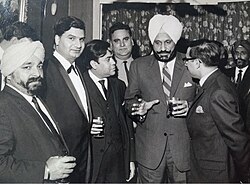
[[File:Sir Yadavinder Singh 9th and last Maharaja of Patiala in London.jpg|thumb|Sir Yadavindra Singh with leading members of the | |||
He continued his career from 1956 onwards, serving as Indian delegate to the [[United Nations General Assembly]] from 1956 to 1957 and to [[UNESCO]] in 1958. He also headed the Indian delegation to the [[Food and Agriculture Organization|FAO]] on and off during | [[File:Sir Yadavinder Singh 9th and last Maharaja of Patiala in London.jpg|thumb|Sir Yadavindra Singh with leading members of the Indian business community in London.|alt=|left]]{{Unreferenced section|date=March 2022}} | ||
He was succeeded as family head by his son Captain [[Amarinder Singh]], who is a politician with the Congress Party and who served as [[Chief Minister]] of the Indian State of [[Punjab (India)|Punjab]] from 2002 to 2007 and again starting in 2017. His daughter, Heminder Kaur, was married to [[K. Natwar Singh]], the former external affairs minister of India. | He continued his career from 1956 onwards, serving as Indian delegate to the [[United Nations General Assembly]] from 1956 to 1957 and to [[UNESCO]] in 1958. He also headed the Indian delegation to the [[Food and Agriculture Organization|FAO]] on and off during 1959–1969. Sir Yadavindra served as Indian Ambassador to Italy (1965–1966) and as Indian Ambassador to the Netherlands from 1971 until 17 June 1974, when he died suddenly in office at [[The Hague]] from [[heart failure]], age 60. On specific instructions of [[Indira Gandhi]], he was cremated with full state honours. | ||
He was succeeded as family head by his son Captain [[Amarinder Singh]], who is a politician with the Congress Party and who served as [[Chief Minister]] of the Indian State of [[Punjab (India)|Punjab]] from 2002 to 2007 and again starting in 2017 to 2021. His daughter, Heminder Kaur, was married to [[K. Natwar Singh]], the former external affairs minister of India. | |||
==Titles== | ==Titles== | ||
*1913-1935: [[Sri]] [[Yuvaraja]] Yadavindra Singh Sahib-ji | *1913-1935: [[Sri]] [[Yuvaraja]] Yadavindra Singh Sahib-ji | ||
*1935-1938: [[Lieutenant]] Sri Yuvaraja Yadavindra Singh Sahib-ji | *1935-1938: [[Lieutenant]] Sri Yuvaraja Yadavindra Singh Sahib-ji | ||
| Line 133: | Line 146: | ||
==Honours== | ==Honours== | ||
<center> | <center> | ||
(ribbon bar, as it would look today; UK decorations only) | (ribbon bar, as it would look today; UK decorations only) | ||
| Line 151: | Line 165: | ||
</center> | </center> | ||
{{ | {{citation needed|date=June 2020}} | ||
*[[King George V Silver Jubilee Medal]]-1935 | *[[King George V Silver Jubilee Medal]]-1935 | ||
| Line 166: | Line 180: | ||
*Grand Cross of the Romanian order | *Grand Cross of the Romanian order | ||
*Grand Cross of the [[Order of Merit of the Republic]] of Italy-1966 | *Grand Cross of the [[Order of Merit of the Republic]] of Italy-1966 | ||
== Gallery == | |||
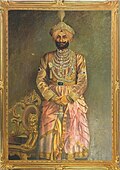
[[File:Yadavindra Singh.jpg|left|thumb|The oil portrait of Yadavindra Singh that hangs in the library of Yadavindra Public School, Patiala.]] | |||
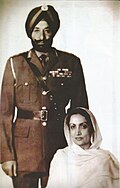
[[File:Yadavindra Singh with Mohinder Kaur.jpg|center|thumb|278x278px|Yadavindra Singh in Uniform with Mohinder Kaur.]] | |||
==References== | ==References== | ||
| Line 184: | Line 203: | ||
{{s-bef|before=[[Maharaja Bhupinder Singh|Bhupinder Singh]]}} | {{s-bef|before=[[Maharaja Bhupinder Singh|Bhupinder Singh]]}} | ||
{{s-ttl|title=[[Maharaja of Patiala]]| years=1938–1947}} | {{s-ttl|title=[[Maharaja of Patiala]]| years=1938–1947}} | ||
[[Amarinder Singh]] | {{s-aft|after=[[Dominion of India]]<br>[[Amarinder Singh]] as ''titular Maharaja''}} | ||
{{S-end}} | {{S-end}} | ||
{{India topics}} | |||
{{Punjab, India}} | |||
{{DEFAULTSORT:Singh, Yadavindra}} | {{DEFAULTSORT:Singh, Yadavindra}} | ||
| Line 208: | Line 230: | ||
[[Category:Rajpramukhs]] | [[Category:Rajpramukhs]] | ||
[[Category:Cricketers from Patiala]] | [[Category:Cricketers from Patiala]] | ||
[[Category:Viceroy's XI cricketers]] | |||
Latest revision as of 10:53, 26 June 2022
Yadavindra Singh | ||||||||||||||||||||||||||||||||||||||||
|---|---|---|---|---|---|---|---|---|---|---|---|---|---|---|---|---|---|---|---|---|---|---|---|---|---|---|---|---|---|---|---|---|---|---|---|---|---|---|---|---|
 Singh in 1971 | ||||||||||||||||||||||||||||||||||||||||
| Maharaja of Patiala | ||||||||||||||||||||||||||||||||||||||||
| Reign | 23 March 1938 – 15 August 1947 | |||||||||||||||||||||||||||||||||||||||
| Predecessor | Maharaja Bhupinder Singh | |||||||||||||||||||||||||||||||||||||||
| Successor | Amarinder Singh (as titular monarch) | |||||||||||||||||||||||||||||||||||||||
| Minister of State | See list
| |||||||||||||||||||||||||||||||||||||||
| Born | Patiala, Patiala State, British India | |||||||||||||||||||||||||||||||||||||||
| Died | The Hague, Netherlands | |||||||||||||||||||||||||||||||||||||||
| Maharanis | Hem Prabha Devi ( m. 1935–1974) | |||||||||||||||||||||||||||||||||||||||
| Issue |
| |||||||||||||||||||||||||||||||||||||||
| Dynasty | Phulkian | |||||||||||||||||||||||||||||||||||||||
| Father | Maharaja Bhupinder Singh | |||||||||||||||||||||||||||||||||||||||
| Mother | Bakhtawar Kaur | |||||||||||||||||||||||||||||||||||||||
| Religion | Sikhism | |||||||||||||||||||||||||||||||||||||||
| Indian Ambassador to Italy | ||||||||||||||||||||||||||||||||||||||||
| In office 1965-1966 | ||||||||||||||||||||||||||||||||||||||||
| Indian Ambassador to the Netherlands | ||||||||||||||||||||||||||||||||||||||||
| In office 1971-1974 | ||||||||||||||||||||||||||||||||||||||||
| Preceded by | Jagan Nath Dharmija | |||||||||||||||||||||||||||||||||||||||
| Succeeded by | K. S. Bajpai | |||||||||||||||||||||||||||||||||||||||
| Cricket information | ||||||||||||||||||||||||||||||||||||||||
| Batting | Right-hand bat | |||||||||||||||||||||||||||||||||||||||
| Bowling | - | |||||||||||||||||||||||||||||||||||||||
| International information | ||||||||||||||||||||||||||||||||||||||||
| National side |
| |||||||||||||||||||||||||||||||||||||||
| Only Test (cap 21) | 10 February 1934 v England | |||||||||||||||||||||||||||||||||||||||
| Career statistics | ||||||||||||||||||||||||||||||||||||||||
| ||||||||||||||||||||||||||||||||||||||||
Source: ESPNcricinfo, 31 May 2020 | ||||||||||||||||||||||||||||||||||||||||
Maharaja Sir Yadavindra Singh Template:Post nominals ( pronunciation (help·info)) was the 9th and last ruling Maharaja of Patiala from 1938 to 1971. He was also an Indian cricketer who played in one Test in 1934.[1][2]
Early life and family[edit | edit source]

Born at Patiala City in Patiala State, within the British Raj (now in Punjab, India) in 1914 into a royal Jatt Sikh family of the Phulkian Sidhu clan, Maharaja Yadavindra attended Aitchison College in Lahore. He served in the Patiala State Police, became its Inspector General and served in Malaya, Italy and Burma during the Second World War. In 1935, he married his first wife, Hem Prabha Devi of Saraikela State (1913–2014).
He succeeded his father, Maharaja Bhupinder Singh, as the Maharaja of Patiala on 23 March 1938 and subsequently married his second wife, Mehtab Kaur (1922–2017), in 1938. Although the stated reason for his second marriage was that it was due to his first wife being issueless, it was believed that the actual reason was the influences of Akali leaders who wanted the future Maharaja of Patiala to marry a woman from a Jat Sikh family in order to beget genuine Sikh heirs.[3]
Political career[edit | edit source]
Yadavindra served as president of the Indian Olympic Association from 1938 to 1960. He was instrumental in organizing the Asian Games. He was a noted horticulturist by passion and later served as chairman of Indian Horticulture Development Council. He was also the president of BCCI.
Following his accession to the throne of Patiala, Yadavindra pursued a political and diplomatic career, serving as chancellor of the Chamber of Princes from 1943 to 1944. In 1947, when India gained independence, he was the pro-chancellor of the Chamber of Princes. At a special session he said "After centuries time has come when India has gained independence from foreign rule and it's the time when we all (princely states) should unite for our motherland" and persuaded many other rulers to join India.
Partition (1947)[edit | edit source]
During the Partition of India numerous pogroms occurred in and around the princely state of Patiala.[4] In several cases, organized bands of Sikhs were responsible for atrocities. The late Harkishan Singh Surjeet, of the Communist Party of India (Marxist), witnessed the events and claimed in an interview: ‘The communal attacks on the minorities were definitely planned. I know more about the persons involved in the eastern wing because I was there. I saw those dreadful acts with my own eyes. In that conspiracy, the Maharaja of Patiala was involved. The idea was that if the Muslims were driven out.' The attacks on Sikhs and Hindus in March 1947 in Rawalpindi are regarded as one of the major crimes that triggered off others. Nehru believed the Maharaja had sought to ethnically cleanse the territory of Muslims as part of this effort. Maharajas of Patiala and Faridkot, and Yadavindra Singh is quoted as having said "We won't leave a Muslim here" at a party with British officers.[5] The Foreign Minister of Patiala, Sardar Bari Ram Sharma issued a denial stating "I definitely assert that no Patiala soldier has associated himself with or has been involved in any killings in any part of the East Punjab."[6]
He agreed to the incorporation of the princely state into India on 5 May 1948. He was Rajpramukh of the new Indian state of Patiala and East Punjab States Union until it was merged with Punjab in 1956.
Donation[edit | edit source]
In 1956, Sir Yadavindra Singh donated the Anand Bhawan, a 150 bigha palace, to the Government of Punjab (before the creation of Himachal) for a holiday home for poor children, which was later leased out to Baba Ramdev for his Patanjali Trust.
He founded Yadavindra Public School. Lal Bagh Palace, the building in which Yadavindra Public School is housed was donated by Sir Yadavindra Singh. The Yadavindra Public School, Mohali is also named after him and was established by the members of his family.
Later life and death[edit | edit source]

 |
He continued his career from 1956 onwards, serving as Indian delegate to the United Nations General Assembly from 1956 to 1957 and to UNESCO in 1958. He also headed the Indian delegation to the FAO on and off during 1959–1969. Sir Yadavindra served as Indian Ambassador to Italy (1965–1966) and as Indian Ambassador to the Netherlands from 1971 until 17 June 1974, when he died suddenly in office at The Hague from heart failure, age 60. On specific instructions of Indira Gandhi, he was cremated with full state honours.
He was succeeded as family head by his son Captain Amarinder Singh, who is a politician with the Congress Party and who served as Chief Minister of the Indian State of Punjab from 2002 to 2007 and again starting in 2017 to 2021. His daughter, Heminder Kaur, was married to K. Natwar Singh, the former external affairs minister of India.
Titles[edit | edit source]
- 1913-1935: Sri Yuvaraja Yadavindra Singh Sahib-ji
- 1935-1938: Lieutenant Sri Yuvaraja Yadavindra Singh Sahib-ji
- 1938-1939: Lieutenant His Highness Farzand-i-Khas-i-Daulat-i-Inglishia, Mansur-i-Zaman, Amir ul-Umara, Maharajadhiraja Raj Rajeshwar, 108 Sri Maharaja-i-Rajgan, Maharaja Yadavindra Singh, Mahendra Bahadur, Yadu Vansha Vatans Bhatti Kul Bushan, Maharaja of Patiala
- 1939-1942: Captain His Highness Farzand-i-Khas-i-Daulat-i-Inglishia, Mansur-i-Zaman, Amir ul-Umara, Maharajadhiraja Raj Rajeshwar, 108 Sri Maharaja-i-Rajgan, Maharaja Yadavindra Singh, Mahendra Bahadur, Yadu Vansha Vatans Bhatti Kul Bushan, Maharaja of Patiala
- 1942-1944: Major His Highness Farzand-i-Khas-i-Daulat-i-Inglishia, Mansur-i-Zaman, Amir ul-Umara, Maharajadhiraja Raj Rajeshwar, 108 Sri Maharaja-i-Rajgan, Maharaja Sir Yadavindra Singh, Mahendra Bahadur, Yadu Vansha Vatans Bhatti Kul Bushan, Maharaja of Patiala, GBE
- 1944-1945: Lieutenant-Colonel His Highness Farzand-i-Khas-i-Daulat-i-Inglishia, Mansur-i-Zaman, Amir ul-Umara, Maharajadhiraja Raj Rajeshwar, 108 Sri Maharaja-i-Rajgan, Maharaja Sir Yadavindra Singh, Mahendra Bahadur, Yadu Vansha Vatans Bhatti Kul Bushan, Maharaja of Patiala, GBE
- 1945-1946: Major-General His Highness Farzand-i-Khas-i-Daulat-i-Inglishia, Mansur-i-Zaman, Amir ul-Umara, Maharajadhiraja Raj Rajeshwar, 108 Sri Maharaja-i-Rajgan, Maharaja Sir Yadavindra Singh, Mahendra Bahadur, Yadu Vansha Vatans Bhatti Kul Bushan, Maharaja of Patiala, GBE
- 1946-1971: Lieutenant-General His Highness Farzand-i-Khas-i-Daulat-i-Inglishia, Mansur-i-Zaman, Amir ul-Umara, Maharajadhiraja Raj Rajeshwar, 108 Sri Maharaja-i-Rajgan, Maharaja Sir Yadavindra Singh, Mahendra Bahadur, Yadu Vansha Vatans Bhatti Kul Bushan, Maharaja of Patiala, GCIE, GBE
- 1971-1974: Lieutenant-General Sir Yadavindra Singh, GCIE, GBE[citation needed]
Honours[edit | edit source]
(ribbon bar, as it would look today; UK decorations only)

_Ribbon.png)


- King George V Silver Jubilee Medal-1935
- King George VI Coronation Medal-1937
- Knight Grand Cross of the Order of the British Empire (GBE)-1942
- 1939-1945 Star-1945
- Burma Star-1945
- Africa Star-1945
- Italy Star-1945
- British War Medal-1945
- India Service Medal-1945
- Knight Grand Commander of the Order of the Indian Empire (GCIE)-1946
- Indian Independence Medal-1947
- Grand Cross of the Romanian order
- Grand Cross of the Order of Merit of the Republic of Italy-1966
Gallery[edit | edit source]


References[edit | edit source]
- ↑ "The Greatest: One Test Wonders". International Cricket Council. Retrieved 19 April 2018.
- ↑ "Yadavindra Singh". ESPN Cricinfo. Retrieved 31 May 2020.
- ↑ Singh, K.C. (3 August 2017). "Tales from two Punjabs". tribuneindia.com.
- ↑ Mustafa Janjua, Haroon (7 January 2014). "Daily Times - Unheard cries: atrocities in Patiala, 1947".
- ↑ Hajari, Nisid (15 June 2015). Midnight's Furies: The Deadly Legacy of India's Partition. ISBN 9781445648095.
- ↑ Singh, Ganda (1960). "A Diary of the Partition Days - 1947". Journal of Indian History. XXXV (Part I, No. 112): 270.
External links[edit | edit source]
- Genealogy of the rulers of Patiala
- 1933 Film made by R.M. Wilson and M. Pemberton, Marriage of the Maharaj Kumar Yadavindra Singh of Patiala
Yadavindra Singh Born: 17 January 1914 Died: 17 June 1974
| ||
| Regnal titles | ||
|---|---|---|
| Preceded by Bhupinder Singh |
Maharaja of Patiala 1938–1947 |
Succeeded by Dominion of India Amarinder Singh as titular Maharaja |

| Topics |  | |
|---|---|---|
| Administration | ||
| Culture |
| |
| Divisions |
| |
| Districts | ||
| Major Cities | ||
- Pages using the JsonConfig extension
- Articles needing additional references from March 2022
- 1914 births
- 1974 deaths
- Jat rulers
- India Test cricketers
- People from Patiala
- Indian Sikhs
- Ambassadors of India to Italy
- Ambassadors of India to the Netherlands
- Indian diplomats
- Indian knights
- Knights Grand Commander of the Order of the Indian Empire
- Knights Grand Cross of the Order of the British Empire
- Maharajas of Patiala
- Indian cricketers
- Patiala cricketers
- Southern Punjab cricketers
- Hindus cricketers
- North Zone cricketers
- Rajpramukhs
- Cricketers from Patiala
- Viceroy's XI cricketers