

CleanupBot (talk | contribs) m clean up |
m fixed issues |
||
| Line 1: | Line 1: | ||
{{Short description|Temple styles in Bengal}} | |||
{{cleanup gallery|date=May 2024}}<!-- 4-5 images in each section would be ample illustration of the types. --> | |||
<!-- The pictures used in the article are meant only to be examples of the architecture. IT IS NOT POSSIBLE TO INCLUDE ALL/OTHER temple pictures --> | <!-- The pictures used in the article are meant only to be examples of the architecture. IT IS NOT POSSIBLE TO INCLUDE ALL/OTHER temple pictures --> | ||
'''Bengal temple architecture''' is about temple styles developed and used in Bengal, particularly the ''chala'', ''ratna'' and ''dalan'' temples. | '''Bengal temple architecture''' also known as '''Malla dynasty architecture'''<ref name=":1">{{cite web |title=Architecture |url=https://en.banglapedia.org/index.php?title=Architecture |website=Banglapedia |language=en}}</ref><ref>{{cite web |title=Vaisnavism |url=https://en.banglapedia.org/index.php?title=Vaisnavism |website=Banglapedia}}</ref><ref>{{cite web |title=ASI, Kolkata Circle |url=https://www.asikolkata.in/bankura.aspx#Bahulara |website=www.asikolkata.in |access-date=2024-12-15 |archive-date=2024-11-19 |archive-url=https://web.archive.org/web/20241119193310/https://www.asikolkata.in/bankura.aspx#Bahulara |url-status=live }}</ref> is about temple styles developed and used in Bengal, particularly the deul, ''[[Chala Style|chala]]'', ''[[Ratna Style|ratna]]'' and ''dalan'' temples.<ref>{{cite book |last1=Biswas |first1=S. S. |title=Bishnupur |date=1992 |publisher=Director General, Archaeological Survey of India |pages=9, 10 |edition=University of Illinois at Urbana-Champaign |url=https://books.google.com/books?id=MypxFqTmRsgC |language=en}}</ref> | ||
{{Bengalis}} | |||
==Background== | ==Background== | ||
Both eoigraphic evidences and literary sources hint at the existence of numerous temples in Bengal.<ref name=":2">{{Cite book |last=Majumdar |first=Ramesh Chandra |url=https://books.google.com/books?id=0CsLAQAAIAAJ |title=The History of Bengal |publisher=University of Dacca |year=1943 |volume=1 |pages=480}}</ref> Foreign travellers like [[Faxian|Fa Hien]], [[Xuanzang|Hiuen Tsang]] noticed a large number of monasteries, temples and stupas in different parts of Bengal.<ref name=":2" /> | |||
According to [[David McCutchion|David J. McCutchion]] historically the religious architecture in Bengal may be divided into three periods: the early Hindu period dominated by the [[Pala Empire|Pala]] & [[Sena dynasty|Sena]] dynasties (up to the end of the 12th century, or may be a little later in certain areas), the [[Bengal Sultanate|Sultanate]] period (14th to early 16th century), and the Hindu revival period beginning with the [[Mughal conquest of Bengal|Mughal conquest]] (16th to 19th century). "The [[Muhammad Bakhtiyar Khalji#Conquest of Bengal (1203)|coming of the Muslims]] at the beginning of the 13th century marked a sharp break with the past. After an initial century or so of anarchy and consolidation ... Bengal as we know it today became an independent entity for the first time. During the following two centuries a distinctive Bengali culture took shape".{{Sfn|McCutchion|1972|p=1}} | |||
"Between the earlier and later Hindu periods astonishing religious changes took place in Bengal: the worship of [[Vishnu]] gave way to that of [[Radha Krishna]] of [[Chamunda]] to that of [[Kali]]; [[Surya]] fell entirely out of favour; curious folk cults like that of [[Dharmathakur]] or [[Dakshin Rai]] arose." The temples of pre-Muslim period can be called tall curvilinear rekha deul.<ref name=":0" />Another equally common group of temples found in Pre-Mughal Bengal are temples with tiered pyramidal tower can be described as pirha or bhadra deul.<ref name=":0" />During the earlier and later Hindu period the religious changes in Bengal introduced some changes in the temple architecture.<ref name=":0" />In their places of the other temple styles two completely new styles developed - hut style and the pinnacled style.<ref name=":0" /> | |||
<gallery> | |||
File:Classification of Bengal Temple Architecture 12.jpg|Classification of Bengal Temple Architecture | |||
</gallery> | |||
==Rekha deul== | |||
The ''rekha deul'' was the predominant form of temple architecture in Bengal during the pre Islamic period.<ref name=":0">{{Cite web |title=Chitrolekha International Magazine on Art and Design, Special Issue on the Temples of Bengal |url=http://www.chitrolekha.com/V2/n1/01_Temples_Bengal_Style_Technology.pdf |url-status=live |archive-url=https://web.archive.org/web/20130827005238/http://www.chitrolekha.com/V2/n1/01_Temples_Bengal_Style_Technology.pdf |archive-date=2013-08-27 |access-date=2023-02-20}}</ref> According to David J. McCutchion, this type of temple achieved its standard initial form in central India and was spread to different places which included Bengal.{{Sfn|McCutchion|1972|p=3}} The features of this type temple are "smooth curvilinear" and "ridged curvilinear."{{Sfn|McCutchion|1972|p=21}} In the smooth type, the ''[[sikhara]]'' is free of horizontal bars and in ridged type, it is closely ridged with bars. The ''[[Ratha (architecture)|ratha]]'' projections are generally deep and spaced, and sometimes decorated. The crowning ''[[amalaka]]'' is generally large and flat. There are large and small types of deuls. Many of the very small types dispense with the complicated styling. It went on developing from the late 7 th century or early 8 th century to around the 19 th century, increasing its complexity and height but retaining its basic features.<ref name=":1" />{{Sfn|McCutchion|1972|p=21-22}} <gallery> | |||
File:Miniature Temple - Bronze - Circa 7th-12th Century AD - Jhewari - Chittagong - Bronze Gallery - Indian Museum - Kolkata 2012-12-21 2430.JPG|Bronze miniature temple model from [[Chittagong District|Chittagong district]], Bangladesh, 7th century. Currently at [[Indian Museum]] | |||
File:MET DP314871.jpg|11th century relief of a temple sikhara (in centre) flanked by [[stupa]]s featured in a arch adoring [[Manjushri]] from Bengal. Currently at [[Metropolitan Museum of Art]] | |||
File:KITLV 88210 - Unknown - Temples at Barakhar in British India - 1897.tif|Barakar temples at [[Barakar]] in [[Paschim Bardhaman district]]. Photograph by Joseph David Beglar in 1897. Possibly, the earliest rekha deuls still standing. | |||
File:Siddheshwara Temple at Bahulara, Bankura.jpg|[[Bahulara Ancient Temple]], [[Bankura district]], 8th-11th century | |||
File:Sat Deul 6.jpg|[[Sat Deul]], [[Purba Bardhaman district]], 10th century | |||
File:Jatar Deul - WB.jpg|[[Jatar Deul]], [[South 24 Parganas]], 11th century | |||
File:Deul at Banda, Purulia WLM2016-0207.jpg|[[Banda Deul]], [[Purulia district]], 11th century | |||
File:Temple of Ichai Ghosh.jpg|[[Ichhai Ghosher Deul]] at [[Gourangapur]], Paschim Bardhaman district, 16-17th century | |||
File:SARBAMANGALA TEMPLE GARHBETA.jpg|Sarbamangala Temple, [[Garbeta]], [[Paschim Medinipur district]], West Bengal. 16th century | |||
File:Kodla Moth Front View.jpg|[https://bn.m.wikipedia.org/wiki/%E0%A6%95%E0%A7%8B%E0%A6%A6%E0%A6%B2%E0%A6%BE_%E0%A6%AE%E0%A6%A0 Kodla Math] in [[Bagerhat District|Bagerhat]], [[Khulna Division|Khulna]], Bangladesh. 17th century | |||
File:Ancient twin temples WLM2016-5722.jpg|Baidyapur Twin temples | |||
File:Twin Deul or Jora Deul of Shiva of Sarkar Bari at Surul in Birbhum district 03.jpg|Jora Deul built in 1831 | |||
</gallery> | </gallery> | ||
==Chala temple== | ==Chala temple== | ||
The ''ek-bangla'' or ''do-chala'' consists of a | {{main|Chala Style}} | ||
The ''ek-bangla'' or ''do-chala'' consists of a brick-built structure resembling rural mud huts with two sloping roofs, resembling thatched straw roofs of Bengali villages. The stone temple at Garui in Bardhaman district of West Bengal, built in the 14th century, has a Bengal hut shaped roof.<ref>{{Cite web |title=ASI Kolkata Cirle |url=http://www.asikolkata.in/barddhaman.aspx#Stone |access-date=2023-02-04 |archive-date=2023-02-04 |archive-url=https://web.archive.org/web/20230204045425/http://www.asikolkata.in/barddhaman.aspx#Stone |url-status=live }}</ref> Two huts, one forming a [[porch]] in front and the other being the shrine at the back constitutes the ''jor-bangla'' design – "Bengal's most distinctive contribution to temple architecture".<ref name=":0" />{{Sfn|McCutchion|1972|p=5}} | |||
In West Bengal, the hut roof generally has four sides and the ''char-chala'' temple is built on this model. If a miniature duplicate is built on the roof, it becomes an ''at-chala''. The ''char-chala'' temple form was well established by the 16 th -17 th century.{{Sfn|McCutchion|1972|p=5}} Perhaps the earliest char chala temple in Bengal dates back to 15 th century.{{Sfn|McCutchion|1972|p=5}} | |||
<gallery> | <gallery> | ||
File:Terracotta panels of Char Bangla group of temples of Azimganj in Murshidabad district of West Bengal. 56.jpg|Char Bangla group of temples at [[Baranagar, Murshidabad|Baranagar]] in Murshidabad district are examples of ''ek-bangla'' temples | |||
File:Terracotta panels of Char Bangla group of temples of Azimganj in Murshidabad district of West Bengal. 56.jpg|Char Bangla group of temples at Baranagar in Murshidabad district are examples of ''ek-bangla'' temples | |||
File:Bishnupur IMG 0951.jpg|''Jor Bangla'' temple at [[Bishnupur, Bankura|Bishnupur]], Bankura district | File:Bishnupur IMG 0951.jpg|''Jor Bangla'' temple at [[Bishnupur, Bankura|Bishnupur]], Bankura district | ||
File:Terracotta Temple at Palpara.jpg|''Char-chala'' temple at [[Palpara]], Nadia district | File:Terracotta Temple at Palpara.jpg|''Char-chala'' temple at [[Palpara]], Nadia district | ||
File:Aatchala Shantinath Shiva Temple at Gosaibazar area of Chandrakona Town in Paschim Medinipur 01.jpg|''At-chala'' Shantinath temple at [[Chandrakona]], Paschim Medinipur district | File:Aatchala Shantinath Shiva Temple at Gosaibazar area of Chandrakona Town in Paschim Medinipur 01.jpg|''At-chala'' Shantinath temple at [[Chandrakona]], Paschim Medinipur district | ||
File:Baro Chala temple of Buro Shiva at Jalsara under Ghatal Police Station in Paschim Medinipur district in West Bengal 05.jpg|''Baro-chala'' Buro Shiva temple at [[Jalshara]], Paschim Medinipur district | File:Baro Chala temple of Buro Shiva at Jalsara under Ghatal Police Station in Paschim Medinipur district in West Bengal 05.jpg|''Baro-chala'' Buro Shiva temple at [[Jalshara]], Paschim Medinipur district | ||
File: | File:Kiriteswari Temple.jpg|alt=Kiriteswari Temple, Murshidabad, West Bengal|[[Kiriteswari Temple]] at Kiritkona in Murshidabad district is a ''char-chala'' having curved cornice and with an ''ek-bangla'' porch | ||
File:Bishnu temple at Garui in Paschim Bardhaman district 03.jpg|14th century temple, Garui, Paschim Bardhaman, West Bengal | |||
</gallery> | </gallery> | ||
==Ratna temple== | ==Ratna temple== | ||
The curved roof of a ''ratna'' temple | {{main|Ratna Style}} | ||
The curved roof of a ''ratna'' temple "is surmounted by one or more towers or pinnacles called ''ratna'' (jewel). The simplest form has a single central tower (''eka-ratna''), to which may be added four more at the corners (''pancha-ratna'')". The number of towers or pinnacles can be increased up to a maximum of twenty-five. The ''ratna'' style was developed in 16th-17th century in Bengal .{{Sfn|McCutchion|1972|p=8}} | |||
"[[Ratna Style|Ratna style]] temples are the composite type of architecture... The lower part of the temple has all the features of the curved cornices and a short pointed spire crowns the roof and this will be adorned with the introduction of ''ratnas'' or kiosks."<ref>{{cite web |url=http://en.banglapedia.org/index.php?title=Temple_Architecture |title=Temple architecture |first=Nasreen |last=Akhter |website=Banglapedia |access-date=26 August 2020 |archive-date=1 March 2021 |archive-url=https://web.archive.org/web/20210301005846/http://en.banglapedia.org/index.php?title=Temple_Architecture |url-status=live }}</ref> | |||
<gallery> | <gallery> | ||
File:Ram Chandraji temple of Guptipara in Hooghly district 01.jpg|''Ek-ratna'' Ramchandraji temple at [[Guptipara]], Hooghly district | File:Ram Chandraji temple of Guptipara in Hooghly district 01.jpg|''Ek-ratna'' Ramchandraji temple at [[Guptipara]], Hooghly district | ||
| Line 36: | Line 59: | ||
File:Shyam Rai Temple, Bankura.JPG|''Pancha-ratna'' Shyam Rai temple at [[Bishnupur, Bankura|Bishnupur]], Bankura district | File:Shyam Rai Temple, Bankura.JPG|''Pancha-ratna'' Shyam Rai temple at [[Bishnupur, Bankura|Bishnupur]], Bankura district | ||
File:Radhabinod temple of Joydeb Kenduli in Birbhum district 03.jpg|''Nava-ratna'' Radha Binode temple at [[Jaydev Kenduli]], Birbhum district | File:Radhabinod temple of Joydeb Kenduli in Birbhum district 03.jpg|''Nava-ratna'' Radha Binode temple at [[Jaydev Kenduli]], Birbhum district | ||
File:Haneswari and Vasudev temples3.jpg|With 13 minars Hangseshwari temple has a distinct identity, at [[Bansberia]], Hooghly district | File:Kantaji Temple 1870's.jpg|''Naba-ratna'' [[Kantajew Temple]] in Dinajpur, Bangladesh. | ||
File:Haneswari and Vasudev temples3.jpg|With 13 minars [[Hangseshwari temple]] has a distinct identity, at [[Bansberia]], Hooghly district | |||
File:17 pinnacled Parbatinath Temple in Raghunathpur area at Chandrakona Town In Paschim Medinipur district 13.jpg|''Saptadasa-ratna'' [[Parvatinatha Temple]] at [[Chandrakona]], Paschim Medinipur district with 17 pinnacles | File:17 pinnacled Parbatinath Temple in Raghunathpur area at Chandrakona Town In Paschim Medinipur district 13.jpg|''Saptadasa-ratna'' [[Parvatinatha Temple]] at [[Chandrakona]], Paschim Medinipur district with 17 pinnacles | ||
File:Gopalbari Temple Kalna.jpg|''Panchavimsati-ratna'' Gopalbari temple at [[Kalna City]], Purba Bardhaman district, with 25 pinnacles | File:Gopalbari Temple Kalna.jpg|''Panchavimsati-ratna'' Gopalbari temple at [[Kalna City]], Purba Bardhaman district, with 25 pinnacles | ||
| Line 43: | Line 67: | ||
==Dalan temple== | ==Dalan temple== | ||
The flat-roofed | The flat-roofed temples or dalan temples came up in 19th century.{{Sfn|McCutchion|1972|p=61}}It combined the use of barrel vaults introduced during Islamic rule with native usage of horse-shoe shaped curved arches. In the long run, this style lost its special identity as religious architecture and got mixed up with domestic architecture.{{Sfn|McCutchion|1972|p=12}} | ||
<gallery> | <gallery> | ||
File:Corner view of Flat roofed temple at Bhalki in Purba Bardhaman district.jpg|Flat-roofed ''dalan'' temple at Bhalki, Purba Bardhaman | File:Corner view of Flat roofed temple at Bhalki in Purba Bardhaman district.jpg|Flat-roofed ''dalan'' temple at Bhalki, Purba Bardhaman | ||
| Line 49: | Line 73: | ||
File:Radha Binoda temple at Panchrol under Purba Medinipur district in West Bengal 07.jpg|''Dalan'' temple with ''rekha deul'' superstructure, Radha Binoda temple at [[Panchrol]], Purba Medinipur district | File:Radha Binoda temple at Panchrol under Purba Medinipur district in West Bengal 07.jpg|''Dalan'' temple with ''rekha deul'' superstructure, Radha Binoda temple at [[Panchrol]], Purba Medinipur district | ||
File:Madan Mohan Bari Cooch Behar.jpg|Flat roofed ''dalan'' with dome, Madan Mohan Bari, [[Cooch Behar]] | File:Madan Mohan Bari Cooch Behar.jpg|Flat roofed ''dalan'' with dome, Madan Mohan Bari, [[Cooch Behar]] | ||
File:Shiva temple at Puthia, Rajshahi.JPG|Flat roofed ''dalan'' with ''pancha-ratna'' superstructure in the Puthia Temple Complex at Puthia, Rajshahi | File:Shiva temple at Puthia, Rajshahi.JPG|Flat roofed ''dalan'' with ''pancha-ratna'' superstructure in the [[Puthia Temple Complex]] at [[Puthia Upazila]], Rajshahi district, Bangladesh | ||
</gallery> | </gallery> | ||
== | ==East Bengali shikhari style== | ||
In eastern Bengal (present day [[Bangladesh]]), the rekha deul style evolved during the late Mughal era into a distinct style called ''shikhari'' (colloquially called ''math''), characterised by an octagonal bases bearing the curvilinear chalas supporting a tapering pyramidal sikhara. In some cases the octagonal base of the pyramidal sikhara might be placed upon a traditional four-cornerned base. This change is believed to have occurred under the influence of [[Mughal architecture]].<ref name=":1" /><ref>{{Cite web |title=Shyamsiddhi Matha - Banglapedia |url=https://en.banglapedia.org/index.php?title=Shyamsiddhi_Matha |access-date=2025-09-03 |website=en.banglapedia.org}}</ref><ref>{{Cite web |last=Dhaka UNESCO Office |first=Babu Ahmed, Nazly Choudhury, Shafiqul Alam |date=2005 |title=Selected Hindu temples of Bangladesh |url=https://unesdoc.unesco.org/ark:/48223/pf0000142545 |access-date=2025-09-03 |website=unesdoc.unesco.org}}</ref> <gallery> | |||
<gallery> | File:Ramna Kalibari Dhaka racecourse Dhaka (1967).jpg|[[Ramna Kali Mandir]] in [[Dhaka]], Bangladesh. The original structure (in picture) was [[Ramna massacre|vandalised]] as a part of the [[Bangladesh genocide]]. | ||
File: | File:Shyamsiddhi Math.jpg|Shyamsiddhi Math, [[Munshiganj District|Mushiganj]], [[Dhaka Division|Dhaka]], Bangladesh. 19th century | ||
File: | File:সরকার মঠ 15.jpg|[[Mahilara Sarkar Math]], [[Barisal District|Barishal]], [[Barisal Division|Barishal]], Bangladesh, 18th century | ||
File:সোনারং জোড়া মঠ 02.jpg|[[Sonarang Twin Temples|Sonarang Twin temples]], Munshiganj, Dhaka, Bangladesh | |||
File:Feni ShathMoth MG 3800.jpg|[[Sat Math (Bangladesh)|Sat Math]], [[Feni District|Feni]], [[Chittagong Division|Chittagong]], Bangladesh, 19th century | |||
File: | File:Pagal Shankar Jiu Temple, Fandauk 2019.jpg|Pagalshankarjiu temple, [[Brahmanbaria District|Brahmanbaria]], Chittagong, Bangladesh, 19th century | ||
File: | |||
File: | |||
File: | |||
</gallery> | </gallery> | ||
==Grouped temple== | ==Grouped temple== | ||
Temples of identical style and size are sometimes grouped together. Two identical Shiva temples are called a Jora Shiva temple. Groups of four, six and twelve Shiva temples are quite popular. The most elaborate groups existing have 108 Shiva temples.<ref name="amitguha"/> | Temples of identical style and size are sometimes grouped together. Two identical Shiva temples are called a Jora Shiva temple. Groups of four, six and twelve Shiva temples are quite popular. The most elaborate groups existing have 108 Shiva temples.<ref name="amitguha">{{cite web |url=https://amitguha.blog/2017/11/15/terracotta-temples-of-bengal/ |title=Terracotta Temples of Bengal |first=Amit |last=Guha |publisher=Amit Guha |access-date=26 August 2020 |archive-date=2018-09-04 |archive-url=https://web.archive.org/web/20180904091003/https://amitguha.blog/2017/11/15/terracotta-temples-of-bengal/ |url-status=dead}}</ref>{{self-published inline|certain=yes|date=May 2024}} | ||
[[File:WLM@WB-Nava-Kailasha Temple in Kalna (Panoramic View) 02.jpg|thumb|400 px|left|Nava Kailash housing 108 Shiva temples at [[Kalna City]], Purba Bardhaman district]] | [[File:WLM@WB-Nava-Kailasha Temple in Kalna (Panoramic View) 02.jpg|thumb|400 px|left|Nava Kailash housing 108 Shiva temples at [[Kalna City]], Purba Bardhaman district]] | ||
<gallery> | <gallery> | ||
File:108 shiv temple.jpg|108 Shiva temples at Nababhat, [[Bardhaman]], Purba Bardhaman district | File:108 shiv temple.jpg|108 Shiva temples at Nababhat, [[Bardhaman]], Purba Bardhaman district | ||
File:"5. Cluster Of Temples in the village of Maluti in the Dumka district of Jharkhand.jpg|72 temples at Maluti, Dumka district, Jharkhand - 36 temples have been destroyed | File:"5. Cluster Of Temples in the village of Maluti in the Dumka district of Jharkhand.jpg|72 temples at [[Maluti]], [[Dumka district]], [[Jharkhand]] near the West Bengal border- 36 temples have been destroyed | ||
File:26 Siva Temples.jpg|26 Shiva temples at [[Khardaha]], North 24 Parganas district | File:26 Siva Temples.jpg|26 Shiva temples at [[Khardaha]], North 24 Parganas district | ||
File:Shiva Temples - Barisha - Kolkata 2011-10-03 030299.JPG|[[Dwadash Shiva Temples]] at [[Barisha, Kolkata|Barisha]] locality in [[Kolkata]] | |||
File:Kalighat Temple, 1887.jpg|Cluster of 3 ''At-chala'' temples at [[Kalighat Temple|Kalighat temple]] complex, Kolkata, West Bengal | |||
File:The twelve Shiva temples at the Dakshineswar Kali temple complex, in West Bengal, India, photographed by Yogabrata Chakraborty, on November 5, 2022.jpg|Cluster of 12 ''At-chala'' Shiva temples at [[Dakshineswar Kali Temple|Dakshineswar Temple]] complex, North 24 Parganas | |||
File:Dhakeshwari Temple Dhaka 1904.jpg|Cluster of 4 ''Char-chala'' Shiva temples at [[Dhakeshwari Temple]] complex, Dhaka, Bangladesh | |||
</gallery> | </gallery> | ||
== See also == | |||
* [[Architecture of Bengal]] | |||
* [[Bengal roofs]] | |||
* [[Architecture of Bangladesh]] | |||
* [[Art Deco in Kolkata]] | |||
==References== | ==References== | ||
{{reflist}} | {{reflist}} | ||
=== Source === | |||
{{Cite book |last=McCutchion |first=David J. |url=https://books.google.com/books?id=8-g2vwEACAAJ |title=Late Mediaeval Temples of Bengal: Origins and Classification |publisher=Asiatic Society |year=1972 |language=en}} | |||
{{Architecture of India}} | {{Architecture of India}} | ||
| Line 96: | Line 118: | ||
{{West Bengal}} | {{West Bengal}} | ||
[[Category:Bengal temple architecture| ]] | |||
[[Category:Sacral architecture]] | [[Category:Sacral architecture]] | ||
[[Category:Culture of West Bengal]] | [[Category:Culture of West Bengal]] | ||
| Line 101: | Line 124: | ||
[[Category:Hindu temple architecture]] | [[Category:Hindu temple architecture]] | ||
[[Category:Indian architectural styles]] | [[Category:Indian architectural styles]] | ||
Latest revision as of 08:18, 8 February 2026
 | This section contains an excessive or unencyclopedic gallery of images. (May 2024) |
Bengal temple architecture also known as Malla dynasty architecture[1][2][3] is about temple styles developed and used in Bengal, particularly the deul, chala, ratna and dalan temples.[4] Template:Bengalis
Background[edit | edit source]
Both eoigraphic evidences and literary sources hint at the existence of numerous temples in Bengal.[5] Foreign travellers like Fa Hien, Hiuen Tsang noticed a large number of monasteries, temples and stupas in different parts of Bengal.[5]
According to David J. McCutchion historically the religious architecture in Bengal may be divided into three periods: the early Hindu period dominated by the Pala & Sena dynasties (up to the end of the 12th century, or may be a little later in certain areas), the Sultanate period (14th to early 16th century), and the Hindu revival period beginning with the Mughal conquest (16th to 19th century). "The coming of the Muslims at the beginning of the 13th century marked a sharp break with the past. After an initial century or so of anarchy and consolidation ... Bengal as we know it today became an independent entity for the first time. During the following two centuries a distinctive Bengali culture took shape".[6]
"Between the earlier and later Hindu periods astonishing religious changes took place in Bengal: the worship of Vishnu gave way to that of Radha Krishna of Chamunda to that of Kali; Surya fell entirely out of favour; curious folk cults like that of Dharmathakur or Dakshin Rai arose." The temples of pre-Muslim period can be called tall curvilinear rekha deul.[7]Another equally common group of temples found in Pre-Mughal Bengal are temples with tiered pyramidal tower can be described as pirha or bhadra deul.[7]During the earlier and later Hindu period the religious changes in Bengal introduced some changes in the temple architecture.[7]In their places of the other temple styles two completely new styles developed - hut style and the pinnacled style.[7]
-
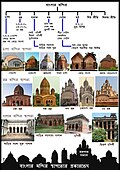 Classification of Bengal Temple Architecture

Rekha deul[edit | edit source]
The rekha deul was the predominant form of temple architecture in Bengal during the pre Islamic period.[7] According to David J. McCutchion, this type of temple achieved its standard initial form in central India and was spread to different places which included Bengal.[8] The features of this type temple are "smooth curvilinear" and "ridged curvilinear."[9] In the smooth type, the sikhara is free of horizontal bars and in ridged type, it is closely ridged with bars. The ratha projections are generally deep and spaced, and sometimes decorated. The crowning amalaka is generally large and flat. There are large and small types of deuls. Many of the very small types dispense with the complicated styling. It went on developing from the late 7 th century or early 8 th century to around the 19 th century, increasing its complexity and height but retaining its basic features.[1][10]
-
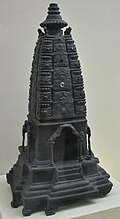 Bronze miniature temple model from Chittagong district, Bangladesh, 7th century. Currently at Indian Museum
 -
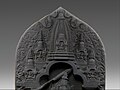 11th century relief of a temple sikhara (in centre) flanked by stupas featured in a arch adoring Manjushri from Bengal. Currently at Metropolitan Museum of Art
 -
Barakar temples at Barakar in Paschim Bardhaman district. Photograph by Joseph David Beglar in 1897. Possibly, the earliest rekha deuls still standing.
-
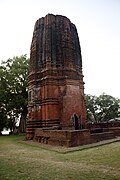 Bahulara Ancient Temple, Bankura district, 8th-11th century
 -
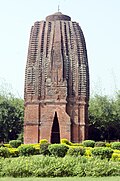 Sat Deul, Purba Bardhaman district, 10th century
 -
 Jatar Deul, South 24 Parganas, 11th century
 -
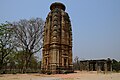 Banda Deul, Purulia district, 11th century
 -
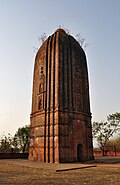 Ichhai Ghosher Deul at Gourangapur, Paschim Bardhaman district, 16-17th century
 -
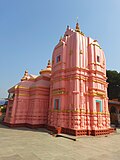 Sarbamangala Temple, Garbeta, Paschim Medinipur district, West Bengal. 16th century
 -
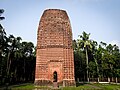
-
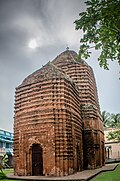 Baidyapur Twin temples
 -
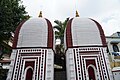 Jora Deul built in 1831


Chala temple[edit | edit source]
The ek-bangla or do-chala consists of a brick-built structure resembling rural mud huts with two sloping roofs, resembling thatched straw roofs of Bengali villages. The stone temple at Garui in Bardhaman district of West Bengal, built in the 14th century, has a Bengal hut shaped roof.[11] Two huts, one forming a porch in front and the other being the shrine at the back constitutes the jor-bangla design – "Bengal's most distinctive contribution to temple architecture".[7][12]
In West Bengal, the hut roof generally has four sides and the char-chala temple is built on this model. If a miniature duplicate is built on the roof, it becomes an at-chala. The char-chala temple form was well established by the 16 th -17 th century.[12] Perhaps the earliest char chala temple in Bengal dates back to 15 th century.[12]
-
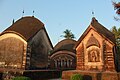 Char Bangla group of temples at Baranagar in Murshidabad district are examples of ek-bangla temples
 -
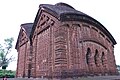 Jor Bangla temple at Bishnupur, Bankura district
 -
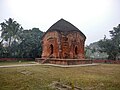 Char-chala temple at Palpara, Nadia district
 -
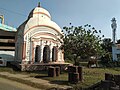 At-chala Shantinath temple at Chandrakona, Paschim Medinipur district
 -
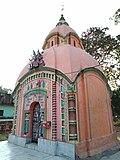 Baro-chala Buro Shiva temple at Jalshara, Paschim Medinipur district
 -
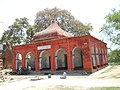 Kiriteswari Temple at Kiritkona in Murshidabad district is a char-chala having curved cornice and with an ek-bangla porch
 -
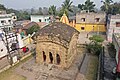 14th century temple, Garui, Paschim Bardhaman, West Bengal


Ratna temple[edit | edit source]
The curved roof of a ratna temple "is surmounted by one or more towers or pinnacles called ratna (jewel). The simplest form has a single central tower (eka-ratna), to which may be added four more at the corners (pancha-ratna)". The number of towers or pinnacles can be increased up to a maximum of twenty-five. The ratna style was developed in 16th-17th century in Bengal .[13]
"Ratna style temples are the composite type of architecture... The lower part of the temple has all the features of the curved cornices and a short pointed spire crowns the roof and this will be adorned with the introduction of ratnas or kiosks."[14]
-
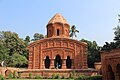 Ek-ratna Ramchandraji temple at Guptipara, Hooghly district
 -
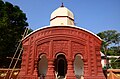 Ek-ratna temple at Radhakantapur, Paschim Medinipur district
 -
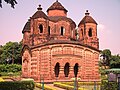 Pancha-ratna Shyam Rai temple at Bishnupur, Bankura district
 -
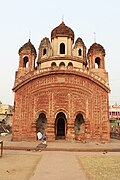 Nava-ratna Radha Binode temple at Jaydev Kenduli, Birbhum district
 -
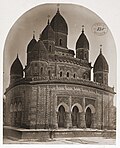 Naba-ratna Kantajew Temple in Dinajpur, Bangladesh.
 -
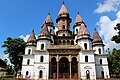 With 13 minars Hangseshwari temple has a distinct identity, at Bansberia, Hooghly district
 -
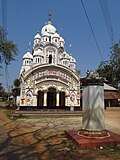 Saptadasa-ratna Parvatinatha Temple at Chandrakona, Paschim Medinipur district with 17 pinnacles
 -
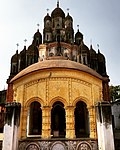 Panchavimsati-ratna Gopalbari temple at Kalna City, Purba Bardhaman district, with 25 pinnacles
 -
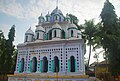 Panchavimsati-ratna rasmancha at Narajole, Paschim Medinipur district, with 25 pinnacles


Dalan temple[edit | edit source]
The flat-roofed temples or dalan temples came up in 19th century.[15]It combined the use of barrel vaults introduced during Islamic rule with native usage of horse-shoe shaped curved arches. In the long run, this style lost its special identity as religious architecture and got mixed up with domestic architecture.[16]
-
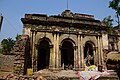 Flat-roofed dalan temple at Bhalki, Purba Bardhaman
 -
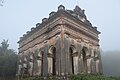 Dalan temple, Sharabhuja Gauranga temple at Panchrol, Purba Medinipur district
 -
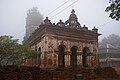 Dalan temple with rekha deul superstructure, Radha Binoda temple at Panchrol, Purba Medinipur district
 -
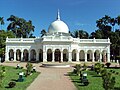 Flat roofed dalan with dome, Madan Mohan Bari, Cooch Behar
 -
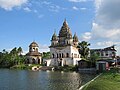 Flat roofed dalan with pancha-ratna superstructure in the Puthia Temple Complex at Puthia Upazila, Rajshahi district, Bangladesh


East Bengali shikhari style[edit | edit source]
In eastern Bengal (present day Bangladesh), the rekha deul style evolved during the late Mughal era into a distinct style called shikhari (colloquially called math), characterised by an octagonal bases bearing the curvilinear chalas supporting a tapering pyramidal sikhara. In some cases the octagonal base of the pyramidal sikhara might be placed upon a traditional four-cornerned base. This change is believed to have occurred under the influence of Mughal architecture.[1][17][18]
-
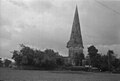 Ramna Kali Mandir in Dhaka, Bangladesh. The original structure (in picture) was vandalised as a part of the Bangladesh genocide.
 -
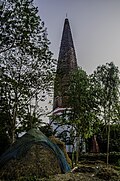
-
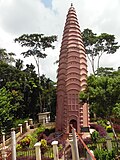
-
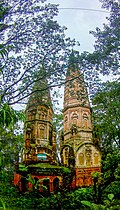 Sonarang Twin temples, Munshiganj, Dhaka, Bangladesh
 -
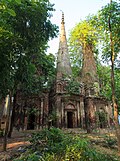
-
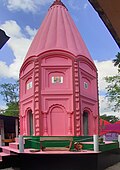 Pagalshankarjiu temple, Brahmanbaria, Chittagong, Bangladesh, 19th century
.jpg)


Grouped temple[edit | edit source]
Temples of identical style and size are sometimes grouped together. Two identical Shiva temples are called a Jora Shiva temple. Groups of four, six and twelve Shiva temples are quite popular. The most elaborate groups existing have 108 Shiva temples.[19][self-published source]
_02.jpg)
-
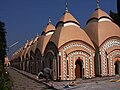 108 Shiva temples at Nababhat, Bardhaman, Purba Bardhaman district
 -
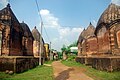 72 temples at Maluti, Dumka district, Jharkhand near the West Bengal border- 36 temples have been destroyed
 -
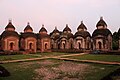 26 Shiva temples at Khardaha, North 24 Parganas district
 -
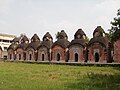
-
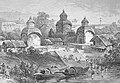 Cluster of 3 At-chala temples at Kalighat temple complex, Kolkata, West Bengal
 -
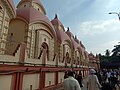 Cluster of 12 At-chala Shiva temples at Dakshineswar Temple complex, North 24 Parganas
 -
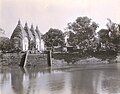 Cluster of 4 Char-chala Shiva temples at Dhakeshwari Temple complex, Dhaka, Bangladesh


See also[edit | edit source]
References[edit | edit source]
- ↑ 1.0 1.1 1.2 "Architecture". Banglapedia.
- ↑ "Vaisnavism". Banglapedia.
- ↑ "ASI, Kolkata Circle". www.asikolkata.in. Archived from the original on 2024-11-19. Retrieved 2024-12-15.
- ↑ Biswas, S. S. (1992). Bishnupur (University of Illinois at Urbana-Champaign ed.). Director General, Archaeological Survey of India. pp. 9, 10.
- ↑ 5.0 5.1 Majumdar, Ramesh Chandra (1943). The History of Bengal. Vol. 1. University of Dacca. p. 480.
- ↑ McCutchion 1972, p. 1.
- ↑ 7.0 7.1 7.2 7.3 7.4 7.5 "Chitrolekha International Magazine on Art and Design, Special Issue on the Temples of Bengal" (PDF). Archived (PDF) from the original on 2013-08-27. Retrieved 2023-02-20.
- ↑ McCutchion 1972, p. 3.
- ↑ McCutchion 1972, p. 21.
- ↑ McCutchion 1972, p. 21-22.
- ↑ "ASI Kolkata Cirle". Archived from the original on 2023-02-04. Retrieved 2023-02-04.
- ↑ 12.0 12.1 12.2 McCutchion 1972, p. 5.
- ↑ McCutchion 1972, p. 8.
- ↑ Akhter, Nasreen. "Temple architecture". Banglapedia. Archived from the original on 1 March 2021. Retrieved 26 August 2020.
- ↑ McCutchion 1972, p. 61.
- ↑ McCutchion 1972, p. 12.
- ↑ "Shyamsiddhi Matha - Banglapedia". en.banglapedia.org. Retrieved 2025-09-03.
- ↑ Dhaka UNESCO Office, Babu Ahmed, Nazly Choudhury, Shafiqul Alam (2005). "Selected Hindu temples of Bangladesh". unesdoc.unesco.org. Retrieved 2025-09-03.
{{cite web}}: CS1 maint: multiple names: authors list (link) - ↑ Guha, Amit. "Terracotta Temples of Bengal". Amit Guha. Archived from the original on 2018-09-04. Retrieved 26 August 2020.
Source[edit | edit source]
McCutchion, David J. (1972). Late Mediaeval Temples of Bengal: Origins and Classification. Asiatic Society.
| Bankura |  | |
|---|---|---|
| Cooch Behar | ||
| Darjeeling | ||
| Hooghly | ||
| Howrah | ||
| Kolkata | ||
| Nadia | ||
| North 24 Parganas | ||
| Paschim Bardhaman | ||
| Paschim Medinipur | ||
| Purba Bardhaman | ||
| Purulia | ||
| South 24 Parganas | ||
| See also | ||
| Hindu temples in other states (templates) | ||
.png)