


ImportMaster (talk | contribs) No edit summary |
m refined lead also and cleaned formatting based on references |
||
| Line 1: | Line 1: | ||
{{ | {{short description|South Asian rice and lentil dish}} | ||
{{ | {{about|a rice dish||Khichdi (disambiguation)}} | ||
{{ | {{distinguish|Kichadi|Khichra|Kachori}} | ||
{{protection padlock|small=yes}} | |||
{{EngvarB|date=October 2021}} | |||
{{Use dmy dates|date=October 2021}} | {{Use dmy dates|date=October 2021}} | ||
{{Infobox food | {{Infobox food | ||
| name | | name = Khichdi | ||
| image | | image = Dall Khichdi.jpg | ||
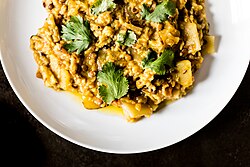
| caption | | caption = A bowl of dal khichri served with [[South Asian pickle|achar]] | ||
| alternate_name | | alternate_name = ''Khichdi, khichadi, khichdee, khichadi, khichuri ''([[Bengali language|Bengali]])'', khisiri ''([[Assamese language|Assamese]])'', khechidi/khechudi'' ([[Odia language|Odia]]), ''kisuri'' ([[Sylheti language|Sylheti]]), ''khichari, kitcheree, kitchree'' | ||
| region | | region = [[Indian subcontinent]] | ||
| national_cuisine = | | national_cuisine = [[Indian cuisine|India]], [[Bangladeshi cuisine|Bangladesh]], [[Pakistani cuisine|Pakistan]], [[Nepali cuisine|Nepal]], [[Trinidad and Tobago cuisine|Trinidad and Tobago]], [[Guyanese cuisine|Guyana]], [[Surinamese cuisine|Suriname]], [[Fijian cuisine|Fiji]], [[Mauritian cuisine|Mauritius]] | ||
| course = | |||
| course | | served = | ||
| served | | main_ingredient = Rice, [[lentil]]s and [[List of Indian spices|spices]] | ||
| main_ingredient | | variations = [[Mung dal]] khichri, [[Pearl millet|bajra]]-ri-khichri (Rajasthani millet khichri), sadi khichri (lentil and rice khichri) | ||
| variations | | calories = | ||
| calories | | minor_ingredient = [[Cauliflower]], [[potato]]es, [[peas|green peas]] and other [[vegetable]]s | ||
| other | | type = [[Rice]] | ||
| place_of_origin = [[India]] | |||
}} | }} | ||
[[File:Khichadi (49683829713).jpg|thumb|right|Homemade khichadi]] | |||
[[File:Khichdi Prasadam in Donna (Iskcon Bangalore).jpg|thumb|right|220px|''Khichri [[prasāda]]'' served in [[areca]]-leaf traditional bowl, [[Bengaluru]]]] | |||
'''''Khichdi''''' or '''''khichri''''' ({{langx|ur|{{nq|کھچڑی}}|translit=khicṛī|engvar=gb}}, {{langx|hi|खिचड़ी|translit=khicṛī|engvar=gb}}, {{IPA|hi|ˈkʰɪtʃɽiː|pron}}, {{langx|bn|খিচুড়ি|translit=Khicuṛi|engvar=gb}}, [[Odia language|Odia]]: ଖେଚୁଡି) is a dish in [[South Asian cuisine]] made of rice and [[lentil]]s (''[[dal]]'') with numerous variations. Variations include [[Pearl millet|''bajra'']] and [[Mung bean|mung ''dal'']] ''khichri''. In [[Culture of India|Indian culture]], in several regions, especially in the northern areas, it is considered one of the first solid foods that babies eat.<ref name=":0">{{cite web |last=IANS |date=2016-02-15 |title=Gujarati khichdi rocks Masterchef, thanks to Indian American chef |url=https://www.thehansindia.com/posts/index/Food/2016-02-15/Gujarati-khichdi-rocks-Masterchef-thanks-to-Indian-American-chef/207309 |access-date=2022-10-09 |website=The Hans India}} See [[MasterChef (American season 6)|''MasterChef'' (American season 6)]]</ref><ref name="khichdi recipe">{{citation |title=Khichdi Indian Recipe |date=23 June 2022 |url=https://www.indianhealthyrecipes.com/dal-khichdi-recipe/ |website=indianhealthyrecipes.com Swasthi Recipes}}</ref><ref name="Khichdicomfortfood"/> | |||
''''' | |||
==Etymology and spelling== | ==Etymology and spelling== | ||
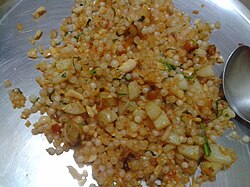
[[File:Yummy Sabudana Khichdi.jpg|thumb|220px|''[[Sabudana khichri]]'' is a popular food during fasts.]] | [[File:Yummy Sabudana Khichdi.jpg|thumb|220px|''[[Sabudana khichri]]'' is a popular food during [[Shivratri]] or [[Navratri]] fasts.]] | ||
The word ''Khichdī'' is derived from [[Sanskrit]] {{lang|sa|खिच्चा}} ''{{transliteration|hi|ISO|khiccā}}'',<ref name="Oxford University Press">{{cite book |title=The Oxford Hindi-English Dictionary |publisher=[[Oxford University Press]] |year=1997 |isbn=978-0-19-864339-5 |editor=McGregor |editor-first=R.S. |editor-link=R. S. McGregor |page=237}}</ref><ref>{{cite news |date=2021-07-17 |title=Tale of the humble 'Khichdi' |work=[[The Times of India]] |url=https://timesofindia.indiatimes.com/life-style/food-news/the-tale-of-humble-khichdi/articleshow/75610905.cms |access-date=2023-08-15 |issn=0971-8257}}</ref> a dish of rice and legumes.<ref>{{cite book |title=A Sanskrit-English Dictionary |last=Monier-Williams |first=Monier |author-link=Monier Monier-Williams |year=1995 |publisher=Motilal Banarsidass |location=Delhi |isbn=81-208-0065-6 |page=339 |url=http://www.sanskrit-lexicon.uni-koeln.de/monier/index.html |access-date=2010-06-29}}</ref> | |||
Some divergence of transliteration may be noted in the third consonant in the word ''khicṛī''. The sound is the [[retroflex flap]] {{IPAblink|ɽ}}, which is written in [[Standard Hindi|Hindi]] with the [[Devanagari]] letter ⟨{{lang|hi|ड़}}⟩, and in [[Urdu alphabet|Urdu script]] with the [[Perso-Arabic script|Perso-Arabic]] letter ⟨{{lang|ur|{{nq|[[Ṛe|ڑ]]}}}}⟩. In [[Hindustani phonology]], the etymological origin of the retroflex flap was {{IPAslink|ɖ}} when it occurred between vowels.<ref>{{cite book |title=The Indo-Aryan Languages |last=Masica |first=Colin P. |author-link=Colin Masica |year=1991 |publisher=[[Cambridge University Press]] |isbn=0-521-23420-4 |pages=97–98 |url=https://books.google.com/books?id=Itp2twGR6tsC&pg=PP1 |access-date=2010-06-29}}</ref> Hence in Devanagari the letter ⟨{{lang|hi|ड}}⟩, representing {{IPA|/ɖ/}}, was adapted to write {{IPA|/ɽ/}} by adding a diacritic under it. In Urdu script, the phonological quality of the flap was represented by adapting the letter ⟨{{lang|ur|{{nq|[[Resh|ر]]}}}}⟩, representing {{IPA|/r/}}, with a diacritic added above it to indicate the retroflex quality. The occurrence of this consonant in the word {{Transliteration|hi|ISO|khicṛī}} has given rise to two alternative spellings in English: ''khichri'', which reflects its phonology, and ''khichdi'', which reflects its etymology. | |||
Some divergence of transliteration may be noted in the third consonant in the word ''khicṛī''. The sound is the [[retroflex flap]] {{IPAblink|ɽ}}, which is written in [[Standard Hindi|Hindi]] with the [[Devanagari]] letter ⟨{{lang|hi|ड़}}⟩, and in [[Urdu alphabet|Urdu script]] with the [[Perso-Arabic script|Perso-Arabic]] letter ⟨{{lang|ur|{{nq|[[Ṛe|ڑ]]}}}}⟩. In [[Hindustani phonology]], the etymological origin of the retroflex flap was {{IPAslink|ɖ}} when it occurred between vowels.<ref>{{cite book |title=The Indo-Aryan Languages |last=Masica |first=Colin P. |author-link=Colin Masica |year=1991 |publisher=Cambridge University Press |isbn=0-521-23420-4 |pages=97–98 |url=https://books.google.com/books?id=Itp2twGR6tsC&pg=PP1 |access-date=2010-06-29}}</ref> Hence in Devanagari the letter ⟨{{lang|hi|ड}}⟩, representing {{IPA|/ɖ/}}, was adapted to write {{IPA|/ɽ/}} by adding a diacritic under it. In Urdu script, the phonological quality of the flap was represented by adapting the letter ⟨{{lang|ur|{{nq|[[Resh|ر]]}}}}⟩, representing {{IPA|/r/}}, with a diacritic added above it to indicate the retroflex quality. The occurrence of this consonant in the word {{ | |||
==History== | ==History== | ||
[[ | The [[Seleucid Empire|Greek]] king [[Seleucus I Nicator|Seleucus]] during his campaign in India (305-303 BC), mentioned that rice with pulses is very popular among people of the Indian subcontinent.<ref name="Khichdicomfortfood">{{cite web |last=Gandhi |first=Malar |date=15 April 2012 |title=Khichdi–A Comfort Food – India Currents |url=http://www.indiacurrents.com/articles/2012/04/15/khichdi-comfort-food |url-status=dead |archive-url=https://archive.today/20130216062547/http://www.indiacurrents.com/articles/2012/04/15/khichdi-comfort-food |archive-date=16 February 2013 |access-date=1 January 2015}}</ref> [[Strabo]] also notes that Indian food mainly consisted of rice porridge and a beverage made of rice, presently called [[Arrack|arak]].<ref>{{cite conference |last=Reddy |first=Anjana |title=Archaeology of Indo-Gulf Relations in the Early Historic Period: The Ceramic Evidence |url=https://www.academia.edu/20135170 |year=2016 |editor=Himanshu Prabha Ray |book-title=Bridging the Gulf: Maritime Cultural Heritage of the Western Indian Ocean |location=New Delhi |publisher=Manohar Publishers |page=68 |isbn=978-93-5098-143-6}}</ref> The [[Marinid Sultanate|Moroccan]] traveler [[Ibn Battuta]] mentions ''khichdi'' as a dish in India composed of rice and [[mung bean]]s, during his stay around 1350.<ref>{{cite web |last=Husain |first=Mabdi |date=1976 |orig-date=1953 |title=Rehla of Ibn Battuta |url=https://archive.org/stream/TheRehlaOfIbnBattuta/231448482-The-Rehla-of-Ibn-Battuta_djvu.txt |access-date=21 March 2015 |website=Internet Archive}}</ref> ''khichdi'' is described in the writings of [[Afanasiy Nikitin]], a Russian adventurer who travelled to the Indian subcontinent in the 15th century. It was very popular with the [[Mughal Empire|Mughals]], especially [[Jahangir]]. ''[[Ain-i-Akbari]]'', a 16th-century document written by [[Mughal Emperor]] [[Akbar]]'s vizier, [[Abu'l-Fazl ibn Mubarak|Abu'l Fadl]], mentions the recipe for ''khichdi'', which gives seven variations.<ref>[http://persian.packhum.org/persian/main?url=pf%3Ffile%3D00702015%26ct%3D50%26rqs%3D666 Recipes for Dishes] {{webarchive |url=https://web.archive.org/web/20110727161648/http://persian.packhum.org/persian/main?url=pf%3Ffile=00702015&ct=50&rqs=666 |date=2011-07-27}} ''[[Ain-i-Akbari]]'', by [[Abu'l-Fazl ibn Mubarak]]. English tr. by [[Heinrich Blochmann]] and Colonel Henry Sullivan Jarrett, 1873–1907. [[Asiatic Society of Bengal|The Asiatic Society of Bengal]], [[Calcutta]], Volume I, Chapter 24, page 59. "3. K'hichri. Rice, split dal, and ghee 5 s. of each; ⅓ s. salt: this gives seven dishes."</ref> There is an anecdotal story about khichdi featuring Akbar and his court advisor, [[Birbal]].<ref name="Cooking the Khichidi">{{cite web |title=Cooking The Khichdi is one of Birbal Stories. |url=http://www.english-for-students.com/Cooking-The-Khichdi.html |access-date=1 January 2015 |website=English for Students}}</ref> | ||
[[ | |||
The | The [[Anglo-Indian cuisine|Anglo-Indian dish]] [[kedgeree]] is thought to derive from khichri.<ref name="Spotted Dog 1997, p. 12">Anne Chotzinoff Grossman and Lisa Grossman Thomas (1997) ''Lobscouse and Spotted Dog; Which It's a Gastronomic Companion to the Aubrey/Maturin Novels'', Norton, p. 12. {{ISBN|978-0-393-32094-7}}</ref><ref>{{cite web |url=http://www.deliaonline.com/recipes/buttery-kedgeree,1284,RC.html |title=Buttery Kedgeree |access-date=2008-03-10 |last=Smith |first=Delia |work=Delia Smith's Complete Cookery Course}}</ref> | ||
==Regional variations== | ==Regional variations== | ||
Khichdi is a very popular dish across the [[Indian subcontinent]] which consists of, [[Bangladesh]], [[Pakistan]], [[Nepal]] and [[Sri Lanka]]. The dish is also widely prepared in many [[Indian states]], such as [[Punjab]], [[Haryana]], [[Rajasthan]], [[Karnataka]], [[Telangana]], [[Madhya Pradesh]], [[Gujarat]], [[Tamilnadu|Tamil Nadu]], [[Andhra Pradesh]], [[West Bengal]], [[Assam]], [[Bihar]], [[Jharkhand]], [[Uttar Pradesh]], [[Odisha]], and [[Maharashtra]].<ref name="Chatterjee 2017">{{cite web |last=Chatterjee |first=Priyadarshini |title=From Kashmir to Karnataka, khichdi is the one true underestimated food of India |website=Scroll.in |date=2017-02-10 |url=https://scroll.in/magazine/823997/from-kashmir-to-karnataka-khichdi-is-the-one-true-underestimated-food-of-india |access-date=2017-02-10}}</ref> Vegetables such as [[cauliflower]], potato, and green [[pea]]s are commonly added.{{Citation needed|date=October 2024}} | |||
Khichdi is a very popular dish across the [[Indian subcontinent]], | |||
[[Hinduism|Hindus]], mainly from north/northwest, who avoid eating grains during fasting, eat [[Sabudana khichri]] made from [[sago]].<ref name="HarKhichdi8">Sean Williams, 2015, [https://books.google.com/books?isbn=1135040087 "The Ethnomusicologists' Cookbook, Volume II: Complete Meals from around the world"], [[Taylor & Francis|Routledge Taylor & Francis group]], page 37.</ref><ref name="HarKhichdi9">Uma Aggarwal, 2009, [https://books.google.com/books?isbn=8184244746 "The Exquisite World of Indian Cuisine"], Allied Publications, page 106.</ref> In the southern part of India, however, the word ''khichri'' is not that popular. While people of Tamil Nadu and Andhra regions cook ''Pongal'', and Kannadigas prepare ''{{transliteration|hi|ISO|Huggi}}'' which is [[mung dal]] khichdi and ''{{transliteration|hi|ISO|Bisi bele bhath}}'', a pigeon pea variation with vegetables, Keralites have no similar dish.{{Citation needed|date=October 2024}} | |||
==== | Khichdi was the inspiration for [[Anglo-Indian cuisine|Anglo-Indian]] [[kedgeree]]<ref name="Spotted Dog 1997, p. 12" /><ref>{{cite news |last=Chatterjee |first=Rhitu |date=2017-07-20 |title='Khichuri': An Ancient Indian Comfort Dish With A Global Influence |publisher=[[NPR]] |url=https://www.npr.org/sections/thesalt/2017/07/20/527945413/khichuri-an-ancient-indian-comfort-dish-with-a-global-influence |access-date=2022-10-09}}</ref> ''Khichdi'' is a popular traditional staple in Haryana, specially in the rural areas. ''Haryanvi khichdi'' is made from pearl millet and mung ''dal'' (split mung bean) pounded in mortar (''unkhal''), and often eaten by mixing with warm ''ghee'' or ''[[lassi]]'', or even yogurt.<ref name="HarKhichdi1">1990, [https://books.google.com/books?id=3SYLAQAAIAAJ "Haryana District Gazetteers: Sonipat"], [[Government of Haryana]] publication, Page 83. | ||
</ref><ref name="HarKhichdi2">1912, [https://books.google.com/books?id=8jluAAAAMAAJ "Haryana District Gazetteers: Delhi district gazetteer"], [[Government of India]] Gazetteers Organisation, Page 90.</ref><ref name="HarKhichdi3">1987, [https://books.google.com/books?id=BCYLAQAAIAAJ "Haryana District Gazetteers: Hisar"], [[Government of Haryana]] publication, Page 65.</ref><ref name="HarKhichdi4">Charmaine O' Brien, 2013, [https://books.google.com/books?id=BGhBAgAAQBAJ&dq=haryana+bajra+khichri&pg=PT48 "The Penguin Food Guide to India"], [[Penguin Books]] Penguin Books.</ref> Sometimes, [[Sorghum|''jowar'']] is also mixed with ''bajra'' and ''mung dal''.<ref name="HarKhichdi4" /> | |||
The [[Hyderabadi Muslims|Hyderabadi Muslim]] community, of the erstwhile [[Hyderabad State]], in present-day [[Telangana]], [[Marathwada]], and [[Kalyana-Karnataka]] regions, make ''khichdi'' as a common breakfast dish, and is an important part of [[Hyderabadi cuisine]].<ref name="KhichdiKhattaKheema">{{cite web|url=https://talkistania.wordpress.com/2013/02/15/hyderabadi-brunch-khichdi-khatta-kheema/|title=Hyderabadi Brunch: Khichdi Khatta Kheema|date=2013-02-15|website=talkistania|access-date=2016-08-22}}</ref> The dish is called ''khichri'', ''kheema'', ''khatta'', or other switch-around versions of the previous, named after the three parts of the meal, ''Khichri'', ground beef, and a sour sauce, made of tamarind and sesame.<ref>{{cite web|url=http://mykitchenaroma.blogspot.ca/2013/04/khichdi-keema-khatta.html|title=My Kitchen's Aroma: Khichdi Keema Khatta|website=mykitchenaroma.blogspot.ca|access-date=2016-08-22}}</ref> | The [[Hyderabadi Muslims|Hyderabadi Muslim]] community, of the erstwhile [[Hyderabad State]], in present-day [[Telangana]], [[Marathwada]], and [[Kalyana-Karnataka]] regions, make ''khichdi'' as a common breakfast dish, and is an important part of [[Hyderabadi cuisine]].<ref name="KhichdiKhattaKheema">{{cite web |url=https://talkistania.wordpress.com/2013/02/15/hyderabadi-brunch-khichdi-khatta-kheema/ |title=Hyderabadi Brunch: Khichdi Khatta Kheema |date=2013-02-15 |website=talkistania |access-date=2016-08-22}}</ref> The dish is called ''khichri'', ''kheema'', ''khatta'', or other switch-around versions of the previous, named after the three parts of the meal, ''Khichri'', ground beef, and a sour sauce, made of tamarind and sesame.<ref>{{cite web |url=http://mykitchenaroma.blogspot.ca/2013/04/khichdi-keema-khatta.html |title=My Kitchen's Aroma: Khichdi Keema Khatta |website=mykitchenaroma.blogspot.ca |date=28 April 2013 |access-date=2016-08-22}}</ref> | ||
''[[Khichra]]'' is similar to ''[[haleem]]'', a meat dish, while ''khichra'' is a vegetarian dish with rice and pulses or lentils, with no spices.<ref name="JKit">{{citation|url=http://www.journeykitchen.com/2014/02/haleemkhichda-wheat-berries-meat-and.html?m=1|title=Haleem/Khichda - Wheat berries, Meat and Lentils Porridge|website=journeykitchen|access-date=27 January 2023}}</ref> | |||
''[[Khichra]]'' is similar to ''[[haleem]]'', a meat dish, while '' | |||
==National dish controversy== | ==National dish controversy== | ||
In 2017, Indian media unofficially designated it as the "national dish", as it is being globally promoted by the [[government of India]] as "queen of all foods". The report that the government may designate ''khichri'' as India's "national dish" brought significant ridicule from the opposition politicians.<ref> | In 2017, Indian media unofficially designated it as the "national dish", as it is being globally promoted by the [[government of India]] as "queen of all foods". The report that the government may designate ''khichri'' as India's "national dish" brought significant ridicule from the opposition politicians.<ref>{{cite web |date=2017-11-02 |title=Nothing cooking: Khichdi not national dish, says minister after Twitter storm |url=https://www.hindustantimes.com/india-news/nothing-cooking-khichdi-not-national-dish-says-minister-after-twitter-storm/story-m88Y723Vh2kJM5n7bwNUvN.html |access-date=2022-10-09 |website=Hindustan Times}}</ref> | ||
However, India's [[Ministry of Food Processing Industries|Minister of Food Processing Industries]] | However, India's [[Ministry of Food Processing Industries|Minister of Food Processing Industries]] [[Harsimrat Kaur Badal]] clarified that while ''khichdi'' is considered nutritious and healthy food in India, the government did not have any plans to designate a national food.<ref>{{cite news |last=IANS |date=2017-11-01 |title=Government to designate 'khichdi' as national dish |work=[[Business Standard]] India |url=https://www.business-standard.com/article/news-ians/government-to-designate-khichdi-as-national-dish-117110101260_1.html |access-date=2022-10-09}}</ref><ref>{{cite web |date=2 November 2017 |agency=PTI |title='Fictitious' Khichdi Cooked Up, Says Minister On National Dish Buzz |url=https://www.ndtv.com/food/fictitious-says-union-minister-harsimrat-kaur-badal-khichdi-wont-be-the-national-dish-1769941 |access-date=2022-10-09 |website=NDTV}}</ref><ref>{{cite news |url=http://www.thehindu.com/news/national/khichdi-not-national-food-clarifies-harsimrat-kaur-badal/article19966572.ece |title=Khichdi not national food, clarifies Harsimrat Kaur Badal |date=2 November 2017 |newspaper=The Hindu |access-date=22 February 2020}}</ref> | ||
==In popular culture== | ==In popular culture== | ||
''Khichdi'' has lent its name to media synonymous with ensembles or potpourri as depicted in the popular culture through movies such as ''[[Khichdi: The Movie]]'', and TV sitcoms such as ''[[Khichdi (2002 TV series)|Khichdi]]'' and ''[[Instant Khichdi]]''. | |||
The dish has been cooked at both MasterChef Australia<ref>{{cite web |last=Keshri |first=Shweta |date=May 27, 2021 |title=MasterChef Australia judges bowled over by Bengali Khichuri and Begun Bharta. Viral video |url=https://www.indiatoday.in/television/international-shows/story/masterchef-australia-judges-bowled-over-by-bengali-khichuri-and-begun-bharta-viral-video-1807737-2021-05-27 |access-date=2022-10-09 |website=India Today}}</ref> and America.<ref name=":0" /> | |||
==Gallery== | |||
<gallery widths="180px" heights="200px"> class="center" caption=""> | |||
File:Khichuri, a bangali dish.jpg|''Khichuri'', Bangladeshi-style | |||
File:Korai Khichuri.jpg|Kadhai khichri | |||
File:Coconut Khichdi.jpg|Coconut ''khichdi'' | |||
</gallery> | |||
==See also== | ==See also== | ||
{{Commons category|Khichri}} | {{Commons category|Khichri}} | ||
* [[ | * [[Kedgeree]] | ||
==References== | ==References== | ||
{{ | {{reflist}} | ||
{{Bangladeshi dishes}} | |||
{{Indian Dishes}} | {{Indian Dishes}} | ||
{{Pakistani dishes}} | {{Pakistani dishes}} | ||
{{Lentil dishes}} | {{Lentil dishes}} | ||
{{Rice dishes}} | |||
[[Category:Indian rice dishes]] | [[Category:Indian rice dishes]] | ||
[[Category:Lentil dishes]] | [[Category:Lentil dishes]] | ||
[[Category:Pakistani rice dishes]] | [[Category:Pakistani rice dishes]] | ||
[[Category:Bangladeshi cuisine]] | |||
[[Category:Nepalese cuisine]] | |||
[[Category:Vegetarian dishes of India]] | [[Category:Vegetarian dishes of India]] | ||
[[Category:South Asian cuisine]] | [[Category:South Asian cuisine]] | ||
[[Category:Indo-Caribbean cuisine]] | [[Category:Indo-Caribbean cuisine]] | ||
[[Category:Mauritian cuisine]] | |||
[[Category:Fijian cuisine]] | [[Category:Fijian cuisine]] | ||
Latest revision as of 13:53, 29 January 2026
 A bowl of dal khichri served with achar | |
| Alternative names | Khichdi, khichadi, khichdee, khichadi, khichuri (Bengali), khisiri (Assamese), khechidi/khechudi (Odia), kisuri (Sylheti), khichari, kitcheree, kitchree |
|---|---|
| Type | Rice |
| Region or state | Indian subcontinent |
| Associated national cuisine | India, Bangladesh, Pakistan, Nepal, Trinidad and Tobago, Guyana, Suriname, Fiji, Mauritius |
| Main ingredients | Rice, lentils and spices |
| Ingredients generally used | Cauliflower, potatoes, green peas and other vegetables |
| Variations | Mung dal khichri, bajra-ri-khichri (Rajasthani millet khichri), sadi khichri (lentil and rice khichri) |
.jpg)
.jpg)
Khichdi or khichri (Urdu: کھچڑی, romanised: khicṛī, Hindi: खिचड़ी, romanised: khicṛī, pronounced [ˈkʰɪtʃɽiː], Bengali: খিচুড়ি, romanised: Khicuṛi, Odia: ଖେଚୁଡି) is a dish in South Asian cuisine made of rice and lentils (dal) with numerous variations. Variations include bajra and mung dal khichri. In Indian culture, in several regions, especially in the northern areas, it is considered one of the first solid foods that babies eat.[1][2][3]
Etymology and spelling[edit | edit source]

The word Khichdī is derived from Sanskrit खिच्चा khiccā,[4][5] a dish of rice and legumes.[6]
Some divergence of transliteration may be noted in the third consonant in the word khicṛī. The sound is the retroflex flap [ɽ], which is written in Hindi with the Devanagari letter ⟨ड़⟩, and in Urdu script with the Perso-Arabic letter ⟨ڑ⟩. In Hindustani phonology, the etymological origin of the retroflex flap was /ɖ/ when it occurred between vowels.[7] Hence in Devanagari the letter ⟨ड⟩, representing /ɖ/, was adapted to write /ɽ/ by adding a diacritic under it. In Urdu script, the phonological quality of the flap was represented by adapting the letter ⟨ر⟩, representing /r/, with a diacritic added above it to indicate the retroflex quality. The occurrence of this consonant in the word khicṛī has given rise to two alternative spellings in English: khichri, which reflects its phonology, and khichdi, which reflects its etymology.
History[edit | edit source]
The Greek king Seleucus during his campaign in India (305-303 BC), mentioned that rice with pulses is very popular among people of the Indian subcontinent.[3] Strabo also notes that Indian food mainly consisted of rice porridge and a beverage made of rice, presently called arak.[8] The Moroccan traveler Ibn Battuta mentions khichdi as a dish in India composed of rice and mung beans, during his stay around 1350.[9] khichdi is described in the writings of Afanasiy Nikitin, a Russian adventurer who travelled to the Indian subcontinent in the 15th century. It was very popular with the Mughals, especially Jahangir. Ain-i-Akbari, a 16th-century document written by Mughal Emperor Akbar's vizier, Abu'l Fadl, mentions the recipe for khichdi, which gives seven variations.[10] There is an anecdotal story about khichdi featuring Akbar and his court advisor, Birbal.[11]
The Anglo-Indian dish kedgeree is thought to derive from khichri.[12][13]
Regional variations[edit | edit source]
Khichdi is a very popular dish across the Indian subcontinent which consists of, Bangladesh, Pakistan, Nepal and Sri Lanka. The dish is also widely prepared in many Indian states, such as Punjab, Haryana, Rajasthan, Karnataka, Telangana, Madhya Pradesh, Gujarat, Tamil Nadu, Andhra Pradesh, West Bengal, Assam, Bihar, Jharkhand, Uttar Pradesh, Odisha, and Maharashtra.[14] Vegetables such as cauliflower, potato, and green peas are commonly added.[citation needed]
Hindus, mainly from north/northwest, who avoid eating grains during fasting, eat Sabudana khichri made from sago.[15][16] In the southern part of India, however, the word khichri is not that popular. While people of Tamil Nadu and Andhra regions cook Pongal, and Kannadigas prepare Huggi which is mung dal khichdi and Bisi bele bhath, a pigeon pea variation with vegetables, Keralites have no similar dish.[citation needed]
Khichdi was the inspiration for Anglo-Indian kedgeree[12][17] Khichdi is a popular traditional staple in Haryana, specially in the rural areas. Haryanvi khichdi is made from pearl millet and mung dal (split mung bean) pounded in mortar (unkhal), and often eaten by mixing with warm ghee or lassi, or even yogurt.[18][19][20][21] Sometimes, jowar is also mixed with bajra and mung dal.[21]
The Hyderabadi Muslim community, of the erstwhile Hyderabad State, in present-day Telangana, Marathwada, and Kalyana-Karnataka regions, make khichdi as a common breakfast dish, and is an important part of Hyderabadi cuisine.[22] The dish is called khichri, kheema, khatta, or other switch-around versions of the previous, named after the three parts of the meal, Khichri, ground beef, and a sour sauce, made of tamarind and sesame.[23]
Khichra is similar to haleem, a meat dish, while khichra is a vegetarian dish with rice and pulses or lentils, with no spices.[24]
National dish controversy[edit | edit source]
In 2017, Indian media unofficially designated it as the "national dish", as it is being globally promoted by the government of India as "queen of all foods". The report that the government may designate khichri as India's "national dish" brought significant ridicule from the opposition politicians.[25]
However, India's Minister of Food Processing Industries Harsimrat Kaur Badal clarified that while khichdi is considered nutritious and healthy food in India, the government did not have any plans to designate a national food.[26][27][28]
In popular culture[edit | edit source]
Khichdi has lent its name to media synonymous with ensembles or potpourri as depicted in the popular culture through movies such as Khichdi: The Movie, and TV sitcoms such as Khichdi and Instant Khichdi.
The dish has been cooked at both MasterChef Australia[29] and America.[1]
Gallery[edit | edit source]
-
 Khichuri, Bangladeshi-style
 -
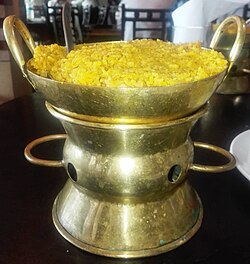 Kadhai khichri
 -
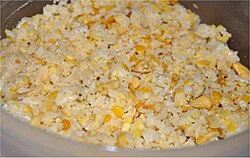 Coconut khichdi


See also[edit | edit source]
References[edit | edit source]
- ↑ 1.0 1.1 IANS (15 February 2016). "Gujarati khichdi rocks Masterchef, thanks to Indian American chef". The Hans India. Retrieved 9 October 2022. See MasterChef (American season 6)
- ↑ "Khichdi Indian Recipe", indianhealthyrecipes.com Swasthi Recipes, 23 June 2022
- ↑ 3.0 3.1 Gandhi, Malar (15 April 2012). "Khichdi–A Comfort Food – India Currents". Retrieved 1 January 2015.
{{cite web}}: CS1 maint: deprecated archival service (link) - ↑ McGregor, R.S., ed. (1997). The Oxford Hindi-English Dictionary. Oxford University Press. p. 237. ISBN 978-0-19-864339-5.
- ↑ "Tale of the humble 'Khichdi'". The Times of India. 17 July 2021. ISSN 0971-8257. Retrieved 15 August 2023.
- ↑ Monier-Williams, Monier (1995). A Sanskrit-English Dictionary. Delhi: Motilal Banarsidass. p. 339. ISBN 81-208-0065-6. Retrieved 29 June 2010.
- ↑ Masica, Colin P. (1991). The Indo-Aryan Languages. Cambridge University Press. pp. 97–98. ISBN 0-521-23420-4. Retrieved 29 June 2010.
- ↑ Reddy, Anjana (2016). "Archaeology of Indo-Gulf Relations in the Early Historic Period: The Ceramic Evidence". In Himanshu Prabha Ray (ed.). Bridging the Gulf: Maritime Cultural Heritage of the Western Indian Ocean. New Delhi: Manohar Publishers. p. 68. ISBN 978-93-5098-143-6.
- ↑ Husain, Mabdi (1976) [1953]. "Rehla of Ibn Battuta". Internet Archive. Retrieved 21 March 2015.
- ↑ Recipes for Dishes Archived 2011-07-27 at the Wayback Machine Ain-i-Akbari, by Abu'l-Fazl ibn Mubarak. English tr. by Heinrich Blochmann and Colonel Henry Sullivan Jarrett, 1873–1907. The Asiatic Society of Bengal, Calcutta, Volume I, Chapter 24, page 59. "3. K'hichri. Rice, split dal, and ghee 5 s. of each; ⅓ s. salt: this gives seven dishes."
- ↑ "Cooking The Khichdi is one of Birbal Stories". English for Students. Retrieved 1 January 2015.
- ↑ 12.0 12.1 Anne Chotzinoff Grossman and Lisa Grossman Thomas (1997) Lobscouse and Spotted Dog; Which It's a Gastronomic Companion to the Aubrey/Maturin Novels, Norton, p. 12. ISBN 978-0-393-32094-7
- ↑ Smith, Delia. "Buttery Kedgeree". Delia Smith's Complete Cookery Course. Retrieved 10 March 2008.
- ↑ Chatterjee, Priyadarshini (10 February 2017). "From Kashmir to Karnataka, khichdi is the one true underestimated food of India". Scroll.in. Retrieved 10 February 2017.
- ↑ Sean Williams, 2015, "The Ethnomusicologists' Cookbook, Volume II: Complete Meals from around the world", Routledge Taylor & Francis group, page 37.
- ↑ Uma Aggarwal, 2009, "The Exquisite World of Indian Cuisine", Allied Publications, page 106.
- ↑ Chatterjee, Rhitu (20 July 2017). "'Khichuri': An Ancient Indian Comfort Dish With A Global Influence". NPR. Retrieved 9 October 2022.
- ↑ 1990, "Haryana District Gazetteers: Sonipat", Government of Haryana publication, Page 83.
- ↑ 1912, "Haryana District Gazetteers: Delhi district gazetteer", Government of India Gazetteers Organisation, Page 90.
- ↑ 1987, "Haryana District Gazetteers: Hisar", Government of Haryana publication, Page 65.
- ↑ 21.0 21.1 Charmaine O' Brien, 2013, "The Penguin Food Guide to India", Penguin Books Penguin Books.
- ↑ "Hyderabadi Brunch: Khichdi Khatta Kheema". talkistania. 15 February 2013. Retrieved 22 August 2016.
- ↑ "My Kitchen's Aroma: Khichdi Keema Khatta". mykitchenaroma.blogspot.ca. 28 April 2013. Retrieved 22 August 2016.
- ↑ "Haleem/Khichda - Wheat berries, Meat and Lentils Porridge", journeykitchen, retrieved 27 January 2023
- ↑ "Nothing cooking: Khichdi not national dish, says minister after Twitter storm". Hindustan Times. 2 November 2017. Retrieved 9 October 2022.
- ↑ IANS (1 November 2017). "Government to designate 'khichdi' as national dish". Business Standard India. Retrieved 9 October 2022.
- ↑ "'Fictitious' Khichdi Cooked Up, Says Minister On National Dish Buzz". NDTV. PTI. 2 November 2017. Retrieved 9 October 2022.
- ↑ "Khichdi not national food, clarifies Harsimrat Kaur Badal". The Hindu. 2 November 2017. Retrieved 22 February 2020.
- ↑ Keshri, Shweta (27 May 2021). "MasterChef Australia judges bowled over by Bengali Khichuri and Begun Bharta. Viral video". India Today. Retrieved 9 October 2022.
| Main and side dishes |
|
|---|---|
| Snacks and sauces | |
| Breads | |
| Beverages | |
| Sweetmeats | |
| Bangladeshi diaspora | |


Pakistani dishes by cuisine and region | |||||
|---|---|---|---|---|---|
| Balochi |  | ||||
| Gilgiti | |||||
| Muhajir |
| ||||
| Pashtun | |||||
| Punjabi |
| ||||
| Saraiki | |||||
| Sindhi | |||||
| Common dishes |
| ||||
| Pakistani diaspora | |||||