



CleanupBot (talk | contribs) m →top: robot: remove incorrect protection templates |
m expanded formatting further and added references |
||
| Line 1: | Line 1: | ||
{{Short description|Territorial nationalist movement}} | |||
{{Short description| | {{protection padlock|small=yes}} | ||
{{Multiple issues| | |||
{{More citations needed|date=June 2019}} | {{More citations needed|date=June 2019}} | ||
{{Original research|date=June 2022}} | |||
{{Cleanup rewrite|reason=quality standards|date=June 2022}} | |||
}} | |||
{{Use Indian English|date=March 2013}} | {{Use Indian English|date=March 2013}} | ||
{{Use dmy dates|date=October 2020}} | {{Use dmy dates|date=October 2020}} | ||
[[File:Flag of India.svg | [[File:Flag of India.svg|right|thumb|The [[flag of India]], which is often used as a symbol of Indian nationalism.]] | ||
{{Nationalism | '''Indian nationalism''' is an instance of [[civic nationalism]].<ref>{{cite web | url=https://www.pass.va/en/publications/acta/acta_22_pass/jayal.html | title=India's Journey from Civic to Cultural Nationalism: A New Political Imaginary? (Article) }}</ref> It is inclusive of all of the people of India, [[Composite nationalism (India)|despite]] their [[Demographics of India|diverse ethnic, linguistic and religious backgrounds]]. Indian nationalism can trace roots to pre-colonial India, but was fully developed during the [[Indian independence movement]] which campaigned against nearly two centuries of [[British Raj|British rule]]. Indian nationalism quickly rose to popularity in India through these united anti-colonial coalitions and movements. Independence movement figures like [[Mahatma Gandhi]], [[Subhas Chandra Bose]], and [[Jawaharlal Nehru]] spearheaded the Indian nationalist movement, with the [[Indian National Congress]] playing a major role. | ||
'' | India's [[Independence of India|independence in 1947]] was coupled with [[Partition of India|separation from Muslim-majority Pakistan]], with that nation being carved out of British India's [[Northwest India|northwestern]] and [[East India|eastern regions]]. Afterwards, Prime Minister Nehru and his successors continued to campaign on Indian nationalism in the face of border wars with both [[Sino-Indian War|China]] and [[Indo-Pakistani wars and conflicts|Pakistan]], with the latter clashing several times [[Kashmir conflict|over the Kashmir border region]]. After the [[Indo-Pakistani war of 1971]] and the [[Bangladesh Liberation War]], which resulted in East Pakistan's independence, Indian nationalism reached its post-independence peak. However by the 1980s, religious tensions reached a [[1984 anti-Sikh riots|boiling point]], the Indian National Congress lost its political dominance and became [[The Emergency (India)|more authoritarian]], and Indian nationalism sluggishly collapsed in the following decades.<ref>{{Cite journal |last=Major |first=Andrew J. |date=1985-06-01 |title=Sikh Ethno-nationalism, 1967–1984: Implications for the congress |url=https://www.tandfonline.com/doi/abs/10.1080/00856408508723073 |journal=South Asia: Journal of South Asian Studies |volume=8 |issue=1–2 |pages=168–181 |language=EN |doi=10.1080/00856408508723073}}</ref> Despite its decline and the rise of [[Alternatives to Indian nationalism|religious nationalism]], Indian nationalism and its historic figures continue to strongly influence the [[politics of India]] and reflect an opposition to the sectarian strands of [[Hindu nationalism]] and [[Muslim nationalism in South Asia|Muslim nationalism]].<ref name="Lerner2011">{{citation|last=Lerner|first=Hanna|title=Making Constitutions in Deeply Divided Societies|url=https://books.google.com/books?id=MykpY_PRtmUC&pg=PA120|date=12 May 2011|publisher=Cambridge University Press|isbn=978-1-139-50292-4|pages=120–}}</ref><ref name="Jaffrelot1999">{{citation|last=Jaffrelot|first=Christophe|title=The Hindu Nationalist Movement and Indian Politics: 1925 to the 1990s : Strategies of Identity-building, Implantation and Mobilisation (with Special Reference to Central India)|url=https://books.google.com/books?id=iVsfVOTUnYEC&pg=PA13|year=1999|publisher=Penguin Books India|isbn=978-0-14-024602-5|pages=13–15, 83}}</ref><ref name="PachuauStackhouse2007">{{citation|last1=Pachuau|first1=Lalsangkima|last2=Stackhouse|first2=Max L.|title=News of Boundless Riches|url=https://books.google.com/books?id=6OPJ1BJCLw8C&pg=PA149|year=2007|publisher=ISPCK|isbn=978-81-8458-013-6|pages=149–150}}</ref><ref name="Leifer2000">{{citation|last=Leifer|first=Michael|title=Asian Nationalism|url=https://books.google.com/books?id=5eUlKdFdOvoC&pg=PA112|year=2000|publisher=Psychology Press|isbn=978-0-415-23284-5|pages=112–}}</ref> | ||
==National consciousness in India== | == National consciousness in India == | ||
[[File:Maurya Empire, c.250 BCE_2.png|thumb|250x250px|[[Mauryan Empire]] under Emperor [[Ashoka]]]] | |||
[[ | India was first unified as a single state under [[Maurya Empire]] in 3rd century BC. Much of India has also been unified by later empires, such as the [[Tughlaq dynasty|Delhi Sultanate]], [[Mughal Empire]]<ref>{{Cite book |last=Vyasa |first=Dwaipayana |url=https://books.google.com/books?id=egw_EAAAQBAJ&dq=bharata+named+after+mahabharata&pg=PT2643 |title=The Mahabharata of Vyasa: (Complete 18 Volumes) |date=24 August 2021 |publisher=Enigma Edizioni |pages=2643 |language=en}}</ref> and [[Maratha Empire]] in the early modern era.<ref>{{cite book |last=Davies |first=Cuthbert Collin |title=An Historical Atlas of the Indian Peninsula |date=1959 |publisher=Oxford University Press |isbn=978-0-19-635139-1 |page=54}}</ref> | ||
[[ | |||
India has been unified | |||
===Conception of Pan-South Asianism=== | === Conception of Pan-South Asianism === | ||
India's concept of nationhood is based not merely on territorial extent of its sovereignty. Nationalistic sentiments and expression encompass | India's concept of nationhood is based not merely on territorial extent of its sovereignty. Nationalistic sentiments and expression encompass India's [[History of India|ancient history]]<ref>{{cite web |last=Acharya |first=Shiva |url=http://www.sundeepbooks.com/servlet/sugetbiblio?bno=005928 |title=Nation, Nationalism and Social Structure in Ancient India By Shiva Acharya |publisher=Sundeepbooks.com |access-date=2011-11-17 |url-status=dead |archive-url=https://web.archive.org/web/20120215112205/http://www.sundeepbooks.com/servlet/sugetbiblio?bno=005928 |archive-date=15 February 2012}}</ref> as the birthplace of the [[Indus Valley civilisation]], as well as four major world religions – [[Hinduism]], [[Buddhism]], [[Jainism]] and [[Sikhism]]. Indian nationalists see India stretching along these lines across the Indian subcontinent.{{citation needed|date=April 2023}} [[Mahatma Gandhi]] argued that the presence of ancient Hindu pilgrimage centres in the corners of India indicated an older consciousness of Indian unity.<ref>{{Cite book |last=Ragi |first=Sangit Kumar |url=https://books.google.com/books?id=TXcvEQAAQBAJ&pg=PT21 |title=RSS and Gandhi: The Idea of India |date=2024-11-27 |publisher=Taylor & Francis |isbn=978-1-040-25505-6 |language=en}}</ref> | ||
===Ages of war and invasion=== | === Ages of war and invasion === | ||
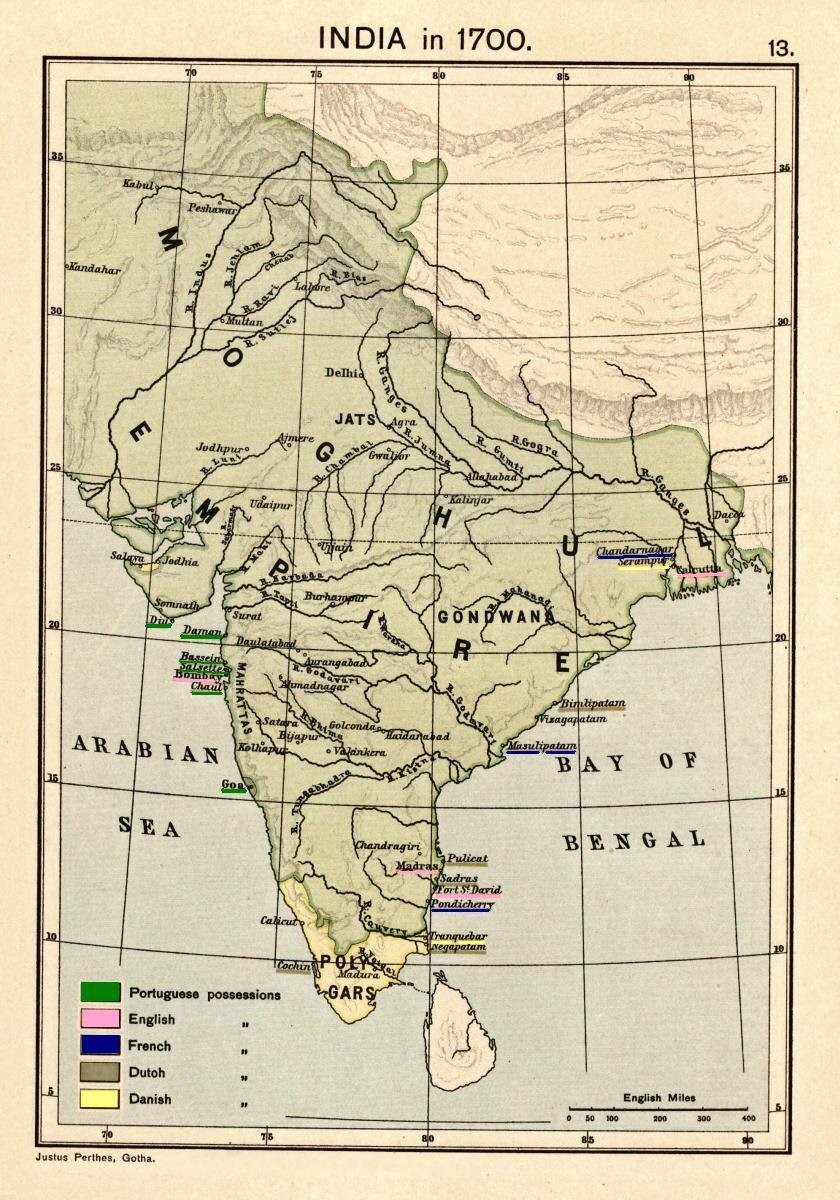
[[ | {{See also|Military history of India|History of foreign relations of India (pre-1947)}}[[File:Joppen1907India1700a.jpg|thumb|250px|The Mughal Empire at its greatest extent, in the late 17th and early 18th centuries.]] | ||
[[Image:India1760 1905.jpg|thumb|250px|The extent of [[Maratha Empire]] (yellow), without its vassals.]] | [[Image:India1760 1905.jpg|thumb|250px|The extent of [[Maratha Empire]] (yellow), without its vassals.|left]] | ||
India today celebrates many kings and queens for combating foreign invasion and domination,<ref name="vedamsbooks">{{cite web|url=https://www.vedamsbooks.com/no21816.htm |title=Mahrattas, Sikhs and Southern Sultans of India : Their Fight Against Foreign Power/edited by H.S. Bhatia |publisher=Vedamsbooks.com |access-date=2011-11-17}}</ref> such as [[Shivaji]] of the [[Maratha Empire]], Rani [[Laxmibai]] of [[Jhansi]], [[Kittur Chennamma]], [[Maharana Pratap]] of [[Rajputana]], [[Prithviraj Chauhan]] and [[Tipu Sultan]]. The kings of [[History of India|Ancient India]], such as [[Chandragupta Maurya]] and [[Ashoka]] of the [[Magadha]] Empire, are also remembered for their military genius, notable conquests and remarkable [[Toleration|religious tolerance]]. | India today celebrates many kings and queens for combating foreign invasion and domination,<ref name="vedamsbooks">{{cite web |url=https://www.vedamsbooks.com/no21816.htm |title=Mahrattas, Sikhs and Southern Sultans of India : Their Fight Against Foreign Power/edited by H.S. Bhatia |publisher=Vedamsbooks.com |access-date=2011-11-17 |archive-date=14 March 2009 |archive-url=https://web.archive.org/web/20090314003606/http://www.vedamsbooks.com/no21816.htm |url-status=dead }}</ref> such as [[Shivaji]] of the [[Maratha Empire]], Rani [[Laxmibai]] of [[Jhansi]], [[Kittur Chennamma]], [[Maharana Pratap]] of [[Rajputana]], [[Prithviraj Chauhan]] and [[Tipu Sultan]]. The kings of [[History of India|Ancient India]], such as [[Chandragupta Maurya]] of the Maurya Empire and his successor [[Ashoka]] of the [[Magadha (Mahajanapada)|Magadha]] Empire, are also remembered for their military genius, notable conquests and remarkable [[Toleration|religious tolerance]]. | ||
[[Akbar]] | The Mughal emperor [[Akbar]] was known to have a policy of religious tolerance and syncretism.<ref name="vedamsbooks" /><ref>{{Cite book |last=Lane-Poole |first=Stanley |url=http://archive.org/details/historyofindia04jackuoft |title=History of India |publisher=Grolier society |editor-last=Jackson |editor-first=A. V. Williams |location=London |pages=26–}}</ref> | ||
==Colonial-era nationalism== | == Colonial-era nationalism == | ||
{{Main|Indian independence movement|Indian Rebellion of 1857|Indian National Congress | {{Main|Indian independence movement|Indian Rebellion of 1857|History of the Indian National Congress}} | ||
[[Image:1931 Flag of India.svg|thumb|220px|left|The flag adopted in 1931 by the Congress and used by the [[Arzi Hukumate Azad Hind|Provisional Government of Free India]] during the Second World War.]] | [[Image:1931 Flag of India.svg|thumb|220px|left|The flag adopted in 1931 by the Congress and used by the [[Arzi Hukumate Azad Hind|Provisional Government of Free India]] during the Second World War.]] | ||
The consolidation of the [[East India Company|British East India Company]]'s rule in the Indian subcontinent during the 18th century brought about socio-economic changes which led to the rise of an Indian [[middle class]] and steadily eroded pre-colonial socio-religious institutions and barriers.<ref name=Mitra63>{{Harvnb|Mitra|2006|p=63}}</ref> The emerging economic and financial power of Indian business-owners and merchants and the professional class brought them increasingly into conflict with the British authorities. A rising political consciousness among the native Indian social elite (including lawyers, doctors, university graduates, government officials and similar groups) spawned an Indian identity<ref name=Crotty158>{{Harvnb|Croitt|Mjøset|2001|p=158}}</ref><ref name=Desaixxxiii>{{Harvnb|Desai|2005|p=xxxiii}}</ref> and fed a growing nationalist sentiment in India in the last decades of the nineteenth century.<ref name=Desai30>{{Harvnb|Desai|2005|p=30}}</ref> The creation in 1885 of the [[Indian National Congress]] in India by the political reformer [[Allan Octavian Hume|A.O. Hume]] intensified the process by providing an important platform from which demands could be made for political liberalisation, increased autonomy, and social reform.<ref name=Yadav6>{{Harvnb|Yadav|1992|p=6}}</ref> | The consolidation of the [[East India Company|British East India Company]]'s [[Company rule in India|rule in the Indian subcontinent]] during the late 18th century brought about socio-economic changes which led to the rise of an Indian [[middle class]] and steadily eroded pre-colonial socio-religious institutions and barriers.<ref name=Mitra63>{{Harvnb|Mitra|2006|p=63}}</ref> | ||
The emerging economic and financial power of Indian business-owners and merchants and the professional class brought them increasingly into conflict with the British authorities. A rising political consciousness among the native Indian social elite (including lawyers, doctors, university graduates, government officials and similar groups) spawned an Indian identity<ref name="Crotty158">{{Harvnb|Croitt|Mjøset|2001|p=158}}</ref><ref name="Desaixxxiii">{{Harvnb|Desai|2005|p=xxxiii}}</ref> and fed a growing nationalist sentiment in India in the last decades of the nineteenth century.<ref name="Desai30">{{Harvnb|Desai|2005|p=30}}</ref> The creation in 1885 of the [[Indian National Congress]] in India by the political reformer [[Allan Octavian Hume|A.O. Hume]] intensified the process by providing an important platform from which demands could be made for political liberalisation, increased autonomy, and social reform.<ref name="Yadav6">{{Harvnb|Yadav|1992|p=6}}</ref> | |||
Congress leaders preferred dialogue and debate with the Raj administration to press their political demands. Unlike these moderates or loyalists, who opposed violence, the nationalist movement grew increasingly strong, radical, and militant in Bengal and Punjab, with smaller yet notable movements emerging in Maharashtra, Madras, and other parts of southern India.<ref name="Yadav6" /> | |||
=== International history === | |||
==== British views and influence ==== | |||
{{See also|Divide and conquer#British India}}{{Blockquote|text=India is a geographical term. It is no more a united nation than the equator.|author=Winston Churchill (1931)|source=[https://www.economist.com/asia/2017/02/09/is-india-a-country-or-a-continent]}} | |||
[[File:Anachronous_map_of_the_British_Empire.png|thumb|[[British India]] (with the [[princely states]] in green) was one of several colonies, each having varying levels of self-government<ref>{{Cite journal |last=Kamm |first=Josephine |date=1946 |title=Self-Government in the British Dependent Empire |url=https://www.jstor.org/stable/20664367 |journal=World Affairs |volume=109 |issue=4 |pages=280–285 |jstor=20664367 |issn=0043-8200}}</ref>]] | |||
From the British perspective, the creation of a unified India began with and was only made possible by their conquest of the subcontinent ignoring that much of India had previously been unified under domestic powers like [[Maurya Empire]], [[Tughlaq dynasty|Delhi Sultanate]] and [[Mughal Empire]].<ref>{{Cite news |last=Sen |first=Amartya |date=2021-06-29 |title=Illusions of empire: Amartya Sen on what British rule really did for India |url=https://www.theguardian.com/world/2021/jun/29/british-empire-india-amartya-sen |access-date=2025-05-17 |work=The Guardian |language=en-GB |issn=0261-3077}}</ref> With their introduction of the [[Aryan Invasion Theory]], proposing that most modern Indians ([[Indo-Aryans]]) descend from ancient invaders, it was implied that their presence in India was no more unnatural than that of the Hindus and the Muslims.<ref>{{Cite book |last=Ragi |first=Sangit Kumar |url=https://books.google.com/books?id=TXcvEQAAQBAJ&pg=PT16 |title=RSS and Gandhi: The Idea of India |date=2024-11-27 |publisher=Taylor & Francis |isbn=978-1-040-25505-6 |language=en}}</ref> As the rulers of India, they had an ambiguous view of Indian nationalism, envisioning a process of yielding greater autonomy to the colony while depending on it for their [[British Empire|global dominance]].<ref>{{Cite journal |last=Huttenback |first=Robert A |date=1999 |title=Britain and Indian Nationalism: Imprint of Ambiguity, 1929-1942 (review) |url=https://muse.jhu.edu/article/15749/summary |journal=Journal of Interdisciplinary History |volume=30 |issue=1 |pages=175–177 |doi=10.1162/jinh.1999.30.1.175 |issn=1530-9169}}</ref> | |||
[[British sports]] such as [[cricket]] became [[Sport in British India#Politics|part of the nationalist movement]] over time, with victories against the British by unified Indian teams offering a nonviolent means to push for independence.<ref>{{Cite journal |last1=Majumdar |first1=Boria |last2=and Brown |first2=Sean |date=2007-02-01 |title=Why baseball, why cricket? differing nationalisms, differing challenges |url=https://www.tandfonline.com/doi/full/10.1080/09523360601045732 |journal=The International Journal of the History of Sport |volume=24 |issue=2 |pages=139–156 |doi=10.1080/09523360601045732 |issn=0952-3367}}</ref> The nationalist movement also found other ways to [[Cultural history of India#Colonial era|adopt elements of British culture]] while opposing British rule.<ref>{{Cite web |last=Tharoor |first=Shashi |date=2018-04-05 |title=Cricket: The Nationalist Game |url=https://openthemagazine.com/cover-stories/cricket-the-nationalist-game/ |access-date=2025-05-17 |website=Open The Magazine |language=en}}</ref> | |||
==== Other foreign influences ==== | |||
{{See also|Rise of nationalism in Europe}} | |||
[[Giuseppe Mazzini]] and other figures associated with the 19th-century [[unification of Italy]] were greatly admired by many early Indian nationalists.<ref>{{Cite web |last=Paul |first=Sudeep |date=2020-08-13 |title=The Enigma of Heroes |url=https://openthemagazine.com/cover-story/the-enigma-of-heroes/ |access-date=2025-05-25 |website=Open The Magazine |language=en}}</ref> [[Sri Aurobindo]] described the nationalist sentiment of his time as the "sweet harmony between the new ideal of Mazzini and the old ideal of [[Sannyasa]]".<ref>{{Cite journal |last=Gupta |first=R. K. Das |date=1956 |title=Mazzini and Indian Nationalism |url=https://www.jstor.org/stable/29753777 |journal=East and West |volume=7 |issue=1 |pages=67–70 |jstor=29753777 |issn=0012-8376}}</ref> | |||
[[B. R. Ambedkar]], a major figure in the postcolonial drafting of the modern [[Constitution of India|Indian Constitution]], took note of the historical challenges of nation-building in several other societies.<ref>{{Cite web |date=2024-12-06 |title=Dr. Ambedkar, The Architect Of Inclusive Indian Nationalism |url=https://www.outlookindia.com/national/dr-ambedkar-the-architect-of-inclusive-indian-nationalism |access-date=2025-05-25 |website=Outlook India |language=en}}</ref> He was influenced by his education at [[Columbia University]] in the United States.<ref>{{Cite journal |last=Stroud |first=Scott |date=2024-05-31 |title=The American Question: Ambedkar, Columbia University, and the "Spirit of Rebellion" |url=https://journals.library.brandeis.edu/index.php/caste/article/view/694 |journal=Caste: A Global Journal on Social Exclusion |language=en |volume=5 |issue=2 |pages=270–286 |doi=10.26812/caste.v5i2.694 |issn=2639-4928}}</ref><ref>{{Cite web |last=Pattekar |first=Mandar |date=2023-05-30 |title=The Profound Influence America Had On the Life and Ideology of Dr. Babasaheb Ambedkar |url=https://americankahani.com/perspectives/the-profound-influence-america-had-on-the-life-and-ideology-of-dr-babasaheb-ambedkar/ |access-date=2025-05-25 |website=American Kahani |language=en-US}}</ref> | |||
==== International networks ==== | |||
[[File:Ghadar Flag.png|thumb|The [[Ghadar Movement]] sought to free India with help from [[Indian diaspora|its diaspora]]<ref>{{Cite web |last=Sohi |first=Seema |date=2018-05-08 |title=The Ghadar Party |url=https://www.saada.org/tides/article/the-ghadar-party |access-date=2025-06-30 |website=South Asian American Digital Archive (SAADA) |language=en}}</ref>]] | |||
By the early 20th century, [[Pan-Asianism]] became part of anticolonial discourse within the nationalist movement.<ref>{{Cite journal |last1=Stolte |first1=Carolien |last2=Fischer-Tiné |first2=Harald |date=2012 |title=Imagining Asia in India: Nationalism and Internationalism (ca. 1905–1940) |url=https://www.cambridge.org/core/journals/comparative-studies-in-society-and-history/article/abs/imagining-asia-in-india-nationalism-and-internationalism-ca-19051940/98950E9BB7D2A858A07058B975A4CEA1 |journal=Comparative Studies in Society and History |language=en |volume=54 |issue=1 |pages=65–92 |doi=10.1017/S0010417511000594 |issn=1475-2999}}</ref> | |||
Due to the manner in which British India grew to annex and administer territories beyond the traditional frontier of India, certain groups like the Arabs and Burmese once professed some support for being included within Indian nationalism before developing their own local nationalisms.<ref>{{Cite web |title=Shattered Lands: How Doha and Dubai could have joined India or Pakistan in 1947 |url=https://www.middleeasteye.net/discover/shattered-lands-how-doha-and-dubai-nearly-joined-india-or-pakistan-1947 |access-date=2025-06-22 |website=Middle East Eye |language=en}}</ref> | |||
===''Swadeshi''=== | ===''Swadeshi''=== | ||
{{Main|Swadeshi movement}} | {{Main|Swadeshi movement}} | ||
The controversial [[1905 partition of Bengal]] escalated the growing unrest, stimulating radical nationalist sentiments and becoming a driving force for Indian revolutionaries.<ref name=Bose117>{{Harvnb|Bose|Jalal|1998|p=117}}</ref> | [[File:Concentrate on Charkha and Swadeshi bazaar art.jpg|thumb|1930s art featuring Gandhi with a [[Charkha (spinning wheel)|charkha]], an Indian spinning wheel he associated with economic self-sufficiency<ref>{{Cite journal |last=Menon |first=Nikhil |date=2020 |title=Gandhi's Spinning Wheel: The Charkha and Its Regenerative Effects |url=https://muse.jhu.edu/article/772516 |journal=Journal of the History of Ideas |volume=81 |issue=4 |pages=643–662 |doi=10.1353/jhi.2020.0034 |pmid=33416714 |issn=1086-3222}}</ref>]] | ||
The controversial [[1905 partition of Bengal]], dividing the region along religious lines, escalated the growing unrest, stimulating radical nationalist sentiments and becoming a driving force for Indian revolutionaries.<ref name=Bose117>{{Harvnb|Bose|Jalal|1998|p=117}}</ref> | |||
===The Gandhian era=== | ===The Gandhian era=== | ||
[[ | [[Mahatma Gandhi]] pioneered the art of ''[[Satyagraha]]'', typified with a strict adherence to [[ahimsa]] (non-violence), and [[civil disobedience]]. This permitted common individuals to engage the British in revolution, without employing violence or other distasteful means. Gandhi's equally strict adherence to democracy, religious and ethnic equality and brotherhood, as well as activist rejection of caste-based discrimination and [[untouchability]] united people across these demographic lines for the first time in India's history. The masses participated in India's independence struggle for the first time, and the membership of the Congress grew over tens of millions by the 1930s. In addition, Gandhi's victories in the [[Champaran Satyagraha|Champaran]] and [[Kheda Satyagraha|Kheda]] Satyagraha in 1918–19, gave confidence to a rising younger generation of Indian nationalists that India could gain independence from British rule. | ||
National leaders like [[Pandit Jawaharlal Nehru]], [[Netaji Subhash Chandra Bose]], [[Maulana Azad]], [[Chakravarti Rajagopalachari]], [[Rajendra Prasad]], the [[Lal Bal Pal]] trio, and [[Khan Abdul Gaffar Khan]] brought together generations of Indians across regions and demographics, and provided a strong leadership base giving the country political direction. | |||
== | === Final years === | ||
{{See also|1946 Cabinet Mission to India}}In 1947, [[Lord Mountbatten]] came to India to discuss the eventual outcome of the British departure. At one point, he offered a plan to [[Nehru]] to make the various regions of India autonomous provinces, which Nehru strongly rejected;<ref>{{Cite web |date=2022-05-26 |title=From the archives: How Jawaharlal Nehru foiled a British plan to Balkanise India |url=https://www.indiatoday.in/india-today-insight/story/from-the-archives-how-jawaharlal-nehru-foiled-a-british-plan-to-balkanise-india-1954434-2022-05-26 |access-date=2025-06-07 |website=India Today |language=en}}</ref> Lakshman Menon, grandson of Nehru's principal adviser [[V. P. Menon]], referred to the plan as "Plan Balkan" (in reference to [[Balkanization|Balkanisation]]).<ref>{{Cite news |title='Plan Balkan' that hit Jawaharlal Nehru wall |url=https://www.telegraphindia.com/world/plan-balkan-that-hit-jawaharlal-nehru-wall/cid/1879834 |archive-url=https://web.archive.org/web/20250419123728/https://www.telegraphindia.com/world/plan-balkan-that-hit-jawaharlal-nehru-wall/cid/1879834 |archive-date=19 April 2025 |access-date=2025-06-07 |language=en |url-status=live }}</ref> | |||
==== Independence ==== | |||
[[File:Jawaharlal Nehru delivering his "tryst with destiny" speech.jpg|thumb|[[Prime Minister Nehru]] gave the famous [[Tryst with Destiny]] speech upon independence]] | |||
Upon independence on 15 August of that year, India maintained formal links with the dissolving British Empire through its [[Commonwealth of Nations|Commonwealth]] membership and [[Dominion of India|Dominion status]].<ref>{{Cite book |last=Panter-Brick |first=Simone |url=https://books.google.com/books?id=ZXJeEAAAQBAJ&pg=PA168 |title=Gandhi and Nationalism: The Path to Indian Independence |date=2014-12-16 |publisher=Bloomsbury Publishing |isbn=978-0-7556-3222-0 |language=en}}</ref> The latter was abandoned in 1950, an anniversary now celebrated as [[Republic Day (India)|Republic Day]].<ref>{{Cite journal |last=De |first=Rohit |date=2019-12-31 |title=Between midnight and republic: Theory and practice of India's Dominion status |url=https://academic.oup.com/icon/article/17/4/1213/5710829 |journal=International Journal of Constitutional Law |volume=17 |issue=4 |pages=1213–1234 |doi=10.1093/icon/moz081 |issn=1474-2640}}</ref> | |||
==Beyond Indian nationalism== | |||
{{More citations needed section|date=March 2019}} | {{More citations needed section|date=March 2019}} | ||
{{See also| | {{See also|Separatist movements of India|Anti-national (India)}} | ||
Indian nationalism is as much a diverse blend of nationalistic sentiments as its people are ethnically and religiously diverse. Thus the most influential undercurrents are more than just ''Indian'' in nature. The most controversial and emotionally charged fibre in the fabric of Indian nationalism is religion. Religion forms a major, and in many cases, the central element of Indian life. Ethnic communities are diverse in terms of linguistics, social traditions and history across India. | |||
Indian nationalism is as much a diverse blend of nationalistic sentiments as its people are [[Demographics of India|ethnically and religiously diverse]]. Thus the most influential undercurrents are more than just ''Indian'' in nature. The most controversial and emotionally charged fibre in the fabric of Indian nationalism is religion. Religion forms a major, and in many cases, the central element of Indian life. Religious nationalisms are often dependent on mutual opposition.<ref>{{Cite book |last=Veer |first=Peter van der |url=https://books.google.com/books?id=p29ArJ7j6zgC&pg=PR9 |title=Religious Nationalism: Hindus and Muslims in India |date=1994-02-07 |publisher=University of California Press |isbn=978-0-520-08256-4 |language=en}}</ref> Ethnic communities are diverse in terms of linguistics, social traditions and history across India.<ref>{{Cite book |last=Lobo |first=Lancy |url=https://archive.org/details/globalisationhin0000lobo/page/26/mode/1up?q=Hindu+nationalism |title=Globalisation, Hindu nationalism, and Christians in India |date=2002 |publisher=Rawat Publications |isbn=978-81-7033-716-4 |location=Jaipur |page=26}}</ref> | |||
===Hindu Rashtra=== | ===Hindu Rashtra=== | ||
{{ | {{Further information|Hindutva|Hindu nationalism}} | ||
[[ | [[File:Saffron coloured Flag waving on Lohagadh Fort,Pune.JPG|thumb|The [[saffron flag]] and color are [[Saffronisation|associated with Hindu nationalism]]<ref>{{Cite news |last=Ayyub |first=Rana |date=January 29, 2024 |title=Hindu nationalism overtakes India's patriotic holiday |url=https://www.washingtonpost.com/opinions/2024/01/29/india-hindu-nationalsim-republic-day-ram-temple/ |newspaper=The Washington Post}}</ref>]] | ||
An important influence upon Hindu consciousness arises from the time of [[Islamic empires in India]]. Entering the 20th century, Hindus formed over 75% of the population and thus unsurprisingly the backbone and platform of the nationalist movement. Modern Hindu thinking desired to unite Hindu society across the boundaries of [[caste]], linguistic groups and ethnicity. In 1925, [[K.B. Hedgewar]] founded the [[Rashtriya Swayamsevak Sangh]] in [[Nagpur]], | An important influence upon Hindu consciousness arises from the time of [[Islamic empires in India]]. Entering the 20th century, Hindus formed over 75% of the population and thus unsurprisingly the backbone and platform of the nationalist movement. Modern Hindu thinking desired to unite Hindu society across the boundaries of [[caste]], linguistic groups and ethnicity. In 1925, [[K.B. Hedgewar]] founded the [[Rashtriya Swayamsevak Sangh]] (RSS) in [[Nagpur]], as a [[Right-wing politics|right-wing]] [[Hindutva]] [[Paramilitary|paramilitary organisation]].<ref>{{Cite web|title=Rashtriya Swayamsevak Sangh {{!}} History, Ideology, & Facts|url=https://www.britannica.com/topic/Rashtriya-Swayamsevak-Sangh|access-date=2020-07-28|website=Encyclopedia Britannica|language=en}}</ref> | ||
[[Vinayak Damodar Savarkar]] coined the term ''[[Hindutva]]'' for his ideology that described India as a ''[[Hindu Rashtra]]'', a Hindu nation. This ideology has become the cornerstone of the political and religious agendas of modern Hindu nationalist bodies like the [[Bharatiya Janata Party]] and the [[Vishwa Hindu Parishad]] | [[Vinayak Damodar Savarkar]] coined the term ''[[Hindutva]]'' for his ideology that described India as a ''[[Hindu Rashtra]]'', or a Hindu nation. This ideology has become the cornerstone of the political and religious agendas of modern Hindu nationalist bodies like the [[Bharatiya Janata Party]] (BJP) and the [[Vishwa Hindu Parishad]] (BJP), both of whom are closely associated with the RSS. The RSS leads the [[Sangh Parivar]], a collective of Hindutva.<ref>{{Cite web|date=2019-08-07|title=What is Uniform Civil Code?|url=https://www.jagranjosh.com/general-knowledge/why-uniform-civil-code-is-necessary-for-india-1477037384-1|access-date=2020-07-28|website=Jagranjosh.com}}</ref> These particular demands are based upon ending laws that Hindu nationalists consider to be special treatment offered to different religions.<ref>{{Cite news|title=WHAT IS UNIFORM CIVIL CODE|work=Business Standard|url=https://www.business-standard.com/about/what-is-uniform-civil-code|access-date=2020-07-28}}</ref> | ||
===The Qaum=== | ===The Qaum=== | ||
{{Main|Indian Muslim nationalism|Two-nation theory}} | {{Main|Indian Muslim nationalism|Two-nation theory}}{{See also|Madani–Iqbal debate}} | ||
In 1906–1907, the [[All India Muslim League]] was founded, created due to the suspicion of Muslim intellectuals and religious leaders with the [[Indian National Congress]], which was perceived as dominated by Hindu membership and opinions. However, [[Mahatma Gandhi]]'s leadership attracted a wide array of Muslims to the independence struggle and the Congress Party. The [[Aligarh Muslim University]] and the [[Jamia Millia Islamia]] stand apart – the former helped form the Muslim league, while the JMI was founded to promote Muslim education and consciousness upon nationalistic and Gandhian values and thought. | [[File:Flag_of_Pakistan.svg|thumb|The eventual [[flag of Pakistan]], featuring Islamic motifs along with a white stripe to represent the non-Muslim minority<ref>{{Cite web |date=2024-08-14 |title=MINURSO'S PEACEKEEPERS: NATIONAL DAY OF PAKISTAN |url=https://minurso.unmissions.org/minurso%E2%80%99s-peacekeepers-national-day-pakistan-1 |access-date=2025-05-25 |website=MINURSO |language=en}}</ref>]] | ||
In 1906–1907, the [[All-India Muslim League]] was founded, created due to the suspicion of Muslim intellectuals and religious leaders with the [[Indian National Congress]], which was perceived as dominated by Hindu membership and opinions. However, [[Mahatma Gandhi]]'s leadership attracted a wide array of Muslims to the independence struggle and the Congress Party. The [[Aligarh Muslim University]] and the [[Jamia Millia Islamia]] stand apart – the former helped form the Muslim league, while the JMI was founded to promote Muslim education and consciousness upon nationalistic and Gandhian values and thought. | |||
While prominent Muslims like [[Allama Iqbal]], [[Muhammad Ali Jinnah]] and [[Liaquat Ali Khan]] embraced the notion that Hindus and Muslims were distinct nations, other major leaders like [[Mukhtar Ahmed Ansari]], [[Maulana Azad]] and most of [[Deobandi]] clerics strongly backed the leadership of [[Mahatma Gandhi]] and the Indian independence struggle, opposing any notion of [[Muslim nationalism in South Asia|Muslim nationalism and separatism]]. The Muslim school of Indian nationalism failed to attract Muslim masses and the [[Two-nation theory|Islamic nationalist]] [[All-India Muslim League|Muslim League]] enjoyed extensive popular political support. The [[Pakistan|state of Pakistan]] was ultimately formed following the [[Partition of India]]. | While prominent Muslims like [[Allama Iqbal]], [[Muhammad Ali Jinnah]] and [[Liaquat Ali Khan]] embraced the notion that Hindus and Muslims were distinct nations, other major leaders like [[Mukhtar Ahmed Ansari]], [[Maulana Azad]] and most of [[Deobandi]] clerics strongly backed the leadership of [[Mahatma Gandhi]] and the Indian independence struggle, opposing any notion of [[Muslim nationalism in South Asia|Muslim nationalism and separatism]]. The Muslim school of Indian nationalism failed to attract Muslim masses and the [[Two-nation theory|Islamic nationalist]] [[All-India Muslim League|Muslim League]] enjoyed extensive popular political support. The [[Pakistan|state of Pakistan]] was ultimately formed following the [[Partition of India]]. | ||
==Views on the partition of India== | ==== Views on the partition of India ==== | ||
{{Main|Opposition to the partition of India}} | {{Main|Opposition to the partition of India}} | ||
{{Further|Indian reunification|Hindu–Muslim unity}} | {{Further|Indian reunification|Hindu–Muslim unity}} | ||
Indian nationalists led by [[Mahatma Gandhi|Mohandas Karamchand Gandhi]] and [[Jawaharlal Nehru]] wanted to make what was then British India, as well as the 562 princely states under British paramountcy, into a single secular, democratic state.<ref name="Hardgrave, Robert. -India: The Dilemmas of Diversity">Hardgrave, Robert. [http://www.laits.utexas.edu/solvyns-project/Hardgrave.html "India: The Dilemmas of Diversity"], ''Journal of Democracy'', pp. 54–65</ref> The [[All India Azad Muslim Conference]], which represented nationalist Muslims, gathered in Delhi in April 1940 to voice its support for an [[Opposition to the partition of India|independent and united India]].<ref name="QasmiRobb2017">{{cite book |last1=Qasmi |first1=Ali Usman |last2=Robb |first2=Megan Eaton |title=Muslims against the Muslim League: Critiques of the Idea of Pakistan |date=2017 |publisher=Cambridge University Press |isbn=9781108621236 |page=2 |language=en}}</ref> The British | [[File:Partition of India 1947 en.svg|left|thumb|British India was [[Partition of India|partitioned]] in mid-August 1947 into Muslim-majority Pakistan (green) and Hindu-majority India (orange)]] | ||
Indian nationalists led by [[Mahatma Gandhi|Mohandas Karamchand Gandhi]] and [[Jawaharlal Nehru]] wanted to make what was then British India, as well as the 562 princely states under British paramountcy, into a single secular, democratic state.<ref name="Hardgrave, Robert. -India: The Dilemmas of Diversity">Hardgrave, Robert. [http://www.laits.utexas.edu/solvyns-project/Hardgrave.html "India: The Dilemmas of Diversity"], ''Journal of Democracy'', pp. 54–65</ref> The [[All India Azad Muslim Conference]], which represented nationalist Muslims, gathered in Delhi in April 1940 to voice its support for an [[Opposition to the partition of India|independent and united India]].<ref name="QasmiRobb2017">{{cite book |last1=Qasmi |first1=Ali Usman |last2=Robb |first2=Megan Eaton |title=Muslims against the Muslim League: Critiques of the Idea of Pakistan |date=2017 |publisher=Cambridge University Press |isbn=9781108621236 |page=2 |language=en}}</ref> The British Government, however, sidelined the 'All India' organisation from the independence process and came to see Jinnah, who advocated separatism, as the sole representative of Indian Muslims.<ref name="Shodganga">{{citation |last=Qaiser |first=Rizwan |chapter=Towards United and Federate India: 1940-47 |title=Maulana Abul Kalam Azad a study of his role in Indian Nationalist Movement 1919–47 |publisher=Jawaharlal Nehru University/Shodhganga |year=2005 |hdl=10603/31090 |at=Chapter 5, pp. 193, 198}}</ref> This was viewed with dismay by many Indian nationalists, who viewed Jinnah's ideology as damaging and unnecessarily divisive.<ref>Raj Pruthi, ''Paradox of Partition: Partition of India and the British strategy'', Sumit Enterprises (2008), p. 444</ref> | |||
[[File:Indian subcontinent.JPG|thumb|The [[All India Congress Committee]], in a resolution adopted on 14 June 1947, openly stated that "geography and the mountains and the seas fashioned India as she is, and no human agency can change that shape or come in the way of its final destiny... at when present passions have subsided, India's problems will be viewed in their proper perspective and the false [[Two-nation theory (Pakistan)|doctrine of two nations]] will be discredited and discarded by all."<ref>Graham Chapman, ''The Geopolitics of South Asia: From Early Empires to the Nuclear Age'', Ashgate Publishing (2012), p. 326</ref>]] | |||
In an interview with [[Leonard Mosley]], Nehru said that he and his fellow Congressmen were "tired" after the independence movement, so were not ready to further drag on the matter for years with Jinnah's Muslim League, and that, anyway, they "expected that partition would be temporary, that Pakistan would come back to us."<ref>Sankar Ghose, ''Jawaharlal Nehru, a Biography'', Allied Publishers (1993), pp. 160-161</ref> Gandhi also thought that the Partition would be undone.<ref>Raj Pruthi, ''Paradox of Partition: Partition of India and the British strategy'', Sumit Enterprises (2008), p. 443</ref> [[V.P. Menon]], who had an important role in the transfer of power in 1947, quotes another major Congress politician, [[Abul Kalam Azad]], who said that "the division is only of the map of the country and not in the hearts of the people, and I am sure it is going to be a short-lived partition."<ref>V.P. Menon, ''The Transfer of Power in India'', Orient Blackswan (1998), p. 385</ref> [[Acharya Kripalani]], President of the Congress during the days of Partition, stated that making India "a strong, happy, democratic and socialist state" would ensure that "such an India can win back the seceding children to its lap... for the freedom we have achieved cannot be complete without the unity of India."<ref>G. C. Kendadamath, ''J.B. Kripalani, a study of his political ideas'', Ganga Kaveri Pub. House (1992), p. 59</ref> Yet another leader of the Congress, [[Sarojini Naidu]], said that she did not consider India's flag to be India's because "India is divided" and that "this is merely a temporary geographical separation. There is no spirit of separation in the heart of India."<ref>''Constituent Assembly Debates: Official Report'', Volume 4, Lok Sabha secretariat, 14 July 1947, p. 761</ref> | |||
Giving a more general assessment, [[Paul Brass]] says that "many speakers in the [[Constituent Assembly of India|Constituent Assembly]] expressed the belief that the [[Indian reunification|unity of India would be ultimately restored]]."<ref>Paul R. Brass, ''The Politics of India Since Independence'', Cambridge University Press (1994), p. 10</ref> | |||
=== Khalistan === | |||
{{Excerpt|Khalistan movement|paragraphs=1-2|files=1}} | |||
== Contemporary era == | |||
{{Multiple image | |||
| image1 = India and Pakistan 15 Aug 1947.png | |||
| footer = Indian-administered territory in 1947 (in brown) and in 1956 | |||
| image2 = States Reorganisation Act 1956.svg | |||
| total_width = 325 | |||
| align = left | |||
}} | |||
After independence, [[Sardar Vallabhbhai Patel]] helped complete the [[political integration of India]]. In 2014, his birthday was declared [[National Unity Day (India)|National Unity Day]],<ref>{{Cite web |last=Staff |first=Scroll |date=2019-10-31 |title=What is National Unity Day and why is it celebrated on 31st October? |url=https://scroll.in/announcements/942195/what-is-national-unity-day-and-why-is-it-celebrated-on-31st-october |access-date=2025-05-27 |website=Scroll.in |language=en}}</ref> and in 2018, he was commemorated in his native Gujarat with the [[Statue of Unity]].<ref>{{Cite web |title=5 Years of Statue of Unity: Facts About the World's Tallest Statue |url=https://www.ndtv.com/india-news/5-years-of-statue-of-unity-facts-about-the-worlds-tallest-statue-4531176 |access-date=2025-05-26 |website=www.ndtv.com |language=en}}</ref> | |||
Along with dealing with the princely states, reorganising the states on linguistic boundaries was a central question in deciding the nature of the new nation. The government initially hesitated to support such a move, fearing it would lead to [[Separatist movements of India|separatism]], but eventually acquiesced with the [[States Reorganisation Act, 1956]].<ref>{{Cite journal |last=Tudor |first=Maya |date=2018 |title=India's Nationalism in Historical Perspective: The Democratic Dangers of Ascendant Nativism |url=https://doi.org/10.18278/inpp.1.1.6 |journal=Indian Politics & Policy |volume=1 |issue=1 |pages=116 |doi=10.18278/inpp.1.1.6}}</ref> | |||
In these initial decades, the [[Hindi|Hindi language]] was proposed by some as a [[National language of India|national language]], and was deliberately [[Sanskritisation (linguistics)|Sanskritised]] to distinguish it from the [[Urdu]] spoken in the newly separate Pakistan. Some of the strong advocates of Hindi associated it with Hindu nationalism through the slogan "[[Hindi, Hindu, Hindustan]]".<ref>{{Cite journal |last=Aneesh |first=A. |date=2010 |title=Bloody Language: Clashes and Constructions of Linguistic Nationalism in India |url=https://onlinelibrary.wiley.com/doi/abs/10.1111/j.1573-7861.2009.01158.x |journal=Sociological Forum |language=en |volume=25 |issue=1 |pages=86–109 |doi=10.1111/j.1573-7861.2009.01158.x |issn=1573-7861}}</ref> [[Hindi cinema]] (popularly known as Bollywood) played a role in offering a vision of a unified India, with films celebrating military valour in border conflicts.<ref>{{Cite journal |last1=Karmakar |first1=Goutam |last2=and Catterall |first2=Pippa |date=2025-03-15 |title=Nation, Nationalism and Indian Hindi cinema |url=https://www.tandfonline.com/doi/full/10.1080/14608944.2024.2440753 |journal=National Identities |volume=27 |issue=1–2 |pages=1–11 |doi=10.1080/14608944.2024.2440753 |bibcode=2025NatId..27....1K |issn=1460-8944}}</ref> | |||
[[ | |||
=== Post-Cold War === | |||
{{See also|Indian Century}} | |||
[[File:Stamp of India - 2016 - Colnect 804349 - National Unity Day Salute to the Unifier of India.jpeg|thumb|2016 stamp commemorating Sardar Patel]] | |||
[[Economic liberalisation in India|Economic liberalisation]] in the [[1990s in India|1990s]] greatly changed India, with a greater amount of [[Globalization in India|globalisation]] and [[transnationalism]] taking hold in the popular culture.<ref>{{Cite journal |last=Saha |first=Ratan Kr |date=2025-04-15 |title=Reimagining National Identity: The Intersection of Cultural Narratives and Postmodern Nationalism in India Post-1990s |url=https://zenodo.org/records/15223681 |journal=The Academic – International Journal of Multidisciplinary Research |doi=10.5281/zenodo.15223681}}</ref> | |||
For the [[75th Anniversary of Indian Independence]] in 2022, the ''Har Ghar Tiranga'' campaign was launched, encouraging every household to display the Indian flag.<ref>{{Cite news |date=2024-08-06 |title=BJP launches 'Har Ghar Tiranga' drive in Chhattisgarh |url=https://timesofindia.indiatimes.com/city/raipur/bjp-launches-har-ghar-tiranga-drive-in-chhattisgarh/articleshow/112326177.cms |access-date=2025-05-25 |work=The Times of India |issn=0971-8257}}</ref> | |||
== See also == | |||
* [[Nationalism and sport#India|Indian nationalism and sport]] | |||
* {{Annotated link|Pan-Indian (India) (disambiguation)|Pan-Indian}} | |||
* {{Annotated link|Varthamanappusthakam}} | |||
== | == Notes == | ||
{{notelist}} | |||
==References== | == References == | ||
{{Reflist}} | {{Reflist|30em}} | ||
==Bibliography== | == Bibliography == | ||
{{Refbegin|30em}} | |||
* {{citation |last1= Bose |first1= Sugata |last2= Jalal |first2= Ayesha |year= 1998 |title= Modern South Asia: History, Culture, Political Economy |place= New York |publisher= Routledge |isbn= 0-415-16952-6}} | * {{citation |last1= Bose |first1= Sugata |last2= Jalal |first2= Ayesha |year= 1998 |title= Modern South Asia: History, Culture, Political Economy |place= New York |publisher= Routledge |isbn= 0-415-16952-6}} | ||
* {{citation |last1= Croitt | first1= Raymond D |last2= Mjøset | first2= Lars |year = 2001 |title= When Histories Collide |place= Oxford, UK|publisher= | * {{citation |last1= Croitt | first1= Raymond D |last2= Mjøset | first2= Lars |year = 2001 |title= When Histories Collide |place= Oxford, UK|publisher= AltaMira |isbn= 0-7591-0158-2}} | ||
* {{citation |last=Desai |first=A.R. |title=Social Background of Indian Nationalism (6Th-Edn) |url=https://books.google.com/books?id=ZykLXjdG9S8C |date=2005 |publisher=Popular Prakashan |isbn=978-81-7154-667-1}} | * {{citation |last=Desai |first=A.R. |title=Social Background of Indian Nationalism (6Th-Edn) |url=https://books.google.com/books?id=ZykLXjdG9S8C |date=2005 |publisher=Popular Prakashan |isbn=978-81-7154-667-1}} | ||
* {{citation |last=Mitra |first=Subrata K. |title=The Puzzle of India's Governance: Culture, Context and Comparative Theory |url=https://books.google.com/books?id=GuILNHwcT4AC |year=2006 |publisher=Routledge |isbn=978-1-134-27493-2}} | * {{citation |last=Mitra |first=Subrata K. |title=The Puzzle of India's Governance: Culture, Context and Comparative Theory |url=https://books.google.com/books?id=GuILNHwcT4AC |year=2006 |publisher=Routledge |isbn=978-1-134-27493-2}} | ||
* {{citation |last=Mukherjee |first=Bratindra Nath |author-link=B. N. Mukherjee |title=Nationhood and Statehood in India: A historical survey |url=https://books.google.com/books?id=MTGKAAAAMAAJ |date=2001 |publisher=Regency Publications |isbn=978-81-87498-26-1 |ref={{sfnref|Mukherjee, Nationhood and Statehood in India|2001}}}} | * {{citation |last=Mukherjee |first=Bratindra Nath |author-link=B. N. Mukherjee |title=Nationhood and Statehood in India: A historical survey |url=https://books.google.com/books?id=MTGKAAAAMAAJ |date=2001 |publisher=Regency Publications |isbn=978-81-87498-26-1 |ref={{sfnref|Mukherjee, Nationhood and Statehood in India|2001}}}} | ||
* {{citation |last= Yadav |first= B.D |year= 1992 |title= M.P.T. Acharya, Reminiscences of an Indian Revolutionary |place= New Delhi |publisher= Anmol Publications Pvt ltd |isbn= 81-7041-470-9}} | * {{citation |last= Yadav |first= B.D |year= 1992 |title= M.P.T. Acharya, Reminiscences of an Indian Revolutionary |place= New Delhi |publisher= Anmol Publications Pvt ltd |isbn= 81-7041-470-9}} | ||
{{Refend}} | |||
== External links == | |||
* {{Commons category-inline|Indian nationalism}} | |||
{{India topics}} | {{India topics}} | ||
{{Ethnic nationalism}} | {{Ethnic nationalism}} | ||
{{Indian Independence Movement}} | {{Indian Independence Movement}} | ||
{{Authority control}} | {{Authority control}} | ||
Latest revision as of 04:36, 5 February 2026
 | This article has multiple issues. Please help improve it or discuss these issues on the talk page. (Learn how and when to remove these template messages)
|


Indian nationalism is an instance of civic nationalism.[1] It is inclusive of all of the people of India, despite their diverse ethnic, linguistic and religious backgrounds. Indian nationalism can trace roots to pre-colonial India, but was fully developed during the Indian independence movement which campaigned against nearly two centuries of British rule. Indian nationalism quickly rose to popularity in India through these united anti-colonial coalitions and movements. Independence movement figures like Mahatma Gandhi, Subhas Chandra Bose, and Jawaharlal Nehru spearheaded the Indian nationalist movement, with the Indian National Congress playing a major role.
India's independence in 1947 was coupled with separation from Muslim-majority Pakistan, with that nation being carved out of British India's northwestern and eastern regions. Afterwards, Prime Minister Nehru and his successors continued to campaign on Indian nationalism in the face of border wars with both China and Pakistan, with the latter clashing several times over the Kashmir border region. After the Indo-Pakistani war of 1971 and the Bangladesh Liberation War, which resulted in East Pakistan's independence, Indian nationalism reached its post-independence peak. However by the 1980s, religious tensions reached a boiling point, the Indian National Congress lost its political dominance and became more authoritarian, and Indian nationalism sluggishly collapsed in the following decades.[2] Despite its decline and the rise of religious nationalism, Indian nationalism and its historic figures continue to strongly influence the politics of India and reflect an opposition to the sectarian strands of Hindu nationalism and Muslim nationalism.[3][4][5][6]
National consciousness in India[edit | edit source]

India was first unified as a single state under Maurya Empire in 3rd century BC. Much of India has also been unified by later empires, such as the Delhi Sultanate, Mughal Empire[7] and Maratha Empire in the early modern era.[8]
Conception of Pan-South Asianism[edit | edit source]
India's concept of nationhood is based not merely on territorial extent of its sovereignty. Nationalistic sentiments and expression encompass India's ancient history[9] as the birthplace of the Indus Valley civilisation, as well as four major world religions – Hinduism, Buddhism, Jainism and Sikhism. Indian nationalists see India stretching along these lines across the Indian subcontinent.[citation needed] Mahatma Gandhi argued that the presence of ancient Hindu pilgrimage centres in the corners of India indicated an older consciousness of Indian unity.[10]
Ages of war and invasion[edit | edit source]


India today celebrates many kings and queens for combating foreign invasion and domination,[11] such as Shivaji of the Maratha Empire, Rani Laxmibai of Jhansi, Kittur Chennamma, Maharana Pratap of Rajputana, Prithviraj Chauhan and Tipu Sultan. The kings of Ancient India, such as Chandragupta Maurya of the Maurya Empire and his successor Ashoka of the Magadha Empire, are also remembered for their military genius, notable conquests and remarkable religious tolerance.
The Mughal emperor Akbar was known to have a policy of religious tolerance and syncretism.[11][12]
Colonial-era nationalism[edit | edit source]

The consolidation of the British East India Company's rule in the Indian subcontinent during the late 18th century brought about socio-economic changes which led to the rise of an Indian middle class and steadily eroded pre-colonial socio-religious institutions and barriers.[13]
The emerging economic and financial power of Indian business-owners and merchants and the professional class brought them increasingly into conflict with the British authorities. A rising political consciousness among the native Indian social elite (including lawyers, doctors, university graduates, government officials and similar groups) spawned an Indian identity[14][15] and fed a growing nationalist sentiment in India in the last decades of the nineteenth century.[16] The creation in 1885 of the Indian National Congress in India by the political reformer A.O. Hume intensified the process by providing an important platform from which demands could be made for political liberalisation, increased autonomy, and social reform.[17]
Congress leaders preferred dialogue and debate with the Raj administration to press their political demands. Unlike these moderates or loyalists, who opposed violence, the nationalist movement grew increasingly strong, radical, and militant in Bengal and Punjab, with smaller yet notable movements emerging in Maharashtra, Madras, and other parts of southern India.[17]
International history[edit | edit source]
British views and influence[edit | edit source]
India is a geographical term. It is no more a united nation than the equator.
— Winston Churchill (1931), [1]

From the British perspective, the creation of a unified India began with and was only made possible by their conquest of the subcontinent ignoring that much of India had previously been unified under domestic powers like Maurya Empire, Delhi Sultanate and Mughal Empire.[19] With their introduction of the Aryan Invasion Theory, proposing that most modern Indians (Indo-Aryans) descend from ancient invaders, it was implied that their presence in India was no more unnatural than that of the Hindus and the Muslims.[20] As the rulers of India, they had an ambiguous view of Indian nationalism, envisioning a process of yielding greater autonomy to the colony while depending on it for their global dominance.[21]
British sports such as cricket became part of the nationalist movement over time, with victories against the British by unified Indian teams offering a nonviolent means to push for independence.[22] The nationalist movement also found other ways to adopt elements of British culture while opposing British rule.[23]
Other foreign influences[edit | edit source]
Giuseppe Mazzini and other figures associated with the 19th-century unification of Italy were greatly admired by many early Indian nationalists.[24] Sri Aurobindo described the nationalist sentiment of his time as the "sweet harmony between the new ideal of Mazzini and the old ideal of Sannyasa".[25]
B. R. Ambedkar, a major figure in the postcolonial drafting of the modern Indian Constitution, took note of the historical challenges of nation-building in several other societies.[26] He was influenced by his education at Columbia University in the United States.[27][28]
International networks[edit | edit source]

By the early 20th century, Pan-Asianism became part of anticolonial discourse within the nationalist movement.[30]
Due to the manner in which British India grew to annex and administer territories beyond the traditional frontier of India, certain groups like the Arabs and Burmese once professed some support for being included within Indian nationalism before developing their own local nationalisms.[31]
Swadeshi[edit | edit source]

The controversial 1905 partition of Bengal, dividing the region along religious lines, escalated the growing unrest, stimulating radical nationalist sentiments and becoming a driving force for Indian revolutionaries.[33]
The Gandhian era[edit | edit source]
Mahatma Gandhi pioneered the art of Satyagraha, typified with a strict adherence to ahimsa (non-violence), and civil disobedience. This permitted common individuals to engage the British in revolution, without employing violence or other distasteful means. Gandhi's equally strict adherence to democracy, religious and ethnic equality and brotherhood, as well as activist rejection of caste-based discrimination and untouchability united people across these demographic lines for the first time in India's history. The masses participated in India's independence struggle for the first time, and the membership of the Congress grew over tens of millions by the 1930s. In addition, Gandhi's victories in the Champaran and Kheda Satyagraha in 1918–19, gave confidence to a rising younger generation of Indian nationalists that India could gain independence from British rule.
National leaders like Pandit Jawaharlal Nehru, Netaji Subhash Chandra Bose, Maulana Azad, Chakravarti Rajagopalachari, Rajendra Prasad, the Lal Bal Pal trio, and Khan Abdul Gaffar Khan brought together generations of Indians across regions and demographics, and provided a strong leadership base giving the country political direction.
Final years[edit | edit source]
In 1947, Lord Mountbatten came to India to discuss the eventual outcome of the British departure. At one point, he offered a plan to Nehru to make the various regions of India autonomous provinces, which Nehru strongly rejected;[34] Lakshman Menon, grandson of Nehru's principal adviser V. P. Menon, referred to the plan as "Plan Balkan" (in reference to Balkanisation).[35]
Independence[edit | edit source]

Upon independence on 15 August of that year, India maintained formal links with the dissolving British Empire through its Commonwealth membership and Dominion status.[36] The latter was abandoned in 1950, an anniversary now celebrated as Republic Day.[37]
Beyond Indian nationalism[edit | edit source]
 | This section needs additional citations for verification. (March 2019) |
Indian nationalism is as much a diverse blend of nationalistic sentiments as its people are ethnically and religiously diverse. Thus the most influential undercurrents are more than just Indian in nature. The most controversial and emotionally charged fibre in the fabric of Indian nationalism is religion. Religion forms a major, and in many cases, the central element of Indian life. Religious nationalisms are often dependent on mutual opposition.[38] Ethnic communities are diverse in terms of linguistics, social traditions and history across India.[39]
Hindu Rashtra[edit | edit source]

An important influence upon Hindu consciousness arises from the time of Islamic empires in India. Entering the 20th century, Hindus formed over 75% of the population and thus unsurprisingly the backbone and platform of the nationalist movement. Modern Hindu thinking desired to unite Hindu society across the boundaries of caste, linguistic groups and ethnicity. In 1925, K.B. Hedgewar founded the Rashtriya Swayamsevak Sangh (RSS) in Nagpur, as a right-wing Hindutva paramilitary organisation.[41]
Vinayak Damodar Savarkar coined the term Hindutva for his ideology that described India as a Hindu Rashtra, or a Hindu nation. This ideology has become the cornerstone of the political and religious agendas of modern Hindu nationalist bodies like the Bharatiya Janata Party (BJP) and the Vishwa Hindu Parishad (BJP), both of whom are closely associated with the RSS. The RSS leads the Sangh Parivar, a collective of Hindutva.[42] These particular demands are based upon ending laws that Hindu nationalists consider to be special treatment offered to different religions.[43]
The Qaum[edit | edit source]

In 1906–1907, the All-India Muslim League was founded, created due to the suspicion of Muslim intellectuals and religious leaders with the Indian National Congress, which was perceived as dominated by Hindu membership and opinions. However, Mahatma Gandhi's leadership attracted a wide array of Muslims to the independence struggle and the Congress Party. The Aligarh Muslim University and the Jamia Millia Islamia stand apart – the former helped form the Muslim league, while the JMI was founded to promote Muslim education and consciousness upon nationalistic and Gandhian values and thought.
While prominent Muslims like Allama Iqbal, Muhammad Ali Jinnah and Liaquat Ali Khan embraced the notion that Hindus and Muslims were distinct nations, other major leaders like Mukhtar Ahmed Ansari, Maulana Azad and most of Deobandi clerics strongly backed the leadership of Mahatma Gandhi and the Indian independence struggle, opposing any notion of Muslim nationalism and separatism. The Muslim school of Indian nationalism failed to attract Muslim masses and the Islamic nationalist Muslim League enjoyed extensive popular political support. The state of Pakistan was ultimately formed following the Partition of India.
Views on the partition of India[edit | edit source]

Indian nationalists led by Mohandas Karamchand Gandhi and Jawaharlal Nehru wanted to make what was then British India, as well as the 562 princely states under British paramountcy, into a single secular, democratic state.[45] The All India Azad Muslim Conference, which represented nationalist Muslims, gathered in Delhi in April 1940 to voice its support for an independent and united India.[46] The British Government, however, sidelined the 'All India' organisation from the independence process and came to see Jinnah, who advocated separatism, as the sole representative of Indian Muslims.[47] This was viewed with dismay by many Indian nationalists, who viewed Jinnah's ideology as damaging and unnecessarily divisive.[48]

In an interview with Leonard Mosley, Nehru said that he and his fellow Congressmen were "tired" after the independence movement, so were not ready to further drag on the matter for years with Jinnah's Muslim League, and that, anyway, they "expected that partition would be temporary, that Pakistan would come back to us."[50] Gandhi also thought that the Partition would be undone.[51] V.P. Menon, who had an important role in the transfer of power in 1947, quotes another major Congress politician, Abul Kalam Azad, who said that "the division is only of the map of the country and not in the hearts of the people, and I am sure it is going to be a short-lived partition."[52] Acharya Kripalani, President of the Congress during the days of Partition, stated that making India "a strong, happy, democratic and socialist state" would ensure that "such an India can win back the seceding children to its lap... for the freedom we have achieved cannot be complete without the unity of India."[53] Yet another leader of the Congress, Sarojini Naidu, said that she did not consider India's flag to be India's because "India is divided" and that "this is merely a temporary geographical separation. There is no spirit of separation in the heart of India."[54]
Giving a more general assessment, Paul Brass says that "many speakers in the Constituent Assembly expressed the belief that the unity of India would be ultimately restored."[55]
Khalistan[edit | edit source]
Lua error in Module:TNT at line 159: Missing JsonConfig extension; Cannot load https://commons.wikimedia.org/wiki/Data:I18n/Module:Excerpt.tab.
Contemporary era[edit | edit source]


After independence, Sardar Vallabhbhai Patel helped complete the political integration of India. In 2014, his birthday was declared National Unity Day,[56] and in 2018, he was commemorated in his native Gujarat with the Statue of Unity.[57]
Along with dealing with the princely states, reorganising the states on linguistic boundaries was a central question in deciding the nature of the new nation. The government initially hesitated to support such a move, fearing it would lead to separatism, but eventually acquiesced with the States Reorganisation Act, 1956.[58]
In these initial decades, the Hindi language was proposed by some as a national language, and was deliberately Sanskritised to distinguish it from the Urdu spoken in the newly separate Pakistan. Some of the strong advocates of Hindi associated it with Hindu nationalism through the slogan "Hindi, Hindu, Hindustan".[59] Hindi cinema (popularly known as Bollywood) played a role in offering a vision of a unified India, with films celebrating military valour in border conflicts.[60]
Post-Cold War[edit | edit source]

Economic liberalisation in the 1990s greatly changed India, with a greater amount of globalisation and transnationalism taking hold in the popular culture.[61]
For the 75th Anniversary of Indian Independence in 2022, the Har Ghar Tiranga campaign was launched, encouraging every household to display the Indian flag.[62]
See also[edit | edit source]
Notes[edit | edit source]
References[edit | edit source]
- ↑ "India's Journey from Civic to Cultural Nationalism: A New Political Imaginary? (Article)".
- ↑ Major, Andrew J. (1 June 1985). "Sikh Ethno-nationalism, 1967–1984: Implications for the congress". South Asia: Journal of South Asian Studies. 8 (1–2): 168–181. doi:10.1080/00856408508723073.
- ↑ Lerner, Hanna (12 May 2011), Making Constitutions in Deeply Divided Societies, Cambridge University Press, pp. 120–, ISBN 978-1-139-50292-4
- ↑ Jaffrelot, Christophe (1999), The Hindu Nationalist Movement and Indian Politics: 1925 to the 1990s : Strategies of Identity-building, Implantation and Mobilisation (with Special Reference to Central India), Penguin Books India, pp. 13–15, 83, ISBN 978-0-14-024602-5
- ↑ Pachuau, Lalsangkima; Stackhouse, Max L. (2007), News of Boundless Riches, ISPCK, pp. 149–150, ISBN 978-81-8458-013-6
- ↑ Leifer, Michael (2000), Asian Nationalism, Psychology Press, pp. 112–, ISBN 978-0-415-23284-5
- ↑ Vyasa, Dwaipayana (24 August 2021). The Mahabharata of Vyasa: (Complete 18 Volumes). Enigma Edizioni. p. 2643.
- ↑ Davies, Cuthbert Collin (1959). An Historical Atlas of the Indian Peninsula. Oxford University Press. p. 54. ISBN 978-0-19-635139-1.
- ↑ Acharya, Shiva. "Nation, Nationalism and Social Structure in Ancient India By Shiva Acharya". Sundeepbooks.com. Archived from the original on 15 February 2012. Retrieved 17 November 2011.
- ↑ Ragi, Sangit Kumar (27 November 2024). RSS and Gandhi: The Idea of India. Taylor & Francis. ISBN 978-1-040-25505-6.
- ↑ 11.0 11.1 "Mahrattas, Sikhs and Southern Sultans of India : Their Fight Against Foreign Power/edited by H.S. Bhatia". Vedamsbooks.com. Archived from the original on 14 March 2009. Retrieved 17 November 2011.
- ↑ Lane-Poole, Stanley. Jackson, A. V. Williams (ed.). History of India. London: Grolier society. pp. 26–.
- ↑ Mitra 2006, p. 63
- ↑ Croitt & Mjøset 2001, p. 158
- ↑ Desai 2005, p. xxxiii
- ↑ Desai 2005, p. 30
- ↑ 17.0 17.1 Yadav 1992, p. 6
- ↑ Kamm, Josephine (1946). "Self-Government in the British Dependent Empire". World Affairs. 109 (4): 280–285. ISSN 0043-8200. JSTOR 20664367.
- ↑ Sen, Amartya (29 June 2021). "Illusions of empire: Amartya Sen on what British rule really did for India". The Guardian. ISSN 0261-3077. Retrieved 17 May 2025.
- ↑ Ragi, Sangit Kumar (27 November 2024). RSS and Gandhi: The Idea of India. Taylor & Francis. ISBN 978-1-040-25505-6.
- ↑ Huttenback, Robert A (1999). "Britain and Indian Nationalism: Imprint of Ambiguity, 1929-1942 (review)". Journal of Interdisciplinary History. 30 (1): 175–177. doi:10.1162/jinh.1999.30.1.175. ISSN 1530-9169.
- ↑ Majumdar, Boria; and Brown, Sean (1 February 2007). "Why baseball, why cricket? differing nationalisms, differing challenges". The International Journal of the History of Sport. 24 (2): 139–156. doi:10.1080/09523360601045732. ISSN 0952-3367.
- ↑ Tharoor, Shashi (5 April 2018). "Cricket: The Nationalist Game". Open The Magazine. Retrieved 17 May 2025.
- ↑ Paul, Sudeep (13 August 2020). "The Enigma of Heroes". Open The Magazine. Retrieved 25 May 2025.
- ↑ Gupta, R. K. Das (1956). "Mazzini and Indian Nationalism". East and West. 7 (1): 67–70. ISSN 0012-8376. JSTOR 29753777.
- ↑ "Dr. Ambedkar, The Architect Of Inclusive Indian Nationalism". Outlook India. 6 December 2024. Retrieved 25 May 2025.
- ↑ Stroud, Scott (31 May 2024). "The American Question: Ambedkar, Columbia University, and the "Spirit of Rebellion"". Caste: A Global Journal on Social Exclusion. 5 (2): 270–286. doi:10.26812/caste.v5i2.694. ISSN 2639-4928.
- ↑ Pattekar, Mandar (30 May 2023). "The Profound Influence America Had On the Life and Ideology of Dr. Babasaheb Ambedkar". American Kahani. Retrieved 25 May 2025.
- ↑ Sohi, Seema (8 May 2018). "The Ghadar Party". South Asian American Digital Archive (SAADA). Retrieved 30 June 2025.
- ↑ Stolte, Carolien; Fischer-Tiné, Harald (2012). "Imagining Asia in India: Nationalism and Internationalism (ca. 1905–1940)". Comparative Studies in Society and History. 54 (1): 65–92. doi:10.1017/S0010417511000594. ISSN 1475-2999.
- ↑ "Shattered Lands: How Doha and Dubai could have joined India or Pakistan in 1947". Middle East Eye. Retrieved 22 June 2025.
- ↑ Menon, Nikhil (2020). "Gandhi's Spinning Wheel: The Charkha and Its Regenerative Effects". Journal of the History of Ideas. 81 (4): 643–662. doi:10.1353/jhi.2020.0034. ISSN 1086-3222. PMID 33416714.
- ↑ Bose & Jalal 1998, p. 117
- ↑ "From the archives: How Jawaharlal Nehru foiled a British plan to Balkanise India". India Today. 26 May 2022. Retrieved 7 June 2025.
- ↑ "'Plan Balkan' that hit Jawaharlal Nehru wall". Archived from the original on 19 April 2025. Retrieved 7 June 2025.
- ↑ Panter-Brick, Simone (16 December 2014). Gandhi and Nationalism: The Path to Indian Independence. Bloomsbury Publishing. ISBN 978-0-7556-3222-0.
- ↑ De, Rohit (31 December 2019). "Between midnight and republic: Theory and practice of India's Dominion status". International Journal of Constitutional Law. 17 (4): 1213–1234. doi:10.1093/icon/moz081. ISSN 1474-2640.
- ↑ Veer, Peter van der (7 February 1994). Religious Nationalism: Hindus and Muslims in India. University of California Press. ISBN 978-0-520-08256-4.
- ↑ Lobo, Lancy (2002). Globalisation, Hindu nationalism, and Christians in India. Jaipur: Rawat Publications. p. 26. ISBN 978-81-7033-716-4.
- ↑ Ayyub, Rana (29 January 2024). "Hindu nationalism overtakes India's patriotic holiday". The Washington Post.
- ↑ "Rashtriya Swayamsevak Sangh | History, Ideology, & Facts". Encyclopedia Britannica. Retrieved 28 July 2020.
- ↑ "What is Uniform Civil Code?". Jagranjosh.com. 7 August 2019. Retrieved 28 July 2020.
- ↑ "WHAT IS UNIFORM CIVIL CODE". Business Standard. Retrieved 28 July 2020.
- ↑ "MINURSO'S PEACEKEEPERS: NATIONAL DAY OF PAKISTAN". MINURSO. 14 August 2024. Retrieved 25 May 2025.
- ↑ Hardgrave, Robert. "India: The Dilemmas of Diversity", Journal of Democracy, pp. 54–65
- ↑ Qasmi, Ali Usman; Robb, Megan Eaton (2017). Muslims against the Muslim League: Critiques of the Idea of Pakistan. Cambridge University Press. p. 2. ISBN 9781108621236.
- ↑ Qaiser, Rizwan (2005), "Towards United and Federate India: 1940-47", Maulana Abul Kalam Azad a study of his role in Indian Nationalist Movement 1919–47, Jawaharlal Nehru University/Shodhganga, Chapter 5, pp. 193, 198, hdl:10603/31090
- ↑ Raj Pruthi, Paradox of Partition: Partition of India and the British strategy, Sumit Enterprises (2008), p. 444
- ↑ Graham Chapman, The Geopolitics of South Asia: From Early Empires to the Nuclear Age, Ashgate Publishing (2012), p. 326
- ↑ Sankar Ghose, Jawaharlal Nehru, a Biography, Allied Publishers (1993), pp. 160-161
- ↑ Raj Pruthi, Paradox of Partition: Partition of India and the British strategy, Sumit Enterprises (2008), p. 443
- ↑ V.P. Menon, The Transfer of Power in India, Orient Blackswan (1998), p. 385
- ↑ G. C. Kendadamath, J.B. Kripalani, a study of his political ideas, Ganga Kaveri Pub. House (1992), p. 59
- ↑ Constituent Assembly Debates: Official Report, Volume 4, Lok Sabha secretariat, 14 July 1947, p. 761
- ↑ Paul R. Brass, The Politics of India Since Independence, Cambridge University Press (1994), p. 10
- ↑ Staff, Scroll (31 October 2019). "What is National Unity Day and why is it celebrated on 31st October?". Scroll.in. Retrieved 27 May 2025.
- ↑ "5 Years of Statue of Unity: Facts About the World's Tallest Statue". www.ndtv.com. Retrieved 26 May 2025.
- ↑ Tudor, Maya (2018). "India's Nationalism in Historical Perspective: The Democratic Dangers of Ascendant Nativism". Indian Politics & Policy. 1 (1): 116. doi:10.18278/inpp.1.1.6.
- ↑ Aneesh, A. (2010). "Bloody Language: Clashes and Constructions of Linguistic Nationalism in India". Sociological Forum. 25 (1): 86–109. doi:10.1111/j.1573-7861.2009.01158.x. ISSN 1573-7861.
- ↑ Karmakar, Goutam; and Catterall, Pippa (15 March 2025). "Nation, Nationalism and Indian Hindi cinema". National Identities. 27 (1–2): 1–11. Bibcode:2025NatId..27....1K. doi:10.1080/14608944.2024.2440753. ISSN 1460-8944.
- ↑ Saha, Ratan Kr (15 April 2025). "Reimagining National Identity: The Intersection of Cultural Narratives and Postmodern Nationalism in India Post-1990s". The Academic – International Journal of Multidisciplinary Research. doi:10.5281/zenodo.15223681.
- ↑ "BJP launches 'Har Ghar Tiranga' drive in Chhattisgarh". The Times of India. 6 August 2024. ISSN 0971-8257. Retrieved 25 May 2025.
Bibliography[edit | edit source]
- Bose, Sugata; Jalal, Ayesha (1998), Modern South Asia: History, Culture, Political Economy, New York: Routledge, ISBN 0-415-16952-6
- Croitt, Raymond D; Mjøset, Lars (2001), When Histories Collide, Oxford, UK: AltaMira, ISBN 0-7591-0158-2
- Desai, A.R. (2005), Social Background of Indian Nationalism (6Th-Edn), Popular Prakashan, ISBN 978-81-7154-667-1
- Mitra, Subrata K. (2006), The Puzzle of India's Governance: Culture, Context and Comparative Theory, Routledge, ISBN 978-1-134-27493-2
- Mukherjee, Bratindra Nath (2001), Nationhood and Statehood in India: A historical survey, Regency Publications, ISBN 978-81-87498-26-1
- Yadav, B.D (1992), M.P.T. Acharya, Reminiscences of an Indian Revolutionary, New Delhi: Anmol Publications Pvt ltd, ISBN 81-7041-470-9
