

m Updated entries and formatting |
CleanupBot (talk | contribs) m Robot: Replacing encoded entity with character |
||
| Line 4: | Line 4: | ||
{{Irreligion sidebar}} | {{Irreligion sidebar}} | ||
[[Atheism]] and [[agnosticism]] have a long history in India and flourish within the [[Śramaṇa|Śramaṇa movement]]. Indian religions like [[Jainism]], [[Hinduism]] and [[Buddhism]] consider atheism to be acceptable. | [[Atheism]] and [[agnosticism]] have a long history in India and flourish within the [[Śramaṇa|Śramaṇa movement]]. Indian religions like [[Jainism]], [[Hinduism]] and [[Buddhism]] consider atheism to be acceptable.<ref name="wayoflife">{{Cite book|url=https://books.google.com/books?id=J_-rASTgw8wC&pg=PA71|title=Hinduism, a way of life|last=Chakravarti|first=Sitansu|publisher=Motilal Banarsidass Publ.|year=1991|isbn=978-81-208-0899-7|page=71|access-date=2011-04-09}} | ||
</ref><ref name="Joshi">{{cite journal|last=Joshi|first=L.R.|year=1966|title=A New Interpretation of Indian Atheism|journal=Philosophy East and West|publisher=University of Hawai'i Press|volume=16|issue=3/4|pages=189–206|doi=10.2307/1397540|jstor=1397540}}</ref><ref>{{Cite web |last=Cohen |first=Signe |date=2019-04-07 |title=There are 2.9 million atheists in India and it's been around in Asia for centuries |url=https://theprint.in/feature/there-are-2-9-million-atheists-in-india-and-its-been-around-in-asia-for-centuries/215680/ |access-date=2023-10-15 |website=ThePrint |language=en-US}}</ref> [[Doubt]] has been ingrained even in Indian spiritual culture.<ref name=":2">{{Cite web |last=Bharath |first=Deepa |date=2023-10-05 |title=Nonreligious struggle to find their voice and place in Indian society and politics |url=https://apnews.com/article/india-atheists-rationalist-public-risk-7967186eb3bffade80e0d96e354a1baf |access-date=2023-10-14 |website=AP News |language=en}}</ref> | |||
India has produced some notable atheist politicians and [[reform movement|social reform]]ers. | India has produced some notable atheist politicians and [[reform movement|social reform]]ers.<ref name="secularism"/> Around 0.7 million people in India did not state their religion in the 2001 census and were counted in the "religion not stated" category. They constituted 0.06% of India's population. Their number has significantly increased four times, from 0.7&nbsp;million in the 2001 census to 2.9&nbsp;million in the 2011 census (0.24% of India's population) at an average annual rate of 15%.<ref>{{cite news |last1=Daniyal |first1=Shoaib |title=People without religion have risen in Census 2011, but atheists have nothing to cheer about |url=https://scroll.in/article/753475/people-without-religion-have-risen-in-census-2011-but-atheists-have-nothing-to-cheer-about |access-date=8 August 2022 |work=Scroll.in}}</ref><ref name="census_2011_religion">{{cite web |url=http://www.censusindia.gov.in/2011census/C-01/DDW00C-01%20MDDS.XLS |title=Population by religious community – 2011 |publisher=Office of the Registrar General & Census Commissioner |work=[[2011 Census of India]] |access-date=25 August 2015 |archive-url=https://web.archive.org/web/20150825155850/http://www.censusindia.gov.in/2011census/C-01/DDW00C-01%20MDDS.XLS |archive-date=25 August 2015}} Percentages are calculated from population figures for individual religions in this word document by dividing them from total population of India.</ref><ref name=census2011>{{cite web|title=All India Religion Census Data 2011|url=http://www.census2011.co.in/religion.php|publisher=[[Government of India]]|access-date=1 March 2011}}</ref> According to the 2012 WIN-Gallup Global Index of Religion and Atheism report, 81% of Indians were religious, 13% were non-religious, 3% were convinced atheists, and 3% were unsure or did not respond,<ref name=gallup2012>{{cite web|title=Global Index of Religion And Atheism |url=http://redcresearch.ie/wp-content/uploads/2012/08/RED-C-press-release-Religion-and-Atheism-25-7-12.pdf |publisher=WIN-Gallup |access-date=3 September 2013 |url-status=dead |archive-url=https://web.archive.org/web/20121016062403/http://redcresearch.ie/wp-content/uploads/2012/08/RED-C-press-release-Religion-and-Atheism-25-7-12.pdf |archive-date=16 October 2012 }}</ref> while a demographic study by [[Cambridge University Press]] in 2004 found that around 2-6% of Indians identified as atheists or irreligious.<ref name=Zuckerman>{{cite book |last1=Zuckerman|first1=Phil|author-link1=Phil Zuckerman|editor1-last=Martin|editor1-first=Michael |title=The Cambridge Companion to Atheism|url=https://archive.org/details/cambridgecompani00mart_852|url-access=limited|date=2006 |publisher=Cambridge University Press|isbn=9780521842709|pages=[https://archive.org/details/cambridgecompani00mart_852/page/n67 47]–66|chapter=Atheism: Contemporary Numbers and Patterns}}</ref> | ||
== Indian History == | == Indian History == | ||
===Ancient India=== | ===Ancient India=== | ||
{{See also|Śramaṇa}}Several ''śramaṇa'' movements are known to have existed in India before the 6th century BCE (pre-Buddha, pre-Mahavira), and these influenced both the [[āstika and nāstika]] traditions of Indian philosophy. | {{See also|Śramaṇa}}Several ''śramaṇa'' movements are known to have existed in India before the 6th century BCE (pre-Buddha, pre-Mahavira), and these influenced both the [[āstika and nāstika]] traditions of Indian philosophy.<ref name="Ray, Reginald A. 1994">{{Cite book|title=Buddhist saints in India : a study in Buddhist values and orientations|last=Ray |first=Reginald A.|date=1994|publisher=Oxford University Press|isbn=0195072022|location=New York|oclc=24211851}}</ref><ref>{{Cite book|title=Unifying Hinduism : philosophy and identity in Indian intellectual history|last=Nicholson |first=Andrew J.|isbn=9780231149877|edition= Paperback |location=New York |publisher=Columbia University Press |oclc=881368213|date = December 2013}}</ref> Martin Wiltshire says that the Śramaṇa tradition grew in India over two stages: the Paccekabuddha stage was the tradition of the individual ascetic, and the Savaka stage was the tradition of the disciples. Buddhism and Jainism eventually grew out of these two stages as different religions.<ref name="Wiltshire, Martin Gerald. 1990">{{Cite book|title=Ascetic figures before and in early Buddhism : the emergence of Gautama as the Buddha|last=Wiltshire |first=Martin Gerald.|date=1990|publisher=Mouton de Gruyter|isbn=0899254675|location=Berlin|oclc=22207705}}</ref> These traditions drew upon already established Brahmanical concepts, states Wiltshire, to formulate their own doctrines.<ref name="Wiltshire, Martin Gerald. 1990"/> Reginald Ray concurs that Śramaṇa movements already existed and were established traditions in pre-6th century BCE India, but disagrees with Wiltshire that they were nonsectarian before the arrival of Buddha.<ref name="Ray, Reginald A. 1994"/> | ||
====Schools of Philosophy==== | ====Schools of Philosophy==== | ||
{{See also|Indian philosophy}} | {{See also|Indian philosophy}} | ||
In [[Indian philosophy]], there are six major orthodox (''[[Āstika and nāstika|astika]]'') schools of [[Hindu philosophy]]—[[Nyaya]], [[Vaisheshika]], [[Samkhya]], [[Yoga (philosophy)|Yoga]], [[Mīmāṃsā]] and [[Vedanta]], and five major heterodox ([[Āstika and nāstika|nāstika]]) schools of [[Śramaṇa]] —[[Jainism|Jain]], [[Buddhism|Buddhist]], [[Ajivika]], [[Ajñana]], and [[Cārvāka]]. | In [[Indian philosophy]], there are six major orthodox (''[[Āstika and nāstika|astika]]'') schools of [[Hindu philosophy]]—[[Nyaya]], [[Vaisheshika]], [[Samkhya]], [[Yoga (philosophy)|Yoga]], [[Mīmāṃsā]] and [[Vedanta]], and five major heterodox ([[Āstika and nāstika|nāstika]]) schools of [[Śramaṇa]] —[[Jainism|Jain]], [[Buddhism|Buddhist]], [[Ajivika]], [[Ajñana]], and [[Cārvāka]].<ref>{{Cite book|title=A Comparative study of religions|last=Masih |first=Yakub |date=2005|publisher=Motilal Banarsidass Publishers|isbn=9788120808157|location=New Delhi|oclc=706614801}}</ref> The four most studied [[Āstika and nāstika|Nāstika]] schools, those rejecting the doctrine of [[Vedas]], are [[Jainism]], [[Buddhism]], [[Cārvāka]], and [[Ājīvika]].<ref>{{Cite book|title=An introduction to Hinduism|last=Flood |first=Gavin D. |date=1998|publisher=Cambridge University Press|others=Foundation Books |isbn=8175960280|edition= 1st South Asian paperback |location=[Cambridge, UK]|oclc=43575765}}</ref> | ||
=====Charvaka===== | =====Charvaka===== | ||
{{Main|Charvaka}} | {{Main|Charvaka}} | ||
{{Rquote|right|There is no heaven, no final liberation, nor any soul in another world, Nor do the actions of the four classes, orders, etc., produce any real effect.|from the '' Sarvadarśanasaṅ̇graha'', attributed to ''Brhaspati'' | {{Rquote|right|There is no heaven, no final liberation, nor any soul in another world, Nor do the actions of the four classes, orders, etc., produce any real effect.|from the '' Sarvadarśanasaṅ̇graha'', attributed to ''Brhaspati''<ref>{{cite book|author=Ramkrishna Bhattacharya|title=Studies on the Carvaka/Lokayata|url=https://books.google.com/books?id=59eygxzQTWQC&pg=PA91|year=2011|publisher=Anthem Press|isbn=978-0-85728-433-4|page=91}}</ref><ref name="Madhava">{{cite book|author=Mādhava|title=The Sarva-darśana-saṃgraha|url=http://www.gutenberg.org/files/34125/34125-h/34125-h.htm|access-date=8 September 2013|year=1908|publisher=Project Gutenberg}}</ref>}} | ||
The ''Cārvāka'' school originated in India around the 6th century BCE. | The ''Cārvāka'' school originated in India around the 6th century BCE.<ref>{{cite news|url=http://timesofindia.indiatimes.com/home/sunday-times/Not-scared-of-God-but-man/articleshow/46570208.cms|title=Not scared of God, but man|website=[[The Times of India]]|date=15 March 2015 }}</ref> It is classified as a ''[[nāstika]]'' school. It is noteworthy as evidence of a [[Materialism|materialistic]] movement in ancient India.<ref name=moor>{{cite book|author1= Sarvepalli Radhakrishnan|author2= Charles A. Moore|title= A Sourcebook in Indian Philosophy|publisher= Princeton University Press|year= 1957|edition= Twelfth Princeton Paperback printing 1989|pages= [https://archive.org/details/sourcebookinindi00radh/page/227 227–249]|isbn= 0-691-01958-4|url= https://archive.org/details/sourcebookinindi00radh/page/227}}</ref> Followers of this school only accepted ''pratyakşa'' (perception) as a valid ''pramāna'' (evidence). They considered other ''pramāna'' like ''sabda'' (testimony), ''upamāna'' (analogy), and ''anumāna'' (inference) as unreliable.<ref name="pramana">{{cite book|author=Deepak Sarma|title=Classical Indian Philosophy: A Reader|url=https://books.google.com/books?id=5TK5I6R9xtkC&pg=PA4|year=2011|publisher=Columbia University Press|isbn=978-0-231-13399-9|page=4}}</ref> As a result, perception could not support the existence of God or the soul (tman). They also considered everything to be made of four [[Mahābhūta|elements]]: earth, water, air, and fire. The Cārvāka pursued enjoyment of life and the elimination of physical pain. So, they can be considered [[hedonistic]].<ref name="hedonism">{{cite book|author=Eugene F. Bales|title=A Ready Reference to Philosophy East and West|url=https://archive.org/details/readyreferenceto0000bale|url-access=registration|access-date=7 September 2013|year=1987|publisher=University Press of America|isbn=978-0-8191-6640-1|pages=[https://archive.org/details/readyreferenceto0000bale/page/211 211]–}}</ref> All of the original Cārvāka texts are considered lost.<ref name="carvakalost">{{cite book|author=William M. Indich|title=Consciousness in Advaita Vedanta|url=https://books.google.com/books?id=7ykZjWOiBMoC&pg=PA35|year=2000|publisher=Motilal Banarsidass|isbn=978-81-208-1251-2|page=35}}</ref> A much-quoted ''[[sūtra]]'' ([[Barhaspatya sutras]]) by Brhaspati, who is considered the founder of the school, is thought to be lost.<ref>{{cite book|author=Eugene F. Bales|title=A Ready Reference to Philosophy East and West|url=https://archive.org/details/readyreferenceto0000bale|url-access=registration|access-date=7 September 2013|year=1987|publisher=University Press of America|isbn=978-0-8191-6640-1|pages=[https://archive.org/details/readyreferenceto0000bale/page/211 211]}}</ref> The ''Tattvopaplavasimha'' by [[Jayarāśi Bhaṭṭa]] (8th century CE) and the ''Sarvadarśanasaṅ̇graha'' by [[Madhavacarya]] (13th century) are considered important secondary Cārvāka texts.<ref name="hedonism"/> | ||
=====Samkhya===== | =====Samkhya===== | ||
{{Main|Samkhya}} | {{Main|Samkhya}} | ||
''Sāṃkhya'' is an ''āstika'' school but has some atheistic elements. Sāṃkhya is a radically [[dualism (Indian philosophy)|dualist]] philosophy. | ''Sāṃkhya'' is an ''āstika'' school but has some atheistic elements. Sāṃkhya is a radically [[dualism (Indian philosophy)|dualist]] philosophy.<ref name="dual">{{cite book|author=Richard King|title=Indian Philosophy: An Introduction to Hindu and Buddhist Thought|url=https://books.google.com/books?id=uca8R72W8iQC&pg=PA63|year=1999|publisher=Edinburgh University Press|isbn=978-0-7486-0954-3|pages=52, 63}}</ref> They believed that the two [[ontology|ontological principles]], ''puruṣa'' (consciousness) and ''prakriti'' (matter), were the underlying foundation of the universe.<ref name="dual"/><ref name="Dasgupta">{{cite book|author=Surendranath Dasgupta|title=A History of Indian Philosophy|url=https://books.google.com/books?id=PoaMFmS1_lEC&pg=PA238|year=1992|publisher=Motilal Banarsidass|isbn=978-81-208-0412-8|page=238}}</ref> The objective of life is considered to be the separation of pure consciousness from matter (''[[kaivalya]]'').<ref name=dual/> The reasoning within this system led to the ''Nir-isvara Sāṃkhya'' (''Sāṃkhya'' without God) philosophy, which deemed the existence of God as unnecessary.<ref name="nir-isavara">{{cite book|author=Dale Maurice Riepe|title=Naturalistic Tradition in Indian Thought|url=https://books.google.com/books?id=UZZGEhp8gasC&pg=PA210|year=1996|publisher=Motilal Banarsidass|isbn=978-81-208-1293-2|page=210}}</ref> There is the opposing reasoning that accepts God, called ''Sesvara Sankhya'' (''Sāṃkhya'' with God).<ref name="withgod">{{cite book |author=Andrew J. Nicholson |title=Unifying Hinduism: Philosophy and Identity in Indian Intellectual History |publisher=Columbia University Press |isbn=978-0-231-52642-5 |pages=[https://archive.org/details/unifyinghinduism0000nich/page/118 118–] |title-link=Unifying Hinduism: Philosophy and Identity in Indian Intellectual History |date=14 October 2010 }}</ref> ''[[Samkhya Karika]]'' ({{Circa|350 CE}}) is the earliest known systematic text of this philosophy.<ref name=dual/> | ||
=====Mīmāṃsā===== | =====Mīmāṃsā===== | ||
{{Main|Mīmāṃsā}} | {{Main|Mīmāṃsā}} | ||
''[[Mīmāṃsā]]'' (meaning [[exegesis]]) | ''[[Mīmāṃsā]]'' (meaning [[exegesis]])<ref name=dual/> is also an ''astika'' school. They believed the Vedas to be author-less and self-authenticating. They did not accept the Vedas as being composed by any ''[[ṛishi]]'' (saint), they considered them to not be authored by anyone (''apauruṣeya''). They accepted the minor deities of the Vedas but resisted any notion of a Supreme Creator. They only concentrated on upholding the ''[[ṛta]]'' (order) by following the duties of the Vedas. The foundational text of this school is the ''Mīmāṃsā Sutra'' by [[Jaimini]] (c. 200 BCE – 200 CE).<ref name=dual/> | ||
=====Ājīvika===== | =====Ājīvika===== | ||
| Line 40: | Line 40: | ||
[[Jainism]] rejects the idea of a [[creator deity]] responsible for the manifestation, creation, or maintenance of this universe. According to Jain doctrine, the universe and its constituents (soul, matter, space, time, and principles of motion) have [[Jainism and non-creationism|always existed]]. Along with this, as 'universal natural laws govern all of the components and actions, an immaterial being like God cannot create a material being like the universe'. Jainism offers an elaborate [[Jain cosmology|cosmology]], including heavenly beings (devas), but these beings are not viewed as creators; they are subject to suffering and change like all other living beings and must eventually die. Jains define godliness as the inherent quality of any soul characterised by infinite bliss, infinite power, [[Kevala Jnana]] (pure infinite knowledge),{{sfn|Sangave|2006|p=164}} and perfect peace. However, these qualities of a soul are subdued due to the [[Karma in Jainism|karmas]] of the soul. One who achieves this state of soul through [[Ratnatraya|right belief, right knowledge and right conduct]] can be termed a god. This perfection of the soul is called kevalin. A soul thus becomes a liberated soul—liberated of miseries, cycles of rebirth, the world, karmas, and finally of the body as well. This is called [[Moksha (Jainism)|moksha]]. | [[Jainism]] rejects the idea of a [[creator deity]] responsible for the manifestation, creation, or maintenance of this universe. According to Jain doctrine, the universe and its constituents (soul, matter, space, time, and principles of motion) have [[Jainism and non-creationism|always existed]]. Along with this, as 'universal natural laws govern all of the components and actions, an immaterial being like God cannot create a material being like the universe'. Jainism offers an elaborate [[Jain cosmology|cosmology]], including heavenly beings (devas), but these beings are not viewed as creators; they are subject to suffering and change like all other living beings and must eventually die. Jains define godliness as the inherent quality of any soul characterised by infinite bliss, infinite power, [[Kevala Jnana]] (pure infinite knowledge),{{sfn|Sangave|2006|p=164}} and perfect peace. However, these qualities of a soul are subdued due to the [[Karma in Jainism|karmas]] of the soul. One who achieves this state of soul through [[Ratnatraya|right belief, right knowledge and right conduct]] can be termed a god. This perfection of the soul is called kevalin. A soul thus becomes a liberated soul—liberated of miseries, cycles of rebirth, the world, karmas, and finally of the body as well. This is called [[Moksha (Jainism)|moksha]]. | ||
[[Gautama Buddha]] rejected the existence of a [[Creator deity#Buddhism|creator deity]], | [[Gautama Buddha]] rejected the existence of a [[Creator deity#Buddhism|creator deity]],<ref>{{cite web|last=Thera|first=Nyanaponika|title=Buddhism and the God-idea|url=http://www.accesstoinsight.org/lib/authors/nyanaponika/godidea.html|work=The Vision of the Dhamma|publisher=Buddhist Publication Society|location=Kandy, Sri Lanka|quote=In Buddhist literature, the belief in a creator god (issara-nimmana-vada) is frequently mentioned and rejected, along with other causes wrongly adduced to explain the origin of the world; as, for instance, world-soul, time, nature, etc. God-belief, however, is placed in the same category as those morally destructive wrong views which deny the kammic results of action, assume a fortuitous origin of man and nature, or teach absolute determinism. These views are said to be altogether pernicious, having definite bad results due to their effect on ethical conduct.}}</ref><ref>''Approaching the Dhamma: Buddhist Texts and Practices in South and Southeast Asia'' by Anne M. Blackburn (editor), Jeffrey Samuels (editor). Pariyatti Publishing: 2003 {{ISBN|1-928706-19-3}} pg 129</ref> refused to endorse many views on creation,<ref>{{cite book|title=The All Embracing Net of Views: Brahmajala Sutta|year=2007|publisher=Buddhist Publication Society|chapter-url=http://www.accesstoinsight.org/tipitaka/dn/dn.01.0.bodh.html|author=Bhikku Bodhi|editor=Access To Insight|location=Kandy, Sri Lanka|chapter=III.1, III.2, III.5}}</ref> and stated that questions on the origin of the world are not ultimately useful for ending [[dukkha|suffering]].<ref>{{cite web|title=Acintita Sutta: Unconjecturable|url=http://www.accesstoinsight.org/tipitaka/an/an04/an04.077.than.html|work=AN 4.77|publisher=Access To Insight|author=Thanissaro Bhikku|language=en|year=1997|quote=Conjecture about [the origin, etc., of] the world is an unconjecturable that is not to be conjectured about, that would bring madness & vexation to anyone who conjectured about it.}}</ref><ref>{{cite web|title=Cula-Malunkyovada Sutta: The Shorter Instructions to Malunkya|url=http://www.accesstoinsight.org/tipitaka/mn/mn.063.than.html|publisher=Access To Insight|author=Thanissaro Bhikku|language=en|year=1998|quote=It's just as if a man were wounded with an arrow thickly smeared with poison. His friends & companions, kinsmen & relatives would provide him with a surgeon, and the man would say, 'I won't have this arrow removed until I know whether the man who wounded me was a noble warrior, a priest, a merchant, or a worker.' He would say, 'I won't have this arrow removed until I know the given name & clan name of the man who wounded me... until I know whether he was tall, medium, or short... The man would die and those things would still remain unknown to him. In the same way, if anyone were to say, 'I won't live the holy life under the Blessed One as long as he does not declare to me that 'The cosmos is eternal,'... or that 'After death a Tathagata neither exists nor does not exist,' the man would die and those things would still remain undeclared by the Tathagata.}}</ref> [[Buddhism]] instead emphasises the system of causal relationships underlying the universe, [[pratītyasamutpāda]], which constitutes the [[dharma|dhamma]] and source of enlightenment. No dependence of phenomena on a supernatural reality is asserted in order to explain the behaviour of matter. | ||
====Philosophers and ancient texts==== | ====Philosophers and ancient texts==== | ||
[[Ajita Kesakambali]] was a [[materialist]] philosopher. He is mentioned in the ''[[Samaññaphala Sutta]]''. He rejected gods, an afterlife and karma. | [[Ajita Kesakambali]] was a [[materialist]] philosopher. He is mentioned in the ''[[Samaññaphala Sutta]]''. He rejected gods, an afterlife and karma.<ref name="ajita kesa">{{cite book|author=David J. Kalupahana|title=Ethics in Early Buddhism|url=https://books.google.com/books?id=sXhp8w6r93QC&pg=PA16|year=2008|publisher=Motilal Banarsidass |isbn=978-81-208-3280-0|pages=16–17}}</ref> [[Payasi]] is a character, referred to as a prince, who appears in the Buddhist text ''[[Digha Nikaya]]'' in the ''Payasi Sutta''. He did not believe in rebirth or karma. He debated with [[Mahākāśyapa|Kassapa]], a disciple of Buddha, and lost according to Buddhist sources.<ref name="payasi2">{{cite book|author=K. R. Norman|title=Pāli Literature: Including the Canonical Literature in Prakrit and Sanskrit of All the Hīnayāna Schools of Buddhism|url=https://books.google.com/books?id=XdCkFokTBbEC&pg=PA40|year=1983|publisher=Otto Harrassowitz Verlag|isbn=978-3-447-02285-9|page=40}}</ref><ref name="IndianPhilo">{{cite book|author=Surendranath Dasgupta|title=A History of Indian Philosophy|url=https://books.google.com/books?id=PoaMFmS1_lEC&pg=PA106|year=1992|publisher=Motilal Banarsidass|isbn=978-81-208-0412-8|page=106}}</ref> | ||
=====Jabali's speech from the Ramayana===== | =====Jabali's speech from the Ramayana===== | ||
{{See also|Jabali}} | {{See also|Jabali}} | ||
In the Hindu epic ''[[Ramayana]]'' (''Ayodhya Khanda''), when [[Bharata (Ramayana)|Bharata]] goes to the forest to convince [[Rama]] to return home, he was accompanied by a [[sophist]] | In the Hindu epic ''[[Ramayana]]'' (''Ayodhya Khanda''), when [[Bharata (Ramayana)|Bharata]] goes to the forest to convince [[Rama]] to return home, he was accompanied by a [[sophist]]<ref name="jabali sophist">{{cite book|title=A Comparative History of Ideas|url=https://books.google.com/books?id=Gpulmza7BBYC&pg=PA152|year=1992|publisher=Motilal Banarsidass|isbn=978-81-208-1004-4|page=152}}</ref> called [[Jabali]] ("{{lang|sa|जाबालिः}}"). Jabali uses [[nihilism|nihilistic]]<ref name="nihilist jabali"/> reasoning to convince Rama. He also says that rituals are a waste of food and scriptures were written by smart men so that people will give alms. Rama then calls him a deviant from the path of ''[[dharma]]'' ("{{lang|sa|धरमपथात}}"), refuses to accept his "''nastika''" views and blames his own father for taking Jabali into service.<ref name=valmiki_uncensored>{{cite book|title=Ramayana|page=Sarga 108–109|author=Valmiki|author-link=Valmiki|chapter=Ayodhya Kanda}}</ref> He also equates the Buddha to a thief.<ref name=valmiki_uncensored/> On hearing Rama's retort, Jabali retracts his statements, saying that he was merely arguing like a nihilist.<ref name="nihilist jabali">{{cite book|title=Journal of the Royal Asiatic Society of Great Britain and Ireland|url=https://books.google.com/books?id=jvkAAAAAYAAJ&pg=PA307|year=1862|publisher=Cambridge University Press for the Royal Asiatic Society|page=307}}</ref> However, these verses referring to the Buddha<ref name="buddha jabali">{{cite book|author=Mahadev Moreshwar Kunte|title=The Vicissitudes of Âryan Civilization in India: An Essay, which Treats of the History of the Vedic and Buddhistic Polities, Explaining Their Origin, Prosperity, and Decline|url=https://archive.org/details/vicissitudesrya01kuntgoog|access-date=9 September 2013|year=1880|publisher=printed at the Oriental Printing Press by N. W. Ghumre|page=[https://archive.org/details/vicissitudesrya01kuntgoog/page/n482 449]}}</ref> are considered a later [[Interpolation (manuscripts)|interpolation]], as those verses use a different [[Metre (poetry)|metre]].<ref name="buddha jabali"/><ref name="directed at buddhist?">{{cite book|author=Sanujit Ghose|title=Legend of Ram: Antiquity to Janmabhumi Debate|url=https://books.google.com/books?id=rfgkCrumMfYC&pg=PA140|year=2004|publisher=Bibliophile South Asia|isbn=978-81-85002-33-0|page=140}}</ref> | ||
=====The Carvaka incident in the Mahabharata===== | =====The Carvaka incident in the Mahabharata===== | ||
A character described as a Carvaka briefly appears in the ''[[Mahabharata]]'' (in the ''[[Shanti Parva]]''). As [[Yudhishthira]] enters the city of [[Hastinapur]], a [[brahmin]], referred to as Carvaka, accuses him of killing his own kinsmen and says that he would suffer for it. The accuser is revealed to be a ''[[rakshasa]]'' in disguise, who was a friend of [[Duryodhana]]. He had existed since the [[Satya Yuga]] by virtue of a boon from the god [[Brahma]], that he could only be killed when he is showing contempt towards brahmins. He was killed by other brahmins by the chanting of sacred hymns and Yudhishthira was assured that his actions were within the [[kshatriya]] code. | A character described as a Carvaka briefly appears in the ''[[Mahabharata]]'' (in the ''[[Shanti Parva]]''). As [[Yudhishthira]] enters the city of [[Hastinapur]], a [[brahmin]], referred to as Carvaka, accuses him of killing his own kinsmen and says that he would suffer for it. The accuser is revealed to be a ''[[rakshasa]]'' in disguise, who was a friend of [[Duryodhana]]. He had existed since the [[Satya Yuga]] by virtue of a boon from the god [[Brahma]], that he could only be killed when he is showing contempt towards brahmins. He was killed by other brahmins by the chanting of sacred hymns and Yudhishthira was assured that his actions were within the [[kshatriya]] code.<ref name="Fitzgerald">{{cite book|author=James L. Fitzgerald|title=The Mahabharata, Volume 7: Book 11: The Book of the Women Book 12: The Book of Peace|url=https://books.google.com/books?id=8iIbqXwKoxIC&pg=PA86|year=2003|publisher=University of Chicago Press|isbn=978-0-226-25250-6|pages=255–258}}</ref> This event may be a possible denigration of the [[Carvaka]] philosophy.<ref name="carvaka maha">{{cite book|author=Arvind Sharma|title=Essays on the Mahābhārata|url=https://books.google.com/books?id=KnCxH85Vra4C&pg=PA309|year=2007|publisher=Motilal Banarsidass |isbn=978-81-208-2738-7|page=309}}</ref> | ||
===Medieval India=== | ===Medieval India=== | ||
In the 9th century CE, Jain philosopher [[Jinasena]] wrote the [[Mahapurana (Jainism)|Mahapurana]]. The book contains the following often quoted words, | In the 9th century CE, Jain philosopher [[Jinasena]] wrote the [[Mahapurana (Jainism)|Mahapurana]]. The book contains the following often quoted words,<ref name="world">{{cite book|author=Warren Matthews|title=World Religions, 7th ed.|url=https://books.google.com/books?id=3V4zalTcXCwC&pg=PA156|year=2011|publisher=Cengage Learning|isbn=978-1-111-83472-2|page=156}}</ref> | ||
{{Cquote|Some foolish men declare that a creator made the world. The doctrine that the world was created is ill-advised, and should be rejected. If God created the world, where was he before creation? If you say he was transcendent then, and needed no support, where is he now?}} | {{Cquote|Some foolish men declare that a creator made the world. The doctrine that the world was created is ill-advised, and should be rejected. If God created the world, where was he before creation? If you say he was transcendent then, and needed no support, where is he now?}} | ||
This quote was also featured later in [[Carl Sagan]]'s book, ''[[Cosmos (Sagan book)|Cosmos]]''. | This quote was also featured later in [[Carl Sagan]]'s book, ''[[Cosmos (Sagan book)|Cosmos]]''.<ref name="Cosmos">{{cite book|author=Carl Sagan|author-link=Carl Sagan|title=Cosmos|year=1985|publisher=Ballantine Books|isbn=978-0-345-33135-9|chapter=Chapter 10|chapter-url=https://archive.org/details/cosmoscosm00saga}}</ref> In the 14th century, philosopher Madhavacarya wrote the ''[[Sarva-Darsana-Sangraha]]'', which is a compilation of all Indian philosophies, including ''Carvaka'', which is described in the first chapter.<ref name="Madhava"/> | ||
=== Modern India === | === Modern India === | ||
| Line 64: | Line 64: | ||
====19th century==== | ====19th century==== | ||
Between 1882 and 1888, the Madras Secular Society published a magazine called ''The Thinker'' (''Tattuvavivesini'' in [[Tamil language|Tamil]]) from [[Madras]]. The magazine carried articles written by anonymous writers and republished articles from the journal of the London Secular Society, which the Madras Secular Society considered itself affiliated to. | Between 1882 and 1888, the Madras Secular Society published a magazine called ''The Thinker'' (''Tattuvavivesini'' in [[Tamil language|Tamil]]) from [[Madras]]. The magazine carried articles written by anonymous writers and republished articles from the journal of the London Secular Society, which the Madras Secular Society considered itself affiliated to.<ref name="madras journal">{{cite news|title=Tracing the history of an unknown radical group|url=http://www.thehindu.com/news/cities/chennai/tracing-the-history-of-an-unknown-radical-group/article5203705.ece?homepage=true|access-date=7 October 2013|newspaper=[[The Hindu]]|date=5 October 2013}}</ref> | ||
====20th century==== | ====20th century==== | ||
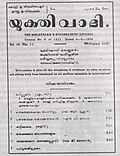
[[File:YUKTHIVADI.JPG|thumb|150px|The ''[[Yukthivadi]]'' in 1929 was the first [[atheist]]/[[rationalist]] magazine published in [[Malayalam]].]] | [[File:YUKTHIVADI.JPG|thumb|150px|The ''[[Yukthivadi]]'' in 1929 was the first [[atheist]]/[[rationalist]] magazine published in [[Malayalam]].]] | ||
Twentieth century India too experienced multiple spiritualism activism trends which weighed in favor of spirituality over religion and rituals. | Twentieth century India too experienced multiple spiritualism activism trends which weighed in favor of spirituality over religion and rituals.<ref name=":2" /> | ||
[[Periyar E. V. Ramasamy]] (1879–1973) was an atheist and rationalist leader of the [[Self-Respect Movement]] and [[Dravidar Kazhagam]]. | [[Periyar E. V. Ramasamy]] (1879–1973) was an atheist and rationalist leader of the [[Self-Respect Movement]] and [[Dravidar Kazhagam]].<ref name=":2" /> His views on irreligion are based on the eradication of the caste system, thinking religion must be denied to achieve its obliteration. | ||
[[Goparaju Ramachandra Rao]] (1902–1975), better known by his [[Nom-de-guerre|nom de guerre]] "Gora", was a social reformer, anti-caste activist, atheist and disciple of [[Mahatma Gandhi]]. He and his wife, [[Saraswathi Gora]] (1912–2006) who was also an atheist and social reformer, founded the [[Atheist Centre]] in 1940. | [[Goparaju Ramachandra Rao]] (1902–1975), better known by his [[Nom-de-guerre|nom de guerre]] "Gora", was a social reformer, anti-caste activist, atheist and disciple of [[Mahatma Gandhi]]. He and his wife, [[Saraswathi Gora]] (1912–2006) who was also an atheist and social reformer, founded the [[Atheist Centre]] in 1940.<ref name="humanism">{{cite book|author=Wiel Veugelers|title=Education and Humanism: Linking Autonomy and Humanity|url=https://books.google.com/books?id=T_4Wyzz-utoC&pg=PA114|access-date=8 September 2013|date=16 November 2011|publisher=Springer|isbn=978-94-6091-577-2|page=114}}</ref> The Atheist Centre is an institute working for social change.<ref name="Disenchanting India">{{cite book|author=Johannes Quack|title=Disenchanting India: Organized Rationalism and Criticism of Religion in India|url=https://books.google.com/books?id=TNbxUwhS5RUC&pg=PA338|year=2011|publisher=Oxford University Press|isbn=978-0-19-981260-8|pages=89, 338|author-link=Johannes Quack}}</ref> Gora expounded his philosophy of [[positive atheism]] as a way of life.<ref name=humanism/> He later wrote more about positive atheism in his 1972 book, ''Positive Atheism''.<ref name="gorapositive">{{cite book|author=Robyn E. Lebron|title=Searching for Spiritual Unity...Can There Be Common Ground?|url=https://books.google.com/books?id=KILFE33zGngC&pg=PA532|archive-url=https://web.archive.org/web/20131009083814/http://books.google.com/books?id=KILFE33zGngC&pg=PA532|url-status=dead|archive-date=9 October 2013|access-date=8 September 2013|date=January 2012|publisher=CrossBooks|isbn=978-1-4627-1262-5|page=532}}</ref> Gora also organised the first World Atheist Conference in 1972. Subsequently, the Atheist Centre has organised several World Atheist Conferences in [[Vijayawada]] and other locations.<ref name="Disenchanting India"/> | ||
[[Abraham Kovoor]] (10 April 1898 – 18 September 1978) was an Indian professor and rationalist who gained prominence after retirement for his campaign to expose as frauds various Indian and Sri Lankan "god-men" and so-called paranormal phenomena. His direct, trenchant criticism of spiritual frauds and organized religions was enthusiastically received by audiences, initiating a new dynamism in the rationalist movement, especially in Sri Lanka and India. | [[Abraham Kovoor]] (10 April 1898 – 18 September 1978) was an Indian professor and rationalist who gained prominence after retirement for his campaign to expose as frauds various Indian and Sri Lankan "god-men" and so-called paranormal phenomena. His direct, trenchant criticism of spiritual frauds and organized religions was enthusiastically received by audiences, initiating a new dynamism in the rationalist movement, especially in Sri Lanka and India. | ||
[[Jawaharlal Nehru]] (1889–1964), India's first [[Prime Minister of India|Prime Minister]] was a Hindu agnostic and a self-styled [[scientific humanist]]. | [[Jawaharlal Nehru]] (1889–1964), India's first [[Prime Minister of India|Prime Minister]] was a Hindu agnostic and a self-styled [[scientific humanist]].<ref>{{cite book|author=Sankar Ghose|title=Jawaharlal Nehru, a Biography|url=https://books.google.com/books?id=MUeyUhVGIDMC&pg=PA332|year=1993|publisher=Allied Publishers|isbn=978-81-7023-369-5|page=332}}</ref> He wrote in his [[autobiography]], ''[[Toward Freedom]]'' (1936), about his views on religion and superstition.<ref name="voices">{{cite book|author=Dale McGowan|title=Voices of Unbelief: Documents from Atheists and Agnostics|url=https://books.google.com/books?id=wWWU32YNq4UC&pg=PA139|year=2012|publisher=ABC-CLIO|isbn=978-1-59884-978-3|page=139}}</ref> | ||
[[Meghnad Saha]] (1893–1956) was an atheist [[astrophysicist]] best known for his development of the [[Saha equation]], used to describe chemical and physical conditions in stars. | [[Meghnad Saha]] (1893–1956) was an atheist [[astrophysicist]] best known for his development of the [[Saha equation]], used to describe chemical and physical conditions in stars. | ||
[[Bhagat Singh]] (1907–1931), an Indian revolutionary and socialist nationalist who was hanged for using violence against British government officials, was a staunch atheist. He laid out his views in the essay "[[Why I Am an Atheist]]", written in jail shortly before his execution. | [[Bhagat Singh]] (1907–1931), an Indian revolutionary and socialist nationalist who was hanged for using violence against British government officials, was a staunch atheist. He laid out his views in the essay "[[Why I Am an Atheist]]", written in jail shortly before his execution.<ref>{{cite web|url=https://scroll.in/article/715660/on-bhagat-singhs-death-anniversary-why-i-am-an-atheist|title=On Bhagat Singh's death anniversary: 'Why I am an atheist'|date=23 March 2015 }}</ref> | ||
[[Vinayak Damodar Savarkar]] (1883–1966) was an eminent [[Hindu nationalism|Hindu nationalist]] leader of the [[Indian independence movement]]. He was also an atheist and a staunch [[rationalist]] | [[Vinayak Damodar Savarkar]] (1883–1966) was an eminent [[Hindu nationalism|Hindu nationalist]] leader of the [[Indian independence movement]]. He was also an atheist and a staunch [[rationalist]]<ref>{{Cite book|title = Towards Understanding Communalism|url = https://books.google.com/books?id=8_RtAAAAMAAJ|publisher = Centre for Research in Rural and Industrial Development|date = 1992-01-01|isbn = 9788185835174|first = Pramod|last = Kumar}}</ref> who disapproved of orthodox [[Hindu]] belief, dismissing [[Cattle in religion|cow worship]] as superstitious.<ref>{{Cite news|title = The man who thought Gandhi a sissy|url = https://www.economist.com/news/christmas-specials/21636599-controversial-mentor-hindu-right-man-who-thought-gandhi-sissy|newspaper = The Economist|access-date = 2016-01-23|issn = 0013-0613}}</ref> Being Hindu, for him, was a cultural and political identity. | ||
[[Joseph Edamaruku]] (7 September 1934 – 29 June 2006), popularly identified by his surname Edamaruku, was a journalist and rationalist from Kerala. He was the Delhi Bureau chief of the Malayalam magazine Keralasabdam for more than twenty years, and the founder-editor of Therali, a rationalist periodical in Malayalam. | [[Joseph Edamaruku]] (7 September 1934 – 29 June 2006), popularly identified by his surname Edamaruku, was a journalist and rationalist from Kerala. He was the Delhi Bureau chief of the Malayalam magazine Keralasabdam for more than twenty years, and the founder-editor of Therali, a rationalist periodical in Malayalam.<ref name="Founder">{{cite web |last1=Pande |first1=SK |title=Debiprasad Chattopadhyaya: A Centenary Salute to Multifaceted Philosopher |url=https://www.newsclick.in/debiprasad-chattopadhyaya-centenary-salute-multifaceted-philosopher |website=Newsclick |date=5 November 2018 |access-date=23 August 2020 |archive-url=https://web.archive.org/web/20181106152418/https://www.newsclick.in/debiprasad-chattopadhyaya-centenary-salute-multifaceted-philosopher |archive-date=6 November 2018}}</ref> He was president of the [[Indian Rationalist Association]] from 1995 to 2005.<ref name="Rationalist">{{cite web |title=Noted rationalist Edamaruku passes away |url=https://www.dnaindia.com/india/report-noted-rationalist-edamaruku-passes-away-1038420 |website=DNA India |publisher=Diligent Media Corporation |access-date=17 August 2020 |archive-url=https://web.archive.org/web/20200817065027if_/https://www.dnaindia.com/web/20200817065027oe_/https://www.dnaindia.com/india/report-noted-rationalist-edamaruku-passes-away-1038420 |archive-date=17 August 2020}}</ref> | ||
[[Khushwant Singh]] (1915–2014), a prominent and prolific writer of Sikh extraction, was avowedly non-religious. | [[Khushwant Singh]] (1915–2014), a prominent and prolific writer of Sikh extraction, was avowedly non-religious. | ||
Founded in 1984 [[Tarksheel Society]] (Rationalist Society) is a [[rationalist]] group based in [[Punjab (India)|Punjab]], [[India]]. | Founded in 1984 [[Tarksheel Society]] (Rationalist Society) is a [[rationalist]] group based in [[Punjab (India)|Punjab]], [[India]].<ref name=":2" /><ref name=":32">{{Cite web |last=Torgalkar |first=Varsha |date=2022-05-17 |title=In India, Hindu nationalists embolden challenges to atheism |url=https://religionnews.com/2022/05/17/in-india-hindu-nationalists-embolden-challenges-to-atheism/ |access-date=2023-10-15 |website=Religion News Service |language=en-US}}</ref> | ||
[[Maharashtra Andhashraddha Nirmoolan Samiti|Maharashtra Andhashraddha Nirmulan Samiti]] ( Committee for Eradication of Blind Faith, CEBF) is an organisation dedicated to fighting [[superstition in India]], particularly in the state of [[Maharashtra]]. It was founded by [[Narendra Dabholkar]] in 1989. | [[Maharashtra Andhashraddha Nirmoolan Samiti|Maharashtra Andhashraddha Nirmulan Samiti]] ( Committee for Eradication of Blind Faith, CEBF) is an organisation dedicated to fighting [[superstition in India]], particularly in the state of [[Maharashtra]]. It was founded by [[Narendra Dabholkar]] in 1989.<ref name="not against">{{cite news |last=Kakodkar |first=Priyanka |date=21 August 2013 |title=He was not against God but fought exploitation |newspaper=[[The Hindu]] |url=http://www.thehindu.com/news/national/he-was-not-against-god-but-fought-exploitation/article5042507.ece?ref=relatedNews |accessdate=23 October 2013}}</ref> | ||
In 1997, the [[Federation of Indian Rationalist Associations]] was founded. | In 1997, the [[Federation of Indian Rationalist Associations]] was founded.<ref name=atheism_voice>{{cite news|title=In India, atheism finds its voice|url=http://www.dnaindia.com/mumbai/1197562/report-in-india-atheism-finds-its-voice|access-date=5 September 2013|newspaper=DNA India|date=13 October 2008}}</ref> | ||
====21st century==== | ====21st century==== | ||
| Line 98: | Line 98: | ||
[[File:Ex Muslims of Kerala.jpg|thumb|Ex Muslims of Kerala logo depicting coconut tree and pens representing [[Kerala]] and knowledge, counter to [[Saudi Arabia]]'s logo of palm tree with swords]] | [[File:Ex Muslims of Kerala.jpg|thumb|Ex Muslims of Kerala logo depicting coconut tree and pens representing [[Kerala]] and knowledge, counter to [[Saudi Arabia]]'s logo of palm tree with swords]] | ||
[[File:EA Jabbar with ex Muslims Arif Hussain Theruvath (President, Non-Religious Citizens) and Liyakkathali CM (President ex-Muslims of Kerala).jpg|thumb|EA Jabbar with ex Muslims [[Arif Hussain Theruvath]] (President, Non-Religious Citizens) and [[Liyakkathali C. M.]] (President ex-Muslims of Kerala)]] | [[File:EA Jabbar with ex Muslims Arif Hussain Theruvath (President, Non-Religious Citizens) and Liyakkathali CM (President ex-Muslims of Kerala).jpg|thumb|EA Jabbar with ex Muslims [[Arif Hussain Theruvath]] (President, Non-Religious Citizens) and [[Liyakkathali C. M.]] (President ex-Muslims of Kerala)]] | ||
[[Amartya Sen]] (born 1933), an Indian [[economist]], philosopher and [[List of Nobel laureates|Nobel laureate]], is an atheist | [[Amartya Sen]] (born 1933), an Indian [[economist]], philosopher and [[List of Nobel laureates|Nobel laureate]], is an atheist<ref>{{Cite web|title = The Arguing Indian|url = http://alumni.berkeley.edu/california-magazine/july-august-2006-indo-chic/arguing-indian|website = Cal Alumni Association|access-date = 2016-01-23|date = 22 January 2010}}</ref> and he holds that this can be associated with one of the [[Atheism in Hinduism|atheist schools]] in [[Hinduism]], the [[Charvaka|Lokayata]].<ref>{{Cite news|title = A World Not Neatly Divided|url = https://www.nytimes.com/2001/11/23/opinion/a-world-not-neatly-divided.html|newspaper = The New York Times|date = 2001-11-23|access-date = 2016-01-23|issn = 0362-4331|first = Amartya|last = Sen}}</ref><ref>{{Cite web|title = News & Broadcast – Amartya Sen Speaks on Culture at World Bank|url = http://web.worldbank.org/WBSITE/EXTERNAL/NEWS/0,,contentMDK:20045541~pagePK:64257043~piPK:437376~theSitePK:4607,00.html|website = web.worldbank.org|access-date = 2016-01-23}}</ref><ref>{{Cite web|title = Rediff on the NeT Business News: Market economy not the panacea, says Sen|url = http://www.rediff.com/business/1998/dec/28sen.htm|website = rediff.com|access-date = 2016-01-23}}</ref> | ||
[[Maharashtra Rationalist Association|Sunday Sapiens]], the successor of Maharashtra Rationalist Association, | [[Maharashtra Rationalist Association|Sunday Sapiens]], the successor of Maharashtra Rationalist Association,<ref>{{cite book|last=Quack|first=Johannes|date= 2012|title=Disenchanting India: Organized Rationalism and Criticism of Religion in India|url=http://www.oxfordscholarship.com/view/10.1093/acprof:oso/9780199812608.001.0001/acprof-9780199812608-chapter-10|publisher=Oxford University Press|pages=101–106|isbn=9780199812608}} | ||
</ref> is actively involved in developing scientific temper and eradicating superstition. | |||
In 2008, the website Nirmukta was founded. It later became an organisation aiming to promote [[free thought]] and [[secular humanism]] in India. | In 2008, the website Nirmukta was founded. It later became an organisation aiming to promote [[free thought]] and [[secular humanism]] in India.<ref name="milliongods" /> | ||
In 2009, historian [[Meera Nanda]] published a book entitled ''The God Market''. It examines how Hindu religiosity is gaining more popularity among the rising [[middle class]], as India is liberalising the economy and adopting [[globalisation]]. | In 2009, historian [[Meera Nanda]] published a book entitled ''The God Market''. It examines how Hindu religiosity is gaining more popularity among the rising [[middle class]], as India is liberalising the economy and adopting [[globalisation]].<ref name=glitter>{{cite news|title=The Glitter in the Godliness|url=http://www.outlookindia.com/article.aspx?263657|access-date=6 September 2013|newspaper=[[Outlook India]]|author=William Dalrymple|author-link=William Dalrymple (historian)|date=18 January 2010}}</ref> | ||
In March 2009, in [[Kerala]], a [[pastoral letter]] addressing the [[laity]] was issued by the [[Kerala Catholic Bishops' Council]] urging the members to not vote for political parties which advocate atheism. | In March 2009, in [[Kerala]], a [[pastoral letter]] addressing the [[laity]] was issued by the [[Kerala Catholic Bishops' Council]] urging the members to not vote for political parties which advocate atheism.<ref name="don't vote">{{cite news|title=Don't vote for those who preach atheism: Kerala church body|url=http://www.indianexpress.com/news/don-t-vote-for-those-who-preach-atheism-kerala-church-body/438276/|access-date=2 October 2013|newspaper=[[The Indian Express]]|date=24 March 2009}}</ref><ref name="don't vote2">{{cite news|title=Kerala Church makes a poll sermon|url=http://www.thehindubusinessline.com/todays-paper/tp-others/tp-states/kerala-church-makes-a-poll-sermon/article1049087.ece?ref=archive|access-date=2 October 2013|newspaper=[[Hindu Business Line]]|date=12 April 2009}}</ref> In July 2010, another similar letter was issued.<ref name="don't vote 2010">{{cite news|title=Church blow to 'atheist' parties|url=http://www.telegraphindia.com/1100726/jsp/nation/story_12726907.jsp|archive-url=https://web.archive.org/web/20100731095411/http://www.telegraphindia.com/1100726/jsp/nation/story_12726907.jsp|url-status=dead|archive-date=31 July 2010|access-date=2 October 2013|newspaper=[[The Telegraph (India)|The Telegraph]]|location=India|date=26 July 2010}}</ref> | ||
On 10 March 2012, [[Sanal Edamaruku]] investigated a so-called miracle in [[Vile Parle]], where a [[Jesus]] statue had started weeping and concluded that the problem was caused by faulty drainage. Later that day, during a TV discussion with some church members, Edamaruku accused the [[Catholic Church]] of miracle-mongering. On 10 April, Angelo Fernandes, President of the Maharashtra Christian Youth Forum, filed a police complaint against Edamaruku under the [[Hate speech laws in India|Indian Penal Code Section 295A]]. | On 10 March 2012, [[Sanal Edamaruku]] investigated a so-called miracle in [[Vile Parle]], where a [[Jesus]] statue had started weeping and concluded that the problem was caused by faulty drainage. Later that day, during a TV discussion with some church members, Edamaruku accused the [[Catholic Church]] of miracle-mongering. On 10 April, Angelo Fernandes, President of the Maharashtra Christian Youth Forum, filed a police complaint against Edamaruku under the [[Hate speech laws in India|Indian Penal Code Section 295A]].<ref name=jesus>{{cite news|url=http://www.mumbaimirror.com/article/2/2012041720120417220221187efd41360/FIR-against-rationalist-for-questioning-%E2%80%98miracle%E2%80%99.html|title=FIR against rationalist for questioning 'miracle'|date=17 April 2012|newspaper=Mumbai Mirror|archive-url=https://web.archive.org/web/20120615170321/http://www.mumbaimirror.com/article/2/2012041720120417220221187efd41360/FIR-against-rationalist-for-questioning-%E2%80%98miracle%E2%80%99.html|archive-date=15 June 2012|access-date=5 September 2012}}</ref> In July while on a tour in [[Finland]], Edamaruku was informed by a friend that his house was visited by the police. Since the offence is not [[bail]]able, Edamaruku stayed in Finland.<ref name=jesus2>{{cite news|title=Jesus wept … oh, it's bad plumbing. Indian rationalist targets 'miracles'|url=https://www.theguardian.com/world/2012/nov/23/india-blasphemy-jesus-tears|access-date=6 September 2013|newspaper=The Guardian|date=23 November 2012}}</ref> | ||
On Friday 7 July 2013, the first "Hug an Atheist Day" was organised in India by Nirmukta. The event aimed to spread awareness and reduce the stigma associated with being an atheist. | On Friday 7 July 2013, the first "Hug an Atheist Day" was organised in India by Nirmukta. The event aimed to spread awareness and reduce the stigma associated with being an atheist.<ref name=hug>{{cite news|title=Think free and hug an atheist this Friday|url=http://www.dnaindia.com/mumbai/1844423/report-think-free-and-hug-an-atheist-this-friday|access-date=8 September 2013|newspaper=[[DNA India]]|date=6 June 2013}}</ref><ref name=hug2>{{cite news|url=https://www.newindianexpress.com/?pageNumber=1&parentId=77669&operation=complaint|title=Give the atheist closest to you a hug|access-date=8 September 2013|newspaper=[[The New Indian Express]]|date=6 June 2013}}</ref> | ||
On 20 August 2013, [[Narendra Dabholkar]], a rationalist and anti-superstition campaigner, | On 20 August 2013, [[Narendra Dabholkar]], a rationalist and anti-superstition campaigner,<ref>{{cite web|url=https://indianexpress.com/article/explained/govind-pansare-mm-kalburgi-gauri-lankesh-murder-5316465/|title=Indian rationalism, Charvaka to Narendra Dabholkar|date=21 August 2018|work=[[The Indian Express]]|first=Seema|last=Chishti}}</ref> was shot dead by two unknown assailants, while he was out on a morning walk.<ref name=dabholkar>{{cite news|title=Rationalist Dabholkar shot dead|url=http://www.thehindu.com/news/national/other-states/rationalist-dabholkar-shot-dead/article5041138.ece|access-date=6 September 2013|newspaper=The Hindu|date=20 August 2013}}</ref> | ||
According to [[Sultan Shahin]] of progressive [[New Age Islam]], more Indian Muslims are now questioning their own religion, some consider themselves just [[Cultural Muslims|cultural Muslim]] and some consider themselves even as [[Apostasy in Islam by country#India|ex-Muslims]]. | According to [[Sultan Shahin]] of progressive [[New Age Islam]], more Indian Muslims are now questioning their own religion, some consider themselves just [[Cultural Muslims|cultural Muslim]] and some consider themselves even as [[Apostasy in Islam by country#India|ex-Muslims]].<ref name=":2" /> | ||
Nastik Nation, an organization was started in the year 2015. This organisation has translated and published the international bestseller, [[God Delusion]] and [[The Greatest Show on Earth: The Evidence for Evolution|The Greatest Show on Earth]] by [[Richard Dawkins]] in many Indian languages. | Nastik Nation, an organization was started in the year 2015. This organisation has translated and published the international bestseller, [[God Delusion]] and [[The Greatest Show on Earth: The Evidence for Evolution|The Greatest Show on Earth]] by [[Richard Dawkins]] in many Indian languages.<ref>{{Cite web|url=https://nastiknation.org/|title=Nastik Nation – Helpline 📞💬 9446808800}}</ref> | ||
On 17 March 2017, H.Farook, an ex-Muslim atheist, was murdered by Muslim radical group in Coimbatore. The murders of Farook joined their close and hidden ex-Muslim organization pretending to be ex-Muslims who has understood the hollow falsehood of Islam and Quran. Later one day they called Farook saying that one of their bikes was out of petrol and needed him to come with some. They attacked in a group and murdered him. It is reported that the group involved practiced thefts and plundering at night and distributed a share of it to the nearby slums like what Mohammed had done in sixth century. | On 17 March 2017, H.Farook, an ex-Muslim atheist, was murdered by Muslim radical group in Coimbatore. The murders of Farook joined their close and hidden ex-Muslim organization pretending to be ex-Muslims who has understood the hollow falsehood of Islam and Quran. Later one day they called Farook saying that one of their bikes was out of petrol and needed him to come with some. They attacked in a group and murdered him. It is reported that the group involved practiced thefts and plundering at night and distributed a share of it to the nearby slums like what Mohammed had done in sixth century.<ref>{{cite web | url=https://indianexpress.com/article/india/tamil-nadu-youth-h-farook-killed-for-being-an-atheist-father-says-he-too-will-become-one-4586999/ | title=Tamil Nadu youth killed for being an atheist, father says he too will become one | date=27 March 2017 }}</ref> | ||
On 9 January 2021, E.A.Jabbar, freethinker, atheist, and rationalist from [[Kerala]] and Islamic preacher [[M. M. Akbar|M.M. Akbar]] were engaged in a debate on the [[Quran]]. | On 9 January 2021, E.A.Jabbar, freethinker, atheist, and rationalist from [[Kerala]] and Islamic preacher [[M. M. Akbar|M.M. Akbar]] were engaged in a debate on the [[Quran]].<ref>{{cite web | url=https://timesofindia.indiatimes.com/blogs/tracking-indian-communities/to-believe-or-not/ | title=To believe or not? | website=[[The Times of India]] | date=23 January 2021 }}</ref> Both sides claimed to have defeated the other debater even as there was no clear verdict.<ref>{{Cite news|date=29 July 2020|title="Manoj John elected to international rationalist federation (മനോജ് ജോൺ അന്താരാഷ്ട്ര യുക്തിവാദി ഫെഡറേഷനിൽ)". Mathrubhumi Newspaper. 29 July 2020. Retrieved 29 July 2020.|work=Mathrubhumi daily newspaper|url=https://www.mathrubhumi.com/nri/pravasi-bharatham/mumbai/mumbai-news/article-1.4937724|access-date=27 January 2022|archive-date=28 November 2020|archive-url=https://web.archive.org/web/20201128130922/https://www.mathrubhumi.com/nri/pravasi-bharatham/mumbai/mumbai-news/article-1.4937724|url-status=dead}}</ref> | ||
In August 2021, Abdul Khader Puthiyangadi, an [[India]]n citizen and rationalist from [[Kerala]], was arrested by the UAE police in 2021 without bail and sentenced to prison in the UAE for three years for criticizing Islam on social media in his native language [[Malayalam]]. | In August 2021, Abdul Khader Puthiyangadi, an [[India]]n citizen and rationalist from [[Kerala]], was arrested by the UAE police in 2021 without bail and sentenced to prison in the UAE for three years for criticizing Islam on social media in his native language [[Malayalam]].<ref>{{Cite news|url=https://www.thehindu.com/news/national/kerala/release-of-malayali-rationalist-sought/article36551598.ece|title = Release of Malayali rationalist sought|newspaper = The Hindu|date = 19 September 2021}}</ref><ref>{{Cite web|url=https://www.nastiknation.org/news/2021/04/26/freethinker-from-kerala-faces-death-penalty-in-dubai-jail-as-he-is-trapped-into-blasphme-charges/|title=Freethinker from Kerala faces death penalty in Dubai jail as he is trapped into blasphme charges|work=Nastik Nation|date=26 April 2021|access-date=27 December 2022|archive-date=5 December 2022|archive-url=https://web.archive.org/web/20221205122409/https://www.nastiknation.org/news/2021/04/26/freethinker-from-kerala-faces-death-penalty-in-dubai-jail-as-he-is-trapped-into-blasphme-charges/|url-status=dead}}</ref> | ||
On 10 January 2022, ex-Muslim rationalist Aneesh Jasy from Tamil Nadu was arrested without bail over his Facebook posts against Islam. | On 10 January 2022, ex-Muslim rationalist Aneesh Jasy from Tamil Nadu was arrested without bail over his Facebook posts against Islam.<ref>{{cite web | url=https://www.thenewsminute.com/article/ex-muslim-rationalist-aneesh-jasy-arrested-tn-cops-facebook-posts-islam-159662 | title=Ex-Muslim rationalist Aneesh Jasy arrested by TN cops for Facebook posts on Islam | date=9 January 2022 |work=The News Minute |access-date=27 December 2022}}</ref> | ||
===== Rise of ex-Muslims of Kerala ===== | ===== Rise of ex-Muslims of Kerala ===== | ||
In 2021 in [[Kerala]], several [[ex-Muslims]] formed an organisation called ''Ex-Muslims of Kerala''. | In 2021 in [[Kerala]], several [[ex-Muslims]] formed an organisation called ''Ex-Muslims of Kerala''.<ref name=":0">{{Cite web|title=Ex Muslims of Kerala – Rights and dignity for who leave Islam|url=https://exmuslimsofkerala.org/|access-date=27 December 2022}}</ref> It is an organisation founded in 2021 by E. A. Jabbar, Liyakkathali CM, Arif Hussain, and a few others who left Islam in Kerala.<ref name=":0"/> The organisation gives support to those who left Islam, a minority that is facing persecution from the Islamic community because of their leaving.<ref name=":1">{{Cite web|title=Ex-Muslim organisation gathers steam in Kerala|url=https://keralakaumudi.com/en/news/news.php?id=725045&u=|work=Kerala Kaumudi|date=8 January 2022|access-date=27 December 2022}}</ref> The organisation conducts debates with Islamic scholars and fundamentalists on various topics.<ref name=":0"/> Ex-Muslims of Kerala observe 9 January as ex-Muslim day as the remembrance of E. A. Jabbar's debate with Islamic preacher [[M. M. Akbar]], by conducting seminars on atheism and Islam.<ref name=":1"/> | ||
===== Liyakkathali–Rahul Easwar debate - Slavery in Islam ===== | ===== Liyakkathali–Rahul Easwar debate - Slavery in Islam ===== | ||
| Line 134: | Line 134: | ||
In August 2025, a controversy arose over organizing a debate on slavery in Islam between members of the Ex-Muslim community and Islamic groups in Kerala. Members of the Ex-Muslim collective, including Liyakkathali C. M., were initially challenged by Abdullah Basil of the Wisdom Islamic Group (associated with Salafi–Wahhabi circles) to participate in such a debate. Arif Hussain expressed willingness to debate, but only in a public setting, while Basil’s team proposed holding the discussion exclusively on their own online platforms. Liyakkathali rejected an online debate, arguing that moderation would not be neutral, and instead suggested a neutral studio. The Wisdom group, however, insisted on their own studio in Pullikkal, Malappuram, leading to a stalemate. Liyakkathali had openly invited and challenged Islamic preachers in Kerala to participate, none came forward, reportedly out of concern that such a public debate might encourage more individuals to leave Islam | In August 2025, a controversy arose over organizing a debate on slavery in Islam between members of the Ex-Muslim community and Islamic groups in Kerala. Members of the Ex-Muslim collective, including Liyakkathali C. M., were initially challenged by Abdullah Basil of the Wisdom Islamic Group (associated with Salafi–Wahhabi circles) to participate in such a debate. Arif Hussain expressed willingness to debate, but only in a public setting, while Basil’s team proposed holding the discussion exclusively on their own online platforms. Liyakkathali rejected an online debate, arguing that moderation would not be neutral, and instead suggested a neutral studio. The Wisdom group, however, insisted on their own studio in Pullikkal, Malappuram, leading to a stalemate. Liyakkathali had openly invited and challenged Islamic preachers in Kerala to participate, none came forward, reportedly out of concern that such a public debate might encourage more individuals to leave Islam | ||
To ensure the debate took place, Liyakkathali eventually invited Indian public intellectual and activist [[Rahul Easwar]], who was already engaged in discussions on jihad and Islamic apologetics. On 23 August 2025, a public debate between Liyakkathali and Rahul Easwar was held at the Wagon Tragedy Memorial Town Hall in Tirur, [[Malappuram]] district, Kerala on the topic on Slavery in Islam. | To ensure the debate took place, Liyakkathali eventually invited Indian public intellectual and activist [[Rahul Easwar]], who was already engaged in discussions on jihad and Islamic apologetics. On 23 August 2025, a public debate between Liyakkathali and Rahul Easwar was held at the Wagon Tragedy Memorial Town Hall in Tirur, [[Malappuram]] district, Kerala on the topic on Slavery in Islam.<ref>{{cite news |title=Debate on slavery in Islam held in Tirur |newspaper=Malayala Manorama |location=Malappuram |date=24 August 2025 |language=ml}}</ref> | ||
== Legal status, rights and laws == | == Legal status, rights and laws == | ||
{{See also|Fundamental Rights, Directive Principles and Fundamental Duties of India}} | {{See also|Fundamental Rights, Directive Principles and Fundamental Duties of India}} | ||
Atheism and irreligion not officially recognised in India.{{discuss}} [[Apostasy]] is allowed under the right to [[Freedom of religion in India|freedom of religion]] in the [[Constitution of India|Constitution]]. | Atheism and irreligion not officially recognised in India.{{discuss}} [[Apostasy]] is allowed under the right to [[Freedom of religion in India|freedom of religion]] in the [[Constitution of India|Constitution]].<ref name="milliongods" /> According to advocate Asim Sarode, along with constitutional freedom religion and conscience, freedom of expression helps protect atheists in India.<ref name=":32"/> Sarode says, Article 51A (h) of Indian constitution expects all Indian citizens a duty to inculcate “scientific temper, humanism and spirit of inquiry and reform.”<ref name=":32"/> The [[Special Marriage Act, 1954]] allows the marriage of people with no religious beliefs, as well as non-religious and non-ritualistic marriages. However, there are no specific laws catering to atheists and they are considered as belonging to the religion of their birth for administrative purposes.<ref name=milliongods>{{cite news|title=Indian atheists seek recognition in the land of a million gods|url=https://timesofindia.indiatimes.com/home/science/Indian-atheists-seek-recognition-in-the-land-of-a-million-gods/articleshow/14527853.cms|archive-url=https://web.archive.org/web/20130724083120/http://articles.timesofindia.indiatimes.com/2012-06-30/science/32483706_1_atheists-religion-beliefs|url-status=live|archive-date=24 July 2013|access-date=5 September 2013|newspaper=[[The Times of India]]|date=30 June 2012}}</ref> The box in which the 'caste' and 'religion' are to be filled is still present in a lot of forms. Some of these boxes on forms are also compulsory, and one does not always have the option of leaving them empty. The closest option one gets is 'Choose not to say' or 'Other' as an answer to these boxes.<ref name="news18.com">{{Cite web |date=2019-02-16 |title=Tamil Nadu Woman Becomes First Indian To Get 'No Caste, No Religion' Certificate After 9-Year-Long Battle |url=https://www.news18.com/news/buzz/no-caste-no-religion-tamil-nadu-woman-becomes-first-indian-to-get-certificate-after-9-year-old-battle-2038463.html |first=Raka |last=Mukherjee |access-date=2022-05-12 |website=News18 |language=en}}</ref> | ||
Ravi Kumar, an atheist from [[Haryana]] is another person who is struggling and fighting to be officially and legally irreligious and caste-less in India. He went to court to declare him officially atheist and he got one certificate in which it was mentioned that he had "No Caste, No Religion, & No God". Later, Justice Tejinder Singh Dhindsa of the Punjab and Haryana High Court said they had exceeded their authority and asked him to return the certificate; he refused to do so. The Fatehabad district authorities who issued the certificate withdrew it in April 2019. Kumar plans to continue his quest to be officially declared an atheist. | Ravi Kumar, an atheist from [[Haryana]] is another person who is struggling and fighting to be officially and legally irreligious and caste-less in India. He went to court to declare him officially atheist and he got one certificate in which it was mentioned that he had "No Caste, No Religion, & No God". Later, Justice Tejinder Singh Dhindsa of the Punjab and Haryana High Court said they had exceeded their authority and asked him to return the certificate; he refused to do so. The Fatehabad district authorities who issued the certificate withdrew it in April 2019. Kumar plans to continue his quest to be officially declared an atheist.<ref>{{Cite web |date=2019-10-27 |title=The Atheist |url=https://indianexpress.com/article/india/the-atheist-tattoo-religious-belief-god-6089681/ |access-date=2022-05-12 |website=The Indian Express |language=en}}</ref><ref>{{Cite web |date=2019-05-03 |title=Price this Haryana man is paying for turning atheist – no job & social boycott |url=https://theprint.in/india/price-this-haryana-man-is-paying-for-turning-atheist-no-job-social-boycott/230665/ |access-date=2022-05-12 |website=ThePrint |language=en-US}}</ref> | ||
Sneha Parthibaraja, a lawyer from [[Vellore]] was the first citizen in India to get an official 'no religion, no caste' certificate. | Sneha Parthibaraja, a lawyer from [[Vellore]] was the first citizen in India to get an official 'no religion, no caste' certificate.<ref>{{Cite web |date=2021-02-05 |title=Meet Sneha, First Indian To Receive 'No Caste, No Religion' Certificate |url=https://odishabytes.com/meet-sneha-first-indian-to-receive-no-caste-no-religion-certificate/ |access-date=2022-05-12 |website=odishabytes |language=en-US}}</ref> She won this right on 5 February 2019, after a nine-year court battle.<ref>{{Cite web |title=Meet country's first woman to be legally 'caste, religion-less' citizen – M.A. Sneha: A caste and religion less person |url=https://economictimes.indiatimes.com/news/politics-and-nation/meet-countrys-first-woman-to-be-legally-caste-religion-less-citizen/m-a-sneha-a-caste-and-religion-less-person/slideshow/68164541.cms |access-date=2022-05-12 |website=The Economic Times}}</ref><ref name="news18.com"/> Indian actor [[Kamal Haasan]], who is known for his atheism, congratulated her on Twitter for this achievement.<ref name="news18.com"/> | ||
===Hate speech laws and irreligion=== | ===Hate speech laws and irreligion=== | ||
| Line 149: | Line 149: | ||
===Notable verdicts=== | ===Notable verdicts=== | ||
On 29 October 2013, the [[Bombay High Court]] judged in favour of an atheist school teacher from [[Nashik]]. | On 29 October 2013, the [[Bombay High Court]] judged in favour of an atheist school teacher from [[Nashik]].<ref name="atheist teacher">{{cite news|title=Teacher cannot be forced to fold hands in school prayers: Bombay high court|url=http://timesofindia.indiatimes.com/india/Teacher-cannot-be-forced-to-fold-hands-in-school-prayers-Bombay-high-court/articleshow/25137023.cms|access-date=4 November 2013|newspaper=[[The Times of India]]|date=2 November 2013}}</ref> Sanjay Salve had been employed by the state-funded Savitribai Phule Secondary School since 1996. In June 2007, during a prayer session, Salve did not fold his hands during the pledge or prayer. The school management called this indiscipline and refused him a higher pay grade in 2008 when Salve became eligible for it. Salve sought legal recourse citing the article 28 (a) of the Constitution which states "no person attending any educational institution recognised by the State or receiving aid out of State funds shall be required to take part in any religious instruction that may be imparted in such institution or to attend any religious worship that may be conducted in such institution".<ref>{{cite law|title=Constitution of India, Section 28 (a)|date=1950}}</ref><ref name="what wrong">{{cite news|title=Pray, what wrong did I do, asks atheist teacher|url=http://www.thehindu.com/news/national/pray-what-wrong-did-i-do-asks-atheist-teacher/article5080102.ece?ref=relatedNews|access-date=4 November 2013|newspaper=[[The Hindu]]|date=20 September 2013}}</ref> The court ruled in Salve's favour and directed the school to release his dues by 31 January 2014.<ref name="answers prayers">{{cite news|title=Bombay High Court answers atheist teacher's prayer; asks school to pay dues|url=http://www.dnaindia.com/mumbai/report-bombay-high-court-answers-atheist-teacher-s-prayer-asks-school-to-pay-dues-1911611|access-date=4 November 2013|newspaper=[[DNA India]]|date=31 October 2013}}</ref> | ||
On 23 September 2014, the [[Bombay High Court]] declared that the government cannot force a person to state a religion on any document or form. The court also stated any citizen has the right to declare that he/she does not belong to any religion. The decision came in response to a [[Public Interest Litigation]] (PIL) filed by Ranjit Mohite, Kishore Nazare and Subhash Ranware, representing an organisation called Full Gospel Church of God, after the Maharashtra state printing press refused to issue them a gazette notification stating that they belonged to no religion. The petitioners stated that the organisation had 4000 members, and that they believe in [[Jesus Christ]] but they do not follow [[Christianity]] or any religion. Responding to the petition, the Maharashtra and the central governments had stated that "no religion" cannot be treated as a religion on official forms. The court cited the Article 25 of the Constitution, which guarantees right to freedom of conscience, while passing the verdict. | On 23 September 2014, the [[Bombay High Court]] declared that the government cannot force a person to state a religion on any document or form. The court also stated any citizen has the right to declare that he/she does not belong to any religion. The decision came in response to a [[Public Interest Litigation]] (PIL) filed by Ranjit Mohite, Kishore Nazare and Subhash Ranware, representing an organisation called Full Gospel Church of God, after the Maharashtra state printing press refused to issue them a gazette notification stating that they belonged to no religion. The petitioners stated that the organisation had 4000 members, and that they believe in [[Jesus Christ]] but they do not follow [[Christianity]] or any religion. Responding to the petition, the Maharashtra and the central governments had stated that "no religion" cannot be treated as a religion on official forms. The court cited the Article 25 of the Constitution, which guarantees right to freedom of conscience, while passing the verdict.<ref name=no_religion_BHC>{{cite news|title=Citizen can declare that he does not belong to any religion: Bombay High Court|url=https://www.indiatoday.in/india/west/story/citizen-can-declare-that-he-does-not-belong-to-any-religion-bombay-high-court-300977-2014-09-26|access-date=26 November 2014|work=[[India Today]]|date=26 September 2014}}</ref><ref name=BHC_religion>{{cite news|title=Citizen can declare that he does not belong to any religion: Bombay High Court|url=http://indianexpress.com/article/cities/mumbai/citizen-can-declare-that-he-does-not-belong-to-any-religion-bombay-high-court/|access-date=26 November 2014|work=[[The Indian Express]]|date=24 September 2014}}</ref> | ||
==Persecution and attacks== | ==Persecution and attacks== | ||
{{see also|Discrimination against atheists}} | {{see also|Discrimination against atheists}} | ||
According to Jaswant Zirakh of the [[Tarksheel Society]], Indians are usually comfortable with atheist concepts, but usually it involves popular religious leadership and [[Godman (India)|godmen]] tending to attack atheism since they tend to worry about losing their power and income. | According to Jaswant Zirakh of the [[Tarksheel Society]], Indians are usually comfortable with atheist concepts, but usually it involves popular religious leadership and [[Godman (India)|godmen]] tending to attack atheism since they tend to worry about losing their power and income.<ref name=":32"/> Among the Indian Muslim communities, atheists worry of backlash, they and their families may face social boycott and ostracism including stopping them in participation of funerary rites of their dear ones.<ref name=":32"/> | ||
[[Narendra Nayak]], an advocate of atheism, has claimed to have been attacked three times and had his scooter damaged twice, with one of the attacks leaving him with head injuries. This compelled him to take self-defence lessons and carry a [[nunchaku]]. | [[Narendra Nayak]], an advocate of atheism, has claimed to have been attacked three times and had his scooter damaged twice, with one of the attacks leaving him with head injuries. This compelled him to take self-defence lessons and carry a [[nunchaku]].<ref name="nunchaku1">{{cite news|title=Rationalists fight superstition with dignity and nunchakus|url=https://timesofindia.indiatimes.com/city/bangalore/Rationalists-fight-superstition-with-dignity-and-nunchakus/articleshow/21969422.cms|archive-url=https://web.archive.org/web/20130825075441/http://articles.timesofindia.indiatimes.com/2013-08-22/bangalore/41435861_1_karnataka-superstition-karate|url-status=live|archive-date=25 August 2013|access-date=6 September 2013|newspaper=[[The Times of India]]|date=22 August 2013}}</ref> [[Tarksheel Society|Megh Raj Mitter]]'s house was surrounded by a mob after he debunked the [[Hindu milk miracle]], forcing him to call the police.<ref name="Twilight">{{cite news|title=Confrontation in the Twilight zone|url=http://www.business-standard.com/article/beyond-business/confrontation-in-the-twilight-zone-113083001107_1.html|access-date=5 September 2013|newspaper=Business Standard|date=30 August 2013}}</ref> | ||
On 15 March 2007, a bounty of {{INRConvert|700|k|lk=r|year=2007}} was announced on atheist | On 15 March 2007, a bounty of {{INRConvert|700|k|lk=r|year=2007}} was announced on atheist<ref name=Theocracy>{{cite news|title=Taslima on IBNLive chat: 'India is not a theocracy'|url=http://ibnlive.in.com/news/taslima-on-ibnlive-chat-india-is-not-a-theocracy/56692-7-9.html|archive-url=https://archive.today/20141215113951/http://ibnlive.in.com/news/taslima-on-ibnlive-chat-india-is-not-a-theocracy/56692-7-9.html|url-status=dead|archive-date=15 December 2014|access-date=15 December 2014|work=[[IBNLive]]|date=18 January 2008}}</ref> [[Bangladesh]]i author [[Taslima Nasrin]], while living in India, by a [[Muslim]] cleric named Maulana Tauqeer Raza Khan for allegedly writing derogatory statements about Muhammad in her work.<ref name=TaslimaHead>{{cite news|title=Muslim body announces Rs 5 lakh for Taslima's head|url=http://www.dnaindia.com/india/report-muslim-body-announces-rs-5-lakh-for-taslimas-head-1085098|access-date=15 December 2014|work=[[DNA India]]|date=15 March 2007}}</ref> In December 2013, an [[First Information Report|FIR]] was filed against Nasrin in [[Bareilly]] by a cleric named Hasan Raza Khan, for hurting religious sentiments. Nasrin had allegedly tweeted on [[Twitter]] that "In India, criminals who issue [[fatwa]]s against women don't get punished." Raza Khan said that by accusing clerics of being criminals, Nasrin had hurt religious sentiments.<ref name=AntiFatwaTweet>{{cite news|title=Cleric files FIR against Taslima Nasreen's anti-fatwa tweet|url=http://timesofindia.indiatimes.com/india/Cleric-files-FIR-against-Taslima-Nasreens-anti-fatwa-tweet/articleshow/26925330.cms|access-date=15 December 2014|work=[[The Times of India]]|date=6 December 2013}}</ref> | ||
On 2 July 2011, the house of U. Kalanathan, secretary of the [[Kerala Yukthivadi Sangham]], was attacked in [[Vallikunnu]] after he suggested on television that the temple treasures of [[Padmanabhaswamy Temple]] should be used for public welfare. | On 2 July 2011, the house of U. Kalanathan, secretary of the [[Kerala Yukthivadi Sangham]], was attacked in [[Vallikunnu]] after he suggested on television that the temple treasures of [[Padmanabhaswamy Temple]] should be used for public welfare.<ref name=kalanathan>{{cite news|title=Rationalist leader's house attacked|url=http://www.thehindu.com/todays-paper/tp-national/tp-kerala/rationalist-leaders-house-attacked/article2157439.ece|access-date=23 October 2013|newspaper=[[The Hindu]]|date=4 July 2011}}</ref> | ||
On 16 February 2015, rationalist [[Govind Pansare]] and his wife were attacked by unknown gunmen. He later died from the wounds on 20 February. | On 16 February 2015, rationalist [[Govind Pansare]] and his wife were attacked by unknown gunmen. He later died from the wounds on 20 February.<ref name=Pansare>{{cite news|title=Rationalist Pansare is dead|url=http://www.deccanherald.com/content/461081/rationalist-pansare-dead.html|access-date=5 October 2015|work=[[Deccan Herald]]|date=21 February 2015}}</ref> On 30 August 2015, [[M. M. Kalburgi]], a scholar and rationalist, was shot dead at his home. He was known for his criticism of superstition and idol worship.<ref name=Kalburgi>{{cite news|title=Rationalist Kalburgi Shot Dead in Dharwad|url=http://www.newindianexpress.com/states/karnataka/Rationalist-Kalburgi-Shot-Dead-in-Dharwad/2015/08/31/article3002639.ece|archive-url=https://web.archive.org/web/20150831003935/http://www.newindianexpress.com/states/karnataka/Rationalist-Kalburgi-Shot-Dead-in-Dharwad/2015/08/31/article3002639.ece|url-status=dead|archive-date=31 August 2015|access-date=5 October 2015|work=[[The New Indian Express]]|date=31 August 2015}}</ref><ref name=Time-kalburgi>{{cite magazine|title=Indian Scholar Who Spoke Out Against Idol Worship Is Shot Dead|url=https://time.com/4016747/mm-kalburgi-india-murder-rationalist-idol-worship-hindu-nationalism/|access-date=5 October 2015|magazine=[[Time (magazine)|Time]]|date=31 August 2015}}</ref> Soon afterwards, another rationalist and author, [[K. S. Bhagwan]], received a threatening letter. He had offended religious groups by criticizing the [[Gita|Bhagavad Gita]].<ref name=BhagwanWriter>{{cite news|title=Writer Bhagwan receives threat letter|url=http://www.thehindu.com/news/national/karnataka/writer-bhagwan-receives-threat-letter/article7635331.ece|access-date=5 October 2015|work=[[The Hindu]]|date=10 September 2015}}</ref><ref name=ThreatLetter>{{cite news|title=In Karnataka, Another Writer Gets Threat Letter After Scholar MM Kalburgi's Murder|url=http://www.ndtv.com/karnataka-news/after-mm-kalburgis-murder-writer-ks-bhagwan-receives-threat-letter-1215955|access-date=5 October 2015|work=[[NDTV]]|date=10 September 2015}}</ref> | ||
==Demographics== | ==Demographics== | ||
===Indian government census=== | ===Indian government census=== | ||
The Indian census does not explicitly count atheists. | The Indian census does not explicitly count atheists.<ref name="secularism">{{cite book|author=Phil Zuckerman|title=Atheism and Secularity|chapter-url=https://books.google.com/books?id=Z1hbaAHsAlUC&pg=RA1-PA139|access-date=7 September 2013|date=21 December 2009|publisher=ABC-CLIO|isbn=978-0-313-35182-2|chapter=Chapeter 7: Atheism and Secularity in India}}</ref> In the [[2011 Census of India]], the response form required the respondent to choose from six options under religion. The "Others" option was meant for minor or tribal religions as well as [[atheist]]s and [[agnostic]]s.<ref name=milliongods/> | ||
The religion data from [[2011 Census of India]] was released in August 2015. It revealed that about 2,870,000 people had stated no religion in their response, about 0.27% of the nation's population. | The religion data from [[2011 Census of India]] was released in August 2015. It revealed that about 2,870,000 people had stated no religion in their response, about 0.27% of the nation's population.<ref>{{cite web|url=https://scroll.in/article/753475/people-without-religion-have-risen-in-census-2011-but-atheists-have-nothing-to-cheer-about|title=People without religion have risen in Census 2011, but atheists have nothing to cheer about|work=Scroll.in|first=Shoaib|last=Daniyal|date=7 September 2015|access-date=27 December 2022}}</ref> However, the number included atheists, rationalists and also those who believed in a higher power. [[K. Veeramani]], a [[Dravidar Kazhagam]] leader, said that it was the first time the number of non-religious people was recorded in the census. However, he added that he believed that the number of atheists in India was actually higher as many people do not reveal their atheism out of fear of [[Discrimination against atheists|discrimination]].<ref name=FirstTimeCensus>{{cite news|title=2.87 million Indians have no faith, census reveals for first time|url=http://timesofindia.indiatimes.com/india/2-87-million-Indians-have-no-faith-census-reveals-for-first-time/articleshow/48689278.cms|access-date=10 September 2015|work=[[The Times of India]]|date=27 August 2015}}</ref> | ||
===Different surveys=== | ===Different surveys=== | ||
| Line 176: | Line 176: | ||
====World Values Survey (2006)==== | ====World Values Survey (2006)==== | ||
According to the 2006 [[World Values Survey]], conducted by the Dentsu Communication Institute Inc, Japan Research Center (2006), 6.6% of Indians stated that they had no religion. | According to the 2006 [[World Values Survey]], conducted by the Dentsu Communication Institute Inc, Japan Research Center (2006), 6.6% of Indians stated that they had no religion.<ref name="dentsu">{{cite web|title=World Values Survey (2006) ''English source requested''|url=http://www2.ttcn.ne.jp/~honkawa/9460.html|access-date=5 September 2013|language= ja}}</ref> | ||
====WIN-Gallup Global Index of Religion and Atheism (2005 and 2012)==== | ====WIN-Gallup Global Index of Religion and Atheism (2005 and 2012)==== | ||
According to the 2005 Global Index of Religion and Atheism report from WIN-Gallup, 87% of Indians were religious and 4% called themselves atheists. | According to the 2005 Global Index of Religion and Atheism report from WIN-Gallup, 87% of Indians were religious and 4% called themselves atheists.<ref name=surveyTOI>{{cite news|title=More Indians have stopped believing in God: Survey|url=https://timesofindia.indiatimes.com/world/uk/More-Indians-have-stopped-believing-in-God-Survey/articleshow/20284261.cms|archive-url=https://web.archive.org/web/20130528042059/http://articles.timesofindia.indiatimes.com/2013-05-27/uk/39556084_1_more-indians-dip-4-people|url-status=live|archive-date=28 May 2013|access-date=5 September 2013|newspaper=[[The Times of India]]|date=27 May 2013}}</ref> According to the 2012 report by the same organisation, 81% of Indians were religious, 13% were non-religious, 3% were convinced atheists and 3% were unsure or did not respond.<ref name=gallup2012/> | ||
====Worldviews and Opinions of Scientists in India (2007)==== | ====Worldviews and Opinions of Scientists in India (2007)==== | ||
In 2007, a survey was conducted by the Institute for the Study of Secularism in Society and culture of the [[Trinity College (Connecticut)|Trinity College]] with the help of [[Center for Inquiry]] (India) called 'Worldviews and Opinions of Scientists in India'. 1100 scientists were surveyed from 130 institutes. Most of them identified themselves as [[secular]] (59%) or somewhat secular (16%) but refused to be labelled [[irreligious]]. 83% defined secularism, as it appears in the Indian constitutions, as the separation of state and religion. But, 93% also defined it as tolerance of other religious philosophies. 20% equated secularism to atheism. Only 11% called themselves completely not spiritual. However, 8% reportedly said they would refuse to do [[Stem cell controversy|stem cell research]] based on religious or moral convictions. | In 2007, a survey was conducted by the Institute for the Study of Secularism in Society and culture of the [[Trinity College (Connecticut)|Trinity College]] with the help of [[Center for Inquiry]] (India) called 'Worldviews and Opinions of Scientists in India'. 1100 scientists were surveyed from 130 institutes. Most of them identified themselves as [[secular]] (59%) or somewhat secular (16%) but refused to be labelled [[irreligious]]. 83% defined secularism, as it appears in the Indian constitutions, as the separation of state and religion. But, 93% also defined it as tolerance of other religious philosophies. 20% equated secularism to atheism. Only 11% called themselves completely not spiritual. However, 8% reportedly said they would refuse to do [[Stem cell controversy|stem cell research]] based on religious or moral convictions.<ref name=SecularScientists>{{cite news|title=Indian scientists are secular, but religious: Survey|url=http://computing.in.msn.com/article.aspx?cp-documentid=3207887|access-date=15 December 2014|work=[[MSN]]|date=16 May 2008|archive-url=https://web.archive.org/web/20131006231549/http://computing.in.msn.com/article.aspx?cp-documentid=3207887|archive-date=6 October 2013}}</ref> [[Yagnaswami Sundara Rajan|Y. S. Rajan]] commented on this saying that most Indians do not feel there is a conflict between science and religion.<ref name=trinity>{{cite web|title=Worldviews and Opinions of Scientists India 2007-08|url=http://prog.trincoll.edu/ISSSC/INDIAN_SURVEY_WEBSITE/|publisher=[[Trinity College (Connecticut)|Trinity College]]|access-date=5 September 2013|url-status=dead|archive-url=https://web.archive.org/web/20131006200643/http://prog.trincoll.edu/ISSSC/INDIAN_SURVEY_WEBSITE/|archive-date=6 October 2013}}</ref> Other the hand, Innaiah Narisetti, chairman of Centre for Inquiry (India) and [[Pushpa Mittra Bhargava|Pushpa Bhargava]], the former director of the [[Centre for Cellular and Molecular Biology]], pointed out the lack of [[scientific temper]] among Indian scientists.<ref name=god_scientists>{{cite news|title=God save Indian science|url=http://www.telegraphindia.com/1080610/jsp/nation/story_9389713.jsp|archive-url=https://web.archive.org/web/20080929164252/http://www.telegraphindia.com/1080610/jsp/nation/story_9389713.jsp|url-status=dead|archive-date=29 September 2008|access-date=8 September 2013|newspaper=The Telegraph|location=India|date=10 June 2008}}</ref> | ||
====Religion Among Scientists in an International Context (2014)==== | ====Religion Among Scientists in an International Context (2014)==== | ||
| Line 218: | Line 218: | ||
| 8% | | 8% | ||
|} | |} | ||
The ongoing study has surveyed 1,581 scientists from UK and 1,763 from India. | The ongoing study has surveyed 1,581 scientists from UK and 1,763 from India.<ref name=MoreReligious>{{cite news|title=Indian scientists significantly more religious than UK scientists|url=http://esciencenews.com/articles/2014/09/25/indian.scientists.significantly.more.religious.uk.scientists|access-date=15 December 2014|work=(e)Science News|date=25 September 2014|archive-date=15 December 2014|archive-url=https://web.archive.org/web/20141215082507/http://esciencenews.com/articles/2014/09/25/indian.scientists.significantly.more.religious.uk.scientists|url-status=dead}}</ref> | ||
==== Gallup International Association (2022) ==== | ==== Gallup International Association (2022) ==== | ||
A 2022 [[Gallup International Association]] survey found that 18% of Indians did not believe in God, equating to around two hundred million of the population. | A 2022 [[Gallup International Association]] survey found that 18% of Indians did not believe in God, equating to around two hundred million of the population.<ref name="Anon. w440">{{cite web |date=12 April 2023 |title=More Prone to Believe in God than Identify as Religious. More Likely to Believe in Heaven than in Hell. |url=https://www.gallup-international.com/fileadmin/_processed_/a/5/csm_07_2a498aad84.jpg |archive-url=https://web.archive.org/web/20241123122954/https://www.gallup-international.com/survey-results-and-news/survey-result/more-prone-to-believe-in-god-than-identify-as-religious-more-likely-to-believe-in-heaven-than-in-hell |archive-date=23 November 2024 |access-date= |website=[[Gallup International Association]]}}</ref> | ||
==Notable Indian atheists== | ==Notable Indian atheists== | ||
Latest revision as of 10:46, 22 March 2026
Atheism and agnosticism have a long history in India and flourish within the Śramaṇa movement. Indian religions like Jainism, Hinduism and Buddhism consider atheism to be acceptable.[1][2][3] Doubt has been ingrained even in Indian spiritual culture.[4]
India has produced some notable atheist politicians and social reformers.[5] Around 0.7 million people in India did not state their religion in the 2001 census and were counted in the "religion not stated" category. They constituted 0.06% of India's population. Their number has significantly increased four times, from 0.7 million in the 2001 census to 2.9 million in the 2011 census (0.24% of India's population) at an average annual rate of 15%.[6][7][8] According to the 2012 WIN-Gallup Global Index of Religion and Atheism report, 81% of Indians were religious, 13% were non-religious, 3% were convinced atheists, and 3% were unsure or did not respond,[9] while a demographic study by Cambridge University Press in 2004 found that around 2-6% of Indians identified as atheists or irreligious.[10]
Indian History[edit | edit source]
Ancient India[edit | edit source]
Several śramaṇa movements are known to have existed in India before the 6th century BCE (pre-Buddha, pre-Mahavira), and these influenced both the āstika and nāstika traditions of Indian philosophy.[11][12] Martin Wiltshire says that the Śramaṇa tradition grew in India over two stages: the Paccekabuddha stage was the tradition of the individual ascetic, and the Savaka stage was the tradition of the disciples. Buddhism and Jainism eventually grew out of these two stages as different religions.[13] These traditions drew upon already established Brahmanical concepts, states Wiltshire, to formulate their own doctrines.[13] Reginald Ray concurs that Śramaṇa movements already existed and were established traditions in pre-6th century BCE India, but disagrees with Wiltshire that they were nonsectarian before the arrival of Buddha.[11]
Schools of Philosophy[edit | edit source]
In Indian philosophy, there are six major orthodox (astika) schools of Hindu philosophy—Nyaya, Vaisheshika, Samkhya, Yoga, Mīmāṃsā and Vedanta, and five major heterodox (nāstika) schools of Śramaṇa —Jain, Buddhist, Ajivika, Ajñana, and Cārvāka.[14] The four most studied Nāstika schools, those rejecting the doctrine of Vedas, are Jainism, Buddhism, Cārvāka, and Ājīvika.[15]
Charvaka[edit | edit source]
There is no heaven, no final liberation, nor any soul in another world, Nor do the actions of the four classes, orders, etc., produce any real effect.
The Cārvāka school originated in India around the 6th century BCE.[18] It is classified as a nāstika school. It is noteworthy as evidence of a materialistic movement in ancient India.[19] Followers of this school only accepted pratyakşa (perception) as a valid pramāna (evidence). They considered other pramāna like sabda (testimony), upamāna (analogy), and anumāna (inference) as unreliable.[20] As a result, perception could not support the existence of God or the soul (tman). They also considered everything to be made of four elements: earth, water, air, and fire. The Cārvāka pursued enjoyment of life and the elimination of physical pain. So, they can be considered hedonistic.[21] All of the original Cārvāka texts are considered lost.[22] A much-quoted sūtra (Barhaspatya sutras) by Brhaspati, who is considered the founder of the school, is thought to be lost.[23] The Tattvopaplavasimha by Jayarāśi Bhaṭṭa (8th century CE) and the Sarvadarśanasaṅ̇graha by Madhavacarya (13th century) are considered important secondary Cārvāka texts.[21]
Samkhya[edit | edit source]
Sāṃkhya is an āstika school but has some atheistic elements. Sāṃkhya is a radically dualist philosophy.[24] They believed that the two ontological principles, puruṣa (consciousness) and prakriti (matter), were the underlying foundation of the universe.[24][25] The objective of life is considered to be the separation of pure consciousness from matter (kaivalya).[24] The reasoning within this system led to the Nir-isvara Sāṃkhya (Sāṃkhya without God) philosophy, which deemed the existence of God as unnecessary.[26] There is the opposing reasoning that accepts God, called Sesvara Sankhya (Sāṃkhya with God).[27] Samkhya Karika (c. 350 CE) is the earliest known systematic text of this philosophy.[24]
Mīmāṃsā[edit | edit source]
Mīmāṃsā (meaning exegesis)[24] is also an astika school. They believed the Vedas to be author-less and self-authenticating. They did not accept the Vedas as being composed by any ṛishi (saint), they considered them to not be authored by anyone (apauruṣeya). They accepted the minor deities of the Vedas but resisted any notion of a Supreme Creator. They only concentrated on upholding the ṛta (order) by following the duties of the Vedas. The foundational text of this school is the Mīmāṃsā Sutra by Jaimini (c. 200 BCE – 200 CE).[24]
Ājīvika[edit | edit source]
Ājīvika is yet another nastika school with an atheistic outlook. None of their scriptures survive, and there is some question as to whether or not the accounts of them in secondary sources (often hostile) are accurate. They believed in a naturalistic atomic theory and held that the consequences of natural laws led to a deterministic universe. They denied karma but upheld the atman. They lived in ascetic communities and existed in southern India until at least the 14th century.
Buddhism and Jainism[edit | edit source]
Jainism rejects the idea of a creator deity responsible for the manifestation, creation, or maintenance of this universe. According to Jain doctrine, the universe and its constituents (soul, matter, space, time, and principles of motion) have always existed. Along with this, as 'universal natural laws govern all of the components and actions, an immaterial being like God cannot create a material being like the universe'. Jainism offers an elaborate cosmology, including heavenly beings (devas), but these beings are not viewed as creators; they are subject to suffering and change like all other living beings and must eventually die. Jains define godliness as the inherent quality of any soul characterised by infinite bliss, infinite power, Kevala Jnana (pure infinite knowledge),[28] and perfect peace. However, these qualities of a soul are subdued due to the karmas of the soul. One who achieves this state of soul through right belief, right knowledge and right conduct can be termed a god. This perfection of the soul is called kevalin. A soul thus becomes a liberated soul—liberated of miseries, cycles of rebirth, the world, karmas, and finally of the body as well. This is called moksha.
Gautama Buddha rejected the existence of a creator deity,[29][30] refused to endorse many views on creation,[31] and stated that questions on the origin of the world are not ultimately useful for ending suffering.[32][33] Buddhism instead emphasises the system of causal relationships underlying the universe, pratītyasamutpāda, which constitutes the dhamma and source of enlightenment. No dependence of phenomena on a supernatural reality is asserted in order to explain the behaviour of matter.
Philosophers and ancient texts[edit | edit source]
Ajita Kesakambali was a materialist philosopher. He is mentioned in the Samaññaphala Sutta. He rejected gods, an afterlife and karma.[34] Payasi is a character, referred to as a prince, who appears in the Buddhist text Digha Nikaya in the Payasi Sutta. He did not believe in rebirth or karma. He debated with Kassapa, a disciple of Buddha, and lost according to Buddhist sources.[35][36]
Jabali's speech from the Ramayana[edit | edit source]
In the Hindu epic Ramayana (Ayodhya Khanda), when Bharata goes to the forest to convince Rama to return home, he was accompanied by a sophist[37] called Jabali ("जाबालिः"). Jabali uses nihilistic[38] reasoning to convince Rama. He also says that rituals are a waste of food and scriptures were written by smart men so that people will give alms. Rama then calls him a deviant from the path of dharma ("धरमपथात"), refuses to accept his "nastika" views and blames his own father for taking Jabali into service.[39] He also equates the Buddha to a thief.[39] On hearing Rama's retort, Jabali retracts his statements, saying that he was merely arguing like a nihilist.[38] However, these verses referring to the Buddha[40] are considered a later interpolation, as those verses use a different metre.[40][41]
The Carvaka incident in the Mahabharata[edit | edit source]
A character described as a Carvaka briefly appears in the Mahabharata (in the Shanti Parva). As Yudhishthira enters the city of Hastinapur, a brahmin, referred to as Carvaka, accuses him of killing his own kinsmen and says that he would suffer for it. The accuser is revealed to be a rakshasa in disguise, who was a friend of Duryodhana. He had existed since the Satya Yuga by virtue of a boon from the god Brahma, that he could only be killed when he is showing contempt towards brahmins. He was killed by other brahmins by the chanting of sacred hymns and Yudhishthira was assured that his actions were within the kshatriya code.[42] This event may be a possible denigration of the Carvaka philosophy.[43]
Medieval India[edit | edit source]
In the 9th century CE, Jain philosopher Jinasena wrote the Mahapurana. The book contains the following often quoted words,[44]
Some foolish men declare that a creator made the world. The doctrine that the world was created is ill-advised, and should be rejected. If God created the world, where was he before creation? If you say he was transcendent then, and needed no support, where is he now?
This quote was also featured later in Carl Sagan's book, Cosmos.[45] In the 14th century, philosopher Madhavacarya wrote the Sarva-Darsana-Sangraha, which is a compilation of all Indian philosophies, including Carvaka, which is described in the first chapter.[17]
Modern India[edit | edit source]
19th century[edit | edit source]
Between 1882 and 1888, the Madras Secular Society published a magazine called The Thinker (Tattuvavivesini in Tamil) from Madras. The magazine carried articles written by anonymous writers and republished articles from the journal of the London Secular Society, which the Madras Secular Society considered itself affiliated to.[46]
20th century[edit | edit source]

Twentieth century India too experienced multiple spiritualism activism trends which weighed in favor of spirituality over religion and rituals.[4]
Periyar E. V. Ramasamy (1879–1973) was an atheist and rationalist leader of the Self-Respect Movement and Dravidar Kazhagam.[4] His views on irreligion are based on the eradication of the caste system, thinking religion must be denied to achieve its obliteration.
Goparaju Ramachandra Rao (1902–1975), better known by his nom de guerre "Gora", was a social reformer, anti-caste activist, atheist and disciple of Mahatma Gandhi. He and his wife, Saraswathi Gora (1912–2006) who was also an atheist and social reformer, founded the Atheist Centre in 1940.[47] The Atheist Centre is an institute working for social change.[48] Gora expounded his philosophy of positive atheism as a way of life.[47] He later wrote more about positive atheism in his 1972 book, Positive Atheism.[49] Gora also organised the first World Atheist Conference in 1972. Subsequently, the Atheist Centre has organised several World Atheist Conferences in Vijayawada and other locations.[48]
Abraham Kovoor (10 April 1898 – 18 September 1978) was an Indian professor and rationalist who gained prominence after retirement for his campaign to expose as frauds various Indian and Sri Lankan "god-men" and so-called paranormal phenomena. His direct, trenchant criticism of spiritual frauds and organized religions was enthusiastically received by audiences, initiating a new dynamism in the rationalist movement, especially in Sri Lanka and India.
Jawaharlal Nehru (1889–1964), India's first Prime Minister was a Hindu agnostic and a self-styled scientific humanist.[50] He wrote in his autobiography, Toward Freedom (1936), about his views on religion and superstition.[51]
Meghnad Saha (1893–1956) was an atheist astrophysicist best known for his development of the Saha equation, used to describe chemical and physical conditions in stars.
Bhagat Singh (1907–1931), an Indian revolutionary and socialist nationalist who was hanged for using violence against British government officials, was a staunch atheist. He laid out his views in the essay "Why I Am an Atheist", written in jail shortly before his execution.[52]
Vinayak Damodar Savarkar (1883–1966) was an eminent Hindu nationalist leader of the Indian independence movement. He was also an atheist and a staunch rationalist[53] who disapproved of orthodox Hindu belief, dismissing cow worship as superstitious.[54] Being Hindu, for him, was a cultural and political identity.
Joseph Edamaruku (7 September 1934 – 29 June 2006), popularly identified by his surname Edamaruku, was a journalist and rationalist from Kerala. He was the Delhi Bureau chief of the Malayalam magazine Keralasabdam for more than twenty years, and the founder-editor of Therali, a rationalist periodical in Malayalam.[55] He was president of the Indian Rationalist Association from 1995 to 2005.[56]
Khushwant Singh (1915–2014), a prominent and prolific writer of Sikh extraction, was avowedly non-religious.
Founded in 1984 Tarksheel Society (Rationalist Society) is a rationalist group based in Punjab, India.[4][57]
Maharashtra Andhashraddha Nirmulan Samiti ( Committee for Eradication of Blind Faith, CEBF) is an organisation dedicated to fighting superstition in India, particularly in the state of Maharashtra. It was founded by Narendra Dabholkar in 1989.[58]
In 1997, the Federation of Indian Rationalist Associations was founded.[59]
21st century[edit | edit source]

_and_Liyakkathali_CM_(President_ex-Muslims_of_Kerala).jpg)
Amartya Sen (born 1933), an Indian economist, philosopher and Nobel laureate, is an atheist[60] and he holds that this can be associated with one of the atheist schools in Hinduism, the Lokayata.[61][62][63]
Sunday Sapiens, the successor of Maharashtra Rationalist Association,[64] is actively involved in developing scientific temper and eradicating superstition.
In 2008, the website Nirmukta was founded. It later became an organisation aiming to promote free thought and secular humanism in India.[65]
In 2009, historian Meera Nanda published a book entitled The God Market. It examines how Hindu religiosity is gaining more popularity among the rising middle class, as India is liberalising the economy and adopting globalisation.[66]
In March 2009, in Kerala, a pastoral letter addressing the laity was issued by the Kerala Catholic Bishops' Council urging the members to not vote for political parties which advocate atheism.[67][68] In July 2010, another similar letter was issued.[69]
On 10 March 2012, Sanal Edamaruku investigated a so-called miracle in Vile Parle, where a Jesus statue had started weeping and concluded that the problem was caused by faulty drainage. Later that day, during a TV discussion with some church members, Edamaruku accused the Catholic Church of miracle-mongering. On 10 April, Angelo Fernandes, President of the Maharashtra Christian Youth Forum, filed a police complaint against Edamaruku under the Indian Penal Code Section 295A.[70] In July while on a tour in Finland, Edamaruku was informed by a friend that his house was visited by the police. Since the offence is not bailable, Edamaruku stayed in Finland.[71]
On Friday 7 July 2013, the first "Hug an Atheist Day" was organised in India by Nirmukta. The event aimed to spread awareness and reduce the stigma associated with being an atheist.[72][73]
On 20 August 2013, Narendra Dabholkar, a rationalist and anti-superstition campaigner,[74] was shot dead by two unknown assailants, while he was out on a morning walk.[75]
According to Sultan Shahin of progressive New Age Islam, more Indian Muslims are now questioning their own religion, some consider themselves just cultural Muslim and some consider themselves even as ex-Muslims.[4]
Nastik Nation, an organization was started in the year 2015. This organisation has translated and published the international bestseller, God Delusion and The Greatest Show on Earth by Richard Dawkins in many Indian languages.[76]
On 17 March 2017, H.Farook, an ex-Muslim atheist, was murdered by Muslim radical group in Coimbatore. The murders of Farook joined their close and hidden ex-Muslim organization pretending to be ex-Muslims who has understood the hollow falsehood of Islam and Quran. Later one day they called Farook saying that one of their bikes was out of petrol and needed him to come with some. They attacked in a group and murdered him. It is reported that the group involved practiced thefts and plundering at night and distributed a share of it to the nearby slums like what Mohammed had done in sixth century.[77]
On 9 January 2021, E.A.Jabbar, freethinker, atheist, and rationalist from Kerala and Islamic preacher M.M. Akbar were engaged in a debate on the Quran.[78] Both sides claimed to have defeated the other debater even as there was no clear verdict.[79]
In August 2021, Abdul Khader Puthiyangadi, an Indian citizen and rationalist from Kerala, was arrested by the UAE police in 2021 without bail and sentenced to prison in the UAE for three years for criticizing Islam on social media in his native language Malayalam.[80][81]
On 10 January 2022, ex-Muslim rationalist Aneesh Jasy from Tamil Nadu was arrested without bail over his Facebook posts against Islam.[82]
Rise of ex-Muslims of Kerala[edit | edit source]
In 2021 in Kerala, several ex-Muslims formed an organisation called Ex-Muslims of Kerala.[83] It is an organisation founded in 2021 by E. A. Jabbar, Liyakkathali CM, Arif Hussain, and a few others who left Islam in Kerala.[83] The organisation gives support to those who left Islam, a minority that is facing persecution from the Islamic community because of their leaving.[84] The organisation conducts debates with Islamic scholars and fundamentalists on various topics.[83] Ex-Muslims of Kerala observe 9 January as ex-Muslim day as the remembrance of E. A. Jabbar's debate with Islamic preacher M. M. Akbar, by conducting seminars on atheism and Islam.[84]
Liyakkathali–Rahul Easwar debate - Slavery in Islam[edit | edit source]

In August 2025, a controversy arose over organizing a debate on slavery in Islam between members of the Ex-Muslim community and Islamic groups in Kerala. Members of the Ex-Muslim collective, including Liyakkathali C. M., were initially challenged by Abdullah Basil of the Wisdom Islamic Group (associated with Salafi–Wahhabi circles) to participate in such a debate. Arif Hussain expressed willingness to debate, but only in a public setting, while Basil’s team proposed holding the discussion exclusively on their own online platforms. Liyakkathali rejected an online debate, arguing that moderation would not be neutral, and instead suggested a neutral studio. The Wisdom group, however, insisted on their own studio in Pullikkal, Malappuram, leading to a stalemate. Liyakkathali had openly invited and challenged Islamic preachers in Kerala to participate, none came forward, reportedly out of concern that such a public debate might encourage more individuals to leave Islam
To ensure the debate took place, Liyakkathali eventually invited Indian public intellectual and activist Rahul Easwar, who was already engaged in discussions on jihad and Islamic apologetics. On 23 August 2025, a public debate between Liyakkathali and Rahul Easwar was held at the Wagon Tragedy Memorial Town Hall in Tirur, Malappuram district, Kerala on the topic on Slavery in Islam.[85]
Legal status, rights and laws[edit | edit source]
Atheism and irreligion not officially recognised in India.Template:Discuss Apostasy is allowed under the right to freedom of religion in the Constitution.[65] According to advocate Asim Sarode, along with constitutional freedom religion and conscience, freedom of expression helps protect atheists in India.[57] Sarode says, Article 51A (h) of Indian constitution expects all Indian citizens a duty to inculcate “scientific temper, humanism and spirit of inquiry and reform.”[57] The Special Marriage Act, 1954 allows the marriage of people with no religious beliefs, as well as non-religious and non-ritualistic marriages. However, there are no specific laws catering to atheists and they are considered as belonging to the religion of their birth for administrative purposes.[65] The box in which the 'caste' and 'religion' are to be filled is still present in a lot of forms. Some of these boxes on forms are also compulsory, and one does not always have the option of leaving them empty. The closest option one gets is 'Choose not to say' or 'Other' as an answer to these boxes.[86]
Ravi Kumar, an atheist from Haryana is another person who is struggling and fighting to be officially and legally irreligious and caste-less in India. He went to court to declare him officially atheist and he got one certificate in which it was mentioned that he had "No Caste, No Religion, & No God". Later, Justice Tejinder Singh Dhindsa of the Punjab and Haryana High Court said they had exceeded their authority and asked him to return the certificate; he refused to do so. The Fatehabad district authorities who issued the certificate withdrew it in April 2019. Kumar plans to continue his quest to be officially declared an atheist.[87][88]
Sneha Parthibaraja, a lawyer from Vellore was the first citizen in India to get an official 'no religion, no caste' certificate.[89] She won this right on 5 February 2019, after a nine-year court battle.[90][86] Indian actor Kamal Haasan, who is known for his atheism, congratulated her on Twitter for this achievement.[86]
Hate speech laws and irreligion[edit | edit source]
Notable verdicts[edit | edit source]
On 29 October 2013, the Bombay High Court judged in favour of an atheist school teacher from Nashik.[91] Sanjay Salve had been employed by the state-funded Savitribai Phule Secondary School since 1996. In June 2007, during a prayer session, Salve did not fold his hands during the pledge or prayer. The school management called this indiscipline and refused him a higher pay grade in 2008 when Salve became eligible for it. Salve sought legal recourse citing the article 28 (a) of the Constitution which states "no person attending any educational institution recognised by the State or receiving aid out of State funds shall be required to take part in any religious instruction that may be imparted in such institution or to attend any religious worship that may be conducted in such institution".[92][93] The court ruled in Salve's favour and directed the school to release his dues by 31 January 2014.[94]
On 23 September 2014, the Bombay High Court declared that the government cannot force a person to state a religion on any document or form. The court also stated any citizen has the right to declare that he/she does not belong to any religion. The decision came in response to a Public Interest Litigation (PIL) filed by Ranjit Mohite, Kishore Nazare and Subhash Ranware, representing an organisation called Full Gospel Church of God, after the Maharashtra state printing press refused to issue them a gazette notification stating that they belonged to no religion. The petitioners stated that the organisation had 4000 members, and that they believe in Jesus Christ but they do not follow Christianity or any religion. Responding to the petition, the Maharashtra and the central governments had stated that "no religion" cannot be treated as a religion on official forms. The court cited the Article 25 of the Constitution, which guarantees right to freedom of conscience, while passing the verdict.[95][96]
Persecution and attacks[edit | edit source]
According to Jaswant Zirakh of the Tarksheel Society, Indians are usually comfortable with atheist concepts, but usually it involves popular religious leadership and godmen tending to attack atheism since they tend to worry about losing their power and income.[57] Among the Indian Muslim communities, atheists worry of backlash, they and their families may face social boycott and ostracism including stopping them in participation of funerary rites of their dear ones.[57]
Narendra Nayak, an advocate of atheism, has claimed to have been attacked three times and had his scooter damaged twice, with one of the attacks leaving him with head injuries. This compelled him to take self-defence lessons and carry a nunchaku.[97] Megh Raj Mitter's house was surrounded by a mob after he debunked the Hindu milk miracle, forcing him to call the police.[98]
On 15 March 2007, a bounty of ₹700,000 (equivalent to ₹1.7 million or US$24,000 in 2019) was announced on atheist[99] Bangladeshi author Taslima Nasrin, while living in India, by a Muslim cleric named Maulana Tauqeer Raza Khan for allegedly writing derogatory statements about Muhammad in her work.[100] In December 2013, an FIR was filed against Nasrin in Bareilly by a cleric named Hasan Raza Khan, for hurting religious sentiments. Nasrin had allegedly tweeted on Twitter that "In India, criminals who issue fatwas against women don't get punished." Raza Khan said that by accusing clerics of being criminals, Nasrin had hurt religious sentiments.[101]
On 2 July 2011, the house of U. Kalanathan, secretary of the Kerala Yukthivadi Sangham, was attacked in Vallikunnu after he suggested on television that the temple treasures of Padmanabhaswamy Temple should be used for public welfare.[102]
On 16 February 2015, rationalist Govind Pansare and his wife were attacked by unknown gunmen. He later died from the wounds on 20 February.[103] On 30 August 2015, M. M. Kalburgi, a scholar and rationalist, was shot dead at his home. He was known for his criticism of superstition and idol worship.[104][105] Soon afterwards, another rationalist and author, K. S. Bhagwan, received a threatening letter. He had offended religious groups by criticizing the Bhagavad Gita.[106][107]
Demographics[edit | edit source]
Indian government census[edit | edit source]
The Indian census does not explicitly count atheists.[5] In the 2011 Census of India, the response form required the respondent to choose from six options under religion. The "Others" option was meant for minor or tribal religions as well as atheists and agnostics.[65]
The religion data from 2011 Census of India was released in August 2015. It revealed that about 2,870,000 people had stated no religion in their response, about 0.27% of the nation's population.[108] However, the number included atheists, rationalists and also those who believed in a higher power. K. Veeramani, a Dravidar Kazhagam leader, said that it was the first time the number of non-religious people was recorded in the census. However, he added that he believed that the number of atheists in India was actually higher as many people do not reveal their atheism out of fear of discrimination.[109]
Different surveys[edit | edit source]
World Values Survey (2006)[edit | edit source]
According to the 2006 World Values Survey, conducted by the Dentsu Communication Institute Inc, Japan Research Center (2006), 6.6% of Indians stated that they had no religion.[110]
WIN-Gallup Global Index of Religion and Atheism (2005 and 2012)[edit | edit source]
According to the 2005 Global Index of Religion and Atheism report from WIN-Gallup, 87% of Indians were religious and 4% called themselves atheists.[111] According to the 2012 report by the same organisation, 81% of Indians were religious, 13% were non-religious, 3% were convinced atheists and 3% were unsure or did not respond.[9]
Worldviews and Opinions of Scientists in India (2007)[edit | edit source]
In 2007, a survey was conducted by the Institute for the Study of Secularism in Society and culture of the Trinity College with the help of Center for Inquiry (India) called 'Worldviews and Opinions of Scientists in India'. 1100 scientists were surveyed from 130 institutes. Most of them identified themselves as secular (59%) or somewhat secular (16%) but refused to be labelled irreligious. 83% defined secularism, as it appears in the Indian constitutions, as the separation of state and religion. But, 93% also defined it as tolerance of other religious philosophies. 20% equated secularism to atheism. Only 11% called themselves completely not spiritual. However, 8% reportedly said they would refuse to do stem cell research based on religious or moral convictions.[112] Y. S. Rajan commented on this saying that most Indians do not feel there is a conflict between science and religion.[113] Other the hand, Innaiah Narisetti, chairman of Centre for Inquiry (India) and Pushpa Bhargava, the former director of the Centre for Cellular and Molecular Biology, pointed out the lack of scientific temper among Indian scientists.[114]
Religion Among Scientists in an International Context (2014)[edit | edit source]
In a survey conducted by Elaine Howard Ecklund of Rice University, it was found that:
| India | United Kingdom | |
|---|---|---|
| Scientists who identified as nonreligious | 6% | 65% |
| Scientists who attend religious services on a regular basis (once a month or more) | 32% | 12% |
| Scientists who never attend religious services | 19% | 68% |
| Scientists who believe that there are basic truths in many religions | 73% | 49% |
| Scientists who believe in God | 27% | 11% |
| Scientists who believe in a higher power of some kind | 38% | 8% |
The ongoing study has surveyed 1,581 scientists from UK and 1,763 from India.[115]
Gallup International Association (2022)[edit | edit source]
A 2022 Gallup International Association survey found that 18% of Indians did not believe in God, equating to around two hundred million of the population.[116]
Notable Indian atheists[edit | edit source]
- Jawaharlal Nehru
- Bhagat Singh
- Subrahmanyan Chandrasekhar
- Meghnad Saha
- Jiddu Krishnamurti
- Periyar
- Narendra Dabholkar
- Govind Pansare
- Gauri Lankesh
- C. V. Raman
- Jyotirao Phule
- Savitribai Phule
- J. B. S. Haldane
- George Orwell
- Abraham T. Kovoor
- Javed Akhtar
- Zubeen Garg
- Zoya Akhtar
- Shriram Lagoo
- Farhan Akhtar
- Bhaichung Bhutia
- Ileana D'Cruz
- S. S. Rajamouli
- Rajneesh
- Prakash Raj
- Vijay Sethupathi
- Kamal Haasan
- M. K. Stalin
- Ram Gopal Varma
- Amartya Sen
- Ravichandran C
- Mani Ratnam
- Gauhar Raza
See also[edit | edit source]
- Atheism in Hinduism
- Freedom of religion in India
- Hate speech laws in India
- Irreligion
- Religion in India
- Religious skepticism
- Secular humanism
- Secularism in India
- Superstition in India
References[edit | edit source]
- ↑ Chakravarti, Sitansu (1991). Hinduism, a way of life. Motilal Banarsidass Publ. p. 71. ISBN 978-81-208-0899-7. Retrieved 9 April 2011.
- ↑ Joshi, L.R. (1966). "A New Interpretation of Indian Atheism". Philosophy East and West. 16 (3/4). University of Hawai'i Press: 189–206. doi:10.2307/1397540. JSTOR 1397540.
- ↑ Cohen, Signe (7 April 2019). "There are 2.9 million atheists in India and it's been around in Asia for centuries". ThePrint. Retrieved 15 October 2023.
- ↑ 4.0 4.1 4.2 4.3 4.4 Bharath, Deepa (5 October 2023). "Nonreligious struggle to find their voice and place in Indian society and politics". AP News. Retrieved 14 October 2023.
- ↑ 5.0 5.1 Phil Zuckerman (21 December 2009). "Chapeter 7: Atheism and Secularity in India". Atheism and Secularity. ABC-CLIO. ISBN 978-0-313-35182-2. Retrieved 7 September 2013.
- ↑ Daniyal, Shoaib. "People without religion have risen in Census 2011, but atheists have nothing to cheer about". Scroll.in. Retrieved 8 August 2022.
- ↑ "Population by religious community – 2011". 2011 Census of India. Office of the Registrar General & Census Commissioner. Archived from the original on 25 August 2015. Retrieved 25 August 2015. Percentages are calculated from population figures for individual religions in this word document by dividing them from total population of India.
- ↑ "All India Religion Census Data 2011". Government of India. Retrieved 1 March 2011.
- ↑ 9.0 9.1 "Global Index of Religion And Atheism" (PDF). WIN-Gallup. Archived from the original (PDF) on 16 October 2012. Retrieved 3 September 2013.
- ↑ Zuckerman, Phil (2006). "Atheism: Contemporary Numbers and Patterns". In Martin, Michael (ed.). The Cambridge Companion to Atheism. Cambridge University Press. pp. 47–66. ISBN 9780521842709.
- ↑ 11.0 11.1 Ray, Reginald A. (1994). Buddhist saints in India : a study in Buddhist values and orientations. New York: Oxford University Press. ISBN 0195072022. OCLC 24211851.
- ↑ Nicholson, Andrew J. (December 2013). Unifying Hinduism : philosophy and identity in Indian intellectual history (Paperback ed.). New York: Columbia University Press. ISBN 9780231149877. OCLC 881368213.
- ↑ 13.0 13.1 Wiltshire, Martin Gerald. (1990). Ascetic figures before and in early Buddhism : the emergence of Gautama as the Buddha. Berlin: Mouton de Gruyter. ISBN 0899254675. OCLC 22207705.
- ↑ Masih, Yakub (2005). A Comparative study of religions. New Delhi: Motilal Banarsidass Publishers. ISBN 9788120808157. OCLC 706614801.
- ↑ Flood, Gavin D. (1998). An introduction to Hinduism. Foundation Books (1st South Asian paperback ed.). [Cambridge, UK]: Cambridge University Press. ISBN 8175960280. OCLC 43575765.
- ↑ Ramkrishna Bhattacharya (2011). Studies on the Carvaka/Lokayata. Anthem Press. p. 91. ISBN 978-0-85728-433-4.
- ↑ 17.0 17.1 Mādhava (1908). The Sarva-darśana-saṃgraha. Project Gutenberg. Retrieved 8 September 2013.
- ↑ "Not scared of God, but man". The Times of India. 15 March 2015.
- ↑ Sarvepalli Radhakrishnan; Charles A. Moore (1957). A Sourcebook in Indian Philosophy (Twelfth Princeton Paperback printing 1989 ed.). Princeton University Press. pp. 227–249. ISBN 0-691-01958-4.
- ↑ Deepak Sarma (2011). Classical Indian Philosophy: A Reader. Columbia University Press. p. 4. ISBN 978-0-231-13399-9.
- ↑ 21.0 21.1 Eugene F. Bales (1987). A Ready Reference to Philosophy East and West. University Press of America. pp. 211–. ISBN 978-0-8191-6640-1. Retrieved 7 September 2013.
- ↑ William M. Indich (2000). Consciousness in Advaita Vedanta. Motilal Banarsidass. p. 35. ISBN 978-81-208-1251-2.
- ↑ Eugene F. Bales (1987). A Ready Reference to Philosophy East and West. University Press of America. pp. 211. ISBN 978-0-8191-6640-1. Retrieved 7 September 2013.
- ↑ 24.0 24.1 24.2 24.3 24.4 24.5 Richard King (1999). Indian Philosophy: An Introduction to Hindu and Buddhist Thought. Edinburgh University Press. pp. 52, 63. ISBN 978-0-7486-0954-3.
- ↑ Surendranath Dasgupta (1992). A History of Indian Philosophy. Motilal Banarsidass. p. 238. ISBN 978-81-208-0412-8.
- ↑ Dale Maurice Riepe (1996). Naturalistic Tradition in Indian Thought. Motilal Banarsidass. p. 210. ISBN 978-81-208-1293-2.
- ↑ Andrew J. Nicholson (14 October 2010). Unifying Hinduism: Philosophy and Identity in Indian Intellectual History. Columbia University Press. pp. 118–. ISBN 978-0-231-52642-5.
- ↑ Sangave 2006, p. 164.
- ↑ Thera, Nyanaponika. "Buddhism and the God-idea". The Vision of the Dhamma. Kandy, Sri Lanka: Buddhist Publication Society.
In Buddhist literature, the belief in a creator god (issara-nimmana-vada) is frequently mentioned and rejected, along with other causes wrongly adduced to explain the origin of the world; as, for instance, world-soul, time, nature, etc. God-belief, however, is placed in the same category as those morally destructive wrong views which deny the kammic results of action, assume a fortuitous origin of man and nature, or teach absolute determinism. These views are said to be altogether pernicious, having definite bad results due to their effect on ethical conduct.
- ↑ Approaching the Dhamma: Buddhist Texts and Practices in South and Southeast Asia by Anne M. Blackburn (editor), Jeffrey Samuels (editor). Pariyatti Publishing: 2003 ISBN 1-928706-19-3 pg 129
- ↑ Bhikku Bodhi (2007). "III.1, III.2, III.5". In Access To Insight (ed.). The All Embracing Net of Views: Brahmajala Sutta. Kandy, Sri Lanka: Buddhist Publication Society.
- ↑ Thanissaro Bhikku (1997). "Acintita Sutta: Unconjecturable". AN 4.77. Access To Insight.
Conjecture about [the origin, etc., of] the world is an unconjecturable that is not to be conjectured about, that would bring madness & vexation to anyone who conjectured about it.
- ↑ Thanissaro Bhikku (1998). "Cula-Malunkyovada Sutta: The Shorter Instructions to Malunkya". Access To Insight.
It's just as if a man were wounded with an arrow thickly smeared with poison. His friends & companions, kinsmen & relatives would provide him with a surgeon, and the man would say, 'I won't have this arrow removed until I know whether the man who wounded me was a noble warrior, a priest, a merchant, or a worker.' He would say, 'I won't have this arrow removed until I know the given name & clan name of the man who wounded me... until I know whether he was tall, medium, or short... The man would die and those things would still remain unknown to him. In the same way, if anyone were to say, 'I won't live the holy life under the Blessed One as long as he does not declare to me that 'The cosmos is eternal,'... or that 'After death a Tathagata neither exists nor does not exist,' the man would die and those things would still remain undeclared by the Tathagata.
- ↑ David J. Kalupahana (2008). Ethics in Early Buddhism. Motilal Banarsidass. pp. 16–17. ISBN 978-81-208-3280-0.
- ↑ K. R. Norman (1983). Pāli Literature: Including the Canonical Literature in Prakrit and Sanskrit of All the Hīnayāna Schools of Buddhism. Otto Harrassowitz Verlag. p. 40. ISBN 978-3-447-02285-9.
- ↑ Surendranath Dasgupta (1992). A History of Indian Philosophy. Motilal Banarsidass. p. 106. ISBN 978-81-208-0412-8.
- ↑ A Comparative History of Ideas. Motilal Banarsidass. 1992. p. 152. ISBN 978-81-208-1004-4.
- ↑ 38.0 38.1 Journal of the Royal Asiatic Society of Great Britain and Ireland. Cambridge University Press for the Royal Asiatic Society. 1862. p. 307.
- ↑ 39.0 39.1 Valmiki. "Ayodhya Kanda". Ramayana. p. Sarga 108–109.
- ↑ 40.0 40.1 Mahadev Moreshwar Kunte (1880). The Vicissitudes of Âryan Civilization in India: An Essay, which Treats of the History of the Vedic and Buddhistic Polities, Explaining Their Origin, Prosperity, and Decline. printed at the Oriental Printing Press by N. W. Ghumre. p. 449. Retrieved 9 September 2013.
- ↑ Sanujit Ghose (2004). Legend of Ram: Antiquity to Janmabhumi Debate. Bibliophile South Asia. p. 140. ISBN 978-81-85002-33-0.
- ↑ James L. Fitzgerald (2003). The Mahabharata, Volume 7: Book 11: The Book of the Women Book 12: The Book of Peace. University of Chicago Press. pp. 255–258. ISBN 978-0-226-25250-6.
- ↑ Arvind Sharma (2007). Essays on the Mahābhārata. Motilal Banarsidass. p. 309. ISBN 978-81-208-2738-7.
- ↑ Warren Matthews (2011). World Religions, 7th ed. Cengage Learning. p. 156. ISBN 978-1-111-83472-2.
- ↑ Carl Sagan (1985). "Chapter 10". Cosmos. Ballantine Books. ISBN 978-0-345-33135-9.
- ↑ "Tracing the history of an unknown radical group". The Hindu. 5 October 2013. Retrieved 7 October 2013.
- ↑ 47.0 47.1 Wiel Veugelers (16 November 2011). Education and Humanism: Linking Autonomy and Humanity. Springer. p. 114. ISBN 978-94-6091-577-2. Retrieved 8 September 2013.
- ↑ 48.0 48.1 Johannes Quack (2011). Disenchanting India: Organized Rationalism and Criticism of Religion in India. Oxford University Press. pp. 89, 338. ISBN 978-0-19-981260-8.
- ↑ Robyn E. Lebron (January 2012). Searching for Spiritual Unity...Can There Be Common Ground?. CrossBooks. p. 532. ISBN 978-1-4627-1262-5. Archived from the original on 9 October 2013. Retrieved 8 September 2013.
- ↑ Sankar Ghose (1993). Jawaharlal Nehru, a Biography. Allied Publishers. p. 332. ISBN 978-81-7023-369-5.
- ↑ Dale McGowan (2012). Voices of Unbelief: Documents from Atheists and Agnostics. ABC-CLIO. p. 139. ISBN 978-1-59884-978-3.
- ↑ "On Bhagat Singh's death anniversary: 'Why I am an atheist'". 23 March 2015.
- ↑ Kumar, Pramod (1 January 1992). Towards Understanding Communalism. Centre for Research in Rural and Industrial Development. ISBN 9788185835174.
- ↑ "The man who thought Gandhi a sissy". The Economist. ISSN 0013-0613. Retrieved 23 January 2016.
- ↑ Pande, SK (5 November 2018). "Debiprasad Chattopadhyaya: A Centenary Salute to Multifaceted Philosopher". Newsclick. Archived from the original on 6 November 2018. Retrieved 23 August 2020.
- ↑ "Noted rationalist Edamaruku passes away". DNA India. Diligent Media Corporation. Archived from the original on 17 August 2020. Retrieved 17 August 2020.
- ↑ 57.0 57.1 57.2 57.3 57.4 Torgalkar, Varsha (17 May 2022). "In India, Hindu nationalists embolden challenges to atheism". Religion News Service. Retrieved 15 October 2023.
- ↑ Kakodkar, Priyanka (21 August 2013). "He was not against God but fought exploitation". The Hindu. Retrieved 23 October 2013.
- ↑ "In India, atheism finds its voice". DNA India. 13 October 2008. Retrieved 5 September 2013.
- ↑ "The Arguing Indian". Cal Alumni Association. 22 January 2010. Retrieved 23 January 2016.
- ↑ Sen, Amartya (23 November 2001). "A World Not Neatly Divided". The New York Times. ISSN 0362-4331. Retrieved 23 January 2016.
- ↑ "News & Broadcast – Amartya Sen Speaks on Culture at World Bank". web.worldbank.org. Retrieved 23 January 2016.
- ↑ "Rediff on the NeT Business News: Market economy not the panacea, says Sen". rediff.com. Retrieved 23 January 2016.
- ↑ Quack, Johannes (2012). Disenchanting India: Organized Rationalism and Criticism of Religion in India. Oxford University Press. pp. 101–106. ISBN 9780199812608.
- ↑ 65.0 65.1 65.2 65.3 "Indian atheists seek recognition in the land of a million gods". The Times of India. 30 June 2012. Archived from the original on 24 July 2013. Retrieved 5 September 2013.
- ↑ William Dalrymple (18 January 2010). "The Glitter in the Godliness". Outlook India. Retrieved 6 September 2013.
- ↑ "Don't vote for those who preach atheism: Kerala church body". The Indian Express. 24 March 2009. Retrieved 2 October 2013.
- ↑ "Kerala Church makes a poll sermon". Hindu Business Line. 12 April 2009. Retrieved 2 October 2013.
- ↑ "Church blow to 'atheist' parties". The Telegraph. India. 26 July 2010. Archived from the original on 31 July 2010. Retrieved 2 October 2013.
- ↑ "FIR against rationalist for questioning 'miracle'". Mumbai Mirror. 17 April 2012. Archived from the original on 15 June 2012. Retrieved 5 September 2012.
- ↑ "Jesus wept … oh, it's bad plumbing. Indian rationalist targets 'miracles'". The Guardian. 23 November 2012. Retrieved 6 September 2013.
- ↑ "Think free and hug an atheist this Friday". DNA India. 6 June 2013. Retrieved 8 September 2013.
- ↑ "Give the atheist closest to you a hug". The New Indian Express. 6 June 2013. Retrieved 8 September 2013.
- ↑ Chishti, Seema (21 August 2018). "Indian rationalism, Charvaka to Narendra Dabholkar". The Indian Express.
- ↑ "Rationalist Dabholkar shot dead". The Hindu. 20 August 2013. Retrieved 6 September 2013.
- ↑ "Nastik Nation – Helpline 📞💬 9446808800".
- ↑ "Tamil Nadu youth killed for being an atheist, father says he too will become one". 27 March 2017.
- ↑ "To believe or not?". The Times of India. 23 January 2021.
- ↑ ""Manoj John elected to international rationalist federation (മനോജ് ജോൺ അന്താരാഷ്ട്ര യുക്തിവാദി ഫെഡറേഷനിൽ)". Mathrubhumi Newspaper. 29 July 2020. Retrieved 29 July 2020". Mathrubhumi daily newspaper. 29 July 2020. Archived from the original on 28 November 2020. Retrieved 27 January 2022.
- ↑ "Release of Malayali rationalist sought". The Hindu. 19 September 2021.
- ↑ "Freethinker from Kerala faces death penalty in Dubai jail as he is trapped into blasphme charges". Nastik Nation. 26 April 2021. Archived from the original on 5 December 2022. Retrieved 27 December 2022.
- ↑ "Ex-Muslim rationalist Aneesh Jasy arrested by TN cops for Facebook posts on Islam". The News Minute. 9 January 2022. Retrieved 27 December 2022.
- ↑ 83.0 83.1 83.2 "Ex Muslims of Kerala – Rights and dignity for who leave Islam". Retrieved 27 December 2022.
- ↑ 84.0 84.1 "Ex-Muslim organisation gathers steam in Kerala". Kerala Kaumudi. 8 January 2022. Retrieved 27 December 2022.
- ↑ "Debate on slavery in Islam held in Tirur". Malayala Manorama (in മലയാളം). Malappuram. 24 August 2025.
- ↑ 86.0 86.1 86.2 Mukherjee, Raka (16 February 2019). "Tamil Nadu Woman Becomes First Indian To Get 'No Caste, No Religion' Certificate After 9-Year-Long Battle". News18. Retrieved 12 May 2022.
- ↑ "The Atheist". The Indian Express. 27 October 2019. Retrieved 12 May 2022.
- ↑ "Price this Haryana man is paying for turning atheist – no job & social boycott". ThePrint. 3 May 2019. Retrieved 12 May 2022.
- ↑ "Meet Sneha, First Indian To Receive 'No Caste, No Religion' Certificate". odishabytes. 5 February 2021. Retrieved 12 May 2022.
- ↑ "Meet country's first woman to be legally 'caste, religion-less' citizen – M.A. Sneha: A caste and religion less person". The Economic Times. Retrieved 12 May 2022.
- ↑ "Teacher cannot be forced to fold hands in school prayers: Bombay high court". The Times of India. 2 November 2013. Retrieved 4 November 2013.
- ↑ "Constitution of India, Section 28 (a)". Act of 1950.
- ↑ "Pray, what wrong did I do, asks atheist teacher". The Hindu. 20 September 2013. Retrieved 4 November 2013.
- ↑ "Bombay High Court answers atheist teacher's prayer; asks school to pay dues". DNA India. 31 October 2013. Retrieved 4 November 2013.
- ↑ "Citizen can declare that he does not belong to any religion: Bombay High Court". India Today. 26 September 2014. Retrieved 26 November 2014.
- ↑ "Citizen can declare that he does not belong to any religion: Bombay High Court". The Indian Express. 24 September 2014. Retrieved 26 November 2014.
- ↑ "Rationalists fight superstition with dignity and nunchakus". The Times of India. 22 August 2013. Archived from the original on 25 August 2013. Retrieved 6 September 2013.
- ↑ "Confrontation in the Twilight zone". Business Standard. 30 August 2013. Retrieved 5 September 2013.
- ↑ "Taslima on IBNLive chat: 'India is not a theocracy'". IBNLive. 18 January 2008. Retrieved 15 December 2014.
{{cite news}}: CS1 maint: deprecated archival service (link) - ↑ "Muslim body announces Rs 5 lakh for Taslima's head". DNA India. 15 March 2007. Retrieved 15 December 2014.
- ↑ "Cleric files FIR against Taslima Nasreen's anti-fatwa tweet". The Times of India. 6 December 2013. Retrieved 15 December 2014.
- ↑ "Rationalist leader's house attacked". The Hindu. 4 July 2011. Retrieved 23 October 2013.
- ↑ "Rationalist Pansare is dead". Deccan Herald. 21 February 2015. Retrieved 5 October 2015.
- ↑ "Rationalist Kalburgi Shot Dead in Dharwad". The New Indian Express. 31 August 2015. Archived from the original on 31 August 2015. Retrieved 5 October 2015.
- ↑ "Indian Scholar Who Spoke Out Against Idol Worship Is Shot Dead". Time. 31 August 2015. Retrieved 5 October 2015.
- ↑ "Writer Bhagwan receives threat letter". The Hindu. 10 September 2015. Retrieved 5 October 2015.
- ↑ "In Karnataka, Another Writer Gets Threat Letter After Scholar MM Kalburgi's Murder". NDTV. 10 September 2015. Retrieved 5 October 2015.
- ↑ Daniyal, Shoaib (7 September 2015). "People without religion have risen in Census 2011, but atheists have nothing to cheer about". Scroll.in. Retrieved 27 December 2022.
- ↑ "2.87 million Indians have no faith, census reveals for first time". The Times of India. 27 August 2015. Retrieved 10 September 2015.
- ↑ "World Values Survey (2006) English source requested" (in 日本語). Retrieved 5 September 2013.
- ↑ "More Indians have stopped believing in God: Survey". The Times of India. 27 May 2013. Archived from the original on 28 May 2013. Retrieved 5 September 2013.
- ↑ "Indian scientists are secular, but religious: Survey". MSN. 16 May 2008. Archived from the original on 6 October 2013. Retrieved 15 December 2014.
- ↑ "Worldviews and Opinions of Scientists India 2007-08". Trinity College. Archived from the original on 6 October 2013. Retrieved 5 September 2013.
- ↑ "God save Indian science". The Telegraph. India. 10 June 2008. Archived from the original on 29 September 2008. Retrieved 8 September 2013.
- ↑ "Indian scientists significantly more religious than UK scientists". (e)Science News. 25 September 2014. Archived from the original on 15 December 2014. Retrieved 15 December 2014.
- ↑ "More Prone to Believe in God than Identify as Religious. More Likely to Believe in Heaven than in Hell". Gallup International Association. 12 April 2023. Archived from the original on 23 November 2024.
Further reading[edit | edit source]
- Johannes Quack (2011). Disenchanting India: Organized Rationalism and Criticism of Religion in India. Oxford University Press. ISBN 978-0-19-981260-8.
- Sangave, Vilas Adinath (2006). Aspects of Jaina religion. Bharatiya Jnanpith. ISBN 978-81-263-1273-3.
- Binder, Stefan (2020). Total Atheism: Secular Activism and the Politics of Difference in South India. United Kingdom: Berghahn Books. ISBN 978-1789206753.
External links[edit | edit source]