




























Bot: The file File:Suhrawardy of Bengal.jpg has been removed, as it does not exist. |
Felipa7295 (talk | contribs) fixes |
||
| Line 1: | Line 1: | ||
{{Short description| | {{Short description|None}} | ||
{{Use Indian English|date=February 2017}} | {{Use Indian English|date=February 2017}} | ||
{{Use dmy dates|date=July 2021}} | {{Use dmy dates|date=July 2021}} | ||
{{Multiple issues| | |||
{{more citations needed|date=December 2023}} | |||
{{Unreliable sources|date=December 2023}} | |||
{{Original research|date=December 2023}}}} | |||
{{History of Bengal}} | {{History of Bengal}} | ||
{{Bengalis}} | {{Bengalis}} | ||
This is a '''list of rulers of Bengal'''. For much of [[History of Bengal|its history]], [[Bengal]] was split up into several independent kingdoms, completely unifying only several times. In [[Kingdoms of Ancient India|ancient times]], Bengal consisted of the kingdoms of [[Pundra | This is a '''list of rulers of Bengal'''. For much of [[History of Bengal|its history]], [[Bengal]] was split up into several independent kingdoms, completely unifying only several times. In [[Kingdoms of Ancient India|ancient times]], Bengal consisted of the kingdoms of [[Pundra kingdom|Pundra]], [[Suhma kingdom|Suhma]], [[Vanga kingdom|Vanga]], [[Samatata]] and [[Harikela]]. | ||
In the 4th century BCE, during the reign of the [[Nanda Empire]], the powerful rulers of [[Gangaridai]] sent their forces | In the 4th century BCE, during the reign of the [[Nanda Empire]], the powerful rulers of [[Gangaridai]] sent their forces consisting of [[war elephant]]s which led to the withdrawal of [[Alexander the Great]] from the [[Indian subcontinent]].<ref>{{Cite web |title=Gangaridai |url=https://en.banglapedia.org/index.php/Gangaridai |access-date=28 February 2022 |website=Banglapedia |archive-date=28 February 2022 |archive-url=https://web.archive.org/web/20220228043701/https://en.banglapedia.org/index.php/Gangaridai |url-status=live}}</ref> | ||
With the rise of [[Gopala]] in 750 AD, Bengal was united once more under the [[Buddhist]] and [[Shaivism|Shaivite]] [[Pala Empire]]. The Pala period is considered as one of golden eras of Bengali history as it brought stability and prosperity to Bengal after centuries of [[Civil war|Civil War]], created outstanding works of art and architecture, proto-Bengali language developed under them including its first literary work, the Charyapada and so on. They ruled Bengal until the 12th century, before being succeeded by the Buddhist and Hindu [[Chandra dynasty]], [[Sena dynasty]] and [[Deva dynasty]]. The rule of the Sena and Deva dynasty extended over various parts of Bengal,<ref>{{Cite web |title=Sena Dynasty |url=https://en.banglapedia.org/index.php/Sena_Dynasty#:~:text=Sena%20Dynasty%20ruled%20Bengal%20for,the%20history%20of%20ancient%20Bengal. |access-date=2025-01-08 |website=Banglapedia}}</ref><ref>{{Cite web |title=Deva Dynasty |url=https://en.banglapedia.org/index.php/Deva_Dynasty |access-date=2025-01-08 |website=Banglapedia |language=en |archive-date=8 July 2023 |archive-url=https://web.archive.org/web/20230708134740/https://en.banglapedia.org/index.php/Deva_Dynasty |url-status=live}}</ref> until the arrival of [[Muhammad Bakhtiyar Khalji|Muhammad bin Bakhtiyar Khalji]] as part of the [[Ghurid invasion of Bengal|Ghurid Invasion of Bengal]].<ref>{{Cite web |title=Bakhtiyar Khalji |url=https://en.banglapedia.org/index.php/Bakhtiyar_Khalji |access-date=2025-01-08 |website=Banglapedia}}</ref> {{citation needed|date=February 2023}} | |||
In the early 13th century, [[Muhammad bin Bakhtiyar Khalji]] conquered the Western and parts of Northern Bengal,<ref>{{cite book |last=Majumdar |first=R. C. |author-link=R.C. Majumdar |year=1973 |title=History of Mediaeval Bengal |location=Calcutta |publisher=G. Bharadwaj & Co. |pages=1–2 |oclc=1031074 |quote=Tradition gives him credit for the conquest of Bengal but as a matter of fact he could not subjugate the greater part of Bengal ... All that Bakhtyār can justly take credit for is that by his conquest of Western and a part of Northern Bengal he laid the foundation of the Muslim State in Bengal. The historians of the 13th century never attributed the conquest of the whole of Bengal to Bakhtyār.}}</ref> and established the first [[Khalji dynasty (Bengal)|Muslim kingdom in Bengal]].<ref>{{cite book |last=Arnold |first=Thomas Walker |author-link=Thomas Walker Arnold |year=1913 |orig-year=First published 1896 |title=The Preaching of Islam: A History of the Propagation of the Muslim Faith |url=https://archive.org/details/preachingofislam00arno/page/277/mode/1up |url-access=registration |edition=2nd |location=London |publisher=Constable & Company |page=227}}</ref> The [[Delhi Sultanate]], under various Islamic dynasties such as the [[Mamluk Sultanate (Delhi)|Mamluk Sultanate]], the [[Khalji dynasty]], the Turko-Indian [[Tughlaq dynasty]], the [[Sayyid dynasty]] and the [[Lodi dynasty]] ruled over various parts Bengal for some 300 years, interrupted and frequently challenged by local muslim rulers of Bengal.<ref name="sen2">{{Cite book |last=Sen |first=Sailendra |title=A Textbook of Medieval Indian History |publisher=Primus Books |year=2013 |isbn=978-9-38060-734-4 |pages=68–102}}</ref><ref name="bp-history" /> | |||
The [[Bengal Sultanate]], a major [[trading nation]] in the world,<ref>Nanda, J. N (2005). {{cite book |year=2005 |title=Bengal: the unique state |publisher=Concept Publishing Company. p. 10. |isbn=978-81-8069-149-2 |quote=Bengal [...] was rich in the production and export of grain, salt, fruit, liquors and wines, precious metals, and ornaments besides the output of its handlooms in silk and cotton. Europe referred to Bengal as the richest country to trade with.}}</ref> was founded in 1342 by [[Shamsuddin Ilyas Shah]], after he united Satgaon, Lakhnauti and Sonargaon.<ref>{{Cite web |title=Iliyas Shah |url=https://en.banglapedia.org/index.php?title=Iliyas_Shah |access-date=2025-01-08 |website=Banglapedia |archive-date=6 January 2022 |archive-url=https://web.archive.org/web/20220106060514/https://en.banglapedia.org/index.php?title=Iliyas_Shah |url-status=live}}</ref> The [[Ilyas Shahi dynasty]] ruled Bengal for nearly 150 years. The [[Hussain Shahi dynasty]] founded by [[Alauddin Husain Shah]], reached its greatest territorial extent which saw the extension of the sultanate from modern [[Bihar]] and [[Odisha]] in the west, to [[Kamarupa|Kamaraupa]] and the port of [[Chittagong]] in the east, witnessing the arrival of the earliest [[Portuguese people|Portuguese]] merchants.<ref name="bp-history">{{Cite web |title=History |url=https://en.banglapedia.org/index.php/History |access-date=2025-01-08 |website=Banglapedia.org |language=en |archive-date=29 December 2024 |archive-url=https://web.archive.org/web/20241229062902/https://en.banglapedia.org/index.php/History |url-status=live}}</ref><ref>{{Cite web |title=Husain Shah |url=https://en.banglapedia.org/index.php?title=Husain_Shah |access-date=2025-01-08 |website=Banglapedia |archive-date=22 June 2024 |archive-url=https://web.archive.org/web/20240622225258/https://en.banglapedia.org/index.php?title=Husain_Shah |url-status=live}}</ref> | |||
== Ancient Bengal == | |||
{{main|History of Bengal}} | |||
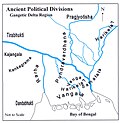
=== Ancient geopolitical divisions === | |||
[[Image:Ancient Political Divisions.jpg|thumb|Ancient Political Divisions]] | |||
{| class="wikitable" | {| class="wikitable" | ||
| Line 32: | Line 31: | ||
| [[Pundravardhana]] || [[Rajshahi Division]] and [[Rangpur Division]] in Bangladesh; [[Malda division]] of [[West Bengal]] in India | | [[Pundravardhana]] || [[Rajshahi Division]] and [[Rangpur Division]] in Bangladesh; [[Malda division]] of [[West Bengal]] in India | ||
|- | |- | ||
| [[Vanga | | [[Vanga kingdom|Vanga]] ||[[Khulna Division]] and [[Barisal Division]] in Bangladesh; West of the Padma river. | ||
|- | |- | ||
| [[Tirabhukti]] || [[Mithila (region)|Mithila]] area of India and Nepal | | [[Tirabhukti]] || [[Mithila (region)|Mithila]] area of India and Nepal | ||
|- | |||
| [[Gauda kingdom|Gauda]] || Modern [[Malda, West Bengal|Malda]] and [[Murshidabad]] districts of West Bengal, India | |||
|- | |- | ||
| [[Suhma]] || [[Burdwan division]], Medinipur division and Presidency division of West Bengal in India | | [[Suhma]] || [[Burdwan division]], Medinipur division and Presidency division of West Bengal in India | ||
|- | |- | ||
| [[Rarh]] || | | [[Rarh]] || Corresponds to the modern Bardhaman, Bankura, Hooghly and Nadia districts of West Bengal in India | ||
|- | |- | ||
| [[Samatata]] || [[Dhaka Division]], Barisal Division and [[Chittagong Division]] in Bangladesh | | [[Samatata]] || [[Dhaka Division]], Barisal Division and [[Chittagong Division]] in Bangladesh | ||
|- | |- | ||
| [[Harikela]] || [[Sylhet Division]], Chittagong Division, Dhaka Division and Barisal Division in Bangladesh | | [[Harikela]] || [[Sylhet Division]], Chittagong Division, Dhaka Division and Barisal Division in Bangladesh | ||
|} | |} | ||
The founders of [[Anga kingdom|Angas]], [[Vanga kingdom|Vangas]], [[Kalinga (Mahabharata)|Kalingas]], [[Pundra kingdom|Pundras]], [[Odra kingdom|Odras]] and [[Suhma kingdom|Suhmas]] shared a common ancestry. They were all adopted sons of a king named [[Bali (Chandravanshi)|Bali]], born by a sage named [[Dirghatamas|Gautama Dirghatamas]], who lived in [[Magadha kingdom|Magadha]] close to the city of [[Girivraja]].<ref>"The Mahabharata of Krishna-Dwaipayana Vyasa" Translated into English Prose, Bharata Press, Calcutta (1883–1896)</ref> | |||
The founders of [[Anga | |||
;Bengal from c. 1100 to c. 600 BCE | |||
[[File:Late Vedic Culture (1100-500 BCE).png|thumb|Bengal and kingdoms in [[Vedic Period|Late Vedic Period]] c. 1100–600 BCE]] | |||
;Bengal from c. 600 to c. 350 BCE | |||
[[File:Mahajanapadas (c. 500 BCE).png|thumb|Bengal and kingdoms in [[Mahajanapada|Mahajanapada Period]] c. 600–350 BCE]] | |||
;Bengal in c. 350 BCE | |||
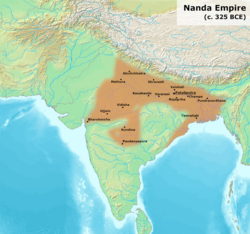
[[File:Nanda Empire, c.325 BCE.png|thumb|Firstly, the entirety of Bengal was conquered by [[Mahapadma Nanda]] in 350 BCE]] | |||
=== Anga kingdom (c. 1100–530 BCE) === | |||
{{main|Anga}}{{POV section|date=November 2023}}{{see also|Magadha-Anga war}} | |||
The earliest mention occurs in the [[Atharvaveda]] (V.22.14) where they are listed alongside the [[Magadhan|Magadhas]], [[Gandhara|Gandharis]] and the Mujavatas.<ref>Digha Nikaya</ref> Anga was annexed by Magadha in the time of [[Bimbisara]]. This was the one and only conquest of Bimbisara.<ref>The ''[[Garuda Purana]]'' 55.12; V.D. I.9.4; the ''[[Markendeya Purana]]'' 56.16–18</ref> | |||
* | Known Anga rulers include: | ||
* | * Maharaj Anga – (founder of the kingdom and son of King [[Bali (Chandravanshi)|Bali]]) | ||
* Brihadratha | * [[King Romapada|Romapada]] | ||
* Vrishaketu – | * [[Brihadratha]] | ||
* [[Karna|Angaraj Karna]] | |||
* [[Vrishaketu]] – (son of Karna) | |||
* Tamralipta | * Tamralipta | ||
* Lomapada | * Lomapada | ||
| Line 74: | Line 71: | ||
* Vrihadratha | * Vrihadratha | ||
* Vasuhoma | * Vasuhoma | ||
* Dhatarattha | * Dhatarattha | ||
* Dhadivahana | * Dhadivahana | ||
* [[Brahmadatta of Anga|Brahmadatta]] – (last king of Anga kingdom) | |||
=== Vanga kingdom (c. 1100–340 BCE) === | |||
{{main|Vanga}} | {{main|Vanga Kingdom}} | ||
Vanga was an ancient kingdom and geopolitical division on the [[Ganges delta]] in the [[ | Vanga was an ancient kingdom and geopolitical division on the [[Ganges delta]]. It was located in southern Bengal, with the core region including present-day southwestern [[Bangladesh]] and southern [[West Bengal]] (India).<ref>{{Cite encyclopedia |url=https://www.britannica.com/place/West-Bengal#ref486986 |title=West Bengal | History, Culture, Map, Capital, & Population | Britannica |encyclopedia=Encyclopedia Britannica |access-date=17 April 2021 |archive-date=17 April 2021 |archive-url=https://web.archive.org/web/20210417223652/https://www.britannica.com/place/West-Bengal#ref486986 |url-status=live}}</ref> | ||
Known rulers | Known Vanga rulers are: | ||
* Samudrasena | |||
* Chandrasena | |||
* Karna | |||
* Bhagabhatta | |||
=== Pundra kingdom (c. 1100–340 BCE) === | |||
{{main|Pundravardhana}} | {{main|Pundravardhana}} | ||
Pundravardhana or Pundra Kingdom, was an ancient kingdom | Pundravardhana or Pundra Kingdom, was an ancient kingdom, that included parts of present-day [[Rajshahi Division|Rajshahi]] and [[Rangpur Division]]s of [[Bangladesh]] as well as the [[West Dinajpur district]] of [[West Bengal]] in India.<ref name="Hossain">>{{cite book |last1=Hossain |first1=Md. Mosharraf |title=Mahasthan: Anecdote to History |year=2006 |publisher=Dibyaprakash |pages=69, 73 |isbn=984-483-245-4}}</ref><ref name = "Banglapedia">{{cite web |url=http://en.banglapedia.org/index.php?title=Pundravardhana |title=Pundravardhana |access-date=10 November 2007 |last=Ghosh |first=Suchandra |work=Banglapedia |publisher=Asiatic Society of Bangladesh |archive-date=23 June 2017 |archive-url=https://web.archive.org/web/20170623150622/http://en.banglapedia.org/index.php?title=Pundravardhana |url-status=live}}</ref> | ||
Known Pundra rulers are: | |||
* [[Paundraka Vasudeva]] | |||
=== Suhma kingdom (c. 1100–340 BCE) === | |||
{{main|Suhma kingdom}} | |||
=== | Suhma kingdom was an ancient state during the [[Vedic period]] on the eastern part of the [[Bengal]].This kingdom was mentioned in the epic [[Mahabharata]] along with its neighbouring kingdom ''Prasuhma''.<ref>{{Cite book |last1=Klidsa |url=http://archive.org/details/raghuvamsaofkali00kliduoft |title=The Raghuvamsa of Kalidasa : with the commentary (the Samjivani) of Mallinatha; Cantos I-X; edited with a literal English translation, copious notes in Sanskrit and English, and various readings &c. &c. by M.R. Kale |last2=Mallinatha. Sajvan |last3=Kle |first3=M. R. (Moreshvar Ramchandra) |date=1922 |publisher=Bombay : P.S. Rege |others=Robarts - University of Toronto}}</ref> | ||
=== Chola Empire(c. 848–1279 BCE) === | |||
{{Main|Chola Empire}} | |||
=== | === Videha dynasty of Mithila (Tirabhukti) (c. 1100–700 BCE) === | ||
{{main| | {{main|Videha|Mithila (region)}} | ||
{{see also|History of Mithila Region}} | |||
Tirabhukti or Mithila region is bounded by the [[Mahananda River]] in the east, the [[Ganges]] in the south, the [[Gandaki River]] in the west and by the foothills of the [[Himalayas]] in the north.<ref name=Jha1997>{{cite book |author=Jha, M. |year=1997 |chapter=Hindu Kingdoms at contextual level |title=Anthropology of Ancient Hindu Kingdoms: A Study in Civilizational Perspective |chapter-url=https://books.google.com/books?id=A0i94Z5C8HMC&pg=PA27 |pages=27–42 |publisher=M.D. Publications Pvt. Ltd |location=New Delhi |isbn=9788175330344}}</ref> | |||
Mithila region firstly ruled by [[Videha|Videha dynasty]]. There were 52 ''Janaka'' (kings) ruled Videha dynasty of Mithila-<ref>{{cite web |author1=Kamal Kant Jha |author2=Pt. Sri ganeshrai Vidyabhushan |author3=Dhanakar Thakur |title=A Brief History of Mithila State Bihar Articles |url=http://www.bihar.ws/info/Cultural-regions-of-Bihar/A-Brief-History-of-Mithila-State.html |access-date=10 January 2008 |archive-url=https://web.archive.org/web/20120301094238/http://www.bihar.ws/info/Cultural-regions-of-Bihar/A-Brief-History-of-Mithila-State.html |archive-date=1 March 2012 |language=en |url-status=live}}</ref> | |||
# Mithi (founder of Mithila and the first Janaka)<ref name="Singh">''Encyclopaedia of Hinduism''. Nagendra Kumar Singh, p. 3239.</ref> | |||
# Udavasu | |||
# Nandivardhana | |||
# Suketu | |||
# Devarata | |||
# Brihadvrata | |||
# Mahavira | |||
# Sudhriti | |||
# Dristaketu | |||
# Haryasva | |||
# Maru | |||
# Pratindhaka | |||
# Kritiratha | |||
# Devamidha | |||
# Vibhuta | |||
# Mahidhrata | |||
# Kirtirata | |||
# Mahorama | |||
# Swarnorama | |||
# Hrisvaroma | |||
# Seeradhwaja | |||
# Bhaanumaan | |||
# Shatadyumn | |||
# Shuchi | |||
# Oorjnaamaa | |||
# Kriti | |||
# Anjan | |||
# Kurujit | |||
# Arishtnemi | |||
# Shrutaayu | |||
# Supaarshwa | |||
# Srinjaya | |||
# Kshemaavee | |||
# Anenaa | |||
# Bhaumarath | |||
# Satyarath | |||
# Upagu | |||
# Upagupt | |||
# Swaagat | |||
# Swaanand | |||
# Suvarchaa | |||
# Supaarshwa | |||
# Subhaash | |||
# Sushrut | |||
# Jaya | |||
# Vijaya | |||
# Rit | |||
# Sunaya | |||
# Veetahavya | |||
# Dhriti | |||
# Bahulaashwa | |||
# Kriti (last King of Videha or Janaka dynasty, Kirti Janak was atrocious ruler who lost control over his subjects. He was dethroned by public under leadership of [[Acharya]]s (Learned Men). | |||
During this period of fall of Videha dynasty, the famous republic of [[Licchavi (clan)|Licchavi]] was rising in [[Vaishali (ancient city)|Vaishali]] and Mithila region came under control of Licchavi clan of [[Vajji|Vajji confederacy]] in around eighth century BCE.<ref>Raychaudhuri, Hemchandra (1972), ''Political History of Ancient India'', University of Calcutta, Calcutta, pp. 106–113, 186–90</ref> | |||
=== Gangaridai kingdom (c. 350–100 BCE) === | |||
{{main|Gangaridai}} | |||
Gangaridae is a term used by the ancient [[Greco-Roman]] writers to describe a people or a geographical region of the ancient [[Indian subcontinent]]. Some of these writers state that [[Alexander the Great]] withdrew from the Indian subcontinent because of the strong [[war elephant]] force of the Gangaridai. However, the geographical region was annexed and governed by the [[Nanda Empire]] at the time. | |||
A number of modern scholars locate Gangaridai in the [[Ganges Delta]] of the [[Bengal]] region, although alternative theories also exist. Gange or Ganges, the capital of the Gangaridai (according to [[Ptolemy]]), has been identified with several sites in the region, including [[Chandraketugarh]] and [[Wari-Bateshwar ruins|Wari-Bateshwar]].<ref>{{cite web |title=History |quote=Shah-i-Bangalah, Shah-i-Bangaliyan and Sultan-i-Bangalah |url=http://en.banglapedia.org/index.php?title=History |website=Banglapedia |access-date=23 September 2017 |url-status=live |archive-url=https://web.archive.org/web/20170929104319/http://en.banglapedia.org/index.php?title=History |archive-date=29 September 2017 |df=dmy-all}}</ref> | |||
== Magadha dynasties of Bengal == | == Magadha dynasties of Bengal == | ||
{{main|Magadha}} | {{main|Magadha}} | ||
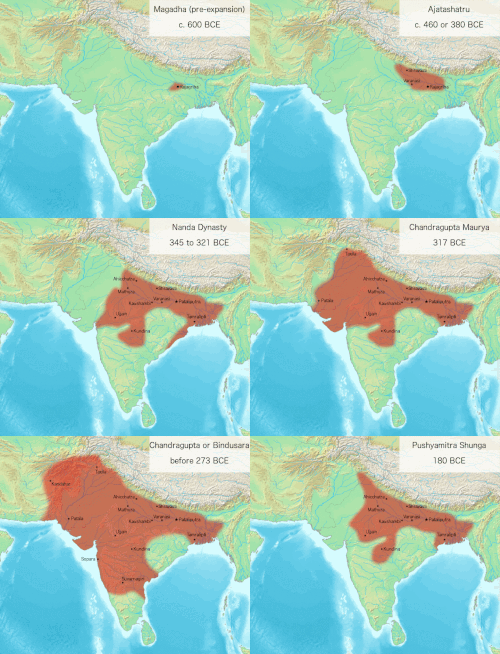
[[File:Magadha Expansion 1.gif|thumb|Expansion of Magadha | [[File:Magadha Expansion 1.gif|thumb|Expansion of Magadha dynasties and empires.]] | ||
=== Brihadratha dynasty (c. | === Brihadratha dynasty (c. 1700–682 BCE) === | ||
{{Main|Brihadratha dynasty}} | {{Main|Brihadratha dynasty}} | ||
| Line 137: | Line 187: | ||
!Reign (BCE) | !Reign (BCE) | ||
|- | |- | ||
| [[Brihadratha]] || | | [[Brihadratha]] || – BCE | ||
|- | |- | ||
| [[Jarasandha]] || | | [[Jarasandha]] || – BCE | ||
|- | |- | ||
| [[Sahadeva of Magadha]] || | | [[Sahadeva of Magadha]] || – BCE | ||
|- | |- | ||
| Somadhi || 1661–1603 BCE | | Somadhi || 1661–1603 BCE | ||
| Line 185: | Line 235: | ||
| [[Ripunjaya]] || 732–682 BCE | | [[Ripunjaya]] || 732–682 BCE | ||
|} | |} | ||
(''[[Ripunjaya]] was the last ruler of dynasty, | (''[[Ripunjaya]] was the last ruler of dynasty, dethroned by [[Pradyota]] in 682 BCE'') | ||
=== Pradyota dynasty (c. | === Pradyota dynasty (c. 682–544 BCE) === | ||
{{main|Pradyota dynasty}} | {{main|Pradyota dynasty}} | ||
| Line 200: | Line 250: | ||
| 682–659 BCE | | 682–659 BCE | ||
| 23 | | 23 | ||
|- | |||
| Gopāla (Abdicated) | |||
| 659 BCE | |||
| ~1 | |||
|- | |- | ||
| Palaka | | Palaka | ||
| 659–635 BCE | | 659–635 BCE | ||
| 24 | | 24 | ||
|- | |||
| Aryaka | |||
| ? | |||
| ? | |||
|- | |- | ||
| Visakhayupa | | Visakhayupa | ||
| Line 217: | Line 275: | ||
| 20 | | 20 | ||
|} | |} | ||
(''Varttivarddhana was last ruler of dynasty dethroned by [[Bimbisara]] in 544 BCE'') | (''Varttivarddhana was the last ruler of the dynasty and was dethroned by [[Bimbisara]] in 544 BCE'') | ||
=== Haryanka dynasty (c. | === Haryanka dynasty (c. 544–413 BCE) === | ||
{{main|Haryanka dynasty}} | {{main|Haryanka dynasty}} | ||
| Line 228: | Line 286: | ||
!Reign (BCE) | !Reign (BCE) | ||
|- | |- | ||
| [[Bimbisara]] || | | [[Bimbisara]] || 544–492 BCE | ||
|- | |- | ||
| [[Ajatashatru]] || | | [[Ajatashatru]] || 492–460 BCE | ||
|- | |- | ||
| [[Udayin]] || | | [[Udayin]] || 460–444 BCE | ||
|- | |- | ||
| Anirudha || | | Anirudha || 444–440 BCE | ||
|- | |- | ||
| Munda || | | Munda || 440–437 BCE | ||
|- | |- | ||
| Darshaka || | | Darshaka || 437 BCE | ||
|- | |- | ||
| [[Nāgadāsaka]] || | | [[Nāgadāsaka]] || 437–413 BCE | ||
|} | |} | ||
(''[[Nāgadāsaka]] was last ruler of dynasty | (''[[Nāgadāsaka]] was the last ruler of the dynasty and was overthrown by [[Shishunaga]] in 413 BCE'') | ||
=== Shishunaga dynasty (c. | === Shishunaga dynasty (c. 413–345 BCE) === | ||
{{main|Shaishunaga dynasty}} | {{main|Shaishunaga dynasty}} | ||
| Line 265: | Line 323: | ||
| [[Mahanandin]] || 349–345 BCE | | [[Mahanandin]] || 349–345 BCE | ||
|} | |} | ||
''([[Mahanandin]] lost his empire | ''([[Mahanandin]] lost his empire to his illegitimate son [[Mahapadma Nanda]] in 345 BCE)'' | ||
=== Nanda Empire (c. | === Nanda Empire (c. 345–322 BCE) === | ||
{{main|Nanda Empire}} | {{main|Nanda Empire}} | ||
{{see also|Conquest of the Nanda Empire}} | {{see also|Conquest of the Nanda Empire}} | ||
| Line 279: | Line 338: | ||
| [[Mahapadma Nanda]] || 345–340 BCE | | [[Mahapadma Nanda]] || 345–340 BCE | ||
|- | |- | ||
| | | Pandukananda || 340–339 BCE | ||
|- | |- | ||
| | | Pandugatinanda || 339–338 BCE | ||
|- | |- | ||
| Bhutapalananda || 338–337 BCE | | Bhutapalananda || 338–337 BCE | ||
|- | |- | ||
| | | Rashtrapalananda || 337–336 BCE | ||
|- | |- | ||
| Govishanakananda || 336–335 BCE | | Govishanakananda || 336–335 BCE | ||
|- | |- | ||
| | | Dashasiddhakananda || 335–334 BCE | ||
|- | |- | ||
| | | Kaivartananda || 334–329 BCE | ||
|- | |- | ||
| [[Dhana Nanda]] || | | [[Dhana Nanda]] || 329–321 BCE | ||
|} | |} | ||
''([[Dhana Nanda]] lost his empire to [[Chandragupta Maurya]] after being defeated by him in 322 BCE)'' | ''([[Dhana Nanda]] lost his empire to [[Chandragupta Maurya]] after being defeated by him in 322 BCE)'' | ||
=== Maurya Empire (c. | === Maurya Empire (c. 322–184 BCE) === | ||
{{main|Maurya Empire}} | {{main|Maurya Empire}} | ||
;Rulers- | ;Rulers- | ||
{| class="wikitable" | {| class="wikitable" | ||
! colspan=2 | Ruler!!Reign!!Notes | ! colspan=2 | Ruler!!Reign!!Notes | ||
|- | |- | ||
|[[Chandragupta Maurya]]|| | |[[Chandragupta Maurya]]||||322–297 BCE|| He was the founder of the first united Indian empire. | ||
|- | |- | ||
|[[Bindusara Amitraghata]]|| | |[[Bindusara Amitraghata]]||||297–273 BCE||Acknowledged by [[Taranatha]], a Tibetan Buddhist Lama, for his foreign diplomacy, and territorial conquests. His Sanskrit name "Amitraghata" means "Slayer of Enemies". | ||
|- | |- | ||
|[[Ashoka]]|| | |[[Ashoka]]|| ||268–232 BCE||He was the greatest emperor of the dynasty. His son [[Kunala]] was blinded and passed away before him. Ashoka was succeeded by his grandson [[Samprati]]. He is also known for emerging victorious in the [[Kalinga war]] and repenting the sorrow and violence he had caused, leading to him turning to Buddhism. He sent his eldest son [[Mahinda (Buddhist monk)|Mahendra]] (according to Sri Lankan traditions) and his only daughter [[Sanghamitta|Sanghamitra]] (also according to Sri Lankan traditions) to the Kingdom of Anuradhapura as Buddhist missionaries. | ||
|- | |- | ||
|[[Dasharatha Maurya]]|| | |[[Dasharatha Maurya]]||||232–224 BCE||Brother of [[Ashoka]]. | ||
|- | |- | ||
|[[Samprati]]||||224–215 BCE|| | |[[Samprati]]||||224–215 BCE||Grandson of [[Ashoka]] and son of [[Kunala]]. | ||
|- | |- | ||
|[[Shalishuka]]|| | |[[Shalishuka]]||||215–202 BCE||Son of Samprati | ||
|- | |- | ||
|[[Devavarman]]||||202–195 BCE|| | |[[Devavarman (Maurya)|Devavarman]]||||202–195 BCE||Son of Shalishuka | ||
|- | |- | ||
|[[Shatadhanvan]]||||195–187 BCE|| Mauryan Empire had | |[[Shatadhanvan]]||||195–187 BCE|| The Mauryan Empire had diminished by the time of his reign. | ||
|- | |- | ||
|[[Brihadratha Maurya|Brihadratha]]||||187–184 BCE|| Assassinated by his Commander-in-chief [[Pushyamitra Shunga]] in 185 BCE. | |[[Brihadratha Maurya|Brihadratha]]||||187–184 BCE|| Assassinated by his Commander-in-chief [[Pushyamitra Shunga]] belonging to the [[Shunga Empire]] in 185 BCE. | ||
|- | |- | ||
|} | |} | ||
''([[Brihadratha Maurya|Brihadratha]] was the last ruler of dynasty, dethroned by [[Pushyamitra Shunga]] in 185 BCE)'' | ''([[Brihadratha Maurya|Brihadratha]] was the last ruler of dynasty, dethroned by [[Pushyamitra Shunga]] in 185 BCE)'' | ||
=== Shunga Empire (c. | === Shunga Empire (c. 185–73 BCE) === | ||
{{main|Shunga Empire}} | {{main|Shunga Empire}} | ||
| Line 357: | Line 413: | ||
| [[Devabhuti]]|| 83–73 BCE | | [[Devabhuti]]|| 83–73 BCE | ||
|} | |} | ||
''([[Devabhuti]] was the last ruler of dynasty dethroned by | ''([[Devabhuti]] was the last ruler of the dynasty dethroned by [[Vasudeva Kanva]] in 73 BCE)'' | ||
=== Kanva dynasty (c. | === Kanva dynasty (c. 73–28 BCE) === | ||
{{main|Kanva dynasty}} | {{main|Kanva dynasty}} | ||
| Line 385: | Line 441: | ||
|10 | |10 | ||
|} | |} | ||
''(Susarman was the last ruler of dynasty, dethroned by [[Simuka]] of [[Satavahana Empire]])'' | ''(Susarman was the last ruler of dynasty, dethroned by [[Simuka]] of the [[Satavahana Empire]])'' | ||
== Classical Era == | == Classical Era == | ||
===Chandra | ===Chandra dynasty (c. 202–1050 CE)=== | ||
{{main|Chandra dynasty|Harikela}} | {{main|Chandra dynasty|Harikela}} | ||
The | The Chandra Kingdom, which ruled the [[Vanga]]-[[Samatata]] region of [[Bengal]], as well as northern [[Arakan]]. Later it was a neighbour to the [[Pala Empire]] to the north. Rulers of the Chandra kingdom were followers of [[Hinduism]].<ref>{{Cite book |last=Wicks |first=Robert S. |url=https://books.google.com/books?id=jFpdDwAAQBAJ&pg=PA86 |title=Money, Markets, and Trade in Early Southeast Asia: The Development of Indigenous Monetary Systems to AD 1400 |year=1995 |publisher=Cornell University Press |isbn=978-1-5017-1947-9 |pages=87 |language=en |access-date=12 October 2021 |archive-date=25 December 2023 |archive-url=https://web.archive.org/web/20231225070209/https://books.google.com/books?id=jFpdDwAAQBAJ&pg=PA86#v=onepage&q&f=false |url-status=live}}</ref><ref>{{Cite journal |last=Johnston |first=E. H. |date=1944 |title=Some Sanskrit Inscriptions of Arakan |journal=Bulletin of the School of Oriental and African Studies, University of London |volume=11 |issue=2 |pages=357–385 |doi=10.1017/S0041977X00072529 |jstor=609320 |s2cid=191758063 |issn=0041-977X}}</ref> | ||
;Rulers- | |||
{| class="wikitable" | {| class="wikitable" | ||
|+List of Chandra dynasty Rulers | |+List of Chandra dynasty Rulers | ||
| Line 405: | Line 461: | ||
|Chandrodaya | |Chandrodaya | ||
|27 | |27 | ||
| | |202–229 | ||
|- | |- | ||
|2 | |2 | ||
|Annaveta | |Annaveta | ||
|5 | |5 | ||
| | |229–234 | ||
|- | |- | ||
|3 | |3 | ||
| | |Chandranveta | ||
|77 | |77 | ||
| | |234–311 | ||
|- | |- | ||
|4 | |4 | ||
|Rimbhiappa | |Rimbhiappa | ||
|23 | |23 | ||
| | |311–334 | ||
|- | |- | ||
|5 | |5 | ||
|Kuverami (Queen) | |[[Kuverami]] (Queen) | ||
|7 | |7 | ||
| | |334–341 | ||
|- | |- | ||
|6 | |6 | ||
|Umavira | |Umavira | ||
|20 | |20 | ||
| | |341–361 | ||
|- | |- | ||
|7 | |7 | ||
|Jugna | |Jugna | ||
|7 | |7 | ||
| | |361–368 | ||
|- | |- | ||
|8 | |8 | ||
|Lanki | |Lanki | ||
|2 | |2 | ||
| | |368–370 | ||
|- | |- | ||
|9 | |9 | ||
|Dvenchandra | |Dvenchandra | ||
|55 | |55 | ||
| | |370–425 | ||
|- | |- | ||
|10 | |10 | ||
|Rajachandra | |Rajachandra | ||
|20 | |20 | ||
| | |425–445 | ||
|- | |- | ||
|11 | |11 | ||
|Kalachandra | |Kalachandra | ||
|9 | |9 | ||
| | |445–454 | ||
|- | |- | ||
|12 | |12 | ||
|Devachandra | |Devachandra | ||
|22 | |22 | ||
| | |454–476 | ||
|- | |- | ||
|13 | |13 | ||
|Yajnachandra | |Yajnachandra | ||
|7 | |7 | ||
| | |476–483 | ||
|- | |- | ||
|14 | |14 | ||
|Chandrabandu | |Chandrabandu | ||
|6 | |6 | ||
| | |483–489 | ||
|- | |- | ||
|15 | |15 | ||
|Bhumichandra | |Bhumichandra | ||
|7 | |7 | ||
| | |489–496 | ||
|- | |- | ||
|16 | |16 | ||
|Bhutichandra | |Bhutichandra | ||
|24 | |24 | ||
| | |496–520 | ||
|- | |- | ||
|17 | |17 | ||
|Nitichandra | |Nitichandra | ||
|55 | |55 | ||
| | |520–575 | ||
|- | |- | ||
|18 | |18 | ||
|Virachandra | |Virachandra | ||
|3 | |3 | ||
| | |575–578 | ||
|- | |- | ||
|19 | |19 | ||
|Pritichandra | |Pritichandra | ||
|12 | |12 | ||
| | |578–590 | ||
|- | |- | ||
|20 | |20 | ||
|Prithvichandra | |Prithvichandra | ||
|7 | |7 | ||
| | |590–597 | ||
|- | |- | ||
|21 | |21 | ||
|Dhirtichandra | |Dhirtichandra | ||
|3 | |3 | ||
| | |597–600 | ||
|- | |- | ||
|22 | |22 | ||
|Mahavira | |Mahavira | ||
|12 | |12 | ||
| | |600–612 | ||
|- | |- | ||
|23 | |23 | ||
|Virayajap | |Virayajap | ||
|12 | |12 | ||
| | |612–624 | ||
|- | |- | ||
|24 | |24 | ||
|Sevinren | |Sevinren | ||
|12 | |12 | ||
| | |624–636 | ||
|- | |- | ||
|25 | |25 | ||
|Dharmasura | |Dharmasura | ||
|13 | |13 | ||
| | |636–649 | ||
|- | |- | ||
|26 | |26 | ||
|Vajrashakti | |Vajrashakti | ||
|16 | |16 | ||
| | |649–665 | ||
|- | |- | ||
|27 | |27 | ||
|Dharmavijaya | |Dharmavijaya | ||
|36 | |36 | ||
| | |665–701 | ||
|- | |- | ||
|28 | |28 | ||
|Narendravijaya | |Narendravijaya | ||
|2 yr 9 months | |2 yr 9 months | ||
| | |701–703 | ||
|- | |- | ||
|29 | |29 | ||
|Dharmachandra | |Dharmachandra | ||
|16 | |16 | ||
| | |703–720 | ||
|- | |- | ||
|30 | |30 | ||
|Anandachandra | |Anandachandra | ||
|9+ | |9+ | ||
| | |720–729+ | ||
|- | |- | ||
| colspan="4" |[[Harikela|Harikela | | colspan="4" |[[Harikela|Harikela dynasty]] | ||
|- | |- | ||
|1 | |1 | ||
|[[Traillokyachandra]] | |[[Traillokyachandra]] | ||
|30 | |30 | ||
|900–930 | |900–930 | ||
| Line 565: | Line 621: | ||
|- | |- | ||
|3 | |3 | ||
|[[Kalyanachandra]] | |[[Kalyanachandra]] | ||
|25 | |25 | ||
|975–1000 | |975–1000 | ||
|- | |- | ||
|4 | |4 | ||
|[[Ladahachandra]] | |[[Ladahachandra]] | ||
|20 | |20 | ||
|1000–1020 | |1000–1020 | ||
|- | |- | ||
|5 | |5 | ||
|[[Govindachandra (Chandra dynasty)|Govindachandra]] | |[[Govindachandra (Chandra dynasty)|Govindachandra]] | ||
|30 | |30 | ||
|1020–1050 | |1020–1050 | ||
|} | |} | ||
===Gupta Empire (c. 240–550 CE)=== | === Pushkarana Kingdom (c. 4th century CE) === | ||
* Simhavarman | |||
* [[Chandravarman]] | |||
=== Gupta Empire (c. 240–550 CE) === | |||
{{main|Gupta Empire}} | {{main|Gupta Empire}} | ||
* [[Sri-Gupta I]] (240–280) | ;Rulers- | ||
* [[Sri-Gupta I]] (240–280), the founder of the dynasty. | |||
* [[Ghatotkacha (Gupta Ruler)|Ghatotkacha]] (280–319) | * [[Ghatotkacha (Gupta Ruler)|Ghatotkacha]] (280–319) | ||
* [[Chandragupta I|Chandra Gupta I]] (320–335) | * [[Chandragupta I|Chandra Gupta I]] (320–335) | ||
| Line 594: | Line 655: | ||
* [[Kumaragupta II|Kumara Gupta II]] (473–476) | * [[Kumaragupta II|Kumara Gupta II]] (473–476) | ||
* [[Buddha Gupta]] (476–495) | * [[Buddha Gupta]] (476–495) | ||
* [[Narasimhagupta|Narasimha Gupta]]( | * [[Narasimhagupta|Narasimha Gupta]](495–540) | ||
* [[Vainyagupta]] (~507) | |||
* [[Kumaragupta III|Kumara Gupta III]] (500–540) | * [[Kumaragupta III|Kumara Gupta III]] (500–540) | ||
* [[Vishnugupta (Gupta Empire)|Vishnugupta]] (540–550) | * [[Vishnugupta (Gupta Empire)|Vishnugupta]] (540–550), the last imperial Gupta ruler. | ||
===Jaintia | === Independent Vanga Kingdom (c. 525–575 CE) === | ||
*Gopachandra | |||
*Dharmadiya | |||
*Samachardeva | |||
=== Jaintia kingdom (c. 525–1835 CE) === | |||
{{main|Jaintia Kingdom}} | {{main|Jaintia Kingdom}} | ||
====Old dynasty==== | ==== Old dynasty rulers ==== | ||
*Urmi Rani (?–550) | |||
*Krishak Pator (550–570) | |||
*Hatak (570–600) | |||
*Guhak (600–630) | |||
====Partitioned Jaintia==== | ==== Partitioned Jaintia rulers ==== | ||
*Jayanta (630–660) | |||
*Joymalla (660–?) | |||
*Mahabal (?) | |||
*Bancharu (?–1100) | |||
*Kamadeva (1100–1120) | |||
*Bhimbal (1120) | |||
====Brahmin dynasty==== | ==== Brahmin dynasty rulers ==== | ||
*Kedareshwar Rai (1120–1130) | |||
*Dhaneshwar Rai (1130–1150) | |||
*Kandarpa Rai (1150–1170) | |||
*Manik Rai (1170–1193) | |||
*Jayanta Rai (1193–1210) | |||
*Jayanti Devi | |||
*Bara Gossain | |||
====New dynasty==== | ==== New dynasty rulers ==== | ||
*Prabhat Ray Syiem Sutnga (1500–1516) | |||
*Majha Gosain Syiem Sutnga (1516–1532) | |||
*Burha Parbat Ray Syiem Sutnga (1532–1548) | |||
*Bar Gosain Syiem Sutnga I (1548–1564) | |||
*Bijay Manik Syiem Sutnga (1564–1580) | |||
*Pratap Ray Syiem Sutnga (1580–1596) | |||
*Dhan Manik Syiem Sutnga (1596–1612) | |||
*Jasa Manik Syiem Sutnga (1612–1625) | |||
*Sundar Ray Syiem Sutnga (1625–1636) | |||
*Chota Parbat Ray Syiem Sutnga (1636–1647) | |||
*Jasamanta Ray Syiem Sutnga (1647–1660) | |||
*Ban Singh Syiem Sutnga (1660–1669) | |||
*Pratap Singh Syiem Sutnga (1669–1678) | |||
*Lakshmi Narayan Syiem Sutnga (1678–1694) | |||
*Ram Singh Syiem Sutnga I (1694–1708) | |||
*Jay Narayan Syiem Sutnga (1708–1731) | |||
*Bar Gosain Syiem Sutnga II (1731–1770) | |||
*Chattra Singh Syiem Sutnga (1770–1780) | |||
*Yatra Narayan Syiem Sutnga (1780-1785) | |||
*Bijay Narayan Syiem Sutnga (1785–1786) | |||
*Lakshmi Singh Syiem Sutnga (1786-1790) | |||
*Ram Singh Syiem Sutnga II (1790–1832) | |||
*Rajendra Singh Syiem Sutnga (1832–1835)<ref>{{cite thesis |last=Laloo |first=Betty |date=20 July 2016 |title=Reconstructing the early Jaintia state through oral traditions |type=PhD |chapter=III: Early Jaintia State Formation |publisher=North-Eastern Hill University |chapter-url=http://shodhganga.inflibnet.ac.in/jspui/bitstream/10603/217208/9/09_chapter%203.pdf |access-date=13 October 2021 |archive-date=25 December 2023 |archive-url=https://web.archive.org/web/20231225070229/https://shodhganga.inflibnet.ac.in:8443/jspui/pdfToThesis.jsp?toHandle=https://shodhganga.inflibnet.ac.in/handle/10603/217208&toFile=https://shodhganga.inflibnet.ac.in/bitstream/10603/217208/9/09_chapter%203.pdf |url-status=live}}</ref><ref>{{cite web |url=http://megtourism.gov.in/dest-jaintia.html |title=Jaintia Hills-Land of Myths and Legends |website=Mesmerizing Meghalaya |archive-url=https://web.archive.org/web/20200812044724/http://megtourism.gov.in/dest-jaintia.html |archive-date=12 August 2020}}</ref> | |||
=== Gauda | === Gauda kingdom (c. 550–626 CE) === | ||
{{main|Gauda Kingdom}} | {{main|Gauda Kingdom}} | ||
=== Pushyabhuti | ;Rulers- | ||
* ''Early Gauda rulers are unknown'' | |||
* [[Shashanka]] (590–625), the first recorded independent Hindu king of Bengal, who created the first unified polity in Bengal. | |||
* [[Manava (king)|Manava]] (625–626), ruled for 8 months before being defeated by [[Harshavardana]] and [[Bhaskarvarmana]] in 626 CE. | |||
=== Pushyabhuti (Vardhana) Empire (c. 606–647 CE) === | |||
{{main|Pushyabhuti dynasty}} | {{main|Pushyabhuti dynasty}} | ||
* [[Harsha]]vardhana (606–647), unified Northern India and ruled it for over 40 years | |||
;Rulers of Bengal- | |||
* [[Harsha]]vardhana (606–647), unified Northern India and ruled it for over 40 years. he was the last non-Muslim emperor to rule a unified Northern India | |||
=== Khadga dynasty (c. 625–730 CE) === | === Khadga dynasty (c. 625–730 CE) === | ||
{{main|Khadga dynasty}} | {{main|Khadga dynasty}} | ||
{| class="wikitable | |||
{| class="wikitable" | |||
|- | |- | ||
! | !Titular Name | ||
! | !Reign | ||
! | !Notes | ||
|- | |- | ||
| | |Khadgodyama (খড়্গোদ্যম) | ||
| | |625–640 | ||
| Father of Jatakhadga | |Father of Jatakhadga | ||
|- | |- | ||
| | |Jatakhadga (জাতখড়্গ) | ||
| | |640–658 | ||
| Father of Devakhadga | |Father of Devakhadga | ||
|- | |- | ||
| | |Devakhadga (দেবখড়্গ) | ||
| | |658–673 | ||
| Queen Prabhavati (প্রভাবতী) | |Queen Prabhavati (প্রভাবতী) | ||
|- | |- | ||
| | |Rajabhatta (রাজভট্ট) | ||
| | |673–707 | ||
| Son of Devakhadga | |Son of Devakhadga | ||
|- | |- | ||
| | |Balabhatta (বলভট্ট) | ||
| | |707–716 | ||
| Son of Devakhadga | |Son of Devakhadga | ||
|- | |- | ||
| | |Udirnakhadga (উদীর্ণখড়্গ) | ||
| ?? | |?? | ||
| | | | ||
|} | |} | ||
;Rulers | |||
===Bhadra dynasty ( | === Bhadra dynasty (6th to 7th century) === | ||
{{main|Bhadra dynasty}} | {{main|Bhadra dynasty}} | ||
The Bhadra dynasty was a [[Bengali Hindus|Bengali Hindu]] royal house of [[Brahmin]] origin; their rule flourished during the first half of the 7th century, though little is known about their history. The kings of the dynasty bore names with the suffix "Bhadra". | |||
;Known rulers are- | |||
* Narayanabhadra | |||
* Jyeshthabhadra | |||
=== Mallabhum | === Mallabhum kingdom (c. 694–1147 CE) === | ||
{{Main|Mallabhum}} | {{Main|Mallabhum}} | ||
;Rulers- | |||
{| class="wikitable" | {| class="wikitable" | ||
!Name of the king{{Sfn|Dasgupta|Biswas|Mallik|2009|p=31-43}}<ref>{{cite book |last1=Mallik |first1=Abhaya Pada |title=History of Bishnupur-Raj: An Ancient Kingdom of West Bengal | | !Name of the king{{Sfn|Dasgupta|Biswas|Mallik|2009|p=31-43}}<ref>{{cite book |last1=Mallik |first1=Abhaya Pada |title=History of Bishnupur-Raj: An Ancient Kingdom of West Bengal |year=1921 |publisher=Abhaya Pada Mallik |pages=128–130 |url=https://books.google.com/books?id=QF4dAAAAMAAJ |access-date=11 March 2016 |archive-date=25 December 2023 |archive-url=https://web.archive.org/web/20231225070202/https://books.google.com/books?id=QF4dAAAAMAAJ |url-status=live}}</ref> | ||
! Reign | ! Reign | ||
!Notes | !Notes | ||
| Line 724: | Line 798: | ||
| | | | ||
|- | |- | ||
|Indra Malla | |Indra Malla | ||
|742–757 | |742–757 | ||
| | | | ||
| Line 789: | Line 863: | ||
|- | |- | ||
|Rup Malla | |Rup Malla | ||
| | |1015–1029 | ||
| | | | ||
|- | |- | ||
| Line 837: | Line 911: | ||
|- | |- | ||
|[[Ram Malla]] | |[[Ram Malla]] | ||
| | |1185–1209 | ||
| | | | ||
|- | |- | ||
| Line 961: | Line 1,035: | ||
|} | |} | ||
==Post-Classical era== | == Post-Classical era == | ||
=== Pala Empire (c. 750–1161 CE) === | |||
Most of the Pala inscriptions mention only the regnal year as the date of issue, without any well-known [[calendar era]]. Because of this, the chronology of the Pala kings is hard to determine.<ref name="DKGanguly">{{cite book |author=Dilip Kumar Ganguly |url=https://books.google.com/books?id=N2tlKzxwhY8C&pg=PA41 |title=Ancient India, History and Archaeology |publisher=Abhinav |year=1994 |isbn=978-81-7017-304-5 |pages=33–41 |access-date=26 May 2022 |archive-url=https://web.archive.org/web/20230202001202/https://books.google.com/books?id=N2tlKzxwhY8C&pg=PA41 |archive-date=2 February 2023 |url-status=live}}</ref> Based on their different interpretations of the various epigraphs and historical records, different historians estimate the Pala chronology as follows:<ref name="Susan1984">{{cite book |author=Susan L. Huntington |title=The "Påala-Sena" Schools of Sculpture |url=https://books.google.com/books?id=xLA3AAAAIAAJ&pg=PA32 |date=1984 |publisher=Brill Archive |isbn=90-04-06856-2 |pages=32–39 |access-date=26 May 2022 |archive-date=25 December 2023 |archive-url=https://web.archive.org/web/20231225070203/https://books.google.com/books?id=xLA3AAAAIAAJ&pg=PA32#v=onepage&q&f=false |url-status=live}}</ref> | |||
{| class="wikitable" | {| class="wikitable" | ||
! | ! | ||
! [[Ramesh Chandra Majumdar|RC Majumdar]] (1971) | ![[Ramesh Chandra Majumdar|RC Majumdar]] (1971) | ||
! AM Chowdhury (1967) | !AM Chowdhury (1967) | ||
! [[Bindeshwari Prasad Sinha|BP Sinha]] (1977)< | ![[Bindeshwari Prasad Sinha|BP Sinha]] (1977)<sup>[''[[Bharatpedia:Verifiability|failed verification]]'']</sup> | ||
! [[Dineshchandra Sircar|DC Sircar]] (1975–76) | ![[Dineshchandra Sircar|DC Sircar]] (1975–76) | ||
! D. K. Ganguly (1994) | !D. K. Ganguly (1994) | ||
|- | |- | ||
| [[Gopala (Pala king)|Gopala I]] | |[[Gopala (Pala king)|Gopala I]] | ||
| 750–770 | |750–770 | ||
| 756–781 | |756–781 | ||
| 755–783 | |755–783 | ||
| 750–775 | |750–775 | ||
| 750–774 | |750–774 | ||
|- | |- | ||
| [[Dharmapala of Bengal|Dharmapala]] | |[[Dharmapala of Bengal|Dharmapala]] | ||
| 770–810 | |770–810 | ||
| 781–821 | |781–821 | ||
| 783–820 | |783–820 | ||
| 775–812 | |775–812 | ||
| 774–806 | |774–806 | ||
|- | |- | ||
| [[Devapala (Pala dynasty)|Devapala]] | |[[Devapala (Pala dynasty)|Devapala]] | ||
| 810– | |810–<abbr>c.</abbr> 850 | ||
| 821–861 | |821–861 | ||
| 820–860 | |820–860 | ||
| 812–850 | |812–850 | ||
| 806–845 | |806–845 | ||
|- | |- | ||
| [[Mahendrapala]] | |[[Mahendrapala]] | ||
| colspan="4" | NA (Mahendrapala's existence was conclusively established through a copper-plate charter discovered later.) | | colspan="4" |NA (Mahendrapala's existence was conclusively established through a copper-plate charter discovered later.) | ||
| 845–860 | |845–860 | ||
|- | |- | ||
| [[Shurapala I]] | |[[Shurapala I]] | ||
| colspan="3" | Deemed to be alternate name of Vigrahapala I | | colspan="3" |Deemed to be alternate name of Vigrahapala I | ||
| 850–858 | |850–858 | ||
| 860–872 | |860–872 | ||
|- | |- | ||
| [[Gopala II]] | |[[Gopala II]] | ||
| colspan="5" | NA (copper-plate charter discovered in 1995. Text of inscription published in 2009.) | | colspan="5" |NA (copper-plate charter discovered in 1995. Text of inscription published in 2009.) | ||
|- | |- | ||
| [[Vigrahapala I (Pala dynasty)|Vigrahapala I]] | |[[Vigrahapala I (Pala dynasty)|Vigrahapala I]] | ||
| 850–853 | |850–853 | ||
| 861–866 | |861–866 | ||
| 860–865 | |860–865 | ||
| 858–60 | |858–60 | ||
| 872–873 | |872–873 | ||
|- | |- | ||
| [[Narayan Pala|Narayanapala]] | |[[Narayan Pala|Narayanapala]] | ||
| 854–908 | |854–908 | ||
| 866–920 | |866–920 | ||
| 865–920 | |865–920 | ||
| 860–917 | |860–917 | ||
| 873–927 | |873–927 | ||
|- | |- | ||
| [[Rajyapala]] | |[[Rajyapala]] | ||
| 908–940 | |908–940 | ||
| 920–952 | |920–952 | ||
| 920–952 | |920–952 | ||
| 917–952 | |917–952 | ||
| 927–959 | |927–959 | ||
|- | |- | ||
| [[Gopala III]] | |[[Gopala III]] | ||
| 940–957 | |940–957 | ||
| 952–969 | |952–969 | ||
| 952–967 | |952–967 | ||
| 952–972 | |952–972 | ||
| 959–976 | |959–976 | ||
|- | |- | ||
| [[Vigrahapala II]] | |[[Vigrahapala II]] | ||
| 960– | |960–<abbr>c.</abbr> 986 | ||
| 969–995 | |969–995 | ||
| 967–980 | |967–980 | ||
| 972–977 | |972–977 | ||
| 976–977 | |976–977 | ||
|- | |- | ||
| [[Mahipala|Mahipala I]] | |[[Mahipala|Mahipala I]] | ||
| 988– | |988–<abbr>c.</abbr> 1036 | ||
| 995–1043 | |995–1043 | ||
| 980–1035 | |980–1035 | ||
| 977–1027 | |977–1027 | ||
| 977–1027 | |977–1027 | ||
|- | |- | ||
| [[Naya Pala|Nayapala]] | |[[Naya Pala|Nayapala]] | ||
| 1038–1053 | |1038–1053 | ||
| 1043–1058 | |1043–1058 | ||
| 1035–1050 | |1035–1050 | ||
| 1027–1043 | |1027–1043 | ||
| 1027–1043 | |1027–1043 | ||
|- | |- | ||
| [[Vigrahapala III]] | |[[Vigrahapala III]] | ||
| 1054–1072 | |1054–1072 | ||
| 1058–1075 | |1058–1075 | ||
| 1050–1076 | |1050–1076 | ||
| 1043–1070 | |1043–1070 | ||
| 1043–1070 | |1043–1070 | ||
|- | |- | ||
| [[Mahipala II]] | |[[Mahipala II]] | ||
| 1072–1075 | |1072–1075 | ||
| 1075–1080 | |1075–1080 | ||
| rowspan="2" | 1076–1078/9 | | rowspan="2" |1076–1078/9 | ||
| 1070–1071 | |1070–1071 | ||
| 1070–1071 | |1070–1071 | ||
|- | |- | ||
| [[Shurapala II]] | |[[Shurapala II]] | ||
| 1075–1077 | |1075–1077 | ||
| 1080–1082 | |1080–1082 | ||
| 1071–1072 | |1071–1072 | ||
| 1071–1072 | |1071–1072 | ||
|- | |- | ||
| [[Ramapala]] | |[[Ramapala]] | ||
| 1077–1130 | |1077–1130 | ||
| 1082–1124 | |1082–1124 | ||
| 1078/9–1132 | |1078/9–1132 | ||
| 1072–1126 | |1072–1126 | ||
| 1072–1126 | |1072–1126 | ||
|- | |- | ||
| [[Kumarapala (Pala king)|Kumarapala]] | |[[Kumarapala (Pala king)|Kumarapala]] | ||
| 1130–1140 | |1130–1140 | ||
| 1124–1129 | |1124–1129 | ||
| 1132–1136 | |1132–1136 | ||
| 1126–1128 | |1126–1128 | ||
| 1126–1128 | |1126–1128 | ||
|- | |- | ||
| [[Gopala IV]] | |[[Gopala IV]] | ||
| 1140–1144 | |1140–1144 | ||
| 1129–1143 | |1129–1143 | ||
| 1136–1144 | |1136–1144 | ||
| 1128–1143 | |1128–1143 | ||
| 1128–1143 | |1128–1143 | ||
|- | |- | ||
| [[Madanapala (Pala dynasty)|Madanapala]] | |[[Madanapala (Pala dynasty)|Madanapala]] | ||
| 1144–1162 | |1144–1162 | ||
| 1143–1162 | |1143–1162 | ||
| 1144–1161/62 | |1144–1161/62 | ||
| 1143–1161 | |1143–1161 | ||
| 1143–1161 | |1143–1161 | ||
|- | |- | ||
| [[Govindapala]] | |[[Govindapala]] | ||
| 1158–1162 | |1158–1162 | ||
| NA | |NA | ||
| 1162–1176 or 1158–1162 | |1162–1176 or 1158–1162 | ||
| 1161–1165 | |1161–1165 | ||
| 1161–1165 | |1161–1165 | ||
|- | |- | ||
| | |Palapala | ||
| NA | |NA | ||
| NA | |NA | ||
| NA | |NA | ||
| 1165–1199 | |1165–1199 | ||
| 1165–1200 | |1165–1200 | ||
|} | |} | ||
=== Sena dynasty (c. 1070–1230 CE) === | |||
{{main|Sena dynasty}} | |||
The Sena dynasty ruled southwestern Bengal from 1070 and ruled East Bengal until 1230. [[Vijaya Sena]] conquered the entirety of Bengal by 1154 CE. | |||
;Rulers- | |||
*[[Hemanta Sena]] (1070–1096) | |||
* [[ | *[[Vijaya Sena]] (1096–1159) | ||
*[[Ballala Sena]] (1159–1179) | |||
*[[Lakshmana Sena]] (1179–1206) | |||
*[[Vishvarupa Sena]] (1206–1225) | |||
*[[Keshava Sena]] (1225–1230) | |||
=== | === Deva dynasty (c. 1150–1294 CE) === | ||
{{main|Deva dynasty}} | |||
;List of rulers is disputed- | |||
* [[Purushottamadeva]] | |||
* Madhusudanadeva | |||
* Vasudeva | |||
* Shantideva | |||
* Viradeva | |||
* Anandadeva | |||
* Bhavadeva | |||
* Damodaradeva (1231–1243) | |||
* [[Dasharathadeva]] (1243–1281) | |||
* Vikramadityadeva (1281–1294) | |||
== | ==Delhi Sultanate, Ghurid Empire period== | ||
{{ | {{Main|Ghurid dynasty}} | ||
== | === Khalji dynasty === | ||
The [[Khalji dynasty of Bengal]] ( | The [[Khalji dynasty of Bengal]] ({{Circa|1204-27}}) were initially representatives of the [[Ghurid Empire]], later becoming independent, although at times being subordinate to the [[Mamluk Sultanate (Delhi)|Delhi Sultanate]]. | ||
{| class="wikitable" | {| class="wikitable" | ||
| Line 1,162: | Line 1,231: | ||
! width="80" | Reign | ! width="80" | Reign | ||
! width="400" | Notes | ! width="400" | Notes | ||
|- | |- | ||
| [[Muhammad bin Bakhtiyar Khalji]] | | [[Muhammad bin Bakhtiyar Khalji]] | ||
| | | {{Circa|1204}}–1206 | ||
| Began the Khalji dynasty in Bengal | | Began the Khalji dynasty in Bengal, established Devkot and Lakhnauti as capital, assassinated by Ali Mardan Khalji who briefly took power before being ousted by Shiran Khalji. | ||
|- | |- | ||
| [[Muhammad Shiran Khalji]] | | [[Muhammad Shiran Khalji]] | ||
| 1206–1208 | | 1206–1208 | ||
| | |Comrade of Bakhtiyar Khalji. Lost the power struggle with Ali Mardan, and fled to East Bengal where he died. | ||
|- | |- | ||
| [[Iwaz Khalji|Husamuddin Iwaz Khalji]] | | [[Iwaz Khalji|Husamuddin Iwaz Khalji]] | ||
| 1208–1210 | | 1208–1210 | ||
| | |Assumed the throne, but soon acknowledged Ali Mardan as sovereign when he returned from Delhi with an army given by Qutbuddin Aybek. | ||
|- | |- | ||
| [[Ali Mardan Khalji]] | | [[Ali Mardan Khalji]] | ||
| 1210–1212 | | 1210–1212 | ||
| | |Soon after ascension went mad. Deposed by Iwaz. | ||
|- | |- | ||
| [[Iwaz Khalji|Ghiyasuddin Iwaz Shah]] | | Husamuddin Iwaz Khalji as [[Iwaz Khalji|Ghiyasuddin Iwaz Shah]] | ||
| 1212–1227 | | 1212–1227 | ||
| Second term, | | Second term, built mosques and flood embankments. Known as a just and powerful ruler. Killed for rebelling against [[Sultan of Delhi]] [[Iltutmish]] | ||
|- | |- | ||
| [[Alauddin Daulat Shah Khalji]] | | [[Alauddin Daulat Shah Khalji]] | ||
| 1229–1230<ref>{{cite book |last=Ahmed |first=ABM Shamsuddin |year=2012 |chapter=Iltutmish |chapter-url=http://en.banglapedia.org/index.php?title=Iltutmish |editor1-last=Islam |editor1-first=Sirajul |editor1-link=Sirajul Islam |editor2-last=Jamal |editor2-first=Ahmed A. |title=Banglapedia: National Encyclopedia of Bangladesh |edition=Second |publisher=[[Asiatic Society of Bangladesh]]}}</ref> | | 1229–1230<ref>{{cite book |last=Ahmed |first=ABM Shamsuddin |year=2012 |chapter=Iltutmish |chapter-url=http://en.banglapedia.org/index.php?title=Iltutmish |editor1-last=Islam |editor1-first=Sirajul |editor1-link=Sirajul Islam |editor2-last=Jamal |editor2-first=Ahmed A. |title=Banglapedia: National Encyclopedia of Bangladesh |edition=Second |publisher=[[Asiatic Society of Bangladesh]] |access-date=26 October 2015 |archive-date=3 July 2015 |archive-url=https://web.archive.org/web/20150703154814/http://en.banglapedia.org/index.php?title=Iltutmish |url-status=live}}</ref> | ||
| | | | ||
|- | |- | ||
| [[Malik Balkha Khalji|Balka Khalji]] | | [[Malik Balkha Khalji|Balka Khalji]] | ||
| 1230–1231 | | 1230–1231 | ||
| Last Khalji ruler | | Grandson of Husamuddin Iwaz Khalji. Last Khalji ruler, deposed and executed by Iltutmish, Bengal annexed to Delhi sultanate | ||
| | |} | ||
=== Delhi Sultanate === | |||
{{Main|List of sultans of Delhi|Delhi Sultanate}} | |||
===Governors of Bengal under [[Mamluk dynasty (Delhi)|Mamluk dynasty]] (1227–1287)=== | |||
Governors of Bengal under the [[Mamluk dynasty (Delhi)|Mamluk dynasty]] of the Delhi Sultanate- | |||
{| class="wikitable" | |||
|- | |||
! width="180" | Name | |||
! width="80" | Reign | |||
! width="400" | Notes | |||
|- | |||
| [[Nasiruddin Mahmud (eldest son of Iltutmish)|Nasiruddin Mahmud]] | |||
| 1227–1229 | |||
| Appointed by his father Sultan [[Iltutmish]] of Delhi. | |||
|- | |- | ||
| [[Alauddin Jani]] | | [[Alauddin Jani]] | ||
| 1232–1233 | | 1232–1233 | ||
| | | | ||
|- | |- | ||
| [[Saifuddin Aibak]] | | [[Saifuddin Aibak]] | ||
| 1233–1236 | | 1233–1236 | ||
| | | | ||
|- | |- | ||
| [[Awar Khan Aibak]] | | [[Awar Khan Aibak]] | ||
| 1236 | | 1236 | ||
| | | | ||
|- | |- | ||
| [[Tughral Tughan Khan]] | | [[Tughral Tughan Khan]] | ||
| Line 1,229: | Line 1,302: | ||
| [[Malik Ikhtiyaruddin Iuzbak]] | | [[Malik Ikhtiyaruddin Iuzbak]] | ||
| 1251–1257 | | 1251–1257 | ||
| Claimed independence. | | Claimed independence. | ||
|- | |- | ||
| [[Ijjauddin Balban Iuzbaki]] | | [[Ijjauddin Balban Iuzbaki]] | ||
| Line 1,237: | Line 1,310: | ||
| [[Tatar Khan]] | | [[Tatar Khan]] | ||
| 1259–1268 | | 1259–1268 | ||
| Claimed independence. | | Claimed independence. | ||
|- | |- | ||
| [[Sher Khan | | [[Sher Khan of Bengal|Sher Khan]] | ||
| 1268–1272 | | 1268–1272 | ||
| | | | ||
|- | |- | ||
| [[Amin Khan (governor)|Amin Khan]] | | [[Amin Khan (governor)|Amin Khan]] | ||
| | | 1272 | ||
| | | | ||
|- | |- | ||
| Line 1,253: | Line 1,326: | ||
| [[Nasiruddin Bughra Khan]] | | [[Nasiruddin Bughra Khan]] | ||
| 1281–1287 | | 1281–1287 | ||
| | | Second son of the sultan of Delhi, Ghiyasuddin Balban. Declared independence and founded the Balban dynasty | ||
|} | |||
=== House of Balban === | |||
The [[House of Balban]] ({{Circa|1287–1324}}) came about as a result of Mamluk governor [[Nasiruddin Bughra Khan]] declaring independence. | |||
{| class="wikitable" | |||
|- | |- | ||
! | ! width="180" | Name | ||
! width="100" | Reign | |||
! width="300" | Notes | |||
|- | |- | ||
| [[Nasiruddin Bughra Khan]] | | [[Nasiruddin Bughra Khan]] | ||
| 1287–1291 | | 1287–1291 | ||
| Declared independence | | Declared independence from Delhi Sultanate. Father of the then sultan of Delhi, Kaiqubad. | ||
|- | |- | ||
| [[Rukunuddin Kaikaus]] | | [[Rukunuddin Kaikaus]] | ||
| 1291–1300 | | 1291–1300 | ||
| First Muslim ruler to conquer [[Satgaon]] kingdom, expanding Lakhnauti. | | Second son of Bughra Khan. First Muslim ruler to conquer [[Satgaon]] kingdom, expanding Lakhnauti. | ||
|- | |- | ||
| [[Shamsuddin Firoz Shah]] | | [[Shamsuddin Firoz Shah]] | ||
| 1300–1322 | | 1300–1322 | ||
| First Muslim ruler to conquer [[Sonargaon]], [[ | | Either a relative or an advisor of Ruknuddin Kaikaus, ascended the throne in probable absence of an heir, ruled jointly with six adult sons. First Muslim ruler to conquer [[Sonargaon]], [[Mymensingh]] and [[Conquest of Sylhet|Srihatta]]. Completed Kaikaus' Conquest of Satgaon. | ||
|- | |- | ||
| [[Ghiyasuddin Bahadur Shah]] | | [[Ghiyasuddin Bahadur Shah]] | ||
| 1322–1324 | | 1322–1324 | ||
| Lost independence of [[Bengal]] to Delhi Sultan [[Ghiyasuddin Tughlaq]]. | | Son of Firoz Shah. Lost independence of [[Bengal]] to Delhi Sultan [[Ghiyasuddin Tughlaq]]. | ||
|} | |} | ||
| Line 1,288: | Line 1,368: | ||
|- | |- | ||
| [[Bahram Khan]] | | [[Bahram Khan]] | ||
| [[Satgaon]] | | [[Satgaon]] | ||
| 1324–1328 | | 1324–1328 | ||
| Line 1,312: | Line 1,377: | ||
| | | | ||
|- | |- | ||
| [[Bahram Khan]] | |||
| [[Sonargaon]] | |||
| 1328–1338 | |||
| | |||
|- | |||
| [[Qadar Khan]] | |||
| [[Gauḍa (city)|Lakhnauti]] | |||
| 1324–1340 | |||
| | |||
|} | |} | ||
== Bengal Sultanate era == | == Bengal Sultanate era == | ||
=== | === Rulers of Sonargaon, Satgaon and Lakhnauti (1338–1352) === | ||
{{See also|Mubarak Shahi dynasty}} | |||
{| class="wikitable" | {| class="wikitable" | ||
|- | |- | ||
| Line 1,327: | Line 1,402: | ||
|[[Sonargaon]] | |[[Sonargaon]] | ||
|1338–1349 | |1338–1349 | ||
|First independent ruler of Sonargaon | |First independent ruler of Sonargaon and the Founder of [[Mubarak Shahi dynasty|Mubarak shahi dynasty]] | ||
|- | |- | ||
|[[Ikhtiyaruddin Ghazi Shah]] | |[[Ikhtiyaruddin Ghazi Shah]] the last Sultan of mubarak shahi dynasty | ||
|[[Sonargaon]] | |[[Sonargaon]] | ||
|1349–1352 | |1349–1352 | ||
| Line 1,350: | Line 1,425: | ||
|} | |} | ||
=== Ilyas Shahi dynasty (1352–1414) === | === '''Sultanate of Bengal (1352–1576)''' === | ||
==== Ilyas Shahi dynasty (1352–1414) ==== | |||
{{Main|Ilyas Shahi dynasty}} | {{Main|Ilyas Shahi dynasty}} | ||
{| class="wikitable" | {| class="wikitable" | ||
|- | |- | ||
| Line 1,360: | Line 1,438: | ||
| [[Shamsuddin Ilyas Shah]] | | [[Shamsuddin Ilyas Shah]] | ||
| 1352–1358 | | 1352–1358 | ||
| Became the first sole ruler of | | Became the first sole ruler of the entirety of [[Bengal]], comprising [[Sonargaon]], [[Satgaon]] and [[Gauḍa (city)|Lakhnauti]]. Raided Nepal, defeated Orissa and Assam, defended Bengal against invaders from Delhi Sultanate. | ||
|- | |- | ||
| [[Sikandar Shah]] | | [[Sikandar Shah]] | ||
| 1358–1390 | | 1358–1390 | ||
| Killed in battle with his son and successor, [[Ghiyasuddin Azam Shah]] | | Oldest son of Ilyas Shah and his wife Phulwara Begum. Repelled invasion from Delhi under Firuz Shah Tughlaq. Killed in battle with his son and successor, [[Ghiyasuddin Azam Shah]] | ||
|- | |- | ||
| [[Ghiyasuddin Azam Shah]] | | [[Ghiyasuddin Azam Shah]] | ||
| 1390–1411 | | 1390–1411 | ||
| | | Son of Sikandar Shah. Known for his justice and contribution to literature. His reign marks the high point of Ilyas Shahi dynasty. | ||
|- | |- | ||
| [[Saifuddin Hamza Shah]] | | [[Saifuddin Hamza Shah]] | ||
| 1411–1412 | | 1411–1412 | ||
| | |Son of Ghiyasuddin Azam Shah. Succeeded his father, but was assassinated. | ||
|- | |||
| Nasiruddin Muhammad Shah bin Hamza Shah | |||
| 1413 | |||
| His coins were minted from Muazzamabad. Noman Nasir theorizes, based on numismatic evidence, that he was a son of Hamza Shah.<ref>Nasir, Noman. “Nasir Al-Din Muhammad - A New Sultan of Bengal.” Journal of the Oriental Numismatic Society, 2010</ref> Assassinated by either his half-brother or his father's slave, [[Shihabuddin Bayazid Shah]] on the orders of the landlord of [[Dinajpur]], [[Raja Ganesha]]. | |||
|- | |- | ||
| [[Shihabuddin Bayazid Shah]] | | [[Shihabuddin Bayazid Shah]] | ||
| 1412–1414 | | 1412–1414 | ||
| | |Either a son or a slave of Saifuddin Hamza Shah. | ||
|- | |||
| [[Alauddin Firuz Shah I]] | |||
| 1414–1416 | |||
|Infant son of Shihabuddin Bayazid Shah, while Raja Ganesh ruled the kingdom as regent. Soon deposed in favor of Raja Ganesh. | |||
|} | |} | ||
In 2009 a coin of a ruler named Nasiruddin Ibrahim Shah was found in Bangladesh, which was struck in 818 AH (around 1416 CE). It is possible he was a claimant to the throne. Undated coin of another ruler called Siraj-al Din Sikandar Shah was found in southwestern Bengal in 2014. MD. Sharif Islam theorizes that this Siraj-al Din is the same Siraj-al Din mentioned by Riyaz As Salatin, who was a judge serving under Ghiyasuddin Azam Shah.<ref>Nasir N, Islam MS (2014) Siraj al-Din ‘Sikandar’ (?) Shah – a new ruler of the Bengal Sultanate. J Orient Numismat Soc 220:39–40</ref> | |||
=== House of Raja Ganesha (1414–1435) === | ==== House of Raja Ganesha (1414–1435) ==== | ||
{| class="wikitable" | {| class="wikitable" | ||
|- | |- | ||
| Line 1,388: | Line 1,475: | ||
| [[Raja Ganesha]] | | [[Raja Ganesha]] | ||
| 1414–1415 | | 1414–1415 | ||
| | | Jamindar of Bhaturia. Was immensely powerful during the last days of the Ilyas Shahis-at first ruled by keeping Alauddin Firuz Shah as a puppet. Abdicated in fear of a Jaunpuri invasion and converted his son to Islam. | ||
|- | |- | ||
| [[Jalaluddin Muhammad Shah]] | | [[Jalaluddin Muhammad Shah]] | ||
| 1415–1416 | | 1415–1416 | ||
| Son of Raja Ganesha and converted into Islam | | Son of Raja Ganesha and converted into Islam. His father ruled behind the scenes till saint Nur Qutb-i-Alam's death. | ||
|- | |- | ||
| [[Raja Ganesha]] | | [[Raja Ganesha]] | ||
| 1416–1418 | | 1416–1418 | ||
| Second Phase | | Second Phase. After the saint's death deposed his son, reconverted him to Hinduism and reascended the throne taking the name Danujamardanadeva. | ||
|- | |- | ||
| [[Jalaluddin Muhammad Shah]] | | [[Jalaluddin Muhammad Shah]] | ||
| 1418–1433 | | 1418–1433 | ||
| Second Phase | | Second Phase. After his father's death he ascended the throne, reconverting to Islam. Persecuted Hindus. An able ruler, he conquered and vassalized Arakan, established diplomatic relations with Kashmir, the Timurids and China. | ||
|- | |- | ||
| [[Shamsuddin Ahmad Shah]] | | [[Shamsuddin Ahmad Shah]] | ||
| 1433–1435 | | 1433–1435 | ||
| | |Son of Jalaluddin Muhammad Shah, ascended the throne at 14. Was assassinated by his slave Nasir Khan and Shadi Khan. | ||
|} | |} | ||
Two ephemeral rulers: Qutbuddin Azam Shah and Ghiyasuddin Nusrat Shah ruled Eastern Bengal for a brief period and struck coins from Muazzamabad (modern Sonargaon) in AH 837 (1434 CE). Siraj-al Din Sikandar Shah is only known from his undated coins, it is possible he belongs to this time period. It is not known if any of them were related to Shamsuddin Ahmad Shah or the Ilyas Shahis.<ref>Nasir N, Islam MS (2014) Siraj al-Din ‘Sikandar’ (?) Shah – a new ruler of the Bengal Sultanate. J Orient Numismat Soc 220:39–40</ref> | |||
=== Restored Ilyas Shahi dynasty (1435–1487) === | ==== Restored Ilyas Shahi dynasty (1435–1487) ==== | ||
{| class="wikitable" | {| class="wikitable" | ||
|- | |- | ||
| Line 1,416: | Line 1,504: | ||
| [[Mahmud Shah (Sultan of Bengal)|Nasiruddin Mahmud Shah]] | | [[Mahmud Shah (Sultan of Bengal)|Nasiruddin Mahmud Shah]] | ||
|1435–1459 | |1435–1459 | ||
| | |A descendant of Ilyas Shahis. Ascended the throne after putting Nasir Khan and Shadi Khan to death. Ruled over a prosperous state and constructed mosques and palaces throughout Bengal. The oldest building in Dhaka dates from his reign. | ||
|- | |- | ||
| [[Rukunuddin Barbak Shah]] | | [[Rukunuddin Barbak Shah]] | ||
| 1459–1474 | | 1459–1474 | ||
| | | Oldest son of Mahmud Shah. An energetic ruler, defeated Kapilendra Deva of Orissa and raided Kamtapur, Bihar and Tripura, resulting in an all-round expansion of Bengal. | ||
|- | |- | ||
| [[Shamsuddin Yusuf Shah]] | | [[Shamsuddin Yusuf Shah]] | ||
| 1474–1481 | | 1474–1481 | ||
| Son of Barbak Shah | | Son of Barbak Shah. Well-known for his justice. | ||
|- | |- | ||
| [[Nuruddin Sikandar Shah]] | | [[Nuruddin Sikandar Shah]] | ||
| 1481 | | 1481 | ||
| Son of Mahmud Shah | | Son of Mahmud Shah, succeeded his nephew but was soon deposed in favor of his brother, Fateh. | ||
|- | |- | ||
| [[Jalaluddin Fateh Shah]] | | [[Jalaluddin Fateh Shah]] | ||
| 1481–1487 | | 1481–1487 | ||
| Son of Mahmud Shah | | Son of Mahmud Shah. Tried to reign in the Habshis, who were becoming powerful and had started to interfere in royal affairs. Assassinated by his Habshi slave, Shahzada Barbak. | ||
|} | |} | ||
=== Habshi | ==== [[Habshi dynasty]] (1487–1494) ==== | ||
{| class="wikitable" | {| class="wikitable" | ||
|- | |- | ||
| Line 1,450: | Line 1,538: | ||
| | | | ||
|- | |- | ||
| [[Mahmud Shah II]] | | [[Mahmud Shah II of Bengal|Mahmud Shah II]] | ||
| 1489–1490 | | 1489–1490 | ||
| | | | ||
| Line 1,459: | Line 1,547: | ||
|} | |} | ||
=== [[Hussain Shahi dynasty]] (1494–1538) === | ==== [[Hussain Shahi dynasty]] (1494–1538) ==== | ||
{| class="wikitable" | {| class="wikitable" | ||
|- | |- | ||
| Line 1,468: | Line 1,556: | ||
| [[Alauddin Hussain Shah]] | | [[Alauddin Hussain Shah]] | ||
| 1494–1518 | | 1494–1518 | ||
| | |Considered to be one of the greatest rulers in Bengali history for military expansion, economic prosperity and cultural renaissance during his reign. Conquered and annexed Kamtapur, Kamrup, Chittagong and parts of Arakan, Jaunpur and Tripura, defeated Orissa and Ahoms. | ||
|- | |- | ||
| [[Nasiruddin Nasrat Shah]] | | [[Nasiruddin Nasrat Shah]] | ||
| 1518–1533 | | 1518–1533 | ||
| | | Son of Alauddin Hussain Shah. A capable ruler, annexed Mithila (Northern Bihar and parts of Nepal) in 1526. Had to contend with [[Babur]] at Ghaghra in 1529, defended Bengal from Mughal encroachment. Assassinated by a slave. | ||
|- | |- | ||
| [[Alauddin Firuz Shah II|Alauddin Firuz Shah]] | | [[Alauddin Firuz Shah II|Alauddin Firuz Shah]] | ||
| 1533 | | 1533 | ||
| | |Son of Nasrat Shah. Deposed by his uncle Abdul Badr, later Ghiyasuddin Mahmud Shah. | ||
|- | |- | ||
| [[Ghiyasuddin Mahmud Shah]] | | [[Ghiyasuddin Mahmud Shah]] | ||
| 1533–1538 | | 1533–1538 | ||
| | |Son of Alauddin Hussain Shah, uncle to Alauddin Firuz Shah. His reckless and brash behavior angered allies and foes alike, and he was repeatedly defeated by Sher Shah. Finally deposed by Mughal Emperor [[Humayun]] in 1538. | ||
|} | |} | ||
=== Governors of Bengal under [[Sur Empire]] (1532–1556) === | === Governors of Bengal under [[Sur Empire]] (1532–1556) === | ||
{{Main|Sur Empire}} | |||
{| class="wikitable" | {| class="wikitable" | ||
|- | |- | ||
| Line 1,494: | Line 1,584: | ||
| Defeated Mughals and became the ruler of Delhi in 1540. | | Defeated Mughals and became the ruler of Delhi in 1540. | ||
|- | |- | ||
| [[Khidr Khan | | [[Khidr Khan Surak|Khidr Khan]] | ||
| 1538–1541 | | 1538–1541 | ||
| | |A son-in-law to Ghiyasuddin Mahmud Shah. Soon deposed by Sher Shah. | ||
|- | |- | ||
| [[Qazi Fazilat]] | | [[Qazi Fazilat]] | ||
| Line 1,504: | Line 1,594: | ||
| [[Muhammad Khan Sur]] | | [[Muhammad Khan Sur]] | ||
| 1545–1554 | | 1545–1554 | ||
| | |A cousin to Sher Shah. | ||
|- | |- | ||
| [[Shahbaz Khan Kamboh|Shahbaz Khan]] | | [[Shahbaz Khan Kamboh|Shahbaz Khan]] | ||
| Line 1,511: | Line 1,601: | ||
|} | |} | ||
=== Muhammad Shah dynasty (1554–1564) === | === Restoration of Bengal Sultanate (1554–1576) === | ||
==== Muhammad Shah dynasty (1554–1564) ==== | |||
{| class="wikitable" | {| class="wikitable" | ||
|- | |- | ||
| Line 1,535: | Line 1,626: | ||
|} | |} | ||
=== [[Karrani dynasty]] (1564–1576) === | ==== [[Karrani dynasty]] (1564–1576) ==== | ||
{| class="wikitable" | {| class="wikitable" | ||
|- | |- | ||
| Line 1,559: | Line 1,650: | ||
|} | |} | ||
== | === [[Baro-Bhuyan|<big>Baro Bhuyan</big>]] === | ||
* '''[[Isa Khan]]''' | |||
* [[Masum Khan|Masum khan]] | |||
* [[Musa Khan of Bengal|Musa khan]] | |||
* Fazal Ghazi | |||
* Bahadur Ghazi | |||
* Khwaja Usman Khan Lohani | |||
* Bayezid Karrani | |||
* [[Pratapaditya]] | |||
* Bir Hambir | |||
* Kedar Roy | |||
* Chad Ray | |||
* Mukundaram Roy | |||
=== | == Mughal Empire Era == | ||
{{Main|Mughal Empire|List of emperors of the Mughal Empire}} | |||
=== Mughal Emperors of Bengal === | |||
{| class="wikitable" | {| class="wikitable" | ||
|+ | |||
!Name | |||
!Notes | |||
! | |||
|- | |- | ||
! | ! colspan="2" |Emperor by name only | ||
! | ! | ||
|- | |||
|'''[[Babur]]''' | |||
|First Mughal Emperor | |||
| | |||
|- | |||
|'''[[Humayun]]''' | |||
| | |||
| | |||
|- | |- | ||
| | ! colspan="2" |Independent | ||
! | |||
|- | |- | ||
| [[ | |'''[[Akbar]]''' | ||
|First Mughal Emperor who conquered Bengal by defeating [[Sultan Daud Khan Karrani]] | |||
| | | | ||
|- | |- | ||
| [[ | |'''[[Jahangir]]''' | ||
| | |First Mughal Emperor who ruled Bengal independently. | ||
| | | | ||
|- | |- | ||
| [[ | |'''[[Shah Jahan]]''' | ||
| | | | ||
| | | | ||
|- | |- | ||
| [[ | |'''[[Aurangzeb]]''' | ||
| | |Last independent Mughal Emperor of Bengal who ruled in Bengal independently. | ||
| | | | ||
|- | |- | ||
| [[ | ! colspan="2" |Puppet Ruler | ||
| | ! | ||
|- | |||
|'''[[Azam Shah]]''' | |||
|After the demise of Aurangzeb, the Mughal Empire became weak and Mughal emperors stayed as rulers in name only. | |||
| | | | ||
|- | |- | ||
| [[ | |'''[[Bahadur Shah I]]''' | ||
| | | | ||
| | | | ||
|- | |- | ||
| [[ | |'''[[Jahandar Shah]]''' | ||
| | | | ||
| | | | ||
|- | |- | ||
| [[ | |'''[[Farrukhsiyar]]''' | ||
| | |Last Mughal Emperor of Bengal. Under Farrukhsiyar, [[Murshid Quli Khan|Murshid Quli]] became the Nawab of Bengal in 1717 and Bengal became an Independent state. | ||
| | | | ||
|} | |} | ||
===During the reign of [[ | === Mughal ''Subahdars'' of Bengal Subah (1574–1717) === | ||
=== During the reign of [[Akbar the Great|Akbar]] === | |||
{| class="wikitable" | {| class="wikitable" | ||
|- | |- | ||
| Line 1,616: | Line 1,733: | ||
! width="400" | Notes | ! width="400" | Notes | ||
|- | |- | ||
| [[ | | [[Munim Khan]] | ||
| | | 25 September 1574 – 23 October 1575 | ||
| | | ''Khan-i-Khanan'' | ||
|- | |- | ||
| [[ | | [[Khan Jahan I|Hussain Quli Khan]] | ||
| | | 23 October 1575 – 19 December 1578 | ||
| | | | ||
|- | |||
| [[Muzaffar Khan Turbati]] | |||
| 1579–1582 | |||
| | |||
|- | |- | ||
| [[ | | [[Mirza Aziz Koka]] | ||
| | | 1582–1583 | ||
| | | | ||
|- | |- | ||
| [[ | | [[Wazir Khan Tajik]] | ||
| | | 1583 | ||
| | | | ||
|- | |- | ||
| [[ | | [[General Shahbaz Khan Kamboh|Shahbaz Khan Kamboh]] | ||
| | | 1583–1585 | ||
| | | | ||
|- | |- | ||
| | | [[Sadiq Khan (Bengal)|Sadiq Khan]] | ||
| | | 1585–1586 | ||
| | | | ||
|- | |- | ||
| [[ | | [[General Shahbaz Khan Kamboh|Shahbaz Khan Kamboh]] | ||
| | | 1586–1588 | ||
| | | | ||
|- | |- | ||
| [[ | | [[Sa'id Khan]] | ||
| | | 1588–1594 | ||
| | | | ||
|- | |- | ||
| [[ | | [[Man Singh I|Raja Man Singh I]] | ||
| | | 1597 – 1606 | ||
| | | | ||
|} | |} | ||
===During the reign of [[ | ===During the reign of [[Jahangir]] === | ||
{| class="wikitable" | |||
|} | |||
{| class="wikitable" | {| class="wikitable" | ||
!Name | |||
!Reign | |||
!Notes | |||
|- | |- | ||
! width="180" | Name | |[[Qutubuddin Koka]] | ||
! width="80" | Reign | |2 Sep 1606 – 1607 | ||
! width="400" | Notes | |Killed in a battle against [[Sher Afghan]]. (Local history of Burdwan, West Bengal, India says that Qutub-ud-din Kokah died in a battle against Ali Quli Istajlu alias Sher Afgan in 1610 CE. The tombs where both of them were laid to rest are presently under the surveillance of Archaeological Survey of India.) | ||
|- | |||
|[[Jahangir Quli Beg]] | |||
|1607–1608 | |||
|In early life, a slave of [[Akbar]]'s brother, Mirza Muhammad Hakim | |||
|- | |||
|[[Islam Khan I|Islam Khan Chishti]] | |||
|1608–1613 | |||
|first governor to transfer the [[Bengal]] capital to [[Dhaka]] in 1610. An extremely capable governor, he finally subjugated the Bara Bhuiyans, annexed Jashore, Sylhet, Bhulua, Bakla (Barishal), Kamtapur, Koch Hajo and parts of Tripura, establishing Mughal control over the whole of Bengal and Kamrup. Mirza Nathan's memoir ''Baharistan-i-Ghaybi'' discusses his tenure in detail. | |||
|- | |||
|[[Qasim Khan Chishti]] | |||
|1613–1617 | |||
|Younger brother of [[Islam Khan I|Islam Khan Chishti]]. Defeated by Arakan in 1616, soon recalled by the court. | |||
|- | |||
|[[Ibrahim Khan Fath-i-Jang]] | |||
|1617–1624 | |||
|Brother-in-law of Islam Khan I and Qasim Khan Chisti and brother of Empress Nurjahan. Annexed parts of Tripura and Kamrup. Died in an attack by Prince [[Shahjahan]] | |||
|- | |||
|Darab Khan | |||
|1624–1625 | |||
|Killed by Mahabbat Khan. | |||
|- | |||
|[[Mahabat Khan]] | |||
|1625–1626 | |||
| | |||
|- | |||
|[[Muqarram Khan|Mukarram Khan]] | |||
|1626–1627 | |||
|Nephew and son-in-law of Islam Khan Chisti. Was a military officer in Bengal during Islam Khan's tenure. Drowned in a river. | |||
|- | |||
|[[Fidai Khan]] | |||
|1627–1628 | |||
| | |||
|} | |||
===During the reign of [[Shah Jahan]]=== | |||
{| class="wikitable" | |||
|- | |||
! width="180" | Name | |||
! width="80" | Reign | |||
! width="400" | Notes | |||
|- | |- | ||
| [[Qasim Khan Juvayni]] | | [[Qasim Khan Juvayni]] | ||
| 1628–1632 | | 1628–1632 | ||
| | |Brother-in-law of Emperor Shah Jahan. Defeated the Portuguese in Hughly in 1632. | ||
|- | |- | ||
| [[Mir Muhammad Baqir]] | | [[Mir Muhammad Baqir]] | ||
| Line 1,670: | Line 1,836: | ||
| [[Islam Khan II|Mir Abdus Salam]] | | [[Islam Khan II|Mir Abdus Salam]] | ||
| 1635–1639 | | 1635–1639 | ||
| Known as ''Islam Khan Mashadi'' | | Known as ''Islam Khan Mashadi''. Decisively defeated the Ahoms and conquered Koch Bihar. Due to his achievements the emperor recalled him to the court to make him the Prime Minister (''Wazir-i-Azam'') of the Mughal Empire. | ||
|- | |- | ||
| [[Shah Shuja (Mughal)|Prince Shah Shuja]] | | [[Shah Shuja (Mughal)|Prince Shah Shuja]] | ||
| 1639–1647 again 1652–1660 | | 1639–1647 again 1652–1660 | ||
| | |Second son of the Emperor. Ably ruled Bengal for a long time, put an end to the Portuguese and Magh piracy. Defeated and deposed by his brother And new Emperor, Aurangzeb. | ||
|} | |} | ||
| Line 1,686: | Line 1,852: | ||
| [[Mir Jumla II]] | | [[Mir Jumla II]] | ||
| 1660–1663 | | 1660–1663 | ||
| | |Defeated Shah Shujaat in battle. Defeated and annexed rebellious Kuch Bihar for a time, defeated the Assamese in battle and took Guwahati but died while returning back to Dhaka. | ||
|- | |- | ||
| [[Shaista Khan]] | | [[Shaista Khan]] | ||
| 1664–1678 | | 1664–1678 | ||
| | |Uncle to Aurangzeb, First governorship. The legendary governor, to this day his rule is remembered as a time of proverbial prosperity for Bengal. Finally defeated Arakan and annexed Chittagong fland up to Kaladan river in 1666. Lalbagh fort in Dhaka was built during his tenure. | ||
|- | |- | ||
| [[Azam Khan Koka]] | | [[Azam Khan Koka]] | ||
| | | 1678 | ||
| Known as ''Fidai Khan II'' | | Known as ''Fidai Khan II'' | ||
|- | |- | ||
| [[Muhammad Azam Shah|Prince Muhammad Azam]] | | [[Muhammad Azam Shah|Prince Muhammad Azam]] | ||
| 20 July 1678 – 6 October 1679<ref>{{cite book |last=Karim |first=Abdul |year=2012 |chapter=Muhammad Azam, Prince |chapter-url=http://en.banglapedia.org/index.php?title=Muhammad_Azam,_Prince |editor1-last=Islam |editor1-first=Sirajul |editor1-link=Sirajul Islam |editor2-last=Jamal |editor2-first=Ahmed A. |title=Banglapedia: National Encyclopedia of Bangladesh |edition=Second |publisher=[[Asiatic Society of Bangladesh]]}}</ref> | | 20 July 1678 – 6 October 1679<ref>{{cite book |last=Karim |first=Abdul |year=2012 |chapter=Muhammad Azam, Prince |chapter-url=http://en.banglapedia.org/index.php?title=Muhammad_Azam,_Prince |editor1-last=Islam |editor1-first=Sirajul |editor1-link=Sirajul Islam |editor2-last=Jamal |editor2-first=Ahmed A. |title=Banglapedia: National Encyclopedia of Bangladesh |edition=Second |publisher=[[Asiatic Society of Bangladesh]] |access-date=26 October 2015 |archive-date=13 January 2016 |archive-url=https://web.archive.org/web/20160113092330/http://en.banglapedia.org/index.php?title=Muhammad_Azam,_Prince |url-status=live}}</ref> | ||
| | | | ||
|- | |- | ||
| [[Shaista Khan]] | | [[Shaista Khan]] | ||
| 1680–1688 | | 1680–1688 | ||
| | |Second phase. Annexed some parts of Kuch Bihar. | ||
|- | |- | ||
| [[Ibrahim Khan II]] | | [[Ibrahim Khan II]] | ||
| Line 1,711: | Line 1,876: | ||
| [[Azim-us-Shan|Prince Azim-us-Shan]] | | [[Azim-us-Shan|Prince Azim-us-Shan]] | ||
| 1697–1712 | | 1697–1712 | ||
| | |Grandson of the Emperor. His son, Farrukhsiyar served as deputy governor during his rule. | ||
|} | |} | ||
== Medieval | == Medieval dynasties of Bengal (Autonomy Rulers Under Sultans, Mughals & Nawabs) == | ||
{{see also|List of Hindu empires and dynasties}} | {{see also|List of Hindu empires and dynasties}} | ||
=== Koch dynasty (c. | === Koch dynasty (c. 1515–1949 CE) === | ||
{{main|Koch dynasty}} | {{main|Koch dynasty}} | ||
==== Rulers of undivided Koch dynasty (c. | ==== Rulers of undivided Koch dynasty (c. 1515–1586 CE) ==== | ||
* [[Biswa Singha]] (1515–1540 CE) | * [[Biswa Singha]] (1515–1540 CE) | ||
* [[Nara Narayan]] (1540–1586 CE) | * [[Nara Narayan]] (1540–1586 CE) | ||
==== Rulers of Koch | ==== Rulers of Koch Behar (c. 1586 – 1949) ==== | ||
{{further|Cooch Behar State}} | {{further|Cooch Behar State}} | ||
* Lakshmi Narayan | * Lakshmi Narayan | ||
* Bir Narayan | * Bir Narayan | ||
| Line 1,744: | Line 1,908: | ||
* [[Rajendra Narayan|Rajendra Narayan II]] | * [[Rajendra Narayan|Rajendra Narayan II]] | ||
* [[Jitendra Narayan]] (father of [[Gayatri Devi]]) | * [[Jitendra Narayan]] (father of [[Gayatri Devi]]) | ||
* [[Jagaddipendra Narayan]] (ruled till 1949)<ref>{{cite web |url=http://www.rvondeh.dircon.co.uk/cooch1.html |title=Princess Daisy of Pless: The Happy Years. An exhibition at Castle Pless |website=www.rvondeh.dircon.co.uk}}</ref> | * [[Jagaddipendra Narayan]] (ruled till 1949)<ref>{{cite web |url=http://www.rvondeh.dircon.co.uk/cooch1.html |title=Princess Daisy of Pless: The Happy Years. An exhibition at Castle Pless |website=www.rvondeh.dircon.co.uk |access-date=13 October 2021 |archive-date=25 April 2009 |archive-url=https://web.archive.org/web/20090425091442/http://www.rvondeh.dircon.co.uk/cooch1.html |url-status=live}}</ref> | ||
=== Kingdom of Bhurshut (c. 16th–18th century) === | === Kingdom of Bhurshut (c. 16th–18th century) === | ||
{{Main|Bhurshut}} | {{Main|Bhurshut}} | ||
* Maharaja Shivanarayan | *Maharaja Shivanarayan | ||
*[[Rudranarayan|Maharaja Rudranarayan]], Maharaja (16th century) | *[[Rudranarayan|Maharaja Rudranarayan]], Maharaja (16th century) | ||
*[[Bhavashankari]], Maharani (16th century) | *[[Bhavashankari]], Maharani (16th century) | ||
| Line 1,756: | Line 1,920: | ||
*[[Lakshminarayan of Bhurishrestha|Lakshminarayan]], Maharaja (c. 1695–1712) | *[[Lakshminarayan of Bhurishrestha|Lakshminarayan]], Maharaja (c. 1695–1712) | ||
=== | === Maharaja of Lower Bengal region === | ||
;Known rulers are- | ;Known rulers are- | ||
; | |||
;* [[Raja Sitaram Ray]] (1688–1714 CE) | |||
; | |||
* [[Raja Sitaram Ray]] (1688–1714 CE) | |||
=== Maharaja of Bhawal region === | === Maharaja of Bhawal region === | ||
{{main|Bhawal Estate}} | {{main|Bhawal Estate}} | ||
Rulers of Gazipur and Madhupur forest are in central Bangladesh. | Rulers of Gazipur and Madhupur forest are in central Bangladesh. | ||
=== Kingdom of Tripura === | |||
{{Main|Twipra Kingdom}} | |||
=== Kingdom of Assam & North East === | |||
{{Main|Ahom kingdom}} | |||
==Nawabs of Bengal== | ==Nawabs of Bengal== | ||
| Line 1,809: | Line 1,961: | ||
| style="text-align:center;"| [[Sarfaraz Khan|Sarfaraz Khan Bahadur]] | | style="text-align:center;"| [[Sarfaraz Khan|Sarfaraz Khan Bahadur]] | ||
| style="text-align:center;"|? | | style="text-align:center;"|? | ||
| style="text-align:center;"| | | style="text-align:center;"|1727 | ||
| style="text-align:center;"|April 1740 | | style="text-align:center;"|April 1740 | ||
|- | |- | ||
| Line 1,828: | Line 1,980: | ||
| colspan="6" style="text-align:center;" |'''Afshar Dynasty''' | | colspan="6" style="text-align:center;" |'''Afshar Dynasty''' | ||
|- | |- | ||
| style="text-align:center;"|[[File: | | style="text-align:center;"|[[File:The musnud of Murshidabad (1704-1904) being a synopsis of the history of Murshidabad for the last two centuries, to which are appended notes of places and objects of interest at Murshidabad (1905) (14774447504).jpg|148x148px]] | ||
| style="text-align:center;"|''Husam ud-Daula'' | | style="text-align:center;"|''Husam ud-Daula'' | ||
| style="text-align:center;"| [[Alivardi Khan|Muhammad Alivardi Khan Bahadur]] | | style="text-align:center;"| [[Alivardi Khan|Muhammad Alivardi Khan Bahadur]] | ||
| Line 1,843: | Line 1,995: | ||
|} | |} | ||
=== Nawabs of Bengal under East India Company ( | === Shamsher Gazi's Kingdom === | ||
{{Main|Shamsher Gazi}} | |||
[[File:শিল্পের পরিদর্শন.jpg|thumb|Reinterpreted fort of Shamsher Ghazi at a resort in [[Chhagalnaiya Upazila|Southern Chhagalnaiya]].]] | |||
The advent of the [[British East India Company]] with its "exploitation and oppression" alongside zamindari subjugation, made life of the peasants and farmers difficult and despondent. Shamsher Gazi's efficient rule freed them of this control. With the granting of rent exemption to the peasants, he managed to govern the economy in an appropriate manner, leading to the reduction of the prices of essential commodities.<ref name="Rāẏa1999">{{cite book |last=Rāẏa |first=Suprakāśa |url=https://books.google.com/books?id=il9uAAAAMAAJ |title=Peasant Revolts And Democratic Struggles In India |publisher=ICBS (Delhi) |year=1999 |isbn=978-81-85971-61-2 |page=24 |accessdate=29 October 2015}}</ref> He was generous to both the Hindus and Muslims. He had ponds dug, naming them after himself, and built many schools in and outside his capital Jagannath Sonapur.<ref name="Sharma">{{Citation |last=Sharma |first=Virendra Nath |title=Sawai Jai Singh and His Astronomy |pages=8–9 |year=1995 |publisher=[[Motilal Banarsidass]] Publ. |isbn=978-81-208-1256-7}}</ref> 'Kaiyar Sagar' was one of the larger ponds in the area.<ref name=blp>{{cite Banglapedia |article=Shamsher Gazi |last=Nawaz |first=Ali}}</ref> | |||
=== Nawabs of Bengal under East India Company (1757–1881 CE) === | |||
{| style="width:100%;" class="wikitable" | {| style="width:100%;" class="wikitable" | ||
| Line 1,941: | Line 2,099: | ||
|} | |} | ||
=== Nawabs of Murshidabad | === Nawabs of Murshidabad === | ||
{| class="wikitable" style="width:100%; text-align:center;" | {| class="wikitable" style="width:100%; text-align:center;" | ||
|- | |- | ||
| Line 1,965: | Line 2,123: | ||
| 7 January 1875 | | 7 January 1875 | ||
| December 1906 – 23 October 1959 | | December 1906 – 23 October 1959 | ||
| 23 October 1959<ref>{{Cite book |url=https://books.google.com/books?id=A39FAQAAMAAJ&q=Amir+ul-Omrah&pg=PA118 |title=Papers Presented to the House of Commons Concerning the Late Nabob of the Carnatic |last | | 23 October 1959<ref>{{Cite book |url=https://books.google.com/books?id=A39FAQAAMAAJ&q=Amir+ul-Omrah&pg=PA118 |title=Papers Presented to the House of Commons Concerning the Late Nabob of the Carnatic |last=East India Company |date=1807 |pages=118 |language=en |access-date=24 September 2021 |archive-date=20 October 2022 |archive-url=https://web.archive.org/web/20221020194657/https://books.google.com/books?id=A39FAQAAMAAJ&q=Amir+ul-Omrah&pg=PA118 |url-status=live}}</ref> | ||
|- | |- | ||
| [[File:Waris Ali.jpg|90px]] | | [[File:Waris Ali.jpg|90px]] | ||
| Line 1,976: | Line 2,134: | ||
| {{n/a}} | | {{n/a}} | ||
| {{n/a}} | | {{n/a}} | ||
| Disputed/In [[abeyance]]<ref name="againnawab">{{cite | | Disputed/In [[abeyance]]<ref name="againnawab">{{cite news |url=http://timesofindia.indiatimes.com/city/kolkata/Murshidabad-gets-a-Nawab-again-but-fight-for-assets-ahead/articleshow/40434802.cms |title=Murshidabad gets a Nawab again, but fight for assets ahead |work=The Times of India |date=20 August 2014 |access-date=14 June 2015 |author=Mahato, Sukumar |url-status=live |archive-url=https://web.archive.org/web/20150426161645/http://timesofindia.indiatimes.com/city/kolkata/Murshidabad-gets-a-Nawab-again-but-fight-for-assets-ahead/articleshow/40434802.cms |archive-date=26 April 2015}}</ref><ref name="againnawabtwo">{{cite news |url=http://timesofindia.indiatimes.com/city/kolkata/Portrait-of-an-accidental-Nawab/articleshow/40618038.cms |title=Portrait of an accidental Nawab |work=The Times of India |date=22 August 2014 |access-date=14 June 2015 |url-status=live |archive-url=https://web.archive.org/web/20140823192242/http://timesofindia.indiatimes.com/city/kolkata/Portrait-of-an-accidental-Nawab/articleshow/40618038.cms |archive-date=23 August 2014}}</ref> | ||
| {{n/a}} | | {{n/a}} | ||
| 20 November 1969 – 13 August 2014 | | 20 November 1969 – 13 August 2014 | ||
| Line 1,989: | Line 2,147: | ||
|} | |} | ||
== East India Company governors in Bengal == | == Bangalah Emirates == | ||
{| class="wikitable" | |||
|+Badshah | |||
!Name | |||
!Reign | |||
|- | |||
|[[Titumir]] | |||
|1827–1831 | |||
|} | |||
== East India Company governors, British Raj and Bengal Presidency Era in Bengal == | |||
{{Main|Bengal Presidency}} | |||
===Governors of British East India Company in Bengal ( | ===Governors of British East India Company in Bengal (1757–1773)=== | ||
* [[Robert Clive, 1st Baron Clive|Robert Clive]] 1757 – 1760 | * [[Robert Clive, 1st Baron Clive|Robert Clive]] 1757 – 1760 | ||
* [[Henry Vansittart]] 1760 – 1764 | * [[Henry Vansittart]] 1760 – 1764 | ||
| Line 1,997: | Line 2,166: | ||
* [[Harry Verelst (colonial governor)|Harry Verelst]] 1767 – 1769 | * [[Harry Verelst (colonial governor)|Harry Verelst]] 1767 – 1769 | ||
* [[John Cartier]] 1769 – 1772 | * [[John Cartier]] 1769 – 1772 | ||
* [[Warren Hastings]] 1772 – 1773 | * [[Warren Hastings]] 1772 – 1773 | ||
As per the treaty of Allahabad in 1765, the [[British East India Company]] (BEIC) was given the right to collect revenue (Diwani right). From 1769, the company collected revenue from Bengal. | As per the treaty of Allahabad in 1765, the [[British East India Company]] (BEIC) was given the right to collect revenue (Diwani right). From 1769, the company collected revenue from Bengal. | ||
=== Governors-General of British East India Company in Bengal – Dual government ( | === Governors-General of British East India Company in Bengal – Dual government (1773–1793) === | ||
Following the [[Regulating Act | Following the [[Regulating Act 1773]], the Governor of Bengal was officially called Governor-General of Fort William. | ||
* [[Warren Hastings]] 1773 | * [[Warren Hastings]] 1773 – 1785 | ||
* [[Charles Cornwallis, 1st Marquess Cornwallis|Charles Cornwallis]] 1786 – 1793 | * [[Charles Cornwallis, 1st Marquess Cornwallis|Charles Cornwallis]] 1786 – 1793 | ||
=== Governors-General of British East India Company in Bengal ( | === Governors-General of British East India Company in Bengal (1793–1833) === | ||
In 1793, the British East India Company abolished Nizamat, i.e. local rule by Mughal emperor- appointed Nawabs and annexed Bengal. | In 1793, the British East India Company abolished Nizamat, i.e. local rule by Mughal emperor- appointed Nawabs and annexed Bengal. | ||
* [[Sir John Shore]] 1793 – 1798 | * [[Sir John Shore]] 1793 – 1798 | ||
| Line 2,019: | Line 2,188: | ||
=== Governor-Generals of British East India Company (1833–1858) === | === Governor-Generals of British East India Company (1833–1858) === | ||
As per [[Charter Act | As per [[Charter Act 1833]], the Governor-General of Bengal would be called Governor-General of India | ||
* [[Lord William Bentinck]] 1833 – 1835 | * [[Lord William Bentinck]] 1833 – 1835 | ||
* [[Charles Metcalfe, 1st Baron Metcalfe]] 1835 – 1836 | * [[Charles Metcalfe, 1st Baron Metcalfe]] 1835 – 1836 | ||
| Line 2,029: | Line 2,198: | ||
* [[Charles Canning, 1st Earl Canning|The Viscount Canning]] 1856 – 1858 | * [[Charles Canning, 1st Earl Canning|The Viscount Canning]] 1856 – 1858 | ||
==British Raj era== | === British Raj era === | ||
[[File:A cyclopedia of missions - containing a comprehensive view of missionary operations throughout the world - with geographical descriptions, and accounts of the social, moral, and religious condition of (14576605978).jpg|thumb|1855 British Bengal missions]] | [[File:A cyclopedia of missions - containing a comprehensive view of missionary operations throughout the world - with geographical descriptions, and accounts of the social, moral, and religious condition of (14576605978).jpg|thumb|1855 British Bengal missions]] | ||
[[File:Pope1880BengalPres2.jpg|thumb|1880 British Bengal province]] | [[File:Pope1880BengalPres2.jpg|thumb|1880 British Bengal province]] | ||
| Line 2,052: | Line 2,221: | ||
* [[Sir John Woodburn]] 1898–1902 | * [[Sir John Woodburn]] 1898–1902 | ||
* James Bourdillon 1902–1903 | * James Bourdillon 1902–1903 | ||
* [[Sir Andrew Fraser]] | * [[Sir Andrew Fraser]] 1903–1905 | ||
* [[ | * Sir Andrew Fraser (Western Bengal); [[Bampfylde Fuller|Sir Bampfylde Fuller]] ([[Eastern Bengal and Assam]]) 1905–1906 | ||
* [[Francis Slacke]] 1906–1908 | * [[Francis Slacke]] (Western Bengal) 1906–1908; [[Lancelot Hare]] (Eastern Bengal and Assam) 1906–1911 | ||
* [[Sir Edward Baker]] 1908–1911 | * [[Sir Edward Baker]] (Western Bengal) 1908–1911 | ||
* [[William Duke (colonial governor)|Sir William Duke]] 1911–1912 | * [[William Duke (colonial governor)|Sir William Duke]] (Western Bengal); Sir Charles Stuart Bayley (Eastern Bengal and Assam) 1911–1912 | ||
===Governors (1912–1947)=== | ===Governors (1912–1947)=== | ||
| Line 2,079: | Line 2,248: | ||
| 1927 | | 1927 | ||
|- | |- | ||
| [[Stanley Jackson|<small>Sir</small> '''Stanley Jackson''']] | | [[Stanley Jackson (cricketer)|<small>Sir</small> '''Stanley Jackson''']] | ||
| 1927 | | 1927 | ||
| 1932 | | 1932 | ||
| Line 2,112: | Line 2,281: | ||
[[File:Writers' Building, Calcutta, India (8136102863).jpg|thumb|[[Writer's Building]] in Kolkata, the former seat of the Government of undivided Bengal]] | [[File:Writers' Building, Calcutta, India (8136102863).jpg|thumb|[[Writer's Building]] in Kolkata, the former seat of the Government of undivided Bengal]] | ||
[[File:Tomb Of Three Leader 3.A.M.R.jpg|thumb|The [[Mausoleum of three leaders|mausoleum]] of Huq, Nazimuddin and Suhrawardy in Dhaka]] | [[File:Tomb Of Three Leader 3.A.M.R.jpg|thumb|The [[Mausoleum of three leaders|mausoleum]] of Huq, Nazimuddin and Suhrawardy in Dhaka]] | ||
{| class="wikitable" | {| class="wikitable" style="text-align:center" | ||
! rowspan="2" |No | |||
! rowspan="2" |Name | |||
! rowspan="2" |Portrait | |||
! colspan="3" |Tenure | |||
! rowspan="2" |Party | |||
<small>(coalition partner)</small> | |||
! rowspan="2" |Assembly | |||
! rowspan="2" |Appointed by | |||
<small>(Governor)</small> | |||
|- | |||
!Took office | |||
!Left office<ref>{{cite web|title=Premier of Bengal|url=http://wbassembly.gov.in/html/permiersOfBen.html|archive-url=https://web.archive.org/web/20140714140526/http://wbassembly.gov.in/html/permiersOfBen.html|archive-date=14 July 2014|website=West Bengal Legislative Assembly}}</ref> | |||
!Term | |||
|- | |||
| rowspan="2" style="background-color: {{party color|Krishak Sramik Party}};color:white" | 1 || rowspan="2" | [[A. K. Fazlul Huq|<br /> Abul Kasem Fazlul Huq]]|| rowspan="2" | [[File:A k fazlul hoque.jpg|120px]] | |||
|1 April 1937 | |||
|1 December 1941 | |||
| {{ayd|1937|4|1|1941|12|1}}|| [[Krishak Praja Party]] | |||
<small>([[All India Muslim League|Muslim League]])</small> | |||
| rowspan="3" |1st Assembly | |||
<small>[[1937 Bengal Legislative Assembly election|(1937 election)]]</small> | |||
| [[John Anderson, 1st Viscount Waverley|Sir John Anderson]] | |||
|- | |- | ||
|12 December 1941 | |||
|29 March 1943 | |||
| {{ayd|1941|12|12|1943|3|29}} | |||
|[[Krishak Praja Party]] | |||
<small>([[Hindu Mahasabha]])</small> | |||
| rowspan="2" |[[John Arthur Herbert|Sir John Arthur Herbert]] | |||
|- | |- | ||
| | | style="background-color: {{party color|All-India Muslim League}};color:white"| 2 || [[Khawaja Nazimuddin|Sir Khawaja Nazimuddin]]|| [[File:Khawaja Nazimuddin.jpg|120px]] | ||
|29 April 1943 | |||
|31 March 1945 | |||
| {{ayd|1943|4|29|1945|3|31}}|| [[All-India Muslim League|Muslim League]] | |||
|- | |- | ||
| | |style="background-color: {{party color|Independen}};color:black"| - | ||
|''Vacant''<br/>('''[[President's rule|Governor's rule]]''') | |||
| [[File:Star of the Order of the Star of India (gold).svg|120px]] | |||
|1 April 1945 | |||
|22 April 1946 | |||
| {{ayd|1945|4|1|1946|4|22}} | |||
| ''[[N/A]]'' | |||
| ''Dissolved'' | |||
| - | |||
|- | |- | ||
| 3 || [[H. S. Suhrawardy]] || | | style="background-color: {{party color|All-India Muslim League}};color:white"| 3 | ||
|| [[H. S. Suhrawardy|Huseyn Shaheed Suhrawardy]]|| [[File:Huseyn_Shaheed_Suhrawardy.png|120px]] | |||
|23 April 1946 | |||
|14 August 1947 | |||
| {{ayd|1946|4|23|1947|8|15}}|| [[All-India Muslim League|Muslim League]] | |||
|2nd Assembly | |||
<small>[[1946 Bengal Legislative Assembly election|(1946 election)]]</small> | |||
| <br />[[Frederick Burrows|Sir Frederick Burrows]] | |||
|} | |} | ||
Subsequently, all three Bengali chief ministers moved to [[East Pakistan]], where they continued to be influential statesmen. Nazimuddin and Suhrawardy became [[List of Prime Ministers of Pakistan|Prime Ministers of Pakistan]], while Huq served as the [[ | Subsequently, all three Bengali chief ministers moved to [[East Pakistan]], where they continued to be influential statesmen. Nazimuddin and Suhrawardy became [[List of Prime Ministers of Pakistan|Prime Ministers of Pakistan]], while Huq served as the [[chief minister]] and governor of East Pakistan. | ||
==After Independence of India and Pakistan== | ==After Independence of India and Pakistan== | ||
British colonial period ended when | British colonial period ended when India and [[Pakistan]] became independent nations in 1947. [[Bengal]] fell into two parts – one in India, named [[West Bengal]] and the other part in Pakistan as [[East Bengal]], later renamed to [[East Pakistan]] in 1955. | ||
=== | ===East Bengal (1947–1955)=== | ||
====Governors of East Bengal (1947–1955)==== | ====Governors of East Bengal (1947–1955)==== | ||
{|class="wikitable" | {{Main|Governor of East Pakistan#Governors of East Bengal}} | ||
'''Political Party''' | |||
{{Legend|{{party color|Pakistan Muslim League}}|[[Pakistan Muslim League|Muslim League]]}} | |||
{{Legend|gray|[[Independent Politician|Independent]]}} | |||
'''Legend''' | |||
{{Legend|#e6e6aa|Acting Governor}} | |||
{| class="wikitable sortable" style="text-align:center" | |||
|+List of Governors of East Bengal | |||
! rowspan="2" class="unsortable" |# | |||
! rowspan="2" class="unsortable" |Portrait | |||
! rowspan="2" |Governor | |||
! colspan="3" |Term of office | |||
! rowspan="2" |Political Party | |||
! rowspan="2" |Governor General/ | |||
President | |||
|- | |- | ||
! | !Term start | ||
!Term end | |||
!Time in office | |||
|- | |- | ||
|15 August 1947 | ! style="background-color: gray; color:white" |1 | ||
|[[File:Sir Frederick Chalmers Bourne.jpg|192x192px]] | |||
|[[Frederick Chalmers Bourne|Sir Frederick Chalmers Bourne]] | |||
<small>(1891-1977)</small> | |||
|{{Date table sorting|1947|8|15||format=dmy}}<ref name=":02">{{Cite web |date=2013-04-09 |title=frederick - THE BANGABHABAN : The President House of Bangladesh |url=http://www.bangabhaban.gov.bd/frederick1.html |access-date=2025-02-21 |archive-url=https://web.archive.org/web/20130409094140/http://www.bangabhaban.gov.bd/frederick1.html |archive-date=9 April 2013 }}</ref> | |||
|{{Date table sorting|1950|4|5|format=dmy}}<ref name=":02" /><ref>{{Cite news |date=6 April 1950 |title=স্যার ফেডরিকের স্বদেশ যাত্রা |trans-title=Sir Frederick's Journey Home |url=https://songramernotebook.com/archives/254510 |access-date=21 February 2025 |work=The Azad |pages=1 |archive-url=https://web.archive.org/web/20220520015652/https://songramernotebook.com/archives/254510 |archive-date=20 May 2022 |language=Bengali}}</ref> | |||
|{{ayd|15 August 1947|April 5, 1950}} | |||
|[[Independent politician|Independent]] | |||
<small>(British</small> | |||
<small>Administrator)</small> | |||
| style="padding:0;" |<div style="padding:10;">[[Muhammad Ali Jinnah]]</div> | |||
----<div style="padding:10;">[[Khawaja Nazimuddin]]</div> | |||
|- style="background:#e6e6aa;" | |||
| style="background-color:gray; color:white;" |'''[-]''' | |||
|[[File:A.S.M._Akram.jpg|164x164px]] | |||
|Justice | |||
[[A.S.M. Akram]] (Acting){{Efn|[[A.S.M. Akram]] was appointed Acting Governor during the leave of absence of [[Frederick Chalmers Bourne|Sir Frederick Chalmers Bourne]]|group=lower-roman}} | |||
<small>(1888-1968)</small> | |||
|{{Date table sorting|1949|3|16|format=dmy}}<ref name=":111">{{Cite web |date=2013-04-09 |title=akram - THE BANGABHABAN : The President House of Bangladesh |url=http://www.bangabhaban.gov.bd/akram.html |access-date=2025-02-21 |archive-url=https://web.archive.org/web/20130409094129/http://www.bangabhaban.gov.bd/akram.html |archive-date=9 April 2013 }}</ref> | |||
|{{Date table sorting|1949|4|25||format=dmy}}<ref name=":111" /> | |||
|{{ayd|16 March 1949|25 April 1949}} | |||
|[[Independent Politician|Independent]] | |||
|[[Khawaja Nazimuddin]] | |||
|- | |- | ||
| | ! style="background-color: {{party color|Pakistan Muslim League}}; color:white" |2 | ||
|[[File:Feroz_Khan_Noon.jpg|146x146px]] | |||
|[[Feroz Khan Noon|Sir Feroz Khan Noon]] | |||
<small>(1893-1970)</small> | |||
|{{Date table sorting|1950|4|5||format=dmy}}<ref name=":26">{{Cite web |date=2013-04-09 |title=firozkhan - THE BANGABHABAN : The President House of Bangladesh |url=http://www.bangabhaban.gov.bd/firozkhan.html |access-date=2025-02-21 |archive-url=https://web.archive.org/web/20130409094134/http://www.bangabhaban.gov.bd/firozkhan.html |archive-date=9 April 2013 }}</ref><ref>{{Cite news |date=6 April 1950 |title=পূর্ব পাকিস্তানের নবনিযুক্ত গভার্নর এর ঢাকা আগমন |trans-title=The Newly Appointed Governor of East Pakistan Arrives in Dhaka |url=https://songramernotebook.com/archives/254510 |work=The Azad |pages=1 |archive-url=https://web.archive.org/web/20220520015652/https://songramernotebook.com/archives/254510 |archive-date=20 May 2022 |language=Bengali}}</ref> | |||
|{{Date table sorting|1953|3|26||format=dmy}}<ref name=":26" /> | |||
|{{ayd|April 5, 1950|March 26, 1953}} | |||
|[[Muslim League (1947–1958)|Muslim League]] | |||
| style="padding:0;" |<div style="padding:10;">[[Khawaja Nazimuddin]]</div> | |||
----<div style="padding:10;">[[Malik Ghulam Muhammad]]</div> | |||
|- | |- | ||
| | | style="background-color: {{party color|Pakistan Muslim League}}; color:white;" |'''[-]''' | ||
| style="background:#e6e6aa;" |[[File:1921_Abdur_Rahman_Siddiqui.jpg|160x160px]] | |||
| style="background:#e6e6aa;" |[[Abdur Rahman Siddiqui]] | |||
(Acting){{Efn|[[Abdur Rahman Siddiqui]] was appointed Acting Governor during the leave of absence of [[Feroz Khan Noon|Sir Feroz Khan Noon]]|group=lower-roman}} | |||
<small>(1887-1953)</small> | |||
| style="background:#e6e6aa;" |{{Date table sorting|1952|7|25||format=dmy}}<ref name=":32">{{Cite web |date=2013-04-09 |title=abdurrahman - THE BANGABHABAN : The President House of Bangladesh |url=http://www.bangabhaban.gov.bd/abdurrahman.html |access-date=2025-02-21 |archive-url=https://web.archive.org/web/20130409094124/http://www.bangabhaban.gov.bd/abdurrahman.html |archive-date=9 April 2013 }}</ref> | |||
| style="background:#e6e6aa;" |{{Date table sorting|1952|11|10||format=dmy}}<ref name=":32" /> | |||
| style="background:#e6e6aa;" |{{ayd|25 July 1952|10 November 1952}} | |||
| style="background:#e6e6aa;" |[[Muslim League (1947–1958)|Muslim League]] | |||
| rowspan="5" |[[Malik Ghulam Muhammad]] | |||
|- | |- | ||
| | ! style="background-color: {{party color|Pakistan Muslim League}}; color:white" |3 | ||
|[[File:Chaudhry_Khaliquzzaman.JPG|120x120px]] | |||
|[[Chaudhry Khaliquzzaman]] | |||
<small>(1889-1973)</small> | |||
|{{Date table sorting|1953|4|4||format=dmy}}<ref name=":42">{{Cite web |date=2013-04-09 |title=khaliquzzaman - THE BANGABHABAN : The President House of Bangladesh |url=http://www.bangabhaban.gov.bd/khaliquzzaman.html |access-date=2025-02-21 |archive-url=https://web.archive.org/web/20130409072315/http://www.bangabhaban.gov.bd/khaliquzzaman.html |archive-date=9 April 2013 }}</ref> | |||
|{{Date table sorting|1954|5|30||format=dmy}}{{Efn|With the dismissal of the [[United Front (East Pakistan)|United Front]] Ministry in [[East Bengal]], [[Governor-General of Pakistan|Governor General]] [[Malik Ghulam Muhammad]] decided to enforce Governor's Rule in the province and appointed [[Iskander Mirza]] as Governor|name=United Front|group=lower-roman}}<ref name=":42" /> | |||
|{{ayd|April 4, 1953|May 30, 1954}} | |||
|[[Pakistan Muslim League|Muslim League]] | |||
|- | |- | ||
|May | ! style="background-color: {{party color|Pakistan Muslim League}}; color:white" |4 | ||
|[[File:Iskander_Mirza.jpg|162x162px]] | |||
|[[Iskander Mirza]] | |||
<small>(1899-1969)</small> | |||
|{{Date table sorting|1954|5|30||format=dmy}}{{Efn|name=United Front|group=lower-roman}}<ref name=":52">{{Cite web |date=2013-04-09 |title=iskandermirza - THE BANGABHABAN : The President House of Bangladesh |url=http://www.bangabhaban.gov.bd/iskandermirza.html |access-date=2025-02-21 |archive-url=https://web.archive.org/web/20130409074117/http://www.bangabhaban.gov.bd/iskandermirza.html |archive-date=9 April 2013 }}</ref> | |||
|{{Date table sorting|1954|09|21||format=dmy}}<ref name=":52" /> | |||
|{{ayd|30 May 1954|September 21, 1954}} | |||
|[[Pakistan Muslim League|Muslim League]] | |||
|- style="background:#e6e6aa;" | |||
| style="background-color:gray; color:white;" |'''[-]''' | |||
|[[File:Thomas_Hobart_Ellis.jpg|164x164px]] | |||
|Justice | |||
[[Thomas Hobart Ellis|Sir Thomas Hobart Ellis]] (Acting){{Efn|[[Thomas Hobart Ellis|Sir Thomas Hobart Ellis]] was appointed Acting Governor when [[Iskander Mirza]] was taken into the central cabinet as Minister|group=lower-roman}} | |||
<small>(1894-1981)</small> | |||
|<small>Appointment:</small><ref name=":62">{{Cite web |date=2013-04-09 |title=hobartellis - THE BANGABHABAN : The President House of Bangladesh |url=http://www.bangabhaban.gov.bd/hobartellis.html |access-date=2025-02-21 |archive-url=https://web.archive.org/web/20130409074112/http://www.bangabhaban.gov.bd/hobartellis.html |archive-date=9 April 2013 }}</ref> | |||
{{Date table sorting|1954|09|21||format=dmy}} | |||
----<small>Sworn in:<ref name=":62" /></small> | |||
{{Date table sorting|1954|10|25||format=dmy}} | |||
|{{Date table sorting|1954|12|22||format=dmy}}<ref name=":62" /> | |||
|{{ayd|September 21, 1954|December 22, 1954}} | |||
|[[Independent politician|Independent]] | |||
|- | |- | ||
|June 1955 | ! style="background-color: gray; color:white" |'''[-]''' | ||
| style="background:#e6e6aa;" |[[File:Muhammad_Shahabuddin.jpg|164x164px]] | |||
| style="background:#e6e6aa;" |Justice | |||
[[Muhammad Shahabuddin]] (Acting){{Efn|[[Muhammad Shahabuddin]] was appointed after Acting Governor after [[Thomas Hobart Ellis|Sir Thomas Hobart Ellis]]|group=lower-roman}} | |||
<small>(1895-1971)</small> | |||
| style="background:#e6e6aa;" |{{Date table sorting|1954|12|22||format=dmy}}<ref name=":72">{{Cite web |date=2013-04-25 |title=shahabuddin - THE BANGABHABAN : The President House of Bangladesh |url=http://www.bangabhaban.gov.bd/shahabuddin1.html |access-date=2025-02-21 |archive-url=https://web.archive.org/web/20130425081212/http://www.bangabhaban.gov.bd/shahabuddin1.html |archive-date=25 April 2013 }}</ref> | |||
| style="background:#e6e6aa;" |{{Date table sorting|1955|6|14||format=dmy}}{{Efn|[[Muhammad Shahabuddin|Justice Shahabuddin]] resigned due to differences of opinion about the restoration of [[parliamentary government]] in [[East Bengal]]|group=lower-roman}}<ref name=":72" /> | |||
| style="background:#e6e6aa;" |{{ayd|22 December 1954|14 June 1955}} | |||
| style="background:#e6e6aa;" |[[Independent politician|Independent]] | |||
|- style="background:#e6e6aa;" | |||
| style="background-color:gray; color:white;" |'''[-]''' | |||
|[[File:Amiruddin_Ahmad.jpg|164x164px]] | |||
|Justice | |||
[[Amiruddin Ahmad]] (Acting){{Efn|Justice [[Amiruddin Ahmad]], Chief Justice of [[Dhaka High Court]], was appointed acting Governor on the resignation of Justice [[Muhammad Shahabuddin]]|group=lower-roman}} | |||
<small>(1895-1965)</small> | |||
|{{Date table sorting|1955|6|14||format=dmy}}<ref name=":83">{{Cite web |date=2013-04-25 |title=amiruddin - THE BANGABHABAN : The President House of Bangladesh |url=http://www.bangabhaban.gov.bd/amiruddin.html |access-date=2025-02-21 |archive-url=https://web.archive.org/web/20130425081002/http://www.bangabhaban.gov.bd/amiruddin.html |archive-date=25 April 2013 }}</ref> | |||
|<small>As Governor of [[East Bengal]]:</small> | |||
{{Date table sorting|1955|10|14||format=dmy}} | |||
----<small>As Governor of [[East Pakistan]]</small><small>:</small> | |||
{{Date table sorting|1956|3|9||format=dmy}}<ref name=":83"/> | |||
|<small>As Governor of [[East Bengal]]:</small> | |||
{{ayd|14 June 1955|October 14, 1955}} | |||
----<small>As Governor of [[East Pakistan|Eastern Wing]]:</small> | |||
{{ayd|14 June 1955|March 9, 1956}} | |||
|[[Independent politician|Independent]] | |||
|[[Malik Ghulam Muhammad]] | |||
----[[Iskander Mirza]] | |||
|} | |} | ||
{{notelist-lr}} | |||
=== | ===East Pakistan (1955–1971)=== | ||
====Governors of East Pakistan (1955–1971)==== | |||
In late 1955, the prime minister [[Muhammad Ali Bogra]] initiated the [[One Unit]] policy which resulted in East Bengal province being renamed to '''East Pakistan'''. | |||
{{Main|Governor of East Pakistan#Governors of East Pakistan}} | |||
{|class="wikitable" | '''Political Party''' | ||
{{Legend|{{party color|Pakistan Muslim League}}|[[Pakistan Muslim League|Muslim League]]}} | |||
{{Legend|{{party color|Krishak Sramik Party}}|[[Krishak Sramik Party]]}} | |||
{{Legend|gray|[[Independent Politician|Independent]]}} | |||
{{Tree list}} | |||
*{{Legend|{{party color|military}}|[[Pakistan Armed Forces|Military Governor]]}} | |||
{{Tree list/end}} | |||
'''Legend''' | |||
{{Legend|#e6e6aa|Acting Governor}} | |||
{{Legend|pink|Functioned and exercised power as Governor by the order of [[President of Pakistan|president]] without being appointed as one}} | |||
{| class="wikitable sortable" style="text-align:center" | |||
|+List of Governors of East Pakistan | |||
! rowspan="2" class="unsortable" |# | |||
! rowspan="2" class="unsortable" |Portrait | |||
! rowspan="2" |Governor | |||
! colspan="3" |Term of office | |||
! rowspan="2" |Political Party | |||
! rowspan="2" |President | |||
|- | |- | ||
! | !Term start | ||
!Term end | |||
!Time in office | |||
|- | |||
| style="background-color:gray; color:white;" |'''[-]''' | |||
|style="background:#e6e6aa;"|[[File:Amiruddin_Ahmad.jpg|164x164px]] | |||
|style="background:#e6e6aa;"|Justice | |||
[[Amiruddin Ahmad]] (Acting){{Efn|Justice [[Amiruddin Ahmad]], Chief Justice of [[Dhaka High Court]], was appointed acting Governor on the resignation of Justice [[Muhammad Shahabuddin]]|group=upper-roman}} | |||
<small>(1895-1965)</small> | |||
|style="background:#e6e6aa;"|<small>As Governor of [[East Pakistan]]:</small> | |||
{{Date table sorting|1955|10|14||format=dmy}} | |||
----<small>As Governor of [[East Bengal]]:</small> | |||
{{Date table sorting|1955|6|14|}}<ref name=":83"/> | |||
|style="background:#e6e6aa;"|{{Date table sorting|1956|3|9||format=dmy}}<ref name=":83" /> | |||
|style="background:#e6e6aa;"|<small>As Governor of [[East Pakistan]]:</small> | |||
{{ayd|October 14, 1955|March 9, 1956}} | |||
----<small>As Governor of [[East Pakistan|Eastern Wing]] :</small> | |||
{{ayd|14 June 1955|March 9, 1956}} | |||
|style="background:#e6e6aa;"|[[Independent politician|Independent]] | |||
| rowspan="4" |[[Iskander Mirza]] | |||
|- | |- | ||
| | ! style="background-color: {{party color|Krishak Sramik Party}}; color:white" |1 | ||
|[[File:A_k_fazlul_hoque.jpg|160x160px]] | |||
|[[A. K. Fazlul Huq|Sher-e-Bangla A. K. Fazlul Huq]] | |||
<small>(1873 - 1962)</small> | |||
|{{Date table sorting|1956|3|9||format=dmy}}<ref name=":92">{{Cite web |date=2013-04-25 |title=fazluhuq - THE BANGABHABAN : The President House of Bangladesh |url=http://www.bangabhaban.gov.bd/fazluhuq.html |access-date=2025-02-21 |archive-url=https://web.archive.org/web/20130425081037/http://www.bangabhaban.gov.bd/fazluhuq.html |archive-date=25 April 2013 }}</ref> | |||
|{{Date table sorting|1958|3|31||format=dmy}}{{Efn|[[President of Pakistan|President]] [[Iskander Mirza]] removed [[A. K. Fazlul Huq]] as governor on 31 March 1958 on the advice of the [[Feroz Khan Noon|Noon cabinet]] for allegedly overstepping his limits as a constitutional Governor. [[A. K. Fazlul Huq|Huq]] had dismissed [[Ataur Rahman Khan|Ataur Rahman's]] Ministry of [[Awami League]] that had not been defeated on the [[Provincial Assembly of East Pakistan|floor of the House]], and had installed Mr. [[Abu Hussain Sarkar]] of his own party [[Krishak Sramik Party]] as [[Chief Minister of East Pakistan|Chief Minister]].|group=upper-roman}}<ref name=":92" /><ref name=":252">{{Cite news |date=1 April 1958 |title=করাচীর নির্দেশে পূর্ব পাকিস্তানের গভার্নর মিঃ ফজলুল হকের নাটকীয়ভাবে পদচ্যুত |trans-title=Governor of East Pakistan Mr. Fazlul Haq Dramatically Removed by Orders from Karachi |url=https://drive.google.com/file/d/1kQ3OY8vI16501RGOqqw5z8bUnCXil-vE/view |access-date=21 February 2025 |work=The Jugantor |pages=1 |archive-url=https://web.archive.org/web/20250128040003/https://drive.google.com/file/d/1kQ3OY8vI16501RGOqqw5z8bUnCXil-vE/view |archive-date=28 January 2025 |language=Bengali}}</ref> | |||
|{{ayd|March 9, 1956|March 31, 1958}} | |||
|[[Krishak Sramik Party|Krishak]] | |||
[[Krishak Sramik Party|Sramik Party]] | |||
|- style="background:#e6e6aa;" | |||
! style="background-color: gray; color:white" |'''[-]''' | |||
|[[File:Acting Governor of East Pakistan Muhammad Hamid Ali (1958).jpg|156x156px]] | |||
|[[Muhammad Hamid Ali]] | |||
(Acting){{Efn|[[Muhammad Hamid Ali]], Chief Secretary to the Governor of [[East Pakistan]], was appointed Acting Governor in pursuance of the provisions of Article 70 of the [[Constitution of Pakistan of 1956|Constitution]] following the removal of [[A. K. Fazlul Huq|Sher-e-Bangla A. K. Fazlul Huq]] from the office|group=upper-roman}} | |||
<small>(1906-1972)</small> | |||
|{{Date table sorting|1958|4|1||format=dmy}}<ref name=":102">{{Cite web |date=2013-04-25 |title=hamidali - THE BANGABHABAN : The President House of Bangladesh |url=http://www.bangabhaban.gov.bd/hamidali.html |access-date=2025-02-21 |archive-url=https://web.archive.org/web/20130425081107/http://www.bangabhaban.gov.bd/hamidali.html |archive-date=25 April 2013 }}</ref><ref name=":252" /> | |||
|{{Date table sorting|1958|5|3||format=dmy}}<ref name=":102" /><ref name=":242">{{Cite news |date=3 May 1958 |title=পূর্ব পাকিস্তানের নয়া গভর্নর |trans-title=The New Governor of East Pakistan |url=https://songramernotebook.com/archives/248800 |work=The Azad |pages=1 |language=Bengali}}</ref> | |||
|{{ayd|April 1, 1958|3 May 1958}} | |||
|[[Independent politician|Independent]] | |||
|- | |- | ||
| | ! style="background-color: gray; color:white" |2 | ||
|[[File:Sultanuddin_Ahmad.jpg|160x160px]] | |||
|[[Sultanuddin Ahmad]] | |||
<small>(1902-1977)</small> | |||
|<small>Appointment:</small><ref name=":112">{{Cite web |date=2013-04-25 |title=sultanuddin - THE BANGABHABAN : The President House of Bangladesh |url=http://www.bangabhaban.gov.bd/sultanuddin.html |access-date=2025-02-21 |archive-url=https://web.archive.org/web/20130425081237/http://www.bangabhaban.gov.bd/sultanuddin.html |archive-date=25 April 2013 }}</ref> | |||
{{Date table sorting|1958|4|26||format=dmy}} | |||
----<small>Sworn in:<ref name=":112" /><ref name=":242" /></small> | |||
{{Date table sorting|1958|5|3||format=dmy}} | |||
|{{Date table sorting|1958|10|10||format=dmy}}{{Efn|[[Sultanuddin Ahmad]] was removed from office on 10 October 1958 soon after the promulgation of [[1958 Pakistani military coup|Martial Law in Pakistan]] on 7 October|group=upper-roman}}<ref name=":112" /><ref name=":1102">{{Cite news |date=12 October 1958 |title=Zakir Hussain installed as new governor |url=https://songramernotebook.com/archives/491801 |work=Bangladesh Observer (known as Pakistan Observer during Publication)}}</ref> | |||
|{{ayd|3 May 1958|10 October 1958}} | |||
|[[Independent politician|Independent]] | |||
|- | |- | ||
| | ! style="background-color: gray; color:white" |3 | ||
|[[File:Zakir_Husain_(governor).jpg|160x160px]] | |||
|[[Zakir Husain (governor)|Zakir Husain]] | |||
<small>(1898-1971)</small> | |||
|<small>Appointment:</small><ref name=":122">{{Cite web |date=2013-04-25 |title=zakirhusain - THE BANGABHABAN : The President House of Bangladesh |url=http://www.bangabhaban.gov.bd/zakirhusain.html |access-date=2025-02-21 |archive-url=https://web.archive.org/web/20130425081253/http://www.bangabhaban.gov.bd/zakirhusain.html |archive-date=25 April 2013 }}</ref> | |||
{{Date table sorting|1958|10|10||format=dmy}} | |||
----<small>Sworn in:<ref name=":122" /><ref name=":1102" /></small> | |||
{{Date table sorting|1958|10|11||format=dmy}} | |||
|{{Date table sorting|1960|4|14||format=dmy}}<ref name=":122" /> | |||
|{{ayd|11 October 1958|14 April 1960}} | |||
|[[Independent politician|Independent]] | |||
| style="padding:0;" |<div style="padding:10;">[[Iskander Mirza]]</div> | |||
----<div style="padding:10;">[[Ayub Khan]]</div> | |||
|- | |- | ||
| | ! style="background-color: {{party color|military}};" |4 | ||
[[File:Pakistan_Army_Emblem.png|30x30px]] | |||
|[[File:General_Azam_Khan_(cropped).jpg|120x120px]] | |||
|[[Lieutenant general]] | |||
[[Azam Khan (general)|Azam Khan]], [[Pakistan Army|PA]] | |||
<small>(1908-1994)</small> | |||
|{{Date table sorting|1960|4|15||format=dmy}}<ref name=":132">{{Cite web |date=2013-04-25 |title=azamkhan - THE BANGABHABAN : The President House of Bangladesh |url=http://www.bangabhaban.gov.bd/azamkhan.html |access-date=2025-02-21 |archive-url=https://web.archive.org/web/20130425081007/http://www.bangabhaban.gov.bd/azamkhan.html |archive-date=25 April 2013 }}</ref> | |||
|{{Date table sorting|1962|5|10||format=dmy}}<ref name=":132" /> | |||
|{{ayd|15 April 1960|10 May 1962}} | |||
|[[Pakistan Army|Military]] | |||
| rowspan="5" |[[Ayub Khan]] | |||
|- style="background:#e6e6aa;" | |||
| style="background-color:gray; color:white;" |'''[-]''' | |||
|[[File:Syed Hashim Raza.jpg|141x141px]] | |||
|[[Syed Hashim Raza]] | |||
(Acting){{Efn|[[Syed Hashim Raza]] was Acting Governor of the province during the absence of General [[Azam Khan (general)|Azam Khan's]] official visit to [[West Germany]]|group=upper-roman}} | |||
<small>(1910-2003)</small> | |||
|{{Date table sorting|1961|7|1||format=dmy}}<ref name=":142">{{Cite web |date=2013-04-25 |title=hashimraza - THE BANGABHABAN : The President House of Bangladesh |url=http://www.bangabhaban.gov.bd/hashimraza.html |access-date=2025-02-21 |archive-url=https://web.archive.org/web/20130425081112/http://www.bangabhaban.gov.bd/hashimraza.html |archive-date=25 April 2013 }}</ref> | |||
|{{Date table sorting|1961|8|5||format=dmy}}<ref name=":142" /> | |||
|{{ayd|1 July 1961|5 August 1961}} | |||
|[[Independent politician|Independent]] | |||
|- | |- | ||
| | ! style="background-color: gray; color:white" |5 | ||
|[[File:Ghulam_Faruqe_Khan.jpg|120x120px]] | |||
|[[Ghulam Faruque Khan]] | |||
<small>(1899-1992)</small> | |||
|{{Date table sorting|1962|5|11||format=dmy}}<ref name=":152">{{Cite web |date=2013-04-25 |title=faruque - THE BANGABHABAN : The President House of Bangladesh |url=http://www.bangabhaban.gov.bd/faruque.html |access-date=2025-02-21 |archive-url=https://web.archive.org/web/20130425081031/http://www.bangabhaban.gov.bd/faruque.html |archive-date=25 April 2013 }}</ref> | |||
|{{Date table sorting|1962|10|25||format=dmy}}{{Efn|Unable to cope with the political problems of [[East Pakistan]], [[Ghulam Faruque Khan]] resigned from office.|group=upper-roman}}<ref name=":152" /> | |||
|{{ayd|11 May 1962|25 October 1962}} | |||
|[[Independent politician|Independent]] | |||
|- | |- | ||
| | ! style="background-color: {{party color|Pakistan Muslim League}}; color:white" |6 | ||
|[[File:Abdul_Monem_Khan.jpg|160x160px]] | |||
|[[Abdul Monem Khan]] | |||
<small>(1899-1971)</small> | |||
|{{Date table sorting|1962|10|28||format=dmy}}<ref name=":162">{{Cite web |date=2013-04-09 |title=monemkhan - THE BANGABHABAN : The President House of Bangladesh |url=http://www.bangabhaban.gov.bd/monemkhan.html |access-date=2025-02-21 |archive-url=https://web.archive.org/web/20130409085649/http://www.bangabhaban.gov.bd/monemkhan.html |archive-date=9 April 2013 }}</ref> | |||
|{{Date table sorting|1969|3|23||format=dmy}}<ref name=":162" /> | |||
|{{ayd|28 October 1962|23 March 1969}}<br><small>(Longest Serving)</small> | |||
|[[Pakistan Muslim League|Muslim League]] | |||
|- | |- | ||
| | ! style="background-color: gray; color:white" |7 | ||
|[[File:Mirza_Nurul_Huda_Brussels_1976.jpg|160x160px]] | |||
|[[Mirza Nurul Huda]] | |||
<small>(1919-1991)</small> | |||
|{{Date table sorting|1969|3|23||format=dmy}}<ref name=":172">{{Cite web |date=2013-04-08 |title=nurulhuda - THE BANGABHABAN : The President House of Bangladesh |url=http://www.bangabhaban.gov.bd/nurulhuda.html |access-date=2025-02-21 |archive-url=https://web.archive.org/web/20130408020135/http://www.bangabhaban.gov.bd/nurulhuda.html |archive-date=8 April 2013 }}</ref> | |||
|{{Date table sorting|1969|3|25||format=dmy}}{{Efn|With the promulgation of Martial Law throughout Pakistan and the abrogation of the [[Constitution of Pakistan of 1962|constitution]] in the evening of 25 March, [[Mirza Nurul Huda]]'s tenure of governorship came to an abrupt end after just 60 hours.|group=upper-roman}}<ref name=":172" /> | |||
|{{ayd|23 March 1969|25 March 1969}} | |||
|[[Independent politician|Independent]] | |||
|- | |- | ||
|25 | ! style="background-color: {{party color|military}};" |8 | ||
[[File:Pakistan_Army_Emblem.png|30x30px]] | |||
| style="background-color: pink;" |[[File:Muzaffaruddin.jpg|155x155px]] | |||
| style="background-color: pink;" |[[Major general]] | |||
[[Muzaffaruddin]], [[Pakistan Army|PA]]{{Efn|On 25 March 1969 [[General (Pakistan)|General]] [[Yahya Khan|A. M. Yahya Khan]] proclaimed [[martial law]] and divided the country into two administrative zones- [[West Pakistan]] (Zone 'A') and [[East Pakistan]] (Zone 'B'). [[Major general]] [[Muzaffaruddin]] was the GOC of the 14 Division, became Martial Law Administrator, Zone 'B'. On 8 April 1969, [[Yahya Khan]] issued an order directing that the Martial Law Administrators of Zone 'A' and 'B' would perform the functions and powers of the Governors of [[West Pakistan|West]] and [[East Pakistan]] respectively. Thus [[Major general]] [[Muzaffaruddin]] became Martial Law Administrator and also exercised the powers and functions of Governor of East Pakistan.|name=Marshall Law|group=upper-roman}} | |||
<small>(Martial Law Administrator)</small> | |||
| style="background-color: pink;" |{{Date table sorting|1969|3|25||format=dmy}}<ref name=":182">{{Cite web |date=2013-04-09 |title=muzaffar - THE BANGABHABAN : The President House of Bangladesh |url=http://www.bangabhaban.gov.bd/muzaffar.html |access-date=2025-02-21 |archive-url=https://web.archive.org/web/20130409085729/http://www.bangabhaban.gov.bd/muzaffar.html |archive-date=9 April 2013 }}</ref> | |||
| style="background-color: pink;" |{{Date table sorting|1969|8|23||format=dmy}}<ref name=":182" /> | |||
| style="background-color: pink;" |{{ayd|25 March 1969|23 August 1969}} | |||
| style="background-color: pink;" |[[Pakistan Army|Military]] | |||
| rowspan="7" |[[Yahya Khan]] | |||
|- style="background-color: pink;" | |||
! style="background-color: {{party color|military}};" |9 | |||
[[File:Pakistan_Army_Emblem.png|30x30px]] | |||
|[[File:Sahabzada_Yaqub_Khan.jpg|155x155px]] | |||
|[[Lieutenant general]] | |||
[[Sahabzada Yaqub Khan]], [[Pakistan Army|PA]]{{Efn|[[Lieutenant general]] [[Sahabzada Yaqub Khan]] was appointed as Martial Law Administrator of Zone 'B' and exercised the powers and functions of the Governor of [[East Pakistan]].|group=upper-roman}} | |||
<small>(1920-2016)</small> | |||
<small>(Martial Law Administrator)</small> | |||
|{{Date table sorting|1969|8|23||format=dmy}}<ref name=":192">{{Cite web |date=2013-04-09 |title=yaqubkhan - THE BANGABHABAN : The President House of Bangladesh |url=http://www.bangabhaban.gov.bd/yaqubkhan.html |access-date=2025-02-21 |archive-url=https://web.archive.org/web/20130425081248/http://www.bangabhaban.gov.bd/yaqubkhan.html |archive-date=25 April 2013 }}</ref> | |||
|{{Date table sorting|1969|9|1||format=dmy}}{{Efn|On 8 April 1969, [[President of Pakistan|President]] [[Yahya Khan]] issued an order directing that the Martial Law Administrators would perform the functions and powers of the Governor. However, a notification issued by the [[Cabinet of Pakistan|cabinet secretariat]] on 1 September 1969 cancelled the order of 8 April 1969 and directed Martial Law Administrators to refrain from performing the functions of Governor in their respective provinces with immediate effect. [[Lieutenant general|Lt. General]] [[Sahabzada Yaqub Khan|Yaqub Khan]] remained Martial Law Administrator until [[Vice Admiral]] [[Syed Mohammad Ahsan|S. M. Ahsan]] took over as the new Governor of East Pakistan on 1 September 1969|group=upper-roman}}<ref name=":192" /> | |||
|{{ayd|23 August 1969|1 September 1969}} | |||
|[[Pakistan Army|Military]] | |||
|- | |- | ||
| | ! style="background-color: {{party color|military}};" |10 | ||
[[File:Pakistan_Navy_emblem.svg|39x39px]] | |||
| | |||
|[[Vice admiral]] | |||
[[Syed Mohammad Ahsan]], [[Pakistan Navy|PN]] | |||
<small>(1921-1989)</small> | |||
|{{Date table sorting|1969|9|1||format=dmy}}<ref name=":202">{{Cite web |date=2013-04-25 |title=ahsan - THE BANGABHABAN : The President House of Bangladesh |url=http://www.bangabhaban.gov.bd/ahsan.html |access-date=2025-02-21 |archive-url=https://web.archive.org/web/20130425080956/http://www.bangabhaban.gov.bd/ahsan.html |archive-date=25 April 2013 }}</ref> | |||
|{{Date table sorting|1971|3|1||format=dmy}}<ref name=":202" /> | |||
|{{ayd|1 September 1969|1 March 1971}} | |||
|[[Pakistan Navy|Military]] | |||
|- style="background-color: pink;" | |||
! style="background-color: {{party color|military}};" |(11) | |||
[[File:Pakistan_Army_Emblem.png|30x30px]] | |||
|[[File:Sahabzada_Yaqub_Khan.jpg|155x155px]] | |||
|[[Lieutenant general]] | |||
[[Sahabzada Yaqub Khan]], [[Pakistan Army|PA]]{{Efn|[[Lieutenant general|Lt. general]] [[Sahabzada Yaqub Khan]] was made the "head of civil administration in the province" and exercised the functions and powers of Governor from 1 March 1971 until the arrival of [[Lieutenant general|Lt. general]] [[Tikka Khan]] on 7 March 1971.|group=upper-roman}} | |||
<small>(1920-2016)</small> | |||
<small>(Head of Civil Administration )</small> | |||
|{{Date table sorting|1971|3|1||format=dmy}}<ref name=":192" /> | |||
|{{Date table sorting|1971|3|7||format=dmy}}<ref name=":192" /> | |||
|{{ayd|1 March 1971|7 March 1971}} | |||
|[[Pakistan Army|Military]] | |||
|- | |- | ||
| | ! style="background-color: {{party color|military}};" |12 | ||
[[File:Pakistan_Army_Emblem.png|30x30px]] | |||
|[[File:Tikka_Khan.png|143x143px]] | |||
|[[Lieutenant general]] | |||
[[Tikka Khan]], [[Pakistan Army|PA]] | |||
<small>(1915-2002)</small> | |||
|<small>Appointment:</small><ref name=":212">{{Cite web |date=2013-04-09 |title=tikkakhan - THE BANGABHABAN : The President House of Bangladesh |url=http://www.bangabhaban.gov.bd/tikkakhan.html |access-date=2025-02-21 |archive-url=https://web.archive.org/web/20130409094534/http://www.bangabhaban.gov.bd/tikkakhan.html |archive-date=9 April 2013 }}</ref> | |||
{{Date table sorting|1971|3|6||format=dmy}} | |||
----<small>Sworn in:<ref name=":212" /></small> | |||
{{Date table sorting|1971|3|7||format=dmy}} | |||
----<small>Officially announced:<ref name=":212" /></small> | |||
{{Date table sorting|1971|3|9||format=dmy}} | |||
|{{Date table sorting|1971|9|3||format=dmy}}<ref name=":212" /> | |||
|{{ayd|7 March 1971|3 September 1971}} | |||
|[[Pakistan Army|Military]] | |||
|- | |- | ||
| | ! style="background-color: {{party color|Pakistan Muslim League}}; color:white" |13 | ||
|[[File:Abdul Motaleb Malik 1958.jpg|207x207px]] | |||
|[[Abdul Motaleb Malik]] | |||
<small>(1905-1977)</small> | |||
|<small>Appointment:</small><ref name=":222">{{Cite web |date=2013-04-09 |title=malik - THE BANGABHABAN : The President House of Bangladesh |url=http://www.bangabhaban.gov.bd/malik.html |access-date=2025-02-21 |archive-url=https://web.archive.org/web/20130409094145/http://www.bangabhaban.gov.bd/malik.html |archive-date=9 April 2013 }}</ref> | |||
{{Date table sorting|1971|8|31||format=dmy}} | |||
----<small>Sworn in:<ref name=":222" /></small> | |||
{{Date table sorting|1971|9|3||format=dmy}} | |||
|{{Date table sorting|1971|12|14||format=dmy}}{{Efn|[[Abdul Motaleb Malik]] along with his cabinet resigned on 14 December after realizing that [[Pakistani Instrument of Surrender|Pakistani defeat]] was imminent and sought refuse in [[InterContinental Dhaka|Hotel Intercontinental]], seeking the protection of the [[Red Cross]] flag.|group=upper-roman}}<ref name=":222" /> | |||
|{{ayd|3 September 1971|14 December 1971}} | |||
|[[Pakistan Muslim League|Muslim League]] | |||
|- style="background-color: pink;" | |||
! style="background-color: {{party color|military}};" |14 | |||
[[File:Pakistan_Army_Emblem.png|30x30px]] | |||
|[[File:Amir_Abdullah_Khan_Niazi.png|148x148px]] | |||
|[[Lieutenant general]] | |||
[[A. A. K. Niazi]], [[Pakistan Army|PA]]{{Efn|[[Lieutenant general|Lt. general]] [[A. A. K. Niazi]] was the commander of the [[Eastern Command of the Pakistan Army]] and as the supreme authority of Pakistan in its [[East Pakistan|eastern wing]] functioned and exercised power as the Governor of [[East Pakistan]] after the resignation of [[Abdul Motaleb Malik]] during the last 48 hours of [[Bangladesh Liberation War]]|group=upper-roman}} | |||
<small>(1915-2004)</small> | |||
<small>(Supreme Authority of [[East Pakistan]])</small> | |||
|{{Date table sorting|1971|12|14||format=dmy}}<ref name=":232">{{Cite web |date=2013-04-09 |title=niazi - THE BANGABHABAN : The President House of Bangladesh |url=http://www.bangabhaban.gov.bd/niazi.html |access-date=2025-02-21 |archive-url=https://web.archive.org/web/20130409094159/http://www.bangabhaban.gov.bd/niazi.html |archive-date=9 April 2013 }}</ref> | |||
|{{Date table sorting|1971|12|16||format=dmy}}<ref name=":232" /> | |||
|{{ayd|14 December 1971|16 December 1971}} | |||
|[[Pakistan Army|Military]] | |||
|} | |||
{{notelist-ur}} | |||
====Chief ministers of East Pakistan (1955–1971)==== | |||
'''Political Party'''{{Legend|{{party color|Pakistan Muslim League}}|[[Pakistan Muslim League|Muslim League]]}} | |||
{{Legend|{{party color|Krishak Sramik Party}}|[[Krishak Sramik Party]]}} | |||
{{Legend|{{party color|United Front (East Pakistan)}}|[[United Front (East Pakistan)|United Front]]}} | |||
{{Legend|{{party color|Bangladesh Awami League}}|[[Awami League]]}} | |||
{| class="wikitable sortable" style="text-align:center" | |||
! rowspan="2" class="unsortable" |# | |||
! rowspan="2" class="unsortable" style="width:120px;"|Portrait | |||
! rowspan="2" |Name | |||
! colspan="3" |Term of office | |||
! rowspan="2" |Political Party | |||
! rowspan="2" |Governor | |||
! rowspan="2" |Governor-General/ President | |||
|- | |- | ||
!Term start | |||
!Term end | |||
!Time in office | |||
|- | |- | ||
| | ! style="background-color: {{party color|Pakistan Muslim League}}; color:white"| 1 | ||
|[[File:Khawaja Nazimuddin.jpg|120px]] | |||
| [[Khawaja Nazimuddin|Sir Khawaja Nazimuddin]] | |||
<small>(1894 – 1964)</small> | |||
| {{Date table sorting|1947|8|15|}} | |||
|{{Date table sorting|1948|9|4|}} | |||
|{{ayd|1947|8|15|1948|9|4}} | |||
| [[Pakistan Muslim League|Muslim League]] | |||
| [[Frederick Chalmers Bourne|Sir Frederick Chalmers Bourne]] | |||
| [[Muhammad Ali Jinnah]] | |||
|- | |- | ||
| | ! style="background-color: {{party color|Pakistan Muslim League}}; color:white"| 2 | ||
|[[File:Nurul amin.jpg|120px]] | |||
| [[Nurul Amin]] | |||
<small>(1893 – 1974)</small> | |||
|{{Date table sorting|1948|9|14|}} | |||
|{{Date table sorting|1954|4|3|}} | |||
|{{ayd|1948|9|14|1954|4|3}} | |||
| [[Pakistan Muslim League|Muslim League]] | |||
| [[Feroz Khan Noon|Sir Feroz Khan Noon]] | |||
| style="padding:0;" |<div style="padding:10;">[[Khawaja Nazimuddin|Sir Khawaja Nazimuddin]]</div> | |||
----<div style="padding:10;">[[Malik Ghulam Muhammad]]</div> | |||
|- | |- | ||
| | ! style="background-color: {{party color|United Front (East Pakistan)}}; color:white" |3 | ||
|[[File:A_k_fazlul_hoque.jpg|160x160px]] | |||
|''[[Sher-e-Bangla]]''<br>[[A. K. Fazlul Huq]] | |||
<small>(1873 - 1962)</small> | |||
|{{Date table sorting|1954|4|3|}} | |||
|{{Date table sorting|1954|5|29|}} | |||
|{{ayd|1954|4|3|1954|5|29}} | |||
| [[United Front (East Pakistan)|United Front]] | |||
| [[Chaudhry Khaliquzzaman]] | |||
|rowspan="2" |[[Malik Ghulam Muhammad]] | |||
|- | |- | ||
| | ! style="background-color:gray; color:white;" |'''[-]''' | ||
|} | |[[File:Logo of the Governor of East Pakistan.svg|160x160px]] | ||
|''Vacant''<br/>('''[[Governor of East Pakistan|Governor's rule]]''') | |||
|{{Date table sorting|1954|5|29|}} | |||
|{{Date table sorting|1955|6|20|}} | |||
|{{ayd|1954|5|29|1955|6|20}} | |||
| [[N/A]] | |||
| - | |||
|- | |- | ||
! | ! style="background-color: {{party color|Krishak Sramik Party}}; color:white" |4 | ||
|[[File:Abu Hosain Sarkar.jpg|120px]] | |||
| [[Abu Hussain Sarkar]] | |||
<small>(1894 - 1969)</small> | |||
| {{Date table sorting|1955|6|20|}} | |||
|{{Date table sorting|1956|8|30|}} | |||
|{{ayd|1955|6|20|1956|8|30}} | |||
| [[Krishak Sramik Party]] | |||
|style="padding:0;" |<div style="padding:10;">[[Iskander Mirza]]</div> | |||
----<div style="padding:10;">[[Thomas Hobart Ellis|Sir Thomas Hobart Ellis]] (Acting)</div> | |||
----<div style="padding:10;">[[Muhammad Shahabuddin]] (Acting)</div> | |||
|style="padding:0;" |<div style="padding:10;">[[Malik Ghulam Muhammad]]</div> | |||
----<div style="padding:10;">[[Iskander Mirza]]</div> | |||
|- | |- | ||
| | ! style="background-color: {{party color|Bangladesh Awami League}}; color:white" |5 | ||
|[[File:Ataur_Rahman_Khan.jpg|120px]] | |||
| [[Ataur Rahman Khan]] | |||
<small>(1907 - 1991)</small> | |||
| {{Date table sorting|1956|9|1|}} | |||
|{{Date table sorting|1958|3|31|}} | |||
|{{ayd|1956|9|1|1958|3|31}} | |||
| [[Awami League]] | |||
|style="padding:0;" |<div style="padding:10;">[[Amiruddin Ahmad]] (Acting)</div> | |||
----<div style="padding:10;">''[[Sher-e-Bangla]]''<br>[[A. K. Fazlul Huq]]</div> | |||
|rowspan="2" |[[Iskander Mirza]] | |||
|- | |- | ||
| | ! style="background-color: {{party color|Krishak Sramik Party}}; color:white" |(4) | ||
|[[File:Abu Hosain Sarkar.jpg|120px]] | |||
| [[Abu Hussain Sarkar]] | |||
<small>(1894 - 1969)</small> | |||
| {{Date table sorting|1958|3|31|}} | |||
|{{Date table sorting|1958|4|1|}} | |||
|{{ayd|1958|3|31|1958|4|1}} | |||
| [[Krishak Sramik Party]] | |||
|style="padding:0;" |<div style="padding:10;">''[[Sher-e-Bangla]]''<br>[[A. K. Fazlul Huq]]</div> | |||
----<div style="padding:10;">[[Muhammad Hamid Ali]] (Acting)</div> | |||
|- | |- | ||
| | ! style="background-color: {{party color|Bangladesh Awami League}}; color:white" |(5) | ||
|[[File:Ataur_Rahman_Khan.jpg|120px]] | |||
| [[Ataur Rahman Khan]] | |||
<small>(1907 - 1991)</small> | |||
| {{Date table sorting|1958|4|1|}} | |||
|{{Date table sorting|1958|6|18|}} | |||
|{{ayd|1958|4|1|1958|6|18}} | |||
| [[Awami League]] | |||
|style="padding:0;" |<div style="padding:10;">[[Muhammad Hamid Ali]] (Acting)</div> | |||
----<div style="padding:10;">[[Sultanuddin Ahmad]]</div> | |||
|style="padding:0;" |<div style="padding:10;">[[Iskander Mirza]]</div> | |||
----<div style="padding:10;">[[Ayub Khan]]</div> | |||
|- | |- | ||
| | ! style="background-color: {{party color|Krishak Sramik Party}}; color:white" |(4) | ||
|[[File:Abu Hosain Sarkar.jpg|120px]] | |||
| [[Abu Hussain Sarkar]] | |||
<small>(1894 - 1969)</small> | |||
| {{Date table sorting|1958|6|18|}} | |||
|{{Date table sorting|1958|6|22|}} | |||
|{{ayd|1958|6|18|1958|6|22}} | |||
| [[Krishak Sramik Party]] | |||
|[[Sultanuddin Ahmad]] | |||
|rowspan="3" |[[Ayub Khan]] | |||
|- | |- | ||
| | ! style="background-color:gray; color:white;" |'''[-]''' | ||
|[[File:Logo of the Governor of East Pakistan.svg|160x160px]] | |||
|''Vacant''<br/>('''[[Governor of East Pakistan|Governor's rule]]''') | |||
|{{Date table sorting|1958|6|22|}} | |||
|{{Date table sorting|1958|8|25|}} | |||
|{{ayd|1958|6|22|1958|8|25}} | |||
| [[N/A]] | |||
| - | |||
|- | |- | ||
| | ! style="background-color: {{party color|Bangladesh Awami League}}; color:white" |(5) | ||
|[[File:Ataur_Rahman_Khan.jpg|120px]] | |||
| [[Ataur Rahman Khan]] | |||
<small>(1907 - 1991)</small> | |||
| {{Date table sorting|1958|8|25|}} | |||
|{{Date table sorting|1958|10|7|}} | |||
|{{ayd|1958|8|25|1958|10|7}} | |||
| [[Awami League]] | |||
|[[Sultanuddin Ahmad]] | |||
|- | |- | ||
|} | |} | ||
On 7 October 1958, the post of Chief Minister of [[East Pakistan]] was abolished. And after the independence of [[Bangladesh]] on 16 December 1971, the | On 7 October 1958, the post of Chief Minister of [[East Pakistan]] was abolished. And after the independence of [[Bangladesh]] on 16 December 1971, the province of East Pakistan was dissolved. | ||
=== | ===West Bengal (1947–present)=== | ||
====Governors of West Bengal==== | ====Governors of West Bengal==== | ||
{| class="wikitable" | {| class="wikitable" | ||
! | ! {{Abbr|No.|Number}} | ||
! Portrait | |||
! Name | ! Name | ||
! Took office | ! Took office | ||
! Left office | ! Left office | ||
! Duration | |||
|- | |- | ||
| 1 | | 1 | ||
| [[Chakravarthi Rajagopalachari]] | | [[File:Chakravarthi Rajagopalachari.jpg|90px]] | ||
! [[Chakravarthi Rajagopalachari]] | |||
| 15 August 1947 | | 15 August 1947 | ||
| 21 June 1948 | | 21 June 1948 | ||
|{{age in years and days|1947|08|15|1948|06|21}} | |||
|- | |- | ||
| 2 | | 2 | ||
| [[Kailash Nath Katju]] | | [[File:Kailash Nath Katju.jpg|90px]] | ||
! [[Kailash Nath Katju]] | |||
| 21 June 1948 | | 21 June 1948 | ||
| 1 November 1951 | | 1 November 1951 | ||
|{{age in years and days|1948|06|21|1951|11|01}} | |||
|- | |- | ||
| 3 | | 3 | ||
| [[Harendra Coomar Mookerjee]] | | [[File:Harendra Coomar Mookerjee.jpg|90px]] | ||
! [[Harendra Coomar Mookerjee]] | |||
| 1 November 1951 | | 1 November 1951 | ||
| 8 August 1956 | | 8 August 1956 | ||
|{{age in years and days|1951|11|01|1956|08|08}} | |||
|- | |- | ||
| | | – | ||
| [[Phani Bhusan Chakravartti]] | | {{dash}} | ||
! [[Phani Bhusan Chakravartti]] ''(acting)'' | |||
| 8 August 1956 | | 8 August 1956 | ||
| 3 November 1956 | | 3 November 1956 | ||
|{{age in years and days|1956|08|08|1956|11|03}} | |||
|- | |- | ||
| | | 4 | ||
| [[Padmaja Naidu]] | | {{dash}} | ||
! [[Padmaja Naidu]] | |||
| 3 November 1956 | | 3 November 1956 | ||
| 1 June 1967 | | 1 June 1967 | ||
|{{age in years and days|1956|11|03|1967|06|01}} | |||
|- | |- | ||
| | | 5 | ||
| [[Dharma Vira]] | | [[File:Dharma Vir, ICS.jpg|90px]] | ||
! [[Dharma Vira]] | |||
| 1 June 1967 | | 1 June 1967 | ||
| 1 April 1969 | | 1 April 1969 | ||
|{{age in years and days|1967|06|01|1969|04|01}} | |||
|- | |- | ||
| | | – | ||
| [[Deep Narayan Sinha]] ''(acting)'' | | {{dash}} | ||
! [[Deep Narayan Sinha]] ''(acting)'' | |||
| 1 April 1969 | | 1 April 1969 | ||
| 19 September 1969 | | 19 September 1969 | ||
|{{age in years and days|1969|04|01|1969|09|19}} | |||
|- | |- | ||
| | | 6 | ||
| [[Shanti Swaroop Dhavan]] | | {{dash}} | ||
! [[Shanti Swaroop Dhavan]] | |||
| 19 September 1969 | | 19 September 1969 | ||
| 21 August 1971 | | 21 August 1971 | ||
|{{age in years and days|1969|09|19|1971|08|21}} | |||
|- | |- | ||
| | | 7 | ||
| [[Anthony Lancelot Dias]] | | | ||
! [[Anthony Lancelot Dias]] | |||
| 21 August 1971 | | 21 August 1971 | ||
| 6 November 1979 | | 6 November 1979 | ||
|{{age in years and days|1971|08|21|1979|11|06}} | |||
|- | |- | ||
| | | 8 | ||
| [[Tribhuvana Narayana Singh]] | | {{dash}} | ||
! [[Tribhuvana Narayana Singh]] | |||
| 6 November 1979 | | 6 November 1979 | ||
| 12 September 1981 | | 12 September 1981 | ||
|{{age in years and days|1979|11|06|1981|09|12}} | |||
|- | |- | ||
| | | 9 | ||
| [[Bhairab Dutt Pande]] | | {{dash}} | ||
! [[Bhairab Dutt Pande]] | |||
| 12 September 1981 | | 12 September 1981 | ||
| 10 October 1983 | | 10 October 1983 | ||
|{{age in years and days|1981|09|12|1983|10|10}} | |||
|- | |- | ||
| | | 10 | ||
| [[Anant Prasad Sharma]] | | [[File:Anant Sharma Lok Sabha photo.jpg|90px]] | ||
! [[Anant Prasad Sharma]] | |||
| 10 October 1983 | | 10 October 1983 | ||
| 16 August 1984 | | 16 August 1984 | ||
|{{age in years and days|1983|10|01|1984|08|16}} | |||
|- | |- | ||
| | | — | ||
| [[Satish Chandra]] ''(acting)'' | | {{dash}} | ||
! [[Satish Chandra (politician)|Satish Chandra]] ''(acting)'' | |||
| 16 August 1984 | | 16 August 1984 | ||
| 1 October 1984 | | 1 October 1984 | ||
|{{age in years and days|1984|08|16|1984|10|01}} | |||
|- | |- | ||
| | | 11 | ||
| [[Uma Shankar Dikshit]] | | [[File:Uma Shankar Dikshit Rajya Sabha photo.jpg|90px]] | ||
! [[Uma Shankar Dikshit]] | |||
| 1 October 1984 | | 1 October 1984 | ||
| 12 August 1986 | | 12 August 1986 | ||
|{{age in years and days|1984|10|01|1986|08|12}} | |||
|- | |- | ||
| | | 12 | ||
| [[Saiyid Nurul Hasan]] | | [[File:Saiyid Nurul Hasan 16 (cropped).jpg|90px]] | ||
! [[Saiyid Nurul Hasan]] | |||
| 12 August 1986 | | 12 August 1986 | ||
| 20 March 1989 | | 20 March 1989 | ||
|{{age in years and days|1986|08|12|1989|03|20}} | |||
|- | |- | ||
| | | 13 | ||
| [[T. V. Rajeswar]] | | [[File:T. V. Rajeswar (cropped).jpg|90px]] | ||
! [[T. V. Rajeswar]] | |||
| 20 March 1989 | | 20 March 1989 | ||
| 7 February 1990 | | 7 February 1990 | ||
|{{age in years and days|1989|03|20|1990|02|07}} | |||
|- | |- | ||
|( | | (12) | ||
| [[Saiyid Nurul Hasan]] | | [[File:Saiyid Nurul Hasan 16 (cropped).jpg|90px]] | ||
! [[Saiyid Nurul Hasan]] | |||
| 7 February 1990 | | 7 February 1990 | ||
| 12 July 1993 | | 12 July 1993 | ||
|{{age in years and days|1990|02|07|1993|07|12}} | |||
|- | |- | ||
| | | – | ||
| [[B. Satyanarayan Reddy]] ''(additional charge)'' | | {{dash}} | ||
! [[B. Satyanarayan Reddy]] ''(additional charge)'' | |||
| 13 July 1993 | | 13 July 1993 | ||
| 14 August 1993 | | 14 August 1993 | ||
|{{age in years and days|1993|07|13|1993|08|14}} | |||
|- | |- | ||
| | | 14 | ||
| [[K. V. Raghunatha Reddy]] | | [[File:K. V. Raghunatha Reddy (cropped).jpg|100px]] | ||
! [[K. V. Raghunatha Reddy]] | |||
| 14 August 1993 | | 14 August 1993 | ||
| 27 April 1998 | | 27 April 1998 | ||
|{{age in years and days|1993|08|14|1998|04|27}} | |||
|- | |- | ||
| | | 15 | ||
| [[Akhlaqur Rahman Kidwai]] | | [[File:Akhlaqur Rahman Kidwai (cropped).jpg|90px]] | ||
! [[Akhlaqur Rahman Kidwai]] | |||
| 27 April 1998 | | 27 April 1998 | ||
| 18 May 1999 | | 18 May 1999 | ||
|{{age in years and days|1998|04|27|1999|05|18}} | |||
|- | |- | ||
| | | 16 | ||
| [[Shyamal Kumar Sen]] | | [[File:Shyamal Kumar Sen - Kolkata 2012-10-03 0512.JPG|90px]] | ||
! [[Shyamal Kumar Sen]] | |||
| 18 May 1999 | | 18 May 1999 | ||
| 4 December 1999 | | 4 December 1999 | ||
|{{age in years and days|1999|05|18|1999|12|04}} | |||
|- | |- | ||
| | | 17 | ||
| [[Viren J. Shah]] | | [[File:Viren J Shah - Kolkata 2004-05-02 1366.jpg|90px]] | ||
! [[Viren J. Shah]] | |||
| 4 December 1999 | | 4 December 1999 | ||
| 14 December 2004 | | 14 December 2004 | ||
|{{age in years and days|1999|12|04|2004|12|14}} | |||
|- | |- | ||
| | | 18 | ||
| [[Gopalkrishna Gandhi]] | | [[File:Gopalkrishna Gandhi - Chatham House 2010 (cropped).jpg|90px]] | ||
! [[Gopalkrishna Gandhi]] | |||
| 14 December 2004 | | 14 December 2004 | ||
| 14 December 2009 | | 14 December 2009 | ||
|{{age in years and days|2004|12|14|2009|12|14}} | |||
|- | |- | ||
| | | – | ||
| [[Devanand Konwar]] ''(additional charge)'' | | [[File:Pranab Mukherjee attending the Launching Ceremony of Agriculture Road Map of Bihar (2012-2017), at Patna, in Bihar. The Governor of Bihar, Shri Devanand Konwar and the Chief Minister of Bihar, Shri Nitish Kumar are also seen (cropped).jpg|90px]] | ||
! [[Devanand Konwar]] ''(additional charge)'' | |||
| 14 December 2009 | | 14 December 2009 | ||
| 23 January 2010 | | 23 January 2010 | ||
|{{age in years and days|2009|12|14|2010|01|23}} | |||
|- | |- | ||
| | | 19 | ||
| [[M.K. Narayanan]] | | [[File:Mayankote Kelath Narayanan - Kolkata 2013-01-07 2702 Cropped.JPG|90px]] | ||
! [[M.K. Narayanan]] | |||
| 24 January 2010 | | 24 January 2010 | ||
| 30 June 2014 | | 30 June 2014 | ||
|{{age in years and days|2010|01|24|2014|06|30}} | |||
|- | |- | ||
| | | — | ||
| [[D. Y. Patil]] ''(additional charge)''<ref>{{ | | [[File:Shri D.Y. Patil (cropped, 3x4).jpg|90px]] | ||
| 3 July 2014 | ! [[D. Y. Patil]] ''(additional charge)''<ref>{{cite news |title=Dr D Y Patil appointed West Bengal's acting Governor |url=http://economictimes.indiatimes.com/news/politics-and-nation/dr-d-y-patil-appointed-west-bengals-acting-governor/articleshow/37718348.cms |access-date=24 December 2019 |work=The Economic Times |date=3 July 2014 |archive-date=2 March 2020 |archive-url=https://web.archive.org/web/20200302173641/https://economictimes.indiatimes.com/news/politics-and-nation/dr-d-y-patil-appointed-west-bengals-acting-governor/articleshow/37718348.cms |url-status=live}}</ref> | ||
| 3 July 2014 | |||
| 17 July 2014 | | 17 July 2014 | ||
|{{age in years and days|2014|07|03|2014|07|17}} | |||
|- | |- | ||
| | | 20 | ||
| [[Keshari Nath Tripathi]] | | [[File:Keshari Nath Tripathi - Kolkata 2016-07-01 5591.JPG|90px]] | ||
| 24 July 2014 | ! [[Keshari Nath Tripathi]] | ||
| 24 July 2014 | |||
| 29 July 2019 | | 29 July 2019 | ||
|{{age in years and days|2014|07|24|2019|07|29}} | |||
|- | |- | ||
| | | 21 | ||
| [[Jagdeep Dhankhar]]<ref>{{ | | [[File:Governor of West Bengal Jagdeep Dhankhar with Prime Minister of India Narendra Modi (cropped).jpg|90px]] | ||
! [[Jagdeep Dhankhar]]<ref>{{cite news |title=Senior Advocate Jagdeep Dhankhar Made West Bengal Governor |url=https://www.livelaw.in/news-updates/senior-advocate-jagdeep-dhankhar-made-west-bengal-governor-146538 |access-date=24 December 2019 |work=www.livelaw.in |date=20 July 2019 |language=en |archive-date=20 July 2019 |archive-url=https://web.archive.org/web/20190720091229/https://www.livelaw.in/news-updates/senior-advocate-jagdeep-dhankhar-made-west-bengal-governor-146538 |url-status=live}}</ref> | |||
| 30 July 2019 | | 30 July 2019 | ||
| | | 17 July 2022 | ||
|{{age in years and days|2019|07|30|2022|07|17}} | |||
|- | |- | ||
|} | | — | ||
| [[File:La Ganesan Ji (cropped).jpg|90px]] | |||
! [[La. Ganesan]] ''(additional charge)'' | |||
| 18 July 2022 | |||
| 17 November 2022 | |||
|{{age in years and days|2022|07|18|2022|11|17}} | |||
|- | |||
| 22 | |||
| [[File:C. V. Ananda Bose.jpg|90px]] | |||
! [[C. V. Ananda Bose]] | |||
| 18 November 2022 | |||
|''Incumbent'' | |||
|{{age in years and days|2022|11|18}} | |||
|} | |||
====Premiers of West Bengal==== | |||
{| class="wikitable" style="text-align:center" | |||
|- | |||
! scope="col" style="width: 30px;" |{{Abbr|No.|Number}} | |||
! colspan="1" scope="col" | Portrait | |||
! scope="col" style="width: 150px;" | Name | |||
! colspan="2" scope="col" | Tenure<ref name="Tenure">[https://web.archive.org/web/20160312211800/http://wbassembly.gov.in/html/permiChMin.html Premiers/Chief Ministers of West Bengal]. [[West Bengal Legislative Assembly]]. Archive link from 12 March 2016.</ref> | |||
! scope="col" | Duration | |||
! scope="col" | Assembly<br />{{small|(election)}} | |||
! colspan="2" |Party<ref name="assembly" /> | |||
!Appointed | |||
by | |||
== | <small>(Governor)</small> | ||
|- style="height: 60px;" | |||
|- | | 1 | ||
| [[File:Prafullachandra Ghosh at Writers' Building in 1947.jpg|alt=photo of Prafulla Chandra Ghosh|94x94px]] | |||
| | | scope="row" | [[Prafulla Chandra Ghosh]] | ||
| style="background: | | 15 August 1947 | ||
| style=" | | 22 January 1948 | ||
| | | {{age in days|1947|8|15|1948|1|22}} days | ||
| rowspan="2" | Provincial Assembly | |||
(1946–52){{efn|This refers to the 90-member [[rump legislature]] that emerged following partition, representing the West Bengali constituencies of the erstwhile [[Bengal Legislative Assembly (1937—1947)|Bengal Legislative Assembly]]. It was constituted under the [[Government of India Act 1935]], not the Indian Constitution, which was still in the process of being drafted.<ref name=assembly>[http://wbassembly.gov.in/OtherPDF/WBLA_Origin_Growth.pdf The Legislature in West Bengal—Its Origin and Growth] {{Webarchive|url=https://web.archive.org/web/20241211204953/http://wbassembly.gov.in/OtherPDF/WBLA_Origin_Growth.pdf |date=11 December 2024 }}. West Bengal Legislative Assembly. Retrieved on 14 August 2024.</ref>}}<br />{{small|([[1946 Indian provincial elections|January 1946 election]])}} | |||
| rowspan="2" |[[Indian National Congress]] | |||
| rowspan="3" width="4px" style="background-color: {{party color|Indian National Congress}}" | | |||
| rowspan="2" |[[Chakravarthi Rajagopalachari]] | |||
|- style="height: 60px;" | |||
| 2 | |||
| [[File:Photograph of Dr. Bidhan Chandra Roy, 2nd Chief Minister of West Bengal.jpg|95x95px]] | |||
| scope="row" |[[Bidhan Chandra Roy]] | |||
| 23 January 1948 | |||
| 26 January 1950 | |||
| {{ayd|1948|1|23|1950|1|26}} | |||
|} | |} | ||
{| | |||
|- style="background: | ====Chief Ministers of West Bengal==== | ||
|| ''' | {| class="wikitable" style="text-align:center" | ||
|| ''' | |- | ||
|| | ! scope="col" style="width: 30px;" |{{Abbr|No|Number}}{{efn|A number in parentheses indicates that the incumbent has previously held office.}} | ||
|| '' | ! colspan="1" scope="col" | Portrait | ||
|| | ! scope="col" style="width: 150px;" | Name | ||
|- style=" | ![[List of constituencies of the West Bengal Legislative Assembly|Constituency]] | ||
|| | ! colspan="2" scope="col" | Tenure{{efn|While the tenures have been primarily sourced to a list on the West Bengal Legislative Assembly website,<ref name=Tenure/> obvious errors (mainly around the 1969–71 period) have been corrected with the help of a historical essay from the same website.<ref name=assembly/>}} | ||
|| [[ | ! scope="col" | Duration | ||
|| | ! scope="col" | [[West Bengal Legislative Assembly|Assembly]]<ref>[https://web.archive.org/web/20160313055600/http://wbassembly.gov.in/html/briinfopreass.htm Brief Information on Previous Assemblies]. West Bengal Legislative Assembly. Archive link from 12 March 2016.</ref><br />{{small|([[Elections in West Bengal|election]])}} | ||
|| | ! colspan="2" scope="col" | Party<ref name="assembly" /><br />{{small|(alliance)}} | ||
|| [[ | |- | ||
|- style="background: | | rowspan="4" | (2) | ||
|| 2 | | rowspan="4" scope="row" | [[File:Photograph of Dr. Bidhan Chandra Roy, 2nd Chief Minister of West Bengal.jpg|95x95px]] | ||
|| [[ | | rowspan="4" scope="row" | [[Bidhan Chandra Roy]]<br />{{efn|Until March 1952, Roy did not represent any constituency. For his last three months in office, during the Third Assembly, Roy represented [[Chowrangee (Vidhan Sabha constituency)|Chowringhee]] constituency.}} | ||
|| | | | ||
|| | | 26 January 1950 | ||
|| [[Indian National Congress | | 30 March 1952 | ||
| | | rowspan="4" | {{ayd|1950|1|26|1962|7|1}}<br /><small>(total: 14 years, 159 days)</small> | ||
| style=" | | Provincial Assembly{{efn|Following the promulgation of the Constitution of India, the provincial assembly carried on as the legislative assembly of West Bengal until fresh elections could be organised in 1952.<ref name=assembly/>}}<br /><small>([[1946 Indian provincial elections|1946 election]])</small> | ||
|| [[President's rule]] | | rowspan="5" | [[Indian National Congress]] | ||
|| | | rowspan="5" style="background-color: {{party color|Indian National Congress}}" | | ||
|| | |- | ||
| style="background: | | rowspan="2" |[[Bowbazar (Vidhan Sabha constituency)|Bowbazar]] | ||
|- style=" | | 31 March 1952 | ||
|| | | 5 April 1957 | ||
|| [[ | | 1st | ||
|| | <small>([[1952 West Bengal Legislative Assembly election|1952 election]])</small> | ||
|| | |- | ||
|| [[Indian National Congress| | | 6 April 1957 | ||
| 2 April 1962 | |||
| 2nd | |||
<small>([[1957 West Bengal Legislative Assembly election|1957 election]])</small> | |||
|- | |||
|[[Chowrangee (Vidhan Sabha constituency)|Chowrangee]] | |||
| style="height: 30px;" | 3 April 1962 | |||
| 1 July 1962 | |||
| rowspan="2" | 3rd <br /><small>([[1962 West Bengal Legislative Assembly election|1962 election]])</small> | |||
|- style="height: 40px;" | |||
| 2 | |||
| [[File:PrafullaChandraSen.png|center|106x106px]] | |||
| scope="row" | [[Prafulla Chandra Sen]]{{efn|According to some sources, Sen also acted as interim chief minister during 2–8 July 1962.<ref>[http://hooghlyprd.org/uploaded_document/5411-list_of_chief_ministers_of_west_bengal.pdf List of Chief Ministers of West Bengal]. Panchayat & Rural Development Department, Hooghly. Retrieved on 27 July 2018. [https://web.archive.org/web/20180727150022/http://hooghlyprd.org/uploaded_document/5411-list_of_chief_ministers_of_west_bengal.pdf Archived] on 27 July 2018.</ref>}} | |||
|[[Arambag (Vidhan Sabha constituency)|Arambagh East]] | |||
| 9 July 1962 | |||
| 28 February 1967 | |||
| {{ayd|1962|7|9|1967|2|28}} | |||
|- style="height: 60px;" | |||
| 3 | |||
| [[File:Ajoy Mukherjee.jpg|113x113px]] | |||
| scope="row" | [[Ajoy Kumar Mukherjee]] | |||
|[[Tamluk (Vidhan Sabha constituency)|Tamluk]] | |||
| 1 March 1967 | |||
| {{Nowrap|21 November 1967}} | |||
| {{age in days|1967|3|1|1967|11|21}} days | |||
| rowspan="2" | 4th | |||
<small>([[1967 West Bengal Legislative Assembly election|1967 election]])</small> | |||
| [[Bangla Congress]]<br />{{small|([[United Front (1967)|United Front]])}} | |||
| style="background-color: blue" | | |||
|- style="height: 60px;" | |||
| (1) | |||
| [[File:Prafullachandra Ghosh at Writers' Building in 1947.jpg|alt=photo of Prafulla Chandra Ghosh|94x94px]] | |||
| scope="row" | [[Prafulla Chandra Ghosh]] | |||
|[[Jhargram (Vidhan Sabha constituency)|Jhargram]] | |||
| {{Nowrap|21 November 1967}} | |||
| 19 February 1968 | |||
| {{age in days|1967|11|21|1968|2|19}} days<br /><small>(total: 250 days)</small> | |||
| [[Independent (politician)|Independent]]<br />{{small|(Progressive Democratic Front)}} | |||
| style="background-color: grey" | | |||
|- style="height: 60px;" | |||
| – | |||
| [[File:Emblem of India.svg|120x120px]] | |||
| scope="row" | ''Vacant''{{efn|name=PR|Under Article 356 of the [[Constitution of India]], [[President's rule]] may be imposed when the "government in a state is not able to function as per the Constitution", which often happens because no party or coalition has a majority in the assembly. When President's rule is in force in a state, its council of ministers stands dissolved. The office of chief minister thus lies vacant, and the administration is taken over by the governor, who functions on behalf of the central government. At times, the legislative assembly also stands dissolved.<ref>Amberish K. Diwanji. "[http://www.rediff.com/news/2005/mar/15spec1.htm A dummy's guide to President's rule]". [[Rediff.com]]. 15 March 2005. [https://web.archive.org/web/20170816031157/http://www.rediff.com/news/2005/mar/15spec1.htm Archived] on 16 August 2017.</ref>}}<br />([[President's rule]]) | |||
|N/A | |||
| 20 February 1968 | |||
| 25 February 1969 | |||
| {{ayd|1968|2|20|1969|2|25}} | |||
| ''Dissolved'' | |||
| N/A | |||
| style="background-color: white" | | |||
|- style="height: 60px;" | |||
| (3) | |||
| [[File:Ajoy Mukherjee.jpg|113x113px]] | |||
| scope="row" | [[Ajoy Kumar Mukherjee]] | |||
|[[Tamluk (Vidhan Sabha constituency)|Tamluk]] | |||
| 25 February 1969 | |||
| 16 March 1970 | |||
| {{ayd|1969|2|25|1970|3|16}} | |||
| rowspan="2" | 5th<br /><small>([[1969 West Bengal Legislative Assembly election|1969 election]])</small> | |||
| [[Bangla Congress]]<br />{{small|([[Second United Front Cabinet|United Front]])}} | |||
| style="background-color: blue" | | |||
|- style="height: 60px;" | |||
| rowspan="2" | – | |||
| rowspan="2" scope="row" | [[File:Emblem of India.svg|120x120px]] | |||
| rowspan="2" scope="row" | ''Vacant''{{efn|name=PR}}<br />([[President's rule]]) | |||
| rowspan="2" |N/A | |||
| 19 March 1970 | |||
| 30 July 1970 | |||
| rowspan="2" | {{ayd|1970|3|19|1971|4|2}} | |||
| rowspan="2" | N/A | |||
| rowspan="2" style="background-color: white" | | |||
|- style="height: 60px;" | |||
| 30 July 1970 | |||
| 2 April 1971 | |||
| ''Dissolved'' | |||
|- style="height: 60px;" | |||
| (3) | |||
|[[File:Ajoy Mukherjee.jpg|113x113px]] | |||
| scope="row" | [[Ajoy Kumar Mukherjee]] | |||
|[[Tamluk (Vidhan Sabha constituency)|Tamluk]] | |||
| 2 April 1971 | |||
| 28 June 1971 | |||
| {{age in days|1971|4|2|1971|6|28}} days<br />{{small|(total: 2 years, 6 days)}} | |||
| 6th | |||
<small>([[1971 West Bengal Legislative Assembly election|1971 election]])</small> | |||
| [[Indian National Congress]]<br />{{small|(Democratic Coalition)}} | |||
| style="background-color: {{party color|Indian National Congress}}" | | |||
|- style="height: 60px;" | |||
| – | |||
| [[File:Emblem of India.svg|120x120px]] | |||
| scope="row" | ''Vacant''{{efn|name=PR}}<br />([[President's rule]]) | |||
|N/A | |||
| 29 June 1971 | |||
| 20 March 1972 | |||
| {{age in days|1971|6|29|1972|3|20}} days | |||
| ''Dissolved'' | |||
| N/A | |||
| style="background-color: white" | | |||
|- style="height: 60px;" | |||
| 4 | |||
|[[File:SiddharthaShankarRay.png|center|frameless|103x103px]] | |||
| scope="row" | [[Siddhartha Shankar Ray]] | |||
|[[Maldah (Vidhan Sabha constituency)|Maldah]] | |||
| 20 March 1972 | |||
| 30 April 1977 | |||
| {{ayd|1972|3|20|1977|4|30}} | |||
| 7th | |||
<small>([[1972 West Bengal Legislative Assembly election|1972 election]])</small> | |||
| [[Indian National Congress]]<br />{{small|(Progressive Democratic Alliance)}} | |||
| style="background-color: {{party color|Indian National Congress}}" | | |||
|- style="height: 60px;" | |||
| – | |||
| [[File:Emblem of India.svg|120x120px]] | |||
| scope="row" | ''Vacant''{{efn|name=PR}}<br />([[President's rule]]) | |||
|N/A | |||
| 30 April 1977 | |||
| 20 June 1977 | |||
| {{age in days|1977|4|30|1977|6|20}} days | |||
| ''Dissolved'' | |||
| N/A | |||
| style="background-color: white" | | |||
|- | |- | ||
| | | rowspan="5" | 5 | ||
| | | rowspan="5" scope="row" |[[File:Jyoti Basu - Calcutta 1996-12-21 089 Cropped.png|frameless|99x99px]] | ||
| style=" | | rowspan="5" scope="row" style="height: 60px;" | [[Jyoti Basu]] | ||
| | | rowspan="5" |[[Satgachhia (Vidhan Sabha constituency)|Satgachhia]] | ||
| | | 21 June 1977 | ||
| | | 23 May 1982 | ||
|| | | rowspan="5" | {{ayd|1977|6|21|2000|11|5}} | ||
|| [[ | | 8th | ||
|| | <small>([[1977 West Bengal Legislative Assembly election|1977 election]])</small> | ||
|| | | rowspan="8" | [[Communist Party of India (Marxist)]]<br />{{small|([[Left Front (West Bengal)|Left Front]])}} | ||
| rowspan="8" style="background-color: {{party color|Communist Party of India (Marxist)}}" | | |||
|- | |- | ||
| | | 24 May 1982 | ||
| | | 29 March 1987 | ||
|| | | 9th | ||
| | <small>([[1982 West Bengal Legislative Assembly election|1982 election]])</small> | ||
| | |- | ||
| 30 March 1987 | |||
| 18 June 1991 | |||
| 10th | |||
| | <small>([[1987 West Bengal Legislative Assembly election|1987 election]])</small> | ||
|| | |- | ||
|| [[ | | 19 June 1991 | ||
| | | 15 May 1996 | ||
| 11th | |||
|| [[ | <small>([[1991 West Bengal Legislative Assembly election|1991 election]])</small> | ||
| | |- | ||
| | | 16 May 1996 | ||
| | | 5 November 2000 | ||
|- | | rowspan="2" style="height: 80px;" | 12th | ||
|| | <small>([[1996 West Bengal Legislative Assembly election|1996 election]])</small> | ||
| | |- | ||
|| | | rowspan="3" | 6 | ||
| | | rowspan="3" scope="row" | [[File:Buddhadeb Bhattacharjee in 2009.jpg|107x107px]] | ||
| | | rowspan="3" scope="row" style="height: 60px;" | [[Buddhadeb Bhattacharya]] | ||
|- style=" | | rowspan="3" |[[Jadavpur (Vidhan Sabha constituency)|Jadavpur]] | ||
| | | 6 November 2000 | ||
|| [[ | | 14 May 2001 | ||
| | | rowspan="3" | {{ayd|2000|11|6|2011|5|13}} | ||
|- | |||
| 15 May 2001 | |||
| | | 17 May 2006 | ||
| 13th | |||
<small>([[2001 West Bengal Legislative Assembly election|2001 election]])</small> | |||
|| | |- | ||
|| | | 18 May 2006 | ||
| | | 13 May 2011 | ||
| | | 14th <br /><small>([[2006 West Bengal Legislative Assembly election|2006 election]])</small> | ||
|- style="height: 60px;" | |||
|| [[ | | rowspan="3" | 7 | ||
|| | | rowspan="3" scope="row" | [[File:Ms. Mamata Banerjee, in Kolkata on July 17, 2018 (cropped) (cropped).JPG|frameless|115x115px]] | ||
|| | | rowspan="3" scope="row" style="height:60px;" | [[Mamata Banerjee]] | ||
|| | | rowspan="3" | [[Bhabanipur, West Bengal Assembly constituency|Bhabanipur]] | ||
| | | 20 May 2011 | ||
| 25 May 2016 | |||
| | | rowspan="3" | {{ayd|2011|5|20}} | ||
| | | 15th | ||
| | <small>([[2011 West Bengal Legislative Assembly election|2011 election]])</small> | ||
| | | rowspan="3" | [[Trinamool Congress]]{{efn|For the first 16 months Mamata Banerjee headed a coalition government that included ministers from Trinamool and the INC. After Trinamool quit the [[United Progressive Alliance]] on 22 September 2012, INC members resigned from her ministry, which has consisted of only Trinamool members ever since.<ref>{{cite web |url=https://www.indiatoday.in/india/east/story/congress-ministers-resign-mamata-government-west-bengal-116711-2012-09-22 |title=Six Congress ministers resign from Mamata government in Bengal |date=22 September 2012 |access-date=10 August 2024 |archive-date=7 August 2024 |archive-url=https://web.archive.org/web/20240807221538/https://www.indiatoday.in/india/east/story/congress-ministers-resign-mamata-government-west-bengal-116711-2012-09-22 |url-status=live}}</ref>}} | ||
| | |" style="background-color: #00ff48" | | ||
| | |- | ||
| | | 26 May 2016 | ||
| | | 4 May 2021 | ||
| 16th | |||
|| [[ | <small>([[2016 West Bengal Legislative Assembly election|2016 election]])</small> | ||
| | |" style="background-color: #00ff48" | | ||
|- | |||
| 5 May 2021 | |||
| ''Incumbent'' | |||
| [[17th West Bengal Assembly|17th]] | |||
<small>([[2021 West Bengal Legislative Assembly election|2021 election]])</small> | |||
|" style="background-color: #00ff48" | | |||
|} | |} | ||
| Line 2,487: | Line 3,354: | ||
The [[President of Bangladesh|President]] was the executive [[Head of state]] of Bangladesh during [[Presidential system]] of government from 1975 to 1991. Thereafter, the [[Prime Minister of Bangladesh|Prime Minister]] is the executive [[head of government]] of this [[parliamentary republic]] while the President is the ceremonial Head of state, elected by the [[Jatiyo Sangshad|parliament]]. | The [[President of Bangladesh|President]] was the executive [[Head of state]] of Bangladesh during [[Presidential system]] of government from 1975 to 1991. Thereafter, the [[Prime Minister of Bangladesh|Prime Minister]] is the executive [[head of government]] of this [[parliamentary republic]] while the President is the ceremonial Head of state, elected by the [[Jatiyo Sangshad|parliament]]. | ||
=== | === Presidents of Bangladesh === | ||
; | ;Political parties | ||
{{legend|{{party color|Awami League}}|[[Awami League]] (AL)|border=1px solid #AAAAAA}} | |||
{{legend|{{party color|Bangladesh Krishak Sramik Awami League}}|[[Bangladesh Krishak Sramik Awami League]] (BaKSAL)|border=1px solid #AAAAAA}} | |||
{{legend|{{party color|Bangladesh Nationalist Party}}|[[Jatiyatabadi Ganatantrik Dal]] (Jagodal) / [[Bangladesh Nationalist Party]] (BNP)|border=1px solid #AAAAAA}} | |||
{{legend|{{party color|Jatiya Party (Ershad)}}|[[Jatiya Party (Ershad)#History|Janadal]] / [[Jatiya Party (Ershad)|Jatiya Party]] (JP(E))|border=1px solid #AAAAAA}} | |||
; | ;Other factions | ||
{{legend|{{party color|Military rule}}|[[Bangladesh Armed Forces|Military]]|border=1px solid #AAAAAA}} | |||
{{legend|{{party color|Independent politician}}|[[Independent politician|Independent]]|border=1px solid #AAAAAA}} | |||
;Status | |||
{{legend|#E6E6AA|Denotes acting president|border=1px solid #AAAAAA}} | |||
;Symbols | |||
{{note label|†|†|†}} Died in office | |||
{| class="wikitable" style="text-align:center" | {| class="wikitable" style="text-align:center" | ||
! | ! rowspan="2" |{{Abbr|No.|Number}} | ||
! Name<br />{{small|(Birth–Death)}} | ! rowspan="2" |Portrait | ||
! | ! rowspan="2" |Name<br />{{small|(Birth–Death)}} | ||
! colspan= | ! rowspan="2" |Election | ||
! | ! colspan="3" |Term of office | ||
! rowspan="2" |Political party<br />{{small|(Coalition)}} | |||
|- | |- | ||
! style="background:{{party color| | ! Took office | ||
| [[Sheikh Mujibur Rahman]]<br />{{small|(1920–[[Assassination of Sheikh Mujibur Rahman|1975]])}}{{efn| | ! Left office | ||
! Time in office | |||
|- | |||
! colspan="8" |[[Provisional Government of Bangladesh]] (1971–1972) | |||
|- | |||
! style="background:{{party color|Awami League}}; color:white;" | 1 | |||
| [[File:Sheikh Mujibur Rahman in 1950.jpg|100px]] | |||
| [[Sheikh Mujibur Rahman]]<br />{{small|(1920–[[Assassination of Sheikh Mujibur Rahman|1975]])}}<br />{{efn|Pakistani prisoner to 8 January 1972.}} | |||
| — | | — | ||
| 17 April 1971 | | 17 April 1971 | ||
| 12 January 1972 | | 12 January 1972 | ||
| [[ | | {{ayd|1971|4|17|1972|1|12}} | ||
| [[Awami League|AL]] | |||
|- style="background:#e6e6aa;" | |- style="background:#e6e6aa;" | ||
! style="background:{{party color| | ! style="background:{{party color|Awami League}}; color:white;" | — | ||
| [[Syed Nazrul Islam]]<br />{{small|(1925–[[3 November 1975 | | [[File:Sayed nazrul islam.jpg|100px]] | ||
| [[Syed Nazrul Islam]]<br />{{small|(1925–[[3 November 1975 Bangladeshi coup d'état|1975]])}}<br />{{efn|Acting for Sheikh Mujibur Rahman.}} | |||
| — | | — | ||
| 17 April 1971 | | 17 April 1971 | ||
| 12 January 1972 | | 12 January 1972 | ||
| [[ | | {{ayd|1971|4|17|1972|1|12}} | ||
| [[Awami League|AL]] | |||
|- | |||
! colspan="8" |[[Bangladesh|People's Republic of Bangladesh]] (1972–present) | |||
|- | |- | ||
! style="background:{{party color| | ! style="background:{{party color|Awami League}}; color:white;" | 2 | ||
| [[File:Abu Sayeed Chowdhury at the office of the Vice-Chancellor of Dacca University, November 1970.png|100px]] | |||
| [[Abu Sayeed Chowdhury]]<br />{{small|(1921–1987)}} | | [[Abu Sayeed Chowdhury]]<br />{{small|(1921–1987)}} | ||
| — | | — | ||
| 12 January 1972 | | 12 January 1972 | ||
| 24 December 1973 | | 24 December 1973 | ||
| [[ | | {{ayd|1972|1|12|1973|12|24}} | ||
| [[Awami League|AL]] | |||
|- | |- | ||
! rowspan=2 style="background:{{party color| | ! rowspan="2" style="background:{{party color|Awami League}}; color:white;" | 3 | ||
| rowspan=2| [[Mohammad Mohammadullah]]<br />{{small|(1921–1999)}} | | rowspan="2" | [[File:No image.png|100px]]<!-- DO NOT ADD A NON-FREE IMAGE FOR THIS PERSON - ONLY FREELY LICENCED IMAGES ARE ALLOWED FOR LISTS. SEE WP:NFLISTS --> | ||
| rowspan="2" | [[Mohammad Mohammadullah]]<br />{{small|(1921–1999)}} | |||
| — | | — | ||
| style="background:#e6e6aa;"| 24 December 1973 | | style="background:#e6e6aa;" | 24 December 1973 | ||
| style="background:#e6e6aa;"| 27 January 1974 | | style="background:#e6e6aa;" | 27 January 1974 | ||
| rowspan=2| [[ | | rowspan="2" | {{ayd|1973|12|24|1975|1|25}} | ||
| rowspan="2" | [[Awami League|AL]] | |||
|- | |- | ||
| [[1974 Bangladeshi presidential election|1974]] | | [[1974 Bangladeshi presidential election|1974]] | ||
| Line 2,540: | Line 3,428: | ||
| 25 January 1975 | | 25 January 1975 | ||
|- | |- | ||
! style="background:{{party color|Bangladesh Awami League}};" | | ! style="background:{{party color|Bangladesh Krishak Sramik Awami League}}; color:white;" | (1) | ||
| [[File:Sheikh Mujibur Rahman in 1950.jpg|100px]] | |||
| [[Sheikh Mujibur Rahman]]<br />{{small|(1920–[[Assassination of Sheikh Mujibur Rahman|1975]])}} | | [[Sheikh Mujibur Rahman]]<br />{{small|(1920–[[Assassination of Sheikh Mujibur Rahman|1975]])}} | ||
| — | | — | ||
| 25 January 1975 | | 25 January 1975 | ||
| 15 August 1975<br />{{small|( | | 15 August 1975<br />{{small|([[Assassination of Sheikh Mujibur Rahman|Assassinated]] in a [[15 August 1975 Bangladeshi coup d'état|coup]])}} | ||
| [[Bangladesh Krishak Sramik Awami League| | | {{ayd|1975|1|25|1975|8|15}} | ||
| [[Bangladesh Krishak Sramik Awami League|BaKSAL]] | |||
|- | |- | ||
! style="background:{{party color| | ! style="background:{{party color|Awami League}}; color:white;" | 4 | ||
| [[File:খন্দকার মোশতাক আহমেদ (cropped).jpg|100px]] | |||
| [[Khondaker Mostaq Ahmad]]<br />{{small|(1918–1996)}} | | [[Khondaker Mostaq Ahmad]]<br />{{small|(1918–1996)}} | ||
| — | | — | ||
| 15 August 1975 | | 15 August 1975 | ||
| 6 November 1975<br />{{small|( | | 6 November 1975<br />{{small|([[3 November 1975 Bangladeshi coup d'état|Deposed in a coup]])}} | ||
| [[ | | {{ayd|1975|8|15|1975|11|6}} | ||
| [[Awami League|AL]] | |||
|- | |- | ||
! style="background:{{party color| | ! style="background:{{party color|Awami League}}; color:white;" | 5 | ||
| [[Abu Sadat Mohammad Sayem]]<br />{{small|(1916–1997)}}{{efn|Also [[Chief Martial Law Administrator]] (24 August 1975 – 4 November 1975 and 7 November 1975 – 29 November 1976).}} | | [[File:No image.png|100px]]<!-- DO NOT ADD A NON-FREE IMAGE FOR THIS PERSON - ONLY FREELY LICENCED IMAGES ARE ALLOWED FOR LISTS. SEE WP:NFLISTS --> | ||
| [[Abu Sadat Mohammad Sayem]]<br />{{small|(1916–1997)}}<br />{{efn|Also [[Chief Martial Law Administrator]] (24 August 1975 – 4 November 1975 and 7 November 1975 – 29 November 1976).}} | |||
| — | | — | ||
| 6 November 1975 | | 6 November 1975 | ||
| 21 April 1977 | | 21 April 1977 | ||
| [[ | | {{ayd|1975|11|6|1977|4|21}} | ||
| [[Awami League|AL]] | |||
|- | |- | ||
! style="background:{{party color|Bangladesh Nationalist Party}};" | | ! style="background:{{party color|Bangladesh Nationalist Party}}; color:white;" | 6 | ||
| [[Ziaur Rahman]]<br />{{small|(1936–1981)}}{{efn|Also Chief Martial Law Administrator (29 November 1976 – 6 April 1979).}} | | [[File:Ziaur Rahman 1979.jpg|100px]] | ||
| [[Ziaur Rahman]]<br />{{small|(1936–1981)}}<br />{{efn|Also Chief Martial Law Administrator (29 November 1976 – 6 April 1979).}} | |||
| [[1977 Bangladeshi presidential confidence referendum|1977]]{{efn|name=Referendum|Referendum.}}<br />[[1978 Bangladeshi presidential election|1978]]{{efn|name=Direct election|Direct election.}} | | [[1977 Bangladeshi presidential confidence referendum|1977]]{{efn|name=Referendum|Referendum.}}<br />[[1978 Bangladeshi presidential election|1978]]{{efn|name=Direct election|Direct election.}} | ||
| 21 April 1977 | | 21 April 1977 | ||
| 30 May 1981<br />{{small|( | | 30 May 1981<br />{{small|([[Assassination of Ziaur Rahman|Assassinated]])}} | ||
| [[Bangladesh Armed Forces|Military]] / <br /> [[Bangladesh Nationalist Party]] | | {{ayd|1977|4|21|1981|5|30}} | ||
| [[Bangladesh Armed Forces|Military]] / <br /> [[Jatiyatabadi Ganatantrik Dal|Jagodal]] / <br /> [[Bangladesh Nationalist Party|BNP]] | |||
|- | |- | ||
! rowspan=2 style="background:{{party color|Bangladesh Nationalist Party}};" | | ! rowspan="2" style="background:{{party color|Bangladesh Nationalist Party}}; color:white;" | 7 | ||
| rowspan=2| [[Abdus Sattar (president)|Abdus Sattar]]<br />{{small|(1906–1985)}} | | rowspan="2" | [[File:President Sattar 1981 (cropped).jpg|100px]] | ||
| rowspan="2" | [[Abdus Sattar (president)|Abdus Sattar]]<br />{{small|(1906–1985)}} | |||
| — | | — | ||
| style="background:#e6e6aa;"| 30 May 1981 | | style="background:#e6e6aa;" | 30 May 1981 | ||
| style="background:#e6e6aa;"| 20 November 1981 | | style="background:#e6e6aa;" | 20 November 1981 | ||
| rowspan=2| [[Bangladesh Nationalist Party]] | | rowspan="2" | {{ayd|1981|5|30|1982|3|24}} | ||
| rowspan="2" | [[Bangladesh Nationalist Party|BNP]] | |||
|- | |- | ||
| [[1981 Bangladeshi presidential election|1981]]{{efn|name=Direct election}} | | [[1981 Bangladeshi presidential election|1981]]{{efn|name=Direct election}} | ||
| 20 November 1981 | | 20 November 1981 | ||
| 24 March 1982<br />{{small|( | | 24 March 1982<br />{{small|([[1982 Bangladeshi coup d'état|Deposed in a coup]])}} | ||
|- | |- | ||
| colspan="8" |Post vacant (24 – 27 March 1982){{efn|During this period, [[Chief of Army Staff (Bangladesh)|Chief of Army Staff]] [[Lieutenant general (Bangladesh)|Lt. Gen.]] [[Hussain Muhammad Ershad]] served as Chief Martial Law Administrator and ''de facto'' head of state.}} | |||
|[[Hussain Muhammad Ershad]] | |||
|- | |- | ||
! style="background:{{party color|Independent | ! style="background:{{party color|Independent politician}}; color:black;" | 8 | ||
|<!-- DO NOT ADD A NON-FREE IMAGE FOR THIS PERSON - ONLY FREELY LICENCED IMAGES ARE ALLOWED FOR LISTS. SEE WP:NFLISTS --> | |||
| [[A. F. M. Ahsanuddin Chowdhury|Ahsanuddin Chowdhury]]<br />{{small|(1915–2001)}} | | [[A. F. M. Ahsanuddin Chowdhury|Ahsanuddin Chowdhury]]<br />{{small|(1915–2001)}} | ||
| — | | — | ||
| 27 March 1982 | | 27 March 1982 | ||
| 10 December 1983 | | 10 December 1983 | ||
| {{ayd|1982|3|27|1983|12|10}} | |||
| [[Independent politician|Independent]] | | [[Independent politician|Independent]] | ||
|- | |- | ||
! style="background:{{party color|Jatiya Party (Ershad)}};" | | ! style="background:{{party color|Jatiya Party (Ershad)}}; color:black;" | 9 | ||
| [[Hussain Muhammad Ershad]]<br />{{small|(1930–2019)}}{{efn|Served as Chief Martial Law Administrator until 30 March 1984.}} | | [[File:Hussain Muhammad Ershad.jpg|100px]] | ||
| [[Hussain Muhammad Ershad]]<br />{{small|(1930–2019)}}<br />{{efn|Served as Chief Martial Law Administrator until 30 March 1984.}} | |||
| [[1985 Bangladeshi military rule referendum|1985]]{{efn|name=Referendum}}<br />[[1986 Bangladeshi presidential election|1986]]{{efn|name=Direct election}} | | [[1985 Bangladeshi military rule referendum|1985]]{{efn|name=Referendum}}<br />[[1986 Bangladeshi presidential election|1986]]{{efn|name=Direct election}} | ||
| 11 December 1983 | | 11 December 1983 | ||
| 6 December 1990 | | 6 December 1990 | ||
| [[Bangladesh Armed Forces|Military]] / <br /> [[Jatiya Party (Ershad)|Jatiya Party]] | | {{ayd|1983|12|11|1990|12|6}} | ||
| [[Bangladesh Armed Forces|Military]] / <br /> [[Jatiya Party (Ershad)#History|Janadal]] / <br /> [[Jatiya Party (Ershad)|JP(E)]] | |||
|- style="background:#e6e6aa;" | |- style="background:#e6e6aa;" | ||
! style="background:{{party color|Independent | ! style="background:{{party color|Independent politician}}; color:black;" | — | ||
| [[Shahabuddin Ahmed]]<br />{{small|( | | [[File:Shahabuddin Ahmed.jpg|100px]] | ||
| [[Shahabuddin Ahmed]]<br />{{small|(1930–2022)}} | |||
| — | | — | ||
| 6 December 1990 | | 6 December 1990 | ||
| 10 October 1991 | | 10 October 1991 | ||
| {{ayd|1990|12|6|1991|10|10}} | |||
| [[Independent politician|Independent]] | | [[Independent politician|Independent]] | ||
|- | |- | ||
! style="background:{{party color|Bangladesh Nationalist Party}};" | | ! style="background:{{party color|Bangladesh Nationalist Party}}; color:white;" | 10 | ||
| [[File:No image.png|100px]]<!-- DO NOT ADD A NON-FREE IMAGE FOR THIS PERSON - ONLY FREELY LICENCED IMAGES ARE ALLOWED FOR LISTS. SEE WP:NFLISTS --> | |||
| [[Abdur Rahman Biswas]]<br />{{small|(1926–2017)}} | | [[Abdur Rahman Biswas]]<br />{{small|(1926–2017)}} | ||
| [[1991 Bangladeshi presidential election|1991]] | | [[1991 Bangladeshi presidential election|1991]] | ||
| 10 October 1991 | | 10 October 1991 | ||
| 9 October 1996 | | 9 October 1996 | ||
| [[Bangladesh Nationalist Party]] | | {{ayd|1991|10|10|1996|10|9}} | ||
| [[Bangladesh Nationalist Party|BNP]] | |||
|- | |- | ||
! style="background:{{party color|Independent | ! style="background:{{party color|Independent politician}}; color:black;" | 11 | ||
| [[Shahabuddin Ahmed]]<br />{{small|( | | [[File:Shahabuddin Ahmed.jpg|100px]] | ||
| [[Shahabuddin Ahmed]]<br />{{small|(1930–2022)}} | |||
| [[1996 Bangladeshi presidential election|1996]] | | [[1996 Bangladeshi presidential election|1996]] | ||
| 9 October 1996 | | 9 October 1996 | ||
| 14 November 2001 | | 14 November 2001 | ||
| {{ayd|1996|10|9|2001|11|14}} | |||
| [[Independent politician|Independent]] | | [[Independent politician|Independent]] | ||
|- | |- | ||
! style="background:{{party color|Bangladesh Nationalist Party}};" | | ! style="background:{{party color|Bangladesh Nationalist Party}}; color:white;" | 12 | ||
| [[A. Q. M. Badruddoza Chowdhury|Badruddoza Chowdhury]]<br />{{small|(born | | [[File:A. Q. M. Badruddoza Chowdhury.jpg|100px]] | ||
| [[A. Q. M. Badruddoza Chowdhury|Badruddoza Chowdhury]]<br />{{small|(born 1930)}} | |||
| [[2001 Bangladeshi presidential election|2001]] | | [[2001 Bangladeshi presidential election|2001]] | ||
| 14 November 2001 | | 14 November 2001 | ||
| 21 June 2002 | | 21 June 2002 | ||
| [[Bangladesh Nationalist Party]] | | {{ayd|2001|11|14|2002|6|21}} | ||
| [[Bangladesh Nationalist Party|BNP]] | |||
|- style="background:#e6e6aa;" | |- style="background:#e6e6aa;" | ||
! style="background:{{party color|Bangladesh Nationalist Party}};" | | ! style="background:{{party color|Bangladesh Nationalist Party}}; color:white;" | — | ||
| [[File:Jamiruddin Sarkar...1 (cropped2).jpg|100px]] | |||
| [[Muhammad Jamiruddin Sircar]]<br />{{small|(born 1931)}} | | [[Muhammad Jamiruddin Sircar]]<br />{{small|(born 1931)}} | ||
| — | | — | ||
| 21 June 2002 | | 21 June 2002 | ||
| 6 September 2002 | | 6 September 2002 | ||
| [[Bangladesh Nationalist Party]] | | {{ayd|2002|6|21|2002|9|6}} | ||
|- | | [[Bangladesh Nationalist Party|BNP]] | ||
! style="background:{{party color|Independent | |- | ||
! style="background:{{party color|Independent politician}}; color:black;" | 13 | |||
| [[File:Iajuddin Ahmed at Zia International Airport in Dhaka (cropped).jpg|100px]] | |||
| [[Iajuddin Ahmed]]<br />{{small|(1931–2012)}} | | [[Iajuddin Ahmed]]<br />{{small|(1931–2012)}} | ||
| [[2002 Bangladeshi presidential election|2002]] | | [[2002 Bangladeshi presidential election|2002]] | ||
| 6 September 2002 | | 6 September 2002 | ||
| 12 February 2009 | | 12 February 2009 | ||
| {{ayd|2002|9|6|2009|2|12}} | |||
| [[Independent politician|Independent]] | | [[Independent politician|Independent]] | ||
|- | |- | ||
! style="background:{{party color|Awami League}}; color:white;" | 14 | |||
| [[File:Zillur Rahman in Dhaka on September 07, 2011.jpg|100px]] | |||
| [[Zillur Rahman]]<br />{{small|(1929–2013)}} | |||
| [[2009 Bangladeshi presidential election|2009]] | |||
! style="background:{{party color| | |||
| [[Zillur Rahman]]<br />{{small|(1929–2013)}} | |||
| [[2009 Bangladeshi presidential election|2009]] | |||
| 12 February 2009 | | 12 February 2009 | ||
| 20 March 2013< | | 20 March 2013<sup>[[List of presidents of Bangladesh#endnote ††|[†]]]</sup> | ||
| [[ | | {{ayd|2009|2|12|2013|3|20}} | ||
| [[Awami League|AL]] | |||
|- | |- | ||
! rowspan=3 style="background:{{party color| | ! rowspan="3" style="background:{{party color|Awami League}}; color:white;" | 15 | ||
| rowspan=3| [[Abdul Hamid ( | | rowspan="3" | [[File:Abdul Hamid - 2014 (cropped).jpg|100px]] | ||
| rowspan="3" | [[Mohammad Abdul Hamid]]<br />{{small|(born 1944)}}{{efn|Acting for Zillur Rahman until 20 March 2013.}} | |||
| — | | — | ||
| style="background:#e6e6aa;"| 14 March 2013 | | style="background:#e6e6aa;" | 14 March 2013 | ||
| style="background:#e6e6aa;"| 24 April 2013 | | style="background:#e6e6aa;" | 24 April 2013 | ||
| rowspan=3| [[ | | rowspan="3" | {{ayd|2013|3|14|2023|4|24}} | ||
| rowspan="3" | [[Awami League|AL]] | |||
|- | |- | ||
| [[2013 Bangladeshi presidential election|2013]] | | [[2013 Bangladeshi presidential election|2013]] | ||
| Line 2,670: | Line 3,575: | ||
| [[2018 Bangladeshi presidential election|2018]] | | [[2018 Bangladeshi presidential election|2018]] | ||
| 24 April 2018 | | 24 April 2018 | ||
| ''Incumbent'' | | 24 April 2023 | ||
|- | |||
! style="background:{{party color|Awami League}}; color:white;" | 16 | |||
| [[File:Mohammed Shahabuddin.jpg|100px]] | |||
| [[Mohammed Shahabuddin]]<br />{{small|(born 1949)}} | |||
| [[2023 Bangladeshi presidential election|2023]] | |||
| 24 April 2023 | |||
| ''Incumbent''{{efn|Term ends on 24 April 2028.}} | |||
| {{ayd|2023|4|24}} | |||
| [[Awami League|AL]] | |||
|} | |} | ||
=== | === Vice presidents of Bangladesh (1975–1991) === | ||
;Political parties | |||
{{legend|{{party color|Bangladesh Awami League}}|[[Bangladesh Awami League]]|border=1px solid #AAAAAA}} | |||
{{legend|{{party color|Bangladesh Krishak Sramik Awami League}}|[[Bangladesh Krishak Sramik Awami League]] (BaKSAL)|border=1px solid #AAAAAA}} | |||
{{legend|{{party color|Bangladesh Nationalist Party}}|[[Bangladesh Nationalist Party]]|border=1px solid #AAAAAA}} | |||
{{legend|{{party color|Jatiya Party (Ershad)}}|[[Jatiya Party (Ershad)|Jatiya Party]]|border=1px solid #AAAAAA}} | |||
;Other factions | |||
{{legend|{{party color|Independent (politician)}}|[[Independent politician|Independent]]|border=1px solid #AAAAAA}} | |||
{| class="wikitable" style="text-align:center" | {| class="wikitable" style="text-align:center" | ||
! | ! colspan="2" rowspan="2" |Portrait | ||
! Name<br />{{small|(Birth–Death)}} | ! rowspan="2" |Name<br />{{small|(Birth–Death)}} | ||
! | ! colspan="2" |Took office | ||
! | ! rowspan="2" |Party | ||
! | ! rowspan="2" |President | ||
! | ! rowspan="2" |Notes | ||
! | |- | ||
! Took office | |||
! Left office | |||
|- | |- | ||
! style="background:{{party color|Bangladesh Awami League}};" | | ! style="background:{{party color|Bangladesh Awami League}};" | | ||
| | | rowspan="2" |[[File:Sayed nazrul islam.jpg|60px]]<!-- DO NOT ADD A NON-FREE IMAGE FOR THIS PERSON - ONLY FREELY LICENCED IMAGES ARE ALLOWED FOR LISTS. SEE WP:NFLISTS --> | ||
| [[File: | | rowspan="2" |[[Syed Nazrul Islam]]<br />{{small|(1925–1975)}} | ||
| | | 17 April 1971 | ||
| | |||
| 12 January 1972 | | 12 January 1972 | ||
| [[Bangladesh Awami League]] | | [[Bangladesh Awami League]] | ||
| rowspan="2" |[[Sheikh Mujibur Rahman]] | |||
| rowspan="2" |[[Acting president]] during the Bangladesh Liberation War.<ref>{{cite book |url=https://books.google.com/books?id=7uIjCQAAQBAJ&q=syed+nazrul+islam+vice+president+of+bangladesh&pg=PA187 |title=A Political and Economic Dictionary of South Asia |year=2015 |isbn=978-1-135-35576-0 |access-date=6 November 2015 |last1=Schottli |first1=Jivanta |last2=Mitra |first2=Subrata K. |last3=Wolf |first3=Siegried |publisher=Routledge |archive-date=27 February 2022 |archive-url=https://web.archive.org/web/20220227212430/https://books.google.com/books?id=7uIjCQAAQBAJ&q=syed+nazrul+islam+vice+president+of+bangladesh&pg=PA187 |url-status=live}}</ref> | |||
|- | |||
! style="background:{{party color|Bangladesh Krishak Sramik Awami League}};" | | |||
| 26 January 1975<ref name="cabinet.gov">{{cite web |script-title=bn:১৯৭১ সাল থেকে ০৭-০১-২০১৯ গণপ্রজাতন্ত্রী বাংলাদেশের রাষ্ট্রপতি, উপ-রাষ্ট্রপতি, প্রধানমন্ত্রী ও মন্ত্রিপরিষদের সদস্যবৃন্দ |url=https://cabinet.gov.bd/site/publications/69175cd9-a655-41ac-b5a9-6155615e5135/-%E0%A7%A7%E0%A7%AF%E0%A7%AD%E0%A7%A7-%E0%A6%B8%E0%A6%BE%E0%A6%B2-%E0%A6%A5%E0%A7%87%E0%A6%95%E0%A7%87-%E0%A7%A6%E0%A7%AD-%E0%A7%A6%E0%A7%A7-%E0%A7%A8%E0%A7%A6%E0%A7%A7%E0%A7%AF-%E0%A6%97%E0%A6%A3%E0%A6%AA%E0%A7%8D%E0%A6%B0%E0%A6%9C%E0%A6%BE%E0%A6%A4%E0%A6%A8%E0%A7%8D%E0%A6%A4%E0%A7%8D%E0%A6%B0%E0%A7%80-%E0%A6%AC%E0%A6%BE%E0%A6%82%E0%A6%B2%E0%A6%BE%E0%A6%A6%E0%A7%87%E0%A6%B6%E0%A7%87%E0%A6%B0-%E0%A6%B0%E0%A6%BE%E0%A6%B7%E0%A7%8D%E0%A6%9F%E0%A7%8D%E0%A6%B0%E0%A6%AA%E0%A6%A4%E0%A6%BF-%E0%A6%89%E0%A6%AA-%E0%A6%B0%E0%A6%BE%E0%A6%B7%E0%A7%8D%E0%A6%9F%E0%A7%8D%E0%A6%B0%E0%A6%AA%E0%A6%A4%E0%A6%BF-%E0%A6%AA%E0%A7%8D%E0%A6%B0%E0%A6%A7%E0%A6%BE%E0%A6%A8%E0%A6%AE%E0%A6%A8%E0%A7%8D%E0%A6%A4%E0%A7%8D%E0%A6%B0%E0%A7%80-%E0%A6%93-%E0%A6%AE%E0%A6%A8%E0%A7%8D%E0%A6%A4%E0%A7%8D%E0%A6%B0%E0%A6%BF%E0%A6%AA%E0%A6%B0%E0%A6%BF%E0%A6%B7%E0%A6%A6%E0%A7%87%E0%A6%B0-%E0%A6%B8%E0%A6%A6%E0%A6%B8%E0%A7%8D%E0%A6%AF%E0%A6%AC%E0%A7%83%E0%A6%A8%E0%A7%8D%E0%A6%A6-%E0%A6%8F%E0%A6%AC%E0%A6%82-%E0%A6%A8%E0%A6%BF%E0%A6%B0%E0%A7%8D%E0%A6%A6%E0%A6%B2%E0%A7%80%E0%A6%AF%E0%A6%BC-%E0%A6%A4%E0%A6%A4%E0%A7%8D%E0%A6%A4%E0%A7%8D%E0%A6%AC%E0%A6%BE%E0%A6%AC%E0%A6%A7%E0%A6%BE%E0%A6%AF%E0%A6%BC%E0%A6%95-%E0%A6%B8%E0%A6%B0%E0%A6%95%E0%A6%BE%E0%A6%B0%E0%A7%87%E0%A6%B0-%E0%A6%AA%E0%A7%8D%E0%A6%B0%E0%A6%A7%E0%A6%BE%E0%A6%A8-%E0%A6%89%E0%A6%AA%E0%A6%A6%E0%A7%87%E0%A6%B7%E0%A7%8D%E0%A6%9F%E0%A6%BE-%E0%A6%93-%E0%A6%89%E0%A6%AA%E0%A6%A6%E0%A7%87%E0%A6%B7%E0%A7%8D%E0%A6%9F%E0%A6%BE-%E0%A6%AA%E0%A6%B0%E0%A6%BF%E0%A6%B7%E0%A6%A6%E0%A7%87%E0%A6%B0-%E0%A6%B8%E0%A6%A6%E0%A6%B8%E0%A7%8D%E0%A6%AF%E0%A6%AC%E0%A7%83%E0%A6%A8%E0%A7%8D%E0%A6%A6%E0%A7%87%E0%A6%B0-%E0%A6%A6%E0%A6%AA%E0%A7%8D%E0%A6%A4%E0%A6%B0-%E0%A6%AC%E0%A6%A8%E0%A7%8D%E0%A6%9F%E0%A6%A8%E0%A6%B8%E0%A6%B9-%E0%A6%A8%E0%A6%BE%E0%A6%AE%E0%A7%87%E0%A6%B0-%E0%A6%A4%E0%A6%BE%E0%A6%B2%E0%A6%BF%E0%A6%95%E0%A6%BE%E0%A5%A4- |website=Cabinet Division |access-date=12 August 2024 |archive-date=12 August 2024 |archive-url=https://web.archive.org/web/20240812051855/https://cabinet.gov.bd/site/publications/69175cd9-a655-41ac-b5a9-6155615e5135/-%E0%A7%A7%E0%A7%AF%E0%A7%AD%E0%A7%A7-%E0%A6%B8%E0%A6%BE%E0%A6%B2-%E0%A6%A5%E0%A7%87%E0%A6%95%E0%A7%87-%E0%A7%A6%E0%A7%AD-%E0%A7%A6%E0%A7%A7-%E0%A7%A8%E0%A7%A6%E0%A7%A7%E0%A7%AF-%E0%A6%97%E0%A6%A3%E0%A6%AA%E0%A7%8D%E0%A6%B0%E0%A6%9C%E0%A6%BE%E0%A6%A4%E0%A6%A8%E0%A7%8D%E0%A6%A4%E0%A7%8D%E0%A6%B0%E0%A7%80-%E0%A6%AC%E0%A6%BE%E0%A6%82%E0%A6%B2%E0%A6%BE%E0%A6%A6%E0%A7%87%E0%A6%B6%E0%A7%87%E0%A6%B0-%E0%A6%B0%E0%A6%BE%E0%A6%B7%E0%A7%8D%E0%A6%9F%E0%A7%8D%E0%A6%B0%E0%A6%AA%E0%A6%A4%E0%A6%BF-%E0%A6%89%E0%A6%AA-%E0%A6%B0%E0%A6%BE%E0%A6%B7%E0%A7%8D%E0%A6%9F%E0%A7%8D%E0%A6%B0%E0%A6%AA%E0%A6%A4%E0%A6%BF-%E0%A6%AA%E0%A7%8D%E0%A6%B0%E0%A6%A7%E0%A6%BE%E0%A6%A8%E0%A6%AE%E0%A6%A8%E0%A7%8D%E0%A6%A4%E0%A7%8D%E0%A6%B0%E0%A7%80-%E0%A6%93-%E0%A6%AE%E0%A6%A8%E0%A7%8D%E0%A6%A4%E0%A7%8D%E0%A6%B0%E0%A6%BF%E0%A6%AA%E0%A6%B0%E0%A6%BF%E0%A6%B7%E0%A6%A6%E0%A7%87%E0%A6%B0-%E0%A6%B8%E0%A6%A6%E0%A6%B8%E0%A7%8D%E0%A6%AF%E0%A6%AC%E0%A7%83%E0%A6%A8%E0%A7%8D%E0%A6%A6-%E0%A6%8F%E0%A6%AC%E0%A6%82-%E0%A6%A8%E0%A6%BF%E0%A6%B0%E0%A7%8D%E0%A6%A6%E0%A6%B2%E0%A7%80%E0%A6%AF%E0%A6%BC-%E0%A6%A4%E0%A6%A4%E0%A7%8D%E0%A6%A4%E0%A7%8D%E0%A6%AC%E0%A6%BE%E0%A6%AC%E0%A6%A7%E0%A6%BE%E0%A6%AF%E0%A6%BC%E0%A6%95-%E0%A6%B8%E0%A6%B0%E0%A6%95%E0%A6%BE%E0%A6%B0%E0%A7%87%E0%A6%B0-%E0%A6%AA%E0%A7%8D%E0%A6%B0%E0%A6%A7%E0%A6%BE%E0%A6%A8-%E0%A6%89%E0%A6%AA%E0%A6%A6%E0%A7%87%E0%A6%B7%E0%A7%8D%E0%A6%9F%E0%A6%BE-%E0%A6%93-%E0%A6%89%E0%A6%AA%E0%A6%A6%E0%A7%87%E0%A6%B7%E0%A7%8D%E0%A6%9F%E0%A6%BE-%E0%A6%AA%E0%A6%B0%E0%A6%BF%E0%A6%B7%E0%A6%A6%E0%A7%87%E0%A6%B0-%E0%A6%B8%E0%A6%A6%E0%A6%B8%E0%A7%8D%E0%A6%AF%E0%A6%AC%E0%A7%83%E0%A6%A8%E0%A7%8D%E0%A6%A6%E0%A7%87%E0%A6%B0-%E0%A6%A6%E0%A6%AA%E0%A7%8D%E0%A6%A4%E0%A6%B0-%E0%A6%AC%E0%A6%A8%E0%A7%8D%E0%A6%9F%E0%A6%A8%E0%A6%B8%E0%A6%B9-%E0%A6%A8%E0%A6%BE%E0%A6%AE%E0%A7%87%E0%A6%B0-%E0%A6%A4%E0%A6%BE%E0%A6%B2%E0%A6%BF%E0%A6%95%E0%A6%BE%E0%A5%A4- |url-status=live}}</ref> | |||
| 15 August 1975 | |||
| [[BAKSAL]] | |||
|- | |- | ||
! style="background:{{party color|Bangladesh Awami League}};" | | ! style="background:{{party color|Bangladesh Awami League}};" | | ||
| | | | ||
[[File:No image.png|60px]]<!-- DO NOT ADD A NON-FREE IMAGE FOR THIS PERSON - ONLY FREELY LICENCED IMAGES ARE ALLOWED FOR LISTS. SEE WP:NFLISTS --> | |||
| [[ | | [[Mohammad Mohammadullah]]<br />{{small|(1921–1999)}} | ||
| | | 15 August 1975 | ||
| | | 3 November 1975 | ||
| | |||
| [[Bangladesh Awami League]] | | [[Bangladesh Awami League]] | ||
| [[Khondaker Mostaq Ahmad]] | |||
| Served as Minister of Land under President Sheikh Mujib and was later appointed Vice President upon Mujib's death.<ref>{{cite book |url=https://books.google.com/books?id=7uIjCQAAQBAJ&q=syed+nazrul+islam+vice+president+of+bangladesh&pg=PA187 |title=A Political and Economic Dictionary of South Asia |year=2015 |isbn=978-1-135-35576-0 |access-date=6 November 2015 |last1=Schottli |first1=Jivanta |last2=Mitra |first2=Subrata K. |last3=Wolf |first3=Siegried |publisher=Routledge}}</ref> | |||
|- | |- | ||
! style="background:{{party color|Bangladesh | ! style="background:{{party color|Bangladesh Nationalist Party}};" | | ||
| [[ | | [[File:President Sattar 1981 (cropped).jpg|60px]]<!-- DO NOT ADD A NON-FREE IMAGE FOR THIS PERSON - ONLY FREELY LICENCED IMAGES ARE ALLOWED FOR LISTS. SEE WP:NFLISTS --> | ||
| [[Abdus Sattar (president)|Abdus Sattar]]<br />{{small|(1906–1985)}} | |||
| | | June 1977 | ||
| | | 30 May 1981 | ||
| [[Bangladesh Nationalist Party]] | |||
| {{ | | [[Ziaur Rahman]] | ||
| [[ | | Succeeded Zia as president in 1981.<ref>{{cite news |last=Kolbert |first=Elizabeth |url=https://www.nytimes.com/1985/10/06/world/abdus-sattar-ex-leader-of-bangladesh-dies.html |title=Abdus Sattar, Ex-Leader of Bangladesh, Dies |location=Bangladesh |work=[[The New York Times]] |date=6 October 1985 |access-date=6 November 2015 |archive-date=3 April 2019 |archive-url=https://web.archive.org/web/20190403014454/https://www.nytimes.com/1985/10/06/world/abdus-sattar-ex-leader-of-bangladesh-dies.html |url-status=live}}</ref> | ||
|- | |- | ||
! style="background:{{party color|Independent politician}};" | | |||
| [[File:Mirza Nurul Huda Brussels 1976.jpg|60px]] | |||
! style="background:{{party color| | | [[Mirza Nurul Huda]]<br />{{small|(1919–1991)}} | ||
| [[ | | 24 November 1981 | ||
| [[ | | 23 March 1982 | ||
| | | [[Independent politician|Independent]] | ||
| | | rowspan="2" |[[Abdus Sattar (president)|Abdus Sattar]] | ||
| | | Resigned after conflict with BNP.<ref>{{cite book |url=https://books.google.com/books?id=Szfqq7ruqWgC&q=mirza+nurul+huda+vice+president&pg=PA221 |title=Bangladesh: Past and Present |isbn=978-81-7648-469-5 |access-date=6 November 2015 |last1=Ahmed |first1=Salahuddin |year=2004 |publisher=APH |archive-date=27 February 2022 |archive-url=https://web.archive.org/web/20220227212428/https://books.google.com/books?id=Szfqq7ruqWgC&q=mirza+nurul+huda+vice+president&pg=PA221 |url-status=live}}</ref> | ||
| | |||
|- | |- | ||
! style="background:{{party color|Bangladesh Nationalist Party}};" | | ! style="background:{{party color|Bangladesh Nationalist Party}};" | | ||
| [[File:No image.png|60px]] <!-- DO NOT ADD A NON-FREE IMAGE FOR THIS PERSON - ONLY FREELY LICENCED IMAGES ARE ALLOWED FOR LISTS. SEE WP:NFLISTS --> | |||
| [[File:No image.png|60px]]<!-- DO NOT ADD A NON-FREE IMAGE FOR THIS PERSON - ONLY FREELY LICENCED IMAGES ARE ALLOWED FOR LISTS. SEE WP:NFLISTS --> | | [[Mohammad Mohammadullah]]<br />{{small|(1921–1999)}} | ||
| [[ | | 23 March 1982 | ||
| 24 March 1982 | |||
| | |||
| [[Bangladesh Nationalist Party]] | | [[Bangladesh Nationalist Party]] | ||
|- | | In office for 24 hours; deposed in the [[1982 Bangladesh coup d'état|1982 coup d'état]]<ref>{{cite web |url=http://en.banglapedia.org/index.php?title=Mohammadullah,_Mohammad |title=Mohammadullah, Mohammad |website=Banglapedia |access-date=6 November 2015 |archive-date=29 March 2019 |archive-url=https://web.archive.org/web/20190329223612/http://en.banglapedia.org/index.php?title=Mohammadullah,_Mohammad |url-status=live}}</ref> | ||
| | |||
|- | |- | ||
! style="background:{{party color|Jatiya Party (Ershad)}};" | | ! style="background:{{party color|Jatiya Party (Ershad)}};" | | ||
| [[File:No image.png|60px]]<!-- DO NOT ADD A NON-FREE IMAGE FOR THIS PERSON - ONLY FREELY LICENCED IMAGES ARE ALLOWED FOR LISTS. SEE WP:NFLISTS --> | | [[File:No image.png|60px]]<!-- DO NOT ADD A NON-FREE IMAGE FOR THIS PERSON - ONLY FREELY LICENCED IMAGES ARE ALLOWED FOR LISTS. SEE WP:NFLISTS --> | ||
| | | [[A. K. M. Nurul Islam]]<br />{{small|(1919–2015)}} | ||
| 30 November 1986 | |||
| September 1989 | |||
| [[Jatiya Party (Ershad)|Jatiya Party]] | | [[Jatiya Party (Ershad)|Jatiya Party]] | ||
| rowspan="3" |[[Hussain Muhammad Ershad]] | |||
| Former Supreme Court Justice and Law Minister.<ref>{{cite news |agency=Reuters |url=https://www.nytimes.com/1986/12/01/world/vice-president-named-by-bangladesh-leader.html |title=Vice President Named By Bangladesh Leader |location=Bangladesh |work=[[The New York Times]] |date=1 December 1986 |access-date=6 November 2015 |archive-date=17 November 2015 |archive-url=https://web.archive.org/web/20151117042356/http://www.nytimes.com/1986/12/01/world/vice-president-named-by-bangladesh-leader.html |url-status=live}}</ref> | |||
|- | |- | ||
! style="background:{{party color|Jatiya Party (Ershad)}};" | | ! style="background:{{party color|Jatiya Party (Ershad)}};" | | ||
| [[ | | rowspan="2" | [[File:Moudud Ahmed (01).jpg|60px]]<!-- DO NOT ADD A NON-FREE IMAGE FOR THIS PERSON - ONLY FREELY LICENCED IMAGES ARE ALLOWED FOR LISTS. SEE WP:NFLISTS --> | ||
| | | rowspan="2" | [[Moudud Ahmed]]<br />{{small|(1940–2021)}} | ||
| rowspan="2" | September 1989 | |||
| | | rowspan="2" | December 1990 | ||
| | | rowspan="2" | [[Jatiya Party (Ershad)|Jatiya Party]] | ||
| | | rowspan="2" | Former Prime Minister and Deputy Prime Minister.<ref name="cabinet.gov" /> | ||
| [[Jatiya Party (Ershad)|Jatiya Party]] | |||
|- | |- | ||
! style="background:{{party color|Jatiya Party (Ershad)}};" | | ! style="background:{{party color|Independent (politician)}};" | | ||
| [[ | |} | ||
| [[File:No image.png| | |||
| [[1988 Bangladeshi general election|1988]] | === Prime Ministers of Bangladesh === | ||
| 27 March 1988 | |||
| 12 August 1989 | Note that numbering for Prime Minister is given either bracketless, or with ( ) brackets. Numbering for Chief Adviser is given in [ ] brackets. Acting Prime Ministers or Chief Advisers are not numbered and instead denoted as "—". There are 10 Prime Ministers, 1 Acting Prime Minister, 5 Chief Advisers, and 1 Acting Chief Adviser of Bangladesh so far.<ref>{{cite news |url=https://www.tbsnews.net/bangladesh/look-back-caretaker-governments-throughout-years-912656 |title=A look back at caretaker governments throughout the years |work=The Business Standard |date=8 August 2024 |archive-date=8 August 2024 |access-date=12 August 2024 |archive-url=https://web.archive.org/web/20240808232759/https://www.tbsnews.net/bangladesh/look-back-caretaker-governments-throughout-years-912656 |url-status=live}}</ref> | ||
| {{ayd|1988|3|27|1989|8|12}} | |||
| [[Jatiya Party (Ershad)| | ;Political parties | ||
|- | {{legend|{{party color|Awami League}}|[[Awami League]] (AL)|border=1px solid #AAAAAA}} | ||
! style="background:{{party color|Jatiya Party (Ershad)}};" | | {{legend|{{party color|Bangladesh Krishak Sramik Awami League}}|[[Bangladesh Krishak Sramik Awami League]] (BaKSAL)|border=1px solid #AAAAAA}} | ||
| [[Kazi Zafar Ahmed]]<br />{{small|(1939–2015)}} | {{legend|{{party color|Bangladesh Nationalist Party}}|[[Bangladesh Nationalist Party]] (BNP)|border=1px solid #AAAAAA}} | ||
{{legend|{{party color|Jatiya Party (Ershad)}}|[[Jatiya Party (Ershad)#History|Janadal]] / [[Jatiya Party (Ershad)|Jatiya Party]] (JP(E))|border=1px solid #AAAAAA}} | |||
| — | |||
| 12 August 1989 | ;Status | ||
| 6 December 1990 | {{legend|#E6E6AA|Denotes an interim or [[Caretaker government of Bangladesh|caretaker government]]|border=1px solid #AAAAAA}} | ||
| {{ayd|1989|8|12|1990|12|6}} | |||
| [[Jatiya Party (Ershad)| | ;Symbols | ||
|- | {{note label|†|†|†}} Died in office | ||
| colspan="8" | | |||
|- | {| class="wikitable" style="text-align:center" | ||
! style="background:{{party color|Bangladesh Nationalist Party}};" | | ! rowspan="2" |{{Abbr|No.|Number}} | ||
! rowspan="2" |Portrait | |||
! rowspan="2" |Name<br />{{small|(Birth–Death)}} | |||
! rowspan="2" |Election | |||
! colspan="3" |Term of office | |||
! rowspan="2" |Political party<br />{{small|(Coalition)}} | |||
|- | |||
! Took office | |||
! Left office | |||
! Time in office | |||
|- | |||
! colspan="8" |[[Provisional Government of Bangladesh]] (1971–1972) | |||
|- | |||
! style="background:{{party color|Awami League}}; color:white;" | 1 | |||
| [[File:Tajuddin Ahmad in 1970 (cropped).jpg|100px]] | |||
| [[Tajuddin Ahmad]]<br />{{small|(1925–[[3 November 1975 Bangladeshi coup d'état|1975]])}} | |||
| — | |||
| 17 April 1971 | |||
| 12 January 1972 | |||
| {{ayd|1971|4|17|1972|1|12}} | |||
| [[Awami League|AL]] | |||
|- | |||
! colspan="8" |[[Bangladesh|People's Republic of Bangladesh]] (1972–present) | |||
|- | |||
! style="background:{{party color|Awami League}}; color:white;" | 2 | |||
| [[File:Sheikh Mujibur Rahman in 1950.jpg|100px]] | |||
| [[Sheikh Mujibur Rahman]]<br />{{small|(1920–[[Assassination of Sheikh Mujibur Rahman|1975]])}} | |||
| [[1973 Bangladeshi general election|1973]] | |||
| 12 January 1972 | |||
| 25 January 1975 | |||
| {{ayd|1972|1|12|1975|1|25}} | |||
| [[Awami League|AL]] | |||
|- | |||
! style="background:{{party color|Bangladesh Krishak Sramik Awami League}}; color:white;" | 3 | |||
| [[File:Monsur ali.jpg|100px]] | |||
| [[Muhammad Mansur Ali]]<br />{{small|(1917–[[3 November 1975 Bangladeshi coup d'état|1975]])}} | |||
| — | |||
| 25 January 1975 | |||
| 15 August 1975<br />{{small|([[15 August 1975 Bangladeshi coup d'état|Deposed in a coup]])}} | |||
| {{ayd|1975|1|25|1975|8|15}} | |||
| [[Bangladesh Krishak Sramik Awami League|BaKSAL]] | |||
|- | |||
| colspan="8" |Post abolished (15 August 1975 – 29 June 1978) | |||
|- style="background:#E6E6AA;" | |||
! style="background:{{party color|Bangladesh Nationalist Party}}; color:white;" | — | |||
| <!--DO NOT ADD A NON-FREE IMAGE FOR THIS PERSON - ONLY FREELY LICENCED IMAGES ARE ALLOWED FOR LISTS. SEE WP:NFLISTS--> | |||
| [[Mashiur Rahman (prime minister)|Mashiur Rahman]]<br />{{small|(1924–1979)<br />Acting Prime Minister}}<br />{{efn|Senior Minister.}} | |||
| — | |||
| 29 June 1978 | |||
| 12 March 1979<sup>[[List of prime ministers of Bangladesh#endnote ††|[†]]]</sup> | |||
| {{ayd|1978|6|29|1979|3|12}} | |||
| [[Bangladesh Nationalist Party|BNP]] | |||
|- | |||
| colspan="8" |Post vacant (12 March – 15 April 1979) | |||
|- | |||
! style="background:{{party color|Bangladesh Nationalist Party}}; color:white;" | 4 | |||
| [[File:No image.png|100px]]<!--DO NOT ADD A NON-FREE IMAGE FOR THIS PERSON - ONLY FREELY LICENCED IMAGES ARE ALLOWED FOR LISTS. SEE WP:NFLISTS--> | |||
| [[Shah Azizur Rahman]]<br />{{small|(1925–1988)}} | |||
| [[1979 Bangladeshi general election|1979]] | |||
| 15 April 1979 | |||
| 24 March 1982<br />{{small|([[1982 Bangladeshi coup d'état|Deposed in a coup]])}} | |||
| {{ayd|1979|4|15|1982|3|24}} | |||
| [[Bangladesh Nationalist Party|BNP]] | |||
|- | |||
| colspan="8" |Post abolished (24 March 1982 – 30 March 1984) | |||
|- | |||
! style="background:{{party color|Jatiya Party (Ershad)}}; color:black;" | 5 | |||
|[[File:Ataur_Rahman_Khan.jpg|100px]] | |||
| [[Ataur Rahman Khan]]<br />{{small|(1905–1991)}} | |||
| — | |||
| 30 March 1984 | |||
| 9 July 1986 | |||
| {{ayd|1984|3|30|1986|7|9}} | |||
| [[Jatiya Party (Ershad)#History|Janadal]] / <br />[[Jatiya Party (Ershad)|JP(E)]] | |||
|- | |||
! style="background:{{party color|Jatiya Party (Ershad)}}; color:black;" | 6 | |||
| | |||
| [[Mizanur Rahman Chowdhury]]<br />{{small|(1928–2006)}} | |||
| [[1986 Bangladeshi general election|1986]] | |||
| 9 July 1986 | |||
| 27 March 1988 | |||
| {{ayd|1986|7|9|1988|3|27}} | |||
| [[Jatiya Party (Ershad)|JP(E)]] | |||
|- | |||
! style="background:{{party color|Jatiya Party (Ershad)}}; color:black;" | 7 | |||
| [[File:Moudud Ahmed (01).jpg|100px]] | |||
| [[Moudud Ahmed]]<br />{{small|(1940–2021)}} | |||
| [[1988 Bangladeshi general election|1988]] | |||
| 27 March 1988 | |||
| 12 August 1989 | |||
| {{ayd|1988|3|27|1989|8|12}} | |||
| [[Jatiya Party (Ershad)|JP(E)]] | |||
|- | |||
! style="background:{{party color|Jatiya Party (Ershad)}}; color:black;" | 8 | |||
| [[File:Kazi Zafar Ahmed.jpg|100px]] | |||
| [[Kazi Zafar Ahmed]]<br />{{small|(1939–2015)}} | |||
| — | |||
| 12 August 1989 | |||
| 6 December 1990 | |||
| {{ayd|1989|8|12|1990|12|6}} | |||
| [[Jatiya Party (Ershad)|JP(E)]] | |||
|- | |||
| colspan="8" |Post abolished (6 December 1990 – 20 March 1991) | |||
|- | |||
! style="background:{{party color|Bangladesh Nationalist Party}}; color:white;" | 9 | |||
| [[File:Begum Zia Book-opening Ceremony, 1 Mar, 2010.jpg|100px]] | |||
| [[Khaleda Zia]]<br />{{small|(born 1945)}} | | [[Khaleda Zia]]<br />{{small|(born 1945)}} | ||
| [[1991 Bangladeshi general election|1991]]<br />[[February 1996 Bangladeshi general election|1996 (Feb)]] | | [[1991 Bangladeshi general election|1991]]<br />[[February 1996 Bangladeshi general election|1996 (Feb)]] | ||
| 20 March 1991 | | 20 March 1991 | ||
| 30 March 1996 | | 30 March 1996 | ||
| {{ayd|1991|3|20|1996|3|30}} | | {{ayd|1991|3|20|1996|3|30}} | ||
| [[Bangladesh Nationalist Party]] | | [[Bangladesh Nationalist Party|BNP]] | ||
|- style="background:# | |- style="background:#E6E6AA;" | ||
! style="background:{{party color|Independent | ! style="background:{{party color|Independent politician}}; color:black;" | [1] | ||
| [[Muhammad Habibur Rahman]]<br />{{small|(1928–2014) | | [[File:Habibur Rahman.jpg|100px]] | ||
| [[Muhammad Habibur Rahman]]<br />{{small|(1928–2014)<br />[[Chief Adviser of Bangladesh|Chief Adviser]]}} | |||
| — | | — | ||
| 30 March 1996 | | 30 March 1996 | ||
| Line 2,789: | Line 3,818: | ||
| [[Independent politician|Independent]] | | [[Independent politician|Independent]] | ||
|- | |- | ||
! style="background:{{party color| | ! style="background:{{party color|Awami League}}; color:white;" | 10 | ||
| [[File:Sheikh Hasina in New York - 2018 (44057292035) (cropped).jpg|100px]] | |||
| [[Sheikh Hasina]]<br />{{small|(born 1947)}} | | [[Sheikh Hasina]]<br />{{small|(born 1947)}} | ||
| [[June 1996 Bangladeshi general election|1996 (Jun)]] | | [[June 1996 Bangladeshi general election|1996 (Jun)]] | ||
| 23 June 1996 | | 23 June 1996 | ||
| 15 July 2001 | | 15 July 2001 | ||
| {{ayd|1996|6|23|2001|7|15}} | | {{ayd|1996|6|23|2001|7|15}} | ||
| [[ | | [[Awami League|AL]] | ||
|- style="background:# | |- style="background:#E6E6AA;" | ||
! style="background:{{party color|Independent | ! style="background:{{party color|Independent politician}}; color:black;" | [2] | ||
| [ | |<!--DO NOT ADD A NON-FREE IMAGE FOR THIS PERSON - ONLY FREELY LICENCED IMAGES ARE ALLOWED FOR LISTS. SEE WP:NFLISTS--> | ||
| | | [[Latifur Rahman]]<br />{{small|(1936–2017)<br />Chief Adviser}} | ||
| — | | — | ||
| 15 July 2001 | | 15 July 2001 | ||
| Line 2,807: | Line 3,836: | ||
| [[Independent politician|Independent]] | | [[Independent politician|Independent]] | ||
|- | |- | ||
! style="background:{{party color|Bangladesh Nationalist Party}};" | | ! style="background:{{party color|Bangladesh Nationalist Party}}; color:white;" | (9) | ||
| [[File:Begum Zia Book-opening Ceremony, 1 Mar, 2010.jpg|100px]] | |||
| [[Khaleda Zia]]<br />{{small|(born 1945)}} | | [[Khaleda Zia]]<br />{{small|(born 1945)}} | ||
| [[2001 Bangladeshi general election|2001]] | | [[2001 Bangladeshi general election|2001]] | ||
| 10 October 2001 | | 10 October 2001 | ||
| 29 October 2006 | | 29 October 2006 | ||
| {{ayd|2001|10|10|2006|10|29}} | | {{ayd|2001|10|10|2006|10|29}} | ||
| [[Bangladesh Nationalist Party]] | | [[Bangladesh Nationalist Party|BNP]]<br />{{small|([[Four Party Alliance]])}} | ||
|- style="background:# | |- style="background:#E6E6AA;" | ||
! style="background:{{party color|Independent | ! style="background:{{party color|Independent politician}}; color:black;" | [3] | ||
| [[Iajuddin Ahmed]]<br />{{small|(1931–2012)}}{{efn|Simultaneously served as [[President of Bangladesh|President]].}} | | [[File:Iajuddin Ahmed at Zia International Airport in Dhaka (cropped).jpg|100px]] | ||
| [[Iajuddin Ahmed]]<br />{{small|(1931–2012)<br />Chief Adviser}}<br />{{efn|Simultaneously served as [[President of Bangladesh|President]].}} | |||
| — | | — | ||
| 29 October 2006 | | 29 October 2006 | ||
| Line 2,824: | Line 3,853: | ||
| {{ayd|2006|10|29|2007|1|11}} | | {{ayd|2006|10|29|2007|1|11}} | ||
| [[Independent politician|Independent]] | | [[Independent politician|Independent]] | ||
|- style="background:# | |- style="background:#E6E6AA;" | ||
! style="background:{{party color|Independent | ! style="background:{{party color|Independent politician}}; color:black;" | [—] | ||
| [ | | [[File:No image.png|100px]]<!--DO NOT ADD A NON-FREE IMAGE FOR THIS PERSON - ONLY FREELY LICENCED IMAGES ARE ALLOWED FOR LISTS. SEE WP:NFLISTS--> | ||
| [[File:No image.png| | | [[Fazlul Haque (judge)|Fazlul Haque]]<br />{{small|(born 1938)<br />Acting Chief Adviser}} | ||
| — | | — | ||
| 11 January 2007 | | 11 January 2007 | ||
| Line 2,833: | Line 3,862: | ||
| {{ayd|2007|1|11|2007|1|12}} | | {{ayd|2007|1|11|2007|1|12}} | ||
| [[Independent politician|Independent]] | | [[Independent politician|Independent]] | ||
|- style="background:# | |- style="background:#E6E6AA;" | ||
! style="background:{{party color|Independent | ! style="background:{{party color|Independent politician}}; color:black;" | [4] | ||
| [[Fakhruddin Ahmed]]<br />{{small|(born 1940)}} | | [[File:Fakhruddin Ahmed - WEF Annual Meeting Davos 2008.jpg|100px]] | ||
| [[Fakhruddin Ahmed]]<br />{{small|(born 1940)<br />Chief Adviser}} | |||
| — | | — | ||
| 12 January 2007 | | 12 January 2007 | ||
| 6 January 2009 | | 6 January 2009 | ||
| {{ayd|2007|1|12|2009|1|6}} | | {{ayd|2007|1|12|2009|1|6}} | ||
| [[Independent politician|Independent]] | | [[Independent politician|Independent]]<br />{{small|(with [[2006–2008 Bangladesh political crisis#Military intervention|military support]])}} | ||
|- | |- | ||
! style="background:{{party color| | ! style="background:{{party color|Awami League}}; color:white;" | (10) | ||
| [[File:Sheikh Hasina in New York - 2018 (44057292035) (cropped).jpg|100px]] | |||
| [[Sheikh Hasina]]<br />{{small|(born 1947)}} | | [[Sheikh Hasina]]<br />{{small|(born 1947)}} | ||
| [[2008 Bangladeshi general election|2008]]<br />[[2014 Bangladeshi general election|2014]]<br />[[2018 Bangladeshi general election|2018]]<br />[[2024 Bangladeshi general election|2024]] | |||
| [[2008 Bangladeshi general election|2008]]<br />[[2014 Bangladeshi general election|2014]]<br />[[2018 Bangladeshi general election|2018]] | |||
| 6 January 2009 | | 6 January 2009 | ||
| 5 August 2024<br />{{small|([[Resignation of Sheikh Hasina|Resigned]])}} | |||
| {{ayd|2009|1|6|2024|8|5}} | |||
| [[Awami League|AL]]<br />{{Small|([[Grand Alliance (Bangladesh)|Grand Alliance]])}} | |||
|- | |||
| colspan="8" |Post vacant (5 – 8 August 2024) | |||
|- style="background:#E6E6AA;" | |||
! style="background:{{party color|Independent politician}}; color:black;" | [5] | |||
| [[File:Muhammad Yunus - World Economic Forum Annual Meeting 2012.jpg|100px]] | |||
| [[Muhammad Yunus]]<br />{{small|(born 1940)<br />Chief Adviser}} | |||
| — | |||
| 8 August 2024 | |||
| ''Incumbent'' | | ''Incumbent'' | ||
| {{ayd| | | {{ayd|2024|8|8}} | ||
| [[ | | [[Independent politician|Independent]]<!--Don't add "with military support" here--> | ||
|} | |} | ||
== See | == See also == | ||
*[[History of Bengal]] | {{Portal bar|Monarchy|India|Bangladesh|History|Lists}} | ||
* [[Mahajanapadas]] | |||
* [[History of India]] | |||
* [[History of Bangladesh]] | |||
* [[History of West Bengal]] | |||
* [[List of Indian monarchs]] | |||
== Notes == | == Notes == | ||
{{notelist}} | {{notelist}}<references group="upper-alpha" /> | ||
== References == | == References == | ||
| Line 2,873: | Line 3,918: | ||
[[Category:Lists of Indian monarchs|Bengal]] | [[Category:Lists of Indian monarchs|Bengal]] | ||
[[Category:Rulers of Bengal|*]] | [[Category:Rulers of Bengal|*]] | ||
[[Category:Rulers|*]] | |||
[[Category:Lists of rulers in Asia|Lists of rulers in Asia]] | |||
[[Category:Lists of heads of state|Lists of heads of state]] | |||
Revision as of 01:00, 1 March 2026
 | This article has multiple issues. Please help improve it or discuss these issues on the talk page. (Learn how and when to remove these template messages)
|


| History of Bengal |
|---|
 |
Template:Bengalis This is a list of rulers of Bengal. For much of its history, Bengal was split up into several independent kingdoms, completely unifying only several times. In ancient times, Bengal consisted of the kingdoms of Pundra, Suhma, Vanga, Samatata and Harikela.
In the 4th century BCE, during the reign of the Nanda Empire, the powerful rulers of Gangaridai sent their forces consisting of war elephants which led to the withdrawal of Alexander the Great from the Indian subcontinent.[1]
With the rise of Gopala in 750 AD, Bengal was united once more under the Buddhist and Shaivite Pala Empire. The Pala period is considered as one of golden eras of Bengali history as it brought stability and prosperity to Bengal after centuries of Civil War, created outstanding works of art and architecture, proto-Bengali language developed under them including its first literary work, the Charyapada and so on. They ruled Bengal until the 12th century, before being succeeded by the Buddhist and Hindu Chandra dynasty, Sena dynasty and Deva dynasty. The rule of the Sena and Deva dynasty extended over various parts of Bengal,[2][3] until the arrival of Muhammad bin Bakhtiyar Khalji as part of the Ghurid Invasion of Bengal.[4] [citation needed]
In the early 13th century, Muhammad bin Bakhtiyar Khalji conquered the Western and parts of Northern Bengal,[5] and established the first Muslim kingdom in Bengal.[6] The Delhi Sultanate, under various Islamic dynasties such as the Mamluk Sultanate, the Khalji dynasty, the Turko-Indian Tughlaq dynasty, the Sayyid dynasty and the Lodi dynasty ruled over various parts Bengal for some 300 years, interrupted and frequently challenged by local muslim rulers of Bengal.[7][8]
The Bengal Sultanate, a major trading nation in the world,[9] was founded in 1342 by Shamsuddin Ilyas Shah, after he united Satgaon, Lakhnauti and Sonargaon.[10] The Ilyas Shahi dynasty ruled Bengal for nearly 150 years. The Hussain Shahi dynasty founded by Alauddin Husain Shah, reached its greatest territorial extent which saw the extension of the sultanate from modern Bihar and Odisha in the west, to Kamaraupa and the port of Chittagong in the east, witnessing the arrival of the earliest Portuguese merchants.[8][11]
Ancient Bengal
Ancient geopolitical divisions

| Ancient region | Modern region |
|---|---|
| Pundravardhana | Rajshahi Division and Rangpur Division in Bangladesh; Malda division of West Bengal in India |
| Vanga | Khulna Division and Barisal Division in Bangladesh; West of the Padma river. |
| Tirabhukti | Mithila area of India and Nepal |
| Gauda | Modern Malda and Murshidabad districts of West Bengal, India |
| Suhma | Burdwan division, Medinipur division and Presidency division of West Bengal in India |
| Rarh | Corresponds to the modern Bardhaman, Bankura, Hooghly and Nadia districts of West Bengal in India |
| Samatata | Dhaka Division, Barisal Division and Chittagong Division in Bangladesh |
| Harikela | Sylhet Division, Chittagong Division, Dhaka Division and Barisal Division in Bangladesh |
The founders of Angas, Vangas, Kalingas, Pundras, Odras and Suhmas shared a common ancestry. They were all adopted sons of a king named Bali, born by a sage named Gautama Dirghatamas, who lived in Magadha close to the city of Girivraja.[12]
- Bengal from c. 1100 to c. 600 BCE
.png)
- Bengal from c. 600 to c. 350 BCE
.png)
- Bengal in c. 350 BCE

Anga kingdom (c. 1100–530 BCE)
 |
The earliest mention occurs in the Atharvaveda (V.22.14) where they are listed alongside the Magadhas, Gandharis and the Mujavatas.[13] Anga was annexed by Magadha in the time of Bimbisara. This was the one and only conquest of Bimbisara.[14]
Known Anga rulers include:
- Maharaj Anga – (founder of the kingdom and son of King Bali)
- Romapada
- Brihadratha
- Angaraj Karna
- Vrishaketu – (son of Karna)
- Tamralipta
- Lomapada
- Chitraratha
- Vrihadratha
- Vasuhoma
- Dhatarattha
- Dhadivahana
- Brahmadatta – (last king of Anga kingdom)
Vanga kingdom (c. 1100–340 BCE)
Vanga was an ancient kingdom and geopolitical division on the Ganges delta. It was located in southern Bengal, with the core region including present-day southwestern Bangladesh and southern West Bengal (India).[15]
Known Vanga rulers are:
- Samudrasena
- Chandrasena
- Karna
- Bhagabhatta
Pundra kingdom (c. 1100–340 BCE)
Pundravardhana or Pundra Kingdom, was an ancient kingdom, that included parts of present-day Rajshahi and Rangpur Divisions of Bangladesh as well as the West Dinajpur district of West Bengal in India.[16][17]
Known Pundra rulers are:
Suhma kingdom (c. 1100–340 BCE)
Suhma kingdom was an ancient state during the Vedic period on the eastern part of the Bengal.This kingdom was mentioned in the epic Mahabharata along with its neighbouring kingdom Prasuhma.[18]
Chola Empire(c. 848–1279 BCE)
Videha dynasty of Mithila (Tirabhukti) (c. 1100–700 BCE)
Tirabhukti or Mithila region is bounded by the Mahananda River in the east, the Ganges in the south, the Gandaki River in the west and by the foothills of the Himalayas in the north.[19]
Mithila region firstly ruled by Videha dynasty. There were 52 Janaka (kings) ruled Videha dynasty of Mithila-[20]
- Mithi (founder of Mithila and the first Janaka)[21]
- Udavasu
- Nandivardhana
- Suketu
- Devarata
- Brihadvrata
- Mahavira
- Sudhriti
- Dristaketu
- Haryasva
- Maru
- Pratindhaka
- Kritiratha
- Devamidha
- Vibhuta
- Mahidhrata
- Kirtirata
- Mahorama
- Swarnorama
- Hrisvaroma
- Seeradhwaja
- Bhaanumaan
- Shatadyumn
- Shuchi
- Oorjnaamaa
- Kriti
- Anjan
- Kurujit
- Arishtnemi
- Shrutaayu
- Supaarshwa
- Srinjaya
- Kshemaavee
- Anenaa
- Bhaumarath
- Satyarath
- Upagu
- Upagupt
- Swaagat
- Swaanand
- Suvarchaa
- Supaarshwa
- Subhaash
- Sushrut
- Jaya
- Vijaya
- Rit
- Sunaya
- Veetahavya
- Dhriti
- Bahulaashwa
- Kriti (last King of Videha or Janaka dynasty, Kirti Janak was atrocious ruler who lost control over his subjects. He was dethroned by public under leadership of Acharyas (Learned Men).
During this period of fall of Videha dynasty, the famous republic of Licchavi was rising in Vaishali and Mithila region came under control of Licchavi clan of Vajji confederacy in around eighth century BCE.[22]
Gangaridai kingdom (c. 350–100 BCE)
Gangaridae is a term used by the ancient Greco-Roman writers to describe a people or a geographical region of the ancient Indian subcontinent. Some of these writers state that Alexander the Great withdrew from the Indian subcontinent because of the strong war elephant force of the Gangaridai. However, the geographical region was annexed and governed by the Nanda Empire at the time.
A number of modern scholars locate Gangaridai in the Ganges Delta of the Bengal region, although alternative theories also exist. Gange or Ganges, the capital of the Gangaridai (according to Ptolemy), has been identified with several sites in the region, including Chandraketugarh and Wari-Bateshwar.[23]
Magadha dynasties of Bengal

Brihadratha dynasty (c. 1700–682 BCE)
- Rulers-
| Ruler | Reign (BCE) |
|---|---|
| Brihadratha | – BCE |
| Jarasandha | – BCE |
| Sahadeva of Magadha | – BCE |
| Somadhi | 1661–1603 BCE |
| Srutasravas | 1603–1539 BCE |
| Ayutayus | 1539–1503 BCE |
| Niramitra | 1503–1463 BCE |
| Sukshatra | 1463–1405 BCE |
| Brihatkarman | 1405–1382 BCE |
| Senajit | 1382–1332 BCE |
| Srutanjaya | 1332–1292 BCE |
| Vipra | 1292–1257 BCE |
| Suchi | 1257–1199 BCE |
| Kshemya | 1199–1171 BCE |
| Subrata | 1171–1107 BCE |
| Dharma | 1107–1043 BCE |
| Susuma | 1043–970 BCE |
| Dridhasena | 970–912 BCE |
| Sumati | 912–879 BCE |
| Subala | 879–857 BCE |
| Sunita | 857–817 BCE |
| Satyajit | 817–767 BCE |
| Viswajit | 767–732 BCE |
| Ripunjaya | 732–682 BCE |
(Ripunjaya was the last ruler of dynasty, dethroned by Pradyota in 682 BCE)
Pradyota dynasty (c. 682–544 BCE)
- Rulers-
| Ruler | Reign (BCE) | Period |
|---|---|---|
| Pradyota Mahasena | 682–659 BCE | 23 |
| Gopāla (Abdicated) | 659 BCE | ~1 |
| Palaka | 659–635 BCE | 24 |
| Aryaka | ? | ? |
| Visakhayupa | 635–585 BCE | 50 |
| Ajaka | 585–564 BCE | 21 |
| Varttivarddhana | 564–544 BCE | 20 |
(Varttivarddhana was the last ruler of the dynasty and was dethroned by Bimbisara in 544 BCE)
Haryanka dynasty (c. 544–413 BCE)
- Rulers-
| Ruler | Reign (BCE) |
|---|---|
| Bimbisara | 544–492 BCE |
| Ajatashatru | 492–460 BCE |
| Udayin | 460–444 BCE |
| Anirudha | 444–440 BCE |
| Munda | 440–437 BCE |
| Darshaka | 437 BCE |
| Nāgadāsaka | 437–413 BCE |
(Nāgadāsaka was the last ruler of the dynasty and was overthrown by Shishunaga in 413 BCE)
Shishunaga dynasty (c. 413–345 BCE)
- Rulers-
| Ruler | Reign (BCE) |
|---|---|
| Shishunaga | 413–395 BCE |
| Kalashoka | 395–377 BCE |
| Kshemadharman | 377–365 BCE |
| Kshatraujas | 365–355 BCE |
| Nandivardhana | 355–349 BCE |
| Mahanandin | 349–345 BCE |
(Mahanandin lost his empire to his illegitimate son Mahapadma Nanda in 345 BCE)
Nanda Empire (c. 345–322 BCE)
- Rulers-
| Ruler | Reign (BCE) |
|---|---|
| Mahapadma Nanda | 345–340 BCE |
| Pandukananda | 340–339 BCE |
| Pandugatinanda | 339–338 BCE |
| Bhutapalananda | 338–337 BCE |
| Rashtrapalananda | 337–336 BCE |
| Govishanakananda | 336–335 BCE |
| Dashasiddhakananda | 335–334 BCE |
| Kaivartananda | 334–329 BCE |
| Dhana Nanda | 329–321 BCE |
(Dhana Nanda lost his empire to Chandragupta Maurya after being defeated by him in 322 BCE)
Maurya Empire (c. 322–184 BCE)
- Rulers-
| Ruler | Reign | Notes | |
|---|---|---|---|
| Chandragupta Maurya | 322–297 BCE | He was the founder of the first united Indian empire. | |
| Bindusara Amitraghata | 297–273 BCE | Acknowledged by Taranatha, a Tibetan Buddhist Lama, for his foreign diplomacy, and territorial conquests. His Sanskrit name "Amitraghata" means "Slayer of Enemies". | |
| Ashoka | 268–232 BCE | He was the greatest emperor of the dynasty. His son Kunala was blinded and passed away before him. Ashoka was succeeded by his grandson Samprati. He is also known for emerging victorious in the Kalinga war and repenting the sorrow and violence he had caused, leading to him turning to Buddhism. He sent his eldest son Mahendra (according to Sri Lankan traditions) and his only daughter Sanghamitra (also according to Sri Lankan traditions) to the Kingdom of Anuradhapura as Buddhist missionaries. | |
| Dasharatha Maurya | 232–224 BCE | Brother of Ashoka. | |
| Samprati | 224–215 BCE | Grandson of Ashoka and son of Kunala. | |
| Shalishuka | 215–202 BCE | Son of Samprati | |
| Devavarman | 202–195 BCE | Son of Shalishuka | |
| Shatadhanvan | 195–187 BCE | The Mauryan Empire had diminished by the time of his reign. | |
| Brihadratha | 187–184 BCE | Assassinated by his Commander-in-chief Pushyamitra Shunga belonging to the Shunga Empire in 185 BCE. | |
(Brihadratha was the last ruler of dynasty, dethroned by Pushyamitra Shunga in 185 BCE)
Shunga Empire (c. 185–73 BCE)
- Rulers-
| Ruler | Reign (BCE) |
|---|---|
| Pushyamitra Shunga | 185–149 BCE |
| Agnimitra | 149–141 BCE |
| Vasujyeshtha | 141–131 BCE |
| Vasumitra | 131–124 BCE |
| Bhadraka | 124–122 BCE |
| Pulindaka | 122–119 BCE |
| Ghosha | 119–108 BCE |
| Vajramitra | 108–94 BCE |
| Bhagabhadra | 94–83 BCE |
| Devabhuti | 83–73 BCE |
(Devabhuti was the last ruler of the dynasty dethroned by Vasudeva Kanva in 73 BCE)
Kanva dynasty (c. 73–28 BCE)
- Rulers-
| Ruler | Reign | Period |
|---|---|---|
| Vasudeva Kanva | 73–64 BCE | 9 |
| Bhumimitra | 64–50 BCE | 14 |
| Narayana | 50–38 BCE | 12 |
| Susarman | 38–28 BCE | 10 |
(Susarman was the last ruler of dynasty, dethroned by Simuka of the Satavahana Empire)
Classical Era
Chandra dynasty (c. 202–1050 CE)
The Chandra Kingdom, which ruled the Vanga-Samatata region of Bengal, as well as northern Arakan. Later it was a neighbour to the Pala Empire to the north. Rulers of the Chandra kingdom were followers of Hinduism.[24][25]
- Rulers-
| # | King | Period | Reign (CE) |
|---|---|---|---|
| 1 | Chandrodaya | 27 | 202–229 |
| 2 | Annaveta | 5 | 229–234 |
| 3 | Chandranveta | 77 | 234–311 |
| 4 | Rimbhiappa | 23 | 311–334 |
| 5 | Kuverami (Queen) | 7 | 334–341 |
| 6 | Umavira | 20 | 341–361 |
| 7 | Jugna | 7 | 361–368 |
| 8 | Lanki | 2 | 368–370 |
| 9 | Dvenchandra | 55 | 370–425 |
| 10 | Rajachandra | 20 | 425–445 |
| 11 | Kalachandra | 9 | 445–454 |
| 12 | Devachandra | 22 | 454–476 |
| 13 | Yajnachandra | 7 | 476–483 |
| 14 | Chandrabandu | 6 | 483–489 |
| 15 | Bhumichandra | 7 | 489–496 |
| 16 | Bhutichandra | 24 | 496–520 |
| 17 | Nitichandra | 55 | 520–575 |
| 18 | Virachandra | 3 | 575–578 |
| 19 | Pritichandra | 12 | 578–590 |
| 20 | Prithvichandra | 7 | 590–597 |
| 21 | Dhirtichandra | 3 | 597–600 |
| 22 | Mahavira | 12 | 600–612 |
| 23 | Virayajap | 12 | 612–624 |
| 24 | Sevinren | 12 | 624–636 |
| 25 | Dharmasura | 13 | 636–649 |
| 26 | Vajrashakti | 16 | 649–665 |
| 27 | Dharmavijaya | 36 | 665–701 |
| 28 | Narendravijaya | 2 yr 9 months | 701–703 |
| 29 | Dharmachandra | 16 | 703–720 |
| 30 | Anandachandra | 9+ | 720–729+ |
| Harikela dynasty | |||
| 1 | Traillokyachandra | 30 | 900–930 |
| 2 | Srichandra | 45 | 930–975 |
| 3 | Kalyanachandra | 25 | 975–1000 |
| 4 | Ladahachandra | 20 | 1000–1020 |
| 5 | Govindachandra | 30 | 1020–1050 |
Pushkarana Kingdom (c. 4th century CE)
- Simhavarman
- Chandravarman
Gupta Empire (c. 240–550 CE)
- Rulers-
- Sri-Gupta I (240–280), the founder of the dynasty.
- Ghatotkacha (280–319)
- Chandra Gupta I (320–335)
- Samudra Gupta (335–380)
- Rama Gupta (6 Months)
- Chandra Gupta II (Chandragupta Vikramaditya) (380–413/415)
- Kumara Gupta I (415–455)
- Skanda Gupta (455–467)
- Puru Gupta(467–473)
- Kumara Gupta II (473–476)
- Buddha Gupta (476–495)
- Narasimha Gupta(495–540)
- Vainyagupta (~507)
- Kumara Gupta III (500–540)
- Vishnugupta (540–550), the last imperial Gupta ruler.
Independent Vanga Kingdom (c. 525–575 CE)
- Gopachandra
- Dharmadiya
- Samachardeva
Jaintia kingdom (c. 525–1835 CE)
Old dynasty rulers
- Urmi Rani (?–550)
- Krishak Pator (550–570)
- Hatak (570–600)
- Guhak (600–630)
Partitioned Jaintia rulers
- Jayanta (630–660)
- Joymalla (660–?)
- Mahabal (?)
- Bancharu (?–1100)
- Kamadeva (1100–1120)
- Bhimbal (1120)
Brahmin dynasty rulers
- Kedareshwar Rai (1120–1130)
- Dhaneshwar Rai (1130–1150)
- Kandarpa Rai (1150–1170)
- Manik Rai (1170–1193)
- Jayanta Rai (1193–1210)
- Jayanti Devi
- Bara Gossain
New dynasty rulers
- Prabhat Ray Syiem Sutnga (1500–1516)
- Majha Gosain Syiem Sutnga (1516–1532)
- Burha Parbat Ray Syiem Sutnga (1532–1548)
- Bar Gosain Syiem Sutnga I (1548–1564)
- Bijay Manik Syiem Sutnga (1564–1580)
- Pratap Ray Syiem Sutnga (1580–1596)
- Dhan Manik Syiem Sutnga (1596–1612)
- Jasa Manik Syiem Sutnga (1612–1625)
- Sundar Ray Syiem Sutnga (1625–1636)
- Chota Parbat Ray Syiem Sutnga (1636–1647)
- Jasamanta Ray Syiem Sutnga (1647–1660)
- Ban Singh Syiem Sutnga (1660–1669)
- Pratap Singh Syiem Sutnga (1669–1678)
- Lakshmi Narayan Syiem Sutnga (1678–1694)
- Ram Singh Syiem Sutnga I (1694–1708)
- Jay Narayan Syiem Sutnga (1708–1731)
- Bar Gosain Syiem Sutnga II (1731–1770)
- Chattra Singh Syiem Sutnga (1770–1780)
- Yatra Narayan Syiem Sutnga (1780-1785)
- Bijay Narayan Syiem Sutnga (1785–1786)
- Lakshmi Singh Syiem Sutnga (1786-1790)
- Ram Singh Syiem Sutnga II (1790–1832)
- Rajendra Singh Syiem Sutnga (1832–1835)[26][27]
Gauda kingdom (c. 550–626 CE)
- Rulers-
- Early Gauda rulers are unknown
- Shashanka (590–625), the first recorded independent Hindu king of Bengal, who created the first unified polity in Bengal.
- Manava (625–626), ruled for 8 months before being defeated by Harshavardana and Bhaskarvarmana in 626 CE.
Pushyabhuti (Vardhana) Empire (c. 606–647 CE)
- Rulers of Bengal-
- Harshavardhana (606–647), unified Northern India and ruled it for over 40 years. he was the last non-Muslim emperor to rule a unified Northern India
Khadga dynasty (c. 625–730 CE)
| Titular Name | Reign | Notes |
|---|---|---|
| Khadgodyama (খড়্গোদ্যম) | 625–640 | Father of Jatakhadga |
| Jatakhadga (জাতখড়্গ) | 640–658 | Father of Devakhadga |
| Devakhadga (দেবখড়্গ) | 658–673 | Queen Prabhavati (প্রভাবতী) |
| Rajabhatta (রাজভট্ট) | 673–707 | Son of Devakhadga |
| Balabhatta (বলভট্ট) | 707–716 | Son of Devakhadga |
| Udirnakhadga (উদীর্ণখড়্গ) | ?? |
- Rulers
Bhadra dynasty (6th to 7th century)
The Bhadra dynasty was a Bengali Hindu royal house of Brahmin origin; their rule flourished during the first half of the 7th century, though little is known about their history. The kings of the dynasty bore names with the suffix "Bhadra".
- Known rulers are-
- Narayanabhadra
- Jyeshthabhadra
Mallabhum kingdom (c. 694–1147 CE)
- Rulers-
| Name of the king[28][29] | Reign | Notes |
|---|---|---|
| Adi Malla | 694–710 | |
| Jay Malla | 710–720 | |
| Benu Malla | 720–733 | |
| Kinu Malla | 733–742 | |
| Indra Malla | 742–757 | |
| Kanu Malla | 757–764 | |
| Dha (Jhau) Malla | 764–775 | |
| Shur Malla | 775–795 | |
| Kanak Malla | 795–807 | |
| Kandarpa Malla | 807–828 | |
| Sanatan Malla | 828–841 | |
| Kharga Malla | 841–862 | |
| Durjan (Durjay) Malla | 862–906 | |
| Yadav Malla | 906–919 | |
| Jagannath Malla | 919–931 | |
| Birat Malla | 931–946 | |
| Mahadev Malla | 946–977 | |
| Durgadas Malla | 977–994 | |
| Jagat Malla | 994–1007 | |
| Ananta Malla | 1007–1015 | |
| Rup Malla | 1015–1029 | |
| Sundar Malla | 1029–1053 | |
| Kumud Malla | 1053–1074 | |
| Krishna Malla | 1074–1084 | |
| Rup II (Jhap) Malla | 1084–1097 | |
| Prakash Malla | 1097–1102 | |
| Pratap Malla | 1102–1113 | |
| Sindur Malla | 1113–1129 | |
| Sukhomoy(Shuk) Malla | 1129–1142 | |
| Banamali Malla | 1142–1156 | |
| Yadu/Jadu Malla | 1156–1167 | |
| Jiban Malla | 1167–1185 | |
| Ram Malla | 1185–1209 | |
| Gobinda Malla | 1209–1240 | |
| Bhim Malla | 1240–1263 | |
| Katar(Khattar) Malla | 1263–1295 | |
| Prithwi Malla | 1295 -1319 | |
| Tapa Malla | 1319–1334 | |
| Dinabandhu Malla | 1334–1345 | |
| Kinu/Kanu II Malla | 1345–1358 | |
| Shur Malla II | 1358–1370 | |
| Shiv Singh Malla | 1370–1407 | |
| Madan Malla | 1407–1420 | |
| Durjan II (Durjay) Malla | 1420–1437 | |
| Uday Malla | 1437–1460 | |
| Chandra Malla | 1460–1501 | |
| Bir Malla | 1501–1554 | |
| Dhari Malla | 1554–1565 | |
| Hambir Malla Dev (Bir Hambir) | 1565–1620 | |
| Dhari Hambir Malla Dev | 1620–1626 | |
| Raghunath Singha Dev | 1626–1656 | |
| Bir Singha Dev | 1656–1682 | |
| Durjan Singha Dev | 1682–1702 | |
| Raghunath Singha Dev II | 1702–1712 | |
| Gopal Singha Dev | 1712–1748 | |
| Chaitanya Singha Dev | 1748–1801 | |
| Madhav Singha Dev | 1801–1809 | |
| Gopal Singha Dev II | 1809–1876 | |
| Ramkrishna Singha Dev | 1876–1885 | |
| Dwhaja Moni Devi | 1885–1889 | |
| Nilmoni Singha Dev | 1889–1903 | |
| Churamoni Devi (Regency) | 1903–1930 | |
| Kalipada Singha Thakur | 1930–1947 |
Post-Classical era
Pala Empire (c. 750–1161 CE)
Most of the Pala inscriptions mention only the regnal year as the date of issue, without any well-known calendar era. Because of this, the chronology of the Pala kings is hard to determine.[30] Based on their different interpretations of the various epigraphs and historical records, different historians estimate the Pala chronology as follows:[31]
| RC Majumdar (1971) | AM Chowdhury (1967) | BP Sinha (1977)[failed verification] | DC Sircar (1975–76) | D. K. Ganguly (1994) | |
|---|---|---|---|---|---|
| Gopala I | 750–770 | 756–781 | 755–783 | 750–775 | 750–774 |
| Dharmapala | 770–810 | 781–821 | 783–820 | 775–812 | 774–806 |
| Devapala | 810–c. 850 | 821–861 | 820–860 | 812–850 | 806–845 |
| Mahendrapala | NA (Mahendrapala's existence was conclusively established through a copper-plate charter discovered later.) | 845–860 | |||
| Shurapala I | Deemed to be alternate name of Vigrahapala I | 850–858 | 860–872 | ||
| Gopala II | NA (copper-plate charter discovered in 1995. Text of inscription published in 2009.) | ||||
| Vigrahapala I | 850–853 | 861–866 | 860–865 | 858–60 | 872–873 |
| Narayanapala | 854–908 | 866–920 | 865–920 | 860–917 | 873–927 |
| Rajyapala | 908–940 | 920–952 | 920–952 | 917–952 | 927–959 |
| Gopala III | 940–957 | 952–969 | 952–967 | 952–972 | 959–976 |
| Vigrahapala II | 960–c. 986 | 969–995 | 967–980 | 972–977 | 976–977 |
| Mahipala I | 988–c. 1036 | 995–1043 | 980–1035 | 977–1027 | 977–1027 |
| Nayapala | 1038–1053 | 1043–1058 | 1035–1050 | 1027–1043 | 1027–1043 |
| Vigrahapala III | 1054–1072 | 1058–1075 | 1050–1076 | 1043–1070 | 1043–1070 |
| Mahipala II | 1072–1075 | 1075–1080 | 1076–1078/9 | 1070–1071 | 1070–1071 |
| Shurapala II | 1075–1077 | 1080–1082 | 1071–1072 | 1071–1072 | |
| Ramapala | 1077–1130 | 1082–1124 | 1078/9–1132 | 1072–1126 | 1072–1126 |
| Kumarapala | 1130–1140 | 1124–1129 | 1132–1136 | 1126–1128 | 1126–1128 |
| Gopala IV | 1140–1144 | 1129–1143 | 1136–1144 | 1128–1143 | 1128–1143 |
| Madanapala | 1144–1162 | 1143–1162 | 1144–1161/62 | 1143–1161 | 1143–1161 |
| Govindapala | 1158–1162 | NA | 1162–1176 or 1158–1162 | 1161–1165 | 1161–1165 |
| Palapala | NA | NA | NA | 1165–1199 | 1165–1200 |
Sena dynasty (c. 1070–1230 CE)
The Sena dynasty ruled southwestern Bengal from 1070 and ruled East Bengal until 1230. Vijaya Sena conquered the entirety of Bengal by 1154 CE.
- Rulers-
- Hemanta Sena (1070–1096)
- Vijaya Sena (1096–1159)
- Ballala Sena (1159–1179)
- Lakshmana Sena (1179–1206)
- Vishvarupa Sena (1206–1225)
- Keshava Sena (1225–1230)
Deva dynasty (c. 1150–1294 CE)
- List of rulers is disputed-
- Purushottamadeva
- Madhusudanadeva
- Vasudeva
- Shantideva
- Viradeva
- Anandadeva
- Bhavadeva
- Damodaradeva (1231–1243)
- Dasharathadeva (1243–1281)
- Vikramadityadeva (1281–1294)
Delhi Sultanate, Ghurid Empire period
Khalji dynasty
The Khalji dynasty of Bengal (c. 1204-27) were initially representatives of the Ghurid Empire, later becoming independent, although at times being subordinate to the Delhi Sultanate.
| Name | Reign | Notes |
|---|---|---|
| Muhammad bin Bakhtiyar Khalji | c. 1204–1206 | Began the Khalji dynasty in Bengal, established Devkot and Lakhnauti as capital, assassinated by Ali Mardan Khalji who briefly took power before being ousted by Shiran Khalji. |
| Muhammad Shiran Khalji | 1206–1208 | Comrade of Bakhtiyar Khalji. Lost the power struggle with Ali Mardan, and fled to East Bengal where he died. |
| Husamuddin Iwaz Khalji | 1208–1210 | Assumed the throne, but soon acknowledged Ali Mardan as sovereign when he returned from Delhi with an army given by Qutbuddin Aybek. |
| Ali Mardan Khalji | 1210–1212 | Soon after ascension went mad. Deposed by Iwaz. |
| Husamuddin Iwaz Khalji as Ghiyasuddin Iwaz Shah | 1212–1227 | Second term, built mosques and flood embankments. Known as a just and powerful ruler. Killed for rebelling against Sultan of Delhi Iltutmish |
| Alauddin Daulat Shah Khalji | 1229–1230[32] | |
| Balka Khalji | 1230–1231 | Grandson of Husamuddin Iwaz Khalji. Last Khalji ruler, deposed and executed by Iltutmish, Bengal annexed to Delhi sultanate |
Delhi Sultanate
Governors of Bengal under Mamluk dynasty (1227–1287)
Governors of Bengal under the Mamluk dynasty of the Delhi Sultanate-
| Name | Reign | Notes |
|---|---|---|
| Nasiruddin Mahmud | 1227–1229 | Appointed by his father Sultan Iltutmish of Delhi. |
| Alauddin Jani | 1232–1233 | |
| Saifuddin Aibak | 1233–1236 | |
| Awar Khan Aibak | 1236 | |
| Tughral Tughan Khan | 1236–1246 | Restored Mamluk governor |
| Tughlaq Tamar Khan | 1246–1247 | |
| Jalaluddin Masud Jani | 1247–1251 | |
| Malik Ikhtiyaruddin Iuzbak | 1251–1257 | Claimed independence. |
| Ijjauddin Balban Iuzbaki | 1257–1259 | |
| Tatar Khan | 1259–1268 | Claimed independence. |
| Sher Khan | 1268–1272 | |
| Amin Khan | 1272 | |
| Tughral Tughan Khan | 1272–1281 | Second term as Mughisuddin Tughral |
| Nasiruddin Bughra Khan | 1281–1287 | Second son of the sultan of Delhi, Ghiyasuddin Balban. Declared independence and founded the Balban dynasty |
House of Balban
The House of Balban (c. 1287–1324) came about as a result of Mamluk governor Nasiruddin Bughra Khan declaring independence.
| Name | Reign | Notes |
|---|---|---|
| Nasiruddin Bughra Khan | 1287–1291 | Declared independence from Delhi Sultanate. Father of the then sultan of Delhi, Kaiqubad. |
| Rukunuddin Kaikaus | 1291–1300 | Second son of Bughra Khan. First Muslim ruler to conquer Satgaon kingdom, expanding Lakhnauti. |
| Shamsuddin Firoz Shah | 1300–1322 | Either a relative or an advisor of Ruknuddin Kaikaus, ascended the throne in probable absence of an heir, ruled jointly with six adult sons. First Muslim ruler to conquer Sonargaon, Mymensingh and Srihatta. Completed Kaikaus' Conquest of Satgaon. |
| Ghiyasuddin Bahadur Shah | 1322–1324 | Son of Firoz Shah. Lost independence of Bengal to Delhi Sultan Ghiyasuddin Tughlaq. |
Governors of Bengal under Tughlaq dynasty (1324–1338)
| Name | Region | Reign | Notes |
|---|---|---|---|
| Ghiyasuddin Bahadur Shah | Sonargaon | 1324–1328 | Appointed as governor by Sultan of Delhi Muhammad bin Tughluq, but later declared independence |
| Bahram Khan | Satgaon | 1324–1328 | |
| Izzuddin Yahya | Satgaon | 1328–1338 | |
| Bahram Khan | Sonargaon | 1328–1338 | |
| Qadar Khan | Lakhnauti | 1324–1340 |
Bengal Sultanate era
Rulers of Sonargaon, Satgaon and Lakhnauti (1338–1352)
| Name | Region | Reign | Notes |
|---|---|---|---|
| Fakhruddin Mubarak Shah | Sonargaon | 1338–1349 | First independent ruler of Sonargaon and the Founder of Mubarak shahi dynasty |
| Ikhtiyaruddin Ghazi Shah the last Sultan of mubarak shahi dynasty | Sonargaon | 1349–1352 | |
| Ilyas Shah | Satgaon | 1339–1342 | |
| Alauddin Ali Shah | Lakhnauti | 1339–1342 | |
| Ilyas Shah | Lakhnauti and Satgaon | 1342–1352 |
Sultanate of Bengal (1352–1576)
Ilyas Shahi dynasty (1352–1414)
| Name | Reign | Notes |
|---|---|---|
| Shamsuddin Ilyas Shah | 1352–1358 | Became the first sole ruler of the entirety of Bengal, comprising Sonargaon, Satgaon and Lakhnauti. Raided Nepal, defeated Orissa and Assam, defended Bengal against invaders from Delhi Sultanate. |
| Sikandar Shah | 1358–1390 | Oldest son of Ilyas Shah and his wife Phulwara Begum. Repelled invasion from Delhi under Firuz Shah Tughlaq. Killed in battle with his son and successor, Ghiyasuddin Azam Shah |
| Ghiyasuddin Azam Shah | 1390–1411 | Son of Sikandar Shah. Known for his justice and contribution to literature. His reign marks the high point of Ilyas Shahi dynasty. |
| Saifuddin Hamza Shah | 1411–1412 | Son of Ghiyasuddin Azam Shah. Succeeded his father, but was assassinated. |
| Nasiruddin Muhammad Shah bin Hamza Shah | 1413 | His coins were minted from Muazzamabad. Noman Nasir theorizes, based on numismatic evidence, that he was a son of Hamza Shah.[33] Assassinated by either his half-brother or his father's slave, Shihabuddin Bayazid Shah on the orders of the landlord of Dinajpur, Raja Ganesha. |
| Shihabuddin Bayazid Shah | 1412–1414 | Either a son or a slave of Saifuddin Hamza Shah. |
| Alauddin Firuz Shah I | 1414–1416 | Infant son of Shihabuddin Bayazid Shah, while Raja Ganesh ruled the kingdom as regent. Soon deposed in favor of Raja Ganesh. |
In 2009 a coin of a ruler named Nasiruddin Ibrahim Shah was found in Bangladesh, which was struck in 818 AH (around 1416 CE). It is possible he was a claimant to the throne. Undated coin of another ruler called Siraj-al Din Sikandar Shah was found in southwestern Bengal in 2014. MD. Sharif Islam theorizes that this Siraj-al Din is the same Siraj-al Din mentioned by Riyaz As Salatin, who was a judge serving under Ghiyasuddin Azam Shah.[34]
House of Raja Ganesha (1414–1435)
| Name | Reign | Notes |
|---|---|---|
| Raja Ganesha | 1414–1415 | Jamindar of Bhaturia. Was immensely powerful during the last days of the Ilyas Shahis-at first ruled by keeping Alauddin Firuz Shah as a puppet. Abdicated in fear of a Jaunpuri invasion and converted his son to Islam. |
| Jalaluddin Muhammad Shah | 1415–1416 | Son of Raja Ganesha and converted into Islam. His father ruled behind the scenes till saint Nur Qutb-i-Alam's death. |
| Raja Ganesha | 1416–1418 | Second Phase. After the saint's death deposed his son, reconverted him to Hinduism and reascended the throne taking the name Danujamardanadeva. |
| Jalaluddin Muhammad Shah | 1418–1433 | Second Phase. After his father's death he ascended the throne, reconverting to Islam. Persecuted Hindus. An able ruler, he conquered and vassalized Arakan, established diplomatic relations with Kashmir, the Timurids and China. |
| Shamsuddin Ahmad Shah | 1433–1435 | Son of Jalaluddin Muhammad Shah, ascended the throne at 14. Was assassinated by his slave Nasir Khan and Shadi Khan. |
Two ephemeral rulers: Qutbuddin Azam Shah and Ghiyasuddin Nusrat Shah ruled Eastern Bengal for a brief period and struck coins from Muazzamabad (modern Sonargaon) in AH 837 (1434 CE). Siraj-al Din Sikandar Shah is only known from his undated coins, it is possible he belongs to this time period. It is not known if any of them were related to Shamsuddin Ahmad Shah or the Ilyas Shahis.[35]
Restored Ilyas Shahi dynasty (1435–1487)
| Name | Reign | Notes |
|---|---|---|
| Nasiruddin Mahmud Shah | 1435–1459 | A descendant of Ilyas Shahis. Ascended the throne after putting Nasir Khan and Shadi Khan to death. Ruled over a prosperous state and constructed mosques and palaces throughout Bengal. The oldest building in Dhaka dates from his reign. |
| Rukunuddin Barbak Shah | 1459–1474 | Oldest son of Mahmud Shah. An energetic ruler, defeated Kapilendra Deva of Orissa and raided Kamtapur, Bihar and Tripura, resulting in an all-round expansion of Bengal. |
| Shamsuddin Yusuf Shah | 1474–1481 | Son of Barbak Shah. Well-known for his justice. |
| Nuruddin Sikandar Shah | 1481 | Son of Mahmud Shah, succeeded his nephew but was soon deposed in favor of his brother, Fateh. |
| Jalaluddin Fateh Shah | 1481–1487 | Son of Mahmud Shah. Tried to reign in the Habshis, who were becoming powerful and had started to interfere in royal affairs. Assassinated by his Habshi slave, Shahzada Barbak. |
Habshi dynasty (1487–1494)
| Name | Reign | Notes |
|---|---|---|
| Shahzada Barbak | 1487 | |
| Saifuddin Firuz Shah | 1487–1489 | |
| Mahmud Shah II | 1489–1490 | |
| Shamsuddin Muzaffar Shah | 1490–1494 |
Hussain Shahi dynasty (1494–1538)
| Name | Reign | Notes |
|---|---|---|
| Alauddin Hussain Shah | 1494–1518 | Considered to be one of the greatest rulers in Bengali history for military expansion, economic prosperity and cultural renaissance during his reign. Conquered and annexed Kamtapur, Kamrup, Chittagong and parts of Arakan, Jaunpur and Tripura, defeated Orissa and Ahoms. |
| Nasiruddin Nasrat Shah | 1518–1533 | Son of Alauddin Hussain Shah. A capable ruler, annexed Mithila (Northern Bihar and parts of Nepal) in 1526. Had to contend with Babur at Ghaghra in 1529, defended Bengal from Mughal encroachment. Assassinated by a slave. |
| Alauddin Firuz Shah | 1533 | Son of Nasrat Shah. Deposed by his uncle Abdul Badr, later Ghiyasuddin Mahmud Shah. |
| Ghiyasuddin Mahmud Shah | 1533–1538 | Son of Alauddin Hussain Shah, uncle to Alauddin Firuz Shah. His reckless and brash behavior angered allies and foes alike, and he was repeatedly defeated by Sher Shah. Finally deposed by Mughal Emperor Humayun in 1538. |
Governors of Bengal under Sur Empire (1532–1556)
| Name | Reign | Notes |
|---|---|---|
| Sher Shah Suri | 1532–1538 | Defeated Mughals and became the ruler of Delhi in 1540. |
| Khidr Khan | 1538–1541 | A son-in-law to Ghiyasuddin Mahmud Shah. Soon deposed by Sher Shah. |
| Qazi Fazilat | 1541–1545 | |
| Muhammad Khan Sur | 1545–1554 | A cousin to Sher Shah. |
| Shahbaz Khan | 1555 |
Restoration of Bengal Sultanate (1554–1576)
Muhammad Shah dynasty (1554–1564)
| Name | Reign | Notes |
|---|---|---|
| Muhammad Khan Sur | 1554–1555 | Declared independence and styled himself as Shamsuddin Muhammad Shah |
| Khizr Khan Suri | 1555–1561 | |
| Ghiyasuddin Jalal Shah | 1561–1563 | |
| Ghiyasuddin Bahadur Shah III | 1563–1564[36] |
Karrani dynasty (1564–1576)
| Name | Reign | Notes |
|---|---|---|
| Taj Khan Karrani | 1564–1566 | |
| Sulaiman Khan Karrani | 1566–1572 | |
| Bayazid Khan Karrani | 1572 | |
| Daud Khan Karrani | 1572–1576 |
Baro Bhuyan
- Isa Khan
- Masum khan
- Musa khan
- Fazal Ghazi
- Bahadur Ghazi
- Khwaja Usman Khan Lohani
- Bayezid Karrani
- Pratapaditya
- Bir Hambir
- Kedar Roy
- Chad Ray
- Mukundaram Roy
Mughal Empire Era
Mughal Emperors of Bengal
| Name | Notes | |
|---|---|---|
| Emperor by name only | ||
| Babur | First Mughal Emperor | |
| Humayun | ||
| Independent | ||
| Akbar | First Mughal Emperor who conquered Bengal by defeating Sultan Daud Khan Karrani | |
| Jahangir | First Mughal Emperor who ruled Bengal independently. | |
| Shah Jahan | ||
| Aurangzeb | Last independent Mughal Emperor of Bengal who ruled in Bengal independently. | |
| Puppet Ruler | ||
| Azam Shah | After the demise of Aurangzeb, the Mughal Empire became weak and Mughal emperors stayed as rulers in name only. | |
| Bahadur Shah I | ||
| Jahandar Shah | ||
| Farrukhsiyar | Last Mughal Emperor of Bengal. Under Farrukhsiyar, Murshid Quli became the Nawab of Bengal in 1717 and Bengal became an Independent state. | |
Mughal Subahdars of Bengal Subah (1574–1717)
During the reign of Akbar
| Name | Reign | Notes |
|---|---|---|
| Munim Khan | 25 September 1574 – 23 October 1575 | Khan-i-Khanan |
| Hussain Quli Khan | 23 October 1575 – 19 December 1578 | |
| Muzaffar Khan Turbati | 1579–1582 | |
| Mirza Aziz Koka | 1582–1583 | |
| Wazir Khan Tajik | 1583 | |
| Shahbaz Khan Kamboh | 1583–1585 | |
| Sadiq Khan | 1585–1586 | |
| Shahbaz Khan Kamboh | 1586–1588 | |
| Sa'id Khan | 1588–1594 | |
| Raja Man Singh I | 1597 – 1606 |
During the reign of Jahangir
| Name | Reign | Notes |
|---|---|---|
| Qutubuddin Koka | 2 Sep 1606 – 1607 | Killed in a battle against Sher Afghan. (Local history of Burdwan, West Bengal, India says that Qutub-ud-din Kokah died in a battle against Ali Quli Istajlu alias Sher Afgan in 1610 CE. The tombs where both of them were laid to rest are presently under the surveillance of Archaeological Survey of India.) |
| Jahangir Quli Beg | 1607–1608 | In early life, a slave of Akbar's brother, Mirza Muhammad Hakim |
| Islam Khan Chishti | 1608–1613 | first governor to transfer the Bengal capital to Dhaka in 1610. An extremely capable governor, he finally subjugated the Bara Bhuiyans, annexed Jashore, Sylhet, Bhulua, Bakla (Barishal), Kamtapur, Koch Hajo and parts of Tripura, establishing Mughal control over the whole of Bengal and Kamrup. Mirza Nathan's memoir Baharistan-i-Ghaybi discusses his tenure in detail. |
| Qasim Khan Chishti | 1613–1617 | Younger brother of Islam Khan Chishti. Defeated by Arakan in 1616, soon recalled by the court. |
| Ibrahim Khan Fath-i-Jang | 1617–1624 | Brother-in-law of Islam Khan I and Qasim Khan Chisti and brother of Empress Nurjahan. Annexed parts of Tripura and Kamrup. Died in an attack by Prince Shahjahan |
| Darab Khan | 1624–1625 | Killed by Mahabbat Khan. |
| Mahabat Khan | 1625–1626 | |
| Mukarram Khan | 1626–1627 | Nephew and son-in-law of Islam Khan Chisti. Was a military officer in Bengal during Islam Khan's tenure. Drowned in a river. |
| Fidai Khan | 1627–1628 |
During the reign of Shah Jahan
| Name | Reign | Notes |
|---|---|---|
| Qasim Khan Juvayni | 1628–1632 | Brother-in-law of Emperor Shah Jahan. Defeated the Portuguese in Hughly in 1632. |
| Mir Muhammad Baqir | 1632–1635 | Known as Azam Khan |
| Mir Abdus Salam | 1635–1639 | Known as Islam Khan Mashadi. Decisively defeated the Ahoms and conquered Koch Bihar. Due to his achievements the emperor recalled him to the court to make him the Prime Minister (Wazir-i-Azam) of the Mughal Empire. |
| Prince Shah Shuja | 1639–1647 again 1652–1660 | Second son of the Emperor. Ably ruled Bengal for a long time, put an end to the Portuguese and Magh piracy. Defeated and deposed by his brother And new Emperor, Aurangzeb. |
During the reign of Aurangzeb
| Name | Reign | Notes |
|---|---|---|
| Mir Jumla II | 1660–1663 | Defeated Shah Shujaat in battle. Defeated and annexed rebellious Kuch Bihar for a time, defeated the Assamese in battle and took Guwahati but died while returning back to Dhaka. |
| Shaista Khan | 1664–1678 | Uncle to Aurangzeb, First governorship. The legendary governor, to this day his rule is remembered as a time of proverbial prosperity for Bengal. Finally defeated Arakan and annexed Chittagong fland up to Kaladan river in 1666. Lalbagh fort in Dhaka was built during his tenure. |
| Azam Khan Koka | 1678 | Known as Fidai Khan II |
| Prince Muhammad Azam | 20 July 1678 – 6 October 1679[37] | |
| Shaista Khan | 1680–1688 | Second phase. Annexed some parts of Kuch Bihar. |
| Ibrahim Khan II | 1689–1697 | |
| Prince Azim-us-Shan | 1697–1712 | Grandson of the Emperor. His son, Farrukhsiyar served as deputy governor during his rule. |
Medieval dynasties of Bengal (Autonomy Rulers Under Sultans, Mughals & Nawabs)
Koch dynasty (c. 1515–1949 CE)
Rulers of undivided Koch dynasty (c. 1515–1586 CE)
- Biswa Singha (1515–1540 CE)
- Nara Narayan (1540–1586 CE)
Rulers of Koch Behar (c. 1586 – 1949)
- Lakshmi Narayan
- Bir Narayan
- Pran Narayan
- Basudev Narayan
- Mahindra Narayan
- Roop Narayan
- Upendra Narayan
- Devendra Narayan
- Dhairjendra Narayan
- Rajendra Narayan
- Dharendra Narayan
- Harendra Narayan
- Shivendra Narayan
- Narendra Narayan
- Nripendra Narayan
- Rajendra Narayan II
- Jitendra Narayan (father of Gayatri Devi)
- Jagaddipendra Narayan (ruled till 1949)[38]
Kingdom of Bhurshut (c. 16th–18th century)
- Maharaja Shivanarayan
- Maharaja Rudranarayan, Maharaja (16th century)
- Bhavashankari, Maharani (16th century)
- Pratapnarayan, Maharaja (17th century)
- Naranarayan, Maharaja (17th century)
- Lakshminarayan, Maharaja (c. 1695–1712)
Maharaja of Lower Bengal region
- Known rulers are-
- Raja Sitaram Ray (1688–1714 CE)
Maharaja of Bhawal region
Rulers of Gazipur and Madhupur forest are in central Bangladesh.
Kingdom of Tripura
Kingdom of Assam & North East
Nawabs of Bengal
Independent Nawabs of Bengal (1717–1757 CE)
| Portrait | Titular Name | Personal Name | Birth | Reign | Death |
|---|---|---|---|---|---|
| Nasiri Dynasty | |||||

|
Ala ud-Daula | Murshid Quli Jafar Khan | 1665 | 1717– 1727 | 30 June 1727 |

|
Mirza Asadullah | Sarfaraz Khan Bahadur | ? | 1727 | April 1740 |

|
Shuja ud-Daula | Shuja-ud-Din Muhammad Khan | 1670 | July 1727 – 26 August 1739 | 26 August 1739 |
|
|
Mirza Asadullah | Sarfaraz Khan Bahadur | ? | 13 March 1739 – April 1740 | April 1740 |
| Afshar Dynasty | |||||
_being_a_synopsis_of_the_history_of_Murshidabad_for_the_last_two_centuries,_to_which_are_appended_notes_of_places_and_objects_of_interest_at_Murshidabad_(1905)_(14774447504).jpg)
|
Husam ud-Daula | Muhammad Alivardi Khan Bahadur | 10 May 1671 | 29 April 1740 – 16 April 1756 | 16 April 1756 |

|
Siraj ud-Daulah | Mîrzâ Muhammad Sirâj-ud-Daulah | 1733 | April 1756 – 2 June 1757 | June 1757 |
Shamsher Gazi's Kingdom

The advent of the British East India Company with its "exploitation and oppression" alongside zamindari subjugation, made life of the peasants and farmers difficult and despondent. Shamsher Gazi's efficient rule freed them of this control. With the granting of rent exemption to the peasants, he managed to govern the economy in an appropriate manner, leading to the reduction of the prices of essential commodities.[39] He was generous to both the Hindus and Muslims. He had ponds dug, naming them after himself, and built many schools in and outside his capital Jagannath Sonapur.[40] 'Kaiyar Sagar' was one of the larger ponds in the area.[41]
Nawabs of Bengal under East India Company (1757–1881 CE)
| Portrait | Titular Name | Personal Name | Birth | Reign | Death |
|---|---|---|---|---|---|
| Najafi Dynasty | |||||
_and_Mir_Miran_(right).jpg)
|
Ja'afar 'Ali Khan Bahadur | Mir Muhammed Jafar Ali Khan | 1691 | June 1757 – October 1760 | 17 January 1765 |

|
Itimad ud-Daulah | Mir Kasim Ali Khan Bahadur | ? | 1760–1763 | 1777 |
|
|
Ja'afar 'Ali Khan Bahadur | Mir Muhammed Jafar Ali Khan | 1691 | 25 July 1763 – 17 January 1765 | 17 January 1765 |

|
Nazam-ud-Daulah | Najimuddin Ali Khan | 1750 | 5 February 1765 – 8 May 1766 | 8 May 1766 |

|
Saif ud-Daulah | Najabut Ali Khan | 1749 | 22 May 1766 – 10 March 1770 | 10 March 1770 |

|
Ashraf Ali Khan | Before 1759 | 10 March 1770 – 24 March 1770 | 24 March 1770 | |

|
Mubarak ud-Daulah | Mubarak Ali Khan | 1759 | 21 March 1770 – 6 September 1793 | 6 September 1793 |

|
Azud ud-Daulah | Babar Ali Khan Bahadur | ? | 1793 – 28 April 1810 | 28 April 1810 |

|
Ali Jah | Zain-ud-Din Ali Khan | ? | 5 June 1810 – 6 August 1821 | 6 August 1821 |

|
Walla Jah | Ahmad Ali Khan | ? | 1810 – 30 October 1824 | 30 October 1824 |

|
Humayun Jah | Mubarak Ali Khan II | 29 September 1810 | 1824 – 3 October 1838 | 3 October 1838 |

|
Feradun Jah | Mansur Ali Khan | 29 October 1830 | 29 October 1838 –1881 (abdicated) | 5 November 1884 |
Nawabs of Murshidabad
| Picture | Titular Name | Personal Name | Birth | Reign | Death |
|---|---|---|---|---|---|
| Najafi Dynasty | |||||

|
Ali Kadir | Syed Hassan Ali Mirza Khan Bahadur | 25 August 1846 | 17 February 1882 – 25 December 1906 | 25 December 1906[42] |

|
Amir ul-Omrah | Syed Wasif Ali Mirza Khan Bahadur | 7 January 1875 | December 1906 – 23 October 1959 | 23 October 1959[43] |

|
Raes ud-Daulah | Syed Waris Ali Mirza Khan Bahadur | 14 November 1901 | 23 October 1959 – 20 November 1969 | 20 November 1969[44] |
| N/A | N/A | Disputed/In abeyance[45][46] | N/A | 20 November 1969 – 13 August 2014 | N/A |

|
N/A | Syed Mohammed Abbas Ali Mirza Khan Bahadur | Circa 1942 | 13 August 2014 – Incumbent (titular)[45][46] | N/A |
Bangalah Emirates
| Name | Reign |
|---|---|
| Titumir | 1827–1831 |
East India Company governors, British Raj and Bengal Presidency Era in Bengal
Governors of British East India Company in Bengal (1757–1773)
- Robert Clive 1757 – 1760
- Henry Vansittart 1760 – 1764
- Robert Clive (again) 1765 – 1766
- Harry Verelst 1767 – 1769
- John Cartier 1769 – 1772
- Warren Hastings 1772 – 1773
As per the treaty of Allahabad in 1765, the British East India Company (BEIC) was given the right to collect revenue (Diwani right). From 1769, the company collected revenue from Bengal.
Governors-General of British East India Company in Bengal – Dual government (1773–1793)
Following the Regulating Act 1773, the Governor of Bengal was officially called Governor-General of Fort William.
- Warren Hastings 1773 – 1785
- Charles Cornwallis 1786 – 1793
Governors-General of British East India Company in Bengal (1793–1833)
In 1793, the British East India Company abolished Nizamat, i.e. local rule by Mughal emperor- appointed Nawabs and annexed Bengal.
- Sir John Shore 1793 – 1798
- Richard Wellesley 1798 – 1805
- Charles Cornwallis 1805 – 1805
- Sir George Barlow, 1st Baronet 1805 – 1807
- Gilbert Elliot-Murray-Kynynmound, 1st Earl of Minto 1807 – 1813
- Francis Rawdon-Hastings, 1st Marquess of Hastings 1813 – 1823
- John Adam 1823 – 1823
- William Amherst, 1st Earl Amherst 1823 – 1828
- William Butterworth Bayley 1828 – 1828
- Lord William Bentinck 1828 – 1833
Governor-Generals of British East India Company (1833–1858)
As per Charter Act 1833, the Governor-General of Bengal would be called Governor-General of India
- Lord William Bentinck 1833 – 1835
- Charles Metcalfe, 1st Baron Metcalfe 1835 – 1836
- George Eden 1836 – 1842
- Edward Law 1842 – 1844
- William Bird 1844 – 1844
- Henry Hardinge 1844 – 1848
- James Broun-Ramsay 1848 – 1856
- The Viscount Canning 1856 – 1858
British Raj era
.jpg)
With the establishment of the Empire of India in 1858, the position of Governor-General was replaced with Governor-General and Viceroy of India. Calcutta, the capital of Bengal also became the capital of India. As a result, the position of Lieutenant-Governor of Bengal was established to look after provincial matters.
Lieutenant-Governors (1858–1912)
- Frederick James Halliday 1858–1859
- John Grant 1859–1862
- Sir Cecil Beadon 1862–1866
- Sir William Grey 1866–1871
- George Campbell 1871–1874
- Sir Richard Temple 1874–1877
- Sir Ashley Eden 1877–1879
- Steuart Bayley 1879–1882
- Sir Augustus Thompson 1882–1885
- Horace Cockerell 1885–1887
- Sir Steuart Bayley 1887–1890
- Charles Eliott 1890–1893
- Anthony MacDonnell 1893–1895
- Alexander Mackenzie 1895–1897
- Charles Cecil Stevens 1897–1898
- Sir John Woodburn 1898–1902
- James Bourdillon 1902–1903
- Sir Andrew Fraser 1903–1905
- Sir Andrew Fraser (Western Bengal); Sir Bampfylde Fuller (Eastern Bengal and Assam) 1905–1906
- Francis Slacke (Western Bengal) 1906–1908; Lancelot Hare (Eastern Bengal and Assam) 1906–1911
- Sir Edward Baker (Western Bengal) 1908–1911
- Sir William Duke (Western Bengal); Sir Charles Stuart Bayley (Eastern Bengal and Assam) 1911–1912
Governors (1912–1947)
In late 1911, the Indian Government decided to move the capital to New Delhi. As a result, the Governorship of Bengal Presidency was now necessary.
| Name | Took office | Left office |
|---|---|---|
| Thomas Gibson-Carmichael, 1st Baron Carmichael | 1912 | 1917 |
| Lawrence Dundas, Earl of Ronaldshay | 1917 | 1922 |
| Victor Bulwer-Lytton, 2nd Earl of Lytton | 1922 | 1927 |
| Sir Stanley Jackson | 1927 | 1932 |
| Sir John Anderson | 1932 | 1937 |
| Michael Knatchbull, 5th Baron Brabourne | 1937 | 1938 |
| Sir John Arthur Herbert | 1939 | 1943 |
| Richard Casey | 1944 | 1946 |
| Sir Frederick Burrows | 1946 | 1947 |
Prime Minister of Bengal (1937–1947)
The Government of India Act 1935 introduced provincial autonomy in India and the position of Chief Minister or Premier of Bengal became very prominent.
Office holders
.jpg)

| No | Name | Portrait | Tenure | Party
(coalition partner) |
Assembly | Appointed by
(Governor) | ||
|---|---|---|---|---|---|---|---|---|
| Took office | Left office[47] | Term | ||||||
| 1 | Abul Kasem Fazlul Huq |

|
1 April 1937 | 1 December 1941 | 4 years, 244 days | Krishak Praja Party | 1st Assembly | Sir John Anderson |
| 12 December 1941 | 29 March 1943 | 1 year, 107 days | Krishak Praja Party | Sir John Arthur Herbert | ||||
| 2 | Sir Khawaja Nazimuddin | 
|
29 April 1943 | 31 March 1945 | 1 year, 336 days | Muslim League | ||
| - | Vacant (Governor's rule) |
.svg)
|
1 April 1945 | 22 April 1946 | 1 year, 21 days | N/A | Dissolved | - |
| 3 | Huseyn Shaheed Suhrawardy | 
|
23 April 1946 | 14 August 1947 | 1 year, 114 days | Muslim League | 2nd Assembly | Sir Frederick Burrows |
Subsequently, all three Bengali chief ministers moved to East Pakistan, where they continued to be influential statesmen. Nazimuddin and Suhrawardy became Prime Ministers of Pakistan, while Huq served as the chief minister and governor of East Pakistan.
After Independence of India and Pakistan
British colonial period ended when India and Pakistan became independent nations in 1947. Bengal fell into two parts – one in India, named West Bengal and the other part in Pakistan as East Bengal, later renamed to East Pakistan in 1955.
East Bengal (1947–1955)
Governors of East Bengal (1947–1955)
Political Party
Legend
| # | Portrait | Governor | Term of office | Political Party | Governor General/
President | ||
|---|---|---|---|---|---|---|---|
| Term start | Term end | Time in office | |||||
| 1 | 
|
Sir Frederick Chalmers Bourne
(1891-1977) |
15 August 1947[48] | 5 April 1950[48][49] | 2 years, 233 days | Independent
(British Administrator) |
|
| [-] | 
|
Justice
A.S.M. Akram (Acting)[lower-roman 1] (1888-1968) |
16 March 1949[50] | 25 April 1949[50] | 40 days | Independent | Khawaja Nazimuddin |
| 2 | 
|
Sir Feroz Khan Noon
(1893-1970) |
5 April 1950[51][52] | 26 March 1953[51] | 2 years, 355 days | Muslim League |
|
| [-] | 
|
Abdur Rahman Siddiqui
(Acting)[lower-roman 2] (1887-1953) |
25 July 1952[53] | 10 November 1952[53] | 108 days | Muslim League | Malik Ghulam Muhammad |
| 3 | 
|
Chaudhry Khaliquzzaman
(1889-1973) |
4 April 1953[54] | 30 May 1954[lower-roman 3][54] | 1 year, 56 days | Muslim League | |
| 4 | 
|
Iskander Mirza
(1899-1969) |
30 May 1954[lower-roman 3][55] | 21 September 1954[55] | 114 days | Muslim League | |
| [-] | 
|
Justice
Sir Thomas Hobart Ellis (Acting)[lower-roman 4] (1894-1981) |
Appointment:[56]
21 September 1954 Sworn in:[56] 25 October 1954 |
22 December 1954[56] | 92 days | Independent | |
| [-] | 
|
Justice
Muhammad Shahabuddin (Acting)[lower-roman 5] (1895-1971) |
22 December 1954[57] | 14 June 1955[lower-roman 6][57] | 174 days | Independent | |
| [-] | 
|
Justice
Amiruddin Ahmad (Acting)[lower-roman 7] (1895-1965) |
14 June 1955[58] | As Governor of East Bengal:
14 October 1955 As Governor of East Pakistan: 9 March 1956[58] |
As Governor of East Bengal:
122 days As Governor of Eastern Wing: 269 days |
Independent | Malik Ghulam Muhammad
Iskander Mirza |
- ↑ A.S.M. Akram was appointed Acting Governor during the leave of absence of Sir Frederick Chalmers Bourne
- ↑ Abdur Rahman Siddiqui was appointed Acting Governor during the leave of absence of Sir Feroz Khan Noon
- ↑ 3.0 3.1 With the dismissal of the United Front Ministry in East Bengal, Governor General Malik Ghulam Muhammad decided to enforce Governor's Rule in the province and appointed Iskander Mirza as Governor
- ↑ Sir Thomas Hobart Ellis was appointed Acting Governor when Iskander Mirza was taken into the central cabinet as Minister
- ↑ Muhammad Shahabuddin was appointed after Acting Governor after Sir Thomas Hobart Ellis
- ↑ Justice Shahabuddin resigned due to differences of opinion about the restoration of parliamentary government in East Bengal
- ↑ Justice Amiruddin Ahmad, Chief Justice of Dhaka High Court, was appointed acting Governor on the resignation of Justice Muhammad Shahabuddin
East Pakistan (1955–1971)
Governors of East Pakistan (1955–1971)
In late 1955, the prime minister Muhammad Ali Bogra initiated the One Unit policy which resulted in East Bengal province being renamed to East Pakistan.
Political Party
Legend
| # | Portrait | Governor | Term of office | Political Party | President | ||
|---|---|---|---|---|---|---|---|
| Term start | Term end | Time in office | |||||
| [-] |
|
Justice
Amiruddin Ahmad (Acting)[upper-roman 1] (1895-1965) |
As Governor of East Pakistan:
14 October 1955 As Governor of East Bengal: June 14, 1955[58] |
9 March 1956[58] | As Governor of East Pakistan:
147 days As Governor of Eastern Wing : 269 days |
Independent | Iskander Mirza |
| 1 |
|
Sher-e-Bangla A. K. Fazlul Huq
(1873 - 1962) |
9 March 1956[59] | 31 March 1958[upper-roman 2][59][60] | 2 years, 22 days | Krishak | |
| [-] | .jpg)
|
Muhammad Hamid Ali
(Acting)[upper-roman 3] (1906-1972) |
1 April 1958[61][60] | 3 May 1958[61][62] | 32 days | Independent | |
| 2 | 
|
Sultanuddin Ahmad
(1902-1977) |
Appointment:[63]
26 April 1958 Sworn in:[63][62] 3 May 1958 |
10 October 1958[upper-roman 4][63][64] | 160 days | Independent | |
| 3 | .jpg)
|
Zakir Husain
(1898-1971) |
Appointment:[65]
10 October 1958 Sworn in:[65][64] 11 October 1958 |
14 April 1960[65] | 1 year, 186 days | Independent |
|
| 4
|
.jpg)
|
Lieutenant general
(1908-1994) |
15 April 1960[66] | 10 May 1962[66] | 2 years, 25 days | Military | Ayub Khan |
| [-] | 
|
Syed Hashim Raza
(Acting)[upper-roman 5] (1910-2003) |
1 July 1961[67] | 5 August 1961[67] | 35 days | Independent | |
| 5 | 
|
Ghulam Faruque Khan
(1899-1992) |
11 May 1962[68] | 25 October 1962[upper-roman 6][68] | 167 days | Independent | |
| 6 | 
|
Abdul Monem Khan
(1899-1971) |
28 October 1962[69] | 23 March 1969[69] | 6 years, 146 days (Longest Serving) |
Muslim League | |
| 7 | 
|
Mirza Nurul Huda
(1919-1991) |
23 March 1969[70] | 25 March 1969[upper-roman 7][70] | 2 days | Independent | |
| 8
|

|
Major general
Muzaffaruddin, PA[upper-roman 8] (Martial Law Administrator) |
25 March 1969[71] | 23 August 1969[71] | 151 days | Military | Yahya Khan |
| 9
|

|
Lieutenant general
Sahabzada Yaqub Khan, PA[upper-roman 9] (1920-2016) (Martial Law Administrator) |
23 August 1969[72] | 1 September 1969[upper-roman 10][72] | 9 days | Military | |
| 10
|
Vice admiral
(1921-1989) |
1 September 1969[73] | 1 March 1971[73] | 1 year, 181 days | Military | ||
| (11)
|
|
Lieutenant general
Sahabzada Yaqub Khan, PA[upper-roman 11] (1920-2016) (Head of Civil Administration ) |
1 March 1971[72] | 7 March 1971[72] | 6 days | Military | |
| 12
|

|
Lieutenant general
(1915-2002) |
Appointment:[74]
6 March 1971 Sworn in:[74] 7 March 1971 Officially announced:[74] 9 March 1971 |
3 September 1971[74] | 180 days | Military | |
| 13 | 
|
Abdul Motaleb Malik
(1905-1977) |
Appointment:[75]
31 August 1971 Sworn in:[75] 3 September 1971 |
14 December 1971[upper-roman 12][75] | 102 days | Muslim League | |
| 14
|
File:Amir Abdullah Khan Niazi.png | Lieutenant general
A. A. K. Niazi, PA[upper-roman 13] (1915-2004) (Supreme Authority of East Pakistan) |
14 December 1971[76] | 16 December 1971[76] | 2 days | Military | |


- ↑ Justice Amiruddin Ahmad, Chief Justice of Dhaka High Court, was appointed acting Governor on the resignation of Justice Muhammad Shahabuddin
- ↑ President Iskander Mirza removed A. K. Fazlul Huq as governor on 31 March 1958 on the advice of the Noon cabinet for allegedly overstepping his limits as a constitutional Governor. Huq had dismissed Ataur Rahman's Ministry of Awami League that had not been defeated on the floor of the House, and had installed Mr. Abu Hussain Sarkar of his own party Krishak Sramik Party as Chief Minister.
- ↑ Muhammad Hamid Ali, Chief Secretary to the Governor of East Pakistan, was appointed Acting Governor in pursuance of the provisions of Article 70 of the Constitution following the removal of Sher-e-Bangla A. K. Fazlul Huq from the office
- ↑ Sultanuddin Ahmad was removed from office on 10 October 1958 soon after the promulgation of Martial Law in Pakistan on 7 October
- ↑ Syed Hashim Raza was Acting Governor of the province during the absence of General Azam Khan's official visit to West Germany
- ↑ Unable to cope with the political problems of East Pakistan, Ghulam Faruque Khan resigned from office.
- ↑ With the promulgation of Martial Law throughout Pakistan and the abrogation of the constitution in the evening of 25 March, Mirza Nurul Huda's tenure of governorship came to an abrupt end after just 60 hours.
- ↑ On 25 March 1969 General A. M. Yahya Khan proclaimed martial law and divided the country into two administrative zones- West Pakistan (Zone 'A') and East Pakistan (Zone 'B'). Major general Muzaffaruddin was the GOC of the 14 Division, became Martial Law Administrator, Zone 'B'. On 8 April 1969, Yahya Khan issued an order directing that the Martial Law Administrators of Zone 'A' and 'B' would perform the functions and powers of the Governors of West and East Pakistan respectively. Thus Major general Muzaffaruddin became Martial Law Administrator and also exercised the powers and functions of Governor of East Pakistan.
- ↑ Lieutenant general Sahabzada Yaqub Khan was appointed as Martial Law Administrator of Zone 'B' and exercised the powers and functions of the Governor of East Pakistan.
- ↑ On 8 April 1969, President Yahya Khan issued an order directing that the Martial Law Administrators would perform the functions and powers of the Governor. However, a notification issued by the cabinet secretariat on 1 September 1969 cancelled the order of 8 April 1969 and directed Martial Law Administrators to refrain from performing the functions of Governor in their respective provinces with immediate effect. Lt. General Yaqub Khan remained Martial Law Administrator until Vice Admiral S. M. Ahsan took over as the new Governor of East Pakistan on 1 September 1969
- ↑ Lt. general Sahabzada Yaqub Khan was made the "head of civil administration in the province" and exercised the functions and powers of Governor from 1 March 1971 until the arrival of Lt. general Tikka Khan on 7 March 1971.
- ↑ Abdul Motaleb Malik along with his cabinet resigned on 14 December after realizing that Pakistani defeat was imminent and sought refuse in Hotel Intercontinental, seeking the protection of the Red Cross flag.
- ↑ Lt. general A. A. K. Niazi was the commander of the Eastern Command of the Pakistan Army and as the supreme authority of Pakistan in its eastern wing functioned and exercised power as the Governor of East Pakistan after the resignation of Abdul Motaleb Malik during the last 48 hours of Bangladesh Liberation War
Chief ministers of East Pakistan (1955–1971)
Political Party
| # | Portrait | Name | Term of office | Political Party | Governor | Governor-General/ President | ||
|---|---|---|---|---|---|---|---|---|
| Term start | Term end | Time in office | ||||||
| 1 |
|
Sir Khawaja Nazimuddin
(1894 – 1964) |
August 15, 1947 | September 4, 1948 | 1 year, 20 days | Muslim League | Sir Frederick Chalmers Bourne | Muhammad Ali Jinnah |
| 2 | 
|
Nurul Amin
(1893 – 1974) |
September 14, 1948 | April 3, 1954 | 5 years, 201 days | Muslim League | Sir Feroz Khan Noon |
|
| 3 |
|
Sher-e-Bangla A. K. Fazlul Huq (1873 - 1962) |
April 3, 1954 | May 29, 1954 | 56 days | United Front | Chaudhry Khaliquzzaman | Malik Ghulam Muhammad |
| [-] | 
|
Vacant (Governor's rule) |
May 29, 1954 | June 20, 1955 | 1 year, 22 days | N/A | - | |
| 4 | 
|
Abu Hussain Sarkar
(1894 - 1969) |
June 20, 1955 | August 30, 1956 | 1 year, 71 days | Krishak Sramik Party |
Sir Thomas Hobart Ellis (Acting)
Muhammad Shahabuddin (Acting)
|
|
| 5 | 
|
Ataur Rahman Khan
(1907 - 1991) |
September 1, 1956 | March 31, 1958 | 1 year, 211 days | Awami League | Amiruddin Ahmad (Acting)
|
Iskander Mirza |
| (4) |
|
Abu Hussain Sarkar
(1894 - 1969) |
March 31, 1958 | April 1, 1958 | 1 day | Krishak Sramik Party |
Muhammad Hamid Ali (Acting)
| |
| (5) |
|
Ataur Rahman Khan
(1907 - 1991) |
April 1, 1958 | June 18, 1958 | 78 days | Awami League | Muhammad Hamid Ali (Acting)
|
|
| (4) |
|
Abu Hussain Sarkar
(1894 - 1969) |
June 18, 1958 | June 22, 1958 | 4 days | Krishak Sramik Party | Sultanuddin Ahmad | Ayub Khan |
| [-] |
|
Vacant (Governor's rule) |
June 22, 1958 | August 25, 1958 | 64 days | N/A | - | |
| (5) |
|
Ataur Rahman Khan
(1907 - 1991) |
August 25, 1958 | October 7, 1958 | 43 days | Awami League | Sultanuddin Ahmad | |
On 7 October 1958, the post of Chief Minister of East Pakistan was abolished. And after the independence of Bangladesh on 16 December 1971, the province of East Pakistan was dissolved.
West Bengal (1947–present)
Governors of West Bengal
| No. | Portrait | Name | Took office | Left office | Duration |
|---|---|---|---|---|---|
| 1 | 
|
Chakravarthi Rajagopalachari | 15 August 1947 | 21 June 1948 | 311 days |
| 2 | 
|
Kailash Nath Katju | 21 June 1948 | 1 November 1951 | 3 years, 133 days |
| 3 | 
|
Harendra Coomar Mookerjee | 1 November 1951 | 8 August 1956 | 4 years, 281 days |
| – | – | Phani Bhusan Chakravartti (acting) | 8 August 1956 | 3 November 1956 | 87 days |
| 4 | – | Padmaja Naidu | 3 November 1956 | 1 June 1967 | 10 years, 210 days |
| 5 | 
|
Dharma Vira | 1 June 1967 | 1 April 1969 | 1 year, 304 days |
| – | – | Deep Narayan Sinha (acting) | 1 April 1969 | 19 September 1969 | 171 days |
| 6 | – | Shanti Swaroop Dhavan | 19 September 1969 | 21 August 1971 | 1 year, 336 days |
| 7 | Anthony Lancelot Dias | 21 August 1971 | 6 November 1979 | 8 years, 77 days | |
| 8 | – | Tribhuvana Narayana Singh | 6 November 1979 | 12 September 1981 | 1 year, 310 days |
| 9 | – | Bhairab Dutt Pande | 12 September 1981 | 10 October 1983 | 2 years, 28 days |
| 10 | 
|
Anant Prasad Sharma | 10 October 1983 | 16 August 1984 | 320 days |
| — | – | Satish Chandra (acting) | 16 August 1984 | 1 October 1984 | 46 days |
| 11 | 
|
Uma Shankar Dikshit | 1 October 1984 | 12 August 1986 | 1 year, 315 days |
| 12 | .jpg)
|
Saiyid Nurul Hasan | 12 August 1986 | 20 March 1989 | 2 years, 220 days |
| 13 | .jpg)
|
T. V. Rajeswar | 20 March 1989 | 7 February 1990 | 324 days |
| (12) |
|
Saiyid Nurul Hasan | 7 February 1990 | 12 July 1993 | 3 years, 155 days |
| – | – | B. Satyanarayan Reddy (additional charge) | 13 July 1993 | 14 August 1993 | 32 days |
| 14 | .jpg)
|
K. V. Raghunatha Reddy | 14 August 1993 | 27 April 1998 | 4 years, 256 days |
| 15 | .jpg)
|
Akhlaqur Rahman Kidwai | 27 April 1998 | 18 May 1999 | 1 year, 21 days |
| 16 | 
|
Shyamal Kumar Sen | 18 May 1999 | 4 December 1999 | 200 days |
| 17 | 
|
Viren J. Shah | 4 December 1999 | 14 December 2004 | 5 years, 10 days |
| 18 | .jpg)
|
Gopalkrishna Gandhi | 14 December 2004 | 14 December 2009 | 5 years, 0 days |
| – | ,_at_Patna,_in_Bihar._The_Governor_of_Bihar,_Shri_Devanand_Konwar_and_the_Chief_Minister_of_Bihar,_Shri_Nitish_Kumar_are_also_seen_(cropped).jpg)
|
Devanand Konwar (additional charge) | 14 December 2009 | 23 January 2010 | 40 days |
| 19 | 
|
M.K. Narayanan | 24 January 2010 | 30 June 2014 | 4 years, 157 days |
| — | .jpg)
|
D. Y. Patil (additional charge)[77] | 3 July 2014 | 17 July 2014 | 14 days |
| 20 | 
|
Keshari Nath Tripathi | 24 July 2014 | 29 July 2019 | 5 years, 5 days |
| 21 | .jpg)
|
Jagdeep Dhankhar[78] | 30 July 2019 | 17 July 2022 | 2 years, 352 days |
| — | .jpg)
|
La. Ganesan (additional charge) | 18 July 2022 | 17 November 2022 | 122 days |
| 22 | 
|
C. V. Ananda Bose | 18 November 2022 | Incumbent | 3 years, 338 days |
Premiers of West Bengal
| No. | Portrait | Name | Tenure[79] | Duration | Assembly (election) |
Party[80] | Appointed
by (Governor) | ||
|---|---|---|---|---|---|---|---|---|---|
| 1 | 
|
Prafulla Chandra Ghosh | 15 August 1947 | 22 January 1948 | 160 days | Provincial Assembly
(1946–52)[lower-alpha 1] |
Indian National Congress | Chakravarthi Rajagopalachari | |
| 2 | 
|
Bidhan Chandra Roy | 23 January 1948 | 26 January 1950 | 2 years, 3 days | ||||
Chief Ministers of West Bengal
| No[lower-alpha 2] | Portrait | Name | Constituency | Tenure[lower-alpha 3] | Duration | Assembly[81] (election) |
Party[80] (alliance) | ||
|---|---|---|---|---|---|---|---|---|---|
| (2) |
|
Bidhan Chandra Roy [lower-alpha 4] |
26 January 1950 | 30 March 1952 | 12 years, 156 days (total: 14 years, 159 days) |
Provincial Assembly[lower-alpha 5] (1946 election) |
Indian National Congress | ||
| Bowbazar | 31 March 1952 | 5 April 1957 | 1st | ||||||
| 6 April 1957 | 2 April 1962 | 2nd | |||||||
| Chowrangee | 3 April 1962 | 1 July 1962 | 3rd (1962 election) | ||||||
| 2 |  |
Prafulla Chandra Sen[lower-alpha 6] | Arambagh East | 9 July 1962 | 28 February 1967 | 4 years, 234 days | |||
| 3 | 
|
Ajoy Kumar Mukherjee | Tamluk | 1 March 1967 | 21 November 1967 | 265 days | 4th | Bangla Congress |
|
| (1) |
|
Prafulla Chandra Ghosh | Jhargram | 21 November 1967 | 19 February 1968 | 90 days (total: 250 days) |
Independent (Progressive Democratic Front) |
||
| – | 
|
Vacant[lower-alpha 7] (President's rule) |
N/A | 20 February 1968 | 25 February 1969 | 1 year, 5 days | Dissolved | N/A | |
| (3) |
|
Ajoy Kumar Mukherjee | Tamluk | 25 February 1969 | 16 March 1970 | 1 year, 19 days | 5th (1969 election) |
Bangla Congress |
|
| – |
|
Vacant[lower-alpha 7] (President's rule) |
N/A | 19 March 1970 | 30 July 1970 | 1 year, 14 days | N/A | ||
| 30 July 1970 | 2 April 1971 | Dissolved | |||||||
| (3) |
|
Ajoy Kumar Mukherjee | Tamluk | 2 April 1971 | 28 June 1971 | 87 days (total: 2 years, 6 days) |
6th | Indian National Congress (Democratic Coalition) |
|
| – |
|
Vacant[lower-alpha 7] (President's rule) |
N/A | 29 June 1971 | 20 March 1972 | 265 days | Dissolved | N/A | |
| 4 |  |
Siddhartha Shankar Ray | Maldah | 20 March 1972 | 30 April 1977 | 5 years, 41 days | 7th | Indian National Congress (Progressive Democratic Alliance) |
|
| – |
|
Vacant[lower-alpha 7] (President's rule) |
N/A | 30 April 1977 | 20 June 1977 | 51 days | Dissolved | N/A | |
| 5 | 
|
Jyoti Basu | Satgachhia | 21 June 1977 | 23 May 1982 | 23 years, 137 days | 8th | Communist Party of India (Marxist) |
|
| 24 May 1982 | 29 March 1987 | 9th | |||||||
| 30 March 1987 | 18 June 1991 | 10th | |||||||
| 19 June 1991 | 15 May 1996 | 11th | |||||||
| 16 May 1996 | 5 November 2000 | 12th | |||||||
| 6 | 
|
Buddhadeb Bhattacharya | Jadavpur | 6 November 2000 | 14 May 2001 | 10 years, 188 days | |||
| 15 May 2001 | 17 May 2006 | 13th | |||||||
| 18 May 2006 | 13 May 2011 | 14th (2006 election) | |||||||
| 7 | _(cropped).JPG)
|
Mamata Banerjee | Bhabanipur | 20 May 2011 | 25 May 2016 | 15 years, 155 days | 15th | Trinamool Congress[lower-alpha 8] | |
| 26 May 2016 | 4 May 2021 | 16th | |||||||
| 5 May 2021 | Incumbent | 17th | |||||||
After independence of Bangladesh
East Pakistan seceded from West Pakistan on 16 December 1971 after the end of Bangladesh Liberation War and was named Bangladesh as an independent nation.
The President was the executive Head of state of Bangladesh during Presidential system of government from 1975 to 1991. Thereafter, the Prime Minister is the executive head of government of this parliamentary republic while the President is the ceremonial Head of state, elected by the parliament.
Presidents of Bangladesh
- Political parties
- Other factions
- Status
- Symbols
† Died in office
| No. | Portrait | Name (Birth–Death) |
Election | Term of office | Political party (Coalition) | ||
|---|---|---|---|---|---|---|---|
| Took office | Left office | Time in office | |||||
| Provisional Government of Bangladesh (1971–1972) | |||||||
| 1 | 
|
Sheikh Mujibur Rahman (1920–1975) |
— | 17 April 1971 | 12 January 1972 | 270 days | AL |
| — | 
|
Syed Nazrul Islam (1925–1975) |
— | 17 April 1971 | 12 January 1972 | 270 days | AL |
| People's Republic of Bangladesh (1972–present) | |||||||
| 2 | 
|
Abu Sayeed Chowdhury (1921–1987) |
— | 12 January 1972 | 24 December 1973 | 1 year, 346 days | AL |
| 3 | 
|
Mohammad Mohammadullah (1921–1999) |
— | 24 December 1973 | 27 January 1974 | 1 year, 32 days | AL |
| 1974 | 27 January 1974 | 25 January 1975 | |||||
| (1) |
|
Sheikh Mujibur Rahman (1920–1975) |
— | 25 January 1975 | 15 August 1975 (Assassinated in a coup) |
202 days | BaKSAL |
| 4 | .jpg)
|
Khondaker Mostaq Ahmad (1918–1996) |
— | 15 August 1975 | 6 November 1975 |
83 days | AL |
| 5 |
|
Abu Sadat Mohammad Sayem (1916–1997) |
— | 6 November 1975 | 21 April 1977 | 1 year, 166 days | AL |
| 6 | 
|
Ziaur Rahman (1936–1981) |
1977[lower-alpha 13] 1978[lower-alpha 14] |
21 April 1977 | 30 May 1981 |
4 years, 39 days | Military / Jagodal / BNP |
| 7 | .jpg)
|
Abdus Sattar (1906–1985) |
— | 30 May 1981 | 20 November 1981 | 298 days | BNP |
| 1981[lower-alpha 14] | 20 November 1981 | 24 March 1982 | |||||
| Post vacant (24 – 27 March 1982)[lower-alpha 15] | |||||||
| 8 | Ahsanuddin Chowdhury (1915–2001) |
— | 27 March 1982 | 10 December 1983 | 1 year, 258 days | Independent | |
| 9 | 
|
Hussain Muhammad Ershad (1930–2019) |
1985[lower-alpha 13] 1986[lower-alpha 14] |
11 December 1983 | 6 December 1990 | 6 years, 360 days | Military / Janadal / JP(E) |
| — | 
|
Shahabuddin Ahmed (1930–2022) |
— | 6 December 1990 | 10 October 1991 | 308 days | Independent |
| 10 |
|
Abdur Rahman Biswas (1926–2017) |
1991 | 10 October 1991 | 9 October 1996 | 4 years, 365 days | BNP |
| 11 |
|
Shahabuddin Ahmed (1930–2022) |
1996 | 9 October 1996 | 14 November 2001 | 5 years, 36 days | Independent |
| 12 | 
|
Badruddoza Chowdhury (born 1930) |
2001 | 14 November 2001 | 21 June 2002 | 219 days | BNP |
| — | .jpg)
|
Muhammad Jamiruddin Sircar (born 1931) |
— | 21 June 2002 | 6 September 2002 | 77 days | BNP |
| 13 | .jpg)
|
Iajuddin Ahmed (1931–2012) |
2002 | 6 September 2002 | 12 February 2009 | 6 years, 159 days | Independent |
| 14 | 
|
Zillur Rahman (1929–2013) |
2009 | 12 February 2009 | 20 March 2013[†] | 4 years, 36 days | AL |
| 15 | .jpg)
|
Mohammad Abdul Hamid (born 1944)[lower-alpha 17] |
— | 14 March 2013 | 24 April 2013 | 10 years, 41 days | AL |
| 2013 | 24 April 2013 | 24 April 2018 | |||||
| 2018 | 24 April 2018 | 24 April 2023 | |||||
| 16 | 
|
Mohammed Shahabuddin (born 1949) |
2023 | 24 April 2023 | Incumbent[lower-alpha 18] | 3 years, 181 days | AL |
Vice presidents of Bangladesh (1975–1991)
- Political parties
- Other factions
| Portrait | Name (Birth–Death) |
Took office | Party | President | Notes | ||
|---|---|---|---|---|---|---|---|
| Took office | Left office | ||||||
|
|
Syed Nazrul Islam (1925–1975) |
17 April 1971 | 12 January 1972 | Bangladesh Awami League | Sheikh Mujibur Rahman | Acting president during the Bangladesh Liberation War.[85] | |
| 26 January 1975[86] | 15 August 1975 | BAKSAL | |||||
|
|
Mohammad Mohammadullah (1921–1999) |
15 August 1975 | 3 November 1975 | Bangladesh Awami League | Khondaker Mostaq Ahmad | Served as Minister of Land under President Sheikh Mujib and was later appointed Vice President upon Mujib's death.[87] | |
|
|
Abdus Sattar (1906–1985) |
June 1977 | 30 May 1981 | Bangladesh Nationalist Party | Ziaur Rahman | Succeeded Zia as president in 1981.[88] | |
|
|
Mirza Nurul Huda (1919–1991) |
24 November 1981 | 23 March 1982 | Independent | Abdus Sattar | Resigned after conflict with BNP.[89] | |
|
|
Mohammad Mohammadullah (1921–1999) |
23 March 1982 | 24 March 1982 | Bangladesh Nationalist Party | In office for 24 hours; deposed in the 1982 coup d'état[90] | ||
|
|
A. K. M. Nurul Islam (1919–2015) |
30 November 1986 | September 1989 | Jatiya Party | Hussain Muhammad Ershad | Former Supreme Court Justice and Law Minister.[91] | |
.jpg)
|
Moudud Ahmed (1940–2021) |
September 1989 | December 1990 | Jatiya Party | Former Prime Minister and Deputy Prime Minister.[86] | ||
Prime Ministers of Bangladesh
Note that numbering for Prime Minister is given either bracketless, or with ( ) brackets. Numbering for Chief Adviser is given in [ ] brackets. Acting Prime Ministers or Chief Advisers are not numbered and instead denoted as "—". There are 10 Prime Ministers, 1 Acting Prime Minister, 5 Chief Advisers, and 1 Acting Chief Adviser of Bangladesh so far.[92]
- Political parties
- Status
- Symbols
† Died in office
| No. | Portrait | Name (Birth–Death) |
Election | Term of office | Political party (Coalition) | ||
|---|---|---|---|---|---|---|---|
| Took office | Left office | Time in office | |||||
| Provisional Government of Bangladesh (1971–1972) | |||||||
| 1 | .jpg)
|
Tajuddin Ahmad (1925–1975) |
— | 17 April 1971 | 12 January 1972 | 270 days | AL |
| People's Republic of Bangladesh (1972–present) | |||||||
| 2 |
|
Sheikh Mujibur Rahman (1920–1975) |
1973 | 12 January 1972 | 25 January 1975 | 3 years, 13 days | AL |
| 3 | 
|
Muhammad Mansur Ali (1917–1975) |
— | 25 January 1975 | 15 August 1975 |
202 days | BaKSAL |
| Post abolished (15 August 1975 – 29 June 1978) | |||||||
| — | Mashiur Rahman (1924–1979) |
— | 29 June 1978 | 12 March 1979[†] | 256 days | BNP | |
| Post vacant (12 March – 15 April 1979) | |||||||
| 4 |
|
Shah Azizur Rahman (1925–1988) |
1979 | 15 April 1979 | 24 March 1982 |
2 years, 343 days | BNP |
| Post abolished (24 March 1982 – 30 March 1984) | |||||||
| 5 |
|
Ataur Rahman Khan (1905–1991) |
— | 30 March 1984 | 9 July 1986 | 2 years, 101 days | Janadal / JP(E) |
| 6 | Mizanur Rahman Chowdhury (1928–2006) |
1986 | 9 July 1986 | 27 March 1988 | 1 year, 262 days | JP(E) | |
| 7 |
|
Moudud Ahmed (1940–2021) |
1988 | 27 March 1988 | 12 August 1989 | 1 year, 138 days | JP(E) |
| 8 | 
|
Kazi Zafar Ahmed (1939–2015) |
— | 12 August 1989 | 6 December 1990 | 1 year, 116 days | JP(E) |
| Post abolished (6 December 1990 – 20 March 1991) | |||||||
| 9 | 
|
Khaleda Zia (born 1945) |
1991 1996 (Feb) |
20 March 1991 | 30 March 1996 | 5 years, 10 days | BNP |
| [1] | 
|
Muhammad Habibur Rahman (1928–2014) |
— | 30 March 1996 | 23 June 1996 | 85 days | Independent |
| 10 | _(cropped).jpg)
|
Sheikh Hasina (born 1947) |
1996 (Jun) | 23 June 1996 | 15 July 2001 | 5 years, 22 days | AL |
| [2] | Latifur Rahman (1936–2017) |
— | 15 July 2001 | 10 October 2001 | 87 days | Independent | |
| (9) |
|
Khaleda Zia (born 1945) |
2001 | 10 October 2001 | 29 October 2006 | 5 years, 19 days | BNP |
| [3] |
|
Iajuddin Ahmed (1931–2012) |
— | 29 October 2006 | 11 January 2007 | 74 days | Independent |
| [—] |
|
Fazlul Haque (born 1938) |
— | 11 January 2007 | 12 January 2007 | 1 day | Independent |
| [4] | 
|
Fakhruddin Ahmed (born 1940) |
— | 12 January 2007 | 6 January 2009 | 1 year, 360 days | Independent (with military support) |
| (10) |
|
Sheikh Hasina (born 1947) |
2008 2014 2018 2024 |
6 January 2009 | 5 August 2024 (Resigned) |
15 years, 212 days | AL |
| Post vacant (5 – 8 August 2024) | |||||||
| [5] | 
|
Muhammad Yunus (born 1940) |
— | 8 August 2024 | Incumbent | 2 years, 75 days | Independent |
See also


Notes
- ↑ This refers to the 90-member rump legislature that emerged following partition, representing the West Bengali constituencies of the erstwhile Bengal Legislative Assembly. It was constituted under the Government of India Act 1935, not the Indian Constitution, which was still in the process of being drafted.[80]
- ↑ A number in parentheses indicates that the incumbent has previously held office.
- ↑ While the tenures have been primarily sourced to a list on the West Bengal Legislative Assembly website,[79] obvious errors (mainly around the 1969–71 period) have been corrected with the help of a historical essay from the same website.[80]
- ↑ Until March 1952, Roy did not represent any constituency. For his last three months in office, during the Third Assembly, Roy represented Chowringhee constituency.
- ↑ Following the promulgation of the Constitution of India, the provincial assembly carried on as the legislative assembly of West Bengal until fresh elections could be organised in 1952.[80]
- ↑ According to some sources, Sen also acted as interim chief minister during 2–8 July 1962.[82]
- ↑ 7.0 7.1 7.2 7.3 Under Article 356 of the Constitution of India, President's rule may be imposed when the "government in a state is not able to function as per the Constitution", which often happens because no party or coalition has a majority in the assembly. When President's rule is in force in a state, its council of ministers stands dissolved. The office of chief minister thus lies vacant, and the administration is taken over by the governor, who functions on behalf of the central government. At times, the legislative assembly also stands dissolved.[83]
- ↑ For the first 16 months Mamata Banerjee headed a coalition government that included ministers from Trinamool and the INC. After Trinamool quit the United Progressive Alliance on 22 September 2012, INC members resigned from her ministry, which has consisted of only Trinamool members ever since.[84]
- ↑ Pakistani prisoner to 8 January 1972.
- ↑ Acting for Sheikh Mujibur Rahman.
- ↑ Also Chief Martial Law Administrator (24 August 1975 – 4 November 1975 and 7 November 1975 – 29 November 1976).
- ↑ Also Chief Martial Law Administrator (29 November 1976 – 6 April 1979).
- ↑ 13.0 13.1 Referendum.
- ↑ 14.0 14.1 14.2 Direct election.
- ↑ During this period, Chief of Army Staff Lt. Gen. Hussain Muhammad Ershad served as Chief Martial Law Administrator and de facto head of state.
- ↑ Served as Chief Martial Law Administrator until 30 March 1984.
- ↑ Acting for Zillur Rahman until 20 March 2013.
- ↑ Term ends on 24 April 2028.
- ↑ Senior Minister.
- ↑ Simultaneously served as President.
References
- ↑ "Gangaridai". Banglapedia. Archived from the original on 28 February 2022. Retrieved 28 February 2022.
- ↑ "Sena Dynasty". Banglapedia. Retrieved 8 January 2025.
- ↑ "Deva Dynasty". Banglapedia. Archived from the original on 8 July 2023. Retrieved 8 January 2025.
- ↑ "Bakhtiyar Khalji". Banglapedia. Retrieved 8 January 2025.
- ↑ Majumdar, R. C. (1973). History of Mediaeval Bengal. Calcutta: G. Bharadwaj & Co. pp. 1–2. OCLC 1031074.
Tradition gives him credit for the conquest of Bengal but as a matter of fact he could not subjugate the greater part of Bengal ... All that Bakhtyār can justly take credit for is that by his conquest of Western and a part of Northern Bengal he laid the foundation of the Muslim State in Bengal. The historians of the 13th century never attributed the conquest of the whole of Bengal to Bakhtyār.
- ↑ Arnold, Thomas Walker (1913) [First published 1896]. The Preaching of Islam: A History of the Propagation of the Muslim Faith (2nd ed.). London: Constable & Company. p. 227.
- ↑ Sen, Sailendra (2013). A Textbook of Medieval Indian History. Primus Books. pp. 68–102. ISBN 978-9-38060-734-4.
- ↑ 8.0 8.1 "History". Banglapedia.org. Archived from the original on 29 December 2024. Retrieved 8 January 2025.
- ↑ Nanda, J. N (2005). Bengal: the unique state. Concept Publishing Company. p. 10. 2005. ISBN 978-81-8069-149-2.
Bengal [...] was rich in the production and export of grain, salt, fruit, liquors and wines, precious metals, and ornaments besides the output of its handlooms in silk and cotton. Europe referred to Bengal as the richest country to trade with.
- ↑ "Iliyas Shah". Banglapedia. Archived from the original on 6 January 2022. Retrieved 8 January 2025.
- ↑ "Husain Shah". Banglapedia. Archived from the original on 22 June 2024. Retrieved 8 January 2025.
- ↑ "The Mahabharata of Krishna-Dwaipayana Vyasa" Translated into English Prose, Bharata Press, Calcutta (1883–1896)
- ↑ Digha Nikaya
- ↑ The Garuda Purana 55.12; V.D. I.9.4; the Markendeya Purana 56.16–18
- ↑ "West Bengal | History, Culture, Map, Capital, & Population | Britannica". Encyclopedia Britannica. Archived from the original on 17 April 2021. Retrieved 17 April 2021.
- ↑ >Hossain, Md. Mosharraf (2006). Mahasthan: Anecdote to History. Dibyaprakash. pp. 69, 73. ISBN 984-483-245-4.
- ↑ Ghosh, Suchandra. "Pundravardhana". Banglapedia. Asiatic Society of Bangladesh. Archived from the original on 23 June 2017. Retrieved 10 November 2007.
- ↑ Klidsa; Mallinatha. Sajvan; Kle, M. R. (Moreshvar Ramchandra) (1922). The Raghuvamsa of Kalidasa : with the commentary (the Samjivani) of Mallinatha; Cantos I-X; edited with a literal English translation, copious notes in Sanskrit and English, and various readings &c. &c. by M.R. Kale. Robarts - University of Toronto. Bombay : P.S. Rege.
- ↑ Jha, M. (1997). "Hindu Kingdoms at contextual level". Anthropology of Ancient Hindu Kingdoms: A Study in Civilizational Perspective. New Delhi: M.D. Publications Pvt. Ltd. pp. 27–42. ISBN 9788175330344.
- ↑ Kamal Kant Jha; Pt. Sri ganeshrai Vidyabhushan; Dhanakar Thakur. "A Brief History of Mithila State Bihar Articles". Archived from the original on 1 March 2012. Retrieved 10 January 2008.
- ↑ Encyclopaedia of Hinduism. Nagendra Kumar Singh, p. 3239.
- ↑ Raychaudhuri, Hemchandra (1972), Political History of Ancient India, University of Calcutta, Calcutta, pp. 106–113, 186–90
- ↑ "History". Banglapedia. Archived from the original on 29 September 2017. Retrieved 23 September 2017.
Shah-i-Bangalah, Shah-i-Bangaliyan and Sultan-i-Bangalah
- ↑ Wicks, Robert S. (1995). Money, Markets, and Trade in Early Southeast Asia: The Development of Indigenous Monetary Systems to AD 1400. Cornell University Press. p. 87. ISBN 978-1-5017-1947-9. Archived from the original on 25 December 2023. Retrieved 12 October 2021.
- ↑ Johnston, E. H. (1944). "Some Sanskrit Inscriptions of Arakan". Bulletin of the School of Oriental and African Studies, University of London. 11 (2): 357–385. doi:10.1017/S0041977X00072529. ISSN 0041-977X. JSTOR 609320. S2CID 191758063.
- ↑ Laloo, Betty (20 July 2016). "III: Early Jaintia State Formation" (PDF). Reconstructing the early Jaintia state through oral traditions (PhD). North-Eastern Hill University. Archived (PDF) from the original on 25 December 2023. Retrieved 13 October 2021.
- ↑ "Jaintia Hills-Land of Myths and Legends". Mesmerizing Meghalaya. Archived from the original on 12 August 2020.
- ↑ Dasgupta, Biswas & Mallik 2009, p. 31-43.
- ↑ Mallik, Abhaya Pada (1921). History of Bishnupur-Raj: An Ancient Kingdom of West Bengal. Abhaya Pada Mallik. pp. 128–130. Archived from the original on 25 December 2023. Retrieved 11 March 2016.
- ↑ Dilip Kumar Ganguly (1994). Ancient India, History and Archaeology. Abhinav. pp. 33–41. ISBN 978-81-7017-304-5. Archived from the original on 2 February 2023. Retrieved 26 May 2022.
- ↑ Susan L. Huntington (1984). The "Påala-Sena" Schools of Sculpture. Brill Archive. pp. 32–39. ISBN 90-04-06856-2. Archived from the original on 25 December 2023. Retrieved 26 May 2022.
- ↑ Ahmed, ABM Shamsuddin (2012). "Iltutmish". In Islam, Sirajul; Jamal, Ahmed A. (eds.). Banglapedia: National Encyclopedia of Bangladesh (Second ed.). Asiatic Society of Bangladesh. Archived from the original on 3 July 2015. Retrieved 26 October 2015.
- ↑ Nasir, Noman. “Nasir Al-Din Muhammad - A New Sultan of Bengal.” Journal of the Oriental Numismatic Society, 2010
- ↑ Nasir N, Islam MS (2014) Siraj al-Din ‘Sikandar’ (?) Shah – a new ruler of the Bengal Sultanate. J Orient Numismat Soc 220:39–40
- ↑ Nasir N, Islam MS (2014) Siraj al-Din ‘Sikandar’ (?) Shah – a new ruler of the Bengal Sultanate. J Orient Numismat Soc 220:39–40
- ↑ Encyclopedia Of Bangladesh (Set Of 30 Vols.) By Nagendra Kr. Singh
- ↑ Karim, Abdul (2012). "Muhammad Azam, Prince". In Islam, Sirajul; Jamal, Ahmed A. (eds.). Banglapedia: National Encyclopedia of Bangladesh (Second ed.). Asiatic Society of Bangladesh. Archived from the original on 13 January 2016. Retrieved 26 October 2015.
- ↑ "Princess Daisy of Pless: The Happy Years. An exhibition at Castle Pless". www.rvondeh.dircon.co.uk. Archived from the original on 25 April 2009. Retrieved 13 October 2021.
- ↑ Rāẏa, Suprakāśa (1999). Peasant Revolts And Democratic Struggles In India. ICBS (Delhi). p. 24. ISBN 978-81-85971-61-2. Retrieved 29 October 2015.
- ↑ Sharma, Virendra Nath (1995), Sawai Jai Singh and His Astronomy, Motilal Banarsidass Publ., pp. 8–9, ISBN 978-81-208-1256-7
- ↑ Nawaz, Ali (2012). "Shamsher Gazi". In Islam, Sirajul; Miah, Sajahan; Khanam, Mahfuza; Ahmed, Sabbir (eds.). Banglapedia: the National Encyclopedia of Bangladesh (Online ed.). Dhaka, Bangladesh: Banglapedia Trust, Asiatic Society of Bangladesh. ISBN 984-32-0576-6. OCLC 52727562. Retrieved 22 October 2026.
- ↑ Paul, Gautam. "Murshidabad History – Hassan Ali". murshidabad.net. Archived from the original on 1 September 2016. Retrieved 9 October 2016.
- ↑ East India Company (1807). Papers Presented to the House of Commons Concerning the Late Nabob of the Carnatic. p. 118. Archived from the original on 20 October 2022. Retrieved 24 September 2021.
- ↑ Paul, Gautam. "Murshidabad History – Waresh Ali". murshidabad.net. Archived from the original on 22 March 2017. Retrieved 9 October 2016.
- ↑ 45.0 45.1 Mahato, Sukumar (20 August 2014). "Murshidabad gets a Nawab again, but fight for assets ahead". The Times of India. Archived from the original on 26 April 2015. Retrieved 14 June 2015.
- ↑ 46.0 46.1 "Portrait of an accidental Nawab". The Times of India. 22 August 2014. Archived from the original on 23 August 2014. Retrieved 14 June 2015.
- ↑ "Premier of Bengal". West Bengal Legislative Assembly. Archived from the original on 14 July 2014.
- ↑ 48.0 48.1 "frederick - THE BANGABHABAN : The President House of Bangladesh". 9 April 2013. Archived from the original on 9 April 2013. Retrieved 21 February 2025.
- ↑ "স্যার ফেডরিকের স্বদেশ যাত্রা" [Sir Frederick's Journey Home]. The Azad (in Bengali). 6 April 1950. p. 1. Archived from the original on 20 May 2022. Retrieved 21 February 2025.
- ↑ 50.0 50.1 "akram - THE BANGABHABAN : The President House of Bangladesh". 9 April 2013. Archived from the original on 9 April 2013. Retrieved 21 February 2025.
- ↑ 51.0 51.1 "firozkhan - THE BANGABHABAN : The President House of Bangladesh". 9 April 2013. Archived from the original on 9 April 2013. Retrieved 21 February 2025.
- ↑ "পূর্ব পাকিস্তানের নবনিযুক্ত গভার্নর এর ঢাকা আগমন" [The Newly Appointed Governor of East Pakistan Arrives in Dhaka]. The Azad (in Bengali). 6 April 1950. p. 1. Archived from the original on 20 May 2022.
- ↑ 53.0 53.1 "abdurrahman - THE BANGABHABAN : The President House of Bangladesh". 9 April 2013. Archived from the original on 9 April 2013. Retrieved 21 February 2025.
- ↑ 54.0 54.1 "khaliquzzaman - THE BANGABHABAN : The President House of Bangladesh". 9 April 2013. Archived from the original on 9 April 2013. Retrieved 21 February 2025.
- ↑ 55.0 55.1 "iskandermirza - THE BANGABHABAN : The President House of Bangladesh". 9 April 2013. Archived from the original on 9 April 2013. Retrieved 21 February 2025.
- ↑ 56.0 56.1 56.2 "hobartellis - THE BANGABHABAN : The President House of Bangladesh". 9 April 2013. Archived from the original on 9 April 2013. Retrieved 21 February 2025.
- ↑ 57.0 57.1 "shahabuddin - THE BANGABHABAN : The President House of Bangladesh". 25 April 2013. Archived from the original on 25 April 2013. Retrieved 21 February 2025.
- ↑ 58.0 58.1 58.2 58.3 "amiruddin - THE BANGABHABAN : The President House of Bangladesh". 25 April 2013. Archived from the original on 25 April 2013. Retrieved 21 February 2025.
- ↑ 59.0 59.1 "fazluhuq - THE BANGABHABAN : The President House of Bangladesh". 25 April 2013. Archived from the original on 25 April 2013. Retrieved 21 February 2025.
- ↑ 60.0 60.1 "করাচীর নির্দেশে পূর্ব পাকিস্তানের গভার্নর মিঃ ফজলুল হকের নাটকীয়ভাবে পদচ্যুত" [Governor of East Pakistan Mr. Fazlul Haq Dramatically Removed by Orders from Karachi]. The Jugantor (in Bengali). 1 April 1958. p. 1. Archived from the original on 28 January 2025. Retrieved 21 February 2025.
- ↑ 61.0 61.1 "hamidali - THE BANGABHABAN : The President House of Bangladesh". 25 April 2013. Archived from the original on 25 April 2013. Retrieved 21 February 2025.
- ↑ 62.0 62.1 "পূর্ব পাকিস্তানের নয়া গভর্নর" [The New Governor of East Pakistan]. The Azad (in Bengali). 3 May 1958. p. 1.
- ↑ 63.0 63.1 63.2 "sultanuddin - THE BANGABHABAN : The President House of Bangladesh". 25 April 2013. Archived from the original on 25 April 2013. Retrieved 21 February 2025.
- ↑ 64.0 64.1 "Zakir Hussain installed as new governor". Bangladesh Observer (known as Pakistan Observer during Publication). 12 October 1958.
- ↑ 65.0 65.1 65.2 "zakirhusain - THE BANGABHABAN : The President House of Bangladesh". 25 April 2013. Archived from the original on 25 April 2013. Retrieved 21 February 2025.
- ↑ 66.0 66.1 "azamkhan - THE BANGABHABAN : The President House of Bangladesh". 25 April 2013. Archived from the original on 25 April 2013. Retrieved 21 February 2025.
- ↑ 67.0 67.1 "hashimraza - THE BANGABHABAN : The President House of Bangladesh". 25 April 2013. Archived from the original on 25 April 2013. Retrieved 21 February 2025.
- ↑ 68.0 68.1 "faruque - THE BANGABHABAN : The President House of Bangladesh". 25 April 2013. Archived from the original on 25 April 2013. Retrieved 21 February 2025.
- ↑ 69.0 69.1 "monemkhan - THE BANGABHABAN : The President House of Bangladesh". 9 April 2013. Archived from the original on 9 April 2013. Retrieved 21 February 2025.
- ↑ 70.0 70.1 "nurulhuda - THE BANGABHABAN : The President House of Bangladesh". 8 April 2013. Archived from the original on 8 April 2013. Retrieved 21 February 2025.
- ↑ 71.0 71.1 "muzaffar - THE BANGABHABAN : The President House of Bangladesh". 9 April 2013. Archived from the original on 9 April 2013. Retrieved 21 February 2025.
- ↑ 72.0 72.1 72.2 72.3 "yaqubkhan - THE BANGABHABAN : The President House of Bangladesh". 9 April 2013. Archived from the original on 25 April 2013. Retrieved 21 February 2025.
- ↑ 73.0 73.1 "ahsan - THE BANGABHABAN : The President House of Bangladesh". 25 April 2013. Archived from the original on 25 April 2013. Retrieved 21 February 2025.
- ↑ 74.0 74.1 74.2 74.3 "tikkakhan - THE BANGABHABAN : The President House of Bangladesh". 9 April 2013. Archived from the original on 9 April 2013. Retrieved 21 February 2025.
- ↑ 75.0 75.1 75.2 "malik - THE BANGABHABAN : The President House of Bangladesh". 9 April 2013. Archived from the original on 9 April 2013. Retrieved 21 February 2025.
- ↑ 76.0 76.1 "niazi - THE BANGABHABAN : The President House of Bangladesh". 9 April 2013. Archived from the original on 9 April 2013. Retrieved 21 February 2025.
- ↑ "Dr D Y Patil appointed West Bengal's acting Governor". The Economic Times. 3 July 2014. Archived from the original on 2 March 2020. Retrieved 24 December 2019.
- ↑ "Senior Advocate Jagdeep Dhankhar Made West Bengal Governor". www.livelaw.in. 20 July 2019. Archived from the original on 20 July 2019. Retrieved 24 December 2019.
- ↑ 79.0 79.1 Premiers/Chief Ministers of West Bengal. West Bengal Legislative Assembly. Archive link from 12 March 2016.
- ↑ 80.0 80.1 80.2 80.3 80.4 The Legislature in West Bengal—Its Origin and Growth Archived 11 December 2024 at the Wayback Machine. West Bengal Legislative Assembly. Retrieved on 14 August 2024.
- ↑ Brief Information on Previous Assemblies. West Bengal Legislative Assembly. Archive link from 12 March 2016.
- ↑ List of Chief Ministers of West Bengal. Panchayat & Rural Development Department, Hooghly. Retrieved on 27 July 2018. Archived on 27 July 2018.
- ↑ Amberish K. Diwanji. "A dummy's guide to President's rule". Rediff.com. 15 March 2005. Archived on 16 August 2017.
- ↑ "Six Congress ministers resign from Mamata government in Bengal". 22 September 2012. Archived from the original on 7 August 2024. Retrieved 10 August 2024.
- ↑ Schottli, Jivanta; Mitra, Subrata K.; Wolf, Siegried (2015). A Political and Economic Dictionary of South Asia. Routledge. ISBN 978-1-135-35576-0. Archived from the original on 27 February 2022. Retrieved 6 November 2015.
- ↑ 86.0 86.1 ১৯৭১ সাল থেকে ০৭-০১-২০১৯ গণপ্রজাতন্ত্রী বাংলাদেশের রাষ্ট্রপতি, উপ-রাষ্ট্রপতি, প্রধানমন্ত্রী ও মন্ত্রিপরিষদের সদস্যবৃন্দ. Cabinet Division. Archived from the original on 12 August 2024. Retrieved 12 August 2024.
- ↑ Schottli, Jivanta; Mitra, Subrata K.; Wolf, Siegried (2015). A Political and Economic Dictionary of South Asia. Routledge. ISBN 978-1-135-35576-0. Retrieved 6 November 2015.
- ↑ Kolbert, Elizabeth (6 October 1985). "Abdus Sattar, Ex-Leader of Bangladesh, Dies". The New York Times. Bangladesh. Archived from the original on 3 April 2019. Retrieved 6 November 2015.
- ↑ Ahmed, Salahuddin (2004). Bangladesh: Past and Present. APH. ISBN 978-81-7648-469-5. Archived from the original on 27 February 2022. Retrieved 6 November 2015.
- ↑ "Mohammadullah, Mohammad". Banglapedia. Archived from the original on 29 March 2019. Retrieved 6 November 2015.
- ↑ "Vice President Named By Bangladesh Leader". The New York Times. Bangladesh. Reuters. 1 December 1986. Archived from the original on 17 November 2015. Retrieved 6 November 2015.
- ↑ "A look back at caretaker governments throughout the years". The Business Standard. 8 August 2024. Archived from the original on 8 August 2024. Retrieved 12 August 2024.
Sources
- Dasgupta, Gautam Kumar; Biswas, Samira; Mallik, Rabiranjan (2009). Heritage Tourism: An Anthropological Journey to Bishnupur. A Mittal Publication. p. 21. ISBN 978-8183242943.
- Islam, Sirajul; Miah, Sajahan; Khanam, Mahfuza; Ahmed, Sabbir, eds. (2012). "Subahdar". Banglapedia: the National Encyclopedia of Bangladesh (Online ed.). Dhaka, Bangladesh: Banglapedia Trust, Asiatic Society of Bangladesh. ISBN 984-32-0576-6. OCLC 52727562. Retrieved 22 October 2026.
- Barpujari, H. K., ed. (1990). The Comprehensive History of Assam: From the Pre-historic Times to the Twelfth Century A.D. Vol. 1. Guwahati: Publication Board, Assam.
.png)