



| President of Pakistan | |
|---|---|
| صدرِ پاکستان s̤adr-e Pākistān | |
 | |
 | |
| Head of state of the Islamic Republic of Pakistan Executive branch of the Government of Pakistan | |
| Style | Honourable President (formal) His Excellency[1] (diplomatic) Mr President (informal) |
| Type | Head of state Commander-in-chief |
| Residence | Aiwan-e-Sadr |
| Seat | Islamabad |
| Appointer | Electoral College |
| Term length | Five years, renewable once consecutively |
| Constituting instrument | Constitution of Pakistan (1973) |
| Precursor | Monarch of Pakistan |
| Inaugural holder | Iskander Mirza |
| Formation | 23 March 1956 |
| Succession | Line of succession |
| Deputy | Chairman of the Senate |
| Salary | 8,47,000 PKR per month (2018)[2][3] |
| Website | President of Pakistan |
.jpg)
 |
|---|
| This article is part of a series on the politics and government of Pakistan |

.svg)
|
President of Pakistan[A 1] serves as the head of state of the Islamic Republic of Pakistan, functioning as the nominal head of the executive and federal parliament, the first citizen of the country, and supreme commander of the Pakistan Armed Forces. The current President, Asif Ali Zardari, assumed office on 10 March 2024 as the 14th holder of this position. As the ceremonial head of the federation, the President is constitutionally bound to act on the advice of the Prime Minister and federal cabinet.
However, in practical terms, the Army Chief is widely considered to exercise ultimate authority over all political positions in Pakistan.[4]
The presidential office was established upon Pakistan's declaration as an Islamic Republic on 23 March 1956, with Major General Iskander Mirza, then serving Governor-General, assuming the inaugural presidency. Following the 1958 coup d'état, the prime minister's office was abolished, rendering the Presidency the country's most powerful position. This authority was further consolidated when the 1962 Constitution established Pakistan as a Presidential Republic, concentrating all executive powers in the President.
The 1973 Constitution subsequently introduced parliamentary democracy, reducing the presidency to a ceremonial role. However, the 1977 military takeover reversed these democratic reforms. The 8th Amendment transformed Pakistan into a semi-presidential republic, with executive power shared between the President and Prime Minister during the 1985-2010 period. The 18th Amendment in 2010 restored parliamentary democracy and reinstated the presidency's ceremonial nature.
Constitutionally, the President cannot directly administer the government; executive authority is exercised on their behalf by the Prime Minister, who maintains regular briefings on domestic and foreign policy matters as well as legislative proposals. The Constitution, however, vests the President with powers including pardons, reprieves, and military command, though senior military appointments require presidential action based on Prime Minister consultation and approval.
The President is indirectly elected by the Electoral College for a five-year term, with constitutional requirements mandating Muslim citizenship and minimum age of forty-five years. The President resides in Islamabad's Aiwan-e-Sadar (President's House). In the President's absence, the Senate Chairman exercises presidential responsibilities until either the President resumes office or the next officeholder is elected.
Fourteen individuals have held the presidency since its inception, with Iskander Ali Mirza serving as the first President from 23 March 1956 to 25 October 1958, followed by fourteen subsequent officeholders, with Asif Ali Zardari currently serving from 10 March 2024.
List of presidents[edit | edit source]
| Party name | |
|---|---|
| Republican Party | |
| Muslim League (C) | |
| Armed Forces | |
| Independent | |
| Pakistan Muslim League (Q) | |
| Pakistan People's Party | |
| Pakistan Muslim League (N) | |
| Pakistan Tehreek-e-Insaf |
| No. | Portrait | Name (Birth–Death) |
Term of office | Political party | Elected | Ref. | |||
|---|---|---|---|---|---|---|---|---|---|
| Took office | Left office | Time in office | |||||||
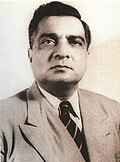
| 1 | 
|
Iskandar Ali Mirza (1899–1969) |
23 March 1956 | 27 October 1958 | 2 years, 218 days | Republican | 1956 | [5] | |
| 2 | 
|
Ayub Khan (1907–1974) |
27 October 1958 | 8 June 1962 | 3 years, 224 days | Army | – | ||
| 8 June 1962 | 25 March 1969 | 6 years, 290 days | PMLC | 1965 | |||||
| 3 | 
|
Yahya Khan (1917–1980) |
25 March 1969 | 20 December 1971 | 2 years, 270 days | Army | – | [5][6][page needed] | |
| 4 | .jpg)
|
Zulfikar Ali Bhutto (1928–1979) |
20 December 1971 | 14 August 1973 | 1 year, 237 days | PPP | 1970 | [5] | |
| 5 | Fazal Ilahi Chaudhry (1904–1982) |
14 August 1973 | 16 September 1978 | 5 years, 33 days | PPP | 1973 | |||
| 6 | 
|
Muhammad Zia-ul-Haq (1924–1988) |
16 September 1978 | 17 August 1988 † | 9 years, 336 days | Army | – | ||
| 7 | .JPG)
|
Ghulam Ishaq Khan (1915–2006) |
17 August 1988 | 18 July 1993 | 4 years, 335 days | IND | 1988 | ||
| — | 
|
Wasim Sajjad (born 1941) |
18 July 1993 | 14 November 1993 | 119 days | PMLN | – | ||
| 8 | .jpg)
|
Farooq Leghari (1940–2010) |
14 November 1993 | 2 December 1997 | 4 years, 18 days | PPP | 1993 | ||
| — |
|
Wasim Sajjad (born 1941) |
2 December 1997 | 1 January 1998 | 30 days | PMLN | – | ||
| 9 | .jpg)
|
Muhammad Rafiq Tarar (1929–2022) |
1 January 1998 | 20 June 2001 | 3 years, 170 days | PMLN | 1997 | ||
| 10 | 
|
Pervez Musharraf (1943–2023) |
20 June 2001 | 15 October 2007 | 6 years, 117 days | Army | 2004 | [5][7] | |
| 19 November 2007 | 18 August 2008 | 273 days | PML(Q) | 2007 | [5] | ||||
| — | 
|
Muhammad Mian Soomro (born 1950) |
18 August 2008 | 9 September 2008 | 22 days | PML(Q) | – | ||
| 11 | 
|
Asif Ali Zardari (born 1955) |
9 September 2008 | 9 September 2013 | 5 years | PPP | 2008 | ||
| 12 | 
|
Mamnoon Hussain (1940–2021) |
9 September 2013 | 9 September 2018 | 5 years | PMLN | 2013 | ||
| 13 | .jpg)
|
Arif Alvi (born 1949) |
9 September 2018 | 10 March 2024 | 5 years, 183 days | PTI | 2018 | ||
| 14 | _(b).jpg)
|
Asif Ali Zardari (born 1955) |
10 March 2024 | Incumbent | 2 years, 218 days | PPP | 2024 | ||

Eligibility and selection process[edit | edit source]
The Constitution of Pakistan sets the principle qualifications that the candidate must meet to be eligible to the office of the president.[8] A president has to be:
- A citizen of Pakistan[9]
- A Muslim[8]
- At least 45 years of age[8]
- Qualified to be elected as member of the National Assembly[8]
The selection of President occurs when the Aiwan-e-Sadr (Presidential Palace) becomes vacant through an electoral process conducted by the Electoral College comprising both houses of Parliament (Senate and National Assembly) and the four provincial assemblies. The Chief Election Commissioner is constitutionally mandated to conduct presidential elections in a special session, with voting conducted through secret ballot methods.
The electoral system employs a differentiated voting structure where each elector casts varying numbers of votes. The fundamental principle ensures equality between the total votes cast by parliamentary members and provincial legislators. Provincial legislatures receive equal voting allocations based on the smallest provincial assembly, the Balochistan Assembly, comprising 65 members.
The Constitution establishes specific temporal parameters for presidential elections, stipulating that such elections must be conducted no earlier than sixty days and no later than thirty days preceding the expiration of the incumbent President's term.
Election and oath[edit | edit source]
The president is elected indirectly for a term of five years.[10] The incumbent president is eligible for re-election to that office, but cannot hold that office for more than two consecutive terms.[11] The president is required to make and subscribe in the presence of the chief justice—, an oath or affirmation that the president shall protect, preserve and defend the Constitution as follows:
I, (The name of the President-elect), do solemnly swear that I am a Muslim and believe in the Unity, and Oneness of Almighty Allah, the Books of Allah, the Holy Qur'an being the last of them, the Prophethood of Muhammad (peace be upon him) as the last of the Prophets and that there can be no Prophet after him, the Day of Judgment, and all the requirements and teachings of the Holy Quran and Sunnah:
That I will bear true faith and allegiance to Pakistan:
That, as President of Pakistan, I will discharge my duties, and perform my functions, honestly, to the best of my ability, faithfully in accordance with the Constitution of the Islamic Republic of Pakistan and the law, and always in the interest of the sovereignty, integrity, solidarity, well- being and prosperity of Pakistan:
That I will not allow my personal interest to influence my official conduct or my official decisions:
That I will preserve, protect and defend the Constitution of the Islamic Republic of Pakistan:
That, in all circumstances, I will do right to all manner of people, according to law, without fear or favour, affection or ill- will:
And that I will not directly or indirectly communicate or reveal to any person any matter which shall be brought under my consideration or shall become known to me as President of Pakistan, except as may be required for the due discharge of my duties as President.
May Allah Almighty help and guide me (Ameen).[12]
Line of succession and removal[edit | edit source]
The Constitution provides for an acting president arrangement in specific circumstances, permitting certain office-holders to contest presidential elections despite the absence of a vice-presidential position:
- the Chairman of the Senate of Pakistan
- the Speaker of the National Assembly of Pakistan.
The President may be removed from office before their term expires through impeachment proceedings for violating the Constitution of Pakistan.
The impeachment process may be initiated in either parliamentary house. The initiating house must level charges against the President through a notice signed by either the Chairman or Speaker of the National Assembly, requiring a two-thirds majority. This notice is forwarded to the President, followed by a 14-day consideration period. Subsequently, a resolution to impeach must be passed by two-thirds majority, after which the Speaker of the National Assembly summons a joint session within seven days. The President possesses the right to defend themselves during these proceedings.
If the resolution passes by two-thirds majority at the joint session, declaring the President unfit due to incapacity or guilty of constitutional violation or gross misconduct, the President immediately ceases to hold office upon the resolution's passage. No President has been successfully impeached, though impeachment proceedings were initiated in 2008 against former President Pervez Musharraf, who subsequently resigned as these proceedings advanced.
References[edit | edit source]
- ↑ Gupta, K. R., ed. (2006). India-Pakistan relations with special reference to Kashmir. New Delhi: Atlantic Publ. and Distributors. ISBN 8126906723.
- ↑ "Govt wants to double president's salary". The Express Tribune. 29 May 2018.
- ↑ "Data" (PDF). www.na.gov.pk. Retrieved 9 June 2020.
- ↑ Jonko, Anushree (11 November 2025). "Pakistan Puts Asim Munir's Army Above State: What It Means". NDTV.
- ↑ 5.0 5.1 5.2 5.3 5.4 "Presidents". National Assembly of Pakistan. 11 August 2023. Archived from the original on 11 August 2023. Retrieved 22 October 2023.
- ↑ Burki, Shahid Javed; Baxter, Craig (1991). Pakistan Under The Military: Eleven Years Of Zia Ul-haq. Westview Press. ISBN 978-0813379852.
- ↑ Waldman, Amy (2 January 2004). "Pakistan gives Musharraf confidence vote as president". The New York Times. Retrieved 20 January 2013.
- ↑ 8.0 8.1 8.2 8.3 Article 41(2) Archived 2016-02-04 at the Wayback Machine in Chapter 1: The President, Part III: The Federation of Pakistan in the Constitution of Pakistan.
- ↑ Cite error: Invalid
<ref>tag; no text was provided for refs namedArticle 411 - ↑ Article 44(1)-(2) Archived 2016-02-04 at the Wayback Machine in Chapter 1: The President in Part III: The Federation of Pakistan in the Constitution of Pakistan.
- ↑ Article 44(2) Archived 2016-02-04 at the Wayback Machine in Chapter 1: The President in Part III: The Federation of Pakistan in the Constitution of Pakistan.
- ↑ Article 42 in Chapter 1: The President in Part III: The Federation of Pakistan in the Constitution of Pakistan
Notes[edit | edit source]
Read also[edit | edit source]
- Principal Secretary to the President of Pakistan
- Air transports of heads of state and government
- Official state car
- Prime Minister of Pakistan
- Chief Justice of Pakistan
- Chief Justice of the Federal Shariat Court
- Chief Minister of Sindh
- Chief Minister of Punjab (Pakistan)
- Chief Minister of Balochistan
- Chief Minister of Khyber Pakhtunkhwa
- Chief Minister of Gilgit-Baltistan
- Prime Minister of Azad Kashmir
- Chief of Army Staff of the Pakistan Army
- Constitution of Pakistan
- Wafaqi Mohtasib (Federal Ombudsman)
- Foreign Minister of Pakistan
- Finance Minister of Pakistan
- Interior Minister of Pakistan
- Minister of Defence (Pakistan)
- Vice President of Pakistan
External links[edit | edit source]
Template:Presidents of Pakistan Template:Government of Pakistan Template:Pakistan Armed Forces


