






m Removed empty portal template using script |
update |
||
| Line 1: | Line 1: | ||
{{ | {{Short description|Metropolis in Uttar Pradesh, India}} | ||
{{Redirect|Allahabad|other uses|Prayagraj (disambiguation)}} | {{Redirect|Allahabad|other uses|Prayagraj (disambiguation)|and|Allahabad (disambiguation)}} | ||
{{Good article}} | |||
{{pp-move}} | |||
{{ | {{protection padlock|small=yes}} | ||
{{Use Indian English|date=August | {{Use Indian English|date=August 2025}} | ||
{{Use dmy dates|date= | {{Use dmy dates|date=August 2025}} | ||
{{Infobox settlement | {{Infobox settlement | ||
| name | | name = Prayagraj | ||
| native_name | | native_name = <!-- Please do not add any Indic script in this infobox, per WP:INDICSCRIPT. --> | ||
| native_name_lang | | native_name_lang = hi | ||
| other_name | | other_name = Allahabad <!--Illahabad was the Hindi pronunciation. Do not add it here--> | ||
| settlement_type | | settlement_type = [[Metropolis]] | ||
| image_skyline | | image_skyline = Allahabad Montage II Dec 2014.jpg | ||
| imagesize | | imagesize = 295px | ||
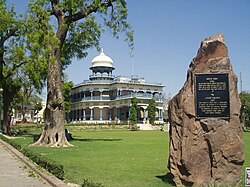
| image_caption | | image_caption = Clockwise from top left: [[All Saints Cathedral, Allahabad|All Saints Cathedral]], [[Khusro Bagh]], the [[Allahabad High Court]], the [[New Yamuna Bridge, Allahabad|New Yamuna Bridge]] near [[Triveni Sangam#Triveni Sangam in Allahabad|Sangam]], the skyline of [[Civil Lines, Allahabad|Civil Lines]], the [[University of Allahabad]], [[Thornhill Mayne Memorial]] at [[Chandrashekhar Azad Park]] and [[Anand Bhavan]] | ||
| nicknames | | etymology = King of the Prayagas | ||
| image_map | | nicknames = ''The [[Triveni Sangam#Triveni Sangam in Allahabad|Sangam]] City'',<ref name=sangam>{{cite news |last1=Mani |first1=Rajiv |title=Sangam city, Allahabad |url=http://timesofindia.indiatimes.com/city/allahabad/Girl-from-Sangam-city-grabs-headlines-in-US/articleshow/35421311.cms |access-date=16 August 2014 |newspaper=[[The Times of India]] |date=21 May 2014 |url-status = live|archive-url=https://web.archive.org/web/20140525090000/http://timesofindia.indiatimes.com/city/allahabad/Girl-from-Sangam-city-grabs-headlines-in-US/articleshow/35421311.cms |archive-date=25 May 2014 }}</ref> ''City of Prime Ministers''<ref name="prime">{{cite web |title=City of Prime Ministers |url=http://allahabad.nic.in/history.htm |publisher=Government of Uttar Pradesh |access-date=16 August 2014 |url-status = dead|archive-url=https://web.archive.org/web/20140813071307/http://allahabad.nic.in/history.htm |archive-date=13 August 2014 }}</ref> and Kumbh Nagari | ||
| map_alt | | image_map = | ||
| map_caption | | map_alt = | ||
| pushpin_map | | map_caption = Location of Prayagraj in [[Uttar Pradesh]] | ||
| pushpin_relief | | pushpin_map = India Uttar Pradesh#India | ||
| pushpin_label_position | | pushpin_relief = | ||
| pushpin_map_alt | | pushpin_label_position = right | ||
| pushpin_map_caption | | pushpin_map_alt = | ||
| coordinates | | pushpin_map_caption = | ||
| subdivision_type | | coordinates = {{coord|25|26|09|N|81|50|47|E|display=inline,title}} | ||
| subdivision_name | | subdivision_type = Country | ||
| subdivision_type1 | | subdivision_name = [[India]] | ||
| subdivision_type2 | | subdivision_type1 = [[States and union territories of India|State]] | ||
| subdivision_type3 | | subdivision_type2 = [[Administrative divisions of India#Divisions|Division]] | ||
| subdivision_name1 | | subdivision_type3 = [[List of districts of Uttar Pradesh|District]] | ||
| subdivision_name2 | | subdivision_name1 =[[Uttar Pradesh]] | ||
| subdivision_name3 | | subdivision_name2 = [[Prayagraj division|Prayagraj]] | ||
| government_type | | subdivision_name3 = [[Prayagraj district|Prayagraj]] | ||
| governing_body | | government_type = [[Municipal Corporation]] | ||
| leader_party | | governing_body = [[Prayagraj Municipal Corporation]] | ||
| leader_title | | leader_party = [[Bharatiya Janata Party|BJP]] | ||
| leader_name | | leader_title = Mayor | ||
| leader_title1 | | leader_name = Ganesh Kesarwani | ||
| leader_name1 | | leader_title1 = [[Member of Parliament, Lok Sabha|Lok Sabha MP]] | ||
| unit_pref | | leader_name1 = [[Ujjwal Raman Singh]] ([[Indian National Congress|INC]]) | ||
| area_footnotes | | unit_pref = Metric | ||
| area_total_km2 | | area_footnotes = <ref name='Prayagraj City'>{{cite web|title=Prayagraj City|url=http://allahabadmc.gov.in/about_ann.html|website=allahabadmc.gov.in|access-date=21 November 2020|archive-date=2 August 2020|archive-url=https://web.archive.org/web/20200802161000/http://allahabadmc.gov.in/about_ann.html|url-status=live}}</ref> | ||
| area_rank | | area_total_km2 = 365 | ||
| area_rank = 10 | |||
| elevation_m | | elevation_m = 98 | ||
| population_total | | population_total = 1536218 | ||
| population_as_of | | population_as_of = 2020–2011 hybrid | ||
| population_footnotes | | population_footnotes = <ref name='Prayagraj City'/> | ||
| population_density_km2 | | population_density_km2 = auto | ||
| population_metro | | population_metro = | ||
| population_metro_footnotes | | population_metro_footnotes = | ||
| population_rank | | population_rank = [[List of cities in Uttar Pradesh by population|7th]] <small>in Uttar Pradesh</small><br/>[[List of most populous cities in India|36th]] <small>in India</small> | ||
| population_blank1_title | | population_blank1_title = Metro rank | ||
| population_blank1 | | population_blank1 = [[List of million-plus agglomerations in India|40th]] | ||
| population_demonyms | | population_demonyms = Prayagi<br />Allahabadi<br />Ilahabadi<ref>{{cite news |title=Poets' 'Allahabadi' Surnames Changed To 'Prayagraj' After UP Website Hack |url=https://www.ndtv.com/india-news/poets-allahabadi-surnames-changed-to-prayagraj-after-up-website-hack-2676909 |publisher=NDTV.com |date=29 December 2021}}</ref><ref>{{cite web | url=https://www.britannica.com/place/Prayagraj | title=Prayagraj | City, Fort, History, & Facts | Britannica }}</ref> | ||
| | | timezone1 = [[Indian Standard Time|IST]] | ||
| utc_offset1 = +5:30 | |||
| | | postal_code_type = [[Postal Index Number|PIN]] | ||
| | | postal_code = 211001–211018 | ||
| area_code | | area_code = +91-532 | ||
| area_code_type | | area_code_type = Telephone code | ||
| registration_plate | | registration_plate = UP-70 | ||
| blank1_name_sec1 | | blank1_name_sec1 = [[Human sex ratio|Sex ratio]] | ||
| blank1_info_sec1 | | blank1_info_sec1 = 852 [[Female|♀]]/1000[[Male|♂]] | ||
| website | | website = {{URL|prayagraj.nic.in}} | ||
| footnotes | | footnotes = {{Reflist|group=upper-alpha}} | ||
| leader_name2 | | leader_name2 = | ||
| leader_title2 | | leader_title2 = | ||
| leader_name3 | | leader_name3 = | ||
| leader_title3 | | leader_title3 = | ||
| leader_name4 | | leader_name4 = | ||
| leader_title4 | | leader_title4 = | ||
| demographics_type1 | | demographics_type1 = Language | ||
| demographics1_title1 | | demographics1_title1 = Official | ||
| demographics1_info1 | | demographics1_info1 = [[Hindi]]<ref name="langoff">{{cite web|title=52nd Report of the Commissioner for Linguistic Minorities in India|url=http://nclm.nic.in/shared/linkimages/NCLM52ndReport.pdf|website=nclm.nic.in|publisher=[[Ministry of Minority Affairs]]|access-date=20 December 2018|url-status = dead|archive-url=https://web.archive.org/web/20170525141614/http://nclm.nic.in/shared/linkimages/NCLM52ndReport.pdf|archive-date=25 May 2017}}</ref> | ||
| demographics1_title2 | | demographics1_title2 = Additional official | ||
| demographics1_info2 | | demographics1_info2 = [[Urdu]]<ref name="langoff" /> | ||
| demographics1_title3 | | demographics1_title3 = Regional | ||
| demographics1_info3 | | demographics1_info3 = [[Awadhi language|Awadhi]]<ref>{{cite web |url=https://www.ethnologue.com/language/awa |title=Awadhi |website=[[Ethnologue]] |access-date=7 May 2019 |archive-date=6 June 2019 |archive-url=https://web.archive.org/web/20190606184310/https://www.ethnologue.com/language/awa |url-status=live }}</ref> | ||
| established_title = Earliest mention | |||
| established_date = c. 1200–1000 BCE{{sfn|Krishnaswamy|Ghosh|1935|pp=698–699, 702–703}} | |||
| established_title1 = Established as ''Ilahabas'' | |||
| established_date1 = 1584 | |||
| established_title2 = | |||
| established_date2 = | |||
| established_title3 = Established as a city | |||
| established_date3 = 1801 | |||
| named_for = [[Panch Prayag]] | |||
| area_total_sq_mi = 140.9 | |||
| elevation_ft = 321.52 | |||
}} | }} | ||
'''Prayagraj''' ( | '''Prayagraj''' ({{IPAc-en|ˈ|p|r|eɪ|ə|ˌ|ɡ|r|ɑː|dʒ|,_|'|p|r|aɪ|ə|-}}, {{ipa|hi|pɾəjaːɡ.ɾaːd͡ʑ|lang}}; [[ISO 15919|ISO]]: {{IAST|Prayāgarāja}}), formerly and colloquially known as '''Allahabad''', is a [[metropolis]] in the [[States and union territories of India|Indian state]] of [[Uttar Pradesh]].<ref>{{cite web |title=Metropolitan Cities of India |url=http://www.cpcb.nic.in/EnvironmetalPlanning/ground/Chapter3.pdf |website=cpcb.nic.in |archive-url=https://web.archive.org/web/20150923210838/http://www.cpcb.nic.in/EnvironmetalPlanning/ground/Chapter3.pdf |access-date=22 December 2020|archive-date=23 September 2015 }}</ref><ref name="Six cities to get metropolitan stat">{{cite news |url=https://timesofindia.indiatimes.com/city/lucknow/Six-cities-to-get-metropolitan-status/articleshow/2210886.cms?from=mdr |title=Six cities to get metropolitan status |newspaper=[[The Times of India]] |date=20 October 2006 |access-date=8 August 2020 |archive-date=13 April 2021 |archive-url=https://web.archive.org/web/20210413034053/https://timesofindia.indiatimes.com/city/lucknow/Six-cities-to-get-metropolitan-status/articleshow/2210886.cms?from=mdr |url-status=live }}<br />The other five cities were: [[Agra]], [[Kanpur|Kanpur (Cawnpore)]], [[Lucknow]], [[Meerut]], and [[Varanasi|Varanasi (Benares)]].</ref> It is the administrative headquarters of the [[Prayagraj district]], the most populous district in the state and 13th most populous district in India and the [[Prayagraj division]]. The city is the judicial capital of Uttar Pradesh with the [[Allahabad High Court]] being the highest judicial body in the state. {{As of|2011|post=,}} Prayagraj is the [[List of cities in Uttar Pradesh by population|seventh most populous city]] in the state, [[list of North Indian cities by population|thirteenth]] in [[North India|Northern India]] and [[List of cities in India by population|thirty-sixth]] in India, with an estimated population of 1.53 million in the city.<ref name="census2011">{{cite web |url=http://www.census2011.co.in/census/city/138-allahabad.html |title=Allahabad City Population Census 2011 | Uttar Pradesh |publisher=Census2011.co.in |access-date=26 May 2014 |url-status = live|archive-url=https://web.archive.org/web/20140517183230/http://www.census2011.co.in/census/city/138-allahabad.html |archive-date=17 May 2014 }}</ref><ref>{{cite web |url=http://www.census2011.co.in/census/metropolitan/87-allahabad.html |title=Allahabad Metropolitan Urban Region Population 2011 Census |publisher=Census2011.co.in |access-date=26 May 2014 |url-status = live|archive-url=https://web.archive.org/web/20140518234508/http://www.census2011.co.in/census/metropolitan/87-allahabad.html |archive-date=18 May 2014 }}</ref> In 2011, it was ranked the world's 40th fastest-growing city.<ref name="fastest growing">{{cite web|title=The world's fastest growing cities and urban areas from 2006 to 2020|url=http://www.citymayors.com/statistics/urban_growth2.html|work=City Mayors Statistics|access-date=11 February 2014|url-status = live|archive-url=https://web.archive.org/web/20131014181201/http://www.citymayors.com/statistics/urban_growth2.html|archive-date=14 October 2013}}</ref><ref>{{cite web|url= http://www.walkthroughindia.com/walkthroughs/10-twin-towns-and-sister-cities-of-indian-states/|title= 10 Twin Towns and Sister Cities of Indian States|author= <!--Staff writer(s); no by-line.-->|website= walkthroughindia.com|date= 26 September 2013|access-date= 9 January 2014|url-status = live|archive-url= https://web.archive.org/web/20140109083014/http://www.walkthroughindia.com/walkthroughs/10-twin-towns-and-sister-cities-of-indian-states/|archive-date= 9 January 2014}}</ref> The city, in 2016, was also ranked the third most liveable [[Urban area|urban agglomeration]] in the state (after [[Noida]] and [[Lucknow]]) and sixteenth in the country.<ref>{{cite web |url=http://competitiveness.in/publications/reports/liveability-index/ |title=Liveability Index |access-date=1 August 2015 |url-status = dead|archive-url=https://web.archive.org/web/20150912165115/http://competitiveness.in/publications/reports/liveability-index/ |archive-date=12 September 2015 |publisher=Institute for Competitiveness, India}}</ref> [[Hindi]] is the most widely spoken language in the city. | ||
Prayagraj lies close to [[Triveni Sangam]], the "three-river confluence" of the [[Ganges]], [[Yamuna]] and [[Sarasvati River|Sarasvati]] | Prayagraj lies close to [[Triveni Sangam]], the "three-river confluence" of the [[Ganges]], [[Yamuna]], and the mythical [[Sarasvati River|Sarasvati]].<ref name=sangam /> It plays a central role in [[Hindu texts|Hindu scriptures]]. The city finds its earliest reference as one of the world's oldest known cities in Hindu texts and has been venerated as the holy city of ''Prayāga'' in the ancient [[Vedas]]. Prayagraj was also known as [[Kosambi]] in the late [[Vedic period]], named by the [[Kuru Kingdom|Kuru]] rulers of [[Hastinapur]], who developed it as their capital. Known as Purimtal in ancient Jain scriptures, it is also a sacred place for [[Jainism|Jains]], as their first [[Tirthankara|Tirthankar]], [[Rishabhanatha|Rishabhdeva]] attained [[Kevala jnana|kevalya gyana]] here.<ref>{{Cite web |last=Rao |first=M. Subba |title=Sachitra Shraman Bhagwan Mahavir |url=https://jainqq.org/explore/006789/144 |access-date=16 December 2024 |archive-date=17 December 2024 |archive-url=https://web.archive.org/web/20241217061359/https://jainqq.org/explore/006789/144 |url-status=live }}</ref> This was one of the greatest cities in India from the late Vedic period until the end of the [[Maurya Empire]],<ref>{{cite web |title=Prayagraj – Ancient Era and Maurya Period |url=https://prayagrajportal.org/general-information/timeline-of-major-historical-events-in-prayagraj/ |access-date=6 February 2026 |website=Prayagraj Portal}}</ref> with occupation continuing until the [[Gupta Empire]]. Since then, the city has been a political, cultural and administrative centre of the [[Doab]] region. | ||
''[[Akbarnama]]'' mentions that the [[Mughal emperor]] [[Akbar]] founded a great city in Allahabad. [[ | ''[[Akbarnama]]'' mentions that the [[Mughal emperors|Mughal emperor]] [[Akbar]] founded a great city in Allahabad. [[Abd al-Qadir Badayuni]] and [[Nizamuddin Ahmad]] mention that Akbar laid the foundations of an imperial city there which was called ''Ilahabas'' or ''Ilahabad''.<ref name=Ujagir /><ref name=Kumbh67 /> In the early 17th century, Allahabad was a provincial capital in the [[Mughal Empire]] under the reign of [[Jahangir]].<ref name="Pletcher 2010 128">{{cite book |last=Pletcher |first=Kenneth |date=15 August 2010 |title=The Geography of India: Sacred and Historic Places |url=https://books.google.com/books?id=Mjr0X-8jrLAC&pg=PA128 |publisher=The Rosen Publishing Group |page=128 |isbn= 978-1-61530-142-3|access-date=21 March 2014 |url-status = live|archive-url=https://web.archive.org/web/20181115154619/https://books.google.com/books?id=Mjr0X-8jrLAC&pg=PA128#v=onepage&q=Allahabad|archive-date=15 November 2018 }}</ref> In 1833, it became the seat of the [[Ceded and Conquered Provinces]] region before its capital was moved to [[Agra]] in 1835.<ref name="MHBI">{{cite book|author=H.S. Bhatia|title=Military History of British India: 1607–1947|url=https://books.google.com/books?id=Lrjr7P2HMfkC&pg=PA96|publisher=Deep and Deep Publications'|isbn=978-81-8450-079-0|page=97|url-status = live|archive-url=https://web.archive.org/web/20181115154711/https://books.google.com/books?id=Lrjr7P2HMfkC&pg=PA96#v=onepage&q=history|archive-date=15 November 2018|year=2008}}</ref> Allahabad became the capital of the [[North-Western Provinces]] in 1858 and was the [[List of capitals of India|capital of India]] for a day.<ref name="Ashutosh Joshi 1 January 2008 237">{{cite book|title=Town Planning Regeneration of Cities|author=Ashutosh Joshi|publisher=New India Publishing|year=2008|isbn=978-81-89422-82-0|page=237|url=https://books.google.com/books?id=UFaGME0XDBkC&pg=PA151|url-status = live|archive-url=https://web.archive.org/web/20181115154758/https://books.google.com/books?id=UFaGME0XDBkC&pg=PA151#v=onepage&q=Allahabad|archive-date=15 November 2018}}</ref><ref>{{Cite news |last=Kaur |first=Jasreet |title=MSN |url=https://www.msn.com/en-in/news/India/which-city-became-the-capital-of-india-for-a-day/ar-AA1KdO21?ocid=winp2fptaskbar&cvid=c20b745b51a34311f0094410e1d1d9fe&ei=25 |work=MSN |access-date=10 August 2025}}</ref> The city was the capital of the [[United Provinces of Agra and Oudh|United Provinces]] from 1902<ref name="Ashutosh Joshi 1 January 2008 237" /> to 1920<ref name="Ward2008">{{cite book|author=Kerry Ward|title=Networks of Empire: Forced Migration in the Dutch East India Company|url=https://books.google.com/books?id=YNBmIu5m6hAC|publisher=Cambridge University Press|isbn=978-0-521-88586-7|page=340|url-status = live|archive-url=https://web.archive.org/web/20130523054906/http://books.google.com/books?id=YNBmIu5m6hAC|archive-date=23 May 2013|year=2009}}</ref> and remained at the forefront of national importance during the [[Indian independence movement|struggle for Indian independence]].<ref name="Desai1986" /> | ||
Located in southern Uttar Pradesh, the city covers {{Convert|365|km2|abbr=on}}.<ref name='Prayagraj City'/> Although the city and its surrounding area are governed by several municipalities, a large portion of | Prayagraj is an international [[tourism]] destination, second in terms of tourist arrivals in the state after Varanasi.<ref>{{cite news|url=https://www.thestatesman.com/india/with-over-32-crore-tourist-arrivals-in-9-months-up-turns-top-tourist-destination-1503256625.html|title=With over 32 cr tourist arrivals in 9 months, UP turns top tourist destination|work=The Statesman|access-date=7 January 2024}}</ref> Located in southern Uttar Pradesh, the city covers {{Convert|365|km2|abbr=on}}.<ref name='Prayagraj City'/> Although the city and its surrounding area are governed by several municipalities, a large portion of Prayagraj district is governed by the Prayagraj Municipal Corporation. The city is home to colleges, research institutions and many [[Central government|central]] and [[Government of Uttar Pradesh|state government]] offices, including High court of Uttar Pradesh. Prayagraj has hosted cultural and sporting events, including the [[Prayag Kumbh Mela]] and the [[Indira Marathon]]. Although the city's economy was built on tourism, most of its income now derives from real estate and financial services.<ref name="timesofindia.indiatimes.com">{{cite news |url=http://timesofindia.indiatimes.com/city/allahabad/City-generates-534760-kg-domestic-waste-daily/articleshow/7463898.cms |title=City generates 5,34,760 kg domestic waste daily |date=10 February 2011 |last1=Mani |first1=Rajiv | access-date=29 August 2015 |url-status = live|archive-url=https://web.archive.org/web/20151218090413/http://timesofindia.indiatimes.com/city/allahabad/City-generates-534760-kg-domestic-waste-daily/articleshow/7463898.cms |archive-date=18 December 2015 |newspaper=[[The Times of India]]}}</ref> | ||
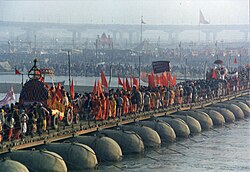
Prayagraj hosted the [[Kumbh Mela]] in 2019, one of the largest peaceful gatherings in the world, with the Government of Uttar Pradesh estimating participation of over 120 million pilgrims during the festival period. The event received extensive national and international coverage and involved major infrastructure development projects in the city.<ref>{{cite news |title=Kumbh Mela 2019 ends with record footfall |url=https://indianexpress.com/article/india/kumbh-mela-2019-ends-with-record-footfall-5608417/ |work=The Indian Express |date=4 March 2019 |access-date=6 February 2026}}</ref><ref>{{cite web |title=Kumbh Mela 2019 |url=https://kumbh.gov.in |publisher=Government of Uttar Pradesh |access-date=6 February 2026}}</ref> | |||
== Etymology == | == Etymology == | ||
The location at the confluence of Ganges and Yamuna rivers has been known in ancient times as Prayāga, which means "place of a sacrifice" in Sanskrit (''pra-,'' "fore-" + ''yāj-'', "to sacrifice").<ref>{{Cite web|url=https://www.sanskrit-lexicon.uni-koeln.de/scans/MWScan/2014/web/webtc/servepdf.php?page=687|title=A Sanskrit–English Dictionary|last=Monier-Williams|first=Monier|website=www.sanskrit-lexicon.uni-koeln.de|access-date=18 April 2020|archive-date=19 August 2021|archive-url=https://web.archive.org/web/20210819125313/https://www.sanskrit-lexicon.uni-koeln.de/scans/MWScan/2014/web/webtc/servepdf.php?page=687|url-status=live}}</ref> It was believed that god [[Brahma]] performed the very first sacrifice (''yāga, [[yajna]]'') in this place.<ref>{{Cite web|url=https://www.indiatoday.in/india/story/yogi-adityanath-takes-allahabad-to-prayagraj-after-443-years-a-recap-of-history-1368216-2018-10-15|title=Yogi Adityanath takes Allahabad to Prayagraj after 443 years: A recap of History|website=[[India Today]]|author=India Today Web Desk|date=15 October 2018|access-date=12 February 2019|archive-url=https://web.archive.org/web/20190213011029/https://www.indiatoday.in/india/story/yogi-adityanath-takes-allahabad-to-prayagraj-after-443-years-a-recap-of-history-1368216-2018-10-15|archive-date=13 February 2019|url-status = live}}</ref><ref>{{Cite web|url=https://hindi.timesnownews.com/spiritual/article/what-is-the-meaning-of-prayagraj-new-name-of-allahabad-city-how-is-brahma-connected/300287|title=क्या है प्रयागराज का मतलब? सृष्टि की रचना के बाद जहां ब्रह्मा ने सबसे पहले संपन्न किया था यज्ञ|website=[[Times Now]]|author=टाइम्स नाउ डिजिटल|date=16 October 2018|language=hi|access-date=12 February 2019|archive-url=https://web.archive.org/web/20190213005748/https://hindi.timesnownews.com/spiritual/article/what-is-the-meaning-of-prayagraj-new-name-of-allahabad-city-how-is-brahma-connected/300287|archive-date=13 February 2019|url-status = live}}</ref> | The location at the confluence of Ganges and [[Yamuna]] rivers has been known in ancient times as Prayāga, which means "place of a sacrifice" in Sanskrit (''pra-,'' "fore-" + ''yāj-'', "to sacrifice").<ref>{{Cite web|url=https://www.sanskrit-lexicon.uni-koeln.de/scans/MWScan/2014/web/webtc/servepdf.php?page=687|title=A Sanskrit–English Dictionary|last=Monier-Williams|first=Monier|website=www.sanskrit-lexicon.uni-koeln.de|access-date=18 April 2020|archive-date=19 August 2021|archive-url=https://web.archive.org/web/20210819125313/https://www.sanskrit-lexicon.uni-koeln.de/scans/MWScan/2014/web/webtc/servepdf.php?page=687|url-status=live}}</ref> It was believed that god [[Brahma]] performed the very first sacrifice (''yāga, [[yajna]]'') in this place.<ref>{{Cite web|url=https://www.indiatoday.in/india/story/yogi-adityanath-takes-allahabad-to-prayagraj-after-443-years-a-recap-of-history-1368216-2018-10-15|title=Yogi Adityanath takes Allahabad to Prayagraj after 443 years: A recap of History|website=[[India Today]]|author=India Today Web Desk|date=15 October 2018|access-date=12 February 2019|archive-url=https://web.archive.org/web/20190213011029/https://www.indiatoday.in/india/story/yogi-adityanath-takes-allahabad-to-prayagraj-after-443-years-a-recap-of-history-1368216-2018-10-15|archive-date=13 February 2019|url-status = live}}</ref><ref>{{Cite web|url=https://hindi.timesnownews.com/spiritual/article/what-is-the-meaning-of-prayagraj-new-name-of-allahabad-city-how-is-brahma-connected/300287|title=क्या है प्रयागराज का मतलब? सृष्टि की रचना के बाद जहां ब्रह्मा ने सबसे पहले संपन्न किया था यज्ञ|website=[[Times Now]]|author=टाइम्स नाउ डिजिटल|date=16 October 2018|language=hi|access-date=12 February 2019|archive-url=https://web.archive.org/web/20190213005748/https://hindi.timesnownews.com/spiritual/article/what-is-the-meaning-of-prayagraj-new-name-of-allahabad-city-how-is-brahma-connected/300287|archive-date=13 February 2019|url-status = live}}</ref> | ||
The word ''prayāga'' has been traditionally used to mean "a confluence of rivers". For Allahabad, it denoted the physical meeting point of the rivers | The word ''prayāga'' has been traditionally used to mean "a confluence of rivers". For Allahabad, it denoted the physical meeting point of the rivers Ganges and Yamuna in the city. An ancient tradition has it that a third river, invisible Sarasvati, also meets there with the two. Today, Triveni Sangam (or simply Sangam) is a more frequently used name for the confluence. | ||
Prayagraj ([[Sanskrit]]: ''Prayāgarāja''), meaning "the king among the five ''prayāgas''", is used as a term of respect to indicate that this confluence is the most splendid one of the [[Panch Prayag|five sacred | Prayagraj ([[Sanskrit]]: ''Prayāgarāja''), meaning "the king among the five ''prayāgas''", is used as a term of respect to indicate that this confluence is the most splendid one of the [[Panch Prayag|five sacred confluences]] in India.<ref>{{Cite web|url=https://www.timesnownews.com/videos/news/india/what-does-prayagraj-actually-mean-times-now-exclusive/12779|title=What does 'Prayagraj' actually mean?|website=[[Times Now]]|author=Akrita Reyar|date=17 October 2018|access-date=12 February 2019|archive-url=https://web.archive.org/web/20190213005706/https://www.timesnownews.com/videos/news/india/what-does-prayagraj-actually-mean-times-now-exclusive/12779|archive-date=13 February 2019|url-status = live}}</ref> | ||
The [[Mughal emperors|Mughal]] emperor [[Akbar]] visited the region in 1575 and was so impressed by the strategic location of the site that he ordered a fort be constructed.<ref name="Past">{{cite web |title=History |url=https://prayagraj.nic.in/history/ |publisher=Government of Uttar Pradesh |access-date=28 May 2024}}</ref> The fort was constructed by 1584 and called ''Ilahabas'' or "Abode of God", later changed to ''Allahabad'' under [[Shah Jahan]]. Speculations regarding its name, however, exist. Because of the surrounding people calling it ''Alhabas'', has led to some people{{Who|date=April 2020}} holding the view that it was named after [[Alha]] from [[Alha-Khand|Alha's story]].<ref name="Univ">{{cite book|title=University of Allahabad Studies|publisher=[[University of Allahabad]]|year=1962|page=8}}</ref> [[James Forbes (artist)|James Forbes]]' account of the early 1800s claims that it was renamed Allahabad or "Abode of God" by [[Jahangir]] after he failed to destroy the [[Akshayavat]] tree. The name, however, predates him, with ''Ilahabas'' and ''Ilahabad'' mentioned on coins minted in the city since Akbar's rule, the latter name became predominant after the emperor's death. It has also been thought to not have been named after [[Allah]] but ''ilaha'' (the gods). Shaligram Shrivastav claimed in ''Prayag Pradip'' that the name was deliberately given by Akbar to be construed as both Hindu ("ilaha") and Muslim ("Allah").<ref name="Kumbh67">{{cite book|url=https://books.google.com/books?id=MALacgnsroMC&pg=PA67|title=Pilgrimage and Power: The Kumbh Mela in Allahabad, 1765–1954|page=67|publisher=Oxford University Press|author=Kama Maclean|year=2008|isbn=978-0195338942|access-date=4 April 2018|archive-date=19 August 2021|archive-url=https://web.archive.org/web/20210819125311/https://books.google.com/books?id=MALacgnsroMC&pg=PA67|url-status=live}}</ref> | |||
Over the years, a number of attempts were made by the [[BJP]]-led governments of Uttar Pradesh to rename Allahabad to Prayagraj. In 1992, the planned rename was shelved when the chief minister, [[Kalyan Singh]], was forced to resign following the [[Babri Masjid demolition]]. | Over the years, a number of attempts were made by the [[BJP]]-led governments of Uttar Pradesh to rename Allahabad to Prayagraj. In 1992, the planned rename was shelved when the chief minister, [[Kalyan Singh]], was forced to resign following the [[Babri Masjid demolition]]. The government of [[Rajnath Singh]] also unsuccessfully attempted to change the name in 2001.<ref name="Kumbh672">{{cite book|url=https://books.google.com/books?id=MALacgnsroMC&pg=PA67|title=Pilgrimage and Power: The Kumbh Mela in Allahabad, 1765–1954|author=Kama Maclean|publisher=Oxford University Press|year=2008|page=67|isbn=978-0195338942|access-date=4 April 2018|archive-date=19 August 2021|archive-url=https://web.archive.org/web/20210819125311/https://books.google.com/books?id=MALacgnsroMC&pg=PA67|url-status=live}}</ref> The rename finally succeeded in October 2018 when the [[Yogi Adityanath]]-led government officially changed the name of the city to Prayagraj.<ref>{{cite news|url=https://www.indiatoday.in/india/story/allahabad-renamed-prayagraj-1368913-2018-10-16|title=Allahabad to Prayagraj: UP cabinet okays name change|work=India Today|language=en|access-date=16 October 2018|archive-url=https://web.archive.org/web/20181016165043/https://www.indiatoday.in/india/story/allahabad-renamed-prayagraj-1368913-2018-10-16|archive-date=16 October 2018|url-status = live}}</ref><ref>{{cite news|url=https://www.ndtv.com/allahabad-news/up-government-issues-notification-renaming-allahabad-to-prayagraj-1935038|title=UP Government Issues Notification Renaming Allahabad To Prayagraj|work=NDTV.com|access-date=24 October 2018|archive-url=https://web.archive.org/web/20181021151149/https://www.ndtv.com/allahabad-news/up-government-issues-notification-renaming-allahabad-to-prayagraj-1935038|archive-date=21 October 2018|url-status = live}}</ref> | ||
== History == | == History == | ||
{{Main|History of | {{Main|History of Prayagraj}} | ||
{{For timeline}} | {{For timeline}} | ||
=== Antiquity === | === Antiquity === | ||
The earliest mention of Prayāga and the associated pilgrimage is found in ''[[Rigveda]] Pariśiṣṭa'' (supplement to the ''Rigveda'', c. 1200–1000 BCE).{{sfn|Krishnaswamy|Ghosh|1935|pp=698–699, 702–703}} It is also mentioned in the [[Pali]] canons of [[Buddhism]], such as in section 1.7 of ''[[Majjhima Nikaya]]'' ({{circa|500 BCE}}), wherein the Buddha states that bathing in ''Payaga'' (Skt: Prayaga) cannot wash away cruel and evil deeds, rather the virtuous one should be pure in heart and fair in action.<ref>{{cite book|title= Teachings of The Buddha: Majjhima Nikaya |author1 = Bhikkhu Nanamoli (Tr)|author2 = Bhikkhu Bodhi(Tr)|year = 1995|isbn = 978-0861710720| url = https://archive.org/details/MajjhimaNikaya| page=[https://archive.org/details/MajjhimaNikaya/page/n483 121]}}</ref> The ''[[Mahabharata]]'' ({{circa|400 BCE}}–300 CE) mentions a bathing pilgrimage at Prayag as a means of ''prāyaścitta'' (atonement, penance) for past mistakes and guilt.{{Sfn|Kane|1953|pp=55–56}} In ''Tirthayatra Parva'', before the great war, the epic states "the one who observes firm [ethical] vows, having bathed at Prayaga during Magha, O best of the Bharatas, becomes spotless and reaches heaven."<ref>{{cite book|author=Diana L. Eck|title=India: A Sacred Geography|url=https://books.google.com/books?id=PyC4o7i9tnEC|year=2013|publisher=Three Rivers Press|isbn=978-0-385-53192-4|page=153|access-date=5 October 2019|archive-date=4 August 2020|archive-url=https://web.archive.org/web/20200804083919/https://books.google.com/books?id=PyC4o7i9tnEC|url-status=live}}</ref> In ''Anushasana parva'', after the war, the epic elaborates this bathing pilgrimage as "geographical tirtha" that must be combined with ''manasa-tirtha'' (tirtha of the heart) whereby one lives by values such as truth, charity, self-control, patience and others.<ref>Diane Eck (1981), India's "Tīrthas: "Crossings" in Sacred Geography, ''History of Religions'', Vol. 20, No. 4, pp. 340–341 with footnote</ref> | The earliest mention of Prayāga and the associated pilgrimage is found in ''[[Rigveda]] [[Pariśiṣṭa]]'' (supplement to the ''Rigveda'', c. 1200–1000 BCE).{{sfn|Krishnaswamy|Ghosh|1935|pp=698–699, 702–703}} It is also mentioned in the [[Pali]] canons of [[Buddhism]], such as in section 1.7 of ''[[Majjhima Nikaya]]'' ({{circa|500 BCE}}), wherein the Buddha states that bathing in ''Payaga'' (Skt: Prayaga) cannot wash away cruel and evil deeds, rather the virtuous one should be pure in heart and fair in action.<ref>{{cite book|title= Teachings of The Buddha: Majjhima Nikaya |author1 = Bhikkhu Nanamoli (Tr)|author2 = Bhikkhu Bodhi(Tr)|year = 1995|isbn = 978-0861710720| url = https://archive.org/details/MajjhimaNikaya| page=[https://archive.org/details/MajjhimaNikaya/page/n483 121]| publisher=Simon and Schuster }}</ref> The ''[[Mahabharata]]'' ({{circa|400 BCE}}–300 CE) mentions a bathing pilgrimage at Prayag as a means of ''prāyaścitta'' (atonement, penance) for past mistakes and guilt.{{Sfn|Kane|1953|pp=55–56}} In ''Tirthayatra Parva'', before the great war, the epic states "the one who observes firm [ethical] vows, having bathed at Prayaga during Magha, O best of the Bharatas, becomes spotless and reaches heaven."<ref>{{cite book|author=Diana L. Eck|title=India: A Sacred Geography|url=https://books.google.com/books?id=PyC4o7i9tnEC|year=2013|publisher=Three Rivers Press|isbn=978-0-385-53192-4|page=153|access-date=5 October 2019|archive-date=4 August 2020|archive-url=https://web.archive.org/web/20200804083919/https://books.google.com/books?id=PyC4o7i9tnEC|url-status=live}}</ref> In ''Anushasana parva'', after the war, the epic elaborates this bathing pilgrimage as "geographical tirtha" that must be combined with ''manasa-tirtha'' (tirtha of the heart) whereby one lives by values such as truth, charity, self-control, patience and others.<ref>Diane Eck (1981), India's "Tīrthas: "Crossings" in Sacred Geography, ''History of Religions'', Vol. 20, No. 4, pp. 340–341 with footnote</ref> | ||
Prayāga is mentioned in the ''[[Agni Purana]]'' and other [[Puranas]] with various legends, including being one of the places where [[Brahma]] attended a [[yajna]] (homa), and the confluence of river Ganges, Yamuna and mythical Saraswati site as the king of pilgrimage sites (''Tirtha Raj'').<ref name="Dubey2001">{{cite book|author=Shiva Kumar Dubey|title=Kumbh city Prayag|url=https://archive.org/details/kumbhcityprayag00unse|access-date=3 August 2012|publisher=Centre for Cultural Resources and Training|pages=[https://archive.org/details/kumbhcityprayag00unse/page/31 31]–41, 82|year=2001}}</ref> Other early accounts of the significance of Prayag to Hinduism is found in the various versions of the ''Prayaga Mahatmya'', dated to the late 1st-millennium CE. These ''[[Purana]]''-genre Sanskrit texts describe Prayag as a place "bustling with pilgrims, priests, vendors, beggars, guides" and local citizens busy along the confluence of the rivers (''sangam'').<ref name="Glucklich2008p146">{{cite book|author=Ariel Glucklich|title=The Strides of Vishnu: Hindu Culture in Historical Perspective|url=https://books.google.com/books?id=KtLScrjrWiAC&pg=PA146|year=2008|publisher=Oxford University Press|isbn=978-0-19-971825-2|pages=146–147|access-date=5 October 2019|archive-date=4 August 2020|archive-url=https://web.archive.org/web/20200804110843/https://books.google.com/books?id=KtLScrjrWiAC&pg=PA146|url-status=live}}</ref><ref>{{cite book|author=Ludo Rocher|title=The Purāṇas|url=https://books.google.com/books?id=n0-4RJh5FgoC&pg=PA71|year=1986|publisher=Otto Harrassowitz Verlag|isbn=978-3-447-02522-5|pages=71–72|quote=with footnotes|access-date=5 October 2019|archive-date=4 August 2020|archive-url=https://web.archive.org/web/20200804071021/https://books.google.com/books?id=n0-4RJh5FgoC&pg=PA71|url-status=live}}</ref> Prayaga is also mentioned in the Hindu epic ''[[Ramayana]]'', a place with the legendary ''Ashram'' of sage [[Bharadwaj]].<ref name="Krishnamoorthy1991">{{cite book|author=K. Krishnamoorthy|title=A Critical Inventory of Rāmāyaṇa Studies in the World: Indian languages and English|url=https://books.google.com/books?id=iOtreyGBGHQC&pg=PA28|publisher=Sahitya Academy|isbn=978-81-7201-100-0|pages=28–51|url-status = live|archive-url=https://web.archive.org/web/20130523070430/http://books.google.com/books?id=iOtreyGBGHQC&pg=PA28|archive-date=23 May 2013|year=1991}}</ref> | |||
==== In Jainism ==== | |||
[[File:Footprints_of_Rishabha.jpg|thumb|250x250px|Ancient footprints and a [[Śvetāmbara]] [[Jainism|Jain]] idol of [[Rishabhadeva]] commemorating the place of his omniscience]] | |||
''Purimtal Jain Tirth'', located in Prayagraj (formerly known as ''Purimtal''), is a site of religious and historical significance for [[Jainism|Jains]]. This ancient pilgrim site is revered as the spot where [[Rishabhadeva]], the first [[Tirthankara]], achieved ''[[Kevala jnana|keval gyan]]'' as per Jain beliefs.<ref>{{Cite web |last=Rao |first=M. Subba |title=Sachitra Shraman Bhagwan Mahavir |url=https://jainqq.org/explore/006789/144 |access-date=16 December 2024 |archive-date=17 December 2024 |archive-url=https://web.archive.org/web/20241217061359/https://jainqq.org/explore/006789/144 |url-status=live }}</ref> As documented in [[Vividha Tirtha Kalpa]] by Acharya Jinaprabhasuri, ''Purimtal'' once featured numerous Jain temples. Rishabhadeva is said to have attained omniscience under the [[Akshayavata|''Akshayavat'' tree]]. This tree, often referred to as the "indestructible" tree in legends, is a point of spiritual reverence in other religions as well. The site also holds importance in [[Hinduism|Hindu]] and Buddhist traditions. Originally, sandalwood footprints of Rishabhadeva were placed beneath the tree, which were later replaced with stone replicas following theft.<ref name=":1">{{Cite web |last=Jinaprabhasuri |first=Acharya |title=Vividh Tirthkalpa Sachitra |url=https://jainqq.org/explore/004512/293 |access-date=16 December 2024 |archive-date=17 December 2024 |archive-url=https://web.archive.org/web/20241217065309/https://jainqq.org/explore/004512/293 |url-status=live }}</ref> | |||
[[File:Small_shrine_decidated_to_the_place_of_Omniscience_of_Rishabha.jpg|thumb|252x252px|A small shrine, built to protect the ancient footprints and [[Śvetāmbara]] [[Jainism|Jain]] idol of Rishabhadeva at the base of the [[Akshayavata|''Akshayavata'' tree]]]] | |||
[[Hemachandra|Acharya Hemachandrasuri's]] ''Triṣaṣṭiśalākāpuruṣacaritra'' describes ''Purimtal'' as a 'hub of Jain activity', where multiple [[Tirthankara]]s, including [[Mahavira]], visited and meditated. Mahavira is said to have practised deep meditation in the ''Shakatmukh Udyan'' nearby, and a divine [[Samavasarana|Samavasaran]] ({{Translation|three-tiered pavilion for delivering sermons}}) was constructed here. Acharya Arnikaputra is also said to have attained omniscience and [[moksha]] near the [[Triveni Sangam]], the confluence of the Ganges, Yamuna, and [[Sarasvati River|Saraswati]] rivers.<ref name=":2">{{Cite web |last=www.wisdomlib.org |date=21 September 2017 |title=Part 12: Marudevī's omniscience and death |url=https://www.wisdomlib.org/jainism/book/trishashti-shalaka-purusha-caritra/d/doc212460.html |access-date=16 December 2024 |website=www.wisdomlib.org |language=en |archive-date=19 December 2024 |archive-url=https://web.archive.org/web/20241219221830/https://www.wisdomlib.org/jainism/book/trishashti-shalaka-purusha-caritra/d/doc212460.html |url-status=live }}</ref> | |||
In the 15th century, [[Akbar]] constructed a fort enclosing the [[Akshayavata|''Akshayavat'' tree]]. During British rule, public access to the fort was restricted, and the shrine was relocated to the Patalpuri Śvetāmbara Jain Temple on the fort's outskirts. While the Patalpuri Śvetāmbara Jain Temple houses a tree worshiped as the ''Akshayvat'', many believe the original Akshayvat is in an underground temple within the fort. Maps from the [[British Library]] confirm this, showing the original temple's location at the fort's center.<ref name=":3"/> | |||
''Purimtal'' is home to five Jain temples, including four [[Digambara monk|Digambara]] and one [[Śvetāmbara]] temple. The Śvetāmbara Jain temple features a marble idol of Rishabhadeva, dating back to the 11th century CE. Alongside the idol, the temple enshrines images of other [[Tirthankara]]s, such as [[Vimalanatha|Vimalnatha]], [[Parshvanatha]], [[Mahavira]], and [[Shantinatha]]. Footprints of Jain monks are also installed here. The [[Allahabad Museum]] further highlights the region's Jain heritage, displaying ancient idols and artefacts excavated from nearby areas.<ref name=":3">{{Cite web |last=Pedhi |first=Anandji Kalyanji |title=Jain Tirth Sarva Sangraha Part 02 |url=https://jainqq.org/explore/011536/264 |access-date=16 December 2024 |archive-date=17 December 2024 |archive-url=https://web.archive.org/web/20241217101126/https://jainqq.org/explore/011536/264 |url-status=live }}</ref> | |||
''Purimtal'' is associated with numerous milestones in [[Jain history]], including: | |||
* Rishabhadeva's attainment of omniscience beneath the [[Akshayavata|''Akshayvat'' tree]].<ref name=":1" /><ref name=":2" /> | |||
* The creation of the first ''Samavasaran'' ({{Translation|multistoreyed divine preaching hall}}) of this [[Avasarpiṇī]].<ref name=":1" /><ref name=":2" /> | |||
* The establishment of the first ''[[Śvetāmbara#The Chaturvidha Sangha|Chaturvidha Jain Sangh]]'' (fourfold Jain congregation) of this [[Avasarpiṇī]].<ref name=":1" /><ref name=":2" /> | |||
* [[Marudevi|Marudevi's]] attainment of [[moksha]], marking the first ''moksha'' of this [[Avasarpiṇī]].<ref name=":1" /><ref name=":2" /> | |||
* The composition of the first [[Jain literature|Dvādaśāṅgī]] scriptures by [[Ganadhara]] Pundarika, a disciple of Rishabhadeva.<ref name=":1" /><ref name=":2" /> | |||
The [[Akshayavata|''Akshayvat'' tree]] remains a key attraction. Ongoing efforts to preserve and document ''Purimtal's'' [[Jainism|Jain]] heritage ensure its enduring relevance to the community and the broader historical narrative.<ref name=":3" /> | |||
====Archaeology and inscriptions==== | ====Archaeology and inscriptions==== | ||
[[File:Ashoka Pillar in Allahabad.jpg|thumb|upright|The [[Allahabad Pillar|Ashoka pillar at | [[File:Ashoka Pillar in Allahabad.jpg|thumb|upright|The [[Allahabad Pillar|Ashoka pillar at Prayagraj]] contains many inscriptions since the 3rd century BCE. Sometime about 1575 CE, [[Birbal]] of Akbar's era added an inscription that mentions the "Magh mela at Prayag Tirth Raj".{{sfn|Krishnaswamy|Ghosh|1935|pp=698–699, 702–703}}<ref>{{cite book|title= Corpus Inscriptionum Indicarum| volume= 1| year=1877| author= Alexander Cunningham|url= https://archive.org/details/in.ernet.dli.2015.62072|pages=[https://archive.org/details/in.ernet.dli.2015.62072/page/n55 37]–39}}</ref>]] | ||
Inscription evidence from the famed Ashoka edicts containing [[Allahabad Pillar]] – also referred to as the Prayaga Bull pillar – adds to the confusion about the antiquity of this city.<ref name=irwin1/><ref name=irwin2/> Excavations have revealed [[Northern Black Polished Ware]] dating to 600–700 BCE.<ref name="Dubey2001" /> According to [[Dilip Kumar Chakrabarti]], "... there is nothing to suggest that modern Prayag (i e. modern Allahabad) was an ancient city. Yet it is inconceivable that one of the holiest places of Hinduism, Prayag or the confluence of the Ganga and Yamuna should be without a major ancient city." Chakrabarti suggests that the city of [[Jhusi]], opposite the confluence, must have been the "ancient settlement of Prayag".<ref>{{cite book|url=https://books.google.com/books?id=OEZe-wAIiKIC&pg=PA263|title=Archaeological Geography of the Ganga Plain: The Lower and the Middle Ganga|author=Dilip Kumar Chakrabarti|publisher=[[Orient Blackswan]]|year=2001|page=263|isbn= | Inscription evidence from the famed Ashoka edicts containing [[Allahabad Pillar]] – also referred to as the Prayaga Bull pillar – adds to the confusion about the antiquity of this city.<ref name=irwin1/><ref name=irwin2/> Excavations have revealed [[Northern Black Polished Ware]] dating to 600–700 BCE.<ref name="Dubey2001" /> According to [[Dilip Kumar Chakrabarti]], "... there is nothing to suggest that modern Prayag (i e. modern Allahabad) was an ancient city. Yet it is inconceivable that one of the holiest places of Hinduism, Prayag or the confluence of the Ganga and Yamuna should be without a major ancient city." Chakrabarti suggests that the city of [[Jhusi]], opposite the confluence, must have been the "ancient settlement of Prayag".<ref>{{cite book|url=https://books.google.com/books?id=OEZe-wAIiKIC&pg=PA263|title=Archaeological Geography of the Ganga Plain: The Lower and the Middle Ganga|author=Dilip Kumar Chakrabarti|publisher=[[Orient Blackswan]]|year=2001|page=263|isbn=978-8178240169|author-link=Dilip Kumar Chakrabarti|access-date=5 April 2018|archive-date=19 August 2021|archive-url=https://web.archive.org/web/20210819125329/https://books.google.com/books?id=OEZe-wAIiKIC&pg=PA263|url-status=live}}</ref> Archaeological surveys since the 1950s has revealed the presence of human settlements near the ''sangam'' since {{circa|800}} BCE.<ref name=irwin1/><ref name=irwin2/> | ||
Along with Ashoka's Brahmi script inscription from 3rd | Along with Ashoka's Brahmi script inscription from the 3rd century BCE, the pillar has a Samudragupta inscription, as well as a Magha Mela inscription of [[Birbal]] of Akbar's era. It states, | ||
{{blockquote|In the Samvat year 1632, Saka 1493, in Magha, the 5th of the waning moon, on Monday, Gangadas's son Maharaja [[Birbal]] made the auspicious pilgrimage to Tirth Raj Prayag. Saphal scripsit.<br />– Translated by Alexander Cunningham (1879){{sfn|Cunningham|1879|p=39}} | {{blockquote|In the Samvat year 1632, Saka 1493, in Magha, the 5th of the waning moon, on Monday, Gangadas's son Maharaja [[Birbal]] made the auspicious pilgrimage to Tirth Raj Prayag. Saphal scripsit.<br />– Translated by Alexander Cunningham (1879){{sfn|Cunningham|1879|p=39}} | ||
| Line 121: | Line 152: | ||
These dates correspond to about 1575 CE, and confirm the importance and the name Prayag.{{sfn|Cunningham|1879|p=39}}{{sfn|Krishnaswamy|Ghosh|1935|pp=698–699}} According to Cunningham, this pillar was brought to Allahabad from [[Kosambi|Kaushambi]] by a Muslim Sultan, and that in some later century before Akbar, the old city of Prayag had been deserted.<ref>{{cite book|title=Allahabad: a study in urban geography|author=Ujagir Singh|publisher=[[Banaras Hindu University]]|year=1958|page=32}}</ref> Other scholars, such as Krishnaswamy and Ghosh disagree.{{sfn|Krishnaswamy|Ghosh|1935|pp=698–699}} In a paper published in 1935, they state that the pillar was always at its current location based on the inscription dates on the pillar, lack of textual evidence for the move in records left by Muslim historians and the difficulty in moving the massive pillar.{{sfn|Krishnaswamy|Ghosh|1935|pp=698–703}} Further, like Cunningham, they noted that many smaller inscriptions were added on the pillar over time. Quite many of these inscriptions include a date between 1319 CE and 1575 CE, and most of these refer to the month Magha. According to Krishnaswamy and Ghosh, these dates are likely related to the [[Kumbh Mela|Magh Mela]] pilgrimage at Prayag, as recommended in the ancient Hindu texts.{{sfn|Krishnaswamy|Ghosh|1935|pp=702–703}} | These dates correspond to about 1575 CE, and confirm the importance and the name Prayag.{{sfn|Cunningham|1879|p=39}}{{sfn|Krishnaswamy|Ghosh|1935|pp=698–699}} According to Cunningham, this pillar was brought to Allahabad from [[Kosambi|Kaushambi]] by a Muslim Sultan, and that in some later century before Akbar, the old city of Prayag had been deserted.<ref>{{cite book|title=Allahabad: a study in urban geography|author=Ujagir Singh|publisher=[[Banaras Hindu University]]|year=1958|page=32}}</ref> Other scholars, such as Krishnaswamy and Ghosh disagree.{{sfn|Krishnaswamy|Ghosh|1935|pp=698–699}} In a paper published in 1935, they state that the pillar was always at its current location based on the inscription dates on the pillar, lack of textual evidence for the move in records left by Muslim historians and the difficulty in moving the massive pillar.{{sfn|Krishnaswamy|Ghosh|1935|pp=698–703}} Further, like Cunningham, they noted that many smaller inscriptions were added on the pillar over time. Quite many of these inscriptions include a date between 1319 CE and 1575 CE, and most of these refer to the month Magha. According to Krishnaswamy and Ghosh, these dates are likely related to the [[Kumbh Mela|Magh Mela]] pilgrimage at Prayag, as recommended in the ancient Hindu texts.{{sfn|Krishnaswamy|Ghosh|1935|pp=702–703}} | ||
In papers published about 1979, John Irwin – a scholar of Indian Art History and Archaeology, concurred with Krishnaswamy and Ghosh that the Allahabad pillar was never moved and was always at the confluence of the rivers Ganges and Yamuna.<ref name=irwin1/><ref name=irwin2/> According to Irwin, an analysis of the minor inscriptions and ancient scribblings on the pillar first observed by Cunningham, also noted by Krishnaswamy and Ghosh, reveals that these included years and months, and the latter "always turns out to be Magha, which also gives it name to the [[Magh Mela]]", the Prayaga bathing pilgrimage festival of the Hindus.<ref name=irwin2/> He further stated that the pillar origins were undoubtedly pre-Ashokan based on the new evidence from the archaeological and geological surveys of the triveni site (Prayaga), the major and minor inscriptions as well as textual evidence, taken together.<ref name=irwin1>{{cite book|author=John Irwin| editor=Herbert Hartel|title= South Asian Archaeology |year=1979|oclc= 8500702|isbn= 978-3-49600-1584|publisher = D. Reimer Verlag (Berlin)|pages=313–340}}</ref><ref name=irwin2>{{cite journal|author=John Irwin| title= The ancient pillar-cult at Prayāga (Allahabad): its pre-Aśokan origins| journal= The Journal of the Royal Asiatic Society of Great Britain and Ireland| issue= 2| year=1983|jstor= 25211537|publisher = Cambridge University Press|pages=253–280}}</ref> Archaeological and geological surveys done since the 1950s, states Irwin, have revealed that the rivers – particularly Ganges – had a different course in distant past than now. The original path of river Ganges at the Prayaga confluence had settlements dating from 8th | In papers published about 1979, John Irwin – a scholar of Indian Art History and Archaeology, concurred with Krishnaswamy and Ghosh that the Allahabad pillar was never moved and was always at the confluence of the rivers Ganges and Yamuna.<ref name=irwin1/><ref name=irwin2/> According to Irwin, an analysis of the minor inscriptions and ancient scribblings on the pillar first observed by Cunningham, also noted by Krishnaswamy and Ghosh, reveals that these included years and months, and the latter "always turns out to be Magha, which also gives it name to the [[Magh Mela]]", the Prayaga bathing pilgrimage festival of the Hindus.<ref name=irwin2/> He further stated that the pillar origins were undoubtedly pre-Ashokan based on the new evidence from the archaeological and geological surveys of the triveni site (Prayaga), the major and minor inscriptions as well as textual evidence, taken together.<ref name=irwin1>{{cite book|author=John Irwin| editor=Herbert Hartel|title= South Asian Archaeology |year=1979|oclc= 8500702|isbn= 978-3-49600-1584|publisher = D. Reimer Verlag (Berlin)|pages=313–340}}</ref><ref name=irwin2>{{cite journal|author=John Irwin| title= The ancient pillar-cult at Prayāga (Allahabad): its pre-Aśokan origins| journal= The Journal of the Royal Asiatic Society of Great Britain and Ireland| issue= 2| year=1983|jstor= 25211537|publisher = Cambridge University Press|pages=253–280}}</ref> Archaeological and geological surveys done since the 1950s, states Irwin, have revealed that the rivers – particularly Ganges – had a different course in distant past than now. The original path of river Ganges at the Prayaga confluence had settlements dating from the 8th century BCE onwards.<ref name=irwin2/> According to [[Karel Werner]] – an Indologist known for his studies on religion particularly Buddhism, the Irwin papers "showed conclusively that the pillar did not originate at Kaushambi", but had been at Prayaga from pre-Buddhist times.<ref>{{cite book|author=Karel Werner|title=Symbols in Art and Religion: The Indian and the Comparative Perspectives|url=https://books.google.com/books?id=aSGzDwAAQBAJ&pg=PT95|year=1990|publisher=Routledge|isbn=0-7007-0215-6|pages=95–96|access-date=6 October 2019|archive-date=19 August 2021|archive-url=https://web.archive.org/web/20210819125313/https://books.google.com/books?id=aSGzDwAAQBAJ&pg=PT95|url-status=live}}</ref> | ||
=== Gupta Empire === | |||
==== Homeland ==== | |||
[[File:Gupta Empire at peak.jpg|thumb|350px|{{center|Evolution of Gupta territory, with neighbouring polities.}}]] | |||
In some recent academic studies, the [[Gupta Empire|Guptas]] are traced to have originated from the Prayaga region, where they first established power.<ref name=":7" /> [[S. R. Goyal|Goyal]] suggests that the [[Allahabad Pillar]] Inscription strongly indicates that the early Gupta center of power was in the modern [[Purvanchal|eastern Uttar Pradesh]], probably around Prayaga.<ref name=":8">{{Cite book |last=Goyal |first=S. R. |url=https://books.google.com/books?id=DgIXnQEACAAJ |title=The history of the imperial Guptas, with a foreword by R.C. Majundar |publisher= |pages=49 |language=en}}</ref> | |||
The [[Vishnu Purana]] provides an intriguing reference: "Anu-Ganga Prayāgam Māgadha Guptās-cha bhokshyanti," which has been translated by [[R. C. Majumdar|Majumdar]] as "The territory along the [[Ganges]] (up to) Prayaga will be enjoyed by the people of [[Magadha]] and the Guptas."<ref>{{Cite book |last=Goyal |first=S. R. |url=https://books.google.com/books?id=DgIXnQEACAAJ |title=The history of the imperial Guptas, with a foreword by R.C. Majundar |page=51 |language=en}}</ref> This excerpt suggests that the Guptas were distinguished from the people of Magadha, yet both jointly ruled the region along the Ganges up to Prayaga.<ref name=":7">{{Citation |last=Sharma |first=R.S. |title=Rise and Growth of the Gupta Empire |date=25 January 2007 |work=India’s Ancient Past |pages=242 |editor-last= |editor-first= |url=https://academic.oup.com/book/27690/chapter-abstract/197832883?redirectedFrom=fulltext&login=true |access-date= |publisher=Oxford University Press |isbn=978-0-19-568785-9 |quote=UP therefore seems to have been the place from where the Guptas operated and fanned out in different directions. Probably with their centre of power at Prayag, they spread into the neighbouring regions.}}</ref> | |||
[[File:Indian woman floating lamps on the Ganges.png|thumb|{{center|Indian woman floating lamps on the Ganges by William Simpson.}}|upright=1.3]] | |||
Historically, the [[Gupta Empire]] emerged from the unification of the Gupta and [[Licchavis of Nepal|Licchavis]] states, which aligns with this Purana's reference. The text seems to imply that the Licchavis of Nepal were identified with the Magadhas, and their joint domain included Magadha and the territory stretching westward to Prayag.<ref>{{Cite book |last=Goyal |first=S. R. |url=https://books.google.com/books?id=DgIXnQEACAAJ |title=The history of the imperial Guptas, with a foreword by R.C. Majundar |publisher= |pages=51–52 |language=en}}</ref> | |||
[[File:Allahabad Pillar by Joseph Tiefenthaler, 18th Century.jpg|thumb|{{center|The Allahabad Pillar as seen by the missionary Joseph Tiefenthaler in the 18th century.}}]] | |||
In this context, the capital of the Gupta empire likely started around Magadha and Prayag and expanded from there. The concentration of early Gupta inscriptions and gold coinages around Prayag (especially of [[Samudragupta]]'s famous prasasti) tends to suggest that this region was the residence of greatest power of the Guptas. They probably controlled [[Sarnath]] in the east,<ref>{{Cite book |last=Goyal |first=S. R. |url=https://books.google.com/books?id=DgIXnQEACAAJ |title=The history of the imperial Guptas, with a foreword by R.C. Majundar |publisher= |pages=53–54 |language=en}}</ref> and as their stronghold, they used Prayag. For the initial phase of the empire, the exact boundaries in the region above and the west is vague, but they most definitely controlled eastern [[Uttar Pradesh]]. By the late third and early fourth centuries, this area had burgeoned into a dynasty aiming to build a great empire.<ref>{{Cite book |last=Goyal |first=S. R. |url=https://books.google.com/books?id=DgIXnQEACAAJ |title=The history of the imperial Guptas, with a foreword by R.C. Majundar |publisher= |page=211 |language=en}}</ref> | |||
==== Imperial capital ==== | |||
[[File:Garuda emblem.png|thumb|upright=1.2|{{center|[[Garuda]] emblem of the Gupta Empire.}}]] | |||
Various scholarships considers Prayaga as the initial Gupta capital and supports this arguments with The [[Puranas|Puranic]] references, and multiple early [[Gupta era]] inscriptions alongside the discovery of numerous coin hoards scattered around the region, further suggesting that the Guptas strengthened their sovereignty over the area prior to further expansion.<ref name=":8" /> | |||
This statement was also supported by [[Ram Sharan Sharma|R.S. Sharma]] who claimed that it is highly likely the Guptas based themselves in [[Uttar Pradesh]] because from there they could expand anywhere. With Prayag as their center, they extended their rule over Anuganga (mid-[[Gangetic basin]]), Prayag (modern Prayagraj), [[Sāketa|Saketa]] (modern [[Ayodhya]]), and Magadha.<ref name=":7" /> | |||
=== Early medieval period === | === Early medieval period === | ||
| Line 131: | Line 185: | ||
The historic literature of Hinduism and Buddhism before the Mughal emperor [[Akbar]] use the term Prayag, and never use the term Allahabad or its variants. Its history before the [[Mughal Emperor]] [[Akbar]] is unclear.<ref>{{cite book|title=Allahabad: a study in urban geography|author=Ujagir Singh|publisher=[[Banaras Hindu University]]|year=1958|pages=29–30}}</ref> In contrast to the account of Xuanzang, the Muslim historians place the tree at the confluence of the rivers. The historian Dr. D. B. Dubey states that it appears that between this period, the sandy plain was washed away by the Ganges, to an extent that the temple and tree seen by the Chinese traveller too was washed away, with the river later changing its course to the east and the confluence shifting to the place where Akbar laid the foundations of his fort.<ref>{{cite book|title=Prayāga, the Site of Kumbha Melā: In Temporal and Traditional Space|author=D. B. Dubey|publisher=Aryan Books International|year=2001|page=57}}</ref> | The historic literature of Hinduism and Buddhism before the Mughal emperor [[Akbar]] use the term Prayag, and never use the term Allahabad or its variants. Its history before the [[Mughal Emperor]] [[Akbar]] is unclear.<ref>{{cite book|title=Allahabad: a study in urban geography|author=Ujagir Singh|publisher=[[Banaras Hindu University]]|year=1958|pages=29–30}}</ref> In contrast to the account of Xuanzang, the Muslim historians place the tree at the confluence of the rivers. The historian Dr. D. B. Dubey states that it appears that between this period, the sandy plain was washed away by the Ganges, to an extent that the temple and tree seen by the Chinese traveller too was washed away, with the river later changing its course to the east and the confluence shifting to the place where Akbar laid the foundations of his fort.<ref>{{cite book|title=Prayāga, the Site of Kumbha Melā: In Temporal and Traditional Space|author=D. B. Dubey|publisher=Aryan Books International|year=2001|page=57}}</ref> | ||
[[Henry Miers Elliot]] believed that a town existed before Allahabad was founded. He adds that after [[Mahmud of Ghazni]] captured Asní near [[Fatehpur, Uttar Pradesh|Fatehpur]], he couldn't have crossed into [[Bundelkhand]] without visiting Allahabad had there been a city worth plundering. He further adds that its capture should have been heard when [[Muhammad of Ghor]] captured Benares. | [[Henry Miers Elliot]] believed that a town existed before Allahabad was founded. He adds that after [[Mahmud of Ghazni]] captured Asní near [[Fatehpur, Uttar Pradesh|Fatehpur]], he couldn't have crossed into [[Bundelkhand]] without visiting Allahabad had there been a city worth plundering. He further adds that its capture should have been heard when [[Muhammad of Ghor]] captured Benares. However, Ghori's historians never noticed it. ''[[Akbarnama]]'' mentions that the [[Mughal emperor]] Akbar founded a great city in Allahabad. [['Abd al-Qadir Bada'uni]] and [[Nizamuddin Ahmad]] mention that Akbar laid the foundations of an Imperial City there which he called ''Ilahabas''.<ref name=Ujagir>{{cite book|title=Allahabad: a study in urban geography|author=Ujagir Singh|publisher=[[Banaras Hindu University]]|year=1958|pages=31–32}}</ref> | ||
=== Mughal rule === | === Mughal rule === | ||
[[File:Akbar Fort Allahabad.jpg|thumb|250px|left|[[Allahabad Fort]], built by Mughal Emperor [[Akbar]] in 1575 on the banks of the [[Yamuna River]] | [[File:Akbar Fort Allahabad.jpg|thumb|250px|left|[[Allahabad Fort]], built by Mughal Emperor [[Akbar]] in 1575 on the banks of the [[Yamuna River]]]] | ||
[[Abul Fazal]] in his ''Ain-i-Akbari'' states, "For a long time his (Akbar's) desire was to found a great city in the town of Piyag (Allahabad) where the rivers Ganges and Jamuna join... On 13th November 1583 (1st [[Azar]] 991 H.) he (Akbar) reached the wished spot and laid the foundations of the city and planned four forts." Abul Fazal adds, "Ilahabad anciently called Prayag was distinguished by His Imperial Majesty [Akbar] by the former name".<ref name=burnmint>{{cite journal|author=R Burn|title=The Mints of the Mughal Emperors|publisher=Royal Asiatic Society of Bengal|journal=Journal and Proceedings of the Royal Asiatic Society|url=https://books.google.com/books?id=jyIYAAAAYAAJ&pg=PA78|year=1907|pages=78–79|access-date=5 October 2019|archive-date=19 August 2021|archive-url=https://web.archive.org/web/20210819125314/https://books.google.com/books?id=jyIYAAAAYAAJ&pg=PA78|url-status=live}}</ref> The role of Akbar in founding the Ilahabad – later called Allahabad – fort and city is mentioned by [[ʽAbd al-Qadir Badayuni]] as well.<ref name=snsinha/> | [[Abul Fazal]] in his ''Ain-i-Akbari'' states, "For a long time his (Akbar's) desire was to found a great city in the town of Piyag (Allahabad) where the rivers Ganges and Jamuna join... On 13th November 1583 (1st [[Azar]] 991 H.) he (Akbar) reached the wished spot and laid the foundations of the city and planned four forts." Abul Fazal adds, "Ilahabad anciently called Prayag was distinguished by His Imperial Majesty [Akbar] by the former name".<ref name=burnmint>{{cite journal|author=R Burn|title=The Mints of the Mughal Emperors|publisher=Royal Asiatic Society of Bengal|journal=Journal and Proceedings of the Royal Asiatic Society|url=https://books.google.com/books?id=jyIYAAAAYAAJ&pg=PA78|year=1907|pages=78–79|access-date=5 October 2019|archive-date=19 August 2021|archive-url=https://web.archive.org/web/20210819125314/https://books.google.com/books?id=jyIYAAAAYAAJ&pg=PA78|url-status=live}}</ref> The role of Akbar in founding the Ilahabad – later called Allahabad – fort and city is mentioned by [[ʽAbd al-Qadir Badayuni]] as well.<ref name=snsinha/> | ||
[[Nizamuddin Ahmad]] gives two different dates for Allahabad's foundation, in different sections of ''Tabaqat-i-Akbari''. He states that Akbar laid the foundation of the city at a place of the confluence of Ganges and Jumna which was a very sacred site of Hindus, then gives 1574 and 1584 as the year of its founding, and that it was named Ilahabas.<ref name=snsinha>{{cite book|title=Subah of Allahabad under the great Mughals, 1580–1707 |publisher=[[Jamia Millia Islamia]]|author=Surendra Nath Sinha|year=1974|url=https://archive.org/details/in.ernet.dli.2015.118676|pages=[https://archive.org/details/in.ernet.dli.2015.118676/page/n97 85]–86 |quote=with footnotes}}</ref> | [[Nizamuddin Ahmad]] gives two different dates for Allahabad's foundation, in different sections of ''Tabaqat-i-Akbari''. He states that Akbar laid the foundation of the city at a place of the confluence of Ganges and Jumna which was a very sacred site of Hindus, then gives 1574 and 1584 as the year of its founding, and that it was named "Ilahabas".<ref name=snsinha>{{cite book|title=Subah of Allahabad under the great Mughals, 1580–1707 |publisher=[[Jamia Millia Islamia]]|author=Surendra Nath Sinha|year=1974|url=https://archive.org/details/in.ernet.dli.2015.118676|pages=[https://archive.org/details/in.ernet.dli.2015.118676/page/n97 85]–86 |quote=with footnotes}}</ref> The next generation of Mughal rulers started calling it Illahabad, and finally, the British started calling it "Allahabad" for ease of pronunciation.<ref name="BBC_Allahabad">{{cite web | last=Pandey | first=Vikas | title=Allahabad: The name change that killed my city's soul | website=BBC Home | date=7 November 2018 | url=https://www.bbc.com/news/world-asia-india-46015589 | access-date=30 May 2024 | archive-date=7 June 2020 | archive-url=https://web.archive.org/web/20200607062035/https://www.bbc.com/news/world-asia-india-46015589 | url-status=live }}</ref> | ||
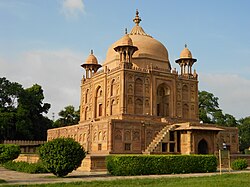
[[File:Tomb of Nisar Begum at Khusro Bagh Allahabad.jpg|thumb|Tomb of Nithar Begum (daughter of Mughal Emperor [[Jahangir]]) at [[Khusro Bagh]] | [[File:Tomb of Nisar Begum at Khusro Bagh Allahabad.jpg|thumb|Tomb of Nithar Begum (daughter of Mughal Emperor [[Jahangir]]) at [[Khusro Bagh]]]] | ||
Akbar was impressed by its strategic location for a fort.<ref name="Univ"/> According to William Pinch, Akbar's motive may have been twofold. One, the armed fort secured the control of fertile Doab region. Second, it greatly increased his visibility and power to the non-Muslims who gathered here for pilgrimage from distant places and who constituted the majority of his subjects.<ref>{{cite book|author=Kama Maclean|title=Pilgrimage and Power: The Kumbh Mela in Allahabad, 1765–1954|url=https://books.google.com/books?id=MALacgnsroMC|year=2008|publisher=Oxford University Press|isbn=978-0-19-533894-2|pages=68–69|access-date=4 April 2018|archive-date=14 January 2017|archive-url=https://web.archive.org/web/20170114085824/https://books.google.com/books?id=MALacgnsroMC|url-status=live}}</ref> Later, he declared Ilahabas as a capital of one of the twelve divisions (''subahs'').<ref name=Surendra>{{cite book|title=Subah of Allahabad under the great Mughals, 1580–1707|pages=25, 83–84|publisher=[[Jamia Millia Islamia]]|author=Surendra Nath Sinha|year=1974}}</ref> According to Richard Burn, the suffix "–bas" was deemed to "savouring too much of Hinduism" and therefore the name was changed to ''Ilahabad'' by [[Shah Jahan]].<ref name=burnmint/> This evolved into the two variant colonial-era spellings of Ilahabad (Hindi: इलाहाबाद) and Allahabad.<ref name=burnmint/><ref name="Maclean2008p67">{{cite book|author=Kama Maclean|title=Pilgrimage and Power: The Kumbh Mela in Allahabad, 1765–1954|url=https://books.google.com/books?id=MALacgnsroMC|year=2008|publisher=Oxford University Press|isbn=978-0-19-533894-2|page=67|access-date=4 April 2018|archive-date=14 January 2017|archive-url=https://web.archive.org/web/20170114085824/https://books.google.com/books?id=MALacgnsroMC|url-status=live}}</ref> According to Maclean, these variant spellings have a political basis, as "Ilaha–" means "the gods" for Hindus, while Allah is the term for God to Muslims.<ref name="Maclean2008p67"/> | Akbar was impressed by its strategic location for a fort.<ref name="Univ"/> According to William Pinch, Akbar's motive may have been twofold. One, the armed fort secured the control of fertile Doab region. Second, it greatly increased his visibility and power to the non-Muslims who gathered here for pilgrimage from distant places and who constituted the majority of his subjects.<ref>{{cite book|author=Kama Maclean|title=Pilgrimage and Power: The Kumbh Mela in Allahabad, 1765–1954|url=https://books.google.com/books?id=MALacgnsroMC|year=2008|publisher=Oxford University Press|isbn=978-0-19-533894-2|pages=68–69|access-date=4 April 2018|archive-date=14 January 2017|archive-url=https://web.archive.org/web/20170114085824/https://books.google.com/books?id=MALacgnsroMC|url-status=live}}</ref> Later, he declared Ilahabas as a capital of one of the twelve divisions (''subahs'').<ref name=Surendra>{{cite book|title=Subah of Allahabad under the great Mughals, 1580–1707|pages=25, 83–84|publisher=[[Jamia Millia Islamia]]|author=Surendra Nath Sinha|year=1974}}</ref> According to Richard Burn, the suffix "–bas" was deemed to "savouring too much of Hinduism" and therefore the name was changed to ''Ilahabad'' by [[Shah Jahan]].<ref name=burnmint/> This evolved into the two variant colonial-era spellings of Ilahabad (Hindi: इलाहाबाद) and Allahabad.<ref name=burnmint/><ref name="Maclean2008p67">{{cite book|author=Kama Maclean|title=Pilgrimage and Power: The Kumbh Mela in Allahabad, 1765–1954|url=https://books.google.com/books?id=MALacgnsroMC|year=2008|publisher=Oxford University Press|isbn=978-0-19-533894-2|page=67|access-date=4 April 2018|archive-date=14 January 2017|archive-url=https://web.archive.org/web/20170114085824/https://books.google.com/books?id=MALacgnsroMC|url-status=live}}</ref> According to Maclean, these variant spellings have a political basis, as "Ilaha–" means "the gods" for Hindus, while Allah is the term for God to Muslims.<ref name="Maclean2008p67"/> | ||
After [[Jahangir|Prince Salim]]'s coup against Akbar and a failed attempt to seize Agra's treasury, he came to Allahabad and seized its treasury while setting himself up as a virtually independent ruler.<ref name=Eraly>{{cite book|url=https://books.google.com/books?id=04ellRQx4nMC&pg=PA223|title=Emperors of the Peacock Throne: The Saga of the Great Mughals|page=223|publisher=[[Penguin Books]] India|author=Abraham Eraly|year=2000|isbn=978-0-14-100143-2|author-link=Abraham Eraly|access-date=7 October 2020|archive-date=2 December 2020|archive-url=https://web.archive.org/web/20201202180838/https://books.google.com/books?id=04ellRQx4nMC&pg=PA223|url-status=live}}</ref> In May 1602, he had his name read in [[Jumu'ah|Friday prayers]] and his name minted on coins in Allahabad. After reconciliation with Akbar, Salim returned to Allahabad, where he stayed before returning in 1604.<ref name=Richards>{{cite book|url=https://books.google.com/books?id=HHyVh29gy4QC&pg=PA55|title=The Mughal Empire, Part 1, Volume 5|page=55|publisher=[[Cambridge University Press]]|author=John F. Richards|year=1995|isbn=978-0-521-56603-2|access-date=5 April 2018|archive-url=https://web.archive.org/web/20151128164007/https://books.google.com/books?id=HHyVh29gy4QC&pg=PA55|archive-date=28 November 2015|url-status = live|author-link=John F. Richards}}</ref> After capturing Jaunpur in 1624, [[Shah Jahan]] ordered the siege of Allahabad. The siege was however, lifted after [[Parviz Mirza|Parviz]] and [[Mahabat Khan]] came to assist the garrison.<ref>{{cite book|title=The History of India, 1000 A.D.-1707 A.D|author=Ashirbadi Lal Srivastava|publisher=Shiva Lal Agarwala|page=587|year=1964|author-link=Ashirbadi Lal Srivastava}}</ref> During the Mughal war of succession, the commandant of the fort who had joined [[Shah Shuja (Mughal prince)|Shah Shuja]] made an agreement with [[Aurangzeb]]'s officers and surrendered it to Khan Dauran on 12 January 1659.<ref>{{cite book|title=History of Bengal: The Reigns of Shah Jahan and Aurangzib|page=305|publisher=[[Institute of Bangladesh Studies]], [[University of Rajshahi]]|author=Abdul Karim|year=1995|author-link=Abdul Karim (historian)}}</ref> | After [[Jahangir|Prince Salim]]'s coup against Akbar and a failed attempt to seize Agra's treasury, he came to Allahabad and seized its treasury while setting himself up as a virtually independent ruler.<ref name=Eraly>{{cite book|url=https://books.google.com/books?id=04ellRQx4nMC&pg=PA223|title=Emperors of the Peacock Throne: The Saga of the Great Mughals|page=223|publisher=[[Penguin Books]] India|author=Abraham Eraly|year=2000|isbn=978-0-14-100143-2|author-link=Abraham Eraly|access-date=7 October 2020|archive-date=2 December 2020|archive-url=https://web.archive.org/web/20201202180838/https://books.google.com/books?id=04ellRQx4nMC&pg=PA223|url-status=live}}</ref> In May 1602, he had his name read in [[Jumu'ah|Friday prayers]] and his name minted on coins in Allahabad. After reconciliation with Akbar, Salim returned to Allahabad, where he stayed before returning in 1604.<ref name=Richards>{{cite book|url=https://books.google.com/books?id=HHyVh29gy4QC&pg=PA55|title=The Mughal Empire, Part 1, Volume 5|page=55|publisher=[[Cambridge University Press]]|author=John F. Richards|year=1995|isbn=978-0-521-56603-2|access-date=5 April 2018|archive-url=https://web.archive.org/web/20151128164007/https://books.google.com/books?id=HHyVh29gy4QC&pg=PA55|archive-date=28 November 2015|url-status = live|author-link=John F. Richards}}</ref> After capturing Jaunpur in 1624, [[Shah Jahan|Prince Khurram]] ordered the siege of Allahabad. The siege was however, lifted after [[Parviz Mirza|Parviz]] and [[Mahabat Khan]] came to assist the garrison.<ref>{{cite book|title=The History of India, 1000 A.D.-1707 A.D|author=Ashirbadi Lal Srivastava|publisher=Shiva Lal Agarwala|page=587|year=1964|author-link=Ashirbadi Lal Srivastava}}</ref> During the Mughal war of succession, the commandant of the fort who had joined [[Shah Shuja (Mughal prince)|Shah Shuja]] made an agreement with [[Aurangzeb]]'s officers and surrendered it to Khan Dauran on 12 January 1659.<ref>{{cite book|title=History of Bengal: The Reigns of Shah Jahan and Aurangzib|page=305|publisher=[[Institute of Bangladesh Studies]], [[University of Rajshahi]]|author=Abdul Karim|year=1995|author-link=Abdul Karim (historian)}}</ref> | ||
=== Nawabs of Awadh === | === Nawabs of Awadh === | ||
| Line 148: | Line 202: | ||
The fort was coveted by the [[East India Company]] for the same reasons Akbar built it. British troops were first stationed at Allahabad fort in 1765 as part of the [[Treaty of Allahabad]] signed by Lord [[Robert Clive]], Mughal emperor [[Shah Alam II]], and [[Nawab of Awadh|Awadh's Nawab]] [[Shuja-ud-Daula]].<ref name=Kumbh62>{{cite book|url=https://books.google.com/books?id=MALacgnsroMC&pg=PA62|title=Pilgrimage and Power: The Kumbh Mela in Allahabad, 1765–1954|page=62|publisher=Oxford University Press|author=Kama Maclean|year=2008|isbn=978-0-19-533894-2|access-date=4 April 2018|archive-date=19 August 2021|archive-url=https://web.archive.org/web/20210819125330/https://books.google.com/books?id=MALacgnsroMC&pg=PA62|url-status=live}}</ref> The combined forces of Bengal's Nawab [[Mir Qasim]], Shuja and Shah Alam were defeated by the English at [[Battle of Buxar|Buxar in October 1764]] and at [[Kora Jahanabad|Kora]] in May 1765. Alam, who was abandoned by Shuja after the defeats, surrendered to the English and was lodged at the fort, as they captured Allahabad, [[Benares]] and [[Chunar]] in his name. The territories of Allahabad and Kora were given to the emperor after the treaty was signed in 1765. | The fort was coveted by the [[East India Company]] for the same reasons Akbar built it. British troops were first stationed at Allahabad fort in 1765 as part of the [[Treaty of Allahabad]] signed by Lord [[Robert Clive]], Mughal emperor [[Shah Alam II]], and [[Nawab of Awadh|Awadh's Nawab]] [[Shuja-ud-Daula]].<ref name=Kumbh62>{{cite book|url=https://books.google.com/books?id=MALacgnsroMC&pg=PA62|title=Pilgrimage and Power: The Kumbh Mela in Allahabad, 1765–1954|page=62|publisher=Oxford University Press|author=Kama Maclean|year=2008|isbn=978-0-19-533894-2|access-date=4 April 2018|archive-date=19 August 2021|archive-url=https://web.archive.org/web/20210819125330/https://books.google.com/books?id=MALacgnsroMC&pg=PA62|url-status=live}}</ref> The combined forces of Bengal's Nawab [[Mir Qasim]], Shuja and Shah Alam were defeated by the English at [[Battle of Buxar|Buxar in October 1764]] and at [[Kora Jahanabad|Kora]] in May 1765. Alam, who was abandoned by Shuja after the defeats, surrendered to the English and was lodged at the fort, as they captured Allahabad, [[Benares]] and [[Chunar]] in his name. The territories of Allahabad and Kora were given to the emperor after the treaty was signed in 1765. | ||
Shah Alam spent six years in the Allahabad fort and after the takeover of [[Delhi]] by the Marathas, left for his capital | Shah Alam spent six years in the Allahabad fort and after the [[Capture of Delhi (1771)|takeover]] of [[Delhi]] by the Marathas, left for his capital in 1771 under their protection.<ref>{{cite book|title=A Comprehensive History of India: Volume Nine (1712–1772)|editor=A. C. Banerjee |editor2=D. K. Ghose|publisher=[[Indian History Congress]], [[Orient Longman]]|year=1978|pages=60–61}}</ref> He was escorted by [[Mahadaji Shinde]] and left Allahabad in May 1771 and in January 1772 reached Delhi. Upon realising the Maratha intent of territorial encroachment, however, Shah Alam ordered his general [[Mirza Najaf Khan|Najaf Khan]] to drive them out. [[Tukoji Rao Holkar]] and [[Visaji Krushna Biniwale]] in return attacked Delhi and defeated his forces in 1772. The Marathas were granted an imperial ''[[deed|sanad]]'' for Kora and Allahabad. They turned their attention to Oudh to gain these two territories. Shuja was however, unwilling to give them up and made appeals to the English and the Marathas did not fare well at the Battle of Ramghat.<ref>{{cite book|url=https://books.google.com/books?id=r4hHNz7T-AEC&pg=PA7|title=Anglo-Maratha relations during the administration of Warren Hastings 1772–1785, Volume 1|author=Sailendra Nath Sen|publisher=[[Popular Prakashan]]|year=1998|pages=7–8|isbn=978-8171545780|access-date=4 April 2018|archive-date=19 August 2021|archive-url=https://web.archive.org/web/20210819125316/https://books.google.com/books?id=r4hHNz7T-AEC&pg=PA7|url-status=live}}</ref> In August and September 1773, [[Warren Hastings]] met Shuja and concluded a treaty, under which Kora and Allahabad were ceded to the Nawab for a payment of 50 lakh rupees.<ref>{{cite book|url=https://books.google.com/books?id=bXWiACEwPR8C&pg=PA27|title=An Advanced History of Modern India|author=Sailendra Nath Sen|publisher=[[Macmillan Publishers]]|year=2010|page=27|isbn=978-0-230-32885-3|access-date=4 April 2018|archive-date=19 August 2021|archive-url=https://web.archive.org/web/20210819125316/https://books.google.com/books?id=bXWiACEwPR8C&pg=PA27|url-status=live}}</ref> | ||
in 1771 under their protection.<ref>{{cite book|title=A Comprehensive History of India: Volume Nine (1712–1772)|editor=A. C. Banerjee |editor2=D. K. Ghose|publisher=[[Indian History Congress]], [[Orient Longman]]|year=1978|pages=60–61}}</ref> He was escorted by [[Mahadaji Shinde]] and left Allahabad in May 1771 and in January 1772 reached Delhi. Upon realising the Maratha intent of territorial encroachment, however, Shah Alam ordered his general [[Mirza Najaf Khan|Najaf Khan]] to drive them out. [[Tukoji Rao Holkar]] and [[Visaji Krushna Biniwale]] in return attacked Delhi and defeated his forces in 1772. The Marathas were granted an imperial ''[[deed|sanad]]'' for Kora and Allahabad. They turned their attention to Oudh to gain these two territories. Shuja was however, unwilling to give them up and made appeals to the English and the Marathas did not fare well at the Battle of Ramghat.<ref>{{cite book|url=https://books.google.com/books?id=r4hHNz7T-AEC&pg=PA7|title=Anglo-Maratha relations during the administration of Warren Hastings 1772–1785, Volume 1|author=Sailendra Nath Sen|publisher=[[Popular Prakashan]]|year=1998|pages=7–8|isbn= | |||
[[Saadat Ali Khan II]], after being made the Nawab by [[John Shore, 1st Baron Teignmouth|John Shore]], entered into a treaty with the company and gave the fort to the British in 1798.<ref>{{cite book|url=https://books.google.com/books?id=Kz1-mtazYqEC&pg=PA67|title=The Indian Princes and their States|author=Barbara N. Ramusack|publisher=[[Cambridge University Press]]|year=2004|page=67|isbn=978-1-139-44908-3|author-link=Barbara Ramusack|access-date=4 April 2018|archive-date=19 August 2021|archive-url=https://web.archive.org/web/20210819125331/https://books.google.com/books?id=Kz1-mtazYqEC&pg=PA67|url-status=live}}</ref> [[Richard Wellesley, 1st Marquess Wellesley|Lord Wellesley]] after threatening to annexe the entire Awadh, concluded a treaty with Saadat on abolishing the independent Awadhi army, imposing a larger subsidiary force and annexing [[Rohilkhand]], [[Gorakhpur, Uttar Pradesh|Gorakhpur]] and the Doab in 1801.<ref>{{cite book|url=https://books.google.com/books?id=Kz1-mtazYqEC&pg=PA68|title=The Indian Princes and their States|author=Barbara N. Ramusack|publisher=[[Cambridge University Press]]|year=2004|page=68|isbn=978-1-139-44908-3|author-link=Barbara Ramusack|access-date=4 April 2018|archive-date=19 August 2021|archive-url=https://web.archive.org/web/20210819125337/https://books.google.com/books?id=Kz1-mtazYqEC&pg=PA68|url-status=live}}</ref> | [[Saadat Ali Khan II]], after being made the Nawab by [[John Shore, 1st Baron Teignmouth|John Shore]], entered into a treaty with the company and gave the fort to the British in 1798.<ref>{{cite book|url=https://books.google.com/books?id=Kz1-mtazYqEC&pg=PA67|title=The Indian Princes and their States|author=Barbara N. Ramusack|publisher=[[Cambridge University Press]]|year=2004|page=67|isbn=978-1-139-44908-3|author-link=Barbara Ramusack|access-date=4 April 2018|archive-date=19 August 2021|archive-url=https://web.archive.org/web/20210819125331/https://books.google.com/books?id=Kz1-mtazYqEC&pg=PA67|url-status=live}}</ref> [[Richard Wellesley, 1st Marquess Wellesley|Lord Wellesley]] after threatening to annexe the entire Awadh, concluded a treaty with Saadat on abolishing the independent Awadhi army, imposing a larger subsidiary force and annexing [[Rohilkhand]], [[Gorakhpur, Uttar Pradesh|Gorakhpur]] and the Doab in 1801.<ref>{{cite book|url=https://books.google.com/books?id=Kz1-mtazYqEC&pg=PA68|title=The Indian Princes and their States|author=Barbara N. Ramusack|publisher=[[Cambridge University Press]]|year=2004|page=68|isbn=978-1-139-44908-3|author-link=Barbara Ramusack|access-date=4 April 2018|archive-date=19 August 2021|archive-url=https://web.archive.org/web/20210819125337/https://books.google.com/books?id=Kz1-mtazYqEC&pg=PA68|url-status=live}}</ref> | ||
| Line 156: | Line 209: | ||
[[File:Gandhi Patel 1940.jpg|thumb|left|[[Mahatma Gandhi]] at a January 1940 [[Congress Working Committee]] meeting with [[Vallabhbhai Patel]] and [[Vijaya Lakshmi Pandit]] at Anand Bhavan in Allahabad]] | [[File:Gandhi Patel 1940.jpg|thumb|left|[[Mahatma Gandhi]] at a January 1940 [[Congress Working Committee]] meeting with [[Vallabhbhai Patel]] and [[Vijaya Lakshmi Pandit]] at Anand Bhavan in Allahabad]] | ||
Acquired in 1801, Allahabad, aside from its importance as a pilgrimage centre, was a stepping stone to the agrarian track upcountry and the [[Grand Trunk Road]]. It also potentially offered sizeable revenues to the company. Initial [[Permanent Settlement|revenue settlements]] began in 1803.<ref>{{cite book|author=Hayden J. Bellenoit|title=The Formation of the Colonial State in India: Scribes, Paper and Taxes, 1760–1860|url=https://books.google.com/books?id=9TElDwAAQBAJ&pg=PA115|publisher=Taylor & Francis|isbn=978-1-134-49429-3|page=115|date= | Acquired in 1801, Allahabad, aside from its importance as a pilgrimage centre, was a stepping stone to the agrarian track upcountry and the [[Grand Trunk Road]]. It also potentially offered sizeable revenues to the company. Initial [[Permanent Settlement|revenue settlements]] began in 1803.<ref>{{cite book|author=Hayden J. Bellenoit|title=The Formation of the Colonial State in India: Scribes, Paper and Taxes, 1760–1860|url=https://books.google.com/books?id=9TElDwAAQBAJ&pg=PA115|publisher=Taylor & Francis|isbn=978-1-134-49429-3|page=115|date= 2017|archive-url=https://web.archive.org/web/20180405090302/https://books.google.com/books?id=9TElDwAAQBAJ&pg=PA115|archive-date=5 April 2018|url-status = live}}</ref> Allahabad was a participant in the 1857 [[Indian Rebellion of 1857|Indian Mutiny]],<ref name="Menon2003">{{cite book|author=Visalakshi Menon|title=From Movement To Government: The Congress in the United Provinces, 1937–42|url=https://books.google.com/books?id=UO-OxAoL4YIC&pg=PA286|year=2003|publisher=SAGE Publications|isbn=978-0-7619-9620-0|page=286|url-status = live|archive-url=https://web.archive.org/web/20130523052155/http://books.google.com/books?id=UO-OxAoL4YIC&pg=PA286|archive-date=23 May 2013}}</ref> when [[Maulvi Liaquat Ali]] unfurled the banner of revolt.<ref name="Bose2003">{{cite book|author1=Sugata Bose|author1-link=Sugata Bose|author2=Ayesha Jalal|author2-link=Ayesha Jalal|year=2004|orig-year=1997|title=Modern South Asia: History, Culture and Political Economy|url=https://books.google.com/books?id=PaKdsF8WzbcC&pg=PA74|edition=2nd|publisher=Routledge|isbn=978-0-415-30786-4|page=74|url-status = live|archive-url=https://web.archive.org/web/20130523075252/http://books.google.com/books?id=PaKdsF8WzbcC&pg=PA74|archive-date=23 May 2013}}</ref> During the rebellion, Allahabad, with a number of European troops,<ref name="ThompsonGarratt1962">{{cite book|author1=Edward John Thompson|author2=Geoffrey Theodore Garratt|title=Rise and Fulfilment of British rule in India|url=https://books.google.com/books?id=6v4gAAAAMAAJ&q=%22European+troops%22|access-date=16 August 2014|publisher=Central Book Depot|url-status = live|archive-url=https://web.archive.org/web/20171001092313/https://books.google.com/books?id=6v4gAAAAMAAJ&q=%22European+troops%22|archive-date=1 October 2017|year=1962}}</ref> was the scene of a massacre.<ref name="Pletcher 2010 128" /> | ||
[[File:Au science faculty.jpg|thumb|upright|[[Allahabad University]], established in 1887, is one of the oldest modern universities in the [[Indian subcontinent]].]] | [[File:Au science faculty.jpg|thumb|upright|[[Allahabad University]], established in 1887, is one of the oldest modern universities in the [[Indian subcontinent]].]] | ||
After the mutiny, the British established a high court, a police headquarters and a public-service commission in Allahabad,<ref name="SinghSingh1995">{{cite book|author1=Bhai Nahar Singh|author2=Bhai Kirpal Singh|title=Rebels Against the British Rule|url=https://books.google.com/books?id=2lu7HatPQCoC&pg=PA290|publisher=Atlantic Publishers & Dist|isbn=978-81-7156-164-3|page=290|url-status = live|archive-url=https://web.archive.org/web/20130523073151/http://books.google.com/books?id=2lu7HatPQCoC&pg=PA290|archive-date=23 May 2013|year=1995}}</ref> making the city an administrative centre.<ref name=administrative>{{cite web|title=Civil Disobedience|url=http://www.mkgandhi.org/civil_dis/dandi_march.htm|publisher=Gandhi Research Foundation|access-date=25 September 2012|url-status = live|archive-url=https://web.archive.org/web/20120710130536/http://www.mkgandhi.org/civil_dis/dandi_march.htm|archive-date=10 July 2012}}</ref> They truncated the Delhi region of the state, merging it with [[Punjab, India|Punjab]] and moving the capital of the [[North-Western Provinces]] to Allahabad (where it remained for 20 years).<ref name="Ward2008" /> In January 1858, [[Earl Canning]] departed [[Calcutta]] for Allahabad.<ref>{{cite web|url=http://www.ibiblio.org/britishraj/KayeMalleson4/bk12ch01.html|title=Progress of events in Eastern Bengal, Odisha, Bihar, Oudh, Rohilkhand and Rajputana|access-date=21 March 2014|url-status = live|archive-url=https://web.archive.org/web/20130627043412/http://www.ibiblio.org/britishraj/KayeMalleson4/bk12ch01.html|archive-date=27 June 2013}}</ref> That year he read [[Queen Victoria#Empress|Queen Victoria's proclamation]], transferring control of India from the [[East India Company]] to the [[British Crown]] (beginning the [[British Raj]]), in [[Minto Park, Allahabad|Minto Park]].<ref>{{cite book |url=https://books.google.com/books?id=FCG5hGZ-hJsC&pg=PA453 |title=Land and People of Indian States and Union Territories: In 36 Volumes. Uttar ... – Google Books |access-date=26 May 2014 |url-status = live|archive-url=https://web.archive.org/web/20181115155003/https://books.google.com/books?id=FCG5hGZ-hJsC&pg=PA453#v=onepage&q=minto|archive-date=15 November 2018 |isbn= | After the mutiny, the British established a high court, a police headquarters and a public-service commission in Allahabad,<ref name="SinghSingh1995">{{cite book|author1=Bhai Nahar Singh|author2=Bhai Kirpal Singh|title=Rebels Against the British Rule|url=https://books.google.com/books?id=2lu7HatPQCoC&pg=PA290|publisher=Atlantic Publishers & Dist|isbn=978-81-7156-164-3|page=290|url-status = live|archive-url=https://web.archive.org/web/20130523073151/http://books.google.com/books?id=2lu7HatPQCoC&pg=PA290|archive-date=23 May 2013|year=1995}}</ref> making the city an administrative centre.<ref name=administrative>{{cite web|title=Civil Disobedience|url=http://www.mkgandhi.org/civil_dis/dandi_march.htm|publisher=Gandhi Research Foundation|access-date=25 September 2012|url-status = live|archive-url=https://web.archive.org/web/20120710130536/http://www.mkgandhi.org/civil_dis/dandi_march.htm|archive-date=10 July 2012}}</ref> They truncated the Delhi region of the state, merging it with [[Punjab, India|Punjab]] and moving the capital of the [[North-Western Provinces]] to Allahabad (where it remained for 20 years).<ref name="Ward2008" /> In January 1858, [[Earl Canning]] departed [[Calcutta]] for Allahabad.<ref>{{cite web|url=http://www.ibiblio.org/britishraj/KayeMalleson4/bk12ch01.html|title=Progress of events in Eastern Bengal, Odisha, Bihar, Oudh, Rohilkhand and Rajputana|access-date=21 March 2014|url-status = live|archive-url=https://web.archive.org/web/20130627043412/http://www.ibiblio.org/britishraj/KayeMalleson4/bk12ch01.html|archive-date=27 June 2013}}</ref> That year he read [[Queen Victoria#Empress|Queen Victoria's proclamation]], transferring control of India from the [[East India Company]] to the [[British Crown]] (beginning the [[British Raj]]), in [[Minto Park, Allahabad|Minto Park]].<ref>{{cite book |url=https://books.google.com/books?id=FCG5hGZ-hJsC&pg=PA453 |title=Land and People of Indian States and Union Territories: In 36 Volumes. Uttar ... – Google Books |access-date=26 May 2014 |url-status = live|archive-url=https://web.archive.org/web/20181115155003/https://books.google.com/books?id=FCG5hGZ-hJsC&pg=PA453#v=onepage&q=minto|archive-date=15 November 2018 |isbn=978-8178353845 |last1=Bhatt |first1=Shankarlal C |year=2005 |publisher=Gyan Publishing House }}</ref><ref>{{cite web |url=http://www.bharatonline.com/uttar-pradesh/travel/allahabad/minto-park.html |title=Minto Park – Minto Park Allahabad – Allahabad Minto Park – Madan Mohan Malaviya Park Allahabad India |publisher=Bharatonline.com |access-date=26 May 2014 |url-status = live|archive-url=https://web.archive.org/web/20140108123625/http://www.bharatonline.com/uttar-pradesh/travel/allahabad/minto-park.html |archive-date=8 January 2014 }}</ref> In 1877 the provinces of Agra and Awadh were merged to form the [[United Provinces of British India|United Provinces]],<ref name="Basham2008a">{{cite book|author=A. L. Basham|title=The Wonder That Was India: A Survey of the Culture of the Indian Sub-Continent Before the Coming of the Muslims|url=https://books.google.com/books?id=6OF-PwAACAAJ|year=2008|publisher=ACLS History E-Book Project|isbn=978-1-59740-599-7|page=696|url-status = live|archive-url=https://web.archive.org/web/20130523061030/http://books.google.com/books?id=6OF-PwAACAAJ|archive-date=23 May 2013}}</ref> with Allahabad its capital until 1920.<ref name="Ward2008" /> | ||
The 1888 session of the [[Indian National Congress]] was held in the city,<ref name="BhanaPandiri2007">{{cite book|author1=Surendra Bhana|author2=Ananda M. Pandiri|author3=E. S. (FRW) Reddy|author4=Uma Dhupelia-Mesthrie|title=A Comprehensive, Annotated Bibliography on Mahatma Gandhi: Books And Pamphlets About Mahatma Gandhi|url=https://books.google.com/books?id=_935ZKVzjW0C&pg=PA12|publisher=Greenwood Publishing Group|isbn=978-0-313-30217-6|pages=12–18|url-status = live|archive-url=https://web.archive.org/web/20130523061521/http://books.google.com/books?id=_935ZKVzjW0C&pg=PA12|archive-date=23 May 2013|year=1995}}</ref> and by the turn of the 20th century, Allahabad was a revolutionary centre.<ref name="Committee1947">{{cite book|author=All India Congress Committee|title=The Allahabad conference of the presidents and secretaries of provincial Congress committees|url=https://books.google.com/books?id=TEU5AQAAIAAJ|publisher=Provincial Congress Committee Allahabad|page=57|url-status = live|archive-url=https://web.archive.org/web/20130523075902/http://books.google.com/books?id=TEU5AQAAIAAJ|archive-date=23 May 2013|year=1947}}</ref> Nityanand Chatterji became a household name when he hurled a bomb at a European club.<ref name=Independence>{{cite web|title=Besides, locals still pride|url=http://zeenews.india.com/61Independenceday/story.aspx?aid=462215|work=[[Zee News]]|access-date=3 August 2012|url-status = dead|archive-url=https://web.archive.org/web/20130523230338/http://zeenews.india.com/61Independenceday/story.aspx?aid=462215|archive-date=23 May 2013}}</ref> In [[Alfred Park]] in 1931, [[Chandrashekhar Azad]] died when surrounded by British police.<ref name="BhawanRana2005">{{cite book | author=Bhawan Singh Rana | title=Chandra Shekhar Azad (An Immortal Revolutionary of India) | url=https://books.google.com/books?id=sudu7qABntcC&pg=PA10|year=2005| publisher=Diamond Pocket Books (P) Ltd. | isbn=978-81-288-0816-6 | page=10 |url-status = live| archive-url=https://web.archive.org/web/20130523064439/http://books.google.com/books?id=sudu7qABntcC&pg=PA10 | archive-date=23 May 2013}}</ref> The [[Nehru–Gandhi family|Nehru family]] homes, [[Anand Bhavan]] and [[Swaraj Bhavan]], were centres of Indian National Congress activity.<ref name=activities>{{cite web|title=The hub for freedom struggle|url=http://www.highbeam.com/doc/1P3-1196506911.html | The 1888 session of the [[Indian National Congress]] was held in the city,<ref name="BhanaPandiri2007">{{cite book|author1=Surendra Bhana|author2=Ananda M. Pandiri|author3=E. S. (FRW) Reddy|author4=Uma Dhupelia-Mesthrie|title=A Comprehensive, Annotated Bibliography on Mahatma Gandhi: Books And Pamphlets About Mahatma Gandhi|url=https://books.google.com/books?id=_935ZKVzjW0C&pg=PA12|publisher=Greenwood Publishing Group|isbn=978-0-313-30217-6|pages=12–18|url-status = live|archive-url=https://web.archive.org/web/20130523061521/http://books.google.com/books?id=_935ZKVzjW0C&pg=PA12|archive-date=23 May 2013|year=1995}}</ref> and by the turn of the 20th century, Allahabad was a revolutionary centre.<ref name="Committee1947">{{cite book|author=All India Congress Committee|title=The Allahabad conference of the presidents and secretaries of provincial Congress committees|url=https://books.google.com/books?id=TEU5AQAAIAAJ|publisher=Provincial Congress Committee Allahabad|page=57|url-status = live|archive-url=https://web.archive.org/web/20130523075902/http://books.google.com/books?id=TEU5AQAAIAAJ|archive-date=23 May 2013|year=1947}}</ref> Nityanand Chatterji became a household name when he hurled a bomb at a European club.<ref name=Independence>{{cite web|title=Besides, locals still pride|url=http://zeenews.india.com/61Independenceday/story.aspx?aid=462215|work=[[Zee News]]|access-date=3 August 2012|url-status = dead|archive-url=https://web.archive.org/web/20130523230338/http://zeenews.india.com/61Independenceday/story.aspx?aid=462215|archive-date=23 May 2013}}</ref> In [[Alfred Park]] in 1931, [[Chandrashekhar Azad]] died when surrounded by British police.<ref name="BhawanRana2005">{{cite book | author=Bhawan Singh Rana | title=Chandra Shekhar Azad (An Immortal Revolutionary of India) | url=https://books.google.com/books?id=sudu7qABntcC&pg=PA10|year=2005| publisher=Diamond Pocket Books (P) Ltd. | isbn=978-81-288-0816-6 | page=10 |url-status = live| archive-url=https://web.archive.org/web/20130523064439/http://books.google.com/books?id=sudu7qABntcC&pg=PA10 | archive-date=23 May 2013}}</ref> The [[Nehru–Gandhi family|Nehru family]] homes, [[Anand Bhavan]] and [[Swaraj Bhavan]], were centres of Indian National Congress activity.<ref name=activities>{{cite web|title=The hub for freedom struggle|url=http://www.highbeam.com/doc/1P3-1196506911.html|access-date=28 September 2012|url-status = dead|archive-url=https://web.archive.org/web/20130502190736/http://www.highbeam.com/doc/1P3-1196506911.html|archive-date=2 May 2013}}</ref> During the years before independence, Allahabad was home to thousands of [[Satyagraha|satyagrahis]] led by [[Purushottam Das Tandon]], [[Bishambhar Nath Pande]], [[Narayan Dutt Tiwari]] and others.<ref name="Desai1986">{{cite book|author=Akshayakumar Ramanlal Desai|title=Violation of Democratic Rights in India|url=https://books.google.com/books?id=9i5sNMNh_uIC&pg=PA269|year=1986|publisher=Popular Prakashan|isbn=978-0-86132-130-8|page=269|url-status = live|archive-url=https://web.archive.org/web/20130523052427/http://books.google.com/books?id=9i5sNMNh_uIC&pg=PA269|archive-date=23 May 2013}}</ref> The first seeds of the [[Pakistan]]i nation were sown in Allahabad:<ref name="Zakaria2004">{{cite book|author=Rafiq Zakaria|title=The Man Who Divided India|url=https://books.google.com/books?id=2RdITXUpyVgC&pg=PA152|publisher=Popular Prakashan|isbn=978-81-7991-145-7|pages=152–158|url-status = live|archive-url=https://web.archive.org/web/20130523062504/http://books.google.com/books?id=2RdITXUpyVgC&pg=PA152|archive-date=23 May 2013|year=2004}}</ref> on 29 December 1930, [[Allama Muhammad Iqbal]]'s presidential address to the [[All-India Muslim League]] proposed a separate [[Muslim]] state for the Muslim-majority regions of India.<ref name="Singh2008">{{cite book|author=Upinder Singh|title=A History of Ancient and Early Medieval India: From the Stone Age to the 12th Century|url=https://books.google.com/books?id=GW5Gx0HSXKUC&pg=PA4|publisher=Pearson Education India|isbn=978-81-317-1677-9|pages=4–6|url-status = live|archive-url=https://web.archive.org/web/20130523043139/http://books.google.com/books?id=GW5Gx0HSXKUC&pg=PA4|archive-date=23 May 2013|year=2008}}</ref> | ||
== Geography == | == Geography == | ||
=== Cityscape === | === Cityscape === | ||
Prayagraj's elevation is over 90 m (295 ft) above sea level. The old part of the city, at the south of Prayagraj Junction railway station, consists of neighbourhoods like Chowk, [[Johnstongunj]], [[Dariyabad, Prayagraj|Dariyabad]], [[Khuldabad, Prayagraj|Khuldabad]] and many more.<ref>{{cite news |title=Uneasy calm prevails in old Allahabad areas |url=http://articles.timesofindia.indiatimes.com/2012-08-19/allahabad/33272775_1_flag-march-office-bearers-city-areas |newspaper=[[The Times of India]] |date=19 August 2012 |access-date=13 September 2013 |archive-url=https://web.archive.org/web/20150301154738/http://timesofindia.indiatimes.com/city/allahabad/Uneasy-calm-prevails-in-old-Allahabad-areas/articleshow/15551299.cms?referral=PM |archive-date=1 March 2015 }}</ref> In the north of the Railway Station, the new city consists of neighbourhoods like [[Lukergunj]], [[Civil Lines, Prayagraj|Civil Lines]], [[Georgetown, Prayagraj|Georgetown]], [[Tagoretown]], [[Allahpur]], [[Ashok Nagar, Prayagraj|Ashok Nagar]], [[Mumfordgunj]], [[Bharadwaj Puram]] and others which are relatively new and were built during the [[British Raj|British rule]].<ref name="TGEIAAp57">{{cite book |title=The Grove Encyclopedia of Islamic Art and Architecture, Volume 3 |author1=Jonathan M. Bloom |author2=Sheila Blai |publisher=[[Oxford University Press]] |year=2009 |isbn=978-8125013839 |page=57 |url=https://books.google.com/books?id=un4WcfEASZwC&pg=PA57 |url-status = live|archive-url=https://web.archive.org/web/20181115155217/https://books.google.com/books?id=un4WcfEASZwC&pg=PA57#v=onepage&q=holy |archive-date=15 November 2018 }}</ref> [[Civil Lines, Prayagraj|Civil Lines]] is the [[central business district]] of the city and is famous for its urban setting, [[gridiron plan]] roads<ref name="AHVLp14">{{cite book|title=A Hand-book for Visitors to Lucknow: With Preliminary Notes on Allahabad and Cawnpore|author=Henry George Keene|publisher=J. Jetley|year=1875|isbn=978-8120615274|pages=14–15|url=https://books.google.com/books?id=EfGFMpm8UbAC&pg=PA15|url-status = live|archive-url=https://web.archive.org/web/20180303145457/https://books.google.com/books?id=EfGFMpm8UbAC&pg=PA15|archive-date=3 March 2018|author-link=Henry George Keene (1826–1915)}}</ref> and high rise buildings. Built in 1857, it was the largest town-planning project carried out in India before the establishment of [[New Delhi]].<ref name="TGEIAAp57" /><ref name="AHVLp14" /> Prayagraj has many buildings featuring [[Indo-Islamic architecture|Indo-Islamic]] and [[Indo-Saracenic architecture]]. Although several buildings from the colonial period have been declared "heritage structures", others are deteriorating.<ref name="Heritage">{{cite web|title=Colonial period buildings in city |url=http://www.airallahabad.gov.in/inner.php?conf=1133 |work=All India Radio, Allahabad |access-date=24 September 2012 |url-status = dead|archive-url=https://web.archive.org/web/20130615011052/http://www.airallahabad.gov.in/inner.php?conf=1133 |archive-date=15 June 2013 }}</ref> Famous landmarks of the city are [[Allahabad Museum]], [[New Yamuna Bridge, Allahabad|New Yamuna Bridge]], [[Allahabad University]], | Prayagraj's elevation is over 90 m (295 ft) above sea level. The old part of the city, at the south of Prayagraj Junction railway station, consists of neighbourhoods like Chowk, [[Johnstongunj]], [[Dariyabad, Prayagraj|Dariyabad]], [[Khuldabad, Prayagraj|Khuldabad]] and many more.<ref>{{cite news |title=Uneasy calm prevails in old Allahabad areas |url=http://articles.timesofindia.indiatimes.com/2012-08-19/allahabad/33272775_1_flag-march-office-bearers-city-areas |newspaper=[[The Times of India]] |date=19 August 2012 |access-date=13 September 2013 |archive-url=https://web.archive.org/web/20150301154738/http://timesofindia.indiatimes.com/city/allahabad/Uneasy-calm-prevails-in-old-Allahabad-areas/articleshow/15551299.cms?referral=PM |archive-date=1 March 2015 }}</ref> In the north of the Railway Station, the new city consists of neighbourhoods like [[Lukergunj]], [[Civil Lines, Prayagraj|Civil Lines]], [[Georgetown, Prayagraj|Georgetown]], [[Tagoretown]], [[Allahpur]], [[Ashok Nagar, Prayagraj|Ashok Nagar]], [[Mumfordgunj]], [[Bharadwaj Puram]] and others which are relatively new and were built during the [[British Raj|British rule]].<ref name="TGEIAAp57">{{cite book |title=The Grove Encyclopedia of Islamic Art and Architecture, Volume 3 |author1=Jonathan M. Bloom |author2=Sheila Blai |publisher=[[Oxford University Press]] |year=2009 |isbn=978-8125013839 |page=57 |url=https://books.google.com/books?id=un4WcfEASZwC&pg=PA57 |url-status = live|archive-url=https://web.archive.org/web/20181115155217/https://books.google.com/books?id=un4WcfEASZwC&pg=PA57#v=onepage&q=holy |archive-date=15 November 2018 }}</ref> [[Civil Lines, Prayagraj|Civil Lines]] is the [[central business district]] of the city and is famous for its urban setting, [[gridiron plan]] roads<ref name="AHVLp14">{{cite book|title=A Hand-book for Visitors to Lucknow: With Preliminary Notes on Allahabad and Cawnpore|author=Henry George Keene|publisher=J. Jetley|year=1875|isbn=978-8120615274|pages=14–15|url=https://books.google.com/books?id=EfGFMpm8UbAC&pg=PA15|url-status = live|archive-url=https://web.archive.org/web/20180303145457/https://books.google.com/books?id=EfGFMpm8UbAC&pg=PA15|archive-date=3 March 2018|author-link=Henry George Keene (1826–1915)}}</ref> and high rise buildings. Built in 1857, it was the largest town-planning project carried out in India before the establishment of [[New Delhi]].<ref name="TGEIAAp57" /><ref name="AHVLp14" /> Prayagraj has many buildings featuring [[Indo-Islamic architecture|Indo-Islamic]] and [[Indo-Saracenic architecture]]. Although several buildings from the colonial period have been declared "heritage structures", others are deteriorating.<ref name="Heritage">{{cite web|title=Colonial period buildings in city |url=http://www.airallahabad.gov.in/inner.php?conf=1133 |work=All India Radio, Allahabad |access-date=24 September 2012 |url-status = dead|archive-url=https://web.archive.org/web/20130615011052/http://www.airallahabad.gov.in/inner.php?conf=1133 |archive-date=15 June 2013 }}</ref> Famous landmarks of the city are [[Allahabad Museum]], [[New Yamuna Bridge, Allahabad|New Yamuna Bridge]], [[Allahabad University]], Triveni Sangam, [[All Saints Cathedral, Prayagraj|All Saints Cathedral]], [[Anand Bhavan]], [[Chandrashekhar Azad Park]] etc.<ref>{{Cite book| url=https://books.google.com/books?id=oZ-Qa_jRVMYC&pg=PA140| title=Middle Land, Middle Way: A Pilgrim's Guide to the Buddha's India| isbn=978-9552401978| last1=Dhammika| first1=Shravasti| date=1 December 2008| publisher=Buddhist Publication Society| access-date=22 July 2020| archive-date=19 August 2021| archive-url=https://web.archive.org/web/20210819125318/https://books.google.com/books?id=oZ-Qa_jRVMYC&pg=PA140| url-status=live}}</ref> The city experiences one of the highest levels of [[air pollution]] worldwide, with the 2016 update of the [[World Health Organization]]'s ''Global Urban Ambient Air Pollution Database'' finding Prayagraj to have the third highest mean concentration of "PM2.5" (<2.5 μm diameter) [[particulates|particulate matter]] in the ambient air among all the 2972 cities tested (after [[Zabol]] and [[Gwalior]]).<ref>''[https://www.who.int/phe/health_topics/outdoorair/databases/cities/en/ WHO Global Urban Ambient Air Pollution Database (update 2016)] {{Webarchive|url=https://web.archive.org/web/20170301221905/http://who.int/phe/health_topics/outdoorair/databases/cities/en/ |date=1 March 2017 }}'', World Health Organization. See the spreadsheet "Ambient (outdoor) air pollution database, by country and city" to which this page links. Retrieved 11 July 2018.</ref> | ||
=== Triveni Sangam and Ghats=== | ===Triveni Sangam and Ghats=== | ||
[[File:Triveni Sangam.JPG|right|thumb|250px|Pilgrims at the [[Triveni Sangam]], the confluence of the [[Ganges]] and the [[Yamuna]] rivers in Prayagraj.]] | [[File:Triveni Sangam.JPG|right|thumb|250px|Pilgrims at the [[Triveni Sangam]], the confluence of the [[Ganges]] and the [[Yamuna]] rivers in Prayagraj.]] | ||
The | The Triveni Sangam (place where three rivers meet) is the meeting place of Ganges, the Yamuna and mythical Saraswati River, which according to Hindu legends, wells up from underground.<ref name="At the Three Rivers">[http://www.time.com/time/magazine/article/0,9171,798222,00.html At the Three Rivers] {{Webarchive|url=https://web.archive.org/web/20130823175049/http://www.time.com/time/magazine/article/0,9171,798222,00.html |date=23 August 2013 }} ''[[TIME]]'', 23 February 1948.</ref><ref name="Triveni Sangam">{{cite web | url=http://www.prayagdarshan.com/triveni-sangam.html | title=Triveni Sangam | access-date=3 December 2015 | archive-url=https://web.archive.org/web/20151208100930/http://www.prayagdarshan.com/triveni-sangam.html | archive-date=8 December 2015 | url-status=dead}}</ref> A place of religious importance and the site for historic Prayag Kumbh Mela held every 12 years, over the years it has also been the site of immersion of ashes of several national leaders, including [[Mahatma Gandhi]] in 1948.<ref name="At the Three Rivers" /> | ||
The main [[ghat]] in Prayagraj is [[Saraswati Ghat]], on the banks of Yamuna. Stairs from three sides descend to the green water of the Yamuna. Above it is a park which is always covered with green grass. There are also facilities for boating here. There are also routes to reach Triveni Sangam by boat from here.<ref>{{cite web |url=http://uttarpradesh.gov.in/en/details/sangam-and-the-ghats/39003900 |title=Sangam and the Ghats | Allahabad | UP Tourism |publisher=Uttarpradesh.gov.in |access-date=7 August 2018 |archive-url=https://web.archive.org/web/20180402225929/http://uttarpradesh.gov.in/en/details/sangam-and-the-ghats/39003900 |archive-date=2 April 2018 |url-status = live }}</ref><ref>{{cite news |url=https://timesofindia.indiatimes.com/city/allahabad/work-for-renovating-ghats-of-allahabad-commemces/articleshow/56337486.cms |title=Work for renovating ghats of Allahabad commemces[sic] |newspaper=[[The Times of India]] |date=4 January 2017 |first1=Rajiv |last1=Mani |access-date=7 April 2018 |archive-url=https://web.archive.org/web/20180613210721/https://timesofindia.indiatimes.com/city/allahabad/work-for-renovating-ghats-of-allahabad-commemces/articleshow/56337486.cms |archive-date=13 June 2018 |url-status = live}}</ref> Apart from this, there are more than 100 raw ghats in Prayagraj. | The main [[ghat]] in Prayagraj is [[Saraswati Ghat]], on the banks of Yamuna. Stairs from three sides descend to the green water of the Yamuna. Above it is a park which is always covered with green grass. There are also facilities for boating here. There are also routes to reach Triveni Sangam by boat from here.<ref>{{cite web |url=http://uttarpradesh.gov.in/en/details/sangam-and-the-ghats/39003900 |title=Sangam and the Ghats | Allahabad | UP Tourism |publisher=Uttarpradesh.gov.in |access-date=7 August 2018 |archive-url=https://web.archive.org/web/20180402225929/http://uttarpradesh.gov.in/en/details/sangam-and-the-ghats/39003900 |archive-date=2 April 2018 |url-status = live }}</ref><ref>{{cite news |url=https://timesofindia.indiatimes.com/city/allahabad/work-for-renovating-ghats-of-allahabad-commemces/articleshow/56337486.cms |title=Work for renovating ghats of Allahabad commemces[sic] |newspaper=[[The Times of India]] |date=4 January 2017 |first1=Rajiv |last1=Mani |access-date=7 April 2018 |archive-url=https://web.archive.org/web/20180613210721/https://timesofindia.indiatimes.com/city/allahabad/work-for-renovating-ghats-of-allahabad-commemces/articleshow/56337486.cms |archive-date=13 June 2018 |url-status = live}}</ref> Apart from this, there are more than 100 raw ghats in Prayagraj. | ||
| Line 179: | Line 228: | ||
=== Topography === | === Topography === | ||
[[File:Yamuna river, Allahabad.jpg|thumb|left|alt=Large waterway, with small boats in the foreground and a long bridge in the background|The [[Yamuna]] in Prayagraj during the rainy season]] | [[File:Yamuna river, Allahabad.jpg|thumb|left|alt=Large waterway, with small boats in the foreground and a long bridge in the background|The [[Yamuna]] in Prayagraj during the rainy season]] | ||
Prayagraj is in the southern part of Uttar Pradesh, at the confluence of the | Prayagraj is in the southern part of Uttar Pradesh, at the confluence of the Ganges and Yamuna.<ref name=location>{{cite web|title=Location of city|url=http://geography.howstuffworks.com/asia/geography-of-allahabad.htm|website=[[HowStuffWorks]]|access-date=3 August 2012|url-status=dead|archive-url=https://web.archive.org/web/20120729030748/http://geography.howstuffworks.com/asia/geography-of-allahabad.htm|archive-date=29 July 2012|date=16 June 2008}}</ref><ref name=location001>{{cite web|title=Allahabad Location Guide|url=http://www.weather-forecast.com/locations/Allahabad|website=Weather-forecast|access-date=3 August 2012|url-status = live|archive-url=https://web.archive.org/web/20120709010608/http://www.weather-forecast.com/locations/Allahabad|archive-date=9 July 2012}}</ref> The region was known in antiquity first as the Kuru, then as the Vats country.<ref name="Pletcher2010">{{cite book|author=Kenneth Pletcher|title=The History of India|url=https://books.google.com/books?id=VsujRFvaHI8C&pg=PA63|year=2010|publisher=The Rosen Publishing Group|isbn=978-1-61530-122-5|page=63|url-status = live|archive-url=https://web.archive.org/web/20130620201000/http://books.google.com/books?id=VsujRFvaHI8C&pg=PA63|archive-date=20 June 2013}}</ref> To the southwest is [[Bundelkhand]], to the east and southeast is [[Baghelkhand]], to the north and northeast is [[Awadh]] and to the west is the lower [[doab]] (of which Prayagraj is part).<ref name=location /> The city is divided by a railway line running east–west.<ref name=junction>{{cite web|title=City or Locality infirmation|url=http://geography.howstuffworks.com/asia/geography-of-allahabad.htm|website=HowStuffWorks|access-date=29 September 2012|url-status=dead|archive-url=https://web.archive.org/web/20120729030748/http://geography.howstuffworks.com/asia/geography-of-allahabad.htm|archive-date=29 July 2012|date=16 June 2008}}</ref> South of the railway is the Old Chowk area, and the British-built [[Civil Lines, Prayagraj|Civil Lines]] is north of it. Prayagraj is well placed geographically and culturally.<ref name="Ganga-Yamuna Doab">{{cite web|author=Deo Prakash Sharma|title=Archaeology of Lower Ganga-Yamuna Doab|url=http://www.vedicbooks.net/archaeology-lower-gangayamuna-doab-vols-p-997.html|work=Vedic Books|access-date=24 September 2012|url-status = live|archive-url=https://web.archive.org/web/20120623050141/http://www.vedicbooks.net/archaeology-lower-gangayamuna-doab-vols-p-997.html|archive-date=23 June 2012}}</ref> Geographically part of the Ganga-Yamuna Doab (at the mouth of the Yamuna), culturally it is the terminus of the Indian west.<ref name="Sharma2006">{{cite book|author=Deo Prakash Sharma|title=Archaeology of lower Ganga-Yamuna Doab (circa 1200 B.C. to 1200 A.D.)|url=https://books.google.com/books?id=EjtuAAAAMAAJ|year=2006|publisher=Bharatiya Kala Prakashan|isbn=978-81-8090-033-4|url-status = live|archive-url=https://web.archive.org/web/20130523051350/http://books.google.com/books?id=EjtuAAAAMAAJ|archive-date=23 May 2013}}</ref> | ||
The [[Indian Standard Time]] longitude (25.15°N 82.58°E) is near the city. According to a [[United Nations Development Programme]] report, Prayagraj is in a "low damage risk" wind and cyclone zone.<ref name=hazardprofile>{{cite web|url=http://www.undp.org.in/dmweb/hazardprofile.pdf|title=Hazard profiles of Indian districts|access-date=23 August 2006|website=National Capacity Building Project in Disaster Management |publisher=[[UNDP]]|archive-url=https://web.archive.org/web/20060519100611/http://www.undp.org.in/dmweb/hazardprofile.pdf|archive-date=19 May 2006}}</ref> In common with the rest of the [[doab]], its soil and water are primarily [[Alluvium|alluvial]].<ref name=Agricultural>{{cite web|title=Agricultural Productivity and Productivity Regions in Ganga-Yamuna Doab|url=http://www.connectjournals.com/file_full_text/314401H_02-10-21.pdf|publisher=Bharatiya Kala Prakashan|access-date=24 September 2012|archive-url=https://web.archive.org/web/20130502190727/http://www.connectjournals.com/file_full_text/314401H_02-10-21.pdf|archive-date=2 May 2013|url-status = live}}</ref> [[Pratapgarh, Uttar Pradesh|Pratapgarh]] is north of the city, [[Bhadohi]] is east, [[Rewa, Madhya Pradesh|Rewa]] is south, [[Chitrakoot district|Chitrakoot]] (earlier Banda) is west, and [[Kaushambi district|Kaushambi]], which was until recently a part of Allahabad (Prayagraj), is North-West. | The [[Indian Standard Time]] longitude (25.15°N 82.58°E) is near the city. According to a [[United Nations Development Programme]] report, Prayagraj is in a "low damage risk" wind and cyclone zone.<ref name=hazardprofile>{{cite web|url=http://www.undp.org.in/dmweb/hazardprofile.pdf|title=Hazard profiles of Indian districts|access-date=23 August 2006|website=National Capacity Building Project in Disaster Management |publisher=[[UNDP]]|archive-url=https://web.archive.org/web/20060519100611/http://www.undp.org.in/dmweb/hazardprofile.pdf|archive-date=19 May 2006}}</ref> In common with the rest of the [[doab]], its soil and water are primarily [[Alluvium|alluvial]].<ref name=Agricultural>{{cite web|title=Agricultural Productivity and Productivity Regions in Ganga-Yamuna Doab|url=http://www.connectjournals.com/file_full_text/314401H_02-10-21.pdf|publisher=Bharatiya Kala Prakashan|access-date=24 September 2012|archive-url=https://web.archive.org/web/20130502190727/http://www.connectjournals.com/file_full_text/314401H_02-10-21.pdf|archive-date=2 May 2013|url-status = live}}</ref> [[Pratapgarh, Uttar Pradesh|Pratapgarh]] is north of the city, [[Bhadohi]] is east, [[Rewa, Madhya Pradesh|Rewa]] is south, [[Chitrakoot district|Chitrakoot]] (earlier Banda) is west, and [[Kaushambi district|Kaushambi]], which was until recently a part of Allahabad (Prayagraj), is North-West. | ||
=== Climate === | === Climate === | ||
Prayagraj has a [[humid subtropical climate]] common to cities in the plains of North India, designated ''Cwa'' in the [[Köppen climate classification]].<ref name="Köppen">{{cite web|title=Tropical Moist Climates|url=http://www.eoearth.org/article/Tropical_Moist_Climates_-_A_Climate_Type|publisher=The Encyclopedia of Earth|access-date=29 September 2012|url-status = live|archive-url=https://web.archive.org/web/20120730025254/http://www.eoearth.org/article/Tropical_Moist_Climates_-_A_Climate_Type|archive-date=30 July 2012}}</ref> The annual mean temperature is {{Convert|26.1|C|F|abbr=on|1}}; monthly mean temperatures are {{Convert|18|-|29|C|F|abbr=on|0}}.<ref name=weatherbase>{{cite web|url=http://www.weatherbase.com/weather/weather.php3?s=57424&refer=&cityname=Allahabad-Uttar%20Pradesh-India|title=Weatherbase entry for Allahabad|publisher=Canty and Associates LLC|access-date=3 August 2012|url-status = live|archive-url=https://web.archive.org/web/20130618023020/http://www.weatherbase.com/weather/weather.php3?s=57424&refer=&cityname=Allahabad-Uttar%20Pradesh-India|archive-date=18 June 2013}}</ref> Prayagraj has three seasons: a hot, dry summer, a cool, dry winter and a hot, humid monsoon. Summer lasts from March to September with daily highs reaching up to 48 °C in the dry summer (from March to May) and up to 40 °C in the hot and extremely humid monsoon season (from June to September).<ref name=weatherbase /> The [[monsoon]] begins in June, and lasts until August; high humidity levels prevail well into September. Winter runs from December to February,<ref name=Season /> with temperatures rarely dropping to the freezing point. The daily average maximum temperature is about {{convert|22|C|abbr=on}} and the minimum about {{convert|9|C|abbr=on}}.<ref name=Forecast>{{cite web|title=Weather Report & Forecast |url=http://www.imd.gov.in/section/climate/allahabad2.htm |publisher=India Meteorological Department |access-date=24 September 2012 |url-status = dead|archive-url=https://web.archive.org/web/20121031015105/http://www.imd.gov.in/section/climate/allahabad2.htm |archive-date=31 October 2012 }}</ref> Prayagraj never receives snow,<ref name="rainfall & snow" /> but, experiences dense winter fog due to numerous wood fires, coal fires, and open burning of rubbish—resulting in substantial traffic and travel delays.<ref name=Season>{{cite web|title=Allahabad Weather|url=http://www.mustseeindia.com/Allahabad-weather|publisher=India Weather|access-date=25 September 2012|url-status = dead|archive-url=https://web.archive.org/web/20090511155522/http://www.mustseeindia.com/Allahabad-weather|archive-date=11 May 2009}}</ref> Its highest recorded temperature is {{Convert|48.9|C|F|abbr=on|1}} on 9 June 2019, and its lowest is {{Convert|-0.7|C|F|abbr=on|0}} on 26 December 1961.<ref name=weatherbase /><ref name=climate>{{cite web|title=Allahabad climate|url=http://www.allahabad.climatemps.com/|publisher=Climate Maps India|access-date=3 August 2012|url-status = live|archive-url=https://web.archive.org/web/20120712025748/http://www.allahabad.climatemps.com/|archive-date=12 July 2012}}</ref> | Prayagraj has a [[humid subtropical climate]] common to cities in the plains of North India, designated ''Cwa'' in the [[Köppen climate classification]].<ref name="Köppen">{{cite web|title=Tropical Moist Climates|url=http://www.eoearth.org/article/Tropical_Moist_Climates_-_A_Climate_Type|publisher=The Encyclopedia of Earth|access-date=29 September 2012|url-status = live|archive-url=https://web.archive.org/web/20120730025254/http://www.eoearth.org/article/Tropical_Moist_Climates_-_A_Climate_Type|archive-date=30 July 2012}}</ref> The annual mean temperature is {{Convert|26.1|C|F|abbr=on|1}}; monthly mean temperatures are {{Convert|18|-|29|C|F|abbr=on|0}}.<ref name=weatherbase>{{cite web|url=http://www.weatherbase.com/weather/weather.php3?s=57424&refer=&cityname=Allahabad-Uttar%20Pradesh-India|title=Weatherbase entry for Allahabad|publisher=Canty and Associates LLC|access-date=3 August 2012|url-status = live|archive-url=https://web.archive.org/web/20130618023020/http://www.weatherbase.com/weather/weather.php3?s=57424&refer=&cityname=Allahabad-Uttar%20Pradesh-India|archive-date=18 June 2013}}</ref> Prayagraj has three seasons: a hot, dry summer, a cool, dry winter and a hot, humid monsoon. Summer lasts from March to September with daily highs reaching up to 48 °C in the dry summer (from March to May) and up to 40 °C in the hot and extremely humid monsoon season (from June to September).<ref name=weatherbase /> The [[monsoon]] begins in June, and lasts until August; high humidity levels prevail well into September. Winter runs from December to February,<ref name=Season /> with temperatures rarely dropping to the freezing point. The daily average maximum temperature is about {{convert|22|C|abbr=on}} and the minimum about {{convert|9|C|abbr=on}}.<ref name=Forecast>{{cite web|title=Weather Report & Forecast |url=http://www.imd.gov.in/section/climate/allahabad2.htm |publisher=India Meteorological Department |access-date=24 September 2012 |url-status = dead|archive-url=https://web.archive.org/web/20121031015105/http://www.imd.gov.in/section/climate/allahabad2.htm |archive-date=31 October 2012 }}</ref> Prayagraj never receives snow,<ref name="rainfall & snow" /> but, experiences dense winter fog due to numerous wood fires, coal fires, and open burning of rubbish—resulting in substantial traffic and travel delays.<ref name=Season>{{cite web|title=Allahabad Weather|url=http://www.mustseeindia.com/Allahabad-weather|publisher=India Weather|access-date=25 September 2012|url-status = dead|archive-url=https://web.archive.org/web/20090511155522/http://www.mustseeindia.com/Allahabad-weather|archive-date=11 May 2009}}</ref> Its highest recorded temperature is {{Convert|48.9|C|F|abbr=on|1}} on 9 June 2019, and its lowest is {{Convert|-0.7|C|F|abbr=on|0}} on 26 December 1961.<ref name=weatherbase /><ref name=climate>{{cite web|title=Allahabad climate|url=http://www.allahabad.climatemps.com/|publisher=Climate Maps India|access-date=3 August 2012|url-status = live|archive-url=https://web.archive.org/web/20120712025748/http://www.allahabad.climatemps.com/|archive-date=12 July 2012}}</ref> | ||
| Line 189: | Line 237: | ||
{{Weather box | {{Weather box | ||
| location = Prayagraj | | location = Prayagraj (1991–2020, extremes 1901–present) | ||
| metric first = yes | | metric first = yes | ||
| single line = yes | | single line = yes | ||
| Jan record high C = 32.8 | | Jan record high C = 32.8 | ||
| Feb record high C = 36.3 | | Feb record high C = 36.3 | ||
| Mar record high C = 42. | | Mar record high C = 42.8 | ||
| Apr record high C = | | Apr record high C = 46.8 | ||
| May record high C = 48. | | May record high C = 48.8 | ||
| Jun record high C = 48.9 | | Jun record high C = 48.9 | ||
| Jul record high C = 45.6 | | Jul record high C = 45.6 | ||
| Line 202: | Line 250: | ||
| Sep record high C = 39.6 | | Sep record high C = 39.6 | ||
| Oct record high C = 40.6 | | Oct record high C = 40.6 | ||
| Nov record high C = 36. | | Nov record high C = 36.2 | ||
| Dec record high C = | | Dec record high C = 32.6 | ||
| year record high C = 48.9 | | year record high C = 48.9 | ||
| Jan high C = 22. | | Jan high C = 22.6 | ||
| Feb high C = 27. | | Feb high C = 27.6 | ||
| Mar high C = | | Mar high C = 34.0 | ||
| Apr high C = 39. | | Apr high C = 39.9 | ||
| May high C = 41. | | May high C = 41.7 | ||
| Jun high C = 39. | | Jun high C = 39.5 | ||
| Jul high C = 34. | | Jul high C = 34.6 | ||
| Aug high C = 33. | | Aug high C = 33.4 | ||
| Sep high C = 33. | | Sep high C = 33.7 | ||
| Oct high C = 33. | | Oct high C = 33.6 | ||
| Nov high C = | | Nov high C = 30.1 | ||
| Dec high C = | | Dec high C = 24.9 | ||
| year high C = | | year high C = 33.1 | ||
| Jan low C = 9.2 | | Jan low C = 9.2 | ||
| Feb low C = 12. | |Jan mean C = 15.7 | ||
| Mar low C = 17. | |Feb mean C = 19.7 | ||
| Apr low C = 22. | |Mar mean C = 25.1 | ||
| May low C = 26. | |Apr mean C = 31.2 | ||
| Jun low C = | |May mean C = 34.2 | ||
| Jul low C = | |Jun mean C = 33.3 | ||
| Aug low C = 26. | |Jul mean C = 30.7 | ||
| Sep low C = 25. | |Aug mean C = 29.8 | ||
| Oct low C = | |Sep mean C = 29.3 | ||
| Nov low C = | |Oct mean C = 27.6 | ||
|Nov mean C = 23.1 | |||
|Dec mean C = 18.0 | |||
| Feb low C = 12.7 | |||
| Mar low C = 17.2 | |||
| Apr low C = 22.9 | |||
| May low C = 26.8 | |||
| Jun low C = 28.3 | |||
| Jul low C = 27.1 | |||
| Aug low C = 26.6 | |||
| Sep low C = 25.7 | |||
| Oct low C = 21.4 | |||
| Nov low C = 15.2 | |||
| Dec low C = 10.5 | | Dec low C = 10.5 | ||
| year low C = 20. | | year low C = 20.3 | ||
| Jan record low C = 1.1 | | Jan record low C = 1.1 | ||
| Feb record low C = 1.1 | | Feb record low C = 1.1 | ||
| Line 272: | Line 332: | ||
| year rain days = 46.1 | | year rain days = 46.1 | ||
| time day = 17:30 [[Indian Standard Time|IST]] | | time day = 17:30 [[Indian Standard Time|IST]] | ||
| Jan humidity = | | Jan humidity = 64 | ||
| Feb humidity = | | Feb humidity = 53 | ||
| Mar humidity = | | Mar humidity = 37 | ||
| Apr humidity = | | Apr humidity = 24 | ||
| May humidity = | | May humidity = 29 | ||
| Jun humidity = | | Jun humidity = 48 | ||
| Jul humidity = | | Jul humidity = 72 | ||
| Aug humidity = | | Aug humidity = 76 | ||
| Sep humidity = | | Sep humidity = 73 | ||
| Oct humidity = | | Oct humidity = 63 | ||
| Nov humidity = | | Nov humidity = 60 | ||
| Dec humidity = | | Dec humidity = 65 | ||
| year humidity = | | year humidity = 55 | ||
| Jan sun = 224.9 | | Jan sun = 224.9 | ||
| Feb sun = 244.2 | | Feb sun = 244.2 | ||
| Line 299: | Line 359: | ||
| year sun = 2773.7 | | year sun = 2773.7 | ||
| source 1 = [[India Meteorological Department]]<ref name=IMDnormals> | | source 1 = [[India Meteorological Department]]<ref name=IMDnormals> | ||
{{cite web | {{cite web| archive-url=https://web.archive.org/web/20200205040301/http://imdpune.gov.in/library/public/1981-2010%20CLIM%20NORMALS%20%28STATWISE%29.pdf| archive-date=5 February 2020 |url=https://imdpune.gov.in/library/public/1981-2010%20CLIM%20NORMALS%20%28STATWISE%29.pdf |title=Station: Prayagraj Climatological Table 1981–2010 |work=Climatological Normals 1981–2010 |publisher=India Meteorological Department |date=January 2015 |pages=81–82| access-date=10 April 2020}}</ref><ref name=IMDextremes> | ||
| archive-url = https://web.archive.org/web/20200205040301/http://imdpune.gov.in/library/public/1981-2010%20CLIM%20NORMALS%20%28STATWISE%29.pdf | |||
| archive-date = 5 February 2020 | |||
| url = https://imdpune.gov.in/library/public/1981-2010%20CLIM%20NORMALS%20%28STATWISE%29.pdf | |||
| title = Station: | |||
| work = Climatological Normals 1981–2010 | |||
| publisher = India Meteorological Department | |||
| date = January 2015 | |||
| pages = | |||
| access-date = | |||
{{cite web | {{cite web | ||
| archive-url = https://web.archive.org/web/20200205042509/http://imdpune.gov.in/library/public/EXTREMES%20OF%20TEMPERATURE%20and%20RAINFALL%20upto%202012.pdf | | archive-url = https://web.archive.org/web/20200205042509/http://imdpune.gov.in/library/public/EXTREMES%20OF%20TEMPERATURE%20and%20RAINFALL%20upto%202012.pdf | ||
| Line 326: | Line 377: | ||
| url-status = live | | url-status = live | ||
}}</ref> | }}</ref> | ||
| source 2 = [[NOAA]] (sun 1971–1990)<ref name= NOAA>{{cite web | | source 2 = [[NOAA]] (sun 1971–1990),<ref name= NOAA>{{cite web | ||
| url = ftp://ftp.atdd.noaa.gov/pub/GCOS/WMO-Normals/TABLES/REG_II/IN/42475.TXT | | url = ftp://ftp.atdd.noaa.gov/pub/GCOS/WMO-Normals/TABLES/REG_II/IN/42475.TXT | ||
| title = Allahabad Climate Normals 1971–1990 | | title = Allahabad Climate Normals 1971–1990 | ||
| publisher = National Oceanic and Atmospheric Administration | | publisher = National Oceanic and Atmospheric Administration | ||
| access-date = 15 April 2015}}</ref> | | archive-url = https://web.archive.org/web/20200728094308/ftp://ftp.atdd.noaa.gov/pub/GCOS/WMO-Normals/TABLES/REG_II/IN/42475.TXT | ||
| date = | | archive-date = 28 July 2020 | ||
| | | url-status = dead | ||
}} | | access-date = 15 April 2015}}</ref> Tokyo Climate Center (mean temperatures 1991–2020)<ref name=TCC1> | ||
{{cite web | |||
| url = https://ds.data.jma.go.jp/gmd/tcc/tcc/products/climate/normal/parts/NrmMonth_e.php?stn=42475 | |||
| title = Normals Data: Allahabad/Bamhrauli – India Latitude: 25.45°N Longitude: 81.73°E Height: 97 (m) | |||
| publisher = Japan Meteorological Agency | |||
| access-date = 1 December 2022}}</ref> | |||
}}Allahabad has been ranked 20th best "National Clean Air City" (under Category 1 >10L Population cities) in India according to 'Swachh Vayu Survekshan 2024 Results' <ref>{{Cite web |date=7 September 2024 |title=Swachh Vayu Sarvekshan 2024 |url=https://prana.cpcb.gov.in/ncapServices/robust/fetchFilesFromDrive/Swachh_Vayu_Survekshan_2024_Result.pdf |website=Swachh Vayu Sarvekshan 2024 |access-date=19 September 2024 |archive-date=14 September 2024 |archive-url=https://web.archive.org/web/20240914164336/https://prana.cpcb.gov.in/ncapServices/robust/fetchFilesFromDrive/Swachh_Vayu_Survekshan_2024_Result.pdf |url-status=live }}</ref> | |||
=== Biodiversity === | === Biodiversity === | ||
| Line 340: | Line 397: | ||
To protect the rich aquatic biodiversity of river Ganges from escalating anthropogenic pressures, development of a [[Turtle]] sanctuary in Prayagraj along with a River Biodiversity Park at [[Triveni Sangam|Sangam]] have been approved under Namami Gange programme. | To protect the rich aquatic biodiversity of river Ganges from escalating anthropogenic pressures, development of a [[Turtle]] sanctuary in Prayagraj along with a River Biodiversity Park at [[Triveni Sangam|Sangam]] have been approved under Namami Gange programme. | ||
The most common birds found in the city are [[Columbidae|doves]], [[Peafowl|peacocks]], [[junglefowl]], [[black partridge]], [[house sparrow]]s, [[songbirds]], [[blue jay]]s, [[parakeet]]s, [[quail]]s, [[bulbul]]s, and [[Knob-billed duck|comb ducks]].<ref name="S.k.agarwal">{{cite book|author=S.K.Agarwal|title=Environment Biotechnology|url=https://books.google.com/books?id=0UeDTX6HEK8C&pg=PA61|publisher=APH Publishing|isbn=978-81-313-0294-1|page=61|url-status = live|archive-url=https://web.archive.org/web/20130523073400/http://books.google.com/books?id=0UeDTX6HEK8C&pg=PA61|archive-date=23 May 2013|year=1998}}</ref> Large numbers of Deer are found in the Trans Yamuna area of Prayagraj. India's first conservation reserve for [[blackbuck]] is being created in Prayagraj's [[Meja Tehsil|Meja]] Forest Division. Other animals in the state include reptiles such as [[lizard]]s, [[cobra]]s, [[Bungarus|kraits]], and [[gharial]]s.<ref name="KalaMuseum2000" /> During winter, large numbers of [[Siberia]]n birds are reported in the [[Triveni sangam|sangam]] and nearby wetlands.<ref name="Siberian birds">{{cite news|last=Aarti|first=Aggarwal|title=Siberian birds flock Sangam, other wetlands |url= | The most common birds found in the city are [[Columbidae|doves]], [[Peafowl|peacocks]], [[junglefowl]], [[black partridge]], [[house sparrow]]s, [[songbirds]], [[blue jay]]s, [[parakeet]]s, [[quail]]s, [[bulbul]]s, and [[Knob-billed duck|comb ducks]].<ref name="S.k.agarwal">{{cite book|author=S.K.Agarwal|title=Environment Biotechnology|url=https://books.google.com/books?id=0UeDTX6HEK8C&pg=PA61|publisher=APH Publishing|isbn=978-81-313-0294-1|page=61|url-status = live|archive-url=https://web.archive.org/web/20130523073400/http://books.google.com/books?id=0UeDTX6HEK8C&pg=PA61|archive-date=23 May 2013|year=1998}}</ref> Large numbers of Deer are found in the Trans Yamuna area of Prayagraj. India's first conservation reserve for [[blackbuck]] is being created in Prayagraj's [[Meja Tehsil|Meja]] Forest Division. Other animals in the state include reptiles such as [[lizard]]s, [[cobra]]s, [[Bungarus|kraits]], and [[gharial]]s.<ref name="KalaMuseum2000" /> During winter, large numbers of [[Siberia]]n birds are reported in the [[Triveni sangam|sangam]] and nearby wetlands.<ref name="Siberian birds">{{cite news|last=Aarti|first=Aggarwal|title=Siberian birds flock Sangam, other wetlands |url=https://timesofindia.indiatimes.com/city/allahabad/Siberian-birds-flock-Sangam-other-wetlands/articleshow/5190171.cms |date=2 November 2009 |access-date=4 August 2012 |newspaper=[[The Times of India]] |archive-url=https://web.archive.org/web/20130224054524/http://articles.timesofindia.indiatimes.com/2009-11-02/allahabad/28062841_1_migratory-birds-pond-heron-cattle-egret |archive-date=24 February 2013 |url-status = live}}</ref> | ||
== Demographics == | == Demographics == | ||
{{Historical populations | {{Historical populations | ||
| | |align = right | ||
| | |state = | ||
| 1820| | | 1820| 20000 | ||
| 1865| 105900 | | 1865| 105900 | ||
| 1871| 143700 | | 1871| 143700 | ||
| 1881| 148500 | | 1881| 148500 | ||
| 1891| 175200 | | 1891| 175200 | ||
| Line 364: | Line 421: | ||
| 2011| 1112544 | | 2011| 1112544 | ||
| 2020| 1536218 | | 2020| 1536218 | ||
|footnote= Sources:<ref name="censusindia1">{{cite web|url=http://www.populstat.info/Asia/indiat.htm|title=India, historical demographical data of the urban centers |archive-url=https://web.archive.org/web/20130217053707/http://www.populstat.info/Asia/indiat.htm|archive-date=17 February 2013|url-status=dead|access-date=3 October 2014 |work=www.populstat.info}}</ref><ref name=AllahabadUA2011/><ref name='Prayagraj City'/>}} | |||
|footnote= Sources:<ref name="censusindia1">{{cite web|url=http://www.populstat.info/Asia/indiat.htm|title=India, historical demographical data of the urban centers |archive-url=https://web.archive.org/web/20130217053707/http://www.populstat.info/Asia/indiat.htm|archive-date=17 February 2013|url-status=dead|access-date=3 October 2014 |work=www.populstat.info}}</ref><ref name=AllahabadUA2011/><ref name='Prayagraj City'/> | |||
}} | The [[2011 census of India|2011 census]] reported a population of 1,112,544 in the {{convert|82|km2|mi2|abbr=on}} area governed by Prayagraj Municipal Corporation, corresponding to a density of {{convert|{{#expr:1112544/82 round -2}}|PD/km2|PD/sqmi|abbr=on}}.<ref name=AllahabadUA2011/><ref>{{cite web|title=Allahabad|url=http://allahabadmc.gov.in/city_profile.html|website=allahabadmc.gov.in|publisher=Government of Uttar Pradesh|language=en|access-date=26 March 2018|archive-url=https://web.archive.org/web/20180404174232/http://www.allahabadmc.gov.in/city_profile.html|archive-date=4 April 2018|url-status = dead<!-- Present content is different -->}}</ref> In January 2020, the boundaries of Prayagraj Municipal Corporation were expanded to {{convert|365|km2|mi2|abbr=on}}; according to the 2011 census, 1,536,218 people lived within those boundaries; this corresponds to a population density of {{convert|{{#expr:1536218/365 round -2}}|PD/km2|PD/sqmi|abbr=on}}.<ref name='Prayagraj City'/> | ||
{{bar box | {{bar box | ||
|title=Religion in Prayagraj | |title=Religion in Prayagraj city (2011)<ref name="religion">{{Cite web|date=2011|title=Table C-01 Population by Religion: Uttar Pradesh|url=https://censusindia.gov.in/nada/index.php/catalog/11394/download/14507/DDW09C-01%20MDDS.XLS|website=censusindia.gov.in|publisher=[[Registrar General and Census Commissioner of India]]}}</ref> | ||
|titlebar=#Fcd116 | |titlebar=#Fcd116 | ||
|left1=Religion | |left1=Religion | ||
|right1=Percent | |right1=Percent | ||
|float= | |float=left | ||
|bars= | |bars= | ||
{{bar percent|[[Hinduism]]|darkorange|76.03}} | {{bar percent|[[Hinduism]]|darkorange|76.03}} | ||
{{bar percent|[[Islam]]|green|21.94}} | {{bar percent|[[Islam in Uttar Pradesh|Islam]]|green|21.94}} | ||
{{bar percent|[[Christianity]]| | {{bar percent|[[Christianity]]|dodgerblue|0.68}} | ||
{{bar percent| | {{bar percent|Other or not stated|black|1.35}} | ||
|caption=Distribution of religions | |||
|caption= | |||
}} | }} | ||
Natives of Uttar Pradesh form the majority of Prayagraj's population. With regards to Houseless Census in Prayagraj, total 5,672 families live on footpaths or without any roof cover, this is approximately 0.38 per cent of the total population of Prayagraj district. The sex ratio of Prayagraj is 901 females per 1000 males and child sex ratio is 893 girls per 1000 boys, lower than the national average.<ref name=census2011.co.in>{{cite web|title=Allahabad : Census 2011|url=http://www.census2011.co.in/census/city/138-allahabad.html|work=[[2011 census of India]]|access-date=3 August 2012|url-status = live|archive-url=https://web.archive.org/web/20120702044839/http://www.census2011.co.in/census/city/138-allahabad.html|archive-date=2 July 2012}}</ref> | |||
Prayagraj's [[Literacy in India|literacy rate]] at 86.50 per cent is the highest in the region.<ref name="literacy rate">{{cite news |title=Allahabad has highest literacy rate in region |url=https://timesofindia.indiatimes.com/city/allahabad/Allahabad-has-highest-literacy-rate-in-region/articleshow/7987706.cms |access-date=3 August 2012 |newspaper=[[The Times of India]] |date=15 April 2011 |first1=Kapil |last1=Dixit |archive-url=https://web.archive.org/web/20130506182108/http://articles.timesofindia.indiatimes.com/2011-04-15/allahabad/29421107_1_literacy-rate-female-population-males |archive-date=6 May 2013 |url-status = live}}</ref> Male literacy is 90.21 per cent and female literacy 82.17 per cent.<ref name=literacy>{{cite web|title=Average literacy rate of Allahabad|url=http://www.census2011.co.in/questions/546/district-literacy/literacy-rate-of-allahabad-district-2011.html|work=[[Census of India]]|access-date=3 August 2012 |url-status = live |archive-url=https://web.archive.org/web/20120902045133/http://www.census2011.co.in/questions/546/district-literacy/literacy-rate-of-allahabad-district-2011.html|archive-date=2 September 2012}}</ref> For 2001 census same figure stood at 75.81 and 46.38. As per census 2011, total 1,080,808 people are literate in Prayagraj of which males and females are 612,257 and 468,551 respectively. Among [[Crime in India|35 major Indian cities]], Prayagraj reported the highest rate of violations of special and local laws to the [[NCRB|National Crime Records Bureau]].<ref name=NCRB>{{cite web|url=http://ncrb.nic.in/CII2008/cii-2008/Snapshots.pdf |title=Snaphhots – 2008 |publisher=[[National Crime Records Bureau]] |access-date=5 May 2017 |url-status = dead|archive-url=https://web.archive.org/web/20110622023825/http://ncrb.nic.in/CII2008/cii-2008/Snapshots.pdf |archive-date=22 June 2011 }}</ref> | |||
{{Pie chart | |||
|caption = Languages of Prayagraj (2011)<ref name="languages"/> | |||
|label1 = [[Hindi]] |value1 = 90.51 |color1 = orange | |||
|label2 = [[Urdu]] |value2 = 7.69 |color2 = green | |||
|label3 = Others |value3 = 1.80 |color3 = grey | |||
|thumb=right | |||
}} | |||
Hindi, the official state language, is the dominant language in Prayagraj. Urdu and other languages are spoken by a sizeable minority. Hindus form the majority of Prayagraj's population; Muslims compose a large minority. According to provisional results of the 2011 national census, [[Hinduism]] is majority religion in Prayagraj city with 76.03 per cent followers. [[Islam in Uttar Pradesh|Islam]] is the second most practised religion in the city with approximately 21.94 per cent following it. [[Christianity in Uttar Pradesh|Christianity]] is followed by 0.68 per cent, [[Jainism in Uttar Pradesh|Jainism]] by 0.10 per cent, [[Sikhism in India|Sikhism]] by 0.28 per cent and [[Buddhism in India|Buddhism]] by 0.28 per cent. Around 0.02 per cent stated 'Other Religion', approximately 0.90 per cent stated 'No Particular Religion'. | |||
At the time of the [[2011 Census of India]], 90.51% of the population in Prayagraj spoke [[Hindi]] and 7.69% [[Urdu]] as their first language.<ref name="languages">{{Cite web |title=Table C-16 Population by Mother Tongue: Uttar Pradesh (Town level) |url=https://censusindia.gov.in/nada/index.php/catalog/10235/download/13347/DDW-C16-TOWN-STMT-MDDS-0900.XLSX |website=www.censusindia.gov.in |publisher=[[Registrar General and Census Commissioner of India]]}}</ref> | |||
== Administration and politics == | == Administration and politics == | ||
=== General administration === | === General administration === | ||
Prayagraj division, comprising four districts, is headed by the [[Divisional commissioner (India)|divisional commissioner]] of Prayagraj, who is an [[Indian Administrative Service]] (IAS) officer of high seniority, the [[Divisional commissioner (India)|commissioner]] is the head of local government institutions (including [[Municipal corporations in India|municipal corporations]]) in the division, is in charge of infrastructure development in his division, and is also responsible for maintaining law and order in the division.<ref name=":22">{{cite web|url=http://up.gov.in/upconstitution.aspx|title=CONSTITUTIONAL SETUP|website=[[Government of Uttar Pradesh]]|archive-url=https://web.archive.org/web/20170831000649/http://up.gov.in/upconstitution.aspx|archive-date=31 August 2017|url-status = live|access-date=30 August 2017}}</ref><ref name=":42">{{Cite book|title=Indian Administration|last=Maheshwari|first=S.R.|publisher=Orient Blackswan Private Ltd.|year=2000|isbn=978-8125019886|location=[[New Delhi]]|pages=563–572|edition=6th}}</ref><ref name=":52">{{Cite book|title=Revenue administration in India: A case study of Bihar|last=Singh|first=G.P.|publisher=Mittal Publications|year=1993|isbn=978-8170993810|location=[[Delhi]]|pages=26–129}}</ref><ref name=":62">{{Cite book|title=Governance in India|last=Laxmikanth|first=M.|publisher=McGraw Hill Education|year=2014|isbn=978-9339204785|location=[[Noida]]|pages=5.1–5.2|edition=2nd}}</ref> The [[District collector (India)|district magistrate and collector]] of Prayagraj reports to the [[Divisional commissioner (India)|divisional commissioner]]. The current commissioner is Ashish Kumar Goel.<ref name=":02">{{cite web|url=http://uphome.gov.in/DM-UP-Contact.htm|title=Contact Details of Commissioners and District Magistrates of U.P|website=[[Department of Home (Uttar Pradesh)|Department of Home and Confidential]], [[Government of Uttar Pradesh]]|archive-url=https://web.archive.org/web/20170816061300/http://uphome.gov.in/DM-UP-Contact.htm|archive-date=16 August 2017|url-status = live|access-date=15 August 2017}}</ref><ref name=":12">{{cite web|url=http://niyuktionline.up.nic.in/DOCUMENTS/DMCFileCurrent.aspx|title=जिलाधिकारी/मंडलायुक्त की सूची|website=Department of Appointments and Personnel, [[Government of Uttar Pradesh]]|language=hi|trans-title=List of District Magistrates and Divisional Commissioners|archive-url=https://web.archive.org/web/20110210045547/http://niyuktionline.up.nic.in/DOCUMENTS/DMCFileCurrent.aspx|archive-date=10 February 2011|url-status = dead|access-date=15 August 2017}}</ref><ref name=":0">{{cite web|url=http://allahabad.nic.in/content/cug.pdf|title=C.U.G. Mobile No. of Allahabad Administration|website=Allahabad District website|archive-url=https://web.archive.org/web/20170905060025/http://allahabad.nic.in/content/cug.pdf|archive-date=5 September 2017|url-status = dead|access-date=21 August 2017}}</ref><ref name=":4">{{cite web|url=http://allahabad.nic.in/admin.html|title=DISTRICT ADMINISTRATION|website=Allahabad District Website|archive-url=https://web.archive.org/web/20170905053739/http://allahabad.nic.in/admin.html|archive-date=5 September 2017|url-status = dead|access-date=5 September 2017}}</ref> | |||
[[File:Allahabad high court.jpg|alt=Large building behind landscaped grounds|thumb|The [[Allahabad High Court]] is India's fourth-oldest high court]] | [[File:Allahabad high court.jpg|alt=Large building behind landscaped grounds|thumb|The [[Allahabad High Court]] is India's fourth-oldest high court]] | ||
Prayagraj district administration is headed by the [[District collector (India)|district magistrate and collector]] (DM) of Prayagraj, who is an [[Indian Administrative Service|IAS officer]]. The DM is in charge of property records and revenue collection for the central government and oversees the [[Elections in India|elections]] held in the district. The DM is also responsible for maintaining law and order in the district.<ref name=":22" /><ref name=":43">{{Cite book|title=Indian Administration|last=Maheshwari|first=S.R.|publisher=Orient Blackswan Private Ltd.|year=2000|isbn=978-8125019886|location=[[New Delhi]]|pages=573–597|edition=6th}}</ref><ref name=":6">{{Cite book|title=Governance in India|last=Laxmikanth|first=M.|publisher=McGraw Hill Education|year=2014|isbn=978-9339204785|location=[[Noida]]|pages=6.1–6.6|edition=2nd}}</ref><ref name=":5">{{Cite book|title=Revenue administration in India: A case study of Bihar|last=Singh|first=G.P.|publisher=Mittal Publications|year=1993|isbn=978-8170993810|location=[[Delhi]]|pages=50–124}}</ref> The DM is assisted by a chief development officer; five additional district magistrates for finance/revenue, city, rural administration, land acquisition and civil supply; one chief revenue officer; one city magistrate; and three additional city magistrates.<ref name=":0" /><ref name=":4" /> The district has eight [[tehsil]]s viz. Sadar, Soraon, Phulpur, Handia, Karchhana, Bara, Meja and Kuraon, each headed by a [[Sub-Divisional Magistrate (India)|sub-divisional magistrate]].<ref name=":0" /> | |||
=== Police administration === | === Police administration === | ||
| Line 408: | Line 462: | ||
=== Infrastructure and civic administration === | === Infrastructure and civic administration === | ||
The development of infrastructure in the city is overseen by the Prayagraj Development Authority (PDA), which comes under the [[Department of Housing and Urban Planning]] of [[Government of Uttar Pradesh|Uttar Pradesh government]]. The | The development of infrastructure in the city is overseen by the Prayagraj Development Authority (PDA), which comes under the [[Department of Housing and Urban Planning]] of [[Government of Uttar Pradesh|Uttar Pradesh government]]. The divisional commissioner of Prayagraj acts as the ''[[ex-officio]]'' chairperson of PDA, whereas a vice chairperson, a government-appointed [[Indian Administrative Service|IAS officer]], looks after the daily matters of the authority.<ref>{{cite web|url=http://adaallahabad.in/structure.php|title=Structure|website=Allahabad Development Authority|archive-url=https://web.archive.org/web/20170915023108/http://adaallahabad.in/structure.php|archive-date=15 September 2017|url-status = live|access-date=14 September 2017}}</ref> The current chairperson of PDA is Bhanu Chandra Goswami.<ref>{{cite web|url=http://adaallahabad.in/inner.php?conf=contact|title=CONTACT INFORMATION|website=Allahabad Development Authority|archive-url=https://web.archive.org/web/20170929133127/http://adaallahabad.in/inner.php?conf=contact|archive-date=29 September 2017|url-status = live|access-date=14 September 2017}}</ref> | ||
The Prayagraj Nagar Nigam, also called [[Prayagraj Municipal Corporation]], oversees the city's civic infrastructure. The corporation originated in 1864 as the Municipal Board of Allahabad, when the Lucknow Municipal Act was passed by the [[Government of India]].<ref name="nagar nigam2">{{cite web|url=http://allahabadnagarnigam.in/english/about_nagarnigam_allahabad.htm|title=Nagar Nigam – From the casement of history|publisher=Allahabad Nagar Nigam|access-date=3 August 2012|url-status = dead|archive-url=https://web.archive.org/web/20120702114727/http://allahabadnagarnigam.in/english/about_nagarnigam_allahabad.htm|archive-date=2 July 2012}}</ref><ref name=Joshi-122>{{Cite book |url=https://books.google.com/books?id=UFaGME0XDBkC&pg=PA122 |title=Town Planning Regeneration of Cities |first1=Ashutosh |last1=Joshi |year=2008 |isbn= | The Prayagraj Nagar Nigam, also called [[Prayagraj Municipal Corporation]], oversees the city's civic infrastructure. The corporation originated in 1864 as the Municipal Board of Allahabad, when the Lucknow Municipal Act was passed by the [[Government of India]].<ref name="nagar nigam2">{{cite web|url=http://allahabadnagarnigam.in/english/about_nagarnigam_allahabad.htm|title=Nagar Nigam – From the casement of history|publisher=Allahabad Nagar Nigam|access-date=3 August 2012|url-status = dead|archive-url=https://web.archive.org/web/20120702114727/http://allahabadnagarnigam.in/english/about_nagarnigam_allahabad.htm|archive-date=2 July 2012}}</ref><ref name=Joshi-122>{{Cite book |url=https://books.google.com/books?id=UFaGME0XDBkC&pg=PA122 |title=Town Planning Regeneration of Cities |first1=Ashutosh |last1=Joshi |year=2008 |isbn=978-8189422820 |page=122 |publisher=New India |access-date=11 August 2020 |archive-date=7 May 2021 |archive-url=https://web.archive.org/web/20210507101539/https://books.google.com/books?id=UFaGME0XDBkC&pg=PA122 |url-status=live }}<br />This book says that the Municipal Board of Allahabad was founded in 1863.</ref> In 1867, the [[Civil Lines, Prayagraj|Civil Lines]] and the city were amalgamated for municipal purposes.<ref name="nagar nigam2"/><ref name=Joshi-122/> The Municipal Board became Municipal Corporation in 1959.<ref name=CRISIL-April2015>{{cite report |url=http://allahabadmc.gov.in/documentslist/City_Development_Plan_Allahabad-2041.pdf |page=132 |title=City Development Plan for Allahabad, 2041 (Final City Development Plan) |date=April 2015 |work=CRISIL Risk and Infrastructure Solutions Limited |access-date=10 August 2020 |archive-date=13 April 2021 |archive-url=https://web.archive.org/web/20210413041215/http://allahabadmc.gov.in/documentslist/City_Development_Plan_Allahabad-2041.pdf |url-status=live }}</ref> Allahabad Cantonment has a cantonment board. The city of Prayagraj is currently divided into 80 wards,<ref>{{Cite web|url=http://allahabadmc.gov.in/documentslist/Mohalla-ward-list.pdf|title=Nagar Nigam Allahabad|website=allahabadmc.gov.in|access-date=23 April 2020|archive-date=23 April 2020|archive-url=https://web.archive.org/web/20200423071652/http://webcache.googleusercontent.com/search?q=cache%3ARWS9Rxy9SAsJ%3Aallahabadmc.gov.in%2Fdocumentslist%2FMohalla-ward-list.pdf+&cd=1&hl=en&ct=clnk&gl=in|url-status=dead}}</ref> with one member (or corporator) elected from each ward to form the municipal committee. The head of the corporation is the mayor, but, the executive and administration of the corporation are the responsibility of the municipal commissioner, who is an [[Government of Uttar Pradesh|Uttar Pradesh government]]-appointed [[Provincial Civil Service (Uttar Pradesh)|Provincial Civil Service]] officer of high seniority. The current mayor of Prayagraj is [[Abhilasha Gupta]], whereas the current municipal commissioner is Avinash Singh.<ref>{{cite web|url=http://niyuktionline.up.nic.in/pcs/pcs_hod.aspx|title=PCS OFFICERS (Posted as HOD)|website=Department of Appointment and Personnel, [[Government of Uttar Pradesh]]|archive-url=https://web.archive.org/web/20170821130444/http://niyuktionline.up.nic.in/pcs/pcs_hod.aspx|archive-date=21 August 2017|url-status = dead|access-date=21 August 2017}}</ref><ref>{{cite web|url=http://allahabadmc.gov.in/documentslist/cug.pdf|title=Allahabad Municipal Corporation —> Contact Details of CUG Mobile No.List|website=[[Prayagraj Municipal Corporation]]|archive-url=https://web.archive.org/web/20180818063638/http://allahabadmc.gov.in/documentslist/cug.pdf|archive-date=18 August 2018|url-status = live|access-date=17 October 2018}}</ref> | ||
Prayagraj was declared to have metropolitan status in October 2006.<ref name="Six cities to get metropolitan stat"/> The metropolitan area is referred to in the [[2011 Indian census]] and other official documents as Allhabad Urban Agglomeration. It consists of Prayagraj Municipal Corporation, three census towns (the cantonment, Arail Uparhar, and Chak Babura Alimabad), and 17 Outer Growth (OG) areas listed in the table below.<ref name=AllahabadUA2011/> | Prayagraj was declared to have metropolitan status in October 2006.<ref name="Six cities to get metropolitan stat"/> The metropolitan area is referred to in the [[2011 Indian census]] and other official documents as Allhabad Urban Agglomeration. It consists of Prayagraj Municipal Corporation, three census towns (the cantonment, Arail Uparhar, and Chak Babura Alimabad), and 17 Outer Growth (OG) areas listed in the table below.<ref name=AllahabadUA2011/> | ||
{|class="wikitable mw-collapsible " | === Municipal finance === | ||
|- style="vertical-align:top;" | |||
According to financial data published on the CityFinance Portal of the Ministry of Housing and Urban Affairs,<ref>{{cite web |title=Prayagraj Municipal Corporation Finance |url=https://www.cityfinance.in/municipal-data/city/prayagraj |publisher=CityFinance Portal, Ministry of Housing and Urban Affairs |access-date=17 March 2026}}</ref> the Prayagraj Municipal Corporation reported total revenue receipts of ₹713 crore (US$86 million) and total expenditure of ₹700 crore (US$84 million) in 2022–23. Tax revenue accounted for about 30.4% of the total revenue, while the corporation received ₹470 crore in grants during the financial year. | |||
====Allahabad cantonment==== | |||
Allahabad has a cantonment, which was set up in 1857, as part of a chain of cantonments setup across north and central India to consolidate British rule.<ref name="TheWEEK">{{cite web|author=R. Prasannan|title=Cantonments: Tracing its history and role in India|date=4 February 2024|website=The Week|url=https://www.theweek.in/theweek/specials/2024/01/27/modi-govt-s-plan-to-disband-cantonments-consequences.html|url-status = live|archive-url=https://web.archive.org/web/20240405152247/https://www.theweek.in/theweek/specials/2024/01/27/modi-govt-s-plan-to-disband-cantonments-consequences.html|archive-date=5 April 2024}}</ref> At that time, it comprised covering a total area of 4464.6939 acres including civil area of 142.7129 acres.<ref name="ACB">{{cite web|title=History|url=https://allahabad.cantt.gov.in/history/|website=Allahabad Cantonment Board|access-date=12 December 2024|archive-date=17 December 2024|archive-url=https://web.archive.org/web/20241217055343/https://allahabad.cantt.gov.in/history/|url-status=live}}</ref> | |||
This was in line with Allahabad being made the centre of the newly -created North-west Provinces, that year, with Delhi transferred to the Punjab province and the truncated province being ruled from Allahabad for the next 20 years.<ref>{{cite web|title=History of Allahabad|url=https://onlineada.azurewebsites.net/pdf/About%2520Allahabad.pdf|access-date=12 December 2024|archive-date=17 December 2024|archive-url=https://web.archive.org/web/20241217062228/https://onlineada.azurewebsites.net/pdf/About%20Allahabad.pdf|url-status=live}}</ref> Allahabad cantonment came under the new Cantonments Act of 1924, and post-independence under the Cantonments Act of 2006.<ref name="TheWEEK"/> The cantonment was counted as part of the city in censuses until the [[1931 Census of India|1931 Indian census]], when it was started to be counted as a separate [[census town]]. | |||
The [[4th Infantry Division (India)|4th Infantry Division]], also known as the '''Red Eagle Division''', is headquartered at Allahabad cantonment.<ref>{{cite web|url=https://timesofindia.indiatimes.com/city/allahabad/indian-armys-oldest-fighting-formation-red-eagle-celebrates-75-years-of-valour/articleshow/23221264.cms|title=Indian Army's oldest fighting formation 'Red Eagle' celebrates 75 years of valour|website=[[The Times of India]]|date=28 September 2013|access-date=28 October 2021|archive-date=28 October 2021|archive-url=https://web.archive.org/web/20211028202907/https://timesofindia.indiatimes.com/city/allahabad/indian-armys-oldest-fighting-formation-red-eagle-celebrates-75-years-of-valour/articleshow/23221264.cms|url-status=live}}</ref> | |||
{|class="wikitable mw-collapsible " | |||
|- style="vertical-align:top;" | |||
!colspan=15|Population of Allahabad Urban Agglomeration and its Parts According to Census Data for 1901–2011.<ref name=AllahabadUA2011>{{cite report |url=http://censusindia.gov.in/2011census/PCA/A4.html |title=A-4 Towns And Urban Agglomerations Classified By Population Size Class In 2011 With Variation Since 1901 |publisher=Office of the Registrar General & Census Commissioner, India |access-date=7 August 2020 |date= |archive-date=28 April 2020 |archive-url=https://web.archive.org/web/20200428145514/http://censusindia.gov.in/2011census/PCA/A4.html |url-status=live }}</ref> | !colspan=15|Population of Allahabad Urban Agglomeration and its Parts According to Census Data for 1901–2011.<ref name=AllahabadUA2011>{{cite report |url=http://censusindia.gov.in/2011census/PCA/A4.html |title=A-4 Towns And Urban Agglomerations Classified By Population Size Class In 2011 With Variation Since 1901 |publisher=Office of the Registrar General & Census Commissioner, India |access-date=7 August 2020 |date= |archive-date=28 April 2020 |archive-url=https://web.archive.org/web/20200428145514/http://censusindia.gov.in/2011census/PCA/A4.html |url-status=live }}</ref> | ||
|- style="vertical-align:top;" | |- style="vertical-align:top;" | ||
!colspan=3| Name | !colspan=3| Name | ||
!| 1901 | !| 1901 | ||
| Line 431: | Line 497: | ||
!| 2001 | !| 2001 | ||
!| 2011 | !| 2011 | ||
|- style="vertical-align:top;text-align:right" | |- style="vertical-align:top;text-align:right" | ||
| style="text-align:left;" colspan=3| Prayagraj Urban Agglomeration | | style="text-align:left;" colspan=3| Prayagraj Urban Agglomeration | ||
|| 172,032 || 171,697 || 157,220 || 183,914 || 260,630 || 332,295 || 430,730 || 513,036 || 650,070 || 844,546 || 1,042,229 || 1,212,395 | || 172,032 || 171,697 || 157,220 || 183,914 || 260,630 || 332,295 || 430,730 || 513,036 || 650,070 || 844,546 || 1,042,229 || 1,212,395 | ||
|- | |- | ||
|colspan=15 style="background:#0000FF;"| | |colspan=15 style="background:#0000FF;"| | ||
|- style="vertical-align:top;text-align:right" | |- style="vertical-align:top;text-align:right" | ||
|style="background:#0000FF;"| | |style="background:#0000FF;"| | ||
| style="text-align:left;" colspan=2| Prayagraj Municipal Corporation | | style="text-align:left;" colspan=2| Prayagraj Municipal Corporation | ||
|| 172,032 || 171,697 || 157,220 || 173,895 || 246,226 || 312,259 || 411,955 || 490,622 || 616,051 || 792,858 || 975,393 || 1,112,544 | || 172,032 || 171,697 || 157,220 || 173,895 || 246,226 || 312,259 || 411,955 || 490,622 || 616,051 || 792,858 || 975,393 || 1,112,544 | ||
|- style="vertical-align:top;text-align:right" | |- style="vertical-align:top;text-align:right" | ||
|style="background:#0000FF;"| | |style="background:#0000FF;"| | ||
| style="text-align:left;" colspan=2| Allahabad Cantonment<br /><small>(included in Allahabad in the 1901–1921 figures)</small> | | style="text-align:left;" colspan=2| Allahabad Cantonment<br /><small>(included in Allahabad in the 1901–1921 figures)</small> | ||
|style="background:#ffffcc;"| 12,487 | |style="background:#ffffcc;"| 12,487 | ||
|style="background:#ffffcc;"| 11,996 | |style="background:#ffffcc;"| 11,996 | ||
|style="background:#ffffcc;"| 11,615 | |style="background:#ffffcc;"| 11,615 | ||
|| 10,019 || 14,404 || 20,036 || 17,529 || 20,591 || 30,442 || 38,060 || 24,137 || 26,944 | || 10,019 || 14,404 || 20,036 || 17,529 || 20,591 || 30,442 || 38,060 || 24,137 || 26,944 | ||
|- style="vertical-align:top;text-align:right" | |- style="vertical-align:top;text-align:right" | ||
|style="background:#0000FF;"| | |style="background:#0000FF;"| | ||
| style="text-align:left;" colspan=2| Arail Uparhar | | style="text-align:left;" colspan=2| Arail Uparhar | ||
|| || || || || || || || || || || || 12,190 | || || || || || || || || || || || || 12,190 | ||
|- style="vertical-align:top;text-align:right" | |- style="vertical-align:top;text-align:right" | ||
|style="background:#0000FF;"| | |style="background:#0000FF;"| | ||
| style="text-align:left;" colspan=2| Chak Babura Alimabad | | style="text-align:left;" colspan=2| Chak Babura Alimabad | ||
|| || || || || || || || || || || || 4,876 | || || || || || || || || || || || || 4,876 | ||
|- style="vertical-align:top;text-align:right" | |- style="vertical-align:top;text-align:right" | ||
|style="background:#0000FF;"| | |style="background:#0000FF;"| | ||
| style="text-align:left;" colspan=2| Total of Allahabad Outer Growth (OG) areas listed below: | | style="text-align:left;" colspan=2| Total of Allahabad Outer Growth (OG) areas listed below: | ||
|| || || || || || || 1,246 || 1,823 || 3,577 || 13,628 || 42,699 || 55,841 | || || || || || || || 1,246 || 1,823 || 3,577 || 13,628 || 42,699 || 55,841 | ||
| Line 462: | Line 528: | ||
| rowspan=18| | | rowspan=18| | ||
|colspan=14 style="background:#ED0E0E;"| | |colspan=14 style="background:#ED0E0E;"| | ||
|- style="vertical-align:top;text-align:right" | |- style="vertical-align:top;text-align:right" | ||
|style="background:#ED0E0E;"| | |style="background:#ED0E0E;"| | ||
| style="text-align:left;" | Subedarganj Railway Colony (OG) | | style="text-align:left;" | Subedarganj Railway Colony (OG) | ||
|| || || || || || || 1,246 || 1,823 || 3,577 || 3,606 || 872 || 1,568 | || || || || || || || 1,246 || 1,823 || 3,577 || 3,606 || 872 || 1,568 | ||
|- style="vertical-align:top;text-align:right" | |- style="vertical-align:top;text-align:right" | ||
|style="background:#ED0E0E;"| | |style="background:#ED0E0E;"| | ||
| style="text-align:left;" | Triveni Nagar (N.E.C.S.W.) (OG) | | style="text-align:left;" | Triveni Nagar (N.E.C.S.W.) (OG) | ||
|| || || || || || || || || || 4,125 || 1,732 || 3,515 | || || || || || || || || || || 4,125 || 1,732 || 3,515 | ||
|- style="vertical-align:top;text-align:right" | |- style="vertical-align:top;text-align:right" | ||
|style="background:#ED0E0E;"| | |style="background:#ED0E0E;"| | ||
| style="text-align:left;" | T.S.L. Factory (OG) | | style="text-align:left;" | T.S.L. Factory (OG) | ||
|| || || || || || || || || || 466 || 317 || 753 | || || || || || || || || || || 466 || 317 || 753 | ||
|- style="vertical-align:top;text-align:right" | |- style="vertical-align:top;text-align:right" | ||
|style="background:#ED0E0E;"| | |style="background:#ED0E0E;"| | ||
| style="text-align:left;" | Mukta Vihar (OG) | | style="text-align:left;" | Mukta Vihar (OG) | ||
|| || || || || || || || || || 461 || 509 || 534 | || || || || || || || || || || 461 || 509 || 534 | ||
|- style="vertical-align:top;text-align:right" | |- style="vertical-align:top;text-align:right" | ||
|style="background:#ED0E0E;"| | |style="background:#ED0E0E;"| | ||
| style="text-align:left;" | Bharat Pump and Compressor Factory (OG) | | style="text-align:left;" | Bharat Pump and Compressor Factory (OG) | ||
|| || || || || || || || || || 631 || 628 || 648 | || || || || || || || || || || 631 || 628 || 648 | ||
|- style="vertical-align:top;text-align:right" | |- style="vertical-align:top;text-align:right" | ||
|style="background:#ED0E0E;"| | |style="background:#ED0E0E;"| | ||
| style="text-align:left;" | A.D.A. Colony (OG) | | style="text-align:left;" | A.D.A. Colony (OG) | ||
|| || || || || || || || || || 1,155 || 12,539 || 22,774 | || || || || || || || || || || 1,155 || 12,539 || 22,774 | ||
|- style="vertical-align:top;text-align:right" | |- style="vertical-align:top;text-align:right" | ||
|style="background:#ED0E0E;"| | |style="background:#ED0E0E;"| | ||
| style="text-align:left;" | Doorbani Nagar (OG) | | style="text-align:left;" | Doorbani Nagar (OG) | ||
|| || || || || || || || || || 2,312 || 783 || 543 | || || || || || || || || || || 2,312 || 783 || 543 | ||
|- style="vertical-align:top;text-align:right" | |- style="vertical-align:top;text-align:right" | ||
|style="background:#ED0E0E;"| | |style="background:#ED0E0E;"| | ||
| style="text-align:left;" | ITI Factory and Res. Colony (OG) | | style="text-align:left;" | ITI Factory and Res. Colony (OG) | ||
|| || || || || || || || || || 872 || 3,764 || 221 | || || || || || || || || || || 872 || 3,764 || 221 | ||
|- style="vertical-align:top;text-align:right" | |- style="vertical-align:top;text-align:right" | ||
|style="background:#ED0E0E;"| | |style="background:#ED0E0E;"| | ||
| style="text-align:left;" | Shiv Nagar (OG) | | style="text-align:left;" | Shiv Nagar (OG) | ||
|| || || || || || || || || || || 990 || 1,449 | || || || || || || || || || || || 990 || 1,449 | ||
|- style="vertical-align:top;text-align:right" | |- style="vertical-align:top;text-align:right" | ||
|style="background:#ED0E0E;"| | |style="background:#ED0E0E;"| | ||
| style="text-align:left;" | Gurunanak Nagar (OG) | | style="text-align:left;" | Gurunanak Nagar (OG) | ||
|| || || || || || || || || || || 867 || 947 | || || || || || || || || || || || 867 || 947 | ||
|- style="vertical-align:top;text-align:right" | |- style="vertical-align:top;text-align:right" | ||
|style="background:#ED0E0E;"| | |style="background:#ED0E0E;"| | ||
| style="text-align:left;" | Gandhi Nagar, Manas Nagar, Industrial Labour Colony (OG) | | style="text-align:left;" | Gandhi Nagar, Manas Nagar, Industrial Labour Colony (OG) | ||
|| || || || || || || || || || || 5,319 || 6,313 | || || || || || || || || || || || 5,319 || 6,313 | ||
|- style="vertical-align:top;text-align:right" | |- style="vertical-align:top;text-align:right" | ||
|style="background:#ED0E0E;"| | |style="background:#ED0E0E;"| | ||
| style="text-align:left;" | Gangotri Nagar (OG) | | style="text-align:left;" | Gangotri Nagar (OG) | ||
|| || || || || || || || || || || 1,641 || 6,749 | || || || || || || || || || || || 1,641 || 6,749 | ||
|- style="vertical-align:top;text-align:right" | |- style="vertical-align:top;text-align:right" | ||
|style="background:#ED0E0E;"| | |style="background:#ED0E0E;"| | ||
| style="text-align:left;" | Mahewa West (OG) | | style="text-align:left;" | Mahewa West (OG) | ||
|| || || || || || || || || || || 7,161 || 2,136 | || || || || || || || || || || || 7,161 || 2,136 | ||
|- style="vertical-align:top;text-align:right" | |- style="vertical-align:top;text-align:right" | ||
|style="background:#ED0E0E;"| | |style="background:#ED0E0E;"| | ||
| style="text-align:left;" | Begum Bazar (OG) | | style="text-align:left;" | Begum Bazar (OG) | ||
|| || || || || || || || || || || 514 || 841 | || || || || || || || || || || || 514 || 841 | ||
|- style="vertical-align:top;text-align:right" | |- style="vertical-align:top;text-align:right" | ||
|style="background:#ED0E0E;"| | |style="background:#ED0E0E;"| | ||
| style="text-align:left;" | Bhagal Purwa (OG) | | style="text-align:left;" | Bhagal Purwa (OG) | ||
|| || || || || || || || || || || 680 || 988 | || || || || || || || || || || || 680 || 988 | ||
|- style="vertical-align:top;text-align:right" | |- style="vertical-align:top;text-align:right" | ||
|style="background:#ED0E0E;"| | |style="background:#ED0E0E;"| | ||
| style="text-align:left;" | Kodra (OG) | | style="text-align:left;" | Kodra (OG) | ||
|| || || || || || || || || || || 690 || 587 | || || || || || || || || || || || 690 || 587 | ||
|- style="vertical-align:top;text-align:right" | |- style="vertical-align:top;text-align:right" | ||
|style="background:#ED0E0E;"| | |style="background:#ED0E0E;"| | ||
| style="text-align:left;" | IOC Colony, Deoghat, ADA Colony and Jhalwagaon (OG) | | style="text-align:left;" | IOC Colony, Deoghat, ADA Colony and Jhalwagaon (OG) | ||
|| || || || || || || || || || || 3,693 || 5,275 | || || || || || || || || || || || 3,693 || 5,275 | ||
|- | |- | ||
|} | |} | ||
=== Politics === | === Politics === | ||
Prayagraj is the seat of [[Allahabad High Court]], the highest judicial body in the state of Uttar Pradesh. | Prayagraj is the seat of [[Allahabad High Court]], the highest judicial body in the state of Uttar Pradesh. Prayagraj is known as the "Prime Minister Capital of India", since, seven of fifteen [[Prime Minister of India|Indian prime ministers]] of India since independence have connections with the city ([[Jawaharlal Nehru]], [[Lal Bahadur Shastri]], [[Indira Gandhi]], [[Rajiv Gandhi]], [[Gulzarilal Nanda]], [[Vishwanath Pratap Singh]] and [[Chandra Shekhar]]). All seven leaders were either born in Allahabad, were alumni of [[Allahabad University]] or were elected from an Allahabad constituency.<ref name="prime" /> Prayagraj is administered by several [[Government agency|government agencies]]. As the seat of the Government of Uttar Pradesh, Prayagraj is home to local governing agencies and the Uttar Pradesh Legislative Assembly (housed in the [[Allahabad High Court]] building).<ref name="Checklist">{{cite web|url=http://jnnurm.nic.in/wp-content/uploads/2010/12/Allahabad_MoA1.pdf|title='Urban Reforms Agenda' under JNNURM|work=[[Jawaharlal Nehru National Urban Renewal Mission]]|archive-url=https://web.archive.org/web/20121031123742/http://jnnurm.nic.in/wp-content/uploads/2010/12/Allahabad_MoA1.pdf|archive-date=31 October 2012|url-status = dead|access-date=5 August 2012}}</ref> The [[Prayagraj district]] has two parliamentary constituency, namely, [[Prayagraj Lok Sabha constituency|Prayagraj]] and [[Phulpur (Lok Sabha constituency)|Phulpur]] and elects 12 members of the legislative assembly ([[Member of the Legislative Assembly|MLAs]]) to the state legislature.<ref name="Legislative">{{cite web|title=Bicameral legislature of the Indian state of Uttar Pradesh |url=http://www.uplegassembly.nic.in/16th%20UP%20legislative%20Assembly-Notification.html |publisher=[[Uttar Pradesh Legislative Assembly]] |access-date=5 August 2012 |url-status = dead|archive-url=https://web.archive.org/web/20121102214703/http://www.uplegassembly.nic.in/16th%20UP%20legislative%20Assembly-Notification.html |archive-date=2 November 2012 }}</ref> | ||
=== Central government offices/organisations === | === Central government offices/organisations === | ||
| Line 572: | Line 638: | ||
Overall Prayagraj has a stable and diverse economy comprising various sectors such as State and Central government offices, education and research institutions, real estate, retail, banking, tourism and hospitality, agriculture-based industries, railways, transport and logistics, miscellaneous service sectors, and manufacturing. [[Disposable household and per capita income|Average household income]] of the city is US$2,299.<ref>{{cite web |url=http://www.mudraa.com/trading/52752/0/key-metros-with-high-per-capita-income.html |title=Key Metros with high per capita income |access-date=28 August 2015 |url-status = live|archive-url=https://web.archive.org/web/20160305122308/http://www.mudraa.com/trading/52752/0/key-metros-with-high-per-capita-income.html |archive-date=5 March 2016 }}</ref> | Overall Prayagraj has a stable and diverse economy comprising various sectors such as State and Central government offices, education and research institutions, real estate, retail, banking, tourism and hospitality, agriculture-based industries, railways, transport and logistics, miscellaneous service sectors, and manufacturing. [[Disposable household and per capita income|Average household income]] of the city is US$2,299.<ref>{{cite web |url=http://www.mudraa.com/trading/52752/0/key-metros-with-high-per-capita-income.html |title=Key Metros with high per capita income |access-date=28 August 2015 |url-status = live|archive-url=https://web.archive.org/web/20160305122308/http://www.mudraa.com/trading/52752/0/key-metros-with-high-per-capita-income.html |archive-date=5 March 2016 }}</ref> | ||
The construction sector is a major part of Prayagraj's economy.<ref name="Industrial units">{{cite web|title=Industrial units in allahabad|url=http://uppcb.com/inventory2010/7_allahabad.pdf|publisher=U.P Pollution Control Board|access-date=4 August 2012|url-status = live|archive-url=https://web.archive.org/web/20120128031316/http://uppcb.com/inventory2010/7_allahabad.pdf|archive-date=28 January 2012}}</ref> Secondary manufacturers and services may be registered or unregistered;<ref name=development>{{cite web|last=organizations|first=Significant industrial|title=Large scale industries|url=http://www.exploreallahabad.com/economy-of-allahabad|publisher=Explore Allahabad Press|access-date=12 January 2014|url-status = live|archive-url=https://web.archive.org/web/20140112171203/http://www.exploreallahabad.com/economy-of-allahabad|archive-date=12 January 2014}}</ref> according to the third All India Census for Small Scale Industries, there are more than 10,000 unregistered small-scale industries in the city.<ref name="Small scale Industries">{{cite web|title=Summary results of third census|url=http://dcmsme.gov.in/ssiindia/census/sumryres.htm|work=All India Census of Small scale Industries|access-date=4 August 2012|url-status = live|archive-url=https://web.archive.org/web/20120505002618/http://dcmsme.gov.in/ssiindia/census/sumryres.htm|archive-date=5 May 2012}}</ref><ref name="Industries2004">{{cite book|author=Office of the Development Commissioner (Small Scale Industries)|title=Final results, third all India census of small scale industries, 2001–2002|url=https://books.google.com/books?id=LRHtAAAAMAAJ|publisher=Development Commissioner, Ministry of Small Scale Industries, Govt. of India|isbn=978-81-88905-17-1|pages=13–18|url-status = live|archive-url=https://web.archive.org/web/20130523075248/http://books.google.com/books?id=LRHtAAAAMAAJ|archive-date=23 May 2013|year=2004}}</ref> An integrated industrial township has been proposed for {{convert|1200|acre|ha}} in Prayagraj by the [[Dedicated Freight Corridor Corporation of India]].<ref>{{cite news |title=Eastern dedicated freight corridor to get rs 42,000 cr investments to UP |url= | The construction sector is a major part of Prayagraj's economy.<ref name="Industrial units">{{cite web|title=Industrial units in allahabad|url=http://uppcb.com/inventory2010/7_allahabad.pdf|publisher=U.P Pollution Control Board|access-date=4 August 2012|url-status = live|archive-url=https://web.archive.org/web/20120128031316/http://uppcb.com/inventory2010/7_allahabad.pdf|archive-date=28 January 2012}}</ref> Secondary manufacturers and services may be registered or unregistered;<ref name=development>{{cite web|last=organizations|first=Significant industrial|title=Large scale industries|url=http://www.exploreallahabad.com/economy-of-allahabad|publisher=Explore Allahabad Press|access-date=12 January 2014|url-status = live|archive-url=https://web.archive.org/web/20140112171203/http://www.exploreallahabad.com/economy-of-allahabad|archive-date=12 January 2014}}</ref> according to the third All India Census for Small Scale Industries, there are more than 10,000 unregistered small-scale industries in the city.<ref name="Small scale Industries">{{cite web|title=Summary results of third census|url=http://dcmsme.gov.in/ssiindia/census/sumryres.htm|work=All India Census of Small scale Industries|access-date=4 August 2012|url-status = live|archive-url=https://web.archive.org/web/20120505002618/http://dcmsme.gov.in/ssiindia/census/sumryres.htm|archive-date=5 May 2012}}</ref><ref name="Industries2004">{{cite book|author=Office of the Development Commissioner (Small Scale Industries)|title=Final results, third all India census of small scale industries, 2001–2002|url=https://books.google.com/books?id=LRHtAAAAMAAJ|publisher=Development Commissioner, Ministry of Small Scale Industries, Govt. of India|isbn=978-81-88905-17-1|pages=13–18|url-status = live|archive-url=https://web.archive.org/web/20130523075248/http://books.google.com/books?id=LRHtAAAAMAAJ|archive-date=23 May 2013|year=2004}}</ref> An integrated industrial township has been proposed for {{convert|1200|acre|ha}} in Prayagraj by the [[Dedicated Freight Corridor Corporation of India]].<ref>{{cite news |title=Eastern dedicated freight corridor to get rs 42,000 cr investments to UP |url=https://m.timesofindia.com/city/lucknow/Eastern-dedicated-freight-corridor-to-get-rs-42000-cr-investments-to-UP/articleshow/27502898.cms |first1=Swati |last1=Mathur |date=17 December 2013 |archive-url=https://web.archive.org/web/20140108140422/http://articles.timesofindia.indiatimes.com/2013-12-17/lucknow/45293731_1_eastern-dedicated-freight-corridor-edfc-amritsar-delhi-kolkata-industrial-corridor |archive-date=8 January 2014 |newspaper=[[The Times of India]] |url-status = live }}</ref> | ||
The city is also home to glass and [[wire]]-based industry.<ref name=industries>{{cite web|title=Minor industries|url=http://www.rediff.com/business/slide-show/slide-show-1-cities-that-will-shape-indias-future/20111012.htm|website=Rediff.com|access-date=25 September 2012|url-status = live|archive-url=https://web.archive.org/web/20121010050631/http://www.rediff.com/business/slide-show/slide-show-1-cities-that-will-shape-indias-future/20111012.htm|archive-date=10 October 2012}}</ref> The main industrial areas of Prayagraj are [[Naini]] and [[Phulpur, Prayagraj|Phulpur]], where several [[Public sector|public]] and [[private sector]] companies have offices and factories.<ref name="Industries1993">{{cite book|author=Office of the Development Commissioner (Small Scale Industries)|title=Report on the second all-India census of small scale industrial units|url=https://books.google.com/books?id=9yLtAAAAMAAJ|publisher=Development Commissioner, Small Scale Industries, Ministry of Industry, Govt. of India|page=72|url-status = live|archive-url=https://web.archive.org/web/20130523061131/http://books.google.com/books?id=9yLtAAAAMAAJ|archive-date=23 May 2013|year=1993}}</ref> [[BPCL|Bharat Petroleum Corporation Limited]], India's largest oil company (which is state-owned), is constructing a seven-million-tonnes-per-annum (MTPA) capacity refinery in Lohgara with an investment estimated at ₹62 billion.<ref name=GDP>{{cite news|title=GDP & per capita income of Allahabad|url=http://planningcommission.nic.in/plans/stateplan/upsdr/vol-1/chap%201.pdf|access-date=4 August 2012|newspaper=Planning Commission of India|date=8 March 2010|url-status=dead|archive-url=https://web.archive.org/web/20120904083127/http://planningcommission.nic.in/plans/stateplan/upsdr/vol-1/chap%201.pdf|archive-date=4 September 2012}}</ref> [[Allahabad Bank]], which began operations in 1865,<ref name="Small scale Industries" /> [[Bharat Pumps & Compressors]] and A. H. Wheeler and Company have their headquarters in the city. Major companies in the city are [[Reliance Industries]], [[ITI Limited]], [[BPCL]], Dey's Medical, [[Food Corporation of India]], Raymond Synthetics, Triveni Sheet Glass, Triveni Electroplast, EMC Power Ltd, [[Steel Authority of India]], [[HCL Technologies]], [[Indian Farmers Fertiliser Cooperative]] (IFFCO), Vibgyor Laboratories, Geep Industries, Hindustan Cable, Indian Oil Corporation Ltd, Baidyanath Ayurved, Hindustan Laboratories.<ref name=Companies>{{cite web|last=of the city.|first=accelerating the development|title=significant industrial organizations|url=http://www.exploreallahabad.com/economy-of-allahabad|publisher=Explore Allahabad Press|access-date=12 January 2014|url-status = live|archive-url=https://web.archive.org/web/20140112171203/http://www.exploreallahabad.com/economy-of-allahabad|archive-date=12 January 2014}}</ref><ref name="Popular industries">{{cite web|title=List of Companies|url=http://www.mca.gov.in/Ministry/pdf/Section25_Companies_6nov2008.pdf|publisher=Ministry of Corporate Affairs|access-date=25 September 2012|url-status = live|archive-url=https://web.archive.org/web/20120916030108/http://www.mca.gov.in/Ministry/pdf/Section25_Companies_6nov2008.pdf|archive-date=16 September 2012}}</ref><ref>{{cite web|title=Industries that play a vital role in the economy of the district|url=http://www.mapsofindia.com/maps/uttarpradesh/districts/allahabad.htm|website=Maps of India|access-date=24 September 2012|url-status = live|archive-url=https://web.archive.org/web/20120909031533/http://www.mapsofindia.com/maps/uttarpradesh/districts/allahabad.htm|archive-date=9 September 2012}}</ref> | The city is also home to glass and [[wire]]-based industry.<ref name=industries>{{cite web|title=Minor industries|url=http://www.rediff.com/business/slide-show/slide-show-1-cities-that-will-shape-indias-future/20111012.htm|website=Rediff.com|access-date=25 September 2012|url-status = live|archive-url=https://web.archive.org/web/20121010050631/http://www.rediff.com/business/slide-show/slide-show-1-cities-that-will-shape-indias-future/20111012.htm|archive-date=10 October 2012}}</ref> The main industrial areas of Prayagraj are [[Naini]] and [[Phulpur, Prayagraj|Phulpur]], where several [[Public sector|public]] and [[private sector]] companies have offices and factories.<ref name="Industries1993">{{cite book|author=Office of the Development Commissioner (Small Scale Industries)|title=Report on the second all-India census of small scale industrial units|url=https://books.google.com/books?id=9yLtAAAAMAAJ|publisher=Development Commissioner, Small Scale Industries, Ministry of Industry, Govt. of India|page=72|url-status = live|archive-url=https://web.archive.org/web/20130523061131/http://books.google.com/books?id=9yLtAAAAMAAJ|archive-date=23 May 2013|year=1993}}</ref> [[BPCL|Bharat Petroleum Corporation Limited]], India's largest oil company (which is state-owned), is constructing a seven-million-tonnes-per-annum (MTPA) capacity refinery in Lohgara with an investment estimated at ₹62 billion.<ref name=GDP>{{cite news|title=GDP & per capita income of Allahabad|url=http://planningcommission.nic.in/plans/stateplan/upsdr/vol-1/chap%201.pdf|access-date=4 August 2012|newspaper=Planning Commission of India|date=8 March 2010|url-status=dead|archive-url=https://web.archive.org/web/20120904083127/http://planningcommission.nic.in/plans/stateplan/upsdr/vol-1/chap%201.pdf|archive-date=4 September 2012}}</ref> [[Allahabad Bank]], which began operations in 1865,<ref name="Small scale Industries" /> [[Bharat Pumps & Compressors]] and A. H. Wheeler and Company have their headquarters in the city. Major companies in the city are [[Reliance Industries]], [[ITI Limited]], [[BPCL]], Dey's Medical, [[Food Corporation of India]], Raymond Synthetics, Triveni Sheet Glass, Triveni Electroplast, EMC Power Ltd, [[Steel Authority of India]], [[HCL Technologies]], [[Indian Farmers Fertiliser Cooperative]] (IFFCO), Vibgyor Laboratories, Geep Industries, Hindustan Cable, Indian Oil Corporation Ltd, Baidyanath Ayurved, Hindustan Laboratories.<ref name=Companies>{{cite web|last=of the city.|first=accelerating the development|title=significant industrial organizations|url=http://www.exploreallahabad.com/economy-of-allahabad|publisher=Explore Allahabad Press|access-date=12 January 2014|url-status = live|archive-url=https://web.archive.org/web/20140112171203/http://www.exploreallahabad.com/economy-of-allahabad|archive-date=12 January 2014}}</ref><ref name="Popular industries">{{cite web|title=List of Companies|url=http://www.mca.gov.in/Ministry/pdf/Section25_Companies_6nov2008.pdf|publisher=Ministry of Corporate Affairs|access-date=25 September 2012|url-status = live|archive-url=https://web.archive.org/web/20120916030108/http://www.mca.gov.in/Ministry/pdf/Section25_Companies_6nov2008.pdf|archive-date=16 September 2012}}</ref><ref>{{cite web|title=Industries that play a vital role in the economy of the district|url=http://www.mapsofindia.com/maps/uttarpradesh/districts/allahabad.htm|website=Maps of India|access-date=24 September 2012|url-status = live|archive-url=https://web.archive.org/web/20120909031533/http://www.mapsofindia.com/maps/uttarpradesh/districts/allahabad.htm|archive-date=9 September 2012}}</ref> | ||
The primary economic sectors of the district are tourism, fishing and agriculture, and the city is a hub for India's agricultural industry.<ref name="Agricultural industries">{{cite web|title=Agricultural industries in Allahabad|url=http://planningcommission.nic.in/plans/stateplan/upsdr/vol-2/Chap_b1.pdf|publisher=Planning commission of India|access-date=26 September 2012|url-status = live|archive-url=https://web.archive.org/web/20130410203237/http://planningcommission.nic.in/plans/stateplan/upsdr/vol-2/Chap_b1.pdf|archive-date=10 April 2013}}</ref><ref name="Main Industries">{{cite web|title=Key industries of Allahabad|url=http://www.districtsofindia.com/uttarpradesh/allahabad/industriesandmining/index.aspx|publisher=District Level Information of Allahabad (Uttar Pradesh)|access-date=26 September 2012|url-status=dead|archive-url=https://web.archive.org/web/20140108134546/http://www.districtsofindia.com/uttarpradesh/allahabad/industriesandmining/index.aspx|archive-date=8 January 2014}}</ref> In the case of agriculture crops, | The primary economic sectors of the district are tourism, fishing and agriculture, and the city is a hub for India's agricultural industry.<ref name="Agricultural industries">{{cite web|title=Agricultural industries in Allahabad|url=http://planningcommission.nic.in/plans/stateplan/upsdr/vol-2/Chap_b1.pdf|publisher=Planning commission of India|access-date=26 September 2012|url-status = live|archive-url=https://web.archive.org/web/20130410203237/http://planningcommission.nic.in/plans/stateplan/upsdr/vol-2/Chap_b1.pdf|archive-date=10 April 2013}}</ref><ref name="Main Industries">{{cite web|title=Key industries of Allahabad|url=http://www.districtsofindia.com/uttarpradesh/allahabad/industriesandmining/index.aspx|publisher=District Level Information of Allahabad (Uttar Pradesh)|access-date=26 September 2012|url-status=dead|archive-url=https://web.archive.org/web/20140108134546/http://www.districtsofindia.com/uttarpradesh/allahabad/industriesandmining/index.aspx|archive-date=8 January 2014}}</ref> In the case of agriculture crops, paddy has the largest share followed by bajra, arhar, urd and moong, in declining order during the Kharif season. In Rabi, wheat is predominant followed by pulses and oilseed. Among oilseed crops, mustard has very little area under pure farming and is grown mainly as a mixed crop. Linseed dominates the oilseed production of the district and is mainly grown in Jamunapar area. In the case of pulses, gram has the largest area followed by pea and lentil (''masoor''). There is fairly good acreage under barley.<ref name=agriculture>{{cite web|title=Agricultureinallahabad |url=http://zpdk.org.in/sites/default/files/districtprofile(2-2-10).pdf |website=zpdk.org.in |access-date=5 November 2014 |url-status = dead|archive-url=https://web.archive.org/web/20150226170806/http://zpdk.org.in/sites/default/files/districtprofile%282-2-10%29.pdf |archive-date=26 February 2015 }}</ref> | ||
== Transportation and utilities == | == Transportation and utilities == | ||
| Line 582: | Line 648: | ||
=== Air === | === Air === | ||
The main international and domestic airport serving Prayagraj is [[Prayagraj Airport]] {{Airport codes|IXD|VEAB}}, which began operations in February 1966. The airport is {{convert|12|km}} from the city centre and lies in Bamrauli, Prayagraj. As of now, Prayagraj is connected to eleven cities by flight, where [[Air India]]'s regional arm [[Alliance Air (India)|Alliance Air]] connects Prayagraj to [[Delhi]] and [[Bilaspur Airport|Bilaspur]], while [[IndiGo]] connects it to [[Bangalore]], [[Mumbai]], [[Kolkata]], [[Raipur]], [[Bhopal]], [[Bhubaneswar]] and [[Gorakhpur]].<ref name="Institute1937">{{cite book|author=Allahabad Agricultural Institute|title=The Allahabad aviation|url=https://books.google.com/books?id=4oAsAQAAIAAJ|volume=11|publisher=Allahabad Agricultural Institute, Uttar Pradesh|page=44|url-status = live|archive-url=https://web.archive.org/web/20130523044352/http://books.google.com/books?id=4oAsAQAAIAAJ|archive-date=23 May 2013|year=1937}}</ref><ref>{{cite news |author=Ashwini Phadnis |url=http://www.thehindubusinessline.com/industry-and-economy/logistics/air-india-to-begin-new-services-from-sept-9/article5044189.ece |title=Air India to begin new services from Sept 9 | Business Line |newspaper=The Hindu Business Line |date=21 August 2013 |access-date=26 May 2014 |url-status = live|archive-url=https://web.archive.org/web/20140109185203/http://www.thehindubusinessline.com/industry-and-economy/logistics/air-india-to-begin-new-services-from-sept-9/article5044189.ece |archive-date=9 January 2014 }}</ref> The nearest [[international airport]]s are in | The main international and domestic airport serving Prayagraj is [[Prayagraj Airport]] {{Airport codes|IXD|VEAB}}, which began operations in February 1966. The airport is {{convert|12|km}} from the city centre and lies in Bamrauli, Prayagraj. As of now, Prayagraj is connected to eleven cities by flight, where [[Air India]]'s regional arm [[Alliance Air (India)|Alliance Air]] connects Prayagraj to [[Delhi]] and [[Bilaspur Airport|Bilaspur]], while [[IndiGo]] connects it to [[Bangalore]], [[Mumbai]], [[Kolkata]], [[Raipur]], [[Bhopal]], [[Bhubaneswar]] and [[Gorakhpur]].<ref name="Institute1937">{{cite book|author=Allahabad Agricultural Institute|title=The Allahabad aviation|url=https://books.google.com/books?id=4oAsAQAAIAAJ|volume=11|publisher=Allahabad Agricultural Institute, Uttar Pradesh|page=44|url-status = live|archive-url=https://web.archive.org/web/20130523044352/http://books.google.com/books?id=4oAsAQAAIAAJ|archive-date=23 May 2013|year=1937}}</ref><ref>{{cite news |author=Ashwini Phadnis |url=http://www.thehindubusinessline.com/industry-and-economy/logistics/air-india-to-begin-new-services-from-sept-9/article5044189.ece |title=Air India to begin new services from Sept 9 | Business Line |newspaper=The Hindu Business Line |date=21 August 2013 |access-date=26 May 2014 |url-status = live|archive-url=https://web.archive.org/web/20140109185203/http://www.thehindubusinessline.com/industry-and-economy/logistics/air-india-to-begin-new-services-from-sept-9/article5044189.ece |archive-date=9 January 2014 }}</ref> The nearest [[international airport]]s are in Varanasi and [[Lucknow]].<ref name=transport>{{cite web|title=Profile of UP State Unit|url=http://nicsu.up.nic.in/profile.htm|work=National Informatics Centre|access-date=3 August 2012|url-status = dead|archive-url=https://web.archive.org/web/20120512131658/http://nicsu.up.nic.in/profile.htm|archive-date=12 May 2012}}</ref> | ||
The world's first [[airmail]] flight took place from Allahabad (Prayagraj) to [[Naini]] in February 1911, when 6,000 cards and letters where flown by French pilot [[Henri Pequet]].<ref name="Airmail">{{cite web |title=India and the World's First Official Air Mail by Airplane |url=https://postalmuseum.si.edu/collections/object-spotlight/india-and-the-worlds-first-official-air-mail-by-airplane |publisher=National Postal Museum |access-date=21 June 2020 |archive-date=22 June 2020 |archive-url=https://web.archive.org/web/20200622145707/https://postalmuseum.si.edu/collections/object-spotlight/india-and-the-worlds-first-official-air-mail-by-airplane |url-status=live }}</ref> | The world's first [[airmail]] flight took place from Allahabad (Prayagraj) to [[Naini]] in February 1911, when 6,000 cards and letters where flown by French pilot [[Henri Pequet]].<ref name="Airmail">{{cite web |title=India and the World's First Official Air Mail by Airplane |url=https://postalmuseum.si.edu/collections/object-spotlight/india-and-the-worlds-first-official-air-mail-by-airplane |publisher=National Postal Museum |access-date=21 June 2020 |archive-date=22 June 2020 |archive-url=https://web.archive.org/web/20200622145707/https://postalmuseum.si.edu/collections/object-spotlight/india-and-the-worlds-first-official-air-mail-by-airplane |url-status=live }}</ref> | ||
| Line 602: | Line 668: | ||
| style="text-align:center;"| 10 | | style="text-align:center;"| 10 | ||
|- | |- | ||
| [[ | | [[Prayagraj Chheoki Junction railway station]] | ||
| style="text-align:center;"| PCOI, formerly ACOI | | style="text-align:center;"| PCOI, formerly ACOI | ||
| style="text-align:center;"|[[North Central Railway zone|North Central Railway]] | | style="text-align:center;"|[[North Central Railway zone|North Central Railway]] | ||
| Line 643: | Line 709: | ||
|- | |- | ||
|} | |} | ||
The city is connected to most other Uttar Pradesh cities and major Indian cities such as | The city is connected to most other Uttar Pradesh cities and major Indian cities such as Kolkata, New Delhi, Hyderabad, [[Patna]], Mumbai, [[Visakhapatnam]], [[Chennai]], Bangalore, [[Guwahati]], [[Thiruvananthapuram]], [[Pune]], [[Bhopal]], [[Kanpur]], Lucknow and [[Jaipur]].<ref name="The Railway magazine">{{cite book|title=The Railway magazine|url=https://books.google.com/books?id=BCRWAAAAMAAJ|volume=124|publisher=IPC Business Press|page=178|url-status = live|archive-url=https://web.archive.org/web/20130523060834/http://books.google.com/books?id=BCRWAAAAMAAJ|archive-date=23 May 2013|year=1978}}</ref> | ||
=== Roads === | === Roads === | ||
| Line 669: | Line 735: | ||
|[[National Highway 35 (India)|NH 35]] | |[[National Highway 35 (India)|NH 35]] | ||
|NH 76 & NH 76 Extension | |NH 76 & NH 76 Extension | ||
|[[Mahoba]] » [[Banda, Uttar Pradesh|Banda]] » [[Chitrakoot district|Chitrakoot]] » Prayagraj » [[Mirzapur]] » | |[[Mahoba]] » [[Banda, Uttar Pradesh|Banda]] » [[Chitrakoot district|Chitrakoot]] » Prayagraj » [[Mirzapur]] » Varanasi | ||
|346 | |346 | ||
|- | |- | ||
| Line 681: | Line 747: | ||
[[Cable-stayed bridge|Cable-stayed]], [[New Yamuna Bridge, Allahabad|New Yamuna Bridge]] (built 2001–04), is in Prayagraj and connects the city to the suburb of [[Naini]] across the Yamuna.<ref name=Instrumentation>{{cite web|title=Structural Monitoring System|url=http://www.nhai.org/NIT.htm|work=National Highways Authority of India|access-date=20 September 2012|url-status=dead|archive-url=https://web.archive.org/web/20130524011643/http://www.nhai.org/NIT.htm|archive-date=24 May 2013}}</ref> The [[Old Naini Bridge]] now accommodates railway and auto traffic.<ref name="Dayaratnam2000">{{cite book|author=P. Dayaratnam|title=Cable Stayed, Supported, and Suspension Bridges|url=https://books.google.com/books?id=pb67nkDk4FMC&pg=PA9|year=2000|publisher=Universities Press|isbn=978-81-7371-271-5|page=9|url-status = live|archive-url=https://web.archive.org/web/20130523064532/http://books.google.com/books?id=pb67nkDk4FMC&pg=PA9|archive-date=23 May 2013}}</ref><ref name=bridge>{{cite web|title=India's biggest cable-stayed bridge|url=http://www.maurer-soehne.de/files/bauwerkschutzsysteme/pdf/de/projektinfo/PI_NAINI_Bruecke_englisch.pdf|work=Murer Swivel Joist|access-date=3 August 2012|url-status = live|archive-url=https://web.archive.org/web/20121016202936/http://maurer-soehne.de/files/bauwerkschutzsysteme/pdf/de/projektinfo/PI_NAINI_Bruecke_englisch.pdf|archive-date=16 October 2012}}</ref> A road bridge across the Ganges also connects Prayagraj and [[Jhusi]].<ref name="Institute1958">{{cite book|title=The Allahabad transportation|url=https://books.google.com/books?id=_nghAQAAIAAJ|publisher=Agricultural Institute, University of Allahabad|access-date=3 August 2012|volume=32|page=68|url-status = live|archive-url=https://web.archive.org/web/20130523064817/http://books.google.com/books?id=_nghAQAAIAAJ|archive-date=23 May 2013|year=1958}}</ref> [[National Waterway 1 (India)|National Waterway 1]], the longest Waterway in India, connects Prayagraj and Haldia.<ref>{{cite news |author=<!--Staff writer(s); no by-line.--> |title=Union Government launched National Waterway-4 project in Tamil Nadu |url=http://www.jagranjosh.com/current-affairs/union-government-launched-national-waterway4-project-in-tamil-nadu-1390650157-1 |newspaper=JagranJosh |date=25 January 2014 |access-date=29 October 2014 |url-status = live|archive-url=https://web.archive.org/web/20141029101633/http://www.jagranjosh.com/current-affairs/union-government-launched-national-waterway4-project-in-tamil-nadu-1390650157-1 |archive-date=29 October 2014 }}</ref> | [[Cable-stayed bridge|Cable-stayed]], [[New Yamuna Bridge, Allahabad|New Yamuna Bridge]] (built 2001–04), is in Prayagraj and connects the city to the suburb of [[Naini]] across the Yamuna.<ref name=Instrumentation>{{cite web|title=Structural Monitoring System|url=http://www.nhai.org/NIT.htm|work=National Highways Authority of India|access-date=20 September 2012|url-status=dead|archive-url=https://web.archive.org/web/20130524011643/http://www.nhai.org/NIT.htm|archive-date=24 May 2013}}</ref> The [[Old Naini Bridge]] now accommodates railway and auto traffic.<ref name="Dayaratnam2000">{{cite book|author=P. Dayaratnam|title=Cable Stayed, Supported, and Suspension Bridges|url=https://books.google.com/books?id=pb67nkDk4FMC&pg=PA9|year=2000|publisher=Universities Press|isbn=978-81-7371-271-5|page=9|url-status = live|archive-url=https://web.archive.org/web/20130523064532/http://books.google.com/books?id=pb67nkDk4FMC&pg=PA9|archive-date=23 May 2013}}</ref><ref name=bridge>{{cite web|title=India's biggest cable-stayed bridge|url=http://www.maurer-soehne.de/files/bauwerkschutzsysteme/pdf/de/projektinfo/PI_NAINI_Bruecke_englisch.pdf|work=Murer Swivel Joist|access-date=3 August 2012|url-status = live|archive-url=https://web.archive.org/web/20121016202936/http://maurer-soehne.de/files/bauwerkschutzsysteme/pdf/de/projektinfo/PI_NAINI_Bruecke_englisch.pdf|archive-date=16 October 2012}}</ref> A road bridge across the Ganges also connects Prayagraj and [[Jhusi]].<ref name="Institute1958">{{cite book|title=The Allahabad transportation|url=https://books.google.com/books?id=_nghAQAAIAAJ|publisher=Agricultural Institute, University of Allahabad|access-date=3 August 2012|volume=32|page=68|url-status = live|archive-url=https://web.archive.org/web/20130523064817/http://books.google.com/books?id=_nghAQAAIAAJ|archive-date=23 May 2013|year=1958}}</ref> [[National Waterway 1 (India)|National Waterway 1]], the longest Waterway in India, connects Prayagraj and Haldia.<ref>{{cite news |author=<!--Staff writer(s); no by-line.--> |title=Union Government launched National Waterway-4 project in Tamil Nadu |url=http://www.jagranjosh.com/current-affairs/union-government-launched-national-waterway4-project-in-tamil-nadu-1390650157-1 |newspaper=JagranJosh |date=25 January 2014 |access-date=29 October 2014 |url-status = live|archive-url=https://web.archive.org/web/20141029101633/http://www.jagranjosh.com/current-affairs/union-government-launched-national-waterway4-project-in-tamil-nadu-1390650157-1 |archive-date=29 October 2014 }}</ref> | ||
The city generates 5,34,760 kg of domestic solid wastes daily, while the per capita generation of waste is 0.40 kg per day. The sewer service areas are divided into nine zones in the city.<ref name="timesofindia.indiatimes.com" /> Prayagraj Municipal Corporation oversees the solid waste management project.<ref>{{cite web |url=http://indianexpress.com/article/cities/lucknow/invitation-card-gives-mayor-a-miss-congmen-stall-ceremony/ |title=Invitation card gives Mayor a miss, Congmen stall ceremony |access-date=29 August 2015 |url-status = live|archive-url=https://web.archive.org/web/20160305203728/http://indianexpress.com/article/cities/lucknow/invitation-card-gives-mayor-a-miss-congmen-stall-ceremony/ |archive-date=5 March 2016 |date=27 May 2010 }}</ref> Prayagraj was the first city to get pre-paid meters for electricity bill in Uttar Pradesh.<ref>{{cite news |url=http://timesofindia.indiatimes.com/city/lucknow/Now-manage-your-power-usage-with-pre-paid-meters/articleshow/48209297.cms |title=Now, manage your power usage with pre-paid meters |date=25 July 2015 |first1=Neha |last1=Shukla |access-date=29 August 2015 |url-status = live|archive-url=https://web.archive.org/web/20180303145638/https://timesofindia.indiatimes.com/city/lucknow/Now-manage-your-power-usage-with-pre-paid-meters/articleshow/48209297.cms |archive-date=3 March 2018 |newspaper=[[The Times of India]] }}</ref><ref>{{cite web |url= | The city generates 5,34,760 kg of domestic solid wastes daily, while the per capita generation of waste is 0.40 kg per day. The sewer service areas are divided into nine zones in the city.<ref name="timesofindia.indiatimes.com" /> Prayagraj Municipal Corporation oversees the solid waste management project.<ref>{{cite web |url=http://indianexpress.com/article/cities/lucknow/invitation-card-gives-mayor-a-miss-congmen-stall-ceremony/ |title=Invitation card gives Mayor a miss, Congmen stall ceremony |access-date=29 August 2015 |url-status = live|archive-url=https://web.archive.org/web/20160305203728/http://indianexpress.com/article/cities/lucknow/invitation-card-gives-mayor-a-miss-congmen-stall-ceremony/ |archive-date=5 March 2016 |date=27 May 2010 }}</ref> Prayagraj was the first city to get pre-paid meters for electricity bill in Uttar Pradesh.<ref>{{cite news |url=http://timesofindia.indiatimes.com/city/lucknow/Now-manage-your-power-usage-with-pre-paid-meters/articleshow/48209297.cms |title=Now, manage your power usage with pre-paid meters |date=25 July 2015 |first1=Neha |last1=Shukla |access-date=29 August 2015 |url-status = live|archive-url=https://web.archive.org/web/20180303145638/https://timesofindia.indiatimes.com/city/lucknow/Now-manage-your-power-usage-with-pre-paid-meters/articleshow/48209297.cms |archive-date=3 March 2018 |newspaper=[[The Times of India]] }}</ref><ref>{{cite web |url=https://www.bhaskar.com/news/UP-ALAH-in-uttar-pradesh-launch-first-prepaid-electricity-meter-allahabad-latest-news-4828056-NOR.html |title=इलाहाबाद में लगेगा यूपी का पहला प्रीपेड बिजली का मीटर, हुई लॉचिंग |access-date=29 August 2015 |url-status = live|archive-url=https://web.archive.org/web/20150923224141/http://www.bhaskar.com/news/UP-ALAH-in-uttar-pradesh-launch-first-prepaid-electricity-meter-allahabad-latest-news-4828056-NOR.html |archive-date=23 September 2015 |date=3 December 2014 }}</ref> The city is equipped with over 40 [[CCTV]]s at major crossings and markets.<ref>{{cite news |url=http://timesofindia.indiatimes.com/city/allahabad/Areas-of-Allahabad-to-come-under-CCTV-camera-surveillance/articleshow/48009052.cms |title=Areas of Allahabad to come under CCTV camera surveillance |date=9 July 2015 |first1=Kapil |last1=Dixit |url-status = live|archive-url=https://web.archive.org/web/20150713195402/http://timesofindia.indiatimes.com/city/allahabad/Areas-of-Allahabad-to-come-under-CCTV-camera-surveillance/articleshow/48009052.cms |archive-date=13 July 2015 |newspaper=[[The Times of India]] }}</ref> | ||
=== Public health === | === Public health === | ||
[[File:Mlnmc1.jpg|thumb|[[MLN Medical College]], the Government Medical College in Prayagraj]] | [[File:Mlnmc1.jpg|thumb|[[MLN Medical College]], the Government Medical College in Prayagraj]] | ||
Department of Health and Family Welfare, Government of Uttar Pradesh oversees the healthcare system of Prayagraj. Its healthcare system comprises hospitals, medical facilities, private clinics and diagnostic centers. These facilities are either privately owned or owned and facilitated by the government. Prayagraj has a total of twenty four hospitals run by the administration.<ref>{{Cite web |title=Hospitals in Allahabad |url=https://www.medifee.com/hospitals-in-allahabad |access-date=28 April 2021 |website=www.medifee.com |archive-date=28 April 2021 |archive-url=https://web.archive.org/web/20210428193003/https://www.medifee.com/hospitals-in-allahabad |url-status=live }}</ref> Founded in memory of Pandit [[Motilal Nehru]] in 1961, [[Motilal Nehru Medical College]] (MLN Medical College and associated hospitals) is a government | [[File:Kamla Nehru Hospital Allahabad.jpg|thumb|[[Kamla Nehru Memorial Hospital|Kamla Nehru Hospital]] ]] | ||
Department of Health and Family Welfare, Government of Uttar Pradesh oversees the healthcare system of Prayagraj. Its healthcare system comprises hospitals, medical facilities, private clinics and diagnostic centers. These facilities are either privately owned or owned and facilitated by the government. Prayagraj has a total of twenty four hospitals run by the administration.<ref>{{Cite web |title=Hospitals in Allahabad |url=https://www.medifee.com/hospitals-in-allahabad |access-date=28 April 2021 |website=www.medifee.com |archive-date=28 April 2021 |archive-url=https://web.archive.org/web/20210428193003/https://www.medifee.com/hospitals-in-allahabad |url-status=live }}</ref> Founded in memory of Pandit [[Motilal Nehru]] in 1961, [[Motilal Nehru Medical College]] (MLN Medical College and associated hospitals) is a government medical college in Prayagraj, with Swaroop Rani Nehru Hospital, [[Kamla Nehru Memorial Hospital]], Sarojini Naidu Children's Hospital and Manohar Das Eye Hospital serving under its affiliation.<ref>{{Cite news|title=Indian Medical Colleges|url=https://archive.nmji.in/approval/archive/Volume-10/issue-1/indian-medical-colleges.pdf|access-date=28 April 2021|website=www.medifee.com|archive-date=23 August 2019|archive-url=https://web.archive.org/web/20190823133430/http://archive.nmji.in/approval/archive/Volume-10/issue-1/indian-medical-colleges.pdf|url-status=live}}</ref> Some of the known multispecialty hospitals in and around Prayagraj are Alka Hospital, Swaroop Rani Nehru Hospital,<ref>{{Cite web|title=Hospitals {{!}} District Prayagraj, Government of Uttar Pradesh {{!}} India|url=https://prayagraj.nic.in/public-utility-category/hospitals/|access-date=3 August 2021|language=en-US|archive-date=18 May 2021|archive-url=https://web.archive.org/web/20210518102935/https://prayagraj.nic.in/public-utility-category/hospitals/|url-status=live}}</ref> Amardeep Hospital, Asha Hospital, Ashutosh Hospital and Trauma Centre, Bhola Hospital, Dwarka Hospital, D R S Hospital, Jain Hospital, Parvati Hospital Pvt. Ltd., Phoenix Hospitals Pvt. Ltd., Priya Hospital, Sangam Multispeciality Hospital, Vatsalya Hospital, Yashlok Hospital and Research Centre, etc.<ref>{{Cite web |work=Allahabad Nagar Nigam, Government of Uttar Pradesh, allahabadmc.gov.in |title=List of Hospitals, Allahabad |url=http://allahabadmc.gov.in/hospital_list.html |access-date=28 April 2021 |archive-date=5 March 2021 |archive-url=https://web.archive.org/web/20210305151110/http://allahabadmc.gov.in/hospital_list.html |url-status=live }}</ref> | |||
Prayagraj healthcare also comprises many medical research institutes. The city also has diagnostic labs, clinics, consultation providers and pathological institutes like Kriti Scanning Centre,<ref>{{Cite web|title=Home|url=https://kritiscanningcentre.com/|access-date=3 August 2021|website=kritiscanningcentre.com|archive-date=3 August 2021|archive-url=https://web.archive.org/web/20210803101314/https://kritiscanningcentre.com/|url-status=live}}</ref> Prayag Scan & Diagnostic Centre, and Sprint Medical. | Prayagraj healthcare also comprises many medical research institutes. The city also has diagnostic labs, clinics, consultation providers and pathological institutes like Kriti Scanning Centre,<ref>{{Cite web|title=Home|url=https://kritiscanningcentre.com/|access-date=3 August 2021|website=kritiscanningcentre.com|archive-date=3 August 2021|archive-url=https://web.archive.org/web/20210803101314/https://kritiscanningcentre.com/|url-status=live}}</ref> Prayag Scan & Diagnostic Centre, and Sprint Medical.<ref>{{Cite web|title=Sprint Medical|url=https://sprintmedical.in/|access-date=3 August 2021|website=Sprint Medical|language=en|archive-date=9 July 2021|archive-url=https://web.archive.org/web/20210709183406/https://sprintmedical.in/|url-status=live}}</ref><ref>{{Cite web|date=7 May 2021|title=Telehealth is now the safest and most cost-effective option for people in India.|url=https://www.mid-day.com/lifestyle/health-and-fitness/article/telehealth-is-now-the-safest-and-most-cost-effective-option-for-people-in-india-23172183|access-date=3 August 2021|website=www.mid-day.com|language=en|archive-date=3 August 2021|archive-url=https://web.archive.org/web/20210803101502/https://www.mid-day.com/lifestyle/health-and-fitness/article/telehealth-is-now-the-safest-and-most-cost-effective-option-for-people-in-india-23172183|url-status=live}}</ref> | ||
=== | === Smart city project === | ||
{{anchor|Smart city}}<!-- 'Allahabad Smart City Project' links here --> | {{anchor|Smart city}}<!-- 'Allahabad Smart City Project' links here --> | ||
[[IBM]] selected Prayagraj among 16 other global cities for its smart cities programme to help it address challenges like waste management, disaster management, water management and citizen services.<ref>{{cite news |archive-url=https://web.archive.org/web/20150515192742/http://articles.economictimes.indiatimes.com/2015-05-12/news/62082974_1_ibm-top-experts-smart-cities-mamtha-sharma |archive-date=15 May 2015 |url=http://articles.economictimes.indiatimes.com/2015-05-12/news/62082974_1_ibm-top-experts-smart-cities-mamtha-sharma |title=IBM picks Surat, | [[IBM]] selected Prayagraj among 16 other global cities for its smart cities programme to help it address challenges like waste management, disaster management, water management and citizen services.<ref>{{cite news |archive-url=https://web.archive.org/web/20150515192742/http://articles.economictimes.indiatimes.com/2015-05-12/news/62082974_1_ibm-top-experts-smart-cities-mamtha-sharma |archive-date=15 May 2015 |url=http://articles.economictimes.indiatimes.com/2015-05-12/news/62082974_1_ibm-top-experts-smart-cities-mamtha-sharma |title=IBM picks Surat, Allahabad & Vizag among 16 global locations for smart cities project |work=Economic Times |date=12 May 2015}}</ref><ref>{{cite news |url=http://www.thehindu.com/news/national/andhra-pradesh/it-giant-to-chalk-out-disaster-management-plan/article7254158.ece |url-access=subscription |title=IT giant to chalk out disaster management plan |access-date=29 August 2015 |url-status = live|archive-url=https://web.archive.org/web/20180303145638/http://www.thehindu.com/news/national/andhra-pradesh/it-giant-to-chalk-out-disaster-management-plan/article7254158.ece |archive-date=3 March 2018 |newspaper=The Hindu |date=28 May 2015 |last1=Bhattacharjee |first1=Sumit }}</ref> The company commenced working on solid waste management and power sector in generating renewable energy.<ref>{{cite news |url=http://www.businessinsider.in/5-pillars-of-Smart-Cities-Top-honchos-finally-unveil-the-key-to-the-lock-called-Smart/articleshow/48544126.cms |newspaper=Business Insider India |date=19 August 2015 |first1=Usha |last1=Rani Das |title=5 pillars of Smart Cities: Top honchos finally unveil the key to the lock called 'Smart'! |access-date=29 August 2015 |url-status = live|archive-url=https://web.archive.org/web/20150823000857/http://www.businessinsider.in/5-pillars-of-Smart-Cities-Top-honchos-finally-unveil-the-key-to-the-lock-called-Smart/articleshow/48544126.cms |archive-date=23 August 2015 }}</ref> | ||
A [[memorandum of understanding]] was signed on 25 January 2015 between the [[United States Trade and Development Agency]] (USTDA) and the [[Government of Uttar Pradesh]] for developing Prayagraj as a [[smart city]].<ref>{{cite news|url=http://www.thehindu.com/news/national/india-us-sign-three-mous-on-smart-cities/article6821106.ece|title=India, U.S. sign three MoUs on smart cities|date=25 January 2015|newspaper=The Hindu|access-date=28 August 2015|archive-url=https://web.archive.org/web/20171028154058/http://www.thehindu.com/news/national/india-us-sign-three-mous-on-smart-cities/article6821106.ece|archive-date=28 October 2017|url-status = live}}</ref><ref>{{cite web|url=http://activeindiatv.com/editorials/12807-now-world-bank-wants-to-turn-allahabad-into-a-smart-city-this-may-be-possible-if-plans-are-not-locally-executed|title=Now World Bank wants to turn Allahabad into a Smart City : | A [[memorandum of understanding]] was signed on 25 January 2015 between the [[United States Trade and Development Agency]] (USTDA) and the [[Government of Uttar Pradesh]] for developing Prayagraj as a [[smart city]].<ref>{{cite news|url=http://www.thehindu.com/news/national/india-us-sign-three-mous-on-smart-cities/article6821106.ece |url-access=subscription |title=India, U.S. sign three MoUs on smart cities|date=25 January 2015|newspaper=The Hindu|access-date=28 August 2015|archive-url=https://web.archive.org/web/20171028154058/http://www.thehindu.com/news/national/india-us-sign-three-mous-on-smart-cities/article6821106.ece|archive-date=28 October 2017|url-status = live}}</ref><ref>{{cite web|url=http://activeindiatv.com/editorials/12807-now-world-bank-wants-to-turn-allahabad-into-a-smart-city-this-may-be-possible-if-plans-are-not-locally-executed|title=Now World Bank wants to turn Allahabad into a Smart City : this may be possible if plans are not locally executed|date=28 September 2013|publisher=Activeindiatv |archive-url=https://web.archive.org/web/20141006132139/http://activeindiatv.com/editorials/12807-now-world-bank-wants-to-turn-allahabad-into-a-smart-city-this-may-be-possible-if-plans-are-not-locally-executed|archive-date=6 October 2014|url-status = live|access-date=28 August 2015}}</ref> The pact came into existence after the bilateral meeting between the Indian Prime Minister [[Narendra Modi]] and the US President [[Barack Obama]] in October 2014, wherein it was announced that the US would assist India in developing three smart cities, Prayagraj, [[Ajmer]] and [[Visakhapatnam]], in a boost to India's 100 smart city programme.<ref>{{cite news |url=http://timesofindia.indiatimes.com/india/Modi-Obama-meet-US-to-help-India-develop-three-smart-cities/articleshow/43981483.cms |title=Modi-Obama meet: US to help India develop three smart cities|author=<!--Staff writer(s); no by-line.--> |date=1 October 2014 |newspaper=[[The Times of India]] |access-date=1 October 2014| archive-url=https://web.archive.org/web/20141002075549/http://timesofindia.indiatimes.com/india/Modi-Obama-meet-US-to-help-India-develop-three-smart-cities/articleshow/43981483.cms |archive-date=2 October 2014|url-status = live|location=Washington }}</ref> On 27 August 2015 the official list of 98 cities to be developed as smart cities, including Prayagraj, was announced by the [[Government of India]].<ref>{{cite news |url=http://timesofindia.indiatimes.com/india/Full-list-of-98-smart-cities/articleshow/48694723.cms |title=Full list of 98 smart cities |date=27 August 2015 |archive-url=https://web.archive.org/web/20150828210841/http://timesofindia.indiatimes.com/india/Full-list-of-98-smart-cities/articleshow/48694723.cms |archive-date=28 August 2015|url-status = live |access-date=29 August 2015 |newspaper=[[The Times of India]] }}</ref> Prayagraj Task Force was set up by the [[Ministry of Housing and Urban Affairs|Minister of Urban Development]] [[Venkaiah Naidu]] which consists of the [[Divisional commissioner (India)|divisional commissioner]] as chairperson, secretaries of housing and urban planning and urban development in [[Government of Uttar Pradesh]], the [[District collector (India)|district magistrate and collector]], the vice-chairperson of Prayagraj Development Authority and the mayor in addition to the [[Additional secretary to the Government of India|Additional Secretary]] ([[Ministry of Housing and Urban Affairs|Urban Development]]) in the [[Ministry of Housing and Urban Affairs]] and representatives of the [[Ministry of External Affairs (India)|Ministry of External Affairs]] and the USTDA.<ref>{{cite web|url=http://pib.nic.in/newsite/PrintRelease.aspx?relid=116383|title=Smart City Task Forces for Ajmer, Allahabad and Visakhapatnam set up |archive-url=https://web.archive.org/web/20150921011341/http://pib.nic.in/newsite/PrintRelease.aspx?relid=116383|archive-date=21 September 2015|url-status = live|access-date=29 August 2015}}</ref><ref>{{cite news |archive-url=https://web.archive.org/web/20150130145832/http://articles.economictimes.indiatimes.com/2015-01-27/news/58508253_1_smart-cities-task-force-three-cities |url=http://articles.economictimes.indiatimes.com/2015-01-27/news/58508253_1_smart-cities-task-force-three-cities |archive-date=30 January 2015 |title=India, US to set up task force to develop three Smart Cities |work=Economic Times |date=27 January 2015}}</ref> The project is being assisted by the US-India Business Council.<ref>{{cite news|url=http://timesofindia.indiatimes.com/city/allahabad/Smart-transport-for-a-smart-city/articleshow/46131377.cms |title=Smart transport for a 'smart city' |date=5 February 2015 |first1=Vinod |last1=Khanal |archive-url=https://web.archive.org/web/20150216074159/http://timesofindia.indiatimes.com/city/allahabad/Smart-transport-for-a-smart-city/articleshow/46131377.cms |archive-date=16 February 2015|url-status = live|access-date=29 August 2015 |newspaper=[[The Times of India]] }}</ref> | ||
As a part of Smart City Project, | As a part of Smart City Project, Civil Lines is being developed on the lines of Lucknow's [[Hazratganj]]. A sum of ₹20 [[crore]] (US$3,024,000) has been sanctioned to [[Beautification|beautify]] all prominent crossings of the city. As per the plan, the administration proposed uniformity in signage and colour of buildings and a parking lot to be set up to solve traffic congestion.<ref>{{cite news |url=http://timesofindia.indiatimes.com/city/allahabad/Civil-Lines-makeover-to-be-as-Lucknows-Hazratganj-market/articleshow/48420554.cms |title=Civil Lines makeover to be as Lucknow's Hazratganj market |access-date=29 August 2015 |url-status = live |date=10 August 2015 |first1=Vinod |last1=Khanal |archive-url=https://web.archive.org/web/20150823194513/http://timesofindia.indiatimes.com/city/allahabad/Civil-Lines-makeover-to-be-as-Lucknows-Hazratganj-market/articleshow/48420554.cms |archive-date=23 August 2015 |newspaper=[[The Times of India]] }}</ref> A 1.35 km long riverfront along Yamuna river would be developed by the Prayagraj Development Authority, irrigation and power departments at a cost of ₹147.36 crore. The riverfront would be developed in two phases. In the first phase, around 650 metres at Arail would be developed along with the Yamuna, while in the second phase 700 metres of the stretch between New Yamuna Bridge and Boat Club in Kydganj would be taken up.<ref>{{cite news |url=http://timesofindia.indiatimes.com/city/allahabad/Citys-smart-journey-to-begin-with-riverfront-along-Yamuna/articleshow/48692413.cms |title=City's smart journey to begin with riverfront along Yamuna |date=27 August 2015 |first1=Vinod |last1=Khanal |access-date=29 August 2015 |url-status = live|archive-url=https://web.archive.org/web/20150927233720/http://timesofindia.indiatimes.com/city/allahabad/Citys-smart-journey-to-begin-with-riverfront-along-Yamuna/articleshow/48692413.cms |archive-date=27 September 2015 |newspaper=[[The Times of India]] }}</ref> | ||
Improving city libraries is part of the Smart City Mission. ₹6.6 crore is being spent improving and restoring Allahabad Government Public Library,<!-- please do not change this to Prayagraj, that is what it is called --> which is in Chandra Shekhar Azad Park. The granite and sandstone building was founded in 1864 and was designed by [[Richard Roskell Bayne]] in the [[Scottish baronial architecture|Scottish baronial style]]. Chandra Mohan Garg, CEO of Prayagraj Smart City, said: "we are undertaking the restoration of the building, for which we have engaged conservation architects; and preservation of manuscripts dating back over 400 years, and digitisation of all library services".<ref>{{cite news |url=https://www.hindustantimes.com/cities/delhi-news/libraries-seeing-revival-under-smart-cities-mission-101701023171225.html |title=Libraries seeing revival under Smart Cities mission |first1=Manoj |last1=Sharma |date=27 November 2023 |newspaper=[[Hindustan Times]] |archive-date=9 June 2024 |access-date=9 June 2024 |archive-url=https://web.archive.org/web/20240609124657/https://www.hindustantimes.com/cities/delhi-news/libraries-seeing-revival-under-smart-cities-mission-101701023171225.html |url-status=live }}</ref> | |||
Plans were announced in 2024 to set up "digital smart classrooms" in 48 government-ran primary schools within the city limits.<ref>{{cite news |url=https://www.hindustantimes.com/cities/others/prayagraj-smart-city-initiative-48-govt-primary-schools-to-become-smart-101712582482616.html |title=Prayagraj Smart City initiative: 48 govt primary schools to become 'smart' |date=8 April 2024 |newspaper=[[Hindustan Times]] |archive-date=9 June 2024 |access-date=9 June 2024 |archive-url=https://web.archive.org/web/20240609125722/https://www.hindustantimes.com/cities/others/prayagraj-smart-city-initiative-48-govt-primary-schools-to-become-smart-101712582482616.html |url-status=live }}</ref> | |||
== Education == | == Education == | ||
| Line 702: | Line 772: | ||
[[File:Design Centre MNNIT.jpg|thumb|left|alt=Palm-tree-lined walkway to two-story building|[[Motilal Nehru National Institute of Technology, Prayagraj]], a public engineering and management school]] | [[File:Design Centre MNNIT.jpg|thumb|left|alt=Palm-tree-lined walkway to two-story building|[[Motilal Nehru National Institute of Technology, Prayagraj]], a public engineering and management school]] | ||
The Prayagraj educational system is distinct from Uttar Pradesh's other cities, with an emphasis on broad education.<ref name=education>{{cite web|title=Broad education system in city |url=https://www.dasanit.org/docs/DASA-2012-brochure.pdf |publisher=DASA UG |access-date=26 September 2012 |url-status = dead|archive-url=https://web.archive.org/web/20120510234819/https://dasanit.org/docs/DASA-2012-brochure.pdf |archive-date=10 May 2012 }}</ref> [[Board of High School and Intermediate Education Uttar Pradesh]], the world's biggest examining body, is headquartered in the city.<ref>{{cite web |url=http://www.dnaindia.com/india/report-upmspnicin-upresultsnicin-10th-result-2016-up-board-class-10th-x-high-school-results-2016-to-be-announced-today-on-may-15-at-1230-pm-2212457 |title=Upmsp.nic.in & Upresults.nic.in 10th Result 2016: UP Board class 10th X High School Results 2016 to be announced today on May 15 at 12:30 PM |access-date=15 May 2016 |url-status = live|archive-url=https://web.archive.org/web/20160518171957/http://www.dnaindia.com/india/report-upmspnicin-upresultsnicin-10th-result-2016-up-board-class-10th-x-high-school-results-2016-to-be-announced-today-on-may-15-at-1230-pm-2212457 |archive-date=18 May 2016 |date=15 May 2016 }}</ref><ref>{{cite news |url= | The Prayagraj educational system is distinct from Uttar Pradesh's other cities, with an emphasis on broad education.<ref name=education>{{cite web|title=Broad education system in city |url=https://www.dasanit.org/docs/DASA-2012-brochure.pdf |publisher=DASA UG |access-date=26 September 2012 |url-status = dead|archive-url=https://web.archive.org/web/20120510234819/https://dasanit.org/docs/DASA-2012-brochure.pdf |archive-date=10 May 2012 }}</ref> [[Board of High School and Intermediate Education Uttar Pradesh]], the world's biggest examining body, is headquartered in the city.<ref>{{cite web |url=http://www.dnaindia.com/india/report-upmspnicin-upresultsnicin-10th-result-2016-up-board-class-10th-x-high-school-results-2016-to-be-announced-today-on-may-15-at-1230-pm-2212457 |title=Upmsp.nic.in & Upresults.nic.in 10th Result 2016: UP Board class 10th X High School Results 2016 to be announced today on May 15 at 12:30 PM |access-date=15 May 2016 |url-status = live|archive-url=https://web.archive.org/web/20160518171957/http://www.dnaindia.com/india/report-upmspnicin-upresultsnicin-10th-result-2016-up-board-class-10th-x-high-school-results-2016-to-be-announced-today-on-may-15-at-1230-pm-2212457 |archive-date=18 May 2016 |date=15 May 2016 }}</ref><ref>{{cite news |url=https://timesofindia.indiatimes.com/city/allahabad/UP-board-exam-the-worlds-biggest-to-start-on-February-18/articleshow/50220848.cms |title=UP board exam, the world's biggest, to start on 18 February |work=[[The Times of India]] |first1=Kapil |last1=Dixit |date=17 December 2015 |access-date=15 May 2016 |url-status = live|archive-url=https://web.archive.org/web/20160101191725/http://timesofindia.indiatimes.com/city/allahabad/UP-board-exam-the-worlds-biggest-to-start-on-February-18/articleshow/50220848.cms |archive-date=1 January 2016 }}</ref> Although English is the language of instruction in most private schools, government schools and colleges offer Hindi and [[English-medium education]].<ref name="Main university">{{cite web|title=Allahabad University|url=http://www.allduniv.ac.in/index.php?option=com_content&view=article&id=141&Itemid=378|publisher=[[Allahabad University]]|access-date=4 August 2012|url-status = live|archive-url=https://web.archive.org/web/20120717050032/http://www.allduniv.ac.in/index.php?option=com_content&view=article&id=141&Itemid=378|archive-date=17 July 2012}}</ref> Schools in Prayagraj follow the [[10+2+3 plan]]. After completing their secondary education, students typically enrol in higher secondary schools affiliated with the Uttar Pradesh Board of High School and Intermediate Education, the [[Indian Certificate of Secondary Education|ICSE]] or the [[Central Board of Secondary Education|CBSE]].<ref name="Main university" /> and focus on liberal arts, business or science. Vocational programs are also available.<ref name=Vocational>{{cite web|title=Center of Computer Education and Training|url=http://www.allduniv.ac.in/index.php?option=com_k2&view=item&layout=item&id=78&Itemid=223|publisher=[[Allahabad University]]|access-date=4 August 2012|url-status = live|archive-url=https://web.archive.org/web/20120717051416/http://www.allduniv.ac.in/index.php?option=com_k2&view=item&layout=item&id=78&Itemid=223|archive-date=17 July 2012}}</ref> | ||
Prayagraj attracts students from throughout India. As of 2017, the city has one [[Central University, India|central university]], two [[State University, India|State Universities]] and an [[Uttar Pradesh Rajarshi Tandon Open University|open university]].<ref name="Land Marks">{{cite web|title=University history|url=http://www.allduniv.ac.in/index.php?option=com_content&view=article&id=143&Itemid=379|publisher=[[Allahabad University]]|access-date=4 August 2012|url-status = live|archive-url=https://web.archive.org/web/20120717050042/http://www.allduniv.ac.in/index.php?option=com_content&view=article&id=143&Itemid=379|archive-date=17 July 2012}}</ref> [[Allahabad University]], founded in 1876, is the oldest university in the state.<ref name="Land Marks" /> [[Motilal Nehru National Institute of Technology, Prayagraj]] is a noted technical institution.<ref name="Goel2009">{{cite book|author=S.L. Goel Aruna Goel|title=Educational Administration And Management:An Integrated Approach|url=https://books.google.com/books?id=L71yhsLOqtsC&pg=PA94|publisher=Deep & Deep Publications|isbn=978-81-8450-143-8|page=94|url-status = live|archive-url=https://web.archive.org/web/20130523043914/http://books.google.com/books?id=L71yhsLOqtsC&pg=PA94|archive-date=23 May 2013|year=2009}}</ref> [[Sam Higginbottom University of Agriculture, Technology and Sciences]], founded in 1910, as "Agricultural Institute", is an autonomous Christian minority university in Prayagraj.<ref>{{Cite web |url=http://mhrd.gov.in/sites/upload_files/mhrd/files/document-reports/TFR04032014.pdf |title=Table Showing Grades Awards on the basis of the Second Review to 10 institutions originally placed in Category B |access-date=15 December 2014 |archive-url=https://web.archive.org/web/20141122091515/http://mhrd.gov.in/sites/upload_files/mhrd/files/document-reports/TFR04032014.pdf |archive-date=22 November 2014 |url-status = live }}</ref> Other notable institutions in Allahabad include the [[Indian Institute of Information Technology, Allahabad|Indian Institute of Information Technology – Allahabad]]; [[Motilal Nehru Medical College]]; [[Ewing Christian College]]; [[Harish-Chandra Research Institute]]; [[Govind Ballabh Pant Social Science Institute]]; and [[Allahabad State University]]<ref>{{cite web |url=http://www.alldstateuniversity.org/ |title=Allahabad State University |access-date=6 July 2016 |url-status = live|archive-url=https://web.archive.org/web/20160703030919/http://www.alldstateuniversity.org/ |archive-date=3 July 2016 }}</ref> | Prayagraj attracts students from throughout India. As of 2017, the city has one [[Central University, India|central university]], two [[State University, India|State Universities]] and an [[Uttar Pradesh Rajarshi Tandon Open University|open university]].<ref name="Land Marks">{{cite web|title=University history|url=http://www.allduniv.ac.in/index.php?option=com_content&view=article&id=143&Itemid=379|publisher=[[Allahabad University]]|access-date=4 August 2012|url-status = live|archive-url=https://web.archive.org/web/20120717050042/http://www.allduniv.ac.in/index.php?option=com_content&view=article&id=143&Itemid=379|archive-date=17 July 2012}}</ref> [[Allahabad University]], founded in 1876, is the oldest university in the state.<ref name="Land Marks" /> [[Motilal Nehru National Institute of Technology, Prayagraj]] is a noted technical institution.<ref name="Goel2009">{{cite book|author=S.L. Goel Aruna Goel|title=Educational Administration And Management:An Integrated Approach|url=https://books.google.com/books?id=L71yhsLOqtsC&pg=PA94|publisher=Deep & Deep Publications|isbn=978-81-8450-143-8|page=94|url-status = live|archive-url=https://web.archive.org/web/20130523043914/http://books.google.com/books?id=L71yhsLOqtsC&pg=PA94|archive-date=23 May 2013|year=2009}}</ref> [[Sam Higginbottom University of Agriculture, Technology and Sciences]], founded in 1910, as "Agricultural Institute", is an autonomous Christian minority university in Prayagraj.<ref>{{Cite web |url=http://mhrd.gov.in/sites/upload_files/mhrd/files/document-reports/TFR04032014.pdf |title=Table Showing Grades Awards on the basis of the Second Review to 10 institutions originally placed in Category B |access-date=15 December 2014 |archive-url=https://web.archive.org/web/20141122091515/http://mhrd.gov.in/sites/upload_files/mhrd/files/document-reports/TFR04032014.pdf |archive-date=22 November 2014 |url-status = live }}</ref> Other notable institutions in Allahabad include the [[Indian Institute of Information Technology, Allahabad|Indian Institute of Information Technology – Allahabad]]; [[Motilal Nehru Medical College]]; [[Ewing Christian College]]; [[Harish-Chandra Research Institute]]; [[Govind Ballabh Pant Social Science Institute]]; and [[Allahabad State University]]<ref>{{cite web |url=http://www.alldstateuniversity.org/ |title=Allahabad State University |access-date=6 July 2016 |url-status = live|archive-url=https://web.archive.org/web/20160703030919/http://www.alldstateuniversity.org/ |archive-date=3 July 2016 }}</ref> | ||
| Line 709: | Line 779: | ||
{{See also|List of tourist attractions in Prayagraj}} | {{See also|List of tourist attractions in Prayagraj}} | ||
Although | Although Hindu women have traditionally worn [[sari]]s, the [[shalwar kameez]] and Western attire are gaining acceptance among younger women.<ref name=dress>{{cite news|last=Rebika|first=Laishram|title=The city have a very rich culture|url=http://www.thehindu.com/opinion/open-page/article3364929.ece|newspaper=[[The Hindu]]|access-date=20 September 2012|url-status = live|archive-url=https://web.archive.org/web/20120909030055/http://www.thehindu.com/opinion/open-page/article3364929.ece|archive-date=9 September 2012}}</ref> Western dress is worn more by men, although the [[dhoti]] and [[kurta]] are seen during festivals. The formal male [[sherwani]] is often worn with [[chooridar]] on festive occasions.<ref name=dress /> [[Diwali]], [[Holi]], Kumbh Mela, [[Eid al-Fitr]] and [[Vijayadashami|Vijayadasami]] are the most popular festivals in Prayagraj.<ref name="Quick facts">{{cite web|last=Festivals |first=Fairs And |title=The Prayag Tirtha |url=http://www.cultural-heritage-india.com/cities/allahabad.html |publisher=Cultural and Heritage, india |access-date=12 January 2014 |url-status = dead|archive-url=https://web.archive.org/web/20130823161941/http://www.cultural-heritage-india.com/cities/allahabad.html |archive-date=23 August 2013 }}</ref> | ||
=== Literature === | === Literature === | ||
[[File:Anand Bhawan, Allahabad.jpg|thumb | [[File:Anand Bhawan, Allahabad.jpg|thumb|alt=Ornate blue-and-white building, with plaque on a rock in the foreground|[[Anand Bhavan]], owned by Indian political leader [[Motilal Nehru]]]] | ||
[[File:Kumbh Mela2001.JPG|thumb | [[File:Kumbh Mela2001.JPG|thumb|alt=Large group of people and vehicles crossing a pontoon bridge|A procession of pilgrims cross the Ganges during the 2001 [[Kumbh Mela]] in Prayagraj]] | ||
Prayagraj has a literary and artistic heritage; the former capital of the United Provinces, it was known as Prayag in the [[Vedas]], the ''[[Ramayana]]'' and the '' | Prayagraj has a literary and artistic heritage; the former capital of the United Provinces, it was known as Prayag in the [[Vedas]], the ''[[Ramayana]]'' and the ''Mahabharata''.<ref name="Joshi2008">{{cite book|author=Ashutosh Joshi|title=Town Planning Regeneration of Cities|url=https://books.google.com/books?id=UFaGME0XDBkC&pg=PA151|date=1 January 2008|publisher=New India Publishing|isbn=978-81-89422-82-0|pages=238–239|url-status = live|archive-url=https://web.archive.org/web/20180303145638/https://books.google.com/books?id=UFaGME0XDBkC&pg=PA151|archive-date=3 March 2018}}</ref><ref name=virtue>{{cite web|title=A city of many dimensions is what befits a description of Allahabad |url=http://www.up-tourism.com/destination/allahabad/about.htm |website=Uttar Pradesh Tourism |access-date=24 September 2012 |url-status = dead|archive-url=https://web.archive.org/web/20120831053201/http://www.up-tourism.com/destination/allahabad/about.htm |archive-date=31 August 2012 }}</ref> Allahabad has been called the "literary capital of Uttar Pradesh",<ref name=literary>{{cite web|title=Cultural importance of Allahabad|url=http://www.allahabadonline.in/city-guide/culture-of-allahabad|publisher=Allahabad Online Portal|access-date=20 August 2014|url-status = live|archive-url=https://web.archive.org/web/20140821204529/http://www.allahabadonline.in/city-guide/culture-of-allahabad|archive-date=21 August 2014}}</ref> attracting visitors from East Asia;<ref name=Culture>{{cite web|title=Role in Ancient time |url=http://india.mapsofindia.com/destination-guides/culture-of-india/allahabad.html |publisher=Maps of India |access-date=20 September 2012 |url-status = dead|archive-url=https://web.archive.org/web/20120718121026/http://india.mapsofindia.com/destination-guides/culture-of-india/allahabad.html |archive-date=18 July 2012 }}</ref> the Chinese travellers [[Faxian]] and Xuanzang found a flourishing city in the fifth and seventh centuries, respectively.<ref name=Culture /><ref name=HieunTsang>{{cite web|title=Hieun Tsang, sukapha to the treaty of Yandaboo|url=http://www.timesofassam.com/headlines/hiuen-tsang-sukapha-to-the-treaty-of-yandaboo/|work=The Times of Assam|access-date=23 September 2012|url-status = live|archive-url=https://web.archive.org/web/20121210161957/http://www.timesofassam.com/headlines/hiuen-tsang-sukapha-to-the-treaty-of-yandaboo/|archive-date=10 December 2012|date=24 January 2012}}</ref> The number of foreign tourists, which mostly consisted of [[Asians]], visiting the city was 98,167 in 2010 which subsequently increased to 1,07,141 in 2014.<ref>{{cite news |url=https://timesofindia.indiatimes.com/city/allahabad/European-US-tourists-skip-Sangam-city/articleshow/49300330.cms |title=European, US tourists skip Sangam city |website=[[The Times of India]] |date=10 October 2015 |access-date=21 January 2016 |url-status = live|archive-url=https://web.archive.org/web/20151025041318/http://timesofindia.indiatimes.com/city/allahabad/European-US-tourists-skip-Sangam-city/articleshow/49300330.cms |archive-date=25 October 2015 }}</ref> The city has a tradition of political graffiti which includes [[Limerick (poetry)|limericks]] and caricatures.<ref name="Committee1947" /> In 1900, ''[[Saraswati (magazine)|Saraswati]]'', the first [[Hindi]]-language monthly magazine in India, was started by [[Chintamani Ghosh]]. [[Mahavir Prasad Dwivedi]], the doyen of modern Hindi literature, remained its editors from 1903 to 1920.<ref name=pib>{{cite web | title = Education will lay the foundation of India's future, says President | url = http://pib.nic.in/newsite/PrintRelease.aspx?relid=102161 | website = [[Press Information Bureau]], President's Secretariat | date = 25 December 2013 | access-date = 19 September 2014 |url-status = live| archive-url = https://web.archive.org/web/20140924041508/http://pib.nic.in/newsite/PrintRelease.aspx?relid=102161 | archive-date = 24 September 2014}}</ref> The [[Anand Bhavan]], built during the 1930s as a new home for the [[Nehru–Gandhi family|Nehru family]] when the [[Swaraj Bhavan]] became the local [[Indian National Congress]] headquarters, has memorabilia from the Gandhi-Nehru family.<ref name=Palace>{{cite web|title=Swaraj Bhavan|url=http://pages.rediff.com/swaraj-bhavan/1439442|website=[[Rediff.com]]|access-date=24 September 2012|url-status = live|archive-url=https://web.archive.org/web/20121016045940/http://pages.rediff.com/swaraj-bhavan/1439442|archive-date=16 October 2012}}</ref> | ||
During the 19th and 20th centuries, [[Hindi literature]] was modernised by authors such as [[Mahadevi Varma]], [[Sumitranandan Pant]], [[Suryakant Tripathi 'Nirala']] and [[Harivansh Rai Bachchan]].<ref name="Gaeffke1978">{{cite book|author=Peter Gaeffke|title=Hindi Literature in the Twentieth Century|url=https://books.google.com/books?id=urN55PYoaSgC&pg=PA3|year=1978|publisher=Otto Harrassowitz Verlag|isbn=978-3-447-01614-8|page=3|url-status = live|archive-url=https://web.archive.org/web/20130523051410/http://books.google.com/books?id=urN55PYoaSgC&pg=PA3|archive-date=23 May 2013}}</ref> A noted poet was Raghupati Sahay, better known as [[Firaq Gorakhpuri]].<ref name=writer>{{cite web |title=Raghupati Sahay, better known under his pen name Firaq Gorakhpuri |url=http://www.urdupoetry.com/firaq.html |publisher=Urdu Poetry Archive |access-date=20 September 2012 |url-status = live|archive-url=https://web.archive.org/web/20120909005046/http://www.urdupoetry.com/firaq.html |archive-date=9 September 2012 }}</ref> Gorakhpuri and Varma have received [[Jnanpith Award]]s.<ref name="Literary Award">{{cite web|title=List of Jnanpith Award Winners|date=2 September 2009 |url=https://www.insightsonindia.com/2009/09/02/list-of-jnanpith-award-winners-indias-highest-literary-award/|website=insightsonindia.coms|access-date=20 September 2012|url-status = live|archive-url=https://web.archive.org/web/20120718014202/http://win2vin.wordpress.com/2009/09/02/list-of-jnanpith-award-winners-indias-highest-literary-award/|archive-date=18 July 2012}}</ref><ref name=winners>{{cite web|title=List of all Bhartiya Jnanpith Award Winners|url=http://win2vin.wordpress.com/2009/09/02/list-of-jnanpith-award-winners-indias-highest-literary-award/|publisher=UPSC|access-date=20 September 2012|url-status = live|archive-url=https://web.archive.org/web/20120718014202/http://win2vin.wordpress.com/2009/09/02/list-of-jnanpith-award-winners-indias-highest-literary-award/|archive-date=18 July 2012|date=2 September 2009}}</ref><ref name=award>{{cite web|title=Jnanpith Award Winners (1965–2012) |url=http://currentgk.com/gk/awards/jnanpith_award_winners.html |publisher=Creative Literary |access-date=20 September 2012 |url-status = dead|archive-url=https://web.archive.org/web/20121011051147/http://currentgk.com/gk/awards/jnanpith_award_winners.html |archive-date=11 October 2012 }}</ref> Prayagraj is a publication centre for Hindi literature, including the Lok Bharti, Rajkamal and Neelabh. [[Persian language|Persian]] and [[Urdu literature]] are also studied in the city.<ref name=Literature>{{cite web |title=Urdu and Persian Literature in Allahabad |url=http://www.columbia.edu/itc/mealac/pritchett/00fwp/srf/txt_allahabad.html |publisher=Columbia Education |access-date=20 September 2012 |url-status = live|archive-url=https://web.archive.org/web/20121026133746/http://www.columbia.edu/itc/mealac/pritchett/00fwp/srf/txt_allahabad.html |archive-date=26 October 2012 }}</ref> [[Akbar Allahabadi]] is a noted modern Urdu poet, and Nooh Narwi, Tegh Allahabadi, Shabnam Naqvi and Rashid Allahabadi hail from Prayagraj.<ref name=poet>{{cite web|title=Urdu writers and poets of Allahabad |url=http://www.upurduakademi.org/eng/writer.aspx |publisher=Uttar Pradesh Urdu Academy |access-date=20 September 2012 |url-status = dead|archive-url=https://web.archive.org/web/20130322071218/http://www.upurduakademi.org/eng/writer.aspx |archive-date=22 March 2013 }}</ref> English author and [[List of Nobel laureates#List of laureates|1907 Nobel laureate]] [[Rudyard Kipling]] was an assistant editor and overseas correspondent for ''[[The Pioneer (newspaper)|The Pioneer]]''.<ref name="nobel">{{cite web|last=Alfred Nobel Foundation |url=http://nobelprize.org/contact/faq/index.html#3b |title=Who is the youngest ever to receive a Nobel Prize, and who is the oldest? |page=409 |work=Nobelprize |access-date=30 September 2006 |archive-url=https://web.archive.org/web/20060925202706/http://nobelprize.org/contact/faq/index.html |archive-date=25 September 2006 |url-status = dead}}</ref> | During the 19th and 20th centuries, [[Hindi literature]] was modernised by authors such as [[Mahadevi Varma]], [[Sumitranandan Pant]], [[Suryakant Tripathi 'Nirala']] and [[Harivansh Rai Bachchan]].<ref name="Gaeffke1978">{{cite book|author=Peter Gaeffke|title=Hindi Literature in the Twentieth Century|url=https://books.google.com/books?id=urN55PYoaSgC&pg=PA3|year=1978|publisher=Otto Harrassowitz Verlag|isbn=978-3-447-01614-8|page=3|url-status = live|archive-url=https://web.archive.org/web/20130523051410/http://books.google.com/books?id=urN55PYoaSgC&pg=PA3|archive-date=23 May 2013}}</ref> A noted poet was Raghupati Sahay, better known as [[Firaq Gorakhpuri]].<ref name=writer>{{cite web |title=Raghupati Sahay, better known under his pen name Firaq Gorakhpuri |url=http://www.urdupoetry.com/firaq.html |publisher=Urdu Poetry Archive |access-date=20 September 2012 |url-status = live|archive-url=https://web.archive.org/web/20120909005046/http://www.urdupoetry.com/firaq.html |archive-date=9 September 2012 }}</ref> Gorakhpuri and Varma have received [[Jnanpith Award]]s.<ref name="Literary Award">{{cite web|title=List of Jnanpith Award Winners|date=2 September 2009 |url=https://www.insightsonindia.com/2009/09/02/list-of-jnanpith-award-winners-indias-highest-literary-award/|website=insightsonindia.coms|access-date=20 September 2012|url-status = live|archive-url=https://web.archive.org/web/20120718014202/http://win2vin.wordpress.com/2009/09/02/list-of-jnanpith-award-winners-indias-highest-literary-award/|archive-date=18 July 2012}}</ref><ref name=winners>{{cite web|title=List of all Bhartiya Jnanpith Award Winners|url=http://win2vin.wordpress.com/2009/09/02/list-of-jnanpith-award-winners-indias-highest-literary-award/|publisher=UPSC|access-date=20 September 2012|url-status = live|archive-url=https://web.archive.org/web/20120718014202/http://win2vin.wordpress.com/2009/09/02/list-of-jnanpith-award-winners-indias-highest-literary-award/|archive-date=18 July 2012|date=2 September 2009}}</ref><ref name=award>{{cite web|title=Jnanpith Award Winners (1965–2012) |url=http://currentgk.com/gk/awards/jnanpith_award_winners.html |publisher=Creative Literary |access-date=20 September 2012 |url-status = dead|archive-url=https://web.archive.org/web/20121011051147/http://currentgk.com/gk/awards/jnanpith_award_winners.html |archive-date=11 October 2012 }}</ref> Prayagraj is a publication centre for Hindi literature, including the Lok Bharti, Rajkamal and Neelabh. [[Persian language|Persian]] and [[Urdu literature]] are also studied in the city.<ref name=Literature>{{cite web |title=Urdu and Persian Literature in Allahabad |url=http://www.columbia.edu/itc/mealac/pritchett/00fwp/srf/txt_allahabad.html |publisher=Columbia Education |access-date=20 September 2012 |url-status = live|archive-url=https://web.archive.org/web/20121026133746/http://www.columbia.edu/itc/mealac/pritchett/00fwp/srf/txt_allahabad.html |archive-date=26 October 2012 }}</ref> [[Akbar Allahabadi]] is a noted modern Urdu poet, and Nooh Narwi, Tegh Allahabadi, Shabnam Naqvi and Rashid Allahabadi hail from Prayagraj.<ref name=poet>{{cite web|title=Urdu writers and poets of Allahabad |url=http://www.upurduakademi.org/eng/writer.aspx |publisher=Uttar Pradesh Urdu Academy |access-date=20 September 2012 |url-status = dead|archive-url=https://web.archive.org/web/20130322071218/http://www.upurduakademi.org/eng/writer.aspx |archive-date=22 March 2013 }}</ref> English author and [[List of Nobel laureates#List of laureates|1907 Nobel laureate]] [[Rudyard Kipling]] was an assistant editor and overseas correspondent for ''[[The Pioneer (newspaper)|The Pioneer]]''.<ref name="nobel">{{cite web|last=Alfred Nobel Foundation |url=http://nobelprize.org/contact/faq/index.html#3b |title=Who is the youngest ever to receive a Nobel Prize, and who is the oldest? |page=409 |work=Nobelprize |access-date=30 September 2006 |archive-url=https://web.archive.org/web/20060925202706/http://nobelprize.org/contact/faq/index.html |archive-date=25 September 2006 |url-status = dead}}</ref> | ||
=== Entertainment and recreation === | === Entertainment and recreation === | ||
Prayagraj is noted for historic, cultural and religious tourism. Historic sites include [[Alfred Park]], the [[Victoria Memorial|Victoria]] and [[Thornhill Mayne Memorial]]s, [[Minto Park]], | Prayagraj is noted for historic, cultural and religious tourism. Historic sites include [[Alfred Park]], the [[Victoria Memorial|Victoria]] and [[Thornhill Mayne Memorial]]s, [[Minto Park]], Allahabad Fort, the Ashoka Pillar and [[Khusro Bagh]]. Religious attractions include the Kumbh Mela, the Triveni Sangam and All Saints Cathedral. The city hosts the ''Maha'' Kumbh Mela, the largest religious gathering in the world, every twelve years and the ''Ardh'' (half) Kumbh Mela every six years.<ref name="festival">{{cite web|title=Mythological Significance|url=http://www.indianembassy.org/new/maha_kumbh_mela_2001.htm|archive-url=https://web.archive.org/web/20100403014350/http://www.indianembassy.org/new/maha_kumbh_mela_2001.htm|archive-date=3 April 2010|publisher=[[Embassy of India]]|access-date=20 September 2012}}</ref><ref name="News">{{cite news|title=Pilgrims visiting the Kumbh mela|url=http://www.ndtv.com/article/india/kumbh-mela-to-last-for-55-days-instead-of-44-this-year-230857|access-date=25 September 2012|newspaper=[[NDTV]]|date=13 June 2012|url-status = live|archive-url=https://web.archive.org/web/20121214105728/http://www.ndtv.com/article/india/kumbh-mela-to-last-for-55-days-instead-of-44-this-year-230857|archive-date=14 December 2012}}</ref> It also hosts a ''Magh Mela'' annually on the banks of the Triveni Sangam that typically lasts for one and a half months.<ref>{{Cite news |title=mela: Magh Mela Ends: 4.15l Take Mahashivratri Dip |url=https://timesofindia.indiatimes.com/city/allahabad/magh-mela-ends-4-15l-take-mahashivratri-dip/articleshow/89933557.cms |access-date=8 April 2022 |website=The Times of India |date=2 March 2022 |language=en |archive-date=8 April 2022 |archive-url=https://web.archive.org/web/20220408153700/https://timesofindia.indiatimes.com/city/allahabad/magh-mela-ends-4-15l-take-mahashivratri-dip/articleshow/89933557.cms |url-status=live }}</ref><ref>{{Cite web |title=Culture & Heritage {{!}} District Prayagraj, Government of Uttar Pradesh {{!}} India |url=https://prayagraj.nic.in/culture-heritage/ |access-date=8 April 2022 |language=en-US |archive-date=2 June 2022 |archive-url=https://web.archive.org/web/20220602104907/https://prayagraj.nic.in/culture-heritage/ |url-status=live }}</ref> Cultural attractions include the Allahabad Museum, the [[Jawahar Planetarium]] and the University of Allahabad. [[North Central Zone Cultural Centre]], under the [[Ministry of Culture (India)|Ministry of Culture]] and [[Prayag Sangeet Samiti]] are nationally renowned centres of Arts, Dance, Music, local Folk Dance and Music, Plays/Theatre etc. and nurture upcoming artists. The city has also hosted the International Film Festival of Prayag.<ref>{{cite news|title=International Film Festival of Prayag (IFFP)|url=http://indianexpress.com/article/entertainment/bollywood/sagar-sarhadi-to-be-honoured-with-lifetime-achievement-award/|access-date=1 September 2017|work=[[The Indian Express]]|agency=[[Indian Express Group]]|date=23 February 2016|url-status = live|archive-url=https://web.archive.org/web/20170902012439/http://indianexpress.com/article/entertainment/bollywood/sagar-sarhadi-to-be-honoured-with-lifetime-achievement-award/|archive-date=2 September 2017}}</ref> | ||
=== Media === | === Media === | ||
''[[The Leader (Prayagraj newspaper)|The Leader]]'' and ''[[The Pioneer (Indian newspaper)|The Pioneer]]'' are two major English-language newspapers that are produced and published from the city.<ref name="The Pioneer">{{cite web|title=History of The Pioneer |url=http://www.itopc.org/travel-requisite/newspapers/pioneer.html |archive-url=https://archive.today/20130415072512/http://www.itopc.org/travel-requisite/newspapers/pioneer.html |url-status = dead|archive-date=15 April 2013 |work=Indian Tour Operators Promotion Council |access-date=26 September 2012 }}</ref><ref name=Chintamani>{{cite news |title=C. Y. Chintamani (April 10, 1880 — July 1, 1941) |url=http://www.tribuneindia.com/2000/20000507/spectrum/main2.htm#3 |newspaper=[[The Tribune (Chandigarh)]] |date=7 May 2000 |first1=Kuldip |last1=Dhiman |access-date=26 September 2012|url-status = live|archive-url=https://web.archive.org/web/20121026024140/http://www.tribuneindia.com/2000/20000507/spectrum/main2.htm#3|archive-date=26 October 2012}}</ref> | ''[[The Leader (Prayagraj newspaper)|The Leader]]'' and ''[[The Pioneer (Indian newspaper)|The Pioneer]]'' are two major English-language newspapers that are produced and published from the city.<ref name="The Pioneer">{{cite web|title=History of The Pioneer |url=http://www.itopc.org/travel-requisite/newspapers/pioneer.html |archive-url=https://archive.today/20130415072512/http://www.itopc.org/travel-requisite/newspapers/pioneer.html |url-status = dead|archive-date=15 April 2013 |work=Indian Tour Operators Promotion Council |access-date=26 September 2012 }}</ref><ref name=Chintamani>{{cite news |title=C. Y. Chintamani (April 10, 1880 — July 1, 1941) |url=http://www.tribuneindia.com/2000/20000507/spectrum/main2.htm#3 |newspaper=[[The Tribune (Chandigarh)]] |date=7 May 2000 |first1=Kuldip |last1=Dhiman |access-date=26 September 2012|url-status = live|archive-url=https://web.archive.org/web/20121026024140/http://www.tribuneindia.com/2000/20000507/spectrum/main2.htm#3|archive-date=26 October 2012}}</ref> [[All India Radio]], the national, state-owned radio broadcaster, has [[AM broadcasting|AM]] radio stations in the city. Prayagraj has seven [[Frequency modulation|FM]] stations, including two AIR stations: [[Gyan Vani]] and [[Vividh Bharti]], four private FM channels: [[BIG FM 92.7]], [[Red FM 93.5]], [[Fever 104 FM]] and Radio Tadka and one educational FM radio channel Radio Adan 90.4 run by [[Allahabad Agricultural Institute]].<ref name=akashwani>{{cite web|title=All India Radio Allahabad |url=http://www.airallahabad.gov.in/ |publisher=All India Radio |access-date=15 August 2014 |url-status = dead|archive-url=https://web.archive.org/web/20141006130400/http://www.airallahabad.gov.in/ |archive-date=6 October 2014 }}</ref><ref name="radio stations">{{cite web|title=Radio stations in city|url=http://www.asiawaves.net/india/uttar-pradesh-radio.htm#allahabad-radio|work=Asiawaves|access-date=4 August 2012|url-status = live|archive-url=https://web.archive.org/web/20120331070016/http://www.asiawaves.net/india/uttar-pradesh-radio.htm#allahabad-radio|archive-date=31 March 2012}}</ref> There is a [[Doordarshan]] Kendra in the city.<ref name="india radio">{{cite web|title=Doordarshan Kendra, Lajpat Rai Marg, Allahabad|url=http://ddkallahabad.freeservers.com/index.html|publisher=Doordarshan Kendra Allahabad|access-date=15 August 2014|url-status = live|archive-url=https://web.archive.org/web/20140819125609/http://ddkallahabad.freeservers.com/index.html|archive-date=19 August 2014}}</ref> Regional TV channels are accessible via [[Cable television|cable subscription]], [[direct-broadcast satellite]] service or [[IPTV|Internet-based television]].<ref name=regional>{{cite web|title=Present composition of the Prasar Bharati Board |url=http://mib.nic.in/writereaddata/html_en_files/document/docu_other/ar/ar0607/ch4.pdf |publisher=Broadcasting Corporation of India |access-date=29 September 2012 |url-status = dead|archive-url=https://web.archive.org/web/20121120111837/http://mib.nic.in/writereaddata/html_en_files/document/docu_other/ar/ar0607/ch4.pdf |archive-date=20 November 2012 }}</ref> | ||
[[ | === Sports === | ||
[[Cricket]] and [[field hockey]] are the most popular sports in Prayagraj,<ref name=Eastern>{{cite web|title=All sporting activities |url=http://www.easternuptourism.com/Allahabad.jsp |website=Eastern Uttar Pradesh Tourism |access-date=25 September 2012 |url-status = dead|archive-url=https://web.archive.org/web/20121009064127/http://www.easternuptourism.com/Allahabad.jsp |archive-date=9 October 2012 }}</ref> with [[kabaddi]], [[kho-kho]], [[gilli danda]] and [[pehlwani]] mostly being played in rural areas near the city.<ref name=list>{{cite web|title=List of sports|url=http://www.ncr.indianrailways.gov.in/uploads/files/1326783505969-sportsmeet.pdf|work=North Central Railway|access-date=25 September 2012|url-status = live|archive-url=https://web.archive.org/web/20120530045705/http://www.ncr.indianrailways.gov.in/uploads/files/1326783505969-sportsmeet.pdf|archive-date=30 May 2012}}</ref> [[Gully cricket]], also known as street cricket, is popular among city youth.<ref name=Eastern /> The local cricket club, [[Allahabad Cricketers]], has produced many national and international cricket players. Several [[sports complex]]es are used by amateur and professional athletes; these include the [[Madan Mohan Malviya Stadium]], the [[Amitabh Bachchan Sports Complex]] and the Boys' High School and College Gymnasium.<ref name="Sports centres">{{cite news|title=City a hub of sports|url=https://timesofindia.indiatimes.com/city/allahabad/City-a-hub-of-sports/articleshow/4214107.cms|access-date=25 September 2012|newspaper=[[The Times of India]]|date=2 March 2009|archive-url=https://web.archive.org/web/20130506151245/http://articles.timesofindia.indiatimes.com/2009-03-02/allahabad/28032289_1_national-sports-academy-indoor-sports-gymnastics|archive-date=6 May 2013|url-status = live}}</ref> There is an international-level swimming complex in [[Georgetown, Allahabad|Georgetown]].<ref name=Swimming>{{cite news|title=Quality of sport life-An About-Face|url=http://www-cgi.cnn.com/ASIANOW/asiaweek/97/1205/cs1.html|access-date=25 September 2012|newspaper=Asia Now|url-status = dead|archive-url=https://web.archive.org/web/20160120005654/http://www-cgi.cnn.com/ASIANOW/asiaweek/97/1205/cs1.html|archive-date=20 January 2016}}</ref> The National Sports Academy in Jhalwa trains [[gymnasts]] for the [[Commonwealth Games]]. The [[Indira Marathon]] honours the late prime minister [[Indira Gandhi]].<ref name=Marathon>{{cite news|title=Stage set for Indira Marathon|url=https://timesofindia.indiatimes.com/city/allahabad/Stage-set-for-Indira-Marathon-on-Nov-19/articleshow/6932473.cms|access-date=25 September 2012|newspaper=[[The Times of India]]|date=16 November 2010|archive-url=https://web.archive.org/web/20130407182231/http://articles.timesofindia.indiatimes.com/2010-11-16/allahabad/28231200_1_prize-money-prime-minister-prestigious-marathon|archive-date=7 April 2013|url-status = live}}</ref><ref name=Athletics>{{cite news|first=Deep |last=Sharad |title=Indira Marathon faces cancellation |url=http://www.hindustantimes.com/News-Feed/NM17/Now-Indira-Marathon-faces-cancellation/Article1-159481.aspx |access-date=25 September 2012 |newspaper=[[Hindustan Times]] |date=9 October 2006 |url-status = dead|archive-url=https://web.archive.org/web/20130508221955/http://www.hindustantimes.com/News-Feed/NM17/Now-Indira-Marathon-faces-cancellation/Article1-159481.aspx |archive-date=8 May 2013 }}</ref><ref name=dominates>{{cite news|last=Vijay Pratap|first=Singh|title=Pune institute dominates Indira Marathon|url=http://www.indianexpress.com/news/puneinstitutedominatesindiramarathon/388110/|access-date=25 September 2012|newspaper=[[The Indian Express]]|date=20 November 2008|archive-date=19 August 2021|archive-url=https://web.archive.org/web/20210819130045/https://indianexpress.com/article/news-archive/pune-institute-dominates-indira-marathon/|url-status=live}}</ref> | |||
== | ==Notable people== | ||
{{Main|List of people from Prayagraj}} | |||
== See also == | == See also == | ||
* [[Forest Research Centre for Eco-Rehabilitation]] | * [[Forest Research Centre for Eco-Rehabilitation]] | ||
* [[Korrah Sadat]], a village within Prayagraj Mandal | |||
*[[Akshayavata]] | |||
*[[Largest Indian Cities by GDP]] | |||
== Notes == | |||
{{notelist}} | |||
== References == | == References == | ||
| Line 746: | Line 814: | ||
== Further reading == | == Further reading == | ||
* {{cite book|last1=Cunningham|first1=Alexander|author-link=Alexander Cunningham|title=Corpus Inscriptionum Indicarum: Inscriptions of Ashoka|date=1879|publisher=Office of the Superintendent of Government Printing|pages=[https://archive.org/details/in.ernet.dli.2015.35693/page/n55 37]–38|url=https://archive.org/details/in.ernet.dli.2015.35693 }} | * {{cite book|last1=Cunningham|first1=Alexander|author-link=Alexander Cunningham|title=Corpus Inscriptionum Indicarum: Inscriptions of Ashoka|date=1879|publisher=Office of the Superintendent of Government Printing|pages=[https://archive.org/details/in.ernet.dli.2015.35693/page/n55 37]–38|url=https://archive.org/details/in.ernet.dli.2015.35693 }} | ||
*{{cite book |last=Kane |first=P. V. |author-link=Pandurang Vaman Kane |year=1953 |title=History of Dharmaśāstra: Ancient and Medieval Religious and Civil Law in India |volume=4 |url=https://archive.org/details/HistoryOfDharmasastraancientAndMediaevalReligiousAndCivilLawV.4 }} | * {{cite book |last=Kane |first=P. V. |author-link=Pandurang Vaman Kane |year=1953 |title=History of Dharmaśāstra: Ancient and Medieval Religious and Civil Law in India |volume=4 |url=https://archive.org/details/HistoryOfDharmasastraancientAndMediaevalReligiousAndCivilLawV.4 }} | ||
* {{cite journal |last1=Krishnaswamy |first1=C.S. |last2=Ghosh |first2=Amalananda |author-link2=Amalananda Ghosh |date=October 1935 |title=A Note on the Allahabad Pillar of Aśoka |journal=The Journal of the Royal Asiatic Society of Great Britain and Ireland |volume=4 |issue=4 |pages=697–706 |jstor=25201233 }} | * {{cite journal |last1=Krishnaswamy |first1=C.S. |last2=Ghosh |first2=Amalananda |author-link2=Amalananda Ghosh |date=October 1935 |title=A Note on the Allahabad Pillar of Aśoka |journal=The Journal of the Royal Asiatic Society of Great Britain and Ireland |volume=4 |issue=4 |pages=697–706 |jstor=25201233 }} | ||
* ''Allahabad: A Study in Urban Geography'', by Ujagir Singh. Published by Banaras Hindu University, 1966. | * ''Allahabad: A Study in Urban Geography'', by Ujagir Singh. Published by Banaras Hindu University, 1966. | ||
| Line 759: | Line 827: | ||
== External links == | == External links == | ||
{{Sister project links|voy= Prayagraj}} | {{Sister project links|voy= Prayagraj}} | ||
* [https://web.archive.org/web/20181201180945/https://www.libraryindex.com/encyclopedia/pages/cpxleu6ps2/north-western-provinces-north-ganges.html North Western Provinces] | * [https://web.archive.org/web/20181201180945/https://www.libraryindex.com/encyclopedia/pages/cpxleu6ps2/north-western-provinces-north-ganges.html North Western Provinces] | ||
{{Allahabad topics}} | {{Allahabad topics}} | ||
{{Navboxes | {{Navboxes | ||
| title = Articles relating to | | title = Articles relating to Prayagraj | ||
| list = | | list = | ||
{{ | {{Prayagraj landmarks}} | ||
{{ | {{Prayagraj district}} | ||
{{Hindu holy cities}} | {{Hindu holy cities}} | ||
{{Million-plus cities in India}} | {{Million-plus cities in India}} | ||
{{ | {{Prayagraj division topics}} | ||
}} | }} | ||
{{Portal bar|India}} | |||
{{Authority control}} | {{Authority control}} | ||
{{Uttar Pradesh}} | {{Uttar Pradesh}} | ||
[[Category: | [[Category:Prayagraj| ]] | ||
[[Category:Metropolitan cities in India]] | [[Category:Metropolitan cities in India]] | ||
[[Category:Cities and towns in | [[Category:Cities and towns in Prayagraj district]] | ||
[[Category:Hindu holy cities]] | [[Category:Hindu holy cities]] | ||
[[Category:Yamuna River]] | [[Category:Yamuna River]] | ||
[[Category:Tourism in Uttar Pradesh]] | [[Category:Tourism in Uttar Pradesh]] | ||
[[Category:Former | [[Category:Former capitals in India]] | ||
[[Category:Places in the Ramayana]] | [[Category:Places in the Ramayana]] | ||
[[Category: | [[Category:Places in Hindu mythology]] | ||
[[Category:Cities in Uttar Pradesh]] | [[Category:Cities in Uttar Pradesh]] | ||
[[Category:Smart cities in India]] | [[Category:Smart cities in India]] | ||
[[Category:Ancient Indian cities]] | |||
[[Category:Capitals of ancient kingdoms in Uttar Pradesh]] | |||
Latest revision as of 12:52, 17 March 2026
Prayagraj
Allahabad | |
|---|---|
 Clockwise from top left: All Saints Cathedral, Khusro Bagh, the Allahabad High Court, the New Yamuna Bridge near Sangam, the skyline of Civil Lines, the University of Allahabad, Thornhill Mayne Memorial at Chandrashekhar Azad Park and Anand Bhavan | |
| Etymology: King of the Prayagas | |
| Nicknames: | |
  Prayagraj Location of Prayagraj in Uttar Pradesh  Prayagraj Prayagraj (India) | |
| Coordinates: 25°26′09″N 81°50′47″E / 25.43583°N 81.84639°E | |
| Country | India |
| State | Uttar Pradesh |
| Division | Prayagraj |
| District | Prayagraj |
| Earliest mention | c. 1200–1000 BCE[3] |
| Established as Ilahabas | 1584 |
| Established as a city | 1801 |
| Named for | Panch Prayag |
| Government | |
| • Type | Municipal Corporation |
| • Body | Prayagraj Municipal Corporation |
| • Mayor | Ganesh Kesarwani (BJP) |
| • Lok Sabha MP | Ujjwal Raman Singh (INC) |
| Area | |
| • Total | 365 km2 (140.9 sq mi) |
| • Rank | 10 |
| Elevation | 98 m (321.52 ft) |
| Population (2020–2011 hybrid)[4] | |
| • Total | 1,536,218 |
| • Rank | 7th in Uttar Pradesh 36th in India |
| • Density | 4,200/km2 (11,000/sq mi) |
| • Metro rank | 40th |
| Demonyms | Prayagi Allahabadi Ilahabadi[5][6] |
| Language | |
| • Official | Hindi[7] |
| • Additional official | Urdu[7] |
| • Regional | Awadhi[8] |
| Time zone | UTC+5:30 (IST) |
| PIN | 211001–211018 |
| Telephone code | +91-532 |
| Vehicle registration | UP-70 |
| Sex ratio | 852 ♀/1000♂ |
| Website | prayagraj |
Prayagraj (/ˈpreɪəˌɡrɑːdʒ, ˈpraɪə-/, Hindi: [pɾəjaːɡ.ɾaːd͡ʑ]; ISO: Prayāgarāja), formerly and colloquially known as Allahabad, is a metropolis in the Indian state of Uttar Pradesh.[9][10] It is the administrative headquarters of the Prayagraj district, the most populous district in the state and 13th most populous district in India and the Prayagraj division. The city is the judicial capital of Uttar Pradesh with the Allahabad High Court being the highest judicial body in the state. As of 2011,[update] Prayagraj is the seventh most populous city in the state, thirteenth in Northern India and thirty-sixth in India, with an estimated population of 1.53 million in the city.[11][12] In 2011, it was ranked the world's 40th fastest-growing city.[13][14] The city, in 2016, was also ranked the third most liveable urban agglomeration in the state (after Noida and Lucknow) and sixteenth in the country.[15] Hindi is the most widely spoken language in the city.
Prayagraj lies close to Triveni Sangam, the "three-river confluence" of the Ganges, Yamuna, and the mythical Sarasvati.[1] It plays a central role in Hindu scriptures. The city finds its earliest reference as one of the world's oldest known cities in Hindu texts and has been venerated as the holy city of Prayāga in the ancient Vedas. Prayagraj was also known as Kosambi in the late Vedic period, named by the Kuru rulers of Hastinapur, who developed it as their capital. Known as Purimtal in ancient Jain scriptures, it is also a sacred place for Jains, as their first Tirthankar, Rishabhdeva attained kevalya gyana here.[16] This was one of the greatest cities in India from the late Vedic period until the end of the Maurya Empire,[17] with occupation continuing until the Gupta Empire. Since then, the city has been a political, cultural and administrative centre of the Doab region.
Akbarnama mentions that the Mughal emperor Akbar founded a great city in Allahabad. Abd al-Qadir Badayuni and Nizamuddin Ahmad mention that Akbar laid the foundations of an imperial city there which was called Ilahabas or Ilahabad.[18][19] In the early 17th century, Allahabad was a provincial capital in the Mughal Empire under the reign of Jahangir.[20] In 1833, it became the seat of the Ceded and Conquered Provinces region before its capital was moved to Agra in 1835.[21] Allahabad became the capital of the North-Western Provinces in 1858 and was the capital of India for a day.[22][23] The city was the capital of the United Provinces from 1902[22] to 1920[24] and remained at the forefront of national importance during the struggle for Indian independence.[25]
Prayagraj is an international tourism destination, second in terms of tourist arrivals in the state after Varanasi.[26] Located in southern Uttar Pradesh, the city covers 365 km2 (141 sq mi).[4] Although the city and its surrounding area are governed by several municipalities, a large portion of Prayagraj district is governed by the Prayagraj Municipal Corporation. The city is home to colleges, research institutions and many central and state government offices, including High court of Uttar Pradesh. Prayagraj has hosted cultural and sporting events, including the Prayag Kumbh Mela and the Indira Marathon. Although the city's economy was built on tourism, most of its income now derives from real estate and financial services.[27] Prayagraj hosted the Kumbh Mela in 2019, one of the largest peaceful gatherings in the world, with the Government of Uttar Pradesh estimating participation of over 120 million pilgrims during the festival period. The event received extensive national and international coverage and involved major infrastructure development projects in the city.[28][29]
Etymology[edit | edit source]
The location at the confluence of Ganges and Yamuna rivers has been known in ancient times as Prayāga, which means "place of a sacrifice" in Sanskrit (pra-, "fore-" + yāj-, "to sacrifice").[30] It was believed that god Brahma performed the very first sacrifice (yāga, yajna) in this place.[31][32]
The word prayāga has been traditionally used to mean "a confluence of rivers". For Allahabad, it denoted the physical meeting point of the rivers Ganges and Yamuna in the city. An ancient tradition has it that a third river, invisible Sarasvati, also meets there with the two. Today, Triveni Sangam (or simply Sangam) is a more frequently used name for the confluence.
Prayagraj (Sanskrit: Prayāgarāja), meaning "the king among the five prayāgas", is used as a term of respect to indicate that this confluence is the most splendid one of the five sacred confluences in India.[33]
The Mughal emperor Akbar visited the region in 1575 and was so impressed by the strategic location of the site that he ordered a fort be constructed.[34] The fort was constructed by 1584 and called Ilahabas or "Abode of God", later changed to Allahabad under Shah Jahan. Speculations regarding its name, however, exist. Because of the surrounding people calling it Alhabas, has led to some people[who?] holding the view that it was named after Alha from Alha's story.[35] James Forbes' account of the early 1800s claims that it was renamed Allahabad or "Abode of God" by Jahangir after he failed to destroy the Akshayavat tree. The name, however, predates him, with Ilahabas and Ilahabad mentioned on coins minted in the city since Akbar's rule, the latter name became predominant after the emperor's death. It has also been thought to not have been named after Allah but ilaha (the gods). Shaligram Shrivastav claimed in Prayag Pradip that the name was deliberately given by Akbar to be construed as both Hindu ("ilaha") and Muslim ("Allah").[19]
Over the years, a number of attempts were made by the BJP-led governments of Uttar Pradesh to rename Allahabad to Prayagraj. In 1992, the planned rename was shelved when the chief minister, Kalyan Singh, was forced to resign following the Babri Masjid demolition. The government of Rajnath Singh also unsuccessfully attempted to change the name in 2001.[36] The rename finally succeeded in October 2018 when the Yogi Adityanath-led government officially changed the name of the city to Prayagraj.[37][38]
History[edit | edit source]
Antiquity[edit | edit source]
The earliest mention of Prayāga and the associated pilgrimage is found in Rigveda Pariśiṣṭa (supplement to the Rigveda, c. 1200–1000 BCE).[3] It is also mentioned in the Pali canons of Buddhism, such as in section 1.7 of Majjhima Nikaya (c. 500 BCE), wherein the Buddha states that bathing in Payaga (Skt: Prayaga) cannot wash away cruel and evil deeds, rather the virtuous one should be pure in heart and fair in action.[39] The Mahabharata (c. 400 BCE–300 CE) mentions a bathing pilgrimage at Prayag as a means of prāyaścitta (atonement, penance) for past mistakes and guilt.[40] In Tirthayatra Parva, before the great war, the epic states "the one who observes firm [ethical] vows, having bathed at Prayaga during Magha, O best of the Bharatas, becomes spotless and reaches heaven."[41] In Anushasana parva, after the war, the epic elaborates this bathing pilgrimage as "geographical tirtha" that must be combined with manasa-tirtha (tirtha of the heart) whereby one lives by values such as truth, charity, self-control, patience and others.[42]
Prayāga is mentioned in the Agni Purana and other Puranas with various legends, including being one of the places where Brahma attended a yajna (homa), and the confluence of river Ganges, Yamuna and mythical Saraswati site as the king of pilgrimage sites (Tirtha Raj).[43] Other early accounts of the significance of Prayag to Hinduism is found in the various versions of the Prayaga Mahatmya, dated to the late 1st-millennium CE. These Purana-genre Sanskrit texts describe Prayag as a place "bustling with pilgrims, priests, vendors, beggars, guides" and local citizens busy along the confluence of the rivers (sangam).[44][45] Prayaga is also mentioned in the Hindu epic Ramayana, a place with the legendary Ashram of sage Bharadwaj.[46]
In Jainism[edit | edit source]

Purimtal Jain Tirth, located in Prayagraj (formerly known as Purimtal), is a site of religious and historical significance for Jains. This ancient pilgrim site is revered as the spot where Rishabhadeva, the first Tirthankara, achieved keval gyan as per Jain beliefs.[47] As documented in Vividha Tirtha Kalpa by Acharya Jinaprabhasuri, Purimtal once featured numerous Jain temples. Rishabhadeva is said to have attained omniscience under the Akshayavat tree. This tree, often referred to as the "indestructible" tree in legends, is a point of spiritual reverence in other religions as well. The site also holds importance in Hindu and Buddhist traditions. Originally, sandalwood footprints of Rishabhadeva were placed beneath the tree, which were later replaced with stone replicas following theft.[48]

Acharya Hemachandrasuri's Triṣaṣṭiśalākāpuruṣacaritra describes Purimtal as a 'hub of Jain activity', where multiple Tirthankaras, including Mahavira, visited and meditated. Mahavira is said to have practised deep meditation in the Shakatmukh Udyan nearby, and a divine Samavasaran (transl. three-tiered pavilion for delivering sermons) was constructed here. Acharya Arnikaputra is also said to have attained omniscience and moksha near the Triveni Sangam, the confluence of the Ganges, Yamuna, and Saraswati rivers.[49]
In the 15th century, Akbar constructed a fort enclosing the Akshayavat tree. During British rule, public access to the fort was restricted, and the shrine was relocated to the Patalpuri Śvetāmbara Jain Temple on the fort's outskirts. While the Patalpuri Śvetāmbara Jain Temple houses a tree worshiped as the Akshayvat, many believe the original Akshayvat is in an underground temple within the fort. Maps from the British Library confirm this, showing the original temple's location at the fort's center.[50]
Purimtal is home to five Jain temples, including four Digambara and one Śvetāmbara temple. The Śvetāmbara Jain temple features a marble idol of Rishabhadeva, dating back to the 11th century CE. Alongside the idol, the temple enshrines images of other Tirthankaras, such as Vimalnatha, Parshvanatha, Mahavira, and Shantinatha. Footprints of Jain monks are also installed here. The Allahabad Museum further highlights the region's Jain heritage, displaying ancient idols and artefacts excavated from nearby areas.[50]
Purimtal is associated with numerous milestones in Jain history, including:
- Rishabhadeva's attainment of omniscience beneath the Akshayvat tree.[48][49]
- The creation of the first Samavasaran (transl. multistoreyed divine preaching hall) of this Avasarpiṇī.[48][49]
- The establishment of the first Chaturvidha Jain Sangh (fourfold Jain congregation) of this Avasarpiṇī.[48][49]
- Marudevi's attainment of moksha, marking the first moksha of this Avasarpiṇī.[48][49]
- The composition of the first Dvādaśāṅgī scriptures by Ganadhara Pundarika, a disciple of Rishabhadeva.[48][49]
The Akshayvat tree remains a key attraction. Ongoing efforts to preserve and document Purimtal's Jain heritage ensure its enduring relevance to the community and the broader historical narrative.[50]
Archaeology and inscriptions[edit | edit source]

Inscription evidence from the famed Ashoka edicts containing Allahabad Pillar – also referred to as the Prayaga Bull pillar – adds to the confusion about the antiquity of this city.[52][53] Excavations have revealed Northern Black Polished Ware dating to 600–700 BCE.[43] According to Dilip Kumar Chakrabarti, "... there is nothing to suggest that modern Prayag (i e. modern Allahabad) was an ancient city. Yet it is inconceivable that one of the holiest places of Hinduism, Prayag or the confluence of the Ganga and Yamuna should be without a major ancient city." Chakrabarti suggests that the city of Jhusi, opposite the confluence, must have been the "ancient settlement of Prayag".[54] Archaeological surveys since the 1950s has revealed the presence of human settlements near the sangam since c. 800 BCE.[52][53]
Along with Ashoka's Brahmi script inscription from the 3rd century BCE, the pillar has a Samudragupta inscription, as well as a Magha Mela inscription of Birbal of Akbar's era. It states,
In the Samvat year 1632, Saka 1493, in Magha, the 5th of the waning moon, on Monday, Gangadas's son Maharaja Birbal made the auspicious pilgrimage to Tirth Raj Prayag. Saphal scripsit.
– Translated by Alexander Cunningham (1879)[55]
These dates correspond to about 1575 CE, and confirm the importance and the name Prayag.[55][56] According to Cunningham, this pillar was brought to Allahabad from Kaushambi by a Muslim Sultan, and that in some later century before Akbar, the old city of Prayag had been deserted.[57] Other scholars, such as Krishnaswamy and Ghosh disagree.[56] In a paper published in 1935, they state that the pillar was always at its current location based on the inscription dates on the pillar, lack of textual evidence for the move in records left by Muslim historians and the difficulty in moving the massive pillar.[58] Further, like Cunningham, they noted that many smaller inscriptions were added on the pillar over time. Quite many of these inscriptions include a date between 1319 CE and 1575 CE, and most of these refer to the month Magha. According to Krishnaswamy and Ghosh, these dates are likely related to the Magh Mela pilgrimage at Prayag, as recommended in the ancient Hindu texts.[59]
In papers published about 1979, John Irwin – a scholar of Indian Art History and Archaeology, concurred with Krishnaswamy and Ghosh that the Allahabad pillar was never moved and was always at the confluence of the rivers Ganges and Yamuna.[52][53] According to Irwin, an analysis of the minor inscriptions and ancient scribblings on the pillar first observed by Cunningham, also noted by Krishnaswamy and Ghosh, reveals that these included years and months, and the latter "always turns out to be Magha, which also gives it name to the Magh Mela", the Prayaga bathing pilgrimage festival of the Hindus.[53] He further stated that the pillar origins were undoubtedly pre-Ashokan based on the new evidence from the archaeological and geological surveys of the triveni site (Prayaga), the major and minor inscriptions as well as textual evidence, taken together.[52][53] Archaeological and geological surveys done since the 1950s, states Irwin, have revealed that the rivers – particularly Ganges – had a different course in distant past than now. The original path of river Ganges at the Prayaga confluence had settlements dating from the 8th century BCE onwards.[53] According to Karel Werner – an Indologist known for his studies on religion particularly Buddhism, the Irwin papers "showed conclusively that the pillar did not originate at Kaushambi", but had been at Prayaga from pre-Buddhist times.[60]
Gupta Empire[edit | edit source]
Homeland[edit | edit source]

In some recent academic studies, the Guptas are traced to have originated from the Prayaga region, where they first established power.[61] Goyal suggests that the Allahabad Pillar Inscription strongly indicates that the early Gupta center of power was in the modern eastern Uttar Pradesh, probably around Prayaga.[62]
The Vishnu Purana provides an intriguing reference: "Anu-Ganga Prayāgam Māgadha Guptās-cha bhokshyanti," which has been translated by Majumdar as "The territory along the Ganges (up to) Prayaga will be enjoyed by the people of Magadha and the Guptas."[63] This excerpt suggests that the Guptas were distinguished from the people of Magadha, yet both jointly ruled the region along the Ganges up to Prayaga.[61]
Historically, the Gupta Empire emerged from the unification of the Gupta and Licchavis states, which aligns with this Purana's reference. The text seems to imply that the Licchavis of Nepal were identified with the Magadhas, and their joint domain included Magadha and the territory stretching westward to Prayag.[64]

In this context, the capital of the Gupta empire likely started around Magadha and Prayag and expanded from there. The concentration of early Gupta inscriptions and gold coinages around Prayag (especially of Samudragupta's famous prasasti) tends to suggest that this region was the residence of greatest power of the Guptas. They probably controlled Sarnath in the east,[65] and as their stronghold, they used Prayag. For the initial phase of the empire, the exact boundaries in the region above and the west is vague, but they most definitely controlled eastern Uttar Pradesh. By the late third and early fourth centuries, this area had burgeoned into a dynasty aiming to build a great empire.[66]
Imperial capital[edit | edit source]

Various scholarships considers Prayaga as the initial Gupta capital and supports this arguments with The Puranic references, and multiple early Gupta era inscriptions alongside the discovery of numerous coin hoards scattered around the region, further suggesting that the Guptas strengthened their sovereignty over the area prior to further expansion.[62]
This statement was also supported by R.S. Sharma who claimed that it is highly likely the Guptas based themselves in Uttar Pradesh because from there they could expand anywhere. With Prayag as their center, they extended their rule over Anuganga (mid-Gangetic basin), Prayag (modern Prayagraj), Saketa (modern Ayodhya), and Magadha.[61]
Early medieval period[edit | edit source]
The 7th-century Buddhist Chinese traveller Xuanzang (Hiuen Tsang) in Fascicle V of Dà Táng Xīyù Jì (Great Tang Records on the Western Regions) explicitly mentions Prayaga as both a country and a "great city" where the Yamuna river meets Ganges river. He states that the great city has hundreds of "deva temples" and to the south of the city are two Buddhist institutions (a stupa built by Ashoka and a monastery). His 644 CE memoir also mentions the Hindu bathing rituals at the junction of the rivers, where people fast near it and then bathe believing that this washes away their sins. Wealthy people and kings come to this "great city" to give away alms at the Grand Place of Almsgiving. According to Xuanzang's travelogue, the confluence is to the east of this "great city" and the site where alms are distributed every day.[67][68] Kama MacLean – an Indologist who has published articles on the Kumbh Mela predominantly based on the colonial archives and English-language media,[69] states based on emails from other scholars and a more recent interpretation of the 7th-century Xuanzang memoir, that Prayag was also an important site in 7th-century India of a Buddhist festival. She states that Xuanzang festivities at Prayag featured a Buddha statue and involved alms giving, consistent with Buddhist practices.[70] According to Li Rongxi – a scholar credited with a recent and complete translation of a critical version of the Dà Táng Xīyù Jì, Xuanzang mentions that the site of the alms-giving is a deva temple, and the alms-giving practice is recommended by the "records at this temple". Rongxi adds that the population of Prayaga was predominantly heretics (non-Buddhists, Hindus), and affirms that Prayaga attracted festivities of deva-worshipping heretics and also the orthodox Buddhists.[67]
Xuanzang also describes a ritual-suicide practice at Prayaga, then concludes it is absurd. He mentions a tree with "evil spirits" that stands before another deva temple. People commit suicide by jumping from it in the belief that they will go to heaven.[67] According to Ariel Glucklich – a scholar of Hinduism and Anthropology of Religion, the Xuanzang memoir mentions both the superstitious devotional suicide and narrates a story of how a Brahmin of a more ancient era tried to put an end to this practice.[68] Alexander Cunningham believed the tree described by Xuanzang was the Akshayavat tree. It still existed at the time of Al-Biruni who calls it as "Prayaga", located at the confluence of Ganga and Yamuna.[71]
The historic literature of Hinduism and Buddhism before the Mughal emperor Akbar use the term Prayag, and never use the term Allahabad or its variants. Its history before the Mughal Emperor Akbar is unclear.[72] In contrast to the account of Xuanzang, the Muslim historians place the tree at the confluence of the rivers. The historian Dr. D. B. Dubey states that it appears that between this period, the sandy plain was washed away by the Ganges, to an extent that the temple and tree seen by the Chinese traveller too was washed away, with the river later changing its course to the east and the confluence shifting to the place where Akbar laid the foundations of his fort.[73]
Henry Miers Elliot believed that a town existed before Allahabad was founded. He adds that after Mahmud of Ghazni captured Asní near Fatehpur, he couldn't have crossed into Bundelkhand without visiting Allahabad had there been a city worth plundering. He further adds that its capture should have been heard when Muhammad of Ghor captured Benares. However, Ghori's historians never noticed it. Akbarnama mentions that the Mughal emperor Akbar founded a great city in Allahabad. 'Abd al-Qadir Bada'uni and Nizamuddin Ahmad mention that Akbar laid the foundations of an Imperial City there which he called Ilahabas.[18]
Mughal rule[edit | edit source]

Abul Fazal in his Ain-i-Akbari states, "For a long time his (Akbar's) desire was to found a great city in the town of Piyag (Allahabad) where the rivers Ganges and Jamuna join... On 13th November 1583 (1st Azar 991 H.) he (Akbar) reached the wished spot and laid the foundations of the city and planned four forts." Abul Fazal adds, "Ilahabad anciently called Prayag was distinguished by His Imperial Majesty [Akbar] by the former name".[74] The role of Akbar in founding the Ilahabad – later called Allahabad – fort and city is mentioned by ʽAbd al-Qadir Badayuni as well.[75]
Nizamuddin Ahmad gives two different dates for Allahabad's foundation, in different sections of Tabaqat-i-Akbari. He states that Akbar laid the foundation of the city at a place of the confluence of Ganges and Jumna which was a very sacred site of Hindus, then gives 1574 and 1584 as the year of its founding, and that it was named "Ilahabas".[75] The next generation of Mughal rulers started calling it Illahabad, and finally, the British started calling it "Allahabad" for ease of pronunciation.[76]

Akbar was impressed by its strategic location for a fort.[35] According to William Pinch, Akbar's motive may have been twofold. One, the armed fort secured the control of fertile Doab region. Second, it greatly increased his visibility and power to the non-Muslims who gathered here for pilgrimage from distant places and who constituted the majority of his subjects.[77] Later, he declared Ilahabas as a capital of one of the twelve divisions (subahs).[78] According to Richard Burn, the suffix "–bas" was deemed to "savouring too much of Hinduism" and therefore the name was changed to Ilahabad by Shah Jahan.[74] This evolved into the two variant colonial-era spellings of Ilahabad (Hindi: इलाहाबाद) and Allahabad.[74][79] According to Maclean, these variant spellings have a political basis, as "Ilaha–" means "the gods" for Hindus, while Allah is the term for God to Muslims.[79]
After Prince Salim's coup against Akbar and a failed attempt to seize Agra's treasury, he came to Allahabad and seized its treasury while setting himself up as a virtually independent ruler.[80] In May 1602, he had his name read in Friday prayers and his name minted on coins in Allahabad. After reconciliation with Akbar, Salim returned to Allahabad, where he stayed before returning in 1604.[81] After capturing Jaunpur in 1624, Prince Khurram ordered the siege of Allahabad. The siege was however, lifted after Parviz and Mahabat Khan came to assist the garrison.[82] During the Mughal war of succession, the commandant of the fort who had joined Shah Shuja made an agreement with Aurangzeb's officers and surrendered it to Khan Dauran on 12 January 1659.[83]
Nawabs of Awadh[edit | edit source]
The fort was coveted by the East India Company for the same reasons Akbar built it. British troops were first stationed at Allahabad fort in 1765 as part of the Treaty of Allahabad signed by Lord Robert Clive, Mughal emperor Shah Alam II, and Awadh's Nawab Shuja-ud-Daula.[84] The combined forces of Bengal's Nawab Mir Qasim, Shuja and Shah Alam were defeated by the English at Buxar in October 1764 and at Kora in May 1765. Alam, who was abandoned by Shuja after the defeats, surrendered to the English and was lodged at the fort, as they captured Allahabad, Benares and Chunar in his name. The territories of Allahabad and Kora were given to the emperor after the treaty was signed in 1765.
Shah Alam spent six years in the Allahabad fort and after the takeover of Delhi by the Marathas, left for his capital in 1771 under their protection.[85] He was escorted by Mahadaji Shinde and left Allahabad in May 1771 and in January 1772 reached Delhi. Upon realising the Maratha intent of territorial encroachment, however, Shah Alam ordered his general Najaf Khan to drive them out. Tukoji Rao Holkar and Visaji Krushna Biniwale in return attacked Delhi and defeated his forces in 1772. The Marathas were granted an imperial sanad for Kora and Allahabad. They turned their attention to Oudh to gain these two territories. Shuja was however, unwilling to give them up and made appeals to the English and the Marathas did not fare well at the Battle of Ramghat.[86] In August and September 1773, Warren Hastings met Shuja and concluded a treaty, under which Kora and Allahabad were ceded to the Nawab for a payment of 50 lakh rupees.[87]
Saadat Ali Khan II, after being made the Nawab by John Shore, entered into a treaty with the company and gave the fort to the British in 1798.[88] Lord Wellesley after threatening to annexe the entire Awadh, concluded a treaty with Saadat on abolishing the independent Awadhi army, imposing a larger subsidiary force and annexing Rohilkhand, Gorakhpur and the Doab in 1801.[89]
British rule[edit | edit source]

Acquired in 1801, Allahabad, aside from its importance as a pilgrimage centre, was a stepping stone to the agrarian track upcountry and the Grand Trunk Road. It also potentially offered sizeable revenues to the company. Initial revenue settlements began in 1803.[90] Allahabad was a participant in the 1857 Indian Mutiny,[91] when Maulvi Liaquat Ali unfurled the banner of revolt.[92] During the rebellion, Allahabad, with a number of European troops,[93] was the scene of a massacre.[20]

After the mutiny, the British established a high court, a police headquarters and a public-service commission in Allahabad,[94] making the city an administrative centre.[95] They truncated the Delhi region of the state, merging it with Punjab and moving the capital of the North-Western Provinces to Allahabad (where it remained for 20 years).[24] In January 1858, Earl Canning departed Calcutta for Allahabad.[96] That year he read Queen Victoria's proclamation, transferring control of India from the East India Company to the British Crown (beginning the British Raj), in Minto Park.[97][98] In 1877 the provinces of Agra and Awadh were merged to form the United Provinces,[99] with Allahabad its capital until 1920.[24]
The 1888 session of the Indian National Congress was held in the city,[100] and by the turn of the 20th century, Allahabad was a revolutionary centre.[101] Nityanand Chatterji became a household name when he hurled a bomb at a European club.[102] In Alfred Park in 1931, Chandrashekhar Azad died when surrounded by British police.[103] The Nehru family homes, Anand Bhavan and Swaraj Bhavan, were centres of Indian National Congress activity.[104] During the years before independence, Allahabad was home to thousands of satyagrahis led by Purushottam Das Tandon, Bishambhar Nath Pande, Narayan Dutt Tiwari and others.[25] The first seeds of the Pakistani nation were sown in Allahabad:[105] on 29 December 1930, Allama Muhammad Iqbal's presidential address to the All-India Muslim League proposed a separate Muslim state for the Muslim-majority regions of India.[106]
Geography[edit | edit source]
Cityscape[edit | edit source]
Prayagraj's elevation is over 90 m (295 ft) above sea level. The old part of the city, at the south of Prayagraj Junction railway station, consists of neighbourhoods like Chowk, Johnstongunj, Dariyabad, Khuldabad and many more.[107] In the north of the Railway Station, the new city consists of neighbourhoods like Lukergunj, Civil Lines, Georgetown, Tagoretown, Allahpur, Ashok Nagar, Mumfordgunj, Bharadwaj Puram and others which are relatively new and were built during the British rule.[108] Civil Lines is the central business district of the city and is famous for its urban setting, gridiron plan roads[109] and high rise buildings. Built in 1857, it was the largest town-planning project carried out in India before the establishment of New Delhi.[108][109] Prayagraj has many buildings featuring Indo-Islamic and Indo-Saracenic architecture. Although several buildings from the colonial period have been declared "heritage structures", others are deteriorating.[110] Famous landmarks of the city are Allahabad Museum, New Yamuna Bridge, Allahabad University, Triveni Sangam, All Saints Cathedral, Anand Bhavan, Chandrashekhar Azad Park etc.[111] The city experiences one of the highest levels of air pollution worldwide, with the 2016 update of the World Health Organization's Global Urban Ambient Air Pollution Database finding Prayagraj to have the third highest mean concentration of "PM2.5" (<2.5 μm diameter) particulate matter in the ambient air among all the 2972 cities tested (after Zabol and Gwalior).[112]
Triveni Sangam and Ghats[edit | edit source]

The Triveni Sangam (place where three rivers meet) is the meeting place of Ganges, the Yamuna and mythical Saraswati River, which according to Hindu legends, wells up from underground.[113][114] A place of religious importance and the site for historic Prayag Kumbh Mela held every 12 years, over the years it has also been the site of immersion of ashes of several national leaders, including Mahatma Gandhi in 1948.[113]
The main ghat in Prayagraj is Saraswati Ghat, on the banks of Yamuna. Stairs from three sides descend to the green water of the Yamuna. Above it is a park which is always covered with green grass. There are also facilities for boating here. There are also routes to reach Triveni Sangam by boat from here.[115][116] Apart from this, there are more than 100 raw ghats in Prayagraj.
Topography[edit | edit source]

Prayagraj is in the southern part of Uttar Pradesh, at the confluence of the Ganges and Yamuna.[117][118] The region was known in antiquity first as the Kuru, then as the Vats country.[119] To the southwest is Bundelkhand, to the east and southeast is Baghelkhand, to the north and northeast is Awadh and to the west is the lower doab (of which Prayagraj is part).[117] The city is divided by a railway line running east–west.[120] South of the railway is the Old Chowk area, and the British-built Civil Lines is north of it. Prayagraj is well placed geographically and culturally.[121] Geographically part of the Ganga-Yamuna Doab (at the mouth of the Yamuna), culturally it is the terminus of the Indian west.[122] The Indian Standard Time longitude (25.15°N 82.58°E) is near the city. According to a United Nations Development Programme report, Prayagraj is in a "low damage risk" wind and cyclone zone.[123] In common with the rest of the doab, its soil and water are primarily alluvial.[124] Pratapgarh is north of the city, Bhadohi is east, Rewa is south, Chitrakoot (earlier Banda) is west, and Kaushambi, which was until recently a part of Allahabad (Prayagraj), is North-West.
Climate[edit | edit source]
Prayagraj has a humid subtropical climate common to cities in the plains of North India, designated Cwa in the Köppen climate classification.[125] The annual mean temperature is 26.1 °C (79.0 °F); monthly mean temperatures are 18–29 °C (64–84 °F).[126] Prayagraj has three seasons: a hot, dry summer, a cool, dry winter and a hot, humid monsoon. Summer lasts from March to September with daily highs reaching up to 48 °C in the dry summer (from March to May) and up to 40 °C in the hot and extremely humid monsoon season (from June to September).[126] The monsoon begins in June, and lasts until August; high humidity levels prevail well into September. Winter runs from December to February,[127] with temperatures rarely dropping to the freezing point. The daily average maximum temperature is about 22 °C (72 °F) and the minimum about 9 °C (48 °F).[128] Prayagraj never receives snow,[129] but, experiences dense winter fog due to numerous wood fires, coal fires, and open burning of rubbish—resulting in substantial traffic and travel delays.[127] Its highest recorded temperature is 48.9 °C (120.0 °F) on 9 June 2019, and its lowest is −0.7 °C (31 °F) on 26 December 1961.[126][130]
Rain from the Bay of Bengal or the Arabian Sea branches of the southwest monsoon[131] falls on Allahabad from June to September, supplying the city with most of its annual rainfall of 1,027 mm (40 in).[129] The highest monthly rainfall total, 333 mm (13 in), occurs in August.[132] The city receives 2,961 hours of sunshine per year, with maximum sunlight in May.[130]
| Climate data for Prayagraj (1991–2020, extremes 1901–present) | |||||||||||||
|---|---|---|---|---|---|---|---|---|---|---|---|---|---|
| Month | Jan | Feb | Mar | Apr | May | Jun | Jul | Aug | Sep | Oct | Nov | Dec | Year |
| Record high °C (°F) | 32.8 (91.0) |
36.3 (97.3) |
42.8 (109.0) |
46.8 (116.2) |
48.8 (119.8) |
48.9 (120.0) |
45.6 (114.1) |
42.7 (108.9) |
39.6 (103.3) |
40.6 (105.1) |
36.2 (97.2) |
32.6 (90.7) |
48.9 (120.0) |
| Average high °C (°F) | 22.6 (72.7) |
27.6 (81.7) |
34.0 (93.2) |
39.9 (103.8) |
41.7 (107.1) |
39.5 (103.1) |
34.6 (94.3) |
33.4 (92.1) |
33.7 (92.7) |
33.6 (92.5) |
30.1 (86.2) |
24.9 (76.8) |
33.1 (91.6) |
| Daily mean °C (°F) | 15.7 (60.3) |
19.7 (67.5) |
25.1 (77.2) |
31.2 (88.2) |
34.2 (93.6) |
33.3 (91.9) |
30.7 (87.3) |
29.8 (85.6) |
29.3 (84.7) |
27.6 (81.7) |
23.1 (73.6) |
18.0 (64.4) |
26.5 (79.7) |
| Average low °C (°F) | 9.2 (48.6) |
12.7 (54.9) |
17.2 (63.0) |
22.9 (73.2) |
26.8 (80.2) |
28.3 (82.9) |
27.1 (80.8) |
26.6 (79.9) |
25.7 (78.3) |
21.4 (70.5) |
15.2 (59.4) |
10.5 (50.9) |
20.3 (68.5) |
| Record low °C (°F) | 1.1 (34.0) |
1.1 (34.0) |
7.2 (45.0) |
12.7 (54.9) |
17.2 (63.0) |
18.7 (65.7) |
18.8 (65.8) |
21.1 (70.0) |
18.3 (64.9) |
11.7 (53.1) |
5.6 (42.1) |
−0.7 (30.7) |
−0.7 (30.7) |
| Average rainfall mm (inches) | 17.0 (0.67) |
17.6 (0.69) |
8.8 (0.35) |
7.0 (0.28) |
13.9 (0.55) |
113.5 (4.47) |
268.0 (10.55) |
238.5 (9.39) |
184.9 (7.28) |
34.7 (1.37) |
4.6 (0.18) |
6.8 (0.27) |
915.3 (36.04) |
| Average rainy days | 1.6 | 1.5 | 1.0 | 0.7 | 1.2 | 5.5 | 12.0 | 11.8 | 8.4 | 1.5 | 0.4 | 0.5 | 46.1 |
| Average relative humidity (%) (at 17:30 IST) | 64 | 53 | 37 | 24 | 29 | 48 | 72 | 76 | 73 | 63 | 60 | 65 | 55 |
| Mean monthly sunshine hours | 224.9 | 244.2 | 263.2 | 274.1 | 292.3 | 206.4 | 143.3 | 180.6 | 184.3 | 259.7 | 256.7 | 244.0 | 2,773.7 |
| Source 1: India Meteorological Department[133][134][135] | |||||||||||||
| Source 2: NOAA (sun 1971–1990),[136] Tokyo Climate Center (mean temperatures 1991–2020)[137] | |||||||||||||
Allahabad has been ranked 20th best "National Clean Air City" (under Category 1 >10L Population cities) in India according to 'Swachh Vayu Survekshan 2024 Results' [138]
Biodiversity[edit | edit source]

The Ganga-Jamuna Doab, of which Prayagraj is a part, is on the western Indus-Gangetic Plain region. The doab (including the Terai) is responsible for the city's unique flora and fauna.[139][140] Since the arrival of humans, nearly half of the city's vertebrates have become extinct. Others are endangered or have had their range severely reduced. Associated changes in habitat and the introduction of reptiles, snakes and other mammals led to the extinction of bird species, including large birds such as eagles.[141] The Allahabad Museum, one of four national museums in India, is documenting the flora and fauna of the Ganges and the Yamuna.[142] To protect the rich aquatic biodiversity of river Ganges from escalating anthropogenic pressures, development of a Turtle sanctuary in Prayagraj along with a River Biodiversity Park at Sangam have been approved under Namami Gange programme.
The most common birds found in the city are doves, peacocks, junglefowl, black partridge, house sparrows, songbirds, blue jays, parakeets, quails, bulbuls, and comb ducks.[143] Large numbers of Deer are found in the Trans Yamuna area of Prayagraj. India's first conservation reserve for blackbuck is being created in Prayagraj's Meja Forest Division. Other animals in the state include reptiles such as lizards, cobras, kraits, and gharials.[139] During winter, large numbers of Siberian birds are reported in the sangam and nearby wetlands.[144]
Demographics[edit | edit source]
| Year | Pop. | ±% |
|---|---|---|
| 1820 | 20,000 | — |
| 1865 | 105,900 | +429.5% |
| 1871 | 143,700 | +35.7% |
| 1881 | 148,500 | +3.3% |
| 1891 | 175,200 | +18.0% |
| 1901 | 172,032 | −1.8% |
| 1911 | 171,697 | −0.2% |
| 1921 | 157,220 | −8.4% |
| 1931 | 173,895 | +10.6% |
| 1941 | 246,226 | +41.6% |
| 1951 | 312,259 | +26.8% |
| 1961 | 411,955 | +31.9% |
| 1971 | 490,622 | +19.1% |
| 1981 | 616,051 | +25.6% |
| 1991 | 792,858 | +28.7% |
| 2001 | 975,393 | +23.0% |
| 2011 | 1,112,544 | +14.1% |
| 2020 | 1,536,218 | +38.1% |
| Sources:[145][146][4] | ||
The 2011 census reported a population of 1,112,544 in the 82 km2 (32 sq mi) area governed by Prayagraj Municipal Corporation, corresponding to a density of 13,600/km2 (35,000/sq mi).[146][147] In January 2020, the boundaries of Prayagraj Municipal Corporation were expanded to 365 km2 (141 sq mi); according to the 2011 census, 1,536,218 people lived within those boundaries; this corresponds to a population density of 4,200/km2 (11,000/sq mi).[4]
Natives of Uttar Pradesh form the majority of Prayagraj's population. With regards to Houseless Census in Prayagraj, total 5,672 families live on footpaths or without any roof cover, this is approximately 0.38 per cent of the total population of Prayagraj district. The sex ratio of Prayagraj is 901 females per 1000 males and child sex ratio is 893 girls per 1000 boys, lower than the national average.[149]
Prayagraj's literacy rate at 86.50 per cent is the highest in the region.[150] Male literacy is 90.21 per cent and female literacy 82.17 per cent.[151] For 2001 census same figure stood at 75.81 and 46.38. As per census 2011, total 1,080,808 people are literate in Prayagraj of which males and females are 612,257 and 468,551 respectively. Among 35 major Indian cities, Prayagraj reported the highest rate of violations of special and local laws to the National Crime Records Bureau.[152]
Hindi, the official state language, is the dominant language in Prayagraj. Urdu and other languages are spoken by a sizeable minority. Hindus form the majority of Prayagraj's population; Muslims compose a large minority. According to provisional results of the 2011 national census, Hinduism is majority religion in Prayagraj city with 76.03 per cent followers. Islam is the second most practised religion in the city with approximately 21.94 per cent following it. Christianity is followed by 0.68 per cent, Jainism by 0.10 per cent, Sikhism by 0.28 per cent and Buddhism by 0.28 per cent. Around 0.02 per cent stated 'Other Religion', approximately 0.90 per cent stated 'No Particular Religion'.
At the time of the 2011 Census of India, 90.51% of the population in Prayagraj spoke Hindi and 7.69% Urdu as their first language.[153]
Administration and politics[edit | edit source]
General administration[edit | edit source]
Prayagraj division, comprising four districts, is headed by the divisional commissioner of Prayagraj, who is an Indian Administrative Service (IAS) officer of high seniority, the commissioner is the head of local government institutions (including municipal corporations) in the division, is in charge of infrastructure development in his division, and is also responsible for maintaining law and order in the division.[154][155][156][157] The district magistrate and collector of Prayagraj reports to the divisional commissioner. The current commissioner is Ashish Kumar Goel.[158][159][160][161]

Prayagraj district administration is headed by the district magistrate and collector (DM) of Prayagraj, who is an IAS officer. The DM is in charge of property records and revenue collection for the central government and oversees the elections held in the district. The DM is also responsible for maintaining law and order in the district.[154][162][163][164] The DM is assisted by a chief development officer; five additional district magistrates for finance/revenue, city, rural administration, land acquisition and civil supply; one chief revenue officer; one city magistrate; and three additional city magistrates.[160][161] The district has eight tehsils viz. Sadar, Soraon, Phulpur, Handia, Karchhana, Bara, Meja and Kuraon, each headed by a sub-divisional magistrate.[160]
Police administration[edit | edit source]
City comes under the Prayagraj Police Zone and Prayagraj Police Range, Prayagraj Zone is headed by an additional director general-rank Indian Police Service (IPS) officer, and the Prayagraj Range is headed inspector general-rank IPS officer. The district police is headed by a senior superintendent of police (SSP), who is an IPS officer, and is assisted by eight superintendents of police or additional superintendents of police for city, either from the IPS or the Provincial Police Service.[165] Each of the several police circles is headed by a circle officer (CO) in the rank of deputy superintendent of police.[165]
Infrastructure and civic administration[edit | edit source]
The development of infrastructure in the city is overseen by the Prayagraj Development Authority (PDA), which comes under the Department of Housing and Urban Planning of Uttar Pradesh government. The divisional commissioner of Prayagraj acts as the ex-officio chairperson of PDA, whereas a vice chairperson, a government-appointed IAS officer, looks after the daily matters of the authority.[166] The current chairperson of PDA is Bhanu Chandra Goswami.[167]
The Prayagraj Nagar Nigam, also called Prayagraj Municipal Corporation, oversees the city's civic infrastructure. The corporation originated in 1864 as the Municipal Board of Allahabad, when the Lucknow Municipal Act was passed by the Government of India.[168][169] In 1867, the Civil Lines and the city were amalgamated for municipal purposes.[168][169] The Municipal Board became Municipal Corporation in 1959.[170] Allahabad Cantonment has a cantonment board. The city of Prayagraj is currently divided into 80 wards,[171] with one member (or corporator) elected from each ward to form the municipal committee. The head of the corporation is the mayor, but, the executive and administration of the corporation are the responsibility of the municipal commissioner, who is an Uttar Pradesh government-appointed Provincial Civil Service officer of high seniority. The current mayor of Prayagraj is Abhilasha Gupta, whereas the current municipal commissioner is Avinash Singh.[172][173]
Prayagraj was declared to have metropolitan status in October 2006.[10] The metropolitan area is referred to in the 2011 Indian census and other official documents as Allhabad Urban Agglomeration. It consists of Prayagraj Municipal Corporation, three census towns (the cantonment, Arail Uparhar, and Chak Babura Alimabad), and 17 Outer Growth (OG) areas listed in the table below.[146]
Municipal finance[edit | edit source]
According to financial data published on the CityFinance Portal of the Ministry of Housing and Urban Affairs,[174] the Prayagraj Municipal Corporation reported total revenue receipts of ₹713 crore (US$86 million) and total expenditure of ₹700 crore (US$84 million) in 2022–23. Tax revenue accounted for about 30.4% of the total revenue, while the corporation received ₹470 crore in grants during the financial year.
Allahabad cantonment[edit | edit source]
Allahabad has a cantonment, which was set up in 1857, as part of a chain of cantonments setup across north and central India to consolidate British rule.[175] At that time, it comprised covering a total area of 4464.6939 acres including civil area of 142.7129 acres.[176]
This was in line with Allahabad being made the centre of the newly -created North-west Provinces, that year, with Delhi transferred to the Punjab province and the truncated province being ruled from Allahabad for the next 20 years.[177] Allahabad cantonment came under the new Cantonments Act of 1924, and post-independence under the Cantonments Act of 2006.[175] The cantonment was counted as part of the city in censuses until the 1931 Indian census, when it was started to be counted as a separate census town.
The 4th Infantry Division, also known as the Red Eagle Division, is headquartered at Allahabad cantonment.[178]
| Population of Allahabad Urban Agglomeration and its Parts According to Census Data for 1901–2011.[146] | ||||||||||||||
|---|---|---|---|---|---|---|---|---|---|---|---|---|---|---|
| Name | 1901 | 1911 | 1921 | 1931 | 1941 | 1951 | 1961 | 1971 | 1981 | 1991 | 2001 | 2011 | ||
| Prayagraj Urban Agglomeration | 172,032 | 171,697 | 157,220 | 183,914 | 260,630 | 332,295 | 430,730 | 513,036 | 650,070 | 844,546 | 1,042,229 | 1,212,395 | ||
| Prayagraj Municipal Corporation | 172,032 | 171,697 | 157,220 | 173,895 | 246,226 | 312,259 | 411,955 | 490,622 | 616,051 | 792,858 | 975,393 | 1,112,544 | ||
| Allahabad Cantonment (included in Allahabad in the 1901–1921 figures) |
12,487 | 11,996 | 11,615 | 10,019 | 14,404 | 20,036 | 17,529 | 20,591 | 30,442 | 38,060 | 24,137 | 26,944 | ||
| Arail Uparhar | 12,190 | |||||||||||||
| Chak Babura Alimabad | 4,876 | |||||||||||||
| Total of Allahabad Outer Growth (OG) areas listed below: | 1,246 | 1,823 | 3,577 | 13,628 | 42,699 | 55,841 | ||||||||
| Subedarganj Railway Colony (OG) | 1,246 | 1,823 | 3,577 | 3,606 | 872 | 1,568 | ||||||||
| Triveni Nagar (N.E.C.S.W.) (OG) | 4,125 | 1,732 | 3,515 | |||||||||||
| T.S.L. Factory (OG) | 466 | 317 | 753 | |||||||||||
| Mukta Vihar (OG) | 461 | 509 | 534 | |||||||||||
| Bharat Pump and Compressor Factory (OG) | 631 | 628 | 648 | |||||||||||
| A.D.A. Colony (OG) | 1,155 | 12,539 | 22,774 | |||||||||||
| Doorbani Nagar (OG) | 2,312 | 783 | 543 | |||||||||||
| ITI Factory and Res. Colony (OG) | 872 | 3,764 | 221 | |||||||||||
| Shiv Nagar (OG) | 990 | 1,449 | ||||||||||||
| Gurunanak Nagar (OG) | 867 | 947 | ||||||||||||
| Gandhi Nagar, Manas Nagar, Industrial Labour Colony (OG) | 5,319 | 6,313 | ||||||||||||
| Gangotri Nagar (OG) | 1,641 | 6,749 | ||||||||||||
| Mahewa West (OG) | 7,161 | 2,136 | ||||||||||||
| Begum Bazar (OG) | 514 | 841 | ||||||||||||
| Bhagal Purwa (OG) | 680 | 988 | ||||||||||||
| Kodra (OG) | 690 | 587 | ||||||||||||
| IOC Colony, Deoghat, ADA Colony and Jhalwagaon (OG) | 3,693 | 5,275 | ||||||||||||
Politics[edit | edit source]
Prayagraj is the seat of Allahabad High Court, the highest judicial body in the state of Uttar Pradesh. Prayagraj is known as the "Prime Minister Capital of India", since, seven of fifteen Indian prime ministers of India since independence have connections with the city (Jawaharlal Nehru, Lal Bahadur Shastri, Indira Gandhi, Rajiv Gandhi, Gulzarilal Nanda, Vishwanath Pratap Singh and Chandra Shekhar). All seven leaders were either born in Allahabad, were alumni of Allahabad University or were elected from an Allahabad constituency.[2] Prayagraj is administered by several government agencies. As the seat of the Government of Uttar Pradesh, Prayagraj is home to local governing agencies and the Uttar Pradesh Legislative Assembly (housed in the Allahabad High Court building).[179] The Prayagraj district has two parliamentary constituency, namely, Prayagraj and Phulpur and elects 12 members of the legislative assembly (MLAs) to the state legislature.[180]
Central government offices/organisations[edit | edit source]
Prayagraj houses various central government offices and organisations, such as-
- Headquarters of Central Zonal Council
- Rapid Action Force (101 Battalion).
- Indo-Tibetan Border Police (Training Institute).
- Special officer for Linguistic Minorities (Regional Headquarters).
- Headquarters of Central Air Command.
- Services Selection Board (East Centre).
Ministry of Civil Aviation (India)
- Civil Aviation Training College.
- Headquarters of North Central Railway Zone.
- Headquarters of Central Organisation for Railway Electrification.
- Railway Recruitment Control Board (Selection Centre).
- Headquarters of Accountants General, Uttar Pradesh.
Ministry of Human Resource Development
- Central Board of Secondary Education (Regional office).
Ministry of Environment, Forest and Climate Change
- Botanical Survey of India (Central Regional Centre, Allahabad).
- Centre for Social Forestry and Eco-Rehabilitation.
Ministry of Science and Technology (India)
- Harish Chandra Research Institute.
- Indian Institute of Geomagnetism (Regional Center).
- National Academy of Sciences, India.
Economy[edit | edit source]
Overall Prayagraj has a stable and diverse economy comprising various sectors such as State and Central government offices, education and research institutions, real estate, retail, banking, tourism and hospitality, agriculture-based industries, railways, transport and logistics, miscellaneous service sectors, and manufacturing. Average household income of the city is US$2,299.[181]
The construction sector is a major part of Prayagraj's economy.[182] Secondary manufacturers and services may be registered or unregistered;[183] according to the third All India Census for Small Scale Industries, there are more than 10,000 unregistered small-scale industries in the city.[184][185] An integrated industrial township has been proposed for 1,200 acres (490 ha) in Prayagraj by the Dedicated Freight Corridor Corporation of India.[186]
The city is also home to glass and wire-based industry.[187] The main industrial areas of Prayagraj are Naini and Phulpur, where several public and private sector companies have offices and factories.[188] Bharat Petroleum Corporation Limited, India's largest oil company (which is state-owned), is constructing a seven-million-tonnes-per-annum (MTPA) capacity refinery in Lohgara with an investment estimated at ₹62 billion.[189] Allahabad Bank, which began operations in 1865,[184] Bharat Pumps & Compressors and A. H. Wheeler and Company have their headquarters in the city. Major companies in the city are Reliance Industries, ITI Limited, BPCL, Dey's Medical, Food Corporation of India, Raymond Synthetics, Triveni Sheet Glass, Triveni Electroplast, EMC Power Ltd, Steel Authority of India, HCL Technologies, Indian Farmers Fertiliser Cooperative (IFFCO), Vibgyor Laboratories, Geep Industries, Hindustan Cable, Indian Oil Corporation Ltd, Baidyanath Ayurved, Hindustan Laboratories.[190][191][192]
The primary economic sectors of the district are tourism, fishing and agriculture, and the city is a hub for India's agricultural industry.[193][194] In the case of agriculture crops, paddy has the largest share followed by bajra, arhar, urd and moong, in declining order during the Kharif season. In Rabi, wheat is predominant followed by pulses and oilseed. Among oilseed crops, mustard has very little area under pure farming and is grown mainly as a mixed crop. Linseed dominates the oilseed production of the district and is mainly grown in Jamunapar area. In the case of pulses, gram has the largest area followed by pea and lentil (masoor). There is fairly good acreage under barley.[195]
Transportation and utilities[edit | edit source]

Air[edit | edit source]
The main international and domestic airport serving Prayagraj is Prayagraj Airport (IATA: IXD, ICAO: VEAB), which began operations in February 1966. The airport is 12 kilometres (7.5 mi) from the city centre and lies in Bamrauli, Prayagraj. As of now, Prayagraj is connected to eleven cities by flight, where Air India's regional arm Alliance Air connects Prayagraj to Delhi and Bilaspur, while IndiGo connects it to Bangalore, Mumbai, Kolkata, Raipur, Bhopal, Bhubaneswar and Gorakhpur.[196][197] The nearest international airports are in Varanasi and Lucknow.[198]
The world's first airmail flight took place from Allahabad (Prayagraj) to Naini in February 1911, when 6,000 cards and letters where flown by French pilot Henri Pequet.[199]
Railways[edit | edit source]
Prayagraj Junction is one of the main railway junctions in northern India and headquarters of the North Central Railway Zone.[200]
Prayagraj has following nine railway stations in its city limits :[201]
| Station Name | Station Code | Railway Zone | Number of Platforms |
|---|---|---|---|
| Prayagraj Junction | PRYJ, formerly ALD | North Central Railway | 10 |
| Prayagraj Chheoki Junction railway station | PCOI, formerly ACOI | North Central Railway | 3 |
| Naini Railway Station | NYN | North Central Railway | 4 |
| Subedarganj railway station | SFG | North Central Railway | 3 |
| Prayag Junction railway station | PRG | Northern Railway | 3 |
| Prayagraj Sangam Railway Station | PYG | Northern Railway | 5 |
| Phaphamau Railway Station | PFM | Northern Railway | 3 |
| Prayagraj Rambagh railway station | PRRB, formerly ALY | North Eastern Railway | 5 |
| Jhusi Railway Station | JI | North Eastern Railway | 3 |
The city is connected to most other Uttar Pradesh cities and major Indian cities such as Kolkata, New Delhi, Hyderabad, Patna, Mumbai, Visakhapatnam, Chennai, Bangalore, Guwahati, Thiruvananthapuram, Pune, Bhopal, Kanpur, Lucknow and Jaipur.[202]
Roads[edit | edit source]
Buses operated by Uttar Pradesh State Road Transport Corporation and Prayagraj City Transport Service are an important means of public transport for travelling to various parts of the city, state and outskirts.[203] Auto Rickshaws have been a popular mode of transportation.[204] Cycle rickshaws are the most economical means of transportation in Prayagraj along with e-rickshaws.[204][205]
There are several important National Highways that pass through Prayagraj:[206]
| NH (acc. new numbering system) | NH (acc. old numbering system) | Route | Total Length |
|---|---|---|---|
| NH 19 | NH 2 | Delhi » Mathura » Agra » Kanpur » Prayagraj » Varanasi » Mohania » Barhi » Palsit » Dankuni (near Kolkata) | 2542 |
| NH 30 | NH 24B & NH 27 | Udham Singh Nagar, Uttarakhand » Bareilly » Lucknow » Raebareli » Prayagraj » Rewa » Jabalpur » Raipur » Krishna District, Andhra Pradesh | 2022 |
| NH 35 | NH 76 & NH 76 Extension | Mahoba » Banda » Chitrakoot » Prayagraj » Mirzapur » Varanasi | 346 |
| NH 330 | NH 96 | Prayagraj » Pratapgarh » Sultanpur » Faizabad » Gonda » Balrampur | 263 |
Cable-stayed, New Yamuna Bridge (built 2001–04), is in Prayagraj and connects the city to the suburb of Naini across the Yamuna.[207] The Old Naini Bridge now accommodates railway and auto traffic.[208][209] A road bridge across the Ganges also connects Prayagraj and Jhusi.[210] National Waterway 1, the longest Waterway in India, connects Prayagraj and Haldia.[211]
The city generates 5,34,760 kg of domestic solid wastes daily, while the per capita generation of waste is 0.40 kg per day. The sewer service areas are divided into nine zones in the city.[27] Prayagraj Municipal Corporation oversees the solid waste management project.[212] Prayagraj was the first city to get pre-paid meters for electricity bill in Uttar Pradesh.[213][214] The city is equipped with over 40 CCTVs at major crossings and markets.[215]
Public health[edit | edit source]


Department of Health and Family Welfare, Government of Uttar Pradesh oversees the healthcare system of Prayagraj. Its healthcare system comprises hospitals, medical facilities, private clinics and diagnostic centers. These facilities are either privately owned or owned and facilitated by the government. Prayagraj has a total of twenty four hospitals run by the administration.[216] Founded in memory of Pandit Motilal Nehru in 1961, Motilal Nehru Medical College (MLN Medical College and associated hospitals) is a government medical college in Prayagraj, with Swaroop Rani Nehru Hospital, Kamla Nehru Memorial Hospital, Sarojini Naidu Children's Hospital and Manohar Das Eye Hospital serving under its affiliation.[217] Some of the known multispecialty hospitals in and around Prayagraj are Alka Hospital, Swaroop Rani Nehru Hospital,[218] Amardeep Hospital, Asha Hospital, Ashutosh Hospital and Trauma Centre, Bhola Hospital, Dwarka Hospital, D R S Hospital, Jain Hospital, Parvati Hospital Pvt. Ltd., Phoenix Hospitals Pvt. Ltd., Priya Hospital, Sangam Multispeciality Hospital, Vatsalya Hospital, Yashlok Hospital and Research Centre, etc.[219]
Prayagraj healthcare also comprises many medical research institutes. The city also has diagnostic labs, clinics, consultation providers and pathological institutes like Kriti Scanning Centre,[220] Prayag Scan & Diagnostic Centre, and Sprint Medical.[221][222]
Smart city project[edit | edit source]
IBM selected Prayagraj among 16 other global cities for its smart cities programme to help it address challenges like waste management, disaster management, water management and citizen services.[223][224] The company commenced working on solid waste management and power sector in generating renewable energy.[225]
A memorandum of understanding was signed on 25 January 2015 between the United States Trade and Development Agency (USTDA) and the Government of Uttar Pradesh for developing Prayagraj as a smart city.[226][227] The pact came into existence after the bilateral meeting between the Indian Prime Minister Narendra Modi and the US President Barack Obama in October 2014, wherein it was announced that the US would assist India in developing three smart cities, Prayagraj, Ajmer and Visakhapatnam, in a boost to India's 100 smart city programme.[228] On 27 August 2015 the official list of 98 cities to be developed as smart cities, including Prayagraj, was announced by the Government of India.[229] Prayagraj Task Force was set up by the Minister of Urban Development Venkaiah Naidu which consists of the divisional commissioner as chairperson, secretaries of housing and urban planning and urban development in Government of Uttar Pradesh, the district magistrate and collector, the vice-chairperson of Prayagraj Development Authority and the mayor in addition to the Additional Secretary (Urban Development) in the Ministry of Housing and Urban Affairs and representatives of the Ministry of External Affairs and the USTDA.[230][231] The project is being assisted by the US-India Business Council.[232]
As a part of Smart City Project, Civil Lines is being developed on the lines of Lucknow's Hazratganj. A sum of ₹20 crore (US$3,024,000) has been sanctioned to beautify all prominent crossings of the city. As per the plan, the administration proposed uniformity in signage and colour of buildings and a parking lot to be set up to solve traffic congestion.[233] A 1.35 km long riverfront along Yamuna river would be developed by the Prayagraj Development Authority, irrigation and power departments at a cost of ₹147.36 crore. The riverfront would be developed in two phases. In the first phase, around 650 metres at Arail would be developed along with the Yamuna, while in the second phase 700 metres of the stretch between New Yamuna Bridge and Boat Club in Kydganj would be taken up.[234]
Improving city libraries is part of the Smart City Mission. ₹6.6 crore is being spent improving and restoring Allahabad Government Public Library, which is in Chandra Shekhar Azad Park. The granite and sandstone building was founded in 1864 and was designed by Richard Roskell Bayne in the Scottish baronial style. Chandra Mohan Garg, CEO of Prayagraj Smart City, said: "we are undertaking the restoration of the building, for which we have engaged conservation architects; and preservation of manuscripts dating back over 400 years, and digitisation of all library services".[235]
Plans were announced in 2024 to set up "digital smart classrooms" in 48 government-ran primary schools within the city limits.[236]
Education[edit | edit source]

The Prayagraj educational system is distinct from Uttar Pradesh's other cities, with an emphasis on broad education.[237] Board of High School and Intermediate Education Uttar Pradesh, the world's biggest examining body, is headquartered in the city.[238][239] Although English is the language of instruction in most private schools, government schools and colleges offer Hindi and English-medium education.[240] Schools in Prayagraj follow the 10+2+3 plan. After completing their secondary education, students typically enrol in higher secondary schools affiliated with the Uttar Pradesh Board of High School and Intermediate Education, the ICSE or the CBSE.[240] and focus on liberal arts, business or science. Vocational programs are also available.[241]
Prayagraj attracts students from throughout India. As of 2017, the city has one central university, two State Universities and an open university.[242] Allahabad University, founded in 1876, is the oldest university in the state.[242] Motilal Nehru National Institute of Technology, Prayagraj is a noted technical institution.[243] Sam Higginbottom University of Agriculture, Technology and Sciences, founded in 1910, as "Agricultural Institute", is an autonomous Christian minority university in Prayagraj.[244] Other notable institutions in Allahabad include the Indian Institute of Information Technology – Allahabad; Motilal Nehru Medical College; Ewing Christian College; Harish-Chandra Research Institute; Govind Ballabh Pant Social Science Institute; and Allahabad State University[245]
Culture[edit | edit source]
Although Hindu women have traditionally worn saris, the shalwar kameez and Western attire are gaining acceptance among younger women.[246] Western dress is worn more by men, although the dhoti and kurta are seen during festivals. The formal male sherwani is often worn with chooridar on festive occasions.[246] Diwali, Holi, Kumbh Mela, Eid al-Fitr and Vijayadasami are the most popular festivals in Prayagraj.[247]
Literature[edit | edit source]


Prayagraj has a literary and artistic heritage; the former capital of the United Provinces, it was known as Prayag in the Vedas, the Ramayana and the Mahabharata.[248][249] Allahabad has been called the "literary capital of Uttar Pradesh",[250] attracting visitors from East Asia;[251] the Chinese travellers Faxian and Xuanzang found a flourishing city in the fifth and seventh centuries, respectively.[251][252] The number of foreign tourists, which mostly consisted of Asians, visiting the city was 98,167 in 2010 which subsequently increased to 1,07,141 in 2014.[253] The city has a tradition of political graffiti which includes limericks and caricatures.[101] In 1900, Saraswati, the first Hindi-language monthly magazine in India, was started by Chintamani Ghosh. Mahavir Prasad Dwivedi, the doyen of modern Hindi literature, remained its editors from 1903 to 1920.[254] The Anand Bhavan, built during the 1930s as a new home for the Nehru family when the Swaraj Bhavan became the local Indian National Congress headquarters, has memorabilia from the Gandhi-Nehru family.[255]
During the 19th and 20th centuries, Hindi literature was modernised by authors such as Mahadevi Varma, Sumitranandan Pant, Suryakant Tripathi 'Nirala' and Harivansh Rai Bachchan.[256] A noted poet was Raghupati Sahay, better known as Firaq Gorakhpuri.[257] Gorakhpuri and Varma have received Jnanpith Awards.[258][259][260] Prayagraj is a publication centre for Hindi literature, including the Lok Bharti, Rajkamal and Neelabh. Persian and Urdu literature are also studied in the city.[261] Akbar Allahabadi is a noted modern Urdu poet, and Nooh Narwi, Tegh Allahabadi, Shabnam Naqvi and Rashid Allahabadi hail from Prayagraj.[262] English author and 1907 Nobel laureate Rudyard Kipling was an assistant editor and overseas correspondent for The Pioneer.[263]
Entertainment and recreation[edit | edit source]
Prayagraj is noted for historic, cultural and religious tourism. Historic sites include Alfred Park, the Victoria and Thornhill Mayne Memorials, Minto Park, Allahabad Fort, the Ashoka Pillar and Khusro Bagh. Religious attractions include the Kumbh Mela, the Triveni Sangam and All Saints Cathedral. The city hosts the Maha Kumbh Mela, the largest religious gathering in the world, every twelve years and the Ardh (half) Kumbh Mela every six years.[264][265] It also hosts a Magh Mela annually on the banks of the Triveni Sangam that typically lasts for one and a half months.[266][267] Cultural attractions include the Allahabad Museum, the Jawahar Planetarium and the University of Allahabad. North Central Zone Cultural Centre, under the Ministry of Culture and Prayag Sangeet Samiti are nationally renowned centres of Arts, Dance, Music, local Folk Dance and Music, Plays/Theatre etc. and nurture upcoming artists. The city has also hosted the International Film Festival of Prayag.[268]
Media[edit | edit source]
The Leader and The Pioneer are two major English-language newspapers that are produced and published from the city.[269][270] All India Radio, the national, state-owned radio broadcaster, has AM radio stations in the city. Prayagraj has seven FM stations, including two AIR stations: Gyan Vani and Vividh Bharti, four private FM channels: BIG FM 92.7, Red FM 93.5, Fever 104 FM and Radio Tadka and one educational FM radio channel Radio Adan 90.4 run by Allahabad Agricultural Institute.[271][272] There is a Doordarshan Kendra in the city.[273] Regional TV channels are accessible via cable subscription, direct-broadcast satellite service or Internet-based television.[274]
Sports[edit | edit source]
Cricket and field hockey are the most popular sports in Prayagraj,[275] with kabaddi, kho-kho, gilli danda and pehlwani mostly being played in rural areas near the city.[276] Gully cricket, also known as street cricket, is popular among city youth.[275] The local cricket club, Allahabad Cricketers, has produced many national and international cricket players. Several sports complexes are used by amateur and professional athletes; these include the Madan Mohan Malviya Stadium, the Amitabh Bachchan Sports Complex and the Boys' High School and College Gymnasium.[277] There is an international-level swimming complex in Georgetown.[278] The National Sports Academy in Jhalwa trains gymnasts for the Commonwealth Games. The Indira Marathon honours the late prime minister Indira Gandhi.[279][280][281]
Notable people[edit | edit source]
See also[edit | edit source]
- Forest Research Centre for Eco-Rehabilitation
- Korrah Sadat, a village within Prayagraj Mandal
- Akshayavata
- Largest Indian Cities by GDP
Notes[edit | edit source]
References[edit | edit source]
- ↑ 1.0 1.1 Mani, Rajiv (21 May 2014). "Sangam city, Allahabad". The Times of India. Archived from the original on 25 May 2014. Retrieved 16 August 2014.
- ↑ 2.0 2.1 "City of Prime Ministers". Government of Uttar Pradesh. Archived from the original on 13 August 2014. Retrieved 16 August 2014.
- ↑ 3.0 3.1 3.2 Krishnaswamy & Ghosh 1935, pp. 698–699, 702–703.
- ↑ 4.0 4.1 4.2 4.3 4.4 "Prayagraj City". allahabadmc.gov.in. Archived from the original on 2 August 2020. Retrieved 21 November 2020.
- ↑ "Poets' 'Allahabadi' Surnames Changed To 'Prayagraj' After UP Website Hack". NDTV.com. 29 December 2021.
- ↑ "Prayagraj | City, Fort, History, & Facts | Britannica".
- ↑ 7.0 7.1 "52nd Report of the Commissioner for Linguistic Minorities in India" (PDF). nclm.nic.in. Ministry of Minority Affairs. Archived from the original (PDF) on 25 May 2017. Retrieved 20 December 2018.
- ↑ "Awadhi". Ethnologue. Archived from the original on 6 June 2019. Retrieved 7 May 2019.
- ↑ "Metropolitan Cities of India" (PDF). cpcb.nic.in. Archived from the original (PDF) on 23 September 2015. Retrieved 22 December 2020.
- ↑ 10.0 10.1 "Six cities to get metropolitan status". The Times of India. 20 October 2006. Archived from the original on 13 April 2021. Retrieved 8 August 2020.
The other five cities were: Agra, Kanpur (Cawnpore), Lucknow, Meerut, and Varanasi (Benares). - ↑ "Allahabad City Population Census 2011 | Uttar Pradesh". Census2011.co.in. Archived from the original on 17 May 2014. Retrieved 26 May 2014.
- ↑ "Allahabad Metropolitan Urban Region Population 2011 Census". Census2011.co.in. Archived from the original on 18 May 2014. Retrieved 26 May 2014.
- ↑ "The world's fastest growing cities and urban areas from 2006 to 2020". City Mayors Statistics. Archived from the original on 14 October 2013. Retrieved 11 February 2014.
- ↑ "10 Twin Towns and Sister Cities of Indian States". walkthroughindia.com. 26 September 2013. Archived from the original on 9 January 2014. Retrieved 9 January 2014.
- ↑ "Liveability Index". Institute for Competitiveness, India. Archived from the original on 12 September 2015. Retrieved 1 August 2015.
- ↑ Rao, M. Subba. "Sachitra Shraman Bhagwan Mahavir". Archived from the original on 17 December 2024. Retrieved 16 December 2024.
- ↑ "Prayagraj – Ancient Era and Maurya Period". Prayagraj Portal. Retrieved 6 February 2026.
- ↑ 18.0 18.1 Ujagir Singh (1958). Allahabad: a study in urban geography. Banaras Hindu University. pp. 31–32.
- ↑ 19.0 19.1 Kama Maclean (2008). Pilgrimage and Power: The Kumbh Mela in Allahabad, 1765–1954. Oxford University Press. p. 67. ISBN 978-0195338942. Archived from the original on 19 August 2021. Retrieved 4 April 2018.
- ↑ 20.0 20.1 Pletcher, Kenneth (15 August 2010). The Geography of India: Sacred and Historic Places. The Rosen Publishing Group. p. 128. ISBN 978-1-61530-142-3. Archived from the original on 15 November 2018. Retrieved 21 March 2014.
- ↑ H.S. Bhatia (2008). Military History of British India: 1607–1947. Deep and Deep Publications'. p. 97. ISBN 978-81-8450-079-0. Archived from the original on 15 November 2018.
- ↑ 22.0 22.1 Ashutosh Joshi (2008). Town Planning Regeneration of Cities. New India Publishing. p. 237. ISBN 978-81-89422-82-0. Archived from the original on 15 November 2018.
- ↑ Kaur, Jasreet. "MSN". MSN. Retrieved 10 August 2025.
- ↑ 24.0 24.1 24.2 Kerry Ward (2009). Networks of Empire: Forced Migration in the Dutch East India Company. Cambridge University Press. p. 340. ISBN 978-0-521-88586-7. Archived from the original on 23 May 2013.
- ↑ 25.0 25.1 Akshayakumar Ramanlal Desai (1986). Violation of Democratic Rights in India. Popular Prakashan. p. 269. ISBN 978-0-86132-130-8. Archived from the original on 23 May 2013.
- ↑ "With over 32 cr tourist arrivals in 9 months, UP turns top tourist destination". The Statesman. Retrieved 7 January 2024.
- ↑ 27.0 27.1 Mani, Rajiv (10 February 2011). "City generates 5,34,760 kg domestic waste daily". The Times of India. Archived from the original on 18 December 2015. Retrieved 29 August 2015.
- ↑ "Kumbh Mela 2019 ends with record footfall". The Indian Express. 4 March 2019. Retrieved 6 February 2026.
- ↑ "Kumbh Mela 2019". Government of Uttar Pradesh. Retrieved 6 February 2026.
- ↑ Monier-Williams, Monier. "A Sanskrit–English Dictionary". www.sanskrit-lexicon.uni-koeln.de. Archived from the original on 19 August 2021. Retrieved 18 April 2020.
- ↑ India Today Web Desk (15 October 2018). "Yogi Adityanath takes Allahabad to Prayagraj after 443 years: A recap of History". India Today. Archived from the original on 13 February 2019. Retrieved 12 February 2019.
- ↑ टाइम्स नाउ डिजिटल (16 October 2018). "क्या है प्रयागराज का मतलब? सृष्टि की रचना के बाद जहां ब्रह्मा ने सबसे पहले संपन्न किया था यज्ञ". Times Now (in हिन्दी). Archived from the original on 13 February 2019. Retrieved 12 February 2019.
- ↑ Akrita Reyar (17 October 2018). "What does 'Prayagraj' actually mean?". Times Now. Archived from the original on 13 February 2019. Retrieved 12 February 2019.
- ↑ "History". Government of Uttar Pradesh. Retrieved 28 May 2024.
- ↑ 35.0 35.1 University of Allahabad Studies. University of Allahabad. 1962. p. 8.
- ↑ Kama Maclean (2008). Pilgrimage and Power: The Kumbh Mela in Allahabad, 1765–1954. Oxford University Press. p. 67. ISBN 978-0195338942. Archived from the original on 19 August 2021. Retrieved 4 April 2018.
- ↑ "Allahabad to Prayagraj: UP cabinet okays name change". India Today. Archived from the original on 16 October 2018. Retrieved 16 October 2018.
- ↑ "UP Government Issues Notification Renaming Allahabad To Prayagraj". NDTV.com. Archived from the original on 21 October 2018. Retrieved 24 October 2018.
- ↑ Bhikkhu Nanamoli (Tr); Bhikkhu Bodhi(Tr) (1995). Teachings of The Buddha: Majjhima Nikaya. Simon and Schuster. p. 121. ISBN 978-0861710720.
- ↑ Kane 1953, pp. 55–56.
- ↑ Diana L. Eck (2013). India: A Sacred Geography. Three Rivers Press. p. 153. ISBN 978-0-385-53192-4. Archived from the original on 4 August 2020. Retrieved 5 October 2019.
- ↑ Diane Eck (1981), India's "Tīrthas: "Crossings" in Sacred Geography, History of Religions, Vol. 20, No. 4, pp. 340–341 with footnote
- ↑ 43.0 43.1 Shiva Kumar Dubey (2001). Kumbh city Prayag. Centre for Cultural Resources and Training. pp. 31–41, 82. Retrieved 3 August 2012.
- ↑ Ariel Glucklich (2008). The Strides of Vishnu: Hindu Culture in Historical Perspective. Oxford University Press. pp. 146–147. ISBN 978-0-19-971825-2. Archived from the original on 4 August 2020. Retrieved 5 October 2019.
- ↑ Ludo Rocher (1986). The Purāṇas. Otto Harrassowitz Verlag. pp. 71–72. ISBN 978-3-447-02522-5. Archived from the original on 4 August 2020. Retrieved 5 October 2019.
with footnotes
- ↑ K. Krishnamoorthy (1991). A Critical Inventory of Rāmāyaṇa Studies in the World: Indian languages and English. Sahitya Academy. pp. 28–51. ISBN 978-81-7201-100-0. Archived from the original on 23 May 2013.
- ↑ Rao, M. Subba. "Sachitra Shraman Bhagwan Mahavir". Archived from the original on 17 December 2024. Retrieved 16 December 2024.
- ↑ 48.0 48.1 48.2 48.3 48.4 48.5 Jinaprabhasuri, Acharya. "Vividh Tirthkalpa Sachitra". Archived from the original on 17 December 2024. Retrieved 16 December 2024.
- ↑ 49.0 49.1 49.2 49.3 49.4 49.5 www.wisdomlib.org (21 September 2017). "Part 12: Marudevī's omniscience and death". www.wisdomlib.org. Archived from the original on 19 December 2024. Retrieved 16 December 2024.
- ↑ 50.0 50.1 50.2 Pedhi, Anandji Kalyanji. "Jain Tirth Sarva Sangraha Part 02". Archived from the original on 17 December 2024. Retrieved 16 December 2024.
- ↑ Alexander Cunningham (1877). Corpus Inscriptionum Indicarum. Vol. 1. pp. 37–39.
- ↑ 52.0 52.1 52.2 52.3 John Irwin (1979). Herbert Hartel (ed.). South Asian Archaeology. D. Reimer Verlag (Berlin). pp. 313–340. ISBN 978-3-49600-1584. OCLC 8500702.
- ↑ 53.0 53.1 53.2 53.3 53.4 53.5 John Irwin (1983). "The ancient pillar-cult at Prayāga (Allahabad): its pre-Aśokan origins". The Journal of the Royal Asiatic Society of Great Britain and Ireland (2). Cambridge University Press: 253–280. JSTOR 25211537.
- ↑ Dilip Kumar Chakrabarti (2001). Archaeological Geography of the Ganga Plain: The Lower and the Middle Ganga. Orient Blackswan. p. 263. ISBN 978-8178240169. Archived from the original on 19 August 2021. Retrieved 5 April 2018.
- ↑ 55.0 55.1 Cunningham 1879, p. 39.
- ↑ 56.0 56.1 Krishnaswamy & Ghosh 1935, pp. 698–699.
- ↑ Ujagir Singh (1958). Allahabad: a study in urban geography. Banaras Hindu University. p. 32.
- ↑ Krishnaswamy & Ghosh 1935, pp. 698–703.
- ↑ Krishnaswamy & Ghosh 1935, pp. 702–703.
- ↑ Karel Werner (1990). Symbols in Art and Religion: The Indian and the Comparative Perspectives. Routledge. pp. 95–96. ISBN 0-7007-0215-6. Archived from the original on 19 August 2021. Retrieved 6 October 2019.
- ↑ 61.0 61.1 61.2 Sharma, R.S. (25 January 2007), "Rise and Growth of the Gupta Empire", India’s Ancient Past, Oxford University Press, p. 242, ISBN 978-0-19-568785-9,
UP therefore seems to have been the place from where the Guptas operated and fanned out in different directions. Probably with their centre of power at Prayag, they spread into the neighbouring regions.
{{citation}}: CS1 maint: work parameter with ISBN (link) - ↑ 62.0 62.1 Goyal, S. R. The history of the imperial Guptas, with a foreword by R.C. Majundar. p. 49.
- ↑ Goyal, S. R. The history of the imperial Guptas, with a foreword by R.C. Majundar. p. 51.
- ↑ Goyal, S. R. The history of the imperial Guptas, with a foreword by R.C. Majundar. pp. 51–52.
- ↑ Goyal, S. R. The history of the imperial Guptas, with a foreword by R.C. Majundar. pp. 53–54.
- ↑ Goyal, S. R. The history of the imperial Guptas, with a foreword by R.C. Majundar. p. 211.
- ↑ 67.0 67.1 67.2 Li Rongxi (1996), The Great Tang Dynasty Record of the Western Regions, Bukkyo Dendo Kyokai and Numata Center for Buddhist Translation and Research, Berkeley, ISBN 978-1-886439-02-3, pp. 136–138
- ↑ 68.0 68.1 Ariel Glucklich (2008). The Strides of Vishnu: Hindu Culture in Historical Perspective. Oxford University Press. pp. 145–146. ISBN 978-0-19-971825-2. Archived from the original on 4 August 2020. Retrieved 5 October 2019.
- ↑ Christian Lee Novetzke (2010). "Review of Pilgrimage and Power: The Kumbh Mela in Allahabad, 1765–1954". Journal of Interdisciplinary History. 41 (1): 174–175. Archived from the original on 2 October 2019. Retrieved 5 October 2019.
- ↑ Kama MacLean (2003). "Making the Colonial State Work for You: The Modern Beginnings of the Ancient Kumbh Mela in Allahabad". The Journal of Asian Studies. 62 (3): 877. doi:10.2307/3591863. JSTOR 3591863. S2CID 162404242.
- ↑ K. A. Nilakanta Shastri, ed. (1978). A Comprehensive History of India, Volume 4, Part 2. Orient Longmans. p. 307.
- ↑ Ujagir Singh (1958). Allahabad: a study in urban geography. Banaras Hindu University. pp. 29–30.
- ↑ D. B. Dubey (2001). Prayāga, the Site of Kumbha Melā: In Temporal and Traditional Space. Aryan Books International. p. 57.
- ↑ 74.0 74.1 74.2 R Burn (1907). "The Mints of the Mughal Emperors". Journal and Proceedings of the Royal Asiatic Society. Royal Asiatic Society of Bengal: 78–79. Archived from the original on 19 August 2021. Retrieved 5 October 2019.
- ↑ 75.0 75.1 Surendra Nath Sinha (1974). Subah of Allahabad under the great Mughals, 1580–1707. Jamia Millia Islamia. pp. 85–86.
with footnotes
- ↑ Pandey, Vikas (7 November 2018). "Allahabad: The name change that killed my city's soul". BBC Home. Archived from the original on 7 June 2020. Retrieved 30 May 2024.
- ↑ Kama Maclean (2008). Pilgrimage and Power: The Kumbh Mela in Allahabad, 1765–1954. Oxford University Press. pp. 68–69. ISBN 978-0-19-533894-2. Archived from the original on 14 January 2017. Retrieved 4 April 2018.
- ↑ Surendra Nath Sinha (1974). Subah of Allahabad under the great Mughals, 1580–1707. Jamia Millia Islamia. pp. 25, 83–84.
- ↑ 79.0 79.1 Kama Maclean (2008). Pilgrimage and Power: The Kumbh Mela in Allahabad, 1765–1954. Oxford University Press. p. 67. ISBN 978-0-19-533894-2. Archived from the original on 14 January 2017. Retrieved 4 April 2018.
- ↑ Abraham Eraly (2000). Emperors of the Peacock Throne: The Saga of the Great Mughals. Penguin Books India. p. 223. ISBN 978-0-14-100143-2. Archived from the original on 2 December 2020. Retrieved 7 October 2020.
- ↑ John F. Richards (1995). The Mughal Empire, Part 1, Volume 5. Cambridge University Press. p. 55. ISBN 978-0-521-56603-2. Archived from the original on 28 November 2015. Retrieved 5 April 2018.
- ↑ Ashirbadi Lal Srivastava (1964). The History of India, 1000 A.D.-1707 A.D. Shiva Lal Agarwala. p. 587.
- ↑ Abdul Karim (1995). History of Bengal: The Reigns of Shah Jahan and Aurangzib. Institute of Bangladesh Studies, University of Rajshahi. p. 305.
- ↑ Kama Maclean (2008). Pilgrimage and Power: The Kumbh Mela in Allahabad, 1765–1954. Oxford University Press. p. 62. ISBN 978-0-19-533894-2. Archived from the original on 19 August 2021. Retrieved 4 April 2018.
- ↑ A. C. Banerjee; D. K. Ghose, eds. (1978). A Comprehensive History of India: Volume Nine (1712–1772). Indian History Congress, Orient Longman. pp. 60–61.
- ↑ Sailendra Nath Sen (1998). Anglo-Maratha relations during the administration of Warren Hastings 1772–1785, Volume 1. Popular Prakashan. pp. 7–8. ISBN 978-8171545780. Archived from the original on 19 August 2021. Retrieved 4 April 2018.
- ↑ Sailendra Nath Sen (2010). An Advanced History of Modern India. Macmillan Publishers. p. 27. ISBN 978-0-230-32885-3. Archived from the original on 19 August 2021. Retrieved 4 April 2018.
- ↑ Barbara N. Ramusack (2004). The Indian Princes and their States. Cambridge University Press. p. 67. ISBN 978-1-139-44908-3. Archived from the original on 19 August 2021. Retrieved 4 April 2018.
- ↑ Barbara N. Ramusack (2004). The Indian Princes and their States. Cambridge University Press. p. 68. ISBN 978-1-139-44908-3. Archived from the original on 19 August 2021. Retrieved 4 April 2018.
- ↑ Hayden J. Bellenoit (2017). The Formation of the Colonial State in India: Scribes, Paper and Taxes, 1760–1860. Taylor & Francis. p. 115. ISBN 978-1-134-49429-3. Archived from the original on 5 April 2018.
- ↑ Visalakshi Menon (2003). From Movement To Government: The Congress in the United Provinces, 1937–42. SAGE Publications. p. 286. ISBN 978-0-7619-9620-0. Archived from the original on 23 May 2013.
- ↑ Sugata Bose; Ayesha Jalal (2004) [1997]. Modern South Asia: History, Culture and Political Economy (2nd ed.). Routledge. p. 74. ISBN 978-0-415-30786-4. Archived from the original on 23 May 2013.
- ↑ Edward John Thompson; Geoffrey Theodore Garratt (1962). Rise and Fulfilment of British rule in India. Central Book Depot. Archived from the original on 1 October 2017. Retrieved 16 August 2014.
- ↑ Bhai Nahar Singh; Bhai Kirpal Singh (1995). Rebels Against the British Rule. Atlantic Publishers & Dist. p. 290. ISBN 978-81-7156-164-3. Archived from the original on 23 May 2013.
- ↑ "Civil Disobedience". Gandhi Research Foundation. Archived from the original on 10 July 2012. Retrieved 25 September 2012.
- ↑ "Progress of events in Eastern Bengal, Odisha, Bihar, Oudh, Rohilkhand and Rajputana". Archived from the original on 27 June 2013. Retrieved 21 March 2014.
- ↑ Bhatt, Shankarlal C (2005). Land and People of Indian States and Union Territories: In 36 Volumes. Uttar ... – Google Books. Gyan Publishing House. ISBN 978-8178353845. Archived from the original on 15 November 2018. Retrieved 26 May 2014.
- ↑ "Minto Park – Minto Park Allahabad – Allahabad Minto Park – Madan Mohan Malaviya Park Allahabad India". Bharatonline.com. Archived from the original on 8 January 2014. Retrieved 26 May 2014.
- ↑ A. L. Basham (2008). The Wonder That Was India: A Survey of the Culture of the Indian Sub-Continent Before the Coming of the Muslims. ACLS History E-Book Project. p. 696. ISBN 978-1-59740-599-7. Archived from the original on 23 May 2013.
- ↑ Surendra Bhana; Ananda M. Pandiri; E. S. (FRW) Reddy; Uma Dhupelia-Mesthrie (1995). A Comprehensive, Annotated Bibliography on Mahatma Gandhi: Books And Pamphlets About Mahatma Gandhi. Greenwood Publishing Group. pp. 12–18. ISBN 978-0-313-30217-6. Archived from the original on 23 May 2013.
- ↑ 101.0 101.1 All India Congress Committee (1947). The Allahabad conference of the presidents and secretaries of provincial Congress committees. Provincial Congress Committee Allahabad. p. 57. Archived from the original on 23 May 2013.
- ↑ "Besides, locals still pride". Zee News. Archived from the original on 23 May 2013. Retrieved 3 August 2012.
- ↑ Bhawan Singh Rana (2005). Chandra Shekhar Azad (An Immortal Revolutionary of India). Diamond Pocket Books (P) Ltd. p. 10. ISBN 978-81-288-0816-6. Archived from the original on 23 May 2013.
- ↑ "The hub for freedom struggle". Archived from the original on 2 May 2013. Retrieved 28 September 2012.
- ↑ Rafiq Zakaria (2004). The Man Who Divided India. Popular Prakashan. pp. 152–158. ISBN 978-81-7991-145-7. Archived from the original on 23 May 2013.
- ↑ Upinder Singh (2008). A History of Ancient and Early Medieval India: From the Stone Age to the 12th Century. Pearson Education India. pp. 4–6. ISBN 978-81-317-1677-9. Archived from the original on 23 May 2013.
- ↑ "Uneasy calm prevails in old Allahabad areas". The Times of India. 19 August 2012. Archived from the original on 1 March 2015. Retrieved 13 September 2013.
- ↑ 108.0 108.1 Jonathan M. Bloom; Sheila Blai (2009). The Grove Encyclopedia of Islamic Art and Architecture, Volume 3. Oxford University Press. p. 57. ISBN 978-8125013839. Archived from the original on 15 November 2018.
- ↑ 109.0 109.1 Henry George Keene (1875). A Hand-book for Visitors to Lucknow: With Preliminary Notes on Allahabad and Cawnpore. J. Jetley. pp. 14–15. ISBN 978-8120615274. Archived from the original on 3 March 2018.
- ↑ "Colonial period buildings in city". All India Radio, Allahabad. Archived from the original on 15 June 2013. Retrieved 24 September 2012.
- ↑ Dhammika, Shravasti (1 December 2008). Middle Land, Middle Way: A Pilgrim's Guide to the Buddha's India. Buddhist Publication Society. ISBN 978-9552401978. Archived from the original on 19 August 2021. Retrieved 22 July 2020.
- ↑ WHO Global Urban Ambient Air Pollution Database (update 2016) Archived 1 March 2017 at the Wayback Machine, World Health Organization. See the spreadsheet "Ambient (outdoor) air pollution database, by country and city" to which this page links. Retrieved 11 July 2018.
- ↑ 113.0 113.1 At the Three Rivers Archived 23 August 2013 at the Wayback Machine TIME, 23 February 1948.
- ↑ "Triveni Sangam". Archived from the original on 8 December 2015. Retrieved 3 December 2015.
- ↑ "Sangam and the Ghats | Allahabad | UP Tourism". Uttarpradesh.gov.in. Archived from the original on 2 April 2018. Retrieved 7 August 2018.
- ↑ Mani, Rajiv (4 January 2017). "Work for renovating ghats of Allahabad commemces[sic]". The Times of India. Archived from the original on 13 June 2018. Retrieved 7 April 2018.
- ↑ 117.0 117.1 "Location of city". HowStuffWorks. 16 June 2008. Archived from the original on 29 July 2012. Retrieved 3 August 2012.
- ↑ "Allahabad Location Guide". Weather-forecast. Archived from the original on 9 July 2012. Retrieved 3 August 2012.
- ↑ Kenneth Pletcher (2010). The History of India. The Rosen Publishing Group. p. 63. ISBN 978-1-61530-122-5. Archived from the original on 20 June 2013.
- ↑ "City or Locality infirmation". HowStuffWorks. 16 June 2008. Archived from the original on 29 July 2012. Retrieved 29 September 2012.
- ↑ Deo Prakash Sharma. "Archaeology of Lower Ganga-Yamuna Doab". Vedic Books. Archived from the original on 23 June 2012. Retrieved 24 September 2012.
- ↑ Deo Prakash Sharma (2006). Archaeology of lower Ganga-Yamuna Doab (circa 1200 B.C. to 1200 A.D.). Bharatiya Kala Prakashan. ISBN 978-81-8090-033-4. Archived from the original on 23 May 2013.
- ↑ "Hazard profiles of Indian districts" (PDF). National Capacity Building Project in Disaster Management. UNDP. Archived from the original (PDF) on 19 May 2006. Retrieved 23 August 2006.
- ↑ "Agricultural Productivity and Productivity Regions in Ganga-Yamuna Doab" (PDF). Bharatiya Kala Prakashan. Archived (PDF) from the original on 2 May 2013. Retrieved 24 September 2012.
- ↑ "Tropical Moist Climates". The Encyclopedia of Earth. Archived from the original on 30 July 2012. Retrieved 29 September 2012.
- ↑ 126.0 126.1 126.2 "Weatherbase entry for Allahabad". Canty and Associates LLC. Archived from the original on 18 June 2013. Retrieved 3 August 2012.
- ↑ 127.0 127.1 "Allahabad Weather". India Weather. Archived from the original on 11 May 2009. Retrieved 25 September 2012.
- ↑ "Weather Report & Forecast". India Meteorological Department. Archived from the original on 31 October 2012. Retrieved 24 September 2012.
- ↑ 129.0 129.1 "Average monthly precipitation over the year (rainfall, snow)". World Weather & Climate Information. Archived from the original on 12 May 2013. Retrieved 29 September 2012.
- ↑ 130.0 130.1 "Allahabad climate". Climate Maps India. Archived from the original on 12 July 2012. Retrieved 3 August 2012.
- ↑ Khichar, M. L.; Niwas, R. (14 July 2003). "Know your monsoon". The Tribune (Chandigarh). Archived from the original on 18 June 2007. Retrieved 9 June 2007.
- ↑ "Local weather report" (PDF). Indian Institute of Tropical Meteorology. Archived (PDF) from the original on 28 October 2012. Retrieved 24 September 2012.
- ↑ "Station: Prayagraj Climatological Table 1981–2010" (PDF). Climatological Normals 1981–2010. India Meteorological Department. January 2015. pp. 81–82. Archived from the original (PDF) on 5 February 2020. Retrieved 10 April 2020.
- ↑ "Extremes of Temperature & Rainfall for Indian Stations (Up to 2012)" (PDF). India Meteorological Department. December 2016. p. M211. Archived from the original (PDF) on 5 February 2020. Retrieved 27 April 2020.
- ↑ "Climatological Information – Prayagraj (Allahabad) (42474)". India Meteorological Department. Archived from the original on 7 November 2022. Retrieved 7 November 2022.
- ↑ "Allahabad Climate Normals 1971–1990". National Oceanic and Atmospheric Administration. Archived from the original on 28 July 2020. Retrieved 15 April 2015.
- ↑ "Normals Data: Allahabad/Bamhrauli – India Latitude: 25.45°N Longitude: 81.73°E Height: 97 (m)". Japan Meteorological Agency. Retrieved 1 December 2022.
- ↑ "Swachh Vayu Sarvekshan 2024" (PDF). Swachh Vayu Sarvekshan 2024. 7 September 2024. Archived (PDF) from the original on 14 September 2024. Retrieved 19 September 2024.
- ↑ 139.0 139.1 Satish Chandra Kala; Allahabad Municipal Museum (2000). Flora and fauna in art: particularly in terracottas. Allahabad Museum. p. 86. Archived from the original on 23 May 2013.
- ↑ Bal Krishna Misra; Birendra Kumar Verma (1992). Flora of Allahabad District, Uttar Pradesh, India. Bishen Singh Mahendra Pal Singh Publishing House. p. 530. ISBN 978-81-211-0077-9. Archived from the original on 23 May 2013.
- ↑ Satish Chandra Kala; Allahabad Municipal Museum (2000). Flora and fauna in art: particularly in terracottas. Allahabad Museum. pp. 22–38. Archived from the original on 23 May 2013.
- ↑ "Allahabad museum to document flora, fauna of Ganga-Yamuna belt". The Indian Express. Retrieved 4 August 2012.
- ↑ S.K.Agarwal (1998). Environment Biotechnology. APH Publishing. p. 61. ISBN 978-81-313-0294-1. Archived from the original on 23 May 2013.
- ↑ Aarti, Aggarwal (2 November 2009). "Siberian birds flock Sangam, other wetlands". The Times of India. Archived from the original on 24 February 2013. Retrieved 4 August 2012.
- ↑ "India, historical demographical data of the urban centers". www.populstat.info. Archived from the original on 17 February 2013. Retrieved 3 October 2014.
- ↑ 146.0 146.1 146.2 146.3 A-4 Towns And Urban Agglomerations Classified By Population Size Class In 2011 With Variation Since 1901 (Report). Office of the Registrar General & Census Commissioner, India. Archived from the original on 28 April 2020. Retrieved 7 August 2020.
- ↑ "Allahabad". allahabadmc.gov.in. Government of Uttar Pradesh. Archived from the original on 4 April 2018. Retrieved 26 March 2018.
- ↑ "Table C-01 Population by Religion: Uttar Pradesh". censusindia.gov.in. Registrar General and Census Commissioner of India. 2011.
- ↑ "Allahabad : Census 2011". 2011 census of India. Archived from the original on 2 July 2012. Retrieved 3 August 2012.
- ↑ Dixit, Kapil (15 April 2011). "Allahabad has highest literacy rate in region". The Times of India. Archived from the original on 6 May 2013. Retrieved 3 August 2012.
- ↑ "Average literacy rate of Allahabad". Census of India. Archived from the original on 2 September 2012. Retrieved 3 August 2012.
- ↑ "Snaphhots – 2008" (PDF). National Crime Records Bureau. Archived from the original (PDF) on 22 June 2011. Retrieved 5 May 2017.
- ↑ 153.0 153.1 "Table C-16 Population by Mother Tongue: Uttar Pradesh (Town level)". www.censusindia.gov.in. Registrar General and Census Commissioner of India.
- ↑ 154.0 154.1 "CONSTITUTIONAL SETUP". Government of Uttar Pradesh. Archived from the original on 31 August 2017. Retrieved 30 August 2017.
- ↑ Maheshwari, S.R. (2000). Indian Administration (6th ed.). New Delhi: Orient Blackswan Private Ltd. pp. 563–572. ISBN 978-8125019886.
- ↑ Singh, G.P. (1993). Revenue administration in India: A case study of Bihar. Delhi: Mittal Publications. pp. 26–129. ISBN 978-8170993810.
- ↑ Laxmikanth, M. (2014). Governance in India (2nd ed.). Noida: McGraw Hill Education. pp. 5.1–5.2. ISBN 978-9339204785.
- ↑ "Contact Details of Commissioners and District Magistrates of U.P". Department of Home and Confidential, Government of Uttar Pradesh. Archived from the original on 16 August 2017. Retrieved 15 August 2017.
- ↑ "जिलाधिकारी/मंडलायुक्त की सूची" [List of District Magistrates and Divisional Commissioners]. Department of Appointments and Personnel, Government of Uttar Pradesh (in हिन्दी). Archived from the original on 10 February 2011. Retrieved 15 August 2017.
- ↑ 160.0 160.1 160.2 "C.U.G. Mobile No. of Allahabad Administration" (PDF). Allahabad District website. Archived from the original (PDF) on 5 September 2017. Retrieved 21 August 2017.
- ↑ 161.0 161.1 "DISTRICT ADMINISTRATION". Allahabad District Website. Archived from the original on 5 September 2017. Retrieved 5 September 2017.
- ↑ Maheshwari, S.R. (2000). Indian Administration (6th ed.). New Delhi: Orient Blackswan Private Ltd. pp. 573–597. ISBN 978-8125019886.
- ↑ Laxmikanth, M. (2014). Governance in India (2nd ed.). Noida: McGraw Hill Education. pp. 6.1–6.6. ISBN 978-9339204785.
- ↑ Singh, G.P. (1993). Revenue administration in India: A case study of Bihar. Delhi: Mittal Publications. pp. 50–124. ISBN 978-8170993810.
- ↑ 165.0 165.1 "Officers posted at ALLAHABAD". Uttar Pradesh Police. Archived from the original on 21 August 2017. Retrieved 16 August 2017.
- ↑ "Structure". Allahabad Development Authority. Archived from the original on 15 September 2017. Retrieved 14 September 2017.
- ↑ "CONTACT INFORMATION". Allahabad Development Authority. Archived from the original on 29 September 2017. Retrieved 14 September 2017.
- ↑ 168.0 168.1 "Nagar Nigam – From the casement of history". Allahabad Nagar Nigam. Archived from the original on 2 July 2012. Retrieved 3 August 2012.
- ↑ 169.0 169.1 Joshi, Ashutosh (2008). Town Planning Regeneration of Cities. New India. p. 122. ISBN 978-8189422820. Archived from the original on 7 May 2021. Retrieved 11 August 2020.
This book says that the Municipal Board of Allahabad was founded in 1863. - ↑ City Development Plan for Allahabad, 2041 (Final City Development Plan) (PDF). CRISIL Risk and Infrastructure Solutions Limited (Report). April 2015. p. 132. Archived (PDF) from the original on 13 April 2021. Retrieved 10 August 2020.
- ↑ "Nagar Nigam Allahabad". allahabadmc.gov.in. Archived from the original (PDF) on 23 April 2020. Retrieved 23 April 2020.
- ↑ "PCS OFFICERS (Posted as HOD)". Department of Appointment and Personnel, Government of Uttar Pradesh. Archived from the original on 21 August 2017. Retrieved 21 August 2017.
- ↑ "Allahabad Municipal Corporation —> Contact Details of CUG Mobile No.List" (PDF). Prayagraj Municipal Corporation. Archived (PDF) from the original on 18 August 2018. Retrieved 17 October 2018.
- ↑ "Prayagraj Municipal Corporation Finance". CityFinance Portal, Ministry of Housing and Urban Affairs. Retrieved 17 March 2026.
- ↑ 175.0 175.1 R. Prasannan (4 February 2024). "Cantonments: Tracing its history and role in India". The Week. Archived from the original on 5 April 2024.
- ↑ "History". Allahabad Cantonment Board. Archived from the original on 17 December 2024. Retrieved 12 December 2024.
- ↑ "History of Allahabad" (PDF). Archived (PDF) from the original on 17 December 2024. Retrieved 12 December 2024.
- ↑ "Indian Army's oldest fighting formation 'Red Eagle' celebrates 75 years of valour". The Times of India. 28 September 2013. Archived from the original on 28 October 2021. Retrieved 28 October 2021.
- ↑ "'Urban Reforms Agenda' under JNNURM" (PDF). Jawaharlal Nehru National Urban Renewal Mission. Archived from the original (PDF) on 31 October 2012. Retrieved 5 August 2012.
- ↑ "Bicameral legislature of the Indian state of Uttar Pradesh". Uttar Pradesh Legislative Assembly. Archived from the original on 2 November 2012. Retrieved 5 August 2012.
- ↑ "Key Metros with high per capita income". Archived from the original on 5 March 2016. Retrieved 28 August 2015.
- ↑ "Industrial units in allahabad" (PDF). U.P Pollution Control Board. Archived (PDF) from the original on 28 January 2012. Retrieved 4 August 2012.
- ↑ organizations, Significant industrial. "Large scale industries". Explore Allahabad Press. Archived from the original on 12 January 2014. Retrieved 12 January 2014.
- ↑ 184.0 184.1 "Summary results of third census". All India Census of Small scale Industries. Archived from the original on 5 May 2012. Retrieved 4 August 2012.
- ↑ Office of the Development Commissioner (Small Scale Industries) (2004). Final results, third all India census of small scale industries, 2001–2002. Development Commissioner, Ministry of Small Scale Industries, Govt. of India. pp. 13–18. ISBN 978-81-88905-17-1. Archived from the original on 23 May 2013.
- ↑ Mathur, Swati (17 December 2013). "Eastern dedicated freight corridor to get rs 42,000 cr investments to UP". The Times of India. Archived from the original on 8 January 2014.
- ↑ "Minor industries". Rediff.com. Archived from the original on 10 October 2012. Retrieved 25 September 2012.
- ↑ Office of the Development Commissioner (Small Scale Industries) (1993). Report on the second all-India census of small scale industrial units. Development Commissioner, Small Scale Industries, Ministry of Industry, Govt. of India. p. 72. Archived from the original on 23 May 2013.
- ↑ "GDP & per capita income of Allahabad" (PDF). Planning Commission of India. 8 March 2010. Archived from the original (PDF) on 4 September 2012. Retrieved 4 August 2012.
- ↑ of the city., accelerating the development. "significant industrial organizations". Explore Allahabad Press. Archived from the original on 12 January 2014. Retrieved 12 January 2014.
- ↑ "List of Companies" (PDF). Ministry of Corporate Affairs. Archived (PDF) from the original on 16 September 2012. Retrieved 25 September 2012.
- ↑ "Industries that play a vital role in the economy of the district". Maps of India. Archived from the original on 9 September 2012. Retrieved 24 September 2012.
- ↑ "Agricultural industries in Allahabad" (PDF). Planning commission of India. Archived (PDF) from the original on 10 April 2013. Retrieved 26 September 2012.
- ↑ "Key industries of Allahabad". District Level Information of Allahabad (Uttar Pradesh). Archived from the original on 8 January 2014. Retrieved 26 September 2012.
- ↑ "Agricultureinallahabad" (PDF). zpdk.org.in. Archived from the original (PDF) on 26 February 2015. Retrieved 5 November 2014.
- ↑ Allahabad Agricultural Institute (1937). The Allahabad aviation. Vol. 11. Allahabad Agricultural Institute, Uttar Pradesh. p. 44. Archived from the original on 23 May 2013.
- ↑ Ashwini Phadnis (21 August 2013). "Air India to begin new services from Sept 9 | Business Line". The Hindu Business Line. Archived from the original on 9 January 2014. Retrieved 26 May 2014.
- ↑ "Profile of UP State Unit". National Informatics Centre. Archived from the original on 12 May 2012. Retrieved 3 August 2012.
- ↑ "India and the World's First Official Air Mail by Airplane". National Postal Museum. Archived from the original on 22 June 2020. Retrieved 21 June 2020.
- ↑ "North Central Railways present network". North Central Railways. Archived from the original on 7 July 2012. Retrieved 3 August 2012.
- ↑ Railways (India): return to an order from any correspondence. 1853. pp. 30–44. Archived from the original on 23 May 2013.
- ↑ The Railway magazine. Vol. 124. IPC Business Press. 1978. p. 178. Archived from the original on 23 May 2013.
- ↑ "Important Service". Uttar Pradesh State Road Transport Corporation. Archived from the original on 3 December 2013. Retrieved 3 August 2012.
- ↑ 204.0 204.1 "Allahabad Travel". Kumbh Mela organizing committee. Archived from the original on 8 August 2012. Retrieved 5 August 2012.
- ↑ Mohammad, Anas (21 October 2014). "Meet Tabassum Bano – the first female e-rickshaw driver of Allahabad". I am in DNA of India. Allahabad. Archived from the original on 29 October 2014. Retrieved 29 October 2014.
- ↑ "Completed Stretches on NH2". National Highways Authority of India. Archived from the original on 14 February 2009. Retrieved 20 September 2012.
- ↑ "Structural Monitoring System". National Highways Authority of India. Archived from the original on 24 May 2013. Retrieved 20 September 2012.
- ↑ P. Dayaratnam (2000). Cable Stayed, Supported, and Suspension Bridges. Universities Press. p. 9. ISBN 978-81-7371-271-5. Archived from the original on 23 May 2013.
- ↑ "India's biggest cable-stayed bridge" (PDF). Murer Swivel Joist. Archived (PDF) from the original on 16 October 2012. Retrieved 3 August 2012.
- ↑ The Allahabad transportation. Vol. 32. Agricultural Institute, University of Allahabad. 1958. p. 68. Archived from the original on 23 May 2013. Retrieved 3 August 2012.
- ↑ "Union Government launched National Waterway-4 project in Tamil Nadu". JagranJosh. 25 January 2014. Archived from the original on 29 October 2014. Retrieved 29 October 2014.
- ↑ "Invitation card gives Mayor a miss, Congmen stall ceremony". 27 May 2010. Archived from the original on 5 March 2016. Retrieved 29 August 2015.
- ↑ Shukla, Neha (25 July 2015). "Now, manage your power usage with pre-paid meters". The Times of India. Archived from the original on 3 March 2018. Retrieved 29 August 2015.
- ↑ "इलाहाबाद में लगेगा यूपी का पहला प्रीपेड बिजली का मीटर, हुई लॉचिंग". 3 December 2014. Archived from the original on 23 September 2015. Retrieved 29 August 2015.
- ↑ Dixit, Kapil (9 July 2015). "Areas of Allahabad to come under CCTV camera surveillance". The Times of India. Archived from the original on 13 July 2015.
- ↑ "Hospitals in Allahabad". www.medifee.com. Archived from the original on 28 April 2021. Retrieved 28 April 2021.
- ↑ "Indian Medical Colleges" (PDF). www.medifee.com. Archived (PDF) from the original on 23 August 2019. Retrieved 28 April 2021.
- ↑ "Hospitals | District Prayagraj, Government of Uttar Pradesh | India". Archived from the original on 18 May 2021. Retrieved 3 August 2021.
- ↑ "List of Hospitals, Allahabad". Allahabad Nagar Nigam, Government of Uttar Pradesh, allahabadmc.gov.in. Archived from the original on 5 March 2021. Retrieved 28 April 2021.
- ↑ "Home". kritiscanningcentre.com. Archived from the original on 3 August 2021. Retrieved 3 August 2021.
- ↑ "Sprint Medical". Sprint Medical. Archived from the original on 9 July 2021. Retrieved 3 August 2021.
- ↑ "Telehealth is now the safest and most cost-effective option for people in India". www.mid-day.com. 7 May 2021. Archived from the original on 3 August 2021. Retrieved 3 August 2021.
- ↑ "IBM picks Surat, Allahabad & Vizag among 16 global locations for smart cities project". Economic Times. 12 May 2015. Archived from the original on 15 May 2015.
- ↑ Bhattacharjee, Sumit (28 May 2015). "IT giant to chalk out disaster management plan". The Hindu. Archived from the original on 3 March 2018. Retrieved 29 August 2015.
- ↑ Rani Das, Usha (19 August 2015). "5 pillars of Smart Cities: Top honchos finally unveil the key to the lock called 'Smart'!". Business Insider India. Archived from the original on 23 August 2015. Retrieved 29 August 2015.
- ↑ "India, U.S. sign three MoUs on smart cities". The Hindu. 25 January 2015. Archived from the original on 28 October 2017. Retrieved 28 August 2015.
- ↑ "Now World Bank wants to turn Allahabad into a Smart City : this may be possible if plans are not locally executed". Activeindiatv. 28 September 2013. Archived from the original on 6 October 2014. Retrieved 28 August 2015.
- ↑ "Modi-Obama meet: US to help India develop three smart cities". The Times of India. Washington. 1 October 2014. Archived from the original on 2 October 2014. Retrieved 1 October 2014.
- ↑ "Full list of 98 smart cities". The Times of India. 27 August 2015. Archived from the original on 28 August 2015. Retrieved 29 August 2015.
- ↑ "Smart City Task Forces for Ajmer, Allahabad and Visakhapatnam set up". Archived from the original on 21 September 2015. Retrieved 29 August 2015.
- ↑ "India, US to set up task force to develop three Smart Cities". Economic Times. 27 January 2015. Archived from the original on 30 January 2015.
- ↑ Khanal, Vinod (5 February 2015). "Smart transport for a 'smart city'". The Times of India. Archived from the original on 16 February 2015. Retrieved 29 August 2015.
- ↑ Khanal, Vinod (10 August 2015). "Civil Lines makeover to be as Lucknow's Hazratganj market". The Times of India. Archived from the original on 23 August 2015. Retrieved 29 August 2015.
- ↑ Khanal, Vinod (27 August 2015). "City's smart journey to begin with riverfront along Yamuna". The Times of India. Archived from the original on 27 September 2015. Retrieved 29 August 2015.
- ↑ Sharma, Manoj (27 November 2023). "Libraries seeing revival under Smart Cities mission". Hindustan Times. Archived from the original on 9 June 2024. Retrieved 9 June 2024.
- ↑ "Prayagraj Smart City initiative: 48 govt primary schools to become 'smart'". Hindustan Times. 8 April 2024. Archived from the original on 9 June 2024. Retrieved 9 June 2024.
- ↑ "Broad education system in city" (PDF). DASA UG. Archived from the original (PDF) on 10 May 2012. Retrieved 26 September 2012.
- ↑ "Upmsp.nic.in & Upresults.nic.in 10th Result 2016: UP Board class 10th X High School Results 2016 to be announced today on May 15 at 12:30 PM". 15 May 2016. Archived from the original on 18 May 2016. Retrieved 15 May 2016.
- ↑ Dixit, Kapil (17 December 2015). "UP board exam, the world's biggest, to start on 18 February". The Times of India. Archived from the original on 1 January 2016. Retrieved 15 May 2016.
- ↑ 240.0 240.1 "Allahabad University". Allahabad University. Archived from the original on 17 July 2012. Retrieved 4 August 2012.
- ↑ "Center of Computer Education and Training". Allahabad University. Archived from the original on 17 July 2012. Retrieved 4 August 2012.
- ↑ 242.0 242.1 "University history". Allahabad University. Archived from the original on 17 July 2012. Retrieved 4 August 2012.
- ↑ S.L. Goel Aruna Goel (2009). Educational Administration And Management:An Integrated Approach. Deep & Deep Publications. p. 94. ISBN 978-81-8450-143-8. Archived from the original on 23 May 2013.
- ↑ "Table Showing Grades Awards on the basis of the Second Review to 10 institutions originally placed in Category B" (PDF). Archived (PDF) from the original on 22 November 2014. Retrieved 15 December 2014.
- ↑ "Allahabad State University". Archived from the original on 3 July 2016. Retrieved 6 July 2016.
- ↑ 246.0 246.1 Rebika, Laishram. "The city have a very rich culture". The Hindu. Archived from the original on 9 September 2012. Retrieved 20 September 2012.
- ↑ Festivals, Fairs And. "The Prayag Tirtha". Cultural and Heritage, india. Archived from the original on 23 August 2013. Retrieved 12 January 2014.
- ↑ Ashutosh Joshi (1 January 2008). Town Planning Regeneration of Cities. New India Publishing. pp. 238–239. ISBN 978-81-89422-82-0. Archived from the original on 3 March 2018.
- ↑ "A city of many dimensions is what befits a description of Allahabad". Uttar Pradesh Tourism. Archived from the original on 31 August 2012. Retrieved 24 September 2012.
- ↑ "Cultural importance of Allahabad". Allahabad Online Portal. Archived from the original on 21 August 2014. Retrieved 20 August 2014.
- ↑ 251.0 251.1 "Role in Ancient time". Maps of India. Archived from the original on 18 July 2012. Retrieved 20 September 2012.
- ↑ "Hieun Tsang, sukapha to the treaty of Yandaboo". The Times of Assam. 24 January 2012. Archived from the original on 10 December 2012. Retrieved 23 September 2012.
- ↑ "European, US tourists skip Sangam city". The Times of India. 10 October 2015. Archived from the original on 25 October 2015. Retrieved 21 January 2016.
- ↑ "Education will lay the foundation of India's future, says President". Press Information Bureau, President's Secretariat. 25 December 2013. Archived from the original on 24 September 2014. Retrieved 19 September 2014.
- ↑ "Swaraj Bhavan". Rediff.com. Archived from the original on 16 October 2012. Retrieved 24 September 2012.
- ↑ Peter Gaeffke (1978). Hindi Literature in the Twentieth Century. Otto Harrassowitz Verlag. p. 3. ISBN 978-3-447-01614-8. Archived from the original on 23 May 2013.
- ↑ "Raghupati Sahay, better known under his pen name Firaq Gorakhpuri". Urdu Poetry Archive. Archived from the original on 9 September 2012. Retrieved 20 September 2012.
- ↑ "List of Jnanpith Award Winners". insightsonindia.coms. 2 September 2009. Archived from the original on 18 July 2012. Retrieved 20 September 2012.
- ↑ "List of all Bhartiya Jnanpith Award Winners". UPSC. 2 September 2009. Archived from the original on 18 July 2012. Retrieved 20 September 2012.
- ↑ "Jnanpith Award Winners (1965–2012)". Creative Literary. Archived from the original on 11 October 2012. Retrieved 20 September 2012.
- ↑ "Urdu and Persian Literature in Allahabad". Columbia Education. Archived from the original on 26 October 2012. Retrieved 20 September 2012.
- ↑ "Urdu writers and poets of Allahabad". Uttar Pradesh Urdu Academy. Archived from the original on 22 March 2013. Retrieved 20 September 2012.
- ↑ Alfred Nobel Foundation. "Who is the youngest ever to receive a Nobel Prize, and who is the oldest?". Nobelprize. p. 409. Archived from the original on 25 September 2006. Retrieved 30 September 2006.
- ↑ "Mythological Significance". Embassy of India. Archived from the original on 3 April 2010. Retrieved 20 September 2012.
- ↑ "Pilgrims visiting the Kumbh mela". NDTV. 13 June 2012. Archived from the original on 14 December 2012. Retrieved 25 September 2012.
- ↑ "mela: Magh Mela Ends: 4.15l Take Mahashivratri Dip". The Times of India. 2 March 2022. Archived from the original on 8 April 2022. Retrieved 8 April 2022.
- ↑ "Culture & Heritage | District Prayagraj, Government of Uttar Pradesh | India". Archived from the original on 2 June 2022. Retrieved 8 April 2022.
- ↑ "International Film Festival of Prayag (IFFP)". The Indian Express. Indian Express Group. 23 February 2016. Archived from the original on 2 September 2017. Retrieved 1 September 2017.
- ↑ "History of The Pioneer". Indian Tour Operators Promotion Council. Retrieved 26 September 2012.
{{cite web}}: CS1 maint: deprecated archival service (link) - ↑ Dhiman, Kuldip (7 May 2000). "C. Y. Chintamani (April 10, 1880 — July 1, 1941)". The Tribune (Chandigarh). Archived from the original on 26 October 2012. Retrieved 26 September 2012.
- ↑ "All India Radio Allahabad". All India Radio. Archived from the original on 6 October 2014. Retrieved 15 August 2014.
- ↑ "Radio stations in city". Asiawaves. Archived from the original on 31 March 2012. Retrieved 4 August 2012.
- ↑ "Doordarshan Kendra, Lajpat Rai Marg, Allahabad". Doordarshan Kendra Allahabad. Archived from the original on 19 August 2014. Retrieved 15 August 2014.
- ↑ "Present composition of the Prasar Bharati Board" (PDF). Broadcasting Corporation of India. Archived from the original (PDF) on 20 November 2012. Retrieved 29 September 2012.
- ↑ 275.0 275.1 "All sporting activities". Eastern Uttar Pradesh Tourism. Archived from the original on 9 October 2012. Retrieved 25 September 2012.
- ↑ "List of sports" (PDF). North Central Railway. Archived (PDF) from the original on 30 May 2012. Retrieved 25 September 2012.
- ↑ "City a hub of sports". The Times of India. 2 March 2009. Archived from the original on 6 May 2013. Retrieved 25 September 2012.
- ↑ "Quality of sport life-An About-Face". Asia Now. Archived from the original on 20 January 2016. Retrieved 25 September 2012.
- ↑ "Stage set for Indira Marathon". The Times of India. 16 November 2010. Archived from the original on 7 April 2013. Retrieved 25 September 2012.
- ↑ Sharad, Deep (9 October 2006). "Indira Marathon faces cancellation". Hindustan Times. Archived from the original on 8 May 2013. Retrieved 25 September 2012.
- ↑ Vijay Pratap, Singh (20 November 2008). "Pune institute dominates Indira Marathon". The Indian Express. Archived from the original on 19 August 2021. Retrieved 25 September 2012.
Further reading[edit | edit source]
- Cunningham, Alexander (1879). Corpus Inscriptionum Indicarum: Inscriptions of Ashoka. Office of the Superintendent of Government Printing. pp. 37–38.
- Kane, P. V. (1953). History of Dharmaśāstra: Ancient and Medieval Religious and Civil Law in India. Vol. 4.
- Krishnaswamy, C.S.; Ghosh, Amalananda (October 1935). "A Note on the Allahabad Pillar of Aśoka". The Journal of the Royal Asiatic Society of Great Britain and Ireland. 4 (4): 697–706. JSTOR 25201233.
- Allahabad: A Study in Urban Geography, by Ujagir Singh. Published by Banaras Hindu University, 1966.
- Employment and Migration in Allahabad City, by Maheshchand, Mahesh Chand, India Planning Commission. Research Programmes Committee. Published by Oxford & IBH Pub. Co., 1969.
- Subah of Allahabad Under the Great Mughals, 1580–1707: 1580–1707, by Surendra Nath Sinha. Published by Jamia Millia Islamia, 1974.
- The Local Roots of Indian Politics: Allahabad, 1880–1920, by Christopher Alan Bayly. Published by Clarendon Press, 1975.
- Triveni: Essays on the Cultural Heritage of Allahabad, by D. P. Dubey, Neelam Singh, Society of Pilgrimage Studies. Published by Society of Pilgrimage Studies, 1996. ISBN 81-900520-2-0.
- Magha Inscriptions in the Allahabad Museum, by Siddheshwari Narain Roy. Published by Raka Prakashana for the Museum, 1999.
- The Last Bungalow: Writings on Allahabad, by Arvind Krishna Mehrotra. Published by Penguin Books, 2007. ISBN 0-14-310118-8.
- Allahabad The Imperial Gazetteer of India, 1909, v. 5, p. 226–242.
External links[edit | edit source]


_name_of_the_God_as_per_the_Vedas.svg)
- Pages using the JsonConfig extension
- Good articles
- Pages with Hindi IPA
- Prayagraj
- Metropolitan cities in India
- Cities and towns in Prayagraj district
- Hindu holy cities
- Yamuna River
- Tourism in Uttar Pradesh
- Former capitals in India
- Places in the Ramayana
- Places in Hindu mythology
- Cities in Uttar Pradesh
- Smart cities in India
- Ancient Indian cities
- Capitals of ancient kingdoms in Uttar Pradesh