


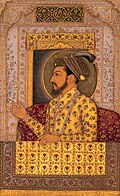

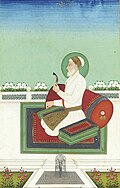
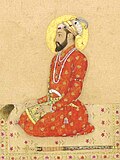
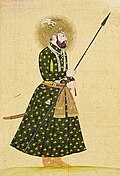

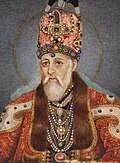
| Emperor of Hindustan | |
|---|---|
| شہنشاہِ ہند | |
Imperial | |
 Imperial seal of Bahadur Shah II (1837–1857) | |
 | |
| Details | |
| Style | Jahah Panah Alam Panah |
| First monarch | Babur |
| Last monarch | Bahadur Shah II |
| Formation | 21 April 1526 |
| Abolition | 21 September 1857 |
| Residence | |
| Appointer | Hereditary |
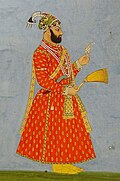
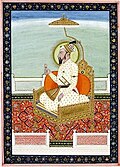
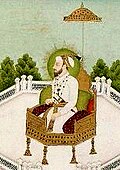
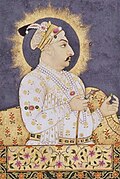
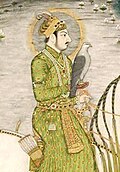
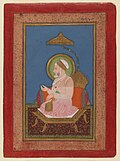
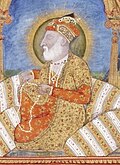
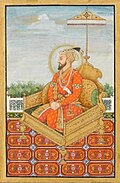
The emperors of the Mughal Empire, who were all members of the Timurid dynasty, ruled the empire from its inception on 21 April 1526 to its dissolution on 21 September 1857.[1] They were monarchs of the Mughal Empire in the Indian subcontinent, mainly corresponding to the modern day countries of India, Pakistan, Afghanistan, and Bangladesh. They ruled many parts of India from 1526 and by 1707, they ruled most of the subcontinent. Afterwards, they declined rapidly, but nominally ruled territories until the Indian Rebellion of 1857.
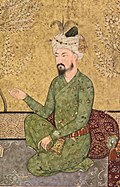
The Mughal dynasty was founded by Babur (r. 1526–1530), a Timurid prince from the Fergana Valley (modern-day Uzbekistan). He was a direct descendant of both Timur and Genghis Khan.[2]
The Mughal emperors had significant Indian and Persian ancestry through marriage alliances as emperors were born to Indian and Persian princesses.[3][4][5]
During the reign of 6th Mughal Emperor Aurangzeb, the empire, as the world's largest economy and manufacturing power, worth over 25% of global GDP,[6] controlled nearly all of the Indian subcontinent, extending from Dhaka in the east to Kabul in the west and from Kashmir in the north to the Kaveri River in the south.[7][8]

Its population at the time is estimated to be around 158,400,000 (a quarter of the world's total population), over a territory of more than 4 million square kilometres (1.5 million square miles).[9][10] Mughal power rapidly dwindled during the 18th century and the last emperor, Bahadur Shah II, was deposed in 1857, with the establishment of the British Raj in India.[11]
Background[edit | edit source]
Babur and Humayun (1526–1556)[edit source]

The Mughal Empire was founded by Babur (reigned 1526–1530), a Central Asian ruler who was descended from the Turco-Mongol conqueror Timur (the founder of the Timurid Empire) on his father's side, and from Genghis Khan on his mother's side.[13] Paternally, Babur belonged to the Turkicised Barlas tribe of Mongol origin.[14] Ousted from his ancestral domains in Central Asia, Babur turned to India to satisfy his ambitions.[15] He established himself in Kabul and then pushed steadily southward into India from Afghanistan through the Khyber Pass.[13] Babur's forces defeated Ibrahim Lodi, Sultan of Delhi, in the First Battle of Panipat in 1526. Through his use of firearms and cannons, he was able to shatter Ibrahim's armies despite being at a numerical disadvantage,[16][17] expanding his dominion up to the mid Indo-Gangetic Plain.[18] After the battle, the centre of Mughal power shifted to Agra.[16] In the decisive Battle of Khanwa, fought near Agra a year later, the Timurid forces of Babur defeated the combined Rajput armies of Rana Sanga of Mewar, with his native cavalry employing traditional flanking tactics.[16][17]
The preoccupation with wars and military campaigns, however, did not allow the new emperor to consolidate the gains he had made in India.[19] The instability of the empire became evident under his son, Humayun (reigned 1530–1556), who was forced into exile in Persia by the rebellious Sher Shah Suri (reigned 1540–1545).[13] Humayun's exile in Persia established diplomatic ties between the Safavid and Mughal courts and led to increasing Persian cultural influence in the later restored Mughal Empire.[20] Humayun's triumphant return from Persia in 1555 restored Mughal rule in some parts of India, but he died in an accident the next year.[21]
Akbar to Aurangzeb (1556–1707)[edit source]

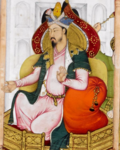
Akbar (reigned 1556–1605) was born Jalal-ud-din Muhammad[22] in the Umarkot Fort,[23] to Humayun and his wife Hamida Banu Begum, a Persian princess.[24] Akbar succeeded to the throne under a regent, Bairam Khan, who helped consolidate the Mughal Empire in India.[25] Through warfare, Akbar was able to extend the empire in all directions and controlled almost the entire Indian subcontinent north of the Godavari River.[26] He created a new ruling elite loyal to him, implemented a modern administration, and encouraged cultural developments. He increased trade with European trading companies.[13] India developed a strong and stable economy, leading to commercial expansion and economic development.[citation needed] Akbar allowed freedom of religion at his court and attempted to resolve socio-political and cultural differences in his empire by establishing a new religion, Din-i-Ilahi, with strong characteristics of a ruler cult.[13] He left his son an internally stable state, which was in the midst of its golden age, but before long signs of political weakness would emerge.[13]
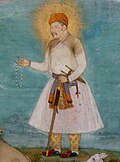
Jahangir (born Salim,[27] reigned 1605–1627) was born to Akbar and his wife Mariam-uz-Zamani, an Indian princess.[28] Salim was named after the Indian Sufi saint, Salim Chishti.[29][30] He "was addicted to opium, neglected the affairs of the state, and came under the influence of rival court cliques".[13] Jahangir distinguished himself from Akbar by making substantial efforts to gain the support of the Islamic religious establishment. One way he did this was by bestowing many more madad-i-ma'ash (tax-free personal land revenue grants given to religiously learned or spiritually worthy individuals) than Akbar had.[31] In contrast to Akbar, Jahangir came into conflict with non-Muslim religious leaders, notably the Sikh guru Arjan, whose execution was the first of many conflicts between the Mughal Empire and the Sikh community.[32][33][34]

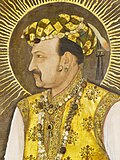
Shah Jahan (reigned 1628–1658) was born to Jahangir and his wife Jagat Gosain.[27] His reign ushered in the golden age of Mughal architecture.[35] During the reign of Shah Jahan, the splendour of the Mughal court reached its peak, as exemplified by the Taj Mahal. The cost of maintaining the court, however, began to exceed the revenue coming in.[13] Shah Jahan extended the Mughal Empire to the Deccan by ending the Ahmadnagar Sultanate and forcing the Adil Shahis and Qutb Shahis to pay tribute.[36]
Shah Jahan's eldest son, the liberal Dara Shikoh, became regent in 1658, as a result of his father's illness.[13] Dara championed a syncretistic Hindu-Muslim culture, emulating his great-grandfather Akbar.[37] With the support of the Islamic orthodoxy, however, a younger son of Shah Jahan, Aurangzeb (r. 1658–1707), seized the throne. Aurangzeb defeated Dara in 1659 and had him executed.[13] Although Shah Jahan fully recovered from his illness, Aurangzeb kept Shah Jahan imprisoned until he died in 1666.[38] Aurangzeb brought the empire to its greatest territorial extent,[39] and oversaw an increase in the Islamicisation of the Mughal state. He encouraged conversion to Islam, reinstated the jizya on non-Muslims, and compiled the Fatawa 'Alamgiri, a collection of Islamic law. Aurangzeb also ordered the execution of the Sikh guru Tegh Bahadur, leading to the militarisation of the Sikh community.[40][33][34] From the imperial perspective, conversion to Islam integrated local elites into the king's vision of a network of shared identity that would join disparate groups throughout the empire in obedience to the Mughal emperor.[41] He led campaigns from 1682 in the Deccan,[42] annexing its remaining Muslim powers of Bijapur and Golconda,[43][42] though engaged in a prolonged conflict in the region which had a ruinous effect on the empire.[44] The campaigns took a toll on the Mughal treasury, and Aurangzeb's absence led to a severe decline in governance, while stability and economic output in the Mughal Deccan plummeted.[44]
Aurangzeb is considered the most controversial Mughal emperor,[45] with some historians arguing his religious conservatism and intolerance undermined the stability of Mughal society,[13] while other historians question this, noting that he financed or patronised the building of non-Muslim institutions,[46] employed significantly more Hindus in his imperial bureaucracy than his predecessors did, and opposed bigotry against Hindus and Shia Muslims.[47]
Decline (1707–1857)[edit source]

Aurangzeb's son, Bahadur Shah I, repealed the religious policies of his father and attempted to reform the administration. "However, after he died in 1712, the Mughal dynasty began to sink into chaos and violent feuds. In 1719 alone, four emperors successively ascended the throne",[13] as figureheads under the rule of a brotherhood of nobles belonging to the Indian Muslim caste known as the Sadaat-e-Bara, whose leaders, the Sayyid Brothers, became the de facto sovereigns of the empire.[48][49]
During the reign of Muhammad Shah (reigned 1719–1748), the empire began to break up, and vast tracts of central India passed from Mughal to Maratha hands. As the Mughals tried to suppress the independence of Nizam-ul-Mulk, Asaf Jah I in the Deccan, he encouraged the Marathas to invade central and northern India.[50][51][52] The Indian campaign of Nader Shah, who had previously reestablished Iranian suzerainty over most of West Asia, the Caucasus, and Central Asia, culminated with the Sack of Delhi shattering the remnants of Mughal power and prestige, and taking off all the accumulated Mughal treasury. The Mughals could no longer finance the huge armies with which they had formerly enforced their rule. Many of the empire's elites now sought to control their affairs and broke away to form independent kingdoms.[53] But lip service continued to be paid to the Mughal Emperor as the highest manifestation of sovereignty. Not only the Muslim gentry, but the Maratha, Hindu, and Sikh leaders took part in ceremonial acknowledgements of the emperor as the sovereign of India.[54]
Meanwhile, some regional polities within the increasingly fragmented Mughal Empire involved themselves and the state in global conflicts, leading only to defeat and loss of territory during conflicts such as the Carnatic wars and Bengal War.[citation needed]

The Mughal Emperor Shah Alam II (1759–1806) made futile attempts to reverse the Mughal decline. Delhi was sacked by the Afghans, and when the Third Battle of Panipat was fought between the Maratha Empire and the Afghans (led by Ahmad Shah Durrani) in 1761, in which the Afghans were victorious, the emperor had ignominiously taken temporary refuge with the British to the east. In 1771, the Marathas recaptured Delhi from the Rohillas, and in 1784 the Marathas officially became the protectors of the emperor in Delhi,[55] a state of affairs that continued until the Second Anglo-Maratha War. Thereafter, the British East India Company became the protectors of the Mughal dynasty in Delhi.[54] The British East India Company took control of the former Mughal province of Bengal-Bihar in 1793 after it abolished local rule (Nizamat) that lasted until 1858, marking the beginning of the British colonial era over the Indian subcontinent. By 1857 a considerable part of former Mughal India was under the East India Company's control. After a crushing defeat in the Indian Rebellion of 1857 which he nominally led, the last Mughal emperor, Bahadur Shah Zafar, was deposed by the British East India Company and exiled in 1858 to Rangoon, Burma.[56]

Causes of decline[edit source]
Historians have offered numerous accounts of the several factors involved in the rapid collapse of the Mughal Empire between 1707 and 1720, after a century of growth and prosperity. A succession of short-lived incompetent and weak rulers, and civil wars over the succession, created political instability at the centre. The Mughals appeared virtually unassailable during the 17th century, but, once gone, their imperial overstretch became clear, and the situation could not be recovered. The seemingly innocuous European trading companies, such as the British East Indies Company, played no real part in the initial decline; they were still racing to get permission from the Mughal rulers to establish trades and factories in India.[57]
In fiscal terms, the throne lost the revenues needed to pay its chief officers, the emirs (nobles) and their entourages. The emperor lost authority as the widely scattered imperial officers lost confidence in the central authorities and made their deals with local men of influence. The imperial army bogged down in long, futile wars against the more aggressive Marathas, and lost its fighting spirit. Finally came a series of violent political feuds over control of the throne. After the execution of Emperor Farrukhsiyar in 1719, local Mughal successor states took power in region after region.[58]- Titular emperors
Over the course of the empire, there were several claimants to the Mughal throne who ascended the throne or claimed to do so but were actually never recognized.[59]
Here are the claimants to the Mughal throne historians recognise as titular Mughal emperors.
- Shahryar Mirza (1627–1628)
- Dawar Baksh (1627–1628)
- Jahangir II (1719–1720)
List of Mughal emperors[edit | edit source]
| No. | Portrait | Titular Name | Birth Name | Birth | Reign | Death |
|---|---|---|---|---|---|---|
| 1 | _Babur_detail.jpg)
|
Babur بابر |
Zahir ud-Din Muhammad ظهیر الدین محمد |
14 February 1483 Andijan |
21 April 1526 – 26 December 1530 |
26 December 1530 (aged 47) Agra |
| 2 | 
|
Humayun همایوں |
Nasir ud-Din Muhammad نصیر الدین محمد |
6 March 1508 Kabul |
26 December 1530 – 17 May 1540 (Template:Age in years, months, and days) 22 February 1555 – 27 January 1556 |
27 January 1556 (aged 47) Delhi |
| 3 | .jpg)
|
Akbar I اکبر |
Jalal ud-Din Muhammad جلال الدین محمد |
15 October 1542 Umerkot |
11 February 1556 – 27 October 1605 |
27 October 1605 (aged 63) Agra |
| 4 | 
|
Jahangir جهانگیر |
Nur ud-Din Muhammad نور الدین محمد |
31 August 1569 Agra |
3 November 1605 – 28 October 1627 |
28 October 1627 (aged 58) Bhimber[60] |
| 5 | 
|
Shah Jahan I شاه جهان |
Shihab ud-Din Muhammad شهاب الدین محمد |
5 January 1592 Lahore |
19 January 1628 – 31 July 1658 |
22 January 1666 (aged 74) Agra |
| 6 | .jpg_(Cropped).jpg)
|
Aurangzeb اورنگزیب Alamgir I عالمگیر |
Muhi al-Din Muhammad محی الدین محمد |
3 November 1618 Dahod, Gujarat |
31 July 1658 – 3 March 1707 |
3 March 1707 (aged 88) Ahmednagar |
| 7 | .jpg)
|
Azam Shah اعظم شاه |
Qutb ud-Din Muhammad قطب الدين محمد |
28 June 1653 Burhanpur |
14 March – 20 June 1707 |
20 June 1707 (aged 53) Agra |
| 8 | 
|
Bahadur Shah I بهادر شاہ Shah Alam I شاه عالم اول |
Mirza Muhammad Mu'azzam مرزا محمد معظم |
14 October 1643 Burhanpur |
19 June 1707 – 27 February 1712 |
27 February 1712 (aged 68) Lahore |
| 9 | 
|
Jahandar Shah جهاندار شاہ |
Muiz ud-Din Muhammad معز الدین محمد First Puppet emperor |
9 May 1661 Deccan |
27 February 1712 – 11 February 1713 |
12 February 1713 (aged 51) Delhi |
| 10 | 
|
Farrukhsiyar فرخ سیر |
Muin al-Din Muhammad معین الدین محمد Puppet emperor under the Sayyids of Barha |
20 August 1685 Aurangabad |
11 January 1713 – 28 February 1719 |
19 April 1719 (aged 33) Delhi |
| 11 | 
|
Rafi ud-Darajat رفیع الدرجات |
Shams al-Din Muhammad شمس الدین محمد Puppet emperor under the Sayyids of Barha |
1 December 1699 | 28 February 1719 – 6 June 1719 |
6 June 1719 (aged 19) Agra |
| 12 | 
|
Shah Jahan II شاہ جهان دوم |
Rafi al-Din Muhammad رفع الدين محمد Puppet emperor under the Sayyids of Barha |
5 January 1696 | 6 June 1719 – 17 September 1719 |
18 September 1719 (aged 23) Agra |
| 13 | 
|
Muhammad Shah محمد شاه |
Nasir al-Din Muhammad نصیر الدین محمد Puppet emperor under the Sayyids of Barha |
7 August 1702 Ghazni |
27 September 1719 – 26 April 1748 |
26 April 1748 (aged 45) Delhi |
| 14 | 
|
Ahmad Shah Bahadur احمد شاہ بهادر |
Mujahid al-Din Muhammad مجاهد الدین محمد |
23 December 1725 Delhi |
29 April 1748 – 2 June 1754 |
1 January 1775 (aged 49) Delhi |
| 15 | 
|
Alamgir II عالمگیر دوم |
Aziz al-Din Muhammad عزیز اُلدین محمد |
6 June 1699 Burhanpur |
3 June 1754 – 29 November 1759 |
29 November 1759 (aged 60) Delhi |
| 16 | 
|
Shah Jahan III شاه جهان سوم |
Muhi al-Millat محی الملت |
1711 | 10 December 1759 – 10 October 1760 |
1772 (aged 60–61) |
| 17 | 
|
Shah Alam II شاه عالم دوم |
Jalal al-Din Muhammad Ali Gauhar جلال الدین علی گوهر |
25 June 1728 Delhi |
10 October 1760 – 31 July 1788 |
19 November 1806 (aged 78) Delhi |
| 18 | 
|
Shah Jahan IV جهان شاه چهارم |
Bidar Bakht Mahmud Shah Bahadur Shah Jahan IV بیدار بخت محمود شاه بهادر جهان شاہ |
1749 Delhi |
31 July 1788 – 11 October 1788 |
1790 (aged 40–41) Delhi |
| 17* |
|
Shah Alam II شاه عالم دوم |
Jalal al-Din Muhammad Ali Gauhar جلال الدین علی گوهر Puppet emperor under the Scindias of Gwalior |
25 June 1728 Delhi |
16 October 1788 – 19 November 1806 |
19 November 1806 (aged 78) Delhi |
| 19 | 
|
Akbar Shah II اکبر شاه دوم |
Muin al-Din Muhammad میرزا اکبر Puppet emperor under the East India Company |
22 April 1760 Mukundpur |
19 November 1806 – 28 September 1837 |
28 September 1837 (aged 77) Delhi |
| 20 |
|
Bahadur Shah II Zafar بهادر شاه ظفر |
Abu Zafar Siraj al-Din Muhammad ابو ظفر سراج اُلدین محمد |
24 October 1775 Delhi |
28 September 1837 – 21 September 1857 |
7 November 1862 (aged 87) Rangoon |
Family tree of Mughal emperors[edit | edit source]
See also[edit | edit source]
References[edit | edit source]
Citations[edit | edit source]
- ↑ Schimmel, Annemarie (2004). The Empire of the Great Mughals: History, Art and Culture. Reaktion Books. ISBN 978-1-86189-185-3.
- ↑ "Babur and His World: A Culture of Books". Smithsonian's National Museum of Asian Art. Retrieved 8 January 2025.
- ↑ Jeroen Duindam (2015), Dynasties: A Global History of Power, 1300–1800, page 105 Archived 6 December 2022 at the Wayback Machine, Cambridge University Press
- ↑ Mohammada, Malika (1 January 2007). The Foundations of the Composite Culture in India. Akkar Books. p. 300. ISBN 978-8-189-83318-3.
- ↑ Dirk Collier (2016). The Great Mughals and their India. Hay House. p. 15. ISBN 9789384544980.
- ↑ "The World Economy (GDP) : Historical Statistics by Professor Angus Maddison" Archived 5 August 2019 at the Wayback Machine . World Economy. Retrieved 21 May 2013.
- ↑ Chandra, Satish. Medieval India: From Sultanate to the Mughals. p. 202.
- ↑ Truschke, Audrey (1 February 2018). Aurangzeb: The Man and the Myth. Penguin Random House India Private Limited. ISBN 978-0-14-343967-7.
- ↑ Richards, John F. (1 January 2016). Johnson, Gordon; Bayly, C. A. (eds.). The Mughal Empire. The New Cambridge history of India: 1.5. Vol. I. The Mughals and their Contemporaries. Cambridge: Cambridge University Press. pp. 1, 190. ISBN 978-0521251198.
- ↑ Böröcz, József (10 September 2009). The European Union and Global Social Change. Routledge. ISBN 9781135255800. Retrieved 26 June 2017.
- ↑ Spear 1990, pp. 147–148
- ↑ "Babur and Humayun with Courtiers, from the Late Shah Jahan Album". Smithsonian's National Museum of Asian Art.
The first Mughal emperor, Babur, who reigned from 1526 to 1530, is shown seated on the right with his son and successor, Humayun.
- ↑ 13.00 13.01 13.02 13.03 13.04 13.05 13.06 13.07 13.08 13.09 13.10 13.11 Berndl, Klaus (2005). National Geographic Visual History of the World. National Geographic Society. pp. 318–320. ISBN 978-0-7922-3695-5.
- ↑ Gérard Chaliand, A Global History of War: From Assyria to the Twenty-First Century, University of California Press, California 2014, p. 151
- ↑ Bayley, Christopher (1990). The European Emergence. The Mughals Ascendant. Time-Life Books. p. 151. ISBN 0-7054-0982-1.
- ↑ 16.0 16.1 16.2 Richards 1995, p. 8.
- ↑ 17.0 17.1 Asher & Talbot 2006, p. 116.
- ↑ Asher & Talbot 2006, p. 117.
- ↑ Bayley, Christopher (1990). The European Emergence. The Mughals Ascendant. Time-Life Books. p. 154. ISBN 0-7054-0982-1.
- ↑ Majumdar 1974, pp. 59, 65.
- ↑ Richards 1995, p. 12.
- ↑ Ballhatchet, Kenneth A. "Akbar". Encyclopædia Britannica. Archived from the original on 25 May 2023. Retrieved 17 July 2017.
- ↑ Smith, Vincent Arthur (1917). Akbar the Great Mogul, 1542–1605. Oxford: The Clarendon Press. pp. 13–14.
- ↑ Begum, Gulbadan (1902). The History of Humāyūn (Humāyūn-Nāma). Translated by Beveridge, Annette S. Royal Asiatic Society. pp. 237–239.
- ↑ Stein 2010, p. 162.
- ↑ Asher & Talbot 2006, p. 128.
- ↑ 27.0 27.1 Mohammada, Malika (2007). The Foundations of the Composite Culture in India. Aakar Books. p. 300. ISBN 978-81-89833-18-3.
- ↑ Gilbert, Marc Jason (2017). South Asia in World History. Oxford University Press. p. 79. ISBN 978-0-19-976034-3. Archived from the original on 22 September 2023. Retrieved 22 August 2017.
- ↑ Muhammad-Hadi (1999). Preface to The Jahangirnama. Translated by Thackston, Wheeler M. Oxford University Press. p. 4. ISBN 978-0-19-512718-8.
- ↑ Jahangir, Emperor of Hindustan (1999). The Jahangirnama: Memoirs of Jahangir, Emperor of India. Translated by Thackston, Wheeler M. Oxford University Press. p. 65. ISBN 978-0-19-512718-8.
- ↑ Faruqui, Munis D. (2012). The Princes of the Mughal Empire, 1504–1719. Cambridge University Press. pp. 268–269. ISBN 978-1-107-02217-1.
- ↑ Robb 2011, pp. 97–98.
- ↑ 33.0 33.1 Asher & Talbot 2006, p. 267.
- ↑ 34.0 34.1 "BBC – Religions – Sikhism: Origins of Sikhism". BBC. 30 September 2009. Archived from the original on 17 August 2018. Retrieved 19 February 2021.
- ↑ Mehta, Jaswant Lal (1984) [First published 1981]. Advanced Study in the History of Medieval India. Vol. II (2nd ed.). Sterling Publishers Pvt. Ltd. p. 59. ISBN 978-81-207-1015-3. OCLC 1008395679.
- ↑ Singhal, Damodar P. (1983). A History of the Indian People. Methuen. p. 193. ISBN 978-0-413-48730-8. Archived from the original on 22 September 2023. Retrieved 4 May 2021.
- ↑ Dara Shikoh Archived 3 April 2023 at the Wayback Machine Medieval Islamic Civilization: An Encyclopedia, by Josef W. Meri, Jere L Bacharach. Routledge, 2005. ISBN 0-415-96690-6. pp. 195–196.
- ↑ Truschke 2017, p. 68.
- ↑ Faruqui, Munis D. (2011). "Awrangzīb". In Fleet, Kate; Krämer, Gudrun; Matringe, Denis; Nawas, John; Rowson, Everett (eds.). Encyclopaedia of Islam, THREE. Brill Online. doi:10.1163/1573-3912_ei3_COM_23859. ISSN 1873-9830.
- ↑ Robb 2011, p. 98.
- ↑ Abhishek Kaicker (2020). The King and the People: Sovereignty and Popular Politics in Mughal Delhi. Oxford University Press. p. 160. ISBN 978-0-19-007067-0. Archived from the original on 3 April 2023. Retrieved 19 March 2023.
- ↑ 42.0 42.1 Burton-Page, J.; Islam, Riazul; Athar Ali, M.; Moosvi, Shireen; Moreland, W. H.; Bosworth, C. E.; Schimmel, Annemarie; Koch, Ebba; Hall, Margaret (24 April 2012), "Mug̲h̲als", Encyclopaedia of Islam (2nd ed.), Brill, doi:10.1163/1573-3912_islam_com_0778, archived from the original on 31 March 2022, retrieved 31 March 2022
- ↑ Richards 1995, pp. 220–222.
- ↑ 44.0 44.1 Richards 1995, p. 252.
- ↑ Asher & Talbot 2006, p. 225.
- ↑ Copeland, Ian; Mabbett, Ian; Roy, Asim; Brittlebank, Kate; Bowles, Adam (2012). A History of State and Religion in India. London and New York: Routledge. pp. 118, 119, 154. ISBN 978-0-415-58066-3.
(p. 154) Even Aurengzeb, stereotyped in the popular imagination a staunch Islamic revivalist with deep anti-Hindu inclinations, was, as we demonstrated in Chapter 5, as much a sponsor of temples as a destroyer of them, and, when required, a patron of Brahmans besides (p. 119) ... the same applied to the issue of temple destruction. ... such acts of this nature occurred during the era of the Sultanate were carried out for reasons of political expediency, not as a result of religious zeal, and this was also the case under the Mughals. Even Aurengzeb, infamous in the old historiography as a destroyer of temples actually built many more temples than he destroyed. (p. 118) Like most rulers on the subcontinent, the Mughals patronised both Muslim and non-Muslim institutions. They financed the building of mosques and the funding of temples alike.
- ↑ Truschke 2017, p. 58.
- ↑ Audrey Truschke (2021). the Language of History: Sanskrit Narratives of Indo-Muslim Rule. Columbia University Press. ISBN 978-0-231-55195-3. Archived from the original on 3 April 2023. Retrieved 19 March 2023.
- ↑ Muhammad Yasin (1958). A Social History of Islamic India, 1605–1748. Upper India Publishing House. p. 18. Archived from the original on 3 April 2023. Retrieved 27 March 2023.
became virtual rulers and 'de facto' sovereigns when they began to make and unmake emperors. They had developed a sort of common brotherhood among themselves
- ↑ Columbia University Press (2000). Columbia Chronologies of Asian History and Culture. Columbia University Press. p. 285. ISBN 978-0-231-11004-4. Archived from the original on 3 April 2023. Retrieved 19 March 2023.
- ↑ Richard M. Eaton (2013). Eaton, Richard M.; Faruqui, Munis D.; Gilmartin, David; Kumar, Sunil (eds.). Expanding Frontiers in South Asian and World History Essays in Honour of John F. Richards. Cambridge University Press. p. 21. doi:10.1017/CBO9781107300002. ISBN 978-1-107-03428-0.
I consider all this army (Marathas) as my own.....I will enter into an understanding with them and entrust the Mulukgiri(raiding) on that side of the Narmada to them.
- ↑ Pagadi, Setu Madhavarao (1970). "Maratha-Nizam Relations : Nizam-Ul-Mulk's Letters". Annals of the Bhandarkar Oriental Research Institute. 51 (1/4): 94.
The Mughal court was hostile to Nizam-ul-Mulk..... Nizam did not interfere with the Maratha activities in Malwa and Gujarat.....Nizam-ul-Mulk considered the Maratha army...
- ↑ Salma Ahmed Farooqui (2011). A Comprehensive History of Medieval India: Twelfth to the Mid-eighteenth Century. Pearson Education India. p. 309. ISBN 978-8131732021.
Even more disturbing was the fact that the assertion of independence had spread to other part of the empire too, and the governors of Hyderabad, Bengal and Awadh soon established independent kingdoms as well.
- ↑ 54.0 54.1 Bose, Sugata; Jalal, Ayesha (2004). Modern South Asia: History, Culture, Political Economy (2nd ed.). Routledge. p. 41. ISBN 978-0-203-71253-5.
- ↑ Rathod, N.G. (1994). The Great Maratha Mahadaji Scindia. New Delhi: Sarup & Sons. p. 8. ISBN 978-81-85431-52-9.
- ↑ Conermann, Stephan (2015). "Mughal Empire". Encyclopedia of Early Modern History Online. Brill. doi:10.1163/2352-0272_emho_COM_024206. Retrieved 28 March 2022.
- ↑ Kirsten McKenzie; Robert Aldrich (2013). The Routledge History of Western Empires (ebook). Taylor & Francis. p. 333. ISBN 9781317999874. Retrieved 14 March 2024.
- ↑ Richards, J.F. (1981). "Mughal State Finance and the Premodern World Economy". Comparative Studies in Society and History. 23 (2): 285–308. doi:10.1017/s0010417500013311. JSTOR 178737. S2CID 154809724.
- ↑ "The Mughal emperors in India", The Caliphate, Routledge, pp. 161–164, 18 November 2016, doi:10.4324/9781315443249-20, ISBN 978-1-315-44324-9, retrieved 7 January 2023
{{citation}}: CS1 maint: work parameter with ISBN (link) - ↑ Allan, J.; Haig, Sir T. Wolsely; Dodwell, H. H. (1934). Dodwell, H. H. (ed.). The Cambridge Shorter History of India. Cambridge University Press. p. 398.
Sources[edit | edit source]
- Asher, Catherine B.; Talbot, Cynthia (2006). India before Europe. Cambridge University Press. ISBN 0-521-80904-5. OCLC 61303480.
- Majumdar, R.C. (1974). The Mughul Empire. Bharatiya Vidya Bhavan.
- Richards, John F. (1995). The Mughal Empire. Cambridge University Press. ISBN 978-0-521-56603-2.
- Robb, Peter (2011), A History of India, Macmillan International Higher Education, ISBN 978-0-230-34424-2
- Stein, Burton (2010), A History of India, John Wiley & Sons, ISBN 978-1-4443-2351-1, retrieved 15 July 2019
- Truschke, Audrey (2017). Aurangzeb: The Life and Legacy of India's Most Controversial King. Stanford University Press. ISBN 978-1-5036-0259-5.
- Keay, John, India, a History, 2000, HarperCollins, ISBN 0002557177
- Spear, Percival (1990) [First published 1965], A History of India, Volume 2, New Delhi and London: Penguin Books. Pp. 298, ISBN 978-0-14-013836-8.
- Template:Country study – India Archived 14 July 2012 at Archive.today Pakistan Archived 29 June 2015 at the Wayback Machine