

RickieDumas3 (talk | contribs) No edit summary |
|||
| Line 1: | Line 1: | ||
{{Short description|None}} | |||
{{Use Indian English|date=February 2017}} | {{Use Indian English|date=February 2017}} | ||
{{Use dmy dates|date= | {{Use dmy dates|date=June 2022}} | ||
{{Infobox economy | {{Infobox economy | ||
| country = Karnataka | | country = Karnataka | ||
| image = | | image = File:Ubcity2.jpg | ||
| image_size = 300px | | image_size = 300px | ||
| caption = Bengaluru, The capital city of Karnataka | | caption = [[Bengaluru]], The capital city of Karnataka | ||
| | | currency = [[Indian rupee]] (INR, ₹) | ||
| year = 1 April – 31 March | | year = 1 April – 31 March | ||
| | | population = {{increase}} 68,362,000<ref name="CEIC_Karnataka_Pop_2025">CEIC Data. "Population: Karnataka." Retrieved May 2025 from [https://www.ceicdata.com/en/india/population/population-karnataka https://www.ceicdata.com/en/india/population/population-karnataka].</ref> | ||
| gdp = {{INRConvert| | | group = | ||
| gdp rank = [[List of Indian states and union territories by GDP| | | gdp = {{increase}} {{INRConvert|33.05|t|lk=on}}<ref>{{Cite web |title=Karnataka Budget Analysis 2026-27 |url=https://prsindia.org/budgets/states/karnataka-budget-analysis-2026-27 |access-date=2026-03-06 |website=PRS Legislative Research |language=en-US}}</ref> ([[GDP (nominal)|nominal]]; 2026 est.){{increase}} $1.60 trillion<ref>{{Cite web |title=Karnataka Budget Analysis 2026-27 |url=https://prsindia.org/budgets/states/karnataka-budget-analysis-2026-27 |access-date=2026-03-06 |website=PRS Legislative Research |language=en-US}}</ref><ref>{{Cite web |title=Implied PPP Conversion rate |url=https://www.imf.org/external/datamapper/PPPEX@WEO/IND?zoom=IND&highlight=IND |access-date=2025-08-05}}</ref>([[Purchasing power parity|PPP]]; 2026 est.) | ||
| growth = | | gdp rank = [[List of Indian states and union territories by GDP|5th]] | ||
| per capita = {{ | | growth = 8% (2025-2026)<ref>https://prsindia.org/budgets/states/karnataka-budget-analysis-2026-27</ref> | ||
| per capita rank = [[List of Indian states and union territories by GDP per capita| | | per capita = {{increase}} $5,646<ref>{{Cite web |title=Karnataka Budget Analysis 2026-27 |url=https://prsindia.org/budgets/states/karnataka-budget-analysis-2026-27 |access-date=2025-03-06 |website=PRS Legislative Research |language=en-US}}</ref> ([[GDP (nominal)|nominal]]; 2026 est.) {{increase}} $23,161<ref>{{Cite web |title=Karnataka Budget Analysis 2026-27 |url=https://prsindia.org/budgets/states/karnataka-budget-analysis-2026-27 |access-date=2026-03-06 |website=PRS Legislative Research |language=en-US}}</ref>([[Purchasing power parity|PPP]]; 2026 est.) | ||
| sectors = Agriculture | | per capita rank = [[List of Indian states and union territories by GDP per capita|4th (2023-24 est.)]] | ||
| sectors = Agriculture 15% <br /> Industry 19% <br /> Services 66% (2021–22)<ref name="Budget Analysis"/> | |||
| components = | | components = | ||
| inflation = | | inflation = | ||
| bankrate = | | bankrate = | ||
| poverty = {{decreasepositive}} [[List of Indian states and union territories by poverty rate| | | poverty = {{decreasepositive}} [[List of Indian states and union territories by poverty rate|5.67%]] in poverty (2024-25)<ref>{{cite web | title=SDGs India Index | url=https://sdgindiaindex.niti.gov.in/#/ranking |work=[[NITI Aayog]] | date=31 December 2019}}</ref> | ||
| gini = | | gini = | ||
| hdi = {{increase}} 0. | | hdi = {{increase}} 0.758 {{color|green|high}} (2025) ([[List of Indian states and territories by Human Development Index|21st]]) | ||
| labor = | | labor = | ||
| occupations = | | occupations = | ||
| unemployment = {{decreasePositive}} | | unemployment = {{decreasePositive}} 10.65% (March 2024)<ref>{{cite web|title=Unemployment Rate in India |url=https://unemploymentinindia.cmie.com/ |publisher=Centre for Monitoring Indian Economy |page=1 |access-date=3 March 2024}}</ref> | ||
| average gross salary = | | average gross salary = | ||
| gross median = | | gross median = | ||
| Line 32: | Line 34: | ||
| exports = | | exports = | ||
| export-goods = | | export-goods = | ||
| export-partners = | | export-partners = {{flag|United States}}<ref>{{Cite news |date=2023-08-18 |title=Bengaluru is the United States’ most important trading partner in India, says U.S Consul General |url=https://www.thehindu.com/news/national/karnataka/bengaluru-is-the-united-states-most-important-trading-partner-in-india-says-us-consul-general/article67206624.ece |access-date=2025-08-14 |work=The Hindu |language=en-IN |issn=0971-751X}}</ref> | ||
| imports = | | imports = | ||
| import-goods = | | import-goods = | ||
| Line 39: | Line 41: | ||
| current account = | | current account = | ||
| gross external debt = | | gross external debt = | ||
| debt = | | debt = 27.49% of GSDP (2022–23 est.)<ref name="Budget Analysis"/> | ||
| balance = {{INRConvert|- | | balance = {{INRConvert|-61564|c}} <small>3.26% of GSDP (2022–23 est.)</small> | ||
| revenue = {{INRConvert| | | revenue = {{INRConvert|3.53|lc|nolink=yes}} (2025–26 est.)<ref name="Budget Analysis"/> | ||
| expenses = {{INRConvert| | | expenses = {{INRConvert|4.04|lc|nolink=yes}} (2025–26 est.)<ref name="Budget Analysis">{{cite web|title=Karnataka Budget Analysis 2023-24|url=https://prsindia.org/budgets/states/karnataka-budget-analysis-2023-24|website=PRS Legislative Research|date=7 July 2023}}</ref> | ||
| aid = | | aid = | ||
| credit = | | credit = | ||
| Line 49: | Line 51: | ||
}} | }} | ||
[[File:Gross State Domestic Product of Karnataka (chart of yearly growth).jpg|right|300px]] | [[File:Gross State Domestic Product of Karnataka (chart of yearly growth).jpg|right|300px]] | ||
[[Karnataka]] is one of the highest economic growth states in [[India]] with an expected [[Gross domestic product|GSDP]] (Gross State Domestic Product) growth of | [[Karnataka]] is one of the highest economic growth states in [[India]] with an expected [[Gross domestic product|GSDP]] (Gross State Domestic Product) growth of 9.5% in the 2021–22 fiscal year. It has a [[Economic development|developed economy]]<ref name="gsdp">{{cite news|url=http://www.hindu.com/2011/02/24/stories/2011022462350600.htm|archive-url=https://web.archive.org/web/20110303211914/http://www.hindu.com/2011/02/24/stories/2011022462350600.htm|url-status=dead|archive-date=3 March 2011|title= State's economic growth poised at 8.2 per cent|access-date=2011-04-06|location=Chennai, India|work=[[The Hindu]]|date=24 February 2011}}</ref><ref name="ibef">{{cite web|url=https://www.ibef.org/download/Karnataka_190111.pdf|work=Online webpage of the India Brand Equity Foundation|publisher=Ministry of Commerce with the Confederation of Indian Industry|title=Karnataka|access-date=2011-04-06}}</ref> The total expected GSDP of Karnataka in 2022–2023 is about $240 billion.<ref name="ibef"/> Karnataka recorded one of the highest growth rates in terms of GDP and per capita GDP in the last decade compared to other Indian states. In 2008–09, the [[Tertiary sector of the economy|tertiary]] sector contributed the most to GSDP (US$31.6 billion─55 percent), followed by the [[Secondary sector of the economy|secondary]] sector ($17 billion─29 percent), and the [[Primary sector of the economy|primary]] sector (US$9.5 billion─16 percent).<ref name="contrib">{{cite web|url=https://www.ibef.org/download/Karnataka_171109.pdf|title=State Economy and Socio-Economic Profile – Karnataka|work=Department of Commerce & Industry|publisher=India Brand Equity Foundation|access-date=2009-09-30}}</ref> | ||
With an overall GDP growth of 56.2% and a [[per capita GDP]] growth of 43.9% in the last decade, Karnataka surpassed | With an overall GDP growth of 56.2% and a [[per capita GDP]] growth of 43.9% in the last decade, Karnataka surpassed many other states in India, pushing Karnataka's per capita income in Indian Rupee terms to sixth place.<ref name="percapita">{{cite web|url=http://www.thehindubusinessline.com/2005/06/09/stories/2005060900951700.htm|title= In terms of per capita GDP – Karnataka, Bengal fastest growing States|work=The Hindu |date=2005-06-09 |access-date=2007-06-11}}</ref> Karnataka received US$2,026.4 million worth of [[Foreign Direct Investment]] for the fiscal year 2008–09, placing it at the third spot among states in India.<ref name="fdi_08">{{cite news|url=http://www.deccanherald.com/content/43090/karnataka-stands-3rd-fdi-inflows.html|title= Karnataka stands 3rd for FDI inflows in India after Maharashtra, Gujarat|work=Deccan Herald |access-date=2011-04-06|location=Bangalore, India|date=24 December 2010}}</ref> At the end of 2004, the unemployment rate of Karnataka was 4.57% compared to a national rate of 5.99%.<ref name="unemployment">{{cite web|url=http://indiabudget.nic.in/es2003-04/chapt2004/chap104.pdf|title=Employment and Unemployment|author=Government of India|work=Online webpage of Indian budget|access-date=2007-06-19|archive-url=https://web.archive.org/web/20101224155012/http://indiabudget.nic.in/es2003-04/chapt2004/chap104.pdf|archive-date=24 December 2010|url-status=dead}}</ref> For the fiscal year 2006–07 the inflation rate of Karnataka was 4.4%, which was less than the national average.<ref name="inflation">{{cite web |url=http://www.kar.nic.in/finance/bud2006/budhig06.htm |title=Budget 2006–2007 |work=Online webpage of the Finance Department |publisher=Government of Karnataka |access-date=2007-06-19 |url-status=dead |archive-url=https://web.archive.org/web/20060822072325/http://www.kar.nic.in/finance/bud2006/budhig06.htm |archive-date=22 August 2006 }}</ref> | ||
Between 2011-12 and [https://www.ibef.org/states/karnataka-presentation 2017-18], the GSDP of the state grew at a Compound Annual Growth Rate (CAGR) of 13.11 per cent to reach {{INR}}12.69 trillion (US$ 196.88 billion) and the net state domestic product (NSDP) grew at a CAGR of 12.83 per cent to reach {{INR}}11.45 trillion (US$ 177.68 billion).<ref>{{Cite web|url=https://www.ibef.org/states/karnataka-presentation|title=GSDP of Karnataka, Manufacturing Industries in Karnataka|website= | Between 2011-12 and [https://www.ibef.org/states/karnataka-presentation 2017-18], the GSDP of the state grew at a Compound Annual Growth Rate (CAGR) of 13.11 per cent to reach {{INR}} 12.69 trillion (US$196.88 billion) and the net state domestic product (NSDP) grew at a CAGR of 12.83 per cent to reach {{INR}} 11.45 trillion (US$177.68 billion).<ref>{{Cite web|url=https://www.ibef.org/states/karnataka-presentation|title=GSDP of Karnataka, Manufacturing Industries in Karnataka|website=ibef.org|access-date=2018-06-25}}</ref> | ||
A [[fiscal year]] in Karnataka begins on 1 April of the previous calendar year and ends on 31 March of the year with which it is numbered. | A [[fiscal year]] in Karnataka begins on 1 April of the previous calendar year and ends on 31 March of the year with which it is numbered. | ||
After [[Bangalore Urban district|Bengaluru Urban]], [[Dakshina Kannada|Dakshina Kannada (Mangaluru)]] and [[Belgaum district|Belagavi]] districts contribute the highest revenue to the state respectively. | After [[Bangalore Urban district|Bengaluru Urban]], [[Dakshina Kannada|Dakshina Kannada (Mangaluru)]] Hubli-Dharwad and [[Belgaum district|Belagavi]] districts contribute the highest revenue to the state respectively. | ||
[[File:EXCON 2025, Bangalore International Exhibition Centre (572).jpg|thumb|right|Invest Karnataka (Global Investors Meet 2025) at [[EXCON]] 2025, [[Bangalore International Exhibition Centre|BIEC]] ]] | |||
==Agriculture and Livestock{{anchor|Agriculture}}== | ==Agriculture and Livestock{{anchor|Agriculture}}== | ||
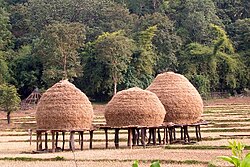
[[File:UKanaraHaystack.jpg|thumb|300px|Haystack on stilts in paddy fields of [[Uttara Kannada|Uttara Kannada district]]]] | [[File:UKanaraHaystack.jpg|thumb|300px|Haystack on stilts in paddy fields of [[Uttara Kannada|Uttara Kannada district]]]] | ||
Agriculture is the primary occupation of most of Karnataka's rural people. A total of 123,100 km<sup>2</sup> of land is cultivated in Karnataka, constituting 64.60% of the total geographical area of the state.<ref name="stats">{{cite web|url=http://raitamitra.kar.nic.in/Agri%20Policy%20Eng.pdf|title=Karnataka Agricultural Policy 2006|work=Online webpage of Department of Agriculturesankalp | Agriculture is the primary occupation of most of Karnataka's rural people. A total of 123,100 km<sup>2</sup> of land is cultivated in Karnataka, constituting 64.60% of the total geographical area of the state.<ref name="stats">{{cite web|url=http://raitamitra.kar.nic.in/Agri%20Policy%20Eng.pdf|title=Karnataka Agricultural Policy 2006|work=Online webpage of Department of Agriculturesankalp|publisher=Government of Karnataka|access-date=2007-06-04|archive-date=15 June 2007|archive-url=https://web.archive.org/web/20070615001645/http://raitamitra.kar.nic.in/Agri%20Policy%20Eng.pdf|url-status=dead}}</ref> According to the 2001 census, farmers and agricultural labourers formed 56% of the workforce of Karnataka.<ref name="excel">{{cite web|url=http://planningcommission.nic.in/plans/stateplan/sdr_pdf/shdr_kar05.pdf|title=Karnataka Human Development Report 2005|work=Online webpage of the Planning Commission|publisher=Government of India|access-date=2007-06-04|archive-date=15 June 2007|archive-url=https://web.archive.org/web/20070615001643/http://planningcommission.nic.in/plans/stateplan/sdr_pdf/shdr_kar05.pdf|url-status=dead}}</ref> Agriculture in Karnataka is heavily dependent on the southwest [[monsoon]] since the extent of arid land in the state is second only to Rajasthan.<ref name="excel"/> Only 26.5% of sown area (30,900 km<sup>2</sup>) is subjected to [[irrigation]].<ref name="stats"/> The state has three agricultural seasons – [[Kharif]] (April to September), [[Rabi crop|Rabi]] (October to December) and Summer (January to March).<ref name="stats"/> | ||
|publisher=Government of Karnataka|access-date=2007-06-04}}</ref> According to the 2001 census, farmers and agricultural labourers formed 56% of the workforce of Karnataka.<ref name="excel">{{cite web|url=http://planningcommission.nic.in/plans/stateplan/sdr_pdf/shdr_kar05.pdf|title=Karnataka Human Development Report 2005|work=Online webpage of the Planning Commission|publisher=Government of India|access-date=2007-06-04}}</ref> Agriculture in Karnataka is heavily dependent on the southwest [[monsoon]] since the extent of arid land in the state is second only to Rajasthan.<ref name="excel"/> Only 26.5% of sown area (30,900 km<sup>2</sup>) is subjected to [[irrigation]].<ref name="stats"/> The state has three agricultural seasons – [[Kharif]] (April to September), [[Rabi crop|Rabi]] (October to December) and Summer (January to March).<ref name="stats"/> | |||
Given below is a table of 2015 national output share of select agricultural crops and allied segments in Karnataka based on 2011 prices<ref>[http://www.mospi.gov.in/sites/default/files/publication_reports/Final1Brochure_30july2018.pdf 2015 agricultural output of Karnataka based on 2011 prices]</ref> | Given below is a table of 2015 national output share of select agricultural crops and allied segments in Karnataka based on 2011 prices<ref>[http://www.mospi.gov.in/sites/default/files/publication_reports/Final1Brochure_30july2018.pdf 2015 agricultural output of Karnataka based on 2011 prices]</ref> | ||
| Line 165: | Line 168: | ||
=== Primary Crops grown in Karnataka === | === Primary Crops grown in Karnataka === | ||
The main crops grown are | The main crops grown are rice, ragi, jowar (sorghum), maize, and pulses (tur and gram) in addition to oilseeds and a number of other cash crops.<ref name="stats" /> [[Cashew]]s, coconut, [[arecanut]], [[cardamom]], [[Chili pepper|chillies]], cotton, sugarcane and tobacco are also produced. Karnataka is the largest producer of coarse cereals,<ref name="coarse">{{cite web|url=http://dacnet.nic.in/eands/4.8(b)Area,Production%20and%20Yield%20of%20Coarse%20Cereals%20during2004-05%20and%202005-06%20in%20respect%20of%20major.xls|title=Area, Production and Yield of Coarse Cereals during 2004–05 and 2005–06 in respect of major Coarse Cereals Producing States along with coverage under Irrigation|work=Online webpage of DACNET|publisher=Government of India|access-date=2007-06-04|url-status=dead|archive-url=https://web.archive.org/web/20070929115604/http://dacnet.nic.in/eands/4.8%28b%29Area%2CProduction%20and%20Yield%20of%20Coarse%20Cereals%20during2004-05%20and%202005-06%20in%20respect%20of%20major.xls|archive-date=29 September 2007}}</ref> coffee,<ref name="coff">{{cite web|url=http://indiacoffee.org/coffeeinindia/default.htm|archive-url=https://archive.today/20070509021450/http://indiacoffee.org/coffeeinindia/default.htm|url-status=dead|archive-date=2007-05-09|title=Coffee data|work=Online webpage of Coffee Board of India|access-date=2007-06-04 }}</ref> raw silk<ref name="silk">{{cite web|url=http://www.fao.org/sd/Teca/search/tech_dett_en.asp?lang=en&tech_id=1195|title=Bamboo in Sericulture|work=Online webpage: TECA – Technology for Agriculture|publisher=FAO, United Nations|access-date=2007-06-04}}</ref> and tomatoes among the states in India. Horticultural crops are grown in an area of 16,300 km<sup>2</sup> and the annual production is about 9.58 million tons.<ref name="stats" /> The income generated from horticulture constitutes over 40% of income generated from agriculture and it is about 17% of the state's GDP.<ref name="stats" /> In floriculture, Karnataka occupies the second position in India in terms of production and 700 tons of flowers (worth {{INR}} 500 million) were produced in 2004–05.<ref name="stats" /> | ||
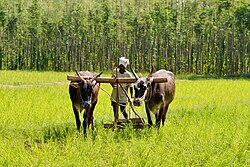
[[File:Traditional ploughing - Karnataka.jpg|thumb | [[File:Traditional ploughing - Karnataka.jpg|thumb|Traditional farming methods are still in use]] | ||
A majority of the thirty-five billion rupee silk industry in India is headquartered in Karnataka State, primarily in [[Mysore]] and North | A majority of the thirty-five billion rupee silk industry in India is headquartered in Karnataka State, primarily in [[Mysore]] and North Bengaluru regions of [[Doddaballapura]], the site of a planned 700 million "Silk City".<ref>{{cite web|url=https://www.deccanherald.com/content/31009/silk-city-come-up-near.html|title=Silk city to come up near B'lore|date=17 October 2009|website=Deccan Herald}}</ref><ref>{{cite web|url=http://sify.com/news/fullstory.php?a=jg1rkmebjfi&title=Karnataka_silk_weavers_fret_over_falling_profits_due_to_globalisation&tag=Karnataka|archive-url=https://web.archive.org/web/20150418235819/http://www.sify.com/news/fullstory.php?a=jg1rkmebjfi&title=Karnataka_silk_weavers_fret_over_falling_profits_due_to_globalisation&tag=Karnataka|url-status=dead|archive-date=2015-04-18|title=Karnataka silk weavers fret over falling profits due to globalisation|website=Sify}}</ref> | ||
==Education== | ==Education== | ||
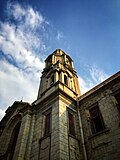
[[File:IISc.jpg|thumb | [[File:IISc.jpg|thumb|Main building of IISc, Bengaluru]] | ||
Karnataka has one of the largest concentrations of higher education including medical and engineering colleges. Apart from Bengaluru, places like [[Mangalore]], [[Hubli–Dharwad]], [[Mysore]], [[Belagavi]], [[Udupi]], [[Tumakuru]] and [[Davanagere]] have been producing professionals for the Information Technology industry. [[Muddenahalli]], in North | Karnataka has one of the largest concentrations of higher education including medical and engineering colleges. Apart from Bengaluru, places like [[Mangalore]], [[Hubli–Dharwad]], [[Mysore]], [[Belagavi]], [[Udupi]], [[Tumakuru]] and [[Davanagere]] have been producing professionals for the Information Technology industry. [[Muddenahalli]], in North Bengaluru, is the site of the upcoming Sri Sathya Sai Baba University and College of Medicine and a branch of the [[Visvesvaraya Institute of Advanced Technology]].<ref>{{cite news| url=http://www.hindu.com/2009/07/09/stories/2009070954310500.htm | archive-url=https://web.archive.org/web/20090713122731/http://www.hindu.com/2009/07/09/stories/2009070954310500.htm | url-status=dead | archive-date=13 July 2009 | location=Chennai, India | work=[[The Hindu]] | title=International sports village location to be finalised soon | date=9 July 2009}}</ref> [[Devanahalli]] is set to be the location of a 95 billion Devanahalli Business Parks, which will contain Aerospace Education Special Economic Zones, near the Bengaluru International Airport. The North Bengaluru region is set to be a premier educational hub of Karnataka. There are many prestigious educational and research institutions in [[Bengaluru]] such as [[Indian Institute of Science]], [[National Law School of India University]], [[University Visvesvaraya College of Engineering]], [[Ramaiah Institute of Technology]], [[R.V. College of Engineering]], [[PES University]], [[Sir M. Visvesvaraya Institute of Technology]], [[Indian Institute of Management Bangalore|Indian Institute of Management]], [[International Institute of Information Technology, Bangalore|International Institution of Information Technology]], [[Jain University]] etc.<ref>{{Cite web|url=http://www.thehindubusinessline.com/2009/09/05/stories/2009090551001700.htm|title=Business Financial, Economy, Market, Stock – News & Updates}}</ref> | ||
<ref>http://www.thehindubusinessline.com/2009/09/05/stories/2009090551001700.htm</ref> Dharwad in the northern part of the state is another hub for education with several engineering colleges With | |||
Dharwad in the northern part of the state is another hub for education with several engineering colleges With institutions of national importance like AIIMS, IIT Dharwad, IIIT Dharwad, Dakshina Hindi Prachara Sabha, Karnataka Institute of Medical Sciences (KIMS) and Universities like Karnataka University, University of Agricultural sciences Dharwad, Karnataka State Law University, KLE University, SDM University are present in Dharwad & Hubballi City, hence called Education Hub and a central university is present in Kalaburgi.<ref>{{cite web|url=http://www.cuk.ac.in/aboutcuk.html |title=About Central University of Karnataka |access-date=2011-07-21 |url-status=dead |archive-url=https://web.archive.org/web/20110721150326/http://www.cuk.ac.in/aboutcuk.html |archive-date=21 July 2011 }}</ref> These developments are set to contribute significantly to Karnataka's economy by creating jobs, expanding educational opportunities, and spurring infrastructure development. [[Manipal Academy of Higher Education]] is one of the best universities present in [[Manipal]], [[Udupi]] city. With many great and prestigious Institutions [[Karnataka]] has been the Educational Hub of India. | |||
==Industry== | ==Industry== | ||
[[File:District-wise industries of Karnataka in 2024.svg|thumb|District-wise industries of Karnataka in 2024.]] | |||
Karnataka evolved as the manufacturing hub for some of the largest [[public sector]] industries of India after India's independence. [[Hindustan Aeronautics Limited]], which is dedicated to [[research and development]] activities for indigenous [[fighter aircraft]] for the [[Indian Air Force]], employs over 9,500 employees making it one of the largest public sector employers in Karnataka. | Karnataka evolved as the manufacturing hub for some of the largest [[public sector]] industries of India after India's independence. [[Hindustan Aeronautics Limited]], which is dedicated to [[research and development]] activities for indigenous [[fighter aircraft]] for the [[Indian Air Force]], employs over 9,500 employees making it one of the largest public sector employers in Karnataka. | ||
Other heavy industries such as [[National Aerospace Laboratories]], [[Indian Telephone Industries]], [[BEML|Bharat Earth Movers Limited]], [[Bharat Electronics Limited]], Hindustan Machine Tools and Indian subsidiaries of [[Volvo]] and [[Toyota]] are also headquartered in | Other heavy industries such as [[National Aerospace Laboratories]], [[Indian Telephone Industries]], [[BEML|Bharat Earth Movers Limited]], [[Bharat Electronics Limited]], Hindustan Machine Tools and Indian subsidiaries of [[Volvo]] and [[Toyota]] are also headquartered in Bengaluru. India's national space agency, the Indian Space Research Organization, is headquartered in Bengaluru and employs approximately 20,000 people. | ||
TVS Motors has a motorcycle manufacturing plant at Mysore and Tata Motors at [[Dharwad]]. Karnataka state has many companies engaged in the manufacturing of electrical equipment and machinery like [[Kirloskar Group|Kirloskar]], [[ABB | TVS Motors has a motorcycle manufacturing plant at Mysore and Tata Motors at [[Dharwad]]. Karnataka state has many companies engaged in the manufacturing of electrical equipment and machinery like [[Kirloskar Group|Kirloskar]], [[ABB]], Kavika, [[Larsen and Toubro]] etc. This may be due to the location of the [[Central Power Research Institute]] at Bengaluru. Many multinational companies have set up their manufacturing units in Karnataka such as [[BASF]] and [[Robert Bosch GmbH|Bosch]]. | ||
The state owns sugar factories in the northern region, edible oil processing factories, pharmaceutical factories, textile processing centers, | The state owns sugar factories in the northern region, edible oil processing factories, pharmaceutical factories, textile processing centers, and steel producing facilities. Vishwesharaiya steel plant at [[Bhadravati, Karnataka|Bhadravati]] is run by SAIL. | ||
===Minerals=== | ===Minerals=== | ||
Lithium has been discovered in Karnataka's Mandya district which is | Lithium has been discovered in Karnataka's Mandya district which is 100 km from Bengaluru, becoming the Nation's first-ever Lithium reserves so far confirmed at 1,600 tonnes.<ref>{{Cite web|title=Preliminary survey shows deposits of Lithium in Mandya district of Karnataka|url=http://pib.gov.in/Pressreleaseshare.aspx?PRID=1694796|access-date=2021-07-20|website=pib.gov.in}}</ref> | ||
Gold, iron ore, quartz, limestone, manganese, [[kyanite]] and bauxite are some of the minerals that are found in Karnataka.<ref name="mines">{{cite web |url=http://www.kar.nic.in/mines/Mining%20Leases.doc |work=Online Webpage of the Department of the Mines and Geology |title=List of Mining Leases in Karnataka |publisher=Govt. of Karnataka |access-date=2007-06-05 |url-status=dead |archive-url=https://web.archive.org/web/20060411183957/http://www.kar.nic.in/mines/Mining%20Leases.doc |archive-date=11 April 2006 }}</ref> After the closure of the [[Kolar Gold Fields]] mine, the only company in India that produces gold by mining and extracting it from the ore is [[Hutti Gold Mines Limited]] that has plants at [[Hatti, Raichur|Hutti]] and [[Chitradurga]] in Karnataka.<ref name="gold">{{cite web |url=http://www.blonnet.com/2004/09/26/stories/2004092601000500.htm |work=The Hindu Business Line |date=2004-09-26 |title=Global mining houses on 'gold rush' to India|author=Amit Mitra |access-date=2007-06-05}}</ref> The major mines of manganese and iron ore are located at [[Sandur, India|Sandur]] in [[Bellary district]].<ref name="sandur">{{cite web|url=http://www.blonnet.com/2004/04/10/stories/2004041001510200.htm |work=The Hindu Business Line |date=2004-04-10|title=Sandur Manganese set to clear dues|author=Madhumathi D.S. |access-date=2007-06-05}}</ref> Visweswaraiah Iron and Steel Ltd. at [[Bhadravathi, Karnataka|Bhadravathi]] and Jindal Vijayanagar Steel Ltd. at [[Toranagallu]] are engaged in the production of iron and steel. Indian Aluminium Company Ltd. (Hindalco) has an aluminum plant near Belgaum.<ref name="minind">{{cite web|url=https://minerals.usgs.gov/minerals/pubs/country/2001/inmyb01.pdf|work=Online Webpage of the U.S. Geological Survey|title=The Mineral Industry of India|author=Chin S Kuo|publisher=U.S. Geological Survey|access-date=2007-06-05}}</ref> Mysore Minerals Limited is in the mining and production of chromite industry in [[Hassan district]].<ref name="minind"/> Rajashree Cements at Adityanagar, Vasavadatta Cements at [[Sedam]] and The Associated Cement Company Ltd. at [[Wadi]] are engaged in the production of cement.<ref name="minind"/> Uranium deposits have been found in Deshnur, a small village near Belgaum. | |||
==Information and biotechnology== | |||
{{further|Software industry in Karnataka}} | |||
[[File:Infosys (4911287704).jpg|thumb|Infosys, Bengaluru]] | |||
[[ | Karnataka is the leader in the information technology sector in India and its capital, Bengaluru, is known as the [[Silicon Valley of India]]. In the IT sector, Karnataka generated a total revenue of {{INR}} 516.5 billion in the financial year 2006–07 which included {{INR}} 487 billion from software exports and {{INR}} 29.5 billion from hardware exports.<ref name="it">{{cite web|date=2007-05-22|title=IT exports from Karnataka cross Rs 50k cr|url=http://www.financialexpress.com/fe_full_story.php?content_id=164868|access-date=2007-06-05|work=The Financial Express}}{{Dead link|date=August 2019|bot=InternetArchiveBot|fix-attempted=yes}}</ref> A total of 1973 companies in the state are involved in Information Technology-related business.<ref name="it" /> While the bulk of the IT related companies are located in Bengaluru, some companies are located in Mysore and Mangalore as well. Bengaluru is also the headquarters of [[Wipro]] and [[Infosys]] which are among the top three IT companies in India in regards to [[market capitalization]].<ref name="capital">{{cite news|date=14 July 2006|title=TCS topples Infosys as m-cap leader in IT space|work=The Economic Times|url=https://economictimes.indiatimes.com/articleshow/1753981.cms|access-date=2007-06-05}}</ref> The [[Nandi Hills, India|Nandi Hills]] area in [[Devanahalli]] outskirts is the site of the upcoming $22 Billion, 50 square kilometre [[BIAL IT Investment Region]], one of the largest infrastructure projects in the history of Karnataka.<ref>{{cite news|date=29 January 2010|title=State Cabinet approves IT park near Devanahalli airport|work=[[The Hindu]]|location=Chennai, India|url=http://www.hindu.com/2010/01/29/stories/2010012953620400.htm|url-status=dead|archive-url=https://web.archive.org/web/20100201235839/http://www.hindu.com/2010/01/29/stories/2010012953620400.htm|archive-date=1 February 2010}}</ref> | ||
As of June 2006, Karnataka housed 55% of [[biotechnology]] related companies in India.<ref name="biotech">{{cite web|date=2006-06-08|title=Bangalore tops biocluster list with Rs 1,400-cr revenue|url=http://www.blonnet.com/2006/06/08/stories/2006060804710300.htm|url-status=dead|archive-url=https://web.archive.org/web/20070929121144/http://www.blonnet.com/2006/06/08/stories/2006060804710300.htm|archive-date=29 September 2007|access-date=2007-06-05|work=The Hindu Business Line}}</ref> Bengaluru is also the home of the largest biocluster in India with total revenues of {{INR}} 14 billion and having 158 of the 320 companies working on biotechnology in India.<ref name="biotech" /> Karnataka has a headcount of over 6,800 scientists involved in biotech research and out of twenty eight biotech companies that were registered in India in the year 2005–06, 27 were located in Karnataka.<ref name="biotech" /> | |||
==Banking== | |||
{{further|Banking in Karnataka}} | |||
Karnataka, particularly the coastal districts of [[Dakshina Kannada]] and [[Udupi district|Udupi]], is sometimes called the "cradle of banking" in [[India]].<ref name="cradle">{{cite web|author=Ravi Sharma|date=8–21 October 2005|title=Building on a strong base|url=http://www.flonnet.com/fl2221/stories/20051021002509200.htm|url-status=dead|archive-url=https://web.archive.org/web/20071007155202/http://www.flonnet.com/fl2221/stories/20051021002509200.htm|archive-date=7 October 2007|access-date=2007-06-21|work=The Frontline}}</ref> This is because seven of the country's leading banks, [[Canara Bank]], [[Syndicate Bank]], [[Corporation Bank]], [[Vijaya Bank]], [[Karnataka Bank]], [[Vysya Bank]] and the [[State Bank of Mysore]] originated in this state.<ref name="cradle" /> The first five in the above list of banks were established in the districts of Dakshina Kannada and Udupi. These districts have among the best distribution of banks in India—a branch for every 500 persons.<ref name="fl">{{cite web|author=Ravi Sharmga|date=19 July – 1 August 2003|title=A pioneer's progress|url=http://www.hinduonnet.com/fline/fl2015/stories/20030801002810400.htm|archive-url=https://web.archive.org/web/20050327073036/http://www.hinduonnet.com/fline/fl2015/stories/20030801002810400.htm|url-status=usurped|archive-date=27 March 2005|access-date=2007-06-21|work=Frontline|volume=20|issue=15}}</ref> Between 1880 and 1935, twenty two banks were established in coastal Karnataka, nine of them in the city of Mangalore. | |||
Karnataka, particularly the coastal districts of [[Dakshina Kannada]] and [[Udupi district|Udupi]], is sometimes called the "cradle of banking" in [[India]].<ref name="cradle">{{cite web|url=http://www.flonnet.com/fl2221/stories/20051021002509200.htm | |||
As of March 2009, Karnataka had 5,759 branches of different banks servicing the people of the state.<ref name="rbi">{{cite web|url=http://rbidocs.rbi.org.in/rdocs/Publications/PDFs/3T_BBS300810.pdf | | As of March 2009, Karnataka had 5,759 branches of different banks servicing the people of the state.<ref name="rbi">{{cite web|title=State/Union Territory-Wise Number of Branches of Scheduled Commercial Banks and Average Population Per Bank Branch – March 2009|url=http://rbidocs.rbi.org.in/rdocs/Publications/PDFs/3T_BBS300810.pdf|access-date=2014-09-22|work=Online webpage of the Reserve Bank of India}}</ref> The number of people served by each branch was 10,000 which was lesser than the national average of 15,000, thereby indicating better penetration of banking in the state.<ref name="rbi" /> | ||
==Infrastructure== | ==Infrastructure== | ||
| Line 249: | Line 255: | ||
===Airports=== | ===Airports=== | ||
====Domestic airports==== | ====Domestic airports==== | ||
*[[Belgaum Airport]] | [[File:BLRT2 IntlDep.jpg|thumb|Terminal 2 - Kempegowda International Airport]] | ||
*[[Hubli Airport]] | [[File:Hubballi Airport new Terminal.jpg|thumb|'''Hubballi Airport New Terminal''']] | ||
*[[Belgaum Airport]] (Upcoming as International Airport) | |||
*[[Bidar Airport]] | |||
*[[Gulbarga Airport]] | |||
*[[Hubli Airport|Hubballi Airport]] | |||
*[[Mysore Airport]] | *[[Mysore Airport]] | ||
*[[Shivamogga Airport]] | *[[Shivamogga Airport]] | ||
*[[Jindal Vijaynagar Airport|Ballari Airport at Toranagallu]] | |||
====International airports==== | ====International airports==== | ||
*[[Kempegowda International Airport]], Devanahalli – formerly | *[[Kempegowda International Airport]], Devanahalli – formerly Bengaluru International Airport | ||
*[[Mangalore International Airport]], Bajpe | *[[Mangalore International Airport]], Bajpe | ||
===Railways=== | ===Railways=== | ||
Karnataka has a railway network of 3,836 km.<ref>{{Cite web |title=Karnataka railway news: Over 90% of railway network in Karnataka is now electrified |url=https://www.deccanherald.com/india/karnataka/over-90-of-railway-network-in-karnataka-is-now-electrified-2960976 |access-date=2025-04-18 |website=Deccan Herald |language=en}}</ref> [[South Western Railway]] covers almost the whole of Karnataka and its headquarter is in [[Hubli|Hubballi]]. | |||
South Western Railway covers almost | |||
Hubballi | [[Shree Siddharoodha Swamiji Hubballi Junction railway station|SSS Hubballi Junction]]'s Platform 1 holds the guinness world record for being the longest railway platform.<ref>{{Cite news |title=Longest railway platform |url=https://www.guinnessworldrecords.com/world-records/longest-railway-platform |archive-url=https://web.archive.org/web/20240518012806/https://www.guinnessworldrecords.com/world-records/longest-railway-platform |archive-date=2024-05-18 |access-date=2025-04-18 |work=Guinness World Records |language=en-GB}}</ref> | ||
[[South Western Railway]] is divided into three divisions: | |||
* Hubballi Railway Division | * [[Hubballi railway division|Hubballi Railway Division]] | ||
* Bengaluru Railway Division | * [[Bangalore railway division|Bengaluru Railway Division]] | ||
* Mysore Railway Division | * [[Mysore railway division|Mysore Railway Division]] | ||
There are | There are two Railway Heritage Museums in Karnataka: | ||
* | * [[Railway Museum, Mysore]] | ||
* Hubballi Railway Heritage Museum | * Hubballi Railway Heritage Museum | ||
'''Urban transport''' | '''Urban transport''' | ||
Metro rail and | Metro rail and suburban-rail projects are underway in Bengaluru. The first phase of the Namma Metro is complete and covers a total of 76.95 km. Second phase is under construction. | ||
====Ongoing projects==== | ====Ongoing projects==== | ||
Hassan–Sakhleshpura–Mangalore line gauge conversion is completed. Both freight and passenger trains run on this route on a daily basis connecting the seaport city of Mangaluru to the state capital of Bengaluru and | Hassan–Sakhleshpura–Mangalore line gauge conversion is completed. Both freight and passenger trains run on this route on a daily basis connecting the seaport city of Mangaluru to the state capital of Bengaluru and Mysuru. | ||
Key connectivity projects, doubling of | Key connectivity projects, doubling of Mysore–Bengaluru railway line, Gadag–Bagalkot, Bengaluru–Hassan to be taken up in the near future. | ||
===Power=== | ===Power=== | ||
| Line 313: | Line 321: | ||
'''Physical infrastructure – power''' | '''Physical infrastructure – power''' | ||
Distribution/supply: Electricity Supply Companies (ESCOMs) | Distribution / supply: Electricity Supply Companies (ESCOMs) | ||
Bangalore Electricity Supply Company (BESCOM) | Bangalore Electricity Supply Company (BESCOM) | ||
| Line 319: | Line 327: | ||
Mangalore Electricity Supply Company ([[MESCOM]]) | Mangalore Electricity Supply Company ([[MESCOM]]) | ||
Hubli Electricity Supply Company ([https://hescom.karnataka.gov.in/english HESCOM]) | |||
Gulbarga Electric Supply Company (GESCOM) | Gulbarga Electric Supply Company (GESCOM) | ||
Chamundeshwari Electric Supply Corporation (CESC) | |||
Source: Power sector at a glance as | Source: Power sector at a glance as in July 2009‖, Karnataka Power Transmission Corporation Limited website, accessed 23 September 2009. | ||
===Telecommunications=== | ===Telecommunications=== | ||
| Line 331: | Line 339: | ||
Leading telecom companies in the sectors of telecommunication network, basic telephony services (both wire line and wireless) and networking services for telecommunication equipment are operating in the state. | Leading telecom companies in the sectors of telecommunication network, basic telephony services (both wire line and wireless) and networking services for telecommunication equipment are operating in the state. | ||
The entire State is networked via Optic FibreCables (OFC) by the state-run BSNL (formerly DOT) as well as private companies like Bharti, Reliance, | The entire State is networked via Optic FibreCables (OFC) by the state-run [[BSNL]] (formerly DOT) as well as private companies like Bharti, Reliance, [[Tata Communications]] and [[Tata Teleservices]]. | ||
Last Mile Access is provided by BSNL as well as TATA Tele Services in various parts of the state. Bharti and Reliance Communications provide the Last Mile Access directly to the customer in all major cities in Karnataka. | |||
BSNL, | Telecom service providers in Karnataka: [[BSNL]], [[Bharti Airtel]], [[Jio|Reliance Jio]], [[Vodafone Idea]] | ||
Key statistics (2007–08) | Key statistics (2007–08) | ||
| Line 367: | Line 371: | ||
Key industrial clusters | Key industrial clusters | ||
IT/ITES cluster in electronic city and Whitefield ( | IT/ITES cluster in electronic city and Whitefield (Bengaluru). | ||
Food Parks – 4 old State sponsored and 2 new MoFPI sponsored Food Parks in 6 Districts of Karnataka | Food Parks – 4 old State sponsored and 2 new MoFPI sponsored Food Parks in 6 Districts of Karnataka | ||
Biotech park/cluster in electronic city, | Biotech park/cluster in electronic city, Bengaluru. | ||
Integrated Food Parks in Hiriyur, Bagalkote, Jewargi & Malur for pay-n-use common facilities & MSME Food Processing Manufacturers | Integrated Food Parks in Hiriyur, Bagalkote, Jewargi & Malur for pay-n-use common facilities & MSME Food Processing Manufacturers | ||
| Line 407: | Line 411: | ||
|work=mysore.net | |work=mysore.net | ||
|access-date=2006-11-09 | |access-date=2006-11-09 | ||
|archive-date=28 September 2007 | |||
|archive-url=https://web.archive.org/web/20070928094125/http://www.mysore.net/travel/otherplace3.htm | |||
|url-status=dead | |||
}}</ref> | }}</ref> | ||
===Electrical supply=== | ===Electrical supply=== | ||
Karnataka has an installed capacity of 27 gigawatts (GW) of electricity, of which 12 GW comes from renewable energy sources.<ref>{{Cite web|url=https://www.firstpost.com/business/how-karnataka-could-become-self-reliant-in-electricity-in-just-10-years-with-investments-in-clean-energy-4865731.html|title=How Karnataka could become self-reliant in electricity in just 10 years with investments in clean energy|last=Tripathi|first=Bhasker|date=August | Karnataka has an installed capacity of 27 gigawatts (GW) of electricity, of which 12 GW comes from renewable energy sources.<ref>{{Cite web|url=https://www.firstpost.com/business/how-karnataka-could-become-self-reliant-in-electricity-in-just-10-years-with-investments-in-clean-energy-4865731.html|title=How Karnataka could become self-reliant in electricity in just 10 years with investments in clean energy|last=Tripathi|first=Bhasker|date=1 August 2018|website=Firstpost|access-date=2019-03-21}}</ref> The state is India's top producer of solar energy, with an installed capacity of 5.16 GW.<ref>{{Cite web|url=https://www.deccanherald.com/national/solar-energy-karnataka-earns-686315.html|title=Solar energy: Karnataka earns top position|last=Athrady|first=Ajith|date=2018-08-08|website=Deccan Herald|language=en|access-date=2019-03-21}}</ref><ref>{{Cite web|url=https://www.businesstoday.in/sectors/energy/karnataka-is-the-top-solar-state-in-india-mercom-capital/story/274820.html|title=Karnataka is the top solar state in India: Mercom Capital|last=Kiran|first=Niti|date=13 April 2018|website=Business Today|access-date=2019-03-21}}</ref> | ||
Karnataka Power Transmission Corporation Limited (KPTCL) is the sole provider of electricity for the state. The Linganamakki reservoir will supply around 35 percent of power to the state. Electric power from KPTCL is distributed through distribution companies like Bangalore Electricity Supply Company (BESCOM), Mangalore Electricity Supply Company ([[MESCOM]]), Gulbarga Electricity Supply Company (GESCOM), Hubli Electricity Supply Company (HESCOM) and Chamundesvary Electricity Supply Company (CESCOM) for different parts of the state. A good number of [[windmills]] were present. The [[Raichur Thermal Power Station]] and [[Bellary Thermal Power station]] Near Bellary (Kuduthini). Karnataka is also the location of companies like [[SELCO (India)]], which is promoting the use of [[Solar thermal energy|solar electricity]] among the rural areas of the state and is also a twice winner of the [[Ashden Award]]s. | |||
== Data == | |||
=== Annual growth of Gross State Domestic Product at Current Prices === | |||
{| class="wikitable sortable" | |||
! rowspan=2 | year | |||
! colspan = 2 | GSDP<ref name="2022_23_es">{{Cite web |title=Economic Survey 2022-23 |url=https://des.karnataka.gov.in/storage/pdf-files/Economic%20Survey%202022-23%20English.pdf |archive-url=https://web.archive.org/web/20230608091530/https://des.karnataka.gov.in/storage/pdf-files/Economic%20Survey%202022-23%20English.pdf |archive-date=2023-06-08 |access-date=2025-01-13 |website=des.karnataka.gov.in}}</ref><ref name="2023_24_es">{{cite web|url=https://des.karnataka.gov.in/storage/pdf-files/ARC/Economic_Survey_2023-24_FINALENGLISH.pdf|title=Economic Survey 2023-24|date=2025-01-14 |website=des.karnataka.gov.in}}</ref><ref name="2025_26_es">{{cite web | url=https://des.karnataka.gov.in/uploads/Economic_Survey_2025-26_English_FinalMpdf_1772796504.pdf | title= Economic survey 2025-26 | access-date=11 March 2026 | website = des.karnataka.gov.in }}</ref> | |||
! rowspan=2 | Growth rate | |||
|- | |||
! in ₹ Crore | |||
! in US$ Billion | |||
|- | |||
| 2011-12 | |||
| ₹6,06,010 crore | |||
| US$71 billion | |||
| — | |||
|- | |||
| 2012-13 | |||
| ₹6,95,413 crore | |||
| US$81 billion | |||
| {{increase}} 14.8% | |||
|- | |||
| 2013-14 | |||
| ₹8,16,666 crore | |||
| US$96 billion | |||
| {{increase}} 17.4% | |||
|- | |||
| 2014-15 | |||
| ₹9,13,923 crore | |||
| US$110 billion | |||
| {{increase}} 11.9% | |||
|- | |||
| 2015-16 | |||
| ₹10,45,168 crore | |||
| US$120 billion | |||
| {{increase}} 14.4% | |||
|- | |||
| 2016-17 | |||
| ₹12,07,608 crore | |||
| US$140 billion | |||
| {{increase}} 15.5% | |||
|- | |||
| 2017-18 | |||
| ₹13,33,240 crore | |||
| US$160 billion | |||
| {{increase}} 10.4% | |||
|- | |||
| 2018-19 | |||
| ₹14,79,391 crore | |||
| US$170 billion | |||
| {{increase}} 11.0% | |||
|- | |||
| 2019-20 | |||
| ₹16,15,827 crore | |||
| US$190 billion | |||
| {{increase}} 8.9% | |||
|- | |||
| 2020-21 | |||
| ₹16,40,811 crore | |||
| US$190 billion | |||
| {{increase}} 0.9% | |||
|- | |||
| 2021-22 | |||
| ₹19,92,029 crore | |||
| US$230 billion | |||
| {{increase}} 20.8% | |||
|- | |||
| 2022-23 | |||
| ₹24,26,071 crore | |||
| US$260 billion | |||
| {{increase}} 14.2% | |||
|- | |||
| 2023-24 | |||
| ₹25,93,567 crore | |||
| US$290 billion | |||
| {{increase}} 10.2% | |||
|- | |||
| 2024-25 | |||
| ₹29,06,063 crore | |||
| US$330 billion | |||
| {{increase}} 13.79% | |||
|- | |||
| 2025-26† | |||
| ₹32,81,065 crore | |||
| US$357 billion | |||
| {{increase}} 8.19% | |||
|- | |||
|} | |||
:† As per First Advance Estimates | |||
=== District wise statistics === | |||
{{static row numbers}} | |||
{| class="wikitable sortable static-row-numbers static-row-header-hash" | |||
|+ Gross District Domestic Product and Per Capita Income Year : 2024-25<ref name="2024_25_es"/><ref name="2025_26_es"/> | |||
! rowspan = 2 | District | |||
! colspan = 3 | Share of sectors | |||
! colspan = 2 | GDDP | |||
! colspan = 2 | PCI | |||
! rowspan = 2 | # | |||
|- | |||
! data-sort-type:number | Agriculture | |||
! data-sort-type:number | Industry | |||
! data-sort-type:number | Services | |||
! in ₹ Crore | |||
! US$ Billion | |||
! in ₹ | |||
! US$ | |||
|- | |||
| [[Bengaluru Urban district|Bengaluru Urban]] | |||
| 1.5% <small>({{decrease}} 0.2%)</small> | |||
| 13.9% <small>({{decrease}} 1.9%)</small> | |||
| 84.5% <small>({{increase}} 2.1%)</small> | |||
| data-sort-value = "1173574" | ₹11,73,574 crore | |||
| US$128 billion | |||
| ₹8,55,960 | |||
| US$9,313 | |||
| {{unchanged}} | |||
|- | |||
| [[Dakshina Kannada]] | |||
| 6.8% <small>({{decrease}} 2.8%)</small> | |||
| 37.4% <small>({{decrease}} 1.5%)</small> | |||
| 55.8% <small>({{increase}} 4.3%)</small> | |||
| data-sort-value = "154509" | ₹1,54,509 crore | |||
| US$16.8 billion | |||
| ₹6,26,279 | |||
| US$6,814 | |||
| {{unchanged}} | |||
|- | |||
| [[Udupi district|Udupi]] | |||
| 13.7% <small>({{decrease}} 1.4%)</small> | |||
| 26.3% <small>({{decrease}} 1.6%)</small> | |||
| 60.0% <small>({{increase}} 3.0%)</small> | |||
| data-sort-value = "75198" | ₹75,198 crore | |||
| US$8.18 billion | |||
| ₹6,00,683 | |||
| US$6,536 | |||
| {{unchanged}} | |||
|- | |||
| [[Chikmagalur district|Chikkamagaluru]] | |||
| 14.7% <small>({{decrease}} 9.1%)</small> | |||
| 30.5% <small>({{increase}} 1.6%)</small> | |||
| 54.7% <small>({{increase}} 7.4%)</small> | |||
| data-sort-value = "59955" | ₹59,955 crore | |||
| US$6.52 billion | |||
| ₹4,94,787 | |||
| US$5,385 | |||
| {{unchanged}} | |||
|- | |||
| [[Shimoga district|Shivamogga]] | |||
| 20.0% <small>({{decrease}} 3.3%)</small> | |||
| 23.1% <small>({{increase}} 0.2%)</small> | |||
| 56.9% <small>({{increase}} 3.2%)</small> | |||
| data-sort-value = "78037 " | ₹78,037 crore | |||
| US$8.49 billion | |||
| ₹3,89,743 | |||
| US$4,241 | |||
| {{increase}} 1 | |||
|- | |||
| [[Kodagu district|Kodagu]] | |||
| 41.0% <small>({{decrease}} 4.2%)</small> | |||
| 13.2% <small>({{increase}} 0.1%)</small> | |||
| 45.8% <small>({{increase}} 4.1%)</small> | |||
| data-sort-value = "21510" | ₹21,510 crore | |||
| US$2.34 billion | |||
| ₹3,53,701 | |||
| US$3,849 | |||
| {{increase}} 3 | |||
|- | |||
| [[Bengaluru Rural district|Bengaluru Rural]] | |||
| 15.5% <small>({{decrease}} 2.6%)</small> | |||
| 27.6% <small>({{decrease}} 2.3%)</small> | |||
| 56.9% <small>({{increase}} 4.9%)</small> | |||
| data-sort-value = "43485" | ₹43,485 crore | |||
| US$4.73 billion | |||
| ₹3,49,559 | |||
| US$3,804 | |||
| {{decrease}} 2 | |||
|- | |||
| [[Mandya district|Mandya]] | |||
| 14.7% <small>({{decrease}} 1.2%)</small> | |||
| 21.9% <small>({{decrease}} 0.7%)</small> | |||
| 63.4% <small>({{increase}} 1.9%)</small> | |||
| data-sort-value = "66775" | ₹66,775 crore | |||
| US$7.27 billion | |||
| ₹3,06,448 | |||
| US$3,712 | |||
| {{decrease}} 1 | |||
|- | |||
| [[Hassan district|Hasana]] | |||
| 19.7% <small>({{decrease}} 1.6%)</small> | |||
| 16.2% <small>({{decrease}} 0.1%)</small> | |||
| 64.1% <small>({{increase}} 1.7%)</small> | |||
| data-sort-value = "66247" | ₹66,247 crore | |||
| US$7.21 billion | |||
| ₹3,38,877 | |||
| US$3,688 | |||
| {{increase}} 1 | |||
|- | |||
| [[Tumakuru district|Tumakuru]] | |||
| 16.6% <small>({{decrease}} 3.0%)</small> | |||
| 30.1% <small>({{unchanged}} 0.0%)</small> | |||
| 53.4% <small>({{increase}} 3.1%)</small> | |||
| data-sort-value = "100988" | ₹1,00,988 crore | |||
| US$11 billion | |||
| ₹3,34,980 | |||
| US$3,645 | |||
| {{decrease}} 2 | |||
|- | |||
| [[Ballari district|Ballari]] | |||
| 11.5% <small>({{decrease}} 1.1%)</small> | |||
| 28.2% <small>({{decrease}} 1.1%)</small> | |||
| 60.3% <small>({{increase}} 2.2%)</small> | |||
| data-sort-value = "59928" | ₹59,928 crore | |||
| US$6.52 billion | |||
| ₹3,24,111 | |||
| US$3,527 | |||
| {{unchanged}} | |||
|- | |||
| [[Bengaluru South district|Bengaluru South]] | |||
| 17.9% <small>({{increase}} 1.7%)</small> | |||
| 29.7% <small>({{decrease}} 2.3%)</small> | |||
| 52.5% <small>({{increase}} 0.7%)</small> | |||
| data-sort-value = "44055" | ₹44,055 crore | |||
| US$4.18 billion | |||
| ₹3,19,088 | |||
| US$3,472 | |||
| {{unchanged}} | |||
|- | |||
| [[Chamarajanagar district|Chamarajanagara]] | |||
| 28.7% <small>({{increase}} 5.5%)</small> | |||
| 17.9% <small>({{decrease}} 2.2%)</small> | |||
| 53.3% <small>({{decrease}} 3.4%)</small> | |||
| data-sort-value = "35351" | ₹35,351 crore | |||
| US$3.85 billion | |||
| ₹3,04,040 | |||
| US$3,309 | |||
| {{increase}} 2 | |||
|- | |||
| [[Dharwad district|Dharawada]] | |||
| 8.1% <small>({{decrease}} 0.2%)</small> | |||
| 23.5% <small>({{decrease}} 1.5%)</small> | |||
| 68.4% <small>({{increase}} 1.7%)</small> | |||
| data-sort-value = "68591" | ₹68,591 crore | |||
| US$7.46 billion | |||
| ₹3,00,627 | |||
| US$3,271 | |||
| {{unchanged}} | |||
|- | |||
| [[Uttara Kannada]] | |||
| 16.6% <small>({{decrease}} 4.4%)</small> | |||
| 20.5% <small>({{increase}} 0.1%)</small> | |||
| 62.9% <small>({{increase}} 4.2%)</small> | |||
| data-sort-value = "48509" | ₹48,509 crore | |||
| US$5.28 billion | |||
| ₹2,95,116 | |||
| US$3,211 | |||
| {{decrease}} 2 | |||
|- | |||
| [[Bagalkot district|Bagalakote]] | |||
| 16.2% <small>({{decrease}} 3.0%)</small> | |||
| 27.7% <small>({{unchanged}} 0.0%)</small> | |||
| 56.2% <small>({{increase}} 3.1%)</small> | |||
| data-sort-value = "65909" | ₹65,909 crore | |||
| US$7.17 billion | |||
| ₹2,79,919 | |||
| US$3,046 | |||
| {{unchanged}} | |||
|- | |||
| [[Mysore district|Mysuru]] | |||
| 16.2% <small>({{decrease}} 4.0%)</small> | |||
| 16.5% <small>({{decrease}} 0.4%)</small> | |||
| 67.3% <small>({{increase}} 4.4%)</small> | |||
| data-sort-value = "99527" | ₹99,527 crore | |||
| US$10.83 billion | |||
| ₹2,69,333 | |||
| US$2,931 | |||
| {{unchanged}} | |||
|- | |||
| [[Chikkaballapura district|Chikkaballapura]] | |||
| 21.7% <small>({{decrease}} 4.5%)</small> | |||
| 21.0% <small>({{unchanged}} 0.0%)</small> | |||
| 57.3% <small>({{increase}} 4.5%)</small> | |||
| data-sort-value = "37935" | ₹37,935 crore | |||
| US$4.13 billion | |||
| ₹2,52,588 | |||
| US$2,749 | |||
| {{unchanged}} | |||
|- | |||
| [[Kolar district|Kolar]] | |||
| 20.4% <small>({{increase}} 0.8%)</small> | |||
| 24.0% <small>({{decrease}} 1.6%)</small> | |||
| 55.6% <small>({{increase}} 0.8%)</small> | |||
| data-sort-value = "46568" | ₹46,568 crore | |||
| US$5.07 billion | |||
| ₹2,49,201 | |||
| US$2,712 | |||
| {{unchanged}} | |||
|- | |||
| [[Davanagere district|Davanagere]] | |||
| 26.3% <small>({{decrease}} 5.6%)</small> | |||
| 21.6% <small>({{increase}} 1.1%)</small> | |||
| 52.1% <small>({{increase}} 4.5%)</small> | |||
| data-sort-value = "47801" | ₹47,801 crore | |||
| US$5.2 billion | |||
| ₹2,42,159 | |||
| US$2,635 | |||
| {{unchanged}} | |||
|- | |||
| [[Chitradurga district|Chitradurga]] | |||
| 28.2% <small>({{decrease}} 3.9%)</small> | |||
| 15.7% <small>({{increase}} 0.3%)</small> | |||
| 56.1% <small>({{increase}} 3.6%)</small> | |||
| data-sort-value = "45577" | ₹45,577 crore | |||
| US$4.96 billion | |||
| ₹2,27,554 | |||
| US$2,476 | |||
| {{unchanged}} | |||
|- | |||
| [[Gadag district|Gadaga]] | |||
| 13.9% <small>({{decrease}} 1.8%)</small> | |||
| 19.3% <small>({{decrease}} 0.7%)</small> | |||
| 66.8% <small>({{increase}} 2.6%)</small> | |||
| data-sort-value = "28603" | ₹28,603 crore | |||
| US$3.11 billion | |||
| ₹2,24,073 | |||
| US$2,438 | |||
| {{unchanged}} | |||
|- | |||
| [[Haveri district|Haveri]] | |||
| 18.0% <small>({{decrease}} 3.2%)</small> | |||
| 17.5% <small>({{increase}} 0.1%)</small> | |||
| 64.4% <small>({{increase}} 3.0%)</small> | |||
| data-sort-value = "39571" | ₹39,571 crore | |||
| US$4.31 billion | |||
| ₹2,03,257 | |||
| US$2,212 | |||
| {{unchanged}} | |||
|- | |||
| [[Vijayanagar district|Vijayanagara]] | |||
| 18.0% <small>({{decrease}} 3.1%)</small> | |||
| 25.5% <small>({{increase}} 0.2%)</small> | |||
| 56.5% <small>({{increase}} 2.9%)</small> | |||
| data-sort-value = "37,307" | ₹37,307 crore | |||
| US$4.05 billion | |||
| ₹1,93,230 | |||
| US$2,100 | |||
| {{increase}} 1 | |||
|- | |||
| [[Bijapur district, Karnataka|Vijayapura]] | |||
| 28.8% <small>({{decrease}} 6.2%)</small> | |||
| 19.0% <small>({{increase}} 2.5%)</small> | |||
| 52.2% <small>({{increase}} 3.7%)</small> | |||
| data-sort-value = "54785" | ₹54,785 crore | |||
| US$5.95 billion | |||
| ₹1,87,429 | |||
| US$2,037 | |||
| {{increase}} 1 | |||
|- | |||
| [[Bidar district|Bidar]] | |||
| 17.2% <small>({{decrease}} 4.3%)</small> | |||
| 16.5% <small>({{increase}} 0.3%)</small> | |||
| 66.3% <small>({{increase}} 4.6%)</small> | |||
| data-sort-value = "39798" | ₹39,798 crore | |||
| US$4.33 billion | |||
| ₹1,85,079 | |||
| US$2,011 | |||
| {{increase}} 1 | |||
|- | |||
| [[Belagavi district|Belagavi]] | |||
| 19.5% <small>({{decrease}} 3.1%)</small> | |||
| 22.8% <small>({{decrease}} 0.5%)</small> | |||
| 57.7% <small>({{increase}} 3.6%)</small> | |||
| data-sort-value = "111225" | ₹1,11,225 crore | |||
| US$12.10 billion | |||
| ₹1,83,217 | |||
| US$1,993 | |||
| {{increase}} 1 | |||
|- | |||
| [[Koppal district|Koppal]] | |||
| 27.7% <small>({{decrease}} 2.5%)</small> | |||
| 18.4% <small>({{decrease}} 0.3%)</small> | |||
| 53.9% <small>({{increase}} 2.9%)</small> | |||
| data-sort-value = "33020" | ₹33,020 crore | |||
| US$3.59 billion | |||
| ₹1,81,152 | |||
| US$1,969 | |||
| {{increase}} 1 | |||
|- | |||
| [[Raichur district|Raichuru]] | |||
| 20.8% <small>({{decrease}} 9.9%)</small> | |||
| 18.4% <small>({{increase}} 1.9%)</small> | |||
| 60.8% <small>({{increase}} 8.0%)</small> | |||
| data-sort-value = "45167" | ₹45,167 crore | |||
| US$4.91 billion | |||
| ₹1,78,888 | |||
| US$1,944 | |||
| {{decrease}} 5 | |||
|- | |||
| [[Yadgir district|Yadagiri]] | |||
| 24.0% <small>({{decrease}} 5.9%)</small> | |||
| 17.6% <small>({{increase}} 0.8%)</small> | |||
| 58.4% <small>({{increase}} 5.2%)</small> | |||
| data-sort-value = "26517" | ₹26,517 crore | |||
| US$2.88 billion | |||
| ₹1,64,388 | |||
| US$1,786 | |||
| {{unchanged}} | |||
|- | |||
| [[Kalaburagi district|Kalaburagi]] | |||
| 13.1% <small>({{decrease}} 12.8%)</small> | |||
| 21.8% <small>({{increase}} 2.7%)</small> | |||
| 65.1% <small>({{increase}} 10.1%)</small> | |||
| data-sort-value = "50039" | ₹50,039 crore | |||
| US$5.44 billion | |||
| ₹1,44,449 | |||
| US$1,570 | |||
| {{unchanged}} | |||
|} | |||
==See also== | ==See also== | ||
*[[Economy of | *[[Economy of Bengaluru]] | ||
*[[Economy of Mangalore]] | *[[Economy of Mangalore]] | ||
*[[Mysore]] | *[[Mysore]] | ||
==Notes== | ==Notes== | ||
{{reflist | {{reflist}} | ||
{{Karnataka topics}} | {{Karnataka topics}} | ||
{{Economy of India topics}} | {{Economy of India topics}} | ||
{{DEFAULTSORT:Economy | {{DEFAULTSORT:Economy of Karnataka}} | ||
[[Category:Economy of Karnataka| ]] | [[Category:Economy of Karnataka| ]] | ||
Latest revision as of 20:49, 17 March 2026
 Bengaluru, The capital city of Karnataka | |
| Currency | Indian rupee (INR, ₹) |
|---|---|
| 1 April – 31 March | |
| Statistics | |
| Population |  68,362,000[1] 68,362,000[1] |
| GDP | ₹33.05 trillion (US$460 billion)[2] (nominal; 2026 est.) $1.60 trillion[3][4](PPP; 2026 est.) |
| GDP rank | 5th |
GDP growth | 8% (2025-2026)[5] |
GDP per capita | $5,646[6] (nominal; 2026 est.) $23,161[7](PPP; 2026 est.) |
GDP per capita rank | 4th (2023-24 est.) |
GDP by sector | Agriculture 15% Industry 19% Services 66% (2021–22)[8] |
Population below poverty line | Template:Decreasepositive 5.67% in poverty (2024-25)[9] |
| 0.758 high (2025) (21st) | |
| Unemployment |  10.65% (March 2024)[10] 10.65% (March 2024)[10] |
| External | |
Main export partners |  United States[11] United States[11] |
| Public finances | |
| 27.49% of GSDP (2022–23 est.)[8] | |
| ₹−61,564 crore (US$−8.6 billion) 3.26% of GSDP (2022–23 est.) | |
| Revenues | ₹3.53 lakh crore (US$49 billion) (2025–26 est.)[8] |
| Expenses | ₹4.04 lakh crore (US$57 billion) (2025–26 est.)[8] |
.jpg)
Karnataka is one of the highest economic growth states in India with an expected GSDP (Gross State Domestic Product) growth of 9.5% in the 2021–22 fiscal year. It has a developed economy[12][13] The total expected GSDP of Karnataka in 2022–2023 is about $240 billion.[13] Karnataka recorded one of the highest growth rates in terms of GDP and per capita GDP in the last decade compared to other Indian states. In 2008–09, the tertiary sector contributed the most to GSDP (US$31.6 billion─55 percent), followed by the secondary sector ($17 billion─29 percent), and the primary sector (US$9.5 billion─16 percent).[14]
With an overall GDP growth of 56.2% and a per capita GDP growth of 43.9% in the last decade, Karnataka surpassed many other states in India, pushing Karnataka's per capita income in Indian Rupee terms to sixth place.[15] Karnataka received US$2,026.4 million worth of Foreign Direct Investment for the fiscal year 2008–09, placing it at the third spot among states in India.[16] At the end of 2004, the unemployment rate of Karnataka was 4.57% compared to a national rate of 5.99%.[17] For the fiscal year 2006–07 the inflation rate of Karnataka was 4.4%, which was less than the national average.[18]
Between 2011-12 and 2017-18, the GSDP of the state grew at a Compound Annual Growth Rate (CAGR) of 13.11 per cent to reach ₹ 12.69 trillion (US$196.88 billion) and the net state domestic product (NSDP) grew at a CAGR of 12.83 per cent to reach ₹ 11.45 trillion (US$177.68 billion).[19]
A fiscal year in Karnataka begins on 1 April of the previous calendar year and ends on 31 March of the year with which it is numbered.
After Bengaluru Urban, Dakshina Kannada (Mangaluru) Hubli-Dharwad and Belagavi districts contribute the highest revenue to the state respectively.
.jpg)
Agriculture and Livestock[edit | edit source]

Agriculture is the primary occupation of most of Karnataka's rural people. A total of 123,100 km2 of land is cultivated in Karnataka, constituting 64.60% of the total geographical area of the state.[20] According to the 2001 census, farmers and agricultural labourers formed 56% of the workforce of Karnataka.[21] Agriculture in Karnataka is heavily dependent on the southwest monsoon since the extent of arid land in the state is second only to Rajasthan.[21] Only 26.5% of sown area (30,900 km2) is subjected to irrigation.[20] The state has three agricultural seasons – Kharif (April to September), Rabi (October to December) and Summer (January to March).[20]
Given below is a table of 2015 national output share of select agricultural crops and allied segments in Karnataka based on 2011 prices[22]
| Segment | National Share % |
|---|---|
| Mulberry | 98.7 |
| Coffee | 92.7 |
| Safflower | 62.1 |
| Ragi | 59.2 |
| Arecanut | 58.6 |
| Sunflower | 55.2 |
| Tamarind | 32.4 |
| Sericulture and Apiculture | 28.9 |
| Jowar | 26.9 |
| Horsegram | 25.6 |
| Sapota | 24.6 |
| Capsicum | 19.9 |
| Pomegranate | 19.8 |
| Water melon | 19.7 |
| Coconut | 17.3 |
| Grape | 17.3 |
| Floriculture | 16.8 |
| Narcotics | 15.9 |
| Wool and hair | 14.8 |
| Maize | 14.5 |
| Pepper | 14.2 |
| Cucumber | 13.9 |
| Condiments and spices | 13.5 |
| Sugarcane | 10.7 |
| Cashew nut | 9.6 |
| Arhar | 9.4 |
| Tobacco leaf | 9.2 |
| Tobacco stem | 9.2 |
| Fuel wood | 8.4 |
| Carrot | 7.9 |
| Tomato | 7.2 |
| Pineapple | 7.1 |
| Egg | 6.7 |
| Bean | 6.6 |
| Lemon | 6.6 |
| Pulse | 6.5 |
| Jackfruit | 6.4 |
| Turmeric | 5.8 |
| Cocoa | 5.6 |
| Groundnut | 5.6 |
| Marine fish | 5.5 |
| Ginger | 5.4 |
| Mango | 5.4 |
| Grass | 5.2 |
| Papaya | 5.2 |
| Rubber | 5.1 |
| Kitchen garden | 5.0 |
Primary Crops grown in Karnataka[edit | edit source]
The main crops grown are rice, ragi, jowar (sorghum), maize, and pulses (tur and gram) in addition to oilseeds and a number of other cash crops.[20] Cashews, coconut, arecanut, cardamom, chillies, cotton, sugarcane and tobacco are also produced. Karnataka is the largest producer of coarse cereals,[23] coffee,[24] raw silk[25] and tomatoes among the states in India. Horticultural crops are grown in an area of 16,300 km2 and the annual production is about 9.58 million tons.[20] The income generated from horticulture constitutes over 40% of income generated from agriculture and it is about 17% of the state's GDP.[20] In floriculture, Karnataka occupies the second position in India in terms of production and 700 tons of flowers (worth ₹ 500 million) were produced in 2004–05.[20]

A majority of the thirty-five billion rupee silk industry in India is headquartered in Karnataka State, primarily in Mysore and North Bengaluru regions of Doddaballapura, the site of a planned 700 million "Silk City".[26][27]
Education[edit | edit source]

Karnataka has one of the largest concentrations of higher education including medical and engineering colleges. Apart from Bengaluru, places like Mangalore, Hubli–Dharwad, Mysore, Belagavi, Udupi, Tumakuru and Davanagere have been producing professionals for the Information Technology industry. Muddenahalli, in North Bengaluru, is the site of the upcoming Sri Sathya Sai Baba University and College of Medicine and a branch of the Visvesvaraya Institute of Advanced Technology.[28] Devanahalli is set to be the location of a 95 billion Devanahalli Business Parks, which will contain Aerospace Education Special Economic Zones, near the Bengaluru International Airport. The North Bengaluru region is set to be a premier educational hub of Karnataka. There are many prestigious educational and research institutions in Bengaluru such as Indian Institute of Science, National Law School of India University, University Visvesvaraya College of Engineering, Ramaiah Institute of Technology, R.V. College of Engineering, PES University, Sir M. Visvesvaraya Institute of Technology, Indian Institute of Management, International Institution of Information Technology, Jain University etc.[29]
Dharwad in the northern part of the state is another hub for education with several engineering colleges With institutions of national importance like AIIMS, IIT Dharwad, IIIT Dharwad, Dakshina Hindi Prachara Sabha, Karnataka Institute of Medical Sciences (KIMS) and Universities like Karnataka University, University of Agricultural sciences Dharwad, Karnataka State Law University, KLE University, SDM University are present in Dharwad & Hubballi City, hence called Education Hub and a central university is present in Kalaburgi.[30] These developments are set to contribute significantly to Karnataka's economy by creating jobs, expanding educational opportunities, and spurring infrastructure development. Manipal Academy of Higher Education is one of the best universities present in Manipal, Udupi city. With many great and prestigious Institutions Karnataka has been the Educational Hub of India.
Industry[edit | edit source]

Karnataka evolved as the manufacturing hub for some of the largest public sector industries of India after India's independence. Hindustan Aeronautics Limited, which is dedicated to research and development activities for indigenous fighter aircraft for the Indian Air Force, employs over 9,500 employees making it one of the largest public sector employers in Karnataka.
Other heavy industries such as National Aerospace Laboratories, Indian Telephone Industries, Bharat Earth Movers Limited, Bharat Electronics Limited, Hindustan Machine Tools and Indian subsidiaries of Volvo and Toyota are also headquartered in Bengaluru. India's national space agency, the Indian Space Research Organization, is headquartered in Bengaluru and employs approximately 20,000 people.
TVS Motors has a motorcycle manufacturing plant at Mysore and Tata Motors at Dharwad. Karnataka state has many companies engaged in the manufacturing of electrical equipment and machinery like Kirloskar, ABB, Kavika, Larsen and Toubro etc. This may be due to the location of the Central Power Research Institute at Bengaluru. Many multinational companies have set up their manufacturing units in Karnataka such as BASF and Bosch.
The state owns sugar factories in the northern region, edible oil processing factories, pharmaceutical factories, textile processing centers, and steel producing facilities. Vishwesharaiya steel plant at Bhadravati is run by SAIL.
Minerals[edit | edit source]
Lithium has been discovered in Karnataka's Mandya district which is 100 km from Bengaluru, becoming the Nation's first-ever Lithium reserves so far confirmed at 1,600 tonnes.[31]
Gold, iron ore, quartz, limestone, manganese, kyanite and bauxite are some of the minerals that are found in Karnataka.[32] After the closure of the Kolar Gold Fields mine, the only company in India that produces gold by mining and extracting it from the ore is Hutti Gold Mines Limited that has plants at Hutti and Chitradurga in Karnataka.[33] The major mines of manganese and iron ore are located at Sandur in Bellary district.[34] Visweswaraiah Iron and Steel Ltd. at Bhadravathi and Jindal Vijayanagar Steel Ltd. at Toranagallu are engaged in the production of iron and steel. Indian Aluminium Company Ltd. (Hindalco) has an aluminum plant near Belgaum.[35] Mysore Minerals Limited is in the mining and production of chromite industry in Hassan district.[35] Rajashree Cements at Adityanagar, Vasavadatta Cements at Sedam and The Associated Cement Company Ltd. at Wadi are engaged in the production of cement.[35] Uranium deposits have been found in Deshnur, a small village near Belgaum.
Information and biotechnology[edit | edit source]
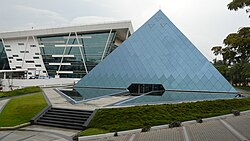
.jpg)
Karnataka is the leader in the information technology sector in India and its capital, Bengaluru, is known as the Silicon Valley of India. In the IT sector, Karnataka generated a total revenue of ₹ 516.5 billion in the financial year 2006–07 which included ₹ 487 billion from software exports and ₹ 29.5 billion from hardware exports.[36] A total of 1973 companies in the state are involved in Information Technology-related business.[36] While the bulk of the IT related companies are located in Bengaluru, some companies are located in Mysore and Mangalore as well. Bengaluru is also the headquarters of Wipro and Infosys which are among the top three IT companies in India in regards to market capitalization.[37] The Nandi Hills area in Devanahalli outskirts is the site of the upcoming $22 Billion, 50 square kilometre BIAL IT Investment Region, one of the largest infrastructure projects in the history of Karnataka.[38]
As of June 2006, Karnataka housed 55% of biotechnology related companies in India.[39] Bengaluru is also the home of the largest biocluster in India with total revenues of ₹ 14 billion and having 158 of the 320 companies working on biotechnology in India.[39] Karnataka has a headcount of over 6,800 scientists involved in biotech research and out of twenty eight biotech companies that were registered in India in the year 2005–06, 27 were located in Karnataka.[39]
Banking[edit | edit source]
Karnataka, particularly the coastal districts of Dakshina Kannada and Udupi, is sometimes called the "cradle of banking" in India.[40] This is because seven of the country's leading banks, Canara Bank, Syndicate Bank, Corporation Bank, Vijaya Bank, Karnataka Bank, Vysya Bank and the State Bank of Mysore originated in this state.[40] The first five in the above list of banks were established in the districts of Dakshina Kannada and Udupi. These districts have among the best distribution of banks in India—a branch for every 500 persons.[41] Between 1880 and 1935, twenty two banks were established in coastal Karnataka, nine of them in the city of Mangalore.
As of March 2009, Karnataka had 5,759 branches of different banks servicing the people of the state.[42] The number of people served by each branch was 10,000 which was lesser than the national average of 15,000, thereby indicating better penetration of banking in the state.[42]
Infrastructure[edit | edit source]
Roads[edit | edit source]
The state is well connected to its six neighboring states and other parts of India through 14 National Highways (NH); it accounts for about six percent of the total NH network in India.
Its district centers are linked through 114 State Highways (SH)
The total road network of NH, SH, and district roads is about 2,07,379 km, of which 1,27,541 km is surfaced (61.5 percent)
Road Type Road length (km)
National highways: 4,396
State highways: 28,311
District roads: 19,801
Ports[edit | edit source]
New Mangalore Port (2010–11).
Total traffic handled: 67.30 MTA.
Total imports handled: 23.6 MTA.
Total exports handled: 32.9 MTA.
Number of vessels: 1,186
Cruise vessels: 26
Revenue: US$65 million
Karwar Port (2007–08)
Total cargo handled: 2.7 MTA
Total imports and exports: 6 MTA
Revenue: US$2.7 million
25 Private liquid cargo tanks: 75,000 MT
Airports[edit | edit source]
Domestic airports[edit | edit source]


- Belgaum Airport (Upcoming as International Airport)
- Bidar Airport
- Gulbarga Airport
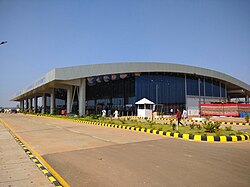
- Hubballi Airport
- Mysore Airport
- Shivamogga Airport
- Ballari Airport at Toranagallu
International airports[edit | edit source]
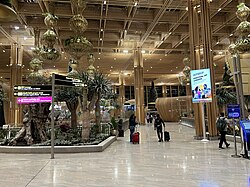
- Kempegowda International Airport, Devanahalli – formerly Bengaluru International Airport
- Mangalore International Airport, Bajpe
Railways[edit | edit source]
Karnataka has a railway network of 3,836 km.[43] South Western Railway covers almost the whole of Karnataka and its headquarter is in Hubballi.
SSS Hubballi Junction's Platform 1 holds the guinness world record for being the longest railway platform.[44]
South Western Railway is divided into three divisions:
There are two Railway Heritage Museums in Karnataka:
- Railway Museum, Mysore
- Hubballi Railway Heritage Museum
Urban transport
Metro rail and suburban-rail projects are underway in Bengaluru. The first phase of the Namma Metro is complete and covers a total of 76.95 km. Second phase is under construction.
Ongoing projects[edit | edit source]
Hassan–Sakhleshpura–Mangalore line gauge conversion is completed. Both freight and passenger trains run on this route on a daily basis connecting the seaport city of Mangaluru to the state capital of Bengaluru and Mysuru.
Key connectivity projects, doubling of Mysore–Bengaluru railway line, Gadag–Bagalkot, Bengaluru–Hassan to be taken up in the near future.
Power[edit | edit source]
Generation: Karnataka Power Corporation Limited and IPPs (GMR/Jindal/ Bhoruka)
KPCL has an installed capacity of over 9315 MW.
Number of consumers: 16.3 million
Independent power producers have installed capacity of 2,005 MW.
- KPCL -Karnataka Power Corporation Ltd.
- IPPs is Independent Power Producers
Transmission: Karnataka Power Transmission Corporation Limited (KPTCL).
Area covered: 192,000 km2
Sub stations: 1,205
Transmission lines: 28,000 km, 33 kV, 130,000 km of 11 kV.
LT lines: 451855 km
Distribution transformers: 1,50,000
Physical infrastructure – power
Distribution / supply: Electricity Supply Companies (ESCOMs)
Bangalore Electricity Supply Company (BESCOM)
Mangalore Electricity Supply Company (MESCOM)
Hubli Electricity Supply Company (HESCOM)
Gulbarga Electric Supply Company (GESCOM)
Chamundeshwari Electric Supply Corporation (CESC)
Source: Power sector at a glance as in July 2009‖, Karnataka Power Transmission Corporation Limited website, accessed 23 September 2009.
Telecommunications[edit | edit source]
Leading telecom companies in the sectors of telecommunication network, basic telephony services (both wire line and wireless) and networking services for telecommunication equipment are operating in the state.
The entire State is networked via Optic FibreCables (OFC) by the state-run BSNL (formerly DOT) as well as private companies like Bharti, Reliance, Tata Communications and Tata Teleservices.
Last Mile Access is provided by BSNL as well as TATA Tele Services in various parts of the state. Bharti and Reliance Communications provide the Last Mile Access directly to the customer in all major cities in Karnataka.
Telecom service providers in Karnataka: BSNL, Bharti Airtel, Reliance Jio, Vodafone Idea
Key statistics (2007–08)
Cellular subscribers: about 10 million
Internet/broadband
Subscribers: about 0.8 million
Telecom towers: about 14,000
Post offices: 9,826
Telephone connections provided: 2,610
Telephone exchanges: 2,727
Industrial infrastructure[edit | edit source]
Karnataka Industrial Area Development Board (KIADB) and Karnataka State Industrial Investment Development Corporation (KSIIDC) are jointly responsible for the development of industrial infrastructure in the state.
Directorate of Commerce and Industries has set up a district and taluk industrial centres across the state to facilitate investment
The Government of Karnataka is promoting the development of several SEZs across Karnataka such as pharma and biotech SEZ, food processing and agro-based industries and textiles SEZ at Hassan and IT and Coastal SEZs at Mangalore.
Key industrial clusters
IT/ITES cluster in electronic city and Whitefield (Bengaluru).
Food Parks – 4 old State sponsored and 2 new MoFPI sponsored Food Parks in 6 Districts of Karnataka
Biotech park/cluster in electronic city, Bengaluru.
Integrated Food Parks in Hiriyur, Bagalkote, Jewargi & Malur for pay-n-use common facilities & MSME Food Processing Manufacturers
Machine tool cluster at Peenyaindustrial estate
Textile cluster at Doddaballapur
Foundry cluster at Belgaum
Industrial valve cluster at Hubli–Dharwad
Coir clusters at Hassan.
Handicrafts cluster at Channapatna.
Coffee production and processing cluster in Madekeri
SEZs in Karnataka
Notified: 27
Formal approvals: 52
In-principle approvals: 9
Source: StatewiseSEZs in India, www.sezindia.nic.in. accessed 23 September 2009
Water supply[edit | edit source]
The water supply is provided by the local authorities like municipalities and panchayats. The first hydroelectric plant in the state was built at Shivanasamudra Falls on the Kaveri River in 1902.[45]
Electrical supply[edit | edit source]
Karnataka has an installed capacity of 27 gigawatts (GW) of electricity, of which 12 GW comes from renewable energy sources.[46] The state is India's top producer of solar energy, with an installed capacity of 5.16 GW.[47][48]
Karnataka Power Transmission Corporation Limited (KPTCL) is the sole provider of electricity for the state. The Linganamakki reservoir will supply around 35 percent of power to the state. Electric power from KPTCL is distributed through distribution companies like Bangalore Electricity Supply Company (BESCOM), Mangalore Electricity Supply Company (MESCOM), Gulbarga Electricity Supply Company (GESCOM), Hubli Electricity Supply Company (HESCOM) and Chamundesvary Electricity Supply Company (CESCOM) for different parts of the state. A good number of windmills were present. The Raichur Thermal Power Station and Bellary Thermal Power station Near Bellary (Kuduthini). Karnataka is also the location of companies like SELCO (India), which is promoting the use of solar electricity among the rural areas of the state and is also a twice winner of the Ashden Awards.
Data[edit | edit source]
Annual growth of Gross State Domestic Product at Current Prices[edit | edit source]
| year | GSDP[49][50][51] | Growth rate | |
|---|---|---|---|
| in ₹ Crore | in US$ Billion | ||
| 2011-12 | ₹6,06,010 crore | US$71 billion | — |
| 2012-13 | ₹6,95,413 crore | US$81 billion | 14.8%
|
| 2013-14 | ₹8,16,666 crore | US$96 billion | 17.4%
|
| 2014-15 | ₹9,13,923 crore | US$110 billion | 11.9%
|
| 2015-16 | ₹10,45,168 crore | US$120 billion | 14.4%
|
| 2016-17 | ₹12,07,608 crore | US$140 billion | 15.5%
|
| 2017-18 | ₹13,33,240 crore | US$160 billion | 10.4%
|
| 2018-19 | ₹14,79,391 crore | US$170 billion | 11.0%
|
| 2019-20 | ₹16,15,827 crore | US$190 billion | 8.9%
|
| 2020-21 | ₹16,40,811 crore | US$190 billion | 0.9%
|
| 2021-22 | ₹19,92,029 crore | US$230 billion | 20.8%
|
| 2022-23 | ₹24,26,071 crore | US$260 billion | 14.2%
|
| 2023-24 | ₹25,93,567 crore | US$290 billion | 10.2%
|
| 2024-25 | ₹29,06,063 crore | US$330 billion | 13.79%
|
| 2025-26† | ₹32,81,065 crore | US$357 billion | 8.19%
|
- † As per First Advance Estimates
District wise statistics[edit | edit source]
| District | Share of sectors | GDDP | PCI | # | ||||
|---|---|---|---|---|---|---|---|---|
| Agriculture | Industry | Services | in ₹ Crore | US$ Billion | in ₹ | US$ | ||
| Bengaluru Urban | 1.5% ( 0.2%) 0.2%)
|
13.9% ( 1.9%)
|
84.5% ( 2.1%)
|
₹11,73,574 crore | US$128 billion | ₹8,55,960 | US$9,313 | 
|
| Dakshina Kannada | 6.8% ( 2.8%)
|
37.4% ( 1.5%)
|
55.8% ( 4.3%)
|
₹1,54,509 crore | US$16.8 billion | ₹6,26,279 | US$6,814 |
|
| Udupi | 13.7% ( 1.4%)
|
26.3% ( 1.6%)
|
60.0% ( 3.0%)
|
₹75,198 crore | US$8.18 billion | ₹6,00,683 | US$6,536 |
|
| Chikkamagaluru | 14.7% ( 9.1%)
|
30.5% ( 1.6%)
|
54.7% ( 7.4%)
|
₹59,955 crore | US$6.52 billion | ₹4,94,787 | US$5,385 |
|
| Shivamogga | 20.0% ( 3.3%)
|
23.1% ( 0.2%)
|
56.9% ( 3.2%)
|
₹78,037 crore | US$8.49 billion | ₹3,89,743 | US$4,241 | 1
|
| Kodagu | 41.0% ( 4.2%)
|
13.2% ( 0.1%)
|
45.8% ( 4.1%)
|
₹21,510 crore | US$2.34 billion | ₹3,53,701 | US$3,849 | 3
|
| Bengaluru Rural | 15.5% ( 2.6%)
|
27.6% ( 2.3%)
|
56.9% ( 4.9%)
|
₹43,485 crore | US$4.73 billion | ₹3,49,559 | US$3,804 | 2
|
| Mandya | 14.7% ( 1.2%)
|
21.9% ( 0.7%)
|
63.4% ( 1.9%)
|
₹66,775 crore | US$7.27 billion | ₹3,06,448 | US$3,712 | 1
|
| Hasana | 19.7% ( 1.6%)
|
16.2% ( 0.1%)
|
64.1% ( 1.7%)
|
₹66,247 crore | US$7.21 billion | ₹3,38,877 | US$3,688 | 1
|
| Tumakuru | 16.6% ( 3.0%)
|
30.1% ( 0.0%)
|
53.4% ( 3.1%)
|
₹1,00,988 crore | US$11 billion | ₹3,34,980 | US$3,645 | 2
|
| Ballari | 11.5% ( 1.1%)
|
28.2% ( 1.1%)
|
60.3% ( 2.2%)
|
₹59,928 crore | US$6.52 billion | ₹3,24,111 | US$3,527 |
|
| Bengaluru South | 17.9% ( 1.7%)
|
29.7% ( 2.3%)
|
52.5% ( 0.7%)
|
₹44,055 crore | US$4.18 billion | ₹3,19,088 | US$3,472 |
|
| Chamarajanagara | 28.7% ( 5.5%)
|
17.9% ( 2.2%)
|
53.3% ( 3.4%)
|
₹35,351 crore | US$3.85 billion | ₹3,04,040 | US$3,309 | 2
|
| Dharawada | 8.1% ( 0.2%)
|
23.5% ( 1.5%)
|
68.4% ( 1.7%)
|
₹68,591 crore | US$7.46 billion | ₹3,00,627 | US$3,271 |
|
| Uttara Kannada | 16.6% ( 4.4%)
|
20.5% ( 0.1%)
|
62.9% ( 4.2%)
|
₹48,509 crore | US$5.28 billion | ₹2,95,116 | US$3,211 | 2
|
| Bagalakote | 16.2% ( 3.0%)
|
27.7% ( 0.0%)
|
56.2% ( 3.1%)
|
₹65,909 crore | US$7.17 billion | ₹2,79,919 | US$3,046 |
|
| Mysuru | 16.2% ( 4.0%)
|
16.5% ( 0.4%)
|
67.3% ( 4.4%)
|
₹99,527 crore | US$10.83 billion | ₹2,69,333 | US$2,931 |
|
| Chikkaballapura | 21.7% ( 4.5%)
|
21.0% ( 0.0%)
|
57.3% ( 4.5%)
|
₹37,935 crore | US$4.13 billion | ₹2,52,588 | US$2,749 |
|
| Kolar | 20.4% ( 0.8%)
|
24.0% ( 1.6%)
|
55.6% ( 0.8%)
|
₹46,568 crore | US$5.07 billion | ₹2,49,201 | US$2,712 |
|
| Davanagere | 26.3% ( 5.6%)
|
21.6% ( 1.1%)
|
52.1% ( 4.5%)
|
₹47,801 crore | US$5.2 billion | ₹2,42,159 | US$2,635 |
|
| Chitradurga | 28.2% ( 3.9%)
|
15.7% ( 0.3%)
|
56.1% ( 3.6%)
|
₹45,577 crore | US$4.96 billion | ₹2,27,554 | US$2,476 |
|
| Gadaga | 13.9% ( 1.8%)
|
19.3% ( 0.7%)
|
66.8% ( 2.6%)
|
₹28,603 crore | US$3.11 billion | ₹2,24,073 | US$2,438 |
|
| Haveri | 18.0% ( 3.2%)
|
17.5% ( 0.1%)
|
64.4% ( 3.0%)
|
₹39,571 crore | US$4.31 billion | ₹2,03,257 | US$2,212 |
|
| Vijayanagara | 18.0% ( 3.1%)
|
25.5% ( 0.2%)
|
56.5% ( 2.9%)
|
₹37,307 crore | US$4.05 billion | ₹1,93,230 | US$2,100 | 1
|
| Vijayapura | 28.8% ( 6.2%)
|
19.0% ( 2.5%)
|
52.2% ( 3.7%)
|
₹54,785 crore | US$5.95 billion | ₹1,87,429 | US$2,037 | 1
|
| Bidar | 17.2% ( 4.3%)
|
16.5% ( 0.3%)
|
66.3% ( 4.6%)
|
₹39,798 crore | US$4.33 billion | ₹1,85,079 | US$2,011 | 1
|
| Belagavi | 19.5% ( 3.1%)
|
22.8% ( 0.5%)
|
57.7% ( 3.6%)
|
₹1,11,225 crore | US$12.10 billion | ₹1,83,217 | US$1,993 | 1
|
| Koppal | 27.7% ( 2.5%)
|
18.4% ( 0.3%)
|
53.9% ( 2.9%)
|
₹33,020 crore | US$3.59 billion | ₹1,81,152 | US$1,969 | 1
|
| Raichuru | 20.8% ( 9.9%)
|
18.4% ( 1.9%)
|
60.8% ( 8.0%)
|
₹45,167 crore | US$4.91 billion | ₹1,78,888 | US$1,944 | 5
|
| Yadagiri | 24.0% ( 5.9%)
|
17.6% ( 0.8%)
|
58.4% ( 5.2%)
|
₹26,517 crore | US$2.88 billion | ₹1,64,388 | US$1,786 |
|
| Kalaburagi | 13.1% ( 12.8%)
|
21.8% ( 2.7%)
|
65.1% ( 10.1%)
|
₹50,039 crore | US$5.44 billion | ₹1,44,449 | US$1,570 |
|
See also[edit | edit source]
Notes[edit | edit source]
- ↑ CEIC Data. "Population: Karnataka." Retrieved May 2025 from https://www.ceicdata.com/en/india/population/population-karnataka.
- ↑ "Karnataka Budget Analysis 2026-27". PRS Legislative Research. Retrieved 6 March 2026.
- ↑ "Karnataka Budget Analysis 2026-27". PRS Legislative Research. Retrieved 6 March 2026.
- ↑ "Implied PPP Conversion rate". Retrieved 5 August 2025.
- ↑ https://prsindia.org/budgets/states/karnataka-budget-analysis-2026-27
- ↑ "Karnataka Budget Analysis 2026-27". PRS Legislative Research. Retrieved 6 March 2025.
- ↑ "Karnataka Budget Analysis 2026-27". PRS Legislative Research. Retrieved 6 March 2026.
- ↑ 8.0 8.1 8.2 8.3 "Karnataka Budget Analysis 2023-24". PRS Legislative Research. 7 July 2023.
- ↑ "SDGs India Index". NITI Aayog. 31 December 2019.
- ↑ "Unemployment Rate in India". Centre for Monitoring Indian Economy. p. 1. Retrieved 3 March 2024.
- ↑ "Bengaluru is the United States' most important trading partner in India, says U.S Consul General". The Hindu. 18 August 2023. ISSN 0971-751X. Retrieved 14 August 2025.
- ↑ "State's economic growth poised at 8.2 per cent". The Hindu. Chennai, India. 24 February 2011. Archived from the original on 3 March 2011. Retrieved 6 April 2011.
- ↑ 13.0 13.1 "Karnataka" (PDF). Online webpage of the India Brand Equity Foundation. Ministry of Commerce with the Confederation of Indian Industry. Retrieved 6 April 2011.
- ↑ 14.0 14.1 "State Economy and Socio-Economic Profile – Karnataka" (PDF). Department of Commerce & Industry. India Brand Equity Foundation. Retrieved 30 September 2009.
- ↑ "In terms of per capita GDP – Karnataka, Bengal fastest growing States". The Hindu. 9 June 2005. Retrieved 11 June 2007.
- ↑ "Karnataka stands 3rd for FDI inflows in India after Maharashtra, Gujarat". Deccan Herald. Bangalore, India. 24 December 2010. Retrieved 6 April 2011.
- ↑ Government of India. "Employment and Unemployment" (PDF). Online webpage of Indian budget. Archived from the original (PDF) on 24 December 2010. Retrieved 19 June 2007.
- ↑ "Budget 2006–2007". Online webpage of the Finance Department. Government of Karnataka. Archived from the original on 22 August 2006. Retrieved 19 June 2007.
- ↑ "GSDP of Karnataka, Manufacturing Industries in Karnataka". ibef.org. Retrieved 25 June 2018.
- ↑ 20.0 20.1 20.2 20.3 20.4 20.5 20.6 "Karnataka Agricultural Policy 2006" (PDF). Online webpage of Department of Agriculturesankalp. Government of Karnataka. Archived from the original (PDF) on 15 June 2007. Retrieved 4 June 2007.
- ↑ 21.0 21.1 "Karnataka Human Development Report 2005" (PDF). Online webpage of the Planning Commission. Government of India. Archived from the original (PDF) on 15 June 2007. Retrieved 4 June 2007.
- ↑ 2015 agricultural output of Karnataka based on 2011 prices
- ↑ "Area, Production and Yield of Coarse Cereals during 2004–05 and 2005–06 in respect of major Coarse Cereals Producing States along with coverage under Irrigation". Online webpage of DACNET. Government of India. Archived from the original on 29 September 2007. Retrieved 4 June 2007.
- ↑ "Coffee data". Online webpage of Coffee Board of India. Retrieved 4 June 2007.
{{cite web}}: CS1 maint: deprecated archival service (link) - ↑ "Bamboo in Sericulture". Online webpage: TECA – Technology for Agriculture. FAO, United Nations. Retrieved 4 June 2007.
- ↑ "Silk city to come up near B'lore". Deccan Herald. 17 October 2009.
- ↑ "Karnataka silk weavers fret over falling profits due to globalisation". Sify. Archived from the original on 18 April 2015.
- ↑ "International sports village location to be finalised soon". The Hindu. Chennai, India. 9 July 2009. Archived from the original on 13 July 2009.
- ↑ "Business Financial, Economy, Market, Stock – News & Updates".
- ↑ "About Central University of Karnataka". Archived from the original on 21 July 2011. Retrieved 21 July 2011.
- ↑ "Preliminary survey shows deposits of Lithium in Mandya district of Karnataka". pib.gov.in. Retrieved 20 July 2021.
- ↑ "List of Mining Leases in Karnataka". Online Webpage of the Department of the Mines and Geology. Govt. of Karnataka. Archived from the original on 11 April 2006. Retrieved 5 June 2007.
- ↑ Amit Mitra (26 September 2004). "Global mining houses on 'gold rush' to India". The Hindu Business Line. Retrieved 5 June 2007.
- ↑ Madhumathi D.S. (10 April 2004). "Sandur Manganese set to clear dues". The Hindu Business Line. Retrieved 5 June 2007.
- ↑ 35.0 35.1 35.2 Chin S Kuo. "The Mineral Industry of India" (PDF). Online Webpage of the U.S. Geological Survey. U.S. Geological Survey. Retrieved 5 June 2007.
- ↑ 36.0 36.1 "IT exports from Karnataka cross Rs 50k cr". The Financial Express. 22 May 2007. Retrieved 5 June 2007.[permanent dead link]
- ↑ "TCS topples Infosys as m-cap leader in IT space". The Economic Times. 14 July 2006. Retrieved 5 June 2007.
- ↑ "State Cabinet approves IT park near Devanahalli airport". The Hindu. Chennai, India. 29 January 2010. Archived from the original on 1 February 2010.
- ↑ 39.0 39.1 39.2 "Bangalore tops biocluster list with Rs 1,400-cr revenue". The Hindu Business Line. 8 June 2006. Archived from the original on 29 September 2007. Retrieved 5 June 2007.
- ↑ 40.0 40.1 Ravi Sharma (8–21 October 2005). "Building on a strong base". The Frontline. Archived from the original on 7 October 2007. Retrieved 21 June 2007.
- ↑ Ravi Sharmga (19 July – 1 August 2003). "A pioneer's progress". Frontline. Archived from the original on 27 March 2005. Retrieved 21 June 2007.
- ↑ 42.0 42.1 "State/Union Territory-Wise Number of Branches of Scheduled Commercial Banks and Average Population Per Bank Branch – March 2009" (PDF). Online webpage of the Reserve Bank of India. Retrieved 22 September 2014.
- ↑ "Karnataka railway news: Over 90% of railway network in Karnataka is now electrified". Deccan Herald. Retrieved 18 April 2025.
- ↑ "Longest railway platform". Guinness World Records. Archived from the original on 18 May 2024. Retrieved 18 April 2025.
- ↑ "Places of interest – Sivasamudram". mysore.net. Archived from the original on 28 September 2007. Retrieved 9 November 2006.
- ↑ Tripathi, Bhasker (1 August 2018). "How Karnataka could become self-reliant in electricity in just 10 years with investments in clean energy". Firstpost. Retrieved 21 March 2019.
- ↑ Athrady, Ajith (8 August 2018). "Solar energy: Karnataka earns top position". Deccan Herald. Retrieved 21 March 2019.
- ↑ Kiran, Niti (13 April 2018). "Karnataka is the top solar state in India: Mercom Capital". Business Today. Retrieved 21 March 2019.
- ↑ "Economic Survey 2022-23" (PDF). des.karnataka.gov.in. Archived from the original (PDF) on 8 June 2023. Retrieved 13 January 2025.
- ↑ "Economic Survey 2023-24" (PDF). des.karnataka.gov.in. 14 January 2025.
- ↑ 51.0 51.1 "Economic survey 2025-26" (PDF). des.karnataka.gov.in. Retrieved 11 March 2026.
- ↑ Cite error: Invalid
<ref>tag; no text was provided for refs named2024_25_es


.png)