



m Removed empty portal template using script |
m updated page |
||
| Line 1: | Line 1: | ||
{{Short description|Kingdom in southern India from 1729 to 1949}} | {{Short description|Kingdom in southern India from 1729 to 1949}} | ||
{{other uses}} | {{other uses}} | ||
{{pp-move-indef}} | |||
{{Use British English|date=January 2013}} | {{Use British English|date=January 2013}} | ||
{{Use dmy dates|date=October 2021}} | {{Use dmy dates|date=October 2021}} | ||
{{Infobox former country | {{Infobox former country | ||
| conventional_long_name = Kingdom of Travancore | | conventional_long_name = Kingdom of Travancore | ||
| native_name = {{nobold|''Thiruvithaamkoor Rajyam''}} | |||
| common_name = Travancore | |||
| era = [[Age of Imperialism]] | | era = [[Age of Imperialism]] | ||
| status_text = [[Princely State]] of [[British Empire]] | | status_text = [[Princely State]] of the [[British Empire]] in India [[Nair]] Aristocracy | ||
| empire = United Kingdom | | empire = United Kingdom | ||
| government_type = Monarchy | | government_type = [[Monarchy]] | ||
| year_start = 1729 | | year_start = 1729 | ||
| year_end = 1949 | | year_end = 1949 | ||
| Line 17: | Line 19: | ||
| event2 = Vassal of [[Dominion of India|India]] | | event2 = Vassal of [[Dominion of India|India]] | ||
| date_event2 = 1947 | | date_event2 = 1947 | ||
| event3 = Merger with [[ | | event3 = Merger with [[kingdom of Cochin]] | ||
| date_event3 = 1949 | | date_event3 = 1 July 1949 | ||
| p1 = Venad | | p1 = Venad | ||
| s1 = | | s1 = India | ||
| flag_s1 = Flag of India.svg | | flag_s1 = Flag of India.svg | ||
| image_flag = Flag of Kingdom of Travancore.svg | | image_flag = Flag of Kingdom of Travancore.svg | ||
| flag_width = 120 | |||
| flag_alt = Travancore | | flag_alt = Travancore | ||
| image_coat = Travancore Emblem.jpg | | image_coat = Travancore Emblem.jpg | ||
| coat_alt = Conch in wreath, guarded by two elephants on either side '''[[Padmanabhapuram]]''' (1729–1795)<br />'''[[Trivandrum]]''' (1795–1949) | | coat_alt = Conch in wreath, guarded by two elephants on either side '''[[Padmanabhapuram]]''' (1729–1795)<br />'''[[Trivandrum]]''' (1795–1949) | ||
| national_anthem = വഞ്ചീശ മംഗളം<br/>''[[Vanchi Bhumi|Vancheesha Mangalam]]'' <br/>( | | national_anthem = വഞ്ചീശ മംഗളം<br />''[[Vanchi Bhumi|Vancheesha Mangalam]]'' <br />(1937–1949)<br />([[English language|English]]:"Hail the Lord of Vanchi")<br /> {{parabr}}{{center|[[File:Vancheesa Mangalam (KamalaKrishnamurthy,'37).ogg]]}} | ||
| image_map = Kingdom of Travancore State in British India 1940.png | | image_map = Kingdom of Travancore State in British India 1940.png | ||
| map_caption = | | map_caption = Location of the kingdom of Travancore (red) in 1940's British India (green) | ||
| common_languages = [[Malayalam]] (official) | | common_languages = [[Malayalam]] (official)<br/> | ||
| religion = '''Majority''':[[Hinduism]] (official) <br /> '''Minority''': <br />Chiefly [[Christianity]] and [[Islam]]<br />Small communities of [[Jews]], [[Sikhs]] and [[Zoroastrians]] | [[Tamil language|Tamil]] (minority) | ||
| religion = '''Majority''': [[Hinduism]] (official) <br /> '''Minority''': <br />Chiefly [[Christianity]] and [[Islam]]<br />Small communities of [[Jews]], [[Jains]], [[Sikhs]], [[Buddhists]], and [[Zoroastrians]] | |||
| currency = [[Travancore Rupee]] | | currency = [[Travancore Rupee]] | ||
| leader1 = [[Marthanda Varma]] | | leader1 = [[Marthanda Varma]] | ||
| Line 44: | Line 48: | ||
| year_deputy2 = 1838–1839 (peak) | | year_deputy2 = 1838–1839 (peak) | ||
| deputy2 = [[R. Venkata Rao]] | | deputy2 = [[R. Venkata Rao]] | ||
| year_deputy3 = | | year_deputy3 = 1947–1949 (last) | ||
| deputy3 = [[P. G. N. Unnithan]] | | deputy3 = [[P. G. N. Unnithan]] | ||
| stat_year1 = 1941 | | stat_year1 = 1941 | ||
| Line 51: | Line 55: | ||
| stat_pop1 = 6,070,018 | | stat_pop1 = 6,070,018 | ||
| ref_pop1 = <ref name="1941Census" /> | | ref_pop1 = <ref name="1941Census" /> | ||
| today = India | | today = [[India]] | ||
| demonym = | | demonym = | ||
| area_km2 = | | area_km2 = | ||
| Line 57: | Line 61: | ||
| GDP_PPP = | | GDP_PPP = | ||
| GDP_PPP_year = | | GDP_PPP_year = | ||
| motto = ധർമോസ്മത്ത് കുലദൈവതം <br /> ''Dharmōsmat Kuladaivatam'' <br />([[English language|English]]: "Charity is our household divinity") | |||
| motto = ധർമോസ്മത്ത് കുലദൈവതം <br/> ''Dharmōsmat Kuladaivatam'' <br/>([[English language|English]]: "Charity is our household divinity") | | flag_p1 = Insignia from Quilon Syrian copper plates (Journal of the Royal Asiatic Society, 1843).jpg | ||
| flag_p1 = Quilon | |||
}} | }} | ||
The '''Kingdom of Travancore''' ({{IPAc-en|ˈ|t|r|æ|v|ə|ŋ|k|ɔːr}}), also known as the '''Kingdom | The '''Kingdom of Travancore''' ({{IPAc-en|ˈ|t|r|æ|v|ə|ŋ|k|ɔːr}}), also known as the '''Thiruvithamkoor Kingdom''' ({{IPA|ml|t̪iɾuʋid̪aːŋɡuːr|lang|}}) and '''Travancore State''', was a kingdom that lasted from {{Circa|1729}} until 1949. It was ruled by the [[Travancore royal family]] from [[Padmanabhapuram]], and later [[Thiruvananthapuram]]. At its zenith, the kingdom covered most of the south of modern-day [[Kerala]] ([[Idukki district|Idukki]], [[Kottayam district|Kottayam]], [[Alappuzha district|Alappuzha]], [[Pathanamthitta district|Pathanamthitta]], [[Kollam district|Kollam]], and [[Thiruvananthapuram district|Thiruvananthapuram]] districts, major portions of [[Ernakulam district]], [[Puthenchira]] village of [[Thrissur district]]) and the southernmost part of modern-day [[Tamil Nadu]] ([[Kanyakumari district]] and some parts of [[Tenkasi district]]) with the [[Thachudaya Kaimal]]'s enclave of [[Irinjalakuda]] [[Koodalmanikyam temple]] in the neighbouring [[kingdom of Cochin]].<ref>British Archives http://discovery.nationalarchives.gov.uk/details/rd/d3e53001-d49e-4d4d-bcb2-9f8daaffe2e0 {{Webarchive|url=https://web.archive.org/web/20170114120723/http://discovery.nationalarchives.gov.uk/details/rd/d3e53001-d49e-4d4d-bcb2-9f8daaffe2e0 |date=14 January 2017 }}</ref> However, the [[Tangasseri]] area of [[Kollam]] City and [[Anchuthengu]] near [[Attingal]] in Thiruvananthapuram were parts of [[British India]]. | ||
Geographically, [[Malabar District]] of [[Madras Presidency]] was to the north,<ref>{{Cite book |url=https://books.google.com/books?id=kTNRAAAAYAAJ&dq=malabar+districts+neighbour+travancore&pg=RA1-PP3 |title=Census of India, 1901 |date=1903 |language=en}}</ref> the [[Madurai district|Madurai]] and [[Tirunelveli district|Tirunelveli]] districts of [[Pandya Nadu]] region in Madras Presidency to the east, the [[Indian Ocean]] to the south, and the [[Arabian Sea]] to the west.<ref name="Thiruvithamkoor"/> | |||
Travancore was divided into five divisions: [[Padmanabhapuram]], [[Thiruvananthapuram]], [[Kollam|Quilon]], [[Kottayam]], and [[Devikulam]]. Padmanabhapuram and Devikulam divisions were predominantly [[Tamil language|Tamil]]-speaking regions with small [[Malayalam]]-speaking minorities.<ref name="r1881">{{Cite book |last=Nagamaiya|first=V.|url=http://lsi.gov.in:8081/jspui/bitstream/123456789/5570/1/41740.pdf|title=Report on the Census of Travancore (1881)|publisher=Government of India|year=1884|location=Thiruvananthapuram|pages=135, 258|archive-url=https://web.archive.org/web/20230404103822/http://lsi.gov.in:8081/jspui/bitstream/123456789/5570/1/41740.pdf|archive-date=4 April 2023}}</ref> | |||
Thiruvananthapuram, Kollam, and Kottayam divisions were predominantly Malayalam-speaking regions with small Tamil-speaking minorities.<ref name="r1881"/> | |||
King [[Marthanda Varma]] inherited the small feudal state of [[Venad]] in 1723, and built it into Travancore. Marthanda Varma led the Travancorean forces during the [[Travancore–Dutch War]] of 1739–46, which culminated in the [[Battle of Colachel]]. The defeat of the Dutch by Travancore is considered the earliest example of an organised power from Asia overcoming European military technology and tactics.<ref name="Sanyal2016">{{Cite book |last=Sanjeev Sanyal |url=https://books.google.com/books?id=oNekDAAAQBAJ&pg=PT183 |title=The Ocean of Churn: How the Indian Ocean Shaped Human History |date=10 August 2016 |publisher=Penguin Books Limited |isbn=978-93-86057-61-7 |pages=183–}}</ref> Marthanda Varma went on to conquer most of the smaller principalities of the native rulers. | |||
The Travancore royal family signed a treaty with the British in 1788, thereby accepting British dominance. Later, in 1805, they revised the treaty, leading to a diminution of royal authority and the loss of political independence for Travancore.<ref>{{Cite journal |title=Travancore and the friendship alliance with the British and its consequences |url=https://www.socialsciencejournal.in/assets/archives/2022/vol8issue2/8-2-26-278.pdf |journal=International Journal of Humanities and Social Science Research |volume=8 |issue=2 |pages=90–91 |issn=2455-2070}}</ref><ref>{{Cite journal |last=Nair |first=T. P. Sankarankutty |date=13 February 1978 |title=A New Look on Travancore Revolt |journal=Proceedings of the Indian History Congress |volume=39 |pages=627–633 |jstor=44139406}}</ref> They had to give up their ruling rights over the common people in 1949 when Travancore was forced to merge with independent India. | |||
==Etymology== | ==Etymology== | ||
| Line 72: | Line 80: | ||
The kingdom takes its name from [[Thiruvithamcode]] in the present-day [[Kanyakumari district]] of [[Tamil Nadu]]. | The kingdom takes its name from [[Thiruvithamcode]] in the present-day [[Kanyakumari district]] of [[Tamil Nadu]]. | ||
The region had many small independent kingdoms. Later, at the peak of the Chera | The region had many small independent kingdoms. Later, at the peak of the [[Chera dynasty|Chera]]–[[Chola dynasty|Chola]]–[[Pandya dynasty|Pandya]] rule, this region became part of the Chera Kingdom (except for the Ay kingdom, which always remained independent). When the region was part of the [[Chera empire]], it was still known as ''Thiruvazhumkode''. It was contracted to ''Thiruvankode'', and anglicised by the English to ''Travancore''.<ref name="Menon1878">{{cite book|author=P. Shungunny Menon|url=https://archive.org/details/ahistorytravanc00menogoog|date=1878|title=A History of Travancore from the Earliest Times|publisher=[[Higginbotham's]]|location=Thiruvananthapuram}}</ref><ref name="Panikkar1933">{{cite book|author=R. Narayana Panikkar|title=Travancore History|language=ml|location=[[Nagar Kovil]]|date=1933}}</ref><ref>{{cite web|url=http://www.chaf.lib.latrobe.edu.au/dcd/page.php?title=madras&action=next&record=1706|archive-url=https://web.archive.org/web/20080801174631/http://www.chaf.lib.latrobe.edu.au/dcd/page.php?title=madras&action=next&record=1706|url-status=dead|archive-date=2008-08-01|title=Database: Handbook For India, Part 1 – Madras|page= vii|date=2008-08-01|access-date=2018-01-02}}</ref> | ||
In the course of time, the [[Ay kingdom]], part of the Chera empire, which ruled the Thiruvazhumkode area, became independent, and the land was called ''Aayi Desam'' or ''Aayi Rajyam'', meaning 'Aayi territory'. The Aayis controlled the land from the present-day Kollam district in the north, through [[Thiruvananthapuram district]] to [[Kanyakumari district]] in the south. There were two capitals, the major one at Kollam ('' | In the course of time, the [[Ay kingdom|Ay clan]], part of the Chera empire, which ruled the Thiruvazhumkode area, became an independent kingdom, and the land was called ''Aayi Desam'' or ''Aayi Rajyam'', meaning 'Aayi territory'. The Aayis controlled the land from the present-day Kollam district in the north, through [[Thiruvananthapuram district]] to [[Kanyakumari district]] in the south. There were two capitals, the major one at Kollam (''Venad Swaroopam'' or ''Desinganadu'') and a subsidiary one at Thrippapur (''Thrippapur Swaroopam'' or ''[[Nanjinad]]''). The kingdom was thus also called [[Venad]]. Kings of Venad had built residential palaces in Thiruvithamcode and [[Kalkulam]]. Thiruvithamcode became the capital of the Thrippapur Swaroopam, and the country was referred to as ''Thiruvithamcode'' by Europeans even after the capital had been moved in 1601 to [[Padmanabhapuram]], near Kalkulam.<ref>{{cite web|url=http://mal.sarva.gov.in/index.php?title=%E0%B4%A4%E0%B4%BF%E0%B4%B0%E0%B5%81%E0%B4%B5%E0%B4%BF%E0%B4%A4%E0%B4%BE%E0%B4%82%E0%B4%95%E0%B5%82%E0%B4%B0%E0%B5%8D%E2%80%8D|archive-date=4 April 2014|access-date=2014-04-04|url-status=dead|archive-url=https://archive.today/20140404133809/http://mal.sarva.gov.in/index.php?title=തിരുവിതാംകൂര്|date=2008-07-04|publisher=[[The State Institute of Encyclopaedic Publications]]|title=തിരുവിതാംകൂര്|language=ml}}</ref> | ||
The Chera empire had dissolved by around 1100 and thereafter the territory comprised numerous small kingdoms until the time of [[Marthanda Varma]] who, as king of Venad from 1729, employed brutal methods to unify them.<ref>{{cite book |first=Barbara N. |last=Ramusack |title=The Indian Princes and their States |publisher=Cambridge University Press |year=2004 |isbn=978-1-13944-908-3 |page=33 |url=https://books.google.com/books?id=Kz1-mtazYqEC&pg=PA33}}</ref> During his reign, Thiruvithamkoor ( | The Chera empire had dissolved by around 1100 and thereafter the territory comprised numerous small kingdoms until the time of [[Marthanda Varma]] who, as king of Venad from 1729, employed brutal methods to unify them.<ref>{{cite book |first=Barbara N. |last=Ramusack |title=The Indian Princes and their States |publisher=Cambridge University Press |year=2004 |isbn=978-1-13944-908-3 |page=33 |url=https://books.google.com/books?id=Kz1-mtazYqEC&pg=PA33}}</ref> During his reign, Thiruvithamkoor (anglicised as Travancore) became the official name.{{citation needed|date=May 2016}} | ||
==Geography== | ==Geography== | ||
<gallery widths="200" heights="200"> | <gallery widths="200" heights="200"> | ||
File:Travancore 1871.JPG|Map of Travancore in 1871 | File:Travancore 1871.JPG|Map of Travancore in 1871 | ||
File:A Canal Scene, Travancore.jpg| | File:A Canal Scene, Travancore.jpg|Historic scene of canal in Travancore | ||
File:Sree Padmanabha Swamy Temple.jpg|[[Padmanabhaswamy | File:Sree Padmanabha Swamy Temple.jpg|[[Anantha Padmanabhaswamy]] was the [[National god|national deity]] of the kingdom of Travancore.<ref>{{Cite book|last=Mateer|first=Samuel|title=The Land of Charity|publisher=University of Michigan Libraries|year=1871|pages=160}}</ref> | ||
</gallery> | </gallery> | ||
The | The kingdom of Travancore was located at the extreme southern tip of the [[Indian subcontinent]]. Geographically, Travancore was divided into three climatically distinct regions: the eastern highlands (rugged and cool mountainous terrain), the central midlands (rolling hills), and the western lowlands (coastal plains).{{citation needed|date=July 2014}} | ||
==History== | ==History== | ||
Due to the geographical isolation of the [[Malabar Coast]] from the rest of the Indian peninsula, attributed to the presence of the [[Western Ghat mountain|Western Ghats]] mountain ranges lying parallel to the coast, the population and language spoken in Kerala differed from those in neighboring states such as [[Tamil Nadu]] and [[Karnataka]]. | |||
=== | According to the religious text "[[Keralolpathi]]" by the [[Nambudiri|Nambudhiri Brahmins]], the region from [[Gokarna, Karnataka|Gokarna]] to [[Kanyakumari district]] was created when [[Parashurama]] threw his axe and claimed this land, known as ''Parashuramakshetra''.<ref>''Gomantak Prakruti ani Sanskruti'' Part 1, p. 206, B. D. Satoskar, Shubhada Publication</ref><ref>{{cite book |author=Aiya VN |url=https://books.google.com/books?id=RdzaPW-kEvQC |title=The Travancore State Manual |publisher=Travancore Government Press |year=1906 |pages=210–212 |access-date=2007-11-12}}</ref><ref>''Ancient Indian History'' By Madhavan Arjunan Pillai, p. 204 {{ISBN?}}</ref> | ||
===Medieval Kerala=== | |||
[[File:Map of Kampili kingdom.png|thumb|300px|India in 1320 CE. The [[Kollam]] | [[File:Map of Kampili kingdom.png|thumb|300px|India in 1320 CE. The [[Kollam]]–[[Thiruvananthapuram]]–[[Kanyakumari]] area, located at the southernmost tip of the [[Indian subcontinent]] was the main seat of the Ay dynasty and was under the influence of the Pandya dynasty.]] | ||
The [[Chera dynasty]] governed the [[Malabar Coast]] between [[Alappuzha]] in the south and [[Kasaragod]]{{citation needed|date=September 2025}} in the north. The region around Coimbatore was ruled by the Cheras during the [[Sangam period]] roughly between the first and the fourth centuries CE and served as the eastern entrance to the Palakkad Gap, the principal trade route between the Malabar Coast and Tamil Nadu.<ref name="Trade">{{cite news|last=Subramanian|first=T. S|title=Roman connection in Tamil Nadu|url=http://www.hindu.com/thehindu/thscrip/print.pl?file=2007012800201800.htm&date=2007/01/28/&prd=th|access-date=28 October 2011|newspaper=[[The Hindu]]|date=28 January 2007|url-status=live|archive-url=https://web.archive.org/web/20130919235748/http://www.hindu.com/thehindu/thscrip/print.pl?file=2007012800201800.htm&date=2007%2F01%2F28%2F&prd=th|archive-date=19 September 2013}}</ref> However the southern region of the present-day Kerala state was under the [[Ay dynasty]]. During the Ay dynasty, they spoke a language known as [[Middle Tamil]].<ref name="auto">{{Cite book |last=Ponvannan |first=Gayathri |url=https://books.google.com/books?id=z6VXEAAAQBAJ&dq=old+malayalam+quilon&pg=PT125 |title=100 Great Chronicles of Indian History: From Cave Paintings to the Constitution |date=2022 |publisher=Hachette India |isbn=978-93-91028-77-0 |language=en}}</ref> When the Ay dynasty was conquered and succeeded by the [[Chera Perumals of Makotai|Kulashekara Perumals]],<ref>{{Cite book |last=Lannoy |first=Mark de |url=https://books.google.com/books?id=pKjZAAAAMAAJ&q=kulasekhara+perumal |title=The Kulasekhara Perumals of Travancore: History and State Formation in Travancore from 1671 to 1758 |date=1997 |publisher=Leiden University |isbn=978-90-73782-92-1 |language=en}}</ref> based in [[Kollam district|Kollam]] (later known as [[Venad (kingdom)|Venad]]),<ref name="auto1">{{Cite book |last=Menon |first=P. Shungoonny |url=https://books.google.com/books?id=_YdCAAAAIAAJ&dq=kulasekhara+perumal&pg=PA28 |title=A History of Travancore from the Earliest Times |date=1878 |publisher=Higginbotham |language=en}}</ref> during the period of the Chera Kulashekara Perumal (Keralaputras) dynasty,<ref name="auto1"/> the language evolved into [[Old Malayalam]].<ref>{{Cite book |last=Sekhar |first=Anantaramayyar Chandra |url=https://books.google.com/books?id=123RAAAAMAAJ&q=old+malayalam |title=Evolution of Malayalam |date=1953 |publisher=S.M. Katre |language=en}}</ref> The [[Quilon Syrian copper plates|Quilon copper plates]] (849/850 CE) are considered the oldest available inscription written in Old Malayalam.<ref>{{cite web |url=https://www.britannica.com/topic/Dravidian-languages |title=Dravidian languages – History, Grammar, Map, & Facts |access-date=22 May 2017 |archive-url=https://web.archive.org/web/20170709173402/https://www.britannica.com/topic/Dravidian-languages |archive-date=9 July 2017 |url-status=live}}</ref><ref>{{cite book|last=Narayanan|first=M. G. S.|year=2013|url=https://books.google.com/books?id=0YDCngEACAAJ&q=Perumals+of+Kerala|title=Perumals of Kerala: Brahmin Oligarchy and Ritual Monarchy|publisher=CosmoBooks|isbn=9788188765072|location=Thrissur (Kerala)|orig-date=1972|access-date=7 June 2021|archive-date=7 June 2021|archive-url=https://web.archive.org/web/20210607091744/https://books.google.com/books?id=0YDCngEACAAJ&q=Perumals+of+Kerala|url-status=live}}</ref> Later, the northern districts of Thiruvananthapuram, Kollam, Alapuzha, and Pathanamthitta became proper [[Malayalam|Malayalam-speaking]] populations in [[Kerala]], while the other districts showed influences from [[Arabic]], [[Tamil language|Tamil]] and [[Kannada]] languages. During the period of [[Pattom A. Thanu Pillai|Pattom Thanu Pillai]], Travancore was referred to as Malayalam state or the land of proper [[Malayalis]].<ref>{{Cite book |last=Menon |first=A. Sreedhara |url=https://books.google.com/books?id=wnAjqjhc1VcC&dq=pattam+thanu+pillai+travancore+malayalam&pg=PA214 |title=Kerala History and its Makers |date=2011 |publisher=D C Books |isbn=978-81-264-3782-5 |language=en}}</ref><ref>{{Cite book |url=https://books.google.com/books?id=p_nHft2p3moC&dq=pattam+thanu+pillai+travancore+malayalam&pg=PA277 |title=Liberation of the Oppressed a Continuous Struggle |publisher=History Kanyakumari District |language=en}}</ref><ref>{{Cite book |last1=State) |first1=Travancore (Princely |url=https://books.google.com/books?id=49F9hXNNjzsC&q=pattam+thanu+pillai+travancore+malayalam |title=The Travancore State Manual |last2=Aiya |first2=V. Nagam |date=1906 |publisher=Travancore government Press |language=en}}</ref> | |||
===Venad Swaroopam=== | ===Venad Swaroopam=== | ||
| Line 105: | Line 110: | ||
{{main|Venad}} | {{main|Venad}} | ||
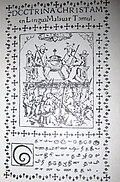
[[File:Thambiran Vanakkam 1578.JPG|left|thumbnail|''[[Thambiran Vanakkam]]'' was printed at Kollam, the capital of Venad in 1578, during the Portuguese Era. It | [[File:Thambiran Vanakkam 1578.JPG|left|thumbnail|''[[Thambiran Vanakkam]]'' was printed at Kollam, the capital of Venad in 1578, during the Portuguese Era. It is the first book printed in any Indian language. It was written in the language ''[[Lingua Malabar Tamul]]'', which was spoken in southern Kerala (Kollam–[[Thiruvananthapuram]]–[[Kanyakumari]] area) during the medieval period.]] | ||
Located at the tip of the Indian subcontinent, the former state of Venad was traditionally ruled by [[raja]]s known as the Venattadis. Until the end of the 11th century AD, it was a small principality in the Ay Kingdom. The Ays were the earliest ruling dynasty in southern Kerala, who, at their zenith, ruled over a region from [[Nagercoil]] in the south to Thiruvananthapuram in the north. Their capital during the first [[Sangam age]] was in Aykudi and later, towards the end of the eighth century AD, at [[Quilon|Quilon (Kollam)]]. Though a series of attacks by the resurgent Pandyas between the seventh and eighth centuries caused the decline of the Ays, the dynasty was powerful until the beginning of the tenth century.<ref name="Menon2007">{{cite book|author=A Sreedhara Menon|title=A Survey of Kerala History|url=https://books.google.com/books?id=FVsw35oEBv4C&pg=PA97|access-date=18 September 2012|date=2007|publisher=DC Books|isbn=978-81-264-1578-6|pages=97–99}}</ref> [[Sulaiman al-Tajir]], a [[Persians|Persian]] merchant who visited Kerala during the reign of [[Sthanu Ravi Varma]] (9th century CE), recorded the existence of extensive trade between Kerala and China, based at the port of Kollam.<ref>{{Cite book|title=India Charitram|last=Menon|first=A. Shreedhara|publisher=DC Books|year=2016|isbn=9788126419395|location=Kottayam|page=219}}</ref> | |||
[[File:British Residency in Kollam.jpg|thumb|The [[British Residency]] in Quilon, where the resident of Travancore resided]] | [[File:British Residency in Kollam.jpg|thumb|The [[British Residency]] in Quilon, where the resident of Travancore resided]] | ||
When the Ay diminished, Venad became the southernmost principality of the [[Second Chera Kingdom]].<ref name="Menon139"/> An invasion of the Cholas into Venad caused the destruction of Kollam in 1096. However, the Chera capital, [[Mahodayapuram]], also fell in the subsequent Chola attack, which compelled the Chera king, Rama Varma Kulasekara, to shift his capital to Kollam.<ref name="Menon140">{{cite book|author=A Sreedhara Menon|title=A Survey of Kerala History|url=https://books.google.com/books?id=FVsw35oEBv4C&pg=PA140|access-date=18 September 2012|date= | When the Ay diminished, Venad became the southernmost principality of the [[Second Chera Kingdom]].<ref name="Menon139"/> An invasion of the Cholas into Venad caused the destruction of Kollam in 1096. However, the Chera capital, [[Mahodayapuram]], also fell in the subsequent Chola attack, which compelled the Chera king, Rama Varma Kulasekara, to shift his capital to Kollam.<ref name="Menon140">{{cite book|author=A Sreedhara Menon|title=A Survey of Kerala History|url=https://books.google.com/books?id=FVsw35oEBv4C&pg=PA140|access-date=18 September 2012|date=2007|publisher=DC Books|isbn=978-81-264-1578-6|page=140}}</ref> Thus, Rama Varma Kulasekara, the last emperor of the Chera dynasty, was probably the founder of the Venad royal house, and the title of the Chera kings, ''Kulasekara'', was thenceforth kept by the rulers of Venad. Thus the end of the Second Chera dynasty in the 12th century marks the independence of Venad.<ref name="Menon141">{{cite book|author=A Sreedhara Menon|title=A Survey of Kerala History|url=https://books.google.com/books?id=FVsw35oEBv4C&pg=PA140|access-date=18 September 2012|date=2007|publisher=DC Books|isbn=978-81-264-1578-6|page=141}}</ref> | ||
In the second half of the 12th century, two branches of the Ay dynasty, the Thrippappur and Chirava, merged in the Venad family, which set up the tradition of designating the ruler of Venad as Chirava Moopan and the heir-apparent as ''Thrippappur Moopan''. While the Chrirava Moopan had his residence at Kollam, the Thrippappur Moopan resided at his palace in Thrippappur, nine miles north of Thiruvananthapuram, and was vested with authority over the temples of Venad kingdom, especially the [[Sri Padmanabhaswamy temple]].<ref name="Menon139">{{cite book|author=A Sreedhara Menon|title=A Survey of Kerala History|url=https://books.google.com/books?id=FVsw35oEBv4C&pg=PA139|access-date=18 September 2012|date= | In the second half of the 12th century, two branches of the Ay dynasty, the Thrippappur and Chirava, merged in the Venad family, which set up the tradition of designating the ruler of Venad as ''Chirava Moopan'' and the heir-apparent as ''Thrippappur Moopan''. While the Chrirava Moopan had his residence at Kollam, the Thrippappur Moopan resided at his palace in Thrippappur, nine miles north of Thiruvananthapuram, and was vested with authority over the temples of Venad kingdom, especially the [[Sri Padmanabhaswamy temple]].<ref name="Menon139">{{cite book|author=A Sreedhara Menon|title=A Survey of Kerala History|url=https://books.google.com/books?id=FVsw35oEBv4C&pg=PA139|access-date=18 September 2012|date=2007|publisher=DC Books|isbn=978-81-264-1578-6|page=139}}</ref> | ||
===Formation and development of Travancore=== | ===Formation and development of Travancore=== | ||
[[File:1733 Homann Heirs Map of India - Geographicus - India-homannheirs-1733.jpg|thumb|A map of the Malabar Coast in 1733. At that time, Travancore was only a small territory wedged between Kollam and [[Kanyakumari]], as shown in the map (Present-day districts of [[Thiruvananthapuram district | [[File:1733 Homann Heirs Map of India - Geographicus - India-homannheirs-1733.jpg|thumb|A map of the Malabar Coast in 1733. At that time, Travancore was only a small territory wedged between Kollam and [[Kanyakumari]], as shown in the map (Present-day districts of [[Thiruvananthapuram district]] and Kanyakumari only). The vast region of the Malabar Coast between [[Kannur]] and Kollam was under the control of the [[Zamorin of Calicut]] then. In the latter half of the 18th century Travancore inherited the kingdoms as far as [[Kingdom of Cochin|Cochin]] and became a powerful kingdom.]] | ||
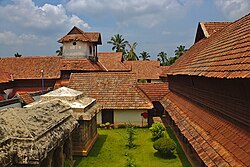
[[File:Padmanabhapuram Clock Tower.jpg|left|250px|thumbnail|[[Padmanabhapuram Palace]]]] | [[File:Padmanabhapuram Clock Tower.jpg|left|250px|thumbnail|[[Padmanabhapuram Palace]]]] | ||
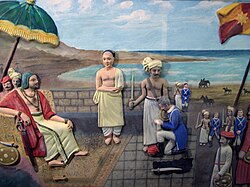
[[File:De Lannoy Surrender.JPG|thumb|left|250px|[[Eustachius De Lannoy]] of the [[Dutch East India Company]] surrenders to | [[File:De Lannoy Surrender.JPG|thumb|left|250px|[[Eustachius De Lannoy]] of the [[Dutch East India Company]] surrenders to [[Marthanda Varma]] of the kingdom of Travancore after the [[Battle of Colachel]]. Depiction at [[Padmanabhapuram Palace]].]] | ||
In the early 18th century CE, the [[Travancore royal family]] adopted some members from the royal family of [[Kolathunadu]] based at [[Kannur]], and [[Parappanad]] in present-day [[Malappuram district]].<ref>Travancore State Manual</ref> The history of Travancore began with Marthanda Varma, who inherited the kingdom of Venad (Thrippappur), and expanded it into Travancore during his reign (1729–1758). After defeating a union of feudal lords and establishing internal peace, he expanded the kingdom of Venad through a series of military campaigns from [[Kanyakumari]] in the south to the borders of [[Kochi]] in the north during his 29-year rule.<ref name="Fuller1976">{{cite book|author=C. J. Fuller|author-link=Chris Fuller (academic)|title=The Nayars Today|url=https://books.google.com/books?id=yQM4AAAAIAAJ&pg=PA17|access-date=17 September 2012|date= | In the early 18th century CE, the [[Travancore royal family]] adopted some members from the royal family of [[Kolathunadu]] based at [[Kannur]], and [[Parappanad]] in present-day [[Malappuram district]].<ref>Travancore State Manual</ref> The history of Travancore began with Marthanda Varma, who inherited the kingdom of Venad (Thrippappur), and expanded it into Travancore during his reign (1729–1758). After defeating a union of feudal lords and establishing internal peace, he expanded the kingdom of Venad through a series of military campaigns from [[Kanyakumari]] in the south to the borders of [[Kochi]] in the north during his 29-year rule.<ref name="Fuller1976">{{cite book|author=C. J. Fuller|author-link=Chris Fuller (academic)|title=The Nayars Today|url=https://books.google.com/books?id=yQM4AAAAIAAJ&pg=PA17|access-date=17 September 2012|date= 1976|publisher=CUP Archive|isbn=978-0-521-29091-3|page=17}}</ref> | ||
In 1741, Travancore won the Battle of Colachel against the | During his rule occurred the [[Travancore–Dutch War]] (1739–1753) between Travancore and the [[Dutch East India Company]], which had been allied to some of these kingdoms.{{citation needed|date=July 2017}} In 1741, Travancore won the [[Battle of Colachel]] against the Dutch, resulting in the complete eclipse of Dutch power in the region. In this battle Travancore forces captured the Dutch Captain, [[Eustachius De Lannoy]]; he later defected to Travancore.<ref name="AHoT 136">{{cite book|last1=Shungoony Menon|first1=P.|title=A History of Travancore from the Earliest Times|date=1878|publisher=Higgin Botham & Co.|location=Madras|pages=[https://archive.org/details/ahistorytravanc00menogoog/page/n184 136]–140|url=https://archive.org/details/ahistorytravanc00menogoog|access-date=5 May 2016|language=en}}</ref> De Lannoy was appointed captain of His Highness' bodyguard<ref name="AHoT 136" /> and later Senior Admiral ("Valiya kappittan")<ref name="AHoT 162">{{cite book|last1=Shungoony Menon|first1=P.|title=A History of Travancore from the Earliest Times|date=1878|publisher=Higgin Botham & Co.|location=Madras|pages=[https://archive.org/details/ahistorytravanc00menogoog/page/n212 162]–164|url=https://archive.org/details/ahistorytravanc00menogoog|access-date=5 May 2016|language=en}}</ref> and modernised the [[Nair pattalam|Travancore army]] by introducing firearms and artillery.<ref name="AHoT 136" /> From 1741 to 1758, De Lannoy remained in command of the Travancore forces and was involved in annexation of small principalities.<ref name="9th Madras Regiment"> | ||
De Lannoy was appointed captain of His Highness' bodyguard<ref name="AHoT 136"/> and later Senior Admiral ("Valiya kappittan")<ref name="AHoT 162"/> and modernised the [[Nair pattalam|Travancore army]] by introducing firearms and artillery.<ref name="AHoT 136"/> From 1741 to 1758, De Lannoy remained in command of the Travancore forces and was involved in annexation of small principalities.<ref name="9th Madras Regiment"> | |||
{{cite web | {{cite web | ||
|publisher = The journal of India's Armed Forces | |publisher = The journal of India's Armed Forces | ||
| Line 142: | Line 145: | ||
On 3 January 1750, (5 [[Makaram]], 925 [[Malayalam calendar|Kollavarsham]]), Marthanda Varma virtually "dedicated" Travancore to his tutelary deity [[Padmanabhaswamy Temple|Padmanabha]], one of the aspects of the Hindu God [[Vishnu]] with a lotus issuing from his navel on which [[Brahma]] sits. From then on the rulers of Travancore ruled as the "servants of Padmanabha" (the Padmnabha-dasar).<ref name="AHoT 171">{{cite book|last1=Shungoony Menon|first1=P.|title=A History of Travancore from the Earliest Times|date=1878|publisher=Higgin Botham & Co.|location=Madras|page=[https://archive.org/details/ahistorytravanc00menogoog/page/n235 171]|url=https://archive.org/details/ahistorytravanc00menogoog|access-date=5 May 2016|language=en}}</ref> | On 3 January 1750, (5 [[Makaram]], 925 [[Malayalam calendar|Kollavarsham]]), Marthanda Varma virtually "dedicated" Travancore to his tutelary deity [[Padmanabhaswamy Temple|Padmanabha]], one of the aspects of the Hindu God [[Vishnu]] with a lotus issuing from his navel on which [[Brahma]] sits. From then on the rulers of Travancore ruled as the "servants of Padmanabha" (the Padmnabha-dasar).<ref name="AHoT 171">{{cite book|last1=Shungoony Menon|first1=P.|title=A History of Travancore from the Earliest Times|date=1878|publisher=Higgin Botham & Co.|location=Madras|page=[https://archive.org/details/ahistorytravanc00menogoog/page/n235 171]|url=https://archive.org/details/ahistorytravanc00menogoog|access-date=5 May 2016|language=en}}</ref> | ||
At the Battle of Ambalapuzha, Marthanda Varma defeated the union of the kings | At the Battle of Ambalapuzha, Marthanda Varma defeated the union of the deposed kings{{Who|date=January 2026}} and the king of the [[Cochin kingdom]].{{citation needed|date=May 2016}} | ||
===Mysore invasion=== | ===Mysore invasion=== | ||
| Line 148: | Line 151: | ||
{{main|Mysore invasion of Kerala}} | {{main|Mysore invasion of Kerala}} | ||
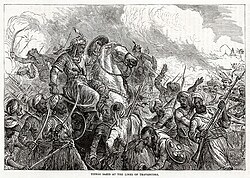
[[File:Tippoo Sahib at the lines of Travancore in the 1850s.jpg|thumb|[[Tipu Sultan]] at the lines of Travancore. Illustration from Cassell's Illustrated History of India by James Grant (c 1896).]] | [[File:Tippoo Sahib at the lines of Travancore in the 1850s.jpg|thumb|[[Tipu Sultan]] at the lines of Travancore. Illustration from ''Cassell's Illustrated History of India'' by James Grant (c. 1896).]] | ||
Marthanda Varma's successor Karthika Thirunal Rama Varma (1758–1798), who was popularly known as [[Dharma Raja]], shifted the capital in 1795 from [[Padmanabhapuram Palace|Padmanabhapuram]] to [[Thiruvananthapuram]]. | Marthanda Varma's successor Karthika Thirunal Rama Varma (1758–1798), who was popularly known as [[Dharma Raja]], shifted the capital in 1795 from [[Padmanabhapuram Palace|Padmanabhapuram]] to [[Thiruvananthapuram]]. Dharma Raja's period is considered a golden age in the history of Travancore. He not only retained the territorial gains of his predecessor, but also improved and encouraged social development. He was greatly assisted by a very efficient administrator, [[Raja Kesavadas]], the Diwan of Travancore.{{citation needed|date=June 2015}} | ||
Travancore often allied with the [[English East India Company]] in military conflicts.<ref name="Travancore 2011"/> During | Travancore often allied with the [[English East India Company]] in military conflicts.<ref name="Travancore 2011">"Travancore." Encyclopædia Britannica Online. Encyclopædia Britannica Inc., 2011. {{page?|date=August 2024}}{{ISBN?}}</ref> During Dharma Raja's reign, [[Tipu Sultan]], the de facto ruler of [[Mysore]] and the son of [[Hyder Ali]], attacked Travancore in 1789 as a part of the [[Mysore invasion of Kerala]]. Dharma Raja had earlier refused to hand over the Hindu political refugees from the [[Mysore invasion of Kerala|Mysore occupation of Malabar]] who had been given asylum in Travancore. The Mysore army entered the Cochin kingdom from Coimbatore in November 1789 and reached [[Thrissur]] in December. On 28 December 1789 Tipu Sultan attacked the Nedunkotta (northern lines) from the north, causing the [[Battle of Nedumkotta]] and the defeat of the Mysore army. | ||
===Velu Thampi Dalawa's rebellion=== | ===Velu Thampi Dalawa's rebellion=== | ||
| Line 159: | Line 162: | ||
[[File:A language map of India prepared for the missionary projects at Serampore, 1822.jpg|left|thumbnail|A language map of India prepared in 1822. Note that a major portion of Travancore was included in [[Tamil language|Tamil]]-spoken region.]] | [[File:A language map of India prepared for the missionary projects at Serampore, 1822.jpg|left|thumbnail|A language map of India prepared in 1822. Note that a major portion of Travancore was included in [[Tamil language|Tamil]]-spoken region.]] | ||
On | On Dharma Raja's death in 1798, [[Balarama Varma]] (1798–1810), the weakest ruler of the dynasty, took over at the age of sixteen. A treaty brought Travancore under a [[subsidiary alliance]] with the English [[East India Company]] in 1795.<ref name="Travancore 2011"/> | ||
The | The prime ministers ([[Dewan|''dalawas'']] or ''dewans'') started to take control of the kingdom beginning with [[Velu Thampi Dalawa]] (Velayudhan Chempakaraman Thampi) (1799–1809), who was appointed as the ''dewan'' following the dismissal of [[Jayanthan Sankaran Nampoothiri]] (1798–1799). Initially, [[Velayudhan Chempakaraman Thampi]] and the East India Company got along very well. When a section of the Travancore army mutinied in 1805 against Velu Thampi, he sought refuge with the British Resident Colonel (later General) [[Colin Macaulay]] and later used company troops to crush the mutiny. Velu Thampi also played a key role in negotiating a new treaty between Travancore and the East India Company. However, the company's demands for compensating payment for their involvement in the Travancore–Mysore War (1791) on behalf of Travancore led to tension between the dewan and Colonel Macaulay. Velu Thampi and the dewan of Cochin kingdom, [[Paliath Achan]] Govindan Menon, who was unhappy with Macaulay for granting asylum to his enemy Kunhi Krishna Menon, declared "war" on the East India Company.{{citation needed|date=May 2014}} | ||
[[File:Adoption Durbar, Trivandrum.jpg|left|thumb|Adoption Durbar, Trivandrum]] | [[File:Adoption Durbar, Trivandrum.jpg|left|thumb|Adoption Durbar, Trivandrum]] | ||
The East India Company army defeated Paliath Achan's army in Cochin on 27 February 1809. Paliath Achan surrendered to the East India Company and was exiled to [[Madras]] and later to [[Benaras]]. The | The East India Company army defeated Paliath Achan's army in Cochin on 27 February 1809. [[Paliath Achan]] surrendered to the East India Company and was exiled to [[Madras]] and later to [[Benaras]]. The company defeated forces under Velu Thampi at battles near Nagercoil and Kollam, and inflicted heavy casualties on the rebels, many of whom then deserted and returned home. The Maharajah of Travancore, who hitherto had not openly taken any part in the rebellion, now allied with the British and appointed one of Thampi's enemies as his prime minister. The allied East India Company army and the Travancore soldiers camped in Pappanamcode, just outside Thiruvananthapuram. Velu Thampi now organised a guerrilla struggle against the company, but committed suicide to avoid capture by the Travancore army. After the mutiny of 1805 against Velu Thampi, most of the Nair army battalions of Travancore were disbanded, and after Velu Thampi's uprising, almost all of the remaining Travancore forces were also disbanded, with the East India Company undertaking to serve the Rajah in cases of external and internal aggression.{{citation needed|date=May 2016}} | ||
===Cessation of | ===Cessation of mahādānams=== | ||
The Rajahs of Travancore had been conditionally promoted to | The Rajahs of Travancore had been conditionally promoted to [[Kshatriya]]-hood with periodic performance of [[sixteen great gifts|16 mahādānams]] (great gifts in charity) such as [[Hiranyagarbha (donation)|Hiranya-garbha]], Hiranya-Kāmadhenu, and Hiranyāsvaratā, in each of which thousands of [[Brahmins]] had been given costly gifts in addition to a minimum of 1 ''kazhanch'' (78.65 gm) of gold.<ref name="ASo00">''A Social History of India'' – Ashish Publishing House: {{ISBN|81-7648-170-X}} (2000). {{page?|date=August 2024}}</ref> In 1848 the [[James Broun-Ramsay, 1st Marquess of Dalhousie|Marquess of Dalhousie]], then [[Governor-General of India]], was apprised that the depressed condition of the finances in Travancore was due to these mahādānams by the rulers.<ref name="Adm88">Sadasivan, S.N., 1988, ''Administration and social development in Kerala: A study in administrative sociology'', New Delhi, Indian Institute of Public Administration</ref> Lord Dalhousie instructed [[George Harris, 3rd Baron Harris|Lord Harris]], Governor of the [[Madras Presidency]], to warn the King of Travancore, [[Uthram Thirunal Marthanda Varma|Martanda Varma (Uttram Tirunal)]] (1847–60), that if he did not end this practice, the Madras Presidency would take over his state's administration. This led to the cessation of the practice of mahādanams. {{citation needed|date=May 2016}} | ||
All | All Travancorean kings including [[Sree Moolam Thirunal]] conducted the ''Hiranyagarbham'' and ''Tulapurushadaanam'' ceremonies. Maharaja [[Chithira Thirunal]] was the only King of Travancore not to have conducted these rituals as he considered them extremely costly.<ref>{{cite web |url=http://www.mathrubhumi.com/paramparyam/story.php?id=230343 |title=ഹിരണ്യഗര്ഭച്ചടങ്ങിന് ഡച്ചുകാരോട് ചോദിച്ചത് 10,000 കഴിഞ്ച് സ്വര്ണം KERALAM Paramparyam - Mathrubhumi Special |access-date=2014-02-20 |url-status=dead |archive-url=https://web.archive.org/web/20140224230755/http://www.mathrubhumi.com/paramparyam/story.php?id=230343 |archive-date=24 February 2014 }} MATHRUBHUMI Paramparyam ഹിരണ്യഗര്ഭച്ചടങ്ങിന് ഡച്ചുകാരോട് ചോദിച്ചത് 10,000 കഴിഞ്ച് സ്വര്ണം – "ശ്രീമൂലംതിരുനാള് വരെയുള്ള രാജാക്കന്മാര് ഹിരണ്യഗര്ഭം നടത്തിയിട്ടുണ്ടെന്നാണ് അറിയുന്നത്. ഭാരിച്ച ചെലവ് കണക്കിലെടുത്ത് ശ്രീചിത്തിരതിരുനാള് ബാലരാമവര്മ്മ മഹാരാജാവ് ഈ ചടങ്ങ് നടത്തിയില്ല."</ref> | ||
=== | ===19th and early 20th centuries=== | ||
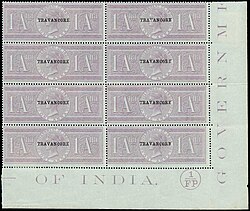
[[File:1887 Travancore revenue stamps.jpg|thumb|A block of 1887 Travancore revenue stamps depicting [[Queen Victoria]] | [[File:1887 Travancore revenue stamps.jpg|thumb|A block of 1887 Travancore revenue stamps depicting [[Queen Victoria]]]] | ||
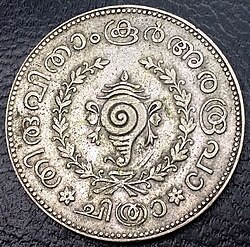
[[File:Travancore Rupee - Reverse.jpg|thumb|Malayalam letters on old [[Travancore Rupee]] coin]] | [[File:Travancore Rupee - Reverse.jpg|thumb|Malayalam letters on old [[Travancore Rupee]] coin]] | ||
The [[Caste system in India|caste system]] was enforced more rigorously in Travancore than in many other parts of India up to the mid-1800s. The hierarchical caste order was deeply entrenched in the social system and was supported by the government, which transformed this caste-based social system into a religious institution.<ref>Cf. Ward & Conner, ''Geographical and Statistical Memoir'', p. 133; V. Nagam Aiya, ''The Travancore State Manual'', Volume 2, Madras: AES, 1989 (1906), p. 72.</ref> | |||
In such a context, the [[Ayyavazhi]] religious sect served also as a reform movement in uplifting the downtrodden of society, both socially and religiously. The [[Ayyavazhi rituals|rituals of Ayyavazhi]] constituted a social discourse. Its beliefs, mode of worship, and religious organisation seem to have enabled the Ayyavazhi group to negotiate, cope with, and resist the imposition of authority.<ref>G. Patrick, Religion and Subaltern Agency, University of Madras, 2003, The Subaltern Agency in Ayyavali, p. 174.</ref> The hard tone of the sect's founder, [[Ayya Vaikundar]], was perceived as a revolution against the government.<ref>{{cite web |url=http://mission.akshaya.net/dpi/ |title=Kerala State Syllabus – Text books |access-date=2011-07-23 |url-status=dead |archive-url=https://web.archive.org/web/20110829094406/http://mission.akshaya.net/dpi/ |archive-date=29 August 2011 }}''Towards Modern Kerala, 10th Standard Text Book'', Chapter 9, p. 101.</ref> In response, King [[Swathi Thirunal Rama Varma]] initially imprisoned Vaikundar in the Singarathoppu jail, but later set him at liberty. Vaikundar's jailor, Appaguru, ended up becoming his disciple.<ref>Cf. Rev.Samuel Zechariah, ''The London Missionary Society in South Travancore'', p. 201.</ref> | |||
<gallery widths="200" heights="200"> | <gallery widths="200" heights="200"> | ||
File:Anchal Box Perumbavoor Rest House.JPG|Travancore's postal service adopted a standard cast iron pillar box, made by Massey & Co in [[Chennai|Madras]], similar to the British [[Pillar box#Penfolds|Penfold]] model introduced in 1866. This [[Anchal post]] box is in [[Perumbavoor]]. | File:Anchal Box Perumbavoor Rest House.JPG|Travancore's postal service adopted a standard cast iron pillar box, made by Massey & Co in [[Chennai|Madras]], similar to the British [[Pillar box#Penfolds|Penfold]] model introduced in 1866. This [[Anchal post]] box is in [[Perumbavoor]]. | ||
File:Ayilyam Thirunal and Madhava Rao.JPG|[[Ayilyam Thirunal of Travancore]] | File:Ayilyam Thirunal and Madhava Rao.JPG|[[Ayilyam Thirunal of Travancore]] (centre) with the first prince (left) and Dewan Rajah Sir [[T. Madhava Rao]] (right) | ||
File:Chithira Thirunal Balarama Varma.jpg|The last King of Travancore, Sree Chithira Thirunal Balarama Varma | File:Chithira Thirunal Balarama Varma.jpg|The last King of Travancore, Sree Chithira Thirunal Balarama Varma | ||
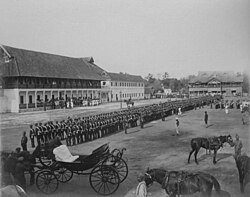
File:Nair pattalam cavalry.jpg|Travancore ''Nair Brigade'' in 1861 | File:Nair pattalam cavalry.jpg|Travancore ''Nair Brigade'' in 1861 | ||
</gallery> | </gallery> | ||
After the death of [[Sree Moolam Thirunal]] in 1924, [[Sethu Lakshmi Bayi]] became regent (1924–1931), as the heir apparent | After the death of [[Sree Moolam Thirunal]] in 1924, [[Sethu Lakshmi Bayi]] became regent (1924–1931), as the heir apparent; Sree [[Chithira Thirunal]] was then a minor, 12 years old.<ref>{{cite book|last=A. Sreedhara|first=Menon|title=A Survey of Kerala History|pages=271–273}}</ref> | ||
In 1935, Travancore joined the [[Imperial Service Troops|Indian State Forces Scheme]] and a Travancore unit was named [[1st Travancore Nair Infantry]], [[Travancore State Forces]]. The unit was reorganised as an [[Indian State Infantry Battalion]] by Lieutenant Colonel H S Steward, who was appointed commandant of the Travancore State Forces.<ref name="TravancoreStateForces">{{cite web|title=Travancore State Forces|url=https://indianarmy.nic.in/Site/FormTemplete/frmTempSimple.aspx?MnId=0Shq7wwoytm5UmTfNYDhxQ==&ParentID=X8ZXdizSqjhXDuSfL0C75Q==links/Committee/1Adminrpt1958.asp?intID=1|date=2020-04-13|url-status=live|archive-url=https://web.archive.org/web/20200413124927/https://indianarmy.nic.in/Site/FormTemplete/frmTempSimple.aspx?MnId=0Shq7wwoytm5UmTfNYDhxQ%3D%3D&ParentID=X8ZXdizSqjhXDuSfL0C75Q%3D%3Dlinks%2FCommittee%2F1Adminrpt1958.asp%3FintID%3D1|archive-date=13 April 2020|access-date=2020-05-06}}</ref> | |||
The last ruling king of Travancore, [[Chithira Thirunal Balarama Varma]], reigned from 1931 to 1949. Menon states that "his reign marked revolutionary progress in the fields of education, defence, economy and society as a whole."<ref>"During his rule, the revenues of the State were nearly quadrupled from a little over Rs 21/2 crore to over Rs 91/2 crore." – 'The Story of the Integration of the Indian States' by V. P. Menon</ref> He made the famous Temple Entry Proclamation on 12 November 1936, which opened all the [[Kshetram]]s (Hindu temples in Kerala) in Travancore to backward communities. This act won him praise from across India, most notably from [[Mohandas Gandhi|Mahatma Gandhi]]. The first public transport system (Thiruvananthapuram–Mavelikkara) and telecommunication system (Thiruvananthapuram Palace–Mavelikkara Palace) were launched during his reign. He also began state industrialisation, introducing heavy industry in the state and established giant public sector undertakings. As many as twenty industries were established, mostly for utilising the local raw materials such as rubber, ceramics, and minerals. Even today, a majority of the premier industries in Kerala were initially established by Sree Chithira Thirunal. He patronised musicians, artists, dancers, and Vedic scholars. Sree Chithira Thirunal appointed, for the first time, an Art Advisor to the Government, Dr. G. H. Cousins. He also established a new form of University Training Corps, viz. Labour Corps, preceding the N.C.C, in the educational institutions. The expenses of the university were to be met fully by the government. Sree Chithira Thirunal also built the beautiful [[Kowdiar Palace]], finished in 1934, which was previously an old [[Nālukettu|Naluektu]] given by Sree Moolam Thirunal to his mother Sethu Parvathi Bayi in 1915.<ref>{{cite web|last=Supreme Court|first=Of India|title=Good Governance: Judiciary and the Rule of Law|url=http://supremecourtofindia.nic.in/speeches/speeches_2007/ctm.pdf|publisher=Sree Chithira Thirunal Memorial Lecture, 29 December 2007|access-date=1 February 2014|url-status=dead|archive-url=https://web.archive.org/web/20121017164448/http://www.supremecourtofindia.nic.in/speeches/speeches_2007/ctm.pdf|archive-date=17 October 2012}}</ref><ref name="Aswathy Thirunal Gauri Lakshmi Bai">{{cite book|last=Gauri Lakshmi Bai|first=Aswathy Thirunal|title=Sree Padmanabhaswamy Kshetram|year=1998|publisher=The State Institute of Languages, Kerala|location=Thiruvananthapuram|isbn=978-81-7638-028-7|pages=242–243}}</ref><ref name="A. Sreedhara Menon">{{cite book|last=Menon|first=A. Sreedhara|title=A Survey of Kerala History|year=1967|publisher=D C Books|location=Kottayam|isbn=81-264-1578-9|page=273}}</ref> | |||
A famine in 1943 claimed approximately 90,000 lives in Travancore.<ref>{{Cite journal |last=Balasubramanian |first=Aditya |date=2023 |title=A forgotten famine of '43? Travancore's muffled 'cry of distress' |url=https://www.cambridge.org/core/journals/modern-asian-studies/article/forgotten-famine-of-43-travancores-muffled-cry-of-distress/BB804EA24281112CC57ACAAADDB5BFD2 |journal=Modern Asian Studies |language=en |volume=57 |issue=5 |pages=1495–1529 |doi=10.1017/S0026749X21000706 |s2cid=259440543 |issn=0026-749X|url-access=subscription |doi-access=free }}</ref> | |||
However, his prime minister, Sir [[C. P. Ramaswami Iyer]], was unpopular among the communists of Travancore. The tension between the Communists and Iyer led to minor riots. In one such [[Punnapra-Vayalar uprising|riot in Punnapra-Vayalar]] in 1946, the Communist rioters established their own government in the area. This was put down by the Travancore Army and Navy. The prime minister issued a statement in June 1947 that Travancore would remain an independent country instead of joining the Indian Union; subsequently, an attempt was made on his life, following which he resigned and left for Madras, to be succeeded by Sri [[P.G.N. Unnithan]]. According to witnesses such as | However, his prime minister, Sir [[C. P. Ramaswami Iyer]], was unpopular among the communists of Travancore. The tension between the Communists and Iyer led to minor riots. In one such [[Punnapra-Vayalar uprising|riot in Punnapra-Vayalar]] in 1946, the Communist rioters established their own government in the area. This was put down by the Travancore Army and Navy. The prime minister issued a statement in June 1947 that Travancore would remain an independent country instead of joining the Indian Union; subsequently, an attempt was made on his life, following which he resigned and left for Madras, to be succeeded by Sri [[P. G. N. Unnithan]]. According to witnesses such as [[Aiyappan Pillai]], constitutional adviser to the Maharaja and historians like [[A. Sreedhara Menon]], the rioters and mob-attacks had no bearing on the decision of the Maharaja.<ref>Sreedhara Menon in ''Triumph & Tragedy in Travancore'' Annals of Sir C. P.'s Sixteen Years, DC Books publication</ref><ref>Aiyappan Pillai Interview to Asianet news Accessed at https://www.youtube.com/watch?v=iIMS_6Z_WRE</ref> After several rounds of discussion and negotiation between Sree Chithira Thirunal and [[V. P. Menon]], the king agreed that the kingdom should accede to the Indian Union on 12 August 1947.<ref>{{Cite book |url=https://www.abhilekh-patal.in/jspui/handle/123456789/2762946?searchWord=instrument&backquery=[query=%22instrument+of+accession%22&originalquery=&sort_by=dc.date.accessioned_dt&order=desc&rpp=20&etal=0&start=20 |title=Travancore State – Instrument of Accession and Standstill Agreement signed between Rama Verma, Ruler of Travancore State and the Dominion of India |publisher=Ministry of States, Government of India |year=1947 |location=New Delhi |page=3 |chapter=Instrument of Accession of His Highness the Maharajah of Travancore |access-date=31 August 2022 |url-access=registration |via=[[National Archives of India]]}}</ref> On 1 July 1949 the kingdom of Travancore was merged with the kingdom of Cochin and the short-lived state of [[Travancore–Cochin|Travancore–Kochi]] was formed.<ref>{{Cite news|last=Kurian|first=Nimi|date=2016-06-30|title=Joining hands|language=en-IN|work=The Hindu|url=https://www.thehindu.com/features/kids/Joining-hands/article14410304.ece|access-date=2021-07-22|issn=0971-751X}}</ref> | ||
[[File:Madras Prov South 1909.jpg|thumb|Travancore in the [[Madras Presidency]] in 1909]] | [[File:Madras Prov South 1909.jpg|thumb|Travancore in the [[Madras Presidency]] in 1909]] | ||
On 11 July 1991, Maharaja Sree Chithira Thirunal suffered a stroke and was admitted to a hospital, where he died on 20 July. He had ruled Travancore for 67 years and at his death was one of the few surviving rulers of a first-class [[princely state]] in the old [[British Raj]]. He was also the last surviving Knight Grand Commander of both the [[Order of the Star of India]] and of the [[Order of the Indian Empire]]. He was succeeded as | On 11 July 1991, Maharaja Sree Chithira Thirunal suffered a stroke and was admitted to a hospital, where he died on 20 July. He had ruled Travancore for 67 years and at his death was one of the few surviving rulers of a first-class [[princely state]] in the old [[British Raj]]. He was also the last surviving Knight Grand Commander of both the [[Order of the Star of India]] and of the [[Order of the Indian Empire]]. He was succeeded as head of the Royal House as well as the Titular Maharajah of Travancore by his younger brother, [[Uthradom Thirunal Marthanda Varma]]. The Government of India issued a stamp on 6 Nov 1991, commemorating the reforms that marked his reign in Travancore.<ref>{{cite book|last=Gauri Lakshmi Bai|first=Aswathy Thirunal|title=Sree Padmanabha Swamy Kshetram|date=1998|publisher=The State Institute of Languages|location=Thiruvananthapuram, Kerala|isbn=978-81-7638-028-7|pages=278–282, 242–243, 250–251}}</ref> | ||
===Formation of Kerala=== | ===Formation of Kerala=== | ||
| Line 203: | Line 210: | ||
{{See also|Merger of Kanyakumari with Madras State}} | {{See also|Merger of Kanyakumari with Madras State}} | ||
The State of Kerala came into existence on 1 November 1956, with a governor appointed by the president of India as the head of state instead of a king.<ref name="Kerala">{{cite web|url=https://legislative.gov.in/sites/default/files/A1956-37.pdf|title=The States Reorganisation Act, 1956|website=legislative.gov.in|publisher=Government of India}}</ref> The king was stripped of all | The State of Kerala came into existence on 1 November 1956, with a governor appointed by the president of India as the head of state instead of a king.<ref name="Kerala">{{cite web|url=https://legislative.gov.in/sites/default/files/A1956-37.pdf|title=The States Reorganisation Act, 1956|website=legislative.gov.in|publisher=Government of India}}</ref> The king was stripped of all political powers and of the right to receive [[Privy purse in India|privy purses]], according to the twenty-sixth amendment of the Indian constitution act of 31 July 1971. He died on 20 July 1991.<ref>{{Cite web|url=http://indiacode.nic.in/coiweb/amend/amend26.htm|archiveurl=https://web.archive.org/web/20111206041333/http://indiacode.nic.in/coiweb/amend/amend26.htm|url-status=dead|title=The Constitution (Twenty-Sixth Amendment Act), 1971|archivedate=6 December 2011}}</ref> | ||
===Merger of Kanyakumari with Madras State=== | ===Merger of Kanyakumari with Madras State=== | ||
| Line 209: | Line 216: | ||
{{main article|Merger of Kanyakumari with Madras State}} | {{main article|Merger of Kanyakumari with Madras State}} | ||
[[Tamils]] lived in large numbers in the [[Thovalai]], [[Agastheeswaram]], [[Sengottai]], [[Eraniel]], [[Vilavancode]], [[Kalkulam]], [[Devikulam]], [[Neyyattinkara]], [[Thiruvananthapuram]] South and [[Thiruvananthapuram]] North [[taluk]]s of erstwhile Travancore State.<ref name="r1881"/> In | [[Tamils]] lived in large numbers in the [[Thovalai]], [[Agastheeswaram]], [[Sengottai]], [[Eraniel]], [[Vilavancode]], [[Kalkulam]], [[Devikulam]], [[Neyyattinkara]], [[Thiruvananthapuram]] South and [[Thiruvananthapuram]] North [[taluk]]s of erstwhile Travancore State.<ref name="r1881"/> In these Tamil regions, [[Malayalam]] was the official language and there were only a few Tamil schools. This resulted in hardships for Tamils. The Travancore state government continued rejecting the requests of Tamils.<ref>V. S. Sathianesan – Tamil Separatism in Travancore</ref> During this period the Travancore State Congress favoured the idea of uniting all the Malayalam-speaking regions and forming a "Unified Kerala". In protest against this idea, many Tamil leaders vacated the party. Tamils gathered together at [[Nagercoil]] on 16 December 1945 under the leadership of Sam Nathaniel and formed the new political party All Travancore Tamilian Congress. That party pushed for the merger of Tamil regions in Travancore with Tamil Nadu.<ref>R. Isaac Jeyadhas – Kanyakumari District and Indian Independence Struggle (Tamil)</ref> During the election campaign, clashes occurred between the Tamil Nadar community and the Malayali Nair community in Kalkulam–Vilavancode taluks. The police force suppressed the agitating Nadars. In February 1948 police opened fire and two Tamil-speaking Nadars were killed.<ref name="DDaniel"/> | ||
In the working committee meeting of Tamilian congress at Eraviputhur on 30 June 1946, the name of the political party was changed to Travancore Tamil Nadu Congress (TTNC). The TTNC was popular among the Tamils living in Thovalai and Agateeswaram taluks. Ma. Po. Sivagnanam ([[Ma. Po. Si.|Ma.Po.Si]]) was the only leader from Tamil Nadu who acted in favour of TTNC.<ref name="DDaniel">D. Daniel – Travancore Tamils: Struggle for Identity.</ref> After the independence of India, State Assembly elections were announced in Travancore. As a consequence, TTNC improved its popularity among Tamils. A popular and leading advocate from Vilavancode, [[A. Nesamony]] organised a meeting of his supporters at Allan Memorial Hall, Nagercoil on 8 September 1947. In that meeting it was declared that they must achieve their objective through their political organisation, the TTNC. Thereafter TTNC started gaining strength and momentum in Kalkulam–Vilavancode taluks.<ref name="BYogeeswaran">B. Yogeeswaran – History of Travancore Tamil Struggle (Tamil)</ref> | |||
TTNC won in 14 constituencies in the election to the [[State Legislative Assembly (India)|State Legislative Assembly]]. Mr. [[A. Nesamony]] was elected as the legislative leader of the party. Under his leadership, the awakened Tamil population was prepared to undergo any sacrifice to achieve their goal.<ref name="DPeter">D. Peter – Malayali Dominance and Tamil Liberation (Tamil)</ref> | |||
{{Overly detailed|section|date=January 2026}} | |||
In 1950, a meeting was held at [[Palayamkottai]] to make compromises between state congress and | In 1950, a meeting was held at [[Palayamkottai]] to make compromises between the state congress and the TTNC. The meeting met with failure and Sam Nathaniel resigned from the post of president of the TTNC. P. Ramasamy Pillai, a strong follower of Nesamony, was elected as the new president.<ref name="BYogeeswaran" /> The first general election of independent India was held in 1952; TTNC won 8 legislative assembly seats. A. Chidambaranathan became the minister on behalf of TTNC in the coalition state government formed by the Congress. In the parliamentary Constituency, Nesamony was elected as M.P. and in the Rajyasabha seat. Abdul Razak was elected as M.P. on behalf of TTNC.<ref name="BYogeeswaran" /> In due course, accusing the Congress government for not showing enough care the struggle of the Tamils, the TTNC broke away from the coalition and the Congress government lost the majority, leading to fresh elections. In 1954 elections, TTNC gained victory in 12 constituencies.<ref name="BYogeeswaran" /> | ||
[[Pattom A. Thanu Pillai|Pattom Thanu Pillai]] was the chief minister for | [[Pattom A. Thanu Pillai|Pattom Thanu Pillai]] was the chief minister for Thiru–Kochi legislative assembly. He engaged hard measures against the agitations of Tamils, especially those in the [[Devikulam]]–Peermedu regions, who experiences atrocities by the Travancore Police force. Condemning the attitude of the police, TTNC leaders from [[Nagercoil]] went to [[Munnar]] and participated in agitations against the prohibitive orders. The leaders were arrested and an uncalm atmosphere prevailed in South Travancore.<ref>R. Kuppusamy – Historical foot prints of a True War (Tamil)</ref> | ||
On 11 August, Liberation Day celebrations were held at many places in South Travancore. Public meetings and processions were organised. Communists also collaborated with the agitation programmes. Police opened fire at the processions in Thoduvetty (Martandam) and Puthukadai. Nine Tamil volunteers were killed and thousands of | On 11 August, Liberation Day celebrations were held at many places in South Travancore. Public meetings and processions were organised. Communists also collaborated with the agitation programmes. Police opened fire at the processions in Thoduvetty (Martandam) and Puthukadai. Nine Tamil volunteers were killed and thousands of TTNC and communist sympathisers were arrested in various parts of Tamil main land. At the end, Pattom Thanu Pillai's ministry was toppled and normalcy returned to the Tamil regions.<ref name="DPeter" /> The central government appointed the [[Fazal Ali Commission]] (December 1953) for the state's reorganisation based on language. It submitted its report on 10 August 1955. Based on this report, Devikulam–Peermedu and [[Neyyattinkara]] taluks were merged with Kerala state.<ref>B. Mariya John – Linguistic Reorganisation of Madras Presidenty</ref> On 1 November 1956 four taluks (Thovalai, Agastheeswaram, Kalkulam, Vilavancode) were recognised to form the New Kanyakumari District and merged with Tamil Nadu state. Half of [[Sengottai]] taluk was merged with [[Tirunelveli district]]. As the TTNC's primary objective was a merger of Travancore's Tamil regions with Tamil Nadu, a major part of its goal had been realised, and it was dissolved thereafter.<ref name="DPeter" /> | ||
===Retainment of Devikulam and Peerumedu Taluks in Kerala=== | ===Retainment of Devikulam and Peerumedu Taluks in Kerala=== | ||
| Line 224: | Line 233: | ||
{{See also|Idukki district}} | {{See also|Idukki district}} | ||
Apart from [[Kanyakumari district]], the | Apart from [[Kanyakumari district]], the taluks of [[Devikulam]] and [[Peermade]] in present-day [[Idukki district]] also had a Tamil-majority until the late 1940s.<ref name="idukki">{{Cite news|title=Why did Kerala surrender Kanyakumari without a fight?|url=https://www.onmanorama.com/news/kerala/2020/10/31/why-did-kerala-surrender-kanyakumari-to-tamil-nadu.html|last=Ayyappan|first=R|date=31 October 2020|access-date=16 June 2021|work=Onmanorama}}</ref> The TTNC had also requested to merge these taluks with [[Madras State]].<ref name="idukki"/> However, due to some decisions of [[Pattom Thanu Pillai]], the first prime minister of Travancore, they were retained in Kerala state.<ref name="idukki"/> Pattom came up with a colonisation project to re-engineer the demography of [[Cardamom Hills]].<ref name="idukki"/> His colonisation project was to relocate 8,000 Malayalam-speaking families into the taluks of [[Devikulam]] and [[Peermade]].<ref name="idukki"/> About 50,000 acres in these taluks, which were Tamil-majority area, were chosen for the colonisation project.<ref name="idukki"/> As a victory of the colonisation project done by post-independence Travancore, these two taluks and a larger portion of Cardamom Hills were retained in the state of Kerala, after [[States Reorganisation Act, 1956|States Reorganisation Act (1956)]].<ref name="idukki"/> | ||
==Politics== | ==Politics== | ||
Under the direct control of the King, Travancore's administration was headed by a [[Dewan]] assisted by the ''Neetezhutthu Pillay'' | Under the direct control of the King, Travancore's administration was headed by a [[Dewan]] assisted by the ''Neetezhutthu Pillay'' (secretary), ''Rayasom Pillay'' (assistant or under-secretary), as well as ''Rayasoms'' (clerks) and ''Kanakku Pillamars'' (accountants). Individual districts were run by ''[[Sarvadhikari]]s'' under the supervision of Dewan, while dealings with the neighbouring states and Europeans was under the purview of the ''Valia Sarvahi'', who signed treaties and agreements.{{sfn|Aiya|1906|pp=329–330}} | ||
===Rulers of Travancore=== | ===Rulers of Travancore=== | ||
| Line 234: | Line 243: | ||
{{main|Rulers of Travancore}} | {{main|Rulers of Travancore}} | ||
# Anizham Tirunal [[Marthanda Varma]] 1729–1758<ref name="deVriesTravancore">{{cite web|url=http://www.hubert-herald.nl/BhaTravancore.htm|title=Travancore|last=de Vries|first=Hubert|date=2009-10-26|website=Hubert Herald|archive-date=2012-06-27|url-status=live|archive-url=https://web.archive.org/web/20120627074558/http://www.hubert-herald.nl/BhaTravancore.htm}}</ref> | # Anizham Tirunal [[Marthanda Varma]] (1729–1758)<ref name="deVriesTravancore">{{cite web|url=http://www.hubert-herald.nl/BhaTravancore.htm|title=Travancore|last=de Vries|first=Hubert|date=2009-10-26|website=Hubert Herald|archive-date=2012-06-27|url-status=live|archive-url=https://web.archive.org/web/20120627074558/http://www.hubert-herald.nl/BhaTravancore.htm}}</ref> | ||
# Karthika Thirunal Rama Varma ([[Dharma Raja]]) 1758–1798 | # Karthika Thirunal Rama Varma ([[Dharma Raja]]) (1758–1798) | ||
# [[Balarama Varma]] I 1798–1810 | # [[Balarama Varma]] I (1798–1810) | ||
# [[Gowri Lakshmi Bayi]] 1810–1815 | # [[Gowri Lakshmi Bayi]] (1810–1815) – Queen 1810–1813 and Regent Queen 1813–1815 | ||
# [[Gowri Parvati Bayi]] (Regent) 1815–1829 | # [[Gowri Parvati Bayi]] (Regent) (1815–1829) | ||
# [[Swathi Thirunal Rama Varma]] | # [[Swathi Thirunal Rama Varma]] III (1813–1846) | ||
# [[Uthram Thirunal Marthanda Varma]] II 1846–1860 | # [[Uthram Thirunal Marthanda Varma]] II (1846–1860) | ||
# [[Ayilyam Thirunal]] Rama Varma III 1860–1880 | # [[Ayilyam Thirunal]] Rama Varma III (1860–1880) | ||
# [[Visakham Thirunal]] Rama Varma IV 1880–1885 | # [[Visakham Thirunal]] Rama Varma IV (1880–1885) | ||
# Sree [[Moolam Thirunal]] Rama Varma VI 1885–1924 | # Sree [[Moolam Thirunal]] Rama Varma VI (1885–1924) | ||
# [[Sethu Lakshmi Bayi]] (Regent) 1924–1931 | # [[Sethu Lakshmi Bayi]] ([[Regent]]) (1924–1931) | ||
# [[Chithira Thirunal Balarama Varma]] II 1924–1949 | # [[Chithira Thirunal Balarama Varma]] II (1924–1949) – died 1991 | ||
===Titular Maharajahs of Travancore since 1991=== | |||
# [[Uthradom Thirunal Marthanda Varma]] III (1991–2013) | |||
#[[Moolam Thirunal Rama Varma]] VI (2013–) | |||
The current heir is [[Revathi Thirunal Balagopal Varma]] – the titular ''[[Elayaraja]]'' ([[Crown Prince|crown prince]]) (born 1953). | |||
===Prime | ===Prime ministers of Travancore=== | ||
{{main|List of Diwans of Travancore}} | {{main|List of Diwans of Travancore}} | ||
| Line 253: | Line 269: | ||
====Dalawas==== | ====Dalawas==== | ||
* Arumukham Pillai 1729–1736{{citation needed|date=June 2020}} | * Arumukham Pillai (1729–1736){{citation needed|date=June 2020}} | ||
* Thanu Pillai 1736–1737 | * Thanu Pillai (1736–1737) | ||
* [[Ramayyan Dalawa]] 1737–1756 | * [[Ramayyan Dalawa]] (1737–1756) | ||
* Martanda Pillai 1756–1763 | * Martanda Pillai (1756–1763) | ||
* Warkala Subbayyan 1763–1768 | * Warkala Subbayyan (1763–1768) | ||
* [[Krishna Gopalayyan]] 1768–1776 | * [[Krishna Gopalayyan]] (1768–1776) | ||
* Vadiswaran Subbrahmanya Iyer 1776–1780 | * Vadiswaran Subbrahmanya Iyer (1776–1780) | ||
* Mullen Chempakaraman Pillai 1780–1782 | * Mullen Chempakaraman Pillai (1780–1782) | ||
* Nagercoil Ramayyan 1782–1788 | * Nagercoil Ramayyan (1782–1788) | ||
* Krishnan Chempakaraman 1788–1789 | * Krishnan Chempakaraman (1788–1789) | ||
* [[Raja Kesavadas]] 1789–1798 | * [[Raja Kesavadas]] (1789–1798) | ||
* Odiery [[Jayanthan Sankaran Nampoothiri]] 1798–1799 | * Odiery [[Jayanthan Sankaran Nampoothiri]] (1798–1799) | ||
* [[Velu Thampi Dalawa]] 1799–1809 | * [[Velu Thampi Dalawa]] (1799–1809) | ||
* Oommini Thampi 1809–1811 | * Oommini Thampi (1809–1811) | ||
{{clear}} | {{clear}} | ||
| Line 273: | Line 289: | ||
[[File:Madhava Rao.jpg|thumb|right|250px|Dewan Rajah Sir [[T. Madhava Rao]]]] | [[File:Madhava Rao.jpg|thumb|right|250px|Dewan Rajah Sir [[T. Madhava Rao]]]] | ||
* [[John Munro, 9th of Teaninich|Col. John Munro]] 1811–1814{{citation needed|date=June 2020}} | * [[John Munro, 9th of Teaninich|Col. John Munro]] (1811–1814){{citation needed|date=June 2020}} | ||
* Devan Padmanabhan Menon 1814–1814 | * Devan Padmanabhan Menon (1814–1814) | ||
* Bappu Rao (acting) 1814–1815 | * Bappu Rao (acting) (1814–1815) | ||
* Sanku Annavi Pillai 1815–1815 | * Sanku Annavi Pillai (1815–1815) | ||
* Raman Menon 1815–1817 | * Raman Menon (1815–1817) | ||
* [[Reddy Row]] 1817–1821 | * [[Reddy Row]] (1817–1821) | ||
* [[T. Venkata Rao]] 1821–1830 | * [[T. Venkata Rao]] (1821–1830) | ||
* [[Thanjavur Subha Rao]] 1830–1837 | * [[Thanjavur Subha Rao]] (1830–1837) | ||
* [[T. Ranga Rao]] (acting) 1837–1838 | * [[T. Ranga Rao]] (acting) (1837–1838) | ||
* [[T. Venkata Rao]] ( | * [[T. Venkata Rao]] (again) (1838–1839) | ||
* [[Thanjavur Subha Rao]] (again) 1839–1842 | * [[Thanjavur Subha Rao]] (again) (1839–1842) | ||
* [[Krishna Rao (administrator)|Krishna Rao]] (acting) 1842–1843 | * [[Krishna Rao (administrator)|Krishna Rao]] (acting) (1842–1843) | ||
* [[Reddy Row]] (again) 1843–1845 | * [[Reddy Row]] (again) (1843–1845) | ||
* Srinivasa Rao (acting) 1845–1846 | * Srinivasa Rao (acting) (1845–1846) | ||
* [[Krishna Rao (administrator)|Krishna Rao]] 1846–1858 | * [[Krishna Rao (administrator)|Krishna Rao]] (1846–1858) | ||
{| class="wikitable" | {| class="wikitable" | ||
| Line 328: | Line 344: | ||
|- | |- | ||
| [[S. Shungrasoobyer]] | | [[S. Shungrasoobyer]] | ||
| | |[[File:S. Shungrasoobyer.jpg|97x97px]] | ||
| 1892 | | 1892 | ||
| 1898 | | 1898 | ||
| Line 334: | Line 350: | ||
|- | |- | ||
| [[V. Nagam Aiya]] | | [[V. Nagam Aiya]] | ||
| [[File: | | [[File:V. Nagam Aiya, Dewan Peishcar of Travancore.jpg|75px]] | ||
| 1901 | | 1901 | ||
| 1904 | | 1904 | ||
| Line 352: | Line 368: | ||
|- | |- | ||
| [[S. Gopalachari]] | | [[S. Gopalachari]] | ||
| | | [[File:Blank.svg<!-- Do not use placeholder images here per WP:IPH -->|75x75px]] | ||
| 1906 | | 1906 | ||
| 1907 | | 1907 | ||
| Line 405: | Line 421: | ||
| 1 | | 1 | ||
|- | |- | ||
| [[P.G.N.Unnithan]] | | [[P.G.N.Unnithan|P. G. N. Unnithan]] | ||
| | | | ||
| 1947 | | 1947 | ||
| Line 412: | Line 428: | ||
|} | |} | ||
===Prime | ===Prime ministers of Travancore (1948–49)=== | ||
{| class="sortable | |||
! | {| class="wikitable sortable" | ||
! | ! rowspan="2"| {{Abbr|No.|Number}}{{efn|name="no1"|A parenthetical number indicates that the incumbent has previously held office.}} | ||
! | ! rowspan="2"| Name | ||
! | ! rowspan="2"| Portrait | ||
! | ! colspan="3"| Term of office<ref name=responsible>[http://www.niyamasabha.org/codes/ginfo_2_3.htm Responsible Governments (1947–56)]. Kerala Legislature. Retrieved on 22 April 2014.</ref><ref name=history>[https://web.archive.org/web/20141006101549/http://kerala.gov.in/index.php?option=com_content&view=article&id=3776%3Ahistory-of-kerala-legislature History of Kerala Legislature]. [[Government of Kerala]]. Archived on 6 October 2014.</ref> | ||
! | ! rowspan="2" colspan="2"| Assembly<br><small>(election)</small> | ||
<small>(Monarch)</small> | ! rowspan="2" colspan="2"| Appointed by<br><small>(Monarch)</small> | ||
|- | |- | ||
! | ! From | ||
! | ! To | ||
! | ! Days in office | ||
|- style="height: 60px;" | |- style="height: 60px;" | ||
| 1 | | 1 | ||
| Line 435: | Line 450: | ||
|rowspan=2| [[Indian National Congress]] | |rowspan=2| [[Indian National Congress]] | ||
|rowspan=2 width="4px" style="background-color: {{party color|Indian National Congress}}" | | |rowspan=2 width="4px" style="background-color: {{party color|Indian National Congress}}" | | ||
| rowspan="2" | Representative | |rowspan="2" | Representative Body (1948–49) | ||
Body | | rowspan="2" |[[Chithira Thirunal Balarama Varma|Sir Chithira Thirunal Balarama Varma, Maharaja of Travancore]] | ||
(1948–49) | |||
| rowspan="2" |[[Chithira Thirunal Balarama Varma|Sir Chithira Thirunal Balarama Varma, Maharaja of Travancore]] | |||
|- style="height: 60px;" | |- style="height: 60px;" | ||
| 2 | | 2 | ||
| [[Paravoor T. K. Narayana Pillai]] | | [[Paravoor T. K. Narayana Pillai]] | ||
| | | [[File:T. K. Narayana Pillai.jpg|100x100px]] | ||
| 22 October 1948 | | 22 October 1948 | ||
| 1 July 1949 | | 1 July 1949 | ||
| Line 452: | Line 464: | ||
In 1856, the princely state was sub-divided into three divisions, each of which was administered by a Divan Peishkar, with a rank equivalent to a District Collector in British India.<ref name="AHoT 486">{{cite book|last1=Shungoony Menon|first1=P.|title=A History of Travancore from the Earliest Times|date=1878|publisher=Higgin Botham & Co.|location=Madras|page=[https://archive.org/details/ahistorytravanc00menogoog/page/n602 486]|url=https://archive.org/details/ahistorytravanc00menogoog|access-date=5 May 2016|language=en}}</ref> These were the: | In 1856, the princely state was sub-divided into three divisions, each of which was administered by a Divan Peishkar, with a rank equivalent to a District Collector in British India.<ref name="AHoT 486">{{cite book|last1=Shungoony Menon|first1=P.|title=A History of Travancore from the Earliest Times|date=1878|publisher=Higgin Botham & Co.|location=Madras|page=[https://archive.org/details/ahistorytravanc00menogoog/page/n602 486]|url=https://archive.org/details/ahistorytravanc00menogoog|access-date=5 May 2016|language=en}}</ref> These were the: | ||
* [[Northern Division (Travancore)|Northern (Cottayam)]] comprising the [[Tehsils of India|talukas]] of [[Cherthala|Sharetalay]], [[Vaikom|Vycome]], [[Ettumanoor|Yetmanoor]], [[Kottayam|Cottayam]], [[Changanassery|Chunginacherry]], [[Meenachil]], [[Thodupuzha|Thodupolay]], [[Muvattupuzha|Moovatupolay]], Kunnathnaud, Alangaud and [[North Paravur|Paravoor]]; | * [[Northern Division (Travancore)|Northern Travancore (Cottayam)]] comprising the [[Tehsils of India|talukas]] of [[Cherthala|Sharetalay]], [[Vaikom|Vycome]], [[Ettumanoor|Yetmanoor]], [[Kottayam|Cottayam]], [[Changanassery|Chunginacherry]], [[Meenachil]], [[Thodupuzha|Thodupolay]], [[Muvattupuzha|Moovatupolay]], [[Kunnathunad|Kunnathnaud]], [[Alangad|Alangaud]] and [[North Paravur|Paravoor]]; | ||
* [[Quilon Division|Quilon (Central)]], comprising the talukas of Amabalapulay, Chengannoor, Pandalam, Kunnattur, Karungapully, Kartikapully, [[Harippad]] | * [[Quilon Division|Quilon (Central Travancore)]], comprising the talukas of [[Kollam|Quilon]], [[Ambalappuzha|Amabalapulay]], [[Chengannur|Chengannoor]], [[Pandalam]], [[Kunnathur, Kerala|Kunnattur]], [[Karunagappalli|Karungapully]], [[Karthikappally|Kartikapully]], [[Harippad]] and [[Mavelikkara|Mavelikaray]]; | ||
* [[Southern Division (Travancore)|Southern (Padmanabhapuram)]] comprising | * [[Southern Division (Travancore)|Southern Travancore (Padmanabhapuram)]] comprising [[Thiruvananthapuram]], [[Chirayinkeezhu|Chirayinkir]], [[Thovala]]y, [[Agastheeswaram|Auguteeswarom]], Kalculam, [[Eraniel|Eraneel]], and Velavencode. | ||
===Divisions according to the 1911 Census of Travancore=== | ===Divisions according to the 1911 Census of Travancore=== | ||
| Line 460: | Line 472: | ||
====1. Padmanabhapuram Division==== | ====1. Padmanabhapuram Division==== | ||
The 1911 Census Report of Travancore states that Padmanabhapuram Division was the original seat of Travancore, where [[Thiruvithamcode]] and [[Padmanabhapuram]] are located.<ref name="Thiruvithamkoor">{{Cite book|title=Census of India, 1911, Volume XXIII, TRAVANCORE, Part-I, Report|last=Iyer|first=A. Subrahmanya|publisher=Government of Travancore|year=1912|location=Trivandrum|pages=19–22|url=http://piketty.pse.ens.fr/files/ideologie/data/CensusIndia/CensusIndia1911/1911%20-%20Travancore%20-%20Vol%20I.pdf}}</ref> The report further states that a vast majority of this division was ethnic [[Tamil people|Tamils]].<ref name="Thiruvithamkoor"/> Padamanabhapuram Division consisted of the present-day district of [[Kanyakumari district|Kanyakumari]] in [[Tamil Nadu]].<ref name="Thiruvithamkoor"/> The report also states that the two southernmost | The 1911 Census Report of Travancore states that Padmanabhapuram Division was the original seat of Travancore, where [[Thiruvithamcode]] and [[Padmanabhapuram]] are located.<ref name="Thiruvithamkoor">{{Cite book|title=Census of India, 1911, Volume XXIII, TRAVANCORE, Part-I, Report|last=Iyer|first=A. Subrahmanya|publisher=Government of Travancore|year=1912|location=Trivandrum|pages=19–22|url=http://piketty.pse.ens.fr/files/ideologie/data/CensusIndia/CensusIndia1911/1911%20-%20Travancore%20-%20Vol%20I.pdf}}</ref> The report further states that a vast majority of this division was ethnic [[Tamil people|Tamils]].<ref name="Thiruvithamkoor"/> Padamanabhapuram Division consisted of the present-day district of [[Kanyakumari district|Kanyakumari]] in [[Tamil Nadu]].<ref name="Thiruvithamkoor"/> The report also states that the two southernmost taluks of this division, namely Thovalai and Agastheeswaram, geographically too more resembles to [[Pandya Nadu]] of [[Tamil Nadu|Tamil country]] and the eastern [[Coromandel Coast]] of the [[Madras Presidency]] than the rest of [[Malayalam]] country.<ref name="Thiruvithamkoor"/> | ||
====2. | ====2. Thiruvananthapuram Division==== | ||
This division has been the headquarters of Travancore since 1795.<ref name="Thiruvithamkoor"/> The [[Neyyattinkara]] taluk was a main seat of industry according to the 1911 census report of Travancore.<ref name="Thiruvithamkoor"/> This division also contained many ethnic Tamils, mostly concentrated in the southern taluks of [[Neyyattinkara]] and [[Thiruvananthapuram]].<ref name="Thiruvithamkoor"/> The Trivandrum Division consisted of the present-day [[Thiruvananthapuram district]] excluding the British colony at [[Anchuthengu]].<ref name="Thiruvithamkoor"/> | |||
====3. Quilon Division==== | ====3. Quilon Division==== | ||
[[Kollam|Quilon]] was the capital of [[Venad]] and the largest port town in Travancore, and was also one of the oldest ports on [[Malabar Coast]].<ref name="Thiruvithamkoor"/> The 1911 Census of Travancore states that | [[Kollam|Quilon]] was the capital of [[Venad]] and the largest port town in Travancore, and was also one of the oldest ports on [[Malabar Coast]].<ref name="Thiruvithamkoor"/> The 1911 Census of Travancore states that [[Malayalam]] country began from Quilon division onwards.<ref name="Thiruvithamkoor"/> However, the [[Sengottai]] taluk of this division, which was earlier under [[Kottarakkara]] Thampuran, was a Tamil-majority region.<ref name="Thiruvithamkoor"/> Geographically too, Sengottai more resembled [[Madurai]] and [[Pandya Nadu]] than rest of the Malayalam country.<ref name="Thiruvithamkoor"/> The Quilon division encompassed present-day [[Kollam]] district, [[Pathanamthitta district|Pathanamthitta]] district, [[Alappuzha district|Alappuzha]] district, and some parts of [[Kottayam district|Kottayam]] district. | ||
====4. Kottayam Division==== | ====4. Kottayam Division==== | ||
This division was situated in the northernmost area of Travancore.<ref name="Thiruvithamkoor"/> It was a pure Malayalam-speaking and geographical region.<ref name="Thiruvithamkoor"/> The [[Vembanad Lake]] was a specialty of this division.<ref name="Thiruvithamkoor"/> | |||
====5. Devikulam Division==== | ====5. Devikulam Division==== | ||
This division consisted mostly of the present-day [[Idukki district]].<ref name="Thiruvithamkoor"/> It was also related to [[Pandya Nadu]] and [[Kongu Nadu]].<ref name="Thiruvithamkoor"/> Devikulam division was Tamil-speaking region.<ref name="Thiruvithamkoor"/> | |||
==Demographics== | ==Demographics== | ||
| Line 482: | Line 494: | ||
{{historical populations|11=1816|12=906,587 |13=1836|14=1,280,668 |15=1854|16=1,262,647 |17=1875|18=2,311,379 |19=1881|20=2,401,158 |21=1891|22=2,557,736 |23=1901|24=2,952,157|25=1911|26=3,428,975 |27=1921|28=4,006,062|29=1931|30=5,095,973|31=1941|32=6,070,018 |percentages=pagr|footnote=Source:<ref>{{Cite book|title=Travancore, Part I, Vol-XXV (1941)|publisher=Government of Travancore|year=1942|location=Thiruvananthapuram|page=13|url=http://lsi.gov.in:8081/jspui/bitstream/123456789/5598/1/20374_1941_REP.pdf}}</ref><ref>{{Cite book|title=Report on the Census of Travancore (1891)|publisher=Government of India|year=1894|location=Chennai|page=631|url=http://lsi.gov.in:8081/jspui/bitstream/123456789/5571/1/42181.pdf}}</ref><ref>{{Cite book|title=Report on the Census of Travancore (1881)|publisher=Government of India|year=1884|location=Thiruvananthapuram|page=87|url=http://lsi.gov.in:8081/jspui/bitstream/123456789/5570/1/41740.pdf}}</ref>}} | {{historical populations|11=1816|12=906,587 |13=1836|14=1,280,668 |15=1854|16=1,262,647 |17=1875|18=2,311,379 |19=1881|20=2,401,158 |21=1891|22=2,557,736 |23=1901|24=2,952,157|25=1911|26=3,428,975 |27=1921|28=4,006,062|29=1931|30=5,095,973|31=1941|32=6,070,018 |percentages=pagr|footnote=Source:<ref>{{Cite book|title=Travancore, Part I, Vol-XXV (1941)|publisher=Government of Travancore|year=1942|location=Thiruvananthapuram|page=13|url=http://lsi.gov.in:8081/jspui/bitstream/123456789/5598/1/20374_1941_REP.pdf}}</ref><ref>{{Cite book|title=Report on the Census of Travancore (1891)|publisher=Government of India|year=1894|location=Chennai|page=631|url=http://lsi.gov.in:8081/jspui/bitstream/123456789/5571/1/42181.pdf}}</ref><ref>{{Cite book|title=Report on the Census of Travancore (1881)|publisher=Government of India|year=1884|location=Thiruvananthapuram|page=87|url=http://lsi.gov.in:8081/jspui/bitstream/123456789/5570/1/41740.pdf}}</ref>}} | ||
{{Pie chart | {{Pie chart | ||
|thumb = right | | thumb = right | ||
|caption = | | caption = Religion in Travancore (1941):<ref name="r1941">{{Cite book|title=Travancore, Part I, Vol-XXV (1941)|publisher=Government of Travancore|year=1942|location=Thiruvananthapuram|pages=124–125|url=http://lsi.gov.in:8081/jspui/bitstream/123456789/5598/1/20374_1941_REP.pdf}}</ref> | ||
|label1 = [[Hinduism]] | | label1 = [[Hinduism]] | ||
|value1 = 60. | | value1 = 60.5 | ||
|color1 = Orange | | color1 = Orange | ||
|label2 = [[ | | label2 = [[Christianity]] | ||
|value2 = | | value2 = 32.35 | ||
|color2 = | | color2 = dodgerblue | ||
|label3 = [[ | | label3 = [[Islam]] | ||
|value3 = | | value3 = 7.15 | ||
|color3 = | | color3 = Green | ||
}} | }} | ||
| Line 506: | Line 518: | ||
| colspan="2" style="background:DodgerBlue;"|[[Christianity|<span style="color:white;">'''Christians'''</span>]] | | colspan="2" style="background:DodgerBlue;"|[[Christianity|<span style="color:white;">'''Christians'''</span>]] | ||
| colspan="2" style="background:Green;"|[[Islam|<span style="color:white;">'''Muslims'''</span>]] | | colspan="2" style="background:Green;"|[[Islam|<span style="color:white;">'''Muslims'''</span>]] | ||
|Source | |||
|- | |- | ||
! 1816 – 1820 | ! 1816 – 1820 | ||
| 906,587 | | 906,587 | ||
| 752,371 | | 752,371 | ||
| '''82.99%''' | | '''82.99%''' | ||
| 112,158 | | 112,158 | ||
| '''12.37%''' | | '''12.37%''' | ||
| 42,058 | | 42,058 | ||
| '''4.64%''' | | '''4.64%''' | ||
|<ref name="r1931">{{Cite book|title=Census of India, 1931, VOLUME XXVIII, Travancore, Part-I Report|publisher=Government of Travancore|year=1932|location=Thiruvananthapuram|pages=327, 331|url=http://lsi.gov.in:8081/jspui/bitstream/123456789/5591/1/43534_1931_REP.pdf}}</ref> | |||
|- | |- | ||
! 1881 | ! 1881 | ||
| 2,401,158 | | 2,401,158 | ||
| 1,755,610 | | 1,755,610 | ||
| '''73.12%''' | | '''73.12%''' | ||
| 498,542 | | 498,542 | ||
| '''20.76%''' | | '''20.76%''' | ||
| 146,909 | | 146,909 | ||
| '''6.12%''' | | '''6.12%''' | ||
|<ref name="r1881" /> | |||
|- | |- | ||
! 1891 | ! 1891 | ||
| 2,557,736 | | 2,557,736 | ||
| 1,871,864 | | 1,871,864 | ||
| '''73.18%''' | | '''73.18%''' | ||
| 526,911 | | 526,911 | ||
| '''20.60%''' | | '''20.60%''' | ||
| 158,823 | | 158,823 | ||
| '''6.21%''' | | '''6.21%''' | ||
|<ref name="r1891">{{Cite book|title=Report on the Census of Travancore (1891)|publisher=Government of India|year=1894|location=Chennai|pages=10–11, 683|url=http://lsi.gov.in:8081/jspui/bitstream/123456789/5571/1/42181.pdf}}</ref> | |||
|- | |- | ||
! 1901 | ! 1901 | ||
| 2,952,157 | | 2,952,157 | ||
| 2,063,798 | | 2,063,798 | ||
| '''69.91%''' | | '''69.91%''' | ||
| 697,387 | | 697,387 | ||
| '''23.62%''' | | '''23.62%''' | ||
| 190,566 | | 190,566 | ||
| '''6.46%''' | | '''6.46%''' | ||
|<ref name="r1931" /> | |||
|- | |- | ||
! 1911 | ! 1911 | ||
| 3,428,975 | | 3,428,975 | ||
| 2,298,390 | | 2,298,390 | ||
| '''67.03%''' | | '''67.03%''' | ||
| 903,868 | | 903,868 | ||
| '''26.36%''' | | '''26.36%''' | ||
| 226,617 | | 226,617 | ||
| '''6.61%''' | | '''6.61%''' | ||
|<ref name="r1931" /> | |||
|- | |- | ||
! 1921 | ! 1921 | ||
| 4,006,062 | | 4,006,062 | ||
| 2,562,301 | | 2,562,301 | ||
| '''63.96%''' | | '''63.96%''' | ||
| 1,172,934 | | 1,172,934 | ||
| '''29.27%''' | | '''29.27%''' | ||
| 270,478 | | 270,478 | ||
| '''6.75%''' | | '''6.75%''' | ||
|<ref name="r1931" /> | |||
|- | |- | ||
! 1931 | ! 1931 | ||
| 5,095,973 | | 5,095,973 | ||
| 3,137,795 | | 3,137,795 | ||
| '''61.57%''' | | '''61.57%''' | ||
| 1,604,475 | | 1,604,475 | ||
| '''31.46%''' | | '''31.46%''' | ||
| 353,274 | | 353,274 | ||
| '''6.93%''' | | '''6.93%''' | ||
|<ref name="r1931" /> | |||
|- | |- | ||
! 1941 | ! 1941 | ||
| 6,070,018 | | 6,070,018 | ||
| 3,671,480 | | 3,671,480 | ||
| '''60.49%''' | | '''60.49%''' | ||
| 1,963,808 | | 1,963,808 | ||
| '''32.35%''' | | '''32.35%''' | ||
| 434,150 | | 434,150 | ||
| '''7.15%''' | | '''7.15%''' | ||
|<ref name="r1941" /> | |||
|} | |} | ||
| Line 589: | Line 610: | ||
| colspan="2" style="background:Green;"|[[Tamil language|<span style="color:white;">'''Tamil'''</span>]] | | colspan="2" style="background:Green;"|[[Tamil language|<span style="color:white;">'''Tamil'''</span>]] | ||
| colspan="2" style="background:gray;"|[[Languages of India|<span style="color:white;">'''Others'''</span>]] | | colspan="2" style="background:gray;"|[[Languages of India|<span style="color:white;">'''Others'''</span>]] | ||
|Source | |||
|- | |- | ||
! 1875 | ! 1875 | ||
| 2,311,379 | | 2,311,379 | ||
| 1,902,533 | | 1,902,533 | ||
| '''82.32%''' | | '''82.32%''' | ||
| 387,909 | | 387,909 | ||
| '''16.78%''' | | '''16.78%''' | ||
| 20,937 | | 20,937 | ||
| '''0.91%''' | | '''0.91%''' | ||
|<ref name="r1881" /> | |||
|- | |- | ||
! 1881 | ! 1881 | ||
| 2,401,158 | | 2,401,158 | ||
| 1,937,454 | | 1,937,454 | ||
| '''80.69%''' | | '''80.69%''' | ||
| 439,565 | | 439,565 | ||
| '''18.31%''' | | '''18.31%''' | ||
| 24,139 | | 24,139 | ||
| '''1.01%''' | | '''1.01%''' | ||
|<ref name="r1881" /> | |||
|- | |- | ||
! 1891 | ! 1891 | ||
| 2,557,736 | | 2,557,736 | ||
| 2,079,271 | | 2,079,271 | ||
| '''81.29%''' | | '''81.29%''' | ||
| 448,322 | | 448,322 | ||
| '''17.53%''' | | '''17.53%''' | ||
| 30,143 | | 30,143 | ||
| '''1.18%''' | | '''1.18%''' | ||
|<ref name="r1891" /> | |||
|- | |- | ||
! 1901 | ! 1901 | ||
| 2,952,157 | | 2,952,157 | ||
| 2,420,049 | | 2,420,049 | ||
| '''81.98%''' | | '''81.98%''' | ||
| 492,273 | | 492,273 | ||
| '''16.68%''' | | '''16.68%''' | ||
| 39,835 | | 39,835 | ||
| '''1.35%''' | | '''1.35%''' | ||
|<ref name="r1901">{{Cite book|title=Census of India-1901, Volume-XXVI, Travancore (Part-I)|last=Iyer|first=N. Subrahmanya|publisher=Government of Travancore|year=1903|location=Thiruvananthapuram|pages=224–225|url=https://archive.org/details/in.ernet.dli.2015.55974}}</ref> | |||
|- | |- | ||
! 1911 | ! 1911 | ||
| 3,428,975 | | 3,428,975 | ||
| 2,836,728 | | 2,836,728 | ||
| '''82.73%''' | | '''82.73%''' | ||
| 554,618 | | 554,618 | ||
| '''16.17%''' | | '''16.17%''' | ||
| 37,629 | | 37,629 | ||
| '''1.10%''' | | '''1.10%''' | ||
|<ref name="r1911">{{Cite book|title=Census of India – 1911, Volume-XXIII, Travancore (Part-I)|last=Iyer|first=N. Subramhanya|publisher=Government of Travancore|year=1912|location=Thiruvananthapuram|page=176|url=http://piketty.pse.ens.fr/files/ideologie/data/CensusIndia/CensusIndia1911/1911%20-%20Travancore%20-%20Vol%20I.pdf}}</ref> | |||
|- | |- | ||
! 1921 | ! 1921 | ||
| 4,006,062 | | 4,006,062 | ||
| 3,349,776 | | 3,349,776 | ||
| '''83.62%''' | | '''83.62%''' | ||
| 624,917 | | 624,917 | ||
| '''15.60%''' | | '''15.60%''' | ||
| 31,369 | | 31,369 | ||
| '''0.78%''' | | '''0.78%''' | ||
|<ref name="r1921">{{Cite book|title=Census of India, 1921, Volume-XXV, Travancore|last=Iyer|first=S. Krishnamoorthi|publisher=Government of Travancore|year=1922|location=Thiruvananthapuram|page=91|url=https://archive.org/details/in.ernet.dli.2015.56017}}</ref> | |||
|- | |- | ||
! 1931 | ! 1931 | ||
| 5,095,973 | | 5,095,973 | ||
| 4,260,860 | | 4,260,860 | ||
| '''83.61%''' | | '''83.61%''' | ||
| 788,455 | | 788,455 | ||
| '''15.47%''' | | '''15.47%''' | ||
| 46,658 | | 46,658 | ||
| '''0.92%''' | | '''0.92%''' | ||
|<ref name="r1931" /> | |||
|} | |} | ||
| Line 657: | Line 686: | ||
|+Distribution of Language by Division (1881)<ref name="r1881"/> | |+Distribution of Language by Division (1881)<ref name="r1881"/> | ||
|- | |- | ||
| style="background:Orange;"|[[List of districts of Kerala|<span style="color:white;">'''Name of Division'''</span>]] | | style="background:Orange;"|[[List of districts of Kerala|<span style="color:white;">'''Name of Division'''</span>]] | ||
| style="background:Red;"|[[Malayalam|<span style="color:white;">'''Malayalam (%)'''</span>]] | | style="background:Red;"|[[Malayalam|<span style="color:white;">'''Malayalam (%)'''</span>]] | ||
| style="background:Green;"|[[Tamil language|<span style="color:white;">'''Tamil (%)'''</span>]] | | style="background:Green;"|[[Tamil language|<span style="color:white;">'''Tamil (%)'''</span>]] | ||
|- | |- | ||
! [[Padmanabhapuram]] Division | ! [[Padmanabhapuram]] Division | ||
| '''11.24''' | | '''11.24''' | ||
| '''88.03''' | | '''88.03''' | ||
|- | |- | ||
! [[Thiruvananthapuram | ! [[Thiruvananthapuram]] Division | ||
| '''87.05''' | | '''87.05''' | ||
| '''12.09''' | | '''12.09''' | ||
|- | |- | ||
! [[Kollam|Quilon]] Division | ! [[Kollam|Quilon]] Division | ||
| '''92.42''' | | '''92.42''' | ||
| '''6.55''' | | '''6.55''' | ||
|- | |- | ||
! [[Kottayam|Cottayam]] Division | ! [[Kottayam|Cottayam]] Division | ||
| '''95.19''' | | '''95.19''' | ||
| '''3.65''' | | '''3.65''' | ||
|- | |- | ||
! [[Devikulam|Devicolam]] Division | ! [[Devikulam|Devicolam]] Division | ||
| '''36.18''' | | '''36.18''' | ||
| '''59.14''' | | '''59.14''' | ||
|} | |} | ||
| Line 685: | Line 714: | ||
|+Languages by [[Tehsil|Taluk]]s (1881)<ref name="r1881"/> | |+Languages by [[Tehsil|Taluk]]s (1881)<ref name="r1881"/> | ||
|- | |- | ||
| colspan="2" style="background:Black;"|[[List of districts of Kerala|<span style="color:white;">'''Name of Taluk'''</span>]] | | colspan="2" style="background:Black;"|[[List of districts of Kerala|<span style="color:white;">'''Name of Taluk'''</span>]] | ||
| '''Total population''' | | '''Total population''' | ||
| colspan="2" style="background:Red;"|[[Malayalam|<span style="color:white;">'''Malayalam'''</span>]] | | colspan="2" style="background:Red;"|[[Malayalam|<span style="color:white;">'''Malayalam'''</span>]] | ||
| colspan="2" style="background:Green;"|[[Tamil language|<span style="color:white;">'''Tamil'''</span>]] | | colspan="2" style="background:Green;"|[[Tamil language|<span style="color:white;">'''Tamil'''</span>]] | ||
| colspan="2" style="background:gray;"|[[Languages of India|<span style="color:white;">'''Others'''</span>]] | | colspan="2" style="background:gray;"|[[Languages of India|<span style="color:white;">'''Others'''</span>]] | ||
|- | |- | ||
! 1 | ! 1 | ||
! [[Thovalai]] | ! [[Thovalai]] | ||
| 30,260 | | 30,260 | ||
| 190 | | 190 | ||
| '''0.63%''' | | '''0.63%''' | ||
| 29,708 | | 29,708 | ||
| '''98.18%''' | | '''98.18%''' | ||
| 362 | | 362 | ||
| '''1.20%''' | | '''1.20%''' | ||
|- | |- | ||
! 2 | ! 2 | ||
! [[Agasteeswaram]] | ! [[Agasteeswaram]] | ||
| 78,979 | | 78,979 | ||
| 705 | | 705 | ||
| '''0.89%''' | | '''0.89%''' | ||
| 76,645 | | 76,645 | ||
| '''97.04%''' | | '''97.04%''' | ||
| 1,629 | | 1,629 | ||
| '''2.06%''' | | '''2.06%''' | ||
|- | |- | ||
! 3 | ! 3 | ||
! [[Eraniel]] | ! [[Eraniel]] | ||
| 112,116 | | 112,116 | ||
| 9,640 | | 9,640 | ||
| '''8.60%''' | | '''8.60%''' | ||
| 102,389 | | 102,389 | ||
| '''91.32%''' | | '''91.32%''' | ||
| 87 | | 87 | ||
| '''0.08%''' | | '''0.08%''' | ||
|- | |- | ||
! 4 | ! 4 | ||
! [[Kalkulam|Culcoolum]] | ! [[Kalkulam|Culcoolum]] | ||
| 60,908 | | 60,908 | ||
| 10,528 | | 10,528 | ||
| '''17.29%''' | | '''17.29%''' | ||
| 49,930 | | 49,930 | ||
| '''81.98%''' | | '''81.98%''' | ||
| 450 | | 450 | ||
| '''0.74%''' | | '''0.74%''' | ||
|- | |- | ||
! 5 | ! 5 | ||
! [[Vilavancode]] | ! [[Vilavancode]] | ||
| 69,688 | | 69,688 | ||
| 18,497 | | 18,497 | ||
| '''26.54%''' | | '''26.54%''' | ||
| 51,172 | | 51,172 | ||
| '''73.43%''' | | '''73.43%''' | ||
| 19 | | 19 | ||
| '''0.03%''' | | '''0.03%''' | ||
|- | |- | ||
! 6 | ! 6 | ||
! [[Neyyattinkara]]i | ! [[Neyyattinkara]]i | ||
| 110,410 | | 110,410 | ||
| 97,485 | | 97,485 | ||
| '''88.29%''' | | '''88.29%''' | ||
| 12,809 | | 12,809 | ||
| '''11.60%''' | | '''11.60%''' | ||
| 116 | | 116 | ||
| '''0.11%''' | | '''0.11%''' | ||
|- | |- | ||
! 7 | ! 7 | ||
! [[Thiruvananthapuram | ! [[Thiruvananthapuram]] South | ||
| 51,337 | | 51,337 | ||
| 39,711 | | 39,711 | ||
| '''77.35%''' | | '''77.35%''' | ||
| 10,522 | | 10,522 | ||
| '''20.50%''' | | '''20.50%''' | ||
| 1,104 | | 1,104 | ||
| '''2.15%''' | | '''2.15%''' | ||
|- | |- | ||
! 8 | ! 8 | ||
! [[Thiruvananthapuram | ! [[Thiruvananthapuram]] North | ||
| 51,649 | | 51,649 | ||
| 38,979 | | 38,979 | ||
| '''75.47%''' | | '''75.47%''' | ||
| 11,102 | | 11,102 | ||
| '''21.50%''' | | '''21.50%''' | ||
| 1,568 | | 1,568 | ||
| '''3.04%''' | | '''3.04%''' | ||
|- | |- | ||
! 9 | ! 9 | ||
! [[Nedumangad|Nedoomangad]] | ! [[Nedumangad|Nedoomangad]] | ||
| 52,211 | | 52,211 | ||
| 48,492 | | 48,492 | ||
| '''92.88%''' | | '''92.88%''' | ||
| 3,573 | | 3,573 | ||
| '''6.84%''' | | '''6.84%''' | ||
| 146 | | 146 | ||
| '''0.28%''' | | '''0.28%''' | ||
|- | |- | ||
! 10 | ! 10 | ||
! [[Chirayinkeezhu|Sheraingil]] | ! [[Chirayinkeezhu|Sheraingil]] | ||
| 87,072 | | 87,072 | ||
| 82,339 | | 82,339 | ||
| '''94.56%''' | | '''94.56%''' | ||
| 4,629 | | 4,629 | ||
| '''5.37%''' | | '''5.37%''' | ||
| 146 | | 146 | ||
| '''0.17%''' | | '''0.17%''' | ||
|- | |- | ||
! 11 | ! 11 | ||
! [[Kottarakkara]]i | ! [[Kottarakkara]]i | ||
| 55,924 | | 55,924 | ||
| 51,836 | | 51,836 | ||
| '''94.56%''' | | '''94.56%''' | ||
| 3,994 | | 3,994 | ||
| '''7.14%''' | | '''7.14%''' | ||
| 94 | | 94 | ||
| '''0.17%''' | | '''0.17%''' | ||
|- | |- | ||
! 12 | ! 12 | ||
! [[Pathanapuram]] | ! [[Pathanapuram]] | ||
| 37,064 | | 37,064 | ||
| 35,264 | | 35,264 | ||
| '''95.14%''' | | '''95.14%''' | ||
| 1,603 | | 1,603 | ||
| '''4.32%''' | | '''4.32%''' | ||
| 197 | | 197 | ||
| '''0.53%''' | | '''0.53%''' | ||
|- | |- | ||
! 13 | ! 13 | ||
! [[Sengottai]] | ! [[Sengottai]] | ||
| 30,477 | | 30,477 | ||
| 7 | | 7 | ||
| '''0.02%''' | | '''0.02%''' | ||
| 29,694 | | 29,694 | ||
| '''97.43%''' | | '''97.43%''' | ||
| 776 | | 776 | ||
| '''2.55%''' | | '''2.55%''' | ||
|- | |- | ||
! 14 | ! 14 | ||
! [[Kollam|Quilon]] | ! [[Kollam|Quilon]] | ||
| 108,469 | | 108,469 | ||
| 103,775 | | 103,775 | ||
| '''95.67%''' | | '''95.67%''' | ||
| 3,650 | | 3,650 | ||
| '''3.37%''' | | '''3.37%''' | ||
| 1,044 | | 1,044 | ||
| '''0.96%''' | | '''0.96%''' | ||
|- | |- | ||
! 15 | ! 15 | ||
! [[Kunnathur, Kerala|Kunnathur]] | ! [[Kunnathur, Kerala|Kunnathur]] | ||
| 62,700 | | 62,700 | ||
| 60,330 | | 60,330 | ||
| '''96.22%''' | | '''96.22%''' | ||
| 2,339 | | 2,339 | ||
| '''3.73%''' | | '''3.73%''' | ||
| 31 | | 31 | ||
| '''0.05%''' | | '''0.05%''' | ||
|- | |- | ||
! 16 | ! 16 | ||
! [[Karunagappally|Karunagapully]] | ! [[Karunagappally|Karunagapully]] | ||
| 101,039 | | 101,039 | ||
| 99,079 | | 99,079 | ||
| '''98.06%''' | | '''98.06%''' | ||
| 1,814 | | 1,814 | ||
| '''1.80%''' | | '''1.80%''' | ||
| 146 | | 146 | ||
| '''0.14%''' | | '''0.14%''' | ||
|- | |- | ||
! 17 | ! 17 | ||
! [[Karthikappally|Karthikapully]] | ! [[Karthikappally|Karthikapully]] | ||
| 81,969 | | 81,969 | ||
| 79,705 | | 79,705 | ||
| '''97.24%''' | | '''97.24%''' | ||
| 1,059 | | 1,059 | ||
| '''1.29%''' | | '''1.29%''' | ||
| 1,205 | | 1,205 | ||
| '''1.47%''' | | '''1.47%''' | ||
|- | |- | ||
! 18 | ! 18 | ||
! [[Mavelikkara]]i | ! [[Mavelikkara]]i | ||
| 111,731 | | 111,731 | ||
| 107,404 | | 107,404 | ||
| '''96.13%''' | | '''96.13%''' | ||
| 4,139 | | 4,139 | ||
| '''3.70%''' | | '''3.70%''' | ||
| 188 | | 188 | ||
| '''0.17%''' | | '''0.17%''' | ||
|- | |- | ||
! 19 | ! 19 | ||
! [[Chengannur]] | ! [[Chengannur]] | ||
| 81,301 | | 81,301 | ||
| 80,295 | | 80,295 | ||
| '''98.76%''' | | '''98.76%''' | ||
| 986 | | 986 | ||
| '''1.21%''' | | '''1.21%''' | ||
| 20 | | 20 | ||
| '''0.02%''' | | '''0.02%''' | ||
|- | |- | ||
! 20 | ! 20 | ||
! [[Thiruvalla]]i | ! [[Thiruvalla]]i | ||
| 103,007 | | 103,007 | ||
| 101,041 | | 101,041 | ||
| '''98.09%''' | | '''98.09%''' | ||
| 1,664 | | 1,664 | ||
| '''1.62%''' | | '''1.62%''' | ||
| 302 | | 302 | ||
| '''0.29%''' | | '''0.29%''' | ||
|- | |- | ||
! 21 | ! 21 | ||
! [[Ambalappuzha|Ambalappulay]] | ! [[Ambalappuzha|Ambalappulay]] | ||
| 93,401 | | 93,401 | ||
| 82,345 | | 82,345 | ||
| '''88.16%''' | | '''88.16%''' | ||
| 5,864 | | 5,864 | ||
| '''6.28%''' | | '''6.28%''' | ||
| 5,192 | | 5,192 | ||
| '''5.56%''' | | '''5.56%''' | ||
|- | |- | ||
! 22 | ! 22 | ||
! [[Cherthala|Sharetala]] | ! [[Cherthala|Sharetala]] | ||
| 113,704 | | 113,704 | ||
| 107,108 | | 107,108 | ||
| '''94.20%''' | | '''94.20%''' | ||
| 2,312 | | 2,312 | ||
| '''2.03%''' | | '''2.03%''' | ||
| 4,284 | | 4,284 | ||
| '''3.77%''' | | '''3.77%''' | ||
|- | |- | ||
! 23 | ! 23 | ||
! [[Vaikom|Vycome]] | ! [[Vaikom|Vycome]] | ||
| 76,414 | | 76,414 | ||
| 72,827 | | 72,827 | ||
| '''95.31%''' | | '''95.31%''' | ||
| 2,684 | | 2,684 | ||
| '''3.51%''' | | '''3.51%''' | ||
| 903 | | 903 | ||
| '''1.81%''' | | '''1.81%''' | ||
|- | |- | ||
! 24 | ! 24 | ||
! [[Ettumanoor|Yettoomanoor]] | ! [[Ettumanoor|Yettoomanoor]] | ||
| 79,058 | | 79,058 | ||
| 75,004 | | 75,004 | ||
| '''94.87%''' | | '''94.87%''' | ||
| 3,879 | | 3,879 | ||
| '''4.91%''' | | '''4.91%''' | ||
| 175 | | 175 | ||
| '''0.22%''' | | '''0.22%''' | ||
|- | |- | ||
! 25 | ! 25 | ||
! [[Kottayam|Cottayam]] | ! [[Kottayam|Cottayam]] | ||
| 64,958 | | 64,958 | ||
| 63,831 | | 63,831 | ||
| '''98.27%''' | | '''98.27%''' | ||
| 722 | | 722 | ||
| '''1.11%''' | | '''1.11%''' | ||
| 405 | | 405 | ||
| '''0.62%''' | | '''0.62%''' | ||
|- | |- | ||
! 26 | ! 26 | ||
! [[Changanassery|Chunganacherry]] | ! [[Changanassery|Chunganacherry]] | ||
| 74,154 | | 74,154 | ||
| 66,481 | | 66,481 | ||
| '''89.65%''' | | '''89.65%''' | ||
| 7,394 | | 7,394 | ||
| '''9.97%''' | | '''9.97%''' | ||
| 279 | | 279 | ||
| '''0.38%''' | | '''0.38%''' | ||
|- | |- | ||
! 27 | ! 27 | ||
! [[Meenachil|Meenachel]] | ! [[Meenachil|Meenachel]] | ||
| 57,102 | | 57,102 | ||
| 55,186 | | 55,186 | ||
| '''96.64%''' | | '''96.64%''' | ||
| 1,857 | | 1,857 | ||
| '''3.25%''' | | '''3.25%''' | ||
| 59 | | 59 | ||
| '''0.10%''' | | '''0.10%''' | ||
|- | |- | ||
! 28 | ! 28 | ||
! [[Muvattupuzha|Moovattupulay]] | ! [[Muvattupuzha|Moovattupulay]] | ||
| 95,460 | | 95,460 | ||
| 93,473 | | 93,473 | ||
| '''97.92%''' | | '''97.92%''' | ||
| 1,930 | | 1,930 | ||
| '''2.02%''' | | '''2.02%''' | ||
| 57 | | 57 | ||
| '''0.06%''' | | '''0.06%''' | ||
|- | |- | ||
! 29 | ! 29 | ||
! [[Thodupuzha|Todupulay]] | ! [[Thodupuzha|Todupulay]] | ||
| 24,321 | | 24,321 | ||
| 23,227 | | 23,227 | ||
| '''95.50%''' | | '''95.50%''' | ||
| 1,085 | | 1,085 | ||
| '''4.46%''' | | '''4.46%''' | ||
| 9 | | 9 | ||
| '''0.04%''' | | '''0.04%''' | ||
|- | |- | ||
! 30 | ! 30 | ||
! [[Kunnathunad|Cunnathunad]] | ! [[Kunnathunad|Cunnathunad]] | ||
| 109,625 | | 109,625 | ||
| 108,083 | | 108,083 | ||
| '''98.59%''' | | '''98.59%''' | ||
| 831 | | 831 | ||
| '''0.76%''' | | '''0.76%''' | ||
| 711 | | 711 | ||
| '''0.65%''' | | '''0.65%''' | ||
|- | |- | ||
! 31 | ! 31 | ||
! [[Alangad|Alangaud]] | ! [[Alangad|Alangaud]] | ||
| 66,753 | | 66,753 | ||
| 65,839 | | 65,839 | ||
| '''98.63%''' | | '''98.63%''' | ||
| 571 | | 571 | ||
| '''0.86%''' | | '''0.86%''' | ||
| 343 | | 343 | ||
| '''0.51%''' | | '''0.51%''' | ||
|- | |- | ||
! 32 | ! 32 | ||
! [[North Paravur|Paravoor]] | ! [[North Paravur|Paravoor]] | ||
| 61,966 | | 61,966 | ||
| 56,495 | | 56,495 | ||
| '''91.17%''' | | '''91.17%''' | ||
| 3,332 | | 3,332 | ||
| '''5.38%''' | | '''5.38%''' | ||
| 2,139 | | 2,139 | ||
| '''3.45%''' | | '''3.45%''' | ||
|- | |- | ||
! 33 | ! 33 | ||
! [[Cardamom Hills]] | ! [[Cardamom Hills]] | ||
| 6,228 | | 6,228 | ||
| 2,253 | | 2,253 | ||
| '''36.18%''' | | '''36.18%''' | ||
| 3,683 | | 3,683 | ||
| '''59.14%''' | | '''59.14%''' | ||
| 292 | | 292 | ||
| '''4.69%''' | | '''4.69%''' | ||
|- | |- | ||
!- | !- | ||
! Travancore | ! Travancore | ||
! 2,401,158 | ! 2,401,158 | ||
! 1,937,454 | ! 1,937,454 | ||
! '''80.69%''' | ! '''80.69%''' | ||
! 439,565 | ! 439,565 | ||
! '''18.31%''' | ! '''18.31%''' | ||
! 24,139 | ! 24,139 | ||
! '''1.01%''' | ! '''1.01%''' | ||
|} | |} | ||
| Line 1,034: | Line 1,063: | ||
==Currency== | ==Currency== | ||
{{Unreferenced section|date=January 2026}} | |||
Unlike the rest of India, Travancore divided the rupee into unique values, as represented on coins and stamps | Unlike the rest of India, Travancore divided the [[Indian rupee|rupee]] into unique values, as represented on coins and stamps. The subunits of the currency used in the kingdom were as follows: | ||
{| class="wikitable" | {| class="wikitable" | ||
| Line 1,041: | Line 1,070: | ||
! Unit !! Equivalent Sub-units | ! Unit !! Equivalent Sub-units | ||
|- | |- | ||
| 1 [[Travancore Rupee]] || 7 [[Travancore Fanam|Fanam]]s | | 1 [[Travancore Rupee|Rupee]] || 7 [[Travancore Fanam|Fanam]]s | ||
|- | |- | ||
| 1 Fanam || 4 | | 1 Fanam || 4 Chuckrams | ||
|- | |- | ||
| 1 Chuckram || 16 | | 1 Chuckram || 16 Cash | ||
|} | |} | ||
Cash and Chuckram coins | Cash and Chuckram coins were made of copper while [[Travancore Fanam|Fanam]] and [[Travancore Rupee|Rupee]] coins were made of silver. | ||
==Culture== | ==Culture== | ||
[[File:Palace of Trivandrum.jpg|thumb|250px|right|[[Kowdiar Palace]], | [[File:Palace of Trivandrum.jpg|thumb|250px|right|[[Kowdiar Palace]], Thiruvananthapuram ]] | ||
Travancore was characterised by the popularity of its rulers among their subjects.<ref>THE HINDU by STAFF REPORTER, 14 May 2013, 'Simplicity hallmark of Travancore royal family'- National seminar on the last phase of monarchy in Travancore inaugurated: "History is replete with instances where the Travancore royal family functioned more as servants of the State than rulers who exploited the masses. The simplicity that the family consistently upheld in all aspects of governance distinguished it from other contemporary monarchies, said Governor of West Bengal M.K. Narayanan"</ref> The [[Kings of Travancore]], unlike their counterparts in the other [[princely states]] of India, spent only a small portion of their state's resources for personal use. This was in sharp contrast with some of the northern Indian kings. Since they spent most of the state's revenue for the benefit of the public, they were naturally much loved by their subjects.<ref>"Sree Chithira Thirunal, was a noble model of humility, simplicity, piety and total dedication to the welfare of the people. In the late 19th and early 20th century when many native rulers were callously squandering the resources of their, states, this young Maharaja was able to shine like a solitary star in the firmament, with his royal dignity, transparent sincerity, commendable intelligence and a strong sense of duty."- 'A Magna Carta of Religious Freedom' Speech By His Excellency V.Rachaiya, Governor of Kerala, delivered at Kanakakkunnu Palace on 25.10.1992</ref> | |||
Violence rooted in religion or [[caste system in India|caste]] was uncommon in Travancore, but the barriers based on these parameters were rigid. [[Swami Vivekananda]] described Travancore as "The Lunatic Asylum in India" due to the level of caste discrimination.<ref name="Trava">A Survey of Kerala History, A. Shreedhara Menon (2007), DC Books, Kottayam</ref> [[Vaikom Satyagraha]] pointed out the high-level casteism existed in Travancore. | |||
Travancore was once a dominant feudal state during the [[Venad (kingdom)|Venad]] period, with the [[Nair|Nair aristocracy]] reaching its peak compared to other kingdoms.<ref name="Menon1878" /> Later [[Nairs]] and [[Kerala Iyers|Tamil Brahmins]] alone dominated the bureaucracy until the early 20th century. Many political ideologies (such as [[communism]]) and social reforms were not welcomed in Travancore, and in [[Punnapra]], police fired at communist protesters. The Travancorean royal family are devout [[Hindu]]s. Some practiced untouchability with [[British Raj|British officers]], European aristocrats, and diplomats. (For instance, [[Richard Temple-Nugent-Brydges-Chandos-Grenville, 3rd Duke of Buckingham and Chandos]], reported that [[Maharaja]] [[Visakham Thirunal]] took a bath after touching Richard's wife, to remove ritual pollution, when they visited in 1880.) The decline of the caste system began at the end of the 19th century due to a series of [[Kerala reformation movement|reformation movements]]. As a result, the kingdom of Travancore became the region with the highest male literacy rate in India.<ref>{{Cite book|last=Jeffrey|first=Robin|title=The decline of Nayar dominance : society and politics in Travancore, 1847-1908|year=1976|pages=17–18}}</ref> | |||
Unlike most of India, | Unlike most of India, in [[South Canara]] and Travancore (and the rest of Kerala), the social status and freedom of women who belong to forward castes were relatively high. An exception was the 19th-century [[Upper cloth revolt|Upper Cloth Revolt]]. The women of backward castes had not the permission to wear upper cloth in Travancore.<ref name="Trava"/> In some communities, the daughters inherited the property (though property was exclusively administered by men, their brothers) (until 1925), were educated, and had the right to divorce and remarry. Due to laws passed by regent queen [[Sethu Lakshmi Bayi]] in 1925, patriarchy was established and now women have relatively fewer rights.<ref>{{cite news|last=Santhanam|first=Kausalya|title=Royal vignettes: Travancore – Simplicity graces this House |url=http://www.hindu.com/mag/2003/03/30/stories/2003033000700700.htm|archive-url=https://web.archive.org/web/20110404124139/http://www.hindu.com/mag/2003/03/30/stories/2003033000700700.htm|url-status=dead|archive-date=4 April 2011|access-date=14 February 2014|newspaper=[[The Hindu]]|date=30 March 2003}}</ref> | ||
==Notable people== | ==Notable people== | ||
<!---♦♦♦ Only add a person to this list if they already have their own article on the English Wikipedia ♦♦♦---> | <!---♦♦♦ Only add a person to this list if they already have their own article on the English Wikipedia ♦♦♦---> | ||
<!---♦♦♦ Please keep the list in | <!---♦♦♦ Only add a person to this list whose life works existed before the dissolution of this Kingdom ♦♦♦---> | ||
<!---♦♦♦ Please keep the list in historical order by the time period they lived, that is by year of birth ♦♦♦---> | |||
#[[Paremmakkal Thoma Kathanar]] (1736–1799) is the author of [[Varthamanappusthakam]] (1790), the first ever travelogue in an Indian language. | |||
#[[Mor Severios]] (1851–1927), [[Metropolitan bishop|Metropolitan]] | |||
#[[Kandathil Varghese Mappillai]] (1857 – 6 July 1904) was an Indian journalist, translator, publisher and the founder of the newspaper ''[[Malayala Manorama]]'' and the magazine ''[[Bhashaposhini]]''. | |||
==See also== | ==See also== | ||
{{Portal|Monarchy|Royalty|India|History}} | |||
{{col div|colwidth=20em}} | {{col div|colwidth=20em}} | ||
* [[Zamorin of Calicut]] | * [[Zamorin of Calicut]] | ||
| Line 1,079: | Line 1,114: | ||
* [[Travancore rupee]] | * [[Travancore rupee]] | ||
* [[Battle of Nedumkotta]] | * [[Battle of Nedumkotta]] | ||
* [[Travancore–Dutch War]] | |||
* [[Cochin - Travancore Alliance (1761)]] | * [[Cochin - Travancore Alliance (1761)]] | ||
* [[Cochin Travancore War (1755–1756)]] | * [[Cochin Travancore War (1755–1756)]] | ||
| Line 1,111: | Line 1,147: | ||
* {{cite book | * {{cite book | ||
| author = U. Sivaraman Nair | year=1955 | | author = U. Sivaraman Nair | year=1955 | ||
| title= | | title= Travancore–Cochin Language Handbook (1951) | publisher=Travancore–Cochin Government Press | ||
| url= http://lsi.gov.in:8081/jspui/bitstream/123456789/5618/1/47149_1951_LAN.pdf | | url= http://lsi.gov.in:8081/jspui/bitstream/123456789/5618/1/47149_1951_LAN.pdf | ||
}} | }} | ||
| Line 1,120: | Line 1,156: | ||
* {{Cite book|title=Report on the Census of Travancore (1881)|publisher=Government of India|year=1884|location=Trivandrum|url=http://lsi.gov.in:8081/jspui/bitstream/123456789/5570/1/41740.pdf}} | * {{Cite book|title=Report on the Census of Travancore (1881)|publisher=Government of India|year=1884|location=Trivandrum|url=http://lsi.gov.in:8081/jspui/bitstream/123456789/5570/1/41740.pdf}} | ||
* {{Cite book|title=Report on the Census of Travancore (1891)|publisher=Government of India|year=1894|location=Trivandrum|url=http://lsi.gov.in:8081/jspui/bitstream/123456789/5571/1/42181.pdf}} | * {{Cite book|title=Report on the Census of Travancore (1891)|publisher=Government of India|year=1894|location=Trivandrum|url=http://lsi.gov.in:8081/jspui/bitstream/123456789/5571/1/42181.pdf}} | ||
* {{Cite book|title=Census of India | * {{Cite book|title=Census of India – 1901, Vol. XXVI, Travancore (Part I)|last=Iyer|first=N. Subrahmanya|publisher=Government of Travancore|year=1903|location=Trivandrum|url=https://archive.org/details/in.ernet.dli.2015.55974}} | ||
* {{Cite book|title=Census of India – 1911, | * {{Cite book|title=Census of India – 1911, Vol. XXIII, Travancore (Part I)|last=Iyer|first=N. Subramhanya|publisher=Government of Travancore|year=1912|location=Trivandrum|url=http://piketty.pse.ens.fr/files/ideologie/data/CensusIndia/CensusIndia1911/1911%20-%20Travancore%20-%20Vol%20I.pdf}} | ||
* {{Cite book|title=Census of India, 1921, | * {{Cite book|title=Census of India, 1921, Vol. XXV, Travancore|last=Iyer|first=S. Krishnamoorthi|publisher=Government of Travancore|year=1922|location=Trivandrum|url=https://archive.org/details/in.ernet.dli.2015.56017}} | ||
* {{Cite book|title=Census of India, 1931, | * {{Cite book|title=Census of India, 1931, Vol. XXVIII, Travancore, Part I Report|publisher=Government of Travancore|year=1932|location=Trivandrum|url=http://lsi.gov.in:8081/jspui/bitstream/123456789/5591/1/43534_1931_REP.pdf}} | ||
* {{Cite book|title=Travancore, Part I, Vol | * {{Cite book|title=Travancore, Part I, Vol. XXV (1941)|publisher=Government of Travancore|year=1942|location=Trivandrum|url=http://lsi.gov.in:8081/jspui/bitstream/123456789/5598/1/20374_1941_REP.pdf}} | ||
==External links== | ==External links== | ||
{{Commons category}} | |||
* [https://web.archive.org/web/20060507030858/http://www.keralahistory.ac.in/tsm_2.htm Travancore State Manual by T.K.Velu Pillai | * [https://web.archive.org/web/20060507030858/http://www.keralahistory.ac.in/tsm_2.htm Travancore State Manual] by T.K.Velu Pillai (archived 7 May 2006) | ||
{{Kerala}} | {{Kerala}} | ||
| Line 1,142: | Line 1,178: | ||
[[Category:1729 establishments in India]] | [[Category:1729 establishments in India]] | ||
[[Category:1949 disestablishments in India]] | [[Category:1949 disestablishments in India]] | ||
[[Category:Historical regions in India]] | |||
[[Category:Historical | |||
[[Category:Kingdoms of Kerala]] | [[Category:Kingdoms of Kerala]] | ||
[[Category:Princely states of India]] | [[Category:Princely states of India]] | ||
| Line 1,149: | Line 1,184: | ||
[[Category:Travancore–Cochin]] | [[Category:Travancore–Cochin]] | ||
[[Category:Hindu states]] | [[Category:Hindu states]] | ||
[[Category:Former kingdoms]] | [[Category:Former kingdoms]] | ||
[[Category:States and territories disestablished in 1949]] | |||
Latest revision as of 22:36, 11 March 2026
Kingdom of Travancore Thiruvithaamkoor Rajyam | |||||||||
|---|---|---|---|---|---|---|---|---|---|
| 1729–1949 | |||||||||
 Flag
 Coat of arms
| |||||||||
| Motto: ധർമോസ്മത്ത് കുലദൈവതം Dharmōsmat Kuladaivatam (English: "Charity is our household divinity") | |||||||||
| Anthem: വഞ്ചീശ മംഗളം Vancheesha Mangalam (1937–1949) (English:"Hail the Lord of Vanchi") | |||||||||
 Location of the kingdom of Travancore (red) in 1940's British India (green) | |||||||||
| Common languages | Malayalam (official) Tamil (minority) | ||||||||
| Religion | Majority: Hinduism (official) Minority: Chiefly Christianity and Islam Small communities of Jews, Jains, Sikhs, Buddhists, and Zoroastrians | ||||||||
| Government | Monarchy | ||||||||
| Maharaja | |||||||||
• 1729–1758 (first) | Marthanda Varma | ||||||||
• 1829–1846 (peak) | Swathi Thirunal | ||||||||
• 1931–1949 (last) | Chithira Thirunal | ||||||||
| Diwan | |||||||||
• 1729–1736 | Arumukan Pillai | ||||||||
• 1838–1839 (peak) | R. Venkata Rao | ||||||||
• 1947–1949 (last) | P. G. N. Unnithan | ||||||||
| Historical era | Age of Imperialism | ||||||||
• Established | 1729 | ||||||||
• Subsidiary alliance with the East India Company | 1795 | ||||||||
• Vassal of India | 1947 | ||||||||
• Merger with kingdom of Cochin | 1 July 1949 | ||||||||
• Disestablished | 1949 | ||||||||
| Area | |||||||||
| 1941[1] | 19,844 km2 (7,662 sq mi) | ||||||||
| Population | |||||||||
• 1941[1] | 6,070,018 | ||||||||
| Currency | Travancore Rupee | ||||||||
| |||||||||
| Today part of | India | ||||||||


The Kingdom of Travancore (/ˈtrævəŋkɔːr/), also known as the Thiruvithamkoor Kingdom (Malayalam: [t̪iɾuʋid̪aːŋɡuːr]) and Travancore State, was a kingdom that lasted from c. 1729 until 1949. It was ruled by the Travancore royal family from Padmanabhapuram, and later Thiruvananthapuram. At its zenith, the kingdom covered most of the south of modern-day Kerala (Idukki, Kottayam, Alappuzha, Pathanamthitta, Kollam, and Thiruvananthapuram districts, major portions of Ernakulam district, Puthenchira village of Thrissur district) and the southernmost part of modern-day Tamil Nadu (Kanyakumari district and some parts of Tenkasi district) with the Thachudaya Kaimal's enclave of Irinjalakuda Koodalmanikyam temple in the neighbouring kingdom of Cochin.[2] However, the Tangasseri area of Kollam City and Anchuthengu near Attingal in Thiruvananthapuram were parts of British India.
Geographically, Malabar District of Madras Presidency was to the north,[3] the Madurai and Tirunelveli districts of Pandya Nadu region in Madras Presidency to the east, the Indian Ocean to the south, and the Arabian Sea to the west.[4]
Travancore was divided into five divisions: Padmanabhapuram, Thiruvananthapuram, Quilon, Kottayam, and Devikulam. Padmanabhapuram and Devikulam divisions were predominantly Tamil-speaking regions with small Malayalam-speaking minorities.[5] Thiruvananthapuram, Kollam, and Kottayam divisions were predominantly Malayalam-speaking regions with small Tamil-speaking minorities.[5]
King Marthanda Varma inherited the small feudal state of Venad in 1723, and built it into Travancore. Marthanda Varma led the Travancorean forces during the Travancore–Dutch War of 1739–46, which culminated in the Battle of Colachel. The defeat of the Dutch by Travancore is considered the earliest example of an organised power from Asia overcoming European military technology and tactics.[6] Marthanda Varma went on to conquer most of the smaller principalities of the native rulers.
The Travancore royal family signed a treaty with the British in 1788, thereby accepting British dominance. Later, in 1805, they revised the treaty, leading to a diminution of royal authority and the loss of political independence for Travancore.[7][8] They had to give up their ruling rights over the common people in 1949 when Travancore was forced to merge with independent India.
Etymology[edit | edit source]
The kingdom takes its name from Thiruvithamcode in the present-day Kanyakumari district of Tamil Nadu.
The region had many small independent kingdoms. Later, at the peak of the Chera–Chola–Pandya rule, this region became part of the Chera Kingdom (except for the Ay kingdom, which always remained independent). When the region was part of the Chera empire, it was still known as Thiruvazhumkode. It was contracted to Thiruvankode, and anglicised by the English to Travancore.[9][10][11]
In the course of time, the Ay clan, part of the Chera empire, which ruled the Thiruvazhumkode area, became an independent kingdom, and the land was called Aayi Desam or Aayi Rajyam, meaning 'Aayi territory'. The Aayis controlled the land from the present-day Kollam district in the north, through Thiruvananthapuram district to Kanyakumari district in the south. There were two capitals, the major one at Kollam (Venad Swaroopam or Desinganadu) and a subsidiary one at Thrippapur (Thrippapur Swaroopam or Nanjinad). The kingdom was thus also called Venad. Kings of Venad had built residential palaces in Thiruvithamcode and Kalkulam. Thiruvithamcode became the capital of the Thrippapur Swaroopam, and the country was referred to as Thiruvithamcode by Europeans even after the capital had been moved in 1601 to Padmanabhapuram, near Kalkulam.[12]
The Chera empire had dissolved by around 1100 and thereafter the territory comprised numerous small kingdoms until the time of Marthanda Varma who, as king of Venad from 1729, employed brutal methods to unify them.[13] During his reign, Thiruvithamkoor (anglicised as Travancore) became the official name.[citation needed]
Geography[edit | edit source]
-
 Map of Travancore in 1871
 -
 Historic scene of canal in Travancore
 -
![Anantha Padmanabhaswamy was the national deity of the kingdom of Travancore.[14]](https://upload.wikimedia.org/wikipedia/commons/7/78/Sree_Padmanabha_Swamy_Temple.jpg?utm_source=commons.wikimedia.org&utm_campaign=imageinfo&utm_content=original)


![Anantha Padmanabhaswamy was the national deity of the kingdom of Travancore.[14]](/wiki/File:Sree_Padmanabha_Swamy_Temple.jpg)
The kingdom of Travancore was located at the extreme southern tip of the Indian subcontinent. Geographically, Travancore was divided into three climatically distinct regions: the eastern highlands (rugged and cool mountainous terrain), the central midlands (rolling hills), and the western lowlands (coastal plains).[citation needed]
History[edit | edit source]
Due to the geographical isolation of the Malabar Coast from the rest of the Indian peninsula, attributed to the presence of the Western Ghats mountain ranges lying parallel to the coast, the population and language spoken in Kerala differed from those in neighboring states such as Tamil Nadu and Karnataka.
According to the religious text "Keralolpathi" by the Nambudhiri Brahmins, the region from Gokarna to Kanyakumari district was created when Parashurama threw his axe and claimed this land, known as Parashuramakshetra.[15][16][17]
Medieval Kerala[edit | edit source]

The Chera dynasty governed the Malabar Coast between Alappuzha in the south and Kasaragod[citation needed] in the north. The region around Coimbatore was ruled by the Cheras during the Sangam period roughly between the first and the fourth centuries CE and served as the eastern entrance to the Palakkad Gap, the principal trade route between the Malabar Coast and Tamil Nadu.[18] However the southern region of the present-day Kerala state was under the Ay dynasty. During the Ay dynasty, they spoke a language known as Middle Tamil.[19] When the Ay dynasty was conquered and succeeded by the Kulashekara Perumals,[20] based in Kollam (later known as Venad),[21] during the period of the Chera Kulashekara Perumal (Keralaputras) dynasty,[21] the language evolved into Old Malayalam.[22] The Quilon copper plates (849/850 CE) are considered the oldest available inscription written in Old Malayalam.[23][24] Later, the northern districts of Thiruvananthapuram, Kollam, Alapuzha, and Pathanamthitta became proper Malayalam-speaking populations in Kerala, while the other districts showed influences from Arabic, Tamil and Kannada languages. During the period of Pattom Thanu Pillai, Travancore was referred to as Malayalam state or the land of proper Malayalis.[25][26][27]
Venad Swaroopam[edit | edit source]

Located at the tip of the Indian subcontinent, the former state of Venad was traditionally ruled by rajas known as the Venattadis. Until the end of the 11th century AD, it was a small principality in the Ay Kingdom. The Ays were the earliest ruling dynasty in southern Kerala, who, at their zenith, ruled over a region from Nagercoil in the south to Thiruvananthapuram in the north. Their capital during the first Sangam age was in Aykudi and later, towards the end of the eighth century AD, at Quilon (Kollam). Though a series of attacks by the resurgent Pandyas between the seventh and eighth centuries caused the decline of the Ays, the dynasty was powerful until the beginning of the tenth century.[28] Sulaiman al-Tajir, a Persian merchant who visited Kerala during the reign of Sthanu Ravi Varma (9th century CE), recorded the existence of extensive trade between Kerala and China, based at the port of Kollam.[29]

When the Ay diminished, Venad became the southernmost principality of the Second Chera Kingdom.[30] An invasion of the Cholas into Venad caused the destruction of Kollam in 1096. However, the Chera capital, Mahodayapuram, also fell in the subsequent Chola attack, which compelled the Chera king, Rama Varma Kulasekara, to shift his capital to Kollam.[31] Thus, Rama Varma Kulasekara, the last emperor of the Chera dynasty, was probably the founder of the Venad royal house, and the title of the Chera kings, Kulasekara, was thenceforth kept by the rulers of Venad. Thus the end of the Second Chera dynasty in the 12th century marks the independence of Venad.[32]
In the second half of the 12th century, two branches of the Ay dynasty, the Thrippappur and Chirava, merged in the Venad family, which set up the tradition of designating the ruler of Venad as Chirava Moopan and the heir-apparent as Thrippappur Moopan. While the Chrirava Moopan had his residence at Kollam, the Thrippappur Moopan resided at his palace in Thrippappur, nine miles north of Thiruvananthapuram, and was vested with authority over the temples of Venad kingdom, especially the Sri Padmanabhaswamy temple.[30]
Formation and development of Travancore[edit | edit source]


In the early 18th century CE, the Travancore royal family adopted some members from the royal family of Kolathunadu based at Kannur, and Parappanad in present-day Malappuram district.[33] The history of Travancore began with Marthanda Varma, who inherited the kingdom of Venad (Thrippappur), and expanded it into Travancore during his reign (1729–1758). After defeating a union of feudal lords and establishing internal peace, he expanded the kingdom of Venad through a series of military campaigns from Kanyakumari in the south to the borders of Kochi in the north during his 29-year rule.[34]
During his rule occurred the Travancore–Dutch War (1739–1753) between Travancore and the Dutch East India Company, which had been allied to some of these kingdoms.[citation needed] In 1741, Travancore won the Battle of Colachel against the Dutch, resulting in the complete eclipse of Dutch power in the region. In this battle Travancore forces captured the Dutch Captain, Eustachius De Lannoy; he later defected to Travancore.[35] De Lannoy was appointed captain of His Highness' bodyguard[35] and later Senior Admiral ("Valiya kappittan")[36] and modernised the Travancore army by introducing firearms and artillery.[35] From 1741 to 1758, De Lannoy remained in command of the Travancore forces and was involved in annexation of small principalities.[37]
Travancore became the most dominant state in the Kerala region by defeating the powerful Zamorin of Kozhikode in the battle of Purakkad in 1755.[36] Ramayyan Dalawa, the prime minister (1737–1756) of Marthanda Varma, also played an important role in this consolidation and expansion.
On 3 January 1750, (5 Makaram, 925 Kollavarsham), Marthanda Varma virtually "dedicated" Travancore to his tutelary deity Padmanabha, one of the aspects of the Hindu God Vishnu with a lotus issuing from his navel on which Brahma sits. From then on the rulers of Travancore ruled as the "servants of Padmanabha" (the Padmnabha-dasar).[38]
At the Battle of Ambalapuzha, Marthanda Varma defeated the union of the deposed kings[who?] and the king of the Cochin kingdom.[citation needed]
Mysore invasion[edit | edit source]

Marthanda Varma's successor Karthika Thirunal Rama Varma (1758–1798), who was popularly known as Dharma Raja, shifted the capital in 1795 from Padmanabhapuram to Thiruvananthapuram. Dharma Raja's period is considered a golden age in the history of Travancore. He not only retained the territorial gains of his predecessor, but also improved and encouraged social development. He was greatly assisted by a very efficient administrator, Raja Kesavadas, the Diwan of Travancore.[citation needed]
Travancore often allied with the English East India Company in military conflicts.[39] During Dharma Raja's reign, Tipu Sultan, the de facto ruler of Mysore and the son of Hyder Ali, attacked Travancore in 1789 as a part of the Mysore invasion of Kerala. Dharma Raja had earlier refused to hand over the Hindu political refugees from the Mysore occupation of Malabar who had been given asylum in Travancore. The Mysore army entered the Cochin kingdom from Coimbatore in November 1789 and reached Thrissur in December. On 28 December 1789 Tipu Sultan attacked the Nedunkotta (northern lines) from the north, causing the Battle of Nedumkotta and the defeat of the Mysore army.
Velu Thampi Dalawa's rebellion[edit | edit source]

On Dharma Raja's death in 1798, Balarama Varma (1798–1810), the weakest ruler of the dynasty, took over at the age of sixteen. A treaty brought Travancore under a subsidiary alliance with the English East India Company in 1795.[39]
The prime ministers (dalawas or dewans) started to take control of the kingdom beginning with Velu Thampi Dalawa (Velayudhan Chempakaraman Thampi) (1799–1809), who was appointed as the dewan following the dismissal of Jayanthan Sankaran Nampoothiri (1798–1799). Initially, Velayudhan Chempakaraman Thampi and the East India Company got along very well. When a section of the Travancore army mutinied in 1805 against Velu Thampi, he sought refuge with the British Resident Colonel (later General) Colin Macaulay and later used company troops to crush the mutiny. Velu Thampi also played a key role in negotiating a new treaty between Travancore and the East India Company. However, the company's demands for compensating payment for their involvement in the Travancore–Mysore War (1791) on behalf of Travancore led to tension between the dewan and Colonel Macaulay. Velu Thampi and the dewan of Cochin kingdom, Paliath Achan Govindan Menon, who was unhappy with Macaulay for granting asylum to his enemy Kunhi Krishna Menon, declared "war" on the East India Company.[citation needed]

The East India Company army defeated Paliath Achan's army in Cochin on 27 February 1809. Paliath Achan surrendered to the East India Company and was exiled to Madras and later to Benaras. The company defeated forces under Velu Thampi at battles near Nagercoil and Kollam, and inflicted heavy casualties on the rebels, many of whom then deserted and returned home. The Maharajah of Travancore, who hitherto had not openly taken any part in the rebellion, now allied with the British and appointed one of Thampi's enemies as his prime minister. The allied East India Company army and the Travancore soldiers camped in Pappanamcode, just outside Thiruvananthapuram. Velu Thampi now organised a guerrilla struggle against the company, but committed suicide to avoid capture by the Travancore army. After the mutiny of 1805 against Velu Thampi, most of the Nair army battalions of Travancore were disbanded, and after Velu Thampi's uprising, almost all of the remaining Travancore forces were also disbanded, with the East India Company undertaking to serve the Rajah in cases of external and internal aggression.[citation needed]
Cessation of mahādānams[edit | edit source]
The Rajahs of Travancore had been conditionally promoted to Kshatriya-hood with periodic performance of 16 mahādānams (great gifts in charity) such as Hiranya-garbha, Hiranya-Kāmadhenu, and Hiranyāsvaratā, in each of which thousands of Brahmins had been given costly gifts in addition to a minimum of 1 kazhanch (78.65 gm) of gold.[40] In 1848 the Marquess of Dalhousie, then Governor-General of India, was apprised that the depressed condition of the finances in Travancore was due to these mahādānams by the rulers.[41] Lord Dalhousie instructed Lord Harris, Governor of the Madras Presidency, to warn the King of Travancore, Martanda Varma (Uttram Tirunal) (1847–60), that if he did not end this practice, the Madras Presidency would take over his state's administration. This led to the cessation of the practice of mahādanams. [citation needed]
All Travancorean kings including Sree Moolam Thirunal conducted the Hiranyagarbham and Tulapurushadaanam ceremonies. Maharaja Chithira Thirunal was the only King of Travancore not to have conducted these rituals as he considered them extremely costly.[42]
19th and early 20th centuries[edit | edit source]


The caste system was enforced more rigorously in Travancore than in many other parts of India up to the mid-1800s. The hierarchical caste order was deeply entrenched in the social system and was supported by the government, which transformed this caste-based social system into a religious institution.[43]
In such a context, the Ayyavazhi religious sect served also as a reform movement in uplifting the downtrodden of society, both socially and religiously. The rituals of Ayyavazhi constituted a social discourse. Its beliefs, mode of worship, and religious organisation seem to have enabled the Ayyavazhi group to negotiate, cope with, and resist the imposition of authority.[44] The hard tone of the sect's founder, Ayya Vaikundar, was perceived as a revolution against the government.[45] In response, King Swathi Thirunal Rama Varma initially imprisoned Vaikundar in the Singarathoppu jail, but later set him at liberty. Vaikundar's jailor, Appaguru, ended up becoming his disciple.[46]
-
 Travancore's postal service adopted a standard cast iron pillar box, made by Massey & Co in Madras, similar to the British Penfold model introduced in 1866. This Anchal post box is in Perumbavoor.
 -
 Ayilyam Thirunal of Travancore (centre) with the first prince (left) and Dewan Rajah Sir T. Madhava Rao (right)
 -
 The last King of Travancore, Sree Chithira Thirunal Balarama Varma
 -
 Travancore Nair Brigade in 1861


After the death of Sree Moolam Thirunal in 1924, Sethu Lakshmi Bayi became regent (1924–1931), as the heir apparent; Sree Chithira Thirunal was then a minor, 12 years old.[47]
In 1935, Travancore joined the Indian State Forces Scheme and a Travancore unit was named 1st Travancore Nair Infantry, Travancore State Forces. The unit was reorganised as an Indian State Infantry Battalion by Lieutenant Colonel H S Steward, who was appointed commandant of the Travancore State Forces.[48]
The last ruling king of Travancore, Chithira Thirunal Balarama Varma, reigned from 1931 to 1949. Menon states that "his reign marked revolutionary progress in the fields of education, defence, economy and society as a whole."[49] He made the famous Temple Entry Proclamation on 12 November 1936, which opened all the Kshetrams (Hindu temples in Kerala) in Travancore to backward communities. This act won him praise from across India, most notably from Mahatma Gandhi. The first public transport system (Thiruvananthapuram–Mavelikkara) and telecommunication system (Thiruvananthapuram Palace–Mavelikkara Palace) were launched during his reign. He also began state industrialisation, introducing heavy industry in the state and established giant public sector undertakings. As many as twenty industries were established, mostly for utilising the local raw materials such as rubber, ceramics, and minerals. Even today, a majority of the premier industries in Kerala were initially established by Sree Chithira Thirunal. He patronised musicians, artists, dancers, and Vedic scholars. Sree Chithira Thirunal appointed, for the first time, an Art Advisor to the Government, Dr. G. H. Cousins. He also established a new form of University Training Corps, viz. Labour Corps, preceding the N.C.C, in the educational institutions. The expenses of the university were to be met fully by the government. Sree Chithira Thirunal also built the beautiful Kowdiar Palace, finished in 1934, which was previously an old Naluektu given by Sree Moolam Thirunal to his mother Sethu Parvathi Bayi in 1915.[50][51][52]
A famine in 1943 claimed approximately 90,000 lives in Travancore.[53]
However, his prime minister, Sir C. P. Ramaswami Iyer, was unpopular among the communists of Travancore. The tension between the Communists and Iyer led to minor riots. In one such riot in Punnapra-Vayalar in 1946, the Communist rioters established their own government in the area. This was put down by the Travancore Army and Navy. The prime minister issued a statement in June 1947 that Travancore would remain an independent country instead of joining the Indian Union; subsequently, an attempt was made on his life, following which he resigned and left for Madras, to be succeeded by Sri P. G. N. Unnithan. According to witnesses such as Aiyappan Pillai, constitutional adviser to the Maharaja and historians like A. Sreedhara Menon, the rioters and mob-attacks had no bearing on the decision of the Maharaja.[54][55] After several rounds of discussion and negotiation between Sree Chithira Thirunal and V. P. Menon, the king agreed that the kingdom should accede to the Indian Union on 12 August 1947.[56] On 1 July 1949 the kingdom of Travancore was merged with the kingdom of Cochin and the short-lived state of Travancore–Kochi was formed.[57]

On 11 July 1991, Maharaja Sree Chithira Thirunal suffered a stroke and was admitted to a hospital, where he died on 20 July. He had ruled Travancore for 67 years and at his death was one of the few surviving rulers of a first-class princely state in the old British Raj. He was also the last surviving Knight Grand Commander of both the Order of the Star of India and of the Order of the Indian Empire. He was succeeded as head of the Royal House as well as the Titular Maharajah of Travancore by his younger brother, Uthradom Thirunal Marthanda Varma. The Government of India issued a stamp on 6 Nov 1991, commemorating the reforms that marked his reign in Travancore.[58]
Formation of Kerala[edit | edit source]
The State of Kerala came into existence on 1 November 1956, with a governor appointed by the president of India as the head of state instead of a king.[59] The king was stripped of all political powers and of the right to receive privy purses, according to the twenty-sixth amendment of the Indian constitution act of 31 July 1971. He died on 20 July 1991.[60]
Merger of Kanyakumari with Madras State[edit | edit source]
Tamils lived in large numbers in the Thovalai, Agastheeswaram, Sengottai, Eraniel, Vilavancode, Kalkulam, Devikulam, Neyyattinkara, Thiruvananthapuram South and Thiruvananthapuram North taluks of erstwhile Travancore State.[5] In these Tamil regions, Malayalam was the official language and there were only a few Tamil schools. This resulted in hardships for Tamils. The Travancore state government continued rejecting the requests of Tamils.[61] During this period the Travancore State Congress favoured the idea of uniting all the Malayalam-speaking regions and forming a "Unified Kerala". In protest against this idea, many Tamil leaders vacated the party. Tamils gathered together at Nagercoil on 16 December 1945 under the leadership of Sam Nathaniel and formed the new political party All Travancore Tamilian Congress. That party pushed for the merger of Tamil regions in Travancore with Tamil Nadu.[62] During the election campaign, clashes occurred between the Tamil Nadar community and the Malayali Nair community in Kalkulam–Vilavancode taluks. The police force suppressed the agitating Nadars. In February 1948 police opened fire and two Tamil-speaking Nadars were killed.[63]
In the working committee meeting of Tamilian congress at Eraviputhur on 30 June 1946, the name of the political party was changed to Travancore Tamil Nadu Congress (TTNC). The TTNC was popular among the Tamils living in Thovalai and Agateeswaram taluks. Ma. Po. Sivagnanam (Ma.Po.Si) was the only leader from Tamil Nadu who acted in favour of TTNC.[63] After the independence of India, State Assembly elections were announced in Travancore. As a consequence, TTNC improved its popularity among Tamils. A popular and leading advocate from Vilavancode, A. Nesamony organised a meeting of his supporters at Allan Memorial Hall, Nagercoil on 8 September 1947. In that meeting it was declared that they must achieve their objective through their political organisation, the TTNC. Thereafter TTNC started gaining strength and momentum in Kalkulam–Vilavancode taluks.[64]
TTNC won in 14 constituencies in the election to the State Legislative Assembly. Mr. A. Nesamony was elected as the legislative leader of the party. Under his leadership, the awakened Tamil population was prepared to undergo any sacrifice to achieve their goal.[65]
 | This section may contain an excessive amount of intricate detail that may interest only a particular audience. (January 2026) |
In 1950, a meeting was held at Palayamkottai to make compromises between the state congress and the TTNC. The meeting met with failure and Sam Nathaniel resigned from the post of president of the TTNC. P. Ramasamy Pillai, a strong follower of Nesamony, was elected as the new president.[64] The first general election of independent India was held in 1952; TTNC won 8 legislative assembly seats. A. Chidambaranathan became the minister on behalf of TTNC in the coalition state government formed by the Congress. In the parliamentary Constituency, Nesamony was elected as M.P. and in the Rajyasabha seat. Abdul Razak was elected as M.P. on behalf of TTNC.[64] In due course, accusing the Congress government for not showing enough care the struggle of the Tamils, the TTNC broke away from the coalition and the Congress government lost the majority, leading to fresh elections. In 1954 elections, TTNC gained victory in 12 constituencies.[64] Pattom Thanu Pillai was the chief minister for Thiru–Kochi legislative assembly. He engaged hard measures against the agitations of Tamils, especially those in the Devikulam–Peermedu regions, who experiences atrocities by the Travancore Police force. Condemning the attitude of the police, TTNC leaders from Nagercoil went to Munnar and participated in agitations against the prohibitive orders. The leaders were arrested and an uncalm atmosphere prevailed in South Travancore.[66]
On 11 August, Liberation Day celebrations were held at many places in South Travancore. Public meetings and processions were organised. Communists also collaborated with the agitation programmes. Police opened fire at the processions in Thoduvetty (Martandam) and Puthukadai. Nine Tamil volunteers were killed and thousands of TTNC and communist sympathisers were arrested in various parts of Tamil main land. At the end, Pattom Thanu Pillai's ministry was toppled and normalcy returned to the Tamil regions.[65] The central government appointed the Fazal Ali Commission (December 1953) for the state's reorganisation based on language. It submitted its report on 10 August 1955. Based on this report, Devikulam–Peermedu and Neyyattinkara taluks were merged with Kerala state.[67] On 1 November 1956 four taluks (Thovalai, Agastheeswaram, Kalkulam, Vilavancode) were recognised to form the New Kanyakumari District and merged with Tamil Nadu state. Half of Sengottai taluk was merged with Tirunelveli district. As the TTNC's primary objective was a merger of Travancore's Tamil regions with Tamil Nadu, a major part of its goal had been realised, and it was dissolved thereafter.[65]
Retainment of Devikulam and Peerumedu Taluks in Kerala[edit | edit source]
Apart from Kanyakumari district, the taluks of Devikulam and Peermade in present-day Idukki district also had a Tamil-majority until the late 1940s.[68] The TTNC had also requested to merge these taluks with Madras State.[68] However, due to some decisions of Pattom Thanu Pillai, the first prime minister of Travancore, they were retained in Kerala state.[68] Pattom came up with a colonisation project to re-engineer the demography of Cardamom Hills.[68] His colonisation project was to relocate 8,000 Malayalam-speaking families into the taluks of Devikulam and Peermade.[68] About 50,000 acres in these taluks, which were Tamil-majority area, were chosen for the colonisation project.[68] As a victory of the colonisation project done by post-independence Travancore, these two taluks and a larger portion of Cardamom Hills were retained in the state of Kerala, after States Reorganisation Act (1956).[68]
Politics[edit | edit source]
Under the direct control of the King, Travancore's administration was headed by a Dewan assisted by the Neetezhutthu Pillay (secretary), Rayasom Pillay (assistant or under-secretary), as well as Rayasoms (clerks) and Kanakku Pillamars (accountants). Individual districts were run by Sarvadhikaris under the supervision of Dewan, while dealings with the neighbouring states and Europeans was under the purview of the Valia Sarvahi, who signed treaties and agreements.[69]
Rulers of Travancore[edit | edit source]
- Anizham Tirunal Marthanda Varma (1729–1758)[70]
- Karthika Thirunal Rama Varma (Dharma Raja) (1758–1798)
- Balarama Varma I (1798–1810)
- Gowri Lakshmi Bayi (1810–1815) – Queen 1810–1813 and Regent Queen 1813–1815
- Gowri Parvati Bayi (Regent) (1815–1829)
- Swathi Thirunal Rama Varma III (1813–1846)
- Uthram Thirunal Marthanda Varma II (1846–1860)
- Ayilyam Thirunal Rama Varma III (1860–1880)
- Visakham Thirunal Rama Varma IV (1880–1885)
- Sree Moolam Thirunal Rama Varma VI (1885–1924)
- Sethu Lakshmi Bayi (Regent) (1924–1931)
- Chithira Thirunal Balarama Varma II (1924–1949) – died 1991
Titular Maharajahs of Travancore since 1991[edit | edit source]
- Uthradom Thirunal Marthanda Varma III (1991–2013)
- Moolam Thirunal Rama Varma VI (2013–)
The current heir is Revathi Thirunal Balagopal Varma – the titular Elayaraja (crown prince) (born 1953).
Prime ministers of Travancore[edit | edit source]
Dalawas[edit | edit source]
- Arumukham Pillai (1729–1736)[citation needed]
- Thanu Pillai (1736–1737)
- Ramayyan Dalawa (1737–1756)
- Martanda Pillai (1756–1763)
- Warkala Subbayyan (1763–1768)
- Krishna Gopalayyan (1768–1776)
- Vadiswaran Subbrahmanya Iyer (1776–1780)
- Mullen Chempakaraman Pillai (1780–1782)
- Nagercoil Ramayyan (1782–1788)
- Krishnan Chempakaraman (1788–1789)
- Raja Kesavadas (1789–1798)
- Odiery Jayanthan Sankaran Nampoothiri (1798–1799)
- Velu Thampi Dalawa (1799–1809)
- Oommini Thampi (1809–1811)
Dewans[edit | edit source]

- Col. John Munro (1811–1814)[citation needed]
- Devan Padmanabhan Menon (1814–1814)
- Bappu Rao (acting) (1814–1815)
- Sanku Annavi Pillai (1815–1815)
- Raman Menon (1815–1817)
- Reddy Row (1817–1821)
- T. Venkata Rao (1821–1830)
- Thanjavur Subha Rao (1830–1837)
- T. Ranga Rao (acting) (1837–1838)
- T. Venkata Rao (again) (1838–1839)
- Thanjavur Subha Rao (again) (1839–1842)
- Krishna Rao (acting) (1842–1843)
- Reddy Row (again) (1843–1845)
- Srinivasa Rao (acting) (1845–1846)
- Krishna Rao (1846–1858)
| Name | Portrait | Took office | Left office | Term[71] |
|---|---|---|---|---|
| T. Madhava Rao |
|
1857 | 1872 | 1 |
| A. Seshayya Sastri | 
|
1872 | 1877 | 1 |
| Nanoo Pillai | 1877 | 1880 | 1 | |
| V. Ramiengar | 
|
1880 | 1887 | 1 |
| T. Rama Rao | 
|
1887 | 1892 | 1 |
| S. Shungrasoobyer | 
|
1892 | 1898 | 1 |
| V. Nagam Aiya | 
|
1901 | 1904 | 1 |
| K. Krishnaswamy Rao | 
|
1898 | 1904 | 1 |
| V. P. Madhava Rao | 
|
1904 | 1906 | 1 |
| S. Gopalachari | 
|
1906 | 1907 | 1 |
| P. Rajagopalachari | 1907 | 1914 | 1 | |
| M. Krishnan Nair | 1914 | 1920 | 1 | |
| T. Raghavaiah | 1920 | 1925 | 1 | |
| M. E. Watts | 1925 | 1929 | 1 | |
| V. S. Subramanya Iyer | 1929 | 1932 | 1 | |
| T. Austin | 1932 | 1934 | 1 | |
| Sir Muhammad Habibullah | 
|
1934 | 1936 | 1 |
| Sir C. P. Ramaswami Iyer | 
|
1936 | 1947 | 1 |
| P. G. N. Unnithan | 1947 | 1947 | 1 |
Prime ministers of Travancore (1948–49)[edit | edit source]
| No.[lower-alpha 1] | Name | Portrait | Term of office[72][73] | Assembly (election) |
Appointed by (Monarch) | ||||
|---|---|---|---|---|---|---|---|---|---|
| From | To | Days in office | |||||||
| 1 | Pattom A. Thanu Pillai | 
|
24 March 1948 | 17 October 1948 | 210 days | Indian National Congress | Representative Body (1948–49) | Sir Chithira Thirunal Balarama Varma, Maharaja of Travancore | |
| 2 | Paravoor T. K. Narayana Pillai | 
|
22 October 1948 | 1 July 1949 | 253 days | ||||
Administrative divisions[edit | edit source]
In 1856, the princely state was sub-divided into three divisions, each of which was administered by a Divan Peishkar, with a rank equivalent to a District Collector in British India.[74] These were the:
- Northern Travancore (Cottayam) comprising the talukas of Sharetalay, Vycome, Yetmanoor, Cottayam, Chunginacherry, Meenachil, Thodupolay, Moovatupolay, Kunnathnaud, Alangaud and Paravoor;
- Quilon (Central Travancore), comprising the talukas of Quilon, Amabalapulay, Chengannoor, Pandalam, Kunnattur, Karungapully, Kartikapully, Harippad and Mavelikaray;
- Southern Travancore (Padmanabhapuram) comprising Thiruvananthapuram, Chirayinkir, Thovalay, Auguteeswarom, Kalculam, Eraneel, and Velavencode.
Divisions according to the 1911 Census of Travancore[edit | edit source]
1. Padmanabhapuram Division[edit | edit source]
The 1911 Census Report of Travancore states that Padmanabhapuram Division was the original seat of Travancore, where Thiruvithamcode and Padmanabhapuram are located.[4] The report further states that a vast majority of this division was ethnic Tamils.[4] Padamanabhapuram Division consisted of the present-day district of Kanyakumari in Tamil Nadu.[4] The report also states that the two southernmost taluks of this division, namely Thovalai and Agastheeswaram, geographically too more resembles to Pandya Nadu of Tamil country and the eastern Coromandel Coast of the Madras Presidency than the rest of Malayalam country.[4]
2. Thiruvananthapuram Division[edit | edit source]
This division has been the headquarters of Travancore since 1795.[4] The Neyyattinkara taluk was a main seat of industry according to the 1911 census report of Travancore.[4] This division also contained many ethnic Tamils, mostly concentrated in the southern taluks of Neyyattinkara and Thiruvananthapuram.[4] The Trivandrum Division consisted of the present-day Thiruvananthapuram district excluding the British colony at Anchuthengu.[4]
3. Quilon Division[edit | edit source]
Quilon was the capital of Venad and the largest port town in Travancore, and was also one of the oldest ports on Malabar Coast.[4] The 1911 Census of Travancore states that Malayalam country began from Quilon division onwards.[4] However, the Sengottai taluk of this division, which was earlier under Kottarakkara Thampuran, was a Tamil-majority region.[4] Geographically too, Sengottai more resembled Madurai and Pandya Nadu than rest of the Malayalam country.[4] The Quilon division encompassed present-day Kollam district, Pathanamthitta district, Alappuzha district, and some parts of Kottayam district.
4. Kottayam Division[edit | edit source]
This division was situated in the northernmost area of Travancore.[4] It was a pure Malayalam-speaking and geographical region.[4] The Vembanad Lake was a specialty of this division.[4]
5. Devikulam Division[edit | edit source]
This division consisted mostly of the present-day Idukki district.[4] It was also related to Pandya Nadu and Kongu Nadu.[4] Devikulam division was Tamil-speaking region.[4]
Demographics[edit | edit source]
| Year | Pop. | ±% p.a. |
|---|---|---|
| 1816 | 906,587 | — |
| 1836 | 1,280,668 | +1.74% |
| 1854 | 1,262,647 | −0.08% |
| 1875 | 2,311,379 | +2.92% |
| 1881 | 2,401,158 | +0.64% |
| 1891 | 2,557,736 | +0.63% |
| 1901 | 2,952,157 | +1.44% |
| 1911 | 3,428,975 | +1.51% |
| 1921 | 4,006,062 | +1.57% |
| 1931 | 5,095,973 | +2.44% |
| 1941 | 6,070,018 | +1.76% |
| Source:[75][76][77] | ||
- Hinduism (60.5%)
- Christianity (32.4%)
- Islam (7.15%)
Travancore had a population of 6,070,018 at the time of the 1941 Census of India.[1]
Religions[edit | edit source]
| Census year | Total population | Hindus | Christians | Muslims | Source | |||
|---|---|---|---|---|---|---|---|---|
| 1816 – 1820 | 906,587 | 752,371 | 82.99% | 112,158 | 12.37% | 42,058 | 4.64% | [79] |
| 1881 | 2,401,158 | 1,755,610 | 73.12% | 498,542 | 20.76% | 146,909 | 6.12% | [5] |
| 1891 | 2,557,736 | 1,871,864 | 73.18% | 526,911 | 20.60% | 158,823 | 6.21% | [80] |
| 1901 | 2,952,157 | 2,063,798 | 69.91% | 697,387 | 23.62% | 190,566 | 6.46% | [79] |
| 1911 | 3,428,975 | 2,298,390 | 67.03% | 903,868 | 26.36% | 226,617 | 6.61% | [79] |
| 1921 | 4,006,062 | 2,562,301 | 63.96% | 1,172,934 | 29.27% | 270,478 | 6.75% | [79] |
| 1931 | 5,095,973 | 3,137,795 | 61.57% | 1,604,475 | 31.46% | 353,274 | 6.93% | [79] |
| 1941 | 6,070,018 | 3,671,480 | 60.49% | 1,963,808 | 32.35% | 434,150 | 7.15% | [78] |
Languages[edit | edit source]
| Census year | Total population | Malayalam | Tamil | Others | Source | |||
|---|---|---|---|---|---|---|---|---|
| 1875 | 2,311,379 | 1,902,533 | 82.32% | 387,909 | 16.78% | 20,937 | 0.91% | [5] |
| 1881 | 2,401,158 | 1,937,454 | 80.69% | 439,565 | 18.31% | 24,139 | 1.01% | [5] |
| 1891 | 2,557,736 | 2,079,271 | 81.29% | 448,322 | 17.53% | 30,143 | 1.18% | [80] |
| 1901 | 2,952,157 | 2,420,049 | 81.98% | 492,273 | 16.68% | 39,835 | 1.35% | [81] |
| 1911 | 3,428,975 | 2,836,728 | 82.73% | 554,618 | 16.17% | 37,629 | 1.10% | [82] |
| 1921 | 4,006,062 | 3,349,776 | 83.62% | 624,917 | 15.60% | 31,369 | 0.78% | [83] |
| 1931 | 5,095,973 | 4,260,860 | 83.61% | 788,455 | 15.47% | 46,658 | 0.92% | [79] |
| Name of Division | Malayalam (%) | Tamil (%) |
| Padmanabhapuram Division | 11.24 | 88.03 |
|---|---|---|
| Thiruvananthapuram Division | 87.05 | 12.09 |
| Quilon Division | 92.42 | 6.55 |
| Cottayam Division | 95.19 | 3.65 |
| Devicolam Division | 36.18 | 59.14 |
| Name of Taluk | Total population | Malayalam | Tamil | Others | ||||
| 1 | Thovalai | 30,260 | 190 | 0.63% | 29,708 | 98.18% | 362 | 1.20% |
|---|---|---|---|---|---|---|---|---|
| 2 | Agasteeswaram | 78,979 | 705 | 0.89% | 76,645 | 97.04% | 1,629 | 2.06% |
| 3 | Eraniel | 112,116 | 9,640 | 8.60% | 102,389 | 91.32% | 87 | 0.08% |
| 4 | Culcoolum | 60,908 | 10,528 | 17.29% | 49,930 | 81.98% | 450 | 0.74% |
| 5 | Vilavancode | 69,688 | 18,497 | 26.54% | 51,172 | 73.43% | 19 | 0.03% |
| 6 | Neyyattinkarai | 110,410 | 97,485 | 88.29% | 12,809 | 11.60% | 116 | 0.11% |
| 7 | Thiruvananthapuram South | 51,337 | 39,711 | 77.35% | 10,522 | 20.50% | 1,104 | 2.15% |
| 8 | Thiruvananthapuram North | 51,649 | 38,979 | 75.47% | 11,102 | 21.50% | 1,568 | 3.04% |
| 9 | Nedoomangad | 52,211 | 48,492 | 92.88% | 3,573 | 6.84% | 146 | 0.28% |
| 10 | Sheraingil | 87,072 | 82,339 | 94.56% | 4,629 | 5.37% | 146 | 0.17% |
| 11 | Kottarakkarai | 55,924 | 51,836 | 94.56% | 3,994 | 7.14% | 94 | 0.17% |
| 12 | Pathanapuram | 37,064 | 35,264 | 95.14% | 1,603 | 4.32% | 197 | 0.53% |
| 13 | Sengottai | 30,477 | 7 | 0.02% | 29,694 | 97.43% | 776 | 2.55% |
| 14 | Quilon | 108,469 | 103,775 | 95.67% | 3,650 | 3.37% | 1,044 | 0.96% |
| 15 | Kunnathur | 62,700 | 60,330 | 96.22% | 2,339 | 3.73% | 31 | 0.05% |
| 16 | Karunagapully | 101,039 | 99,079 | 98.06% | 1,814 | 1.80% | 146 | 0.14% |
| 17 | Karthikapully | 81,969 | 79,705 | 97.24% | 1,059 | 1.29% | 1,205 | 1.47% |
| 18 | Mavelikkarai | 111,731 | 107,404 | 96.13% | 4,139 | 3.70% | 188 | 0.17% |
| 19 | Chengannur | 81,301 | 80,295 | 98.76% | 986 | 1.21% | 20 | 0.02% |
| 20 | Thiruvallai | 103,007 | 101,041 | 98.09% | 1,664 | 1.62% | 302 | 0.29% |
| 21 | Ambalappulay | 93,401 | 82,345 | 88.16% | 5,864 | 6.28% | 5,192 | 5.56% |
| 22 | Sharetala | 113,704 | 107,108 | 94.20% | 2,312 | 2.03% | 4,284 | 3.77% |
| 23 | Vycome | 76,414 | 72,827 | 95.31% | 2,684 | 3.51% | 903 | 1.81% |
| 24 | Yettoomanoor | 79,058 | 75,004 | 94.87% | 3,879 | 4.91% | 175 | 0.22% |
| 25 | Cottayam | 64,958 | 63,831 | 98.27% | 722 | 1.11% | 405 | 0.62% |
| 26 | Chunganacherry | 74,154 | 66,481 | 89.65% | 7,394 | 9.97% | 279 | 0.38% |
| 27 | Meenachel | 57,102 | 55,186 | 96.64% | 1,857 | 3.25% | 59 | 0.10% |
| 28 | Moovattupulay | 95,460 | 93,473 | 97.92% | 1,930 | 2.02% | 57 | 0.06% |
| 29 | Todupulay | 24,321 | 23,227 | 95.50% | 1,085 | 4.46% | 9 | 0.04% |
| 30 | Cunnathunad | 109,625 | 108,083 | 98.59% | 831 | 0.76% | 711 | 0.65% |
| 31 | Alangaud | 66,753 | 65,839 | 98.63% | 571 | 0.86% | 343 | 0.51% |
| 32 | Paravoor | 61,966 | 56,495 | 91.17% | 3,332 | 5.38% | 2,139 | 3.45% |
| 33 | Cardamom Hills | 6,228 | 2,253 | 36.18% | 3,683 | 59.14% | 292 | 4.69% |
| - | Travancore | 2,401,158 | 1,937,454 | 80.69% | 439,565 | 18.31% | 24,139 | 1.01% |
Currency[edit | edit source]
 |
Unlike the rest of India, Travancore divided the rupee into unique values, as represented on coins and stamps. The subunits of the currency used in the kingdom were as follows:
| Unit | Equivalent Sub-units |
|---|---|
| 1 Rupee | 7 Fanams |
| 1 Fanam | 4 Chuckrams |
| 1 Chuckram | 16 Cash |
Cash and Chuckram coins were made of copper while Fanam and Rupee coins were made of silver.
Culture[edit | edit source]

Travancore was characterised by the popularity of its rulers among their subjects.[84] The Kings of Travancore, unlike their counterparts in the other princely states of India, spent only a small portion of their state's resources for personal use. This was in sharp contrast with some of the northern Indian kings. Since they spent most of the state's revenue for the benefit of the public, they were naturally much loved by their subjects.[85]
Violence rooted in religion or caste was uncommon in Travancore, but the barriers based on these parameters were rigid. Swami Vivekananda described Travancore as "The Lunatic Asylum in India" due to the level of caste discrimination.[86] Vaikom Satyagraha pointed out the high-level casteism existed in Travancore.
Travancore was once a dominant feudal state during the Venad period, with the Nair aristocracy reaching its peak compared to other kingdoms.[9] Later Nairs and Tamil Brahmins alone dominated the bureaucracy until the early 20th century. Many political ideologies (such as communism) and social reforms were not welcomed in Travancore, and in Punnapra, police fired at communist protesters. The Travancorean royal family are devout Hindus. Some practiced untouchability with British officers, European aristocrats, and diplomats. (For instance, Richard Temple-Nugent-Brydges-Chandos-Grenville, 3rd Duke of Buckingham and Chandos, reported that Maharaja Visakham Thirunal took a bath after touching Richard's wife, to remove ritual pollution, when they visited in 1880.) The decline of the caste system began at the end of the 19th century due to a series of reformation movements. As a result, the kingdom of Travancore became the region with the highest male literacy rate in India.[87]
Unlike most of India, in South Canara and Travancore (and the rest of Kerala), the social status and freedom of women who belong to forward castes were relatively high. An exception was the 19th-century Upper Cloth Revolt. The women of backward castes had not the permission to wear upper cloth in Travancore.[86] In some communities, the daughters inherited the property (though property was exclusively administered by men, their brothers) (until 1925), were educated, and had the right to divorce and remarry. Due to laws passed by regent queen Sethu Lakshmi Bayi in 1925, patriarchy was established and now women have relatively fewer rights.[88]
Notable people[edit | edit source]
- Paremmakkal Thoma Kathanar (1736–1799) is the author of Varthamanappusthakam (1790), the first ever travelogue in an Indian language.
- Mor Severios (1851–1927), Metropolitan
- Kandathil Varghese Mappillai (1857 – 6 July 1904) was an Indian journalist, translator, publisher and the founder of the newspaper Malayala Manorama and the magazine Bhashaposhini.
See also[edit | edit source]

- Zamorin of Calicut
- Kingdom of Cochin
- Marthanda Varma
- Travancore-Cochin
- Thachudaya Kaimal
- Battle of Colachel
- Travancore War
- Travancore rupee
- Battle of Nedumkotta
- Travancore–Dutch War
- Cochin - Travancore Alliance (1761)
- Cochin Travancore War (1755–1756)
- Kingdom of Mysore
- Upper cloth revolt
- Vaikom Satyagraha
- Temple Entry Proclamation
- Merger of Kanyakumari with Madras State
- Madras Presidency
- Malabar District
- Marthandavarma (novel)
- The Years of Rice and Salt, an acclaimed novel that features an alternate history Travancore
Notes[edit | edit source]
- ↑ A parenthetical number indicates that the incumbent has previously held office.
References[edit | edit source]
Citations[edit | edit source]
- ↑ 1.0 1.1 1.2 "Table 1 – Area, houses and population". 1941 Census of India. Government of India. Archived from the original on 14 November 2013. Retrieved 29 March 2014.
- ↑ British Archives http://discovery.nationalarchives.gov.uk/details/rd/d3e53001-d49e-4d4d-bcb2-9f8daaffe2e0 Archived 14 January 2017 at the Wayback Machine
- ↑ Census of India, 1901. 1903.
- ↑ 4.00 4.01 4.02 4.03 4.04 4.05 4.06 4.07 4.08 4.09 4.10 4.11 4.12 4.13 4.14 4.15 4.16 4.17 4.18 Iyer, A. Subrahmanya (1912). Census of India, 1911, Volume XXIII, TRAVANCORE, Part-I, Report (PDF). Trivandrum: Government of Travancore. pp. 19–22.
- ↑ 5.0 5.1 5.2 5.3 5.4 5.5 5.6 5.7 Nagamaiya, V. (1884). Report on the Census of Travancore (1881) (PDF). Thiruvananthapuram: Government of India. pp. 135, 258. Archived from the original (PDF) on 4 April 2023.
- ↑ Sanjeev Sanyal (10 August 2016). The Ocean of Churn: How the Indian Ocean Shaped Human History. Penguin Books Limited. pp. 183–. ISBN 978-93-86057-61-7.
- ↑ "Travancore and the friendship alliance with the British and its consequences" (PDF). International Journal of Humanities and Social Science Research. 8 (2): 90–91. ISSN 2455-2070.
- ↑ Nair, T. P. Sankarankutty (13 February 1978). "A New Look on Travancore Revolt". Proceedings of the Indian History Congress. 39: 627–633. JSTOR 44139406.
- ↑ 9.0 9.1 P. Shungunny Menon (1878). A History of Travancore from the Earliest Times. Thiruvananthapuram: Higginbotham's.
- ↑ R. Narayana Panikkar (1933). Travancore History (in മലയാളം). Nagar Kovil.
{{cite book}}: CS1 maint: location missing publisher (link) - ↑ "Database: Handbook For India, Part 1 – Madras". 1 August 2008. p. vii. Archived from the original on 1 August 2008. Retrieved 2 January 2018.
- ↑ "തിരുവിതാംകൂര്" (in മലയാളം). The State Institute of Encyclopaedic Publications. 4 July 2008. Retrieved 4 April 2014.
{{cite web}}: CS1 maint: deprecated archival service (link) - ↑ Ramusack, Barbara N. (2004). The Indian Princes and their States. Cambridge University Press. p. 33. ISBN 978-1-13944-908-3.
- ↑ Mateer, Samuel (1871). The Land of Charity. University of Michigan Libraries. p. 160.
- ↑ Gomantak Prakruti ani Sanskruti Part 1, p. 206, B. D. Satoskar, Shubhada Publication
- ↑ Aiya VN (1906). The Travancore State Manual. Travancore Government Press. pp. 210–212. Retrieved 12 November 2007.
- ↑ Ancient Indian History By Madhavan Arjunan Pillai, p. 204 [ISBN missing]
- ↑ Subramanian, T. S (28 January 2007). "Roman connection in Tamil Nadu". The Hindu. Archived from the original on 19 September 2013. Retrieved 28 October 2011.
- ↑ Ponvannan, Gayathri (2022). 100 Great Chronicles of Indian History: From Cave Paintings to the Constitution. Hachette India. ISBN 978-93-91028-77-0.
- ↑ Lannoy, Mark de (1997). The Kulasekhara Perumals of Travancore: History and State Formation in Travancore from 1671 to 1758. Leiden University. ISBN 978-90-73782-92-1.
- ↑ 21.0 21.1 Menon, P. Shungoonny (1878). A History of Travancore from the Earliest Times. Higginbotham.
- ↑ Sekhar, Anantaramayyar Chandra (1953). Evolution of Malayalam. S.M. Katre.
- ↑ "Dravidian languages – History, Grammar, Map, & Facts". Archived from the original on 9 July 2017. Retrieved 22 May 2017.
- ↑ Narayanan, M. G. S. (2013) [1972]. Perumals of Kerala: Brahmin Oligarchy and Ritual Monarchy. Thrissur (Kerala): CosmoBooks. ISBN 9788188765072. Archived from the original on 7 June 2021. Retrieved 7 June 2021.
- ↑ Menon, A. Sreedhara (2011). Kerala History and its Makers. D C Books. ISBN 978-81-264-3782-5.
- ↑ Liberation of the Oppressed a Continuous Struggle. History Kanyakumari District.
- ↑ State), Travancore (Princely; Aiya, V. Nagam (1906). The Travancore State Manual. Travancore government Press.
- ↑ A Sreedhara Menon (2007). A Survey of Kerala History. DC Books. pp. 97–99. ISBN 978-81-264-1578-6. Retrieved 18 September 2012.
- ↑ Menon, A. Shreedhara (2016). India Charitram. Kottayam: DC Books. p. 219. ISBN 9788126419395.
- ↑ 30.0 30.1 A Sreedhara Menon (2007). A Survey of Kerala History. DC Books. p. 139. ISBN 978-81-264-1578-6. Retrieved 18 September 2012.
- ↑ A Sreedhara Menon (2007). A Survey of Kerala History. DC Books. p. 140. ISBN 978-81-264-1578-6. Retrieved 18 September 2012.
- ↑ A Sreedhara Menon (2007). A Survey of Kerala History. DC Books. p. 141. ISBN 978-81-264-1578-6. Retrieved 18 September 2012.
- ↑ Travancore State Manual
- ↑ C. J. Fuller (1976). The Nayars Today. CUP Archive. p. 17. ISBN 978-0-521-29091-3. Retrieved 17 September 2012.
- ↑ 35.0 35.1 35.2 Shungoony Menon, P. (1878). A History of Travancore from the Earliest Times. Madras: Higgin Botham & Co. pp. 136–140. Retrieved 5 May 2016.
- ↑ 36.0 36.1 Shungoony Menon, P. (1878). A History of Travancore from the Earliest Times. Madras: Higgin Botham & Co. pp. 162–164. Retrieved 5 May 2016.
- ↑ "9 Madras : A Tale of 'Terrors'". Sainik Samachar. The journal of India's Armed Forces. Archived from the original on 12 March 2016. Retrieved 20 April 2007.
- ↑ Shungoony Menon, P. (1878). A History of Travancore from the Earliest Times. Madras: Higgin Botham & Co. p. 171. Retrieved 5 May 2016.
- ↑ 39.0 39.1 "Travancore." Encyclopædia Britannica Online. Encyclopædia Britannica Inc., 2011. [page needed][ISBN missing]
- ↑ A Social History of India – Ashish Publishing House: ISBN 81-7648-170-X (2000). [page needed]
- ↑ Sadasivan, S.N., 1988, Administration and social development in Kerala: A study in administrative sociology, New Delhi, Indian Institute of Public Administration
- ↑ "ഹിരണ്യഗര്ഭച്ചടങ്ങിന് ഡച്ചുകാരോട് ചോദിച്ചത് 10,000 കഴിഞ്ച് സ്വര്ണം KERALAM Paramparyam - Mathrubhumi Special". Archived from the original on 24 February 2014. Retrieved 20 February 2014. MATHRUBHUMI Paramparyam ഹിരണ്യഗര്ഭച്ചടങ്ങിന് ഡച്ചുകാരോട് ചോദിച്ചത് 10,000 കഴിഞ്ച് സ്വര്ണം – "ശ്രീമൂലംതിരുനാള് വരെയുള്ള രാജാക്കന്മാര് ഹിരണ്യഗര്ഭം നടത്തിയിട്ടുണ്ടെന്നാണ് അറിയുന്നത്. ഭാരിച്ച ചെലവ് കണക്കിലെടുത്ത് ശ്രീചിത്തിരതിരുനാള് ബാലരാമവര്മ്മ മഹാരാജാവ് ഈ ചടങ്ങ് നടത്തിയില്ല."
- ↑ Cf. Ward & Conner, Geographical and Statistical Memoir, p. 133; V. Nagam Aiya, The Travancore State Manual, Volume 2, Madras: AES, 1989 (1906), p. 72.
- ↑ G. Patrick, Religion and Subaltern Agency, University of Madras, 2003, The Subaltern Agency in Ayyavali, p. 174.
- ↑ "Kerala State Syllabus – Text books". Archived from the original on 29 August 2011. Retrieved 23 July 2011.Towards Modern Kerala, 10th Standard Text Book, Chapter 9, p. 101.
- ↑ Cf. Rev.Samuel Zechariah, The London Missionary Society in South Travancore, p. 201.
- ↑ A. Sreedhara, Menon. A Survey of Kerala History. pp. 271–273.
- ↑ "Travancore State Forces". 13 April 2020. Archived from the original on 13 April 2020. Retrieved 6 May 2020.
- ↑ "During his rule, the revenues of the State were nearly quadrupled from a little over Rs 21/2 crore to over Rs 91/2 crore." – 'The Story of the Integration of the Indian States' by V. P. Menon
- ↑ Supreme Court, Of India. "Good Governance: Judiciary and the Rule of Law" (PDF). Sree Chithira Thirunal Memorial Lecture, 29 December 2007. Archived from the original (PDF) on 17 October 2012. Retrieved 1 February 2014.
- ↑ Gauri Lakshmi Bai, Aswathy Thirunal (1998). Sree Padmanabhaswamy Kshetram. Thiruvananthapuram: The State Institute of Languages, Kerala. pp. 242–243. ISBN 978-81-7638-028-7.
- ↑ Menon, A. Sreedhara (1967). A Survey of Kerala History. Kottayam: D C Books. p. 273. ISBN 81-264-1578-9.
- ↑ Balasubramanian, Aditya (2023). "A forgotten famine of '43? Travancore's muffled 'cry of distress'". Modern Asian Studies. 57 (5): 1495–1529. doi:10.1017/S0026749X21000706. ISSN 0026-749X. S2CID 259440543.
- ↑ Sreedhara Menon in Triumph & Tragedy in Travancore Annals of Sir C. P.'s Sixteen Years, DC Books publication
- ↑ Aiyappan Pillai Interview to Asianet news Accessed at https://www.youtube.com/watch?v=iIMS_6Z_WRE
- ↑ "Instrument of Accession of His Highness the Maharajah of Travancore". Travancore State – Instrument of Accession and Standstill Agreement signed between Rama Verma, Ruler of Travancore State and the Dominion of India. New Delhi: Ministry of States, Government of India. 1947. p. 3. Retrieved 31 August 2022 – via National Archives of India.
- ↑ Kurian, Nimi (30 June 2016). "Joining hands". The Hindu. ISSN 0971-751X. Retrieved 22 July 2021.
- ↑ Gauri Lakshmi Bai, Aswathy Thirunal (1998). Sree Padmanabha Swamy Kshetram. Thiruvananthapuram, Kerala: The State Institute of Languages. pp. 278–282, 242–243, 250–251. ISBN 978-81-7638-028-7.
- ↑ "The States Reorganisation Act, 1956" (PDF). legislative.gov.in. Government of India.
- ↑ "The Constitution (Twenty-Sixth Amendment Act), 1971". Archived from the original on 6 December 2011.
- ↑ V. S. Sathianesan – Tamil Separatism in Travancore
- ↑ R. Isaac Jeyadhas – Kanyakumari District and Indian Independence Struggle (Tamil)
- ↑ 63.0 63.1 D. Daniel – Travancore Tamils: Struggle for Identity.
- ↑ 64.0 64.1 64.2 64.3 B. Yogeeswaran – History of Travancore Tamil Struggle (Tamil)
- ↑ 65.0 65.1 65.2 D. Peter – Malayali Dominance and Tamil Liberation (Tamil)
- ↑ R. Kuppusamy – Historical foot prints of a True War (Tamil)
- ↑ B. Mariya John – Linguistic Reorganisation of Madras Presidenty
- ↑ 68.0 68.1 68.2 68.3 68.4 68.5 68.6 Ayyappan, R (31 October 2020). "Why did Kerala surrender Kanyakumari without a fight?". Onmanorama. Retrieved 16 June 2021.
- ↑ Aiya 1906, pp. 329–330.
- ↑ de Vries, Hubert (26 October 2009). "Travancore". Hubert Herald. Archived from the original on 27 June 2012.
- ↑ The ordinal number of the term being served by the person specified in the row in the corresponding period
- ↑ Responsible Governments (1947–56). Kerala Legislature. Retrieved on 22 April 2014.
- ↑ History of Kerala Legislature. Government of Kerala. Archived on 6 October 2014.
- ↑ Shungoony Menon, P. (1878). A History of Travancore from the Earliest Times. Madras: Higgin Botham & Co. p. 486. Retrieved 5 May 2016.
- ↑ Travancore, Part I, Vol-XXV (1941) (PDF). Thiruvananthapuram: Government of Travancore. 1942. p. 13.
- ↑ Report on the Census of Travancore (1891) (PDF). Chennai: Government of India. 1894. p. 631.
- ↑ Report on the Census of Travancore (1881) (PDF). Thiruvananthapuram: Government of India. 1884. p. 87.
- ↑ 78.0 78.1 Travancore, Part I, Vol-XXV (1941) (PDF). Thiruvananthapuram: Government of Travancore. 1942. pp. 124–125.
- ↑ 79.0 79.1 79.2 79.3 79.4 79.5 Census of India, 1931, VOLUME XXVIII, Travancore, Part-I Report (PDF). Thiruvananthapuram: Government of Travancore. 1932. pp. 327, 331.
- ↑ 80.0 80.1 Report on the Census of Travancore (1891) (PDF). Chennai: Government of India. 1894. pp. 10–11, 683.
- ↑ Iyer, N. Subrahmanya (1903). Census of India-1901, Volume-XXVI, Travancore (Part-I). Thiruvananthapuram: Government of Travancore. pp. 224–225.
- ↑ Iyer, N. Subramhanya (1912). Census of India – 1911, Volume-XXIII, Travancore (Part-I) (PDF). Thiruvananthapuram: Government of Travancore. p. 176.
- ↑ Iyer, S. Krishnamoorthi (1922). Census of India, 1921, Volume-XXV, Travancore. Thiruvananthapuram: Government of Travancore. p. 91.
- ↑ THE HINDU by STAFF REPORTER, 14 May 2013, 'Simplicity hallmark of Travancore royal family'- National seminar on the last phase of monarchy in Travancore inaugurated: "History is replete with instances where the Travancore royal family functioned more as servants of the State than rulers who exploited the masses. The simplicity that the family consistently upheld in all aspects of governance distinguished it from other contemporary monarchies, said Governor of West Bengal M.K. Narayanan"
- ↑ "Sree Chithira Thirunal, was a noble model of humility, simplicity, piety and total dedication to the welfare of the people. In the late 19th and early 20th century when many native rulers were callously squandering the resources of their, states, this young Maharaja was able to shine like a solitary star in the firmament, with his royal dignity, transparent sincerity, commendable intelligence and a strong sense of duty."- 'A Magna Carta of Religious Freedom' Speech By His Excellency V.Rachaiya, Governor of Kerala, delivered at Kanakakkunnu Palace on 25.10.1992
- ↑ 86.0 86.1 A Survey of Kerala History, A. Shreedhara Menon (2007), DC Books, Kottayam
- ↑ Jeffrey, Robin (1976). The decline of Nayar dominance : society and politics in Travancore, 1847-1908. pp. 17–18.
- ↑ Santhanam, Kausalya (30 March 2003). "Royal vignettes: Travancore – Simplicity graces this House". The Hindu. Archived from the original on 4 April 2011. Retrieved 14 February 2014.
Bibliography[edit | edit source]
- Aiya, V. Nagam (1906). Travancore State Manual. Travancore Government Press. (Digital book format)
Further reading[edit | edit source]
- Hatch, Emily Gilchriest (1934). Pictures of Travancore. Oxford University Press. p. 64.
- Hatch, Emily Gilchriest (1933). Travancore: A guide book for the visitor with thirty-two illustrations and two maps. Calcutta: Oxford University Press. p. 270. (a second revision was published in 1939)
- Menon, P. Shungoonny (1879). A History of Travancore from the Earliest Times. Higginbotham & Co., Madras.
- U. Sivaraman Nair (1955). Travancore–Cochin Language Handbook (1951) (PDF). Travancore–Cochin Government Press.
Census reports[edit | edit source]
- 1871 Travancore Census Report (PDF). Trivandrum: Government of Travancore. 1874.
- Report on the Census of Travancore (1881) (PDF). Trivandrum: Government of India. 1884.
- Report on the Census of Travancore (1891) (PDF). Trivandrum: Government of India. 1894.
- Iyer, N. Subrahmanya (1903). Census of India – 1901, Vol. XXVI, Travancore (Part I). Trivandrum: Government of Travancore.
- Iyer, N. Subramhanya (1912). Census of India – 1911, Vol. XXIII, Travancore (Part I) (PDF). Trivandrum: Government of Travancore.
- Iyer, S. Krishnamoorthi (1922). Census of India, 1921, Vol. XXV, Travancore. Trivandrum: Government of Travancore.
- Census of India, 1931, Vol. XXVIII, Travancore, Part I Report (PDF). Trivandrum: Government of Travancore. 1932.
- Travancore, Part I, Vol. XXV (1941) (PDF). Trivandrum: Government of Travancore. 1942.
External links[edit | edit source]
- Travancore State Manual by T.K.Velu Pillai (archived 7 May 2006)

.png)
| Districts |
|  |
|---|---|---|
| Towns and cities |
| |
- Pages using the JsonConfig extension
- Pages with Malayalam IPA
- Articles needing additional references from January 2026
- Kingdom of Travancore
- History of Kollam
- 1729 establishments in India
- 1949 disestablishments in India
- Historical regions in India
- Kingdoms of Kerala
- Princely states of India
- Former British colonies and protectorates in Asia
- Travancore–Cochin
- Hindu states
- Former kingdoms
- States and territories disestablished in 1949