


ImportMaster (talk | contribs) robot: import pages using Special:Import |
general improve information based on references and cleaned formatting after review |
||
| Line 1: | Line 1: | ||
{{short description| | {{short description|Ethnolinguistic group in India}} | ||
{{Use dmy dates|date= | {{Use dmy dates|date=December 2024}} | ||
{{Use Indian English|date= | {{Use Indian English|date=December 2024}} | ||
{{Infobox ethnic group | {{Infobox ethnic group | ||
| group = Indian | | group = Indian Gorkha | ||
| image = Indian Army soldiers with the 2nd Battalion, 5th Royal Gurkha Rifles and U.S. Army paratroopers with the 1st Brigade Combat Team, 82nd Airborne Division move toward their objective after being dropped off 130511-A-DK678-018.jpg | | image = Indian Army soldiers with the 2nd Battalion, 5th Royal Gurkha Rifles and U.S. Army paratroopers with the 1st Brigade Combat Team, 82nd Airborne Division move toward their objective after being dropped off 130511-A-DK678-018.jpg | ||
| image_caption = [[Gorkha regiments (India)|Gorkha regiment]] soldiers Men of the 2nd Battalion, [[5th Gorkha Rifles]] (Frontier Force) of the [[Indian Army]] operating alongside soldiers from the 82nd Airborne Division of the US Army in 2013 | | image_caption = [[Gorkha regiments (India)|Gorkha regiment]] soldiers Men of the 2nd Battalion, [[5th Gorkha Rifles]] (Frontier Force) of the [[Indian Army]] operating alongside soldiers from the 82nd Airborne Division of the US Army in 2013 | ||
| population = | | population = | ||
| popplace = [[Sikkim]] | | popplace = '''Majority in:'''<br/>[[Sikkim]] (62.6%)<br/>'''significant minority in:'''<br/>[[West Bengal]], [[Assam]], [[Arunachal Pradesh]], [[Uttarakhand]], [[Himachal Pradesh]] and other Indian states<ref>{{cite web |url=http://untreaty.un.org/unts/1_60000/3/9/00004432.pdf |title=India and Nepal. Treaty of Peace and Friendship. Signed at Kathmandu |date=31 July 1950 |website=untreaty.un.org |access-date=20 April 2022 |archive-url=https://web.archive.org/web/20110519065925/http://untreaty.un.org/unts/1_60000/3/9/00004432.pdf |archive-date=19 May 2011 |url-status=dead}}</ref><ref>{{Cite web |url=http://www.censusindia.gov.in/2011Census/Language_MTs.html |title=Statement 1: Abstract of speakers' strength of languages and mother tongues – 2011 |publisher=Office of the Registrar General & Census Commissioner, India |website=www.censusindia.gov.in |access-date=7 July 2018}}</ref> | ||
| langs = [[Nepali language|Nepali]], [[Tibeto-Burman]] | |||
| rels = [[File:Om.svg|15px]] [[Hinduism]]{{·}} [[ | | rels = [[File:Om.svg|15px]] [[Hinduism]]{{·}} [[Kirant Mundhum]]{{·}}[[Image:Christian cross.svg|10px]] [[Christianity]]{{·}}[[File: Dharma wheel.svg|25px]] | ||
| related-c = [[ | [[Buddhism]] | ||
| related-c = [[Burmese Gurkha|Burmese Gorkha]]{{·}}[[Sikkimese people]] | |||
}} | }} | ||
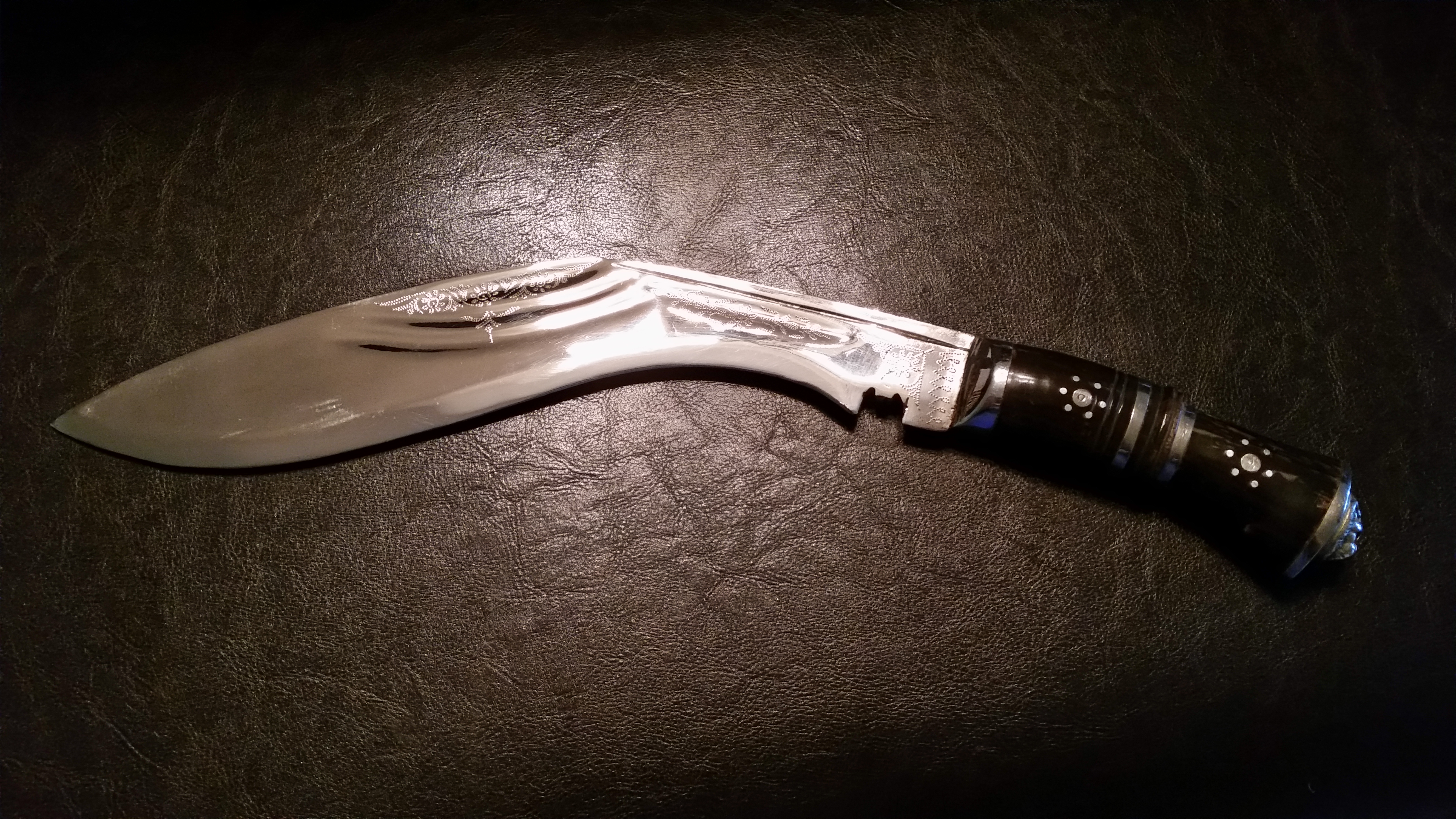
[[File:Polished kukri.jpg|thumb|right|250px|[[Kukri]] is a traditional Gorkha knife.]] | [[File:Polished kukri.jpg|thumb|right|250px|[[Kukri]] is a traditional Gorkha knife.]] | ||
'''Indian Gorkhas''' (''' | '''Indian Gorkhas''' (commonly known as '''Gorkha community''' or '''Gorkha''') are an Indian ethno-cultural group who speak [[Nepali language|Nepali]] as a common language. They inhabit mainly the states of [[Sikkim]], [[West Bengal]], [[Northeast India]] and [[Uttarakhand]], including their diaspora elsewhere in India and abroad. | ||
Indian Gorkhas are citizens of India as per the gazette notification of the [[Government of India]] on the issue of citizenship of the Gorkhas from India.<ref>{{Cite web|url=http://gorkhalandstate.blogspot.com/p/gazette-notification-on-issue-of.html|title=Gorkhaland: Gazette Notification on the Issue of Citizenship of Gorkhas|website=Gorkhaland|access-date=1 June 2018}}</ref> The [[Nepali language|Nepali]] language is included in the [[Eighth Schedule to the Constitution of India|eighth schedule of the Indian Constitution]].<ref>rajbhasha.gov.in/en/languages-included-eighth-schedule-indian-constitution</ref> However, the Indian Gorkhas are faced with a unique identity crisis with regard to their Indian citizenship because of the [[1950 Indo-Nepal Treaty of Peace and Friendship|Indo-Nepal Treaty of Peace and Friendship (1950)]] that permits "on a [[Reciprocity (international relations)|reciprocal basis]], the nationals of one country in the territories of the other the same privileges in the matter of residence, ownership of property, participation in trade and commerce, movement and other privileges of a similar nature". | Indian Gorkhas are citizens of India as per the gazette notification of the [[Government of India]] on the issue of citizenship of the Gorkhas from India.<ref>{{Cite web|url=http://gorkhalandstate.blogspot.com/p/gazette-notification-on-issue-of.html|title=Gorkhaland: Gazette Notification on the Issue of Citizenship of Gorkhas|website=Gorkhaland|access-date=1 June 2018|archive-date=8 January 2019|archive-url=https://web.archive.org/web/20190108100918/http://gorkhalandstate.blogspot.com/p/gazette-notification-on-issue-of.html|url-status=live}}</ref> The [[Nepali language|Nepali]] language is included in the [[Eighth Schedule to the Constitution of India|eighth schedule of the Indian Constitution]].<ref>{{cite web |title=Languages Included in the Eighth Schedule of the Indian Constitution |url=https://rajbhasha.gov.in/en/languages-included-eighth-schedule-indian-constitution |website=Department of Official Language - Ministry of Home Affairs - GoI |access-date=18 October 2024}}</ref> However, the Indian Gorkhas are faced with a unique identity crisis with regard to their Indian citizenship because of the [[1950 Indo-Nepal Treaty of Peace and Friendship|Indo-Nepal Treaty of Peace and Friendship (1950)]] that permits "on a [[Reciprocity (international relations)|reciprocal basis]], the nationals of one country in the territories of the other the same privileges in the matter of residence, ownership of property, participation in trade and commerce, movement and other privileges of a similar nature". | ||
==Ethnicities and castes== | ==Ethnicities and castes== | ||
The Gorkhali Parbatiya ethnic groups include the [[Khas people|Khas-Parbatiyas]] such as [[Bahun]] (hill Brahmins), [[Chhetri]] (hill Kastriyas), [[Thakuri]], [[Badi people|Badi]], [[Kami (caste)|Kami]], [[Damai]], [[Sarki (ethnic group)|Sarki]], [[Gandarbha]], [[Kumal people|Kumal]], etc. Other Tibeto-ethnic groups include [[Tamang people|Tamang]], [[Gurung people|Gurung]], [[Magars|Magar]],[[ Rai people| Rai]], [[Newar people|Newar]], [[Bhujel]] (Khawas), [[Sherpa people|Sherpa]] and [[Thami]].<ref>{{cite book|title=Gorkhas and Gorkhaland |year=2012 |publisher=Parbati Roy Foundation |location=Darjeeling, India |url=http://barunroy.com/the-librar/all-written-works/gorkhas-and-gorkhaland/|archive-url=https://archive.today/20130110164033/http://barunroy.com/the-librar/all-written-works/gorkhas-and-gorkhaland/ |url-status=dead |archive-date=10 January 2013 |author=Barun Roy }}</ref> | |||
==Population== | ==Population== | ||
As per the 2011 Census, a total of 2,926,168 people in India spoke [[Nepali language|Nepali]] as their mother tongue.<ref>{{cite web |title=ABSTRACT OF SPEAKERS' STRENGTH OF LANGUAGES AND MOTHER TONGUES | {| class="wikitable sortable" | ||
|+Nepali speakers in India by year<ref name="India-census">{{cite web |title=Growth of Scheduled Languages-1971, 1981, 1991 and 2001 |url=http://www.censusindia.gov.in/Census_Data_2001/Census_Data_Online/Language/Statement7.aspx |url-status=dead |archive-url=https://web.archive.org/web/20150220040137/http://www.censusindia.gov.in/Census_Data_2001/Census_Data_Online/Language/Statement7.aspx |archive-date=20 February 2015 |access-date=22 February 2015 |website=Census of India |publisher=Ministry of Home Affairs, Government of India}}</ref><ref>{{Cite web |date=2011 |title=Language – Census of India |url=https://censusindia.gov.in/nada/index.php/catalog/42458/download/46089/C-16_25062018.pdf |access-date=16 March 2023 |website=Census of India}}</ref> | |||
!Census | |||
!Nepali speakers | |||
!Growth | |||
|- | |||
|1971 | |||
|1,419,835 | |||
| — | |||
|- | |||
|1981 | |||
|1,360,636 | |||
|{{Down}} -4.17 | |||
|- | |||
|1991 | |||
|2,076,645 | |||
|{{Increase}}+52.62 | |||
|- | |||
|2001 | |||
|2,871,749 | |||
|{{Increase}}+38.29 | |||
|- | |||
|2011 | |||
|2,926,168 | |||
|{{Increase}}+1.89 | |||
|} | |||
As per the 2011 Census, a total of 2,926,168 people in India spoke [[Nepali language|Nepali]] as their mother tongue.<ref>{{cite web |title=ABSTRACT OF SPEAKERS' STRENGTH OF LANGUAGES AND MOTHER TONGUES – 2011 |url=http://censusindia.gov.in/2011Census/C-16_25062018_NEW.pdf |website=censusindia.gov.in |access-date=5 April 2020 |archive-date=14 November 2018 |archive-url=https://web.archive.org/web/20181114073412/http://www.censusindia.gov.in/2011Census/C-16_25062018_NEW.pdf |url-status=live }}</ref> The largest populations can be found in West Bengal – 1,155,375 (+12.97% from 2001 Census), Assam – 596,210 (+5.56%), Sikkim – 382,200 (+12.87%), Uttarakhand – 106,399 (+16.86%), Arunachal Pradesh – 95,317 (+00.42%), Himachal Pradesh – 89,508 (+27.37%), Maharashtra – 75,683 (+19.22%), Manipur – 63,756 (+38.61%), Meghalaya – 54,716 (+4.91%), Nagaland – 43,481 (+27.06%), and Mizoram – 8,994 (+0.51%).<ref>{{cite web |title=Distribution of the 22 Scheduled Languages – India/ States/ Union Territories-2011 Census |url=https://www.censusindia.gov.in/2011Census/Language-2011/Part-A.pdf |website=censusindia.gov.in |access-date=12 March 2022 |archive-date=14 March 2022 |archive-url=https://web.archive.org/web/20220314173034/https://censusindia.gov.in/2011Census/Language-2011/Part-A.pdf |url-status=live }}</ref> Apart from this, there are additional speakers of languages such as [[Limbu language|Limbu]] (40,835), [[Bantawa language|Rai]] (15,644), [[Sherpa language|Sherpa]] (16,012) and [[Tamang language|Tamang]] (20,154). So the combined strength of Nepali and the other four Gorkha languages comes to 3,018,813.<ref>{{cite web |title=Distribution of the 99 Non-Scheduled Languages- India/ States/ Union Territories-2011 Census |url=https://www.censusindia.gov.in/2011Census/Language-2011/Part-B.pdf |website=censusindia.gov.in |access-date=12 March 2022 |archive-date=16 February 2022 |archive-url=https://web.archive.org/web/20220216135401/https://censusindia.gov.in/2011census/Language-2011/Part-B.pdf |url-status=live }}</ref> | |||
As per the 2001 Census, a total of 2,871,749 people in India spoke Nepali as mother tongue | As per the 2001 Census, a total of 2,871,749 people in India spoke Nepali as their mother tongue. The largest populations were in West Bengal – 1,022,725 (+18.87% from 1991 Census), Assam – 564,790 (+30.58%), Sikkim – 338,606 (+32.05%), Uttarakhand – 355,029 (+255.53%), Arunachal Pradesh – 94,919 (+16.93%), Himachal Pradesh – 70,272 (+50.64%), Maharashtra – 63,480 (+59.69%), Meghalaya – 52,155 (+6.04%), Manipur – 45,998 (−1.08%), Nagaland – 34,222 (+6.04%), and Mizoram – 8,948 (+8.50%). As per the 1991 Census, the number of Nepali speakers in India was 2,076,645. | ||
===Arunachal Pradesh=== | ===Arunachal Pradesh=== | ||
As per the | As per the 2011 Census, districts with the largest [[Nepal]]i populations are [[West Kameng district|West Kameng]] – 14,333 (17.1% of the total population) Lohit – 22,988 (13.77%), and Dibang Valley – 14,271 (22.99%). Tehsils with the largest proportion of Nepalis are Koronu (48.49%), Kibithoo (6.5%), Sunpura (34.47%), Vijoynagar (41.8%), and Roing (26.0%). | ||
As per the | As per the 2001 Census, districts with the largest Nepali populations are [[Kameng district|West Kameng]] – 13,580 (18.2% of the total population) [[Lohit district|Lohit]] – 22,200 (15.77%), and [[Dibang Valley district|Dibang Valley]] – 15,452 (26.77%). Tehsils with the largest proportion of Nepalis are Koronu (55.35%), Kibithoo (50.68%), Sunpura (42.28%), Vijoynagar (42.13%), and Roing (32.39%). | ||
===Assam=== | ===Assam=== | ||
As per the 2011 Census, districts with the largest ethnic Nepali populations are Sonitpur – 135,525 (7.04% of the total population) Tinsukia – 99,812 (7.52%), and Karbi Anglong – 51,496 (5.38%). Tehsils with the largest proportion of Nepalis are Sadiya (26.2%), Na Duar (14.88%), Helem (14.35%), Margherita (13.47%), and Umrangso (12.46%). | |||
As per the 2001 Census, districts with the largest ethnic Nepali populations are Sonitpur | As per the 2001 Census, districts with the largest ethnic Nepali populations are Sonitpur – 131,261 (7.81% of the total population) Tinsukia – 87,850 (7.64%), and Karbi Anglong – 46,871 (5.76%). Tehsils with the largest proportion of Nepalis are Sadiya (27.51%), Na Duar (16.39%), Helem (15.43%), Margherita (13.10%), and Umrangso (12.37%). | ||
During the 1991 Census, the districts with the largest concentrations were [[Sonitpur district|Sonitpur]] – 91,631 (6.43%), [[Tinsukia district|Tinsukia]] – 76,083 (7.91%), and [[Karbi Anglong district|Karbi Anglong]] – 37,710 (5.69%).<ref>{{cite journal |title=Thesis |journal=Shodganga |url=https://shodhganga.inflibnet.ac.in:8443/jspui/pdfToThesis.jsp?toHandle=https://shodhganga.inflibnet.ac.in/handle/10603/43386&toFile=https://shodhganga.inflibnet.ac.in/bitstream/10603/43386/8/08_chapter%202.pdf |access-date=6 July 2022 |archive-date=8 August 2021 |archive-url=https://web.archive.org/web/20210808011236/https://shodhganga.inflibnet.ac.in:8443/jspui/pdfToThesis.jsp?toHandle=https%3A%2F%2Fshodhganga.inflibnet.ac.in%2Fhandle%2F10603%2F43386&toFile=https%3A%2F%2Fshodhganga.inflibnet.ac.in%2Fbitstream%2F10603%2F43386%2F8%2F08_chapter%202.pdf |url-status=live }}</ref> | |||
===Manipur=== | ===Manipur=== | ||
As per the 2011 census, Tehsils with the largest proportion of Nepali people are Sadar Hills West (33.0%), Saitu-Gamphazol (9.54%), and [[Lamshang]] (10.85%). Districts with the largest Nepali population are Senapati | As per the 2011 census, Tehsils with the largest proportion of Nepali people are Sadar Hills West (33.0%), Saitu-Gamphazol (9.54%), and [[Lamshang]] (10.85%). Districts with the largest Nepali population are Senapati – 39,039 (8.15%), Imphal West – 10,391 (2.01%) and Imphal East – 6,903 (1.51%). | ||
This is how the previous censuses counted the number of Nepali speakers in Manipur: | This is how the previous censuses counted the number of Nepali speakers in Manipur: | ||
| Line 54: | Line 81: | ||
Among the cities, the highest concentration of Nepali speakers can be found in [[Shillong Cantonment]] (29.98%), [[Shillong]] (9.83%), [[Pynthorumkhrah]] (7.02%), [[Nongmynsong]] (26.67%), [[Madanrting]] (17.83%), and Nongkseh (14.20%). | Among the cities, the highest concentration of Nepali speakers can be found in [[Shillong Cantonment]] (29.98%), [[Shillong]] (9.83%), [[Pynthorumkhrah]] (7.02%), [[Nongmynsong]] (26.67%), [[Madanrting]] (17.83%), and Nongkseh (14.20%). | ||
This is how the previous censuses counted the number of Nepali speakers in Meghalaya:<ref>{{cite journal |title=Economy, Ethnicity and Migration in Mehahalaya | | This is how the previous censuses counted the number of Nepali speakers in Meghalaya:<ref>{{cite journal |title=Economy, Ethnicity and Migration in Mehahalaya |website=amanpanchayat.org |url=http://amanpanchayat.org/wp-content/uploads/2018/01/PEI_meghalaya.pdf |access-date=12 March 2022 |archive-date=8 August 2021 |archive-url=https://web.archive.org/web/20210808010350/http://amanpanchayat.org/wp-content/uploads/2018/01/PEI_meghalaya.pdf |url-status=live }}</ref> | ||
* 1961: 32,288 | * 1961: 32,288 | ||
* 1971: 44,445 | * 1971: 44,445 | ||
| Line 63: | Line 90: | ||
===Mizoram=== | ===Mizoram=== | ||
As per the 2011 Census, there are a total of 9,035 Gorkhas in Mizoram. Of this, 5,944 are concentrated in Tlangnuam Tehsil of Aizawl district, where they form 1.9% of the population. The Central Gorkha Mandir Committee operates a total of 13 Hindu temples in Mizoram and these are the only Hindu places of worship in the state.<ref>{{Cite news | url=https://www.thehindu.com/news/national/other-states/temples-inspired-by-churches-in-mizoram/article25532044.ece | title=Temples inspired by churches in Mizoram| newspaper=The Hindu| date=18 November 2018| last1=Karmakar| first1=Rahul}}</ref> | As per the 2011 Census, there are a total of 9,035 Gorkhas in Mizoram. Of this, 65% or 5,944 are concentrated in Tlangnuam Tehsil of Aizawl district, where they form 1.9% of the population. The Central Gorkha Mandir Committee operates a total of 13 Hindu temples in Mizoram and these are the only Hindu places of worship in the state.<ref>{{Cite news| url=https://www.thehindu.com/news/national/other-states/temples-inspired-by-churches-in-mizoram/article25532044.ece| title=Temples inspired by churches in Mizoram| newspaper=The Hindu| date=18 November 2018| last1=Karmakar| first1=Rahul| access-date=4 February 2019| archive-date=24 February 2020| archive-url=https://web.archive.org/web/20200224171812/https://www.thehindu.com/news/national/other-states/temples-inspired-by-churches-in-mizoram/article25532044.ece| url-status=live}}</ref> | ||
===Nagaland=== | ===Nagaland=== | ||
Most of the Nepali speaking population are found in the districts of [[Dimapur District|Dimapur]] (21,596 or 5.70%) and [[Kohima District|Kohima]] (9,812 or 3.66%). Tehsils with the largest concentration are Naginimora (7.48%), Merangmen (6.78%), Niuland (6.48%), Kuhoboto (7.04%), Chümoukedima (7.07%), Dhansiripar (6.09%), Medziphema (9.11%), Namsang (8.81%), Kohima Sadar (6.27%), Sechü-Zubza (5.03%), and Pedi (7.61%). | Most of the Nepali speaking population are found in the districts of [[Dimapur District|Dimapur]] (21,596 or 5.70%) and [[Kohima District|Kohima]] (9,812 or 3.66%). Tehsils with the largest concentration are [[Naginimora]] (7.48%), Merangmen (6.78%), [[Niuland]] (6.48%), Kuhoboto (7.04%), Chümoukedima (7.07%), Dhansiripar (6.09%), Medziphema (9.11%), Namsang (8.81%), Kohima Sadar (6.27%), Sechü-Zubza (5.03%), and Pedi (7.61%). | ||
===Sikkim=== | ===Sikkim=== | ||
The state of [[Sikkim]] is the only state in India with a majority ethnic Nepali population.<ref>{{cite web |title=ADBU Location |url=https://dbuniversity.ac.in/location/sikkim.html |website=dbuniversity.ac.in |access-date=30 April 2022}}</ref> The Sikkim census of 2011 found that Sikkim was the least populated state of India. Sikkim's population according to the 2011 Census was 610,577, and has grown by approximately 100,000 since the last census.<ref>{{Cite web|url=http://sikenvis.nic.in/Database/Demography_779.aspx|title=Demography|website=sikenvis.nic.in}}</ref> The Nepali/Gorkhali language is the lingua franca of Sikkim, while Tibetan (Bhutia) and [[Lepcha language|Lepcha]] are spoken in certain areas.<ref>{{cite news |title=Know all about the beautiful Mini Sikkim: Another beautiful gem in the seven sisters region |url=https://www.indiatoday.in | The state of [[Sikkim]] is the only state in India with a majority ethnic Nepali population.<ref>{{cite web |title=ADBU Location |url=https://dbuniversity.ac.in/location/sikkim.html |website=dbuniversity.ac.in |access-date=30 April 2022 |archive-date=7 March 2022 |archive-url=https://web.archive.org/web/20220307205017/https://www.dbuniversity.ac.in/location/sikkim.html |url-status=live }}</ref> The Sikkim census of 2011 found that Sikkim was the least populated state of India. Sikkim's population according to the 2011 Census was 610,577, and has grown by approximately 100,000 since the last census.<ref>{{Cite web|url=http://sikenvis.nic.in/Database/Demography_779.aspx|title=Demography|website=sikenvis.nic.in|access-date=12 July 2020|archive-date=6 July 2020|archive-url=https://web.archive.org/web/20200706140434/http://sikenvis.nic.in/Database/Demography_779.aspx|url-status=live}}</ref> The Nepali/Gorkhali language is the lingua franca of Sikkim, while Tibetan (Bhutia) and [[Lepcha language|Lepcha]] are spoken in certain areas.<ref>{{cite news |title=Know all about the beautiful Mini Sikkim: Another beautiful gem in the seven sisters region |url=https://www.indiatoday.in/education-today/gk-current-affairs/story/mini-sikkim-in-making-308081-2016-02-10 |access-date=30 April 2022 |work=India Today |date=10 February 2016 |language=en |archive-date=30 April 2022 |archive-url=https://web.archive.org/web/20220430100346/https://www.indiatoday.in/amp/education-today/gk-current-affairs/story/mini-sikkim-in-making-308081-2016-02-10 |url-status=live }}</ref><ref>{{cite news |title=Watch {{!}} Sikkim: Simultaneous Elections and the Battle Over the 17th Karmapa |url=https://thewire.in/politics/watch-sikkim-simultaneous-elections-and-the-battle-over-the-17th-karmapa |access-date=30 April 2022 |work=The Wire |date=8 April 2019 |archive-date=30 April 2022 |archive-url=https://web.archive.org/web/20220430100346/https://thewire.in/politics/watch-sikkim-simultaneous-elections-and-the-battle-over-the-17th-karmapa |url-status=live }}</ref> As per the 2011 Census, there were a total of 453,819 speakers of various Tibetan languages (Nepali – 382,200, [[Limbu language|Limbu]] – 38,733, [[Sherpa language|Sherpa]] – 13,681, [[Tamang language|Tamang]] – 11,734 and [[Rai languages|Rai]] – 7,471). Out of this, 20.14% (91,399) were Tibetan Limbu/Tamang, 6.23% (28,275) were Dalit and 73.63% including Manger are in General category. | ||
According to the census, there are a total of 53,703 Limbu and 37,696 Tamang in Sikkim, of whom a majority speak the [[Nepali language]] as their mother tongue. Also, small numbers of Bhotia and Lepcha also speak the Nepali language as their mother tongue. As per the 2011 Census, there were a total of 69,598 Bhotia in Sikkim (including Sherpa, Tamang, Gurung and Tibetan. etc), but only 58,355 were speaking languages such as Sikkimese and Sherpa. Out of the 42,909 Lepcha there were only 38,313 speakers for the Lepcha language. | According to the census, there are a total of 53,703 Limbu and 37,696 Tamang in Sikkim, of whom a majority speak the [[Nepali language]] as their mother tongue. Also, small numbers of Bhotia and Lepcha also speak the Nepali language as their mother tongue. As per the 2011 Census, there were a total of 69,598 Bhotia in Sikkim (including Sherpa, Tamang, Gurung and Tibetan. etc), but only 58,355 were speaking languages such as Sikkimese and Sherpa. Out of the 42,909 Lepcha there were only 38,313 speakers for the Lepcha language. | ||
===Uttarakhand=== | ===Uttarakhand=== | ||
As per the 2011 census, the total number of Nepali language speakers is 106,399, constituting 1.1% of the total population of the state.<ref>{{cite web |title=C-16 Population By Mother Tongue |url=https://censusindia.gov.in/2011census/C-16/DDW-C16-STMT-MDDS-0500.XLSX |website=censusindia.gov.in |access-date=17 April 2021}}</ref> | As per the 2011 census, the total number of Nepali language speakers is 106,399, constituting 1.1% of the total population of the state.<ref>{{cite web |title=C-16 Population By Mother Tongue |url=https://censusindia.gov.in/2011census/C-16/DDW-C16-STMT-MDDS-0500.XLSX |website=censusindia.gov.in |access-date=17 April 2021 |archive-date=3 November 2020 |archive-url=https://web.archive.org/web/20201103111604/https://censusindia.gov.in/2011census/C-16/DDW-C16-STMT-MDDS-0500.XLSX |url-status=live }}</ref> | ||
===West Bengal=== | ===West Bengal=== | ||
As per the 2001 Census, there are a total of 1,034,038 ethnic | As per the 2001 Census, there are a total of 1,034,038 ethnic Gorkhas in [[West Bengal]], of which 1,022,725 are speakers of the Nepali language and 11,313 are speakers of languages such as Tamang and Sherpa. The population in the [[Darjeeling]] and [[Kalimpong]] districts are 748,023 (46.48% of the total population) and [[Jalpaiguri district|Jalpaiguri]] – 234,500 (6.99%). Most of the ethnic Nepali population in West Bengal live in the [[Gorkhaland Territorial Administration]] region.<ref>{{cite news |last1=Mitra |first1=Arnab |title=Tracing the history of Gorkhaland movement: Another crisis triggered by language |url=https://indianexpress.com/article/research/mamata-banerjee-darjeeling-violence-tracing-the-history-of-gorkhaland-movement-another-crisis-triggered-by-language-4698528/lite/ |access-date=30 April 2022 |work=The Indian Express |date=13 April 2021 |language=en |archive-date=30 April 2022 |archive-url=https://web.archive.org/web/20220430100346/https://indianexpress.com/article/research/mamata-banerjee-darjeeling-violence-tracing-the-history-of-gorkhaland-movement-another-crisis-triggered-by-language-4698528/lite/ |url-status=live }}</ref> About 7.56% of the Nepalis were Dalit, belonging to castes such as Kami and Sarki (population of 78,202 in 2001). The two tribes classified as Scheduled Tribe (Limbu and Tamang) constituted 16% of the Nepali population according to the census. The remaining 76% belonged to general category.{{citation needed|date=August 2020}} | ||
As per the 2011 Census, there were a total of 1,161,807 speakers of various Nepalese languages. Out of this 7.24% was Dalit (84,110) and 16.62% (193,050) were tribal Tamang/Limbu. Remaining 76.14% were General category.{{citation needed|date=August 2020}} | As per the 2011 Census, there were a total of 1,161,807 speakers of various Nepalese languages. Out of this 7.24% was Dalit (84,110) and 16.62% (193,050) were tribal Tamang/Limbu. Remaining 76.14% were General category.{{citation needed|date=August 2020}} | ||
===Forced displacement=== | ===Forced displacement=== | ||
Nepali-speaking people in the states of [[Northeast India]] have faced violence and [[ethnic cleansing]]. In 1967, more than 8,000 Nepali-speaking people were driven out of Mizoram, while more than 2,000 in Manipur met with the same fate in 1980. Tens of thousands of Nepali-speaking people were banished from Assam (in 1979) and Meghalaya (in 1987) by militant groups.<ref>{{Cite book|url = https://books.google.com/books?id=58WkvXaaPbEC&pg=PA234|title = The Materiality of Politics: The technologies of rule|isbn = 9781843312512|last1 = Samāddāra|first1 = Raṇabīra|year = 2007| publisher=Anthem Press |access-date = 16 August 2019|archive-date = 26 February 2020|archive-url = https://web.archive.org/web/20200226050000/https://books.google.com/books?id=58WkvXaaPbEC&pg=PA234|url-status = live}}</ref> | |||
==Notable | The biggest displacement occurred in Meghalaya, when the [[Khasi Students Union]] (KSU) targeted Nepali speakers living in the eastern part of the state. More than 15,000 Nepali speakers were driven out, while about 10,000 were reduced to living in subhuman life in the refugee camps of Shillong.<ref>{{Cite web | url=https://www.indiatoday.in/magazine/indiascope/story/19880215-nepalis-in-meghalaya-face-tribal-wrath-amid-official-apathy-796950-1988-02-15 | title=Nepalis in Meghalaya face tribal wrath amid official apathy | date=15 February 1988 | access-date=4 September 2018 | archive-date=4 September 2018 | archive-url=https://web.archive.org/web/20180904192149/https://www.indiatoday.in/magazine/indiascope/story/19880215-nepalis-in-meghalaya-face-tribal-wrath-amid-official-apathy-796950-1988-02-15 | url-status=live }}</ref> Gorkha labourers in the coal mines in [[Jowai]] were targeted, and as a result of their murders dozens of Gorkha children starved to death in the next few weeks.<ref name=nath/> In 2010, there were riots between Khasis and Gorkhas, which left several Gorkhas dead. One elderly Gorkha man was burnt alive.<ref>{{Cite web|url = https://blog.com.np/2010/06/08/khasi-nepali-ethnic-conflict-in-meghalaya-india/|title = Khasi Nepali Ethnic Conflict in Meghalaya, India|date = 8 June 2010|access-date = 4 September 2018|archive-date = 4 September 2018|archive-url = https://web.archive.org/web/20180904192255/https://blog.com.np/2010/06/08/khasi-nepali-ethnic-conflict-in-meghalaya-india/|url-status = live}}</ref><ref>{{cite web|title=Meghalaya rejects reports of violence against Nepalese|date=15 September 2010 |url=https://assamtribune.com/meghalaya-rejects-reports-of-violence-against-nepalese|publisher=The Assam Tribune|access-date=29 August 2022}}</ref> | ||
[[File:Navneet-Aditya-Waiba-Live.jpg|thumb| | |||
In 1980s, most of the Gorkha in Nagaland were forced to forfeit their land, and 200 of them were murdered near [[Merapani]] in [[Wokha district]].<ref name="nath">{{cite web|author=L. Nath|title=Migrants in flight: Conflict-induced induced displacement of Nepalis in Northeast India |url=http://www.dspace.cam.ac.uk/handle/1810/229203|publisher=[[University of Cambridge]]|access-date=7 March 2023|format=Occasional Paper |date=January 2005}}</ref> | |||
==Politics== | |||
{{Main|Gorkhaland movement}} | |||
The Gorkhaland movement is a campaign to create a separate state of India in the Gorkhaland region of West Bengal for the Nepali speaking Indians. The proposed state includes the hill regions of the Darjeeling district, Kalimpong district and Dooars regions that include Jalpaiguri, Alipurduar and parts of Coochbehar districts. A demand for a separate administrative unit in Darjeeling has existed since 1909, when the Hillmen's Association of Darjeeling submitted a memorandum to Minto-Morley Reforms demanding a separate administrative setup.<ref>{{cite web|url=http://www.darjeelingtimes.com/opinions/political/1810-the-parliament-is-the-supreme-and-ultimate-authority-of-india.html |title=The Parliament is the supreme and ultimate authority of India |work=Darjeeling Times |date=23 November 2010 |access-date=20 March 2012 |url-status=dead |archive-url=https://web.archive.org/web/20131101132713/http://www.darjeelingtimes.com/opinions/political/1810-the-parliament-is-the-supreme-and-ultimate-authority-of-india.html |archive-date=1 November 2013 }}</ref> | |||
===Darjeeling Gorkha Hill Council=== | |||
{{Main|Darjeeling Gorkha Hill Council}} | |||
Darjeeling Gorkha Hill Council (DGHC) (1988–2012), also once known for a short period of time as Darjeeling Gorkha Autonomous Hill Council was a semi-autonomous body that looked after the administration of the hills of Darjeeling District in the state of [[West Bengal]], India. DGHC had three subdivisions under its authority: Darjeeling, Kalimpong, and Kurseong and some areas of Siliguri subdivision. | |||
Led by [[Subhash Ghisingh]], Gorkhas raised the demand for the creation of a state called Gorkhaland within India to be carved out of the hills of Darjeeling and areas of Dooars and Siliguri terai contiguous to Darjeeling. A violent agitation erupted in the Darjeeling hills from 1986 to 1988 in which 1200 people lost their lives. | |||
The semi-autonomous Darjeeling Gorkha Hill Council was the result of the signing of the Darjeeling Gorkha Hill Council Agreement between the Central Government of India, the West Bengal Government and the Gorkha National Liberation Front in Kolkata on 22 August 1988. | |||
===Gorkhaland Territorial Administration=== | |||
{{Main|Gorkhaland Territorial Administration}} | |||
The DGHC did not fulfill its goal of forming a new state, which led to the downfall of Subhash Ghisingh and the rise of another party Gorkha Janmukti Morcha (GJM) headed by [[Bimal Gurung]] in 2007, which launched a second agitation for a Gorkhaland state. | |||
After three years of agitation for a state of Gorkhaland led by GJM, the GJM reached an agreement with the state government to form a semi-autonomous body to administer the Darjeeling hills. | |||
The Memorandum of Agreement for Gorkhaland Territorial Administration(GTA) was signed on 18 July 2011 at Pintail Village near Siliguri in the presence of Union Home Minister P. Chidambaram, West Bengal chief minister Mamata Banerjee, the then Darjeeling Lok Sabha MP Jaswant Singh and Gorkha Janmukti Morcha leaders. The agreement was signed by West Bengal Home Secretary G.D. Gautama, Union Home Ministry Joint Secretary K.K. Pathak and Gorkha Janmukti Morcha general secretary Roshan Giri. | |||
==Notable people== | |||
[[File:Navneet-Aditya-Waiba-Live.jpg|thumb|upright|[[Navneet Aditya Waiba]], folk singer]] | |||
[[File:The President, Shri Ram Nath Kovind presenting the Major Dhyan Chand Khel Ratna Award, 2021 to Shri Sunil Chhetri for Football, at Rashtrapati Bhavan, in New Delhi on 13 November 2021 (cropped).jpg|thumb|upright|[[Sunil Chhetri]], all time scorer for the [[India national football team|Indian national team]], in 2021]] | |||
===Actors=== | ===Actors=== | ||
<!---♦♦♦ Only add a person to this list if they already have their OWN article on the English Wikipedia ♦♦♦---> | |||
<!---♦♦♦ Please keep the list in alphabetical order by LAST NAME ♦♦♦---> | |||
{{div col|colwidth=30em}} | {{div col|colwidth=30em}} | ||
* [[Ganesh (actor)|Ganesh]] | * [[Rewati Chetri]] – Model and actress | ||
* [[Bharti Singh]] | * [[Ganesh (actor)|Ganesh]] – [[Kannada]] film actor<ref>{{cite news |last1=Lulla |first1=Anil Budur |title=Gurkha Ganesh blazes new trail |url=https://www.telegraphindia.com/india/gurkha-ganesh-blazes-new-trail/cid/700838 |access-date=28 January 2020 |work=www.telegraphindia.com |date=17 June 2007 |language=en |archive-date=28 January 2020 |archive-url=https://web.archive.org/web/20200128165239/https://www.telegraphindia.com/india/gurkha-ganesh-blazes-new-trail/cid/700838 |url-status=live }}</ref> | ||
* [[ | * [[Bharti Singh]] – Comedian | ||
* [[Niruta Singh]] – Actress in Nepali cinema | |||
* [[Mala Sinha]] – Indian actress in Hindi and Bengali cinemas | * [[Mala Sinha]] – Indian actress in Hindi and Bengali cinemas | ||
* [[Pratibha Sinha]] – Bollywood Indian actress (daughter of actress [[Mala Sinha]] and Nepali actor C.P. Lohani) | * [[Pratibha Sinha]] – Bollywood Indian actress (daughter of actress [[Mala Sinha]] and Nepali actor C.P. Lohani) | ||
* [[ | * [[Geetanjali Thapa]] – [[Bollywood]] actress ([[National Film Award for Best Actress]] recipient 2013) | ||
{{div col end}} | {{div col end}} | ||
===Cinematographers=== | ===Cinematographers=== | ||
<!---♦♦♦ Only add a person to this list if they already have their OWN article on the English Wikipedia ♦♦♦---> | |||
<!---♦♦♦ Please keep the list in alphabetical order by LAST NAME ♦♦♦---> | |||
{{div col|colwidth=30em}} | {{div col|colwidth=30em}} | ||
*[[Binod Pradhan]] | *[[Binod Pradhan]] | ||
| Line 105: | Line 159: | ||
===Military=== | ===Military=== | ||
<!---♦♦♦ Only add a person to this list if they already have their OWN article on the English Wikipedia ♦♦♦---> | |||
<!---♦♦♦ Please keep the list in alphabetical order by LAST NAME ♦♦♦---> | |||
{{div col|colwidth=30em}} | {{div col|colwidth=30em}} | ||
* [[Major]] [[Durga Malla]] – [[Indian freedom fighter]] | * Subedar Major [[Ganju Lama]] – [[Victoria Cross]] recipient | ||
* [[Captain]] [[Ram Singh Thakuri]] – Indian freedom fighter who composed a number of patriotic songs including ''[[ | * [[Major (rank)|Major]] [[Durga Malla]] – [[Indian freedom fighter]] | ||
* [[Trilochan Pokhrel]] – Indian freedom fighter | |||
* [[Colonel]] [[Lalit Rai]] – [[Vir Chakra]] recipient for his actions in the [[Kargil War]] in 1999. | |||
* [[Captain]] [[Ram Singh Thakuri]] – Indian freedom fighter who composed a number of patriotic songs including ''[[Qadam Qadam Badhaye Ja]]'' | |||
* [[Lieutenant-Colonel]] [[Dhan Singh Thapa]] – [[Param Vir Chakra]] recipient | * [[Lieutenant-Colonel]] [[Dhan Singh Thapa]] – [[Param Vir Chakra]] recipient | ||
* [[Brigadier]] [[Sher Jung Thapa]] (Hero of Skardu) | * [[Brigadier]] [[Sher Jung Thapa]] (Hero of Skardu) – [[Mahavir Chakra]] recipient for his actions in the [[Indo-Pakistani War of 1947]] | ||
{{div col end}} | {{div col end}} | ||
===Musicians=== | ===Musicians=== | ||
<!---♦♦♦ Only add a person to this list if they already have their OWN article on the English Wikipedia ♦♦♦---> | |||
<!---♦♦♦ Please keep the list in alphabetical order by LAST NAME ♦♦♦---> | |||
{{div col|colwidth=30em}} | {{div col|colwidth=30em}} | ||
* [[Louis Banks]] | * [[Louis Banks]] – jazz musician | ||
* [[Bipul Chettri]] | * [[Bipul Chettri]] – singer, composer | ||
* [[Ranjit Gazmer]] | * [[Ranjit Gazmer]] – Bollywood film musician | ||
* [[Sukmit Gurung]] | * [[Amber Gurung]] – Composer, singer, lyricist. Composer of national anthem of Nepal | ||
* [[Aruna Lama]] | * [[Sukmit Gurung]] – singer | ||
* [[ | * [[Aruna Lama]] – Nepali singer from [[Darjeeling]] | ||
* [[Adrian Pradhan]] | * [[Kunti Moktan]] – Nepali playback singer from [[Darjeeling]] | ||
* [[Sonam Sherpa]] | * [[Adrian Pradhan]] – singer, songwriter, guitarist. Former [[1974 AD]] member of Nepal | ||
* [[Sushma Shrestha|Poornima Shrestha]] | * [[Sonam Sherpa]] – lead guitarist of Parikrama band | ||
* [[Phiroj Shyangden (Nepali Musician)|Phiroj Shyangden]] | * [[Sushma Shrestha|Poornima Shrestha]] – Bollywood playback singer | ||
* [[Prashant Tamang]] | * [[Phiroj Shyangden (Nepali Musician)|Phiroj Shyangden]] – singer, songwriter, guitarist. Former founding member of [[1974 AD]] band of [[Nepal]] | ||
* [[Shanti Thatal]] | * [[Prashant Tamang]] – singer, actor, winner of [[Indian Idol]] Season 3 | ||
* [[Hira Devi Waiba]] | * [[Shanti Thatal]] – composer, singer, producer | ||
* [[Navneet Aditya Waiba]] | * [[Hira Devi Waiba]] – pioneer of Nepali folk songs, singer | ||
* [[Gopal Yonzon]] | * [[Navneet Aditya Waiba]] – folk singer | ||
* [[Karma Yonzon]] | * [[Gopal Yonzon]] – singer, musician, playwright | ||
* [[Karma Yonzon]] – composer, singer, producer | |||
{{div col end}} | {{div col end}} | ||
===Sports=== | ===Sports=== | ||
====Athletics==== | <!---♦♦♦ Only add a person to this list if they already have their OWN article on the English Wikipedia ♦♦♦---> | ||
<!---♦♦♦ Please keep the list in alphabetical order by LAST NAME ♦♦♦---> | |||
====Athletics==== | |||
{{div col|colwidth=30em}} | {{div col|colwidth=30em}} | ||
* [[Basanta Bahadur Rana]] | * [[Basanta Bahadur Rana]] – [[Racewalker]] | ||
{{div col end}} | {{div col end}} | ||
====Archery==== | ====Archery==== | ||
{{div col|colwidth=30em}} | {{div col|colwidth=30em}} | ||
* [[Tarundeep Rai]] | * [[Tarundeep Rai]] – [[Archer]], [[Asian Games]] 2011 silver medalist, [[Arjuna Award]] recipient 2005, [[Padma Shri]] recipient 2020 | ||
{{div col end}} | {{div col end}} | ||
====Boxing==== | ====Boxing==== | ||
{{div col|colwidth=30em}} | {{div col|colwidth=30em}} | ||
* [[Birender Singh Thapa]] | * [[Birender Singh Thapa]] – Boxer | ||
* [[Shiva Thapa]] | * [[Debendra Thapa]] – Boxer | ||
* [[Shiva Thapa]] – Boxer (youngest Indian boxer to qualify for the Olympic Games) | |||
{{div col end}} | {{div col end}} | ||
====Cricket==== | ====Cricket==== | ||
{{div col|colwidth=30em}} | {{div col|colwidth=30em}} | ||
* [[Jay Bista]] | * [[Jay Bista]] – Cricketer | ||
* [[Gokul Sharma]] | * [[Gokul Sharma]] – Captain of [[Assam cricket team]] | ||
* [[ | * [[Uma Chetry]] - Cricketer | ||
{{div col end}} | {{div col end}} | ||
====Football==== | ====Football==== | ||
{{div col|colwidth=30em}} | {{div col|colwidth=30em}} | ||
* [[Ajay Chhetri]] | * [[Ajay Chhetri]] – footballer | ||
* [[Amar Bahadur Gurung]] | * [[Amar Bahadur Gurung]] – footballer | ||
* [[Anirudh Thapa]] | * [[Anirudh Thapa]] – footballer | ||
* [[Anju Tamang]] | * [[Anju Tamang]] – women's footballer | ||
* [[ | * [[Anjana Thapa]] – women's footballer | ||
* [[Bijendra Rai]] | * [[Asish Rai]] – footballer | ||
* [[Bikash Jairu]] | * [[Ayush Chhetri]] – footballer | ||
* [[Chandan Singh Rawat]] | * [[Bijay Chhetri]] – footballer | ||
* [[ | * [[Bijendra Rai]] – footballer | ||
* [[ | * [[Bikash Jairu]] – footballer | ||
* [[Komal Thatal]] | * [[Chandan Singh Rawat]] – footballer | ||
* [[Lalit Thapa]] | * [[Crispin Chettri]] – football manager and footballer | ||
* [[Israil Gurung]] – footballer | |||
* [[Nagen Tamang]] | * [[Komal Thatal]] – footballer | ||
* [[Narender Thapa]] | * [[Lalit Thapa]] – footballer | ||
* [[Nim Dorjee Tamang]] | * [[Nagen Tamang]] – footballer | ||
* [[Narender Thapa]] – footballer | |||
* [[Nim Dorjee Tamang]] – footballer | |||
* [[Nirmal Chettri]] – footballer | * [[Nirmal Chettri]] – footballer | ||
* [[Pinky Bompal Magar]] | * [[Pinky Bompal Magar]] – women's footballer | ||
* [[Puran Bahadur Thapa]] | * [[Puran Bahadur Thapa]] – footballer | ||
* [[Ram Bahadur Chettri]] | * [[Ram Bahadur Chettri]] – footballer | ||
* [[Robin Gurung]] | * [[Robin Gurung]] – footballer | ||
* [[ | * [[Simran Gurung]] – women's footballer | ||
* [[Shyam Thapa]] | * [[Sanju Pradhan]] – footballer | ||
* [[Shyam Thapa]] – footballer | |||
* [[Sunil Chhetri]] – captain of the [[India national football team]] and [[Bengaluru FC]]. Recipient of [[Arjuna Award]] (2011) and [[Padma Shri]] (2019) | * [[Sunil Chhetri]] – captain of the [[India national football team]] and [[Bengaluru FC]]. Recipient of [[Arjuna Award]] (2011) and [[Padma Shri]] (2019) | ||
* [[Uttam Rai]] | * [[Sushmita Lepcha]] – women's footballer | ||
* [[Vinit Rai]] | * [[Uttam Rai]] – footballer | ||
* [[Vinit Rai]] – footballer | |||
{{div col end}} | {{div col end}} | ||
| Line 197: | Line 261: | ||
* [[Bir Bahadur Chettri]] – Hockey player | * [[Bir Bahadur Chettri]] – Hockey player | ||
* [[Chaman Singh Gurung]] – Hockey player | * [[Chaman Singh Gurung]] – Hockey player | ||
* [[Krishan Bahadur Pathak]] – Hockey player | |||
{{div col end}} | {{div col end}} | ||
====Shooting==== | ====Shooting==== | ||
{{div col|colwidth=30em}} | {{div col|colwidth=30em}} | ||
* [[Jitu Rai]] | * [[Jitu Rai]] – Shooter, recipient of [[Arjuna Award]] (2015), [[Khel Ratna]] (2016) and [[Padma Shri]] (2020). | ||
* [[Pemba Tamang]] - | * [[Pemba Tamang]] – Shooter | ||
{{div col end}} | |||
====Skiing==== | |||
{{div col|colwidth=30em}} | |||
* [[Kishor Rahtna Rai]] – Alpine skier | |||
* [[Gupta Bahadur|Gupta Bahadur Gurung]] – Cross-country skier | |||
{{div col end}} | {{div col end}} | ||
===Writers=== | ===Writers=== | ||
<!---♦♦♦ Only add a person to this list if they already have their OWN article on the English Wikipedia ♦♦♦---> | |||
<!---♦♦♦ Please keep the list in alphabetical order by LAST NAME ♦♦♦---> | |||
{{div col|colwidth=30em}} | {{div col|colwidth=30em}} | ||
* [[Indra Bahadur Rai]] – [[Nepali language|Nepali]] writer and literary critic from [[Darjeeling]], [[India]]. | * [[Indra Bahadur Rai]] – [[Nepali language|Nepali]] writer and literary critic from [[Darjeeling]], [[India]]. | ||
* [[Hari Prasad Gorkha Rai]] | * [[Hari Prasad Gorkha Rai]] | ||
* [[Kedar Gurung]] | |||
* [[Kumar Pradhan]] | * [[Kumar Pradhan]] | ||
* [[Lil Bahadur Chettri]] | * [[Lil Bahadur Chettri]] – [[Padma Shri]] award recipient (2020) for his contribution towards Nepali literature. | ||
* [[Peter J. Karthak]] - Writer, musician, journalist. | |||
* [[Prajwal Parajuly]] – English language writer and novelist | * [[Prajwal Parajuly]] – English language writer and novelist | ||
* [[Ganga Prasad Pradhan]] | * [[Ganga Prasad Pradhan]] – Translator of the Nepali Bible, co-author of an English-Nepali dictionary, author of children's textbooks. | ||
* [[Parijat (writer)|Parijat]] real name [[Bishnu Kumari Waiba]] | * [[Parijat (writer)|Parijat]] real name [[Bishnu Kumari Waiba]] – Original writer of [[The Blue Mimosa]] Birthplace [[Darjeeling]] | ||
* [[Agam Singh Giri]] | * [[Agam Singh Giri]] – Nepali language poet and lyricist from [[Darjeeling]]. | ||
* [[Birkha Bahadur Muringla]] -[[Padma Shri]] award recipient. | * [[Birkha Bahadur Muringla]] -[[Padma Shri]] award recipient. | ||
* [[Tulsiram Sharma Kashyap]] | * [[Tulsiram Sharma Kashyap]] | ||
* [[Mahananda Poudyal]] | |||
{{div col end}} | {{div col end}} | ||
===Politicians=== | ===Politicians=== | ||
<!---♦♦♦ Only add a person to this list if they already have their OWN article on the English Wikipedia ♦♦♦---> | |||
<!---♦♦♦ Please keep the list in alphabetical order by LAST NAME ♦♦♦---> | |||
{{div col|colwidth=30em}} | {{div col|colwidth=30em}} | ||
* [[Chobilal Upadhyaya]] | * [[Chobilal Upadhyaya]] – first president of the [[Assam Pradesh Congress Committee]] | ||
* [[Shanta Chhetri]] | * [[Shanta Chhetri]] – Member of Parliament | ||
* [[B. B. Gurung]] | * [[B. B. Gurung]] – third [[Chief Minister]] of [[Sikkim]]. | ||
* [[Bimal Gurung]] | * [[Bimal Gurung]] – Leader of [[Gorkha Janmukti Morcha]] (GJM) | ||
* [[Bishal Lama]] | * [[Bishal Lama]] – MLA from [[Kalchini (Vidhan Sabha constituency)|Kalchini]] | ||
* [[Bhaskar Sharma]] | * [[Bhaskar Sharma]] – MLA from [[Margherita (Vidhan Sabha constituency)|Margherita]], Assam | ||
* [[Damber Singh Gurung]] – Indian Gorkha representative in the [[Constituent Assembly of India]] | * [[Damber Singh Gurung]] – Indian Gorkha representative in the [[Constituent Assembly of India]] | ||
* [[Dawa Narbula]] – Member of the [[Indian National Congress]] (INC), former [[Member of Parliament, Lok Sabha|Member of Parliament]] | * [[Dawa Narbula]] – Member of the [[Indian National Congress]] (INC), former [[Member of Parliament, Lok Sabha|Member of Parliament]] | ||
* [[Ganesh Kumar Limbu]] | * [[Ganesh Kumar Limbu]] – MLA from [[Barchalla (Vidhan Sabha constituency)|Barchalla]], Assam | ||
* [[Madan Tamang]] –Former President of [[Akhil Bharatiya Gorkha League]] (ABGL) | * [[Madan Tamang]] –Former President of [[Akhil Bharatiya Gorkha League]] (ABGL) | ||
* [[Moni Kumar Subba]] | * [[Mala Rajya Laxmi Shah]] - [[Member of Parliament, Lok Sabha|Member of parliament]] from [[Tehri Garhwal Lok Sabha constituency|Tehri Garhwal]] | ||
* [[Moni Kumar Subba]] – Member of [[Indian National Congress|INC]], [[Assam]] | |||
* [[Nar Bahadur Bhandari]] – Former Chief Minister of [[Sikkim]] | * [[Nar Bahadur Bhandari]] – Former Chief Minister of [[Sikkim]] | ||
* [[Ram Prasad Sharma]] | * [[Ram Prasad Sharma]] – [[Member of parliament|MP]] of [[Tezpur]] | ||
* [[Pawan Kumar Chamling]] – 5th Chief Minister of [[Sikkim]], founder and president of [[Sikkim Democratic Front]] and the longest serving chief minister in India.<ref>{{cite news |title=Pawan Kumar Chamling crosses Jyoti Basu's record as longest-serving Chief Minister |url=https://www.thehindu.com/news/national/pawan-kumar-chamling-becomes-longest-serving-chief-minister-surpassing-jyoti-basus-record/article23720589.ece | * [[Pawan Kumar Chamling]] – 5th Chief Minister of [[Sikkim]], founder and president of [[Sikkim Democratic Front]] and the longest serving chief minister in India.<ref>{{cite news |title=Pawan Kumar Chamling crosses Jyoti Basu's record as longest-serving Chief Minister |url=https://www.thehindu.com/news/national/pawan-kumar-chamling-becomes-longest-serving-chief-minister-surpassing-jyoti-basus-record/article23720589.ece/ |access-date=12 August 2020 |work=The Hindu |date=29 April 2018 |language=en-IN |archive-date=30 July 2020 |archive-url=https://web.archive.org/web/20200730153041/https://www.thehindu.com/news/national/pawan-kumar-chamling-becomes-longest-serving-chief-minister-surpassing-jyoti-basus-record/article23720589.ece/amp/ |url-status=live }}</ref> | ||
* [[Prem Singh Tamang]] | * [[Prem Singh Tamang]] – Current Chief Minister of [[Sikkim]], founder of [[Sikkim Krantikari Morcha]]. | ||
* [[Prasanta Pradhan]] | * [[Prasanta Pradhan]] – [[CPI(M)]] Leader | ||
* [[Prem Das Rai]] – Former [[Member of Parliament]] | * [[Prem Das Rai]] – Former [[Member of Parliament]] | ||
* [[Subhash Ghisingh]] | * [[Subhash Ghisingh]] – Founder of [[Gorkhaland|Gorkhaland Movement in India]] and founder of political party [[Gorkha National Liberation Front|GNLF]] | ||
* [[Raju Bista]] | * [[Raju Bista]] – Member of Parliament from [[Darjeeling (Lok Sabha constituency)|Darjeeling Lok Sabha constituency]], 2019 | ||
* [[Dil Kumari Bhandari]] | * [[Dil Kumari Bhandari]] – former and first women [[member of parliament]] from [[Sikkim]]. Wife of former [[Chief Minister]] of [[Sikkim]] [[Nar Bahadur Bhandari|Narbahadur Bhandari]]. Birthplace [[Darjeeling]] | ||
* [[Neeraj Zimba]] | * [[Neeraj Zimba]] – MLA from [[Darjeeling]] and top leader of [[Gorkha National Liberation Front]]. | ||
* [[Indra Hang Subba]] | * [[Indra Hang Subba]] – Member of Parliament from [[Sikkim]], elected in 2019. | ||
* [[Ruden Sada Lepcha]] | * [[Ruden Sada Lepcha]] – MLA from [[Kalimpong (Vidhan Sabha constituency)|Kalimpong]] | ||
* [[Tanka Bahadur Rai]] – former speaker of the Assam Legislative Assembly | |||
{{div col end}} | {{div col end}} | ||
===Others=== | ===Others=== | ||
<!---♦♦♦ Only add a person to this list if they already have their OWN article on the English Wikipedia ♦♦♦---> | |||
<!---♦♦♦ Please keep the list in alphabetical order by LAST NAME ♦♦♦---> | |||
{{div col|colwidth=30em}} | {{div col|colwidth=30em}} | ||
* [[Balkrishna]] | * [[Chokila Iyer|Chokila Tshering]] – diplomat and foreign secretary | ||
* [[Draupadi Ghimiray]] | * [[Harsh Vardhan Shringla]] – diplomat and foreign secretary | ||
* [[Tulsi Ghimire]] | * [[Balkrishna]] – Indian billionaire of Nepali origin | ||
* [[Draupadi Ghimiray]] – Social activist, [[Padma Shri]] award recipient. | |||
* [[Tulsi Ghimire]] – Film director/producer | |||
* [[Mahendra P. Lama]] – Founding vice-chancellor of [[Sikkim University]] | * [[Mahendra P. Lama]] – Founding vice-chancellor of [[Sikkim University]] | ||
* [[Nitesh R Pradhan]] | * [[Nitesh R Pradhan]] – Journalist and singer | ||
* [[Pratima Puri]] – First news reader of [[Doordarshan]] | * [[Pratima Puri]] – First news reader of [[Doordarshan]] | ||
* [[Rangu Souriya]] – Social worker | * [[Rangu Souriya]] – Social worker | ||
| Line 258: | Line 342: | ||
==See also== | ==See also== | ||
* [[Gorkha Kingdom]] | |||
* [[Gurkha]] | |||
* [[India–Nepal relations]] | * [[India–Nepal relations]] | ||
* [[Kirata Kingdom]] | * [[Kirata Kingdom]] | ||
| Line 277: | Line 358: | ||
[[Category:Ethnic groups in India]] | [[Category:Ethnic groups in India]] | ||
[[Category:Indian people of Nepalese descent|*]] | [[Category:Indian people of Nepalese descent|*]] | ||
[[Category:Nepalese diaspora in Asia]] | [[Category:Nepalese diaspora in Asia]] | ||
[[Category:Nepalese diaspora by country]] | [[Category:Nepalese diaspora by country]] | ||
[[Category:Diasporas in India]] | |||
Latest revision as of 10:35, 9 May 2026
 Gorkha regiment soldiers Men of the 2nd Battalion, 5th Gorkha Rifles (Frontier Force) of the Indian Army operating alongside soldiers from the 82nd Airborne Division of the US Army in 2013 | |
| Regions with significant populations | |
|---|---|
| Majority in: Sikkim (62.6%) significant minority in: West Bengal, Assam, Arunachal Pradesh, Uttarakhand, Himachal Pradesh and other Indian states[1][2] | |
| Languages | |
| Nepali, Tibeto-Burman | |
| Religion | |
 Hinduism · Kirant Mundhum · Hinduism · Kirant Mundhum ·  Christianity · Christianity ·  Buddhism
 | |
| Related ethnic groups | |
| Burmese Gorkha · Sikkimese people |

Indian Gorkhas (commonly known as Gorkha community or Gorkha) are an Indian ethno-cultural group who speak Nepali as a common language. They inhabit mainly the states of Sikkim, West Bengal, Northeast India and Uttarakhand, including their diaspora elsewhere in India and abroad.
Indian Gorkhas are citizens of India as per the gazette notification of the Government of India on the issue of citizenship of the Gorkhas from India.[3] The Nepali language is included in the eighth schedule of the Indian Constitution.[4] However, the Indian Gorkhas are faced with a unique identity crisis with regard to their Indian citizenship because of the Indo-Nepal Treaty of Peace and Friendship (1950) that permits "on a reciprocal basis, the nationals of one country in the territories of the other the same privileges in the matter of residence, ownership of property, participation in trade and commerce, movement and other privileges of a similar nature".
Ethnicities and castes[edit | edit source]
The Gorkhali Parbatiya ethnic groups include the Khas-Parbatiyas such as Bahun (hill Brahmins), Chhetri (hill Kastriyas), Thakuri, Badi, Kami, Damai, Sarki, Gandarbha, Kumal, etc. Other Tibeto-ethnic groups include Tamang, Gurung, Magar, Rai, Newar, Bhujel (Khawas), Sherpa and Thami.[5]
Population[edit | edit source]
| Census | Nepali speakers | Growth |
|---|---|---|
| 1971 | 1,419,835 | — |
| 1981 | 1,360,636 |  -4.17 -4.17
|
| 1991 | 2,076,645 |  +52.62 +52.62
|
| 2001 | 2,871,749 | +38.29
|
| 2011 | 2,926,168 | +1.89
|
As per the 2011 Census, a total of 2,926,168 people in India spoke Nepali as their mother tongue.[8] The largest populations can be found in West Bengal – 1,155,375 (+12.97% from 2001 Census), Assam – 596,210 (+5.56%), Sikkim – 382,200 (+12.87%), Uttarakhand – 106,399 (+16.86%), Arunachal Pradesh – 95,317 (+00.42%), Himachal Pradesh – 89,508 (+27.37%), Maharashtra – 75,683 (+19.22%), Manipur – 63,756 (+38.61%), Meghalaya – 54,716 (+4.91%), Nagaland – 43,481 (+27.06%), and Mizoram – 8,994 (+0.51%).[9] Apart from this, there are additional speakers of languages such as Limbu (40,835), Rai (15,644), Sherpa (16,012) and Tamang (20,154). So the combined strength of Nepali and the other four Gorkha languages comes to 3,018,813.[10]
As per the 2001 Census, a total of 2,871,749 people in India spoke Nepali as their mother tongue. The largest populations were in West Bengal – 1,022,725 (+18.87% from 1991 Census), Assam – 564,790 (+30.58%), Sikkim – 338,606 (+32.05%), Uttarakhand – 355,029 (+255.53%), Arunachal Pradesh – 94,919 (+16.93%), Himachal Pradesh – 70,272 (+50.64%), Maharashtra – 63,480 (+59.69%), Meghalaya – 52,155 (+6.04%), Manipur – 45,998 (−1.08%), Nagaland – 34,222 (+6.04%), and Mizoram – 8,948 (+8.50%). As per the 1991 Census, the number of Nepali speakers in India was 2,076,645.
Arunachal Pradesh[edit | edit source]
As per the 2011 Census, districts with the largest Nepali populations are West Kameng – 14,333 (17.1% of the total population) Lohit – 22,988 (13.77%), and Dibang Valley – 14,271 (22.99%). Tehsils with the largest proportion of Nepalis are Koronu (48.49%), Kibithoo (6.5%), Sunpura (34.47%), Vijoynagar (41.8%), and Roing (26.0%).
As per the 2001 Census, districts with the largest Nepali populations are West Kameng – 13,580 (18.2% of the total population) Lohit – 22,200 (15.77%), and Dibang Valley – 15,452 (26.77%). Tehsils with the largest proportion of Nepalis are Koronu (55.35%), Kibithoo (50.68%), Sunpura (42.28%), Vijoynagar (42.13%), and Roing (32.39%).
Assam[edit | edit source]
As per the 2011 Census, districts with the largest ethnic Nepali populations are Sonitpur – 135,525 (7.04% of the total population) Tinsukia – 99,812 (7.52%), and Karbi Anglong – 51,496 (5.38%). Tehsils with the largest proportion of Nepalis are Sadiya (26.2%), Na Duar (14.88%), Helem (14.35%), Margherita (13.47%), and Umrangso (12.46%).
As per the 2001 Census, districts with the largest ethnic Nepali populations are Sonitpur – 131,261 (7.81% of the total population) Tinsukia – 87,850 (7.64%), and Karbi Anglong – 46,871 (5.76%). Tehsils with the largest proportion of Nepalis are Sadiya (27.51%), Na Duar (16.39%), Helem (15.43%), Margherita (13.10%), and Umrangso (12.37%).
During the 1991 Census, the districts with the largest concentrations were Sonitpur – 91,631 (6.43%), Tinsukia – 76,083 (7.91%), and Karbi Anglong – 37,710 (5.69%).[11]
Manipur[edit | edit source]
As per the 2011 census, Tehsils with the largest proportion of Nepali people are Sadar Hills West (33.0%), Saitu-Gamphazol (9.54%), and Lamshang (10.85%). Districts with the largest Nepali population are Senapati – 39,039 (8.15%), Imphal West – 10,391 (2.01%) and Imphal East – 6,903 (1.51%).
This is how the previous censuses counted the number of Nepali speakers in Manipur:
- 1961 Census: 13,571
- 1971 Census: 26,381
- 1981 Census: 37,046
- 1991 Census: 46,500
- 2001 Census: 45,998 (*)
- 2011 Census: 63,756
Meghalaya[edit | edit source]
Gorkha population is mostly concentrated in the districts of East Khasi Hills (37,000 or 4.48%) and Ribhoi (10,524 or 4.07%). Tehsils with the largest concentration include Myliem (8.18%) and Umling (6.72%).
Among the cities, the highest concentration of Nepali speakers can be found in Shillong Cantonment (29.98%), Shillong (9.83%), Pynthorumkhrah (7.02%), Nongmynsong (26.67%), Madanrting (17.83%), and Nongkseh (14.20%).
This is how the previous censuses counted the number of Nepali speakers in Meghalaya:[12]
- 1961: 32,288
- 1971: 44,445
- 1981: 61,259
- 1991: 49,186
- 2001: 52,155
- 2011: 54,716
Mizoram[edit | edit source]
As per the 2011 Census, there are a total of 9,035 Gorkhas in Mizoram. Of this, 65% or 5,944 are concentrated in Tlangnuam Tehsil of Aizawl district, where they form 1.9% of the population. The Central Gorkha Mandir Committee operates a total of 13 Hindu temples in Mizoram and these are the only Hindu places of worship in the state.[13]
Nagaland[edit | edit source]
Most of the Nepali speaking population are found in the districts of Dimapur (21,596 or 5.70%) and Kohima (9,812 or 3.66%). Tehsils with the largest concentration are Naginimora (7.48%), Merangmen (6.78%), Niuland (6.48%), Kuhoboto (7.04%), Chümoukedima (7.07%), Dhansiripar (6.09%), Medziphema (9.11%), Namsang (8.81%), Kohima Sadar (6.27%), Sechü-Zubza (5.03%), and Pedi (7.61%).
Sikkim[edit | edit source]
The state of Sikkim is the only state in India with a majority ethnic Nepali population.[14] The Sikkim census of 2011 found that Sikkim was the least populated state of India. Sikkim's population according to the 2011 Census was 610,577, and has grown by approximately 100,000 since the last census.[15] The Nepali/Gorkhali language is the lingua franca of Sikkim, while Tibetan (Bhutia) and Lepcha are spoken in certain areas.[16][17] As per the 2011 Census, there were a total of 453,819 speakers of various Tibetan languages (Nepali – 382,200, Limbu – 38,733, Sherpa – 13,681, Tamang – 11,734 and Rai – 7,471). Out of this, 20.14% (91,399) were Tibetan Limbu/Tamang, 6.23% (28,275) were Dalit and 73.63% including Manger are in General category.
According to the census, there are a total of 53,703 Limbu and 37,696 Tamang in Sikkim, of whom a majority speak the Nepali language as their mother tongue. Also, small numbers of Bhotia and Lepcha also speak the Nepali language as their mother tongue. As per the 2011 Census, there were a total of 69,598 Bhotia in Sikkim (including Sherpa, Tamang, Gurung and Tibetan. etc), but only 58,355 were speaking languages such as Sikkimese and Sherpa. Out of the 42,909 Lepcha there were only 38,313 speakers for the Lepcha language.
Uttarakhand[edit | edit source]
As per the 2011 census, the total number of Nepali language speakers is 106,399, constituting 1.1% of the total population of the state.[18]
West Bengal[edit | edit source]
As per the 2001 Census, there are a total of 1,034,038 ethnic Gorkhas in West Bengal, of which 1,022,725 are speakers of the Nepali language and 11,313 are speakers of languages such as Tamang and Sherpa. The population in the Darjeeling and Kalimpong districts are 748,023 (46.48% of the total population) and Jalpaiguri – 234,500 (6.99%). Most of the ethnic Nepali population in West Bengal live in the Gorkhaland Territorial Administration region.[19] About 7.56% of the Nepalis were Dalit, belonging to castes such as Kami and Sarki (population of 78,202 in 2001). The two tribes classified as Scheduled Tribe (Limbu and Tamang) constituted 16% of the Nepali population according to the census. The remaining 76% belonged to general category.[citation needed]
As per the 2011 Census, there were a total of 1,161,807 speakers of various Nepalese languages. Out of this 7.24% was Dalit (84,110) and 16.62% (193,050) were tribal Tamang/Limbu. Remaining 76.14% were General category.[citation needed]
Forced displacement[edit | edit source]
Nepali-speaking people in the states of Northeast India have faced violence and ethnic cleansing. In 1967, more than 8,000 Nepali-speaking people were driven out of Mizoram, while more than 2,000 in Manipur met with the same fate in 1980. Tens of thousands of Nepali-speaking people were banished from Assam (in 1979) and Meghalaya (in 1987) by militant groups.[20]
The biggest displacement occurred in Meghalaya, when the Khasi Students Union (KSU) targeted Nepali speakers living in the eastern part of the state. More than 15,000 Nepali speakers were driven out, while about 10,000 were reduced to living in subhuman life in the refugee camps of Shillong.[21] Gorkha labourers in the coal mines in Jowai were targeted, and as a result of their murders dozens of Gorkha children starved to death in the next few weeks.[22] In 2010, there were riots between Khasis and Gorkhas, which left several Gorkhas dead. One elderly Gorkha man was burnt alive.[23][24]
In 1980s, most of the Gorkha in Nagaland were forced to forfeit their land, and 200 of them were murdered near Merapani in Wokha district.[22]
Politics[edit | edit source]
The Gorkhaland movement is a campaign to create a separate state of India in the Gorkhaland region of West Bengal for the Nepali speaking Indians. The proposed state includes the hill regions of the Darjeeling district, Kalimpong district and Dooars regions that include Jalpaiguri, Alipurduar and parts of Coochbehar districts. A demand for a separate administrative unit in Darjeeling has existed since 1909, when the Hillmen's Association of Darjeeling submitted a memorandum to Minto-Morley Reforms demanding a separate administrative setup.[25]
Darjeeling Gorkha Hill Council[edit | edit source]
Darjeeling Gorkha Hill Council (DGHC) (1988–2012), also once known for a short period of time as Darjeeling Gorkha Autonomous Hill Council was a semi-autonomous body that looked after the administration of the hills of Darjeeling District in the state of West Bengal, India. DGHC had three subdivisions under its authority: Darjeeling, Kalimpong, and Kurseong and some areas of Siliguri subdivision.
Led by Subhash Ghisingh, Gorkhas raised the demand for the creation of a state called Gorkhaland within India to be carved out of the hills of Darjeeling and areas of Dooars and Siliguri terai contiguous to Darjeeling. A violent agitation erupted in the Darjeeling hills from 1986 to 1988 in which 1200 people lost their lives.
The semi-autonomous Darjeeling Gorkha Hill Council was the result of the signing of the Darjeeling Gorkha Hill Council Agreement between the Central Government of India, the West Bengal Government and the Gorkha National Liberation Front in Kolkata on 22 August 1988.
Gorkhaland Territorial Administration[edit | edit source]
The DGHC did not fulfill its goal of forming a new state, which led to the downfall of Subhash Ghisingh and the rise of another party Gorkha Janmukti Morcha (GJM) headed by Bimal Gurung in 2007, which launched a second agitation for a Gorkhaland state. After three years of agitation for a state of Gorkhaland led by GJM, the GJM reached an agreement with the state government to form a semi-autonomous body to administer the Darjeeling hills. The Memorandum of Agreement for Gorkhaland Territorial Administration(GTA) was signed on 18 July 2011 at Pintail Village near Siliguri in the presence of Union Home Minister P. Chidambaram, West Bengal chief minister Mamata Banerjee, the then Darjeeling Lok Sabha MP Jaswant Singh and Gorkha Janmukti Morcha leaders. The agreement was signed by West Bengal Home Secretary G.D. Gautama, Union Home Ministry Joint Secretary K.K. Pathak and Gorkha Janmukti Morcha general secretary Roshan Giri.
Notable people[edit | edit source]

.jpg)
Actors[edit | edit source]
- Rewati Chetri – Model and actress
- Ganesh – Kannada film actor[26]
- Bharti Singh – Comedian
- Niruta Singh – Actress in Nepali cinema
- Mala Sinha – Indian actress in Hindi and Bengali cinemas
- Pratibha Sinha – Bollywood Indian actress (daughter of actress Mala Sinha and Nepali actor C.P. Lohani)
- Geetanjali Thapa – Bollywood actress (National Film Award for Best Actress recipient 2013)
Cinematographers[edit | edit source]
Military[edit | edit source]
- Subedar Major Ganju Lama – Victoria Cross recipient
- Major Durga Malla – Indian freedom fighter
- Trilochan Pokhrel – Indian freedom fighter
- Colonel Lalit Rai – Vir Chakra recipient for his actions in the Kargil War in 1999.
- Captain Ram Singh Thakuri – Indian freedom fighter who composed a number of patriotic songs including Qadam Qadam Badhaye Ja
- Lieutenant-Colonel Dhan Singh Thapa – Param Vir Chakra recipient
- Brigadier Sher Jung Thapa (Hero of Skardu) – Mahavir Chakra recipient for his actions in the Indo-Pakistani War of 1947
Musicians[edit | edit source]
- Louis Banks – jazz musician
- Bipul Chettri – singer, composer
- Ranjit Gazmer – Bollywood film musician
- Amber Gurung – Composer, singer, lyricist. Composer of national anthem of Nepal
- Sukmit Gurung – singer
- Aruna Lama – Nepali singer from Darjeeling
- Kunti Moktan – Nepali playback singer from Darjeeling
- Adrian Pradhan – singer, songwriter, guitarist. Former 1974 AD member of Nepal
- Sonam Sherpa – lead guitarist of Parikrama band
- Poornima Shrestha – Bollywood playback singer
- Phiroj Shyangden – singer, songwriter, guitarist. Former founding member of 1974 AD band of Nepal
- Prashant Tamang – singer, actor, winner of Indian Idol Season 3
- Shanti Thatal – composer, singer, producer
- Hira Devi Waiba – pioneer of Nepali folk songs, singer
- Navneet Aditya Waiba – folk singer
- Gopal Yonzon – singer, musician, playwright
- Karma Yonzon – composer, singer, producer
Sports[edit | edit source]
Athletics[edit | edit source]
Archery[edit | edit source]
- Tarundeep Rai – Archer, Asian Games 2011 silver medalist, Arjuna Award recipient 2005, Padma Shri recipient 2020
Boxing[edit | edit source]
- Birender Singh Thapa – Boxer
- Debendra Thapa – Boxer
- Shiva Thapa – Boxer (youngest Indian boxer to qualify for the Olympic Games)
Cricket[edit | edit source]
- Jay Bista – Cricketer
- Gokul Sharma – Captain of Assam cricket team
- Uma Chetry - Cricketer
Football[edit | edit source]
- Ajay Chhetri – footballer
- Amar Bahadur Gurung – footballer
- Anirudh Thapa – footballer
- Anju Tamang – women's footballer
- Anjana Thapa – women's footballer
- Asish Rai – footballer
- Ayush Chhetri – footballer
- Bijay Chhetri – footballer
- Bijendra Rai – footballer
- Bikash Jairu – footballer
- Chandan Singh Rawat – footballer
- Crispin Chettri – football manager and footballer
- Israil Gurung – footballer
- Komal Thatal – footballer
- Lalit Thapa – footballer
- Nagen Tamang – footballer
- Narender Thapa – footballer
- Nim Dorjee Tamang – footballer
- Nirmal Chettri – footballer
- Pinky Bompal Magar – women's footballer
- Puran Bahadur Thapa – footballer
- Ram Bahadur Chettri – footballer
- Robin Gurung – footballer
- Simran Gurung – women's footballer
- Sanju Pradhan – footballer
- Shyam Thapa – footballer
- Sunil Chhetri – captain of the India national football team and Bengaluru FC. Recipient of Arjuna Award (2011) and Padma Shri (2019)
- Sushmita Lepcha – women's footballer
- Uttam Rai – footballer
- Vinit Rai – footballer
Hockey[edit | edit source]
- Bharat Chettri – Hockey player (former captain of Indian hockey team)
- Bir Bahadur Chettri – Hockey player
- Chaman Singh Gurung – Hockey player
- Krishan Bahadur Pathak – Hockey player
Shooting[edit | edit source]
- Jitu Rai – Shooter, recipient of Arjuna Award (2015), Khel Ratna (2016) and Padma Shri (2020).
- Pemba Tamang – Shooter
Skiing[edit | edit source]
- Kishor Rahtna Rai – Alpine skier
- Gupta Bahadur Gurung – Cross-country skier
Writers[edit | edit source]
- Indra Bahadur Rai – Nepali writer and literary critic from Darjeeling, India.
- Hari Prasad Gorkha Rai
- Kedar Gurung
- Kumar Pradhan
- Lil Bahadur Chettri – Padma Shri award recipient (2020) for his contribution towards Nepali literature.
- Peter J. Karthak - Writer, musician, journalist.
- Prajwal Parajuly – English language writer and novelist
- Ganga Prasad Pradhan – Translator of the Nepali Bible, co-author of an English-Nepali dictionary, author of children's textbooks.
- Parijat real name Bishnu Kumari Waiba – Original writer of The Blue Mimosa Birthplace Darjeeling
- Agam Singh Giri – Nepali language poet and lyricist from Darjeeling.
- Birkha Bahadur Muringla -Padma Shri award recipient.
- Tulsiram Sharma Kashyap
- Mahananda Poudyal
Politicians[edit | edit source]
- Chobilal Upadhyaya – first president of the Assam Pradesh Congress Committee
- Shanta Chhetri – Member of Parliament
- B. B. Gurung – third Chief Minister of Sikkim.
- Bimal Gurung – Leader of Gorkha Janmukti Morcha (GJM)
- Bishal Lama – MLA from Kalchini
- Bhaskar Sharma – MLA from Margherita, Assam
- Damber Singh Gurung – Indian Gorkha representative in the Constituent Assembly of India
- Dawa Narbula – Member of the Indian National Congress (INC), former Member of Parliament
- Ganesh Kumar Limbu – MLA from Barchalla, Assam
- Madan Tamang –Former President of Akhil Bharatiya Gorkha League (ABGL)
- Mala Rajya Laxmi Shah - Member of parliament from Tehri Garhwal
- Moni Kumar Subba – Member of INC, Assam
- Nar Bahadur Bhandari – Former Chief Minister of Sikkim
- Ram Prasad Sharma – MP of Tezpur
- Pawan Kumar Chamling – 5th Chief Minister of Sikkim, founder and president of Sikkim Democratic Front and the longest serving chief minister in India.[27]
- Prem Singh Tamang – Current Chief Minister of Sikkim, founder of Sikkim Krantikari Morcha.
- Prasanta Pradhan – CPI(M) Leader
- Prem Das Rai – Former Member of Parliament
- Subhash Ghisingh – Founder of Gorkhaland Movement in India and founder of political party GNLF
- Raju Bista – Member of Parliament from Darjeeling Lok Sabha constituency, 2019
- Dil Kumari Bhandari – former and first women member of parliament from Sikkim. Wife of former Chief Minister of Sikkim Narbahadur Bhandari. Birthplace Darjeeling
- Neeraj Zimba – MLA from Darjeeling and top leader of Gorkha National Liberation Front.
- Indra Hang Subba – Member of Parliament from Sikkim, elected in 2019.
- Ruden Sada Lepcha – MLA from Kalimpong
- Tanka Bahadur Rai – former speaker of the Assam Legislative Assembly
Others[edit | edit source]
- Chokila Tshering – diplomat and foreign secretary
- Harsh Vardhan Shringla – diplomat and foreign secretary
- Balkrishna – Indian billionaire of Nepali origin
- Draupadi Ghimiray – Social activist, Padma Shri award recipient.
- Tulsi Ghimire – Film director/producer
- Mahendra P. Lama – Founding vice-chancellor of Sikkim University
- Nitesh R Pradhan – Journalist and singer
- Pratima Puri – First news reader of Doordarshan
- Rangu Souriya – Social worker
See also[edit | edit source]
References[edit | edit source]
- ↑ "India and Nepal. Treaty of Peace and Friendship. Signed at Kathmandu" (PDF). untreaty.un.org. 31 July 1950. Archived from the original (PDF) on 19 May 2011. Retrieved 20 April 2022.
- ↑ "Statement 1: Abstract of speakers' strength of languages and mother tongues – 2011". www.censusindia.gov.in. Office of the Registrar General & Census Commissioner, India. Retrieved 7 July 2018.
- ↑ "Gorkhaland: Gazette Notification on the Issue of Citizenship of Gorkhas". Gorkhaland. Archived from the original on 8 January 2019. Retrieved 1 June 2018.
- ↑ "Languages Included in the Eighth Schedule of the Indian Constitution". Department of Official Language - Ministry of Home Affairs - GoI. Retrieved 18 October 2024.
- ↑ Barun Roy (2012). Gorkhas and Gorkhaland. Darjeeling, India: Parbati Roy Foundation.
{{cite book}}: CS1 maint: deprecated archival service (link) - ↑ "Growth of Scheduled Languages-1971, 1981, 1991 and 2001". Census of India. Ministry of Home Affairs, Government of India. Archived from the original on 20 February 2015. Retrieved 22 February 2015.
- ↑ "Language – Census of India" (PDF). Census of India. 2011. Retrieved 16 March 2023.
- ↑ "ABSTRACT OF SPEAKERS' STRENGTH OF LANGUAGES AND MOTHER TONGUES – 2011" (PDF). censusindia.gov.in. Archived (PDF) from the original on 14 November 2018. Retrieved 5 April 2020.
- ↑ "Distribution of the 22 Scheduled Languages – India/ States/ Union Territories-2011 Census" (PDF). censusindia.gov.in. Archived (PDF) from the original on 14 March 2022. Retrieved 12 March 2022.
- ↑ "Distribution of the 99 Non-Scheduled Languages- India/ States/ Union Territories-2011 Census" (PDF). censusindia.gov.in. Archived (PDF) from the original on 16 February 2022. Retrieved 12 March 2022.
- ↑ "Thesis" (PDF). Shodganga. Archived (PDF) from the original on 8 August 2021. Retrieved 6 July 2022.
- ↑ "Economy, Ethnicity and Migration in Mehahalaya" (PDF). amanpanchayat.org. Archived (PDF) from the original on 8 August 2021. Retrieved 12 March 2022.
- ↑ Karmakar, Rahul (18 November 2018). "Temples inspired by churches in Mizoram". The Hindu. Archived from the original on 24 February 2020. Retrieved 4 February 2019.
- ↑ "ADBU Location". dbuniversity.ac.in. Archived from the original on 7 March 2022. Retrieved 30 April 2022.
- ↑ "Demography". sikenvis.nic.in. Archived from the original on 6 July 2020. Retrieved 12 July 2020.
- ↑ "Know all about the beautiful Mini Sikkim: Another beautiful gem in the seven sisters region". India Today. 10 February 2016. Archived from the original on 30 April 2022. Retrieved 30 April 2022.
- ↑ "Watch | Sikkim: Simultaneous Elections and the Battle Over the 17th Karmapa". The Wire. 8 April 2019. Archived from the original on 30 April 2022. Retrieved 30 April 2022.
- ↑ "C-16 Population By Mother Tongue". censusindia.gov.in. Archived from the original on 3 November 2020. Retrieved 17 April 2021.
- ↑ Mitra, Arnab (13 April 2021). "Tracing the history of Gorkhaland movement: Another crisis triggered by language". The Indian Express. Archived from the original on 30 April 2022. Retrieved 30 April 2022.
- ↑ Samāddāra, Raṇabīra (2007). The Materiality of Politics: The technologies of rule. Anthem Press. ISBN 9781843312512. Archived from the original on 26 February 2020. Retrieved 16 August 2019.
- ↑ "Nepalis in Meghalaya face tribal wrath amid official apathy". 15 February 1988. Archived from the original on 4 September 2018. Retrieved 4 September 2018.
- ↑ 22.0 22.1 L. Nath (January 2005). "Migrants in flight: Conflict-induced induced displacement of Nepalis in Northeast India" (Occasional Paper). University of Cambridge. Retrieved 7 March 2023.
- ↑ "Khasi Nepali Ethnic Conflict in Meghalaya, India". 8 June 2010. Archived from the original on 4 September 2018. Retrieved 4 September 2018.
- ↑ "Meghalaya rejects reports of violence against Nepalese". The Assam Tribune. 15 September 2010. Retrieved 29 August 2022.
- ↑ "The Parliament is the supreme and ultimate authority of India". Darjeeling Times. 23 November 2010. Archived from the original on 1 November 2013. Retrieved 20 March 2012.
- ↑ Lulla, Anil Budur (17 June 2007). "Gurkha Ganesh blazes new trail". www.telegraphindia.com. Archived from the original on 28 January 2020. Retrieved 28 January 2020.
- ↑ "Pawan Kumar Chamling crosses Jyoti Basu's record as longest-serving Chief Minister". The Hindu. 29 April 2018. Archived from the original on 30 July 2020. Retrieved 12 August 2020.
| Relevant issues and events |  | ||||||||
|---|---|---|---|---|---|---|---|---|---|
| Africa | |||||||||
| Asia |
| ||||||||
| Europe | |||||||||
| North America | |||||||||
| Oceania | |||||||||
| South America | |||||||||
| See also | |||||||||
.png)