











WikiDwarfBOT (talk | contribs) Cleanup: Source modification. Information added. |
No edit summary |
||
| Line 1: | Line 1: | ||
{{ | {{Short description|Currency of India}} | ||
{{Use Indian English|date=September 2016}} | {{Use Indian English|date=September 2016}} | ||
{{Use dmy dates|date=July 2020}} | {{Use dmy dates|date=July 2020}} | ||
| Line 5: | Line 5: | ||
| currency_name = Indian rupee | | currency_name = Indian rupee | ||
| subunit_ratio_1 = {{frac|100}} | | subunit_ratio_1 = {{frac|100}} | ||
| currency_name_in_local = {{collapsible list | |||
|titlestyle = text-align:center; font-size:85%; | |||
|title = {{nobold|Scheduled official languages:}} | |||
|{{Infobox|subbox=yes|bodystyle= font-size:80%; | |||
| rowclass1 = mergedrow| label1 = [[Assamese language|Assamese]]: | data1 = {{lang|as|ভাৰতীয় টকা}} | |||
| rowclass2 = mergedrow| label2 = [[Bengali language|Bengali]]: | data2 = {{lang|bn|ভারতীয় টাকা}} | |||
| rowclass3 = mergedrow| label3 = [[Boro language (India)|Bodo]]: | data3 = {{lang|brx|भारतारी रां}} | |||
| rowclass4 = mergedrow| label4 = [[Dogri language|Dogri]]: | data4 = {{lang|doi|भारतीय रुपया}} | |||
| rowclass5 = mergedrow| label5 = [[Gujarati language|Gujarati]]: | data5 = {{lang|gu|ભારતીય રૂપિયો}} | |||
| rowclass6 = mergedrow| label6 = [[Hindi]]: | data6 = {{lang|hi|भारतीय रुपया}} | |||
| rowclass7 = mergedrow| label7 = [[Kannada]]: | data7 = {{lang|kn|ಭಾರತೀಯ ರೂಪಾಯಿ}} | |||
| rowclass8 = mergedrow| label8 = [[Kashmiri language|Kashmiri]]: | data8 = {{lang|ks|ہِندوستٲنؠ رۄپَے}} | |||
| rowclass9 = mergedrow| label9 = [[Konkani language|Konkani]]: | data9 = {{lang|kok|भारतीय रुपया}} | |||
| rowclass10 = mergedrow| label10 = [[Maithili language|Maithili]]: | data10 = {{lang|mai|भारतीय रुपया}} | |||
| rowclass11 = mergedrow| label11 = [[Malayalam]]: | data11 = {{lang|ml|ഭാരതീയ രൂപ}} | |||
| rowclass12 = mergedrow| label12 = [[Marathi language|Marathi]]: | data12 = {{lang|mr|भारतीय रुपया}} | |||
| rowclass13 = mergedrow| label13 = [[Meitei language|Meitei]]: | data13 = {{lang|mni|ꯚꯥꯔꯠꯀꯤ ꯂꯨꯄꯥ}} | |||
| rowclass14 = mergedrow| label14 = [[Nepali language|Nepali]]: | data14 = {{lang|ne|भारतीय रुपैयाँ}} | |||
| rowclass15 = mergedrow| label15 = [[Odia language|Odia]]: | data15 = {{lang|or|ଭାରତୀୟ ଟଙ୍କା}} | |||
| rowclass16 = mergedrow| label16 = [[Punjabi language|Punjabi]]: | data16 = {{lang|pa|ਭਾਰਤੀ ਰੁਪਿਆ}} | |||
| rowclass17 = mergedrow| label17 = [[Sanskrit]]: | data17 = {{lang|sa|भारतीय रुपये}} | |||
| rowclass18 = mergedrow| label18 = [[Santali language|Santali]]: | data18 = {{lang|sat|ᱵᱷᱟᱨᱚᱛᱤᱭᱚ ᱴᱟᱠᱟ}} | |||
| rowclass19 = mergedrow| label19 = [[Sindhi language|Sindhi]]: | data19 = {{lang|sd|هندستاني روپيو}} | |||
| rowclass20 = mergedrow| label20 = [[Tamil language|Tamil]]: | data20 = {{lang|ta|இந்திய ரூபாய்}} | |||
| rowclass21 = mergedrow| label21 = [[Telugu language|Telugu]]: | data21 = {{lang|te|భారత రూపాయి}} | |||
| rowclass22 = mergedrow| label22 = [[Urdu]]: | data22 = {{lang|ur|ہندوستانی روپیہ}} | |||
}} | |||
}} | |||
| image_1 = Banknote of india.png | | image_1 = Banknote of india.png | ||
| image_2 = INR Coins.jpg | | image_2 = File:INR Coins.jpg | ||
| image_title_1 = Banknotes of the Indian | | image_title_1 = [[Banknotes of the Indian rupee]] | ||
| image_title_2 = Coins of the Indian rupee | | image_title_2 = [[Coins of the Indian rupee]] | ||
| iso_code = INR | | iso_code = INR | ||
| symbol = [[Indian rupee sign|{{INR}}]] | | symbol = [[Indian rupee sign|{{INR}}]] | ||
| frequently_used_banknotes = [[Indian 10-rupee note|{{INR}}10]], [[Indian 20-rupee note|{{INR}}20]], [[Indian 50-rupee note|{{INR}}50]], [[Indian 100-rupee note|{{INR}}100]], [[Indian 200-rupee note|{{INR}}200]], [[Indian 500-rupee note|{{INR}}500]] | | frequently_used_banknotes = [[Indian 10-rupee note|{{INR}}10]], [[Indian 20-rupee note|{{INR}}20]], [[Indian 50-rupee note|{{INR}}50]], [[Indian 100-rupee note|{{INR}}100]], [[Indian 200-rupee note|{{INR}}200]], [[Indian 500-rupee note|{{INR}}500]] | ||
| rarely_used_banknotes = [[Indian 1-rupee note|{{INR}}1]], [[Indian 2-rupee note|{{INR}}2]], [[Indian 5-rupee note|{{INR}}5]] | | rarely_used_banknotes = [[Indian 1-rupee note|{{INR}}1]], [[Indian 2-rupee note|{{INR}}2]], [[Indian 5-rupee note|{{INR}}5]] | ||
| frequently_used_coins = [[Indian 1-rupee coin|{{INR}}1]], [[Indian 2-rupee coin|{{INR}}2]], [[Indian 5-rupee coin|{{INR}}5]], [[Indian 10-rupee coin|{{INR}}10]] | | frequently_used_coins = [[Indian 1-rupee coin|{{INR}}1]], [[Indian 2-rupee coin|{{INR}}2]], [[Indian 5-rupee coin|{{INR}}5]], [[Indian 10-rupee coin|{{INR}}10]], [[Indian 20-rupee coin|{{INR}}20]] | ||
| rarely_used_coins = [[File:Indian Paisa symbol.svg|10px|frameless|upright=0.6|class=skin-invert]]50 (discontinued, but still legal tender for amounts up to ₹10); | |||
| unit = | [[File:Indian Paisa symbol.svg|10px|frameless|upright=0.6|class=skin-invert]]25 (discontinued, not legal tender) | ||
<!-- | [[Central bank digital currency]] = [[Digital | | unit = rupee | ||
| symbol_subunit_1 = [[File: | <!-- | [[Central bank digital currency]] = [[Digital rupee]] ??? -->| subunit_name_1 = [[Indian paisa|paisa]] | ||
| symbol_subunit_1 = [[File:Indian_Paisa_symbol.svg|12px|frameless|upright=0.6|class=skin-invert]] | |||
| coin_article = Modern Indian Coins | | coin_article = Modern Indian Coins | ||
| using_countries = {{ubl| | | using_countries = {{ubl|{{flag|India}}|{{flag|Bhutan}}|<ref>{{cite web |title=Frequently Asked Questions |url=https://www.rma.org.bt/FAQ.jsp#2 |publisher=[[Royal Monetary Authority of Bhutan]]Zimbabwe |access-date=20 January 2020 |archive-date=6 February 2022 |archive-url=https://web.archive.org/web/20220206104607/http://www.rma.org.bt/FAQ.jsp#2 |url-status=live }}</ref>}} | ||
{{flag|India}} | | date_of_introduction = {{ start date and age|1835}} | ||
| {{flag|Bhutan}}<ref>{{cite web |title=Frequently Asked Questions |url=https://www.rma.org.bt/FAQ.jsp#2 |publisher=[[Royal Monetary Authority of Bhutan]] |access-date=20 January 2020}}</ref> | | unofficial_users = {{ubl| {{flag|Nepal}}|{{flag|Zimbabwe}}|{{flag|Sri Lanka}}|<ref>{{cite news |title=Nepal writes to RBI to declare banned new Indian currency notes legal |url=https://economictimes.indiatimes.com/news/economy/policy/nepal-writes-to-rbi-to-declare-banned-new-indian-currency-notes-legal/articleshow/67406624.cms |access-date=20 January 2020 |work=[[The Economic Times]] |publisher=[[Times Internet]] |date=6 January 2019 |archive-date=5 February 2022 |archive-url=https://web.archive.org/web/20220205184338/https://economictimes.indiatimes.com/news/economy/policy/nepal-writes-to-rbi-to-declare-banned-new-indian-currency-notes-legal/articleshow/67406624.cms |url-status=live }}</ref>}} | ||
| {{flag|Nepal}}<ref>{{cite news |title=Nepal writes to RBI to declare banned new Indian currency notes legal |url=https://economictimes.indiatimes.com/news/economy/policy/nepal-writes-to-rbi-to-declare-banned-new-indian-currency-notes-legal/articleshow/67406624.cms |access-date=20 January 2020 |work=[[The Economic Times]] |publisher=[[Times Internet]] |date=6 January 2019 | |||
| | |||
| issuing_authority = [[Reserve Bank of India]]<ref name="rbi">{{cite web|url=http://www.rbi.org.in/scripts/FAQView.aspx?Id=39 |title=FAQ – Your Guide to Money Matters |publisher=[[Reserve Bank of India]] |access-date=5 November 2014 |url-status=dead |archive-url=https://web.archive.org/web/20120112123135/http://www.rbi.org.in/scripts/FAQView.aspx?Id=39 |archive-date=12 January 2012 }}</ref> | | issuing_authority = [[Reserve Bank of India]]<ref name="rbi">{{cite web|url=http://www.rbi.org.in/scripts/FAQView.aspx?Id=39 |title=FAQ – Your Guide to Money Matters |publisher=[[Reserve Bank of India]] |access-date=5 November 2014 |url-status=dead |archive-url=https://web.archive.org/web/20120112123135/http://www.rbi.org.in/scripts/FAQView.aspx?Id=39 |archive-date=12 January 2012 }}</ref> | ||
| issuing_authority_website = {{URL|https://www.rbi.org.in/}} | | issuing_authority_website = {{URL|https://www.rbi.org.in/}} | ||
| printer = [[Security Printing and Minting Corporation of India Limited]]<ref name=SPMCIL>{{cite book |last1=[[Ministry of Finance (India)|Ministry of Finance]] – [[Department of Economic Affairs (India)|Department of Economic Affairs]] |title=Sixth Report, Committee on Public Undertakings – Security Printing and Minting Corporation of India Limited |date=30 April 2010 |publisher=[[Lok Sabha Secretariat]] |page=8 |url=http://164.100.47.193/lsscommittee/Public%20Undertakings/15_Public%20Undertakings_6.pdf |access-date=8 June 2020}}</ref> | | printer = [[Security Printing and Minting Corporation of India Limited]]<ref name=SPMCIL>{{cite book |last1=[[Ministry of Finance (India)|Ministry of Finance]] – [[Department of Economic Affairs (India)|Department of Economic Affairs]] |title=Sixth Report, Committee on Public Undertakings – Security Printing and Minting Corporation of India Limited |date=30 April 2010 |publisher=[[Lok Sabha Secretariat]] |page=8 |url=http://164.100.47.193/lsscommittee/Public%20Undertakings/15_Public%20Undertakings_6.pdf |access-date=8 June 2020 |archive-date=12 April 2018 |archive-url=https://web.archive.org/web/20180412213713/http://164.100.47.193/lsscommittee/Public%20Undertakings/15_Public%20Undertakings_6.pdf |url-status=live }}</ref> | ||
| printer_website = {{URL|spmcil.com}} | | printer_website = {{URL|spmcil.com}} | ||
| mint = [[India Government Mint]]<ref name=SPMCIL /> | | mint = [[India Government Mint]]<ref name=SPMCIL /> | ||
| mint_website = {{URL| | | mint_website = {{URL|indiagovtmint.in}} | ||
| inflation_rate = {{decrease}} | | inflation_rate = {{decrease}}3.4% (September 2024)<ref>{{cite web |last1= |first1= |title=Inflation Rate In India: September 2024 Data |url=https://www.forbes.com/advisor/in/personal-finance/inflation-rate-in-india/#:~:text=Core%20inflation%20is%20at%203.4%25%20versus%20the%20expectation%20of%203.35%25. |website=Forbes Advisor INDIA |date=16 September 2024}}</ref> | ||
| inflation_source_date = [https://rbidocs.rbi.org.in/rdocs/AnnualReport/PDFs/4TBE93D257F71548D48A75D589A53E9DEF.PDF RBI – Annual Inflation Report] | | inflation_source_date = [https://rbidocs.rbi.org.in/rdocs/AnnualReport/PDFs/4TBE93D257F71548D48A75D589A53E9DEF.PDF RBI – Annual Inflation Report] | ||
| inflation_method = [[Consumer price index]] ([[Consumer price index by country#India|India]])<ref>{{cite web |title=Reserve Bank of India - Annual Report |url=https://rbi.org.in/scripts/AnnualReportPublications.aspx?Id=1331 |website=rbi.org.in |access-date=9 April 2022}}</ref> | | inflation_method = [[Consumer price index]] ([[Consumer price index by country#India|India]])<ref>{{cite web |title=Reserve Bank of India - Annual Report |url=https://rbi.org.in/scripts/AnnualReportPublications.aspx?Id=1331 |website=rbi.org.in |access-date=9 April 2022 |archive-date=17 May 2022 |archive-url=https://web.archive.org/web/20220517210417/https://rbi.org.in/scripts/AnnualReportPublications.aspx?Id=1331 |url-status=live }}</ref> | ||
| pegged_by = {{flagd|Bhutan|size=20px}} [[Bhutanese ngultrum]] (at par)<br />{{flagd|Nepal|size=20px}} [[Nepalese rupee]] ( | | pegged_by = {{flagd|Bhutan|size=20px}} [[Bhutanese ngultrum]] (at par)<br />{{flagd|Nepal|size=20px}} [[Nepalese rupee]] (₹1 = रु1.60)<ref>{{cite web |url=http://www.thehindubusinessline.com/money-and-banking/nepal-to-keep-currency-pegged-at-to-indian-rupee/article9689230.ece |title=Nepal to keep currency pegged to Indian rupee |work=[[Business Line]] |date=11 January 2018 |access-date=13 May 2019 |archive-date=10 March 2020 |archive-url=https://web.archive.org/web/20200310065324/https://www.thehindubusinessline.com/money-and-banking/nepal-to-keep-currency-pegged-to-indian-rupee/article9689230.ece |url-status=live }}</ref> | ||
| footnotes = {{reflist|group=lower-alpha}} | | footnotes = {{reflist|group=lower-alpha}} | ||
}} | }} | ||
The '''Indian rupee''' ([[Currency symbol|symbol]] '''[[Indian rupee sign|₹]]'''; [[ISO 4217|code]]: '''INR''') is the official [[currency]] | The '''Indian rupee''' ([[Currency symbol|symbol]]: '''[[Indian rupee sign|₹]]'''; [[ISO 4217|code]]: '''INR''') is the official [[currency]] of [[India]] and the erstwhile [[British Raj]]. The rupee is subdivided into 100 ''[[Indian paisa|paise]]'' (singular: ''paisa''). The issuance of the currency is controlled by the [[Reserve Bank of India]]. The Reserve Bank derives this role from powers vested in it by the [[Reserve Bank of India Act, 1934]]. It is the world's [[Template: Most traded currencies|eleventh-most-traded cur]][[Template: Most traded currencies|rency]] as of April 2025.<ref>{{cite report |title=Triennial Central Bank Survey Foreign exchange turnover in April 2025 |url=https://www.bis.org/statistics/rpfx25_fx.pdf |publisher=[[Bank for International Settlements]] |page=14 |date=30 September 2025 |archive-date=2025-10-12 |archive-url=https://web.archive.org/web/20251012053635/https://www.bis.org/statistics/rpfx25_fx.pdf |url-status=live}}</ref><!-- Next update expected September 2028 --> | ||
== Etymology == | == Etymology == | ||
<!--NOTE: In chronological order. --> | |||
[[Pāṇini]] (6th to 4th century BCE), the ancient Indian grammarian and logician, writes of the {{transliteration|sa|ISO|rūpya}} ({{lang|sa|रूप्य}}). While it is unclear whether Pāṇini was referring specifically to coinage,<ref>{{citation |first=Shankar |last=Goyal |title=The Origin and Antiquity of Coinage in India |journal=Annals of the Bhandarkar Oriental Research Institute |publisher=[[Bhandarkar Oriental Research Institute]] |volume=80 |number=1/4 |year=1999 |jstor=41694581 |page=144|quote=[[Panini (grammarian)|Panini]] makes the statement (V.2.120) that a 'form' (''rüpa'') when 'stamped' (''ahata'') or when praise-worthy (prašamsa) takes the ending ''ya'' (i.e. ''rupya''). ... Whether Panini was familiar with coins or not, his ''[[Astadhyayi]]'' does not specifically state.}}</ref> [[Coinage of India#Early|some scholars conclude]] that | |||
he uses the term ''rūpa'' to mean a piece of precious metal (typically silver) used as a coin, and a ''rūpya'' to mean a stamped piece of metal, a coin in the modern sense.{{sfn|Mookerji, Chandragupta Maurya and His Times|1966|p=214}} The ''[[Arthashastra]]'', written by [[Chanakya]], prime minister to the first [[Maurya Empire|Maurya emperor]] [[Chandragupta Maurya]] ({{circa|340–290 BCE}}), mentions silver coins as {{transliteration|sa|ISO|rūpyarūpa}}. Other types of coins, including gold coins ({{transliteration|sa|ISO|suvarṇarūpa}}), copper coins ({{transliteration|sa|ISO|tāmrarūpa}}), and lead coins ({{transliteration|sa|ISO|sīsarūpa}}), are also mentioned.<ref>{{citation |title=Arthashastra Of Chanakya |url=https://archive.org/details/arthashastraofchanakyaenglishrshamasastry/page/n11/mode/2up |pages=115, 119, 125 |author=R Shamasastry |year=1915 |access-date=15 April 2021 }}</ref> The immediate precursor to the rupee is the ''rūpiya''—the silver coin weighing 178 [[Grain (mass)|grains]] minted in northern India, first by [[Sher Shah Suri]] during his brief rule between 1540 and 1545, and later by the [[Mughal Empire]]. The weight remained unchanged well beyond the end of Mughal rule into the 20th century.<ref name="mogul">{{cite web |title=Mogul Coinage |url=https://www.rbi.org.in/currency/museum/c-mogul.html|website=[[RBI Monetary Museum]] |publisher=[[Reserve Bank of India]] |archive-url=https://web.archive.org/web/20021005231609/http://www.rbi.org.in/currency/museum/c-mogul.html |url-status=dead |archive-date=5 October 2002 |quote=Sher Shah issued a coin of silver which was termed the Rupiya. This weighed 178 grains and was the precursor of the modern rupee. It remained largely unchanged till the early 20th Century }}</ref> | |||
== History == | == History == | ||
{{Main|Rupee|History of the rupee|:Category:Historical currencies of India|l3 = Historical currencies of India|Paisa|Coinage of India}} | {{Main|Rupee|History of the rupee|:Category:Historical currencies of India|l3 = Historical currencies of India|Paisa|Coinage of India}} | ||
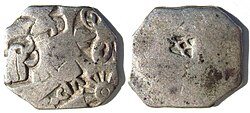
[[File:MauryanCoin.JPG|right|thumb|[[Silver]] [[Punch-marked coins|punch mark coin]] of the [[Maurya | [[File:MauryanCoin.JPG|right|thumb|[[Silver]] [[Punch-marked coins|punch mark coin]] of the [[Maurya Empire]], known as ''Rūpyarūpa'', 3rd century BCE]] | ||
[[File:Gupta Kings. Skandagupta. AD 455-467.jpg|thumb|Silver coin of [[Skandagupta]] of [[Gupta Empire]] known as ''Rūpaka''(रूपक) in Sanskrit, in the style of the [[Western Satrap]]s, with [[Indian peacock|peacock]] on reverse, | [[File:Gupta Kings. Skandagupta. AD 455-467.jpg|thumb|Silver coin of [[Skandagupta]] of [[Gupta Empire]] known as ''Rūpaka'' (रूपक) in Sanskrit, in the style of the [[Western Satrap]]s, with [[Indian peacock|peacock]] on reverse, 455—467]] | ||
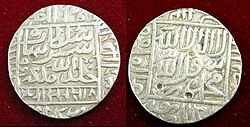
[[File:Sher shah's rupee.jpg|right|thumb|''[[Rupiya]]'' issued by [[Sher Shah Suri]], 1540–1545 | [[File:Sher shah's rupee.jpg|right|thumb|''[[Rupiya]]'' issued by [[Sher Shah Suri]], 1540–1545|alt=Silver coins with raised writing]] | ||
The history of the Indian [[rupee]] traces back to [[ancient India]] | The history of the Indian [[rupee]] traces back to [[ancient India]] around the 6th century BCE; ancient India was one of the earliest issuers of [[coin]]s in the world,<ref>{{cite book |first=Subodh |last=Kapoor |title=The Indian encyclopaedia: biographical, historical, religious ..., Volume 6 |publisher=Cosmo Publications |date=January 2002 |page=1599 |url=https://books.google.com/books?id=q5ZM0nZXZEkC&pg=PA1599 |isbn=81-7755-257-0 }}</ref> alongside the [[Chinese wen]] and [[Lydia]]n [[stater]]s.<ref>{{citation |first=David M. |last=Schaps |chapter=The Invention of Coinage in Lydia, in India, and in China |title=XIV International Economic History Congress |location=Helsinki |year=2006 |publisher=[[International Economic History Association]] |chapter-url=http://www.helsinki.fi/iehc2006/papers1/Schaps.pdf |access-date=27 December 2018 |archive-date=12 July 2018 |archive-url=https://web.archive.org/web/20180712184842/http://www.helsinki.fi/iehc2006/papers1/Schaps.pdf |url-status=live }}</ref> | ||
''[[Arthashastra]]'', written by [[Chanakya]], prime minister to the first [[Maurya Empire| | ''[[Arthashastra]]'', written by [[Chanakya]], the prime minister to the first [[Maurya Empire|Mauryan emperor]] [[Chandragupta Maurya]] (c. 340–290 BCE), mentions silver coins as ''rūpyarūpa'', gold coins as ''suvarṇarūpa'', copper coins as ''tamrarūpa'', and lead coins as ''sīsarūpa''. {{transliteration|sa|ISO|Rūpa}} means 'shape' or 'form'.<ref name="Redy">{{cite web |author= |title=A short history of ancient Indian coinage. |url=http://worldcoincatalog.com/AC/C3/India/AIndia.htm |access-date=20 June 2013 |publisher=worldcoincatalog.com |archive-date=3 April 2012 |archive-url=https://web.archive.org/web/20120403184349/http://worldcoincatalog.com/AC/C3/India/AIndia.htm |url-status=live }}</ref> | ||
The [[Gupta Empire]] produced large numbers of silver coins clearly influenced by those of the earlier [[Western Satraps | The [[Gupta Empire]] under [[Chandragupta II]] produced large numbers of silver coins clearly influenced by those of the earlier [[Western Satraps]].<ref name="EBAllan&Stern">Allan & Stern (2008)</ref> The silver ''Rūpaka'' ({{langx|sa|रूपक}}) coins weighed approximately 20 [[Ratti (unit)|rattis]] (2.2678 g).<ref>{{cite web |title=Rupaka, Rūpaka: 23 definitions |url=https://www.wisdomlib.org/definition/rupaka |website=Wisdom Library |date=3 August 2014 |access-date=22 June 2022 |archive-date=23 June 2022 |archive-url=https://web.archive.org/web/20220623033054/https://www.wisdomlib.org/definition/rupaka |url-status=live }}</ref> | ||
In the intermediate times there | In the intermediate times following the Guptas, there appears to have been no fixed monetary system of coinage as reported in the travelogue ''[[Great Tang Records on the Western Regions|Da Tang Xi Yu Ji]]''.<ref>{{cite book |title=Da Tang Xiyu Ji. [[Great Tang Records on the Western Regions|Great Tang Dynasty Records of the Western World]] |publisher=[[Kegan Paul, Trench Trubner & Co.]] |year=1906 |edition=First |series=Trübner's Oriental Series |volume=1-2 |location=London |translator=[[Samuel Beal]] |orig-date=1884}}</ref> | ||
During his five-year rule from 1540 to 1545, [[Sultan]] [[Sher Shah Suri]] issued a coin of silver, weighing 178 [[Grain (mass)|grains]] (or 11.53 grams), which was also termed the ''rupiya''.<ref name="etymonline1">{{cite web|url=http://www.etymonline.com/index.php?search=rupee&searchmode=none|title=Etymology of rupee|date=20 September 2008|website=[[Online Etymology Dictionary]]|access-date=20 September 2008}}</ref><ref>{{Cite web |title=Mughal Coinage |url=http://www.rbi.org.in/currency/museum/c-mogul.html |url-status=dead |archive-url=https://web.archive.org/web/20080516085855/http://www.rbi.org.in/currency/museum/c-mogul.html |archive-date=16 May 2008 |website=[[RBI Monetary Museum]] |publisher=Reserve Bank of India}}</ref> During [[Babur]]'s time, the brass to silver exchange ratio was roughly 50:2.<ref>{{Cite book |last=Dughlat |first=Mirza Muhammad Haidar |url=https://archive.org/details/TheTarikh-i-rashidi |title=The Tarikh-I-Rashidi |publisher=Karakoram Books |others=Ebook Version 1.0 Edited and Presented By Mohammed Murad Butt |editor-last=Elias |editor-first=N. |translator-last=Ross |translator-first=E. Denison |chapter=CXII |author-link=Mirza Muhammad Haidar Dughlat |orig-date=1895 |via=Internet Archive}}</ref> The silver coin remained in use during the [[Mughal period]], [[Maratha Empire|Maratha era]] as well as in [[British India]].<ref name="rbi-c-colo">{{cite web |title=Pre-Colonial India & Princely States: Coinage |url=http://www.rbi.org.in/currency/museum/c-colo.html |archive-url=https://web.archive.org/web/20181215222137/http://www.rbi.org.in/currency/museum/c-colo.html |archive-date=15 December 2018 |access-date=20 June 2013 |website=RBI Monetary Museum |publisher=Reserve Bank of India}}</ref> | During his five-year rule from 1540 to 1545, [[Sultan]] [[Sher Shah Suri]] issued a coin of silver, weighing 178 [[Grain (mass)|grains]] (or 11.53 grams), which was also termed the ''rupiya''.<ref name="etymonline1">{{cite web|url=http://www.etymonline.com/index.php?search=rupee&searchmode=none|title=Etymology of rupee|date=20 September 2008|website=[[Online Etymology Dictionary]]|access-date=20 September 2008|archive-date=10 November 2013|archive-url=https://web.archive.org/web/20131110165256/http://www.etymonline.com/index.php?search=rupee&searchmode=none|url-status=live}}</ref><ref>{{Cite web |title=Mughal Coinage |url=http://www.rbi.org.in/currency/museum/c-mogul.html |url-status=dead |archive-url=https://web.archive.org/web/20080516085855/http://www.rbi.org.in/currency/museum/c-mogul.html |archive-date=16 May 2008 |website=[[RBI Monetary Museum]] |publisher=Reserve Bank of India}}</ref> During [[Babur]]'s time, the brass to silver exchange ratio was roughly 50:2.<ref>{{Cite book |last=Dughlat |first=Mirza Muhammad Haidar |url=https://archive.org/details/TheTarikh-i-rashidi |title=The Tarikh-I-Rashidi |publisher=Karakoram Books |others=Ebook Version 1.0 Edited and Presented By Mohammed Murad Butt |editor-last=Elias |editor-first=N. |translator-last=Ross |translator-first=E. Denison |chapter=CXII |author-link=Mirza Muhammad Haidar Dughlat |orig-date=1895 |via=Internet Archive}}</ref> The silver coin remained in use during the [[Mughal period]], the [[Maratha Empire|Maratha era]] as well as in [[British India]].<ref name="rbi-c-colo">{{cite web |title=Pre-Colonial India & Princely States: Coinage |url=http://www.rbi.org.in/currency/museum/c-colo.html |archive-url=https://web.archive.org/web/20181215222137/http://www.rbi.org.in/currency/museum/c-colo.html |archive-date=15 December 2018 |access-date=20 June 2013 |website=RBI Monetary Museum |publisher=Reserve Bank of India}}</ref> Some of the earliest issuers of [[banknote|paper rupees]] include the [[Bank of Hindostan|Bank of Hindustan]] (1770–1832), the General Bank of Bengal and Bihar (1773–1775, established by [[Warren Hastings]]), and the Bengal Bank (1784–91).<ref>{{Cite web |date=2021-04-25 |title=Throwback: How India's paper currency came into existence and evolved over decades |url=https://www.timesnownews.com/business-economy/industry/article/throwback-how-indias-paper-currency-came-into-existence-and-evolved-over-decades/749261 |access-date=2025-10-28 |website=www.timesnownews.com |language=en}}</ref> | ||
=== 1800s === | === 1800s === | ||
{| class="wikitable floatright collapsible collapsed" | {| class="wikitable floatright collapsible collapsed" | ||
!colspan="3" style="background:#ffdead;"|Indian silver rupee value ( | !colspan="3" style="background:#ffdead;"|Indian silver rupee value (1820–1900)<ref name="Indian Currency Problems of the Last Decade">{{cite web |last=Andrew |first=A. Piatt |author-link=A. Piatt Andrew |date=August 1901 |title=Indian Currency Problems of the Last Decade |url=https://archive.org/details/jstor-1884973 |access-date=18 April 2018 |publisher=The Quarterly Journal of Economics |pages=483–514}}</ref> | ||
|- | |- | ||
| Year ||Exchange rate (pence per rupee)||Melt value (pence per rupee) | | Year ||Exchange rate (pence per rupee)||Melt value (pence per rupee) | ||
| Line 170: | Line 196: | ||
| 1900||16.0||10.4 | | 1900||16.0||10.4 | ||
|} | |} | ||
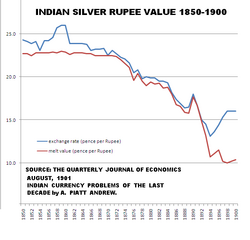
[[File:INDIAN SILVER RUPEE VALUE 1850-1900.png|thumb|Chart showing exchange rate of Indian [[Silver | [[File:INDIAN SILVER RUPEE VALUE 1850-1900.png|thumb|Chart showing exchange rate of Indian [[Silver rupee|silver rupee coin]] (blue) and the actual value of its silver content (red), against [[Penny (British pre-decimal coin)|British pence]] (from 1850 to 1900)]] | ||
Historically, the [[rupee]] was a [[Bullion coin|silver coin]]. This had severe consequences in the nineteenth century when the strongest economies in the world were on the [[gold standard]] (that is, paper linked to gold). The discovery of large quantities of silver in the United States and several European colonies caused the [[panic of 1873]] which resulted in a decline in the [[Relative value (economics)|value]] of [[Silver as an investment|silver relative]] to gold, devaluing India's standard currency, an event known as "the fall of the rupee". Following the panic, the world descended into a '[[Long Depression]]', which resulted in bankruptcies, escalating unemployment, a halt in public works, and a major trade slump that lasted until 1897.<ref>[[W. B. Sutch]], ''The Long Depression, 1865–1895''. (1957)</ref> | |||
Following the [[Indian Rebellion of 1857| | India was unaffected by the imperial [[Order in Council|order-in-council]] of 1825, which attempted to introduce British [[Pound sterling|sterling]] coinage to the British colonies.<ref>{{Cite journal |last1=Teucher |first1=Andy |last2=Albers |first2=Sam |last3=Hazlitt |first3=Stephanie |date=2017-12-20 |title=bcmaps: Map Layers and Spatial Utilities for British Columbia |url=https://doi.org/10.32614/cran.package.bcmaps |access-date=2025-12-26 |website=CRAN: Contributed Packages |doi=10.32614/cran.package.bcmaps }}</ref> India, at that time, was [[Company rule in India|controlled]] by the British [[East India Company]]. The [[Silver rupee|silver rupee coin]] continued as the currency of India through the [[British Raj]] and beyond. In 1835, British India adopted a [[Fine silver|mono-metallic]] [[Silver standards|silver standard]] based on the rupee coin; this decision was influenced by a letter written by [[Lord Liverpool]] in 1805 extolling the virtues of mono-metallism.<ref>{{Citation |last=Garg |first=Sanjay |title=Acts, Proclamations, Declarations and Notifications of the Government of India Concerning the Coinage, Currency and its Legal Tender (1835–56) |date=2019-05-14 |work=Monetary Foundations of the Raj |pages=415–434 |url=https://doi.org/10.4324/9781315271903-27 |access-date=2025-12-26 |publisher=Routledge |doi=10.4324/9781315271903-27 |isbn=978-1-315-27190-3|url-access=subscription }}</ref><ref>{{Cite book |last=Liverpool |first=Charles Jenkinson |url=http://archive.org/details/treatiseoncoinso00liveuoft |title=A treatise on the coins of the realm, in a letter to the King |date=1805 |publisher=Oxford, Univ. Press |others=Robarts - University of Toronto}}</ref> | ||
Following the [[Indian Rebellion of 1857|Sepoy Rebellion]] in 1857, the British government took direct [[British Raj|control]] of India. From 1851, gold sovereigns were produced ''en masse'' at the [[Royal Mint]] in [[Sydney]]. In an 1864 attempt to make the British [[gold sovereign]] the "imperial coin", the treasuries in [[Bombay]] and [[Calcutta]] were instructed to receive (but not to issue) gold sovereigns; therefore, these gold sovereigns never left the vaults. As the British government gave up hope of replacing the rupee in India with the pound [[Sterling silver|sterling]], a conclusion was reached that it could not replace the [[trade coin|silver dollar]] in the [[Straits Settlements]] with the Indian rupee (as the British East India Company had desired). Since the [[silver crisis of 1873]], several nations switched over to a [[Gold standard#Gold exchange standard|gold exchange standard]] (wherein silver or banknotes circulate locally but with a fixed gold value for export purposes), including India in the 1890s.<ref>{{Cite wikisource|Indian Currency and Finance|chapter=Chapter II}}</ref> | |||
=== India Council Bill === | === India Council Bill === | ||
| Line 182: | Line 209: | ||
<blockquote>If, therefore, the India Council in London should not step in to sell bills on India, the merchants and bankers would have to send silver to make good the (trade) balances. Thus a channel for the outflow of silver was stopped, in 1875, by the India Council in London.<ref name="The silver question">{{cite web |last=Moore |first=J S |date=23 October 2016 |title=The Silver Question |url=https://archive.org/stream/jstor-25110026/25110026_djvu.txt |access-date=18 April 2018 |publisher=The North American Review}}</ref></blockquote> | <blockquote>If, therefore, the India Council in London should not step in to sell bills on India, the merchants and bankers would have to send silver to make good the (trade) balances. Thus a channel for the outflow of silver was stopped, in 1875, by the India Council in London.<ref name="The silver question">{{cite web |last=Moore |first=J S |date=23 October 2016 |title=The Silver Question |url=https://archive.org/stream/jstor-25110026/25110026_djvu.txt |access-date=18 April 2018 |publisher=The North American Review}}</ref></blockquote> | ||
<blockquote>The great importance of these (Council) Bills, however, is the effect they have on the Market Price of Silver : and they have in fact been one of the most potent factors in recent years in causing the diminution in the Value of Silver as compared to Gold.<ref name="Henry Dunning Macleod">{{cite web |last1=MacLeod |first1=Henry Dunning |author-link=Henry Dunning Macleod |year=1883 |title=The Theory and Practice of Banking |url=https://books.google.com/books?id=yEMIAAAAQAAJ&q=syria&pg=PA10 |access-date=18 April 2018 |via=Google Books}}</ref></blockquote> | <blockquote>The great importance of these (Council) Bills, however, is the effect they have on the Market Price of Silver: and they have in fact been one of the most potent factors in recent years in causing the diminution in the Value of Silver as compared to Gold.<ref name="Henry Dunning Macleod">{{cite web |last1=MacLeod |first1=Henry Dunning |author-link=Henry Dunning Macleod |year=1883 |title=The Theory and Practice of Banking |url=https://books.google.com/books?id=yEMIAAAAQAAJ&q=syria&pg=PA10 |access-date=18 April 2018 |via=Google Books}}</ref></blockquote> | ||
<blockquote>The Indian and Chinese products for which silver is paid were and are, since 1873–74, very low in price, and it | <blockquote>The Indian and Chinese products for which silver is paid were and are, since 1873–74, very low in price, and it therefore takes less silver to purchase a larger quantity of Eastern commodities. Now, on taking the several agents into united consideration, it will certainly not seem very mysterious why silver should not only have fallen in price<ref name="The silver question" /></blockquote> | ||
<blockquote>The great nations had recourse to two expedients for replenishing their exchequers, {{ndash}} first, loans, and, second, the more convenient forced loans of paper money۔<ref name="The silver question" /></blockquote> | <blockquote>The great nations had recourse to two expedients for replenishing their exchequers, {{ndash}} first, loans, and, second, the more convenient forced loans of paper money۔<ref name="The silver question" /></blockquote> | ||
| Line 190: | Line 217: | ||
=== Fowler Committee (1898) === | === Fowler Committee (1898) === | ||
{{Main|Indian Currency Committee}} | {{Main|Indian Currency Committee}} | ||
<blockquote>Silver, therefore, has ceased to serve as standard; and the Indian currency system of to-day (that is 1901) may be described as that of a "limping" gold standard similar to the systems of France, Germany, Holland, and the United States.<ref name="Indian Currency Problems of the Last Decade" /></blockquote> | [[File:Government_of_India_5_Rupee_Note_1858.jpg|thumb|[[Government of India]] - 5-[[rupee]] note (1858)]] | ||
The [[Indian Currency Committee]] or Fowler Committee was a government committee appointed by the [[British Raj|British-run Government of India]] on 29 April 1898 to examine the currency situation in India.<ref name="chishti2001">{{Citation |author=Chishti |first=M. Anees |title=Committees and commissions in pre-independence India 1836–1947, Volume 3 |url=https://books.google.com/books?id=J5JipbQyOCQC |year=2001 |publisher=Mittal Publications |isbn=978-81-7099-803-7 |quote=... The Indian Currency Committee was appointed by the Royal Warrant of 29 April 1898 ... by the closing of the Indian Mints to what is known as the free coinage of Silver ...}}</ref> They collected a wide range of testimony, examined as many as 49 witnesses, and only reported their conclusions in July 1899, after more than a year's deliberation.<ref name="Indian Currency Problems of the Last Decade" /> | |||
<blockquote>The prophecy made before the Committee of 1898 by Mr. A. M. Lindsay, in proposing a scheme closely similar in principle to that which was eventually adopted, has been largely fulfilled. "This change," he said, "will pass unnoticed, except by the intelligent few, and it is satisfactory to find that by this almost imperceptible process, the Indian currency will be placed on a footing which Ricardo and other great authorities have advocated as the best of all currency systems, viz., one in which the currency media used in the internal circulation are confined to notes and cheap token coins, which are made to act precisely as if they were bits of gold by being made convertible into gold for foreign payment purposes.<ref name="John Maynard Keynes">{{cite wikisource|Indian Currency and Finance|chapter=Chapter I |author=John Maynard Keynes|author-link=John Maynard Keynes |year=1913}}</ref> The committee concurred in the opinion of the Indian government that the mints should remain closed to the unrestricted coinage of silver and that a gold standard should be adopted without delay...they recommended (1) that the British sovereign be given full legal tender power in India, and (2) that the Indian mints be thrown open to its unrestricted coinage (for gold coins only).</blockquote> | |||
These recommendations were acceptable to both governments and were shortly afterwards translated into laws. The act making gold a legal tender was promulgated on 15 September 1899, and preparations were soon thereafter undertaken for the coinage of gold sovereigns in the mint at Bombay.<ref name="Indian Currency Problems of the Last Decade" /> | |||
<blockquote>Silver, therefore, has ceased to serve as, and standard; and the Indian currency system of to-day (that is 1901) may be described as that of a "limping" gold standard similar to the systems of France, Germany, and Holland, and the United States.<ref name="Indian Currency Problems of the Last Decade" /></blockquote> | |||
<blockquote>The Committee of 1898 explicitly declared themselves to be in favour of the eventual establishment of a gold currency.<br />This goal, if it was their goal, the Government of India have never attained.<ref name="John Maynard Keynes" /></blockquote> | <blockquote>The Committee of 1898 explicitly declared themselves to be in favour of the eventual establishment of a gold currency.<br />This goal, '''if it was their goal''', the Government of India have never attained.<ref name="John Maynard Keynes" /></blockquote> | ||
=== 1900s === | === 1900s === | ||
[[File:IND-1c-Government of India-1 Rupee (1917).jpg|thumb|[[British Raj|Government of India]] {{ndash}} [[Indian 1-rupee note|1 rupee]] (1917)]] | [[File:IND-1c-Government of India-1 Rupee (1917).jpg|thumb|[[British Raj|Government of India]] {{ndash}} [[Indian 1-rupee note|1 rupee]] (1917)]] | ||
In 1913, [[John Maynard Keynes]] writes in his book ''Indian Currency and Finance'' that during financial year 1900{{ndash}}1901, gold coins (sovereigns) worth £6,750,000 were given to the Indian people in the hope that they would circulate as currency. But against the expectation of Government, not even half of that was returned to | In 1913, [[John Maynard Keynes]] writes in his book ''Indian Currency and Finance'' that during the financial year 1900{{ndash}}1901, gold coins (sovereigns) worth £6,750,000 were given to the Indian people in the hope that they would circulate as currency. But against the expectation of the Government, not even half of that was returned to accounts. As this experiment failed spectacularly, the government abandoned the practice but did not abandon the narrative of the gold standard. Subsequently, much of the gold held by the Government of India was shipped to the [[Bank of England]] in 1901 and held there.<ref>{{cite wikisource|Indian Currency and Finance|chapter=Chapter IV}}</ref> | ||
Presidency towns began to give gold in payment of money orders, and the | |||
Presidency Banks were requested to issue sovereigns in making payments | <!-- And in March the Post Offices in the Presidency towns began to give gold in payment of money orders, and the Presidency Banks were requested to issue sovereigns in making payments on Government account. These arrangements continued in force throughout the financial year 1900–1901, and by 31 March 1901, the amount put into the hands of the public reached the considerable total of £6,750,000. But of this amount part was exported, not far short of half | ||
on Government account. These arrangements continued in force throughout | was returned to Government, and it was supposed that the greater part of the remainder went into the hands of bullion dealers.[35] Further attempts to force gold into circulation were, therefore, abandoned, and a large part of the gold which had accumulated in the currency reserve in India was, a little later on, shipped to England to be held "ear–marked" at the Bank of England.... The defeat of the experiment of 1900–1901 was due to a variety of causes, --> | ||
the financial year 1900–1901, and by 31 March 1901, the amount put | During [[World War II]], Colonial British control over parts of Nagaland was [[Battle of Imphal|lost to Japanese forces]], the [[Coins of British India|British Indian rupee]] was banned and the [[Japanese government–issued rupee in Burma|Japanese rupee]] (1942–44) was introduced. | ||
into the hands of the public reached the considerable total of | |||
£6,750,000. But of this amount part was exported, not far short of half | In the autumn of 1917 (when the silver price rose to 55 [[Penny (British pre-decimal coin)|pence]]), there was danger of uprisings in India (against paper currency) which would handicap seriously British participation in the war. Inconvertibility (of paper currency into silver coin) would lead to a run on [[Postal savings system|Post Office Savings Banks]]. It would prevent the further expansion of (paper currency) note issues and cause a rise of prices, in paper currency, that would greatly increase the cost of obtaining war supplies for export; to have reduced the silver content of this historic [rupee] coin might well have caused such popular distrust of the Government as to have precipitated an internal crisis, which would have been fatal to British success in the war... and the Government could not afford to buy silver at 55 pence per ounce to coin into rupees with a bullion parity of 43.1 pence per ounce. To let silver be replaced by gold, as Mexico had done in 1906, was also impossible, for the world had no gold to spare. | ||
was returned to Government, and it was supposed that the greater part | The Government, therefore, did the only possible thing, and raised the value of the (silver) rupee in terms of gold...<ref name="Silver Money">{{cite web |author=Leavens |first=Dickson H |year=1939 |title=Silver Money |url=http://cowles.yale.edu/sites/default/files/files/pub/mon/m04-all.pdf |website=[[Cowles Foundation]] |access-date=21 January 2017 |archive-date=18 December 2015 |archive-url=https://web.archive.org/web/20151218012440/http://cowles.yale.edu/sites/default/files/files/pub/mon/m04-all.pdf |url-status=dead }}</ref> | ||
of the remainder went into the hands of bullion dealers.[35] Further | |||
attempts to force gold into circulation were, therefore, abandoned, and | |||
a large part of the gold which had accumulated in the currency reserve | |||
in India was, a little later on, shipped to England to be held | |||
"ear–marked" at the Bank of England.... The defeat of the experiment of 1900–1901 was due to a variety of | |||
causes, --><ref>{{cite | |||
=== Problems caused by the gold standard === | === Problems caused by the gold standard === | ||
{{See also|Gold standard}} | {{See also|Gold standard}} | ||
At the onset of the [[First World War]], the cost of gold was very low and therefore the pound sterling had high value. But during the war, the value of the pound fell alarmingly due to rising war expenses. At the end of the war, the value of the pound was only a fraction of what it had been before the war. It remained low until 1925, when the then [[Chancellor of the Exchequer]] (finance minister) of the United Kingdom, [[Winston Churchill]], restored it to pre-war levels. As a result, the price of gold fell rapidly. While the rest of Europe purchased large quantities of gold from the United Kingdom, there was little increase in her gold reserves. This dealt a blow to an already deteriorating British economy. The United Kingdom began to look to its possessions as India to compensate for the gold that was sold.<ref>Balachandran, G. (1996). John Bullion's Empire: Britain's Gold Problem and India Between the Wars. Routledge. {{ISBN|978-0-7007-0428-6}} | At the onset of the [[First World War]], the cost of gold was very low and therefore the pound sterling (silver) had high value. But during the war, the value of the pound fell alarmingly due to rising war expenses. At the end of the war, the value of the pound was only a fraction of what it had been before the war. It remained low until 1925, when the then [[Chancellor of the Exchequer]] (finance minister) of the United Kingdom, [[Winston Churchill]], restored it to pre-war levels. As a result, the price of gold fell rapidly. While the rest of Europe purchased large quantities of gold from the United Kingdom, there was little increase in her gold reserves (in United Kingdom). This dealt a blow to an already deteriorating British economy. The United Kingdom began to look to its possessions as India to compensate for the gold that was sold.<ref>Balachandran, G. (1996). John Bullion's Empire: Britain's Gold Problem and India Between the Wars. Routledge. {{ISBN|978-0-7007-0428-6}}, p. 6</ref> | ||
However, the price of gold in India, on the basis of the official exchange rate of the rupee around 1[[Shilling (British coin)|s.]] 6[[Penny (British pre-decimal coin)|d]]., was lower than the price prevailing abroad practically throughout{{clarify|date=May 2023}}; the disparity in prices made the export of the metal profitable; and this continued for almost a decade. Thus, in 1931–32, there were net exports of 7.7 | However, the price of gold in India, '''on the basis of the official exchange rate''' of the (silver) rupee around 1[[Shilling (British coin)|s.]] 6[[Penny (British pre-decimal coin)|d]]., was lower than the price prevailing abroad practically throughout{{clarify|date=May 2023}}; the disparity in prices made the export of the (gold) metal profitable; and this continued for almost a decade. Thus, in 1931–32, there were net exports of 7.7 million [[troy ounce|ounces]], valued at INR 57.98 [[crore]]. In the following year, both the quantity and the price rose further: net exports totalled 8.4 million ounces, valued at INR 65.52 crore. In the ten years ended March 1941, total net exports were of the order of 43 million ounces (1337.3 tons (of gold)) valued at about INR 375 crore, or an average price of INR 32-12-4 per [[tola (unit)|tola]].<ref>{{Cite book |chapter-url=https://rbidocs.rbi.org.in/rdocs/content/PDFs/89630.pdf |title=History of the Reserve Bank of India |publisher=The Reserve Bank of India |editor=S. L. N. Simha |year=2005 |pages=40–81 |chapter=2. Currency, Exchange and Banking Before 1935 |orig-date=1970 |access-date=28 October 2022 |archive-date=28 October 2022 |archive-url=https://web.archive.org/web/20221028142244/https://rbidocs.rbi.org.in/rdocs/content/PDFs/89630.pdf |url-status=live }}</ref> | ||
From 1931 to 1941, the United Kingdom purchased large amounts of gold from India and its many other colonies just by increasing price of gold, as Britain was able to pay in printable paper currency. Similarly, on 19 June 1934, [[Franklin D. Roosevelt|Roosevelt]] made{{clarify|date=May 2023}} [[American Silver Purchase Act|Silver Purchase Act]] (which increased the price of silver) and purchased about 44,000 tons of silver, paying with paper [[silver certificate]]s.<ref>[http://library.cqpress.com/cqresearcher/document.php?id=cqresrre1937121400 Four Years of the Silver Program] {{Webarchive|url=https://web.archive.org/web/20191222234329/http://library.cqpress.com/cqresearcher/document.php?id=cqresrre1937121400 |date=22 December 2019 }}. 14 December 1937. [[CQ Press]].</ref> | |||
From 1931 to 1941, the United Kingdom purchased large amounts of gold from India and its many other colonies just by increasing price of gold, as Britain was able to pay in printable paper currency. Similarly, on 19 June 1934, [[Franklin D. Roosevelt|Roosevelt]] made{{clarify|date=May 2023}} [[American Silver Purchase Act|Silver Purchase Act]] (which increased the price of silver) and purchased about 44,000 tons of silver, paying with paper [[silver certificate]]s.<ref>[http://library.cqpress.com/cqresearcher/document.php?id=cqresrre1937121400 Four Years of the Silver Program]. 14 December 1937. [[CQ Press]].</ref> | |||
In 1939, Dickson H. Leavens wrote in his book ''Silver Money'': "In recent years the increased price of gold, measured in depreciated paper currencies, has attracted to the market (of London) large quantities (of gold) formerly hoarded or held in the form of ornaments in India and China".<ref name="Silver Money" /> | In 1939, Dickson H. Leavens wrote in his book ''Silver Money'': "In recent years the increased price of gold, measured in depreciated paper currencies, has attracted to the market (of London) large quantities (of gold) formerly hoarded or held in the form of ornaments in India and China".<ref name="Silver Money" /> | ||
| Line 233: | Line 254: | ||
The values of the subdivisions of the rupee during [[British Raj|British rule]] (and in the first decade of independence) were: | The values of the subdivisions of the rupee during [[British Raj|British rule]] (and in the first decade of independence) were: | ||
{| class="wikitable" | {| class="wikitable" | ||
|+Subdivisions of the rupee during 20th century | |+Subdivisions of the rupee during the 20th century | ||
!Value (in [[ | !Value (in [[Anna (monetary subunit)|anna]]) | ||
!Popular name | !Popular name | ||
!Value (in [[Indian paisa|paise]]) | !Value (in [[Indian paisa|paise]]) | ||
| Line 271: | Line 292: | ||
|- | |- | ||
|{{frac|1|12}} anna | |{{frac|1|12}} anna | ||
|1 [[ | |1 [[Pie (monetary subunit)|pie]] | ||
|{{frac|1|2}} paisa | |{{frac|1|2}} paisa | ||
|} | |} | ||
* In 1957, the rupee was [[decimalised]] and divided into 100 ''[[Naya paise|naye paise]]'' (Hindi for "new paise"); in 1964, the initial ''naye'' was dropped. | * In 1957, the rupee was [[decimalised]] and divided into 100 ''[[Naya paise|naye paise]]'' (Hindi for "new paise"); in 1964, the initial ''naye'' was dropped. | ||
* Many still refer to [[Indian 25-paisa coin|25-]], [[Indian 50-paisa coin|50-]] and 75-paise coins as 4, 8, and 12 [[ | * Many still refer to [[Indian 25-paisa coin|25-]], [[Indian 50-paisa coin|50-]] and 75-paise coins as 4, 8, and 12 [[Anna (monetary subunit)|annas]], respectively; compare the expression "two [[Bit (money)|bits]]" in colloquial [[American English]] for a quarter-dollar coin. | ||
===New currency sign for the Indian rupee=== | ===New currency sign for the Indian rupee=== | ||
In 2010, a [[Indian rupee sign|new rupee sign]] ({{INR}}) was officially adopted. As [[D. Udaya Kumar|its designer]] explained, it was derived from the combination of the [[Devanagari]] consonant "[[र]]" (''ra'') and <!--PLEASE read the citation before changing this again. The designer says clearly that his design references both. --> the [[Latin alphabet|Latin]] capital letter "R" without its vertical bar.<ref>{{cite web |url=http://www.idc.iitb.ac.in/events/Indian_Rupee_Symbol.pdf |title=Currency Symbol for Indian Rupee |first=D. Udaya |last=Kumar |author-link=D. Udaya Kumar | publisher=Indian Institute of Technology Bombay |website=IDC School of Design |access-date=5 October 2022}}</ref> The parallel lines at the top (with white space between them) are said to make an allusion to the [[flag of India]],<ref>{{cite web|url=http://www.theworldreporter.com/2010/07/indian-rupee-joins-elite-currency-club.html |title=Indian Rupee Joins Elite Currency Club|publisher=Theworldreporter.com |date=17 July 2010 }}</ref> and also depict an equality sign that symbolises the nation's desire to reduce [[Economic inequality|economic disparity]]. The first series of coins with the new rupee sign started in circulation on 8 July 2011. Before this, India used "[[Rupee sign|₨]]" and "Re" as the symbols for multiple rupees and one rupee, respectively. | In 2010, a [[Indian rupee sign|new rupee sign]] ({{INR}}) was officially adopted. As [[D. Udaya Kumar|its designer]] explained, it was derived from the combination of the [[Devanagari]] consonant "[[र]]" (''ra'') and <!--PLEASE read the citation before changing this again. The designer says clearly that his design references both. --> the [[Latin alphabet|Latin]] capital letter "R" without its vertical bar.<ref>{{cite web |url=http://www.idc.iitb.ac.in/events/Indian_Rupee_Symbol.pdf |title=Currency Symbol for Indian Rupee |first=D. Udaya |last=Kumar |author-link=D. Udaya Kumar |publisher=Indian Institute of Technology Bombay |website=IDC School of Design |access-date=5 October 2022 |archive-date=21 August 2010 |archive-url=https://web.archive.org/web/20100821132944/http://www.idc.iitb.ac.in/events/Indian_Rupee_Symbol.pdf |url-status=live }}</ref> The parallel lines at the top (with white space between them) are said to make an allusion to the [[flag of India]],<ref>{{cite web |url=http://www.theworldreporter.com/2010/07/indian-rupee-joins-elite-currency-club.html |title=Indian Rupee Joins Elite Currency Club |publisher=Theworldreporter.com |date=17 July 2010 |access-date=25 September 2010 |archive-date=27 April 2015 |archive-url=https://web.archive.org/web/20150427203838/http://www.theworldreporter.com/2010/07/indian-rupee-joins-elite-currency-club.html |url-status=live }}</ref> and also depict an equality sign that symbolises the nation's desire to reduce [[Economic inequality|economic disparity]]. The first series of coins with the new rupee sign started in circulation on 8 July 2011. Before this, India used "[[Rupee sign|₨]]" and "Re" as the symbols for multiple rupees and one rupee, respectively, and these symbols are still used in situations where the official symbol is unavailable. At an international level, like India, some nations' currencies are also Rupees. When the ({{INR}}) symbol is unavailable, then INR is used to represent the Indian currency. | ||
=== Digitization of Indian rupee === | === Digitization of Indian rupee === | ||
{{Main|Digital | {{Main|Digital rupee}} | ||
{{Excerpt|Digital rupee}} | |||
{{ | |||
}} | |||
== | ==Legal framework== | ||
{{ anchor | Legal | Framework }} | |||
British East India Company (EIC) was given the right in 1717 to mint coins in the name of the [[Mughal emperor]] [[Farrukhsiyar]] on the island of Bombay. By 1792 the EIC demonetised all other coins till they were reduced to only 3 types of coins, i.e. EIC, Mughal and [[Maratha Empire|Maratha]] coins. After EIC expanded its control over India, it brought the "Coinage Act of 1835" and started to mint coins in the name of the British king. [[Company rule|EIC rule]] was replaced by [[British Raj|British Crown raj]] which brought the "Paper Currency Act of 1861" and the "Uniform Coinage Act of 1906".<ref name=act1>[https://theprint.in/feature/around-town/east-india-company-fought-hard-for-its-coins-in-india-even-aurangzebs-fury-couldnt-stop-it/1687918/ East India Company fought hard for its coins in India. Even Aurangzeb’s fury couldn’t stop it] {{Webarchive|url=https://web.archive.org/web/20230727120630/https://theprint.in/feature/around-town/east-india-company-fought-hard-for-its-coins-in-india-even-aurangzebs-fury-couldnt-stop-it/1687918/ |date=27 July 2023 }}, The Print, 27 July 2023.</ref> | |||
After 2021, the government of independent India amended "The Coinage Act, 2011",<ref>{{Cite web|date=1 September 2011|title=THE COINAGE ACT, 2011|url=https://rbidocs.rbi.org.in/rdocs/Publications/PDFs/COIN281114.pdf|access-date=7 August 2021|website=Reserve Bank of India|archive-date=7 August 2021|archive-url=https://web.archive.org/web/20210807120234/https://rbidocs.rbi.org.in/rdocs/Publications/PDFs/COIN281114.pdf|url-status=live}}</ref> the "[[Foreign Exchange Management Act]] (FEMA), 1999," the "[[Information Technology Act, 2000]]" and the "Crypto-currency and Regulation of Official Digital Currency Bill, 2021".<ref>{{Cite web|last=Bhattacharya|first=Saurya|date=25 July 2021|title=Cryptocurrency, CBDC and the RBI Act|url=https://www.thehindubusinessline.com/business-laws/cryptocurrency-cbdc-and-the-rbi-act/article35527446.ece|access-date=2021-08-07|website=Business Line|language=en|archive-date=26 June 2023|archive-url=https://web.archive.org/web/20230626193538/https://www.thehindubusinessline.com/business-laws/cryptocurrency-cbdc-and-the-rbi-act/article35527446.ece|url-status=live}}</ref><ref>{{Cite web|last=Variath|first=Adithya Anil|date=26 November 2021|title=Cryptocurrency Bill {{!}} India's First Step To Exercise Its Sovereignty Over Digital Currency|url=https://www.moneycontrol.com/news/opinion/cryptocurrency-bill-indias-first-step-to-exercise-its-sovereignty-over-digital-currency-7764891.html|access-date=2021-11-26|website=Moneycontrol|language=en|archive-date=21 September 2023|archive-url=https://web.archive.org/web/20230921214010/https://www.moneycontrol.com/news/opinion/cryptocurrency-bill-indias-first-step-to-exercise-its-sovereignty-over-digital-currency-7764891.html|url-status=live}}</ref> | |||
== Coins == | |||
=== Post-independence issues === | === Post-independence issues === | ||
{{Main|Coins of the Indian rupee|Indian paisa}} | {{Main|Coins of the Indian rupee|Indian paisa}} | ||
==== Independent pre-decimal issues, 1950–1957 ==== | ==== Independent pre-decimal issues, 1950–1957 ==== | ||
India's first coins after independence were issued in 1950 in denominations of 1 [[Indian pice|pice]], {{frac|1|2}}, one and two annas, {{frac|1|4}}, {{frac|1|2}} and [[Indian 1-rupee coin|one-rupee]]. The sizes and composition were the same as the final regal issues, except for the one- | India's first coins after independence were issued in 1950 in denominations of 1 [[Indian pice|pice]], {{frac|1|2}}, one and two annas, {{frac|1|4}}, {{frac|1|2}} and [[Indian 1-rupee coin|one-rupee]]. The sizes and composition were the same as the final regal issues, except for the one-piece (which was bronze, but not holed). | ||
==== Independent decimal issues, 1957–present ==== | ==== Independent decimal issues, 1957–present ==== | ||
[[File:IN Aluminium Series Paise.jpg|thumb|In 1964, India introduced [[aluminium]] coins for denominations up to 20p.|alt=Row of six differently-shaped aluminium coins, arranged by size]] | [[File:IN Aluminium Series Paise.jpg|thumb|In 1964, India introduced [[aluminium]] coins for denominations up to 20p.|alt=Row of six differently-shaped aluminium coins, arranged by size]] | ||
The first [[Decimal coinage|decimal-coin]] issues in India consisted of [[1 naya paisa (Indian coin)|1]], [[2 naye paise (Indian coin)|2]], [[5 naye paise (Indian coin)|5]], 10, 25 and 50 [[Naya paise|naye paise]], and [[Indian 1-rupee coin|1 rupee]]. The 1 naya paisa was bronze; the 2, 5, and 10 naye paise were cupro-nickel, and the 25 naye paise (nicknamed ''[[chawanni]]''; 25 naye paise equals 4 [[Indian anna|annas]]), 50 naye paise (also called ''[[athanni]]''; 50 naye paise equalled 8 old annas) and 1-rupee were nickel. In 1964, the words ''naya''/''naye'' were removed from all coins. Between 1957 and 1967, aluminium [[Indian 1-paisa coin|one]]-, [[Indian 2-paisa coin|two]]-, [[Indian 3-paisa coin|three]]-, [[Indian 5-paisa coin|five]]- and [[Indian 10-paisa coin|ten-paise]] coins were introduced. In 1968 nickel-brass [[Indian 20-paisa coin|20-paise]] coins were introduced, and replaced by aluminium coins in 1982. Between 1972 and 1975, cupro-nickel replaced nickel in the [[Indian 25-paisa coin|25-]] and [[Indian 50-paisa coin|50-paise]] and the 1-rupee coins; in 1982, cupro-nickel [[Indian 2-rupee coin|two-rupee]] coins were introduced. In 1988 [[stainless steel]] 10-, 25- and 50-paise coins were introduced, followed by 1- and [[Indian 5-rupee coin|5-rupee]] coins in 1992. Five-rupee coins, made from [[brass]], are being minted by the [[Reserve Bank of India]] (RBI). | The first [[Decimal coinage|decimal-coin]] issues in India consisted of [[1 naya paisa (Indian coin)|1]], [[2 naye paise (Indian coin)|2]], [[5 naye paise (Indian coin)|5]], 10, 25 and 50 [[Naya paise|naye paise]], and [[Indian 1-rupee coin|1 rupee]]. The 1 naya paisa was bronze; the 2, 5, and 10 naye paise were cupro-nickel, and the 25 naye paise (nicknamed ''[[chawanni]]''; 25 naye paise equals 4 [[Indian anna|annas]]), 50 naye paise (also called ''[[athanni]]''; 50 naye paise equalled 8 old annas) and 1-rupee were nickel. In 1964, the words ''naya''/''naye'' were removed from all coins. Between 1957 and 1967, aluminium [[Indian 1-paisa coin|one]]-, [[Indian 2-paisa coin|two]]-, [[Indian 3-paisa coin|three]]-, [[Indian 5-paisa coin|five]]- and [[Indian 10-paisa coin|ten-paise]] coins were introduced. In 1968 nickel-brass [[Indian 20-paisa coin|20-paise]] coins were introduced, and replaced by aluminium coins in 1982. Between 1972 and 1975, cupro-nickel replaced nickel in the [[Indian 25-paisa coin|25-]] and [[Indian 50-paisa coin|50-paise]] and the 1-rupee coins; in 1982, cupro-nickel [[Indian 2-rupee coin|two-rupee]] coins were introduced. In 1988 [[stainless steel]] 10-, 25- and 50-paise coins were introduced, followed by 1- and [[Indian 5-rupee coin|5-rupee]] coins in 1992. Five-rupee coins, made from [[brass]], are being minted by the [[Reserve Bank of India]] (RBI). | ||
In 1997 the 20 paise coin was discontinued, followed by the 10 paise coin in 1998, and the 25 paise in 2002. | In 1997 the 20 paise coin was discontinued, followed by the 10 paise coin in 1998, and the 25 paise in 2002. | ||
Between 2005 and 2008 new, lighter fifty-paise, one-, two-, and five-rupee coins were introduced, made from ferritic stainless steel. The move was prompted by the melting-down of older coins, whose face value was less than their scrap value. The demonetisation of the 25-paise coin and all paise coins below it took place, and a new series of coins (50 paise – nicknamed ''athanni'' – one, two, five, and ten rupees with the new rupee sign) were put into circulation in 2011. In 2016 the 50 paise coin was last minted. Coins commonly in circulation are one, two, five, ten, and twenty rupees.<ref name="newcoin">{{cite web|title=Issue of new series of Coins|url=http://www.rbi.org.in/scripts/BS_ViewCurrencyPressRelease.aspx?Id=24773|publisher=RBI|access-date=4 November 2011}}</ref><ref name="TimesofIndia29082011">{{cite news|title=This numismatist lays hands on coins with Rupee symbol|url= | Between 2005 and 2008 new, lighter fifty-paise, one-, two-, and five-rupee coins were introduced, made from ferritic stainless steel. The move was prompted by the melting-down of older coins, whose face value was less than their scrap value. The demonetisation of the 25-paise coin and all paise coins below it took place, and a new series of coins (50 paise – nicknamed ''athanni'' – one, two, five, and ten rupees with the new rupee sign) were put into circulation in 2011. In 2016 the 50 paise coin was last minted. Coins commonly in circulation are one, two, five, ten, and twenty rupees.<ref name="newcoin">{{cite web|title=Issue of new series of Coins|url=http://www.rbi.org.in/scripts/BS_ViewCurrencyPressRelease.aspx?Id=24773|publisher=RBI|access-date=4 November 2011|archive-date=29 July 2014|archive-url=https://web.archive.org/web/20140729043050/http://www.rbi.org.in/scripts/BS_ViewCurrencyPressRelease.aspx?Id=24773|url-status=dead}}</ref><ref name="TimesofIndia29082011">{{cite news|title=This numismatist lays hands on coins with Rupee symbol|url=https://timesofindia.indiatimes.com/city/vadodara/This-numismatist-lays-hands-on-coins-with-Rupee-symbol/articleshow/9788223.cms|archive-url=https://web.archive.org/web/20111107053256/http://articles.timesofindia.indiatimes.com/2011-08-29/vadodara/29940658_1_coins-nandan-parikh-new-symbol|url-status=live|archive-date=7 November 2011|access-date=4 November 2011|newspaper=[[The Times of India]]|date=29 August 2011}}</ref> Although it is still legal tender, the 50-paise (''athanni'') coin is rarely seen in circulation.<ref>{{cite web|title=Coins of 25 paise and below will not be Legal Tender from June 30, 2011: RBI appeals to Public to Exchange them up to June 29, 2011|url=http://www.rbi.org.in/scripts/BS_ViewCurrencyPressRelease.aspx?Id=24418|publisher=RBI|access-date=23 January 2012|date=18 May 2011|archive-date=4 October 2011|archive-url=https://web.archive.org/web/20111004170924/http://www.rbi.org.in/scripts/BS_ViewCurrencyPressRelease.aspx?Id=24418|url-status=live}}</ref> | ||
{| class="wikitable" style="text-align:center; margin:1em auto 1em auto;" | {| class="wikitable" style="text-align:center; margin:1em auto 1em auto;" | ||
| Line 398: | Line 387: | ||
|| Value with outward radiating pattern of 15 spokes || 2006 || – |2010 | || Value with outward radiating pattern of 15 spokes || 2006 || – |2010 | ||
|- {{Coin-silver-color}} | |- {{Coin-silver-color}} | ||
|{{INR}}10 || 27 mm || 7.62 g || Bimetallic || Circular|| Emblem of India and year of minting || Value with outward radiating pattern of 10 spokes, new rupee sign || 2011 || – |2018 | |{{INR}}10 || 27 mm || 7.62 g || Bimetallic || Circular|| Emblem of India and year of minting || Value with an outward radiating pattern of 10 spokes, new rupee sign || 2011 || – |2018 | ||
|- {{Coin-silver-color}} | |- {{Coin-silver-color}} | ||
| {{INR}}10 || 27 mm || 7.74 g || Bimetallic || Circular || Emblem of India || Value, rupee sign, year of issue, grains depicting the agricultural dominance of the country || 2019|| – | | | {{INR}}10 || 27 mm || 7.74 g || Bimetallic || Circular || Emblem of India || Value, rupee sign, year of issue, grains depicting the agricultural dominance of the country || 2019|| – | | ||
| Line 405: | Line 394: | ||
|} | |} | ||
The coins are minted at the four locations of the [[India Government Mint]]. The {{INR}}1, {{INR}}2, and {{INR}}5 coins have been minted since independence. The Government of India is set to introduce a new {{INR}}20 coin with a dodecagonal shape, and like the {{INR}}10 coin, also bi-metallic, along with new designs for the new versions of the {{INR}}1, {{INR}}2, {{INR}}5 and {{INR}}10 coins, which | The coins are minted at the four locations of the [[India Government Mint]]. The {{INR}}1, {{INR}}2, and {{INR}}5 coins have been minted since independence. The Government of India is set to introduce a new {{INR}}20 coin with a dodecagonal shape, and like the {{INR}}10 coin, also bi-metallic, along with new designs for the new versions of the {{INR}}1, {{INR}}2, {{INR}}5 and {{INR}}10 coins, which were announced on 6 March 2019.<ref>{{Cite web |date=7 March 2019 |title=PM releases new series of visually impaired friendly coins |url=https://www.pmindia.gov.in/en/news_updates/pm-releases-new-series-of-visually-impaired-friendly-coins/ |access-date=16 May 2019 |website=[[Prime Minister's Office (India)|Prime Minister's Office]] |archive-date=16 May 2019 |archive-url=https://web.archive.org/web/20190516175026/https://www.pmindia.gov.in/en/news_updates/pm-releases-new-series-of-visually-impaired-friendly-coins/ |url-status=live }}</ref> | ||
==== Minting ==== | ==== Minting ==== | ||
{{Main|India Government Mint|Security Printing and Minting Corporation of India}} | {{Main|India Government Mint|Security Printing and Minting Corporation of India}} | ||
[[File:BOMBAY MINT Post Card.jpg|thumb|A postcard depicting the [[India Government Mint, Mumbai|Bombay Mint]].]] | [[File:BOMBAY MINT Post Card.jpg|thumb|A postcard depicting the [[India Government Mint, Mumbai|Bombay Mint]].]] | ||
The [[Government of India]] has the only right to mint the coins and one rupee note. The responsibility for coinage comes under the Coinage Act, 1906 which is amended from time to time. The designing and minting of coins in various denominations is also the responsibility of the Government of India. Coins are minted at the four [[India Government Mint]]s at [[India Government Mint, Mumbai|Mumbai]], [[India Government Mint, Kolkata|Kolkata]], [[India Government Mint, Hyderabad|Hyderabad]], and [[India Government Mint, Noida|Noida]].<ref>[https://www.rbi.org.in/scripts/AboutUsDisplay.aspx?pg=DeptOfCM.htm About Us – Dept. of Commerce]. [[Reserve Bank of India]].</ref> The coins are issued for circulation only through the [[Reserve Bank of India|Reserve Bank]] in terms of the [[Reserve Bank of India Act, 1934|RBI Act]].<ref>[http://www.rbi.org.in/currency/coins.html Reserve Bank of India – Coins]. Rbi.org.in. Retrieved 28 July 2013.</ref> | The [[Government of India]] has the only right to mint the coins and one rupee note. The responsibility for coinage comes under the Coinage Act, 1906 which is amended from time to time. The designing and minting of coins in various denominations is also the responsibility of the Government of India. Coins are minted at the four [[India Government Mint]]s at [[India Government Mint, Mumbai|Mumbai]], [[India Government Mint, Kolkata|Kolkata]], [[India Government Mint, Hyderabad|Hyderabad]], and [[India Government Mint, Noida|Noida]].<ref>[https://www.rbi.org.in/scripts/AboutUsDisplay.aspx?pg=DeptOfCM.htm About Us – Dept. of Commerce] {{Webarchive|url=https://web.archive.org/web/20210123074521/https://www.rbi.org.in/scripts/AboutUsDisplay.aspx?pg=DeptOfCM.htm |date=23 January 2021 }}. [[Reserve Bank of India]].</ref> The coins are issued for circulation only through the [[Reserve Bank of India|Reserve Bank]] in terms of the [[Reserve Bank of India Act, 1934|RBI Act]].<ref>[http://www.rbi.org.in/currency/coins.html Reserve Bank of India – Coins] {{Webarchive|url=https://web.archive.org/web/20130628233910/http://www.rbi.org.in/currency/coins.html |date=28 June 2013 }}. Rbi.org.in. Retrieved 28 July 2013.</ref> | ||
==== Commemorative coins ==== | ==== Commemorative coins ==== | ||
{{Main|Commemorative coins of India}} | {{Main|Commemorative coins of India}} | ||
== | After independence, the [[India Government Mint|Government of India Mint]], minted [[numismatics|numismatic]] coins imprinted with Indian statesmen, historical and religious figures. In the years 2010 and 2011, for the first time ever, {{INR}}75, {{INR}}150 and {{INR}}1000 coins were minted in India to commemorate the Platinum Jubilee of the [[Reserve Bank of India]], the 150th birth anniversary of the birth of [[Rabindranath Tagore]] and 1000 years of the [[Brihadeeswarar Temple]], respectively. In 2012, a {{INR}}60 piececoins was also issued to commemorate 60 years of the Government of India Mint, Kolkata. {{INR}}[[Indian 100-rupee coin|100 coin]] was also released commemorating the 100th anniversary of [[Mahatma Gandhi]]'s return to India.<ref>{{cite news|title=India, South Africa discuss UNSC reforms|url=http://www.thehindu.com/todays-paper/tp-national/india-south-africa-discuss-unsc-reforms/article6769452.ece|access-date=9 January 2015|newspaper=[[The Hindu]]|date=9 January 2015|location=Chennai, India|first=Rahi|last=Gaikwad|archive-date=16 January 2020|archive-url=https://web.archive.org/web/20200116210219/https://www.thehindu.com/todays-paper/tp-national/india-south-africa-discuss-unsc-reforms/article6769452.ece|url-status=live}}</ref> [[Commemorative coin]]s of {{INR}}125 were released on 4 September 2015 and 6 December 2015 to honour the 125th anniversary of the births of [[Sarvepalli Radhakrishnan]] and [[B. R. Ambedkar]], respectively.<ref>{{cite web |url=http://www.financialexpress.com/article/industry/banking-finance/teachers-day-pm-narendra-modi-releases-rs-125-coins-in-honour-of-dr-s-radhakrishnan/130734/ |title=Teachers' day: PM Narendra Modi releases Rs 125 coin in honour of Dr S Radhakrishnan |date=4 September 2016 |work=[[The Financial Express (India)|The Financial Express]] |access-date=10 November 2016 |url-status=dead |archive-url=https://web.archive.org/web/20160423104638/http://www.financialexpress.com/article/industry/banking-finance/teachers-day-pm-narendra-modi-releases-rs-125-coins-in-honour-of-dr-s-radhakrishnan/130734/ |archive-date=23 April 2016 }}</ref><ref>{{cite web |url=http://www.financialexpress.com/article/economy/pm-narendra-modi-releases-rs-10-rs-125-commemorative-coins-honouring-dr-babasaheb-ambedkar/175185/ |title=PM Narendra Modi releases Rs 10, Rs 125 commemorative coins honouring Dr Babasaheb Ambedkar |date=6 December 2016 |work=[[The Financial Express (India)|The Financial Express]] |access-date=10 November 2016 |url-status=dead |archive-url=https://web.archive.org/web/20160423090709/http://www.financialexpress.com/article/economy/pm-narendra-modi-releases-rs-10-rs-125-commemorative-coins-honouring-dr-babasaheb-ambedkar/175185/ |archive-date=23 April 2016 }}</ref> | ||
=== Pre-independence issues === | === Pre-independence issues === | ||
{{ | {{Main|Coins of British India}} | ||
[[File: | |||
[[File: | {{more citations needed section|date=November 2016}} | ||
[[File:India 1835 2 Mohurs.jpg|thumb|1835 [[East India Company]] 2 [[Mohur]]s]] | |||
[[File:Rupee, 1840 - British India, Victoria.jpg|thumb|right|225px|1840 [[East India Company]] rupee. It was minted in [[Bombay]], [[Calcutta]] and [[Madras]]]] | |||
{{multiple image | |||
| header = Indian rupee (from 1862) | |||
| width = 108 | |||
| image1 = India 1 Rupee 1884 Victoria(obv)-4037.jpg | |||
| alt1 = India 1 rupee 1884 Victoria (obverse) | |||
| image2 = India 1 Rupee 1884 Victoria(rev)-4038.jpg | |||
| alt2 = India 1 rupee 1884 Victoria (reverse) | |||
| caption1 = '''Obverse''': Crowned bust of [[Queen Victoria]] | |||
| caption2 = '''Reverse''': Face value, country and year of issue | |||
| footer = Coin made of 91.7% silver | |||
}} | |||
[[File:India 1862 One Mohur.jpg|thumb|1862 Indian One [[Mohur]]]] | |||
[[File:Silver rupee of Sayaji Rao III of Baroda.jpg|thumb|Silver rupee of [[Sayajirao Gaekwad III]] of [[Baroda State]] (ruled 1875–1939), showing his profile. This coin is dated 1955 in the [[Vikrami calendar]] (1897 CE)]] | |||
[[File:INDIAGeorge V King Emperor.jpg|thumb|right|Regal issue minted during the reign of [[George V of the United Kingdom|King/Emperor George V]]]] | |||
[[File:1 Indian rupee coin, 1947.jpg|thumb|[[Indian 1-rupee coin|1 Indian rupee]] (1947) featuring [[George VI]] on obverse and [[Indian Lion]] on reverse]] | |||
[[File:Indian one pice minted in 1950.jpg|thumb|[[Indian 1-paisa coin|Indian one pice]], minted in 1950|alt=Both sides of copper-coloured coin]] | |||
[[File:1 Indian rupee (1905).jpg|thumb|[[Indian 1-rupee coin|1 Indian rupee]] (1905) featuring [[Edward VII]]]] | |||
[[File:Hyderabad_-_One_Rupee_-_Mahboob_Ali_Khan_-_1329_AH_Silver_-_Kolkata_2016-06-28_5271-5272.png|thumb|One-rupee coin issued by [[Mahbub Ali Khan, Asaf Jah VI|Mir Mahbub Ali Khan]] of [[Hyderabad State]], 1329 [[Islamic calendar|AH]] (1911)]] | |||
[[File:1 Indian rupee (1918).jpg|thumb|[[Indian 1-rupee coin|1 Indian rupee]] (1918) featuring [[George V]]]] | |||
==== East India Company, 1835 ==== | |||
The three [[Presidencies and provinces of British India|Presidencies]] established by the British [[East India Company]] ([[Bengal Presidency|Bengal]], [[Bombay Presidency|Bombay]] and [[Madras Presidency|Madras]]) each issued their [[Coins of British India|own coinages]] until 1835. All three issued rupees and fractions thereof down to {{frac|1|8}}- and {{frac|1|16}}-rupee in silver. Madras also issued two-rupee coins. | |||
Copper denominations were more varied. Bengal issued one-[[Pie (monetary subunit)|pie]], {{frac|1|2}}-, one- and two-[[Paisa|paise]] coins. Bombay issued 1-pie, {{frac|1|4}}-, {{frac|1|2}}-, 1-, 1{{frac|1|2}}-, 2- and 4-paise coins. In Madras, there were copper coins for two and four pies and one, two and four paise, with the first two denominated as {{frac|1|2}} and one dub (or {{frac|1|96}} and {{frac|1|48}}) rupee. Madras also issued the [[Madras fanam]] until 1815. | |||
All three Presidencies issued gold [[mohur]]s and fractions of mohurs including {{frac|1|16}}, {{frac|1|2}}, {{frac|1|4}} in Bengal, {{frac|1|15}} (a gold rupee) and {{frac|1|3}} (pancia) in Bombay and {{frac|1|4}}, {{frac|1|3}} and {{frac|1|2}} in Madras. | |||
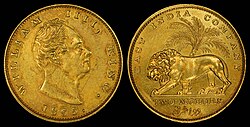
In | In 1835, a single coinage for the [[East India Company|EIC]] was introduced. It consisted of copper {{frac|1|12}}, {{frac|1|4}} and {{frac|1|2}} [[Indian anna|anna]], silver {{frac|1|4}}, {{frac|1|3}} and 1 rupee and gold 1 and 2 mohurs. In 1841, silver 2 annas were added, followed by copper {{frac|1|2}} [[Indian pice|pice]] in 1853. The coinage of the EIC continued to be issued until 1862, even after the company had been [[Crown rule in India|taken over by the Crown]]. | ||
==== Regal issues, 1862–1947 ==== | |||
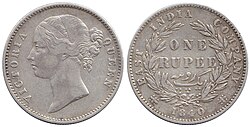
In 1862, coins were introduced (known as "regal issues") which bore the profile of [[Queen Victoria]] and the designation "India". Their denominations were {{frac|1|12}} [[Indian anna|anna]], {{frac|1|2}} [[Indian pice|pice]], {{frac|1|4}} and {{frac|1|2}} anna (all in copper), 2 annas, {{frac|1|4}}, {{frac|1|2}} and one rupee (silver),<ref>{{cite web|url=http://jfcampbell.us/india/victoria/rupee-mm.htm|title=VICTORIA {{!}} The Coins of British India One Rupee: Mint Mark Varieties (1874–1901)|website=jfcampbell.us|date=13 October 2004|author= J. Franklin Campbell|access-date=17 August 2022|archive-url=https://web.archive.org/web/20190913183949/http://jfcampbell.us/india/victoria/rupee-mm.htm|archive-date=13 September 2019}}</ref> and five and ten rupees and one [[mohur]] (gold). The gold denominations ceased production in 1891, and no {{frac|1|2}}-anna coins were issued after 1877. | |||
In 1906, bronze replaced copper for the lowest three denominations; in 1907, a [[Cupronickel|cupro-nickel]] one-anna coin was introduced. In 1918–1919 cupro-nickel two-, four- and eight-annas were introduced, although the four- and eight-annas coins were only issued until 1921 and did not replace their silver equivalents. In 1918, the Bombay mint also struck [[gold sovereign]]s and 15-rupee coins identical in size to the sovereigns as an emergency measure during the First World War. | |||
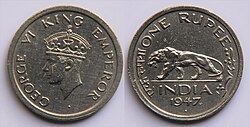
In the early 1940s, several changes were implemented. The {{frac|1|12}} [[Indian anna|anna]] and {{frac|1|2}} [[Indian pice|pice]] ceased production, the {{frac|1|4}} anna was changed to a bronze, [[holed coin]], cupro-nickel and [[Nickel brass|nickel-brass]] {{frac|1|2}}-anna coins were introduced, nickel-brass was used to produce one- and two-annas coins, and the silver composition was reduced from 91.7 to 50 per cent. The last of the regal issues were cupro-nickel {{frac|1|4}}-, {{frac|1|2}}- and one-rupee pieces minted in 1946 and 1947, bearing the image of [[George VI]], King and Emperor on the obverse and an [[Indian lion]] on the reverse. | |||
== Banknotes == | |||
=== Post-independence issues === | === Post-independence issues === | ||
{{Main|Lion Capital Series}} | {{Main|Lion Capital Series}} | ||
{{See also|The High Denomination Bank Notes (Demonetisation) Act, 1978|2016 Indian banknote demonetisation}} | {{See also|The High Denomination Bank Notes (Demonetisation) Act, 1978|2016 Indian banknote demonetisation}} | ||
[[File:First banknote of independent India, one rupee, 1949.jpg|thumb|First banknote of [[independent India]], [[Indian 1-rupee note|one rupee]] (1949)]] | [[File:First banknote of independent India, one rupee, 1949.jpg|thumb|First banknote of [[independent India]], [[Indian 1-rupee note|one rupee]] (1949)]] | ||
After independence, new designs were introduced to replace the portrait of [[George VI]]. The government continued issuing the [[Indian 1-rupee note| | After independence, new designs were introduced to replace the portrait of [[George VI]]. The government continued issuing the [[Indian 1-rupee note|₹1 note]], while the [[Reserve Bank of India]] (RBI) issued other denominations (including the {{INR}}5,000 and {{INR}}10,000 notes introduced in 1949). All pre-independence banknotes were officially demonetised with effect from 28 April 1957.<ref>{{cite web|title=Currency Notes without Asoka Pillar Emblem to Cease to be Legal Tender|url=http://pib.nic.in/archive/docs/DVD_47/ACC%20NO%20921-BR/FIN-1956-04-28_2423.pdf|website=[[Press Information Bureau of India]] – Archive|access-date=8 August 2017|archive-date=8 August 2017|archive-url=https://web.archive.org/web/20170808194012/http://pib.nic.in/archive/docs/DVD_47/ACC%20NO%20921-BR/FIN-1956-04-28_2423.pdf|url-status=live}}</ref><ref>{{cite web|title=Legal Tender of Currency and Bank Notes|url=http://pib.nic.in/archive/docs/DVD_47/ACC%20NO%20922-BR/FIN-1956-10-25_2659.pdf|website=[[Press Information Bureau of India]] – Archive|access-date=8 August 2017|archive-date=8 August 2017|archive-url=https://web.archive.org/web/20170808193909/http://pib.nic.in/archive/docs/DVD_47/ACC%20NO%20922-BR/FIN-1956-10-25_2659.pdf|url-status=live}}</ref> | ||
During the 1970s, {{INR}}[[Indian 20-rupee note|20]] and {{INR}}[[Indian 50-rupee note|50 notes]] were introduced; denominations higher than {{INR}}[[Indian 100-rupee note|100]] were [[The High Denomination Bank Notes (Demonetisation) Act, 1978|demonetised in 1978]]. In 1987, the {{INR}}[[Indian 500-rupee note|500 note]] was introduced, followed by the {{INR}}[[Indian 1000-rupee note|1,000 note]] in 2000 while {{INR}}[[Indian 1-rupee note|1]] and {{INR}}[[Indian 2-rupee note|2 notes]] were discontinued in 1995. | During the 1970s, {{INR}}[[Indian 20-rupee note|20]] and {{INR}}[[Indian 50-rupee note|50 notes]] were introduced; denominations higher than {{INR}}[[Indian 100-rupee note|100]] were [[The High Denomination Bank Notes (Demonetisation) Act, 1978|demonetised in 1978]]. In 1987, the {{INR}}[[Indian 500-rupee note|500 note]] was introduced, followed by the {{INR}}[[Indian 1000-rupee note|1,000 note]] in 2000 while {{INR}}[[Indian 1-rupee note|1]] and {{INR}}[[Indian 2-rupee note|2 notes]] were discontinued in 1995. | ||
[[File:10 Rupees banknotes of India.jpg|thumb|10 | [[File:10 Rupees banknotes of India.jpg|thumb|10-rupee banknote from the 1990s]] | ||
The design of banknotes is approved by the [[Government of India|central government]], on the recommendation of the central board of the [[Reserve Bank of India]].<ref name="rbi" /> Currency notes are printed at the Currency Note Press in [[Nashik]], the Bank Note Press in [[Dewas]], the [[Bharatiya Reserve Bank Note Mudran]] (P) Ltd at [[Salboni]] and [[Mysore]] and at the Watermark Paper Manufacturing Mill in Narmadapuram. The [[Mahatma Gandhi Series]] of banknotes are issued by the Reserve Bank of India as legal tender. The series is so named because the obverse of each note features a portrait of [[Mahatma Gandhi]]. Since its introduction in 1996, this series has replaced all issued banknotes of the [[Lion Capital Series]]. The RBI introduced the series in 1996 with {{INR}}[[Indian 10-rupee note|10]] and {{INR}}500 banknotes. The printing of {{INR}}[[Indian 5-rupee note|5 notes]] (which had stopped earlier) resumed in 2009. | The design of banknotes is approved by the [[Government of India|central government]], on the recommendation of the central board of the [[Reserve Bank of India]].<ref name="rbi" /> Currency notes are printed at the Currency Note Press in [[Nashik]], the Bank Note Press in [[Dewas]], the [[Bharatiya Reserve Bank Note Mudran]] (P) Ltd at [[Salboni]] and [[Mysore]] and at the Watermark Paper Manufacturing Mill in Narmadapuram. The [[Mahatma Gandhi Series]] of banknotes are issued by the Reserve Bank of India as legal tender. The series is so named because the obverse of each note features a portrait of [[Mahatma Gandhi]]. Since its introduction in 1996, this series has replaced all issued banknotes of the [[Lion Capital Series]]. The RBI introduced the series in 1996 with {{INR}}[[Indian 10-rupee note|10]] and {{INR}}500 banknotes. The printing of {{INR}}[[Indian 5-rupee note|5 notes]] (which had stopped earlier) resumed in 2009. | ||
As of January 2012, the new [[Indian rupee sign|'{{INR}}' sign]] has been incorporated into banknotes of the [[Mahatma Gandhi Series]] in denominations of {{INR}}10, {{INR}}20, {{INR}}50, {{INR}}100, {{INR}}500 and {{INR}}1,000.<ref name="10notes">{{cite web|title=Issue of ' 10/- Banknotes with incorporation of Rupee symbol (')|url=http://www.rbi.org.in/scripts/BS_ViewCurrencyPressRelease.aspx?Id=25121|publisher=RBI|access-date=23 January 2012}}</ref><ref name="500notes">{{cite web|title=Issue of ' 500 Banknotes with incorporation of Rupee symbol|url=http://www.rbi.org.in/scripts/BS_ViewCurrencyPressRelease.aspx?Id=25448|publisher=RBI|access-date=23 January 2012}}</ref><ref name="1000notes">{{cite web|title=Issue of ' 1000 Banknotes with incorporation of Rupee symbol|url=http://www.rbi.org.in/scripts/BS_ViewCurrencyPressRelease.aspx?Id=25448|publisher=RBI|access-date=23 January 2012}}</ref><ref name="100notes">{{cite web|title=Issue of '100 Banknotes with incorporation of Rupee symbol|url=http://www.rbi.org.in/scripts/BS_ViewCurrencyPressRelease.aspx?Id=25462|publisher=RBI|access-date=23 January 2012}}</ref> In January 2014 RBI announced that it would be withdrawing from circulation all currency notes printed prior to 2005 by 31 March 2014. The deadline was later extended to 1 January 2015. The | As of January 2012, the new [[Indian rupee sign|'{{INR}}' sign]] has been incorporated into banknotes of the [[Mahatma Gandhi Series]] in denominations of {{INR}}10, {{INR}}20, {{INR}}50, {{INR}}100, {{INR}}500 and {{INR}}1,000.<ref name="10notes">{{cite web|title=Issue of ' 10/- Banknotes with incorporation of Rupee symbol (')|url=http://www.rbi.org.in/scripts/BS_ViewCurrencyPressRelease.aspx?Id=25121|publisher=RBI|access-date=23 January 2012|archive-date=11 June 2015|archive-url=https://web.archive.org/web/20150611055008/https://www.rbi.org.in/scripts/BS_ViewCurrencyPressRelease.aspx?Id=25121|url-status=dead}}</ref><ref name="500notes">{{cite web|title=Issue of ' 500 Banknotes with incorporation of Rupee symbol|url=http://www.rbi.org.in/scripts/BS_ViewCurrencyPressRelease.aspx?Id=25448|publisher=RBI|access-date=23 January 2012|archive-date=29 July 2014|archive-url=https://web.archive.org/web/20140729042118/http://www.rbi.org.in/scripts/BS_ViewCurrencyPressRelease.aspx?Id=25448|url-status=dead}}</ref><ref name="1000notes">{{cite web|title=Issue of ' 1000 Banknotes with incorporation of Rupee symbol|url=http://www.rbi.org.in/scripts/BS_ViewCurrencyPressRelease.aspx?Id=25448|publisher=RBI|access-date=23 January 2012|archive-date=29 July 2014|archive-url=https://web.archive.org/web/20140729042118/http://www.rbi.org.in/scripts/BS_ViewCurrencyPressRelease.aspx?Id=25448|url-status=dead}}</ref><ref name="100notes">{{cite web|title=Issue of '100 Banknotes with incorporation of Rupee symbol|url=http://www.rbi.org.in/scripts/BS_ViewCurrencyPressRelease.aspx?Id=25462|publisher=RBI|access-date=23 January 2012|archive-date=11 June 2015|archive-url=https://web.archive.org/web/20150611233300/https://www.rbi.org.in/scripts/BS_ViewCurrencyPressRelease.aspx?Id=25462|url-status=dead}}</ref> In January 2014 RBI announced that it would be withdrawing from circulation all currency notes printed prior to 2005 by 31 March 2014. The deadline was later extended to 1 January 2015. The deadline was further extended to 30 June 2016.<ref>{{cite web | url=http://pib.nic.in/newsite/PrintRelease.aspx?relid=107510 | title=Withdrawal of Currencies Issued Prior to 2005 | publisher=Press Information Bureau | date=25 July 2014 | access-date=25 July 2014 | archive-date=28 July 2014 | archive-url=https://web.archive.org/web/20140728232422/http://pib.nic.in/newsite/PrintRelease.aspx?relid=107510 | url-status=live }}</ref> | ||
On 8 November 2016, the RBI announced the issuance of new {{INR}}500 | On 8 November 2016, the RBI announced the issuance of new {{INR}}500 banknotes in a new series after [[2016 Indian banknote demonetisation|demonetisation of the older {{INR}}500 and {{INR}}1000 notes]]. The new {{INR}}500 banknote has a stone-grey base colour with an image of the [[Red Fort]] along with the [[Flag of India|Indian flag]] printed on the back. Both the banknotes also have the [[Swachh Bharat Abhiyan]] logo printed on the back. The banknote denominations of {{INR}}[[Indian 200-rupee note|200]], {{INR}}100 and {{INR}}50 have also been introduced in the new [[Mahatma Gandhi New Series]] intended to replace all banknotes of the previous [[Mahatma Gandhi Series]].<ref name="new">{{cite web |url=http://www.thehindubusinessline.com/money-and-banking/rbi-to-issue-1000-100-50-with-new-features-design-in-coming-months/article9328285.ece |title=RBI to issue ₹1,000, ₹100, ₹50 with new features, design in coming months |work=[[Business Line]] |access-date=18 April 2018 |archive-date=16 October 2019 |archive-url=https://web.archive.org/web/20191016075731/https://www.thehindubusinessline.com/money-and-banking/rbi-to-issue-1000-100-50-with-new-features-design-in-coming-months/article9328285.ece |url-status=live }}</ref> On 13 June 2017, RBI introduced new {{INR}}50 notes, but the old ones continue being legal tender. The design is similar to the current notes in the Mahatma Gandhi (New) Series, except they will come with an inset 'A'. | ||
On 8 November 2016, the [[Government of India]] announced [[2016 Indian banknote demonetisation|the demonetisation of {{INR}}500 and {{INR}}1,000 banknotes]]<ref>{{cite web|url=https://asiatimes.com/feel-super-rich-rs-100-rs-10-purse/|title=How I feel super rich with Rs 100 and Rs 10 in my purse|last=Mukherjee|first=Amrita|date=14 November 2016|website=[[Asia Times]]|access-date=16 November 2016}}</ref><ref>{{cite web|url=https://asiatimes.com/article/indias-demonetization-takes-toll-major-sectors/|title=India's demonetization takes its toll on major sectors|date=15 November 2016|website=[[Asia Times]]|access-date=16 November 2016}}</ref> with effect from midnight of the same day, making these notes invalid.<ref name=rbi-demonetise>{{cite press release |first=Alpana |last=Killawala |url=https://rbi.org.in/Scripts/BS_PressReleaseDisplay.aspx?prid=38520 |title=Withdrawal of Legal Tender Status for ₹ 500 and ₹ 1000 Notes: RBI Notice |date=8 November 2016 |publisher=[[Reserve Bank of India]] |access-date=13 November 2016}}</ref> A newly [[Mahatma Gandhi New Series|redesigned series]] of {{INR}}[[Indian 500-rupee note|500 banknote]], in addition to a new denomination of {{INR}}[[Indian 2000-rupee note|2,000 banknote]] is in circulation since 10 November 2016.<ref name=rbi-500-new>{{cite press release |first=Alpana |last=Killawala |url=https://rbidocs.rbi.org.in/rdocs/PressRelease/PDFs/PR114610FD822AC70142AEB274AF376755C293.PDF |title=Issue of ₹500 Banknotes (Press Release) |date=8 November 2016 |publisher=[[Reserve Bank of India]] |access-date=8 November 2016}}</ref><ref name=rbi-2000-new>{{cite press release |first=Alpana |last=Killawala |url=https://rbidocs.rbi.org.in/rdocs/PressRelease/PDFs/PR1144EFECD860ED0D479D88AB8D5CA036FC35.PDF |title=Issue of ₹2000 Banknotes (Press Release) |date=8 November 2016 |publisher=[[Reserve Bank of India]] |access-date=8 November 2016}}</ref> | On 8 November 2016, the [[Government of India]] announced [[2016 Indian banknote demonetisation|the demonetisation of {{INR}}500 and {{INR}}1,000 banknotes]]<ref>{{cite web|url=https://asiatimes.com/feel-super-rich-rs-100-rs-10-purse/|title=How I feel super rich with Rs 100 and Rs 10 in my purse|last=Mukherjee|first=Amrita|date=14 November 2016|website=[[Asia Times]]|access-date=16 November 2016}}</ref><ref>{{cite web|url=https://asiatimes.com/article/indias-demonetization-takes-toll-major-sectors/|title=India's demonetization takes its toll on major sectors|date=15 November 2016|website=[[Asia Times]]|access-date=16 November 2016}}</ref> with effect from midnight of the same day, making these notes invalid.<ref name=rbi-demonetise>{{cite press release |first=Alpana |last=Killawala |url=https://rbi.org.in/Scripts/BS_PressReleaseDisplay.aspx?prid=38520 |title=Withdrawal of Legal Tender Status for ₹ 500 and ₹ 1000 Notes: RBI Notice |date=8 November 2016 |publisher=[[Reserve Bank of India]] |access-date=13 November 2016 |archive-date=18 November 2016 |archive-url=https://web.archive.org/web/20161118080913/https://rbi.org.in/Scripts/BS_PressReleaseDisplay.aspx?prid=38520 |url-status=live }}</ref> A newly [[Mahatma Gandhi New Series|redesigned series]] of {{INR}}[[Indian 500-rupee note|500 banknote]], in addition to a new denomination of {{INR}}[[Indian 2000-rupee note|2,000 banknote]] is in circulation since 10 November 2016.<ref name=rbi-500-new>{{cite press release |first=Alpana |last=Killawala |url=https://rbidocs.rbi.org.in/rdocs/PressRelease/PDFs/PR114610FD822AC70142AEB274AF376755C293.PDF |title=Issue of ₹500 Banknotes (Press Release) |date=8 November 2016 |publisher=[[Reserve Bank of India]] |access-date=8 November 2016 |archive-date=8 January 2019 |archive-url=https://web.archive.org/web/20190108201007/https://rbidocs.rbi.org.in/rdocs/PressRelease/PDFs/PR114610FD822AC70142AEB274AF376755C293.PDF |url-status=live }}</ref><ref name=rbi-2000-new>{{cite press release |first=Alpana |last=Killawala |url=https://rbidocs.rbi.org.in/rdocs/PressRelease/PDFs/PR1144EFECD860ED0D479D88AB8D5CA036FC35.PDF |title=Issue of ₹2000 Banknotes (Press Release) |date=8 November 2016 |publisher=[[Reserve Bank of India]] |access-date=8 November 2016 |archive-date=10 November 2016 |archive-url=https://web.archive.org/web/20161110043657/https://rbidocs.rbi.org.in/rdocs/PressRelease/PDFs/PR1144EFECD860ED0D479D88AB8D5CA036FC35.PDF |url-status=live }}</ref> | ||
From 2017 to 2019, the remaining banknotes of the [[Mahatma Gandhi New Series]] were released in denominations of [[Indian 10-rupee note|{{INR}}10]], [[Indian 20-rupee note|{{INR}}20]], [[Indian 50-rupee note|{{INR}}50]], [[Indian 100-rupee note|{{INR}}100]] and [[Indian 200-rupee note|{{INR}}200]].<ref>{{cite news|title=RBI Introduces ₹ 200 denomination banknote|url=https://www.rbi.org.in/Scripts/BS_PressReleaseDisplay.aspx?prid=41460#mainsection|website=[[Reserve Bank of India]]|date=24 August 2017}}</ref><ref>{{cite news|title=RBI to Issue New Design ₹ 100 Denomination Banknote|url=https://rbi.org.in/scripts/FS_PressRelease.aspx?prid=44533&fn=2753|date=19 July 2018|website=[[Reserve Bank of India]]}}</ref> The {{INR}}[[Indian 1000-rupee note|1,000 note]] has been suspended.<ref name="new" /> | From 2017 to 2019, the remaining banknotes of the [[Mahatma Gandhi New Series]] were released in denominations of [[Indian 10-rupee note|{{INR}}10]], [[Indian 20-rupee note|{{INR}}20]], [[Indian 50-rupee note|{{INR}}50]], [[Indian 100-rupee note|{{INR}}100]] and [[Indian 200-rupee note|{{INR}}200]].<ref>{{cite news|title=RBI Introduces ₹ 200 denomination banknote|url=https://www.rbi.org.in/Scripts/BS_PressReleaseDisplay.aspx?prid=41460#mainsection|website=[[Reserve Bank of India]]|date=24 August 2017|access-date=26 March 2018|archive-date=5 October 2023|archive-url=https://web.archive.org/web/20231005145255/https://rbi.org.in/scripts/BS_PressReleaseDisplay.aspx?prid=41460#mainsection|url-status=live}}</ref><ref>{{cite news|title=RBI to Issue New Design ₹ 100 Denomination Banknote|url=https://rbi.org.in/scripts/FS_PressRelease.aspx?prid=44533&fn=2753|date=19 July 2018|website=[[Reserve Bank of India]]|access-date=25 December 2018|archive-date=25 December 2018|archive-url=https://web.archive.org/web/20181225175349/https://rbi.org.in/scripts/FS_PressRelease.aspx?prid=44533&fn=2753|url-status=live}}</ref> The {{INR}}[[Indian 1000-rupee note|1,000 note]] has been suspended.<ref name="new" /> | ||
==== Current circulating banknotes ==== | ==== Current circulating banknotes ==== | ||
{{Main|Mahatma Gandhi Series|Mahatma Gandhi New Series}} | {{Main|Mahatma Gandhi Series|Mahatma Gandhi New Series}} | ||
As of | |||
As of 27 April 2025, current circulating banknotes are in denominations of ₹[[Indian 1-rupee note|1]], {{INR}}[[Indian 5-rupee note|5]], {{INR}}[[Indian 10-rupee note|10]], {{INR}}[[Indian 20-rupee note|20]], {{INR}}[[Indian 50-rupee note|50]] and {{INR}}[[Indian 100-rupee note|100]] from the [[Mahatma Gandhi Series]] (retired) and in denominations of ₹10, ₹20,<ref>{{Cite web|url=https://m.rbi.org.in//Scripts/BS_PressReleaseDisplay.aspx?prid=46913|title=Reserve Bank of India – Press Releases|website=rbi.org.in|access-date=26 April 2019|archive-date=12 October 2023|archive-url=https://web.archive.org/web/20231012171214/https://m.rbi.org.in//Scripts/BS_PressReleaseDisplay.aspx?prid=46913|url-status=live}}</ref> [[Indian 50-rupee note|₹50]], {{INR}}100, {{INR}}[[Indian 200-rupee note|200]], {{INR}}[[Indian 500-rupee note|500]] and ₹[[Indian 2000-rupee note|2000]] (recalled but still legal tender)<ref>{{Cite news |date=2023-05-19 |title=RBI on 2000 Rupee note: RBI to withdraw Rs 2,000 notes from circulation; notes will continue to be legal tender |url=https://timesofindia.indiatimes.com/india/rbi-to-withdraw-rs-2000-currency-notes-from-circulation-notes-will-continue-to-be-legal-tender-till-september-30/articleshow/100360257.cms?from=mdr |access-date=2025-09-10 |work=The Times of India |issn=0971-8257}}</ref> from the [[Mahatma Gandhi New Series]]. | |||
{| class="wikitable" style="text-align:center" | {| class="wikitable" style="text-align:center" | ||
| Line 458: | Line 486: | ||
|[[File:Indian 1 Rupee 2020 Reverse.jpg|97x97px]] | |[[File:Indian 1 Rupee 2020 Reverse.jpg|97x97px]] | ||
|[[Indian 1-rupee note|₹1]] | |[[Indian 1-rupee note|₹1]] | ||
| | |97mm × 63mm | ||
|[[Shades of pink|Pink]] | |[[Shades of pink|Pink]] | ||
|New ₹1 coin | |New ₹1 coin | ||
|[[Mercator (company)#Sagar Samrat|Sagar Samrat oil rig]] | |[[Mercator (company)#Sagar Samrat|Sagar Samrat oil rig]] | ||
|[[State Emblem of India|National Emblem of India]] | |[[State Emblem of India|National Emblem of India]] | ||
| | |2015<ref>{{Cite news |date=2015-03-09 |title=Rupee 1 note released from Shrinathji temple |url=https://economictimes.indiatimes.com/news/economy/finance/rupee-1-note-released-from-shrinathji-temple/articleshow/46506397.cms?from=mdr |access-date=2025-07-22 |work=The Economic Times |issn=0013-0389}}</ref> | ||
|Limited | | rowspan="2" |Limited | ||
|- | |- | ||
| style="text-align:center;" | [[File:5 Rupees (Obverse).jpg|117x117px]] | | style="text-align:center;" | [[File:5 Rupees (Obverse).jpg|117x117px]] | ||
| style="text-align:center;" | [[File:5 Rupees (Reverse).jpg|117x117px]] | | style="text-align:center;" | [[File:5 Rupees (Reverse).jpg|117x117px]] | ||
| style="text-align:center;" | [[Indian 5-rupee note|{{INR}}5]] || | | style="text-align:center;" | [[Indian 5-rupee note|{{INR}}5]] || 117mm × 63mm || [[Green]] || rowspan="7" | [[Mahatma Gandhi]] || [[Tractor]] || rowspan="7" | Mahatma Gandhi and<br>electrotype denomination || 2002 / 2009 | ||
|- | |- | ||
|} | |} | ||
| Line 481: | Line 509: | ||
| style="text-align:center;"| [[File:India new 10 INR, MG series, 2018, obverse.jpg|122px]] | | style="text-align:center;"| [[File:India new 10 INR, MG series, 2018, obverse.jpg|122px]] | ||
| style="text-align:center;"| [[File:India new 10 INR, MG series, 2018, reverse.jpg|122px]] | | style="text-align:center;"| [[File:India new 10 INR, MG series, 2018, reverse.jpg|122px]] | ||
| style="text-align:center;"| [[Indian 10-rupee note|{{INR}}10]]|| | | style="text-align:center;"| [[Indian 10-rupee note|{{INR}}10]]|| 123mm × 63mm ||[[Chocolate (color)|Chocolate Brown]]|| rowspan="7" | [[Mahatma Gandhi]] ||[[Konark Sun Temple]] || rowspan="7" | Mahatma Gandhi and<br>electrotype denomination || 2017 || rowspan="6" | Wide | ||
|- | |- | ||
| style="text-align:center;"| [[File:India new 20 INR, MG series, 2019, obverse.jpg|130px]] | | style="text-align:center;"| [[File:India new 20 INR, MG series, 2019, obverse.jpg|130px]] | ||
| style="text-align:center;"| [[File:India new 20 INR, MG series, 2019, reverse.jpg|130px]] | | style="text-align:center;"| [[File:India new 20 INR, MG series, 2019, reverse.jpg|130px]] | ||
| style="text-align:center;"| [[Indian 20-rupee note|{{INR}}20]] || | | style="text-align:center;"| [[Indian 20-rupee note|{{INR}}20]] || 129mm × 63mm ||[[Shades of yellow|Greenish Yellow]]||[[Ellora Caves]] || 2019 | ||
|- | |- | ||
| style="text-align:center;"| [[File:India new 50 INR, MG series, 2018, obverse.jpg|139px]] | | style="text-align:center;"| [[File:India new 50 INR, MG series, 2018, obverse.jpg|139px]] | ||
| style="text-align:center;"| [[File:India new 50 INR, MG series, 2018, reverse.jpg|139px]] | | style="text-align:center;"| [[File:India new 50 INR, MG series, 2018, reverse.jpg|139px]] | ||
| style="text-align:center;"| [[Indian 50-rupee note|{{INR}}50]] || | | style="text-align:center;"| [[Indian 50-rupee note|{{INR}}50]] || 135mm × 66mm ||[[Shades of blue|Fluorescent Blue]]||[[Hampi]] || 2017 | ||
|- | |- | ||
|[[File:100 rs note obverse.jpg|147px]] | |[[File:100 rs note obverse.jpg|147px]] | ||
|[[File:100 rs note reverse.jpg|147px]] | |[[File:100 rs note reverse.jpg|147px]] | ||
|[[Indian 100-rupee note|{{INR}}100]] | |[[Indian 100-rupee note|{{INR}}100]] | ||
| | |142mm × 66 mm | ||
|[[Lavender (color)|Lavender]] | |[[Lavender (color)|Lavender]] | ||
|[[Rani ki vav]] | |[[Rani ki vav]] | ||
|2018 | |2018 | ||
|- | |- | ||
| style="text-align:center;"| [[File:India, 200 INR, 2018, obverse.jpg|154px]] | | style="text-align:center;"| [[File:India, 200 INR, 2018, obverse.jpg|154px]] | ||
| style="text-align:center;"| [[File:India, 200 INR, 2018, reverse.jpg|154px]] | | style="text-align:center;"| [[File:India, 200 INR, 2018, reverse.jpg|154px]] | ||
| style="text-align:center;"| [[Indian 200-rupee note|{{INR}}200]] || | | style="text-align:center;"| [[Indian 200-rupee note|{{INR}}200]] || 146mm × 66mm || [[Shades of orange|Orange]]||[[Sanchi Stupa]] || 2017 | ||
|- | |- | ||
| style="text-align:center;"| [[File:India new 500 INR, MG series, 2016, obverse.jpg|160px]] | | style="text-align:center;"| [[File:India new 500 INR, MG series, 2016, obverse.jpg|160px]] | ||
| style="text-align:center;"| [[File:India new 500 INR, MG series, 2016, reverse.jpg|160px]] | | style="text-align:center;"| [[File:India new 500 INR, MG series, 2016, reverse.jpg|160px]] | ||
| style="text-align:center;"|[[Indian 500-rupee note|{{INR}}500]] || | | style="text-align:center;"|[[Indian 500-rupee note|{{INR}}500]] || 150mm × 66mm || [[Shades of gray#Stone gray|Stone Grey]] || [[Red Fort]] | ||
|2016 | | rowspan="2" |2016 | ||
| | |- | ||
| style="text-align:center;"| [[File:India_new_2000_INR,_MG_series,_2016,_obverse.jpg|160px]] | |||
| style="text-align:center;"| [[File:India_new_2000_INR,_MG_series,_2016,_reverse.jpg|160px]] | |||
|[[Indian 2000-rupee note|₹2000]] | |||
|166mm × 66mm | |||
|[[Magenta]] | |||
|[[Mars Orbiter Mission|Mangalyaan]] | |||
|Withdrawn from 2023 circulation (still legal tender)<ref>{{Cite web |title=Reserve Bank of India |url=https://www.rbi.org.in/commonperson/English/Scripts/FAQs.aspx?Id=3443#:~:text=for%20normal%20transactions?-,Yes.,or%20before%20September%2030,%202023 |access-date=2025-09-10 |website=www.rbi.org.in}}</ref> | |||
|- | |- | ||
| colspan="10" style="text-align:left;"|{{Standard banknote table notice}} | | colspan="10" style="text-align:left;"|{{Standard banknote table notice}} | ||
| Line 515: | Line 549: | ||
===== Micro printing ===== | ===== Micro printing ===== | ||
{{See also|Bharatiya Reserve Bank Note Mudran|Security Printing and Minting Corporation of India}} | {{See also|Bharatiya Reserve Bank Note Mudran|Security Printing and Minting Corporation of India}} | ||
The new Indian banknote series | The new Indian banknote series features a few micro-printed texts in various locations. The first one lies on the inner surface of the left temple of Gandhi's spectacles that reads "भारत" ([[Names for India#Bharat|Bhārata]]), the Hindi word for India. The next one (which is printed only in 10 and 50 denominations) is placed on the outer surface of the right temple of Gandhi's spectacles near his ear and reads "RBI" ([[Reserve Bank of India]]) and the face value in numerals "10" or "50". The last one is written on both sides of Gandhi's collar and reads "भारत" and "INDIA" respectively. Currency notes have 17 languages on the panel which appears on the reverse of the notes. | ||
[[File:Gandhi's Spectacles.jpg|none|thumb|500x500px|Micro printed texts on [[Mahatma Gandhi|Gandhi]]'s spectacles]] | [[File:Gandhi's Spectacles.jpg|none|thumb|500x500px|Micro printed texts on [[Mahatma Gandhi|Gandhi]]'s spectacles]] | ||
[[File:Gandhi's Collar.jpg|none|thumb|500x500px|Micro printed texts on [[Mahatma Gandhi|Gandhi]]'s collar]] | [[File:Gandhi's Collar.jpg|none|thumb|500x500px|Micro printed texts on [[Mahatma Gandhi|Gandhi]]'s collar]] | ||
=== Pre-independence issues === | |||
[[File:IND-A10a-Government of India-10 Rupees (1910).jpg|thumb|[[British Raj|Government of India]] {{En dash}} [[Indian 10-rupee note|10 rupees]] (1910), Red Underprint Series]] | |||
[[File:KGVI rupee 1 note obverse.jpg|thumb|British Indian [[Indian 1-rupee note|one rupee note]], [[Reserve Bank of India]] 1940 issue|alt=Old 1 rupee note]] | |||
In 1861, the [[British Raj|Government of India]] introduced its first paper money through the [[The Paper Currency Act, 1861|Paper Currency Act]].<ref name="Spink">{{cite web|url=https://spink.com/media/view?id=48|publisher=Spink and Son|title=Banknotes For The Raj|author=Dr. K. A. Rodgers|access-date=November 4, 2025}}</ref> The {{INR}}10 note was introduced in 1864, {{INR}}5 note in 1872, {{INR}}10,000 note in 1899, {{INR}}100 note in 1900, {{INR}}50 note in 1905, {{INR}}500 note in 1907 and {{INR}}1,000 note in 1909. The first set of notes, known as the "Victoria Portrait" Series, were unifaced and featured two language panels on hand-moulded paper. This series' name is derived from the portrait of [[Queen Victoria]] which appeared in the upper-left corner of the notes.<ref name="RBI">{{cite web|url=https://www.rbi.org.in/scripts/pm_britishindia.aspx|publisher=[[Reserve Bank of India]]|title=British India Issues|access-date=November 4, 2025}}</ref> In 1917, {{INR}}1 and {{INR}}2{{frac|1|2}} notes were introduced.<ref name="oneindia">{{cite web|url=https://oneindiaonline.com/history-of-indian-currency-notes.php|publisher=oneindiaonline|title=History of Indian Money: The Journey of Currency Notes|access-date=November 4, 2025}}</ref> | |||
In 1867, the Victoria Portrait series was withdrawn and replaced with the unifaced "[[Underprint]] Series" in response to [[forgery]]. Underprint Series notes featured 4 language panels in the "Green Series" (notes which featured a green underprint). The languages on the notes differed in relation to where the note was issued. The amount of language panels was increased to 8 in the "Red Series" (notes which featured a red underprint). The Underprint Series remained largely unchanged until the introduction of the "King's Portrait" Series in 1923.<ref name="RBI"></ref> | |||
The King's Portrait Series were introduced in May of 1923 on a [[Indian 10-rupee note|ten rupee note]]. | |||
After the accession of [[King George V]] lower denominations such as ₹1 and ₹2.5 were printed along with notes for specific territories like [[British rule in Burma|Burma]].<ref name="oneindia"></ref> | |||
The [[Reserve Bank of India]] began banknote production in 1938, issuing {{INR}}2, {{INR}}5, {{INR}}10, {{INR}}50, {{INR}}100, {{INR}}1,000 and {{INR}}10,000 notes while the government continued issuing {{INR}}1 note but demonetized the {{INR}}500 and {{INR}}2 {{frac|1|2}} notes.<ref name="RBI"></ref> | |||
== Convertibility == | == Convertibility == | ||
{{See also|Monetary policy of India|Monetary Policy Committee (India)}}{{Most traded currencies}} | {{See also|Monetary policy of India|Monetary Policy Committee (India)}}{{Most traded currencies}} | ||
Officially, the Indian rupee has a market-determined exchange rate. However, the [[Reserve Bank of India]] trades actively in the USD/INR currency market to impact [[Trade weighted index|effective exchange rates]]. Thus, the currency regime in place for the Indian rupee with respect to the [[US dollar]] is a ''[[de facto]]'' controlled exchange rate. This is sometimes called a "[[managed float]]". On 9 May 2022, Indian | Officially, the Indian rupee has a market-determined exchange rate. However, the [[Reserve Bank of India]] trades actively in the USD/INR currency market to impact [[Trade weighted index|effective exchange rates]]. Thus, the currency regime in place for the Indian rupee with respect to the [[US dollar]] is a ''[[de facto]]'' controlled exchange rate. This is sometimes called a "[[managed float]]". On 9 May 2022, the Indian rupee traded at ₹77.41 against the US dollar, hitting an all-time low.<ref>{{Cite web |title=Indian Rupee falls to all-time low against US dollar |url=https://www.businesstoday.in/latest/economy/story/indian-rupee-falls-to-all-time-low-against-us-dollar-332778-2022-05-09 |access-date=2022-05-12 |website=Business Today |date=9 May 2022 |language=en |archive-date=9 May 2022 |archive-url=https://web.archive.org/web/20220509135601/https://www.businesstoday.in/latest/economy/story/indian-rupee-falls-to-all-time-low-against-us-dollar-332778-2022-05-09 |url-status=live }}</ref> Other rates (such as the EUR/INR and INR/JPY) have the volatility typical of [[floating exchange rate]]s, and often create persistent [[arbitrage]] opportunities against the RBI.<ref>[http://icrier.org/pdf/wp108.pdf "Convertibility: Patnaik, 2004"] (PDF). Indian Council for Research on International Economic Relations.</ref> Unlike [[China]], successive [[Government of India|administrations]] (through RBI, the central bank) have not followed a policy of pegging the INR to a specific foreign currency at a particular exchange rate. RBI intervention in currency markets is solely to ensure low volatility in exchange rates, and not to influence the rate (or direction) of the Indian rupee in relation to other currencies.<ref>{{cite news|last=Chandra |first=Shobhana |url=https://www.bloomberg.com/apps/news?pid=20601080&sid=alS4DteWrtco&refer=asia |title='Neither the government nor the central bank takes a view on the rupee (exchange rate movements), as long as the movement is orderly', says Indian Minister of Finance |publisher=Bloomberg L.P. |date=26 September 2007 |access-date=5 November 2011}}</ref> | ||
Also affecting convertibility is a series of [[customs]] regulations restricting the import and export of rupees. Legally, only up to {{INR}}25000 can be imported or exported in cash at a time, and the possession of {{INR}}200 and higher notes in [[Nepal]] is prohibited.<ref>{{cite web |url=http://www.rbi.org.in/commonman/English/scripts/Notification.aspx?Id=301#Foreign |title=RBI Master Circular on Import of Goods and Services |publisher=Rbi.org.in |access-date=25 August 2013}}</ref><ref>{{cite web |url=http://rbi.org.in/scripts/BS_ViewMasCirculardetails.aspx?id=7354#b22 |title=RBI Master Circular on Export of Goods and Services |publisher=Rbi.org.in |access-date=25 August 2013 |url-status=dead |archive-url=https://web.archive.org/web/20130817130904/http://rbi.org.in/scripts/BS_ViewMasCirculardetails.aspx?id=7354#b22 |archive-date=17 August 2013 }}</ref> The conversion of currencies for and from rupees is also regulated. | Also affecting convertibility is a series of [[customs]] regulations restricting the import and export of rupees. Legally, only up to {{INR}}25000 can be imported or exported in cash at a time, and the possession of {{INR}}200 and higher notes in [[Nepal]] is prohibited.<ref>{{cite web |url=http://www.rbi.org.in/commonman/English/scripts/Notification.aspx?Id=301#Foreign |title=RBI Master Circular on Import of Goods and Services |publisher=Rbi.org.in |access-date=25 August 2013 |archive-date=23 October 2013 |archive-url=https://web.archive.org/web/20131023063023/http://www.rbi.org.in/commonman/English/scripts/Notification.aspx?Id=301#Foreign |url-status=live }}</ref><ref>{{cite web |url=http://rbi.org.in/scripts/BS_ViewMasCirculardetails.aspx?id=7354#b22 |title=RBI Master Circular on Export of Goods and Services |publisher=Rbi.org.in |access-date=25 August 2013 |url-status=dead |archive-url=https://web.archive.org/web/20130817130904/http://rbi.org.in/scripts/BS_ViewMasCirculardetails.aspx?id=7354#b22 |archive-date=17 August 2013 }}</ref> The conversion of currencies for and from rupees is also regulated. | ||
RBI also exercises a system of [[capital control]]s in addition to (through active trading) in currency markets. On the current account, there are no currency-conversion restrictions hindering buying or selling foreign exchange (although trade barriers exist). On the capital account, foreign institutional investors | RBI also exercises a system of [[capital control]]s in addition to (through active trading) in currency markets. On the current account, there are no currency-conversion restrictions hindering buying or selling foreign exchange (although trade barriers exist). On the capital account, foreign institutional investors face restrictions on convertibility when bring money into/out of the country and buying securities (subject to quantitative restrictions). Local firms can take capital out of the country to expand globally. However, local households are restricted in their ability to diversify globally. Because of the expansion of the current and capital accounts, India is increasingly moving towards full ''de facto'' convertibility. | ||
There is some confusion regarding the interchange of the currency with gold, but the system that India follows is that money cannot be exchanged for gold under any circumstances due to gold's lack of liquidity;{{citation needed|date=April 2012}} therefore, money cannot be | There is some confusion regarding the interchange of the currency with gold, but the system that India follows is that money cannot be exchanged for gold under any circumstances due to gold's lack of liquidity;{{citation needed|date=April 2012}} therefore, money cannot be converted into gold by the RBI. India follows the same principle as Great Britain and the US. | ||
Reserve Bank of India clarifies its position regarding the promissory clause printed on each banknote: | Reserve Bank of India clarifies its position regarding the promissory clause printed on each banknote: | ||
''"As per Section 26 of [[Reserve Bank of India Act, 1934]], the Bank is liable to pay the value of banknote. This is payable on demand by RBI, being the issuer. The Bank's obligation to pay the value of banknote does not arise out of a contract but out of statutory provisions. The promissory clause printed on the banknotes i.e., "I promise to pay the bearer an amount of X" is a statement | ''"As per Section 26 of [[Reserve Bank of India Act, 1934]], the Bank is liable to pay the value of banknote. This is payable on demand by RBI, being the issuer. The Bank's obligation to pay the value of banknote does not arise out of a contract but out of statutory provisions. The promissory clause printed on the banknotes i.e., "I promise to pay the bearer an amount of X" is a statement that means that the banknote is a legal tender for X amount. The obligation on the part of the Bank is to exchange a banknote for coins of an equivalent amount."''<ref>[http://www.rbi.org.in/scripts/FAQView.aspx?Id=39#12 Reserve bank of India Frequently Asked Questions] {{webarchive|url=https://web.archive.org/web/20120112123135/http://www.rbi.org.in/scripts/FAQView.aspx?Id=39 |date=12 January 2012 }} rbi.org.in Retrieved 27 August 2013</ref> | ||
=== Chronology === | === Chronology === | ||
* 1991 – India began to lift restrictions on its currency. | * 1991 – India began to lift restrictions on its currency. Several reforms removed restrictions on current account transactions (including trade, interest payments, and [[remittances]]) and some capital asset-based transactions. Liberalised Exchange Rate Management System (LERMS) (a [[Dual exchange rate|dual-exchange-rate]] system) introduced partial convertibility of the rupee in March 1992.<ref>Rituparna Kar and Nityananda Sarkar: ''Mean and volatility dynamics of Indian rupee/US dollar exchange rate series: an empirical investigation'' in Asia-Pacific Financial Markets (2006) 13:41–69, p. 48. {{doi|10.1007/s10690-007-9034-0}} .</ref> | ||
* 1997 – A panel (set up to explore capital account convertibility) recommended that India move towards full convertibility by 2000, but the timetable was abandoned in the wake of the | * 1997 – A panel (set up to explore capital account convertibility) recommended that India move towards full convertibility by 2000, but the timetable was abandoned in the wake of the [[1997 Asian financial crisis|1997–1998 Asian financial crisis]]. | ||
* 2006 – [[Prime Minister]] [[Manmohan Singh]] asked the [[P. Chidambaram|Finance Minister]] and the [[Reserve Bank of India]] to prepare a road map for moving towards [[capital account convertibility]].<ref>{{cite web|title=The 'Fuller Capital Account Convertibility Report'|date=31 July 2006|url=http://rbidocs.rbi.org.in/rdocs/PublicationReport/Pdfs/72250.pdf|access-date=23 January 2009|url-status=dead|archive-url=https://web.archive.org/web/20090205135704/http://rbidocs.rbi.org.in/rdocs/PublicationReport/Pdfs/72250.pdf|archive-date=5 February 2009}}</ref> | * 2006 – [[Prime Minister]] [[Manmohan Singh]] asked the [[P. Chidambaram|Finance Minister]] and the [[Reserve Bank of India]] to prepare a road map for moving towards [[capital account convertibility]].<ref>{{cite web|title=The 'Fuller Capital Account Convertibility Report'|date=31 July 2006|url=http://rbidocs.rbi.org.in/rdocs/PublicationReport/Pdfs/72250.pdf|access-date=23 January 2009|url-status=dead|archive-url=https://web.archive.org/web/20090205135704/http://rbidocs.rbi.org.in/rdocs/PublicationReport/Pdfs/72250.pdf|archive-date=5 February 2009}}</ref> | ||
* 2016 – | * 2016 – The [[Government of India]] announced the [[2016 Indian banknote demonetisation|demonetisation]] of all ₹500 and ₹1,000 banknotes of the [[Mahatma Gandhi Series]].<ref name="withdrawaloflegal">{{cite web|url=https://rbi.org.in/Scripts/BS_PressReleaseDisplay.aspx?prid=38520|title=Withdrawal of Legal Tender Status for ₹ 500 and ₹ 1000 Notes: RBI Notice (Revised)|date=8 November 2016|publisher=[[Reserve Bank of India]]|access-date=8 November 2016|archive-date=18 November 2016|archive-url=https://web.archive.org/web/20161118080913/https://rbi.org.in/Scripts/BS_PressReleaseDisplay.aspx?prid=38520|url-status=live}}</ref> The government claimed that the action would curtail the shadow economy and crack down on the use of illicit "black money" and counterfeit cash to fund illegal activity and terrorism.<ref name="India Today2">{{cite web|url=https://www.indiatoday.in/india/story/live-pm-narendra-modi-addresses-nation-350943-2016-11-08|title=Here is what PM Modi said about the new Rs 500, Rs 2000 notes and black money|date=8 November 2016|access-date=9 November 2016|work=[[India Today]]|archive-date=18 November 2016|archive-url=https://web.archive.org/web/20161118082404/http://indiatoday.intoday.in/story/live-pm-narendra-modi-addresses-nation/1/805755.html|url-status=live}}</ref><ref>{{cite web|url=http://timesofindia.indiatimes.com/india/Rs-500-and-Rs-1000-notes-pulled-out-of-circulation-immediately-PM-Narendra-Modi/articleshow/55315473.cms|title=Notes out of circulation|date=8 November 2016|work=[[The Times of India]]|access-date=3 June 2017|archive-date=18 November 2016|archive-url=https://web.archive.org/web/20161118082725/http://timesofindia.indiatimes.com/india/Rs-500-and-Rs-1000-notes-pulled-out-of-circulation-immediately-PM-Narendra-Modi/articleshow/55315473.cms|url-status=live}}</ref> | ||
* 2023 – [[Reserve Bank of India]] issued a circular on [[May 19|19 May]] stating currency notes of | * 2023 – [[Reserve Bank of India]] issued a circular on [[May 19|19 May]] stating currency notes of ₹2,000 denomination will be withdrawn from circulation.<ref>{{cite web |last1=ET Online |title=Rs 2,000 notes to be withdrawn from circulation, exchange window open till September 30 |url=https://economictimes.indiatimes.com/news/economy/policy/rs-2000-notes-to-be-withdrawn-from-circulation-to-continue-as-legal-tender/articleshow/100360379.cms |website=economictimes.indiatimes.com |publisher=The Economic Times |access-date=19 May 2023 |archive-date=19 May 2023 |archive-url=https://web.archive.org/web/20230519173725/http://economictimes.indiatimes.com/news/economy/policy/rs-2000-notes-to-be-withdrawn-from-circulation-to-continue-as-legal-tender/articleshow/100360379.cms |url-status=live }}</ref> The reason given for this withdrawal is the decline in the number of currency notes in circulation. According to the circular, there were only 10.8% of Notes in Circulation on March 31, 2023.<ref>{{cite web |title=Rs 2,000 notes withdrawn from circulation, RBI says will remain legal tender |url=https://www.indiatoday.in/business/story/rbi-to-withdraw-rs-2000-currency-note-from-circulation-2381590-2023-05-19 |website=www.indiatoday.in |date=19 May 2023 |publisher=India Today |access-date=19 May 2023 |archive-date=19 May 2023 |archive-url=https://web.archive.org/web/20230519135549/https://www.indiatoday.in/business/story/rbi-to-withdraw-rs-2000-currency-note-from-circulation-2381590-2023-05-19 |url-status=live }}</ref> | ||
== Exchange rates == | == Exchange rates == | ||
| Line 547: | Line 595: | ||
==== Pre-Independence ==== | ==== Pre-Independence ==== | ||
[[File:INR-USD, GBP, EUR, JPY.svg|thumb|upright=2.04|Graph of exchange rates of Indian rupee (INR) per USD 1, GBP 1, EUR 1, JPY 100 averaged over the month, from September 1998 to May 2013. ''Data | [[File:INR-USD, GBP, EUR, JPY.svg|thumb|upright=2.04|Graph of exchange rates of Indian rupee (INR) per USD 1, GBP 1, EUR 1, JPY 100 averaged over the month, from September 1998 to May 2013. ''Data Source: Reserve Bank of India reference rate'']] | ||
For almost a century following the [[Great Recoinage of 1816]], and adoption of the [[Gold Standard]], until the outbreak of World War I, the silver backed Indian rupee lost value against a basket of | For almost a century following the [[Great Recoinage of 1816]], and adoption of the [[Gold Standard]], until the outbreak of World War I, the silver-backed Indian rupee lost its value against a basket of gold-pegged currencies and was periodically devalued to reflect the then current [[gold silver ratio|gold to silver reserve ratios]]. In 1850, the official conversion rate between the pound sterling and the rupee was £0 / 2[[shilling|s]] / 0d (or £1:₹10), while between 1899 and 1914, the official conversion rate was set at £1 to 1[[shilling|s]] to 4[[Penny|d]] (or £1:₹15). However, this was just half of market exchange rates between 1893 and 1917. | ||
The [[gold silver ratio|gold | The [[gold silver ratio|gold-to-silver ratio]] expanded between 1870 and 1910. Unlike India, Britain was on the gold standard. To meet the Home Charges (i.e., expenditure in the United Kingdom), the colonial government had to remit a larger number of rupees, and this necessitated increased taxation, unrest and nationalism. | ||
Between | Between both world wars, the rate improved from 1[[shilling|s]] to 6[[Penny|d]] (or £1:₹13.33), and remained pegged at this rate for the duration of the [[Bretton Woods system|Bretton Woods agreement]], to its devaluation and pegging to the US dollar, at $1:{{INR}}7.50, in 1966.<ref>{{cite news |last=Chandra |first=Saurabh |date=21 August 2013 |title=The fallacy of 'dollar = rupee' in 1947 |url=http://zeenews.india.com/business/news/finance/the-fallacy-of-dollar-rupee-in-1947_82327.html |access-date=22 August 2013 |archive-date=21 August 2013 |archive-url=https://web.archive.org/web/20130821093246/http://zeenews.india.com/business/news/finance/the-fallacy-of-dollar-rupee-in-1947_82327.html |url-status=live }}</ref><ref>{{cite web |title=Historical exchange rates from 1953 with graph and charts |url=http://fxtop.com/en/historical-exchange-rates.php?YA=1&C1=GBP&C2=USD&A=1&YYYY1=1953&MM1=01&DD1=01&YYYY2=2017&MM2=09&DD2=18&LANG=en |access-date=18 April 2018 |publisher=Fxtop.com |archive-date=1 December 2017 |archive-url=https://web.archive.org/web/20171201032700/http://fxtop.com/en/historical-exchange-rates.php?YA=1&C1=GBP&C2=USD&A=1&YYYY1=1953&MM1=01&DD1=01&YYYY2=2017&MM2=09&DD2=18&LANG=en |url-status=live }}</ref> | ||
==== Post-Independence ==== | ==== Post-Independence ==== | ||
Following the country's independence, India implemented a [[Par value]] exchange rate regime until 1971. The country switched to [[Fixed exchange rate system|a fixed exchange rate regime]] in 1971 and graduated to a basket peg against five major currencies in 1975. Since 1991, the rupee has been under a floating exchange rate regime.<ref>{{Cite web |title=Reserve Bank of India - Publications |url=https://m.rbi.org.in/scripts/PublicationsView.aspx?id=12252 |access-date=2022-04-19 |website=m.rbi.org.in |archive-date=22 May 2022 |archive-url=https://web.archive.org/web/20220522005114/https://m.rbi.org.in/scripts/PublicationsView.aspx?id=12252 |url-status=live }}</ref> | |||
The first major impact on exchange rate after | The first major impact on the rupee's exchange rate after independence was the devaluation of the pound sterling against the US dollar in 1949, which impacted currencies that maintained a peg to the sterling, which included the Indian rupee.<ref>{{Cite web |date=19 September 1949 |series=Guardian Century 1940-1949 |title=Pound devalued 30 per cent |url=https://www.theguardian.com/century/1940-1949/Story/0,,105127,00.html |access-date=2022-04-19 |website=The Guardian |archive-date=9 December 2021 |archive-url=https://web.archive.org/web/20211209092533/https://www.theguardian.com/century/1940-1949/Story/0,,105127,00.html |url-status=live }}</ref> In 1966, the Indian rupee was devalued by 57% against [[United States dollar]], which also led to the depreciation of the sterling.<ref>{{Cite web |author=Gupta |first=Sujay |date=7 Jun 2016 |title=Forgotten legacy of 6/6/66 |url=https://timesofindia.indiatimes.com/business/india-business/forgotten-legacy-of-6/6/66/articleshow/52629071.cms |access-date=2022-04-19 |website=The Times of India |language=en |archive-date=22 April 2022 |archive-url=https://web.archive.org/web/20220422075118/https://timesofindia.indiatimes.com/business/india-business/forgotten-legacy-of-6/6/66/articleshow/52629071.cms |url-status=live }}</ref> Five years later, when the [[Bretton Woods system]] was suspended, India initially announced that it would maintain a fixed rate of $1 to INR 7.50 and leave the sterling under a floating regime.<ref>{{Cite journal |last=Verghese |first=S. K. |year=1973 |title=International Monetary Crises and the Indian Rupee |url=https://www.jstor.org/stable/4362898 |journal=Economic and Political Weekly |volume=8 |issue=30 |pages=1342–1348 |jstor=4362898 |issn=0012-9976 |access-date=19 April 2022 |archive-date=16 April 2022 |archive-url=https://web.archive.org/web/20220416174616/https://www.jstor.org/stable/4362898 |url-status=live }}</ref> However, by the end of 1971, following the [[Smithsonian Agreement]] and the subsequent devaluation of the US dollar, [[India]] pegged the rupee with the pound sterling once again at a rate of £1 to INR 18.9677.<ref>{{Cite journal |last1=Wadhva |first1=Charan D. |last2=Paul |first2=Samuel |year=1973 |title=The Dollar Devaluation and India's Balance of Payments |url=https://www.jstor.org/stable/4362402 |journal=Economic and Political Weekly |volume=8 |issue=10 |pages=517–522 |jstor=4362402 |issn=0012-9976 |access-date=19 April 2022 |archive-date=16 April 2022 |archive-url=https://web.archive.org/web/20220416174751/https://www.jstor.org/stable/4362402 |url-status=live }}</ref> During this period, [[India]] had a non-commercial exchange rate with the [[Soviet Union]]. The ruble to rupee exchange rates was announced by the Soviet Union, as the ruble was not a freely traded currency and the commercial trade between both nations used to take place in rupees following a [[India–Russia relations|treaty between India and the Soviet Union]] in 1953. | ||
In September 1975, exchange rate of Indian rupee started to be determined on the | In September 1975, the exchange rate of the Indian rupee started to be determined based on the basket peg. The details of currencies which form the basket, and their weightage were kept confidentially by [[Reserve Bank of India]] and the exchange rate of the rupee based on market fluctuation of these currencies was periodically announced by the RBI.<ref>{{Cite magazine |author=Tikku |first=M. K. |date=7 April 2015 |title=High-powered Indian team of financial experts to visit Moscow to sort out rouble-rupee exchange rate differences |url=https://www.indiatoday.in/magazine/indiascope/story/19760531-high-powered-indian-team-of-financial-experts-to-visit-moscow-to-sort-out-rouble-rupee-exchange-rate-differences-819182-2015-04-07 |magazine=India Today |language=en |access-date=2022-04-19 |archive-date=19 April 2022 |archive-url=https://web.archive.org/web/20220419174839/https://www.indiatoday.in/magazine/indiascope/story/19760531-high-powered-indian-team-of-financial-experts-to-visit-moscow-to-sort-out-rouble-rupee-exchange-rate-differences-819182-2015-04-07 |url-status=live }}</ref><ref>{{Cite journal |last=Verghese |first=S. K. |year=1979 |title=Exchange Rate of Indian Rupee since Its Basket Link |url=https://www.jstor.org/stable/4367782 |journal=Economic and Political Weekly |volume=14 |issue=28 |pages=1160–1165 |jstor=4367782 |issn=0012-9976 |access-date=19 April 2022 |archive-date=19 April 2022 |archive-url=https://web.archive.org/web/20220419174839/https://www.jstor.org/stable/4367782 |url-status=live }}</ref> | ||
The next major change that occurred | The next major change that occurred was the devaluation of the rupee by about 18% in July 1991 following the [[1991 Indian economic crisis|balance of payments crisis]].<ref>{{Cite web |title=Reserve Bank of India |url=https://www.rbi.org.in/commonman/English/History/Scripts/Chron1991to2000.aspx |access-date=2022-04-19 |website=rbi.org.in |archive-date=28 June 2022 |archive-url=https://web.archive.org/web/20220628091901/https://www.rbi.org.in/commonman/English/History/Scripts/Chron1991to2000.aspx |url-status=live }}</ref> Thereafter, in March 1992, the Liberalized Exchange Rate Management System was introduced, enabling the transition to a [[floating exchange rate]] regime. | ||
{| class="wikitable" style="text-align: center; margin: 1em auto 1em auto;" | {| class="wikitable" style="text-align: center; margin: 1em auto 1em auto;" | ||
|+ Indian rupees per currency unit averaged over the year<ref name="auto">{{cite web|title=FXHistory: historical currency exchange rates |publisher=OANDA Corporation |url=http://www.oanda.com/convert/fxhistory |format=database |access-date=1 September 2009 |archive-url=https://web.archive.org/web/20060403020304/http://oanda.com/convert/fxhistory |archive-date=3 April 2006 |url-status=live }}</ref><ref name="auto1">{{cite web| title= The fallacy of 'dollar = rupee' in 1947 | publisher = DNA | url = http://www.dnaindia.com/analysis/standpoint-the-fallacy-of-dollar-rupee-in-1947-1876776 | access-date = 19 August 2013}}</ref> | |+ Indian rupees per currency unit averaged over the year<ref name="auto">{{cite web|title=FXHistory: historical currency exchange rates |publisher=OANDA Corporation |url=http://www.oanda.com/convert/fxhistory |format=database |access-date=1 September 2009 |archive-url=https://web.archive.org/web/20060403020304/http://oanda.com/convert/fxhistory |archive-date=3 April 2006 |url-status=live }}</ref><ref name="auto1">{{cite web | title = The fallacy of 'dollar = rupee' in 1947 | publisher = DNA | url = http://www.dnaindia.com/analysis/standpoint-the-fallacy-of-dollar-rupee-in-1947-1876776 | access-date = 19 August 2013 | archive-date = 26 October 2013 | archive-url = https://web.archive.org/web/20131026004214/http://www.dnaindia.com/analysis/standpoint-the-fallacy-of-dollar-rupee-in-1947-1876776 | url-status = live }}</ref> | ||
! Currency !! [[ISO 4217|ISO code]] !! 1947 !! 1966 !! 1995!! 1996 !! 2000 !! 2004 !! 2006 !! 2007 !! 2008 !! 2009 !! 2010 !! 2013 !! 2014 !! 2015 !! 2016 !! 2017 !! 2018 !! 2019 !! 2020 !! 2021 !! 2022 !! 2023 | ! Currency !! [[ISO 4217|ISO code]] !! 1947 !! 1966 !! 1995!! 1996 !! 2000 !! 2004 !! 2006 !! 2007 !! 2008 !! 2009 !! 2010 !! 2013 !! 2014 !! 2015 !! 2016 !! 2017 !! 2018 !! 2019 !! 2020 !! 2021 !! 2022 !! 2023 | ||
|- | |- | ||
| Line 605: | Line 653: | ||
| style="text-align: left;" | [[Swiss franc]] || CHF || – || 1.46 || 27.48 || – || – || – || – || – || – || – || 43.95 || 66.95 || 66.71 || 66.70 || 68.40 || – || 65.48 | | style="text-align: left;" | [[Swiss franc]] || CHF || – || 1.46 || 27.48 || – || – || – || – || – || – || – || 43.95 || 66.95 || 66.71 || 66.70 || 68.40 || – || 65.48 | ||
|- | |- | ||
| style="text-align: left;" | [[United States dollar|US dollar]] || USD || 3.30 || 7.50 || 32.45 || 35.44 || 44.20 || 45.34 || 43.95 || 39.50 || 48.76 || 45.33 || 45.00 || 68.80 || 66.07 || 66.73 || 67.19 || 65.11 || 72.10 | | style="text-align: left;" | [[United States dollar|US dollar]] || USD || 3.30 || 7.50 || 32.45 || 35.44 || 44.20 || 45.34 || 43.95 || 39.50 || 48.76 || 45.33 || 45.00 || 68.80 || 66.07 || 66.73 || 67.19 || 65.11 || 72.10 || 74.20 || 74.50 || 82.62 || 83.25 | ||
|- | |- | ||
| colspan="20" style="text-align: left;" | <sup>a</sup> <small>Before 1 January 1999, the [[European Currency Unit]] (ECU)</small><br /><sup>b</sup> <small>Before 1980, the [[Israeli pound]] (ILP)</small><br /><sup>c</sup> <small>100 [[Japanese yen]]</small><br /><sup>d</sup> <small>Before 1993, the [[Soviet ruble]] (SUR), in 1995 and 1996 – per 1000 rubles<br /><sup>e</sup> Before 1967, the [[Malaya and British Borneo dollar]]</small> | | colspan="20" style="text-align: left;" | <sup>a</sup> <small>Before 1 January 1999, the [[European Currency Unit]] (ECU)</small><br /><sup>b</sup> <small>Before 1980, the [[Israeli pound]] (ILP)</small><br /><sup>c</sup> <small>100 [[Japanese yen]]</small><br /><sup>d</sup> <small>Before 1993, the [[Soviet ruble]] (SUR), in 1995 and 1996 – per 1000 rubles<br /><sup>e</sup> Before 1967, the [[Malaya and British Borneo dollar]]</small> | ||
| Line 615: | Line 663: | ||
== Worldwide rupee usage == | == Worldwide rupee usage == | ||
{{See also|Gulf rupee|Bhutanese ngultrum|Nepalese rupee|Pakistani rupee|Mauritian rupee}} | {{See also|Gulf rupee|Bhutanese ngultrum|Nepalese rupee|Pakistani rupee|Mauritian rupee}} | ||
As the [[Straits Settlements]] were originally an outpost of the British [[East India Company]], the Indian rupee was made the sole official currency of the Straits Settlements in 1837, as it was administered as part of [[British India]]. This attempt was resisted by the locals. However, [[Spanish dollar]]s continued to circulate and 1845 saw the introduction of coinage for the Straits Settlements using a system of 100 [[Cent (currency)|cents]] = 1 dollar, with the dollar equal to the Spanish dollar or [[Mexican peso]]. In 1867, administration of the Straits Settlements was separated from India and the [[Straits dollar]] was made the standard currency, and attempts to reintroduce the rupee were finally abandoned.<ref>{{cite web|url=http://www.dcstamps.com/?p=739 |title=Straits Settlements (1867–1946) |publisher=Dcstamps.com |date=13 May 2014 |access-date=18 April 2018}}</ref> | As the [[Straits Settlements]] were originally an outpost of the British [[East India Company]], the Indian rupee was made the sole official currency of the Straits Settlements in 1837, as it was administered as part of [[British India]]. This attempt was resisted by the locals. However, [[Spanish dollar]]s continued to circulate and 1845 saw the introduction of coinage for the Straits Settlements using a system of 100 [[Cent (currency)|cents]] = 1 dollar, with the dollar equal to the Spanish dollar or [[Mexican peso]]. In 1867, the administration of the Straits Settlements was separated from India and the [[Straits dollar]] was made the standard currency, and attempts to reintroduce the rupee were finally abandoned.<ref>{{cite web |url=http://www.dcstamps.com/?p=739 |title=Straits Settlements (1867–1946) |publisher=Dcstamps.com |date=13 May 2014 |access-date=18 April 2018 |archive-date=24 October 2017 |archive-url=https://web.archive.org/web/20171024084205/http://www.dcstamps.com/?p=739 |url-status=live }}</ref> | ||
After the [[Partition of India]], the [[Pakistani rupee]] came into existence, initially using Indian coins and Indian currency notes simply | After the [[Partition of India]], the [[Pakistani rupee]] came into existence, initially using Indian coins and Indian currency notes simply over-stamped with "Pakistan". Previously the Indian rupee was an official currency of other countries, including [[Colony of Aden|Aden]], [[Oman]], [[Dubai]], [[Kuwait]], [[Bahrain]], [[Qatar]], the [[Trucial States]], [[Kenya]], [[Tanganyika (territory)|Tanganyika]], [[Uganda]], the [[Seychelles]] and [[Mauritius]]. | ||
The Indian government introduced the [[Gulf rupee]] as a replacement for the Indian rupee for circulation outside the country with the Reserve Bank of India (Amendment) Act of 1 May 1959.<ref>{{Cite web |last=Kamalakaran |first=Ajay |date=14 September 2021 |title=Gulf rupee: When the Reserve Bank of India played central banker in West Asia |url=https://scroll.in/magazine/1005110/gulf-rupee-when-the-reserve-bank-of-india-played-central-banker-in-west-asia |access-date=2022-04-19 |website=Scroll.in |language=en-US}}</ref> The creation of a separate currency was an attempt to reduce the strain on India's foreign reserves from gold smuggling. After India devalued the rupee on 6 June 1966, those countries still using it – Oman, Qatar, and the Trucial States (which became the [[United Arab Emirates]] in 1971) – replaced the [[Gulf rupee]] with their own [[Currency|currencies]]. Kuwait and Bahrain had already done so in 1961 with [[Kuwaiti dinar]] and in 1965 with [[Bahraini dinar]], respectively.<ref name="commoncurrency">{{cite web |last1=Ranjan |first1=Rajiv |last2=Prakash |first2=Anand |date=April 2010 |title=Internationalisation of currency: the case of the Indian rupee and Chinese renminbi |url=http://rbidocs.rbi.org.in/rdocs/PublicationReport/Pdfs/RRSS180510F.pdf |access-date=1 March 2010 |series=RBI Staff Studies |publisher=Department of Economic Analysis and Policy, Reserve Bank of India}}</ref> | The Indian government introduced the [[Gulf rupee]] as a replacement for the Indian rupee for circulation outside the country with the Reserve Bank of India (Amendment) Act of 1 May 1959.<ref>{{Cite web |last=Kamalakaran |first=Ajay |date=14 September 2021 |title=Gulf rupee: When the Reserve Bank of India played central banker in West Asia |url=https://scroll.in/magazine/1005110/gulf-rupee-when-the-reserve-bank-of-india-played-central-banker-in-west-asia |access-date=2022-04-19 |website=Scroll.in |language=en-US |archive-date=16 April 2022 |archive-url=https://web.archive.org/web/20220416181455/https://scroll.in/magazine/1005110/gulf-rupee-when-the-reserve-bank-of-india-played-central-banker-in-west-asia |url-status=live }}</ref> The creation of a separate currency was an attempt to reduce the strain on India's foreign reserves from gold smuggling. After India devalued the rupee on 6 June 1966, those countries still using it – Oman, Qatar, and the Trucial States (which became the [[United Arab Emirates]] in 1971) – replaced the [[Gulf rupee]] with their own [[Currency|currencies]]. Kuwait and Bahrain had already done so in 1961 with the [[Kuwaiti dinar]] and in 1965 with the [[Bahraini dinar]], respectively.<ref name="commoncurrency">{{cite web |last1=Ranjan |first1=Rajiv |last2=Prakash |first2=Anand |date=April 2010 |title=Internationalisation of currency: the case of the Indian rupee and Chinese renminbi |url=http://rbidocs.rbi.org.in/rdocs/PublicationReport/Pdfs/RRSS180510F.pdf |access-date=1 March 2010 |series=RBI Staff Studies |publisher=Department of Economic Analysis and Policy, Reserve Bank of India |archive-date=26 December 2011 |archive-url=https://web.archive.org/web/20111226115513/http://rbidocs.rbi.org.in/rdocs/PublicationReport/Pdfs/RRSS180510F.pdf |url-status=live }}</ref> | ||
The [[Bhutanese ngultrum]] is pegged at par with the Indian rupee; both currencies are accepted in Bhutan. The [[Nepalese rupee]] is pegged at {{INR}}0.625; the Indian rupee is accepted in Bhutan | The [[Bhutanese ngultrum]] is pegged at par with the Indian rupee; both currencies are accepted in Bhutan. The [[Nepalese rupee]] is pegged at {{INR}}0.625; the Indian rupee is accepted in Bhutan, except {{INR}}[[Indian 500-rupee note|500]] and {{INR}}[[Indian 1000-rupee note|1000 banknotes]] of the [[Mahatma Gandhi Series]] and the {{INR}}[[Indian 200-rupee note|200]], {{INR}}500 banknotes of the [[Mahatma Gandhi New Series]], which are not legal tender in Bhutan and Nepal and are banned by their respective governments.<ref>{{cite web |url=http://www.rediff.com/news/report/dont-take-1-000-and-500-indian-rupee-notes-to-nepal/20120725.html |title=Don't take 1,000 and 500 Indian rupee notes to Nepal |publisher=RBI Staff Studies |access-date=27 October 2014 |archive-date=27 October 2014 |archive-url=https://web.archive.org/web/20141027133004/http://www.rediff.com/news/report/dont-take-1-000-and-500-indian-rupee-notes-to-nepal/20120725.html |url-status=dead }}</ref> On 29 January 2014, Zimbabwe added the Indian rupee as a [[legal tender]] to be used.<ref name="deccanherald.com">{{cite news |title=Indian Rupee to be legal tender in Zimbabwe |url=https://www.deccanherald.com/content/383402/indian-rupee-legal-tender-zimbabwe.html |access-date=8 November 2019 |work=[[Deccan Herald]] |publisher=The Printers Mysore |date=29 January 2014 |archive-date=8 November 2019 |archive-url=https://web.archive.org/web/20191108094711/https://www.deccanherald.com/content/383402/indian-rupee-legal-tender-zimbabwe.html |url-status=live }}</ref><ref>{{cite news |last=Hungwe |first=Brian |date=6 February 2014 |title=Zimbabwe's multi-currency confusion |work=BBC News |url=https://www.bbc.com/news/world-africa-26034078 |access-date=21 June 2018 |archive-date=16 April 2019 |archive-url=https://web.archive.org/web/20190416041444/https://www.bbc.com/news/world-africa-26034078 |url-status=live }}</ref> | ||
== See also == | == See also == | ||
{{div col|colwidth=30em}} | {{div col|colwidth=30em}} | ||
* | * {{annotated link|British currency in the Middle East}} | ||
* | * {{annotated link|Coinage of India}} | ||
* | * {{annotated link|Coins of British India}} | ||
* | * {{annotated link|Coins of the Indian rupee}} | ||
** | ** {{annotated link|Anna (monetary subunit)}} | ||
* | ** {{annotated link|Pie (monetary subunit)}} | ||
* | * {{annotated link|Digital rupee}} | ||
* | * {{annotated link|Fake Indian currency note}} | ||
* | * {{annotated link|Great Depression in India}} | ||
** | * {{annotated link|History of the taka}} | ||
** | * {{annotated link|Paisa}} | ||
* | ** {{annotated link|Indian paisa}} | ||
* | * {{annotated link|Reserve Bank of India}} | ||
* | ** {{annotated link|RBI Monetary Museum}} | ||
* | ** {{annotated link|Reserve Bank of India Act, 1934}} | ||
* {{annotated link|Rupee}} | |||
** {{annotated link|History of the rupee}} | |||
* {{annotated link|The Revised Standard Reference Guide to Indian Paper Money|''The Standard Reference Guide to Indian Paper Money''}} | |||
* {{annotated link|Zero-rupee note}} | |||
{{div col end}} | {{div col end}} | ||
== Notes == | == Notes == | ||
{{ | {{notelist}} | ||
== References == | == References == | ||
=== Citations === | === Citations === | ||
{{ | {{reflist}} | ||
=== Sources === | === Sources === | ||
| Line 656: | Line 705: | ||
* {{numis cite SCWC |date = 1991 }} | * {{numis cite SCWC |date = 1991 }} | ||
* {{numis cite SCWPM |date = 1994 }} | * {{numis cite SCWPM |date = 1994 }} | ||
* {{Cite book |last=Mookerji |first=Radhakumud |title=Chandragupta Maurya and His Times |url=https://books.google.com/books?id=i-y6ZUheQH8C&pg=PA27 |edition=Second |year=1966 |publisher=Motilal Banarsidass |orig-date=1943 |isbn=978-81-208-0405-0 |ref={{sfnref|Mookerji, Chandragupta Maurya and His Times|1966}} |access-date=28 July 2023 |archive-date=31 May 2020 |archive-url=https://web.archive.org/web/20200531130644/https://books.google.com/books?id=i-y6ZUheQH8C&pg=PA27%2F |url-status=live }} | |||
{{refend}} | {{refend}} | ||
== External links == | == External links == | ||
{{Commons category|Rupee (India)}} | |||
* [https://web.archive.org/web/20121008074636/http://indianbanknotes.com/book-chapters.html A gallery of all Indian currency issues] | * [https://web.archive.org/web/20121008074636/http://indianbanknotes.com/book-chapters.html A gallery of all Indian currency issues] | ||
* {{cite web|url=http://www.rbi.org.in/Scripts/pm_republicindia.aspx |title=Gallery of Indian Rupee Notes introduced till date| publisher=Reserve Bank of India|access-date=9 January 2015}} | * {{cite web|url=http://www.rbi.org.in/Scripts/pm_republicindia.aspx |title=Gallery of Indian Rupee Notes introduced till date| publisher=Reserve Bank of India|access-date=9 January 2015}} | ||
* [http://www.bis-ans-ende-der-welt.net/Indien-B-En.htm The banknotes of India] {{in lang|en|de}} | * [http://www.bis-ans-ende-der-welt.net/Indien-B-En.htm The banknotes of India] {{in lang|en|de}} | ||
* [https://www.worldbanknotescatalog.com/india Banknotes catalog of India] {{in lang|en}} | |||
{{Indian currency|state=expanded}} | {{Indian currency|state=expanded}} | ||
| Line 677: | Line 728: | ||
[[Category:Currencies of India]] | [[Category:Currencies of India]] | ||
[[Category:Currencies of the British Empire]] | [[Category:Currencies of the British Empire]] | ||
[[Category:Currencies of Zimbabwe]] | [[Category:Currencies of Zimbabwe]] | ||
[[Category:Currencies of Asia]] | |||
[[Category:Circulating currencies]] | |||
[[Category:Rupee]] | |||
Revision as of 22:36, 27 March 2026
| Indian rupee | |||||||||||||||||||||||||||||||||||||||||||||
|---|---|---|---|---|---|---|---|---|---|---|---|---|---|---|---|---|---|---|---|---|---|---|---|---|---|---|---|---|---|---|---|---|---|---|---|---|---|---|---|---|---|---|---|---|---|
Scheduled official languages:
| |||||||||||||||||||||||||||||||||||||||||||||
| |||||||||||||||||||||||||||||||||||||||||||||
| ISO 4217 | |||||||||||||||||||||||||||||||||||||||||||||
| Code | INR | ||||||||||||||||||||||||||||||||||||||||||||
| Denominations | |||||||||||||||||||||||||||||||||||||||||||||
| Subunit | |||||||||||||||||||||||||||||||||||||||||||||
| 1⁄100 | paisa | ||||||||||||||||||||||||||||||||||||||||||||
| Symbol | ₹ | ||||||||||||||||||||||||||||||||||||||||||||
| paisa |  | ||||||||||||||||||||||||||||||||||||||||||||
| Banknotes | |||||||||||||||||||||||||||||||||||||||||||||
| Freq. used | ₹10, ₹20, ₹50, ₹100, ₹200, ₹500 | ||||||||||||||||||||||||||||||||||||||||||||
| Rarely used | ₹1, ₹2, ₹5 | ||||||||||||||||||||||||||||||||||||||||||||
| Coins | |||||||||||||||||||||||||||||||||||||||||||||
| Freq. used | ₹1, ₹2, ₹5, ₹10, ₹20 | ||||||||||||||||||||||||||||||||||||||||||||
| Rarely used | 50 (discontinued, but still legal tender for amounts up to ₹10);
25 (discontinued, not legal tender) | ||||||||||||||||||||||||||||||||||||||||||||
| Demographics | |||||||||||||||||||||||||||||||||||||||||||||
| Date of introduction | 1835 | ||||||||||||||||||||||||||||||||||||||||||||
| Official user(s) | |||||||||||||||||||||||||||||||||||||||||||||
| Unofficial user(s) | |||||||||||||||||||||||||||||||||||||||||||||
| Issuance | |||||||||||||||||||||||||||||||||||||||||||||
| Central bank | Reserve Bank of India[3] | ||||||||||||||||||||||||||||||||||||||||||||
| Website | www | ||||||||||||||||||||||||||||||||||||||||||||
| Printer | Security Printing and Minting Corporation of India Limited[4] | ||||||||||||||||||||||||||||||||||||||||||||
| Website | spmcil | ||||||||||||||||||||||||||||||||||||||||||||
| Mint | India Government Mint[4] | ||||||||||||||||||||||||||||||||||||||||||||
| Website | indiagovtmint | ||||||||||||||||||||||||||||||||||||||||||||
| Valuation | |||||||||||||||||||||||||||||||||||||||||||||
| Inflation |  3.4% (September 2024)[5] 3.4% (September 2024)[5] | ||||||||||||||||||||||||||||||||||||||||||||
| Source | RBI – Annual Inflation Report | ||||||||||||||||||||||||||||||||||||||||||||
| Method | Consumer price index (India)[7] | ||||||||||||||||||||||||||||||||||||||||||||
| Pegged by |  Bhutanese ngultrum (at par) Bhutanese ngultrum (at par) Nepalese rupee (₹1 = रु1.60)[6] Nepalese rupee (₹1 = रु1.60)[6] | ||||||||||||||||||||||||||||||||||||||||||||


The Indian rupee (symbol: ₹; code: INR) is the official currency of India and the erstwhile British Raj. The rupee is subdivided into 100 paise (singular: paisa). The issuance of the currency is controlled by the Reserve Bank of India. The Reserve Bank derives this role from powers vested in it by the Reserve Bank of India Act, 1934. It is the world's eleventh-most-traded currency as of April 2025.[8]
Etymology
Pāṇini (6th to 4th century BCE), the ancient Indian grammarian and logician, writes of the rūpya (रूप्य). While it is unclear whether Pāṇini was referring specifically to coinage,[9] some scholars conclude that he uses the term rūpa to mean a piece of precious metal (typically silver) used as a coin, and a rūpya to mean a stamped piece of metal, a coin in the modern sense.[10] The Arthashastra, written by Chanakya, prime minister to the first Maurya emperor Chandragupta Maurya (c. 340–290 BCE), mentions silver coins as rūpyarūpa. Other types of coins, including gold coins (suvarṇarūpa), copper coins (tāmrarūpa), and lead coins (sīsarūpa), are also mentioned.[11] The immediate precursor to the rupee is the rūpiya—the silver coin weighing 178 grains minted in northern India, first by Sher Shah Suri during his brief rule between 1540 and 1545, and later by the Mughal Empire. The weight remained unchanged well beyond the end of Mughal rule into the 20th century.[12]
History


The history of the Indian rupee traces back to ancient India around the 6th century BCE; ancient India was one of the earliest issuers of coins in the world,[13] alongside the Chinese wen and Lydian staters.[14]
Arthashastra, written by Chanakya, the prime minister to the first Mauryan emperor Chandragupta Maurya (c. 340–290 BCE), mentions silver coins as rūpyarūpa, gold coins as suvarṇarūpa, copper coins as tamrarūpa, and lead coins as sīsarūpa. Rūpa means 'shape' or 'form'.[15]
The Gupta Empire under Chandragupta II produced large numbers of silver coins clearly influenced by those of the earlier Western Satraps.[16] The silver Rūpaka (Sanskrit: रूपक) coins weighed approximately 20 rattis (2.2678 g).[17]
In the intermediate times following the Guptas, there appears to have been no fixed monetary system of coinage as reported in the travelogue Da Tang Xi Yu Ji.[18]
During his five-year rule from 1540 to 1545, Sultan Sher Shah Suri issued a coin of silver, weighing 178 grains (or 11.53 grams), which was also termed the rupiya.[19][20] During Babur's time, the brass to silver exchange ratio was roughly 50:2.[21] The silver coin remained in use during the Mughal period, the Maratha era as well as in British India.[22] Some of the earliest issuers of paper rupees include the Bank of Hindustan (1770–1832), the General Bank of Bengal and Bihar (1773–1775, established by Warren Hastings), and the Bengal Bank (1784–91).[23]
1800s
| Indian silver rupee value (1820–1900)[24] | ||
|---|---|---|
| Year | Exchange rate (pence per rupee) | Melt value (pence per rupee) |
| 1850 | 24.3 | 22.7 |
| 1851 | 24.1 | 22.7 |
| 1852 | 23.9 | 22.5 |
| 1853 | 24.1 | 22.8 |
| 1854 | 23.1 | 22.8 |
| 1855 | 24.2 | 22.8 |
| 1856 | 24.2 | 22.8 |
| 1857 | 24.6 | 22.9 |
| 1858 | 25.7 | 22.8 |
| 1859 | 26.0 | 23.0 |
| 1860 | 26.0 | 22.9 |
| 1861 | 23.9 | 22.6 |
| 1862 | 23.9 | 22.8 |
| 1863 | 23.9 | 22.8 |
| 1864 | 23.9 | 22.8 |
| 1865 | 23.8 | 22.7 |
| 1866 | 23.1 | 22.7 |
| 1867 | 23.2 | 22.5 |
| 1868 | 23.2 | 22.5 |
| 1869 | 23.3 | 22.5 |
| 1870 | 22.5 | 22.5 |
| 1871 | 23.1 | 22.5 |
| 1872 | 22.7 | 22.4 |
| 1873 | 22.3 | 22.0 |
| 1874 | 22.1 | 21.6 |
| 1875 | 21.6 | 21.1 |
| 1876 | 20.5 | 19.6 |
| 1877 | 20.8 | 20.4 |
| 1878 | 19.8 | 19.5 |
| 1879 | 20.0 | 19.0 |
| 1880 | 19.9 | 19.4 |
| 1881 | 19.9 | 19.2 |
| 1882 | 19.5 | 19.3 |
| 1883 | 19.5 | 18.7 |
| 1884 | 19.3 | 18.8 |
| 1885 | 18.2 | 18.0 |
| 1886 | 17.4 | 16.8 |
| 1887 | 16.9 | 16.6 |
| 1888 | 16.4 | 15.9 |
| 1889 | 16.5 | 15.8 |
| 1890 | 18.0 | 17.7 |
| 1891 | 16.7 | 16.7 |
| 1892 | 15.0 | 14.8 |
| 1893 | 14.5 | 13.2 |
| 1894 | 13.1 | 10.7 |
| 1895 | 13.6 | 11.1 |
| 1896 | 14.4 | 11.5 |
| 1897 | 15.3 | 10.2 |
| 1898 | 16.0 | 10.0 |
| 1899 | 16.0 | 10.2 |
| 1900 | 16.0 | 10.4 |

Historically, the rupee was a silver coin. This had severe consequences in the nineteenth century when the strongest economies in the world were on the gold standard (that is, paper linked to gold). The discovery of large quantities of silver in the United States and several European colonies caused the panic of 1873 which resulted in a decline in the value of silver relative to gold, devaluing India's standard currency, an event known as "the fall of the rupee". Following the panic, the world descended into a 'Long Depression', which resulted in bankruptcies, escalating unemployment, a halt in public works, and a major trade slump that lasted until 1897.[25]
India was unaffected by the imperial order-in-council of 1825, which attempted to introduce British sterling coinage to the British colonies.[26] India, at that time, was controlled by the British East India Company. The silver rupee coin continued as the currency of India through the British Raj and beyond. In 1835, British India adopted a mono-metallic silver standard based on the rupee coin; this decision was influenced by a letter written by Lord Liverpool in 1805 extolling the virtues of mono-metallism.[27][28]
Following the Sepoy Rebellion in 1857, the British government took direct control of India. From 1851, gold sovereigns were produced en masse at the Royal Mint in Sydney. In an 1864 attempt to make the British gold sovereign the "imperial coin", the treasuries in Bombay and Calcutta were instructed to receive (but not to issue) gold sovereigns; therefore, these gold sovereigns never left the vaults. As the British government gave up hope of replacing the rupee in India with the pound sterling, a conclusion was reached that it could not replace the silver dollar in the Straits Settlements with the Indian rupee (as the British East India Company had desired). Since the silver crisis of 1873, several nations switched over to a gold exchange standard (wherein silver or banknotes circulate locally but with a fixed gold value for export purposes), including India in the 1890s.[29]
India Council Bill
In 1870, India was connected to Britain by a submarine telegraph cable. Around 1875, Britain started paying India for exported goods in India Council (paper) Bills (instead of silver).
If, therefore, the India Council in London should not step in to sell bills on India, the merchants and bankers would have to send silver to make good the (trade) balances. Thus a channel for the outflow of silver was stopped, in 1875, by the India Council in London.[30]
The great importance of these (Council) Bills, however, is the effect they have on the Market Price of Silver: and they have in fact been one of the most potent factors in recent years in causing the diminution in the Value of Silver as compared to Gold.[31]
The Indian and Chinese products for which silver is paid were and are, since 1873–74, very low in price, and it therefore takes less silver to purchase a larger quantity of Eastern commodities. Now, on taking the several agents into united consideration, it will certainly not seem very mysterious why silver should not only have fallen in price[30]
The great nations had recourse to two expedients for replenishing their exchequers, – first, loans, and, second, the more convenient forced loans of paper money۔[30]
Fowler Committee (1898)

The Indian Currency Committee or Fowler Committee was a government committee appointed by the British-run Government of India on 29 April 1898 to examine the currency situation in India.[32] They collected a wide range of testimony, examined as many as 49 witnesses, and only reported their conclusions in July 1899, after more than a year's deliberation.[24]
The prophecy made before the Committee of 1898 by Mr. A. M. Lindsay, in proposing a scheme closely similar in principle to that which was eventually adopted, has been largely fulfilled. "This change," he said, "will pass unnoticed, except by the intelligent few, and it is satisfactory to find that by this almost imperceptible process, the Indian currency will be placed on a footing which Ricardo and other great authorities have advocated as the best of all currency systems, viz., one in which the currency media used in the internal circulation are confined to notes and cheap token coins, which are made to act precisely as if they were bits of gold by being made convertible into gold for foreign payment purposes.[33] The committee concurred in the opinion of the Indian government that the mints should remain closed to the unrestricted coinage of silver and that a gold standard should be adopted without delay...they recommended (1) that the British sovereign be given full legal tender power in India, and (2) that the Indian mints be thrown open to its unrestricted coinage (for gold coins only).
These recommendations were acceptable to both governments and were shortly afterwards translated into laws. The act making gold a legal tender was promulgated on 15 September 1899, and preparations were soon thereafter undertaken for the coinage of gold sovereigns in the mint at Bombay.[24]
Silver, therefore, has ceased to serve as, and standard; and the Indian currency system of to-day (that is 1901) may be described as that of a "limping" gold standard similar to the systems of France, Germany, and Holland, and the United States.[24]
The Committee of 1898 explicitly declared themselves to be in favour of the eventual establishment of a gold currency.
This goal, if it was their goal, the Government of India have never attained.[33]
1900s
.jpg)
In 1913, John Maynard Keynes writes in his book Indian Currency and Finance that during the financial year 1900–1901, gold coins (sovereigns) worth £6,750,000 were given to the Indian people in the hope that they would circulate as currency. But against the expectation of the Government, not even half of that was returned to accounts. As this experiment failed spectacularly, the government abandoned the practice but did not abandon the narrative of the gold standard. Subsequently, much of the gold held by the Government of India was shipped to the Bank of England in 1901 and held there.[34]
During World War II, Colonial British control over parts of Nagaland was lost to Japanese forces, the British Indian rupee was banned and the Japanese rupee (1942–44) was introduced.
In the autumn of 1917 (when the silver price rose to 55 pence), there was danger of uprisings in India (against paper currency) which would handicap seriously British participation in the war. Inconvertibility (of paper currency into silver coin) would lead to a run on Post Office Savings Banks. It would prevent the further expansion of (paper currency) note issues and cause a rise of prices, in paper currency, that would greatly increase the cost of obtaining war supplies for export; to have reduced the silver content of this historic [rupee] coin might well have caused such popular distrust of the Government as to have precipitated an internal crisis, which would have been fatal to British success in the war... and the Government could not afford to buy silver at 55 pence per ounce to coin into rupees with a bullion parity of 43.1 pence per ounce. To let silver be replaced by gold, as Mexico had done in 1906, was also impossible, for the world had no gold to spare. The Government, therefore, did the only possible thing, and raised the value of the (silver) rupee in terms of gold...[35]
Problems caused by the gold standard
At the onset of the First World War, the cost of gold was very low and therefore the pound sterling (silver) had high value. But during the war, the value of the pound fell alarmingly due to rising war expenses. At the end of the war, the value of the pound was only a fraction of what it had been before the war. It remained low until 1925, when the then Chancellor of the Exchequer (finance minister) of the United Kingdom, Winston Churchill, restored it to pre-war levels. As a result, the price of gold fell rapidly. While the rest of Europe purchased large quantities of gold from the United Kingdom, there was little increase in her gold reserves (in United Kingdom). This dealt a blow to an already deteriorating British economy. The United Kingdom began to look to its possessions as India to compensate for the gold that was sold.[36]
However, the price of gold in India, on the basis of the official exchange rate of the (silver) rupee around 1s. 6d., was lower than the price prevailing abroad practically throughout[clarification needed]; the disparity in prices made the export of the (gold) metal profitable; and this continued for almost a decade. Thus, in 1931–32, there were net exports of 7.7 million ounces, valued at INR 57.98 crore. In the following year, both the quantity and the price rose further: net exports totalled 8.4 million ounces, valued at INR 65.52 crore. In the ten years ended March 1941, total net exports were of the order of 43 million ounces (1337.3 tons (of gold)) valued at about INR 375 crore, or an average price of INR 32-12-4 per tola.[37]
From 1931 to 1941, the United Kingdom purchased large amounts of gold from India and its many other colonies just by increasing price of gold, as Britain was able to pay in printable paper currency. Similarly, on 19 June 1934, Roosevelt made[clarification needed] Silver Purchase Act (which increased the price of silver) and purchased about 44,000 tons of silver, paying with paper silver certificates.[38]
In 1939, Dickson H. Leavens wrote in his book Silver Money: "In recent years the increased price of gold, measured in depreciated paper currencies, has attracted to the market (of London) large quantities (of gold) formerly hoarded or held in the form of ornaments in India and China".[35]
In their respective former colonies, the Indian rupee replaced the Danish Indian rupee in 1845, the French Indian rupee in 1954 and the Portuguese Indian escudo in 1961. Following the independence of India in 1947 and the accession of the princely states to the new Union, the Indian rupee replaced all the currencies of the previously autonomous states (although the Hyderabadi rupee was not demonetised until 1959).[39] Some of the states had issued rupees equal to those issued by the British (such as the Travancore rupee). Other currencies (including the Hyderabadi rupee and the Kutch kori) had different values.
The values of the subdivisions of the rupee during British rule (and in the first decade of independence) were:
| Value (in anna) | Popular name | Value (in paise) |
|---|---|---|
| 16 anna | 1 rupee | 100 paise |
| 8 anna | 1 ardharupee / 1 athanni (dheli) | 50 paise |
| 4 anna | 1 pavala / 1 chawanni | 25 paise |
| 2 anna | 1 beda / 1 duanni | 12 paise |
| 1 anna | 1 ekanni | 6 paise |
| 1⁄2 anna | 1 paraka / 1 taka / 1 adhanni | 3 paise |
| 1⁄4 anna | 1 kani (pice) / 1 paisa (old paise) | 11⁄2 paise |
| 1⁄8 anna | 1 dhela | 3⁄4 paisa |
| 1⁄12 anna | 1 pie | 1⁄2 paisa |
- In 1957, the rupee was decimalised and divided into 100 naye paise (Hindi for "new paise"); in 1964, the initial naye was dropped.
- Many still refer to 25-, 50- and 75-paise coins as 4, 8, and 12 annas, respectively; compare the expression "two bits" in colloquial American English for a quarter-dollar coin.
New currency sign for the Indian rupee
In 2010, a new rupee sign (₹) was officially adopted. As its designer explained, it was derived from the combination of the Devanagari consonant "र" (ra) and the Latin capital letter "R" without its vertical bar.[40] The parallel lines at the top (with white space between them) are said to make an allusion to the flag of India,[41] and also depict an equality sign that symbolises the nation's desire to reduce economic disparity. The first series of coins with the new rupee sign started in circulation on 8 July 2011. Before this, India used "₨" and "Re" as the symbols for multiple rupees and one rupee, respectively, and these symbols are still used in situations where the official symbol is unavailable. At an international level, like India, some nations' currencies are also Rupees. When the (₹) symbol is unavailable, then INR is used to represent the Indian currency.
Digitization of Indian rupee
The digital rupee (e₹),[42] eINR, or e-rupee is a tokenised digital version of the Indian rupee, issued by the Reserve Bank of India (RBI) as a central bank digital currency (CBDC).[43] The digital rupee was proposed in January 2017 and launched on 1 December 2022.[44]
Like banknotes it will be uniquely identifiable and regulated by the central bank. Liability lies with RBI. Plans include online and offline accessibility.[45] RBI launched the Digital Rupee for Wholesale (e₹-W) catering to financial institutions for interbank settlements and the Digital Rupee for Retail (e₹-R) for consumer and business transactions.[44] The implementation of the digital rupee aims to remove the security printing cost borne by the general public, businesses, banks, and RBI on physical currency which amounted to ₹49,848,000,000.[clarification needed][46] By 2026, the RBI's focus had shifted from transaction volumes to testing specific functionalities such as Offline digital currency via NFC and user-level programmability for government transfers.Legal framework
British East India Company (EIC) was given the right in 1717 to mint coins in the name of the Mughal emperor Farrukhsiyar on the island of Bombay. By 1792 the EIC demonetised all other coins till they were reduced to only 3 types of coins, i.e. EIC, Mughal and Maratha coins. After EIC expanded its control over India, it brought the "Coinage Act of 1835" and started to mint coins in the name of the British king. EIC rule was replaced by British Crown raj which brought the "Paper Currency Act of 1861" and the "Uniform Coinage Act of 1906".[47]
After 2021, the government of independent India amended "The Coinage Act, 2011",[48] the "Foreign Exchange Management Act (FEMA), 1999," the "Information Technology Act, 2000" and the "Crypto-currency and Regulation of Official Digital Currency Bill, 2021".[49][50]
Coins
Post-independence issues
Independent pre-decimal issues, 1950–1957
India's first coins after independence were issued in 1950 in denominations of 1 pice, 1⁄2, one and two annas, 1⁄4, 1⁄2 and one-rupee. The sizes and composition were the same as the final regal issues, except for the one-piece (which was bronze, but not holed).
Independent decimal issues, 1957–present

The first decimal-coin issues in India consisted of 1, 2, 5, 10, 25 and 50 naye paise, and 1 rupee. The 1 naya paisa was bronze; the 2, 5, and 10 naye paise were cupro-nickel, and the 25 naye paise (nicknamed chawanni; 25 naye paise equals 4 annas), 50 naye paise (also called athanni; 50 naye paise equalled 8 old annas) and 1-rupee were nickel. In 1964, the words naya/naye were removed from all coins. Between 1957 and 1967, aluminium one-, two-, three-, five- and ten-paise coins were introduced. In 1968 nickel-brass 20-paise coins were introduced, and replaced by aluminium coins in 1982. Between 1972 and 1975, cupro-nickel replaced nickel in the 25- and 50-paise and the 1-rupee coins; in 1982, cupro-nickel two-rupee coins were introduced. In 1988 stainless steel 10-, 25- and 50-paise coins were introduced, followed by 1- and 5-rupee coins in 1992. Five-rupee coins, made from brass, are being minted by the Reserve Bank of India (RBI).
In 1997 the 20 paise coin was discontinued, followed by the 10 paise coin in 1998, and the 25 paise in 2002.
Between 2005 and 2008 new, lighter fifty-paise, one-, two-, and five-rupee coins were introduced, made from ferritic stainless steel. The move was prompted by the melting-down of older coins, whose face value was less than their scrap value. The demonetisation of the 25-paise coin and all paise coins below it took place, and a new series of coins (50 paise – nicknamed athanni – one, two, five, and ten rupees with the new rupee sign) were put into circulation in 2011. In 2016 the 50 paise coin was last minted. Coins commonly in circulation are one, two, five, ten, and twenty rupees.[51][52] Although it is still legal tender, the 50-paise (athanni) coin is rarely seen in circulation.[53]
| Value | Technical parameters | Description | Year of | |||||
|---|---|---|---|---|---|---|---|---|
| Diameter | Mass | Composition | Shape | Obverse | Reverse | First minting | Last minting | |
| 50 paise | 19 mm | 3.79 g | Ferritic stainless steel | Circular | Emblem of India | Value, the word "PAISE" in English and Hindi, floral motif and year of minting | 2011 | 2016 |
| 50 paise | 22 mm | 3.79 g | Ferritic stainless steel | Circular | Emblem of India | Value, hand in a fist | 2008 | |
| ₹1 | 25 mm | 4.85 g | Ferritic stainless steel | Circular | Emblem of India, value | Value, two stalks of wheat | 1992 | 2004 |
| ₹1 | 25 mm | 4.95 g | Ferritic stainless steel | Circular | Unity from diversity, cross dividing 4 dots | Value, Emblem of India, Year of minting | 2004 | 2007 |
| ₹1 | 25 mm | 4.85 g | Ferritic stainless steel | Circular | Emblem of India | Value, hand showing thumb (an expression in the Bharata Natyam Dance) | 2007 | 2011 |
| ₹1 | 22 mm | 3.79 g | Ferritic stainless steel | Circular | Emblem of India | Value, new rupee sign, floral motif and year of minting | 2011 | 2018 |
| ₹2 | 26 mm | 6 g | Cupro-Nickel | Eleven-sided | Emblem of India, Value | National integration | 1982 | 2004 |
| ₹2 | 26.75 mm | 5.8 g | Ferritic stainless steel | Circular | Unity from diversity, cross dividing 4 dots | Value, Emblem of India, Year of minting | 2005 | 2007 |
| ₹2 | 27 mm | 5.62 g | Ferritic stainless steel | Circular | Emblem of India, year of minting | Value, hand showing two fingers (Hasta Mudra – hand gesture from the dance Bharata Natyam) | 2007 | 2011 |
| ₹2 | 25 mm | 4.85 g | Ferritic stainless steel | Circular | Emblem of India | Value, new rupee sign, floral motif and year of minting | 2011 | 2018 |
| ₹2 | 23 mm | 4.07 g | Ferritic stainless steel | Circular | Emblem of India | Value, rupee sign, year of issue, grains depicting the agricultural dominance of the country | 2019 | |
| ₹5 | 23 mm | 9 g | Cupro-Nickel | Circular | Emblem of India | Value | 1992 | 2006 |
| ₹5 | 23 mm | 6 g | Ferritic stainless steel | Circular | Emblem of India | Value, wavy lines | 2007 | 2009 |
| ₹5 | 23 mm | 6 g | Brass | Circular | Emblem of India | Value, wavy lines | 2009 | 2011 |
| ₹5 | 23 mm | 6 g | Nickel-Brass | Circular | Emblem of India | Value, new rupee sign, floral motif and year of minting | 2011 | 2018 |
| ₹5 | 25 mm | 6.74 g | Nickel-Brass | Circular | Emblem of India | Value, rupee sign, year of issue, grains depicting the agricultural dominance of the country | 2019 | |
| ₹10 | 27 mm | 7.62 g | Bimetallic | Circular | Emblem of India and year of minting | Value with outward radiating pattern of 15 spokes | 2006 | 2010 |
| ₹10 | 27 mm | 7.62 g | Bimetallic | Circular | Emblem of India and year of minting | Value with an outward radiating pattern of 10 spokes, new rupee sign | 2011 | 2018 |
| ₹10 | 27 mm | 7.74 g | Bimetallic | Circular | Emblem of India | Value, rupee sign, year of issue, grains depicting the agricultural dominance of the country | 2019 | |
| ₹20 | 27 mm | 8.54 g | Bimetallic | Dodecagonal | Emblem of India | Value, rupee sign, year of issue, grains depicting the agricultural dominance of the country | 2020 | |
The coins are minted at the four locations of the India Government Mint. The ₹1, ₹2, and ₹5 coins have been minted since independence. The Government of India is set to introduce a new ₹20 coin with a dodecagonal shape, and like the ₹10 coin, also bi-metallic, along with new designs for the new versions of the ₹1, ₹2, ₹5 and ₹10 coins, which were announced on 6 March 2019.[55]
Minting

The Government of India has the only right to mint the coins and one rupee note. The responsibility for coinage comes under the Coinage Act, 1906 which is amended from time to time. The designing and minting of coins in various denominations is also the responsibility of the Government of India. Coins are minted at the four India Government Mints at Mumbai, Kolkata, Hyderabad, and Noida.[56] The coins are issued for circulation only through the Reserve Bank in terms of the RBI Act.[57]
Commemorative coins
After independence, the Government of India Mint, minted numismatic coins imprinted with Indian statesmen, historical and religious figures. In the years 2010 and 2011, for the first time ever, ₹75, ₹150 and ₹1000 coins were minted in India to commemorate the Platinum Jubilee of the Reserve Bank of India, the 150th birth anniversary of the birth of Rabindranath Tagore and 1000 years of the Brihadeeswarar Temple, respectively. In 2012, a ₹60 piececoins was also issued to commemorate 60 years of the Government of India Mint, Kolkata. ₹100 coin was also released commemorating the 100th anniversary of Mahatma Gandhi's return to India.[58] Commemorative coins of ₹125 were released on 4 September 2015 and 6 December 2015 to honour the 125th anniversary of the births of Sarvepalli Radhakrishnan and B. R. Ambedkar, respectively.[59][60]
Pre-independence issues
 | This section needs more citations. (November 2016) |


-4037.jpg)
-4038.jpg)


.jpg)
.jpg)
East India Company, 1835
The three Presidencies established by the British East India Company (Bengal, Bombay and Madras) each issued their own coinages until 1835. All three issued rupees and fractions thereof down to 1⁄8- and 1⁄16-rupee in silver. Madras also issued two-rupee coins.
Copper denominations were more varied. Bengal issued one-pie, 1⁄2-, one- and two-paise coins. Bombay issued 1-pie, 1⁄4-, 1⁄2-, 1-, 11⁄2-, 2- and 4-paise coins. In Madras, there were copper coins for two and four pies and one, two and four paise, with the first two denominated as 1⁄2 and one dub (or 1⁄96 and 1⁄48) rupee. Madras also issued the Madras fanam until 1815.
All three Presidencies issued gold mohurs and fractions of mohurs including 1⁄16, 1⁄2, 1⁄4 in Bengal, 1⁄15 (a gold rupee) and 1⁄3 (pancia) in Bombay and 1⁄4, 1⁄3 and 1⁄2 in Madras.
In 1835, a single coinage for the EIC was introduced. It consisted of copper 1⁄12, 1⁄4 and 1⁄2 anna, silver 1⁄4, 1⁄3 and 1 rupee and gold 1 and 2 mohurs. In 1841, silver 2 annas were added, followed by copper 1⁄2 pice in 1853. The coinage of the EIC continued to be issued until 1862, even after the company had been taken over by the Crown.
Regal issues, 1862–1947
In 1862, coins were introduced (known as "regal issues") which bore the profile of Queen Victoria and the designation "India". Their denominations were 1⁄12 anna, 1⁄2 pice, 1⁄4 and 1⁄2 anna (all in copper), 2 annas, 1⁄4, 1⁄2 and one rupee (silver),[61] and five and ten rupees and one mohur (gold). The gold denominations ceased production in 1891, and no 1⁄2-anna coins were issued after 1877.
In 1906, bronze replaced copper for the lowest three denominations; in 1907, a cupro-nickel one-anna coin was introduced. In 1918–1919 cupro-nickel two-, four- and eight-annas were introduced, although the four- and eight-annas coins were only issued until 1921 and did not replace their silver equivalents. In 1918, the Bombay mint also struck gold sovereigns and 15-rupee coins identical in size to the sovereigns as an emergency measure during the First World War.
In the early 1940s, several changes were implemented. The 1⁄12 anna and 1⁄2 pice ceased production, the 1⁄4 anna was changed to a bronze, holed coin, cupro-nickel and nickel-brass 1⁄2-anna coins were introduced, nickel-brass was used to produce one- and two-annas coins, and the silver composition was reduced from 91.7 to 50 per cent. The last of the regal issues were cupro-nickel 1⁄4-, 1⁄2- and one-rupee pieces minted in 1946 and 1947, bearing the image of George VI, King and Emperor on the obverse and an Indian lion on the reverse.
Banknotes
Post-independence issues

After independence, new designs were introduced to replace the portrait of George VI. The government continued issuing the ₹1 note, while the Reserve Bank of India (RBI) issued other denominations (including the ₹5,000 and ₹10,000 notes introduced in 1949). All pre-independence banknotes were officially demonetised with effect from 28 April 1957.[62][63]
During the 1970s, ₹20 and ₹50 notes were introduced; denominations higher than ₹100 were demonetised in 1978. In 1987, the ₹500 note was introduced, followed by the ₹1,000 note in 2000 while ₹1 and ₹2 notes were discontinued in 1995.

The design of banknotes is approved by the central government, on the recommendation of the central board of the Reserve Bank of India.[3] Currency notes are printed at the Currency Note Press in Nashik, the Bank Note Press in Dewas, the Bharatiya Reserve Bank Note Mudran (P) Ltd at Salboni and Mysore and at the Watermark Paper Manufacturing Mill in Narmadapuram. The Mahatma Gandhi Series of banknotes are issued by the Reserve Bank of India as legal tender. The series is so named because the obverse of each note features a portrait of Mahatma Gandhi. Since its introduction in 1996, this series has replaced all issued banknotes of the Lion Capital Series. The RBI introduced the series in 1996 with ₹10 and ₹500 banknotes. The printing of ₹5 notes (which had stopped earlier) resumed in 2009.
As of January 2012, the new '₹' sign has been incorporated into banknotes of the Mahatma Gandhi Series in denominations of ₹10, ₹20, ₹50, ₹100, ₹500 and ₹1,000.[64][65][66][67] In January 2014 RBI announced that it would be withdrawing from circulation all currency notes printed prior to 2005 by 31 March 2014. The deadline was later extended to 1 January 2015. The deadline was further extended to 30 June 2016.[68]
On 8 November 2016, the RBI announced the issuance of new ₹500 banknotes in a new series after demonetisation of the older ₹500 and ₹1000 notes. The new ₹500 banknote has a stone-grey base colour with an image of the Red Fort along with the Indian flag printed on the back. Both the banknotes also have the Swachh Bharat Abhiyan logo printed on the back. The banknote denominations of ₹200, ₹100 and ₹50 have also been introduced in the new Mahatma Gandhi New Series intended to replace all banknotes of the previous Mahatma Gandhi Series.[69] On 13 June 2017, RBI introduced new ₹50 notes, but the old ones continue being legal tender. The design is similar to the current notes in the Mahatma Gandhi (New) Series, except they will come with an inset 'A'.
On 8 November 2016, the Government of India announced the demonetisation of ₹500 and ₹1,000 banknotes[70][71] with effect from midnight of the same day, making these notes invalid.[72] A newly redesigned series of ₹500 banknote, in addition to a new denomination of ₹2,000 banknote is in circulation since 10 November 2016.[73][74]
From 2017 to 2019, the remaining banknotes of the Mahatma Gandhi New Series were released in denominations of ₹10, ₹20, ₹50, ₹100 and ₹200.[75][76] The ₹1,000 note has been suspended.[69]
Current circulating banknotes
As of 27 April 2025, current circulating banknotes are in denominations of ₹1, ₹5, ₹10, ₹20, ₹50 and ₹100 from the Mahatma Gandhi Series (retired) and in denominations of ₹10, ₹20,[77] ₹50, ₹100, ₹200, ₹500 and ₹2000 (recalled but still legal tender)[78] from the Mahatma Gandhi New Series.
| Image | Value | Dimensions | Main colour | Description | Date of issue | Circulation | |||
|---|---|---|---|---|---|---|---|---|---|
| Obverse | Reverse | Obverse | Reverse | Watermark | |||||

|

|
₹1 | 97mm × 63mm | Pink | New ₹1 coin | Sagar Samrat oil rig | National Emblem of India | 2015[79] | Limited |
.jpg)
|
.jpg)
|
₹5 | 117mm × 63mm | Green | Mahatma Gandhi | Tractor | Mahatma Gandhi and electrotype denomination |
2002 / 2009 | |
| Image | Value | Dimensions | Main colour | Description | Date of issue | Circulation | |||
|---|---|---|---|---|---|---|---|---|---|
| Obverse | Reverse | Obverse | Reverse | Watermark | |||||

|

|
₹10 | 123mm × 63mm | Chocolate Brown | Mahatma Gandhi | Konark Sun Temple | Mahatma Gandhi and electrotype denomination |
2017 | Wide |

|

|
₹20 | 129mm × 63mm | Greenish Yellow | Ellora Caves | 2019 | |||

|

|
₹50 | 135mm × 66mm | Fluorescent Blue | Hampi | 2017 | |||

|

|
₹100 | 142mm × 66 mm | Lavender | Rani ki vav | 2018 | |||

|

|
₹200 | 146mm × 66mm | Orange | Sanchi Stupa | 2017 | |||

|

|
₹500 | 150mm × 66mm | Stone Grey | Red Fort | 2016 | |||

|

|
₹2000 | 166mm × 66mm | Magenta | Mangalyaan | Withdrawn from 2023 circulation (still legal tender)[80] | |||
| For table standards, see the banknote specification table. | |||||||||
Micro printing
The new Indian banknote series features a few micro-printed texts in various locations. The first one lies on the inner surface of the left temple of Gandhi's spectacles that reads "भारत" (Bhārata), the Hindi word for India. The next one (which is printed only in 10 and 50 denominations) is placed on the outer surface of the right temple of Gandhi's spectacles near his ear and reads "RBI" (Reserve Bank of India) and the face value in numerals "10" or "50". The last one is written on both sides of Gandhi's collar and reads "भारत" and "INDIA" respectively. Currency notes have 17 languages on the panel which appears on the reverse of the notes.


Pre-independence issues
.jpg)

In 1861, the Government of India introduced its first paper money through the Paper Currency Act.[81] The ₹10 note was introduced in 1864, ₹5 note in 1872, ₹10,000 note in 1899, ₹100 note in 1900, ₹50 note in 1905, ₹500 note in 1907 and ₹1,000 note in 1909. The first set of notes, known as the "Victoria Portrait" Series, were unifaced and featured two language panels on hand-moulded paper. This series' name is derived from the portrait of Queen Victoria which appeared in the upper-left corner of the notes.[82] In 1917, ₹1 and ₹21⁄2 notes were introduced.[83]
In 1867, the Victoria Portrait series was withdrawn and replaced with the unifaced "Underprint Series" in response to forgery. Underprint Series notes featured 4 language panels in the "Green Series" (notes which featured a green underprint). The languages on the notes differed in relation to where the note was issued. The amount of language panels was increased to 8 in the "Red Series" (notes which featured a red underprint). The Underprint Series remained largely unchanged until the introduction of the "King's Portrait" Series in 1923.[82]
The King's Portrait Series were introduced in May of 1923 on a ten rupee note.
After the accession of King George V lower denominations such as ₹1 and ₹2.5 were printed along with notes for specific territories like Burma.[83]
The Reserve Bank of India began banknote production in 1938, issuing ₹2, ₹5, ₹10, ₹50, ₹100, ₹1,000 and ₹10,000 notes while the government continued issuing ₹1 note but demonetized the ₹500 and ₹2 1⁄2 notes.[82]
Convertibility
| Rank | Currency | ISO 4217 code (symbol) |
% of daily trades (bought or sold) (April 2019) |
|---|---|---|---|
1 |
 United States dollar United States dollar |
USD (US$) |
88.3% |
2 |
 Euro Euro |
EUR (€) |
32.3% |
3 |
 Japanese yen Japanese yen |
JPY (¥) |
16.8% |
4 |
 Pound sterling Pound sterling |
GBP (£) |
12.8% |
5 |
 Australian dollar Australian dollar |
AUD (A$) |
6.8% |
6 |
 Canadian dollar Canadian dollar |
CAD (C$) |
5.0% |
7 |
 Swiss franc Swiss franc |
CHF (CHF) |
5.0% |
8 |
 Renminbi Renminbi |
CNY (元 / ¥) |
4.3% |
9 |
 Hong Kong dollar Hong Kong dollar |
HKD (HK$) |
3.5% |
10 |
 New Zealand dollar New Zealand dollar |
NZD (NZ$) |
2.1% |
11 |
 Swedish krona Swedish krona |
SEK (kr) |
2.0% |
12 |
 South Korean won South Korean won |
KRW (₩) |
2.0% |
13 |
 Singapore dollar Singapore dollar |
SGD (S$) |
1.8% |
14 |
 Norwegian krone Norwegian krone |
NOK (kr) |
1.8% |
15 |
 Mexican peso Mexican peso |
MXN ($) |
1.7% |
16 |
 Indian rupee Indian rupee |
INR (₹) |
1.7% |
17 |
 Russian ruble Russian ruble |
RUB (₽) |
1.1% |
18 |
 South African rand South African rand |
ZAR (R) |
1.1% |
19 |
 Turkish lira Turkish lira |
TRY (₺) |
1.1% |
20 |
 Brazilian real Brazilian real |
BRL (R$) |
1.1% |
21 |
 New Taiwan dollar New Taiwan dollar |
TWD (NT$) |
0.9% |
22 |
 Danish krone Danish krone |
DKK (kr) |
0.6% |
23 |
 Polish złoty Polish złoty |
PLN (zł) |
0.6% |
24 |
 Thai baht Thai baht |
THB (฿) |
0.5% |
25 |
 Indonesian rupiah Indonesian rupiah |
IDR (Rp) |
0.4% |
26 |
 Hungarian forint Hungarian forint |
HUF (Ft) |
0.4% |
27 |
 Czech koruna Czech koruna |
CZK (Kč) |
0.4% |
28 |
 Israeli new shekel Israeli new shekel |
ILS (₪) |
0.3% |
29 |
 Chilean peso Chilean peso |
CLP (CLP$) |
0.3% |
30 |
 Philippine peso Philippine peso |
PHP (₱) |
0.3% |
31 |
 UAE dirham UAE dirham |
AED (د.إ) |
0.2% |
32 |
 Colombian peso Colombian peso |
COP (COL$) |
0.2% |
33 |
 Saudi riyal Saudi riyal |
SAR (﷼) |
0.2% |
34 |
 Malaysian ringgit Malaysian ringgit |
MYR (RM) |
0.1% |
35 |
 Romanian leu Romanian leu |
RON (L) |
0.1% |
| Other | 2.2% | ||
| Total[note 1] | 200.0% | ||
Officially, the Indian rupee has a market-determined exchange rate. However, the Reserve Bank of India trades actively in the USD/INR currency market to impact effective exchange rates. Thus, the currency regime in place for the Indian rupee with respect to the US dollar is a de facto controlled exchange rate. This is sometimes called a "managed float". On 9 May 2022, the Indian rupee traded at ₹77.41 against the US dollar, hitting an all-time low.[85] Other rates (such as the EUR/INR and INR/JPY) have the volatility typical of floating exchange rates, and often create persistent arbitrage opportunities against the RBI.[86] Unlike China, successive administrations (through RBI, the central bank) have not followed a policy of pegging the INR to a specific foreign currency at a particular exchange rate. RBI intervention in currency markets is solely to ensure low volatility in exchange rates, and not to influence the rate (or direction) of the Indian rupee in relation to other currencies.[87]
Also affecting convertibility is a series of customs regulations restricting the import and export of rupees. Legally, only up to ₹25000 can be imported or exported in cash at a time, and the possession of ₹200 and higher notes in Nepal is prohibited.[88][89] The conversion of currencies for and from rupees is also regulated.
RBI also exercises a system of capital controls in addition to (through active trading) in currency markets. On the current account, there are no currency-conversion restrictions hindering buying or selling foreign exchange (although trade barriers exist). On the capital account, foreign institutional investors face restrictions on convertibility when bring money into/out of the country and buying securities (subject to quantitative restrictions). Local firms can take capital out of the country to expand globally. However, local households are restricted in their ability to diversify globally. Because of the expansion of the current and capital accounts, India is increasingly moving towards full de facto convertibility.
There is some confusion regarding the interchange of the currency with gold, but the system that India follows is that money cannot be exchanged for gold under any circumstances due to gold's lack of liquidity;[citation needed] therefore, money cannot be converted into gold by the RBI. India follows the same principle as Great Britain and the US.
Reserve Bank of India clarifies its position regarding the promissory clause printed on each banknote:
"As per Section 26 of Reserve Bank of India Act, 1934, the Bank is liable to pay the value of banknote. This is payable on demand by RBI, being the issuer. The Bank's obligation to pay the value of banknote does not arise out of a contract but out of statutory provisions. The promissory clause printed on the banknotes i.e., "I promise to pay the bearer an amount of X" is a statement that means that the banknote is a legal tender for X amount. The obligation on the part of the Bank is to exchange a banknote for coins of an equivalent amount."[90]
Chronology
- 1991 – India began to lift restrictions on its currency. Several reforms removed restrictions on current account transactions (including trade, interest payments, and remittances) and some capital asset-based transactions. Liberalised Exchange Rate Management System (LERMS) (a dual-exchange-rate system) introduced partial convertibility of the rupee in March 1992.[91]
- 1997 – A panel (set up to explore capital account convertibility) recommended that India move towards full convertibility by 2000, but the timetable was abandoned in the wake of the 1997–1998 Asian financial crisis.
- 2006 – Prime Minister Manmohan Singh asked the Finance Minister and the Reserve Bank of India to prepare a road map for moving towards capital account convertibility.[92]
- 2016 – The Government of India announced the demonetisation of all ₹500 and ₹1,000 banknotes of the Mahatma Gandhi Series.[93] The government claimed that the action would curtail the shadow economy and crack down on the use of illicit "black money" and counterfeit cash to fund illegal activity and terrorism.[94][95]
- 2023 – Reserve Bank of India issued a circular on 19 May stating currency notes of ₹2,000 denomination will be withdrawn from circulation.[96] The reason given for this withdrawal is the decline in the number of currency notes in circulation. According to the circular, there were only 10.8% of Notes in Circulation on March 31, 2023.[97]
Exchange rates
Historic exchange rates
Pre-Independence

For almost a century following the Great Recoinage of 1816, and adoption of the Gold Standard, until the outbreak of World War I, the silver-backed Indian rupee lost its value against a basket of gold-pegged currencies and was periodically devalued to reflect the then current gold to silver reserve ratios. In 1850, the official conversion rate between the pound sterling and the rupee was £0 / 2s / 0d (or £1:₹10), while between 1899 and 1914, the official conversion rate was set at £1 to 1s to 4d (or £1:₹15). However, this was just half of market exchange rates between 1893 and 1917.
The gold-to-silver ratio expanded between 1870 and 1910. Unlike India, Britain was on the gold standard. To meet the Home Charges (i.e., expenditure in the United Kingdom), the colonial government had to remit a larger number of rupees, and this necessitated increased taxation, unrest and nationalism.
Between both world wars, the rate improved from 1s to 6d (or £1:₹13.33), and remained pegged at this rate for the duration of the Bretton Woods agreement, to its devaluation and pegging to the US dollar, at $1:₹7.50, in 1966.[98][99]
Post-Independence
Following the country's independence, India implemented a Par value exchange rate regime until 1971. The country switched to a fixed exchange rate regime in 1971 and graduated to a basket peg against five major currencies in 1975. Since 1991, the rupee has been under a floating exchange rate regime.[100]
The first major impact on the rupee's exchange rate after independence was the devaluation of the pound sterling against the US dollar in 1949, which impacted currencies that maintained a peg to the sterling, which included the Indian rupee.[101] In 1966, the Indian rupee was devalued by 57% against United States dollar, which also led to the depreciation of the sterling.[102] Five years later, when the Bretton Woods system was suspended, India initially announced that it would maintain a fixed rate of $1 to INR 7.50 and leave the sterling under a floating regime.[103] However, by the end of 1971, following the Smithsonian Agreement and the subsequent devaluation of the US dollar, India pegged the rupee with the pound sterling once again at a rate of £1 to INR 18.9677.[104] During this period, India had a non-commercial exchange rate with the Soviet Union. The ruble to rupee exchange rates was announced by the Soviet Union, as the ruble was not a freely traded currency and the commercial trade between both nations used to take place in rupees following a treaty between India and the Soviet Union in 1953.
In September 1975, the exchange rate of the Indian rupee started to be determined based on the basket peg. The details of currencies which form the basket, and their weightage were kept confidentially by Reserve Bank of India and the exchange rate of the rupee based on market fluctuation of these currencies was periodically announced by the RBI.[105][106]
The next major change that occurred was the devaluation of the rupee by about 18% in July 1991 following the balance of payments crisis.[107] Thereafter, in March 1992, the Liberalized Exchange Rate Management System was introduced, enabling the transition to a floating exchange rate regime.
| Currency | ISO code | 1947 | 1966 | 1995 | 1996 | 2000 | 2004 | 2006 | 2007 | 2008 | 2009 | 2010 | 2013 | 2014 | 2015 | 2016 | 2017 | 2018 | 2019 | 2020 | 2021 | 2022 | 2023 |
|---|---|---|---|---|---|---|---|---|---|---|---|---|---|---|---|---|---|---|---|---|---|---|---|
| Australian dollar | AUD | – | 5.33 | – | 27.69 | 26.07 | 33.28 | 34.02 | 34.60 | 36.81 | 38.22 | 42.00 | 56.36 | 54.91 | 48.21 | 49.96 | 49.91 | 50.64 | 50.01 | 56.30 | |||
| Bahraini dinar | BHD | – | 13.35 | 91.75 | 91.24 | 117.78 | 120.39 | 120.40 | 109.59 | 115.65 | 128.60 | 121.60 | 155.95 | 164.55 | 170.6 | 178.3 | – | 169.77 | |||||
| Bangladeshi taka | BDT | – | – | 0.84 | 0.84 | 0.77 | 0.66 | 0.63 | 0.57 | 0.71 | 0.66 | 0.68 | 0.80 | 0.88 | 0.84 | 0.85 | – | 0.76 | |||||
| Canadian dollar | CAD | – | 5.90 | 23.63 | 26.00 | 30.28 | 34.91 | 41.09 | 42.92 | 44.59 | 52.17 | 44.39 | 56.88 | 49.53 | 47.94 | 52.32 | 50.21 | 51.38 | |||||
| Renminbi | CNY | – | – | – | – | – | – | – | – | 5.80 | – | – | – | 9.93 | 10.19 | 10.15 | – | 9.81 | |||||
| Emirate dirham | AED | – | – | – | – | – | – | – | – | – | – | – | – | – | 17.47 | 18.26 | 17.73 | 17.80 | |||||
| Euroa | EUR | – | – | 42.41 | 44.40 | 41.52 | 56.38 | 64.12 | 68.03 | 60.59 | 65.69 | – | – | 70.21 | 72.60 | 75.84 | 73.53 | 79.52 | |||||
| Israeli shekelb | ILS | 13.33 | 21.97 | 11.45 | 10.76 | 10.83 | – | – | – | – | – | – | – | 17.08 | 16.57 | 17.47 | – | 18.36 | |||||
| Japanese yenc | JPY | 6.6 | 2.08 | 32.66 | 32.96 | 41.79 | 41.87 | 38.93 | 35.00 | 42.27 | 51.73 | 52.23 | 60.07 | 57.79 | 53.01 | 62.36 | – | 56 | |||||
| Kuwaiti dinar | KWD | – | 17.80 | 115.5 | 114.5 | 144.9 | 153.3 | 155.5 | 144.6 | 161.7 | 167.7 | 159.2 | 206.5 | 214.3 | 213.1 | 222.4 | 211.43 | ||||||
| Malaysian ringgit | MYR | 1.55 | 2.07 | 12.97 | 14.11 | 11.84 | 11.91 | 12.36 | 11.98 | 13.02 | 13.72 | 14.22 | 18.59 | 18.65 | 16.47 | 16.37 | – | 15.72 | |||||
| Maldivian rufiyaa | MVR | 1.00 | 1.33 | 2.93 | 2.91 | – | – | – | – | – | – | – | 4.58 | 4.76 | 5.01 | 5.23 | – | 4.13 | |||||
| Pakistani rupee | PKR | 1.00 | 1.33 | 1.08 | 0.95 | 0.80 | 0.77 | 0.75 | 0.67 | 0.61 | 0.59 | 0.53 | 0.57 | 0.60 | 0.62 | 0.64 | – | 0.57 | 0.46 | 0.45 | |||
| Pound sterling | GBP | 13.33 | 17.76 | 51.14 | 55.38 | 68.11 | 83.06 | 80.63 | 76.38 | 71.33 | 83.63 | 70.63 | 91.08 | 100.51 | 98.11 | 92.00 | 83.87 | 90.37 | |||||
| Russian rubled | RUB | 6.60 | 15.00 | 7.56 | 6.69 | 1.57 | – | – | – | – | – | – | – | – | 1.05 | 0.99 | – | 1.10 | |||||
| Saudi riyal | SAR | – | 1.41 | – | – | – | – | – | – | – | – | – | – | – | 17.11 | 17.88 | – | 17.02 | |||||
| Singapore dollar / Brunei dollare | SGD / BND | 1.55 | 2.07 | 23.13 | 25.16 | 26.07 | 26.83 | 30.93 | 33.60 | 34.51 | 41.27 | 33.58 | 46.84 | 45.86 | 46.67 | 48.86 | – | 47.70 | |||||
| Sri Lankan rupee | LKR | – | 1.33 | 0.63 | 0.64 | 0.58 | – | – | – | – | – | – | 0.47 | 0.46 | 0.45 | 0.46 | – | 0.41 | 0.39 | 0.39 | |||
| Swiss franc | CHF | – | 1.46 | 27.48 | – | – | – | – | – | – | – | 43.95 | 66.95 | 66.71 | 66.70 | 68.40 | – | 65.48 | |||||
| US dollar | USD | 3.30 | 7.50 | 32.45 | 35.44 | 44.20 | 45.34 | 43.95 | 39.50 | 48.76 | 45.33 | 45.00 | 68.80 | 66.07 | 66.73 | 67.19 | 65.11 | 72.10 | 74.20 | 74.50 | 82.62 | 83.25 | |
| a Before 1 January 1999, the European Currency Unit (ECU) b Before 1980, the Israeli pound (ILP) c 100 Japanese yen d Before 1993, the Soviet ruble (SUR), in 1995 and 1996 – per 1000 rubles e Before 1967, the Malaya and British Borneo dollar | |||||||||||||||||||||||
Current exchange rates
| Current INR exchange rates | |
|---|---|
| From Google Finance: | AUD CAD CHF EUR GBP HKD JPY USD AED JPY USD |
| From Yahoo! Finance: | AUD CAD CHF EUR GBP HKD JPY USD AED JPY USD |
| From XE.com: | AUD CAD CHF EUR GBP HKD JPY USD AED JPY USD |
| From OANDA: | AUD CAD CHF EUR GBP HKD JPY USD AED JPY USD |
| From fxtop.com: | AUD CAD CHF EUR GBP HKD JPY USD AED JPY USD |
Worldwide rupee usage
As the Straits Settlements were originally an outpost of the British East India Company, the Indian rupee was made the sole official currency of the Straits Settlements in 1837, as it was administered as part of British India. This attempt was resisted by the locals. However, Spanish dollars continued to circulate and 1845 saw the introduction of coinage for the Straits Settlements using a system of 100 cents = 1 dollar, with the dollar equal to the Spanish dollar or Mexican peso. In 1867, the administration of the Straits Settlements was separated from India and the Straits dollar was made the standard currency, and attempts to reintroduce the rupee were finally abandoned.[110]
After the Partition of India, the Pakistani rupee came into existence, initially using Indian coins and Indian currency notes simply over-stamped with "Pakistan". Previously the Indian rupee was an official currency of other countries, including Aden, Oman, Dubai, Kuwait, Bahrain, Qatar, the Trucial States, Kenya, Tanganyika, Uganda, the Seychelles and Mauritius.
The Indian government introduced the Gulf rupee as a replacement for the Indian rupee for circulation outside the country with the Reserve Bank of India (Amendment) Act of 1 May 1959.[111] The creation of a separate currency was an attempt to reduce the strain on India's foreign reserves from gold smuggling. After India devalued the rupee on 6 June 1966, those countries still using it – Oman, Qatar, and the Trucial States (which became the United Arab Emirates in 1971) – replaced the Gulf rupee with their own currencies. Kuwait and Bahrain had already done so in 1961 with the Kuwaiti dinar and in 1965 with the Bahraini dinar, respectively.[112]
The Bhutanese ngultrum is pegged at par with the Indian rupee; both currencies are accepted in Bhutan. The Nepalese rupee is pegged at ₹0.625; the Indian rupee is accepted in Bhutan, except ₹500 and ₹1000 banknotes of the Mahatma Gandhi Series and the ₹200, ₹500 banknotes of the Mahatma Gandhi New Series, which are not legal tender in Bhutan and Nepal and are banned by their respective governments.[113] On 29 January 2014, Zimbabwe added the Indian rupee as a legal tender to be used.[114][115]
See also
- British currency in the Middle East
- Coinage of India – History of coinage in India
- Coins of British India – Coinage used in British-ruled India
- Coins of the Indian rupee – History and overview of the Indian coin Rupee
- Anna (monetary subunit) – British India currency unit, 1/16 of a rupee
- Pie (monetary subunit)
- Digital rupee – Central bank digital currency of India
- Fake Indian currency note – Currency Note
- Great Depression in India
- History of the taka
- Paisa – Idiom and monetary unit
- Indian paisa – Subdivision of the Indian rupee
- Reserve Bank of India – Central Bank of India
- Rupee – Common name for several currencies
- The Standard Reference Guide to Indian Paper Money
- Zero-rupee note – Indian imitation banknote to protest corruption
Notes
References
Citations
- ↑ "Frequently Asked Questions". Royal Monetary Authority of BhutanZimbabwe. Archived from the original on 6 February 2022. Retrieved 20 January 2020.
- ↑ "Nepal writes to RBI to declare banned new Indian currency notes legal". The Economic Times. Times Internet. 6 January 2019. Archived from the original on 5 February 2022. Retrieved 20 January 2020.
- ↑ 3.0 3.1 "FAQ – Your Guide to Money Matters". Reserve Bank of India. Archived from the original on 12 January 2012. Retrieved 5 November 2014.
- ↑ 4.0 4.1 Ministry of Finance – Department of Economic Affairs (30 April 2010). Sixth Report, Committee on Public Undertakings – Security Printing and Minting Corporation of India Limited (PDF). Lok Sabha Secretariat. p. 8. Archived (PDF) from the original on 12 April 2018. Retrieved 8 June 2020.
- ↑ "Inflation Rate In India: September 2024 Data". Forbes Advisor INDIA. 16 September 2024.
- ↑ "Nepal to keep currency pegged to Indian rupee". Business Line. 11 January 2018. Archived from the original on 10 March 2020. Retrieved 13 May 2019.
- ↑ "Reserve Bank of India - Annual Report". rbi.org.in. Archived from the original on 17 May 2022. Retrieved 9 April 2022.
- ↑ Triennial Central Bank Survey Foreign exchange turnover in April 2025 (PDF) (Report). Bank for International Settlements. 30 September 2025. p. 14. Archived (PDF) from the original on 12 October 2025.
- ↑ Goyal, Shankar (1999), "The Origin and Antiquity of Coinage in India", Annals of the Bhandarkar Oriental Research Institute, 80 (1/4), Bhandarkar Oriental Research Institute: 144, JSTOR 41694581,
Panini makes the statement (V.2.120) that a 'form' (rüpa) when 'stamped' (ahata) or when praise-worthy (prašamsa) takes the ending ya (i.e. rupya). ... Whether Panini was familiar with coins or not, his Astadhyayi does not specifically state.
- ↑ Mookerji, Chandragupta Maurya and His Times 1966, p. 214.
- ↑ R Shamasastry (1915), Arthashastra Of Chanakya, pp. 115, 119, 125, retrieved 15 April 2021
- ↑ "Mogul Coinage". RBI Monetary Museum. Reserve Bank of India. Archived from the original on 5 October 2002.
Sher Shah issued a coin of silver which was termed the Rupiya. This weighed 178 grains and was the precursor of the modern rupee. It remained largely unchanged till the early 20th Century
- ↑ Kapoor, Subodh (January 2002). The Indian encyclopaedia: biographical, historical, religious ..., Volume 6. Cosmo Publications. p. 1599. ISBN 81-7755-257-0.
- ↑ Schaps, David M. (2006), "The Invention of Coinage in Lydia, in India, and in China" (PDF), XIV International Economic History Congress, Helsinki: International Economic History Association, archived (PDF) from the original on 12 July 2018, retrieved 27 December 2018
- ↑ "A short history of ancient Indian coinage". worldcoincatalog.com. Archived from the original on 3 April 2012. Retrieved 20 June 2013.
- ↑ Allan & Stern (2008)
- ↑ "Rupaka, Rūpaka: 23 definitions". Wisdom Library. 3 August 2014. Archived from the original on 23 June 2022. Retrieved 22 June 2022.
- ↑ Da Tang Xiyu Ji. Great Tang Dynasty Records of the Western World. Trübner's Oriental Series. Vol. 1–2. Translated by Samuel Beal (First ed.). London: Kegan Paul, Trench Trubner & Co. 1906 [1884].
- ↑ "Etymology of rupee". Online Etymology Dictionary. 20 September 2008. Archived from the original on 10 November 2013. Retrieved 20 September 2008.
- ↑ "Mughal Coinage". RBI Monetary Museum. Reserve Bank of India. Archived from the original on 16 May 2008.
- ↑ Dughlat, Mirza Muhammad Haidar. "CXII". In Elias, N. (ed.). The Tarikh-I-Rashidi. Translated by Ross, E. Denison. Ebook Version 1.0 Edited and Presented By Mohammed Murad Butt. Karakoram Books – via Internet Archive.
- ↑ "Pre-Colonial India & Princely States: Coinage". RBI Monetary Museum. Reserve Bank of India. Archived from the original on 15 December 2018. Retrieved 20 June 2013.
- ↑ "Throwback: How India's paper currency came into existence and evolved over decades". www.timesnownews.com. 25 April 2021. Retrieved 28 October 2025.
- ↑ 24.0 24.1 24.2 24.3 Andrew, A. Piatt (August 1901). "Indian Currency Problems of the Last Decade". The Quarterly Journal of Economics. pp. 483–514. Retrieved 18 April 2018.
- ↑ W. B. Sutch, The Long Depression, 1865–1895. (1957)
- ↑ Teucher, Andy; Albers, Sam; Hazlitt, Stephanie (20 December 2017). "bcmaps: Map Layers and Spatial Utilities for British Columbia". CRAN: Contributed Packages. doi:10.32614/cran.package.bcmaps. Retrieved 26 December 2025.
- ↑ Garg, Sanjay (14 May 2019), "Acts, Proclamations, Declarations and Notifications of the Government of India Concerning the Coinage, Currency and its Legal Tender (1835–56)", Monetary Foundations of the Raj, Routledge, pp. 415–434, doi:10.4324/9781315271903-27, ISBN 978-1-315-27190-3, retrieved 26 December 2025
{{citation}}: CS1 maint: work parameter with ISBN (link) - ↑ Liverpool, Charles Jenkinson (1805). A treatise on the coins of the realm, in a letter to the King. Robarts - University of Toronto. Oxford, Univ. Press.
- ↑ . – via Wikisource.
- ↑ 30.0 30.1 30.2 Moore, J S (23 October 2016). "The Silver Question". The North American Review. Retrieved 18 April 2018.
- ↑ MacLeod, Henry Dunning (1883). "The Theory and Practice of Banking". Retrieved 18 April 2018 – via Google Books.
- ↑ Chishti, M. Anees (2001), Committees and commissions in pre-independence India 1836–1947, Volume 3, Mittal Publications, ISBN 978-81-7099-803-7,
... The Indian Currency Committee was appointed by the Royal Warrant of 29 April 1898 ... by the closing of the Indian Mints to what is known as the free coinage of Silver ...
- ↑ 33.0 33.1 John Maynard Keynes (1913). . – via Wikisource.
- ↑ . – via Wikisource.
- ↑ 35.0 35.1 Leavens, Dickson H (1939). "Silver Money" (PDF). Cowles Foundation. Archived from the original (PDF) on 18 December 2015. Retrieved 21 January 2017.
- ↑ Balachandran, G. (1996). John Bullion's Empire: Britain's Gold Problem and India Between the Wars. Routledge. ISBN 978-0-7007-0428-6, p. 6
- ↑ S. L. N. Simha, ed. (2005) [1970]. "2. Currency, Exchange and Banking Before 1935" (PDF). History of the Reserve Bank of India. The Reserve Bank of India. pp. 40–81. Archived (PDF) from the original on 28 October 2022. Retrieved 28 October 2022.
- ↑ Four Years of the Silver Program Archived 22 December 2019 at the Wayback Machine. 14 December 1937. CQ Press.
- ↑ Razack, Rezwan; Jhunjhunwalla, Kishore (2012). The Revised Standard Reference Guide to Indian Paper Money. Coins & Currencies. ISBN 978-81-89752-15-6.
- ↑ Kumar, D. Udaya. "Currency Symbol for Indian Rupee" (PDF). IDC School of Design. Indian Institute of Technology Bombay. Archived (PDF) from the original on 21 August 2010. Retrieved 5 October 2022.
- ↑ "Indian Rupee Joins Elite Currency Club". Theworldreporter.com. 17 July 2010. Archived from the original on 27 April 2015. Retrieved 25 September 2010.
- ↑ Singh, Jagmeet (11 December 2024). "Linux Foundation sets up India entity to boost open source collaboration". TechCrunch. Retrieved 13 December 2024.
- ↑ "The e₹ is on the way as RBI gears up for a pilot launch of its own digital currency". Moneycontrol. 10 October 2022. Retrieved 3 November 2022.
- ↑ 44.0 44.1 Delhi, PIB (12 December 2022). "PIB press release". pib. Retrieved 31 July 2023.
- ↑ Bhardwaj, Shashank. "India's Central Bank Plans Graded Implementation Of CBDC". Forbes India. Retrieved 3 November 2022.
- ↑ Kaushal, Teena Jain (1 November 2022). "RBI's Digital Rupee pilot launch today: Here are 10 things to know". Business Today. Retrieved 4 November 2022.
- ↑ East India Company fought hard for its coins in India. Even Aurangzeb’s fury couldn’t stop it Archived 27 July 2023 at the Wayback Machine, The Print, 27 July 2023.
- ↑ "THE COINAGE ACT, 2011" (PDF). Reserve Bank of India. 1 September 2011. Archived (PDF) from the original on 7 August 2021. Retrieved 7 August 2021.
- ↑ Bhattacharya, Saurya (25 July 2021). "Cryptocurrency, CBDC and the RBI Act". Business Line. Archived from the original on 26 June 2023. Retrieved 7 August 2021.
- ↑ Variath, Adithya Anil (26 November 2021). "Cryptocurrency Bill | India's First Step To Exercise Its Sovereignty Over Digital Currency". Moneycontrol. Archived from the original on 21 September 2023. Retrieved 26 November 2021.
- ↑ 51.0 51.1 "Issue of new series of Coins". RBI. Archived from the original on 29 July 2014. Retrieved 4 November 2011.
- ↑ "This numismatist lays hands on coins with Rupee symbol". The Times of India. 29 August 2011. Archived from the original on 7 November 2011. Retrieved 4 November 2011.
- ↑ "Coins of 25 paise and below will not be Legal Tender from June 30, 2011: RBI appeals to Public to Exchange them up to June 29, 2011". RBI. 18 May 2011. Archived from the original on 4 October 2011. Retrieved 23 January 2012.
- ↑ "Reserve Bank of India – Coins". Rbi.org.in. Archived from the original on 19 November 2011. Retrieved 5 November 2011.
- ↑ "PM releases new series of visually impaired friendly coins". Prime Minister's Office. 7 March 2019. Archived from the original on 16 May 2019. Retrieved 16 May 2019.
- ↑ About Us – Dept. of Commerce Archived 23 January 2021 at the Wayback Machine. Reserve Bank of India.
- ↑ Reserve Bank of India – Coins Archived 28 June 2013 at the Wayback Machine. Rbi.org.in. Retrieved 28 July 2013.
- ↑ Gaikwad, Rahi (9 January 2015). "India, South Africa discuss UNSC reforms". The Hindu. Chennai, India. Archived from the original on 16 January 2020. Retrieved 9 January 2015.
- ↑ "Teachers' day: PM Narendra Modi releases Rs 125 coin in honour of Dr S Radhakrishnan". The Financial Express. 4 September 2016. Archived from the original on 23 April 2016. Retrieved 10 November 2016.
- ↑ "PM Narendra Modi releases Rs 10, Rs 125 commemorative coins honouring Dr Babasaheb Ambedkar". The Financial Express. 6 December 2016. Archived from the original on 23 April 2016. Retrieved 10 November 2016.
- ↑ J. Franklin Campbell (13 October 2004). "VICTORIA | The Coins of British India One Rupee: Mint Mark Varieties (1874–1901)". jfcampbell.us. Archived from the original on 13 September 2019. Retrieved 17 August 2022.
- ↑ "Currency Notes without Asoka Pillar Emblem to Cease to be Legal Tender" (PDF). Press Information Bureau of India – Archive. Archived (PDF) from the original on 8 August 2017. Retrieved 8 August 2017.
- ↑ "Legal Tender of Currency and Bank Notes" (PDF). Press Information Bureau of India – Archive. Archived (PDF) from the original on 8 August 2017. Retrieved 8 August 2017.
- ↑ "Issue of ' 10/- Banknotes with incorporation of Rupee symbol (')". RBI. Archived from the original on 11 June 2015. Retrieved 23 January 2012.
- ↑ "Issue of ' 500 Banknotes with incorporation of Rupee symbol". RBI. Archived from the original on 29 July 2014. Retrieved 23 January 2012.
- ↑ "Issue of ' 1000 Banknotes with incorporation of Rupee symbol". RBI. Archived from the original on 29 July 2014. Retrieved 23 January 2012.
- ↑ "Issue of '100 Banknotes with incorporation of Rupee symbol". RBI. Archived from the original on 11 June 2015. Retrieved 23 January 2012.
- ↑ "Withdrawal of Currencies Issued Prior to 2005". Press Information Bureau. 25 July 2014. Archived from the original on 28 July 2014. Retrieved 25 July 2014.
- ↑ 69.0 69.1 "RBI to issue ₹1,000, ₹100, ₹50 with new features, design in coming months". Business Line. Archived from the original on 16 October 2019. Retrieved 18 April 2018.
- ↑ Mukherjee, Amrita (14 November 2016). "How I feel super rich with Rs 100 and Rs 10 in my purse". Asia Times. Retrieved 16 November 2016.
- ↑ "India's demonetization takes its toll on major sectors". Asia Times. 15 November 2016. Retrieved 16 November 2016.
- ↑ Killawala, Alpana (8 November 2016). "Withdrawal of Legal Tender Status for ₹ 500 and ₹ 1000 Notes: RBI Notice" (Press release). Reserve Bank of India. Archived from the original on 18 November 2016. Retrieved 13 November 2016.
- ↑ Killawala, Alpana (8 November 2016). "Issue of ₹500 Banknotes (Press Release)" (PDF) (Press release). Reserve Bank of India. Archived (PDF) from the original on 8 January 2019. Retrieved 8 November 2016.
- ↑ Killawala, Alpana (8 November 2016). "Issue of ₹2000 Banknotes (Press Release)" (PDF) (Press release). Reserve Bank of India. Archived (PDF) from the original on 10 November 2016. Retrieved 8 November 2016.
- ↑ "RBI Introduces ₹ 200 denomination banknote". Reserve Bank of India. 24 August 2017. Archived from the original on 5 October 2023. Retrieved 26 March 2018.
- ↑ "RBI to Issue New Design ₹ 100 Denomination Banknote". Reserve Bank of India. 19 July 2018. Archived from the original on 25 December 2018. Retrieved 25 December 2018.
- ↑ "Reserve Bank of India – Press Releases". rbi.org.in. Archived from the original on 12 October 2023. Retrieved 26 April 2019.
- ↑ "RBI on 2000 Rupee note: RBI to withdraw Rs 2,000 notes from circulation; notes will continue to be legal tender". The Times of India. 19 May 2023. ISSN 0971-8257. Retrieved 10 September 2025.
- ↑ "Rupee 1 note released from Shrinathji temple". The Economic Times. 9 March 2015. ISSN 0013-0389. Retrieved 22 July 2025.
- ↑ "Reserve Bank of India". www.rbi.org.in. Retrieved 10 September 2025.
- ↑ Dr. K. A. Rodgers. "Banknotes For The Raj". Spink and Son. Retrieved 4 November 2025.
- ↑ 82.0 82.1 82.2 "British India Issues". Reserve Bank of India. Retrieved 4 November 2025.
- ↑ 83.0 83.1 "History of Indian Money: The Journey of Currency Notes". oneindiaonline. Retrieved 4 November 2025.
- ↑ "Triennial Central Bank Survey Foreign exchange turnover in April 2019" (PDF). Bank for International Settlements. 16 September 2019. p. 10. Retrieved 16 September 2019.
- ↑ "Indian Rupee falls to all-time low against US dollar". Business Today. 9 May 2022. Archived from the original on 9 May 2022. Retrieved 12 May 2022.
- ↑ "Convertibility: Patnaik, 2004" (PDF). Indian Council for Research on International Economic Relations.
- ↑ Chandra, Shobhana (26 September 2007). "'Neither the government nor the central bank takes a view on the rupee (exchange rate movements), as long as the movement is orderly', says Indian Minister of Finance". Bloomberg L.P. Retrieved 5 November 2011.
- ↑ "RBI Master Circular on Import of Goods and Services". Rbi.org.in. Archived from the original on 23 October 2013. Retrieved 25 August 2013.
- ↑ "RBI Master Circular on Export of Goods and Services". Rbi.org.in. Archived from the original on 17 August 2013. Retrieved 25 August 2013.
- ↑ Reserve bank of India Frequently Asked Questions Archived 12 January 2012 at the Wayback Machine rbi.org.in Retrieved 27 August 2013
- ↑ Rituparna Kar and Nityananda Sarkar: Mean and volatility dynamics of Indian rupee/US dollar exchange rate series: an empirical investigation in Asia-Pacific Financial Markets (2006) 13:41–69, p. 48. doi:10.1007/s10690-007-9034-0 .
- ↑ "The 'Fuller Capital Account Convertibility Report'" (PDF). 31 July 2006. Archived from the original (PDF) on 5 February 2009. Retrieved 23 January 2009.
- ↑ "Withdrawal of Legal Tender Status for ₹ 500 and ₹ 1000 Notes: RBI Notice (Revised)". Reserve Bank of India. 8 November 2016. Archived from the original on 18 November 2016. Retrieved 8 November 2016.
- ↑ "Here is what PM Modi said about the new Rs 500, Rs 2000 notes and black money". India Today. 8 November 2016. Archived from the original on 18 November 2016. Retrieved 9 November 2016.
- ↑ "Notes out of circulation". The Times of India. 8 November 2016. Archived from the original on 18 November 2016. Retrieved 3 June 2017.
- ↑ ET Online. "Rs 2,000 notes to be withdrawn from circulation, exchange window open till September 30". economictimes.indiatimes.com. The Economic Times. Archived from the original on 19 May 2023. Retrieved 19 May 2023.
- ↑ "Rs 2,000 notes withdrawn from circulation, RBI says will remain legal tender". www.indiatoday.in. India Today. 19 May 2023. Archived from the original on 19 May 2023. Retrieved 19 May 2023.
- ↑ Chandra, Saurabh (21 August 2013). "The fallacy of 'dollar = rupee' in 1947". Archived from the original on 21 August 2013. Retrieved 22 August 2013.
- ↑ "Historical exchange rates from 1953 with graph and charts". Fxtop.com. Archived from the original on 1 December 2017. Retrieved 18 April 2018.
- ↑ "Reserve Bank of India - Publications". m.rbi.org.in. Archived from the original on 22 May 2022. Retrieved 19 April 2022.
- ↑ "Pound devalued 30 per cent". The Guardian. Guardian Century 1940-1949. 19 September 1949. Archived from the original on 9 December 2021. Retrieved 19 April 2022.
- ↑ Gupta, Sujay (7 June 2016). "Forgotten legacy of 6/6/66". The Times of India. Archived from the original on 22 April 2022. Retrieved 19 April 2022.
- ↑ Verghese, S. K. (1973). "International Monetary Crises and the Indian Rupee". Economic and Political Weekly. 8 (30): 1342–1348. ISSN 0012-9976. JSTOR 4362898. Archived from the original on 16 April 2022. Retrieved 19 April 2022.
- ↑ Wadhva, Charan D.; Paul, Samuel (1973). "The Dollar Devaluation and India's Balance of Payments". Economic and Political Weekly. 8 (10): 517–522. ISSN 0012-9976. JSTOR 4362402. Archived from the original on 16 April 2022. Retrieved 19 April 2022.
- ↑ Tikku, M. K. (7 April 2015). "High-powered Indian team of financial experts to visit Moscow to sort out rouble-rupee exchange rate differences". India Today. Archived from the original on 19 April 2022. Retrieved 19 April 2022.
- ↑ Verghese, S. K. (1979). "Exchange Rate of Indian Rupee since Its Basket Link". Economic and Political Weekly. 14 (28): 1160–1165. ISSN 0012-9976. JSTOR 4367782. Archived from the original on 19 April 2022. Retrieved 19 April 2022.
- ↑ "Reserve Bank of India". rbi.org.in. Archived from the original on 28 June 2022. Retrieved 19 April 2022.
- ↑ "FXHistory: historical currency exchange rates" (database). OANDA Corporation. Archived from the original on 3 April 2006. Retrieved 1 September 2009.
- ↑ "The fallacy of 'dollar = rupee' in 1947". DNA. Archived from the original on 26 October 2013. Retrieved 19 August 2013.
- ↑ "Straits Settlements (1867–1946)". Dcstamps.com. 13 May 2014. Archived from the original on 24 October 2017. Retrieved 18 April 2018.
- ↑ Kamalakaran, Ajay (14 September 2021). "Gulf rupee: When the Reserve Bank of India played central banker in West Asia". Scroll.in. Archived from the original on 16 April 2022. Retrieved 19 April 2022.
- ↑ Ranjan, Rajiv; Prakash, Anand (April 2010). "Internationalisation of currency: the case of the Indian rupee and Chinese renminbi" (PDF). RBI Staff Studies. Department of Economic Analysis and Policy, Reserve Bank of India. Archived (PDF) from the original on 26 December 2011. Retrieved 1 March 2010.
- ↑ "Don't take 1,000 and 500 Indian rupee notes to Nepal". RBI Staff Studies. Archived from the original on 27 October 2014. Retrieved 27 October 2014.
- ↑ "Indian Rupee to be legal tender in Zimbabwe". Deccan Herald. The Printers Mysore. 29 January 2014. Archived from the original on 8 November 2019. Retrieved 8 November 2019.
- ↑ Hungwe, Brian (6 February 2014). "Zimbabwe's multi-currency confusion". BBC News. Archived from the original on 16 April 2019. Retrieved 21 June 2018.
Sources
- Krause, Chester L.; Clifford Mishler (1991). Standard Catalog of World Coins: 1801–1991 (18th ed.). Krause Publications. ISBN 0873411501.
- Pick, Albert (1994). Standard Catalog of World Paper Money: General Issues. Colin R. Bruce II and Neil Shafer (editors) (7th ed.). Krause Publications. ISBN 0-87341-207-9.
- Mookerji, Radhakumud (1966) [1943]. Chandragupta Maurya and His Times (Second ed.). Motilal Banarsidass. ISBN 978-81-208-0405-0. Archived from the original on 31 May 2020. Retrieved 28 July 2023.
External links
- A gallery of all Indian currency issues
- "Gallery of Indian Rupee Notes introduced till date". Reserve Bank of India. Retrieved 9 January 2015.
- The banknotes of India (in English and German)
- Banknotes catalog of India (in English)
| Constitutional | (Flag) (National Emblem) (Motto) (National Anthem) (National Song) |   |
|---|---|---|
| Flora and Fauna | (Animal) (Bird) (Flower) (Tree) (Fruit) (Heritage animal) (Aquatic animal) (Reptile) (River) | |
| Days | ||
| Others | ||


| |||||||||||
|---|---|---|---|---|---|---|---|---|---|---|---|
British Ceylon 1815 – 1948 | |||||||||||
| Background | |||||||||||
| History | |||||||||||
| Politics and government |
| ||||||||||
| Economy | |||||||||||
| Society |
| ||||||||||
| Other | |||||||||||


Cite error: <ref> tags exist for a group named "note", but no corresponding <references group="note"/> tag was found
- Pages using the JsonConfig extension
- Articles containing Assamese-language text
- Articles containing Gujarati-language text
- Articles containing Telugu-language text
- ISO 4217
- Articles needing additional references from November 2016
- Rupee
- Currencies of Asia
- Circulating currencies
- Currencies of India
- Currencies of the British Empire
- Currencies of Zimbabwe