




WikiDwarfBOT (talk | contribs) Cleanup: Source modification. Information added. |
update formatting for consistency and improved wording |
||
| Line 1: | Line 1: | ||
{{About|the municipality in Madhya Pradesh, India|its namesake district|Ujjain District}} | {{About|the municipality in Madhya Pradesh, India|its namesake district|Ujjain District}} | ||
{{Use | {{pp-extended|small=yes}} | ||
{{Use | {{pp-move|small=yes}} | ||
{{Use Indian English|date=April 2025}} | |||
{{Use dmy dates|date=April 2025}} | |||
{{Infobox settlement | {{Infobox settlement | ||
| name = Ujjain | | name = Ujjain | ||
| other_name = | | other_name = Ujjayini / Avantikā | ||
| settlement_type = | | settlement_type = Metropolitan city | ||
| image_skyline = {{ | | image_skyline = {{Multiple image | ||
| border = infobox | | border = infobox | ||
| total_width = 295 | | total_width = 295 | ||
| Line 14: | Line 16: | ||
| image1 = Ram chat.JPG | | image1 = Ram chat.JPG | ||
| caption1 = Ram Ghat | | caption1 = Ram Ghat | ||
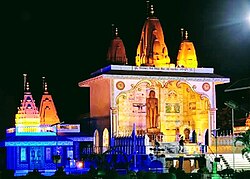
| image2 = | | image2 =Mahakaleshwar Temple, Ujjain.jpg | ||
| caption2 = Mahakaleshwar Temple | | caption2 = [[Mahakaleshwar Temple]] | ||
| image3 = UjjainTower.jpg | | image3 = UjjainTower.jpg | ||
| caption3 = Tower Chowk | | caption3 = Tower Chowk | ||
}} | |image4 = Shipra River, Ujjain.jpg | ||
| caption4 = Shipra River | |||
|image5 = Kal Bhairav Ujjain - Deepmalika.jpg | |||
| caption5 = Deepmalika}} | |||
| image_caption = | | image_caption = | ||
| nickname = | | nickname = | ||
| map_alt = | | map_alt = | ||
| map_caption = | | map_caption = | ||
| Line 27: | Line 32: | ||
| pushpin_label_position = right | | pushpin_label_position = right | ||
| pushpin_map_caption = Location in India | | pushpin_map_caption = Location in India | ||
| coordinates = {{ | | coordinates = {{Coord|23.17|N|75.79|E|display=inline,title}} | ||
| subdivision_type = Country | | subdivision_type = Country | ||
| subdivision_name = {{flag|India}} | | subdivision_name = {{flag|India}} | ||
| subdivision_type1 = [[States and territories of India|State]] | | subdivision_type1 = [[States and territories of India|State]] | ||
| subdivision_name1 = {{ | | subdivision_name1 = {{Flagicon image|Emblem of Madhya Pradesh.svg|Emblem of Madhya Pradesh}} [[Madhya Pradesh]] | ||
| subdivision_type2 = [[List of regions of India|Region]] | | subdivision_type2 = [[List of regions of India|Region]] | ||
| subdivision_name2 = [[Malwa]] | | subdivision_name2 = [[Malwa]] | ||
| subdivision_type3 = [[List of districts of India|District]] | | subdivision_type3 = [[List of districts of India|District]] | ||
| subdivision_name3 = [[Ujjain district|Ujjain]] | | subdivision_name3 = [[Ujjain district|Ujjain]] | ||
| | | subdivision_type5 = Ward | ||
| subdivision_name5 = 54 Wards<ref>{{Cite web | url=https://localbodydata.com/municipal-corporations-ujjain-250851 | title=Ujjain Municipal Corporations | access-date=10 December 2024 | archive-date=31 January 2025 | archive-url=https://web.archive.org/web/20250131031458/https://localbodydata.com/municipal-corporations-ujjain-250851 | url-status=dead }}</ref> | |||
| established_title = Urbanised | |||
| established_date = c. 700 BCE | | established_date = c. 700 BCE | ||
| named_for = | | named_for = | ||
| government_type = Municipal | | government_type = Municipal corporation | ||
| governing_body = [[Ujjain Municipal Corporation]] | | governing_body = [[Ujjain Municipal Corporation]] | ||
| leader_title = Mayor | |||
| leader_name = Jayti Singh | |||
| leader_party = [[Bharatiya Janata Party|BJP]] | | leader_party = [[Bharatiya Janata Party|BJP]] | ||
| | | leader_title1 = MP | ||
| | | leader_name1 = [[Anil Firojiya]], [[Bharatiya Janata Party|BJP]] | ||
| leader_title2 = [[Municipal Commissioner (India)|Municipal Commissioner]] | | leader_title2 = [[Municipal Commissioner (India)|Municipal Commissioner]] | ||
| leader_name2 = Shri Ashish Singh, IAS | | leader_name2 = Shri Ashish Singh, IAS | ||
| unit_pref = Metric | | unit_pref = Metric | ||
| area_footnotes = <ref>{{ | | area_footnotes = <ref>{{Cite web|url=http://nagarnigamujjain.org/english/aboutus.html|title=Ujjain City|access-date=21 November 2020|archive-date=26 October 2021|archive-url=https://web.archive.org/web/20211026084942/http://nagarnigamujjain.org/english/aboutus.html|url-status=dead}}</ref><ref name=census>{{Cite web|title=District Census Handbook - Ujjain|url=http://www.censusindia.gov.in/2011census/dchb/2318_PART_B_DCHB_UJJAIN.pdf|website=Census of India|access-date=6 December 2015|page=12,22|archive-date=25 November 2015|archive-url=https://web.archive.org/web/20151125210741/http://www.censusindia.gov.in/2011census/dchb/2318_PART_B_DCHB_UJJAIN.pdf|url-status=dead}}</ref> | ||
| area_rank = 5th in M.P. | | area_rank = 5th in M.P. | ||
| area_total_km2 = 151.83 | | area_total_km2 = 151.83 | ||
| area_metro_km2 = 745 | | area_metro_km2 = 745 | ||
| elevation_footnotes = | | elevation_footnotes = | ||
| elevation_m = 494 | | elevation_m = 494 | ||
| Line 57: | Line 65: | ||
| population_as_of = 2011 | | population_as_of = 2011 | ||
| population_rank = 5th in M.P. | | population_rank = 5th in M.P. | ||
| population_density_km2 = | | population_density_km2 = | ||
| population_metro = | | population_density_sq_mi = 8800 | ||
| population_metro = 885566 | |||
| population_demonym = | | population_demonym = | ||
| population_footnotes = | | population_footnotes = | ||
| Line 69: | Line 78: | ||
| utc_offset1 = +5:30 | | utc_offset1 = +5:30 | ||
| postal_code_type = [[Postal Index Number|PIN]] | | postal_code_type = [[Postal Index Number|PIN]] | ||
| postal_code = 456001, 456003, 456006, 456010, 456661, 456664. | | postal_code = 456001, 456003, 456006, 456010, 456661, 456664.456668 | ||
| area_code_type = Telephone code | | area_code_type = Telephone code | ||
| area_code = | | area_code = 0734 | ||
| registration_plate = MP-13 | | registration_plate = MP-13 | ||
| blank1_name_sec1 = [[Climate of India|Climate]] | | blank1_name_sec1 = [[Climate of India|Climate]] | ||
| blank1_info_sec1 = [[Climatic regions of India|Cwa]] <small>([[Köppen climate classification|Köppen]])</small> | | blank1_info_sec1 = [[Climatic regions of India|Cwa]] <small>([[Köppen climate classification|Köppen]])</small> | ||
| blank2_name_sec1 = [[Precipitation (meteorology)|Precipitation]] | | blank2_name_sec1 = [[Precipitation (meteorology)|Precipitation]] | ||
| blank2_info_sec1 = {{ | | blank2_info_sec1 = {{Convert|900|mm|in}} | ||
| blank3_name_sec1 = Avg. annual temperature | | blank3_name_sec1 = Avg. annual temperature | ||
| blank3_info_sec1 = {{ | | blank3_info_sec1 = {{Convert|24.0|°C|°F}} | ||
| blank4_name_sec1 = Avg. summer temperature | | blank4_name_sec1 = Avg. summer temperature | ||
| blank4_info_sec1 = {{ | | blank4_info_sec1 = {{Convert|31|°C|°F}} | ||
| blank5_name_sec1 = Avg. winter temperature | | blank5_name_sec1 = Avg. winter temperature | ||
| blank5_info_sec1 = {{ | | blank5_info_sec1 = {{Convert|17|°C|°F}} | ||
| website = {{URL|https://ujjain.nic.in}} | | website = {{URL|https://ujjain.nic.in}} | ||
| footnotes = | | footnotes = | ||
| Line 88: | Line 97: | ||
}} | }} | ||
'''Ujjain''' ({{IPAc-en | '''Ujjain''' ({{IPAc-en|u:|ˈ|dʒ|eɪ|n|}}, {{IPA|hi|ʊ̯d͡ːʑæn|audio=Ujjain.ogg}}, {{IPA|hi|əʋən̪t̪ɪkaː|}}), also known as '''Ujjayini''', is a city in [[Ujjain district]] of the [[States and territories of India|Indian state]] of [[Madhya Pradesh]]. It is the fifth-largest city in Madhya Pradesh by population and is the [[public administration|administrative]] as well as religious centre of Ujjain district and [[Ujjain division]].<ref name=census /> It is one of the Hindu pilgrimage centres of [[Sapta Puri]] famous for the ''[[Kumbh Mela]]'' [[Ujjain Simhastha|(Simhastha)]] held there every 12 years.<ref name=Simhasth>{{cite news |url=http://indianexpress.com/article/india/india-news-india/ujjain-simhastha-humbh-mela-ends-kshipra-river-2812330/ |title=Ujjain: As Kumbh draws to a close, devotees throng Kshipra for 'shahi snan' |date=21 May 2016 |publisher=Indian Express }}</ref> The ancient and world famous temple of [[Mahakaleshwar Jyotirlinga]] is located in the center of the city. The city has been one of the most prominent trade and political centres of the [[Indian subcontinent]] from the time of the ancient [[Mahajanapadas|Mahājanapadas]] until the British colonisation of India. | ||
An ancient city situated on the eastern bank of the [[Shipra River]], Ujjain was the most prominent city on the [[Malwa]] plateau of central India for much of its history. It emerged as the political centre of central India around 600 BCE. It was the capital of the ancient [[Avanti (India)|Avanti]] kingdom, one of the sixteen Mahājanapadas. During the 18th century, the city briefly became the capital of the [[Scindia Dynasty|Scindia state]] of the [[Maratha | An ancient city situated on the eastern bank of the [[Shipra River]], then known as '''Avantika,'''<ref>{{Cite web |title=Culture & Heritage {{!}} District Ujjain, Government of Madhya Pradesh {{!}} India |url=https://ujjain.nic.in/en/culture-heritage/ |access-date=27 December 2022 |language=en-US}}</ref> it was the most prominent city on the [[Malwa]] plateau of [[central India]] for much of its history. It emerged as the political centre of central India around 600 BCE. It was the capital of the ancient [[Avanti (India)|Avanti]] kingdom, one of the sixteen Mahājanapadas. During the 18th century, the city briefly became the capital of the [[Scindia Dynasty|Scindia state]] of the [[Maratha Confederacy]], when [[Ranoji Scindia]] established his capital at Ujjain in 1731. It remained an important political, commercial, and cultural centre of [[Central India]] until the early 19th century, when the [[British Raj|British]] administrators decided to develop [[Indore]] as an alternative to it. Ujjain continues to be an important place of pilgrimage for [[Shaivism|Shaivite]]s, [[Vaishnavism|Vaishnavite]]s and [[Shaktism|Shaktas]].<ref>{{cite book |title=Pilgrimage in the Hindu Tradition: Salvific Space |first=Knut A. |last=Jacobsen |publisher=Routledge |year=2013 |isbn=978-0-41559-038-9 |page=128 |url=https://books.google.com/books?id=Kn6_3oBFAqIC&pg=PA128}}</ref><ref name="sahaja">[http://sahajaharidwar.tripod.com/About_Haridwar.html About Haridwar] sahajaharidwar.</ref> Bathing in the holy Shipra river of Ujjain liberates one from sins. Therefore, Ujjain is also called the 'Mokshadayini city'. The name of this river is taken among the holy rivers like [[Kaveri]], [[Narmada River|Narmada]], [[Godavari River|Godavari]] and [[Krishna River|Krishna]]. | ||
According to Puranic legend, Ujjain, along with [[Haridwar]], [[Nashik]], and [[Allahabad|Prayag]], is one of four sites where drops of ''[[amrita]]'',<ref>{{Cite web |date=2021 | According to Puranic legend, Ujjain, along with [[Haridwar]], [[Nashik]], and [[Allahabad|Prayag]], is one of four sites where drops of ''[[amrita]]'',<ref>{{Cite web |date=4 February 2021 |title=इस पौराणिक कथा से जानिए क्यों लगता है कुंभ का मेला? – mobile |url=https://www.punjabkesari.in/dharm/news/kumbh-mela-story-related-samudra-manthan-1326800 |access-date=13 November 2021 |website=punjabkesari}}</ref> the elixir of immortality, accidentally spilled over from a ''[[kumbha]]'' (pitcher) while being carried by the celestial bird [[Garuda]] during the ''[[Samudra manthan|Samudra Manthana]]'', or the churning of the ocean of milk. | ||
Ujjain has been selected as one of the hundred Indian cities to be developed as a [[smart city]] under Prime Minister [[Narendra Modi]]'s flagship [[Smart Cities Mission]].<ref>{{Cite web|url=http://www.firstpost.com/business/why-only-98-cities-instead-of-100-announced-all-questions-answered-about-smart-cities-project-2410576.html|title = Only 98 cities instead of 100 announced: All questions answered about the smart cities project | Ujjain has been selected as one of the hundred Indian cities to be developed as a [[smart city]] under Prime Minister [[Narendra Modi]]'s flagship [[Smart Cities Mission]].<ref>{{Cite web|url=http://www.firstpost.com/business/why-only-98-cities-instead-of-100-announced-all-questions-answered-about-smart-cities-project-2410576.html|title = Only 98 cities instead of 100 announced: All questions answered about the smart cities project| work=Firstpost |date = 28 August 2015}}</ref> | ||
==History== | ==History== | ||
| Line 100: | Line 109: | ||
=== Prehistoric era === | === Prehistoric era === | ||
Excavations at [[Kaytha|Kayatha]] (around 26 km from Ujjain) have revealed [[ | Excavations at [[Kaytha|Kayatha]] (around 26 km from Ujjain) have revealed [[Chalcolithic]] agricultural settlements dating to around 2000 BCE.<ref name="PKB_2012">{{cite book |url=https://archive.org/details/citycountryinear0000basa |url-access=registration |title=The City and the Country in Early India: A Study of Malwa |author=P. K. Basant |publisher=Primus |year=2012 |isbn=9789380607153 |pages=[https://archive.org/details/citycountryinear0000basa/page/78 78]–81 }}</ref> Chalcolithic sites have also been discovered at other areas around Ujjain, including [[Nagda]], but excavations at Ujjain itself have not revealed any Chalcolithic settlements. Archaeologist [[Hasmukh Dhirajlal Sankalia|H. D. Sankalia]] theorised that the Chalcolithic settlements at Ujjain were probably destroyed by the [[Iron Age]] settlers.{{sfn|Pranab Kumar Bhattacharyya|1977|pp=1-2}} | ||
According to [[Hermann Kulke]] and [[Dietmar Rothermund]], [[Avanti (India)|Avanti]], whose capital was Ujjain, "was one of the earliest outposts in central India" and showed signs of early incipient urbanisation around 700 BCE.<ref>{{cite book |title=A History of India |first1=Hermann |last1=Kulke |first2=Dietmar |last2=Rothermund |publisher=Psychology Press |year=2004 |isbn=978-0-41532-920-0 |author-link1=Hermann Kulke |author-link2=Dietmar Rothermund |url=https://books.google.com/books?id=RoW9GuFJ9GIC&pg=PA50 |pages=50–51}}</ref> Around 600 BCE, Ujjain emerged as the political, commercial and cultural centre of [[Malwa]] plateau.<ref name="Trudy_2012">{{cite book |url=https://books.google.com/books?id=voerPYsAB5wC&pg=PA835 |title=Asia and Oceania: International Dictionary of Historic Places |pages=835–837 |editor1=Trudy Ring |editor2=Noelle Watson |editor3=Paul Schellinger |publisher=Routledge |year=2012 |isbn=9781136639791 }}</ref> | According to [[Hermann Kulke]] and [[Dietmar Rothermund]], [[Avanti (India)|Avanti]], whose capital was Ujjain, "was one of the earliest outposts in central India" and showed signs of early incipient urbanisation around 700 BCE.<ref>{{cite book |title=A History of India |first1=Hermann |last1=Kulke |first2=Dietmar |last2=Rothermund |publisher=Psychology Press |year=2004 |isbn=978-0-41532-920-0 |author-link1=Hermann Kulke |author-link2=Dietmar Rothermund |url=https://books.google.com/books?id=RoW9GuFJ9GIC&pg=PA50 |pages=50–51}}</ref> Around 600 BCE, Ujjain emerged as the political, commercial, and cultural centre of [[Malwa]] plateau.<ref name="Trudy_2012">{{cite book |url=https://books.google.com/books?id=voerPYsAB5wC&pg=PA835 |title=Asia and Oceania: International Dictionary of Historic Places |pages=835–837 |editor1=Trudy Ring |editor2=Noelle Watson |editor3=Paul Schellinger |publisher=Routledge |year=2012 |isbn=9781136639791 }}</ref> | ||
The ancient walled city of Ujjain was located around the Garh Kalika hill on the bank of river Kshipra, in the present-day suburban areas of the Ujjain city. This city covered an irregular pentagonal area of 0.875 km<sup>2</sup>. It was surrounded by a 12 m high mud [[rampart (fortification)|rampart]]. The archaeological investigations have also indicated the presence of a 45 | The ancient walled city of Ujjain was located around the Garh Kalika hill on the bank of the river Kshipra, in the present-day suburban areas of the Ujjain city. This city covered an irregular pentagonal area of 0.875 km<sup>2</sup>. It was surrounded by a 12 m high mud [[rampart (fortification)|rampart]]. The archaeological investigations have also indicated the presence of a 45 meter wide and 6.6 m deep [[moat]] around the city.<ref name="DS_2014">{{cite book |url=https://books.google.com/books?id=nVeWBQAAQBAJ&pg=PA22 |title=Fortified Cities of Ancient India: A Comparative Study |author=Dieter Schlingloff |publisher=Anthem |year=2014 |isbn=9781783083497 |pages=21–22 }}</ref> According to [[Raymond Allchin|F. R. Allchin]] and George Erdosy, these city defences were constructed between the 6th and 4th centuries BCE.<ref name="FRA_GE_1995"/> Dieter Schlingloff believes that these were built before 600 BCE.<ref name="DS_2014"/> This period is characterised by structures made of stone and burnt-brick, tools and weapons made of iron, and black and red [[burnishing (metal)|burnished]] ware.<ref name="FRA_GE_1995">{{cite book |url=https://books.google.com/books?id=Q5kI02_zW70C&pg=PA135 |title=The Archaeology of Early Historic South Asia: The Emergence of Cities and States |author=[[Raymond Allchin|F. R. Allchin]] and George Erdosy |publisher=Cambridge University Press |year=1995 |isbn=9780521376952 |pages=134–136 }}</ref> | ||
According to the [[Puranas|Puranic texts]], a branch of the legendary [[Haihayas|Haihaya dynasty]] ruled over Ujjain.<ref>{{cite news |url=https://books.google.com/books?id=_3O7q7cU7k0C&pg=PA90 |title=Malwa Through the Ages, from the Earliest Times to 1305 A.D |author=Kailash Chand Jain |publisher=Motilal Banarsidass |year=1972 |isbn=9788120808249 |page=90 }}</ref> | According to the [[Puranas|Puranic texts]], a branch of the legendary [[Haihayas|Haihaya dynasty]] ruled over Ujjain.<ref>{{cite news |url=https://books.google.com/books?id=_3O7q7cU7k0C&pg=PA90 |title=Malwa Through the Ages, from the Earliest Times to 1305 A.D |author=Kailash Chand Jain |publisher=Motilal Banarsidass |year=1972 |isbn=9788120808249 |page=90 }}</ref> | ||
=== Ancient period === | === Ancient period === | ||
[[File:Mahavir Tapo Bhumi.jpg|thumb|The Mahavira ''Tapo Bhumi'' | [[File:Mahavir Tapo Bhumi.jpg|thumb|The Mahavira ''Tapo Bhumi'']] | ||
In the 4th century BCE, the [[Maurya Empire|Mauryan]] emperor [[Chandragupta Maurya|Chandragupta]] annexed Avanti to his empire.<ref> | |||
In the 4th century BCE, the [[Maurya Empire|Mauryan]] emperor [[Chandragupta Maurya|Chandragupta]] annexed Avanti to his empire.<ref>{{Cite web|url=https://www.britannica.com/place/Avanti-ancient-kingdom-India|title=Avanti | Gupta Dynasty, Ujjain & Malwa | Britannica|website=www.britannica.com}}</ref> [[Maurya Empire|Mauryan]] founded the City of Ujjain. The edicts of his grandson [[Ashoka]] mention four provinces of the Mauryan empire, of which Ujjain was the capital of the Western province.<ref>{{cite book |author=Abraham Eraly |title=Gem In The Lotus |url=https://books.google.com/books?id=YokatCwNG90C&pg=PT494 |date=23 January 2002 |publisher=Penguin |isbn=978-93-5118-014-2 |page=494 }}</ref> During the reign of his father [[Bindusara]], Ashoka served as the [[viceroy]] of Ujjain,<ref>{{cite book |url=https://books.google.com/books?id=-HeJS3nE9cAC&pg=PA152 |title=The Greeks in Bactria and India |author=[[William Woodthorpe Tarn]] |publisher=Cambridge University Press |year=2010 |isbn=9781108009416 |page=152 }}</ref> which highlights the importance of the town.<ref name="Trudy_2012"/> As the viceroy of Ujjain, Ashoka married Devi, the daughter of a merchant from Vedisagiri ([[Vidisha]]).<ref>{{cite book |author=Mookerji Radhakumud |title=Asoka |url=https://books.google.com/books?id=uXyftdtE1ygC&pg=PA8 |year=1962 |publisher=Motilal Banarsidass |isbn=978-81-208-0582-8 |page=8 }}</ref> According to the Sinhalese Buddhist tradition, their children, [[Mahinda (Buddhist monk)|Mahendra]] and [[Sanghamitra]], who preached Buddhism in modern Sri Lanka, were born in Ujjain.<ref name="Schlichtmann2016">{{cite book |author=Klaus Schlichtmann |title=A Peace History of India: From Ashoka Maurya to Mahatma Gandhi |url=https://books.google.com/books?id=1UYKDQAAQBAJ&pg=PT26 |year=2016 |publisher=Vij Books |isbn=978-93-85563-52-2 |page=26 }}</ref> | |||
From the Mauryan period, [[Northern Black Polished Ware]], copper coins, [[terracotta]] ring wells, and ivory seals with [[Brahmi script|Brahmi]] text have been excavated at Ujjain.<ref name="FRA_GE_1995"/> Ujjain emerged as an important commercial centre, partially because it lay on the trade route connecting north India to the Deccan, starting from Mathura. It also emerged as an important center for intellectual learning among [[Jain]], Buddhist, and Hindu traditions.<ref name="Trudy_2012"/> | |||
In the Post-Mauryan period, the [[Sungas]] and the [[Satavahanas]] ruled the city consecutively. The Satavahanas and the [[Ror]] [[Sakas]], known as [[Western Satraps]], contested for control of the city for a period. Following the end of the Satavahana dynasty, the Rors retained Ujjain from the second to the twelfth century C.E.<ref>{{cite web | |||
|url=https://ujjain.dcourts.gov.in/about-department/history/ | |||
|title=History of Ujjain | |||
|website=Ujjain District Court | |||
|date=4 September 2024 | |||
|access-date=4 September 2024 | |||
|archive-date=4 September 2024 | |||
|archive-url=https://web.archive.org/web/20240904093344/https://ujjain.dcourts.gov.in/about-department/history/ | |||
|url-status=dead | |||
}}</ref> | |||
After the Mauryans, Ujjain was controlled by a number of empires and dynasties, including local dynasties, the [[Shunga dynasty|Shungas]], the [[Western Satraps]], the [[Satavahana]]s, and the [[Gupta Empire|Guptas]].<ref name="Trudy_2012"/> | |||
Ujjain remained as an important city of the Guptas during the 4th and the 5th centuries. [[Kalidasa]], the great Indian classical poet of the 5th century who lived in the times of the Gupta king [[Chandragupta II|Vikramaditya]] wrote his epic work ''[[Meghadūta]]'' in which he describes the richness of Ujjain and its people.<ref>{{cite journal|title=Ujjain, a brilliant sliver of heaven on earth|journal=Tattvaloka|date=September 2018|volume=XLI|issue=6|publisher=Sri Abhinava Vidyatheertha Mahaswamigal Educational Trust|location=[[Sringeri]]|issn=0970-8901|last=Subramani|first=Dr.Vijaya|pages=40–3}}</ref> In the 6th century CE the Chinese pilgrim [[Xuanzang]] visited India. He describes the ruler of Avanti as a king who was generous to the poor and presented them with gifts.<ref>{{Cite book|url=https://books.google.com/books?id=Wk4_ICH_g1EC&q=hiuen+tsang+at+prayag&pg=PA255|title=Ancient Indian History and Civilization|last=Sen|first=Sailendra Nath|date=1999|publisher=New Age International|isbn=9788122411980|language=en}}</ref> | Ujjain remained as an important city of the Guptas during the 4th and the 5th centuries. [[Kalidasa]], the great Indian classical poet of the 5th century who lived in the times of the Gupta king [[Chandragupta II|Vikramaditya]] wrote his epic work ''[[Meghadūta]]'' in which he describes the richness of Ujjain and its people.<ref>{{cite journal|title=Ujjain, a brilliant sliver of heaven on earth|journal=Tattvaloka|date=September 2018|volume=XLI|issue=6|publisher=Sri Abhinava Vidyatheertha Mahaswamigal Educational Trust|location=[[Sringeri]]|issn=0970-8901|last=Subramani|first=Dr.Vijaya|pages=40–3}}</ref> In the 6th century CE the Chinese pilgrim [[Xuanzang]] visited India. He describes the ruler of Avanti as a king who was generous to the poor and presented them with gifts.<ref>{{Cite book|url=https://books.google.com/books?id=Wk4_ICH_g1EC&q=hiuen+tsang+at+prayag&pg=PA255|title=Ancient Indian History and Civilization|last=Sen|first=Sailendra Nath|date=1999|publisher=New Age International|isbn=9788122411980|language=en}}</ref> | ||
[[File:Shri Mahakaleshwar Temple Ujjain - panoramio (4).jpg|thumb|left|The famed historical [[Mahakaleshwar Jyotirlinga]] temple is in Ujjain]] | [[File:Shri Mahakaleshwar Temple Ujjain - panoramio (4).jpg|thumb|left|The famed historical [[Mahakaleshwar Jyotirlinga]] temple is in Ujjain]] | ||
[[Bhartṛhari | |||
[[Bhartṛhari]] is said to have written his great epics, Virat Katha, Neeti Sataka, the love story of Pradyot Princess Vasavadatta and Udayan in Ujjayini, as the city was called during his times. The writings of [[Bhasa]] are set in Ujjain, and he probably lived in the city.<ref>{{cite book |url=https://archive.org/details/cambridgeguideto0000banh |url-access=registration |title=The Cambridge Guide to Theatre |author=Martin Banham |publisher=Cambridge University Press |year=1995 |isbn=9780521434379 |page=[https://archive.org/details/cambridgeguideto0000banh/page/103 103] }}</ref> [[Kalidasa]] also refers to Ujjain multiple times, and it appears that he spent at least a part of his life in Ujjain.<ref>{{cite book |url=https://books.google.com/books?id=exDCAwAAQBAJ&pg=PA8 |title=Translations of Shakuntala: And Other Works |author=[[Arthur W. Ryder]] |publisher=The Floating Press |year=2014 |isbn=9781776535132 }}</ref> ''[[Mrichchhakatika]]'' by [[Shudraka]] is also set in Ujjain.<ref name="FPR_1993">{{cite book |url=https://books.google.com/books?id=OroCOEqkVg4C&pg=PA55 |title=Indian Theatre: Traditions of Performance |author=Farley P. Richmond |publisher=Motilal Banarsidass |year=1993 |isbn=9788120809819 |pages=55–57 }}</ref> Ujjain also appears in several stories as the capital of the legendary emperor [[Vikramaditya]] of the [[Paramara dynasty|Parmar dynasty]]. Somadeva's ''[[Kathasaritsagara]]'' (11th century) mentions that the city was created by [[Vishvakarman|Vishwakarma]], and describes it as invincible, prosperous and full of wonderful sights.<ref>{{cite book |chapter-url=https://archive.org/stream/oceanofstorybein09somauoft#page/n34/mode/2up |title=The ocean of story |volume=IX |editor = [[Norman Mosley Penzer|N. M. Penzer]] |translator=[[Charles Henry Tawney|C. H. Tawney]] |publisher=Chas J. Sawyer |year=1924 |chapter=Book XVIII: Vishamasila |page=2 }}</ref> Ujjain was sacked several times by the [[Arabs]] of the [[Umayyad Caliphate]] in the 8th century CE. The Arabs called the city ''Uzayn''.<ref>{{cite book |last=Jain |first=Kailash Chand |title=Malwa through the Ages, from the Earliest Times to 1305 A.D. |publisher=Motilal Banarsidas |year=1972 |isbn=9788120808249 |page=10}}</ref> | |||
=== Medieval period === | === Medieval period === | ||
[[File:Vedh Shala, Ujjain 01.jpg|thumb|left|The [[Jantar Mantar]] at Ujjain was commissioned by [[Jai Singh II]] (1688-1743) of Jaipur.]] | [[File:Vedh Shala, Ujjain 01.jpg|thumb|left|The [[Jantar Mantar]] at Ujjain was commissioned by [[Jai Singh II]] (1688-1743) of Jaipur.]] | ||
The [[Paramara dynasty|Paramaras]] (9th-14th century CE) shifted the region's capital from Ujjain to [[Dhar]].<ref name="Trudy_2012"/> [[Mahmud of Ghazni]] sacked the city and forced it to pay tribute during his invasion in India. In 1235 CE, [[Iltutmish]] of [[Delhi Sultanate]] plundered the city.<ref name="Trudy_2012"/> With the decline of the Paramara kingdom, Ujjain ultimately came under | The [[Paramara dynasty|Paramaras]] (9th-14th century CE) built the City of Ujjain and shifted the region's capital from Ujjain to [[Dhar]].<ref name="Trudy_2012"/> [[Mahmud of Ghazni]] sacked the city and forced it to pay tribute during his invasion in India. In 1235 CE, [[Iltutmish]] of the [[Delhi Sultanate]] plundered the city.<ref name="Trudy_2012"/> With the decline of the Paramara kingdom, Ujjain ultimately came under Islamic rule, like other parts of north-central India. The city continued to be an important city of central India. As late as the time of the [[Mughal Empire|Mughal]] vassal [[Jai Singh II]] (1688-1743), who constructed a [[Ved Shala|Jantar Mantar]] in the city, Ujjain was the largest city and capital of the [[Malwa Subah]]. The city continued to be developed during Muslim rule, especially under the [[Delhi Sultanate]] and the [[Mughal Empire]]. It was used as an important military headquarters.<ref>{{cite book |url=https://books.google.com/books?id=QRA2mgZnXXMC&pg=PA212 |title=Sawai Jai Singh and His Astronomy |author=Virendra Nath Sharma |publisher=Motilal Banarsidass |year=1995 |page=212 |isbn=9788120812567 }}</ref> | ||
=== Modern period === | === Modern period === | ||
{{See also|Dewas Junior|Dewas Senior|Dhar State|Indore State|Gwalior State}} | {{See also|Dewas Junior|Dewas Senior|Dhar State|Indore State|Gwalior State}} | ||
During the 18th century, the city briefly became the capital of [[Scindia]] state of the [[Maratha Empire]], when [[Ranoji Scindia]] established his capital at Ujjain in 1731. [[Mahadji Scindia]] constructed a grand palace with a hundred rooms around which the Maratha sardars constructed their own mansions. Ruined and destroyed temples were restored and newer ones were built.<ref>Vijayaraje Scindia, Princess - The Autobiography of Dowager Maharani of Gwalior, P.73</ref> But his successors moved to [[Gwalior]], where they ruled the [[Gwalior State]] in the latter half of the 18th century. The struggle of supremacy between the [[Holkar]]s of [[Indore]] and Scindias (who ruled Ujjain) led to rivalry between the merchants of the two cities.<ref name="AF_1998"/><ref>{{Cite web|title=Ujjain: राम घाट पर सिंधिया ने किया महाकाल की पालकी का पूजन, उमा भारती भी पहुंचीं|url=https://navbharattimes.indiatimes.com/state/madhya-pradesh/ujjain/ujjain-scindia-performs-baba-mahakals-palki-poojan-during-shahi-sawari-uma-bharti-also-present/videoshow/77594453.cms|access-date=2020 | During the 18th century, the city briefly became the capital of [[Scindia]] state of the [[Maratha Empire]], when [[Ranoji Scindia]] established his capital at Ujjain in 1731. [[Mahadji Scindia]] constructed a grand palace with a hundred rooms around which the Maratha sardars constructed their own mansions. Ruined and destroyed temples were restored and newer ones were built.<ref>Vijayaraje Scindia, Princess - The Autobiography of Dowager Maharani of Gwalior, P.73</ref> But his successors moved to [[Gwalior]], where they ruled the [[Gwalior State]] in the latter half of the 18th century. The struggle of supremacy between the [[House of Holkar|Holkar]]s of [[Indore]] and Scindias (who ruled Ujjain) led to rivalry between the merchants of the two cities.<ref name="AF_1998"/><ref>{{Cite web|title=Ujjain: राम घाट पर सिंधिया ने किया महाकाल की पालकी का पूजन, उमा भारती भी पहुंचीं|url=https://navbharattimes.indiatimes.com/state/madhya-pradesh/ujjain/ujjain-scindia-performs-baba-mahakals-palki-poojan-during-shahi-sawari-uma-bharti-also-present/videoshow/77594453.cms|access-date=18 August 2020|website=Navbharat Times|language=hi}}</ref><ref>{{Cite web|title=उज्जैन पहुंचकर बोले सिंधिया- यह मेरा गृह नगर जैसा, कांग्रेस नेताओं ने दिखाए काले झंडे|url=https://navbharattimes.indiatimes.com/state/madhya-pradesh/ujjain/jyotiraditya-scindia-reaches-ujjain-from-indore-local-bjp-leaders-give-a-grand-welcome-congress-leaders-raise-black-flags/videoshow/77591082.cms|access-date=18 August 2020|website=Navbharat Times|language=hi}}</ref><ref>{{Cite web|title=उज्जैन में मिले 21 नए कोरोना पॉजिटीव – AV News|url=https://avnews.in/today-ujjain-covid-heatlh-bulletin/|access-date=18 August 2020|language=en-US|archive-date=26 March 2023|archive-url=https://web.archive.org/web/20230326221547/https://avnews.in/today-ujjain-covid-heatlh-bulletin/|url-status=dead}}</ref> On 18 July 1801, the Holkars defeated the Scindias at the [[Battle of Ujjain]]. On 1 September, [[Yashwantrao Holkar]] entered the city, and demanded a sum of 15 lakh rupees from the city. He received only 1/8th of this amount; the rest was pocketed by his officers. A force sent by [[Daulatrao Scindia]] later regained control of Ujjain.<ref>{{cite book |url=https://books.google.com/books?id=D_v3Y7hns8QC&pg=PA61 |title=History of the Marathas |author=R.S. Chaurasia |publisher=Atlantic |year=2004 |isbn=9788126903948 |page=61 }}</ref> After both Holkar and Scindias accepted the [[British Raj|British]] suzerainty, the British colonial administrators decided to develop Indore as an alternative to Ujjain, because the merchants of Ujjain had supported certain anti-British people. [[John Malcolm]], the British administrator of [[Central India]], decided to reduce the importance of Ujjain "by transferring a great part of that consequence it now enjoys to the Towns of Indore and [[Ratlam|Rutlam]] cities, which are and will continue more under our control."<ref name="AF_1998">{{cite book |url=https://books.google.com/books?id=pAJDrdP6sikC&pg=PA63 |title=Smuggling as Subversion: Colonialism, Indian Merchants, and the Politics of Opium, 1790-1843 |author=Amar Farooqui |publisher=Lexington |year=1998 |pages=62–63 |isbn=9780739108864 }}</ref> | ||
After Indian independence, Ujjain was placed in [[Madhya Bharat]] state, which in turn was fused into [[Madhya Pradesh]] in 1956.<ref>{{Cite web|title=उज्जैन में महाकालेश्वर की धूमधाम से निकली शाही सवारी|url=https://www.livehindustan.com/astrology/story-mahakaleshwar-shahi-sawari-2020-held-in-ujjain-3425436.html|access-date=2020 | After Indian independence, Ujjain was placed in [[Madhya Bharat]] state, which in turn was fused into [[Madhya Pradesh]] in 1956.<ref>{{Cite web|title=उज्जैन में महाकालेश्वर की धूमधाम से निकली शाही सवारी|url=https://www.livehindustan.com/astrology/story-mahakaleshwar-shahi-sawari-2020-held-in-ujjain-3425436.html|access-date=18 August 2020|website=Hindustan|language=hi}}</ref><ref>{{Cite web|title=उज्जैन में बाल-बाल बचे सिंधिया, समर्थकों की धक्का-मुक्की में गिरी रेलिंग|url=https://aajtak.intoday.in/story/jyotiraditya-scindia-reaches-ujjain-to-attend-mahakal-shahi-sawari-when-railing-fall-down-1-1220577.html|access-date=18 August 2020|website=aajtak.intoday.in|date=18 August 2020 |language=hi}}</ref><ref>{{Cite web|date=18 August 2020|title=उज्जैन: महाकाल की शाही सवारी के दौरान बड़ा हादसा टला, बाल-बाल बचे Scindia|url=https://zeenews.india.com/hindi/india/states/big-accident-averted-in-ujjain-jyotiraditya-scindia-narrowly-escapes/730500|access-date=18 August 2020|website=Zee News Hindi}}</ref><ref>{{Cite web|date=18 August 2020|title=सिंधिया ने कहा: भले ही उज्जैन में उप चुनाव नहीं लेकिन उज्जैन आसपास होने वाले चुनाव का केंद्र बिंदु बना रहेगा|url=https://www.bhaskar.com/local/mp/ujjain/news/scindia-said-even-though-there-is-no-by-election-in-ujjain-but-ujjain-will-remain-the-focal-point-of-the-elections-around-127626123.html|access-date=18 August 2020|website=Dainik Bhaskar|language=hi}}</ref> | ||
==Geography== | ==Geography== | ||
Ujjain is located in the [[Western India|west-central part of India]], and is north of the upper limit of the [[Vindhya]] mountain ranges. Located on the [[Malwa]] plateau, it is higher than the north Indian plains and the land rises towards the [[Vindhya Range]] to the south. Ujjain's | Ujjain is located in the [[Western India|west-central part of India]], and is north of the upper limit of the [[Vindhya]] mountain ranges. Located on the [[Malwa]] plateau, it is higher than the north Indian plains and the land rises towards the [[Vindhya Range]] to the south. Ujjain's coordinates are {{Coord|23|10|N|75|46|E|}} with an average elevation of 494 m (1620 ft).<ref name=elevation>{{Cite web|url=https://dateandtime.info/citycoordinates.php?id=1253914|title=Geographic coordinates of Ujjain. Latitude, longitude, and elevation above sea level of Ujjain, India|website=dateandtime.info}}</ref> The region is an extension of the [[Deccan Traps]], formed between 60 and 68 [[geologic timescale|million years ago]]<ref>{{cite web |url=http://ksgeo.kj.yamagata-u.ac.jp/~iwata/personal/Deccan-e.htm |title= Geochronological Study of the Deccan Volcanism by the 40Ar-39Ar Method |archive-url=https://web.archive.org/web/20060225205236/http://ksgeo.kj.yamagata-u.ac.jp/~iwata/personal/Deccan-e.htm |archive-date=25 February 2006 }}</ref><ref>{{Cite web|url=https://www.mantleplumes.org/Deccan.html|title=Deccan Traps|website=www.mantleplumes.org}}</ref> at the end of the [[Cretaceous]] [[Geologic period|period]]. The city is on the bank of the river [[Shipra]] which flows into the nearby [[Chambal River|Chambal]]. | ||
===Climate=== | |||
Climate of the city features a typical version of the [[humid subtropical climate]] ([[Köppen climate classification|Köppen]] ''Cwa''). Summers usually starts by the middle of March which lasts up until late June. During which temperatures normally reaches up to 45 °C, with average maximum peaking in May with 41 °C.<ref>{{Cite web|title=Controversial UP MLA Vijay Mishra held near Ujjain for alleged extortion|url=https://www.newindianexpress.com/nation/2020/aug/15/controversial-up-mla-vijay-mishra-held-near-ujjain-for-alleged-extortion-2183660.html|access-date=18 August 2020|website=The New Indian Express|date=15 August 2020 }}</ref> Monsoon starts in late June and ends in late September. These months see about 36 inches (914 mm) of precipitation, frequent thunderstorms and flooding. This season usually features wet phase of comfortable with average temperatures around 24 °C (76 °F) but this is accompanied with frequent downpours. This wet phase is followed by dry phase which results in humid weather with high temperatures. Temperatures rise again up to early November when winter starts,<ref>{{Cite web|title=Ujjain: प्रेमिका की पुल से नीचे फेंक कर दी हत्या, सीसीटीवी फुटेज से पकड़ाया, देखिए वायरल वीडियो|url=https://navbharattimes.indiatimes.com/state/madhya-pradesh/ujjain/man-kills-girlfriend-by-throwing-her-from-overbridge-at-ujjain-caught-through-cctv-footage-watch-viral-video/videoshow/77272990.cms|access-date=18 August 2020|website=Navbharat Times|language=hi}}</ref><ref>{{Cite web|date=17 August 2020|title=Madhya Pradesh: Over 12 cows die in Mahakal Temple in Ujjain|url=https://www.zee5.com/zeekannada/madhya-pradesh-over-12-cows-die-in-mahakal-temple-in-ujjain/|access-date=18 August 2020|website=ZEE5 News|language=en}}</ref><ref>{{Cite web|title=Murder at Ujjain Hotel: 2 बार प्रेमी से शादी कर चुकी थी, तीसरी बार परिवार की मर्जी से करना चाहती थी, इसलिए मार डाला|url=https://navbharattimes.indiatimes.com/state/madhya-pradesh/ujjain/murder-at-ujjain-hotel-police-solves-tanu-parihar-murder-case-within-24-hours-accused-lover-arrested/articleshow/77554556.cms|access-date=18 August 2020|website=Navbharat Times|language=hi}}</ref> which lasts up to early March. Winters are cool, dry and sunny with occasional cold snaps during which temperature may drop to close to freezing (0° to 3 °C). Otherwise temperatures are very much comfortable, with average daily temperatures around 16 °C (61 °F). | |||
==Climate== | |||
Climate of the city features | |||
{{Weather box | {{Weather box | ||
| location = Ujjain (1991–2020, extremes 1954–2012) | | location = Ujjain (1991–2020, extremes 1954–2012) | ||
| metric first = yes | | metric first = yes | ||
| single line = yes | | single line = yes | ||
| Line 256: | Line 277: | ||
| access-date = 28 December 2020}}</ref> | | access-date = 28 December 2020}}</ref> | ||
}} | }} | ||
Ujjain has been ranked the 26th best "National Clean Air City" under Category 2 3-10L population cities in India.<ref>{{Cite web |date=7 September 2024 |title=Swachh Vayu Sarvekshan 2024 |url=https://prana.cpcb.gov.in/ncapServices/robust/fetchFilesFromDrive/Swachh_Vayu_Survekshan_2024_Result.pdf |website=Swachh Vayu Sarvekshan 2024 |access-date=24 September 2024 |archive-date=14 September 2024 |archive-url=https://web.archive.org/web/20240914164336/https://prana.cpcb.gov.in/ncapServices/robust/fetchFilesFromDrive/Swachh_Vayu_Survekshan_2024_Result.pdf |url-status=dead }}</ref> | |||
==Demographics== | ==Demographics== | ||
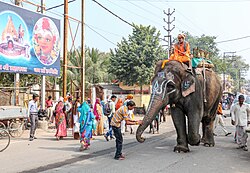
[[File:Elephant in Ujjain.jpg|thumb|Harsiddhi Marg in Ujjain]] | [[File:Elephant in Ujjain.jpg|thumb|Harsiddhi Marg in Ujjain]] | ||
According to the 2011 census, Ujjain had a population of 515,215, comprising 265,291 males and 249,924 females, giving a sex ratio of 942 per 1000. The overall literacy rate was 85.55%, with male literacy at 91.16% and female literacy at 79.62%.<ref name="2011 table 2">{{cite web |title=Cities having population 1 lakh and above |url=http://www.censusindia.gov.in/2011-prov-results/paper2/data_files/India2/Table_2_PR_Cities_1Lakh_and_Above.pdf |publisher=Census of India 2011 |access-date=17 September 2019}}</ref> | |||
According to the 2011 census, Ujjain had a population of 515,215, comprising 265,291 males and 249,924 females, giving a sex ratio of 942 per 1000. The overall literacy rate was 85.55%, with male literacy at 91.16% and female literacy at 79.62%.<ref name="2011 table 2">{{cite web |title=Cities having population 1 lakh and above |url=http://www.censusindia.gov.in/2011-prov-results/paper2/data_files/India2/Table_2_PR_Cities_1Lakh_and_Above.pdf |publisher=Census of India 2011 |access-date=17 September 2019 |archive-date=7 May 2012 |archive-url=https://web.archive.org/web/20120507135928/http://www.censusindia.gov.in/2011-prov-results/paper2/data_files/India2/Table_2_PR_Cities_1Lakh_and_Above.pdf |url-status=dead }}</ref> | |||
{{bar box | {{bar box | ||
| Line 289: | Line 313: | ||
==Government and jurisdiction== | ==Government and jurisdiction== | ||
Most of the regions surrounding the city are administered by the [[Ujjain Municipal Corporation]] (UMC). The city is administered by a Divisional Commissioner and a Collectorate Office as well as the Mayor. They are responsible for the town and Country Planning Department, Forest Department, Public Health Engineering, Public Works Department and MP Electricity Board.<ref name="ujjain">{{cite web |url=http://www.ujjain.nic.in/ |title=Welcome to official website of District Administration Ujjain (M.P.) India |publisher=ujjain.nic.in |access-date=2015 | Most of the regions surrounding the city are administered by the [[Ujjain Municipal Corporation]] (UMC). The city is administered by a Divisional Commissioner and a Collectorate Office as well as the Mayor. They are responsible for the town and Country Planning Department, Forest Department, Public Health Engineering, Public Works Department and MP Electricity Board.<ref name="ujjain">{{cite web |url=http://www.ujjain.nic.in/ |title=Welcome to official website of District Administration Ujjain (M.P.) India |publisher=ujjain.nic.in |access-date=21 August 2015 |archive-date=30 June 2015 |archive-url=https://web.archive.org/web/20150630201443/http://ujjain.nic.in/ |url-status=dead }}</ref><ref name="indiatimes">{{cite news|url=http://timesofindia.indiatimes.com/india/BJP-clean-sweeps-in-Madhya-Pradesh-civic-polls/articleshow/48501303.cms |title=BJP clean sweeps in Madhya Pradesh civic polls - The Times of India |newspaper=The Times of India |date=16 August 2015 |publisher=timesofindia.indiatimes.com|access-date=21 August 2015}}</ref> | ||
Ujjain has been a metropolitan municipality with a mayor-council form of government. The Ujjain Municipal Corporation (UMC) was established in 1956 under the Madhya Pradesh Nagar Palika Nigam Adhiniyam. The UMC was established in 1886 as Nagar Palika, but the Municipal Corporation of Ujjain was declared on a par with the Gwalior Municipal Corporation. The UMC is responsible for public education, correctional institutions, libraries, public safety, recreational facilities, sanitation, water supply, local planning and welfare services. The mayor and councillors are elected to five-year terms.<ref name="ujjain2">{{cite web|url=http://www.ujjain.nic.in/Administration/CommissionerTenure/comm.html|title=Welcome to official website of District Administration Ujjain (M.P.) India|publisher=ujjain.nic.in|access-date=2015 | Ujjain has been a metropolitan municipality with a mayor-council form of government. The Ujjain Municipal Corporation (UMC) was established in 1956 under the Madhya Pradesh Nagar Palika Nigam Adhiniyam. The UMC was established in 1886 as Nagar Palika, but the Municipal Corporation of Ujjain was declared on a par with the Gwalior Municipal Corporation. The UMC is responsible for public education, correctional institutions, libraries, public safety, recreational facilities, sanitation, water supply, local planning and welfare services. The mayor and councillors are elected to five-year terms.<ref name="ujjain2">{{cite web|url=http://www.ujjain.nic.in/Administration/CommissionerTenure/comm.html|title=Welcome to official website of District Administration Ujjain (M.P.) India|publisher=ujjain.nic.in|access-date=21 August 2015|archive-url=https://web.archive.org/web/20150806164101/http://www.ujjain.nic.in/Administration/CommissionerTenure/comm.html|archive-date=6 August 2015|url-status=dead}}</ref><ref name="ujjain3">{{cite web|url=http://www.ujjain.nic.in/Benificiary_List/patta/Patta-benificiary.html|title=Welcome to official website of District Administration Ujjain (M.P.) India|publisher=ujjain.nic.in|access-date=21 August 2015|archive-url=https://web.archive.org/web/20150706114354/http://www.ujjain.nic.in/Benificiary_List/patta/Patta-benificiary.html|archive-date=6 July 2015|url-status=dead}}</ref> | ||
<ref name="ujjain3">{{cite web|url=http://www.ujjain.nic.in/Benificiary_List/patta/Patta-benificiary.html|title=Welcome to official website of District Administration Ujjain (M.P.) India|publisher=ujjain.nic.in|access-date=2015 | |||
The [[Ujjain Development Authority]], also known as UDA, is the urban planning agency serving Ujjain. Its headquarters are located in the Bharatpuri area of Ujjain. It was established under the Madhya Pradesh Town and Country Planning Act, 1973.<ref name=glance>{{cite web|title=Information at a glance|url=http://www.mpurban.gov.in/Pdf/CDP/Indore%20CDP_%20Final.pdf|publisher=MPurban|access-date=December | The [[Ujjain Development Authority]], also known as UDA, is the urban planning agency serving Ujjain. Its headquarters are located in the Bharatpuri area of Ujjain. It was established under the Madhya Pradesh Town and Country Planning Act, 1973.<ref name=glance>{{cite web|title=Information at a glance|url=http://www.mpurban.gov.in/Pdf/CDP/Indore%20CDP_%20Final.pdf|publisher=MPurban|access-date=12 December 2015}}</ref> | ||
[[Ujjain (Lok Sabha constituency)|Ujjain Lok Sabha constituency]] is one of the 29 [[Lok Sabha]] constituencies in [[Madhya Pradesh]] state in central India. This constituency came into existence in 1951 as one of the 9 | [[Ujjain (Lok Sabha constituency)|Ujjain Lok Sabha constituency]] is one of the 29 [[Lok Sabha]] constituencies in [[Madhya Pradesh]] state in central India. This constituency came into existence in 1951 as one of the 9 LokSabha constituencies in the erstwhile [[Madhya Bharat]] state. It is reserved for the candidates belonging to the [[Dalit|Scheduled Castes]] since 1966. This constituency covers the entire [[Ujjain district]] and part of [[Ratlam district]]. Previously, Dr. [[Chintamani Malviya]] of the [[Bharatiya Janata Party]] was the member of parliament who won in the [[2014 Indian general elections]].<ref>{{cite web |url=http://eciresults.nic.in/ConstituencywiseS1222.htm?ac=22 |title=Constituencywise-All Candidates |publisher=Eciresults.nic.in |access-date=17 May 2014 |archive-date=17 May 2014 |archive-url=https://web.archive.org/web/20140517180755/http://eciresults.nic.in/ConstituencywiseS1222.htm?ac=22 |url-status=dead }}</ref> | ||
The | The current Member of Parliament from [[Ujjain (Lok Sabha constituency)|Ujjain]] is Anil Firojiya ([[Bharatiya Janata Party|BJP]]) after the [[Lok Sabha]] Election of 2019.<ref>{{Cite web|url=https://www.news18.com/news/politics/ujjain-election-results-2019-live-updates-winner-loser-leading-trailing-2154519.html|title=Ujjain Election Results 2019 Live Updates: Anil Firojiya of BJPWins|website=News18|date=23 May 2019|access-date=23 May 2019}}</ref> | ||
== | == Notable sites == | ||
* [[Mahakaleshwar Jyotirlinga]] | * [[Mahakaleshwar Jyotirlinga]] | ||
* [[Chintaman Ganesh Temple, Ujjain|Chintaman Ganesh Temple]] | |||
* Harsiddhi Temple<ref>[https://ujjain.nic.in/en/tourist-place/harsiddhi/ Harsiddhi Temple]</ref> | |||
* [[Kal Bhairav Temple, Ujjain|Kal Bhairav Temple]] | * [[Kal Bhairav Temple, Ujjain|Kal Bhairav Temple]] | ||
* [[Sandipani|Sandipani Ashram]] | * [[Sandipani|Sandipani Ashram]] | ||
* [[Mangalnath Temple]] | * [[Mangalnath Temple]] | ||
* ISKCON Temple | |||
==Education== | ==Education== | ||
| Line 316: | Line 340: | ||
*[[Avantika University]] | *[[Avantika University]] | ||
===Medical | ===Medical colleges=== | ||
* [[Ruxmaniben Deepchand Gardi Medical College]] | * [[Ruxmaniben Deepchand Gardi Medical College]] | ||
* Govt. Medical College | |||
* Amaltas Medical College | |||
===Engineering | ===Engineering colleges=== | ||
* [[Ujjain Engineering College]] (Govt.) | * [[Ujjain Engineering College]] (Govt.) | ||
* School of Engineering Vikram University (Govt.) | * School of Engineering Vikram University (Govt.) | ||
* MIT Group of Institutes, Ujjain | * MIT Group of Institutes, Ujjain | ||
*Shree Guru Sandipani Institute of Science and Technology | * Shree Guru Sandipani Institute of Science and Technology | ||
*Prashanti Institute of Technology | * Prashanti Institute of Technology | ||
*Alpine Institute of Technology | * Alpine Institute of Technology | ||
===Schools=== | ===Schools=== | ||
<!-- Per WP:WTAF, links to non-existent pages will be removed --> | <!-- Per WP:WTAF, links to non-existent pages will be removed --> | ||
* | * St. Paul's Convent H.S. School | ||
* [[Christu Jyoti Convent School]] | * [[Christu Jyoti Convent School]] | ||
* | * Ujjain Public School | ||
* Lokmanya Tilak higher Secondary School, Ujjain | * Lokmanya Tilak higher Secondary School, Ujjain | ||
* [[St. Mary's Convent School, Ujjain|St. Mary's Convent School]] | * [[St. Mary's Convent School, Ujjain|St. Mary's Convent School]] | ||
* [[Nirmala Convent School, Ujjain|Nirmala Convent School]] | * [[Nirmala Convent School, Ujjain|Nirmala Convent School]] | ||
* Takshshila Junior College | * Takshshila Junior College | ||
| Line 341: | Line 367: | ||
==Industry== | ==Industry== | ||
Major industrial areas surrounding Ujjain are | Major industrial areas surrounding Ujjain are [[Dewas]] Road Industrial Area, Maxi Road Industrial Area Vikram Udhogpuri, and Tajpur Industrial Area.<ref>{{Cite web|title=InvestMP - MPIDC|url=https://invest.mp.gov.in/|website=[[MPIDC]]|access-date=29 March 2021|archive-date=8 October 2021|archive-url=https://web.archive.org/web/20211008133907/https://invest.mp.gov.in/|url-status=dead}}</ref> | ||
[[Indore]] and [[Dewas]] are the cities where majority of the industries are present. Both Indore and Dewas are in close proximity to Ujjain, providing employment to people in Ujjain and nearby areas. | [[Indore]] and [[Dewas]] are the cities where majority of the industries are present. Both Indore and Dewas are in close proximity to Ujjain, providing employment to people in Ujjain and nearby areas. | ||
The [[Government of Madhya Pradesh]] has allotted 1,200 acres for the development of an industrial area on the Dewas-Ujjain Road (MP State Highway 18) near Narwar village. Originally named "Vikramaditya Knowledge City", the area was envisaged as an educational hub. Due to diminished investment prospects, it was renamed to "[[Vikram Udyog Nagari]]" ("Vikram Industrial City"). As of 2014, the government has | The [[Government of Madhya Pradesh]] has allotted 1,200 acres for the development of an industrial area on the Dewas-Ujjain Road (MP State Highway 18) near Narwar village. Originally named "Vikramaditya Knowledge City", the area was envisaged as an educational hub. Due to diminished investment prospects, it was renamed to "[[Vikram Udyog Nagari]]" ("Vikram Industrial City"). As of 2014, the government has conceptualised it as a half-industrial, half-educational area. The stakeholders in the project include the state government and the [[Delhi Mumbai Industrial Corridor]] (DMIC) Trust.<ref>{{Cite web|url=http://www.business-standard.com/article/current-affairs/ujjain-s-knowledge-city-renamed-vikram-udyog-nagari-114050500951_1.html|title=Ujjain's 'Knowledge City' renamed 'Vikram Udyog Nagari'}}</ref> | ||
==Transportation== | ==Transportation== | ||
| Line 355: | Line 381: | ||
[[File:Ujjain_statioin.jpg|thumb|Ujjain Junction]] | [[File:Ujjain_statioin.jpg|thumb|Ujjain Junction]] | ||
[[Ujjain Junction]] is the main railway station of Ujjain, and it is directly or indirectly well-connected to all the major railway stations in India.<ref>{{cite book |author=Agam Gupta |title=Unfolding Faith: A Journey to the Kumbh |url=https://books.google.com/books?id=vfkHAQAAQBAJ&pg=PA31 |date=September 2013 |publisher=Partridge Publishing |isbn=978-1-4828-1213-8 |pages=31–}}</ref> It lies on the [[Indore]]–[[Dewas]], [[Ratlam]]–[[Bhopal]], [[Indore]]–[[Nagda]] and [[Guna, India|Guna]]–[[Khandwa]] route. To the west it is connected to [[Ratlam Junction]], to the north it is connected with [[Nagda]] Junction, to the east it is connected with [[Maksi]] Junction, [[Bhopal Junction]], and to the south it is connected to [[Indore Junction BG]], [[Dewas]] Junction Harda BG.<ref> | [[Ujjain Junction]] is the main railway station of Ujjain, and it is directly or indirectly well-connected to all the major railway stations in India.<ref>{{cite book |author=Agam Gupta |title=Unfolding Faith: A Journey to the Kumbh |url=https://books.google.com/books?id=vfkHAQAAQBAJ&pg=PA31 |date=September 2013 |publisher=Partridge Publishing |isbn=978-1-4828-1213-8 |pages=31–}}</ref> It lies on the [[Indore]]–[[Dewas]], [[Ratlam]]–[[Bhopal]], [[Indore]]–[[Nagda]] and [[Guna, India|Guna]]–[[Khandwa]] route. To the west it is connected to [[Ratlam Junction]], to the north it is connected with [[Nagda]] Junction, to the east it is connected with [[Maksi]] Junction, [[Bhopal Junction]], and to the south it is connected to [[Indore Junction BG]], [[Dewas]] Junction Harda BG.<ref>{{Cite web|url=https://indiarailinfo.com/station/map/ujjain-junction-ujn/10|title=Ujjain Railway Station Map/Atlas WR/Western Zone - Railway Enquiry|first=Biplob|last=Kagyung|website=indiarailinfo.com}}</ref><ref>{{Cite web|url=http://irfca.org/docs/electrification-history.html|title = [IRFCA] Electrification History from CORE}}</ref> | ||
There are six railway stations in the Ujjain city and its suburbs: | There are six railway stations in the Ujjain city and its suburbs: | ||
| Line 376: | Line 400: | ||
| CNN | | CNN | ||
| [[Western Railway Zone (India)|Western Railway]] | | [[Western Railway Zone (India)|Western Railway]] | ||
| | | 03 | ||
|- | |- | ||
|{{left|[[Matana Buzurg railway station|Matana Buzurg]]}} | |{{left|[[Matana Buzurg railway station|Matana Buzurg]]}} | ||
| Line 402: | Line 426: | ||
[[File:Ujjain_Indore_Highway.jpg|thumb|Ujjain-Indore Highway]] | [[File:Ujjain_Indore_Highway.jpg|thumb|Ujjain-Indore Highway]] | ||
Dewas Gate Stand and [[Nana Kheda Bus Stand]] are the two bus stands in the city that provide service to destinations located in the states. A large number of state run private buses are available for [[Ahmedabad]], [[Jaipur]], [[Ajmer]], [[Khajuraho]], [[Harda]], [[Indore]], [[Bhopal]], [[Pune]], [[Mumbai]], [[Kota, Rajasthan|Kota]], [[Mandu, Madhya Pradesh|Mandu]], [[Jhalawar]] and various other locations. The city has a well connected road network including Indore Road, [[Badnagar]] Road, [[Dewas]] Road, [[Agar]] Road, [[Nagda]] Road and [[Maksi]] Road. There are three national highways; 47 connects to [[Ahmedabad]], proposed 148NG connects to [[Garoth]] and 552G connects to Indore.<ref> | Dewas Gate Stand and [[Nana Kheda Bus Stand]] are the two bus stands in the city that provide service to destinations located in the states. A large number of state run private buses are available for [[Ahmedabad]], [[Jaipur]], [[Ajmer]], [[Khajuraho]], [[Harda]], [[Indore]], [[Bhopal]], [[Pune]], [[Mumbai]], [[Kota, Rajasthan|Kota]], [[Mandu, Madhya Pradesh|Mandu]], [[Jhalawar]] and various other locations. The city has a well connected road network including Indore Road, [[Badnagar]] Road, [[Dewas]] Road, [[Agar]] Road, [[Nagda]] Road and [[Maksi]] Road. There are three national highways; 47 connects to [[Ahmedabad]], proposed 148NG connects to [[Garoth]] and 552G connects to Indore.<ref>{{Cite web|url=http://udaujjain.org/uda/?page_id=42|archiveurl=https://web.archive.org/web/20151208120000/http://udaujjain.org/uda/?page_id=42|url-status=dead|title=UDA|archivedate=8 December 2015}}</ref><ref>{{Cite web|url=http://india.gov.in/ujjain-city-development-plan-ujjain-municipal-corporation|title = National Portal of India}}</ref><ref>{{Cite web |url=http://www.mpurban.gov.in/Pdf/CDP/Ujjain%20CDP_Final%20.pdf |title=Archived copy |access-date=5 December 2015 |archive-date=8 December 2015 |archive-url=https://web.archive.org/web/20151208205744/http://www.mpurban.gov.in/Pdf/CDP/Ujjain%20CDP_Final%20.pdf |url-status=dead }}</ref><ref>{{Cite web |url=http://jnnurmmis.nic.in/toolkit/CDP_Ujjain.pdf |title=Archived copy |access-date=5 December 2015 |archive-date=8 March 2016 |archive-url=https://web.archive.org/web/20160308184258/http://jnnurmmis.nic.in/toolkit/CDP_Ujjain.pdf |url-status=dead }}</ref> | ||
Other regional highways passing through the city are: | Other regional highways passing through the city are: | ||
| Line 409: | Line 433: | ||
* [[Kota, Rajasthan|Kota]] / [[Agar]] – Ujjain Road via NH 552G | * [[Kota, Rajasthan|Kota]] / [[Agar]] – Ujjain Road via NH 552G | ||
* [[Bhopal]] / [[Dewas]] – Ujjain Road via SH 18 now NH 148NG | * [[Bhopal]] / [[Dewas]] – Ujjain Road via SH 18 now NH 148NG | ||
* [[Ratlam]] / [[Barnagar]] – Ujjain Road via SH 18 now NH | * [[Ratlam]] / [[Barnagar]] – Ujjain Road via SH 18 now NH | ||
* [[Jaora]] / [[Nimach]] – Ujjain Road via SH 17 | * [[Jaora]] / [[Nimach]] – Ujjain Road via SH 17 | ||
* [[Maksi]] – Ujjain Road (Connects to [[National Highway 3 (India)|NH 3]]) | * [[Maksi]] – Ujjain Road (Connects to [[National Highway 3 (India)|NH 3]]) | ||
| Line 421: | Line 445: | ||
==Sports== | ==Sports== | ||
[[Cricket]] is one of the most popular sports in the city. Ujjain is also home to the [[Ujjain Divisional Cricket Association]] which is affiliated to [[Board of Control for Cricket in India|BCCI]]. The city does not have any big stadium, but hosted [[Ranji Trophy]] matches at [[Indian Iron and Steel Company Stanton Pipe Factory Ground|Pipe Factory Ground]] in 1977 and 1980.<ref> | [[Cricket]] is one of the most popular sports in the city. Ujjain is also home to the [[Ujjain Divisional Cricket Association]] which is affiliated to [[Board of Control for Cricket in India|BCCI]]. The city does not have any big stadium, but hosted [[Ranji Trophy]] matches at [[Indian Iron and Steel Company Stanton Pipe Factory Ground|Pipe Factory Ground]] in 1977 and 1980.<ref>{{Cite web|url=https://www.espncricinfo.com/cricket-grounds/indian-iron-and-steel-company-stanton-pipe-factory-ground-ujjain-58508|title=Indian Iron and Steel Company Stanton Pipe Factory Ground - Cricket Ground in Ujjain, India|website=ESPNcricinfo}}</ref> | ||
[[Kite flying]] is another popular activity in the city around [[Makar Sakranti]].<ref name="Dainik Bhaskar 2022">{{cite web | title=देश - National | website=Dainik Bhaskar | date=2022 | [[Kite flying]] is another popular activity in the city around [[Makar Sakranti]].<ref name="Dainik Bhaskar 2022">{{cite web | title=देश - National | website=Dainik Bhaskar | date=10 December 2022 | url=https://www.bhaskar.com/national/ | language=hi | access-date=10 December 2022}}</ref> | ||
== Smart city == | == Smart city == | ||
{{Further|Smart city}} | {{Further|Smart city}} | ||
Ujjain city was shortlisted under the Government of India's flagship programme [[Smart Cities Mission]]. Under the mission, UMC | Ujjain city was shortlisted under the Government of India's flagship programme [[Smart Cities Mission]]. Under the mission, Ujjain Municipal Corporation (UMC)<ref>[http://nagarnigamujjain.org/ UMC]</ref> shall participate in the smart cities challenge by [[Ministry of Housing and Urban Affairs|Ministry of Urban Development]]. As part of this, UMC is preparing a Smart City Proposal (SCP). The SCP will include smart city solutions based on the consultations to be held with the key stakeholders of the city. UMC invited the suggestions from citizens of Ujjain to make ‘Ujjain as a smart city’. The citizens were able to post their views pertaining to basic services such as water supply, sewerage, urban transport, social infrastructure and e-governance.<ref>{{Cite news|url=https://www.mygov.in/group-issue/smart-city-ujjain/|title=Smart City Ujjain|date=21 September 2015|newspaper=MyGov.in|access-date=18 January 2017}}</ref> | ||
==Notable people== | |||
Notable people who were born or lived in | Notable people who were born or lived in Ujjain include: | ||
* Sage [[Sandipani]] | * Sage [[Sandipani]] | ||
* [[Varāhamihira]] | * [[Varāhamihira]] | ||
* [[Bhāskara II]] | * [[Bhāskara II]] | ||
* [[Brahmagupta]] | |||
* [[Chashtana]] | * [[Chashtana]] | ||
* [[Kālidāsa]] | * [[Kālidāsa]] | ||
| Line 453: | Line 478: | ||
* [[Saumya Tandon]] | * [[Saumya Tandon]] | ||
* [[Vikramaditya]] | * [[Vikramaditya]] | ||
* [[Viraj Mahajan]]<ref name="Mid-Day 2023">{{cite web | title= How LinkedIn Became Sexy | website=Mid-Day | date=2022 | * [[Viraj Mahajan]]<ref name="Mid-Day 2023">{{cite web | title= How LinkedIn Became Sexy | website=Mid-Day | date=27 November 2022 | url=https://www.mid-day.com/sunday-mid-day/article/how-linkedin-became-sexy-23257626 | language=En | access-date=27 November 2022}}</ref> | ||
* [[Juhi Parmar]] | * [[Juhi Parmar]] | ||
* [[Goverdhan Lal Oza]] | * [[Goverdhan Lal Oza]] | ||
| Line 459: | Line 484: | ||
* [[V. S. Wakankar]] | * [[V. S. Wakankar]] | ||
* [[Sharad Joshi]] | * [[Sharad Joshi]] | ||
* [[Mohan Yadav]] | |||
== See also == | == See also == | ||
| Line 483: | Line 509: | ||
* {{cite book |title=Ujjain|first=Keshav Rao Balwant |last=Dongray |publisher= Alijar Darbar Press, Gwalior|year=1935|url=https://archive.org/stream/ujjain035489mbp#page/n5/mode/2up }} | * {{cite book |title=Ujjain|first=Keshav Rao Balwant |last=Dongray |publisher= Alijar Darbar Press, Gwalior|year=1935|url=https://archive.org/stream/ujjain035489mbp#page/n5/mode/2up }} | ||
* {{cite book |author=Pranab Kumar Bhattacharyya |title=Historical Geography of Madhya Pradesh from Early Records |publisher=[[Motilal Banarsidass]] |year=1977 |isbn=978-0-8426-9091-1 |page=275 }} | * {{cite book |author=Pranab Kumar Bhattacharyya |title=Historical Geography of Madhya Pradesh from Early Records |publisher=[[Motilal Banarsidass]] |year=1977 |isbn=978-0-8426-9091-1 |page=275 }} | ||
==External links== | ==External links== | ||
{{Commons category|Ujjain}} | |||
{{Wikiquote}} | |||
{{EB1911 poster|Ujjain}} | {{EB1911 poster|Ujjain}} | ||
* [https://web.archive.org/web/20151125123834/http://nagarnigamujjain.org/ Official website of Ujjain Municipal Corporation] | * [https://web.archive.org/web/20151125123834/http://nagarnigamujjain.org/ Official website of Ujjain Municipal Corporation] | ||
* [http://www.ujjain.nic.in/ Official website of Ujjain district] {{Webarchive|url=https://web.archive.org/web/20150630201443/http://ujjain.nic.in/ |date=30 June 2015 }} | * [http://www.ujjain.nic.in/ Official website of Ujjain district] {{Webarchive|url=https://web.archive.org/web/20150630201443/http://ujjain.nic.in/ |date=30 June 2015 }} | ||
* [http://www.simhasthujjain.in/ Official website of Ujjain Kumbh Mela] | * [http://www.simhasthujjain.in/ Official website of Ujjain Kumbh Mela]{{Webarchive|url=https://web.archive.org/web/20170205051830/http://www.simhasthujjain.in/ |date=5 February 2017 }} | ||
{{Webarchive|url=https://web.archive.org/web/20170205051830/http://www.simhasthujjain.in/ |date=5 February 2017 }} | * {{Wikivoyage inline}} | ||
* | |||
{{City of Ujjain}} | {{City of Ujjain}} | ||
| Line 512: | Line 535: | ||
[[Category:Populated places along the Silk Road]] | [[Category:Populated places along the Silk Road]] | ||
[[Category:Cities in Malwa]] | [[Category:Cities in Malwa]] | ||
[[Category:Former | [[Category:Former capitals in India]] | ||
[[Category:Ancient Indian cities]] | [[Category:Ancient Indian cities]] | ||
[[Category:Cities in Madhya Pradesh]] | [[Category:Cities in Madhya Pradesh]] | ||
[[Category:Smart cities in India]] | [[Category:Smart cities in India]] | ||
[[Category:Holy cities]] | |||
[[Category:Shaivism]] | |||
[[Category:Avanti (region)]] | |||
Latest revision as of 14:37, 14 March 2026
Ujjain
Ujjayini / Avantikā | |
|---|---|
Metropolitan city | |
  Ujjain Location in India  Ujjain Ujjain (India) | |
| Coordinates: 23°10′N 75°47′E / 23.17°N 75.79°E | |
| Country |  India India |
| State |  Madhya Pradesh Madhya Pradesh |
| Region | Malwa |
| District | Ujjain |
| Ward | 54 Wards[2] |
| Urbanised | c. 700 BCE |
| Government | |
| • Type | Municipal corporation |
| • Body | Ujjain Municipal Corporation |
| • Mayor | Jayti Singh (BJP) |
| • MP | Anil Firojiya, BJP |
| • Municipal Commissioner | Shri Ashish Singh, IAS |
| Area | |
| • Metropolitan city | 151.83 km2 (58.62 sq mi) |
| • Metro | 745 km2 (288 sq mi) |
| • Rank | 5th in M.P. |
| Elevation | 494 m (1,621 ft) |
| Population (2011) | |
| • Metropolitan city | 515,215[1] |
| • Rank | 5th in M.P. |
| • Density | 3,400/km2 (8,800/sq mi) |
| • Metro | 885,566 |
| Languages | |
| • Official | Hindi |
| • Other | Malvi |
| Time zone | UTC+5:30 (IST) |
| PIN | 456001, 456003, 456006, 456010, 456661, 456664.456668 |
| Telephone code | 0734 |
| Vehicle registration | MP-13 |
| Climate | Cwa (Köppen) |
| Precipitation | 900 millimetres (35 in) |
| Avg. annual temperature | 24.0 °C (75.2 °F) |
| Avg. summer temperature | 31 °C (88 °F) |
| Avg. winter temperature | 17 °C (63 °F) |
| Website | ujjain |


Ujjain (/uːˈdʒeɪn/, Hindi pronunciation: [ʊ̯d͡ːʑæn]  [[:Media:Ujjain.ogg|]] (help·info), [əʋən̪t̪ɪkaː]), also known as Ujjayini, is a city in Ujjain district of the Indian state of Madhya Pradesh. It is the fifth-largest city in Madhya Pradesh by population and is the administrative as well as religious centre of Ujjain district and Ujjain division.[4] It is one of the Hindu pilgrimage centres of Sapta Puri famous for the Kumbh Mela (Simhastha) held there every 12 years.[5] The ancient and world famous temple of Mahakaleshwar Jyotirlinga is located in the center of the city. The city has been one of the most prominent trade and political centres of the Indian subcontinent from the time of the ancient Mahājanapadas until the British colonisation of India.
An ancient city situated on the eastern bank of the Shipra River, then known as Avantika,[6] it was the most prominent city on the Malwa plateau of central India for much of its history. It emerged as the political centre of central India around 600 BCE. It was the capital of the ancient Avanti kingdom, one of the sixteen Mahājanapadas. During the 18th century, the city briefly became the capital of the Scindia state of the Maratha Confederacy, when Ranoji Scindia established his capital at Ujjain in 1731. It remained an important political, commercial, and cultural centre of Central India until the early 19th century, when the British administrators decided to develop Indore as an alternative to it. Ujjain continues to be an important place of pilgrimage for Shaivites, Vaishnavites and Shaktas.[7][8] Bathing in the holy Shipra river of Ujjain liberates one from sins. Therefore, Ujjain is also called the 'Mokshadayini city'. The name of this river is taken among the holy rivers like Kaveri, Narmada, Godavari and Krishna.
According to Puranic legend, Ujjain, along with Haridwar, Nashik, and Prayag, is one of four sites where drops of amrita,[9] the elixir of immortality, accidentally spilled over from a kumbha (pitcher) while being carried by the celestial bird Garuda during the Samudra Manthana, or the churning of the ocean of milk.
Ujjain has been selected as one of the hundred Indian cities to be developed as a smart city under Prime Minister Narendra Modi's flagship Smart Cities Mission.[10]
History[edit | edit source]
Prehistoric era[edit | edit source]
Excavations at Kayatha (around 26 km from Ujjain) have revealed Chalcolithic agricultural settlements dating to around 2000 BCE.[11] Chalcolithic sites have also been discovered at other areas around Ujjain, including Nagda, but excavations at Ujjain itself have not revealed any Chalcolithic settlements. Archaeologist H. D. Sankalia theorised that the Chalcolithic settlements at Ujjain were probably destroyed by the Iron Age settlers.[12]
According to Hermann Kulke and Dietmar Rothermund, Avanti, whose capital was Ujjain, "was one of the earliest outposts in central India" and showed signs of early incipient urbanisation around 700 BCE.[13] Around 600 BCE, Ujjain emerged as the political, commercial, and cultural centre of Malwa plateau.[14]
The ancient walled city of Ujjain was located around the Garh Kalika hill on the bank of the river Kshipra, in the present-day suburban areas of the Ujjain city. This city covered an irregular pentagonal area of 0.875 km2. It was surrounded by a 12 m high mud rampart. The archaeological investigations have also indicated the presence of a 45 meter wide and 6.6 m deep moat around the city.[15] According to F. R. Allchin and George Erdosy, these city defences were constructed between the 6th and 4th centuries BCE.[16] Dieter Schlingloff believes that these were built before 600 BCE.[15] This period is characterised by structures made of stone and burnt-brick, tools and weapons made of iron, and black and red burnished ware.[16]
According to the Puranic texts, a branch of the legendary Haihaya dynasty ruled over Ujjain.[17]
Ancient period[edit | edit source]

In the 4th century BCE, the Mauryan emperor Chandragupta annexed Avanti to his empire.[18] Mauryan founded the City of Ujjain. The edicts of his grandson Ashoka mention four provinces of the Mauryan empire, of which Ujjain was the capital of the Western province.[19] During the reign of his father Bindusara, Ashoka served as the viceroy of Ujjain,[20] which highlights the importance of the town.[14] As the viceroy of Ujjain, Ashoka married Devi, the daughter of a merchant from Vedisagiri (Vidisha).[21] According to the Sinhalese Buddhist tradition, their children, Mahendra and Sanghamitra, who preached Buddhism in modern Sri Lanka, were born in Ujjain.[22]
From the Mauryan period, Northern Black Polished Ware, copper coins, terracotta ring wells, and ivory seals with Brahmi text have been excavated at Ujjain.[16] Ujjain emerged as an important commercial centre, partially because it lay on the trade route connecting north India to the Deccan, starting from Mathura. It also emerged as an important center for intellectual learning among Jain, Buddhist, and Hindu traditions.[14]
In the Post-Mauryan period, the Sungas and the Satavahanas ruled the city consecutively. The Satavahanas and the Ror Sakas, known as Western Satraps, contested for control of the city for a period. Following the end of the Satavahana dynasty, the Rors retained Ujjain from the second to the twelfth century C.E.[23] After the Mauryans, Ujjain was controlled by a number of empires and dynasties, including local dynasties, the Shungas, the Western Satraps, the Satavahanas, and the Guptas.[14]
Ujjain remained as an important city of the Guptas during the 4th and the 5th centuries. Kalidasa, the great Indian classical poet of the 5th century who lived in the times of the Gupta king Vikramaditya wrote his epic work Meghadūta in which he describes the richness of Ujjain and its people.[24] In the 6th century CE the Chinese pilgrim Xuanzang visited India. He describes the ruler of Avanti as a king who was generous to the poor and presented them with gifts.[25]
.jpg)
Bhartṛhari is said to have written his great epics, Virat Katha, Neeti Sataka, the love story of Pradyot Princess Vasavadatta and Udayan in Ujjayini, as the city was called during his times. The writings of Bhasa are set in Ujjain, and he probably lived in the city.[26] Kalidasa also refers to Ujjain multiple times, and it appears that he spent at least a part of his life in Ujjain.[27] Mrichchhakatika by Shudraka is also set in Ujjain.[28] Ujjain also appears in several stories as the capital of the legendary emperor Vikramaditya of the Parmar dynasty. Somadeva's Kathasaritsagara (11th century) mentions that the city was created by Vishwakarma, and describes it as invincible, prosperous and full of wonderful sights.[29] Ujjain was sacked several times by the Arabs of the Umayyad Caliphate in the 8th century CE. The Arabs called the city Uzayn.[30]
Medieval period[edit | edit source]

The Paramaras (9th-14th century CE) built the City of Ujjain and shifted the region's capital from Ujjain to Dhar.[14] Mahmud of Ghazni sacked the city and forced it to pay tribute during his invasion in India. In 1235 CE, Iltutmish of the Delhi Sultanate plundered the city.[14] With the decline of the Paramara kingdom, Ujjain ultimately came under Islamic rule, like other parts of north-central India. The city continued to be an important city of central India. As late as the time of the Mughal vassal Jai Singh II (1688-1743), who constructed a Jantar Mantar in the city, Ujjain was the largest city and capital of the Malwa Subah. The city continued to be developed during Muslim rule, especially under the Delhi Sultanate and the Mughal Empire. It was used as an important military headquarters.[31]
Modern period[edit | edit source]
During the 18th century, the city briefly became the capital of Scindia state of the Maratha Empire, when Ranoji Scindia established his capital at Ujjain in 1731. Mahadji Scindia constructed a grand palace with a hundred rooms around which the Maratha sardars constructed their own mansions. Ruined and destroyed temples were restored and newer ones were built.[32] But his successors moved to Gwalior, where they ruled the Gwalior State in the latter half of the 18th century. The struggle of supremacy between the Holkars of Indore and Scindias (who ruled Ujjain) led to rivalry between the merchants of the two cities.[33][34][35][36] On 18 July 1801, the Holkars defeated the Scindias at the Battle of Ujjain. On 1 September, Yashwantrao Holkar entered the city, and demanded a sum of 15 lakh rupees from the city. He received only 1/8th of this amount; the rest was pocketed by his officers. A force sent by Daulatrao Scindia later regained control of Ujjain.[37] After both Holkar and Scindias accepted the British suzerainty, the British colonial administrators decided to develop Indore as an alternative to Ujjain, because the merchants of Ujjain had supported certain anti-British people. John Malcolm, the British administrator of Central India, decided to reduce the importance of Ujjain "by transferring a great part of that consequence it now enjoys to the Towns of Indore and Rutlam cities, which are and will continue more under our control."[33]
After Indian independence, Ujjain was placed in Madhya Bharat state, which in turn was fused into Madhya Pradesh in 1956.[38][39][40][41]
Geography[edit | edit source]
Ujjain is located in the west-central part of India, and is north of the upper limit of the Vindhya mountain ranges. Located on the Malwa plateau, it is higher than the north Indian plains and the land rises towards the Vindhya Range to the south. Ujjain's coordinates are 23°10′N 75°46′E / 23.167°N 75.767°E with an average elevation of 494 m (1620 ft).[42] The region is an extension of the Deccan Traps, formed between 60 and 68 million years ago[43][44] at the end of the Cretaceous period. The city is on the bank of the river Shipra which flows into the nearby Chambal.
Climate[edit | edit source]
Climate of the city features a typical version of the humid subtropical climate (Köppen Cwa). Summers usually starts by the middle of March which lasts up until late June. During which temperatures normally reaches up to 45 °C, with average maximum peaking in May with 41 °C.[45] Monsoon starts in late June and ends in late September. These months see about 36 inches (914 mm) of precipitation, frequent thunderstorms and flooding. This season usually features wet phase of comfortable with average temperatures around 24 °C (76 °F) but this is accompanied with frequent downpours. This wet phase is followed by dry phase which results in humid weather with high temperatures. Temperatures rise again up to early November when winter starts,[46][47][48] which lasts up to early March. Winters are cool, dry and sunny with occasional cold snaps during which temperature may drop to close to freezing (0° to 3 °C). Otherwise temperatures are very much comfortable, with average daily temperatures around 16 °C (61 °F).
| Climate data for Ujjain (1991–2020, extremes 1954–2012) | |||||||||||||
|---|---|---|---|---|---|---|---|---|---|---|---|---|---|
| Month | Jan | Feb | Mar | Apr | May | Jun | Jul | Aug | Sep | Oct | Nov | Dec | Year |
| Record high °C (°F) | 34.6 (94.3) |
39.0 (102.2) |
42.5 (108.5) |
45.2 (113.4) |
46.0 (114.8) |
45.5 (113.9) |
41.1 (106.0) |
37.0 (98.6) |
39.8 (103.6) |
39.8 (103.6) |
36.6 (97.9) |
34.9 (94.8) |
46.0 (114.8) |
| Average high °C (°F) | 26.4 (79.5) |
29.4 (84.9) |
34.9 (94.8) |
38.9 (102.0) |
40.9 (105.6) |
37.3 (99.1) |
31.0 (87.8) |
29.1 (84.4) |
31.5 (88.7) |
33.8 (92.8) |
30.9 (87.6) |
28.2 (82.8) |
32.5 (90.5) |
| Average low °C (°F) | 8.7 (47.7) |
10.6 (51.1) |
14.8 (58.6) |
19.5 (67.1) |
24.8 (76.6) |
25.0 (77.0) |
23.2 (73.8) |
22.2 (72.0) |
21.4 (70.5) |
18.0 (64.4) |
13.7 (56.7) |
9.4 (48.9) |
17.4 (63.3) |
| Record low °C (°F) | 0.0 (32.0) |
1.0 (33.8) |
4.6 (40.3) |
10.1 (50.2) |
12.0 (53.6) |
18.7 (65.7) |
18.0 (64.4) |
16.5 (61.7) |
11.8 (53.2) |
8.1 (46.6) |
2.8 (37.0) |
0.5 (32.9) |
0.0 (32.0) |
| Average rainfall mm (inches) | 6.6 (0.26) |
2.9 (0.11) |
6.7 (0.26) |
2.4 (0.09) |
7.3 (0.29) |
113.5 (4.47) |
331.1 (13.04) |
249.7 (9.83) |
163.2 (6.43) |
26.8 (1.06) |
14.1 (0.56) |
4.6 (0.18) |
928.9 (36.57) |
| Average rainy days | 0.5 | 0.5 | 0.4 | 0.4 | 0.7 | 6.3 | 12.1 | 10.2 | 6.8 | 1.6 | 1.0 | 0.3 | 40.8 |
| Average relative humidity (%) (at 17:30 IST) | 40 | 31 | 24 | 20 | 22 | 42 | 68 | 76 | 64 | 42 | 40 | 41 | 42 |
| Source: India Meteorological Department[49][50] | |||||||||||||
Ujjain has been ranked the 26th best "National Clean Air City" under Category 2 3-10L population cities in India.[51]
Demographics[edit | edit source]

According to the 2011 census, Ujjain had a population of 515,215, comprising 265,291 males and 249,924 females, giving a sex ratio of 942 per 1000. The overall literacy rate was 85.55%, with male literacy at 91.16% and female literacy at 79.62%.[1]
Hindi is the most-spoken language. Being the heartland of the Malwa region, Malvi is also widely spoken.[53]
Government and jurisdiction[edit | edit source]
Most of the regions surrounding the city are administered by the Ujjain Municipal Corporation (UMC). The city is administered by a Divisional Commissioner and a Collectorate Office as well as the Mayor. They are responsible for the town and Country Planning Department, Forest Department, Public Health Engineering, Public Works Department and MP Electricity Board.[54][55]
Ujjain has been a metropolitan municipality with a mayor-council form of government. The Ujjain Municipal Corporation (UMC) was established in 1956 under the Madhya Pradesh Nagar Palika Nigam Adhiniyam. The UMC was established in 1886 as Nagar Palika, but the Municipal Corporation of Ujjain was declared on a par with the Gwalior Municipal Corporation. The UMC is responsible for public education, correctional institutions, libraries, public safety, recreational facilities, sanitation, water supply, local planning and welfare services. The mayor and councillors are elected to five-year terms.[56][57]
The Ujjain Development Authority, also known as UDA, is the urban planning agency serving Ujjain. Its headquarters are located in the Bharatpuri area of Ujjain. It was established under the Madhya Pradesh Town and Country Planning Act, 1973.[58]
Ujjain Lok Sabha constituency is one of the 29 Lok Sabha constituencies in Madhya Pradesh state in central India. This constituency came into existence in 1951 as one of the 9 LokSabha constituencies in the erstwhile Madhya Bharat state. It is reserved for the candidates belonging to the Scheduled Castes since 1966. This constituency covers the entire Ujjain district and part of Ratlam district. Previously, Dr. Chintamani Malviya of the Bharatiya Janata Party was the member of parliament who won in the 2014 Indian general elections.[59]
The current Member of Parliament from Ujjain is Anil Firojiya (BJP) after the Lok Sabha Election of 2019.[60]
Notable sites[edit | edit source]
- Mahakaleshwar Jyotirlinga
- Chintaman Ganesh Temple
- Harsiddhi Temple[61]
- Kal Bhairav Temple
- Sandipani Ashram
- Mangalnath Temple
- ISKCON Temple
Education[edit | edit source]
University[edit | edit source]
Medical colleges[edit | edit source]
- Ruxmaniben Deepchand Gardi Medical College
- Govt. Medical College
- Amaltas Medical College
Engineering colleges[edit | edit source]
- Ujjain Engineering College (Govt.)
- School of Engineering Vikram University (Govt.)
- MIT Group of Institutes, Ujjain
- Shree Guru Sandipani Institute of Science and Technology
- Prashanti Institute of Technology
- Alpine Institute of Technology
Schools[edit | edit source]
- St. Paul's Convent H.S. School
- Christu Jyoti Convent School
- Ujjain Public School
- Lokmanya Tilak higher Secondary School, Ujjain
- St. Mary's Convent School
- Nirmala Convent School
- Takshshila Junior College
- Kalidas Montessori Sr. Sec. School
- Carmel Convent Sr. Sec. School[62]
Industry[edit | edit source]
Major industrial areas surrounding Ujjain are Dewas Road Industrial Area, Maxi Road Industrial Area Vikram Udhogpuri, and Tajpur Industrial Area.[63]
Indore and Dewas are the cities where majority of the industries are present. Both Indore and Dewas are in close proximity to Ujjain, providing employment to people in Ujjain and nearby areas.
The Government of Madhya Pradesh has allotted 1,200 acres for the development of an industrial area on the Dewas-Ujjain Road (MP State Highway 18) near Narwar village. Originally named "Vikramaditya Knowledge City", the area was envisaged as an educational hub. Due to diminished investment prospects, it was renamed to "Vikram Udyog Nagari" ("Vikram Industrial City"). As of 2014, the government has conceptualised it as a half-industrial, half-educational area. The stakeholders in the project include the state government and the Delhi Mumbai Industrial Corridor (DMIC) Trust.[64]
Transportation[edit | edit source]
Airport[edit | edit source]
Ujjain does not have any airport but has an airstrip on Dewas road which is used for air transport purposes. In 2013, the Government of Madhya Pradesh started a Ujjain-Bhopal air services as a joint venture with Ventura AirConnect. Due to very low booking, the ambitious project was scrapped. The main reason for the failure of the plan was due to improper timing of flights. The nearest airport is the Devi Ahilyabai Holkar International Airport at Indore (57 km).
Railway[edit | edit source]

Ujjain Junction is the main railway station of Ujjain, and it is directly or indirectly well-connected to all the major railway stations in India.[65] It lies on the Indore–Dewas, Ratlam–Bhopal, Indore–Nagda and Guna–Khandwa route. To the west it is connected to Ratlam Junction, to the north it is connected with Nagda Junction, to the east it is connected with Maksi Junction, Bhopal Junction, and to the south it is connected to Indore Junction BG, Dewas Junction Harda BG.[66][67]
There are six railway stations in the Ujjain city and its suburbs:
| Station name | Station code | Railway zone | Total platforms |
|---|---|---|---|
| UJN | Western Railway | 08 | |
| CNN | Western Railway | 03 | |
| MABG | Western Railway | 02 | |
| PLW | Western Railway | 02 | |
| VRG | Western Railway | 03 | |
| TJP | Western Railway | 02 |
Road[edit | edit source]

Dewas Gate Stand and Nana Kheda Bus Stand are the two bus stands in the city that provide service to destinations located in the states. A large number of state run private buses are available for Ahmedabad, Jaipur, Ajmer, Khajuraho, Harda, Indore, Bhopal, Pune, Mumbai, Kota, Mandu, Jhalawar and various other locations. The city has a well connected road network including Indore Road, Badnagar Road, Dewas Road, Agar Road, Nagda Road and Maksi Road. There are three national highways; 47 connects to Ahmedabad, proposed 148NG connects to Garoth and 552G connects to Indore.[68][69][70][71]
Other regional highways passing through the city are:
- Indore – Ujjain Road via SH 27 part of NH 552G
- Kota / Agar – Ujjain Road via NH 552G
- Bhopal / Dewas – Ujjain Road via SH 18 now NH 148NG
- Ratlam / Barnagar – Ujjain Road via SH 18 now NH
- Jaora / Nimach – Ujjain Road via SH 17
- Maksi – Ujjain Road (Connects to NH 3)
- Harda - Ujjain Road (Connects to Via National Highway 59A NH 47) and SH 18
- Ujjain - Garoth Proposed New Green Field Four Lane National Highway No NH 148NG
Local transport[edit | edit source]
Ujjain depends on an extensive network of auto rickshaws, city busses, private taxis and Tata Magic, that operate throughout the city, connecting one part with another. UMC has recently introduced city buses with a public private partnership project as the city was identified urban agglomerations with less than 1 million population under the Jawaharlal Nehru National Urban Renewal Mission.[72][73]
Sports[edit | edit source]
Cricket is one of the most popular sports in the city. Ujjain is also home to the Ujjain Divisional Cricket Association which is affiliated to BCCI. The city does not have any big stadium, but hosted Ranji Trophy matches at Pipe Factory Ground in 1977 and 1980.[74]
Kite flying is another popular activity in the city around Makar Sakranti.[75]
Smart city[edit | edit source]
Ujjain city was shortlisted under the Government of India's flagship programme Smart Cities Mission. Under the mission, Ujjain Municipal Corporation (UMC)[76] shall participate in the smart cities challenge by Ministry of Urban Development. As part of this, UMC is preparing a Smart City Proposal (SCP). The SCP will include smart city solutions based on the consultations to be held with the key stakeholders of the city. UMC invited the suggestions from citizens of Ujjain to make ‘Ujjain as a smart city’. The citizens were able to post their views pertaining to basic services such as water supply, sewerage, urban transport, social infrastructure and e-governance.[77]
Notable people[edit | edit source]
Notable people who were born or lived in Ujjain include:
- Sage Sandipani
- Varāhamihira
- Bhāskara II
- Brahmagupta
- Chashtana
- Kālidāsa
- Devi (wife of Ashoka)
- Shivmangal Singh Suman
- Shreeram Shankar Abhyankar
- Bharthari
- Yashoda Devi
- Vivian Dsena
- Thawar Chand Gehlot
- Gundecha Brothers
- Satyanarayan Jatiya
- Hukam Chand Kachwai
- Sachida Nagdev
- Naman Ojha
- Paramartha
- Sartaj Singh
- Saumya Tandon
- Vikramaditya
- Viraj Mahajan[78]
- Juhi Parmar
- Goverdhan Lal Oza
- Sharma Bandhu
- V. S. Wakankar
- Sharad Joshi
- Mohan Yadav
See also[edit | edit source]
- Mahakaleshwar Jyotirlinga
- Omkareshwar Jyotirlinga
- Ujjainiya
- Ujjaini Mahakali Temple
- Maratha Empire
- Scindia
- Gwalior State
- Dewas Junior State
- Dewas Senior State
- Dhar State
- Indore State
References[edit | edit source]
- ↑ 1.0 1.1 "Cities having population 1 lakh and above" (PDF). Census of India 2011. Archived from the original (PDF) on 7 May 2012. Retrieved 17 September 2019.
- ↑ "Ujjain Municipal Corporations". Archived from the original on 31 January 2025. Retrieved 10 December 2024.
- ↑ "Ujjain City". Archived from the original on 26 October 2021. Retrieved 21 November 2020.
- ↑ 4.0 4.1 "District Census Handbook - Ujjain" (PDF). Census of India. p. 12,22. Archived from the original (PDF) on 25 November 2015. Retrieved 6 December 2015.
- ↑ "Ujjain: As Kumbh draws to a close, devotees throng Kshipra for 'shahi snan'". Indian Express. 21 May 2016.
- ↑ "Culture & Heritage | District Ujjain, Government of Madhya Pradesh | India". Retrieved 27 December 2022.
- ↑ Jacobsen, Knut A. (2013). Pilgrimage in the Hindu Tradition: Salvific Space. Routledge. p. 128. ISBN 978-0-41559-038-9.
- ↑ About Haridwar sahajaharidwar.
- ↑ "इस पौराणिक कथा से जानिए क्यों लगता है कुंभ का मेला? – mobile". punjabkesari. 4 February 2021. Retrieved 13 November 2021.
- ↑ "Only 98 cities instead of 100 announced: All questions answered about the smart cities project". Firstpost. 28 August 2015.
- ↑ P. K. Basant (2012). The City and the Country in Early India: A Study of Malwa. Primus. pp. 78–81. ISBN 9789380607153.
- ↑ Pranab Kumar Bhattacharyya 1977, pp. 1-2.
- ↑ Kulke, Hermann; Rothermund, Dietmar (2004). A History of India. Psychology Press. pp. 50–51. ISBN 978-0-41532-920-0.
- ↑ 14.0 14.1 14.2 14.3 14.4 14.5 Trudy Ring; Noelle Watson; Paul Schellinger, eds. (2012). Asia and Oceania: International Dictionary of Historic Places. Routledge. pp. 835–837. ISBN 9781136639791.
- ↑ 15.0 15.1 Dieter Schlingloff (2014). Fortified Cities of Ancient India: A Comparative Study. Anthem. pp. 21–22. ISBN 9781783083497.
- ↑ 16.0 16.1 16.2 F. R. Allchin and George Erdosy (1995). The Archaeology of Early Historic South Asia: The Emergence of Cities and States. Cambridge University Press. pp. 134–136. ISBN 9780521376952.
- ↑ Kailash Chand Jain (1972). "Malwa Through the Ages, from the Earliest Times to 1305 A.D". Motilal Banarsidass. p. 90. ISBN 9788120808249.
- ↑ "Avanti | Gupta Dynasty, Ujjain & Malwa | Britannica". www.britannica.com.
- ↑ Abraham Eraly (23 January 2002). Gem In The Lotus. Penguin. p. 494. ISBN 978-93-5118-014-2.
- ↑ William Woodthorpe Tarn (2010). The Greeks in Bactria and India. Cambridge University Press. p. 152. ISBN 9781108009416.
- ↑ Mookerji Radhakumud (1962). Asoka. Motilal Banarsidass. p. 8. ISBN 978-81-208-0582-8.
- ↑ Klaus Schlichtmann (2016). A Peace History of India: From Ashoka Maurya to Mahatma Gandhi. Vij Books. p. 26. ISBN 978-93-85563-52-2.
- ↑ "History of Ujjain". Ujjain District Court. 4 September 2024. Archived from the original on 4 September 2024. Retrieved 4 September 2024.
- ↑ Subramani, Dr.Vijaya (September 2018). "Ujjain, a brilliant sliver of heaven on earth". Tattvaloka. XLI (6). Sringeri: Sri Abhinava Vidyatheertha Mahaswamigal Educational Trust: 40–3. ISSN 0970-8901.
- ↑ Sen, Sailendra Nath (1999). Ancient Indian History and Civilization. New Age International. ISBN 9788122411980.
- ↑ Martin Banham (1995). The Cambridge Guide to Theatre. Cambridge University Press. p. 103. ISBN 9780521434379.
- ↑ Arthur W. Ryder (2014). Translations of Shakuntala: And Other Works. The Floating Press. ISBN 9781776535132.
- ↑ Farley P. Richmond (1993). Indian Theatre: Traditions of Performance. Motilal Banarsidass. pp. 55–57. ISBN 9788120809819.
- ↑ N. M. Penzer, ed. (1924). "Book XVIII: Vishamasila". The ocean of story. Vol. IX. Translated by C. H. Tawney. Chas J. Sawyer. p. 2.
- ↑ Jain, Kailash Chand (1972). Malwa through the Ages, from the Earliest Times to 1305 A.D. Motilal Banarsidas. p. 10. ISBN 9788120808249.
- ↑ Virendra Nath Sharma (1995). Sawai Jai Singh and His Astronomy. Motilal Banarsidass. p. 212. ISBN 9788120812567.
- ↑ Vijayaraje Scindia, Princess - The Autobiography of Dowager Maharani of Gwalior, P.73
- ↑ 33.0 33.1 Amar Farooqui (1998). Smuggling as Subversion: Colonialism, Indian Merchants, and the Politics of Opium, 1790-1843. Lexington. pp. 62–63. ISBN 9780739108864.
- ↑ "Ujjain: राम घाट पर सिंधिया ने किया महाकाल की पालकी का पूजन, उमा भारती भी पहुंचीं". Navbharat Times (in हिन्दी). Retrieved 18 August 2020.
- ↑ "उज्जैन पहुंचकर बोले सिंधिया- यह मेरा गृह नगर जैसा, कांग्रेस नेताओं ने दिखाए काले झंडे". Navbharat Times (in हिन्दी). Retrieved 18 August 2020.
- ↑ "उज्जैन में मिले 21 नए कोरोना पॉजिटीव – AV News". Archived from the original on 26 March 2023. Retrieved 18 August 2020.
- ↑ R.S. Chaurasia (2004). History of the Marathas. Atlantic. p. 61. ISBN 9788126903948.
- ↑ "उज्जैन में महाकालेश्वर की धूमधाम से निकली शाही सवारी". Hindustan (in हिन्दी). Retrieved 18 August 2020.
- ↑ "उज्जैन में बाल-बाल बचे सिंधिया, समर्थकों की धक्का-मुक्की में गिरी रेलिंग". aajtak.intoday.in (in हिन्दी). 18 August 2020. Retrieved 18 August 2020.
- ↑ "उज्जैन: महाकाल की शाही सवारी के दौरान बड़ा हादसा टला, बाल-बाल बचे Scindia". Zee News Hindi. 18 August 2020. Retrieved 18 August 2020.
- ↑ "सिंधिया ने कहा: भले ही उज्जैन में उप चुनाव नहीं लेकिन उज्जैन आसपास होने वाले चुनाव का केंद्र बिंदु बना रहेगा". Dainik Bhaskar (in हिन्दी). 18 August 2020. Retrieved 18 August 2020.
- ↑ "Geographic coordinates of Ujjain. Latitude, longitude, and elevation above sea level of Ujjain, India". dateandtime.info.
- ↑ "Geochronological Study of the Deccan Volcanism by the 40Ar-39Ar Method". Archived from the original on 25 February 2006.
- ↑ "Deccan Traps". www.mantleplumes.org.
- ↑ "Controversial UP MLA Vijay Mishra held near Ujjain for alleged extortion". The New Indian Express. 15 August 2020. Retrieved 18 August 2020.
- ↑ "Ujjain: प्रेमिका की पुल से नीचे फेंक कर दी हत्या, सीसीटीवी फुटेज से पकड़ाया, देखिए वायरल वीडियो". Navbharat Times (in हिन्दी). Retrieved 18 August 2020.
- ↑ "Madhya Pradesh: Over 12 cows die in Mahakal Temple in Ujjain". ZEE5 News. 17 August 2020. Retrieved 18 August 2020.
- ↑ "Murder at Ujjain Hotel: 2 बार प्रेमी से शादी कर चुकी थी, तीसरी बार परिवार की मर्जी से करना चाहती थी, इसलिए मार डाला". Navbharat Times (in हिन्दी). Retrieved 18 August 2020.
- ↑ "Station: Ujjain Climatological Table 1981–2010" (PDF). Climatological Normals 1981–2010. India Meteorological Department. January 2015. pp. 769–770. Archived from the original (PDF) on 5 February 2020. Retrieved 28 December 2020.
- ↑ "Extremes of Temperature & Rainfall for Indian Stations (Up to 2012)" (PDF). India Meteorological Department. December 2016. p. M133. Archived from the original (PDF) on 5 February 2020. Retrieved 28 December 2020.
- ↑ "Swachh Vayu Sarvekshan 2024" (PDF). Swachh Vayu Sarvekshan 2024. 7 September 2024. Archived from the original (PDF) on 14 September 2024. Retrieved 24 September 2024.
- ↑ "Table C-1 Population By Religious Community: Madhya Pradesh". censusindia.gov.in. Registrar General and Census Commissioner of India.
- ↑ 53.0 53.1 "Table C-16 Population by Mother Tongue: Madhya Pradesh". www.censusindia.gov.in. Registrar General and Census Commissioner of India.
- ↑ "Welcome to official website of District Administration Ujjain (M.P.) India". ujjain.nic.in. Archived from the original on 30 June 2015. Retrieved 21 August 2015.
- ↑ "BJP clean sweeps in Madhya Pradesh civic polls - The Times of India". The Times of India. timesofindia.indiatimes.com. 16 August 2015. Retrieved 21 August 2015.
- ↑ "Welcome to official website of District Administration Ujjain (M.P.) India". ujjain.nic.in. Archived from the original on 6 August 2015. Retrieved 21 August 2015.
- ↑ "Welcome to official website of District Administration Ujjain (M.P.) India". ujjain.nic.in. Archived from the original on 6 July 2015. Retrieved 21 August 2015.
- ↑ "Information at a glance" (PDF). MPurban. Retrieved 12 December 2015.
- ↑ "Constituencywise-All Candidates". Eciresults.nic.in. Archived from the original on 17 May 2014. Retrieved 17 May 2014.
- ↑ "Ujjain Election Results 2019 Live Updates: Anil Firojiya of BJPWins". News18. 23 May 2019. Retrieved 23 May 2019.
- ↑ Harsiddhi Temple
- ↑ "KALIDAS MONTESSORI SR SEC SCHOOL BAMBAKHANA UJJAIN MADHYA PRADESH - the Learning Point".
- ↑ "InvestMP - MPIDC". MPIDC. Archived from the original on 8 October 2021. Retrieved 29 March 2021.
- ↑ "Ujjain's 'Knowledge City' renamed 'Vikram Udyog Nagari'".
- ↑ Agam Gupta (September 2013). Unfolding Faith: A Journey to the Kumbh. Partridge Publishing. pp. 31–. ISBN 978-1-4828-1213-8.
- ↑ Kagyung, Biplob. "Ujjain Railway Station Map/Atlas WR/Western Zone - Railway Enquiry". indiarailinfo.com.
- ↑ "[IRFCA] Electrification History from CORE".
- ↑ "UDA". Archived from the original on 8 December 2015.
- ↑ "National Portal of India".
- ↑ "Archived copy" (PDF). Archived from the original (PDF) on 8 December 2015. Retrieved 5 December 2015.
{{cite web}}: CS1 maint: archived copy as title (link) - ↑ "Archived copy" (PDF). Archived from the original (PDF) on 8 March 2016. Retrieved 5 December 2015.
{{cite web}}: CS1 maint: archived copy as title (link) - ↑ Jawaharlal Nehru National Urban Renewal Mission Archived 10 May 2012 at the Wayback Machine
- ↑ Indian Express
- ↑ "Indian Iron and Steel Company Stanton Pipe Factory Ground - Cricket Ground in Ujjain, India". ESPNcricinfo.
- ↑ "देश - National". Dainik Bhaskar (in हिन्दी). 10 December 2022. Retrieved 10 December 2022.
- ↑ UMC
- ↑ "Smart City Ujjain". MyGov.in. 21 September 2015. Retrieved 18 January 2017.
- ↑ "How LinkedIn Became Sexy". Mid-Day. 27 November 2022. Retrieved 27 November 2022.
Bibliography[edit | edit source]
- Rahman Ali; Ashok Trivedi; Dhirendra Solanki (2004). Buddhist remains of Ujjain region: excavations at Ṣodañga. Sharada Pub. House. ISBN 978-81-88934-15-7.
- Dipak Kumar Samanta (1996). Sacred Complex of Ujjain. D.K. Printworld. ISBN 978-81-246-0078-8.
- Hunter, Cotton, Burn, Meyer. "The Imperial Gazetteer of India", 2006. Oxford, Clarendon Press. 1909.
- Dongray, Keshav Rao Balwant (1935). Ujjain. Alijar Darbar Press, Gwalior.
- Pranab Kumar Bhattacharyya (1977). Historical Geography of Madhya Pradesh from Early Records. Motilal Banarsidass. p. 275. ISBN 978-0-8426-9091-1.
External links[edit | edit source]
- Official website of Ujjain Municipal Corporation
- Official website of Ujjain district Archived 30 June 2015 at the Wayback Machine
- Official website of Ujjain Kumbh MelaArchived 5 February 2017 at the Wayback Machine
- Template:Wikivoyage inline
| Beginnings (before 400 CE) |
|  | |||||||||||
|---|---|---|---|---|---|---|---|---|---|---|---|---|---|
| Maturity (400-899 CE) |
| ||||||||||||
| Advanced (900-1299 CE) | |||||||||||||
| Revival (1400-1799 CE) |
| ||||||||||||
| Related | |||||||||||||
| Note: |
| ||||||||||||

_name_of_the_God_as_per_the_Vedas.svg)