



m Removing protection template from an unprotected page |
added info |
||
| Line 1: | Line 1: | ||
{{ | {{Short description|Indo-Aryan ethnolinguistic group}} | ||
{{About|ethnic | {{About|the ethnic group|the citizens of Bangladesh|Bangladeshis}} | ||
{{pp-sock|small=yes}} | |||
{{ | {{Use British English|date=March 2026}} | ||
{{Use dmy dates|date= | {{Use dmy dates|date=March 2026}} | ||
{{Infobox ethnic group | {{Infobox ethnic group | ||
| group = Bengalis | | group = Bengalis | ||
| image = | | image = Bengali-speaking world.svg | ||
| image_caption = | | image_caption = | ||
| native_name = {{hlist|{{lang|bn|বাঙ্গালী}}|{{lang|bn|বাঙালি}}}} | | native_name = {{hlist|{{lang|bn|বাঙ্গালী}}|{{lang|bn|বাঙালি}}}} | ||
| native_name_lang = bn | | native_name_lang = bn | ||
| population = {{circa|285 million}}<ref>{{cite news | url=https:// | | population = {{circa|285 million}}<ref>{{cite news |title=Bangladesh wants Bangla as an official UN language: Sheikh Hasina |url=https://timesofindia.indiatimes.com/world/south-asia/bangladesh-wants-bangla-as-an-official-un-language-sheikh-hasina/articleshow/11951526.cms |access-date=10 September 2023 |work=[[The Times of India]] |agency=PTI |date=19 February 2012 |archive-date=29 September 2023 |archive-url=https://web.archive.org/web/20230929094236/https://timesofindia.indiatimes.com/world/south-asia/bangladesh-wants-bangla-as-an-official-un-language-sheikh-hasina/articleshow/11951526.cms |url-status=live}}</ref><ref>{{cite web |url=https://news.un.org/en/story/2010/09/353662-general-assembly-hears-appeal-bangla-be-made-official-un-language |title=General Assembly hears appeal for Bangla to be made an official UN language |work=UN.org |date=27 September 2010 |access-date=1 June 2022 |archive-date=1 June 2022 |archive-url=https://web.archive.org/web/20220601160421/https://news.un.org/en/story/2010/09/353662-general-assembly-hears-appeal-bangla-be-made-official-un-language |url-status=live}}</ref><ref>{{cite news |title=Hasina for Bengali as an official UN language |url=https://ummid.com/news/2010/September/28.09.2010/bengali-as-un-official-language.htm |work=Ummid.com |agency=Indo-Asian News Service |date=28 September 2010 |access-date=1 June 2022 |archive-date=2 November 2022 |archive-url=https://web.archive.org/web/20221102115546/https://ummid.com/news/2010/September/28.09.2010/bengali-as-un-official-language.htm |url-status=live}}</ref>{{NoteTag|The statistics presented here, excluding Bangladesh, India, and Pakistan, primarily represent the Bangladeshi diaspora. In most cases, the population of the Indian Bengali diaspora could not be included, as no reliable official or estimated data on their numbers abroad is available.}} | ||
| region1 = Bangladesh | |||
| pop1 = 175 million (2024 est.){{NoteTag|2022 census & 2024 World Bank Report<ref>{{cite web |title=Ethnic population in 2022 census |url=https://sid.portal.gov.bd/sites/default/files/files/sid.portal.gov.bd/publications/01ad1ffe_cfef_4811_af97_594b6c64d7c3/PHC_Preliminary_Report_(English)_August_2022.pdf |access-date=13 October 2024 |archive-date=8 July 2024 |archive-url=https://web.archive.org/web/20240708004426/https://sid.portal.gov.bd/sites/default/files/files/sid.portal.gov.bd/publications/01ad1ffe_cfef_4811_af97_594b6c64d7c3/PHC_Preliminary_Report_(English)_August_2022.pdf |url-status=dead }}</ref><ref name="unpop">{{cite web|url=https://data.worldbank.org/indicator/SP.POP.TOTL?locations=BD|title=Population, total – Bangladesh|publisher=[[World Bank]]|access-date=4 April 2025}}</ref>}} | |||
| | * [[Bangladeshis|Total Bangladeshi Bengalis]]- 190–195 million{{Efn|name=Bangladeshis}} | ||
| pop2 = | | region2 = India | ||
| pop2 = 118 million (2026 est.){{Efn|The estimated population of India in 2026 is about 1.48 billion,<ref>{{Cite web |title=India population 2026 |url=https://www.statista.com/statistics/263766/total-population-of-india/?srsltid=AfmBOooamdezfszPIjHhIIL1lMP9N5cS5LS6CHHcqlOGjZjOr8MGR2ib |access-date=24 March 2026 |website=Statista |language=en}}</ref><ref>{{Cite web |title=World Bank Open Data |url=https://data.worldbank.org/ |access-date=24 March 2026 |website=World Bank Open Data}}</ref> of which approximately 8% are Bengalis.<ref>{{Cite web |title=CENSUS OF INDIA (LANGUAGE) |url=https://censusindia.gov.in/nada/index.php/catalog/42458/download/46089/C-16_25062018.pdf |url-status=live |archive-url=https://web.archive.org/web/20260222053153/https://censusindia.gov.in/nada/index.php/catalog/42458/download/46089/C-16_25062018.pdf |archive-date=22 February 2026 |access-date=24 March 2026 |website=Census of India}}</ref>}} | |||
| | * [[West Bengal#Languages|West Bengal]] - 90 million (2026 est.) | ||
| | * [[List of languages by number of native speakers in India|Other states]] - 28 million (2026 est.) | ||
| region3 = Pakistan | |||
| pop3 = [[Bengalis in Pakistan|3 million]] | |||
| ref3 = <ref>{{Cite web |last=Mirza |first=Ayesha |date=27 June 2025 |title=Pakistan's Forgotten Bengalis |url=https://thecontrapuntal.com/pakistans-forgotten-bengalis/ |access-date=24 March 2026 |website=The Contrapuntal |language=en}}</ref><ref>{{Cite web |date=22 July 2023 |title=The Bengalis Of Karachi Are Losing Their Distinct Cultural Identity |url=https://www.thefridaytimes.com/2023/07/22/the-bengalis-of-karachi-are-losing-their-distinct-cultural-identity/ |access-date=24 March 2026 |website=The Friday Times |language=en}}</ref><ref>{{cite news |url=https://www.aljazeera.com/features/2021/9/29/stateless-ethnic-bengalis-pakistan |title=Stateless and helpless: The plight of ethnic Bengalis in Pakistan |publisher=Al Jazeera |quote=Ethnic Bengalis in Pakistan – an estimated two million – are the most discriminated ethnic community.|access-date=17 December 2022 |archive-date=20 September 2022 |archive-url=https://web.archive.org/web/20220920163339/https://www.aljazeera.com/features/2021/9/29/stateless-ethnic-bengalis-pakistan|url-status=live }}</ref> | |||
| region4 = Saudi Arabia | |||
| pop4 = 2,116,192 | |||
| ref4 = <ref>{{Cite web |title=Saudi Arabia 2022 Census |url=https://portal.saudicensus.sa/static-assets/media/content/AR_20230514_GASTAT_Population_Report%204.06.12%20PM%202.pdf?crafterSite=gastat-portal |archive-url=https://web.archive.org/web/20240428202653/https://portal.saudicensus.sa/static-assets/media/content/AR_20230514_GASTAT_Population_Report%204.06.12%20PM%202.pdf?crafterSite=gastat-portal |archive-date=28 April 2024 |access-date=14 October 2024 |website=General Authority for Statistics (GASTAT), Kingdom of Saudi Arabia}}</ref> | |||
| region5 = United Arab Emirates | |||
| pop5 = 1,090,000 | |||
| ref5 = <ref>{{cite news |url=https://portal.saudicensus.sa/portal/public/1/18?type=TABLE |title=Non-Saudi Population |website=Saudi Census 2022 |access-date=18 March 2024 |archive-date=30 July 2024 |archive-url=https://web.archive.org/web/20240730172625/https://portal.saudicensus.sa/portal/public/1/18?type=TABLE |url-status=dead }}</ref><ref>{{cite web|url=http://esa.un.org/MigGMGProfiles/indicators/files/UAE.pdf|title=Migration Profile – UAE|access-date=1 January 2020|archive-date=6 February 2017|archive-url=https://web.archive.org/web/20170206233525/https://esa.un.org/MigGMGProfiles/indicators/files/UAE.pdf|url-status=live}}</ref> | |||
| region6 = Malaysia | |||
| pop6 = 1,000,000 | |||
| ref6 = <ref>{{cite news |url=https://www.thedailystar.net/country/news/abusing-foreign-workers-malaysian-rights-bodies-urgent-probe-1671301 |title=Abuse of Bangladeshi Workers: Malaysian rights bodies for probe |work=The Daily Star |date=10 December 2018 |access-date=3 June 2021 |archive-date=5 June 2021 |archive-url=https://web.archive.org/web/20210605014351/https://www.thedailystar.net/country/news/abusing-foreign-workers-malaysian-rights-bodies-urgent-probe-1671301 |url-status=live}}</ref> | |||
| region7 = United States | |||
| pop7 = [[Bengali Americans|750,000]] | |||
| ref7 = {{Efn|The estimated number of Bangladeshi Bengali Americans exceeds 600,000.<ref name="BangladeshisInNYC">{{Cite web |title=NY Senate Resolution {{!}} NYSenate.gov |url=https://www.nysenate.gov/legislation/bills/2025/J231 |access-date=13 January 2026 |website=www.nysenate.gov |language=en|archive-url=https://web.archive.org/web/20250116181808/https://www.nysenate.gov/legislation/bills/2025/J231|archive-date=16 January 2025|url-status=live}}</ref><ref>{{Cite web |title=REINFORCING TIES {{!}} Enhancing contributions from Bangladeshi diaspora members |url=https://www.ilo.org/sites/default/files/wcmsp5/groups/public/@asia/@ro-bangkok/@ilo-dhaka/documents/publication/wcms_308802.pdf |url-status=live |archive-url=https://web.archive.org/web/20250918070504/https://www.ilo.org/sites/default/files/wcmsp5/groups/public/@asia/@ro-bangkok/@ilo-dhaka/documents/publication/wcms_308802.pdf |archive-date=18 September 2025 |access-date=2 March 2026}}</ref><ref>{{Cite journal |last=Yang |first=Philip Q. |last2=Akhter |first2=Morsheda |date=1 September 2025 |title=Socioeconomic Adaptation of Bangladeshi Immigrants in the United States |url=https://doi.org/10.1007/s12134-025-01256-y |journal=Journal of International Migration and Integration |language=en |volume=26 |issue=3 |pages=1857–1893 |doi=10.1007/s12134-025-01256-y |issn=1874-6365|doi-access=free }}</ref> If this represents approximately 80%{{Efn|The United States is home to roughly 450,000 Bengalis,<ref>{{Cite web |title=Explore Census Data |url=https://data.census.gov/table/ACSDT1Y2023.B16001?q=bengali |access-date=3 March 2026 |website=data.census.gov}}</ref> with over 350,000 of them originating from Bangladesh.<ref>{{Cite web |title=REINFORCING TIES {{!}} Enhancing contributions from Bangladeshi diaspora members |url=https://www.ilo.org/sites/default/files/wcmsp5/groups/public/@asia/@ro-bangkok/@ilo-dhaka/documents/publication/wcms_308802.pdf |url-status=live |archive-url=https://web.archive.org/web/20250918070504/https://www.ilo.org/sites/default/files/wcmsp5/groups/public/@asia/@ro-bangkok/@ilo-dhaka/documents/publication/wcms_308802.pdf |archive-date=18 September 2025 |access-date=2 March 2026}}</ref><ref>{{Cite journal |last=Yang |first=Philip Q. |last2=Akhter |first2=Morsheda |date=1 September 2025 |title=Socioeconomic Adaptation of Bangladeshi Immigrants in the United States |url=https://doi.org/10.1007/s12134-025-01256-y |journal=Journal of International Migration and Integration |language=en |volume=26 |issue=3 |pages=1857–1893 |doi=10.1007/s12134-025-01256-y |issn=1874-6365|doi-access=free }}</ref><ref name="USCB Census2">{{cite web|title=PLACE OF BIRTH FOR THE FOREIGN-BORN POPULATION IN THE UNITED STATES, Universe: Foreign-born population excluding population born at sea, 2023 American Community Survey Estimates|url=https://data.census.gov/table/ACSDT1Y2023.B05006?q=B05006:%20Place%20of%20Birth%20for%20the%20Foreign-Born%20Population%20in%20the%20United%20States}}</ref><ref>"Chapter 1: Religious Affiliation". The World’s Muslims: Unity and Diversity. Pew Research Center's Religion & Public Life Project. 9 August 2012.</ref> (2023 Verified Data)}} of the total Bengali American population, then the overall estimated population would surpass 750,000.(2025 estimates)}} | |||
| region8 = Oman | |||
| pop8 = 680,242 | |||
| ref8 = <ref>{{cite news |title=Bangladeshis top expatriate force in Oman |url=https://gulfnews.com/world/gulf/oman/bangladeshis-top-expatriate-force-in-oman-1.2250379 |work=Gulf News |date=12 July 2018 |access-date=4 June 2021 |archive-date=5 June 2021 |archive-url=https://web.archive.org/web/20210605111920/https://gulfnews.com/world/gulf/oman/bangladeshis-top-expatriate-force-in-oman-1.2250379 |url-status=live}}</ref> | |||
| region9 = United Kingdom | |||
| pop9 = 662,145{{NoteTag|Figure includes combined responses of people who selected "Bangladeshi" as their ethnicity in all UK countries, and Indian or other ethnic group (England & Wales only) who selected "Bengali" as their main language<ref>[https://www.beta.ons.gov.uk/datasets/create/filter-outputs/f96e4bc2-a34d-4eeb-888d-8fb74d66846e#get-data Ethnic group and main language (detailed)] Office for National Statistics. 28 March 2023. Retrieved on 4 November 2024.</ref> in the 2021 UK census}} | |||
| ref9 = <ref name=2021census>{{cite web|url=https://www.ons.gov.uk/peoplepopulationandcommunity/culturalidentity/ethnicity/bulletins/ethnicgroupenglandandwales/census2021|title=Ethnic group, England and Wales: Census 2021|publisher=Office for National Statistics|access-date=29 November 2022}}</ref><ref name="2022census_Scot">{{cite web |url=https://www.scotlandscensus.gov.uk/media/trbdxzme/scotland-s-census-2022-ethnic-group-national-identity-language-and-religion-chart-data.xlsx |title=Scotland's Census 2022 - Ethnic group, national identity, language and religion - Chart data |author=<!--Not stated--> |date=21 May 2024 |website=Scotland's Census |publisher=[[National Records of Scotland]] |access-date=21 May 2024 }} [https://www.scotlandscensus.gov.uk/search-the-census#/search-by Alternative URL] 'Search data by location' > 'All of Scotland' > 'Ethnic group, national identity, language and religion' > 'Ethnic Group'</ref><ref name="NICensus2021">{{cite web |title=Census 2021 Ethnic group - full detail MS-B02 |url=https://www.nisra.gov.uk/system/files/statistics/census-2021-ms-b02.xlsx |publisher=Northern Ireland Statistics and Research Agency |access-date=31 May 2023}}</ref> | |||
| region10 = Qatar | |||
| pop10 = 400,000 | |||
| ref10 = <ref>{{cite magazine |date=15 August 2019 |title=Population of Qatar by nationality - 2019 report |url=https://priyadsouza.com/population-of-qatar-by-nationality-in-2017/ |website=Priya Dsouza |archive-date=7 September 2019 |access-date=4 June 2021 |archive-url=https://web.archive.org/web/20190907003929/http://priyadsouza.com/population-of-qatar-by-nationality-in-2017/ |url-status=live}}</ref> | |||
| region11 = Italy | |||
| pop11 = 400,000 | |||
| ref11 = <ref name="info.undp.org">{{cite web |url=https://info.undp.org/docs/pdc/Documents/BGD/MM%20Final%2002052018%20NRB%20%20report.pdf |title=Engagement of Non-resident Bangladeshis (NRBs) in National Development: Strategies, Challenges and Way Forward |last=Monem |first=Mobasser |date=November 2017 |website=United Nations Development Programme}}</ref> | |||
| region12 = Kuwait | |||
| pop12 = 350,000 | |||
| ref12 = <ref>{{cite news |title=Bangladeshi Workers: Around 2 lakh may have to leave Kuwait |url=https://www.thedailystar.net/backpage/news/bangladeshi-workers-around-2-lakh-may-have-leave-kuwait-1930549 |work=The Daily Star |date=15 July 2020 |access-date=3 June 2021 |archive-date=11 June 2021 |archive-url=https://web.archive.org/web/20210611150829/https://www.thedailystar.net/backpage/news/bangladeshi-workers-around-2-lakh-may-have-leave-kuwait-1930549 |url-status=live}}</ref> | |||
| region13 = South Africa | |||
| pop13 = 300,000 | |||
| ref13 = <ref>{{cite news |title=Over 400 Bangladeshis murdered in South Africa in 4yrs |url=https://www.dhakatribune.com/bangladesh/2019/10/01/more-than-400-bangladeshis-murdered-in-south-africa-in-four-years |work=Dhaka Tribune |agency=Agence France-Presse |date=1 October 2019 |access-date=3 June 2021 |archive-date=15 May 2021 |archive-url=https://web.archive.org/web/20210515075533/https://www.dhakatribune.com/bangladesh/2019/10/01/more-than-400-bangladeshis-murdered-in-south-africa-in-four-years |url-status=live}}</ref> | |||
| region14 = Bahrain | |||
| pop14 = 180,000 | |||
| ref14 = <ref>{{cite news |url=http://www.xinhuanet.com/english/2017-03/12/c_136122643.htm |title=More illegal Bangladeshi workers enter Bahraini labor market |date=12 March 2017 |work=Xinhua News Agency |access-date=4 June 2021 |archive-date=24 May 2021 |archive-url=https://web.archive.org/web/20210524161736/http://www.xinhuanet.com//english/2017-03/12/c_136122643.htm |url-status=live}}</ref> | |||
| region15 = Lebanon | |||
| pop15 = 160,000 | |||
| ref15 = <ref>{{cite news |title=Economic crisis in Lebanon: job losses, low pay hit expats |url=https://www.thedailystar.net/frontpage/bangladeshi-migrant-workers-in-lebanon-job-losses-1864975 |work=The Daily Star |date=8 February 2020 |access-date=11 June 2021 |archive-date=16 May 2021 |archive-url=https://web.archive.org/web/20210516232327/https://www.thedailystar.net/frontpage/bangladeshi-migrant-workers-in-lebanon-job-losses-1864975 |url-status=live}}</ref> | |||
| region16 = Jordan | |||
| pop16 = 150,000 | |||
| ref16 = <ref>{{cite news |title=Help at hand for Bangladeshi workers in Middle East |url=https://www.arabnews.com/node/1657261/world |work=Arab News |date=11 April 2020 |access-date=11 June 2021 |archive-date=22 September 2020 |archive-url=https://web.archive.org/web/20200922025300/https://www.arabnews.com/node/1657261/world |url-status=live}}</ref> | |||
| region17 = Singapore | |||
| pop17 = 150,000 | |||
| ref17 = <ref>{{cite news |url=https://www.straitstimes.com/singapore/coronavirus-singapores-bangladeshi-workers-have-eyes-on-home-as-virus-shakes-community |title=Bangladeshis in Singapore |work=The Straits Times |date=15 February 2020 |access-date=11 June 2021 |archive-date=11 June 2021 |archive-url=https://web.archive.org/web/20210611151812/https://www.straitstimes.com/singapore/coronavirus-singapores-bangladeshi-workers-have-eyes-on-home-as-virus-shakes-community |url-status=live}}</ref> | |||
| region18 = Maldives | |||
| pop18 = 150,000 | |||
| ref18 = <ref>{{cite conference |url=https://www.researchgate.net/publication/343635981 |title=Lifestyle of Bangladeshi Workers in Maldives |last1=Shamsi |first1=Tasdidaa |last2=Al-Din |first2=Zaheed |date=December 2015 |location=Bangladesh |conference=13th Asian Business Research Conference |access-date=1 January 2020 |archive-date=5 October 2021 |archive-url=https://web.archive.org/web/20211005162703/https://www.researchgate.net/publication/343635981_Lifestyle_of_Bangladeshi_Workers_in_Maldives |url-status=live}}</ref> | |||
{{collapsed infobox section begin|Other countries}} | |||
| region19 = Canada | |||
| pop19 = 121,000<ref>{{Cite web |last=Government of Canada |first=Statistics Canada |date=2025-01-22 |title=Language diversity in Canada |url=https://www150.statcan.gc.ca/n1/pub/11-627-m/11-627-m2025007-eng.htm |access-date=2026-03-27 |website=www150.statcan.gc.ca}}</ref> | |||
| ref19 = | |||
| region20 = | |||
| pop20 = | |||
| ref20 = | |||
| region21 = Australia | |||
| pop21 = 70,116<ref>{{Cite web |title=SBS Australian Census Explorer |url=https://www.sbs.com.au/census-explorer-2021/index.html?lang=en&placeType=australia&places=australia&topic=cultural-diversity |access-date=2026-03-27 |website=www.sbs.com.au}}</ref> | |||
| ref21 = | |||
| region22 = Greece | |||
| pop22 = 80,000 | |||
| ref22 = <ref name="erd.portal.gov.bd">{{Cite web |url=https://erd.portal.gov.bd/sites/default/files/files/erd.portal.gov.bd/page/83abb6f9_b264_45f9_92c0_2596b2421dc9/NRB.pdf |title=Engagement of Nonresident Bangladeshis in National Development: Strategies, Challenges and Way Forward |last=Monem |first=Mobasser |date=July 2018 |access-date=25 July 2021 |archive-date=27 August 2021 |archive-url=https://web.archive.org/web/20210827032218/https://erd.portal.gov.bd/sites/default/files/files/erd.portal.gov.bd/page/83abb6f9_b264_45f9_92c0_2596b2421dc9/NRB.pdf |url-status=live}}</ref> | |||
| region23 = Portugal | |||
| pop23 = 70,000 (2024) | |||
| ref23 = <ref>{{cite news |url=https://www.thedailystar.net/nrb/news/bangladeshi-immigrants-now-forefront-portugals-lisbon-neighbourhood-3025651?amp |title=Bangladeshi immigrants now at forefront at Portugal's Lisbon neighbourhood}}</ref><ref>{{cite news |url=https://www.bssnews.net/news-flash/69897 |title=Momen urges Portugal to open mission in Dhaka}}</ref><ref>{{cite news |url=https://observador.pt/2024/06/12/imigrantes-da-india-e-bangladesh-contestam-alteracoes-a-lei-de-estrangeiros/ |title=Imigrantes da Índia e Bangladesh contestam alterações à lei de estrangeiros}}</ref><ref>{{cite news |url=https://observatoriodomundoislamico.pt/comunidade-do-bangladesh-em-portugal-tres-decadas-de-luta-pela-integracao/ |title=Comunidade do Bangladesh em Portugal: três décadas de luta pela integração}}</ref> | |||
| region24 = Spain | |||
| pop24 = 50,000 | |||
| ref24 = <ref name="info.undp.org" /><ref>{{cite news |last=Mahmud |first=Jamil |date=3 April 2020 |title=Bangladeshis in Spain suffering |url=https://www.thedailystar.net/news/bangladesh/diplomacy/news/spains-support-sought-expedite-release-5-detained-bangladeshi-nationals-3226316 |work=The Daily Star |access-date=11 June 2021 |archive-date=16 May 2021 |archive-url=https://web.archive.org/web/20210516111338/https://www.thedailystar.net/backpage/news/bangladeshis-spain-suffering-1889026 |url-status=live}}</ref> | |||
| region26 = Brunei | |||
| pop26 = 30,000–40,000 | |||
| ref26 = <ref>{{cite news |last1=Mahbub |first1=Mehdi |title=Brunei, a destination for Bangladeshi migrant workers |url=https://thefinancialexpress.com.bd/views/brunei-a-destination-for-bangladeshi-migrant-workers |work=The Financial Express |date=16 May 2016 |access-date=11 June 2021 |archive-date=16 May 2021 |archive-url=https://web.archive.org/web/20210516173033/https://thefinancialexpress.com.bd/views/brunei-a-destination-for-bangladeshi-migrant-workers |url-status=live}}</ref> | |||
| region28 = Japan | |||
| pop28 = 40,045 (as of June 2025)<ref>{{Cite web |title=Bangladesh Community in Japan and Employment Opportunities |url=https://tokyo.mofa.gov.bd/pages/static-pages/695266b435ce18e1c05aadfe |url-status=live |website=Embassy of the People’s Republic of Bangladesh, Tokyo}}</ref> | |||
| ref28 = <ref>{{Cite web |url=https://www.moj.go.jp/isa/content/001415139.pdf |title=令和5年末現在における在留外国人数について |access-date=30 March 2024 |archive-date=16 October 2021 |archive-url=https://web.archive.org/web/20211016135802/https://www.moj.go.jp/isa/content/001415139.pdf |url-status=live}}</ref> | |||
| region29 = Mauritius | |||
| pop29 = 25,000 | |||
| ref29 = <ref>{{Cite news|url=https://www.thedailystar.net/business/news/bangladeshi-workers-facing-difficulty-sending-money-mauritius-2088181|title=Bangladeshi workers facing difficulty in sending money from Mauritius|work=The Daily Star|date=4 May 2021|access-date=20 July 2021|archive-date=9 July 2021|archive-url=https://web.archive.org/web/20210709184610/https://www.thedailystar.net/business/news/bangladeshi-workers-facing-difficulty-sending-money-mauritius-2088181|url-status=live}}</ref> | |||
| region30 = South Korea | |||
| pop30 = 22,000 | |||
| ref30 = <ref>{{cite news |last=Mahmud |first=Ezaz |date=17 April 2021 |title=South Korea bans issuing visas for Bangladeshis |url=https://www.thedailystar.net/nrb/migration/news/visa-embargo-covid-migration-south-korea-limbo-2150506 |work=The Daily Star |access-date=12 October 2021 |archive-date=19 October 2021 |archive-url=https://web.archive.org/web/20211019064655/https://www.thedailystar.net/nrb/migration/news/visa-embargo-covid-migration-south-korea-limbo-2150506 |url-status=live}}</ref> | |||
| region31 = Libya | |||
| pop31 = 20,000 | |||
| ref31 = <ref>{{cite news |title=Fighting in Libya: Condition of thousands of Bangladeshis gets worse, says Bangladesh ambassador |url=https://www.dhakatribune.com/bangladesh/foreign-affairs/2019/11/19/fighting-in-libya-condition-of-thousands-of-bangladeshis-gets-worse-says-bangladesh-ambassador |work=Dhaka Tribune |date=19 November 2019 |access-date=11 June 2021 |archive-date=16 May 2021 |archive-url=https://web.archive.org/web/20210516172832/https://www.dhakatribune.com/bangladesh/foreign-affairs/2019/11/19/fighting-in-libya-condition-of-thousands-of-bangladeshis-gets-worse-says-bangladesh-ambassador |url-status=live}}</ref> | |||
| region32 = | |||
| pop32 = | |||
| ref32 = | |||
| region33 = | |||
| pop33 = | |||
| ref33 = | |||
| region34 = Poland | |||
| pop34 = 18,000 | |||
| ref34 = <ref>{{Cite news |url=https://www.economist.com/europe/2020/02/22/poland-is-cocking-up-migration-in-a-very-european-way |title=Poland is cocking up migration in a very European way |newspaper=The Economist |date=22 February 2020 |access-date=20 July 2021 |archive-date=19 July 2021 |archive-url=https://web.archive.org/web/20210719232250/https://www.economist.com/europe/2020/02/22/poland-is-cocking-up-migration-in-a-very-european-way |url-status=live}}</ref> | |||
| region35 = Germany | |||
| pop35 = 16,410 | |||
| ref35 = <ref>{{Cite web |url=https://www.destatis.de/DE/Themen/Gesellschaft-Umwelt/Bevoelkerung/Migration-Integration/Publikationen/Downloads-Migration/auslaend-bevoelkerung-2010200197004.pdf?__blob=publicationFile |title=Bevölkerung und Erwerbstätigkeit |access-date=4 June 2021 |archive-date=4 February 2021 |archive-url=https://web.archive.org/web/20210204210500/https://www.destatis.de/DE/Themen/Gesellschaft-Umwelt/Bevoelkerung/Migration-Integration/Publikationen/Downloads-Migration/auslaend-bevoelkerung-2010200197004.pdf?__blob=publicationFile |url-status=live}}</ref> | |||
| region36 = Egypt | |||
| pop36 = 15,000 | |||
| ref36 = <ref>{{cite news |url=https://www.thedailystar.net/news/stay-in-safer-places |title=Stay in safer places |work=The Daily Star |date=17 August 2013 |access-date=25 July 2021 |archive-date=1 November 2020 |archive-url=https://web.archive.org/web/20201101024218/https://www.thedailystar.net/news/stay-in-safer-places |url-status=live}}</ref> | |||
| region37 = France | |||
| pop37 = 15,000 | |||
| ref37 = <ref>{{cite web |url=https://www.insee.fr/fr/statistiques/4510549?sommaire=4510556 |title=Étrangers – Immigrés : pays de naissance et nationalités détaillés |website=Institut national de la statistique et des études économiques |access-date=29 August 2021 |archive-date=23 February 2021 |archive-url=https://web.archive.org/web/20210223201448/https://www.insee.fr/fr/statistiques/4510549?sommaire=4510556 |url-status=live}}</ref> | |||
| region38 = Sweden | |||
| pop38 = 12,279 | |||
| ref38 = <ref>{{cite web|url=https://www.statista.com/statistics/525905/sweden-number-of-asian-immigrants-by-country-of-birth/ |date=February 2021 |title=Sweden: Asian immigrants by country of birth 2020|access-date=20 July 2021|archive-date=24 May 2021|archive-url=https://web.archive.org/web/20210524101140/https://www.statista.com/statistics/525905/sweden-number-of-asian-immigrants-by-country-of-birth/|url-status=dead }}</ref> | |||
| region39 = Finland | |||
| pop39 = 7,000 | |||
| ref39 = <ref>{{cite news |title=Finland – A country of curiosity |url=https://www.thedailystar.net/star-weekend/finland-%E2%80%93-country-curiosity-1298170 |work=The Daily Star |date=14 October 2016 |access-date=25 July 2021 |archive-date=16 May 2021 |archive-url=https://web.archive.org/web/20210516103229/https://www.thedailystar.net/star-weekend/finland-%E2%80%93-country-curiosity-1298170 |url-status=live}}</ref> | |||
| region40 = Brazil | |||
| pop40 = 6,000 | |||
| ref40 = <ref>{{cite news |url=https://www.thedailystar.net/business/news/livelihoods-bangladeshis-stake-covid-19-hit-brazil-2094973 |title=Livelihoods of Bangladeshis at stake in Covid-19 hit Brazil |date=19 May 2021 |work=The Daily Star |access-date=25 July 2021 |archive-date=25 July 2021 |archive-url=https://web.archive.org/web/20210725094941/https://www.thedailystar.net/business/news/livelihoods-bangladeshis-stake-covid-19-hit-brazil-2094973 |url-status=live}}</ref> | |||
| region41 = Netherlands | |||
| pop41 = 6,000 | |||
| ref41 = <ref name="erd.portal.gov.bd"/> | |||
| region42 = Belgium | |||
| pop42 = 5,000 | |||
| ref42 = <ref name="erd.portal.gov.bd"/> | |||
| region43 = Austria | |||
| pop43 = 3,300 | |||
| ref43 = <ref>{{Cite web |url=https://bangladesh.iom.int/sites/bangladesh/files/publication/Europe%25202020%2520Migration%2520Update_01Jun2021.pdf |title=Bangladeshi Migrants in Europe 2020 |website=International Organization for Migration |access-date=26 July 2021 |archive-date=4 July 2021 |archive-url=https://web.archive.org/web/20210704144139/https://bangladesh.iom.int/sites/bangladesh/files/publication/Europe%202020%20Migration%20Update_01Jun2021.pdf |url-status=dead}}</ref> | |||
| region44 = New Zealand | |||
| pop44 = 2,337 | |||
| ref44 = <ref>{{cite web|url=https://www.stats.govt.nz/tools/2018-census-ethnic-group-summaries/bangladeshi|title=2018 Census ethnic group summaries | Stats NZ}}</ref> | |||
| region45 = Russia | |||
| pop45 = 2,000 | |||
| ref45 = <ref>{{Cite web |url=https://mpra.ub.uni-muenchen.de/102519/1/MPRA_paper_102519.pdf&ved=2ahUKEwjd_KT_len1AhUXILcAHb0DC9UQFnoECEYQBQ&usg=AOvVaw0logas0lQZdkNG5uQazpZE |title=Socio-economic life style of Bangladeshi man married to Russian girl: An analysis of migration and integration perspective |last1=Mannan |first1=Kazi Abdul |last2=Kozlov |first2=V.V. |year=1995 |doi=10.2139/ssrn.3648152 |ssrn=3648152}}</ref> | |||
{{collapsed infobox section end}} | |||
| languages = [[Bengali language|Bengali]] and its [[Bengali dialects|dialects]] | |||
| religions = {{ubl | '''Majority''' |[[File:Star and Crescent.svg|18px]] [[Bengali Muslims|Islam]] ~70%|'''Significant minority'''|[[File:Om.svg|15px]] [[Bengali Hindus|Hinduism]]: ~28% |'''Smaller minorities of:''' |[[File:Dharma Wheel.svg|18px]] [[Bengali Buddhists|Buddhism]]: ~1% |[[File:Christian cross.svg|12px]] [[Bengali Christians|Christianity]]: ~1% |[[File:Jain Prateek Chihna.svg|12px]] [[Jainism in Bengal|Jainism]]: ~1% }}<ref>{{cite magazine|first=Romita|last=Datta|date=13 November 2020|url=https://www.indiatoday.in/magazine/nation/story/20201123-the-great-hindu-vote-trick-1740691-2020-11-13|title=The great Hindu vote trick|magazine=[[India Today]]|access-date=4 October 2022|quote=Hindus add up to about 70 million in Bengal's 100 million population, of which around 55 million are Bengalis.|archive-date=17 February 2023|archive-url=https://web.archive.org/web/20230217152015/https://www.indiatoday.in/magazine/nation/story/20201123-the-great-hindu-vote-trick-1740691-2020-11-13|url-status=live}}</ref><ref>{{cite web|first=Zamser|last=Ali|date=5 December 2019|url=https://sabrangindia.in/article/exclusive-bjp-govt-plans-evict-70-lakh-muslims-60-lakh-bengali-hindus-through-its-land|title=EXCLUSIVE: BJP Govt plans to evict 70 lakh Muslims, 60 lakh Bengali Hindus through its Land Policy (2019) in Assam|website=[[Sabrang Communications]]|access-date=4 October 2022|quote=Hence, about 70 lakh Assamese Muslims and 60 lakh Bengali-speaking Hindus face mass evictions and homelessness if the policy is allowed to be passed in the Assembly.|archive-date=3 October 2022|archive-url=https://web.archive.org/web/20221003180815/https://sabrangindia.in/article/exclusive-bjp-govt-plans-evict-70-lakh-muslims-60-lakh-bengali-hindus-through-its-land|url-status=live}}</ref><ref name="thenewsweb.in">{{cite news | url=https://www.thenewsweb.in/india/bengali-speaking-voters-may-prove-crucial-in-the-second-phase-of-assam-poll/ | title=Bengali speaking voters may prove crucial in the second phase of Assam poll | newspaper=The News Web | date=April 2021 | access-date=9 March 2023 | archive-date=3 June 2021 | archive-url=https://web.archive.org/web/20210603194154/https://www.thenewsweb.in/india/bengali-speaking-voters-may-prove-crucial-in-the-second-phase-of-assam-poll/ | url-status=live }}</ref><ref>{{cite news |url=https://www.dhakatribune.com/bangladesh/2022/07/27/census-2022-number-of-muslims-increased-in-the-country |title=Census 2022: Number of Muslims increased in the country |work=[[Dhaka Tribune]] |date=27 July 2022 |access-date=1 October 2022 |archive-date=26 March 2023 |archive-url=https://web.archive.org/web/20230326033444/https://www.dhakatribune.com/bangladesh/2022/07/27/census-2022-number-of-muslims-increased-in-the-country |url-status=live }}</ref><ref name="globalreligiousfutures.org">{{Cite web|url=http://www.globalreligiousfutures.org/countries/bangladesh/religious_demography#/?affiliations_religion_id=16&affiliations_year=2020|title=Religions in Bangladesh {{pipe}} PEW-GRF|access-date=9 March 2023|archive-date=9 April 2022|archive-url=https://web.archive.org/web/20220409172932/http://www.globalreligiousfutures.org/countries/bangladesh/religious_demography#/?affiliations_religion_id=16&affiliations_year=2020|url-status=live}}</ref><ref name="Khan 2013 2">{{Cite book |last=Khan |first=Mojlum |title=The Muslim Heritage of Bengal: The Lives, Thoughts and Achievements of Great Muslim Scholars, Writers and Reformers of Bangladesh and West Bengal |publisher=Kube Publishing Ltd |year=2013 |isbn=978-1-84774-052-6 |pages=2 |quote=Bengali-speaking Muslims as a group consists of around 200 million people.}}</ref> | |||
| related_groups = [[Indo-Aryan peoples]] | |||
| footnotes = a. Spoken by a significant number of [[Pakistani Bengali]]s and some old [[Dhakaiya]]s as [[First language|L1]] | |||
}} | }} | ||
{{Bengalis}} | |||
{{Culture of Bengal}} | |||
{{Contains special characters|Bengali}} | {{Contains special characters|Bengali}} | ||
'''Bengalis''' ({{langx|bn|বাঙ্গালী, বাঙালি}} {{IPA|bn|baŋgali, baŋali||LL-Q9610 (ben)-Titodutta-বাঙালি.wav}}), also rendered as [[endonym and exonym|endonym]] '''Bangalee''',<ref name="Citizenship CoB">{{cite web |url=http://bdlaws.minlaw.gov.bd/act-367/section-24554.html |title=Part I: The Republic – The Constitution of the People's Republic of Bangladesh |access-date=9 September 2017 |year=2010 |publisher=[[Ministry of Law, Justice and Parliamentary Affairs]] |archive-date=10 November 2019 |archive-url=https://web.archive.org/web/20191110101917/http://bdlaws.minlaw.gov.bd/act-367/section-24554.html |url-status=live}}</ref><ref>{{cite news |title=Bangalees and indigenous people shake hands on peace prospects |url=https://www.dhakatribune.com/uncategorized/2013/08/25/bangalees-and-indigenous-people-shake-hands-on-peace-prospects |access-date=16 April 2017 |publisher=[[Dhaka Tribune]] |language=en |archive-date=31 October 2020 |archive-url=https://web.archive.org/web/20201031051218/https://www.dhakatribune.com/uncategorized/2013/08/25/bangalees-and-indigenous-people-shake-hands-on-peace-prospects |url-status=live}}</ref> are an [[Indo-Aryan peoples|Indo-Aryan]] [[ethnolinguistic group]] originating from and culturally affiliated with the [[Bengal]] region of [[South Asia]]. The current population is divided between the sovereign country [[Bangladesh]] and the [[India|Indian]] regions of [[West Bengal]], [[Tripura]], [[Barak Valley]] of [[Assam]], [[Andaman and Nicobar Islands]], and parts of [[Meghalaya]], [[Manipur]] and [[Jharkhand]].<ref name=chingiz>{{cite journal |title=Is MLA Ashab Uddin a local Manipuri? |author=Khan, Muhammad Chingiz |date=15 July 2017 |journal=Tehelka |volume=14 |pages=36–38}}</ref> Most speak [[Bengali language|Bengali]], a [[classical languages of India|classical language]] from the [[Indo-Aryan languages|Indo-Aryan]] language family. | |||
'''Bengalis''' ( | Bengalis are the [[List of contemporary ethnic groups|third-largest ethnic group]] in the world, after the [[Han Chinese]] and [[Arabs]].<ref>roughly 163 million in Bangladesh and 100 million in India ([[CIA Factbook]] 2014 estimates, numbers subject to rapid population growth); about 3 million [[Bangladeshis in the Middle East]], 2 million [[Bengalis in Pakistan]], 0.4 million [[British Bangladeshi]].</ref> They are the largest ethnic group within the [[Indo-European languages|Indo–European linguistic family]] and the largest ethnic group in South Asia. Apart from Bangladesh and the Indian states of West Bengal, Tripura, Manipur, and Assam's Barak Valley, Bengali-majority populations also reside in India's union territory of [[Andaman and Nicobar Islands]], with significant populations in the Indian states of [[Arunachal Pradesh]], [[Delhi]], [[Odisha]], [[Chhattisgarh]], [[Jharkhand]], [[Mizoram]], [[Nagaland]] and [[Uttarakhand]] as well as [[Nepal]]'s [[Province No. 1]].<ref>{{cite web |title=Bengali - Worldwide distribution |url=https://www.worlddata.info/languages/bengali.php |website=Worlddata.info |access-date=7 January 2024 |language=en}}</ref><ref name="langminor">{{cite web |title=50th Report of the Commissioner for Linguistic Minorities in India |url=http://nclm.nic.in/shared/linkimages/NCLM50thReport.pdf |website=nclm.nic.in |publisher=[[Ministry of Minority Affairs]] |access-date=2 November 2018 |archive-url=https://web.archive.org/web/20160708012438/http://nclm.nic.in/shared/linkimages/NCLM50thReport.pdf |archive-date=8 July 2016}}</ref> The global Bengali [[diaspora]] have well-established communities in the [[Bangladeshis in the Middle East|Middle East]], [[Bengalis in Pakistan|Pakistan]], [[Burmese Indians|Myanmar]], the [[British Bangladeshis|United Kingdom]], the [[Bengali Americans|United States]], [[Bangladeshis in Malaysia|Malaysia]], [[Bangladeshis in Italy|Italy]], [[Bangladeshis in the Maldives|Maldives]], [[Bangladeshi Canadian|Canada]], [[Bangladeshi Australians|Australia]], [[Bangladeshis in Japan|Japan]], [[South Korea]], and [[Singapore]]. | ||
Bengalis are | Bengalis are a diverse group in terms of religious affiliations and practices. Approximately 70% are adherents of [[Islam]] with a large [[Hindus|Hindu]] minority and sizeable communities of Christians and Buddhists. [[Bengali Muslims]], who live mainly in Bangladesh, primarily belong to the [[Sunni]] denomination. [[Bengali Hindus]], who live primarily in West Bengal, Tripura, Assam's Barak Valley, Jharkhand and Andaman and Nicobar Islands, generally follow [[Shaktism]] or [[Vaishnavism]], in addition to worshipping regional deities.<ref name="Bengali religions p826">{{cite encyclopedia |year=2005 |surname=McDermott |given=Rachel Fell |title=Bengali religions |encyclopedia=Encyclopedia of Religion |editor=Lindsay Jones |edition=2nd |publisher=MacMillan Reference USA |volume=2 |page=826 |isbn=0-02-865735-7}}</ref><ref name="Frawley https://books.google.com/books/about/What_Is_Hinduism.html?id=5x9vDwAAQBAJ&PA26 26">{{Cite book |last=Frawley|first=David|title=What Is Hinduism?: A Guide for the Global Mind|date=18 October 2018|publisher=[[Bloomsbury Publishing]]|isbn=978-93-88038-65-2|pages=[https://books.google.com/books/about/What_Is_Hinduism.html?id=5x9vDwAAQBAJ&PA26 26]|author-link=David Frawley}}</ref><ref name="Tagore 1916 320">{{Cite book|last=Tagore|first=Rabindranath|title=The Home and the World|script-title=bn:ঘরে বাইরে|publisher=[[Dover Publications]]|year=1916|page=320|language=bn|trans-title=[[The Home and the World]]|author-link=Rabindranath Tagore}}</ref> | ||
The total number of native speakers of the Bengali language worldwide is generally estimated at 280–290 million, a figure based on a synthesis of linguistic research and census-derived estimates. According to the consolidated findings of available data, approximately 70 per cent of Bengali speakers originate from present-day Bangladesh, meaning they are either of [[Bangladeshi diaspora|Bangladeshi descent]] or were born within the territory of Bangladesh.{{Efn|The number of [[Bangladeshis]] worldwide exceeds 190 million. Nearly 15 million Bangladeshis live outside Bangladesh and are not included during national census counts.<ref name="BangladeshiMigrants">{{Cite web |title=Migrants’ contribution to the 50-year journey of Bangladesh {{!}} The Daily Star |url=https://www.thedailystar.net/supplements/celebrating-50-years-bangladesh/news/migrants-contribution-the-50-year-journey-bangladesh-2067097 |access-date=28 February 2026 |website=www.thedailystar.net |language=en}}</ref><ref>{{Cite web |date=15 May 2025 |title=Bangladeshi migrant workers: Turning the focus to psychosocial issues |url=https://www.tbsnews.net/thoughts/bangladeshi-migrant-workers-turning-focus-psychosocial-issues-1142981 |access-date=23 March 2026 |website=The Business Standard |language=en}}</ref><ref>{{Cite web |title=How diaspora can support Bangladesh’s development {{!}} The Daily Star |url=https://www.thedailystar.net/business/economy/news/how-diaspora-can-support-bangladeshs-development-2170991 |access-date=23 March 2026 |website=www.thedailystar.net |language=en}}</ref><ref>{{Cite web |title=What is the actual number of Bangladeshi migrant workers? |url=https://www.dhakatribune.com/bangladesh/migration/333923/what-is-the-actual-number-of-bangladeshi-migrant |access-date=23 March 2026 |website=Dhaka Tribune |language=en}}</ref><ref>{{Cite web |title=Growing Influence of Bangladeshi Diaspora |url=http://www.daily-sun.com/post/709600/budget2025-2026 |access-date=23 March 2026 |website=Daily Sun |language=en}}</ref><ref>{{Cite web |title=Becoming a more effective diaspora |url=https://www.dhakatribune.com/opinion/op-ed/360818/becoming-a-more-effective-diaspora |access-date=23 March 2026 |website=Dhaka Tribune |language=en}}</ref><ref name="BangladeshMigrationSnapshot">{{Cite web |title=Bangladesh — Migration Snapshot Report 2024 {{!}} Displacement Tracking Matrix |url=https://dtm.iom.int/reports/bangladesh-migration-snapshot-report-2024 |access-date=28 February 2026 |website=dtm.iom.int}}</ref><ref>{{Cite journal |last=Streatfield |first=Peter Kim |last2=Karar |first2=Zunaid Ahsan |date=September 2008 |title=Population challenges for Bangladesh in the coming decades |url=https://pmc.ncbi.nlm.nih.gov/articles/PMC2740702/ |journal=Journal of Health, Population, and Nutrition |volume=26 |issue=3 |pages=261–272 |issn=1606-0997 |pmc=2740702 |pmid=18831223}}</ref> Considering the total number of Bengalis to be around 270–280 million, Bangladeshis constitute approximately 67–70% of the global Bengali population.|name=Bangladeshis}}<ref>{{Cite web |title=UNData app |url=https://data.un.org/en/iso/bd.html |access-date=5 January 2026 |website=data.un.org}}</ref><ref>{{Cite web |title=World Bank Open Data |url=https://data.worldbank.org/ |access-date=5 January 2026 |website=World Bank Open Data}}</ref><ref>{{Cite web |last=Gigauri |first=Giorgi |date=26 March 2021 |title=Migrants’ contribution to the 50-year journey of Bangladesh |url=https://www.thedailystar.net/supplements/celebrating-50-years-bangladesh/news/migrants-contribution-the-50-year-journey-bangladesh-2067097 |access-date=5 January 2026 |website=The Daily Star |language=en}}</ref> In contrast, about 30 per cent of Bengali speakers are Indian citizens or of [[Indian diaspora|Indian origin]], with the majority residing in the regions of West Bengal, Tripura, and Assam. | |||
Bengalis have influenced and contributed to diverse fields, notably the [[The arts|arts]] and architecture, [[language]], [[folklore]], literature, politics, military, business, science and technology. | |||
== Etymology == | == Etymology == | ||
{{Main|Names of Bengal}} | {{Main|Names of Bengal}} | ||
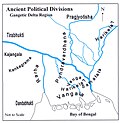
[[File:Ancient Political Divisions.jpg|left|thumb|The ancient political divisions of the Ganges delta.]] | [[File:Ancient Political Divisions.jpg|left|thumb|The ancient political divisions of the Ganges delta.]] | ||
The term Bengali is generally used to refer to someone whose linguistic, cultural or ancestral origins are from [[Bengal]]. The Indo-Aryan Bengalis are ethnically differentiated from the non-Indo-Aryan tribes inhabiting Bengal. Their [[ethnonym]], ''Bangali'', along with the native name of [[Bengali | The term Bengali is generally used to refer to someone whose linguistic, cultural or ancestral origins are from [[Bengal]]. The [[Indo-Aryan peoples|Indo-Aryan]] Bengalis are ethnically differentiated from the non-Indo-Aryan tribes inhabiting Bengal. Their [[ethnonym]], ''Bangali'', along with the native name of the [[Bengali language]] and [[Bengal]] region, ''Bangla'', are both derived from ''Bangālah'', the [[Farsi|Persian]] word for the region. Prior to [[Spread of Islam|Muslim expansion]], there was no unitary territory by this name as the region was instead divided into numerous geopolitical divisions. The most prominent of these were [[Vanga kingdom|Vaṅga]] or Vaṅgāla (from which ''Bangālah'' is thought to ultimately derive from) in the south, [[Rarh|Rāṛha]] in the west, [[Pundravardhana|Puṇḍravardhana]] and [[Varendra]] in the north, and [[Samataṭa]] and [[Harikela]] in the east.{{citation needed|date=August 2024}} | ||
The historic land of Vaṅga (''bôngô'' in Bengali), situated in present-day [[Barisal Division|Barisal]],<ref>{{cite book|title=Laghuprabandhasaṅgrahah|editor=Thaker, Jayant Premshankar|page=111|year=1970|publisher=Oriental Institute}}</ref> is considered by early historians of the [[Abrahamic tradition|Abrahamic]] and [[Dharmic religions|Dharmic]] traditions to have originated from a man who had settled in the area though it is often dismissed as [[legend]]. Early Abrahamic genealogists had suggested that this man was | The historic land of Vaṅga (''bôngô'' in Bengali), situated in present-day [[Barisal Division|Barisal]],<ref>{{cite book|title=Laghuprabandhasaṅgrahah|editor=Thaker, Jayant Premshankar|page=111|year=1970|publisher=Oriental Institute}}</ref> is considered by early historians of the [[Abrahamic tradition|Abrahamic]] and [[Dharmic religions|Dharmic]] traditions to have originated from a man who had settled in the area though it is often dismissed as [[legend]]. Early Abrahamic genealogists had suggested that this man was Bang, a son of Hind who was the son of [[Ham (son of Noah)]].<ref name="riaj"/><ref>{{cite book|author=[[Firishta]]|pages=7–9|year=1768|title=History of Hindostan|editor=[[Alexander Dow|Dow, Alexander]]}}</ref><ref>{{cite book|title=Aryans and British India|author=[[Thomas Trautmann|Trautmann, Thomas]]|publisher=[[Yoda Press]]|year=2005|page=53}}</ref> In contrast, the [[Mahabharata]], [[Puranas]] and the [[Harivamsha]] state that Vaṅga was the founder of the [[Vaṅga kingdom]] and one of the adopted sons of King Vali. The land of Vaṅga later came to be known as Vaṅgāla (''Bôngal'') and its earliest reference is in the [[Comilla District|Comilla]] copperplates (720 CE) of earlier Buddhist [[Deva dynasty|Deva]] King Anandadeva where he was mentioned in the title of ''Sri Vaṅgāla Mrigānka'', means the moon of Bengal.<ref>{{cite book|url=https://books.google.com/books?id=TlnoMdZu40UC&dq=vangalamriganka&pg=PA462|title=Gold coins of the World|isbn=978-0-87184-308-1 |last1=Friedberg |first1=Arthur L. |last2=Friedberg |first2=Ira S. |date=12 April 2025 |publisher=Coin & Currency Institute }}</ref><ref>{{cite web|url=https://en.banglapedia.org/index.php?title=Copperplates|title=Copperplates|publisher=[[Banglapedia]]|access-date=12 April 2025}}</ref> Another reference is the Nesari plates (805 CE) of [[Govinda III]] which speak of [[Dharmapala of Bengal|Dharmapāla]] as its king. The records of [[Rajendra Chola I]] of the [[Chola dynasty]], who invaded Bengal in the 11th century, speak of [[Govindachandra (Chandra dynasty)|Govindachandra]] as the ruler of ''Vaṅgāladeśa'' (a Sanskrit cognate to the word [[Bangladesh]], which was historically a synonymous endonym of Bengal).<ref>{{cite book |last=Keay |first=John |author-link=John Keay |year=2000 |title=India: A History |publisher=Atlantic Monthly Press |page=[https://archive.org/details/indiahistory00keay/page/220 220] |isbn=978-0-87113-800-2 |quote=In C1020 ... launched Rajendra's great northern escapade ... peoples he defeated have been tentatively identified ... 'Vangala-desa where the rain water never stopped' sounds like a fair description of Bengal in the monsoon. |url-access=registration |url=https://archive.org/details/indiahistory00keay/page/220 }}</ref><ref>{{cite book |last=Sen |first=Sailendra Nath |year=1999 |orig-year=First published 1988 |title=Ancient Indian History and Civilization |publisher=New Age International |page=281 |isbn=978-81-224-1198-0}}</ref> 16th-century historian [[Abu'l-Fazl ibn Mubarak]] mentions in his ''[[Ain-i-Akbari|ʿAin-i-Akbarī]]'' that the addition of the suffix ''"al"'' came from the fact that the ancient rajahs of the land raised mounds of earth 10 feet high and 20 in breadth in lowlands at the foot of the hills which were called "al".<ref>Land of Two Rivers, [[Nitish Sengupta]]</ref> This is also mentioned in [[Ghulam Husain Salim]]'s [[Riyaz-us-Salatin|Riyāz us-Salāṭīn]].<ref name="riaj">{{cite book|url=http://persian.packhum.org/persian/pf?file=07601010&ct=11|title=RIYAZU-S-SALĀTĪN: A History of Bengal|archive-url=https://web.archive.org/web/20141215055926/http://persian.packhum.org/persian/pf?file=07601010&ct=11|author=[[Ghulam Husain Salim]]|publisher=The Asiatic Society|location=[[Calcutta]]|year=1902|archive-date=15 December 2014}}</ref> | ||
In 1352 | In 1352, Muslim nobleman [[Shamsuddin Ilyas Shah]] united the region into a single political entity known as the [[Bengal Sultanate]]. Proclaiming himself as ''[[Shāh]]-i-Bangālīyān'',<ref name="Ahmed, ABM Shamsuddin">{{cite Banglapedia|article=Iliyas Shah|author=Ahmed, ABM Shamsuddin}}</ref> it was in this period that the [[Bengali language]] gained state patronage and corroborated literary development.<ref name=banglalang>"What is more significant, a contemporary Chinese traveler reported that although Persian was understood by some in the court, the language in universal use there was Bengali. This points to the waning, although certainly not yet the disappearance, of the sort of foreign mentality that the Muslim ruling class in Bengal had exhibited since its arrival over two centuries earlier. It also points to the survival, and now the triumph, of local Bengali culture at the highest level of official society." {{harvcol|Eaton|1993|p=60}}</ref><ref name=jol>{{cite journal|url=https://www.banglajol.info/index.php/DUJL/article/view/3344|title=Politics and Literary Activities in the Bengali Language during the Independent Sultanate of Bengal|first=AKM Golam|last=Rabbani|date=7 November 2017|journal=Dhaka University Journal of Linguistics|volume=1|issue=1|pages=151–166|access-date=7 November 2017|via=www.banglajol.info|archive-url=https://web.archive.org/web/20171011123110/https://www.banglajol.info/index.php/DUJL/article/view/3344|archive-date=11 October 2017|url-status=live}}</ref> Ilyas Shah had effectively unified the region into one country.<ref>{{cite Banglapedia|article=Bangali Culture|author=Murshid, Ghulam}}</ref> | ||
== History == | |||
==History== | |||
{{Main|History of Bengal|History of Bangladesh|History of West Bengal}} | {{Main|History of Bengal|History of Bangladesh|History of West Bengal}} | ||
===Ancient history=== | === Ancient history === | ||
{{Further-text|[[Anga]], [[Gangaridai]], [[Magadha (Mahajanapada)|Magadha]], [[Pundra kingdom|Pundra]], [[Suhma kingdom|Suhma]] and [[Vanga kingdom|Vanga]]}} | |||
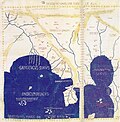
[[File:Ptolemy Asia detail.jpg|thumb|Depiction of [[Gangaridai]] on a map by 11th-century polymath [[Ptolemy]].]] | [[File:Ptolemy Asia detail.jpg|thumb|Depiction of [[Gangaridai]] on a map by 11th-century polymath [[Ptolemy]].]] | ||
Archaeologists have discovered remnants of a 4,700-year-old [[Neolithic]] and [[Chalcolithic]] civilisation such as [[Dihar (archaeological site)|Dihar]]{{sfn|Chattopadhyay et al.|2013|p=97}} and [[Pandu Rajar Dhibi]]<ref>{{cite web |title=Pandu Rajar Dhibi |url=https://en.banglapedia.org/index.php/Pandu_Rajar_Dhibi |website=Banglapedia |access-date=27 March 2024}}</ref> in the greater [[Bengal]] region, and believe the finds are one of the earliest signs of settlement in the region.<ref name=xinhua>{{cite news |agency=Xinhua |date=12 March 2006 |title=4000-year old settlement unearthed in Bangladesh |url=http://news.xinhuanet.com/english/2006-03/12/content_4293312.htm |url-status=dead |archive-url=https://web.archive.org/web/20070510135113/http://news.xinhuanet.com/english/2006-03/12/content_4293312.htm |archive-date=10 May 2007}}</ref> However, evidence of much older [[Palaeolithic]] human habitations were found in the form of a stone implement and a [[hand axe]] in the upper Gandeshwari, Middle Dwarakeswar, Upper Kangsabati, Upper Tarafeni and Middle Subarnarekha valleys of the Indian state [[West Bengal]],<ref name="esijournals1">{{cite journal |author1=Gourav Debnath |title=South Asian History, Culture and Archaeology - "The Evolution of Stone Tool Technology of Pre-Historic West Bengal: A Renewed Archaeological Approach" |journal=ESI Journals |date=2022 |volume=2 |pages=55–67 |url=https://www.esijournals.com/image/catalog/Journal%20Paper/SAHCA/2022/No%201%20%282022%29/5_Gourav%20Debnath.pdf |access-date=9 August 2023 |publisher=ESI Publications}}</ref> and [[Rangamati District|Rangamati]] and [[Feni District|Feni]] districts of Bangladesh.<ref name=bsahistory>{{cite web |url=http://www.orgs.ttu.edu/saofbangladesh/history.htm |title=History of Bangladesh |access-date=26 October 2006 |publisher=Bangladesh Student Association @ TTU |archive-url=https://web.archive.org/web/20051226045659/http://www.orgs.ttu.edu/saofbangladesh/history.htm |archive-date=26 December 2005}}</ref> Evidence of 42,000 years old human habitation has been found at the foothills of the [[Ajodhya Hills]] in West Bengal.<ref name="eisamay1">{{cite web |author1=Gautam Basumallik |script-title=bn:৪২০০০ বছর আগে অযোধ্যা পাহাড় অঞ্চলে জনবসবাসের নিদর্শন মিলেছে |url=https://eisamay.com/editorial/post-editorial/interview-of-bishnupriya-basak-by-goutam-basu-mallick/articleshow/46744177.cms |website=Ei Samay |type=Editorial |access-date=26 March 2024 |language=bn |trans-title=42,000 years ago, evidence of human habitation has been found in the Ayodhya Hills region |date=30 March 2015}}</ref><ref name="Mahadebbera-Kana">{{cite journal |author1=Bishnupriya Basak |author2=Pradeep Srivastava |author3=Sujit Dasgupta |author4=Anil Kumar |author5=S. N. Rajaguru |title=Earliest dates and implications of Microlithic industries of Late Pleistocene from Mahadebbera and Kana, Purulia district, West Bengal |journal=Current Science |date=10 October 2014 |volume=107 |pages=1167–1171 |language=en}}</ref><ref name="telegraphindia1">{{cite news |author1=Sebanti Saarkar |title=Bengal just got older by 22000 yrs |url=https://www.telegraphindia.com/west-bengal/bengal-just-got-older-by-22000-yrs/cid/1288646 |work=The Telegraph |location=India |access-date=26 March 2024 |date=21 October 2014}}</ref> Hatpara on the west bank of [[Hooghly River|Bhagirathi River]] has evidence of human settlements dating back to around 15,000-20,000 years.<ref name="telegraphindia2">{{cite news |author1=Sebanti Sarkar |title=History of Bengal just got a lot older |url=https://www.telegraphindia.com/india/history-of-bengal-just-got-a-lot-older/cid/603572 |work=The Telegraph |location=India |access-date=26 March 2024 |date=27 March 2008}}</ref> | |||
Artefacts suggest that the [[Wari-Bateshwar ruins|Wari-Bateshwar civilisation]], which flourished in present-day [[Narsingdi District|Narsingdi]], date as far back as | Artefacts suggest that the [[Chandraketugarh]], which flourished in present-day [[North 24 Parganas district|North 24 Parganas]], date as far back as 600 BC to 300 BC,{{sfn|Sen et al.|September 2015|p=19}} and [[Wari-Bateshwar ruins|Wari-Bateshwar civilisation]], which flourished in present-day [[Narsingdi District|Narsingdi]], date as far back as 400 BC to 100 BC.<ref name="Rahman Castillo Murphy Rahman 2020 p.">{{cite journal | last1=Rahman | first1=Mizanur | last2=Castillo | first2=Cristina Cobo | last3=Murphy | first3=Charlene | last4=Rahman | first4=Sufi Mostafizur | last5=Fuller | first5=Dorian Q. | title=Agricultural systems in Bangladesh: the first archaeobotanical results from Early Historic Wari-Bateshwar and Early Medieval Vikrampura | journal=Archaeological and Anthropological Sciences | publisher=Springer Science and Business Media LLC | volume=12 | issue=1 | year=2020 | issn=1866-9557 | doi=10.1007/s12520-019-00991-5 | page=37| doi-access=free | pmid=32010407 | pmc=6962288 | bibcode=2020ArAnS..12...37R }}</ref><ref name=bpedia1>{{cite encyclopedia |title=Wari-Bateshwar|encyclopedia=[[Banglapedia]] |last=Rahman |first=SS Mostafizur |publisher=[[Asiatic Society|Asiatic Society of Bangladesh]]|location=[[Dhaka]] |url=http://en.banglapedia.org/index.php?title=Wari-Bateshwar|access-date= 26 March 2024 }}</ref> Not far from the rivers, the port city of Wari-Bateshwar, and the riverside port city of the Chandraketugarh,{{sfn|Sen et al.|September 2015|p=59}} are believed to have been engaged in foreign trade with [[Ancient Rome]], Southeast Asia and other regions.{{sfn|Sen et al.|September 2015|p=59}} The people of this civilisation live in bricked homes, walked on wide roads, used [[silver coin]]s{{sfn|Sen et al.|September 2015|p=28}} and iron weaponry among many other things. The two cities are considered to be the oldest cities in [[Bengal]].<ref>{{cite web|url=http://belabo.narsingdi.gov.bd/site/page/74694ffe-41fb-429a-a941-ab3426892c3d/উপজেলা%20পটভূমি|language=bn|website=Belabo Upazila|script-title=bn:বেলাব উপজেলার পটভূমি|trans-title=Belabo Upazila's Background|access-date=24 February 2022|archive-date=30 September 2021|archive-url=https://web.archive.org/web/20210930113403/http://belabo.narsingdi.gov.bd/site/page/74694ffe-41fb-429a-a941-ab3426892c3d/%E0%A6%89%E0%A6%AA%E0%A6%9C%E0%A7%87%E0%A6%B2%E0%A6%BE%20%E0%A6%AA%E0%A6%9F%E0%A6%AD%E0%A7%82%E0%A6%AE%E0%A6%BF|url-status=dead}}</ref> | ||
It is thought that a man named Vanga settled in the area around 1000 BCE founding the [[Vanga | It is thought that a man named Vanga settled in the area around 1000 BCE founding the [[Vanga kingdom]] in southern Bengal. The ''[[Atharvaveda]]'' and the Hindu epic [[Mahabharata]] mentions this kingdom, along with the [[Pundravardhana|Pundra kingdom]] in northern Bengal. The spread of [[Maurya Empire|Mauryan territory]] and promotion of [[Buddhism]] by its emperor [[Ashoka]] cultivated a growing Buddhist society among the people of present-day Bengal from the 2nd century BCE. Mauryan monuments as far as the [[Great Stupa of Sanchi]] in Madhya Pradesh mentioned the people of this region as adherents of Buddhism. The Buddhists of the Bengal region built and used dozens of monasteries, and were recognised for their religious commitments as far as [[Nagarjunakonda]] in [[South India]].<ref>{{harvcol|Eaton|1993}}</ref> | ||
One of the earliest foreign references to Bengal is the mention of a land ruled by the king Xandrammes named [[Gangaridai]] by the [[Greeks]] around 100 BCE. The word is speculated to have come from ''Gangahrd'' ('Land with the [[Ganges]] in its heart') in reference to an area in Bengal.<ref name=Gangaridai>{{cite Banglapedia|author=Chowdhury, AM|article=Gangaridai}}</ref> Later from the 3rd to the 6th centuries [[Common Era|CE]], the kingdom of Magadha served as the seat of the [[Gupta Empire]]. | One of the earliest foreign references to Bengal is the mention of a land ruled by the king Xandrammes named [[Gangaridai]] by the [[Greeks]] around 100 BCE. The word is speculated to have come from ''Gangahrd'' ('Land with the [[Ganges]] in its heart') in reference to an area in Bengal.<ref name=Gangaridai>{{cite Banglapedia|author=Chowdhury, AM|article=Gangaridai}}</ref> Later from the 3rd to the 6th centuries [[Common Era|CE]], the kingdom of Magadha served as the seat of the [[Gupta Empire]]. | ||
===Middle Ages=== | === Middle Ages === | ||
{{See also|Pala Empire|Sena dynasty|Bengal Sultanate}} | |||
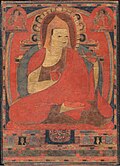
[[File:Atisha.jpg|thumb|left|[[Atiśa]] is recognised as one of the greatest figures of classical Buddhism, having inspired Buddhist thought from [[Tibet]] to [[Sumatra]].]] | [[File:Atisha.jpg|thumb|left|[[Atiśa]] is recognised as one of the greatest figures of classical Buddhism, having inspired Buddhist thought from [[Tibet]] to [[Sumatra]].]] | ||
One of the first recorded independent kings of Bengal was [[Shashanka]],<ref name=shashankabanglaped>{{cite Banglapedia|author=Bhattacharyya, PK|article=Shashanka}}</ref> reigning around the early 7th century, who is generally thought to have originated from [[Magadha (Mahajanapada)|Magadha]], Bihar, just west of Bengal.<ref name="Sinha-magadha">{{cite book |last1=Sinha |first1=Bindeshwari Prasad |title=Dynastic History of Magadha |date=1977 |publisher=Abhinav Publications |location=India |pages=131–133 |url=https://books.google.com/books?id=V3KDaZY85wYC |access-date=16 September 2019 |archive-date=18 November 2022 |archive-url=https://web.archive.org/web/20221118051030/https://books.google.com/books?id=V3KDaZY85wYC |url-status=live }}</ref> After a period of anarchy, a native ruler called [[Gopala]] came into power in 750 CE. He originated from [[Varendra]] in northern Bengal,<ref>{{cite book|title=South Asia|page=317|author=Insight, Apa Productions|date=November 1988|publisher=APA Publications}}</ref> and founded the Buddhist [[Pala Empire]].<ref>{{cite book |last=Sen |first=Sailendra Nath |year=1999 |orig-year=First published 1988 |title=Ancient Indian History and Civilization |url=https://books.google.com/books?id=Wk4_ICH_g1EC&pg=PA280 |publisher=New Age International |pages=277– |isbn=978-81-224-1198-0}}</ref> [[Atiśa]], a renowned Buddhist teacher from eastern Bengal, was instrumental in the revival of Buddhism in [[Tibet]] and also held the position of [[Abbot]] at the [[Vikramashila]] monastery in [[Bihar]]. | |||
One of the first recorded independent kings of Bengal was [[Shashanka]],<ref name=shashankabanglaped>{{cite Banglapedia|author=Bhattacharyya, PK|article=Shashanka}}</ref> reigning around the early 7th century, who is generally thought to have originated from [[Magadha]], Bihar, just west of Bengal.<ref name="Sinha-magadha">{{cite book |last1=Sinha |first1=Bindeshwari Prasad |title=Dynastic History of Magadha |date=1977 |publisher=Abhinav Publications |location=India |pages=131–133 |url=https://books.google.com/books?id=V3KDaZY85wYC |access-date=16 September 2019 |archive-date=18 November 2022 |archive-url=https://web.archive.org/web/20221118051030/https://books.google.com/books?id=V3KDaZY85wYC |url-status=live }}</ref> After a period of anarchy, a native ruler called [[Gopala]] came into power in 750 CE. He originated from [[Varendra]] in northern Bengal,<ref>{{cite book|title=South Asia|page=317|author=Insight, Apa Productions|date=November 1988|publisher=APA Publications}}</ref> and founded the Buddhist [[Pala Empire]].<ref>{{cite book |last=Sen |first=Sailendra Nath |year=1999 |orig-year=First published 1988 |title=Ancient Indian History and Civilization |url=https://books.google.com/books?id=Wk4_ICH_g1EC&pg=PA280 |publisher=New Age International |pages=277– |isbn=978-81-224-1198-0}}</ref> [[Atiśa]], a renowned Buddhist teacher from eastern Bengal, was instrumental in the revival of Buddhism in [[Tibet]] and also held the position of [[Abbot]] at the [[Vikramashila]] monastery in [[Bihar]]. | |||
The Pala Empire enjoyed relations with the [[Srivijaya Empire]], the [[Tibetan Empire]], and the [[Arab]] [[Abbasid Caliphate]]. [[Islam]] first appeared in Bengal during Pala rule, as a result of increased trade between Bengal and the Middle East.<ref name="kumar">{{cite book |author=Raj Kumar |date=2003 |title=Essays on Ancient India |url=https://books.google.com/books?id=qvnjXOCjv7EC |publisher=Discovery Publishing House |page=199 |isbn=978-81-7141-682-0}}</ref> The people of [[Samatata]], in southeastern Bengal, during the 10th century were of various religious backgrounds. [[Tilopa]] was a prominent | The Pala Empire enjoyed relations with the [[Srivijaya Empire]], the [[Tibetan Empire]], and the [[Arab]] [[Abbasid Caliphate]]. [[Islam]] first appeared in Bengal during Pala rule, as a result of increased trade between Bengal and the Middle East.<ref name="kumar">{{cite book |author=Raj Kumar |date=2003 |title=Essays on Ancient India |url=https://books.google.com/books?id=qvnjXOCjv7EC |publisher=Discovery Publishing House |page=199 |isbn=978-81-7141-682-0}}</ref> The people of [[Samatata]], in southeastern Bengal, during the 10th century were of various religious backgrounds. [[Tilopa]] was a prominent Buddhist from modern-day [[Chittagong]], though Samatata was ruled by the Buddhist [[Chandra dynasty]]. During this time, the [[Arab]] geographer [[Al-Masudi]] and author of [[The Meadows of Gold]], travelled to the region where he noticed a Muslim community of inhabitants residing in the region.<ref>{{cite book|title=Les Prairies d'or [Murūj al-dhahab]|author=[[Al-Masudi]], trans. Barbier de Meynard and Pavet de Courteille|language=fr|editor=Pellat, Charles|location=Paris|publisher=Société asiatique|year=1962|chapter=1:155}}</ref> In addition to trade, Islam was also being introduced to the people of Bengal through the migration of Sufi missionaries prior to conquest. The earliest known Sufi missionaries were Syed Shah Surkhul Antia and his students, most notably [[Shah Sultan Rumi]], in the 11th century. Rumi settled in present-day [[Netrokona District|Netrokona, Mymensingh]] where he influenced the local ruler and population to embrace Islam. | ||
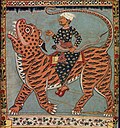
[[File:Pir Gazi and his tiger in Sundarbans.jpg|thumb|[[Gazi Pir|Ghazi Pir]] is thought to have lived in the [[Sundarbans]] some time between the 12th to 13th century.]] | [[File:Pir Gazi and his tiger in Sundarbans.jpg|thumb|[[Gazi Pir|Ghazi Pir]] is thought to have lived in the [[Sundarbans]] some time between the 12th to 13th century.]] | ||
The Pala dynasty was | The Pala dynasty was followed by a shorter reign of the [[Hindu]] [[Sena Empire]]. Subsequent Muslim conquests helped spread Islam throughout the region.<ref name=islambanglaped>{{cite Banglapedia |author=Abdul Karim |article=Islam, Bengal}}</ref> [[Bakhtiyar Khalji]], a [[Turkic people|Turkic]] general, defeated [[Lakshman Sen]] of the Sena dynasty and conquered large parts of Bengal. Consequently, the region was ruled by dynasties of [[sultan]]s and feudal lords under the [[Bengal Sultanate]] for the next few hundred years. Many of the people of Bengal began accepting Islam through the influx of missionaries{{citation needed|date=February 2024}} following the initial conquest. [[Sultan Balkhi]] and [[Shah Makhdum Rupos]] settled in the present-day [[Rajshahi Division]] in northern Bengal, preaching to the communities there. A community of 13 Muslim families headed by [[Ghazi Burhanuddin|Burhanuddin]] also existed in the northeastern Hindu city of [[Sylhet|Srihatta (Sylhet)]], claiming their descendants to have arrived from [[Chittagong]].<ref>{{cite book |author=Qurashi, Ishfaq |script-title=bn:শাহজালাল(রঃ) এবং শাহদাউদ কুরায়শী(রঃ) |date=December 2012 |language=bn |trans-title=Shah Jalal and Shah Dawud Qurayshi |chapter=বুরহান উদ্দিন ও নূরউদ্দিন প্রসঙ্গ |trans-chapter=Burhan Uddin and Nooruddin}}</ref> By 1303, hundreds of Sufi preachers led by [[Shah Jalal]], who some biographers claim was a Turkistan-born Bengali,<ref name=neeru>{{cite book |author=Misra, Neeru |year=2004 |title=Sufis and Sufism: Some Reflections |publisher=Manohar Publishers & Distributors |isbn=978-81-7304-564-6 |page=103}}</ref> aided the Muslim rulers in Bengal to [[Conquest of Sylhet|conquer Sylhet]], turning the town into Jalal's headquarters for religious activities. Following the conquest, Jalal disseminated his followers across different parts of Bengal to spread Islam, and became a household name among [[Bengali Muslims]]. | ||
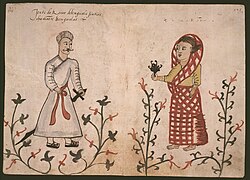
[[File:Codice Casanatense Bengalis.jpg|thumb|left|16th-century Portuguese painting of "''Bengalis''".]] | [[File:Codice Casanatense Bengalis.jpg|thumb|left|16th-century Portuguese painting of "''Bengalis''".]] | ||
The establishment of a single united [[Bengal Sultanate]] in 1352 by [[Shamsuddin Ilyas Shah]] finally gave rise to | The establishment of a single united [[Bengal Sultanate]] in 1352 by [[Shamsuddin Ilyas Shah]] finally gave rise to the name ''Bangala'' for the region, and the development of [[Bengali language]].<ref name="Ahmed, ABM Shamsuddin"/> The [[Ilyas Shahi dynasty]] acknowledged [[Ulama|Muslim scholarship]], and this transcended ethnic background. [[Usman Serajuddin]], also known as ''Akhi Siraj Bengali'', was a native of [[Gauḍa (city)|Gaur]] in western Bengal and became the Sultanate's court scholar during Ilyas Shah's reign.<ref>{{cite book|author=[['Abd al-Haqq al-Dehlawi]]|title=Akhbarul Akhyar}}</ref><ref name=bpedia>{{cite Banglapedia|article=Shaikh Akhi Sirajuddin Usman (R)|author=Abdul Karim}}</ref><ref>{{cite book|title=Biographical Encyclopaedia of Sufis: South Asia|year=2000|author=Hanif, N|publisher=Prabhat Kumar Sharma, for Sarup & Sons|page=35}}</ref> Alongside Persian and Arabic, the sovereign Sunni Muslim nation-state also enabled the [[Bengali language|language]] of the Bengali people to gain patronage and support, contrary to previous states which exclusively favoured [[Sanskrit]], [[Pali]] and [[Farsi|Persian]].<ref name=banglalang/><ref name=jol/> The born-Hindu Sultan [[Jalaluddin Muhammad Shah]] funded the construction of Islamic institutions as far as [[Mecca]] and [[Madina]] in the Middle East. The people of [[Arabia]] came to know these institutions as [[Banjaliyah Madrasah|al-Madaris al-Bangaliyyah]] (''Bengali madrasas''). | ||
=== Mughal era === | |||
{{Main|Bengal Subah}} | |||
{{Further|Muslin trade in Bengal|Mughal Empire}} | |||
{{ | |||
[[File:The Nawab's artillery at Plassey.jpg|thumb|The Bengali artillery at the [[Battle of Plassey]] in 1757.]] | [[File:The Nawab's artillery at Plassey.jpg|thumb|The Bengali artillery at the [[Battle of Plassey]] in 1757.]] | ||
[[File:A Syce (Groom) Holding Two Carriage Horses MET DT3717.jpg|thumb|A painting by [[Shaikh Muhammad Amir of Karraya]] displaying a [[Groom (profession)|syce]] of Bengal holding two carriage horses.]] | [[File:A Syce (Groom) Holding Two Carriage Horses MET DT3717.jpg|thumb|A painting by [[Shaikh Muhammad Amir of Karraya]] displaying a [[Groom (profession)|syce]] of Bengal holding two carriage horses.]] | ||
The [[Mughal Empire]] conquered Bengal in the 16th century, ending the independent [[Sultanate of Bengal]] and defeating Bengal's rebellion [[Baro-Bhuiyan]] chieftains. Mughal general [[Man Singh]] conquered parts of Bengal including [[Dhaka]] during the time of Emperor [[Akbar]] and a few [[Rajput]] tribes from his army permanently settled around Dhaka and surrounding lands, integrating into Bengali society.<ref name=taif>{{cite book|title=Glimpses of Old Dhaka|pages=104, 296|author=[[Syed Muhammed Taifoor|Taifoor, Syed Muhammed]]|year=1965|publisher=S.M. Perwez|edition=2|url=https://archive.org/details/in.ernet.dli.2015.502508/page/n135/mode/2up | The [[Mughal Empire]] conquered Bengal in the 16th century, ending the independent [[Sultanate of Bengal]] and defeating Bengal's rebellion [[Baro-Bhuiyan]] chieftains. Mughal general [[Man Singh]] conquered parts of Bengal including [[Dhaka]] during the time of Emperor [[Akbar]] and a few [[Rajput]] tribes from his army permanently settled around Dhaka and surrounding lands, integrating into Bengali society.<ref name=taif>{{cite book|title=Glimpses of Old Dhaka|pages=104, 296|author=[[Syed Muhammed Taifoor|Taifoor, Syed Muhammed]]|year=1965|publisher=S.M. Perwez|edition=2|url=https://archive.org/details/in.ernet.dli.2015.502508/page/n135/mode/2up}}</ref> Akbar's preaching of the syncretic [[Din-i Ilahi]], was described as a [[blasphemy]] by the [[Qadi]] of Bengal, which caused huge controversies in South Asia. In the 16th century, many ''[[Ulama]]'' of the Bengali Muslim intelligentsia migrated to other parts of the subcontinent as teachers and instructors of [[Ilm (Arabic)|Islamic knowledge]] such as Ali Sher Bengali to [[Ahmedabad]], [[Shah Manjhan]] to [[Sarangpur, Madhya Pradesh|Sarangpur]], Usman Bengali to [[Sambhal]] and Yusuf Bengali to [[Burhanpur]].<ref>{{cite book|title=Culture of Bengal: Through the Ages: Some Aspects|pages=210–215|year=1988|publisher=[[University of Burdwan]]|author=Chattopadhyay, Bhaskar}}</ref> | ||
By the early 17th century, [[Islam Khan I]] had conquered all of Bengal and was integrated into a province known as the [[Bengal Subah]]. It was the largest [[Administrative subdivision|subdivision]] of the [[Mughal Empire]], as it also encompassed parts of [[Bihar]] and [[Odisha]], between the 16th and 18th centuries.{{citation needed|date=November 2022}} Described by some as the "Paradise of Nations"<ref>{{Cite news |url=https://www.dhakatribune.com/uncategorized/2014/12/19/the-paradise-of-nations |title=The paradise of nations |last=Steel |first=Tim |date=19 December 2014 |work=Dhaka Tribune |department=Op-ed |archive-url=https://web.archive.org/web/20190517063054/https://www.dhakatribune.com/uncategorized/2014/12/19/the-paradise-of-nations |archive-date=17 May 2019|access-date=17 May 2019}}</ref> and the "Golden Age of Bengal", | By the early 17th century, [[Islam Khan I]] had conquered all of Bengal and was integrated into a province known as the [[Bengal Subah]]. It was the largest [[Administrative subdivision|subdivision]] of the [[Mughal Empire]], as it also encompassed parts of [[Bihar]] and [[Odisha]], between the 16th and 18th centuries.{{citation needed|date=November 2022}} Described by some as the "Paradise of Nations"<ref>{{Cite news |url=https://www.dhakatribune.com/uncategorized/2014/12/19/the-paradise-of-nations |title=The paradise of nations |last=Steel |first=Tim |date=19 December 2014 |work=Dhaka Tribune |department=Op-ed |archive-url=https://web.archive.org/web/20190517063054/https://www.dhakatribune.com/uncategorized/2014/12/19/the-paradise-of-nations |archive-date=17 May 2019|access-date=17 May 2019}}</ref> and the "Golden Age of Bengal",<ref>{{Cite book|last=Islam|first=Sirajul|url=https://books.google.com/books?id=WuJtAAAAMAAJ&q=golden+age+of+bengal+shaista+khan|title=History of Bangladesh, 1704–1971: Economic history|date=1992|publisher=Asiatic Society of Bangladesh|isbn=978-984-512-337-2|language=en|access-date=5 July 2021|archive-date=18 November 2022|archive-url=https://web.archive.org/web/20221118051031/https://books.google.com/books?id=WuJtAAAAMAAJ&q=golden+age+of+bengal+shaista+khan|url-status=live}}</ref> Bengalis enjoyed some of the highest [[standards of living|living standards]] and [[real wages]] in the world at the time.<ref>{{cite book |author=M. Shahid Alam |author-link=M. Shahid Alam |year=2016 |title=Poverty From The Wealth of Nations: Integration and Polarization in the Global Economy since 1760 |publisher=Springer Science+Business Media |page=32 |isbn=978-0-333-98564-9 |url=https://books.google.com/books?id=suKKCwAAQBAJ&pg=PA32 |access-date=16 May 2021 |archive-date=18 November 2022 |archive-url=https://web.archive.org/web/20221118051031/https://books.google.com/books?id=suKKCwAAQBAJ&pg=PA32 |url-status=live }}</ref> Singlehandedly accounting for 40% of [[Dutch East India Company|Dutch imports]] from Asia,<ref name="Prakash">{{cite encyclopedia |last=Prakash |first=Om |author-link=Om Prakash (historian) |editor-last=McCusker |editor-first=John J. |editor-link=John J. McCusker |encyclopedia=History of World Trade Since 1450 |title=Empire, Mughal |url=http://link.galegroup.com/apps/doc/CX3447600139/WHIC?u=seat24826&xid=6b597320 |access-date=3 August 2017 |year=2006 |publisher=Macmillan Reference USA |volume=1 |isbn=0-02-866070-6 |pages=237–240 |archive-date=18 November 2022 |archive-url=https://web.archive.org/web/20221118051038/https://go.gale.com/ps/i.do?p=WHIC&u=seat24826&id=GALE |url-status=live }}</ref> eastern Bengal was globally prominent in industries such as [[textile manufacturing]] and [[shipbuilding]],<ref name="rayA">{{cite book |author=Indrajit Ray |year=2011 |title=Bengal Industries and the British Industrial Revolution (1757–1857) |url=https://books.google.com/books?id=CHOrAgAAQBAJ&pg=PA57 |publisher=Routledge |pages=57, 90, 174 |isbn=978-1-136-82552-1 |access-date=16 May 2021 |archive-date=18 November 2022 |archive-url=https://web.archive.org/web/20221118051032/https://books.google.com/books?id=CHOrAgAAQBAJ&pg=PA57 |url-status=live }}</ref> and was a major exporter of silk and cotton textiles, steel, [[saltpetre]], and agricultural and industrial produce in the world. | ||
Mughal Bengal eventually became a quasi-independent monarchy state ruled by the [[Nawabs of Bengal]] in 1717. Already observing the proto-industrialization, it made direct significant contribution to the first [[Industrial Revolution]]<ref name="tong">{{cite book |author=Junie T. Tong |year=2016 |title=Finance and Society in 21st Century China: Chinese Culture Versus Western Markets |url=https://books.google.com/books?id=_UQGDAAAQBAJ&pg=PA151 |publisher=CRC Press |page=151 |isbn=978-1-317-13522-7}}</ref><ref name="esposito">{{cite | Mughal Bengal eventually became a quasi-independent monarchy state ruled by the [[Nawabs of Bengal]] in 1717. Already observing the proto-industrialization, it made direct significant contribution to the first [[Industrial Revolution]]<ref name="tong">{{cite book |author=Junie T. Tong |year=2016 |title=Finance and Society in 21st Century China: Chinese Culture Versus Western Markets |url=https://books.google.com/books?id=_UQGDAAAQBAJ&pg=PA151 |publisher=CRC Press |page=151 |isbn=978-1-317-13522-7}}</ref><ref name="esposito">{{cite encyclopedia |editor-last=Esposito |editor-first=John L. |editor-link=John L. Esposito |encyclopedia=The Islamic World: Past and Present |title=Great Britain |url=https://books.google.com/books?id=KZcohRpc4OsC&pg=PT190 |access-date=16 May 2021 |year=2004 |publisher=Oxford University Press |volume=1 |isbn=978-0-19-516520-3 |page=174 |quote=The sale of exports from these regions helped to support the Industrial Revolution in Britain |archive-date=16 January 2023 |archive-url=https://web.archive.org/web/20230116111739/https://books.google.com/books?id=KZcohRpc4OsC&pg=PT190 |url-status=live }}</ref><ref name="rayB">{{cite book |author=Indrajit Ray |year=2011 |title=Bengal Industries and the British Industrial Revolution (1757-1857) |url=https://books.google.com/books?id=CHOrAgAAQBAJ&pg=PA7 |publisher=Routledge |pages=7–10 |isbn=978-1-136-82552-1 |access-date=20 January 2019 |archive-date=18 November 2022 |archive-url=https://web.archive.org/web/20221118051032/https://books.google.com/books?id=CHOrAgAAQBAJ&pg=PA7 |url-status=live }}</ref><ref name="sengupta"/> (substantially [[textile manufacture during the Industrial Revolution]]). | ||
[[File:Renaldis muslin woman.jpg|thumb|A Bengali woman in [[Dhaka]] clad in fine [[Muslin trade in Bengal|Bengali muslin]], 18th century.]] | [[File:Renaldis muslin woman.jpg|thumb|A Bengali woman in [[Dhaka]] clad in fine [[Muslin trade in Bengal|Bengali muslin]], 18th century.]] | ||
Bengal became the basis of the [[Anglo-Mughal War (1686–1690)|Anglo-Mughal War]].<ref>{{Cite journal|title=Conflict and Cooperation in Anglo-Mughal Trade Relations during the Reign of Aurangzeb|first=Farhat|last=Hasan|journal=Journal of the Economic and Social History of the Orient|volume=34|issue=4|date=1991|pages=351–360|doi=10.1163/156852091X00058|jstor=3632456}}</ref><ref>{{Cite journal|title=John Company Armed: The English East India Company, the Anglo-Mughal War and Absolutist Imperialism, c. 1675–1690|first=James|last=Vaugn|journal=Britain and the World|volume=11|issue=1|date=September 2017}} | Bengal became the basis of the [[Anglo-Mughal War (1686–1690)|Anglo-Mughal War]].<ref>{{Cite journal |title=Conflict and Cooperation in Anglo-Mughal Trade Relations during the Reign of Aurangzeb |first=Farhat |last=Hasan |journal=Journal of the Economic and Social History of the Orient |volume=34 |issue=4 |date=1991 |pages=351–360 |doi=10.1163/156852091X00058 |jstor=3632456}}</ref><ref>{{Cite journal |title=John Company Armed: The English East India Company, the Anglo-Mughal War and Absolutist Imperialism, c. 1675–1690 |first=James |last=Vaugn |journal=Britain and the World |volume=11 |issue=1 |date=September 2017}}</ref> After the weakening of the Mughal Empire with the death of [[Emperor Aurangzeb]] in 1707, Bengal was ruled independently by three dynasties of Nawabs until 1757, when the region was annexed by the [[East India Company]] after the [[Battle of Plassey]]. | ||
</ref> After the weakening of the Mughal Empire with the death of [[Emperor Aurangzeb]] in 1707, Bengal was ruled independently by three dynasties of Nawabs until 1757, when the region was annexed by the [[East India Company]] after the [[Battle of Plassey]]. | |||
===British colonisation=== | === British colonisation === | ||
{{Main|Bengal Presidency}} | {{Main|Bengal Presidency}} | ||
{{ | |||
{{Further|Company rule in India|British Raj}} | |||
In Bengal, effective political and military power was transferred from the [[Afshar dynasty|Afshar regime]] to the [[British East India Company]] around 1757–65.<ref>{{cite book|author=Baten, Jörg |title=A History of the Global Economy. From 1500 to the Present.|date=2016|publisher=Cambridge University Press|page=251|isbn=978-1-107-50718-0}}</ref> [[Company rule in India]] began under the [[Bengal Presidency]]. [[Calcutta]] was named the capital of [[British India]] in 1772. The presidency was run by a military-civil administration, including the [[Bengal Army]], and had the world's sixth earliest railway network. Great [[Famines in India|Bengal famines]] struck several times during colonial rule, notably the [[Great Bengal famine of 1770]] and [[Bengal famine of 1943]], each killing millions of Bengalis. | In Bengal, effective political and military power was transferred from the [[Afshar dynasty|Afshar regime]] to the [[British East India Company]] around 1757–65.<ref>{{cite book|author=Baten, Jörg |title=A History of the Global Economy. From 1500 to the Present.|date=2016|publisher=Cambridge University Press|page=251|isbn=978-1-107-50718-0}}</ref> [[Company rule in India]] began under the [[Bengal Presidency]]. [[Calcutta]] was named the capital of [[British India]] in 1772. The presidency was run by a military-civil administration, including the [[Bengal Army]], and had the world's sixth earliest railway network. Great [[Famines in India|Bengal famines]] struck several times during colonial rule, notably the [[Great Bengal famine of 1770]] and [[Bengal famine of 1943]], each killing millions of Bengalis. | ||
Under British rule, Bengal experienced deindustrialisation.<ref name="rayB" /> Discontent with the situation, numerous rebellions and revolts were attempted by the Bengali people. The [[Indian Rebellion of 1857]] was initiated on the outskirts of Calcutta, and spread to Dhaka, Jalpaiguri and Agartala, in solidarity with revolts in [[North India]]. Havildar [[Revolt of Rajab Ali|Rajab Ali]] commanded the rebels in [[Chittagong]] as far as [[Sylhet Division|Sylhet]] and [[Manipur (princely state)|Manipur]]. The failure of the rebellion led to the abolishment of the Mughal court completely and direct rule by the [[British Raj]]. | Under British rule, Bengal experienced deindustrialisation.<ref name="rayB" /> Discontent with the situation, numerous rebellions and revolts were attempted by the Bengali people. The [[Indian Rebellion of 1857]] was initiated on the outskirts of Calcutta, and spread to Dhaka, Jalpaiguri and Agartala, in solidarity with revolts in [[North India]]. Havildar [[Revolt of Rajab Ali|Rajab Ali]] commanded the rebels in [[Chittagong]] as far as [[Sylhet Division|Sylhet]] and [[Manipur (princely state)|Manipur]]. The failure of the rebellion led to the abolishment of the Mughal court completely and direct rule by the [[British Raj]]. | ||
Many Bengali | Many Bengali labourers were taken as coolies to the British colonies in the Caribbean during the 1830s. Workers from Bengal were chosen because they could easily assimilate to the climate of [[British Guyana]], which was similar to that of Bengal. | ||
[[Swami Vivekananda]] is considered a key figure in the introduction of [[Vedanta]] and [[Yoga]] in Europe and America,<ref name="Feuerstein">{{cite book | last = Georg | first = Feuerstein | author-link = Georg Feuerstein | title = The Yoga Tradition | publisher = Motilal Banarsidass | year = 2002 | page = 600 |isbn=978-3-935001-06-9}}</ref> and is credited with raising interfaith awareness, and bringing [[Hinduism]] to the status of a world religion during the 1800s.<ref name="clarke">{{cite book | last = Clarke | first = Peter Bernard | title = New Religions in Global Perspective | url = https://archive.org/details/newreligionsglob00clar | url-access = limited | publisher = Routledge | year = 2006 | page = [https://archive.org/details/newreligionsglob00clar/page/n224 209] |isbn=978-0-7007-1185-7}}</ref> On the other hand, [[Ram Mohan Roy]] led a socio-Hindu reformist movement known as [[Brahmo Samaj|Brahmoism]] which called for the abolishment of [[Sati (practice)|sati]] (widow sacrifice), [[child marriage]], [[polytheism]] and [[idol worship]].<ref name="airccse75">{{cite journal |last1=Soman |first1=Priya |title=Raja Ram Mohan and the Abolition of Sati System in India |journal=International Journal of Humanities, Art and Social Studies | [[Swami Vivekananda]] is considered a key figure in the introduction of [[Vedanta]] and [[Yoga]] in Europe and America,<ref name="Feuerstein">{{cite book | last = Georg | first = Feuerstein | author-link = Georg Feuerstein | title = The Yoga Tradition | publisher = Motilal Banarsidass | year = 2002 | page = 600 |isbn=978-3-935001-06-9}}</ref> and is credited with raising interfaith awareness, and bringing [[Hinduism]] to the status of a world religion during the 1800s.<ref name="clarke">{{cite book | last = Clarke | first = Peter Bernard | title = New Religions in Global Perspective | url = https://archive.org/details/newreligionsglob00clar | url-access = limited | publisher = Routledge | year = 2006 | page = [https://archive.org/details/newreligionsglob00clar/page/n224 209] |isbn=978-0-7007-1185-7}}</ref> On the other hand, [[Ram Mohan Roy]] led a socio-Hindu reformist movement known as [[Brahmo Samaj|Brahmoism]] which called for the abolishment of [[Sati (practice)|sati]] (widow sacrifice), [[child marriage]], [[polytheism]] and [[idol worship]].<ref name="airccse75">{{cite journal |last1=Soman |first1=Priya |title=Raja Ram Mohan and the Abolition of Sati System in India |journal=International Journal of Humanities, Art and Social Studies |volume=1 |issue=2 |pages=75–82 |url=https://airccse.com/ijhas/papers/1216ijhas08.pdf |access-date=18 June 2021 |archive-date=12 July 2018 |archive-url=https://web.archive.org/web/20180712163313/http://airccse.com/ijhas/papers/1216ijhas08.pdf |url-status=live }}</ref><ref>Source: The Gazetteer of India, Volume 1: Country and people. Delhi, Publications Division, Government of India, 1965. CHAPTER VIII – Religion. HINDUISM | ||
by C.P.Ramaswami Aiyar, Nalinaksha Dutt, A.R.Wadia, M.Mujeeb, Dharm Pal and Fr. Jerome D'Souza, S.J.</ref> In 1804, he wrote the Persian book ''Tuḥfat al-Muwaḥḥidīn'' (A Gift to the Monotheists) and spent the next two decades attacking the [[Kulin Brahmin]] bastions of Bengal.<ref name=himalaya>{{cite web|last1=Syed|first1=M. H.|title=Raja Rammohan Roy|url=http://www.himpub.com/documents/Chapter107.pdf|publisher=Himalaya Publishing House|access-date=29 November 2015|archive-date=8 December 2015|archive-url=https://web.archive.org/web/20151208104241/http://www.himpub.com/documents/Chapter107.pdf|url-status=live}}</ref> | by C.P.Ramaswami Aiyar, Nalinaksha Dutt, A.R.Wadia, M.Mujeeb, Dharm Pal and Fr. Jerome D'Souza, S.J.</ref> In 1804, he wrote the Persian book ''Tuḥfat al-Muwaḥḥidīn'' (A Gift to the Monotheists) and spent the next two decades attacking the [[Kulin Brahmin]] bastions of Bengal.<ref name=himalaya>{{cite web|last1=Syed|first1=M. H.|title=Raja Rammohan Roy|url=http://www.himpub.com/documents/Chapter107.pdf|publisher=Himalaya Publishing House|access-date=29 November 2015|archive-date=8 December 2015|archive-url=https://web.archive.org/web/20151208104241/http://www.himpub.com/documents/Chapter107.pdf|url-status=live}}</ref> | ||
====Independence movement==== | ==== Independence movement ==== | ||
{{see also|Freedom fighters of India#Leaders from Bengal and Northeastern India|l1=Independence fighters from Bengal}} | {{see also|Freedom fighters of India#Leaders from Bengal and Northeastern India|l1=Independence fighters from Bengal}} | ||
Bengal played a major role in the [[Indian independence movement]], in which [[Revolutionary movement for Indian independence|revolutionary groups]] such as [[Anushilan Samiti]] and [[Jugantar]] were dominant. Many of the early proponents of the independence struggle, and subsequent leaders in the movement were Bengalis such as [[Shamsher Gazi]], [[Chowdhury Abu Torab Khan]], [[Muharram Rebellion|Hada Miah and Mada Miah]], the [[Pagal Panthis]] led by [[Karim Shah]] and [[Tipu Shah]], [[Haji Shariatullah]] and [[Dudu Miyan]] of the [[Faraizi movement]], [[Titumir]], Ali Muhammad Shibli, [[Alimuddin Ahmad]], [[Prafulla Chaki]], [[Surendranath Banerjee]], [[Maulana Abdul Hamid Khan Bhashani]], [[Bagha Jatin]], [[Khudiram Bose]], [[Sarojini Naidu]], [[Aurobindo Ghosh]], [[Rashbehari Bose]], and [[Sachindranath Sanyal]]. | Bengal played a major role in the [[Indian independence movement]], in which [[Revolutionary movement for Indian independence|revolutionary groups]] such as [[Anushilan Samiti]] and [[Jugantar]] were dominant. Many of the early proponents of the independence struggle, and subsequent leaders in the movement were Bengalis such as [[Shamsher Gazi]], [[Chowdhury Abu Torab Khan]], [[Muharram Rebellion|Hada Miah and Mada Miah]], the [[Pagal Panthis]] led by [[Karim Shah]] and [[Tipu Shah]], [[Haji Shariatullah]] and [[Dudu Miyan]] of the [[Faraizi movement]], [[Titumir]], Ali Muhammad Shibli, [[Alimuddin Ahmad]], [[Prafulla Chaki]], [[Surendranath Banerjee]], [[Maulana Abdul Hamid Khan Bhashani]], [[Bagha Jatin]], [[Khudiram Bose]], [[Sarojini Naidu]], [[Aurobindo Ghosh]], [[Rashbehari Bose]], and [[Sachindranath Sanyal]]. | ||
Leaders such as [[Subhas Chandra Bose]] did not subscribe to the view that non-violent civil disobedience was the best way to achieve independence, and were instrumental in armed resistance against the British. Bose was the co-founder and leader of the Japanese-aligned [[Indian National Army]] (distinct from the | Leaders such as [[Subhas Chandra Bose]] did not subscribe to the view that non-violent civil disobedience was the best way to achieve independence, and were instrumental in armed resistance against the British. Bose was the co-founder and leader of the Japanese-aligned [[Indian National Army]] (distinct from the [[British Indian Army]]) which fought against Allied forces in the [[Burma campaign]]. He was also the head of state of a parallel regime, the [[Azad Hind]]. A number of Bengalis died during the independence movement and many were imprisoned in the notorious [[Cellular Jail]] in the [[Andaman Islands]]. | ||
====Partitions of Bengal==== | ==== Partitions of Bengal ==== | ||
{{Main|1905 Partition of Bengal|1947 Partition of Bengal}} | {{Main|1905 Partition of Bengal|1947 Partition of Bengal}} | ||
The [[Partition of Bengal (1905)|first partition in 1905]] divided the Bengal region in [[British India]] into two provinces for administrative and development purposes. However, the partition stoked [[Hindu nationalism]]. This in turn led to the formation of the [[All India Muslim League]] in Dhaka in 1906 to represent the growing aspirations of the [[Muslim]] population. The partition was annulled in 1912 after protests by the [[Indian National Congress]] and [[Hindu Mahasabha]]. | The [[Partition of Bengal (1905)|first partition in 1905]] divided the Bengal region in [[British India]] into two provinces for administrative and development purposes. However, the partition stoked [[Hindu nationalism]]. This in turn led to the formation of the [[All India Muslim League]] in Dhaka in 1906 to represent the growing aspirations of the [[Muslim]] population. The partition was annulled in 1912 after protests by the [[Indian National Congress]] and [[Hindu Mahasabha]]. | ||
The breakdown of Hindu-Muslim unity in India drove the Muslim League to adopt the [[Lahore Resolution]] in 1943, calling the creation of "independent states" in eastern and northwestern British India. The resolution paved the way for the [[Partition of British India]] based on the [[Radcliffe Line]] in 1947, despite attempts to form a [[United Bengal]] state that was opposed by many people. | The breakdown of Hindu-Muslim unity in India drove the Muslim League to adopt the [[Lahore Resolution]] in 1943, calling the creation of "independent states" in eastern and northwestern British India. The resolution paved the way for the [[Partition of British India]] based on the [[Radcliffe Line]] in 1947, despite attempts to form a [[United Bengal]] state that was opposed by many people. | ||
===Bangladesh Liberation War=== | === Bangladesh Liberation War === | ||
{{Main|Bangladesh Liberation War}} | {{Main|Bangladesh Liberation War}} | ||
The rise of [[self-determination]] and [[Bengali nationalism]] movements in [[East Pakistan|East Bengal]], led by [[Sheikh Mujibur Rahman]]. This eventually culminated in the 1971 [[Bangladesh Liberation War]] against the Pakistani military junta. The war caused millions of East Bengali refugees to take shelter in | The rise of [[self-determination]] and [[Bengali nationalism]] movements in [[East Pakistan|East Bengal]], led by [[Sheikh Mujibur Rahman]]. This eventually culminated in the 1971 [[Bangladesh Liberation War]] against the Pakistani military junta. The war caused millions of East Bengali refugees to take shelter in neighbouring India, especially the Indian state of [[West Bengal]], with Calcutta, the capital of West Bengal, becoming the capital-in-exile of the [[Provisional Government of Bangladesh]]. The [[Mukti Bahini]] guerrilla forces waged a nine-month war against the Pakistani military. The conflict ended after the Indian Armed Forces intervened on the side of Bangladeshi forces in the final two weeks of the war, which ended with the [[surrender of East Pakistan]] and the liberation of Dhaka on 16 December 1971. Thus, the newly independent [[Bangladesh|People's Republic of Bangladesh]] was born from what was previously the East Pakistan province of Pakistan. | ||
==Geographic distribution== | == Geographic distribution == | ||
{{See also|Bangladeshi diaspora}} | {{See also|Bangladeshi diaspora|Indian diaspora}}{{Pie chart | ||
| caption = Approximate distribution of native Bengali speakers (assuming a rounded total of 280-290 million) worldwide.{{Efn|name=Bangladeshis}} | |||
| value1 = 68 | |||
| label1 = [[Bangladesh]] or [[Bangladeshis|Bangladeshi origin]]<ref>{{Cite web |title=UNData app |url=https://data.un.org/en/iso/bd.html |access-date=5 January 2026 |website=data.un.org}}</ref><ref>{{Cite web |title=World Bank Open Data |url=https://data.worldbank.org/ |access-date=5 January 2026 |website=World Bank Open Data}}</ref><ref>{{Cite web |last=Gigauri |first=Giorgi |date=26 March 2021 |title=Migrants' contribution to the 50-year journey of Bangladesh |url=https://www.thedailystar.net/supplements/celebrating-50-years-bangladesh/news/migrants-contribution-the-50-year-journey-bangladesh-2067097 |access-date=5 January 2026 |website=The Daily Star |language=en}}</ref> | |||
| color1 = #006a4e | |||
| value2 = 32 | |||
| label2 = [[India]] or [[Indian people|Indian origin]] | |||
| color2 = #ffc000 | |||
| other-label = | |||
| other-color = | |||
| other = | |||
}}[[File:I'tisam-ud-Din.png|thumb|[[I'tisam-ud-Din]] was the first educated Bengali and South Asian to have travelled to Europe.]] | |||
Bengalis constitute the largest ethnic group in Bangladesh, at approximately 98% of the nation's inhabitants.<ref name="বাংলাদেশকে জানুন">{{cite web |url=http://www.bangladesh.gov.bd/site/page/812d94a8-0376-4579-a8f1-a1f66fa5df5d/বাংলাদেশকে-জানুন |script-title=bn:জানুন |title=Bānlādēśakē jānuna |language=bn |trans-title=Discover Bangladesh |publisher=National Web Portal of Bangladesh |access-date=13 February 2015 |archive-url=https://web.archive.org/web/20150216093108/http://www.bangladesh.gov.bd/www.bangladesh.gov.bd/index6517.html?q=bn%2F%E0%A6%AC%E0%A6%BE%E0%A6%82%E0%A6%B2%E0%A6%BE%E0%A6%A6%E0%A7%87%E0%A6%B6%E0%A6%95%E0%A7%87-%E0%A6%9C%E0%A6%BE%E0%A6%A8%E0%A7%81%E0%A6%A8 |archive-date=16 February 2015 |url-status=live}}</ref> The [[Census of India]] does not recognise [[Racial groups of India|racial]] or ethnic groups within India,<ref>Kumar, Jayant. Census of India. 2001. 4 September 2006. [http://www.censusindia.gov.in/ Indian Census] {{Webarchive|url=https://web.archive.org/web/20060619194905/http://www.censusindia.net/profiles/sik.html |date=19 June 2006 }}</ref> the [[CIA Factbook]] estimated that there are 100 million Bengalis in India constituting 7% of the country's total population. In addition to [[West Bengal]], Bengalis form the demographic majority in [[Assam]]'s [[Barak Valley]] and [[Lower Assam|Lower region]] as well as parts of [[Manipur]].<ref name=chingiz/> The state of [[Tripura]] as well as the [[Andaman and Nicobar Islands]] [[union territory]], which lies in the [[Bay of Bengal]], are also home to a Bengali-majority population, most of whom are descendants of Hindus from East Bengal (now Bangladesh) that migrated there following the 1947 [[Partition of India]].<ref name="hdrchap1">{{cite book |title=Tripura human development report 2007 |chapter-url=http://hdr.undp.org/en/nhdr/support/other/national/Tripura_india_hdr_2007.pdf |access-date=19 March 2012 |publisher=Government of Tripura |chapter=The state of human development |year=2007 |archive-url=https://web.archive.org/web/20130502120425/http://hdr.undp.org/en/nhdr/support/other/national/Tripura_india_hdr_2007.pdf |url-status=dead |archive-date=2 May 2013}}</ref>{{rp|3–4}}<ref>{{cite news |url=https://www.thehindu.com/news/national/other-states/tripura-where-demand-for-assam-like-nrc-widens-gap-between-indigenous-people-and-non-tribal-settlers/article25348269.ece |date=27 October 2018 |author=Karmakar, Rahul |title=Tripura, where demand for Assam-like NRC widens gap between indigenous people and non-tribal settlers |website=The Hindu |access-date=27 June 2021 |archive-date=9 November 2020 |archive-url=https://web.archive.org/web/20201109040851/https://www.thehindu.com/news/national/other-states/tripura-where-demand-for-assam-like-nrc-widens-gap-between-indigenous-people-and-non-tribal-settlers/article25348269.ece |url-status=live}}</ref><ref>{{cite news |work=Times Now news |url=https://www.timesnownews.com/india/article/indira-gandhi-rahul-gandhi-rajiv-gandhi-east-pakistan-pakistan-assam-accord-national-register-of-citizens-congress-bharatiya-janata-party-tripura/264462 |date=19 April 2019 |title=When Indira Gandhi said: Refugees of all religions must go back |author=Shekhar, Sidharth |access-date=27 June 2021 |archive-date=23 January 2021 |archive-url=https://web.archive.org/web/20210123092721/https://www.timesnownews.com/india/article/indira-gandhi-rahul-gandhi-rajiv-gandhi-east-pakistan-pakistan-assam-accord-national-register-of-citizens-congress-bharatiya-janata-party-tripura/264462 |url-status=live}}</ref> Bengali migration to the latter archipelago was also boosted by subsequent state-funded ''Colonisation Schemes'' by the [[Government of India]].<ref>{{cite news |last=Sekhsaria |first=Pankaj |title=How a statist vision of development has brought Andaman's tribals close to extinction |url=https://scroll.in/article/833293/how-a-statist-vision-of-development-has-brought-andamans-tribals-close-to-extinction |access-date=21 November 2020 |work=Scroll.in |language=en-US |archive-date=29 November 2020 |archive-url=https://web.archive.org/web/20201129063143/https://scroll.in/article/833293/how-a-statist-vision-of-development-has-brought-andamans-tribals-close-to-extinction |url-status=live}}</ref><ref>{{cite web |url=https://www.iias.asia/the-newsletter/article/bengali-settlers-andaman-islands-performance-homeland |title=Bengali settlers in the Andaman Islands: the performance of homeland |year=2017 |author=Lorea, Carola Erika |website=[[International Institute for Asian Studies]] |access-date=19 June 2021 |archive-date=24 June 2021 |archive-url=https://web.archive.org/web/20210624200953/https://www.iias.asia/the-newsletter/article/bengali-settlers-andaman-islands-performance-homeland |url-status=live}}</ref> | |||
[[File:Brick Lane street signs.JPG|thumb|Large numbers of Bengalis have settled and established themselves in [[Banglatown]].]] | [[File:Brick Lane street signs.JPG|thumb|Large numbers of Bengalis have settled and established themselves in [[Banglatown]].]] | ||
Bengali ethnic descent and emigrant communities are found primarily in other parts of [[the subcontinent]], the Middle East and the Western World. Substantial populations descended from Bengali immigrants exist in [[Saudi Arabia]], [[Pakistan]] and the United Kingdom where they form established communities of over 1 million people. The majority of the overseas Bengali diaspora are Muslims as the act of seafaring was traditionally prohibited in Hinduism; a taboo known as [[Kala pani (taboo)|kala pani]] (black/dirty water).<ref>{{cite web | url = http://aha.confex.com/aha/2013/webprogram/Paper11135.html | title = Crossing the Kala Pani to Britain for Hindu Workers and Elites | publisher = American Historical Association | date = 4 January 2012 | access-date = 2 February 2012 | archive-date = 26 February 2015 | archive-url = https://web.archive.org/web/20150226222504/https://aha.confex.com/aha/2013/webprogram/Paper11135.html | url-status = live }}</ref> | Bengali ethnic descent and emigrant communities are found primarily in other parts of [[the subcontinent]], the Middle East and the Western World. Substantial populations descended from Bengali immigrants exist in [[Saudi Arabia]], [[Pakistan]] and the United Kingdom where they form established communities of over 1 million people. The majority of the overseas Bengali diaspora are Muslims as the act of seafaring was traditionally prohibited in Hinduism; a taboo known as [[Kala pani (taboo)|kala pani]] (black/dirty water).<ref>{{cite web | url = http://aha.confex.com/aha/2013/webprogram/Paper11135.html | title = Crossing the Kala Pani to Britain for Hindu Workers and Elites | publisher = American Historical Association | date = 4 January 2012 | access-date = 2 February 2012 | archive-date = 26 February 2015 | archive-url = https://web.archive.org/web/20150226222504/https://aha.confex.com/aha/2013/webprogram/Paper11135.html | url-status = live }}</ref> | ||
The introduction of [[Islam]] to the Bengali people has generated a connection to the [[Arabian Peninsula]], as Muslims are required to visit the land once in their lifetime to complete the [[Hajj]] pilgrimage. Several Bengali sultans funded Islamic institutions in the [[Hejaz]], which popularly became known by the [[Arabs]] as [[Banjaliyah Madrasah|Bengali madrasas]]. As a result of the British conquest of Bengal, some Bengalis decided to emigrate to Arabia.<ref>{{cite book|language=bn|title=শতাব্দীর সূর্য শিখা|author=Majid, Razia|year=1987|pages=45–48|publisher=[[Islamic Foundation Bangladesh]]|trans-title=The solar flame of the century}}</ref> Notable examples include | The introduction of [[Islam]] to the Bengali people has generated a connection to the [[Arabian Peninsula]], as Muslims are required to visit the land once in their lifetime to complete the [[Hajj]] pilgrimage. Several Bengali sultans funded Islamic institutions in the [[Hejaz]], which popularly became known by the [[Arabs]] as [[Banjaliyah Madrasah|Bengali madrasas]]. As a result of the British conquest of Bengal, some Bengalis decided to emigrate to Arabia.<ref>{{cite book |language=bn |script-title=bn:শতাব্দীর সূর্য শিখা |author=Majid, Razia |year=1987 |pages=45–48 |publisher=[[Islamic Foundation Bangladesh]] |trans-title=The solar flame of the century}}</ref> Notable examples include Mawlana Murad, an instructor of [[Islamic sciences]] based in [[Mecca]] in the early 1800s,<ref>{{cite book |title=The Muslim Society and Politics in Bengal, A.D. 1757–1947 |page=76 |quote=Maulana Murad, a Bengali domicile |year=1978 |publisher=[[University of Dacca]]}}</ref> and [[Najib Ali Choudhury]], a participant of the [[Battle of Shamli]].<ref name="Rahman2009">{{cite book |last1=Rahman |first1=Md. Matiur |last2=Bhuiya |first2=Abdul Musabbir |title=Teaching of Arabic language in Barak Valley: a historical study (14th to 20th century) |url=https://shodhganga.inflibnet.ac.in/bitstream/10603/92871/7/07_chapter%203.pdf |year=2009 |publisher=Assam University |location=Silchar |pages=59–60 |access-date=30 December 2022 |archive-date=26 March 2023 |archive-url=https://web.archive.org/web/20230326034143/https://shodhganga.inflibnet.ac.in/bitstream/10603/92871/7/07_chapter%203.pdf |url-status=live}}</ref> Notable people of Bengali-origin in the Middle East include the renowned author and journalist [[Ahmad Abd al-Ghafur Attar]] of [[Saudi Arabia]] and [[Qur'an]] translator [[Zohurul Hoque]] from [[Oman]]. The family of [[Princess Sarvath al-Hassan]], wife of Jordanian prince [[Prince Hassan bin Talal|Hassan bin Talal]], are descended from the [[Suhrawardy family]] of [[Midnapore]].<ref name="official">{{cite web |url=http://www.elhassan.org/public/English.aspx?Lang=3&Page_Id=975&M=74 |title= Majlis El Hassan :: Sarvath El Hassan :: Biography |access-date=25 May 2017 |url-status=dead |archive-url=https://web.archive.org/web/20110719082204/http://www.elhassan.org/public/English.aspx?Lang=3&Page_Id=975&M=74 |archive-date=19 July 2011}}</ref> | ||
Earliest records of Bengalis in the European continent date back to the reign of King [[George III]] of England during the 16th century. One such example is [[I'tisam-ud-Din]], a Bengali Muslim cleric from [[Nadia district|Nadia]] in western Bengal, who arrived to Europe in 1765 with his servant Muhammad Muqim as a diplomat for the [[Mughal Empire]].<ref name=buckland>C.E. Buckland, Dictionary of Indian Biography, Haskell House Publishers Ltd, 1968, p.217</ref> Another example during this period is of [[James Achilles Kirkpatrick]]'s ''hookah-bardar'' ([[hookah]] servant/preparer) who was said to have robbed and cheated Kirkpatrick, making his way to England and stylising himself as the ''Prince of Sylhet''. The man, presumably from [[Sylhet Division|Sylhet]] in eastern Bengal, was waited upon by the [[ | Earliest records of Bengalis in the European continent date back to the reign of King [[George III]] of England during the 16th century. One such example is [[I'tisam-ud-Din]], a Bengali Muslim cleric from [[Nadia district|Nadia]] in western Bengal, who arrived to Europe in 1765 with his servant Muhammad Muqim as a diplomat for the [[Mughal Empire]].<ref name=buckland>C.E. Buckland, Dictionary of Indian Biography, Haskell House Publishers Ltd, 1968, p.217</ref> Another example during this period is of [[James Achilles Kirkpatrick]]'s ''hookah-bardar'' ([[hookah]] servant/preparer) who was said to have robbed and cheated Kirkpatrick, making his way to England and stylising himself as the ''Prince of Sylhet''. The man, presumably from [[Sylhet Division|Sylhet]] in eastern Bengal, was waited upon by the [[prime minister of Great Britain]] [[William Pitt the Younger]], and then dined with the [[Duke of York]] before presenting himself in front of the King.<ref>{{cite book|title=Life of the Honourable Mountstuart Elphinstone|first=Thomas Edward|last=Colebrooke|pages=34–35|orig-date=1884|date=2011|author-link=Sir Edward Colebrooke, 4th Baronet|chapter=First Start in Diplomacy|publisher=Cambridge University Press |isbn=978-1-108-09722-2|chapter-url=https://books.google.com/books?id=tSoMEJ-_Nx0C&q=hookah&pg=PA34|access-date=16 May 2021|archive-date=18 November 2022|archive-url=https://web.archive.org/web/20221118051032/https://books.google.com/books?id=tSoMEJ-_Nx0C&q=hookah&pg=PA34|url-status=live}}</ref> Today, the [[British Bangladeshis]] are a naturalised community in the United Kingdom, running 90% of all [[South Asian cuisine]] restaurants and having established numerous [[ethnic enclave]]s across the country – most prominent of which is [[Banglatown]] in [[East London]].<ref>{{cite news|url=https://www.theguardian.com/lifeandstyle/2012/jan/08/britains-curry-crisis-chefs-immigration|work=The Guardian|author=Khaleeli, Homa|title=The curry crisis|date=8 January 2012|access-date=16 May 2021|archive-date=16 May 2021|archive-url=https://web.archive.org/web/20210516184152/https://www.theguardian.com/lifeandstyle/2012/jan/08/britains-curry-crisis-chefs-immigration|url-status=live}}</ref> | ||
[[File:Bengali_Language_mural_at_Hamtramck,_USA.png|thumb|Bengali Language mural at [[Hamtramck, Michigan]]]] | |||
== Language == | == Language == | ||
{{main|Bengali language}} | {{main|Bengali language}} | ||
An important and unifying characteristic of Bengalis is that most of them use Bengali as their native tongue, which belongs to the [[Indo-Aryan languages|Indo-Aryan]] language family.<ref>"...Comparing seven Indo-Aryan languages – Hindi, Punjabi, Sindhi, Gujarati, Marathi, Oriya and Bengali – are also significant contributions to New Indo-Aryan (NIA) studies.{{harvcol|Cardona|2007|pp=627}}</ref> With about 242 million native and about 284 million total speakers worldwide, Bengali is one of the [[List of languages by number of native speakers|most spoken languages]], ranked sixth in the world,<ref name="popstat">{{cite web|url=http://www.ethnologue.com/ethno_docs/distribution.asp?by=size|title=Statistical Summaries|access-date=23 May 2012|year=2012|publisher=Ethnologue|archive-date=2 February 2013|archive-url=https://web.archive.org/web/20130202224556/http://www.ethnologue.com/ethno_docs/distribution.asp?by=size|url-status=live}}</ref><ref name="huq_sarkar">{{cite Banglapedia |last1=Huq |first1=Mohammad Daniul |last2=Sarkar |first2=Pabitra|article=Bangla Language}}</ref> and is also used a [[lingua franca]] among other ethnic groups and tribes living within and around the Bengal region. Bengali is generally written using the [[Bengali alphabet|Bengali script]] and evolved circa 1000–1200 CE from [[Magadhi Prakrit]], thus bearing similarities to ancient languages such as [[Pali]]. Its closest modern relatives are other [[Eastern Indo-Aryan languages|Eastern Indo-Aryan]] languages such as [[Assamese language|Assamese]], [[Odia language|Odia]] and the [[Bihari languages]].<ref>"Within the Eastern Indic language family the history of the separation of Bangla from Odia, Assamese, and the languages of Bihar remains to be worked out carefully. Scholars do not yet agree on criteria for deciding if certain tenth century AD texts were in a Bangla already distinguishable from the other languages, or marked a stage at which Eastern Indic had not finished differentiating." {{harvcol|Cardona|2007|pp=352}}</ref> Though Bengali may have a historic legacy of borrowing vocabulary from languages such as [[Farsi|Persian]] and [[Sanskrit]],<ref name=bari>{{cite news|url=https://www.thedailystar.net/star-weekend/longform/news/tale-two-languages-how-the-persian-language-seeped-bengali-1728421#:~:text=As%20Suniti%20Kumar%20Chatterjee%20explains,of%20the%20Indo%2DEuropean%20languages.|website=[[The Daily Star (Bangladesh)]]|author=Bari, Sarah Anjum|title=A Tale of Two Languages: How the Persian language seeped into Bengali|date=12 April 2019|access-date=25 June 2021|archive-date=21 June 2020|archive-url=https://web.archive.org/web/20200621164456/https://www.thedailystar.net/star-weekend/longform/news/tale-two-languages-how-the-persian-language-seeped-bengali-1728421#:~:text=As%20Suniti%20Kumar%20Chatterjee%20explains,of%20the%20Indo%2DEuropean%20languages.|url-status=live}}</ref> modern borrowings primarily come from the English language. | |||
[[File:Bengali dialects.png|thumb|Bengali language and its dialects]] | |||
Various forms of the language are in use today and provide an important force for Bengali cohesion. These distinct forms can be sorted into three categories. The first is ''[[Sadhu bhasha|Classical Bengali]]'' ({{lang|bn|সাধু ভাষা}} ''Śadhu Bhaśa''), which was a historical form restricted to literary usage up until the late British period. The second is ''[[Standard Bengali]]'' ({{lang|bn|চলিত ভাষা}} ''Čôlitô Bhaśa'' or {{lang|bn|শুদ্ধ ভাষা}} ''Śuddho Bhaśa''), which is the modern literary form, and is based upon the dialects of the divided Nadia region (partitioned between [[Nadia district|Nadia]] and [[Kushtia District|Kushtia]]). It is used today in writing and in formal speaking, for example, prepared speeches, some radio broadcasts, and non-entertainment content. The third and largest category by speakers would be ''[[Bengali dialects|Colloquial Bengali]]'' ({{lang|bn|আঞ্চলিক ভাষা}} ''Añčôlik Bhaśa'' or {{lang|bn|কথ্য ভাষা}} ''Kôththô Bhaśa''). These refer to informal spoken language that varies by dialect from region to region. | Various forms of the language are in use today and provide an important force for Bengali cohesion. These distinct forms can be sorted into three categories. The first is ''[[Sadhu bhasha|Classical Bengali]]'' ({{lang|bn|সাধু ভাষা}} ''Śadhu Bhaśa''), which was a historical form restricted to literary usage up until the late British period. The second is ''[[Standard Bengali]]'' ({{lang|bn|চলিত ভাষা}} ''Čôlitô Bhaśa'' or {{lang|bn|শুদ্ধ ভাষা}} ''Śuddho Bhaśa''), which is the modern literary form, and is based upon the dialects of the divided Nadia region (partitioned between [[Nadia district|Nadia]] and [[Kushtia District|Kushtia]]). It is used today in writing and in formal speaking, for example, prepared speeches, some radio broadcasts, and non-entertainment content. The third and largest category by speakers would be ''[[Bengali dialects|Colloquial Bengali]]'' ({{lang|bn|আঞ্চলিক ভাষা}} ''Añčôlik Bhaśa'' or {{lang|bn|কথ্য ভাষা}} ''Kôththô Bhaśa''). These refer to informal spoken language that varies by dialect from region to region. | ||
== Social stratification == | == Social stratification == | ||
Bengali people may be broadly classified into sub-groups predominantly based on dialect but also other aspects of culture: | Bengali people may be broadly classified into sub-groups predominantly based on dialect but also other aspects of culture: | ||
* [[Bangals]]: This is a term used predominantly in Indian [[West Bengal]] to refer to East Bengalis – i.e. [[Bangladeshi]]s as well as those whose ancestors originate from Eastern Bengal. The East Bengali dialects are known as [[Bangali dialect|Bangali]]. This group constitutes the majority of ethnic Bengalis. They originate from the mainland Bangladeshi regions of [[Dhaka Division|Dhaka]], [[Mymensingh Division|Mymensingh]], [[Comilla Division|Comilla]], [[Sylhet | * [[Bangals]]: This is a term used predominantly in Indian [[West Bengal]] to refer to East Bengalis – i.e. [[Bangladeshi]]s as well as those whose ancestors originate from Eastern Bengal. The East Bengali dialects are known as [[Bangali dialect|Bangali]]. This group constitutes the majority of ethnic Bengalis. They originate from the mainland Bangladeshi regions of [[Dhaka Division|Dhaka]], [[Mymensingh Division|Mymensingh]], [[Comilla Division|Comilla]], [[Sylhet Division|Sylhet]], [[Barisal Division|Barisal]] and [[Chittagong Division|Chittagong]]. | ||
** Among Bangals, there are four subgroups that maintain distinct identities in addition to having a (Eastern) | ** Among Bangals, there are four subgroups that maintain distinct identities in addition to having a (Eastern) Bengali identity.<ref>Tanweer Fazal (2012). ''Minority Nationalisms in South Asia: 'We are with culture but without geography': locating Sylheti identity in contemporary India, Nabanipa Bhattacharjee.'' pp.59–67.</ref><ref>[https://www.theguardian.com/commentisfree/2007/may/02/yesterdaysawthepublication A community without aspirations] {{Webarchive|url=https://web.archive.org/web/20191007151920/https://www.theguardian.com/commentisfree/2007/may/02/yesterdaysawthepublication |date=7 October 2019 }} Zia Haider Rahman. 2 May 2007. Retrieved on 7 March 2018.</ref> [[Chittagonians]] are natives of the Chittagong region ([[Chittagong District]] and [[Cox's Bazar District]]) of Bangladesh and speak [[Chittagonian language|Chittagonian]]. The people of Cox's Bazar are closely related to the [[Rohingya people|Rohingya]]s of the [[Rakhine State]] in [[Myanmar]]. [[Sylhetis]] originate from the [[Sylhet Division]] of Bangladesh and they speak [[Sylheti language|Sylheti]]. [[Noakhailla]] speakers can be found in greater [[Noakhali]] region and southern [[Tripura]]. The [[Dhakaiyas|Dhakaiya Kuttis]] are a small urban [[Bengali Muslim]] community residing in [[Old Dhaka]] city that noticeably differ from the rest of the people of [[Dhaka Division]] by culture. | ||
* [[Ghoti people|Ghotis]]: This is the term favoured by the natives of [[West Bengal]] to distinguish themselves from other Bengalis. | * [[Ghoti people|Ghotis]]: This is the term favoured by the natives of [[West Bengal]] to distinguish themselves from other Bengalis. | ||
** The people of [[Purulia district|Purulia]], and greater [[Manbhum]], reside in far-western Bengal and have some regional differences with the mainland Ghotis via dialect and culture. Other Ghoti communities include the [[Ghosi tribe#West Bengal|Ghosis]] and [[Lodha Muslims|Lodhas]].<ref name="ReferenceB">Marginal Muslim Communities in India edited by M.K.A Siddiqui pages 295-305</ref> | ** The people of [[Purulia district|Purulia]], and greater [[Manbhum]], reside in far-western Bengal and have some regional differences with the mainland Ghotis via dialect and culture. Other Ghoti communities include the [[Ghosi tribe#West Bengal|Ghosis]] and [[Lodha Muslims|Lodhas]].<ref name="ReferenceB">Marginal Muslim Communities in India edited by M.K.A Siddiqui pages 295-305</ref> | ||
* The region of [[North Bengal]], which hosts [[Varendri]] and [[Rajbanshi language|Rangpuri]] speakers, is divided between both West Bengal and Bangladesh, and they are normally categorised into the former two main groups depending on which side of the border they reside in even though they are culturally similar to each other regardless of international borders. The categorisation of North Bengalis into Ghoti or Bangal is contested. Rangpuri speakers can also be found in parts of [[Lower Assam]], | * The region of [[North Bengal]], which hosts [[Varendri]] and [[Rajbanshi language|Rangpuri]] speakers, is divided between both West Bengal and Bangladesh, and they are normally categorised into the former two main groups depending on which side of the border they reside in even though they are culturally similar to each other regardless of international borders. The categorisation of North Bengalis into Ghoti or Bangal is contested. Rangpuri speakers can also be found in parts of [[Lower Assam]], while the [[Shershahabadia]] community extend into Bihar. Other northern Bengali communities include the [[Khotta people|Khotta]] and [[Nashya Shaikh]]. | ||
Bengalis Hindus are socially stratified into four castes, called ''[[Varna (Hinduism)|chôturbôrṇô]]''. The caste system derived from Hindu system of [[Varna (Hinduism)|bôrṇô]] (type, order, colour or class) and [[jāti]] (clan, tribe, community or sub-community), which divides people into four colours: White, Red, Yellow and Black. White people are [[Brahmin|Brahmôṇ]], who are destined to be priests, teachers and preachers; Red people are [[Kshatriya|Kkhôtriyô]], who are destined to be kings, governors, warriors and soldiers; Yellow people are [[Vaishya|Bôiśśô]], who are born to be cattle herders, ploughmen, artisans and merchants; and Black people are [[Shudra|Shūdrô]], who are born to be labourers and servants to the people of [[twice-born]] caste.<ref>Mahabharata (12.181)</ref><ref>Hiltebeitel, Alf (2011). ''Dharma : its early history in law, religion, and narrative''. Oxford University Press. pp. 529–531.{{ISBN|978-0-19-539423-8}}</ref> People from all caste denominations exist among Bengali Hindus. [[Ram Mohan Roy]], who was born Hindu, founded the [[Brahmo Samaj]] which attempted to abolish the practices of casteism, [[Sati (practice)|sati]] and [[Child marriage in India|child marriage]] among Hindus.<ref name="airccse75"/> | Bengalis Hindus are socially stratified into four castes, called ''[[Varna (Hinduism)|chôturbôrṇô]]''. The caste system derived from Hindu system of [[Varna (Hinduism)|bôrṇô]] (type, order, colour or class) and [[jāti]] (clan, tribe, community or sub-community), which divides people into four colours: White, Red, Yellow and Black. White people are [[Brahmin|Brahmôṇ]], who are destined to be priests, teachers and preachers; Red people are [[Kshatriya|Kkhôtriyô]], who are destined to be kings, governors, warriors and soldiers; Yellow people are [[Vaishya|Bôiśśô]], who are born to be cattle herders, ploughmen, artisans and merchants; and Black people are [[Shudra|Shūdrô]], who are born to be labourers and servants to the people of [[twice-born]] caste.<ref>Mahabharata (12.181)</ref><ref>Hiltebeitel, Alf (2011). ''Dharma : its early history in law, religion, and narrative''. Oxford University Press. pp. 529–531.{{ISBN|978-0-19-539423-8}}</ref> People from all caste denominations exist among Bengali Hindus. [[Ram Mohan Roy]], who was born Hindu, founded the [[Brahmo Samaj]] which attempted to abolish the practices of casteism, [[Sati (practice)|sati]] and [[Child marriage in India|child marriage]] among Hindus.<ref name="airccse75"/> | ||
| Line 168: | Line 288: | ||
== Religion == | == Religion == | ||
{{Main|Demographics of Bangladesh|West Bengal#Demographics|Tripura#Demographics|Andaman and Nicobar Islands#Demographics}} | {{Main|Demographics of Bangladesh|West Bengal#Demographics|Tripura#Demographics|Andaman and Nicobar Islands#Demographics}} | ||
{{See also|Religion in Bangladesh|Hinduism in West Bengal|Islam in Bangladesh|Buddhism in Bangladesh|Christianity in West Bengal}} | |||
[[File:Sholakia Eidgah Maidan 03.jpg|thumb|275x275px|Bengali Muslim men performing [[Eid prayer]] at [[Sholakia]] [[Eidgah]] in [[Bangladesh]]]] | |||
[[File:5456g baghbazar-pratima crp.jpg|thumb|236x236px|[[Durga Puja]] in [[Kolkata]], West Bengal, India]] | |||
{{bar box | {{bar box | ||
|title=Religions among Bengalis<ref>{{cite | |title=Religions among Bengalis<ref>{{cite magazine |first=Romita |last=Datta |date=13 November 2020 |url=https://www.indiatoday.in/magazine/nation/story/20201123-the-great-hindu-vote-trick-1740691-2020-11-13 |title=The great Hindu vote trick |magazine=[[India Today]] |access-date=4 October 2022 |quote=Hindus add up to about 70 million in Bengal's 100 million population, of which around 55 million are Bengalis. |archive-date=17 February 2023 |archive-url=https://web.archive.org/web/20230217152015/https://www.indiatoday.in/magazine/nation/story/20201123-the-great-hindu-vote-trick-1740691-2020-11-13 |url-status=live}}</ref><ref>{{cite web |first=Zamser |last=Ali |date=5 December 2019 |url=https://sabrangindia.in/article/exclusive-bjp-govt-plans-evict-70-lakh-muslims-60-lakh-bengali-hindus-through-its-land |title=EXCLUSIVE: BJP Govt plans to evict 70 lakh Muslims, 60 lakh Bengali Hindus through its Land Policy (2019) in Assam |website=[[Sabrang Communications]] |access-date=4 October 2022 |quote=Hence, about 70 lakh Assamese Muslims and 60 lakh Bengali-speaking Hindus face mass evictions and homelessness if the policy is allowed to be passed in the Assembly. |archive-date=3 October 2022 |archive-url=https://web.archive.org/web/20221003180815/https://sabrangindia.in/article/exclusive-bjp-govt-plans-evict-70-lakh-muslims-60-lakh-bengali-hindus-through-its-land |url-status=live}}</ref><ref name="thenewsweb.in" /><ref>{{cite news |url=https://www.dhakatribune.com/bangladesh/2022/07/27/census-2022-number-of-muslims-increased-in-the-country |title=Census 2022: Number of Muslims increased in the country |work=[[Dhaka Tribune]] |date=27 July 2022 |access-date=1 October 2022 |archive-date=26 March 2023 |archive-url=https://web.archive.org/web/20230326033444/https://www.dhakatribune.com/bangladesh/2022/07/27/census-2022-number-of-muslims-increased-in-the-country |url-status=live}}</ref><ref name="globalreligiousfutures.org" /><ref name="Khan 2013 2">{{Cite book |last=Khan |first=Mojlum |title=The Muslim Heritage of Bengal: The Lives, Thoughts and Achievements of Great Muslim Scholars, Writers and Reformers of Bangladesh and West Bengal |publisher=Kube Publishing Ltd |year=2013 |isbn=978-1-84774-052-6 |pages=2 |quote=Bengali-speaking Muslims as a group consists of around 200 million people.}}</ref> | ||
|titlebar=#F6F6F6 | |titlebar=#F6F6F6 | ||
|left1=Religions | |left1=Religions | ||
|right1=Percent | |right1=Percent | ||
|float= | |float=right | ||
|bars= | |bars= | ||
{{bar percent|Islam |green | | {{bar percent|Islam |green |70}} | ||
{{bar percent|Hinduism|Orange | | {{bar percent|Hinduism|Orange |28}} | ||
{{bar percent|others|purple| | {{bar percent|others|purple|2}} | ||
}} | }} | ||
The largest religions | The largest religions practised in [[Bengal]] are [[Islam and Hinduism]].<ref name="Bengali religions p824">{{cite encyclopedia |year=2005 |surname=McDermott |given=Rachel Fell |title=Bengali religions |encyclopedia=Encyclopedia of Religion |editor=Lindsay Jones |edition=2nd |publisher=MacMillan Reference USA |volume=2 |pages=824 |isbn=0-02-865735-7}}</ref> Among all Bengalis, more than two-thirds are Muslims. The vast majority follow the [[Sunni]] denomination though there are also a small minority of [[Shia]]s. The Bengali Muslims form a 91.1% majority in Bangladesh,<ref name=":0">{{cite web |title=Population and Housing Census 2022|url=https://bbs.portal.gov.bd/sites/default/files/files/bbs.portal.gov.bd/page/b343a8b4_956b_45ca_872f_4cf9b2f1a6e0/2024-01-31-15-51-b53c55dd692233ae401ba013060b9cbb.pdf|website=bbs.portal.gov.bd|publisher=Bangladesh Bureau of Statistics|archive-url=https://web.archive.org/web/20240925220139/https://bbs.portal.gov.bd/sites/default/files/files/bbs.portal.gov.bd/page/b343a8b4_956b_45ca_872f_4cf9b2f1a6e0/2024-01-31-15-51-b53c55dd692233ae401ba013060b9cbb.pdf|archive-date=25 September 2024}}</ref> and a 30% minority among the ethnic Bengalis in the entirety of India.<ref>Comparing State Polities: A Framework for Analyzing 100 Governments By Michael J. III Sullivan, pg. 119</ref><ref>{{cite web |url=https://2009-2017.state.gov/documents/organization/256513.pdf |title=Bangladesh 2015 International Religious Freedom Report |access-date=30 December 2019 |archive-date=14 November 2020 |archive-url=https://web.archive.org/web/20201114182054/https://2009-2017.state.gov/documents/organization/256513.pdf |url-status=live}}</ref><ref>{{cite news |last1=Andre |first1=Aletta |last2=Kumar |first2=Abhimanyu |title=Protest poetry: Assam's Bengali Muslims take a stand |url=http://www.aljazeera.com/indepth/features/2016/12/protest-poetry-assam-bengali-muslims-stand-161219094434005.html |access-date=26 January 2017 |agency=[[Al Jazeera English|Aljazeera]] |publisher=[[Al Jazeera English|Aljazeera]] |date=23 December 2016 |quote=Total Muslim population in Assam is 34.22% of which 90% are Bengali Muslims according to this source which puts the Bengali Muslim percentage in Assam as 29.08% |archive-date=2 February 2017 |archive-url=https://web.archive.org/web/20170202060836/http://www.aljazeera.com/indepth/features/2016/12/protest-poetry-assam-bengali-muslims-stand-161219094434005.html |url-status=live}}</ref><ref name="ciafactbook">[https://www.cia.gov/the-world-factbook/countries/bangladesh/ Bangladesh] {{Webarchive|url=https://web.archive.org/web/20210730024842/https://www.cia.gov/the-world-factbook/countries/bangladesh/ |date=30 July 2021 }}- [[CIA World Factbook]]</ref><ref name=westbengalreligion/> In West Bengal, Bengali Muslims form a 66.88% majority in [[Murshidabad district]], the former seat of the Shia [[Nawabs of Bengal]], a 51.27% majority in [[Malda district|Malda]], which contains the erstwhile capitals of the Sunni [[Bengal Sultanate]], and they also number over 5,487,759 in the [[24 Parganas]].<ref name="censusreligion2011">[http://www.censusindia.gov.in/2011census/C-01/DDW19C-01%20MDDS.XLS Population by religious community: West Bengal] {{Webarchive|url=https://web.archive.org/web/20160910024649/http://www.censusindia.gov.in/2011census/C-01/DDW19C-01%20MDDS.XLS |date=10 September 2016 }}. 2011 Census of India.</ref> | ||
Just less than a third of all Bengalis are Hindus (predominantly, the [[Shaktism|Shaktas]] and [[Vaishnavism|Vaishnavists]]),<ref name="Bengali religions p826" /> and as per as 2011 census report, they form a 70.54% majority in [[West Bengal]], 50% plurality in Southern Assam's [[Barak Valley]] region,<ref>{{cite news | url=https://www.firstpost.com/india/assam-assembly-election-2021-in-barak-valley-congress-battles-religious-fault-lines-local-factors-bother-bjp-9483101.html | title=Assam Assembly Election 2021: In Barak Valley, Congress battles religious fault lines; local factors bother BJP-India News |work=Firstpost | date=April 2021 | access-date=14 September 2022 | archive-date=4 September 2022 | archive-url=https://web.archive.org/web/20220904063844/https://www.firstpost.com/india/assam-assembly-election-2021-in-barak-valley-congress-battles-religious-fault-lines-local-factors-bother-bjp-9483101.html | url-status=live }}</ref> 60% majority in the India's North Eastern state of [[Tripura]],<ref>{{cite news | url=https://www.dailypioneer.com/2017/sunday-edition/bjp-eyes-22-m-bengali-hindus-in-tripura-quest.html | title=BJP eyes 2.2 m Bengali Hindus in Tripura quest |work=Daily Pioneer| access-date=14 September 2022 | archive-date=14 September 2022 | archive-url=https://web.archive.org/web/20220914144242/https://www.dailypioneer.com/2017/sunday-edition/bjp-eyes-22-m-bengali-hindus-in-tripura-quest.html | url-status=live }}</ref> | Just less than a third of all Bengalis are Hindus (predominantly, the [[Shaktism|Shaktas]] and [[Vaishnavism|Vaishnavists]]),<ref name="Bengali religions p826" /> and as per as 2011 census report, they form a 70.54% majority in [[West Bengal]], 50% plurality in Southern Assam's [[Barak Valley]] region,<ref>{{cite news | url=https://www.firstpost.com/india/assam-assembly-election-2021-in-barak-valley-congress-battles-religious-fault-lines-local-factors-bother-bjp-9483101.html | title=Assam Assembly Election 2021: In Barak Valley, Congress battles religious fault lines; local factors bother BJP-India News |work=Firstpost | date=April 2021 | access-date=14 September 2022 | archive-date=4 September 2022 | archive-url=https://web.archive.org/web/20220904063844/https://www.firstpost.com/india/assam-assembly-election-2021-in-barak-valley-congress-battles-religious-fault-lines-local-factors-bother-bjp-9483101.html | url-status=live }}</ref> 60% majority in the India's North Eastern state of [[Tripura]],<ref>{{cite news | url=https://www.dailypioneer.com/2017/sunday-edition/bjp-eyes-22-m-bengali-hindus-in-tripura-quest.html | title=BJP eyes 2.2 m Bengali Hindus in Tripura quest |work=Daily Pioneer| access-date=14 September 2022 | archive-date=14 September 2022 | archive-url=https://web.archive.org/web/20220914144242/https://www.dailypioneer.com/2017/sunday-edition/bjp-eyes-22-m-bengali-hindus-in-tripura-quest.html | url-status=live }}</ref> 28% plurality in [[Andaman and Nicobar Islands]], 9% significance population in India's Eastern state of [[Jharkhand]]{{Sfn|Sengupta|2002|p=98}} and 7.95% minority in [[Bangladesh]].<ref>{{cite web|url=http://203.112.218.65:8008/WebTestApplication/userfiles/Image/National%20Reports/Union%20Statistics.pdf|title=Population Housing Census|access-date=30 December 2019|archive-url=https://web.archive.org/web/20170903181037/http://203.112.218.65:8008/WebTestApplication/userfiles/Image/National%20Reports/Union%20Statistics.pdf|archive-date=3 September 2017|url-status=dead}}</ref><ref name="ciafactbook"/> In Bangladesh, Hindus are mostly concentrated in [[Sylhet Division]] where they constitute 13.51% of the population, and are mostly populated in [[Dhaka Division]] where they number over 2.7 million. Hindus form a 54.46% majority in [[Dacope Upazila]]. In terms of population, Bangladesh is the third largest Hindu populated country of the world, just after India and [[Nepal]]. The total Hindu population in Bangladesh exceeds the population of many Muslim majority countries like [[Yemen]], [[Jordan]], [[Tajikistan]], [[Syria]], [[Tunisia]], [[Oman]], and others.<ref>{{cite news |url=http://www.dnaindia.com/analysis/standpoint-analysis-are-there-any-takeaways-for-muslims-from-the-narendra-modi-government-1992395 |title=[Analysis] Are there any takeaways for Muslims from the Narendra Modi government? |work=DNA |date=27 May 2014 |access-date=31 May 2014 |archive-date=6 January 2019 |archive-url=https://web.archive.org/web/20190106011956/https://www.dnaindia.com/analysis/standpoint-analysis-are-there-any-takeaways-for-muslims-from-the-narendra-modi-government-1992395 |url-status=live }}</ref> Also the total Hindu population in Bangladesh is roughly equal to the total population of Greece and Belgium.<ref>{{Cite journal|last1=Haider|first1=M. Moinuddin|last2=Rahman|first2=Mizanur|last3=Kamal|first3=Nahid|date=6 May 2019|title=Hindu Population Growth in Bangladesh: A Demographic Puzzle|url=https://brill.com/view/journals/jrd/6/1/article-p123_123.xml|journal=Journal of Religion and Demography|language=en|volume=6|issue=1|pages=123–148|doi=10.1163/2589742X-00601003|s2cid=189978272|issn=2589-7411|access-date=19 October 2023|archive-date=3 June 2023|archive-url=https://web.archive.org/web/20230603095536/https://brill.com/view/journals/jrd/6/1/article-p123_123.xml|url-status=live|url-access=subscription}}</ref> Bengali Hindus also worship regional deities.<ref name="Bengali religions p826"/><ref name="Frawley https://books.google.com/books/about/What_Is_Hinduism.html?id=5x9vDwAAQBAJ&PA26 26"/><ref name="Tagore 1916 320"/> | ||
Other religious groups include [[Bengali Buddhists|Buddhists]] (comprising around 1% of the population in Bangladesh) and [[Bengali Christians]].<ref name="Bengali religions p824" /><ref name=westbengalreligion>{{cite web |title=C-1 Population By Religious Community – West Bengal |url=http://www.censusindia.gov.in/2011census/C-01/DDW00C-01%20MDDS.XLS |archive-url=https://web.archive.org/web/20150825155850/http://www.censusindia.gov.in/2011census/C-01/DDW00C-01%20MDDS.XLS |url-status=dead |archive-date=25 August 2015 |website=census.gov.in |access-date=2 December 2019}}</ref> A large number of the Bengali Christians are descendants of [[Portuguese people|Portuguese voyagers]]. The bulk of Bengali Buddhists belong to the Bengali-speaking [[Barua (Bangladesh)|Barua]]s who reside in [[Chittagong Division|Chittagong]] and [[Rakhine State|Rakhine]]. | Other religious groups include [[Bengali Buddhists|Buddhists]] (comprising around 1% of the population in Bangladesh) and [[Bengali Christians|Christians]].<ref name="Bengali religions p824" /><ref name=westbengalreligion>{{cite web |title=C-1 Population By Religious Community – West Bengal |url=http://www.censusindia.gov.in/2011census/C-01/DDW00C-01%20MDDS.XLS |archive-url=https://web.archive.org/web/20150825155850/http://www.censusindia.gov.in/2011census/C-01/DDW00C-01%20MDDS.XLS |url-status=dead |archive-date=25 August 2015 |website=census.gov.in |access-date=2 December 2019}}</ref> A large number of the Bengali Christians are descendants of [[Portuguese people|Portuguese voyagers]]. The bulk of Bengali Buddhists belong to the Bengali-speaking [[Barua (Bangladesh)|Barua]]s who reside in [[Chittagong Division|Chittagong]] and [[Rakhine State|Rakhine]].{{Citation needed|date=March 2024}} There is also a [[Jainism in Bengal|Bengali Jain]] ethnoreligious group named [[Sarak]] residing in [[Rarh region]] of West Bengal and Jharkhand.<ref name="Ghosh">{{cite book |title=Pashchimbanger Samskriti |trans-title=The Culture of West Bengal |language=bn |last=Ghosh|first=Binay |year=2010 |orig-year=1957 |publisher=Prakash Bhawan |location=Kolkata |edition=2nd |volume=1 |pages=447–449}}</ref> | ||
== Culture == | == Culture == | ||
| Line 195: | Line 315: | ||
=== Festivals === | === Festivals === | ||
{{main|List of festivals in Bangladesh|List of festivals in West Bengal}} | {{main|List of festivals in Bangladesh|List of festivals in West Bengal}} | ||
[[File:New crop.jpg|thumb|225px|right|Harvesting preparation in Bangladesh.]] | |||
Bengalis have a rich cultural diversity in celebrating festivals throughout the year, suggesting the phrase - ''<nowiki>''Baro Mashe Tero Parbon''</nowiki>''. Along with major festivals, every month in the [[Bengali calendars|Bengali calendar]] has rituals for the well-being and prosperity for the family members, often called as ''brotos'' (vow).<ref>{{Cite news |last=Maitra Chakraborty |first=Barnini |date=26 April 2024 |title=The 'brotos' of Bengal — stories of festive rituals and traditions around the year |url=https://www.telegraphindia.com/my-kolkata/lifestyle/learn-the-traditions-and-folktales-behind-bengals-brata-and-brotokotha-and-sashti-puja/cid/2016026 |work=[[The Telegraph (India)|The Telegraph]]}}</ref> | |||
[[ | [[Bengali Muslims]] have Islamic holidays [[Eid al-Adha]] and [[Eid al-Fitr]]. Relatives, friends, and neighbours visit and exchange food and sweets in those occasions.<ref name="imagine170">{{cite book |last1=Eade |first1=John |url=https://archive.org/details/imaginedlondons00gilb |title=Imagined Londons |last2=Fremeaux |first2=Isabelle |last3=Garbin |first3=David |publisher=State University of New York |year=2002 |isbn=0-7914-5501-7 |editor-last=Gilbert |editor-first=Pamela K. |page=[https://archive.org/details/imaginedlondons00gilb/page/n180 170] |chapter=The Political Construction of Diasporic Communities in the Global City |url-access=limited}}</ref> [[Durga Puja]] is the most significant festival of [[Bengali Hindus]], celebrated annually, worshiping Hindu goddess Durga. In 2021, [[Durga Puja in Kolkata]] has been inscribed on the list of '[[UNESCO Intangible Cultural Heritage Lists|Intangible Cultural Heritage of Humanity]]' by [[UNESCO]].<ref>{{Cite web |title=UNESCO - Durga Puja in Kolkata |url=https://ich.unesco.org/en/RL/durga-puja-in-kolkata-00703 |access-date=19 August 2024 |website=ich.unesco.org |language=en}}</ref> [[Kali Puja]] is another significant Bengali Hindu festival, celebrated with great fervour in the Hindu month of ''Kartit''.<ref>{{Cite web |last=Web |first=Statesman |date=13 November 2023 |title=Bengali Community Radiates Diwali Brilliance with Maa Kali Worship |url=https://www.thestatesman.com/india/bengali-community-radiates-diwali-brilliance-with-maa-kali-worship-1503240396.html |access-date=20 August 2024 |website=The Statesman |language=en}}</ref><ref>{{Cite web |date=6 November 2018 |title=Decoding why Bengal celebrates Kali on Diwali |url=https://indianexpress.com/article/research/diwali-special-decoding-the-many-forms-of-goddess-kali-in-india-5436248/ |access-date=20 August 2024 |website=The Indian Express |language=en}}</ref> Worshiping [[Lakshmi Puja|Lakkhmi Puja]] has a unique tradition in every Bengali Hindu households.<ref>{{Cite web |last=Das |first=Priyanjali |date=31 October 2023 |title=Kojagari Lakshmi Puja and Bengali's religious affair with bhog |url=https://www.thestatesman.com/features/kojagari-lakshmi-puja-and-bengali%C2%92s-religious-affair-with-bhog-1503236363.html |access-date=20 August 2024 |website=The Statesman |language=en}}</ref><ref>{{Cite news |date=20 October 2021 |title=Ghoti and Bangal – Lakshmi Puja bhog traditions across borders |url=https://timesofindia.indiatimes.com/city/kolkata/ghoti-and-bangal-lakshmi-puja-bhog-traditions-across-borders/articleshow/87156432.cms |access-date=20 August 2024 |work=The Times of India |issn=0971-8257}}</ref> [[Shakta Rash]] is the most celebrated festival and uniquely observed in [[Nabadwip]].<ref>{{Cite book |last=Bose |first=Girish Chandra |url=https://archive.org/details/in.ernet.dli.2015.265018 |title=Sekaler Darogar Kahini |publisher=Pustak Bipani |year=1958 |editor-last=Roy |editor-first=Alok |edition=2nd |location=Kolkata |pages=34–35 |language=Bengali}}</ref> | ||
[[Pohela Boishakh]] is a celebration of the new year and arrival of summer in the [[Bengali calendar]] and is celebrated in April. Most of households and business establishments worship [[Lakshmi]]-[[Ganesha|Ganesh]] in this particular day for their success and prosperity.<ref>{{Cite news |date=16 April 2019 |title=Kolkatans ring in Naba Barsha with friends, family and food |url=https://timesofindia.indiatimes.com/city/kolkata/kolkatans-ring-in-naba-barsha-with-friends-family-and-food/articleshow/68896279.cms |access-date=20 August 2024 |work=The Times of India |issn=0971-8257}}</ref> It features a funfair, music and dance displays on stages, with people dressed in colourful traditional clothes, parading through the streets.<ref name="mela2">{{cite web |url=http://www.london.gov.uk/londoner/06may/p3a.jsp?nav=on |url-status=dead |title=Banglatown spices it up for the new year |work=The Londoner |archive-url=https://web.archive.org/web/20060501231154/http://www.london.gov.uk/londoner/06may/p3a.jsp?nav=on |archive-date=1 May 2006 |access-date=25 July 2008}}</ref> Festivals like [[Pahela Falgun]] (spring) are also celebrated regardless of their faith. The Bengalis of [[Dhaka]] celebrate [[Shakrain]], an annual kite festival. The [[Nabanna]] is a Bengali celebration akin to the [[harvest festival]]s in the Western world. [[Language Movement Day]] is observed in Bangladesh and India. In 1999, [[UNESCO]] declared 21 February as [[International Mother Language Day]], in tribute to the Language Movement and the ethnolinguistic rights of people around the world.<ref>Glassie, Henry and Mahmud, Feroz.2008.Living Traditions. Cultural Survey of Bangladesh Series-II. Asiatic Society of Bangladesh. Dhaka. International Mother Language Day</ref> [[Kolkata Book Fair]] is the world's largest non-trade and the most attended book fair, where people from different countries gather together.<ref>{{Cite news |date=1 October 2017 |title=To find the world in books, here's a list of book fairs in the world |url=https://economictimes.indiatimes.com/magazines/panache/to-find-the-world-in-books-heres-a-list-of-book-fairs-in-the-world/articleshow/60894462.cms |access-date=20 August 2024 |work=The Economic Times |issn=0013-0389}}</ref> | |||
=== Fashion and arts === | === Fashion and arts === | ||
====Visual art and architecture==== | ====Visual art and architecture==== | ||
{{main|Bangladeshi art|Arts of West Bengal}} | {{main|Bangladeshi art|Arts of West Bengal}} | ||
The recorded history of art in Bengal can be traced to the 3rd century BCE, when [[terracotta]] sculptures were made in the region. The architecture of the [[Bengal Sultanate]] saw a distinct style of domed mosques with complex niche pillars that had no minarets. [[Ivory]], [[pottery]] and [[brass]] were also widely used in Bengali art. | The recorded history of art in Bengal can be traced to the 3rd century BCE, when [[terracotta]] sculptures were made in the region. The architecture of the [[Bengal Sultanate]] saw a distinct style of domed mosques with complex niche pillars that had no minarets. [[Ivory]], [[pottery]] and [[brass]] were also widely used in Bengali art. | ||
====Attire and clothing==== | ====Attire and clothing==== | ||
{{multiple image | |||
Bengali attire | | total_width = 400 | ||
| align = | |||
| direction = horizontal | |||
| image1 = Creative wedding photography.jpg | |||
| caption1 = A Bengali Muslim man sporting a simple black [[sherwani]]. | |||
| width1 = 150 | |||
| image2 = In a Bengali Village IB1733.jpg | |||
| caption2 = A Bengali man in [[dhoti]], between 1939 and 1945. | |||
| width2 = 210 | |||
| image3 = Teenage 2353.JPG | |||
| caption3 = Bengali school students in ''Lal Paeer Saree'' at [[Science City, Kolkata]]. | |||
| width3 = 330 | |||
}} | |||
Bengali attire shares similarities with North Indian attire. In rural areas, older women wear the ''[[sari|shari]]'' while the younger generation wear the {{lang|bn-Latn|[[salwar kameez|selwar kamiz]]}}, both with simple designs. In urban areas, the ''{{lang|bn-Latn|selwar kamiz}}'' is more popular, and has distinct fashionable designs. Traditionally Bengali men wore the ''[[jama (coat)|jama]]'', though the costumes such as the ''[[kurta|panjabi]]'' with ''{{lang|bn-Latn|[[sirwal|selwar]]}}'' or ''[[pyjama]]'' have become more popular within the past three centuries. The popularity of the ''{{lang|bn-Latn|fotua}}'', a shorter upper garment, is undeniable among Bengalis in casual environments. The {{lang|bn-Latn|[[lungi]]}} and {{lang|bn-Latn|[[gamucha|gamcha]]}} are a common combination for rural Bengali men. [[Islamic clothing]] is also very common in the region. During special occasions, Bengali women commonly wear either ''shari''s, {{lang|bn-Latn|selwar kamizes}} or [[abaya]]s, covering their hair with [[hijab]] or {{lang|bn-Latn|[[dupatta|orna]]}}; and men wear a ''panjabi'', also covering their hair with a [[kufi|tupi]], {{lang|bn-Latn|[[Taqiyah (cap)|toqi]]}}, {{lang|bn-Latn|[[pagri]]}} or {{lang|bn-Latn|[[Hejazi turban|rumal]]}}. | |||
[[Mughal Bengal]]'s most celebrated artistic tradition was the weaving of [[Jamdani]] [[Motif (textile arts)|motifs]] on fine muslin, which is now classified by UNESCO as an [[intangible cultural heritage]]. Jamdani motifs were similar to Iranian textile art (buta motifs) and Western textile art ([[Paisley (design)|paisley]]). The Jamdani weavers in Dhaka received imperial patronage. | [[Mughal Bengal]]'s most celebrated artistic tradition was the weaving of [[Jamdani]] [[Motif (textile arts)|motifs]] on fine muslin, which is now classified by UNESCO as an [[intangible cultural heritage]]. Jamdani motifs were similar to Iranian textile art (buta motifs) and Western textile art ([[Paisley (design)|paisley]]). The Jamdani weavers in Dhaka received imperial patronage.<ref>{{cite web|url=http://www.metmuseum.org/blogs/ruminations/2015/bangladeshi-islamic-art|title=In Search of Bangladeshi Islamic Art|website=The Metropolitan Museum of Art, i.e. The Met Museum|date=12 November 2015 |access-date=19 September 2017|archive-url=https://web.archive.org/web/20160812083629/http://www.metmuseum.org/blogs/ruminations/2015/bangladeshi-islamic-art|archive-date=12 August 2016|url-status=live}}</ref> | ||
The traditional attire of Bengali Hindus is [[dhoti]] and [[kurta]] for men, and [[saree]] for women. | The traditional attire of Bengali Hindus is [[dhoti]] and [[kurta]] for men, and [[saree]] for women. | ||
| Line 219: | Line 354: | ||
{{See also|Cinema of West Bengal|Music of West Bengal|Music of Bangladesh|Gaudiya Nritya|Theatre in Bangladesh}} | {{See also|Cinema of West Bengal|Music of West Bengal|Music of Bangladesh|Gaudiya Nritya|Theatre in Bangladesh}} | ||
[[File:Chaou.jpg|thumb|left|Artistes from [[Purulia district]] of [[West Bengal]] performs Chhau dance]] | [[File:Chaou.jpg|thumb|left|Artistes from [[Purulia district]] of [[West Bengal]] performs Chhau dance]] | ||
Bengal has an extremely rich heritage of performing arts dating back to antiquity. It includes narrative forms, songs and dances, performance with scroll paintings, puppet theatre and the processional forms like the [[Jatra (theatre)|Jatra]] and [[Cinematography|cinema]]. Performing of plays and [[Jatra (theatre)|Jatras]] were mentioned in [[Charyapada]], written in between the 8th and 12th centuries.<ref>{{cite Banglapedia |author=Hasan, Sheikh Mehedi |article=Dance}}</ref> [[Chhau dance]] is a unique martial, tribal and folk art of Bengal. Wearing an earthy and theatrical [[Chhau mask]], the dance is performed to highlight the folklore and episodes from ''[[Shaktism]]'', ''[[Ramayana]]'' – ''[[Mahabharata]]'' and other abstract themes.<ref name="Claus2003">{{Cite book |last1=Claus |first1=Peter J. |url=https://books.google.com/books?id=ienxrTPHzzwC |title=South Asian Folklore: An Encyclopedia : Afghanistan, Bangladesh, India, Nepal, Pakistan, Sri Lanka |last2=Diamond |first2=Sarah |last3=Mills |first3=Margaret Ann |date=2003 |publisher=Taylor & Francis |isbn=978-0-415-93919-5 |pages=109–110 |language=en |access-date=5 July 2021 |archive-date=18 November 2022 |archive-url=https://web.archive.org/web/20221118051038/https://books.google.com/books?id=ienxrTPHzzwC |url-status=live}}</ref><ref>{{cite Banglapedia |author=Ahmed, Wakil |article=Folk Dances}}</ref> In 2010 the [[Chhau dance]] was inscribed in the [[UNESCO]]'s [[UNESCO Intangible Cultural Heritage Lists|Representative List of the Intangible Cultural Heritage of Humanity]].<ref>{{cite web |title=UNESCO – Chhau dance |url=https://ich.unesco.org/en/lists |access-date=18 June 2021 |website=ich.unesco.org |language=en |archive-date=26 May 2020 |archive-url=https://web.archive.org/web/20200526011220/https://ich.unesco.org/en/lists |url-status=live}}</ref> | |||
Bengal has an extremely rich heritage of performing arts dating back to antiquity. It includes narrative forms, songs and dances, performance with scroll paintings, puppet theatre and the processional forms like the [[Jatra (theatre)|Jatra]] and [[Cinematography|cinema]]. Performing of plays and [[Jatra (theatre)|Jatras]] were mentioned in [[Charyapada]], written in between the 8th and 12th centuries.<ref>{{cite Banglapedia|author=Hasan, Sheikh Mehedi|article=Dance}}</ref> [[Chhau dance]] is a unique martial, tribal and folk art of Bengal. Wearing an earthy and theatrical [[Chhau mask]], the dance is performed to highlight the folklore and episodes from ''[[Shaktism]]'', ''[[Ramayana]]'' – ''[[Mahabharata]]'' and other abstract themes.<ref name=" | |||
Bengali film is a glorious part of the history of world cinema. [[Hiralal Sen]], who is considered a stalwart of [[Victorian era]] cinema, sowed the first seeds of Bengali cinema.<ref name=" | Bengali film is a glorious part of the history of world cinema. [[Hiralal Sen]], who is considered a stalwart of [[Victorian era]] cinema, sowed the first seeds of Bengali cinema.<ref name="Claus2003" /><ref>{{cite web |title=Who's Who of Victorian Cinema |url=https://www.victorian-cinema.net/sen |access-date=18 June 2021 |website=www.victorian-cinema.net |archive-date=23 May 2012 |archive-url=https://web.archive.org/web/20120523154503/http://www.victorian-cinema.net/sen.htm |url-status=live}}</ref> In 1898, Sen founded the first film production company, named [[Royal Bioscope Company]] in Bengal, and possibly the first in India.<ref>{{Cite book |last1=Ramachandran |first1=T. M. |url=https://books.google.com/books?id=Q9rthUDKxyEC |title=70 Years of Indian Cinema, 1913–1983 |last2=Rukmini |first2=S. |publisher=CINEMA India-International |year=1985 |isbn=978-0-86132-090-5 |page=51 |language=en |access-date=18 June 2021 |archive-date=18 November 2022 |archive-url=https://web.archive.org/web/20221118051039/https://books.google.com/books?id=Q9rthUDKxyEC |url-status=live}}</ref> Along with [[Nemai Ghosh (director)|Nemai Ghosh]], [[Tapan Sinha]] and others, the golden age of Bengali cinema begins with the hands of [[Satyajit Ray]], [[Mrinal Sen]] and [[Ritwik Ghatak|Rittwik Ghatak]].<ref>{{Cite book |last=Sarkar |first=Bhaskar |url=https://books.google.com/books?id=wghFNlpM3PIC |title=Mourning the Nation: Indian Cinema in the Wake of Partition |publisher=Duke University Press |date=20 May 2009 |isbn=978-0-8223-9221-7 |location=[[Durham, England|Durham]] & London |page=134 |language=en |access-date=18 June 2021 |archive-date=18 November 2022 |archive-url=https://web.archive.org/web/20221118051054/https://books.google.com/books?id=wghFNlpM3PIC |url-status=live}}</ref> [[Chinnamul]] was recognised as the first [[Neorealism (art)|neo-realist]] film in India that deals with the [[partition of India]].<ref>{{Cite book |last1=Roy |first1=Anjali Gera |url=https://books.google.com/books?id=YWB0GmmoOSMC |title=Partitioned Lives: Narratives of Home, Displacement, and Resettlement |last2=Bhatia |first2=Nandi |publisher=Pearson Education India |year=2008 |isbn=978-81-317-1416-4 |page=68 |language=en}}</ref><ref>{{cite news |date=17 February 2020 |title='Chinnamul' to 'Pather Panchali': Golden era Experiments that led to Bengali Cinema RENAISSANCE |url=https://timesofindia.indiatimes.com/entertainment/bengali/movies/news/chinnamul-to-pather-panchali-golden-era-experiments-that-led-to-bengali-cinema-renaissance/photostory/74175284.cms |access-date=18 June 2021 |work=The Times of India |language=en |archive-date=26 June 2021 |archive-url=https://web.archive.org/web/20210626092802/https://timesofindia.indiatimes.com/entertainment/bengali/movies/news/chinnamul-to-pather-panchali-golden-era-experiments-that-led-to-bengali-cinema-renaissance/photostory/74175284.cms |url-status=live}}</ref> Ray's first cinema ''[[Pather Panchali]]'' (1955) achieved the highest-ranking Indian film on any Sight & Sound poll at number 6 in the 1992 Critics' Poll.<ref name="S&S">[[Sight & Sound#The Sight & Sound Poll of the Greatest Films of All Time|The ''Sight & Sound'' Poll of the Greatest Films of All Time]] | ||
* {{cite web|title=1992 Directors' and Critics' poll|url=http://old.bfi.org.uk/sightandsound/polls/topten/history/1992.html|url-status=dead|archive-url=https://web.archive.org/web/20141008052127/http://old.bfi.org.uk/sightandsound/polls/topten/history/1992.html|archive-date=8 October 2014|access-date=18 June 2021|publisher=[[British Film Institute]]}} | * {{cite web |title=1992 Directors' and Critics' poll |url=http://old.bfi.org.uk/sightandsound/polls/topten/history/1992.html |url-status=dead |archive-url=https://web.archive.org/web/20141008052127/http://old.bfi.org.uk/sightandsound/polls/topten/history/1992.html |archive-date=8 October 2014 |access-date=18 June 2021 |publisher=[[British Film Institute]]}} | ||
* {{cite magazine|date=December 1992|title=Top Ten: 250 Verdicts|magazine=Sight & Sound|publisher=British Film Institute|volume=2|issue=8|pages=18–30}}</ref> It also topped the [[British Film Institute]]'s user poll of ''Top 10 Indian Films'' of all time in 2002.<ref>{{cite web|date=2002|title=User Poll: Indian Top 10|url=http://www.bfi.org.uk/features/imagineasia/guide/poll/userpoll/india.html|archive-url=https://web.archive.org/web/20080530205427/http://www.bfi.org.uk/features/imagineasia/guide/poll/userpoll/india.html|archive-date=30 May 2008|publisher=[[British Film Institute]]}}</ref> In the same year, [[Titash Ekti Nadir Naam]], directed by [[Ritwik Ghatak]] with the joint production of India and [[Bangladesh]], got the | * {{cite magazine |date=December 1992 |title=Top Ten: 250 Verdicts |magazine=Sight & Sound |publisher=British Film Institute |volume=2 |issue=8 |pages=18–30}}</ref> It also topped the [[British Film Institute]]'s user poll of ''Top 10 Indian Films'' of all time in 2002.<ref>{{cite web |date=2002 |title=User Poll: Indian Top 10 |url=http://www.bfi.org.uk/features/imagineasia/guide/poll/userpoll/india.html |archive-url=https://web.archive.org/web/20080530205427/http://www.bfi.org.uk/features/imagineasia/guide/poll/userpoll/india.html |archive-date=30 May 2008 |publisher=[[British Film Institute]]}}</ref> In the same year, [[Titash Ekti Nadir Naam]], directed by [[Ritwik Ghatak]] with the joint production of India and [[Bangladesh]], got the honour of ''best Bangladeshi films'' in the audience and critics' polls conducted by the [[British Film Institute]].<ref>{{cite web |title=Top 10 Bangladeshi Films |url=http://www.bfi.org.uk/features/imagineasia/guide/poll/bangladesh/index.html |url-status=dead |archive-url=https://web.archive.org/web/20070527232052/http://www.bfi.org.uk/features/imagineasia/guide/poll/bangladesh/index.html |archive-date=27 May 2007 |access-date=18 June 2021 |publisher=British Film Institute}}</ref> | ||
=== Gastronomy === | === Gastronomy === | ||
{{main|Bengali cuisine}}{{multiple image | {{main|Bengali cuisine}} | ||
| perrow = 2 | |||
| total_width = 350 | {{multiple image | ||
| caption_align = center | | perrow = 2 | ||
| align = right | | total_width = 350 | ||
| image1 = Paan60.jpg | | caption_align = center | ||
| caption1 = [[Paan]] and [[areca nut|supari]] are a typical meal concluder. | | align = right | ||
| image2 = A_Glass_of_Borhani.jpg | | image1 = Paan60.jpg | ||
| caption2 = A glass of [[Borhani]] | | caption1 = [[Paan]] and [[areca nut|supari]] are a typical meal concluder. | ||
| image3 = Bangladeshi Biryani.jpg | | image2 = A_Glass_of_Borhani.jpg | ||
| caption3 = A plate of [[Dhaka]]iya [[biryani]]. | | caption2 = A glass of [[Borhani]] | ||
| image4 = Shorshe Pabda (Pabo catfish in Mustard paste)-Home,kolkata-West Bengal-IMG 0001.jpg | | image3 = Bangladeshi Biryani.jpg | ||
| caption4 = Shorshe Pabda (Pabo catfish in Mustard paste) | | caption3 = A plate of [[Dhaka]]iya [[biryani]]. | ||
| image4 = Shorshe Pabda (Pabo catfish in Mustard paste)-Home,kolkata-West Bengal-IMG 0001.jpg | |||
| caption4 = Shorshe Pabda (Pabo catfish in Mustard paste) | |||
}} | }} | ||
[[Bengali cuisine]] is the culinary style of the Bengali people. It has the only traditionally developed multi-course tradition from South Asia that is analogous in structure to the modern service à la russe style of [[French cuisine]], with food served course-wise rather than all at once. The dishes of Bengal are often centuries old and reflect the rich history of trade in Bengal through spices, herbs, and foods. With an emphasis on fish and vegetables served with rice as a staple diet, Bengali cuisine is known for its subtle flavours, and its huge spread of confectioneries and milk-based desserts. One will find the following items in most dishes; [[mustard oil]], [[Fish as food|fish]], [[panch phoron]], [[Sheep|lamb]], onion, rice, [[cardamom]], [[yogurt]] and [[spices]]. The food is often served in plates which have a distinct flowery pattern often in blue or pink. Common beverages include [[Sharbat (beverage)|shorbot]], [[borhani]], [[Chaas|ghol]], [[Mattha|matha]], [[lassi|lachhi]], [[falooda]], [[Rooh Afza]], natural juices like [[Sugarcane juice|Akher rosh]], [[Date juice|Khejur rosh]], Aamrosh, [[Doodh pati chai|Dudh cha]], [[Palm fruit juice|Taler rosh]], [[Masala chai|Masala cha]], as well as [[Kasa kasa|basil seed]] or [[Hyptis suaveolens|tukma]]-based drinks. | |||
Bangladeshi and West Bengali cuisines have many similarities, but also many unique traditions at the same time. These kitchens have been influenced by the history of the respective regions. The kitchens can be further divided into the urban and rural kitchens. Urban kitchens in Bangladesh consist of native dishes with foreign Mughal influence, for example the [[Haji biryani]] and Chevron Biryani of [[Old Dhaka]]. | |||
'''Traditional Bengali Dishes:''' | |||
[[Shorshe ilish]], [[Biryani]], [[Mezban]], [[Khichuri]], Macher [[Paturi (Bengali dish)|Paturi]], [[Chingri malai curry|Chingri Malai Curry]], [[Mishti doi|Mishti Doi]], etc. are some of the traditional dishes of the Bengali's. | |||
=== Literature === | === Literature === | ||
{{Main|Bengali literature|Bengali Renaissance}} | {{Main|Bengali literature|Bengali Renaissance}} | ||
[[Bengali literature]] denotes the body of writings in the Bengali language, which has developed over the course of roughly 13 centuries. The earliest extant work in Bengali literature can be found within the [[Charyapada]], a collection of Buddhist mystic hymns dating back to the 10th and 11th centuries. They were discovered in the Royal Court Library of [[Nepal]] by [[Hara Prasad Shastri]] in 1907. The timeline of Bengali literature is divided into three periods − ancient (650–1200), medieval (1200–1800) and modern (after 1800). Medieval Bengali literature consists of various poetic genres, including Islamic epics by the likes of [[Abdul Hakim (poet)|Abdul Hakim]] and [[Syed Sultan]], secular texts by Muslim poets like [[Alaol]] and Vaishnava texts by the followers of [[Krishna Chaitanya]]. Bengali writers began exploring different themes through narratives and epics such as religion, culture, cosmology, love and history. Royal courts such as that of the [[Bengal Sultanate]] and the [[ | [[Bengali literature]] denotes the body of writings in the Bengali language, which has developed over the course of roughly 13 centuries. The earliest extant work in Bengali literature can be found within the [[Charyapada]], a collection of Buddhist mystic hymns dating back to the 10th and 11th centuries. They were discovered in the Royal Court Library of [[Nepal]] by [[Hara Prasad Shastri]] in 1907. The timeline of Bengali literature is divided into three periods − ancient (650–1200), medieval (1200–1800) and modern (after 1800). Medieval Bengali literature consists of various poetic genres, including Islamic epics by the likes of [[Abdul Hakim (poet)|Abdul Hakim]] and [[Syed Sultan]], secular texts by Muslim poets like [[Alaol]] and Vaishnava texts by the followers of [[Krishna Chaitanya]]. Bengali writers began exploring different themes through narratives and epics such as religion, culture, cosmology, love and history. Royal courts such as that of the [[Bengal Sultanate]] and the [[kingdom of Mrauk U]] gave patronage to numerous Bengali writers such as [[Shah Muhammad Saghir]], [[Daulat Qazi]] and [[Dawlat Wazir Bahram Khan]]. | ||
The [[Bengali Renaissance]] refers to a socio-religious reform movement during the nineteenth and early twentieth centuries, centered around the city of [[Calcutta]] and predominantly led by upper-caste [[Bengali Hindu]]s under the patronage of the [[British Raj]] who had created a reformed religion known as the [[Brahmo Samaj]]. Historian [[Nitish Sengupta]] describes the Bengal renaissance as having begun with [[Raja Ram Mohan Roy]] (1775–1833) and ended with Asia's first Nobel laureate [[Rabindranath Tagore]] (1861–1941).<ref name="sengupta">{{cite book |author=Nitish Sengupta |author-link=Nitish Sengupta |year=2001 |title=History of the Bengali-speaking People |publisher=UBS Publishers' Distributors |page=211 |isbn=978-81-7476-355-6 |quote=The Bengal Renaissance can be said to have started with Raja Ram Mohan Roy (1775-1833) and ended with Rabindranath Tagore (1861-1941).}}</ref> | The [[Bengali Renaissance]] refers to a socio-religious reform movement during the nineteenth and early twentieth centuries, centered around the city of [[Calcutta]] and predominantly led by upper-caste [[Bengali Hindu]]s under the patronage of the [[British Raj]] who had created a reformed religion known as the [[Brahmo Samaj]]. Historian [[Nitish Sengupta]] describes the Bengal renaissance as having begun with [[Raja Ram Mohan Roy]] (1775–1833) and ended with Asia's first Nobel laureate [[Rabindranath Tagore]] (1861–1941).<ref name="sengupta">{{cite book |author=Nitish Sengupta |author-link=Nitish Sengupta |year=2001 |title=History of the Bengali-speaking People |publisher=UBS Publishers' Distributors |page=211 |isbn=978-81-7476-355-6 |quote=The Bengal Renaissance can be said to have started with Raja Ram Mohan Roy (1775-1833) and ended with Rabindranath Tagore (1861-1941).}}</ref> | ||
| Line 255: | Line 396: | ||
=== Marriage === | === Marriage === | ||
[[File:All grown up and married!.jpg|thumb | [[File:All grown up and married!.jpg|thumb|The application of [[mehndi]] onto one's hand hosts a ceremony of itself during Bengali wedding seasons.]] | ||
[[File:Bengali wedding (05).JPG|thumb|A Bengali groom | [[File:Bengali wedding (05).JPG|thumb|A Bengali groom [[dua|supplicating]] during his wedding.]] | ||
A marriage among Bengalis often consists of multiple events rather than just one wedding. [[Arranged marriage]]s are arguably the most common form of marriage among Bengalis and are considered traditional in society.<ref name="Practiced">{{cite | A marriage among Bengalis often consists of multiple events rather than just one wedding. [[Arranged marriage]]s are arguably the most common form of marriage among Bengalis and are considered traditional in society.<ref name="Practiced">{{cite news |url=https://www.elitedaily.com/p/6-places-in-the-world-where-arranged-marriages-is-traditional-historically-practiced-15922788 |title=6 Places In The World Where Arranged Marriages Is Traditional & Historically Practiced |work=[[Elite Daily]] |date=5 February 2019 |access-date=17 November 2021 |archive-date=17 November 2021 |archive-url=https://web.archive.org/web/20211117182605/https://www.elitedaily.com/p/6-places-in-the-world-where-arranged-marriages-is-traditional-historically-practiced-15922788 |url-status=live}}</ref> Marriage is seen as a union between two families rather than just two people,<ref name="A BANGLADESHI WEDDING JOURNAL">{{Cite news |url=https://www.thedailystar.net/a-bangladeshi-wedding-journal-49457 |title=A Bangladeshi Wedding Journal |date=11 November 2014 |work=The Daily Star |language=en |access-date=17 January 2020 |archive-date=29 March 2019 |archive-url=https://web.archive.org/web/20190329085144/https://www.thedailystar.net/a-bangladeshi-wedding-journal-49457 |url-status=live}}</ref><ref>{{Cite book |last=Kottak |first=Conrad Phillip |author-link=Conrad Phillip Kottak |year=2019 |orig-year=First published 1996 |title=Mirror for humanity : a concise introduction to cultural anthropology |edition=12th |publisher=McGraw-Hill Education |isbn=978-1-260-56570-6 |oclc=1132235649}}</ref> and they play a large part in developing and maintaining [[Interpersonal ties|social ties]] between families and villages. The two families are facilitated by ''Ghotok''s (mutual matchmakers), and the first event is known as the ''Paka Dekha''/''Dekhadekhi'' where all those involved are familiarised with each other over a meal at the bride's home. The first main event is the ''Paan-Chini''/''Chini-Paan'', hosted by the bride's family. Gifts are received from the groom's family and the marriage date is fixed in this event.<ref>{{cite news |title=Those 'paan-chini' days |author=Faruque, Nafisa |date=13 November 2021 |work=[[The Daily Star (Bangladesh)]] |url=https://www.thedailystar.net/lifestyle/special-feature/news/those-paan-chini-days-1659598 |access-date=17 November 2021 |archive-date=17 November 2021 |archive-url=https://web.archive.org/web/20211117182617/https://www.thedailystar.net/lifestyle/special-feature/news/those-paan-chini-days-1659598 |url-status=live}}</ref> An ''[[adda (South Asian)|adda]]'' takes place between the families as they consume a traditional Bengali banquet of food, ''[[paan]]'', tea and ''[[Sweets from the Indian subcontinent|mishti]]''. The next event is the ''[[mehndi]]'' (henna) evening also known as the ''[[gaye holud]]'' (turmeric on the body). In Bengali Muslim weddings, this is normally followed by the main event, the ''[[walima]]'', hosting thousands of guests. An [[nikah|aqd]] (vow) takes place, where a contract of marriage (''Kabin nama'') and is signed. A ''[[qadi|qazi]]'' or ''[[imam]]'' is usually present here and would also recite the ''[[Qur'an]]'' and make ''[[dua]]'' for the couple. The groom is required to pay ''[[mahr|mohor]]'' (dowry) to the bride. For Bengali Hindu weddings, a Hindu priest is present, and the groom and bride follow Hindu customs culminating in the groom putting sindoor (vermillion) on the head of the bride to indicate that she is now a married woman. The ''Phirajatra''/''Phirakhaowa'' consists of the return of the bride with her husband to her home, which then becomes referred to as ''Naiyor'', and [[payesh]] and milk are served. Other post-marriage ceremonies include the ''[[Bou Bhat]]'' which takes place in the groom's home. | ||
[[File:Bengali Aiburo Bhaat Thali, Own Home, Kolkata, West Bengal.jpg|thumb|Bengali ''Aiburo Bhaat Thali'' in Kolkata, West Bengal.]] | |||
[[Arranged marriage]]s are arguably the most common form of marriage among Bengalis and are considered traditional in society.<ref name="Practiced"/> Though polygamy is rarity among Bengalis today, it was historically prevalent among both Muslims and Hindus prior to [[British colonisation]] and was a sign of prosperity.<ref>{{cite Banglapedia|article=Marriage|author=Rahman, Bilkis}}</ref> | [[Arranged marriage]]s are arguably the most common form of marriage among Bengalis and are considered traditional in society.<ref name="Practiced"/> Though polygamy is rarity among Bengalis today, it was historically prevalent among both Muslims and Hindus prior to [[British colonisation]] and was a sign of prosperity.<ref>{{cite Banglapedia|article=Marriage|author=Rahman, Bilkis}}</ref> | ||
=== Science === | === Science and technology === | ||
{{main|Science and technology in Bangladesh}} | {{main|Science and technology in Bangladesh}} | ||
[[ | {{See also|List of Bangladeshi scientists|List of Indian Bengali scientists}} | ||
The contribution of Bengalis to modern science is pathbreaking in the world's context. [[Qazi Azizul Haque]] was an inventor who is credited for devising the mathematical basis behind a [[Henry Classification System|fingerprint classification system]] that continued to be used up until the 1990s for criminal investigations. [[Abdus Suttar Khan]] invented more than forty different alloys for commercial application in space shuttles, jet engines, train engines and industrial gas turbines. In 2006, [[Abul Hussam]] invented the [[Sono arsenic filter]] and subsequently became the recipient of the 2007 [[Grainger challenge]] Prize for [[Sustainability]].<ref name=nationalacademies>{{cite press release |title=National Academy of Engineering Announces Winners of $1 Million Challenge to Provide Safe Drinking Water |url=http://www8.nationalacademies.org/onpinews/newsitem.aspx?RecordID=02012007 |website=[[National Academies]] |access-date=5 February 2007 |archive-url=https://web.archive.org/web/20210926153135/https://www8.nationalacademies.org/onpinews/newsitem.aspx?RecordID=02012007 |archive-date=26 September 2021}}</ref> Another biomedical scientist, [[Parvez Haris]], was listed among the top 1% of 100,000 scientists in the world by [[Stanford University]].<ref name="br24">{{cite web |url=https://britbangla24.com/%E0%A6%AC%E0%A6%BF%E0%A6%B6%E0%A7%8D%E0%A6%AC%E0%A7%87%E0%A6%B0-%E0%A6%B6%E0%A7%80%E0%A6%B0%E0%A7%8D%E0%A6%B7-%E0%A6%AC%E0%A6%BF%E0%A6%9C%E0%A7%8D%E0%A6%9E%E0%A6%BE%E0%A6%A8%E0%A7%80%E0%A6%A6%E0%A7%87/ |script-title=bn:বিশ্বের শীর্ষ বিজ্ঞানীদের তালিকায় প্রফেসর পারভেজ হারিস : আর্সেনিক নিয়ে গবেষণা সাড়া জাগিয়েছে |website=britbangla24 |date=23 January 2021 |access-date=25 January 2021 |language=bn |archive-date=23 January 2021 |archive-url=https://web.archive.org/web/20210123232544/https://britbangla24.com/%e0%a6%ac%e0%a6%bf%e0%a6%b6%e0%a7%8d%e0%a6%ac%e0%a7%87%e0%a6%b0-%e0%a6%b6%e0%a7%80%e0%a6%b0%e0%a7%8d%e0%a6%b7-%e0%a6%ac%e0%a6%bf%e0%a6%9c%e0%a7%8d%e0%a6%9e%e0%a6%be%e0%a6%a8%e0%a7%80%e0%a6%a6%e0%a7%87/ |url-status=live}}</ref> [[Rafiqul Islam (scientist)|Rafiqul Islam]] was the first to discover food saline ([[Oral rehydration therapy|Orsaline]]) for the treatment of [[diarrhoea]]. [[The Lancet]] considered this discovery to be "the most important medical discovery of the 20th century".<ref name="ds6Mar2018">{{Cite news |url=https://www.thedailystar.net/backpage/oral-saline-inventor-no-more-1544038 |title=Oral saline inventor no more |work=The Daily Star |date=6 March 2018 |access-date=21 January 2025}}</ref> | |||
[[ | [[Fazlur Rahman Khan]] was a structural engineer responsible for making many important advancements in high rise designs.<ref>{{cite web |url=https://www.lehigh.edu/~infrk/2011.08.article.html |title=Lehigh University: Fazlur Rahman Khan Distinguished Lecture Series |access-date=20 May 2022 |archive-date=1 July 2019 |archive-url=https://web.archive.org/web/20190701122344/https://www.lehigh.edu/~infrk/2011.08.article.html |url-status=live}}</ref> He was the designer of [[Willis Tower]], the tallest building in the world until 1998. Khan's seminal work of developing tall building structural systems are still used today as the starting point when considering design options for tall buildings.<ref>{{cite web |url=https://ialcce2012.boku.ac.at/keynote_details.php?profile=5 |title=IALCCE 2012: Keynote Speakers Details |website=ialcce2012.boku.ac.at |access-date=22 May 2022 |archive-url=https://web.archive.org/web/20130426000301/https://ialcce2012.boku.ac.at/keynote_details.php?profile=5 |archive-date=26 April 2013 |url-status=dead}}</ref> In 2023, the billion-dollar [[Stable Diffusion]] [[deep learning]] [[text-to-image model]] was developed by [[Stability AI]] founded by [[Emad Mostaque]].<ref name="forbes billion">{{Cite web |last=Cai |first=Kenrick |title=Startup Behind AI Image Generator Stable Diffusion Is In Talks To Raise At A Valuation Up To $1 Billion |url=https://www.forbes.com/sites/kenrickcai/2022/09/07/stability-ai-funding-round-1-billion-valuation-stable-diffusion-text-to-image/ |access-date=15 September 2022 |website=Forbes |language=en}}</ref><ref>{{Cite web |last=Choudhary |first=Lokesh |date=1 September 2022 |title=Stable Diffusion, a milestone? |url=https://analyticsindiamag.com/stable-diffusion-a-milestone/ |access-date=15 September 2022 |website=Analytics India Magazine |language=en-US}}</ref><ref>{{Cite web |title=With Stable Diffusion, you may never believe what you see online again – Ars Technica |url=https://arstechnica.com/information-technology/2022/09/with-stable-diffusion-you-may-never-believe-what-you-see-online-again/?amp=1 |access-date=15 September 2022 |website=arstechnica.com| date=6 September 2022 }}</ref> | ||
=== | [[Jagadish Chandra Bose]] was a [[polymath]]: a [[List of physicists|physicist]], [[biologist]], [[Botany|botanist]], [[Archaeology|archaeologist]], and writer of science fiction<ref>{{cite magazine |date=3 December 2004 |title=A versatile genius |url=http://frontlineonnet.com/fl2124/stories/20041203003009100.htm |url-status=dead |magazine=[[Frontline (magazine)|Frontline]] |volume=21 |issue=24 |archive-url=https://web.archive.org/web/20090203202750/http://frontlineonnet.com/fl2124/stories/20041203003009100.htm |archive-date=3 February 2009}}</ref> who pioneered the investigation of radio and [[microwave]] [[optics]], made significant contributions to [[plant science]], and laid the foundations of experimental science in [[the subcontinent]].<ref>{{cite book |last1=Chatterjee |first1=Santimay |last2=Chatterjee |first2=Enakshi |title=Satyendra Nath Bose |year=1976 |location=New Delhi |publisher=National Book Trust |oclc=3017431 |page=6}}</ref> He is considered one of the [[People known as the father or mother of something|fathers]] of radio science,<ref>{{cite conference |title=Sir J.C. Bose and radio science |last1=Sen |first1=A. K. |year=1997 |volume=2 |publisher=IEEE |book-title=Microwave Symposium Digest |pages=557–560 |location=Denver, CO |conference=IEEE MTT-S International Microwave Symposium |isbn=0-7803-3814-6 |doi=10.1109/MWSYM.1997.602854}}</ref> and is also considered the father of [[Bengali science fiction]]. He first practicalised the wireless radio transmission but [[Guglielmo Marconi]] got recognition for it due to European proximity. Bose also described for the first time that "''plants can respond''", by demonstrating with his [[crescograph]] and recording the impulse caused by bromination of plant tissue. | ||
{{ | |||
[[Satyendra Nath Bose]] was a [[physicist]], specialising in [[mathematical physics]]. He is best known for his work on [[quantum mechanics]] in the early 1920s, providing the foundation for [[Bose–Einstein statistics]] and the theory of the [[Bose–Einstein condensate]]. He is honoured as the namesake of the [[boson]]. He made first calculations to initiate [[Statistical Mechanics]]. He first hypothesised a ''physically tangible'' idea of [[photon]]. Bose's contemporary was [[Meghnad Saha]], an astrophysicist and politician who contributed to the theorisation of [[thermal ionization]]. The [[Saha ionization equation]], which was named after him, is used to describe chemical and physical conditions in stars.<ref>{{Cite journal |last=Banerjee |first=Somaditya |date=1 August 2016 |title=Meghnad Saha: Physicist and nationalist |journal=Physics Today |language=en |volume=69 |issue=8 |pages=38–44 |doi=10.1063/PT.3.3267 |issn=0031-9228 |bibcode=2016PhT....69h..38B |doi-access=free}}</ref><ref>{{Cite encyclopedia |url=https://www.britannica.com/biography/Meghnad-N-Saha |title=Meghnad N. Saha {{!}} Indian astrophysicist |encyclopedia=[[Encyclopædia Britannica]] |access-date=23 November 2016 |archive-date=26 December 2018 |archive-url=https://web.archive.org/web/20181226090454/https://www.britannica.com/biography/Meghnad-N-Saha |url-status=live}}</ref> His work allowed astronomers to accurately relate the [[Stellar classification|spectral classes]] of [[star]]s to their actual temperatures.<ref name="Distillations">{{cite journal |last1=Kean |first1=Sam |title=A forgotten star |journal=Distillations |year=2017 |volume=3 |issue=1 |pages=4–5 |url=https://www.sciencehistory.org/distillations/magazine/a-forgotten-star |access-date=22 March 2018 |archive-date=23 March 2018 |archive-url=https://web.archive.org/web/20180323154731/https://www.sciencehistory.org/distillations/magazine/a-forgotten-star |url-status=live}}</ref> | |||
=== Economics and poverty alleviation === | |||
Several Bengali economists and entrepreneurs have made pioneering contributions in economic theories and practices supporting poverty alleviation. [[Amartya Sen]] is an economist and philosopher, who has made contributions to [[welfare economics]], [[social choice theory]], [[Economic justice|economic]] and [[social justice]], economic theories of [[famine]]s, [[decision theory]], [[development economics]], [[public health]], and measures of [[well-being]] of countries. He was awarded the [[Nobel Memorial Prize in Economic Sciences]]<ref name="AS NP Honor">{{cite news |title=Indian Nobel laureate Amartya Sen honoured in US |url=http://www.bbc.com/news/world-asia-india-17022920 |publisher=[[BBC|The British Broadcasting Corporation]] |access-date=5 March 2017 |archive-date=4 June 2021 |archive-url=https://web.archive.org/web/20210604093314/https://www.bbc.com/news/world-asia-india-17022920 |url-status=live}}</ref> in 1998 and India's [[Bharat Ratna]] in 1999 for his work in welfare economics. [[Muhammad Yunus]] is a social entrepreneur, banker, economist and civil society leader who was awarded the [[Nobel Peace Prize]] for founding the [[Grameen Bank]] and pioneering the concepts of [[microcredit]] and [[microfinance]]. [[Abhijit Banerjee]] is an economist who shared the [[2019 Nobel Memorial Prize in Economic Sciences]] with [[Esther Duflo]] and [[Michael Kremer]] "for their experimental approach to alleviating global poverty".<ref name="nobelpressrelease">{{cite press release |author=<!--Staff writer(s); no by-line.--> |date=14 October 2019 |title=The Prize in Economic Sciences 2019 |url=https://www.nobelprize.org/uploads/2019/10/press-economicsciences2019.pdf |publisher=Royal Swedish Academy of Sciences |access-date=19 December 2022 |archive-date=14 October 2019 |archive-url=https://web.archive.org/web/20191014101804/https://www.nobelprize.org/uploads/2019/10/press-economicsciences2019.pdf |url-status=live}}</ref><ref>{{Cite news |url=https://www.thehindu.com/news/international/india-origin-abhijit-banerjee-among-three-to-receive-economics-nobel/article29680388.ece |title=Abhijit Banerjee among three to receive Economics Nobel |author=The Hindu Net Desk |date=14 October 2019 |work=[[The Hindu]] |access-date=14 October 2019 |language=en-IN |issn=0971-751X |archive-date=14 October 2019 |archive-url=https://web.archive.org/web/20191014121518/https://www.thehindu.com/news/international/india-origin-abhijit-banerjee-among-three-to-receive-economics-nobel/article29680388.ece |url-status=live}}</ref> | |||
}} | |||
Several Bengali | |||
=== Sport and games === | === Sport and games === | ||
{{Main|Sport in Bangladesh|Sports in West Bengal}} | {{Main|Sport in Bangladesh|Sports in West Bengal}} | ||
[[File:Lathi khela, Ancient Festival - Shamim Tirmizi.jpg|thumb|A ''[[lathi khela]]'' event taking place in [[Tangail District|Tangail]].]] | [[File:Lathi khela, Ancient Festival - Shamim Tirmizi.jpg|thumb|A ''[[lathi khela]]'' event taking place in [[Tangail District|Tangail]].]] | ||
[[File:Rowing on Canal.jpg|thumb | [[File:Rowing on Canal.jpg|thumb|A ''[[Nouka Baich]]'' competition taking place in the monsoon season.]] | ||
Traditional Bengali sports consisted of various | Traditional Bengali sports consisted of various martial arts and various [[racing]] sports, though the British-introduced sports of [[cricket]] and [[association football|football]] are now most popular among Bengalis. | ||
[[Lathi khela]] (stick-fighting) was historically a method of duelling as a way to protect or take land and others' possessions. The [[Zamindars of Bengal]] would hire ''lathial''s (trained stick-fighters) as a form of security and a means to forcefully collect tax from tenants.<ref name="prothom-alo">''[http://www.prothom-alo.com/art_and_literature/article/33350/%E0%A6%88%E0%A6%A6_%E0%A6%89%E0%A7%8E%E0%A6%B8%E0%A6%AC%E0%A7%87%E0%A6%B0_%E0%A6%A8%E0%A6%BE%E0%A6%A8%E0%A6%BE_%E0%A6%B0%E0%A6%82 ঈদ উৎসবের নানা রং] {{Webarchive|url=https://web.archive.org/web/20131103042311/http://www.prothom-alo.com/art_and_literature/article/33350/%E0%A6%88%E0%A6%A6_%E0%A6%89%E0%A7%8E%E0%A6%B8%E0%A6%AC%E0%A7%87%E0%A6%B0_%E0%A6%A8%E0%A6%BE%E0%A6%A8%E0%A6%BE_%E0%A6%B0%E0%A6%82 |date=3 November 2013 }}'',সাইমন জাকারিয়া, দৈনিক প্রথম আলো। ঢাকা থেকে প্রকাশের তারিখ: আগস্ট ০২, ২০১৩</ref> Nationwide ''lathi khela'' competitions used to take place annually in [[Kushtia District|Kushtia]] up until 1989, though its practice is now diminishing and being restricted to certain festivals and celebrations.<ref name=dhakamirror.com>{{cite news |url=http://www.dhakamirror.com/nation/lathi-khela-to-celebrate-tangail-free-day/|title=Lathi Khela to celebrate Tangail Free Day|work=Dhaka Mirror|date=13 December 2011|access-date=9 June 2013|archive-date=29 October 2013|archive-url=https://web.archive.org/web/20131029191316/http://www.dhakamirror.com/nation/lathi-khela-to-celebrate-tangail-free-day/|url-status=live}}</ref> ''Chamdi'' is a variant of ''lathi khela'' popular in [[North Bengal]]. [[Pehlwani|Kushti]] (wrestling) is also another popular fighting sport and it has developed regional forms such as ''[[boli khela]]'', which was introduced in 1889 by Zamindar Qadir Bakhsh of [[Chittagong District|Chittagong]]. A merchant known as Abdul Jabbar Saodagar adapted the sport in 1907 with the intention of cultivating a sport that would prepare Bengalis in fighting against British colonials.<ref name=independent>{{cite news |last=Zaman |first=Jaki |title=Jabbarer Boli Khela: Better Than WWE |url=http://theindependentbd.com/index.php?option=com_content&view=article&id=168299:jabbarer-boli-khela-better-than-wwe&catid=175:weekend-independent&Itemid=213 |newspaper=The Independent |location=Dhaka |date=10 May 2013 |access-date=8 June 2013 |url-status=dead |archive-url=https://web.archive.org/web/20131104225255/http://theindependentbd.com/index.php?option=com_content&view=article&id=168299%3Ajabbarer-boli-khela-better-than-wwe&catid=175%3Aweekend-independent&Itemid=213 |archive-date=4 November 2013 }}</ref><ref name=thedailystar.net>{{cite news |title=Jabbarer Boli Khela tomorrow |url=http://www.thedailystar.net/beta2/news/jabbarer-boli-khela-tomorrow/ |newspaper=The Daily Star |date=24 April 2013 |access-date=8 June 2013 |archive-date=26 May 2013 |archive-url=https://web.archive.org/web/20130526151448/http://www.thedailystar.net/beta2/news/jabbarer-boli-khela-tomorrow/ |url-status=live }}</ref> In 1972, a popular [[Contact sport|contact]] [[team sport]] called [[Kabaddi|Kabadi]] was made the [[national sport]] of [[Bangladesh]]. It is a regulated version of the rural [[Hadudu]] sport which had no fixed rules. The Amateur Kabaddi Federation of Bangladesh was formed in 1973.<ref>{{cite Banglapedia|author=Faroqi, Gofran|article=Kabadi}}</ref> [[Butthan]], a 20th-century Bengali martial arts invented by Grandmaster [[Mak Yuree]], is now | [[Lathi khela]] (stick-fighting) was historically a method of duelling as a way to protect or take land and others' possessions. The [[Zamindars of Bengal]] would hire ''lathial''s (trained stick-fighters) as a form of security and a means to forcefully collect tax from tenants.<ref name="prothom-alo">''[http://www.prothom-alo.com/art_and_literature/article/33350/%E0%A6%88%E0%A6%A6_%E0%A6%89%E0%A7%8E%E0%A6%B8%E0%A6%AC%E0%A7%87%E0%A6%B0_%E0%A6%A8%E0%A6%BE%E0%A6%A8%E0%A6%BE_%E0%A6%B0%E0%A6%82 ঈদ উৎসবের নানা রং] {{Webarchive|url=https://web.archive.org/web/20131103042311/http://www.prothom-alo.com/art_and_literature/article/33350/%E0%A6%88%E0%A6%A6_%E0%A6%89%E0%A7%8E%E0%A6%B8%E0%A6%AC%E0%A7%87%E0%A6%B0_%E0%A6%A8%E0%A6%BE%E0%A6%A8%E0%A6%BE_%E0%A6%B0%E0%A6%82 |date=3 November 2013 }}'',সাইমন জাকারিয়া, দৈনিক প্রথম আলো। ঢাকা থেকে প্রকাশের তারিখ: আগস্ট ০২, ২০১৩</ref> Nationwide ''lathi khela'' competitions used to take place annually in [[Kushtia District|Kushtia]] up until 1989, though its practice is now diminishing and being restricted to certain festivals and celebrations.<ref name=dhakamirror.com>{{cite news |url=http://www.dhakamirror.com/nation/lathi-khela-to-celebrate-tangail-free-day/|title=Lathi Khela to celebrate Tangail Free Day|work=Dhaka Mirror|date=13 December 2011|access-date=9 June 2013|archive-date=29 October 2013|archive-url=https://web.archive.org/web/20131029191316/http://www.dhakamirror.com/nation/lathi-khela-to-celebrate-tangail-free-day/|url-status=live}}</ref> ''Chamdi'' is a variant of ''lathi khela'' popular in [[North Bengal]]. [[Pehlwani|Kushti]] (wrestling) is also another popular fighting sport and it has developed regional forms such as ''[[boli khela]]'', which was introduced in 1889 by Zamindar Qadir Bakhsh of [[Chittagong District|Chittagong]]. A merchant known as Abdul Jabbar Saodagar adapted the sport in 1907 with the intention of cultivating a sport that would prepare Bengalis in fighting against British colonials.<ref name=independent>{{cite news |last=Zaman |first=Jaki |title=Jabbarer Boli Khela: Better Than WWE |url=http://theindependentbd.com/index.php?option=com_content&view=article&id=168299:jabbarer-boli-khela-better-than-wwe&catid=175:weekend-independent&Itemid=213 |newspaper=The Independent |location=Dhaka |date=10 May 2013 |access-date=8 June 2013 |url-status=dead |archive-url=https://web.archive.org/web/20131104225255/http://theindependentbd.com/index.php?option=com_content&view=article&id=168299%3Ajabbarer-boli-khela-better-than-wwe&catid=175%3Aweekend-independent&Itemid=213 |archive-date=4 November 2013 }}</ref><ref name=thedailystar.net>{{cite news |title=Jabbarer Boli Khela tomorrow |url=http://www.thedailystar.net/beta2/news/jabbarer-boli-khela-tomorrow/ |newspaper=The Daily Star |date=24 April 2013 |access-date=8 June 2013 |archive-date=26 May 2013 |archive-url=https://web.archive.org/web/20130526151448/http://www.thedailystar.net/beta2/news/jabbarer-boli-khela-tomorrow/ |url-status=live }}</ref> In 1972, a popular [[Contact sport|contact]] [[team sport]] called [[Kabaddi|Kabadi]] was made the [[national sport]] of [[Bangladesh]]. It is a regulated version of the rural [[Hadudu]] sport which had no fixed rules. The Amateur Kabaddi Federation of Bangladesh was formed in 1973.<ref>{{cite Banglapedia|author=Faroqi, Gofran|article=Kabadi}}</ref> [[Butthan]], a 20th-century Bengali martial arts invented by Grandmaster [[Mak Yuree]], is now practised in different parts of the world under the International Butthan Federation.<ref name=unb>{{cite news |url=https://unb.com.bd/category/Sports/seminar-on-butthan-combat-sports-co-competition-system-held/30629 |date=13 October 2019 |title=Seminar on Butthan Combat Sports & Co-competition system held |access-date=20 May 2020 |work=[[United News of Bangladesh]] |archive-date=29 December 2019 |archive-url=https://web.archive.org/web/20191229153506/http://unb.com.bd/category/Sports/seminar-on-butthan-combat-sports-co-competition-system-held/30629 |url-status=live }}</ref> | ||
The [[Nouka Baich]] is a Bengali boat racing competition which takes place during and after the rainy season when much of the land goes under water. The long canoes were referred to as ''khel nao'' (meaning playing boats) and the use of [[cymbal]]s to accompany the singing was common. Different types of boats are used in different parts of Bengal.<ref>{{cite Banglapedia |author=S M Mahfuzur Rahman |article=Boat Race}}</ref> [[Horse racing]] was patronised most notably by the [[Dighapatia Raj]]as in [[Natore District|Natore]], and their [[Chalanbeel Horse Race]]s have continued to take place annually for centuries. | The [[Nouka Baich]] is a Bengali boat racing competition which takes place during and after the rainy season when much of the land goes under water. The long canoes were referred to as ''khel nao'' (meaning playing boats) and the use of [[cymbal]]s to accompany the singing was common. Different types of boats are used in different parts of Bengal.<ref>{{cite Banglapedia |author=S M Mahfuzur Rahman |article=Boat Race}}</ref> [[Horse racing]] was patronised most notably by the [[Dighapatia Raj]]as in [[Natore District|Natore]], and their [[Chalanbeel Horse Race]]s have continued to take place annually for centuries. | ||
Football is the most popular sports among Bengalis.<ref>{{Cite web |date=24 April 2020 |title=Bengal's tryst with football: The beautiful game as part of art, drama & music |url=https://www.goal.com/en-in/news/indian-football-list-of-films-songs-bengal-football/rx3mukw71ii41l5yo3hw8uyfu |access-date=29 September 2023 |website=Goal.com India |language=en-IN |archive-date=8 October 2023 |archive-url=https://web.archive.org/web/20231008004000/https://www.goal.com/en-in/news/indian-football-list-of-films-songs-bengal-football/rx3mukw71ii41l5yo3hw8uyfu |url-status=live}}</ref> Bengal is the home to Asia's oldest football league, [[Calcutta Football League]] and the fourth oldest cup tournament in the world, [[Durand Cup]]. [[East Bengal FC|East Bengal]] and [[Mohun Bagan AC|Mohun Bagan]] are the biggest clubs in the region and subsequently India, and among the biggest in Asia. East Bengal and Mohun Bagan participate in [[Kolkata Derby]], which is the biggest sports derby in Asia. Mohun Bagan, founded in 1889, is the oldest native football club of Bengal. The club is primarily supported by the [[Ghoti people|Ghotis]], who are the native inhabitants of [[West Bengal]]. East Bengal, on the contrary, was founded on 1 August 1920 and is a club Primarily supported by the ethnic eastern Bengalis. Mohun Bagan's first major victory was in 1911, when the team defeated an English club known as the Yorkshire Regiment to win the [[IFA Shield]]. In 2003, East Bengal became the first Indian club to win a major international trophy in the form of [[ASEAN Club Championship]]. While Mohun Bagan currently holds the most amount of national titles (6 in total), East Bengal is the stronger side in the Kolkata derby, having won 138 out of a total of 391 matches in which these two teams participited. East Bengal also takes the crown for having won the [[Kolkata Derby#Statistics|most major trophies in India]] (109 compared to the 105 of Mohun Bagan). [[Mohammed Salim (footballer)|Mohammed Salim]] of [[Calcutta]] became the first [[South Asian]] to play for a European football club in 1936.<ref name="Breck">Breck, A. ''Alan Breck's Book of Scottish Football''. Scottish Daily Express, 1937, cited in {{cite web |url=http://www.thecelticwiki.com/page/Salim%2C+Mohammed |title=''Salim, Mohammed'' |publisher=thecelticwiki.org |date=29 May 2006 |work=All time A to Z of Celtic players |access-date=15 April 2013 |archive-date=29 May 2013 |archive-url=https://web.archive.org/web/20130529055952/http://www.thecelticwiki.com/page/Salim%2C+Mohammed |url-status=live}} See also, {{cite news |url=http://www.scotsman.com/sport/barefooted-indian-who-left-calcutta-to-join-celtic-1-1151472 |title=''Barefooted Indian who left Calcutta to join Celtic'' |work=The Scotsman |date=12 December 2008 |access-date=15 April 2013 |archive-date=30 December 2013 |archive-url=https://web.archive.org/web/20131230235208/http://www.scotsman.com/sport/barefooted-indian-who-left-calcutta-to-join-celtic-1-1151472 |url-status=live}}</ref> In his two appearances for [[Celtic F.C.]], he played the entire matches barefoot and scored several goals.<ref>''Scottish Daily Express'', 29 August 1936, cited in Majumdar, B. and Bandyopadhyay, K. [https://books.google.com/books?id=V-sMYjZkpigC&pg=PA68 ''A Social History Of Indian Football: Striving To Score''] {{Webarchive|url=https://web.archive.org/web/20221118051543/https://books.google.com/books?id=V-sMYjZkpigC&pg=PA68 |date=18 November 2022 }}. Routledge, 2006, p. 68.</ref> In 2015, [[Hamza Choudhury]] became the first Bengali to play in the [[Premier League]] and is predicted to be the first [[British Asian]] to play for the [[England national football team]].<ref>{{cite news |url=https://www.skysports.com/football/news/11712/11796199/hamza-choudhury-can-be-first-british-south-asian-to-play-for-england-says-michael-chopra |last=Trehan |first=Dev |publisher=[[Sky Sports]] |date=2 September 2019 |title=Hamza Choudhury can be first British South Asian to play for England, says Michael Chopra |access-date=23 May 2021 |archive-date=23 May 2021 |archive-url=https://web.archive.org/web/20210523150804/https://www.skysports.com/football/news/11712/11796199/hamza-choudhury-can-be-first-british-south-asian-to-play-for-england-says-michael-chopra |url-status=live}}</ref> | |||
Bengalis are very competitive when it comes to board and home games such as [[Pachisi]] and its modern counterpart [[Ludo (board game)|Ludo]], as well as [[Latim]], [[Carrom Board]], Chor-Pulish, [[Kanamachi]] and [[Chess]]. [[Rani Hamid]] is one of the most successful chess players in the world, winning championships in Asia and Europe multiple times. [[Ramnath Biswas]] was a revolutionary soldier who embarked on three world tours on a bicycle in the 19th century. | Bengalis are very competitive when it comes to board and home games such as [[Pachisi]] and its modern counterpart [[Ludo (board game)|Ludo]], as well as [[Latim]], [[Carrom Board]], Chor-Pulish, [[Kanamachi]] and [[Chess]]. [[Rani Hamid]] is one of the most successful chess players in the world, winning championships in Asia and Europe multiple times. [[Ramnath Biswas]] was a revolutionary soldier who embarked on three world tours on a bicycle in the 19th century. | ||
==See also== | == See also == | ||
{{commons category|Bengali people}} | |||
{{wikiquote}} | |||
* [[Bengali nationalism]] | * [[Bengali nationalism]] | ||
* [[Bengali Americans]] | |||
* [[List of Bangladeshis]] | * [[List of Bangladeshis]] | ||
* [[List of Bengalis]] | * [[List of Bengalis]] | ||
| Line 315: | Line 444: | ||
{{clear}} | {{clear}} | ||
==References== | == Notes == | ||
{{notelist}} | |||
{{NoteFoot}} | |||
== References == | |||
{{Reflist|30em}} | {{Reflist|30em}} | ||
===Bibliography=== | === Bibliography === | ||
* {{cite book |last=Eaton |first=Richard M. |year=1993 |title=The Rise of Islam and the Bengal Frontier, 1204–1760 |url=https://archive.org/details/riseofislambenga00eato |publisher=University of California |isbn=978-0-520-20507-9 |access-date=13 July 2017 |url-access=registration }} | * {{cite book |last=Eaton |first=Richard M. |year=1993 |title=The Rise of Islam and the Bengal Frontier, 1204–1760 |url=https://archive.org/details/riseofislambenga00eato |publisher=University of California |isbn=978-0-520-20507-9 |access-date=13 July 2017 |url-access=registration}} | ||
* {{Cite book|last=Sengupta|first=Nitish|title=History of the Bengali-Speaking People|publisher=UBS Publishers|year=2002|isbn=978-81-7476-355-6}} | * {{Cite book |last=Sengupta |first=Nitish |title=History of the Bengali-Speaking People |publisher=UBS Publishers |year=2002 |isbn=978-81-7476-355-6}} | ||
* Uberoi, Anuradha (6 January 2020), ''Chennai Brew- Some Voices Some Communities'' & [https://www.thehindu.com/books/chennai-brew-tells-stories-of-people-from-other-parts-of-india-who-found-warmth-and-love-in-the-city/article30491202.ece "''These Communities Call Chennai 'home'''"]. ''[[The Hindu]]''. {{ISBN|978-93-5351-676-5}}. | * Uberoi, Anuradha (6 January 2020), ''Chennai Brew- Some Voices Some Communities'' & [https://www.thehindu.com/books/chennai-brew-tells-stories-of-people-from-other-parts-of-india-who-found-warmth-and-love-in-the-city/article30491202.ece "''These Communities Call Chennai 'home'''"]. ''[[The Hindu]]''. {{ISBN|978-93-5351-676-5}}. | ||
==Further reading== | == Further reading == | ||
{{Refbegin|40em}} | {{Refbegin|40em}} | ||
* {{cite book |last=Sarkar | * {{cite book |last=Sarkar |first=Prabhat Ranjan |author-link=Prabhat Ranjan Sarkar |year=1988 |title=[[Bangla O Bangali]] |publisher=Ananda Marga Publications |page=441 |isbn=978-81-7252-297-1}} | ||
|first=Prabhat Ranjan |author-link=Prabhat Ranjan Sarkar |year=1988 |title=[[Bangla O Bangali]] |publisher=Ananda Marga Publications |page=441 |isbn=978-81-7252-297-1}} | |||
* {{cite book |last=Sengupta |first=Nitish |author-link=Nitish Sengupta |year=2001 |title=History of the Bengali-speaking People |publisher=UBS Publishers' Distributors |page=554 |isbn=978-81-7476-355-6}} | * {{cite book |last=Sengupta |first=Nitish |author-link=Nitish Sengupta |year=2001 |title=History of the Bengali-speaking People |publisher=UBS Publishers' Distributors |page=554 |isbn=978-81-7476-355-6}} | ||
* {{cite book |last=Ray |first=R. |date=1994 |title=History of the Bengali People |publisher=Orient BlackSwan |page=656 |isbn=978-0-86311-378-9}} | * {{cite book |last=Ray |first=R. |date=1994 |title=History of the Bengali People |publisher=Orient BlackSwan |page=656 |isbn=978-0-86311-378-9}} | ||
* {{cite book |last=Ray |first=Niharranjan |date=1994 |title=History of the Bengali people: ancient period |location=[[University of Michigan]] |publisher=Orient Longmans |page=613 |isbn=978-0-86311-378-9}} | * {{cite book |last=Ray |first=Niharranjan |date=1994 |title=History of the Bengali people: ancient period |location=[[University of Michigan]] |publisher=Orient Longmans |page=613 |isbn=978-0-86311-378-9}} | ||
* {{cite book |last=Ray |first=N |date=2013 |title=History of the Bengali People from Earliest Times to the Fall of the Sena Dynasty | * {{cite book |last=Ray |first=N |date=2013 |title=History of the Bengali People from Earliest Times to the Fall of the Sena Dynasty |publisher=Orient Blackswan Private Limited |page=613 |isbn=978-81-250-5053-7}} | ||
* {{cite book |last=Das|first= S.N. |date=1 December 2005 |title=The Bengalis: The People, Their History and Culture |page=1900 |isbn=978-81-292-0066-2}} | * {{cite book |last=Das |first=S.N. |date=1 December 2005 |title=The Bengalis: The People, Their History and Culture |page=1900 |publisher=Indigo Books |isbn=978-81-292-0066-2}} | ||
* {{cite book |last=Sengupta |first= Nitish |date=2011 |title=Land of Two Rivers: A History of Bengal from the Mahabharata to Mujib |publisher=Penguin UK |page=656 |isbn=978-81-8475-530-5}} | * {{cite book |last=Sengupta |first=Nitish |date=2011 |title=Land of Two Rivers: A History of Bengal from the Mahabharata to Mujib |publisher=Penguin UK |page=656 |isbn=978-81-8475-530-5}} | ||
* {{cite book |last1=Nasrin |first1=Mithun B |last2=Van Der Wurff |first2=W.A.M |date=2015 |title=Colloquial Bengali |url=https://books.google.com/books?id=3blgCgAAQBAJ&q=bengali++people |publisher=Routledge |page=288 |isbn=978-1-317-30613-9 |access-date=16 October 2020 |archive-date=18 November 2022 |archive-url=https://web.archive.org/web/20221118051520/https://books.google.com/books?id=3blgCgAAQBAJ&q=bengali++people |url-status=live }} | * {{cite book |last1=Nasrin |first1=Mithun B |last2=Van Der Wurff |first2=W.A.M |date=2015 |title=Colloquial Bengali |url=https://books.google.com/books?id=3blgCgAAQBAJ&q=bengali++people |publisher=Routledge |page=288 |isbn=978-1-317-30613-9 |access-date=16 October 2020 |archive-date=18 November 2022 |archive-url=https://web.archive.org/web/20221118051520/https://books.google.com/books?id=3blgCgAAQBAJ&q=bengali++people |url-status=live}} | ||
* {{cite book |last=Sengupta |first=Debjani |year=2016 |title=The Partition of Bengal: Fragile Borders and New Identities |publisher=[[Cambridge University Press]] |isbn=978-1-107-06170-5}} | * {{cite book |last=Sengupta |first=Debjani |year=2016 |title=The Partition of Bengal: Fragile Borders and New Identities |publisher=[[Cambridge University Press]] |isbn=978-1-107-06170-5}} | ||
* {{cite book |last1=Chakrabarti |first1=Kunal |last2=Chakrabarti |first2= Shubhra |date=1 February 2000 |title=Historical Dictionary of the Bengalis (Historical Dictionaries of Peoples and Cultures) |publisher=Scarecrow Press |page=604 |isbn=978-0-8108-5334-8}} | * {{cite book |last1=Chakrabarti |first1=Kunal |last2=Chakrabarti |first2=Shubhra |date=1 February 2000 |title=Historical Dictionary of the Bengalis (Historical Dictionaries of Peoples and Cultures) |publisher=Scarecrow Press |page=604 |isbn=978-0-8108-5334-8}} | ||
* {{cite book |last=Chatterjee |first=Pranab |year=2009 |title=A Story of Ambivalent Modernization in Bangladesh and West Bengal: The Rise and Fall of Bengali Elitism in South Asia |publisher=Peter Lang |page=294 |isbn=978-1-4331-0820-4}} | * {{cite book |last=Chatterjee |first=Pranab |year=2009 |title=A Story of Ambivalent Modernization in Bangladesh and West Bengal: The Rise and Fall of Bengali Elitism in South Asia |publisher=Peter Lang |page=294 |isbn=978-1-4331-0820-4}} | ||
* {{cite book |last=Singh |first=Kumar Suresh |date=2008 |title=People of India: West Bengal, Volume 43, Part 1 |url=https://books.google.com/books?id=IBhWAAAAYAAJ&q=bengali++people |location=[[University of Virginia]] |publisher=Anthropological Survey of India |page=1397 |isbn=978-81-7046-300-9 |access-date=8 August 2020 |archive-date=18 November 2022 |archive-url=https://web.archive.org/web/20221118051512/https://books.google.com/books?id=IBhWAAAAYAAJ&q=bengali++people |url-status=live }} | * {{cite book |last=Singh |first=Kumar Suresh |date=2008 |title=People of India: West Bengal, Volume 43, Part 1 |url=https://books.google.com/books?id=IBhWAAAAYAAJ&q=bengali++people |location=[[University of Virginia]] |publisher=Anthropological Survey of India |page=1397 |isbn=978-81-7046-300-9 |access-date=8 August 2020 |archive-date=18 November 2022 |archive-url=https://web.archive.org/web/20221118051512/https://books.google.com/books?id=IBhWAAAAYAAJ&q=bengali++people |url-status=live}} | ||
* {{cite book |last= Milne|first=William Stanley |date=1913 |title=A Practical Bengali Grammar |publisher=Asian Educational Services |page= 561|isbn=978-81-206-0877-1}} | * {{cite book |last=Milne |first=William Stanley |orig-date=1913 |date=2007 |edition=New |title=A Practical Bengali Grammar |publisher=Asian Educational Services |page=561 |isbn=978-81-206-0877-1}} | ||
* {{cite book |last1=Alexander |first1= Claire | * {{cite book |last1=Alexander |first1=Claire |last2=Chatterji |first2=Joya |date=10 December 2015 |title=The Bengal Diaspora: Rethinking Muslim migration |publisher=Routledge |page=304 |isbn=978-0-415-53073-6}} | ||
* {{cite book |last=Chakraborty | * {{cite book |last=Chakraborty |first=Mridula Nath |date=26 March 2014 |title=Being Bengali: At Home and in the World |publisher=Routledge |page=254 |isbn=978-0-415-62588-3}} | ||
* {{cite book |last=Sanyal |first=Shukla |date=16 October 2014 |title=Revolutionary Pamphlets, Propaganda and Political Culture in Colonial Bengal | * {{cite book |last=Sanyal |first=Shukla |date=16 October 2014 |title=Revolutionary Pamphlets, Propaganda and Political Culture in Colonial Bengal |publisher=[[Cambridge University Press]] |page=219 |isbn=978-1-107-06546-8}} | ||
* {{cite book |last=Dasgupta |first= Subrata |date=2009 |title=The Bengal Renaissance: Identity and Creativity from Rammohun Roy to Rabindranath Tagore |publisher=Permanent Black |page=286 |isbn=978-81-7824-279-8}} | * {{cite book |last=Dasgupta |first=Subrata |date=2009 |title=The Bengal Renaissance: Identity and Creativity from Rammohun Roy to Rabindranath Tagore |publisher=Permanent Black |page=286 |isbn=978-81-7824-279-8}} | ||
* {{cite book |last=Cardona |first=George |title=The Indo-Aryan Languages |date=26 July 2007 |publisher=Routledge |isbn=978-1-135-79711-9 |page=627 |url=https://books.google.com/books?id=OtCPAgAAQBAJ&pg=PA627}} | |||
* {{cite book |last=Glynn |first=Sarah |date=30 November 2014 |title=Class, Ethnicity and Religion in the Bengali East End: A Political History |publisher=[[Manchester University]] |page=304 |isbn=978-0-7190-9595-5}} | * {{cite book |last=Glynn |first=Sarah |date=30 November 2014 |title=Class, Ethnicity and Religion in the Bengali East End: A Political History |publisher=[[Manchester University]] |page=304 |isbn=978-0-7190-9595-5}} | ||
* {{cite book |last=Ahmed |first=Salahuddin |date=2004 |title=Bangladesh: Past and Present |publisher=Aph Publishing Corporations|page=365 |isbn=978-81-7648-469-5}} | * {{cite book |last=Ahmed |first=Salahuddin |date=2004 |title=Bangladesh: Past and Present |publisher=Aph Publishing Corporations |page=365 |isbn=978-81-7648-469-5}} | ||
* {{cite book |last=Deodhari |first=Shanti |date=2007 |title=Banglar Bow (Bengali Bride) |publisher=AuthorHouse|page=80 |isbn=978-1-4670-1188-4}} | * {{cite book |last=Deodhari |first=Shanti |date=2007 |title=Banglar Bow (Bengali Bride) |publisher=AuthorHouse |page=80 |isbn=978-1-4670-1188-4}} | ||
* {{cite book|last= Gupta|first= Swarupa|date= 2009|title= Notions of Nationhood in Bengal: Perspectives on Samaj, C. 1867-1905|url= https://books.google.com/books?id=AGSuVgPH9T4C|publisher= BRILL|page= 408|isbn= 978-90-04-17614-0|access-date= 16 August 2019|archive-date= 18 November 2022|archive-url= https://web.archive.org/web/20221118051511/https://books.google.com/books?id=AGSuVgPH9T4C|url-status= live}} | * {{cite book |last=Gupta |first=Swarupa |date=2009 |title=Notions of Nationhood in Bengal: Perspectives on Samaj, C. 1867-1905 |url=https://books.google.com/books?id=AGSuVgPH9T4C |publisher=BRILL |page=408 |isbn=978-90-04-17614-0 |access-date=16 August 2019 |archive-date=18 November 2022 |archive-url=https://web.archive.org/web/20221118051511/https://books.google.com/books?id=AGSuVgPH9T4C |url-status=live}} | ||
* {{cite book |last=Roy |first=Manisha |date=2010 |title=Bengali Women |url=https://books.google.com/books?id=xOZOS5DlsTcC |publisher=[[University of Chicago Press]] |page=232 |isbn=978-0-226-23044-3 |access-date=16 August 2019 |archive-date=18 November 2022 |archive-url=https://web.archive.org/web/20221118051511/https://books.google.com/books?id=xOZOS5DlsTcC |url-status=live }} | * {{cite book |last=Roy |first=Manisha |date=2010 |title=Bengali Women |url=https://books.google.com/books?id=xOZOS5DlsTcC |publisher=[[University of Chicago Press]] |page=232 |isbn=978-0-226-23044-3 |access-date=16 August 2019 |archive-date=18 November 2022 |archive-url=https://web.archive.org/web/20221118051511/https://books.google.com/books?id=xOZOS5DlsTcC |url-status=live}} | ||
* {{cite book |last=Basak |first=Sita |date= 2006|title=Bengali Culture And Society Through Its Riddles |publisher=Neha Publishers & Distributors |isbn=978-81-212-0891-8}} | * {{cite book |last=Basak |first=Sita |date=2006 |title=Bengali Culture And Society Through Its Riddles |publisher=Neha Publishers & Distributors |isbn=978-81-212-0891-8}} | ||
* {{cite book |last=Raghavan |first=Srinath |date=2013 |title=1971: A Global History of the Creation of Bangladesh |publisher=[[Harvard University Press]] |page= 368|isbn=978-0-674-72864-6}} | * {{cite book |last=Raghavan |first=Srinath |date=2013 |title=1971: A Global History of the Creation of Bangladesh |publisher=[[Harvard University Press]] |page=368 |isbn=978-0-674-72864-6}} | ||
* {{cite book |last1=Inden |first1=Ronald B |last2=Nicholas |first2= Ralph W. |date=2005 |title=Kinship in Bengali culture |publisher=Orient Blackswan |page=158 |isbn=978-81-8028-018-4}} | * {{cite book |last1=Inden |first1=Ronald B |last2=Nicholas |first2=Ralph W. |date=2005 |title=Kinship in Bengali culture |publisher=Orient Blackswan |page=158 |isbn=978-81-8028-018-4}} | ||
* {{cite book |last=Nicholas |first=Ralph W. |date=2003 |title=Fruits of Worship: Practical Religion in Bengal |publisher=Orient Blackswan |page=248 |isbn=978-81-8028-006-1}} | * {{cite book |last=Nicholas |first=Ralph W. |date=2003 |title=Fruits of Worship: Practical Religion in Bengal |publisher=Orient Blackswan |page=248 |isbn=978-81-8028-006-1}} | ||
* {{cite book |last=Das |first=S.N. |date=2002 |title=The Bengalis: The People, Their History, and Culture. Religion and Bengali culture. volume 4 |url=https://books.google.com/books?id=KFrRtwAACAAJ&q=bengali++people |publisher=Cosmo Publications |page=321 |isbn=978-81-7755-392-5 |access-date=16 October 2020 |archive-date=18 November 2022 |archive-url=https://web.archive.org/web/20221118051541/https://books.google.com/books?id=KFrRtwAACAAJ&q=bengali++people |url-status=live }} | * {{cite book |last=Das |first=S.N. |date=2002 |title=The Bengalis: The People, Their History, and Culture. Religion and Bengali culture. volume 4 |url=https://books.google.com/books?id=KFrRtwAACAAJ&q=bengali++people |publisher=Cosmo Publications |page=321 |isbn=978-81-7755-392-5 |access-date=16 October 2020 |archive-date=18 November 2022 |archive-url=https://web.archive.org/web/20221118051541/https://books.google.com/books?id=KFrRtwAACAAJ&q=bengali++people |url-status=live}} | ||
* {{cite book |last=Schendel |first=Willem van |date=2004 |title=The Bengal Borderland: Beyond State and Nation in South Asia |publisher=Anthem Press |page=440 |isbn=978-1-84331-144-7}} | * {{cite book |last=Schendel |first=Willem van |date=2004 |title=The Bengal Borderland: Beyond State and Nation in South Asia |publisher=Anthem Press |page=440 |isbn=978-1-84331-144-7}} | ||
* {{cite book |last=Mukherjee |first= Janam |date=2015 |title=Hungry Bengal : War, Famine, Riots and the End of Empire |publisher=Harper Collins India |page=344 |isbn=978-93-5177-582-9}} | * {{cite book |last=Mukherjee |first=Janam |date=2015 |title=Hungry Bengal : War, Famine, Riots and the End of Empire |publisher=Harper Collins India |page=344 |isbn=978-93-5177-582-9}} | ||
* {{cite book |last1=Guhathakurta |first1= Meghna |last2=Schendel |first2= Willem van |date=2013 |title=The Bangladesh Reader: History, Culture, Politics |publisher=[[Duke University Press]] |page=568 |isbn=978-0-8223-5318-8}} | * {{cite book |last1=Guhathakurta |first1=Meghna |last2=Schendel |first2=Willem van |date=2013 |title=The Bangladesh Reader: History, Culture, Politics |publisher=[[Duke University Press]] |page=568 |isbn=978-0-8223-5318-8}} | ||
* {{cite book |last=Sengupta |first= Nitish |date=19 November 2012 |title=Bengal Divided: The Unmaking of a Nation (1905-1971) |publisher=Penguin India |page=272 |isbn=978-0-14-341955-6}} | * {{cite book |last=Sengupta |first=Nitish |date=19 November 2012 |title=Bengal Divided: The Unmaking of a Nation (1905-1971) |publisher=Penguin India |page=272 |isbn=978-0-14-341955-6}} | ||
* {{cite book |last1=Sen |first1=Joy |last2=Basu |first2=Arindam |date=September 2015 |title=Chandraketugarh – rediscovering a missing link in Indian history |url=https://iitkgpsandhi.org/Chandraketugarh_Report.pdf |publisher=SandHI |isbn=978-93-80813-37-0 |ref={{harvid|Sen et al.|September 2015}}}} | |||
* {{cite journal |last1=Chattopadhyay |first1=Rupendra Kumar |last2=Acharya |first2=Dipsikha |last3=Majumder |first3=Shubha |last4=Sain |first4=Malay Kumar |last5=Biswas |first5=Pampa |last6=Mondal |first6=Bijan |date=2013 |title=Excavation at Dihar 2012-2013 : An Interim Report |url=https://www.academia.edu/36290222 |access-date=27 September 2023 |ref={{harvid|Chattopadhyay et al.|2013}} |journal=Pratna Samiksha |volume=1 |pages=9–33}} | |||
{{Refend}} | {{Refend}} | ||
{{Bangladesh topics}} | {{Bangladesh topics}} | ||
| Line 371: | Line 501: | ||
{{DEFAULTSORT:Bengalis}} | {{DEFAULTSORT:Bengalis}} | ||
[[Category:Bengali people|*]] | [[Category:Bengali people|*]] | ||
[[Category: | [[Category:Culture of Bengal]] | ||
[[Category:Bangladeshi people| ]] | [[Category:Bangladeshi people| ]] | ||
[[Category:Ethnic groups in Bangladesh]] | [[Category:Ethnic groups in Bangladesh]] | ||
| Line 382: | Line 512: | ||
[[Category:Collectivism]] | [[Category:Collectivism]] | ||
[[Category:Cultural assimilation]] | [[Category:Cultural assimilation]] | ||
Revision as of 10:25, 28 March 2026
| |||||||||||||||||||||||||||||||||||||||||||||||||||
|---|---|---|---|---|---|---|---|---|---|---|---|---|---|---|---|---|---|---|---|---|---|---|---|---|---|---|---|---|---|---|---|---|---|---|---|---|---|---|---|---|---|---|---|---|---|---|---|---|---|---|---|
 | |||||||||||||||||||||||||||||||||||||||||||||||||||
| Total population | |||||||||||||||||||||||||||||||||||||||||||||||||||
| c. 285 million[1][2][3][note 1] | |||||||||||||||||||||||||||||||||||||||||||||||||||
| Regions with significant populations | |||||||||||||||||||||||||||||||||||||||||||||||||||
| Bangladesh | 175 million (2024 est.)[note 2]
| ||||||||||||||||||||||||||||||||||||||||||||||||||
| India | 118 million (2026 est.)[lower-alpha 2]
| ||||||||||||||||||||||||||||||||||||||||||||||||||
| Pakistan | 3 million[9][10][11] | ||||||||||||||||||||||||||||||||||||||||||||||||||
| Saudi Arabia | 2,116,192[12] | ||||||||||||||||||||||||||||||||||||||||||||||||||
| United Arab Emirates | 1,090,000[13][14] | ||||||||||||||||||||||||||||||||||||||||||||||||||
| Malaysia | 1,000,000[15] | ||||||||||||||||||||||||||||||||||||||||||||||||||
| United States | 750,000[lower-alpha 4] | ||||||||||||||||||||||||||||||||||||||||||||||||||
| Oman | 680,242[24] | ||||||||||||||||||||||||||||||||||||||||||||||||||
| United Kingdom | 662,145[note 3][26][27][28] | ||||||||||||||||||||||||||||||||||||||||||||||||||
| Qatar | 400,000[29] | ||||||||||||||||||||||||||||||||||||||||||||||||||
| Italy | 400,000[30] | ||||||||||||||||||||||||||||||||||||||||||||||||||
| Kuwait | 350,000[31] | ||||||||||||||||||||||||||||||||||||||||||||||||||
| South Africa | 300,000[32] | ||||||||||||||||||||||||||||||||||||||||||||||||||
| Bahrain | 180,000[33] | ||||||||||||||||||||||||||||||||||||||||||||||||||
| Lebanon | 160,000[34] | ||||||||||||||||||||||||||||||||||||||||||||||||||
| Jordan | 150,000[35] | ||||||||||||||||||||||||||||||||||||||||||||||||||
| Singapore | 150,000[36] | ||||||||||||||||||||||||||||||||||||||||||||||||||
| Maldives | 150,000[37] | ||||||||||||||||||||||||||||||||||||||||||||||||||
Template:Bengalis Template:Culture of Bengal Bengalis (Bengali: বাঙ্গালী, বাঙালি [baŋgali, baŋali] Bengalis are the third-largest ethnic group in the world, after the Han Chinese and Arabs.[71] They are the largest ethnic group within the Indo–European linguistic family and the largest ethnic group in South Asia. Apart from Bangladesh and the Indian states of West Bengal, Tripura, Manipur, and Assam's Barak Valley, Bengali-majority populations also reside in India's union territory of Andaman and Nicobar Islands, with significant populations in the Indian states of Arunachal Pradesh, Delhi, Odisha, Chhattisgarh, Jharkhand, Mizoram, Nagaland and Uttarakhand as well as Nepal's Province No. 1.[72][73] The global Bengali diaspora have well-established communities in the Middle East, Pakistan, Myanmar, the United Kingdom, the United States, Malaysia, Italy, Maldives, Canada, Australia, Japan, South Korea, and Singapore. Bengalis are a diverse group in terms of religious affiliations and practices. Approximately 70% are adherents of Islam with a large Hindu minority and sizeable communities of Christians and Buddhists. Bengali Muslims, who live mainly in Bangladesh, primarily belong to the Sunni denomination. Bengali Hindus, who live primarily in West Bengal, Tripura, Assam's Barak Valley, Jharkhand and Andaman and Nicobar Islands, generally follow Shaktism or Vaishnavism, in addition to worshipping regional deities.[74][75][76] The total number of native speakers of the Bengali language worldwide is generally estimated at 280–290 million, a figure based on a synthesis of linguistic research and census-derived estimates. According to the consolidated findings of available data, approximately 70 per cent of Bengali speakers originate from present-day Bangladesh, meaning they are either of Bangladeshi descent or were born within the territory of Bangladesh.[lower-alpha 1][85][86][87] In contrast, about 30 per cent of Bengali speakers are Indian citizens or of Indian origin, with the majority residing in the regions of West Bengal, Tripura, and Assam. Bengalis have influenced and contributed to diverse fields, notably the arts and architecture, language, folklore, literature, politics, military, business, science and technology. Etymology The term Bengali is generally used to refer to someone whose linguistic, cultural or ancestral origins are from Bengal. The Indo-Aryan Bengalis are ethnically differentiated from the non-Indo-Aryan tribes inhabiting Bengal. Their ethnonym, Bangali, along with the native name of the Bengali language and Bengal region, Bangla, are both derived from Bangālah, the Persian word for the region. Prior to Muslim expansion, there was no unitary territory by this name as the region was instead divided into numerous geopolitical divisions. The most prominent of these were Vaṅga or Vaṅgāla (from which Bangālah is thought to ultimately derive from) in the south, Rāṛha in the west, Puṇḍravardhana and Varendra in the north, and Samataṭa and Harikela in the east.[citation needed] The historic land of Vaṅga (bôngô in Bengali), situated in present-day Barisal,[88] is considered by early historians of the Abrahamic and Dharmic traditions to have originated from a man who had settled in the area though it is often dismissed as legend. Early Abrahamic genealogists had suggested that this man was Bang, a son of Hind who was the son of Ham (son of Noah).[89][90][91] In contrast, the Mahabharata, Puranas and the Harivamsha state that Vaṅga was the founder of the Vaṅga kingdom and one of the adopted sons of King Vali. The land of Vaṅga later came to be known as Vaṅgāla (Bôngal) and its earliest reference is in the Comilla copperplates (720 CE) of earlier Buddhist Deva King Anandadeva where he was mentioned in the title of Sri Vaṅgāla Mrigānka, means the moon of Bengal.[92][93] Another reference is the Nesari plates (805 CE) of Govinda III which speak of Dharmapāla as its king. The records of Rajendra Chola I of the Chola dynasty, who invaded Bengal in the 11th century, speak of Govindachandra as the ruler of Vaṅgāladeśa (a Sanskrit cognate to the word Bangladesh, which was historically a synonymous endonym of Bengal).[94][95] 16th-century historian Abu'l-Fazl ibn Mubarak mentions in his ʿAin-i-Akbarī that the addition of the suffix "al" came from the fact that the ancient rajahs of the land raised mounds of earth 10 feet high and 20 in breadth in lowlands at the foot of the hills which were called "al".[96] This is also mentioned in Ghulam Husain Salim's Riyāz us-Salāṭīn.[89] In 1352, Muslim nobleman Shamsuddin Ilyas Shah united the region into a single political entity known as the Bengal Sultanate. Proclaiming himself as Shāh-i-Bangālīyān,[97] it was in this period that the Bengali language gained state patronage and corroborated literary development.[98][99] Ilyas Shah had effectively unified the region into one country.[100] HistoryAncient history Archaeologists have discovered remnants of a 4,700-year-old Neolithic and Chalcolithic civilisation such as Dihar[101] and Pandu Rajar Dhibi[102] in the greater Bengal region, and believe the finds are one of the earliest signs of settlement in the region.[103] However, evidence of much older Palaeolithic human habitations were found in the form of a stone implement and a hand axe in the upper Gandeshwari, Middle Dwarakeswar, Upper Kangsabati, Upper Tarafeni and Middle Subarnarekha valleys of the Indian state West Bengal,[104] and Rangamati and Feni districts of Bangladesh.[105] Evidence of 42,000 years old human habitation has been found at the foothills of the Ajodhya Hills in West Bengal.[106][107][108] Hatpara on the west bank of Bhagirathi River has evidence of human settlements dating back to around 15,000-20,000 years.[109] Artefacts suggest that the Chandraketugarh, which flourished in present-day North 24 Parganas, date as far back as 600 BC to 300 BC,[110] and Wari-Bateshwar civilisation, which flourished in present-day Narsingdi, date as far back as 400 BC to 100 BC.[111][112] Not far from the rivers, the port city of Wari-Bateshwar, and the riverside port city of the Chandraketugarh,[113] are believed to have been engaged in foreign trade with Ancient Rome, Southeast Asia and other regions.[113] The people of this civilisation live in bricked homes, walked on wide roads, used silver coins[114] and iron weaponry among many other things. The two cities are considered to be the oldest cities in Bengal.[115] It is thought that a man named Vanga settled in the area around 1000 BCE founding the Vanga kingdom in southern Bengal. The Atharvaveda and the Hindu epic Mahabharata mentions this kingdom, along with the Pundra kingdom in northern Bengal. The spread of Mauryan territory and promotion of Buddhism by its emperor Ashoka cultivated a growing Buddhist society among the people of present-day Bengal from the 2nd century BCE. Mauryan monuments as far as the Great Stupa of Sanchi in Madhya Pradesh mentioned the people of this region as adherents of Buddhism. The Buddhists of the Bengal region built and used dozens of monasteries, and were recognised for their religious commitments as far as Nagarjunakonda in South India.[116] One of the earliest foreign references to Bengal is the mention of a land ruled by the king Xandrammes named Gangaridai by the Greeks around 100 BCE. The word is speculated to have come from Gangahrd ('Land with the Ganges in its heart') in reference to an area in Bengal.[117] Later from the 3rd to the 6th centuries CE, the kingdom of Magadha served as the seat of the Gupta Empire. Middle Ages One of the first recorded independent kings of Bengal was Shashanka,[118] reigning around the early 7th century, who is generally thought to have originated from Magadha, Bihar, just west of Bengal.[119] After a period of anarchy, a native ruler called Gopala came into power in 750 CE. He originated from Varendra in northern Bengal,[120] and founded the Buddhist Pala Empire.[121] Atiśa, a renowned Buddhist teacher from eastern Bengal, was instrumental in the revival of Buddhism in Tibet and also held the position of Abbot at the Vikramashila monastery in Bihar. The Pala Empire enjoyed relations with the Srivijaya Empire, the Tibetan Empire, and the Arab Abbasid Caliphate. Islam first appeared in Bengal during Pala rule, as a result of increased trade between Bengal and the Middle East.[122] The people of Samatata, in southeastern Bengal, during the 10th century were of various religious backgrounds. Tilopa was a prominent Buddhist from modern-day Chittagong, though Samatata was ruled by the Buddhist Chandra dynasty. During this time, the Arab geographer Al-Masudi and author of The Meadows of Gold, travelled to the region where he noticed a Muslim community of inhabitants residing in the region.[123] In addition to trade, Islam was also being introduced to the people of Bengal through the migration of Sufi missionaries prior to conquest. The earliest known Sufi missionaries were Syed Shah Surkhul Antia and his students, most notably Shah Sultan Rumi, in the 11th century. Rumi settled in present-day Netrokona, Mymensingh where he influenced the local ruler and population to embrace Islam.  The Pala dynasty was followed by a shorter reign of the Hindu Sena Empire. Subsequent Muslim conquests helped spread Islam throughout the region.[124] Bakhtiyar Khalji, a Turkic general, defeated Lakshman Sen of the Sena dynasty and conquered large parts of Bengal. Consequently, the region was ruled by dynasties of sultans and feudal lords under the Bengal Sultanate for the next few hundred years. Many of the people of Bengal began accepting Islam through the influx of missionaries[citation needed] following the initial conquest. Sultan Balkhi and Shah Makhdum Rupos settled in the present-day Rajshahi Division in northern Bengal, preaching to the communities there. A community of 13 Muslim families headed by Burhanuddin also existed in the northeastern Hindu city of Srihatta (Sylhet), claiming their descendants to have arrived from Chittagong.[125] By 1303, hundreds of Sufi preachers led by Shah Jalal, who some biographers claim was a Turkistan-born Bengali,[126] aided the Muslim rulers in Bengal to conquer Sylhet, turning the town into Jalal's headquarters for religious activities. Following the conquest, Jalal disseminated his followers across different parts of Bengal to spread Islam, and became a household name among Bengali Muslims.  The establishment of a single united Bengal Sultanate in 1352 by Shamsuddin Ilyas Shah finally gave rise to the name Bangala for the region, and the development of Bengali language.[97] The Ilyas Shahi dynasty acknowledged Muslim scholarship, and this transcended ethnic background. Usman Serajuddin, also known as Akhi Siraj Bengali, was a native of Gaur in western Bengal and became the Sultanate's court scholar during Ilyas Shah's reign.[127][128][129] Alongside Persian and Arabic, the sovereign Sunni Muslim nation-state also enabled the language of the Bengali people to gain patronage and support, contrary to previous states which exclusively favoured Sanskrit, Pali and Persian.[98][99] The born-Hindu Sultan Jalaluddin Muhammad Shah funded the construction of Islamic institutions as far as Mecca and Madina in the Middle East. The people of Arabia came to know these institutions as al-Madaris al-Bangaliyyah (Bengali madrasas). Mughal era _Holding_Two_Carriage_Horses_MET_DT3717.jpg) The Mughal Empire conquered Bengal in the 16th century, ending the independent Sultanate of Bengal and defeating Bengal's rebellion Baro-Bhuiyan chieftains. Mughal general Man Singh conquered parts of Bengal including Dhaka during the time of Emperor Akbar and a few Rajput tribes from his army permanently settled around Dhaka and surrounding lands, integrating into Bengali society.[130] Akbar's preaching of the syncretic Din-i Ilahi, was described as a blasphemy by the Qadi of Bengal, which caused huge controversies in South Asia. In the 16th century, many Ulama of the Bengali Muslim intelligentsia migrated to other parts of the subcontinent as teachers and instructors of Islamic knowledge such as Ali Sher Bengali to Ahmedabad, Shah Manjhan to Sarangpur, Usman Bengali to Sambhal and Yusuf Bengali to Burhanpur.[131] By the early 17th century, Islam Khan I had conquered all of Bengal and was integrated into a province known as the Bengal Subah. It was the largest subdivision of the Mughal Empire, as it also encompassed parts of Bihar and Odisha, between the 16th and 18th centuries.[citation needed] Described by some as the "Paradise of Nations"[132] and the "Golden Age of Bengal",[133] Bengalis enjoyed some of the highest living standards and real wages in the world at the time.[134] Singlehandedly accounting for 40% of Dutch imports from Asia,[135] eastern Bengal was globally prominent in industries such as textile manufacturing and shipbuilding,[136] and was a major exporter of silk and cotton textiles, steel, saltpetre, and agricultural and industrial produce in the world. Mughal Bengal eventually became a quasi-independent monarchy state ruled by the Nawabs of Bengal in 1717. Already observing the proto-industrialization, it made direct significant contribution to the first Industrial Revolution[137][138][139][140] (substantially textile manufacture during the Industrial Revolution).  Bengal became the basis of the Anglo-Mughal War.[141][142] After the weakening of the Mughal Empire with the death of Emperor Aurangzeb in 1707, Bengal was ruled independently by three dynasties of Nawabs until 1757, when the region was annexed by the East India Company after the Battle of Plassey. British colonisationIn Bengal, effective political and military power was transferred from the Afshar regime to the British East India Company around 1757–65.[143] Company rule in India began under the Bengal Presidency. Calcutta was named the capital of British India in 1772. The presidency was run by a military-civil administration, including the Bengal Army, and had the world's sixth earliest railway network. Great Bengal famines struck several times during colonial rule, notably the Great Bengal famine of 1770 and Bengal famine of 1943, each killing millions of Bengalis. Under British rule, Bengal experienced deindustrialisation.[139] Discontent with the situation, numerous rebellions and revolts were attempted by the Bengali people. The Indian Rebellion of 1857 was initiated on the outskirts of Calcutta, and spread to Dhaka, Jalpaiguri and Agartala, in solidarity with revolts in North India. Havildar Rajab Ali commanded the rebels in Chittagong as far as Sylhet and Manipur. The failure of the rebellion led to the abolishment of the Mughal court completely and direct rule by the British Raj. Many Bengali labourers were taken as coolies to the British colonies in the Caribbean during the 1830s. Workers from Bengal were chosen because they could easily assimilate to the climate of British Guyana, which was similar to that of Bengal. Swami Vivekananda is considered a key figure in the introduction of Vedanta and Yoga in Europe and America,[144] and is credited with raising interfaith awareness, and bringing Hinduism to the status of a world religion during the 1800s.[145] On the other hand, Ram Mohan Roy led a socio-Hindu reformist movement known as Brahmoism which called for the abolishment of sati (widow sacrifice), child marriage, polytheism and idol worship.[146][147] In 1804, he wrote the Persian book Tuḥfat al-Muwaḥḥidīn (A Gift to the Monotheists) and spent the next two decades attacking the Kulin Brahmin bastions of Bengal.[148] Independence movementBengal played a major role in the Indian independence movement, in which revolutionary groups such as Anushilan Samiti and Jugantar were dominant. Many of the early proponents of the independence struggle, and subsequent leaders in the movement were Bengalis such as Shamsher Gazi, Chowdhury Abu Torab Khan, Hada Miah and Mada Miah, the Pagal Panthis led by Karim Shah and Tipu Shah, Haji Shariatullah and Dudu Miyan of the Faraizi movement, Titumir, Ali Muhammad Shibli, Alimuddin Ahmad, Prafulla Chaki, Surendranath Banerjee, Maulana Abdul Hamid Khan Bhashani, Bagha Jatin, Khudiram Bose, Sarojini Naidu, Aurobindo Ghosh, Rashbehari Bose, and Sachindranath Sanyal. Leaders such as Subhas Chandra Bose did not subscribe to the view that non-violent civil disobedience was the best way to achieve independence, and were instrumental in armed resistance against the British. Bose was the co-founder and leader of the Japanese-aligned Indian National Army (distinct from the British Indian Army) which fought against Allied forces in the Burma campaign. He was also the head of state of a parallel regime, the Azad Hind. A number of Bengalis died during the independence movement and many were imprisoned in the notorious Cellular Jail in the Andaman Islands. Partitions of BengalThe first partition in 1905 divided the Bengal region in British India into two provinces for administrative and development purposes. However, the partition stoked Hindu nationalism. This in turn led to the formation of the All India Muslim League in Dhaka in 1906 to represent the growing aspirations of the Muslim population. The partition was annulled in 1912 after protests by the Indian National Congress and Hindu Mahasabha. The breakdown of Hindu-Muslim unity in India drove the Muslim League to adopt the Lahore Resolution in 1943, calling the creation of "independent states" in eastern and northwestern British India. The resolution paved the way for the Partition of British India based on the Radcliffe Line in 1947, despite attempts to form a United Bengal state that was opposed by many people. Bangladesh Liberation WarThe rise of self-determination and Bengali nationalism movements in East Bengal, led by Sheikh Mujibur Rahman. This eventually culminated in the 1971 Bangladesh Liberation War against the Pakistani military junta. The war caused millions of East Bengali refugees to take shelter in neighbouring India, especially the Indian state of West Bengal, with Calcutta, the capital of West Bengal, becoming the capital-in-exile of the Provisional Government of Bangladesh. The Mukti Bahini guerrilla forces waged a nine-month war against the Pakistani military. The conflict ended after the Indian Armed Forces intervened on the side of Bangladeshi forces in the final two weeks of the war, which ended with the surrender of East Pakistan and the liberation of Dhaka on 16 December 1971. Thus, the newly independent People's Republic of Bangladesh was born from what was previously the East Pakistan province of Pakistan. Geographic distributionApproximate distribution of native Bengali speakers (assuming a rounded total of 280-290 million) worldwide.[lower-alpha 1]
 Bengalis constitute the largest ethnic group in Bangladesh, at approximately 98% of the nation's inhabitants.[152] The Census of India does not recognise racial or ethnic groups within India,[153] the CIA Factbook estimated that there are 100 million Bengalis in India constituting 7% of the country's total population. In addition to West Bengal, Bengalis form the demographic majority in Assam's Barak Valley and Lower region as well as parts of Manipur.[70] The state of Tripura as well as the Andaman and Nicobar Islands union territory, which lies in the Bay of Bengal, are also home to a Bengali-majority population, most of whom are descendants of Hindus from East Bengal (now Bangladesh) that migrated there following the 1947 Partition of India.[154]:3–4[155][156] Bengali migration to the latter archipelago was also boosted by subsequent state-funded Colonisation Schemes by the Government of India.[157][158]  Bengali ethnic descent and emigrant communities are found primarily in other parts of the subcontinent, the Middle East and the Western World. Substantial populations descended from Bengali immigrants exist in Saudi Arabia, Pakistan and the United Kingdom where they form established communities of over 1 million people. The majority of the overseas Bengali diaspora are Muslims as the act of seafaring was traditionally prohibited in Hinduism; a taboo known as kala pani (black/dirty water).[159] The introduction of Islam to the Bengali people has generated a connection to the Arabian Peninsula, as Muslims are required to visit the land once in their lifetime to complete the Hajj pilgrimage. Several Bengali sultans funded Islamic institutions in the Hejaz, which popularly became known by the Arabs as Bengali madrasas. As a result of the British conquest of Bengal, some Bengalis decided to emigrate to Arabia.[160] Notable examples include Mawlana Murad, an instructor of Islamic sciences based in Mecca in the early 1800s,[161] and Najib Ali Choudhury, a participant of the Battle of Shamli.[162] Notable people of Bengali-origin in the Middle East include the renowned author and journalist Ahmad Abd al-Ghafur Attar of Saudi Arabia and Qur'an translator Zohurul Hoque from Oman. The family of Princess Sarvath al-Hassan, wife of Jordanian prince Hassan bin Talal, are descended from the Suhrawardy family of Midnapore.[163] Earliest records of Bengalis in the European continent date back to the reign of King George III of England during the 16th century. One such example is I'tisam-ud-Din, a Bengali Muslim cleric from Nadia in western Bengal, who arrived to Europe in 1765 with his servant Muhammad Muqim as a diplomat for the Mughal Empire.[164] Another example during this period is of James Achilles Kirkpatrick's hookah-bardar (hookah servant/preparer) who was said to have robbed and cheated Kirkpatrick, making his way to England and stylising himself as the Prince of Sylhet. The man, presumably from Sylhet in eastern Bengal, was waited upon by the prime minister of Great Britain William Pitt the Younger, and then dined with the Duke of York before presenting himself in front of the King.[165] Today, the British Bangladeshis are a naturalised community in the United Kingdom, running 90% of all South Asian cuisine restaurants and having established numerous ethnic enclaves across the country – most prominent of which is Banglatown in East London.[166]  LanguageAn important and unifying characteristic of Bengalis is that most of them use Bengali as their native tongue, which belongs to the Indo-Aryan language family.[167] With about 242 million native and about 284 million total speakers worldwide, Bengali is one of the most spoken languages, ranked sixth in the world,[168][169] and is also used a lingua franca among other ethnic groups and tribes living within and around the Bengal region. Bengali is generally written using the Bengali script and evolved circa 1000–1200 CE from Magadhi Prakrit, thus bearing similarities to ancient languages such as Pali. Its closest modern relatives are other Eastern Indo-Aryan languages such as Assamese, Odia and the Bihari languages.[170] Though Bengali may have a historic legacy of borrowing vocabulary from languages such as Persian and Sanskrit,[171] modern borrowings primarily come from the English language. Various forms of the language are in use today and provide an important force for Bengali cohesion. These distinct forms can be sorted into three categories. The first is Classical Bengali (সাধু ভাষা Śadhu Bhaśa), which was a historical form restricted to literary usage up until the late British period. The second is Standard Bengali (চলিত ভাষা Čôlitô Bhaśa or শুদ্ধ ভাষা Śuddho Bhaśa), which is the modern literary form, and is based upon the dialects of the divided Nadia region (partitioned between Nadia and Kushtia). It is used today in writing and in formal speaking, for example, prepared speeches, some radio broadcasts, and non-entertainment content. The third and largest category by speakers would be Colloquial Bengali (আঞ্চলিক ভাষা Añčôlik Bhaśa or কথ্য ভাষা Kôththô Bhaśa). These refer to informal spoken language that varies by dialect from region to region. Social stratificationBengali people may be broadly classified into sub-groups predominantly based on dialect but also other aspects of culture:
Bengalis Hindus are socially stratified into four castes, called chôturbôrṇô. The caste system derived from Hindu system of bôrṇô (type, order, colour or class) and jāti (clan, tribe, community or sub-community), which divides people into four colours: White, Red, Yellow and Black. White people are Brahmôṇ, who are destined to be priests, teachers and preachers; Red people are Kkhôtriyô, who are destined to be kings, governors, warriors and soldiers; Yellow people are Bôiśśô, who are born to be cattle herders, ploughmen, artisans and merchants; and Black people are Shūdrô, who are born to be labourers and servants to the people of twice-born caste.[175][176] People from all caste denominations exist among Bengali Hindus. Ram Mohan Roy, who was born Hindu, founded the Brahmo Samaj which attempted to abolish the practices of casteism, sati and child marriage among Hindus.[146] Religion  The largest religions practised in Bengal are Islam and Hinduism.[180] Among all Bengalis, more than two-thirds are Muslims. The vast majority follow the Sunni denomination though there are also a small minority of Shias. The Bengali Muslims form a 91.1% majority in Bangladesh,[181] and a 30% minority among the ethnic Bengalis in the entirety of India.[182][183][184][185][186] In West Bengal, Bengali Muslims form a 66.88% majority in Murshidabad district, the former seat of the Shia Nawabs of Bengal, a 51.27% majority in Malda, which contains the erstwhile capitals of the Sunni Bengal Sultanate, and they also number over 5,487,759 in the 24 Parganas.[187] Just less than a third of all Bengalis are Hindus (predominantly, the Shaktas and Vaishnavists),[74] and as per as 2011 census report, they form a 70.54% majority in West Bengal, 50% plurality in Southern Assam's Barak Valley region,[188] 60% majority in the India's North Eastern state of Tripura,[189] 28% plurality in Andaman and Nicobar Islands, 9% significance population in India's Eastern state of Jharkhand[190] and 7.95% minority in Bangladesh.[191][185] In Bangladesh, Hindus are mostly concentrated in Sylhet Division where they constitute 13.51% of the population, and are mostly populated in Dhaka Division where they number over 2.7 million. Hindus form a 54.46% majority in Dacope Upazila. In terms of population, Bangladesh is the third largest Hindu populated country of the world, just after India and Nepal. The total Hindu population in Bangladesh exceeds the population of many Muslim majority countries like Yemen, Jordan, Tajikistan, Syria, Tunisia, Oman, and others.[192] Also the total Hindu population in Bangladesh is roughly equal to the total population of Greece and Belgium.[193] Bengali Hindus also worship regional deities.[74][75][76] Other religious groups include Buddhists (comprising around 1% of the population in Bangladesh) and Christians.[180][186] A large number of the Bengali Christians are descendants of Portuguese voyagers. The bulk of Bengali Buddhists belong to the Bengali-speaking Baruas who reside in Chittagong and Rakhine.[citation needed] There is also a Bengali Jain ethnoreligious group named Sarak residing in Rarh region of West Bengal and Jharkhand.[194] CultureFestivals Bengalis have a rich cultural diversity in celebrating festivals throughout the year, suggesting the phrase - ''Baro Mashe Tero Parbon''. Along with major festivals, every month in the Bengali calendar has rituals for the well-being and prosperity for the family members, often called as brotos (vow).[195] Bengali Muslims have Islamic holidays Eid al-Adha and Eid al-Fitr. Relatives, friends, and neighbours visit and exchange food and sweets in those occasions.[196] Durga Puja is the most significant festival of Bengali Hindus, celebrated annually, worshiping Hindu goddess Durga. In 2021, Durga Puja in Kolkata has been inscribed on the list of 'Intangible Cultural Heritage of Humanity' by UNESCO.[197] Kali Puja is another significant Bengali Hindu festival, celebrated with great fervour in the Hindu month of Kartit.[198][199] Worshiping Lakkhmi Puja has a unique tradition in every Bengali Hindu households.[200][201] Shakta Rash is the most celebrated festival and uniquely observed in Nabadwip.[202] Pohela Boishakh is a celebration of the new year and arrival of summer in the Bengali calendar and is celebrated in April. Most of households and business establishments worship Lakshmi-Ganesh in this particular day for their success and prosperity.[203] It features a funfair, music and dance displays on stages, with people dressed in colourful traditional clothes, parading through the streets.[204] Festivals like Pahela Falgun (spring) are also celebrated regardless of their faith. The Bengalis of Dhaka celebrate Shakrain, an annual kite festival. The Nabanna is a Bengali celebration akin to the harvest festivals in the Western world. Language Movement Day is observed in Bangladesh and India. In 1999, UNESCO declared 21 February as International Mother Language Day, in tribute to the Language Movement and the ethnolinguistic rights of people around the world.[205] Kolkata Book Fair is the world's largest non-trade and the most attended book fair, where people from different countries gather together.[206] Fashion and artsVisual art and architectureThe recorded history of art in Bengal can be traced to the 3rd century BCE, when terracotta sculptures were made in the region. The architecture of the Bengal Sultanate saw a distinct style of domed mosques with complex niche pillars that had no minarets. Ivory, pottery and brass were also widely used in Bengali art. Attire and clothingA Bengali Muslim man sporting a simple black sherwani. A Bengali man in dhoti, between 1939 and 1945. Bengali school students in Lal Paeer Saree at Science City, Kolkata. Bengali attire shares similarities with North Indian attire. In rural areas, older women wear the shari while the younger generation wear the selwar kamiz, both with simple designs. In urban areas, the selwar kamiz is more popular, and has distinct fashionable designs. Traditionally Bengali men wore the jama, though the costumes such as the panjabi with selwar or pyjama have become more popular within the past three centuries. The popularity of the fotua, a shorter upper garment, is undeniable among Bengalis in casual environments. The lungi and gamcha are a common combination for rural Bengali men. Islamic clothing is also very common in the region. During special occasions, Bengali women commonly wear either sharis, selwar kamizes or abayas, covering their hair with hijab or orna; and men wear a panjabi, also covering their hair with a tupi, toqi, pagri or rumal. Mughal Bengal's most celebrated artistic tradition was the weaving of Jamdani motifs on fine muslin, which is now classified by UNESCO as an intangible cultural heritage. Jamdani motifs were similar to Iranian textile art (buta motifs) and Western textile art (paisley). The Jamdani weavers in Dhaka received imperial patronage.[207] The traditional attire of Bengali Hindus is dhoti and kurta for men, and saree for women. Performing arts Bengal has an extremely rich heritage of performing arts dating back to antiquity. It includes narrative forms, songs and dances, performance with scroll paintings, puppet theatre and the processional forms like the Jatra and cinema. Performing of plays and Jatras were mentioned in Charyapada, written in between the 8th and 12th centuries.[208] Chhau dance is a unique martial, tribal and folk art of Bengal. Wearing an earthy and theatrical Chhau mask, the dance is performed to highlight the folklore and episodes from Shaktism, Ramayana – Mahabharata and other abstract themes.[209][210] In 2010 the Chhau dance was inscribed in the UNESCO's Representative List of the Intangible Cultural Heritage of Humanity.[211] Bengali film is a glorious part of the history of world cinema. Hiralal Sen, who is considered a stalwart of Victorian era cinema, sowed the first seeds of Bengali cinema.[209][212] In 1898, Sen founded the first film production company, named Royal Bioscope Company in Bengal, and possibly the first in India.[213] Along with Nemai Ghosh, Tapan Sinha and others, the golden age of Bengali cinema begins with the hands of Satyajit Ray, Mrinal Sen and Rittwik Ghatak.[214] Chinnamul was recognised as the first neo-realist film in India that deals with the partition of India.[215][216] Ray's first cinema Pather Panchali (1955) achieved the highest-ranking Indian film on any Sight & Sound poll at number 6 in the 1992 Critics' Poll.[217] It also topped the British Film Institute's user poll of Top 10 Indian Films of all time in 2002.[218] In the same year, Titash Ekti Nadir Naam, directed by Ritwik Ghatak with the joint production of India and Bangladesh, got the honour of best Bangladeshi films in the audience and critics' polls conducted by the British Film Institute.[219] GastronomyBengali cuisine is the culinary style of the Bengali people. It has the only traditionally developed multi-course tradition from South Asia that is analogous in structure to the modern service à la russe style of French cuisine, with food served course-wise rather than all at once. The dishes of Bengal are often centuries old and reflect the rich history of trade in Bengal through spices, herbs, and foods. With an emphasis on fish and vegetables served with rice as a staple diet, Bengali cuisine is known for its subtle flavours, and its huge spread of confectioneries and milk-based desserts. One will find the following items in most dishes; mustard oil, fish, panch phoron, lamb, onion, rice, cardamom, yogurt and spices. The food is often served in plates which have a distinct flowery pattern often in blue or pink. Common beverages include shorbot, borhani, ghol, matha, lachhi, falooda, Rooh Afza, natural juices like Akher rosh, Khejur rosh, Aamrosh, Dudh cha, Taler rosh, Masala cha, as well as basil seed or tukma-based drinks. Bangladeshi and West Bengali cuisines have many similarities, but also many unique traditions at the same time. These kitchens have been influenced by the history of the respective regions. The kitchens can be further divided into the urban and rural kitchens. Urban kitchens in Bangladesh consist of native dishes with foreign Mughal influence, for example the Haji biryani and Chevron Biryani of Old Dhaka. Traditional Bengali Dishes: Shorshe ilish, Biryani, Mezban, Khichuri, Macher Paturi, Chingri Malai Curry, Mishti Doi, etc. are some of the traditional dishes of the Bengali's. LiteratureBengali literature denotes the body of writings in the Bengali language, which has developed over the course of roughly 13 centuries. The earliest extant work in Bengali literature can be found within the Charyapada, a collection of Buddhist mystic hymns dating back to the 10th and 11th centuries. They were discovered in the Royal Court Library of Nepal by Hara Prasad Shastri in 1907. The timeline of Bengali literature is divided into three periods − ancient (650–1200), medieval (1200–1800) and modern (after 1800). Medieval Bengali literature consists of various poetic genres, including Islamic epics by the likes of Abdul Hakim and Syed Sultan, secular texts by Muslim poets like Alaol and Vaishnava texts by the followers of Krishna Chaitanya. Bengali writers began exploring different themes through narratives and epics such as religion, culture, cosmology, love and history. Royal courts such as that of the Bengal Sultanate and the kingdom of Mrauk U gave patronage to numerous Bengali writers such as Shah Muhammad Saghir, Daulat Qazi and Dawlat Wazir Bahram Khan. The Bengali Renaissance refers to a socio-religious reform movement during the nineteenth and early twentieth centuries, centered around the city of Calcutta and predominantly led by upper-caste Bengali Hindus under the patronage of the British Raj who had created a reformed religion known as the Brahmo Samaj. Historian Nitish Sengupta describes the Bengal renaissance as having begun with Raja Ram Mohan Roy (1775–1833) and ended with Asia's first Nobel laureate Rabindranath Tagore (1861–1941).[140] Though the Bengal Renaissance was predominantly representative to the Hindu community due to their relationship with British colonisers,[220] there were, nevertheless, examples of modern Muslim littérateurs in this period. Mir Mosharraf Hossain (1847–1911) was the first major writer in the modern era to emerge from the Bengali Muslim society, and one of the finest prose writers in the Bengali language. His magnum opus Bishad Shindhu is a popular classic among Bengali readership. Kazi Nazrul Islam (1899–1976), notable for his activism and anti-British literature, was described as the Rebel Poet and is now recognised as the National poet of Bangladesh. Begum Rokeya (1880–1932) was the leading female Bengali author of this period, best known for writing Sultana's Dream which was subsequently translated into numerous languages. Marriage .JPG) A marriage among Bengalis often consists of multiple events rather than just one wedding. Arranged marriages are arguably the most common form of marriage among Bengalis and are considered traditional in society.[221] Marriage is seen as a union between two families rather than just two people,[222][223] and they play a large part in developing and maintaining social ties between families and villages. The two families are facilitated by Ghotoks (mutual matchmakers), and the first event is known as the Paka Dekha/Dekhadekhi where all those involved are familiarised with each other over a meal at the bride's home. The first main event is the Paan-Chini/Chini-Paan, hosted by the bride's family. Gifts are received from the groom's family and the marriage date is fixed in this event.[224] An adda takes place between the families as they consume a traditional Bengali banquet of food, paan, tea and mishti. The next event is the mehndi (henna) evening also known as the gaye holud (turmeric on the body). In Bengali Muslim weddings, this is normally followed by the main event, the walima, hosting thousands of guests. An aqd (vow) takes place, where a contract of marriage (Kabin nama) and is signed. A qazi or imam is usually present here and would also recite the Qur'an and make dua for the couple. The groom is required to pay mohor (dowry) to the bride. For Bengali Hindu weddings, a Hindu priest is present, and the groom and bride follow Hindu customs culminating in the groom putting sindoor (vermillion) on the head of the bride to indicate that she is now a married woman. The Phirajatra/Phirakhaowa consists of the return of the bride with her husband to her home, which then becomes referred to as Naiyor, and payesh and milk are served. Other post-marriage ceremonies include the Bou Bhat which takes place in the groom's home.  Arranged marriages are arguably the most common form of marriage among Bengalis and are considered traditional in society.[221] Though polygamy is rarity among Bengalis today, it was historically prevalent among both Muslims and Hindus prior to British colonisation and was a sign of prosperity.[225] Science and technologyThe contribution of Bengalis to modern science is pathbreaking in the world's context. Qazi Azizul Haque was an inventor who is credited for devising the mathematical basis behind a fingerprint classification system that continued to be used up until the 1990s for criminal investigations. Abdus Suttar Khan invented more than forty different alloys for commercial application in space shuttles, jet engines, train engines and industrial gas turbines. In 2006, Abul Hussam invented the Sono arsenic filter and subsequently became the recipient of the 2007 Grainger challenge Prize for Sustainability.[226] Another biomedical scientist, Parvez Haris, was listed among the top 1% of 100,000 scientists in the world by Stanford University.[227] Rafiqul Islam was the first to discover food saline (Orsaline) for the treatment of diarrhoea. The Lancet considered this discovery to be "the most important medical discovery of the 20th century".[228] Fazlur Rahman Khan was a structural engineer responsible for making many important advancements in high rise designs.[229] He was the designer of Willis Tower, the tallest building in the world until 1998. Khan's seminal work of developing tall building structural systems are still used today as the starting point when considering design options for tall buildings.[230] In 2023, the billion-dollar Stable Diffusion deep learning text-to-image model was developed by Stability AI founded by Emad Mostaque.[231][232][233] Jagadish Chandra Bose was a polymath: a physicist, biologist, botanist, archaeologist, and writer of science fiction[234] who pioneered the investigation of radio and microwave optics, made significant contributions to plant science, and laid the foundations of experimental science in the subcontinent.[235] He is considered one of the fathers of radio science,[236] and is also considered the father of Bengali science fiction. He first practicalised the wireless radio transmission but Guglielmo Marconi got recognition for it due to European proximity. Bose also described for the first time that "plants can respond", by demonstrating with his crescograph and recording the impulse caused by bromination of plant tissue. Satyendra Nath Bose was a physicist, specialising in mathematical physics. He is best known for his work on quantum mechanics in the early 1920s, providing the foundation for Bose–Einstein statistics and the theory of the Bose–Einstein condensate. He is honoured as the namesake of the boson. He made first calculations to initiate Statistical Mechanics. He first hypothesised a physically tangible idea of photon. Bose's contemporary was Meghnad Saha, an astrophysicist and politician who contributed to the theorisation of thermal ionization. The Saha ionization equation, which was named after him, is used to describe chemical and physical conditions in stars.[237][238] His work allowed astronomers to accurately relate the spectral classes of stars to their actual temperatures.[239] Economics and poverty alleviationSeveral Bengali economists and entrepreneurs have made pioneering contributions in economic theories and practices supporting poverty alleviation. Amartya Sen is an economist and philosopher, who has made contributions to welfare economics, social choice theory, economic and social justice, economic theories of famines, decision theory, development economics, public health, and measures of well-being of countries. He was awarded the Nobel Memorial Prize in Economic Sciences[240] in 1998 and India's Bharat Ratna in 1999 for his work in welfare economics. Muhammad Yunus is a social entrepreneur, banker, economist and civil society leader who was awarded the Nobel Peace Prize for founding the Grameen Bank and pioneering the concepts of microcredit and microfinance. Abhijit Banerjee is an economist who shared the 2019 Nobel Memorial Prize in Economic Sciences with Esther Duflo and Michael Kremer "for their experimental approach to alleviating global poverty".[241][242] Sport and games  Traditional Bengali sports consisted of various martial arts and various racing sports, though the British-introduced sports of cricket and football are now most popular among Bengalis. Lathi khela (stick-fighting) was historically a method of duelling as a way to protect or take land and others' possessions. The Zamindars of Bengal would hire lathials (trained stick-fighters) as a form of security and a means to forcefully collect tax from tenants.[243] Nationwide lathi khela competitions used to take place annually in Kushtia up until 1989, though its practice is now diminishing and being restricted to certain festivals and celebrations.[244] Chamdi is a variant of lathi khela popular in North Bengal. Kushti (wrestling) is also another popular fighting sport and it has developed regional forms such as boli khela, which was introduced in 1889 by Zamindar Qadir Bakhsh of Chittagong. A merchant known as Abdul Jabbar Saodagar adapted the sport in 1907 with the intention of cultivating a sport that would prepare Bengalis in fighting against British colonials.[245][246] In 1972, a popular contact team sport called Kabadi was made the national sport of Bangladesh. It is a regulated version of the rural Hadudu sport which had no fixed rules. The Amateur Kabaddi Federation of Bangladesh was formed in 1973.[247] Butthan, a 20th-century Bengali martial arts invented by Grandmaster Mak Yuree, is now practised in different parts of the world under the International Butthan Federation.[248] The Nouka Baich is a Bengali boat racing competition which takes place during and after the rainy season when much of the land goes under water. The long canoes were referred to as khel nao (meaning playing boats) and the use of cymbals to accompany the singing was common. Different types of boats are used in different parts of Bengal.[249] Horse racing was patronised most notably by the Dighapatia Rajas in Natore, and their Chalanbeel Horse Races have continued to take place annually for centuries. Football is the most popular sports among Bengalis.[250] Bengal is the home to Asia's oldest football league, Calcutta Football League and the fourth oldest cup tournament in the world, Durand Cup. East Bengal and Mohun Bagan are the biggest clubs in the region and subsequently India, and among the biggest in Asia. East Bengal and Mohun Bagan participate in Kolkata Derby, which is the biggest sports derby in Asia. Mohun Bagan, founded in 1889, is the oldest native football club of Bengal. The club is primarily supported by the Ghotis, who are the native inhabitants of West Bengal. East Bengal, on the contrary, was founded on 1 August 1920 and is a club Primarily supported by the ethnic eastern Bengalis. Mohun Bagan's first major victory was in 1911, when the team defeated an English club known as the Yorkshire Regiment to win the IFA Shield. In 2003, East Bengal became the first Indian club to win a major international trophy in the form of ASEAN Club Championship. While Mohun Bagan currently holds the most amount of national titles (6 in total), East Bengal is the stronger side in the Kolkata derby, having won 138 out of a total of 391 matches in which these two teams participited. East Bengal also takes the crown for having won the most major trophies in India (109 compared to the 105 of Mohun Bagan). Mohammed Salim of Calcutta became the first South Asian to play for a European football club in 1936.[251] In his two appearances for Celtic F.C., he played the entire matches barefoot and scored several goals.[252] In 2015, Hamza Choudhury became the first Bengali to play in the Premier League and is predicted to be the first British Asian to play for the England national football team.[253] Bengalis are very competitive when it comes to board and home games such as Pachisi and its modern counterpart Ludo, as well as Latim, Carrom Board, Chor-Pulish, Kanamachi and Chess. Rani Hamid is one of the most successful chess players in the world, winning championships in Asia and Europe multiple times. Ramnath Biswas was a revolutionary soldier who embarked on three world tours on a bicycle in the 19th century. See also
Notes
References
Bibliography
Further reading
| |||||||||||||||||||||||||||||||||||||||||||||||||||


-Home,kolkata-West_Bengal-IMG_0001.jpg)

.png)
- Pages using the JsonConfig extension
- Pages using contains special characters for widely supported languages
- Pages with Bengali IPA
- Bengali people
- Culture of Bengal
- Bangladeshi people
- Ethnic groups in Bangladesh
- Indo-Aryan peoples
- Ethnic groups in India
- Ethnic groups in South Asia
- Ethnic groups divided by international borders
- Ethno-cultural designations
- Bengali-language literature
- Collectivism
- Cultural assimilation