


m Removed empty portal template using script |
mNo edit summary |
||
| Line 1: | Line 1: | ||
{{Short description| | {{Short description|Bengali poet, writer and musician (1899–1976)}} | ||
{{Redirect2|Nazrul|Nazrul Islam|other persons with the same name|Nazrul Islam (disambiguation) | {{hatnote group| | ||
{{Redirect2|Nazrul|Nazrul Islam|other persons with the same name|Nazrul Islam (disambiguation)}} | |||
{{other uses}} | |||
}} | |||
{{good article}} | {{good article}} | ||
{{Use British English|date= | {{Use British English|date=April 2025}} | ||
{{Use dmy dates|date= | {{Use dmy dates|date=April 2025}} | ||
{{Infobox | {{Infobox person | ||
| honorific_prefix | | honorific_prefix = | ||
| name = Kazi Nazrul Islam | |||
| name | | image = Nazrul.jpg | ||
| | | caption = Kazi Nazrul Islam in 1926, [[Chittagong]] | ||
| birth_date = {{cslist|[[Nazrul Jayanti|{{Birth date|df=yes|1899|5|24}}]]<ref name=Banglapedia /><ref name="nazrul1">{{Cite book |last=Chakravarty |first=Basudha |year=1968 |title=Kazi Nazrul Islam |series=National Biography Series |location=New Delhi |publisher=National Book Trust, India |page=1 |oclc=837539518 |quote=Kazi Nazrul Islam was born on Jaistha 11 of the Bengali year 1306, corresponding to May 24, 1899 at village Churulia in Burdwan district of what is now West Bengal.}}</ref> |semi=true}} | |||
| birth_place = [[Churulia]], Asansol, [[Bengal Presidency]], [[British India]] | |||
| death_date = {{Death date and age|df=yes|1976|8|29|1899|5|24}} | |||
| | | death_place = [[Dacca]], [[Bangladesh]] | ||
| resting_place = [[Mausoleum of Kazi Nazrul Islam]] | |||
| birth_date | | resting_place_coordinates = {{coord|23.7351|N|90.3950|E|region:BD_type:landmark|display=inline,title}} | ||
| birth_place | | citizenship = {{ubl|[[British Raj|British India]] (1899 – 1947)|[[India]] (1947 – 1976)|[[Bangladesh]] (1976)<ref name="Talukdar 1994 121">{{cite book |last=Talukdar |first=Rezaul |author-link= |date=1994 |title=Nazrul, The Gift of The Century |url=https://books.google.com/books?id=v49jAAAAMAAJ&q=121 |location= |publisher=Manan |page=121 |isbn=978-9848156001 |quote=On February 18, 1976 Nazrul was awarded the citizenship of Bangladesh.}}</ref>}} | ||
| | | other_names = Dukhu Mia, Rebel Poet | ||
| | | occupation = {{hlist|Poet|short-story writer|novelist|essayist|playwright|journalist|editor|translator|songwriter|composer|singer|actor|soldier|activist}} | ||
| | | years_active = 1920–1942 | ||
| | | works = {{hlist|[[List of works of Kazi Nazrul Islam|Bibliography]]|[[Nazrul Geeti|discography]]}} | ||
* | | party = [[Workers and Peasants Party (India)|Workers and Peasants Party]]<ref>{{Cite book |last=Banerjee |first=Prathama |url=https://books.google.com/books?id=y6EREAAAQBAJ&pg=PT79 |title=Elementary Aspects of the Political: Histories from the Global South |date=4 January 2021 |publisher=[[Duke University Press]] |isbn=978-1-4780-1244-3 |language=en}}</ref><ref>{{Cite book |last=Bairathi |first=Shashi |url=https://books.google.com/books?id=m5Zb04Eh1gkC&pg=PA48 |title=Communism and Nationalism in India: A Study in Inter-relationship, 1919–1947 |date=1987 |publisher=Anamika Prakashan |isbn=978-81-85150-00-0 |language=en}}</ref><ref>{{Cite book |last=Murshid |first=Ghulam |url=https://books.google.com/books?id=9o4SEAAAQBAJ&pg=PT174 |title=Bengali Culture Over a Thousand Years |date=25 January 2018 |publisher=Niyogi Books |isbn=978-93-86906-12-0 |language=en}}</ref> | ||
* | | movement = [[Bengali Renaissance]] | ||
* | | criminal_charges = [[Sedition]] | ||
* | | criminal_penalty = 3-month [[imprisonment]] | ||
* | | spouse = {{plainlist| | ||
* | * {{marriage|Nargis Ashar Khanam|1921|1937|reason=div.}} | ||
* {{marriage|Pramila Devi|1924|1962|reason=d.}}{{efn|Birth name Ashalata Sengupta.}} | |||
}} | |||
| children = {{hlist|Kazi Azad Kamal (Krishna Muhammad)|Kazi Arindam Khaled (Bulbul)|[[Kazi Sabyasachi]]|[[Kazi Aniruddha]]}} | |||
| mother = Zaheda Khatun | |||
| father = Kazi Faqeer Ahmed | |||
| relatives = Kazi Saheb Jan, Kazi Ali Hossain, Umme Kulsum | |||
| awards = {{plainlist| | |||
* Jagattarini Medal (1945) | |||
* [[File:Padma Bhushan Ribbon.svg|25px]] [[Padma Bhushan]] (1960) | |||
* [[File:Ekushey Padak Ribbon.svg|25px]] [[Ekushey Padak]] (1976) | |||
* [[File:Independence Award Ribbon.svg|25px]] [[Independence Award]] (1977) | |||
}} | |||
| module = {{Infobox writer | |||
| embed = yes | |||
| pseudonym = Dhūmketu | |||
| nickname = Dukhumian, Tarakkhyapa | |||
| language = {{hlist|[[Bengali language|Bengali]]|[[Urdu]]|[[Persian language|Persian]]|[[Arabic language|Arabic]]}} | |||
| period = [[Bengali literature#Modern (1800–present)|Modern]] | |||
| genre = {{Cslist|Short story|novel|essay|poem|[[ghazal]]|song}} | |||
| subject = {{Cslist|Revolution|[[freedom]]|[[humanism]]|[[communism]]|[[secularism]]|[[justice]]|[[women's rights]]|love}} | |||
| notable_works = {{cslist| | |||
| ''[[Notuner Gaan]]'' | |||
| ''[[Bidrohi (poem)|Bidrohi]]'' | |||
| ''[[Pralayollas]]'' | |||
| ''[[Dhumketu (magazine)|Dhumketu]]'' | |||
| ''[[Agnibeena]]'' | |||
| ''Bandhan Hara'' | |||
| ''[[O Mon Romzaner Oi Rozar Sheshe]]'' | |||
}} | }} | ||
}} | }} | ||
| | | module2 = {{Infobox musical artist | ||
| embed = yes | |||
| genre = {{hlist|[[Nazrul Geeti]]|[[Hindustani classical]]|[[Folk music|folk]]|[[revolutionary song|revolutionary]]|[[March (music)|march]]|[[Arabic music|Arabic]]|[[Persian traditional music|Persian]]|[[ghazal]]|[[hamd]]|[[naʽat]]|[[Shyama Sangeet]]}} | |||
| instrument = {{hlist|Vocals|[[harmonium]]|[[setar]]|[[tabla]]|flute}} | |||
| discography = [[Nazrul Geeti|Full list]] | |||
| | | years_active = <!-- YYYY–YYYY (or –present) --> | ||
| label = {{hlist|[[Gramophone Company India]]|[[All India Radio]]}} | |||
| | | past_member_of = Leto group | ||
}} | }} | ||
| | | module3 = {{Infobox military person | ||
| | | embed = yes | ||
| | | allegiance = {{flag|British Raj}} | ||
| branch = [[File:Purported flag of the Royal Indian Army.svg|20px]] [[British Indian Army]] | |||
| serviceyears = 1917–1920 | |||
| rank = [[File:India-Army-OR-6.svg|20px]] [[Havildar]] ([[Sergeant]]) | |||
| unit = [[Bengali Regiment|49th Bengalee Regiment]]<ref name=":1A">{{Cite Banglapedia |last=Huq |first=Muhammad Lutful |article=Bangali Paltan}}</ref> | |||
| battles = [[World War I]] | |||
}} | |||
| signature = কাজী নজরুল ইসলামের স্বাক্ষর.svg | |||
| family = [[Kazi family of Churulia]] | |||
}} | }} | ||
{{Listen | |||
| type = music | |||
| filename = কারার_ঐ_লৌহকপাট.mp3 | |||
| title = ''Karar oi louhokopat'' in the voice of Girin Chakraborty | |||
| description = Lyricist and composer Kazi Nazrul Islam | |||
}} | }} | ||
Born into a [[Bengali Muslim]] [[Qadi | '''Kazi Nazrul Islam'''{{efn|{{langx|bn|কাজী নজরুল ইসলাম}}, {{IPA|bn|kad͡ʒi ˈnod͡ʒɾul islam|pron|Bn-কাজী নজরুল ইসলাম.ogg}}}} (24 May 1899{{efn|11 Jaistha 1306 Bengali Year.}} – 29 August 1976) was a Bengali poet,<ref>{{cite book |last=Bose |first=Mandakranta |title=The Goddess |publisher=Oxford University Press |date=2018 |isbn=978-0-19-876702-2 |url=https://books.google.com/books?id=MhJbDwAAQBAJ |access-date=May 2, 2025 |page=282}}</ref> short story writer, journalist, lyricist and musician.<ref>{{Cite book |last=Langley |first=Winston |title=Kazi Nazrul Islam: The Voice of Poetry and the Struggle for Human Wholeness |date=2007 |publisher=[[University of Minnesota]] |page=5}}</ref> He was later honored with the title of [[national poet]] of [[Bangladesh]].<ref>{{cite news |title=Signed and sealed: Bangladesh officially recognises Kazi Nazrul Islam as national poet |url=https://bdnews24.com/bangladesh/4b95f5a98090 |work=[[bdnews24.com]] |date=3 January 2025 |archive-url=https://web.archive.org/web/20250103191415/https://bdnews24.com/bangladesh/4b95f5a98090 |archive-date=3 January 2025 |language=en|url-status=live}}</ref> Nazrul produced a [[List of works by Kazi Nazrul Islam|large body of poetry, music, messages, novels, and stories]] with themes, that included equality, justice, [[anti-imperialism]], humanity, rebellion against oppression and religious devotion.<ref>{{Cite magazine |last=Hemal |first=Mahmudul |date=28 May 2015 |title=Nazrul's humanist vision |url=http://www.dhakacourier.com.bd/nazruls-humanist-vision/ |magazine=[[Dhaka Courier]] |archive-url=https://web.archive.org/web/20170418191030/http://www.dhakacourier.com.bd/nazruls-humanist-vision/ |archive-date=18 April 2017 |url-status=dead}}</ref> Nazrul Islam's activism for political and social justice as well as writing a poem titled as "Bidrohī", meaning "the rebel" in Bengali, earned him the title of "Bidrohī Kôbi" (''Rebel Poet'').<ref>{{Cite journal |last=Mitra |first=Priti K. |date=1 May 1993 |title=The Rebel Poet and the Mahatma: Kazi Nazrul Islam's Critique of Gandhi's Politics in the 1920s |journal=South Asia Research |language=en |volume=13 |issue=1 |pages=46–55 |doi=10.1177/026272809301300103 |issn=0262-7280 |s2cid=144847702}}</ref> His compositions form the [[avant-garde music]] genre of [[Nazrul Geeti|Nazrul Gīti]] (''Music of Nazrul'').{{efn|Multiple references:<ref name="pmo">{{Cite web |last1=Sheik Hasina |title=India-Bangladesh Joint Celebration, 113th birth anniversary of Poet Kazi Nazrul Islam and 90th year of his poem 'Rebel' |url=http://pmo.portal.gov.bd/sites/default/files/files/pmo.portal.gov.bd/pm_speech/800b9859_57b3_46b8_8bfd_e34f45c8e249/India.pdf |access-date=26 December 2013 |publisher=Prime Minister's Office, Government of the People's Republic of Bangladesh |archive-date=17 June 2016 |archive-url=https://web.archive.org/web/20160617201022/http://pmo.portal.gov.bd/sites/default/files/files/pmo.portal.gov.bd/pm_speech/800b9859_57b3_46b8_8bfd_e34f45c8e249/India.pdf |url-status=dead }}</ref><ref name=":3">{{Cite news |last=Chakraborti |first=Suman |date=26 May 2015 |title=West Bengal government celebrates Kazi Nazrul Islam's birth anniversary |url=http://timesofindia.indiatimes.com/city/kolkata/West-Bengal-government-celebrates-Kazi-Nazrul-Islams-birth-anniversary/articleshow/47431715.cms |url-status=live |archive-url=https://web.archive.org/web/20170419232039/https://timesofindia.indiatimes.com/city/kolkata/West-Bengal-government-celebrates-Kazi-Nazrul-Islams-birth-anniversary/articleshow/47431715.cms |archive-date=19 April 2017 |access-date=6 April 2016 |work=[[The Times of India]]}}</ref><ref>{{Cite news |date=27 May 2018 |title=Nazrul Jayanti celebrated across Silchar |work=The Sentinel |url=https://www.sentinelassam.com/news/nazrul-jayanti-celebrated-across-silchar/ |access-date=28 June 2018}}</ref><ref>{{Cite news |last=Menon |first=Anoop |date=26 April 2017 |title=List of public holidays in May 2017 to plan out your vacations |work=Travel India |url=http://www.india.com/travel/articles/list-of-public-holidays-in-may-2017-to-plan-out-your-vacations/ |url-status=live |access-date=28 June 2018 |archive-url=https://web.archive.org/web/20180628182747/http://www.india.com/travel/articles/list-of-public-holidays-in-may-2017-to-plan-out-your-vacations/ |archive-date=28 June 2018 |quote=Tripura will be celebrating Nazrul Jayanti on 26 May}}</ref>}} | ||
Born in the [[British Raj]] period into a [[Bengali Muslim]] [[Qadi|Kazi]] family from [[Churulia]] in Asansol, then in the [[Bardhaman district|Burdwan district]] in the [[Bengal Presidency]] (now in [[West Bengal]], [[India]]),<ref name="nazrul1" /> Nazrul Islam received religious education and as a young man worked as a [[muezzin]] at a local mosque. He learned about poetry, drama, and literature while working with the rural theatrical group ''Leṭor Dôl'', ''Leṭo'' being a folk song genre of West Bengal<ref>{{cite book|last=Bhattacharya|first=Ashutosh|title=''Bangiya Lok-Sangeet Ratnakar, Vol. 4 (An Encyclopaedia of Bengali Folk-song)''|language=bn|publisher=A. Mukherjee & Co. Pvt. Ltd.|place=Calcutta|date=1977|page=1802|quote=''পশ্চিম বাংলার এক শ্রেণীর জনপ্রিয় লোক-সঙ্গীত লেটো গান, ইহাকে লাটু গান, লোট্যার গানও বলে৷''}}</ref> usually performed by the people from Muslim community of the region. He joined the [[British Indian Army]] in 1917 and was posted in Karachi. Nazrul Islam established himself as a journalist in [[Calcutta]] after the war ended. He criticised the [[British Raj]] and called for revolution through his famous poetic works, such as [[Bidrohi (poem)|"Bidrohī"]] ('The Rebel') and "Bhangar Gan" ('The Song of Destruction'),<ref>{{Cite book |last=Alam |first=Abu Yusuf |url=https://books.google.com/books?id=EYRuAAAAMAAJ&q=kazi+nazrul+islam+Bhangar+Gaan |title=Muslims and Bengal Politics (1912–24) |date=2005 |publisher=Raktakarabee |pages=256 |language=en}}</ref> as well as in his publication ''[[Dhumketu (magazine)|Dhūmketu]]'' ('The Comet'). His nationalist activism in [[Indian independence movement]] led to his frequent imprisonment by the colonial British authorities. While in prison, Nazrul Islam wrote the "Rajbôndīr Jôbanbôndī" ('Deposition of a Political Prisoner').<ref>{{Cite book |last=Hāldār |first=Gopāl |url=https://books.google.com/books?id=ngWdRBPXjkAC&q=kazi+nazrul+islam+Rajbandir+Jabanbandi |title=Kazi Nazrul Islam |date=1973 |publisher=[[Sahitya Akademi]] |pages=41 |language=en}}</ref> His writings greatly inspired [[Bengalis]] of [[East Pakistan]] during the [[Bangladesh Liberation War]]. | |||
Nazrul Islam's writings explored themes such as freedom, humanity, love, and revolution. He opposed all forms of bigotry and fundamentalism, including religious, [[ | Nazrul Islam's writings explored themes such as freedom, humanity, love, and revolution. He opposed all forms of bigotry and fundamentalism, including religious, [[caste]]-based and gender-based.<ref>{{Cite news |last=Kazi |first=Ankan |date=14 June 2017 |title=Diminishing A Poet |url=https://indianexpress.com/article/opinion/columns/diminishing-a-poet-kazi-nazrul-islam-4702739/ |url-status=live |archive-url=https://web.archive.org/web/20241007135628/https://indianexpress.com/article/opinion/columns/diminishing-a-poet-kazi-nazrul-islam-4702739/ |archive-date=7 October 2024 |access-date=28 June 2018 |work=[[The Indian Express]]}}</ref> Nazrul wrote short stories, novels, and essays but is best known for his songs and poems. He introduced the [[ghazal]] songs in the Bengali language<ref>{{Cite web |last=Hussain |first=Azfar |date=3 April 2012 |title=Rereading Kazi Nazrul Islam |url=https://www.youtube.com/watch?v=bf9nvzmIVvY |url-status=live |archive-url=https://web.archive.org/web/20241225000117/https://www.youtube.com/watch?v=bf9nvzmIVvY |archive-date=25 December 2024 |access-date=15 July 2016 |format=Video lecture |via=YouTube}}</ref><ref>{{Cite news |last=Ali |first=Sarwat |date=21 September 2014 |title=A taste of Bengal |url=http://tns.thenews.com.pk/firoza-begum-a-taste-of-bengal/ |url-status=live |archive-url=https://web.archive.org/web/20180628184010/http://tns.thenews.com.pk/firoza-begum-a-taste-of-bengal/ |archive-date=28 June 2018 |access-date=28 June 2018 |work=[[The News International]] |publisher=The News on Sunday |quote=Firoza Begum too sang these Bengali ghazals of Nazrul Islam}}</ref><ref name=":4">{{Cite news |last=Shafiqul Islam |first=Mohammad |date=25 May 2007 |title=Nazrul: An ardent lover of humanity |url=http://archive.thedailystar.net/2007/05/25/d70525140299.htm |url-status=live |archive-url=https://web.archive.org/web/20180204123949/http://archive.thedailystar.net/2007/05/25/d70525140299.htm |archive-date=4 February 2018 |access-date=28 June 2018 |work=[[The Daily Star (Bangladesh)|The Daily Star]] |quote=He is best known for his songs, in which he pioneered new forms such as Bengali ghazals}}</ref><ref>{{cite news |last1= |date=15 September 2016 |title=Remembering the rebel poet |url=https://www.thehindu.com/features/friday-review/Remembering-the-rebel-poet/article14639464.ece |url-status=live |archive-url=https://web.archive.org/web/20250428031159/https://www.thehindu.com/features/friday-review/Remembering-the-rebel-poet/article14639464.ece |archive-date=28 April 2025 |access-date=2 March 2021 |work=[[The Hindu]] |language=en-IN}}</ref> and is also known for his extensive use of [[Arabic]] and [[Persian language|Persian]] influenced [[Bengali language|Bengali]] words in his works.<ref>{{Cite news |last=Shams |first=Ahmed Tahsin |date=24 May 2018 |title=The rebel icon of Bengal: Kazi Nazrul Islam |url=http://www.thebangladeshpost.com/national/29149 |url-status=dead |archive-url=https://web.archive.org/web/20180528064030/http://www.thebangladeshpost.com/national/29149 |archive-date=28 May 2018 |access-date=7 July 2017 |work=The Bangladesh Post}}</ref><ref>{{Cite journal |last1=Rashid |first1=Md Mumit Al |last2=Nur |first2=Tanjina Binte |date=24 November 2017 |title=Persian Words Used in Kazi Nazrul Islam's Poetry |journal=Language Art |volume=2 |issue=4 |pages=117–128 |doi=10.22046/LA.2017.23 |issn=2538-2713}}</ref><ref>{{Cite news |last=Ahmed |first=Dr. Forqan Uddin |date=27 August 2018 |title=Kazi Nazrul Islam : Classic and romantic |url=http://www.thedailynewnation.com/news/186431/kazi-nazrul-islam--classic-and-romantic |access-date=25 May 2020 |work=The New Nation |archive-date=3 October 2021 |archive-url=https://web.archive.org/web/20211003061435/http://www.thedailynewnation.com/news/186431/kazi-nazrul-islam--classic-and-romantic |url-status=dead }}</ref> | ||
Nazrul Islam wrote and composed | Nazrul Islam wrote and composed nearly 4,000 songs—many recorded by the [[Gramophone Company of India]]—collectively known as ''Nazrul Gīti.''<ref>{{Cite book |last=Hossain |first=Quazi Motahar |title=Nazrul: An Evaluation |publisher=Nazrul Institute |year=2000 |isbn=978-984-555-167-0 |editor-last=[[Mohammad Nurul Huda]] |location=Dhaka |page=55 |chapter=Nazrul Islam, the Singer and Writer of Songs |author-link=Qazi Motahar Hossain |chapter-url=https://books.google.com/books?id=MtpVAAAACAAJ}}</ref> In 1942 at the age of 43, he began to be affected by an unknown disease, losing his voice and memory. A medical team in [[Vienna]] diagnosed the disease as [[Pick's disease]],<ref>{{Cite web |last=Farooq |first=Mohammad Omar |title=Kazi Nazrul Islam: Illness and Treatment |url=http://www.nazrul.org/nazrul_life/illness.htm |url-status=dead |archive-url=https://web.archive.org/web/20150529083323/http://www.nazrul.org/nazrul_life/illness.htm |archive-date=29 May 2015 |access-date=26 March 2016 |website=nazrul.org }}</ref> a rare incurable [[neurodegenerative disease]]. | ||
The ailing poet was taken to [[Bangladesh]] with the consent of the [[Government of India]] on 24 May 1972, at the invitation of the [[Government of Bangladesh]].<ref>{{cite web |last=Islam |first=Rafiqul |title=Islam, Kazi Nazrul |url=https://en.banglapedia.org/index.php/Islam,_Kazi_Nazrul |website=[[Banglapedia]] |publisher=Banglapedia Trust, [[Asiatic Society of Bangladesh]] |isbn=984-32-0576-6 |oclc=52727562}}</ref> His family accompanied him and relocated to [[Dhaka]]. Later, on 18 February 1976, the citizenship of [[Bangladesh]] was conferred upon him.<ref name="Talukdar 1994 121">{{cite book |last=Talukdar |first=Rezaul |author-link= |date=1994 |title=Nazrul, The Gift of The Century |url=https://books.google.com/books?id=v49jAAAAMAAJ&q=121 |location= |publisher=Manan |page=121 |isbn=978-9848156001 |quote=On February 18, 1976 Nazrul was awarded the citizenship of Bangladesh.}}</ref> He died on 29 August 1976.<ref name=":4" /> | |||
== Early life == | == Early life == | ||
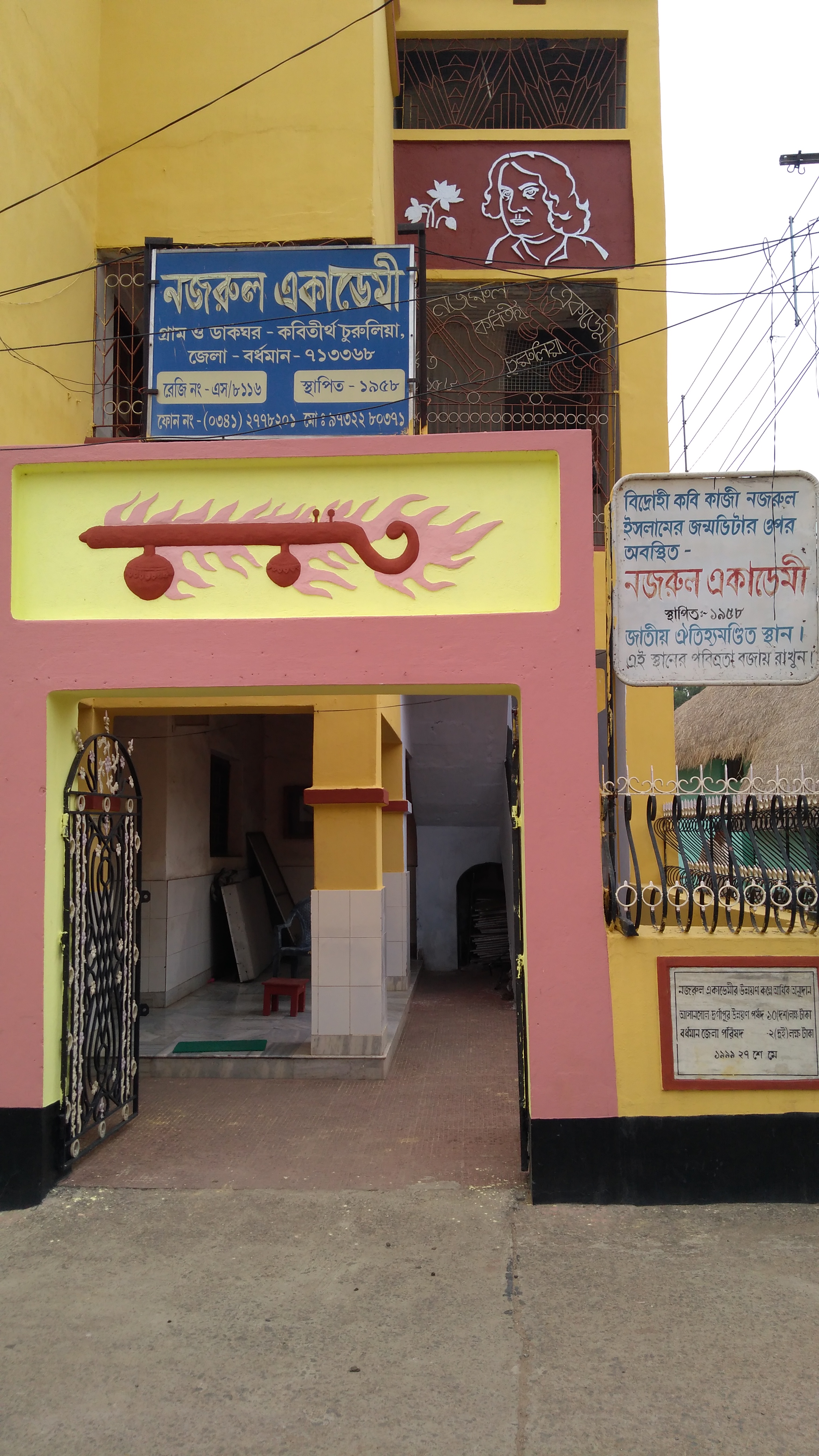
Nazrul Islam was born on | Nazrul Islam was born during the late [[British Raj]] on 24 May, 1899<ref name="instibio">{{Cite web |title=Kazi Nazrul Islam: A Chronology of life |url=http://www.nazrulinstitute.org.bd/bio_graphy_e.html |archive-url=https://web.archive.org/web/20080424053441/http://www.nazrulinstitute.org.bd/bio_graphy_e.html |archive-date=24 April 2008 |access-date=28 April 2008 |publisher=Nazrul Institute, [[Ministry of Cultural Affairs (Bangladesh)|Ministry of Cultural Affairs]], [[Government of Bangladesh]]}}</ref><ref>{{Cite news |title=Tripura celebrates 116th birth anniversary of Kazi Nazrul Islam |url=http://aninews.in/newsdetail2/story218001/tripura-celebrates-116th-birth-anniversary-of-kazi-nazrul-islam.html |url-status=dead |archive-url=https://web.archive.org/web/20160303154148/http://aninews.in/newsdetail2/story218001/tripura-celebrates-116th-birth-anniversary-of-kazi-nazrul-islam.html |archive-date=3 March 2016 |access-date=27 February 2016 |work=[[Asian News International]]}}</ref> in the village of [[Churulia]], [[Asansol Sadar subdivision|Asansol Sadar]], [[Paschim Bardhaman district]] of the [[Bengal Presidency]] (now in [[West Bengal, India]]). He was born into the [[Kazi family of Churulia|Bengali Muslim Taluqdar family]] of Churulia and was the second of three sons and a daughter.<ref>{{Cite web |date=6 August 2018 |title=Kazi Nazrul Islam Biography – Childhood, Life History, Achievements & Death |url=https://learn.culturalindia.net/kazi-nazrul-islam.html |url-status=live |archive-url=https://web.archive.org/web/20250626080810/https://learn.culturalindia.net/kazi-nazrul-islam.html |archive-date=26 June 2025 |access-date=10 June 2023 |website=Cultural India |language=en-US}}</ref><ref>{{Cite book |last=Khan |first=Muhammad Mojlum |url=https://www.bmri.org.uk/biogs/KAZI-NAZRUL-ISLAM.pdf |title=KAZI NAZRUL ISLAM |publisher=Bengal Muslim Research Institute UK |archive-url=https://web.archive.org/web/20240225062915/https://www.bmri.org.uk/biogs/KAZI-NAZRUL-ISLAM.pdf |archive-date=25 February 2024 |url-status=live}}</ref> Nazrul Islam's father Kazi Faqeer Ahmed was the [[imam]] and caretaker of the local Pirpukur mosque and mausoleum of Haji Pahlawan.<ref>{{Cite book |last1=Faber |first1=Roland |url=https://books.google.com/books?id=kb2aCwAAQBAJ |title=Living Traditions and Universal Conviviality: Prospects and Challenges for Peace in Multireligious Communities |last2=Slabodsky |first2=Santiago |date=15 March 2016 |publisher=Rowman & Littlefield |isbn=978-1-4985-1336-4 |page=16 |language=en}}</ref> Nazrul Islam's mother was Zahida Khatun; he had two brothers, Kazi Saahibjaan and Kazi Ali Hussain, and a sister, Umme Kulsum. He was nicknamed ''Dukhu Miañ'' ( literally, 'the one with grief'). Nazrul Islam studied at a [[Maktab (education)|maktab]] and [[madrassa|madrasa]], run by a mosque and a [[dargah]] respectively, where he studied the [[Quran]], [[Hadith]], [[Islamic philosophy]], and theology. Following his father's death in 1908, the then 10 year old Nazrul Islam took his father's place as a caretaker of the mosque to support his family. He also assisted teachers in the school. He later worked as the [[muezzin]] at the mosque.<ref name="Banglapedia">{{Cite book |last=Rafiqul Islam |title=Banglapedia: National Encyclopedia of Bangladesh |publisher=[[Asiatic Society of Bangladesh]] |year=2012 |isbn=978-984-32-0576-6 |editor-last=Sirajul Islam |editor-first= |editor-link=Sirajul Islam |edition=Second |chapter=Kazi Nazrul Islam |access-date=26 March 2016 |editor-last2=Jamal |editor-first2=Ahmed A. |chapter-url=http://en.banglapedia.org/index.php?title=Islam,_Kazi_Nazrul}}</ref><ref name="MOF2">{{Cite web |last=Chaudhuri |first=Dilip |date=22 September 2006 |title=Nazrul Islam: The unparalleled lyricist and composer of Bengal |url=http://pib.nic.in/feature/fe0899/f1608991.html |archive-url=https://web.archive.org/web/20021105092034/http://pib.nic.in/feature/fe0899/f1608991.html |archive-date=5 November 2002 |access-date=22 September 2006 |publisher=[[Press Information Bureau]], [[Government of India]]}} [http://nazrul.com.bd/nazrul/works_on_nazrul/articles/chaudhuri_lyricist.htm Alt URL] {{Webarchive|url=https://web.archive.org/web/20180628183857/http://nazrul.com.bd/nazrul/works_on_nazrul/articles/chaudhuri_lyricist.htm|date=28 June 2018}}</ref> | ||
Attracted to folk theatre, Nazrul Islam joined a ''leto'' (travelling theatrical group) run by his uncle Fazle Karim. He worked and travelled with them, learning to act, as well as writing songs and poems for the plays and musicals.<ref name=instibio /> Through his work and experiences, Nazrul Islam began studying Bengali and [[Sanskrit literature]], as well as Hindu scriptures such as the [[Puranas]]. Nazrul Islam composed folk plays for the group, which included ''Chāshār Shōng'' ('the drama of a peasant'), and plays about characters from the [[Mahabharata]] including ''Shokunībōdh'' ('the Killing of ''[[Shakun]]i''), Rājā Judhisthirer Shōng ('the drama of King [[Yudhishthira]]), ''Dātā Kōrno'' ('the philanthropic ''[[Karna]]'), Ākbōr Bādshāh'' ('[[Akbar]] the emperor'), ''Kobi Kālidās'' ('poet [[Kalidas]]'), ''Bidyan Hutum'' ('the learned owl'), and ''Rājputrer Shōng'' ('the prince's sorrow').<ref name="Banglapedia" /> | Attracted to folk theatre, Nazrul Islam joined a ''leto'' (travelling theatrical group) run by his uncle Fazle Karim. He worked and travelled with them, learning to act, as well as writing songs and poems for the plays and musicals.<ref name=instibio /> Through his work and experiences, Nazrul Islam began studying Bengali and [[Sanskrit literature]], as well as Hindu scriptures such as the [[Puranas]]. Nazrul Islam composed folk plays for the group, which included ''Chāshār Shōng'' ('the drama of a peasant'), and plays about characters from the [[Mahabharata]] including ''Shokunībōdh'' ('the Killing of ''[[Shakun]]i''), Rājā Judhisthirer Shōng ('the drama of King [[Yudhishthira]]), ''Dātā Kōrno'' ('the philanthropic ''[[Karna]]'), Ākbōr Bādshāh'' ('[[Akbar]] the emperor'), ''Kobi Kālidās'' ('poet [[Kalidas]]'), ''Bidyan Hutum'' ('the learned owl'), and ''Rājputrer Shōng'' ('the prince's sorrow').<ref name="Banglapedia" /> | ||
In 1910, Nazrul Islam left the troupe and enrolled at the [[Searsole Raj High School]] in [[Raniganj]]. In school, he was influenced by his teacher, a [[Jugantar]] activist, Nibaran Chandra Ghatak, and began a lifelong friendship with fellow author Sailajananda Mukhopadhyay, who was his classmate. He later transferred to the Mathrun High English School, studying under the headmaster and poet [[Kumud Ranjan Mullick]]. Unable to continue paying his school fees, Nazrul Islam left the school and joined a group of [[Kavigan|kaviyals]]. Later he took jobs as a cook at Wahid Confectionery, a well-known bakery of the region, and at a tea stall in the town of Asansol. In 1914, Nazrul Islam studied in the Darirampur School (now | In 1910, Nazrul Islam left the troupe and enrolled at the [[Searsole Raj High School]] in [[Raniganj]]. In school, he was influenced by his teacher, a [[Jugantar]] activist, Nibaran Chandra Ghatak, and began a lifelong friendship with fellow author Sailajananda Mukhopadhyay, who was his classmate. He later transferred to the Mathrun High English School, studying under the headmaster and poet [[Kumud Ranjan Mullick]]. Unable to continue paying his school fees, Nazrul Islam left the school and joined a group of [[Kavigan|kaviyals]]. Later he took jobs as a cook at Wahid Confectionery, a well-known bakery of the region, and at a tea stall in the town of Asansol. In 1914, Nazrul Islam studied in the Darirampur School (now Govt. Nazrul Academy) in [[Trishal]], [[Mymensingh District]]. Amongst other subjects, Nazrul Islam studied Bengali, [[Sanskrit]], Arabic, [[Persian literature]] and [[Hindustani classical music]] under teachers who were impressed by his dedication and skill.<ref name="Banglapedia" /><ref>{{Cite news |date=25 May 2018 |title=Nazrul's birth anniv today |url=http://www.newagebd.net/article/42030/nazruls-birth-anniv-today |url-status=live |archive-url=https://web.archive.org/web/20250425024621/https://www.newagebd.net/article/42030/nazruls-birth-anniv-today |archive-date=25 April 2025 |access-date=28 June 2018 |work=[[New Age (Bangladesh)|New Age]]}}</ref><ref>{{Cite news |date=25 May 2018 |title=Nazrul's 119th birth anniversary today |url=http://en.prothomalo.com/bangladesh/news/176241/Nazrul%E2%80%99s-119th-birth-anniversary-today |url-status=live |archive-url=https://web.archive.org/web/20250426053806/https://en.prothomalo.com/bangladesh/news/176241/Nazrul%E2%80%99s-119th-birth-anniversary-today |archive-date=26 April 2025 |access-date=28 June 2018 |work=[[Prothom Alo]]}}</ref> | ||
Nazrul Islam studied up to grade{{nbsp}}10 but did not appear for the [[matriculation]] pre-test examination; instead in 1917, he joined the [[British Indian Army]] at the age of eighteen. He had two primary motivations for joining the British Indian Army: first, a youthful desire for adventure and, second, an interest in the politics of the time.<ref>{{Cite book |last=Bose |first=Buddhadeva |title=Nazrul: An Evaluation |date=2000 |publisher=Nazrul Institute |isbn=978-984-555-167-0 |editor-last=Mohammad Nurul Huda |location=Dhaka |page=80 |chapter=Modern Bengali Poetry and Nazrul Islam |author-link=Buddhadeb Bosu |chapter-url=https://books.google.com/books?id=MtpVAAAACAAJ}}</ref> Attached to the 49th [[Bengal Regiment]], he was posted to the [[Karachi Cantonment]], where he wrote his first prose and poetry. Although he never saw active fighting, he rose in rank from corporal to [[havildar]] (sergeant), and served as [[quartermaster]] for his [[battalion]].<ref>{{Cite news |last=Zaman |first=Niaz |date=17 December 2014 |title=Impact on Nazrul |url=http://www.thedailystar.net/impact-on-nazrul-55852 |url-status=live |archive-url=https://web.archive.org/web/20170417123412/https://www.thedailystar.net/impact-on-nazrul-55852 |archive-date=17 April 2017 |access-date=12 July 2016 |work=The Daily Star}}</ref> | Nazrul Islam studied up to grade{{nbsp}}10 but did not appear for the [[matriculation]] pre-test examination; instead in 1917, he joined the [[British Indian Army]] at the age of eighteen. He had two primary motivations for joining the British Indian Army: first, a youthful desire for adventure and, second, an interest in the politics of the time.<ref>{{Cite book |last=Bose |first=Buddhadeva |title=Nazrul: An Evaluation |date=2000 |publisher=Nazrul Institute |isbn=978-984-555-167-0 |editor-last=Mohammad Nurul Huda |location=Dhaka |page=80 |chapter=Modern Bengali Poetry and Nazrul Islam |author-link=Buddhadeb Bosu |chapter-url=https://books.google.com/books?id=MtpVAAAACAAJ}}</ref> Attached to the 49th [[Bengal Regiment]], he was posted to the [[Karachi Cantonment]], where he wrote his first prose and poetry. Although he never saw active fighting, he rose in rank from corporal to [[havildar]] (sergeant), and served as [[quartermaster]] for his [[battalion]].<ref>{{Cite news |last=Zaman |first=Niaz |date=17 December 2014 |title=Impact on Nazrul |url=http://www.thedailystar.net/impact-on-nazrul-55852 |url-status=live |archive-url=https://web.archive.org/web/20170417123412/https://www.thedailystar.net/impact-on-nazrul-55852 |archive-date=17 April 2017 |access-date=12 July 2016 |work=[[The Daily Star (Bangladesh)|The Daily Star]]}}</ref> | ||
During this period, Nazrul Islam read extensively the works of [[Rabindranath Tagore]] and [[Sarat Chandra Chattopadhyay]], as well as the Persian poets [[Hafez (poet)|Hafez]], [[Omar Khayyam]], and [[Rumi]].<ref>{{Cite news |last=Rahman |first=Aziz |date=27 August 2015 |title=Nazrul: The rebel and the romantic | During this period, Nazrul Islam read extensively the works of [[Rabindranath Tagore]] and [[Sarat Chandra Chattopadhyay]], as well as the Persian poets [[Hafez (poet)|Hafez]], [[Omar Khayyam]], and [[Rumi]].<ref>{{Cite news |last=Rahman |first=Aziz |date=27 August 2015 |title=Nazrul: The rebel and the romantic |url=http://www.daily-sun.com/printversion/details/70741/Nazrul:-The-rebel-and-the-romantic |url-status=dead |archive-url=https://web.archive.org/web/20170417122146/http://www.daily-sun.com/printversion/details/70741/Nazrul:-The-rebel-and-the-romantic |archive-date=17 April 2017 |access-date=12 July 2016 |work=[[Daily Sun (Bangladesh)|Daily Sun]]}}</ref><ref>{{Cite news |last=Shafiqul Islam |first=Mohammad |date=25 May 2007 |title=Nazrul: An ardent lover of humanity |url=http://archive.thedailystar.net/2007/05/25/d70525140299.htm |url-status=live |archive-url=https://web.archive.org/web/20180204123949/http://archive.thedailystar.net/2007/05/25/d70525140299.htm |archive-date=4 February 2018 |access-date=12 July 2016 |work=[[The Daily Star (Bangladesh)|The Daily Star]]}}</ref> He learned Persian poetry from the regiment's [[Punjabi Muslims|Punjabi]] [[Moulvi]], practiced music, and pursued his literary interests. His first prose work, ''"Life of a Vagabond"'' (''{{'}}Baunduler Atmakahini''), was published in May 1919. His poem "Mukti" ("মুক্তি", 'Freedom') was published by the ''[[Bengali Muslim Literary Journal]]'' (''Bangiya Mussalman Sahitya Samiti'') in July 1919.<ref name="Banglapedia" /> | ||
== Career == | == Career == | ||
| Line 117: | Line 126: | ||
I raise my head beyond this world, | I raise my head beyond this world, | ||
High, ever erect and alone!</poem> | High, ever erect and alone!</poem> | ||
| source = {{snds}}Translation by Kabir Choudhary<ref name="Bidrohi">{{Cite web |last=Kabir |first=Choudhary |title=Rebel |url=https://www.nazrul.org/nazrul_works/poems_lyrics/kabir_rebel.htm |url-status=dead |archive-url=https://web.archive.org/web/20071026083724/http://www.nazrul.org/nazrul_works/poems_lyrics/kabir_rebel.htm |archive-date=26 October 2007 |access-date=8 July 2006 | | source = {{snds}}Translation by Kabir Choudhary<ref name="Bidrohi">{{Cite web |last=Kabir |first=Choudhary |title=Rebel |url=https://www.nazrul.org/nazrul_works/poems_lyrics/kabir_rebel.htm |url-status=dead |archive-url=https://web.archive.org/web/20071026083724/http://www.nazrul.org/nazrul_works/poems_lyrics/kabir_rebel.htm |archive-date=26 October 2007 |access-date=8 July 2006 }}</ref> | ||
| align = left | | align = left | ||
| qalign = | | qalign = | ||
| salign = right | | salign = right | ||
}} | }} | ||
[[File: | [[File:Kazi nazrul islam with Setar.jpg|thumb|Kazi Nazrul Islam playing [[Sarod]]]] | ||
Kazi Nazrul Islam joined the army in late 1917. Nazrul Islam left the British Indian army in 1920 when the 49th Bengal Regiment was disbanded | Kazi Nazrul Islam joined the army in late 1917. Nazrul Islam left the British Indian army in 1920, when the 49th Bengal Regiment was disbanded,<ref name=":0">{{Cite news |date=27 August 2015 |title=Nazrul's death anniversary today |url=http://www.thedailystar.net/backpage/nazruls-death-anniversary-today-133309 |archive-url=https://web.archive.org/web/20220522232050/https://www.thedailystar.net/backpage/nazruls-death-anniversary-today-133309 |archive-date=22 May 2022 |access-date=5 March 2016 |work=[[The Daily Star (Bangladesh)|The Daily Star]]}}</ref> and settled in [[Kolkata|Calcutta]]. He joined the staff of the ''[[Bangiya Mussalman Sahitya Samiti]]'' ("Bengali Muslim Literary Society").<ref>{{Citation |last=Khondkar Sirajul Haque |title=Banglapedia: National Encyclopedia of Bangladesh |year=2012 |editor-last=Sirajul Islam and Ahmed A. Jamal |chapter=Bangiya Mussalman Sahitya Patrika |chapter-url=http://en.banglapedia.org/index.php?title=Bangiya_Mussalman_Sahitya_Patrika |edition=Second |publisher=[[Asiatic Society of Bangladesh]]}}</ref> He published his first novel ''Bandhan-hara'' (''বাঁধন-হারা'', 'Freedom from Bondage') in 1920, on which he continued to work over the next seven years.<ref name="Banglapedia" /> His first collection of poems, which included "''Bodhan''", "''Shat-il-Arab''", "''Kheya-parer'' ''Tarani''", and "''Badal Prater Sharab''", received critical acclaim.<ref name="Banglapedia" /> | ||
Nazrul Islam grew close to other young Muslim writers, while working at the Bengali Muslim Literary Society, including [[Md.Mozammel Haque|Mohammad Mozammel Haq]], [[Kazi Abdul Wadud]], and [[Muhammad Shahidullah]]. Nazrul Islam and Muhammad Shahidullah remained close throughout their lives. He was a regular at the social clubs for Calcutta's writers, poets, and intellectuals such as the Gajendar Adda and the Bharatiya Adda. Nazrul did not have the formal education of Rabindranath and as a result his poems did not follow the literary practices established by Rabindranath. Due to this he faced criticism from followers of Rabindranath.<ref>{{Cite journal |last=Nag |first=Sajal | | Nazrul Islam grew close to other young Muslim writers, while working at the Bengali Muslim Literary Society, including [[Md.Mozammel Haque|Mohammad Mozammel Haq]], [[Kazi Abdul Wadud]], and [[Muhammad Shahidullah]]. Nazrul Islam and Muhammad Shahidullah remained close throughout their lives. He was a regular at the social clubs for Calcutta's writers, poets, and intellectuals such as the Gajendar Adda and the Bharatiya Adda. Nazrul did not have the formal education of Rabindranath and as a result his poems did not follow the literary practices established by Rabindranath. Due to this he faced criticism from followers of Rabindranath.<ref>{{Cite journal |last=Nag |first=Sajal |year=2008 |title=Story of a Rebel Poet |journal=Economic and Political Weekly |type=Book Review |volume=43 |issue=26/27 |pages=84–85 |issn=0012-9976 |jstor=40278906}}</ref> Despite their differences, Nazrul looked to Rabindranath Tagore as a mentor.<ref name="Banglapedia" /> In 1921, Nazrul Islam was engaged to Nargis, the niece of a well-known Muslim publisher, Ali Akbar Khan, in Daulatpur, [[Comilla District|Comilla]].<ref>{{Cite book |last=Nurul Huda |first=Muhammad |url=https://books.google.com/books?id=Co9jAAAAMAAJ&q=In+1921,+Nazrul+was+engaged+to+be+married+to+Nargis |title=Nazrul's Aesthetics and Other Aspects |publisher=Nazrul Institute |year=2001 |location=Bangladesh |page=124 |access-date=26 March 2016}}</ref> On 18 June 1921, the day of the wedding, upon public insistence by Khan that the term "Nazrul must reside in Daulatpur after marriage" be included in the marriage contract, Nazrul Islam walked away from the wedding ceremony.<ref>{{Cite book |last=[[Muzaffar Ahmed (politician)|Muzaffar Ahmad]] |url=https://archive.org/details/in.ernet.dli.2015.456382 |title=Kazi Nazrul Islam Smritikatha |publisher=National Book Agency |year=1998 |location=Kolkata, India |pages=66–67}}</ref> | ||
[[File:Nazrul young in 1921.jpg|thumb | [[File:Nazrul young in 1921.jpg|thumb|Young Kazi Nazrul Islam in-front of [[Dalmadal Cannon]] in [[Bishnupur, Bankura]], 1920s]] | ||
Nazrul Islam reached the peak of his fame in 1922 with ''[[Bidrohi (poem)|Bidrohi]]'' (The Rebel), which remains his most famous work, winning the admiration of India's literary society for his description of a rebel.{{citation needed|date=September 2021}} Published in the ''Bijli'' ''(বিজলী'', "Lightning") magazine, the rebellious language and theme were well received, coinciding with the [[Non-Cooperation Movement]]{{snds}}the first mass nationalist campaign of [[civil disobedience]] against British rule.<ref name="Banglapedia" /> Nazrul Islam explores the different forces at work in a rebel, the destroyer, and the preserver who is able to express rage as well as beauty and sensitivity. He followed up by writing ''[[Pralayollas]]'' ('Destructive Euphoria'), and his first anthology of poems, the ''Agni-veena'' ("অগ্নি-বীণা", 'Lyre of Fire') in 1922, which enjoyed commercial and critical success. He also published a volume of short stories, the ''Byathar Dan'' "ব্যথার দান" ('Gift of Sorrow'),<ref>{{Cite book |last=Bose |first=Sugata |url=https://archive.org/details/hundredhorizons00suga |title=A Hundred Horizons: The Indian Ocean in the Age of Global Empire |publisher=Harvard University Press |year=2009 |isbn=978-0-674-02157-0 |pages=[https://archive.org/details/hundredhorizons00suga/page/299 299] |language=en |author-link=Sugata Bose |url-access=registration}}</ref> and ''Yugbani'' ("যুগবাণী"), an anthology of essays.<ref>{{Cite book |last1=Talukdar |first1=Rezaul Karim |url=https://books.google.com/books?id=v49jAAAAMAAJ&q=Jugbani+kazi+nazrul+islam |title=Nazrul, the gift of the century |last2=Nazrul Islam |first2=Kazi |date=1994 |publisher=Manan |isbn=9789848156001 |pages=47–48 |language=en}}</ref><ref>{{Cite book |last=Rajesh |first=K. Guru |url=https://books.google.com/books?id=c_dLCgAAQBAJ |title=Sarfarosh: A Naadi Exposition of the Lives of Indian Revolutionaries |publisher=Notion Press |isbn=9789352061730 |language=en |access-date=26 March 2016}}</ref> | Nazrul Islam reached the peak of his fame in 1922 with ''[[Bidrohi (poem)|Bidrohi]]'' (The Rebel), which remains his most famous work, winning the admiration of India's literary society for his description of a rebel.{{citation needed|date=September 2021}} Published in the ''Bijli'' ''(বিজলী'', "Lightning") magazine, the rebellious language and theme were well received, coinciding with the [[Non-Cooperation Movement]]{{snds}}the first mass nationalist campaign of [[civil disobedience]] against British rule.<ref name="Banglapedia" /> Nazrul Islam explores the different forces at work in a rebel, the destroyer, and the preserver who is able to express rage as well as beauty and sensitivity. He followed up by writing ''[[Pralayollas]]'' ('Destructive Euphoria'), and his first anthology of poems, the ''Agni-veena'' ("অগ্নি-বীণা", 'Lyre of Fire') in 1922, which enjoyed commercial and critical success. He also published a volume of short stories, the ''Byathar Dan'' "ব্যথার দান" ('Gift of Sorrow'),<ref>{{Cite book |last=Bose |first=Sugata |url=https://archive.org/details/hundredhorizons00suga |title=A Hundred Horizons: The Indian Ocean in the Age of Global Empire |publisher=Harvard University Press |year=2009 |isbn=978-0-674-02157-0 |pages=[https://archive.org/details/hundredhorizons00suga/page/299 299] |language=en |author-link=Sugata Bose |url-access=registration}}</ref> and ''Yugbani'' ("যুগবাণী"), an anthology of essays.<ref>{{Cite book |last1=Talukdar |first1=Rezaul Karim |url=https://books.google.com/books?id=v49jAAAAMAAJ&q=Jugbani+kazi+nazrul+islam |title=Nazrul, the gift of the century |last2=Nazrul Islam |first2=Kazi |date=1994 |publisher=Manan |isbn=9789848156001 |pages=47–48 |language=en}}</ref><ref>{{Cite book |last=Rajesh |first=K. Guru |url=https://books.google.com/books?id=c_dLCgAAQBAJ |title=Sarfarosh: A Naadi Exposition of the Lives of Indian Revolutionaries |publisher=Notion Press |isbn=9789352061730 |language=en |access-date=26 March 2016}}</ref> | ||
Nazrul Islam started a bi-weekly magazine, ''Dhumketu'' ("ধূমকেতু", 'Comet') on 12 August 1922 that was critical of the British Empire. Earning the moniker of the "rebel poet", Nazrul Islam aroused the suspicion of British Raj authorities.<ref name="instibio" /><ref name=":5">{{Cite web |last=Nawaz |first=Ali |date=20 January 2015 |title=Dhumketu |url=http://en.banglapedia.org/index.php?title=Dhumketu |url-status=live |archive-url=https://web.archive.org/web/20180704005557/http://en.banglapedia.org/index.php?title=Dhumketu |archive-date=4 July 2018 |access-date=3 July 2018 |website=Banglapedia |language=en}}</ref> The | Nazrul Islam started a bi-weekly magazine, ''Dhumketu'' ("ধূমকেতু", 'Comet') on 12 August 1922 that was critical of the British Empire. Earning the moniker of the "rebel poet", Nazrul Islam aroused the suspicion of British Raj authorities.<ref name="instibio" /><ref name=":5">{{Cite web |last=Nawaz |first=Ali |date=20 January 2015 |title=Dhumketu |url=http://en.banglapedia.org/index.php?title=Dhumketu |url-status=live |archive-url=https://web.archive.org/web/20180704005557/http://en.banglapedia.org/index.php?title=Dhumketu |archive-date=4 July 2018 |access-date=3 July 2018 |website=Banglapedia |language=en}}</ref> The police raided the office of ''Dhumketu'' after it published "Anondomoyeer Agomone" ("আনন্দময়ীর আগমনে"), a political poem, in September 1922. Nazrul Islam was arrested on 23 January 1923 and charged with [[sedition]].<ref name=":5" /> He presented a long argument in the court, an excerpt of what he said: | ||
{{blockquote|quote=I have been accused of sedition... To plead for me, the king of all kings, the judge of all judges, the eternal truth the living God... I am a poet; I have been sent by God to express the unexpressed, to portray the unportrayed. It is God who is heard through the voice of the poet... I am an instrument of God. The instrument is not unbreakable, but who is there to break God?<ref name="sedition">{{Cite news |last=Choudhury |first=Serajul Islam |date=1 June 2006 |title=The Blazing Comet |url=http://www.newagebd.com/2006/may/26/may26/xtra_also1.html |archive-url=https://web.archive.org/web/20100719063851/http://www.newagebd.com/2006/may/26/may26/xtra_also1.html |archive-date=19 July 2010 |access-date=22 September 2006 |quote=Nazrul Islam did what no other Muslim poet in modern Bengal had dared to do. He created images and symbols out of the well-known heroes from Muslim history. Thus Tariq and Qasim, Ali and Omar, Hasan and Hussain and even the Prophet himself figure in his poetry as historical beings. He also transformed men like Kamal Pasha and Anwar Pasha into symbols. The method is somewhat similar to the one Yeats employed in his poetry. |newspaper=New Age}}</ref>|sign=|source=}} | {{blockquote|quote=I have been accused of sedition... To plead for me, the king of all kings, the judge of all judges, the eternal truth the living God... I am a poet; I have been sent by God to express the unexpressed, to portray the unportrayed. It is God who is heard through the voice of the poet... I am an instrument of God. The instrument is not unbreakable, but who is there to break God?<ref name="sedition">{{Cite news |last=Choudhury |first=Serajul Islam |date=1 June 2006 |title=The Blazing Comet |url=http://www.newagebd.com/2006/may/26/may26/xtra_also1.html |archive-url=https://web.archive.org/web/20100719063851/http://www.newagebd.com/2006/may/26/may26/xtra_also1.html |archive-date=19 July 2010 |access-date=22 September 2006 |quote=Nazrul Islam did what no other Muslim poet in modern Bengal had dared to do. He created images and symbols out of the well-known heroes from Muslim history. Thus Tariq and Qasim, Ali and Omar, Hasan and Hussain and even the Prophet himself figure in his poetry as historical beings. He also transformed men like Kamal Pasha and Anwar Pasha into symbols. The method is somewhat similar to the one Yeats employed in his poetry. |newspaper=New Age}}</ref>|sign=|source=}} | ||
[[File:Nazrul as Narad.jpg|thumb|Nazrul Islam in the role of [[Narada]], in the stage drama ''Dhruba.'' | [[File:Nazrul as Narad.jpg|thumb|Kazi Nazrul Islam in the role of [[Narada]], in the stage drama ''Dhruba.''|alt=]] | ||
On 14 April 1923, he was moved from [[Alipore Jail]] to [[Hooghly Jail]] in [[Hooghly district|Hooghly]]. He began a 40-day fast to protest mistreatment by the British jail superintendent, breaking his fast more than a month later and eventually being released from prison in December 1923. Nazrul Islam composed numerous poems and songs during his period of imprisonment. In the 1920s, the British Indian government banned many of his writings.<ref name="Banglapedia" /> [[Rabindranath Tagore]] dedicated his play "Basanta" to Nazrul Islam in 1923. Nazrul Islam wrote the poem "Aj Srishti Shukher Ullashe" to thank Tagore.<ref>{{Cite news |date=25 May 2015 |title=Kazi Nazrul Islam |url=http://www.thedailystar.net/arts-entertainment/its-true/kazi-nazrul-islam-86731 |url-status=live |archive-url=https://web.archive.org/web/20170530212014/https://www.thedailystar.net/arts-entertainment/its-true/kazi-nazrul-islam-86731 |archive-date=30 May 2017 |access-date=27 February 2016 |work=The Daily Star}}</ref> His book ''Bisher Banshi'' ('The Flute of Poison'), published in August 1924,<ref>{{Cite book |last=(Bangladesh) |first=Bāṃlā Ekāḍemī |url=https://books.google.com/books?id=33xjAAAAMAAJ&q=Bisher+Banshi |title=Bangla Academy Journal |date=1995 |publisher=Bangla Academy. |pages=41 |language=en}}</ref> was banned by the [[British Raj]].<ref name=":2">{{Cite news |last=Chandan |first=Shahnawaz |date=30 August 2013 |title=The Life of a Rebel | On 14 April 1923, he was moved from [[Alipore Jail]] to [[Hooghly Jail]] in [[Hooghly district|Hooghly]]. He began a 40-day fast to protest mistreatment by the British jail superintendent, breaking his fast more than a month later and eventually being released from prison in December 1923. Nazrul Islam composed numerous poems and songs during his period of imprisonment. In the 1920s, the British Indian government banned many of his writings.<ref name="Banglapedia" /> [[Rabindranath Tagore]] dedicated his play "Basanta" to Nazrul Islam in 1923. Nazrul Islam wrote the poem "Aj Srishti Shukher Ullashe" to thank Tagore.<ref>{{Cite news |date=25 May 2015 |title=Kazi Nazrul Islam |url=http://www.thedailystar.net/arts-entertainment/its-true/kazi-nazrul-islam-86731 |url-status=live |archive-url=https://web.archive.org/web/20170530212014/https://www.thedailystar.net/arts-entertainment/its-true/kazi-nazrul-islam-86731 |archive-date=30 May 2017 |access-date=27 February 2016 |work=[[The Daily Star (Bangladesh)|The Daily Star]]}}</ref> His book ''Bisher Banshi'' ('The Flute of Poison'), published in August 1924,<ref>{{Cite book |last=(Bangladesh) |first=Bāṃlā Ekāḍemī |url=https://books.google.com/books?id=33xjAAAAMAAJ&q=Bisher+Banshi |title=Bangla Academy Journal |date=1995 |publisher=Bangla Academy. |pages=41 |language=en}}</ref> was banned by the [[British Raj]].<ref name=":2">{{Cite news |last=Chandan |first=Shahnawaz |date=30 August 2013 |title=The Life of a Rebel |url=http://www.thedailystar.net/news/the-life-of-a-rebel |url-status=live |archive-url=https://web.archive.org/web/20171203200301/http://www.thedailystar.net/news/the-life-of-a-rebel |archive-date=3 December 2017 |access-date=27 March 2016 |work=[[The Daily Star (Bangladesh)|The Daily Star]]}}</ref> ''Bisher Banshi'' called for rebellion in India against the British Raj.<ref>{{Cite journal |last=Chaman |year=1977 |title=The Voice of Nazr-ul-Islam |journal=Indian Literature |volume=20 |issue=4 |pages=109–118 |issn=0019-5804 |jstor=24158699}}</ref> ''Bisher Banshi'' was read and distributed in secret following the ban.<ref>{{Cite book |last=Sen |first=Manikuntala |title=In search of freedom: an unfinished journey |publisher=Stree |year=2001 |isbn=978-81-85604-25-1 |page=17 |language=en |quote="Learning by heart the poems of his ''Agnibina'' and ''Bisher Banshi'', we hid the books in our breasts and passed them secretly to friends. As far as I remember, ''Bisher Banshi'' was banned." |author-link=Manikuntala Sen}}</ref> | ||
[[File:Hooghly district Correctional Home at Hooghly- Chinsurah 10.jpg|thumb|Plaque in memory of Nazrul Islam in Hooghly Jail]] | [[File:Hooghly district Correctional Home at Hooghly- Chinsurah 10.jpg|thumb|Plaque in memory of Kazi Nazrul Islam in Hooghly Jail]] | ||
Nazrul Islam was a critic of the [[Khilafat Movement]] in British India which he condemned as "hollow [[religious fundamentalism]]".<ref name="Banglapedia" /> His rebellious expression extended to rigid orthodoxy in the name of religion and politics.<ref>{{Cite book |last=Rushd |first=Abu |title=Nazrul: An Evaluation |date=2000 |publisher=Nazrul Institute |isbn=978-984-555-167-0 |editor-last=Mohammad Nurul Huda |location=Dhaka |page=100 |chapter=Nazrul Islam's 'The Rebel' |author-link=Abu Rushd |chapter-url=https://books.google.com/books?id=MtpVAAAACAAJ}}</ref> He also criticised the [[Indian National Congress]] for not embracing outright political independence from the [[British Empire]]. Nazrul became active in encouraging people to agitate against British rule, and joined the Bengal state unit of the Indian National Congress.<ref name="Banglapedia" /> Along with [[Muzaffar Ahmed (politician)|Muzaffar Ahmed]], Nazrul also helped organise the [[Workers and Peasants Party (India)|Sramik Praja Swaraj Dal]] (Workers and Peasants Party), a socialist political party committed to national independence and the service of the working class. On 16 December 1925, Nazrul began publishing the ''Langal'' ('Plough'), a weekly, and served as its chief editor.<ref name="Banglapedia" /> | Nazrul Islam was a critic of the [[Khilafat Movement]] in British India which he condemned as "hollow [[religious fundamentalism]]".<ref name="Banglapedia" /> His rebellious expression extended to rigid orthodoxy in the name of religion and politics.<ref>{{Cite book |last=Rushd |first=Abu |title=Nazrul: An Evaluation |date=2000 |publisher=Nazrul Institute |isbn=978-984-555-167-0 |editor-last=Mohammad Nurul Huda |location=Dhaka |page=100 |chapter=Nazrul Islam's 'The Rebel' |author-link=Abu Rushd |chapter-url=https://books.google.com/books?id=MtpVAAAACAAJ}}</ref> He also criticised the [[Indian National Congress]] for not embracing outright political independence from the [[British Empire]]. Nazrul became active in encouraging people to agitate against British rule, and joined the Bengal state unit of the Indian National Congress.<ref name="Banglapedia" /> Along with [[Muzaffar Ahmed (politician)|Muzaffar Ahmed]], Nazrul also helped organise the [[Workers and Peasants Party (India)|Sramik Praja Swaraj Dal]] (Workers and Peasants Party), a socialist political party committed to national independence and the service of the working class. On 16 December 1925, Nazrul began publishing the ''Langal'' ('Plough'), a weekly, and served as its chief editor.<ref name="Banglapedia" /> | ||
During his visit to [[Comilla District|Comilla]] in 1921, Nazrul Islam met a young Bengali Hindu woman, Pramila Devi, with whom he fell in love, and they married on 25 April 1924. [[Brahmo Samaj]] criticised Pramila, a member of the Brahmo Samaj, for marrying a Muslim. Muslim religious leaders | During his visit to [[Comilla District|Comilla]] in 1921, Nazrul Islam met a young Bengali Hindu woman, Pramila Devi, with whom he fell in love, and they married on 25 April 1924. [[Brahmo Samaj]] criticised Pramila, a member of the Brahmo Samaj, for marrying a Muslim. Muslim religious leaders criticised Nazrul Islam for his marriage to a Hindu woman. He also was criticised for his writings. Despite controversy, Nazrul Islam's popularity and reputation as the "rebel poet" increased significantly.<ref name="Banglapedia" /><ref>{{Cite book |last=Chowdhury |first=Serajul Islam |title=Nazrul: An Evaluation |date=2000 |publisher=Nazrul Institute |isbn=978-984-555-167-0 |editor-last=Mohammad Nurul Huda |location=Dhaka |page=141 |chapter=The Blazing Comet |chapter-url=https://books.google.com/books?id=MtpVAAAACAAJ}}</ref> | ||
With his wife and young son Bulbul, Nazrul Islam settled at [[Grace Cottage, Krishnanagar]] in [[Krishnanagar, Nadia|Krishnanagar]] in 1926. His work began to transform as he wrote poetry and songs that articulated the aspirations of the working class, a sphere of his work known as "mass music".<ref>{{Cite book |last=Rafiqul Islam | With his wife and young son Bulbul, Nazrul Islam settled at [[Grace Cottage, Krishnanagar]] in [[Krishnanagar, Nadia|Krishnanagar]] in 1926. His work began to transform as he wrote poetry and songs that articulated the aspirations of the working class, a sphere of his work known as "mass music".<ref>{{Cite book |last=Rafiqul Islam |title=Nazrul: An Evaluation |date=2000 |publisher=Nazrul Institute |isbn=978-984-555-167-0 |editor-last=Mohammad Nurul Huda |location=Dhaka |page=113 |chapter=Nazrul |chapter-url=https://books.google.com/books?id=MtpVAAAACAAJ}}</ref> | ||
{{Quote box | {{Quote box | ||
| Line 162: | Line 171: | ||
| align = left | | align = left | ||
| salign = right | | salign = right | ||
}}In what his contemporaries regarded as one of his greatest flairs of creativity, Nazrul Islam vastly contributed in profusely enriching [[ghazal]]s in Bengali, transforming a form of poetry written mainly in [[Persian language|Persian]] and [[Urdu]].<ref name="MOF2" /> Nazrul Islam's recording of Islamic songs was a commercial success and created interest in gramophone companies about publishing his works. A significant impact of Nazrul Islam's work in Bengal was that it made Bengali Muslims more comfortable with the Bengali arts, which used to be dominated by Bengali Hindus.<ref>{{Cite journal |last=Khan |first=Zillur R. | | }}In what his contemporaries regarded as one of his greatest flairs of creativity, Nazrul Islam vastly contributed in profusely enriching [[ghazal]]s in Bengali, transforming a form of poetry written mainly in [[Persian language|Persian]] and [[Urdu]].<ref name="MOF2" /> Nazrul Islam's recording of Islamic songs was a commercial success and created interest in gramophone companies about publishing his works. A significant impact of Nazrul Islam's work in Bengal was that it made Bengali Muslims more comfortable with the Bengali arts, which used to be dominated by Bengali Hindus.<ref>{{Cite journal |last=Khan |first=Zillur R. |year=1985 |title=Islam and Bengali Nationalism |journal=Asian Survey |volume=25 |issue=8 |pages=834–851 |doi=10.2307/2644113 |issn=0004-4687 |jstor=2644113}}</ref> His Islamic songs are popular during Ramadan in Bangladesh. He also wrote devotional songs on the Hindu Goddess [[Kali]].<ref>{{Cite news |last=Kamal |first=Nashid |date=11 July 2015 |title=Nazrul Islam's Islamic songs |url=http://www.thedailystar.net/showbiz/lifes-lyrics/nazrul-islams-islamic-songs-110560 |url-status=live |archive-url=https://web.archive.org/web/20250425043703/https://www.thedailystar.net/showbiz/lifes-lyrics/nazrul-islams-islamic-songs-110560 |archive-date=25 April 2025 |access-date=23 July 2015 |work=[[The Daily Star (Bangladesh)|The Daily Star]]}}</ref> Nazrul Islam also composed a number of notable ''Shyamasangeet'', ''[[Bhajan]]'' and ''[[Kirtan]]'', combining Hindu devotional music.<ref name=":6">{{Cite book |last=Rafiqul Islam |title=Nazrul: An Evaluation |date=2000 |publisher=Nazrul Institute |isbn=978-984-555-167-0 |editor-last=Mohammad Nurul Huda |location=Dhaka |page=115 |chapter=Nazrul |chapter-url=https://books.google.com/books?id=MtpVAAAACAAJ}}</ref> In 1928, Nazrul Islam began working as a lyricist, composer, and music director for the [[Gramophone Company of India]].<ref>{{Cite news |last=Hossen |first=Iftikhar |date=25 May 2018 |title=Spreading the passion and enthusiasm of Kazi Nazrul Islam |url=http://www.observerbd.com/details.php?id=139463 |url-status=dead |archive-url=https://web.archive.org/web/20251107122157/https://www.observerbd.com/news/139463 |archive-date=7 November 2025 |access-date=3 July 2018 |work=[[The Daily Observer (Bangladesh)|The Daily Observer]]}}</ref> The songs written and music composed by him were broadcast on radio stations across India, including on the [[Indian Broadcasting Company]].<ref name="Banglapedia" /><ref>{{Cite book |last=Field |first=Garrett |url=https://archive.org/details/dli.doa.211 |title=Modernizing Composition: Sinhala Song, Poetry, and Politics in Twentieth-Century Sri Lanka |date=22 March 2017 |publisher=Univ of California Press |isbn=9780520294714 |pages=[https://archive.org/details/dli.doa.211/page/n115 101] |language=en |quote=kazi nazrul islam radio.}}</ref>{{Quote box | ||
| title = Naari (Woman) | | title = Naari (Woman) | ||
| quote = <poem>I don't see any difference | | quote = <poem>I don't see any difference | ||
| Line 176: | Line 185: | ||
Nazrul Islam believed in the equality of women, a view his contemporaries considered revolutionary, as expressed in his poem Naari (women).<ref name="Amin 1996 106">{{Cite book |last=Amin |first=Sonia Nishat |url=https://books.google.com/books?id=VcAfpv6x0m4C |title=The World of Muslim Women in Colonial Bengal, 1876–1939 |publisher=BRILL |year=1996 |isbn=978-90-04-10642-0 |page=106}}</ref> Nazrul Islam's poems strongly emphasised the confluence of the roles of both sexes and their equal importance to life. His poem "Barangana" (Prostitute) stunned society with its depiction of prostitutes who he addresses in the poem as "mother".<ref name="Huda 314">{{Cite book |last=Huda |first=Mohammad Nurul |title=Nazrul: An Evaluation |date=2000 |publisher=Nazrul Institute |isbn=978-984-555-167-0 |editor-last=Mohammad Nurul Huda |location=Dhaka |page=314 |chapter=Nazrul's Personlore |chapter-url=https://books.google.com/books?id=MtpVAAAACAAJ}}</ref><ref>{{Cite web |last=Ahsanuzzaman |first=Ahmed |title=No Nora's in Popular Bangla Literature |url=http://www.ibsensociety.liu.edu/conferencepapers/nonoras.pdf |url-status=dead |archive-url=https://web.archive.org/web/20160303170341/http://www.ibsensociety.liu.edu/conferencepapers/nonoras.pdf |archive-date=3 March 2016 |access-date=8 July 2006 |website=IB Sen society}}</ref> | Nazrul Islam believed in the equality of women, a view his contemporaries considered revolutionary, as expressed in his poem Naari (women).<ref name="Amin 1996 106">{{Cite book |last=Amin |first=Sonia Nishat |url=https://books.google.com/books?id=VcAfpv6x0m4C |title=The World of Muslim Women in Colonial Bengal, 1876–1939 |publisher=BRILL |year=1996 |isbn=978-90-04-10642-0 |page=106}}</ref> Nazrul Islam's poems strongly emphasised the confluence of the roles of both sexes and their equal importance to life. His poem "Barangana" (Prostitute) stunned society with its depiction of prostitutes who he addresses in the poem as "mother".<ref name="Huda 314">{{Cite book |last=Huda |first=Mohammad Nurul |title=Nazrul: An Evaluation |date=2000 |publisher=Nazrul Institute |isbn=978-984-555-167-0 |editor-last=Mohammad Nurul Huda |location=Dhaka |page=314 |chapter=Nazrul's Personlore |chapter-url=https://books.google.com/books?id=MtpVAAAACAAJ}}</ref><ref>{{Cite web |last=Ahsanuzzaman |first=Ahmed |title=No Nora's in Popular Bangla Literature |url=http://www.ibsensociety.liu.edu/conferencepapers/nonoras.pdf |url-status=dead |archive-url=https://web.archive.org/web/20160303170341/http://www.ibsensociety.liu.edu/conferencepapers/nonoras.pdf |archive-date=3 March 2016 |access-date=8 July 2006 |website=IB Sen society}}</ref> | ||
In the poem, Nazrul Islam accepts the prostitute as a human being first, reasoning that this person | In the poem, Nazrul Islam accepts the prostitute as a human being first, reasoning that this person belonged to the "race of mothers and sisters"; he criticises society's negative views on prostitutes.<ref>{{Cite book |last=Nazrul Islam |first=Kazi |title=The Rebel and Other Poems |date=2000 |publisher=Sahitya Akademi |isbn=978-81-260-0607-6 |location=New Delhi |pages=52–54 |translator-last=Chakravarthy |translator-first=Basudha |chapter=Barangana |trans-chapter=The Courtesan |chapter-url=https://books.google.com/books?id=FgTldf7BDioC&pg=PA52}}</ref> | ||
An advocate of women rights, Nazrul Islam portrayed both traditional and nontraditional women in his work.<ref name="Huda 314" /> He talked about the working poor through his works such as the | An advocate of women rights, Nazrul Islam portrayed both traditional and nontraditional women in his work.<ref name="Huda 314" /> He talked about the working poor through his works such as the | ||
| Line 184: | Line 193: | ||
== Religious beliefs == | == Religious beliefs == | ||
Nazrul Islam was born | Nazrul Islam was born a Muslim, but engaged in religious syncretism so often such that he was seen by laymen as only a proud pluralist. Nazrul Islam wrote an editorial in ''Joog Bani'' in 1920 about religious pluralism,{{blockquote|''Come brother Hindu! Come Musalman! Come Buddhist! Come Christian! Let us transcend all barriers, let us forsake forever all smallness, all lies, all selfishness and let us call brothers as brothers. We shall quarrel no more.''|sign=|source=<ref>{{Cite book |last=Moniruzzaman |first=Mohammad |title=Nazrul: An Evaluation |date=2000 |publisher=Nazrul Institute |isbn=978-984-555-167-0 |editor-last=Mohammad Nurul Huda |location=Dhaka |page=149 |chapter=Interaction of Cultures and Kazi Nazrul Islam}}</ref>}} | ||
In another article entitled ''Hindu Mussalman'', published in ''Ganabani'' on 2 September 1922, he wrote that the religious quarrels were between priests and Imams and not between | In another article entitled ''Hindu Mussalman'', published in ''Ganabani'' on 2 September 1922, he wrote that the religious quarrels were between priests and Imams and not between laymen Muslims and Hindus. He wrote that the Prophets had become property like cattle but they should instead be treated like a light that is for all men.<ref name=":7" /> | ||
[[File:Nazrul at Sitakunda 1929.jpeg|thumb|Nazrul Islam in [[Sitakunda]], [[Chittagong District]] in 1929.<ref>{{Cite news |last= | [[File:Nazrul at Sitakunda 1929.jpeg|thumb|Kazi Nazrul Islam in [[Sitakunda]], [[Chittagong District]] in 1929.<ref>{{Cite news |last=Islam |first=Rafiqul |date=24 May 2002 |title=The Champion of a Modern and Peaceful Islam |url=http://www.nazrul.org/works_on_nazrul/articles/rafiqul_islam.htm |url-status=dead |archive-url=https://web.archive.org/web/20101126120753/http://www.nazrul.org/works_on_nazrul/articles/rafiqul_islam.htm |archive-date=26 November 2010 |access-date=26 March 2016 |work= |via=}}</ref>|alt=]] | ||
Nazrul Islam | Nazrul Islam criticised religious fanaticism, denouncing it as evil and inherently irreligious. He wrote about human equality in his writings. He also explored the philosophy of the [[Qur'an]] and [[Muhammad]] by writing about them. Nazrul Islam has been compared to [[William Butler Yeats]] by [[Serajul Islam Choudhury]], Bengali literary critic and professor emeritus at the [[University of Dhaka]], for being the first Muslim poet to create imagery and symbolism of Muslim historical figures such as [[Qasim ibn Hasan]], [[Ali]], [[Umar]], [[Mustafa Kemal Atatürk|Kamal Pasha]], and [[Muhammad]].<ref name="sedition" /> His condemnation of extremism and mistreatment of women provoked condemnation from Muslim and Hindu [[fundamentalists]] who opposed his [[Social liberalism|liberal]] views on religion.<ref>{{Cite news |last=Khan |first=Salimullah |date=29 August 2015 |title=Reading Nazrul Islam after Walter Benjamin |url=http://www.thedailystar.net/in-focus/reading-nazrul-islam-after-walter-benjamin-134326 |url-status=live |archive-url=https://web.archive.org/web/20171022093559/http://www.thedailystar.net/in-focus/reading-nazrul-islam-after-walter-benjamin-134326 |archive-date=22 October 2017 |access-date=26 February 2016 |work=[[The Daily Star (Bangladesh)|The Daily Star]] |quote=Nazrul Islam, all the same, faced condemnation and stiff resistance from all quarters, Brits, Hindus and Muslims alike.}}</ref> | ||
Nazrul Islam's mother died in 1928, and his second son, Bulbul, died of [[smallpox]] the following year. His first son, Krishna Mohammad, had died prematurely. Pramila gave birth to two more sons{{snds}}Sabyasachi in 1928 and Aniruddha in 1931{{snds}}but Nazrul Islam remained grief-stricken and | Nazrul Islam's mother died in 1928, and his second son, Bulbul, died of [[smallpox]] the following year. His first son, Krishna Mohammad, had died prematurely. Pramila gave birth to two more sons{{snds}}Sabyasachi in 1928 and Aniruddha in 1931{{snds}}but Nazrul Islam remained grief-stricken and grieved for a long time. His works changed significantly from the rebellious exploration of society to a deeper examination of religious themes. His works in these years led Islamic devotional songs into the mainstream of [[Bengali music|Bengali folk music]], exploring the Islamic practices of ''[[namaz]]'' (prayer), ''[[sawm|roza]]'' (fasting), ''[[hajj]]'' (pilgrimage), and ''[[zakat]]'' (charity). He wrote the song "[[O Mon Romzaner Oi Rozar Sheshe]]" on fasting during Ramadan.<ref>{{Cite news |date=27 August 2015 |title=10 key events in Kazi Nazrul's life |url=http://www.thedailystar.net/literature/10-key-events-kazi-nazrul%E2%80%99s-life-133459 |url-status=live |archive-url=https://web.archive.org/web/20250906181725/https://www.thedailystar.net/literature/10-key-events-kazi-nazrul%E2%80%99s-life-133459 |archive-date=6 September 2025 |access-date=26 February 2016 |work=[[The Daily Star (Bangladesh)|The Daily Star]]}}</ref> This was regarded by his contemporaries as a significant achievement, as [[Bengali Muslims]] had been strongly averse to devotional music.<ref>Kamrunnessa Azad. 2001. Dharmiya Chetonay Nazrul. Nazrul Institute, Dhaka. 1999. pp. 173–174</ref> | ||
Nazrul Islam was not limited to [[Ghazal|Islamic devotional music]] but also wrote Hindu devotional music. He composed [[Agamani-Vijaya|Agamanis]], [[Bhajan]]s, [[Shyama Sangeet | Nazrul Islam was not limited to [[Ghazal|Islamic devotional music]] but also wrote Hindu devotional music. He composed [[Agamani-Vijaya|Agamanis]], [[Bhajan]]s, [[Shyama Sangeet]], and [[kirtan]].<ref>{{Cite news |date=24 May 2017 |title=Nazrul: unique creator of devotional songs |url=https://www.newagebd.net/article/16251/nazrul-unique-creator-of-devotional-songs |url-status=live |archive-url=https://web.archive.org/web/20241203063646/https://www.newagebd.net/article/16251/nazrul-unique-creator-of-devotional-songs |archive-date=3 December 2024 |access-date=25 May 2020 |work=[[New Age (Bangladesh)|New Age]] |language=en}}</ref><ref>{{cite conference |url=https://papers.ssrn.com/sol3/Delivery.cfm/SSRN_ID3079968_code2597468.pdf?abstractid=3079968&mirid=1 |title=Nazrul's Contributions in Equality and Egalitarianism: Twenty First Century Perspective |last1=Nazrul Islam |last2=Shamsul Arefin |first2=Mohammad |date=21 November 2017 |publisher=Uttara University |pages=1–19 |conference=International Conference on Nazrul in Twenty First Century (ICNTFC 2017) |ssrn=3079968}}</ref> Nazrul Islam wrote over 500 Hindu devotional songs.<ref>{{Cite encyclopedia |year=2011 |title=Islam, Kazi Nazrul |encyclopedia=Chambers Biographical Dictionary |publisher=Chambers Harrap |url=https://search.credoreference.com/content/entry/chambbd/islam_kazi_nazrul/0 |access-date=5 March 2016 |editor-last=Roger |editor-first=L. |edition=9th |quote=and wrote more than 500 devotional Hindu songs. |editor2-last=Bakewell |editor2-first=J. |url-access=subscription}}</ref> However, a section of Muslims criticised for writing Shyama Sangeet and declared him [[Kafir]] (infidel). On the other hand, he became displeased with some Hindus for writing devotional songs about Hindu goddesses because he was a Muslim.<ref>{{cite news |title=Najrul Islam : মুসলমান বলে নজরুলের শ্যামাসঙ্গীত ব্যান! |url=https://eisamay.indiatimes.com/eisamaygold/culture/muslim-nazrul-islam-shyama-sangeet-banned-on-radio/story/84940339.cms |url-status=dead |archive-url=https://web.archive.org/web/20220902012147/https://eisamay.indiatimes.com/eisamaygold/culture/muslim-nazrul-islam-shyama-sangeet-banned-on-radio/story/84940339.cms |archive-date=2 September 2022 |access-date=2 September 2022 |newspaper=[[The Times of India]] |language=bn}}</ref> Nazrul Islam's poetry and songs explored the philosophy of Islam and Hinduism.<ref name=":7">{{Cite news |last=Bardhan |first=Protik |date=29 May 2014 |title=Kazi Nazrul Islam: Voice of Bengali Muslims and Secular Nationhood |url=http://en.prothomalo.com/opinion/news/48314/Kazi-Nazrul-Islam-Voice-of-Bengali-Muslims-and |url-status=live |archive-url=https://web.archive.org/web/20180704093224/http://en.prothomalo.com/opinion/news/48314/Kazi-Nazrul-Islam-Voice-of-Bengali-Muslims-and |archive-date=4 July 2018 |access-date=4 July 2018 |work=[[Prothom Alo]] |language=en}}</ref><ref>{{Cite news |last=Shafiqul Islam |first=Mohammad |date=29 May 2010 |title=I belong to the world . . . |url=https://www.thedailystar.net/news-detail-140431 |url-status=live |archive-url=https://web.archive.org/web/20180704100332/https://www.thedailystar.net/news-detail-140431 |archive-date=4 July 2018 |access-date=4 July 2018 |work=[[The Daily Star (Bangladesh)|The Daily Star]] |language=en}}</ref> Nazrul Islam's poetry imbibed the passion and creativity of [[Shakti]], which is identified as the [[Brahman]], the personification of primordial energy. He also composed many songs of invocation to Lord [[Shiva]] and the goddesses [[Lakshmi]] and [[Saraswati]] and on the love of [[Radha]] and [[Krishna]].<ref name="MOF2" /> Nazrul Islam was an exponent of [[humanism]].<ref name="Moniruzzaman 153–54">{{Cite book |last=Moniruzzaman |first=Mohammad |title=Nazrul: An Evaluation |date=2000 |publisher=Nazrul Institute |isbn=978-984-555-167-0 |editor-last=Mohammad Nurul Huda |location=Dhaka |pages=153–54 |chapter=Interaction of Cultures and Kazi Nazrul Islam}}</ref> Although a Muslim, he named his sons with both Hindu and Muslim names: Krishna Mohammad, Arindam Khaled (Bulbul), [[Kazi Sabyasachi]] and Kazi Aniruddha.<ref>{{Cite book |last=Huda |first=Mohammad Nurul |title=Nazrul: An Evaluation |date=2000 |publisher=Nazrul Institute |isbn=978-984-555-167-0 |editor-last=Mohammad Nurul Huda |location=Dhaka |pages=306–307 |chapter=Nazrul's Personlore |chapter-url=https://books.google.com/books?id=MtpVAAAACAAJ}}</ref> | ||
== Later life == | == Later life == | ||
In 1930, his book ''Pralayshikha'' was banned and he faced charges of [[sedition]] by the British Indian colonial government. He was sent to jail and released in 1931, after the [[Gandhi–Irwin Pact]] was signed.<ref name=":2" /> In 1933, Nazrul Islam published a collection of essays titled "Modern World Literature", in which he analyses different styles and themes of literature. Between 1928 and 1935, he published 10 volumes containing 800 songs, of which more than 600 were based on classical ''[[ragas]]''. Almost 100 were folk tunes after ''[[kirtans]]'', and some 30 were patriotic songs. From the time of his return to Kolkata until he fell ill in 1941, Nazrul Islam composed more than 2,600 songs, many of which have been lost.<ref name="MOF2" /> His songs based on | In 1930, his book ''Pralayshikha'' was banned and he faced charges of [[sedition]] by the British Indian colonial government. He was sent to jail and released in 1931, after the [[Gandhi–Irwin Pact]] was signed.<ref name=":2" /> In 1933, Nazrul Islam published a collection of essays titled "Modern World Literature", in which he analyses different styles and themes of literature. Between 1928 and 1935, he published 10 volumes containing 800 songs, of which more than 600 were based on classical ''[[ragas]]''. Almost 100 were folk tunes after ''[[kirtans]]'', and some 30 were patriotic songs. From the time of his return to Kolkata until he fell ill in 1941, Nazrul Islam composed more than 2,600 songs, many of which have been lost.<ref name="MOF2" /> His songs based on [[Baul]], ''jhumur'', [[Santali language|Santhali]] folksongs, jhanpan, or the folk songs of [[snake charmers]], ''bhatiali'', and ''bhaoaia'' consist of tunes of folk-songs on the one hand and a refined lyric with poetic beauty on the other. Nazrul Islam also wrote and published poems for children.<ref name="MOF2" /> | ||
Nazrul Islam's success soon brought him into Indian theatre and the then-nascent [[Cinema of India|film industry]].<ref name="Banglapedia" /> His first film as a director was '' | Nazrul Islam's success soon brought him into Indian theatre and the then-nascent [[Cinema of India|film industry]].<ref name="Banglapedia" /> His first film as a director was ''[[Dhruba]]'',<ref>{{Cite web |last=প্রতিবেদক |first=বিনোদন |date=27 August 2023 |title= |script-title=bn:নজরুল: ছিলেন অভিনেতা, চলচ্চিত্র পরিচালকও |trans-title=Nazrul: He was an actor and film director. |url=https://www.prothomalo.com/entertainment/song/নজরুল-ছিলেন-অভিনেতা-চলচ্চিত্র-পরিচালকও |url-status=live |archive-url=https://web.archive.org/web/20250907200549/https://www.prothomalo.com/entertainment/song/নজরুল-ছিলেন-অভিনেতা-চলচ্চিত্র-পরিচালকও |archive-date=7 September 2025 |access-date=19 April 2024 |website=[[Prothom Alo]] |language=bn}}</ref> which made him the first Muslim director of a Bengali film''.''<ref name=":2" /> The film ''[[Vidyapati (1937 film)|Vidyapati]]'' (Master of Knowledge) was produced based on his recorded play in 1936, and Nazrul Islam served as the music director for the film ''[[Patalpuri]]'' and ''Gora'', (adaptation of Tagore's novel).<ref>{{Cite book |last=Ekāḍemī (Bangladesh) |first=Bāṃlā |url=https://books.google.com/books?id=33xjAAAAMAAJ&q=Patalpuri+1935 |title=Bangla Academy Journal |date=1995 |publisher=Bangla Academy. |language=en}}</ref> Nazrul Islam wrote songs and directed music for [[Sachin Sengupta]]'s biographical epic play based on the life of [[Siraj-ud-Daula]].<ref name=":1">{{Cite news |last=Mallick |first=Sadya Afreen |date=28 August 2015 |title=Nazrul's tryst with Bengali theatre |url=http://www.thedailystar.net/arts-entertainment/event/nazruls-tryst-bengali-theatre-133651 |url-status=live |archive-url=https://web.archive.org/web/20180704155905/https://www.thedailystar.net/arts-entertainment/event/nazruls-tryst-bengali-theatre-133651 |archive-date=4 July 2018 |access-date=5 March 2016 |work=[[The Daily Star (Bangladesh)|The Daily Star]]}}</ref> He worked on the plays "Jahangir" and "Annyapurna" by Monilal Gangopadhyay.<ref name=":1" /> In 1939 Nazrul began working for Calcutta Radio, supervising the production and broadcasting of the station's musical programs. He produced critical and analytic documentaries on music, such as "Haramoni" and "Navaraga-malika". Nazrul Islam also wrote a large variety of songs inspired by the [[raga]] ''Bhairav''.<ref>{{Cite book |last=Rafiqul Islam |first=Rafiqul |title=Nazrul: An Evaluation |date=2000 |publisher=Nazrul Institute |isbn=978-984-555-167-0 |editor-last=Mohammad Nurul Huda |location=Dhaka |page=117 |chapter=Nazrul Islam |chapter-url=https://books.google.com/books?id=MtpVAAAACAAJ}}</ref> | ||
== Illness and death == | == Illness and death == | ||
[[File:Side view of Mausoleum of Kazi Nazrul Islam.jpg|thumb|As per a wish expressed in the Nazrul Geeti "''Mashjideri Pashe Amar Kobor Dio Bhai''" (Bury me next to the mosque, brother), Nazrul Islam is buried beside the Central Mosque of | [[File:Side view of Mausoleum of Kazi Nazrul Islam.jpg|thumb|As per a wish expressed in the Nazrul Geeti "''Mashjideri Pashe Amar Kobor Dio Bhai''" (Bury me next to the mosque, brother), Kazi Nazrul Islam is buried beside the Central Mosque of the [[Dhaka University]]<ref>{{Cite news |date=28 August 2015 |title=The grave of National Poet Kazi Nazrul Islam on the Dhaka University Central Mosque premises |url=http://www.observerbd.com/2015/08/28/107530.php |url-status=dead |archive-url=https://web.archive.org/web/20181026065021/http://www.observerbd.com/2015/08/28/107530.php |archive-date=26 October 2018 |access-date=5 March 2016 |work=[[The Daily Observer (Bangladesh)|The Daily Observer]]}}</ref>|alt=]] | ||
Nazrul Islam's wife | Nazrul Islam's wife Pramila Devi fell seriously ill in 1939 and was paralysed from the waist down. To provide for his wife's medical treatment, he mortgaged the royalties of his gramophone records and literary works for 400 rupees.<ref name="Kamal 325">{{Cite book |last=Kamal |first=Sajed |title=Nazrul: An Evaluation |date=2000 |publisher=Nazrul Institute |isbn=978-984-555-167-0 |editor-last=Mohammad Nurul Huda |location=Dhaka |page=325 |chapter=Kazi Nazrul Islam: A Chronology of Life |chapter-url=https://books.google.com/books?id=MtpVAAAACAAJ}}</ref> He returned to journalism in 1940 by working as chief editor for the daily newspaper ''[[Nabajug]]'' ('New Age'), founded by the Bengali politician [[A. K. Fazlul Huq]].<ref name="Kamal 325" /> | ||
On hearing about the death of [[Rabindranath Tagore]] on 8 August 1941, a shocked Nazrul Islam composed two poems in Tagore's memory. One of the two poems, "Rabihara" (loss of Rabi, or without Rabi), was broadcast on the [[All India Radio]].<ref>{{Cite book |last=Nurul Huda |first=Muhammad |url=https://books.google.com/books?id=Co9jAAAAMAAJ |title=Nazrul's Aesthetics and Other Aspects |date=2001 |publisher=Nazrul Institute |page=129 |language=en}}</ref> Within months, Nazrul Islam himself fell ill and gradually began losing his power of speech. His behaviour became erratic, he started spending recklessly and fell into financial difficulties. In spite of her own illness, his wife constantly cared for her husband. However, Nazrul Islam's health had seriously deteriorated and he grew increasingly depressed. He received treatment under [[homeopathy]] as well as [[Ayurveda]], but little progress was achieved before mental dysfunction intensified and he was admitted to a mental asylum in 1942. Spending four months there without making progress, Nazrul Islam and his family began living a quiet life in India. In 1952, he was transferred to a psychiatric hospital in [[Ranchi]]. Through the efforts of a large group of admirers who called themselves the "Nazrul Treatment Society",<ref>{{Cite news |date=27 August 2015 |title=10 key events in Kazi Nazrul's life |url=http://www.thedailystar.net/literature/10-key-events-kazi-nazrul%E2%80%99s-life-133459 |url-status=live |archive-url=https://web.archive.org/web/20250906181725/https://www.thedailystar.net/literature/10-key-events-kazi-nazrul%E2%80%99s-life-133459 |archive-date=6 September 2025 |access-date=5 February 2016 |work=[[The Daily Star (Bangladesh)|The Daily Star]]}}</ref> Nazrul Islam and Pramila were sent to [[London]], then to Vienna for treatment.<ref name="Kamal 326">{{Cite book |last=Kamal |first=Sajed |title=Nazrul: An Evaluation |date=2000 |publisher=Nazrul Institute |isbn=978-984-555-167-0 |editor-last=Mohammad Nurul Huda |location=Dhaka |page=326 |chapter=Kazi Nazrul Islam: A Chronology of Life |chapter-url=https://books.google.com/books?id=MtpVAAAACAAJ}}</ref> The examining doctors said he had received poor care, and Dr. [[Hans Hoff (psychiatrist)|Hans Hoff]], a leading [[neurosurgeon]] in Vienna, diagnosed that Nazrul Islam had [[Pick's disease]]. [[Bidhan Chandra Roy|Dr. Bidhan Chandra Roy]], then the [[List of chief ministers of West Bengal|Chief Minister of West Bengal]], was aware of Nazrul's illness and visited Vienna to meet with [[Hans Hoff (psychiatrist)|Dr. Hoff]]. Dr. Ashok Bagchi, a neurosurgeon from [[Kolkata]], also played a role in Nazrul's treatment while in [[Vienna]]. His condition was judged to be incurable, Nazrul Islam returned to Calcutta on 15 December 1953.<ref name="Kamal 326" /> On 30 June 1962 Pramila died,<ref name=":2" /> and Nazrul Islam remained in intensive medical care. He stopped working due to his deteriorating health.<ref>{{Citation |last=HR Channel |title=Kazi Nazrul Islam – a documentary 1956–1957 |date=10 July 2017 |url=https://www.youtube.com/watch?v=3PwioVksT-A |access-date=29 June 2018}} Director: Manmath Roy</ref> | |||
Despite receiving treatment and attention, Nazrul Islam's physical and mental health did not improve; and Nazrul Islam soon died from his long-standing ailments on 29 August 1976. In accordance with a wish he had expressed in one of his poems, he was [[Mausoleum of Kazi Nazrul Islam|buried beside a mosque on the campus of the University of Dhaka]]. | |||
Controversy has been reported around the funeral of Nazrul Islam. Nazrul Islam's sons requested the Bangladesh High Commission in [[Delhi]] to arrange for the return of their father's body to India by an aircraft so that he could be buried beside their mother's grave as per her last wishes. A space had been reserved for his burial next to her grave in the poet's native village, [[Churulia]]. When the sons arrived in Dhaka for the last rites, they found that they were completed without their attendance and that the poet had been buried in Dhaka University. Popular demand continues in [[West Bengal]] for the poet to be buried back in [[India]].<ref>{{cite web | url=https://www.epw.in/journal/2006/50/special-articles/two-nations-and-dead-body.html | title=Two Nations and a Dead Body | date=16 December 2006 }}</ref><ref>{{cite journal | url=https://www.jstor.org/stable/4419033 | jstor=4419033 | title=Two Nations and a Dead Body: Mortuarial Rites and Post-Colonial Modes of Nation-Making in South Asia | last1=Nag | first1=Sajal | journal=Economic and Political Weekly | date=22 January 2024 | volume=41 | issue=50 | pages=5183–5190 }}</ref> | |||
Bangladesh observed two days of national mourning, and the [[Parliament of India]] observed a minute of silence in his honour.<ref>{{Cite web |date=16 October 2007 |title=References to demise of Heads of foreign States or eminent international personalities |url=http://164.100.24.167/rajya/19/94/i5/94I50H02.htm |archive-url=https://web.archive.org/web/20120325222250/http://164.100.24.167/rajya/19/94/i5/94I50H02.htm |archive-date=25 March 2012 |access-date=13 May 2008}}</ref> | |||
== Criticism == | == Criticism == | ||
According to literary critic [[Serajul Islam Choudhury]], Nazrul Islam's poetry is characterised by abundant use of rhetorical devices, which he employed to convey conviction and sensuousness. He often wrote without care for organisation or polish. His works have often been | According to literary critic [[Serajul Islam Choudhury]], Nazrul Islam's poetry is characterised by abundant use of rhetorical devices, which he employed to convey conviction and sensuousness. He often wrote without care for organisation or polish. His works have often been criticised for [[egotism]], but his admirers counter that they carry more a sense of self-confidence than of ego. They cite his ability to defy God, or rather orthodox conceptions of God, yet maintain an inner, humble devotion to Him.<ref name="sedition" /> Nazrul Islam's poetry is regarded as rugged but unique in comparison to Tagore's sophisticated style. Nazrul Islam's use of [[Persian language|Persian]] vocabulary was controversial, but it increased the range of his work.<ref name="sedition" /> | ||
== Legacy == | == Legacy == | ||
{{main|List of things named after Kazi Nazrul Islam}}[[File:Nazrul Academy Churulia.jpg|thumb|Nazrul Academy in [[Churulia]], Asansol, [[West Bengal]], | {{main|List of things named after Kazi Nazrul Islam}} | ||
[[File:Nazrul Academy Churulia.jpg|thumb|Nazrul Academy in [[Churulia]], Asansol, [[West Bengal]], India which is also the birthplace of Kazi Nazrul Islam.]] | |||
[[ | On 24 May 1972, the newly independent nation of Bangladesh brought Nazrul Islam to live in Dhaka with the consent of the [[Government of India]]. The government of Bangladesh conferred upon him the status of [[national poet]] in 1972.<ref>{{Cite news |last=Kumar Das |first=Subrata |date=20 May 2011 |title=Nazrul . . . in the eyes of Benoykumar |url=http://archive.thedailystar.net/newDesign/news-details.php?nid=186548 |url-status=dead |archive-url=https://archive.today/20161219110132/http://archive.thedailystar.net/newDesign/news-details.php?nid=186548 |archive-date=19 December 2016 |access-date=26 February 2016 |work=[[The Daily Star (Bangladesh)|The Daily Star]]}}</ref><ref>{{Cite news |title=Kazi Nazrul Islam: Rebel and Lover |url=http://www.theindependentbd.com/post/1731 |url-status=dead |archive-url=https://web.archive.org/web/20170706043407/http://www.theindependentbd.com/post/1731 |archive-date=6 July 2017 |access-date=27 February 2016 |work=[[The Independent (Bangladesh)|The Independent]] |location=Dhaka |quote=The rebel poet Kazi Nazrul Islam was crowned in 1972 as the national poet of Bangladesh.}}</ref> However it was officially gazetted in 2024.<ref>{{cite news |title=Bangladesh officially recognizes late Kazi Nazrul Islam as 'national poet' |url=https://www.aa.com.tr/en/asia-pacific/bangladesh-officially-recognizes-late-kazi-nazrul-islam-as-national-poet-/3440772# |publisher=[[Anadolu Agency]] |date=3 January 2025}}</ref><ref>{{cite news |title=Kazi Nazrul Islam officially recognised as national poet |url=https://en.prothomalo.com/bangladesh/zoogq5cu7n |work=[[Prothom Alo]] |date=3 January 2025 |language=en}}</ref> In February 1976, during his stay in Bangladesh, he was awarded Bangladeshi citizenship.<ref name="Banglapedia" /> | ||
He was awarded an Honorary [[D.Litt.]] by the University of Dhaka in 1974 and in 1976. He was awarded the [[Ekushey Padak]] by the President of Bangladesh Justice [[Abu Sadat Mohammad Sayem]].<ref name=":0" /><ref name=":2" /> Many centres of learning and culture in Bangladesh and India had been founded and dedicated to his memory. The [[Bangladesh Nazrul Sena]] is a large public organization working for the education of children throughout the country.<ref>{{Cite web |title=Bangladesh Nazrul Sena |url=http://www.nazrulsena.org/indexmain.htm |archive-url=https://web.archive.org/web/20100111055412/http://www.nazrulsena.org/indexmain.htm |archive-date=11 January 2010 |url-status=usurped |access-date=13 May 2008}}</ref> The Nazrul Endowment provides funding for research into the life and work of Kazi Nazrul Islam in U.S. Universities like [[California State University, Northridge]] and [[Connecticut State University System|Connecticut State University]].<ref>{{Cite news |date=16 June 2013 |title=Nazrul at CSUN |url=https://www.thedailystar.net/news/nazrul-at-csun |url-status=live |archive-url=https://web.archive.org/web/20251107123030/https://www.thedailystar.net/news/nazrul-at-csun |archive-date=7 November 2025 |access-date=27 February 2016 |work=[[The Daily Star (Bangladesh)|The Daily Star]]}}</ref><ref>{{Cite news |last=Alom |first=Zahangir |date=24 May 2012 |title=Nazrul on the global stage |url=http://archive.thedailystar.net/newDesign/news-details.php?nid=235542 |url-status=live |archive-url=https://web.archive.org/web/20160303064041/http://archive.thedailystar.net/newDesign/news-details.php?nid=235542 |archive-date=3 March 2016 |access-date=27 February 2016 |work=[[The Daily Star (Bangladesh)|The Daily Star]]}}</ref> Nazrul was awarded the Jagattarini Gold Medal, the highest honour for work in Bengali literature by the [[University of Calcutta]], in 1945 and was awarded the [[Padma Bhushan]], the third-highest civilian award of India, in 1960.<ref name="Kamal 326" /> | |||
Nazrul | Nazrul Islam's works for children have won acclaim for his use of rich language, imagination, enthusiasm, and an ability to fascinate young readers.<ref name="sedition" /> Nazrul is regarded for his secularism.<ref>{{Cite news |date=25 May 2011 |title=A unique symbol of secularism, President says of the rebel poet Nazrul's birthday celebrated |url=http://www.banglanews24.com/English/detailsnews.php?nssl=b1234cae2f9d0e75a246f66753d2fce3&nttl=2011052520556 |url-status=dead |archive-url=https://web.archive.org/web/20131110213827/http://www.banglanews24.com/English/detailsnews.php?nssl=b1234cae2f9d0e75a246f66753d2fce3&nttl=2011052520556 |archive-date=10 November 2013 |work=[[Banglanews24.com]]}}</ref> His poetry has been translated to several languages including English, Spanish, and Portuguese.<ref>{{Cite news |date=20 February 2016 |title=Nazrul's works translated in Spanish and Portuguese |url=http://www.thedailystar.net/arts-entertainment/event/nazruls-works-translated-spanish-and-portugese-574963 |url-status=live |archive-url=https://web.archive.org/web/20170704035937/http://www.thedailystar.net/arts-entertainment/event/nazruls-works-translated-spanish-and-portugese-574963 |archive-date=4 July 2017 |access-date=26 February 2016 |work=[[The Daily Star (Bangladesh)|The Daily Star]]}}</ref> The Uzbek poet [[Erkin Vohidov]] wrote an [[Epic poetry|epic poem]] about Nazrul Islam entitled ''Ruhlar isyoni'' (''The Rise of the Spirits'').<ref>{{cite news |date=29 December 2022 |title=Эркин Воҳидов таваллудига бағишланган хотира тадбири бўлиб ўтди |url=https://kknews.uz/uz/127535.html |url-status=dead |archive-url=https://web.archive.org/web/20241212030642/https://kknews.uz/uz/127535.html |archive-date=12 December 2024 |access-date=2 November 2023 |language=Uzbek |agency=Karakalpakstan News Agency}}</ref> A major avenue is named after him in Dhaka, Bangladesh.<ref>{{Cite news |date=6 April 2016 |title=Karwan Bazar veg traders rout out Rajuk eviction team |url=http://www.thedailystar.net/city/traders-go-berserk-during-rajuks-eviction-drive-1204933 |url-status=live |archive-url=https://web.archive.org/web/20250430103924/https://www.thedailystar.net/city/news/karwan-bazar-veg-traders-rout-out-rajuk-eviction-team-1204933 |archive-date=30 April 2025 |access-date= |work=[[The Daily Star (Bangladesh)|The Daily Star]] |quote=block the nearby Kazi Nazrul Islam Avenue}}</ref> There is a cultural institution called Nazrul Academy, which is spread throughout Bangladesh. A chair has been named after him in University of Calcutta and the Government of West Bengal has opened a [[Nazrul Tirtha]] in [[Rajarhat]], a cultural centre with library, auditorium and movie theatre dedicated to his memory.<ref name=":3" /><ref>{{Cite news |date=26 May 2014 |title='Nazrul Tirtha', a hub of cultural exchange with Bangladesh |url=http://www.business-standard.com/article/pti-stories/nazrul-tirtha-a-hub-of-cultural-exchange-with-bangladesh-114052601163_1.html |url-status=live |archive-url=https://web.archive.org/web/20180629155410/https://www.business-standard.com/article/pti-stories/nazrul-tirtha-a-hub-of-cultural-exchange-with-bangladesh-114052601163_1.html |archive-date=29 June 2018 |access-date=6 April 2016 |work=[[The Business Standard]]}}</ref> On 25 May 2020, Google celebrated his 121st birthday with a [[Google Doodle]].<ref>{{Cite web |date=25 May 2020 |title=Kazi Nazrul Islam's 121st Birthday |url=https://doodles.google/doodle/kazi-nazrul-islams-121st-birthday/ |url-status=live |archive-url=https://web.archive.org/web/20250917121645/https://doodles.google/doodle/kazi-nazrul-islams-121st-birthday/ |archive-date=17 September 2025 |website=[[Google Doodle]]}}</ref> | ||
== Family tree == | |||
{{Tree list}} | |||
* Kazi Faqeer Ahmed, m. Zahida Khatun | |||
** Kazi Saahibjaan | |||
** Kazi Ali Hussain | |||
** Umme Kulsum | |||
** '''Kazi Nazrul Islam''', m. Pramila Devi (d. 1962) | |||
*** Krishna Mohammad | |||
*** Arindam Khaled Bulbul | |||
*** [[Kazi Sabyasachi]] (1928–1979), m. Uma Kazi (d. 2020)<ref>{{Cite news |date=2020-01-16 |title=Kazi Nazrul Islam's daughter-in-law passes away |url=https://www.daily-sun.com/post/454561/Kazi-Nazrul-Islam%E2%80%99s-daughter-in-law-passes-away |access-date=2025-01-20 |work=Daily Sun |language=en}}</ref> | |||
**** [[Khilkhil Kazi]] | |||
**** Mistee Kazi | |||
**** Babul Kazi (d. 2025)<ref>{{Cite news |title=Kazi Nazrul Islam's grandson dies in treatment |url=https://bdnews24.com/bangladesh/1b39a3cd9c32 |access-date=2025-01-20 |website=bdnews4.com |language=en |date=2025-01-18}}</ref> | |||
*** Kazi Aniruddha (d. 1974), m. Kalyani Kazi (d. 2023)<ref>{{Cite news |date=2023-05-12 |title=Kazi Nazrul Islam's daughter-in-law Kalyani Kazi no more |url=https://www.thedailystar.net/entertainment/news/kazi-nazrul-islams-daughter-law-kalyani-kazi-no-more-3317856 |access-date=2025-01-20 |work=The Daily Star |language=en}}</ref> | |||
**** Kazi Anirban (d. 2024) | |||
**** Kazi Arindam | |||
**** Anindita Kazi<ref>{{Cite news |title=Grandson of Kazi Nazrul Islam critically injured in 'gas lighter blast' |url=https://bdnews24.com/bangladesh/de246eb20c4f |access-date=2025-01-20 |date=2025-01-18 |website=bdnews24.com |language=en}}</ref> | |||
{{Tree list/end}} | |||
== See also == | == See also == | ||
* [[List of works of Kazi Nazrul Islam]] | * [[List of works of Kazi Nazrul Islam]] | ||
== References == | == References == | ||
===Notes=== | ===Notes=== | ||
{{ | {{Notelist}} | ||
{{reflist|group=note}} | |||
===Citations=== | ===Citations=== | ||
{{Reflist}} | {{Reflist}} | ||
== External links == | == External links == | ||
* {{Internet Archive author |sname=Kazi Nazrul Islam}} | * {{Internet Archive author |sname=Kazi Nazrul Islam}} | ||
* {{Gbooks-author|Nazrul Islam (Kazi)}} | * {{Gbooks-author|Nazrul Islam (Kazi)}} | ||
| Line 245: | Line 275: | ||
{{PadmaBhushanAwardRecipients 1960–69}} | {{PadmaBhushanAwardRecipients 1960–69}} | ||
{{West Bengal}} | {{West Bengal}} | ||
{{Portal bar|Bangladesh|Biography|Poetry}} | |||
{{Subject bar | |||
|commons = y | |||
|n = y | |||
|n-search = Category:Kazi Nazrul Islam | |||
|wikt = y | |||
|q = y | |||
|s = y | |||
|d = y | |||
}} | |||
{{authority control}} | {{authority control}} | ||
| Line 253: | Line 292: | ||
[[Category:Bangladeshi male poets]] | [[Category:Bangladeshi male poets]] | ||
[[Category:20th-century Bangladeshi male artists]] | [[Category:20th-century Bangladeshi male artists]] | ||
[[Category:20th-century Bangladeshi artists]] | |||
[[Category:20th-century Bangladeshi male singers]] | [[Category:20th-century Bangladeshi male singers]] | ||
[[Category:20th-century Bangladeshi male actors]] | [[Category:20th-century Bangladeshi male actors]] | ||
[[Category:20th-century Bangladeshi writers]] | [[Category:20th-century Bangladeshi writers]] | ||
| Line 261: | Line 300: | ||
[[Category:Bangladeshi people of Indian descent]] | [[Category:Bangladeshi people of Indian descent]] | ||
[[Category:Indian emigrants to Bangladesh]] | [[Category:Indian emigrants to Bangladesh]] | ||
[[Category: | [[Category:Naturalised citizens of Bangladesh]] | ||
[[Category:20th-century Indian philosophers]] | [[Category:20th-century Indian philosophers]] | ||
[[Category:20th-century Indian translators]] | [[Category:20th-century Indian translators]] | ||
| Line 271: | Line 310: | ||
[[Category:Bengali nationalists]] | [[Category:Bengali nationalists]] | ||
[[Category:20th-century Bengali poets]] | [[Category:20th-century Bengali poets]] | ||
[[Category:Deaths from Pick's disease]] | [[Category:Deaths from Pick's disease]] | ||
[[Category:Deaths from dementia in Bangladesh]] | [[Category:Deaths from dementia in Bangladesh]] | ||
| Line 279: | Line 317: | ||
[[Category:Muslim poets]] | [[Category:Muslim poets]] | ||
[[Category:People from Paschim Bardhaman district]] | [[Category:People from Paschim Bardhaman district]] | ||
[[Category: | [[Category:Bengali military personnel]] | ||
[[Category:Recipients of the Ekushey Padak]] | [[Category:Recipients of the Ekushey Padak]] | ||
[[Category:Recipients of the Independence | [[Category:Recipients of the Independence Award]] | ||
[[Category:Recipients of the Padma Bhushan in literature & education]] | [[Category:Recipients of the Padma Bhushan in literature & education]] | ||
[[Category:Translators of Omar Khayyám]] | [[Category:Translators of Omar Khayyám]] | ||
| Line 287: | Line 325: | ||
[[Category:20th-century Indian male musicians]] | [[Category:20th-century Indian male musicians]] | ||
[[Category:20th-century Indian poets]] | [[Category:20th-century Indian poets]] | ||
[[Category:Burials | [[Category:Burials at the Mausoleum of Kazi Nazrul Islam]] | ||
[[Category:Indian Army personnel of World War I]] | [[Category:Indian Army personnel of World War I]] | ||
[[Category:British Indian Army soldiers]] | [[Category:British Indian Army soldiers]] | ||
[[Category:Poets from West Bengal]] | [[Category:Poets from West Bengal]] | ||
[[Category:20th-century Indian male writers]] | [[Category:20th-century Indian male writers]] | ||
[[Category:People from West Bengal]] | [[Category:People from West Bengal]] | ||
[[Category:Indian short story writers]] | [[Category:Indian short story writers]] | ||
[[Category:Indian lyricists]] | [[Category:Indian lyricists]] | ||
[[Category:Bengali-language lyricists]] | [[Category:Bengali-language lyricists]] | ||
[[Category:20th-century Indian dramatists and playwrights]] | [[Category:20th-century Indian dramatists and playwrights]] | ||
[[Category:Indian male dramatists and playwrights]] | [[Category:Indian male dramatists and playwrights]] | ||
[[Category:Indian male essayists]] | [[Category:Indian male essayists]] | ||
[[Category:20th-century Indian essayists]] | [[Category:20th-century Indian essayists]] | ||
[[Category:Male essayists]] | [[Category:Male essayists]] | ||
[[Category:Indian diarists]] | [[Category:Indian diarists]] | ||
[[Category:20th-century Indian memoirists]] | |||
[[Category:Indian novelists]] | [[Category:Indian novelists]] | ||
[[Category:Indian male novelists]] | [[Category:Indian male novelists]] | ||
[[Category:20th-century Indian novelists]] | [[Category:20th-century Indian novelists]] | ||
[[Category:Bengali novelists]] | [[Category:Bengali-language novelists]] | ||
[[Category:Novelists from West Bengal]] | [[Category:Novelists from West Bengal]] | ||
Revision as of 14:48, 12 March 2026
Kazi Nazrul Islam | |
|---|---|
 Kazi Nazrul Islam in 1926, Chittagong | |
| Born | |
| Died | 29 August 1976 (aged 77) |
| Resting place | Mausoleum of Kazi Nazrul Islam 23°44′06″N 90°23′42″E / 23.7351°N 90.3950°E |
| Other names | Dukhu Mia, Rebel Poet |
| Citizenship |
|
| Occupation |
|
| Years active | 1920–1942 |
Works | |
| Political party | Workers and Peasants Party[4][5][6] |
| Movement | Bengali Renaissance |
| Criminal charge(s) | Sedition |
| Criminal penalty | 3-month imprisonment |
| Spouse(s) | |
| Children |
|
| Parents |
|
| Relatives | Kazi Saheb Jan, Kazi Ali Hossain, Umme Kulsum |
| Family | Kazi family of Churulia |
| Awards |
|
| Writing career | |
| Pen name | Dhūmketu |
| Nickname | Dukhumian, Tarakkhyapa |
| Language | |
| Period | Modern |
| Genre |
|
| Subject |
|
| Notable works | |
| Musical career | |
| Genres | |
| Instruments | |
| Labels | |
| Military career | |
| Allegiance |  British Raj British Raj |
| Service/ |  British Indian Army British Indian Army |
| Years of service | 1917–1920 |
| Rank |  Havildar (Sergeant) Havildar (Sergeant) |
| Unit | 49th Bengalee Regiment[7] |
| Battles/wars | World War I |
| Signature | |
 | |



Kazi Nazrul Islam[lower-alpha 2] (24 May 1899[lower-alpha 3] – 29 August 1976) was a Bengali poet,[8] short story writer, journalist, lyricist and musician.[9] He was later honored with the title of national poet of Bangladesh.[10] Nazrul produced a large body of poetry, music, messages, novels, and stories with themes, that included equality, justice, anti-imperialism, humanity, rebellion against oppression and religious devotion.[11] Nazrul Islam's activism for political and social justice as well as writing a poem titled as "Bidrohī", meaning "the rebel" in Bengali, earned him the title of "Bidrohī Kôbi" (Rebel Poet).[12] His compositions form the avant-garde music genre of Nazrul Gīti (Music of Nazrul).[lower-alpha 4]
Born in the British Raj period into a Bengali Muslim Kazi family from Churulia in Asansol, then in the Burdwan district in the Bengal Presidency (now in West Bengal, India),[2] Nazrul Islam received religious education and as a young man worked as a muezzin at a local mosque. He learned about poetry, drama, and literature while working with the rural theatrical group Leṭor Dôl, Leṭo being a folk song genre of West Bengal[17] usually performed by the people from Muslim community of the region. He joined the British Indian Army in 1917 and was posted in Karachi. Nazrul Islam established himself as a journalist in Calcutta after the war ended. He criticised the British Raj and called for revolution through his famous poetic works, such as "Bidrohī" ('The Rebel') and "Bhangar Gan" ('The Song of Destruction'),[18] as well as in his publication Dhūmketu ('The Comet'). His nationalist activism in Indian independence movement led to his frequent imprisonment by the colonial British authorities. While in prison, Nazrul Islam wrote the "Rajbôndīr Jôbanbôndī" ('Deposition of a Political Prisoner').[19] His writings greatly inspired Bengalis of East Pakistan during the Bangladesh Liberation War.
Nazrul Islam's writings explored themes such as freedom, humanity, love, and revolution. He opposed all forms of bigotry and fundamentalism, including religious, caste-based and gender-based.[20] Nazrul wrote short stories, novels, and essays but is best known for his songs and poems. He introduced the ghazal songs in the Bengali language[21][22][23][24] and is also known for his extensive use of Arabic and Persian influenced Bengali words in his works.[25][26][27]
Nazrul Islam wrote and composed nearly 4,000 songs—many recorded by the Gramophone Company of India—collectively known as Nazrul Gīti.[28] In 1942 at the age of 43, he began to be affected by an unknown disease, losing his voice and memory. A medical team in Vienna diagnosed the disease as Pick's disease,[29] a rare incurable neurodegenerative disease. The ailing poet was taken to Bangladesh with the consent of the Government of India on 24 May 1972, at the invitation of the Government of Bangladesh.[30] His family accompanied him and relocated to Dhaka. Later, on 18 February 1976, the citizenship of Bangladesh was conferred upon him.[3] He died on 29 August 1976.[23]
Early life
Nazrul Islam was born during the late British Raj on 24 May, 1899[31][32] in the village of Churulia, Asansol Sadar, Paschim Bardhaman district of the Bengal Presidency (now in West Bengal, India). He was born into the Bengali Muslim Taluqdar family of Churulia and was the second of three sons and a daughter.[33][34] Nazrul Islam's father Kazi Faqeer Ahmed was the imam and caretaker of the local Pirpukur mosque and mausoleum of Haji Pahlawan.[35] Nazrul Islam's mother was Zahida Khatun; he had two brothers, Kazi Saahibjaan and Kazi Ali Hussain, and a sister, Umme Kulsum. He was nicknamed Dukhu Miañ ( literally, 'the one with grief'). Nazrul Islam studied at a maktab and madrasa, run by a mosque and a dargah respectively, where he studied the Quran, Hadith, Islamic philosophy, and theology. Following his father's death in 1908, the then 10 year old Nazrul Islam took his father's place as a caretaker of the mosque to support his family. He also assisted teachers in the school. He later worked as the muezzin at the mosque.[1][36]
Attracted to folk theatre, Nazrul Islam joined a leto (travelling theatrical group) run by his uncle Fazle Karim. He worked and travelled with them, learning to act, as well as writing songs and poems for the plays and musicals.[31] Through his work and experiences, Nazrul Islam began studying Bengali and Sanskrit literature, as well as Hindu scriptures such as the Puranas. Nazrul Islam composed folk plays for the group, which included Chāshār Shōng ('the drama of a peasant'), and plays about characters from the Mahabharata including Shokunībōdh ('the Killing of Shakuni), Rājā Judhisthirer Shōng ('the drama of King Yudhishthira), Dātā Kōrno ('the philanthropic Karna'), Ākbōr Bādshāh ('Akbar the emperor'), Kobi Kālidās ('poet Kalidas'), Bidyan Hutum ('the learned owl'), and Rājputrer Shōng ('the prince's sorrow').[1]
In 1910, Nazrul Islam left the troupe and enrolled at the Searsole Raj High School in Raniganj. In school, he was influenced by his teacher, a Jugantar activist, Nibaran Chandra Ghatak, and began a lifelong friendship with fellow author Sailajananda Mukhopadhyay, who was his classmate. He later transferred to the Mathrun High English School, studying under the headmaster and poet Kumud Ranjan Mullick. Unable to continue paying his school fees, Nazrul Islam left the school and joined a group of kaviyals. Later he took jobs as a cook at Wahid Confectionery, a well-known bakery of the region, and at a tea stall in the town of Asansol. In 1914, Nazrul Islam studied in the Darirampur School (now Govt. Nazrul Academy) in Trishal, Mymensingh District. Amongst other subjects, Nazrul Islam studied Bengali, Sanskrit, Arabic, Persian literature and Hindustani classical music under teachers who were impressed by his dedication and skill.[1][37][38]
Nazrul Islam studied up to grade 10 but did not appear for the matriculation pre-test examination; instead in 1917, he joined the British Indian Army at the age of eighteen. He had two primary motivations for joining the British Indian Army: first, a youthful desire for adventure and, second, an interest in the politics of the time.[39] Attached to the 49th Bengal Regiment, he was posted to the Karachi Cantonment, where he wrote his first prose and poetry. Although he never saw active fighting, he rose in rank from corporal to havildar (sergeant), and served as quartermaster for his battalion.[40]
During this period, Nazrul Islam read extensively the works of Rabindranath Tagore and Sarat Chandra Chattopadhyay, as well as the Persian poets Hafez, Omar Khayyam, and Rumi.[41][42] He learned Persian poetry from the regiment's Punjabi Moulvi, practiced music, and pursued his literary interests. His first prose work, "Life of a Vagabond" ('Baunduler Atmakahini), was published in May 1919. His poem "Mukti" ("মুক্তি", 'Freedom') was published by the Bengali Muslim Literary Journal (Bangiya Mussalman Sahitya Samiti) in July 1919.[1]
Career
I am the unutterable grief,
I am the trembling first touch of the virgin,
I am the throbbing tenderness of her first stolen kiss.
I am the fleeting glance of the veiled beloved,
I am her constant surreptitious gaze...
I am the burning volcano in the bosom of the earth,
I am the wildfire of the woods,
I am Hell's mad terrific sea of wrath!
I ride on the wings of lightning with joy and profundity,
I scatter misery and fear all around,
I bring earthquakes on this world! "(8th stanza)"
I am the rebel eternal,
I raise my head beyond this world,
High, ever erect and alone!
– Translation by Kabir Choudhary[43]

Kazi Nazrul Islam joined the army in late 1917. Nazrul Islam left the British Indian army in 1920, when the 49th Bengal Regiment was disbanded,[44] and settled in Calcutta. He joined the staff of the Bangiya Mussalman Sahitya Samiti ("Bengali Muslim Literary Society").[45] He published his first novel Bandhan-hara (বাঁধন-হারা, 'Freedom from Bondage') in 1920, on which he continued to work over the next seven years.[1] His first collection of poems, which included "Bodhan", "Shat-il-Arab", "Kheya-parer Tarani", and "Badal Prater Sharab", received critical acclaim.[1]
Nazrul Islam grew close to other young Muslim writers, while working at the Bengali Muslim Literary Society, including Mohammad Mozammel Haq, Kazi Abdul Wadud, and Muhammad Shahidullah. Nazrul Islam and Muhammad Shahidullah remained close throughout their lives. He was a regular at the social clubs for Calcutta's writers, poets, and intellectuals such as the Gajendar Adda and the Bharatiya Adda. Nazrul did not have the formal education of Rabindranath and as a result his poems did not follow the literary practices established by Rabindranath. Due to this he faced criticism from followers of Rabindranath.[46] Despite their differences, Nazrul looked to Rabindranath Tagore as a mentor.[1] In 1921, Nazrul Islam was engaged to Nargis, the niece of a well-known Muslim publisher, Ali Akbar Khan, in Daulatpur, Comilla.[47] On 18 June 1921, the day of the wedding, upon public insistence by Khan that the term "Nazrul must reside in Daulatpur after marriage" be included in the marriage contract, Nazrul Islam walked away from the wedding ceremony.[48]

Nazrul Islam reached the peak of his fame in 1922 with Bidrohi (The Rebel), which remains his most famous work, winning the admiration of India's literary society for his description of a rebel.[citation needed] Published in the Bijli (বিজলী, "Lightning") magazine, the rebellious language and theme were well received, coinciding with the Non-Cooperation Movement – the first mass nationalist campaign of civil disobedience against British rule.[1] Nazrul Islam explores the different forces at work in a rebel, the destroyer, and the preserver who is able to express rage as well as beauty and sensitivity. He followed up by writing Pralayollas ('Destructive Euphoria'), and his first anthology of poems, the Agni-veena ("অগ্নি-বীণা", 'Lyre of Fire') in 1922, which enjoyed commercial and critical success. He also published a volume of short stories, the Byathar Dan "ব্যথার দান" ('Gift of Sorrow'),[49] and Yugbani ("যুগবাণী"), an anthology of essays.[50][51]
Nazrul Islam started a bi-weekly magazine, Dhumketu ("ধূমকেতু", 'Comet') on 12 August 1922 that was critical of the British Empire. Earning the moniker of the "rebel poet", Nazrul Islam aroused the suspicion of British Raj authorities.[31][52] The police raided the office of Dhumketu after it published "Anondomoyeer Agomone" ("আনন্দময়ীর আগমনে"), a political poem, in September 1922. Nazrul Islam was arrested on 23 January 1923 and charged with sedition.[52] He presented a long argument in the court, an excerpt of what he said:
I have been accused of sedition... To plead for me, the king of all kings, the judge of all judges, the eternal truth the living God... I am a poet; I have been sent by God to express the unexpressed, to portray the unportrayed. It is God who is heard through the voice of the poet... I am an instrument of God. The instrument is not unbreakable, but who is there to break God?[53]

On 14 April 1923, he was moved from Alipore Jail to Hooghly Jail in Hooghly. He began a 40-day fast to protest mistreatment by the British jail superintendent, breaking his fast more than a month later and eventually being released from prison in December 1923. Nazrul Islam composed numerous poems and songs during his period of imprisonment. In the 1920s, the British Indian government banned many of his writings.[1] Rabindranath Tagore dedicated his play "Basanta" to Nazrul Islam in 1923. Nazrul Islam wrote the poem "Aj Srishti Shukher Ullashe" to thank Tagore.[54] His book Bisher Banshi ('The Flute of Poison'), published in August 1924,[55] was banned by the British Raj.[56] Bisher Banshi called for rebellion in India against the British Raj.[57] Bisher Banshi was read and distributed in secret following the ban.[58]

Nazrul Islam was a critic of the Khilafat Movement in British India which he condemned as "hollow religious fundamentalism".[1] His rebellious expression extended to rigid orthodoxy in the name of religion and politics.[59] He also criticised the Indian National Congress for not embracing outright political independence from the British Empire. Nazrul became active in encouraging people to agitate against British rule, and joined the Bengal state unit of the Indian National Congress.[1] Along with Muzaffar Ahmed, Nazrul also helped organise the Sramik Praja Swaraj Dal (Workers and Peasants Party), a socialist political party committed to national independence and the service of the working class. On 16 December 1925, Nazrul began publishing the Langal ('Plough'), a weekly, and served as its chief editor.[1]
During his visit to Comilla in 1921, Nazrul Islam met a young Bengali Hindu woman, Pramila Devi, with whom he fell in love, and they married on 25 April 1924. Brahmo Samaj criticised Pramila, a member of the Brahmo Samaj, for marrying a Muslim. Muslim religious leaders criticised Nazrul Islam for his marriage to a Hindu woman. He also was criticised for his writings. Despite controversy, Nazrul Islam's popularity and reputation as the "rebel poet" increased significantly.[1][60]
With his wife and young son Bulbul, Nazrul Islam settled at Grace Cottage, Krishnanagar in Krishnanagar in 1926. His work began to transform as he wrote poetry and songs that articulated the aspirations of the working class, a sphere of his work known as "mass music".[61]
O poverty, thou hast made me great
Thou hast made me honoured like Christ
With his crown of thorns. Thou hast given me
Courage to reveal all. To thee I owe
My insolent, naked eyes and sharp tongue.
Thy curse has turned my violin to a sword...
O proud saint, thy terrible fire
Has rendered my heaven barren.
O my child, my darling one
I could not give thee even a drop of milk
No right have I to rejoice.
Poverty weeps within my doors forever
As my spouse and my child.
Who will play the flute?
– Translated by Kabir Chowdhury[62]
In what his contemporaries regarded as one of his greatest flairs of creativity, Nazrul Islam vastly contributed in profusely enriching ghazals in Bengali, transforming a form of poetry written mainly in Persian and Urdu.[36] Nazrul Islam's recording of Islamic songs was a commercial success and created interest in gramophone companies about publishing his works. A significant impact of Nazrul Islam's work in Bengal was that it made Bengali Muslims more comfortable with the Bengali arts, which used to be dominated by Bengali Hindus.[63] His Islamic songs are popular during Ramadan in Bangladesh. He also wrote devotional songs on the Hindu Goddess Kali.[64] Nazrul Islam also composed a number of notable Shyamasangeet, Bhajan and Kirtan, combining Hindu devotional music.[65] In 1928, Nazrul Islam began working as a lyricist, composer, and music director for the Gramophone Company of India.[66] The songs written and music composed by him were broadcast on radio stations across India, including on the Indian Broadcasting Company.[1][67]
I don't see any difference
Between a man and woman
Whatever great or benevolent achievements
That are in this world
Half of that was by woman,
The other half by man.
– Translation by Sajed Kamal[68]
Nazrul Islam believed in the equality of women, a view his contemporaries considered revolutionary, as expressed in his poem Naari (women).[69] Nazrul Islam's poems strongly emphasised the confluence of the roles of both sexes and their equal importance to life. His poem "Barangana" (Prostitute) stunned society with its depiction of prostitutes who he addresses in the poem as "mother".[70][71] In the poem, Nazrul Islam accepts the prostitute as a human being first, reasoning that this person belonged to the "race of mothers and sisters"; he criticises society's negative views on prostitutes.[72]
An advocate of women rights, Nazrul Islam portrayed both traditional and nontraditional women in his work.[70] He talked about the working poor through his works such as the poem: 'Poverty' (Daridro).[43][73]
Nazrul Islam wrote thousands of songs, known collectively as Nazrul Geeti. The exact number is uncertain. The complete text of 2,260 is known, and the first lines of 2,872 have been collected, but according to musicologist Karunamaya Goswami, it is popularly believed that the total is much higher. Goswami has written that some contemporaries put the number near 4,000.[74]
Religious beliefs
Nazrul Islam was born a Muslim, but engaged in religious syncretism so often such that he was seen by laymen as only a proud pluralist. Nazrul Islam wrote an editorial in Joog Bani in 1920 about religious pluralism,
Come brother Hindu! Come Musalman! Come Buddhist! Come Christian! Let us transcend all barriers, let us forsake forever all smallness, all lies, all selfishness and let us call brothers as brothers. We shall quarrel no more.
— [75]
In another article entitled Hindu Mussalman, published in Ganabani on 2 September 1922, he wrote that the religious quarrels were between priests and Imams and not between laymen Muslims and Hindus. He wrote that the Prophets had become property like cattle but they should instead be treated like a light that is for all men.[76]

Nazrul Islam criticised religious fanaticism, denouncing it as evil and inherently irreligious. He wrote about human equality in his writings. He also explored the philosophy of the Qur'an and Muhammad by writing about them. Nazrul Islam has been compared to William Butler Yeats by Serajul Islam Choudhury, Bengali literary critic and professor emeritus at the University of Dhaka, for being the first Muslim poet to create imagery and symbolism of Muslim historical figures such as Qasim ibn Hasan, Ali, Umar, Kamal Pasha, and Muhammad.[53] His condemnation of extremism and mistreatment of women provoked condemnation from Muslim and Hindu fundamentalists who opposed his liberal views on religion.[78]
Nazrul Islam's mother died in 1928, and his second son, Bulbul, died of smallpox the following year. His first son, Krishna Mohammad, had died prematurely. Pramila gave birth to two more sons – Sabyasachi in 1928 and Aniruddha in 1931 – but Nazrul Islam remained grief-stricken and grieved for a long time. His works changed significantly from the rebellious exploration of society to a deeper examination of religious themes. His works in these years led Islamic devotional songs into the mainstream of Bengali folk music, exploring the Islamic practices of namaz (prayer), roza (fasting), hajj (pilgrimage), and zakat (charity). He wrote the song "O Mon Romzaner Oi Rozar Sheshe" on fasting during Ramadan.[79] This was regarded by his contemporaries as a significant achievement, as Bengali Muslims had been strongly averse to devotional music.[80]
Nazrul Islam was not limited to Islamic devotional music but also wrote Hindu devotional music. He composed Agamanis, Bhajans, Shyama Sangeet, and kirtan.[81][82] Nazrul Islam wrote over 500 Hindu devotional songs.[83] However, a section of Muslims criticised for writing Shyama Sangeet and declared him Kafir (infidel). On the other hand, he became displeased with some Hindus for writing devotional songs about Hindu goddesses because he was a Muslim.[84] Nazrul Islam's poetry and songs explored the philosophy of Islam and Hinduism.[76][85] Nazrul Islam's poetry imbibed the passion and creativity of Shakti, which is identified as the Brahman, the personification of primordial energy. He also composed many songs of invocation to Lord Shiva and the goddesses Lakshmi and Saraswati and on the love of Radha and Krishna.[36] Nazrul Islam was an exponent of humanism.[86] Although a Muslim, he named his sons with both Hindu and Muslim names: Krishna Mohammad, Arindam Khaled (Bulbul), Kazi Sabyasachi and Kazi Aniruddha.[87]
Later life
In 1930, his book Pralayshikha was banned and he faced charges of sedition by the British Indian colonial government. He was sent to jail and released in 1931, after the Gandhi–Irwin Pact was signed.[56] In 1933, Nazrul Islam published a collection of essays titled "Modern World Literature", in which he analyses different styles and themes of literature. Between 1928 and 1935, he published 10 volumes containing 800 songs, of which more than 600 were based on classical ragas. Almost 100 were folk tunes after kirtans, and some 30 were patriotic songs. From the time of his return to Kolkata until he fell ill in 1941, Nazrul Islam composed more than 2,600 songs, many of which have been lost.[36] His songs based on Baul, jhumur, Santhali folksongs, jhanpan, or the folk songs of snake charmers, bhatiali, and bhaoaia consist of tunes of folk-songs on the one hand and a refined lyric with poetic beauty on the other. Nazrul Islam also wrote and published poems for children.[36]
Nazrul Islam's success soon brought him into Indian theatre and the then-nascent film industry.[1] His first film as a director was Dhruba,[88] which made him the first Muslim director of a Bengali film.[56] The film Vidyapati (Master of Knowledge) was produced based on his recorded play in 1936, and Nazrul Islam served as the music director for the film Patalpuri and Gora, (adaptation of Tagore's novel).[89] Nazrul Islam wrote songs and directed music for Sachin Sengupta's biographical epic play based on the life of Siraj-ud-Daula.[90] He worked on the plays "Jahangir" and "Annyapurna" by Monilal Gangopadhyay.[90] In 1939 Nazrul began working for Calcutta Radio, supervising the production and broadcasting of the station's musical programs. He produced critical and analytic documentaries on music, such as "Haramoni" and "Navaraga-malika". Nazrul Islam also wrote a large variety of songs inspired by the raga Bhairav.[91]
Illness and death

Nazrul Islam's wife Pramila Devi fell seriously ill in 1939 and was paralysed from the waist down. To provide for his wife's medical treatment, he mortgaged the royalties of his gramophone records and literary works for 400 rupees.[93] He returned to journalism in 1940 by working as chief editor for the daily newspaper Nabajug ('New Age'), founded by the Bengali politician A. K. Fazlul Huq.[93]
On hearing about the death of Rabindranath Tagore on 8 August 1941, a shocked Nazrul Islam composed two poems in Tagore's memory. One of the two poems, "Rabihara" (loss of Rabi, or without Rabi), was broadcast on the All India Radio.[94] Within months, Nazrul Islam himself fell ill and gradually began losing his power of speech. His behaviour became erratic, he started spending recklessly and fell into financial difficulties. In spite of her own illness, his wife constantly cared for her husband. However, Nazrul Islam's health had seriously deteriorated and he grew increasingly depressed. He received treatment under homeopathy as well as Ayurveda, but little progress was achieved before mental dysfunction intensified and he was admitted to a mental asylum in 1942. Spending four months there without making progress, Nazrul Islam and his family began living a quiet life in India. In 1952, he was transferred to a psychiatric hospital in Ranchi. Through the efforts of a large group of admirers who called themselves the "Nazrul Treatment Society",[95] Nazrul Islam and Pramila were sent to London, then to Vienna for treatment.[96] The examining doctors said he had received poor care, and Dr. Hans Hoff, a leading neurosurgeon in Vienna, diagnosed that Nazrul Islam had Pick's disease. Dr. Bidhan Chandra Roy, then the Chief Minister of West Bengal, was aware of Nazrul's illness and visited Vienna to meet with Dr. Hoff. Dr. Ashok Bagchi, a neurosurgeon from Kolkata, also played a role in Nazrul's treatment while in Vienna. His condition was judged to be incurable, Nazrul Islam returned to Calcutta on 15 December 1953.[96] On 30 June 1962 Pramila died,[56] and Nazrul Islam remained in intensive medical care. He stopped working due to his deteriorating health.[97]
Despite receiving treatment and attention, Nazrul Islam's physical and mental health did not improve; and Nazrul Islam soon died from his long-standing ailments on 29 August 1976. In accordance with a wish he had expressed in one of his poems, he was buried beside a mosque on the campus of the University of Dhaka.
Controversy has been reported around the funeral of Nazrul Islam. Nazrul Islam's sons requested the Bangladesh High Commission in Delhi to arrange for the return of their father's body to India by an aircraft so that he could be buried beside their mother's grave as per her last wishes. A space had been reserved for his burial next to her grave in the poet's native village, Churulia. When the sons arrived in Dhaka for the last rites, they found that they were completed without their attendance and that the poet had been buried in Dhaka University. Popular demand continues in West Bengal for the poet to be buried back in India.[98][99]
Bangladesh observed two days of national mourning, and the Parliament of India observed a minute of silence in his honour.[100]
Criticism
According to literary critic Serajul Islam Choudhury, Nazrul Islam's poetry is characterised by abundant use of rhetorical devices, which he employed to convey conviction and sensuousness. He often wrote without care for organisation or polish. His works have often been criticised for egotism, but his admirers counter that they carry more a sense of self-confidence than of ego. They cite his ability to defy God, or rather orthodox conceptions of God, yet maintain an inner, humble devotion to Him.[53] Nazrul Islam's poetry is regarded as rugged but unique in comparison to Tagore's sophisticated style. Nazrul Islam's use of Persian vocabulary was controversial, but it increased the range of his work.[53]
Legacy

On 24 May 1972, the newly independent nation of Bangladesh brought Nazrul Islam to live in Dhaka with the consent of the Government of India. The government of Bangladesh conferred upon him the status of national poet in 1972.[101][102] However it was officially gazetted in 2024.[103][104] In February 1976, during his stay in Bangladesh, he was awarded Bangladeshi citizenship.[1]
He was awarded an Honorary D.Litt. by the University of Dhaka in 1974 and in 1976. He was awarded the Ekushey Padak by the President of Bangladesh Justice Abu Sadat Mohammad Sayem.[44][56] Many centres of learning and culture in Bangladesh and India had been founded and dedicated to his memory. The Bangladesh Nazrul Sena is a large public organization working for the education of children throughout the country.[105] The Nazrul Endowment provides funding for research into the life and work of Kazi Nazrul Islam in U.S. Universities like California State University, Northridge and Connecticut State University.[106][107] Nazrul was awarded the Jagattarini Gold Medal, the highest honour for work in Bengali literature by the University of Calcutta, in 1945 and was awarded the Padma Bhushan, the third-highest civilian award of India, in 1960.[96]
Nazrul Islam's works for children have won acclaim for his use of rich language, imagination, enthusiasm, and an ability to fascinate young readers.[53] Nazrul is regarded for his secularism.[108] His poetry has been translated to several languages including English, Spanish, and Portuguese.[109] The Uzbek poet Erkin Vohidov wrote an epic poem about Nazrul Islam entitled Ruhlar isyoni (The Rise of the Spirits).[110] A major avenue is named after him in Dhaka, Bangladesh.[111] There is a cultural institution called Nazrul Academy, which is spread throughout Bangladesh. A chair has been named after him in University of Calcutta and the Government of West Bengal has opened a Nazrul Tirtha in Rajarhat, a cultural centre with library, auditorium and movie theatre dedicated to his memory.[14][112] On 25 May 2020, Google celebrated his 121st birthday with a Google Doodle.[113]
Family tree
- Kazi Faqeer Ahmed, m. Zahida Khatun
- Kazi Saahibjaan
- Kazi Ali Hussain
- Umme Kulsum
- Kazi Nazrul Islam, m. Pramila Devi (d. 1962)
- Krishna Mohammad
- Arindam Khaled Bulbul
- Kazi Sabyasachi (1928–1979), m. Uma Kazi (d. 2020)[114]
- Khilkhil Kazi
- Mistee Kazi
- Babul Kazi (d. 2025)[115]
- Kazi Aniruddha (d. 1974), m. Kalyani Kazi (d. 2023)[116]
- Kazi Anirban (d. 2024)
- Kazi Arindam
- Anindita Kazi[117]
See also
References
Notes
Citations
- ↑ 1.00 1.01 1.02 1.03 1.04 1.05 1.06 1.07 1.08 1.09 1.10 1.11 1.12 1.13 1.14 1.15 1.16 Rafiqul Islam (2012). "Kazi Nazrul Islam". In Sirajul Islam; Jamal, Ahmed A. (eds.). Banglapedia: National Encyclopedia of Bangladesh (Second ed.). Asiatic Society of Bangladesh. ISBN 978-984-32-0576-6. Retrieved 26 March 2016.
- ↑ 2.0 2.1 Chakravarty, Basudha (1968). Kazi Nazrul Islam. National Biography Series. New Delhi: National Book Trust, India. p. 1. OCLC 837539518.
Kazi Nazrul Islam was born on Jaistha 11 of the Bengali year 1306, corresponding to May 24, 1899 at village Churulia in Burdwan district of what is now West Bengal.
- ↑ 3.0 3.1 Talukdar, Rezaul (1994). Nazrul, The Gift of The Century. Manan. p. 121. ISBN 978-9848156001.
On February 18, 1976 Nazrul was awarded the citizenship of Bangladesh.
- ↑ Banerjee, Prathama (4 January 2021). Elementary Aspects of the Political: Histories from the Global South. Duke University Press. ISBN 978-1-4780-1244-3.
- ↑ Bairathi, Shashi (1987). Communism and Nationalism in India: A Study in Inter-relationship, 1919–1947. Anamika Prakashan. ISBN 978-81-85150-00-0.
- ↑ Murshid, Ghulam (25 January 2018). Bengali Culture Over a Thousand Years. Niyogi Books. ISBN 978-93-86906-12-0.
- ↑ Huq, Muhammad Lutful (2012). "Bangali Paltan". In Islam, Sirajul; Miah, Sajahan; Khanam, Mahfuza; Ahmed, Sabbir (eds.). Banglapedia: the National Encyclopedia of Bangladesh (Online ed.). Dhaka, Bangladesh: Banglapedia Trust, Asiatic Society of Bangladesh. ISBN 984-32-0576-6. OCLC 52727562. Retrieved 9 August 2026.
- ↑ Bose, Mandakranta (2018). The Goddess. Oxford University Press. p. 282. ISBN 978-0-19-876702-2. Retrieved 2 May 2025.
- ↑ Langley, Winston (2007). Kazi Nazrul Islam: The Voice of Poetry and the Struggle for Human Wholeness. University of Minnesota. p. 5.
- ↑ "Signed and sealed: Bangladesh officially recognises Kazi Nazrul Islam as national poet". bdnews24.com. 3 January 2025. Archived from the original on 3 January 2025.
- ↑ Hemal, Mahmudul (28 May 2015). "Nazrul's humanist vision". Dhaka Courier. Archived from the original on 18 April 2017.
- ↑ Mitra, Priti K. (1 May 1993). "The Rebel Poet and the Mahatma: Kazi Nazrul Islam's Critique of Gandhi's Politics in the 1920s". South Asia Research. 13 (1): 46–55. doi:10.1177/026272809301300103. ISSN 0262-7280. S2CID 144847702.
- ↑ Sheik Hasina. "India-Bangladesh Joint Celebration, 113th birth anniversary of Poet Kazi Nazrul Islam and 90th year of his poem 'Rebel'" (PDF). Prime Minister's Office, Government of the People's Republic of Bangladesh. Archived from the original (PDF) on 17 June 2016. Retrieved 26 December 2013.
- ↑ 14.0 14.1 Chakraborti, Suman (26 May 2015). "West Bengal government celebrates Kazi Nazrul Islam's birth anniversary". The Times of India. Archived from the original on 19 April 2017. Retrieved 6 April 2016.
- ↑ "Nazrul Jayanti celebrated across Silchar". The Sentinel. 27 May 2018. Retrieved 28 June 2018.
- ↑ Menon, Anoop (26 April 2017). "List of public holidays in May 2017 to plan out your vacations". Travel India. Archived from the original on 28 June 2018. Retrieved 28 June 2018.
Tripura will be celebrating Nazrul Jayanti on 26 May
- ↑ Bhattacharya, Ashutosh (1977). Bangiya Lok-Sangeet Ratnakar, Vol. 4 (An Encyclopaedia of Bengali Folk-song) (in Bengali). Calcutta: A. Mukherjee & Co. Pvt. Ltd. p. 1802.
পশ্চিম বাংলার এক শ্রেণীর জনপ্রিয় লোক-সঙ্গীত লেটো গান, ইহাকে লাটু গান, লোট্যার গানও বলে৷
- ↑ Alam, Abu Yusuf (2005). Muslims and Bengal Politics (1912–24). Raktakarabee. p. 256.
- ↑ Hāldār, Gopāl (1973). Kazi Nazrul Islam. Sahitya Akademi. p. 41.
- ↑ Kazi, Ankan (14 June 2017). "Diminishing A Poet". The Indian Express. Archived from the original on 7 October 2024. Retrieved 28 June 2018.
- ↑ Hussain, Azfar (3 April 2012). "Rereading Kazi Nazrul Islam" (Video lecture). Archived from the original on 25 December 2024. Retrieved 15 July 2016 – via YouTube.
- ↑ Ali, Sarwat (21 September 2014). "A taste of Bengal". The News International. The News on Sunday. Archived from the original on 28 June 2018. Retrieved 28 June 2018.
Firoza Begum too sang these Bengali ghazals of Nazrul Islam
- ↑ 23.0 23.1 Shafiqul Islam, Mohammad (25 May 2007). "Nazrul: An ardent lover of humanity". The Daily Star. Archived from the original on 4 February 2018. Retrieved 28 June 2018.
He is best known for his songs, in which he pioneered new forms such as Bengali ghazals
- ↑ "Remembering the rebel poet". The Hindu. 15 September 2016. Archived from the original on 28 April 2025. Retrieved 2 March 2021.
- ↑ Shams, Ahmed Tahsin (24 May 2018). "The rebel icon of Bengal: Kazi Nazrul Islam". The Bangladesh Post. Archived from the original on 28 May 2018. Retrieved 7 July 2017.
- ↑ Rashid, Md Mumit Al; Nur, Tanjina Binte (24 November 2017). "Persian Words Used in Kazi Nazrul Islam's Poetry". Language Art. 2 (4): 117–128. doi:10.22046/LA.2017.23. ISSN 2538-2713.
- ↑ Ahmed, Dr. Forqan Uddin (27 August 2018). "Kazi Nazrul Islam : Classic and romantic". The New Nation. Archived from the original on 3 October 2021. Retrieved 25 May 2020.
- ↑ Hossain, Quazi Motahar (2000). "Nazrul Islam, the Singer and Writer of Songs". In Mohammad Nurul Huda (ed.). Nazrul: An Evaluation. Dhaka: Nazrul Institute. p. 55. ISBN 978-984-555-167-0.
- ↑ Farooq, Mohammad Omar. "Kazi Nazrul Islam: Illness and Treatment". nazrul.org. Archived from the original on 29 May 2015. Retrieved 26 March 2016.
- ↑ Islam, Rafiqul. "Islam, Kazi Nazrul". Banglapedia. Banglapedia Trust, Asiatic Society of Bangladesh. ISBN 984-32-0576-6. OCLC 52727562.
- ↑ 31.0 31.1 31.2 "Kazi Nazrul Islam: A Chronology of life". Nazrul Institute, Ministry of Cultural Affairs, Government of Bangladesh. Archived from the original on 24 April 2008. Retrieved 28 April 2008.
- ↑ "Tripura celebrates 116th birth anniversary of Kazi Nazrul Islam". Asian News International. Archived from the original on 3 March 2016. Retrieved 27 February 2016.
- ↑ "Kazi Nazrul Islam Biography – Childhood, Life History, Achievements & Death". Cultural India. 6 August 2018. Archived from the original on 26 June 2025. Retrieved 10 June 2023.
- ↑ Khan, Muhammad Mojlum. KAZI NAZRUL ISLAM (PDF). Bengal Muslim Research Institute UK. Archived (PDF) from the original on 25 February 2024.
- ↑ Faber, Roland; Slabodsky, Santiago (15 March 2016). Living Traditions and Universal Conviviality: Prospects and Challenges for Peace in Multireligious Communities. Rowman & Littlefield. p. 16. ISBN 978-1-4985-1336-4.
- ↑ 36.0 36.1 36.2 36.3 36.4 Chaudhuri, Dilip (22 September 2006). "Nazrul Islam: The unparalleled lyricist and composer of Bengal". Press Information Bureau, Government of India. Archived from the original on 5 November 2002. Retrieved 22 September 2006. Alt URL Archived 28 June 2018 at the Wayback Machine
- ↑ "Nazrul's birth anniv today". New Age. 25 May 2018. Archived from the original on 25 April 2025. Retrieved 28 June 2018.
- ↑ "Nazrul's 119th birth anniversary today". Prothom Alo. 25 May 2018. Archived from the original on 26 April 2025. Retrieved 28 June 2018.
- ↑ Bose, Buddhadeva (2000). "Modern Bengali Poetry and Nazrul Islam". In Mohammad Nurul Huda (ed.). Nazrul: An Evaluation. Dhaka: Nazrul Institute. p. 80. ISBN 978-984-555-167-0.
- ↑ Zaman, Niaz (17 December 2014). "Impact on Nazrul". The Daily Star. Archived from the original on 17 April 2017. Retrieved 12 July 2016.
- ↑ Rahman, Aziz (27 August 2015). "Nazrul: The rebel and the romantic". Daily Sun. Archived from the original on 17 April 2017. Retrieved 12 July 2016.
- ↑ Shafiqul Islam, Mohammad (25 May 2007). "Nazrul: An ardent lover of humanity". The Daily Star. Archived from the original on 4 February 2018. Retrieved 12 July 2016.
- ↑ 43.0 43.1 Kabir, Choudhary. "Rebel". Archived from the original on 26 October 2007. Retrieved 8 July 2006.
- ↑ 44.0 44.1 "Nazrul's death anniversary today". The Daily Star. 27 August 2015. Archived from the original on 22 May 2022. Retrieved 5 March 2016.
- ↑ Khondkar Sirajul Haque (2012), "Bangiya Mussalman Sahitya Patrika", in Sirajul Islam and Ahmed A. Jamal (ed.), Banglapedia: National Encyclopedia of Bangladesh (Second ed.), Asiatic Society of Bangladesh
- ↑ Nag, Sajal (2008). "Story of a Rebel Poet". Economic and Political Weekly (Book Review). 43 (26/27): 84–85. ISSN 0012-9976. JSTOR 40278906.
- ↑ Nurul Huda, Muhammad (2001). Nazrul's Aesthetics and Other Aspects. Bangladesh: Nazrul Institute. p. 124. Retrieved 26 March 2016.
- ↑ Muzaffar Ahmad (1998). Kazi Nazrul Islam Smritikatha. Kolkata, India: National Book Agency. pp. 66–67.
- ↑ Bose, Sugata (2009). A Hundred Horizons: The Indian Ocean in the Age of Global Empire. Harvard University Press. pp. 299. ISBN 978-0-674-02157-0.
- ↑ Talukdar, Rezaul Karim; Nazrul Islam, Kazi (1994). Nazrul, the gift of the century. Manan. pp. 47–48. ISBN 9789848156001.
- ↑ Rajesh, K. Guru. Sarfarosh: A Naadi Exposition of the Lives of Indian Revolutionaries. Notion Press. ISBN 9789352061730. Retrieved 26 March 2016.
- ↑ 52.0 52.1 Nawaz, Ali (20 January 2015). "Dhumketu". Banglapedia. Archived from the original on 4 July 2018. Retrieved 3 July 2018.
- ↑ 53.0 53.1 53.2 53.3 53.4 Choudhury, Serajul Islam (1 June 2006). "The Blazing Comet". New Age. Archived from the original on 19 July 2010. Retrieved 22 September 2006.
Nazrul Islam did what no other Muslim poet in modern Bengal had dared to do. He created images and symbols out of the well-known heroes from Muslim history. Thus Tariq and Qasim, Ali and Omar, Hasan and Hussain and even the Prophet himself figure in his poetry as historical beings. He also transformed men like Kamal Pasha and Anwar Pasha into symbols. The method is somewhat similar to the one Yeats employed in his poetry.
- ↑ "Kazi Nazrul Islam". The Daily Star. 25 May 2015. Archived from the original on 30 May 2017. Retrieved 27 February 2016.
- ↑ (Bangladesh), Bāṃlā Ekāḍemī (1995). Bangla Academy Journal. Bangla Academy. p. 41.
- ↑ 56.0 56.1 56.2 56.3 56.4 Chandan, Shahnawaz (30 August 2013). "The Life of a Rebel". The Daily Star. Archived from the original on 3 December 2017. Retrieved 27 March 2016.
- ↑ Chaman (1977). "The Voice of Nazr-ul-Islam". Indian Literature. 20 (4): 109–118. ISSN 0019-5804. JSTOR 24158699.
- ↑ Sen, Manikuntala (2001). In search of freedom: an unfinished journey. Stree. p. 17. ISBN 978-81-85604-25-1.
Learning by heart the poems of his Agnibina and Bisher Banshi, we hid the books in our breasts and passed them secretly to friends. As far as I remember, Bisher Banshi was banned.
- ↑ Rushd, Abu (2000). "Nazrul Islam's 'The Rebel'". In Mohammad Nurul Huda (ed.). Nazrul: An Evaluation. Dhaka: Nazrul Institute. p. 100. ISBN 978-984-555-167-0.
- ↑ Chowdhury, Serajul Islam (2000). "The Blazing Comet". In Mohammad Nurul Huda (ed.). Nazrul: An Evaluation. Dhaka: Nazrul Institute. p. 141. ISBN 978-984-555-167-0.
- ↑ Rafiqul Islam (2000). "Nazrul". In Mohammad Nurul Huda (ed.). Nazrul: An Evaluation. Dhaka: Nazrul Institute. p. 113. ISBN 978-984-555-167-0.
- ↑ "Poverty". Translated by Chowdhury, Kabir. 8 July 2006. Archived from the original on 10 June 2007. Retrieved 8 July 2006.
- ↑ Khan, Zillur R. (1985). "Islam and Bengali Nationalism". Asian Survey. 25 (8): 834–851. doi:10.2307/2644113. ISSN 0004-4687. JSTOR 2644113.
- ↑ Kamal, Nashid (11 July 2015). "Nazrul Islam's Islamic songs". The Daily Star. Archived from the original on 25 April 2025. Retrieved 23 July 2015.
- ↑ Rafiqul Islam (2000). "Nazrul". In Mohammad Nurul Huda (ed.). Nazrul: An Evaluation. Dhaka: Nazrul Institute. p. 115. ISBN 978-984-555-167-0.
- ↑ Hossen, Iftikhar (25 May 2018). "Spreading the passion and enthusiasm of Kazi Nazrul Islam". The Daily Observer. Archived from the original on 7 November 2025. Retrieved 3 July 2018.
- ↑ Field, Garrett (22 March 2017). Modernizing Composition: Sinhala Song, Poetry, and Politics in Twentieth-Century Sri Lanka. Univ of California Press. pp. 101. ISBN 9780520294714.
kazi nazrul islam radio.
- ↑ The Daily Star. 24 May 2003
- ↑ Amin, Sonia Nishat (1996). The World of Muslim Women in Colonial Bengal, 1876–1939. BRILL. p. 106. ISBN 978-90-04-10642-0.
- ↑ 70.0 70.1 Huda, Mohammad Nurul (2000). "Nazrul's Personlore". In Mohammad Nurul Huda (ed.). Nazrul: An Evaluation. Dhaka: Nazrul Institute. p. 314. ISBN 978-984-555-167-0.
- ↑ Ahsanuzzaman, Ahmed. "No Nora's in Popular Bangla Literature" (PDF). IB Sen society. Archived from the original (PDF) on 3 March 2016. Retrieved 8 July 2006.
- ↑ Nazrul Islam, Kazi (2000). "Barangana" [The Courtesan]. The Rebel and Other Poems. Translated by Chakravarthy, Basudha. New Delhi: Sahitya Akademi. pp. 52–54. ISBN 978-81-260-0607-6.
- ↑ Goswami, Jay Guru (1978). Svabhabakabi Gobindadasera jibani o sahitya bicara (in Bengali). Sailasri Laibreri.
- ↑ Goswami, Karumamaya (1990). Aspects of Nazrul Songs. Dhaka: Nazrul Institute. pp. 178–179. OCLC 23904256.
- ↑ Moniruzzaman, Mohammad (2000). "Interaction of Cultures and Kazi Nazrul Islam". In Mohammad Nurul Huda (ed.). Nazrul: An Evaluation. Dhaka: Nazrul Institute. p. 149. ISBN 978-984-555-167-0.
- ↑ 76.0 76.1 Bardhan, Protik (29 May 2014). "Kazi Nazrul Islam: Voice of Bengali Muslims and Secular Nationhood". Prothom Alo. Archived from the original on 4 July 2018. Retrieved 4 July 2018.
- ↑ Islam, Rafiqul (24 May 2002). "The Champion of a Modern and Peaceful Islam". Archived from the original on 26 November 2010. Retrieved 26 March 2016.
- ↑ Khan, Salimullah (29 August 2015). "Reading Nazrul Islam after Walter Benjamin". The Daily Star. Archived from the original on 22 October 2017. Retrieved 26 February 2016.
Nazrul Islam, all the same, faced condemnation and stiff resistance from all quarters, Brits, Hindus and Muslims alike.
- ↑ "10 key events in Kazi Nazrul's life". The Daily Star. 27 August 2015. Archived from the original on 6 September 2025. Retrieved 26 February 2016.
- ↑ Kamrunnessa Azad. 2001. Dharmiya Chetonay Nazrul. Nazrul Institute, Dhaka. 1999. pp. 173–174
- ↑ "Nazrul: unique creator of devotional songs". New Age. 24 May 2017. Archived from the original on 3 December 2024. Retrieved 25 May 2020.
- ↑ Nazrul Islam; Shamsul Arefin, Mohammad (21 November 2017). Nazrul's Contributions in Equality and Egalitarianism: Twenty First Century Perspective (PDF). International Conference on Nazrul in Twenty First Century (ICNTFC 2017). Uttara University. pp. 1–19. SSRN 3079968.
- ↑ Roger, L.; Bakewell, J., eds. (2011). "Islam, Kazi Nazrul". Chambers Biographical Dictionary (9th ed.). Chambers Harrap. Retrieved 5 March 2016.
and wrote more than 500 devotional Hindu songs.
- ↑ "Najrul Islam : মুসলমান বলে নজরুলের শ্যামাসঙ্গীত ব্যান!". The Times of India (in Bengali). Archived from the original on 2 September 2022. Retrieved 2 September 2022.
- ↑ Shafiqul Islam, Mohammad (29 May 2010). "I belong to the world . . ". The Daily Star. Archived from the original on 4 July 2018. Retrieved 4 July 2018.
- ↑ Moniruzzaman, Mohammad (2000). "Interaction of Cultures and Kazi Nazrul Islam". In Mohammad Nurul Huda (ed.). Nazrul: An Evaluation. Dhaka: Nazrul Institute. pp. 153–54. ISBN 978-984-555-167-0.
- ↑ Huda, Mohammad Nurul (2000). "Nazrul's Personlore". In Mohammad Nurul Huda (ed.). Nazrul: An Evaluation. Dhaka: Nazrul Institute. pp. 306–307. ISBN 978-984-555-167-0.
- ↑ প্রতিবেদক, বিনোদন (27 August 2023). নজরুল: ছিলেন অভিনেতা, চলচ্চিত্র পরিচালকও [Nazrul: He was an actor and film director.]. Prothom Alo (in Bengali). Archived from the original on 7 September 2025. Retrieved 19 April 2024.
- ↑ Ekāḍemī (Bangladesh), Bāṃlā (1995). Bangla Academy Journal. Bangla Academy.
- ↑ 90.0 90.1 Mallick, Sadya Afreen (28 August 2015). "Nazrul's tryst with Bengali theatre". The Daily Star. Archived from the original on 4 July 2018. Retrieved 5 March 2016.
- ↑ Rafiqul Islam, Rafiqul (2000). "Nazrul Islam". In Mohammad Nurul Huda (ed.). Nazrul: An Evaluation. Dhaka: Nazrul Institute. p. 117. ISBN 978-984-555-167-0.
- ↑ "The grave of National Poet Kazi Nazrul Islam on the Dhaka University Central Mosque premises". The Daily Observer. 28 August 2015. Archived from the original on 26 October 2018. Retrieved 5 March 2016.
- ↑ 93.0 93.1 Kamal, Sajed (2000). "Kazi Nazrul Islam: A Chronology of Life". In Mohammad Nurul Huda (ed.). Nazrul: An Evaluation. Dhaka: Nazrul Institute. p. 325. ISBN 978-984-555-167-0.
- ↑ Nurul Huda, Muhammad (2001). Nazrul's Aesthetics and Other Aspects. Nazrul Institute. p. 129.
- ↑ "10 key events in Kazi Nazrul's life". The Daily Star. 27 August 2015. Archived from the original on 6 September 2025. Retrieved 5 February 2016.
- ↑ 96.0 96.1 96.2 Kamal, Sajed (2000). "Kazi Nazrul Islam: A Chronology of Life". In Mohammad Nurul Huda (ed.). Nazrul: An Evaluation. Dhaka: Nazrul Institute. p. 326. ISBN 978-984-555-167-0.
- ↑ HR Channel (10 July 2017), Kazi Nazrul Islam – a documentary 1956–1957, retrieved 29 June 2018 Director: Manmath Roy
- ↑ "Two Nations and a Dead Body". 16 December 2006.
- ↑ Nag, Sajal (22 January 2024). "Two Nations and a Dead Body: Mortuarial Rites and Post-Colonial Modes of Nation-Making in South Asia". Economic and Political Weekly. 41 (50): 5183–5190. JSTOR 4419033.
- ↑ "References to demise of Heads of foreign States or eminent international personalities". 16 October 2007. Archived from the original on 25 March 2012. Retrieved 13 May 2008.
- ↑ Kumar Das, Subrata (20 May 2011). "Nazrul . . . in the eyes of Benoykumar". The Daily Star. Retrieved 26 February 2016.
{{cite news}}: CS1 maint: deprecated archival service (link) - ↑ "Kazi Nazrul Islam: Rebel and Lover". The Independent. Dhaka. Archived from the original on 6 July 2017. Retrieved 27 February 2016.
The rebel poet Kazi Nazrul Islam was crowned in 1972 as the national poet of Bangladesh.
- ↑ "Bangladesh officially recognizes late Kazi Nazrul Islam as 'national poet'". Anadolu Agency. 3 January 2025.
- ↑ "Kazi Nazrul Islam officially recognised as national poet". Prothom Alo. 3 January 2025.
- ↑ "Bangladesh Nazrul Sena". Archived from the original on 11 January 2010. Retrieved 13 May 2008.
- ↑ "Nazrul at CSUN". The Daily Star. 16 June 2013. Archived from the original on 7 November 2025. Retrieved 27 February 2016.
- ↑ Alom, Zahangir (24 May 2012). "Nazrul on the global stage". The Daily Star. Archived from the original on 3 March 2016. Retrieved 27 February 2016.
- ↑ "A unique symbol of secularism, President says of the rebel poet Nazrul's birthday celebrated". Banglanews24.com. 25 May 2011. Archived from the original on 10 November 2013.
- ↑ "Nazrul's works translated in Spanish and Portuguese". The Daily Star. 20 February 2016. Archived from the original on 4 July 2017. Retrieved 26 February 2016.
- ↑ "Эркин Воҳидов таваллудига бағишланган хотира тадбири бўлиб ўтди" (in Uzbek). Karakalpakstan News Agency. 29 December 2022. Archived from the original on 12 December 2024. Retrieved 2 November 2023.
{{cite news}}: CS1 maint: unrecognized language (link) - ↑ "Karwan Bazar veg traders rout out Rajuk eviction team". The Daily Star. 6 April 2016. Archived from the original on 30 April 2025.
block the nearby Kazi Nazrul Islam Avenue
- ↑ "'Nazrul Tirtha', a hub of cultural exchange with Bangladesh". The Business Standard. 26 May 2014. Archived from the original on 29 June 2018. Retrieved 6 April 2016.
- ↑ "Kazi Nazrul Islam's 121st Birthday". Google Doodle. 25 May 2020. Archived from the original on 17 September 2025.
- ↑ "Kazi Nazrul Islam's daughter-in-law passes away". Daily Sun. 16 January 2020. Retrieved 20 January 2025.
- ↑ "Kazi Nazrul Islam's grandson dies in treatment". bdnews4.com. 18 January 2025. Retrieved 20 January 2025.
- ↑ "Kazi Nazrul Islam's daughter-in-law Kalyani Kazi no more". The Daily Star. 12 May 2023. Retrieved 20 January 2025.
- ↑ "Grandson of Kazi Nazrul Islam critically injured in 'gas lighter blast'". bdnews24.com. 18 January 2025. Retrieved 20 January 2025.
External links
- Works by or about Kazi Nazrul Islam at Internet Archive
- Works by Nazrul Islam (Kazi) at Google Books
- Kazi Nazrul Islam
- Kazi Nazrul Islam Poem
Template:Kazi Nazrul Islam Template:Notable singers of Nazrul Geeti
| Main symbols |
| |
|---|---|---|
| Monuments and Memorials |
| |
| People |
| |
| Flora and fauna |
| |
| Other symbols |
| |



.png)


